RSS

The texts of the Indian Dance traditions – Part Six

Continued from Part Five

natyashstra

Lakshana-granthas

Over the centuries, a considerable body of literature has been created detailing the theories, techniques, terminologies and practices of Dance in its various forms. In some of the texts of the later period, many technical terms and concepts that appeared in Natyashastra were redefined and provided an altogether fresh interpretation in the light of the contemporary cultural practices prevailing in the region. And, in many cases, the traditional dance formats were given a new form; and, infused with new techniques. Thus, Dance traditions in India, at each stage, were given a fresh lease of life, bringing into its movement a new vigor; and, rendering it relevant to its time. It is its enduring quality of moving on with the times, without compromising with its basic principles that has kept the classical dances of India alive and thriving even to this day.

It could be said; the longevity of the traditional Dances of India is, to an extent, facilitated by a series of  texts and manuals, which have, over a period, protected, guided and regulated the chaste practice and performance of the various dance forms in their classical formats; and, at the same time introduced new concepts and techniques.

But, above all, more importantly, it is the dedicated, selfless devotion and perseverance of the generations of teachers, students and practitioners that has kept alive the unbroken Dance traditions of India. It is an act of boundless Love for the Art.  We owe   a deep debt of gratitude to all  those savants. 

*

In most of these texts, the principal subject matter is either Drama (Natya) or Music (Samgita); and often, along with the main theme, Dance is also discussed as an allied form of Art. But, there are also some texts or manuals which are exclusively devoted to the study of Dance (Nrtta, Nrtya), its theories, its practices; and, more importantly to its performance techniques.

The texts of both the genre are of great importance; because they mark the stages in the evolution and development of this Art-form. They record the changes that took place in the flow of Indian Dance, in terms of theories, concepts and the varied influences – cultural, regional and foreign – that shaped its course.

An attempt is made to list some texts concerning Indian classical Dance in their chronological sequence.

Work Approximate

period

Author
Natyashastra 2/3rd BCE Bharata
Vishnudharmottata 5-6th century CE Purana?
Abhinavabharati 10-11th century Abhinavagupta
Dasarupaka 11th century Dhananjaya
Srngara-prakasa 11th century Raja Bhoja
Natya-darpana 12th century Ramachandra and

Gunachandra

Manasollasa 12th century King Somesvara
Nataka-lakshana-ratnakosa 12-13th century Sagaranandin
Bhava-prakasana Ca.13th century Saradatanaya
Sangita-samarasya Ca.13th century Parsvadeva
Sangita-ratnakara 13th century Sarangadeva
Nrtta-ratnavali 13th century Jaya Senapati
Abhinaya-Darpana Ca.13th century Nandikesvara
Sangita-makaranda 13-14th century Narada
Sahitya –darpana 14th century Visvanatha
Sangitopanisadsaroddara 14th century Sudhakalasa
Sangita-chandra 14-15th century Vipradasa
Sangita-damodara 15th century Subhankara
Hasta-muktavali 15th century Subhankara
Natyadhyaya 15th century Asokamalla
Nrtya-ratna-kosa 15th century Maharana Kumbha
Bharatarnava 16th century Nandikesvara
Nartananirnaya 16-17th century Pundarika Vitthala
Raskaumudi 17th century Srikantha
Sangita-darpana 17th century Damodara
Sangita-narayana 17th century Purushottama Misra
Sangita-makaranda 17th century Vedasuri
Siva-tattva-ratnakara 18th century Basavaraja
Sangita-sara-samgraha 19th century Ghana shyama dasa

(Source: Dr.Mandakranta Bose)

It is needless to mention that it is impossible, impractical and also far beyond my ken, to present here a systematic and detailed study of all the texts enumerated above. We may, at best, attempt to gain familiarity with few of those texts. We may briefly discuss their structure, particular features, their underlying principles and their relevance or contribution to the growth of Indian Dance systems. We may also get to know the concepts and techniques they developed in the context of their cultural and regional ethos.

The series, hopefully, might, at least to a limited extent, help in getting to know a bit about the textual traditions of Dancing in India; and, in understanding the concepts behind certain technical terms and some of its essential features.

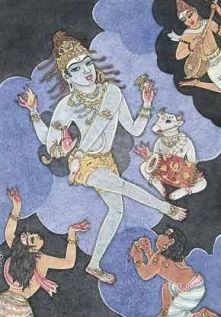
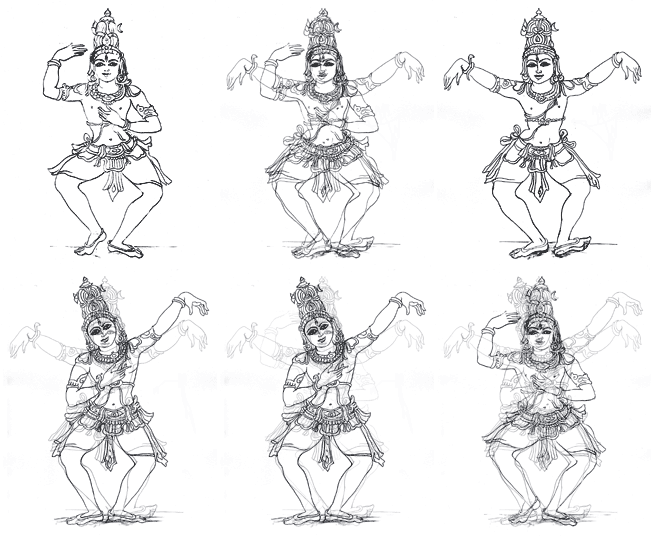
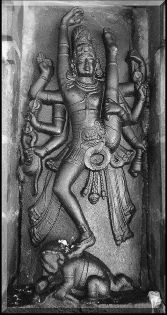
Shiva tandava -Shri SRajam

  1. Natyashastra

As always, we may commence with the Natyashastra. In the previous posts, we have talked about the various aspects of its text, such as:  its history, its versions, and its importance as the source material for study of all the Art-forms of India.

Now, let’s focus on the theoretical and technical features of Dance, as described in the Natyashastra.

Of the thirty-seven Chapters in the Natyashastra; about twelve Chapters are related to Dance. Those are the Chapter numbers: 4, 5, 8-13, 19, 21, 22, 25 and 31.

[It is said that Natyashastra is structured in such a way as to answer the five questions raised by the sages.

In Chapter One, named as Natyotpatti, the sages Atreya and others request Bharata to explain the circumstances leading to the creation of Natya and Natyaveda; and its related issues. In that context , the sages frame five questions:

    • (1) how was the Natyaveda created?
    • (2) For whom it was meant?
    • (3) What are the parts of it?
    • (4) What is its extent; and ,
    • (5) how is it to be applied?

Please speak to us in detail about all these. 

yaveda katha utpannaḥ? Kasya vā kte? katyagaḥ? kipramāaśca?  and, Prayogaścāsya kīdśa?

Sarva-metad-ayathātattvam bhagavan-vaktumarhasi 5

But the answers to these questions are not given in an ordered sequence;  but , are  spread all over the text of Natyashastra. This is one of the many problems involved  in the study of Natyashastra.]

*

[It is also said; Bharata structures his work mainly based on four types of Abhinayas, the modes of theatrical expressions for conveying aesthetic pleasure (Rasa) to the cultured spectators (Sahrudaya).

These four are: Sattavika (conveyed by efforts of the mind); Angika (by natural movements of the body parts); Vachika (through speech); and, Aharya (costume, makeup and stage accessories).

Bharata attaches greater importance to Sattavika the first of the  four modes; and discusses them, in detail, in Chapters Six and Seven.

The Angika-abhinaya, expressions through gestures and movements of body-parts, comes next. And, this is dealt in Chapters Eight to Thirteen.

The Vachika, expressions through speech is taken up next in Chapters Fourteen to Twenty.

And, then comes Aharya – the dress, makeup and scenic appliances; along with the music from the wings to enhance the effect of the scenes. This is done in Chapter Twenty-one.]

*

To this four-fold division of the subject of Abhinayas , are added the Chapters narrating the origin and greatness of the theatrics; the forms of the stage; the rules for their construction; and, the related auspicious rituals for inauguration etc.

Before all this, in the initial Chapters – the Fourth and the Fifth Chapters, Bharata details the Purvaranga preliminaries; the dances and rituals to be conducted before the commencement of the play. These specify the music and dance that are to be played to please the gods; and, to pray for the successful staging and completion of the play.

While detailing the Purvaranga, Bharata describes the two kinds of NrttasTandava and Sukumara prayoga – to be performed therein. And, thereafter, he speaks of the basic units of composite movements (Karanas) ; oscillating limb movements (Recakas); and, the choreographic sequences (Angaharas) composed by the combination of those dance elements. The Fifth Chapter gives details about these preliminaries.

The Chapter that come towards the end – Chapters 35 and 36,   are supplementary; and, these deal with matters such as the qualifications and conduct of the actors and actresses on the stage.

*

Thus, when you take an overview, you will find that excluding preliminary (4 and 5) and supplementary Chapters (35 and 36), the subject of theatrics is actually dealt in 29 chapters (from Chapter Six to Thirty-four). ]

Nataraja 004

Now , as regards the Chapter-wise outline :

The Fourth Chapter Tandava-lakshanam ,in its 320 Slokas, is, mainly, about the rules of Dance (Tandava-vidhi). It starts with a narration about the first play written by Brahma and its enactment.

Then the focus shifts to Nrtta, the pure dance form that delights the eye; but, not intent on conveying a meaning. Here, it goes on to describe two kinds of Nrttas – Tandava and Sukumara – performed during the preliminaries (Purvaranga). And, thereafter, speaks of the basic units of composite movements (Karanas); oscillating limb movements (Recakas); and, the choreographic sequences (Angaharas) composed by the combination of those dance elements. But, it is not clear how these movements were combined and utilized.

In addition, it describes group dances (Pindi).

Apart from defining the Karanas, Angaharas, Recakas and Pindibandhas, the Chapter Four gives the descriptions of 108 types of Karanas (verses 62 to 169) ; 32 types of Angaharas (verses 170-245) and the names of the Pindis associated with various gods and goddesses (verses 257-263).

In this chapter Bharata details five concepts – Nrtta, Tandava, Sukumara-prayoga, Pindlbandha and Abhinaya – that are fundamental to the Art of dancing. Therefore, Chapter Four is of great importance to the theory and practice  of Dance.

*

The Fifth Chapter of the Natyashastra (in 134 Slokas) continues the discussion of the components of the preliminaries (Purvaranga). Here, it is with particular reference to the details of the sequences (Purva Ranga vidhana)to be followed during the performance of the Purvaranga ceremonies (verses 8-30).

*

The Chapters 8 to 12 are essential to understand the nature of the Nrtta, its elements as also of the movements of the major and minor limbs (Angas and the Upangas). Bharata explains how the different movements are combined into composite movements known as Caris, Mandalas, and Sthanas, which , in turn , are combined to form  Karanas, which again are put together to create Angaharas.

The Eighth Chapter is devoted to the movements of the head, eyelids, eyebrows, pupils, the nose, cheeks, lips, the chin, the mouth and the neck. All these are said to be the components of Abhinaya, the art of illustrating the meaning of different things. The Abhinaya is of four kinds: Angika (gestures); Vachika (words); Aharya (costumes, makeup and supporting aids) ; and Sattvika ( emotional).

It goes into enormous details of the Angika Abhinaya , under its three broad categories : limbs (Sarira); face (Mukhaja) and the entire body (kshetra) including the six major limbs (Anga) – head, hands, chest, sides, waist and feet; and six minor limbs (Upanga) – eyes, eyebrows , nose, lower lip and chin. Further, under each of those sub-divisions it goes into exhaustive and meticulous details.

 The Ninth Chapter is given to the movements of the important elements of the hand gestures (hastha) and its uses (viniyoga) in the Abhinaya.  It its elaboration,in 283 Slokas,  a major portion of the text describes sixty-seven kinds of hand- gestures (Hastha) and their uses in Dance , Drama in various situations (verses 4 to 211); ten types of movements of arms (verses 212 to 213)

This Chapter also deals with the movements of other parts, such as: the chest, sides, belly, waist, thighs, shanks and the feet.  In the case of these other parts of the body, the movement of the particular part is described first ; and, it is followed by its viniyoga, which constitutes a part of the Abhinaya technique.

Both chapters – 8 and 9 – describe the use of these movements in conveying meaning (Artha). And, the hand-gestures meant for abstract dancing (Nrtta) and also for acting are described in great detail.

The Chapter Ten is in continuation of the previous Chapter. According one version, it is a short chapter having only 54 verses (the longer version has 103 verses) . The shorter version (see pages from 191 to 196) deals mainly with the movements of the chest, belly, waist, sides, thigh, shanks and feet; and, their applications in Dance and Drama (verses 1-51).  And, it ends with an introduction to Caris (verses 52 to 54)

The Chapter Eleven of the shorter version (from pages 197 to 206) is devoted to Cari, the most important single unit of movement in the Nrtta technique as enunciated by Bharata. The Caris are movements using one foot; and, are used both in Dance and Drama. Thirty two kinds of Caris are defined; of these sixteen are termed Bhaumi (ground) – verses 13 to 28; and, the other sixteen are called Akasiki (aerial) – verses 29 to 49.

The six types Sthanas or standing postures and their applications are described in verses 50 to 64.

In addition to describing these movements, Bharata speaks of the general principles of effective exercise, Vyayama, as well as aesthetic discipline of Sausthava (keeping different limbs in their proper position- verses 89 to 91) and Chaturasrya (square composition of the body posture, mainly in relation to the chest- verses 89 to 91).

In Chapter Twelve (see pages 207 to 212) Bharata then goes on to describe Mandalas, which are more complicated movements of the legs involving combinations of Caris. The Mandalas are, again, classified into two categories: Akasiki (aerial)-10 types (verses 6-41); and, Bhaumi (ground)- 8types (verses 42-68).

*

The Chapter 13 (see pages from 213-228) describes Gatis or gaits, suitable for different types of characters, such as the Kings and superior characters as also for middling characters. Walking styles for women of various classes are also described. The gaits suitable for each type of character in each of the Bhavas (sentiments) are described in verses 25 to 75. Similarly, the sitting postures (Sthana) for men and women of different types and classes, in their different moods are described in verses 195 to 220. And, the lying-down postures (Shayana) for different types of characters are described in verses 221 to 227.
*

The Chapter 19 (verses 119 to 135)  considers the constituents of Lasya, a dramatic form that is created from delicate body movements is common to both  the Dance and the Drama.

*

The Chapter 21  deals with Aharyabhinaya, that is, the use of costumes, stage properties and other external aids which are essential both to dance and drama.

This Chapter also discusses the distinction between the Lokadharmi and Natyadharmi modes of presentation, corresponding to natural and stylized modes.

*

In Chapter 22 , Bharata takes up the general technique of expression in acting, calling it Samanya-abhinaya (basic or general representation), and gives directions for expressing states of mind and responses to sensory experience, such as touching or smelling.

śiro hasta-kaī-vako-jagho-uru karaeu tu sama karmavibhāgo ya sāmānyā-abhinayastu sa 22.73

These movements are considered to be usually self-explanatory, so that although they are codified into a discipline, they are not seen as stylized, with special, symbolic meanings attached to them. The hand-gestures in this category, for instance, are formed with the purpose of imitating objects.

In that context; the physical, natural, involuntary graces in women, men, twelve forms of voice expression,  8 varieties of heroines in love (Astavidha Nayikas), general exclusions on the stage are also  discussed.

*

The Chapter 25, in contrast, describes the special (viśea) mode of Citra-abhinaya, in which each movement carries a particular meaning specific to it.

agā-abhinayasyaiva yo viśea kvacit kvacit anukta ucyate citra citrābhinayassmta 25.1

The four types of Abhinaya and its various elements and technique of Samanya-abhinaya (general representation), generally, indicate external objects (bahya) that are commonly seen. But, certain other objects, phenomenon in nature, feelings etc., need special techniques.

Bharata, therefore, says those other internal (abhyantara) more subtle or abstract elements in nature, inner feelings etc., need to be indicated by special (viśea) modes of representations Citra-abhinaya.

The Chapter 25 gives detailed instructions how to represent through gestures the nature and its various elements such as : day, night, air , sun, moon, stars , lightning,  shooting stars, seasons, dust, smoke, hot wind etc. There are also indications how to represent through gestures, the audible and visible objects, sharp objects, ornaments, flowers etc. Instructions are also given how to express emotions such as: happiness, deep and exalted feelings etc., as to indicate the states of mind and responses to sensory experience, such as touching or smelling. The hand-gestures (hastha) in the category of Citra, for instance, are formed with the purpose of simulating the objects or feelings.

For instance; Bharata mentions that to indicate morning and evening; day and night; seasons; extreme darkness; wide expanse of water; directions; planets; stars; and anything that is not fixed ; one can employ the following gestures : two hands raised with Pathaka and Swastika gestures; Urdhva head – looking upward with various eye movements that are appropriate to the context.

uttānau tu karau ktvā svastikau pārśva-sasthitau udvāhitena śirasā tathā urdhva-nirīkaāt 25.2

prabhāta gagana rātri pradoa divasa tathā tūn ghanān vanāntāśca vistīrāśca jalāśayān 25.3 diśo grahān sanakatrān kiñcit svastha ca yadbhavet tasya tva abhinaya kāryo nānā dṛṣṭi samanvita 25.4

*

The Chapter 35 is partly on Taala, or rhythm, but it also touches the subject of Lasya, describing the movements and the music that are required for each of its several varieties.

design2

One of the problems in the study of the Natyashastra is that the subjects therein are not arranged systematically as per an order; but, are scattered. For instance; to understand and get a clear picture of the nature of Nrtta, which is introduced in Chapter 4, we have to go further and refer to Chapters 8 and 9 which analyse the movements of major and minor limbs; and, thereafter refer to Chapters 12, 13 and 4 for gaining an understanding of the scheme of combining the primary movements such as Cari, Mandala, Karana, Angahara etc.

Similarly, Karanas are introduced in Chapter 4; and, Caris in chapter 10.  We have study the Chapters 9, 10 and 11, together, in order to understand the concept and execution of the Karanas.

pindi1

A note on Pindibandhas

The Pindibandhas, group formations and group dances are discussed in Chapter Four. According to Bharata, the Tandava Nrtta, during Purvaranga, iperformed to accompaniment of appropriate songs and drums. And, it is composed of RecakasAngaharas and the Pindibandhas

– (Recakā-Agahārāśca-Piṇḍībandhā tatha -iva ca – NS. 4. 259-61).

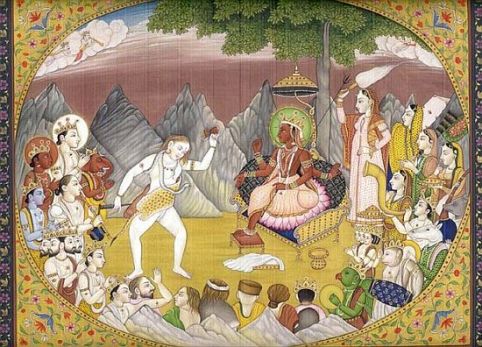
The Pindibandhas are thus a form of Nrtta, pure dance movements. According to Bharata, the Pindlbandhas were patterned after the dance (Nrtta) performed by Shiva along with his Ganas and disciples such as Nandi and Bhadramukha.

In the context of a play, the Pindlbandhas were performed during the preliminaries (Purvaranga); that is before the commencement of the play proper. Its object was to please the gods; and, to invoke their blessings. As regards the sequence of occurrence in the Purvaranga, the Pindibandhas followed soon after the exit of the dancer who performed the Pushpanjali (flower offering to gods). The Pindis are then danced, by another set of women, to the accompaniment of songs and instrumental music

–  anyāścā anukrameātha piṇḍī badhnanti yā striya– ॥ 279॥

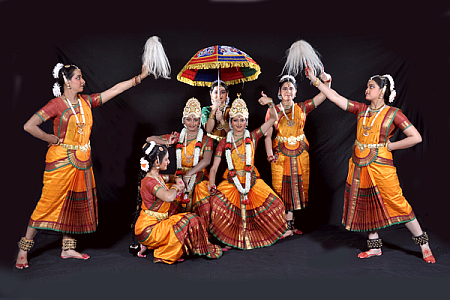
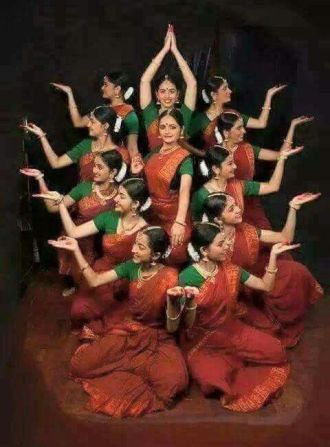
The term Pindibandha is understood as weaving or forming of patterns by  the clusters or groups of dancers. Thus, the Pindibandha is the technique of group formations; and, weaving patterns.  It is said; each variation of a cluster-formation (Pindi) was dedicated to and named after a god or a goddess, who was denoted by the weapons, vehicles, insignia or emblems associated with that deity; and, her/his glory was celebrated through the formation created by the dancers. For instance: Īśvara piṇḍī for Īśvara; Sihavāhinī for Caṇḍikā; Śikhī piṇḍī for Kumar and so on.

Bharata mentions four types of Pindibandhas that were performed during his time: 

  • Pindi (Gulma-lump-like formation); 
  • Latha (entwined creeper or net like formation, where dancers put their arms around each other); 
  • Srinkhalika (chain like formation by holding each other’s hands); and, 
  • Bhedyaka (where the dancers break away from the group and perform individual numbers).

Abhinavagupta describes it as ‘piṇḍī ādhāra agādi saghāta,’- a collection of all those basic elements which make a composite whole. It is called Pindibandha, because it draws in all other aspects; and, ties them together. He also states that Agahāras form the core of the Pindibandhas.

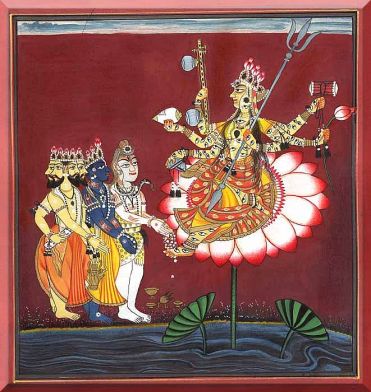
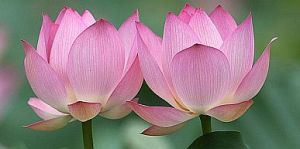
Abhinavagupta explains that in the Pindibandha, the  dancers coming together, can combine in two ways : as  Sajatiya , in which the two dancers would appear as two lotuses from a common stalk;  or as Vijatiya,  in which one dancer will remain in one pose like the swan and the other will be in a different pose to give the effect of lotus with stalk, held by the swan-lady. And, in the gulma-srnkhalika formation, three women would combine; and in the Latha, creeper like formation, four women would combine.

Bharata provides a list of various Pindis in verses 253-258 of Chapter Four. He states that in order to be able to create such auspicious diagrams/formations (citra), in an appropriate manner, the dancers need to undergo systematic training

(śikāyogas tathā caiva prayoktavya prayoktbhi – NS.4.291)

bindi2

In the next Part we shall dwell on the Abhinaya and Angika-abhinaya, in particular, with the descriptions of its various elements such as: Mukhaja (parts of the face); Hastha (the hands, fingers); Pada (feet); Sarira (major limbs, arms, chest, waist, sides, thighs, shanks, etc); Sthana (standing, sitting and laying-down postures); and Gati ( gaits) so on.

pindi6

Continued

In

Part Seven

References and Sources

  1. Movement and Mimesis: The Idea of Dance in the Sanskritic Tradition

 By Dr Mandakranta Bose

  1. Theory and Technique by Dr. Sunil Kothari

ALL PICTURES ARE FROM INTERNET

 
2 Comments

Posted by on October 11, 2018 in Art, Natya


Tags: , , , , , , , , , , , , , , , , , , , , , ,

The texts of the Indian Dance traditions – Part Five

Continued from Part Four

Dance forms of India

ashtalakshmi2 (1)

Uparupakas

Bharata, in his Natyashastra, discussed, in main, the Rupakas, the major forms of the Drama; and, the two genre of Dance formats – Tandava and Sukumara. His concern seemed to be, primarily, with the forms and styles that were dominant in the art-tradition of his time; and, particularly those that had the potential to display various modes of representations and to evoke Rasas. For him, the aspect of Rasa was central to the Drama.

Of the eleven essential elements of the Drama that he names, Rasa is of paramount importance; and deriving that Rasa is the objective of a theatrical performance. The other ten elements – from Bhava to Ranga – are the contributing factors for the production of the Rasa

rasā bhāvā hy abhinayā dharmī vtti pravttaya / siddhi svarā astathātodya gāna ragaś ca sagraha // BhN_6.10 //

Bharata, similarly, even in regard to Dance, described only those dance forms that he considered to be artistically well cultivated; leaving out the regional and popular varieties. In the process, Bharata did not deal with the many peripheral styles.

Rupaka2

The Drama, a Drshya-Kavya, was formally known as Rupaka. Abhinavagupta explains Rupam as that which is seen; and, therefore, the works containing such matter is Rupani or Rupaka-s. And, Dhananjaya in his Dasa-rupaka (ten forms of Drama)  explains :  it is called a Rupaka or a representation, because of the acts put on by the actors (abhinaya)  by assuming (rupakam tat samaropad)  the forms of various characters  such as gods or kings  and men and women. And, it is called a show, because of the fact it is seen (rupam drsyatayocyate). 

Thus, Drama is the reproduction of a situation (Avastha-anikrtir natyam), in a visible form (rupa),  in the person of the actors. Dhanika , in his commentary , explains that the terms Natyam, Rupam and Rupakam can be treated as synonymous.

The Drama was classified into two types : Major (Rupaka) and Minor (Upa-Rupaka).

Under the Rupakas (major types of Drama) , Bharata mentioned ten of its forms (Dasadhaiva). Of the ten, he discussed, in fair detail, only two forms –Nataka and Prakarana. Because, he considered that these two alone fulfilled all those requirements that were necessary for a Rupaka (major type). According to Bharata, these two major forms alone depict varieties of situations, made up of all the four modes or styles (Vrttis) and representations. And, they alone could lend enough scope for display of Rasas (Rasapradhana or Rasabhinaya or vakya-artha-abhinaya). In contrast, the other eight forms of Rupakas deal with limited themes and rather narrow subjects; and, are also incapable of presenting a spectrum of Rasas. 

In the process, Bharata did not also discuss about the minor forms of the drama, the Uparupakas or Natyabhedas. These were a minor class of dramatic works, distinct from the major works; and, did not satisfy all the classic, dramatic requirements prescribed for a Rupaka or Nataka proper. Such minor class of plays (Uparupakas) handled only a segment of a theme or story (Vastu); and, not its full extent. It did not also, perhaps, employ all the four Abhinayas, in their entirety.

*

By the time of Abhinavagupta (Ca.11th century), the Dance had diversified into many more forms than were known during the time of Bharata. However, he mentions that even those innovative forms, indeed, continued to be rooted in the basic concepts laid down in the Natyashastra. And, in fact, he often cites idioms of dancing from such new categories, in order to illustrate Bharata’s concepts.

For instance; Abhinavagupta explains the nature of the delicate Sukumara Prayoga and of the gentle Kaisiki Vrtti, with reference to examples taken from Nrtta-kavya or Nrtya-prabandhas or Ragakavyas – musical compositions or narrative plays (classified under Uparupakas) beautified with  the elements of dance and music; and, which could be presented through expressive Abhinaya.

Abhinavagupta remarks; though the concept of minor dramas is absent in the Natyashastra, it is those minor classes of plays – Uparupakas, par excellence – in their varied forms, adorned with rich, melodious music, as also with graceful and delicate dance movements, which grew into becoming the main stay of the contemporary dance- scene.

Thus, Abhinavagupta, in his commentary, did mention the Upa-rupakas; but, he did neither define its essentials nor did he explain its features. He merely called them as Nrtta-kavya and Raga-kavya; meaning, the type of plays that are rendered through song, dance and interpreted through Abhinaya. In that context, Abhinavagupta mentions some plays of Uparupaka variety. He names them as: Dombika, Bhana, Prasthana, Sidgaka, Bhinika, Ramakrida, Hallisaka, Sattaka and Rasaka. These minor dramatic works were of the nature of dance-drama, where the elements of music and dance were dominant.  But, Abhinavagupta had not discussed about those musical varieties.

[Though the Natyashastra had not specified  the varieties of Uparupakas, in the later times their numbers varied according to the whim of each author. For instance; Abhinavagupta refers to nine types of Uparupakas; Dhanika mentions seven types as being Natya-bheda (varieties of dance forms) ; Sahityadarpana mentions eighteen types; Natyadarpana recognizes only thirteen of these eighteen types, because they were said to be the only ones that were mentioned by the Vruddhas (the elders) or Chirantanas (ancient ones) ; Raja Bhoja refers to twelve types; but, the largest number seems to have been listed in Bhavaprakasana , which mentions as many as twenty Uparupakas , including Natika, Prakaranika, Sattaka, Trotaka etc., which are almost as good as the Nataka .

The fact that there was no unanimity among various authors either in the numbers or in the definition of the Uparupakas, merely suggests that this from of Rupaka was evolving all the time; improving; and, continuously  undergoing changes and modifications in their nature and form, aiming to attain a near-perfect musical dance format. 

It is explained the prefix ‘Upa’ should not be taken to mean ‘minor’ ; but, it should be understood as referring to the types that are ‘very near’ to the Rupakas, but, having a preponderance of dance and music.]

Uparupaka

Perhaps, the earliest reference to Uparupaka occurs in the Kama-sutras of Vatsyayana (earlier to second century BCE), which presents a guide to a virtuous and gracious living. Here, Vatsyayana mentions Uparupaka type of plays, such as Hallisaka, Natyarasaka and Preksanaka, which were watched by men and women of taste.

Rajashekara (8th-9th century) calls his Prakrit play Karpuramanjari, as a Sattaka type of Uparupaka. He explains that the play in question was not a Nataka, but resembled a Natika (a minor form of Drama). It was a single-Act play (ekankika or Javanika); and, it did not contain the usual theatrical scenes such as: the pravesakas (entry-scenes) and viskambhakas (intermediary or connecting scenes). Here, in the Sattaka type of Uparupaka, music and dance were the principal mediums of expression. It is composed in the graceful Kaisiki Vrtti; and, has an abundance of Adbhuta Rasa (wonder and amazement). Even a major part of its spoken dialogues (Vachika) was rendered in musical form. And, the story of the play was composed by stringing together series narrative songs.

Bharata had also mentioned that  in a well rendered play, the song, dance,  action and. word follow one another in an unbroken flow; presenting a seamless spectacle as if there is neither an end nor a beginning , just as wheel of fire  (Alata chakra).

eva gāna ca vādya ca nāya ca vividhā aśrayam / alāta-cakra pratima kartavyayayoktbhi // BhN_28.7 //

That, in a way, sums up the characteristic nature of the dance-drama type of Uparupakas. Here, the stylized Natya-dharmi mode of depiction is dominant. And, even when Vachikabinaya is used, the emphasis is more on the Abhinaya rendered through gestures to the accompaniment of song and music; than on speech.

Such Uparupakas, while narrating an episode or a story, did use the elements of the Nrtta (abstract dance movements) along with the Abhinaya of the Nrtya. They were, thus, a specific form of Natya–  (Natyabheda) . They also provided ample scope for display of Bhavas and for evoking Rasa.

[ As Dr. Sunil Kothari observes in his research paper :

The technical distinction which Natyashastra makes between Rupakas and Uparupakas is that while the former presents a full profile of a Rasa with other Rasas as its accessories.  Further, in the Rupaka a full story was presented through all the dramatic requirements and resources fully employed. But in the Uparupaka only a fragment was depicted. And, even when a full theme was handled all the complements of the stage were not present; the Uparupaka lacked one or  the other or more of the four Abhinayas; thus, minimizing the scope for naturalistic features Lokadharmi and resorting increasingly to the resources of Natyadharmi.

Whereas this is true of several other forms of Uparupakas, it is not true of the dance-drama forms. They used all the elements of the Abhinayas; and,also  provided scope for display of Bhavas and for evoking Rasa.]

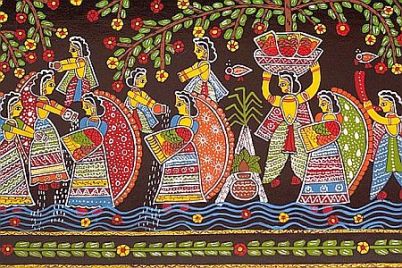
madhubani

Coming together of the Marga and Desi traditions

By about the twelfth century, the classic Sanskrit Drama, in its major format, the Nataka, began to gradually decline. And, over a period, it almost faded away.

Though the Sanskrit theatrical tradition was tapering out, it did continue in the forms of minor or one-act plays – Uparupakas – mainly in regional languages, with a major input of dance and songs; but, with just an adequate stress on Abhinaya (acting) and Sahitya (script). These forms of dance-dramas were gaining ground.

The texts of the later period commenting on Natya and Alankara-shastra (poetics) could hardly afford to ignore the Uparupakas which were steadily gaining popularity. And, many scholars did formally recognize the Uparupaka class of dramatic works; codified their features; and assigned them a place within the framework of theory , as Nrtya-prabandhas.

By about the twelfth century, the differences as also the relationship between the Nrtta (pure dance) and Nrtya (Nrtta with Abhinaya) were clearly established. And, those dance formats, in combination with music, were suitably applied and integrated into the performance of the dance dramas.

Among the authors of the later period, Raja Bhoja ((10-11th century), Saradatanaya (12-13th century) and Vishvanatha (14-15th century) dealt at length with the Uparupakas. Raja Bhoja in his Srngaraprakasa discusses twelve types of Uparupakas; Saradatanaya in his Bhavaprakasa describes twenty-one forms of Uparupakas and also provides a gist of several definitions as given by the previous authorities ; and, Vishvanatha in his Sahityadarpana discusses in detail eighteen types of Uparupakas, with examples

For a detailed discussion on  the types of Uparupakas: please click here. And, go to pages 189 and onward for descriptions of those forms.

fine-arts1

Such staged dramatic texts (Nrtta-kavya or Raga-kavya), narrating a story, composed of songs, set to music with instrumental accompaniment; and, choreographed with dance movements, came to be known by different names such as: Natyabheda (in Avaloka of Dhanika); Geyarupaka (in Kavyanusasana of Hemacandra): Nrtyarupakas or, simply as the ‘other plays’ anyani rupakani (as by Ramacandra and Gunacandra), in which music and dance dominate.

The period between the eleventh and the fifteenth centuries was a very highly significant phase in the evolution and development of Art in its varied dimensions. It was during this period that Dance, as Nrtya, gained recognition as an independent Art-form. And, Dance was no longer treated as a mere adjunct to drama. Similarly, vocal (Gita) and instrumental (Vadya) also began to flourish on their own.

The Dancing in India evolved by assimilating new forms and techniques; and, by moving away from its early dependence on Drama. In the process, it also widened its aesthetic scope beyond decorative grace; and, enlarged its content or repertoire to encompass depiction of emotional narrative themes. Now, the beauty of form walked hand-in-hand with the richness of the lyrics and, with the depth of its emotional content; resulting in the growth of a complex art form.

During the period , which spans the eleventh to the sixteenth century, many excellent works on Dance and music were written; and, new trends in Dancing were set. Now, many texts, exclusively devoted to Dance came into being (Say, Sangitaratnakara of Sarangadeva – Chapter seven;  the Nrtya-ratna-kosa of Maharana Kumbha ; the Nrttaratnavali of Jaya Senapati; Nartananirnaya of Pundarika Vittala).

The texts of this period , though rooted in the principles of Natyashastra, did recognize and discuss Dance-forms and styles whose technique and structure differed from the Marga class described by Bharata- During this period, the emphasis of the texts shifted away from Natyashastra’s Marga tradition ; and, moved towards the styles known , generically, as Desi , regional or improvised.

It was during this period that Uparupakas developed into a common ground where the classical Natya of the Shastra (Marga) met the regional (Desi) forms of Dance of easy movements; allowing more freedom and greater degree of improvisation, within the given framework. It was here that the sophisticated fused with the folk forms.

The noted scholar Dr. Raghavan, therefore, described the Uparupaka as the golden link (svarna-setu) or common ground where the classical met the popular; and, where the sophisticated took the folk forms. It was also here that the folk forms sublimated into classical form.

This period was also marked by the efforts to codify the less acknowledged, but popular forms; and, assign them a place within the framework of theory.

In the process, the theories of Dance adopted the terms and principles that were prevalent in the Kavya, poetics. Those dance forms which adhered to the established regulations and conventions; and, which had a definite structure were termed and classified as Nibaddha. And, those free-flowing dance forms, which were spontaneous, unregulated, unstructured and not bound by any rules, were treated as Anibaddha. Such unfettered dance-forms were not restricted by the requirements of Taala and such other disciplinesand, it did not also need the support of compositions woven with meaningful words (Pada or Sahitya). Sarangadeva defines Anibaddha as that which is not bound or as that which lacks rules (bandha-hinatva).

The Anibaddha also meant allowing the dancer considerable latitude in devising body movements that best suited the aesthetic and emotional content of the theme.; And , it also  made room for enterprise to come up with fresh idioms of expressions.

At the same time, the texts, such as the Sangita-samayasara, the Sangitaratnakara and the Nartananirnaya, suggested body movements as that of  simulating the quiver of a drop of water on a lotus leaf, or the trembling of a flame etc.

Such process of reorganization  and innovation covered not only the well regulated dance forms ; but, it  also  extended even to  the individual and   the group dances like Daṇḍaras, Raslīlā and other folk dances of similar nature, some of which have survived as dramatic group presentations.

Dance_theatre_7

Dr. Mandakranta Bose in her Movement and Mimesis concludes : Our study of technique also shows that present day classical dancing in India is grounded more directly in the tradition recorded in the later dance manuals, especially the Nartananirnaya , than in the older tradition of the Natyashastra. This suggests that those styles which had marginal existence in Bharata’s time not only came to be admitted into the mainstream of dancing, but eventually became the dominant current. The evolutionary process is therefore one of dynamic growth rather than a static survival. Through the comparative analysis of the concepts and technique of dancing the present study attempts to mark the milestones of that process

As Dr. Sunil Kothari also observes in Part One of his research Paper  : the minor forms that were not specifically described by Bharata came into fore during the later periods. And, they have contributed greatly in the evolution of the dance concepts; and, in shaping and enriching the various dance forms, in their distinct regional milieu; as we see in contemporary India.

Dance-Drama

Dance-dramas

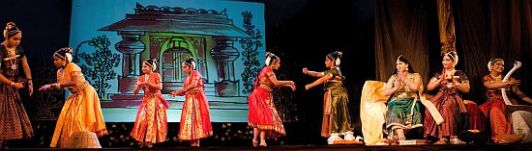
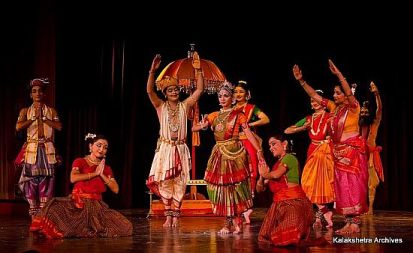
Dance and music have always formed an integral part of Sanskrit drama. But, it was the Uparupakas – minor class of drama- based in music and dance movements that eventually gave rise to the now living traditions such as KuchipudiBhagavata-Mela-Natakas, Yaksha-gana and Kuravanji    dance dramas.  Such forms of  Uparupakas  are very attractive formats, with the elements of the music and dance being predominant. And, most of them are based in dances accompanied by soulful songs, interpreting the emotional contents of the song through Abhinaya or gestures.

The Uparupakas also marked the emergence of dance-drama along with the solo exposition as a credible format of Dancing. Since then, dance-drama has come to stay and flourish side by side with the solo dance forms.

*

The key element of the musical dramas was delighting in the spectacle of presentation and the emotions displayed by the characters on display. Their themes were crafted around Raga and Kavya elements, which dealt with the characters, themes, plots, emotional situations rooted mainly in Srngara (lovely and graceful) and Bhakthi (devotion) Rasas. The Uparupakas were, therefore, said to be Bhavatmaka or dependent on emotions.

The Uparupakas were broadly classified according to the dance-situations that were involved and the Rasas, the emotions, they projected. Among the Uparupakas, the Rasaka, Hallisaka, Narttanaka, Chalika and Samyalasya gave importance to Nrtta, the pure dance movements, in their performance. And, Natika, Sattaka, Prakaranika and Trotaka (Totaka) gave prominence to emotional aspects and to Abhinaya.

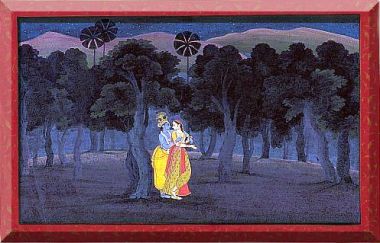
‘The Lovers Radha and Krishna in a Palm Grove’; miniature painting from the ‘Tehri Garhwal’ <i>Gita ­Govinda</i> (Song of the Cowherds), Punjab Hills, kingdom of Kangra or Guler, circa 1775–1780

Gita-Govinda

The most celebrated of the Raga-kavyas, Chitra-kavyas or Nrtya-prabandhas is the Gita-Govinda composed by Sri Jayadeva Goswami (about 1150 A.D), who was a court poet of the King Lakshmana of the Bengal region (12th century). It is the most renowned and the best loved among all the Raga-kavyas of the Prabandha class. Gita-Govinda occupies a preeminent position in the history of both the Indian music and dance.

The Gita-Govinda is a Khanda-Kavya, confined to description of some episodes. It comes under the Prabandha class of Kavyas. Jayadeva at the commencement of his Khanda-kavya states that he is composing a Prabandha Kavya (Etam karoti Jayadeva kavih prabandham). The Ashtapadi (eight footed) is a  Dvi-dhatu  Prabandha,  i.e. consisting two sections (Dhatu):  Udgraha and Dhruva.

from the Gita Govinda

This sublime Sringara-mahakavya, lovingly describes the emotive sports of Sri Radha, the Mahabhava – highly idealized personification Love and Beauty; and, Krishna the eternal lover (Sri Radha-Krishna-Lila).

Gita Govinda is the most enchanting collection of twelve chapters (Sarga). And, each Sarga commences with soulful a Sloka followed by one or two songs arranged in couplets. These songs are known as Giti, Prabandha or Ashtapadi, since twenty-four of such (but not all) employ eight couplets. Sri Jayadeva himself calls them as sweet and delicate Padavali-s (Madhura komala padavalim).

The Gita Govinda, permeated with intensely devotional and delicate Madhura Bhakthi, was one of the inspirations of Sri Chaitanya Mahaprbhu who was steeped in Krishna-bhakthi; and, it is now the primary text of the Gaudiya Vaishnava School of Bengal.

The popularity enjoyed by Gita Govinda is amazing. Each region and each language of India embraced it to its heart, with love and devotion; adopted it as its own; sang in its own chosen Raga; and, interpreted it in its own dance form.

The Gita Govinda also served as an inspiration or as a model for creation of dance-dramas, elaborating on parallel themes, in different parts of the country, in different languages. For instance; the dance sequences composed in the traditions of Kuchipudi of Andhra; the compositions of Sri Sankaradeva of Assam; Umapati of Bihar; Bhagavata Mela Natakas of the South; Yaksaganas of Karnataka ; and, Krsnattam and Kathakali of the Malayalam areas – were all inspired by the Gita-Govinda.

icx064 (1)

Nauka Charitam

And, Sri Thyagaraja (1767- 1847) is said to have composed three musical dramas  (Geya-Nataka). Of these, only two namely: Prahlada-Bhakti-Vijayam and Nauka Charitam are available. But, the third – Sita Rama Vijayam – is sadly lost.

Nauka Charitam, mostly a product of Sri Thyagaraja’s imagination, improvising on an incident briefly mentioned in Srimad Bhagavatam, comprises twenty-one Daru songs set in thirteen Ragas (some of which follow folk tunes) . Its theme extols the virtue of absolute surrender to the Lord with Love and devotion. Nauka Charitam lends itself beautifully well for production of a Dance-drama.

Dances

Regional Dance forms

By about the sixteenth century, the Nrtya-prabandhas, set free from the confines of the Drama, began to flourish and to evolve further, by assimilating new forms, more creative modes of expression and techniques. In the process, their aesthetic scope grew beyond mere decorative postures. They refined their skills to communicate the emotive content of the lyrics, more effectively. Beauty of form was blended with meaningful expressions (Abhinaya). The Uparupakas having developed into a complex Dance-form came to occupy a central position within the contemporary world of Art.

Even in this format, the dance element continued to be divided into Nrtta and Natya on the one hand; and, into Tandava and Lasya on the other. Another significant factor was that even though the Dance was mainly based in the theoretical principles of the Natyashastra; yet, in practice, it inculcated styles and techniques that were peculiar to each region. In each of those regions, the Dance practitioners also developed their own local vocabulary. These gave rise to distinctive dance forms and technical terms.

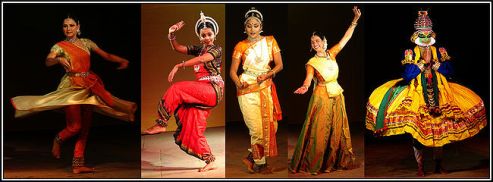
Each of such derivative forms formulated a tradition of its own; such as Kathak, Odissi, Manipuri, and Kuchipudi and so on. And, each of those eminent dance forms rooted in its own regional and cultural background; anchored in its own philosophy and outlook, developed its own idioms of expressions.

There are also certain factors that are common to all those diverse types of dance forms. These, in brief, are :

:- the prominence accorded to the narration of the theme; 

:- the dominance of Natya-dharmi;

:- performing to  the appropriate music, Laya (tempo) and Taala (time-units, beats) ;

:- employment of all the four Abhinayas in varying degrees, in an appropriate manner ;

:- in making a distinction between the  Nrtta and the Nrtya, and maintaining their distinctive features while executing  the respective elements in the performance;

:- taking care to see that the Nrtta aspect, particularly the individual dance movements and postures, are  governed by the special techniques developed by each school of Dance; and,

:- recognition of both the  Ekaharya (solo – where a single dancer enacts the role of several characters) and Anekaharya (where several actors participate  to enact their respective role)  modes of presentation.

Yet, these Dance-forms have successfully retained their identity; and, have carried it forward to the present time.

kathak4

Kathak

As regards Kathak, its history as a performing art has to be viewed in the larger context of the history of the Dance forms of the North India. Kathak, in its earlier form had a long association with temple-dance. But, with the advent of Mughal rule; and with the influence it exerted on Indian life and culture, Kathak dance was remodeled into a different form.

For instance; it is said, by the time of Akbar (16th century), the Persian art and music had vastly influenced the cultural life of India, particularly the milieu surrounding the Mughal court. According to Pundarika Vitthala (Nartana-nirnaya), who had the opportunity to watch, appreciate and enjoy excellent presentations of the Persian oriented dance and music, the restructured Dance form of Kathak, was born out of the fusion of classical Natya with the dance of the Yavanas, (meaning, the Persians), which took place in the context of the cultural life of the Mughal inner court, during the time of Akbar.

Kathak, in its early period, had not only a special, unique manner of dancing, with its own phrases of Nrtta and Abhinaya; but it also had its own distinct structure of performance and philosophy. But, During the Mughal period, it became a source of recreation for those seeking escape from the day-to-day annoyances. Its purpose, then, was to provide sheer pleasure, entertainment and amusement. Thus with the advent of the Mughal rule there was a definite shift in its content as also in its emphasis. And, the elements of devotion, worship etc., that were there in its traditional form went into background. It acquired the epithet of Nautch.

Thereafter, with the fall of the Mughals, Kathak, somehow, managed to survive by shaping itself into a fine expression of a dance form aiming to please its newly acquired patrons, the rulers of small native states. It then branched into Gharanas named after the court that supported it ; like Lucknow Gharana , Jaipur GharanaRampur Gharana etc. (For more, please do refer to Kathak, Indian Classical Dance Art by Sunil Kothari )

*

Kathak , which follows Nartanasarvasva , has a unique feature of taal-prastuti (a systematic elaboration of a time-cycle of a chosen number of beats) that is not found in any other classical Indian dance-forms. It has also a distinct way of presenting the syllables and Bols used in the text of the songs. The variations of these Dance-forms are also recognized by their nature, even in case their style is classical, folk, or modern.

And since the post-Independence days, happily, the classical Kathak is rediscovering itself. It is liberated from the confines of the past feudalistic court associations. The framework and outlook of the present-day classical Kathak is chaste – aesthetically and spiritually.

**

Katarzyna Skiba (Jagiellonian University, Kraków) in her paper:  Cultural Geography of Kathak Dance, writes, among other things:

Kathak is commonly described as elegant, graceful, rhythmical and relatively naturalistic dance, associated with Vaishnavism, but also impacted by Mughal Court. The two leading Kathak Gharānās seem to represent the modalities of the showcased national features:  Rajput’s’ valor and Mughal’s finesse.

Artists and critics tend to talk about Nazākat (Ur. “delicacy”) and khūbsūratī (Ur. “beauty”) as essential characteristic of Kathak, emerging from Lakhnavi culture and Mughal court etiquette.

Jaipur style is considered as more vigorous, fast and focused on technical excellence: its exponents are praised for their speed, agility, or ability to render a series of multiple fast turns (Chakkars). Mythological stories are provided mainly through the medium of Kavitts and Tukās—short compositions consisting of semi-abstract, rhythmical melo-recitation.

Here, Kathak is primarily associated with the Braj region; hence the traditional repertoire is dominated by Krishna-Lila themes (set in Braj-Bhoomi); and, often illustrated through the songs, or melo-recitations in Braj-bhāā

In comparison, Lucknow masters pay more attention to the depiction of feelings (bhāv) through gestures and mime. The dance is often slower, subtle, sensual, limited in demonstration of footwork and focused on presenting a story. The dancers primarily elaborate lyrical compositions (Thumris and Gazals), improvising on their content and filling their performance with emotional depth

*

As Kathak expands on global stages and in schools, its exposure causes the influx of Western ideas and practices into the tradition, that together with performers overflow into the Indian market. Therefore, the young generation of Kathak dancers transgress the borders of tradition in various ways and redefine its parameters, in an attempt to find their own place in the increasingly transcultural community of dance professionals

The author considers the impact of regional culture, economic conditions as important factors in reshaping Kathak art and influencing practice and systems of knowledge transmission. ]

***

Odissi

Odissi

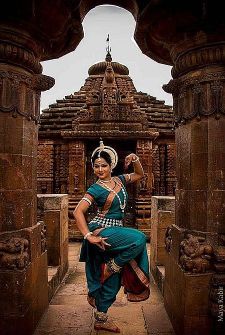
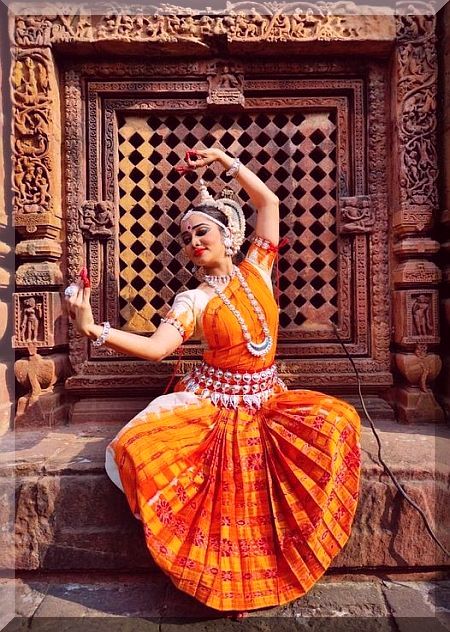
In contrast; the classic Odissi was, essentially, a temple-dance, enacting a devotional poem. It is steeped in devotion; and, in the concepts of spirituality of the Vaishnava tradition. It is performed as a way of submitting ones service (seva) to Lord Jagannath. Odissi is a lyrical form of dance with subtlety as its keynote. It is known for its fluidity and grace. Its sculpture-like poses are executed with harmony of line and movement. Odissi has developed its own vocabulary of foot positions, head movements, eye movements, body positions, hand gestures, rhythmic footwork, turns and spins.

Odissi, again, is based in the principles of the Natyashastra. It also follows other texts such as Abhinaya Chandrika of Mahesvara Mahapatra and Abhinaya Darpana of Nandlkesvara. Dr. Mandakranta Bose opines that the techniques of Odissi are also derived from the Nartananirnaya of Pundarika Vittala.

The Odissi also observes the traditional formats of Nrtta, Nrtya and Natya, in their distinct forms.

The initial items, following soon after the invocation , the Mangalacharana, and Pushpanjali, are in the fast-paced, rhythmic pure dance movements of Nrtta class, known as Battu or Battu Nrtta. That is followed by Pallavi rendering in varied tempos.

The Nrtya segment of the Odissi is more elaborate. It consists narration of a theme; the interpretation of the words and sentences of the lyrics of the song; illustrating with grace Abhinaya articulated through elegant Bhavas, gestures and facial and eye expressions. Odissi is renowned for fluid, eloquent and gracefully charming movements and postures. The songs of Nrtya are, generally, in adoration of Vishnu, as Lord Jagannath. Apart from that, the Astapadis selected from Jayadeva Kavi’s Gita Govinda are the most popular numbers in it’s Nrtya repertoire. These soulful dance recitals celebrate the divine Love of Sri Radha and the eternal Lover Sri Krishna.

The Natya segment of a Odissi performance relates narration of a theme selected from the mythology, epic or a celebrated Kavya.

Kuchipudi

Kuchipudi

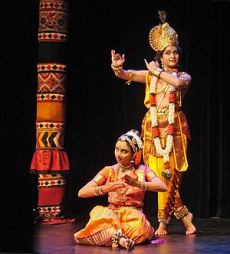
Similarly, Kuchipudi, the dance-drama  of the coastal Andhra Pradesh, is regarded as a religious art of the Vaishnava tradition, devoted to Lord Krishna (Bhama kalapam), where the dancer-actor narrates a story, conveying a spiritual message through expressive gestures, graceful body-movements and rhythmic footwork. In fact, a Kuchipudi performance commences with the recitation of the auspicious slokas extracted from Vedic texts; consecration of the stage with sprinkling of holy water (punyavachana); and , offering Puja to the Ranga Adidevata , the chief deity on the stage. That is followed by dance-offering to Ganapathi; prayers submitted to Goddess Tripurasundari, and to the Guru; and Naandi-stotra by the Sutradhara, the stage manager. The Kuchipudi Natyam is usually performed by a group or in some cases by a solo dancer who enacts, through dance movements, the roles of several characters.  The performance concludes with Mangalam, the benedictory verses; and, offering Aarati to gods.

The repertoire of Kuchipudi also follows three performance categories of dance forms; namely, Nrtta (Nrutham), Nrtya (Nruthiyam) and Natya (Natyam).  Here, ‘Nrtta’ is a technical performance where the dancer presents pure dance movements with stress on speed, form, pattern, range and rhythmic aspects without interpretive aspects. In ‘Nrtya’ the dancer-actor communicates a story, spiritual themes particularly on Lord Krishna through expressive gestures and slower body movements harmonized with musical notes thus engrossing the audience with the emotions and themes of the act. ‘Natyam’ is usually performed by a group or in some cases by a solo dancer who maintains certain body movements for specific characters of the play which is communicated through dance-acting.

(For more, please check Indian Classical Dances : Kuchipudi Dance)

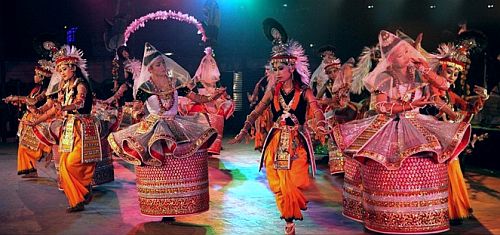
manipuri4

Manipuri

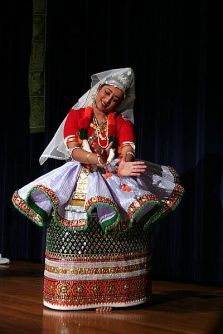
Manipuri , of Eastern India, is a classical dance form narrating themes rooted in the Vaishnava Bhakthi tradition, depicting the Love between Sri Radha and Lord Krishna  , mainly through the re-enactment of the sublime  ‘Raas Lila’. It is also fused with the pre-Vaishnava tradition of Lai Haraoba and Thang-ta, which add variety and vibrancy to its repertoire of movements. Here, again, dance and music are interwoven with rituals and religious practices.

It is said; the repertoire and basic play of this dance form revolves around different seasons. The traditional style of this art form incorporates graceful, gentle and lyrical movements. The fundamental dance movement of Raas dances of Manipur is Chari or Chali.

Manipuri dances are performed thrice in autumn from August to November; and, once in spring sometime around March-April, all on full moon nights. While Vasanta Raas is scheduled in spring when Holi, the festival of colours is celebrated, the other dances are scheduled around post-harvest festivals like Diwali.

The themes of the songs and plays comprise of Love and association of Radha and Krishna in company of the Gopis namely, Sudevi, Rangadevi, Lalita, Indurekha, Tungavidya, Vishakha, Champaklata and Chitra. One composition and dance sequence is dedicated for each of the Gopis; while the longest sequence is devoted to Radha and Krishna.

The dance drama is performed through excellent display of expressions, hand gestures and body language. Acrobatic and vigorous dance movements are also displayed by Manipuri dancers in certain plays.

Mohiniattam2

Mohiniattam

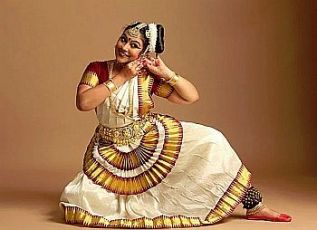
The Mohiniattam, a classical dance form that evolved in Kerala, is said to have been derived from the dance performed by Mohini, a female Avatar of Vishnu. It, again, is a temple-dance; but, with a predominance of graceful and gentle Lasya movements. The Mohiniattam dancers follow- among other manuals – the Balarama -bharatam as their guidebook.

Mohiniattam also comprises all the three elements of Nrtta (pure dance movements); Nrtya (narrating a theme with Abhinaya); and, Natya (enacting a play, usually by a group).

A performance of a Mohiniattam includes sequences commencing with invocation or Cholkettu; and then on to Jatisvaram, Varnam, Padam, Tillana, Shlokam and Saptam. Thus, Mohiniattam is aligned to what came to be known as Bharatanatya.

Its songs are composed with mixture (Manipravala) of Sanskrit and Malayalam words.

Traditionally, Mohiniattam is performed by a single dancer who enacts the roles of the other characters that feature in the lyrics of the song (Ekaharya Abhinaya). Of late, Mohiniattam is also performed as group dance.

dance forms333

Dance forms

All these dance-forms, including Kathak, though they are basically individual performances, they are also enacted as group dances.

What is common to all these classical dances is that their roots are in religion, mythology and devotional stories. Central to these dances is the Nayika, the gentle heroine, who symbolizes the soul of the devotee. The spirit of Bhakthi permeates these dance forms. And, their traditions have been carried forward under the Guru-shishya –parampara, with each generation passing on to the next, with earnestness,  the knowledge, skill and the philosophy of its School.

 *

The Dance forms, such as, Kathak, Odissi or Kuchipudi narrate a story or an episode  chosen from an Epic or mythology. Etymologically, the term Kathak is related to Katha, the art of storytelling. The Western ballet also tells a story. But there are some significant differences between these Dance forms, with regard to their nature and the manners in which they are danced. For example; classical Ballet is performed as a group dance , where different dancers play different roles or characters to build a story. This story is performed as a dance-drama, where various scenes unfold one after the other.

And, another is that unlike in the western dance, the Indian Dances are not set to leaps and gliding movements in the air. It strives to achieve a perfect pose that can be frozen in time. Its technique depends on the skillful management of time (Taala), in order to achieve a series of perfect poses.

In contrast to ballet; the Kathak and other classical dance forms are, traditionally, solo dance-performances. Its dancer enacts all the roles or characters involved in the story (Ekaharya). Here, the story is presented mainly with the help of Abhinaya that involves facial expressions and meaningful hand-gestures. Apart from telling a story, the dancer will have to meticulously follow the rhythmic patterns (Taal) as required by the lyrics and also the sol-fa and other dance syllables rendered in varying speeds (Laya).

Similarly, the Varnams and Padams in the Bharata Natyam are, usually, presented as solo performances.  While presenting the theme of the song that is to be interpreted, the dancer skillfully assumes (Natyadharmi) the role of  several characters (ekaharya) that figure in the lyrics, with appropriate Sancari- bhavas; say, the roles of the Nayika (heroine), her friend/assistant (Sakhi) or of the Nayaka (hero)’. This is achieved through a series of  variations of Angikabhinaya, in which each word of the poetry is interpreted in as many different innovative ways as possible.

*

Another significant point is that the present-day dance forms like Kathak, Odissi etc., are more related to medieval texts like Nartananirnaya than to the ancient manuals. This, in another way, could be taken to mean that certain dance-forms, which were marginalized in the Natyashastra, found a new life and due recognition as one among classical Dances of India. This again emphasizes the dynamic nature of Art, which rejuvenates and re-invents itself all the time.

*

Influence of Nartana-nirnaya

Now, as regards the historical significance of Nartana-nirnaya; many scholars, after a deep study of the text, have observed that there is enough evidence to conclude that the text marks the origin of two major styles of India today, namely, Kathak and Odissi. Dr.   Mandakranta Bose, the much respected scholar and authority on the principles and practices of the performing arts of India, also concurs that such connection seems highly plausible. The text was part of the same cultural world of the Mughal court that nurtured Kathak.

Dr. Bose, in her work, Movement and Mimesis: the Idea of Dance in the Sanskritic Tradition , points out that several technical terms used in Nartana-nirnaya match those used in Kathak today. And she goes on to say:

When we look closely at the technique of the dance described under the Anibandha category, we begin to see certain striking similarities with the technique of Kathak. One cannot say that the style described in the Nartana-nirnaya matches Kathak in every detail.  But one may certainly view that style as the precursor to Kathak; but the descriptions and the similarities in their techniques clearly show it to be the same as what we know today as Kathak.

The Nartana-nirnaya seems, thus, to be the proper textual source for Kathak. This claim becomes stronger still on examining points of technique.

*

As regards Odissi, Dr. Bose observes :

The Bandha-nrtta as practiced in the Odissi style is very similar to the descriptions given in the Nartana-nirnaya.And, the basic standing postures prescribed in the Odissi style: Chauka and Tribhangi are the two main basic stances in Odissi. Chauka is a stable-wide stance, with weight of the body distributed equally on both the sides; and, the heels facing the centre. It is said to be a masculine posture. Tribanghi, is a graceful feminine posture, with the body bent in three-ways). These are comparable to vaisakha-sthana and Agra-tala-sanchara-pada of the Nartana-nirnaya.  Further, some acrobatic postures still in use are: danda-paksam, lalata-tilakam and nisumbhitam (the foot raised up to the level of forehead), and several others are found both in Odissi and in Chau dance of Mayurbhanj region of OrissaFurther, there is in the Nartana-nirnaya, the description of a dance called Batu involving difficult poses; and it is very similar to the Batunrtta, a particularly difficult dance in the repertory of Odissi.

Nayana dutta

Bharatanatya

The School of Nrtya that is prevalent in South India is Bharata-natya. It has gained ground through the efforts of some dedicated stalwarts.

During the period of national movement for attaining India’s independence, there was a revival and resurgence of Dance forms; and re-assertion of its values.

With the advent of the Maestro Uday Shankar; and with the efforts of the aesthetes like Rabindranath Tagore, Poet Vallathol of Kerala ; as also Rukmini Devi and E. Krishna lyer of Kalakshetra at Adyar, the ancient form of dance (Marga), as in Bharata’s  Natyashastra, was re-established, by renaming it as Bharata-Natyam.

Along with that, the other classical dance forms like, Kathak, Odissi, Mohiniattam and Manipuri were also revived.

fine-arts3

Dance – Today and Tomorrow

Till about the 18th Century, the temple; its architecture; and, the Dance were closely related. Up till that period, the association between architecture and dance culture was quite explicit. But, during the present-day, particularly in the modern temple architecture, the link between temple-layout and Dance has virtually snapped. The temples designed and constructed during the recent times hardly provide for a Ranga-mantapa; perhaps because , it is deemed either needless or out-of-place.

Unfortunately, this  resulted in a break in the continuity and, in the evolution of dance and its requisite architecture.

Now, the Classical Dance-forms, including Bharatanatyam, have since transformed into symbols of Art-Culture; and, are no longer meaningfully associated with either the temple or its architecture. In this aspect, the tradition and modernity have drifted apart.

Temple Architecture 2

Moving from temple to theater was a huge, a gigantic leap. During the last seventy-five years there have been tremendous changes in the arena of Dance, in terms of structure, content, theme, presentation techniques, teaching methods and so on. As it stepped into the open society and reached out to larger numbers of spectators, the well equipped huge auditoriums and theaters having excellent lighting and sound facilities and other means of technical support etc., also came up. With this, the reach of the Art expanded significantly. Now, not merely the well informed connoisseurs, but also the uninitiated audience began to have access to witness and enjoy Art performances. This has  been a very healthy and a robust development.

Up to the early 20th century, the songs to which dances were composed were exclusively those rich in Srngara bhava. In the post-independence India, the dance themes were diversified to depict subjects other than the usual mythological and religious themes and of a heroine pining for her hero.

This shift played an important role in prompting the dancers to re-think and seek new directions in Indian dance and its thematic content. The Dancers with imagination and with the ability to reflect upon the present-day issues, began to experiment; to innovate dance-expressions; to create new movements using space, different levels; and, to develop an impressive array of dance vocabulary.

In India, Dance has always been an activity associated with socially, culturally and ritually sanctioned practices. And, the present period is the age of resurgence of the Indian classical dancing, freed from its past associations. The youth who pursue classical dance are the educated middle class, both in India and elsewhere. Today, Indian dances have crossed national borders; and, the exponents of Dancing in the Indian Diaspora have been  extending their dance horizons,  wherever they are.

In today’s world, the classical dance is an icon of high-art. It is also the representation of India’s preserved history, tradition and culture. It is a part of understanding our cultural heritage. The classical Dance as a specialized performing art draws fewer males than females. It, somehow, is essentially the domain of the females . It is, therefore, the women who, mostly, have carried forward this form of traditional art.

*

Dr. Kavitha Jaya Krishnan in her Doctoral Thesis “Dancing Architecture: The parallel evolution of Bharatanatyam and South Indian Architecture” (2011)– writes : 

The shift from Gurukulas, to sampradaya patronage, to today’s global accessibility of the dance leaves the dance without an overseeing central body or alternatively with numerous institutions claiming authenticity. While this fragmentation affords the dance the opportunity for stylistic versatility and innovation, it also needs to address issues of artistic continuity and quality of teaching and performance.

The selectivity of 19th and 20th century artists revived a floundering dance tradition, but in the process, created a significant break in the narrative of the dance. Its alignment with a western notion of ‘neo-classicism’ aesthetic bears heavily on choreography and design, challenging Indian artists to maintain an important cultural identity across artistic, religious, political and geographic boundaries.

Bharatanatyam has developed into an iconographic representation of ‘Indian-ness’, linking and rooting communities and families back to a homeland overseas or back to a local ancestral village. There is an un-questionable interest in the dance as seen through its public popularity and financial investment. Middle-class Indian families happily send their daughters (and sons!) to dance class, considering it an important ‘cultural education’.

There are those however, financially and artistically inclined, who further their dance career professionally and/or academically. Unfortunately, this number remains small. The rich historical context of the dance is easily overlooked in a ‘pay-per-class environment and overly simplifies many controversial issues surrounding affected communities

The result is that now a dancer performs in a cultural void, isolated from the philosophical and religious context that gave her definition as a cultural nexus. The implication however, is not to force every dance student to an in-depth history les-son but a broader vehicle for ‘cultural education’ should be employed .

Bharatanatyam

There is a dichotomy here. Fueled by the cross-currents of theory , practice and the ongoing innovations  in the other  contemporary  fields of art ,  the artist in a zeal  to create one’s  own meaning, restructures and extends her/his little world , in order  to evoke, to fathom, and to effectively represent varied human emotions and experiences.   So long as the power of  such created-language of art is rooted in the basic principles and is within the structure of the classic-tradition, the Indian dance forms such as, the Bharatanatya etc., retain their identity and authenticity.  What is important in such shared aesthetic sensibilities, is retaining a sense of balance between the old and the new, which is continuity while still being rooted in one’s own tradition.

These are interesting and vibrant days for Indian classical Dance in its varied forms. With that, it has to face new challenges; and, has to address itself to new questions. It has to look within to review the techniques, the structural principles and to reassess the internal strength of its traditional forms. And, it has also to look forward and project its future path; to explore new horizons. It has to gain power and strength to carry forward the various Dance forms; and, at the same time have the tenacity to preserve the purity of the essential principles of the classical Dance. It has to find resilient ways to reflect the contemporary progressive values; and, continue to be relevant to the society and the world we live in. And, at the same time, it has to devise safeguards to protect the Art against the dangers of the rampant commercialization, which might affect the standards and the quality of the classical dance forms. It is the shared responsibility of the Gurus, the learners and the art connoisseurs.

And, that , indeed, is a very tall order.

Dance poses

Commencing from the next part, we shall briefly discuss each of the significant texts that defined the nature and practice of Dancing in India. We may, as always, start with Natyashastra; and, thereafter go to other texts, following their chronological order.

Nataraja big

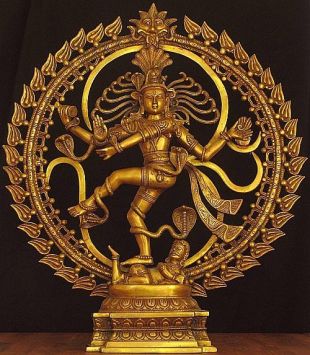
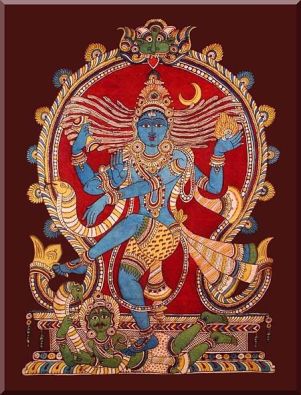
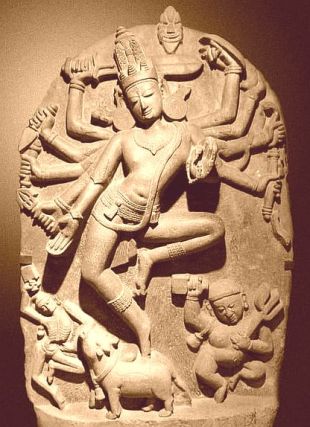
Smt. Sharada Srinivasan , in her research paper Shiva as cosmic dancer” , writes :  The Nataraja bronze in the sanctum at Chidambaram temple, depicting Shiva’s Ananda-Tandava or cosmic dance of creation and destruction, which is also the dance of bliss after annihilating the ego-was a Pallava innovation (seventh to mid-ninth century), rather than of tenth-century Chola period , as widely believed. 

In this form, the four-armed Nataraja exhibits five primordial acts or Pancha-kritya: creation-symbolized by the drum in the rear right hand; protection- by the front right arm; dispelling of ignorance and ego – by trampling the demon Apasmara with his right foot; granting of solace- by the crossed left arm; destruction-by the fire in the rear left arm; while the  encircling ring of fire  symbolizes perpetual cosmic cycles

lotus 44

Continued

In

Part Six

References and sources

All images are from the Internet

 
3 Comments

Posted by on October 4, 2018 in Art, Natya


Tags: , , , , , , , , , , , , , , , , , , , , , , , , , , , , , , , , ,

The texts of the Indian Dance traditions – Part Four

Continued from Part Three

 Nrtta, Natya and Nrtya

B. During the Post- Bharata period

Bharata Natyam

Intro…

The commentators of the middle period (say, around the tenth century and thereafter) interpreted some of the fundamental terms of the Natyashastra in a manner that was considerably different from perhaps what Bharata meant. They also brought in many concepts that were not envisaged by Bharata.

Just to recapitulate:

As per Natyashastra,

: – the Nrtta was pure dance. It was not a subsidiary or an auxiliary to Natya. It was an independent Art-form, which was performed mainly in the Purvaranga, before the commencement of the play proper, as praise offering to gods (Deva-stuti).

: – The Tandava was described as Nrtta (pure dance); and, it was not necessarily aggressive; nor was it performed only by men.

[The Tandava in the Natyashastra did not convey the sense of Uddhata (Vigorous). Further, the Tandava or Nrtta of the Natyashastra was in no way related to what later came to be known as Tandava-nrtta.]

: – The graceful dance (Sukumara-prayoga) with delicate, graceful (Madhura) movements (Angaharas) performed by Devi Parvathi (which Abhinavagupta named as Lasya) was not in contrast to Shiva’s Tandava. It was her own Dance.

[Sukumara-prayoga (or Lasya) did not mean a feminine style of dancing, as was interpreted later. Such distinctions, as between masculine and feminine dances, were not made in the Natyashastra.]

: – During the time of Bharata, there was no clear theoretical division of Dance into Tandava and what, later, came to be known as Lasya. They merely referred to the nature of the physical movements. And, the term Lasya, per se , does not also appear in Natyashastra, though the concept of the element of grace and beauty did exist; and, was named as Sukumara or Madhura.

Shiva performing celestial dance

But, during the Post-Bharata period, especially in the medieval times:

: – Nrtta was classified into Tandava and Lasya types. And, here, Tandava was described as forceful (Uddhata Angaharas), the fast paced furious Tandava Nrtta.

And Tandava Nrtta came to be idealized as an extremely angry and destructive type of dance.

: – Sukumara Prayoga was renamed as Lasya, the soft or delicate (Lalita) form of dance.

: – And, the two, were said to be related to masculine and feminine dancers; saying that Tandava is for men, while Lasya is for women.

[But, the Natyashastra had not made such distinctions. There, the dance movements were guided by mental and emotional states of the character. The principle for classification of dance movements was Guna, the quality and the nature of the feeling of the character (not gender).]

: – Although Bharata created a new and more expressive form of Dance form by combining the dance elements of the Nrtta with the Abhinayas, he had not assigned it a name. He did not also define the newly crafted Art-form.

But, in the later periods, it came to be known and celebrated as Nrtya. (The term Nrtya, as such, does not appear in the Natyashastra, though its conceptual essence was very much there.)

: – Further, certain new concepts which, of course could not have been there during the time of Bharata, also came into the vocabulary of Dance. Now the Dance and its forms came to be classified into categories, such as: Marga (pure or classical) and Desi (regional or improvised); and, as Nibaddha (structured) and Anibaddha (unstructured or free-flowing).

: – Another significant development was the steady drift away from the dance that Bharata talked about. Number of regional elements and techniques entered into the stream. And, that gave rise to many Dance –forms, in different regions of the country; each with its own ethos and techniques of presentation.

*

With this background, let’s take a look the statements made by some authors and commentators of the Post –Bharata period.

dance poses

Nrtta in the medieval period

Abhinavagupta

Abhinavagupta (11th century) in his Abhinavabharati, a detailed commentary on the Natyashastra, brought in many concepts and practices that were not present during the time of Bharata.  He also discussed matters related to the Art of Dancing, keeping in view the practices prevailing during his time.  He also tried to interpret the Natyashastra in the light of his own experience and knowledge; as also according to the principles of his philosophical School.

And, many times, he differed from Bharata. And, in addition, he introduced many new factors. Abhinavagupta provided the details of dance forms that were not mentioned in the Natyasastra. For instance, Abhinavagupta speaks of minor categories of drama (uparupakas), such as nrtta-kavya and raga-kavya – the plays based mainly in dance or in music. The nature of such minor dramas was not specifically  discussed in the  Natyashastra

Abhinavagupta provided his own interpretations to such fundamental terms as Nrtta, Abhinaya etc.

Though Nrtta was later described by Dhananjaya and Dhanika, as one that is bereft of meaning or emotion (Bhava and Rasa) or even of Abhinaya; and, that it can only be a decorative Angikabhinaya element that beautifies the dance presentation (Shobahetu), Abhinavagupta asserted that Nrtta is capable of expressing meaning (Artha). His view prevailed in the subsequent periods.

Further, Abhinavagupta asserted that Nrtta is an integral part of the Drama (Natya). The Nrtta elements can be used both in the Purvaranga (preliminaries before the commencement of the play) and in the sequences within the Drama. He cites some instances where Karanas (the basic units of the Nrtta) are employed.

He mentions: In Bhaṭṭa Nārāyaa’s Veī Samhāra, the actor playing the role of Aśvatthāman enters with the Sūci Viddha (needle-pierced) and Ūrdhvajānu (uplifted foot) Karaas. In Kalidāsa’s Vikramorvaśīyam, the hero Purūravas enters with the Alapallava and Sūci Karaas. Garua enters with Garua-plutam; Rāvaa’s entry is with Vaiśākha Recitam. In Svapna Vāsavadatta, Vatsarāja enters with Sambhrānta karana.

And, certain situations (say, those involving Srngara or Raudra) do need appropriate postures (Karanas) to illustrate the emotional states of the character.

Abhinavagupta’s influence has been profound and pervasive. Succeeding generations of writers on Natya were guided by his concepts and theories of Rasa, Bhava, aesthetics and dramaturgy.

*

Abhinavagupta, in a very elaborate manner, classifies Nrtta into two groups. The First group has three varieties; and, the Second has four. Thus, there are, in all, seven classifications.

In his rather complicated classifications and their protracted explanations of the Nrtta, Abhinavagupta brings in the elements Abhinayas, in its varying degrees.

The Nrtta types in his First Group have no Abhinaya. The Nrttas in the Second Group involve some element of Abhinaya (therefore, are aligned to what could be called as Nrtya). Here, the Abhinaya is classified into two types.

*

Dr. KM Varma in his highly scholarly and very  well researched work ‘Natya, Nrtta and Nrtya: their meaning and relation (pages 17-19) analyzes these seven classifications of Nrtta, in the light of Abhinavagupta’s hypothesis of two types of Abhinaya. And, he builds up the relationships among Nrtta (dance), Gana (song) and Vadya (musical instruments).

*

Abhinavagupta explains Abhinaya , broadly, as a process where the performer brings into his mind the meaning and the sentiment of the words of the song; and, puts it forth through facial expressions, movement of the limbs and such other means.

And, he classifies the Abhinaya into two distinct types.

Of the two types of Abhinayas; in the First one, the performer follows the general trend, without going into details; and, in the Second type, the performer interprets every word and every sentence of the song.

Here, in his classifications of the Nrtta, Abhinavagupta introduces into Nrtta many new factors that were not there earlier. For instance; he brings into the definition of Nrtta the elements of  Artha and Abhinaya (in varying degrees); the variations of Tandava (vigorous) and Lasya (soft) ; the concept of male and female forms of Nrtta ; and Rasas , the sentiments or emotions they express.

Thus, the concept and the content of the Nrtta, as in the Natyashastra, is almost entirely abandoned; thoroughly overhauled; and, given a totally new perspective and disposition.  In short; the Nrtta, here, is far faraway from its ancestor in the Natyashastra.  It is not the same.

[The First Group belongs to the pure Nrtta type ; whereas, the Second Group relates to of what came to be known as Nrtya. Abhinavagupta, in his explanations, did not, however, use the term Nrtya.]

The First Group of Nrtta that Abhinavagupta formulated has the three types: (1) Shudda-Nrtta; (2) Gitakad-abhinayaonmukha –Nrtta; and, (3) Gana-Vadya –Talanusaii Nrtta.

Of these, the First one, Shuddha Nrtta, which consists Angaharas and Recakas, is the sort of Nrtta that is related to the Purvaranga, as in the Natyashastra.

The Second in this Group is Gitakad-abhinayaonmukha- Nrtta. Here, the performer’s physical movements are guided by the general trend or the broad sense of the song. But, she/he does not pay attention to the specific details of the song; such as, the meaning of each words and sentence of the song.

The Third in this Group; the Gana-Vadya –Talanusari Nrtta is similar to the earlier one; but, here the instruments (Vadya), songs (Gitam) and rhythm (Taala) are the leading factors. Here also, the performer follows the general trend of the song without going into its details.

*

The Second Group has four types: (1) Uddhata Nrtta ;(2) Masrana-Nrtta; (3) Misra Uddhata Nrtta; and,(4)  Misar-Masarna Nrtta.

All these four types do require Abhinaya (as in the Nrtya). Here in the Second Group, the Abhinaya, according to Abhinavagupta, is the action of the performer in sending forth (abhi) or  bringing the meaning of the song into his own mind and expressing it through the movement of  limbs , conveying  the sense of every word and every detail of the song or the  composition.

The First type in this Second Group, the Uddhata Nrtta is a furious dance with display of vigorous movements (Tandava) ; it is associated with Veera and Roudra Rasas. This is a masculine type of dance.

The Second type in this Group, Masrana-Nrtta is the softer type of dance (Lasya) aligned with Srngara, Karuna and so on. This is the feminine type of dance

The Third type Misra Uddhata Nrtta, in the main, is same as Uddhata; but, is mixed with the movements of the Masrana (Lasya) variety

And, the Fourth type in the Second Group, Misar- Masarna Nrtta is again a Masarna Nrtta, with emphasis on lighter; but, mixed with some elements of Uddhata

jupiterfig5

Dhananjaya

Dhananjaya perhaps belonged to the same region and to the same period in which Abhinavagupta lived.  By the time of Dhananjaya (Ca. eleventh Century), the meaning and the application of the terms Nrtta, Tandava and Lasya had all changed a great deal. Further, by then, the Natya and Nrtya had taken the center stage.

Dhananjaya, in his Dasarupaka, treats Nrtta, mainly, in its comparison with Nrtya.

Dhananjaya explains Nrtta, as dance, with emphasis on smart looking (shobhahetu) limb-movements, in tune with rhythm and tempo (nrttam tala-laya-asrayam). But, in itself, it is devoid of meaningful content; and, is valued for its mere visual beauty of body movements (gatrasya viksepaha). Nrtta is not an interpretive or expressive dance (though the dancer might perhaps wear pleasant smile on her face).

The Nrtta, according to Dhananjaya, does not also involve the elements of meaning or emotion (Bhava and Rasa) or Abhinaya (Abhinaya-sunya); nor does it evoke a mood or a sentiment (Rasa). It is one of the specific technical elements (Angikabhinaya) that beautify the dance presentation.

[Bharata had used the term Nrtta to denote dancing, in general. But, in the medieval period, the meaning of Nrtta was narrowed down to mean a mere decorative aid. It was just an aspect of the whole body of Dancing.]

As compared to Nrtta, Dhananjaya says, the Nrtya, principally, is the display of various aesthetic moods (Bhava) or emotional states (Bhava-asrayam nrtyam). The Angavikshepa, the throwing of limbs is, however, common to both Nrtta and Nrtya.

But, Nrtya, through its appropriate gestures, facial expressions and limb-movements, gives life and form to the meaning and the sensitivity of the individual words and the sentences of the song (Abhinaya-pada-artha-abhinayatmaka).

[Nandikeshvara (Abhinayadarpana.1-56) similarly distinguished Nrtya from Nrtta, thus: Bhava-abhinaya-hinam tu nrittamitya-abhidhyate;| Rasabhava-vyanjana adi yuktam nrityam ity uchyate]

*

Of these two, the Nrtya having emotional content is classified by Dhananjaya under Marga (the classic or pristine form of dance), a representation of the classic form of dance; while, Nrtta, with its stress, mainly, on rhythm and tempo, is classified under Desi, perhaps representing the popular regional or improvised dance form – (Adyam padartha-abhinayo Margo Desi tatha param).

Under each of these (Nrtya and Nrtta), Dhananjaya, again makes a two-fold division, as: Lasya, the graceful, gentle fluid and pleasing dance; and, Tandava, the vigorous, energetic, brisk and invigorating movements (lasya-tandava-rupena natakad-dyupa-karakam).

These are the dance-types that are performed during the course of the play, depending upon the nature/need of a sequence in the play.

Thus, Tandava, unlike in Natyashastra, is not necessarily a dance performed as a praise-offering to gods, in the Purvaranga, the preliminaries, before the commencement of the play. On the other hand, it is used in the play to depict aggressive tendencies (Uddhata) and their manifestations. Similar is the case with Lasya, the gentle dance (Lalita).

The distinction between Uddhata and Lalita also suggests a difference  between the masculine and feminine modes of expression; because of their physical characteristics, and also because of their association with a male and a female deity. In due course, the term Lasya came to mean a feminine style of dancing, which lends grace to stage actions.

[Following Dhananjaya, Sarangadeva also mentions that Nrtta and Nrtya can both be of two kinds: Tandava and Lasya (SR.7.28). Tandava requires Uddhata (forceful); and, Lasya requires  Lalita (delicate) movements (SR. 7. 29-30). He identifies Tandava as Shiva’s dance; and, Lasya as Parvati’s.]

**

According to Dhananjaya, Natya comprises both Nrtta and Nrtya. It is mentioned; that in Natya, the Nrtya is sometimes useful in expressing the Bhava introduced through the topic (Avantara-padartha), while Nrtta is useful as a beautifying factor that pleases the eye (Shobha-hetuvena)

Dhananjaya explains Natya as an Art-form that is based in Rasa- Natyam rasam-ashrayam (DR.I. 9). It gives expressions to the inner or true meaning of the lyrics through dance gestures – vakyartha-abhinayatmaka.

Thus, Natya delightfully brings together and presents in a very highly expressive, attractive visual and auditory form, the import of the lyrics (sahitya), the nuances of its emotional content to the accompaniment of soulful music and rhythmic patterns (tala-laya), along with attractive postures and stances.

[Later, Pundarika Vittala (sixteenth century), in his work (Nartana-nirnaya), following Sarangadeva, uses the term Nartana, generally, to mean ‘Dance’, Pundarika said that by Nartana he meant it to be a general class-name for Dance. And, the term Nartana would cover the three forms of Dance: NatyaNrtya and Nrtta. The last (Nrtta) would again be subdivided into three other types: visama (acrobatic); vikata (absurd); and, Laghu (light), identified respectively as rope-dancing, a comic dance, and a dance based on easy Karanas.]

**

Dhanika says that Nrtya is Pada-artha-abhinayatmaka; and, Natya is Vakya-artha-abhinayatmaka

It is explained that the terms Pada (word) and Vakya (sentence) should not be taken in their ordinary sense. These have to be seen in relation that the words have with the sentence, of which they are a part.

Here, Pada-artha, word-meanings, is to be taken as Bhavas. And, Vakya-artha is to be understood as Rasa, which is produced by the combination of the Bhavas; just as a sentence is made up of several words.

In other words; the relation between Bhava and Rasa was said to be similar to that which exists between the word and the sentence.   It was said; Vakyartha stands for Rasa, which is similar to the sentence; and, Padartha stands for Bhava, which is similar to the word.

*

Following that, attempts were made to differentiate Nrtya and Natya on the basis of Bhava and Rasa.

In the process, Nrtya was equated with Padartha-abhinaya; and, Natya with Vakhyartha-abhinaya. And, in effect, according to Dhananjaya, it meant that Nrtya is rooted in Bhava (Nrtyam bhavashrayam); and, Natya in the Rasa (Rasashrayam Natyam). Thus, Nrtya is related to Bhava alone; and, Natya is related to Rasa alone.

Even in the later times, the authorities like Vipradasa (Ca. fourteenth century).  Rana Kumbha (fifteenth century) continued to go by the definitions provided by Dhananjaya/Dhanika; but, with slight modifications.

For instance; Rana Kumbha in his Nrtya-ratna-kosa explains Nrtta as made up of combination of Karanas and Angaharas (Karanam angaharani caiva Nrttam); Nrtya as Rasa (Nrtya sabdena ca Rasam punaha); and, Natya as Abhinaya (Natyena abhinayam). The Nrtya is classified as Marga; and, Nrtta as Desi.

**

Thus, according the medieval theories, Nrtta is all about beauty of form perceived by the eye; Nrtya expresses Bhava; and, Natya expresses Rasa.

But, such definitions and their import do not seem to be quite correct, at least in certain vital aspects.

Bhava and Rasa, even according to Bharata are intimately related. As Bharata had said; there cannot be Rasa without Bhavas; and vice versa – Na Bhavahino iti Raso; Na Bhavao Rasavargitah.

Na bhāvahīno’sti Raso; Na Bhāvo rasavarjita parasparaktā siddhi-stayor abhinaye bhavet NS.6.36

Apart from textual references, it is common experience that Rasa, the aesthetic pleasure, is evoked by both the Nrtya and the Natya. And, Bhava and Rasa are essential to both the Nrtya and the Natya.

And, therefore, to say that Nrtya is only about Bhava; and Natya is only about Rasa would be incorrect. The aim of both Nrtya and Natya is to provide Rasa; and, for which Bahavas are essential.  The expressions of Bhava are crucial to all the Art forms; as they contribute to the creation of Rasa enjoyed by the viewers, both in a general and auxiliary way (Samanya-guna-yogena).  Abhinavagupta argued on similar lines (though he did not use the term Nrtya, in particular).

**

And, similarly, Dhananjaya’s views on Nrtta and other issues were criticized by the later scholars.

To start with, it was mentioned that the concepts of the Natyashastra have to be understood in the light of the theoretical principles in which they are based. And, Dhananjaya’s view of Nrtta was restrictive, since it did not take many of its aspects into consideration.

Dismissing Dhananjaya’s classification of Nrtta as Desi, it was argued: the Nrtta as defined by Bharata is a proper art; a pure dance form, where the dancers need to be trained under competent Masters. Nrtta was meant to be performed during the Purvaranga as a prayer offering (Deva stuti). It was dear to gods (atyartham iṣṭa devānā).

Further, it was pointed out that Bharata’s phrase sobham janayati merely suggests that Nrtta is a beautifying factor; and, that does not mean Nrtta is auxiliary to Natya. The Nrtta is  independent, chaste and classical.

Marga, by Dhananjaya’s own definition, is an Art that is created by the Masters; while, Desi is that which is practiced by people of different regions, according to their taste.  And, therefore, to designate Nrtta as Desi is illogical; because, Nrtta  created by Shiva himself; and,  taught by Tandu to  Bharata was in indeed of the Marga class.

It was argued by the  scholars of the later period  that Dhananjaya’s statements do not project a fair view; because: Nrtta, which precedes Natya, in reality, is an art par excellence, which  can suggest meaning and evoke Rasa.

It was, therefore, indicated that it makes more sense to go by the concepts themselves, than be led only by the etymological explanations of the terms.

It was also said that Dhananjaya could have made a distinction between the Nrtta of the Purvaranga; and, the Nrtta type of group dances performed on happy cultural and social occasions. The dancers, here, do not need much training. And, there are also no restrictions with regard either to the mode of its dance or to the place of its performance. Only, such latter type of regional dances could have been classified as the popular Desi; and, not the entire Nrtta, as a class.

*

It was pointed out that Dhananjaya’s interpretation of Tandava as made of vigorous (Uddhata) Angaharas ; and Lasya as made of soft (Sukumara or Madhura) Angaharas , was not in accordance with the tenets of the Natyashastra.

Further, under, the interpretation provided by Dhananjaya, Nrtta was classified depending on the nature of the physical movements. It seemed that vigorous Tandava and soft Lasya were related to masculine and feminine dancers, respectively; suggesting that Tandava is for men, while Lasya is for women. But, the Nrtta in the Natyashastra did not envisage such discrimination.

Again, such an interpretation also suggests a distinction and between masculine and feminine modes of expression. And, that led to mistaking the term Lasya to mean a feminine style of dancing, which lends grace to stage actions.

It was argued that the dissimilarity of vigorous or soft is purely relative.  And, they are mere assumptions. It doesn’t make much sense to insist that women should be soft and gentle, even when they are angry or furious; and, men should be aggressive even when they are in grief or in love. It is also wrong to state that Lasya should be performed only by women; and Tandava is exclusively for men. The real principle for classification should be Guna, the quality and the nature of the feeling (but, not gender).

*

Next;   Dhananjaya’s  statements asserting that Nrtta is devoid of Bhava and Rasa (Rasa Bhava vihinam tu Nrttam itya abhijayate); and, Nrtta is only a technical element (Angikabhinaya) that helps to smarten the dance presentation; and it lacks the element of Abhinaya (laya tala matrapekso angaviksepo abhinaya sunyayh), were also refuted. And, downgrading Nrtta to an inferior (Adhama) position was also rejected.

Saradatanaya (1175 -1250 AD) in his Bhavaprakasana, disagreed with the views of Dhananjaya; and asserted that   Nrtta, the pure dance, is rooted in Rasa (Nrttam rasa-ahrayam). Saradatanaya’s definition meant that Nrtta not only beautifies a presentation, but is also capable of generating Rasa.

Further, Abhinavagupta, while dealing with Karanas, which are the basic units of Dance and classified under the Nrtta, emphasized that Karanas are capable of suggesting meanings.

Abhinavagupta opined that Kaisiki-vrtti, which is the medium or the style to depict Srngara, essentially requires Nrtta. Because, he says, Nrtta is the source that provides Valana, Vartana and other movements or stances. Further, he says that Nrtta as a beautifying factor helps to fill or cover up the gaps in the physical movements (chidra-chadana); and, to maintain continuity in action (alata-chakra-pratimata). And, therefore, Nrtta, like Nrtya and Natya, is capable of giving forth Rasa, although it is non representational.

Further, the statements such as ‘Nrtta is devoid of Bhava and Rasa’ (rasabhava-vihinam tu Nrttam itya abhijayate) were dismissed as being   rather harsh and unimaginative. That is because; Nrtta is an Art-form that provides the idioms and metaphors of beauty to  Nrtya , Natya and Shilpa.

And, over the centuries, the Karanas of the Nrtta have inspired creation of wondrous sculptures with their visual beauty (Shobha), their distinctive poses and geometrical constructions. And, they do invoke certain admiration and pleasure (Rasa) in the hearts of the viewers. Same thing can be said about the basic dance poses and dynamic postures.

Dancing (Nrtta) and sculpture (Shilpa)   have much in common. They both share same system of measures and proportions in presenting human forms, as symbols capable of evoking states of being (Bhava).

Thus every figure of Indian sculpture is, like every pose and gesture in Indian dancing, highly symbolic; and, each figure has a particular evocative quality. The technique by which the artist can present the soul or the spirit of subject in a visible form, are guided by the same set of principles.

Just as the Indian dancer aims at attaining the perfect pose, the moment of perfect balance(Sama), after a series of movement in time, so too, does the Indian sculptor try to capture the movement of the figure through the perfection of rhythm and line.

The fundamental principles of Tala (measure) and Bhanga (posture) based on the concept of the Sutra (median) and (proportions) in Dance are similar to the ones in sculpture.

Further, the division of the human form into the various Anga and the Upanga in both the arts is made on the basis of the bone structure, the joints of the body rather than on the muscles of the human body:

It is said; indeed, the Nrtta technique can be better understood if one understands the concept of the Sutras and Mana of the Shilpa. .

[As compared to the restricted understanding of Nrtta by the medieval authors, the present-day acceptance and application of Nrtta is more comprehensive and highly useful. In the Bharatanatya and other classical dances of India, Nrtta forms an essential part of the dance performance, its structure; as also, in its training methods. That is because; Nrtta as per Bharata and also Nandikeshvara, is built of wide-ranging varieties of Karanas (Angavikshepa), which are the basic units. These are rooted in well thought out logical principles and geometric forms. And, they do invoke aesthetic pleasure (Rasa). Therefore, Karanas are ingrained into Nrtya.

Karanas are, thus, essential to the Grammar and structure of Nrtya in Bharatanatya and in other forms.  Going further back; Caris , which could be called as well knit ‘steps’ , is an alphabet of the Nrtta as also of  Natya. And, therefore, Nrtta is more relevant today, than it was in the days of Bharata. It has  received a special treatment from the point of view of choreography.]

natya22

Natya

The Natyashastra employs Natya as a generic term, which broadly covers drama, dance and music. Bharata’s Natya could also be understood as drama. And Ntta and other dance elements was one of the constituents that provided elegance to the theatrical presentations. It does not treat dance as a separate category of Art-form.

The Natyashastra (6.10) provides a comprehensive framework of the Natya, in a pellet form, as the harmonious combination (sagraha) of the various essential components that contribute towards the successful production of a play.

He mentions the eleven elements that constitute the Natya (Drama). These are: Rasa (sentiment); Bhava (states); Abhinaya (representation or acting); Dharmi (styles of presentation);Vrtti (styles of depiction); Siddhi (attainment of the purpose); Svara (musical notes); Atodya (orchestra or instrumental music); Gana (songs); and Ranga ( stage) .

Bharata later explains, of the eleven, Rasa is of paramount importance; and deriving that Rasa is the objective of a theatrical performance. The other ten elements – from Bhava to Ranga – are the contributing factors for the production of the Rasa,.

Rasā bhāvā hya abhinayā dharmī vtti pravttaya  siddhi svarās tathā atodyaṃ gāna ragaś ca sagraha  6.10

At another place, Bharata, in a nutshell, provides a sort of definition of Natya, which could be understood as Drama (Rupaka).

Bharata explains: when the experiences of the everyday world, mingled with pleasure and pain both, are conveyed through different Abhinayas such as, speech, gestures, costume, makeup, ornaments etc – (Angika, Sattvika, Vachika, and Aharya Abhinayas) –   it is called Natya. (NS 1.119)

yo’ya  svabhāvo lokasya sukha dukha samanvita  som gādya abhinaya ityopeto nātyam ity abhidhīyate  NS.4. 119

Bharata explained that object of the Natya  was to show men and women the proper way to live, a way in which one could live and behave, so that one might become a still better person.

“A play shows your actions and emotions. Neither gods nor demons are depicted as always good or always evil. Actually, the ways of the world as represented here are not only of the gods but also of yours. It teaches you good advice (upadisati); it gives you enlightenment and also entertainment. It provides peace of mind to those who afflicted with miseries, sorrow, grief or fatigue. There is no art, no knowledge, no yoga, and no action that is not found in Natya.”  (Natya-Shastra 1: 106-07; 112-16)

na tajjñāna na tacchilpa na sā vidyā na sā kalā  nāsau yogo na tatkarma nāye’smin yanna dśyate Ns.1. 116

*

Generally speaking, Bharata not only takes the experience of the individual human beings, but that of the world as a whole; and, considers Natya as the effective means of communicating those experiences. Included in this, are the elements of speech, poetry, music, dance and all those factors that lend beauty and grace to a theatrical performance. For Bharata, Natya is the very epitome of life.

According to Bharata, Natya is the experiences of the world when it is represented on the stage, in order to provide enjoyment and instruction, by means of acts of communication, which a person does not normally employ in the everyday life. The presentation of the play is dominated by the stylized modes of presentation (NatyaDharmi).

In other words, just the fact of one’s experiences in the world, as ordinarily noted or observed during the course of life, is not Natya.  It becomes Natya only when it is communicated through the means of Abhinayas and representation; and, presented on the stage.

The Abhinaya, on the stage, is expressed through Mano-vak-kaya (mind, voice and body), in terms of Sattvika, Vachika and Angika abhinaya-s. These are supported by Aharya (the costumes and stage props), the fourth element. Thus Abhinaya covers not only the movements of face and limbs; but, it also encompasses all the other elements and modes of supportive expressions.

The successful production (Siddhi) of a play  (Natya) enacted on the stage (Ranga) involves various  elements of the components of  the actors’ gestures, actions (bhava) and speech ; bringing forth (abhinaya) their intent (Artha), through the medium of theatrical (Natya-dharmi) and common (Loka-dharmi) practices; in four styles of representations (Vritti-s) in their four regional variations (pravrttis) ; with the aid of  captivating dances and melodious songs  accompanied by instrumental music (svara-gana-adyota).

Such well enacted Abhinayas induce in the minds and hearts of the Sahrudaya the sense (Artha) that is conducive for evoking proper Rasa. Without Abhinaya there is no drama; and, no Natya without representation

Bharata’s definition of Natya covers all these factors; and holds good even in the present day.

[Abhinavagupta also makes a distinction between the world of drama (Nātyadharmī) and the real but ordinary life (Lokadharmī). In the artistic process, where presentations are made with the aid of various kinds of dramatic features such as Abhinayas and synthetic creationswe are moving from the gross  and un-stylized movements of  daily life to more subtle forms of expressions and experiences; we move from individualized experiences to general representations (sadharanikarana) ; and, from multiplicity to unity.]

Abhinavagupta , in the context of Dance, explains Abhinaya as a process , where the performer brings into his mind the meaning and the sentiment of the words of the song; and, puts it forth through facial expressions, movement of the limbs and such other means. And, Abhinaya is the act of communication of an idea, a thought or the phase of an emotion or sentiment that one is experiencing.

 [It is explained that acting, in a sense, means to behave like someone else. And, it is not reality; because, it is not related to the actual life of the person who is acting. But, at the same time, it is not mimicry or imitation. Abhinaya should be understood as the actor’s effort to communicate and to convey the mental and emotional states of the character; and, its experiences. Abhinaya is bringing forth the Artha, the sense of the things, into the minds of the Sahrudayas. ]

abhinaya454

Nrtya

Bharata used the term Nrtta to denote dance; and, the term Nrtya does not appear in the Natyashastra. Abhinavagupta also, adhering to the terminologies of the Natyashastra, avoids using the term Nrtya , as such.  He consistently uses the term Nrtta, while referring to Dance. Similar was the case with the authors earlier to his period. They also had not used the term Nrtya.

Further, in some editions of Natyashastra where the word Nrtya crept in, it is taken as a later insertion (unintended or otherwise) by the manuscript-copier (scribes).

That does not mean that the essence of Dance (with which we are now familiar as Nrtya) did not exist; or, was not yet created in the epoch of Natyashastra.

It only means that the specific term Nrtya was not then in currency.  According to some scholars, the term Nrtta along with Abhinaya covered what we now call Nrtya, as evidenced from some verses of the Abhinavabharati.

According to Abhinavagupta, it was Bharata who designed and created an Art form, which would adorn the Natya, by combining the dance element of the Nrtta and the Abhinayas. But, for some reason, Bharata did not see a need to assign a name to the resultant art form.

And, Bharata, in his characteristic way, puts it as if the suggestion came to him from Shiva, who had advised Brahma the ways to utilize the Nrtta in the Natya. Here, Shiva had said : you can very well communicate (Abhinayasi), by use of Nrtta (made beautiful by Angaharas consisting different Karanas), the things (Artha) out of which the songs are composed; the songs that are sung in the Purvaranga.

mayāpīda smta ntya sandhyākāleu ntyatā nānā karaa sayuktair agahārair vibhūitam4.13 pūrvaraga vidhā vasmistvayā samyak prayojyatām vardhamāna akayogeu gītevāsāriteu ca 4.14 mahāgīteu caivā arthān samyagevā abhineyasi yaścāya pūrvaragastu tvayā śuddha prayojita NS. 4. 15

**

That is to say; on taking the hint from Shiva’s statement, Bharata worked out the details of combining Nrtta with Abhinaya; and, that led to the birth of a new Art form – the Nrtya. The term Abhinaya, here, stands for the act of communication.

Sarangadeva in his Sangitaratnakara, says that by combining the Angikabhinaya of Nrtta with the Abhinayas (Satttvica, Angika, Vachika and Aharya abhinayas) the Nrtya was created – Angikabhinayai reva Bhavaneva vyanakti, yat, tan Nrtyam.

*

The statement that the combination of Nrtta and Abhinaya resulted in Nrtya, at the suggestion of Shiva, was supported by Abhinavagupta through two verses, which he ascribes to Kohala.

The quoted verses say:  In the past, on one evening (Sandhya), Narada was dancing in front of Shiva. And Narada then sang a song celebrating the victory of Shiva over the demon Tripura. And, Shiva, having been pleased with the song, began to dance; enacting (Abhinaya) the theme of the song. Later, Shiva asked Tandu to combine (yojana) the Tandava (meaning, Nrtta) with Abhinaya used in that dance.

Sandhyayam nrtyaha Shamboh bhakty-agre, Naradah pura gaavan Triporonmatham taccita stavata gitake cakra abhinayam pritas tatas Tandum ca so abravit natyokta abhinayenedam vats yojya Tandavam

Shiva’s Nrtta included Karanas and Angaharas. Yet; Shiva said that one can communicate through Nrtta when used in Natya.

Now, what does that mean?   It might perhaps mean that if Nrtta is performed with a given intention, following a method, then it might convey a meaning.

*

Dr. KM Varma in his scholarly and highly analytical work Natya, Nrtta and Nrtya: their meaning and relation’, argues (page 32) that Nrtta came first; then Natya. And later, when Abhinaya was added to Nrtta, the idea of Nrtya emerged.

Thus, he says, Nrtta and Nrtya came into being at the suggestion of Shiva. But, both these forms were propagated by Tandu.

Though Bharata is responsible for the emergence of Nrtya, it did not receive special nomenclature or individual treatment in the Natyashastra. Bharata continued to treat it as Nrtta.

Although it developed to full extent soon after the time of Bharata,  the theoreticians and commentators until about the tenth century continued to follow Bharata; and, avoided using the term Nrtya, though they did describe its essential features, nature and techniques by use of other terms.

But, when the combination of Nrtta and Abhinaya, evolved, developed and prospered as an independent, well recognized, dance form; and, became so popular (prasiddha) , the latter authors could not afford to avoid the term Nrtya. And, Nrtya, eventually, became a part of the Grammar of the Dance.

The hypothetical question since when the term came into popular use is much debated. Many point out that though the term Nrtya was not employed by the commentators of the medieval period, it somehow, was in popular usage as early as in the fifth century.

That argument is supported by the fact that Amarasimha (fifth century), in his lexicon Amarakosa, while defining Nartana, included within its meaning, Nrtya as a synonym:

ṇḍava naanaya lāsya ntya ca nartane (1.7.427). 

That suggests; as early as in the fifth century Nrtya was well known; and, was in common use. And, the lexicographer could not avoid including the term Nrtya in his work. But, it is not clear when it actually acquired its name.

abhinaya555

Sarangadeva explains Nrtya as a means of putting forth different aesthetic moods or bhava (bhavahetu orbhavashraya) or giving expression to individual words of the song through appropriate gestures and/or facial expressions – pada-artha-abhinayatmaka.

The key ingredient in the Nrtya is the elaborate gesture-language, Abhinaya (lit., to bring near; that is, to present before the eyes), the meaning (Artha) and the emotion (Bhava) of the lyrics. It is the harmonious combination of striking poses, eloquent gestures, lucid facial expressions, various glances, and meaningful movements of the hands, fingers and feet.

Though the performance of an Nrtya is tied with the interpretation of a lyric (sahitya) depicting a theme (prasanga), it combines in itself the expressive Abhinaya; and the stances, poses, postures and movements, of the pure Dance (Nrtta).  The Nrtya is regarded as the soul of any Dance-style. The Abhinaya and Nrtta elements it portrays demand the skill, grace and ingenuity of a well trained talented Dancer.

[The Abhinaya Darpana describing the qualities of a good dancer says: A dancer must have the inherent sensibility which can be enhanced by training. Agility, steadiness, sense of line, practice in circular movement, a sharp and steady eye, effortlessness, memory, devotion, clarity of speech, sense of music – these ten are the essential qualities of a dancer.

Javaha Sthiratwam Rekha cha /27/ Bhramari Drishti Shramaha; Medha Shraddha Vacho Geetham; Paatra pranaa Dasa Smruthaha/Ab. Da.28/ ]

3N 

Nrtta, Nrtya and Natya – their mutual relations

Sarangadeva remarks, when you take a broader view, Ntta is not distant from Nrtya; and, both of these are essential to Natya.  Thus, Dance, in both of its aspects (Nrtya and Natya), was a vital presence of Nrtta. All the three are interrelated.

The Āgika abhinaya or physical expressions, in both Nrtya and Natya, includes the  Ntta elements. But, Āgika abhinaya is of greater importance in the Nrtya.

The Nrtta is an integral part of the Nrtya; but, it also has its presence in the Natya. Thus, Nrtta has constructive relations with Nrtya as also with Natya. The three, in some measures, are bound together.

*

Nrtta and Natya

Bharata defines Nrtta and Natya on the basis of their techniques; and, their relevance. And, the two Art-forms were discussed independent of each other.

As between Nrtta and Natya, the former was said to be older. And Nrtta, which earlier was a pure dance performed in the Purvaranga as Deva stuti, later became a part of the Natya. The influence of Nrtta on Natya is more delicate.

Nrtta and Nrtya

And, when the dance elements of the Nrtta were combined with the Abhinayas – with its dance movements interpreting the meaning and sentiments of the words in the lyrics – it was transformed into a most delightful art form – the Nrtya. With this, the dance, in general, came to be known as Nrtya.

Though some texts continued to carry on theoretical discussions on Nrtta (pure dance-like movements) and Nrtya (the dance proper) as if they were two totally distinct dance-idioms; the two, in fact, are very intimately related. And, the defining characteristics (lakhaa) of Nrtta and Nrtya are the same.

But, Pundarika Vitthala, in his Nartana-nirnaya, throughout, uses the terms  Nrtta  and Nrtya  interchangeably, perhaps, because, both those dance forms involved, in some measure, the elements of Abhinaya or interpretative movements conveying a meaning (Artha). He was following the explanations put forth by Abhinavagupta. 

As Dr Kapila Vatsyayan observes, in the contemporary Indian dance scene, with the exploration of geometrical space at floor level and choreographic patterns, the elements of Nrtta, pure dance and Abhinaya, expression-full dance (Nrtya) are close-knit, cohesive.

The Indian classical dance of today, has, over a period, evolved its own Grammar and constructed its own devices. The Nrtta element too has changed greatly from what it meant during the days of Bharata. Its structure and style which are based in different units of Nrtta movements are well adopted into Bharatanatya in the form of Adavus etc.

Thus, in the later periods, particularly in the modern period, Nrtta became an essential ingredient of the Nrtya, in displaying its various stances, postures and movements.

*

Natya and Nrtya

As regards, Natya and Nrtya; the Natya is a deliberate art; and, Nrtya is representational art. The object of both the forms is to provide Rasa.  

[ The Vishnudharmottara also asserts that the  prime objective of Dance performance (Nrtta) is Rasa. There cannot be an enjoyable Dance without Rasa.  For that reason, the experienced dancers should aim to bring out the apt Rasas.

Natyasya-mulam tu Rasa-pradisto / Rasena-hinam  na hi Nrutta asti / tasmat yatnena Rasa-ashrayasya Nruttasya yatnaha purushena karyam / 3.30.28/ ]

The principles which govern the techniques of both the Natya (Sanskrit Drama) and the classical Nrtya are the same. Their ways of stylized modes of presentation (NatyaDharmi); and, the manners of depiction (Vrtti); the techniques of acting (Abhinaya); and, appearances in costumes and make-up (Aharya) are regulated by the same set of principles of the dramaturgy and its stage –presentation.

Even after Nrtya emerged as an independent Art-form, the later writers on the treatise dealing with the Nrtya and its varied forms, (either exclusively or otherwise), adopted the same set of norms and principles that once governed the Natya of the Natyashastra. The techniques of Dance continued to be discussed in terms of the various elements of Dharmis, the Vrittis and Abhinaya as prescribed by Bharata.

The tya-dharmi mode of dance was woven into the play-presentation. The sequences in the Drama were staged through the actors singing, speaking and dancing in their roles. The static and dynamic Ntta karaas were utilized as idioms to portray various emotional states. The Natya , in its production, made use of the  four-fold Dance phrases of body-movements (āgika); speech delivery (vācika); studied involuntary reaction (sāttvika); as also of costumes, make-up and scenery (āhārya).

Thus, in a way of speaking, the two – the Nrtya (Dance proper along with its Nrtta element) and Natya (Sanskrit Drama) – continue to be bound together, in one way or the other.

*

Both Nrtya and Natya make use of all the four kinds of Abhinayas. And, difference between Natya and Nrtya, is in their modes of using the different degrees of the elements of the Abhinayas.

The entire sphere of presentation in an Nrtya is predominated by Natya-dharmi, graceful gesticulations, stylized aesthetic suggestive expressions. There is no attempt to present things as they actually are. And, in the Nrtya that we know, those principles and conventions are being followed, even to this day, in their pristine form.

In Nrtya, its every movement should follow the Laya and Tala. It is said; the Nrtya inherits this quality from the Angika-abhinaya of the Nrtta. The Nrtya involves Gatra-vikshepa ‘throwing’ or movement of the limbs, to dance. And, almost throughout its performance, Nrtya is accompanied by music, the most enchanting of the art forms.

Nrtya is basically Drshya or Prekshya, a spectacle mainly having visual appeal. Though the performer follows the lyrics of the song, she does not actually sing; but, only provides the lip-movement while interpreting its words and sentences.

Many elements of Nrtta and Natya were absorbed into Natya. And, Nrtya, for a period, became a parallel form of Drama. But, in the Natya, the elements of Nrtya are incidental to its dance sequences. Dance as a part of dramaturgy was employed as an ornamental overlay upon a theatrical presentation.

In contrast to the Nrtya, the facial and body movements in Natya are slight or subtle – Kincit-chalana. Here, the speech (Vachika) is dominant; and, therefore, the need for Sattvikabhinaya  and the vrttis (styles of dialouge delivery) is greater, for communicating the mental and emotional states of the characters in the play. Further, unlike in Nrtya, the actors on the stage do actually sing.  Thus, in the Natya, both the visual and the audio are highly essential.

Thus, the Natya or Drama has an advantage over poetry, music and dance. Apart from bringing in the embellishment of spectacular the visual effects (Rupaka or Drishya-kavya), it has the power of music and speech.

*

In the later periods, Natya became rather stagnant; but, the Nrtya made rapid strides. While Natya was fading ; and, losing its universal appeal,  the Nrtya and its forms were evolving and developing swiftly as the most delightful and most engaging Art forms, popular among  all sections of the society.

In the process of its growth, Nrtya widened its scope and content by innovating and assimilating a range of stylistic variations; and, by moving away from its early dependence on Drama. Now, Nrtya is no longer an adjunct or accessory to Natya. It has also widened its aesthetic scope, beyond decorative grace to encompass emotive communication (Rasa) and narrative variations. It has evolved into a full-fledged system, a self-governing complex Art form; and, has established its identity. And, it has continued as highly popular classical dance form.

lasya (1)

Bharatanatya

The School of Nrtya that is prevalent in South India is termed  as  Bharata-natya.

In the initial years, there were debates raising questions concerning the name assigned to this Dance form, which, basically, is Nrtya. Many asked, why should it be called Bharata-natya; and, why not Bharata-nrtya.

In reply; explanations were offered to clarify that the suffix ‘Natya’ also stands for ‘Nrtya’, in its technical sense.  The arguments made out said  that as per the past authorities like Kumbha Rana and Vipradasa (fifteenth century), the term ‘Natya’ could also be used to denote ‘Nrtya’. Later, Pundarika Vittala (sixteenth century), in his work (Nartana-nirnaya), following the lead given by Sarangadeva, said that Nartana, a general class-name for Dance, covered the three forms of Dance: NatyaNrtya and Nrtta. And, much before that Amarasimha, as early as in the fifth century, had equated ‘Natya’, among other terms, with ‘Nrtya’.

But, there are no explanations anywhere as to when and why that equation was arrived at. The only other plausible explanation is that it might have come about by way of popular usage. But, in any case, since this form of dancing was created by Bharata, to name it as Bharatanatya, is truly justifiable.  As per Dr. Ananada Coomaraswamy,’ Indian acting and dancing, is a deliberate art; and, the same word, Natya, covers both those ideas. ‘

Thus, the Nrtya, known now as Bharatanatya is surely a continuation of the form and tradition of the Marga class of dance that was promoted by Bharata; although over the period, some elements have entered into it. Yet; no other School of Nrtya has a closer relationship with Natyashastra than Bharatanatya.

Nataraja 005

The Bharatanatya of today is such a refined form of Dance which has brought within its ambit the formats of Nrtta, Nrtya and Natya. This School of Art can be explained in almost every respect by Bharata’s theories. And, it follows Bharata’s techniques to a large extent.  It also contains the beauty of form as in the Nrtta. It excels in the aesthetic presentation of form and geometrical beauty; and in the richness of in variety of movements as no other dance form does. It has the gentle power of expression to communicate ideas and emotions through Abhinaya, as in Nrtya. It can also present a narrative theme as in Natya, where the dancer enacts the roles of varieties of characters (Ekaharya Abhinaya or Ekaharya Lasyanga)

Depending upon the nature of the dance item that is being presented, its balance in terms of Nrtta, Nrtya and Natya varies. But, in general, the dominant aspect of Bharatanatya is Nrtya.

As regards its practice, Bharatanatya draws upon its tradition persevered and passed on from generation to generation in orally transmitted and highly codified manuals (Shastra). Though it is, essentially, rooted in the principles of Natyashastra, it has also adopted many features and techniques from the regional dance traditions; and, has thus enlarged its repertoire and acquired many dimensions.

Though the emphasis is on the adherence to and to preserving the purity of the tradition; and, its continuation, it also has brought in some innovative techniques and refreshing modes of expression, in tune with the advancing times. These could be called as ‘context-sensitive interactions’

The difference between Bharatanatya and other Dance forms like Kathakali, Manipuri and others is mainly in the use of their Abhinayas and techniques. They all belong to the Nrtya class. Each has its own stylized manner of bringing out the essential meaning of the song. Each is delightful in its own way. The coexistence of multiple streams of Dance forms has surely enriched the Indian Art scene.

[Smt. Tanjore Balasaraswati, also known as T. Balasaraswati (1918-1984), the celebrated exponent of Bharata-natyam, who expanded the performance of this dance form beyond the precincts of the temples where it was traditionally performed; re-established it; and, made it famous in different parts of India and many parts of the world, writes:

The greatest blessing of Bharata-natyam is its ability to control the mind. Most of us are incapable of single-minded contemplation even when actions are abandoned. On the other hand, in Bharata-natyam , actions are not avoided; there is much to do but it is the harmony of various actions that results in the concentration we seek.

The burden of action is forgotten in the pleasant charm of the art. The feet keeping to time, hands expressing gesture, the eye following the hand with expression, the ear listening to the dance master’s music, and the dancer’s own singing-by harmonizing these five elements the mind achieves concentration and attains clarity in the very richness of participation.

The inner feeling of the dancer is the sixth sense which harnesses these five mental and mechanical elements to create the experience and enjoyment of beauty.

It is the spark which gives the dancer her sense of spiritual freedom in the midst of the constraints and discipline of the dance. The yogi achieves serenity through concentration that comes from discipline. The dancer brings together her feet, hands, eyes, ears and singing into a fusion which transforms the serenity of the yogi into a torrent of beauty.

The spectator, who is absorbed in intently watching this, has his mind freed of distractions and feels a great sense of clarity. In their shared involvement, the dancer and the spectator are both released from the weight of worldly life, and experience the divine joy of the art with a sense of total freedom.

To experience this rare rapture, a dancer has only to submit herself willingly to discipline. It will be difficult in the beginning to conform to the demands and discipline of rhythm and melody and to the norms and codes of the tradition. But if she humbly submits to the greatness of this art, soon enough she will find joy in that discipline; and she will realize that discipline makes her free in the joyful realm of the art.]

abhinaya

The way ahead…

Having said that; let me add that Bharatanatya, as an art, is a dynamic process. It needs to be rejuvenating and reinventing itself all the time. And, it should not stagnate. Though its theories are rooted in the Natyashastra of Bharata, in its practice, it derives its curriculum from several other texts. Most of those texts were written before the seventeenth century.  And, that makes it essential for Bharatanatya to innovate and look for newer modes and idioms of expressions; and, also try to move away, at least for a limited extent, from the traditional mythological themes.

All the Art forms that are practiced today cannot be explained only on the basis of Natyashastra; nor is it necessary to do so. Art need not always be confined to Bharata’s techniques. Even in the case of Bharatanatya, the theory as detailed in Natyashastra needs to be studied in the light of the current practices. And, that might, hopefully provide us an insight; and, suggest improved techniques, in order to rationalize and bring it closer to today’s environment.

If the dance forms that are practiced today have to come into their own, these should be explained on a rational basis.  It seems much attention is paid to the literal interpretation of the old texts. And, too much philosophizing is another factor. But, Art has its own philosophy, outlook and appeal; although many try to inject their own pet philosophy into the Arts.

If the Art has to be alive it has to be relevant to the times we live in; and, has to reach further levels of the society.

We are in the age of reconstruction. There are many inevitable problems and issues – old and new-,  including commercialization, that need to be resolved. The ancient theories would not do for all our present needs and problems. A detailed study of present practices without always being tied down to the ancient theoretical works seems advisable.  What is needed is continuity with change. Both the ancient and the modern Art-forms and techniques need to be studied with equal earnestness.

kadagola

In the next part, we shall briefly talk about various classical Dance forms of India, such as Kathak, Odissi, kathakali and Manipuri.

dance forms

Continued

 In

Part Five

References and sources

All images are from the Internet

 
Leave a comment

Posted by on October 1, 2018 in Art, Natya


Tags: , , , , , , , , , , , , , , , , , , , , , , , , , ,

The texts of the Indian Dance traditions – Part Three

Continued from Part Two 

 Nrtta, Natya and Nrtya

shiva_dancing_for_parvati

Intro.

As it has very often been said ; the Natyashastra is the earliest available text of Indian Dancing traditions. It combines in itself the fundamentals of the principles, practices and techniques of Dance. it thus serves as the principal text of the Dance. And, therefore, the influence exerted by it on the growth and development of all Dance-forms, has been deep and vast.  The Natyashastra, an authoritative text to which the Masters and learners alike turn to , seeking instructions, guidance, and inspiration , is central to any discussion on classical Dance. And, therefore, no discussion on classical Dance is complete without referring to the concepts  of the  Natyashastra.

[Having said that; let me also mention that in the context of Dance , as it is practiced in the present day, besides Natyashastra , several other texts are followed. The Natyashastra provides the earliest theoretical framework; but, the practice of Dance  and the techniques of dancing were  molded and improved upon by many texts of the later periods. What we have today is the culmination of several textual traditions, their recommended practices, and some innovative features. We shall come to those aspects later in the series.]

Because of the position that Natyashastra occupies in the evolution of the Arts and its forms, it would help to try to understand the early concepts and their relationships to Dance. And, thereafter, we may follow the unfolding and transformation of those concepts acquiring different meanings and applications; as also the emergence of new terms and art-forms, during the later times.

In that context, we may, in particular, discuss the three terms; their derivation; their manifestation and transformation; as also the mutual relations among the three. In the process, we may also look at the related concepts; and their evolution over the centuries. The three terms that I am referring to are the Nrtta, Natya and Nrtya, which are fundamental to most of the Dance formats.

 *

As regards the  other texts that discuss the theories, practices and techniques of Dancing, there are no significant works between the period of Bharata and that of Abhinavagupta and Dhananjaya (eleventh century). Even if any were there, none has come down to us. But during this period, the dance and its concepts had changed significantly. And, the manuscript editions of the Natyashastra had also undergone alterations.

Over the different periods, the concepts of Natyashastra, along with that of its basic terms such as Nrtta, Natya etc., came to be interpreted in number of amazingly different ways, depending, largely, upon the attitudes and the approach of the authors coming from diverse backgrounds and following varied regional cultural practices. It is a labyrinth, a virtual maze, in which one can easily get lost.

It would, therefore, hopefully, make sense if we try to understand these terms in the context of each period that spans the course of the long history of Dancing in India, instead of trying to take an overall or summary view.

In the following pages, let us try to understand these terms and their applications in relation to the  concepts and the techniques of dancing, as it emerged in various stages, during the three phases of Indian Art history: the period of the  Natyashastra of Bharata; the theories and commentaries by the authors of the medieval period; and, dance as practiced in the present-day.

lotus-flower-and-bud

Before we get into the specifics, let’s briefly talk about Dance in general, within the context of Natyashastra.

Bharata’s Natyashastra represents the first known stage of Indian Art-history where the diverse elements of arts, literature, music, dance, stage management and cosmetics etc., combined harmoniously, to fruitfully produce an enjoyable play. 

It is quite possible that the authors prior to the time of Bharata did speak of Dance; its forms and practices.  But, it was, primarily, Bharata who recognized the communicative power of Dance; and, laid down its concepts.

Bharata described what he considered to be the most cultivated dance styles, which formed the core of the dominant art-practice (prayoga) in his time, the Drama.

The framework within which Bharata describes Dance is, largely, related to Drama. And, his primary interest seemed to be to explore the ways to enhance the beauty of a dramatic presentation. Thus, Dance in association with music was treated as an ornamental overlay upon Drama. 

As Nandikesvara said; the Dance should have songs (gitam). And, the song must be sung, displaying (pradarshayet) the meaning (Artha) and emotions (Bhavam) of the lyrics through the gestures of the hands (hastenatha); shown through the eyes (chakshuryo darshaved); and, in tune with rhythm and corresponding foot-work (padabhyam talam-achareth).

Asyena alambaved gitam, hastena artha pradarshayet/chakshuryo darshaved bhavam, padabhyam talam-achareth (Ab.Da.36)

Dance, at that stage, was an ancillary part (Anga) or one of the ingredients that lent elegance and grace to theatrical performance; and, it was not yet an independent art-form, by itself. Bharata , at that stage, is credited with  devising a more creative Dance-form , which was adorned with elegant, evocative and graceful body-movements; performed in unison with attractive rhythm and enthralling music; in order to effectively interpret and illustrate the lyrics of a song; and, also to depict the emotional content of a dramatic sequence.But, he had not assigned it a name.

It was only in the later times, when the concepts and descriptions provided by Bharata were adopted and improved upon, that Dance gained the status of a self-regulating, independent specialized form of art, as Nrtya.

*

The scholars opine that in the evolution of Dance, first comes Nrtta; then Natya; and, later Nrtya appeared. Here, Nrtta is said to be pure dance; while Nrtya emerged when Abhinayas of four types (Angika; Vachika; Sattvika; and Aharya) were combined with Nrtta. And, Natya included both these (Nrtta and Nrtya), even while the speech and the songs remained prominent. Thus, Natya comprises all the three features – Dance, music and speech (song) – which are very essential for the production and enactment of Drama.

Shiva and Parvathi durbar

To put the entire series of developments, in the context of Natyashastra, in a summary form:

Nrtta, as described in Natyashastra, had been in practice even during the very ancient times. The Nrtta, according to Bharata, was a dance form created by Shiva; and, which, he taught to his disciple Tandu.  It seems to have been older than Natya

Natya too goes back to the very distant past. Even by the time of Bharata, say by   about the fourth to second century BCE, Natya was already a highly developed and accomplished Art. It was regarded as the best; and, also as the culmination of all Art forms (Gitam, Vadyam, Nrttam trayam natya dharmica).

Though Nrtta was older, Natya was not derived from it. Both the Nrtta and the Natya had independent origins; and, developed independent of each other. And, in the later times too, the two have been distinct; and, run on parallel lines.

It was during Bharata’s time that Nrtta was integrated into Natya. Even though the two came together, they never merged into each other. And, up to the present-day they have retained their identity; and, run parallel in ways peculiar to them. (Even in a Bharatanatya performance the treatment and presentation of the Nrtta is different from that of the rest.)

 By combining Nrtta, the pure Dance, with the Abhinaya of Natya, a new form of Dance viz., the Nrtya came into being. Bharata is credited with this creative, innovative act of bringing together two of the most enjoyable Art forms (Bhartopajanaka). But, it developed to its full extant only after the time of Bharata.

But, at the time of Bharata, that resultant new-art was not assigned a separate name; nor was it then classified into Tandava and Lasya types.  In fact, the terms Nrtya and Lasya do not appear either in the Natyashastra or in its early commentaries. It was only during the later times that Nrtya gained an independent recognition as an expressive, eloquent representational Art, which projects human experiences, with amazing fluidity and grace.

Nrtya, a blend of two well studied, well developed and well codified Art forms – the dance of Nrtta and Abhinayas of Natya – over a period, advanced  vibrantly, imbibing on its way numerous novel features; and, soon became hugely popular among all classes of the society. It gained recognition as the most delightful Art-form; and in particular, as the most admired phrase or form of Dance.

With this general backdrop, let’s go further.


A. Nrtta in Natyasahastra

Nrtta

Initially, Bharata, in the fourth Chapter of the Natyashastra, titled Tandava Lakshanam, deals with the Dance. The term that he used to denote Dance was Nrtta (pure dancing or limb movements, not associated with any particular emotion, Bhava).

The Nrtta comprised two varieties of Dances (Nrtta-prayoga) : The Tandava and Sukumara. The Tandava was not necessarily aggressive; nor danced only by men. And, the gentler, graceful form of dance was Sukumara-prayoga

And, in the context of Drama, both of these were said to refer to the physical structure of dance movements. And, both were performed during the preliminaries ,i.e., before the commencement of the play – Purvaranga – while offering prayers to the deities, Deva-stuti   ; and, not in the drama per se.

Mayāpīdam smta ntta sandhyākāleu Ntttā nānā karaa sayuktai raga hārair vibhūitam 4.13

Pūrva-raga-vidhā avasmistvayā samyak prayojyatām vardhamāna kayogeu gītevāsāriteu ca 4.14

The Dance performed during the Purvaranga was accompanied by vocal and instrumental music. It is said; the songs that were sung during the Purvaranga were of the Marga class- sacred, somber and well regulated (Niyata). Such Marga songs were in praise of Shiva (Shiva-stuti). Bharata explains Marga or Gandharva as the Music dear to gods (atyartham iṣṭa devānā), giving great pleasure to Gandharvas; and, therefore it is called Gandharva.

Atyartham iṣṭa devānā tathā prīti-kara puna | gandharvāā ca yasmād dhi tasmād gāndharvam ucyate – NS Ch. 28, 9

shiva dance

Almost the entire Chapter Four of Natyashastra is devoted to Nrtta. That is because, the term that Bharata generally used to symbolize  Dance, was Nrtta.  And, the Nrtta, Bharata said, was created to give expression to beauty and grace

śobhā prajanayediti Ntta pravartitam (NS.4.264).

The Nrtta is visual art. The term Nrtta, in the context of the Natyashastra, is explained by Abhinavagupta as (Angavikshepa), the graceful composition of the limbs – gatram vilasena kshepaha.

The Nrtta stands for pure, abstract and beautiful dance, performed in tune with the rhythm and tempo, to the accompaniment of vocal and instrumental music.

The Nrtta performed during the Purvaranga was not as an auxiliary to Natya. And, therefore, Nrtta was considered to be independent and complete by itself.

Nrtta is described in terms of the motion of the limbs; the beauty of its form; the balanced geometrical structure; creative use of space; and rhythm (time). It gives form to the formless.  Here, the body speaks its own language; an expression of the self. It delights the eye with its posture, rhythm and synchronized movements of the dancer’s body.

Nrtta is the spontaneous rhythmic movement of different parts of the body (Angas, Upangas and Pratyangas). Nrtta is also associated with the surrounding nature and its beauty. For instance; Shiva does his Nrtta in the evening, before sun set, (Sandhyayam nrtyaha Shamboh) surrounded by the salubrious shining snow peaks of the Himalayas, while he is in the company of Devi Parvathi and his Ganas.

It is said; the sense of Nrtta is ingrained in the nature. For instance; the peacocks burst into simple rhythmic movements at the sight of rain-bearing clouds; and, the waves in the sea swing in ebb and flow as the full moon rises up in a clear cloudless night.

Nrtta is a kind of architecture. It is an Art-form whose life is the beauty of its form. But, Nrtta was not meant for giving forth meaningful expressions. It did not look for a purpose; not even of narrating a theme.

Thus, Nrtta could be understood as a metaphor of Dance made of coordinated movement of hands and feet (Cari and Karana or dance units or postures), in a single graceful flow.  Nrtta is useful for its beautiful visual appeal; as that which pleases the eye (Shobha hetuvena).

...

Tandava

shiva tandava

And, Tandava is said to be the Nrtta that Shiva taught to his disciple Tandu (Tando rayam Tandavah).  It was composed by combining the circular movement of a limb (Recaka) and the sequence of dance movements (KaranasAngaharas) . It is not clear  how these movements were utilized.

The term Tandava could also be understood as Bharata’s term for Nrtta , the Dance (Nrtta-prayoga)

– Nrtta-prayoga sṛṣṭo ya sa Tāṇḍava iti smta. NS.4.261.

And, Tandava is often used as a synonym for Nrtta.

[damaruAbhinavagupta, in his typical style, provides a totally different sort of explanation to the term Tandava. According to him, the term ṇḍava is derived from the sounds like ‘Tando; tam-tam’, produced by the accompanying Damaru shaped drums. It follows the manner, in Grammar (vyākaraa), of naming an object, based on the sound it produces – śabda-anukti

For instance; Yaska, in his Nirukta (3. 18) had mentioned that a kaka- काक- (crow) is so called, because of the sound it makes – kāka, iti Śabda, anuktis, tad idam, śakunisu bahulam; and the battle-drum which makes loud Dun-Dun sounds is named Dundubhi (दुन्दुभि)

dundubhir.iti.śabda.anukaraṇam (Nir.9.12)

And, Panini  following the principle of avyaktā-anukaraa-syāta itau pata (PS. 6.1.98) derives certain words like Phata-phata, Khata-khata and Mara-mara etc., by imitation of indistinct sounds they are associated with.

Abhinavagupta also mentions that the Bhaṇḍam (percussion instruments), which produce sounds like ‘Bhan, Than’ etc., are important for the performance of the Ntta.]

SHIVA NRTTA

And, in regard to the Drama, the Tandava,  a form of Nrtta, is performed before the commencement of the play, as a prayer-offering to gods (Deva stuti). It is a dance that creates beauty of form; and, is submitted to gods, just as one offers flowers (pushpanjali).

The Fourth Chapter of the Natyashastra is termed as “The Definition of the Vigorous Dance” (ṇḍava-lakaam)

The Tandava, at this stage, did not necessarily mean a violent dance; nor was it performed only by men.

According to Bharata, the Tandava Nrtta, during Purvaranga, iperformed to accompaniment of appropriate songs and drums. And, it is composed of Recakas, Angaharas and the Pindibandhas; (NS. 4. 259-61).

Recakā Agahārāśca Piṇḍībandhā tasthaiva ca 4.259 sṛṣṭvā bhagavatā dattās Taṇḍave munaye tadā tenāpi hi tata samyag-gāna-bhāṇḍa-samanvita 4.260 Ntta-prayoga sṛṣṭo ya sa Tāṇḍava iti smta 4.261

[Please also check this link

http://www.tarrdaniel.com/documents/Yoga-Yogacara/nata_yoga.html ]

**

Sukumara

devi lasya.

And , Sukumara Prayoga is the tender and graceful type of dance performed by the Devi Parvathi.

It is said; Shiva’s Tandava dance comprising Angaharas and Recakas inspired Devi Parvathi to perform her own type of dance, adorned with graceful and delicate movements (sukumara-prayoga) – (Sukumāra-prayogeṇa Nṛttam caiva Pārvatīm –NS.4.250). 

Recakair-agahāraiś ca Ntyanta vīkya Sakaram 249 Sukumāra-prayogea Ntyantī caiva Pārvatīm (NS. 4. 249-50)

Parvathi ‘s  dance was also adorned with graceful gestures – Recakas and Angaharas. But, her dance cannot be construed as s counterpart to Tandava. It was her own form of Dance.

*

Abhinavagupta explains; the Angaharas of Parvathi’s Dance was rich in loveliness and subtle beauty (Lalitha Angahara); celebrating the erotic sentiment, Sṛṅgāra, the love that binds male and female – (Sukumāra-prayogaśca śṛṅgāra-rasa-sambhavaḥ – NS.4.269). Her Dance was bedecked with emotion; and, was full of meaning (Abhinaya prāptyartham arthānā tajjñair abhinaya kta NS.4. 261).

Yattu śṛṅgāra sabaddha gāna strī puruā aśrayam Devī ktair agahārair lalitais tat prayojayet NS.4. 312

Abhinavagupta says; the fruit (phala) of the gentle dance is that it pleases the Goddess (Devī); and that of ṇḍava is that it pleases Shiva who is with Soma. He also mentions that while performing the dance-gestures (abhinaya) for Puṣhpāñjali, the dancer’s looks must not be diverted towards the audience. That is because; that dance-offering is not addressed to the spectators. Therefore, it must be performed looking into one’s own soul.

pushpanjali

[ We need to remember that the Tandava and the Sukumara, the pure types of Dances, were discussed by Bharata in the context of the purvaranga, not in that of drama proper (yaścāya pūrva-ragastu tvayā śuddha prayojita – NS.4. 15). And, such a Purvaranga was called Chitra (Citro nāma bhaviyati); Chitra meant diagrams/formations. These dances , at that stage , were not associated with expression of emotions.

However, Abhinavagupta, in his commentary, at many places, interprets Natyashastra in the light of contemporary concepts and practices. He also introduces certain ideas and terms that were not present during the time of Bharata.

For instance; during the time of Bharata, there was no clear theoretical division of Dance into Tandava and Sukumara. And, the term Lasya, which in the later period meant gentle, delicate and graceful, does not also appear in Natyashastra. But, the concept of the element of grace and beauty did exist; and, was named as Sukumara-prayoga.

The Tandava as described in the Natyashastra was Nrtta (pure dance); and, it was not necessarily aggressive; though Abhinavagupta interpreted Tandava as Uddhata (vigorous). But, in the Natyashastra, Tandava does not convey the sense of Uddhata.

Similarly, though Tandava is mentioned as Nrtta; it, in no way, refers to, or is related to furious dance, which in the present-day goes by the name Tandava-nrtta

Abhinavagupta states that Lasya (which term he uses to substitute Sukumara-prayoga), the graceful dance with delicate, graceful movements , performed by Devi Parvathi was in contrast to Shiva’s forceful (Uddhata Angaharas) and fast paced Tandava Nrtta. But, nether term Lasya, nor such distinctions or contrasts are mentioned in the Natyashastra.

Both Tandava and Sukumara come under Nrtta – the pure Dance, devoid of meaning and emotion. But, Abhinavagupta describes the Sukumara of Devi as being ‘bedecked with emotion and full of meaning’.

Abhinavagupta also brings in the notion of relating Tandava and Sukumara to male (Purusha) and female (Stri) dances. But, such gender-based associations were not mentioned in the Natyashastra.]

NataYoga10-12

Recaka, Karana and Angahara

As mentioned earlier, according to Bharata, the Tandava Nrtta, performed to the accompaniment of appropriate songs and drum-beats, is composed of Recakas, Angaharas and the Pindibandhas – (Recakā Agahārāśca Piṇḍībandhā tasthaiva caNS. 4. 259-61). The Tandava, at this stage, as said earlier, did not necessarily mean a violent dance; nor was it performed only by men.

Recaka

Here, Recaka (derived from Recita, relating to limbs) is understood as the extending movements of the feet (pāda), waist (kai), hands (hasta) and neck (grīva or kanta):  pāda-recaka eka syat dvitīya kai-recaka kararecakas tritīyas tu caturta kaṇṭha-recakaḥ (NS.4. 248). The Recakas are said to be separate  movements; and, are not parts of Karanas or Cari.

Movement of the feet from one side to the other with faltering or unsteady gaits as also of other types of feet movement is called Pada-recaka. Rising up, stretching up and turning round the waist as well as drawing it back characterize the Kati-recaka. Throwing up,putting forward, throwing sideways, swinging round and drawing back of the hands are called Hasta-recaka. Raising up, lowering, and bending the neck sideways to left and right or such other movements form the Kanta-recaka.

In each of the four varieties of major joint movements, the limb is moved or turned from one position to another. These four basic oscillating movements, which lend grace and elegance to the postures, are regarded as fundamental to dancing.

Abhinavagupta also says; it is through the Recakas that the Karanas and the Angaharas derive their beauty and grace. He gives some guidelines to be observed while performing a Recaka of the foot (Pada-recaka) , neck (Griva-recaka) and the hands (Hastha-recaka) .

According to him; while performing the Recaka of the foot one should pay attention to the movements of the big toe; in the Recaka of the hands one should perform  Hamsa-paksha Hastha in quick circular movements; and, in the Recaka of the neck one should execute it with slow graceful movements.

Padayoreva chalanam na cha parnir bhutayor antar bahisha sannatam namanonna manavyamsitam gamanam Angustasya cha /Hasthareva chalanam Hamsapakshayo paryayena dhruta bramanam/ Grivayastu Recitatvam vidhuta brantata//

pushpanjali2

It is said; on entering the stage, with flowers in her hands (pupāñjali-dharā bhūtvā praviśed raga-maṇtapam), the female dancer should be in vaisakha sthana (posture) (वैशाख): the two feet three Tālas and a half apart; and, the thighs without motion; besides this, the two feet to be obliquely placed pointing sideways ; and , perform all the four Recakas (those of feet, waist, hands and neck) – vaiśākha-sthāna-keneha sarva-recaka-cāriī ॥ 274॥

And, only then , she should go round the stage scattering flowers , in submission to gods. After bowing to gods, she should perform her Abhinaya .

pupāñjali visjyātha ragapīha parītya ca 275 praamya devatābhyaś ca tato abhinayam-ācaret 276

[As mentioned earlier, Abhinavagupta instructs  that while performing the dance-gestures (abhinaya) for Puṣhpāñjali, the dancer’s looks must not be diverted towards the audience. That is because; that dance-offering is not addressed to the spectators. Therefore, it must be performed looking into one’s own soul.]

Abhinavagupta also says, the Recakas are basically related to tender graceful movements, where music is prominent (Sukumara-Samgita-Vadya pradanene cha prayoga esham)

*

Somehow, there is not much discussion about Recaka in the major texts. Kallinātha, the commentator, merely states that Recakas form part of the Agahāras; and, is useful in adjusting the Taala (time units).

Hamsa 4

Karanas

According to the Natyashastra, the Nrtta is Angahara, which is made of Karanas – Nānā Karaa sayuktair Agahārair vibhūitam (NS.4.13)

And, Karana is defined by Bharata as the perfect combination of the hands and feet – Hasta-pada samyoga Nrttasya Karanam bhavet (NS.4.30). The Karanas are classified under Nrtta.

And, the Karanas are themselves made up of Sthanas (static postures), Caris and Nrtta-hastas (movement of the feet and the hands). It involves both the aspects: movement and position.

Abhinavagupta also explains; Karana is indeed the harmonious combination (sam-militam) of Gati (movement of feet), Sthanaka (stance), Cari (foot position) and Nrtta-hastha (hand-gestures)

Gatau tu Caryah / purvakaye tu Gatau Nrttahastha drusta-yashcha / sthithau pathakadyaha tena Gati-Sthithi – sam-militam Karanam

According to him, the Sthanaka, Cari and Nrtta-hastha can be compared to subject (kartru-pada), object (Karma-pada) and verb (Kriya-pada) in a meaningful sentence.

*

Thus, Karaa is not a mere pose, a stance or a posture that is isolated and frozen in time. Karaa is the stylized synthesis of Sthiti (a fixed position-static) and Gati (motion-dynamic). That is to say; a Karana made of Sthanas, Caris and Nrtttahastas is a dynamic process.  It is an aesthetically appealing, well coordinated movement of the hands and feet, capturing an image of beauty and grace .

A Karana functions as a fundamental unit of dance. It is a technical component, which helps to provide a structural framework, on which dance movements and formations are built and developed,

Bharata enumerates 108 types of Karanas in the Fourth Chapter of the Natyashastra. He devotes a two-line verse (Karika) to each of the Karanas, mentioning the associated hand gestures (hastas), foot movements (Caris), and body positions (Mandalas).

Abhinavagupta explains Karaa as action (Kriyā Karaam); and, as the very life (jivitam) of Ntta. It is a Kriya, an act which starts from a given place and terminates after reaching the proper one. It involves both the static and dynamic aspects: pose (Sthiti) and movement (Gati). And that is why, he says, Karaa is called as ‘Ntta Karaa’.

In the Karanas, the balance, equipoise, the ease, is the key. The movement of each limb must be in relation with that of the other, which is either following it in the same direction or is playing as the counterpart in the other direction. The flow must be fluid and harmonious. Every Karana is well thought out; and, is complete by itself.

Nrtta is the art that solely depends on the form. Its purpose is to achieve beauty in forms. That is the reason; Karana is defined as the perfect composition of the entire body. Unless each and every Karana is individually illustrated, it might not be possible to point out whether it is perfect; and whether all the elements that are required for that Karana are present.

karana (1)

Abhinavagupta explains; Karana is different from the actions of normal life (Lokadharmi). And, it is not a mere placement, replacement or displacement. Such throws (kepa) of the limbs must be guided by a sense of beauty and grace (vilasa-ksepasya). Hence, Karana is a free movement of limbs in a pleasing, unbroken flow (ekā kriyā). That is why, though the Karaa is defined ‘kriyā karaam’, Abhinavagupta says: a Karana has to be intellectually and spiritually satisfying. The word nttasya in Bharata’s definition is meant to emphasize this aspect of dance.

Pūrva-ketre sayoga-tyāgena samucita ketrāntara-prapti-paryantatayā ekā kriyā tattaranmityamartha

*

As said earlier; Karaa was defined by Bharata as ‘hasta-pāda-sayoga nttasya karaa bhavet’ (BhN_4.30); meaning that the combination of hand and foot movements in dance (Ntta) are called Karaa.  

Abhinavagupta explains that ‘hasta’ and ‘pāda’, here, do not denote merely the hand and foot. But, hasta implies all actions pertaining to the upper part (Purva-kaya) of the body (Anga); and, it’s Shākhā-aga (branches, the various movements of the hands – Kara varhana), and Upāga (subsidiaries like the eyebrows, the nose, the lower lip, the cheeks and the chin etc).

Similarly, pāda stands for all actions of the lower limbs of the body (Apara-kaya); such as sides, waist, thighs, trunk and feet.

Thus, Karana involves the movement of the feet (pada karmani); shifting of a single foot (Cari) and postures of the legs (Sthana), along with hand gestures (hastas– single as also combined Nrtta gestures).

And, all the actions of the hands and feet must be suitably and coherently combined with those of the waist, sides, thighs, chest and back – Hasta, pada samyogaha  Nrtta Karanam bhavet.

That is to say; when the Anga moves, the Pratyanga and Upanga also move accordingly. The flow of the movement (gatravikshepa) should be such that the entire body is involved in the curves and bends.

hastau śiras-sannata ca gagāvataraa tviti / yāni sthānāni yāścāryo vyāyāme kathitāni tu // BhN_4.169 // ādapracārastveā tu karaānāmaya bhavet / ye cāpi ntta hastāstu gaditā nttakarmai // BhN_4.170 //

*

There is an elaborate discussion on two important features of a Karana execution:

(1) Sausthava (keeping different limbs in their proper position) – about which Bharata says that the whole beauty of Nrtta rests on the Sausthava , so the performer never shines unless he pays attention to this – Shobha sarvaiva nityam hi Sausthavam; and,

(2) Chaturasrya (square composition of the body, mainly in relation to the chest) – about which Abhinavagupta remarks that the very vital principle (jivitam)  of the body, in dance, is based on  its square position (Chaturasrya-mulam Nrttena  angasya jivitam), and adds that the very object of Sausthava is to attain a perfect Chaturasrya ,

This again emphasizes that Nrtta rests on the notion of formal-beauty, which is achieved through the perfect composition of the whole body. This involves not merely the geometrical values, but also the balance and harmony among the body parts.

While commenting on the Karaas, Abhinavagupta says that such static elements within the dynamics of the Karaas are useful in dance, not only as factors that beautify the presentation , but also as mediums of expression for communicating the meaning of the lyrics through vākyā-arthā-abhinaya (actions interpreting the meanings of its sentences). According to him, the Karanas are not mere physical actions; they can give form to ideas and thoughts. He opines that Nrtta can produce Bhavas. And, Nrtta, in reality, is Art par excellence.

While commenting on the fifteenth Karaa (the Svastika), Abhinavagupta asserts that every Karaa is capable of conveying a certain idea (Artha) or a thought, at least in a very subtle way. (But, such notions of associating Karanas with representation are not found in the Natyashastra.)

Sarangadeva in his Sangitaratnakara (Chapter 7, Nrttakarana, verses 548-49) also defines the Nrtta Karana as a beautiful (vilasena) combination of the actions (kriya) of the hands (Kara), feet (pada) etc., appropriate to the Rasa it intends to evoke.

Nrttakarana

Thus, while many of the 108-karanas are primarily associated with stylized movements, some Ntta Karaas are used, also, to express various emotions; going beyond the conventional Nrtta format. And, the depiction of such Karanas is a dynamic process. There is scope for innovation and experimentation.

For instance; while explaining the 10th Karana – the Ardha-nikuttaka karana (placing one hand on the shoulder; striking it with outstretched fingers; and then striking the ground with one of the heels) – which employs ancita (curve) of the hands, Abhinavagupta mentions that Sankuka’s description was different from that of Bharata; and, cannot be accepted. Further, he says; this Karana can be performed in two or more different ways; and, therefore, concludes that the performer has some degree of freedom in interpreting a Karana.

He mentions that a Karana can be performed both in the sitting posture and by moving about on a stage by employing Nrtta-hastas (hand postures) and Drsti (glances)

Tatravastane karakayopayogi sthanakam. Gatau tu caryah; purvakaye to gatanau Nrtta-hasta Drstaya ca

And, again, along with his explanation of the 66th Karaa (Atikranta – moving forward with each foot treading alternatively with a flourish and swing), he states that wherever the use of the Karaa is not specifically stated, it is left to the imagination of the performer.

[In the later times, Karanas came to be described as the means to convey a meaning (Artha) or a pattern, such as: svastikarcita or mandala-svastika. But, in the Natyashastra, the Nrtta or the Karanas are not associated with such representations.]

And, in the later times, the idioms and phrases (Karanas and Angahara) of these dances, as also the ways of expressing the intent and meaning (Abhinaya) of a situation or of a lyric, were adopted into the play-proper, as also into various Dance forms; thus , enhancing the quality of those art-forms.

It is said; even during the course of the play , one should adopt the physical movements – Uddhata Angaharas of Tandava, created by Shiva, while depicting action in fighting scenes. And, for rendering love-scenes, one should adopt the Sukumara Angaharas created by the Devi.

Since the Karanas epitomize the beauty of form; and, symbolize the concept of aesthetics, they served as models for the artist; and, inspired them to create sculptures of lasting beauty. The sculptors (Shilpis) regarded the Karanas as the vital breath (Prana) of their Art. The much admired Indian sculptures are, indeed, the frozen forms of Karanas. The linear measurements or the deviation from the vertical median (Brahma Sutra); the stances; and, iconometry of the Indian sculptures are all rooted in the Karanas of the Nrtta, the idiom of visual delight. These wondrous sculptures, poems in stone, continue to fascinate and do evoke admiration and pleasure (Rasa) in the hearts of the viewers.

shiva urdhva tandava greyBeluru grey

[Please do not fail to read the Doctoral thesis on the Dance imagery in south Indian temples : study of the 108-karana sculptures, prepared by Dr. Bindu S. Shankar]

And, in the present-day dance curriculum, the Karanas are used as the phrases or the basic units of the dance structure.   Nrtta is taught as a combination of basic dance motions called Adavus for which there is a corresponding pattern of phonetic syllables. The Adavus of Bharatanatya are based in limb movements, postures, hand gestures and geometry as in the Karanas; though the Adavus might differ from Karanas, in their execution.

Adavus are regarded as the building blocks of Bharatanatya. Different combinations of Adavus create varieties of body movements.

[The Adavus (smallest units of dance patterns) are composed as dance-modulations (Nrtta), where all the movements relate to the vertical median (Brahma-sutra) on the one hand; and to the stable equipoise, fixed position of one-half of the dancer’s body, on the other. The Adavus are, thus, primary units of movements, where the position of the feet (Sthana), posture of our standing (Mandala), walking movements (Cari), gestures of the hands (Nrtta hasthas) and other limbs of the body together form a precise dance pattern. It is said; there are about ten or more basic types of Adavus (Dasha-vidha); and, more number of variations could be formed depending on the School of Dancing (Bani).]

adavus2-16b3d

Agahāra

Nrtta in Natyashastra is of Angaharas, which are made of Karanas – Nānā Karaa sayuktair Agahārair vibhūitam (NS.4.13)

Abhinavagupta explains Agahāra as the process of sending the limbs of the body from a given position to the other proper one (Angavikshepa). It could also be taken to mean, twisting and bending of the limbs in a graceful manner.

And, such Angavikshepa is said to be a dominant feature of the Nrtta. And, as mentioned earlier, that term stands for graceful composition of limbs (gatram vilasena kshepaha). Thus, the Angaharas, basically, are Nrtta movements, the Angika-abhinaya, involving six Angas or segments of the body.

*

Dr . Padma Subrahmanyam explains :

Āgika-abhinaya or physical expression is threefold, namely Shākhā, Akura and Ntta.

Shākhā literally means branch. It is the term used for the various movements of the hands (kara-varhana). All the gestures and movements of the hands are Shākhā.

Akura, which literally means a sprout, is the movement of the hand that supplements an idea just represented.

The third element of Agika-abhinaya is Ntta, which is made up of Karaas and Agahāras.  The Ntta employs all the Agas and Upāgas.

Agas are the major limbs of the body which include the head, chest, sides, waist, hands and feet. Upāgas are the minor limbs, which include the neck, elbows, knees, toes and heels. The Upāgas of the face include eyes, eyebrows, nose, lower lip and chin.

Therefore, according to Abhinavagupta, the terms Hasta and Pāda imply practically all the Agas and Upāgas of the body.

Therefore, the performance of the Karaa demands a mastery over all the exercises prescribed for the major and minor limbs. Bharata says that all the exercises of the feet prescribed for the Shānas and Cārīs apply to the karaas. He also states that the use of the actions of the hands and feet must be suitably and coherently combined with those of the waist, sides, thighs, chest and back. It thus, signifies that the flow of the movement should be such that the entire body is involved in the curves and bends. It is not the isolated action of the specified limb alone. All actions are harmoniously interrelated.

 *

Abhinavagupta relates Angavikshepa to the Angaharas; and says, they could be taken, almost, as synonyms . But, they are not the same.

The Angaharas along with Recakas and Karanas constitute the essential aspects of the Nrtta; especially in the in the Purvaranga, and at times on the stage, as a part of the prelude (Naandi),  by female dancers dressed as goddesses – nikrāntāsu ca sarvāsu nartakīsu tata param 5. 156.  Bharata lists 32 Angaharas in verses 19 to 26 of Chapter Four.

Abhinavagupta observes that the Angaharas could perhaps be as many as 108 or more. But, of these, only 64 are important in providing rhythm and graceful movements (Gati). But, he lists only 32 Angaharas.

[Towards the end of his comments on the 32 Angaharas, Abhinavagupta mentions that these could be produced in separate two sets of 16 each. One set of sixteen could be performed as a part of the Purvanga; and, the other set of sixteen after lifting the curtain, in full view of the spectators. While on the stage, four female dancers could perform four Angaharas each. Eight of them could be in Trisra Taala and the other eight in Chatursra Taala (Trysratalakah sodasa Esam; caturasra sryastav avantaratah).]

A Karana, as said earlier, is a basic unit of dance, constructed of well coordinated static postures and dynamic movements. The Nrtta technique consists in constructing a series of short compositions, by using the Karanas.

The Natyashastra mentions that a unit of two Karanas makes one Matrka; three Karanas makes one Kalapaka; four Karanas make a Sandaka; and, five Karanas make one Samghataka.  Thus, it says, The Angaharas consist of six, seven, eight or nine Karanas. The Matrkas and Angaharas are used in the Pindibandhas (Group-dances).

A meaningful combination of six to nine Karanas is said to constitute an Angahara, which could be called as a basic dance sequence –

(abhirvā saptabhirvāpi aṣṭabhir navabhis tathākaraairiha sayuktā agahārā prakīrtāḥ – NS.4.33).

It is said; the Angahara is like a garland where the selected Karanas (like flowers) are strung together, weaving a delightful pattern. It is basically a visual delight (prekshaniya).

Angahara is, thus, a dance sequence composed of uninterrupted series of Karanas. Such combination of Karanas cannot be done randomly; but, it should follow a method. That is because; the nature of an Angahāra is defined by the appropriate arrangement (yojana) or the order of the occurrence of its constituent Karaas. Out of the 108, say, six to nine suitable Karanas are, therefore, selected and strung together in various permutations to form a meaningful Angahara sequences or a Dance segment. Chapter Four (verses 31 to 55) of the Natyashastra describes 32 selected Angaharas, to choose from.

[Pundarika Vittala, the author of Nartana -nirnaya , mentions that by his time, the sixteenth century, the 108 Karanas had , in effect , been reduced to sixteen.] 

Abhinavagupta, while explaining the fourth Angahara (the Apaviddha) remarks that even the best of the theoreticians (Lakshnakaro) cannot rationally and adequately explain the sequence of Karanas that should occur in an Angahara. Hence, whatever sequence is given by authorities should not be taken as final. The performers should go by their experience and intuition. The choreographer / performer, therefore, enjoys a certain degree of freedom in composing an Angahara sequence.

Nahi susiksitopi lakshnakaro vakyanam pratipadam laksanam keutum saknoti / Asya pascadidam prayojyamiti jnapitena kincid atmaano yojana ca samhita karya / Niyeimanamagre vak ityuktam /

Though Angaharas and Karanas have much in common, the two are not said to be the same. The Angaharas are not merely the sum or totality of Karanas. Each possesses a distinctive character of its own. The Angaharas are distinct from Karanas. That is the reason, Bharata says: Nana karaa sayuktān vyākhyāsyāmi sarecakān (NS.4.19)

The Angaharas, though mainly made up of Karanas, also need Recakas, which are the stylized movements of four limbs: neck (griva), hands (hasta), waist (kati) and feet (carana). The Recakas fulfill two purposes. One, it provides beauty and grace to the presentation; and, two, it ensures a smooth and seamless movement in such a way as to adjust the entire Angahara to the given Tala.

*

Thus, in short, the Dance choreography of Nrtta is the series of body-movements, composed of Angaharas. The Angaharas in turn, are made of appropriate Karanas. And, the Karanas are themselves made up of Caris, Nrtta-hastas and Sthanas. 

Nrtta, as articulated by Bharata, is of the Marga class. And, according to Abhinavagupta, it is capable of evoking Rasa, although it is non-representational.

padmakarana2

Which is the basic unit of Nrtta..?

Now, we have in sequence Caris; Nrttahastas; Sthanas; Karanas and Angaharas.

And, Abhinavagupta questions, which of these should be considered as the basic unit of Nrtta. He says the combination of two karanas, called Nrtta-matrka (Nrtta alphabet) is the basic unit of Nrtta; because, until the two Karanas are performed, you will not get the sense that you are dancing (Nrttyati).

But, that view was disputed by the later scholars. They counter questioned why only two Karanas; why not three or four or more.

They point out that the components of a Karana; like Caris; Nrtta-hastas; Sthanas, by themselves, individually cannot convey the sense of the Nrtta. They argued that Karana is, indeed, the factor, that characterizes Nrtta, which is built up by the clever arrangement of its patterns, just as in architecture. That form of beauty is achieved through the perfect geometrical qualities and harmonious composition of various body-parts. The sense of balance, ease and poise is the key. Therefore, a well thought out Karana, which is complete by itself, is regarded as the basic unit of Nrtta.

dance pose

Bharatanatya

Eventually, the Karanas, Angaharas and Nrtta, all, form part of Nrtya, the expressive dance. And, a Dance form like Bharatanatya is not complete without adaptation of the Nrtta techniques.

Bharatanatya is a composite Dance form, which brings together Nrtta, Nrtya and Natya formats. It draws its references (apart from Natyashastra) from various other texts of regional nature. Besides, it has developed its own specialized forms.

The Indian classical dance of today (Bharatanatya) has, over a period, evolved its own Grammar; and, has constructed its own devices. Its Nrtta element too has changed greatly from what it meant during the days of Bharata. Its structure and style is based in different units of movements, postures, and hand gestures such as Adavus etc., which are the combination of steps and gestures artistically woven into Nrtta sequences.

The basic Nrtta items in the Bharatanatya repertoire are the Alarippu (invocation); Jatiswaram (perhaps a successor of Yati Nrtta, where the Jati patterns are interspersed with appropriate Svara); and , Tillana (brisk, short rhythmic passages presented towards the close of the performance

Such Nrtta items in a Bharatanatya performance are dominated by the technique of the Angikabhinaya, which is defined as acting by means of body movements.

[ Alarippu

Alarippu is a dance invocation, which , at the same time, executes a series of pure Dance movements (Nrtta) following rhythmic patterns. It is an ideal introduction or prologue to a Dance performance. It commences with perfect repose, a well balanced poise (Sama-bhanga). Then, the individual movements of the neck, the shoulders, and the arms follow. And, next is the Ardha-mandali (the flexed position of the knees) and the full Mandali.  Thus, the Alarippu introduces the movements of the major limbs (Anga) and the minor limbs (Upanga) , in their simple formations. The dancer, thus, is able to check on her limb-movements; attaining positions of perfect  balance; and, the ease of her performance. The Alarippu sets the Dancer and the Dance performance to take off with eloquence and composure.

Jatisvaram

The Jatisvaram, which follows the Alarippu, is also a dance form of the Nrtta class. It properly introduces the music element into the dance. The Jatisvaram follows the rules of the Svara-jati , in its musical structure. And, it consists three movements: the Pallavi, the Anu-pallavi and the Charanam. The music of the Jatisvaram is distinguished from the musical composition called Gita (song) ; as also from the Varnam , which is a complex composition. In the Jatisvaram, the music is not composed of meaningful words. But, here, the series of sol-fa passages (Svaras) are very highly important. A Jatisvaram composition is set to five Jatis (time-units) of metrical – cyclic patterns (Taala) – say, of 3,4,5,7,9. The basic Taala cycle guides the dancer; and she weaves different types of rhythmic patterns, in terms of the primary units of the dance (the Adavus).

The execution of Jatisvaram is based on the principle of repetition of the musical notes (Svara) of the melody, set to a given Taala. Following that principle, the dancer weaves a variety of dance-patterns.

Thus, what is pure Svara in music becomes pure dance (Nrtta) modulation in the Jatisvaram. The dancer and the musician may begin together on the first note of the melody; and, synchronize to return to the first beat of the Taala cycle; or, the dancer may begin the dance-pattern on the third beat, and yet may synchronize at the end of the phrase of the melodic line. But, the variety of punctuations and combinations within the Jatisvaram format are truly countless. It is up to the ingenuity, the skill and imagination of the dancer to weave as many complex patterns as she is capable of.

Tillana

Tillana is a rhythmic dance that is generally performed towards the end of a concert. A Tillana uses Taala-like phrases in the Pallavi and Anupallavi, and lyrics in the Charanam. It  is predominantly a rhythmic composition.

**

Varnam

The Varnam is a highly interesting and complex composition in the Karnataka Samgita. And, when adopted into Dance-form, Varnam is transformed into the richest composition in Bharatanatya. The Varnam, either in music or dance, is a finely crafted exquisite works of art; and, it gives full scope to the musician and also to the dancer to display ones knowledge, skill and expertise.

And , in Dance , its alternating passages of Sahitya (lyrics) and Svaras (notes of the melody) gives scope to the dancer to perform both the Nrtya (dance with Abhinaya) and Nrtta (pure dance movements) aspects. In its performance, a Varnam employs all the three tempos. The movement of a Varnam, which is crisp and tightly knit, is strictly controlled; and, it’s rendering demands discipline and skill. It also calls for complete understanding between the singer and the dancer; and also for the dancer’s ability to interpret not only the words (Sahitya) but also the musical notes (Svaras) as per the requisite time units (Taala). The dancer presents, in varied ways, through Angika-abhinaya the dance elements, which the singer brings forth through the rendering of the Svaras

Nataraja

A typical concert repertoire follows:

    • Allāripu: devotion to Lord Nataraja, God of dance 
    •  Ranga puja: (worship of the stage) 
    •  Pushpānjali: (offering of flowers)
    • Jatisvaram: : rhythmic pattern exploration
    • Shabdam:  literal miming of lyrical musical content
    • Varnam: evoking abhinaya; Sthāyibhava (dominant state) ; Sanchāribhava (transitory state)
    • Padam: interpretation of lyrical passage set to music- content usually that of a woman in a state of expectancy or separation/union with a lover- allegorical content of union with divinity/ lover
    • Tillāna: introduction of technical floor choreography – movement along lines, triangles, diagonals, circles 
    • Slokā: invocation of God in a peaceful mood ; and
    • Mangala: concluding with prayer for the wellbeing and happiness of all in the three worlds ]

Hamsa 4

The Abhinaya Darpana of Nandikeshvara is widely used by the teachers and learners of Bharatanatya. The text is concerned mainly with the descriptions and applications of Angikabhinaya in dance. These are body movements composed by combining the movements of body parts; such as: Angas (major limbs); Upangas (minor limbs), and Pratayangas (smaller parts like fingers, etc).

[The Abhinaya Darpana (Chapter 8, Angika Abhinaya Pages: 47 to71) lists, in great detail, the following kinds of body movements under Angika-abhinaya. And, these are followed by the students and the teachers of Bharatanatya.

  • Shirobheda (movements of the head);
  • Dristibheda (movements of the eyes);
  • Grivabheda (movements of the neck);
  • Asamyukta-hasta (gestures of one hand);
  • Samyukta-hasta (gestures by both hands together);
  • Padabheda (standing postures with Hasta);
  • Sthanaka (Simple standing posture);
  • Utplavana (jumps);
  • Chari-s (different ways of walking, or moving of feet/soles); and,
  • Gati-s (different ways of walking)

In addition, there are other kinds of movements and activities of various parts of the body that are important to Nrtta.]

[The following well known verses said to be of the Abhinaya Darpana are very often quoted

Khantaanyat Lambayat Geetam; Hastena Artha Pradakshayat; Chakshubhyam Darshayat Bhavom; Padabhyam Tala Acherait

Keep your throat full of song; Let your hands bring out the meaning; May your glance be full of expression, While your feet maintain the rhythm

Yato Hasta tato Drushti; Yato Drushti tato Manaha; Yato Manaha tato Bhavaha; Yato Bhava tato Rasaha

Where the hand goes, there the eyes should follow; Where the eyes are, there the mind should follow; Where the mind is, there the expression should be brought out; Where there is  expression , there the Rasa will manifest.]

Hamsa 4

Pindlbandhas

Pindlbandhas (Pindi = cluster or lump) are basically group dances that constitute a distinct phase of the preliminaries (purvaranga) to a play. According to Bharata, the Pindlbandhas were patterned after the dance performed by Shiva along with his Ganas and disciples such as Nandi and Bhadramukha. The purpose of performing the Pindlbandhas, before the commencement of the play proper, was to please the gods; and, to invoke their blessings.

After the exit of the dancer who performed the Pushpanjali (flower offering to gods), The Pindis are danced , by another set of women, to the accompaniment of songs and instrumental music

–  anyāścā anukrameātha piṇḍī badhnanti yā striyaḥ- ॥ 279॥

***

While describing the physical structure and composition of the Pindibandhas; and the various types of clusters and patterns formed by its dancers, Bharata mentions four types of Pindibandhas that were performed during his time: Pindi (Gulma-lump-like formation); Latha (entwined creeper or net like formation, where dancers put their arms around each other); Srinkhalika (chain like formation by holding each other’s hands); and, Bhedyaka (where the dancers break away from the group and perform individual numbers).

piṇḍī śṛṅkhalikā caiva latābandho’tha bhedyaka piṇḍībandhastu piṇḍatvādgulma śṛṅkhalikā bhavet 288

In short; the Pindibandha is the technique of group formations; and, weaving patterns. Abhinavagupta describes it as ‘piṇḍī ādhāra agādi saghāta,’- a collection of all those basic elements which make a composite whole. It is called Pindibandha, because it draws in all other aspects; and, ties them together. He also states that Agahāras form the core of the Pindibandhas.

 It is said; each variation of a cluster-formation (Pindi) was dedicated to and named after a god or a goddess, who was denoted by the weapons, vehicles, insignia or emblems associated with that deity; and, her/his glory was celebrated through the formation created by the dancers.

Abhinavagupta also explains Pindibandha as the term which refers to the insignia or weapon etc; and, which reminds one of the divinity or concept associated with it.

Pindi adhara-angadi sanghatah; taya badhyate buddhau pravesyate tanu-bhavena sakalaya va vyoma-adaviti pindibandha akrti-visesah

(For instance: Īśvara piṇḍī for Īśvara; Sihavāhinī for Caṇḍikā; Śikhī piṇḍī for Kumar and so on).

Īśvara piṇḍī for Īśvara Pattasi, i.e. Suelam piṇḍī for Nandi Sihavāhinī for Caṇḍikā Tarkya (Garua) for Viṣṇu Padma piṇḍī for Brahmā Airāvati for Indra Jaa (Fish) piṇḍī for Manmatha Śikhī piṇḍī (Peacock) for Kumāra) Padma for Śrī (Lakmī) Dhara (drops of water) for Jāhnavyā (Gagā) Pāśa piṇḍī for Yama Nadī (River) for Varua Yakī for Kubera Hala (Plough) for Balarāma Sarpa for Bhogīs (Nāgas) Mahāpiṇḍi for Gaeśvarī, for breaking Daka’s sacrifice Triśūlakti  for Rudra who annihilated Andhakāsura.

chakruste naama pind’eenaam bandhamaasaam salakshanam/ eeshvarasyeshvaree pind’ee nandinashchaapi pat’t’asee/253..

chand’ikaayaa bhavetpind’ee tathaa vai simhavaahinee / taarkshyapind’ee bhavedvishnoh’ padmapind’ee svayambhuvah/254..

shakrasyairaavatee pind’ee jhashapind’ee tu  maanmathee /shikhipind’ee kumaarasya roopapind’ee bhavechchhriyah’ /255..

dhaaraapind’ee cha jaahnavyaah’ paashapind’ee yamasya cha /vaarunee cha nadeepind’ee yaakshee syaaddhanadasya tu 256..

halapind’ee balasyaapi sarpapind’ee tu bhoginaam / gaaneshvaree mahaapind’ee dakshayajnyavimardinee/257

trishoolaakri’tisamsthaanaa raudree syaadandhakadvishah’/evamanyaasvapi tathaa devataasu yathaakramam /258

dhvajabhootaah’ prayoktavyaah’ pind’eebandhaah’suchihnitaah/rechakaa angahaaraashcha pind’eebandhaatasthaiva cha259


Pindibandha flower formation

Abhinavagupta explains that in the Pindibandha, the  dancers coming together, can combine in two ways : as  Sajatiya , in which the two dancers would appear as two lotuses from a common stalk;  or as Vijatiya,  in which one dancer will remain in one pose like the swan and the other will be in a different pose to give the effect of lotus with stalk, held by the swan-lady. And, in the gulma-srnkhalika formation, three women would combine; and in the Latha, creeper like formation, four women would combine.

Bharata provides a list of such Pindis in verses 253-258 of Chapter Four. Bharata states that in order to be able to create such auspicious diagrams/formations (citra), in an appropriate manner, the dancers need to undergo systematic training (śikāyogas tathā caiva prayoktavya prayoktbhiḥ – NS.4.291)

The presentation of the preliminaries seemed to be quite an elaborate affair, with the participation of singers, drummers, and groups of dancers.

Tikuli art

The most celebrated type of the Pindibandha Nrtta is, of course, is the Rasalila that Sri Krishna performed with the Goips amidst the mango and Kadamba groves along the banks of the gentle flowing Yamuna under resplendent full moon of the Sharad-ritu.

Srimamad Bhagavatha sings the glory and joy of Rasa-Lila with love and divine ecstasy, in five Chapters from 29 to 33 of the Tenth Canto (Dashama-skanda) titled as ‘Rasa-panca-adhyayi’. (Harivamsa also describes this dance; but, calls it as Hallisaka)

“That night beautified by the autumnal moon (sharad indu), the almighty Lord having seen the night rendered delightful with the blooming of autumnal jasmines  sported with  the Gopis, while he played on his flute melodious tunes and songs captivating the hearts of the Gopis.

Then having stationed himself between every two of these damsels the Lord of all Yoga, commenced in that circle of the Gopis the festive dance known as Rasa-Lila. Then that ring of dancers was filled with the sounds of bracelets, bangles and the kinkinis of the damsels. While they sang sweet and melodious songs filled with love, the Gopis gesticulated with their hands to express various Bhavas of the Srngara-rasa.

With their measured steps, with the movements of their hands, with their smiles, with the graceful and amorous contraction of their eyebrows, with their dancing bodies, their moving locks of hair covering their foreheads with drops of perspiration trickling down tneir gentle cheeks  and with the knots of their hair loosened, Gopis began to sing. The music of their song filled the Universe.”

Rasa Lila – from Vishnu Purana

The Raasa Dance of today is the re-enactment of Krishna’s celestial Rasa-Lila. It is a Pindibandha type of  dance performed by a well coordinated group of eight, sixteen or thirty two men and women , alternatively positioned, holding each other’s hands; forming a circle (Mandala); going round in rhythmic steps  , singing songs of love made of soft and sweet sounding words; clapping each other’s hands rhythmically; and,  throwing gentle looks at each other (bhrubhanga vikasita). Laya and Taala in combination with vocal and instrumental music play an important role in the Rasa dance.

*

The direct descendants of the Rasa-Lila Pindibandhas described in the Puranas  are the many types of folk and other types of group in many parts of India :  Raslīlā, Daṇḍaras, Kummi, Perani, Kolāṭṭam and similar other dances.

The most famous of them all is the Maha-Rasa of Manipur, performed with the singing of the verses of Srimad Bhagavata.

manipur-ras-lila-

****

[When you take an overview, you can see that during the time of Bharata, Nrtta meant a Marga class of dance. And, Tandava and Sukumara were also of the Nrtta type. Though the connotation of those terms has since changed vastly, their underlying principles are relevant even to this day.

In the textual tradition, the framework devised by Bharata continued to be followed by the later authors, in principle, for classification and descriptions of several of dance forms – (even though Nrtta and Nrtya were no longer confined to Drama –Natya). The norms laid down by Bharata were treated as the standard or the criterion (Marga, Nibaddha), in comparison with regional (Desi) other types of improvised (Anibaddha) dance forms, in their discussions. The regional dance-forms , despite their specialized formats,  were primarily based in the basic principles of Natyashastra.

This amazing continuity in the tradition of the Natyashastra is preserved in all the Indian classical Dance forms.]

Lotus 5

In the next Part we will talk about Nrtta, Natya and Nritya as they were understood, interpreted and commented upon in the Post-Bharata period, i.e., the medieval times and in the present-day .

Continued

 In

Part Four

References and sources

All images are from the Internet

 
8 Comments

Posted by on September 28, 2018 in Art, Natya


Tags: , , , , , , , , , , , , , , , , , , , , , , , , ,

The texts of the Indian Dance traditions – Part Two

Continued from Part One

Let me digress here for a while

Before we get to the texts that are devoted to the discussion on the Theories (Lakshana) and practice (Lakshya) of Dance and its various forms, let us talk, in general on the issues related to Art, Art-form, Dance and Dance-forms.

  classical dancer

Art and Art-form

When we talk of a particular type of dance we call it a Dance form. And, when we talk of Dance, in general, we call it an Art form. What does this form mean? What is the relationship between Art and Dance? And, how is that formed?

Further, it appears there is a sort of genealogical relation that spans Art, Dance and Dance-form: Art ->Art form ->Dance ->Dance form.

*

A form could be taken to mean as that which is formed. It suggests that something has gone through the process of formation; and, that has resulted in a distinctly cognizable ‘form’.

Mahidasa Aitareya (one among the earliest philosophers, revered as  a sage who showed the way to other thinkers that succeeded him), in his Aitareya Aranyakawhile elucidating his views on evolution of matter, explains that the evolution has a unity of its own; and , that unity implies identity and continuity, with change, of a common substratum. He says: matter (Pradanam) is that out of which a thing becomes; and, that matter is the ground of all plurality of forms, just as speech is the ground for all plurality of names.

And, a form is that which emerges out of a common substratum. A form (Murti) is that which is manifested. And, it is related to its principal or origin; just as a shoot (Tula) is to its root (Mula) – (AA.2.1.8.1 please check page 107).

Mahidasa did not look upon changes that take place from one stage of matter to another as unrelated or isolated events. It is a progression or a purposeful order, he said, where something that is nebulous and unstructured evolves into its next stage, which is more cognizable and better structured; developing its own individual features. According to Mahidasa, the more evolved an entity is, the more manifest or recognizable or better defined it becomes.

The same principle applies to Art and Art-forms.

mandala4

Origin

There are various references to Art in the ancient texts, at different levels.

Abhinavagupta (10th-11th century), says; the Art, indeed, has no beginning (Anadi). The origin of Art cannot, truly, be traced. Even when Shiva taught his disciples, he recollected and renewed the ancient art (Vijnana); and, passed it on. According to Abhinavagupta, what matters, therefore, is not the debate about the origin of Art at a certain point of time. But, our concern should be about its uninterrupted flow; and, its genius to create beauty of lasting value.

He explains the term Datta, as one who is inspired by his own creative brilliance; who independently creates verities of expressions of uncommon nature; and, gives (Datta) to this world a fresh perspective of beauty. The Datta, verily, is the creator, the artist, who is blessed with such clear perception, Vijnana.

Vijnana (a special type of knowledge) was the term that was used, in much a earlier period, to refer to what we call Art. Banabhatta in his Harshacharita regards painting and sculpture as branches of Vijnana. And, he calls those artists as Vijnani-s (viśva-karma-mandiram iti vijñānibhi).

And, such special knowledge (vijñānam) was admired as a gift of god. It said; Shiva taught the art of Dance to his disciple Tandu. And, Narayana , who was engaged in penance, created the art of painting (Chitram), for the welfare of the world; and, taught it to Visvakarma, to spread its knowledge in the world

(Narayanena munina lokanam hita-kamyaya; kritva chitram lakshana samyuktamVishnudharmottara. 3.35.2-5)

The Mahabharata attributes all forms of arts to Vishnu (vijñānam etat sarva janārdanāt)

Yogo jñāna tathā sākhya vidyā śilpāni karma ca vedā  śāstrāi vijñānam  etat sarva janārdanāt – MBh. 13.135.139

mandala4

What is Art, kalaa –कला ..?

Since, Dance and Dance-forms are regarded as forms of Art, let’s start with the question: what does this concept of Art signify?

The most common term that is used to signify Art, is kalaa –कला. And, in the Indian traditions, it is said; Kala (Art) is that which delights (kam anandam lathi iti kalah). It stands for various modes of aesthetic expressions that enchant, gladden the hearts (hrudaya-ranjaka); and, that which requires some knowledge as also skill or felicity in expressing its creative impulse – kaushala.  Bharata, in his Natyashastra, according to some scholars, uses the term Kala to suggest fine (Charu) arts, as also the dexterity, skill in art-creation.  (Na sā vidyā na sā kalā NS. 1.116)

The Paramara king, Raja Bhoja of Dhara (1000–1055 AD), in his Samarangana –sutradhara, remarks that the best artists combine the knowledge of the theory of Art with proficiency in its practice

(Bhudyante kepi shastranam kechid karmani kurvate: Samarangana-sutradhara -74)

Thus, Kala (Art) stands not only for what is ultimately expressed; but also for the process of expressing it.  The Art can, therefore, be understood in two ways. One: art is that which is expressed as an art-form (objective); and, two, the manner in which that is expressed – the process, the skill (subjective).

There was a belief that an object of art, say a painting, is basically subjective; and, it, usually, takes after the nature and merits of the artist; just as a literary work mirrors the intellect of the poet.

(Yadrisas chitrakaras tadrisi chitra-karma-rupa-rekha; yadrisah kavis tadrisis kavya-bandha-chhaya iti– Viddhasalabhajika-1).

That is to say; the effort and the process of creating a poem or a painting, brings one face-to-face with one’s own personality with all its limitations as also its potentials.

**

As per Grammar, it is said, the basic meaning of Kalā (कला) is ‘a part’, especially ‘sixteenth part of the moon’- Chandra-kala (e.g. Bhadārayakopaniad 1.5.14). The moon waxes and wanes in periods of fifteen days; each day it gains or losses one kalā. The sixteenth kalā is the amtakalā, abiding digit, which never fades away, even at the dark of the moon (Bh.Up.1.5.17). Thus, kalā is the symbolic expression of number sixteen.

*

But, there is also another interpretation, which is more significant.

It said; the etymological meaning of the term Kala (कला) is derived from its root Kal, meaning to count or compute. In the broader sense, it also suggests the meaning of:  to do; to make; or, to calculate. The term Kala, thus, covers larger set of factors, apart from sheer abstract notions.

Artists are makers or creators. Any artistic activity involves creative perception to visualize; and, the intellect to estimate and to compute, in order to articulate and give a form to ones vision and to ones inner experience.

This etymological meaning of the word Kala, led to further exposition and development of mathematical and quantitative standards for artistic practices in India, especially in creative and performing arts. Most of the Indian Schools of thought, right from the Samkhya, adopted the analytical method of Anveshiki to enumerate categories of existence and experiences. The texts on technical subjects like Nyaya, Ayurveda etc., also followed the Anveshiki method of listing, in order to bring clarity into the analytical investigation of issues.

The texts on performing arts also followed the similar method of enumeration.

*

There is an interesting argument which binds mathematics and art together. Both try to transport an abstract concept into the real world of structures and forms. And, both search for beauty and aesthetics, in the structural harmony of their creations.

Following that premise, the Art theoreticians of ancient India attempted to quantify artistic activities; and, also the process of manifesting or articulating creative experiences. They developed a complex system of measures and proportions, which defies rigid definitions. It is called Talamana paddathi, iconometry, included under Prathima-lakshanam, the discussion on the features and nature of images to be created.

In the field of painting and sculpture, elaborate and precise tables of aesthetic measurements and proportions (Taala and Maana) were drawn up for ensuring a harmonious creation, endowed with well proportioned physical features (lakshana) – for each class and each type of images. It was meant to achieve a meaningful correlation between the nature, the content and the form of the subject.

This systematic process of specifying measures and proportions became an essential tool in visual arts; such as, painting and image-making. And, such conceptual standards of aesthetics were followed by all the regional and religious Schools of Arts in India.

Such mathematical standards and regulations served as the medium, in the process to translate abstract concepts into postures, structures that are, at once, beautiful, illustrative and meaningful. They helped to bridge the artistic quantification and aesthetic presentation.

For instance; the Vishnudharmottara, while detailing how a painter should go about his task, mentions: “the painter should think of the proportionate size of the thing to be painted; and think of it as having been put on a wall. Then calculating its size in his mind, he should draw the outline marking the limbs. It should be bright in prominent places and dark in depressed places. It may be drawn in a single colour, where comparative distinction is required. If depressed places are required to be bright, jet black should be used. “

The Taala-Maana system was also extended to the field of Music, dance and theatre, where the units of measurement were interpreted in terms of the units of time (Taala, rhythmic cycles; and Laya, tempo). 

In Music , the Sruti, Laya and  Gati ; as also the Taala  follow their own abstract rhythmic patterns. These are manifested into cognizable forms through certain actions (Kriyas) that can be measured, though not precisely.

And, in Dance, the number of hand spans between feet in a particular posture (Karana); or the length of the step that should be taken, in harmony with the units of rhythmic cycles (Taala), is also regulated by a similar system of measures and proportions. In a way; the Taala could said to be the calculus of aesthetics, which allows the artist to explore the forms of beauty and their variations. This Grammar is followed by the artists, intrusively.

Prof. Vinod Viawans, in his very learned article Expressing with grey cells: Indian perspectives on new media arts, observes:

There is an important dimension of Art that has not been due consideration so far: ‘art as computation’. There appears to be a tendency among the artists to treat Art as anti-analytical. They, however, can learn from the Indian traditions, which have made some valuable advances in this direction. They have demonstrated that calculation and quantification can be an integral part of artistic practices. This aspect is all the more relevant in the modern days. The artists, in the new age, need to be taught how the abstract constructs and the spaces could be created in virtual reality environment, with the use of mathematical values.

mandala4

Art expressions

At another level, Art-expressions are regarded as fundamental to human nature

According to Gargyayana, a sage–king who appears in the Kausitiki Upanishad (and, is said to be one of the teachers of Uddalaka Aruni), Art (Chitram) is how the human mind, essentially, conceives and experiences the nature and the surrounding life (maanasi pratirupa chaksusi); how it expresses that experience in its own way; and, how it imposes its own forms and interpretations on nature.

Centuries later, the Buddha amplifying Gargyayana‘s view of art, regarded Art as a product of human experience and imagination; a representation of ideas that take birth in human mind, in relation to diverse forms of life and human experiences – (caranam cittam citten eva cintitam – Samyukta Nikaya, 5.8 , quoted in the Atthasalini-204.)

Though there is no universally accepted definition of Art,  it could, broadly, be understood as  an act of creating, expressing or making.   Art could said to be a means to present or represent ideas, thoughts, feelings and experiences by skillful, meaningful, and imaginative devises, through a chosen medium, employing its own appropriate instruments.  It is both the means (Upaya) and the end (Upeya).

Artistic encounter arises from the ways and manners how the humans react to the world around them.  And, it is also a mode of sharing ones experience, feelings and thoughts with the society at large, through ones creative expressions.

The performing artist, endowed with creative imagination and the requisite skills, ingeniously creates an imaginary world, by use of artistic devises such as:  language adorned with poetic phrases or enchanting sounds (Vachica); beautiful hand gestures and body postures (Angica), costumes (Aharya); and  through what is seen (Drshya) etc.

mandala4

Idealistic view of life

The Indian theories of aesthetics (Alamkara) adopted the concepts and idioms of philosophical schools, like Samkhya and Vedanta. According to Prof. M. Hiriyanna (Art experience; 1954), the Samkhya takes a realistic view; while the Vedanta prefers an idealistic vision of the world which lies beyond the phenomenal one of appearance.

Following the Samkhya way, one could say that the Art is the mode of representing the reality. And, the Vedanta way is one of deflection from the reality.

However, the Indian theories of aesthetics went along independently, synthesizing all shades of views and opinions. But, it agreed upon the universal character of Art; and, its purpose as that of providing a unique aesthetic experience (Rasa). And, it, generally, moved away from mere realistic presentation; and, positively leaned towards idealism in its representations.

According to such idealistic view of life, the ultimate objective of any artistic creation is to evoke Rasa; and, to transport the viewer or the listener to an imaginative ideal world (Aloukika).

The artist, in his endeavor, can use various devises of art, such as: words, sounds, rhythm, balance, aesthetic proportions, etc., to help to derive such out-of-the world, virtual experience.

For instance; in the theater, as Abhinavagupta puts it, the audience witnessing a theatrical/dance performance reside in the physical space; and, they are aware of it. But, at the same time, they can leap into the simulated world. In a way of speaking, an engrossed spectator enjoys the best of the both the worlds.

Abhinavagupta suggests that Art is not absence of life; but, it is an extension of life – every element of life appears in one or the other forms of Art. And, the aesthetic experience derived from Art is free from mundane passions and its limitations; it is generalized (Sadharanikarana); and, it is indeed a Wondrous-experience, Chamatkara.

The Art-creation in India has, therefore, been a process of life. The creation of the beauty of form, for the painter or the sculptor, was said to be a joyous rediscovery of the glory and beauty of the whole of creation.

 The Vishnudharmottara (a text of about the sixth century) states: The purpose of Art is to show one, the grace that underlies all of creation, to help one on the path towards reintegration with that which pervades the Universe

Further, the Vishnudharmottara asserts that the images which are made with the understanding of the harmony of life are immensely beneficial for the viewer. Thus, it states: Art is the greatest treasure of mankind, far more valuable than gold or jewels.

mandala4

Art creation

It is said; the artist employs matter and techniques to embody an idea, a vision. Such created art-object is not only a source of beauty; but, is also an invitation to explore and enjoy the meaning (Artha) of that beauty. The Artha, in the context of Art, is, thus, not merely the objective property of art-work; but, it is also a deep subjective aesthetic experience.

In other words; Art-creation is about the experience of a person; and, his own interpretation of it. And, that calls for her/ his unique creative genius, imagination, enterprise and individuality as an artist. It is not about how the world appears to one and all; but. it is how the artist experiences and visualizes it.

The Chitrasutra says; the concern of the artist should not be to just faithfully reproduce the forms around him. It suggests that the artist should try to look beyond the tangible world, the beauty of form that meets the eye. He should lift that veil and look within. The artist’s vision should reach beyond “the phenomenal world of separated beings and objects that blind the reality beyond”.

What is expressed need not be a replica of the day-to-day objects and experiences. It should be aesthetically beautiful, in its own way; and, it should be able to communicate with the receptive connoisseur. Abhinavagupta remarked that a creation in art is the expression of a feeling that is freed from localized distinctions; it is the generalization (Sadharanikarana) of a particular feeling. It comes into being through the creative genius (prathibha) of the artist.

This is particularly true in the case of Dance (Natya-dharmi- stylized movements and expressions) and painting (Bhava – techniques to draw out the inner world of the subject).

Even in the case of Drama, it is said, ‘Theater is a practice of artistic expression and communication’. Abhinavagupta makes a distinction between the world of drama (Nātyadharmī) and the real but ordinary life (Lokadharmī). The daily experiences are different from the aesthetic experiences. The relation between the actor and the audience during a performance is out of the ordinary.

art form

Art – forms

The Chitrasutra says, “Anything be it beautiful or ugly, dignified or despicable, dreadful or of a pleasing appearance, deep or deformed, object or non-object, whatever it be, could be transformed in to Rasa, by an artist’s imagination and skill”.

Such transformation of a concept or an idea into cognizable well structured forms could be called Art or Art-expression. The varied shapes it assumes, depending upon the medium that it employs, gives rise to different Art-forms. Following the principle stated by sage Mahidasa; the more evolved such a form is, the more manifest or recognizable or better defined it becomes. That is how, each Art-form branches out into well cultivated individualized sub-forms; each with its own characteristic modes of presentation, ethos and appeal.

*

The Art and its concepts are, rather, amorphous (Amurta); not having a specified concrete form (Murti). It, therefore, needs a medium through which it can emerge.  It might assume different forms depending upon its medium of expression.

For instance; sounds are the medium of songs and music; so are the lines and colors for painting. And, for the art of dancing, the body-movements, the gestures and facial expressions are the essential instruments.

Such mediums of expressions also define the ways or ‘forms’ in which the artist’s emotions, imagination and excellence could be displayed. Had there been no variety in these mediums of expression, there would not have been varieties of Art-forms.

As said earlier, an artist in the Indian tradition is considered as the creator. He is regarded as an earthly representation of Vishvakarman; the deity of the creative power; the supreme artist who brought all things into existence.

vishvakarma

An artist, on earth, creates Art by transforming a given object of the world into a thing of beauty. The voice is given; and, melody is created. The language is given; and, poetry is created. The lines and colors are given; and, forms are created. And, so on. Thus, transformations are taking place, all the time, in the creation of newer modes of Art forms.

Thus, an artist is one who strives to express through her/his chosen form of art. The medium of expression that the artist chooses would also decide and regulate the skill or the faculty of expression that she/he would need to possess, develop and hone it to, almost, near-perfection. That would, consequently, enable the artist to possess the corresponding bodily efficiency, the knowledge and the proficiency to express his/her feelings and thoughts.

Sound

If the medium of expression is sound, the artist may use voice and express her/his art in the form of music. Such an artist is then called as a singer. Apart from learning the theoretical knowledge (Lakshana), imbibing the practical skill (Lakshya), the singer would also have to work on improving the voice-culture; and through the varied  modes of presentation in melodious ways (Ragas), intricate rhythmic patterns (Taala)  and speeds (Gati).

And, for the same medium of sound, another artist might, instead, use her/his palms and fingers. or breath or whatever, to play on a musical instrument. The artist is then known as an instrumentalist. The instrumentalist, according to the demands of the chosen instrument, needs to develop a certain level of competence and skill in playing it.

*

Poetry

For any artist, either as a musician or a painter or poet, there is an inexhaustible richness and diversity in the world we live in. And, there is also abundant freedom to experience and to express in countless innovative ways. And, that freedom is not something  that is given  to him by someone else; it is his own inborn genius.

Every notion can be expressed in infinite number of forms. One has access to the largest possible number of variations. The virtue of freedom , here, lies  in  choosing and employing the most appropriate of them all. That again , calls for the mastery over ones medium of expression – be it language , sounds or lines and colors. 

As regards poetry; it is also considered as a distinct art expression – Kavya kala. Poetry is a unique form of knowledge (Vidya), an art or a skill. It combines in itself, the virtues of countless variations in the wonders of speech (ukti-vaichitrya), delighting the heart of a responsive listener (sahrudaya-hrdaya-ranjana), It also reveals the ceaseless mysteries of varieties of experiences (anubhuti) and thought processes (vichara-vividyata).

Abhinavagupta muses: what is this ukti-vaichitryam (kimidam-uktivaicitryam?); and; responds by saying: it is the ever renewing (nava-navonvesha) wonder in speech that arises not only from the novelty of descriptions, but also, indeed, from the novelty of the object of utterance as well

uktirhi vācya-viśea-pratipādi vacanam / tad vaicitrye katha na vācya vaicitryam

Hemachandra Suri (late 11th century), a Jain scholar and author of Kavya-anushasana, a work on poetics, says: a poet endowed with the power of creative imagination (Pratibha), rearranges his world according to his wish. He has a vision. And, that vision is the power of unraveling, intuitively, both the reality and the idealism underlying the manifold material world and its aspects.

*

Poetry and painting

The painter and the poet have much in common.  Conventionally the painter  deals with forms, moods and their representations in lines and colors . And, the poet is more immersed in the world of concepts, ideas, doubts and queries often tending to be philosophical. Both symbolize their emotions, sensations and ideas through concrete images and words; each in his own manner.

Bhartrhari compares the communication through language (by use of sentences) to creation of a painting. Bhartrhari describes the painter as going through three stages when he paints a picture : “ when an artist wishes to paint a figure of a man, he first visualizes the object and its spirit as a composite unit  ; then , as of a figure having parts; and, thereafter, gradually, in a sequence , he paints it on the surface of a cloth or whatever”.

That is to say; a painter conceives a picture in his mind; and, thereafter gives its parts a substance on the canvass by using variety of strokes, different colors, varying shades etc. Which means; an artist paints the picture in parts though he visualizes it as a single image. The viewer of the painting, rightly, also takes in, absorbs the picture and its spirit as a whole, as an integral unit; and , he  does not look for individual strokes, shades etc or the permutation of such details that went into making the picture.  

The same could be said of a poem and its individual words.The poetry and painting have much in common, It is said; poetry is picture in words; and, painting is poetry with form.

But , at the same time , the two Art-forms have their individual characteristics. Painting is a static object in space in front of us, allowing our eyes to roam over it at our will, in any manner. The poem, on the other hand, is an ordered sequence. It unfolds progressively in time and space.  And, at the same time, the poem is also an illustration. The painting and poem are, thus, complementary; but, not in identical terms.

*

Painting and sculpture

According to the Vishnudharmottara, the Shilpa (sculpture) and Chitra (painting) are closely related to Nritya (dance) They all  are based on a system of medians (sutras), measures (maanas), postures of symmetry (bhangas) and asymmetry (abhanga, dvibhanga and  tribhanga) ; and on the sthanas (positions of standing, sitting, and reclining). The concept of perfect symmetry is present in Shilpa and Chitra as in Nritya; and that is indicated by the term Sama, equipoise.

But, making a sculpture is infinitely harder than making a painting. That is because; painting as a two-dimensional form, can communicate; and, can articulate space, distance, time and the more complex ideas in way that is easier than in sculpture.

The inconvenient realities of the three dimensional existence restrict the fluidity and eloquence of the sculpture. It is almost not possible to depict, directly,   in a sculptural panel the time of the day or night – darkness, evening, twilight or bright light etc.. That difficulty also applies to depiction of colors (color, in fact, is not a medium directly compatible with sculpting). And, it is also not easy to bring out the differences between a dead body and a sleeping person, particularly if the two are placed side by side.  The sculptor-artist (shilpi) will have to resort to some other clever modes of suggestions to bring out the differences. That depends on the ingenuity of the artist. 

Odissi

Dance

When we come to Dance and its forms, the medium of expression is the dancer’s body. The precise movements of hands, face, eyes, feet and body positions; the gestures; and, aesthetic expressions that are put forth, are indeed, the modes its art-expression. There is a complete physical, mental harmony and emotional involvement with the dancer’s performance.

Thus, for a dancer, her/his body is the instrument. The knowledge and skill that the dancer gained through the long years of hard work, pursued with discipline and devotion, are manifested through the rhythmic body-movements, meaningful and expressive gestures.

As said earlier, Art (Kala) stands not only for what is ultimately expressed; but also for the way it is expressed.  The same is the case with dance also. What is presented through body-movements, gestures and expressions is called Dance. Similarly, the ‘processes’ and the ‘manners’ in which it is expressed are also called as Dance. The former meaning refers to a dance-item or a dance-production. However, it is the latter meaning that has gradually given birth to various dance-forms.

In other words; just as other Art forms, the Dance also has two aspects: what is expressed; and, the second, the way or the process it is expressed. The ‘outer’ form of art is the means to approach the beauty and purpose of its inner meaning. Accordingly, the various artistic processes by which dance-items are created by the artists; as also, the varied manners in which those dance-items are presented, has  , over a period, led to the birth of several dance-forms.

At a given level, a particular dance-form could be described as an entity, which has its own unique characteristics that are intrinsic to it. This is what distinguishes one Dance-form from the other; and, lends its special appeal.

Such varieties of Dance-forms might have come about due to factors and influences, such as: historical, social and cultural etc. However, what, truly, makes a Dance-form exclusive, lending it a distinct character and charm; and, that which sets it apart from other forms,  is the dedication of the generations of artists – teachers and learners alike – who have striven to nurture its vitality, safeguard its purity and to enhance its creative  ingenuity .

And, once a well developed Dance-form establishes its identity, it acquires an eminent status within the art- community; and, also enjoys a long-lasting relationship with the society, at large.

art form

Convergence of Art-forms

In the Vishnudharmottara , the sage Markandeya explains to King Vajra, the interdependence of various art-forms ; and, takes him , step by step, from learning to make sculptures, the art of image-making ; to painting; to Dance; to instrumental music; to vocal music; composing, songs, poetry and prose; to literature , languages, grammar , logic, figures of speech; to aesthetic experience ; to theatrical arts etc.

That emphasized the convergence of all types of art-forms.  And, asserts that, Dance, music, painting, sculpture, linguistics, and grammar etc., are not isolated and mutually exclusive.

*

In any case, be it music, painting, poetry or dance, the person; her/his knowledge; and physical-artistic skills, in a way, all turn into the ‘instruments’ of expression of Art and an Art-form. But, while the Art or Art-form might be objective; the forms of its expressions are highly subjective.

That is to say; there are countless varieties and modes of expression, as each artist brings in to play her/his own ingenuity and creative genius. Hence, the expression of the same Art-form – both, in its process and in the manner of expressing it, as well as in its outcome – differs from artist to artist.

That is how, for example, a song rendered by one singer might appeal differently than the same song sung by another singer. Similarly, the same theme, when it is choreographed and performed by different theater-artists, has differing degrees of success and appeal.

In this way, this dynamic relation that binds the Art, the Art-form and the Artist together,  holds true in the case of  all Art-forms across the world and all artists across all times.

mandala4

Art experience

In the artistic process, where presentations are  made with the aid of various kinds of dramatic features such as Abhinayas and  synthetic creations  ,  we are moving from the gross  and un-stylized movements of  daily life (Lokadharmi) towards more subtle forms of expressions and experiences (Natyadharmi); we move from individualized experiences  to general representations; and from multiplicity to unity.

Its object is to elicit an emotional response, the viewer’s experience. And, it finds its fulfillment in the heart of the viewer, who derives Ananda the joy of aesthetic experience, the Rasa.

A work of art  is not a mere inert object; but, it is so rich in meaning that  it is capable of evoking manifold emotions and transforming the aesthete. A true aesthetic object, Abhinavagupta declares, not merely stimulates the senses but also ignites the imagination of the viewer. It can communicate through suggestions; and, evoke layers of meanings and emotion. Such artistic pleasure must not, however, bind the viewer; but, must liberate him from his limited confines of place, time and ego (self). Thus, he says, art experience is not mundane; it is alaukika, beyond the ordinary.

Thus, an Art-experience is a dynamic process that bridges the art-object and the connoisseur.

art form

Art is One

The Natya of Natyashastra encompasses drama, dance and music. At the time the Natyashastra was compiled, the arts of poetry, dance, music and drama; and even painting, and sculpture were not viewed as separate and individualized streams of art forms.

For instance; the ‘Music’ that the Natyashastra talks about is, indeed, the Samgita. The term Samgita, here, is a composite art-form, comprising vocal (Gitam) and instrumental (Vadyam) music; as also Nrtyam the dance movements or dance (Gitam, Vadyam, tatha Nrtyam trayam Samgitam uccyate).  The last one, Nrtyam, the dance, is composed of all those three elements.

It was only later that each of these developed into specialized Art-forms. And, even the components of the Drama of the Natyashastra-times later evolved and grew apart, assuming independent identities, such as: Opera, Poetic-drama, realistic plays and so on.

Thus, the Natyashastra presents an integral vision of art, which blossomed in multiplicity. All art expressions were viewed as vehicles of beauty providing both pleasure and education, through refinement of senses and sense perceptions.

The Vishnudharmottara also observes: One who does not know the laws of painting (Chitra) can never understand the laws of image-making (Shilpa); and, it is difficult to understand the laws of painting (Chitra) without any knowledge of the technique of dancing (Nrtya); and, that, in turn, is difficult to understand Nrtya without a thorough knowledge of the laws of instrumental music (vadya); But, the laws of instrumental music cannot be learnt without a deep knowledge of the art of vocal music (gana).

That is to say; the arts of Music->Dance->painting->sculpture are inter related.

Thus, in these texts, Art, essentially, is One. It is the common substratum. As it evolved, grew rich in content; and, with the passage of time, the Art branched into numerous Art-forms. And, each of those Art-forms, in turn, developed into specialized streams of art-creations.

That underlines the fact that Art has a fundamental unity of its own; and, that unity implies continuity, with change, while retaining its essential identity. The developments that take place during the course of its evolution; and, the varied forms it acquires, in the process, are neither unrelated nor isolated events. They all spring from a common substratum.

The principle that is involved here is based in the dictum that diversity essentially pre-supposes an underlying unity (abedha-purvaka hi bhedah).  In other words, it says, where there is difference or division, there must be a fundamental identity underneath it; else, each cannot relate to the other; and, each object in the world would be independent of, or remain unconnected to every other thing in existence.

This concept provides the foundation for treating all forms of Art as emanating from a single source. The various forms and levels of art, from the most subtle to the tangible, are, therefore, treated as different facets of a unitary art-system.

The entire process of the evolution of Art  resembles the imagery of the ancient mythical inverted tree – which the earlier Indian texts refer to so often – hanging down, with its roots in the air and with its branches spread downward (urdhva-mulam, adah-shakham). Its roots are ancient; but, its growing shoots, leaves, buds, flowers and fruits are ever green, tender and fresh. The roots of our art are in the very distant past.  Though those roots are no longer visible to us, the branches and extensions of those roots in vivid forms that have come down to us, are very alive; and, its fruits are within our experience.

inverted tree

In other words; what we call as Art is essentially One. But, depending upon the mediums and instruments chosen for expression, this essential Art gets molded into various forms. These Art –forms, born from that single essence, are patterned into numerous distinct expressions, according to the artists who work with varying mediums and Art-forms.

Therefore, growth, change and adaptation are essential aspects of a living organism, called Art. It is distinguished by continuity with change; as also by its diversity and creativity. That is the genius of the Indian traditions.

Art forms

Lalita Kala and Upayogi kala

The earlier Indian texts, such as Kama Sutra, make a mention of sixty-four types of Kalas (Chatus-shasti Kala). These include:

: – arts such as singing (Gayakatvam), dancing (Nrtyam), painting (Chitra-kriya), drama (Natya), poetry (Kavya-kala) etc;

: – branches of knowledge such as:  Grammar (Vyakarana); meter (Chhandas); logic (Nyaya); metals (Dhatuvada) or skillful management of state affairs (Rajyabhara);

: – practical arts (bahya-kala) such as: personal makeup (Vishesha-Kacchedya), costumes (Aharya); applying cosmetics, perfumes (Gandhavaadam); cooking (Suuda-karma) etc;

: – secret arts (abhyantara-kala) like erotic devices and knowledge of sexual arts (Kama kala) ;

: – crafts such as : as pottery (Mrutt-kriya), carpentry (Daaru-kriya), weaving (Ambara-Kriya), jewelry-making (mani-karma), garland-making or flower-arrangement (Pushpastaran), and so on; and,

: – dexterous skills such as swordsmanship (Khadga-vidya), horse riding (Asva-Kausalam) , riding chariots (Ratha-vidya) or even thievery (chora karma)  etc.

All these and such other arts, crafts and skills are regarded as art expressions. But, these are classified under two broad heads: Lalita-kala or Charu-kala (fine arts); and, Upayogi kala (crafts and skills of utility).

Many of the art-forms are categorized as Upayogi, because they serve a purpose; fulfill a certain need; and, are of practical utility. Take for instance; the crafts such as carpentry, fashion-designing, flower-arrangement and such others, which serve the consumers’ needs and the demands of the society. And, the diversity of such works also generates consumption patterns. And, in many cases, these utilities are practical necessities in the day-to-day living of the common people. And, the producers of these articles depend on their art/craft, as a means of their livelihood. The Upayogi kala is thus a part of the dynamics of life and living.

Another dimension of the issue is the status-image of the consumers that these objects tend to project; and, define her/his relationship with the society. For instance, the wearer of a piece of jewelry or a designer-costume makes a certain statement about herself; her taste, her economic capability; her social status; and, how she desires to be looked upon by those around her. It is, in a way, a natural extension of her identity; or defining who she is.  And, that also helps the wearer to construct a certain relationship with the society.

Similarly, the tasteful furniture, elegant crockery and classy accessories etc., do project an impressive image of the user’s sense of aesthetics, social class and economic power.

Rangoli5

The Lalita-kala, on the other hand, has a more subtle relationship with the society. The term Lalita suggests something that is playful, delicate and graceful. Thus, Lalita-Kala is one that delights; and, ushers in a sense of beauty (Charu) and grace into life.

Lalita Kala is said to be distinct from the Upayogi kala, inasmuch as it is non-utilitarian, in a limited sense; and, it does not provide material objects or articles of daily necessities. It is, mostly, a matter of individual taste, choice, and attitude to life. It, therefore, enjoys a greater degree of the freedom of expression.

 Ideally, an artist should be under no obligation to please anyone, but himself. In a Utopian world, the artists who pursue these fine-art-forms need not be bound by the requirements, norms and demands of the society. In an ideal world, the acceptance or otherwise of her/his creation, could, plausibly, be left, with some disdain, to the whim of the onlookers. And, whatever be that, it should, normally, not greatly affect the artist.  But, that very rarely happens.

*

Unlike Upayogi-kala, the Lalita-kala might not produce tangible, common place objects of day-to-day use.  But, the fine-arts do bring in its own unique adorable values that render life more meaningful and enjoyable.  For instance; the soulful music brings along a certain tranquil joy, beauty and loveliness into ones heart and mind. And, Dance, which reflects the charm, delight, rhythm and harmony in all this existence, does enliven one to the splendor that surrounds us. As for painting, each one relates to an expressive, innovative , well-crafted soulful painting that touches ones heart and mind, in her/his own special manner. 

*

Apart from bringing joy, beauty and harmony to an individual’s life, the fine arts and performing arts also help in binding the society together in a common aesthetic experience.

Further, an Art-form forges relationships between the artists who create and develop it, and the common people of the society who, ultimately, receive it. This applies both to the Lalita-kala (fine arts) and to the Upayogi-kala (utilitarian) arts. Depending upon a particular art-form and the function it performs, its relation with the society also varies; and, such relation is categorized according to each ones’ perception of it.

Having said that; let me also mention that the line separating these two categories – Lalita and Upayogi – is rather very thin. And, these two, often, overlap. The differentiating Art from craft is rather recent; and, it is rather futile.

For instance; an artist who paints should necessarily have some knowledge of the use of brushes, colors, as also the skill to apply them. And, on the other side; a jewel-smith, who develops and uses tools that mold and give a variety of shapes to metals, should be gifted with refined artistic sensibility, to produce delicate, attractive and brilliant pieces of jewelry. He should be able to imagine various aesthetic designs; and, visualize the beauty solidified in the form of jewelry, say a necklace or a bangle etc.

Thus,  be it an art-form  or an artifact ; it , essentially, is an artistic invention , inspired  out of human ingenuity  and creative genius; and, is intimately related  to human nature , behavior and aspirations.

mandala4

Effects of Time and Technology

With the passage of time; and, with numerous artists exploring various dimensions of wide-ranging art-forms, these forms have grown and expanded into newer and more sophisticated art-creations.

In the present day, the individual artists have the liberty and privilege to choose their theoretical positions. They can twist, bend and wield their newly acquired medium of expression in any manner they love to do. They can carry forward their tradition; or innovate and leap on to modern or post-modern technology as a tool for their art expressions. They might even attempt to fuse the two together. Sometimes, their creations might have unpredictable impact on the viewers or listeners. 

 In the process, the content or the repertoire of each Art-form has grown in terms of quantity, quality, as well as in their elegance. Consequently, they have become part of the ongoing tradition (parampara); and, gained acceptability both among the connoisseurs and the art-lovers, at large.  And, each well nurtured Art-form has become an intimate part of a society’s culture.

Further, each generation of Visual artists, musicians, writers and performers, in their creative pursuits, deem it their responsibility to preserve the integrity of the Art they inherited; and, hand it over to the next generation, in its purity.  Thus, the formation, growth and development of an Art-form is not an event or an incident; but, is a gradual process spread across generations of artists ; and , of enlightened teachers and ardent  students.

*

In the very ancient days, for the gentlemen of leisure, fine arts like music, dance painting and sculpture were the source of one’s own pleasure and amusement (vaiharika-silpa or vinodasthana). It is said; Nagarakas (city-dwellers), connoisseurs of art, accomplished courtesans, painters, and sculptors among others studied standard texts on painting. Such widespread studies naturally brought forth principles of art criticisms as in alankara-shastra

But, there were also several professionals who practiced these arts and art-forms as a craft, the main stay of their life. Kautilya deemed it a responsibility of the State to support all such art-masters, who spread knowledge among youngsters.

Another very telling effect of the passage of time; and, the effects it has brought upon some of the Art-forms is that those who purse arts as a leisure-activity are far less in number than those who have turned their art-pursuit  into professions.

For instance; singing, dancing, painting, song-writing, acting or even sculpting etc., are now careers. And, those practicing such art-forms are known as professional- artists. With the change of times; and, with the growing social demands and economic pressures, a distinct class of such professional-artists has crystallized into recognizable groups, each with its own ethos and attitudes.

Whatever might be the past, one should recognize that these dedicated artists, in their own right, are well trained, qualified specialists in their discipline. And, they do constitute an important and a legitimate dimension of the cultural life of the society. There is absolutely no justification in taking a dim view on their professional tag; they indeed are Artists, in essence.

Their unique talents are utilized by various other trades and services (say, films, promotions, decorations of various sorts etc.) They render their expert service to the society; and, their professional achievements are recognized and appreciated by conferring awards and accolades.  The thin line separating Lalita-kala and Upayogi kala has almost completely faded out. And, that has to be accepted as one of the characteristics of the times we live in (yuga-dharma).

art form

Art and Technology

The relation between Art and technology has always been complex. And, at the same time, there is an affinity between the two.

Technology, broadly, is a human endeavor to shape, re-shape its physical environment to solve certain problems; or even to go beyond. And, Art is an act of beautifully making and shaping. At every stage in human life, available materials, tools and knowledge were put to use, to search for innovative applications. The degree of sophistication, in each age, went with the advancement in science and technology, at that stage.

The advent of technology and its innovations, it is needless to mention, has exerted a tremendous impact on all forms of art-expressions; and, have brought about transformation in the realm of fine-arts. Technology has also given rise to altogether new art-forms. In some cases, the association of technology with certain fine-art-forms has become highly essential; and is, in fact, inseparable.

One such art-form is photography, whose medium of expression is similar to that of the art of drawing and painting. Their concepts of form, shades and depth are alike. Here, the camera became the indispensable, principle medium of expression (in place of the brush), guided by the photographer’s intelligent understanding of the picture-composition; and, his creative skill in manipulating light, shades and focus.

In its initial stages, photography replaced portrait painting, which only the wealthy could afford. With the spread of the habit of ‘taking photos’, even the common people started going to the studios to get themselves photographed; or, hire photographers to take pictures of the auspicious and cultural events in their homes. In due course, photography came to be regarded as a credible Art-form, a pastime as also a craft. Thus, photography is at once a fine art as also a utility-based professional career.

The impact of technology on the visual media is awesome. With the advent of improved technologies, photography has taken astounding strides since its birth during the nineteenth century. In the recent times, the techno-artistic improvisations, in combination with the computer technology has elevated its art-craft and technique to an altogether different level.

Photography, in turn, has given rise to yet another art-form, which is Cinematography. It has brought along with it few more techno-artistic domains such as editing, art-direction, sound-engineering and so on. Further, the computer generated animation movies, in which images or objects are manipulated to appear as moving images, has emerged as the most astounding dynamic medium. It is the most amazing art-form, created with élan and superb artistry, which could not even be thought of in the earlier days.

 [There is also a flip side to this.  With the invasion of mobile phones, photo-video-graph is either for fun or for recording events; most of it being trivial. The persons who record these, as also the Selfies, for sharing on social networks, do not, basically, regard themselves as artists.  It is, at best, an upayogi tool.]

In a way of speaking, the movies* are the present-day equivalents of the Natya (Drama) of the Bharatha’s days; attempting to engage and entertain the audience as best as they can.  Various specialized domains of Art are converging into this media (just as it happened in era of Natyashastra).  Their theatrical performances combine, in themselves, all the elements of the Drama; and, even more.

And, here too, as in the ancient days, its Sangita, indeed, is the skillful unison of drama, song, music and dance. It also signifies the Unit’s intense engagement with various forms of craft and art-forms, along with their related technologies in crafting and presenting . At the same time, the business of movie-making has the compulsion to pay serious attention to the commercial aspects of production and marketing.

 [*BTW, the term Films, itself, seems to have become redundant; since, in this digital age, the carbon films are no longer used for recording the actions or the stills. But, still the movies are continued to be called’ Films’.

This could be taken as an illustration of the principle in Vyakarana (Grammar),which asserts that through the efflux of time , a word might have lost its original meaning ; but, it will manage to acquire a new meaning to suit the present times. Thus , a word is eternal (Nitya)]

game of eternity

Digital age

Now, with the arrival of the digital age, new vistas have opened up.

New media technology offers enormous scope, in terms of self-generating and self-modifying images, texts and sounds etc. Digital world is not bound by the limitations of the material world. You can get all the colors the human eye can see; you can change their vividness and brightness; you can mix and erase them without a trace.

Although digital art is not bound by the rules of traditional art, it often simulates the real; and, renders the whole process more intuitive.  It facilitates the artistic quest for a newer form of beauty and aesthetic experience. It transforms the abstract constructs into completely novel and beautiful reality. And, the entire process of developing the algorithms, by itself, is highly imaginative; and, that too is Art, as per the ancient sages of India.

Art has always been a presentation, representation or reflection of the contemporary ethos.  Artworks are objects of interpretation; and, they are also subjective. Today artists have many more options to give expression to their thoughts, feelings, fantasies, ambitions etc. With the arrival of new technology, Art might become more cerebral in its manifestation; yet, it cannot lose its sensitivity. At the end, it is, essentially, tied to human reaction towards it.

Thus, even in the digital age of new technologies, with all its possibilities of convergence, interactive flows etc., the Art, in essence, still retains its Universal character.

***

As mentioned earlier, all such Art-forms are Lalita and UpayogiKalas, at the same time. The fusion of art, craft and technology is so intimate and inseparable, complimenting one another, as to make it next to impossible to view each as distinct element in the composition of the final product. Perhaps, these could be called as ‘technology-based-art-forms’.

As you can see from the above, the world of Art is a highly complex entity, not only in terms of its multiplicity of forms and types; but, also in terms of its historical, cultural and technological roots. Yet; though the modes of presentation and the instruments of its execution, over the centuries, have varied greatly, the principle of Art – expression of ideas and emotions  that take birth in human mind; and , its effective communication – have remained the same.

All this again suggests that Art is essentially One; though it has countless forms. It is both the end and the means.

abstract-forms-

In the next part let’s talk about Dance and, Dance-forms, before we come to the texts dealing with the theory and practice of Dance

Continued

In the

Next Part

Sources and References

1.A Brief History of Indian Painting

2. http://chitrolekha.com/art-forms-and-dance-forms/  by  Ojasi Sukhatankar

3.Educating Artists for the Future: Learning at the Intersections of Artby Melvin L. Alexenberg

4. http://www.visual-arts-cork.com/art-definition.htm

5. http://shodhganga.inflibnet.ac.in/bitstream/10603/60376/13/13_chapter%205.pdf

6. https://ausdance.org.au/articles/details/new-directions-in-Indian-dance

All images are from Internet 

 
Leave a comment

Posted by on September 24, 2018 in Art, Nyaya


Tags: , , , , , , , , , , , , , , , , , , , , , , , , ,

The texts of the Indian Dance traditions – Part One

Natya Sastra (1)

Lakshana-granthas – texts concerning the Performing Arts of India

Some time back – as a part of the series on the Music of India  – I had posted brief profiles of some of the well known texts on Samgita-shastra (Musicology), which established a sound theoretical basis (Lakshana) for the structural framework of the classical Music traditions; and, their practice (Lakshya). Those texts, produced over a long period of time, described, in precise terms, the concepts of   Music; its concerns; how it should be taught, learnt and performed; and, how it should be experienced and enjoyed.  It was an evolutionary process cascading towards greater sophistication.

Those Lakshana-granthas projected their vision of how the Music should develop and prosper in future, at the same time taking care to ensure  retaining the pristine purity of the time-honored tradition. In the process, those texts, produced over the centuries, defined and protected the principles; as also, guided and regulated the performance of the chaste Music of India.

Some friends and readers inquired whether I could write, on similar lines, about the texts concerning the evolution of the principles and techniques of the performing arts of India; and, particularly , about Dance , which  is the most enchanting form of them all; rich in elegance and beauty ; comprehensive; and highly challenging.

Various thinkers and writers of the Lakshana granthas, over a long period, have put forward several theories based on their concept of the essential core, the heart or the soul of the art of Dance (Natyasya Atma).

In the series of articles that are to follow, I have attempted to trace the unfolding of the principles and practice of the performing arts of India, as discussed in various texts spread over several centuries.

In the present installment of the series, let’s take an overview of the texts of the Indian Dancing traditions. In the subsequent parts, we may discuss each of the selected texts, in fair detail.

This may also be treated as a sort of General Introduction to the theories of Indian Dancing.

Shiva dance 2

The Natyashastra

It is customary to commence with Natyashastra, when it comes to any discussion related to the art-forms of India. To start with, we shall, briefly, talk about the text of the Natyashastra, in general; and, then move on to Natyashastra in the context of Dance.

The Natyashastra of Bharata is regarded as the seminal and the earliest text extant text, represents the first stage of Indian arts where the diverse elements of arts, literature, music, dance, stage management and cosmetics etc., combined harmoniously in order to produce an enjoyable play. It is the source book for all art forms of India. The yaśāstra, surely, is a work of great antiquity. Yet; the scholars opine that looking at the way the text has been compiled and structured; it appears to be based on earlier works.

It is said that the text which we know as Natya-Shastra was based on an earlier text that was much larger. That seems very likely; because, the Natyasastra, as we know, which has about 6,000  karikas (verses), is also known as Sat-sahasri. The later authors and commentators (Dhanika, Abhinavagupta and Sarada-tanaya) refer to the text as Sat-sahari; and, its author as Sat-sahasri-kara. But, the text having 6,000 verses is said to be a condensed version of an earlier and larger text having about 12,000 verses (dwadasha-sahasri). It is said; the larger version was known as Natya- agama and the shorter as Natya-shastra.

*

And, again, According to Prof. KM Varma, there were three types of works which preceded the Natyashastra that we know:

  • (1) Sutra – a work on Natya;
  • (2) Bhashya – a commentary on it; and
  • (3) Anuvamsya – a collection of verses , from which Bharata often quotes.

He also points out that Bharata mentions in the Samgraha (the table of contents to Natyashastra) that the subjects to be discussed in the text have reference to what is stated in the Sutra and the Bhashya. That leads to the conclusion that a comprehensive theory of Natya existed much before the time of Bharata; and that he incorporated some of that into his work – the Natyashastra.

*

Further, from what Panini  suggests, it appears  there were texts on Natya even  prior to his time; which means such texts were in existence much  before the Natyashastra.

Panini (Ca.500 BCE) the great Grammarian, in his Astadhyayi (4.3.110-11), mentions two ancient Schools  –  of  Krsava and Silalin – that were in existence during  his time

Parasarya Silalibhyam bhikshu nata-sutreyoh  (4.3.110); karmanda krushas shvadinihi  (4.3.111)

It appears that Parasara, Silalin, karmanda and Krsava were the authors of Bhikshu Sutras and Nata Sutras. Of these, Silalin and Krsava were said to have prepared the Sutras (codes) for the Nata (actors or dancers).

At times, Natyashastra refers to the performers (Nata) as Sailalaka-s. The assumption is that the Silalin-school, at one time, might have been a prominent theatrical tradition. Some scholars opine that the Nata-sutras of Silalin (coming under the Amnaya tradition) might have influenced the preliminary part (Purvanga) of the Natyashastra, with its elements of worship (Puja).

However, in the preface to his great work Natya-shastra of Bharatamuni (Volume I, Second Edition, 1956) Pundit M. Ramakrishna Kavi mentions that in the Natyavarga of Amara-kosha (2.8.1419-20) there is reference to three schools of Nata-sutra-kara: Silalin; Krasava; and, Bharata.

Śailālinas tu śailūā jāyājīvā kśāśvina bharatā   ityapi naāś cāraās tu kuśīlavā

It appears that in the later times,  the former two Schools (Silali and Krasava) , which flourished earlier to Bharata , went out of existence or merged with the School of Bharata; and, nothing much has come down to us  about these older Schools. And, it is also said, the Bharata himself was preceded by Adi-Bharata, the originator and Vriddha (senior) Bharata. And, all the actors, of whatever earlier Schools, later came to be known as Bharata-s.

All these suggest that there were texts on Natya even before the time of Bharata; and, by his time Natya was already a well established Art.

[The ancient texts such as Ramayana, Mahabharata and Satapatha Brahmana, use the term Śailūṣa (शैलूष) – (śilūṣasya apatyam) to refer to an actor, dancer or a performer

– avāpya śailūṣa ivaiṣa bhūmikām  (अवाप्य शैलूष इवैष भूमिकाम्)]

*

The Natyasastra, that we know, is dated around about the second century BCE . The scholars surmise that the text was in circulation for a very long period of time, in its oral form; and, it was reduced to writing several centuries after it was articulated. Until then, the text was preserved and transmitted in oral form.

The written text facilitated its reach to different parts of the country; and, to the neighboring states as well. In the process, each region, where the text became popular, produced its own version of Natyasastra; in its own script. 

For instance, Natyasastra spread to Nepal, Almora to Ujjain, Darbhanga and also to the Southern states. The earliest known manuscripts which come from Nepal were in Newari script. The text also became available in many other scripts – Devanagari, Grantha, and several regional languages. It became rather difficult for the later-day scholars, to evolve criteria for determining the authenticity and purity of the text, particularly with grammatical mistakes and scribes errors that crept in during the protracted process of transliterations.

Therefore, written texts as they have come down to us through manuscripts , merely represent the residual record or an approximation to the original; but, not the exact communication of the oral tradition that originated from Bharata.

It is the general contention that the text of the Natyashastra, as it is available today, was not written at one point of time. Its form, as it has come down to us, includes several additions and alterations. It is also said; many views presented in Natya-Shastra might possibly have been adopted from the works of other scholars. That seems quite likely; because, there are frequent references to other writers and other views; there are repetitions; there are contradictory passages; there are technical terms, which are not supported by the tradition.

And, in regard to Dance, in particular, the Chapter Four (Tandava-lakshanam) is the most important portion, as it details the dance-techniques. The editor of  ya Śāstra, Sri. Ramaswami Sastri, however remarks  that ‘this section of ya Śāstra dealing with Karaas, being of a highly technical nature, was less understood and was rendered more difficult by numerous errors committed by the scribes as well as by the omissions of large portions in the manuscripts’.

Though such additions, deletions and alterations have not been pinpointed precisely, some scholars, particularly Prof. KM Varma, surmise that the verses of a long portion of the Fourth Chapter beginning from Sloka number 274 and ending with the chapter seem to be interpolated.  These verses do not also fit into the context. Abhinavagupta also admits the possibility of their insertions.

Further, Prof. KM Varma also mentions that the portion from the Samanya-abhinaya chapter (Chapter 22) to the beginning of the chapter on Siddhi; as also the portions beginning after the chapter on Avanaddha to the end of the present text, are the later additions.

And, by about the tenth century, two recessions of the yaśāstra were in circulation. One was the longer version; and, the other the shorter. There have been long drawn out debates arguing which of the two is the authentic version. Abhinavagupta in his commentary of the yaśāstra used the shorter recession as the basis of his work; while some authors of the medieval period like Raja Bhoja used the longer version.

However, Pandit Ramakrishna Kavi, who examined as many as about forty Manuscripts of the text, opined that the longer recession seemed to be ancient, although it contains some interpolation. But, in any case, now, both the versions are treated as ‘authentic’; and, are used depending upon the choice of the commentator.

Ramakrishna kavi

( For a note on the Life and Works of Manavalli Ramakrishna Kavi, please click here.)

design

Natyashastra in the context of Dance

Natyashastra was mainly concerned with successful play-production. And, the role of Music and Dance, in conjunction with other components, was primarily to beautify and to heighten the dramatic effects of the acts and scenes in the play. These were treated as enchanting artistic devices that articulate the moods of various theatrical situations in the Drama. The Dance, at that stage, was an ancillary part (Anga) or one of the ingredients that lent elegance and grace to theatrical performance. That is to say; though Music and Dance were very essential to Drama, neither of the two, at that stage, was considered as an independent Art-form.

Further, for a considerable length of time, say up to the middle period, both music and dance were covered by a single term Samgita.  The term Samgita in the early Indian context meant a composite art-form comprising Gita (vocal singing), Vadya (instrumental accompaniments) and Nrtta the limb movement or dance (Gitam, Vadyam, Nrttam Samgita-mucchyate).  The third component of Samgita, viz., Nrtta, involved the use of other two components (Gita and Vadya).

Thus, the term Samgita combined in itself all the different phases of music, including dance. For Dance (Nrtta), just as in the case of vocal (Gita) and instrumental (Vadya) music, the rhythm (Laya) is very vital. The Dance too was regarded as a kind of music. This is analogous to human body where its different limbs function in harmony with the body’s rhythm.

It was said; all the three elements should, ideally, coordinate and perform harmoniously – supporting and strengthening each other with great relish. And, the three Kutapa-s, in combination should suggest a seamless movement like a circle of fire (Alaata chakra); and, should brighten (Ujjvalayati) the stage.

Thus, till about the middle periods, Dance was regarded as a supporting decorative factor; but, not an independent Art form.

Shiva dancing Halebidu

Coming back to Natyashastra, the Dance that it deals in fair detail is, indeed, Nrtta, the pure dance movements – with its Tandava and Sukumara variations – that carry no particular meaning.  The Nrtta was described as pure dancing or limb movements (agavikepa), not associated with any particular emotion, Bhava. And, it was performed during the preliminaries (Purvaranga), before the commencement of the play proper. The Nrtta was meant as a praise offering (Deva-stuti) to the gods.

And, later Bharata did try to combine the pure dance movements of Nrtta (involving poses, gestures, foot-work etc.) with Abhinaya (lit., to bring near, to present before the eyes), to create an expressive dance-form that was adorned with elegant, evocative and graceful body-movements, performed in unison with attractive rhythm and enthralling music, in order to effectively interpret and illustrate the lyrics of a song; and, also to depict the emotional content of a dramatic sequence.

But, for some reason, Bharata did not see the need to assign a name or a title to this newly created amalgam of Nrtta and Abhinaya. (This art-form in the later period came to be celebrated as Nrtya).

Even at this stage, Dance was not an independent art-form; and, it continued to be treated as one of the beautifying factors of the Drama.

Bharata had not discussed, in detail, about Dance; nor had he put forward any theories to explain his concepts about Dance. The reason for that might be, as the scholars explain, Bharata had left that task to his disciple Kohala; asking him to come up with a treatise on dancing, explaining whatever details he could not mention in the Natyashastra. In fact, Bharata, towards the end of his work says: ‘the rest will be done by Kohala through a supplementary treatise’

śeam-uttara-tantrea kohalastu kariyati (NS.37.18.)

But, unfortunately, that work of Kohala did not survive for long. And, by the time of Abhinavagupta (10-11th century), it was already lost.

lasya

Texts concerning dance

When it comes to the texts concerning dance , there are certain issues or limiting factors.

There is reason to believe that many works on dancing were written during the period following that of Bharata. But most of those works were lost.

For instance; the ancient writers such as Dattila or Dantila (perhaps belonging to the period just after that of Bharata) and Matanga or Matanga Muni (sixth or the seventh century) who wrote authoritatively on Music, it appears, had also commented on Dance. But again, the verses pertaining to Dance in their works, have not come down to us entirely. Some of those verses have survived as fragments quoted by the commentators of the later periods; say , for example, the references pertaining to Taala and Dance from the Brihaddeshi  of Matanga .

Similarly, between the time of Natyashastra (Ca. 200 BCE) and the Abhinavabharati of Abhinavagupta (10-11th century), several commentaries were said to have been produced on the subject of Drama, Music, Dance and related subjects. Some of such ancient authorities mentioned by Abhinavagupta are:

Kohala, Nandi, Rahula, Dattila, Narada, Matanga, Shandilya, Kirtidhara, Matrigupta, Udbhata, Sri Sanuka, Lottata, Bhattanayaka and his Guru Bhatta Tauta and others.

But, sadly the works of those Masters are lost to us; and, they survive in fragments as cited by the later authors.

Abhinavagupta, states that much of the older traditions had faded out of practice. And he says that one of the reasons, which prompted him to write his work, was to save the tradition from further erosion.

design

Texts on Music etc., which also dealt with Dance

There are not many ancient texts that are particularly devoted to discussions on Dance, its theories and techniques.

In the earlier texts on Dance, the techniques of Dancing are seldom discussed in isolation. It invariably is discussed along with music and literature (Kavya). Similarly, the treatise on sculpture (Shilpa) , Drama(Natya), music (Gitam) and painting (Chitra) , do devote a portion , either to Dance itself or to discuss certain technical elements of these art forms in terms of the technique of Dance (Nrtya or Nrtta).

For instance; the  treatises on painting discuss the Rasa-drsti in terms of the glances (Drsti) of the Natyashastra; and, the  treatises on sculpture enumerate in great detail the Nrtta-murti (dancing aspects) of the various gods and goddesses(prathima-lakshanam) , and discuss the symbolism of the hasta-mudra in terms of the hasta-abhinaya of the Natyashastra.

The Vishnudharmottara emphasizes the inter relation between the various art forms.  Sage Markandeya instructs :

One who does not know the laws of painting (Chitra) can never understand the laws of image-making (Shilpa); and, it is difficult to understand the laws of painting (Chitra) without any knowledge of the technique of dancing (Nrtya); and, that, in turn, is difficult to understand without a thorough knowledge of the laws of instrumental music (vadya); But, the laws of instrumental music cannot be learnt without a deep knowledge of the art of vocal music (gana).

*

Therefore, most of the texts and treatise which dealt with Music, primarily, also talked about dance, in comparatively briefly manner, towards the end. For instance:

[Here, in this portion, I have followed Dr. Mandakranta Bose, as in her very well researched paper (The Evolution of Classical Indian Dance Literature: A Study of the Sanskritic Tradition )  . I gratefully acknowledge her help and guidance.]

(1)  Visnudharmottara Purana (Ca. fifth or sixth century) a   text encyclopedic in nature.  Apart from painting, image-making, Dancing and dramaturgy, it also deals with varied subjects such as astronomy, astrology, politics, war strategies, treatment of diseases etc. The text, which is divided into three khandas (parts), has in all 570 Adhyayas (chapters). It deals with dance, in its third segment – chapters twenty to thirty-four.

The author follows the Natyasastra in describing the abstract dance form, Nrtta; and, in defining its function as one of beautifying a dramatic presentation. The focus of the text is on Nrtta, defining its vital elements such as Karanas, Cari etc., required in dancing. In addition, the author briefly touches upon the Pindibandhas or group dances mentioned by Bharata; and, goes on to describe VrttiPravrtti and Siddhi; that is – the style, the means of application and the nature of competence.

*

(2) The Abhinavabharati of   Abhinavagupta (11th century) though famed as a commentary on Bharata’s Natyasastra, is, for all purposes, an independent treatise on aesthetics in Indian dance, music, poetry, poetics (alakāra-śhāstra), art , Tantra, Pratyabhijnana School of Shaiva Siddanta etc.   Abhinavabharati is considered a landmark work; and is regarded important for the study of Natyasastra.

Abhinavabharati is the oldest commentary available on Natyasastra. All the other previous commentaries are now totally lost. The fact such commentaries once existed came to light only because Abhinavagupta referred to them in his work; and, discussed their views. Further, Abhinavagupta also brought to light and breathed life into ancient and forgotten scholarship of fine rhetoricians Bhamaha, Dandin and Rajashekhara.

Abhinavagupta also drew upon the later authors to explain the application of the rules and principles of Dance. As Prof. Mandakranta Bose observes : One of the most illuminating features of Abhinavagupta’s work is his practice of citing  and drawing upon the older authorities critically , presenting their views to elucidate Bharata’s views ; and , often rejecting their views , putting forth  his own observations to  provide evidence to the contrary.

Abhinavagupta, thus, not only expands on Bharata’s cryptic statements and concepts; but also interprets them in the light of his own experience and knowledge, in the context of the contemporary practices. And, therefore, the importance of Abhinavagupta’s work can hardly be overstated.

He also discusses, in detail, the Rasa-sutra of Bharata in the light of theories Dhvani (aesthetic suggestion) and Abhivyakti (expression). And, Dance is one of the subjects that Abhinavabharati deals with. As regards Dance, Abhinavabharati is particularly known for the explanations it offers on Angikabhinaya and Karanas. The later authors and commentators followed the lead given by Abhinavagupta.

*

(3) The Dasarupaka of Dhananjaya (10-11th century), is a work on dramaturgy; and, basically is a summary or compilation of rules concerning Drama (Rupaka), extracted from the Natyashastra of Bharata. As regards Dance, Dhananjaya, in Book One of his work, which provides lists of definitions, mentions the broad categories of Dance-forms as: the Marga (the pure or pristine); and, the Desi (the regional or improvised). And, under each class, he makes a two-fold division: Lasya, the graceful, gentle and fluid pleasing dance; and, Tandava, the vigorous, energetic and brisk invigorating movements (lasya-tandava-rupena natakad-dyupakarakam) . The rest of his work is devoted to discussion on ten forms of Drama (Dasarupaka)

*

(4) The Srngaraprakasa of Raja Bhoja (10-11th century) is again a work; spread over thirty-six chapters, which deal principally with poetics (Alamkara shastra) and dramaturgy. In so far as Dance is concerned, it is relevant for the discussion carried out in its Eleventh Chapter on minor types of plays (Uparupakas) or musical Dance-dramas.

mandala4

(5) The Natya-darpana of Ramacandra and Gunacandra (twelfth century) is also a treatise, having four chapters, devoted mainly to dramaturgy; discussing characteristics of Drama.

The Natyadarpana   by Ramachandra and Gunachandra, two Jain authors, is an important work in the field of Sanskrit dramaturgy, the science of Drama. The text presents a clear picture of the chief principles of dramaturgy, its critical points and problems.

The Natyadarpana   is composed in two segments: (1) Karika-s (verses); and, (2) Vritti-s (prose).

(1) The Karika-s, in the form of Sutras set to Anustubh Chhandas; give an outline of the topics to be dealt with in the text; and, also define the important principles in a nutshell.

The Karika-s, 207 in number, are spread over Four Chapters (Viveka-s).

The First Chapter, titled Nataka-nirnaya, discusses the nature and the form of Nataka, the most important form of Drama (Rupaka). It enumerates and defines the structures of the Nataka:  Plot (Vastu); the five stages (Avastha) of its depiction: Arambha, Yatna, Praptyasa, Niyatapti and Phalagama. It also details the five alternate stages of plot development – Arthaprakrti (Bija, Bindu etc).Then; it goes on to mention the five junctures – Sandhi-s (Mukha, Prathimukha, Garbha, Avamarsa and Nirvahana);  five Arthopakshepa-s; ( five ways of suggesting to the spectators the scenes and incidents yet to come);  and 64 Sandhyanga elements.

The Second Chapter Prakarana-adya-ekadasa-rupa-nirnaya) discusses the nature and structure of other types of Dramas (Rupakas): Prakarana, Vyayoga, Samavakara, Bhana, Prahasana, Dhima, Utsrstikanka, Ihamrga, and Vithi. In addition, it also discusses the other minor forms of Drama: the Natika and Praranika. Thus, the forms of Drama mentioned here are twelve (as compared to ten enumerated by Dhananjaya).

The Third Chapter (Vrtti-Rasa-Bhava-Abhinaya-Vicara) discusses the details of Theatrical presentations; such as: styles of acting and speaking; portrayal of sentiments; exhibiting the states of being; and, gesticulations (Abhinaya).

The Fourth Chapter (Sarva-Rupaka-Sadharana-Lakshana-Nirnaya) covers general topics and miscellaneous elements of a Theatrical production. These cover topics that are common to all the twelve types of Dramas. These cover issues such as : the desired qualities of the hero and heroine ( of all types) and other characters ; the rules regarding the language and dialogue delivery suitable to each type of character; and the , details of the preliminaries , such as Naandi ( prayers) , Prarochana ( introductions) etc.

*

(2) The Vrtti-s (or the Gloss) commenting, in detail, on the subjects briefly covered in the Karika-s, form the most important part of the Text. Apart from commenting on the various issues covered by the Karika-s, the authors also provide the views of other theoreticians, along with illustrations, examples etc. Here, they often criticize the opposing views,

Of the Four Chapters (Viveka-s), the commentary on the First is most elaborate; and, it forms almost half the size of the whole text.

*

The text is useful to Dance, because in its third chapter while discussing Anigikabhinaya, it lists the names of the movements of the different parts of the body, as well as extended sequences and compositions. The text  enumerates 13 types of head movements(Shiro-bedha); 36 types of eye-glances (Dristi-bedha);  7 types of eye-brow movements; many types of eye-lid movements; 6 types of nose –movements; 6 types of cheek movements;  6 types of movements of the lower-lip; many types of chin-movements; and nine types of neck-movements.

mandala4

(6) Another text of great interest from the twelfth century is the  Manasollasa ( also called Abhjilashitarta Chintamani) ascribed to the Kalyana Chalukya King Someshwara III (1127-1139 AD). It  is an encyclopedic work, divided into one hundred chapters, clustered under  five sections, covering a wide variety of subjects, ranging from the means of acquiring a kingdom, methods of establishing it, to medicine, magic, veterinary science, valuation of precious stones, fortifications, painting , art, games ,  amusements , culinary art and so on . 

As regards Dance, the Manasollasa deals with the subject in the sixteenth chapter, having in 457 verses, titled Nrtya-vinoda, coming under the Fourth Section of the text – the Vinoda vimsathi- dealing with types of amusements.

Manasollasa is also the earliest extant work having a thorough and sustained discussion on dancing. It is also the earliest work, which laid emphasis on the Desi aspect for which later writers on this subject are indebted. Another important contribution of Nrtya Vinoda is that it serves as a source material for reconstruction of the dance styles that were prevalent in medieval India. For these and other reasons, the Nrtya Vinoda of Manasollasa, occupies a significant place in the body of dance literature. 

Someshwara introduces the subject of dancing by saying that dances should be performed at every festive occasion, to celebrate conquests, success in competitions and examinations as well as occasions of joy, passion, pleasure and renouncement. He names six varieties of dancing and six types of Nartakas. The term Nartaka, here, stands for performers in general; and, includes Nartaki (danseuse), Nata (actor), Nartaka (dancer), Vaitalika (bard), Carana (wandering performer) and kollatika (acrobat).

Manasollasa is also significant to the theory of Dance, because it classified the whole of dancing into two major classes:  the Marga (that which adheres to codified rules) and Desi (types of unregulated dance forms with their regional variations).  Manasollasa also introduced four-fold categories of dance forms: Nrtya, Lasya, Marga and Desi.

At another place, Someshwara uses the term Nartana to denote Dancing, in general, covering six types: Natya (dance), Lasya (delicate), Tandava (vigorous), Visama (acrobatic), Vikata (comical) and Laghu (light and graceful).

The other authors, such as Sarangadeva, Pundarika Vittala and others followed the classifications given Manasollasa.

In regard to Dance-movements, Someshwara classifies them into  six Angas, eight Upangas and six Pratyangas. The last mentioned sub-division viz. Pratyanga is an introduction made by Someshwara into Natya terminology; the Natyashastra had not mentioned this minor sub-category.

The other important contribution of Someshwara is the introduction of eighteen Desi karanas, (dance poses) that were not mentioned in other texts.

*

(7) A work from this period, but not dated with certainty, which deal with drama is the Nataka-laksana-ratna-kosa of Sagaranandin. The text, as the name suggests, discusses, in detail, the nature and characteristics of Nataka as well as other varieties of drama. This work is of interest to Dance insofar as it lists and describes ten types of Lasyanga that are used in the Lasya variety of dance.

*

(8) The Bhavaprakasana of Saradatanaya (1175 -1250 A.D.) containing ten Adhikaras or chapters, is a compendium of poetics and dramaturgy based on the critical works written right from the period of Natyashastra. Its relevance to dance is in its discussions on glances that express Bhavas, as given at the end of the fifth chapter. And, the tenth and final chapter explains the distinction between Nrtta and Nrtya; and, between Marga and Desi.

He contradicts Dhananjaya; and, asserts that   Nrtta, the pure dance, is rooted in Rasa (Nrttam rasa-ahrayam). Saradatanaya’s definition meant that Nrtta not only beautifies a presentation, but is also capable of generating Rasa. This, during his time, was, indeed, a novel view.

*

(9) The Sangita Samayasara of Parsvadeva ( a Jain Acharya of 12th or early 13thcentury) is an important work, which is devoted to musicology. It is its seventh chapter that is of interest to Dance.  It is not until the Sangita Samayasara that we find any description of a complete dance.

The Sangita Samayasara, though it deals, mainly, with Music, is of great relevance to Dance. The Seventh Chapter is devoted entirely to Desi dance (referred to as Nrtta); its definition; and, the Angas or body movements (Angika), the features of Desi dances (Desiya-Angani).

This text not only describes specific Nrtta dance pieces (such as: Perana, Pekkhana, Gundali and Dandarasa), but also adds a number of new movements of the Cari, the Sthanas and the Karanas of the Desi variety, all of which involving complicated leaping movements. Here, Parsvadeva describes the utplatti-karanas, needed for the Desi dances; eleven Desi karanas with different Desi-sthanas; and, five Bhramaris.

Towards the end of the Seventh Chapter, Parsvadeva describes the requirements of a good dancer; her physical appearance; and, the way she should be dressed etc.

mandala4

(10) By about the 13th century, dance had gained its own existence; and, was no longer an ancillary to drama, as it was during the time of Natyashastra. The concept of Nrtta was still present; Nritya as a delightful art form was fully established; and, the two forms retained their individual identity. And, both were discussed along with Natya.  This is reflected in the appearance of numerous works on the art of Music, Dance and Drama, the most significant of which was the Samgita Ratnakara of Sarangadeva 

The Sarangadeva’s Sangita-ratnakara (first half of 13th century) is one of the most influential works on music and dance. The Sangita-ratnakara is a great compilation, not an original work, which ably brings together various strands of the past music traditions found in earlier works like Nāţyashastra, Dattilam, Bŗhaddēśī, and Sarasvatī-hŗdayālańkāra-hāra. It is greatly influenced by Abhinavagupta’s    Abhinavabharati. But for Samgita-ratnakara, it might have been more difficult to understand Natyasastra, Brhaddesi and other ancient texts. But, while dealing with Desi class of Dance, Sarangadeva follows Manasollasa of Someshwara.

The text of Sangita-ratnakara has 1678 verses spread over seven chapters (Saptaadhyayi) covering the aspects of GitaVadya and NrttaSvaragat-adhyaya; Ragavivek-adhyaya; Prakirnaka-adhyayaPrabandh-adhyayaTaala-adhyaya; Vadya-adhyaya and   Nartana-adhyaya. The first six chapters deal with various facets of music and music-instruments; and, the last chapter deals with Dance. Sangita-ratnakara’s contribution to dance is very significant.

Chapter Seven– Nartana: The seventh and the last chapter, is in two parts; the first one deals with Nartana.  Sarangadeva, following Someshwara, uses a common term Nartana to denote the arts of Nŗtta, Nŗtya and Nāţya.  In describing the Marga tradition of Dance, Sarangadeva follows Natyashastra. As regards the Desi class of Dance he improves upon the explanations offered in Manasollasa of King Someshwara and Sangita Samayasara of Parsvadeva.

According to Sarangadeva, the Nrtya covers rhythmic limb movements (Nrtta) as also eloquent gestures expressing emotions through Abhinaya. It is a harmonious combination of facial expressions, various glances, poses and meaningful movements of the hands, fingers and feet. Nrtyam, the dance, delightfully brings together and presents in a very highly expressive, attractive visual and auditory form, the import of the lyrics (sahitya), the nuances of its emotional content to the accompaniment of soulful music and rhythmic patterns (tala-laya).

Although he follows Bharata in describing the movements of the body, he differs from Bharata in dividing the limbs into three categories, Anga, Upanga and Pratyanga.

He also differs from Natyashastra which identifies Tandava as Shiva’s dance and Sukumara (Lasya) as Parvati’s. According to Sarangadeva, Tandava requires Uddhata (forceful) and Lasya requires Lalita (delicate) movements.

Sarangadeva’s description of Cari, Sthana, Karana and Angaharas of the Marga type are the same as in the Natyashastra. But the Desi Caris, Sthanas and Utputikaranas are according to Manasollasa of Someshwara.

Sarangadeva explains the importance of aesthetic beauty; and also lays down the rules of exercise. He also describes the qualities and faults of a performer (including a description of her make-up and costume); and, those of the teacher and the group of supporting performers. Then he describes the sequential process of a performance, including the musical accompaniment, in the pure mode or suddha-paddhati.

mandala4

(11) The Sangita Upanishad Saroddhara  is a treatise on music and dance written in the fourteenth century (1350 A.D.) by the Jaina writer Sudhakalasa. The work is in six chapters, the first four of which are on Gita (vocal music), Vadya (musical instruments) and on Taala (rhythm). The fifth and the sixth chapters are related to dancing.

The term he uses to denote dance is Nrtya. His understanding of the terms Nrtta, Nrtya and Natya varied from that of his predecessors. According to him, Nrtta is danced by men, Nrtya by women, while Natya is Nataka, performed by both men and women.

And, his treatment of the movements of the feet (pada-karmas) and the postures (Sthanas and Sthanakas) differs from that of other texts. According to him, Sthanas are postures meant for women; while, Sthanakas are postures meant for men. Karanas, according to Sudhakalasa, are components of Lasyangas and Nrtya. Obviously, he was recording the contemporary practice, without specific reference to the earlier texts and traditions.

*

(12) The Sangitacandra is a work containing 2168 verses by Suklapandita, also known as Vipradasa (Ca. fourteenth century). He explains the procedures of the Purvaranga; and classifies its dance Nrtta into three categories:  Visama (heavy), Vikata (deviated) and Laghu (light). Such classification of Nrtta and such terms to describe Nrtta had not been used earlier by any author.

He then, initially, divides Nrtya, the dance, into two classes: Marga-nrtya which expresses Rasa; and, Natya-nrtya, which expresses Bhava. And, then, brings in the third variety of Nrtya, the Desiya Nrtya, the regional types. Thereafter, he divides each of the three varieties of Nrtya into Tandava and Lasya.

Again, Vipradasa‘s understanding of the terms and concepts of Dance and their treatment; and, emphasis on the Desi dances, reflect the contemporary practices of the medieval period.

*

(13) A major work of the medieval period is the Sangita-damodara by Subhankara (ca. Fifteenth century).  Although the Sangita-damodara is principally a work on music and dance, it includes substantial discussions on drama as well. Of its Five Chapters, the Fourth one relates to Dance. Here, dancing is discussed under two broad heads:  Angahara (Angaviksepa, movements of the body) and Nrtya (the dance proper).

Under Angahara, the author includes Angikabhinaya, as related to Drama, because it means acting by using the movements of the limbs. As regards Nrtya, he treats it, mostly, as Desi Nrtya, the regional dances. Nrtya is divided into two types: Tandava, the Purusha-nrtya, danced by men; and, Lasya, the Stri-nrtya, danced by women.

Under Natya, Subhankara includes twenty-seven major type of Dramas (Rupaka) and minor types of Drama (Uparupaka). He classifies them under the heading Nrtye naksatramala, the garland of stars in Nrtya.

Thus, by then , the concept of dance in terms of its male and female forms  and movements had crept in. Further, the Dance-drama, based in music, was treated as a form of Nrtya. The Nrtya was generally understood as Desi Nrtya.

*

(14) Another important work from this period is the Nrtyadhyaya of Asokamalla (Ca. fourteenth century). The Nrtyadhyaya consisting of 1611 verses follows the Desi tradition of dance, as in Sangita-ratnakara and the Nrtta-ratna-vali.

The text describes, in detail, the hand gestures followed by the movements of the major and minor limbs, that is, Anga, Upanga and Pratyanga.

It also describes Vicitra-abhinaya (various ways of acting), dividing it into elements of Bhava-abhinaya (expressions displaying emotions); and, Indriya-abhinaya (gestures through use of limbs), resembling the Samanya-abhinaya and Citra-abhinaya, as in Natyashastra. The author also describes one hundred and eight Karanas of Bharata. The text ends with descriptions of Kalasas, generally understood as dance movements with which a performance concludes.

*

(15) The Rasakaumudi of Srlkantha (a contemporary and student of Pundarika Vitthala – 16th-17th century) is again a work of general nature that deals with vocal music (Gana), instrumental music (Vadya), Dance (Natya) , Drama (Rupaka) and aesthetics (Rasa) etc. The text is of interest to Dance, mainly because of the contemporary scene of dancing it portrays.  It mentions ten divisions of Natya as: Natya, Nrtya, Nrtta, Tandava, Lasya, Visama, Vikata, Laghu, Perani and Gaundali. But, he calls only the first variety Natya as being authentic.

But, the main contribution of Rasakaumudi is the introduction of the concept of ‘Prana’ or the essential elements of the performance; the summation of what a dancer should aim at, while performing. The ten Pranas listed are : the line (Rekha); the steadiness (Sthirata); the swiftness (Vega); the pirouettes (Bhramari), the glance (Dristi); the desirous smile (Smita); the pleasing appearance (Priti); the intellect (Medha); the speech (Vachya); and , the song (Gitam) – RK. 5. 162.

*

(16) The Sangltadarpana of Chatura Damodara (a poet at Jahangir’s court, which places him in the seventeenth century) is, again, a work on music and dance. Its seventh, the final chapter, is related to dancing; and, it generally follows Nartananirnaya of Pundarika Vittala. It also adopts Nartana as the general name for dancing; and, mentions Nrtta, Nrtya, Natya, Tandava and Lasya as the types of Nartana. It then divides Nrtya into five sub-divisions: Visama, Vikata, Laghu, Perani and Gaundali, all of which are Desi forms.

There is greater emphasis on Desi forms, in its discussions. And, the authors of this period followed and adopted the views of the Nartananirnaya; and, there was a steady drift taking the discussions away from the concepts and terminologies of the Natyashastra.

*

(17) Sangitanarayana by Purusottama Misra, a poet at the court of Gajapati Narayanadeva of Orissa (seventeenth century), in its four chapters deals with music and dance. For a greater part, it reproduces the concepts and terms of dancing as in the other texts, particularly Nartananirnaya.  The new information it provides relates to the enumeration of the names of twelve varieties of Desi-Nrttas; five varieties of Prakara-Natya of the Desi type; eleven varieties of Marga Natyas and sixteen varieties of Desi Natyas – dramatic presentations ; and, names of thirty-two Kalasa-karanas

*

(18) The Sangita-makaranda of Vedasuri (early seventeenth century) follows Nartananirnaya of Pundarika Vitthala. The new information it provides is with regard to the Gatis. He treats each Gati like a dance sequence; and, describes each Gati with all its components of movements. For instance; while describing the Marga-gati, the author gives all the movements necessary for its presentation, such as the appropriate Karana, Sthanas, Cari, the hand-gestures, the head movements and glances.

He seems to have been interested mainly in the structure of dance compositions as combinations of smaller movements. He describes these movements step by step; and, includes with each movement the appropriate rhythm and tempo that it should go with.

design

Texts dealing mainly with the theory and practice of Dance

There were also texts and treatise, which were wholly devoted to the discussions on the theory, practice and techniques of Dance. The numbers of such texts are not many; but, are relevant to the contemporary Dance training and learning. The following are the more significant ones, among them:

 (1) The date of the Abhinaya Darpana of Nandikeshvara is rather uncertain. The scholars tend to place it in or close to the medieval period; because, it divides dance into three branches: Natya, Nrtta and Nrtya. But, such distinctions did not come about until the time of Sangita-ratnakara (13th century). Also, the Abhinaya Darpana views Tandava and Lasya as forms of masculine and feminine dancing, which again was an approach adopted during the medieval times.

Abhinaya Darpana deals predominantly with the Angikabhinaya (body movements) of the Nrtta class; and, is a text that is used extensively by the Bharatanatya dancers. It describes Angikabhinaya, composed by the combination of the movements of Angas (major limbs- the head, neck, torso and the waist), Upangas (minor limbs – the eyes, the eyebrows, the nose, the lower lip, the cheeks and the chin), Pratayangas (neck, stomach, thighs, knees back and shoulders, etc) and the expressions on the countenance. When the Anga moves, Pratyanga and Upanga also move accordingly. The text also specifies how such movements and expressions should be put to use in a dance sequence.

According to the text, the perfect posture that is, Anga-sausthava, which helps in balancing the inter relationship between the body and the mind, is the central component for dance; and, is most important for ease in the execution and carriage. For instance; the Anga-sausthava awareness demands that the performer hold her head steady; look straight ahead with a level gaze; with shoulders pushed back (not raised artificially); and, to open out the chest so that back is erect. The arms are spread out parallel to the ground; and, the stomach with the pelvic bone is pushed in.

The techniques of dance, body movements, postures etc. described in this text, is a part of the curriculum of the present-day performing arts.

The emphasis on Angikabhinaya in Nrtta requires the dancer to be in a fit physical condition, in order to be able to execute all the dance movements with grace and agility, especially during the sparkling Nrtta items according to the Laya (tempo) and Taala (beat).

[Another text Bharatarnava is often discussed along with the Abhinavadarpana. There is a School of thought, which holds the view that the two texts relating to the practice of Dancing – Abhinaya Darpana and Bharatarnava – were both composed by Nandikesvara. It also asserts that the Abhinaya Darpana is, in fact, an abridged edition or a summary of the Bharatarnava; literally, the Ocean of Bharata’s Art. But,  identity of Nandikesvara who is said to have authored the Abhinaya Darpana is not clearly established

But the authorship and the Date of the Bharatarnava is much disputed. Now, it is generally taken that the two texts –Abhinaya Darpana and Bharatarnava – were composed by two different authors, who lived during different periods.]

mandala4

(2) Closely following upon the Sangita-ratnakara, the Nrtta-ratnavali by Jaya Senapati was written in the thirteenth century A.D. This is the only work of that period, which deals exclusively with dance, in such detail. Nrtta-ratnavali devotes all its eight chapters to dance; and, discusses vocal or instrumental music only in the context of dance.

The first four chapters of the text discuss the Marga tradition, following the Natyashastra; and, the other four discuss the Desi.

The Marga, according to Jaya Senapati, is that which is faithful to the tradition of Bharata; and, is precise and systematic. While dealing with the Marga, although he broadly follows the Bharata, Jaya Senapati provides specific details of the execution of the Karanas and Caris.  He also quotes the views of earlier writers, in order to trace the evolution of Dance and its forms.

The First Chapter describes the four modes of Abhinaya, i.e., Angika, Vachika, Aharya and Sattvika; as also the six forms of dancing – Nrtta, Nrtya, Marga, Desi, Tandava and Lasya.  The Chapter Two deals with Abhinaya, describing in detail the movements of the major and minor limbs: six Angas, six Pratyangas and six Upangas. The Third Chapter is on Caris (movements of one leg); Sthanas (postures); Nyaya (rules of performance); Vyayama (exercise); Sausthava (grace); more Sthanas and Mandalas (combinations of Caris). The Fourth Chapter describes Karanas (dance-units) and Angaharas (sequences of dance-units); and, ends with Recakas (extending movements of the neck, the hands, the waist and the feet) mainly following their descriptions as given in the Natyasastra.

The second half of the text is devoted to the Desi tradition.  The more significant contribution of Nrttaratnavali is in its detailed descriptions of the Desi Karanas, Angaharas and Desi Caris. And, of particular interest is its enumeration and description of Desi dance pieces.

The Fifth Chapter defines the term Desi; and, goes on to describe the Desi sthanas, Utpati-karanas (Desi karanas) and Bhramaris (spin and turns). The sixth chapter deals with movements of the feet, Desi Caris. Jaya Senapati then describes forty-six varieties of Desi Lasyangas, which include the Desi Angas, following the Sangita-samaya-sara. The Gatis or gaits are described next. The Seventh Chapter mainly deals with individual Desi dance pieces, Desi-nrtta. These include Perani, Pekkhana, Suda, Rasaka, Carcari, Natyarasaka, Sivapriya, Cintu, Kanduka, Bhandika, Ghatisani, Carana, Bahurupa, Kollata and Gaundali.

The Eighth and Final Chapter , provides information regarding presentation in general, the recital, the appropriate time for its presentation, the arrival of the chief guest and the welcome accorded the king, other members of the audience, the qualities required in a dancer, her costume, the orchestra, the sitting arrangements, the entrance of a dancer,  the use of three curtains on the stage and their removal. The Chapter ends with advice on honoring the dancer, the musicians and the poet.

mandala4

(3) The Nrtya-ratna-kosa of Maharana Kumbha (a scholar king of the fifteenth century), is part of a larger work, the Sangita-raja, which closely follows the Sangita-ratnakara of Sarangadeva. It is the Fourth Chapter of Sangita-raja; and, deals with Nrtya. The Nrtya-ratna-kosa is divided into four ullasas or parts; each consisting of four pariksanas or sections. It is mostly a compilation of the concepts, definitions, theories and practices concerning Dance – both Marga and Desi– culled out from earlier texts, particularly from Sangita-ratnakara. While describing various types of dance-movements, the emphasis is more on the Desi types.

The first section of the first part describes the origin of the theories of Natya (shastra); the rules of building the performance-hall; the qualifications of the person presiding; and, of the audience. It also offers definitions of certain fundamental terms.

Raja Kumbha defines the terms Nrtta, Nrtya and Natya. According to him, Nrtta is made up of combination of Karanas and Angaharas (Karanam angaharani caiva Nrttam); Nrtya is Rasa (Nrtya sabdena ca Rasam punaha); and, Natya is Abhinaya (Natyena abhinayam).

The Nrtya is classified as Marga; and, Nrtta as Desi. The Pindibandhas or group dances, performed by sixteen female dancers as part of the preliminaries are included under Nrtta.

The rest of the verses are devoted to Angikabhinaya or the movements of the body. The text discusses, in detail, about limb movements like Pratyangas, Upangas etc.; and, also about Aharya-bhinaya or costume, make-up and stage properties.

There are also descriptions of Marga and Desi Caris, Shanakas or postures, meant for men and women, for sitting and reclining. Similarly, the Karanas are classified as Shuddha karanas (pure) of the Marga class; and, as Desi Karanas.

That is followed description of four Vrttis or styles and six kalasas (dance movements with which a performance concludes), with its twenty-two sub-varieties.

Towards the end, it enumerates the qualities and faults of a performer.  It discusses make-up; different schools of performing artists; their qualities and faults; the Shuddha-paddhati or the pure way of presentation; and, states the ways of imparting instructions to performers.

mandala4

(4) The Nartana-nirnaya of Pundarika Vitthala (16th-17th centuries) is a very significant work in the history of Indian Dancing. Till about the time of Raja Kumbha, the Dance was discussed mainly in terms of Marga and Desi. Pundarika Vitthala introduces a novel feature (hitherto not tried by anyone else), which is the principles of Bhaddha (structured) and Anibhaddha (neither bound nor structured) for stratifying the dance forms into two separate classes. Even though the later texts on dancing generally followed the Sangita-ratnakara, they did take into consideration Nartana-nirnaya’s classification of Bhaddha and Anibaddha, as a part of their conceptual framework. His classification of Dance forms into Baddha and Anibaddha was a significant theoretical development.

The Nartana-nirnaya was written in the sixteenth century, while Pundarika Vitthala  (or Pandari Vitthala) was in the service of the Mughal Court. It comes  about five hundred years after Sangitaratnakara. This period between these two texts was marked by several interesting and rather radical changes and transformations that were taking place in India , in the field of Arts.

The Nartananirnaya was composed in an altogether different ambiance.  The courts of Raja Man Singh, Raja Madhav Singh and Akbar provided the forum for interaction between the North and South Indian traditions on one hand; and between Indian and Persian practices on the other. This was an interesting period when diverse streams of Art came together.

Pundarika Vittala mentions that he wrote the Nartananirnaya, concerning music and dance, at the suggestion of Akbar, to cater to his taste – Akbara-nrupa rucyartham

The subject matter central to Nartana-nirnaya is dancing. The technical details of dance as detailed in the Nartananirnaya are an important source for reconstructing the history of Indian music and dance during the middle period. This was also the time when the old practices were fading out and new concepts were stepping in. For instance, by the time of Pundarika Vittala, the 108 Karanas were reduced to sixteen. At the same time , dance formats such as Jakkini, Raasa nrtya were finding place among traditional type of Dances.

In his work, Pundarika Vitthala does not confine only to the traditional dances of India and Persia; but, he also describes the various dance traditions of the different regions of India that were practiced during his time. The information he provides on regional dance forms is quite specific, in the sense that he points to the part/s of India from where the particular style originated, the language of the accompanying songs and the modes its presentation. The Nartana-nirnaya is, therefore, an invaluable treasure house on the state of regional dance forms as they existed in the sixteenth century IndiaThus, Nartana-nirnaya serves as a bridge between the older and present-day traditions of classical Indian dancing.

The chapter titled Nartana-prakarana, dealing with Nrtta and Nartana, is relevant to Dancing. The Nrtta deals with the abstract aesthetic movements and configuration of various body parts. And, Nartana is about the representational art of dancing, giving expression to emotions through Abhinaya. The Nartana employs the Nrtta as a communicative instrument to give a form to its expressions.

Another chapter, Nrttadhikarana is virtually about the Grammar of Dance. It describes the Nrtta element of Dancing with reference to the special configuration of the static and moving elements of the Dance, such as: Sthanaka, Karana, Angahara, Cari, Hasta, Angri, Recaka, Vartana etc.

Then the text goes on to enumerate the items of the dance recital: entry of the dancer (Mukhacali, including Pushpanjali); Nanadi Slokas invoking the blessings of the gods; the kinds of Urupa, Dhavada, Kvada, Laga and Bhramari. It also mentions the dance forms originating from various regions: Sabda, Svarabhinaya, Svaramantha, Gita, Cindu, Dharu, Dhruvapada, Jakkadi and Raasa.

Some of these are classified under Bandhanrtta, the group dances with complex configurations and formations. These are also of the Anibaddha type, the graceful, simple dances, not restricted by the regimen of the rules etc.

The Nartana-nirnaya is indeed a major work that throws light on the origins of some of the dance forms – particularly Kathak and Odissi – that are prevalent today

[We shall discuss many of the texts enumerated above, individually and in fair detail, later in the series.]

Nataraja3

Overview

All the texts enumerated above deal with the subject of dance in some detail; exclusively or along with music, drama and poetics.

When you take an over view, you will notice that three texts stand out as landmarks, defining the nature and treatment of dance in the corresponding period. These three are: Natyashastra of Bharata (Ca. 200 BCE); Abhinavabharati of Abhinavagupta (10-11th century) and Sangita-ratnakara of Sarangadeva (13th century).

Natyashastra is, of course, the seminal text that not only enunciated the principles of Dancing, but also brought them into practice. Though the emphasis of Natyashastra was on the production and presentation of the play, it successfully brought together the arts of poetry, music, dance and other decorative elements, all of which contributed to the elegance of the theater.

The Dance that Bharata specifically refers to is Nrtta, pure dance, which was primarily performed before the commencement of the play proper (Purvaranga) as a prayer offered to gods. The elements of the Nrtta were also brought into Drama by fusing it with Abhinnaya. Though the resultant art-form was not assigned a name by Bharata, its essence was very much a part of the theatrical performance. And, this delightful art form came to be celebrated as Nrtya, during the later periods. And, in its early stages, Dance was not considered as an independent Art-form.

Several commentaries on the Natyashastra that were produced between the period of Bharata and Abhinavagupta are lost. And, the Abhinavabhatarati is the earliest available commentary on the Natyashastra; and, is, therefore, highly valuable. Abhinavagupta followed Bharata, in general; and, adhered to his terminologies. For instance, while discussing on Dance, Abhinava consistently uses the term Nrtta; and, avoids the term Nrtya (perhaps because it does not appear in Natyashastra). During his time, dance, music and dramatics were continued to be treated as integral to each other, as in the times of Natyashastra.

Yet; Abhinavagupta, brought in fresh perspective to the Natyashastra; and, interpreted it in the light of his own experience and knowledge. His commentary, therefore, presents the dynamic and evolving state of the art of his time, rather than a description of Dancing   as was frozen in Bharata’s time.  As it has often been said; Abhinavabharati is a bridge between the world of the ancient and forgotten wisdom and the scholarship of the succeeding generations.

Abhinavagupta’s influence has been profound and pervasive. Succeeding generations of writers on Natya were guided by his concepts and theories of Rasa, Bhava, aesthetics and dramaturgy. No writer or commentator of a later period could afford to ignore Abhinavagupta.

The commentaries written during the period following that of Abhinavagupta continued to employ the terminologies of the Natyashastra. But, the treatment of its basic terms such as, Nrtta, Natya, Tandava and Lasya was highly inconsistent. These terms were interpreted variously, in any number of ways, depending upon the understanding and disposition of the author; as also according to contemporary usage of those terms and the application of their concepts. Standardisation was conspicuous by its absence.

A significant development during this period was assigning greater importance to the regional types of Dances. Though based on the Natyashastra, these texts recognized and paid greater attention to the dance forms that were popular among the people of different geographic regions and of different cultural groups. In the process, the concepts of Marga, which signified the chaste, traditional form of Dance as per the rules of Natyashastra, came to be distinguished from the regional, popular, free flowing types of Dance, termed as Desi.

By about the 13th century, dance came into its own; and, was no longer an ancillary to drama, as was the case during the time of Natyashastra. Yet; the Dance, in this period, continued to be discussed along with the main subjects such as Music and Drama.

The concept of Nrtta continued to exist and Nritya was established; each with its own individual identity. The term Natya which signified the combination of Nrtta (pure dance) and Abhinaya (meaningful expressions) had come into wide use.

The Sangita-ratnakara of Sarangadeva marks the beginning of the period when Dance began to be discussed in its own right, rather than as an adjunct to Drama. It was during this period, the Desi types of Dance along with its individual forms were discussed in detail.  And, the other significant development was the fusing of the special techniques of Angikabhinayas of both the Nrtta and the Desi types into the graceful Natya form. And, new trends in Dance were recognized.

Though the ancient terms Nrtta, Tandava, Lasya and Natya continued to be interpreted in various ways, the term Nartana came to be accepted as the general class name of Dance, comprising its three sub-divisions: NatyaNrtya and Nrtta.

In the period beginning with the sixteenth century, Pundarika Vittala introduced the new concept of classifying dance forms into two separate classes, as the Bhaddha (structured) and Anibhaddha (neither bound nor structured). The later texts, while discussing Dance, apart from following Marga and Desi classification, also took into consideration Nartana-nirnaya’s classification of Bhaddha and Anibaddha, as a part of their conceptual framework.

It was during this period, the Persian influence, through the Mughal Court , entered into Indian dancing, giving rise to a new style of  Dance form, the Kathak.  This period was also marked by the emergence of the Dance forms that were not specifically mentioned in the Natyashastra – the Uparupakas. This genre of musical dance dramas not only came to be admitted into the mainstream of dancing, but eventually became the dominant type of performing art, giving rise dance forms such as Odissi, Kuchipudi etc.

The emphasis of the later texts shifted away from the Marga of the Natyashastra; but, leaned towards the newer forms of Desi Dances with their improvised techniques and structural principles. Apart from increase in the varieties of regional dance forms, a number of manuals in regional languages began to appear. These regional texts provide a glimpse of the state of Dance as was practiced in different regions.

nanjanagudu

Dr. Mandakranta Bose observes:

Bharata’s account represented only a small part of the total body of dance styles of the time. When new styles became prominent in the medieval period they had to be included in the descriptions of dancing. Such a widening of frontiers meant a great increment of technical description in the texts.

The distinction between the Natyashastra and the later texts is not merely one of detail. Of greater significance is the fact that unlike the Natyashastra, the later texts recognize different styles. These are distinct from the one described by Bharata, the main path or Marga tradition of dancing. The later texts concern themselves more and more with other styles, known, generically, as Desi, whose technique and structural principles are sufficiently different from the style described by Bharata..

mandala4

Further, the principle of Anibaddha allowed the dancer a considerable degree of freedom, encouraging her to search far and to create, through her ingenuity, novel aesthetic expressions. This was a major departure from the regimen that required the dancer to rigorously follow the prescriptions of the texts. The opportunities to come up with artistic innovations, within the framework of the tradition, helped to infuse enterprise and vitality into dance performances. The dance became more alive.

At the same time, the Natyashastra continues to be the authoritative source book, which lays down the basic principles of the performing arts; and, identifies the range of body movements that constitute dancing.

The Bharatanatya of today represents such a dynamic phase of the traditional Indian Dancing.  It does not, specifically, have a text of its own; its roots are in the principles, practices and techniques that are detailed in Natyashastra, Abhinava Darpana and such other ancient texts. Though it is basically ingrained in the principles of Natyashastra, it delightfully combines in itself the Angikabhinaya of the Nrtta; the four Abhinayas of the Natya (Angika, Vachika, Aharya and Sattvika); the interpretative musical narrative element of the Uparupakas, for enacting a theme; and the improved techniques of the later times.

Besides, the Bharatanatya developed its own Grammar through Dance idioms such as: Adavus (combination of postures – Sthana, foot movement – Chari, and hand gestures-Hasta); Jati (feet movement in tune with the Sollakattu syllables); Tirmanam (brilliant bursts of complicated dance rhythms towards the ‘end’ section of the dance). Besides, the Bharatanatya, in the context of its time, enriched its repertoire of the Nrtta by items such as Alaripu, Jatiswara and Tillana.

Thus, the evolution of Indian Dance system is a dynamic process that absorbed new elements and techniques without compromising its basic tenets. It, thus, demonstrates the time-honored Indian principle of growth: continuity along with change.

mandala4

Before we discuss Dance and its forms, let’s take a look at the Art and Art-forms, in general.

nayana88

Continued

In

Part Two

References and sources

1.Movements and Mimesis: The Idea of Dance in the Sanskritic Tradition  by Dr.Mandakranta Bose

2 . Literature used in Dance/ Dance Sahitva

3. Natyashastra

4.https://etd.ohiolink.edu/!etd.send_file%3Faccession%3Dosu1079459926%26disposition%3Dinline

The images are from Internet


4 Comments

Posted by on September 23, 2018 in Art, Natya


Tags: , , , , , , , , , , , , , , , , , , , , , , , , , , , , , ,

The Naga worship

 Sharo

Dear Sir,

What you have to say about ‘naga’ (snake god) worship in Hinduism. Which scriptures mentioned about ‘naga’? Please provide some detailed explanation. Any books to read to get more details?

***

Nagabana

The serpent lore

In the ancient Indian symbolisms, the tree and the serpent are twin spirits. And, the two have close association with the mountains*. The big trees that populate the hills are the natural abode of the serpents that move around freely amidst the branches and the foliage of the giant trees. The seals of the Indus valley excavated from the sites in Harappa and Mohenjo-Daro also depict close association of trees with the serpents.

[*The Sanskrit expression ‘Naga’ has a dual connotation as: serpent and mountain. Naga is also a term that is often used in Indian literature to denote a distinguished person (nagadhipati); a city (nagara); a precious stone (nagamani); a flower (nagamalli); and, Indra’s elephant (nagendra).]

Apart from the trees and mountains, the domain of the serpents is also said to be the enchanted underworld, the realm of the Naga-loka or Patala-loka, ruled by King Vasuki, the Nagaraja. It is described as   an immense province , with its Capital at Bhogavati, crowded with palaces and mansions; and, filled with precious gems (nagamani), jewels, gold, other treasures  and with various other types of riches.   

Srimad Bhagavata Purana (5.24.31) describes the nether land known as Pātāla or Nāgaloka, where there are many demoniac serpents, the masters of Nāgaloka, such as Śankha, Kulika, Mahāśańkha, Sveta, Dhanañjaya, Dhritarashtra, Śańkhacūda, Kambala, Aśvatara and Devadatta. The chief among them is Vāsuki. They are all extremely angry, and they have many, many hoods —some snakes have five hoods, some seven, some ten, others a hundred and others a thousand. These hoods are bedecked with valuable gems; and ,with  the light emanating from the gems.

Tato’ adhastat patale naga loka patayo vasuki-pramukhah; sankha-kulika mahasankha-sveta-dhananjaya-dhrtarastra-sankhacuda-kambalaasvatara devadatta -adayo maha bhogino mahamarsa nivasanti yesam u ha vai panca sapta sata sahasra sirsanam phanasu viracita maha-manayo rocisnavah patala vivara timira nikaram sva rocisa vidhamanti

Srimad Bhagavatha Purana (11th Chapter, 12th Skanda) mentions the names of the Nagas associated with each of the months in a year.
Nagas and Months

navanaga devata yantra

The serpents  are also often associated with bodies of waters — including rivers, lakes, seas, and wells — and are also regarded as the guardians of treasures. However, the favorite place of dwelling of the serpents is said to be the ocean, which is described as the ‘the abode of the Nagas ‘(Naganam aalayam).

They are embodiments as also the custodians of terrestrial waters. The Nagas are creatures of abundant power who defend the underworld; confer fertility and prosperity upon those who are associated with them ; be it  a meadow, a shrine, a temple, a person , or even a kingdom.

Thus, the Nagas are, virtually, almost everywhere – below the ground; under   the sea; in the lakes and springs; on the mountains; on the trees; in the borrows; and, even in the skies.
RAINBOW-snake-axis-mundi

Ancient Indians both feared and revered the snakes, as they were seen to be associated with power, fear and deference. The Snakes are always looked upon , in every culture over the generations, as mysterious, dangerous, unseen and unacceptable within human habitats. And yet, there has always been a strange kind of fascination towards those meandering coldblooded reptiles.

[India, somehow, has since acquired the dubious distinction of being the ‘snake-bite-capital’. Please check here. It is said; an international team, comprising several Indian researchers has since reported high-quality sequencing of Indian Cobra genome, unlocking the secret code of its ‘venome-ome’ that carries 139 genes, out of which 19 are linked to venom-specific toxins> It is believed; the finding may help save thousands of lives in future as it opens up the doors to create better quality anti-venoms in the laboratory using recombinant DNA technology. ]

Apart from being symbols of fertility, the serpents have deep religious significance. The serpent lore in India is not only vast and varied, but is also very old and persisting. After the cow, the snake was perhaps the most revered animal of ancient India. Legendary serpents, such as Sesha and Vasuki , lent the snake a certain prestige,

Even as early as in the first century, Huvishka , the Scythian (Kushan) emperor , had erected a stone sculpture of a hooded serpent, with the inscription “propitiation to the worshipful Naga” (Priyatti Bhagava Naga). That was to mark the consecration of a tank and a garden dedicated to Bhagavat Bhumi Naga.

The practice of erecting such Naga-slabs, for worship, must have been in vogue even during much earlier periods. There was also the practice of erecting Naga-kastha (a pole with a snake shaped logo at the top), to mark the occasion. There are, of course, plenty of references to snake-worship in the Hindu and the Buddhist mythologies.

That tradition still continues. Hindus worship snakes in temples as well as in their natural habitats; offering them milk, incense, and prayers.

nagas stones

The Snakes seemed to have secured a powerful hold upon the imagination of people, prompted by the several characteristics associated with this creature. There was a great allure towards snakes; the mysteries they hold; and the symbolisms the project.

The snake, undoubtedly, is a unique creature. It is decidedly un-human (a-manusha); yet, exhibiting a bewildering blends of human and serpentine uncanny powers.  It is also unlike any other animal; because of its peculiar shape and its distinctive ability to move swiftly, in mysterious gliding motion, without the aid of limbs or wings. Further, it is the power of their unblinking mesmerizing eyes that holds one spellbound.

The other characteristic features of snake are its forked tongue; and, the periodical casting of its skin, rejuvenating itself, each time. The practice of shedding its skin, from time to time, suggested longevity or even immortality of the snakes. It also suggested a sense of freeing oneself from the evil of ignorance and progressing towards attaining freedom from mundane existence. 

Brihadaranyaka Upanishad (4.4.7) remarks : ‘Like a Snake’s skin, dead and cast off, lies upon an ant-hill, likewise lies his body; but that which is body-less, immortal and life, is pure Brahmana, is pure light. ’

yadā sarve pramucyante kāmā ye ‘sya hdi śritā | atha martyo ‘mto bhavaty atra brahma samaśnuta iti | tad yathāhinirlvayanī valmīke mtā pratyastā śayīta | evam eveda śarīra śete | athāyam aśarīro ‘mta prāo brahmaiva teja eva | so ‘ha bhagavate sahasra dadāmīti hovāca janako vaideha || BrhUp_4,4.7 ||

These fabulous beings are also believed to have the power of speech.  Therefore, the serpents came to be invested with divine wisdom. 

Thus, the serpent, by all accounts, is indeed, the uncanniest of all creatures. Above all, it is the deadly venom they hold and inject that causes the whole species to be looked upon as dreaded beings that are to be feared, respected and worshiped. There is always an aura of mystery surrounding the snakes.
naga_in_hinduism

Patrick Russell (6 February 1726, Edinburgh – 2 July 1805, London) was a Scottish surgeon and naturalist who worked in India.
Patrick Russell

As a physician, as well as a naturalist to the East India Company in the South India,  he was concerned with the problem of snakebite; and , he made it his aim to find a way for people to identify venomous snakes.  Russell, therefore, attempted to classify the snakes using the nature of scales; and, studying their characteristics. With this, he hoped to find an easy way to separate the venomous snakes from the non-venomous ones. Apart from that; he conducted experiments on dogs and chicken and described the symptoms. He tested remedies claimed for snakebite.

 Because of the detailed studies he undertook on the snakes of South India, Patrick Russell is considered the ‘Father of Indian Ophiology’ (the branch of zoology that deals with snakes).  Russell’s viper, Daboia russelii, (a species of venomous snake) is named after him.

Some of his papers were collected and published as : An Account of Indian Serpents – Collected on the coast of Coromandel : containing descriptions and drawings of each species, together with experiments and remarks on their several poisons; Illustrated By Patrick Russell (1727-1805), East India Company; Printed by W. Bulmer & Co., London – 1796

This volume features the  details of 42  poisonous and non-poisonous  snakes found in Southern India; their biological and native names; their physical features; eyes, fangs, teeth; average lengths, sizes; color ; scales; their habitats; their characteristics. In addition, Patrick Russell provides his own observations on the selected species along with their drawings.
Patrick Russell3

The allure of the silent creeping creatures is so great that the Amarakosha (1,8; 6-8), the Indian lexicon – dated around 400 AD – has as many as thirty-three synonyms for a serpent; and, in addition it names varieties of snakes .

## Snake or serpent (33) ##
(1.8.497) sarpaḥ pṛdākurbhujago bhujaṅgo ‘hirbhujaṅgamaḥ
(1.8.498) āśīviṣo viṣadharaścakrī vyālaḥ sarīsṛpaḥ
(1.8.499) kuṇḍalī gūḍhapāccakṣuḥśravāḥ kākodaraḥ phaṇī
(1.8.500) darvīkaro dīrghapṛṣṭho dandaśūko bileśayaḥ
(1.8.501) uragaḥ pannago bhogī jihmagaḥ pavanāśanaḥ
(1.8.502) lelihāno dvirasano gokarṇaḥ kañcukī tathā
(1.8.503) kumbhīnasaḥ phaṇadharo harirbhogadharastathā

King of snakes and types of snakes

(1.8.493) śeṣo ananto vāsukistu sarparājo ‘tha gonase
(1.8.494) tilitsaḥ syādajagare śayurvāhasa ityubhau

Water snakes and non-poisonous snakes

1.8.495) alagardo jalavyālaḥ samau rājilaḍuṇḍumau
(1.8.496) māludhāno mātulāhirnirmukto muktakañcukaḥ

## Body of a snake (1), Fang (2), Pertaining to a snake (1), Hood of a snake(2) ## 
(1.8.504) aheḥ śarīraṃ bhogaḥ syādāśīrapyahidaṃṣṭrikā
(1.8.505) triṣvāheyaṃ viṣāsthyādi sphaṭāyāṃ tu phaṇā dvayoḥ

These include terms such as: Bhujaga; Bhujanga; Bhujamgama;  Bhogin;  Pannaga; Uraga; and, Jihamaga,  all of which  refer to the animal’s peculiar way of moving , creeping on their chests. There is also a belief that a snake has hidden legs (guptapada).

The curious way in which the snake protrudes its tongue, as if licking or tasting the air , earned it names such as : Lehiha , Lelihana (licker); Dvi-jihva, Dvi-rasana (Double-tongue); and, Vayu-bhakshaka, Vatasin,Pavanasin, Pavanabhuj, Anilasana,  Svanasana, marutasana (all suggesting that snakes  feed  on the wind –  the wind-eater).

According to the Nāṭyaśāstra 3.40-44 gods and demigods should be worshiped before the commencement of the play. In that context, the prayer submitted to the Nagas avers:   “I bow to all the Pannagas of the nether region, who are devourers of wind, grant me success in the drama we are about to produce.” ‘

Rasātala-gatebhyaśca pannagebhyo namo nama | diśantu siddhiyasya pūjitā pāpanāśanā ||

There was a belief that while it inhales, it also sucks in the poisonous elements in the air; and, thus the snakes are said to aid in purifying the atmosphere.

They also protect the environment and the crops from the menace of the rodents. An indiscriminate killing of snakes, will surely lead to severe ecological imbalance.

Naga worship

The snake has acquired some curious names, inspired by its shape, such as: Dantavati rajju (toothed-rope); Putirajju (putrid-rope); Dhirga-Jathika (the long one) and Nikkamaitva (biting-rope).

Apart from the  synonyms which have reference to its peculiar shape, the snakes have  some others, which are  obliquely related  to its qualities – either observed  or merely ascribed to it by popular belief or by false notion.

For instance, the absence of external organs of hearing led to the strange belief that the snake can hear through its eyes. And, hence it was called Chakshu-sravas (hearing-by-sight).

There is also a belief that the snakes enjoy listening to music, though they have no external ears; particularly the music played by the snake-charmer on the Been, a folk wind-instrument.

They are said to be greatly attracted by the strong fragrance of the Champaka flowers (Michelia champaca).

The hood of a snake is variously denoted by words such as Phana, Phata, Sphata, Phuta and Dravi (like a ladle or a spoon). Following that; a snake is often referred to Phani or Dravi. The Naga, the hooded cobra, is regarded as the king of snakes (Phanindra).

The Nagas are said to be adorned with half-Swastika (auspicious mystic cross). It is explained that the marks on the back of the hood resembling spectacles may possibly be such Svastika-ardha (half-Swastika).
There is also a belief that serpents grow to such  huge size as to be able to devour goats ; and, hence are called Ajagara.

As the guardians of hidden treasures, they are also said to posses various priceless magical gems (Naga Mani) and other objects of wealth. Thus the possession of treasures, magical gems and spells has come to be regarded as a trait of the Nagas.

The Nagas are said to be endowed with the magical powers of assuming various forms (iccha-dhari Naga). Because of its such powers, the snake is regarded with awe and veneration. 

The Nagas are also said to know magical spells, which they impart to the devoted worthy recipients. 

nagadeva

The  mythical cosmology of ancient India believes that the Earth, on which we live, is held and supported by the enormous thousand-headed serpent, Sesha. He is described as ‘one whose thousand hoods are the base of the world , carrying the load of the orb of the earth ; and, spreading good qualities

(sakala –jagan-mulo-vichakra –mahabhara –vahana-guna-vamana –phana –sahasra).
Adisesha

There is also a close connection between the sacred Naga and the ant-hill. It is looked upon not only as holy abode of the Naga; but, also as the entrance to the mysterious world of snakes (Naga-loka; or Patala), far below the world of humans.

Some mention of a connection between rainbow (Indra-danush) and the anthills (Valmika) where the Nagas reside.  Varahamihira, the mathematician (505–587 CE), and Kalidasa (Meghaduta  stanza 15) the great poet – Ca. 4th–5th century CE –  speak of rainbows that issue forth  from the top of the anthill – valmīkāgrāt prabhavati dhanukhaṇḍam ākhaṇḍalasya  .

Some have tried to explain saying that such phenomenon could possibly occur when the evening sunrays fall on crest jewel atop the hood of the great Nagas, emerging out of the anthill.
shelter_snake

There is a rampant belief that snakes drink milk. The cobras are therefore worshiped with milk-offerings, specially on Nag Panchami day . But, in fact, the snakes , which are reptiles, have no mammary glands; and, therefore, cannot digest milk. Some have expressed the fear that consuming milk  is harmful to the snakes; and, might  even cause death.

There is a belief that snakes use their tails as a whip; and, the  green snakes aim at the eyes of humans.

There are myths that assert that a cobra nurtures a grudge against an injustice meted out to it ; and, might even wait up to twelve years to take its revenge .
Rahu3Ketu

The snakes are symbolically related with Astrological formations. The planet Rahu is identified with the head of the snake; while , Kethu is identified with the snake’s tail.  And, when the other  planets in the horoscope fall in between these two, then it is said to give rise to the inauspicious  Kaala Sarp Dosha; which , it is feared , can wreak havoc in one’s life  . A set of special prayers and rituals are recommended to get rid of  the ill effects of this Dosha.
naga deva

While the animal is dreaded on one side, it is admired on another side.

Since there is a faith that the snakes are associated with gods, ancestors (Pitris) and other super-beings, they are even called Deva-jana (god-people). They are mentioned along with other celestial beings, such as: Devas, Gandharva, Apsaras, Yakshas and Pitras (manes).

On the other hand, the most dreadful and awesome attribute of certain varieties of snakes is their lethal power to inflict sudden death . by injecting deadly poison.

The Amarakosa lists nine types of snake venoms (viṣabhedāni nava) : 

(1.8.506) samau kañcukanirmokau kṣveḍastu garalaṃ viṣam
(1.8.507) puṃsi klībe ca kākolakāla-kūṭa-halāhalāḥ
(1.8.508) saurāṣṭrikaḥ śauklikeyo brahmaputraḥ pradīpanaḥ
(1.8.509) dārado vatsanābhaśca viṣabhedā amī nava

This has given rise to many superstitions. And, its destructive power is compared to that of the all-devouring fire, the Agni or Tejas. There is also a belief that through the mere fiery blast of his nostrils (Nasavata, Nasikavata) an angry Naga can cause destruction. Such ill-wind could also pollute the air and bring about diseases (Ahi vataka roga).

There is also a fear that a snake could kill merely through the power of its poisoned sight (Visha drsti).

At the same time, it is believed that, by nature, the serpents are benevolent; but, they can turn out to be destructive and vengeful, if disrespected or not treated well

nagpanchami

Despite the array of its horrific attributes, what is remarkable is that the snake, a deadly reptile, has come to be looked upon with great awe as the titular deity of the house (Vastu sarpa) ; and,  as a harbinger of good luck and prosperity.  

Having said that; it is not the snake, in general, that is offered worship. But; it is the Naga, the cobra – raised to the rank of a divine being – in particular that is worshiped in large parts of India.

Even today, the Indian women desirous of begetting offspring do worship Naga or its replica, in hope and reverence. Killing or even harming a Naga (cobra) is dreaded as the deadliest of the sins. It is feared that the wrath of the serpents would haunt generation after generation. The remedial rituals are quite elaborate.

It could be said ; while the Major gods and the Devi are worshiped in order to attain salvation (Moksha), release from  ignorance and freedom from the attachments of earthly coils ; the Nagas are propitiated for practical purposes, such as to avoid their malevolent actions; to seek their blessings either to beget progeny or to secure health and wealth ; to ward off evil effects; and, also for protection against drought and such other  disasters.  

nag-panchami-hindu-snake-festival

[For a study on the practice of worship of snakes in Southern India – please click here]
OLYMPUS DIGITAL CAMERA

Symbolisms

The Nagas enjoy a prominent place in Indian legends and folklore. A range of symbolisms are associated with serpents. 

For instance; Anantha or the Adi-Sesha represents both the timelessness and the primal energy (mula-prakriti), reposing, at rest, prior to the manifestation of the created world.
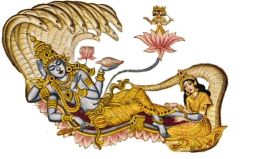
vishnu on shayana

A snake (sarpa) coiling around the drum held by Sri Dakshinamurti is said to symbolize Tantric knowledge.

In the Yoga tradition, the Kundalini Shakthi, the energy at the base chakra (the Muladhara) is represented as a coiled serpent, just about to uncoil. As the Kundalini gets awakened; and as it begins to move up, the serpent gradually ascends through the higher chakras, until it reaches the highest chakra, the Sahasrara.
naga bandha 3The Kundalini Shakhty, human energy, in its latent state, is pictured as a resting coiled serpent.  And, when it is awakened and when it actively moves up , it is said to take the form of spirals resembling Naga-bandha, the intertwining of two vibrant cobras . Later, the Naga-bandha also came to be viewed upon as the symbol of dynamic movement of the ethereal or cosmic forces; and, also as the male and the female energies representing the transmission of the positive and negative charges in the universe; thus enlivening all existence.

*

The caduceus is the traditional symbol of Hermes; and, it features two snakes winding around an often-winged staff. It is often used as a symbol of medicine; and, of life.

tree of life

**

And, in the Yoga-practices, the Bhujanga-asana, the posture resembling a  cobra with its hood raised and bent back, represents the dual serpentine energy emanating from Bhuja its circular coils; and , Anga, the limb-like, linear form it assumes when extended .

As the Yogi straightens the arms, lifts the upper body and throws back the head while performing the Bhujanga-asana, her/his spinal curve  is believed to stimulate the movement of Prana (life force) within the body ; her/his  chest expands  and fills the lungs with vitality ; and, the heart  throbs evenly  , energizing the whole of the body-mind complex.
Bhujangasana

The serpents, strangely,  symbolize both  Life and Death. Prana, the vital breath, that keeps the body alive is compared to a serpent. Just as a snake moves in the passages below the earth,  the Apana, the outward breath,  moves through various channels and exits through the holes in the body. It is the Apana that ensures distribution of vital energy to every segment of the organs in the body.

And, when the Apana (the Prana-vayu) departs from the body, the body dies.  That is death, the Kala – the end of one’s time on earth. The serpent as Kala, the Time, devours everything (sarva-bakshaka); all this existence is its food.

The Snake primarily represents rebirth, death and immortality. And, due to its ability to cast off its skin from-time-to-time, it is said to be being symbolically ‘reborn’, each time.

The serpents also represent Kama, the desires and cravings, which drive the beings in this world. It is the motive forces that propel life.

The serpents , thus, summarily represent all aspects and processes that occur in one’s life cycle:  creation; good fortune; misfortune; destruction; and death. The serpents also stand for the mysteries, the allures, the dangers as also the rewards in life.
five-headed-snake

Worship of the Nagas as per  ancient texts

You mentioned about the practice of worshiping the Nagas; and, the related ancient scriptures.

Snake worship is a manifestation of one’s devotion towards the serpent deities. The tradition is present in several ancient cultures, religions and mythologies, where the snakes are regarded as entities of strength and rejuvenation.  Worship of the Naga goes back to thousands of years.

As regards the Vedic texts, there is no direct reference to snake worship in Rig-Veda, the earliest of the four Vedas. Naga, the name by which the serpent-god became famous in the later texts does not appear in the early Vedic literature. Even when the term appears in Satapatha Brahmana (mahā-nāga-mivābhi-sasāra11.2.7.12), it is not clear whether it refers to a snake or to an elephant. Yet; the serpent as a symbol of life-energy appears at many places.

Here, in the Vedic lore, the serpent Vrtra or Ahi appears as a powerful rival to Indra, the King of the Devas. He lies around or under water. And, he seemed to have control over the waters in the havens and on the earth, alike. Later in the text, there is a reference to Ahi Budhnya, meaning – the serpent of the deep – ahir budhnya (RV_10,066.11c). Ahir-Budhnya , described as a deity of the mid-regions (Antarikshya), is variously associated with Visvedevas, Apam -Napat, Samudra, Aja-Eka-pada, and Savitri
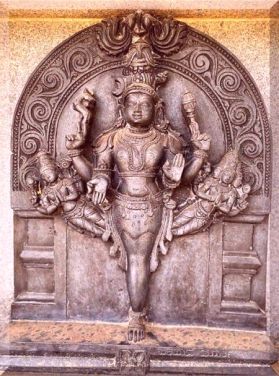
Shiva Ekapada.

And, Ahi Budhnya came to be particularly associated with Aja-Eka-pada, ‘the supporter of the sky, streams and the oceans’; and, with the thundering flood. And, Aja-Eka-pada was described as a kind of Agni, Apam Napatu, the raging fire in the ocean-waters. Aja-Eka-pada, in turn was associated with Rudra. That, it is surmised, might have laid the foundation for linking the Naga cult with Shiva.
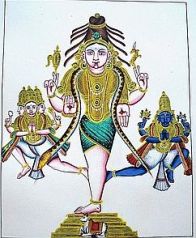
Ekapada

śa no aja ekapād devo astu śa no ‘hir budhnya śa samudraśa no apā napāt perur astu śa na pśnir bhavatu devagopā |RV_7,035.13a |

 [The Zend Avesta mentions Azi, as the serpent chief.]
Amaravathi Naga

Amaravathi stupa

But, it is in the Yajur Veda; and, more particularly in the Atharvana Veda, you find several passages relating to serpent-worship.

In the Maitrayani Samhita (2.7.15) of the Yajur Veda, prayers are addressed to the snakes (Sarpa), which move along the earth, the sky and the heavens; and, which have made their abode in the waters. And, to the snakes which are the tree spirits; as also, to the snakes which are as bright as the rays of the sun – rocane divo ye vā sūryasya raśmiṣu.

namo astu sarpebhyo ye keca pṛthivīm anu / ye antarikṣe ye divi tebhyaḥ sarpebhyo namaḥ// ya iṣavo yātudhānānāṃ ye vanaspatīnām / ye ‘vaṭeṣu śerate tebhyaḥ sarpebhyo namaḥ //  ye amī rocane divo ye vā sūryasya raśmiṣu /    ye apsu ṣadāṃsi cakrire tebhyaḥ sarpebhyo namaḥ /

There are, of course, numerous interesting references in the Atharva Veda to the mysteries, powers, poisons and the healing remedies of the snakes. There are also several magical spells and charms to avert the dangers caused by the snakes. There are prayers that are submitted to the snakes, in order to solicit their protection against demons, as also against their own tribe. At the same time, there are charms to counteract the powers of the wicked snakes.

The Prayers seeking protection mention: Let not the snakes, Oh gods, slay our offspring, our people. What is shut together may it not open. What is open may it not shut together.  Homage to the Devas. (It is interpreted; here, the terms ‘open’ and ‘shut’ refer to the jaws of the snakes.)

mā no devā ahir vadhīt satokānt sahapuruān | samyata na vi parad vyātta na sa yaman namo devajanebhya ||1|| namo ‘stv asitāya namas tiraścirājaye |(AVŚ_6,56.2c)  svajāya babhrave namo namo devajanebhya ||2||sa te hanmi datā data sam u te hanvā hanū | sa te jihvayā jihvā sam v āsnāha āsyam ||3|| (AVŚ_6,56.1)

In the Atharva Veda Samhita (7. 56.1) homage is submitted, in particular, to four types of serpents named: Tiraschiraji (cross-lined); Asita (black); Pridaku or Svaja (adder); and Babhru (brown) or Kanakaparvan.

These four are associated with the guardian deities (Adhipathi) of the four quarters of the space. Asita is associated with Agni as the warden (rakshitar) of the East; Tiraschiraji, with Indra, as the regent of the South; Pridaku with Varuna. as warden of the West; and, Kanakaparvan with Kubera, as the warden of the North.

tiraścirājer asitāt pdāko pari sabhtam | tat kakaparvao viam iya vīrud anīnaśat ||AVŚ_7,56. |

The main remedies employed against snake-bite are herbs and charms; the secret of which is supposed to be held by the seers.  But, in Atharva Veda (8.7.23) it is said that the snakes themselves have knowledge of the cure or a remedy for their poisonous bites. There is also a belief that the snakes themselves produce an antidote against their own poisons, perhaps on the principle that like-cures-like.

(AVŚ_8,7.23a) varāho veda vīrudha nakulo veda bheajīm | (AVŚ_8,7.23c) sarpā gandharvā yā vidus tā asmā avase huve ||23|

nagadevata2 Brooklyn Museum

There are certain passages in the Taittiriya Brahmana (Kanda 3, Part 1, Anu 1, and Sloka 5) where the offering (havis) within the course of a Yajna are submitted to the divine serpents:

Idam sarpebhyo havirastu-justa / Asresa yesa manuyanti chetah //

Again,  as per the passages in the Taittiriya Brahmana (Kanda 3, Part 1, Anu 4, and Sloka 7), during the course of the Asvamedha Yajna, offerings of  ghee and barley are submitted to the serpents (Sarphebyam svaha) by the Devas , praying for their help (ashrebhyah)  in subduing  (upanayati) the Asuras.

Te Devah sarpebhyo ashreshabyo ajyo karmbham nirevapanna/ tanetabhireva devata abhirupanyan/  yetabhirha vai devata abhirudpatham brathruvyam upanayati/ ya yetena havisha yajate/ ya u chainadevam vede /strotra juhoti/ Sarphebyah svahai ashrebhyah svahai / dandasukebhyaha svaheti //7//

The Grihya-sutras also contain accounts of the Sarpa-bali, the annual rites  (Yajus) conducted during the  full moon of the first month of the rainy season and the full moon of Sravana the first month of  winter (Sravana-nakshatrena-yukta pournamasi-sravani) , with the twofold purpose of honoring  or gratifying the Nagas;  and , the other for , warding off the evils caused by the snakes. 

Baudhayana Grihya Sutra (3.10.6) mentions several serpentine deities that are to be propitiated on the occasion of the Sarpa-bali; and, these include Naga deities such as Dhrtarastra, Taksaka, Vaisalaki, Tarksya, Ahira and Sanda

It is in the Asvalayana Grihya Sutra, that the divine serpents have been for the first time termed as “Naga’. The Sarpa-Bali ritual or the offerings to the serpents are described  

Here, in the  Asvalayana Grihya Sutra(2.1.9)the divine snakes that dwell in different directions are divided into three groups – as those pertaining to the earth (Prithvi), the sky (Antariksha) and the heaven (Divya Desha) – 

Ye sarpah  Prithivyam , ye Antariksha , ye Divya Deshasthebhyam , imam bali , maharshebya imam bali upakaromiti.

In addition to the classification of the serpents  chiefly based upon their habitation, there is also a classification made with reference to their color and to the celestial deities to whom they belong.
albino cobra 2

In the Paraskara Grihya Sutra, the Sarpa-devajna or the divine serpents are invoked and offered Payasa (sweet-syrup) ; and, are worshiped with flower garlands. Here, the Payasa is offered to gods and Nagas,  alike : Indra, Aja-Eka-pada, and Ahir-Budhnya.

Payasam-Indra-Sarpayitva-a-pupanscha-a-pupah;stirtva-a-aajaya bhaga-vistva-a-a-jya-huti; juhoti-Indrayena-a-Ajapada-Ahir Budhnya-yaya-proustha-pada-abhyascheti–(Paraskara Grihya Sutra-Kanda 2; Ka,15; Sloka 2)

The Paraskara Grihya Sutra (2.14.9-10), while offering oblations onto the Yajna kunda, states: To the lord of the serpents belonging to Agni, of the yellowish, terrestrial ones; to the lord of the white serpents belonging to Vayu, of the aerial ones; to the lord of the over powering serpents belonging to Surya, of the celestial ones; and,  to the firm one, the son of the Earth.

Among these, the white serpents (Sveta Naga), the sons of Vidarva, were regarded as the most powerful; and, capable of  restraining the other serpents from causing needless harm .
white naga

*

A domestic ritual called Vastu-samana is prescribed by the Ghobila Grirhya Sutra in order to please the regents of the ten regions (Dasa Disha); to be performed at the time of entering a newly built house (Griha-pravesha). Among the ten regents to whom the Bali is offered, Vasuki is  the regent of the downward region (Adho loka – Patala) – Vasukaya ity adhastad – (Gobhilya – 4.7.41)
naga sculpture 2 naga sculpture

References in Mahabharata

But, it is truly, in Mahabharata that the history of the Naga race initially gets elaborated. In the first major Canto of the Epic – Adiparva – the Slokas 657 to 2197 are devoted the history of the origin of the Nagas and of their progeny. It starts with the marriage of the sage Kashyapa with Kadru. She becomes the mother of as many as one thousand Nagas, who are the progenitors of the Naga race.  The names of some of their principal descendents are mentioned as:  Sesha, Vasuki, Airavata, Takshaka, Karkota, Kaliya, Aila, Elapatra, Nila, Anila and Nahusha; and so on.

The story of the Nagas (MB. 1-16,122) is intertwined with that of the sons of the sister of Kadru – that is, Vinata (who also was married to Sage Kashyapa) – the Garuda, the eagle, Suparna, race.

As per Mahabharata, the Suparna-s headed by Garuda were formerly servants of the Nagas. With the help of the Devas, Garuda succeeded in ending the slavery of his brothers and their tribe. And later, Suparnas became enemies of the Nagas (MB.1.3.159); and vowed to bring death and destruction on the snake-race (sarpa-kula). Thus, the sons of the two sisters, followed by their descendents grew into bitter enemies, recklessly determined to destroy each other.

Garuda Naga

Some scholars opine that a tribe called Suparna (to which Garuda belonged) was the archrival of the Nagas. The Suparna-s were probably falcon rising or falcon worshipping tribes

Later, in the Epic, there are more references to the Nagas. And, they are more closely associated with the Pandavas than with their cousins, the Kauravas.

It seems that when the Khandava forest near Hastinapur (near the present Delhi) was burnt down to make place for the new capital, the Naga race was rudely dislodged (Adi parva). Despite that, the Pandava branch of the Lunar race (Chandra vamsa) and the Nagas seemed to have had friendly relations. Later, Arjuna marries Ulupi, daughter of the Naga King, belonging to the race of Airavata. And, shortly thereafter he marries Chitrangada, daughter of another Naga King at Manipur.

But, the enmity between the Pandava and Naga races erupted into serious trouble when Parikshit, the grandson of Arjuna, was cursed by a sage to die of snakebite. Thereafter, Parikshit was bitten by Takshaka, a Naga said to be from the region of Takshashila. It was a city named after Naga King Takshaka Vaisaleya (Taxila, near Peshawar of the present-day), to the west of the river Vitasta (Jhelum); which, was said to be his abode.

In order to avenge his father’s death, Janamejaya, went on a killing spree slaughtering thousands of snakes. Naga race was almost exterminated by Janamejaya, the Kuru king, It is said; that massacre was halted by the intervention of Astika, a nephew of Vasuki, the serpent king of the Eastern Nagas.
naga

.. In the Puranas

And, it was in the Puranas – mythological and often fanciful narrations – that the serpents came to be associated with numerous gods and goddesses, such as: Shiva; Vishnu; Ganapathi; Subrahmanya; Devi and others. In many of these cases, the serpent is an ornament, a weapon or a symbol of power or knowledge.
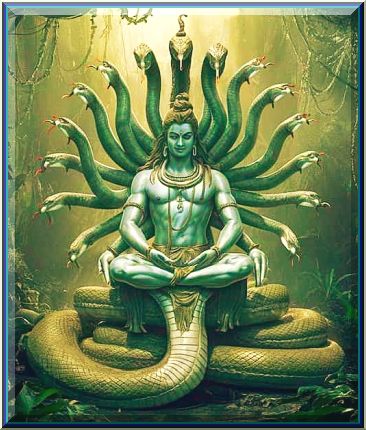
And, boy Krishna’s encounter with the river-snake Kalinga sarpa  is , of course, depicted in countless  manners through sculptures, paintings, Dance-dramas , songs etc.

The Puranas also mention several large serpentine deities like Kadru, Manasa, Vinata and Asitka. And, Vasuki the king of snakes played a vital role in the churning of the oceans.
Several myths, beliefs, legends and scriptures are associated with snakes. And, the Snakes were used in warfare; and, snake poison was often used in palace intrigues.

You will find references to snake deities in both Hindu texts as also in the folklore. Even in Buddhism and Jainism there are abundant references to the practice of the worship of Trees and Serpents. Perhaps, the new religions absorbed the accumulated mass of the Naga-mythologies.
nagadevi

But, it is in the Vaishnava tradition that the serpent occupies a position of far greater significance. The Agamas mention eight lords of the Nagas; the chief of these being Ananta, Sesha or Adi-sesha. It is the Ananta, representing timelessness, on which the Lord Vishnu reposes, contemplating the creation of the world yet to come into existence.
It was with the assistance of Vāsuki the King of Serpents that the ocean was churned; and, Amrita, the elixir, was produced, bestowing immortality to the gods (Deva). The other seven Nagas mentioned in the Agamas are: Vasuki; Takshaka; Karkotaka; Abja (Padma); Maha-bhuja; Maha-padma; Shankadhara; and, Kulika.
deva asura

’Tree & Serpent Worship

Fergusson J, in his ’Tree & Serpent Worship, Or Illustrations of Mythology & Art in India’ (India Museum 1868), a remarkable work of research, studies the serpent-worship practices in several regions, under their varied the cultural and religious faiths. The study, apart from the Eastern countries like India, China, Ceylon and Cambodia; also covers parts of the western world such as : Egypt, Greece , Germany, France , and Scandinavian countries;  as also Africa and Americas. Fergusson, in his Introductory Essay, writes:

sarpa

The worship of the Serpent is not so strange as it might at first sight appear. As was well remarked by an ancient author (Sanchoniathon quoting Taatus ap Eusebium):

The serpent alone of all animals without legs or arms, or any of the “usual appliances for locomotion, still moves with singular celerity;” and he might have added — grace, for no one who has watched a serpent slowly progressing over the ground, with his head erect, and his body following apparently without exertion, can fail to be struck with the peculiar beauty of the motion. There is no jerk, no reflex motion, as in all other animals, even fishes, hut a continuous progression in the most graceful curves. Their general form, too, is full of elegance, and their colours varied and sometimes very beautiful, and their eyes bright and piercing. Then, too, a serpent can exist for an indefinite time without food or apparent hunger. He periodically casts his skin, and, as the ancients fabled, by that process renewed his youth. Add to this his longevity, which, though not so great as was often supposed, is still sufficient to make the superstitious forget how long an individual may have been reverenced in order that they may ascribe to him immortality.

Though these qualities, and others that will be noted in the sequel, may have sufficed to excite curiosity and obtain respect, it is probable that the serpent never would have become a god but for his exceptional power.

The poison fang of the serpent is something so exceptional, and so deadly in its action, as to excite dread, and when we find to how few of the serpent tribe it is given, its presence is only more mysterious. Even more terrible, however, than the poison of the Cobra is the flash-like spring of the Boa — the instantaneous embrace and the crushed-out life — all accomplished faster almost than the eye can follow.

It is hardly to he wondered at that such power should impress people in an early stage of civilization with feelings of awe; and with savages it is probably true that most religions sprung from a desire to propitiate by worship those powers from whom they fear that injury may be done to themselves or their property.

Although, therefore, fear might seem to suffice to account for the prevalence of the worship, on looking closely at it we are struck with phenomena of a totally different character.

 “When we first meet Serpent Worship, either in the Wilderness of Sinaa, the Groves of Epidaurus, or in the Sarmatian huts, the Serpent is always the Agathodaemon, the bringer of health and good fortune.

 He is the teacher of wisdom, the oracle of future events. His worship may have originated in fear, but long before we become practically acquainted with it, it had passed to the opposite extreme among its votaries. Any evil that ever was spoken of the serpent, came from those who were outside the pale, and were trying to depreciate what they considered as an accursed superstition.

If fear were the only or even the principal characteristic of Serpent Worship, it might he sufficient, in order to account for its prevalence, to say, that like causes produce like effects all the world over; and that the serpent is so terrible and so unlike the rest of creation that these characteristics are sufficient to explain everything.

When more narrowly examined, however, this seems hardly to be the case. Love and admiration, more than fear or dread, seem to be the main features of the faith, and there are so many unexpected features which are at the same time common to it all the world over, that it seems more reasonable to suspect a common origin.

 In the present state of our knowledge, however, we are not in a position to indicate the locality where it first may have appeared, or the time when it first became established among mankind.

I would feel inclined to say that it came from the mud of the Lower Euphrates, among a people of Turonian origin, and spread thence as from a center to every country or land of the Old World in which a Turonian people settled. Apparently no Semitic, or no people of Aryan race, ever adopted it as a form of faith. It is true we find it in Judea, but almost certainly it was there an outcrop from the older under- lying strata of the population. We find it also in Greece, and in Scandinavia, among people whom we know principally as Aryan, but there too it is like the tares of a previous crop springing up among the stems of a badly-cultivated field of wheat.
Naga from Chinese Sutra

The essence of Serpent Worship is as diametrically opposed to the spirit of the Veda or of the Bible as is possible to conceive two faiths to be; and with varying degrees of dilution the spirit of these two works pervades in a greater or less extent all the forms of the religions of the Aryan or Semitic races. On the other hand, any form of animal worship is perfectly consistent with the lower intellectual status of the Turonian races, and all history tells us that it is among them, and essentially among them only, that Serpent Worship is really found to prevail.
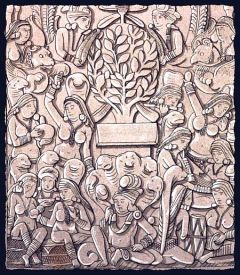
Sanchi Naga 1 Sanchi Naga 2

Snake Worship is general throughout peninsular India, both of the sculptured form and of the living creature. The sculpture is invariably of the form of the Nag or Cobra, and almost every hamlet has its Serpent deity. Sometimes this is a single snake, the hood of the Cobra being spread open. Occasionally the sculptured figures are nine in number, and this form is called the “Nao-nag,” and is intended to represent a parent snake and eight of its young, but the prevailing form is that of two snakes twining in the manner of the Esculapian rod.]
nagabandha

Worship practices in Indian traditions

The worship of the Nagas has taken a deep root in many of the Indian religions, for a variety of reasons. It could be either for fertility, protection, and eradication of poisons, securing or protecting hidden treasure or in repentance of past sins or to avert the anger of the snakes (Naga-dosha) or for whatever other reasons. Apart from the snakes, the goddesses such as Manasa Devi are worshiped with fear, hope and devotion.  In South India, it is a common practice that women desiring to bear children set up Naga-stone-images (Naga shila).

As said, the Nagas, the cobras, have enjoyed a high status in Indian mythology and religious traditions. You will find numerous temples in South India dedicated to Snake-gods (Naga-devata). There are also special forest reserves for the Nagas (Naga-vana or Sarpa Kavu).

[Some say that the Nairs of Kerala were Nagavamshis or warriors following the serpent cult. The Naga worship among Nairs is widespread. Each Nair Tharavad or household had a separate place for Sarpa Kavu or a sacred grove dedicated to Nagas. Nair women also wore Naga-pada-thali or necklace with amulets in the shape of a cobra hood; and, also tied their hair into the front as a bun symbolizing the hood of a cobra. This is believed to be due to their affinity with the Naga serpent cult of the Nagavamshis.]
sarpa kavu

[ Shri Ajay Shetty, in his comments observes: In Tulu-nadu  ( comprising Dakshina Kannada and Udupi districts of of Karnataka and the Kasargodu region of Kerala) there is a special place for Naga worship. Before the commencement of any auspicious program, we first offer Pooja to the Naga; and, then to other deities. Even Bunts of Tulu-nadu belong to Nagavanshi clan. In each Bunt-tharavad,  there is a Naga-bana. For the Tuluvas, Naga worship is most important. Naga is indeed the patron deity of Tuluvas. Many rituals like Ashlesha Bali, Dakke Bali, Sarpa Samskara, and Nagamandala are practiced even now. The process of worshipping Naga is called Nagaradhane .]

Devi Yantra by Pieter Weltevrede

Here, in the South, the Naga is identified with Skanda or Subrahmanya; often depicted in serpentine shape, either entirely or is half-human. And, the sixth day of the lunar-month Shasti is regarded particularly sacred for worship of Subrahmanya. There are countless temples of Lord Subrahmanya in South India.
Further, in the temples of other deities too, there would normally be snake-stones (Naga-shila) having images of snakes carved on them, placed on specially prepared platforms under the shade of a papal tree conjoined with a Margosa tree. And, in almost every part of India there are carved representations of cobras or Nagas.

[ For the purpose of offering worship to the Nagas , several Stotras and Namavalis have been composed . A few of the well known among those are :

Sri Subrahmanya Ashtottara Sata Namavali; Sri Naga Devata Ashtottara Shata Namavali ;  Sri Naga Namavali (citing names of 78 revered Nagas) ]
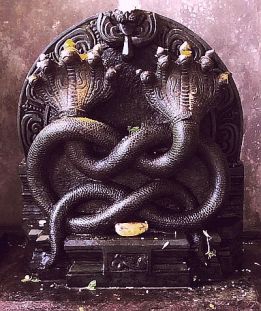
Nagakal, Kukke Subramanya

On Naga Panchami, the fifth day of the bright half of Shravana (July-August), many Hindus visit temples specially dedicated to snakes and worship the snake, or Naga idols or the anthills. It is also the auspicious day on which the sisters affectionately greet their brothers and pray for their welfare .

In the Bengal region, the worship of the serpent-goddess Manasa Devi is widespread. Further, on the last day of the Bengali month of Shravana the Naga worship is celebrated as a religious festival.
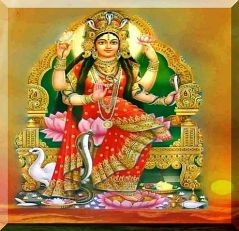
mansa-devi

[In the classical version, according to a Shilpa text Pratista-lakshana-Sara-samucchaya, ascribed to Vairochana (Ca.11th century)  the Devi is  known as Svangai or Sungai-bhattarika.  It is said; it is in the Brahmavaivarta Purana, the deity came to be known as Manasa-Devi. The iconography (Prathima-lakshana)  of Manasa-Devi describes her as a deity with two arms; seated in Lalita-asana; her right leg hanging down; and, the bent left leg resting on a huge lotus. She holds a fruit in the right hand; and, either a child or a snake in the left hand. A huge seven-hooded serpent serves as a canopy over her head. To the right of Manasa Devi , is sage Jaratkaru (husband of the goddess), who is shown as an ascetic with matted hair; and, to her left, is her brother Vasuki,under a snake-canopy. Manasa Devi’s son Astika sits on her lap.

]ManasadeviManasadevi Rangpur Museum

There is a similar sculpture of the goddess Devi Svangai, Svangi, or Sungi-devi (Rangpur Museum) – shown here to your right.  But, there are some variations. Here, to the right of the goddess, a male figure rides a donkey; holding a sword in the right hand and wearing high boots. He is identified as Nairutta; the guardian of the South-west . This figure is rather an unusual companion to the Snake-goddess. And, to the left of the goddess, another male figure is shown riding an antelope and holding a piece of cloth,  indicating the movement of wind over his head. He is, identified as Vayu, the guardian of North-west .]
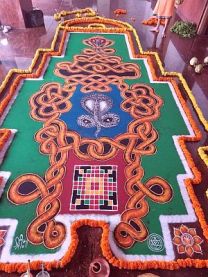
Naga1 Naga2

In the coastal regions of Karnataka, Naga Mandala, a unique, an  elaborate and a complex ritual tribal dance-worship (Nagaradhane) sequences is performed with great pomp and fervour. The Mandala is the depiction of colourful design of a huge serpent coiled into numerous knots (pavitra). At the centre of the design is painted a small raised mound and a seven-hooded serpent. The ritual dance is performed, around the Mandala, by the priest possessed by the serpent-spirit (Naga-patri) to the accompaniment of music played by two musicians (Vaidya).The inspired Naga-patri dances with abandon mimicking the steps of an excited serpent. The ritual concludes with the possessed Naga-patri uttering oracle-like predictions;   and, offering solutions to the problems and prayers submitted by the assembled devotees.
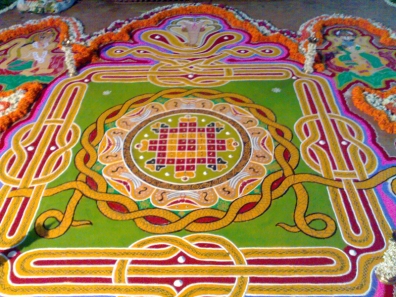
Naga mandala

hqdefault

Iconography

The mythological serpent race that took form as cobras often can be found in Indian iconography. The Nāgas are described as the powerful, splendid, wonderful and proud semi divine race that can assume their physical form either as human, partial human-serpent or the whole serpent.

Therefore, the Nagas are invested with great importance; and,  the Naga cult is depicted both in the Vedic and Buddhist texts as also in art,  in myriad ways – as divine beings, humans and animals; and also as a blend of all these. A number or of Naga (male) and Nagi (female) deities are described in various texts; and, represented in images. Many of these form a part of the Hindu, Buddhist and Jaina pantheon, representing power, wisdom and fertility.  For instance; you find abundant representations of the adoration of snake-deities on the Buddhist Stupas of Sanchi and Amravati. The Tibetan paintings depict the Buddha with the Naga coiled round him, seven times.

And,at the Wang Boran and Parsat Mai temple at Pattaya , Thailand there is a beautiful depiction of a Naga with his consorts. There is also a well sculpted image of Nagaraja at the Jetavana Buddhist  vihara  . 
Naga Prasat Sut Ja-Tum, Pattaya, Thailand Nagaraja Jetavana

*

The serpent stones installed under the tree depict two serpents interlocked in an embrace. Sometimes, the serpents are shown as seated in the form of a Linga.

The simplest form in which the Naga appears in Indian art is the serpent form.

The mythical Adi-Sesha is celebrated with as many as one thousand hoods.

The female counterparts of the Nagas, the amorous and charming Nagini, are usually depicted with a crest consisting of a single serpent hood.
Clipboard01

The iconography of the Nagas  broadly fall into three types : as many headed serpents; as human or divine being characterized by  five or seven serpent-hoods , each having two tongues; coiled into  diverse kinds of knots.

Naga Anchor vat

And, there is also as the combination of the two with the upper part of human/divine being combined with the lower half of  a snake’s coil (say , like mermaids).
Nagadeva2

A Dhyana Sloka (word-picture) of a belligerent  serpent (kopakutilam) , in aggressive posture ; with its upper part in human form adorned with  multiple hoods , each with two tongues ;  its lower part in snake form – reads:

Dhyayeth Nagarupam hinapherudam,  narakruthim / sarpakaram adhobhagam , mastake goghimandalam / phanatraye , parijagirda , navagirda, saptadhihi /  jihvam , kopakutilam , khadgacharma-dharam tatha //

The texts of the Shilpa-shastra, such as Amsumadbheda-agama, Shilparatna and Maya-mata mention that the image of Nagadeva should have three eyes; four arms; a beautiful countenance of red complexion.  The Shilparatna adds that the image should be half human and half serpentine; and must carry a sword and shield in his hand. And, Maya-mata gives a description of seven great Nagas: Vasuki, Takshaka, Karkotaka, Padma, Mahapadma, Sankhapala and kulika; providing descriptions of their colour, attributes and their Ayudhas.

The Visnudharmottara-Purana (Ca.6th century) makes a special mention of the Great Serpent Ananta. Here, Ananta is not regarded merely as the serpent on which Vishnu reclines; but, is revered as the very incarnation of Lord Vishnu. Thus, Ananta is Vishnu himself.

The Text describes the iconography of such divine Ananta, endowed with countless virtues , powers (ananta-shakthi)  and countless forms (ananta-rupastu) . The Ananta-puruṣha, here, is said to be matchless (anantāy-āprameyāya); and, resplendent with: four faces; and, twelve arms. In the hands on his right side, Ananta holds Ayudhas such as: Gada (mace), Chakra (disc), Khadga (sword), Vajra (thunderbolt), and Ankusha (goad); and, he also displays Varada-mudra (assurance and protection). And, in the hands on his left side, Ananta holds the Ayudhas such as: Dhanus (bow), Padma (lotus), Khetaka (shield), Shankha (conch), Danda (rod) and Pasha (Noose).

Ananto-ananta-rupastu, hastau dwadasasa–abhiryutah / ananta-shakthi samvito garudastha chatur-mukhah / gadha-krupanu-chakradyau vajra-ankusha-varnvitah/ shanka khetam dhanuh padmam dandam pasau ca vamatah //  Vdha.3,350.[6]
nagadevata

The Nagas also find place in the iconography of the other deities. Vishnu is portrayed as reclining on the Sesha; and, at other times the hooded serpents forms a canopy over his head. Vāsuki serpent became the churning rope for churning of the Ocean of Milk. And, Shiva is adorned with KingCobra as garland round his neck; as coiled on his arms as armlets; and on his head. Ganesha uses a serpent as a belt tied around his sumptuous waist; and, as a sacred thread (yajñyopavīta).  The Devi as Bhairavi is adorned and served by Shakthi-Naga. The s images of the sages like Sri Dakshinamurthy; the Buddha and Parsvanatha are all depicted as seated under hooded serpents.
nagarjuna

Nagarjuna, the champion of the Madhyamika Buddhist philosophy is traditionally portrayed with a halo formed by a multi-headed serpent.
shiGaneshmahavidya_bhairavi_hk53Lord Vishnu

Further, Balarama , the elder brother of Sri Krishna; Lakshmana , the younger brother of Sri Rama; and, the Sage Patanjali who composed the remarkable Yoga Sutra – are all revered as the incarnations of Sesha Naga.

god budhha under banyana tree buddha-hindu-artpatanjali

Suggested Reading

You asked; any books to read to get more details?

Yes; there are plenty. There are some comprehensive works on all aspects related to Nagas. You may follow some of these that are available on the net:

Indian Serpent-lore: Or, The Nāgas in Hindu Legend and Art By Jean Philippe Vogel

Tree and serpent Worship, or illustrations of mythology and art in India By James Fergusson

Encyclopaedia of Oriental Philosophy and Religion: Hinduism  Serpent worship: Pages 774 to 791

http://creative.sulekha.com/the-mythical-naag-devata-the-mythical-snake-god_426933_blog

 You may also follow the links mentioned under ‘Sources and references’.
Ganesha Vignarajasnake-skanda

Nagas in history and anthropology

What was said so far was concerned with the Naga worship.

 But, the term Naga has multitude of connotations.

The term , depending upon the context,  might refer to the oldest tribal communities in the world; to snake worshiping Aryan tribes; to the Naga royal lines of the Kings of Magadha , viz., Shishunaga dynasty (c. 413 – 395 BCE),  believed to have been the second ruling dynasty of Magadha Empire of ancient India (after the Haryanka dynasty) ; to the  Bharasiva Nava Naga dynasty who ruled  from 150-170 AD; to the linage of Naga kings dating back to the Gupta period (from approximately 240 to 590 CE); and to the various Naga communities settled in different parts of India during the early and medieval periods, such as : the Nagas of Vidisha, Padmavathi, Kantipur and Mathura; the Nagas of Erikina (Madhya Pradesh); the Nagas of Bastar; the Nagas of Kawardha; the Nagas of Bhatgaon ; the Nagas of Eastern India ; and so on .

It is said;  Ananatnag city in Kashmir was  founded by the Naga named Ananta. In Rajtarangini  , which chronicles  the history of Kashmir kings, there is mention of a brave handsome king of Kashmir, son of a Karkotaka Naga and a Kashmiri Brahmin girl. Their dynasty came to be known as Karkotaka Dynasty. His son became the most powerful king; and, brought peace and prosperity in Kashmir. This Karkotaka was said to be of very kind and  helping nature. He helped the Nishada king Nala in regaining his lost kingdom. 

 It’s also said that Naga dynasty ruled near Ravi in Punjab, from North West of part of Punjab which now is in Pakistan up-to Kazakhstan; Vitasta or Jhelum in Kashmir; River Saraswati’s basin; banks of River Gomati; Kurukshetra, parts of Uttrakhand etc.  The Pannagas and the Urgas were said to be the sub-sects of the Naga dynasty. The people who went by the surname Pannaga or Urgas were said  to be the either supporters or the descendants of that dynasty.
nagaradhane2

The Śivadharmaśāstra (a Shaiva text dated prior to seventh century) is in the form of Samvada, a dialogue that takes between the divine sage Sanatkumāra and Śhiva’s foremost Gaa Nandi-keśvara. At the request of  Sanatkumāra, Nandikeśvara instructs Sanat-kumāra and the other sages dwelling on Mount Meru in the worship of Śhiva.
The Śāntyadhyāya, the longest Chapter of the  Śivadharmaśāstra, recounts ,with devotion, the eight serpent lords Naga-rajas (Asta-Nagas) as:

Ananta; Vāsuki; Takṣaka; Karkoṭaka; Padma; Mahāpadma; Śaṅkhapāla; and Kulika

Each Nāgarāja is invoked in elaborate detail, with much attention paid to their individual iconography.

Ananta

With a red body, elongated eyes that are red at the edges, swelling with pride with his great hood, marked by a conch and a lotus—may Ananta, king of the Nāga lords, delighting in the praise of Śiva’s feet, destroy the poison of great evil and quickly bestow peace on me!(166–167)

āraktena śarīreṇa raktāntāyata-locanāḥ| mahā-bhogāḥkṛtāṭopāḥ śaṅkhā-abjāḥkṛta lanchaṇāḥ || Ananto-nāgarājendra Shiva parartane rataḥ| mahā pāpaviṣaṃ hatvā śāntim āśu karotu me||166-167||

Vāsuki

With a very white body, with a crown of very white lotuses, swelling with pride with a handsome hood, adorned with a charming necklace—may  Vāsuki, king of the Nāga lords, the great one, intent upon the worship of Rudra, destroy the poison of great evil and quickly bestow peace on me!(168–169)

Suśvetena tu dehena suśvetot palaśekharaḥ|cārubhogakṛtāṭopo hāra cāru vibhūṣaṇaḥ|| vāsukir nāgarājendraḥ rudra pūjāparo mahān| mahā pāpaviṣaṃ hatvā śāntim āśu karotu me|| 168-169||

Takṣaka

With a very yellow body, rich in quivering coils, and with a very luminous splendour, marked by the Swastika — may Takṣaka, the illustrious Nāga lord, accompanied by a crore of Nāgas, bestow peace on me, destroying the poison of all crimes! (170–171)

Atipītena dehena visphurad bhogasampadā|tejasā cātidīptena kṛtasvastika lāñchanaḥ||nāgarāṭ takṣakaḥ śrīmān nāgakoṭyā samanvitaḥ|karotu me mahāśāntiṃ sarva doṣa viṣāpahām|| 170-171||

Karkoṭaka

With a very black color, an expanding hood over his head, provided with three lines on his neck, furnished with terrible fangs as weapons —may the great Nāga Karkoṭaka, possessed of poisonous pride and power, destroy the pain of poison, weapon and fire, and bestow peace on me! (172–173)

Ati-kṛṣṇena varṇena sphaṭā-vikaṭa mastakaḥ| kaṇṭhe rekhā trayopeto ghora daṃṣṭrā -yudhodyataḥ||karkoṭako mahānāgo viṣadarpabalānvitaḥ| viṣa śastrā agnisaṃtāpaṃ hatvā śāntiṃ karotu me|| 172-173|| 

Padma

With a lotus-colored body, his elongated eyes like handsome lotus petals, illuminated with five spots — may the great Nāga called Padma, delighting in the praise of Hara’s feet, bestow peace on me, destroying the poison of great evil! (174–175)

Padma-varṇena dehena cāru padmāyate-kṣaṇaḥ| pañca bindu kṛtābhāso grīvāyāṃ śubha lakṣaṇaḥ||khyāta padmo mahānāgo hara pādārcane rataḥ|karotu me mahā śāntiṃ mahā pāpaviṣakṣayam||174-175|| 

Mahāpadma

And with a body like a white lotus, of immeasurable splendour, always adorned on his head with the marks of a brilliant conch, trident and lotus—may the great Nāga Mahāpadma, constantly bowing to Paśupati, destroy the terrible poison and quickly bestow peace on me! (176–177)

Puṇḍarīka-nibhenāpi dehenā amitatejasā|śaṅkhaśūlā abjarucirair bhūṣito mūrdhni sarvadā||mahāpadmo mahānāgo nityaṃ paśupater nataḥ| vinikṛtya viṣaṃ ghoraṃ śāntim āśu karotu me|| 176-177||

Śaṅkhapāla

With a dark body-mass, his eyes like beautiful lotuses, intoxicated with poisonous pride and power, with a single line on his neck—may Śaṅkhapāla, bright with luster, worshiping the lotus-feet of Śiva, destroy great evil, the great poison, and bestow peace on me! (178–179)

śyāmena deha-bhāreṇa śrīmat-kamala-locanaḥ| viṣa darpa balonmatto grīvāyām eka rekhayā|| śaṅkhapālaḥ śriyā dīptaḥ śiva pādābja pūjakaḥ|mahāviṣaṃ mahāpāpaṃ hatvā śāntiṃ karotu me|| 178-179|

Kulika

With a very terrifying body, his head furnished with the sickle of themoon, swelling with pride with a shining hood, marked with an auspicious mark—may Kulika, the best of the Nāga kings, always intent upon Hara, remove the terrible poison and bestow peace on me! (180–181)

Ati ghoreṇa dehena candrārdhakṛta mastakaḥ|dīpta bhoga kṛtāṭopaḥ śubha lakṣaṇa lakṣitaḥ|| kuliko nāgarājendro nityaṃ hara parāyaṇaḥ|apahṛtya viṣaṃ ghoraṃ karotu mama śāntikam|| 180-181||
Naga Devathe 2

Prayers are also submitted to other Nagas in the sky; the Nāgas abiding in heaven, on earth, on mountains, in caves and in forts; as also the Nāgas present in the nether region .

And to Nāginīs; Nāgakanyās; and, Nāgakumārās -the Nāgas’ wives; daughters; and the Nāgas’ sons— may all of them, assembled here, dedicated to the praise of Rudra’s feet, bestow peace on me!

nāginyo nāgakanyāś ca tathā nāgakumārāḥ|śiva bhaktāḥ sumanasaḥ śāntiṃ kurvantu me sadā|| 184||
Shiva under Naga Ganapathi Naga

[I acknowledge with deep gratitude, the source: Universal Śaivism: The Appeasement of All Gods and Powers in the Śāntyadhyāya by  Peter Bisschop.

The translations of the verses are by the author.]
nagaradhane

There is also a tradition winch recounts NavaNagas. The Nava-Naga Stotra mentions the Nine Nagas as:

(1) Ananta; (2) Vasuki; ( 3) Shesha; (4) Padmanabha; (5) Kambala;(6) Shankhapala; (7) Dhritarashtra; (8) Takshaka; and, (9) Kaliyan.
Sesha

Prayers are submitted to these Nagas seeking protection  from the dangers of poison; and, to grant success at all times in one’s life (Vishabhayam Naasti ; Sarvatra Vijayi Bhaveth)

Anantam Vasukim Shesham / Padmanabham cha Kambalam / Shankhapalam Dhartarashtram / Takshakam Kaliyam Tatha

Etani Nava Namani Naganam cha Mahatmanah / Sayankale Patten-nityam Pratahkale Visheshatah / Tasya Vishabhayam Nasti ; Sarvatra Vijayi Bhaveth

अनन्तं वासुकिं शेषं पद्मनाभं कम्बलं / शन्खपालं ध्रूतराष्ट्रं तक्षकं कालियं तथा / एतानि नव नामानि नागानाम महात्मनं / सायमकाले पठेन्नीत्यं प्रातक्काले विशेषतः / तस्य विषभयं नास्ति सर्वत्र विजयी भवेत //

[ According to the Nava Naga tradition, the Naga King Ananta was the founder of the Naga dynasty; and, was a very saintly person. He preferred to reside at Gandhmadana Parvata (in the Himalayan region). And, at times, he stayed deep inside the ‘Great lake’ (perhaps the Manasa lake).

It is said; the Naga King Vasuki saved his community from the assault of the Suparna tribes; and, rehabilitated them in a city called Bhogawati, which later became his capital.  It is said; Vasuki’s nephew, the wise and bright looking Astika saved the  beleaguered Nagas by causing to stop the massacre or genocide of Nagas undertaken the avenging Kuru King Parikshit.

Following Vasuki, the good-looking, powerful Naga King Airavata, further developed the Capital Bhogawati into a splendid affluent city. He is also said to have founded a place, later named as Nag-Tirtha, which still exists in Uttarakhand region.

The handsome and rich Naga King Takshaka was the son of Airavata. He, in turn, founded the famous city Takshashila (Taxila – now in Pakistan) . The Takshashila later developed in a famous center of learning, to where the students from all parts of India came seeking higher education.

The famous King Pururava hailing from a Deva-Kshatriya clan had a son called Ayu. And, one of Ayu’s son was Nahusha. According to the myth Nahusha was a Naga King. His son was the famous king Yayati of the lunar dynasty (Chandra-vamsha), who tried to reconcile the differences between the followers of the rival sages Brighu (Asuras) and Angirasa (Devas).

The descendants of Yayathi – Puru, Kuru, Yadava and Bharatas – ruled as the celebrated kings of ancient India.  It is said; the clans of Sawhanis, Seuna Yadavas, Bhattis, Chandelas and the Jats of Bharatpur and Mathura have descended from the Chandra-vamsha

The Naga King Aryaka was said to the great grandfather of   Kunti, the mother of the mighty Pandavas. Aryaka saved the young Bhima’s life when he was food-poisoned by his  embittered cousin Duryodhana.

The cultured and wise Naga King Padmanabha is said to have extended his kingdom; and, established a new capital adjacent to the forest Naimisharayna, near the river Gomati (in the present day Uttar Pradesh) .]
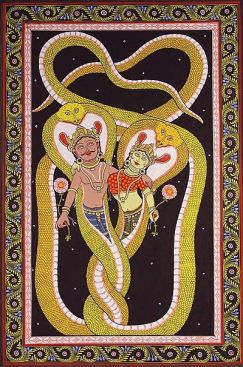
Ngaraja with wife

Apart from these, the literary traditions too mention of the royal dynasties of ancient India, which claimed a Naga or a Nagini as their progenitor. Such instances include those of King Udayana who married a Naga princess, giving rise to Sakya dynasty. The dynasty of Kashmir, which included the famous King Lalitaditya (Ca.8th century), is said to have descended from Naga Karkotaka. The neighboring Kings of Bhadarwah claimed descent from the serpent king Vasuki. And, the Rajas of Chota Nagpur derive their origin from Naga Pundarika. And, in the South, the Shalivahana of Pratistana as also the Pallavas claimed descent from Ananta Naga. And, so on…

The tradition recorded by Hiuen Tsang suggests that the city of Nalanda got its name from a Naga named Nalanda, which was believed to be the guardian deity of the city.

Countless ancient Naga images have been discovered at the various regions of India, as in areas around Mathura; Rajagriha (Modern Rajgir in Patna, Bihar), the ancient capital of Magadha, and its neighborhood; and many other places.

The history of the Naga cult is one of the most interesting chapters in Indian history. And, that, by itself, is a vast subject; and, has been dealt with in great detail by several historians, anthropologists and scholars of social studies.

Naga Devatha

 In case you are interested in such studies, I suggest, you may start with Chapter Seven: Naga, the evolution of tribal culture (from pages 177 to 234) by Dr. Shiv Kumar Tiwari – (Published by Sarup &Sons; New Delhi; 2002-3). It comprehensively deals with numerous legends, traditions, histories and cultures related to the Nagas. The full view of the book is available on the net. Please also check the bibliography given therein for further study.

You may, may also follow the sources and references listed  under; at the end of this post.

As regards the  Naga Identities: Changing Local Cultures in the Northeast of India, please read the scholarly study made by Alban von Stockhausen,  Michael Oppitz, Thomas Kaiser and Marion Wettstein.

Please also see the very well researched paper  The Nagas; an introduction ; covering  their Social Identity, Cultural Identity, Nagaland etc. by Alban von Stockhausen and Marion Wettstein.

NAGERKOIL - TAMILNADU

Sources and references

Indian Temple traditions by Dr.SK Ramachandra Rao

Indian Serpent-lore: Or, The Nāgas in Hindu Legend and Art By Jean Philippe Vogel

Tree and serpent Worship, or illustrations of mythology and art in India By James Fergusson

Encyclopaedia of Oriental Philosophy and Religion: Hinduism – Serpent worship: Pages 774 to 791

Naga, the evolution of tribal culture  by Dr. Shiv Kumar Tiwari

The Nāgas and the Naga cult in ancient Indian history by Karunakana Gupta (Proceedings of the Indian History Congress – Vol. 3 (1939), pp. 214-229) –  http://www.jstor.org/stable/44252377

A Study of Naga Beings as a Global Phenomenon and their relation with Kailash / Manosarovar  region by Susan M. Griffith-Jones

https://www.jstor.org/stable/44140714?read-now=1&seq=1#page_scan_tab_contents  byU N Mukherjee

http://shodhganga.inflibnet.ac.in/bitstream/10603/35963/3/ch%203%20naga%20cult%20in%20india.pdf

http://farbound.net/behind-the-myth-of-the-serpent-people/

https://tamilandvedas.com/tag/naga-worship/

https://shodhganga.inflibnet.ac.in/handle/10603/84162

Serpents in Angkor by Adalbert J. Gail

All images are from Internet.

 
39 Comments

Posted by on June 9, 2018 in Nagas, Uncategorized


Tags: , , , , , , , , , , , , , , , , , , , , , , , ,

The Guptavati and Navarna Mantra – Part Two

Continued from Part One

Sri+Maha+Shodashi+at+Bhaskara+Prakasha+Ashram

As mentioned earlier, Bhāskararāya Makhin was essentially a Shakta; and was also an ardent Sri Vidya Upasaka. He adopted the Tantra approach in his spiritual pursuit. And, in his Guptavati, he reveres Devi Mahatmya as a mantra of the Devi, embodying her divine presence.
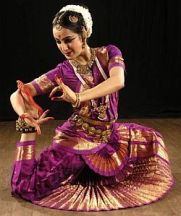
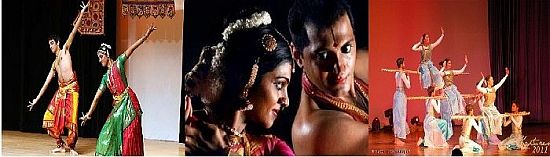
The Tantra School recognizes Vac as the embodiment of the Shakthi. It is the bridge between the physical and the formless Reality. Bhāskararāya approaches the text of the Devi Mahatmya as “the mantra whose form is a multitude of verses (ślokas), consisting of three episodes (caritas), each one describing the glory of one of the three different aspects of the Supreme Goddess – Maha-Kali, Mahālakṣhmī and Maha-Sarasvathi.

[The term Mantra is explained as mananat trayate mantrah; the contemplation of which liberates. It is the harmonious and powerful union of mind (Manas) and word (Vac). It is the living sound, transcending beyond the mental plane. , its relevance is in its inherent Shakthi. Its subtle sounds attempt to visualize the un-differentiated divine principle. Mantra is beyond intellect. Its inner essence has to be grasped in humility, earnestness and faith.

Mantra is said to connect, in a very special way, the objective and subjective aspects of reality. The Mantra, in its sublime form, is rooted in pure consciousness. The Shaiva text Shiva Sutra describes Mantras as the unity of Vac and consciousness:

Vac-chittam (ārādhakasya citta ca mantras tad dharma yogataShiva Sutra: 2.1).

It is the living sound, transcending beyond the mental plane; the indistinct or undefined speech (anirukta) having immense potential.  In its next stage, it unites harmoniously with the mind. Here, it is union of mind (Manas) and word (Vac).  That is followed by the Mantra repeated in the silence of one’s heart (tushnim). The silent form of mantra is said to be superior to the whispered (upamasu) utterance.

If an idol or a Yantra is the material (Sthula) form of the Goddess, the Mantra is her subtle form (Sukshma-rupa). And, beyond that is the Para, the contemplation, absorption into the very essence of the Devi. And, that leads to the realization (Anubhava) of the bliss (Ananda) of one’s identity with her (Pratyabhijna).

It is said; when one utters a deity’s Mantra, one is not naming the deity, but is evoking its power as a means to open oneself to it. It is said; mantra gives expression to the identity of the name (abhidana) with the object of contemplation (abhideya). Therefore, some describe mantra as a catalyst that’ allows the potential to become a reality’. It is both the means (upaya) and the end (upeya).

The reverse is said to be the process of Japa (reciting or muttering the mantra). It moves from Vaikhari through Madhyamā towards Pashyanti ‘ and , ideally, and in very  rare cases, to Para vac.

Ordinarily, Japa starts in Vaikhari form (vocal, muttering). The efficacy of the Japa does depend on the will, the dedication and the attentiveness of the person performing the Japa. After long years of constant practice, done with devotion and commitment, an extraordinary thing happens. Now, the Japa no longer depends on the will or the state of activity of the practitioner. It seeps into his consciousness; and, it goes on automatically, ceaselessly and inwardly without any effort of the person, whether he is awake or asleep. Such instinctive and continuous recitation is called Ajapa-japa. When this proceeds for a long-time, it is said; the consciousness moves upward (uccharana) and becomes one with the object of her or his devotion.

The term Ajapa-japa is also explained in another manner. A person exhales with the sound ‘Sa’; and, she/he inhales with the sound ‘Ha’. This virtually becomes Ham-sa mantra (I am He; I am Shiva). A person is said to inhale and exhale 21,600 times during a day and night. Thus, the Hamsa mantra is repeated (Japa) by everyone, each day, continuously, spontaneously without any effort, with every round of breathing in and out. And, this also is called Ajapa-japa.]

Devi

Bhāskararāya asserts that the Goddess is present in every word and every sound of the Devi Mahatmya; and, the recitations of these words can reveal her. Thus, he reveres the Devi Mahatmya as a great Mantra-maya scripture, as also an esoteric text on Yoga Shastra and Sri Vidya.

The Devi Mahatmya or Durga Saptashati is treated like a Vedic hymn, rik or a mantra.  Each of its episodes (charita) is associated with a Rishi (the sage who visualised it), a Chhandas (its meter), a presiding deity (pradhna-devata), and viniyoga (for japa). For instance; for the first episode (Prathama-charita), the Rishi is Brahma; the Devata is Mahakali; the Chhandas is Garyatri; its Shakthi is Nanda; its Bija is Raktha-dantika; and its Viniyoga is securing the grace of Sri Mahalakshmi. The first Chapter is compared to Rig-Veda.

asya śrī prathama caritrasya brahmā ṛṣi mahākālī devatā gāyatrī chanda nandā śakti raktadantikā bījam agnis tattvam । gveda svarūpam śrī mahā kālī prītyarthe prathama caritra jape  viniyoga

durga saptashathi2

Further, it is said that every sloka of the Devi-Mahatmya is a Mantra by itself.  And, the whole text is treated like one Maha mantra.

For instance; the opening sloka of the Devi Mahatmya: “Savarnih suryatanayo yo manuh Kathyate-shtamah” is ordinarily taken to mean “Listen to the story of the king who is the eighth Manu”. But, Sri Swami Krishnananda explains, it is in fact a mantra; and its Tantric interpretation is: “Now, I shall describe to you the glory of Hreem“. The Swami explains; Ha is the eighth letter from among: Ya, Ra, La, Va, Sya, Sha, Sa, and Ha. And add to that ‘Ram’ the Bija of Agni and one hook to make ‘Hreem’. Here, Hreem is the Bija-mantra of Devi; and, is equivalent to Pranava mantra Om

[It is said; the first three Slokas of Saptashati give out in code, the Navarna Mantra: o namaścaṇḍikāyai || o ai mārkaṇḍeya uvāca ॥]

Bhaskararaya concludes just as there is no difference between the cause (karana) and the effect (karya); between the object signified (Vachya) and the word which signifies (Vachaka); and between Brahman and the universe ((Brahmani jagat ithyartha, abedho iti seshaha), similarly this Vidya (Devi Mahatmya) of the Devi is identical with her.

Devi

The narration of the Devi Mahatmya is interwoven with four sublime Stutis, hymns. While the majority of the verses in the text are in the simpler Anushtup Chhandas, the Stutis are composed in more elegant Chhandas such as Gayatri, Vasantatilaka and Upajati, creating graceful, complex, supple rhythmic patterns when sung with fervour, gusto and reverence.

These four Stutis celebrate the glory and splendour of the auspicious Devi in all her aspects. These sweet, powerful and uplifting hymns are not only devotional and poetic, but are also philosophical and sublime. Bhaskararaya Makhin regards these hymns as Sruti-s (revealed wisdom), the exalted revealed (Drsta) knowledge, equalling the Vedas (apaurueya), rather than as constructed, the Krta by humans.

Bhaskararaya, in his Guptavati, offers comments on 224 out of the 579 verses of the Devi Mahatmya.  The most commented Chapters of the Devi Mahatmya are:  5, 4, 12, 11 and 1, in that order.  These are the Chapters that contain the four celebrated hymns and also the instructions for reciting the Devi Mahatmya.

The four hymns are: 

(1) Brahma-stuti (DM. 1.73-87) starting with tva svāhā tva svadhā tva hi vaakāra svarātmikā;

(2) the Sakaradi-stuti (DM.4.2-27) starting with śakrādaya suragaā nihate’tivīrye; 

(3) the Aparajita-stuti (DM.5.9-82) starting with namo devyai mahādevyai śivāyai satata nama ; and,

(4) the Narayani-stuti (DM.11. 3-35) starting with Devi prapannārtihare prasīda. 

[The Brahma-stuti (DM.1.73-87) also known as the Tantrika Ratri Suktam, establishes the Divine Mother’s ultimate transcendence and her identity as the creator and sustainer and the dissolver of the Universe. She is the all compassing source of the good and the evil, alike; both radiant splendour and terrifying darkness. And yet, she ultimately is the ineffable bliss beyond all duality.

In the longest and most eloquent of the Devi Mahatmya’s four hymns, richly detailed Sakaradi-stuti (DM.4.3-27) Indra and other gods praise Durga’s supremacy and transcendence. Her purpose is to preserve the moral order, and to that end she appears as ‘good fortune in the dwelling of the virtuous; and, misfortune in the house of the wicked’, granting abundant blessings and subduing misconduct (DM.4.5). ‘Every intent on benevolence towards all’ (sarvo-upakāra-karaāya sadārdracittā DM.4.17), she reveals even her vast destructive power as ultimately compassionate, for in slaying those enemies of the world who ‘may have committed enough evil to keep them long in torment’ (kurvantu nāma narakāya cirāya pāpam – DM.4.18) , she redeems them with the purifying touch of her weapons so that they ‘may attain the higher worlds’ (lokānprayāntu ripavo’pi hi śastrapūtā/ ittha matirbhavati tevahiteu sādhvī –DM.4.19).

The Devas, distressed that the Asuras have re-grouped and once again overturned the world-order, invoke the Devi in a magnificent hymn, the Aparajita-stuti or Tantrika Devi Suktam, the twenty slokas beginning with ‘ya devi sarva bhuteshu , praise to the invincible Goddess , which celebrates her immanent presence in the Universe as the consciousness that manifests in all beings (yā devī sarvabhūteu cetanetya abhidhīyate) . In these forceful 24 stanzas ( 19 to 42 of the Fifth Adhyaya ), the Devi is described as present in all forms of life , sensations and matter as :  Maya, Consciousness, Intelligence, Sleep, Hunger, Shadow, Power, Thirst, Patience; Birth, Modesty, Peace, Charm, Fortune, Firmness, Activity, Memory, Compassion, Memory, Satisfaction, Mother, Error, Inheritance, Thinking . Thereupon the Devi appears on the banks of the Ganga. Her radiant manifestation emerging from the body of Parvathi embodies the Guna of Sattva, the pure energy of light and peace. Later, She takes on multiple and varied forms in the course of the battle with the Asuras.

The final hymn, the Narayani-stuti (DM.11.3-35) lauds the Devi in her universal, omnipresent aspect and also in the diverse expressions of her powers .Thereupon, the Devi assures to protect all existence and to intervene whenever evil arises.]

Durga Devi

These hymns describe the nature and character of the Goddess in spiritual terms:

Bhāskararāya identifies Chaṇḍikā-Mahālakṣhmī with the hymn of the fifth chapter Aparajita-stuti; and, her three forms (Mahākālī, Mahālakṣhmī, and Mahāsarasvatī ) with one of the other three hymns each.

Chandikasrimahalakshm

In his introduction to the Guptavati, Bhāskararāya emphasises the role of mantras that produce power when properly employed. Therefore, he focuses, particularly, on the Navarna mantra, apart from the Devi Mahatmya, which itself is regarded as a Maha Mantra.

The Navarna Mantra or Navakshari mantra, also known as Chamunda Mantra or Chandi Mantra is the basic mantra of the Sri Durga Saptashati recitation. It is also one of the principal (mula) mantras in Shakthi worship, apart from the Shodasi mantra of the Sri Vidya. There is the faith that one who practices the Navakshari mantra with great devotion will attain liberation and the state of highest bliss -(Vicche Navārnak’ornah syān-mahad’ānanda-dāyakah)

According to the Navakshari mantra nivechanam (p24) : Its Rishi is Markandeya;  Its Chhandas is Jagati; Durga, Lakshmi and Sarasvathi are its Devathas; Hram is its Bija ; Hrim is its Shakthi; Hrum is its Kilaka; and, securing the grace (prasada siddhi) of Durga, Lakshmi and Sarasvathi is its Viniyoga.

Asya Sri Navakshari Maha-mantrasya / Markandeya Rishihi / Jagati Chhandah / Durga Lakshmi Sarasvathi Devata  //  Hram Beejam / Hrim Shakthihi / Hrum Kilakam  //  Durga Lakshmi Sarasvathi Prasada Sidhyarthe  Jape Viniyogaha //

And, Navarna or Navakshari mantra is chanted as an integral part (Anga) of Chandiparayanam, which is performed while reciting (Purashcharana) the Devi Mahatmya. There is also a practice of the reciting of Durga Saptashati as a part of Navarna Purashcharana. Thus, the Saptashati and the Navarna are mutually related (angangi nyaya).

sriyantra220006

In the Sri Vidya tradition, the Panchadasi (Pancha-dasakshari) and the Shodasi are the cardinal and exclusive (rahasya) Mantras. The Panchadasi mantra of very potent fifteen letters or syllables (Bijakshara) composed of three segments (kūa) is indeed the very heart of the Sri Vidya Upasana.

Its three as are:

  • Vāgbhava kū of five bīja-s (ka – e – ī – la- hrī,   ह्रीं);
  • Madhya or kamaraja kūa  of six bīja-s (ha – sa – ka – ha – la – hrī,   ह्रीं ) ; and,
  • the śhakti kūa  of four bīja-s  (sa – ka – la – hrī ह्रीं ).

The mantra is composed of a series of individual Bija-akshara (syllables), each having its own identify and association; and, each representing a certain aspect of the Goddess. But, when these Bija-aksharas are taken together, they manifest the subtle form (Sukshmarupa) of the Mother Goddess.

This fifteen lettered Pancha-dasakshari mantra is revered as the verbal form of the Mother Goddess. By adding   to it the secret syllable ś (श्रीं) it is transformed into the sixteen lettered Shodasi mantra. The Bijakshara śrī (श्रीं) is regarded as the original form of the Mother Goddess Sri.

The mantra which till then was dormant becomes explicit by adding śrī (श्रीं); and, the knowledge of her is celebrated as Sri Vidya. It is with this Vidya of Shodasi mantra that the Mother Goddess is worshiped through the Sri Chakra. It is said; this mantra is known as Ṣhoaśī or Shodasa-kala-vidya, because each of its sixteen Bījas represents a phase (kalā) of the moon. It is also said; the verbal expression of her Vidya is the Shodasi mantra; and, its visual expression is the Sri Yantra (Sri Chakra). And, the two are essentially the same.

The Navarna (also known as Navakshari and Chandi Gayatri) mantra of nine syllables is closely related to the extended Maha-shodasi mantra of twenty eight bīja-s of Sri Lalitha tradition. Both are Navarna; as they are worshiped in nine levels (Navaavarana), where the Devi is worshipped in her nine forms. It is described as a mantra that grants the highest bliss – mahad-ananda dayakah.

[The Mahāṣoḍaśī mantra is actually not sixteen; but , it is a set of six kutas ( sections) :(1)  srim, hrim, klim , aim sauh  ; (2) aum hrim srim ; (3) ka e i la hrim ; (4) ha sa ka ha la hrim ; (5) sa ka la hrim ; and, (6) sauh aim klim hrim srim . Thus Mahāṣoḍaśī has twenty eight bīja-s.]

deviHome

While Sri is the presiding deity of the Sri Vidya; Chandi is the Goddess of the Chandi Vidya. There is also a view which asserts that the Chandi Vidya is the older tradition and, the Sri Vidya is its refined form.  In some places (for instance, in Kanchi), both Chandi Navarna and Sri Vidya worship procedures are followed.

Bhāskararāya, a dedicated Sri Vidya Upasaka, in his Guptavati equates Chandi with the Supreme Goddess Devi who indeed is the Brahman, the Supreme non-dual reality. He regards the Chandi Vidya as the Navarna Vidya, which corresponds to the Vidya of Sri Lalitha.

navarna mantra

The Navārna-mantra (Śrī Chaṇḍi Navākṣharī Mantra) is composed of the following syllables:   Om aiṁ hrīṁ klīṁ cāmuṇḍāyai vicce  ऐं ह्रीं क्लीं चामुण्डायै विच्चे ॥ 

The syllables of the Navārna mantra are taken from the first line of the Mahāṣoḍaśī mantra —   śrī – hrī – klī – ai – sau ( श्रीं ह्रीं क्लीं ऐं सौः)

The Shakthas have an immense faith that Navarna mantra has the power to bestow liberation (Mukti).

Bhaskararaya mentions that this mantra has been explained in one of the Shaktha Upanishads the Devī-Atharva-Śira-Upaniṣhad  (Devi Upanishad) from which he quotes the first verse “I am of the very same form (Svarupini) of the Brahman’. I am an aspect of Brahma. From me this Universe, in form of Prakriti and Purusha, is generated; which is both void and non-void.

sābravīt- aha brahmasvarūpiī  matta praktipuruātmaka jagat  śūnya cāśūnyam ca

I am both bliss and non-bliss. I am knowledge and non-knowledge. I am Brahma and non-Brahma (the non-manifest state called A-Brahma). I am the five primordial principles and non-principles. I am the whole perceived Universe.

aham ānandā qnānandau  aha vijñānāvijñāne  aha brahmā brahmaī veditavye  aha pañcabhūtānyapañcabhūtāni  ahamakhila jagat 3

The Devi Upanishad or Devi Atharvashirsha Upanishad explains the Navarna mantra Om ai hrī klī cāmuṇḍāyai vicce:

  • 1. Om – the Pranava Mantra represents the Nirguna Brahman
  • 2. Aim – is the Vakbija the seed sound of Mahasarasvathi—the knowledge that is consciousness. – Chit;
  • 3. Hreem –the Maya Bija the sound of Mahalakshmi – the all pervasive existence. —Sat;
  • 4. Kleem – is the Kamabeeja the seed sound of Mahakali – the all consuming delight – Ananda;
  • 5. Chamunda – the slayer of the demons Chanda and Munda, representing passion and anger ;
  • 6. Yai– the one who grants boons;
  • 7. Vicce– in the body of knowledge, in the perception of consciousness.

The Chit, Sat and Ananda are involved in the creation in physical, vital, and mental aspects – as Anna, Prana and Manas. They all are integrated into Chamunda Devi.

[The meaning of the Navarna mantra is said to be : ‘O the Supreme Spirit Mahasarasvathi, O the purest and most propitious Mahalakshmi, O embodiment of joy Mahakali, to achieve the highest state of knowledge we constantly meditate upon You. O Goddess Chandika who embodies the three formed Mahasarasvathi-Mahalakshmi-Mahakali, obeisance to you! Please break open the tightened knot of ignorance and liberate us’]

māyā brahmasūstasmāt aṣṭha vaktrasamanvitam / suryo ̕vāma śrotra bindu sayukta ṣṭātttīyaka । nārāyaena samiśro vāyuścādharayuk tataḥ / vicce  navārako ̕ra syānmahadānandadāyaka 20

kunjika

The Siddha Kunjika Stotra is a well known Tanric stotra, which occurs in the Gauri Tantra (section) of Rudra-yamala Tantra. It is in the traditional format of a Samvada, a discourse that takes place between an enlightened Guru and an ardent disciple- śrīrudrayāmale gaurī-tantre śiva-pārvatī-savāde kuñjikā-stotra.

The Kunjika Stotra, per se, is short, running into just eight verses. And, it is submitted to the most glorious Devi Chamunda, in all her varied forms.

Here, Lord Shiva, the Adi Guru, imparts instructions to his consort Parvathi; and, extols the virtues of the Kunjika Stotra.

Shiva Parvathi

Shiva mentions that the mere chanting of the most sublime (uttamam) and exclusive (ati guhyatara) Kunjika Stotra, confers on the devotee the benefits that would accrue by the recital of the Durga Paatha (Durga Sapta Shathi) – kuñjikā-pāha-mātrea durgā-pāha-phala labheth.

Right at the at the outset, Shiva clarifies that the Kunjika Stotra is simple, direct and very effective. Its recital need not be prefaced with the usual citing, such as the Kavacha, Argala, Keelaka, Rahasyaka, Sukta, Dhya, Nyasa etc.

na kavaca nārgalāstotra kīlaka na rahasyakam na sūkta nāpi dhyāna ca na nyāso na ca vārcanam 2

And yet, it is powerful; it protects the devotee (hamātrea sasiddhyet); and, drives away all sorts of evil or negative influences that might hinder the devotee’s progress.

It is also said; the Kunjika Stotra encapsulates the essence of the Chandi paatha; as also that of the Navarna Mantra. In fact, the mantra segment of the Kunjika Stotra commences with the chanting of the Navarna Mantra: Om̃ ai hrī klī cāmuṇḍāyai viccey.

Therefore, the Kunjika Stotra is chanted both at the commencement of the recital of the Durga Saptashati (प्रथम चरित्र); as also towards its conclusion.

It is said; the term Kunjika suggests the meaning of the Key that unlocks the powers of the Chandi Paatha. The prefix ‘Siddha’ implies that the stotra leads to the attainment of the  ideal state.

It is also said; Kunjika, here, is in form of the Devi Chamunda, the Supreme Goddess; and, there is nothing beyond Her (Anuttara).

While invoking the Devi Chamunda, the Kunjika Stotra also explains the meaning  of the syllables (Bija mantras) in the Navarna MantraOm̃ ai hrī klī cāmuṇḍāyai viccey.

Accordingly, the Bija mantra Aim stands for the  power and the creative aspect of the Devi (aikārī sṛṣṭirūpāyai); the Bija Hrim is the form of the Devi , who protects and sustains all this existence (hrīkārī pratipālikā); the Bija Klim, symbolizes  her all pervasive existence embodying and energizing every being and every aspect of the universe (klīkārī kāmarūpiyai bījarūpe); Chamunda is the mighty Devi who destroys the evil forces; and , confers grace and blessings on all (cāmuṇḍā caṇḍaghātī ca yaikārī varadāyinī); and, Vicchey is the merciful aspect of the Devi Chamunda who liberates from darkness and delusions.

aikārī sṛṣṭirūpāyai hrīkārī pratipālikā klīkārī kāmarūpiyai bījarūpe namo’stu te 8 cāmuṇḍā caṇḍaghātī ca yaikārī varadāyinī vicce cābhayadā nitya namaste mantrarūpii 9

*

[According to the learned Animesh Nagar , there are different versions of the Kunjika Tantra; depending upon the Sampradaya (tradition) and/ or Guru-parampara (master-pupil lineage) that is followed.

The known versions of the Kunjika Stotra are said to be: Gauri-tantrokta; Damara – tantrokta; Kali- tantrokta: Bagla-tantrokta; and , the Siddha- SarasvatI – tantrokta .

For instance; it is said, the Kali-tantrokta version is highly tantric ; and, is embedded (garbhasta) with Matrika mantras. And, the Damara version focuses on the Siddhi aspect; and, aims to unlock the secrets of the Durga Saptashati.  

yantra_0

Bhaskararaya explains: Even Brahma and the other Devas do not know Her real form; and, therefore, she is called Ajñeya. We do not find its limit, so she is called Ananta. We cannot find the meaning, so she is called Alakshya. Her birth is not known, so she is called Aja. She is found everywhere, so she is called Eka, the One. She has taken up all the various forms, so she is called Naika. Because of this she is called these various names.

yasyā svarūpa brahmādayo na jānanti tasmāducyate ajñeyā 

yasyā anto na labhyate tasmāducyate anantā  yasyā lakya nopalakyate tasmāducyate alakyā 

yasyā janana nopalabhyate tasmāducyate ajā  ekaiva sarvatra vartate tasmāducyate ekā 

ekaiva viśvarūpiī tasmāducyate naikā  ata evocyate ajñeyānantālakyājaikā naiketi 23

srichakra0001

 As regards the Mantra aspect of the text, Bhaskararaya, following the Sri Vidya tradition, regards the Navarna mantra as the subtle form (sukshmarupa) of the Goddess.   For Bhaskararaya, the Bijaksharas of the mantra are the more accessible forms of the Goddess’s ultimate form as Brahman.

Bhaskararaya analyses the Navarna-mantra, dedicated to the Great Goddess Chamunda, syllable-by-syllable, beginning with Chamundayai. He explains that the power of the mantra is particularly associated with the recitation of the name Chamunda.
In his introduction to the Guptavati, Bhaskararaya explains the etymology of the name Chamunda. Here, he differs from the explanation provided in chapter seven of the Devi Mahatmya.

According to the text of the Devi Mahatmya, Kali is celebrated as Chamunda after she overpowers and beheads Chanda and Munda.

śiraścaṇḍasya kālī ca ghītvā muṇḍameva ca prāha pracaṇḍā aṭṭahāsa miśra mabhyetya caṇḍikām 7.23॥

The Devi, then, declares that since Kali presented her with the heads of these two demons, she would henceforth be renowned in the world as Chamunda – cāmuṇḍeti tato loke khyātā Devī bhaviyasi .Thereafter in the text, Kali and Chamunda become synonyms.

Yasmāc-Caṇḍa ca Muṇḍa ca ghītvā tvamupāgatā  Cāmuṇḍeti tato loke khyātā Devī bhaviyasi  7.27

Devi Chamunda sepia

Bhaskararaya Makhin, however, interprets the term Chamunda, differently, as: ‘chamum, ‘army’ and lati, ‘eats’; meaning that Chamunda is literally ‘she who eats armies’—a reference to Kali as Chamunda who drinks the blood of the army of the demon Raktabija.

jaghāna raktabīja ta cāmuṇḍā apītaśoitam sa papāta mahīpṛṣṭhe śastra saghasam āhata 8.61

He then proceeds in his comments on the mantra by elaborating on the first three syllables (Bijakshara): Aim, Hrim, and Klim, by resolving the complex expressions into simpler or more basic ones: marked by analytical reasoning. He brings into the discussion the concepts and the symbolisms of the Sri Vidya traditions.

Here, he explains; the Mahadevi Chamunda, in her integrated form (Samasti) is of the nature of the Brahman- Brahma-svarupini. And, the three Bijaksharas in the Navarna-mantra symbolize the diversified (Vyasti) form of the Devi:  as Aim (ऐं) for Mahalakshmi; and, Hrim (ह्रीं) and Kilm (क्लीं) for Mahasarasvathi and Mahakali, respectively. And again, the essential nature of the Devi as Sat-Chit-Ananda (being, consciousness, and bliss) is associated with each of her forms: Mahalakshmi (Sat); Mahasarasvathi (Chit); and Mahakali (Ananda).

Again, it is said, these three goddesses are the presiding deities of the three Episodes of the Devi Mahatmya, while the text itself is the body of the Devi Chamunda, the Mahadevi. Thus, the divisions and the Chapters of the Devi Mahatmya are but visible (Sakara) the constituents (anga) of the Devi Chamunda, who herself is beyond attributes (Brahma-svarupini).

Thus, Bhaskararaya relates the Vyasti goddess, their corresponding Bijamantras, their symbolisms and sounds, to the most subtle, secretive aspect of the Supreme Goddess. As regards the Vyasti goddess, he follows the explanations given in the Devi Upanishad. But, as said earlier, he differs on its explanation of the term Chamunda.

Here, the Mahadevi Chamunda, in her integrated form (Samasti) is of the nature of the Brahman- Brahma-svarupini. She combines in herself her other diversified (Vyasti) forms of Mahalakshmi (Aim); Mahasarasvathi (Hrim); and, Mahakali (Kilm). 

Devi sri chakra

Bhaskararaya, however, offers a rather lengthy explanation on the final term of the Navarna mantra:’ vicce’.

He points out that the term vicce , at first instance, might look as though it is untranslatable. But, one would appreciate its significance when its etymology is correctly understood.

Bhaskararaya begins his explanation of vicce, by equating it with the Sanskrit word ‘manch’—meaning ‘to grow’ or ‘to move’. He remarks; though the term vicce is rather unusual, yet it has been in use in the Shakta tantric tradition. For instance, he says, the mantra of Bhagamalini, the second of the sixteen Nityas, reads ‘Amogham chaiva vichcham cha tatheshim klinna devatam’. The import of the mantra is said to be:  the goddess symbolized by the Bija-akshara Klim is resplendent and unfailingly liberates (vichcham) the devotee.

[In the Sri Vidya tradition, the sixteen guardian deities, named as Nityas, who form the entourage, of the Devi, are identified with the phases of the moon (Chandra-kalaa); and each Nitya corresponds to a day (tithi) or the aspect of the moon during the fortnight. The sixteen Nityas are: Kameshvari, Bhagamalini, Nityaklinna, Bherunda, Vahnivasini, Mahavajeshvari, Dooti, Tvarita, Kulasundari, Nitya, Nilapataka, Vijaya, Sarvamangala, Jwalamalinika and Chitra]

Nityas of Sri Vidya

Regarding the etymology of the term vicce, Bhaskararaya explains that it originated within the Dravidian language group; and, was later adopted into the Sanskrit vocabulary. He also mentions that importing terms from other languages (bhasha-mishrana) is not unusual; and, has been in practice since the ancient times.  He explains that many of the terms that are used in   Navarna and Bhagamalini mantras are well recognised in Southern languages like Kannada (karnatabhasha), Tamil (Dravidabhasha) and Telugu (Andhrabhasha).

The scholars surmise that Bhaskararaya might have related the term vicce with the Tamil word vichchu/i or vittu/i, meaning ‘to sow’ or ‘to spread’, which has the same connotation as his Sanskrit gloss manch, meaning ‘to grow’ or ‘to move’. They cite another obscure word ‘Puruchi’, which occurs only two times in the Rig-Veda   .  The term Puruchi’, here, suggests the meaning of ‘Foremost or abundant‘, which carries a similar meaning in the Tamil language.

 [śata jīvantu śarada purūcīr antar mtyu dadhatām parvatena || RV_10,018.04c|| and aśvinā pari vām ia purūcīr īyur gīrbhir yatamānā amdhrā | RV_3,058.08a||]

Bhaskararaya, then concludes that in the context of the Navarna mantra, vicce signifies ‘liberation’; and, could be taken as a synonym for the Sanskrit term mochayati – ‘to cause to be liberated’. And, when the term vicce, in the Navarna mantra, is combined with Goddess Chamunda (Chamunda-visheshanam), it gives forth the meaning that Chamunda is, indeed, the resplendent Goddess who ‘causes her devotee to be liberated.

He says that through the Navarna Mantra we invoke the Supreme Goddess and her varied powers; and, pray to her to come into our lives to fulfil our material and spiritual desires with ease (Sri Sundari sevana tatparanam / Bhogascha mokshascha karastaeva).

Thus, for Bhaskararaya, the Navarna is not only a powerful mantra that protects the devotee; but, is also a means to attain liberation (moksha-sadhana).

durga saptashathi3

 The learned scholar Caleb Simmons, in his article, observes:

Bhaskararaya, in the Guptavati, provides a remarkable explanation of the mantra, ritual value of sounds and syllables, and etymology that elucidates our understanding of the relationship between mantra and meaning in which the secret and semantic are coterminous

According to Bhaskararaya, to understand meaning in mantra we must expand our understanding of ‘meaning’ as a category to include not only normative, semantic, and discursive meaning, but to include the hidden meaning of a mantra that contains a truth only perceivable through the direct insight of the initiated practitioner….

Through his introduction to the Guptavati, Bhaskararaya incorporates the Sri Vidya perspective of corresponding realities into a theory of meaning and mantra in which discursive (rational) meaning and the hidden meaning are simultaneously individual but ultimately the same.

Devi Durga 2

Salutation to you, O Devi Nārāyaī, who abides as intelligence in the hearts of all beings; and, who grants happiness and liberation, with what words, however excellent, can I praise you?

sarvasya buddhi rūpea janasya hdi sasthite svargāpavargade devi nārāyai namo’stu te 11.8

sarvabhūtā yadā devī bhuktimukti pradāyinī । tvaṃ stutā stutaye kā vā bhavantu paramoktayaḥ ॥ 11.7॥

Please listen to the Mantra – Om Hrim Parashakthai Namaha -chanted by Smt. Padma

the_devi_is_venerated

lotus twin

Sources and References

http://www.advaitaashrama.org/Content/pb/2016/012016.pdf

http://shodhganga.inflibnet.ac.in/bitstream/10603/69521/13/13_chapter%205.pdf

http://yigalbronner.huji.ac.il/wp-content/uploads/2013/07/South-Meets-North.pdf

http://www.vedicastrologer.org/mantras/chandi/chandi_inner_meaning.pdf

https://www.kamakotimandali.com/srividya/bhaskara.html

http://studerende.au.dk/fileadmin/_migrated/content_uploads/Fri_Opgave.pdf

http://navratri.sahajayogaonline.com/images/devi-atharvashirsha.pdf

http://www.aghori.it/devi_atharvashirsha_eng.htm

http://www.kamakotimandali.com/blog/index.php?s=guptavati&advm=&advy=&cat=

http://www.aghori.it/devi_atharvashirsha_eng.htm

https://archive.org/details/DurgaSaptashati_20180206/page/n185

Varivasya -rahasya

The secret of the three cities by Douglas R Brooks

ALL PICTURES ARE FROM INTERNET 

 
34 Comments

Posted by on March 1, 2018 in Devi, Guptavati, Tantra


Tags: , , , , , , , , , , , , , , , , , , , , , , , , , , , , , ,

The Guptavati and Navarna Mantra – Part One

Chamundi

The Devi Mahatmya dated somewhere around the fourth- fifth century , also  renowned as Durga SaptasatiDurgapāhaChandi, Chandipāha and Chandi Saptashati,  composed as a long poem of about  seven hundred verses (Saptashathi) , is the  most revered scripture of the Shaktha tradition.

Devi Mahatmya celebrates the glory and splendour of the auspicious Supreme Goddess – the Maha Devi. Chaṇḍī or Chaṇḍīka, the name by which the Supreme Goddess is referred to in Devi Mahatmya.

The text commences with salutation to Chandi:

oṃ namaścaṇḍikāyai;

Om̃ jaya tvaṃ devi Cāmuṇḍe

jaya bhūtāpa hāriṇi

[In the Devi Mahatmya, the names: Chandi, Chandika, Ambika and Durga are synonymous].

[ Amarakosa , the Sanskrit lexicon gives as many as twenty-three synonyms for the Devi: (1.1.88)  umā, kātyāyanī, gaurī , kālī , haimavatīśvarī ; (1.1.89) śivā , bhavānī, rudrāṇī , śarvāṇī,  sarvamaṅgalā; (1.1.90) aparṇā,  pārvatī,  durgā , mṛḍānī,  caṇḍikā, ambikā (1.1.91) āryā, dākṣāyaṇī,  caiva girijā , menakātmajā , (1.1.92) karmamoṭī , tu cāmuṇḍā , carmamuṇḍā , tu carcikā.]

[In the Markandeya Purana , the Devi is addressed by as many as 196 names and epithets. For a detailed list , with references, please check here.]

Devi Mahatmya2

The text adulates Maha Devi as the greatest warrior; and rejoices Devi as Chandi the destroyer of evil and its tendencies. She is the protector of the world (Jagat-dhatri); and, she does so from time to time by assuming various forms.

She is also Ambika the mother who shelters and nurtures; and, also Durga the goddess  (Bhagavathi) who saves us from all sorts of miseries and difficulties (Duritha-nivarini).

And, it is She who, just as a boat, ferries the devotees across oceans of existence (Bhava-Tarini).

She is the merciful Mother (Daya, Dhatri) who  graciously (Soumya) blesses us all (Varada) with  happiness here; and, liberates from earthly coils (Bhukthi-Mukthi-Pradayani).

Her matchless splendor (Aparajita) and beauty (Soundarya) is sung and exalted by countless other names and forms.

A mother has three main functions: to give birth; to nourish; and, to love, to care and to protect. It is the third aspect that is highlighted in the Chandi, the Supreme Mother Goddess – the protector of the world (Jagat-dhatri). 

She protects those who trust in her , from all the three classes of miseries – Adhyatmika, Adhibhautika, and Adhidaivika 

[ [1) those miseries which arise from the mind and body;

(2) those miseries inflicted by other living beings; and,

(3) those miseries arising from natural catastrophes over which one has no control.]

Apart from being the most compassionate Mother-principle (Matru-rupa), she is also the immense power that destroys evil. Chandi delivers a message of hope; the assurances of divine help and succor (Sarvarta-sadhika) . Chandi is the auspicious Mother (Bhadra, Amba) who protects us from all dangers; gives us the inner strength to face them with courage and hope.

The Devi Chandi is called out  with immense reverence and boundless love, addressing her  with any number of names, as:

    • the very embodiment of the Universe (Vishva-rupa,Sarva-svarupa, Sarvatmika);
    • the supreme ruler of the Universe (Vishveshvari, Parameshvari);
    • the power that causes (sarva-karini, Samsara-sthiti-karini) and sustains the Universe (Vishvashraya, Jagatprathistya) ;
    • the highest knowledge (Maha-Vidya, Parama-Vidya);
    • supreme intellect (Maha Medha);
    • the great delusion (Maha Maya);
    • the Supreme Goddess (Maha Devi); and
    • the Mother of  all (Janani, Jaganmata, Jagan-mayi, Jagat-dhatri, Vishva-Janani )).

All the gods (Devas) worship the Devi praying her to sustain (Pusti) and protect all this existence (Rakshanaya ca lokanam Devanam upakarini).

The Goddess is celebrated in various manners (lalapanti) as: joyous (madantika); proud (manini); auspicious (mangala, Sarva-mangala-mangalya); and; prosperous (shubhaga). And, she is beautiful (sundari) and pure (shuddhamata); as also modest (lajja), intelligent (matistu), satisfied – being complete in herself (tripta); and She is thriving (pusta), wealthy (lakshmirupa) as also  extremely lovely (lalitha)

Madantika manini mangala ca shibhaga ca sa sundari shuddhamati / lajja matistu-stirists ca pusta lakshmi rupa lalitha lalapanti //

Lalitha 3

The Shaktha tradition reveres the Divine Mother as the Universal Creative Power, the All Pervading source of change within and identical to the changeless reality, Brahman. The Devi Mahatmya is the celebration of the limitless powers and the splendour of the Mother Goddess. It affirms its faith that   the ultimate power and authority in the Universe reside in Devi. She encompasses and overrides everything in the Universe. She is the ultimate reality. The Devi Mahatmya asserts its faith that her Ultimate reality is really the ultimate; and it is not merely feminine.

hm63

Over the centuries, innumerable commentaries have been written on the Devi Mahatmya. Of these, the two are highly recognized; and, are very often quoted.

One;  The Nageshi  , is written by Nāgeśa Bhaṭṭa / Nāgoji Bhaṭṭa / Nāgoji Dīkita (1678-1755?) , a erudite scholar, grammarian and philosopher who is said to have  lived at a place , then  called as  Śṛṅgaverapura , in the upper region of the Ganga, near Vārāasī. He is described as the grandson of the famous Grammarian, Bhaṭṭoji Dīkita (late 16th–17th century), author of the Siddhānta-Kaumudīa celebrated commentary on the Ashtadhyayi of Panini.  His text re-arranges the Sūtras of Pāini under appropriate heads; and, renders it easier to follow. The work was later edited in three (madhya, laghu and Sara) abridged versions (Laghu-kaumudi) by his student Varadarāja, reducing the number of rules to 723 (from 3,959 of Pāini).

Sri+Bhasurananda+Natha

The other is the Guptavati (implying the hidden knowledge or path), an authoritative commentary on the Devi Mahatmya, by Bhāskararāya Makhin (1690–1785-?)/ Bhāskararāja-dīkṣita/ Bhāskarānandanātha/ Bhasurananda(भासुरानन्द) Natha. He was the son of Konnamamba and Gambhīrarāya Bhāratī of Vishvamitra gotra, an encyclopedic author (of about 52 works on a wide range of subjects); well versed in Vedic and Tantric traditions; the celebrated authority on the philosophy and practice of Tantra; and, especially on the Sri Vidya Upasana.  His writing is marked by refreshing directness and precision. Though his dates are rather uncertain, it is generally assumed that his writing-career lasted from the beginning of the 18th century, till about 1768.

durga saptashathi of bhaskararaya

The two scholars – Nāgoji Bhaṭṭa and Bhāskararāya – might perhaps have been contemporaries, sharing, for the most of their life, the same time-span. While Nāgoji Bhaṭṭa lived in the region of the Ganga on the North; Bhāskararāya, later in his life, settled down on the banks of the Cauvery in the South.

But, it appears that Bhaskararaya had his Upanayana in Varanasi. And, he also had his early education in Varanasi under the scholars Narasimha-dhvarin and and Śivadatta. There is also a mention of Bhaskararaya having participated in a debate conducted at Varanasi; and, also of having performed there the Soma Yajna and such other Yajnas. Further, a  copy of the manuscript of Avaidika-adarśana-sagraha, a compendium ascribed to the great scholar Gaṅgādhara Vājapeyin, (said to be Bhaskararaya’s teacher ?) preserved in the Sarasvati Mahal Library at Tanjore, is said to have been prepared by Bhāskararāya. The copied manuscript mentions , at the end, that it was written down by Bhaskararaya ,  a resident of Varanasi (likhitam etat kāśī –vāsi-Bhāskararāyea).

Further, by about the closing decades of the sixteenth century, Varanasi had developed into a powerful intellectual centre, drawing into its bosom erudite scholars, jurists, Grammarians etc., learned in various disciplines; and, also those who produced voluminous innovative texts of authority (niraya).

Kashi, the city of lights, was the home of the Mother Annapurna, who sheltered and nurtured (annadātryā) aspiring, ardent students who came to her from every part of the subcontinent, right from its southern tip at Rama-sethu to the snowy slopes of the Himalayas-(āsetubandhataam ā ca tuāraśailād), seeking knowledge and freedom from delusion (Jnana-vairagya siddhartham).

It is, therefore, likely that in such an invigorating academic environment, where many scholars lived, thrived (āvasad asau vārāasīm ddhimān) and debated, the two intellectuals – Nāgoji Bhaṭṭa and Bhāskararāya – had met and interacted.

The Guptavati is said to have been completed by Bhaskararaya, in Pramoda-nama Saka Samvatsara 1797 (that is, about 1740-41 CE) , during the latter part of his life, while he was at Chidambaram. Further, Bhaskararaya has quoted in his Guptavati and Manjusha a work relating to Grammar, at least on two occasions, extracts from Nāgoji Bhaṭṭa’s commentary on the Devi Mahatmya. It would therefore, appear that Nāgoji Bhaṭṭa’s commentary was composed much earlier. And, it is also likely that Bhaskararaya might have been, slightly, the younger of the two.

Nāgoji Bhaṭṭa and Bhāskararāya were both Advaitins by tradition; and, were followers of Sri Shankaracharya Parampara, the non-dualist Advaita philosophy. And, both had enormous reverence towards the Jagadguru Sri Adi Sankaracharya.

tripurasundariBhāskararāya was a firm believer in the doctrine of Advaita (Advaita siddantha); and, was also proficient in all branches of learning. But, his religious philosophy was based in the Ratna-traya-prakshika of Sri Appayya Dikshita (1520–1593), which upheld the Shiva-Shakthi combine as the Absolute. Bhāskararāya, however, was essentially a Shakta following the Kaula-sampradaya. And yet, he frequently quoted from the works of Sri Sankara; and, revered him as the very incarnation of Sri Dakshinamurti, the Universal Teacher.

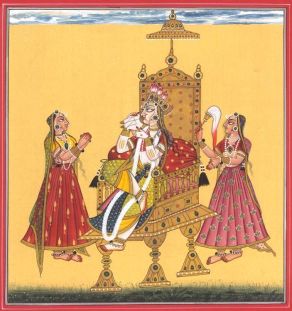
Though Nāgoji Bhaṭṭa and Bhāskararāya were both Advaitins, they differed in their orientation towards the Advaita doctrine. Nāgoji Bhaṭṭa, in his commentary on the Devi Mahatmya, adopted the Vivarta Vada of the Advaita School, in order to explain the emanation of the Devi and her varied forms. And, Bhāskararāya adopted the alternate view, that of the Parinama Vada (particularly, Shakthi Parinama Vada) , to explain the myriad forms of the Devi and Her manifestation in all the existence. It is said; their commentaries on the Devi Mahatmya are recognized by these two distinct approaches.

jupiterfig5

[The relation between the cause and effect is one of the basic problems discussed among the Indian thinkers.  And, in fact, the divisions among the Indian theories of causation are based on this factor.

To put it simply: There are two major theories of causation in the Indian philosophies. The one known as the A-satkarya-vada propounds that the effect exists independent of its cause. And, when something new occurs, it is distinctly different. It is a view held by the Buddhists and the Nyaya-Vaisesika School.

*

Against this position, the Satkarya-vada asserts that the effects pre-exist in their cause. The effect is nothing but the extension of the cause itself, albeit seen in different form and mode. An effect must be of the same nature as the cause; they have the same basis. A cloth may only be made out of yarn (not out of milk); and, curds may be made out of milk (rather than out of yarn), etc.

There are no effects without causes. Everything in nature has a cause of its own, This is the view held by the Schools of Advaita and Samkhya.

[ The Nyaya, while objecting to the theory of Satkaryavada , argued:  if cause and effect are taken to be not different from each other, will it not then create  self contradictory situation. Let’s say when a cloth is torn and reduced to threads, will you still keep calling it a cloth? Will those shreds serve the same purpose as the cloth? And, do you still maintain that the cloth and the torn threads are identical?  Well then, according to your theory, if the cloth and the threads would mean that the same object, will it not amount to saying that the object is produced and destroyed, at the same time. Is it not absurd?

The Nyaya pointed out that one has to go by the utility or the usefulness of the object. In which case, the cause would be different from the effect. You have just seen that the cloth (effect) serves a useful purpose for a man; whereas, the threads cannot fulfil that purpose. This proves that cause and effect are two distinct entities.

Vachaspathi Misra, who argued for Samkhya, refuted the argument of the Nyaya by citing the example of a tortoise and its limbs .He said: the  limbs of a tortoise appear or disappear; folding and unfolding. That does not mean the limbs are produced or destroyed by the tortoise. Similarly the pots and crowns are not different from clay or gold. It is not produced or destroyed. Actually, there is no ‘Production’ of what is non-existent; nor is there a destruction of what is existent. The nature of the Tortoise is not altered  by expanding or contracting its limbs. Similarly, pots and crowns are not different from their cause clay and gold.

From the standpoint of the useful purpose of a thing he says that through threads do not serve the purpose of covering or cold, yet after combining the threads it is still possible to weave them into a cloth; and serve the same purpose.

Vachaspati Misra gives the instance of the trees and the forest. And says, their relation is similar to that of the yarn and the cloth.]

maze

In other words: the argument, here, is that an effect either derives its essence from its cause; or, it does not. The Satkaryavada is the theory of the pre-existence of the effect in the cause; and, A-satkaryavada is the theory of the non-existence of the effect in the cause before its production.

The A-satkaryavada is divided into Arambhavada advocated by Nyaya-Vaisesika and the Mimamsa Schools; and the Patityasamutpada followed by Buddhism.

And, the main exponents of Satkaryavada were Samkhya-Yoga and Vedanta. The Jaina theory took a middle course, which   is often called as Sad-Asatkaryavada.

As regards the Satkaryavada, there are again two branches: Vivartavada and Parinamavada.

 (1) The Vivarta-vada regards the effect as the mere appearance (Vivarta) or a superimposition of the effect over the cause. This School argues that the ultimate reality is unchanging; and, all kinds of differences that one sees are only apparent and illusory. It is the view advocated by Kevala Advaita Vedanta followers of Sri Sankara.

The Vivarta Vada affirms that the changeless Brahman is the substratum (adhishthana), the primary cause of all existence; and, everything is pervaded by the Brahman. And, the Brahman, the Absolute, is indivisible; and, there is nothing outside Brahman. But, it says that in the relative world, the things might look diverse and distinct because of the effects of the Maya or the superimposition (Adhyasa) of the relative (vyavaharika) over the Absolute (para_marthika). Such apparent (vivarta) distinctions as one finds in the world are not real; but, are mere appearances. That is to say; the world that we know in our day-to-day experience (Vyavaharika) is only relatively real; and, it is subject to contradictions. It is only a make-believe appearance of the Absolute Reality (Paramarthika), which is infinite, beyond all distinctions and attributes (Guna). The appearance of the world as if it is distinct or real is a distortion or false apprehension of the Reality (Maya).

(2) The other, Parinamavada or Vikaravada, regards the effect as the actual transformation of the underlying cause. It believes that through a causal process, change actually occurs; and, the cause takes the shape of effect. That is to say; a cloth, in effect, is not different from its cause, the threads. This argument is advocated by Samkhya and Yoga.

The Samkhya School explains the process of evolution or unfolding of the primary cause, the Prakrti through the principle of Parinama Vada. The Tantra follows the Samkhya ideology.

A branch of the Vedanta School, which follows the Parinama Vada, is also based in the faith that an effect exists in its cause in un-manifested form before it is revealed. The effect is always related to its cause. Accordingly, the Brahman, the Ultimate reality, the substratum of all existence is the primary cause. The Universe as we experience is a transformation (Parinama) of that Brahman; and, it is real. While Brahman is the cause; the Universe, its transformation is the effect. And, the effect is as real as its cause.

According to this School, the primary cause potentially contains in it, all the effects as its Shakthi (power). At its will, the potential or the un-manifest (A-Vyakta) transforms into the manifest (Vyakta). Thus, what is called as creation is nothing but the manifestation of what was already present, in a seed-form, as un-manifest.  Thus, the world, as the effect, has arisen from the supreme Reality; and, it cannot be unreal.]

jupiterfig5

Thus, both the Vivarta Vada and the Parinama Vada subscribe to the view that all finite things emanated from one infinite substance; and that substance is Brahman .  That (Tat) Brahman is both the material and the efficient cause of the entire universe. And, from the Absolute point of perspective view there is nothing but Brahman; everything is Brahman. There is nothing outside the Omnipresent Brahman.

But,   there is a subtle metaphysical difference between the two points of view. And, it was only during the post-Sankara period of the Advaita Vedanta that   the dichotomy of the Vivarta and Parinama Vada came to fore.

Nagoji Bhatta followed the Advaita School, which asserted that all this existence is mere appearance (Vivarta) of the One as many; and, what we experience is the superimposition of the relative over the Absolute. 

Bhaskararaya, also an Advaitin, had the faith that there is but one Reality. But, as a follower of the Tantra, he adopted the Parinama-Vada which saw the effect as the transformation of the cause; and, as being real. In this respect he was closer to Samkhya.

This view was also similar to the Abhasa-vada  of Shaiva Siddantha , which affirms the faith in the reality of the manifest world , which in fact , it asserts, is the projection of the non-dual Absolute Reality . The concept of the Abhasa is often explained through the analogy of one flame lighting another; where the first flame remains undiminished, while the second arises and glows forth. Both the flames , apparently different,  are essentially identical in nature. Each is complete in itself . Chandogya Upanishad remarks: Purnam Adah, Purnam Idam. This view tries to drive home the fact that the  created existence is an expression or self-projection (Svabhava) of the Absolute. The created object, therefore, displays the very  nature of the creator; just as an art-object reflects the essential nature of its artist . Thus , underlining the faith that the manifestation , in essence, is  integral to the free and spontaneous (Svatantrya) creative activity (Spanda) of the Absolute.

goddess_bhagavati

However, Bhaskararaya took a broader view. Though he was mainly a follower of the Parinamavada, from the point of view of metaphysics, Bhaskararaya had immense respect for the Kevala-advaita of Sri Sankara Bhagavatpada.

In his Varivasya Rahasya, which in its 167 slokas discusses the worship-details according to the Shakta Agamas, Bhaskararaya expresses the view that tough there might be metaphysical difference between the two Schools; it would be foolish to treat them as opposing camps. They are just two points of view of the same Reality.

In all his works, Bhaskararaya invokes the blessings of Sri Sankara with deep reverence and devotion. He points out that Sri Sankara himself does not oppose Parinamavada , as he does not reject the effects as unreal (1.4.26 and 2.1.14); but, does speaks in favour of the Parinamavada in his Brahma Sutra Bhashya (praktiś ca pratijñā dṛṣṭāntā anuparodhāt: 1-4-23) and also in Saundaryalahari. (According to Bhaskararaya, Saundaryalahari is a composition of Sri Sankara**; and, Parinamavada is at the heart of it – tvayi parinatayam (35), a recourse to meditation on Saguna-brahman). Further, Bhaskararaya, in his Varivasya Rahasya, does not oppose Vivarta Vada; and, agrees with the views expressed in `Vakya Shuddhi’, a work of  the Kevala-advaita School.

Thus, Bhāskararāya was endowed with a broader all-comprising vision of the Divinity. And, therefore, it might not be appropriate to pigeonhole him into a particular slot.

** sa jayati mahan prakasho yasmin druishte na druishyate kimapi |
kathamiva tasmin jnate sarvam vijnatamuchyate vede ||

devi mahishamardini2

Further, Bhaskararaya, as an ardent devotee of Sri Vidya, adopted the Shakthi Parinama Vada, which regards the Supreme Mother, the Shakthi as the Brahman, who transforms (Parinama) herself into manifold Universe. The Devi as Shakthi appears in her three fold  (Trayi) appearance as Iccha (will), Kriya (action) and Jnana (knowledge). She is Tripura Sundari who is represented in her Sakara, the manifest form, as the Sri Chakra, protecting all who submit to her (sriyate sarvair iti).

Tripurasundari Kilambakam

The Devi is Tripureshwari, the Supreme ruler of the Universe. Here, Tripura denotes the totality (Samvit) of the Universe in its three-folds – Sthula (gross), Suksma (subtle) and Para (transcendent)

Durga

Bhaskararaya follows the dictum that any apparent diversity essentially pre-supposes an underlying unity (abedha-purvaka hi bhedah). Thus, for Bhaskararaya, the Samasti the aggregate and Vyasti the separate are essentially not different. They merely are the un-manifest (A-yaktha) and the manifest (Vyaktha) forms of the one Supreme Reality, the Devi. And, Her multiple forms should not be taken as secondary or diminished form of reality. The ultimate is ever the Ultimate.

She is the Absolute, unchanging and also evolving, at once. The Devi declares: My manifestation in creation is only another facet of my existence, which involves no duality, in the same way as waves surging up in the ocean remain the same water. Therefore, there is the faith that in whatever form a particular goddess appears, even if she is known by different names, it is in reality only her, the Supreme Śhakthi (Sarva -shakthi-samavita).

Bhaskararaya repeatedly asserts that all those varied forms represent the ‘true’ un-manifested ultimate reality of the Devi. All forms of the goddess are different avenues to her. He explains; such multiple manifestation of ultimate reality within the concrete and abstract realities is central to the Sri Vidya doctrine and its practice.

lalitha-devi-painting

For instance ; in the Sri Vidya tradition, the other goddesses are regarded as the manifestations of  the  varied aspects of  the Supreme deity, Lalitha Tripurasundari, the beneficent  (soumya), extraordinarily lovely (Lalitha)   Mother  who rules over all the three levels  of existence in the Universe (Tridbamatr-atmika).

[Please check here for  Lalita sahasranama a study in the light of the commentary of Bhaskararaya Makhindra – A doctoral thesis by Sri L M Joshi submitted to the Maharaja Sayajirao University of Baroda.

https://shodhganga.inflibnet.ac.in/handle/10603/59361 ]

Thus, for Bhaskararaya, rooted in the Shakta philosophy and the Srividya, all the varied forms of the Goddess are but the diverse aspects and manifestations of the same Reality, the Devi. And, he recognizes the ultimate Reality, in its integrated form (Samasti), as the Mula Prakrti, Mahālakṣhmī or Chandi or Brahman, the One who transforms into many.

He cites a line from Soundarya-lahari (97) and declares that ‘the deity named Chandi is the highest Brahman’; ‘She is the Queen through whom the crown is inherited’. From the Absolute unity, Mahālakṣhmī evolves into innumerable elements of the world as we perceive it.

The quoted verse prays that one may receive Devi’s grace, have the vision of her Supreme form, achieve self-realization, and enjoy the sweetness of Supreme Brahman, which She indeed is

girāmāhurdevī druhia- ghiī-māgamavido /  hare patnī padmā hara-sahacarī-madritanayām

turīyā kāpi tva duradhi-gamani-asīma-mahimā/  mahāmāyā viśva bhramayasi parabrahma-mahii 97

devi mahishamardini

The   Tantra ideology asserts that the Chandi, the Brahman, is both One and many; the universe is an emanation of that sublime principle; and it is real, not Maya. The Tantra seeks to realize that truth which is already there. And, it regards action (karma) and knowledge (jnana) as complementing each other.  It believes that the best possible manner for attaining liberation (mukthi) is through the harmonious combination (samuchchaya) of knowledge (jnana) and action (karma) along with sincere dedication and devotion (Bhakti). The culmination of its practice (upasana) is the direct experience (Anubhava) of bliss (ananda) realizing one’s identity with the Supreme Goddess Mahadevi (pratyabhijna).

Though, at the outset, the Tantra adopts the duality of the Samkhya; yet, in its application , it attempts to reunite the dichotomy of the material and efficient elements. In contrast to the classical Samkhya-yoga model, in which the Yogi achieves isolation (Kevala) of Purusha, the Tantra attempts to reunite Purusha and Prakriti as Shiva and Shakthi. Here, the Shakthi is the Supreme Reality. She is One and many; pervading the universe in and out.  Thus Tantra recognizes (pratyabhijna) the unity of the creator and the creation.  That relation is symbolically represented by Sri Yantra.

The entire concept seems to follow a certain pattern:  of One (Brahman); two (Shiva and Shakthi); three (Sat, chit and ananda); and four (when all the three are absorbed in the fourth; which is reuniting of the individual adept and the Absolute).

A similar pattern is laid out in Mandukya Upanishad where the three levels of consciousness culminate in the fourth, the Turiya.

Similarly, the three levels of speech (Pashyanti, Madhyamā and Vaikhari) dissolve into the fourth state of the transcendent Para (Sabda Brahman)/

Yantra_mahalaxmi

Chaṇḍī or Chaṇḍīka is the name by which the Supreme Goddess is referred to in Devi Mahatmya. Bhaskararaya, in his Guptavati, the commentary on the Devi Mahatmya, asserts that Devi as Chandika is indeed the Brahman, the Supreme non-dual reality. She is Samvit, the pure intelligence, which is self-luminous (SvayamPrakasha); and, is unaffected by the limitations of time, space and causality (Desha, Kaala, Karana). She is also Vimarsa, the unrestrained (Svatantrya) power of action (Shakthi).  The relation between these two principles is said to be like that of the lamp and its light; the knower and the known. Vimarsa is explained as the principle of ‘illumination’ (Prakasha) becoming aware of its own self (Ahamta).

The two aspects (Prakasha and Vimarsa) – Shiva and Shakthi – constitute one integral whole – the Para-Samvit, the Supreme essence of all existence, represented by Bindu, the dimensionless point. The Devi, Maha Tripura Sundari, as Samvitti (pure conscious energy), is symbolized by Bindu, in the ninth enclosure (Bindu-chakra Avarana or Sarva-ananda-maya chakra), at the heart of the Sri Chakra.

[The Bindu at the heart of the Sri Chakra is technically described in terms of three elements or qualities: Nada, Bindu and Kala. Here, Nada refers to the sound in its primordial sense, which is the un-articulated essence which precedes the three subsequent levels of speech- (Pashyanti, Madhyamā and Vaikhari). Nada is the supreme Para Vac, equated with the latent Sabda Brahman, which is the substratum of all sound-principles manifest in the universe.

As regards the Bindu, it is used in a variety of contexts, to indicate different types of forms and properties. When Bindu is mentioned in the context of the Nada, it generally, indicates the permanent or the static element that underlies the emerging form of sound. It is the basis for expansion (prapancha) that assumes the physical shape of sounds and the Beejaksharas of the Sri Chakra.

Kala is the third aspect of the Bindu at the centre of the Sri Chakra. It indicates the inherent capacity of the One to assume many forms.]

Chandi

Bhaskararaya attempts to reconcile and harmonize various viewpoints of  Kevala Advaita; Parinamavada; Samkhya-Yoga; Tantra; and, Beda-abedha of Bhaskara, the Vedantin. The doctrine of Difference in identity (avikara-parinama-vada) believes that the creation, as it were, is the transformation (Parinama) of the Absolute Brahman; and again, the Absolute is both identical and different from the diverse universe (Bedha-abedha). Brahman is identical with the diverse manifest world, because it is both the material and efficient cause. And, it is different in as much as the world (prapancha), essentially, is the transformation of One into many.

In his Guptavati, Bhaskararaya brings together the dualism of the Samkhya with the non-dualism of the Advaita, by regarding the Devi as Prakrti and the Ultimate Reality which transforms into all this existence. The Goddess transcends dualism. The Guptavati teaches that the Goddess is at once, one and many. Everything is made of her; She is present in every particle; and, yet she is only one. Bhāskararāya writes of the Supreme divine – both as beyond this world, and also as manifest within it as a deity and the energy that propels it.

Devi44

The Devi declares

I am of the nature of Brahman. From me this Universe, both void and non-void, is generated in form of Prakrti and Purusha.

Sabvarit Aham Brahma-svarupini / mattah prakrti-purusha-atmakanam jagat / sunyam ca sunyam //

I am both bliss and non-bliss. I am knowledge and non-knowledge. I am Brahma and non-Brahma. The five primordial principles and non-principles is myself. I am the whole perceived Universe.

Aham ananda-anandau / Aham vijnana- avijnanau / Aham Brama-abrahmani viditavye / Aham pancha –bhuta-anya-panchabhutani / Aham Akhilam jagat //

I am Veda (knowledge about Brahma) and non-knowledge. I am learning and ignorance. I am unborn and also born. I am up, down and in the middle.

vedo ̕hamavedo ̕ham vidyā aham avidyāham ajāham anajāham  adhaścord hva ca tiryakcāham 4

The secret teaching (Guptavati) of the Devi Mahatmya is that the Goddess pervades everything that exists; be it good or bad.  Because the reality is veiled by Māyā, we tend to perceive things as opposites: good and evil; sacred and profane; etc. But, the Truth is that there is no real duality – everything is Her.

srimahalakshm

Bhāskararāya, an Advaitin and also a Tantra Sadhaka, fuses the dualist representation with the monist principle.  He asserts that the absolute reality of the universe Brahman, as Mahālakṣhmī, evolves into many. He asserts that the Absolute Mahālakṣhmī can take the nature of Chaṇḍikā, as Chaṇḍikā-Mahālakṣhmī.

The Devi Mahatmya adores Mahālakṣhmī as Devi in her universal form as Shakthi, in highly abstract philosophical terms. She is the primordial energy (Prakrti), the primary cause (sarva-sadhya). She is both devoid of form (nirakara) and filled with forms (sakara).   She is beyond all forms and Gunas, but, assumes varied forms to create and operate the world. The Devi is Lakshya-alakshya-svarupini, the one with and also the one without the attributes. She is at once, immanent and transcendent. She is the form of the formless (Sunyasya-akara). She is both manifest (jadathmika) and un-manifest (Arupa). She is the essence of all things (Sarvamayi; Sarva sattva mayi). She creates and governs all existence (Isvari), and is known by various names (nana-abhidana-brut). She is the Mother of the worlds (Jagadamba) and sustains the worlds (Jagad-dhatri). The universe is her sphere of activity (nityaiva sā jaganmūrtistayā sarvamida tatam).  Everything in the universe is a minute expression her inscrutable power (Yoga Maya). She is the ultimate goal of yoga. 

Thus, in the Devi Mahatmya, Mahālakṣhmī is the primordial aggregate energy (Samasti) manifesting in distinct terms (Vyasti) as Maha-Sarasvathi, Mahālakṣhmī and Maha-Kali.

devimahatmya_(glory_of_the_goddess)_manuscript

According to Bhaskararaya, Chaṇḍikā-Mahālakṣhmī, the Absolute principle, verily, is devoid of form (nirakara); not ordinarily perceptible (alakshya); and , without attributes (nirguna) ; yet, she is characterized by the three Gunas (triguna); and , she pervades through her three representations (avatars).

Bhāskararāya explains: the Absolute, Mahālakṣhmī, can take the nature of Chaṇḍikā. And, the Chaṇḍikā – Mahālakṣhmī, the primordial energy, the Turiya (the highest or the fourth), assumes those three distinct forms. And, each is identified with a Guna (tendency): Mahālakṣhmī (rajas), Mahākālī (tamas) and Mahāsarasvatī (sattva).

triple_devi

And, She appears as three aspects of existence as Sat-Chit-Ananda, the reality, consciousness and experience. Although they are represented as three distinct images, they are virtually one (a-bhinna); and, this is true not only for the three Goddesses, but also for all other forms of the Maha Devi, the Supreme Goddess.

In the Sri Vidya tradition, the Bija (seed) Mantra Hrim, equivalent to the Pranava Om, represents the Supreme reality, the Great Goddess. It is said; just as the tree, the flowers, and the fruit, emerge from the seed, so also do the three different aspects of the Devi-namely; Mahākālī, Mahālakṣhmī, and Mahāsarasvatī – emerge from the Maha Bija mantra , Hrim.

According to Bhāskararāya, at one level, Mahālakṣhmī is the highest Brahman. On the second level, Mahālakṣhmī is the deity Chaṇḍikā manifesting the Guas. Then, on the third level, there is a Mahālakṣhmī as one of the three aggregate forms (i.e. one of the Guas).

As Sat, Mahālakṣhmī is the power of coordination (sandhini). She is Vama, the left aspect, who is the power of action (kriya) that is causation. She is Lakshmi goddess of plenty, and fortune.

As Chit Mahālakṣhmī is the power of understanding (samvit). She is the power of will (iccha), and of the flow knowledge. She is Sarasvathi, the goddess of learning.

As Ananda, Mahālakṣhmī is the power of delight (ahladini-shakthi). She is the fierce (Raudri). She is the power of cognition, of realization, of transcendent knowledge; and the destroyer of illusions. She is also Durga, the one beyond reach.

The Creation arises from Her triple form of Shakthi; the trinity Brahma, Vishnu and Rudra took shape to create, preserve and dissolve the universe.

***

In the next part we shall talk of the mantra aspect, with particular reference to the Devi Mahatmya and the Navarna mantra.

Durga Killing the Buffalo Demon, 19th century

lotus offering

Continued

In

The part Two

Sources and References

http://www.advaitaashrama.org/Content/pb/2016/012016.pdf

http://shodhganga.inflibnet.ac.in/bitstream/10603/69521/13/13_chapter%205.pdf

http://yigalbronner.huji.ac.il/wp-content/uploads/2013/07/South-Meets-North.pdf

http://www.vedicastrologer.org/mantras/chandi/chandi_inner_meaning.pdf

https://www.kamakotimandali.com/srividya/bhaskara.html

http://studerende.au.dk/fileadmin/_migrated/content_uploads/Fri_Opgave.pdf

http://navratri.sahajayogaonline.com/images/devi-atharvashirsha.pdf

http://www.aghori.it/devi_atharvashirsha_eng.htm

http://www.kamakotimandali.com/blog/index.php?s=guptavati&advm=&advy=&cat=

http://www.aghori.it/devi_atharvashirsha_eng.htm

The Secret of the Three Cities: An Introduction to Hindu Sakta Tantrism

https://archive.org/details/DurgaSaptashati_20180206/page/n185

ALL PICTURES ARE FROM INTERNET

 
14 Comments

Posted by on February 26, 2018 in Devi, Guptavati, Tantra


Tags: , , , , , , , , , , , , , , , , , , , , , , , , , ,

Concerning the Dasarupa of Dhananjaya – Part Eight

Continued from Part Seven

Dasarupa of Dhananjaya

Book Four

Rasa and Bhava

kalakshetra-737x425

Introduction

The Book Four of the Dasarupa is devoted to the discussion on Rasa. Here, Dhananjaya broadly follows the concepts and definitions as provided in the Natyashastra, except in minor details such as where he creates additional divisions in the Srngara, Adbhuta and Bhibhatsa Rasas.

The Fourth Book on Rasa (Rasadhyaya), in its 87 verses, describes, in fair detail, the eight types of Rasas; the Bhavas along with their causes (Vibhāva), manifestations (Anubhāva), their transitory states (Vyabhicāri-bhāva) and the involuntary reactions (Sāttvika-bhāva),  all combining effectively to picturesquely  portray  and give expression to the intended dominant Bhava (Sthāyi-bhāva).

Dhananjaya accepts the eight Sthāyi-bhāvas and the eight Rasas described by Bharata; though he does not catalogue the Rasas.  Of the eight Rasas enumerated by Bharata, Dhananjaya discusses the Srngara Rasa and its subdivisions in much detail. The Hasya Rasa is described in two passages; while the rest are covered in one verse each.

Dhananjaya also discusses the definitions, the details, the divisions and sub-divisions of the various elements of each of the Bhavas that harmoniously unite in order to give expression to the principal emotion (Sthayin) that the performer is attempting to project. And, the resultant (Rasavant) delectable joy (Rasa) is experienced with relish by the cultured aesthete (Rasika).

*

Dhananjaya commences his exposition by stating that Rasa, a pleasurable sensation, is produced by the combination of the various the elements of the Bhavas, when it’s dominant mood or sentiment (Sthayin) harmonizes within itself its cause (Vibhava), its consequents (Anubhava), the associated transitory states (Vyabhicharin) stirring up varied sorts of involuntary bodily reactions (Sattavika).

Vibhavair anubhavais ca sattvikair vyabhicaribhih aniyamanah svadyatvam sthayi bhavo rasah smrtah//

Then, Dhananjaya straightaway proceeds to define and explain various technical terms involved in the process of bringing about (Bhavitam) the Bhavas in order to convey (abhi-vyākhyātā) it’s Rasa.  It is said; these sections were meant to serve as a prelude or an introduction to the ensuing discussions elucidating the principles and practices that are related to the subject of Rasa. After this section, Dhananjaya moves on to the descriptions of Rasas and their subdivisions.

But, in this post let’s commence with Rasa and Bhava; and, then take a look at the subdivisions of each of the elements, as enumerated by Dhananjaya; and, at the end let’s come back to Rasa.

Let’s briefly go over the concepts related to Bhavas and Rasa, as described in the Natyashastra and as presented in the Dasarupa.

lotus-flower-and-bud

Rasa

In the Sixth Chapter of Natyashastra , Bharata introduces the subject of Rasa after discussing the five kinds of the Dhruva songs that are sung during the course of a play  i.e.,  while entering (praveśa), casual (ākepa), going out (niskrama), pleasing (prāsādika) and intermediate (āntara).

He then remarks, “No sense proceeds without Rasa – Na hi rasadrte kascid-arthah pravartate.” He was implying that the entire object of a well rendered Dramatic performances, poetry, music or art is to provide delight, which is enjoyed by the spectator (Rasika). And, without providing that experience of beauty, anything said or done is a futile exercise.  And, that gratification of pleasure or delight is called Rasa. Such a wonder (Camatkara) and rare delight (lokottara-ananda), which we love to enjoy, is indeed the essence and also the purpose of any work of art.

Bharata had introduced the concept of Rasa in the context of Drama. He meant Rasa as an aesthetic appreciation or joy that the spectator experiences.  As Bharata says, Rasa should be relished as an emotional or intellectual experience: na rasanāvyāpāra āsvādanam, api tu mānasa eva (NS.6.31) .The yashāstra states that the goal of any art form is to invoke such Rasa.

Bharata does not, however, put forward any theories about the Rasa concept. He does not also give a direct definition of Rasa or its essence. But, he straight away delves into explanations of how a well structured combination of certain objective factors produce subjective reactions in the spectators.

He comes up with the statement that Rasa is produced (rasa nispattih) by the combination (samyogād) of the VibhāvaAnubhāva and Sanchari (Vyabhicāri) Bhāvas. : Vibhāva anubhāva vyabbhicāri samyogāt rasa nispattih. This statement later, gained fame as the Rasa Sutra, the formula to invoke Rasa.

Here, briefly, the term Vibhāva represents the causes, while Anubhāva is the manifestation or the performance of its effect as communicated through the abhinaya, and the vyabbhicāri Bhava, the transitory states.

Then, while explaining the concept of Rasa, Bharata attempts to illustrate it through an analogy.  Bharata poses the question: What is an example, one may ask? In reply, he describes Rasa in terms of taste, with the analogy of cooking a tasty meal. He states, just as the taste emerges from the mixing of various seasonings, herbs and other components, so also does the Rasa emerges from a combination of the various Bhāvas. As the six tastes (shad-rasa) are produced by ingredients such as, raw sugar or spices or vegetables, so also the Sthāyibhāva, the dominant mood, combining in itself the other Bhavas, puts forth its characteristic Rasa. Bharata, eventually, says that which can be relished – like the taste of food – is Rasa –Rasyate anena iti rasaha (asvadayatva).  Thus, Rasa is an experience which is relished.

The Natyashastra does not directly equate Rasa to taste. It merely, employs the taste as analogy or a parallel to explain the process involved in the generation of Rasa, since it had no precise definitions for the essence of Rasa.That might be because, Rasa is a subjective experience; and , it can only be enjoyed experientially. It can , at best, only be obliquely suggested through explanations.

Tatra vibhāvā-anubhāva-vyabhicāri-sayogād-rasa-nipatti ko dṛṣṭānta atrāha – yathā hi, nānā-vyañjana-uadhi-dravya-sayogād-rasanipatti tathā, nānā-bhāvo-pagamād-rasa-nipatti yathā hi -guādi-bhirdravyair-vyañjanair-auadhibhiśca āavādayo rasā, nirvartyante, tathā nānā-bhāvopagatā api sthāyino bhāvā rasatvamā-apnuvantīti atrāha – rasa iti ka padārtha ucyate – āsvādyatvāt

*

The next question that arises is, how is Rasa relished? The reply is — just as well-disposed persons, while eating food cooked with many kinds of spices , relish (āsvādayanti)  its tastes and derive pleasure, similarly the cultured spectators with refined outlook relish and derive pleasure from the Sthāyibhāva  expressed through various Bhavas aided by words, gestures and other pleasant feelings (Sattva) .

How is Rasa produced?

The terms Samyoga and Nispatti, which occur in the Rasa Sutra, are at the centre of all discussions concerning Rasa. Bharata used the term Samyoga in his Rasa sutra (tatra vibhāvā-anubhāva vyabhicāri sayogād rasa nipatti), to point out the need to combine these Bhavas properly. It is explained; what is meant here is not the combination of the Bhavas among themselves; but, it is their alignment with the Sthayibhava, the dominant emotion at that juncture. It is only when the Vibhava (cause or Hetu), Anubhava (manifestation or expressionand Sancharibhava (transitory moods) as also the Sattvas (reflexes)   meaningfully unite with the Sthayibhava, that the right, pleasurable, Rasa is projected (Rasapurna). 

[Bharata omitted to mention Sthayin, the dominant Bhava, in his Rasa-sutra. But, he asserted that only the Sthayins attain the state of Rasa. He made a distinction between Rasa and Sthayin. And in the discussion on the Sthayins, Bharata elaborated how these durable mental states attain Rasatva. He discussed eight Rasas and eight Sthayins separately in his text.]

The Sthayi bhava and Sanchari bhava cannot be realized without a credible cause i.e., Vibhava, and its due representations i.e., Anubhava. The Vibhavas and Anubhavas as also the Sattva, on their own, have no relevance unless they are properly combined with the dominant Sthayibhava and the transient Sanchari bhava. The analogy that is given in this context is that spices, sugar etc., are not related to each other. But, when they are properly mixed and cooked with the main dish, they combine well and give forth a delicious flavour.

That is to say; undoubtedly the partaking or savouring of Rasa gives pleasure; but, such pleasure is not derived directly. It is only when the Sthayi bhava combines all the other related Bhavas  (Vibhavair anubhavais ca sattvikair vyabhicaribhih) and transforms them through natural Abhinaya that the Rasa is eventually produced, gladdening the hearts of the spectators.   Bharata uses the term Nispatthi (rendering) for realization of the Rasa in the heart and mind (manas) of the Sahardya.

Vibhavair anubhavais ca sattvikair vyabhicaribhih aniyamanah svadyatvam sthayi bhavo rasah smrtah//

Dhananjaya also defines Rasa in exactly the same words as Bharata did. And, in addition, he explains Rasa as the pleasure (svada) given forth (prakhyatam)  by the Sthayi Bhava, which is produced from a poem having elements (padartha) in the form of (svarupa) moonlight (indu) , disinterest (nirveda) , excitement (romacha) etc., which serve as  Vibhava (cause), Sanchari (transitory mood) and  Anubhava (consequent expression).

Padarthair indu-nirveda-romancadi-svarupakaih kavyad vibhava-sarmcary anubhava prakhyatam gataih bhavitah svadate sthayi rasah sa parikirtitah

Bharata envisages absolute continuity of the artistic process, beginning with the creative experience of the artist through his performance or his poetry, to the aesthetic experience of the spectator or the reader.Along with that, he also explains the relationship between Rasa and Bhava.

He illustrates this process with the seed-tree-flower-fruit analogy (Bija-shakthi). Just as a tree grows from a seed ;and, just as the tree puts forth  flowers and fruits, so also the emotional experiences (Rasa) are the source (root) of all the modes of expressions (bhava). The Bhavas, in turn, are transformed to Rasa.”(Natya-Shastra: 6-38)

yathā bījād-bhaved-vko vkāt-pupa phala yathā tathā mūla rasā sarvete bhyo bhāvā vyavasthitā 38

lotus-flower-and-bud

Bhava-s

As regards the Bhavas, Bharata explains they are called  Bhavas , because they effectively bring out the dominant sentiment of the play – that is the Sthāyibhāvā – with the aid of various supporting expressions , such as words (Vachika),  gestures (Angika), costumes (Aharya) and bodily reflexes (Sattva) – for the enjoyment of the good-hearted spectator (sumanasa prekakā) . Then it is called the Rasa of the scene (tasmān nāya rasā ity abhivyākhyātā).

It is also explained; they are called Bhavas because they happen (Bhavanti), they cause or bring about (Bhavitam); and, are felt (bhava-vanti). Bhava is the cause, the hetu; this and the other terms such as bhavitam, vasitam, krtam are synonyms. The term suggests the meaning of ‘to cause or to pervade’. The Bhavas help to bring about (Bhavayanti) the Rasas to the state of enjoyment. That is to say : the Bhavas manifest  or give expression  to the states of emotions – such as pain or pleasure- being experienced by the character – Sukha duhkha dikair bhavalr bhavas tad bhava bhavanam //4.5//

Thus, Bhava could be understood as a process through which the import or the inner idea of a dramatic situation is expressed and transformed, with the aid of four-fold Abhinaya,  into Natya-rasa for the delight of the discerning spectators.

Nānā bhāvā abhinaya vyañjitān vāg aga sattopetān / Sthāyibhāvān āsvādayanti sumanasa prekakā / harādīś cā adhigacchanti  tasmān nāya rasā ity abhivyākhyātā //6.31//

***

It is said; the eight Sthāyi-bhavās, thirty-three Vyabhicāri-bhāvās together with eight Sātvika-bhāvas, amount to forty-nine psychological states, excluding Vibhava   and Anubhava.

Within this format; and , in  the context of the Drama and Poetry, the terms Vibhava, Anubhava, Sanchari, Sattvika and Sthayi are explained thus:

Vibhava

Vibhava, Vibhavah, Nimittam, and Hetu all are synonyms; they provide a cause to manifest the intent (vibhava-yante); and, the term Vibhavitam also stands for Vijnatam – to know vividly. The Vibhavas are said to be of two kinds: Alambana, the primary cause (kaarana) or the stimulant for the dominant emotion; and, Uddipana that which inflames and enhances the emotion caused by that stimulant.

jnayamanataya tatra vibhavo bhavaposakrt alambana-uddipanatva prabhedena sa ca dvidha.

Anubhava

Anu’ is that which follows; and, Anubhava is the representation, manifestation or the effect giving expression (bhava-sam-suchanatmakah) to the internal state (vikara) caused by the Vibhava. It is Anubhava because it makes the spectators feel (anubhavyate) or experience the effect of the acting (Abhinaya) brought forth by means of words, gestures, representations and the Sattva. Thus, the psychological states (Bhavas) combined with Vibhavas (cause) and  Anubhavas  (portrayal or manifestations) have been stated – Anubhavo vikaras tu bhava sam-sucanat-makah

Dhanika, the commentator, explains these Anubhavas as follows-:

These Bhavas are expressed by the performer with the help of speech (Vachika); gestures and actions (Angika), and costumes etc., (Aharya). The Āngika-abhinaya (facial expressions, gestures/movement of the limbs) is of great importance, particularly in the dance. There are two types of basic Abhinayas:  Padārtha-abhinaya (when the artist delineates each word of the lyrics with gestures and expressions); and, the Vākyārtha-abhinaya (where the dancer acts out an entire stanza or sentence). In either case, though the hands (hastha) play an important part, the Āngika-abhinaya involves other body-parts, as well, to express meaning of the lyrics, in full.

Here, the body is divided into three major parts – the Anga, Pratyanga and Upānga

The six Angās -: Siras (head); Hasta (hand); Vakshas (chest); Pārshva (sides); Kati-tata (hips); and, Pāda (foot). Some consider Grivā (neck) to be the seventh

2) The six Pratyangās -: Skandha (shoulders);  Bāhu (arms);  Prusta  (back); Udara (stomach); Uru (thighs); Janghā (shanks).Some consider Manibandha   (wrist);  Kurpara (elbows) ; and, Jānu (knees) also as  Pratyanga

3) The twelve Upāngās or minor parts of the head or face which are important for facial expression.-: Druṣṭi (eyes) ; Bhrū (eye-brows);  Puta (pupil); Kapota (cheek); Nāsikā (nose); Adhara (lower-lip); Ostya (upper lip); Danta (teeth); Jihva (tongue) etc.

bhava

Source : Laws practice Sanskrit drama by Prof. S N Shastri

Vybhichari bhava 

Vybhichari-bhava or Sanchari-Bhavas are the complimentary or transitory psychological states. Bharata mentions as many as thirty-three transitory psychological states that accompany the Sthayi Bhava, the dominant Bhava, which causes Rasa.

Dhananjaya explains that the transitory states (vyabhicharin) are those that especially accompany the Permanent State (Sthayin) emerging from it and again receding back into it, like the waves in the ocean.

visesad abhimukhyena caranto vyabhicarinah sthayiny unmagna-nirmagnah kallola iva varidhau

The Sanchari-bhavas or Vybhichari-bhavas are enumerated as thirty in numbers; but, there is scope a few more. They are Nirveda (indifference); Glani (weakness or confusion); Shanka (apprehension or doubt) ; Asuya (envy or jealousy);  Mada  (haughtiness, pride); Shrama  (fatigue); Alasya (tiredness or indolence),  Dainya  (meek, submissive); Chinta (worry, anxiety); Moha (excessive attachment, delusion); Smriti (awareness, recollection); Dhrti (steadfast); Vrida (shame); Chapalata (Greed , inconsistency); Harsha (joy); Avega (thoughtless response, flurry); Garva (arrogance, haughtiness); Jadata (stupor, inaction); Vishada (sorrow, despair);  Autsuka   (longing); Nidra (sleepiness); Apsamra (Epilepsy); Supta (dreaming); Vibodh (awakening); Amasara (indignation); Avahitta(dissimulation);  Ugrata (ferocity); Mati (resolve); Vyadhi (sickness); Unmada (insanity); Marana (death); Trasa (terror); and, Vitarka (trepidation)

 **

Thus, Vibhāva indicates the cause, while Anubhāva is the performance of the bhāva as communicated through the Abhinaya. The more important Vibhāva and Anubhāva are those that invoke the Sthāyi bhāva, or the principle emotion at the moment. Thus, the Rasa-sutra states that the Vibhāva, Anubhāva, and Vyabhicāri bhāva together produce Rasa.

A complete understanding of the Vibhava (Hetu, cause) and Anubhava (karya, effect) can be had only experience of dealing (vyavahara-atah) with them – Hetu-karyat-manoh siddhis tayoh sam-vyavahara-atah

**

Sattvika Bhavas 

The Sattvika Bhavas are reflex actions or involuntary bodily reactions to strong feelings or agitations that take place in one’s mind. Sattvas are of eight kinds.

The Eight Sattivika-bhavas are; Stambhana (stunned into inaction);  Sveda (sweating);  Romancha (hair-standing on end in excitement); Svara-bheda (change of the voice or breaking of the voice); Vepathu (trembling); Vairarnya (change of colour, pallor); Ashru (shedding tears); and, Pralaya  (fainting) . These do help to enhance the effect of the intended expression or state of mind (Bhava). 

stambha svedo’tha romāñca svarabhedo’tha vepathu vaivaryam-aśru pralaya ityaṣṭau sātvikā sm 6.22

Dhananjaya and Dhanika explain the Sattvika Bhavas, the involuntary states (bhava sattvika = sattva- bhava) though they also are the effects, they are altogether separate from the other Bhavas, because they arise by themselves as the reflex actions or reactions to the emotional state of the person.

prthag bhava bhavanty anye anubhavatve api sattvikah sattvad eva samutpattes tac ca tadbhavabhavanam

Sātvika abhinaya are the expressions of the feelings created in the mind that are extremely projected by Āṅgika and Vācika.

satvam nāma manah prabhavam.etadeva samāhitanmanastvādutpadyate iti bharatah.etadevasya satvam yat duhkhitena praharsitena vā asru romanchadayo nivartyante.tena satvena nirvruttā bhāvāh.sātvikāh kāh bhāvāh.tadbhāva bhāvanam ca bhāvah-iti dhanikah.pruthag bhāvā bhavantyannyenubhavatvepi sātvikāh.satvādeva samutpattestastacca tadbhāva bhāvanam iti dhanikah

**

Sthayi Bhavas

The Sthayi Bhavas, the dominant Bhavas, which are most commonly found in all humans, are said to be eight. Bharata lists these eight  Sthayibhavas  as:  Rati (love); Hasaa (mirth); Shoka (grief);  Krodha  (anger); Utsaha (enthusiasm or exuberance); Bhaya  (fear);  Jigupsa  (disgust)   ; and Vismaya (astonishment ).

rati-hāsaśca śokaśca krodho-utsāhau bhaya tathā jugupsā vismayaśceti sthāyibhāvā prakīrtitā  6. 17

Dhananjaya deviates from Bharata in defining Sthayibhava. In his view Sthayin (a permanent state), the source of delight, is one which is not interfered with by other psychological states whether consistent with it or inconsistent, but which brings the others into harmony with itself.

viruddhair aviruddhair va bhavair vicchidyate na yah atmabhavam nayaty anyan sa sthayi lavanakarah

Dhananjaya also lists Rati (Love); Uthsasa (exuberance); Jigupsa (disgust) ;Krodha (anger); Haasa (mirth); Vismaya (astonishment) ; Bhaya (fear) ; and, Shoka (sorrow) as the eight permanent states (Sthayi Bhavas)-Rati-utsaha-jugupsah-krodho-hasah-smayo-bhayam-sokah

And then he adds a line saying that some authorities include in this list Sama or Shanata (tranquillity); but, it cannot be developed in the Drama- Samam api ke cit prahuh pustir natyesu naitasya

Explaining the importance of Sthayi Bhava, Dhananjaya states that just as a  verb (Kriya)  when combined with a noun (Karaka)  is an essential part of a sentence, so also Sthayi Bhava, combined with other Bhavas, is indeed the essence of the play.

Vacya prakaranadibhyo buddhistha va yatha kriya vakyarthah karakair yukta sthSyi bhavas tathetaraih

The same idea is vividly expressed in the Natyashastra (7.8). Just as the king is superior to other mortals; and just as the Guru is superior to the students, so also the Sthayi, which is the shelter of others,  is superior to all other Bhavas in this world.

yatha naranatn nrpatih, sisyanam ca yaths guruh, evam hi sarvabhuvanam bhavah sthiyi mahan iha

Dhananjaya further explains: this very Sthayin becomes Rasa as the spectator (Rasika) views and absorbs it – rasah sa eva svadyatvad rasikasyaiva vartanat.

And, each of these Sthayibhavas gives rise to a RasaRati  to Srngara Rasa; Haasa – Hasya; ShokhaKaruna; KrodhaRaudra ; Utsaha – Vira; Bhaya– Bhayanaka; Jigupsa  – Bhibhatsa; and, Vismaya Adbhuta. Thus, the eight Sthāyi-bhāvas closely correspond to the eight Rasas.

śṛṅgāra-hāsya-karuṇā-raudra-vīra-bhayānakāḥ।bībhatsā-adbhuta saṃjñau cetyaṣṭau nāṭye rasāḥ smṛtāḥ ॥ 6.15

Dhananjaya remarks that responsive spectators, fired by enthusiasm and imagination, contribute to the success of the play in the manner of ‘children playing with clay elephants ‘. ” When children play with clay-elephants, etc., the source of their joy is their own utsaha (enthusiasm). The same is true of spectators watching and almost sharing the heroic deeds of characters, say like, Arjuna and other heroes on the stage.”

Kridatam mrnrnayair yadvad balanam dviradadibhih / svotsahah svadate tadvac chrotrnam Arjunadibhih.

The Sthayins are transformed into Rasa. And, it is called Rasa when their Vibhava, Anubhava and Vyabhicarins combine harmoniously with the Sthayin.  And, the Rasa is enjoyed by the spectators, who are cultured and aesthete. Such Rasa is not manufactured from concrete objects. But, it is the bliss of one’s own consciousness. In the enjoyment of the Rasa, both the subject (the spectator) and the object (Vibhava, Anubhava etc.,) are generalized (sadharanikarana). Our aesthetic identification (tanmayībhavana) with the character is a generalized experience (sadharanikarana), freed from the individual’s own identifications. And, in their universalised form, the Rasas evoked, are beyond the limitations of time and place disappear.

That is to say; while enjoying the aesthetic experience, the mind of the spectator is liberated from the obstacles caused by the ego and other disturbances. Thus transported from the limited to the realm of the general and universal, the spectators are capable of experiencing Nirvada, or blissfulness. In such aesthetic process, they are transported to a trans-personal level. This is a process of de-individual or universalization – the Sadharanikarana.

[ Ven. Dr. Lenagala Siriniwasa Thero explains :

If the principle emotion or sthāyi bhāva is anger (krodha), let us say, the cause of anger, vibhava, is betrayal by a friend. The anger will be more potent if the vibhāva is strongly established. If the sthāyibhāva is deeply felt, then it will result in the physical manifestation of anger such as burning eyes and heaving chest, which is the anubhava. But in anger, one can make fun of and laugh sarcastically at the object of one’s anger. One can feel sorrow when thinking of the happy times spent together earlier. One can feel disgust for the other person’s behaviour or be amazed at the change in him now. Through all this, the fundamental thread of anger must be maintained. But the transient emotions-the vyabhicāri bhāvas of laughter, sorrow, disgust and amazement – enhance the present angry state. If performed with appropriate āgika, vācika, ahārya and above all, true sātvika abhinaya, it will invoke the rasa of raudra or anger in the spectator whose mind is completely in accordance with the performer.]

lotus-flower-and-bud

In regard to the Rasas, Bharata, initially, names four Rasas (Srngara, Raudra, Vira and Bhibhatsa) as primary; and, the other four as being dependent upon them. That is to say ; the primary Rasas, which represent the dominant mental states of humans, are the cause or the source for the production of the other four Rasas.

Bharata had explained that Hasya (mirth) arises from Srngara (delightful); Karuna (pathos) from Raudra (furious); Adbhuta (wonder or marvel) from the Vira (heroic); and, Bhayanaka (fearsome or terrible) from Bhibhatsa (odious).

śṛṅgārādhi bhaved hāsyo raudrā cca karuo rasa vīrā ccaivā adbhuto utpattir bībhatsā cca bhayānaka  6.39

Bharata , however, does not offer  theoretical explanations to say why he chose to highlight this particular set of eight Rasas. It likely that he was following a tradition that he inherited from his predecessors. Some scholars have , however, tried to explain Bhara’s scheme as representations of the basic instincts, tendencies  or genetic memories (Vasana) inherent in all human beings, as Sthayi-bhavas or Chitta vrttis

The other explanation is that Bharata’s scheme reflects the basic instinct in all living beings, which  is to seek pleasure and to move away from pain. The instincts of pleasure , in short, could be identified as the need for Love, laughter, enthusiasm, vigour  and amazement . And, one is , ordinarily, repelled by rather painful and tense emotions , such as anger, disgust, sorrow and fear.  These instincts and their related responses seem to be embedded in the consciousness of all beings.

And, when this reality of the inner working of the human experiences is organized systematically following a  design or a scheme of the Bhava -Rasas,  and presented through the medium of the technically perfect  Abhinaya of the stimuli (cause), responses ( effects) and the complimentary transitory states , the performance comes alive reaching forth to the minds and hearts of the spectators.

*

Dhananjaya, in his Dasarupa, followed the concepts and definitions provided by Bharata in the Natyashastra, with regard to the Bhavas, such as: the cause (Vibhava); consequents (Anubhava); and the transitory states (Vyabhicharibhava). He also agrees that the Rasa is produced through the integration of these Bhavas into the Sthayibhava.

Further, Dhananjaya accepts the four primary Rasas that Bharata identified i.e. śṛṅgāra (erotic); raudra (furious); vīra (heroic); and bibhatsa (odious). He also accepts the four other Rasas as being dependent on them. That is to say; the primary Rasas, which represent the dominant mental states of humans, are the cause or the source for the production of the other four Rasas.

According to Dhananjaya, as the Sthayin and other Bhavas pervade the mind of the spectator, the innate joy in him (atmananda) manifests as the Svada or the aesthetic enjoyment. And again, Dhananjaya says, the same kinds of charm (Svada) are also related to Hasya, Adbhuta, Bhayanaka and Karuna Rasas.

And therefore, Dhananjaya concludes that it could be said the four (Hasya, Adbhuta, Bhayanaka and Karuna) arise from the other four (Srngara, Vira, Bhibhatsa and Raudra) Rasas, respectively

Thus, Dhananjaya recognizes the eight forms of Rasas that Bharata had mentioned; but, he does not enumerate them again.  He merely sums up saying that the charm (Svada) in a poetic composition (Kavya), which one enjoys greatly (atmananda) is of four kinds (caturvidhah).  These give rise in the mind of the reader: Vikasa (cheerfulness); Vistara (exaltation); Kshoba (agitation); and, Vikshepa (perturbation). These four, in turn, are related to Srngara, Vira, Bhibhatsa and Raudra Rasas, respectively (kramat).

svadah kavyartha-sambhedad atmananda-samudbhavah vikasa-vistara-ksobha-viksepaih sa caturvidhah srhgara-vira-bibhatsa-raudresu manasah kramat – hasya-adbhuta-bhaya-utkarsa – karunanam ta eva hi atas tajjanyata tesam ata eva va adharanam.

krishnaradha-3

The Eight Rasas

As mentioned earlier, Dhananjaya discusses the Srngara rasa in fair detail;  and the rest in a comparatively brief manner.

Srngara rasa

Love (Rati) is essentially the delight marked by desire for lovely places, arts, occasions, garments, pleasures, and the like. That feeling on the part of two young persons, smitten with love, immersed in its sheer joy, when it is   manifested by tender gestures, constitutes the Srngara.

Ramya-desa-kala-kalavesa-bhogadi-sevanaih pramodatma ratih saiva yunor anyonya-raktayoh prahrsyamana srngaro madhura-anga-vicestitaih

However, the natures and functions of the Srngara Rasa are explained differently, by Bharata and Dhanañjaya. For instance; Bharata had said that the states like indolence (ālasya), cruelty (craurya) and disgust (jigupsā) are not applicable (bhāvaistu varjitā) to the erotic (śṛṅgāra) Rasa (NŚ.7.109).  But, Dhanañjaya mentions that though the states like indolence (ālasya), cruelty (ugrata), death (maraa) and disgust (jigupsā) are not independently applicable to the śṛṅgāra; yet, they are related to it indirectly, in one way or the other.

Referring to these tendencies of Alasya etc., Dhananjaya says that with skilful management of the eight Sattivika-bhavas, eight Sthayins and thirty-three Sancharins (a total of forty-nine states), these can be brought out in the Srangara rasa also.

Ye sattvajah sthayina eva castau triansat trayo ye vyabhicarinas ca, ekonapanc?§ad ami hi bhava yuktya nibaddhah pariposayanti alasyam augryam maranam jugupsa tasyasrayadvaitaviruddham istam.

Bharata had divided the Sṛṅgāra-rasa into two categories, i.e. Sambhoga (union) and vipralambha (separation). But, Dhanañjaya classifies the Srngara-rasa under three types, i.e. pain of separation before the union(Ayoga), separation after the union (Viprayoga) and union (Sambhoga)- Ayogo viprayogas ca sambhogas ceti sa tridha.

Of these three, Dhananjaya explains the Ayoga as the pain or the suffering that the lovers have to endure when they realize that there is hardly any prospect of being united, because of the intervention of others or by fate. 

tatrayogo ‘nurage ‘pi navayor ekacittayoh paratantryena daivad va viprakarsad asarrigamah

Viprayoga, is the forcible separation or asunder of the lovers, between whom a close intimacy has developed – Viprayogas tu visleso rudha-visram-ubhayor.

And, Sambhoga, the union, is that blissful state when the two playful lovers, in complete agreement come together, enjoy seeing each other, touching each other, and the like

anukulau nisevete yatranyonyam vilasinau darsanasparsanadini sa sambhogo mudanvitah

Under this section, Dhananjaya lists the subdivisions of the Ayoga, Viprayoga and Sambhoga.

: – The Ayoga, the separation, has ten stages. At first, there occurs in it longing (abhilasa); then anxiety (cintana); recollection (smrti); enumeration of the loved one’s merits (gunakatha); distress (udvega); raving (pralapa); insanity (unmada); fever (samjvara); stupor (jadata); and death (marana) .  These are its unfortunate stages, in due order. Then Dhananjaya gives the explanations for each of these ten stages of Ayoga.

: – The Viprayoga, the other kind of separation, is of two varieties: one brought about by resentment; and, the other by absence of the Lover.

The resentment between the two can take place because of fondness, when the lovers determine to be angry with each other. And, resentment can also take place because of jealousy, when the Lady Love is angry as she finds out that her lover is involved with another woman. Dhananjaya lists three possibilities for arousal of jealousy.

As regards the separation caused by the absence of the Lover, it could be because he is travelling (pravasa) on business; or because of misunderstanding or a curse. In such a case there is weeping, sighing, emaciation, letting the hair hang down, and the like.

: – The Sambhoga is the most delightful union of the lovers.It is said; although the two can create countless ways of enjoyment , those modes can be classified according to their degree. For instance ; (1) Sankshipta or brief: when the lovers meet at the end of purva-raga the mode of enjoyment is brief and tinged with initial reserve; (2) Sankirna or mixed: when they meet to reconcile their differences , it is an amalgam of sorrow, regret , great oy and immense  relief; (3) Sampurna or rich or full: when the lovers come together after being seperated for some time or being apart in distant places; and (4) Samruddha or exuberant : it is the joy when the come together after going through harrowing experiences or when when the lover returns safe and sound from a hard fought battle. All such pleasures are real (murta) as compared to the ones in dreams or in imagination (gauna-somboga).

Dhananjaya describes ten playful (Lila) and other actions of the Lady Love, according to her kindness, gentleness, and devotion to her lover.

Prabhas Milan

Vira Rasa

The Vira Rasa is induced by  power (pratapa), good conduct (vinaya), determination (dhyavasaya), courage, (sattva) infatuation (moha), cheerfulness (avisada), polity (naya), astonishment (vismaya), might (vikrama), and the like (as Vibhava, the cause), and is based on the Sthayi Bhava of  enthusiasm (Uthsaha).

Vira, the heroic Rasa is of three kinds, having benevolence, fighting, or liberality – Daya-ranad-anayogat tredha kilatra (as Anubhava). In it, there occur assurance, arrogance, contentment, and Joy (as Sanchari Bhava) – mati garva-dhrti-praharsah.

Virah pratapa-vinaya-dhyavasaya – sattva –moha-avisada-naya-vismaya-vikrama-dyaih  utsaha – bhuh sa ca daya –rana-danayogat tredha kilatra mati garva-dhrti-praharsah.

The Vira is broadly classified into four types : (1) Dana-vira ( generosity in giving away or bequeathing   gifts) ; (2) Daya -vira ( having boundless compassion to other beings); (3) Yuddha – vira (heroism or valour in the battle) ; and, (4) Dharma -vira (righteousness  and adherence to Dharma  and truthfulness (Satya)  , or  fulfilling ones word or promise , even while under great stress ).

But, this fourfold classification is considered rather arbitrary ; and, it can be extended to any number, to include Kshama ( forgiveness) , Prema (love ), Dhrti   ( courage) , Mati (reasoning ) and such other virtues.

**

Bibhatsa

The Bibhatsa Rasa, the odious, has the Sthayi Bhava of disgust (jugupsa) as its sole basis; it causes distress (udvega) chiefly by means of worms, stinking matter, and nausea. it causes horror by means of blood, entrails, bones, marrow, flesh, and the like. And, it causes unmixed aversion in the case of the hips, breasts, and so forth of women. It is accompanied by contraction of the nose, mouth, and so on as Anubhava. In it there occur agitation, sickness, apprehension, and the like (as Sanchari Bhava).

bibhatsah krmi-putigandhi-vamath-uprayair jugupsaikabhur udvega rudhira-antraki-kasavasa –mamsa-dibhih ksobhanah vairagyaj jaghana-stana-disu ghrna-suddho anubhavair vrto nasavaktra-vikunanadibhir ihavega -rtisank-adayah

According to Dhananjaya , Bibhatsa could be of three kinds : Kshobana (related to blood, intestines,marrow and such other ghastly substances); Udvegi (related to loathsome , repulsive scenes, putrid sights) ; and, Ghrna-suddha  (disgust, revulsion caused by anything ugly and horrific).

**

Raudra

The Sthayi Bhava of Anger (krodha) is caused by feelings such as: indignation and aversion to an enemy (as Vibhava); its Alambana is is the unforgivable wrong or treachery ; its Uddipana is the arrogance of the wrong-doer .  And , the resulting development of it is the Furious Raudra Rasa, a state of agitation accompanied by biting one’s lip, trembling, frowning, sweating, redness of the face, and also by drawing of weapons, holding the shoulders boastfully, striking the earth, vowing, and imprisonment (as Anubhava). In it , there occur the Sanchari Bhavas , such as: indignation, intoxication, recollection, inconstancy, envy, cruelty, agitation, and the like.

krodho matsara-  vairi-vaikrta-mayaih poso asya raudro anujah ksobhah svadharadamsa-kampa-bhrukuti-sveda-syarlgair yutah sastrollasa-  vikatthanamsadharanlghatapratijnagrahair atrama-rsamadau smrtis capala-tasuyaugrya-vegadayah   

   **

Hasya rasa

Mirth (haasa) is caused by one’s own  or another’s  strange actions, words, or attire; the development of this is said to be the Hasya rasa, which is of threefold origin.

vikrtakrtivagvesair atmano ‘tha parasya va hasah syat pariposo ‘sya hasyas triprakrtih smrtah

Mirth is of two kinds, since it may be provoked by some characteristic of the person amused (atmasta) or of another person (paratha) ; in either case , the mirthful individual may be one of the higher, middling, or lower characters in the play (hence the ‘threefold origin’ mentioned in the text). There are consequently six possible varieties of the Hasya Rasa.

The Sanchari Bhavas related to Hasya rasa are sleeping, indolence, weariness, weakness, and stupor –nidra –alasya-sramaglani-murchas ca sahacarinah.

In this connection, different kinds of smiles and laughter are described.

A gentle smile (smita) is opening the eyes wide; a smile (hasita) is showing the teeth to some extent; laughing (vihasita) is making a soft sound; laughter (upahasita) is the same, accompanied by shaking of the head; uproarious laughter (apahasita) is laughter accompanied by tears; and convulsive laughter (atlhasita—atihasita) is laughter with shaking of the body. Two of these varieties of laughter are characteristic of the higher; two of the middling; and, two of the lower characters, in the order named.

smitam iha vikasi-nayanam kirn cil laksya-dvijam tu hasitam syat madhura-svaram vihasitam sasirah-kampam idam upahasitam

apahasitarn sasraksarn vikasiptangam bhavaty atihasitam dve dve hasite caisam jyesthe madhye ‘dhame kraraasah.

**

Adbhuta

The Adbhuta rasa whose essence is the Sthayi Bhava of Vismaya (astonishment) is  the marvel , wonder and joy caused by supernatural things (as Vibhavas) ; it has as its result (karma) [i. e. As Anubhava] exclamations of surprise, weeping, trembling, sweating, and stammering; the Sanchari Bhavas , occurring in connection with it,  are generally joy, agitation, and contentment.

Atilokaih padarthaih syad vismayatma raso adbhutah karmasya sadhu-vad asru-vepathusveda-gadgadah harsa-avega-dhrtipraya bhavanti vyabhicarinah

**

Bhayanaka

The Bhayanaka, with fear, (bhaya) as its [Sthayi Bhava results  from change of voice, loss of courage, and the like (as Vibhava) ; it is characterized by trembling of all the limbs, sweating, being parched, and fainting [as Anubhava] ; its associated transitory states, the Sanchari Bhavas are:  depression, agitation, distraction, fright, and the like.

Vikrta-svara-sattvader bhaya-bhavo bhayanakah sarvanga-vepa-thus vedasosa-vaicittya-laksanah dainya –sambhrama-sammoha-trasadis tatsahodarah.

**

Karuna

The Karuna Rasa, the pathos, with the Sthayi Bhava of Sorrow (soka) as its essence, results from loss of something cherished ; or loss of a friend  or a dear one ; and when slapped with something undesired. In consequence of it there occur heaving of sighs, drawing of sighs, weeping, paralysis, lamentation, and the like (as Anubhava) ; the Sanchari Bhava , occurring in connection with it, are sleeping, epilepsy, depression, sickness, death, indolence, agitation, despair, stupor, insanity, anxiety, and so forth

istanliad anistapteh sokatma karuno anu tam nihsvas-ucchvasa-rudita- stambha     -pralapita-dayah sva-papa-smara-dainya-dhi-marana-alasya-sambhramah visada-jada-tonmada-cintadya -vyabhicarinah

Rasa according to Bharata

Shanta rasa

Bharata had not mentioned Shanta or Sama or Nirveda (tranquillity) as one among the eight Rasas. But, later, the commentators such as Abhinavagupta and Ānandavardhana have accepted the Shanta as a Rasa.

Dhananjaya also accepts the Sama as a Rasa (Sama-prakarsa, Shanta-rasa) , which arises from happiness and the like; and, it  is to be defined as a state having happiness (mudita) as its essential nature – samaprakarso nirvacyo muditades tadatmata. But, he does not discuss it in detail.

Dhanañjaya, however, remarks that though some have accepted the Sama (tranquillity) as an independent Rasa, it can be applied only in the poetry (Sravya kāvya); but, it cannot be developed in the drama (śamamapi kecitprāhu puṣṭir nāyeu na tasya –4.35).

In this respect, Dhananjaya differs from his predecessors like Ānandavardhana and Abhinavagupta. Jagannatha also believed that scenic art could inspire Shanta Rasa.

lotus-flower-and-bud

Conclusion

Dhananjaya concludes Book Four with a very well balanced comprehensive statement:

Whether one takes a subject that is delightful or disgusting; exalted or lowly; cruel or kindly; obscure  or adapted ; or whether one take a subject created by the imagination of a poet, there is no subject that cannot succeed in conveying the Rasa among mankind.

ramyam jugupsitam udaram athapi ntcam ugram prasadi gahanam vikrtam ca vastu yad va apya vastu kavi-bhavaka-bhavya-manam tan nasti yan na Rasabhavam upaiti loke

ashtalakshmi2 (1)

Sources and References

The Dasarupa a treatise on Hindu dramaturgy by George C. O. Haas, Columbia University press / 1912

 A Study of Abhinavabharati on Bharata’s Natyasastra and Avaloka on Dhananjaya’s Dasarupaka – by Manjul Gupta

Sahityadarpanah of Viswanathakavirajah

The Theory of the Samdhis and the Samdhyangas in Natya Shastra by T.G. Mainkar

Sanskrit Dramaturgy

http://shodhganga.inflibnet.ac.in/bitstream/10603/48454/21/21_chapter%2021.pdf

http://shodhganga.inflibnet.ac.in/handle/10603/106901

http://shodhganga.inflibnet.ac.in/bitstream/10603/122/18/09_chapter1.pdf

http://shodhganga.inflibnet.ac.in/bitstream/10603/22886/6/06_chapter%202.pdf

http://www.jstor.org/stable/25220898?seq=1#page_scan_tab_contents

http://shodhganga.inflibnet.ac.in/bitstream/10603/29228/11/11_chapter%202.pdf

The Structure of a Sanskrit Drama by Ven. Dr. Lenagala Siriniwasa Thero

All images are from Internet


2 Comments

Posted by on December 27, 2017 in Dasarupa, Natya


Tags: , , , , , , , , , , , , , , , , , , , , , , , , , , , , , , , , , , , , , , , , , , , , , , , , , , , , , , , ,