RSS

Author Archives: sreenivasaraos

Music of India – a brief outline – Part Eight

lowContinued from Part Seven – Music in Natyashastra

Part Eight (of 22) – Dhruva Gana in Natya
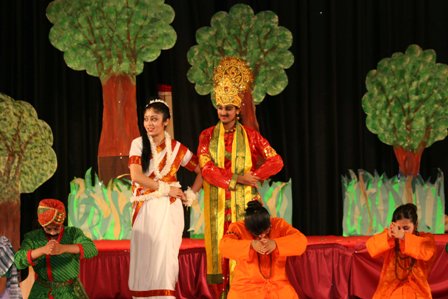
TexasShakuntala

Dhruva Gana

1.1. Drama in the ancient context was said to be a blend of four components: speech; gesture; song (or music); and emotion. Each of these was believed to correspond with a Veda: the spoken word or speech the vehicle of elemental power with Rig-Veda; acting, gestures and expressions with ritual action of Yajur Veda; songs rooted in tradition with the musical style of rendering the Sama Veda verses; and emotional elements communicated to spectators through the combination of all such means with Atharva Veda.

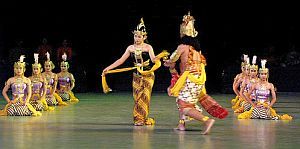
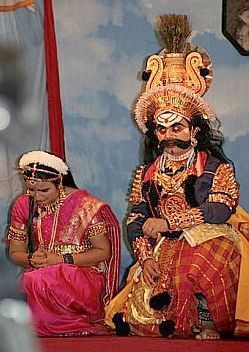
1.2. A play was described as a Poem (Kavya) that is to be seen and heard (Drshya-Kavya). Song and Music, therefore, did play a vital role in the enactment of a play. The songs in the play were of Dhruva Gana class.

2.1. Dhruva Gana initially meant versified stage-songs that are essential to a play. They were the type of songs that were sung by the actors on the stage as also by the singers in the wings, to the accompaniment of musical instruments, during the course of the play. These songs formed an essential ingredient of the play.

And, Natyashastra says:  without songs the Drama is incapable of providing joy (NS. 32. 482).  It says : Just as a well-built dwelling house (citraṃ niveśanaṃ) does not become beautiful and provide a pleasant ambiance without any colour; so also  a Drama without any songs  does not provide much joy.

Again , the importance of songs in dramatic performances is highlighted by stating that, just as a picture without color does not produce any beauty, a play without songs cannot become delightful.

yathà varnàd rahite citram na shobhotpàdanam bhavet| evam eva vinà gànam nàtyam ràgam na gacchati|| NS. 32. 425|

Therefore, much importance is assigned to Dhruva Gana.  Natyashastra devotes one entire and a lengthy chapter (Chapter 32) for discussing the Dhruva songs.

2.2. Abhinavagupta explains that the type of these songs were called Dhruva ( = standpoint; locus of reference)  because in it,  the Vakya (sentence), Varna (syllables) , Alamkara (grace notes), Yatis (succession of rhythm patterns) , Panyah (use or non-use of drums) and Laya (beats) were  harmoniously fixed ( Dhruva) in relation to each other – (anyonya sambandha) .

Vakya –Varna–Alamkara  yatyaha -panayo-layah I   Dhruvam-anyonya sambandha yasmath smada Dhruva smrutah II

He further says, the composition (pada samuha) structured as per a rule (niyatah) and that which supports (adhara) singing could be called Dhruva (Dhruvah- Gitya-adhara niyatah pada –samuha).

At another place, Abhinavagupta explains Dhruva as the basis or the support (adhara) on which the song rests. Abhinavagupta says: just as the painting is supported by wall, the Dhruva song is supported by Pada (word). And, Pada in turn is supported by, the Chhandas (meter) – (Abhinavagupta: NS.32.8).

Thus in the Dhruva Gana the words of the song are regulated by Chhandas. And , the words are then set to appropriate tunes and Taala-s.

Abhinavagupta explains that the Dhruva songs help to enhance the artistic sense of the important themes that occur in various situations in a play.

Earlier,  Natyashastra (NS: 32.32) had also explained  Dhruva Gana as well composed songs that are steadfast (Dhruva) in  the principles of Pada (words), Varna (syllables) and Chhandas (meter) .

When to sing and what to sing

Dance

3.1. During the play, the Dhruva–Gana songs were sung at various situations in the drama including entry or exit of a character; or for heightening the emotions; or for dance movements or steps. The type and mood of Dhruva songs varied depending upon the demands of the dramatic situation.  That would also take into  consideration  the theme, the context in  performance, the age and the nature of the character as also the moods , the seasons , the place , time (day or night) and conditions (bright sun , moonlight , cloudy or raining) and so on.

3.2. Natyashastra says that events and emotions that either cannot be expressed or remain to be expressed in speech should be presented through songs. That is because; the songs have the tender power, flexibility and ripeness to bring out the inner content (aantharya) of the situation succulently. And in songs, the words seem to acquire greater depth of meaning.

For instance; the Avakrsta songs having long drawn out syllables were used in pathos and when the character was in misery or nearing death. Dhruva-s of Sthitha in slow tempo were sung in the case of separation, longing for the beloved, anxiety, exhaustion or dejection. Prasdiki Dhruva-s in medium tempo is for love scenes, recalling a pleasant memory, sweet speech and wonder. And, the Druta type of Dhruva-s having short or rapid notes were employed in situations where there was furious heroism, , wonder, excitement , excessive joy or anger .

3.3. At the same time, the Natyashastra also tried to maintain a sense of balance between speech and song. It therefore said: The first round of Dhruva should be without drums, because it is important for the spectators to get to know the theme of the song. And, too much music should not be used in Dhruva because the substance of the song is important to outline the context of the scene. The words (Pada) of the Dhruva are important and should be heard clearly.

And, when a character enters crying in excitement, in wonder or announcing a statement, then Dhruva songs were not to be used.

Particularly when female actors sing , the music should not be so loud as to  hamper the intricacies of singing. Generally women have sweet and soft voice; and , they could be allowed more number of songs with mellow instrumentation. The men who have vigorous voice could use louder and intricate instrumental music.

Five types of Dhruva
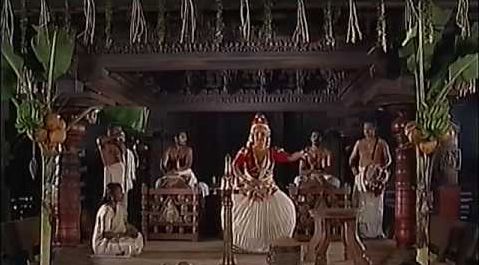
hqdefault

4.1. Five types of Dhruva are mentioned in the context of Natya according to the situation and the desired mood to be evoked:

Pravesiki Dhruva;

Naiskramiki Dhruva;

Aksepiki Dhruva;

 Prasadiki Dhruva; and

Antara Dhruva.

Some of the Dhruva songs were sung by the musicians behind the curtain. And when it was removed the character would enter and join the singing and gesturing the mood etc indicated by the song. All those songs were played to the accompaniment of the instruments.

Thus, the different types of Dhruva-s indicate the varied functions they perform during the course of the play. They were used to suggest either the entry or the exit of a character  or other events. The accompanying instrumental music did , of course, enhance the theatrical effect of the scene; and, made it more enjoyable. 

4.2. Pravesiki Dhruva: – these were songs heralding the entrance of a main character on to the stage for the first time. The singing of the Dhruva was generally from behind the screen (Nepathye); and when the screen was removed the character entered on to the stage. And, the actor too would join the singing. This appears to be the forerunner of the Paatra-pravesha Daru of Bhagavata Mela, Yakshagana and Kuravanji Nataka. Rajashekara (Balabharata 1-14) says: the Dhruva that announces and introduces a character, delights the hearts of the spectators; and,  helps to forge a relation between the two.

4.3. Naiskramiki Dhruva: – songs rendered during the exit of a character either at end or the middle of an act.

4.4. Aksepiki Dhruva: – songs rendered, between the acts, after a tense scene or to indicate change of mood. The change, sometimes, occurs in the character after listening to Nepathya-vakya – the speech behind the curtain. Along with the change in the mood, a change in tempo also takes place – from slow to quick or the other way. Abhinavagupta illustrates the use of Aksepiki sung in fast tempo (Druta) to indicate the change of mood of Sri Rama from that of sadness (Shoka) to that of heroics (Vira) after listening to Ravana.

4.5. Prasadiki Dhruva: – Prasadiki is described as that which gives rise to colourful delight (ranga-raga) and happiness (Prasada). This type of songs sung in Madhyama Kaala  are used to express Srinagar Rasa, as in love-scenes, the first meeting of the lovers, recalling a pleasent memory sweet speech, joy and wonder. It is also meant to clam the spectators after a stressful scene as in Aksepiki.

4.6. Antara Dhruva – is a sort of ‘filler’ that could be used to rescue the performance. It could cover up a gap due to delay or due to a mishap during the play. It could also be sung to offer relief after a disturbing scene such as violence, anger, intense grief swooning, poisoning etc. All such songs were played to the accompaniment of the instruments

Antara was always being sung from behind the curtain, while the other four types being sung on the stage and some of that the leading characters.

It is said; Antara Dhruva songs were sung even to divert audience’s attention. For instance; in the middle of one of his plays, Bharatha introduces a song and dance sequence that apparently had no relevance to the narration of the story. The learned among the audiences are promptly confused. They inquire Bharatha “We can understand about acting which conveys definite meaning. But, this dance and this music you have brought in seem to have no meaning. What use are they?” –  na gītakā-artha-sambandhaṃ na cāpy-arthasya bhāvakam ॥ 4.262

Bharatha agrees that there is no meaning attached to those dances and songs; and goes on to explain calmly “yes, but it adds to the beauty of the presentation and common people naturally like it. And, as these are happy and auspicious songs people love it more; and they even  perform these dances and sing these songs at their homes on marriage and other happy occasions”(Natyashastra : 4.267-268)

[ Such ‘relief’ Antara Dhruva was perhaps the forerunners of the Item-songs of the Bollywood.]

vinodakāraṇaṃ ceti nṛttam etat pravartitam । ataścaiva pratikṣepā adbhūtasaṅghaiḥ pravartitāḥ॥ 266

ye gītakādau yujyante samyaṅnṛttavibhāgakāḥ। devena cāpi samproktastaṇḍus tāṇḍava pūrvakam ॥ 267॥

gīta prayogam āśritya nṛttam etat pravartyatām । prāyeṇa tāṇḍava vidhir deva stutyāśrayo bhavet ॥268॥

Chhandas (Meter)

5.1. Bharatha says that just as the Vedic chants, the Dhruva cannot be without Chhandas (meter) _ (NS: 32.432). In the Natyashastra, Chhandas are discussed as an essential part of vācika abhinaya. And, Vac is said to be the soul of this Abhinaya (expressions with gesticulation). Bharatha considers that the words in Dhruva and Chhandas go together; they are mutually dependent.

(Chandohīno na śabdoˊsti na chanda śabdavarjitam, evam tūbhayasa¿yogo nāyasyoddyotaka smta ).

5.2. Bharatha combines the discussion on Chhandas with that on dramatic-plot with script (Pathya). The Chhandas, he says, gives a structure to the words of the Dhruva song (Chhandamsi hya nibaddha).

Bharata mentioned Pathya in the Natyasastra (17. 102); and, said:  “pathyam prayunjitam sad-alamkara-samyuktam” – the Sahitya of a song is called the Pathya, when it is embellished by six Alamkaras.  Abhinavagupta in his Abhinava- bharati explains that when any composition (sahitya) possesses six Alamkaras and sweet tones, it is known as a Pathya. These six Alamkaras are:  Svara, Sthana, Varna, Kaku, Alamkara and Anga.  (Note: kakus are the variations of the vocal sound for expressing different ideas)

Bharata considered Pathya under two heads: Sanskrita and Prakrit. Abhinavagupta followed Bharata in this respect

5.3. The Chapter 16 of the Natyashastra discusses the practical aspects of Chhandas in Dhruva Gana and gives about 116 illustrations of Dhruva-s set in various Vedic meters such as: Gayatri, Anustub, Tristub, Brihati, Jagati, Panaki etc

 Laya (Tempo)

Dance Drama

Laya literally means ‘to be one with’ and binds the emotion of the song with the Tempo.  Laya signifies the speed or the Tempo of a song or dance. Chapter 29 of the Natyashastra discusses how the emotional content (Rasa) or the mood of a Dhruva song could be best presented in a certain Laya.

The measurement of time is usually in terms of the time- interval between two events. Time (that is the duration) appears as a chain that links events separated from one another by periods of rest (absence of events) . That is to say the duration between two events which becomes the basic unit of measure is known as Kaala .

The Kaala is measured in terms of the time-units called Matra. And, one Matra is the time taken to utter five short syllables (e.g. Ka-Cha-Ta-Pa). It is, of course, not precise ; because,  the time taken to utter five short syllable might vary from person to person. But, it is taken as the approximate time that most, normal, persons would take. Therefore, in the Gandharva Music, Matra is not rigid.

Kaala is the basic unit in terms of which the duration of the Taala is measured (Abhinavagupta: NS: 31.06). A Taala segment is identified as a structure of so many number of  Kaala-s. (Thus, Kaala, Matra, Laya and taala are all inter related terms).

The three kinds of units of measure (Kaala) that were employed in the Gandharva Music were: Laghu (short), Guru (long) and Pluta (extended). Laghu is equal to one Matra; Guru to two Matra-s; and Pluta to three Matra-s.

Laya is understood as the time-interval between two Matra-s ( or the pause between two strokes). If the intervals are of short duration then the beats must be fast; and the Tempo would be fast. If the intervals are twice the duration of the fast tempo, the beats become slower; and the Tempo would be middle. And similarly, if the intervals are four times the duration, the beats would get slower ; and the tempo would be slow.

The text speaks of three kinds of Laya: Vilambita (slow); Madhyama (middle); and Dhruta (fast). Vilambita is the basic speed; Madhyama is double the speed of Vilambita Laya; and, Dhruta, the fast, is double the speed of Madhyama Laya.

In Druta Laya, the time lag between two Kaala-s is brief; each following the other in quick succession. Thus, when the Laya is short, the tempo of the Taala would be fast. In Madhya Laya, the tempo would be medium ; and in Vilamba   the tempo would be  slow. The change from Druta to Madhyama is spoken as ‘doubling of Laya’.

There are also other ways of classifying Laya:  Sama, Srotogata and Gopuccha. This is spoken in terms of Yati which is a sort of method to indicate Laya.

In the Sama there is a uniformity of Laya in the beginning, in the middle and in the end.  In the Srotagata (like the flow of the river that expands in breadth)  Vilambita is used in the beginning, Madhyama in the middle and Druta in the end. The Goputccha (tapering like a cow’s tail) is the reverse order of Srotagata.

Laya is an integral part of music, while Taala is its physical expression through a precise time-cycle. Laya is thus said to be Prana (vital force) of Taala. And the two terms are sometimes used alternatively. Therefore, the Taala-s of Dhruva songs sometimes are referred to as Laya-s or Laya-taala.

Bharatha   elaborated on Taala in the 29th chapter of the Natyashastra, as it performed a large role in coordinating different activities of music, drums and dance. The function of the Taala is measuring the rhythm of the song and regulating the flow of the rhythm and the melody in the song.

He explained Taala saying as a definite measure of time upon which Dhruva Gana rests:  ganam talena dharyathe. Matra is the smallest unit of the Taala. A Taala does not have a fixed tempo (Laya); and, can be played at different speeds. The Taala-s used in Dhruva songs were simpler – say , like Tryasra and Chturasra. ; and , were regulated by the meter (Chhandas)  of the song text (Pathya) (Abhinavagupta :NS: 32.352)  .

In the Tryasra Dhruva the steps should follow three Kaalas. And, in Chatusra they should follow four Kaalas (Kaala = Matra that is the time required to utter five short syllables)

Natyashastra recommends songs exuding Karuna Rasa (sorrow) should in Vilamba Laya; Sringara (erotic) in Madhyama Laya; and, Veera (heroics) and Raudra (anger) in Druta Laya.

And, in relation to Dhruva Gana, in particular, Natyashastra provides number of illustrations.

:- Dhruva compositions of Avakrsta  type , full of long syllables (Avakrsta) expressing pathos (Karuna) , separation (Viraha) ; or when the character on the stage is fettered , fallen , disabled, fainted and nearing death  – should be rendered in Vilamba Kaala  (slow tempo).

– When the movement is slow (with wide steps) as during the entry of an elephant; and when songs with long syllables are sung

– Dhruva-s of Sthitha type in slow tempo depicting separation, longing for the beloved, anxiety, restlessness, exhaustion or dejection, should be rendered in Vilamba Kaala (slow tempo).

– With regard to Sthitha Dhruva songs, its twofold aspects (sthana)  are described  as Parastha and Atma-samsrita . Abhinavagupta explains these terms as referring to songs that help to clearly bring out the pathos the situation. For instance; the character of Sri Rama sings a Dhruva song in anguish pining for his separated beloved Sita it would be Atma-samsrita ( concerned with the character proper); and , the Dhruva song  that Lakshmana sings  empathising with his brother and sharing  his pain that would be Parastha  ( concerned with others’ sorrow).

:-  Madhyama Kaala is the normal or the standard (middle) Tempo. And, it is particularly recommended for Prasadiki type of Dhruva songs sung in love scenes (Sringara), first meeting of lovers (prathama samagama), recalling a pleasent memory (priya varthalapa) , sweet speech (madhouse bhashi), joy (harsha) and wonder (Adbhutam, Vismaya)).

: – Dhruta the fast Tempo is employed in varieties of occasions:

–  When the character is in confusion, wonder, sudden joy or anger.

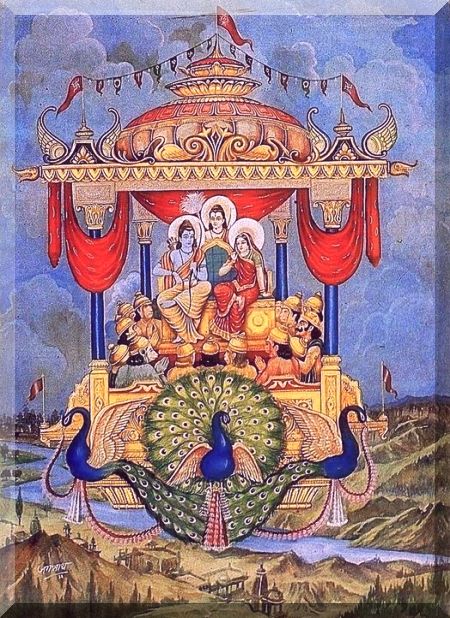
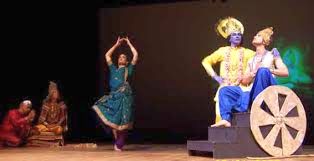
– For Dhruva of short syllables; for quick movement during scenes that depict entry of chariots, aerial-cars (Vimana).

– For Druta type of Dhruva-s having short or rapid notes, employed in situations where there was furious heroism, wonder, excitement, excessive joy or anger.

[A word of caution the concepts of Kaala, Matra , Laya etc as mentioned in the ancient Gandharva and Gana Music are NOT the same as they are understood in the present time.]
Drama chariot

[Natyashastra provided rules not merely for singing but also for speech delivery (Vachika) . It mentions that in order to bring out the right effects the speech should be well articulated and should respect the virtues (Dharma) of: Svara (notes), Sthana (voice registers), Varna (pitch of the vowel), Kaku (intonation), and Laya (tempo) – NS.19.43-59.

It specifies that the scenes involving humor (Hasya) and erotic or love (Srungara) the speech should be modulated by Madhyama and Panchama Svaras (notes); acute pitch (Udatta and Svarita); and , medium tempo (Madhya Laya). Where as in the scenes depicting heroics (Vira) and wonder (Adbhuta ) the speech should be in Shadja and Rishabha Svaras; acute and trembling pitch (Udatta and Kampita) ; and , quick tempo (Druta Laya). And, in the scenes of pathos (Karuna) the speech should in slow tempo (vilamba).

As regards the voice registers (Sthana), they vary according to the space (distance) on the stage between the characters.  It is said:  to call a character that is at a distance, the voice should proceed from the top register (Siras); to call one who is a short distance the voice register should emanate from chest (Uras); and, to speak to one who is standing next the voice register should be from the throat (Kanta). ]

Symbolisms

3689508840_acbe116319

9.1. Theater in the Natyashastra is a huge symbolism; and , it is projected beyond the natural world.  Apart from that , Theater in the sense of Drama functions on many levels of symbolism – through speech (Vachika-abhinaya), costume , make-up (Aharya) gestures (Mudra), exhibiting emotions (sattvika abhinaya) and in  music (Gana).

9.2. Dhruva symbolisms are dealt with great detail.  Symbols representing the moon, the fire, the sun and the wind; and these are to be used in the case of gods and kings; The night , the moon light, lotus plants, she elephants , rivers and night in the case of queens; The clouds, mountains and oceans are used in the case of demons; The elephants in the rut and royal-swans in the case of superior beings; Peacocks and lotuses in the case of middling’s; Cuckoos , bees in the case of others;  Creepers and swans in the case of other women and courtesans; The female bee and female cuckoo in the case other  women.

9.3. The entrance song (Pravesiki) is to be sung to indicate anything happening in the fore-noon; and, the exit song (Naiskramiki) to indicate anything happening by day and night. Gentle Dhruva-s are to be sung to indicate the forenoon; and, the songs with excitement to indicate the noon . And, the pathetic Dhruva-s are to be sung in case of afternoon and evenings.

The symbolisms of the Dhruva-s with their evocative suggestions, enriched by melodious music, helped to enhance the aesthetic quality of the theatrical presentation.

Languages of Dhruva Gana
2008120550360301

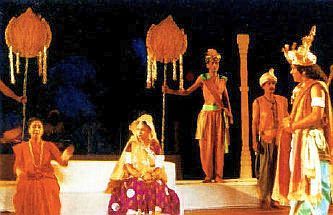
10.1.Bharata states, in general, the languages to be used in a play (pathya) as of four types: Atibhasha (to be used by gods and demi-gods); Aryabhasha (for people of princely and higher classes); Jatibhasha (for common folks, including the Mleccha , the foreigners) and, Yonyantari ( for the rest , unclassified and the tribal)

Bharata in Chapter 17 (verse 48) mentions seven types of Upa-basha (desha-basha) the dialects then in use . And he also mentions the tribal dialects

māgadhy avantijā prācyā śauraseny ardhamāgadhī । bāhlīkā dakṣiṇātyā ca sapta bhāṣāḥ prakīrtitāḥ ॥ 7. 48

śakārā abhīra caṇḍāla śa varadramilodrajāḥ । hīnā vanecarāṇāṃ ca vibhāṣā nāṭake smṛtā ॥ 7. 49

As for the language of the Dhruva songs, which were sung either by the actors or by the musicians behind the curtain, it was, usually, not Sanskrit (in contrast to Gandharva songs in Sanskrit that were sung during the Purvanga, the preliminaries), but was Prakrit, the regional languages. Natyashastra discusses the features of the Dhruva songs composed in regional dialects ; and , in that context mentions seven known dialects  (Desha-bhasha) of its time : Māgadhī,  Āvantī, Prācyā, Śaurasenī,  Ardhamāgadhī,  Bāhlikā  and  Dākiātyā  (NŚ . 17-48).  However, most of the Dhruva-s were composed in Suraseni or Magadhi; and some in Ardha-Samskrita (mixture of Sanskrit and the regional language). The songs addressing to heavenly beings were however in Sanskrit (NS.32.441).

10.2. As regards Śaurasenī, it was the language spoken around the region of Surasena (Mathura area). And, in the play the female characters, Vidūṣaka (jester), children, astrologers and others around the Queens court spoke in Śaurasenī. It was assigned a comparatively higher position among the Prakrita dialects.

prācyā vidūṣakādīnāṃ dhūrtānāmapyavantijā । nāyikānāṃ sakhīnāṃ ca śūrasenyavirodhinī ॥ 7. 51॥

10.3. In comparison, Magadhi , the dialect of the Magadha region in the East as also  Ardha-Magadhi and Prachya , also of the East, were spoken in the play by lesser characters such as servants, washer -men, fishermen, , barbers , doorkeepers, black-smiths, hunters  and by the duṣṭa (wicked)  . Even otherwise, the people of Magadha as such were not regarded highly and were projected in poor light.

māgadhī tu narendrāṇām antaḥpura samāśrayā । ceṭānāṃ rājaputrāṇāṃ śreṣṭhināṃ cārdhamāgadhī ॥ 50॥

10.4. In some versions, there is a mention of Mahārāṣṭ also. It was a language spoken around the river Godavari and according to linguists; it is an older form of Marāṭhī. In some plays, the leading-lady and her friends speak in Śaurasenī, but sing in Mahārāṣṭ.

The security guards and doorkeepers were said  to speak Dakshinatya (Southern) or Bahliki (Northwest – Ancient Bactria; modern Balkh  region) , considered as outsiders.

yaudha nāgarakādīnāṃ dakṣiṇātyātha dīvyatām । bāhlīka bhāṣodīcyānāṃ khasānāṃ ca svadeśajā ॥ 52॥

10.5. Natyashastra (NS.32.56-354) presents more than 116 examples of Dhruva-s in Prakrit in various meters  including Vedic meters such as Gayatri, Anustubh, and Tristubh etc.

10.6. The language of the Suraseni or Magadhi (specially the Narukta Dhruva) dialects was usually be simple. And, the songs talked about the things that one sees in nature during the different seasons (Rtu) , such as : the bright sun, the soothing moon, the  sparking stars in a cloudless dark night sky , the passing dark clouds laden with water bringing cheer to the hearts of lovers , the thunderous lightning that drives the Lady love into the arms of the lover etc.

10.7. The language of the Dhruva songs sung by women was generally Prakrit. Bharatha says the vocal music should be generally the province of the women as their voice is naturally sweet.

In the next Part let’s talk about Musical instruments mentioned in Natyashastra.

Please click on the picture below 
Ashtalakshmi2

Continued in Next Part

Musical Instruments in Natyashastra

Sources and References

Studies in the Nāyaśāstra: With Special Reference to the Sanskrit Drama…

By Ganesh Hari Tarlekar

Sonic Liturgy: Ritual and Music in Hindu Tradition

By Guy L. Beck

Poetics of performance by TM Krishna

Language of Sanskrit Drama Language of Sanskrit Drama by Saroja Bhate

http://www.sanskrit.nic.in/svimarsha/v6/c10.pdf

ALL PICTURES ARE FROM INTERNET

 
Leave a comment

Posted by on April 24, 2015 in Music, Sangita


Tags: , , , , , , , , , , , , , , ,

Music of India – a brief outline – Part seven

Continued from Part six – Gandharva

Part Seven ( of 22 ) – Music in Natyashastra

music in natya

Gandharva and Gana

1.1. Gandharva and Gana were two major Musical genres of the ancient times.  The Gandharva, as we saw in the previous segment, was the type of songs that were sung during the worship of gods. And, the music performed in the course of play (Natya) was termed as Gana by Abhinavagupta.

In the Natyashastra, the term Gana is employed to denote any song; but, in particular to Dhruva songs performed during the play. In other words, broadly, Gitikas were considered Gandharva and Dhruva as Gana.

1.2. Abhinavagupta said; Gandharva and Gana flourished side by side even during later times. And he also pointed out that during the time of Bharatha, the Gana adopted regional tunes for its Dhruva songs. In support of his argument, Abhinavagupta quotes another authority Vriddha (Senior) Kashyapa to show that changes in the Sruti scheme of Bharatha were freely made in Desi ragas.

(kiyad vā rāga-bhāā-deśī-mārgādi-gatānā svarāā śruti vaicitrya brūmah |)

1.3. In the later times, Sarangadeva (13th century) classified Prabandha and other Musical forms of Desi–samgita also under Gana. He speaks of Gana as being of two kinds: Nibaddha (structured) and A-nibaddha (unstructured).

Nibaddha refers to compositions governed by rules, say as in a Prabandha. And, the A-nibaddha is free flowing improvised music, say as in Aalapti (Aalap).

But, both the modes had to work within the accepted ambit of Music (Samgita).

[Let’s talk of Prabandha in the next segment of this series.]

2.1. The Gana of Natyashastra had its roots in Gandharva. And Gandharva songs were also used before the play proper. For instance; in the Purvanga, that is during the preliminaries before the commencement of the Drama per se, the Gandharva songs of the type Nirgita were sung, to the accompaniment of instruments, offering prayers to Shiva. This was followed by a song in Gitaka format; and by a Tandava dance of Shiva or a Lasya of Shiva and Devi to another Gitaka-song.

Thereafter, the Sutradhara (a sort of compère) and his troupe enter the stage, move in a rhythmic dance like steps   and sing Gandharva-songs ( Gitikas)  to delight the gods; bowing to Sakra i.e. Indra (in the East), Yama in the South, Varuna in the West, and to Kubera in the North ; and  praying to gods for successful enactment and completion of the play. However, during the course of the play the Gana was used.

2.2. Though Gana owed much to the Gandharva, the two differed in a number of ways.

The Gandharva was regulated Music (niyata), while Gana was relatively free, improvised or incidental Music.

Gandharva songs were sung to invite the blessing of gods before the commencement of the play.

And, Gana music was tailored to the various dramatic requirements of the performance. And, since Gana was meant for entertainment, it was molded, largely, by the taste of the spectators at the play.

2.3. In his commentary on the 33rd chapter of Natyashastra, Abhinavagupta draws a four-fold distinction between Gandharva and Gana Music-s.

According to Abhinavagupta , the two differ in their :

in Svarupa –  structure and ways of employing Svara, Taala and Pada;

in Phala –  the  benefits or the objectives ;  the one is in praise of Shiva and pleasing gods  while the other strives to gladden the hearts of  the audience in a theatrical performance; 

in Kaala – the context or the occasions of their rendering , one is for worship and the other is for entertainment;

and , in Dharma – in their distinctive nature and functions.

Let see this in a little more detail:

Svara, Taala, Pada and Phala

Svara

3.1. As regards the Musical aspects, in Gandharva , the Svaras were employed at fixed intervals (Sruti); and the Sruti intervals were well defined. For instance; in the Shadja Grama, Ri was on the third Sruti above Sa; Ga was on the second Sruti above Ri and so on.

Such rigidity was not needed in Gana –

Kim ca antarāla-niyamo….gāndharve’vaśya-samvedha | na tv eva gāne

Abhinavagupta while explaining this aspect says that he is elaborating what was in actual practice (pratiti) during those times (uktam api pratītam anucitrīyate).

Taala

3.2. In Gāndharva, the Taala, which measured time through a fixed number of demarcations, was also governed by rigid rules. Its main aim was to establish Saamya or equipoise. Taala occupied a secondary position (angāngibhāva) to Svara.

 In the case of Gana, the Taala enjoyed more flexibility. The Taala in a play could aesthetically be improvised to suit the dramatic situations and also to provide entertainment through colorful rhythmic play.

Pada

3.3. The importance of Pada also varied in the two types of Music.

In Gandharva, the Svara and Taala had predominance over Pada.

In Gana, the text of the songs, the Pada, needed much attention as its words were of importance.

The role of Pada is, thus, different in Gana and Gāndharva.

Phala

3.4. The Gandharva is pleasant and it also bestows merit (punya).

But Gana is used only for its effect and not for its intrinsic merit. ‘It is, therefore, unjust to identify the two.’

(anāditvād dṛṣṭādṛṣṭa-phalatvāc ca pradhāna gāndharvam… | gāna hi prīti-kārye vartate | tena tādātmya tāvad ayuktam)

3.4. As regards the context (Kaala) in which Gandharva and Gana are used ,

Gandharva could be used only in the Purvanga (ritual prologue to the play) .

But , during the course of the play Dhruva songs were sung in Grama-jaatis .

Thus, the function or the nature (Dharma) of the Gandharva and Gana differed: Gandharva to please the gods and Gana to entertain humans.

Shakuntala_201211_18

Natyashastra

Before we speak of its Samgita a few words about Natyashastra

4.1. Natya-Shastra is a detailed compendium of more than about five thousand verses spread over thirty-six chapters dealing with all aspects of play production. The text was meant as practical manual imparting technical instructions about the performing arts; and, for production of   successful theatrical performances. It is said that the text which we now know as Natya-Shastra was based on an earlier text that was much larger (Adi-Bharata or Dwadasha-sahasri, because it contained twelve thousand verses). There are also frequent references to the writers of the earlier time and other views.

4.2. Natya-Shastra describes itself as Natyaveda, the fifth Veda that would be accessible to all the four castes (1:12). It claims that the text imbibes in itself the articulated – spoken word or text (patya) from Rig-Veda; the ritual and the body-language (abhinaya) from Yajur Veda; musical sound, the song-notes from Sama Veda; and, Sattvika (understanding of the relation between mind and body-expressions) – for conveying various bhavas through expressions exuding grace and charm – from Atharva Veda (Natya-Shastra – 1:17-19) .

4.3. The text is permeated with the Vedic symbolism and the imagery. The theatrical production is compared to Yajna; with the stage being the vedika,   the altar. The dramatic spectacle, just as Yajna, is said to have a moral and ethical purpose.  The object of the drama was to show men the proper way, a way in which one could live and behave, so that one might become a ‘ better person’.

4.4. The text reveres and worships Vedic gods such as Indra, Varuna and Vayu (not the gods celebrated in Puranas); talks mainly in terms of the symbolism and imagery of the Vedic Yajna following the Vedic ethos; and it consistently projects the world-view cherished by the Rig-Veda: of the one formless or unformed (Arupa) evolving in to multiple forms (rupa prati rupa) and then on to the form beyond (Para rupa),

4.5. It is, therefore, generally believed that the text was articulated at a time when the Vedic life-style tempered by the somber contemplative speculation of the Upanishad, was still alive.

The mention of the Buddhist Bhiksus and Jain Samanas indicate that Natya-Shastra was of post – Buddha and Mahavira period.  And, its Dhruva songs are in a form of Prakrit, which predates the great poet Ashvaghosha’s play (first century).

For these reasons, the scholars generally believe that Natya-Shastra might have been composed sometime around the first or second century BCE, but not later.

5.1. The compiler of Natya-Shastra calls it a prayoga Shastra – a framework of principles of praxis or practice. Bharata makes a significant opening statement: “I am creating a theory and text of performance; of practice and experimentation” . He also underlines the fact that the efficacy of its formulation lies in practice (prayoga).

5.2. There is a certain flexibility built in to the structure of the text. It provides for varied interpretations and readings. The author himself encourages innovations and experimentation in production and presentation of plays. He even permits modification of his injunctions; and states the rules “can be changed according to the needs of time (kaala) and place (desha)” . The text accordingly makes room for fluidity of interpretation and multiple ways of understanding it. The intellectual freedom that Bharata provided to his readers/listeners ensured both continuity and change in Indian arts over the centuries.

6.1. The term Natya is derived from the root Nat (= to act); and the one who acts is a Nata. And, Natya is the art of the Nata, which is the dramatic art. The actor re-lives the ‘life’ of the character he plays; and , presents before the spectators his interpretation of that character, by means of dramatic-art.

Bharatha explains: when the nature of the world possessing pleasure and pain both is depicted by means of representations through speech, songs, gestures , music and other (such as, costume, makeup, ornaments etc) it is called Natya. (NS 1.119)

Yo’yaṃ svabhāvo lokasya sukha dukha samanvita som gādya abhinaya ityopeto nātyam ity abhidhīyate 119

Natyashastra (6.10) provides a comprehensive framework of the Natya-veda, in a pellet form, as the harmonious  combination  (sagraha) of the  various essential components that contribute towards the  successful production of a play.

Rasā bhāvāhya abhinayā dharmī vtti pravttaya siddhi svarās tathā atodya gāna ragaśca sagraha 6.10

The successful production (Siddhi) of a play enacted on the stage (Ranga) with the object of arousing joy (Rasa) in the hearts of the spectators involves various  elements of the components of  the actors’ gestures, actions (bhava) and speech; bringing forth (abhinaya) their intent, through the medium of theatrical (natya dharmi) and common (Loka dharmi) practices; in four styles of representations (Vritti-s) in their four regional variations (pravrttis) ; with the aid of  melodious songs  accompanied by  instrumental music (svara-gana-adyota).

6.2. The text employs Natya as a generic term, which broadly covers drama, dance and music. At the time the Nataya-shastra was compiled, the arts of poetry, dance, music and drama; and even painting, and sculpture were not viewed as separate and individualized streams of art forms. It was an integral vision of art, which blossomed in multiplicity. All art expressions were viewed as vehicles of beauty providing both pleasure and education, through refinement of senses and sense perceptions. The reason that theatre-arts were discussed specifically was that, in the ancient Indian context, drama was considered the most comprehensive form of art-expressions.

7.1. The compiler of the Natyashastra, whoever he might be, comes across as a person of great learning, culture and rooted in good tradition (sampradaya, parampara). He was well grounded not merely in Vedic learning and its ethos  , but also  in  kavya (literature) , fine arts,  Ayurveda (medicine),  jyothisha  (astrology), ganitha  (mathematics), vastu-shilpa (architecture) and hatha-yoga,  His understanding of the human anatomy – particularly the motor and sensory systems and the joints; the relation between the physical stimulus and psychic response; as also the relation between psychic states and expressions through physical movements ; were truly remarkable.

7.2. Natya-Shastra has provided a sustainable foundation and framework for development of theory and practice of arts in India. It also touches on the related areas of cultural life of India. It is the foundation on which Indian philosophical thinking squarely rests.  Just as Panini standardized the classical form of Sanskrit, Bharata standardized the classical form of drama. He gave it status and dignity; a form and an objective; a vision and finally a technique. His brilliant intuition and intellect has inspired generations of artists over several centuries.

[The attempt to explain Bharata as an acronym for three syllables Bha (Bhava), Ra (Raga) and Ta (Taala) somehow does not seem convincing. At the time Natya-Shastra was composed, music was discussed in terms of pada (words), svara (notes) and tala (time-unit) which formed the components of Gandharva music. The term Raga (in the sense we understand it now) did not come into circulation until Matanga’s Brihaddesi,   (about sixth century).]

[For more on Natyashastra please click here.]

Abhinavabharati

8.1. Natyashastra is composed in a cryptic Sutra form; and is not easy to read or to understand. As Shri Adya Rangacharya remarked, the text is rather rambling and repetitive; and the word-to-word translation would not be of much use since its terms could be interpreted in more than one way. One does, therefore, need the guidance of a commentary to wade through Natyashastra. The earliest commentary on Natyashastra that has survived and that which is most celebrated is the Abhinavabharati of Abhinavagupta (11th century).

8.2. Abhinavagupta was a visionary and a philosopher who combined in himself the experiences of a mystic and a Tantric. He was gifted with extraordinary incisive intellectual powers of a logician, as also the skills of a commentator and an art critic. He illumines and interprets the text of the Bharata at many levels: conceptual, structural and technical. In addition, he summed up the views of his predecessors (that is, the scholars who earlier commented on Natyashastra), before presenting his own arguments. Abhinavagupta brought fresh perspectives to the concepts of Bharata, particularly on aesthetic experience (Rasa) and art creation. Although Abhinavabharati is a commentary, it is for all purposes an independent treatise on aesthetics in Indian dance, poetry, music and art.

[For more on Abhinavabharati please click here.]

Samgita

f_23026898108m_fd054f2

9.1. Natyashastra was mainly concerned with Drama. And, the role of Music in it, in conjunction with other components, was primarily to heighten the dramatic effects of the acts and scenes in the play. Music, in that context, was another beautiful, artistic, effective device to articulate the moods of various theatrical situations through appropriate thematic tunes and songs. Therefore, Natyashastra was more interested in applied-music than in Music per se (Samgita-shastra).

9.2. The ‘Music’ that the Natyashastra talks about is indeed the Samgita. The term Samgita in the early Indian context denoted a composite art-form comprising vocal (Gitam) and instrumental (Vadyam) music; as also Nrttam the dance movements or dance (Gitam, Vadyam tatha Nrttam trayam Samgitam uccyate)The last one, Nrttam, the dance, is composed of all those three elements (Tauryatrico nama – NS.35.26)). –

[ Dr.R. Satyanarayana surmises that what came to be known as Samgita was, perhaps, at one time called as Tauryatica. Panini’s Ashtadhyayi calls a of group of musicians as Turya, in which the Veena-players were prominent . The Indian Lexicon Amarakosa also names the combination of Gita, Vadya and Nrtta as Tauryatricam :

tauryatrikaṃ nṛtta-gīta-vādyaṃ natyamidaṃ trayam – 1.7.428 

Hemachandra (12th century) also says :

Gita, Vadya, Nrttam trayam Natyam Tauryatricam ca tat. ].

Gitam, Ganam, Vadyam, atodyam, lasyam, Tandavakyam, nrtyam / Gitadi tritayam samgitam tam Natyabhumiyakkum Rangam – Nagavarma, Kannada poet, 12th century

[The Gitam, the song format, is a fusion of Nada (sounds) and Akshara (composition made of words). Its musical element is named Dhathu; while its composition made of words is called Mathu. Lohana Pandita, in his Raga-tarangini, says:

Dhatu-matu-samayauktam Gitam iti uccyate budhaih; tatra nadatmako dhatur matur akshara sambhavah’.

Gitam, going by its traditional definition, strictly belongs to the Salaga Suda class of Prabandha, which is composed two Angas (elements) – Pada (words) and Taala (time-beats); and, having three components or Dhatus (Tri-dhatuka Prabandha) :  Udgraha, Dhruva and Abhoga. For more on that, please click here. But, in common practice, anything that is sung goes by the name of Gita (Giyata iti Gitam).

The term Vadyam, covers a wide variety of musical instruments, such as : the varied string instruments; different types of Drums; bell-metal cymbals ; and a host of wind instruments including  flutes, pipes , conch,  trumpets etc.

The third component of Samgita involves three forms

Nrtta: the display of smart looking (shobhahetu) limb movements in  tune with attractive and catchy Taala (rhythm) and Laya (tempo) – Nrttam Taala Laya ashrayam (DR.I. 9). But, in itself, it is devoid of meaningful content; and, is valued for its mere visual beauty of body movements (gatrasya viksepaha).

Nrtya: the means of putting forth different aesthetic moods or bhava (bhavahetu orbhavashraya) or giving expression to individual words of the song through appropriate gestures, facial expressions,expressing emotions through Abhinaya-pada-artha-abhinayatmaka. The key ingredient in this is the elaborate gesture-language. Abhinaya (lit. To bring near, that is to present before the eyes), is a harmonious combination of striking pose, eloquent gestures, lucid facial expressions, various glances,  and meaningful movements of the feet, hands, fingers and feet.

Thus, Nrtta is pure dance movements, without emotions; Nrtya is that which brings forth the emotional content of the song or the dance theme.

Nandikeshvara (Abhinayadarpana. 1. 15-16) distinguished Nrtya from Nritta, thus:

Bhavabhinaya-hinam tu nrittamitya-abhidhyate | Rasabhava-vyanjana adi yuktam nrityam ity uchyate

And, Sarangadeva said that Nrtya and Nrtta can both be of two kinds –Tandava and Lasya (SR. 7. 28); and, while Tandava is uddhata (vigorous), the Lasya is of Lalita (delicate) movements (SR. 7. 29- 30).

*

And, the third, the Natya: the art form gives forth Rasa (ultimate aesthetic enjoyment) ; and, is based in Rasa – Natyam rasam-ashrayam (DR.I. 9). It gives expressions to the inner or true meaning of the lyrics through dance gestures –vakyartha-abhinayatmaka.

Thus, Natya, the dance, delightfully brings together and presents in a very highly expressive, attractive visual and auditory form, the import of the lyrics (sahitya), the nuances of its emotional content to the accompaniment of soulful music and rhythmic patterns (tala-laya).

*

Later, Pundarika Vittala  his work (Nartana-nirnaya), uses the term  Nartana, generally, to mean ‘Dance’, Pundarika said that by Nartana he meant it to be a general class name for Dance. And, that the term Natrana would cover the three forms of Dance: NatyaNrtya and Nrtta. The last (Nrtta) would again be subdivided into three other types: visama (acrobatic), vikata (ludicrous) and laghu (light and graceful), identified respectively as rope-dancing, a comic dance, and a dance based on easy karanas.

Thus, it seems, in the later times, while Nartana stood for the general class name; the other three were its sub-divisions.

Please also read the highly educative introduction written by the renowned scholar  Shri T R Srinivasa Ayyangar to Sangraha Chudamani of Govindaedited by Pandit Sri S .Subrahmanya Sastry; published by The Adyar Library, 1938.]

In the latter times, the scope of the term Samgita narrowed down to what we now call ‘music’. Dance became a separate art form. And, within Music the vocal remained the more dominant aspect. The instrumental music follows what is rendered vocally.

**

10.1. Natyashastra pays considerable importance to aspects of Music. It devotes eight of its (chapters 27-34) to Music in the play and Music in general. In fact, chapters 28-36 offer one of the earliest sources of Indian music theory.

10.2. The chapter twenty seven deals with music employed in theatre. The next five Chapters 28-33 are devoted to Gandharva Music and its applications. Of these:

:- Chapter twenty eight covers Jaati (melodic types), Sruti (micro-intervals), Svara (notes), Grama (scales), Murcchana (arrangement of the Svaras) and Sthanas (registers).

:-  Chapter twenty nine describes the techniques of plying stringed instruments like the Veena; and distinctions between vocal and instrumental music, further dividing vocal into two types, Varna (colour or syllables) and Giti (‘song’ with lyrics).

:-  Chapter thirty which has only thirteen verses describes wind instruments like the Vamsa (flute) and ways of playing it.

:-  Chapter thirty-one deals with Taala (time-units or rhythm), Laya (three types of tempo), Yati (three types of movements), Pani (three ways of beginning), Ghana (cymbals),  and Chhandas (metrical cycles).

:-  Chapter thirty two   ( which pertains directly to this  post) defines Dhruva songs, their specific employment, forms, and illustrations; definition of song form (Gana); qualities of singer (guna); defects (dosha) of a singer; qualities of a Veena player; qualities of a flute player; qualities of male and female voices; and, qualities of teacher and pupil.

: – Chapter thirty-three deals with Avanaddha – various types of rhythmic instruments – Mrdanga, Pavana and Dardura – their techniques and their application in Drama. Its next, the Chapter thirty-four relates the origin and nature of drums.

: – And, the last three chapters of the treatise, 34 ; 35 ; and 36 (as also  37) provide details regarding the different characters, varieties of costumes and popularization of the art of histrionics. The concluding two chapters lay down the principles for distributing roles and the qualifications for members of the troupe.

[Natyashastra provided rules not merely for singing but also for speech delivery (Vachika) . It mentions that in order to bring out the right effects the speech should be well articulated and should respect the virtues (Dharma) of: Svara (notes), Sthana (voice registers), Varna (pitch of the vowel), Kaku (intonation), and Laya (tempo) – NS.19.43-59.

It specifies that the scenes involving humor (Hasya) and erotic or love (Srungara) the speech should be modulated by Madhyama and Panchama Svaras (notes); acute pitch (Udatta and Svarita); and , medium tempo (Madhya Laya). Where as in the scenes depicting heroics (Vira) and wonder (Adbhuta ) the speech should be in Shadja and Rishabha Svaras; acute and trembling pitch (Udatta and Kampita) ; and , quick tempo (Druta Laya). And, in the scenes of pathos (Karuna) the speech should in slow tempo (vilamba).

As regards the voice registers (Sthana), they vary according to the space (distance) on the stage between the characters.  It is said:  to call a character that is at a distance, the voice should proceed from the top register (Siras); to call one who is a short distance the voice register should emanate from chest (Uras); and, to speak to one who is standing next the voice register should be from the throat (Kanta). ]


Music

11.1. For the limited purpose of this article, let’s assume that Music here refers to singing and the playing of wind and stringed instruments that produce a melody; and to the percussion instruments.

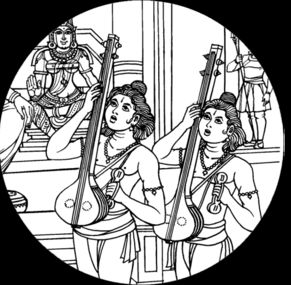
11.2. Music was an essential part of the Indian dramatic art. Natyashastra mentions groups of music-makers or Kutapa-s who brighten (ujjvala-yati) the stage (ranga). These were: Tata, the singers and players of stringed instruments; Susira players of wind-blown instruments; Avadhana, players of percussion instruments such as Mrudanga, Pavana, Dardura and Ghana (cymbals); and the Natyakrta, the group of actors who took part in the play.  During the play, Dhruva songs were sung by the actors on the stage as also the singers in the wings, to the accompaniment of musical instruments.

The Gita (song), Vadya (instruments) and Natya (enactment of play) should, ideally, coordinate and perform harmoniously – supporting and strengthening each other with great relish. And, the three Kutapa-s, in combination should suggest a seamless movement like a circle of fire (Alaata chakra); and should brighten (Ujjvalayati) the stage.

Let’s talk about Dhruva Gana in the next Part.

Yakshagana_bhima

Continued in Part Eight

Dhruva Gana

Sources and References

Studies in the Nāyaśāstra: With Special Reference to the Sanskrit Drama…

By Ganesh Hari Tarlekar

Sonic Liturgy: Ritual and Music in Hindu Tradition

By Guy L. Beck

Poetics of performance by TM Krishna

Language of Sanskrit Drama Language of Sanskrit Drama by Saroja Bhate

http://www.sanskrit.nic.in/svimarsha/v6/c10.pdf

Dattilam: A Compendium of Ancient Indian Music edited by Emmie te Nijenhuis

Pictures are from Internet

 
4 Comments

Posted by on April 24, 2015 in Music, Sangita


Tags: , , , , , , , , , , ,

Music of India – a brief outline – Part Six

Continued from Part Five  – Akhyana – Ramayana

 Part Six ( of 22)-  Gandharva or Marga Music

8240b7b2c1f23d80fab238c9c54f9b19

Gandharva – Svara, Taala and Pada

After Saman and Akhyana, let’s take a look at the Gandharva or Marga Music.

1.1. The term Gandharva by itself means Music in general (Gandharva-shastra) and the Gandharva form of Music in particular. Gandharva Music regarded as Marga signifies something that which is chaste or classical. Marga, by its very nature, is rather sombre and not quite flexible.  Gandharva was said to be the Music performed for worship of gods since the ancient times. It is both sacred and well regulated (Niyata).

The early Gandharva songs were in praise of Shiva (Shiva-stuti). And, Shiva himself is said to have taught this Marga Music, on his Veena, in his Sri Dakshinamurthy form, to the sages sitting around him.

Chandogya Upanishad (7.1.2) calls the Gandharva-vidya as Devajana -vidya ( the art of the Devas). And, it is said : Ganat parataram na hi – nothing is higher than that music. 

[According to Naradiya-shiksha, the term Gandharva is composed of three elements: Ga (Gayana-singing); Dha (Dhatu, words/lyrics); and, Va (Vadhya – instrumental accompaniment)

When Gandharva-s are referred to as bards or the singers of praise-songs (Stuthi),  the Taittiriya Pratishakha classifies Gandharva-s into two broad classes: Deva-Gandharva and Manushya-Gandharva.

The former, residing in the skies or in water , in company of the Apsaras; being divine, graceful and extremely handsome demi-gods. Some of them were musicians in the court of Indra, the King of gods.

And, the latter, the Manushya-Gandharva, being human in form and approach; characterized by devotion.

Gandharva

As regards the Deva-Gandharva-s, some of the famed Gandharva-s were: Vishvavasu, Parvat, Narada and Tumburu. It is said; Narada played Vallari and Mahathi type of Veenas.  And, of the two, he used to hang around his neck the Mahati-Veena while he wandered around the three worlds.

The Gandharva figures are depicted in the Buddhist tradition also. The pairs of Gandharvas are shown as playing Veena, standing on either side of the Buddha; as can be seen from the paintings in the Ajanta; and in the sculptures at Mathura, Amaravati and Nagarjuna-Konda]

Gabdhara Buddha

Design Pieter Weltevrede

1.2.  Gandharva or Marga is a sort of counterpart to Saman; and yet, the two are different types of Music. The Svaras in the early Saman were arranged in descending order (Avaroha); and, the concept of Grama –Vibagha (classification as per Gramas) was also not there.

The Gandharva Music, in contrast, is based in Gramas and in the ascending and descending order of Svaras (Aroha-Avaroha).

In fact, the term Gandharva, either as a class of Music or of musicians, does not appear in Rig-Veda. Similarly, plying of cymbals and marking of Taala also does not appear in conduct of Yajna or in Sama singing. 

Further, while the Saman singing was in the context of a Yajna; the Gandharva, on the other hand, seemed to be the singing by trained singers on other worship-occasions (Puja). Taittiriya Aranyaka (1.9.30) mentions a group of eleven Gandharva-singers (eti ekadasha gandharva-ganah) who sang songs in praise of gods.

1.3. Abhinavagupta, commenting on Natyashastra , strikes a conciliatory note; and, remarks : Although there is no structural similarity between Saman and Gandharva, the fruit (Phala) of rendering the two is indeed the same – bestowing bliss and leading towards Moksha. Such Music is a worthy offering to gods.  And, the gods would be delighted with sublime Music than with reading Puranas or lecturing on Yoga exercises.

In support of his observation, Abhinavagupta quotes verses (26,27 and 28 of Chapter 36) of the Naytashastra :

The recital of poetry, performance of dance (drama) along with songs and instrumental music are equal in merit to the recitation of Vedic hymns.

pāṭhyaṃ nāṭyaṃ tathā geyaṃ citravā aditrameva ca । veda-mantrārtha-va-canaiḥ samaṃ hyatad bhaviṣyati ॥ 26॥

I have heard from the god of gods (Indra) and even from Shankara (Shiva) that music (vocal and instrumental) is indeed purer and superior to taking a ceremonial dip in a river and repeating a mantra (Japa) a thousand times.

śrutaṃ mayā devadevāt tattvataḥ śaṅkarāb-ddhitam । snāna japya saha srebhyaḥ pavitraṃ gīta vāditam ॥ 27॥

Whichever places that reverberate with the auspicious sounds of songs and music of Natya will forever be free from inauspicious happenings.

yasmin nātodya nāṭyasya gīta pāṭhya dhvaniḥ śubhaḥ । bhaviṣyatya śubhaṃ deśe naiva tasmin kadācana ॥ 28॥

***

 2.1. Historically, Gandharva occupies an important position in the Music of India. It acts as a bridge between the Music of Saman and the Music of the later generations that has come down to us through series of transformations. In the Gandharva, the original descending Sama Veda scales were recast into new ascending and descending seven Svara (note) structures. 

These seven notes of the Gandharva – Sa, Ri, Ga, Ma, Pa, Dha, and Ni –  were adopted in Natyashastra and in Dattilam  (Svara-saptaka); and ,more importantly, they  are in use even today.

[The Gandharva music is significant, in another way too; because, it moved away from Yajna (offering havis to Agni, the fire); and, adopted the approach of prayers and Puja – worship, adoration. It became a counterpart to Sama  which was chanted at the Yajna. Since then, worship through or with music has remained at the center of most Puja or Seva activities, with flower and other offerings.]

Therefore, getting to know Gandharva might help to gain a historical perspective of our Music.

3.1. Bharatha explains the term Gandharva as the Music dear to gods (atyartham iṣṭa devānā), giving great pleasure to Gandharvas; and, therefore it is called Gandharva.

(atyartham iṣṭa devānā tathā prīti-kara puna | gandharvāā ca yasmād dhi tasmād gāndharvam ucyate || (NS Ch. 28, 9).

3.2. Following Bharata who said : Gandharvam trividham vidyath Svara-tala-padat-makam (NS.28.11), in Verse three of the Dattilam , its author  Dattila explains Gandharva as a collection of notes (Svara) which is based in words (Pada- thatha–Svara sanghtah); which is  measured by  time-units (Taala) ; and, which is  performed with diligence (prayukthas savadhenena) is known by the name of Gandharva .(Gandharvam abhijayate) .

Pada – thatha- Svara sanghtah Talena sumitas thatha  I Prayukthas savadhenena Gandharvam  abhijayate  II

Another ancient scholar Vishakilacharya (?) also describes  Gandharva in  similar terms; as that which is the confluence of Svara, Pada and Tala (Svara-pada-Tala samavaye tu Gandharvam)

And, Naradiyashiksha (1.4.12) gives the etymology of the term Gandharva by splitting it into three parts. It explains Gandharva as made of: Ga – the song (giti geyam vidhuhu); Dha – playing on the Veena by skilful use of fingers (karupya vadanam); and , Va – other instruments and gestures (veti vadhyasya sanjnya)  ; and says ‘ this indicates Gandharva (ye Gandharvasya nirochanam).

3.3. Abhinavagupta , in his Abhinava-bharathi (a commentary on Natyashastra), remarks that Gandharva which is sung from time immemorial bestows both evident or seen (Drsta) and not-evident or unseen (A-Drsta) benefits (Phala).  It is pleasant to the ears and to the mind; and, it also brings merit paving way towards liberation .

(anāditvād dṛṣṭā-adṛṣṭa-phalatvāc ca pradhāna gāndharvam… | gāna hi prīti-kārye vartate | tena tādātmya tāvad ayuktam |).

Music Dhrupad

3.4. The terms and concepts of the Gandharva musical tradition were described, mainly, in Bharatha’s Natyashastra and in the Dattilam of Dattila.  Natyashastra devotes about nine chapters to Gandharva Music – vocal and instrumental.

And, a major part of 243 verses of Dattilam is about Gandharva. The Verse Six of Dattilam mentions that the text aims to discuss, mainly: Sruti (micro tone intervals), Svara (notes) , Grama (systems), Murchana (scales) consisting series of notes (Tana) , Sthana (voice registers) , Vritti (styles) , Suska or A-gita (playing on Veena following vocal style but without singing) and Sadharana (two ways of over lapping).

Svara, Taala and Pada

4.1. Gandharva is said to be governed by the combination of Svara (tonal structure); Taala (time-units); and, Pada (text), in association with various musical instruments (Gaandharvam trividham vidhaat svara-tala-pada-atmakam).

Thus, song, Veena and flute all contributed to Gandharva. Dattilam explains it in a similar manner, calling it Avadhana, conscious (samyag baddha) melodic employment of Svara, Taala and Pada. And yet, the scholars reckon the Gandharva Samgita was essentially vocal. The objective of the Gandharva songs (Stuti pada-s) was to praise of Shiva (Shiva-stutau prayojani) and to please the gods (atyartham iṣṭa devānā).

4.2. In Gandharva, the Svara, Taala and Pada had hierarchical positions

– (Gāndharva yan mayā prokta svara-tāla-padātmakam).

Svara and Taala enjoyed prominence.  However, Svara and Taala do need the substance (vastu) or the form of Pada – the text – as their base.  Bharata, therefore, says that Pada serves as an aid to Svara and Taala (Pada tasya bhaved vastu svara-tālānubhāvakam).  Padas were, perhaps, modified to suit Svara and Taala. In other words, lyrics of a song were subject to Svara (melody) and Taala patterns.

Specific examples of modifications of Pada are listed in Dattilam: changing Agne to Ognayi; disjoining syllables – Viyate to Vo Yi to Ya Yi; stretching a syllable – Ye to Ayi; repetition of words – Ya YiYa Yi; unwarranted break in Pada – Gunano havyadataye to GunanohaVyadataye; and insertion of meaningless sounds – Au, Ho, Va, Ha, U, Eha, Aho-i, Oha-i etc. These were the practices carried forward from Saman singing.

4.3. However, between Svara and Taala, Gandharva assigned a secondary position (angāngi-bhāva) to Taala; and the prime position to Svara. Taala was governed by rigid rules measured by time-units (matra), having a fixed number of delineations, by the strikes of hand-held cymbals (Ghana).  In Gandharva, no deviation was allowed from the set pattern. The main task of Taala was to provide fixed measurement of time to the notes; and, to maintain Saamya (coming together) a point of resolution that provides a sense of balance. (It could perhaps be akin to Sam of Hindustani Music..!)

5.1. According to Matanga, Svara is the sound which has musical quality that creates melody. When the interval between the notes (Sruti) is raised or lowered, the musical quality gets altered. And, such musical sound is different from other sounds. Thus, Sruti and Svara-s are vital elements of a song. The difference between the two is that the former has no resonance, while the latter has it.

5.2. Abhinavagupta explains the term Svara as derived from the root Sva of the expression Svabhavadi-gana. And, Svara has both Sabda (sound) and Upa-taapa (warmth of feeling) – śabdopa-tāpayo. He goes on to say; the mind ordinarily grasps plain sounds. But, a Svara has the power to infuse various emotions into the sounds and to influence the mind. And, thus, the Svara has resilience to assert itself over mundane noises and stray thoughts.

5.3. Dattilam , as in Natyashastra (28.24) , says Svaras are seven starting with Shadja (Dattilam .11) ; and they are  of four types:  Vadi (sonant); Samvadi (consonant); Anuvadi (assonant) and Vivadi (dissonant).

chaturvidha tva meteṣāṃ vijñeyaṃ gānayoktṛbhiḥ । vādī caivātha saṃvādī vivādī cā anuvādyapi ॥ NS.88. 22॥

Vadin is the note that produces the melody. As Vadin is repeated often, the other notes are used in relation to it . For instance; the two Svara-s,  with an interval of eight or twelve Sruti-s between them, are called Samvadi of each other. Ni and Ga are Vivadi (discordant) to other Svaras. The Svara following a Vadi Svara is called Anuvadi.

Svarah shadja adayah sapta gramau dvau shadja madhyamau / kechid gandharam apy ahuh sa tu nehopalabhate //  (Dattilam .11) //

Dattila explains these terms: “Vadin is the king (Swamin); Samvadin is the minister who follows him (Amatya); Vivadin is like the enemy who disrupts (Satru), and should be sparingly employed; and, Anuvadi denotes the retinue of follower (Parijana).”

Abhinavagupta adds a word of caution; and remarks that Dattila’s analogy just as any other analogy is rather brittle; and, should not be pressed very hard.

design

Sruti

6.1. Before going into the other elements of Gandhara Music we may talk a bit about its concept of Sruti.

Bharata refers to Sruti in his statement: Jatibhih Srutibhiscaiva svara gramatva-amagatah (NS 18, 5-6) – through Jaatis and Sruti-s the Svara attains the state of Grama.

6.2. Dattilam (9) mentions that the notes in the higher register (Tara) are on the upper end of the Veena (Uttarottara-taras tu venayam); and the notes in lower register are on its lower end (adharottarah). The difference in sounds (dvani visesha) so produced is understood as Sruti (Sruti samjnitah); and, that difference can be perceived only through practiced listening (iti dvani visesas te sravanah). ‘And, with these Sruti-s one sings all the songs’ (Dattilam.10)

Uttarottara-taras tu venayam adharottarah / iti dhvani visesa te  svara varna ca chrutisamjnitah//9// te bhyah kamscid upadaya giyante  svara giti su / adriyante ca ye tesu svaratvam upalabhya te //10//

6.3. Prof. Dr. Ramanathan explains that Sruti, here, is the unit of measure (pramana) of Svara-s, and also the basis on which Svara-s were classified into Gramas. Thus, what is important in a Grama is the number of Sruti-s that link the Svara.

6.4. Abhinavagupta points out :  In fact it is for the very purpose of classifying the Gramas that the concept of Sruti was formulated (Grama-vibhagarthm eva Sruti-kirtanam); else, it had no existence in performance .

(evam gramadvayam tadupayoge ca Sruti; sadbhave svaranam Sruti niyama pramanya bhidhaya)

6.5. Dr. Ramanathan explains: In the ancient system, Svara was conceived not merely as a sound of fixed pitch position, but also as comprehending the entire tonal range between itself and its previous svara.  The interval which separated one Svara from another was measured in terms of Sruti-s.

6.6. Sruti is, thus, a distinctly cognizable, audible sound-interval (not a precise mathematical or physical measure) that separates one Svara from its next. The listening acumen of the musician is the sole guide to measure the rise or fall in Sruti. And, this is achieved only by diligent practice (Sad-abhyasa) , as  Abhinavagupta says –  Sruteh Sabdasya Srotragr -Ahyasya utka.

[Naradiyashiksha remarks: one who is not able to distinguish between the Srutis cannot be called a teacher – Srutinam yo visheshajno na sa acharya uchyate – (Nar,Shi 1.7.9) ]

6.6. According to Bharatha, Sruti is basically an interval. And, Svara is measured in terms of Sruti. When you call a Svara as Dvi-srutika, it means that two Sruti-s are separating a Svara from its previous Svara. Similarly, the terms Tri-srutika and Chatus-srutika mean that there are three and four Sruti intervals, respectively, between a Svara and the previous Svara. Let’s say; when one speaks of Tri-srutika in relation to Ri  it would mean that it is the third distinctive sound from Sa ; and also that it is three Srutis away from Sa.

Bharatha adds that the lowering or raising could be done by loosening or tightening of the strings in the case of stringed instruments.

[Dr. Ramanthan comments : While Bharatha explains Sruti as the unit of interval, Dattila (9-10) understands it as the pitch positions or sounds that can be distinguished from one another.]

6.7. Abhinavagupta explains the term Sruti, in his unique manner, as the sound (sabda) produced (prabhavita) when struck at appropriate position (śruti-sthāna-abhighāta) on the Veena. And, the note produced afterwards continuously by resonance is Svara. And says, when the Sruti is exact (anuraana) it transforms into resonant sweet flow of sound pleasing to the ears and to the heart (snigdha-madhura). Here, Anuraana is the physical aspect of Sruti; while snigdha-madhura is its aesthetic beauty.

Gandharva depivtion in art

***

Gandharva – Music elements – Jaati, Murchana and Grama

Jaati

8.1. The Gandharva songs were rendered in melody-forms or modes called Jaatis, which perhaps, did not allow much scope for elaboration.

The Jaati-s were formed by Svaras which in turn were made of measurable units of intervals (Sruti).

8.2. Natyashastra mentions eighteen Jaati-s. Of these, seven are called Shuddha Jaati-s. These are the Jaati-s which have the Svaras (notes) after which they are named, such as: Graha, Amsa and Nyasa. To this, Dattila adds Apa-nyasa. The Nyasa of Shuddha Jaati is Mandra.

The Shuddha–Jaati had all the seven Svaras. When any one or more of these were dropped, excepting the Nyasa (final note),  the Shuddha Jaati would become Vikrta (modified).

śuddhā vikṛtāścaiva hi samavāyājjātayastu jāyante । punarevāśuddhakṛtā bhavantyathaikādaśānyāstu ॥ 46॥

[It is also said: When a Svara leaves its own place and or the Sruti-s specified for it assumes another place or contains other Sruti-s, it becomes Vikrta. For instance; When Rsbha assumes the four Sruti-s of Shadja it becomes Vikrta.]

By the combination of the two or more Jaatis the eleven Samsargaja–Vikrta would be formed.

(In Ramayana only seven Jaatis were mentioned .They, perhaps, were derived from Ga Grama).

8.3. Natyashastra (28.66) lists ten characteristics of a Jaati:

: – Graha – It is the initial note –Adi-Svara– used at the beginning of a song;

: – Amsa – It is the prominent note (key note ) in the song ( According to some, it is another name for Vivadi Svara). The melodic expression of the song depends on it;

: – Tara – It is the high register; the upper limit of the notes to be used. It is the fourth note from Amsa which belongs to middle sthana;

:- Mandra –It is the low register; the lower limit of the note to be used;

: – Nyasa – It is the note with which the song ends;

:- Apa-nyasa– It is before the final note (penultimate) . It is note with which a section of the song ends –Vidari;

:- Alpatva – It is the use of a note or notes in small measure. It is twofold: by skipping over the particular note or notes; and by non-repetition;

:- Bahutva – It is of two kinds: by using the notes fully or by repeating it often;

:- Sadavita –Six notes are used omitting one;

:- and, Audavita -Five note are used dropping two.

daśakaṃ jātilakṣaṇam – grahā aṃśau tāra mandrau ca nyāso’ apanyāsa eva ca । alpatvaṃ ca bahutvaṃ ca ṣāḍava auḍuvite tathā ॥ 66॥

*

[Dattilam (55) also lists the ten characteristic of Jaati as: Graha, Amsa, Tara, Mandra, Sadava, Audavita, Aplatva, Bahutva, Apa-Nyasa and Nyasa

Graha amsau tara mandarau ca sabda baudubite kramat / alpatvam ca bahutvam ca nyaso apanyasa eva ca //55//]

**

[Later, Sangita-ratnakara (1.7.29-53) adds three more lakshana-s : Samnyasa, Vinyasa and Antara-marga.

Samnyasa the final note of the first part (Vidari) of a song is described as ‘a note which is not dissonant (Vivadi) with the dominant note (Amsa); and, which concludes (samapti-krt) the first part (Vidari) of a song.

Vinyasa, the final note of the pada (a division of a song) is explained as a note that is not dissonant (Vivadin) with regard to the dominant note (Amsa). And, it stands at the end of the verbal-theme (Vidari-bhaga-pada-pranthe).

Antara-marga is an intermediate note which occurs in the midst of the notes practiced rarely (madhye-madhye alpatva yujam). It brings in variety (vichitratva-kariny) and is practiced without repetition and with isolated omissions. And, as a rule it occurs in the modified (Vikrta) Jaati (krta sa antara-margah syat prayo vikrta Jaatishu).]

The Amsa being the prominent (key) note in the Jaati was often used in combination with its Samvadi (consonant) and Anuvadi (assonant) Svaras.

[In the later times, the music of the Jaatis with its many varieties gave rise to the Raga system.]

Murchana and Grama

9.1. Murchana is described as the ordered or the sequential arrangement of the seven Svaras. The term Murchana is derived from Murch – to increase or to pervade. Natyashastra says that Murchanas are so called because seven notes are used in order (kramayutah) in their fixed positions. Narada in his  Shiksha  said: tana-raga-svara-grama- murcchana tu lakshanam- (II. 1) – Murcchana  is that which comprises – tana, raga,svara and grama

Later, in Gandharva, Murchana came to be understood as an arrangement having a gradual Aroha (ascent) and Avaroha (descent) of the seven Svaras (notes). Different musical expressions were derived from the Murchanas by permuting the seven Svaras in any number of ways. Of such rearrangements, the one where the seven Svaras were placed in their sequential order was called Krama. And, the one where the Svara-sequence was not in the order was called Kutatana. The logical method of computing Krama and Kutatana was called Prastara.

9.2. As said earlier; it was on the basis of Sruti-s that the intervals of the Svaras in a Jaati were measured. Abhinavagupta explains Grama as jaati-samudaya (collection of Jaatis). Jaati, again, refers to class of melodic types, which were constructed out of Murchanas.

It is also said that Grama is the resort  in which the Murchana-s reside.

9.3. A scale of notes starting on a particular note is said to be Grama Gramaha swara samuhaha syaath.

In the Gandharva, the Murchana arrangement was under two parent scales or Gramas: Madhyama (Ma) and Shadja (Sa) – Jatibhih Srutibhis chaiva Svara-Gramatvam agatah- NS.28.24-26. ‘Here there are 22 Sruti intervals’.

The Jaati-s were, initially, grouped under three Grama-s (group or cluster) known as Gandhara (Ga); Madhyama (Ma) and Shadja (Sa).  The Ga Grama, it appears, went out of use quite early. And, out of the other two Gramas (Sa and Ma), fourteen Jaatis were formed.

Natyashastra also talks about two Gramas : Shadja Grama or Sa-grama ; and , Madhyama Grama or Ma-grama.

9.4. The term Shadja means ‘giving birth to six’. And, it refers to the first defining note of the Grama – Sa. Once this note is fixed, the placement of other six notes is determined. The Shadja Grama is the collection of the seven Svara-s namely:  Shadja (Sa), Rsabha (Ri), Gandhara (Ga), Madhyama (Ma), Panchama (Pa), Dhaivata (Dh) and Nishadha (Ni).

Desiya Ragas were  said to be a result of Sa-grama: Deshee ragascha sakalaha shadja grama samud-bhavaha . The notes in Sa-grama were called Shuddha swaras .

*

The Madhyama Grama also has seven Svaras (Sa, Ri, Ga, Ma, Pa, Dha, and Ni) ; but , the sequence or the order of the two Gramas differ.

Under each Grama, the intervals between two consecutive Svaras (measured by Sruti) also differ.  For instance ; Sa Grama has Srutis as : Sa (4), Ri (3), Ga (2) , Pa(4) , Dha (3) and Ni(2). And, the  Ma Grama has :  Sa(4) , Ri(3) , Ga (2), Ma (4) , Pa (3), Dha (4) and Ni(2).  And, therefore the Murchana obtained from one Grama differs from that of the other.

[You may notice: the Pa note of Ma Grama is one Sruti lower. Therefore, the interval between Pa and Dha of Ma-Grama becomes longer, that is four Srutis. ]

As can be seen; the interval of two Srutis is the smallest; then, there are intervals of three Srutis and four Srutis. Natyashastra gives the number of Srutis in the Grama as 22. But, they were not named. Dr. Ramanathan remarks: Though the number of Sruti-s is said to be 22; this number has no sanctity attached to it. What is important in the Grama system is the number of Sruti-s within a Svara.

Murchanas

10.1. It is said; there were four types of Murchanas: Purna (full), the heptatonic with all the seven Svaras; Shadava (hexatonic) with six Svaras; Audava (Pentatonic) with five Svaras; and, Tanas or Sadharani-krta (including overlapping notes, like Kakili Nishada).

kramayuktā svarā sapta mūrcchanetyabhisajñitā apañ ca svara kāstānāḥ, āavau uvitāśrayā 28.32 sādhāraaktāś caiva kākalī samalak antara svara sayuktā mūrcchanā grāmayordvayo NS.28.33

Natyashastra mentions: The variety of Tanas and Murchanas, thus arising, provide enjoyment to the listeners and to the musicians, as well. They do help the singer in improving his voice registers (sthana-prapti).

As said earlier; the Svaras of the Murchanas of the Shadja Grama are seven (Sa, Ri, Ga, Ma, Pa, Dha, and Ni). If the commencing Svara (initial note – Graha) is changed, but the intervals between the Svara (Sruti)  is kept unchanged, it then is called Graha–Bedha. It was through this method, it is said, Murchanas were derived from Gramas.

Each of the seven Murchanas of the Shadja Grama is called by a name. They are:(Uttaramandra; Rajani; Uttara-ayata; Shuddha-Shadja; Matsarikruta; Ashvakranta ;  and, Abhirudgata).

aje cottaramandrā syādṛṣabhe cābhirudgatā aśvakrāntā tu gāndhāre madhyame matsarīk 28.29

Sa-Ri-Ga-Ma-Pa-Dha-Ni Uttaramandra
Ri-Ga-Ma-Pa-Dha-Ni-Sa Rajani
Ga-Ma-Pa-Dha-Ni-Sa-Ri Uttarayata
Ma-Pa-Dha-Ni-Sa-Ri-Ga Shuddha-Shadja
Pa-Dha-Ni-Sa-Ri-Ga-Ma Ashvakrantha
Dha-Ni-Sa-Ri-Ga-Ma-Pa Matsyakrantha
Ni-Sa-Ri-Ga-Ma-Pa-Dha Abhirudgata

The Murchanas of the Madhyama Grama were also seven (Sauviri; Harinasva; Kalopanata; Shuddha-madhyama; Margi; Pauravi; and, Hrsyaka).

atha madhyamagrāme -sauvīrī hariāśvā ca syātkalopanatā tathā śuddhamadhyā tathā mārgī pauravī hṛṣyakā tathā madhyamagrāmajā hyetā vijñeyā saptamūrcchanā 28.31

Ma-Pa-Dha-Ni- Sa-Ri-Ga Sauviri
Pa-Dha-Ni-Sa- Ri-Ga-Ma Harinasva
Dha-Ni-Sa-Ri- Ga-Ma-Pa Kalopanata
Ni-Sa-Ri-Ga- Ma-Pa-Dha Shuddha-Madhya
Sa-Ri-Ga-Ma- Pa-Dha-Ni Margavi
Ri-Ga-Ma-Pa- Dha-Ni-Sa Pauravi
Ga-Ma-Pa-Dha- Ni-Sa-Ri Hrsyaka

The Murchanas of the two Gramas add up to fourteen.

The Gandhara Grama also gave rise to seven Murchanas. However, it was obsolete by the time of Natyashastra.

**

[The explanations by about the seventh century seemed to be slightly different.

Matanga (7th century), in his Brhaddeshi, described   Murcchana as  the elaboration of ‘the seed form of the raga’ (murcchamoha-samucchrayayoh) . And, he said , such elaboration is  possible when the seven Svara-s  of a Raga manifest in the processes of  ascent (aroha) and descent (avaroha).

The Murcchana-s , according to Matanga,  evolved from the Gramas as their base. And, twenty-one Murcchana-s evolved from the three main Gramas-Shadja, Madhyma and Gandharva. Each Murcchana possessed a special unit of aesthetic sentiment.

Matanga said: Murcchana were of two kinds: one, having seven Svaras and the other having fourteen Svaras (sa-Murcchana dvi-vidha; sapta-svara-Murchanat  dvadasha-svara-Murchana cheti).

The Murcchana with Seven Svaras  was divided into four parts: Purna, Shadava, Audava, and Sadharana, The Purna contained  Svaras (hexatone ) ; Shadava , six Svaras (heptatone ) ; Audava , five  Svaras (pentatonic ) ; and the Sadharana , two displaced (vikrita} Svaras :  antara-gandhara and kakali-nishada.

The Murcchana with Twelve Svaras manifest in three registers (Sthana): low, medium and high (Mandra, Madhya and Tara).]

*

[As regards the Gandharva Grama which went out of use quite early, Naradiyashiksha and Sangitaratnakara mention the names of its seven Murchanas as: Nandi, Visala, Sumukhi, Chitra, Chitravati, Sukha and Aalapa.

According to Shri KV Ramachandran the noted music-critic of yester years, the high pitched Ga Grama was used for gods and heavenly beings, Narada, Urvashi etc. That perhaps explains why Ga Grama came to be associated with heaven in the later works.

And, in a similar manner the Jaati, Grama, Murcchana etc system of Music based in two Gramas (Sa and Ma) came to an end by the time of Sarangadeva (13th century). Thereafter,  the scholar-composers derived the Ragas only from Sa Grama ; and discarded the Ma Grama . It was said; Ma Grama had become defunct as its Panchama was but a mere variety of Madhyama.

For instance; Ramamatya (16th century) derived all the Desi Ragas from Sa Grama.  Pundarika Vittala (16th century) also said that all Ragas are derived from Shadja-Grama . And, Venkatamakhin (17th century) who followed him said that Ma Grama does not seem to exist. And, he recognized only the Sa Grama. According to Venkatamakhin, all the Desi Ragas originate from Sa Grama.]

10.2. In the Gandharva Music, it is said, the Murchana of one Grama could be derived from the other. Thus, if the Panchama (Pa) of the Shadja Grama is lowered by one Sruti, it would result in Madhyama Grama. In a similar manner, Murchana of Madhyama Grama could be converted into Shadja Grama by lowering its Daivata (Dha) by two Srutis.

[The Daivata that is so lowered is now named Gandhara (Ga). Then Nishadha (Ni) and Shadja (Sa) would be called Madhyama (Ma) and Panchama (Pa), respectively.]

Abhinavagupta comments: In Gandharva, dropping of notes in two Gramas, as also on the basis of Amsa notes, was governed by definite rules. For instance; Daivata (Dha) was indispensible in Shadja Grama; and, in Madhyama Grama, Panchama (Pa) could never be dropped from any Jaati.

10.3. In addition, there was also the practice of using one or two Svaras more (in addition to the seven) in a Murchanas. Such additional (overlapping) Svaras were called Sadharana Svaras.

[It’s too cold in winter and too hot in summer. But, there is also a comfortable season which is neither cold nor hot; it is neither summer nor winter.  It is between the two seasons. And, this is the Sadharana Kaala – the common season. And, so are the Sadharana Svaras.]

In the Murchana, the additional Svaras between two Svaras – (Sadharana Svara) are not separate individual Svaras, but are chosen from among the seven. They are resorted to only when the respective Grama-Svaras are weak. And, Sadharana-Svara is weaker than the Grama-Svara, and therefore it cannot become the commencing Svara of a Murchana.

[It is said; there would also be Murchanas with Sadharana Svaras (with Antara Ga and Kakili Ni) of two scales.]

Taana

11.1. Apart from the Seven-Svara Murchanas and Murchanas with Sadharana Svaras, there were also some Murchanas which had only six Svaras (Shadava) or five Svaras (Audava). And, these were called Taanas (from the root tan = to spread out), which formed the basis for various musical forms.

For instance; Sa Grama will have four Taanas when Sa, Ri, Pa and Ni are dropped successively. Similarly, there will be three Taanas in Ma Grama when Sa, Ri and Ga are dropped successively.

As regards Audava Taanas, Sa-Pa, Ri-Pa and Ga-Ni are dropped in Sa Grama; and Ga-Mi and Ri-Dha are dropped in Ma Grama.

Matanga says that the five-note Audava Taana could be obtained generally by omitting the Samvadi (consonant) Svara; and, in some cases it may be obtained by omitting the Anuvadi (assonant) Svara also.

In all, the Murchanas of the two scales would be 35.

[Taana-s are said to be twofold: Shuddha and Kuta. when Svaras are sung in a regular order it is Shuddha; and. when sung in an irregular order it is Kuta.

Matanga explains the difference between Murchana and Taana as the difference in the order (karma): the former has an ascending order while the latter has descending order. The purpose of both the Murchanas and the Taanas are was to provide pleasure to the listener as also to the performer. Perhaps, I think, these (Murchana and Taana) variations related to Veena plying than to human voice. ]

11.2. How the notes are to be omitted for the sake of Taana is given in Taana-kriya on the Veena (Dattilam. 36). The Taana-kriya, the technique is twofold (Taana-kriya dvidha tantryam) – Pravesika and Nigraha.  Pravesika (entering) is raising the lower note or lowering the higher note. Nigraha (abstaining) is not touching the string (asamsparka tu nigrahat) , i.e.  , not producing the middle note as the middle note would denote Murchana. The Ma-note of the Veena may never be omitted as it was essential for indication of Murchana-s of the two Grama-s.

(Taana-kriya dvidha tantryam praveshena nigrahat tatha I tatra pravesho dhvanyaikyam asamsparka tu nigrahat II)

Veena

[The scanty information posted here about Murchanas, Gramas and Jaatis was, roughly, according to Natyashastra and Dattilam. In the later centuries, just before  the time of Matanga‘s Brihad-desi ( 6th  to 8th century) , the concept and the method of deriving Murchana, as also the  connotation of Jaati and its further evolution  had changed much.

And, by the time of Brihad-desi, the concepts of Grama, Murchana and Jaati had all but gone. After this period, the Ragas came to be regarded as the melodic-base of the songs. Initially, the Ragas were treated as janya-s (derivatives) of the Jaatis. But, in due course the relation between Ragas and Jaatis tapered out, and then ceased. Similarly, the Svaras that gave form to Ragas came to be described in terms of Shuddha or Vikrta Svaras; and, the relation between Svaras and Gramas of the past was also lost.]

gobo(1)

Gandharva – Music forms

12.1. The following were said to be the song- formats of the Gandharva Music (Giti): Gitaka; Nirgita; Jaati-gita; Kapala-gana; and, Kambala-gana. Of course, all these forms vanished long ago. And, even historically, the scholars are not sure of their origins. Each of the four forms seemed to have come from a different tradition. The relation or the link between the forms is also rather hazy or uncertain.

12.2. Among these, Gitaka and Nirgita type were said to be songs with definite structure. The Jaati-gita, on the other hand, was said to be a song-type with no specified format. Kapala-gana and Kambala-gana were said to be simpler songs.

[In another context, it is said: the relationship between the Gana and the Veena playing is called Giti (when Veena playing is not accompanied by singing, it is A-giti). Abhinavagupta explains: every type of Giti can be played on Veena, And, there are three types of Giti:   Tatva , Anugata and Ogha. When the Gana is prominent and the Veena follows Gana completely , it is Tatva; When the Veena follows Gana in some part and then shows its own craftsmanship , it becomes Anugata; and , when the playing techniques becomes A-nibaddha and the Karanas become more prominent  and the Gana becomes secondary then the Giti becomes Ogha . Thus in the rendering of the Giti, Veena performs an important role.]

Gitaka

13.1. As said; Gitaka is a well structured song format. There were major divisions or groups of Gitaka-s, each group having seven song-forms. The seven forms of the first Division were (Sapta-rupa): Madraka; Aparantaka; Ullopyaka; Prakari; Ovenaka; Rovindaka; and, Uttara. And, the seven forms under the second Division were: Asarita; Vardhamana; Chandaka; Panika; Rik; Gatha; and, Sama.

13.2. Every Gitaka, in turn, had two sections: Vastu and Anga. The different forms of Gitaka were classified according to the variations of their Vastu (section of the text) and Anga (styles of rendering the texts). The other distinguishing features were: Svara; Taala; and, Pada.

13.3. The ways of rendering the Gitaka had components (Anga) such as: Upavartana:– the end portion of a section of the text rendered in double speed; Prastara :- the concluding portion of one  section is repeated as the opening of the following section; and, Shakha-Pratishaka:-  certain sections are to be rendered twice – each in a different style- the first rendering is called Shakha and the other was called  Prati-shakha.

14.1. In the Gitaka, the terms such as Svara; Taala; and, Pada have their own connotation. And, they do not carry the meaning that we now associate with those terms.

For instance; Taala in a Gitaka does not mean rhythmic patterns or beats; but, it is the measure of time-span (duration) of the Gitaka. The sections of the Gitaka were divided into smaller time-units, marked by specific action by hands (kriya), either by making sound (Sa-sabda) or without sound (Ni-sabda). These were said to be four-fold, each.

Nishabda: (a) Avapa: contracting fingers with the palm turned upwards; (b) Niskrama: spreading the fingers with the palm turned downwards; (c) Viksepa: moving hands swiftly as in Niskrama; and, (d) Pravesha: taking back the hand pointing downwards.

Sa-sabda: (a) Samaya: clapping by the right hand; (b) Taala: clapping by the left hand; (c): Sannipata: clapping with both hands together; and, (d) Dhruva : movement of the hand with the snapping of the fingers according to threefold Kaala.

[It is said; cymbal plying with its neutral yet audible sound, usually, accompanied the hand gestures during Gandharva, for attainment of Saamya (the moment of precise coordination of Taala, Svara and Pada).]

14.2. Similarly, Svara was not mere notes. It is, here, related to Taala (as explained above). The melodic-lines of the song were broken into segments to match the Taala (time-units) or the duration assigned to that section..

14.3. Pada, the verbal elements of the song were also important. The object of the songs was to praise Shiva (Shiva-stutau prayojani). The duration of each section of the Gitaka and that of the meaningless syllables (jham, tum, tha, ka etc) employed were also prescribed.

Nirgita

15.1. Nirgita, also called Bahirgita or Shska, too had elements of Svara, Taala and Pada.  The Nirgita was a song form (Gita) suitable for dance (Nrtta) consisting vocal part (Dhruva) and instrumental part (Vadya). The instrumental part of the song (Veena- vadya-prayoga) was more prominent as compared to the verbal part (Dhruva-prayoga).The Vadya part was characterized by specific strokes (Karana) on the Veena.  According to Abhinavagupta, the Svaras that are produced by striking (praharavishesha janyah) the strings of Veena in a specific manner is called Dhatu.

15.2. The Dhatu-s had four elements: Vistara (high pitched), Karana (low pitched), Aviddha (duration of the note) and Vyanjana (different ways of employing each finger), each of which had its variations. Such variations depended on whether the stroke was made on the upper end (uttaramukha) or lower end (adhara) of the Veena; the number of strokes made on the strings; the time span (guru and laghu); and, their sequences.

Pada, here, meant both the verbal text (Dhruva-prayoga) and the passages of instrumental play (Vadya-prayoga).

15.3. As regards Taala in Nirgita, it has the same connotation as in Gitaka. The entire time-span of the verbal composition (Dhruva) is broken into smaller segments; and each is measured in time –units (kaala pramana). The instrumental part of Nirgita was, however, free from restrictions of Taala.

Jaati-gita

16.1. Jaati-gita seemed to be simple songs with no marked division or refrain ( in contrast to Gitaka) . Jaati-gita songs were based in one or the other Jaati, class of melodies. They were perhaps illustrative representation of a Jaati group.  For instance; a Gita based in Shadja-jaati represented the Shuddha variety of the Jaati.

Jaati-gita too had elements of Svara, Taala and Pada.

16.2. The Svara aspect of Jaati-gita-s exhibited the characteristics of the jaati-s to which they pertained. The Tala organisation (time-management) of the Jaati-gita was not as complex as that of the Gitaka and Nirgita. The Pada aspect of the Jati-gita-s was also fairly simple. The text consisted of Stuti pada-s addressed to Siva.

Kapala-ganas

17.1. Kapala-ganas were simple songs just as the Jaati-gitas, without any sectional organisation. They were based on melodic structures called Kapala-s. The seven Kapala-s were derived from Shuddha variety of seven Jaati-s.

The Pada of Kapala-ganas were all in praise of Shiva, particularly the Kapala adorned form of Shiva; and were interspersed with loud Hoonkara and sounds such as : Hum, Ha, Hu , Avu etc.

The Kambala–gana

18.1. The Kambala–gana, just as the Kapala-gana, was based in derivatives of Jaati known as Kambala. The Kambala-gana were said to be derived from Panchami-jaati. And, in their structure they resembled the Kapala-ganas.

 rangoli

19.1. The Gana of the Natyashastra had its roots in Gandharva Music. Several of the Gandharva – songs were adopted into Drama. For instance; in the Purvanga, that is during the preliminaries before the commencement of the Drama per se, the Gandharva songs of the type Nirgita were sung , to the accomniment of instruments, offering prayers to Shiva. This was flowed by a song in Gitaka format ; and by a Tandava dance of Shiva or a Lasya of Shiva and Devi to another Gitaka-song. Thereafter, the Sutradhara (Director and Stage-Manager) and his troupe enter the stage move in a rhythmic  dance like steps   and sing Gandharva-songs praying to the gods for successful enactment and completion of the play. However, during the entry and exit or at important junctures Dhruva  songs were sung.

Tandava2 lasya

Some say that Gandharva or the sacred Music Marga performed during worship, in due course, gave place to Gana, the songs that were not so rigidly bound and were meant to entertain.

But, Abhinavagupta strongly refutes such a view; and, asserts that Gandharva and Gana flourished side by side even during later times. Though Gana owed to the Gandharva, there were differences between the two. In his commentary on the 33rd chapter of Natyashastra, Abhinavagupta draws a four-fold distinction between Gandharva and Gana Music-s.

According to Abhinavagupta , the two differ in their : in Svarupa –  structure and ways of employing Svara, Taala and Pada; in Phala –  the  benefits or the objectives ;  the one is in praise of Shiva and pleasing gods  while the other strives to gladden the hearts of  the audience in a theatrical performance;  in Kaala – the context or the occasions of their rendering , one is for worship and the other is for entertainment; and , in Dharma – in their distinctive nature and functions.

[Gāndharvasya ki lakaam? uktam adhyāyacatuṣṭayeu muninā |tathāpy anusandhāna-vandhyam mahā-bhāgam bodhayitum anusandhīyate |svara- tāla-pada-viśeātmaka pravtti-nivtti-pradhāna-dṛṣṭādṛṣṭa-phala-sāma-veda-prabhavam anādi-kālavttim anyonyoparañjanā-guatā-vihīna gāndharvam iti svarūpa-phalāt kālād dharmāc ca bhidyamānam avaśyam gāna-vailakaya bhedaika-sampādanam]

lotus

In the next part of this series,

Let’s talk of Gana with particular reference to

 The Music of Natyashastra.


References and Sources:

I gratefully acknowledge the following

Wonderfully well researched works:

Grama – Murchana – Jaati by Dr. Premalatha Nagarajan

Gandharva Form by Prof. Dr. N. Ramanathan

Abhinavagupta’s contribution to the solution of some problems in Indian Musicology by Shri Jaideva Singh

And

Dattilam: A Compendium of Ancient Indian Music edited by Emmie te Nijenhuis

Studies in the Nāyaśāstra: With Special Reference to the Sanskrit Drama in performance By Ganesh Hari Tarlekar

Sonic Liturgy: Ritual and Music in Hindu Tradition by Guy L. Beck

Sruti in Ancient, Medieval and Modern Contexts by Prof. Dr. N. Ramanathan

http://carnatic2000.tripod.com/sruthi.htm

Dattilam: A Compendium of Ancient Indian Music  edited by Emmie te Nijenhuis

 Pictures are from Internet

Next

… Music in Natyashastra

 
Leave a comment

Posted by on April 24, 2015 in Music, Sangita


Tags: , , , , , , , , , , , , , , , ,

Music of India – a brief outline – Part Five

Continued from Part four – Music of Sama Veda

Part Five (of 22) –Music in Ramayana


Sri Rama Pattabhishekam -Shri SRajam (1) 


Ramayana

1.1. After the Music of Sama comes the singing of Akhyana or ballads, narrating a story in musical forms. Of all the Akhyana-s, the Ramayana of the Adi Kavi Valmiki is the most celebrated one. It is a divine ballad (Akhyanam Divyam) narrating history of ancient times (Itihasam puratanam).

1.2. It is believed; the Ramayana had its origins in folk lore; and was preserved and spread as an oral epic (Akhyana), for a very long-time. It is suggested that poet Valmiki rendered the folk lore into a very beautiful, sensitive and lyrical epic poem by about 7th century BCE. Thereafter, in age after age, the Suthas narrated and sang the glory of Rama and Sita, in divine fervour; and spread the epic to all corners of the land and beyond. Even to this day , the tradition of devote groups of listeners gathering around a Sutha to listen to the ancient story of chaste love between Rama and his beloved, and their unwavering adherence to Dharma amidst their trials and tribulations; is still very  alive. What characterize the Dharma in Ramayana are its innocence, purity and nobility. The Indian people prefer listening with joy, the rendering of Ramayana as musical discourse, to reading the epic themselves.

Ramayana recitation

1.3. Ramayana of Valmiki is a renowned Kavya, an Epic poem in classic style. It is also the Adi-Kavya, the premier Kavya; the most excellent among the Kavyas (Kavyanam uttamam); and, the best in all the three worlds (Adikavyam triloke).

The Epic of Valmiki is at the very core of Indian consciousness; and is lovingly addressed variously as: Sitayasya-charitam-mahat; Rama-charitam; Raghuvira-charitam; Rama-vrttam; Rama-katha; and Raghu-vamsa-charitam.

1.4. The Great scholar-philosopher Abhinavgupta (Ca.11th century) hailed Valmiki as Rasa Rishi one who   created an almost perfect epic poem adorned with the poetic virtues of Rasa, Soundarya (beauty of poetic imagery) and Vishadya (lucid expression and comfortable communication with the reader) ; all charged and brought to life  by Prathibha , the ever fresh intuition.


Music

clip_image0115

2.1. Ramayana is more closely associated with music than other epics. That might be because Ramayana is rendered in verse; and, its poetry of abiding beauty melts into music like molten gold, with grace and felicity. Further, the epic has a certain lyrical lustre to it. The epic itself mentions that the Rama tale was rendered in song by two minstrels Kusi and Lava to the accompaniment of Veena, Tantri- laya-samanvitam (I.20.10), during the Asvamedha.

Clipboard01

2.2. There are innumerable references to Music in Ramayana. Music was played for entertainment and in celebration at the weddings and other auspicious occasions; (II.7.416-36; 48.41.69; III.3, 17; 6.8; IV 38.13; V.53.17; VI.11.9; 24.3; 75.21 etc.)  . Music was also played in palaces and liquor parlors (IV 33.21; V.6.12; X.32; 37.11.4; Vi.10.4). Soulful songs were sung to the accompaniment of instruments, at religious services and in dramas. Music was played in the festivities; to welcome and see off the guests. The warriors fighting on the battlefield were lustily cheered and enthused by stout drum beats;   and piercing blow of conchs, horns and trumpets. There is also mention of those who took to music as a profession. Besides, there were court (state) sponsored musicians. Music was thus a part of social fabric of the society as described in Ramayana.

2.3. There are numerous events narrated in Ramayana where Music was sung or played. The word Samgita in Ramayana is a composite term covering Gana (vocal), Vadya (instrumental) and Nritya (dance). Samgita or Music was referred to as Gandharva-vidya. There is also a mention of Karna sung to the accompaniment of Veena (R. VII. 71.5). Samgita was also Kausika (kaisika) the graceful art of singing and dancing (gana-nrtya-vidya), the delightful  art of singing and dancing in groups (kausika-charya) to the accompaniment of instruments.

 For instance:

:– The sage Valmiki, the author of the Epic, at the commencement says that the Ramayana he composed is well suited to musical rendering in melodious (madhuram) tunes (Jatis) having all the seven notes (Svaras) in three registers (vilambita, Madhyamaand Drita) with proper rhythm (laya) to the accompaniment of string instruments (tantrī laya samanvitam)

– pāhye geye ca madhuram pramāai tribhir anvitam | jātibhisaptabhi yuktam tantrī laya samanvitam (R.1-4-8)

:- Describing the glory and the beauty of Ayodhya, it is said the city resounding with the rhythmic  drum beats of Dundubhi, Mrudanga and Panava; with the melodious tunes of string instruments like Veena , the city , indeed, was unique ; and undoubtedly the best city on earth

– dundubhībhi mdangai ca vīābhi paavai tathā | nāditām   bhśam atyartham pthivyām tām anuttamām (R.1.5.18)

: – And, in the hermitage of Rishyasrnga the girls sent by King Lomapada sang and danced – tāḥ citra veṣāḥ pramadā gāyaṃtyo madhura svaram  (R.I .10.11 ).

 :- When  Sri Rama and his three brothers took birth, the Gandharvas in great jubilation  sang cheerfully; the celestial nymphs Apsaras danced with great delight, the Devas played on the drums enthusiastically, while the heavens showered flowers ; and,  with that there was a great festivity in Ayodhya among its joyous people who had  thronged in celebration

– jagu kalam ca Gandharvā nantu ca Apsaro gaā | deva dudubhayo nedu pupa vṛṣṭi ca khāt patat  utsava ca mahān āsīt ayodhyāyām janākula (R. 1-18-17 )

: – Sri Rama himself is said to have been proficient in Music (Gandharve Ca bhuvi Sresthah).

: – As Lakshmana enters the inner court  of the Vanara King Sugriva, he hears singing and ravishing strains of the music of the Veena and other string instruments.

: – As Hanuman flew over the sea towards Lanka he heard a group of musicians singing sons (kausika-charya).

:-  Hanuman , as he entered the city of Lanka, while going from one building to another,  heard a sweet song which was decorated by sound from the three svaras – MandraMadhya and Tara of love lorn women like Apsara women in heaven.

:-Hanuman while wandering at night through the inner courts of Lanka heard melodious and sweet  songs adorned with Tri-sthana and Svara; and, the songs had regular Taala (sama-taala) and aksara (words) – (R.V.4.10)

– Śuśrāva madhuram gītam tri sthāna svara bhūitam | strīām mada samddhānām divi ca apsarasām iva  (R . 5-4-10 )

:-  Hanuman heard musical notes coming from stringed instruments which were comforting to ears: 

Tantrīsvanāh karasukhā pravttā | svapanti nārya patibhisuvttā (R. 5-5-9 )

:-  Hanuman found the huge palace of Ravana, vast like the legendary mansions of Kubera, encircled by many spacious enclosures; filled with hundreds of best women; and, resounding with the sounds of percussion on Mrudangas with deep sound

– mdanga tala ghoai ca ghoavadbhir vināditam ( R.5-6-43)

:- Silently wandering through the inner courts of Ravana, in the middle of the night, the bewildered Hanuman came upon sleeping groups of women, adorned with rich and sparkling ornaments (R 5.10-37-44) . These women who were skilled in dance and music, tired and fast asleep, lying in various postures, was each clutching or hugging to a musical instrument ; such as

VeenaMadduka; pataha; Vamsam ; Vipañchi; Mridanga ;Paava; Dindima;  and, Adambar. 

Hanuman  sees a lady of the court, tired and asleep, clutching to her Veena,  like a cluster of lotuses entwining a boat moored on the banks of a stream

 kācid vīām parivajya prasuptā samprakāśate | mahā nadī  prakīrā iva nalinī potam āśritā (R. 5-10-37)

There was one woman with black eyes sleeping with an instrument called Maddukaunder arm pit shone like a woman carrying an infant boy with love

 Maḍḍukena asita īkaā | prasuptā bhāminī bhāti bāla putrā iva vatsalā  (5-10-38).

A woman with beautiful body features and with beautiful breasts slept tightly and hugged instrument called Pataha as though hugging a lover, getting him after a long time

– paaham cāru sarva angī pīya śete śubha stanī | cirasya  ramaam labdhvā parivajya iva kāminī (5-10-39)

Another woman with lotus like eyes hugging a  vaśam (flute  ) slept like a woman holding her lover in secret

 kācid vaśam parivajya suptā kamala locanā | rahapriyatamam ghya sakāmeva ca kāminī (R. 5-10-40 )

Another woman skilled in dance obtained sleep getting  Vipanchi an instrument like Veena and being in tune with it like a woman together with her lover

– vipañcaiim parighyānyā niyatā nttaśālinī | nidrā vaśam anuprāptā saha kāntā iva bhāminī (R.5-10-41)

Another woman with lusty eyes slept hugging a percussion instrument called Mridanga 

– Anya kanaka … mdangam paripīya angai prasuptā matta locanā (R. 5-10-42 )

Another tired woman slept, clutching an instrument called Panava between her shoulders and reaching arm pits

– bhuja pārśva antarasthena kakagena krśa udarī | paavena saha anindyā suptā mada krta śramā (R. 5-10-43 )

Another woman with an instrument called Dindima near her slept in the same way as a woman hugging her husband and also her child

 iṇḍimam parigrhya anyā tathaiva āsakta iṇḍimā | prasuptā  taruam vatsam upagūhya iva bhāminī (R. 5-10-44)

And, Another woman with eyes like lotus petals slept making the instrument called Adambara pressing it by her shoulders

– kācid āambaram nārī bhuja sambhoga pīitam |ktvā kamala patra akī prasuptā mada mohitā (R. 5-10-45)

Some excellent women slept hugging strange instruments 

– ātodyāni vicitrāi parivajya vara striyaḥ (6.10.49)

:-Some versions of Ramayana mention that Ravana was a reputed Saman singer; and music was played in his palace. He, in fact, suggests to Sita, she could relax like a queen listening to music in his palace, instead sitting tensely under the tree

– mahārhaṇi ca pānāni śayanānyāsanāni ca | gītam nṛttaṃ ca vādyaṃ ca labha maṃ prāpya maithili (R. 5-20-10 )

:- According to some versions of the Ramayana , Ravana was a well known player of Veena  called Ravana-hastaka (an instrument played with a bow).

:- As Ravana’s soldiers prepare for the war, they hear the sounds of the Bheri played by Rama’s monkey –army. Sarama asks Sita to listen and rejoice the Bheri sounds resembling the thundering rumbles of the clouds

– Samanahajanani hesya bhairava bhiru bherika / Bherinadam ca gambhiram srunu toyadanihsvanam – (6-33-22)

:- Ravana  compared the battlefield to a music stage; bow (weapon for firing arrows) to his Veena; arrow to his musical bow; and the tumultuous noise of the battle to music

– jyā śabda tumulām ghorām ārta gītam ahāsvanām | nārā catalasam nādām tām mamā hita vāhinīm | avagāhya maha raṅgam vādayiṣyāntagan raṇe – ( R. VI: 24:43-44)

:- As the battle ended with victory to Rama, the  Apsaras danced to the songs of Gandharvas, such as Narada the king of Gandharvas (Gandharva-rajanah), Tumbura, Gopa, Gargya, Sudhama, Parvata, and Suryamandala (R.6.92.10). Tumbura sang in divine Taana (divya-taaneshu).

:-The triumphant Rama, the foremost among men, on his return, was greeted and loudly cheered by the people of Ayodhya accompanied by sounds of conchs  (shankha) buzzing in the ears and tremendous sounds of Dundhubi  

– Śankha śabda praādaiśca dundubhīnān ca nisvanai | prayayū puruavyāghrastā purīn harmyamālinīm (R. 6-128-33)

:- Rama drove to his palace, surrounded by musicians cheerfully playing on the cymbals, Swastika and such other musical instruments singing auspicious (mangalani) songs

– Sa purogāmi abhistūryaistālasvastikapāibhi | pravyāharadbhirmuditairmagalāni yayau vta ( 6-128-37 )

:- On that auspicious and most joyous occasion of the coronation of the noblest Sri Rama, the Devas, the Gandharva sang gracefully ;and , the troupes of Apsaras  danced with great delight

– Prajagur deva-gandharvā nantuśc āpsaro gaā | abhieke  tadarhasya tadā rāmasya dhīmata (6-128-72 )

rama kodanda

Music terms

3.1. Ramayana is not a thesis on music; it is an epic poem rendering the story of chaste love between a husband and his wife. The music or whatever musical elements mentioned therein is incidental to the narration of the story. And, yet, Valmiki accorded importance to music and elements of music in his work. He crafted situations where music could be introduced naturally. More importantly, his verses have a very high lyrical quality; and, can be rendered into music quite easily. All these speak of Valmiki’s   love for music and his aesthetic refinement.

3.2. Many Music-terms are mentioned in Ramayana, indicating the state of Music obtaining during the time of its composition – (not necessarily during the event-period).

: –  Valmiki mentions that Kusi–Lava sang in Marga style – Marga-vidhana-sampada – (R. I.4.35); in seven melodic modes called Jatis (jatibhih saptabhiyuktam) that were pure (shuddha) ; to the accompaniment of the musical instrument like veena-  tantri – laya – samanvitam (R. I.4.8.34 );

:-  Valmiki endorsed use of sweet sounding words, with simple and light syllables; and advises against harsh words loaded with heavy syllables (R. IV.33.21).

: – The music of Kusi-Lava was Baddha, structured into stanzas – with apt rhythm (Taala), tempo (Laya) and words (Pada); and with alamkaras – pathye geye cha madhuram” (R.I.4.8).

: –  Valmiki mentions, Kusi-Lava were well-versed with Murchana and Tri- Sthana (sthana-murcchana-kovidau); the art of Gandharva (tau tu gandharva – tattvajnau) and (bhrataran svara – sampannau gadharva viva- rupinam); as also with the rhythmic patterns – Laya, Yati – in three-speeds. Tri-Sthana might either refer to three voice registers (Mandra, Madhyama and Tara) or three tempos (Vilamba, Madhyama and Druta).

: – Lava and Kusi were said not to fall away from Raga. Here, the term Raga is said to mean sweetness of voice (kanta-madhurya).

:- Lava and Kusha used to sing Ramayana gana with the application of kaku (variations of the vocal sound for expressing aesthetic rasas) –Tam sa shushrava kakusthah purvacharya vinirmitam | Apurvam pathyajatim cha geyena samalamkritam 1 1

From these it is evident that Lava – Kusa were well trained in in the Gandharva type of music; sung with the seven shuddha jati-raga (like like shadji arshabhi, gandhdri, madhyami, panchami, dhaivati and naishadi) having seven svaras, murcchana, sthana or register, rhythm and tempo, and aesthetic ornamentation (alamkara) and mood (rasa and bhava} – rasair-yuktam kavyametadgayatam

music

Here are some terms that perhaps need short explanations:

: – Marga or Gandharva is regarded the music fit for gods.  It is said to have been derived from Sama Veda; and constituted of Pada (the text), Svara (notes) and Taala (rhythm). Marga was rather somber and not quite flexible too. Marga or Gandharva in the later centuries gave place to free flowing Desi, the Music derived from the folk and the regions.

: – Baddha is a song format that is well structured into stanzas. It contrasts with Anibaddha unstructured Music without restrictions of Taala. It is analogous to the present-day Aalap, and rendering of Ragamalika, Slokas etc. The Baddha – Anibaddha distinction is observed even today, just as in Valmiki’s time.

: – Grama (group) was the basic gamut of notes employed in the early music-tradition. The ancient tradition is said to have employed three Grama-s beginning from ShadjaMadhyama, or Gandhara note. Later, the third Grama, based on Gandhara reportedly went out of vogue as it required moving in a usually high range of notes.

: – Jaati refers to the classification of musical compositions as per the tones. Svaras and Jaati-s were seven primary notes such as Shadja, Rshabha etc of the octaves – patya-jati. Ana is said to be a drag note generally called ekasruti.

It means Kusi Lava rendered the verses in several melodies. However, since the raga concept was, then, yet to be evolved, there might not have been much depth and variation in their rendering.

:-   Murchhana was the ancient mode of extending available tonal frameworks by commencing ascents and descents, ranging over (purna) seven notes, every time from a new note. This mode gave place to the Mela system around the 15th -16th century.

sri rama durbar

Instrumental Music

4.1. Valmiki’s Ramayana mentions varieties of musical instruments. The term Atodhya denoted instrumental music. The musical instruments, of the time, were categorized, broadly, as those played by hand (hastha-vadya); and as those played by mouth (mukha- vadya) (R. II.65.2). The string and percussion instruments came under the former category; while the wind instruments were among the latter category.  Instrumental Music was primarily individualistic; not orchestrated. It appears instruments were used mainly as accompaniments (not solo) and depended on vocal music. Group music- vocal with instruments –appeared to be popular.

String instruments

4.2. Among the string instruments, Ramayana mentions two kinds of Veena: Vipanchi (fingerboard plucked ones with nine strings like the Veena as we know) ;Vana or Vallaki (a multi stringed harp); and, Kanda-Veena (made by joining reeds). 

 In fact, till about 19th century, string instruments  of all kinds were called Veena: harps like the Chitra; fingerboard plucked ones like  the Vipanchi,  Rudra Veena, the Saraswati Veena and the Kacchapi Veena; bowed ones such as the Ravana hastaveena and the Pinaki Veena.

Percussion instruments

4.3. As regards the percussion instruments, the Epic refers to quite a large number of them:

    • Mrudanga;
    • Panava (a kind of Mridanga which had a hole in the middle with strings were laid from one side to another);
    • Aataha;
    • Madduka ( a big drum of two faces having twelve and thirteen angula- finger lengths );
    • Dundubhi (Nagaara);
    • Dindima (resembling Damaru but smaller in size);
    • Muraja ( a bifacial drum, the left one of eight fingers and right one of seven fingers);
    • Adambara ( a sort of kettle drum made of Udambara wood);
    • Bheri (two faced metal drum in a conical shape , the leather kept taut by strings; the right face was struck by a Kona and the left one by hand, striking terror in the heart of the enemy 
    • Pataha (resembling Dholak); and
    • Dundubhi (drums made of hollow wood covered with hide) played during wedding ceremonies as also for welcoming the winning-warriors .

Gargara was another drum used during the wars. 

All these were leather or leather bound instruments. They were played with metal or wooden drum-sticks with their ends wrapped in leather.

There is also a mention of BhumiDundubhi where the lower part of a huge drum is buried in a pit while the exposed upper part covered with animal hide is beaten with big sized metal or wooden drum-sticks to produce loud booming sounds. It was played during battles to arouse the warriors; to celebrate victory; or in dire emergency. BhumiDundubhi was also played at the time of final offering (Purna-Ahuthi) at the conclusion of a Yajna.

The other instruments to keep rhythm (Taala) were: Ghatam and cymbals. Aghathi was a sort of cymbal used while dancing.

Wind instruments

4.4. The instruments played by mouth (mukha- vadya) , that is the wind instruments, mentioned in Ramayayana include :

    • Venu or Vamsa (flute) ,
    • Shankha (conch) blown on auspicious occasions and at the time of wars ;
    • Tundava (wind instrument made of wood);
    • Singa (a small blower made of deer horns to produce sharp and loud sounds); and,
    • kahale or Rana-bheri (long curved war- trumpet).

The flute was also used for maintaining Aadhara- Sruthi (fundamental note). [Tambura or Tanpura did not come into use till about 15th-16th century.]

State of Music

5.1. It is evident that during the period in which Ramayana was composed (say 7th century BC) , the Music was fairly well developed ; and the basic concepts were, in place. However, a full-fledged musicology and elaborate theories on music were yet to develop. Marga system was prevalent; and, Desi with its Ragas was yet centuries away.

5.2. The Singing of well known texts of poetry, in public, appeared to be the standard practice.  Instruments were used for accompaniment and not for solo performances. Group singing with instrumental support appeared to be popular. Music was very much a part of the social and personal life.

ramayana-

***

Mahabharata

As compared to Ramayana, there is relatively less information about Music in Mahabharata. Yet; Music (Gandharva) did occupy an important place in the life of its people. There are references to Music played on various occasions, including welcoming and seeing off the guests.  Along with singing (Gita) such Musical instruments as Panav, Vansa and Kansya Tala etc., were played. The Music instruments were broadly covered under the term Vaditra, denoting the four-fold group of Tata, Vitata, Ghana and Sushira -Vadyas.

In Shanti-parva, there are references to Veena and Venu.  The string instrument (Tantri-Vadya) Veena, was played during religious ceremonies like Yajnas; and, for relaxation by the ladies of the Queen’s court-

 vīṇā-paṇava-veṇūnāṃ svanaś cāti manoramaḥ / prahāsa iva vistīrṇaḥ śuśruve tasya veśmanaḥ – 12,053.005

In Dronaparva, there are references to Drum class instruments like: Mridanga, Jharjhara, Bheri, Panava, Anaka, Gomukha, Adambara, and Dundubhi (paṇavānaka-dundubhi-jharjhar-ibhiḥ – 07,014.037).

Andin Virata-parva, there is a reference to Kansya (solid brass instrument), the cymbal; Shankha (conch) and Venu (flute), the wind instruments Sushira -Vadyas. And, Gomukha was perhaps a cow-faced horn or trumpet – śaṅkhāś ca bheryaś ca gomukhā-ḍambarās tathā – 04,067.026.

The known Musical Instruments of the Mahabharata Period could be grouped as under:

Muscial instruments in Mahabharata

elepphant carriage

Continued in Part Six

Gandharva or Marga Music


Sources and References

Ramayanadalli Sangita (Kannada)  by Prof. Dr. R Satyanarayana

Origin of Indian Instrumental Music…

http://shodhganga.inflibnet.ac.in/bitstream/10603/13634/8/08_chapter%202.pdf

http://www.4to40.com/discoverindia/index.asp?article=discoverindia_musicalinstruments

Musical Instruments

http://www.hvk.org/articles/1098/0000.html

Telling a Ramayana

www.srinivasreddy.org/summer/History%20Notes.doc

Music of India

http://www.nadsadhna.com/glossary.html

Glossary of music terms

The Music and Musical Instruments of North Eastern India by Dilip Ranjan Barthakur
Painting by Shri S Rajam

 
7 Comments

Posted by on April 22, 2015 in Music, Sangita


Tags: , , , , , ,

Music of India – a brief outline – Part Four

Continued from Part Three – Overview (3)


Part Four ( of 22 ) – Music of Sama Veda

Yajna

 Sama Veda Samhita

1.1. The earliest form of organized Music that we know about is the Music of Sama Veda or the Saman. Sama Veda is linked to music through Yajna.

The Yajna-s, were at the very heart of the Vedic way of living. During the Yajna-s, it was customary to invoke and invite devas (gods) by singing hymns dear to them or dedicated to them ; and to recite the mantras while submitting to them offerings (havish) through Agni, the carrier (havya-vahana). The group of priests who sang (Samaga or Chandoga) the Mantras, initially, compiled a text for their use by putting together selected Mantras from Rig-Veda (the oldest known text) that could be sung during the performance of a Yajna or a Soma Yaga. That collection of lyrical Mantras came to be known as Sama Veda Samhita; and was regarded as the fourth Veda.

1.2. Out of the 1,549 mantras in Sama Veda Samhita, as many as 1,474 mantras are taken from Rig Veda (mainly from the eighth and the ninth Mandalas). Most of the mantras are in Gayatri chhandas (metre), while some are in Pragatha. It is said; the term Sama is composed of: SA, which stands for Rik (Vedic Mantra); and AMA, meaning various notes (Brihad Up: 1-3-22). Sama Veda is thus, virtually, a musical rendering of the selected mantras from Rig Veda. In other words, Sama took maathu (words) from Rig Veda; and provided dhathu   the musical substance to those words. Sama Veda is perhaps the earliest known musical literature.

1.3. The Sama Veda Samhita has two segments. The first segment is called Sama – Yoni (adhara) mantra Samhita, meaning that it is the basic text. This segment contains the selected mantras as they appear in the Rig Veda .This, virtually, is the source book. The second segment called Sama–gana text. Here, the mantras are not in the order they originally appear in Rigveda. But, the selected mantras are rearranged to suit the sequence of rituals during the Yajna; or according to the meters (chhandas) or the gods to whom mantras are addressed.

Sama-gana

2.1. While rearranging the text for the purpose of singing, the selected mantras are converted to Saman by turning, twisting, elongating its syllables; and, by inserting various modulations, rests, and other modifications.  The musical effect or the ‘floating form’ of the Sama-gana is enhanced by interpolation of Svaras and meaningless sounds called Stobha (which resemble shouts of joy) such as: Hoyi, Hoi, Hova, Hai, Haw, Oi, Ai, Ha, Ho, Uha, Tayo, etc. This is the text for singing; expanding each mantra with notations and instructing how mantras are to be sung. This is the Sama Veda as it is generally understood and sung.

2.2. Sama-singing (Sama-gana) was an integral part of a Yajna. Sama, thus, represents the earliest known instance of deep relationship between religious life and Music. There were numerous styles of singing Sama. Patanjali in his Mahabhashya remarks that there were a thousand recessions (shakhas) or ways of singing Sama – sahasra-vartma samvedah.  That perhaps was a poetic manner of suggesting there were a range of styles of rendering Sama.  [Some texts speak of thirteen Samaga-charyas – ways of singing Sama. But names of about only eleven are mentioned:  Ranayaniya; Chatyamugra; Kaleya; Kalvala; Mahakaleya; Langalayana; Mahakalvala; Sardula; Langala; Kouthuma; Jaiminiya]

2.3.  In any case, of the many, only three recessions (shakhas) Viz. Kauthumiya, Ranayaniya and Jaiminiya, have survived. The Kauthumiya and Ranayaniya carry the same set of mantras; but their internal grouping differs; and there are also variations in their svaras (accent). The Jaiminiya is said to be different from the other two, in both the aspects. Of the three shakhas, Kauthumiya is regarded the prominent one.

Archika

3.1. Throughout, Sama Veda is arranged in two streams of classification. And, the two often   interrelate.

One is Arcika, the way in which Sama Veda text is structured and the way its Riks (stanzas) are grouped.

The other is Gana, the musical aspect which details the manner of singing the Sama Riks.

First, Archika (group of Riks sung in adoration), is essentially the collection of the texts (yoni) of individual Riks adopted from Rigveda. Here, the selected Riks from Rigveda are put together under several chapters (prapathakas). And, under each prapathakas; the Riks are bunched into sets of ten (dasasti) or less.

3.2. The Sama Veda text is broadly made into two Arcikas. The first Arcika (Purvarchika or Shadarchika) is made of six chapters (prapathakas) together with an Appendix.  The Purvarchika consists about 650 Riks selected from Rigveda that  are grouped partly according to meters (Chhandas) and partly according the gods  (Devatha) that are propitiated.

The first five prapathakas have about 585 Riks to be sung in honor of Agni, Indra and Soma-Pavamana.

 The sixth prapathaka having 55 Riks is called Aaranya or Aranya -kanda.

 There is also an Appendix consisting 10 Riks attached to Purvarchika; and is called Mahanamani (or Sakravayah) to be sung in hon our of Indra the Great (Mahan).

3.3. The second Arcika, Uttararcika (that which follows the first) is made up of nine prapathakas divided into number of segments (khandas).

Under these Khandas, about 900 Riks are grouped into about 300 songs of three Riks each. The Riks, here, are arranged according to the sequence of events that occur in the course of the performance of the Yajna.

It is presumed that the Uttararcika is, comparatively, of a later origin. And, it is regarded as an essential supplement to the Purvarchika.

Gana

4.1. As regards the Gana, the musical element of the Sama Veda, the Riks included in the first five chapters (prapathakas) of the first Arcika (Purvarchika) and those under Mahanamani are known as Grama-geya-gana – that is the songs meant to be sung in homes in the villages – praying to gods (devatha) Agni, Indra Soma and Visvedevah – during the course of domestic functions such as Brahmayajna (teaching of Vedas), Upakarma and other worships.

The Riks included under the sixth chapter (prapathaka) of the Purvarchika – that is Aaranya or Aranyakanda – are meant to be sung in the solitude of forests. Hence, they are named Aranya gana. The singing is of contemplative nature; and, it is deemed as sacred-music.

The Purvarchika way of singing (both the Grama and the Aranya gana) is deemed Prakrti-gana, the natural way of rendering a song.  And, it appears that the hymn-melodies for the Soma-yaga performed at homes in the villages (Grama) were different from those performed by the hermits living in the forests (Aranya).

4.2. As regards the singing (Gana) of the Riks included under the second Arcika (Uttararcika), it basically consisted two kinds of songs: Uha-gana (numbering 936) sung during the Soma Yajna; and Uhya-gana (numbering 209) singing within oneself. The texts (yoni Riks) of most of the songs were adopted from Purvarchika.

But, here, the singing style is improvised with unusual variations; and, therefore it is named Vikrti-gana (not the straightway of singing). It is also said; the same Rik can be sung in different tunes, producing different Samas. The number of such Samas can vary from one to eighteen..!

[It is also said; Uha and Uhya were composed for the purpose of indicating the order of rituals in the Yajna. And, that Uha is related to Grama-gana, and Uhya to Aranya –gana.]

In summary; The Sama Veda Samhita, is arranged in two primary sections – the verse books (Arcika) and melody books (Gana).

The Arcika is divided in two parts: Purvarchika and Uttararcika

And, as regards melody (Gana) there are four styles of singing hymns: Grama-geya-gana; Aranya-gana; Uha-gana; and; Uhya-gana. 

There is a mutual relation between the Riks contained in Arcika and the Gana books.

Sama Veda 4

Sama-chanting

5.1. The priests who sing the Mantras at the Yajna are designated as Udgathru-s (derived from udgita – to sing ’high’ or loud).

Chandogya Upanishad (1.3.6) explains the term Udgita by splitting it into three syllables ud-gī-tha: Ud meaning breath (Prana) in high pitch (utti shati)Gir refers to speech (vag gī); and, tha : in which all this is established (sthita )

atha khalū-udgīthākarāy upāsīta ud-gī-tha iti | prāa evot |prāena hy uttiṣṭhati | vag gī | vāco ha gira ity ācakate | anna tham | anne hīda sarva sthitam || Ch.Up_1,3.6 ||

The Sama Veda Samhita came to be compiled, essentially, for the use and guidance. of the Udgathru-s . They were usually a group of three singers (Prasthothru, Udgathru and Prathiharthra). And, the group, together, rendered the Sama in five stages.

Prasthava: The initial portion of the mantra is sung by an Udgathru designated as Prasthothru.  And, he starts with a deep Huuum sound (Hoon- Kara).

Udgita: Prasthothru is followed by the chef Ritwik (designated the chief Udgathru) who sings his portion of the Rik. He commences with an elongated Om Kara.

Prathihara: the mid-portion is sung loudly by Prathiharthra. This adulates the Devatha to whom Rik is addressed.

Upadrava: The chief Udgathru sings again;

and

Nidhana: the final portion is sung by all the three together, commencing with prolonged Om-kara.

When a mantra, as per the above format, is sung three times, it is then a stoma. Some texts describe the set of these five stages (Prasthava, Udgita, Prathihara, Upadrava and Nidhana) as Bhakthi. Its number is extended to seven by adding Hoon- Kara and Om Kara.

Elements of chanting

6.1. Shiksha, a branch of Veda lore (vedanga), deals with elements of chanting and phonetics. According to Taittereya Upanishad (1. 2), the elements of chanting includes six factors: Varna (syllable); Svara (accent); Maatra (duration); Balam (stress); Sama (even tone) ; and Santana (continuity) . The first four deal with correct pronunciation of individual syllables; and the last two with the recitation of the entire line or the verse.

Briefly, Varna is the correct pronunciation of every isolated syllable, combination of consonants and ovals and compound letters. Svara is how a syllable has to be pronounced in one of the three accents (udatta, anudatta and svarita). Maatra is the time duration for pronouncing a syllable. There are of four types: hrasva– a short one – duration for short ovals; dhirga –  two unit-duration for long vowels; plutam- longer than two–unit duration; and, the fourth is ardha- maatra, half unit, meant for consonants not accompanied by vowels.

Sama Svaras

6.2. In the beginning, Sama-gana employed only three notes called Udatta, Anudatta and Svarita. The lyre (Vana-Veena) accompanying the singing had only three strings, one for each note. The songs were perhaps like Ga Ga -Re Re -Sa Sa Sa. This kind of singing might have suited for chanting hymns.

The three notes were differentiated depending on whether it was produced from above or below the palate (taalu).

Udatta refers to sound produced from above the palate; and is acutely accented (uchchaih).

Anudatta was gravely accented (nichaih); produced from below the palate.

Svarita is a combination of udatta and anudatta, with udatta in the first-half. It is called a circumflexed accent.

[It is also explained that in context of Sama Veda , Udatta meant the highest Svara; Anudatta , just lower; and Svarita is the summation of the two.]

*

It is said; in the beginning, the (Rig) Vedic priests used only three notes : Udatta, Anudatta and Svarita.  The singers of the Sama Veda discovered some more notes and extended the range from  these three Svaras to seven svaras.

Narada (NarS 1.1.12) identifies the seven Sama Svaras (Vaidika)  as: Prathama; Dvitiya, Triya; Chaturtha; Mandra; Krusta; and Atisvara.

And then, he correlates the Sama Svaras used by the Saman singers with the notes of the flute (Venu) – according to the Laukika music (NarS 1.5.1).

Narada offers an explanation that from the ancient Udatta the Svaras Nishada (Ni) and Gadhara (Ga) were derived; from Anudatta, the Svaras –  Rsbha (Ri) and Dhaivata (Dha); and, from Svarita emerged three Svaras:  Shadja (Sa), Madhyana (Ma) and Panchama (Pa).

udātte niāda gāndhārāva anudātte ṛṣabha dhaivato /
svarita prabhavā hyete
adja madhyama pañcamā //

** 

Swami Prajnanananda in his A  History of Indian Music   explains the right hand and figure gestures that the Saman singers used to indicate the Svaras (tones) of the Saman that they were singing.

In the Vedic period, the base-tones (sthana-svaras) like Udatta, Anudatta and Svarita, together with the Savras, such as, Prathama, Dvitiya, etc., were used to be symbolized by different positions or movements of ‘the fingers of the hands as well as by different movements of the upper parts of the bodies of the Saman singers.

The tradition of expressing the tones of the Vedic music, by moving the fingers of the right-hand, is current and common to this day, at least, with the followers of the Ranayaniya and the Kauthuma recessions (shakhas) of the Samaveda.

While singing the Samans, the singers used to indicate the intonation of  the special musical Svaras, with the help of their five fingers of the right-hand thus;

(a) the first finger, the thumb (Angusta) used to stand for denoting the Prathama Svara, to sing;

(b) the second finger (Tarjani), next to the thumb, used to denote the Dvitiya Svara, lower than the first;

 (c) the third finger middle one (Madhyama) used to denote, the Tritiya Svara, lower than the second;

 (d) the fourth finger (Anamika), next to the middle one, and

(e) the last finger (kanisthika) used to denote the Chaturtha and the Mandra of the Saman.

The thumb was made to move and touch the other fingers, and thus helped the singers to sing the Samagana with proper intonation.

*

In the Naradishiksha, we find the mention of both the processes of. the fingers of the right hand as well as different parts of the body. As for example,

Angusthasyottame krushtohyagushthe prathamah svarah/ Pradeshinyam tu gandhara-rishabhastadanantaram // Anamikayam shadjastu kanishthikayam cha dhaivatam | Tasyadhastaccha yonyastu nishadam tatra vinyaset

  [ Note: Here Narada has mentioned about the Laukika or Desi tones, and it should be remembered that Madhyama = Prathama; Gandhdra, = Dvitiya; Rishabha= Tritiya; Shadja = Chaturtha; Dhaivata = Mandra; Nishada=Atisvarya; and, Panchama= krusta.]

And again, the Saman singer will touch, respectively, the middle part of his head, forehead (lalata), middle part of the eyebrows (Bhruvormadhye), ears (Karna), throat (Kanta), thigh (mandra) and heart (hridisthanam), when he will use the Vedic tones Prathama, etc., during the Saman singing

Krustasya murdhani sthanam lalate prathamasya tu/ Bhruvormadhye dvitiyasya tritiyasya cha karnayo//

Kanthasthanam chaturthasya mandrasyorasituchyate / Atisvarasya nichasya hridisthanam vidhiyate //

Now , the hand-poses (mudras), which are adopted in the religious functions (puja) and others (updsana-mudras) as well as the gestures adopted in the art of dancing (nartana-mudras), are all evolved from the Mudras employed by the Saman singers.

**

While in writing down / copying the  Vedic  and Saman text , the Udatta and Anudatta  etc were indicated by symbols. 

In the written/printed texts of the Rig Veda, Udatta is not indicated by any symbol; Anudatta is indicated by underlining the syllable; and Svarita is indicated by a vertical line above the syllable.

The Sama–gana texts, however, indicate Udatta by writing the Sanskrit numeral –one above the letter; Anudatta by writing the numeral–three above the letter; and Svarita by writing the numeral–two above the letter. In the Sama text, the syllables that have no symbols are called prachaya.

Please see the following example:

sama verse

 In the later Sama texts, it became customary to write the numerals (one to seven) on top of the Sama mantras to indicate their note-delineations (Sama vikara).

sama20notes

**

Sama Svara and Venu Svara

7.1. Dr. Lalmani Misra, a noted scholar, explained the (Rig) Vedic priests used a single or two notes. The Sama singers improved on that and used at least three notes. “The singers explored further and discovered more notes. M G R S D has been determined to be the basic set of notes used in this order by Sāmik singers” , he said, “Sāmik notes were exactly those followed in Shadja grāmik tradition.”

7.2. As Sama-gana originated from the Yajna, its purpose, at least in the initial stages, was limited to chanting by the Udgathrus. Later, as the Sama Music developed, the number of notes increased from three to four, then five (which continued for a very long time), then six and finally seven. With that, the number of strings of the lyre too increased. Thus, over a period, the Sama scales expanded from three to seven notes. (It is not clear when or at what stage seven notes were introduced into Sama).

7.3. Naradiya Shiksha is a text that deals mainly with the musical notes and the pronunciation of the words in the Vedic language. Some believe it might pre-date Bharata’s Natyashastra. Narada Shiksha explaining the Sama music states that there were three Gramas (Sadja, Madhyama and Gandhara). It also mentions that each Grama has seven Murchanas (a total of 21 Murchanas). (But, it does not define Grama or Murchana). The set Murchanas related to Gandhara Grama are meant to please Devas; and the other two to please Pitris and Rishis. In addition, it mentions 49 Taanas.

[According to some other texts (Samavidhana Brahmana and Arseya Brahmana), Sama-Gana employed seven Svaras (notes): 1. Prathama; 2. Dvitiya; 3. Tritiya; 4. Chaturtha; 5. Panchama or Mandra (low); 6. Shasta or Krusts (high); and, Antya or Atiswara (very high)]

7.4. Naradiya Shiksha relates the Sama Svaras to the notes on the flute (Venu) as: Ma, Ga, Ri, Sa, Dha, Ni, and Pa.

Narada  says:  Prathama, the first Svara of the Saman singers is the Madhyama Svara of the Venu (flute); Dvitiya, the second, is GandharaTritiya, the third, is traditionally the RsabhaChaturtha, the fourth, is said to be ShadjaPanchama, the fifth, is DhaivataSasta, the sixth, is considered to be NishadhaSaptama, the seventh, is the Panchama.

Yo Samaganam prathamah sa venur Madhyamah Svarah / yo dvitiyah sa Gandharas, trias tu Rsabhah smrtah // Chaturthah Shadja ity ahuh Panchama Dhaivato bhavet / sastho Nishadho vijneyah, saptamah Panchama cmrtah // NarS 1.5.1//

[ The fifth, sixth and the seventh Svaras of the traditional Vaidika music are also indicated by names: Mandra, Atisvarya and Krusta. These correspond to Dhaivata, Nishadha and Panchama of the Venu Svaras]

       Sama svara                      Venu svara
01 Prathama Madhyama Ma
02 Dwithiya Gandhara Ga
03 Trithiya Rishabha Ri
04 Chathurtha Shadja Sa
05 Panchama Nishadha Ni
06 Shasta Daiwatha Dha
07 Sapthama Panchama Pa

Narada (NarS. 1.5. 7-11) explains how and why the five Svaras – Shadja, Rsabha, Gandhara, Madhyama, and Panchama– came to be named as such ‘

Shadja (Sa): Because, it is situated in the nose, the throat, the chest, the palate, the tongue and the teeth; and, because it springs from these six , it is traditionally called Shadja.

Nasam, kantham, uras, talu jihvam, dantams cha samsritah / sadbhih sanjayate yasmath tasmath Shadja iti smrtah //

Rsabha (Ri):  Because, the air, rising from the navel and striking the throat and the head, roars like a bull, it is called Rsabha.

Vayuhu samutthito nabheh kantha-sirasa samahath / nardaty Rsbhavad yasmath tasmath Rsbha ucyate //

Gandhara (Ga): Because, the air, rising from the navel and striking the throat and the head, blows smells to the nose and is delicious; for that reason it is called Gandhara.

Vayuhu samutthito nabheh kantha-sirasa samahath / nasam gandhavah punyo gandharas ten hetuna//

Madhyama (Ma): Because, the essence of the Madhyama is in the air, which rising from the navel, striking the chest and the heart, reaches the navel as abig sound.

Vayuhu samutthito nabhir urohrdi samahath / nabhim prapto mahanado madhyamavatam samasrute //

Panchama (Pa) : Because, the air , which rising from the navel and striking the chest, the heart, the throat and the head springs from these five places , is accounted to be the essence of Panchama

Vayuhu samutthito nabhir urohrtkantha-sirohatah / panchastsnotthitasyasya panchamatvam vidhiyate //

*

Derivation of Svaras

8.1 .Naradiya Shiksha (1.5.3; 1.5.4) explains that each Sama-svara was derived from the sounds made by a bird or an animal in its appropriate season. For instance; the peacock crys was Shadja (Sa); the bulls roar was Rishabha (Ri); sheep-goat bleats was Gandhara (Ga); kraunchaka’s (heron) cry was Madhyama (Ma); koel’s (cuckoo) melodious whistle was Panchama (Pa); the neigh of the horse was Dhaivata (Dha); elephant’s trumpet was Nishadha (Ni). Please see the table below.

Shadjam vadati mayuro, gavo rambanti ca Rsabham / ajavike tu Gandharam, kraunco vadati Madhyamam // pushasaddarane kale kokilo vakti Panchamam / avas tu Dhaivatam vakti, Nishadam vakti Kujarah // NarSh 1.5.3-4 //

The peacock cries Shadja; the bulls moo Rsabha; the she-goat and the sheep Gandhara; the curlew cries Madhyama. And, in the spring time, the cuckoo calls Panchama; the horse produces Dahaivata; and, the elephant, the Nishadha

Name in Sama Music Symbol Sama Veda Svara Bird/animal Sound associated
Madhyama Ma svarita heron
Gandhara Ga udatta goat
Rishabha Ri anudatta bull
Shadja Sa svarita peacock
Nishadha Ni udatta elephant
Daiwatha Dha anudatta horse
Panchama Pa svarita koel


Descending order of Sama Svaras

Sama veda 5

sama veda 6


9.1. As can be seen, the Sama notes were of Nidhana prakriti (diminishing nature) or Vakragati, following Avaroha karma, a descending order (uttarottaram nicha bhavanthi).

The order of the Svaras in Sama-music was: Ma, Ga, Ri, Sa, Ni, Dha, and Pa. The order of the svaras was revised in the later texts to: Sa, Ri, Ga, Ma, Pa, Dha and Ni ; as we are familiar with it today. [Another Shiksha text, the Yajnavalkya Shiksha gives the names of the seven Svaras as SA-RI-GA-MA-PA-DA-NI; and says that the seven Svaras belonged to Aranya-gana.]

Dr. Misra says  that the ancient musical scale using notes in descending order can be translated into modern Shadja grām by considering the Madhyam  to be Shadja and moving up the scale.

Because of that re-orientation of the Sama scales a well-structured system of music could be erected and developed during the later ages.

This, surely, is one of the most significant contribution of the Naradiya Shiksha to the growth and vitality of Indian Music in all its forms.

9. 2. Even then, since the Sama notes were in a descending order there was not much flexibility in music. Dr. Misra remarks “In those times there were no microphones or loudspeakers. Sam was sung in large, wide, open or canopied spaces, with the intention that all present should be able to hear it. In such a condition if the song has notes M G R S D(as in Sama) it would be audible at best in a single room, but if the notes, S N D P Gstarting from Tār-saptak are sung they would be loud enough for all to hear. So, from this angle of usage too, S N D P G seems more appropriate than M G R S D. “

Further since the Raga concept was, then, yet to be evolved, there might not have been much depth and variation in the rendering of Vedic or Sama music.

As Dr. N.Ramanathan, a noted musicologist remarked, Sama music was to acquire the rhythmic-time- patterns. That is to say, the taala system was yet to evolve.

 Development of Sama music

10.1. The Sama music, in its later stages, was just ripe; and it was also eager to grow and expand both in scope and content.

Historically, the Sama chanting is recognized by all musicologists as the basis for the Indian Music. The roots of Sangita, the traditional (classic) Indian Music are firmly founded in Sama- gana.

10.2. The Saman initially gave rise to a body of devotional songs called Marga or Gandharva sung in Jati (melody). No matter who sang and in which region it was sung, the Sama and the Marga music had to follow the traditional approved format.

As a result of the disciplines evolved over the ages, a well structured system of music could be erected during the Gupta period on the foundations of the Sama–gana. It was during this period that Indian music started gaining the form with which we now are familiar.

10.3. From Marga, the devotional music (Vaidika) , was born the Art music (laukika) Desi,  the Music of Ragas. Desi, the one derived from regions, sprang from the common people; and, it varied from region to region. Desi was inspired from life, spontaneous and fluid.

10.4. Then for over a thousand years the Music scene was dominated by a structured Music (Nibaddha-samgita) format called Prabandhas (a type of Khandakavya). Since Prabandha grew rigid it had to give place, by about 17th century, to varieties of free flowing (Manodharma-samgita) such as Padas,  Kritis or Kirtanas, Varnas, Javalis etc.

9.5. Of late, the Marga and Desi; the classical folk and other improvised forms Of Music are coming together, enriching and inspiring each other. It is wonderfully delightful development.

Music and spiritual progress

11.1. Music in the Vedic times was sung and played for entertainment. Its other main use was during the performance of the Yajna; and it was here that Sama-gana was born. The concept of Nada-Brahman does not appear in Rigveda or in the early Upanishads. The metaphysical concept of Nada – Brahman is not discussed either in Sama Veda or its recitations (shakhas).  It seems to have come from Yoga or Agama.  Similarly, the notion  that music would lead to spiritual development did not seem to have existed then.

11.2. It was only in the later texts, say of 4th to 6th century AD, such as Brihaddeshi, Vayu Purana and Naradiya shiksha assigned the musical taanas, names of the various Yajnas; and said that the benefits of those yajnas could be obtained by singing the relative taanas. It seems , at that stage, the idea that music was a way to liberation (moksha sadhana) was yet to get established .

[ In the later times,  Music was elevated to the status of a Veda ; and , came to be reckoned as the fifth Veda (Panchama Veda).  It was, therefore, held in high esteem and invested with an aura of spiritual pursuit (Sadhana),  leading to liberation from earthly-attachments. It is said; for both the performer and the good-hearted listener (sah-hrudaya), pure-music (Samgita) can be a fulfilling blessed experience. 

For instance ; Yajnavalkya (Yajnavalkyasmrti-III-4-115) describes Samgita as the most sublime of all the fine-arts that pleases ; and , has the potential to convey all shades of emotions . It is a Vidya that, if practiced diligently, can lead the aspirant towards liberation- mokamārga niyacchati

āvādanatattvajña śrutijātiviśārada / tālajñaś cāprayāsena mokamārga niyacchati // Yj_3.115 //

gītajño yadi yogena nāpnoti parama padam /rudrasyānucaro bhūtvā tenaiva saha modate // Yj_3.116 //

And much later, Abhinavagupta, commenting on Natyashastra, remarked that Gandharva bestows bliss and leading towards Moksha. Such Music , he said, is a worthy offering to gods.  And, gods would be delighted with sublime Music than with reading Puranas or lecturing on Yoga exercises.

In support of his observation, Abhinavagupta quotes verses (26,27 and 28 of Chapter 36) of the Naytashastra :

The recital of poetry, performance of dance (drama) along with songs and instrumental music are equal in merit to the recitation of Vedic hymns.

hyaya tathā geya citravā aditrameva ca  veda-mantrārtha-va-canai sama hyatad bhaviyati 26

I have heard from the god of gods (Indra) and even from Shankara (Shiva) that music (vocal and instrumental) is indeed purer and superior to taking a ceremonial dip in a river and repeating a mantra (Japa) a thousand times.

śruta mayā devadevāt tattvata śakarāb-ddhitam  snāna japya saha srebhya pavitra gīta vāditam 27

Whichever places that reverberate with the auspicious sounds of songs and music of Natya will forever be free from inauspicious happenings.

yasmin nātodya nāyasya gīta pāhya dhvani śubha  bhaviyatya śubha deśe naiva tasmin kadācana 28॥ ]

***

Musical instruments

12.1 Vocal music was accompanied by lot of musical instruments in the Rig-Veda.

Some of the instruments of Rig-Veda are:  Dundubhi, Vaana, Nadi, Venu, Karkari, Gargar, Godha, Ping and Aghati. The sound of Dundubhi has been described as sound of clouds. Veena commonly denoted string instruments. The other instruments mentioned are: Venu or Vamsha (flute) and Mridanga (drums).

12.2. The string instruments such as Veena were played during a Yajna. Vana was the most popular string instrument of Vedic period. Among string instruments, frequent   references were made to the bow-shaped harp Vana. Vana (RV 1.85.10; 6.24.9 etc.) was a lyre; a plucked string instrument like a harp. Rig Veda (10.32.4) mentions the seven tones (varas0 of the Vana (vanasya saptha dhaturit janah).

Karkari (karkarir yathā bṛhad vadema vidathe suvīrāḥRV 2.43.3) and Tunabha were also veena – like string instruments. The other kind of string instruments mentioned in Rig-Veda is Kand-veena, which was made by combining together bamboo joints and stretching strings on it.

The other kinds of Veena mentioned are : Aghati, Ghatlika or Apghatika, Pichchola or Pichchora stambalveena, Taluk Veena, Godha Veena, Alabu, and  Kapishirshni etc.

In fact, all string instruments were called Veena.

12.3. Some others that were mentioned are:

Naali (RV 10.135.7) was a wind instrument similar to flute.

Dundhubhi (RV 1.28.51; 6.47.29 etc.) was a conical shaped drum with two faces, made by hollowing out a block of wood and stretching an ox’s hide over the mouth. It was played with a stick.

Adambarara was also a drum made from Udambara tree.

Shanka vadya blowing of conch is also mentioned.

Musical instruments were basically used as accompaniments to singing and dancing. There are no references to playing them solo; or in an orchestra

Rishi

divider

Svaras


While on the subject of svaras, let me append here the wonderful explanation of the swaras in Indian music offered by Shri S Rajam the renowned artist and musician. He says:  The Seven swaras have twelve swara divisions:

Carnatic System Syllable Hindustani System Western
Shadja SA Shadj C
Suddha Ri R1 Komal Rishab D Flat Db
Chatusruti Ri R2 Thivra Rishab D
Sadarana GA G1 Komal GA E Flat Eb
Antara GA G2 Thivra GA E
Suddha MA M1 Komal MA F
Prati MA M2 Thivra MA F Sharp F+
Panchama PA Pancham G
Suddha Da D1 Komal Da A Flat Ab
Chatusruti Da D2 Thivra Da A
Kaisiki NI N1 Komal NI B Flat Bb
KakaliNI N2 Thivra NI B


 SA & PA are constant. Others have two levels (sthanas). Thus there exist twelve swara sthanas. Four more having shades of other swaras – Suddha Gandharam, Shatsruti Rishaba, and Suddha Nishada  & Shatsruti Dhaivata – make up a total of sixteen.

72 Sampoorna Ragas having all seven swaras both in ascending (arohana) & descending (avarohana) emerge as Mela ragas. Each mela has all the seven swaras but drafts varying swarasthana formulations.

Each mela raga applied to permutations & combinations of swara sthanas gives scope to 484 janya (sub) ragas. 72 mela ragas have thus a potential to give the colossal 34776 janya ragas. Of course, this is only an arithmetical projection & not a melodic feasibility.

Of 72  Melas, the first 36 have M1 & the second 36 have M2.

http://www.indian-heritage.org/music/Melakartha%20Raga%20Booklet%20-%20new.pdf


Sources and References

http://www.omenad.net/page.php Dr. Lalmani Mishra

Sama-gana : http://en.wikipedia.org/wiki/Samagana

http://www.ragaculture.com/history.html

The tradition of Indian art music (a historical sketch)   by Acharya Chintamani Rath

Sama Veda & its Music by R L Kashyap

 Vaidika sahithya Charithre by Dr, NS Anantharanga Char

*

*
Painting by Shri S Rajam

http://rkmathbangalore.org/Books/Vedanta%20Kesari/%282007,%20September%29.pdf

Edit

19 CommentsPosted by  on September 15, 2012 in MusicRigvedaSanskrit

Tags: 

19 responses to “Music in Sama Veda

  1. iphone 4S kopen

    September 18, 2012 at 6:48 am

    I’ve found youre article on my iPhone 4 Kopen and i wanna say thanks for it! It’s a nice www you have over here! I’ll visit it more in the future! Thanks, Frank

    • sreenivasaraos

      September 18, 2012 at 4:05 pm

      Dear kopen ,thank you for the appreciation.The post , because of its very nature, has many Sanskrit terms . I trust you did not have much difficulty in following the subject. Please check other blogs too. Regards

  2. sreenivasaraos

    September 18, 2012 at 4:07 pm

    thank you.Regards

  3. sreenivasaraos

    September 22, 2012 at 6:49 pm

    Dear libreria online , Thank you for the visit . As I mentioned , I am not very familiar with the technical aspects. I welcome help and guidence. Regards

  4. Saddha

    November 27, 2013 at 1:33 am


    Thank you for quite a detailed article in the Brahmanical Sama Veda. However, Krishna in The Bhagwad Gita was not talking about the Brahmanical Sama Veda when he said, “amongst Vedas I am The Sama Veda”.

    The Bhagwad Gita clearly does not mean that the tunes/melodies of the Sama are the most important!

    As the Gita says in chapter 2 “Buddhau Saranam Anvicche!”

    There is another Sama Vedas — aka Dhamma Vedas, this was revealed by Lord Buddha! This is known as the Nikayas or Tripitika — unfortunately preserved by every nation except India.

    Krishna when he said he was the Sama Veda meant “to be in tune”– to be in tune with what? The Dharma!

    Who tune themselves with the Dharma? Buddhists since only they have the Dharma Chakra! Lord Buddha uses the word “Sama” several times in various Suttas to describe tuning in accordance with The Dharma,

    Thanissaro Bhikku states:

    Dissonant and harmonious (visama and sama): Throughout ancient cultures, the terminology of music was used to describe the moral quality of people and acts. Discordant intervals or poorly-tuned musical instruments were metaphors for evil; harmonious intervals and well-tuned instruments were metaphors for good. In Pali, the term sama — “even” — describes an instrument tuned on-pitch. AN 6.55 contains a famous passage where the Buddha reminds Sona Kolivisa — who had been over-exerting himself in the practice — that a lute sounds appealing only if the strings are neither too taut nor too lax, but “evenly” tuned.

    Lord Buddha describes this tuning to the Dharma process in MN 41 PTS: M i 285 MLS ii 379 Saleyyaka Sutta: (Brahmans) of Sala translated from the Pali byThanissaro Bhikkhu

    “Householders, it’s by reason of un-Dhamma conduct, dissonant [1] (visama) conduct that some beings here, with the break-up of the body, after death, reappear in the plane of deprivation, the bad destination, the lower realms, in hell. It’s by reason of Dhamma conduct, harmonious [1] (Sama) conduct that some beings here, with the break-up of the body, after death, reappear in the good destinations, in the heavenly world.”

    The true Sama Vedas is not knowledge of musical notes, it is knowledge and living in tune with the universe through the Dharma Chakra.

    • sreenivasaraos

      November 27, 2013 at 2:50 am

      Thank you Dear Saddha for your detailed explanation.
      I am grateful.

      Regards

  5. sreenivasaraos

    March 20, 2015 at 8:28 am

    sreenivas: thanks to you . now i know what is sama veda. i belong to yajur(yajus shakha) but my wife was born a sama vedi. so the first time i heard chants in musical form was during my wedding, and after 45 years i read your blog to understand the origin of sama veda
    rgds, girdhar

    • sreenivasaraos

      March 20, 2015 at 8:28 am

      dear shri gopal,
      thank you for the comments. i am glad you could relate to it.
      the later portion of the blog, i fear, became rather technical.
      regards

  6. sreenivasaraos

    March 20, 2015 at 8:29 am

    that was a wonderful blog. i have to read it again & assimilate a lot of things. just loved it. pranaams to you. you are great !

  7. sreenivasaraos

    March 20, 2015 at 8:29 am

    sir, i posted a short blog on colors and music. may see if time permits.
    http://dmrsekhar.sulekha.com/blog/post/2008/09/svetomusica.htm
    dmr sekhar

    • sreenivasaraos

      March 20, 2015 at 8:30 am

      dear shri sekhar,

      thank you for your detailed response. i greatly appreciate the gesture.

      i understand, in sound → color synesthesia, individuals experience colors in response to tones or other aspects of sounds. a lot of that subject is highly technical, and i do not pretend i understand all of that. i am posting a few words from the little i know and from what i read.

      the theory of synchronizing music with colors is highly interesting. there have been theories in that regard even from the time of pythagoras. in the subsequent centuries others too followed it . there has, of course, been plenty of debate around the issue. edwin d. babbitt, scientist who has done work in that field confirms (in his the principles of light and color) the correspondence of the color and musical scales:

      “as c is at the bottom of the musical scale and made with the coarsest waves of air, so is red at the bottom of the chromatic scale and made with the coarsest waves of luminous ether. as the musical note b [the seventh note of the scale] requires 45 vibrations of air every time the note c at the lower end of the scale requires 24, or but little over half as many, so does extreme violet require about 300 trillions of vibrations of ether in a second, while extreme red requires only about 450 trillions, which also are but little more than half as many. when one musical octave is finished another one commences and progresses with just twice as many vibrations as were used in the first octave, and so the same notes are repeated on a finer scale. in the same way when the scale of colors visible to the ordinary eye is completed in the violet, another octave of finer invisible colors, with just twice as many vibrations, will commence and progress on precisely the same law.”

      the theosophists too, especially madam blavatsky, putforward theories relating colors to the seven types of constitution of man and the seven states of matter. (please check- it is in the same page).she was primarily trying to relate the aura in and around the human body to their colors.

      you made a mention, also, of ragas and colors. the indian music made attempts to translate the emotional appeal of a raga into visual representations. that gave rise to schools of paintings called ragamala, in which each raga was personified by color, mood, a verse describing a story of a hero and heroine (nayaka and nayika). the colors, substance and the mood of the ragamala paintings were determined not by the individual notes that go to construct the scale of a raga, but by the overall mood , bhava and context of the raga.

      in the traditional indian morphology, the colors of the deities represent and convey their attributes. for instance, the highest divinities with sublime attributes (gunas) are sky blue signifying their true infinite nature; shiva, the ascetic the supreme yogi is gauranga the colorless- without any attributes; hanuman and ganesh are red like the blood full of energy, vitality and life; and kali’s black does not signify absence of color but is the sum and culmination of all colors and energies in the universe.

      coming back to your subject, you might be interested to check the site that talks of people who “see” music, or sounds. the article says it is another common form of synesthesia, to have colors associated with specific tones, so that listening to music becomes a more intense and complex experience. with your scientific training and background, i am sure you would be in a better position to appreciate it.

      i am told there are musicians in hollywood who find that letters and numbers represent colours, rainbows of textures, rainbows of moods and feelings too.

      there have been attempts in the other direction too,of translating individual colours into music with the aid of compute r graphics.

      i understand there are schools that help the aspirants’ to hone their synesthesia condition.

      much study needed to understand this phenomenon.

      thank you for introducing me to a fascinating subject.

      regards

             
  8. sreenivasaraos

    March 20, 2015 at 8:32 am


    whether by intent, or by research or by serendipity, the twelve basic swaras have been discovered time and again by civilisations across the world. Some however have discovered additional quarter tones, and have developed different forms of scales- with upto 31 tones in a scale. The Vedic form of M G R S D- S N D P G (Nidhana or diminishing order- also a convergent order) was converted to the more flexible ascending sequence leading to progressive flexibility as decadence set in…
    some civilisations have 5 tonal octaves, some have more. all have to go through till the chromatic notes are (re-)discovered, independently. civilisation has been here longer, and degraded and then revamped. music has always been on the ascendancy!
    I liked reading your post- will be keeping note of this!
    regards
    PP
    Plasticpoet

  9. sreenivasaraos

    March 20, 2015 at 8:32 am

    Your article is mind blowing for person like me.
    Hats off to you
    Do you know me? Or my music?
    Am I in your city? What is you phone number and address?

    Sablu

    • sreenivasaraos

      March 20, 2015 at 8:33 am

      Dear Shri Sablu, Yes, as you said, it might very likely be by chance you bumped into this old blog while you were lost in the ‘Recent Comments’ page. Thank you. Since you consider it ‘mindboggling’ for a person like you, I reckon you would be interested in a few other articles I wrote on music. The ones that quickly come to my mind are: The state of music in the Ramayana; Sri Mutthuswami Dikshitar and Hindustani music; the Music of Sri Mutthuswami Dikshitar; and the music of Shri SRajam (a great musician scholar and a creative artist; he was the uncle of our Shri VS Gopal who writes and sings delightfully on Sulekha).You may like to click on the links.

      As regards the several things you mentioned in your comment as also in your note, well… I usally live in Cincinnati –OH; and Bangalore is the location with reference to which I check news updates etc. I am now visiting India; may be here for another couple of months.

      I am truly not surprised if you have not noticed me on Sulekha during all these four years. The reasons are many and they are quite simple: I am not very active on Sulekha; I did not participate in any of the tag –games; I have also not contested in the ongoing EYC series; most of the friends who kept in touch with me have since migrated out of Sulekha; now, I do not know many; I have not written or commented much; not many read what I write and, what I have posted is truly not readable (many have groaned about the length). A bright star on the Sulekha horizon once referred to me as ‘the guy who writes about the dead who do not contradict’. I consider that sums me up pretty well and almost aptly. The reasons for not knowing me, you see, are quite many. They are all valid; and without prejudice. It’s OK.

      Sablu…Yes, I have, of course, seen the name many times spoken with affection, warmth and regard. I am aware; Sablu is popular and is among the elite here. That is great. And, about why I have not checked into Sablu music: I usually log into Sulekha late in the night when most have done with the computer and gone to bed. I said ‘most’ because, the one who keeps company with me is a little boy of just over three; and he delights in running round the house, up and down the stairs, jumping and turning somersaults when no one disturbs him. During those silent hours I prefer to just read or write than turning on music. I normally spend no more than ninety minutes a day on Sulekha.

      Now that I will be here where I am surrounded by sound all the time, I will surely check into your link with pleasure and listen to that with delight.

      Thank you for the comment and the Note.

      Warm Regards

      • sreenivasaraos

        March 20, 2015 at 8:33 am

        Thank you so much Sir,
        I’m highly honored by your kind words and great response. I will love to read thousands blogs of yours in music which made me so glad today to go through your precious blog. Boss such thing is gold and silver even I invest lakhs I will not get such relevant info.
        Does not matter you listen to my music as per your convenience and leisure.So you are actually in OH. Oh I’m so sorry I thought you are Bangalore based. Please do welcome here.
        And please do write more music blogs like you wrote on samveda. i will go through one by one as you also mentioned some links in your comment.
        Kudos to your great knowledge and I touch your feet.
        regards
        SM

  10. sreenivasaraos

    March 20, 2015 at 8:34 am

    Hi,Thank you for posting. If you dont mind can I make a suggestion. The equivalent names for shadja, Rishabha, Gandhara etc are not C , Db, D , Eb etc.. its == Pi, m2, M2, m3(A2), M3, P4, A4(Dim5), P5, m6(A5), M6, m7, M7 ,8ve( Higher Shadja)P = PerfectA = AugmentedDim= DiminishedM = Majorm = MinorWhen sung:Ascending and DescendingDo, Di, Re , Ri, Ma, Fa, Fi, Sol, Si, La, Li , Ti, Do — Do, Ti, Te, La, Le, So, Se, Fa, Mi,Me, Re, Ra, Do

    GODWIN

    • sreenivasaraos

      March 20, 2015 at 8:34 am

      Dear Godwin, Thank you for breathing fresh life into an old and a forgotten blog. Thank you also for the corrections suggested. I shall try to edit the blog. But, the problem is that in the present state of Sulekha editing a blog is a risky proposition. I shall wait for a while // Para// Btw, I noticed in the scholarly essay “Samaveda und Gandharva” included in the book “Ritual, State, and History in South Asia: Essays in Honour of J.C. Heesterman “(page 146) it is mentioned that “Madhyama = F28; Gandhara = E; Rsabha = D; Sadja= C; Dhaivata = A; Nishadha = H; and, Panchama = G” . Please let me have your views before I try to edit the blog-post.// Para// Here is the link to the article “Samaveda und Gandharva”http://books.google.com/books?

  11. Priya

    February 19, 2018 at 11:34 am

    I am trying to learn how to sing samaveda.I have read your blog. I did not understand how to chant as per the numbers. what is the sound of ka and ra appearing on the letters. I know KY and RV chanting.can you help me with SV chanting

    • sreenivasaraos

      February 19, 2018 at 4:01 pm

      Dear Priya,

      Wow… It is great to see you trying to chant.

      But, Maa, it is not easy; and, definitely you cannot get it right unless you are trained and guided by a teacher. It has to be a face-to-face exercise; and has to be practiced diligently, over a period.

      By the way, the indications on the top of the letters are numerals (from one to seven) to suggest their note-delineations (Sama vikara).

      [According to Samvidhana Brahmana and Arsheya Brahmana, Sama-Gana employed seven Swaras (notes): 1. Prathama; 2. Dvitiya; 3. Tritiya; 4. Chaturtha; 5. Panchama or Mandra (low); 6. Shasta or Krusts (high); and, Antya or Atiswara (very high)]

      For instance; please follow the text along with the chanting of the verse 594 of Sama Veda Samhita- (Listen to pundits chanting in streaming audio.)

      at https://sanskrit.safire.com/SamaVeda.html

      The numbers on top are note delineations. and , where it is written within brackets as Dve or Tri , it means that the words have to repeated two or three times .

      Follow the text as you listen carefully.
      *
      You may also enjoy listening to some passages from Sama Veda Samhita kauthuma shakha at https://www.youtube.com/watch?v=TBNEizCsor0

      Some parts the chanting are taken from the text at
      https://sanskritdocuments.org/doc_veda/sv-kauthuma.html?lang=iast

      You may be able to recognize the following verses ; as also Gayatri mantra at 6.44of the tape

      text at 1:42 indraya soma suShutaH pari sravApAmIvA bhavatu rakShasA saha . mA te rasasya matsata dvayAvino draviNasvanta iha santvindavaH .. 561

      2:14 saM te payA.Nsi samu yantu vAjAH saM vR^iShNyAnyabhimAtiShAhaH . ApyAyamAno amR^itAya soma divi shravA.NsyuttamAni dhiShva .. 603

      3:57 yasho mA dyAvApR^ithivI yasho mendrabR^ihaspatI . yasho bhagasya vindatu yasho mA pratimuchyatAm . yashasvyA3syAH sa.N sado.ahaM pravaditA syAm .. 611

      R^itasya jihvA pavate madhu priyaM vaktA patirdhiyo asyA adAbhyaH . dadhAti putraH pitrorapIchyA3M nAma tR^itIyamadhi rochanaM divaH mA tvA mUrA aviShyavo mopahasvAna A dabhan . mA kIM brahmadviShaM vanaH .. 732

      pavamAna ruchAruchA devo devebhyaH sutaH . vishvA vasUnyA visha .. 905 ubhayataH pavamAnasya rashmayo dhruvasya sataH pari yanti ketavaH . adI pavitre adhi mR^ijyate hariH sattA ni yonau kalasheShu sIdati ..

      If you are seriously interested , please secure the guidance of a learned teacher.

      Please keep talking

      Cheers

rangoli

Continued in Part Five

Gandharva Music

Sources and References

http://www.omenad.net/page.php Dr. Lalmani Mishra

Sama-gana : http://en.wikipedia.org/wiki/Samagana

http://www.ragaculture.com/history.html

The tradition of Indian art music (a historical sketch)   by Acharya Chintamani Rath

Sama Veda & its Music by R L Kashyap

 Vaidika sahithya Charithre by Dr, NS Anantharanga Char

http://rkmathbangalore.org/Books/Vedanta%20Kesari/%282007,%20September%29.pdf

 
2 Comments

Posted by on April 22, 2015 in Music, Sangita


Tags: , , , , , , , ,

Music of India – a brief outline – Part Three

tinued from Part Two – Overview (2) North – South branches


Part Three (of 22) –  Overview (3)


Karnataka samgita

1.1. The Music of South India was referred to as Karnataka Sangita, perhaps, even slightly prior to 12th century. King Nanyadeva, a prince of a later branch of the Rastrakuta (Karnataka) dynasty who reigned in Mithtili (Nepal) between 1097 and 1133 A.D. in his Sarasvathi-hrdaya-alamkara-hara mentions Karnata-pata tanas.

Further, the Kalyana Chalukya King Someshwara III (1127-1139 AD) in his Manasollasa (also called Abhjilashitarta Chintamani) calls the Music of his times as Karnata Sangita . This, perhaps, is the earliest work where the name Karnataka Sangita is specifically mentioned .

Later, Thulaja the Nayak ruler of Tanjavuru in his ‘Sangita saramruta’ (1729 – 1735) calls the Music that was in vogue at his time as Karnataka Samgita. That was, perhaps, because the authorities and the Lakshana-granthas he quoted in his work were authored by Kannada-speaking scholars. 

Later, Sri Subbarama Dikshitar in his ‘Sangita-sampradaya-pradarshini’ (1904) refers to Sri Purandaradasa as ‘Karnataka Sangita Pitamaha’ (father of Karnataka Music).

The contributions of the Kannada scholars in terms of –  the Lakshna-grathas that articulated the theoretical aspects of the Music; defining the concept of classifying the Ragas under various Mela-s; refining the elements of Music such as Taala; coining fresh Music terms; and, systematizing the teaching methods , particularly in the early stages of learning  – had been truly enormous.

Texts

1.2. One of the reasons for naming the Dakshinadi as Karnataka Samgita could be that in the initial stages of its development and even in later times up to the 18th century the texts delineating the Grammar (Lakshana –grantha) of Music were authored mostly by Kannada speaking Music-scholars (Lakshanika). The texts were, however, written in Sanskrit and not in Kannada.

The notable among such texts (Lakshana–grantha) in question, mention could be made of 

: – Manasollasa (also called Abhjilashitarta Chintamani ) ascribed to Kalyana Chalukya King Someshwara III (12th century) ;

: – Sangita-Cudamani of Jagadekamalla (1138 to 1150 AD) –   son of king Someshwara , author of Manasollasa;

:- Sangita-sara of  Sage Sri Vidyaranya  (1320 – 1380)  which perhaps was the first text to  group (Mela ) Ragas according to their  parent scale;

: – Sad-raga-chandrodaya of Pundarika Vittala (1583 approx);

 :- Kalanidhi of Catura Kallinatha (Ca,1430),  a reputed commentary on on Sarangadeva’s Sangita-ratnakara ; he was in the court of Immadi  Devaraya ( aka Mallikarjuna) the King of Vijayanagar (1446-65);

: – Swaramela-Kalanidhi  by Ramamatya (Ca.1550) a poet-scholar in the court of Vijayanagar ;

: – Sangita Sudha, attributed to Govindacharya (aka. Govinda Dikshita, Ca 1630);

: – Chaturdandi-Prakasika (a landmark text in Karnataka Sangita) by Venkatamakhin, son of Govinda Dikshita (ca. 1635);

: –  Sangraha Chudamani by Govindacharya (late 17th – early 18th century), which expanded on Venkatamakhi’s work;

:- and,

the Ragalakshanam  ( early 18th century) of Muddu Venkatamakhin (maternal grandson of Venkatamakhin) which makes a drastic shift in the concept of Mela, identifies the Raga by the position of its notes (Svara-sthana) and characterizes a Raga by its Aroha and Avaroha ( ascending and descending notes).

Mela

1.3. The practice of grouping (Mela) the Ragas according to their parent scale, it said, was initiated by Sage Vidyaranya in his Sangita-sara (14th century). Govinda Dikshita (who reverently addresses Sri Vidyarana as: Sri Charana)   confirms this in his Sangita-sudha (1614).  Sri Vidyaranya classified about 50 Ragas into 15 groups (Mela).

Mela is a Kannada term meaning collection or group; and it is still in use (eg. sammelana – is meeting or conference). Sri Vidyaranya ‘s  work on Melakarta system was followed up and improved upon in later times by other Kannada–speaking scholars. 

For instance; Ramamatya, following Sri Vidyaranya, in his Svara-mela-kalanidhi classified the then known Ragas into 20 Melas. His classification of Melas was based on five criteria (Lakshana): Amsa (predominant note); Graha (initial note); Nyasa (final note); Shadava (sixth note); and, Audava (pentatonic structure).

Ramamatya was thereafter followed by:  Pundarika Vittala (16th century); Venkatamakhin (17th century); and his grandson Muddu Venkatamakhin (18th century).

Taala

Sripadarajaru

1.4. Sri Sripadaraja (1406-1504) who presided over the Matta at Mulbagal in Kolar District, Karnataka, is credited with reorganizing the Taala system from out of the numerous Desi Taalas (rhythmic patterns) that were in use. He categorized the Taala under seven categories (Suladi sapta taala), each with a fixed number of counts: dhruva (14), matya (10), rupaka (6), jampa (10), triputa (7), ata (14), and eka (4). The counts were measured in terms of Laghu (of one matra duration- notionally to utter four short syllables) and Dhruta (half that of Laghu). He also provided scope for extending these counts (virama) by adding a quarter duration of a Laghu.

It appears; two other Taalas (jhompata, a Desi Taala and Raganamatya from folk traditions) were also in use.

Of course, today, the Taala regimen has completely been overhauled.

[ For more on The Suladi Sapta Taalas in Carnatik Music – please click here]

power of Music

Music Terms

1.5 . Many of the Music-terms that are in use today were derived from Kannada. For instance: while the music-content of a song is called Dhatu, its lyrics are Mathu (meaning spoken word in Kannada). Similarly, the terms Sarale and Janti-varase are derived from Kannada. Sarale is, in fact, said to be the local (prakrta) version of the Sanskrit term Svaravali (string of Svaras). And, Varase (meaning style in Kannada) refers to ways of rendering the Svaras in high (melu-sthayi) and low (taggu-sthayi) pitch.

Further, the terms to denote ten modes of ornamentation (Dasha-vidha-Gamaka) were also said to be derived from Kannada: Hommu; Jaaru; Rave; and Orike etc.

Teaching Methods

1.6. Apart from charting the path for development of Music in South India, the teaching methods were systematized by Sri Purandaradasa through framing a series of graded lessons. Sri Purandaradasa is credited with devising a set of initial lessons starting with Maya-malava-gaula Raga and later in other Ragas. The Svaravalis, Janti varse, the Suladi Sapta taala alankaras and Gitams, composed by Sri Purandaradasa, form a part of Music-learning. He has also to his credit numerous lakshya and lakshna Gitams; Suladis, Ugabhogas, Devara Nama and kirtanas.

His compositions served as a model for Sri Tyagaraja. The other composers of the 18th century also followed the song-format devised by Sri Purandaradasa which coordinated the aspects of Raga, Bhava and Taala.

kanaka-vyasa-vadi ed

Contribution of Haridasas

2.1. As regards the Haridasas, their contributions to Karnataka Samgita, spread over six hundred years, have been immense, both in terms of the sheer volume and the varieties of their works.

Haridasas were proficient singers and composers; and, spread their message – of devotion, wisdom, ethics in life and social values- through songs and Music. They composed their songs in Kannada, the spoken language of the common people;  not in Sanskrit as was the practice until then. Their songs were accessible even to the not-so-literate masses; and, soon became hugely popular.

2.2. The range of Haridasa Music is indeed very wide. It spread from songs derived from folk traditions (lullaby (laali), koluhadu, udayaraga, suvvake, sobane, gundakriya etc) to Prabandha forms (gadya, churnika, dandaka, shukasarita, umatilaka and sudarshana), to musical opera and to the classic poetry.

But, the bulk of the Haridasa songs were in the format of: Pada; Suladi; and, Ugabhoga. When put together, their numbers run into thousands

2.3. As regards the Music, they seemed to have re-organised Ragas starting with malavagaula, malahari under 32 (battisa) Raga-groups.

[Incidentally, it is said, it was Sri Sripadaraya who first mentioned and introduced into Haridasa-music the stringed drone instrument Tamburi (Tanpura). And, later it came to be identified with the Haridasas in Karnataka music.]

Pada

3.1. Sri Naraharithirtha (13th century), a direct disciple of Sri Madhvacharya, was perhaps the first to compose Kannada songs in Pada- format. (His Ankita or Nama-mudra was Raghupathi.) The model he offered was fully developed and expanded by generations of Haridasa composers. That in turn led to evolution of other song-forms in Karnataka Samgita: Kriti, Kirtana, Javali etc.

3.2. Sri Naraharithirtha, after a considerable gap, was followed by Sri Sripadaraja (Ankita: Rangavittala) who lived for almost a hundred years from 1406-1504. He wrote a good number of Padas as also a long poem in Sanskrit (Bramara-geetha). He also introduced many innovations into Karnataka Music.

3.3. The later set of Haridasas, mostly, lived around the Vijayanagar times. The prominent among them was the most honoured Sri Vyasaraya (1447-1539), a disciple of Sri Sripadaraja. He composed many Padas (Ankita: Sri Krishna).  He enjoyed the patronage of the Vijayanagar King Sri Krishnadevaraya; and, also had a large following of disciples. During the time of Sri Vyasaraya the Haridasa movement (Daasa-kuta) reached its heights. Sri Purandaradasa and Sri Kanakadasa were prominent members of the Daasa-kuta.

3.4. During the same time, Sri Vadiraja (Ankita: Hayavadana) who had his seat in Sode (North Kanara District) composed varieties of Padas, popular songs and lengthy poems in classic style.

3.5. Among the Daasa-kuta , Sri Purandaradasa (1484-1564) a disciple of Sri Vyasaraya was  , of course,  the most well known of all. He composed countless Padas (Ankita: Purandara Vittala). Though he is said to have composed gita, thaya, padya-vrata (vrittanama) and prabandha (much of which is lost), he is today known mainly by his Padas, Suladis and Ugabhogas.  

His songs cover a range of subjects such as: honesty and purity in ones conduct and thoughts; wholesome   family life; social consciousness and ones responsibility to society; philosophical songs; futility of fake rituals; songs preaching importance of devotion and surrender to God; prayers; narrative songs etc.

Sri Purandaradasa systematized the methods of teaching Music; and blended lyrics (Mathu), Music (Dhatuu) and Dance (Nrtya) delightfully. He is credited with introducing early-music lessons such as: sarale (svarali), janti (varase), tala- alankaras as well as the group of songs called pillari gitas.  These form the first lessons in learning Karnataka music even today. Sri Purandaradasa was later revered as Karnataka Samgita Pitamaha (father of Karnataka Music).

purandara

It is said; Sri Tyagaraja (1767-1847) derived inspiration from Sri Purandaradasa whom he regarded as one among his Gurus. Sri Tyagaraja, in his dance-drama Prahlada Bhakthi Vijayam pays his tribute to Sri Purandaradasa – వెలయు పురందరదాసుని మహిమలను దలచెద మదిలోన్ (I ponder, in my mind, on the greatness of Purandaradasa who shines in a state of ecstasy, always singing the virtues of Lord Hari which rescues from bad fates). Sri Tyagaraja brought into some of his Kritis the thoughts, emotions and concepts of Sri Purandaradasa.

3.6. A contemporary of Sri Purandaradasa was the equally renowned Sri Kanakadasa (1508-1606). He is remarkable for the range and depth of his works (Ankita: Nele-Adikeshava). He, like the other Haridasas, was driven by the urge to bring about reforms in personal and social lives of people around him. He wrote soulful songs full of devotion (Bhakthi), knowledge (jnana) and dispassion (Vairagya), besides composing classic epic-like poetry in chaste Kannada. His Kavyas: Mohana-tarangini (in Sangatya meter); Nalacharitre, Haribhakthisara and Ramadhyana-charite (in Saptapadi meter) are popular even today.

kanakadasa

3.7. Following Sri Kanakadasa there were generations of Haridasas who continued to compose Padas, Devara Namas Ugabhoga, Suladi, Vruttanama, Dandaka, Tripadi and Ragale (blank verse) etc as per their tradition. Among them  the prominent were : Mahipathidasa(1611-1681) ;  Vijayadasa (1682-1755) ; Prasanna Venkatadasa  (1680-1752) ; Gopaladasa (1722-1762) ; Helavanakatte Giriyamma  (18th century) ; Venugopaladasa (18th century) ; Mohanadasa (1728-1751) ; Krishnadasa (18th century) and Jayesha Vittaladasa (1850-1932).

They all have contributed immensely to the development of Karnataka Samgita. Be bow to them with reverence and gratitude

Dasas-300x300

Pada, Suladi, and, Ugabhoga

4.1. As said earlier; the bulk of Haridasa music can broadly be grouped under three categories: Pada; Suladi; and, Ugabhoga.

4.2. The Padas are structured into Pallavi which gives the gist, followed by Anu-pallavi and Charana (stanzas) which elaborates the substance of the Pallavi. Pada is set to a Raga and a Taala. The Pada-format is closer to that of a Kriti. The term Pada is again derived from Kannada, where it stands for spoken-word or a song.

[Please do read ‘Kannada Suladis of Haridasas’ by  Smt Arati Rao ]

4.3. Suladi (some say that it could suggest Sulaba-hadi , the easy way) is a delightfully enterprising graded and a gliding succession of different Taalas (Tala-malika) and Ragas (Raga-malika). Some others  say, the name Suladi also means Su-haadi (meaning a good path, in Kannada).

The Suladi is a unique musical form that evolved from the Salaga Suda class of Prabandha . It is made up of 5 to 7 stanzas ; and does not, generally, have Pallavi or Anu-pallavi. Each stanza explains one aspect of the central theme of the song. And,   each of its stanzas is set to a different Taala (Taala–malika) chosen from among the nine Suladi Taalas (They in their modern form are: dhruva, mathya, rupaka, jhampa, triputa, atta and eka; in addition to two others jhompata  and  raganamathya), And, at least five Taalas are to be employed in a Suladi.  Occasionally, the folk rhythm Raganmatya Taala is also used.

Therefore, in Suladi, particular attention is paid to the Taala aspect. Sometimes Ragas are not prescribed for rendering a Suladi. Towards the end of the Suladi there is a couplet called Jothe (meaning ‘a pair ‘in Kannada).  Some speculate that Jothe might have been a reflection of Yati , an element of Vadya-prabandha that was sung after the Salaga-prabandha.  

RSatyanarayana Mahamahopadyaya Dr. R. Satyanarayana , who has rendered immense service to various field of study such as Music, Dance, Literature and Sri Vidya,  explains that the Dhruva Prabandha after which Suladi  was patterned employed nine different types of Taalas, while they were sung as a series of separate songs. Thereafter, there came into vogue a practice of treating each song as a stanza or Dhatu (or charana as it is now called) of one lengthy song. And, it was sung as one Prabandha called Suladi. Thus, the Suladi was a Taala-malika, the garland of Taalas or a multi-taala structure.

He mentions that there was also a practice of singing each stanza of a (Suladi) Prabandha in a different Raga. Thus, a Suladi type of Prabandha was a Taala-malika as also a Raga-malika.

Earlier to that,  Matanga had  mentioned  about Chaturanga Prabandha sung in four charanas (stanzas) each set to a different Raga, different Taala , different language (basha) and different metre (Chhandas) . Similarly, another type of Prabandha called Sharabha-lila had eight stanzas each sung in a separate Raga and Taala.

Sarangadeva also mentioned several types of Prabandha-s which were at once Raga- malikas and Taala-malikas such as : Sriranga, Srivilasa, Pancha-bhangi, Panchanana, Umatilaka, and Raga-kadamba.

Thus , the Raga malika, Taala malika and Raga-Taala- malika concept  which was described in the old texts was adopted and improved upon by the Haridasa (Sripadaraya, Vyasaraya, Vadiraja, Purandaradasa and others) to produce series of Suladi songs.

4.4. Ugabhoga is a piece of single stanza, sung in a Raga of performer’s choice.  They are similar to Vrittams which evolved from the Prabandhas of Desi music.  But, they are free from restrictions of meter or the length of the line. Most Ugabhogas don’t have prescribed ragas. It is a form of free rendering where Taala is absent or is not of much importance.  Ugabhoga attempts to convey a message in a nutshell. Therefore, rendering of the theme is more important here. Ugabhoga is characterised by the dominance of Raga- ‘Svara Raga Pradhana’.

Some say; the name Uga-bhoga is related to elements (Dhatu) of Prabandha Music, called Udgraha and A-bogha.  In the song set in Prabandha format, the element Udgraha consisting a pair of lines grasps (udgrahyate) the substance of poem; and, the element A-bogha completes the poem.

Baliya manege vaamana bandante | BhagIrathage sri  Gange bandante |Mucukundage shrI Mukunda bandante | Vidurana manege shrI Krishna bandante | Vibhishanana manege shrI Raama bandante | Ninna naamavu enna naaligeli nindu | Sthalnali srI Purandaravittala ||

As can be seen, there is the opening section (Udgraha) and the last line (Abogha) with the signature (Birudu, Ankita or  Mudra) of the composer. The Ugabhoga is not structured into sections.

There is no prescribed Raga; and there is no Taala either. This Ugabhoga was rendered famous by Smt. ML .Vasantha Kumari who sang the first part in Hamsanandi and the rest in Maand

4.5. The Haridasas through their Padas, Ugabhogas, Suladis and Geetas set to attractive Ragas and Taalas carried to the doors of the common people the message of Bhakthi as also of worldly wisdom.

***

Trinity of Music

Trinity

5.1. The contributions of the celebrated Musical Trinity- Sri Tyagaraja, Sri Mutthuswami Dikshitar and Sri Shyama Shastri – are enormous. Their period could doubtless be called the golden age of Karnataka Samgita. Though the three did not meet together, they seemed to have complemented each other wonderfully well.  The approach of each was different from the other. And yet; their combined influences has bound the Music of South India into an integrated system and has given it an identity. For instance; of the three, Shyama Shastri seemed to favour tradition, as most of his compositions are in Ragas mentioned in older treatises. Sri Dikshitar was open to influences from the Music of the West (Nottu sahitya) as also that of the North (Drupad music of North India). Some of his compositions in Vilamba-kaala are set in Ragas derived from North Indian Music. Yet; Sri Dikshitar was authentically original; and was also rooted in tradition, following Mela-Ragas classification of Venkatamakhin and that of Muddu Venkatamakhin’s Ragalakshana.

5.2. Sri Tyagaraja seemed to be more innovative. He brought to life some rare Ragas that were long forgotten and had gone out of use. He also created some new ragas. He perfected the Kriti format of Musical compositions that are in vogue today; introduced the practice of Sangathi elaboration of the Pallavi; and built in Svaras into Sahitya. And, he was also  a prolific composer, having produced large numbers of Kritis/Kirtanas, Utsava-sampradaya kirtanas, Divya nama samkirtanas and Geya Natakas (dance dramas).

5.3. The post-Trinity period saw an explosion of light musical forms, such as: Varnas, Thillanas, Swarajathis, Jathiswarams, Shabdams and Javali. The composers of these musical pieces were mostly the disciples of the Trinity and their subsequent generation of disciples and their followers.

20171017203046

Today and tomorrow

6.1. As you look back, you find that the Music of India developed and changed, over the centuries, at multiple layers due to multiple influences. The Indian classical music as we know today is the harmonious blending of varieties of musical traditions such as sacred music, art music ,  folk music and other musical expressions of India’s extended neighbourhood.  And, yet the Music of India has a unique characteristic and an identity of its own.

6.2. The Music of India has travelled a long way. The modern day Music scene is markedly different from its earlier Avatar, in its practice and in its attitude. The traditional system of patronage vanished long back. Now, the professional musicians have to earn their livelihood by public performance, recoded discs, radio /TV channels, teaching in schools or at home. The relation between the teacher and student , the ways of teaching as also the attitudes of either teaching or learning have all  undergone a sea change; almost a complete departure from the past practices and approaches .   New technology and accessories are brought in to enhance the quality and volume of sound output. Many new instruments, starting with violin and Harmonium, are being adopted for rendering traditional music (saxophone, mandolin etc). The styles of rendering the Alap or the song or even selection of Ragas/kritis are all hugely different. Many musicians have been experimenting with fusion music of various sorts. And above all, there is the overbearing influence of film music.

6.3.  But, at the same time, I believe the fundamental basics of Indian music are not yet distorted. It is, as ever, growing with change, adapting to varying contexts and environments.  This, once again, is a period of exploration and change. It surely is the harbinger of the Music to come in the next decades.

Lotus Blossom_

 In the coming instalments of the series, we will take a look at the various stages in the evolution of the Music of India, separately, each at a time :the  Music of Sama Veda; the  Music in Ramayana; Gandharva or Marga Music; the Music of Dhruvas in Natyashastra ; the Desi Music of Ragas; the Prabandhas along with Daru and other forms  ; various types of song- formats; the best of all formats – the Kritis also ; and at the end , the Lakshana Granthas composed over the centuries, in a bit more detail.

****

In the next part of the series we shall try to catch a glimpse of the Music of Sama Veda.

floral design3

Continued in Part Four

Music of Sama Veda

Sources and References

ಕರ್ನಾಟಕ ಸಂಗೀತ’ದಲ್ಲಿ  ಕನ್ನಡ’

https://neelanjana.wordpress.com/

Important Treatises on Carnatic Music by Harini Raghavan

http://www.nadasurabhi.org/articles/39-important-treatises-on-carnatic-music

Haridasa s’ contribution towards Music

http://www.dvaita.org/haridasa/overview/hdmusic.html

Kannada Suḷādi-s’ by Arati Rao

https://www.academia.edu/37585064/Kannada_Suladi-s.pdf

All images are from Internet

 
8 Comments

Posted by on April 22, 2015 in Music, Sangita


Tags: , , , , , , , , , , , , , ,

Music of India – a brief outline – Part Two

Continued from Part One – Overview


Part Two (of 22) –

Overview (2) – continued

North – South branches

1.1. The Music of India, today, flourishes in two main forms:  the Hindustani or Uttaradi (North Indian music) and the Karnataka or Dakshinadi Samgita (South Indian music). Both the systems have common origins; and spring from the traditional Music of India. But, owing to historical reasons, and intermingling of cultures, the two systems started to diverge around 14th Century, giving rise to two modes of Music.

1.2. In that context, Sarangadeva’s Sangita-ratnakara (first half of 13th century) is of particular importance, because it was written just before influence of the Muslim conquest began to assert itself on Indian culture.  The Music discussed in Sangita-ratnakara is free from Persian influence. Sangita-ratnakara therefore marks the stage at which the ‘integrated’ Music of India was before it branched into North-South Music traditions.

It is clear that by the time of Sarangadeva, the Music of India had moved far away from Marga or Gandharva, as also from the system based on Jatis (class of melodies) and two parent scales.  By his time, many new conventions had entered into the main stream; and   the concept of Ragas that had taken firm roots was wielding considerable authority.  Sarangadeva mentions names of about 267 Ragas.

1.3. In regard to the Music in South India, the Persian influence, if any, came in rather late. Written in 1550, the Svara-mela-kalanidhi of Ramamatya, a minister in the court of Rama Raja of Vijayanagar, makes it evident that the Music of India of that time was yet to be influenced by the Persian music. Somanatha (1609) in his Raga-vibodha confirms this view, although he himself seemed to be getting familiar with Persian music.

Mughal Shamsa, smallest

The Persian influence

Tansen

2.1. The Muslim Sultanat began to get foothold in India by about 1200 A.D, when all major Hindu powers of Northern India had lost their independence,

Conquering Muslims came in contact with a system of Music that was highly developed and, in some ways, similar to their own. The poet Amir Khsru an expert in Music in the court of Allauddin Khilji, Sultan of Delhi (1290-1316) was full of praise for the traditional Music of India. And, at the same time, Khsru was involved with the Sufi movement within Islam which practiced music with the faith that Music was a means to the realization of God.

2.2. But, that didn’t seem to be the general attitude among most of the later Muslim rulers. India in the sixteenth century was politically and geographically fragmented. There were also conflicting cultural practices and prejudices. Though the Mughal era, in general, witnessed musical development, Musicians and Music, as such, did suffer much.

For instance; Aurangzeb (1658-1707) threw the whole lot of musicians out of his court. The grieving , hapless musicians , wailing and lamenting carry the ‘bier’ of music and symbolically bury ‘music’ in Aurangzeb’s presence. Aurangzeb,undaunted, retorted  “Bury it so deep that no sound or echo of it may rise again” (Muntakhab-al Lubab, p.213)

burial-of-music

The unfortunate artists , no longer able to support themselves,  were scattered and had to seek their livelihood in humbler provincial courts. In the process, the accumulated musical knowledge and musical theories developed over the years were lost. The priority of the professional musicians, at that juncture, was to make living by practicing music that pleased their new-found patrons.

2.3. Yet; Music and its traditions did manage to survive and flourish in India despite the Muslim rule and its harsh attitudes towards Music in general and the Indian in particular. Persian Music along with Indian Music was commonly heard in Indian courts; and, the two systems of Music did interact. Amir Khsru, who served in courts of many patrons and assimilated diverse musical influences, is credited with introducing Persian and Arabic elements into Indian Music.

These included new vocal forms as well as new Ragas (Sarfarda, Zilaph), Taalas; and, new musical instruments such as Sitar and Tablas (by modifying Been and Mridamgam). Another modification of Been is said to be Tanpura  (or Tambura, Tanpuri) that provides and maintains Sruti. (Till then, it is said, flute – Venu – provided Sruti). 

Of the vocal forms that were developed, two are particularly important: Qaul, the forerunner of Qawwali, a form of Muslim religious music; and, Tarana a rhythmic song composed of meaningless syllables.

Sitar Tabla

[As regards Sitar, Pandit Ravi Shankar points out that documentation of the history of Sitar between the thirteenth and eighteenth centuries is lacking; and, suggests that Khsru ‘adapted’ probably a ‘Tritantri Veena’, already known to Indians along with its many variations. Khsru gave it the name ‘Sehtar’; reversing the order of the strings in the instrument;  and placing them in present form i.e. ‘the main playing string on outside, and the bass strings closer to the player’s body’. This order is opposite to what we find on Been. But, strangely, the Persian treatise on music written in Gujarat in 1374-75 A.D. Viz. Ghunyat-ul Munya does not mention Sitar or Tabla, though it mentions a number of Tat, Vitat, and Sushira and Ghana instruments.– Bhartiya Sangeet ka Itihaas, Ghunyat ul- Munya, pp. 52-62, Dr. Pranjpay]

Ragaputra_Velavala_of_Bhairava

2.4. Even during the Muslim rule, Music did enjoy some patronage. It appears Sultan Muhammad bin Tughluq (1325-1351) had in his court as many as 1200 musicians. Many other Muslim rulers were also patrons of Music. And, some of them were themselves musicians.

For instance; Husyan Shah Sharqi (1458-1528) Sultan of Jaunpur*, a musician in his own right, is credited with introducing a new form of song–rendering, Khyal (Khayal) lending greater scope for improvisation and technical virtuosity than did the ancient Dhrupad.

And, Ibrahim Adil shah (1582-1636) of Bijapur (Karnataka), a poet and musician, in his Kitab-i-Nauras (Nava Rasa) compiled his poems set to music. He is also credited with bringing to fore the Raga-mala paintings, depicting pictorial representations to Ragas, their moods and seasons.

Similarly, it is said, the. Khyal singing came into its own due largely to the efforts of Sadarang and Adarang during the reign of Mohammad Shah Rangeela (1719-1748).

[* Swami Prajnanananda in his A History of Indian Music (Volume One- Ancient Period) under the Chapter ‘Evolution of the Gitis and the Prabandhas’ writes:

During Raja Mansingh‘s time Dhrupads were performed in different Ragas’ and Raginis. Khayal form is purely imaginative and colorful. There are different opinions about its evolutions (1) Some say Khayal evolved from Kaivada-prabandha, (2) it originated from Rasak or Ektali-prabandha, (3) it evolved from Rupaka-prabandha, (4) it was created on the image of Sadharani-giti.

In the opinion of Thakur Jaideva Singh, Khayal form is a natural development of ‘Sadharani-Giti’. So Khayal form was neither invented by Indo-Persian poet Amir Khusro nor by Sultan of Jaunpur Hussain Sharqui. The Khayal of slow tempo was designed and made popular by a noted Dhrupadist and Veenkar Niyamat Khan who was in the Court of Sultan Muhammed Shah in 18th Century A.D. Khayal already existed in some form at the time of Akbar in 16th-17th century and it was practiced by Hindu and Muslim musicians like Chand Khan, Suraj Khan and Baj Bahadur. There are lighter forms like Thumri, Dadra and Gazal etc.

[Sadharani –Giti was a style of rendering Dhrupad combining in itself the virtues of four other Gitis or modes of singing that were in vogue during the early Mughal times : Shuddha–Giti (pure, simple, straight contemplative); Bhinna Giti (innovative, articulated, fast and charming Gamaka phrases); Gaudi Giti (sonorous, soft, unbroken mellow stream of singing in all the three tempos); Vesara or Vegasvara Giti (fastness in rendering the Svaras).]

2.5. Even among the Hindu Kings there were Musicians of repute, such as Raja Mansingh of Tomar, Gwalior (1486-1516). He was a generous patron of the arts. Both Hindu and Muslim musicians were employed in his court. He brought back the traditional form of Dhrupad music (Skt. Dhruvapada). He edited a treatise Man Kautuhal, put together by the scholars in his court, incorporating many of the innovations that had entered traditional Indian music since the time of Amir Ahusraw. Raja Mansingh is also credited with compiling/editing three volumes of songs: Vishnupadas (songs in praise of lord Vishnu); Dhrupads; as also, Hori and Dhamar songs associated with the festival of Holi. It is said; later during 1665-66 Fakirullah Saifkhan, a musician in the court of Jahangir (1605-27) partially translated Raja Mansingh’s Man Kautuhal into Persian.

 [Please do read the article about the state of Dhrupad Music in the   Mughal reign during seventeenth-century, written by Katherine Butler Schofield  Professor in Music at King’s College London; and, brought out by the Royal Asiatic Society and the British Library.

Please do not miss to see the colourful illustrations of folios of the Dhrupad songs during the Mughal period.

 She says; of all the arts and sciences cultivated in Mughal India, outside poetry, it is the music that is by far the best documented. She also tells us about the role and power of music at the Mughal court at the empire’s height, before everything began to unravel

Hundreds of substantial works on music from the Mughal period are said to be still extant, in Sanskrit, Persian, and North Indian vernaculars. The following is a brief extract from her talk.

The first known writings in Persian on Indian music date from the thirteenth century CE; and, in vernacular languages from the early sixteenth. These often were translated directly from the Sanskrit theoretical texts.

A particularly authoritative model was Sarngadeva’s Sagīta-ratnākara, the Ocean of Music, written c. 1210–47 for the Yadava ruler of Devagiri (Daulatabad) in the Deccan. This was initially translated into Persian and Dakhni.

Later, the text also came out in vernacular languages, in rather interesting ways. These versions included large additional sections presenting contemporary material chosen from the region in which they were written.

Among such improvised versions, Katherine Butler Schofield  mentions, Ghunyat al-Munya or Richness of Desire, the earliest known Persian treatise on Hindustani music, composed in 1375 for the Delhi-sultanate governor of Gujarat.  

And the other being, Shaikh Abd al-Karim’s Javāhir al-Mūsīqāt-i Muammadī or Jewels of Music, a unique Persian and vernacular manuscript produced at the Adil Shahi court of Bijapur (Karnataka).

Though the Javāhir has its core the Dakhni translation of Sarangadeva’s Sangita ratnakara, it deviates from the main text in number of ways. The Javāhir sidesteps the traditional discussions on Ragas, their concepts, framework and varied forms, which perhaps was getting rather stale by then.  Instead, it introduced the new and vibrant concept of Ragamala (garland of Rāgas).

Katherine Butler Schofield mentions that the Sanskrit authors, in the Mughal domains, continued to write a variety of musical texts. But, what was more notable, during the seventeenth century, was the effort to re-codify and systematise Hindustani music, in new ways; and, in more accessible regional languages, especially suited to the Mughal era.

From there, the translations or the re-rendering of the older texts Hindustani music seem to have moved from Persian  into Hindi, Brajbhasha and other vernaculars , during the reigns of Jahangir and Shah Jahan. For instance; the well-known Sahasras or Thousand Sentiments, a compilation of 1004 Dhrupad songs created by the early sixteenth-century master-musician Nayak Bakhshu, was re-rendered into Brajbhasha, with an introduction in Persian.

The other instance of re-codifying the principles of Hindustani music was the rendering of Damodara’s Sanskrit text, Sagīta-darpaa or Mirror of Music, of early seventeenth century, into Brajbhasha by Harivallabha during the  mid seventeenth-century. Later, in eighteenth-century, it was followed by a gloss in modern Hindi by a hereditary musician, Jivan Khan

Another example is an eighteenth-century interlinear copy of the premier Sanskrit treatise of the early seventeenth century, Damodara’s Sagīta-darpaa or Mirror of Music. Here, alongside the Sanskrit text, we have Harivallabha’s hugely popular mid seventeenth-century Brajbhasha translation, combined with an eighteenth-century gloss in modern Hindi by a hereditary (khandani) musician, Jivan Khan.

**

The first major piece of Mughal theoretical writing in Persian on Hindustani were the chapters on music and musicians written by Akbar’s great ideologue Abu’l Fazl in his Ā’īn-i Akbarī (1593).

But, the process really took off during the reign of Aurangzeb. The translations during his reign were predominantly in Persian. The more prominent among such translated texts, which occupied the canonical position for the next two hundred years, were:

1) The Miftā al-Sarūd or Key to Music: a translation of a lost Sanskrit work called Bhārata-sagīta by Mughal official Qazi Hasan, written in 1664, at Daulatabad

2) The Rāg Darpan or Mirror of Rāga, a work written in 1666 by Saif Khan Faqirullah, completed when he was governor of Kashmir. Faqirullah cites extensively verbatim from the Mānakutūhala, an early sixteenth-century Hindavi work traditionally attributed to Raja Man Singh of Gwalior.

3) The Tarjuma-i Kitāb-i Pārījātak: the 1666 Translation of Ahobala Pandit’s Sanskrit masterpiece Sagītapārijāta by Mirza Raushan Zamir.

4) The fifth chapter of the Tufat al-Hind or Gift of India: 1675 Mirza Khan’s famous work drawn , mainly, from Damodara’s Mirror of Music and from Faqirullah’s Mirror of Rāga. The text which was exhaustive became hugely influential in later centuries.

5) The Shams al-Awāt or Sun of Songs, written in 1698,  by Ras Baras Khan kalāwant, son of Khushhal Khan and the great-great-grandson of Tansen. This work is primarily another Persian translation of Damodara’s Sangitadarpana or Mirror of Music.  The text is enriched with invaluable insights from the orall tradition  of Ras Baras’s esteemed musical lineage.

6) The Nishā-ārā or Ornament of Pleasure, was prepared ,  most likely late seventeenth-century prior to1722 , by the hereditary Sufi musician Mir Salih qawwāl Dehlavi (of Delhi).

These and other treatises written during the time of Aurangzeb cover, in significant depth, a wide range of musical terrain. Their overriding concern and unifying theme, was about the nature of the Rāga, their derivatives and structures.]

2.6. The Persian influence brought in a changed perspective in the style of rendering the classical Indian music as it then existed in North India. The devotional Dhruvapad transformed into the Dhrupad form of singing. And, the Khayal developed as a new form of singing art-music, in the 17th century.

whitelotusmandala

Taking positions

3.1. The periods of 16-18th centuries were rather confusing. While the songs of the Indian music were either in Sanskrit or in a regional language, the Muslim singers found it difficult either to pronounce the words or to grasp the emotional appeal.

Similarly, Hindu musicians found it difficult to render songs in Persian, some of which elaborated Muslim religious themes.

As a result, in either case, in the Music of North India, the words of the songs lost their importance or were of little significance to the singers, while all the attention was focused on voice culture, melodic improvisation and style of rendering the music.

Further, an increasing number of Music-scholars of the North discussed Hindustani Art Music and wrote their works in Persian, Urdu, Hindi and other regional languages, instead of in Sanskrit. Such an admixture of Indian-Persian-Muslim influences over a period of four centuries from the sixteenth resulted in the Hindustani music of today.

karnataka samgita

3.2. Thus, while in the Music of South India the texts were written mainly in Sanskrit ;  and while its  Music continued to be based in structured formats (such as Kriti) and lyrics (Sahitya); the Hindustani music focused on experimenting  with  the possibilities of improvising the musical elements of a song. While Karnataka music retained the traditional octave (sapta svara), the Hindustani music adopted a scale of Shudha Svara saptaka (octave of natural notes).  And at the same time, both the systems exhibited great assimilative power, absorbing folk tunes and regional tilts; and elevating many of the regional tunes to the status of Ragas.

North- South interaction

sangitaratnakara1

4.1. The North and South regions of India had been aware of the developments in each other’s system of Music, art etc; and, there were also attempts to exchange.

For instance; Mahendra Varma Pallava (CE 600-630), who ruled from Kanchipuram in the seventh century, published some compositions of the North by having them engraved on the rocks on the hill at kudumiyanmalai, in Sanskrit (in Pallava-Grantha characters)  with footnote in Tamil. The inscription is actually an extract of Music lesson (Abhyasa gayana) for developing four types of finger–techniques (Chatush-prahara-Svaragama) for playing on the Veena. The type of the Veena is mentioned as Parivardhini.

The inscription which is in seven sections mentions Ragas such as: Madhyamagrama, Shadjagrama, Shadava, Shadharita, Panchama, Kaisikamadhyama   and KaisikiIt is said in the inscription that these lessons were ‘made for the benefit of the pupils by the King who is the devotee of Maheshwara the Supreme Lord and the disciple of Rudracharya’.

kudimiyanmalai2

The King Nanyadeva (11th century) who established the Rastrakuta dynasty of Karnataka in Mithila (Nepal) in his commentary on Natyashastra refers to Karnata-pata Taanas and to many other elements of the music of the South.

Sarangadeva  in his Sangita Ratnakara (Chapter: Ragadhyaya; Section : Ragangadi Nirnaya Prakarana ), while enumerating ten vibhasha Ragas, mentions a Raga with a Kannada name Devara-vardhini.

Every author of the South based his theory of Karnataka Samgita on the texts of Bharatha, Dattila, Matanga and Sarangadeva.

The  two systems have continued to influence each other  even after Muslim rule . And, that increased  since about the 14th century, in a number of ways. For instance; Gopala Nayaka traveled all the way from the South to become the court musician of Allauddin Khilji (1295-1315) in the North. He cultivated the friendship of the Persian musicologist, Amir Khusrau. Their discussion led to the development of new Ragas. These were incorporated in the treatise on music by the 16th century scholar Pundarika Vittala.

4.2. Till about the late 16th century both the South and North traditions followed the same set of texts.

[Justice Sri T L Venkatarama Aiyar , in his biography of Sri Mutthuswami Dikshitar (National Biography Series, National Book Trust, 1968) , observes that during the days of Venkatamakhin , the differences between the Karnataka and Hindustani systems were not much pronounced. And, Venkatamakhin was well versed in both the systems of Music; and, he composed Lakshana-Gitas on Ragas that  were known to be derived from the Outhareya -Ragas.

Sri Mutthuswami Dikshitar followed Venkatamakhin’s system; he was also well versed in the Dhrupad of the Hindustani system.. He created numerous musical gems, assimilating the the beauties of the either melodic systems.  ]

Pundarika Vittala (1583 approx) a musician-scholar from Karnataka (from around Shivaganga Hills about 50 KMs from Bangalore), who settled down in the North under the patronage of Muslim King Burhan Khan, wrote a series of books concerning Music of North India: Vitthalya; Raga-mala; Nartana-nirnaya; and his famous Sad-raga-chandodaya.

Later he moved to the court of the prince Madhavasimha and Manasimha, feudatory of Akbar. Here he wrote Raga-narayana and Raga-manjari.

In his writings, Pundarika Vittala carried forward the work of Gopala Nayaka (14th century) of grafting Karnataka music on to the newly evolving North Indian music.  In his work Raga-manjari, Pundarika Vittala adopted the parent scale (Mela) classification of Ragas as was devised by Ramamatya (Ca. 1550) in his Swaramela-Kalanidhi. (Ramamatya, in turn, is said to have taken the term Mela meaning ‘group’ and its concept from Sage Vidyaranya’s (1320-1380) Samgita Sara.) Pundarika listed 20 contemporary Ragas of North into Melas, which were not identical with their South Indian examples.

4.3. Somanatha (1609 A.D) a musician scholar hailing from Andhra Desha, largely followed the theories of Pundarika Vittala. Somanatha in his Raga-vibodha mentions 51 Ragas, of which 29 are used in the Music of the present-day: 17 in Karnataka Music, 8 in Hindustani and 4 in both the systems. Some scholars surmise Somanatha’s Ragas mostly correspond to modern Hindustani Ragas; and, though the names of some his Ragas resemble those in Karnataka system it is likely they developed along different lines.

Somanatha is also said to have brought into vogue the practice of writing notations (Raga-sanchara). Raga-vibodha is perhaps the only example before the modern times of any Indian Music using Notations. But, sadly, this valuable text did not receive the level of attention that it deserved.

He is also credited with outlining the rules regarding the time of performance, their special characters (Raga-lakshana) or the atmosphere of some of the Ragas. Some of his concepts are still relevant in Hindustani Music, but have not found place in Karnataka Samgita.  For instance; Somanatha in chapter four of his Raga-vibodha describes Raga Abhiri (equivalent to Abheri as it is known now) as a woman (Abhira), dark in complexion, wearing a black dress adorned with a garland of fresh flowers around her neck, attractive ear ornaments. She has a soft and a tender voice; and, wears her hair in beautiful strands.

[Abira is surmised to be a pretty looking Gopi of the Abhira tribe of Mathura region. She is an attractive looking dark complexioned tribal girl.  In the traditional Indian Music, dark complexion of the Ragini and her dark clothes correspond to the predominant note (Amsa) Pa]

4.4. The other significant work that attempted to introduce the elements of South Indian music in the North was Pandita Ahobala (early 17th century) who described himself as a ‘Dravida Brahmana, the son of Samskrita Vidwamsa Sri Krishna Pandita’.

Pandita Ahobala’s Samgita Parijata pravashika describing 68 types of Alamkaras or Vadana-bedha is said to be an improvement over Somanatha’s Raga-vibodha. And, it is regarded by some as the earliest text of the North Indian Music. Following Ramamatya and Pundarika Vittala, Ahobala classified 122 Ragas under six Mela categories. Instead of using specific names for his scales, Ahobala used phrases like vikrta svara, komal, tivra, tivratara, and so on. His scale of Shuddha notes, it is said, corresponds to the current Kafi Thath of the Hindustani system.

Pandita Ahobala’s famous Sangita Parijata was translated into Persian by Mirza Raushan Zamir (1666) as Tarjoma -yi- parijatak, with his own comments.

4.5. There were some other works that classified Ragas (including those of the North) according to Melas, such as: Rasa Kaumudi by Srikantha (Ca. 1575) a South Indian musicologist who migrated North; Raga Tarangini by Locana Kavi (?) recognizing 12 Mela Ragas and 86 Janya (derivative) Ragas which included some Ragas attributed to Amir Kushro; and, Hrdaya kautuka and Hrdaya Prakasha by Hrdaya Narayana Deva (Ca.1660).

lotus reflection

South coming close to North

5.1. By the end of 17th century the classical styles of the two strands of Music had stabilized in their own manners. Seeing that music of North and South were drifting apart in technical aspects, many scholars did make efforts to harmonize the two systems.

5,2, For instance, in the South, Venkatamakhin (1660), author of the monumental Chaturdandi Prakashika which re-structured the Karnataka Samgita, in his list of Desi Ragas included Bhibhas, Hammir, Bilaval, Dhanashri and Malhar which are primarily Ragas of the North.

5.3. And, Sri Mutthuswami Dikshitar, who followed Vekatamakhin’s classification of Mela Ragas, in his youth, lived in Varanasi for about seven years and learnt Dhrupad singing. He brought in the shades of Uttaradi-samgita in some of his Kritis, in his own unique and original manner without compromising pristine Music [e.g. Hamir Kalyani (Kedar), Hindolam (Malkauns), Dvijavanti (Jaijaivanti), Yamuna-kalyani (Yaman) and Brindavana Saranga.]

Gharana-s

6.1. As regards the North Indian music, it was, at that stage, had almost parted with the traditional theories of Music. And, it had come to be regarded more as collection of individual entities than as an organized system of Ragas. Their Ragas were known by the times and seasons they should be performed; their character; magical properties, etc.

6.2. Further, after the disintegration of the Muslim empire the political structure of North India fragmented into numerous small states ruled by Nawabs and Maharajas. Each ruler competed with his rival in studding his court with famed musicians. It is said, rulers of some states borrowed heavily to get hold of top-notch performers. Each ruler was keen to establish the superiority of the Music of his court over that of others. Each would goad his musicians to come up with different styles and techniques of singing, such as: Taans, Murkis, Layakaari, Tayaari, and so on.

The Music across North India, thus, came to be stratified into styles of various court-music. Each was known as a Gharana (‘family’ or ‘house’), named after its patron (such as: Gwalior Gharana, Patiala Gharana, Jaipur Gharana and so on) . Each ruler desired to have his very own personalized Gharana of music. And if no particular geographical region could be identified then a Gharana would take the name of the founder; as for instance: Imdadkhani Gharānā named after the great Imdad Khan (1848 -1920) who served in the Royal Courts of Mysore and Indore.

A  Gharana, in due course,   turned into a symbol of social standing, affluence and power among the rulers .

gharana

6.3. The proliferation of Gharanas gave raise to bewildering styles of singing. Further, there was no exchange of ideas among the Gharanas, because of the element of competition among their patrons. Each Gharana guarded its technique as a secret; and each turned into an island.  Performing to please the patron had taken priority; and, the theoretical aspects were left far behind. Music had become a practical craft. Attempts at standardization did not begin until the twentieth century when Pandit V. N. Bhatkhande worked out a system of classification.

Pandit Bhatkhande’s efforts

PARTHA_BHATKH

7.1. Pandit Vishnu Narayan Bhatkhande (1860-1936), a scholar and a musicologist, in his colossal work ‘Hindustani Sangeet Paddhati’ reorganized the Uttaradi or North Indian Music, mainly,  by adopting the concept of Mela (grouping derived Ragas under a  principal Raga) system as expanded by Venkatamakhin (1660) in the Appendix to his Chatur-dandi-prakashika.

[Venkatamakhin classified the Ragas according to the system of 72 basic scales (Mela)].

Bhatkhande also adopted the idea of Lakshana-geetas that Venkatamakhin employed to describe the characteristics of a Raga. Bhatkhande arranged all the Ragas of the Uttaradi Samgita into ten basic groups called ‘Thaat’, based on their musical scales.  The Thaat arrangement, which is an important contribution to Indian musical theory, broadly corresponds with the Mela-karta system of Dakshinadi samgita.

Rapprochement

8.1. Thus, after the early parts of the 20th century, there began a growing realisation that though the two systems differ from each other in their peculiar and characteristic treatment of Ragas, their fundamental principles are similar. At the same time, the differences in their style of presentation were recognized and given due credit.

Karnataka Music generally begins in Madhyama-kaala (medium tempo) while the Hindustani begins in Vilamba-kaala (slow tempo). The techniques of Alamkara (ornamentation), Gamaka-s and Jaaru (slides) also differ.

The classification of Ragas in the two systems under the Melakartas (the major category) does indeed differ. And yet; certain Ragas of one system correspond to a certain Raga of the other system, though their names differ. For instance; Shubha Pantuvarali, Hindola, Abheri and Mohana of Karnataka Music correspond to Thodi, Malkaunss, Bhimplas and Bhupali of the Hindustani music.

There are plenty more such Ragas that are common to both the systems. Further, there also pairs of Ragas that have the same/similar set of notes (svara-sthana) but slightly differ from one another.

[ Raga Pravaham is a monumental work; and reference source of immense value, is an Index of about 5,000 Karnataka Ragas compiled by Dr. Dhandapani and D. Pattammal. The list of ragas is given both alphabetically and Mela karta wise. The different kramas for the same Ragas and same scales with different names are also listed.

The Mela-karta Ragas, Janya ragas, Vrja and Vakra Ragas and their derivatives , together with their structures, have been Indexed.

In addition, the Raga Pravaham also lists about 140 Hindustani Ragas allied or equivalent to Karnataka Ragas  (pages 277-280 )

A Mela-karta-raga is a Sampurna-Raga (with all seven Svaras) where the ascent (arohana) and descent (avarohana) are in the same (reverse) order e.g. Sankarabharana

The Varja-Ragas are formed by leaving out either in arohana or avarohana or both, one or more Svaras; but keeping the other Svaras unchanged e.g. Hindola, Arabhi, Saramati.

The VakraRagas are formed when the order (Krama) of the Svaras are changed;  e.g. Ritigoula ( in addition one or more Svaras may be left out.]

bar3

Coming close again

Ragini Samgita

9.1. Some distinguished Rāgas (Kāpi, Deś etc.,) of the Karnataka Samgita seem to have come from other regions during Maratha rule; and, are hence referred to as Deśīya.

The Ragas having similar structure, which developed independently in the Karnatak  and Hindustani music traditions, have now been coming closer , tending to influence each other .

Thus, the majestic Darbāri Kāaa — associated with Tansen in Akbar’s court—has influenced the Southern rendering (the Dhaivata note) of the moving aa. With the Carnatic composers and Hindustani musicians popularizing once exclusive Rāgas across the North-South divide, the homogenizing process received a huge boost.

9.2 In the latter half of the 20th century the music of the North and the South did come closer, with the musicians of either branch trying to understand the approach and the idioms of the other.

Jugalbandi

On the performance stage, Ustads , Pandits and Vidwans began singing and  playing together (Jugalbandi) the Ragas common to both; Tabla virtuoso played alongside Mridanga artistes. Now, ragas such as Hamsadhvani, Abhogi and Kiravani became as much Hindustani as they were Karnataka.

9.3. The barriers are thus breaking down and there is a greater awareness among the musicians of today that the music of India is one; and, that two branches that originated from a common stock are indeed the two facets or modes of expressions of an integrated, fundamental Music tradition of India.  And, that the Hindustani and Karnataka systems are but the two classical styles based on a common grammar but with different approaches and modes of expression. It is just their approach, techniques and Mano-dharma that have branched out.

9.4. It is good that the two styles have not attempted to merge into one; because, each enjoys its unique flavour, charm and brilliance. And, it is good that there is a growing mutual respect and appreciation of each other’s genius. The two are indeed variations of the same system and not two different systems altogether.

15056504_645354352310812_8567339100530740859_n

Continued in Part Three

…. Overview (3) – continued

Sources and References

The Rāgs of North Indian Music: Their Structure and Evolution  by Nazir Ali Jairazbhoy

Indian Music: History and Structure   by Emmie Te Nijenhuis’

The Music of India  by Reginald Massey, Jamila Massey

History of Hindustani Classical Music     WWW.itcsra.org

Origins of Indian Music – The medieval period     http://carnatica.net/origin.htm

A BRIEF HISTORY OF INDIAN MUSIC

http://kushanmusic.blogspot.in/2012/02/brief-history-of-indian-music.html

All IMAGES ARE FROM INTERNET

 
5 Comments

Posted by on April 21, 2015 in Music, Sangita


Tags: , , , , , , , , , , ,

Music of India – a brief outline – Part One

carnatic_music

Part One (of 22)

Overview

Samgita

1.1. It is said; Music and musical thoughts are the expressions of a range of diverse emotions that co-exist within the hearts or in the inner worlds of a community. It has its roots in its total cultural context, in its traditions, in its philosophy of life and in its aspirations. A  Music can truly be understood and appreciated only when it is viewed as part of the integral experience of that community.

1.2. That is particularly true with regard to India where Music had been woven into the fabric of its various philosophical, religious, cultural and literary traditions for over long ages, stretching back to the forgotten periods of its un-recorded History. Apart from this, a special branch of study devoted to the theory and practice of Music (Samgita-shastra) was developed and enlarged, in stages.  Samgita-shastra, right from the ancient times, is deemed as an integral part of the broad framework of ideas that systematically explain the philosophical basis of sound (Nada); the Grammar and language of Music; and, the aesthetics of Music,

Thus, Music and its study have flourished in all the intellectual traditions of India. Here, Music was valued not only as a delightful sensory experience but also as a vision (Darshana) providing a glimpse of the reality that is beyond the reach of the senses. It is, therefore, held in high esteem and invested with an aura of spiritual pursuit (Sadhana) leading to liberation from earthly-attachments. It is said; for both the performer and the good-hearted listener (sah-hrudaya), pure-music (Samgita) can be a fulfilling blessed experience. Some traditions even elevate Music to the level of sacred lore, the Vedas; calling it as the fifth Veda (Panchama-veda).

1.3. Sage Yajnavalkya (Yajnavalkyasmrti-III-4-115) describes Samgita as the most sublime of all the fine-arts that pleases and has the potential to convey all shades of emotions .  It is a Vidya that, if practiced diligently, can lead the aspirant towards liberation- mokṣamārgaṃ niyacchati

vīṇāvādanatattvajñaḥ śrutijātiviśāradaḥ / tālajñaś cāprayāsena mokṣamārgaṃ niyacchati // Yj_3.115 //

gītajño yadi yogena nāpnoti paramaṃ padam /rudrasyānucaro bhūtvā tenaiva saha modate // Yj_3.116 //

As regards the virtues of the Samgita : Abhinavagupta quotes verses (26,27 and 28 of Chapter 36) of the Naytashastra :

The recital of poetry, performance of dance (drama) along with songs and instrumental music are equal in merit to the recitation of Vedic hymns.

pāṭhyaṃ nāṭyaṃ tathā geyaṃ citravā aditrameva ca । veda-mantrārtha-va-canaiḥ samaṃ hyatad bhaviṣyati ॥ 26॥

I have heard from the god of gods (Indra) and even from Shankara (Shiva) that music (vocal and instrumental) is indeed purer and superior to taking a ceremonial dip in a river and repeating a mantra (Japa) a thousand times.

śrutaṃ mayā devadevāt tattvataḥ śaṅkarāb-ddhitam । snāna japya saha srebhyaḥ pavitraṃ gīta vāditam ॥ 27॥

Whichever places that reverberate with the auspicious sounds of songs and music of Natya will forever be free from inauspicious happenings.

yasmin nātodya nāṭyasya gīta pāṭhya dhvaniḥ śubhaḥ । bhaviṣyatya śubhaṃ deśe naiva tasmin kadācana ॥ 28॥

Later, the Kalyana Chalukya King Someshwara III (1127-1139 AD ) in his Manasollasa (also called Abhjilashitarta-Chintamani)  describes chaste Music as that which educates (Shikshartham), entertains (Vinodartham), delights (Moda-Sadanam) and liberates (MokshaSadahanam)

– ShiksharthamVinodartham Cha, Moda-Sadanam, MokshaSadhaanam Cha.

1.4. Rabindranath Tagore speaking of the Music of India said: “To me it seems that Indian Music concerns itself more with human experience in its relation to God and nature, than with the day-to-day world of common living. The mystic world of Indian Music, like the starry night, has certain serenity, pure, deep and tenderness about it. The Indian Ragas stir our imagination and move us away from mundane towards the ideal. For us, Music has a transcendental significance. ”

lotus-flower-and-bud

Evolution

2.1. The Music of India, over the centuries, has evolved in several stages. Samgita in the ancient context was a composite art comprising Gita (singing), Vadya (instruments) and Nrtya (limb movements) – Gita, Vadya , Nrtyam trayam Natyam Tauratrikam ca tat Samgitam (Hemachandra) .

It was only much later that Nrtya began to develop independently. And, in Music, Gita (singing) had importance over Vadya (instrumental music); and, instrumental music generally follows the vocal styles and nuances. 

Ahobala Pandita   in his Samgita Parijata pravashika (17th century) says it is because of that reason the singing itself came to be known as Samgita

  • Samgita, Gita-vadhittra nrityanama trayam samgitam uccyate; Ganasytra pradhanatvat samgita mitiriyam

[Even the instrumental styles were defined with reference to their relation with singing .

It was said; when one plays on the Veena (following the vocal style) but without singing it was then known as Suska or A-gita . And, when one plays on the Veena; and, sings the song as he plays ,  it is known as Giti

Abhinavagupta explains: every type of Giti can be played on Veena. And, there are three types of Giti: Tatva,Anugata and Ogha.

When the Gana (singing)  is prominent and the Veena follows  Gana completely, it is Tatva; when the Veena follows Gana in some part and then shows its own craftsmanship, it becomes Anugata.

And, when the playing techniques become A-nibaddha; the Karanas become more prominent; and,when the Gana becomes secondary, then the Giti becomes Ogha .

Thus , in the rendering of the Giti, Veena performs an important role.]

The earliest form of singing  that we know about is the Sama-gana or the Saman, the musical way of rendering Sama Veda. That was followed by Gandharva or Marga, an ancient type of sacred music making a pleasant appeal to the gods. Gandharva or Marga or Margi, tended to be rather intellectual; leaving little room for flexibility and imagination.

These limitations had to necessarily bring in several changes. Gandharva, therefore, underwent considerable transformation. And, more importantly, it gave place to Gana, a form of art-music (laukika) that aimed to entertain the spectators at the theater.

2.2. Gana was the Music of the songs – Dhruva Gana – sung during the course of play by the actors on the stage as also by the musicians behind the curtain to the accompaniment of instrumental music. Natyashastra deals elaborately with the theoretical and practical aspects of the Dhruva Gana – its various types, structures, grammar, as also the type of songs to be sung in various contexts in a play.

2.3. Desi  category of music that flourished from around 5th century onwards , in contrast to Margi, was essentially a music springing out of inspiration derived  from various regional musical forms and tones , each having a unique flavour of the sub-culture in which it was rooted. Desi, which is enjoyed by all, is said to be the music of the people, as it is, relatively, free from strict adherence to rules. Desi Music flowered in various ways; it initiated or refined the concept of Raga; developed it further; classified Ragas according to the system of Mela or Melakarta (basic Raga) and its derivatives; and, it introduced new sets of instruments into musical performances.

2.4. For about a thousand years thereafter, which is till about the 17th century, the musical scene of India as also the dance-drama (geya-nataka) was dominated by a class of regulated (Nibaddha) Music called Prabandha, in its various forms. Prabandha is a variety of Khandakavya bound by certain specified elements (Dhatu and Anga). It is a tightly structured (Nibaddha Samgita) song format having specific characteristics that are governed by a set of rules. At times, the faithfulness to a prescribed format was carried to its limits. And, the Prabandha form, in due course, grew rather rigid; and, had to give place to improvised, easier and innovative (manodharma samgita) forms of music, such as Kriti and Dhruvapada (Drupad).

2.5. In the Music of South India, the churning of the Prabandhas and the Padas gave rise to a music format called Kriti (sometimes also called Kirtana, though there is a subtle difference between the two). Though several composers of repute prior to 17th century experimented with the Kriti format, it was the celebrated Trinity of Karnataka Samgita that, later, perfected it during the 18th century.  A Kriti which is explained as that which is constructed (yat-krtam tat-kritih) is primarily a pre-composed music (kalpitha Samgita), comprising pallavi, anu-pallavi and charanas, set to Taala.  And, it is the most advanced form of musical composition in Karnataka-samgita.

A Kriti is also the ultimate test of a composer. The Raga of Kriti should be in harmony with its structure, its lyrics and its musical content. Generally, a Kriti should strikes a good   balance between its words, its structure and its music (Mathu and Dhathu). A good Kriti should succeed in not only capturing the essence of its Raga, but also in aptly bringing out the inner meaning, the Bhava, of its lyrics (Sahitya).

Such a Kriti provides ample scope to the performer to delineate the true nature of a Raga in all its vibrant colours and also to draw out his creative (Mano- dharma), innovative expressions in Raga and Laya. The Musical performances of the present day are dominated by Kriti-rendering along with expanding on Raga-Alapa and Laya vinyasa (Taala or rhythmic patterns).

Along with the Kriti several other song formats with special reference to dance (Varna, Svarajit, and Javali etc) have come into being.

flower

Raga

3.1. A landmark step towards the evolution of the Raga was taken when the concept of Raga was introduced into Music of India by Matanga and others. The music-treatises of the second half of the 17th century were concerned primarily with the iconography of the Raga and were eager to connect the Raga with a deity or a season or a mood or even an environment.

3.2. The Music of Ragas, as we know it today, is the culmination of a long process of development in musical thinking that aimed to meaningfully organise melodic and tonal material. During the earlier times, Sama-gana gave way to Gandharva – gana as the mainstream of the sacred music. And, by the second half of the 17th century the ancient Gandharva Music that figured in Natyashastra was no longer in practice. The system of 17th century was closer to the one we have in the present day.

A familiarity with the traditions within the larger canvas of musical changes over centuries will help us to gain a better understanding of our Music.

musical instruments

Lakshana-granthas

4.1. As said before, the evolution of Music of India in all its forms, including the sacred music, art music, dance music, opera, instrumental music and other recognized forms (Gita-prabandha, Vadya- prabandha, Nritya-prabandha and Lakshana-prabandha) is a long process spread over many centuries. It took a long time for music to come to its present-day form. What we have today is the result of a long unbroken tradition and the fruit of accumulated heritage of centuries, stretching from the notes (Svara) of Sama-gana to the Mela-kartas of Govindacarya.

4.2. What is remarkable about the Music of India is its systematic way of developing musical thinking that aimed to organize and arrive at a golden mean between melody (Raga) and the structure of the compositions (Sahitya). This has lent our music an inner-strength and an identity of its own.

4.3. There followed a very long period stretching over a thousand years – from Natyashatra to Chaturdandi-prashika – which produced most wonderful texts providing substance , structure and a sense of identity to what we now call as Classical Music. These texts on Samgita-shastra (Musicology), classified as Lakshana-granthas, brought together the various strands of the past Music traditions; established a sound theoretical basis for the structural framework Music, its related issues and practice.  Each genre of these texts also provided a model for the subsequent treatises to elaborate on music-theories and practices (Samgita Shastra).

4.4. The authors of ancient Indian musical texts seemed to be concerned with precise ways to describe Music as it should be; how it should be taught, learnt and performed; and, how it should be experienced and enjoyed.  It was an evolutionary process cascading towards greater sophistication.

5.1. The most notable among the texts of ancient and medieval India that deal with Music, briefly , are:

: – Bharatha’s Natya-shastra (Ca.200 BC) – though it treats Music as ancillary to theatre production;

: – Dattilam (around first century), which follows Bharatha closely, ascribed to Dattila marks the transition from Sama-gana to Gandharva, describing musical elements of Svara (scales), Sthana (base notes) and Grama (tonal framework) in terms of Sruti (micro-tonal intervals);

:- Brihadesi ascribed to Matanga (around 5th century) , a landmark text, that established the concept of Raga , dealt with Raga as a special subject,  spoke of Nada as (sound) in metaphysical terms , recognized Desi Music and established it in place of Margi , and became the source-text for the musicologists of the later periods for developing Mela-karta (parent scale) system of classifying Music;

: – Sangeeta Makaranda by Narada (11th century), is virtually a compendium which enumerates 93 Ragas and classifies them into  Raga (masculine) and Ragini ( feminine)  species;

: – Manasollasa (also called Abhjilashitarta-Chintamani) ascribed to the Kalyana Chalukya King Someshwara III (12th century) covers a wide range of subjects related to Music (e.g. the desired qualities of a singer, voice culture, ways of elaborating a song etc) besides clearly stating the structure and the components of a class of Music called Prabandha which dominated Indian Music till about the end of 17th century;

: – Sangita-Cudamani of Jagadekamalla (1138 to 1150 AD ) –   son of king Someshwara ,  author of Manasollasa –  covers many topics related to music , such as  : Alapana  and Gamaka;   the desired qualities of a singer, of a composer; the voice culture; design of  the auditorium, and so on .

:- Sangita-Samarasya of Prasavadeva, a Jain (monk?) of 12-13th century, which discusses various topics relating to Nada (sound), Dhvani (pitch), Shaarira  ( resonating musical voice) , Gita (song), Alapti ( free flowing elaboration of Raga), Sthaya (phrases), Varna ( lines) , Taala (rhythm) and Alamkara (ornamentation)  . It is said; Prasavadeva explained Gamaka as: “When a note produces the colour of Sruthis other than those which are its own, it is known as Gamaka.”

:- the 13th century monumental text Samgita-ratnakara of Sarangadeva ( perhaps the last of the integral Music texts of India before the distinctions of North and South appeared) , which brought together various strands of the past music traditions, defined almost 264 Ragas, established a sound theoretical basis for music and provided a model for the later musicology (Samgita Shastra);

:- Swaramela-Kalanidhi  by Ramamatya (Ca.1550) a poet-scholar in the court of Vijayanagar , which laid the foundation for the theoretical framework for classifying Ragas according to 19  Mela (parent scale) and 166 Janya (derived ) Ragas – this is said to be an improvement over Sage Vidyaranya’s  (1320 – 1380)  initiative  , in his Sangita-sara , to group (Mela ) about 50 Ragas according to their parent scale;

:- Raga-vibodha of Somanatha (1609 A.D) pays special attention to Alamkara (ornamentation) or Vadana-bedha – the techniques of plying on stringed musical instruments (Veena) – such as deflections, slides and others. His exposition of Vadana-bedha (finger-techniques), emphasizing the subtleties of the instrument, is said be based mainly on the vocal techniques of Gamaka-s and Sthaya-s (components of a raga) as described in Sangita-Ratnakara of Sarangadeva (13th century). He is also said to have brought into vogue the practice of writing notations (Raga-sanchara).

:- the fundamental treatise of present Music, Chaturdandi-Prakasika  by Venkatamakhin (ca. 1635) corrected Ramamatya’s Mela system from 19 to 17  and  , more importantly , in its appendix (anubandha) introduced the  possibility of classifying Ragas (Kanakangi to Rasikapriya) under a  72 Mela-karta scheme made into two groups of 36 each (Shuddha Madhyama and Prathi Madhyama)  ;

:- Sangraha-Chudamani  by Govindacharya (late 17th – early 18th century),  which  expanding on Venkatamakhi’s  Chaturdandi-Prakasika introduced the  Sampoorna-Melakarta scheme as well as delineating  Lakshanas for 294 janya  ragas, many of which were till then unknown, with their Arohana and  Avarohana , and also refined the Katyapadi prefixes  by linking the Mela Ragas to their first two syllables;

:- and, the voluminous  Sangita Sampradaya Pradarshini by Sri Subbarama Dikshitar (1839-1906) , the grandson of Sri Mutthuswami Dikshitar , running into about 1700 pages is a source-book on Music of India , tracing the history of Music from Sarangadeva to the 20th century through a series of biographies of noteworthy musicians and music-scholars ; and also providing exhaustive details on 72 Melas  as also tables of Ragas, Ragangas, Upanga-s, Bhashangas with their Murcchanas, Gamakas, in addition to details of the  Taalas.

In addition, there were numbers other Lakshana-granthas of great merit that were written by musician-scholars spread over long periods.

5.2. These works, with the exception of Sangita-parijata, follow the Mela system of classifying the Ragas. For this reason, these texts are closer to the present day than those that were rooted in Murchanas, the important Amsa and the final note Nyasa (which is followed in Sangita-ratnakara).

{We will briefly talk about each of these texts, separately, later in the series]

6.1. As can be seen; the 16th and 17th centuries were of great importance for Music-texts of India. Several important texts touching upon the Music of North India were also written during this period. Of these, the Raga-tarangini of Lochana Kavi (?); Sad-raga-chandrodaya and other works of Pundarika Vittala; Hrdaya-kautaka and Hrdaya-prakasha of Hrdaya–Narayana (Ca.1660) and Sangita-parijata of Ahobala (Ca.1665) are considered important for their bearing on the present day music.

Continued in Part Two

–  Overview (2) continued

lotus-flower-buddha

Sources and References


Music and Musical Thought in Early India by Lewis Rowell

The Traditional Indian Theory and Practice of Music and Dance-  Edited by Jonathan Katz

Early Indian musical speculation and the theory of melody by Lewis Rowell

Abhinavagupta’s theory of musical transcendence

http://pages.pathcom.com/~ericp/Bansuri13Slawek.pdf

Important Treatises on Carnatic Music by Harini Raghavan

http://www.nadasurabhi.org/articles/39-important-treatises-on-carnatic-music

Lakshanagranthas

http://www.indian-heritage.org/music/grandhas.htm

http://www.srinivasreddy.org/summer/Early%20Music.pdf

http://sitardivin.globat.com/seminar2013/017BisakhaGoswamiPoske.pdf

 
3 Comments

Posted by on April 21, 2015 in Sangita


Tags: , , , , , , , , ,

SRI TYAGARAJA (1767 – 1847) – PART V – Visit to Kanchipuram

(For my friend Shri Kannan Rangachar)

Continued from Part IV

Sri_Ramar_Pattabhishekam_new1_012

40.1. Sri Tyagaraja was born in Thiruvarur, a small town in Tanjavuru District. While he was still a very young boy, his family moved into a house on the Tirumanjana Street, at Thiruvaiyaru (about 50 KMs away) that was gifted by the King of Tanjavuru. Sri Tyagaraja lived the rest of his life in that house. Thiruvaiyaru is just about 13 KMs from Tanjavuru. He moved about, all his life, in the Thiruvaiyaru-Tanjavuru region. He did not travel outside of that limited area until he was about seventy-two years of age. How his first and the only travel outside that region came about is rather interesting.

40.2. It is said; that  around the year 1839 , one Kovur Sundaresa Mudaliyar a wealthy merchant and a Dubash (interpreter as also one who acted as steward, banker and general agent) of the British East India Company at Madras, called on his Guru  Sri Upanishad Brahmendra Sarasvathi at Kanchipuram in order to pay his respects. During the course of the conversation, Sundaresa Mudaliyar mentioned about a saintly person named Tyagaraja, residing at Thiruvaiyaru, who was composing divine songs and singing them beautifully. He suggested that the Swamin, at some time, could listen to his songs.

Thereupon, Sri Upanishad Brahmendra said that he too had heard of Tyagaraja and his music.  Then, he went on to say that, in fact, he was well familiar with Ramabrahmam who was his fellow-student and also with his son Tyagaraja while the latter was a young boy of 10 or 12.

40.3. That conversation with Sundaresa Mudaliyar brought back to the Swamin the old memories.  And, he longed to see the boy, he once knew, now grown into a musical celebrity. Sri Upanishad Brahmendra, at the instance of Sundaresa Mudaliyar, decided to send an invitation asking Thyagaraja to visit him at Kanchipuram.

Rama parivar

41.1. In the past, that is to say, around the year 1780 , Sri Upanishad Brahmendra, then living at Tanjavuru, was known by his Sanyasa-ashrama name Ramacandrendra Sarasvati. There at Tanjavuru, he used to conduct discourses on Ramayana and also lead chorus-singing of the devotional songs he composed in praise of Sri Rama. It is said, the boy Tyagaraja who was in his early teens, say of ten-twelve years, used to attend, along with his father (Ramabrahmam), those musical discourses and Bhajans. (Thiruvaiyaru where the Ramabrahmam family lived is just 13 Km from Tanjavuru).

41.2. The influence of Sri Upanishad Brahman on Tyagaraja was very significant. Sri Rama was the Ista-devata of the Swamin. He inspired in the boy-Tyagaraja the intense fervour of devotion to Sri Rama and the Love for singing the glory of the Lord, nama-samkirtana.

41.3. The musicologists and experts opine that the traces of Ramachandrendra Sarasvati‘s influence can be found in the Divya-nama-samkirtana songs later composed by Sri Thyagaraja. They point out the similarities in the structure of songs and in the word-play (pada-jaala) employed by Sri Thyagaraja and his inspiration, Ramacandrendra Sarasvati.

For instance; it is said; Sri Tyagaraja’s songs : Dhyaname varamaine, Ganga snaname and Koti-nadula which emphasize that the real snana and thirtha (the bath and the holy waters of the pilgrimage) are verily in the contemplation on the name of the Lord and not in the rivers, were inspired by Sri Upanishad Brahmendra‘s  Tarangas in his Sri Rama Taranga.

It is also mentioned that this work of Sri Upanishad Brahmendra was in turn influenced by the songs in most enchanting opera Krishna-Leela-Tarangini of Sri Narayana Thirtha (1650 -1745).

Ram Lalla

42.1. Following the suggestion of Kovur Sundaresa Mudaliyar, Sri Upanishad Brahmendra sent an invitation to Tyagaraja. In his letter (Sri-mukham) , Sri Upanishad Brahmendra mentioned that though he was very desirous of listening to Tyagaraja’s divine music he was unable to visit Thiruvaiyaru as he was in no position to travel long distances because of his ’extreme age’ (viparita ayu) . And, he said, he would appreciate if Tyagaraja could visit him at Kanchipuram and let him have the pleasure of listening to sublime music celebrating the glory of Sri Rama. The letter “Sri-mukham’ (a formal communication bearing the official seal and insignia of the Mutt) was sent to Sri Thyagaraja through Tanjavuru Rama Rao who was acting as a sort of manager and caretaker of Tyagaraja, after the demise of his (Sri Tyagaraja’s) wife Kamalamba.

[It is said; that Sri-mukham along with some of Tyagaraja’s compositions, in his own writing on palm leaf, are preserved in the Saurastra Sabha at Madurai.]

42.2. The invitation from Sri Upanishad Brahmendra threw Sri Thyagaraja into a bit of dilemma. To start with, he was not used to travelling; and, he also did not like any deviations or distractions cutting him away from his daily worships and Samgita-sadhana.  And at the same time, he could not refuse the invitation from a very senior person whom he respected and one whom he regarded almost as a guru (guru-samana).  In the heart of his heart he was most unwilling to leave his home and his daily worship (Rama-panchayatana) of his beloved deity Sri Rama.

He was restless for a couple of days. It is said, it was during these stressful days that Sri Tyagaraja sang the kriti in Thodi Raga “koti nadula danushkoti lo undaga, etiki tirugadave O manasaa’; meaning when millions of rivers are merged in danushkoti (the ocean) why do you wander aimlessly, Oh my mind. However, after his disciples assured and promised to conduct regularly the daily Puja of his deity Sri Rama, without fail, Sri Thyagaraja agreed to make the trip.

42.3. According to the travel plans drawn up , finalized and arranged by the Manager Tanjavuru Rama Rao, Sri Tyagaraja  and party were to first visit Sri Rangam; then on to Kanchipuram to call on  the sage Sri Upanishad Brahmendra honouring  his invitation ; and from there to Tirupthi-Tirumala to have the darshan of Lord Venkateshwara . The return journey would take the route of:  Madras, Tiruvattiyur and Lalgudi. Each of those places is a celebrated centre of pilgrimage.

TyagarajaTour

***

44.1. In the summer of 1839 (April)  when Sri Tyagaraja was seventy-two years of age, he departed from Thiruvaiyaru after attending to the seven-day Chaitra-maasa  Saptastana Utsavam celebrations at Panchanadeeswara (Shiva) temple. The travel party included about twenty disciples; and during most of the journey Tyagaraja was carried in a palanquin.

44.2. The party reached the temple city of Sri Rangam in May 1839 during the course of the Chaitrothsavam of the Lord Ranganatha. During his halt at Sri Rangam, Sri Tyagaraja composed five songs (Sri Ranga-pancha-ratna) in adoration of Lord Ranganatha: O Ranga shayee (Kambodhi); Chootamu Raaare (Arabhi); Vinaraadha (Deva Gandhari); Raju Vedale (Thodi) ; and, Karuna joodu Malayya ( Saranga).

Srirangam 2

44.3. After worshipping Lord Sri Raganatha at Sri Rangam, the party reached Kanchipuram when the Dolothsavam of the Lord Varadaraja Swami was in progress. Sri Thyagaraja was delighted; and in ecstasy he burst forth into the song Varadaraja Ninnukori vacchiti’ (Swarabooshani). While at Kanchipuram, he also sang Varada Navanita (ragapanjaramu).

kanchi varadaraja

45.1. Then, Sri Tyagaraja called upon his Guru-samana Mentor Sri Upanishad Brahmendra after long-long years.  When they first met (c. 1780) in Tanjavuru, Sri  Upanishad Brahmendra, youth of thirty-three was in the prime of life; and his admirer Tyagaraja a lad of twelve was  just on the threshold of life. They did not meet again for a very long years. And, when they met at Kanchipuram (1839) after a lapse of about sixty years, both had grown into ripe old sages glowing with mellow joy; Sri Upanishad Brahmendra   was in ripe old age at about 92 and Sri Tyagaraja too was at  about 72. During those long years both walked the path of life with singular devotion in pursuit of their aspirations and ideals. Both achieved success substantially. The meeting at Kanchipuram was between two blessed and enriched persons sharing mutual regard and admiration.

Sri Upanishad Brahman was greatly delighted by the musical excellence and pure devotion of Sri Tyagaraja. He enjoyed every moment of Tyagaraja’s stay with him. He is said to have remarked it was worth waiting almost a lifetime for enjoying the delight (raga –sudha) of Sri Tyagaraja’s music.

46.1. After a stay of about two weeks at the Sri Upanishad Brahmendra Ashram (during which time they also participated in the Annual Uthsavam of Sri Varadaraja) , the party  left for Tirupathi by way of Walajapet where Sri Tyagaraja’s disciple Venkataramana Bhagavatar and his family were waiting anxiously to receive their Guru. There, they took him in a procession to at their Bhajana Mandiram.

It is said  ; ” while Sri Tyagaraja  was  being taken in procession, Venkataramana Bhagavatar’s  disciple, Mysore Sadashiva Rao composed the kriti ‘Tyagaraja-swami vedalina’ in Todi Raga; and, ‘sang it in the immediate presence of the great saint and  earned his blessings”.

Sri Tyagaraja  stayed with  Venkataramana Bhagavatar’s family  for about 12 days, before proceeding to Tirupathi.

Tirupathi

46.2. At Tirupathi, Sri Tyagaraja had the Darshan of Lord Venkateshwara. And there, he is said to have composed the Kritis: Terateeyagarada (Gowlipanthu) and Venkatesaninnu sevimpa (Madhyamavathi).  He is said to have stayed at Tirupathi for about five days.

46.3. On the way back from Tirupathi , Sri Tyagaraja is said to have made a brief halt at Sholingur where he composed a song praising  Hanuman for his  immense power of making the impossible possible : Paahi Rama dhootha jagath prana kumara ( Vasantha –varali  ).

46.4. At the request of his disciple Veena Kuppayyar, Sri Tyagaraja and party visited Madras where they stayed at 41, Bunder Street, George Town, the palatial residence of Kovur Sundaresa Mudaliyar the Dubash.

Kovur Sundaresa Mudaliar's House

A drawing of Kovur Sundaresa Mudaliar’s House  (as it might have then existed) at 41, Bunder Street, George Town – thanks to Sri V Sriram 

There followed a most memorable week of rich music , the highlight of which was Sri Tyagaraja’s elaborate rendering of a Pallavi in Deva-gandhari Raga.

In June 1839, during his stay at Madras, Sri Tyagaraja visited Sundaresa Mudaliyar’s native village Kovur situated nearby. There at the Sri Sundareshwara temple, at the time of its vaisakha visakam festival, Sri Tyagaraja composed and sang five Kritis in praise of the Lord.  The set of these five Kritis has gained fame as Kovur Sundareswara Pancha-rathna KritiShambo Mahadeva (Panthurvarali); Sundareswaruni (Sankarabharanam); Nammi Vachina (Kalyani); Eee vasudha neevanti (Sahana); and Kori sevimparare (Kharaharapriya).

tiruvottiyur tripurasundar

Again, as requested by his disciple Veena Kuppayyar, Sri Tyagaraja visited his home in Thiruvottiyur, a nearby village, where he composed and sang another set of five songs on the presiding deity of the temple there  , Devi Tripurasundari: Kanna-thalli (Saveri); Sundari naninnu (Arabhi); Sundarinee divya roopamu (Kalyani); Sundari nannindarilo (Begada) and Dharini thelusu konti (Sudha Saveri). It is also said; here, Sri Tyagaraja sang a song in praise of Sri Venugopalaswami , the family deity of Kuppayyar.

46.5. On his way back from Madras at Nagapattinam, Sri Tyagaraja sang two songs: Karmame Balvanthamayenu (Saveri) and Evaru theliya boyyeru (Thodi).

46.6. On the way from Nagapattinam to Tanjavuru, Lalgudi Rama Iyer, a disciple of Sri Tyagaraja requested him to visit the temple of Shiva as Saptha-rishieeswara and of his consort Devi Srimathi at his village Lalgudi (otherwise known as Tapas Tirthapura).

lalgudi

Here again , he composed and sang a set of five Kritis –  two on Saptha-risheeswara and three on Srimathi – Isha pahimam (Kalyani); Deva Sri Thapas-theertha (Madhyamavati) , both on Sri Saptha-reeshswara; Lalithe Sri pravriddhe (Bharivai); Gathi neevani (Thodi); and Mahitha Pravriddha (Kambhoji), all three on Sri Devi.

Interestingly, it is only the Lalgudi-Pancha-rathna Kritis that include songs on the Lord as also on the Devi. In his all other sets of Kritis it is either the Lord or the Devi that is celebrated.

47.1. And after reaching home at Thiruvaiyaru, in October 1839, Sri Tyagaraja prayed at the temple of Lord Panchanatha and Devi Dharmasamvardhani.

dharma samvardhini

[Sri Tyagaraja, in all, has sung twelve songs in praise of Panchanatheeswa (4) and Devi Dharmasamvardhini (8). The Kritis in praise of the Lord are: Ilalo Pranatharthi-harudu (Adana); Evarunnaru Brova (Malavasri); Eki Thrijagadeesa (Saranga); and, Muchada Bramhathulagu (Madhyamavathi).

The eight Kritis in praise of Devi are: Karuna chupavamma (Thodi);  Parasakthi Manubaratha (Saveri); Neevu brovavela, Paale Paalendhu  (Reethi-Gaula); Amma Dharmasamvardhini (Adana); Vithi Sakrathulagu (Yamuna Kalyani); Shive Pahimam (Kalyani); and , Amma Ninnu Nammithini (Aarabi).]

Rama vimana

48.1. Sri Tyagaraja’s tour lasted for about six months or a little more (from April to October 1839). This was the only elaborate tour that Sri Tyagaraja ever took in all his life; and, Tirupathi was the farthest place in North that he visited. The trip which, basically , was undertaken to honour the invitation extended by his guru-samana Sri Upanishad Brahmendra turned out a great success; and musically highly rewarding and  productive. It was a blessing and a boon to Karnataka – music. It gave birth to series of compositions, kriti-groups popularly called kshetra-kritis of great merit. They are musical gemsremarkable for their soulful music, inspired rich lyrics and complex structure. The music lovers are in eternal debt to Sri Upanishad Brahmendra and the creator of sublime music Sri Tyagaraja.
***

 [Kshetra kirtanas

49.1. At each of the places and the temples he visited, Sri Tyagaraja composed inspiring kritis singing the glory of its presiding deities: Varadaraja (Sri Rangam); Kamakshi (Kanchipuram); Venkateshwara (Tirupathi); Kovur (Sundareshwara); Lalgudi (Saptharisheeswar and Srimathi). For details: please check Kshetra-Kirtanas.

It was a tradition in those days for the musical composers of merit to compose and sing songs in honor of the presiding deities whenever they visited a prominent temple-town. Such compositions were classified as Kshetra kirtanas. Sri Tyagaraja followed that good tradition sampradaya , the time honoured practice. Sri Muthuswami Dikshitar too followed this practice. He, in addition, built into his kritis brief references to the temple, its architecture, its rituals and its deity. Amidst these details he skilfully wove the name of the raga (raga mudra) and his own Mudra, signature. All these were structured into well-knit short kritis of grand music glowing with tranquil joy.]

  saint-thyagaraja-samadhi_31

rose_jasmine_flowers

Sources and References

Manaku Teliyana Tyagaraju: http://eemaata.com/em/issues/200809/1337.html

Tyāgarāja and the Renewal of Tradition: Translations and Reflections by William Joseph Jackson

http://en.wikipedia.org/wiki/List_of_compositions_by_Tyagaraja

The Musical Works of Thyagaraja by Prabhakar Chitrapu Prabhakar

http://www.sruti.org/sruti/srutiArticleDetails.asp?ArticleId=4

Kshetra kirtana by P. Sreenivasan

http://www.ipnatlanta.net/camaga/vidyarthi/MusicPhilosophy/KshethraKritis.htm

 
8 Comments

Posted by on February 22, 2015 in Tyagaraja


Tags: , , , ,

SRI TYAGARAJA (1767 – 1847) – PART IV – Music continued

(For my friend Shri Kannan Rangachar)

Continued from Part III – Music

Tyagaraja0

In the previous Part (Part III) while discussing about the music of Sri Tyagaraja , we familiarized ourselves with the music- scene that was prevailing in the Cauvery delta just prior to his time, as also with the developments that were taking place during his own time. In that context, we briefly touched upon Prabandha-s, Bhajanavali-s, Divyanama Samkitrana-s and Gita-Geyas inspired by the Nama Siddantha doctrine. And then, we came upon Kriti, the most advanced form of Karnataka Samgita which was perfected by Sri Tyagaraja and his contemporaries – Dikshitar and Syama Sastri. Let’s now move on to Sangathi-s which is said to be Sri Thyagaraja’s own contribution to music rendering in South India

Sangathi

29.1. The practice of singing Sangathi (lit. putting together) – a set of variations on the shades of a theme, gradually unfolding the melodic (Raga) potential of a phrase (Sahitya) in combination with Swaras – is said to have been introduced by Sri Tyagaraja. Some say that Sri Tyagaraja adopted Sangathi-rendering from dance-music where variations are done for Abhinaya and for bringing out the different shades and interpretations of the basic emotion (Bhava). In any case, this was an outstanding contribution to the advancement of the Kriti format in particular and to the musical performances in general. Sangathi elaboration in Madhyama Kala, in the opening of a Pallavi, has enormously enriched the aesthetic beauty of Raga-bhava during Kriti-presentation in a concert.  With that, a Kriti is no longer static; but, it is a vibrant, living entity like language that is wielded with skill and dexterity. Sangathi passages also mark the virtuosity of the performer. Some of Sri Tyagaraja masterpieces open with a cascade of Sangathis (E.g.  Chakkani raja margamu; Rama ni samana; O Rangashayi; and Naa Jeevadhara.)

29.2. Though Sangathi was fundamentally a feature of Tyagaraja-Kritis, its practice (Sarasa sangathi sandharbhamu, as Tyagaraja calls it)   has now spread to the presentation of Kritis of Dikshitar, Shyama Shastry and other composers, though they belong to a different style. Similarly, Madhyama kala that goes with the Sangathi has come to be the principal tempo of Karnataka Samgita [though some of Dikshitar-kritis, in Vainika style, are in slow tempo (Vilamba Kala)].

29.3. Sangathi and  Neraval (sahitya vinyasa) – where the Sahitya and its melody is spread out in various ways while keeping intact the original structure of the Pallavi or Charanam – together with Kalpana Swaras, provide depth and expansiveness to Karnataka Samgita. And, Tyagaraja-kritis, in particular, provide ample scope not only for elaboration on various phases and aspects of Raga (manodharma-samgita), but also for improvising fascinating sequences of Sangathi-s, Neraval and Kalpana –Swaras.

Svara- sahitya

30.1. Another endearing feature of Sri Thyagaraja’s music is the Svara- sahitya he built into his major compositions, that is the Ghanaraga Pancharatna kritis which have long sentences, piled one upon another. Here, the Swaras (Notes) flow briskly, as if riding a wave, at even pace, in Madhyama Kala, weaving melody (Raga), rhythm (Taala) and words (Mathu) into grand patterns of beauty and delight. The Kritis are ideally suited for group singing (samuha –gana). Sri Thyagaraja’s poetic gifts in Sanskrit and Telugu too come to fore in these Kritis. The genius of Sri Tyagaraja was to insert Bhava even in a format where Swara and Taala are dominant. One cannot but admire the originality and daring of the Composer.

Raga

31.1. Sri Tyagaraja, as most of the other musicians of his time, followed Venkatamakhi’s scheme of 72 Melakarta classifications of Ragas (from Kanakangi to Rasikapriya). Expanding on Venkatamakhi’s Chaturdandi-Prakasika (ca. 1635),  Govindacharya, in his Sangraha Chudamani (late 17th – early 18th century), introduced the Sampoorna Melakarta scheme as well as delineating  Lakshanas for 294 janya ragas, many of which were till then unknown . Thus, unlike the musicians of their past generations, Sri Tyagaraja and others had the benefit of a vast store of Ragas.

Musicologists who have analyzed Sri Thyagaraja’s  collected works say that his  700 odd known kritis  feature 212-5 ragas (including about 47 Melakarta Ragas); and of these , as many as 121 ragas have only one composition each.

31.2. It is also said; Sri Tyagaraja seemed to favour Ragas with Suddha-madhyama (Ma1). More than a hundred of his Kritis are in groups of Ragas under Kharaharapriya, Harikambhoji and Dhira-Sankarabharanam. Then, under Prati-madhyama (Ma2), there are kritis in: Varali (14); Kalyani (21) and Pantuvarali (13).

31.3. The Raga he chose, in each case, is eminently suited to the Kriti. Sri Tyagaraja could express sorrow, turmoil and joy with great musical beauty. His kriti, generally, strikes a good   balance between form and structure. It not only captures the essence of the Raga, but also aptly conveys the Bhava, the inner meaning of the kriti.   The music of Sri Tyagaraja is, thus, complete in all respects.
31.4. Although Sri Tyagaraja has composed some songs in slow tempo (Vilamba kala), the medium one (Madhyama kala) is said to be his characteristic tempo. The Madhyama Kala goes well with the Sangathi– rendering of his Kritis. That style of singing his Kritis has provided a stable format for musical concerts; and, has come to prevail in the Karnataka music. As a result, even Sri Dikshitar’s Kritis eminently suited to Veena-play (Veena–vadana) in slow tempo, with Gamaka-s (tonal flourishes) as its main adornment, is also, at times, spurred up to the Madhyama or even to Dhruta tempo.

Some of Sri Tyagaraja ‘s  Madhyama-kala Kritis commence with Durita-kala (quick tempo) with a very lively, arresting impact on any audience; for instance: ‘Darini Telusukonti’ (Suddha Saveri) and; ‘Dorakuna’ (Bilahari).

 There are also Madhyama-kala Kritis with Madhyama or Druta – kala sahitya, as in Emi dova’ (Saranga); ‘Vallagadanaka’ (Harikambhoji); ‘Brochevarevare’ (Sriranjani); and, ‘Koluvaiyunnade’ (Devagandhari

31.5. Sri Tyagaraja is credited with composing Kritis in rare and uncommon Ragas, in each of which there is only one Kriti. Such Kritis are termed as: Eka-raga kritis.  And, these are the main source to ascertain the sanchara-s of such Ragas. Sri Tyagaraja is said to have composed about forty such Eka-raga kritis. Some instances of his Eka-raga Kritis are:  Ni Chittamu (Vijaya Vasantham); Varashiki Vahana (in Supradeepam); Lilaganu Juche (in Dundubhi); Daya Jucutakidivela (in Ganavaridhi); Vachamagocharame ( in Kaikavasi ); and others.

31.6. There are also a few minor Ragas with limited scope for elaboration; but, have become popular mainly because of his compositions. By composing excellent kritis, Sri Tyagaraja breathed life to these ragas.

[E.g. Jayantasena (vinata satavahana); Kapi Narayani (sarasa samadana); and Vijayasri (varanarada)].

His initiative paved way for later generation of musicians to elaborate and present substantial pictures of such ‘minor’ Ragas.

[Among the songs of his early period, Giriraja Suta and Raminchuva Revarura are set to European band tunes, which perhaps he heard at Thanjavur court. These are similar to Nottuswara songs of Sri Dikshitar.]

31.7. Sri Tyagaraja is also said to have introduced new (Vinta) Ragas (or the Ragas that were adopted into Kritis for the first time): Vagadeeswari (paramatmudu); Ganavaridhi (daya juchutakidi velara) and Manohari (paritapamu ganiyadina); as also Ragas with only four Notes in Arohana (Vivardhani and Navarasa Kanada). In his Kriti Muccata brahmadulaku (Madhyamavathi), he refers to Vinta-Ragas (Vinta  ragamulna aalapamu seyaga)

In all these cases (including rare and vakra ragas), Sri Tyagaraja in his characteristic manner indicates the scale structure at the very opening lines of the song (Pallavi) and maintains the scale structure further in the Kriti.

[For more, please check the analysis made by Prabhakar Chitrapu in his The Musical Works of Thyagaraja at  http://www.sruti.org/sruti/srutiArticleDetails.asp?ArticleId=4 ]

32.1.  Sri Tyagaraja was not only a poet, a composer but was also a performer par excellence. This is another testimony to Sri Tyagaraja’s multitalented musical genius. His creative contribution in enriching Karnataka Samgita, in scope, content and excellence in its presentation , is truly immense.
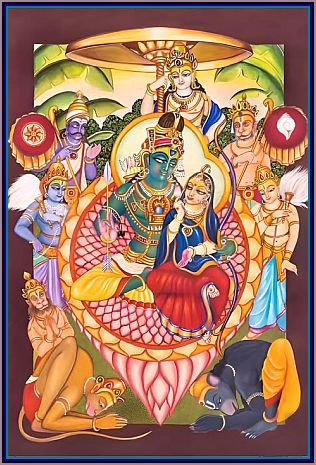
Manasollasa (also called Abhjilashitarta Chintamani) ascribed to the Kalyana Chalukya King Someshwara III (1127-1139 AD) is an encyclopedic work, written in Sanskrit, covering a wide range of subjects.  Its Chapter Three: Prakirnaka: deals with topics such as: Guna–Dosha (merits and demerits) of Vak-geya-kara (composers who set  songs to music). The text grades the composers (Vak-geya-kara) into three classes. According to its classification,  the lowest is the lyricist; the second is one who sets to tune the songs written by  others; and, the highest is one who is the  Dhatu Mathu Kriyakari – who writes the lyrics (Mathu), sets them to music (Dhatu) and ably presents (Kriyakari)  his compositions.

 The sublime trinity of Karnataka Sangita : Sri Tyagaraja; Sri Dikshitar  and Sri Shyama Shastry were  indeed  Vak-geya-karas  of the highest order.]

33.1. As regards the Taala (rhythmic counterpoints), nearly half his compositions are set in symmetric Di-Taala of eight counts (matra). There are nearly a hundred each in Chapu, Desati and Rupaka Taalas.

Sahitya

: – Sanskrit

34.1. Telugu is mainly the language of Tyagaraja-kritis. However, out of his 700 and odd Kritis that are known, about 50 are in Sanskrit [E.g. Jagadānanda kārakā (Naata); Śhambhō mahādēva (Pantuvarali); Īśā pāhimā jagadīśha (Kalyani); Lalitē śrī pravr̥ddhē śrīmati lāvaya nidhimati (Bhairavi); Vara-līla gāna-lōla sura-pāla (Sankarabharanam) and many others]. It is said; for the purpose of his daily worship, Sri Tyagaraja wrote Divya-nama-sankeerthanams as also Namavalis in Sanskrit.  Besides, in two of his plays –Naukacharitram and Prahlada Bhakti Vijayam – some slokas are in Sanskrit.  All his Telugu songs are replete with Sanskrit words and phrases.

34.2. His early education was in Sanskrit. He seemed to have learnt it well; and he used his learning with flair. His first (!) composition Namo Namo Raghavaya (Desikatodi – a Janya raga of the 8 Melakarta Hanumatodi with Aroha – S G2 M1 P D1 N2 S/  and, Avaroha– S N2 D1 P M1 G2 R1 S ), which is inscribed on the walls of his house, is in Sanskrit. The song celebrates the glory of the Lord in brisk series of His sacred–names (Divya-nama); and also pays tributes to the Valmiki who composed the most wonderful Ramayana epic (Satatha paalita adbhuta kavye).

34.3. His Sanskrit compositions enriched with skill and grace are spread over a wide range. There are some sweet-sounding songs that are meant for beginners. There are also elaborate and Grand (Pancharatna) Kritis with long winding sentences flowing out in brisk sequence.

34.4. And in his Sanskrit compositions, Sri Tyagaraja shows his literary skill and command over the language.  The songs are adorned with alliteration or word-play (pada-jala), rhymes (prasa), expressions that could be understood in two different ways (shlesha) and other literary devices. (For instance: Pada jala – gruha-anugruha-vigraha-navagraha –nigraha; Vidulaku-Koviduluku; and, Dehi tava paada Vaidehi. Shlesha: Janakaja-matha/ Janka-jamatha; Palaya/ Krupalaya; Taradhisha vadana/Taradhisha-damana)

He also plays with usage of rare words, some having obscure meaning; and compounds words coined by him by bringing together classical and colloquial words prevalent at that time.

Certain words that are rare in Sanskrit poetic usage have gained currency mainly because of his compositions. For instance: Samaja (elephant); Vivaha (one riding a bird, meaning Vishnu, where Vi stands for bird. Vivaha, otherwise, commonly means ‘marriage’); Rakabja-mukha (One whose face is like a full moon; here Abja stands for moon while it’s common usage is for lotus); Vanidhi (sea, here Va stands for water while Vana generally means forest). In a similar manner, Vanaja and  Vanaruha  , where Vana stands for water mean , here,  lotus. And, Bha generally means light ; but , Sri Thyagaraja   uses the term Bharaja- mukha , to mean ‘moon -like face’. And,  so on..

Telugu: –

35.1. The Telugu of Sri Tyagaraja-kritis, simple and graceful, is nearer to spoken language. It is the sort of Telugu that is commonly spoken by emigrant Mulakanadu community. There is a certain felicity and homeliness to his lines.  And, it is not the high-pitched classic Telugu of court poetry. Yet, it is elegant and ornamented with terms and expressions derived from Sanskrit.

35.2. There is a touch of realism in the similes, proverbs and expressions which he picks up from day-to-day life. That vouches for his keen observation of the life around him. The humour, mock-anger, sarcasm and nuggets of worldly-wisdom enliven his Kritis.

35.3. In a large number of songs , Sri Tyagaraja outlines the character of  true devotion and of a true devotee; the futility of mere observing rites and rituals (Vratas); the meaninglessness of sacred baths and Puja without having either the moral qualities, or the purity of mind or devotion in ones heart (Manasu nilpa saktilekapote..).

His kritis were as much a pleadings to the Lord as to the fellow beings asking them to delight in Bhakthi and to  give up attachment to lesser things.  The ways in which he conveys his message are rather fascinating.

Sri Tyagaraja very often employs conversation style lyrics (samvada-gati) in his Kritis as though he is carrying on dialogues with Sri Rama in different moods. Sri Tyagaraja was perhaps influenced by the Kirtana of Bhadrachala Ramadasa. He questions Rama about his unjust attitude, treating him like a stranger –  ‘Anyayamu seyakura rama, nannu anyuniga judakura’ (Kapi); taunts Rama : ‘have you no sense of shame’- Manamuleda’ (Hamirkalyani).

In his Kriti Palukkavemi Na Daivama (Raga Purnachandrika; Taala Adi) Sri Thyagaraja beseeches his Lord thus: “Oh Rama why don’t you talk to me, my own God? Ever so many people laugh at me and is it justified to be laughed at thus, my Rama?  I do everything just as you manipulate and even then you are neglecting me, why? What is the reason for doing so? In my younger days my own father and mother taught me to be pious, love you and protected me from wickedness. Even then some others made me unhappy over many things. You are witnessing all my sufferings and still you keep quiet. How long are you going to be like that, my most loving and affectionate Lord, the greatest of all Devas?”

*

There are some interesting expressions of mocking: naivety of a vessel trying to know the taste of milk it holds (Dutta palu ruchi dehyu samyame enta muddo) ; ..  or foolishness of one holding a lump of butter in his hand and yet worrying about ghee (Vennaiyunda netikevvarama vyasana padura); … or the futility of dressing up and decorating a corpse (Pranamulenidaniki bangaru baga chutti).

There are also expressions of humor: laughing at a woman rocking the baby with one hand and pinching it with another (Totla narbhakula nutuvu, tochinattu gilliduvu); … or like trusting on fidelity of a ‘purchased wife’ (Rukalosagi konna sati— gara vimpa rada); …. or the restlessness of one going after money like the grams bouncing up and down on a frying pan .

There are some wisecracks that suggest saying that one’s merits and miseries in life are ones own making. There is not much sense in blaming others for your plight. He points out: “if the gold is not entirely pure why blame the goldsmith?… If your daughter cannot bear the labor pains why blame the son-in-law? … If you did no good in your past birth why blame the gods for your miserable lot? O Rama, my troubles are my own; I surely do hot blame you for that. (Mi valla guna dosha memi Sri Rama? Na valla ne gani Nalina-dala-nayan…).

There are many un-characteristic sharp jibes taking a dig at hypocrisy and fake – rituals: as that of a Somayaji performing havan while his wife is busy eloping with her lover; … as that of a scholar who employs his learning to earn some money, like the one prostituting his mother; … or to those who slave their devotion to a mortal just as a sex worker does.

Another type of   Kriti which was not tried out by Sri Dikshitar and Sri Shyama Sastry was the Ninda-stuti, taking the Lord to task in mock anger. These again are the shades of Ramadasa.  Sri Tyagaraja taunts Sri Rama: what is the point in calling you savior  of the world and remover of difficulties (Pranatartihara) if you do not come to my rescue despite  countless appeals I made to you:  Ilalo pranatartiharudanu’ (Atana); … you became a famous king merely because Sita married you , and a hero because Sita did not burn Ravana into ashes by her angry looks : Ma Janaki chabattaga Maharaju vaithivayya  (Kambhoji); … and , he then takes Sita to task for marrying a good looking but a heartless person : ‘Sari evvare’ (Sriranjani).

Even in despair and anger, Sri Thyagaraja doesn’t loose his composure; and, he refrains from using harsh words to rebuke his Rama. The best he can ever do in his Ninda-stuti is to question Lord Rama’s judgment. In the Kriti Yuktamu Kadu (in Sri Raga) , the title of which  means “this is not proper for you, Lord”,  Sri Thyagaraja wonders why the Lord has disappeared, exclaiming in despair that it is not proper on His part not to protect his beloved Bhakta.

35.4. But, essentially Sri Tyagaraja was a Rama-bhaktha who was also a gifted poet and musician. He might have drawn comparisons from ordinary life, collective memory and common wisdom, perhaps to be accessible to the people of the world. But, inwardly he was a mystic yearning for liberation.  Sri Tyagaraja sang not merely for himself but for the liberation of all his fellow beings.

Rama pattabhishekam S Rajam

Output

36.1. The varieties of forms, vast spread of contents and sheer volume of his creative works is truly amazing.

We have in Sri Tyagaraja an extraordinary collection of verities of musical forms and compositions, ranging from Divya-nama-sankeerthanam and Utsava-sampradaya songs suited for group singing;  musical dance-dramas such as Nauka-Charitam and Prahlada Bhakti Vijayam; Kirtanas beseeching the Lord for help , kindness and love; and above all liberation; songs bursting out in sheer joy and ecstasy ; songs in playful mood , mocking Rama in jest and half-anger; and , there are , of course , the Grand Compositions grouped as Pancharatna-kritis representing the highest form of art music performed in formal classical concerts.

It is the spread in the variety of his creations that   marks Sri Tyagaraja among his illustrious contemporaries. The range of his music stretching from simple well set songs of melody, ease and grace that children love to sing , to edifying flood of Grand music is a testimony to Sri Tyagaraja’s manifold musical genius.

Although the bulk of his known compositions are devoted to Sri Rama , Sri Tyagaraja also composed quite a number of songs in praise of other deities as well , such as : Shiva, Krishna, Vishnu , Ganesha, Devi (in her various forms) ; and, many on the the River Kaveri and one on the River Yamuna (Allakallola) in Raga sowrashtra. He also composed a  number of songs glorifying  Nada Brahmam; the medium of  Sapta svara through which he expressed his devotion toward that sublime principle . Please read the article posted by Dr. P P Narayanaswami.

[The website at  New Age Multimedia Almanac  states  that of the  787 compositions of Sri Tyagaraja  listed by  it, as many as 698 are devoted to Sri Rama; the next , which is quite distant, are 37 Kritis on the Devi  , followed  by 19 on Shiva; and, 12 on Krishna . The rest are in single digits.]

The renowned artist Sri S Rajam illustrated Sri Thyagaraja’s one of the rare Kritis dedicated to Lord Shiva: Mucchata-Brahmadulaku (ముచ్చట బ్రహ్మాదులకు) in the Raga Madhyamavathi :

Shiva Thyagaraja kriti

36.2. As regards the numbers, the exact number of Kritis/Kirtanas that Sri Tyagaraja created is still a matter of debate among the scholars. Some claim that he wrote as many as 22,400 songs, which number matches with the number of Slokas in Valmiki- Ramayana. That might be an overstatement.  According to the researchers and particularly, the sangeethapriya.org , the known and authentic kritis / kirtanas of Sri Tyagaraja is about 725 .

His Utsava-sampradaya-kirtanas, a group of songs rich in melody and lyrics, number about 27. And, the Divya-Nama-samkirtanam– that celebrate the glory of the Lord and his name are about 72.

In addition, Sri Tyagaraja composed three musical plays in Telugu, of which two are available:  Prahalada Bhakti Vijayam and Nauka Charitam. The Prahlada Bhakti Vijayam is in five acts with 45 kritis set in 28 ragas and 138 verses, in different metres in Telugu.  The Nauka Charitam is a shorter play in one act with 21 kritis set in 13 ragas and 43 verses. The latter is more popular.

[ Please do refer to a very remarkable site created by  a group headed by its Chief Data Analyst –  Smt. Meera Subramanian  , listing as many as 787 compositions of Sri Tyagaraja, along with its lyrics , audio and video files as also the deity-wise classification of his Kritis.]

37.1. Chronology is yet another issue with Sri Tyagaraja’s works. The dates or the sequence of his various compositions are much debated. There is no definite information in that regard. His disciples Walajapet Venkataramana Bhagavatar and Tanjavuru Rama Rao who served their Master for long years, did make efforts to preserve the texts of his songs. We all have to be grateful to them for the service they rendered.  They wrote down the songs on loose sheets of paper or on palm leaves, without however mentioning the date or the year of their composition.

All that is surmised is:  either his Sanskrit song in praise of Sri Rama Namo Namo Raghavaya ( Desikatodi) or his Telugu song on Ganesha , Giriraja suta tanaya (Bangala)  is his first composition. Some explain it away by saying that while the former is his first Kriti in Sanskrit, the latter is his first Kriti in Telugu.

37.2. As regards his end-years, his wife Kamalamba passed away in the year 1845. A year after her death, on the night of Prabhava – Pushya shukla –Ekadashi (Dec 1846), Sri Tyagaraja had a dream. Immediately on waking up, Sri Tyagaraja burst into, the now famous, Kriti  Giripai nelakonna (in Sahana Raga) wherein  he declares with great joy that  in his dream he did see  Sri Rama, residing on hilltop ; and, he  did   promise  him Moksha within ten days (putlu). [Here, putlu could mean either a day or part of a day]

37.3. On 5 Jan 1847, Sri Tyagaraja, at the age of eighty, renounced the world and entered into Sanyasa assuming the name Nadabrahmananda. On the next day, that is on 6 Jan 1847, – Pushya Bahula Panchami (the fifth day after the full moon in the dark-half of the month of Pushya) of Prabhava-nama-samvatsara in the Kali-year 4948 – after offering his daily worship to his Ishta-devata  Sri Rama installed in his house , he called on his disciples attending him to chant Rama-nama. Then, it is said, he burst into his last song Paritapamu ganiyadina (in Manohari Raga). Thereafter, Saint Sri Thyagaraja entered into Samadhi merging with the Para Brahman.

Thus, Giripai nelakonna and Paritapamu ganiyadina seem to be his last two Kritis.

sri rama

Nadopasana and Rama Bhakthi

38.1. In many of his songs Sri Tyagaraja describes Nadopasana the practice of music (Samgita Sadhana) as an aid to cultivate devotion and contemplation. He says, neither mere talk nor modesty will help. Sadhana, ceaseless practice, with dedication will alone save you. For Tyagaraja, music was the means to salvation; and, he practised it with great sincerity.

38.2. He explains the seven notes (sapta-svara) that are the foundations of music as having emanated from the Pranava Nada (Aum). Here, he visualizes Nada the subtle and sacred vibration as the manifestation of Para Brahman, the Supreme Reality. He narrates his experience of deep absorption in the joy (Ananda) of Nada. He declares: ‘the joy of music  (Nada ) is itself the bliss of Brahman (Brahmananda) that the Vedanta speaks of’; and says ‘he who delights in Nada attains the bliss of Brahman’.  He, thus, upholds the highest spiritual ideal of music that is permeated with Bhakthi.

[For example: Sangita-jnanamu; Nadatanuma; Gitarthamu; Nadopasanace; Nadaloluni; Mokshamugalada and Svara-raga-sudha etc]

Rama janma

39.1. Ramayana was a huge influence in the life and outlook of Sri Tyagaraja. He not only revered the text deeply but also imbibed several of its episodes into his Kritis. In hundreds of his songs he celebrates the powers, the glory and the virtues of  Sri Rama. He calls out to Sri Rama in countless ways.

Ram lalla 2

And, some of the epithets he employs are related to music, addressing Sri Rama as : ‘Samagana-lola’; ‘Raga-rasika’; ’Sapta-swara-sanchari’; ‘Samgitasampradayakudu’; and, such others. It is the Rama bhakthi permeating his Kritis that elevates his music to spiritual heights.

39.2. For Thyagaraja, Sri Rama his Ishta-devata whose glory he celebrates in most of his songs is none other than Para Brahman, the Supreme Being. He repeatedly declares that Sri Rama is his favourite deity (Ista daivamu neeve); Rama alone is his God (Vadera daivamu; Rama eva daivatam); there is none equal to Rama (Rama nee samanamevaru); he takes refuge in Rama (Ninne nera namminanu )  and so on.

Lord-Rama-HD

For him, Rama is beyond the Trinity, Tri-murti (Sri Rama Rama Jagadatma Rama; Manasa Sri Ramachandruni); Rama is Para Brahman. Rama is another name for BrahmanRaamaayani brahmamunaku peru (It’s Sanskrit equivalent is: Rama padena asau param Brahma abhidhiyate). Therefore, he counsels, submit to Rama with Love (prematho) and true devotion (nija bhakti); surrender to Rama in absolute faith; and, be immersed in Rama-bhakthi. And, he avers that such real Bhakthi alone is the right royal way to salvation (Chakkani raja margamu).

39.3. Thus, Music (Samgita Sadhana), absorption in the joy of melody graced with bhakthi, was for Sri Tyagaraja the Nadopasana the worship of Nada which is the very embodiment of Brahman.

Ramadarshan


Continued in Part V- Visit to Kanchipuram

Sources and references

Manaku Teliyana Tyagaraju: http://eemaata.com/em/issues/200809/1337.html

Tyāgarāja and the Renewal of Tradition: Translations and Reflections by William Joseph Jackson

The Power of the Sacred Name: Indian Spirituality Inspired by Mantras by V. Raghavan

Spiritual Heritage of Sri Tyagaraja by Dr. V Raghavan and C. Ramanujachariar

History of Indian Music by Prof. P. Sambamoorthy

A Tribute to Tyagaraja by V.N. Muthukumar and M.V. Ramana

http://www.parrikar.org/carnatic/tyagaraja/

The Musical Works of Thyagaraja by Prabhakar Chitrapu Prabhakar

http://www.sruti.org/sruti/srutiArticleDetails.asp?ArticleId=4

I acknowledge with thanks the images and other information from his site

http://en.wikipedia.org/wiki/List_of_compositions_by_Tyagaraja

 
9 Comments

Posted by on February 22, 2015 in Tyagaraja


Tags: , , , , , , , , , , ,