RSS

Author Archives: sreenivasaraos

Music of India – a brief outline – Part Eighteen

Continued from Part Seventeen – Lakshana Granthas– Continued

Part Eighteen (of 22 ) – Lakshana Granthas – Continued

12 . Samgita Parijata pravashika by Ahobala Pandita  

Ahobala Pandita’s   Samgita Parijata pravashika (17th century) that follows the works of Pundarika Vittala is the other significant text that introduces the elements of South Indian music in the North. And, it is regarded by some as the earliest text of the North Indian Music.

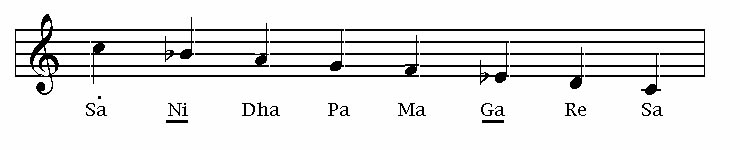
Pandit V. N. Bhatkhande in his ‘A Short Historical Survey of the Music of Upper India’ writing about Ahobala and his Sangita Parijata described it as the most popular Sanskrit work of Northern India. The importance of Sangita Parijata again, I believe, can never be exaggerated. It is one of our great landmarks in the history of Northern Music. The Shuddha scale of Sangita Parijata is the same as that of our modern Kaphi Raga. This scale will correspond with the southern scale Kharaharapriya.

Pandita Ahobala who described himself as a Dravida Brahmana, the son of Samskrita Vidwamsa Sri Krishna Pandita, provides valuable information on the classification of North Indian Ragas. The Sangita Parijata is regarded as one of the source-books of Hindustani Music.

Ahobala derives his music theories and principles from Raga-tarangini of Lochana Kavi (15th century) and Raga vibodha of Somanatha (1609). The Raga-tarangini written by Lochana Kavi, also known as Lochana Pandita, a poet in the Royal Court of Maharaja Mahinath Thakur of the Khandwala dynasty of Mithila , discusses in detail several songs in Maithili dialect, set to Ragas and Raginis prevalent during that time. Lochana Kavi in the traditional manner lists 22 Sruti positions. He also described  twelve Mela Ragas  (starting with Bhairavi, corresponding to Kafi Thaat of the present-day, which is equivalent to Kharahara-priya of Karnataka Samgita) and seventy-seven Janya Ragas

Following Lochana Kavi, Ahobala mentions 22 Srutis and 122 Ragas. According to Emmie te Nijenhuis; Ahobala listed 11340 Ragas. Following Ramamatya and Pundarika Vittala, Ahobala classified 122 Ragas under six Mela categories and three subdivisions: Audava (pentatonic), Shadava (hexa-tonic) and Sampurna (hepta -tonic). His scale of Shuddha notes corresponds to the current Kafi thath.

And, he describes 122 Ragas in detail mentioning the Svara structure, number of their Svaras, their time of performance and their characteristic melodic phrases. In his descriptions of the Ragas he emphasized the importance of understanding the nature and structure of the Raga. According to him, the movement of different Svaras (Svara-sanchara), as also the different places (Sthana) of the same Svara give each Raga its unique flavour.

[ Prof. O C Ganguly in his Raga and Ragini (Nalanda Books, 1935) remarks:

The most important feature of Sangita-Parijata by Ahobala Pandlta  is the fixing of the exact places of the Shuddha and Vikrta notes in terms of the lengths of the sounding string of the Veena, in the same manner as that of Hrdaya-kautuka of Hrdaya Narayana Deva.

Ahobala does not appeal to give any classification of the Ragas under any types of parent-scale (That) or otherwise, although he claims to describe the ragas according to the characteristics laid down by Hanuman- Laksanani vurve tesam sammatya ca Hantimatah.

But occasional references to Thats seem to indicate, that in his time, classification of Ragas under Thats had become current in the North. He gives a list of 122 ragas, which he describes with accurate notations – Dvavimsatya satam te ca prokta loka-sukhaya ca.

Ahobala Pandlta groups them according to the time and hours (prahara) assigned to their appropriate periods for singmg, dividing them into three groups, for the first, second or third watches, while a string of 19 ragas are grouped together as suitable for all hours (sarvada ca. sukha-prada).]

In his work , he  does not use particular names for the scales , but indicates the alterations (Vikrta Svaras) , flat (Komal) and sharp (Tivra or Tivratara) to be used in particular Ragas. And, the Shuddha scale he refers to is the same as the one in Raga-tarangini of Lochana Kavi. However, Ahobala’s Shuddha (unaltered) notes do not correspond with the notes of the Karnataka Mukhari Mela, but with those of the Hindustani Kafi That.  Ahobala treats Kafi as the principal scale.

[The modern Raga Kafi of the North is equivalent to Kharahara-priya]

[For several centuries the Saptaka that defined by the Svaras of Kafi Raga– and not that of Bilawal – was the Shuddha scale of the Hindustani system.    And, therefore,  Pandit Bhatkhande expresses surprise that post-Lochana, occurrences of Raga Kafi and its Lakshanas are found more in the works of Karnataka Shastras including Venkatamakhin‘s Chatur-Dandi-Prakashika  (17th century ) and Tulaja‘s  Sangeeta Saramrta (18th C), than in their northern counterparts.]

arohi_kafi

avar_kafi

As regards Vikrit Svaras ( the Svaras which when displaced to higher or lower positions from their original positions cause either decrease or increase in the number of Srutis between them and their neighboring Svaras) , Ahobala identifies eight Vikrit Svaras :

    • (1). Purva – Ra – at 5;
    • (2) .Komal –Re- at 6;
    • (3). Purva – Ga- at 7 ;
    • (4). Komal – Ga- at 8;
    • (5) . Purva – Dha- at 18;
    • (6). Komal – Dha- at 19;
    •  (7). Purva – Ni – at 20; and
    • (8). Komal – Ni – at 21.

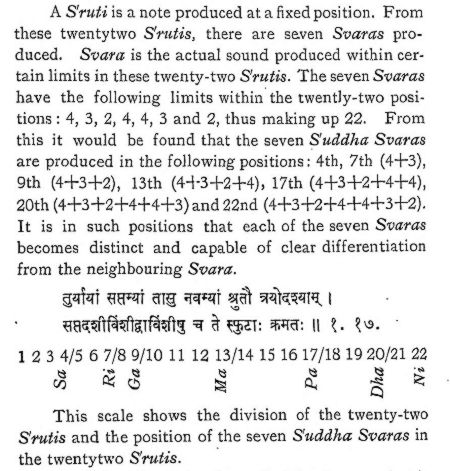
Ahobala reproduces the ancient theory of 22 Srutis. He states that all these Srutis could be used as notes (Svara) in various Ragas.

Shri TR Srinivasa Ayyangar in his scholarly critical introduction to Samgraha-Chudamani of Govinda remarks that Ahobala Pandita did not divide the 22 Srutis into equal intervals. Instead he recommended application of Shadja-panchama-bhava in fixing the intervals.

Shri Ayyangar quotes Ahobala Pandita:  “Kesagra-vyvadhanena bahvyo pi srytayah Srithah ; Veenayam ca tatha gatre samgita-jnani-nam mate. Madhya purvottara-bhaddha-Vinayam gatra eva va; Shadja-panchama-bhavena srutir dva-vimsatim jaguh”;

And says, with this Ahobala determined the length-value of Svaras on the strings of the Veena. He then names the 22 Sruti positions :  :

    • Chandovathi 1;
    • Dayavathi  256/243;
    • Ranjani 16/15/;
    • Ratika 10/9 ;
    • Raudri 9/8 ;
    • Krodha 32/27;
    • Vajrika 6/5 ; 
    • Prasarini 5/4 ;
    • Priti 81/64 ;
    • Marjani 4/3 ;
    • Keiti 45/32 ;
    • Raktha 64/45 ;
    • Samdipani 40/27 ;
    • Alapini 3/2 ;
    • Madanti 128/81 ;
    • Rohini 8/5 ;
    • Ramya 5/3 ;
    • Ugra 27/16 ;
    • Kshobini 16/9;
    • Tivra 9/5;
    • Kumadvathi 15/8 ;
    • Manda 243/128 ; and
    • Chandovathi 2.

[The Shuddha Svaras mentioned above belong to Shadja-Grama]

Although Ahobala recognizes 22 Srutis in the octave, he limits his discussion to 12 in order to describe his Ragas or to illustrate his examples.  He identified the 12 Svaras in terms of the length of the string of the Veena. Ahobala minimized the importance assigned to Srutis or to their numbers by comparing Svaras and Srutis with the snake and its coils, which truly are one but appear distinct only in their outward forms.

In order to determine the exact position on the string of each of these 12 Svaras, he mentions the ratios representing the divisions of the string. Pandit V N Bhatkhande writes:

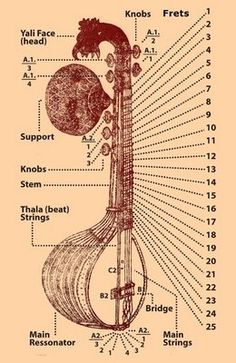
There is another point on which Ahobala puts the whole musical world of India under his obligation and it is this. Ahobala was the first musician who distinctly saw the absolute necessity of calibrating the value of 12 Svaras in terms of the lengths of the speaking wire of the Veena. It should be noted here that Ahobala thus set an important precedent: not long afterwards, a South Indian  musicologist named Govinda Dikshita fixed the frets of the southern Indian Veena so that all ragas could be played . . . before this, the frets were movable, and their number varied.

Further, Pandit V N Bhatkhande writes: Ahobala Pandita described the octave relation as well as the seven notes and their inter relations, in terms of the string divisions and position of nodes

“The places (nodes) for each note are described on the Veena , which generates the note and which can be seen with the eyes. The nodes for upper Sa  or octave stands at the mid-point of the open wire, and that for Ma ( the fourth) should be taken mid-way between the two – the fundamental and the octave. Dividing the wire-length into three equal parts the Panchama (the fifth ) is obtained at the first division, near the top. The Gandhara (the third) is obtained mid-way between fundamental and its Fifth. The Re (second) is to be placed at the first (of three divisions) between Sa and Pa, while the Dha (the sixth) is to be placed between the Fifth and the octave. In turn , Nishadha is at the end of the second ( of the three divisions) between the Fifth and the Octave “ (In Ranade 1951 :p .177-178)

Ahobala’s descriptions of 68 types of Alamkaras or Vadana-bedha is said to be an improvement over Somanatha’s Raga-vibodha.

There are some often quoted passages of Ahobala Pandita.

: – Samgita in the ancient context was a composite art comprising Gita (singing), Vadya (instruments) and Nrtya (limb movements). It was only much later that Nrtya began to develop independently. And, in Music, Gita (singing) had importance over Vadya (instrumental music); and, instrumental music generally follows the vocal styles and nuances. . Ahobala Pandita   in his Samgita Parijata pravashika (17th century) says it is because of that reason the singing itself came to be known as Samgita (Samgita, Gita-vadhittra nrityanama trayam samgitam uccyate; Ganasytra pradhanatvat samgita mitiriyam).

: – Ahobala describes Mela as a combination of Svaras, and it has a power to create the Ragas. Therefore every Raga has a Mela for its basis or ground of origin – : “Mela svara-samuha syad raga-vyanjana-shaktim

: – His description of Kafi Raga: – arohe ridha-hinanyet pumasuddha svaratyukta gandharasvara purvasyat dhanairui madhyamantak

: – The distinguishing feature, the Lakshana of a Raga is its uniqueness: Asadharana- Dharmita.

 Ahobala Pandita work not only influenced the music-practice of his times, but also had a great impact on other music-scholars. They all accepted the theory of Ahobala, his measure of 12 Svaras and Kafi Mela as the Shuddha Mela. For instance; following Ahobala Pandita, Hridayanarayana Deva wrote two books on theory (Hridaya Kautuka and Hridaya Prakasha); Bhavabhatta wrote three books (Anupa Sangita Vilasa; Anupankusha; and Anupa Sangita ratnakara); and Srinivasa in 18th century wrote his Raga-tattva-vibodha where both Vikrit and Shuddha Svaras were placed by measuring the length of the wire on the Veena, following the method of Ahobala Pandita. He accepted the 12 notes of Ahobala and Kafi Mela as the Shuddha Mela.

As can be seen; the 16th and 17th centuries were of great importance for Music-texts of India. Several important texts touching upon the Music of North India were also written during this period. Of these, the Raga-tarangini of Lochana Kavi; Sad-raga-chandrodaya and other works of Pundarika Vittala; Hrdaya-kautaka and Hrdaya-prakasha of Hrdaya–Narayana Deva (Ca.1660) and Sangita-parijata of Ahobala (Ca.1665) are considered important for their bearing on the present day music.

Ahobala Pandita‘s work Samgita Parijata pravashika earned great fame as a landmark text in the North Indian Music history.   Pandit Bhatkhande writes: While considering the history of music in the time of this Emperor – Shahjahan – (1627-1658 A.D.) it will be most convenient to take notice of that most popular Sanskrit work of Northern India which is known as Sangita-Parijata. It was written by Pandit Ahobala the son of Shri Krishna.

It is not therefore surprising that Samgita Parijata pravashika was translated into Persian and other Northern languages. The more notable ones are its Persian translations; one by Mirza Raushan Zamir (1666) as Tarjuma -i- parijatak, with his own comments ; and the other by Pandit Dinanatha ( son of Pandit Vasudeva) in 1724. The translation bearing the seal of the librarian of Emperor Mohamed Shah (1719-1724) is  said to be still in the collection of the Rampur State Library. 

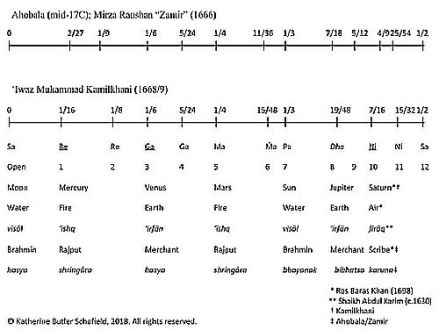
Katherine Butler Schofield, King’s College London, based on  the works of Ahobala Pandta, Mirza Raushan Zamir, Iwaz Muhammad Kamilkhani , Ras Baras Khan, and Shaikh Abd al-Karim , has re-worked, on the string of the Been,   the scales of Hindustani Rāgas, according to Pythagorean ratios.

ahobala music

[ Ref  and sources : Semiosis in Hindustani Music by José Luiz Martinez ;  A Short Historical Survey of the Music of Upper India by Pandit v. N. Bhatkhande ;  Bhatkhande’s  Contribution to Music: A Historical Perspective by Sobhana Nayar; Musicological Literature by Emmie te Nijenhui ]

kaafi

13. Govinda Dikshita – Sangita-sudha

govinda dikshitaGovinda Dikshita, a musician and a Kannada  speaking (Hoysala Karnataka Brahmin) scholar, philosopher, statesman and musicologist hailing from Mysore, served as a Minister of three successive  Kings of Thanjavuru, Achyutappa Nayaka (1560 AD-1614 AD), Raghunatha Nayaka (1600 AD-1645 AD) and Vijayaraghava Nayaka (1634 AD-1673 AD) , all of whom patronized Karnataka Samgita . Govinda Dikshita’s two sons Yagnanarayana Dikshita and Venkatershwara Dikshita or Venkatamakhin were both scholar- musicians.  All the three were in the service of the Kings of Tanjore.

Govinda Dikshita’s fame rests on the treatise on music and dance named Sangita-sudha which he wrote in 1614. The work may originally have had seven chapters (1.Svara; 2.Raga; 3.Prakirna; 4.Prabandha; 5. Taala; 6. Vadya; and, 7. Nartana). But, all available manuscripts contain only the first four Chapters. Govinda Dikshita in his work generally followed the model of Sarangadeva’s Sangita Ratnakara.

The colophon of the text implicitly states that it was written by Raghunatha Bhupa – Sri Raghunatha bhupa viracita Sangeetha Sudha“.  But, Venkatamakhin asserts that the text was , in fact, written by his father Govinda Dikshita ;and , submitted to his patron Raghunatha Nayaka.  In any case, the text is of great value to students of Karnataka Sangita; and, the introductory part of the text is an authentic source of the history of art and architecture of the age.

Sangita-sudha is an elaborate treatise, and treats of the Raga systems quite fully. The descriptions of the jati-ragas, including the composite jati-melodies, are illustrated with actual songs, with notations. Govinda Dikshita gives to the Suddha-jatis a picturesque name, viz Kapalani (skulls), associating their origin with Shiva, as he went about in his begging role (Bhiksatana vesa) with the skull as his begging bowl.

Improving on Matanga , he also takes for detailed elaboration ten main types of Ragas, classifying under them thirty Grama-ragas, eight Upa-ragas, twenty Upanga-ragas, ninety six Bhasha-ragas,   twenty Vibhasha-ragas, four Antarbhasha-ragas, twenty one Raganga-ragas, twenty Bhashanga-ragas, thirty Upanga-ragas, and fifteen Kriyanga-ragas. He also explains the concept of Alapana, the ways of elaborating a Raga.

[ Prof. O C Ganguly in his Raga and Ragini (Nalanda Books, 1935) remarks:

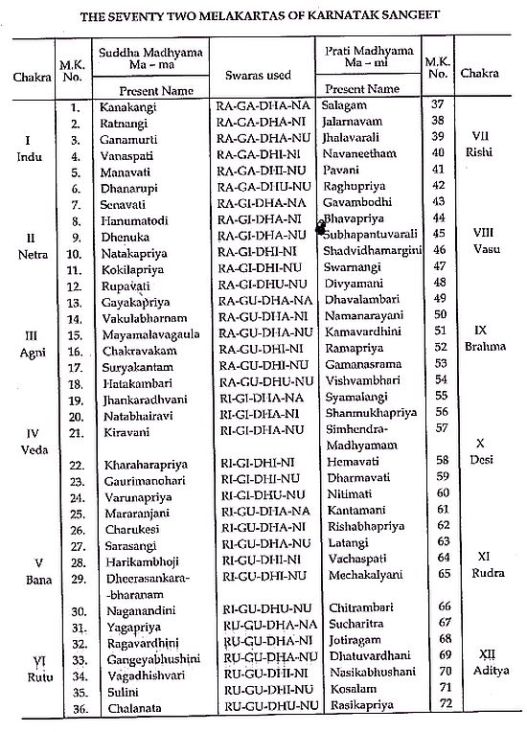
 While Svara-kala-nidhi cites 20 melas, (generic melodies which unify the derivatives under a genus-species system), Raga-vibodha cites 23 mela-karta ragas; by the time of Govinda Dikshita, 72 melas had been evolved. Though the system of Melakartas had been in existence before, Dikshiat gives it an emphatic status, and appears to have codified it, and given it a proper name, calling it, after the name of his patron, as ‘Raghuniitha-mela’. The author is said to have introduced some new ragas, e.g., Jayanta-sena and others.]

Govinda Dikshita in his Sangita-sudha confirms that the method grouping the Ragas into Mela was initiated by Sage Sri Vidyaranya in his Sangita-sara (14th century). Govinda Dikshita reverently addresses Sri Vidyaranya as: Sri Charana. According to Govinda Dikshita, Sri Vidyaranya classified about 50 Ragas into 15 groups (Mela) – commencing from Naata  and ending with Desaksi. The intention was to organize then known Ragas that were in practice.

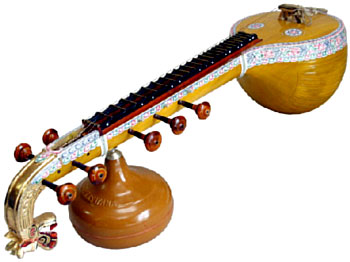
Apart from writing, Govinda Dikshita improved upon the techniques of Veena tuning initiated by Somanatha and Ramamatya. He followed the illustrations given by Ahobala Pandita in fixing the position of the frets on the Veena so that all the Ragas could be played. (Before that, it appears, the frets were movable and their numbers varied).It is said; that his sons Venkatamakhin and Yajnanarayana Dikshita were also involved in his work.

Venkatamakhin informs that during those days, besides the common Shuddha and Madhya-mela Veena described by Ramamatya, there was also a Veena with a higher tuning, i.e. a fourth higher than the Madhya-mela Veena and comparable to the Madhyama Sruti tuning of the modern Karnataka Veena. It was named by Govinda Dikshita as Raghunatha Mela Veena, in honor of the King.

In the beginning of 17th Century, Somanatha’s Raga Vibodha, Ramamatya’s Svara-mela-kalanidhi and Govinda Dikshita’s Sangita-sudha were regarded as standard theoretical texts (Lakshana granthas) on Music. Some, therefore, look upon Somanatha, Ramamatya, and Govinda Dikshita as the Trio of Lakshanakara-s (theoreticians) of Karnataka Sangita theory (Sangita Shastra).

In the latter half of 17th Century, Govinda Dikshita’s son Venkatamakhin appeared on the scene with his monumental work Chatur-Dandi-Prakashika , suggesting the possibilities of the 72 Mela scheme, footing the Mela-Janya system on a rational basis. One could say that Govinda Dikshita and Venkatamakhin are to musicology what Ramaswamy Dikshitar and Mutthuswamy Dikshitar are to musical compositions.

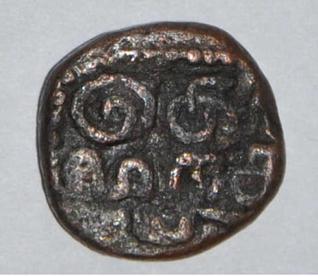
Coin of the Nayak period With Govinda Dikshita's name on it.  Photo From the collection of T.M. Krishna

Govinda Dikshita‘s role in persevering and nurturing Karnataka Samgita is of historical importance. 

With the fall of the Vijayanagar Empire, scores of musicians and scholars migrated to the Tanjore region, seeking shelter and royal patronage. The kingdom of Tanjore of the Nayaka period (1530 -1674) was relatively safe, prosperous and a benign region of peace. The three Nayaka kings of this period – Achutappa (1560 -1614); Raghunatha (1600-1645); and, Vijayaraghava (1634-1673) Nayaka – were themselves the descendants of the erstwhile Vijayanagar Royalty.

It was during the reign of Achutappa Nayaka (1560 -1614) that the initial wave of immigrants from the Kannada region were granted asylum and resettled, mainly, in Unnatha-puri (Atchutapuram or Melattur) region. It was Govinda Dikshita, who himself was from Karnataka, that oversaw the arrangements for resettlement of the families, on behalf of Achutappa Nayaka.

It is said; Govinda Dikshita caused the renovation and extension of the Unnatha-puri-eswara temple; construction of a pond in front of it ; and,  formation of various Agraharams (residential quarters) around it. The temple tank was duly named after Govinda Dikshita as ‘Ayyan Kolam’.

Even though their reign was dotted with many wars with various other local rulers and later overtures by the English, the Nayaks of Tanjore provided unstinted support to the music and dance forms of the region; and , remained great lovers and patrons of art and literature. Their courts supported many a composer and musician and we see the results from the prodigious output of the famous trilogy of Thyagaraja, Shyama Shastri and Dikshitar.

Thus , it could be said , Govinda Dikshita played a significant role in shifting the centre of Karnataka Samgita from Vijayanagar to Tanjore.

Govinda Dikshita continued to be a minister in his court of Raghunatha Nayaka, as well. It is said; it was during this period that Govinda Dikshita composed the Sanskrit treatise on music, Sangita Sudha; and, ascribed it to his patron Raghunatha  

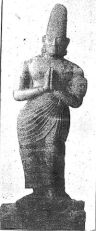
During his lifetime and even after, Govinda Dikshita was a highly respected person. He was affectionately called ‘Ayyan’. Later in his life, he is believed to have lived at Patteeswaram where he caused the renovation of the Devi temple. The sculptural images of Govinda Dikshita and his wife Nagamba standing in front of the deity with folded hands can be seen in the Mantap of the temple.

Govinda_dikshitar

The presiding deity of the temple at Patteeswaram, the Lingam, is called ‘Govinda Dikshita Lingam’. The villages around the town he lived were named; Govindapuram, Ayyampettai etc in his honor.

veena_23140

[Ref: Musicological Literature by Emmie te Nijenhui; Wikipedia]

All pictures are gratefully  taken from internet

Continued 

in Part

Nineteen

 
Leave a comment

Posted by on June 10, 2015 in Music, Sangita


Tags: , , , , , , , , , , , , ,

Music of India – a brief outline – Part Seventeen

Continued from Part Sixteen – Lakshana Granthas– Continued

Part Seventeen (of 22 ) – Lakshana Granthas – Continued

10. Pundarika Vittala

Perhaps the first Musicologist who applied Ramamatya’s system of 19 Mela (basic scales) to North Indian Music was Pundarika Vittala (16th century).

Till about the late 16th century both the South and North traditions followed the same set of texts.  Then, Pundarika Vittala a musician-scholar from Karnataka  , Karnata Desiya , (from Sathanur , around Shivaganga Hills about 50 KMs from Bangalore), of Jamadagni gotra, who settled down in the North under the patronage of Muslim King Burhan Khan  in Anandavalli  (near Nasik) in the district of Khandesh, wrote a series of books concerning Music of North India.

(Karnate Shivaganga abhidana giri nikate, Satanur-hrudaye yo gramasta janma pravarasunikarath Jamadagni yo asmita vamsa)

While in Anandavalli during 1560-1570, Pundarika Vittala wrote his famous Sad-raga-chandodaya having three Chapters: Svara-prasada, Svara-mela prasada, and Aalapi-prasada.  In this text, he introduced Ramamatya’s Mela system to the North Indian Music. He almost adopted Ramamatya’s 19 Mela (as in Svara-mela-kalanidhi)   . But, he changed the names and scales of several Melas.

Of the 19 Melas listed by Pundarika Vittala, 11 are identical with those mentioned by Ramamatya:

Mukhari, Malavagaula, Sri, Shuddhanata, Desaksi, Karnatagaula, Kedaragaula, Abhiri, Shuddhavarali, Shuddharamakri and Nadanamakri.

AS regards the other eight Melas either their notes are different or their names as well as their names are different (few of them have only one note different).

For instance; Ramamatya‘s Hejuri becomes Pundarika’s Hijeja; Similarly Vasanthabhairavi becomes Todi, and Saranganata becomes Saranga.

The Hindola Mela is entirely different in both the systems.

In his Sad-raga-chandodaya, Pundarika Vittala says that due to different application of a Svara in different Ragas, different Sthana (positions) of the same Svara in different ragas occurs. He further says that it is important to know the exact structure of Raga,

Later, when he moved to the court of the Prince Madhavasimha and Manasimha who ruled from Jaipur as the feudatory of Akbar, Pundarika Vittala wrote Raga Manjari. In his writings, Pundarika Vittala carried forward the work of Gopala Nayaka (14th century) of grafting Karnataka music on to the newly evolving North Indian music.  Raga Manjari shows a further leaning towards North Indian Music, although the set of twenty Melas is the same as in his earlier Sad-raga-chandrodaya.

He adopts the typical North Indian classification of Ragas as: Male (Purusha), female (Stri) and infant (Putra) Ragas. However, in both these works as well as in the third treatise named Ragamala written in 1576 (which he says was written for one Kapila muni- Srimath Kapilamuniyarthe  kriyate Raga –maalikah) , Pundarika Vittala uses for his Shuddha scales, the notes of the South Indian Mela Mukhari 0r Kanakangi scale .

According to the great  Scholar Pandit VN Bhatkhande, : The Ragamala distinctly shows that Pundarika Vittala had come into contact with the music and musicians of North India ,perhaps   in  Delhi or Agra, because the names of Ragas  he mentions , like Chaiiri, Gowdi, Musali, Iraq, Bakharej, Yemen, Husaini, and Tirban distinctly belong to that region.

Ragini samgita border

[Prof. O C Ganguly in his Raga and Ragini (Nalanda Books, 1935; pages 54-57)  and also Chapter II Pundarika Vittala of Shodhganga   ( which is a part of  a thesis titled – The Study of Pundarika Vittala’s Treatises with Reference to the Systems of Raga Classification in Post Ratnakara Period by  Dr.Padma Rajagopal) give details of the three works that Pundarika Vittala wrote under the auspices of three successive royal patrons: (1) Sadraga-candrodaya written under the service of the Faroqi Prince Burhan Khan of Khandesh; (2) Ragamala, written probably under the patronage of the Jaipur prmces, Madho Singh and Man Singh Kacchwas; and, (3) Ragamanjari, probably composed under the patronage of Raja Mansingh Kacchwa

1. Sadraga Chandrodaya

The first one Sadraga-candrodaya was written some time between 1562 and 1599 under the service of the Faroqi Prince Burhan Khan of Khandesh which was incorporated in the Mughal empire after the seige of Asirgarh in 1599.

It is a very extensive text covering almost all the aspects of Music . It is spread over three Chapters ( Prasada) , titled as : Svara Prasada; Svara Mela Prasada; and, Alapti Prasada.

In the first chapter (Svara Prasada) Pundarika briefly describes the music-terms , such as  Nada, Sruti, Svara (defines suddha, vikruta, vadi, samvadi etc),  Grama, Murhcana, Tana prastara etc.. He also briefly discusses about graha, amsa, nyasa, apanyasa vidari, sadja as universal graha. Then he takes up various alankaras, sthaya, aroha, avaroha varieties of alankaras, etc.,

The second chapter, Svara Mela Prasada, has two sub-sections. In the first  (Svara prakarana ) Pundarika discusses about arrangement of frets on theVeena; and then, in the second section (Mela prakarana )  he takes up the description of Mela formation (paryayavriti) and number of melas formed when two, three, four and five svaras are made vikruti (mela prastara) totaling 90 melas.  In the Mela prakarana, he provides a list of 19 Melas   and their deravatives. For more on that – please click here.

In the third chapter – Alapti Prasada – Pundarika,  first describes different types of Gamakas totaling 15; and , then dicusses different varieties of sthayas and alapti, when playing of a raga on Veena.

 In this work, Pundarika deals with both the Southern and Northern systems of ragas and classifies them under nineteen Thats or parent scale, viz.: Mukhari, Malava-gaula, Sri, Suddha-natta, Desaki, Karnata-gauda, Kedara, Hijeja, Hamir, Kamode, Todi, Abhiri, Suddha-varati, Suddha-ramakri, Devakri, Saranga, Kalyana, Hindola and Nada-Ramakri. Out of these nineteen original (Mela) ragas, he attrIbutes to five of them their respective derivative forms (janya-raga).

Dr. Padma Rajagopal observes:

In Sadraga Chandrodaya he gave only 19 melas his explanations resemble those of Ramamatya, but only the names of the svaras differed. For example, Pundarika Vittala  explains the raga Kamata Gauia’s svaras as after Sa, the first svara occurs on the 6th sruti, it is in the realm of Ga, it means that suddha Ga is on the 5th sruti and the 6th sruti is sadharana Ga. The second svara occurs on the 12th sruti, he calls it as lagu Ma, but it can be also taken as one of the varieties of Ga. (he himself says that lagu Ma represents antra Ga). So he explains both svaras as Ga. But Ramamatya explains Kamata Gaula as having the same svaras, but after Sa the first svara on the 6th sruti he calls it as shatsruti Ri, the svara on the 12th sruti. Ramamatya calls it as chyuta madhyama gandhara.

As Prof. Bhatkhande remarks, “the Hindusthani musician will find this classification very interesting. He wIll find many of his own ragas in the list. Some of these latter seem to have retained their original svaras (notes) to this day.”

The work, is, therefore, of great significance for the data provided for the hIstory of the ragas. It is noteworthy, that when the author composed his works, the recognized melodies in the north far exceeded the limits of an exhaustive enumeration as is evident from the author’s remark: “Owing to the ragas being innumerable it is impossible to describe each individual one, I am reciting, here, some of them, following a particular school.”

Anantatvattu raganam pratyekam vaktumakrmah / Kesaacin-matam ashritya kati ragan vadamyaham //

2.Ragamala

In his next treatise Ragamala, written probably under the patronage of the Jaipur prmces, Madho Singh and Man Singh Kacchwas, Pundarika Vittala classifies the Ragas (Raga-Ragini Parivara) under six male ragas, and attributes to each, five ‘spouses’ (bharyyas) and five ‘sons’ (Raga putra). He also gives the details related to their Svaras, such as:  graha, amsa, nyasa etc.  He also explains the Raga structures in terms of:  nada, sruti, svara, sthana, grama, murchana, tana, etc.

In all, he covers six  Male Ragas-  with five Raginis and five Putra (sons) for each Male Raga- totaling 66 Ragas.

Male Raga: Suddha Bhairav

First Ragini: Dhannasi; Second Ragini: Bhairavi ; Third Ragini: ; Fourth Ragini: Maravi ;  and, Fifth Ragini: Asaveri .

First Son: Bhairava; Second Son: Suddha Lalita; Third Son: Panchama ; Fourth Son: Paraj ;  Fifth Son: Bangala.

Male Raga: Hindola

First Ragini: Bhupali; Second Ragini: Varali; Third Ragini: Todika; Fourth Ragini: Pratama Manjari; and, Fifth Ragini: Yavana Todika .

 First Son: Vasanta; Second Son: Suddha Bangala ; Third Son: Syama ; Fourth Son: Samantha ; and, Fifth Son: Kamoda.

Male Raga: Deshikar

First Ragini: Ramakri ; Second Ragini: Bahuli ; Third Ragini: Desi ; Fourth Ragini: Jayatasri ; and, Fifth Ragini: Gurjari .

First Son: Lalita; Second Son: Bhibas; Third Son: Saranga; Fourth Son: Ravana; and, Fifth Son: Kalyan

Mela Raga: Sri Raga

First Ragaini: Goudi; Second Ragini: Padi ; Third Ragini: Gunakri ; Fourth Ragini: Nadaramakri ; and, Fifth Ragini: Gundakri .

First Son: Takka; Second Son: Devagandhari; Third Son: Malava; Fourth Son: Sudhagouda; and, Fifth Son: Karnata Bangala.

Male Raga: Suddha Nata

First Ragini: Malava Sri; Second Ragini: Desakshi; Third Ragini Devakri; Fourth Ragaini: Madumadhavi; and, Fifth Ragini: Aberi.

First Son: Jijavant; Second Sons: Salanga Nata; Third Son: Karnata; Fourth Son: Chayanata; and, Fifth Son: Hamir Nata.

Male Raga: Natta Narayana

First Ragini: Velavali; Second Ragini: Kamboji ; Third Ragini: Saveri ; Fourth Ragini: Suhavi ; and,Fifth Ragini: Sourastri .

First Son: Malhara; Second Son: Gaunda; Third Son: Kedar; Fourth Son: Sankarabharana; and, Fifth Son: Bihagada

*

He mentions that Suddha, Chayalaga and Sankirna ragas were analysed as ragas and putras. He also gives a natural explanation to the classification. He introduced a new concept ‘gathi’ in the book, which meant movement of svaras from one sruti to another. He gives for all these ragas their svaras, colour of the body, colour of clothes, ornaments worn, tilakas in the forehead, time of the day, season for singing these ragas.

These 66 ragas probably represented the then current melodies as Pundarika Vittala found them in Northern India when he sat down to compose his work. But the Ragamala, from our point of view, is the most important document, as it is in this work that we come across for the first-time descriptive verses, actually giving the visual pictures, along with the component notes of the melodies, and also an indication of the time allocated to the singing of the ragas.

 (Please refer to Dr. Padma Rajagopal’ paper for a detailed discussion on the Raga-Ragini system of Raga classification, Please also see the Appendix : List of Raga-Ragini Parivar Ragas , according to different authors)

Further, as regards  the treatment of the Mela system in two  of Pundarika’s works – Sadraga Chandrodaya and  Ragamala – Dr. Padma Rajagopal mentions :

The difference in mela details between Sadraga Chandrodaya and Ragamala were: (1) in Sadraga Chandrodaya he gives 19 melas and in Ragamala he gives 20 melas; (2) in Sadraga Chandrodaya he introduced a new term lagu sadja, lagu madhyama, etc. and also used the conventional terms sadharana gandhara, antra gandhara, kakali Ni and Kaisiki Ni. In Ragamanjari, he introduced the new turn gathi while explaining the ragas. He clearly mentioned chatuscruti rishabha and dhaivata and suggested dvisruti rishabha and dhaivata which later on became komal. May be from his period only the fourth sruti Ri was considered as suddha for the musicologists of the north, and in the South, they considered dvisruti as suddha svara.

The details of the Mela system discussed in Sadraga Chandrodaya and in Ragamala are provided in Chapter VIII of Dr. Padma Rajgopal’s thesis

3. Ragamanjari

The third treatise, Ragamanjari, was probably composed by Pundarika Vittala under the patronage of Raja Mansingh Kacchwa and after he was introduced to the Imperial Court at Delhi. In this work, he cites twenty Melas as parents of the 64 derivatives (janya ragas). First, he gives the svaras of Mela ragas; and, then the derivative ragas. The twenty Melas are as follows: Mukhari, Soma-raga, Todi, Gaudi, Varati, Kedara, suddha-niata, Desaki, Desi-kara, Saranga, Aheri, Kalyana, Kamoda, Hijeja, Rama-kri, Hindola, Karnata, Hamira, Malav-kaisika, and Sri-raga.

But the interesting feature of this work is the recognition of the place of as many as sixteen Persian melodies ; and,  relating them to the Indian Ragas by their nearest equivalents.

Most probably, these imported melodies had already obtained a place in current Indian music of the North; and, the author only confirmed the practice by including them in his work and by indicating their characters by assigning them to their places in relation to the Indian models.

As Professor Bhatkhande remarks that the use of the locative case termination of the Indian ragas named “is intended to show that the Persian melody is not exactly the same as the Indian but that the two are founded on the same scale.” He accepts them as part of the Hindusthani system though he characterized them as “Persian” and recognized that they are “the gift from others” (parada). They are sixteen in number and are known as: Rahayi, Nisavar, Mahura, Jangula, Mahang(?), Vara, Sunhath, Iraya, Huseni, Yaman, Sarpharada, Vakhreja, Hijejaka, and Musak.

It is significant that Turuska Todi, which must have received an earlier affiliation is not mentioned in this list. On the other hand, Sarparda, which is ascribed by tradition to Amir Khusrau, is here enumerated as a new-comer… By this time, the melodies had too far exceeded in number to be confined within the limits of the six ragas and their wives.]

Together with Ramamatya’s tuning of Shuddha Mela Veena, which corresponds to the Hindustani Been (Rudra Veena), Pundarika Vittala adopted Ramamatya’s 12 semi tones (Sruti). However, in his description of the Melas, he uses more than 12 Svaras. In his works Ragamala and Ragamanjari (a small work in two Chapters : Svara and Raga)  he develops a system of 18 micro intervals, the application of which was however restricted to middle octave (madhyama saptaka).

While discussing the 18 Sruti positions, he says that the octave contains 22 theoretical Sruti positions. However, 4 of which (that is: between Shuddha Sa and Shuddha Ri , and between the notes Shuddha Pa and Shuddha Dha) should not be used in practice.  Later, Somanatha in his Raga-vibodha adopted this system of 18 notes, omitting only one note (ekagatika Madhyama) and changing the name the Vikrta notes.

[Even as late as in the 16th century, the texts usually began with the traditional description of the scales in terms of the 22 Srutis. But, in actual practice (application), the octaves seemed to have been composed of 12 basic Srutis. In Sad-raga-chandrodaya, for instance, the octave is said to contain 14 notes. But, in his description of the fretting of the Veena, Pundarika Vittala locates only 12 frets, because, he says, the other two notes would be too close to their adjacent frets on the finger board. He adds, if these two frets should be needed in any Raga, the adjacent higher fret would be acceptable, as the difference of one Sruti will not make much difference in the general effect on the Raga.]

Pundarika’s system was later adopted by the North Indian musicologists. It is likely that Somanatha’s Ragas which reflect Pundarika’s theories mostly correspond to modern Hindustani Ragas, while the Karnataka Ragas of the same name developed along different lines.

Apart from Music, Pundarika Vittala was well versed in Sanskrit literature. He is credited with compiling two lexicons: Shigara-bodhini Namamala and Dutikarma Prakasha.

Besides the above mentioned works, Pundarika Vittala may have written the following treatises the chapters of which are available in the Tanjore Sarasvathi Mahal Library: Nartana-nirnaya (written to please Akbar – Akbar-nrupa-ruchyartha krutamidam); Sangita-vrtta-ratnakara; and Vittaliya.

[ I would like to post here a short Note on Pundarika Vittala’s  Nartana-nirnaya based mainly on the work of Dr. Mandakranta Bose.

logo_header_lg

  Regarding Nartana-nirnaya

The fame of Pundarika Vitthala rests mainly on the texts he compiled on the subjects related to Music. But, his work on dancing and dramaturgy, the Nartana-nirnaya, written in the sixteenth century, while was in the Mughal Court, is no less significant.  It is indeed a major work that throws light on the origins of some of the dance forms – particularly Kathak and Oddisi – that are prevalent today. But, it is sad that Nartana-nirnaya has not received the level of attention and depth of study that it rightly deserves.

[ As regards the Nartana aspects of the work ,in greater detail,  please read

https://sreenivasaraos.com/2019/05/04/the-texts-of-the-indian-dance-traditions-part-seventeen/ ]

By the time of Akbar, the Persian art and music had vastly influenced the cultural life of India, particularly the milieu surrounding the Mughal court. Though the regional traditions did exist, the Persian tradition was the dominant one.

Pundarika Vitthala, while in the Mughal Court, had the opportunity to watch. appreciate and enjoy excellent presentations of the Persian oriented dance and music. He also had the privilege of discussing varied issues related to art with the Persian scholars and connoisseurs attached to the Royal Court. 

Citing the circumstances that prompted him and that led to his writing of Nartana-nirnaya, a text about dance, Pundarika Vitthala states that he wrote the book in order to please the Emperor Akbar

Akbar nrupae icchartha bhuloke sangitam / krutamidam bahu tara bhedam sah-hrudam hrdaye sukam bhuyath // N N 53 b //.

 In the world, this simple Sangita is created with a lot of varieties in order to please the king Akbar. May it please the heart of the goodhearted ones.

The Nartana-nirnaya, an authentic text on dance and dramaturgy, written in a variety of metres (chhandas), has four chapters, one each on, rhythm (259 verses); drum (116 verses); vocal music (579 verses); and,  on dance (the largest, with 916 verses).

And, at the outset, Pundarika states that along with the various regional styles of dancing he would be describing the dance of the Yavanas, (meaning, the Persians).

In his work, Pundarika Vitthala does not confine only to the traditional dances of India and Persia; but, he also describes the various dance traditions of the different regions of India that were practiced during his time. The information he provides on regional dance forms is quite specific, in the sense that he points to the part/s of India from where the particular style came from, the language of the accompanying songs and the modes its presentation. The Nartana-nirnaya is, therefore, an invaluable treasure house on the state of regional dance forms as they existed in the sixteenth century India

Dr. Mandakranta Bose, in her very well researched paper ( The Evolution of Classical Indian Dance Literature: A Study of the Sanskritic Tradition )  stresses the historical importance and relevance of Nartana-nirnaya; and , states   :  This text ,thus, offers us a major breakthrough in understanding both the evolution and the continuity of the art of dance;  because , it enables us to reconstruct the styles prevalent at a transitional period in the cultural history of India.

Thus, Nartana-nirnaya serves as a bridge between the older and present-day traditions of classical Indian dancing.

 **

While explaining the title of his work (Nartana-nirnaya); and the use of the term Nartana, generally, to mean ‘Dance’, Pundarika said that by Nartana he meant it to be a general class name for Dance. And, that the term Natrana would cover the three forms of Dance: Natya, Nrtya and Nrtta. The last (Nrtta) would again be subdivided into three other types:  visama (acrobatic), vikata (ludicrous) and laghu (light and graceful), identified respectively as rope-dancing, a comic dance, and a dance based on easy karanas.

Thus, it seems, while Nartana stood for the general class name; the other three were its sub-divisions.

*

As rgards the definition of these terms, Pundarika said he would be adopting those offered by Sarangadeva (11th century).

And, Saragngaseva had, in turn, followed the explanations given by the earlier writers like Somesvara, Dhananjaya and such others (perhaps from Nadikesvara too?)

According to those explanations, generally (although there were some slight variations among them):

Natya: refers to an art form that gives forth Rasa (ultimate aesthetic enjoyment) ; and, is based in Rasa – Natyam rasam-ashrayam (DR.I. 9). It gives expressions to the inner or true meaning of the lyrics through dance gestures – vakyartha-abhinayatmaka.

Nrtya: is a means of putting forth different aesthetic moods or bhava (bhavahetu or bhavashraya) or giving expression to individual words of the song through appropriate gestures and/or facial expressions  pada –artha-abhinayatmaka

Nrtta: are  display of smart looking (shobhahetu) limb movements,  in  tune with attractive and catchy Taala (rhythym) and Laya (tempo) – Nrttam Taala Laya ashrayam (DR.I. 9). But, in itself, it is devoid of meaningful content; and, is valued for its mere visual beauty of  body movements (gatrasya viksepaha).

*

Nandikeshvara (Abhinayadarpana. 1. 15-16) distinguished Nrtya from Nritta, thus:

Bhavabhinaya-hinam tu nrittamitya-abhidhyate | Rasabhava-vyanjana adi yuktam nrityam ity uchyate

And, Sarangadeva said that Nrtya and Nrtta can both be of two kinds –Tandava and Lasya (SR. 7. 28); and, while Tandava is uddhata (vigorous), the Lasya is of Lalita (delicate) movements (SR. 7. 29- 30).

But, Pundarika, in his Nartana-nirnaya, throughout, uses the terms Nrtta and Nrtya interchangeably, perhaps, because, both those dance forms involved, in some measure, the elements of abhinaya or interpretative movements.

**

But, the more significant theoretical aspect of Nartana-nirnaya is the adoption of the two sets of concepts to classify the dance forms.

Pundarika adopts Marga and Desi class  concepts into the Lakshana and Lakshya (theory and practice) of Dance, for classifying its  forms.  

And then, he introduces a novel feature (hitherto not tried by anyone else), which is the principles of Bhaddha (structured) and Anibhaddha (neither bound nor structured) for stratifying the dance forms into two separate classes.

(1) Pundarika carried forward the practice of the earlier scholar-writers who distinguished the dance forms along the lines of Marga and Desi. The term Marga (literally ‘of the way’ or ‘path’) refers to those arts that adhere to codified rules; while Desi is understood as the unregulated regional variations.   

The concepts of Marga and Desi were originally introduced into Music by Matanga in his Brhaddeshi (around seventh or eighth century) to distinguish the pure and well-structured Music (Marga) from the innovative regional melodies (Desi).

As regards the dance forms; by about the eleventh century, Somesvara adopted the Marga-Desi classification to categorize the then existing Dance forms. Later, around the same time, Sarangadeva, in his Sangitaratnakara, systematically presented the Marga and Desi forms as distinct styles of dance. 

Here, in these texts, the classical style, that is the one codified by Bharata in the Natyashastra; and, acknowledged by tradition   as the core of classical art was regarded as the Marga.  The Nrtya, for instance, was classified under Marga form of dance.

The regional and popular dance styles, with easy movements, that allowed more freedom free improvisation within the given framework were classified under Desi. Nrtta, for instance, was treated as a Desi form of dance.

Pundarika Vitthala, in his Nartana-nirnaya, also adopted the Marga-Desi classification to categorize the different dance forms. Nartana-nirnaya describes several entirely new dance forms that were popular at that time.

(2) Matanga had classified Music  into two classes – Nibhadda and Anibhadda – the one that is regulated and structured with Dhatus (elements) ; and , the other  that is not structured (un-bound).

According to Matanga’s classification:  Anibaddha Gita is free flowing music that is not restricted by Taala; it is also   free from disciplines of Chhandas (meter) and Matra (syllables); and, it does not also need the support of compositions woven with meaningful words (Pada or Sahitya). In fact, not one of these – neither Taala, nor Grammar, nor lyrics – has a role to play in the Anibaddha Samgita. Sarangadeva explains Anibaddha as Aalapa which is not bound or which lacks rules (bandha-hinatva) – Alapir bandha-hinatvad Anibaddham itirita (Sangitaratnakara: 4.5).

And the Nibaddha Gita, in comparison, is a rendering of a pre-composed structured musical composition that is governed by Chhandas and Taala; and has words (meaningful or otherwise); as also has a definite beginning and an end. In short; it is a composition (like Prabandha, Giti, and Kriti etc.)

*

Pundarika was the first scholar to apply the Nibaddha – Anibhaddha type of classification to Dance forms. That is to say; almost 1500 years after these terms came into use in music, Pundarika Vitthala’s work applied them to Dance forms in order to segregate well-structured dance forms from rather free flowing regional dances.

 While both parts followed certain rules of structure and of exposition, Anibaddha was comparatively loose in its construction since it was free of the regimen of Tala. Anibandha-nrttas are, thus ,  flexible in both form and content , within the broadly specified aesthetic frameworks .

Dr. Mandakranta Bose observes:

It would seem that the Anibandha nrttas were unlike any other dance pieces described in the literature before the Nartana-nirnaya.   The Anibandha-nrttas seemed to be short dance-sequences, using which a dancer could choreograph her own piece. Thus, they have the same function in the dancer’s choreographic design as the karanas of the Marga tradition. But, their structural principle is entirely different from that of karanas in that they are entirely flexible as to their components and structure while karanas are of course rigidly set structures.

Roughly, it would seem Bandha-nrttas denoted dances for which there already were prescribed rules; and, the Anibandha-nrttas denoted dances for which there were none or minimal.

In contrast, Bhaddha-nrtta was more rigorously constructed, bound as it was by the constraining patterns of Tala; and, was performed by dancers who were appropriately trained; and, who could interpret a composition perfectly, executing all the movements in detail and precisely as per the prescribed sequence.

Pundarika grouped under the Bandha-nrtta class those dances that were characterized by yati, tala, laya, sthana, carl and hasta etc. as prescribed in the Sastras. He enumerated twelve varieties; and, described in detail their specific movements, their structured sequences, including karanas (N2V.43a-45b)

All the other dance forms were drought under Anibandha dance form. In the Nartana- nirnaya, the Anibandha dances are described in two parts; the first consisting of twenty-one Anibandha urupas (denoting  a broad category of dance sequences formed with the karanas); and, the second consisting two Anibandha-nrtyas. Of the two Anibandha-nrtyas, one comes from Persia and the other is Raasa, which includes the form called Dandarasa (NN. 53a-b). Raasa is the only dance recorded by Pundarika which seems to have continued over centuries and is found even today in at least two regions of India, Gujarat and Manipur.

In the later times, many works on dancing followed the Nartana-nirnaya’ s approach to the categories of dance; and, that eventually became part of their conceptual framework.

*

Now, as regards the historical significance of Nartana-nirnaya; many scholars, after a deep study of the text, have observed that there is enough evidence to conclude that the text marks the origin of two major styles of India today, namely, Kathak and Odissi. Dr. Bose also concurs that such connection seems highly plausible. The text was part of the same cultural world of the Mughal court that nurtured Kathak.

 She points out that several technical terms used in Nartana-nirnaya match those used in Kathak today. And she goes on to say:

When we look closely at the technique of the dance described under the Anibandha category, we begin to see certain striking similarities with the technique of Kathak. One cannot say that the style described in the Nartana-nirnaya matches Kathak in every detail.  but one may certainly view that style as the precursor to Kathak; but the descriptions and the similarities in their techniques clearly show it to be the same as what we know today as Kathak.

The Nartana-nirnaya seems, thus, to be the proper textual source for Kathak. This claim becomes stronger still on examining points of technique, ….

 **

As regards Odissi, Dr. Bose observes that the Bandha-nrtta as practiced in the Odissi style is very similar to the descriptions given in the Nartana-nirnaya.  And, the basic standing postures prescribed in the Odissi style: Chauka and Tribhangi  . (Chauka and Tribhangi are the two main basic stances in Odissi. Chahka is a stable-wide  stance, with weight of the body distributed equally on both the sides; and, the heels facing  the center. It is said to be a masculine posture.  Tribanghi, is a graceful feminine posture, with the body bent in three-ways) . These are comparable to vaisakha-sthana and Agra-tala-sanchara-pada of the Nartana-nirnaya.  Further, some acrobatic postures still in use are: danda-paksam, lalata-tilakam and nisumbhitam (the foot raised up to the level of forehead),  and several others are found both in Odissi and in Chau dance of Mayurbhanj region of OrissaFurther, there is in the Nartana-nirnaya, the description of a dance called Batu involving difficult poses; and it is very similar to the Batunrtta, a particularly difficult dance in the repertory of Odissi.

For more on Nartana- nirnaya and other texts on Dance forms ; as also  for the details of the few mentioned here , please do read  Dr. Mandakranta Bose’s research  paper ( The Evolution of Classical Indian Dance Literature: A Study of the Sanskritic Tradition

[Ref: Pundarika Vittala by Dr. Padma Rajagopal; Musicological Literature by Emmie te Nijenhuis; Dr. Mandakranta Bose’s research  paper ( The Evolution of Classical Indian Dance Literature: A Study of the Sanskritic Tradition]

Lotus image

11 . Raga-vibodha of Somanatha

Raga-vibodha of Somanatha (1610 A.D) is an important text in many ways. It is also an interesting link between the Karnataka Sangita of the South and Hindustani Music of the North.

Pandit V. N. Bhatkhande in his ‘A Short Historical Survey of the Music of Upper India’ writing about Ragavibodha of Somanatha says:

The date of Raga Vibodha appears to be the 3rd Asbvin Shuddha, Shaka year 1531, i.e., A.D. 1610- as given by the author.

The work clearly shows that the author had himself come under the influence of the music of Northern India. He uses in the Raga Vibodha the svara—names of both the Southern and the Northern systems of music. It is; impossible to say whether he had obtained a copy of the Raga Tarangini because the only names of his predecessors he refers to in his book are Hanuma, Matanga and Kallinatha. His use of the svara names as Tivra, Tivratara and Tivratama; and the term ‘Thata’, as a synonym for “Mela,” will also show that he had come into contact with Northern music. Somnatha Pandit, unlike the writers of his time, makes use of the Svara names Mrudu-Sa, Mrudu-Ma, and Mrudu-Pa to denote the sounds of the third Shruti of each of the notes Sa, Ma and Pa.

Ahobala in his Parijata refers to these notes  and follows Somanatha. Their works may safely be cited as instances of the tendency of those times to establish! good musical relations between the North and the South.

*

Apart from discussing theories (Lakshana) of Music, the Raga Vibodha pays special attention to practical (Lakshya) aspects of music performance. It deals elaborately with the Gamakas and Alamkaras (graces and ornamentation) that adorn and enhance the beauty of music-presentation. Though his exposition is based on the vocal styles of Gamakas and Sthaya (a characteristic phase of a song) , Somanatha excels in offering varieties of  left and right-finger-techniques for  playing on stringed instruments (Veena) – Vadana bedha –  such as, deflections , slides  and others that help to explore the limits of the subtleties that the instrument is capable of.  Veena occupies an exalted position in Raga- vibohda.

Raga-vibodha of Somanatha closely follows the Svara-mela-kala-nidhi of Ramamtya. The author himself has written a detailed commentary (titled Viveka) on his work.

The Raga-vibodha is made of five Chapters.  The first chapter deals with Sruti and Svara-s; the second with Veena; the third with Mela; the fourth with Raga; and, the fifth with Raga-rupa (structure of the raga). There are 83 verses in the First chapter; 53 in the Second; 61 in the Third; 48 in the Fourth; and, 225 in the Fifth.

 Somanatha mentions that, in his work, he has adopted the Arya Chhandas (meter) throughout, as it is the only meter that  provides the facility to express short syllables  like Sa, Ri, Ga and Ma in quick succession.

 [For a complete text of Raga-vobodha of Somanatha along with his own commentary thereupon (Viveka) as edited and translated by Pandit M Subrahmanya Sastry (Adyar Library; 1945), please click here.

 Please also do read the scholarly explanations provided by Dr. C . Kunhan Raja in his elaborate introduction to Pandit Subrahmanya sastri‘s edition of Raga-vobodha. He covers a number of technical aspects such as Sruti-s- Svara-s; Shuddha Svara; Vikrta Svara-s; their respective positions; Murchana-s; varieties of Alamkara-s etc. He also discusses the differences in the treatment of these concepts by Sarangadeva and Somanatha .

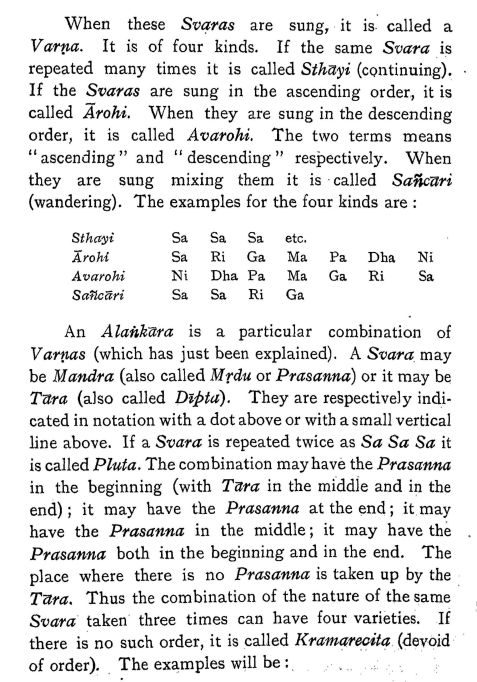
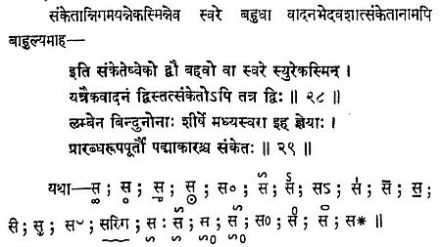
Dr. Raja explains the concept of Alamkara ; and how different Svaras are indicated in the text through notations by placing a dot or a vertical line above :

Ragavibodha Alamkara , notations

Ragavibodha notations

maze

While discussing the technical aspects of music and particularly Veena, Somanatha, in his commentary, offers lucid explanations and also quotes many previous authorities. He quotes mainly from Sarangadeva’s Sangita-ratnakara together with its commentary by Kallinatha. The other authorities, ‘sources’ mentioned by Somanatha include ancient Masters such as Kohala, Matanga, Hanuman and others.

 In the process, Somanatha presents the details of Art as it was practiced during his time, in comparison with what was in vogue in the earlier periods. Thus, Raga-vibodha, apart from its own merit, also serves as a valuable source-book on the history of Indian Music. Further, its Chapter Four would be of particular interest to those studying   the history of musical instruments in India.

The Raga-vibodha, a distinctive text, serves as a bridge between the music of the sixteenth and seventeenth centuries and that of the present-day. Somanatha is, therefore, regarded by many as the most important and the most original of all the sixteenth and seventeenth century Musicologists.

Somanatha makes a very valid observation that the Shastra-s (texts on technical subjects) should present and explain the facts as they really are; and, should never twist the facts to suit it’s own views and pet opinions.

Shastranam laksha-anugruhaya pravrutvat yatra tayo viruddhah tatra shastrasya niryamitasyapi arthasya upa-lakshana-tvadina  prakarantarenaapi gatihi kartavya  I  Na tu lakshyam upekshyam I

Raga-vibodha deals with the Marga and the Desi streams of classical Indian Music. Following the earlier tradition, Somanatha describes Marga Music as that which was sought for (from the root Mrg, to search) by the gods; And, as the pristine Music that was practiced by Bharata and other sages  in the presence of Shiva . Marga, therefore, he says, is worthy of veneration.

 Margaha sa yo viricchadyoh   anvistau Bharatadi Shambhor-agre pratyukto-acharyah II 1.6 II

[Somanatha brings in the concepts of the Tantra School to explain how the sound is produced within the body-mind complex; and , is put out ( 1.10-13) : ‘ The urge to speak excites the mind; the mind strikes fire in the body ; this , in turn , sets in motion the air that resides in Brahma-granthi. This air raises up through the navel, the chest , the throat , the head and the mouth producing sound. It is only the sound which passes beyond the chest, the throat and the head that can be used for singing.

Raga Vibodha extract

About the organs of speech; and, the differences in the pitch of the sound: the twenty-two Naadi-s in the chest , produce twenty-two Sruti-s; each successive Sruti being higher in pitch than its preceding one. A similar arrangement exists in the head and the throat.

raga vibodha extract 2

maze

Somanatha (1610 A.D – Ku-dahana-tithi-ganita-Sake 1531)) a musician scholar hailing from Andhra Desha, son of Mudgala Suri a versatile scholar in all arts (sakala kala) , was perhaps the earliest musician-scholars to introduce the system writing notation (Raga-sanchara) to music passages in a systematic manner. Some say that Raga-vibodha is perhaps the only example before the modern times of any Indian Music using Notations. That may not be entirely correct.

[Examples of early Indian Melody in Notation occur in the 7th century Kudumiyamalai Inscriptions, the Brihaddesi of Matanga, and Sarasvathi-hrdaya-alamkara-hara of Nanyadeva of 10-11th century. Nanyadeva the ruler of Tirhut in Nepal is cited as an authority by Sarangadeva . His text not only includes descriptions of several Ragas but also about 15 examples of compositions ( called Panikas, which are of lighter nature might have been used for dancing as also for singing in groups)  with notations  for vocal rendering. The Panikas belong to a genre of music forms called Gitakas or Prakaranas of varying rhythmic patterns ( as opposed to the modern compositions set to a particular Taala). These are no longer in use. Each rhythmic suit is identified by the number of  matras (time units) , by claps and gestures to measure the time of the beats.

The Notation used by Nanyadeva are simple pitch notations by numbering the Svaras (Sa, Ri, Ga, Ma, Pa, Dha, Ni). However no distinction is made between Shuddha Ga and Antara Ga; or between the standard Shuddha Ni and Kakili Ni. Some notations are indicated by placing dots as superscripts. In some cases it is not clear; as it appears the copyists might have got confused.

For more on Nanyadeva and notations on Panika songs please the remarkable study made by D.R .Widdess in his paper :Tāla and Melody in Early Indian Music: A Study of … – jstor]

Somanatha also scripted Dhyanas the pictorial or iconographical descriptions of certain Ragas. He also outlined the norms regarding the preferred time of performance, the special characters (Raga-lakshana) or the atmosphere in regard to some 27 Ragas. Somanatha improved upon the traditional themes associated with Ragas as in the Dhyanas of Sudhakalasha and Kumbha and of the later scholars Damodara, Shubhankara and Srikantha; and, he diversified Dhyanas by relating Ragas to deities, human characters, seasons etc.

It is sad; Raga-vibodha did not get the level attention it deserved from merited composers and musicians of Karnataka Sangita. Further, the system of musical notations that Somanatha introduced was not followed upon; and it is now almost completely lost. Similarly, the Dhyanas, the ancient system of aesthetics that characterized the Ragas, were totally by  passed in Karnataka Sangita, though some norms regarding the time of performance or the special character or atmosphere of some Raga still lingers on in the Hindustani Sangita.

Somanatha largely adopted  Ramamatya’s Mela system and his Veena techniques, as also the theoretical aspects of Music as in the works of Pundarika Vittala.  His Raga-vibodha, spread over five Chapters, also follows the general plan of Ramamatya’s Svara-mela-kalanidhi and Pundarika Vittala’s Ragamanjari.

The first Chapter of Raga Vibodha closely resembles the first Chapter of Pundarika Vittala’s Ragamanjari. It summarizes the ancient terminologies in the same order. Somanatha starts in Chapter Two a discussion on tuning of the Shuddha and Madhya-mela Veena, which resembled Hindustani Bin (Rudra Veena). This Chapter corresponds to Chapter 3 of Svara-mela-kalanidhi of Ramamatya.

In Chapter Three, Somanatha mentions eleven Persian modes, just as Pundarika Vittala did at the end of his Ragamanjari. The seven out of Somanatha’s eleven names for Persian Maqamat are mentioned: Irakha, Huseni, Musali, Vakhareja, Hijeja, Puska ( or Muska) and Saraparda.

The Chapter Three of Raga-vibodha again corresponds to Chapter Four of Svara-mela- kalanidhi; of Ramamatya; and, it deals with Melas. Here, Somanatha added five  more Melas  (Bhairava, Malhara, Kalyana, Suddha-vasanta and Hammira) to the 20 listed by Ramamatya  and deleted two Melas  ( Hindola, and Hejujji) to bring up the net number of Melas to 23. (In this list ,  Malava-gauda  is sometimes accepted in place of Bhairava).

Somanatha’s  arrangement of 23 Mela (scales) is based on the division of the Octave (Saptaka) of 17 notes, some of which bear two names. Therefore, the 22 (theoretical) names of the notes cover only 17 actual Srutis.

Out of these, thirteen Melas are identical with Ramamatya’s Melas; and, three (Shuddhavarati, Sriraga and Karnatagaula) are slightly different from their equivalents in Ramamatya’s system.

Out of the remaining Seven Melas, three (Todi, Hammira and Saranga) corresponds to the Melas of the same name which Pundarika Vittala describes in his Ragamanjari.  Of the other four, Somanatha’s Kalyana has its equivalent in Srikantha’s system. And, Somanatha’s Mallari, Bhairavi and Vasantha Melas are not found in any of the works of his predecessors.

In Chapter Four, which corresponds to Chapter Five of Somanatha’s Svara-mela-kalanidhi, describes the individual characteristics (Lakshanas) of the Ragas. Here, after giving the division of the Ragas according to the different standards, their structure in terms of Graha, Amsa and Nyasa are presented.

Somanatha in his Raga-vibodha mentions 51 Ragas, of which 29 are used in the Music of the present-day: 17 in Karnataka Music, 8 in Hindustani and 4 in both the systemsSome scholars surmise Somanatha’s Ragas mostly correspond to modern Hindustani Ragas; and, though the names of some his Ragas resemble those in Karnataka system it is likely they developed along different lines.

Chapter 5 which is the last Chapter is the most valuable part of Raga Vibodha. Following his processor Srikantha, Somanatha gives the pictorial descriptions (Dhyana) of the Ragas and specifies their appropriate times of performance.  But, in Somanatha’s opinion a mere abstract, aesthetic picture (Devamaya rupa = Divine form) of the Ragas would not suffice. He therefore presents their sound-pictures (Nadatmaka rupa) as well through musical notations.

Thus, Somanatha has presented most interesting music examples of the history of Indian Music.  In contrast to the ancient and almost forgotten music-examples of Jati and Gramas as in the older treatise, Somanatha’s music-pictures give an insight into contemporary music practices. The notations he provides indicate various musical ornaments (Gamakas) that were played on the Veena.

The notations

Somanatha’s work is unique because right from the older times Music compositions have come down to us through Oral traditions; and,   no composition could have had musical notations. And, where their lyrics (Sahitya) were written down, they were, sometimes, marked at the top with only the names of the Ragas and Taalas in which the song was set.  Even in the case of  the Music-texts (Lakshana granthas) that described various concepts and  theories and provided illustrations ,  they  merely discussed   the Lakshanas, Svaras, of the basic scale.

However, Somanatha’s music illustrations offer more details. They not only illustrate the scale (Mela) and the modal character (Lakshana) of the Ragas but also indicate the musical ornamentation (Gamaka) and special ways of playing Veena, the left and right hand techniques, by means of particular notation symbols or signs. Since no Taala is involved in these examples, Somanatha’s explanations virtually represent written guidelines outlining    Raga Alapana and other modes of elaborations i.e. a map for improvised explorations in freestyle.

Although Somanatha’s system of notations was not generally accepted and did not lead to a common system of Gamaka-notations, his explanations and his application of various types of ornamentation (Alamkara) to Veena playing (Vadana-bheda) are indeed highly interesting. Somanatha has described twenty Vadana-bhedas plus three other terms to indicate (1) specific registrar positions (Sthana) of the Svaras and (2) phrase endings. His Vadana-bheda techniques roughly fall into four categories: (1) fingering, (2) deflection, (3) slides and (4) others.

Gamakas and Notations

Veena

The Veena techniques (Vadana-bheda) expounded in Somanatha’s work generally follows the traditional pattern. Some of Somanatha’s terms referring to the techniques have equivalents in the ancient Gamakas mentioned in Matanga’s Brhaddeshi and Sarangadeva’s Sangita-ratnakara.

Matanga, in his Brhaddeshi, while discussing about Raga-giti , one of the seven charming song-forms, he mentions that Ragagitis should be rendered with varied delicate Gamakas (lalithau–Gamakau-vichitrau); and should be adorned with Svara pronunciations, lucid, powerful and even (300); and that the Vibhasha–giti should be sung blending in the Gamakas that are pleasant on the ears (Gamakau–srotra-sukhadai-lalithairasthu) and are also delicate , according to the will of the singer (yadrucchaya samyojya)   to the delight of the people (lokan-ranjathe)- (308).

Gamaka (ornamented note) is any graceful turn, curve or cornering touch given to a single note or a group of notes, which adds emphasis to each Raga’s unique character. Gamaka, in short, is the movement of Svaras which bounce, slide, glide, shivers, rapidly oscillates or skips. It provides movement and animates Svaras to bring out the melodic character and expression (bhava) of a Raga. Each Raga has specific rules on the types of Gamakas that might be applied to specific notes, and the types that may not. Every Raga has, therefore, to be necessarily rendered with the appropriate Gamakas. They depend on the manner of quivering, oscillations or shaking that the Svaras can be endowed with.

Gamaka-rendering is a highly individualistic and a specialized skill. Not merely that the Gamakas are designed specifically for vocal music and for instrumental music, but also that each performer would, in due course, develop her/his own Gamaka-improvisations. And therefore, two Ragas with identical ascending (Aroha) and descending (Avaroha) Svaras and born out of the same parent (Janaka) Raga might sound totally different in character and expression, mainly because of the Gamakas that are employed. [In Hindustani Music, Meend and Andolan are similar to Gamakas.]

Sarangadeva in Chapter three: Prakīrņaka-adhyāya of his Sangita-ratnakara treats Gamaka in greater detail. He lists fifteen types of Gamakas (Panchadasha Gamaka): the various kinds of shake or oscillations that Svaras can be endowed with.

Narada in Sangeeta Makaranda describes nineteen Gamakas; and, Haripala in Sangeet Sudhakar describes seven Gamakas.

**

Prof. Ranganayaki Veeraswamy Ayyangar, University of Pennsylvania , (who has studied, edited and translated the manuscripts, lithograph versions and printed versions of Raga-vibodha),   in her Gamaka and Vadanabheda: a study of Somanatha’s Ragav- ibodha in historical and practical context, mentions:

among the many music treatises that describe the Gamakas, Somanatha’s Raga-vibodha is the most important because it is the only text that has an entire chapter on ornaments. Somanatha has called these ornaments vadana-bheda; and, has created notational symbols for them after having described, in detail, their realizations on the contemporaneous fretted instrument, the Rudra Veena. Further, he has exemplified the vadana-bhedas by incorporating them in his extensive music examples. Somanatha has acknowledged that his vadana-bhedas were based on the Gamakas and Sthayas (components of a raga) encountered in the Sangita-ratnakara (13thc. A.D) and  other earlier texts.

Somanatha has described twenty vadana-bhedas plus three other terms to indicate specific registral positions of the scale degrees and (phrase endings. A study of the vadana-bheda techniques indicates that most of them fall roughly into four categories, namely, (1) fingering, (2) deflection, (3) slides and (4) others… An analysis of the distribution of the various types of the vadana-bhedas in the musical illustrations in Raga-vibodha indicates that there are in each of the first three categories, at least one type that is widely distributed either singly or in combination and some that occur rarely, again either singly or in combination. Further, it also indicates that some combinations are widely distributed, whereas some others are narrowly restricted….

It is important to reiterate that Somanatha was the first theorist, in the descriptive tradition, to attempt to describe in his Raga-vibodha, instrumental vadana-bhedas based on vocal Gamakas. He was also the first to describe, with adequate notation using these vadana-bhedas, actual music of his time through extensive music examples.

*

Somanatha while describing the Veena techniques employs terms that are equivalents to the Gamakas mentioned by Sarangadeva   (Spurita – Pratihati; Kampa-Kampita; Kurulu-Parata; Uchata- Ahati; Ahota- Ahuti; Ulhasita-ghasana; Plavita-Gamaka ).

Dr. Ramanathan the noted Musician-scholar explains Somanatha’s Pratihati as equivalent to the present day Spurita. Similarly Somanatha’s Vikarsa, Dolana, Gamaka and Kampana , he says, are comparable to four types of modern Kampita: (1) Vikarsa : single deflection of the string , pulling it away from Veena fret; (2) Dolana : deflection and release allowing the string to assume its original position; (3)  Gamaka: number of slow oscillations – prolonged Kampita; and (4)  Kampa: small number of fast oscillations .

Somanatha’s Garshana is equivalent to Hindustani Ghasit and Karnataka’s ekku or erra and downward (digu) slide (jaru). Pida, heavily stressed (pressure by left hand) is Khandimpu. And, Naimnya, a heavy pluck of the string, is periya-mittu.

Dr. E. Te Nijenhuis, in her the Ragas of Somanatha, observes that Somanatha was well conversant with both the Karnataka and Hindustani systems of Music. And, eight of the twenty-nine Ragas that he dealt with in his work, are exclusively Hindustani Ragas that are still current. She also mentions that the notation systems adopted by Somanatha are admittedly more precise than most of the others in vogue; and, definitions and signs for various types of ornamentation are indeed distinctive.

Dr. Ramanathan , however, observes: It is doubtful if the Notations of Somanatha were ever used by the practicing Musicians. That is perhaps because; the Musicians of India had not felt it necessary to develop an elaborate system of notations as in the West. Up to the present day in Indian Music a great freedom is left to the performing artist in the form of Raga improvisation. In the South it might be Ragam, Tanam and Pallavi; and in the North Aalap, Jor and Gath. Even in the pre composed forms of the South (Kriti, Varnam and Padam) and of North (Drupad, Khyal and Tumri) are always rendered with improvised and elaborate ornamentation and figurative variations adorned with Gamaka (grace notes), Sangathi or Tans ( melodic variations) , Svara vistara or Sargam (sol-fa) and improvised preludes (Alapana) .

And, even in modern times, the Notation system did not come into use until the end of 19th century when the first printed books on Music of South India appeared. But at that time there was no uniformity, with each composer or editor developing his own system.

[As regards the use of staff notations for recording the classical Indian Music, the noted scholar Ananda K. Coomaraswamy (in his introduction to Sir Ernest Clements’ work the Introduction to the Study of Indian Music; Published by Longmans, Green & Co., London – 1913), observed: the publication of Indian music in staff notation, without warning that the scale is other than that usually implied by that notation, tends to the destruction of the character of that music… It is far better that the method of oral transmission should be maintained. That is because, this is the true method of learning for an artist; because , every singer so taught must be in some degree a composer (he is taught, not merely to repeat a given song, but to sing in a given mode and mood); and because, it is so great an advantage for the true musician to need no external aid to memory, such as a printed score.

Indeed, I suppose that even if we succeed in recording the greater part of Indian music as it still survives, the music itself cannot persist as a part of everyday life unless it is thus handed on as a sacred tradition.]

The Dhyanas

As regards the Dhyanas, although the earlier musicologists like Damodara, Shunamkara and Srikantha had presented Dhyanas, their descriptions seemed to have bypassed the traditional themes associated with Ragas. They switched on to Nayaka-Nayaki dramatic situations, personifying the Rasas (aesthetic experiences) particularly of Srngara (erotic) Rasa.

Somanatha obviously considered Rasa personification an important aspect of pictorial Raga description since he himself refers to eight types Nayaka-Nayaki situations or eight different states (avastha)of  Nayika in Nayaka-Nayaki relationship. Somanatha relates Abhisarika Nayika (eager to meet her lover) with Raga Bahuli; Vasakasajja Nayika (dressed up for the meet) with Raga Bhupali; and Proshitabhartruka Nayika (proceeding to meet the lover) with Raga Dhanasri. Similarly, he relates Khandita Nayika ( angry with the lover) with Raga Lalitha ; and Abhisarika ,Vasakasajja and  Uktha Nayika  with the Ragas Saurasri. He relates Dakshina Nayaka with the Ragas Hindola;  and the Proshitabhartruka  Nayika  (sojourning with lover)  with Raga  Kamodi .

Some of Somanatha’s Dhyanas resemble the ancient iconographical Raga descriptions which relate to gods. The Dhyanas of Raga s Bhairava, Kedara and Shankarabharana, for instance, refer to Shiva; the Dhyanas Natanarayana to Vishnu; the Dhyanas of Hindola and Pavaka to Krishna; the Dhyanas of Mallari to Vishnu-Krishna; the Dhyanas of Ragas Adana, Paraja and Vibhangada to Kamadeva; and the Dhyana of Vasantha to god of spring Vasantha.

Besides, Somanatha presents some very vague descriptions which do not refer to any particular deity, human character or state of mind. For instance; in the Dhyanas of the Ragas Dhavala, Gauda , Gaudi, Hammira and Pauravi.

There is an interesting Dhyana which refers neither to a deity nor to a human character. It is the Raga Chaity which personifies the month of Chaitra. This perhaps was the forerunner of the Barahmasa poetry and paintings.

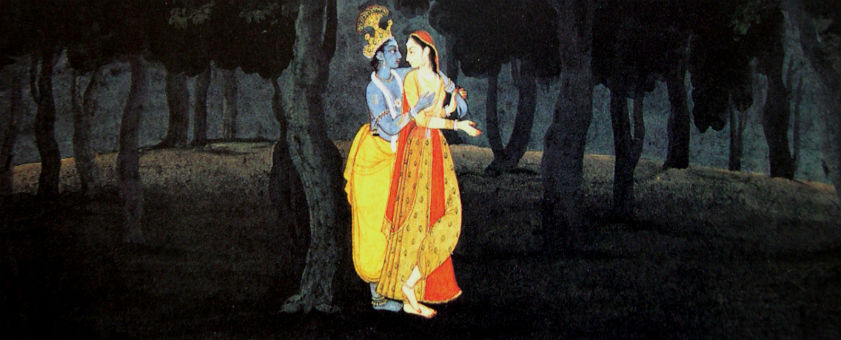
One of the illustrations provided  in Chapter Four of Raga-vibodha describes Raga Abhiri (equivalent to Abheri as it is known now) as a woman (Abhira) , dark in complexion , wearing a black dress adorned with a garland of fresh flowers around her neck, attractive ear ornaments. She has a soft and a tender voice; and, wears her hair in beautiful strands. Abira is idealized as a pretty looking Gopi of the Abhira tribe of Mathura region. She is an attractive looking dark complexioned tribal girl.  In the traditional Indian Music , dark complexion of the Ragini and her  dark clothes correspond to the predominant note (Amsa) Pa

As Emmie te Nijenhuis remarks: Apparently, the ancient Indian aesthetics had already fallen into disuse. The ancient Dhyanas which associates Svaras with particular deity deities, social class, animals, sentiments, colors etc – the system reflecting the ancient Indian mystical view of life – became rather irrelevant, when in the course of time, musicians changed the modal characteristics of Raga.

After Somanatha, the ancient system of aesthetics which was already on decline was completely forgotten in the South. Modern Hindustani Music however has preserved something of this ancient system. Its rules regarding the time of performance or the special character or atmosphere of some its Raga still remind us of the ancient Indian aesthetics.

[Ref: The Rāgas of Somanātha: Musical examples. Part 2 by Emmie te Nijenhuis; Musicological Literature by Emmie te Nijenhuis; DR. S Ramanathan on Raga-vobodha

For a complete text of Raga-vobodha of Somanatha along with his own commentary thereupon (Viveka) as edited  by Pandit M Subrahmanya Sastry (Adyar Library; 1945), please click here ]

461d01a1eef5916b606c78b4ea258ed4

 
Leave a comment

Posted by on June 8, 2015 in Music, Sangita


Tags: , , , , , , , , , , , , , , , ,

Music of India – a brief outline – Part sixteen

Continued from Part Fifteen – Lakshana Granthas– Continued

Part Sixteen (of 22 ) – Lakshana Granthas – Continued

8. Sangita-ratnakara by Sarangadeva

Sarangadeva

Sarangadeva’s Sangita-ratnakara (first half of 13th century) is of particular importance, because it was written just before influence of the Muslim conquest began to assert itself on Indian culture.  The Music discussed in Sangita-ratnakara is free from Persian influence. Sangita-ratnakara therefore marks the stage at which the ‘integrated’ Music of India was before it branched into North-South Music traditions.

[Sarangadeva’s Sangita-ratnakara was published by Adyar Library in four volumes. Please click here for : Vol I; Vol II ; Vol III and Vol IV ]

It is clear that by the time of Sarangadeva, the Music of India had moved far away from Marga or Gandharva, as also from the system based on Jatis (class of melodies) and two parent scales.  By his time, many new conventions had entered into the main stream; and   the concept of Ragas that had taken firm roots was wielding considerable authority.  Sarangadeva brought together various strands of the past music traditions; defined almost 267 Ragas; established a sound theoretical basis for music; and, provided a model for the later musicology (Samgita Shastra).

Sarangadeva’s emphasis was on the ever changing nature of music; the expanding role of regional (Desi) influences on it; and, the increasing complexity of musical material that needed to be systemised time and again. Yet; Sarangadeva was rooted in the prevalent musical practices of his time. His stress was consistently on the Lakshya , the music as practiced than on ancient theories, which though he respects them highly.

Thus, Sangita-ratnakara not only provides materials for the study of the ancient music , but it also gives an insight into the then current practices. In his writing, Sarangadeva draws a clear distinction between the well established ancient (purva prasiddha)  and the contemporary  popular (adhuna prasiddha)  Ragas. He also gives descriptions of the  structures and temperaments of   musical instruments such as Veena and Vamsa (flute ) according to the practices of his times. 

Sarangadeva gives some information about himself in the beginning of the work. Sarangadeva introduces himself as belonging to a family which hailed from Kashmir. His grandfather Bhaskara, an Ayurveda physician, moved from Kashmir into the newly found Yadava capital Devagiri (Maharashtra) in the Deccan region at the invitation of King Bhillanna V (1173-1192). After the death of Bhillanna, his son Jaitrapala or Jaitugi ascended the throne and ruled for a short period. He was succeeded in 1200 by Singhana (1200-1247). He was a very powerful king and also a great patron of arts, literature, and science. It is during his reign that Sarangadeva was appointed in his father’s (Sodhala’s) post as the Royal Accountant (Sri-karana-agrani). Along with his work at the King’s offices, Sarangadeva continued to practice the family profession of Ayurveda. He is also said to have written an Vedanta work entitled Adhyatma-viveka. That work is not available now.

During his spare hours, Sarangadeva was busy composing his monumental work on Indian music the Sangita Ratnakara, the Ocean of Music. It turned out to be one of the important and comprehensive Sanskrit texts on Music of India.

The Samgita Ratnakara of Sarangadeva is a great compilation; though not an original work, neverthless , it  ably brings together various strands of the past music tradition found in earlier works such as : Nāţyashastra, Dattilam, Bŗhaddēśī, Sarasvatī-hŗdayālańkāra-hāra ; and, one that is greatly influenced by the commentary of Abhinavagupta  the Abhinavabharathi .

But for Samgita Ratnakara, it may have been more difficult to understand Natyasastra and Brhaddesi and other ancient texts. And, Samgita Ratnakara also established a sound theoretical basis for music related issues and practices. It also provided a model for the subsequent treatises to elaborate on music-theories and practices (Samgita Shastra).

**

The Sangita, according to Sarangadeva, is a comprehensive term. It includes vocal (Gitam) and instrumental (Vadyam) music; as also dance (Nrtyam) – Gitam, Vadyam tatha Nrtyam trayam Samgitam uccyate. The last one, Nrtyam, the dance, is composed of all the three elements.

 In his work Sangita-ratnakara, Sarangadeva devotes seven chapters for discussing these three components (Anga-s) of Sangita.

The Gitam, the song format, is a fusion of Nada (sounds) and Akshara (composition made of words). Its musical element is named Dhathu; while its composition made of words is called Mathu. Lohana Pandita, in his Raga-tarangini, says: – Dhatu-matu-samayauktam Gitam iti uccyate budhaih; tatra nadatmako dhatur matur akshara sambhavah’.

Gitam, going by its traditional definition, strictly belongs to the Salaga Suda class of Prabandha, which is composed two Angas (elements) – Pada (words) and Taala (time-beats); and, having three components or Dhatus (Tri-dhatuka Prabandha):  Udgraha, Dhruva and Abhoga. For more on that, please click here. But, in common practice, anything that is sung goes by the name of Gita (Giyata iti Gitam).

The term Vadyam, covers a wide variety of musical instruments, such as : the varied string instruments; different types of Drums; bell-metal cymbals ; and a host of wind instruments including  flutes, pipes , conch,  trumpets etc.

The Nrtya covers rhythmic limb movements as also eloquent gestures expressing emotions through Abhinaya. It is a harmonious combination of facial expressions, various glances, poses and meaningful movements of the hands, fingers and feet. Nrtyam, the dance, delightfully brings together and presents in a very highly expressive, attractive visual and auditory form, the import of the lyrics (sahitya), the nuances of its emotional content, to the accompaniment of soulful music and alluring rhythmic patterns (tala-laya).

 [Please also read the highly educative introduction written by the renowned scholar SriT R Srinivasa Ayyangar to the Sangraha Chudamani of GovindaEdited by Pandit Sri S .Subrahmanya Sastry ; published by Adyar Library, 1938.]

**

Thus, the Samgita Shastra as envisaged by Sarangadeva was a composite art consisting Gita (melodic forms), Vadya (instruments) and Nrtta (dance or limb movements). By the time of Samgita-ratnakara, three Angas (limbs) of Samgita were well developed. Of these, the Vocal music was regarded as the essential, fundamental music through which all other forms of music were to be understood and interpreted. Here again, Sarangadeva focuses on Desi Sangita, though he comments on aspects of Marga Sangita. On Dance (Nrttya) he offers clear picture of both Marga and Desi traditions, although in a concise manner.

Sangita Ratnakara is a standard and an authoritative text; and it hugely impacted  almost all the writers in the subsequent period. It is also a reliable source book on ancient music traditions and their authors. Sarangadeva, gives an elaborate resume of the general system of Indian music in theory and practice as had been developed in the centuries previous to the thirteenth. He gives detailed exposition of th jatis, and the grama-ragas, accompanied by actual notations.

But, the most valuable information that this text conveys to us is as to the ancestry of several of the ragas, whose names occur for the first time in the Sangita Makaranda and which ragas must have acquired those names some time before, say about the eighth century. The text of Sarangadeva affords the only evidences as to the sources from which these well-known ragas derive their character and existence. But for Samgita Ratnakara, it may have been more difficult to understand Natyasastra, Brhaddesi and the other texts .

The text of Sangita Ratnakara has 1678 verses spread over seven chapters (Sapta-adhyayi) covering the aspects Gita, Vadya and Nritta: Svaragat-adhyayaRagavivek-adhyaya; Prakirnaka-adhyaya; Prabandh-adhyayaTaala-adhyaya; Vadya-adhyaya and   Nartana-adhyaya. The first six chapters deal with various facets of music and music-instruments; and the last chapter deals with Dance.

The first chapter deals with Nada (the sound); the second with Raga; the third with Prakirna (miscellaneous topics relating to music); the fourth with Prabandha class of Music ; the fifth with Marga and Desi Taala systems; the sixth with Vadya (musical instruments); and the seventh chapter  on Nartana dance.

In general, Sarangadeva follows Abhinavagupta very closely.

Chapter One – Nada: What seems rather unusual for a formal text on music is that Samgita-ratnakara opens with a lengthy chapter (Svara-gathadhyaya), divided into eight Prakaranas or Sections running into more than 170 verses purportedly dealing with Svara. It does not talk much about music.  But, it goes into elaborate details of human anatomy (according to the Ayurvēda) , the centers (Sthanas) in the body associated with  origin, development and articulation of sound  – heart (Hrid), throat (Kantha) and head region (Murdha) – in three varieties of pitches – Mandara, Madhya and Tara.

The third Prakarana of the first chapter is Nada-Sthana-Sruti-Svara-Jati-Kula-Daivata-Risi-Chanda-Rasa-prakarana. It also goes into the philosophical aspects of Nada, sound, which it regards as the manifestation of the undifferentiated, absolute principle Nada Brahman. Then it talks about two forms of Nada the un-struck or un-manifest (anahata) and the struck or the manifest (ahata). The sound in the human initially commences as an impulse or an idea in the mind with an urge to express itself. That idea is individualized and activated by the mind. It takes the aid of breath (Prana), the medium, to act as the vehicle to carry that idea. When the intention (idea or impulse) strikes (ahata) a bond with breath (Prana), the un-manifest turns into manifest Nada.

The, ahata, like its prior form (anahata) is neutral Svara, sound. It is only after passing through series of processes; the Svara is differentiated into Sruti (pitch) modulations.

Srutis are units of tonal interval with which the interval of a Svara is measured. Hence the Svaras are described next. After describing the intervals of the Suddha-Svaras those of the Vikrita-svaras are given. Suddha-svaras are those which conform to the arrangements of the seven Svaras of the Shadja-murcchana of Shadjagrama. Those which differ from this arrangement are the Vikrita-svara-s. There are 7 Suddha and 12 Vikrita-svaras.

The Sruti-s (pitch) are said to be of 22 kinds of time-intervals.  When certain of these are located along the chosen octave-continuum   , modified (sharp or flattened) from their normal and highlighted, a recognizable pattern of Svaras emerge.  Here, the Prana and certain body parts play vital roles to transform Sruti into Svaras. Body is considered as an arched harp with 22 strings activated by Prana (vital breath).

Three Gramas are described – Sahdja-grama, Madhyama-grama and Gandharva-grama. The names of the Seven Murcchanas in each Grama are also given.

The sixth Prakarana is on Varna and Alankara. Varnas denote the different kinds of movements that a melodic line can take.  Four Varnas are described:  Sthayi, Arohi, Avarohi and Sanchari. Alankara-s are ornamental patterns of Svaras that decorate a melodic line. Alankaras are classified under the four Varnas.

The seventh Prakarana is Jati-prakarana in which the lakshana (characteristics) of eighteen Jatis are given. The first seven are classified into Suddha and Vikrita; and the remaining eleven  as Samsaragaja. The characteristics or the laksana-s that are used for a describing a Jati are the same ten as mentioned in Brihaddesi.

The last Prakaraņa is called the Gīti-prakaraņa. Although it is named thus it takes up the treatment of certain musical forms called Kapāla and Kambala first and then goes on to Gīti-s. The Kapāla songs are based on some derivatives of Jāti-s and they are made up of words describing the fierce form of Lord Shiva.

Chapter Two – Raga viveka: is about the descriptions of the Ragas which are treated under two broad heads of Marga and Desi. He mentions six varieties of Marga Ragas: Gramaraga, Uparaga, Raga, Bhasha, Vibhasha and Antarbhasha. He also gives a list of purva-prasiddha (well established) and adhuna-prasiddha (recently established) Ragas. Many Ragas are illustrated in notation. There are also Sanskrit compositions in notation.

But, Sarangadeva’s focus is primarily on the Desi Ragas. He describes and discusses four types of Desi Ragas: Raganga, Bhasanga, Upanga and Kriyanga.

The Gramaragas resemble the Jāti-s closely and they are further classified on the basis of the different melodic styles. These styles are called Gīti. In this chapter, the five Giti-s, namely, Suddha, Bhinna, Vesara, Gaudi and Sadharini are described.

**

Vidushi Prof. Uma Garg in her Melodic Flavours According to the Season, observes: The ragas of the music (in the Hindustani system) have been categorized in many ways, such as Raga-ragini-paddhati; Thaat-raga paddhati; Raganga-paddhati etc. These classifications are technical by nature, involving the grammar of the concerned raga/ragas. But there is another classification of ragas, which does not involve the grammar of a particular raga. Instead, it focuses on its performance time. This concept is called the Time Theory of Ragas. According to this theory, performance of a raga is done in two-fold ways –according to the time of the day or according to the season of the year

The Time Theory of Ragas is a very unique concept in Hindustani Classical Music. It is a purely imaginative concept. It was developed over centuries in poetry, songs, as also in the texts of music. For instance; Nanya Bhoopala (11-12th century) in his Sarasvati-hrdaya-alamkara hara, while discussing seasonal Grama ragas, quotes Matang thus –yadah matang – 

sarve raga mahadeve samyak santoshkarakaha |hemant-greeshma-varshasu kaleshu gan-shasimiha | shadja-madhyam-gandhargrama geya yathakramam ||

All Ragas are dear to Lord Mahadeva. Yet; it would be proper to sing the songs  of shadja; madhyama ; and , gandhara gramas during winter, summer and rainy seasons.

Narada, in the third khanda of the chapter Sangeetadhyaya of his Sangeet Makranda, categorized ragas according to the suryansh (solar) and chandransh (lunar) groups, i.e. sun- and moon-based ragas. He further says –

evam kalavidhin gyatva gayedhyaha sa sukhi bhavet || ragavelapraganen raganan hinsako bhavet | yaha shrinoti sa daridri ayurnashyati sarvada

One who sings the raga-s according to their designated times, attains peace and prosperity. The raga-s themselves shall become violent and lose their attraction if sung off their times. Such (singers) become poor and live a short life

Following that tradition, Sarangdeva in his Sangeet Ratnakara, emphasized the importance of the performance of the ragas in their proper season and time.

In this chapter Raga-viveka-adhyaya, Sarangdeva laid special emphasis on the specific times and seasons for the performance of ragas. He also makes mention of the allotted times and seasons for the rendition of the ancient Gram-ragas. For e.g. he says Shadjagrama raga is to be performed in Varsha ritu; Bhinna Kaishik in Shishira ritu ; Gaud Pancham in  Grishma ritu ; Bhinna Shadja in Hemanta ritu ; Hindol in Vasanta ritu ; and, Raganti in  Sharad ritu.

**

As described by Prof. O C Ganguly in his monumental work Raga and Ragini (Nalanda Books, 1935)

Sarangadeva devotes a large section of his chapter on Ragas (raga-vivekadhyaya) to the Desi Ragas famous in ancient times (prak-prasiddha desi-ragah). He gives an historical survey of Ragas according to theancient scholars Yastika and Matanga. He then gives a preliminary list of eight Uparagas: Tilaka, Saka, Takka-saindhava, Kokila, Pancama, Revagupta, and Pancama-sadava.

Next, he gives a general list of twenty Ragas , namely : Bhavana-pancama, Nagagandhara, Naga-pancama, Sri-raga, Natta, Vangala, Bbasa, Madhyama-sadava, Raktahamsa, Kollahasa, Prasava, Bhairava·dhvani, Megha-raga, Somaraga, Kamoda, Abhra-paficama, Kandarpa-desakhya, Kakuba, Kaisika, Natta-narayana.

He then enumerates, on the authority of Yastika, fifteen melodies-which are asserted as generic ragas from which the minor melodies bhasha (raginis) are derived- (Bhasanam Janakah panca-dasaite Yiastikoditah). These are: Sauvira, Kakubha, Takka, Pancama, Bhinna-pancama, Takka-Kaisika, Hindolaka, Vhotta, Malava-kaisika, Gandhiira-pancama, Bhinna-sadja, Vesara-sadava, Malava-pancama, Tana, Pancama- sadava.

Then he proceeds to enumerate the different bashas or derivative melodies affiliated to these ragas. In the next section, he describes the further subdivisions of the melodies into Ragangas, Bhashangas and Kriyangas on the authority of Kasyapa, son of Sodhala and enumerates thirtyfour melodies. “These 34 ragas are said to have been famous in early times.” Catus-trimladime ragah prak-prasiddhah prakirtiah.

 “Now,” says Sarangadeva, “I am proceeding to enumerate those which are famous in modern times.” (Athadhuna prasiddha namuddesah pratipadyate) “The aggregate numbers of these ragas amount to 264”. Kallinatha, commenting on this list explains Desaval as equivalent to Kedaragauda, and Tauruska as equivalent to Malavagauda

**

Chapter Three: Prakirnaka: deals with varieties of topics such as: Guna –Dosha (merit and de-merits) of Vak-geya-kara (composers who set their songs to music) ; Guna –Dosha  in voice culture of male (Gayaka) and female (Gayani) singers, articulation (Sabda) and resonance in voice (Sarira); improvisations in song-rendering  by application of  ornamentations (Gamaka) of fifteen kinds*;  expressions that manifest the feelings or effects associated with Raga phrases (Sthaya) , which are of ninety-six kinds; and, Alapi  free and improvised rendering of Raga and the song  of two sorts Raga-Alapi that is not bound (Anibaddha)  or  restricted by Taala ; Rupaka-Alapi , melodic improvisation done while rendering the text of the song.

[*He recognized fifteen varieties of Gamakas –

    1. Tiripa,
    2. Sphurita,
    3. Kampita,
    4. Leena,
    5. Andolita,
    6. Vali,
    7. Tribhinna,
    8. Kurula,
    9. Ahata,
    10. Ullasita,
    11. Humpita,
    12. Plavita,
    13. Mudrita,
    14. Namita and Misrita; and,
    15. three kinds of Yatis – Sama, Srotogata or Shrotovaha and Gopuccha.]

In this Third Chapter (Prakirnaka Adhyayam- Verses 13 to 18), Sarangadeva elaborately sketches the virtues and the desired qualities of a highly accomplished singer (Uttama Gayaka) who belongs to a good tradition (Su-sampradayo). He says: the experts (gitajno) declare the best singer (gayana-agrani) as one who has the following merits: –

: – One who is gifted with good tonal quality of a naturally pleasant voice (hridya sabdah su-sareero), free of blemishes (nirdosho, sarva dosha vivarjitah); and, which is well controlled (kanta-sthala-ajnaha svadhano jita sramah);

: – One who has the diligence (kriyaparo) to workout, to regularly practice (Abhyasa);

: – One who is versatile attentive; has the capacity to hold breath effortlessly (shvasa-anayasa lasadgatih) while singing with great passion;

: – One who has the aesthetic sense to delineate, to lucidly bring out the distinctions between the various stages in the exposition of a Raga (vividha aalapti tatva vit), including its initial and finishing segments (graha moksha vicakshnaha);

: – One who is well versed in rendering (giyate) Raganga, Kriyanga and Bhashanga Ragas (Raga Raganga Bhashanga Kriyangonga kovidah); and, is highly dextrous in singing the Prabandhas (Prabandha gana nishnatau), with the full understanding of its varied forms;

: – One who is  well versed in rendering the  Shuddha and Chayalaga Prabandha compositions with all its intonations (Shuddha Chayalaga abhijnaha, sarva kaku vishesha vit);  

: – One who has the virtuosity in portraying the essence and the distinctive nature of a Raga through the different layers of the well spread out Alapti (vividha aalapti tatva vit);  

: – One who has the intelligence to improvise the Gamakas in all their movements (Sarva sthanao-ttha Gamake, sarva kaku vishesha vit, aneka sthaya sancharaha) in all the three registers (Sthanas);

: – One who has the command over observance and execution of time units (Taala), tempo (Gati); and rhythm (Laya); and,

: – One who has the capacity to hold and retain the attention of the listeners, effortlessly (sughato dharananvitah/ sphur-jannir-javano harirah krudbhanjanod adhurah)

Hridya sabdah su-sareero graha moksha vicakshnaha //3.13// Raga Raganga Bhashanga Kriyangonga kovidah / Prabandha gana nishnatau, vividha aalapti tatva vit //3.14// Sarva sthanao-ttha Gamake shvasa-anayasa lasadgatih/ Ayatta kanta-sthala-ajnaha svadhano jita sramah // 3.15 // Shuddha Chayalaga abhijnaha, sarva kaku vishesha vit  / aneka sthaya sancharaha , sarva dosha vivarjitah //3.16// Kriyaparo yukta layah , sughato dharananvitah/ sphur-jannir-javano  harirah krudbhanjanod adhurah //3.17// Su-sampradayo  gitajno giyate gayana-agrani/ // 3.18 //

*

Sarangadeva remarks; the singing that lacks clarity and conviction (kathipaya-hina); but, is, otherwise, blemish-less (nirdosho) is of the adequate or passable class (madhyamā). And, the singing that is flawed and riddled with blemishes is inferior (adhama).

Kathipayai-guna-hinha, nirdosasha madhyamha / sadoshayukta gayanao adhamaha // 3.19//

Sarangadeva also mentions five other types of singers (Verses 3. 19 to 22). According to him; the one who is capable of imparting flawless instructions (shikshane dakshah) is considered a wise teacher or a trainer (Shikshaka). The one who merely mimics another’s style (para-bhangya-anukarakaha) is Anukara, the imitator. One who gets absorbed in the aesthetic delight (Rasa) of the music is Rasika, the aesthete (Rasa-avishtastu Rasiko). One who amuses the listener is Ranjaka, the entertainer. And, one who is passionately and intensely involved in bringing out the emotional content of the song is Bhavaka, the one who inspires emotions (Geetasya atishaya dhanad bhavakaha parikeertitaha).

Shikshakaro-Anukaras cha, Rasiko Ranjakas tatha //3.19// Bhavakascheti geetajnaha , panchada gayanam jaguhu / Anyuna shikshane dakshah shiksha-karo matah satam //3.20// Anukara iti proktaha para-bhangya-anukarakaha / Rasa-avishtastu Rasiko Ranjakaha //3.21// Geetasya atishaya dhanad bhavakaha parikeertitaha //3.22//

**

Chapter Four –Prabandha: is a detailed discussion on Prabandha class of Music that was dominant during the days of Sarangadeva.  He says: the Gayana (singing) is twofold – Nibaddha and Anibadda. That which is composed of Anga-s (limbs or elements) and Dhathu-s (sections) is Nibaddha Samgita. And Alapita which is free from such structures is known as Anibadda Samgita. Then he goes on to say that Nibaddha has three names: Prabandha, Vastu and Rupaka.

By the time of Samgita-Ratnakara, Prabandha had grown into thousands. Sarangadeva explained Prabandha as that which is pleasant; and that which is governed by rules regarding Raga, Taala, Chhandas, Vritta (Sanskrit verses) and Anga. Sarangadeva described about 260 types of Prabandha-s with their variations.  Sarangadeva generally followed Manasollasa and Sangita-Samayasara.

He describes the four sections (Dhathu) of a Prabandha song (Udgraha, Melapaka, Dhruva, and Abogha) along with Antara the intermediary; and its six elements (Anga) or limbs (Svara, Birudu, Tenaka, Pata, Pada and Taala) . These comprehensively cover the three aspects of a song: the text, the Raga (melody) and Taala (rhythm).

Then he takes up the discussion on class of Prabandhas: Shuddha Suda, Salaga Suda, Alikrama and Viprakirna. Of these , Sarangadeva selects Salaga Suda for detailed treatment. Sarangadeva was the first to present the class of Suda systematically, lending it a theoretical base. For about 300 years thereafter, the terms and descriptions provided by Sarangadeva were adopted by all the later authors.

He discusses seven types of Salaga Suda songs:

    1.  Dhruva,
    2. Mantha,
    3. Prati-mantha,
    4. Nihsaru,
    5. Addatala,
    6. Rasaka and
    7. Ekatali.

Chapter Five – Taala: deals with time units or rhythmic patterns Taala. Sarangadeva deals with Marga Taala and Desi Taala separately.  Under Marga Taala , Sarangadeva mentions five varieties :

    1. Caccatpuţa ; 
    2. Cācapuţa ;
    3. Şaţpitāputraka ;
    4. Sampakvēşţāka ; and
    5. Udghaţţa.

Under these he discusses the different aspects of the Taala such as the time-units Laghu, Guru and Pluta; the Kriyā-s; the different forms of a Taala like Ēkakala, Dvikala and Catuşkala.

After the Marga Taala, 120 varieties of Desi Taala employed in Prabandha songs are discussed.

Chapter Six- Vadya: generally follows the discussions on Music instruments (Vadya) as elaborated in Natyashastra. Sarangadeva also describes various class of instruments in terms of : Tata (stringed) Susira (hollow) , Avadhana (Drum type) and Ghana ( solid like cymbals).

Under these, he names some specific types: Tata (Ekatantrī, Citrā, Vipañcī, Mattakōkilā, Ālāpinī, Kinnari); Susira (Vamśa, Kāhala, Şańkha); Avadhana (Huḍukka, Paţaha) ; and, Ghana(Kāmsyatāla, Ghaņţā).

He also talks about the construction of these instruments and ways of playing them.

Chapter Seven– Nartana: The seventh and the last chapter is in two parts.  The first one deals with Nartana. The term Nartana is a common term representing the arts of Nŗtta, Nŗtya and Nāţya. In describing the Marga tradition of Dance, Sarangadeva follows Natyashastra. As regards the Desi class of Dance he improves upon the explanations offered in Manasollasa of King Someshwara and Sangita Samayasara of Parsvadeva

[ For more on the last and the Seventh Chapter Nartana-adhyaya, dealing with Dance : please check the following link

https://sreenivasaraos.com/2018/12/10/the-texts-of-the-indian-dance-traditions-part-sixteen/  ]

Although he follows Bharatha in describing the movements of the body, he differs from Bharatha in dividing the limbs into three categories, Anga, Upanga and Pratyanga. he follows the Manasollasa in using the term Nartana for dance; dividing Nartana into three categories : Natya, Nrtya and Nrtta (SR. 7. 3).

He also differs from Natyashastra which identifies Tandava as Shiva’s dance and Lasya as Parvati’s. According to Sarngadeva, Nrtta and Nrtya can both be of two kinds, Tandava and Lasya (SR. 7. 28). Tandava requires uddhata (forceful) and Lasya requires lalita (delicate) movements (SR. 7. 29- 30).

Sarangadeva’s description of Cari, Sthana, Karana and Angaharas of the Marga type are as in the Natyasastra. But the Desi Caris, Sthanas and Utplutikaranas are the same as those in the Manasollasa of Someshwara.

Next described are Gaundali and Perani, the two dances commonly performed in  in the Desi tradition. Here he follows Sangita-Samayasara.

Sarngadeva explains the importance of aesthetic beauty, lays down the rules of exercise, and describes the qualities and faults of a performer (including a description of her make-up and costume), and those of the teacher and the group of supporting performers. Then he describes the sequential process of a performance, including the musical accompaniment, in the pure mode or suddha-paddhati.

After describing these two dance pieces, Sarngadeva deals with the qualifications of the Acharya (the teacher), the Nata (the actor), the Nartaka (the dancer), the Vaitalika (a general entertainer), the Charana (an expert in understanding gharghara) and the Kohlatika (a performer who specializes in Bhramari, rope-walking and dancing with a dagger). Next, he describes the audience and the sitting arrangements.

In the second part of this chapter, the author describes Rasas (nine in number), Sthayibhavas (thirty-three in number) and the definition of Sattva (the essence) and Sattvikabhavas (eight in number). Sarangadeva largely follows the explanations offered by Abhinavagupta on the theories of Rasa. The chapter concludes with final prayers

The significant commentaries on the text include the Sangitasudhakara of Simhabhupala (c.1330) and the Kalanidhi of Kallinatha (c.1430).

[ Ref : 1. Sangitaratnakara of Sarngadeva by Dr.N. Ramanathan ; 2. Sangitaratnakara  of Saringadeva  translated into English with detailed notes by Dr. C. Kunhan Raja, the Adyar Library, 1945. 3. Sangitaratnakara of Saringadeva by Natalie Savelyeva.  4. The Evolution of Classical Indian Dance Literature: A Study of the Sanskritic Tradition by Mandakranta Bose ]

single-line-border-clipart-img_1222727556554_3931

Please also read the companion article concerning Dance  at

https://sreenivasaraos.com/2018/12/10/the-texts-of-the-indian-dance-traditions-part-sixteen/

design2

9. Swaramelakalanidhi of Ramamatya (1550AD)

9f891f62aae2a775bac413f6869c2af6

Ramamatya who described himself as the maternal grandson of the learned scholar Kallappa Desika (Vidyanidhih Kallappa Desikaste matamaho) – identified by some as Kallinatha (the author of a commentary on  Sarngadeva’s Sangita Ratnakara ) ; was the son of  Todarmalla Timmamatya (Todara-malla meaning  in Kannada – the hero-malla– who wears the honorific anklet – Todar).

Ramamatya was a noted scholar and musician in the court of the Vijayanagar King Sadashiva Raya (1542-1570). It is said; that Ramamatya was requested by Venkadri, the brother of Rama Raja the Minister of King Sadashiva Raya, to write a book on Music, particularly to reconcile the tradition and the current practices. The result of his efforts was Swaramelakalanidhi having five Chapters : Upodgata (preface),  Swaraprakarana, Veenaprakarana, Melaprakarana and Ragaprakarana with a total of about 328 couplets in Sanskrit. The text systematically deals with Svara, Veena, Mela system and Ragas. The date of the text is said to  be Shravana Shuddha 10th, Shaka year 1472, I.e, A.D. 1549.

[Please check  for the text in English script;  and here for the  text in Sanskrit  ]

Swaramelakalanidhi is a fitting introduction to the post-Sangita Ratnakara period in the history of South Indian Music. Ramamatya’s work   makes it evident that the Sangita of his time (around 1550) was yet to be influenced by the Muslim music. The Raga-vibodha of Somanatha (1609) supports this view, although Somanatha himself seemed to be getting familiar with Muslim music.

As desired by his patron, Ramamatya brings the theory up to his times, rationalizes music principles and practices). He speaks of two kinds of Music: the ancient Marga or Gandharva which was Lakshana (theory)  oriented (pradhana) and the Desi Sangita which is in practice (Lakshya pradhana). He seemed to favor the practice of Music over the theory (Lakshya pradhanam khalu Gita-shastram).

Ramamatya describes various types of Veenas used in his day as well as their tuning. He distinguishes two main types: Veena with fixed frets which that allows all the Ragas to be played (Sarva-raga-mela-veena); and, Veena on which only one Raga could be played at a time (Eka-raga-mela-veena) and for playing another Raga the frets had to be moved and re-arranged.

Besides these he mentions three other types of Veena differing in in the tuning of their main strings : Shuddha-mela-veena (Sa, Pa, sa, ma); Madhya-mela-veena (Pa, sa, pa, sa) ;   and , Achutharaya-mela-veena (Sa, Pa, sa, pa) .

An interesting aspect of Ramamatya‘s description is the method of placing the frets. Ramamatya bases his technique in the principle of Samvadi Svaras as described in in ancient texts.

Applying this principle, he introduced (svayambhuvah svara hyete na svabuddhya  prakalpitah)  the concepts of Svayambhu-Svara (self-generating note, which some say is the equivalent of the ancient Samvadi- perfect consonant)  to all other notes . Based on this he determines the positions of all the frets on the Veena. He explains that the different Shuddha and Vikrtasvaras can be derived as the Samvadi-s of one another, starting with the basic Svaras viz. Sa, Pa and Ma to which the strings of the Veena are tuned, are termed Svayambhu-Svara. And in turn, he says, the other Svaras derived through Samvadi relationship are also called Svayambhu-Svaras.(caturthasaryam samjatah svarah sarve svayambhuvah)

He also brought certain improvements into the technical aspects of Music. For instance; the ancient music-theories mentioned 22 Srutis, although only 14 were used as Svaras (notes). Ramamatya reduced the number of Srutis to 12, because, he said, the difference in pitch between Antara Ga and Cyuta Ma (prefix cyuta means lowered) and the notes were negligible. He specified the implementation of this tuning by describing the location of six frets on his Veena

Veena colour

The most important contribution of Ramamatya was in the formulation of a logical principle of classifiation of the ragas, on the basis of the common elements of their characteristic note structures. Following the precedent of Yastika (Bhasanam janaka panchca-dasaite Yastikoditah), whom he cites, he enumerates the fifteen major Ragas ; and, also indicates that these fifteen Ragas  are the father (janaka), that is to say, the genus of the minor melodies (bhasas).

This old janya-janaka system (corresponding to the raga-ragini-putra system of the North) is replaced by Ramamatya by an independent analysis of the Ragas; and, by a systematic classification based on a study of the common elements of the Svara compositions of the different varieties of Ragas, grouped (mela) according to their basic structural unity.

He clarified the distinction between abstract Mela ragas, Janaka ragas  and Janya ragas. He then combined these three concepts to identify 20 Melas under which he classified about 64 Janya Ragas.

**

Ramamatya’s Swaramelakalanidhi , thus , marked the revival or a new  beginning of an era of classifying Ragas on purely music principles; and, methodically grouping them under what came to be known as Mela system. After Swaramelakalanidhi, numerous other works were written following Ramamatya‘s theories of classifying Ragas into Mela system. Thereafter, the 16th and 17th centuries grew into periods of great importance for production of Lakshna-granthas. Bringing to fore the method of classifying Ragas into Melas could be said to be the major contribution of Ramamatya.

It appears that by the time of Ramamatya, the method of deriving tunes from the complicated arrangement of Grama-Murchana-Jaati was no longer in use. Similarly, the ancient model essentials (lakshanas) for identifying a Raga based on ten criteria was no longer in practice. The ten ancient criteria (lakshanas) had then been reduced to five.

Ramamatya, in his Svara-mela-kalanidhi classified the then known Ragas into 20 Melas. His classification of Melas was based on five criteria (Lakshana). That is, Amsa (predominant note); Graha (initial note); Nyasa (final note); Shadava (sixth note); and, Audava (pentatonic structure) were no longer considered necessary.  This meant that the ancient modal system was replaced by a scalar system. Nevertheless, individual Raga continued to preserve some of their ancient modal essentials (Lakshna), in certain case even until today.

In chapter 5 , Ramamatya arranges the Ragas into three classes :  Uttama (pure or superior) suitable for singing (Giti) ,  for elaboration (Alapa) , phrasing (Taya) and for composing (Prabandha). The second was the Madhyama (middle one) Ragas suitable for singing segments of  compositions (prabandha khanda). And , the third being Adhama ( inferior)  the Ragas that are meant to dazzle the masses  ( pamara -bhramaka) ; but , unsitable for Alapa, Prabandha or Taya.

Ramamatya also mentions traditional characteristics (Lakshana)  of certain individual Ragas , such as the initial note (Graha) , the dominant note (Amsa), and the   the final note (Nyasa) ; the number of notes ( 5,6  or 7) ; and, recommended suitable time for performance.

*

The germ of the idea of the genus-species system was perhaps present long before Ramamatya. But, he was the first to introduce a chapter on Mela called Mela-prakarana. In this chapter, he enumerates, the Melakas (unifiers) and then explains their characteristics.

Even prior to Ramamatya the method grouping the Ragas into Mela was in vogue. Mela is a Kannada word meaning gathering or grouping.  The practice of grouping (Mela) the Ragas according to their parent scale, it said, was initiated by Sage Sri Vidyaranya in his Sangita-sara (14th century). Govinda Dikshita (who reverently addresses Sri Vidyarana as: Sri Charana)   confirms this in his Sangita-sudha (1614). Sri Vidyaranya classified about 50 Ragas into 15 groups (Mela). The intention of the Mela system was to organize then known Ragas that were in practice. Sri Vidyaranya’s work on Melakarta system was followed up and improved upon in later times by other scholars.

Following Sri Vidyaranya, Ramamatya in the fourth Chapter – Mela-Prakarana– of his Svara-mela-kalanidhi introduced the theoretical framework for classifying then known Ragas under 20 Melas (parent scale), the notes and names of which were taken from the prominent Ragas of that time.  This was an improvement over the system initiated by Sri Vidyaranya.

Treating Ragas in terms of a Mela was possibly the most significant approach and development in musical history. Mela refers to a collection of seven Svarasthanas (Svara postions). All Ragas are Janya Ragas, and janya Ragas that have a common set of Svarasthanas are placed in the same Mela. The name of the Mela was given to the Raga among the group that was most significant or popular. At this stage, the Raga that held the title for the Mela did not need to possess all the seven Svaras; and though the Mela was referred by its name, it was still a janya Raga.

Following an older precedent, Ramamatya takes the Mukhari Mela, as the Shuddha scale and gives it the place of precedence. He said “Of all the Melas, Mukhari is the first. Other Melas are  followers” .

Ramamatya gives details of Shuddha-svara-s and Vikŗta-svara-s occurring in each of the Mela, a list of sixty-four Janya Raga-s classified under each Mela, and the Sruti positions of Svaras in the Melas. Mukhari is established as the Shuddha-svara saptaka in this treatise (For more, please see Swaramelakalanidhi of Ramamatya by Dr. N. Ramanathan)  According to Tulaja , the Karnataka Raga Mukhari (Raga as well as Mela) is the same as the ancient Suddha-sadharita.

Ramamatya lists 20 Melas :

    • 1. Mukhari;
    • 2. SriRaga;
    • 3. Malavagaula;
    • 4. Saranganata;
    • 5. Hindola ;
    • 6.Shuddha-ramakriya;
    • 7. Desaki;
    • 8.Kannadagaula;
    • 9. Shuddanti;
    • 10.Ahari;
    • 11.Nada-ramakriya;
    • 12.Shuddhavarjati;
    • 13. Ritigaula;
    • 14. Vasantha-bhairavi;
    • 15.Kedaragaula;
    • 16.Hejujji;
    • 17.Samavarali;
    • 18. Revagupti;
    • 19. Samantha; and
    • 20. Kambhoji.

[Later, Venkatamakhin pointed out that two of Ramamatya’s Melas – Saranganata and Kedaragaula – do not differ in their structure.]

In this scheme,  ten ancient model essentials (lakshanas) which had been reduced to 5 (the predominant note (Amsa); the initial note (Graha); the final note (Nyasa), the hexatonic structure (Shadava) and the pentanotic structure (Audava)) were no longer considered to be the criteria for classifying the Ragas. That meant that the ancient modal system was replaced by a scalar system. Nevertheless, individual Raga continued to preserve some of their ancient modal essentials (Lakshna) , in certain case even until today.

Such continuity in the Ragas is illustrated by the following Ragas:

    • 1. The Karnataka Raga Mukhari (a Raga as well as a Mela) , which according to Tulaja is the same Raga as the ancient Suddha-sadharita;
    • 2. Karnataka Raga Varali or Varati that is both Samavarali and Jhalavarali;
    • 3.Hindustani Varari or Barai – Varati;
    • 4.Hindustani Bhairava;
    • 5.Karnataka Lalita;
    • 6.Karnataka and Hindustani Dhanasri; and,
    • 7.Hidustani Sindhubhairavi.

Ramamatya’s exposition of Mela, Raga and his technique of ‘Madya Mela Veena’ was a pioneering work in the systematic classification of Ragas. After his work, numerous others on Raga, Mela, Janya, etc were published.  Ramamatya was followed by:  Pundarika Vittala (16th century); Venkatamakhin (17thcentury); and his grandson Muddu Venkatamakhin (18th century).

Ramamatya’s work also enormously influenced Somanatha’s Raga Vibodha and Govinda Dikshitar’s Sangita Chudamani, two important works which deal with Ragas current at their time. Some regard Ramamatya, Somanatha and Govinda Dikshitar as the Trinity of Karnataka Sangita theory (Sangita Shastra).

Later scholars, that is after Ramamatya, started computing the maximum number of seven Svara combinations they could derive (melaprasthara) based on the number of Svara positions. Here, each author computed a different number of Melas based on the number of Svarasthanas he had theorised. For example, the Sad-Raga-chandrodaya Pundarika Vittala mentions a possible 90 Melas, while in Somanatha’s Raga Vibhodha there are 960 possible Melas. Even though they came up with this computation they found that only a limited number of these were actually used in the form of a Raga.  Therefore, Somanatha felt that 23 Melas would suffice to classify the 67 Ragas then in practice.

During the second half of the 16th century Pundarika Vittala (in his Raga-manjari) introduced Ramamatya’s Mela system in North India. But, he changed the names and scales of several Melas. Another South Indian musicologist who migrated North was Srikantha who wrote his Rasa-kaumudi at about the same time. He reduced Ramamatya’s 19 Melas (as Saranganata and Kedaragaula) were actually the same scale. This system resembled the contemporary Arabic system of 12 predominant modes (Maqam).

One of the most important texts in music of South India was Chatur-dandi-prakashika of Venkatamakhin (1660), which brought the Mela- Janya system on a rational basis. It classified the Ragas according to the system of 72 basic scales (Mela). This system still prevails in South Indian music, though with modifications.

In 1620, Venkatamakhin, son of Govinda Dikshitar, corrected Ramamatya’s Mela system by reducing the number of Melas from 20 to 19, because he said the notes of the two Melas Kedaragaula and Saranganata were the same. More importantly, in the Appendix (Anubandha) to his Chatur-dandi-prakashika, Venkatamakhin mentions the  possibility of classifying Ragas (Kanakangi to Rasikapriya) built on 12 Svara-Sthanas  under a  72 Mela-karta scheme made into two groups of 36 each (Shuddha Madhyama and Prathi Madhyama) . (It was at this time a theoretical possibility, since all those Melas were yet unknown.) The 72 Melas bear the names of prominent contemporary Ragas; and each of which is considered the basic scale of one or more Ragas.

It is believed that it was Venkatamakhin’s grandson Muddu Venkatamakhin, who gave the nomenclature for the Mela Ragas, (Kanakambari, and Phenadhyuti etc) in his Gitam called Raganga Raga Anukramanika Gitam (found in Sri Subbarama Dikshitar’s Sangita Sampradaya Pradarshini (1904).  Shri TM Krishna observes:

‘The Muddu Venkatamakhin tradition, which uses the terms Raganga Raga (equivalent term to Mela-kartha) and Janya Raga, adopts the opinion that the Raganga Raga needs to be Sampurna in either Arohana or Avarohana but non-linear. Sri Muthusvami Dikshitar gave form to most of these Ragas through his compositions.’

Again, during late 17th – early 18th century, Govindacharya the author of Samgraha-chudamani changed the names of some Melas of Venkatamakhin. He expanded on Venkatamakhi’s Chatur-Dandi-Prakashika  by introducing the Sampoorna Melakarta scheme which has a complete (sampoorna) arohana-avaroha structure. as well as delineating Lakshanas for 294 Janya Ragas, many of which were till then unknown, with their Arohana and Avarohana. In this scheme, the Melakartas arise out of systematic permutation of the seven Svaras into the twelve svara sthanas.  

Govindacharya also gave lakshana gitas and lakshana slokas for 294 Janya Ragas. And, he also refined the Katyapadi prefixes by linking the Mela Ragas to their first two syllables of their names. This system of 72 Mela is the Karanataka Mela system of the present day.

As per Shri TM Krishna: ‘Mela started out as a way to organize existing Ragas but moved to creating scales as Ragas using the Mela structure. Probably for the first time in musical history theory influenced practice. This is probably why many Ragas in performance even today are only svara structures sans features that give a Raga an organic form’.

The voluminous  Sangita Sampradaya Pradarshini by  Sri Subbarama Dikshitar (1839-1906) , the grandson of Sri Mutthuswami Dikshitar , running into about 1700 pages is a source-book on Music of India , tracing the history of Music from Sarangadeva to the 20th century through a series of biographies of noteworthy musicians and music-scholars . It  also provides  exhaustive details on 72 Melas  as also tables of Ragas, Ragangas, Upanga-s, Bhashangas with their Murcchanas, Gamakas, in addition to details of the  Taalas.

Pandit Vishnu Narayan Bhatkhande (1860-1936), a scholar and a musicologist, in his colossal work ‘Hindustani Sangeet Paddhati’ reorganized the Uttaradi or North Indian Music, mainly,  by adopting the concept of Mela system as expanded by Venkatamakhin (1660) in the Appendix to his Chatur-dandi-prakashika.

Bhatkhande also adopted the idea of Lakshana-geetas that Venkatamakhin employed to describe the characteristics of a Raga. Bhatkhande arranged all the Ragas of the Uttaradi Sangita into ten basic groups called ‘Thaat’, based on their musical scales.  The Thaat arrangement, which is an important contribution to Indian musical theory, broadly corresponds with the Mela-karta system of Karnataka Sangita.

bar3

In his introduction to Raga Pravaham, Prof. Dr. S. Ramanathan (Wesleyan University, U.S.A) wrote :

The Raga system in Carnatic music has a long and interesting history from the time of Matanga’s Brihaddesi, where you come across the definition of Raga. The system has evolved through the centuries. Ragas like Gaula, Takka etc. are mentioned in the Brihaddesi.

By the 13th century, the Sangita Ratnakara of Sarangadeva lists as many as 264 Ragas. Here, you come across Ragas like Sankarabharana, Sri Raga, Todi, Malavagaula (which is referred to as Taurushka), and Kedaragaula etc.

In the 14th Century Vidyaranya, in his musical treatise Sangeetha Saram gives a list of fifteen Mela Ragas ; and , by the year 1550, Ramamatya in his Swara Mela kalanidhi speaks of 19 Melas and several derivatives from each of them.

In the beginning of 17th Century, Somanatha’s Raga Vibhoda; and Govinda Dikshitar’s Sangita Sudha are two important works which deal with Ragas current at that time.

In the latter half of 17th Century, Venkatamakhi, son of Govinda Dikshitar appeared on the scene; and, in his monumental work Chatur-Dandi-Prakasika expounded the 72 Mela-karta schemes, which brought the Mela Janya system on a rational basis.

In this work, he only showed the possibility of 72 Mela  kartas. But, in his scheme, a Raga could be a Mela only in case it had all the seven Svaras either in the ascent (arohana) or In the descent (avarohana). Kedara-Gaula which is Audava Sampurna was a Mela in his scheme.

It is believed that it was Venkatamakhi’s grandson Muddu Venkatamakhi, who gave the nomenclature for the Mela Ragas, (Kanakambari and Phenadhyuti etc) in his Gitam called Raganga-Raga-Anukramanika-Gitam (found in Subbarama Dikshitar’s Sangitha Sampradaya Pradarsini, 1904).

Later Govindacharya, the author of Sangraha Chudamani gave the nomenclature Kanakangi, Ratnangi etc. to the 72 Mela karta Ragas. These Melas had all the seven notes in both the ascent (arohana) and in the descent (avarohana) as well. He has also given Lakshana-gitas and lakshana-slokas for many Janya Ragas.

Though the arohana and avarohana krama of a Raga does not tell us everything about the Raga, it provides the frame work on which it is built. Ragas like Sahana, Ahiri, Neelambari, Devagandhari and Yadhukula Kambhoji defy definition. But for the majority of the Ragas, the Krama helps.

Mela Raga Chart 2

(Source : Raga Pravaham by Dr. Dhandapani and D. Pattammal )

bar3

When you look back the long and interesting history of Raga in Karnataka Sangita stretching from Matanga to the present-day , you find that the system has evolved through several stages. If Matanga defined the Raga and lent it a sense of identity, it was Ramamatya that activated the process of binding the Ragas into structured groups. This has provided Karnataka Sangita a unique and a thorough theoretical foundation.

Thus, Swaramelakalanidhi of Ramamatya occupies a significant position in the history of the development of Karnataka Sangita. And, as Dr. N. Ramanathan remarks: Swaramelakalanidhi is an important work as the information contained in it is more relevant and related to the modern practice than the books written prior to it. It is not , therefore, surprising that Emmie Te Nijenhuis lauds Swaramelakalanidhi  as a landmark  in the history of Indian Music. 

[At the end of his work , Ramamatya says he does not treat the subjects of Taala and Prabandha because these had already been treated exhaustively by Sarangadeva .]

[Ref: 1. Swaramelakalanidhi of Ramamatya by Dr. N . Ramanathan;2. http://www.chrysalis-foundation.org/Ramamatya-s_Vina.htm 3.http://www.thehindu.com/todays-paper/tp-features/tp-sundaymagazine/centred-upon-centuries/article1117724.ece;4.Indian Music: History and Structure by Emmie Te Nijenhuis]

 veena (1)

[Sagītaśiromai

Sagītaśiromai is a compilation or a Handbook of Indian Music prepared by a group of scholars, based on number of older texts in Sanskrit. It is said; Sultan Malika Sahi, who ruled the region surrounding Allahabad, invited a group of scholars to his capital Kada, during the year 1428; and, asked them to prepare a large book on music  , to serve as the source / reference material,  by making use of considerable number of  ancient  texts he had collected.

The resultant work Sagītaśiromai, which to a large extent was based on Sarangadeva’s Sangitaratnakara, soon gained the reputation as a standard and a very valuable reference book on Music. And, various scholars and authors often quoted verses from Sagītaśiromai. But, in the later times, sadly, the portions of the book dealing with musical instruments and dance were lost.

Please do read the edited and translated version of the first fourteen chapters of the Sagītaśiromai, as rendered by the noted scholar Emmie Te Nijenhuis. Her edition of Sagītaśiromai: A Medieval Handbook of Indian Music is remarkable for its scholarly and detailed explanation / illustration of the principles of Indian music such as : Sruti (intonation); Svara (notes); Grama ( tone-system); Murchana (scales); Taana (tone-patterns); Sadharana (overlapping); Varna (melodic line); Alamkara (musical figures or graces); Jati (mode); Giti (styles of singing); Ragas – their  classifications and characterizations; and others.

The introduction, which Emmie Te Nijenhuis has scripted, is highly educative; and, students and scholars, alike, would certainly benefit, greatly, by reading it closely.]

roses

 
7 Comments

Posted by on June 5, 2015 in Music, Sangita


Tags: , , , , , , , , , , , , , , , ,

Music of India – a brief outline – Part fifteen

Continued from Part Fourteen – Lakshana Granthas

Part Fifteen (of 22 ) – Lakshana Granthas – Continued

4. Sangita Makaranda

Sangita Makaranda ascribed to Narada (7th -9th century) is an interesting work. It has two parts, one on music;  and , the other on dance, each divided into four sections. Its style is said to be rather complicated; and, makes a difficult reading.

The first part of the text is devoted to music (Sangita) . It has subsections dealing with the origin of Nada and Svaras; associations of the Svaras with  factors such as Gramas , Murchanas etc ; various musical terms such as , Vadi, Sruti, Alamkara etc; classification of Ragas ; and , with the musical instruments.  

Before we get  back to its music-aspect lets briefly  take a look at its dance-content. 

In the first section of the part on dance, the author discusses the dance-hall, the audience, the poet, the singer, types of learned spectators, the chairman, the dance-teacher, the percussionist, the performer, the flower-offering and the origin of the Talas.

The second section describes the characteristics of 101 Talas.  The third section also gives information on Tala, including the derivation of the word, the essence of Tala, the time, Marga, Desi and such other details.

The fourth section is devoted to drums but also contains a short final subsection of 33 verses called natibhavanirupanam which is devoted to dance. It describes five double hand-gestures, five single hand-gestures, eight bhramaris, nine head movements and four feet movements.

*

According to Emmie te Nijenhuis ,  the first chapter of the Sangita Makaranda seems to closely follow  Sarangadeva’s views , specially , with regard to the treatment of the Svaras and their association with the deities (Devata), meters (chhandas) , and emotions (rasa). Narada also adds to the systems of associations the family names (gotra), constellation (rasi), the birth-star  (nakshatra ) , the presiding deities of the constellation (rasi- adidevata) and the associated creature (yoni kathanam).

Narada brings in philosophical, Tantric and religious interpretations into Desi Music. He names Brahma, Vishnu and Maheswara as the deities of Shadja, Madhyama and Gandharva Gramas, respectively. In that order, each Grama is allotted to a season (Rtu): Hemanta (winter) for Shadja; Grishma (summer) for Madhyama; and, Varsha (rains) for Gandharva Grama. As regards the time of the day for rendering the Gramas, he allots forenoon to Shadja; midday to Madhyama; and afternoon to Gandharva Grama.

Narada in his Sangita Makaranda (12)  calls the  playing of the seven pure or natural notes (Shuddha Svara) of the scale ascending from the lower to higher , i.e., starting from Shadja (meaning , the one giving birth to the other six notes) as Prakrti; and, the way of playing from the descending scale as Vikrti . Here, Prakrti denotes, a hierarchy of sounds played on a Veena. According to Narada,  practicing the scale on musical instruments is comparable to emanation and withdrawal of the universe.

Prakrti dve vijaniyath –svara-tantreshu samsthithe / tatrapi cha tayormadhya shadjadi cha nishadakam //

Ya sa prakrti-vijneta Bharatena cha charchita / vikrutich nishadadi shadja-antara-svara puritah //

There are two modes that are known to exist in playing of the Svaras on stringed instruments.

Of the two, the playing of the Svaras starting with Shadja and ascending up to Nishada is known as Prakrti (natural), which was practiced by Bharata .

In the other mode, the Vikrti (modified) the Svaras start with Nishadha and moves on to Shadja in order to complete the scale.

**

Narada explains that Shadja is the first important note holding more ministers (samvadi notes), hence it gets a Grama on its name. Madhyama is a note which cannot be omitted in any Grama, so it also holds a Grama. About Ga he says that it is born in heaven, used by divine beings, thus indisputable. (There seems to be a pun on the term. Here, Grama is a technical term; and grama is village).

Earlier, Gandharva-grama was not defined clearly.   Narada in eight Slokas (49-56) gives the names of the Murchanas of Gandharva Grama as : Nandi, Visala, Sumukhi, Chitra, Chitravati, Shukha and Aalapa.

Emmie te Nijenhuis explains that according to Narada, Sa and Ma has four Srutis; and Dha three Srutis. He takes one Sruti from Ri and Ma each and allocates them to Ga, which normally has two Srutis only. Thus, Ri has two Srutis; Ma has three Srutis; and, Ga has four Srutis. Narada says that Ni takes one Sruti from Pa; which has four Srutis. Sa has only three Srutis.

Further Emmie te Nijenhuis  explains : In the description of Shadja and Madhyama Gramas,  Narada follows the general order accepted by all, i.e. Shadja Grama (4,3,2,4,4,3,2 Srutis); Madhyama Grama (4,3,2,4,3,4,2 Srutis). Narada also confirms that in Shadja grama, Shadja is in consonance with both Madhyama and Pancama. In the same way, in Madhyama Grama, Pancama is the consonant to Dhaivata and Rishabha. Narada again mentions that Panchama has only three Srutis, while Dhaivata of Madhyama Grama gains one Sruti and has four Srutis.

**

As regards the Ragas, Narada introduces the concept of identifying the proper hour of the day for rendering certain Ragas.

Narada, in the third khand of the chapter Sangeetadhyaya of his Sangeet Makranda, categorized ragas according to the suryansh (solar) and chandransh (lunar) groups, i.e. sun- and moon-based ragas. He further says

evam kalavidhin gyatva gayedhyaha sa sukhi bhavet || ragavelapraganen raganan hinsako bhavet | yaha shrinoti sa daridri ayurnashyati sarvada

[One who sings the raga-s according to their designated times, attains peace and prosperity. The raga-s themselves shall become violent and lose their attraction if sung off their times. Such (singers) become poor and live a short life ]

According to Sangeet Makranda (Ch. III, 10-23):

Morning melodies:

    • Gandhara,
    • Deva-gandhara,
    • Dhannasi,
    • Saindhavi,
    • Narayani,
    • Gurjari,
    • Vangala,
    • Patamanjari,
    • Lalita,
    • Andola-sri,
    • Saurastreya,
    • Jaya-saksika,
    • Malhara,
    • Sama-vedi,
    • Vasanta,
    • Suddha-Bhairava,
    • Velavali,
    • Bhupala,
    • Soma-raga.

Noon-day melodies:

    • Sankarbharana,
    • Purva (?),
    • Balahamsa,
    • Desi,
    • Manohari,
    • Saveri,
    • Dombuli
    • Kambhoji,
    • Gopikiirpbhoji,
    • Kaisiki,
    • Madhu-madhavi,
    • Vahuli (two varieties),
    • Mukhari,
    • Mangala-kausika

After noon melodies:

    • Gauda and the derIvatives therefrom

Noctural melodies:

    • Suddha-nata,
    • Salanga,
    • Nati,
    • Suddha’varatikii,
    • Goula,
    • Malava-gauda,
    • Sri-raga,
    • Ahari,
    • Ramakrti,
    • Ranji,
    • Chaya,
    • Sarva-varatika,
    • Dravatika.
    • Desi,
    • Nagavaratika,
    • Karnata,
    • Haya-gaudi.

**

A significant  feature of the work  is the system of classifying  six Ragas as male and six Raginis as female , thus    forming six cohesive families, raga-parivara.  It also mentions about neuter (napumsa) ragas. In a particular season, one designated Raga is to be sung along with its Ragini and their offspring (putra raga).

The six groups of Ragas enumerated in the Sangita-makaranda formed foundation of the earliest mythology of the melodies. The legends ascribe to Shiva or Nataraja, the origin of the science of music and drama.

According to the legend here, the ragas are said to have been derived from the union of Sihva and Shakti – Parvati, or Girija. From the five faces of Shiva, at the beginning of his dance (nartana arambhe), came out the five ragas: Sri-raga, Vasanta, Bhairava, Panchama, and Megha; while the sixth raga, Nata narayani came out of the mouth of Parvati (Girija), the daughter of the Himalaya, when she performed the elegant lasya dance.

Siva-Sakti-samayogad raganam sambhavo bhavet / Pancasyat panca ragah syuh sastastu Girija mukhat // Sadyo vaktrattu Srirago Vamadevad, vasantakh / Aghorad bhairavo ‘bhut, tatpurusat pancamo’ ‘bhavat // Isanakhyad megha-rago, natyarambhe Sivadahut / Girijaya-muka lasye nata-narayano’ bhavat //

*

 In Sangita Makaranda , the author wonders : strange are the ways that assign names to the Ragas – Naradena vicitrena santi namani vaksyate.  He then indicates how the Ragas came to be named during different periods in the history of Indian Music.

In the period of Natyashastra the Gramas were named after their main Svaras. For instance; Shadava was named after Sha; Madhya Grama after Ma; and, Gandharva after Ga. As regards the  Ragas,  they took their names from the dominant or significant Svara prevailing in their compositions. Thus, one of the Grama-ragas is called Shadji  from the note Shadja; Arsabhi, from the note Rsabha; and,  Gandhiiri, from the note Gandhara, and so on.

In the second stage, it says, the Ragas came to named after the names of tribes (Janapada). For instance; Raga Abhiri was named after Abhira tribe; Raga Saviri after Savara tribe; Pulinda Raga after Pulinda tribe ; Saverika (Saveri) after the Savars; and,  Bhairava-raga  after the Bhairavas  ; and so on .

In the third stage, Ragas were named after the regions (Desha). For instance Surati or Surat Malhar was named after Saurastra region; Sindu Bhiravi after Sindu Desha; Karnati after Karnataka; Kambhoji after Kambhoja Desha; Gauda and Purvi after the  Eastern part  of Bengal  ; Gurjari after Gujarat region and so on . 

Later , some of the names of the Ragas were derived from their associations with the season( Megha raga with raina , Vasantha with spring ) , and seasonal feastivals  (Hindola with swing festival, Sri Raga with harvest festival).

 [ For more please check pages 71 and onward of Prof. O C Ganguli’s book . ]

**

Sangita Makaranda has seven sections:  Naada, Sruti, Svara, Raga, Veena, Taala, Nartana, etc. Many types of instruments are mentioned – including nineteen types of Veena – kachchapi, kubjika, chitra, parivadini, jaya, ghosavati, jyeshta, nakuli, mahati, vaishnavi, brahmi, raudri, ravani, sarasvati, kinnari, saurandri, ghosaka etc.

It also lists 22 Srutis and their names. The Srutis are divided into five classes :

    • (1) Dipta (dazzling) –Tivra,Raudri, Vajrica and Ugra;
    • (2)  Ayata (vast oe expansive) – Kumudvathi, Krodha ,Prasarini, Sandipini, and Rohini;
    • (3) Karuna (compassion) – Dayavathi, Alapini and Madanti;
    • (4) Mrudu (tender) – Manda , Ratika,Priti and Ksiti; and
    • (5) Madhya (moderate) – Chandovathi, Ranjani, Marjani , Raktiki, Ramya and Ksobini.

[Ref: http://www.natyam.ru/index.html#music        Natalie Savelyeva; Musicological literature by Emmie te Nijenhuis ; https://ia601602.us.archive.org/27/items/Mus-SourceTexts/TxtSkt-sangIta-makaranda-Narada-GOS-1920-0053.pdf]

Design Pieter Weltevrede

Sarasvathi-hrdaya-alamkara-hara by king NanyadevaKing Nanyadeva, a prince of a later branch of the Rastrakuta (Karnataka) dynasty is said to have reigned in Mithtili between 1097 and 1154 A.D. His capital was at Simarampur (modern Simraon), now within Nepal. Though his Sarasvati-hrdaya-alamkara hara was primarily written as a commentary (bhashya) on Bharata’s Natya-shastra, it is, for all purposes, treated as an independent work. Because, he introduced many new matters such as –  the grama and jati ragas that were not commented upon  by earlier authorities. He also mentions Karnata-pata tanas and gives references to the music of South India.

The Sarasvati-hrdaya-alamkara hara contains four main chapters  : Vachika, Angika , Satvika and Aharya.

[ Each chapter ends with the colophon: “Iti maha samantadhipathi dharmapalaka Sri-man-Nanyapati-viracite Sarasvati-Hrdayalankara Bharata-vartike vacikamso …… adhyaya samaptah “]

Nanyadeva is cited as an authority by Sarangadeva. His text not only includes descriptions of several Ragas, but also about 15 examples of compositions (called Panikas, which are of lighter nature might have been used for dancing as also for singing in groups) with notations for vocal rendering. The Panikas belong to a genre of music forms called Gitakas or Prakaranas of varying rhythmic patterns (as opposed to the modern compositions set to a particular Taala). These are no longer in use. Each rhythmic suit is identified by the number of matras (time units), by claps and gestures to measure the time of the beats.

The Notations used by Nanyadeva are simple pitch notations by numbering the Svaras (Sa, Ri, Ga, Ma, Pa, Dha, Ni). However, no distinction is made between Shuddha Ga and Antara Ga; or between the standard Shuddha Ni and Kakili Ni. Some notations are indicated by placing dots as superscripts. In some cases, it is not clear; as it appears the copyists might have got confused.

*

Nanyadeva derives most of his materials from Narada, Yastika, Kasyapa and Matanga, the last two of whom are profusely quoted as important authorities. He remarks: “How could people of lesser intelligence succeed in swimming across the ocean of Ragas which such early exponents as Matanga and others failed to cross,” meaning thereby that it is impossible to describe the melodies exhaustively.

Yo na tirno Matanga-adyaih raga-dvash raga-sagarah / Svalpa-buddhya purveneha sanataritum sakyate katham

Following Matanga, he gives the various classifications of Ragas. Nanyadeva divides the gitis under five instead of under the seven groups given by Matanga.  He uses the term mula-raga (root-ragas) for the major melodies (mukhya) which are so called “because of their extremely soothing qualities.” – Ranjanadatisayatvena tastu mukhyah prakirtitah

[Nanyabhupala,  in his Bharatabhashya, connects each type of  Giti s to specific hours hours (yamas) of the day. For instance; the two Gitis, Shuddha and Bhinna, are assigned to the first yama or prahara (a three-hour period) of the day. The Giti, Gaudi, is placed at mid-day; Vesara is in the first part of the day; and Sadharana is said to be common to all hours of the day.

These Gitis, were not Ragas or similar forms; but, were various ways of rendering Ragas, akin to the Banis (Vanis) of Dhrupad and the different Gayaki (vocal tradition) of present-day music. Further, Nanya Bhupala states: “The Bhashas of different Ragas fall within the same Kaala (time bracket) as the Ragas to which they are related.”]

He introduced a new term called ‘Svarakhya ragas’, i.e., Ragas which take their names according to the notes (svara) e.g.   the Grama ragas such as Sadji, Arabhi, Dhaivati, etc.

Similarly, the term Desakhya ragas, indicated Ragas which derive their names from the country, province, or region of their origins. They are five in number, and, are classed as Upa-ragas: Dakshinatya, Saurastri, Gurjari, Vangai, and Saindavi.

Desakhya Dakshinatya ca Saurastri Gurjari tatha / Vangali Saindhavi cobhe pancaitu tett- uparagaja

Of the various melodies described by their note structures and notations we come across some new names such as ‘Stambha-patrika’ and ‘Tumburupriya‘.

Nanyadeva devotes a small section of his work for  indicating the presiding deity of the principal melodies. Some indications are also given as to the appropriate hours and seasons for the Ragas.

 [ For more on Nanyadeva and notations on Panika songs please the remarkable study made by D. R. Widdess in his paper:Tāla and Melody in Early Indian Music: A Study of … – jsto ]

Design Pieter Weltevrede

 5. Manasollasa

Manasollasa (also called Abhjilashitarta Chintamani) ascribed to the Kalyana Chalukya King Someshwara III (1127-1139 AD) is an encyclopedic work, written in Sanskrit, covering a wide variety of subjects ranging from the means of acquiring a kingdom, methods of establishing it, to medicine, magic, veterinary science, valuation of precious stones , fortifications, painting , art, games ,  amusements , culinary art and so on . The third section called upabgogasya vimsathi details twenty kinds of upabhogas or enjoyments. The chapter on annabhoga describes how various recipes are prepared as well as how they should be served to the king. Manasollasa is a treasure trove of ancient recipes. In general , it provides valuable information on life of those times. It is also of historical importance as it gives the geographical description of Karnataka of 12th century and details of its people.

The work is divided into five sections called Vimsathis because each contains twenty Adhyayas (chapters) .  The book is thus a tome of 100 chapters. Each chapter is dedicated to a specific topic. The five Vimsathis are: the Rajya Prakarana; Prapta Rajya –  Sthairikarana; Upabhoga; Vinoda and KreedaThe treatment of the subjects is sophisticated, cultured , suiting the  elite atmosphere of a King’s court.

The first Vimsathi, Rajya Prakarana, describes the means of obtaining a kingdom and the required qualifications for a king.  The second, Prapta Rajya Sthairikarana describes the ways of maintaining a king’s position strong and stable.   The Upabhogasya vimsati describes how a king must enjoy a comfortable life. In this section two chapters are dedicated to annabhoga or enjoyment of food and jala or paniyabhoga enjoyment of drinking water and juices. The next Vinoda vimsathi describes how a king should amuse himself.   The last section Krida vimsathi describes various recreations. The last two sections , in particular, are virtually the guides to Royal pastime (vinoda).

The subjects of Music and dance are covered under the fourth Section, the Vinoda Vimsathi.  The  Vocal and instrumental Music is covered  two sections Geeta Vinoda and Vadya Vinoda ; and , dance is covered under Nrtya Vinoda.

[Please check the following link for more on the Nrtya Vinoda :

https://sreenivasaraos.com/2018/11/25/the-texts-of-the-indian-dance-traditions-part-fourteen/ ]

*

King Someshwara was himself an accomplished musician and a gifted composer He is said to have composed in varied song-formats such as : Vrtta, Tripadi, Jayamalika, Swaraartha, Raga Kadambaka, Stava Manjari-, Charya and so on. 

He composed Varnas, Satpadis and Kandas   in Kannada language 

In addition, he compiled Kannada folk songs relating to harvest  season , love , separation ( in Tripadi); marriage-songs (in Dhavala); festival and celebration songs (Mangala); marching soldiers (Raahadi); and Sheppard-songs (Dandi).

Prince Someswara  was regarded by the later authors as an authority on Music and Dance. Later musicologists Parsvadeva and Sarangadeva quote from Manasollasa quite often ; and,   Sarangadeva in his work mentions Someswara along with other past-masters of  of music theory (Rudrato Nanya-bhupalo Bhoja-bhu-vallabhastatha, Paramardi ca Someso Jagadeka-mahipatih)

*

Someswara describes two schools of music – Karnata and Andhra; and, remarks that Karnata is the older form. This, perhaps, is the earliest work where the name Karnataka Sangita first appears (Musical Musings: Selected Essays – Page 46 )

Manasollasa defines chaste Music as that which educates (Shikshartham), entertains (Vinodartham), delights (Moda Sadanam) and liberates (Moksha Sadanam) –   This, I reckon,  by any standard, is a great definition of Classical Music. And, this  is how the chaste and classical music is defined even today.

Shikshartham Vinodartham Cha, Moda Sadanam, Moksha Sadanam Cha.

Such Music, he says, should be a spontaneous source of pleasure (nirantara rasodaram ), presenting varied bhavas  or modes of expressions (nana- bhaava vibhaavitam) and should  be pleasant on the ears (shravyam) .

It says, “One should sing of the manifestations of God like Vishnu and Siva. Out of desire for wealth or honor, one should sing of ordinary mortals; if he sings of them, he is to be condemned”.

*

Someswara mentions the Ragas as being indirectly derived from the Samaveda. Then , he says :  ‘From the jatis,  the ragas were ascertained. And, from the Ragas came the Bhashas, and then Vibhashas and the Antara Bhashikas.”

Manasollasa classifies Ragas as Shuddha , Gauda , Sadharana etc. Some of the Ragas are named after the region  (Desi)they are associated, such as Turki –Todi etc. It about fifty-one Ragas, and thirty-one types of Taalas.

According to Someshwara, Desi-ragas that were  derived from the names of regions, were current in his time, in popular and beautiful forms – (Desi-raga…desa-nama-samudbhavah I Pravartante vinodesu siimpratam sumanoharah).

 He then says: “The Raga develops by hearing, and the mind is always pleased and elated by it; therefore, they are called Ragas.  I am proceeding to recite them by names- (Ragah pravardhate srutya rajyate manasam sada/ Tena ragah! samakhyata namatastan vravihyahami).

Then, he gives a list  of the different classes or types of Ragas, apparently current in his time .

The five suddha ragas are stated to be:

    • (1) Shuddha-sadava;
    • (2) Shuddha-panchama;
    • (3) Shuddha-sadharita; (
    • 4) Shuddha-kaisika-madhyama; and
    • (5) Shuddhakaisika.

The names of the five Bhinna’ragas are given as :

    • (1) Bhinna-shadja ;
    • (2) Bhinna-tana(?) ;
    •  (3) Bhinna-kaisika-madhyama;
    • (4) Bhinna-pancahma
    • (5) Bhinna-kaisika.

The three Gaudas are: (

    • 1) Gauda-panchama;
    • (2) Gauda-kaisika-madhyama;
    • (3) Gauda-kaisika.

The ragas proper are said to be eight in number:

    • (1) Sadava;
    • (2) Vodda-raga,
    • (3) Malava-panchama;
    • (4) Takka-kaisika;
    • (5) Sauvira;
    • (6) Malava-kaisika;
    • (7) Hindola; and,
    • (8) Taka.

(These mostly  resemble the list given by Matanga :

Sadavo Voda-ragaca tatha malava-pancamah / Taka-kaulika-Sauvira, tatha ma!ava-kauhka/ Hindo!a-taka-ragasca, ityashu raga-bhavantyasu )

Of the Sadharana Ragas, seven names are given:

    • (1) Narta;
    • (2) Saka;
    • (3) Kakubha;
    • (4) Harmana-panchama;
    • (5) Rupa-sadharita;
    • (6) Gandhara-pancahma; and ,
    •  (7) Sadja-kauslka.

Someshwara then gives a series of verses describing the structure of the following melodies:

    • Sri-raga; Soma-raga,
    • Malava-kausika;
    • Hara-puri(?);
    • Hindola;
    • Desi-Hindola;
    • Bhairivi;
    • Mahlara;
    • Saveri;
    • Valiti (? Vahuli);
    • Vangala;
    • Karnata-Vangala;
    • Gurjari;
    • Saurastri;
    • Pun-nata;
    • Kaisik;
    • Suddha-varali;
    • Karlnata-varati;
    • Dravida varati;
    • Suddha-nati;
    • Megharaga;
    • Ahiri;
    • Chayanati;
    • Todi (?);
    • Dulli-Todi;
    • Vahlana;
    • Vahurl;
    • Vala-ulli;
    • Chaya-vela-ulli;
    • Cundyi;
    • Hamsa;
    • Khambhari;
    • Kamoda;
    • Silmhali-Kamoda;
    • Desanaka (?) Desakhya);
    • Danthibhi(?);
    • Kolahala;
    • Saindhav;
    • Damva’krti;
    • Ramakrti; and,
    • Nanda-kiti.

This is an interesting list. By the time of Sarangadeva, the names of the Ragas had changed grately; and , many new Ragas had come into use.

 *

Someswara in his  Manasollasa comments upon the desired qualities of a singer, voice culture, ways of elaborating a song etc besides clearly stating the structure and the components of a class of Music called Prabandha which dominated Indian Music till about the end of 17th century. And, it offers views and comments on, Alapana, Gamaka , a composer etc.

It lists seven qualities of a singer: 

    • Shaariram (Voice);
    • Dhwani (tonal quality and suggestion in the voice);
    • Medha (learned  both in lakshya and lakshana);
    • Praudi (maturity or expertise); 
    • Gamaka Kaushalam (skill in adorning the music with graces) ;
    • Taala gnanam (sense of Taala and understanding rhythm) ; and,
    • Nirbhayata (self-confidence, fearlessness).

Someshwara lists five qualities (Guna) of a good voice as :

    • Madhurya (sweetness) ;
    • Snigdha( possessing high quality and sweetness even in high octaves);
    • Ghana ( rich and resonant) ;
    • Svaraka (clear voice that can carry over to distances) ; and,
    • Swanaka (in which all the beautiful qualities are combined).

Madhurya (sweetness) is the quality of sound that is sweet, melodious as that of Veena and Vamsi (flute) , matching that of  a Cuckoo‘s sound .

 (Venuvinasamo nado yuktosou Avanirisyate I Kokilasavam sankasou madhuradva nirucyate)

Snigdha is very melodious in the high octave and possessing all the beautiful features

(Uccaisthannepi yah sravyah snigdhadhavni rasou matah)

Ghana is the rich and resonant tonal quality.

 (Aksaso nibido yasthui ghanasou dhavaniriritah)

Sravaka is the clarity and loudness that can be heard from a long distance without losing sweetness or Madhurya.

(Durastah sruyate yastu sandhra madhyesthithopi va Madhuryadigunopeto Sravako dhvaniriritah)

Swanaka is the comprehensive quality that is considered very important and best among the qualities (dhvani-nam-uttamh). It is the sound which is very melodious in the high octave and possesses all the beautiful features described earlier.

 (Uccasvanepi yah Sravyah sobhano laknanvitah Dhvaninamuamah prokto dhvani-svanaka-sobhanah)

The composers (Vak-geya-kara) are classified into three classes: the lowest is the lyricist; the second is one who sets to tune songs of others; and, the highest is one who is Dhatu Mathu Kriyakari –who writes the lyrics (Mathu), sets them to music (Dhatu) and ably presents (Kriyakari)  his composition.

The work has clear instructions on how the musicians should be placed on the dais. The Vaggeyakara should be seated in front with assisting male singers on either side. Flutists and female vocalists should be in a middle row and the drummers seated behind. (This makes a good arrangement for blending and balancing the deep voices, the shrill flute and high female voices and the resounding drums.)

Manasollasa makes a very interesting comment on the role of the organizer of the Music-meet. It says that the Sabhapathi, the organizer or the host  should have good knowledge of Music and Shastras . He should be physically fit, mentally sound and must be in a tranquil frame of mind. He can afford to sit and enjoy music only after he fulfilled all his responsibilities and duties.

It also mentions how the listening audience should behave and interact to music.

The work  suggests that the audience must be youthful in its frame of mind to be able to appreciate music .

(Ref: Dr Sathyavati  on Manasollasa and its relevance to present day music )

***

As regards Dance, the Manasollasa deals with the subject in the sixteenth chapter titled Nrtya-vinoda, coming under the Fourth Section of the text – the Vinoda vimsathi. It is dealt with in 457 verses (from 16.4. 949 to 16.4.1406) of the sixteenth chapter.

Someswara introduces the subject by remarking that dances should be performed at all joyous occasions, such as:  festivals; celebration of conquests achieved; success in competitions and examinations as well as festivities of joy, passion, pleasure and even when someone enters into Sanyas (the  stage – asrama – of  renouncement).

The term that Someswara uses for dancing, in general, is Nartana, which he divides into six types: Natya (limb movements), Lasya (delicate), Tandava (vigorous), Visama (acrobatic), Vikata (comic or ludicrous) and Laghu (light and graceful).

[But, Someswara cautions that Kings would do well to avoid performing dance items like Visama (acrobatic) and Vikata (comic), perhaps because they were rather inappropriate for a King.]

Someswara classified the whole of dancing into two major classes:  the Marga and Desi. The term Marga (literally ‘of the way’ or ‘path’) refers to those arts that adhere to codified rules; while Desi stands for all those  several types of unregulated dance forms with their regional variations.  

Later, around the same time, Sarangadeva, in his Sangitaratnakara; and, Pundarika Vittala in his Nartana Nirnaya, following Someswara, adopted the Marga-Desi concept for classifying various dance forms. The authors of the later times followed such classification.

Thus, in Manasollasa, we find four recognized categories of dance forms that were developed after Natyashastra, viz: Nrtya, Lasya, Marga and Desi.

Dr. Mandakranta Bose observes:  The term Nrtya was first recognized as a distinct category of performance in the Dasarupaka. The Manasollasa takes the term to represent the whole art of dancing. It is also the first text with a complete and sustained discussion on dancing which treats Lasya as a division of dancing.

It is also the earliest extant work, which laid emphasis on the Desi aspect for which later writers on this subject are indebted.

For these and other reasons, the Nrtya Vinoda of Mahasollasa,  occupies a significant place in the sizable body of dance literature. 

Another important contribution of Nrtya Vinoda is that it serves as a source material for reconstruction of the dance styles that were prevalent in medieval India, since it is the earliest text that describes various dance forms in vogue during its time.

*

In regard to Dance-movements, Someswara classifies them into Six Angas, Eight Upangas and Six Pratyangas. The last mentioned sub-division viz. Pratyanga is an introduction made by Someswara into Natya terminology; the Natyashastra had not mentioned this minor sub-category.

The other important contribution of Someswara is the introduction of eighteen Desi karanas, (dance poses) that were not found in other texts.

Someswara, in about seventy verses (16.4. 1307- 78) describes varieties of Nrtta-hastas – gestures through hand and finger movements – which though devoid of meaning on their own, yet add beauty and grace to dance movements.

Here, he mentions 21 Sthanas and 26 Caris (Verses 1307- 78); 18 karanas of the Desi variety, none of which was found in earlier works.

He remarks that these varieties of Nrtta-hastas should be performed either by a dancer; or , by the king himself to please his beloved.

**

Six types of Nartakas (dancers) are mentioned. The term Nartaka , here, stands for performers in general ; and, it  includes :

    1. Nartaka (dancer);
    2. Nata (actor);
    3. Nartaki (danseuse);
    4. Vaitalika (bard);
    5. Charana (wandering performer); and,
    6. Kollatika (folk dancers who dancing  around in circles rhythmically striking each other’s sticks acrobat –  as in Dandi Raas – the term kolu in Kannada is a stick).

*

The audience should be connoisseurs of dancing, which should be performed inside the palace or a house, or in a pleasant courtyard or a garden. Thus ends the section on dancing

[Source: Dr. Mandakranta Bose’s research paper: The Evolution of Classical Indian Dance Literature: A Study of the Sanskritic Tradition ]

Design Pieter Weltevrede

6.Sangita-cudamani of Kavi Cakravarthi Jagadekamalla

Sangita-Cudamani of Jagadeka Malla (1138 to 1150 AD ) –   son of king Someshwara ,  author of Manasollasa –  covers many topics related to music , such as  : Alapana  and Gamaka;   the desired qualities of a singer, of a composer; the voice culture; design of  the auditorium, and so on . Its author who is also known as Pratapa Prithvi Bhuja. Jagadeka Malla the king of Kalyan   .

Parsva Deva followed the work of Jagadekamalla on subjects like ragas, Prabandhas, etc. Sarangadeva too mentions him with respect.

***

7.Sangita Samayasara of Parsvadeva

The author of Sangita Samayasara, Prasavadeva was a Jain Acharya of 12th or early 13th century, who was widely acclaimed for his musical knowledge; and was honored with the title Sangita-aakara (ocean of music).

He was said to be the son of Adideva and Gauri. His Guru was Sri Mahadeva Arya who was the disciple of Abhayachandra Muni

The date of the author is uncertain. But, since he refers to Bhoja (1010-1050 A.D), Somesvara (about 1131 A.D.), and Paramard (about 1165 A.D.) it is surmised that Parsvadeva’s time might be 12th or early 13th century.

Parsvadeva devotes a short chapter of 75 verses to the ragas. He does not state what are the major ragas; and, he principally deals with the minor ragas under the various sub-divisions of Ragangas, Bhashangas, Upangas and kriyangas, which he defines as: ‘Ragangas are socalled by the learned as they imitate the appearances (shadows) of ragas. Similarly, Bhashangas are imitators of the visages (shadows’) of Bhashas. The Upangas are so-called by the learned by reason of imitating the visages of the Angas.

Raga-cchayanu kritad ragia-ragini vidurabudhah / Bhasangani tathaiva syuhr-bhasha-chayanukaratah// Anga-chaya mukartvad upangam kathyate budhaih/ Tananam karanam tantryah kriyabhedena kathayate// Kriyayaid bhavedangam kriyangam tadudahrtam//

Then, Parsvadeva proceeds to enumerate the Ragangas, Bhashangas, Upangas   and Kriyangas under the three groups of Sampurna, Sadava, and Odava.

*

Parsvadeva, in his work, quotes frequently many ancient authors such as Kasyapa, Yastika, Kohala, Tumburu, Dattila, Anjaneya, Matanga; in addition to his predecessors such as : Raja Bhoja, King Somesvara (author of Manasollasa and Jagadekamalla (the son of King Somesvara ) whom he mentions as Pratapa Prithivibhuja. And, among the later authors who quote Parsvadeva, Sarangadeva is prominent.

Though Sangita Samayasara is in Sanskrit , it contains many words of` local language of Maharashtra origin suggesting that Parsvadeva might have been residing in a place where Marathi was the language of the common people. (e.g. thaya, Chitta ce thaya phella phelli, joda ce thaya).

The Sangita Samayasara might be taken as the earliest contribution of a Jain author dedicated to Desi Sangita (vocal, instrumental music and dance). And, The Sangita Samayasara along with Manasollasa are the two earliest works that recognize and treat Music and Dance as two separate art-forms.

The text pays enormous importance to Desi Music and Desi Dance in contrast to Marga class of Music and Dance. Therefore, its emphasis is on Desi Music and Desi Dance.

This text discusses Sangita that is, Gita (vocal music), Vadya (instrumental music) and Nrtta and Nrtya (dance).  The text  elaborately discusses   theory of Music and various topics relating to  Nada (sound),  Dhvani (pitch),  Shaarira  ( resonating musical voice) , Gita (song), Alapti (free flowing elaboration of Raga) , Sthaya  (phrases), Varna ( lines) , Taala (rhythm) and Alamkara  (ornamentation)  . It is said; Prasavadeva explained Gamaka as: “When a note produces the color of Sruthis other than those which are its own, it is known as Gamaka.”

Parsvadeva states that Alapti is of two types Raga and Rupaka. While Raga-Alapi is Anibaddha (unrestrained or unbound), Rupaka-Alapi is rendered within the framework of Raga and Taala. Yet Rupaka-Alapi allows scope for expansion or improvisation. ( Elaborate distinctions of the two are given. These are almost the same in Parsvadeva’s Sangita Samayasara and Sarangadeva’s Sangita-Ratnakara. Some say, Sarangadeva adopted it from Prasavadeva.)

According to Parsvadeva, Raga-Alapi ( which is similar to Alapana of present-day) is presented in four stages or Svara-sthanas.

(1) The Svara on which the Raga commences or is established is Sthayi. The fourth Svara from Sthayi is Dvya-ardha, which is the half-way from the starting Svara. Sounding of the Svara just below it is Mukha-chala. This is the first Svara-sthana.

(2) The second Svara-sthana comprises sounding of the Dvya-ardha and returning to Sthayi. The eighth Svara from Sthayi is double the pitch (Sruti). The Svaras in between Dvy-ardha and the eighth Svara are Ardha-sthita Svaras.

(3) The rendering of Ardha-sthita and return is the third Svara-sthana.

(4) And, rendering of the eighth and returning to the Sthayi as the ending note Nyasa, is the fourth Svara-sthana.

The rendering of the four Svara-sthanas followed by Sthapana or the concluding part constitutes rendering of Raga-Alapi. This is done in small measures of Sthaya.

As regards the Rupaka-Alapi, it is rendered in two stages. If after rendering Raga-Alapi, the Rupaka-Alapi is taken up, it is then called Prati-grahanika (lit.  to take up). And, if it is broken again it is called Bhanjani (lit. to break).

Bhanjani is, again, in two stages: Sthaya (after rendering Raga-Alapi) and Rupaka (during the singing of composition).

When a Sthaya (phrase) from Rupaka (composition) is presented in various ways with Taala, it is known as Sthaya-Bhanjani. And, if the whole composition is rendered in different ways with Taala, it is called Rupaka-Bhanjani. (These are perhaps the origins of the present-day Pallavi and Neraval).

Gamaka is explained as: “When a Svara produces the colour of Sruthis other than those which are its own, it is known as Gamaka.”

Svara technique that emphasizes the significant characteristic of a Raga is called Kaku.  Parsvadeva’s Sangita Samayasara describes six kinds of Kakus –

1. Raga-Kaku is the essential splendor of a raga;

2. Svara-Kaku is the embellishment of a Raga is shading of its Mukhya Svara through Gamakas ;

3.Desa- Kaku is the introduction of folk and regional inflections into the Raga, giving it a novel and rich form;

4.Anya Raga Kaku is the contrasting quality achieved by introducing Graha-Bheda techniques or bhavas of other Ragas;

5. Kshetra Kaku emphasizes all the rules of the Raga in various combinations;

6. Vadya Kaku is the technique of bringing an instrumental quality into the vocal expression of Ragas.

(Ref; http://carnatica.net/onlinedictionary/dick.htm)

Parsvadeva, the great Sangita-laksankara considers the following five qualities as merits (Guna) of the voice:  Madhuryam (sweetness), Sravakartvam (loudness or clarity in voice), Snigdha (not harsh even the high octave), Ghanata (richness), and, sthana-katria-sobha (pleasant in all the three Sthana).

(Madhuryam guna samyukte kanthe syanmadhuro dhvanih)

The sound which comes out from the throat must be sweet and this quality is described as madhura. The audibility of the voice depends upon the carrying power of loudness and this is known as ―Sravakara.

Snigdha is defined as that which is not unpleasant even in singing the high notes and has fluency in producing the notes of the high octave.

(Snigdhakanthe dhvani-sthao-apvaruksah saraso bavet)

Ghanata is the voice which is pleasant, full and rich

(Kanthe tristhanasobhesyat tristhane Madura dhvanih)

The voice should be sthana-katroya-sobha– Excellent in all the three Sthanas-Mandra, Madya, and Taara.

Apart from Gunas (qualities) Parsvadeva also lists Dosha (defects) in voice, as: Kheti (phlegm); Kheni (inflexible voice unable to produce what is intend); and, Bhagnasaba (broken voice without any continuity, like that of monkeys and camels)

Chapter wise contents of the work:

Sangita-Samayasara has ten Adhikaras (chapters) with 1400 verses work establishes the importance of Desi music (vocal and instrumental) and dance. It deals with dance, instrumental and vocal music of musicology and musical traditions prevalent during its time.

The work is in nine chapters and for the most part it is devoted to vocal and instrumental music. The seventh chapter and the last part of the eighth are of interest to the study of Desi dance. Some editions carry a Tenth Chapter which contains an incomplete discussion on Taala (already described earlier in 8th chapter); and, it seems to be a later interpolation by some unknown person.

First chapter begins with   salutation to Lord Vasudeva followed by a brief description of ancient Marga or Margi music. The chapter comprises a short definition of some terms of Margi music such as Sthanas (registers), Sruti (micro tones), Svaras (notes), Grama-Murchanas (scales), Taanas (half scales), Jatis, Grama ragas (melody types) and Gitakas (song forms). It also talks, in general,  about Nada (sound), Dhvani (pitch), Sarira (resonating voice), Gita (vocal songs), Varna (melodic line) and Alamkara (ornamentation)

Second chapter deals with the Desi music which was prevalent at that period. Parsvadeva gives a brief account of the formation of human embryo as it is the origin of the sound (human voice).

Third chapter is an important chapter which deals with the Thayas, (Various types of phrases formed with a group of notes) the essential ingredients used in Alapti (elaboration of melody types).The types of Alaptis are briefly defined

Fourth chapter is on Ragas, their classification and description.

Fifth chapter deals with the Nibaddha Sangita (structured or pre composed music). It is a long chapter discusses classification of Prabandhas. Parsvadeva discusses only the Suda Prabandhas.

Sixth chapter relates to Music Instruments, their classification and playing techniques with illustrations.

Seventh chapter describes aspects of Desi types of Nrtya (dance); and it is a very lengthy Chapter.

It is not until the Sangita Samayasara that we find any description of a complete dance. This text not only describes specific dance pieces but also adds a number of new movements of the Cari, the sthana and the karanas of the Desi variety, all of which involve complicated leaping movements.

In the beginning of his chapter on dancing, Parsvadeva mentions two kinds of presentation, Nrtta and Natya. He states that he is going to describe only Angika or body movements, a class of movements that is of particular relevance for Nrtta. When he finishes describing these movements, he proceeds to describe modes of presentation, and finally to fully composed dance pieces. Such pieces he calls Desi-Nrtya.

The seventh chapter is devoted entirely to Desi dance, which is referred to as Nrtta, its definition and the body movements (Angika) . Like Bharatha, Parsvadeva divides body parts into two: Anga and Upanga. He counts all the movements of the different parts of the body and the karanas and angaharas following Bharatha. But while describing them he does not discuss the Cari, Sthana, Karana or Angahara as in Bharatha tradition; but, he  follows the Desi tradition. He describes the forms of Desi-Nrtyas which, according to him, consist of Perana, Pekkhana, Gundali and Dandarasa. He then discusses the Sthanas and Caris needed for these Desi dances. He uses the term Pala for cari, a term not  found in any other text.

Next, the author describes the utplatti-karanas, also needed for the Desi dances, eleven Desi karanas with different Desi-sthanas, and five Bhramaris; and he then moves on to describing the Angas or features of Desi dances, calling them Desiya-Angani. Jaya, the later author, combines these Desi Angas and the Angas of Lasya into one category called Desi-Lasyas. After describing the Desi Angas, Parsvadeva describes the Angas or parts of Perana.

Finally, he discusses the instrumental music, drumming in particular, needed for four kinds of Desi dances, namely, Perana, Pekkhana, Gundali and Dandarasa. The requirements of a good dancer, her physical appearance and the way she should be dressed are also described towards the end of the seventh chapter.

Eighth chapter gives a brief description of Taala (rhythmic pattern and its varieties, both Marga and Desi.

Ninth chapter, titled as Vada nirnaya (judgment of elocution contest). It is a unique and a unusual topic dealt extensively. It discusses the sitting arrangements, the qualifications of the audience, the poets, the singers, the dancers, the qualities and faults of a singer, drummers and their qualities and faults and those of the dancers of each type of Desi dance. The author warns against making dance and music subjects of gambling matches and ends the text by saying that music  leads to Moksha or liberation.

 [Ref: The Evolution of Classical Indian Dance Literature: A Study of the Sanskritic Tradition by Mandakranta Bose; The Shaping of an Ideal Carnatic Musician Through Sādhana  By Dr. Pantula Rama; and Sri Parsvadeva’s Sangitasamayasara Text with English Translation and Commentary by Dr. M. VijaylakshmiProf. O C Ganguly in his monumental work Raga and Ragini (Nalanda Books, 1935)]

Sarasvathi9

Singing

Continued in Next Part

Lakshana Granthas –Continued

 
4 Comments

Posted by on May 31, 2015 in Music, Sangita


Tags: , , , , , , , , , , , , , , , , , , , , , , , , ,

Music of India – a brief outline – Part Fourteen

Continued from Part Thirteen –Forms of Karnataka  Samgita  

Part Fourteen (of 22 ) – Lakshana Granthas

Lakshana-granthas

sangita

1.1. As said before, the evolution of Music of India in all its forms, including the sacred music, art music, dance music, opera, instrumental music and other recognized forms (Gita prabandha, Vadya prabandha, Nritya prabandha and Lakshana prabandha) is a long process spread over many centuries. It took a long time for music to come to its present-day form. What we have today is the result of a long unbroken tradition and the fruit of accumulated heritage of centuries, stretching from the notes (Svara) of Sama-gana to the Mela-kartas of Govindacarya.

1.2. What is remarkable about the Music of India is its systematic way of developing musical thinking that aimed to organize and arrive at a golden mean between melody (Raga) ,the structure of the compositions (Sahitya) and the rhythm (Taala) . These had to be in harmony with the emotional content (Bhava) of the song. Such well thought out structuring has lent our music an inner-strength and an identity of its own.

1.3. There followed a very long period stretching over a thousand years – from Natyashatra to Chaturdandi prashika – which produced most wonderful texts providing substance , structure and a sense of identity to what we now call as Classical Music. These texts on Samgita-shastra (Musicology), classified as Lakshana-granthas, brought together the various strands of the past Music traditions; established a sound theoretical basis for the structural framework Music, its related issues and practice.  Each genre of these texts also provided a model for the subsequent treatises to elaborate on music-theories and practices (Samgita Shastra).

1.4. The authors of ancient Indian musical texts seemed to be concerned with precise ways to describe Music as it should be; how it should be taught, learnt and performed; and, how it should be experienced and enjoyed.  It was an evolutionary process cascading towards greater sophistication.

The Samgita shastra was at once the theory that laid down concepts and rules to be brought into practice; and it was also the practice that remodeled the theory. It was a two-way mode of progression. It was said:  Shastram iti shaasanopaayam. The Shastra was not merely a theory but it was also a tool (upaya) for perfecting the Vidya. The theory (lakshana) had to have a purpose or a target (lakshya). The test of a theory was in its application, Viniyoga.

1.5. The Lakshan-granthas, the text lying down theoretical aspects of Music, authored by various  musician-scholars,  are the fruits  of their systematic study of the art-forms as they existed in the past and as it was practiced during their times. The texts also projected their vision of how the Music should develop and prosper in future. Thus, the Lakshana-granthas over the centuries have defined, protected and guided the Music of India.

Though the forms and formats of Music over the centuries changed to suit their adopted environments, the essential principles behind the Music have remained true and lasting. Like in other Indian traditions, continuity and change go hand in hand in Music. That happy union, I reckon, is mainly due to the brilliant series of Lakshana-granthas.

Before we go on to the  notable among the texts of ancient and medieval India that deal with Music, briefly lets briefly look at Naradiya Shiksha  perhaps the oldest of Music-texts.

  1. Naradiya Shiksha

Shiksha is a branch of Veda lore (vedanga); and, it deals with elements of chanting and phonetics. According to Taittereya Upanishad (1. 2), the elements of chanting includes six factors:

    1. Varna (syllable);
    2. Svara (accent or note);
    3. Maatra (duration);
    4. Balam (articulation or stress);
    5. Sama (even tone) and
    6. Santana (continuity).

The first four deal with correct pronunciation of individual syllables; and the last two with the recitation of the entire line or the verse.

Om̃ śīkṣāṃ vyākhyāsyāmaḥ । varṇaḥ svaraḥ । mātrā balam । sāma santānaḥ । ityuktaḥ śīkṣādhyāyaḥ ॥ ॥

Briefly, Varna is the correct pronunciation of every isolated syllable, combination of consonants and ovals and compound letters. Svara is how a syllable has to be pronounced in one of the three accents (udatta, anudatta and svarita). Maatra is the time duration for pronouncing a syllable. There are of four types: hrasva – a short one – duration for short ovals; dhirga –  two unit-duration for long vowels; plutam- longer than two–unit duration; and, the fourth is ardha- maatra, half unit, meant for consonants not accompanied by vowels.

Some of the well-known Shiksha texts are: Paniniya, Yagnyvalkya, Vashisthi, Katyayani, Manduki and Naradiya.  The last one is  associated with Sama Veda.

[ As regards the name ‘Narada’ ; and many persons associated with it, please take a look the explanation provided in the comments section, in response to a comment made by prachidublay]

**

Naradiya Shiksha, composed, for the most part, in the Anustubh Chhandas; and based, mainly in the theories and practices of singing   Sama Veda, is an ancient text that deals mainly with the musical notes and the pronunciation of the words in the Vedic language.  It is regarded as an authentic source of references on the development of Indian Music from the Vedic times to the period of the Shiksha literature.  The Naradiya Shiksha, is believed to pre-date Bharatha’s Natyashastra (second century BCE). Some scholars also believe that Bharat might have been familiar with Naradiya Shiksha.

One of the reasons for that inference is that the Naradiya Shiksha discusses the Gāndhāra Grāma, its Mūrchanas and Tānas; but, by the time of Bharata’s Natyashastra, the Gandhara Grama had become obsolete. Further, it is believed that a verse of the Natyashastra (33. 227) seems to reflect verse (1.3.13) of Nāradiya-śhíkhā, which, in effect, says:

Acharyah saamam icchanti; padath chhedantu panditah / striyo madhuram icchanti , vikrustam itare janah//

Those well versed in musical art, appreciate melodious and tuneful singing (sama); the scholars look for clear pronunciation of the words (pada) of the song; the women love the sweetness of voice of the singers (madhuram); and, the rest demand a loud, full-throated singing (vikrustam). 

It is also said; one couplet in Patanjali’s   Maha-bhashya (dated around 200 BCE) closely resembles the one in Nāradiya-śhíkhā:

mantro hīna svarato varato vā mithyā prayukto na tam artham āha sa vāgvajro yajamāna hinasti yathendraśatru svarato ‘parādhāt //

A mantra which is uttered with a defective accent or bad pronunciation does not carry the proper meaning. It is a thunderbolt of speech and kills the yajamāna (sponsor of the Yajna) just as it was done by the wrong accent of (the compound) ‘indra-śatruḥ’.

The opening phrase of the relevant verse in Patanjali appears as ‘dṛṣṭa śabda ‘in place of ‘mantro hīna in the Naradiya Shiksha

For these and other reasons, the Naradiya Shiksha is considered to be a text that is not later than 200 B.C.  Some scholars assign  this Shiksha-text a much earlier period.

**

Apart from discussing the system of music (Svaramandala) of his times, in terms of SvaraGramaGrama-ragas, Murchanas, Tanas, sthana (registers), Jati-srutis etc , Narada in his Shiksha gives information about the ten different methods of singing (gunavrittis) according to different Vedic recessions; and, ten desired qualities of a good singing (dasha-vidha gunavram).

Narada also introduces number of interesting concepts and notions with regard to music, such as: associating each Svara with a color or with a god or with other beings.  The text attempts to derive each Svara from the sounds made by a bird or an animal. It visualizes the origination and the placement of Svaras in different parts of the human body. The text suggests, based on Sama Gana, the ways to intonate the Svaras with the help of fingers of the right-hand. The text also offers some details about the string instruments (Veena) like Daravi and Gatra, which were used in the Samagana and Gandharva -gana.

Further, apart from specifying the charecteristics of correct and melodious singing, the text also suggests the ways and the disciplines needed to improve the singer’s voice-culture.

But, its most significant contribution that has vitalized Indian Music is that of aligning the Vaidika (Sama) and the Laukika – Flute (Venu) Svaras; and, rearranging the Sama svaras of the descending order into ascending order of the Laukika svaras as we know it today.

*

It is said; in the beginning, the (Rig) Vedic priests used only three notes called Udatta, Anudatta and Svarita.  It is explained that Udatta meant the highest Svara, acutely accented (uchchaih); Anudatta, was the lower, gravely accented (nichaih) ; and Svarita was the summation of the two, with Udatta in the first-half. It is called a circumflex-ed accent.

The singers of the Sama Veda discovered some more notes and extended the range from three Svaras (Udatta, Anudatta and Svarita) to seven Svaras.

Narada (NarS 1.1.12) identifies the seven Sama Svaras (Vaidika) as: Prathama; Dvitiya, Triya; Chaturtha; Mandra; Krusta; and Atisvara.

Prathamasca dvitiyosca tritiyosca chaturtacaha / Mandram krustho hyu atisvarah yetan kurvathi saamagah /1.1.12/

And then, he correlates the Sama Svaras used by the Saman singers with the notes of the flute (Venu) – according to the Laukika music (NarS 1.5.1).

He says:  Prathama, the first Svara of the Saman singers is the Madhyama Svara of the Venu (flute); Dvitiya, the second, is GandharaTritiya, the third, is traditionally the RsabhaChaturtha, the fourth, is said to be ShadjaPanchama, the fifth, is DhaivataSasta, the sixth, is considered to be NishadhaSaptama, the seventh, is the Panchama.

Yo Samaganam prathamah sa venur Madhyamah Svarah / yo dvitiyah sa Gandharas, trias tu Rsabhah smrtah // Chaturthah Shadja ity ahuh Panchama Dhaivato bhavet / sastho Nishadho vijneyah, saptamah Panchama cmrtah // NarS 1.5.1//

[The fifth, sixth and the seventh Svaras of the traditional Vaidika music are also indicated by names: Mandra, Atisvarya and Krusta. These correspond to Dhaivata, Nishadha and Panchama of the Venu Svaras]

*

Narada offers an explanation that from the ancient Udatta the Svaras Nishada (Ni) and Gadhara (Ga) were derived; from Anudatta, the Svaras –  Rsbha (Ri) and Dhaivata (Dha); and, from Svarita emerged three Svaras:  Shadja (Sa), Madhyana (Ma) and Panchama (Pa).

udātte niāda gāndhārāva anudātte  ṛṣabha dhaivato / svarita prabhavā hyete adja madhyama pañcamā  //

*

Swami Prajnanananda in his A  History of Indian Music remarks that Narada  has rendered a valuable service to the music world, by discovering a connecting link between the tonal pitches of seven tones of both Vaidika and Laukika music. He has said that the pitch-value of the tone, prathama of the Vedic music is equal to that of the tone, madhyama of the Laukika music; and in this way, it can be shown that the tones, prathama, dvitiya, tritiya, chaturtlha, panchama, shastha or atisvarya and saptama or krusta are equivalent in their sound values to those of the tones, madhyama, gandhdra, rishabha, shadja, dhaivata, nishada and panchama of the Laulika music.

Thus, the   Naradiya Shiksha relates the Sama Svaras to the notes on the flute (Venu) as: Ma, Ga, Ri, Sa, Dha, Ni, and Pa.

       Sama Svara                      Venu Svara
01 Prathama Madhyama Ma
02 Dwithiya Gandhara Ga
03 Trithiya Rishabha Ri
04 Chathurtha Shadja Sa
05 Panchama Nishadha Ni
06 Shasta Daiwatha Dha
07 Sapthama Panchama Pa

*

But, the Sama Svaras were of Nidhana prakriti or Vakragati, arranged in a diminishing order, following Avaroha karma, a descending order (uttarottaram nicha bhavanthi). The order of the Svaras in Sama-music was: Ma, Ga, Ri, Sa, Ni, Dha, and Pa.

Since the Sama notes were in a descending order there was not much flexibility in music.

Naradiya Shiksha redefined the concepts and terms of the Sama Gana. It revised and recast the descending order of the Sama scales into the natural ascending order – Sa, Ri, Ga, Ma, Pa, Dha and Ni   – as we are familiar with it today.

Because of that re-orientation of the Sama scales a well-structured system of music could be erected and developed during the later ages.

This, surely, is one of the most significant contribution of the Naradiya Shiksha to the growth and vitality of Indian Music in all its forms.

*

Naradiya Shiksha (1.5.3; 1.5.4) explains that each Sama-svara was derived from the sounds made by a bird or an animal in its appropriate season. For instance;

    1. the peacock’s cry was Shadja (Sa);
    2. the bulls roar was Rishabha (Ri);
    3. sheep-goat bleat was Gandhara (Ga);
    4. kraunchaka’s (heron) cry was Madhyama (Ma);
    5. koel’s (cuckoo) melodious whistle was Panchama (Pa);
    6. the neigh of the horse was Dhaivata (Dha);
    7. elephant’s trumpet was Nishadha (Ni).

Please see the table below.

Shadjam vadati mayuro, gavo rambanti ca Rsabham / ajavike tu Gandharam, kraunco vadati Madhyamam // pushasaddarane kale kokilo vakti Panchamam / avas tu Dhaivatam vakti, Nishadam vakti Kujarah // NarSh 1.5.3-4 //

The peacock cries Shadja; the bulls moo Rsabha; the she-goat and the sheep Gandhara; the curlew cries Madhyama. And, in the spring time, the cuckoo calls Panchama; the horse produces Dahaivata; and, the elephant, the Nishadha

[ Note: Here, Narada has named the Laukika Svaras, and as compared to the Svaras of the Saman, they correspond as:  Madhyama = Prathama; Gandhdra, = Dvitiya; Rishabha= Tritiya; Shadja = Chaturtha; Dhaivata = Mandra; Nishada=Atisvarya; and, Panchama= krusta.]

Name in Sama Music Symbol Sama Veda Svara Bird/animal

Sound

associated

Madhyama Ma svarita heron
Gandhara Ga udatta goat
Rishabha Ri anudatta bull
Shadja Sa svarita peacock
Nishadha Ni udatta elephant
Daiwatha Dha anudatta horse
Panchama Pa svarita koel

*

Narada (NarS. 1.5. 7-11) explains how and why the five Svaras – Shadja, Rsabha, Gandhara, Madhyama, and Panchama– came to be named as such .

Shadja (Sa): Because, it is situated in the nose, the throat, the chest, the palate, the tongue and the teeth; and, because it springs from these six , it is traditionally called Shadja.

Nasam, kantham, uras, talu jihvam, dantams cha samsritah / sadbhih sanjayate yasmath tasmath Shadja iti smrtah //

Rsabha (Ri):  Because, the air, rising from the navel and striking the throat and the head, roars like a bull, it is called Rsabha.

Vayuhu samutthito nabheh kantha-sirasa samahath / nardaty Rsbhavad yasmath tasmath Rsbha ucyate //

Gandhara (Ga): Because, the air, rising from the navel and striking the throat and the head, blows smells to the nose and is delicious; for that reason it is called Gandhara.

Vayuhu samutthito nabheh kantha-sirasa samahath / nasam gandhavah punyo gandharas ten hetuna//

Madhyama (Ma): Because, the essence of the Madhyama is in the air, which rising from the navel, striking the chest and the heart, reaches the navel as abig sound.

Vayuhu samutthito nabhir urohrdi samahath / nabhim prapto mahanado madhyamavatam samasrute //

Panchama (Pa) : Because, the air , which rising from the navel and striking the chest, the heart, the throat and the head springs from these five places , is accounted to be the essence of Panchama

Vayuhu samutthito nabhir urohrtkantha-sirohatah / panchastsnotthitasyasya panchamatvam vidhiyate //

*

Naradiya Shiksha (NarS.1.5.5-6) mentions several parts of the human body as origins of the seven svaras on the scale:

Shadja springs from the throat; Rsabha springs from the head; Gandhara from the nose; Madhyama svara from the chest; and. Panchama svara springs from the chest, the head and the throat; Dhaivata from the forehead. As regards Nishadha, it springs from the combination of all parts of the body.

Kanthad uttisthate Sadjah; Sirasas iv Rsabha smftah / Gandhars iv anunasikya; uraso Madhyama svarah / lalatad Dhaivatam vidyan Nishadam sarva-sandhijam

*

The Naradiya shiksha, following the practice of the Saman singers’  intonation of the musical Svaras they were singing, mentions the positions of the Svaras on fingers of the right hand. As for example:

Krusta (Panchama) is situated on the top of the thumb; Prathama (Madhyama) on the thumb (Angusta); Gandhara on the index finger (Tarjani) next to the thumb; Rshabha on the next to it (Madhyama) (middle finger); Shadja on the ring finger(Anamika) next to the middle one; Daivata on the little finger(kanisthika) ; and , the top of the little finger is Nishada.

Angusthasyottame krushto angushthe tu prathamah svarah/ Pradeshinyam tu gandhara-rishabhas tadanantaram // Anamikayam shadjastu kanishthikayam cha dhaivatam | Tasya adhastat cha yo nya stu nishadam tatra nirdiset //

The thumb was made to move and touch the other fingers, and thus help the singers to sing with proper intonation.

[ Note: Here, Narada has mentioned about the Laukika Svaras: and, it should be remembered that Madhyama = Prathama; Gandhdra, = Dvitiya; Rishabha= Tritiya; Shadja = Chaturtha; Dhaivata = Mandra; Nishada=Atisvarya; and, Panchama= krusta.]

*

The Naradiya shiksha, also mentions the practice of the Saman singers of touching parts of the body with the fingers on the right-hand to indicate the Svaras they were singing. 

The Saman singer will touch, respectively:

    •  the middle part of his head, forehead (lalata) to indicate Krusta (Panchama);
    • the middle part of the eyebrows (Bhruvormadhye) to indicate Dvitiya (Gandhdra);
    • the ears (Karna) to indicate Tritiya, (Rishabha);
    • the throat (Kanta) to indicate Chaturtha(Shadja);
    • the thigh (uru) to indicate Mandra (Dhaivata); and,
    • the heart (hridisthanam) to indicate Atisvarya, (Nishada) .

Krustasya murdhani sthanam lalate prathamasya tu/ Bhruvormadhye dvitiyasya tritiyasya cha karnayo// Kanthasthanam chaturthasya mandrasyorasituchyate / Atisvarasya nichasya hridisthanam vidhiyate //

[ Note: Here, Narada has mentioned the Vedic Svaras of the Saman, as compared to the Laukika Svaras, and, here:  Prathama =Madhyama; Dvitiya= Gandhara; Tritiya = Rishabha; Chaturtha= Shadja; Mandra= Dhaivata; Atisvarya = Nishada; and, krusta =Panchama.]

Now, the hand and finger poses (mudras) that are adopted in the religious functions (puja) and others (updsana-mudras) as well as the gestures adopted in the art of dancing (nartana-mudras), are all evolved from the Mudras employed by the Saman singers.

*

Naradiya Shiksha (NarS. 1.1.7) mentions three voice registers (sthanas) in connection with the recitation of the Sama Gana: chest, throat and the head are the three voice-registers (urah kanthah siras chaiva sthanani trini vanmaye)

At another place (NarS. 1.7.1-2) , Narada mentions seven registers, each one being used for each of the seven notes (svara) of the Sama Gana (head, forehead, between eyebrows, ears, throat, chest and in the heart-region).

While listing the seven registers, Narada mentions the Vedic Svaras, as: 

    1. the registers of Krusta (i.e. the Panchama of the Laukika) is the head;
    2. of Prathama (Madhyama) in the forehead;
    3. of Dvitiya (Gandhara) between the eyebrows;
    4. of Triya (Rsabha) in the ears;
    5. of Chaturtha (Shadja) in the throat;
    6. of Mandra (Dhaivata) in in the chest;
    7. of the low Atisvara (Nishadha) in the heart region.

(The Laukika Svaras are given within brackets, for reference).

Krustasya murchani sthanam lalate prathamasya tu / bhrur-madhye dvitiyasya; tritiyasya tu karanayoh / kanthasthanam chatturtasya; mandrasyo urah utcyate / atisvarasya nicasya hrdi sthanam vidhiyate //

*

Naradiya Shiksha (NarS. 1. 5. 13-14) associates the Svaras with certain gods and with Gandharvas – Narada and Tumburu; and says:

    • The Shadja svara (Sa) is sung by Agni;
    • Rsabha (Ri) is uttered by Brahma;
    • Gandhara (Ga) is sung by Soma;
    • the Madhyama svara (Ma) is sung by Vishnu;
    • the Panchama svara (Pa) is sung by Narada the great person (mahatmana);
    • the Dhaivata and Nishadha are sung by Tumburu

Agni gitah svarah Shadja; Rsabho Brahmanoyate / Somena gito Gandharo, Vishnur Madhyamah svarah // Panchamo tu svaro gito Naradena mahatmana / Dhaivatas cha Nisadas cha gitau Tumburuna svarau //

According to Naradiiya Shiksha (NarS. 1.7.6-8):

  1. the gods live on the Svara Krusta (=Panchama);
  2. human beings on Prathama (=Madhyama);
  3. cattle on Dvitiya (=Gandhara);
  4. the Gandharvas and Apsaras on the next note (Triya= Rishabha);
  5. the birds (Andaja – others born from an egg) and the Pitris (ancestors) on Chaturtha (= Shadja);
  6. the Pisachas (goblins), Asuras and Rakshasas (demons) on Mandra; and,
  7. the others on Atisvara (= Nishada).

According to (NarS. 1.2.15):

  • the Shadja delights the gods (Devanam);
  • Rsabha the seers (Rshinam);
  • Gandhara the Pitris (Pitrnam);
  • Madhyama the Gandharvas (Gandharvanam);
  • Nishadha, the Yakshas (Yakshanam);
  • Dhaivata the other living beings(Praninam)

*

In the Naradiya Shiksha (NarS. 1.4.1), the Svaras are also said to be related to certain colors. It says:

    1. Shadja has a reddish colour like lotus;
    2. Rsabha has a reddish – yellow color like a parrot;
    3. Gandhara is gold colored;
    4. Madhyama is colored like jasmine;
    5. Panchama has a bluish-black color;
    6. Dhaivata is said to be yellow; and,
    7. Nishadha has all colors.

These are the colors of the Svaras.

Padma-patra prabhah Shadja, Rsabhah sukapinjarah / kanakabhas tu Gandharo, Madhyamah kundasaprabhah // Panchama tu bhavet Krishna pilakam , Daivtam viduh / Nishadah sarvavarnas tu ity etah svaravarnatah // NarS 1.4.1

***

As regards other music-terms and their concepts:

Narada in his Shiksha talks about the system of music (Svaramandala) of his times, in terms of SvaraGramaMurchanas and Tanas. He mentions the number of Svaras as seven; Gramas as three; Murchanas as twentyone; and, the Tanas as fortynine.

Sapta-svaras; trayo grama; murcchanat ekavimshatih | Tana ekonapanchashadityetat – svaramandalam

Narada mentions the Svaras as seven –Svara saptaka. And, he defines Svara as: that which is pleasant to be heard, that which is sweet and of a pleasing character ; that which spontaneously charms the mind of the listener is called Svara.

Srutyanantarabhavi yah snigda anur anandatmakah / svato rajayati srotrcittam sa svara ucyate.

*

Narada mentions the three Gramas as Shadja, Madhyama and Gandharva; and, each Grama as having seven Murchanas (a total of 21 Murchanas – (NarS.1.2.4.6); and, states their origin as: The Earth for Shadja grama; the intermediate space (atmosphere) for Madhyama grama; and, heaven for Gandhara grama. It also mentions that Gandhara grama is only in heaven (svarga); and, is not found anywhere else. (It does not elaborate on the Gandhara grama)

Shadja- Madhyama-Gandharas trayo gramah parkirtitah / bholokad jayate Shadjo; bhuvar lokac cha Madhyamah// svargan nanyatra Gandharo //

Nardiya shiksha (NarSM. 1.1.49) explains the Grama by comparing it to Murchana (Gramah svara-samuhah syan Murchana tu svarasraya).

According to the renowned  shcolar  Shri M S Ramaswami Aiyar (The Question of Gramas – JRAS, 1936, p.632 ) : Grama is described as a group of scales consisting all the Shuddha and Vikrta svaras, collected together; and, preserved for the purpose of selecting, from that group scale, any desired set of seven svaras with a Graha, the starting point – which set , when sung in the natural order of ascent and descent was called as Murchanas ; and, which when a harmonic individuality was established with the help of Amsa , Nyasa, Vadi and Samvadi etc took the name of Jati.

And another version says: A Grama is a collection of svaras; a Murchana is closely connected with or based upon the svaras (Gramah svara-samuhah syan Murchana adi samashrayah)

Kallinatha (15th century), commenting upon this line, explains: ‘the word – adi (meaning etc)’ is meant to indicate the regular order (krama) of svaras, series of svaras (Taana), ornamentation (Varna), grace (Alamkara) and mode (Jati) ‘- atra adi shabdena karma Taana – Varna -Alamkara- Jati adyayo grahyante.

*

Murchana was described as the elaboration of the closely connected series of Svaras (kramayutah) in their  proper  (krama) ascending and descending forms. Each type of Murchana was said to possess its own special aesthetic merit.  It was said; the set of Murchanas related to Gandharva Grama were meant to please Devas; and, the other two to please Pitris and Rishis. Though Narada mentioned the Gandharva grama, yet it had become obsolete during his time; and, Bharata too did not mention about it in the Natyashastra.

Matanga  also explains Murchana as:  the ascent and descent of the seven svaras in a regular order is called Murchana (Kramadi svaranam saptanam arohas cha avarohanam / murcchanady ucyate). That is to say; Murchana is something more than the scale; because, it enhances the quality of the Jati (melody-types of the recognised kind).

Nardiya shiksha (NarS. 1.2.4-9) mentions 21 Murchanas which can be divided into three Gramas.

The seven Murchanas of Gandhara grama are said to belong to the gods (Devanam) : Nandi, Visala, Sumukhi, Chitra, Chitravati, Sukha, and Balaya;

the other seven Murchanas  of the Madhyama grama are said to belong to the ancestors (Pitrnam) : Apayini, Visvabhrta, Chandra, Hema , Kapardini, Maitri , and Barhati (Chandramasi) ;

and , the next seven Murcahnas  called Laukika or common are said to belong to Seers (Rishi) : Uttaramandra, Abhirudgata, Asvakranta, Uttarayata, Rajani, Sauvira and Hrsyaka .

[The aja Grāma gaves rise to seven Mūrchanās such as Uttara-maudrā, Rajanī, Uttarāyatā, Śuddhaajā, Matsarīktā, Aśvakrāntā and Abhirudgatā

The Madhyama Grāma gave rise to seven Mūrchanās: Sauvīrī, Hariāśvā, Kalopanatā, Śuddhamadhyā, Mārgavī, Pauravī and Hṛṣyakā.

The Gāndhāra Grāma also gave rise to seven Mūrchanās. But, since this Grāma had become obsolete at the time of the Natya Śhastra, their name were not mentioned.]

According to Nardiya shiksha (NarS. 1.2.13) the Gandharvas practice the seven Murchanas of the gods (Devanam) – Upajivanti Gandharva Devanam sapta Murchanath.

The Yakshas practice the seven Murchans of the ancestors (Pitrnam) – Pitrnam Murchanadh sapta tatha Yaksha na samsayah.

And, the seven Murchanas of the Seers (Rishi) are in common practice – Risinam Murchanah sapta yas tv ima laukikah smrtah.

Narada arranges the the third set of Murchanas – that is of the Rishis in ascending order: Uttaramandra stands on Shadja; Abhirugata on Rsabha; Asvakranta on Gandhara; Suvira on the Madhyama; Hrsyaka on Panchama; Uttarayata on Dhaivata; and, from Nishada one knows Rajani.

[Bharata’s enumeration of the third set of Murchans varies slightly from that of Narada; and is also arranged in a descending order.

Though Narada talked about twenty-one Murchanas, Bharata mentions fourteen (dvai gramikshcha- turdasha).  And, by different arrangements of seven Svaras (sa ni dha pa ma ga ri), a total of 84 (7 X 12=84) variations of Murcchanas might have evolved.

Matanga in his Brihaddeshi, said, Murchana was of two kinds: one, having 7 Svaras; and the other, having 12 Svaras (Sa murcchana dvivida; sapta-svara-murcchana, dvadasha-svara-murcchana chcti).

[  However, the Murhcana of 12 svaras  had gone out of practice even before the time of Sarangadeva.]

And, the Murchana with 7 Savras was further divided into four parts: purna, shadava, auduvita, and sadhdrana. The purna or heptatonic contained seven svaras; shadava, the hexatonic, six svaras; auduvita, petnatonic, panchama, five svaras; and, the sadhdranahad two displaced (vikrita) svaras – antara-gandhara and kakali-nishada.

The Murcchana with 12 tones manifested in three registers (sthana), low, medium and high (mandramadhya and tara).]

*

Narada has mentioned six Grama-ragas like Shadava, Panchama, Madhyama-grama, Shadja-grama, Kaishika and Kaishika-madhyama, which remained in use till about the 7th century A.D.

*

In the ancient music theory, the function of a Varna is to manifest a song; and, therefore, it is known as the Ganakriya. The Varna is said to be of four kinds: arohi, avarohi, sthayi and sanchari. Different alamkaras evolved from those four Varnas. Now, from the arohi-Varna evolved 12 alamkaras (varnalamkara) such as, vistirna, nishkarsha (together with its gatravarna), bindu, etc. From the avarohi and sthayi varnas similar alamkaras evolved; and, from the sancharivarnas evolved 25 alamkaras.

**

The relation between the Srutis and the intervals (svara) is a very important aspect of the theory of the ancient Indian music.

The Nardiya shiksha also describes five Jati-srutis (parent srutieslike dipta (excited, bright, radiant); ayata (extended, broad, wide); mridu (soft, tender, mild, gentle); Madhya (central, proper tolerable, middling); and, karuna (sympathetic, compassionate, tenderness, merciful).

Narada remarks: One who does not know the distinctions of the Sruti such as Dipta, Ayata, Karuna, Mrudu, and Madhyama, is no teacher at all.

Dipta, ayata, karunanam mrudu, madhyamayos tatha srutinam yo visesajno na sa acharya ucyate (NarS. 1.7.9)

Bharata, later arranged twenty-two Srutis on the basis of five parent shrutis as indicated by Narada: tivra; kumudavati; manda; chandovati; and, dayavati, which were termed as Jatis or Adhara or parent Srutis.

And much later, Sarangadeva (1.3.27) lists the names of these twenty-two varieties (vidha) of the five parent Srutis:

Tivra; Kumudvati; Manda; Chandovati; Dayavati; Ranjati; Ratika; Raudri; Kroda; Vajrika; Prasarini; Priti; Marjani; Ksiti; Ratika; Samdipani; Alapini; Madntika; Rohini; Ramya; Ugra; and Kshobini.

[ In the Naradiya Shiksha, the Sruti is taken as a subtle sound. It explains , just  as fire remains in the wood, ghee remains in the curd, Sruties remain in the Svaras.

However, there are discussions on the authenticity of the twentytwo Surtis; Some say that Sruti is but a theoretical concept. And, Srutis could be any number; not merely twenty-two. It is only talked about in the older texts. But, among the practicing muscians of the present day, ‘Sruti; just denotes ‘pitch’; and ‘off Sruti’ means that one is ‘out of tune’. The term Adhara Sruti refers to the pitch which a performer has chosen as the most apt and convenient for his voice, instrument or the song he is just about to render.  Quite often, even the raga-s have their notes established on sruit-s, rather than the usual notes

But, Dr.  Vinod Vidwan , in his scholarly research paper , on the basis of the research and experiments he conducted , asserts that the five types of shrutis mentioned in Naradiya Shiksha and their applications; as also, Bharata’s `Shruti Nidarshanam’ experiment is a conclusive proof of the equal temperament twenty two shrutis .

And, Dr. Kunhan Raja  provides the following explanation , based on the Raga-vibodha of Somanatha

Raga vibodha Sruti]

*

In the Nardiya shiksha ( II. 8), Narada said that 20 Tanas, series of notes which formed the basis for various musical forms., are evolved from the Madhyama Grama; 14 from the Shadja Grama; and, 15 from the Gandhdra Grama; that is a total of 49 Tanas.

Though Narada  mentions Gandhara Grama , it had gone out of use by the time of Bharata. However , Pundarika Vittala , in his Ragamanjari ,  makes a mention of  two types of Gandhara Grama – one according to Yastika ; and , the other as mentioned by Sarangadeva. For more please check here.

[But, during Bharata’s time, 84 Taanas were evolved (chaturashiti NS. 28.33). Bharata states that Taanas depend on the Murchanas. In Murchana all the seven svaras should be in krama – aroha/avaroha. In Taana, the svaras can be in any order. The Taanas which depend on the Murcchanas are eightyfour in number.

(Tatra Murcchanad samsritas Taanas chaturasitih / tatra ekona pancha sat svarah, pancha trimsat panchasvarah – NS 28.36)

According to Bharata, these 84 Taanas comprised 49 Taanas with six svaras; and 35 Tanas with five svaras. And, it was said; besides these, there exist Tanas with 7 itones (sampurna-tana). Bharata also talked about the Taanas, as applicable to musical instruments (veena, etc.), and they were divided into pravesha (low or soft) and nigraha (touch).

And, Dattila said that besides the simple Taanas, there evolved gradually thousands of intricate or kitta tanas in the later period, from different methods of plucking the strings of ‘the musical   instruments like veena, etc (krama-niutsrijya tantrikam). ]

[According to some texts (Samavidhana Brahmana and Arseya Brahmana)Sama-Gana employed seven Svaras (notes): 

    • 1. Prathama;
    • 2. Dvitiya;
    • 3. Tritiya;
    • 4. Chaturtha;
    • 5. Panchama or Mandra (low);
    • 6. Shasta or Krusts (high); and,
    • 7.Antya or Atiswara (very high). ]

 Please also check  the article on Gandharva for more on Taana]

**

There is also a brief description of the string instruments (Veena) like Mahati, Daravi and Gatra, which were used in the Samagana and Gandharva -gana.

 Daravi gatra-veena cha dve veene gana-jatisu | Samiki gatra-veena tu tasyah shrinuta lakshanam [ | Gatra-veena tu sa prokta yasyam gayanti samagah|

It is said that the Gatra-veena possessed a gourd and a wooden stem, having five or six or seven gut strings for tones. It used to be played by holding it in a recumbent position, with the help of the fingers; and, was used to be placed on the thighs of the player. Narada gives a description of the method of playing the Veena.

Narada (NarS.1.6.5) while explaining the Gatra Veena, which accompanies the singing of the Saman, says: Gatra Veena is furnished with notes and ornamentation (svara vyapti janasmyukta) ; and, by playing with  with all the fingers stretched, one should be able to produce the range of notes – prasarya cha angulih sarva ropayet svaramandalam.

*

Narada has mentioned about the ten different methods of singing (gunavrittis) according to different Vedic recensions. He also enumerates ten factors that enhance the quality of rendering of the songs (Gitis ) – (dasha-vidha gunavram); and, emblish the compositions (sahitya) as well as the melodies of the songs – both Vaidika and Laukika  –  like raktam, purnam, alamkritam, prasannam, vyaktam, vikrusfiam, shlaknam, samam, sukumaram and madhuram, 

Ganasya tu dasavidha guna vrtti sadaya-

Raktham, purnam, alamkritam, prasannam, vyktam, vikrustam, shlaknam, saman, skumaram, madhuram iti gunah //1.3.1//

These are the ten good qualities with regard to the performance of a song (gita-guna), namely: harmonious (surakta), complete (purna), ornate (alamkrit),   clear (Prasanna), distinct (vyakta), evocative (vikrusta ) , smooth (slaksna) ,  even (sama), lovely  and delicate ( sukumara),  and charming (madhura) .

Narada also offers explantions for each of the said ten qualities of good rendering of a song.

Raktham:  This is called Rakta (harmonious) because of the harmony of notes (svaras)   of both flute (Venu) and lute (Veena)  with the singer

 –  tatra raktam nama venu veena svaranam ekhibhave raktam ity ucyate

Purnam: Purnam stands for completeness. That is called Purna; because, it contains in itself all the notes (Svaras), Srutis and combines with the Chhandas (meters) , lines  of the verse (Pada)  and syllables ( akshara); and , all these are clearly and completely pronounced

 – Purnam nama svar sruti purna chandah pada aksharam yogyat purnam ity ucyate.

Alamkrit:   It is Alamkarta, when the song is ornate (alamkrtam) with the beauty of the three voice-registers (sthana) emanating from singes’s chest, head and the throat; appropriately producing the high, low and mid notes as required

alankrtam namorasi sirsi kanthayuktam ity alamkrtam

Prasanna: Prasannam is that which is uttered without stammering and understood with clarity (prakatartham)

–  Prasannam nama vagat agadagada nirvitiankam prasannam ity ucyate

Vyakta:  it is Vyakta (distinct) , when the text (patya) with its syllables, grammer, tense, gender, vibhakti etc are clearly pronounced; and, the listener understands it properly

– Vyaktam jneyam ativyaktaih prakripratyayaksaaih

Vikrusta:  It is evocative. The lyrics sung in fast, medium and slow speeds , should be pronounced loudly and clearly

vikrustam ucchairuccarad drute Madhya vilambite

Slaksnam:  The term Salkhana means a collection of high and low plutas (elongated syllables of three matras or time-units) in a quick and not in slow speed with hela ( a sort of dramatic grace)and upanayana ( introduction) etc which are effective. This is called Slaksana

salaksana nama drutam avilambitam uccanicapluta samaharam helalaupanayanddibhir upapadanabhih slakshanam ity uchyate

Sama: The term Sama means even, where there is no disparity or conflict (a -vaisamya). Saman also means combination of the positions of the hand indicating the rhythym, avapa nirvapa pradesa and pratyantara – This is called Sama

Saman nama vaapanirva pradesha pratyantara sthananam ity saman uchyate

Sukumara: It is called Sukumaram, when the music is delicate (sukumara);  is full of lovliness (Lavanya guna purnam); and, when the voice (gatra), flute (Venu) and the Veena  are in harmony

 –   sukumaram syad venu veena gatra dhvaniyaika yuktam

Madhura:  The term madhuram means that which is abundantly endowed with natural, graceful and pleasing (manoharam) words, syllables and merit (guna)

Madhuram nama svabhavopanita Lalita pada akshara guna samruddham madhuram ity ucyate

*

Bharata follows the explantions offered by Narada; and, in his Natyashastra 32.492 , mentions the desired qualities of a song-rendering. In his list, Bharata included Six of the qualities mentioned by Narada (NarS .1.3.1 )- ( viz. purna, rakta, sama, slaksna, alamkrita and madhura).

According to Bharata:

That which fully includes the svaras, varnas; and, is emblished by instruments, relates to three voice -registers (sthana), three Yatis (speeds) , three matras ( time-units) , gives joy , is harmonious (sama) and delicate (sukumara)  , contains alamkaras , is performed with ease , and has sweetness is called Gana (song) .

Purna svaram, vadya vichitra, varna tri sthanagami trilayam trimargagam / raktam sama slaksnam alamkrtam ca mukham prasastam madhuram ca ganam

*

And again , in Chapter 14 ; verses 75-81 of Saṅgītaśiromaṇi , a text compiled in 1468 by a group of scholars , as  edited  and translated by Emmie Te Nijenhuis , the qualtyies of excellent singing are summarized , based on the earlier texts .

When a song is complete in respect of its words (pada), notes (svaras), section (anga) , variations (prayoga) , melody (raga), and poetical meter (Chhandas) , it  is called Purna ( complete)

When its meaning (artha) is clear (prasanna), the song is meaningful. When it fascinates the listener, it is charming (madhura).

When it is full of qualities of lovliness; and , when it is delicate (sukumara); when it is colourful in three voice-reisters (sthana), it should be regarded as ornate (alamkrita).

It is distinct (vyakta), when its syllables clearly show its basic pattern.

Harmonious (surakta) indicates that the flute (venu), the lute (veena) and the singers voice (gatra) are perfectly in tune with each other. Surakta implies that in accompaniment there are no disharmonies (vaisamyaa varjitam) with the sounds produced by the singer.

Evocative (Vikrusta) means that the song is loud in the fast, medium and slow tempos.

Smooth (slaksna) means that the melodic lines (varna) can be clearly heard in the lower as well as in the higher parts. Even (sama) means that there is no conflict (avisamya) in the melodic lines (varna), the registers (sthana) and in the speeds (laya).

These are the qualities of the good rendering of a song (iti gita-gunah).

Tatra purnam padah svarah angaih prayogaih sampurnam ragena chandsapi cha / prasannam prakatartham syan / madhram syan manoharam  //

Lavanya guna purnam cha sukumaram / nu ranjakam tri-sthana sambhavam yat syat tad vijneyam alamkritam//

Vyaktam jneyam ativyaktaih prakripratyayaksaaih/ sukumaram syad venu veena gatra dhvaniyaika yukta //

Suraktam yatra gatrottha dhvani vaisamyaa varjitam / vikrustam ucchairuccarad drute Madhya vilambite //

Nicoccayos cha varnanam sravyatve slaksnam ucyate / varna sthana laya adi naam avaisamye samam matam iti gita-gunah //

**

Narada suggests;   an ardent student of music must lead a disciplined and well-regulated life; meditate at proper times. He should learn to pronounce the Mantras clearly and crisply. He recommends consumption of Tri-phala-churna (a powder) mixed with salt for digestion, memory and lucid pronunciation. He also recommends breathing in of its smoke and also have honey (Madhu). He says, for securing a clear and sweet voice and attractive teeth, one should use the slick of a mango or wood-apple. Either for learning Vedas or Music, it is essential to have clear voice, self-control, attention, sound approach.  A student of Music should learn to recognize the divinity in the Svaras.

[Ref: http://www.omenad.net/page.php Dr. Lalmani Mishra ; A  History of Indian Music  by Swami Prajnanananda ; and,   Vaidika sahithya Charithre by Dr, NS Anantharanga Char; Dattilam: A Compendium of Ancient Indian Music edited and translated by Emmie te Nijenhuis ; https://ia801602.us.archive.org/27/items/Mus-SourceTexts/TxtSkt-nAradiyA-SikshA-sAmavEdIya-Kal-18900028.pdf;https://ia801602.us.archive.org/27/items/Mus-SourceTexts/TxtSkt-nAradIyA-SikshA-of-Narada-1964-Datiya-0082.pdf]

divider1

2. Dattilam

Dattilam, believed to be the work of Dattila or Dantila or Dattilacharya, is one of the earliest works after Natyashastra. (It is otherwise an untitled treatise said to be by Dattila) .And, as it usually happens in the Indian texts, not much is known about the author of Dattilam or his period. It is surmised that Dattila was contemporary or a follower of Bharatha since Dattilam is closely connected with Natyashastra. The ancient authorities referred to in the Dattilam are Khohala, Narada and Visakhila. Dattila is counted as one among the five-Pancha Bharathas: Nandikesvara, Kohla, Dattila, Bharat and Matanga. And, the later authors of the medieval times, in turn, quote Dattilam. It is therefore surmised the Dattilam might belong to the first or second century of Common Era.

Dattilam is a fairly short text of about 244 Karikas or stanzas, spread over 12 Chapters. Judging from the brevity of its structure and its style, the scholars opine that the edition of the text that has come down to us might be an abridgement of a more extended work. The author, in fact, remarks that he will desist from discussing Veena-playing (Veena-vadana) for fear of making the treatise too lengthy. Similarly, Dattilam does not deal with dramaturgy (Nrtta, Natya), perhaps because that was dealt in the original extended work.

Dattilam takes a significant position in the history of Indian Music. It is the bridge between the Sama Gana the ritual music of Yajna , and the pious Gandharva songs, which later transformed into the Desi Sangita that has come down to us through series of transformations.

The Gandharva totally remodeled the Music structure. In the Gandharva, the original descending Sama Veda scales were recast into new ascending and descending seven Svara (note) structures. These seven notes of the Gandharva (Svara-saptaka) are in use even today.

And , therefore, as Emmie te Nijenhuis remarks : The Dattilam is a very suitable starting point for study of the Ancient Indian Music , as it is a concise compendium of almost all the Musical terms.

A major part of 244 verses of Dattilam is about Gandharva. Dattilam calls Gandharva as Avadhana, conscious (samyag baddha) melodic employment of Svara, Taala and Pada.

In Verse three of the Dattilam , Gandharva is explained as a collection of notes (Svara) which is based in words (Pada- thatha–Svara sanghtah) ; which is  measured by  time-units (Taala) ; and, which is  performed with diligence (prayukthas savadhenena) is known by the name of Gandharva , (Gandharvam abhijayate  )

Pada – thatha- Svara sanghtah Talena sumitas thatha  I Prayukthas savadhenena Gandharvam  abhijayate  II

In verses 5 and 6 of Dattilam , the author mentions that he would cover topics such as : Sruti (micro-intervals ), Svara (notes), Grama (two-note system) , Murchana (scales) consisting series of notes (Taana) , Sthana (registers) , Vritti (styles) ,  pure instrumental music (Shushka) , singing along with playing (Giti), Sadharana (two ways of overlapping of notes), Varna (movement of Svaras) and Alamkara (ornamentation ) etc.

Dattilam also explains those music-terms of its period. For instance;  Dattilam (9) explains Sruti as the difference in sounds (dvani visesha) produced by striking on the strings on the upper end of the Veena (Uttarottara-taras tu veenayam) and that produced by striking on the  lower end (adharottarah) of the Veena . And, Abhinavagupta explains the term Sruti as the sound (sabda) produced (prabhavita) when struck at appropriate position (śruti-sthāna-abhighāta) on the Veena.

Dattilam says Svaras are seven , starting with Shadja (Svarah shadjadyah sapta gramo shadja madhyamo – Dattilam .11) ; and they are of four types:  Vadi (sonant); Samvadi (consonant); Anuvadi (assonant) and Vivadi (dissonant).

Vadin is the note that produces the melody. As Vadin is repeated often, the other notes are used in relation to it . For instance; the two Svara-s with an interval of eight or twelve Sruti-s between them  are called Samvadi of each other. Ni and Ga are Vivadi (discordant) to other Svaras. The Svara following a Vadi Svara is called Anuvadi.

Dattila explains these terms: “Vadin is the king; Samvadin is the minister who follows him; Vivadin is like the enemy who disrupts, and should be sparingly employed; and, Anuvadi denotes the retinue of follower.”

(Abhinavagupta adds a word of caution; and remarks that Dattila’s analogy just as any other analogy is rather brittle; and, should not be pressed very hard.)

Murchana is described as the ordered or the sequential arrangement of the seven Svaras. The Svaras of the Murchanas of the Shadja Grama are seven (Sa, Ri, Ga, Ma, Pa, Dha, and Ni). If the commencing Svara (initial note – Graha) is changed, but the intervals between the Svara (Sruti) is kept unchanged, it then is called Graha–Bedha. It was through this method, it is said, Murchanas were derived from Gramas.

Dattilam (22-24) explains that the Murchanas of Shadja Grama are, generally, seven (Uttaramandra; Rajani; Uttara-ayata; Shuddha-Shadja; Matsarikruta; Ashvakranta; and, Abhirudgata). The Murchanas of the Madhyama Grama were also seven (Sauviri; Harinasva; Kalopanata; Shuddha-madhyama; Margi; Pauravi; and, Hrsyaka). The Murchanas of the two Gramas add up to fourteen.

Natyashastra mentions eighteen Jaati-s  (melodic structure). Of these, seven are called Shuddha Jaati-s. These are the Jaati-s which have the Svaras (notes) after which they are named, such as: Graha, Amsa and Nyasa. To this, Dattila adds Apa-nyasa. The Nyasa of Shuddha Jaati is Mandra. And, the remaining ones, originating from a mixture of these (suddha jatis) are modified (vikrita).

The Shuddha–Jaati had all the seven Svaras. When any one or more of these was  dropped, excepting the Nyasa (final note), the Shuddha Jaati would become Vikrta (modified). By the combination of the two or more Jaatis the eleven  Samsargaja–Vikrta would be formed.

Dattilam (55) lists the ten characteristic of Jaati as:   Initial note (graham), dominant (amsa), high (tara) and low (mandra) registers, hexatonic (sadava) and pentatonic (auduva) in due order, rareness (alpatva), prevalence (bahutva), final note (nyasa) and secondary final note (apanyasa).

Graha amsau tara mandarau ca shadava audava kramath / alpatvamcha bahutvamcha nyaso apanyasa eva ca // 

Then Dattilam goes on to explain:

This is the tenfold characterization of jati according to class (i.e. according to each jati). The accurate description of these ten (characteristics) will be set forth briefly.

There is the initial note (Graha), which is the starting note (adisvara) of a song. The high register (Tara) is considered to consist of five notes, rising (upwards) from the dominant.

it is recommended that in nandayanti jati the limit is not further then the dominant, with the final note as its limit, or even beyond (i.e. lower than) this one, that is the low register (mandra).

hexatonic (sadava) and pentatonic (auduva), respectively, are songs which are based on six or five notes. Rareness (alpatva) and prevalence (bahutva) depend on the rare or frequent use of certain notes.

Nyasa if the final note of a song. In the same way, the note which occirs in the middle, that is to say, in a section (vidari), as a final note, is the secondary final note (apanyasa). I will mention them according to the jatis

Verses 62-95 are about descriptions of 18 jatis.

Similarly, Natyashastra had earlier listed thirty-three types of Alamkaras. But, Dattila abridged the list to thirteen. Matanga who followed Natyashastra reckoned thirty-three Alamkaras.  However, in later times the list grew up to eighty-eight types of Alamkaras.

Dattila’s list of thirteen Alamkaras , which is  regarded as the basic was:

    • 1. Prasanna-adi, begins with low note;
    • 2. Prasanna-anta, ends with low note;
    • 3. Prasanna-madhya, low note in the middle;
    • 4. Prasanna-adyanta, begins and ends with low note;
    • 5. Bindu, higher note touched like lightning;
    • 6. Nivrtta-pravrtta, lower note touched quickly;
    • 7. Prenkholita, even swing between two notes;
    •  8. Tara-mandra-prasanna, gradual rise followed by sudden drop;
    • 9. Mandra-tara-prasanna, sudden rise followed by gradual descent;
    • 10. Sama, even ascent and/or descent;
    • 11. Kampita, quiver in low register;
    • 12. Harita, quiver in middle register; and,
    • 13. Recita, quiver in high register.

Even the vocal styles were defined based on the relation between singing and playing the song on Veena. When one plays on the Veena ( following the vocal style) but without singing it is then known as Shuska or A-gita . And, when one plays on the Veena and sings the song as he plays m it is known as Giti.  Abhinavagupta in his commentary explains it further, saying: every type of Giti can be played on Veena. And, there are three types of Giti:   Tatva, Anugata and Ogha.

When the Gana (singing)  is prominent and the Veena follows Gana completely , it is Tatva; when the Veena follows Gana in some part and then shows its own craftsmanship , it becomes Anugata; and , when the playing techniques becomes A-nibaddha and the Karanas become more prominent  and the Gana becomes secondary then the Giti becomes Ogha . Thus in the rendering of the Giti, Veena performs an important role.

Similarly, Murchana and Taana variations to provide pleasure to the listener as also to the performer were explained with reference to Veena. Dattilam (36) mentions about the techniques of improving Taana-s on the Veena (Taana-kriya). Dattila says: The Taana-kriya is twofold (Taana-kriya dvidha tantryam): Pravesika and Nigraha. Pravesika (entering) is raising the lower note or lowering the higher note. And, Nigraha (abstaining) is not touching the string (asamsparka tu nigrahat)

 (Taana-kriya dvidha tantryam praveshena nigrahat tatha I tatra pravesho dhvanyaikyam asamsparka tu nigrahat II)

Thus, along with Natyashastra, Dattilam is a fundamental Lakshana-grantha, a text that defined and explained the theory and practice of Indian Music. It put in a clear language the concepts and terms governing the Music of its time. Though some of its terms such as Jaati, Murchana, Grama etc are no longer in use, their essential principles have percolated to the present-day through a series of transformations.

[Ref: Dattilam: A Compendium of Ancient Indian Music by Emmie te Nijenhuis ; and , Natalie Savelyeva 

divider1

 3. Brihaddeshi

Brihaddeshi is another landmark text that spans the period from Natyashastra/Dattilam to Sangita-ratnakara. It carries forward the tradition of Natyashastra and Dattilam; and, at the same time , it establishes the Desi Sangita on a firm pedestal. Brihaddeshi bridges the Marga and the Desi class of Music; and, it also provides the basis for the emergence of the Mela system of classifying the Ragas.   One could say; Brihaddeshi gave a new birth to Indian Music; and, revitalized its creative genius by bringing the concept of Raga into the very heart of the Music traditions and their sensibilities.

Brihaddeshi also serves as a reference to many earlier authors whose works are now lost, such as: Kashyapa, Kohala, Durgasakti, Maheshwara, Yastika, Vallabha, Vishvavasu   and Shardula.

The text is attributed to Matanga or Matanga Muni or Matanga-Bharatha (as he is regarded one among the five-Pancha Bharathas: Nandikesvara, Kohla, Dattila, Bharatha and Matanga) takes a very important position between Bharatha (Ca.2nd century BCE) and Sarangadeva (Ca.13th century). It is surmised that Matanga perhaps lived during sixth or the seventh century.

The edition of Brihaddeshi, as it has come down to us, is an incomplete text. Only about five hundred of its verses are available. Those available verses and chapters deal only with Music; and, conclude with the remark that the next Chapter will deal with Musical instruments (Vadya).  Sadly, that and subsequent Chapters, if any, are not available. However, some commentators of the later periods cite from Brihaddeshi the references pertaining to instruments, taala and dance.

In the available chapters, the first portion starts with the definition of Desi.  The term Desi, here, refers to all art forms that are related to songs; and, in particular,  it comprehends the three arts of Gita (song), Vadya (instruments) and Nŗtta (dance). One of Matanga’s major contributions is his scholarly focus on the regional element in music.  The title Brhaddeshi (Brihat + Desi) , thus , stands for a masterly compilation of the music traditions of the various regions (Desha).

Next, the concept of Nada is described as the most subtle vibration , which is the basis for speech, music, dance and all other forms of activities. Then, the text goes on to discuss two Grama-s: Shadja-grama and Madhyama-grama. From these, Grama-s the music elements Sruti, Svara, Murchana, Tana, Jaati and Raga are derived.

Matanga deals with Grama, Murchana and Jaati, rather briefly. According to Matanga, twenty-one Murchana-s evolved from the three main Grama-s: Shadja, Madhyma and Gandharva. Murchana were of two kinds: one, having seven Svaras and the other having twelve Svaras (sa-Murcchana dvi-vidha; sapta-svara-Murchanat dvadasha-svara-Murchana cheti).

The Murchana with Seven Svaras  was divided into four parts: Purna, Shadava, Audava, and Sadharana.

    • The Purna contained  seven Svaras (hexatone ) ;
    • Shadava , six Svaras (heptatone ) ;
    • Audava , five  Svaras (pentatonic) ; 
    • the Sadharana , two displaced (vikrita} Svaras i.e,  antara-gandhara and kakali-nishada.

And, the Murchana with twelve Svaras manifest in three registers (Sthana): low, medium and high (Mandra, Madhya and Tara).

The text then discusses Sruti (silent intervals between Svaras), Svara intervals in the two Grama-s and other terms and concepts such as, Tana, Varna, Alamkara, Jaati, Gita and Raga.  Various other aspects including the popular melodies of his time are given in the other chapters.  As its name suggests, it is a huge work ;and, is also highly informative.

Following the steps of Bharatha, Matanga also recognized Shadja-grama and Madhyama-grama as two basic Grama-s (groups or clusters). From these Grama-s he derived Sruti, Svara, Murchana, Tana, Jaati and Raga. He says that the Aroha (ascending) and the Avaroha (descending) pattern of Svaras form the Murcchana of a Raga.  The Murcchana, in effect, describes the string of notes which, with further embellishments (Alamkaras) of thirty-three varieties, constitutes the core of a Raga. These Alamkaras are indeed the musical excellences that adorn the songs.

After allotting a chapter to the Jaati-s, Matanga devotes a special chapter to the Ragas.  Here, he deals with Grama-raga; and the Desi-ragas: Bhasa, Vibhasa and Antarabhasa. These Desi-ragas are again classified into four categories as : Raganga, Bhashanga, Kriyanga and Upanga.

Indeed, it is in this chapter of the Brhaddeshi we first come across the definition of Raga as given by Matanga. And , it  is his  definition that has guided  all the later literature (lakshana grantha) on Classical Music. In the history of the Ragas, Brhaddeshi  is, therefore, a landmark text.

The term Raga seemed to have been in use even prior to 7th century. But, it was not used in Music or in Music-theories in the way we know it and  in the way use it now.  It is, therefore, difficult to say that the concept of Raga as it is  understood today, had fully evolved and was recognized as such in the period prior to Matanga  ; say, at the time of Natyashastra ( second century BCE)

Which is to say; the notion of melodies that are created by artistic and ingenious arrangement of ascending and descending Svaras had been there for a very long time.  But, it was a rather an amorphous concept; its structure had not been determined; and, was waiting to be defined in a clear language. This , precisely, is what Matanga did.

**

Matanga says :

The nature of the Raga system (Raga-margasya- lit. path) has not been explained by Bharatha and others (Bharathadi); and, it is going to be explained (Nirupayate) by us, according to the theory (lakshana) and also the  practice (lakshya)– (279).

Raga-margasya vad rupam yannoktam Bharathadibhih I Nirupayate tasmad abhir lakshya –lakshana –samyuktam II

Then he goes on to explain: It is that particular quality or distinction of melodic-sound (dhwani-bhedaya) which is created by the combination or the arrangement of Svaras and Varnas (Svara-varna visheshena); and, that which delights (Ranjyate) is recognized by the wise as Raga.

Svara-varna visheshena dhwani-bhedaya va punah Ranjyate yena yan kashichit sa ragah samsthatham   II 280

Or (Athava), it is that particular sound which is adorned by Svara and Varna; and , that which delights the minds of the people is called Raga by the wise.

Athava – Yo asya dhwani vishesathu svara varna vibhushitaham Ranjako jana-chittanam sah ragah kathitho vidhuv II 281

[Following Matanga, Sarangadeva in his Sangeeta-ratnakara described Raga as: ranjayati itihi rāga-  Raga is that which delights .]

After defining Raga, in two way:  as that particular  arrangement or ornamentation  of Svara and movement of Varna (Svara-Varna vishesha ; vibhushitam ); and , as the distinction of melodic sounds (Dhwani-bhedana)  which delight the minds of people (Ranjako jana-chittanam) , Matanga takes up  the etymological  explanation  of the term Raga and its origin (Utpatthi).

Matanga says: this is how the word  Raga is derived (Ithevam raga-shabdasya utpatthir abhidiyate). He explains through illustrations; saying that the word Asvakarna when it is derived from its root might literally mean the ears of a horse. But, in practice (rudi), Asvakarna is generally understood as the tree whose leaves resemble in shape the ears of a horse. Similarly, the word Pankaja literally means one that is born (ja) out of mud (panka). But, Pankaja in convention and common usage refers only to the lotus-flower.

In a like manner, he says, the word Raga has etymological as well as special conventional meaning like the word Pankaja. He explains: whatever might be its other meanings, the word Raga (derived from the root ranj = to please), effectively suggests, here, as that which generates delight: Ranjana-jjayate ragau.

Ithevam raga-shabdasya utpatthir abhidiyate Ranjana-jjayate  ragau utpatthih samudahrutah II 283 Ashva-karnadi vidha rude yaugikau vaapi vachakah Yogarudosthva raage jneyam pankaja-shabdavat II 284

Along with defining Raga and explaining its concept, Matanga takes up the question of its identity. He says that the identity of Raga is conceived in two ways (dvivida matham):  through its general (Samanya) classification; and, through its special characteristics (visheshacha lakshana). He mentions the general categories as four (Chatur vidha tu samanya); and, that the Raga’s special identity lies in Amsa and other features (vishesha cha Amshakadhikam).

Samanya cha visheshacha lakshana dvivida matham Chatur vidha tu samanya vishesha cha Amshakadhikam II 282

As regards the four broad categories (Chatur vidha tu samanya) that Matanga mentioned, he, perhaps, was referring to Desi ragas that are classified into four categories as : Raganga, Bhashanga, Kriyanga and Upanga. These ragas are the basis for all musical forms presented in the later Samgita traditions and forms.

[But, during the later times,  the connotation and interpretation of these terms underwent thorough revision. The Ragas came to be classified into Janaka and Janya. And, Janya ragas were further classified into : Sampurna — Varja; Krama- Vakra; Upanga — Bhashanga: Nishadantya, Dhaiva- tantya and Panchamantya. ]

During the time of Matanga, the Amsa was said to be the prominent or predominant Svara through which the Raga manifested (raga-janakatvad vyapakatvaccha Amsasya pradhanyam).  And, the term Amsa and Vadi were used alternatively. Kallinatha in his commentary has said that both Amsa and Vadi  were used to convey the idea of creating the pleasing sensations of the Ragas (Sa vadi tyogyatavashdt amsha syat rakti-vyanjakatvat).

Along with Amsa, nine other characteristics of Jaati (melodies) were listed in Natyashastra (28.74) as also in Dattilam (55) as : Graha, Amsa, Tara, Mandra, Sadava, Audavita, Aplatva, Bahutva, Apa-Nyasa and Nyasa.

In the explanations offered by Matanga, he mentions Svara, Varna and Alamkara etc.

According to Matanga, Svara is the sound which has a certain musical quality that creates melody. When the interval between the notes (Sruti) is raised or lowered, the musical quality gets altered

And, Varna refers to special note sequences, which indicate different kinds of movement. The function of Varna in a Raga is to manifest a song; and, it is, therefore, known as gana-kriya. The Varna-s are said to be of four kinds, depending on the movement of Svara. They indicate the general direction of the melodic line.  When a note remains more or less at the same level it is called Sthayi-varna (stable); when the notes are ascending or descending these are known as Arohi and Avarohi. And, a mixture of the three is sanchari-varna, wandering, back-and-forth.

Natyashastra had earlier listed thirty-three types of Alamkaras. But, Dattila later abridged the list to thirteen. Matanga who followed Natyashastra reckoned thirty-three Alamkaras.  However, in later times the list grew up to eighty-eight types of Alamkaras.

Matanga, in his Brhaddeshi, speaks about  Gamakas. For in instance; while discussing about Raga-giti , one of the seven charming song-forms, he mentions that Raga-giti should be rendered with varied delicate Gamakas (lalithau–Gamakau-vichitrau); and, should be adorned with Svara pronunciations, lucid, powerful and even (300); and the Vibhasha–giti should be sung blending in the Gamakas that are pleasant on the ears (Gamakau–srotra-sukhadai-lalithairasthu) and are also delicate , according to the will of the singer (yadrucchaya samyojya)   to the delight of the people (lokan-ranjathe)- (308).

*

One can appreciate the contribution of Matanga when you realize that with the advent of Raga the whole phase of Indian Music was thoroughly changed .  With its coming,  the ancient music-terms and concepts such as Jaati, Grama , Murchana etc no longer are relevant in the Music that is practiced since say, fourteenth century. Since then Raga has taken the center stage; and, it is the most important concept in music composition, music performances and even in music-listening.

The proliferation of Ragas led, in the South, to systematic ways of classifying or grouping them based on the technical traits of their scales (Svaras). Classification of Ragas plays a major role in Indian Music theories. Matanga’s work became the source-text for the musicologists of the later periods for developing Mela-karta (parent scale) system of classifying Music;

 [Ref: Rāga-s in Bhaddēśī: English translation of the verses and the prose passages describing the Rāga-s, in the Bhaddēśī of Mataga by Dr. Hema Ramanathan;

http://ignca.gov.in/brhaddesi-of-sri-matanga-muni/

Brhaddasehi of Matanga by Dr. N. Ramanathan; A Brief Overview of the Evolution of Indian Music

 https://sites.google.com/site/chitrakoota/Home/carnatic-music ]

lotus

Continued in

Part Fifteen

 
10 Comments

Posted by on May 30, 2015 in Music, Sangita


Tags: , , , , , , ,

Music of India – a brief outline – Part Thirteen

Continued from Part Twelve – Desi Samgita  

Part thirteen (of 22 ) – Forms of Karnataka Sangita

saraswathi

The Journey

1.1. As you have seen from the articles posted so far that, over the centuries, the Music of India has passed through many significant milestones on the way to its full development. Though the several forms of Music generated over the long periods differ in their form, content and intent, they do in fact represent a continued progression of a hoary tradition, each inspiring its next format. The Music of India, just as its philosophies and branches of art-forms, follows the path of continuity blending in the changes, without compromising its fundamentals.

1.2. The journey of this rich and varied Musical tradition could symbolically said to have commenced from the Riks of the Sama Veda associated with conduct of Yajnas , which then was improved upon by the Shiksha branch of the Vedas (Vedanga). That was followed the pure and chaste form of Music Marga or Gandharva with its gentle appeal to the gods. Then came the Gana of the Natyashastra with its several song-forms to suit various sequences that occur during the course of a Drama.

2.1. Thereafter the somber and rather inflexible Marga gave place to a comparatively relaxed art-music – Desi – derived from different regions of the country, aiming to delight the hearts of men and women. The Desi in its wake established the concept of Raga which in due time revolutionized the theories and practices of Indian Music. And, Raga became the central and predominant melodic concept in Indian music.  Over a period and with the proliferation of the Raga,  the systems of classifying the various Ragas into groups (Mela)  based on the technical traits of their scales (Svaras) came into vogue.

2.2. There arose various theories of characterizing the Ragas according to the mood or the season they seemed to represent,  and the  ideal time (  day , evening or night) to sing  the Ragas. And, the Ragas even came to be personified, treating them as male or female,  each endowed with its own individual traits and appearance. A large number of music-treatises were concerned primarily with the iconography of the Raga; and, were eager to connect the Raga with a deity or a season or a mood or even an environment.

2.3. Emmie Te Nijenhuis observes : For a full understanding of the development of musical forms in India one has to consider not only the technical elements of a composition, such as: its phrasal elements (Taala, Pada, Svara, Pata, Virudu and Tena), its main musical section (Dhatu) or its poetical metre, but also its general character, its subject matter and social environment . Unfortunately the Sanskrit texts do not contain information on some these aspects.

One has to therefore go behind the texts and try to understand their cultural and social background , fathom their inspirations   as also motivations

3.1. Much before the theories and concepts of Raga were fully developed, one of the major forms of Desi Sangita that came to fore was the Prabandha, which in its myriad forms dominated the Music scene of India for more than about thousand years till the end of the seventeenth century. In between, the Persian influence remodeled the forms and the ways of singing classical Music in North India. The ancient Dhruva-pada (Dhrupad) a Desi form of Prabandha gave place to improvised lyrical Khyal and other popular modes of singing.

3.2.  In the South India, the Prabandha which was getting rather rigid gave place, by about the end of seventeen century, to varieties of musical forms that were free flowing and not unduly constrained by rules of Grammar and meter. Though the form and the presentation of the songs took new shapes, they still retained, in one way or the other, the basic elements of the ancient Prabandha. This has helped to keep alive the ancient traditions.

4.1. By the second half of the 17th century the ancient Music that figured in Natyashastra was no longer in practice. The system of 17th century was closer to the one in present day. The texts of this period usually began with the traditional description of the scales (Svara) in terms of the 22 Srutis   and associated Ragas.

4.2. The eighteenth century could be said the golden age of Karnataka Sangita. The period not merely gave birth to significant texts that re-defined Music theories (Lakshana) and practices (Lakshya) but also witnessed the flowering of various Music forms such as : Kirtana, Kriti, Daru, Varna , Padam , Javali, Thillana, Naamavali  and so on. The most fortuitous occurrence or the heavenly blessing of this period was the sublime Music created by the Trinity of Karnataka Sangita who flourished around the same time.  It is, fundamentally, their Music that has given form substance and identity to the Karnataka Sangita and all other related art-forms that are practiced today. We all owe those Great Masters a deep debt of gratitude.

Let’s try to gain brief familiarity with some of the art-music that branched out of the Prabandha. Among those forms, I reckon, Daru seems to be older. Let’s begin with Daru.

sarasvathi tanjore

Daru

Dance Drama

5.1. It is said; the Daru songs were derived from the ancient Dhruva songs (stage-songs) described in the thirty-second chapter of Bharatha’s Natyashastra.

During the times of the Nayaks of Tanjavuru the Yakshagana, Bhagavatamela Nataka and such other dance dramas were popular. And, Daru songs were widely employed in all these forms of dance dramas (geya-nataka). Some of the earliest Daru songs that have come down to us are from Vijayaraghava Nayaka’s Yakshagana Vipranarayana Charita (1633 – 1673).

Daru that is commonly used in Dance Dramas, is basically a story-song (Akhyana or a ballad) narrating an event. Therefore, lyrics (Sahitya) are an essential part of Daru song.

5.2. As regards their format, some Darus may have Pallavi, Anu-pallavi and Charanas; while some others may just have only the Pallavi and Charanas (i.e. without Anu-pallavi). All the Charanas may have the same Dhatu, the musical element. The Tempo (Laya) of a Daru is usually the Madhyama-kaala; but, some are also sung in Vilamba-kala to suit the dramatic event. As regards the Taala, the Chapu Taala is most favored in Geya Natakas (say, as in Nauka Charitram of Sri Tyagaraja).  The other Taalas used were Adi and Jampa.

5.3. The music of Daru songs is usually simple with no elaborate improvisations such as Raga Sancharas or Sangathis.  The Rakthi Ragas are mostly used to bring out the mood and emotion of the scene. The Saurastra Raga seems to have a favorite of the composers.

Classification of Darus

6.1. Darus have been classified into various types depending on their functions. For instance; Svagatha Daru is for a character musing aloud (sotto voce) or a soliloquy speaking to herself/himself softly, aside, rather in a private manner.  Pralapa Daru is for sorrowing or wailing situations. Heccarika Daru is for heralding the entry of the King, alerting the assembled courtiers. Paada-vandana Daru is for respectfully approaching the deity in a temple, as also for retreating, step by step. And, Samvada Daru is for conversations in musical form between two main characters.

6.2. Jakkini Daru has an interesting format. It commenced with Jaati-Svaras (series of notes, sol-fa); and, the words (lyrics) were in the second section of the song. Jakkini was a popular form of Daru during the time of Nayaks. And, in due time, Jakkini Daru gave raise to Tillanas.

6.3. Some Darus (like Tendral Daru, Vennila Daru and Manmatha Daru) were love-songs portraying erotic moods (Sringara Rasa).   Such Darus in lighter moods were the forerunners of the later Javali dance songs.

6.4. Sri Melatturu Venkatarama Shastry who was a senior contemporary of Sri Tyagaraja  is said to have composed as many as twelve  Dance Dramas (Bhagavatha Mela Nataka) employing the Daru-songs. And, the Kuchhipudi dance dramas also employ Daru-songs in their narratives.

6.5. Among the Trinity of Karnataka Music, Sri Tyagaraja in his Dance Drama ‘Nauka Charitram’ used Daru-songs. For instance; one of its Daru –song ‘Indu kemi’ set to Varali Raga in Chapa Taala is of Samvada Daru type. Here, two characters speak alternatively (Uttara – pratyuttara) through songs.

[Independent of the dance dramas, Sri Tyagaraja is said to have composed a Daru (Nee saathi) in Raga Sriranjani. But, its authorship is questioned.]

[And, none of Sri Tyagaraja’s disciples seem to have attempted a Daru.]

Sri Mutthuswamy Dikshitar has also composed a Daru in Sriranjani Raga ‘Na sari sati’ set to Rupaka Taala; and, it is in Telugu. It is one of Dikshitar’s rare compositions in Telugu. The Anuprasa (rhyming) is delightfully phrased in the terms valabu, solabu and kolabu etc. There is an allusion to an anecdote related to churning of the sea that gave forth Amrita (divine nectar)   in the phrase: ’vasavadi amarulella Vamri svarupametti Vasudeva garvamanji’.

Among the later composers, Sri Harikesanallur Muthayya Bhagavatar who was musician in the court of Sri Krishnaraja Wodeyar, the Maharaja of Mysore, has composed four Daru Varnas, Two of which are in Telugu; and, the other two are in Kannada. They contain Jaatis, Svaras as well as Sahitya. Here, the first passage in Svaras is followed by Jaati, which then are followed by Sahitya.

Of these, the Daru-Varna in Kannada set to Khamas Raga and Chapu Taala (Mathe Malayadwaja pandya samjate matanga vadana guha) is very highly  popular.

[The name of the Raga Khamas when sung repeatedly in succession sounds ‘Sukhama’].

[For more; Please see: Darus in Carnatic Music by Dr. Gowri Kuppuswami and Dr. M Hariharan; Published in ‘Shanmukha’, October 1986 (Vol.XII; No.4)]

**

Kirtana

602434_374833905929273_47716714_n

7.1. Until about the beginning of the eighteenth century, Prabandha was the dominant form of Music. It also played an important role in the development of dance and dance-drama. Prabandha, essentially, is a tightly structured (Nibaddha Samgita) musical composition that is governed by a set of rules. Venkatamakhin in his landmark work Chaturdandi Prakasika (ca. 1635) describes Prabandha as a composition having specific characteristics; and, that which is well composed – ‘prabandhayeti Prabandha’. However, the definition was narrowed down to include only those compositions which are made up of Six Angas or elements (birudu, pada, tenaka, pāta and tāla) and Four Dhatus or sections (Udgrāha, Melāpaka, Dhruva and Abhoga).

The structure of a Prabandha, by its very nature, had to adhere to a prescribed format. In general, the emphasis appeared to be more on the text than on the musical content. The faithfulness to the form was, at times, carried to its limits. And, the Prabandha form, in due course, grew rather rigid.

And, Prabandha, naturally, had to give place to improvised, easier and innovative (manodharma samgita) forms of music having distinctive features of their own. Yet; it is the basic elements of Prabandha that provide guidelines even to the modern composers of classical music.

[Most of the medieval Prabandha-s eventually disappeared because of the stiffness of their musical construction. Yet; it should also be mentioned that Prabandha helped the Karnataka music, enormously, in ensuring continuity of its ancient tradition.]

7.2. With the steady decline of Prabandha and rise of regional languages, a range of musical compositions and rhythmic variations began to take place. Those with lighter and attractive musical content set in simpler words easy to understand gained popularity as Kirtana-s or Padas. And, those Prabandha-s composed in high literary style and loaded with religious themes passed into realm of religion.

7.3. As said; the Kirtana form of Music that began to flourish towards the end of fourteenth century was basically devotional Music aiming to invoke Bhakthi in the hearts of common folk. Its Sahitya (lyrics) clothed in simple music abounds in Bhakthi-bhava. It usually is a prayer or a Namavali (stringing together various names and epithets of the deity) or is a song ideally suited for group singing (Samuha-gana or Bhajana).

7.4. The Kirtanas do have musical sections such as Pallavi, Anu-pallavi and usually more than two Charanas. The entire Kirtana is usually set to one traditional and melodious Raga in simple Taala; and is rendered in Madhyama-kaala.   In a Kirtana, Music per se is neither explored nor interpreted. Music, here, is but a charming, delightful vehicle to convey the devotional content of the song.

7.5. Among the Saint-poets and composers (Vak-geya-kara) who composed Kirtanas in soul-stirring music preaching devotion and submission to the Lord, the prominent were: Sri Sripadaraya (1403-1502), Tallapakkam Sri Annamacharya  (1408 to 1503), Sri Vyasaraya (1447-1539), Sri Vadiraja (1480-1600) , Sri Purandaradasa (1484-1564) , Kshetrayya (or Kshetragna) (1600–1680), Bhadrachalam Ramadasu (1620-1688)   and  Sri Raghavendra Tirtha (1623- 1671) . However, the original tunes of many of their songs are lost to us.

Kriti

sangita

8.1. As said, Kirtana was the popular form of Music during 15-17th centuries. It was followed by the Kriti format which eventually stabilized and attained perfection by about the middle of the 18th century.

Kirtana and Kriti are often used as alternate or interchangeable terms. But, they are not the same; and, there are differences between the two. But, these two together form the major corpus of the main stream of Karnataka Sangita.

8.2. A Kriti is explained as that which is constructed (yat krtam tat kritih). It is primarily a pre-composed music (kalpitha Samgita), which aims to delineate the true nature of a Raga in all its vibrant colours.  In Karnataka Samgita, a Kriti comprising Pallavi, Anu-pallavi and Charanas, honouring the disciplines of Grammar and Chhandas, and set to appropriate Taala is the most advanced form of musical composition.

8.3. If Kirtana evokes Bhakthi Rasa, Kriti aims at perfection of Gana-Rasa. Kriti depicts shades of various emotions and Rasa-s including Bhakthi. Kriti can express even sorrow-Karuna (e.g. Evari mata–kambhoji); wonder–Adbhuta (Enta muddo– Bindumalini); frustration or disgust – Jigupsa (Chedi buddhi – Adana); resignation or despairBibhatsa (Eti Janma – Varali). And, the expansion of such emotions is more complex, subtle and technically almost perfect.

8.4. The elaboration of a Kriti is complex for other reasons too. It might involve many Kaala-pramanas (tempos). And, quite often, a Kriti may be composed in rare or untested Ragas perhaps because the composer either strives to demonstrate his technical virtuosity or to match the subject and the text of the Kriti with a Raga of an equally aesthetic quality. Many times, a Kriti assigns the Raga greater importance than to its words. It might be trying to employ the Raga with its Gamakas to express the intent (bhava) of its Sahitya more effectively. Further, Kritis are also often structured in complex Taala patterns.

And, it is up to the genius of the performer to bring out the various facets of the Kriti as well as she/he could achieve.  Therefore, a Kriti can effectively be rendered as a solo rather than as group-song (in contrast to the Kirtana).

9.1. Kriti is conceived as a well chiselled work of art; an ideal harmony of Mathu (words) and Dhatu (music-element).  In an excellently well composed Kriti, the bhava of the words has to fuse with the bhava of the Raga, and the two have to become one.  Therefore, the performer is not expected to meddle with it or deviate from the structure laid down by the composer. And yet; a Kriti provides ample scope to the performer to draw out her/his creative (Mano- dharma), innovative expressions in Raga and Laya. A gifted performer transforms a Kriti into his own inspired self-expression, investing it with his creative skill, well crafted Gamakas and Alamkaras.

9.2. Having said that let me also add there are varieties of Kritis. There is no prescribed number of sections or prescribed the length to define a Kriti. Some are short as in the case of some of Sri Dikshitar’s Kritis where the Anu-pallavi and Charanam are fused into one Samasti-charanam. Sri Tyagaraja, on the other hand, at times, adds extra Charanams. At the same time, in some of his Kritis the last two lines of the Charanam are rendered just like the Anu-pallavi.

allsah1

9.3. Kritis are set in different speeds, Ragas, Taalas, lengths and levels of proficiency. Some Kritis allow scope for elaboration while others are crisp. Some are scholarly, while some others just project sweet melody with simple words of devotion (Madhura Bhakthi).

9.4. While the Kritis in Karnataka Sangita are generally rendered in Madhyama Kaala, some of Sri Dikshitar’s Kritis commence in Vilamba Kaala, but, brisk and enlivening passages are built into the Kriti towards the end. Similarly in the case of Kritis of Shyama Shastry a performer can do justice only if she/he grasps the delicacy of Gamakas of his Ragas and renders in slow, contemplative tempo.

9.5. It is also said; A Kriti can also be sung with or without Sangathi or Niraval or Svara Kalpana. Because, it is said, a Kriti should essentially be beautiful by itself; and, should sound sweet even without elaborations and ornamentation (nirabharana saundarya).

10.1. One of Sri Tyagaraja’s significant contributions to Karnataka music is the perfection of Kriti format, which was, at that time, evolving out of the shadows of the older Prabandha and its immediate predecessor Kirtana or Pada. Amazingly, Sri Tyagaraja as also Sri Dikshitar and Shyama Shastry, independent of each other, all contributed to the development of Kriti form, although they did not seem to have met or corresponded.

[Prior to the time of Sri Tyagaraja (say, 17th century) composers of great reputation such as Muthu Tandavar and Margadarsi Sesha Ayyangar had experimented with the Kriti format. And, it was the celebrated Trinity of Karnataka Samgita that, later, perfected it. ]

10.2. Sri Tyagaraja in his song Sogasuga mridanga talamu (in Raga Sri Ranjani) provides an outline of how a Kriti should be, in its form and in its content. In this song, he says that a  Kriti should be couched in words ( nija vākkulatō ) conveying the pure spirit of the Upanishads (nigama siro-arthamu) ; should have correctness of musical notes (swara śhuddhamutō)  of the ragas in which they are set; should have pleasant (sokkajeya ) rhythm that is enjoyable (Sogasuga mridanga talamu ); should be marked by beauties of alliterations and successive increases and decreases of notes and syllables , as also pauses (Yati Visrama) ; it’s  literary expressions should nurture  cultivation of true devotion (Sadbhakti ) and dispassion (virati ); and, it  should be adorned with  grace and simplicity embodying  all the nine (nava) Rasas or aesthetic moods.

10.3. In number of his other songs; he explains how Music is indeed the expression of the primordial Nada; how music originates in mind and body; and, how music should be presented. According to him, enjoying music is Sukhanubhava – a tranquil delight.

karnataka samgita

Sangathi

11.1. One of the innovations of Sri Tyagaraja to improve the aesthetic beauty of Kriti –rendering was the Sangathi.  A Sangathi (lit. putting together) is essentially a set of variations on the shades of a theme, gradually unfolding the melodic (Raga) potential of a phrase (Sahitya) in combination with Svaras. Some say that Sri Tyagaraja adopted Sangathi-rendering from dance-music where variations are done for Abhinaya and for bringing out the different shades and interpretations of the basic emotion (Bhava).

11.2. In any case, this was an outstanding contribution to the advancement of the Kriti format in particular and to the musical performances in general. Sangathi elaboration in Madhyama Kala, in the opening of a Pallavi, has enormously enriched the aesthetic beauty of Raga-bhava during Kriti-presentation in a concert.  With that, a Kriti is no longer static; but, it is a vibrant, living entity like language that is wielded with skill and dexterity. Sangathi passages also mark the virtuosity of the performer. Some of Sri Tyagaraja masterpieces open with a cascade of Sangathis (E.g.  Chakkani raja margamu; Rama ni samana; O Rangashayi; and Naa Jivadhara.)

11.3. Though the Sangathi was fundamentally a feature of Tyagaraja-Kritis, its practice (Sarasa-sangathi sandharbhamu, as Tyagaraja calls it)   has now spread to the presentation of Kritis of Dikshitar, Shyama Shastry and other composers, though they belong to a different style.  Similarly, Madhyama kaala that goes with the Sangathi has come to be the principal tempo of Karnataka Samgita [though some of Dikshitar-kritis, in Vainika style, are in slow tempo (Vilamba Kala)].

11.4. Sangathi and  Neraval (sahitya vinyasa) – where the Sahitya and its melody is spread out in various ways while keeping intact the original structure of the Pallavi or Charanam – together with Kalpana Svaras, provide depth and expansiveness to Karnataka Samgita. And, Tyagaraja-kritis, in particular, provide ample scope not only for elaboration on various phases and aspects of Raga (manodharma-samgita), but also for improvising fascinating sequences of Sangathi-s, Neraval and Kalpana –Svaras.

Raga Taana and Pallavi

16DEC_LEAD_MUSIC_AN_865178f

12.1. Raga Taana Pallavi is regarded the most mature form of presentation in Karnataka Sangita. Raga here stands for Alapana or elaboration, the Anibaddha Sangita. It is the Music that is not fettered by words, meters or Taala.  Its excellence is limited only by performer’s virtuosity.  The performer after a slow contemplative phases delves into the depths of the Raga explores its various dimensions through his creative endower; and, ends on a high note.

12.2. After the Alapana the performer takes up Taana (comparable to Jor –Jhala in Hindustani Dhrupad and instrumental music). This involves boundless play on meaning-less syllables such as ta, na, nom, tum or tanam, etc. Taana is unique in the sense that with the rise in tempo, the performer improvises and builds into the melody various patterns of rhythms, without, however, the element of Taala. The Veena players invariably perform Taana; and, it is most delightful.

12.3. The third part is Pallavi, which is Nibaddha, structured by words, sections and Taala. Here the percussion player join in and do enjoy a greater role. The Pallavi ends in a series of kalpanaswaras.

Varna

[The Varna or Varnam that we are about to discuss is different from the technical term Varna (special note sequences that indicate different kinds of Svara- movements) we talked about earlier. The Varna or Varnam in the following paragraphs refers to a class of musical composition in Karnataka Sangita.]

13.1. Varnam is a short, crisp and tightly knit music-piece that aims to encapsulate the main features and requirements of a Raga. These are finely crafted exquisite works of art. The creation of a Varna calls for delicate craftsmanship, thorough knowledge of the Raga, its sanchara (movements) in various Kaala (tempos) , grasp over Taala and an overall sense of beauty and balance.

13.2. Varnams have been composed, since about eighteenth century, in all the major Ragas and most of the minor Ragas, in all the principal Taalas. Many Masters of Karnataka Sangita have composed Varnas. The prominent among them are: Pachchimiriyam Adiyappayya, Sonti Venkatsubbayya, Shyama Shastri, Swati Tirunal Maharaja, Patnam Subrahmanya Iyer, Ramnad Srinivasa Iyengar and Mysore Vasudevacharya.

[Varna is unique to Karnataka Sangita. The Hindustani Music does not seem to have its counterpart.]

13.3. Varna lays out the Grammar of a Raga. That is to say, it specifies the features and rules regarding the movement of the Raga (raga-sanchara), its scale, how each note of the Raga should be stressed and so on. A Varnam is therefore a fundamental form in Karnataka Sangita. It needs to be practiced well both by the learner and the experienced performer.

14.1. A Varnam is structured in two Angas (sections) : The Purvanga ( first section) comprises  Pallavi, Anu-pallavi, Mukhayi Svara; and The Uttaranga ( the latter section)  comprises a Charana that acts as a refrain for the latter part of the Varnam and Charana-svaras (Chittasvara) that are alternated with the Charanam.  Each section of a Varnam elaborates an aspect of the Raga (raga-svarupa).

14.2. A Varna does include Sahitya (lyrics); but, its role is secondary, merely supporting the music-content of the Varnam. It provides the Lakshya and Laksana of a Raga. The focus of a Varnam is on the Raga, its individual Svaras and Svara phases of various lengths and speeds. It is said; Varnam does not need the distraction of Sahitya.

14.3. The movement of a Varnam is strictly controlled; and, it’s rendering demands discipline.  Its focus is on the Graha Svara (initial note of the Raga), the Gamakas, the Sanchara (movement) of the Raga according to the prescribed format.

14.4. The Pallavi of a Varna starts on the lower end of the scale stressing on the most important Svara (Jiva Svara) in the opening phase of the Pallavi. The Anu-pallavi deals with the higher end of the scale . And, the Mukhayi Svara and Chittasvara – consist of meandering (Sanchari) chains of Svaras that explore both the upper and lower reaches of the Raga.

14.5. The rendering of a Varna employs all the three tempos. The first Charana Svara is rendered in Vilamba kaala (slow tempo) and each Jiva Svara must be highlighted. After which, the rest is sung in Madhyama kaala (half-time). Some musicians insert their own kalpanaswara passages. In the third Charana Svara, the Svaras are short and made into groups (avartanam) of four. Thus, in Charana, there are two or three Svaras of one avartanam, one Svara of two avartanam-s and finally one Svara of four avartanam-s.

learner

15.1. As said earlier, practicing Varna is much required for the student as also for the experienced performer. For students, the Varnams that are taught at the intermediary level are useful for learning the Svaras of various Ragas, singing in multiple speeds rapidly; as well as learning the appropriate Gamakas.  Advanced students are taught Varnas in multiple Ragas or Taalas. They introduce the student to the proper combinations of Svaras for each Raga and inculcate discipline that is needed for singing.

Varna- rendering also helps to develop voice culture and in learning to maintain proper pitch and control over rhythm. The instrumentalists too can gain control over playing -techniques.

Among the early Adi Taala Varnams a student usually learns are: Ninnukori in Raga Mohana by Ramnad Sreenivasa Iyengar; Samininne in Shankara bharanam by Veenai Kuppaiyer; Evvari Bodhana in Abhogi by Patnam Subramania  Iyer;  and many others. In the later stages all student do learn to sing the celebrated Viriboni, in Bhairavi, set to Ata Taala by Pacchimirium Sri Adiyappayya.

Ariyakkudi Ramanuja Ayyangar

15.2. In the concerts, a Varnam is most often the first or the second piece to be rendered. Though some consider it as a warm-up exercise, the correct rendering of Varna requires complete knowledge of the Raga.

16.1. Varnams are of three sorts: Daru Varnam, Pada Varnam and Taana Varnam. . The theme of these Varnams is usually Bhakthi (devotion) or Sringara (love).

We just spoke about Daru Varnam in the previous paragraphs of this article. Daru Varnams are special type of Varnams in whose Mukthayi Svaras; there are first the Svara passages, followed by the jatis which are then followed by the Sahitya.

16.2. Pada Varnam (Ata Varnam): As its name indicates there it has a greater element of Sahitya (Pada or words). Pada Varnams with elaborate Sahitya are difficult to grasp especially when set to difficult Ragas and Taala. But, Pada Varnams are in greater use in Bharatanatyam. Because, it’s Sahitya, expressions and Svaras in moderately slow pace is said to be suitable for choreography.

16.3. Taana Varnam: This does not have Sahitya for Svaras. It usually is of fast tempo (Druta and Tisra Gati). It is the sort of Varna that is meant as pure music, without the intervention of words. It therefore has fewer words than the Pada Varna. The difficult Taana Varnams are commonly chosen for rending in the concerts;and, they provide the base for Mano-dharma-samgita. The artists enjoy greater elaborations of Taana Varnams studded with Kalpana-svaras to enhance to beauty of the Raga.

[ For more on Varnam ; please do read the Doctoral Research Paper : Study of varnas in dual forms music and dance by Dr. Rajashree R Warrier]

lotus red

Gitam, Svarajati and Jatisvaram

17.1. Just as the Varnam, the Gita and Svarajati have rhythm matching each syllable of the Sahitya to one Svara.

17.2. Gitam is the simplest type of composition. Taught to beginners of music, the Gitam is very simple in structure with an easy and melodious flow of music set in simple Taala.

17.3. Svarajatiis are learnt after a course in Gitams. More complicated than the Gitams, the Svarajati prepares the student for the Varnams. . It consists of three sections, called Pallavi, Anu-pallavi and Charanam. Svarajati does not offer much scope for elaboration of neraval etc since it is in a tight knit form. It bound by rules. Its Svara patterns are aligned with Sahitya in a graded manner. It was the genius of Shyama Shastry that endowed Svarajati with Raga bhava.

17.4. Jatisvaras are similar to the Svarajati in musical structure. However, – Jatisvaram-has no sahitya or meaningful words. The piece is sung with sol-fa syllables. its rhythmical excellence and the jati pattern used in it are its strength.  . This is a musical form belonging to the realm of dance music. In some Jatisvarams, the Pallavi and Anu-pallavi are sung to Jatis and the Charanas are sung to a mixture of Svaras and jatis. There are also Ragamalika Jatisvarams.]

Pada or Padam

Padam

[Pada hereunder does not merely refer to ’word’; but, it also refers to a type of song that was prevalent during 17th-18th century.]

18.1.The Padams are quite similar to the Uparupaka-s of the type Srigadita and Durmllika or Durmilita. The main characters of a Padam invariably are the Nayaka (hero), Nayika (heroine) and the Sakhi (friend/maid).  The Padams narrate the emotional states of the Nayika and the Nayaka while they are separated or while enjoying the company of each other.

In the Srigadita, the Nayaki is separated; and, she recounts her Lover’s actions, virtues or his indifference to her friend/maid. The separation of the Nayaka and the Nayaki is classified as Vipralamba -Srngara.  In Durmllika, the Sakhi either carries the message to the Nayaka or enables the two Lovers to meet.

*

Some Padams are, however, in praise of a deity. In many, Srngara is depicted as Madhura-Bhakti.

Thus, the Padams, the musical monologues, provide scope for display of varied delicate shades of Srngara and other Rasas , through Nayaka-Nayaki-Bhavas.

*

Pada or Padam were sung during Dance as they offered scope for subtle expressions through face and gestures (Abhinaya). During the times of Nayaks of Tanjavuru, Dance and Dance related music were popular because of their sweet music and aesthetic appeal. Most of the poets, musicians and Natyacharyas attached to the King’s Court were engaged in scripting songs and composing music for dance related music-forms such as Pada, Jakkini, Javali, Chintamani, Perani etc than with the art-music. Almost all forms of dance related compositions that are in vogue today are derived from this period. Its form has remained almost unchanged.

18.2. Most of the Padams were composed in regional languages, majority of them in Telugu and some in Tamil. The theme of a Padam would usually be Madhura Bhakthi devotion colored with tender love or suggestive romance. Theoretically, this sort of Bhakthi tinged with Srngara was projected in its two aspects: Antar-Srngara, the unseen sublime relation between the Universal Soul (Paramatma) and the Individual Soul (Jivatma) that is guided by the Guru, the spiritual mentor; and, the Bahir-Srngara was the explicit romantic relation between the Hero (Nayaka) and the Leading Lady (Nayika) that is aided and abetted by the Lady’s maid (Sakhi). Though all the nine Rasas (Nava-Rasa) were portrayed in a Padam, the Srinagar (erotic or romantic love) was the dominant Rasa and the theme.

[The terms Pada and Kirtana seem to be used synonymously in this period .And, later the compositions with Sringara content came to be known as Pada; and, those with element of Bhakthi as Kirtana.]

19.1. The music   of the Padam is generally slow-moving, arousing with an appeal to ones delicate sensibilities. The natural flow of music goes along with tender and evocative words of the song. The Padam aims to blend the music, the words and Abhinaya the dance expressions into a harmonious and very enjoyable art-experience.

19.2. The Padam, when sung, presents an epitome of the Raga in which it is composed. Ragas specially noted for evoking typical rasa bhava are commonly employed in Padam. They usually are the mellow and serene Ragas such as: Anandabhairavi, Sahana, Nilambari, Ahiri, Ghanta, Mukhari, Huseni, Surati, Sourashtram and Punnagavarali.

19.3. The Taala of a Padam is rather subdued, not intruding into the mood or the bhava of the song. The Sangathi too are gentle and elaborate; and, not vigorous or energetic.

A Padam also has the sections: Pallavi, Anu-pallavi and Charana.

20.1. The earliest Padams were composed by Jayadeva Kavi (12th Century) in Sanskrit and in Telugu by Kshetrayya (16th Century).

Kshetrajna- Indian Music composer

Kshetrayya or Kshetragna seems to have been a great devotee of Gopala (Krishna), the presiding deity of his village. Thus, he adopted the Ankita-mudra, Muvva Gopala, for his compositions.

The Padams of Kshetrayya composed in beautiful lyrics set to rare Ragas, describe intense longing of the Nayaki for the Lord; and varied emotions sorrow on separation. Many of his Padams begin with the Anupallavi, followed by the Pallavi.

Kshetrayya’s compositions include Padams, such as :  Ramarama (Bhairavi); Gaddari (Kalyani); Yemandu namma (Kedaragowla); and Kontegadu (Surati) , among others. Kshetrayya used only Rakthi-Ragas like: Anandabhairavi, Sahana, Nilambari, Ahiri, Ghanta, Mukhari, Huseni, Surati, Sourashtram and Punnagavarali.

The striking feature of his Padams is that he uses very few words to describe a situation; thus allowing scope for elaboration of emotions through Abhinaya in unhurried lilting gaits, to the accompaniment pleasing music. Kshetragnya’s Padams are , therefore, popular in both music and dance.

*

20.2. Some of the poets in the Maratha Court at Tanjavuru like Giriraja Kavi were also noted Padam composers. He is said to have composed many Sringara Padas employing Desi Ragas like Brindavani.  He was followed by Vasudeva Kavi, Soma Kavi and Rama Bharathi.

The Maratha kings themselves (Thulaja I, Ekoji II, Sarabhoji II and Shahaji) are said to have composed several Padas, musical operas, Kuravanji’s, Daru, Yakshagana Natakas etc.

Javali

hqdefault (2)

21.1. Javalis belong to the genre of light classical music. Sung both in concerts  and dance items. The Javalis are popular because of the attractive melodies in which they are composed.

[According to Dr. Jyothi Mohan:

The term Javali is said to have come from the Kannada word “Javada” which means “lewd poetry”. Javali is a musical composition often sung towards the end of a Carnatic classical concert. It is pronounced both as “Javali” and Javadi in Kannada. The Marathi word “Jhawali” means a gesture of eyes in the language of ‘love’.

According to some scholars, the structure, the contents and the technique of the Sringara Padams of Annamacharya (14th Century) closely resemble those of a Javali of the modern times.

It is only from the time of Dharmapuri Subbarayar (which is about the latter half of the 19th Century) that javali began to exist as a definite form, which has continued till today. Other well-known javali composers are Thiruppanandal Pattabhirammayya, Tatchur Singrachari, Patnam Subramanya Iyer, and Poochi Srinivasa Iyengar.]

In Javalis also, the Nayaka, Nayika and the Sakhi figure in the theme;  but, the mood is slightly playful and most times, it is meant to entertain, as its Sahitya is colloquial and earthly.  In contrast to the Padams, which portray divine love, Javalis are rather sensuous in concept and display . Unlike in Padam, there is  no symbolism here. The Srngara portrayed in Javali is overt. It is meant to titillate the patron.

miniaturepainting

21.2. They are basically dance-songs set in Madhyama kaala with attractive tunes and crisp Taala. Lighter Desi Ragas like Paraz, Kapi, Khamas, Behag, Jhinjhoti, Tilang, etc that   are simple and melodious are used in Javalis. They are not burdened with technical complexities as  alapanaineraval or kalpana-swaras; and, in a concert they are sung  towards the end as a way of relaxation.

[ For more on Javalis, please do click here for a learned article .]

Tillana

Tilana2

22.1. Tillana, again, is a dance oriented song format. It makes use of Mrudanga Jathis in Pallavi and Anu-pallavi. The emphasis is on brisk rhythm, lively movement and not on Sahitya or Manodharma. Percussions have greater role to play in Tillana. It is said; the life of a Tillana is in its rhythm (Laya). The composers played around music-sounds such as tha, thai, theem, thakadhimi, or kitathakatharikitathom, quite generously.

22.2. The Jathis are articulated throughout the piece. The Charanam has usually epithets (Birudu) saluting the deity or the patron. It is tight knit composition that is rendered in just the way it is composed. Tillana exude with joy, celebration or exuberance; and, it is not meant for other Rasa such as sorrow etc.

22.3. The Tillana corresponds to Tarana of Hindustani music. It is a favorite of Veena players.   In a concert Tillanas are sung towards the end, before the Mangalam (benediction), just to make up the variety.

18210719-illustration-of-Indian-classical-dancer-Stock-Vector-indian-dance-india

Form

23.1. The forms of song-formats in Indian Music, right from Sama-gaana to the present-day, are truly countless, as we have seen from this and the earlier posts in the Series. As Dr. Ramanathan observes; form is actually a codification of various musical aspects that has been abstracted from Musical structures and prescriptions as given in the texts.

23.2. To repeat; though the several forms of Music generated over the long periods differ in their form, content and intent, they do in fact represent a continued progression of a hoary tradition, each inspiring its next format. The Music of India, just as its philosophies and branches of art-forms, follows the path of continuity blending in the changes, without compromising its fundamentals

23.3. That is to say the Forms in Karnataka Sangita are the representations or the expressions of theoretical principles that governed each stage of its evolution over the centuries. The Forms and formats change to suit their adopted environment; but, the principles behind them remain true and lasting.

In the next two parts, lets briefly take a look at the various Lakshana Granthas (from Dattilam to Chaturdandi prakashika) that have defined, guided and protected Karnataka Sangita.

3689508840_acbe116319

Next

Lakshana Granthas-1

Sources and References

  1. 1. Darus in Carnatic Music by Dr. Gowri Kuppuswami and Dr. M Hariharan; Published in ‘Shanmukha’, October 1986 (Vol.XII; No.4)
  2. The charisma of composers BY T.M. Krishna http://www.thehindu.com/todays-paper/tp-features/tp-sundaymagazine/the-charisma-of-composers/article1138945.ece
  1. Form in Music by Prof. Dr. N. Ramanathan
  2. 4. Carnatic Classical Music – Centre for Cultural Resources http://ccrtindia.gov.in/carnaticclassicalmusic.php
  3. Carnatic music http://en.wikipedia.org/wiki/Carnatic_music
  4. https://shodhganga.inflibnet.ac.in/bitstream/10603/143855/4/04_preface.pdf
  5. All pictures are taken from the Internet. I gratefully acknowledge the sources.
 
5 Comments

Posted by on May 27, 2015 in Music, Sangita


Tags: , , , , , , , , , , , , , , , , , , , , ,

Music of India – a brief outline – Part Twelve

Continued from Part Eleven –Prabandha

Part Twelve (of 22 ) – Desi Samgita  

Marga – Desi

1.1. The term Desi, very often, is used along with or in contrast to another term – Marga. Both these terms – Marga and Desi – refer to the traditional systems of Music of India.

Marga or Margi or Gandharva is the ancient class of Music that precedes the time of Natyashastra (say, before second century BCE). Marga (the path or the tradition) signifies something that which is chaste and classical. And, Shiva himself is said to have taught this Marga Music, on his Veena, in his Sri Dakshinamurthy form, to the sages sitting around him.

The early Marga songs were in praise of Shiva (Shiva-stuti). And, during the times of Natyashastra, Marga songs were traditionally sung for offering worship to gods, in the preliminaries (purvanga), that is, before the commencement of the play proper. Bharatha explains Marga or Gandharva as the Music dear to gods (atyartham iṣṭa devānā), giving great pleasure to Gandharvas; and, therefore it is called Gandharva.

(atyartham iṣṭa devānā tathā prīti-kara puna | gandharvāā ca yasmād dhi tasmād gāndharvam ucyate || (NS Ch. 28, 9).

Marga Music was both sacred and well regulated (Niyata).And, by its very nature; Marga was rather somber and not quite flexible.

1.2. While Marga was the sacred Music devoted to please the gods by submitting gentle appeals, Desi was the art-Music that set out to hold a charming appeal to human beings. It was said; Desi is that which delights the hearts of humans (hrudaya-ranjaka), enchants common folks, cowherds, women, children and nobility alike; and, reflects the range of emotions and tunes springing from different regions. In other words, it was meant for ‘pleasing the hearts of the people’; its nature varied from Desha to Desha – region to region. It was basically the Music of the regions (Desha = region).

Deshe-Deshe jananam yadruchya hrudaya-ranjakam I Gitam ca vadanam nruttam tad Desi  ethyabiyate  II

Abala-bala-gopalaihi kshitipali nirjecchaya I Giyate sanuragena svadeshe Desir ucchate  II

[Sangita-ratnakara of Sarangadeva ;  Chapter One  about Svara  ; Verses 23 and 24 ;  pages 14/ 15 – edited by Pandit Subrahmanya Sastri]

[ The verse Abala bala – appears at: Brihaddeshi – First Chapter) (Desha-utpatti prakaranam) – Verse 13

https://ia601602.us.archive.org/20/items/Trivandrum_Sanskrit_Series_TSS/TSS-094_Brihaddesi_of_Matangamuni_-_KS_Sastri_1928.pdf]

Desi the music of the land was rooted in the music of the regions, capturing the unique flavors of the regions and sub-regions; and, giving expression to the moods, joys and sorrows of common people. The term Desi encompassed all forms of created songs (Gita); and even the art forms of instruments (vadya) and dance (Nŗtta).

Nana videshu deshshu jantunam sukhado bhavet Tat pratibhuti likanam narendranamydruchayat Desha desha pravratsau dwanirdeshiti sanjjnatah

As compared to Margi, Desi was relatively free, less rigid and improvised music of the countryside.

1.3. But, it would not be correct to equate Desi with folk (jaana-pada) and tribal songs.

Desi music was in strict conformity with the lakshana-s (theoretical principles) and the lakshya (practices in vogue) of the then established classical or well regulated (Niyata) Music of its times.  Desi Music was perhaps more relaxed in its approach; and its form opted for a lesser regimen of the Grammar.

Chatura Kallinatha (15th century) in his Kalanidhi, a commentary on Sangita-ratnakara, states that of the ten older types of Grama-Ragas, the Raganga, Bhashanga, Kriyanga and Upanga were regarded as Desi Ragas. He remarks that in these Desi Ragas though some liberty was taken, the rules of the Marga-Ragas were not totally disregarded.

1.4. Matanga also says that Desi is modeled after the Marga; and both allow scope for structured (Nibaddha) and un-structured (Anibaddha – like Aalapi) Music. He says, Ragas are classified according to the number of notes composing them; such as odava (pentatonic) using five notes; shadava  (hextatonic) using six notes; and, sampurna (heptatonic) using all the seven notes.No classical melody (marga) can be composed from less than five notes.

According to Matanga, no  Marga or Desi Raga can be composed of four Svaras (notes) or less. He remarks: those with less than five Svaras are used by tribes such as Savara, Pulinda, Kambhoja, Vanga, Kirata, Valheeka, Andhra, Dravida and forest dwellers. 

The exception being a class of stage songs called dhruvas, which though regarded as classical melodies, are found to be composed of four notes.

Catuh-svarat prabhrti na margah svara-pulinda-kamboja-vanga-kirata-vahlika-andhra-dravtda-vanadisu prayu;yatel /Tathacaha Bharatah:-‘shat-svarasya prayogo’sti tatha panca-svarasyaca  catuh-svara-proyage’pi hyavakrista-dhruvasvapi” //

[Thus, Raga is technically penta-tonic. And, usually there is an upper limit of seven notes. But in Hindustani Music, Ragas with nine Svaras are common; and a few mixed Ragas have even twelve Svaras (say, Basant Bahar).]

Obviously, Desi was conceived as a chaste classical music, well regulated but not too rigidly. It was the art-music of the land. It was different from the tribal or folk music of the rural mass. Sarangadeva did not also equate Desi with folk music or Loka or Jaanapada sangeet.

Padmapurana

Similarities and differences

2.1. Just as there are similarities between Marga and Desi, there are also differences. To put these in a summary form:

2.2. Marga was the classical phase of the ancient Indian music. It was basically a sacred class of music; and in theatre it was sung to offer prayers to gods during the purvanga the preliminaries before the commencement of the play per se. It was somber and also not flexible. Marga was the icon of the Higher tradition. Its songs were composed in chaste Sanskrit following the rules of Chhandas (metre) Vyakarana (Grammar).  Its music was based in the Jaati-s (melodies) and in Shadja and Madhyama Grama-s (groups of melodies).

2.3. Desi was the art-music of the regions. It represented the flowering of the Prakrit (other than Sanskrit) phase that began to flourish by around 4th century. Songs of Desi Sangita were in Sanskrit as also in Prakrit and other vernacular languages.  They were modeled upon incidental music of the early theatre. Desi music was free flowing, vigorous and attractive; appealing to ones heart (hrdaya-ranjaka); as also providing scope for improvisation.  Its melodic portfolio could be expanded to include all other types of melodies and Ragas.

2.4. One could say that the distinction of the two – Marga and Desi- is largely historical. The transmission from Marga to Desi was a progression from a regimented few towards a spectrum of wide choices. With the growth in art and art forms many styles of music sprang up in diverse regional traditions. The ways of musical expressions also diversified and grew in abundance. For instance; eighteen Jaati-s, two Grama-s and seven Grama Ragas expanded into more than 250 Ragas by the medieval times. Alongside, the varieties of rhythmic patterns, time-units and the entire system of Taala also grew very appreciably. Thus, the advent of Desi and its rapid development greatly enlarged the boundaries of ancient musical structure; opened up new horizons; and, altered and brightened the future course of Indian Music.

2.5. The classification of the Music of India into two strata – Marga Samgita and Desi Sangita – dates back to at least to the eighth or to the ninth century, mainly through the treatise Brhad-Desi by Matanga.

[I wonder whether Marga and Desi are shifting or dynamic concepts. They are not fixed. What was Desi of ancient times could as well be called Margi of the present day. Let me explain. The Karnataka Sangita as it is practiced and performed today honors the theoretical principles, rules, disciplines and the hoary traditions. It is contemplative and devotional in its nature. The chaste and pure classical music of today has taken the place of Marga. The other popular form of music – sugam-sangget, loka-sangeet and film-sangeet etc – that quickly attracts with its catchy tunes and beats is the Desi of today. This is just a muse. ]

katchery

[Classical and folk music

3.1. Before we get back to Matanga, let’s digress for a short while, and talk about classical and folk music.

(i). In all literal art forms, two conventions (dharmi) or two streams of expressions are recognized; one is the Loka-dharmi and the other is the Kavya-dharmi.  Similar conventions or forms exist in, music, dance or art. Loka-dharmi in poetry stands for a localized or an individual’s expressions of her/his experience or emotions. Kavya–dharmi is when an individual’s emotions are turned into a song or into a poem; and it is enjoyed by all as a beautiful piece of poetry. Here, an individual’s intimate emotions are shared by all as a work of art, independent of the poet’s localized circumstances that caused the poem. The poem that is enjoyed by its listeners/readers is far removed from its original Desha (location), Kaala (circumstances) and Karana (the cause that triggered the emotion). The emotional content (let’s say, love)  in the poem is no longer limited to poet’s or to one particular person’s experience , but is  generalized and shared by all as the idiom of expression of the entire gamut of  that emotion (love).

In the present context, perhaps, one could (roughly) equate the folk music with Loka-dharmi and the Classical music with Kavya–dharmi.

(ii). The folk music is essentially the outpouring of the elementary, subjective human emotions. It generally is about purely personal emotions limited to an individual. It is spontaneous; and its purpose is to fulfill an immediate need to give forth to an emotional experience that is tied to a specific incident in one’s life or to an occasion, time, and place. In other words, folk music is immediately relevant for the emotions of only a small group, a community with a shared background and emotional state.

Folk music is spontaneous and does not require training in a developed musical system.

Folk music is certainly significant and pleasing; and is a powerful emotive language of a people. It is the medium through which shared feelings are communicated and experienced by the community.  But, it is the innocent expression of basic, natural feelings, limited to the context of a particular time and situation. And, it is rather undeveloped or underdeveloped; is without structure, grammar or classifications; and does not require training in creating a song-form.

In comparison; Classical music is not the simple expression and an instant gratification of a basic human emotion. It is a highly developed and complex art form ; and its creation is involved not merely with musical genius of the composer , but also with the intellectual processes and sensitivities that determine the quality of the creation in terms of musical contents of melody , rhythm;  the structure and the Grammar  of the composition;  and its appeal.

Here, the personal impressions or feeling of the composer are sublimated into a classical form that goes beyond subjective self. The composer’s or the performer’s individual identity is left behind. The created music is universal and is for all, instead of being limited to a specific individual’s personal feelings or to an occasion.

Thus, both the folk and the classical are genuinely powerful and qualitatively rich in aesthetic value. They both aim to interact with human minds and hearts, each in its own way. One is elementary, subjective and localized; and, the other is developed, objective with its own sensitivities and is almost universal. The difference appears to be in the purpose of their creation, which defines their context and relation with the rest of mankind.

For a detailed discussion, please check:

http://citeseerx.ist.psu.edu/viewdoc/download?doi=10.1.1.125.8776&rep=rep1&type=pdf  ]

 Indian Folk music


Brhaddeshi

rishi1

4.1. Matanga or Matanga Muni or Matanga-Bharatha (as he is regarded one among the five-Pancha Bharathas: Nandikesvara, Kohla, Dattila, Bharatha and Matanga) takes a very important position between Bharatha (Ca.2nd century BCE) and Sarangadeva (Ca.13th century). It is surmised that he perhaps lived during sixth or the seventh century.

4.2. Matanga’s fame rests mainly on his outstanding treatise Brhaddeshi. It carries forward the tradition of Natyashastra and Dattilam; and at the same time it establishes the Desi Sangita on a firm pedestal. Brhaddeshi bridges the Marga and the Desi class of Music; and also provides the basis for the emergence of the Mela system of classifying the Ragas.   One could say, Brhaddeshi gave a new birth to Indian Music; and, revitalized its creative genius by bringing the concept of Raga into the very heart of the Music traditions and their sensibilities.

Brhaddeshi also serves as a reference to many earlier authors whose works are now lost, such as: Kashyapa, Kohala, Durgasakti, Maheshwara, Yastika, Vallabha, Vishvavasu   and Shardula.

4.3. The edition of Brhaddeshi, as it has come down to us, is an incomplete text. Only about five hundred of its verses are available. Those available verses and chapters deal only with Music; and conclude with the remark that the next Chapter will deal with Musical instruments (Vadya).  Sadly, that and subsequent Chapters, if any, are not available. However, some commentators of the later periods cite from Brhaddeshi the references pertaining to instruments, taala and dance.

5.1. In the available chapters, the first portion starts with the definition of Desi.  The term Desi, here, refers to all forms created of songs; and, it comprehends the three arts of Gita (song), Vadya (instruments) and Nŗtta (dance). One of Matanga’s major contributions is his scholarly focus on the regional element in music. Brhaddeshi (Brihat + Desi) is thus a masterly compilation of the music traditions of the various regions (Desha).

5.2. Next, the concept of Nada is described as the most subtle vibration which is the basis for speech, music, dance and all other forms of activities. Then, the text goes on to discuss two Grama-s: Shadja-grama and Madhyama-grama. From these, Grama-s the music elements Sruti, Svara, Murchana, Tana, Jaati and Raga are derived.

5.3. Matanga deals with Grama, Murchana and Jaati, rather briefly. According to Matanga, twenty-one Murchana-s evolved from the three main Grama-s: Shadja, Madhyma and Gandharva. Murchana were of two kinds: one, having seven Svaras and the other having twelve Svaras

(sa-Murcchana dvi-vidha; sapta-svara-Murchanat dvadasha-svara-Murchana cheti).

The Murchana with Seven Svaras  was divided into four parts: Purna, Shadava, Audava, and Sadharana, The Purna contained  seven Svaras (hexatone) ; Shadava , six Svaras (heptatone) ; Audava , five  Svaras (pentatonic) ; and the Sadharana , two displaced (vikrita} Svaras :  antara-gandhara and kakali-nishada.

And, the Murchana with Twelve Svaras manifest in three registers (Sthana): low, medium and high (Mandra, Madhya and Tara).

5.4. The text then discusses Sruti (silent intervals between Svaras), Svara intervals in the two Grama-s and other terms and concepts such as, Tana, Varna, Alamkara, Jaati, Gita and Raga. Various other aspects including the popular melodies of his time are given in the other chapters.  As the name suggests, it is a huge work and is highly informative.

5.5.  He says that the Aroha (ascending) and the Avaroha (descending) pattern of Svaras form the Murcchana of a Raga. Murcchana, in effect, describes the string of notes that, with further embellishments (Alamkaras) of thirty-three varieties, constitutes the core of a Raga. These Alamkaras are indeed the musical excellences that adorn the songs.

5.6. After allotting a chapter to the Jaati-s, Matanga devotes a special chapter to the Ragas.  Here, he deals with Grama-raga; and the Desi-ragas: Bhasa, Vibhasa and Antarabhasa. These Desi-ragas are again classified into four categories, Raganga, Bhashanga, Kriyanga and Upanga.

5.7. Indeed, it is in this chapter of the Brhaddeshi we first come across the definition of Raga as given by Matanga, and as understood by all later literature on Classical Music. In the history of the Ragas, Brhaddeshi is, therefore, a landmark text.

border_128_small 

Raga

8.1. The term Raga conveys many shades of meanings ranging from color, hue, tint, dye, love, desire, passion, emotional attachment  (as opposed to it is Viraga– detachment)  , beauty, melody and so on .

But, in the context of music it had a special connotation; and, it had been in use many centuries, even prior to Matanga. Bharatha in his Natyashastra used the term Raga in compound terms in association with Jaati raga, Grama raga. And, he perhaps meant ‘Raga’ in the general sense to suggest color or aesthetic appeal or enjoyment or pleasure. He employed the term Jaati to indicate melodies, but also used the term Grama Raga. But, somehow, he did not explain the terms Jaati and Grama-raga and their mutual relationship.

8.2. There was also the Murchana which was described in Natyashastra as the string of seven Svaras used in an order (krama) in their fixed positions. Later, in the Gandharva, Murchana came to be understood as an arrangement having a gradual Aroha (ascent) and Avaroha (descent) of the seven Svaras (notes). Different musical expressions were derived from the Murchanas by permuting the seven Svaras in any number of ways.

8.3. Further, the term and the concept of Grama-raga was in common use, as evidenced by the seventh century rock inscription at kudumiyamalai in South India. The inscription which basically was meant as lessons for the pupils mentions seven verities of melodies or Grama-ragas :

  • (1) Madahyama-grama;
  • (2) Shadja-grama;
  • (3) Sadava;
  • (4) Sadharita;
  • (5) Paricama;
  • (6) Kaisikamadhyama-grama ; and
  • (7) Kaisika.

These seven seem to correspond to the Grama-ragas in the Naradiya-shiksa the text said to belong first or second century BCE.

8.4. The term Raga seemed to have been in use even prior to 7th century. For instance; Poet Kalidasa (5th century) had suggested Raga Saranga (Madhyamadi) for rendering the introductory song to the first Act of his play Abhijnana Shakuntalam. And, in a fable appearing in the fifth volume of Panchatantra (5th century or earlier), a donkey poses as a musician and explains Gramas, Ragas etc.

8.5. Following the steps of Bharatha, Matanga also recognized Shadja-grama and Madhyama-grama as two basic Grama-s (groups or clusters). From these Grama-s he derived Sruti, Svara, Murchana, Tana, Jaati and Raga. The Aroha (ascending) and Avaroha (descending) pattern of Svaras, according to Matanga, formed Murchana of a Raga.

[It needs to be mentioned here that Bharatha’s concepts of Jaati, Murchana and Giti continued to be in use even during the time of Matanga. He uses these terms and offers his explanations with illustrations from Natyashastra.

Matanga regards Ragas as one of the seven classes of songs (gitis, melodies) current in his time: (1) Shuddha; (2) Bhinnaka; (3) Gaudika; (4) Raga-giti; (5) Sadharani; (6) Bhasha-giti; and, (7) Vibhasha—gitis.  

Of the seven classes of gitis, it is said; the Shuddha and the Bhinnaka have each five varieties; Gauda has three varieties; Ragas are of eight varieties; Sadharani is of seven varieties; Bhasha is of sixteen kinds; and, Vibhasha as of twelve kinds.

The Raga-gitis are the fourth in Matanga’s enumeration (Raga-gitis-caturthika). He defines the various classes of gitis, and describes Raga -gitis as: “Attractive note compositions, with beautiful and illuminating graces.”

He also mentions that the eight varieties of Ragas went by the name of (1) Takka, or Taku; (2) Sauvira; (3) Malava-panchama; (4) Shadava or Khadava ;(5) Votta·raga; (6) Hindolaka; (7) Takka-Kaisika; and,  (8) Malava-Kaisika

Taku-ragasca; Souviras-tatha; Malava—pancamah/ Khadavo; Votta-ragasca; tatha Hindolakah parah// Taka-kasika ityuktas tatha Malava-Kaiskah I Ete ragah samakhyata namato muni-pungavaih// 314-15//

Here then we have the first enumeration of eight of the earliest ragas known by name. Some of them may have been derived from the 18 jatis described by Bharata.

And, then he recommends the Raga-giti for singing in dramatic sequences. He quotes Bharatha and says: Madhyama-grama (Ma Grama) melodies be used in the Mukha (opening of the drama); the Shadja-grama (Sa Grama) melodies in Prati-Mukha (progression of the play); the Sadharana (mixed scales) in the Grabha (development stages); and, Panchama-Jaati melodies for the Vimarsha (pauses)- (NS: 28.41-45)

Further, even among the music-related terms of the older (Marga) Sangita that he explained, the term Raga was used]

[In the meantime:

There is a remarkable text which the scholars have neither been able to date nor understand it fully. It is titled Gitalamkara; and, is said to have been written by an author who, for some reason, called himself Bharata. The book aimed at controlling or disseminating the arguments of the rivals (Vadi-mattagaja-ankusha) . In its Chapter 14, the book cites thirty-six ‘Ragas’ (which are named here as Varna or colors).They are classified into three groups: Purusha (male); Stri (female) and Apatya (descendents). This, by a long stretch of time, foreshadows the Raga-Ragini-Purta concept that came about in later times. The scholars suggest that Varna might have been the older name of Raga (which also suggests color).

Alan Danielou suggests that the Gitalamkara might be a very ancient text, perhaps even prior to the time of Bharata , because it is  quoted by very ancient authors.  However, Emmie te Nijenhis differs ; and, observes that Gitalamkara certainly existed before 1199 CE ; but , not necessarily before Natyashastra or Brihaddesi.

The Gitalamkara treats the three ancient Gramas (Nandyavarta, Jimuta and Subhadra) in an un-usual manner. Instead of treating them as basic scales, as others did, it merely lists characteristic series of four Svaras (tetrachord) for each of them. This perhaps goes back to the period before the three Gramas: Shadja, Madhyama and Gandhara Gramas came to be recognized.

It is bit confusing to say the least. For more, please see:  Le Gitalamkara by Alan Danielou; and, Musical Literature by Emmie te Nijenhuis.]

9.1. Yes; it seems the word Raga with its multiple meanings was in use even from early times. But, it was not used in Music or in Music-theories in the way we know it and use it now.  It is, therefore, difficult to say Raga as it is understood today, had fully evolved and was recognized as such at the time of Natyashastra.

9.2. Which is to say; the notion of melodies that are created by artistic and ingenious arrangement of ascending and descending Svaras had been there for a very long time. It was a rather amorphous concept; its structure had not been determined; and, was waiting to be defined in a clear language.

That is, precisely, what Matanga did.

 border_128_small

Raga-lakshanam

10.1. The chapter titled Raga-lakshanam (characteristics of Raga) in the Brhaddeshi commences with two questions and a request: ‘What is meant by the word Raga? And, what are the lakshana-s of a Raga? You must please explain the origin and nature   of Raga clearly ’.

Kim ucchyate raga-shabdena ? kim va ragasya lakshanama  ? I  Utpatthi lakshanam-tasya yathavad vaktum arhasi     II (278)

Matanga replies:

The nature of the Raga system (Raga-margasya- lit. path) has not been explained by Bharatha and others (Bharathadi); and, it is going to be explained (Nirupayate) by us, according to theory (lakshana) and also practice (lakshya) – (279).

Raga-margasya vad rupam yannoktam Bharathadibhih I Nirupayate tasmad abhir lakshya –lakshana –samyuktam II

10.2. Then he goes on to explain: A Raga is called by the learned, as that kind of sound composition (dhwani-bhedaya), which is adorned with musical notes (Svara), in some peculiarly (visesena) , stationary (sthayi) , or ascending (aroha), or descending, (avaroha) or moving values (varna), which  are capable of affecting the mind with peculiar feelings or of colouring (Ranjyate) the hearts of men. A Raga is that which delights: Ranjana-jjayate ragau..

Svara-varna visheshena dhwani-bhedaya va punah I  Ranjyate yena yan kashichit sa ragah samsthatham   II 280

10.3. OR –  (Athava), it is that particular sound (dhwani vishesa) which is adorned by Svara and Varna (svara varna vibhushitaham); and that which delights the minds of the people (Ranjako jana-chittanam) is called Raga by the wise.

Athava-Yo asya dhwani vishesathu svara varna vibhushitaham I Ranjako jana-chittanam sah ragah kathitho vidhuv II 281

[Following Matanga, Sarangadeva in his Sangeeta-ratnakara described Raga as: ranjayati itihi rāga- that which delights  is Raga.]

10.4. After defining Raga, in two way:  as that particular  arrangement or ornamentation of Svara and movement of Varna (Svara-Varna vishesha ; vibhushitam); and as the distinction of melodic sounds (Dhwani-bhedana)  which delight the minds of people (Ranjako jana-chittanam) , Matanga takes up  the etymological  explanation  of the term Raga and its origin (Utpatthi).

Matanga says: this is how the word Raga is derived (Ithevam raga-shabdasya utpatthir abhidiyate). He explains that the word Asvakarna when it is derived from its root might literally mean the ears of a horse. But, in practice (rudi), Asvakarna is generally understood as the tree whose leaves resemble in shape the ears of a horse. Similarly, the word Pankaja literally means one that is born (ja) out of mud (panka). But, Pankaja in convention and common usage refers only to the lotus-flower.

In a like manner, he says, the word Raga has etymological as well as special conventional meaning like the word Pankaja. He explains: whatever might be its other meanings, the word Raga (derived from the root ranj = to please), effectively suggests, here, as that which generates delight: Ranjana-jjayate ragau.

Ithevam raga-shabdasya utpatthir abhidiyate I  Ranjana-jjayate  ragau utpatthih samudahrutah II 283

Ashva-karnadi vidha rude yaugikau vaapi vachakah I  Yogarudosthva raage jneyam pankaja-shabdavat II 284

[ Among the many  tools (Nyaya) employed in the olden days to extract and to explain the meaning of the words and terms ,the  Samabhirudha Nyaya derived the meaning of a word from its root;  and , Vyavaharika Nyaya  interpreted the word through conventions (rudi)  and its common usage (paddathi)  in day-to-day life (Vyavahara).

The words Asvakarna and Pankaja are common illustrations of these Nyayas. And, Matanga’s argument is based on similar lines.

There are many other similar words, such as:  Mantapa which normally is understood as an open-hall; but, its etymological meaning could be ‘one who drinks scum of boiled rice (Ganji)’. And, the term Kushala is generally used to denote an expert or a highly skilled person (pravina); but, its etymology analysis would lead to one who is ‘good at cutting grass (kush). And, similarly, Ashva-gandha is literally ‘smell of the horse; but in common usage it refers to a medicinal herb.

Bhartrhari, in his Vakyapadiya emphasizes the importance of contextual factors in the determination of the meaning of expressions. Etymology is without doubt important in its own context; but, in the day-to-day conversations the conventional meaning (Vyvaharica artha) takes precedence over the etymologically derived sense. Panini the Grammarian also recognized the fact the people who spoke the language and used it in their daily  lives were better judges in deriving, meaning of  the words

Therefore, the generally accepted rule in the Indian poetics is that the conventional meaning overrides the etymological derivation.  It is said; the conventional (rudi) meaning is grasped immediately and directly while its etymological sense has to derived indirectly through analysis. And, the essential nature of the word lies in its power (Skakthi) to signify directly. ]

10.5. Thus, the term Raga, in its etymological and technical sense, means a particular combination or sequence of Svaras and Varnas which delights, charms or colors  (in broader sense) the mind. Therefore, every Raga, while it delights also creates an emotional mood which colors or influences the mind in its own unique manner. It colors different minds in different ways. That is why a single Raga can yield divergent expressions, associations and experiences.

Padmapurana

General and Special characteristics

11.1. Along with defining Raga and explaining its concept, Matanga takes up the question of its identity. He says that the identity of Raga is conceived in two ways (dvivida matham):  through its general (Samanya) classification and through its special characteristics (vishesha lakshana). He mentions the general categories as four (Chatur vidha tu samanya); and, that the Raga’s special identity lies in Amsa and other features (vishesha cha Amshakadhikam).

Samanya cha visheshacha lakshana dvivida matham I  Chatur vidha tu samanya vishesha cha Amshakadhikam II 282

11.2. General (Samanya) classification

As regards the four broad categories (Chatur vidha tu samanya) that Matanga mentioned, some say, he, perhaps, was referring to Desi ragas that are classified into four categories, Raganga, Bhashanga, Kriyanga and Upanga. These ragas are the basis for all musical forms presented in the later Samgita traditions and forms.

[But, during the later times the connotation and interpretation of these terms underwent thorough revision. The Ragas came to be classified into Janaka and Janya. And, Janya ragas were further classified into: Sampurna — Varja; Krama- Vakra; Upanga — Bhashanga: Nishadantya, Dhaiva- tantya and Panchamantya. ]

[There is another interpretation which says that the four general categories mentioned by Matanga might refer to : Purna, Shadava, Audava, and Sadharana, The Purna contained  Svaras (hexatone ) ; Shadava , six Svaras(heptatone ) ; Audava , five  Svaras (pentatonic ) ; and the Sadharana , two displaced (vikrita} Svaras :  antara-gandhara and kakali-nishada.]

Amsa and other characteristics

11.3. Amsa was said, during the time of Matanga, to be the prominent or predominant Svara through which the Raga manifested

  • raga-janakatvad vyapakatvaccha Amsasya pradhanyam  

During his time, the term Amsa and Vadi were used alternatively. Kallinatha in his commentary has said that both Amsa and Vadi used to convey the idea of creating the pleasing sensations of the Ragas

Sa vadi tyogyatavashdt amsha syat rakti-vyanjakatvat

Along with Amsa, nine other characteristics (Dasha-lakshanam) of Jaati (melodies) were listed in Natyashastra (28.74) as also in Dattilam (55) as Graha, Amsa, Tara, Mandra, Sadava, Audavita, Aplatva, Bahutva, Apa-Nyasa and Nyasa.

These are briefly:

: – Graha – It is the initial note –Adi-Svara– used at the beginning of a song;

: – Amsa – It is the prominent note (key note) in the song. The melodic expression of the song depends on it;

: – Tara – It is the high register; the upper limit of the notes to be used. It is the fourth note from Amsa which belongs to middle sthana;

: – Mandra –It is the low register; the lower limit of the note to be used;

: – Sadavita –Six notes are used omitting one;

: – Audavita -Five note are used dropping two.

: – Alpatva – It is the use of a note or notes in small measure. It is twofold: by skipping over the particular note or notes; and by non-repetition;

:- Bahutva – It is of two kinds: by using the notes fully or by repeating it often

: – Apa-nyasa– It is before the final note (penultimate) . It is note with which a section of the song ends –Vidari;

: – and, Nyasa – It is the note with which the song ends.

[ In the introduction to his work Ragas and Raginis, Prof. O C Ganguli writes:

The starting note (graha) and the terminating note (nyasa) have now almost lost their significance. But the Amsa (predominant note) is of great importance. It is also called the Vadi (lit. the speaker, or announcer) i.e. the note which indicates, manifests, or expresses the peculiar character of the raga; and, receives the greatest emphasis in the structure of the raga. It is also called the jiva, or the soul of the raga. Just as the Vadi note determines the general character of a raga, the Vivadi or the dissonant note, distinguishes and differentiates it from other forms of ragas, by avoidance of the Vivadi note. For, this dissonant note destroys the character of the melody. The Vivadi note gives the negative element, and, the other three, the positive determining elements of a raga. Every raga has its special types of a serial of notes for ascent (aroha) and descent (avaroha) which determines its structure. The degree of insistence or importance of particular notes lends flesh, blood, color, and life to the scale and creates a Raga (Ranjayati iti ragah- ‘that which colors, is a raga).]

stock-vector-ornamental-seamless-borders-vector-set-with-abstract-floral-elements-in-indian-style

Svara, Varna and Alamkara

12.1. In the explanations offered by Matanga, he mentions Svara, Varna and Alamkara etc.

Svara

12.2. The Svara, here, indicates the arrangement of five or more ascending and descending notes. According to Matanga, Svara is the sound which has musical quality that creates melody. When the interval between the notes (Sruti) is raised or lowered, the musical quality gets altered.

Depending on their level of importance in a Raga, Svaras are classified under the four categories Vadi, Anuvadi, Samvadi and Vivadi (sonant, assonant , consonant  and dissonant). Bharatha defines these in his Natyashastra. here , the Vadi is the most important Svara to a Raga. It is repeated often and used as a fundamental note  upon which the raga sculpture is erected. Sa, shuddha ri, antara ga or pa are examples of Vadi Svaras.

When sung with the Vadi Svaras, only certain Svaras have a pleasant or concordant effect. These are Samvadi Svaras, and they generally have nine or thirteen shruti intervals between them and their corresponding Vadi Svara .

The Anuvadi Svaras help in adding substance to a Raga, and they are not emphasized.

The Vivadi Svaras are those which are discordant and create a displeasing effect when rendered with the Vadi Svara. The space between these two is usually one Svara, though it is often more than two Sruthi differences.

[ Sruthi is derived from Sru (to listen) Srunyanta iti srutayah –that which is heard is Sruti. Matanga , quoting Khohala , says – Srutis are infinite varieties of sounds in the Universe, comparable to the ceaseless waves produced when the ocean is struck by great winds.]

Varna

12.3. And, Varna refers to special note sequences that indicate different kinds of movement. The function of Varna in a Raga is to manifest a song; and, it is, therefore, known as gana-kriya. The Varna-s are said to be of four kinds, depending on the movement of Svara. They indicate the general direction of the melodic line.   When a note remains more or less at the same level it is called Sthayi-varna (stable); when the notes are ascending or descending these are known as Arohi and Avarohi. And, a mixture of the three is sanchari-varna, wandering, back-and-forth.

Alamkara

12.4. Alamkara (adornment or ornamentation) refers to graces and flourishes in the music. Alamkara contributes to enhancing the artistic beauty in the presentation of Music.  It has been a vital aspect of the creative process even from very early times. Bharatha, in a famous verse, remarks that “A song without Alamkara will be like a night without moon; a river without water; a creeper without a flower; and, a woman without any ornament.”

Shashina rahiteva nisha, Vijaleva nadee lata, Vipushpeva avibhooshitheva cha kantha, geethir-alamkara-viheena syath.

The Alamkaras are associated with Varna (appearance, color, word, and syllable). It is said; if Varna is the architecture or the structure, then the Alamkara is its decoration bringing out and enhancing its natural beauty. In Music,the term Alamkara represents the combinations of progressions and ornamentation. The harmonious blending of structure and decoration is basic to all forms of Indian art.  And, in early Music, probably, no precise distinction was  made between Varna and Alamkara.

Alamkaras, as recurring patterns of variations formed out of Svaras, were associated with each of the four Varnas. They were classified according to the Varna underlying them. Accordingly, there were four broad categories of Alamkaras:

Sthayi -Varna –Alamkara; Arohi-Varna-Alamkara; Avarohi-Varna-Alamkara; and, Sanchari-Varna –Alamkara.

12.5. Under these categories, Natyashastra had earlier listed thirty-three types of Alamkaras. But, Dattila later abridged the list to thirteen. Matanga who followed Natyashastra reckoned thirty-three Alamkaras.  However, in later times the list grew up to eighty-eight types of Alamkaras.

Dattila’s list of thirteen Alamkaras , which is  regarded as the basic contained :

  • 1. Prasanna-adi, begins with low note;
  • 2. Prasanna-anta, ends with low note;
  • 3. Prasanna-madhya, low note in the middle;
  • 4. Prasanna-adyanta, begins and ends with low note;
  • 5. Bindu, higher note touched like lightning;
  • 6. Nivrtta-pravrtta, lower note touched quickly;
  • 7. Prenkholita, even swing between two notes;
  • 8. Tara-mandra-prasanna, gradual rise followed by sudden drop;
  • 9. Mandra-tara-prasanna, sudden rise followed by gradual descent;
  • 10. Sama, even ascent and/or descent;
  • 11. Kampita, quiver in low register;
  • 12. Harita, quiver in middle register; and,
  • 13. Recita, quiver in high register

[Source: As listed in Early Indian musical speculation and the theory of melody by Lewis Rowel]

Gamaka

13.1. Karnataka Samgita has developed an intricate system of Alamkara with subtle variations.  It is celebrated as Gamaka. And, Gamaka, as such, was not mentioned in Natyashastra. But, the text does talk about different types of Alamkaras as that which add beauty and aesthetic value to Music.

13.2. Matanga, in his Brhaddeshi, however, does mention Gamaka. For in instance; while discussing about Raga-giti , one of the seven charming song-forms, he mentions that Raga-giti should be rendered with varied delicate Gamakas (lalithau–Gamakau-vichitrau); and should be adorned with Svara pronunciations, lucid, powerful and even (300); and the Vibhasha–giti should be sung blending in the Gamakas that are pleasant on the ears (Gamakau–srotra-sukhadai-lalithairasthu) and are also delicate , according to the will of the singer (yadrucchaya samyojya)   to the delight of the people (lokan-ranjathe)- (308).

13.3. Sarangadeva in Chapter three: Prakīrņaka-adhyāya of his Sangita-ratnakara treats Gamaka in greater detail. He lists fifteen types of Gamakas (Panchadasha Gamaka): the kinds of shake or oscillations that Svaras can be endowed with.

Tripa; Spurita; Kampita; Lina; Andolita; Vali; Tribhinna; Kurula; Ahata; Ullasita; Plavita;  Gumpita; Mudrita; Namita; and, Misrita.

स्वरस्य कम्पो गमकः श्रोतृचित्तसुखावहः | तस्य भेदास्तु तिरिपः स्फ़ुरितः कम्पितस्तथः ||लीन आन्दोलित वलि त्रिभिन्न कुरुलाहताः | उल्लासितः प्लावितस्च गुम्फ़ितो मुद्रितस्तथा || नामितो मिश्रितः पञ्चदशेति परिकीर्तिताः |

Sarangadeva’s descriptions are closer to our understanding of Gamaka.

  1. Tripa: Playing one of the notes of a phrase with some stress.
  2. Spurita: wherein the lower note is faintly heard and the second note is stressed.
  3. Kampita: A slight tremble oscillating between two Svaras.
  4. Lina: Merging of a note softly into another note.
  5. Andolita: A free swinging. Holding on a note for some time and then pulling the string or gliding on it so as to reveal a higher note.
  6. Vali: deflecting the string in a circling manner for producing the chhaya of two or three notes from the same Svara-sthāna.
  7. Tribhinna: Produced by placing the left-hand fingers on a Svara-sthāna so that the fingers are in contact with three strings, and then by plucking the three strings with the right hand fingers either simultaneously or successively (only in fretted instruments).
  8. Kurula: production of a note of another sthāna with force
  9. Ahata: Sounding a note and then producing another note without a separate stroke (only in Veena).
  10. Ullasita: Glide. Starting on a note and reaching a different (higher or lower) note by gliding over the intermediate notes.
  11. Plavita: This is a variety of Kampita.
  12. Gumpita: The tone is slender at the start and goes on increasing in both volume and pitch- in vocal music.
  13. Mudrita: Produced by closing the mouth and singing – in vocal Music.
  14. Namita: Singing in a slender tone –vocal Music.
  15. Misrita: Mixture of two or three of the other varieties.

[For more: please check http://music.karthiksankar.com/tag/gamaka/ ]

[Various commentators on Indian music have mentioned different numbers of Gamakas. For example:

Narada in Sangeeta Makaranda describes nineteen Gamakas;

Nanya Deva’s Bharata Bhashya gives a list of seven gamakas;

Sangita Samayasara of Parsvadeva describes seven types of Gamakas ;

Haripala in Sangeeta Sudhakar also describes seven Gamakas; and,

Sangita Parijata of Ahobala describes 17 Gamakas .

There is also a mention of Dasha-vida Gamaka, which is slightly different from that of Sarangadeva. 

Sangita Sudha of Govinda Dikshitar follows Saranga Deva and Parsva Deva, while dealing with the topic of Gamakas. The 15 Gamakas and 96 sthayavagas have been explained in the same order as in Sangita Ratnakara.

Although the Gamakas are formally listed as fifteen, Sarangadeva remarks, the Gamaks are indeed countless.

*

Please check:

https://sg.inflibnet.ac.in/bitstream/10603/173579/12/12_chapter%205.pdf

http://www.indian-heritage.org/music/gamaka.htm ]

14.1. In today’s Karnataka Samgita, Gamakas are essential aspects of Manodharma Sangita. Gamaka is much more than an ornament to Karnataka Sangita. It is a very essential constituent of its musical element and its elaboration.

Gamaka enhances the melodic beauty inherent in a plain Svara; serves  as a connecting link between two adjacent Svaras in a Raga phrase; endowing  the Svara passage with a fine touch of aesthetic beauty. This does not mean that plain notes are absent in our classical rendition.

Parsvadeva, in his ‘Sangeetha Samaya Sara’ defines Gamaka as :- “When a note produces the color of srutis other than those which are its own, it is known as Gamaka.”

4.2. Gamaka is any graceful turn, curve or cornering touch given to a single note or a group of notes, which adds emphasis to each Raga’s unique character.  Gamaka, in short, is the movement of Svaras which bounce, slide, glide, shivers, rapidly oscillates or skips. It provides movement and animates Svaras to bring out the melodic character and expression (bhava) of a Raga. Each Raga has specific rules on the types of Gamakas that might be applied to specific notes, and the types that may not. Every Raga has, therefore, to be necessarily rendered with the appropriate Gamakas. They depend on the manner of quivering, oscillations or shaking that the Svaras can be endowed with.

Of the celebrated Trinity of Karnataka Samgita, Sri Syamasastri , who is renowned  as an exponent of Viambita laya compositions,  made extensive use of Gamakas , which excel in Chowka kala (like kampita and· jaru). Other Gamakas also find their place in his compositions, appropriate to the Ragas employed. He, like none else, has explored wide and varied possibilities of Gamakas, to portray his deep and meditative frame of mind; and, for giving expressions to his emotional states.

14.3. Gamaka-rendering is a highly individualistic and a specialized skill. Not merely that the Gamakas are designed specifically for vocal music and for instrumental music, but also that each performer would, in due course, develop her/his own Gamaka-improvisations.

And therefore, two ragas with identical ascending (Aroha) and descending (Avaroha) Svaras and born out of the same parent (Janaka) Raga might sound totally different in character and expression , mainly because of the Gamakas that are employed. One could say that Karnataka Sangita is Gamaka oriented.

And, it is, perhaps, because of such extensive use of Gamakas, it has not been easy to commit Karnataka Sangita to notation system.  Gamakas can be taught and practiced only by oral method, through Guru-Shishya interactions.

[In Hindustani Music, Meend and Andolan are similar to Gamakas.]

15.1. Other Angas of Karnataka Sangita

Apart for the above mentioned,  there are certain other Angas (limbs) that are essential to the song formats in Karnataka Sangita. These are:  Pallavi, Anu-pallavi, Chjttaswaram, Mukthayiswaram  and  Charanam .

The Pallavi is a sort of introduction to the piece; and, it must establish the RagaTaala and bhava of the entire song. The Pallavi is rendered usually, in the middle octave (madhyama sthayi), though Sangathis take it to the higher and lower octaves at times. Pallavi is the counterpart of Udgraha of the Prabandha compositions.

The Anu-pallavi links the Pallavi to the Charanam.  It is analogous to Melapaka of the Prabandha. The Anu-pallavi is usually sung in the higher octave. The Charanam provides the climax of the Sahitya aspect of the song. Neraval and Kalpanaswara often resolve in the Charanam, though this is not a rule. The Charanam has a range from the lower to the middle to the higher octaves, thus having the widest range of the angas of a song.

Taala

16.1. For Indian Music, Sruthi and Laya are said to be the parents of music: ‘Shruthi Matha Laya Pitha ’ . The term  Laya  (to be one with) denotes Taala (rhythm).  Sarangadeva remaked that music, vocal , instrumental, and dance  are based on units of time-measure, or Taala:

‘gitam vaadyam thathaa nrtyam yatasthale pratishthitham.’

Bharatha said that without a sense of Taala, one could neither be called a singer or a drummer. Earler to that , Bharatha  had further elaborated on Taala in the 29th chapter of the Natyashastra, saying that it is a definite measure of time upon which Gana, or song, rests: ‘ganam talena dharyathe’.

16.2. While Raga dictates the appearance and characteristics of a melody, it is the Taala that sets the rhythm and beat of any piece in Indian music. All Taalas of Karnataka Sangita are cyclical in nature, i.e. a single unit is taken and repeated to form the Taala pattern or rhythm. There are different units of Taala. An important unit, one of the smallest, is the akshara (lit. Alphabet) . The akshara is not defined in terms of absolute duration ; but it is conceived as  a variable that changes according to the mood of the composer, the piece and the performer involved.

The akshara is further divided into Svaras. And, the Svaras are of five different measures – Tisra (3), Chatusra (4), Misra (7),Khanda (5) and Sankeerna (9). The smallest measure of Svaras is Tisra. Strangely enough, two is not taken as the smallest number, perhaps because two is too small a number to stand on its own as a beat. The number divisible by 2 that is used instead is four, in Chatusra.

These Svara divisions are made easier to remember with the help of the meaningless syllables used primarily in dance or percussion training. For Tisra, the syllables ‘Tha Kita’ are used. Chatusra is denoted by the syllables ‘Thakadhimi’; Khanda – ‘Thaka Thakita’; Misra -‘Thakita Thakadhimi’; and , Sankeerna – ‘Thakadhimi Thaka Thakita’.

16.3. The means and materials of Taala according to Bharatha in his Natyashastra are ‘laya, yati and pani’. The Laya, or tempo, is divided into fast, medium and slow speeds, i.e. Druta, Madhya and Vilambita.  And, Yati is a kind of method of application of laya. It is of many kinds; the three of which are sama, srotogata and gopuccha. The sama-yati possesses three units of tempo: one in the beginning, one in the middle and one in the end. The srotogata contains three units of tempo, as well: the first is slow (vilambita), the second is medium (Madhya) and the third is fast (druta). The gopuccha-yati consists of three units of tempo, where in the beginning of the song the tempo is fast, then it becomes medium and in the end it becomes slow.

16.4. The present day Karnataka Sangita has a Taala System based on the scheme of Sapta Taala (seven Taala). In order to facilitate easy and accurate methods of reckoning these Taalas, the shadangas (six parts) are used. There are symbols to denote these angas. Except for the anga known as ‘laghu,’ the others have fixed time measures.

[For more, please check A Brief Overview of the Evolution of Indian Music https://sites.google.com/site/chitrakoota/Home/carnatic-music]

border_128_small

Raga

 17.1. It is very essential to understand that Raga is not merely a scale or a mode. To limit a Raga to the confines of a scale might not be quite correct. A Raga has dimensions that go beyond its scales, such as swaroopalakshana and bhava. One might ordinarily,   even, say, a Raga is not a tune, nor is it a ’modal’ scale, but rather a continuum with scale and tune as its extremes. But, Ragas are actually more complex than this limited definition. How the musical sounds are conjured up and configured in such a way as to produce that tender or powerful but indescribable feeling in the listener is truly a very complex process.  The artistic transformation of a scale into Raga is a phenomenon that is unique to the Music of India,

17.2. Indeed, Raga is basically a feeling, an emotional experience shared by the performer and the listener. The expression of the Raga is essentially  through the combination of certain notes and twists of melody. But, Raga is more than its structure. Raga is an icon. It is  indeed a living, fluid, organic entity.

The raga bhava is visualization of the Raga in a seemingly tangible form that draws the listener into the music.

In the introduction to his work Ragas and Raginis, Prof. O C Ganguli writes:

According to Matanga, an ancient authority, : A Raga is called by the learned, as that kind of sound composition (dhwani-bhedaya), which is adorned with musical notes (Svara) , in some peculiarly (visesena) , stationary (sthayi) , or ascending (aroha), or descending, (avaroha) or moving values (varna), which are capable of affecting the mind with peculiar feelings or of colouring ( Ranjyate ) the hearts of men. A Raga is that which delights: Ranjana-jjayate ragau.

If the combinations, growing out of the component members or elements (svaras) of a raga-composition, have any significant qualities, or functions, the ensemble of the raga-form must spell and express some particular states of feelings and emotions.  Indeed, they are believed to represent particular moods, association, or atmosphere of the human mind, or of nature, and to be able to call up and invoke a distinctive kind of feeling answering to the state of the mind, or its physical environment, for the time being.

 Ragas have, therefore, the power of producing certain mental effects and each is supposed to have an emotional value, or signification which may be called the ethos of the raga. Ragas may be said to stand for the language of the soul, expressing itself variously, under the stress of sorrow, or the inspiration of joy, under the storm of passion, or the thrills of the expectation, under the throes of love-longing, the pangs of separation, or the joys of union.

17.3. Ragas keep changing shape; their rendering vary from time to time ; and, new ones are born while others are forgotten. They gain full status when they are repeatedly played and heard. Their main features have to be established and tested by experienced performers whose knowledge and interpretation contributes to the very  understanding  of the raga-bhava. In this context, Indian musicians often speak of a ‘raga grammar’, sets of rules and patterns that determine the selection of intervals and characteristic melodic movements. This practical knowledge is orally transmitted ; it  guides the melodic development of every performance; and,  it also forms the  essential framework for the manifestation of each raga’s personality as developed by the performer.

While Raga lakshana is the Grammar of a Raga, the theoretical that define the characteristics of a Raga, Raga Prayoga is movement of the Raga through Aroha (upward sequence of Svaras) and Avaroha (downward sequence of Svaras) that give its identity along with the application of Gamakas

17.4. Each raga has its own definite personality; and can easily be recognized.  A musician may compose in the same Raga many number of times; and, yet it is possible that new tunes can be composed using that Raga. That is to say, though a given Raga has certain melodic phrases, their forms and expressions are truly unlimited. And yet, a Raga can be recognized in the first few notes, because the feelings produced by the musician’s execution of these notes are intensely strong. The effect of Indian music is cumulative rather than dramatic. As the musician develops his discourse in his Raga, it eventually colors the thoughts, elevates and delights the listeners.

18.1. The term Raga typically representing ‘color’ (rañj) has the innate power to influence or colour the connoisseur’s mind in countless ways (even if one  might  be incapable of identifying its specific notes or even recalling its name); be it tranquility, love whether in separation or union, pathos, ecstasy, devotion, or a combination of these and so on (but hardly ever with disgust, fear or  anger) . Each Rāga does have its own unique personality and emotional flavor, regardless of the composition, singer, instrument, style etc.

18.2. Many a Rāga readily lends itself to varied treatment so as to communicate several Rasas even while retaining its distinct individuality. But when the Rāga becomes the soul of a composition, it takes on the very spirit (jivita) of the lyrics to suggest distinct sentiments and finely picture the   nuances that the mere words by themselves would not have refined felicity  to capture the essential sensibility of the song.

The Indian singer keeps repeating the lines (Sangathi) with variations in micro-tones and speeds (Sruti, Laya, Gati) and ornamentation (Alamkara), so as to derive and create a wide range of transient moods and delicate hues from the underlying emotional tone of the lyric (Sahitya).

For example:

in Karnataka Samgita, the rare Rāga Mukhārī par excellence creates a somber ambiance; sweetness characterizes Raga Mohana, the equivalent of the Hindustani Bhūpāli.

The energetic Natta, that often opens a Southern concert, lends itself readily to the heroic sentiment; while Raga Revatī is considered the most sublime Rāga, because its notes correspond to the Vedic chant.

Instrumentalists who improvise on the popular composition Raghuvaśasudhā in the Rāga Kadhana Kutūhala  do enjoy  their  enthusiastic , competitive rendering adorned with elements of playfulness, astonishment and even humor; and,

the delightful pentatonic Raga Malkauns (Hindola) is of course is an all-time favorite for most of the listeners.

The modes of   rendering a particular Rāga vary not only with the  temperament (Mano-dharma) of the performer , but also with the one’s attitude towards the Raga that is taken up for elaboration (Aalap); and, the structure of the Kriti (composition) that is to follow. Sometimes,  the Rāgas sharing the same scale (for example, Darbārī Kāaa hovering in the lower and Aāna in the upper register) are to be treated and elaborated in entirely different ways.

The same melodic mode (Rāga) or rhythmic cycle (Taāla) might give forth contrasted  high (Mārga) and the   popular (Deśīya) styles of rendering.

18.3. There is also a School of Music – Ragamala, which associates a Rāga with a particular Rasa (emotional state) or a season (Ritu) of the year.

For instance:

the Ragas Megh and Malhār are associated  with the onset of the monsoon;

Ragas Bahār and Vasant  exude with the joy  of welcoming the life-giving spring season ;

the Raga Bhūpāla evocative of dawn, is  permeated with the peace and tranquillity of early morning;

another morning Rāga Miyan-kī-Toī, with its characteristic sliding of the Gandhara note, evokes the  rolling thunders ;

with the dawn, the Raga Pahāī reminds one of the sprawling landscape of the mountains or rolling foothills; and,

there is faith that Raga Dīpak miraculously lights up your entire nature that surrounds you.

A systematic analysis might elucidate such affinities in other Rāgas as well.

**

19.1. Raga is the central and predominant melodic concept in Indian music. Raison d’être of a classical music performance is projecting the entity of a Raga in its fullest splendor, so as to offer to the listeners an aesthetic experience which only that Raga can generate ( that is, Raga–specific) .

19.2. Raga-bhava-rasa is a continuum. The Raga ambiance creates a mood that binds together the performer and the listener. The elaboration of the idyllic tender passages manifests or becomes (Bhava) the emotive world; and, it creates is an experience shared by the creator and the enjoyer (rasika). In that we, somehow, touch the very core of our being. And, that out-of-the world (alaukika) subjective ultimate aesthetic experience (ananda) is not a logical construct. As Abhinavagupta says, it is a wondrous flower; and, its mystery (Chamatkara) cannot really be unraveled.

Singing

20.1. The advent of Raga changed the whole phase of Indian Music.  With its coming, the ancient music-terms and concepts such as Jaati, Grama, and Murchana etc no longer are relevant in the Music that is practiced since say, fourteenth century. Since then Raga has taken the center stage; and, it is the most important concept in music composition, music performances and even in music-listening.

20.2. The proliferation of Ragas led, in the South, to systematic ways of classifying or grouping (Mela) them based on the technical traits of their scales (Svaras). In North India, Ragas are classified according to such characteristics as mood, season, and time of the day or night. Classification of Ragas plays a major role in Indian Music theories.

Though the present-day system is evolved from the structure suggested by Venkatamakhin, it has many differences.

For example, Venkatamakhin did not believe that the parent melakarthas must contain  Sampoorna (complete) Aroha and Avaroha as long as they contained the seven notes in some form or the other.

The idea that they should have these seven notes in their complete form in the ascending and descending sequences of Svaras is attributed to Govindacharya, who, in the late 18th century, re-organized the Mela-kartas making them all Sampoorna so that a certain mathematical elegance could be maintained

[We shall talk about Mela-system later in the series]

In the next segment of this series

let’s take a look at the various forms of Karnataka Samgita.

veena_23140

Next:

Forms of Karnataka Sangita

Sources and References

  1. Third Quarterly Report – SIPA Textbook Committee

http://citeseerx.ist.psu.edu/viewdoc/download?doi=10.1.1.125.8776&rep=rep1&type=pdf

  1. Rāga-s in Bṛhaddēśī: English translation of the verses and the prose passages describing the Rāga-s, in the Bṛhaddēśī of Mataṅga by Dr. Hema Ramanathan
  2. Brhaddasehi of Matanga by Dr. N . Ramanathan
  3. History of Indian Music by Swami Prajnananda
  4. Music and Musical Thought in Early India by Lewis Eugene Rowell
  5. Comparative Musicology and Anthropology of Music: Essays on the History of … By Bruno Nettl, Philip V. Bohlman
  6. Essays on Indian Music by Raj Kumar
  7. Emergence of the Desi tradition by T.M. Krishna
  8. Raga:  http://www.ragaculture.com/raga.html
  9. http://www.indian-heritage.org/music/gamaka.htm
  10. http://music.karthiksankar.com/tag/gamaka/
  11. A Brief Overview of the Evolution of Indian Music https://sites.google.com/site/chitrakoota/Home/carnatic-music
 
4 Comments

Posted by on May 21, 2015 in Music, Sangita


Tags: , , , , , , , , , , , , , , , , ,

Music of India – a brief outline – Part Eleven

Continued from Part Ten – Anibaddha, Nibaddha and Prabandha

Part Eleven (of 22) – Prabandha

As said earlier, the major types of Prabandha were counted as four: Shuddha Suda, Salaga Suda, Alikrama and Viprakirna.

Suda

1.1. The two major types of Prabandha – Shudda and Salaga – are usually mentioned with the suffix Suda. However, it appears the term Suda was not in use during the early stages, say in the 5th century. For instance; Matanga in his Brhaddeshi does not employ the term Suda. He merely lists out the phrases: Ela, Karana, Dhenki Vartani, Jhombada, lambaka, Rasaka and Ekatali

But, the term Suda has been in active use since 11-12th century in the works of Somesvara (Ca, 1130), Haripaladeva (Ca.1175), Prasvadeva (Ca.1200) and other writers who preceded Sarangadeva (13th century).

And, Sarangadeva  was the first to present the class of Suda systematically, lending it a theoretical base.  (However, he did not seem to have defined the term Suda). For about 300 years thereafter, the terms and descriptions provided by Sarangadeva were adopted by all the later authors.

2.1. Later in the 15th century, Kallinatha (Ca.1440) in his Sangita kalanidhi explains the term Suda as a Desi shabda (regional or vernacular term) that signifies a particular group of songs (Gita-vishesha-samuha-vachi) –

Suda iti Gita-vishesha-samuha-vachi Desi sabdah.

Venkatamakhin (Ca.1650) also describes Suda in almost similar terms, calling it Deshiya Sabda (vernacular term) which stands for a type of songs –

Suda ityesha desiya-shabdo gitaka vachakah.

There is another explanation where Sudu is said to be a Kannada term meaning ‘ a small bundle of grass’ ; and it signifies knotting together (  ekatra-gumpham ) of different Taalas .

2.2. Mahamhopadyaya Dr. R .Satyanarayana surmises that since both Kallinatha and Vekatamakhin hailed from Kannada country, Suda might have been an Old -Kannada term derived from the root Sul (meaning sound in old Kannada). And, Suda denoted a group of certain type of songs.

The elements of   Prabandha – Anga and Dhatu

prabandha (1)


General features

3.1. Prabandha in the early texts has been explained or identified with reference to its general physical features.

Parshvadeva  (10-11th century) defines Prabandha as the Giti-s (songs) that are made of Six Angas or Avayava (limbs or organs) and four Dhatus (substance or elements) –

chaturbhir- dhatubhih shadbhishcha-angairyah syat prarbandhate tasmat prabandhah”.

3.2. Somesvara (Ca. 1126–1138 CE) in his Manasollasa confirms and expands further. And, Sarangadeva (Ca.1230) in the fourth Canto of Sangita-ratnakara sums up the formal features of Prabandha as: Six Angas (Svara, Birudu, Pada, Tena, Paata, and Taala) which like the limbs of a body are the integral parts of a configuration called Prabandha; and four Dhatus (Udgraha, Melapaka, Dhruva and Abhoga) which are like substances or elements that regulate the proper working of the body.

3.3. Among the Angas:

:- Svara signifies the notes (sol-fa passages);

:- Birudu stands for  words of praise, extolling the subject of the song and also including the name of the singer or the patron;

:- Pada the meaningful  words;

:- Tena or Tenaka are vocal syllables , meaningless and musical in sound with many repetitions of   the syllables like Te and Tna conveying a sense of  auspiciousness (mangala-artha-prakashaka);

:- Pata vocalized drum syllables  or beats of the percussion and other musical instruments; and, 

:- Taala is musical meter or the cyclic time units.

**

4.1. The Angas and Dhatus were explained with reference to organs and elements of the human body

Of the  six Angas, it was said :  Tena and Pada, reflecting auspiciousness and meaning respectively are its two eyes; Pata and Birudu are the two hands because they are produced by the hands, the cause being figuratively taken for effect; Taala and Svara are the  be two feet as they cause the movement of the Prabandha.

As regards the Dhatus – Udgraha, Melapaka, Dhruva and Abhoga – were said to be  like the Dhatus ( energies or Doshas) of Vata (wind), Pittha (bile) and Kapha (phlegm) that support (Dharana) and sustain (Bharana)  body functions and the physical constitution; and, Prakriti   which is the basic nature of body.

Thus Prabandha, like a well functioning human body, with its textual, melodic and rhythmic components was conceived as  a well structured musical composition.

5.1. The Prabandha was also classified (Prabandha-Jaati) depending on the number and type of Anga-s that went into its structure. For instance:

:- the Medini Jaati Prabandha has all the six Angas;

:- the Anandini Jaati has only five Angas (in which pada and Taala along with any three other Angas are present);

:-similarly, the Dipani Jaati has four Angas (in which pada and Taala along with any two other Angas are present);

:-the Bhavani Jaati  has three Angas (in which pada and Taala along with any one other Anga are present;  and,

:-the Taravali Jaati has only two Angas ( in which pada and Taala are present) .

:- No Prabandha could be conceived with only one Anga.

Similarly, Prabandha was also classified according to the number of Dhatu-s : Dvi-dhatu (Udgraha and Dhruva); Tri-dhatu (Udgraha, Dhruva and Abogha);  and Chatur-dhatu (Udgraha , Melapaka, Dhruva and Abogha).

Dhatu

6.1. The term Dhatu has many meanings such as substance (dravya), thing (Vastu) , element , layer, constituent part, ingredient, element etc. In the present context, Dhatu could be taken to mean an element or a  section or sections of a Prabandha composition.

6.2. Somesvara in his Manasollasa explains the four Dhatu-s:

: – Udgraha is the commencing section of the song. Here the song is first grasped (udgrahyate), hence the name Udgraha.

Udgraha is said to consist a pair of rhymed lines, followed by an ornamental passage; and, then by a passage of text describing the subject of the song. Thus there should be pair of lines in the Udgraha and also in the third section.

: – Melapaka is the bridge, the uniting link between the two Udgraha and Dhruva.

The Melapaka should be rendered adorned with ornamentation (Alamkara).

: – Dhruva is the main body of the song and that which is repeated. Dhruva is so called because it is rendered again and again(refrain); and, because it is obligatory or constant (dhruvatvat).  [It is also said ’the Dhruva is in the Udgraha itself – Udgraha eva yatra syad Dhruvah]

: – and, Abhoga is the conclusion of the song. Abhoga gets its name because it completes (Abhoga) the Dhruva. It should mention the name of the singer.

Once the Abhoga has been sung, Dhruva should be repeated.

6.3. Among the four Dhatus, the two – Udgraha and Dhruva – are essential and indispensable. And the other two, Melapaka and Abhoga may or may not be included.

6.5. In addition, there is an optional fifth Dhatu called Antara (or Antara-marga, the intermediate note) which connects Dhruva and Abhoga. (Antara was used exclusively in Salaga Suda).

[Antara-marga is described as an intermediate note which occurs somewhere in the midst of Jaatis. It is not a dominant note; and, it is employed rarely (alpatva) in the middle (madhye-madhye alpatva yujam). And when it is used it is not repeated much (anabhyasa). It brings in variety (vichitratva-kariny). And, as a rule it occurs in the modified (Vikrta) Jaati (krta sa antara-margah syat prayo vikrta Jaatishu).]

Rendering of a Prabandha

7.1. The scholars surmise that a typical Prabandha might have been rendered in the following sequence.

The opening Udgraha will begin with a couplet set to meter (Chhandas), in meaningful words (Pada) setting out the main theme of the song and continuing with elaboration of the melodic syllables (Svaras). Then, in the interlude which functions as the bridge (Melapaka), one may or may not have passages of Tena. Then comes the main section Dhruva set in meaningful words (pada) and meter (Chhandas) with appropriate Taala cycles. Here, the rhythmic element of the song gets more intense. Then, one could have an optional section (Antara) perhaps with rapidly recited Pata syllables – before coming to the concluding section. For the concluding section (Abogha), the Anga Birudu is required as the signature (Mudra) of the composer or singer or as a dedication to the patron. The performance could conclude with repletion (refrain) of main lines from Dhruva.

[Udgraha and Dhruva are taken to be the equivalents of the present-day Pallavi; Dhruva is also be the body of the Kriti. Melapaka is the bridge just as  of Anu-pallavi; and Abhoga as that of the concluding charana (stanza) with the Mudra (signature) of the composer.]

[The Dhrupad (Dhruva-pada) evolved from Salaga Suda Prabandha, which had five Dhatus namely Udgraha, Melapaka, Dhruva, Antara and Abhoga. Of these, the Abhoga, being very long was split into two sub parts the Sanchari and the Abhoga. The Dhruva was also dropped. The Dhatus of the Dhruva-pada-prabandha thus became Udgraha, Melapaka, Antara, Sanchari and Abhoga. Later Udgraha and Melapaka were combined into one division called the Sthayi.  Thus the modern Dhrupad has four divisions: Sthayi, Antara, and Sanchari Abhoga.]

Shuddha Suda

8.1. As mentioned, the ancient Prabandhas were arranged in four classes: (1) Shuddha Suda – the pure or the classic type; (2) Alikrama, the intermediate type to be inserted in Shuddha Suda ; ( 3) Salaga Suda the pseudo-classical  songs of mixed nature intended for art-music,  theatre and dance; (4) Viprakirna, separate or different type of songs.

8.2. Of these, the songs of the Shuddha Suda, governed by strict rules, were regarded as the classical musical suit of the middle ages. They had to conform to the prescribed Raga, Chhandas and Taala in addition to the other criteria as specified- (Ragadi –anyatyad asya shuddhatvam ishyate).

8.3. The Shuddha Suda was divided into eight types: Ela, Karana, Dhenki, Vartani, Jhombada, lambaka, Rasaka and Ekatali. While rendering, it had to consist between four and eight songs from among these eight types.  They were sung in Jaatis and Grama Ragas and their derived archaic Ragas.

9.1. It appears the Shuddha Suda songs were mainly prayers and songs that eulogise various virtues.

Ela

For instance; in the Ela the first song of the Shuddha Suda  , which have Chhandas, Alamkara and Rasa etc , praise the virtues of detachment (hana or vairagya), generosity (audarya), benevolence (saubhagya), heroism (shaurya) and courage (dhairya). The Ela songs were said to be blissful to the performer and to the person who figured as the main character in the song. It was said that by singing the Ela with devotion (bhakthi) and sincerity (shraddha) one would be blessed with the grace of the goddess Sarasvathi .And Varahi would increase the passion, Durga the ferocity and Indrani the regal valour.  It appears that Ela was not sung separately but as a part of suit of cycles (Suda) . It is said; Ela in praise of Goddesses Sarasvathi and others were sung in Raga Takka, Sriraga, Vasantha, Hindola, Malavakaisika and Kakubha. But, sadly no example of a suit having at least four songs ahs come down to us.

Jhombada

And, Jhombada compositions were rich in figures of speech (Alamkara). Several types of Jhombada which had ornate similes in which the dispositions and emotions the main character were described in terms of the idioms of experiences of the legendry (Puranic) figures. For instance ; the pains and pangs of separation in love were described through the suffering of Rama and Sita (Rama-jhombada); the joy of the lovers in their meeting as the love of Krishna and Malathi (Madhava jhombada); love in sublime union as of Vishnu and Lakshmi (Purushottama jhombada); , anger and fury of the king destroying enemies as that of the Rudra (Rudra jhombada) ; and,  the victorious  King returning from the battle glowing with  pride as the  glory of Shanmukha the Commander of the Divine forces (Shanmukha jhombada)  and so on

Some jhombada songs were meant for special occasions, such as : Nandi jhombada to please gods at the beginning of a theatrical performance to please gods; Sapeksha jhombada : to seek special favours from  the King  etc

Rasaka

The Rasaka songs under Shuddha Suda were similar in structure to Jhombada song. They also had the first section (Udgraha), bridge phase (Melapaka), refrain (Dhruva), conclusion (Abogha) , and again  refrain– punar-punar-upadana –   (Dhruva) or Udgraha; and in addition it would also have  an improvised introduction Aalap.

Srimad Bhagavatha (Canto 5, Chapter 31) provides rare examples of the Rasaka songs (of both the Shuddha Suda and Salaga Suda cycles) . They celebrate the celestial dance and songs of Krishna and the Gopis.

Karana

Karana songs had three Dhatu-s: Udgraha, Dhruva and Abogha (But not the Melapaka) . Dhruva was made of Pata (vocalized sounds or beats of the percussion) ; and auspicious (mangala)  sounding words  or  sounds like tenna-tena-tom . Karana was said to be of nine kinds.

Dhenki

Dhenki songs were set to combination of different Taala-s. In contrast, the stanzas Vartani songs were different Ragas.

Ekatali

The Ekatali songs of the Shuddha Suda consisted of Udgraha , Dhruva ,Abogha and Dhruva again. The first section of the Udgraha could have the structure of an Aalapa.

Salaga Suda

10.1. Salaga is the Apabhramsa (or the localized name) for Chayalaga (suggesting that it is a shadow of the Shuddha variety).  Salaga Suda was Niyukta Prabandha and belonged to Taravali Jaati because it had only two Angas– Pada and Taala. It also had only three Dhatus:  Udgraha, Dhruva and Abhoga (but not Melapaka). Hence, the Salaga Suda came to be known as Tri-dhatuka Prabandha; and, was considered pseudo-classical. And, the Salaga was set to Desi Ragas

  • Desi-ragadi-samabandat Salagatvam api smrtam

Yet, the Salaga Suda ranks high among the ancient type of refined songs.  Venkatamakhin, in his work, takes up only the Salaga Suda for the discussion on the Prabandha-s.

10.2. The seven types of Salaga Suda songs that Sarangadeva mentions in his Sangita –ratnakara are: Dhruva, Mantha, Prati-mantha, Nihsaru, Addatala, Rasaka and Ekatali. A similar classification is mentioned in Sangita-siromani and in Kumbha’s Sangita-raja

Here, excepting Dhruva, all the other song-types are named after their Taala.

The Rasaka and Ekatali songs of the traditional Shuddha Suda re-appear in the Salaga Suda. Their Taala is still the same. but the musical setting of the main section  has changed.

In the Rasaka of Salaga Suda, the Udgraha (initial) section itself could be rendered as Aalapa or the Aalapa phrases could be used at the beginning , in the middle or  at the end of the Dhruva section.

In the Ekatali of the Salaga Suda, the Antara , which in the other songs of this class functioned as an optional section following the Dhruva, became obligatory and was sometimes performed with Aalapa phrases.

It is interesting to see how the Taala of the medieval mixed suit Salaga Suda found their way into the South Indian Music. In his treatise Sangita-sudhakara (Ca.1179) the Gurjara King Haripala describes seventy-six Prabandha songs. Among these songs one may recognize some compositions of the Salaga Suda class: Dhruva, Mantha, Jhampa, Addatala and Ekatala, but also other songs such as Rupaka and Tivida (= Triputa). The names of the seven songs called after their Taala correspond to the names of the seven Taalas of the modern Karnataka system.

In the songs of the medival Salaga Suda each Taala variety is associated with a particular Rasa.]

Dhruva

11.1. Of these seven varieties of the Salaga Suda compositions, the Dhruva type was  the prominent one.  And, the Dhruva was different from the others in its construction. The others also had similar structures but they lacked the invisible-auspicious benefits (adrustaphala).

11.2. Dhruva, in the context of Natyashastra, initially meant stage-songs, which formed an important ingredient of the play. Natyashastra mentions different types of Dhruva-s and their uses in different dramatic sequences. It is said; these were called Dhruva-s because their words, Varnas, Alamkaras and Jaatis were are all regularly (Dhruvam) connected with one another. . Dhruva is also explained as Nityatva and Nischalatva having a character of stability. Natyashastra describes five kinds of Dhruva-s : Praveshika, Nishkamanika, Prasidita , Akshepita , and Antara. They were, of course, employed depending upon the context in dramatic situations.

But, in Prabandha, the Dhruva Prabandha refers to a rigid and tightly knit structure consisting three sections or Dhatus (Udgraha, Dhruva and Abogha) and an additional section Antara, if needed.

Sangitaratnakara lists sixteen types of  Dhruva Prabandhas :  

1. Jayanta; 2. Shekhara ; 3. Utsaha ; 4. Madhura ; 5. Nirmala ; 6. Kuntala ; 8. Chara ; 9. Nandana ; 10. Chandrashekhara ; 11. Kamoda ; 12. Vijaya ; 13. Kandarpa ; 14. Jayamangala ; 15. Tilaka; and, 16. Lalita.

The objectives of these songs were, generally, the  attainment of auspicious (mangala–prada) things in life, such as : longevity, worthy progeny, progress in life, growth in luster, enhancement of intellect, enjoyment, victory, and securing ones desires etc.

Kallinatha in his commentary suggests a correction to the general rule. He tries to view the virtue of a composition in terms of its ‘meaning-content’- Akshara-artha and Pada-artha. He remarks that a composition which is ‘irregular’ (aniyama) in regard to the number of its syllables (akshara-sankhya) could still be considered as Dhruva Prabandha, if the Pada aspect is according to the rules. And, even otherwise, when the composition is irregular in regard to the number of words in the text (Pada-sankhya) , it can also be considered as Dhruva Prabandha if it is endowed with other virtues (guna) such as Rasa, Taala ,etc.  That perhaps was to suggest that the evaluation or classification of a composition did not entirely depend on the presence/absence of  certain structural components.

11.3. Dr. R. Satyanarayana explains that while rendering a Dhruva Prabandha a particular order was followed: First Udgraha containing only one section (only one Dhatu), then a pause. Thereafter, the melodic element Dhruva is sung twice (refrain). If there is no Antara, Dhruva is followed by the Abhoga, sung once. This is followed by the Dhruva on which the song rests.

If there is an Antara, it is sung in any order at the pleasure of the singer; but, it should be followed by Dhruva, Abogha and Dhruva each rendered once in the same order.

[In the Ekatali song of the Salaga Suda, the Antara (which in other cases was an optional section) became obligatory and was sometimes performed with Aalapa phrase.

In the Rasaka of the Salaga Suda, the Udgraha section itself could be performed as Aalapa or the Aalapa phrases could be used at the beginning, in the middle or at the end of the Dhruva section.]

12..1. Dr. R. Satyanarayana explains that till about the 12th century, a Salaga Prabandha was often named after its Taala, since the Taala provided the rhythmic description of the song. In this manner, he says, we have Varnas which signify the names of a Nrtta, Vrtta, Taala and Prabandha.

Dhruva Prabandha, he explains, was unique in the use of Taala-s in that it employed nine separate Taalas, while they were sung as a series of separate songs. Thereafter, there came into vogue a practice of treating each song as a stanza (or charana as it is now called) of one lengthy song. And, it was sung as one Prabandha called Suladi. Thus, the Suladi was a Taala-malika, the garland of Taalas or a multi-taala structure.

There was also a practice of singing each stanza of a (Suladi) Prabandha in a different Raga. Thus, a Prabandha was a Taala-malika as also a Raga-malika.

12.2. Matanga mentions about Chaturanga Prabandha sung in four charanas (stanzas) each set to a different Raga, Taala and language (basha). Similarly, Sharabha-lila had eight stanzas each sung in a separate Raga and Taala.

12.3. Sarangadeva mentions several types of Prabandhas which were at once Raga- malikas and Taala-malikas: Sriranga, Srivilasa, Pancha-bhangi, Panchanana, Umatilaka, and Raga-kadamba.

12.4. The Raga malika, Taala malika and Raga-Taala- malika concept was adopted and improved upon by the Haridasa (Sripadaraya, Vyasaraya, Vadiraja, Purandaradasa and others) to produce series of Suladi songs.

Alikrama

13.1. It is said; the term Ali denotes a line or a row; Krama indicates the ordered sequence. It appears, the Ali when rendered along with or inserted into the Shudda was called Alikrama. The Alikrama Prabandha is, thus, a series of systematically arranged Prabandhas, perhaps ordered according to syllables (Varna) or Matraka (Akshara). It was believed such singing was equivalent to chanting the Mantras. The origin of such practice must have served a ritual as well as an artistic purpose. Manasollasa provides instances of the arranged Ali Prabandhas.

13.2. The Ali Prabandhas were twenty-four in number (Varna, Varnasvara, Gadya, Kaivada, Angacharini, Danda, Turangalila, Gajalila, Dvipadi etc. and when the Ali Prabandhas were combined with Suda they were said to be thirty-two. Several Ali Prabandhas were fused together to form a single Prabandha (in contrast to Viprakirna which were scattered and rendered individually).

13.4. Many songs of the Ali Krama were named after their Chhandas. In the Ali Krama songs some well known types of Chhandas from classical Sanskrit poetry, such as Arya, Totaka and Dvipatha as well as their Prakrit equivalents (Gatha, Dodhaka etc) were employed.

14.1. Some instances of Ali Prabandha are mentioned.

: – Krauncha-pada was a type that opened with Svaras (sol-fa syllables) in its Udgraha section followed by words in the Dhruva section. The Abhoga section carried words conveying the Prabandha name and the two signatures (Mudra).

: – The Svara-artha Prabandha of Alikrama had the seven Svaras arranged in such a manner that it would form a meaningful sentence in which the Prakrita words were also, often, used.

:- The Dhvani-kuttanl was a type of Ali Prabandha, in which two different Taalas were used in its two sections (Dhatu) , as a result the Laya also varied in its tempo. The sections were separated by a brief pause.

: – The Pancha-Tala -Svara Prabandha s of Alikrama class used to commence with an Aalapa. Five Padas out of all the Padas were repeated twice. The instruments such as Mujara-vadya ( a type of percussion) were used along with Pata (vocalized drum beats) . After each Khanda (section) of singing a different instrument was used.

: – The Raga-kadamba  Prabandha of the Alikrama class employed different types of Taalas with different Chhandas ( meter) while presenting a series (garland ) of Ragas.


Viprakirna

15.1. Viprakirna conveys the sense of being scattered, disbursed, dishevelled or extended. The Viprakirna or the mixed class of Prabandhas were separate pieces of songs set in simple Chhandas and in simple words. Many Viprakirna songs were in the regional languages.

In the Viprakirna Manthaka songs, particular variety of Mantha Taala was used in combination with other musical metres or other varieties of the same Taala in each of the sections. The names of the songs indicate their subject: Lakshni-kirti, Hara-smaraka, Gauri-priya, Madana-vallabha .etc. There were also other   popular types of songs praying: for fortune (Sriprada, Srikara, and Sampathkara); for begetting sons (Putra-prada), for begetting daughters (Tanaya-prada), for mental peace (Mati-vilasa), for good for destruction of enemies (Shatru-mardana).

Several of the of the above mentioned auspicious Manthaka songs were performed in special Ragas. For instance ; Lakshmi-kirti in Raga Mallara; Hara-smaraka  and Gauri-priya  in Raga Kedara; Putra-prada in Panchama; Satpitaputra in Gurjari; Srikara in Sri Raga ; Tanaya-prada in Vasantha or Lalitha ; Rati-lila in Saurastra Raga and Shatru-mardana in Varali raga.

In due course, the Viprakirna replaced ancient complex songs of Shuddha Suda and Alikrama suits.

15.2. It is said; the North Indian poetical pieces such as Doha (Dohada) couplets and Caupai (Chatus-padi) the four lined songs were derived from the Viprakirna Prabandha. Similarly, in the South the devotional poetry of Kannada adopted meters of Tripadi and Shatpadi. In a like manner, each linguistic region of India developed its own types and forms of poetry, especially in devotional music.

16.1. The Viprakirna Prabandhas were said to be of thirty-six types, such as shrirariga, tripadi, chatushpadi, shatpadi, vastu, vijaya, Tripatha, Rahadi, Virasri, Srivilasa   etc.

Some instances of the Viprakirna Prabandha are mentioned.

: – Rahadi songs of the Viprakirna class were composed describing battle sequences in Vira Rasa.

:-In the Virasri of Viprakirna one stanza was composed in the spoken language (Basha pada) and the next was made of Birudu , the epithets or expressions of admiration.

: – Srivilasa songs of the Viprakirna employed five Ragas and five Taalas; while the Saranga songs were set in four Ragas and four Taalas.

:- Tripatliaka had three Dhatus (sections) composed of syllables of Vadya (Pata), words of praise (Birudu) and Svaras, in a serial order (karma).

: – Chaturanga was composed of four Dhatus (sections) each section was in different language, different Chhandas,  different Raga, different Taala .

:- Caccari songs were sung during the spring festival (Vasanthotsava) composed rhyming couplets in regional languages (Prakrit), set to Hindola Raga and Caccari –Taala or Krida-Taala. The rhythm was  of importance in these songs that were sung  with group dances.

 Gita Govinda

TOP_EventCategory_Gita Govinda topband121214105922 (1)

17.1. While on the subject of Prabandha, I cannot resist talking about the most enchanting Gita-Govinda of Sri Jayadeva Goswami (about 1150 A.D) who was a court poet of the King Lakshmana  of the Bengal region ( 12th century ) . It is the most celebrated and the best loved among the Prabandha class.

It is a semi-dramatic  composition of twelve episodes (Adhyayas ) consisting monologues in sixty slokas and twenty-four songs of eight lines (Astapadi).   

17.2. Though it is recognized today as the sublime Shringara-mahakavya that lovingly describes the emotive sports of Sri Radha the Mahabhava highly idealized personification  Love and Beauty; and  Krishna the eternal lover (Sri Radha-Krishna lila) , it is basically a Prabandha composed of Anga, Dhatu, Sahitya, Raga, Taala, Murchana, Rasa and Bhava.

Sri Jayadeva at the commencement of his Khandakavya states that he is composing a Prabandha Kavya (Etam karoti Jayadeva kavih prabandham). The Ashtapadi (eight footed) is a Dvi-dhatu Prabandha, i.e. consisting two sections (Dhatu):  Udgraha and Dhruva.

The Gita Govinda abounds in a large number of song-sequences; and, each is titled as Prabandha viz. Prabandha-I, Prabandha-II etc. Yet; it is nearer to the Prabandha songs than to a Kavya (classic poetry).

Gita Govinda is the most enchanting collection of twelve chapters (Sarga). And, each Sarga commences with soulful a Sloka followed by one or two songs arranged in couplets. These songs are known as Giti, Prabhanda or Ashtapadi, since twenty-four of such  (but not all) employ eight couplets. Sri Jayadeva himself calls them as sweet and delicate Padavali-s (Madhura komala padavalim).

17.3. Gita Govinda in simple, delightfully lucid Sanskrit is one of the finest Khandakavya-s that is classified as a Prabandha.  At the same time, it is permeated with intensely devotional and delicate Madhura Bhakthi. The Gita Govinda was one of the inspirations of Sri Chaitanya Mahaprbhu who was steeped in Krishna-bhakthi; and, it  is the primary text of the Gaudiya Vaishnava School of Bengal.

The Gita Govinda one of the principle texts of the Bhakthi movement has also been a unique phenomenon in Indian music. This evergreen lyric sequence is set to music and rhythm by the poet himself. And, musically, each of the twenty-four songs or Prabandhas in Gita Govinda is set to a Desi Raga and a Taala.

His Ragas were : Malava, Gurjari, Vasantha, Ramakari, Malavagowda, Karnata, Desakya, Desivaradi, Gowdakari, Bhairavi and Vibhasa.

And his Taalas were: Yathi, Rupaka, Eka, Nissara and Ashta.

Sadly, we, now, do not know how the Raga mentioned therein actually sounded or what their scales were. Therefore, their correct interpretation and rendering are lost to us.   The Astapadis in the modern days are rendered in Karnataka and Hindustani Ragas currently in use  . 

There are many legends associated with Gita Govinda. For instance; in the nineteenth Ashtapadi, Krishna requests Sri Radha: The poison of love has gone to my head, Place your tender rose-colored feet on it to let the poison recede –

  Smara garala khandanam, Mama sirasi mandanam, Dehi pada pallava mudaaram

After he wrote these lines, Sri Jayadeva wondered whether it was appropriate for Sri Radha to place her foot on the head of the Lord. Then, he promptly scored out those lines. And, next morning to his wonder and amazement those very lines appeared again in his script. Sri Jayadeva took that as the Lord’s blessing and approval of his Prabandha.

Jayadeva Goswami

17.4. The immense popularity of Gita Govinda is phenomenal . Each region and each language of India embraced with love and devotion; adopted it as its own; sang in its own chosen Raga; and, interpreted it in its own dance form.

Several poets , inspired by the Gita Govinda, have created lyrical poems in Sanskrit and in the regional languages, elaborating on parallel themes.

The most noted of such delicately beautiful poems (Madhura komala padavalim) are; Sri Krishna Lila Tarangini of Narayana Thirtha (Ca.16th century); Mahakavi Vidyapati Thakur’s (15th century) love-poems in Sanskrit and in Maithili; and, hundreds of Padavali-s in regional dialects by Vaishnava saint-poets.

3689508840_acbe116319

Prabandha in Historical perspective

18.1. The Prabandha served as an extremely versatile, resourceful and ever changing musical format allowing scope for many of regional variations.  Prabandha as a class of Music had a very long and useful life spread over centuries. It was the dominant form of Music, Dance and other poetical works for more than a thousand years ending by 1700 AD or a little later.

The term Prabandha almost went out of use after the 17th century. And, in its later stages, Prabandha came to be understood as the final component of a four-fold system (Chatur-dandi) devised by Venkatamakhin: Raga; Thaya; Gita; and Prabandha.

[Strangely, it appears that while the Chatur-dandi was being written, Prabandha as a class of Music was almost on its way out.]

18.2. Although, Prabandha, as a genre, has disappeared, its influence has been long-lasting, pervading most parts, elements and idioms of Indian Music – both of the North and of the South. The structures, internal divisions, the elements of Meter (Chhandas), Raga, Taala and Rasa , as also the musical terms that are prevalent in the Music of today are all derived from Prabandha and its traditions. Many well-known musical forms have emerged from Prabandha.  Thus, Prabandha is, truly, the ancestor of the entire gamut of varieties of patterns of sacred-songs, art-songs, Dance-songs and other musical forms created since 17-18th century till this day.

18.3. For instance; the Dhrupad (Dhruva-pada) of the Hindustani Sangita Paddathi, which insists on maintaining purity of the Ragas and the Svaras, evolved from Salaga Suda Prabandha, which had five Dhatus namely Udgraha, Melapaka, Dhruva, Antara (optional) and Abhoga.

Of these, the Abhoga, being very long was split into two sub parts : the Sanchari and the Abhoga. The Dhruva was also dropped. The Dhatus of the Dhruva-pada-prabandha thus became Udgraha, Melapaka, Antara, Sanchari and Abhoga.

Later Udgraha and Melapaka were combined into one division called the Sthayi. Thus the modern Dhrupad, rooted in Prabandha, has four divisions: Sthayi, Antara,  Sanchari and Abhoga.

Dhrupad retained the essential nature of the Prabandha tradition of deep introspection in elaboration of the Raga and in expanding the rhythmic patterns.  Accordingly, the Dhrupad has continued to maintain the distinctions of Anibaddha (un-structured) and Nibaddha (structured) Gana through its Aalap and Bandish sections.

In the Prabandha, Tena or Tenaka , one of its  Six Angas, described as vocal syllables, meaningless and musical in sound with many repetitions of   the syllables or sounds like tenna-tena-tom, conveying a sense of auspiciousness(mangala-artha-prakashaka), was sung after rendering Ragalapti; but, before the main section of the Prabandha i.e. the Dhruva which was set in meaningful words (pada) and meter (Chhandas) with appropriate Taala cycles.

A similar practice was adopted in Dhrupad.  The Tena of Prabandha became the Nom tom of Dhrupad. It was elaborated after rendering the Alap but before taking up the Bandish.  The latter part of Alap slides into the more rhythmic nom-tom section, where the Raga develops with a steady pulse employing meaningless syllables such as nom tom dir tana etc, but without the binding of the Taala.

The counterpart of Nom tom in the instrumental music is the Jor-Jhala of Sitar.

Now, the term Bandish meaning the structure of the song is the re-formed name for Bandha of the Prabandha Music.  And, similarly, Vastu of Sangita-ratnakara took on the Persian name Chiz to denote either a text, or a text and its melodic setting.

The latter part of Bandish is the series of Improvisations executed mainly through playing on the words of the text by breaking it up, but keeping  the group of words , so formed distinct. This division of words synchronized with the beats and cross rhythms is called Bol- Bant. In addition, melodic ornamentations, such as meend and Gamaka are also employed for improvisation. And , with Pakhawaj  , Laya-bamt , an improvised and playful rhythmic patterns are woven in an enterprising manner.

18.4. In a similar manner , in the Karnataka Sangita , the Udgraha and Dhruva of the Prabandhas took on the name of Pallavi , while Melapaka , the bridge, came to be known as Anu-pallavi (that which follows the Pallavi).  The length of Dhatus (sections of the song) was extended by introducing the Antara as the second theme into Anu-pallavi. At the same time, the large number of sections (stanzas) was reduced. And, Abhoga the concluding section of the Prabandha became the last charana (stanza) of the Kirtana or Kriti accommodating the Mudra (signature) of the composer.

Tena that were originally used in the Tena-karana of the Prabandha lost their mystique nature and became meaningless musical syllables- Taana-s.

In the Ragam-Tanam-Pallavi , particularly in Veena , the Tanam , was derived from the Tena-karana  which was meant to be played on the Veena in the Nanda type of songs of the Viprakirna class of Prabandha. The  Taanam (played soon after the latter part of the Alapana)  is a particularly endearing segment of the Veena play of the Karnataka Sangita.

Svaras which had been prominent in the ancient Vartani and Svara –karana songs of the Shuddha Suda  and in Ali Krama  song Svarartha  re-appeared as Chitte Svara in Karnataka  Kritis;  and asSapta tan in Khyal of Hindustani Music.

The Neraval of Karnataka Sangita is similar to Bol- Bant of Dhrupad.

The application of the Drum syllables (Pata) once the a characteristic feature of the Paata and Bandha–karana of the ancient Shuddha Suda and of the vernacular Sukanku song of the Viprakirna led to the creation of new forms such as Hindustani Tarana and the Karnataka Tillana.

The simple devotional form Viprakirna type of Prabandha served as the model for various types of Padas, songs etc. In addition to the regular words (Pada) , the tone-syllables (Svara) , drum-syllables(Pata) , epithets (Birudu) , invocatory syllables (Tena) and musical meter (Taala) were used again for composing many song-forms in regional languages .

The Suladi and Ugabhoga songs of the Haridasa-s were derived from Salaga Suda Prabandha. And, Suladi Taala-s were also derived from the Prabandha practices.

The epithets Birudu which once had been the important element in the Birudu Karana of the Shuddha Suda and which mainly constituted the famous lauds (Namavali stotra) of Sanskrit literature (in the musical treatise called Stavana manjari) became the basic element of the Namavali and Divya nama Kirtanas of the Karnataka sangita.

As regards the Taala of the ancient Shuddha Suda, they found their way to the Karnataka Kirtana and Hindustani Dhrupad through the mixed forms of Salaga Suda, perhaps during the second half of the 12th century.

Thus, almost all musical forms in the realm of Karnataka sangita owe their origin to one or other types of Prabandhas. Many elements of the Prabandha found their re-birth in various musical forms such as Kriti, Kirtana, Varnam, Padam, Daru, Javali, Tillana etc.

19.1. By about the end of 17th century a realisation dawned on the musicologists and composers that Prabandha format had grown very rigid, laying more emphasis on the text than on the musical content; and, that the faithfulness to the form was, at times, carried to its limits.

19.2. And, Prabandha, naturally, had to give place to improvised, easier and innovative (manodharma samgita) forms of music having distinctive features of their own. Yet; here too, it is the basic elements of Prabandha that provided guidelines to modern composers of classical music.

19.3. Most of the medieval Prabandha-s eventually disappeared because of the stiffness of their musical construction. Yet; it should also be mentioned that Prabandha helped the Karnataka Sangita, enormously, in defining its  concepts and terms, specifying the structures of its songs , refining its Grammar  and in ensuring continuity of our ancient tradition.

In the next segment lets talk about the Desi Sangita and the Ragas.

header

Continued in Part Eleven

Desi Sangita


Sources and References

Indian Music: History and Structure by Emmie Te Nijenhuis

A History of Indian music by Swami Prajnanananda

Sagītaśiromai: A Medieval Handbook of Indian Music edited by Emmie Te Nijenhuis

Dattilam: A Compendium of Ancient Indian Music edited by Emmie te Nijenhuis

The Traditional Indian Theory and Practice of Music and Dance edited by Jonathan Katz

Music and Musical Thought in Early India by Lewis Eugene Rowe

Kalātattvakośa: by Ramesh Chandra Sharma

Sangiti Sabda Kosa by Bimal Roy

Suladis and Ugabhogas  by  Mahamahopadyaya Dr. R .Sathyanarayana

Prathamopalabda Swarasahita Samkeerthana Sila Lekhanamu by I.V Subba Rao

Darus in Carnatic Music by Dr. Gowri Kuppuswami and Dr. M Hariharan; Published in ‘Shanmukha’, October 1986 (Vol.XII; No.4)

http://musicresearchlibrary.net/omeka/files/original/5cd7cea3c70763af8fcaa7357b7a16df.pdf

 
4 Comments

Posted by on May 10, 2015 in Music, Sangita


Tags: , , , , , , , , , , , , , , , , , , , , , , , , , , , ,

Music of India – a brief outline – Part Ten

Continued from Part Nine – Musical Instruments in Natyashastra

Part Ten (of 22) – Anibaddha, Nibaddha and Prabandha

Anibaddha and Nibaddha

1.1. In the early Indian systems of music, there were two broad categories of musical rendering: Anibaddha Gita and Nibaddha Gita. The terms Anibaddha and Nibaddha could roughly be translated as un-structured (un-bound) and structured (bound).

Nibaddha and Anibaddha are two related terms which have a long history. In the Natyashastra, while describing the three aspects of Pada (verbal syllabic structure) it is said: one that is governed by Chhandas and Taala signifies Nibaddha. And similarly, the absence of these is Anibaddha (NS. 32.28-29).

Sarangadeva defines Anibaddha as Aalapi which is not bound or which lacks rules (bandha-hinatva)

Alapir bandha-hinatvad Anibaddham itirita (Sangitaratnakara: 4.5).

1.2. Thus, Anibaddha Gita  is free flowing music that is not  restricted  by Taala; it is also   free from disciplines of Chhandas (meter) and Matra (syllables) ;  and, it does not also need the support of compositions woven with  meaningful words (Pada or Sahitya) . In fact, not one of these – neither Taala, nor Grammar, nor lyrics – has a role to play in the Anibaddha Samgita.

The Nibaddha Gita, in comparison, is rendering of a pre-composed structured musical composition that is governed by Chhandas and Taala; and has words (meaningful or otherwise); as also has a definite beginning and an end. In short; it is a composition (like Prabandha, Giti, and Kriti etc)

[ Bharata mentioned Pathya in the Natyasastra (17. 102); and, said: “pathyam prayunjitam sad-alamkara-samyuktam” – the Sahitya of a song is called the Pathya, when it is embellished by six Alamkaras. Abhinavagupta in his Abhinava- bharati explains that when any composition (sahitya) possesses six Alamkaras and sweet tones, it is known as a Pathya. These six Alamkaras are: Svara, Sthana, Varna, Kaku, Alamkara and Anga.  (Note: kakus are the variations of the vocal sound for expressing different ideas). Bharata considered Pathya under two heads:  Samskrita and Prakrita. Abhinavagupta followed Bharata in this respect.]

1.3. There is a mention of another way of classifying Nibaddha. It is said; there are two classes of Nibadda: Niryukta and Aniryukta. The Niryukta Prabandha was to be sung only to certain specified Taala, Chhandas, and Rasa etc. And, Aniryukta was free from such restrictions. Parshvadeva mentions a third variety called Ubhayatmaka Prabhanda in which some aspects of the song are fixed while others are optional.

[By about end of the 19th century, the terms Anibaddha Gita and Nibaddha Gita went out of use; and, were promptly replaced by the terms Manodharma Samgita and Kalpita Samgita. The revised names are very much in circulation today. Though the nomenclatures underwent a change, the principles behind the terms remained almost the same but with little variations.

Manodharma Samgita (just as the Anibaddha Gita) is improvised music that is not pre-composed. And, Kalpita Samgita is rendering a composition, which has already been constructed, with much practice and discipline. ]

Classical singer

1.4. In any case, whether be it Anibaddha/ Manodharma or Nibaddha/ Kalpita, the music that is created must be permeated with the fragrance of artistic beauty; and, at the same time, it must respect the norms and disciplines of the tradition in which the music that is played or sung is rooted. Improvisation could be understood as a means of self-expression, where the virtuoso artist brings in her/his own unique genius to adorn and to enhance the beauty and virtuosity of her/his presentation.  In other words, Improvisation is a means to upgrade the quality of presentation and give it a stamp of individuality; and yet, it will have to work within the bounds of the system, honouring its norms, disciplines and traditions.

2.1. The most well-known form of the Anibaddha type is the Aalapa (Raga Alapti)The Aalapa rendering is free from set words and Taala too. It is elaborate but delicate and precise presentation of a Raga.  It demands from the musician maturity, skill; complete understanding of the Raga and its nature; as also creative imagination.  It calls for patience and sensitivity in performing, if it has to evoke the listeners’ admiration and enjoyment. It is the Aalapa that, often, is regarded as a benchmark of a performer’s excellence.

2.2. The absence of Taala in Aalapa does not mean absence of Tempo. Aalapa generally follows a pattern of presentation.  It is said to be spread over in four stages. It usually has a rather slow introspective beginning (vilamba) in lower octaves (Mandra), followed by elaborations of the basic theme of the Raga in medium tempo, Madhyama-kaala, building into faster Tempo (Druta) leading to a crescendo (Ati-Druta). Indeed, Aalapa is one of the deeply moving, sublime experiences of the Indian music.

2.3. Apart from Aalapa, there are also other forms of Anibaddha type of music that are not pre-composed; that are not based in words; that are not played to a Taala; but yet , are the expansive elements of music. The most notable of that genre of singing/playing is Taana.

Taana or Taanam in Karnataka Samgita (comparable to Jor –Jhala in Hindustani Dhrupad and instrumental music) is played after the Aalapana, but before the commencement of the structured Kriti.  In Karnataka Samgita, Taana is performed both in vocal and instrumental music (but, particularly in Veena playing). These are unique in the sense that with the rise in tempo, the performer improvises and builds into the melody various patterns of rhythms, without, however, the element of Taala.

[Ugabhoga of the Haridasa-s, Shlokas and Ragamalikas, perhaps, fall in between Nibaddha and Anibaddha forms of music.  Here the Sahitya and the Bhava are important. But, these pieces are not set to Taala. And, the singer is also free to choose any Raga/Ragas to bring out the literary and musical values of the composition. The absence of Taala, somehow, seems to aid in enhancing the import of its Sahitya.]

 img-thing (1)

Manodharma Samgita

3.1. In this context, we may also talk about Sangathi, Neraval, Kalpana Svaras and such other elaborations in Karnataka Samgita. At the outset, I reckon these improvisations cannot strictly be considered as Anibaddha.

3.2. Sangathi is a way of weaving patterns elaborating certain lines of a Kriti. The Sangathi technique was, it is said, introduced by Sri Tyagaraja by adopting it from the Dance. In some of Sri Tyagaraja’s compositions, the Sangathi-s appear in the earlier segment (Pallavi) of the text (Sahitya).  But, it has since become a regular part of rendering of Kritis of other composers as well. The Sangathi is, usually, pre-conditioned variations of a phrase or a line of a song. And, the composer would already have envisaged briefer and finer variations of Sangathi-s into his work. The performer brings in her/his own improvisations to elongate the Sangathi-s.

3.3. Neraval, unlike Sangathi, is a small and flickering variation of a melody-filled line of a Kriti or a Pallavi. In Neraval, the Sahitya and its melody is spread out in various ways; and yet, keeping intact the original structure. The Neraval could also be expansive improvisation of the Raga-bhava. Creativity and spontaneous outpouring characterize an enjoyable Neraval.

The Neraval is comparable to the ancient Rupaka Alapti (as compared to Raga Alapti) where one line or the whole of the composition was taken up for melodic elaboration without , however, changing the text.

The Neraval of the present-day Karnataka Samgita is an aspect of the improvised Manodharma Samgita. And, in a concert, it precedes the Svara Kalpana.

3.4. Kalpana-Svara or Svara prastara is the expansion on the rhythmic patterns of the Svara (Sa, Re, Ga, Ma etc). It is a free-rendering. And, is a highly improvised presentation, often playful, that appears in the latter part of the song-rendering.  An entertaining Kalpana-Svara rendering calls for enterprising variations, often involving the accompaniments (Violin and the percussion instruments) in a good-humoured interplay (saval-javab). It, therefore, has great popular appeal.

3.5. As can be seen, Sangathi, Neraval or elaborations of the rhythmic patterns (Svara –prastara) are all based in Taala and are tied to the words in the text (Sahitya) of the composition. Though these provide immense artistic freedom to elaborate and to improvise in varied imaginative patterns, I reckon these are not strictly of the Anibaddha type.

stock-vector-ornamental-seamless-borders-vector-set-with-abstract-floral-elements-in-indian-style

Prabandha, Vastu and Rupaka

4.1. Sarangadeva (13th century) in the fourth Canto of his Sangita-ratnakara says: the Gayana (singing) is twofold – Nibaddha and Anibadda. That which is composed of Anga-s (limbs or parts) and Dhatu-s (elements or sections) is Nibaddha Samgita. And Alapita which is free from such structures is known as Anibaddha Samgita.

Then he goes on to say that Nibaddha has three names: Prabandha, Vastu and Rupaka. (But, he does not go into details of their internal differences.)

4.2. Parshvadeva a Jain musicologist (9-10th century) in his Sangita-samaya-sara (Ca.10-11th century) described Prabandha as a Giti (song) formed of four or six musical elements (Dhatu-s) –

(Chaturbhir-dhatubhih shadbhishcha-angairyah syat prarbandhate tasmat prabandhah).

He also recognized the classifications of Prabandha, Vastu and Rupaka.   In the fourth Chapter of his Sangita-samaya-sara, he explained the Prabandhas like Dhenki, Lambaka, Rasaka, Ekatali, etc. together with eleven kinds of Dhruva, and the process of singing (ganakrama), the Giti.

4.3. Sangita–shiromani (said to be a compilation by a group of scholars in the 15th century) says: One should know that Prabandha, Vastu and Rupaka are the three names of composed music based on Pada and other elements (Anga and Dhatu). Their internal structure is slightly different (13.6)

5.1. When the main sections of the composition contains all the Anga-s and Dhatu-s, either separately or in combinations, it is considered to be a Prabandha composition (13.7) .

5.2. As compared to Prabandha which has all the Angas, something which is exclusively composed of regular words (Pada) and musical metre (Taala) is said to be Vastu (lit substance or thing). It has the freedom to omit some of the Anga-s.

Kumbha (15th century) in his Sangita-raja (2.4-6) explains Vastu as one in which there is (vasanti) always (nityam) some Dhatu and some Angas (Dhatavo Angani kinchit); and its good sound is important (sad-vastu-dhvani-mukhyena). It is also said; that which ends in Apanyasa, Amsa and Nyasa (or else samnyasa), is Vastu.

[Here:

Amsa the dominant note is the note in which the Raga resides (ragas ca yasmin vaasati) and manifests (raga-abhivyaktir bhavathi); and from which the movement of the low (mandra) and high (Tara) registers of five Svaras starts. Amsa is a Vivadi Svara.

Nyasa is the final note which occurs at the end of a section of the composition (Anga) – Nyaso hy Anga-samaptau. It is the note on which the song is fixed and ended. The final note is also described as the ‘name-giver’ as it gives the Jaati its name – Nyasas tu Svra-jaatishu namakrt.

As compared to Nyasa, Apanyasa is the penultimate note. It occurs before the final note (Nyasa), in the midst, which is to say in the Anga (section) – Anga-madhye.

Samnyasa is the final note of the first part of the song (Vidari); and, it is not a Vivadi Svara (dissonant)

Vidari is the section of a song. It is twofold: Mahathi and Avantara. That which fills up the Vastu is Mahathi. The others which are completed at the end of the episodes (Varna) are Avantara. Of both the kinds of Vidari, the final note is in the Vastu, the dominant. ]

5.3. Rupaka, derived from ‘Rupa’ (form), later was used as a general term for all dramatic compositions. In fact, Rupaka is the proper name for Sanskrit Drama; and, not Nataka.

[And, Nataka is one of the ten recognized forms of Rupaka.]

The Dramatic compositions based in music (Geya-prabandha) also termed as Drshya Kavya ( a poem that is to be seen as also heard) were arranged as Rupaka  and Upa-Rupaka (minor forms of Rupaka). It is said; there were ten types of Rupaka-s and eighteen types of Upa-Rupakas (depicting a short theme or a self-contained section taken from a larger theme).

In Music, when there is scope for developing the melodic form (Raga) and other elements (ragadya-aropa) in a dramatic form, such composed music is called Rupaka (lit from) (13-8). It is explained by the later scholars that in Rupaka Alapti, either one line or the whole Prabandha is taken up and melodic variations are sung with the lyrics of the Prabandha.

[And, this perhaps resembled the Neraval of the present-day music].

Prabandha

6.1. Sangita–shiromani (15th century) says the song (gana) which has been written by composers (Vaggeyakara), which has special musical character (lakshana), which is based in Desi Ragas and which pleases people is Nibaddha (13.3)

Such composed music (Nibaddha) which is formed with Anga (phrasal elements) like: Pada (passage of meaningful words), Svara (tone syllables or passage of sol-fa syllables),Birudu (words of praise, extolling the subject of the song and also including the name of the singer or the patron), Taala (musical meter or time-units ),  Paata (vocalized drum syllables) and Tenaka (vocal syllables , meaningless and musical in sound with many repetitions) are known as Prabandha (13.5) ; and that which has in its main sections Dhatu-s (elements) : Udgraha, Melapaka, Dhruva and Abogha.

6.2. Thus, the best and the most well established form of Nibaddha Samgita is Prabandha. During the 5-7th centuries they were described as a form of Desi composition of varied nature and forms (Desikara- Prabandho yam), such as : kanda, vritta, gadya, dandaka, varnaka, karshita-gatha, dvipathaka, vardhati, kaivata, dvipadi, vardhani, dhenki, ekatali, etc

However, in the context of Music, Prabandha is a comprehensive term which refers to a well-knit composition. And, within in the gamut of Music itself, the Prabandha stands for a particular, specified form of songs constructed according to a prescribed format.

6.3. As said earlier, the Prabandha is conceptualized as Prabandha Purusha, a living organism , consisting six limbs , which function harmoniously as do the limbs of a healthy human body. Thus,  Prabandha could be understood as  a type of harmonious musical composition set to words, Raga, Taala, Chhandas, Vrtta; and governed by six Anga-s (Svara, Birudu, Pada, Tena, Paata and, Taala) and four sections-Dhatu-s (Udgraha, Melapaka, Dhruva  and  Abhoga).

6.4. Prabandha is basically a variety of Khandakavya (not particularly associated with Drama); and, at the same time it is also a song. And, therefore, the Chhandas and Taala rather than the musical element were central to the composition (perhaps with the exception of Geya prabandha s).

7.1. Prabandha-s do not figure in the earlier texts like Nāţyashastra and Dattilam.  They are dealt with in the texts  written after the 5th -6th century  , such as : Brihaddeshi (Ca, 5th century); Sangita-Samayasara ( Ca. 11th century); Manasollasa (Ca,12th century); Sangita-ratnakara (Ca,12-13th century) Sangita –samayasara (12-13th century) ; Sangitadamodara (Ca.14th century)  ; Sangita–shiromani (15th century);  Chaturdandi Prakasika (c.1635 CE) and  others. These texts describe the nature and the varieties of Prabandha, the salient features of their variations and the elements that are involved in the construction of Prabandha songs.

7.2. Prabandha as a class of Music was, perhaps, first mentioned in the final Canto of Matanga’s Brihad-deshi (Ca.5th century). Here, he described Prabandha simply as Prabhadyate iti Prabandhah (that which is composed is a Prabandha); and, classified it under Desi Samgita (a collection of many song types then popular in various regions). Matanga explains Desi Samgita with the aid of about forty-eight Prabandha songs. However, Matanga remarks that the Prabandhas are indeed countless; and ‘their complexities are beyond the understanding of weaker minds’.

Some of the Prabandha- types mentioned in this text are: Kanda, Vŗtta, Gadya, Catushpadī, Jayavardhana, Ela and Dhenaki. (He pays particular attention to Ela) And, while describing the nature of Prabandha-s, Matanga did not employ terms such as Dhatu and Anga, as was done in the texts of the later periods.

7.3. Prabandha received a detailed treatment in the fourth Chapter Prabandha-adhyaya of Sarangadeva’s Samgita-Ratnakara which appeared about five centuries after Matanga. By the time of Samgita-Ratnakara, Prabandhas had grown into thousands. Sarangadeva explained Prabandha as that which is pleasant; and that which is governed by rules regarding Raga, Taala, Chhandas, Vritta (Sanskrit verses) and Anga. In his work, Sarangadeva described about 260 types of Prabandha-s with their variations.

7.4. Sangītasiromai (15th century) in its Chapter Eight presents a wealth of details on the Prabandha-s. It describes the four classes or cycles (Shuddha Suda, Ali karma, Salaga Suda and Viprakirna) of the Prabandha songs; the criteria of six elements (Anga-s – Taala, Svara, Pata Birudu, Tena and Pada) and four substances or Dhatu-s (Chhandas, Raga, Varna, and Gamaka).

7.5. Later, in his monumental work Chaturdandi Prakasika (c.1635 CE) Venkatamakhin gathered various music-forms under a fourfold system (Chaturdandi) comprising Gita, Prabandha, Thaya and Aalapa. Here also, Prabandha was described as ‘prabandhayeti Prabandha’ – that which is well structured (Nibaddha) is Prabandha.

However, the definition of Prabandha was narrowed down to include only those compositions which are made up of Six Angas (shadbhirangaisca) and Four Dhatus (chaturbhidhaturbhischayah). He also names the six Anga-s or elements of the musical Prabandha-s are Svara, Birudu, Pada, Tenaka, Paata and Taala. The four Dhatus are Udgraha, Melapaka, Dhruva and Abhoga.

“Ucyate shadbhirangaisca chaturbhidhaturbhischayah I Nibaddah swarasandarbhastasminneva hibhūriśa I Prabanda iti lokānām vyavahāro nirīkśyate” II “śadangāniitichedbrumaha swaraschabirudam padam I Tenakah pātatālau cetyetānyangāniśatpunah II

 [Strangely, by the time Chaturdandi Prakasika appeared, the Prabandha, as a class of Music, was already on its way out.]

flower-design

8.1. The Prabandha, generally, appeared to be highly ornate, varied compositions formed out of many sections (Dhatu) . They were ornate both in their elaborate poetical diction (Alamkara) and abundance of rich language (Sabdalankara) adorned with meaning (Arthalankara).  They were varied in the sense that many songs featured a mixture of different languages (Bhasha), Taala-s, Ragas; and frequent alteration between meaningful text and meaningless syllables. They were sectional in that Prabandhas were divided into distinct formal divisions and components with many changes of tempo, Raga and Taala. The word-play (pada-jala) was also prominent in the repertoire with clever use of alliteration of letters (anuprasa); alliteration of words (pada prasa), ambiguous use of a word where it conveys different meanings depending upon the context (latanu-prasa), play of pun (slesha or sabda slesha), change of voice (kaku) , and  poetic subversion  or deviant expression (vakrokthi) etc. The word (pada), meter (Chhandas) and Music (gana) were well structured and coordinated.

Prabandha was the dominant song-form for about thousand years or a little more till about the 17-18th century, which is until the advent of the Trinity of Karnataka Samgita.

[In the later stages, Prabandha merely came to be understood as the fourth component of the fourfold system (Chatur-dandi) of: Raga, Thaya, Gita and Prabandha.]

Types of Prabandhas

9.1. As   Matanga   remarked, the Prabandhas are indeed countless; and, ‘their complexities are beyond the understanding of weaker minds’.   Yes; it is a virtual jungle.

9.2. Parshvadeva (Ca.10-11th century), a Jain musicologist, in his Sangita-samaya-sara divided the Prabandha-s into three classes: Suda, Alikrama and Viprakirna. And, later in the 13th century, Sarangdeva split the Suda into Shuddha Suda and Chayalaga (the Apabhramsa or colloquial form of Chayalaga is Salaga Suda).-

[The Chayalaga or  Salaga Suda – as a class of Prabandha – was not mentioned either  in Matanga’s Brihaddeshi, or in Someshwara’s Manasollasa (1131).]

With that, the major types of Prabandha were counted as four: Shuddha Suda, Salaga Suda, Alikrama and Viprakirna.

: – The Shuddha Suda was again divided into eight parts: Ela, Karana, Dhenki Vartani, Jhombada, lambaka, Rasaka and Ekatali.

: – And Salaga Suda was divided into seven parts: Dhruva, Mantha, Pratimantha, Nisaruka, Addatala, Rasaka and Ekatali.

: – Several unclassified types were grouped under Alikrama Prabhanda; and it was divided into 24 parts: Varna, Varnasvara, Gadya, Kaivada, Angacharini, Dandaka, Turangalila, Gajalila, Dvipadi and so on

: – The Viprakirna was divided into Sriranga, Tripadi, Chatuspadi, Shatpadi, Vastu, Vijaya etc.

9.3. There is also mention of several other types of Prabandhas such as:

: Virashringara, Chaturanga, Sharabalita, Suryaprakasha, Chandraprakasha, Ranaranga, Nandana and Navaratna. (There are no clear descriptions of these types Prabandhas)

: Divya Prabandha, Naga Loka Geya Prabandha and Bharati Prabandha etc

: Gita Prabandha, Vadya Prabandha, Nrtya Prabandha, Taala-Prabandha, Geya Prabandha , Rupaka Prabandha, and Lakshana Prabandha etc

: Kanda, Varana, Vichitra, Vastu, Chachari, Chakravala, Bhanjani, Pratigrahnika, and   Tribangi,


There are also countless other forms

10.1. It is virtually not possible here to discuss all or even the most of the Prabhanda varieties. For the limited purpose of this post let’s, therefore, confine to the main or the better known types of Prabandhas.

Let’s take a look at the major types of Prabandha, their structure, elements and their other components in the next Part.

rangoli

Continued in Part 11

—Prabandha

Sources and References

Indian Music: History and Structure by Emmie Te Nijenhuis

A History of Indian music by Swami Prajnanananda

Sagītaśiromai: A Medieval Handbook of Indian Music edited by Emmie Te Nijenhuis

Dattilam: A Compendium of Ancient Indian Music edited by Emmie te Nijenhuis

The Traditional Indian Theory and Practice of Music and Dance edited by Jonathan Katz

Music and Musical Thought in Early India by Lewis Eugene Rowe

Kalātattvakośa: by Ramesh Chandra Sharma

Sangiti Sabda Kosa by Bimal Roy

Suladis and Ugabhogas  by  Mahamahopadyaya Dr. R .Sathyanarayana

Prathamopalabda Swarasahita Samkeerthana Sila Lekhanamu by I.V Subba Rao

Darus in Carnatic Music by Dr. Gowri Kuppuswami and Dr. M Hariharan; Published in ‘Shanmukha’, October 1986 (Vol.XII; No.4)

http://musicresearchlibrary.net/omeka/files/original/5cd7cea3c70763af8fcaa7357b7a16df.pdf

 
2 Comments

Posted by on May 10, 2015 in Music, Sangita


Tags: , , , , , , , , , , , , , , , , , , , ,

Music of India – a brief outline – Part Nine

Continued from Part Eight – Dhruva Gana in Natya

Part Nine (of 22) – Musical Instruments in Natyashastra
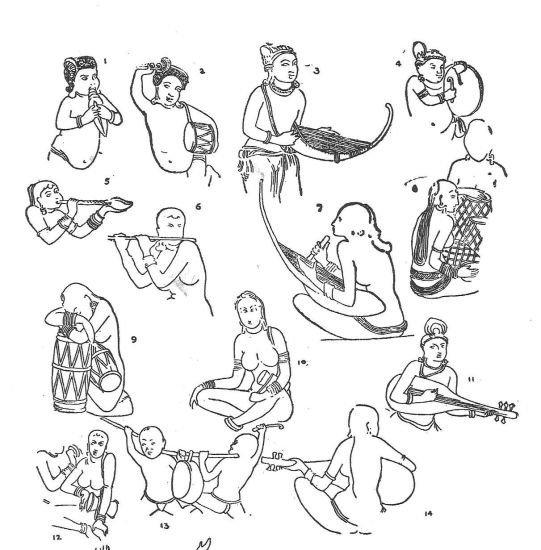
Amaravathi music0014

Role of instruments in Samgita

1.1. The term Samgita in the early Indian context meant a composite art-form comprising Gita (vocal singing), Vadya (instrumental accompaniments) and Nrtta or Nartana the limb movement or dance (Gitam, Vadyam, Nrttam Samgita-mucchyate).

1.2. Samgita was also called Gandharva–vidya (the art of the Gandharvas) because the celestial beings, the Gandharvas, loved to sing and dance   to the accompaniment of instrumental music.  And the term Gandharva, therefore, often, meant Music in general.

yattu tantrīkṛtaṃ proktaṃ nānā atodya samāśrayam । gāndharvamiti tajjñeyaṃ svara tāla padātmakam ॥ 28.8॥ atyarthamiṣṭaṃ devānāṃ tathā prītikaraṃ punaḥ । gandharvāṇāṃ ca yasmāddhi tasmād gandharvam ucyate ॥ BhN_28.8

1.3. Natyashastra explains the Gandharva music as that which is governed by the combination of Svara (tonal structure); Taala (time-units); and, Pada (text), in association with various musical instruments (Gaandharvam trividham vidhaat svara-tala-pada-atmakam). Thus, song, Veena, flute and drums all contributed to Gandharva.

gāndharvaṃ trividhaṃ vidyāt svara tāla padātmakam । trividhasyāpi vakṣyāmi lakṣaṇaṃ karma caiva hi ॥ 28.11॥

Naradiya Shiksha (1.4.12) gives the etymology of the term Gandharva by splitting it into three elements. It explains Gandharva Gana as made of: Ga – the song (giti geyam vidhuhu); Dha – playing on the Veena by skillful use of fingers (karupya vadanam); and, Va– other instruments and gestures (veti vadhyasya sanjnya); and says ‘this indicates Gandharva (ye Gandharvasya nirochanam).

1.4. Later, Someshwara (twelfth century) in his Manasollasa says that the instruments enhance the beauty and grace of dance and music performances, and for this reason, they have a preeminent place in both dance and music.

Vadyen-ranjate-geetam ch nrityam-vadyavarjitam!!/ Tasmadvadyam-pradhanam-syadvitnritya-kriyavidho!

1.5. Thus, Instrumental music was very much a part of the Samgita; and, it also enjoyed an important part in the play-production.  Instruments from behind the screen or on the stage were played to accompany various songs; to heighten the effect of the mood suggested by the scene; to better articulate different gestures; and, to accompany dance and dance-like movements.
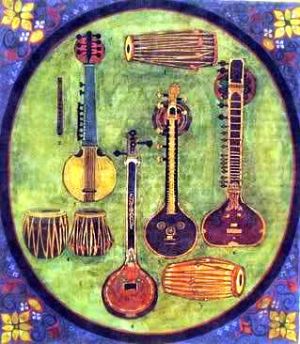
Music Instruments

Ramayana

[ Ramayana is more closely associated with music than other epics. That might be because Ramayana is rendered in verse; and, its poetry of abiding beauty melts into music like molten gold, with grace and felicity. Further, the epic has a certain lyrical lustre to it. The epic itself mentions that the Rama tale was rendered in song by two minstrels Kusi and Lava to the accompaniment of Veena, Tantri- laya-samanvitam (I.20.10), during the Asvamedha.

There are innumerable references to Music in Ramayana. Music was played for entertainment and in celebration at the weddings and other auspicious occasions; (II.7.416-36; 48.41.69; III.3, 17; 6.8; IV 38.13; V.53.17; VI.11.9; 24.3; 75.21 etc.)  . Music was also played in palaces and liquor parlors (IV 33.21; V.6.12; X.32; 37.11.4; Vi.10.4). Soulful songs were sung to the accompaniment of instruments, at religious services and in dramas. Music was played in the festivities; to welcome and see off the guests. The warriors fighting on the battlefield were lustily cheered and enthused by stout drum beats;   and piercing blow of conchs, horns and trumpets. There is also mention of those who took to music as a profession. Besides, there were court (state) sponsored musicians. Music was thus a part of social fabric of the society as described in Ramayana.

There are numerous events narrated in Ramayana where Music was sung or played. The word Samgita in Ramayana is a composite term covering Gana (vocal), Vadya (instrumental) and Nritya (dance). Samgita or Music was referred to as Gandharva-vidya. There is also a mention of Karna sung to the accompaniment of Veena (R. VII. 71.5). Samgita was also Kausika (kaisika) the graceful art of singing and dancing (gana-nrtya-vidya), the delightful  art of singing and dancing in groups (kausika-charya) to the accompaniment of instruments.

For more : Please refer to The Music in Ramayana ]
Rangoli 123

Mahabharata

As compared to Ramayana, there is relatively less information about Music in Mahabharata. Yet; Music (Gandharva) did occupy an important place in the life of its people. There are references to Music played on various occasions, including welcoming and seeing off the guests.  Along with singing (Gita) such Musical instruments as Panav, Vansa and Kansya Tala etc., were played. The Music instruments were broadly covered under the term Vaditra, denoting the four-fold group of Tata, Vitata, Ghana and Sushira -Vadyas.

In Shanti-parva, there are references to Veena and Venu.  The string instrument (Tantri-Vadya) Veena, was played during religious ceremonies like Yajnas; and, for relaxation by the ladies of the Queen’s court- vīṇā-paṇava-veṇūnāṃ svanaś cāti manoramaḥ / prahāsa iva vistīrṇaḥ śuśruve tasya veśmanaḥ – 12,053.005

In Dronaparva, there are references to Drum class instruments like: Mridanga, Jharjhara, Bheri, Panava, Anaka, Gomukha, Adambara, and Dundubhi (paṇavānaka-dundubhi-jharjhar-ibhiḥ – 07,014.037).

And, in Virata-parva, there is a reference to Kansya (solid brass instrument), the cymbal; Shankha (conch) and Venu (flute), the wind instruments Sushira -Vadyas. And, Gomukha was perhaps a cow-faced horn or trumpet – śaṅkhāś ca bheryaś ca gomukhā-ḍambarās tathā – 04,067.026.

The known Musical Instruments of the Mahabharata Period could be grouped as under:
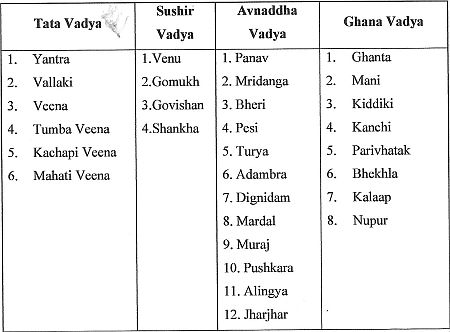
Muscial instruments in Mahabharata

***

Please do read the beautifully well-illustrated – Musical Instruments in Hoysala Sculpture by Jean Deloche
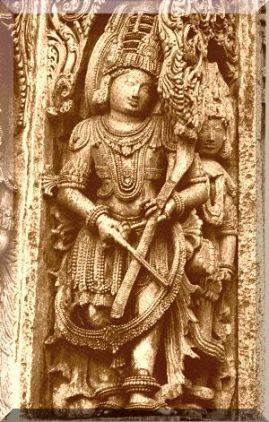
Hoysala art

***

The Nartana-nirnaya of  Pundarika Vittala mentions that : The efficacy of the Nartana , the dance, is determined (Nirnaya) by the performances, the combined excellence and coordination  of  the Dancer (Nartaka) and his troupe (Vrnda), consisting the Singer (Gayaka), the Cymbalist (Tala-dhari), the Mrdangam-player (Mrdangi), flute-player (Mukhari), and the Dance-composer (Nattuva). These components, together, are the determinants (Nirnaya-kari) of the Dance (Nartana).

Lets take a look at some  aspects of instrumental Music, with particular reference to the Natyashastra

***

Atodhya Vadya
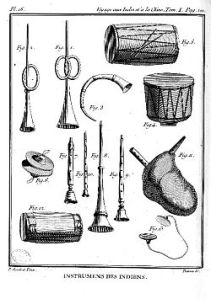
Intruments-Inde-1 Intruments-Inde-2

2.1. Bharatha used the term Atodhya Vadya to denote musical instruments. In the Natyashastra (NS: ātodyavidhimidānīṃ vakṣyāmaḥ । 28.1), Music instruments are classified under four broad categories based on their acoustic principles:

    • Tata (stringed);
    • Avanaddha (covered or percussion);
    • Susira (hollow or wind-blown) ; and
    • Ghana ( solid – like cymbals).

This classification given by Bharata was accepted as a standard format, in the later times, for study of instruments. And, it is valid till date.

tataṃ caivā avanaddhaṃ ca ghanaṃ suṣirameva ca । caturvidhaṃ tu vijñeyam ātodyaṃ lakṣaṇānvitam ॥ 28.1

Thus:

    • the term Tatha included all stringed instruments;
    • Anaddha included all that were covered or were struck like drums;
    • Sushira includes all wind instruments like the flute and the Shanka; and,
    • Ghana included all solid cymbal-like resonators.

2.2. Of these, the stringed and wind- instruments that produced flow of pleasant notes seemed to be the favored ones; and, were grouped with the singers. And, in the music on the stage and behind the curtain, the string instruments were more important.

2.3. The string and wind instruments were generally played individually or in tandem. It is not clear whether the Orchestra (Vadya-vrinda) as we know it today was in place during the time of Natyashastra.

However, Bharatha mentions three groups (Kutapa) of music-performers: Tata, Avanaddha and NatyakrtaThe Tata–Kutapa grouped together the vocalists, the players on string instruments, and the flutists. Avanaddha-Kutapa included players on percussion instruments such as Mrudanga, Pavana and Dardura. And, Natyakrta-Kutapa was the collection of actors and actresses who take part in the play.

tataḥ kutapa vinyāso gāyanaḥ saparigrahaḥ । vaipañciko vaiṇikaśca vaṃśa vādas tatha iva ca ॥ BhN_28.4

The Kutapa followed a certain sequence of activities :

    • (1) Pratyahara (arrangement of instruments;
    • (2) Avatarana (appearance of the singers) ;
    • (3) Arambha (commencement of vocal exercises);
    • (4) Asravana (methodical tuning of the instruments);
    • (5) Vaktarpani (rehearsing different types of playing) ;
    • (6) Parighattana (re-tuning/finetuning of the instruments);
    • (7) Sanghattana (taking up positions); and,
    • (8) Margasarita (playing together of string and rhythm-instruments).

Sangita-ratnakara mentions three classes of Natya-kutapa (1) Uttama (the best), having four main singers; 12 accompanying singers; four flute-players; and, four drummers (4-12-4-4); For Madhyama (medium) and Kanishta (lesser) varieties, their composition of musicians/players was 2-4-2-2 and 1-3-2-2, respectively

[Interestingly, Panini’s Ashtadhyayi calls a of group of musicians as Turya, in which the Veena-players were prominent. There was a main Veena-player (Veena Vadaka) who was supported and followed by a secondary group of Veena players (Pari- vadaka)

–  ‘vināśa-parikṣipa-pariraṭa-parivādi-vyābhāṣa-asūyo vuñ – PS_3.02.146-’

During the time of Panini, just singing a song (gayana) without the support of Veena was called Apa-veena.

And, the sound of Veena (Nada) was called by many names as: Kana, Nikvan, and Nikvaan (kvaṇo vīṇāyāṃ ca – PS_3,3.65 ).

The sounds of the other instruments were called as Ghosha: vā ghoṣa miśra śabdeṣuPS_6,3.56 ]

2.4. As Abhinavagupta said;   The Gita (song), Vadya (instruments) and Natya (enactment of play) should, ideally, coordinate and perform harmoniously – supporting and strengthening each other with great relish. And, the three Kutapa-s, in combination should suggest a seamless movement like a circle of fire (Alaata chakra); and should brighten (Ujjvalayati) the stage.

**

Tata-vadya
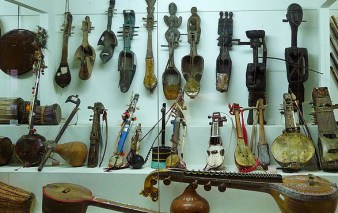
String-instrument-india

3.1. Tata –Vadya represent the class of string instruments (tantri kritam). It is said; such instruments were classified on the basis of number or kinds of strings (tantri bheda); and, the manner of playing the instruments. And, among all the string instruments (Tata-vadya) the Veena was the most prominent.

3.2. It is said; Veena was a generic term for all stringed instruments including lutes, arched harps, with or without frets and plucked with fingers or a plectrum.

(Natyashastra regards human body also as a Veena – vaiṇāḥ śārīrāśca prakīrtitāḥ  (BhN_28.12), a musical instrument, since it has a rhythm of its own; and, is also capable of producing musical notes through vocal cords.)

Some say that the Veena referred to in the Natyashastra might have resembled a harp rather than a lute (as we know it now).
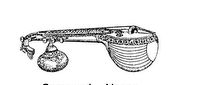
play_yazh Saraswati Veena

3.3. The major types of Veena-s during the time of Bharatha were said to be: Chitra (seven strings and played with fingers) and Vipanchi (nine stringed lutes played with a plectrum). The other types were Ghosha or Ghoshavati (single stringed – Ek Tari or a sort prototype Tanpura) and Kapucchi (also an Ek Tari).

saptatantrī bhaveccitrā vipañcī tu bhaven nava । koṇavādanā vipañcī syāc citrā cā aṅguli vādanā ॥ 29.118

Hanuman during his adventure in the city of Lanka, sees a woman of Ravana’s court  sleeping , hugging a Vipanchi as if it were her lover– vipañcaiim parighyānyā niyatā nttaśālinī | nidrā vaśam anuprāptā saha kāntā iva bhāminī (R.5-10-41)

[Among the string instruments (Tatha), Ramayana mentions two kinds of Veena: Vipanchi (fingerboard plucked ones with nine strings like the Veena as we know); Vana or Vallaki (a multi stringed harp); and, Kanda-Veena (made by joining reeds).

In fact, till about 19th century, string instruments  of all kinds were called Veena: harps like the Chitra; fingerboard plucked ones like  the Vipanchi,  Rudra Veena, the Saraswati Veena and the Kacchapi Veena; bowed ones such as the Ravana hastaveena and the Pinaki Veena.]

[According to the renowned scholar Dr. C. Sivaramamurti:
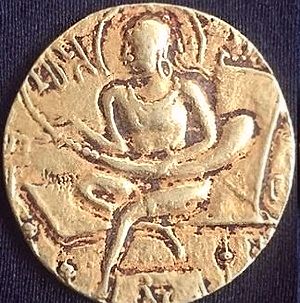
Samudragupta

Coin of  Emperor Samudra Gupta (ruled – Ca.335-375 CE)

The commonest type of Veena was bow-shaped and resembled a harp. But, there was also another type which was more like a guitar.
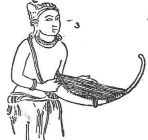
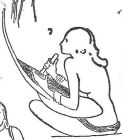
Amaravathi music0002 Amaravathi music0005

The harp type  of Veena was evolved on the principle of the bow and the resonator, the musical twang of the bowstring being a favorite sound often eulogized by poets as deep and pleasant. The interval between strings tied to the bow- shaped rod immediately above the resonator increased or diminished their length and thus determined the modulation of the note imitating vocal vibrations.

This hole in the piece of leather covering the vault of the resonator was for deepening the sound of the string. The entire body of the vina with the exception of the strings arid leather was of wood and was generally gaily painted over the gold and Jewel studded’.

The strings (tantri) for the Veena were generally seven. This type of vina was the oldest and most common, the saptatantrl veena or as per Amarakosha ‘sa tu tantrlbhis saptabhih parivadini’.

The harp-like Veena was sometimes held by a strap that came over the shoulder and could thenbe played by a person even while standing. And, the harp-like vina was sometimes played with the aid of a small plectrum (kana) sounding the strings softly with the finger nails.
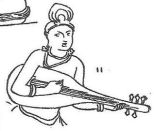
Amaravathi music0010 Amaravathi music0014a

The guitar-like Veena had a pear shaped resonator and straight neck. The strings extended across the resonator’s flat top which must also have been of leather. There were holes in the top cover of the resonator as in the bow-shaped vina. The strings were tuned with the help of small pegs which were tightened and lossened as required, with the resonator shaped like a tortoise shell, and with the neck appearing almost like the creature’s head peering from its shell, though being rather long for that, this vina is probably the nearest approach we~ can get to the kacchapi the favourite musical instrument of Sarasvati, the shape of which is suggested by its name .]
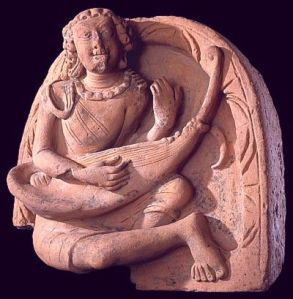
Terra cotta Gupta period 6th century

Terracotta – Gupta period Sixth Century

In Indian classical music, one of the most prominent and special instruments was Veena or Veena-like instruments (Tata-Vadya) that  have occupied a special place in classical music since the ancient period.

In the ancient texts, several types of Veenas are mentioned. Amongst the earliest string instruments, the most famous two were ‘Vipanchi-Veena’ (mentioned in the Ramayana) and a two stringed ‘Kachchhapi-Veena’ (mentioned in the Mahabharata).

Among these, the Ghoshaka-Veena was a string instrument, belonging to the half gourd type. The half guard is fixed at the top of the shaft. The Veena was played by keeping the gourd near the left-hand side of the chest and pressing its base with the third finger of the right hand
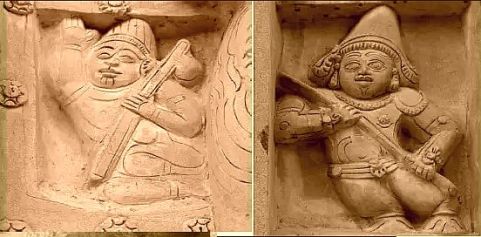
Kinnara with Apani Veena

The instruments depicted on the sculptures of Kinnaras (celestial being) belongs to the group of Veena (string instrument) of primitive type called Alapini-Veena, which is a form of single stringed or three-stringed Veena, with a gourd at the top end, attached. to a wooden shaft.

Kinnari-Veena is said to be the modified version of Alapini -Veena.

The Kinnari-Veena consisted of a finger board, fourteen frets and more than one gourd. It had three varieties – Laghu (little) Kinnari; Madhya (middle) Kinnari; and, Brihad (large) Kinnari.

Among these three types, the first one was made of two gourds; the second one had three gourds; and, the third type had four gourds.

It is said: “While Alapini was the first medium of expression of the form Alap, the Kinnari was an improved version; was a better medium than Alapini; and, was more in vogue.”

Rudra-Veena is said to an improved version of Kinnari-Veena; with a more elaborate the arrangement of the frets. It is believed that Saraswathi-Veena or Mahati-Veena (known as ‘Been or Beena’) was the refashioned version ; as devised by the Seni Gharana in the Mughal Period.
Veena PlayerVeena Player2

Role of Veena in Music-theories and principles

4.1. The Veena was used in the texts as the basis (adhara) to explain the theoretical aspects of Music and also to illustrate the concepts of Sruti, Taana, Sthana, Dhatu etc.

For instance;  Dattilam (9) explains Sruti as the difference in sounds (dvani visesha) produced by striking on the string on the upper end of the Veena (Uttarottara-taras tu venayam) and that produced by striking on the  lower end (adharottarah) of the Veena . And, Abhinavagupta explains the term Sruti as the sound (sabda) produced (prabhavita) when struck at appropriate position (śruti-sthāna-abhighāta) on the Veena.

4.2. Even the vocal styles were defined with reference to  the relation between singing and playing the song on Veena. When one plays on the Veena ( following the vocal style) but without singing it is then known as Suska or A-gita . And, when one plays on the Veena and sings the song as he plays ,  it is known as Giti

Abhinavagupta explains: every type of Giti can be played on Veena. And, there are three types of Giti:   Tatva, Anugata and Ogha.

When the Gana (singing)  is prominent and the Veena follows Gana completely , it is Tatva; when the Veena follows Gana in some part and then shows its own craftsmanship , it becomes Anugata; and , when the playing techniques becomes A-nibaddha and the Karanas become more prominent  and the Gana becomes secondary then the Giti becomes Ogha . Thus in the rendering of the Giti, Veena performs an important role.

4.3. Similarly, Murchana and Taana variations to provide pleasure to the listener as also to the performer were explained with reference to Veena. Dattilam (36) the techniques of improving Taana-s on the Veena (Taana-kriya).

Dattila says: the Taana-kriya is twofold (Taana-kriya-dvidha-tantryam): Pravesika  and  Nigraha

Pravesika (entering) is raising the lower note or lowering the higher note.

And, Nigraha (abstaining) is not touching the string (asamsparka tu nigrahat).
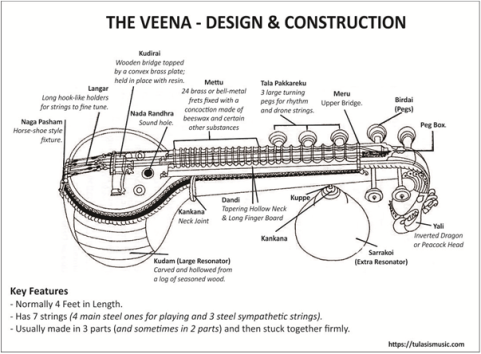
veena-design-construction

4.4. Bharatha describes the various strokes (karana) on the Veena and their sequences. According to Abhinavagupta, the collection of Svaras that are produced by striking (praharavishesha janyah) the strings of veena in a specific manner is called Dhatu.

The Dhatu had four elements: Vistara (high pitched), Karana  (low pitched), Aviddha (duration of the note) and Vyanjana (different ways of employing each finger), each of which had its variations.

vistāraḥ karaṇaśca syādāviddho vyañjanas tathā । catvāro dhātavo jñeyā vāditra karaṇā aśrayāḥ ॥ BhN_29.50

Such variations depended on whether the stroke was made on the upper end (uttara-mukha) or lower end (adhara) of the Veena; the number of strokes made on the strings; the time span (guru and laghu); and, their sequences.

uttaramukho dvir adharo dvir uttarā vasānaś ca । madhyottaro dvir adharo dvir uttaro’apy adhara madhyaś ca ॥ BhN_29.57

4.5.  The Varas on which the Alakāras depend are of four kinds:  ascending in the scale (ārohin); descending (avarohin); where the notes are the same and are equal (sthāyin); and,  when the various notes come together they constitute what is called a mixed Vara (sanchārin, or transitory)

Ārohī cā avarohī ca sthāyi sañcāriau tathā varāś ca tvāra eva ite hya alankaras tad āśrayā BhN_29.14

These four Varas having clearly defined aspects are adopted from the human voice; and, they relate to the quality of the three voice registers (sthāna).

Śārīra-svara-sambhūtās-tri sthāna gua gocarā catvāro lakaopetā varāstatra prakīrtitā BhN_29.17

When the Varnas adorn a song , it enhances the power of the song to provide  greater enjoyment

Evam lakaa sayukta yadā varo’nukarati tadā varasya nipattir jñeyā svara samudbhavā 29.18

**

Sushira Vadya

flutes

5.1. Sushira (hollow) instruments that allow passage of air to excite the various resonators have been popular from very early times. By manipulating the vibrations of air columns, varieties of sound patterns are produced through these instruments. And, they generally did not involve mechanical parts. These instruments of all types- like conch, horns, trumpets, bugles, and flutes of different types – were blown either by mouth or by bellows.
horns

Sushira derived from Susih (hole) stands for wind instruments, in general. According to Panini, the Grammarian, the suffix rah is added to Sushi to obtain the term Sushira – (ūṣa-suṣi-muṣka-madho raḥ || PS_5,2.107 ||)

Wind instruments (Sushira) such as flute made of bamboo were termed as Vamsi – Vamsadikam tu sushiram. Bharata regarded Vamsi as one of the important instruments; Shankha; and, Dakkini as minor or supporting (Pratyanga) wind instruments.

The flute and Veena are usually played in unison (Venu-Veena). It was said; the Svara and Grama derived from Sushira (flute) and the Veena are same

Atodyam sushiram nama jneyam vamsakrtam budhaih / Vaina eva vidhistatra svara-grama-sama ashrayah – ॥  30.1 ॥.

The most ancient Sushira instrument mentioned in Rgveda are Nali and Bakura. The  Bakura dritam is described as a sort of bag-pipe (driti denoting a leather bag). Bakura is blow-instrument. Nail is said to please Yama. Other Sushira instruments mentioned are Tunva and Shankha

Sarangadeva mentions some Sushira instruments as : Vamsi, Pava, Murali, Kahala, Tundaki, Tunva , Cukka, Sringa and Shankha.

And, to that, Ahobala adds: Mukhavina, Vakri, Camga, Patrika and Svara sagara.

Further, Sangita Damodara mentions Pari, Madhuri, Tutturi, Simgha, Vamsi and Turyavamsi as some other Sushira instruments

As mentioned, the most important of Sushira vadyas, made of is bamboo, is Vamsi. Based on the principle of a breath of air escaping through holes, Vamsi, is usally made as a bamboo tube. It is long, straight and smooth. Later, other wood / materials came into use: Kadira wood, sandalwood, ivory, copper, iron, silver, and gold. The flute (Venu) is the most important. It is one of the sweetest and an easily portable of musical instruments.

Some varieties of flute are held to the mouth; but, some are held along it. The latter variety is often portrayed in paintings and sculptures; and, it is the type that is used in stage or classical music.

The variety of flute which the player holds in his lips, the blowing end is not plain; but , it is pressed into a narrow opening known as the beak. The player blows a current of air into the flute through the beak; and, creates melodies by closing and opening the finger holes on the body of the instrument. This kind of flute  is a common pastoral instrument.      bansuri

The other variety of flute that is held horizontal or across the player’s lips is closed at one end and open at the other. A few centimeters from the blocked end there is a hole known as the embouchure or blow hole into which the flutiest blows. Along the body of the instrument there are a number of apertures which are worked by fingers for playing a tune.  
Amaravathi music0007

Such a horizontal flute is the one that is used in musical concerts; the reason being the versatility of the cross flute. The classical Indian music, at its refined excellence , is rich in fine pitch differences (sruti–bedha) and ornamentation (gamakas), which  are best executed  by the complicated fingering techniques, adjustments of the pressure of blowing and slight changes in the angle of the flute on the lip. All such manipulations are possible only with the horizontal flute.

The Indian artists and audiences prefer the bamboo flute over the metallic ones , because of its mellow quality. The length of the Venu varies depending upon the context and the nature of music played. The shorter ones are employed for faster music and for higher pitch; whereas the longer flutes are meant for slower resonant music in lower pitch.

*

As said earlier, the number of holes on a flute varies. And, it appears, the early ones had only seven holes – venum gayami saptacchidram.

Later, the number of holes was increased to eight. The first hole on the flute, after a space of two /three /four fingers is Mukha-randra.  The next hole after space of  one finger is Tara –randra or Nada-randra , followed by seven more holes, each at a space of  half/ three-fourth finger from the Tara-randra. A smaller hole of the size of Badri seed (Ber, Bora or Indian jujube) is made to take out the air. This is known as Eka-vira-vamsi.

With the increase in space between Mukha-randra and the Tara-randra, the Vamsi may have  as many as fourteen holes . They are named as ;

Umapathi, tripurusha, Chaturmukha, Panchavaktra, Shanmukha, Muniraja, Vasu, Nathendra, Mahananda, Rudra, Aditya, Manu, Kalanidhi, and Anvartha.

*

The Shankha or conch shell also belongs to the Sushira category. It is considered most auspicious. Apart from that, it was always carried by warriors, as a part of their battle gear. They were considered so important that each warrior gave a name to his personal conch. For instance; Krishna named his conch as Pancajanya, while Arjuna named his as Devadatta.

The conches were blown for heralding the arrival of the heroic warrior; as also for sounding the battle-cry before and after battle. The blow (dhamana or purna) of the deep and noble sounds of the Martial conchs were said to be so loud as to frighten the enemy; and shatter his heart.  It was akin to the trumpet; but, its roar was much louder. The Shankha was blown along with the lound beats of the Dundubhi, the large drum.

dvi kastrika śca tuṣko vā śruti saṅkhyo bhavet svaraḥ । anīraṇāttu śeṣāṇāṃ svarāṇāmapi sambhavaḥ । aṅgul īvādana kṛtaṃ tac ca me san nibodhata ॥  BhN_30.4

And, the Shankha (conch) had also its place in a musical orchestra. It was sounded with other instruments; but, only at intervals. There were two ways in which it was blown either the perforated tip of the shell itself being put to the lips or sometimes a long ornamental pipe attached to it.
Amaravathi music0003 Amaravathi music0006

*

5.2. Chapter Thirty of Natyashastra talks briefly about Sushira Vadya-s in just about 13 verses. It is said; the wind instruments in use during the time of Bharatha were Vamsa, Nadi, Tudakini, Samkha and such others. Not much is known either about Nadi or Tudakini; and, Samkha the conch was scarcely used as a musical instrument in the play.

6.1. Therefore, the attention of the Natyashastra in its Chapter Thirty was mainly on Vamsa or Venu the flute, which is an important musical instrument in the context of the Drama. Vamsa also provided the basic note (Sruti) to tune other musical instruments. And, that    helped to regulate the song and music of the play.

6.2. During the time of Natyashastra, Susira (hollow) musical instruments were made of Vamsa (bamboo reeds), Hence the flutes were commonly known as Vamsa  or Vamsa–Vadya.  
Therefore, Bharta commences the discussion  on Sushira Vadyas, the hallow instruments, in Chapter 30 of the Natyashastra, by saying: the hollow (suira) musical instruments, as the wise should know, are made of bamboo. The rules regarding their notes (svara) and the Grāma are the same as that of the Veeā.

atodya suira nāma jñeya vaśagata budhai vaia eva vidhistatra svaragrāmasamāśraya BhN_30.1

6.3. The Verse 11 of Chapter 30 says – The music of Vamsa which is steady and not very loud; and adorned with Varnas and Alamkaras , and follows rules,  is smooth and soothing.

avicalitam-avicchinna varā-alakāra-sayuta vidhivat  lalita madhura snigdhaveoreva smta vādyam  BhN_30.11

The rules regarding their notes (Svara) and the Grama were the same as that of the Veena.

6.4. Bharatha explains the manner of producing seven notes ‘according to the Sruti division of two, three and four (dvishrutika, trishrutika, and chatusshrutika). And, he says: by prolonging the blow the other Svaras may also be produced.

dvi-strikaś catuko vā śruti sakhyo bhavet svara anīraāttu śeāāsvarāāmapi sambhava agulī vādana kta tacca me sannibodhata BhN_30.4

The notes were obtained by covering the hole with the finger, by placing a trembling finger (Kampita), by partially closing/ opening the hole (Ardha-mukta) or by fully opening the hole (Vyakta-mukta).

Vyakta amukta anguli tatra svaro jneyas chatusruti // Kampanamguli chaiva tri srutih parikirtyate / dvikardhanguli syad iti srutyasritah svarah //5 //

Bharata then mentions the production of notes in the Madhyama Grama :

The notes produced from a flute-hole completely free from finger is of four Srutis; that produced from a hole with a shaken finger placed on it is of three Srutis; and, that produced from a hole partially free from a finger is of two Srutis. All these are the notes in the Madhyama Grama.

ete syur madhyama-grāme bhūya ajāśritā puna vyakta-muktā-agulik aja-madhyama-pañcamā BhN_30.6 

As regards the production of notes in Shadja Grama, Bharatha says:

Shadja, Madhyama and Panchama will arise from a hole fully open; Daivata and Rsabha from a hole covered by a shaken finger; and, from a hole partly free from finger Gandhara and Nishadha will arise.

ṛṣabho dhaivataścāpi kampya mānāgulīktau ardha muktā aguliścaiva gāndhāro’tha niādavān  BhN_30.7

Nishadha and Gandhara coming respectively in combination with Shadja and Madhyama and modifying themselves in characteristic Srutis will give rise to overlapping (Svara- sadharana) and the Kakili notes.

Svara sādhāranaścāpi kākalya antarasajñayā niāda gāndhāra ktau aja Madhyama- yorapi BhN_30.8

6.5. Natyashastra recommended that the Svaras (notes) on a flute should be perfected with the aid of the Veena and the human voice. The singer should sing the very notes in accompaniment of a flute. The perfect harmony of the human voice, strains of the Veena and the melody of the flute is indeed truly sublime, and fit for gods.

viparyayā sannikare śruti lakaa siddhita vaiaka aṇṭhapraveśena siddhā ekāśritā svarā ॥ BhN_30.9

yaṃ yaṃ gātā svaraṃ gacchet taṃ taṃ vaṃśena vādayet śārīra vaiṇa vaṃśyān āmekī bhāvaḥ  praśasyate ॥  BhN_30.10

The music of the flute, which is steady, not very loud and furnished with the Varas and the Alakāras, and follows rules (relating  to the manner in which the flute should be played on different occasions in a play),  is sweet and soothing.

avicalitam-avicchinna varā-alakāra-sayuta vidhivat lalita madhura snigdha veoreva smta vādyam BhN_30.11

Flute player

As advised by Bharatha, the flute was played mainly as an accompanying instrument ‘in harmony with the vocalist and the veena player’.

[ As explained in the earlier, in part Four of this series (Music in Sama Vada), the flute (Venu) played a highly significant role in re-aligning the Svaras (notes) of Indian Music. The  Naradiya Shiksha is a text that deals mainly with the musical notes and the pronunciation of the words in the Vedic language. Some believe, it might predate Bharata’s Natyashastra.

Naradiya Shiksha explains that during the ancient times, the Sama notes , Sama-svaras , were of Nidhana prakriti (diminishing nature) or Vakragati, following Avaroha karma, a descending order (uttarottaram nicha bhavanthi); and , therefore, there was not much flexibility in rendering its music.

Then, Naradiya Shiksha , revised and  recast-ed  the Sama Svaras , by relating each of its notes  to a pitch on the flute (Venu); and restructured its Svaras   into an ascending order  : Sa, Ri, Ga, Ma, Pa, Dha and Ni , as we are familiar with it today.

Because of such reorganization of its notes, the Indian Music could develop and proper into a dynamic and a vibrant system.

Thus, the Naradiya Shiksha and the Venu have contributed immensely to the growth and vitality of Indian Music , in all its forms.]

Avanaddha (covered or percussion)
tribal_dhole

7.1. As compared to Susira (hollow) instruments, the Avanaddha Vadya the covered instruments wherein a vessel or a frame is covered with leather   are discussed in great detail in the Chapter thirty-three of Natyashastra.

Avanaddha (membranophone) refers to instruments that produce sound primarily by way of a vibrating stretched membrane.  That merely means these instruments were made by covering a frame of wood or a vessel with a piece of stretched leather that is held in position by thin and long leather straps. The Avanaddha type of mentioned in Natyashastra are basically the drums and percussion instruments of various sorts. They were used for keeping rhythm, measuring Taala and also for making great sounds.

7.2. The drums were played on various occasions such as; festivals; processions; auspicious occasions and happy times as the weddings, birth of sons; during expeditionary marches; and, in  a battle where many fighters assemble .

Bharata advises that only a small number of instruments be played during household celebrations.

During a Drama many instruments could be played to bring about harmonious blending of the different limbs (Anga) of the play. Drums could also be used to cover up faults, mishaps and delays.
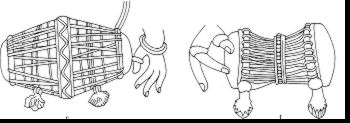
Drums2

As regards the use of Drums during a Dance recital:

Bharatha in his description of the dance of Vardhamana-asarita, gives specific instructions with regard to drumming for Nrtta and Abhinaya. As the dancer makes her entry on to the stage, she is accompanied by the drum instruments. The drumming accompaniment should be in the ‘Visuddha-karana -jati’.

The dancer is to then present Caris in the Gati (gait), in tune with percussion instruments. After performing the Nrtta movements, she presents Abhinaya. Bharata states that while the Abhinaya is being enacted by the dancer, there should be no drumming accompaniment. That was perhaps to ensure the words of the song (Sahitya) are clearly heard and grasped both by the Dancer and the spectators.

However, for the presentation of the Angaharas that follow, Bharatha mentions specific modes of drumming like Suddha-praharajam and Nrtta-angagrahi among others. And here, the drum-beats accompaniment should be in harmony with the rhythmic  Nrtta movements

7.3. The Avanaddha instruments, in general, included a large variety of drums varying in their sound-patterns, sound-volume and their purpose. From the loud and noisy thuds of the Pataha to the sweet-sounding notes of small drums coverd with calfskin, there are many subtle modulations in their sound.

The Avanaddha class of instruments were also categorized, in incredible number of ways, in variety of manners, such as:

    • by the rhythm of their beats; 
    • by the volume , the depth  and the pitch of the sound they produce;
    • by the materials of which they are made- wood (type of wood) or metal (types of metal) or animal skin (types of skins) ;  
    • by their size – huge, small or medium; by  their shape- either having two faces or a single face , or as single unit or twin unit;
    • by whether  they are drum-like, cylindrical or narrowed in the middle like hour-glass  ;
    • by the manner they are held – either placed on the ground or suspended from the shoulders or held in hands; by whether  held / placed vertically or horizontally;  
    • by the manner in which they are played –  struck or rubbed  either with stick or hands or both  ;
    • by the context in which such instruments are played – in music concerts or classical dance performances, in  folk dances, in Bhajans singing together, in  festivities at home such as weddings and other auspicious occasions , or   in celebrations at temples or in public places, or  heralding the arrival of the kings, or enthusing the fighting warriors and scaring the enemy,  or in funerals bidding farewell to the departed heroes and so on  

[ Ramayana , at various places, mentions several percussion instruments. The Epic refers to quite a large number of them:

    •  Mrudanga;
    • Panava (a kind of Mridanga which had a hole in the middle with strings were laid from one side to another);
    • Aataha
    • Madduka (a big drum of two faces having twelve and thirteen angula- finger lengths);
    • Dundubhi  (Nagaara) ;
    • Dindima (resembling Damaru but smaller in size); 
    • Muraja (a  bifacial drum, the left one of eight fingers and right one of seven fingers);
    • Adambara (a sort of kettle drum made of Udumbara  wood);
    • Bheri (two faced metal drum in a conical shape , the leather kept taut by strings; the right face was struck by a Kona and the left one by hand, striking terror in the heart of the enemy); 
    • Pataha (resembling Dholak);  and 
    • Dundubhi (drums made of hollow wood covered with hide) played during wedding ceremonies as also for welcoming the winning-warriors .

Gargara was another drum used during the wars.

All these were leather or leather bound instruments . They were played with metal or wooden drum-sticks with their ends wrapped in leather.

There is also a mention of Bhumi –Dundubhi where the lower part of a huge drum is buried in a pit while the exposed upper part covered with animal hide is beaten with big sized metal or wooden drum-sticks to produce loud booming sounds. It was played during battles to arouse the warriors; to celebrate victory; or in dire emergency. Bhumi –Dundubhi was also played at the time of final offering (Purna-Ahuthi) at the conclusion of a Yajna.

The other instruments to keep rhythm (Taala) were: Ghatam and cymbals. Aghathi was a sort of cymbal used while dancing.]
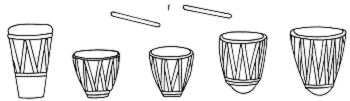
Drums

According to Dr. Dr. C. Sivaramamurti

[The drums sounding most pleasant to the ear, such as Muraja, Mrudanga and Pushkara are those generally used as musical accompaniments. The sound of the Muraja is described as deep and noble; that of the Mrudanga, softly tapped with finger tips by women sounds sweet, resemble the gentle rumble of clouds. The Darduras, Panavas and Jarjharikas are other varieties of soft-toned drums. The Muraja and Mrudanga often required a kind of rice-paste to be applied to both the leather surfaces to sweeten their sound.

The most fearful sound was that of the Pretapatahas or funeral drums. On the battle-field, the Patahas- Dundubhis, the Anakas and other large drums were stuck.  In all these cases, konaghata the beat of the drumstick produced a great volume of sound. The konaghata itself came to mean loud sound as in an orchestra where many konas would naturally be used.

The Paatahkalandipataha, the auspicious drum sounded in the morning along with conchs to announce the break of day, and the hours od the day, also required drumsticks. Such gongs were known as gandi.

The smaller drum suspended by a strap from the shoulder and played with a drumstick is probably a Marvala; and, is midway between the more refined Muraja and the noisy Pataha. It must have been very like the modem South Indian Tavil, for each has to be played on one side with a single drumstick, and on the other with the fingers.]
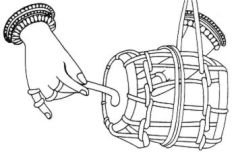
Drums3

7.4. Chapter 33 of Natyashastra commences with the statement: I have spoken briefly about the stringed instruments. I shall now speak of the class of covered musical instruments, their characteristics and functions as well as of playing drums named Mdaga, Paavaand Dardura (NS.33.1-2) . Then, it goes on to talk about the origin, nature and description of the Avanaddha class of musical instruments.

As regards the drums , it says , at the outset,  : Among the drums, Mdaga Dardura and Paava are the major components (Anga) , while Jhallarī and Paaha etc., are the minor components (Pratyanga)- (BhN_35.5 )

But, he adds that: there is no instrument which cannot be used in the ten kinds of play (daśarūpaka). And, each kind of instrument may be used in a play after considering the context and the emotions involved-(NS.33. 18)

The musical instruments   can be played on numerous varieties of occasions and scenes.  In festivals, processions, and auspicious (Magala) occasions and happy times as the weddings, birth of sons; during expeditionary marches; and, in a battle where many fighters assemble; and, during such other acts, all the musical instruments should be played- NS.33. 19-20)

During a Drama, many instruments could be played to bring about harmonious blending of the different limbs (Anga) of the play. Drums could also be used to cover up faults, mishaps and delays.

Bharatha advises that only a small number of instruments be played during household celebrations.
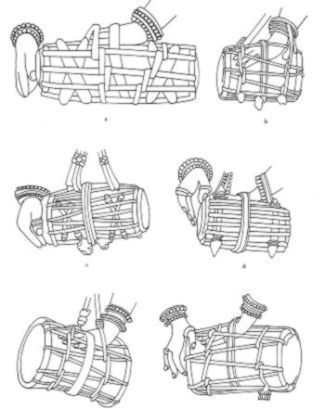
Drums5

Pushkara

8.1. Bharatha often uses the term Pushkara (drums made of wood) Vadya-s to denote the Avanaddha type of instruments, in general,  that are covered with hide. Among these, the three viz. Mridanga, Panava and Dardura were the major type (Anga) of the Pushkara Vadya-s. And, Jhallari and Pataha etc were the minor ones.

8.2. Bharata says there are one hundred varieties (suggesting a very large number) of Pushkaras. But , he talks, in some fair detail , about the three major type of Pushkaras  (Mridanga, Panava and Dardura) Bharatha remarks : they have no harshness of sound, produce clear notes, and are played with well regulated strokes(NS.33. 25-26).

8.3. As regards the rules of playing these three Pushkara-s , it is said : Pushkara instruments should have following aspects : 

sixteen syllabic sounds (aksara),  four Margas, Vilepana, six  Karanas, three Yatis, three Layas, three Gatis, three  Pracsras, three Yogas, three Panis, five Pani-prahata,  three Praharas, three Marjanas, eighteen Jaatis and twenty Prakaras. ( NS.33. 37-39 )

9.1. Then , in the  rest of the Chapter thirty-three (from verse 40 to 301),  Bharatha elaborates various aspects related to Pushkara Vadya-s in great detail.

He describes in fair detail the types of Pushkara-; making of Drums; their sizes; the types of wood ,the hides  and the blackish earth  from the river banks to be used; General Rules of drumming ; the ways of playing different varieties of Pushkara-s; the technical aspects of playing; three Yatis , tempos or beat-patterns; ways of combining three tempo (quick, medium and slow)  and different  strokes  ; the manners of playing drums in different situations in a play; the manner of playing Pushkara-s along with a song or string and wind instruments,  with dance or on festive occasions ; playing to suit the movements of different types of characters in a play such as hers, heroine, villain , jester , Gandharvas, Daityas, Danavas, Yaksas, Raksasas and others; the ways of playing for superior females and for the lesser female characters; the ways to celebrate joy, mirth , love, happiness  etc; ways of playing to suggest sorrow, suffering, loss of life ,killing,  death of dear ones etc; the manner of playing drums to suggest movement of elephants, horses , birds, chariots, boats ;  qualities of a good player of the Pushkaras   (Mridanga, Panava and Dardura) and so on.

He also lists of the qualities (guna) and defects (dosha) of the drum player in relation to playing each type of drum, such as :  Mrdanga, Panava, Dardara and others.

[ Chapter thirty-three of Natyashastra also includes detailed instructions om playing of drums on different contexts of the Drama. The following is just a brief, extract. For more and ; and also the definition and explanations of certain technical terms that Bharata uses , please click here .

Bharata instructs that the playing of the drums should be in accordance with the meter (Chhandas) of the songs.  And, it should also be according the action taking place on the stage. For instance; when a section of the performance requires the use of gestures, there should be no playing of drums; but, when there is a dance consisting of Angaharas then there should be music to accompany it.  The drums should be played in slow, medium and or quick tempo as in tune with the rhythm of a song; and the same should be the method in the performance of Padas and dance with Angaharas.

The various occasions for playing of drums are also described in the Natyashastra.

After this, Bharata gives instructions about the playing of drums suitable at the time of walking and other movement of the Heroes.  

When the female dancer appears on the stage, experts in the Mrdanga, mostly by the touch of their fingers, should produce a music which will consist of light Varnas.

The playing in case of superior females, who are goddesses, will include mostly vamgati kipi dhmeṭa prathi ghe. And, in case of queens it should include mostly kathi kathi mathi do do khu khu.

In a similar way, instructions are given for playing of drums in the movements of gods, Bramhanas and middling men are given. Here, he says, the steps of the dance should conform to rhythm (laya) and to the tempo consisting of two Kalas, one Kala or four Kalas. The song should conform to drums.

In case of walking of Yatis, Munis, Pāśupatas and Śākyas the playing of drums should include do kho dvitvikhi duguvoo klanado dhanti kītiki.

And, in the walking of old Śrotriyas, Kañcukīns and corpulent persons, the playing should include dhrām dhroṃ dhrāṃ droṅ dhiṅ droṇām kho kho ṇā.

The Natyashastra  specifies that in case of sorrow, suffering illness, curse, death of dear ones, loss of wealth, killing, imprisonment, vow, austerity, fasting, etc. the playing should be in Utthapana and according to Alipta-marga.

This is followed by the description of the Udghatya playing. The playing which is performed at the time of excess of hurry or joy or surprise, excitement or sorrow or at the time of receiving a gift is called Udghatya.

Instructions are also given as to the playing of drums in different conditions of the various characters and movements of boats, chariots, aerial cars, birds, etc.. In these cases, the playing of drums should be by running the fingers on the face of drums or by striking in the Catuṣka by the two hands alternatively.

 In case of movements of elephants, horses, asses, camels, chariots and aerial cars, the playing should include Vankiti (?). And, in case of superior, middling and inferior men, the playing should he performed after considering the sentiments and mental states. Similar instructions are given in ease of walking of Uttama, Madhyama and royal women.

In case of walking of Daityas, Dānavas, Yakṣas, Rākṣasas and Grahas the playing of drums should include Karaṇas such as dṛṅ dhṛṅ khada together with gha ṭn tn tanta tetodrāṃ.And, In case of dancing movements the playing of drums should include ghetāṃ kaṭakāṃ.

There are detailed instructions for playing the drums to accompany various Dhruva-songs.

Bharata says that in the performance of ten types of Rupakas (Drama) , four Panavas should be used ; and,  similar Atodyas are also to be played in different situations. The Mrdangas, Panavas, and Dardaras are to be played in the Nataka, Prakarana, Vithi, Bhana and Dima class of plays.

At the end of this Adhyaya, Bharata says that special efforts should he made in playing the instruments because the dramatic performance depends upon it.]

9.2. The text mentions the manner of playing Pushkara-s when accompanying a song or a dance sequence. The playing of drums should correspond with in metre of the songs. When the Mrudanga plays to a song of slow tempo (Vilamba kaala) the strokes should be mild; when the song is in middle tempo (Madhyama Kaala) the strokes should be  clear the syllables; and so on.

And when playing to a dance, the Mrudanga should follow the Laya (tempo) and Taala of the dance steps and movements. And, the strokes should be pure, uniform (Sama), pleasing (Rakta), clear (Sphuta) following the rhythm of dance and enhancing the beauty of its presentation.

9.3. Natyashastra even specifies how the Avanaddha-Kutapa (players on percussion instruments such as Mrudanga, Pavana and Dardura) be positioned on the stage along with other music-players. According to that :  the Tata –Kutapa (group of vocalists, the players on string instruments, and the flutists) should be seated on the stage between the entry and exit doors; and, they should face east. The Mrdanga player should face the stage; the players of Panava and the Dardara should sit to his left and right respectively – (prose at 3. 221)

Here, the orchestra relates first to the players of covered instruments. Among them a male singer will face the north, to his left will be the Vīā-player and to his right the two flute-players. And a female singer will face the male singer.


Mridanga
mridangam

10.1. Mridanga is perhaps the best known and more widely used percussion instrument in all types and forms of Drama, Music or ritual-celebrations. Though it seems the earliest types of Mrudanga were made of clay – as its name suggests (Mrun) , they  were later  made of wood.  And, Mridanga seems to have remained virtually the same over the past several centuries. It is capable of producing rich, varied and complex type of beats. With the dexterous uses of hands and wrists a virtuoso Mridanga can generate successive series of rhythmic sounds.

The length of the Mrudanga is said to be three and a half Talas (about 21 inches ) and its face about twelve fingers in diameter.

10.2. Bharatha gives the descriptions of three kinds of Mridanga: Ankika, Alingya and Urdhavaka.

:- Ankika was a wide-bodied lateral type of drum ; its length being three and half Tala-s (Tala = is the length of the palm from wrist to tip of middle fingers; roughly about 6 to 7 inches).  The diameter of its   face measured twelve fingers (angula) wide ( say , about 9 inches) . And, in shape, it resembled a myrobalan fruit – that is, with a barrel that had a central bulge and fairly uniform slope towards each face ; and,  perhaps resembled the Mrudanga or Pakhavaj . Ankikas were perhaps made of clay; .

:- Alingya was slightly smaller in size. As its name suggests, it seems to be a drum held against the chest of a player , in  embrace.  In its width, it was three Tala long (nearly 18-21 inches) ; and, the diameter of its face was eight fingers (angula-s) – say 6 inches . It was  tapering in appearance, resembling cows tail (Gau-puccha).

:- And, Urdhvaka was bigger than the other two. It was four Tala-s wide ( 30 to 32 inches) ; and , the diameter of its face was  fourteen fingers (angula)-  about 10 ½ inches.  Urdhvaka was shaped like Yava– barley ( or shaped like a large grain of rice).

Their names denote the positions in which· they were respectively held. The Ankika was placed on the lap when it was played. And, the Ankika, though taller than the modern tabla, was perhaps played in much the same fashion.
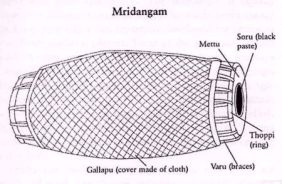
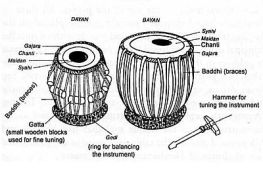
mrdangam parts-of-tabla-thabla-1

And, judging by its size, its sound should have been rather soft. The Alingya, larger then the Ankika; but, also placed on the lap, was tapped softly in different places for producing sweet sound. The Urdhvaka drums were positioned vertically and were perhaps played only on the top face (if the instruments were stood upright while playing, there could be only the top surface available for striking

Panava

10.3. Panava is said to be one of the earliest Avanaddha (covered or percussion) instruments. Paava is a small drum (paavo’ntastantrīko huukāra).  The term Panava is explained as – Panam Stutim vati gacchatiti – that which is played with prayers is called Panava. Such prayers sung with the playing of Panava are said to be very dear to Shiva; and, inspire him to dance.

Therefore, the Panava was, traditionally, played at the time of worship (Stuti or Deva puja); and, also while giving a battle call. Its beats were said to be very invigorating. Nanyadeva says that on hearing the sound of Panava, Lord Shiva will dance in ecstasy.

During the time of Natyashastra (Ca. 200 B.C.), Panava was perhaps a prominent percussion instrument, since he classified  it with the Mridanga . But, in later times it receded to the background; and , at present is treated as a folk instrument.

The Panava, like Mrudanga, had two faces covered by membranes; tightly tied with ropes; and, was smaller in size than Mrudanga (the drum)  . It was sixteen fingers wide (12 inches); with a narrow middle of eight fingers (6 inches) which was hallow (hole?) with strings laid from one side to another.  And its faces were 8 ½ fingers (8 inches) in diameter. Its rims were each half of a finger thick, tightly fastened with ropes.

Describing the glory and the beauty of Ayodhya, it is said the city resounding with the rhythmic  drum beats of Dundubhi, Mrudanga and Panava; with the melodious tunes of string instruments like Veena , the city , indeed, was unique ; and undoubtedly the best city on earth –

dundubhībhi  mdangai  ca vīābhi  paavai tathā | nāditām   bhśam atyartham pthivyām tām anuttamām (R.1.5.18)

Hanuman , in Sundarakanda, sees a  tired woman sleeping, clutching an instrument called Panava between her shoulders and reaching arm pits –

 bhuja pārśva antarasthena kakagena krśa udarī | paavena saha anindyā suptā mada krta śramā (R. 5-10-43)
Drums6

Dardara

10.4. The Dardara was shaped like a bell of sixteen figure height (12 inches). Its face resembled that of a pot (Ghata) of nine fingers in diameter ( say , about 6 inches) , with fat lips (rims) on all side. it is  mentioned that is was called Dardara because it makes sounds like ‘Darara’ : ‘ Darara sabdam pati tasmat  bhavati dardarah‘ . The Dardara was made of wooden frame over which a hide  was stretched tightly. In shape, it perhaps resembled a huge gong or a big water pot (maha-ghatakatah). The Dardara could perhaps be the forerunner of Ghatam.
ghatam

10.5. Natyashastra also mentions other types of Drums with large surfaces such as Bheri, Pathana, Dundhubhi, Dindima etc known for the depth and loudness of their sounds. But, there is not much discussion in the text about these instruments in the context of Music, Dance or Drama. But, these instruments have references in other texts.

The ancient texts mention Dundhubi, Pathah, Bheri, Dindima (the different types od war-drums); Mrudanga (tabor); Muraja (a smaller drum); Anaka and Dhakka (other types of drums) as the instruments that give forth great sound —

Dundubhih, Paaha,Bherī, Mdaga,Muraja, Mardala, Diṇḍima, Anaka, Dhakkā   nāda-vādya-viśea

The Epics, Ramayana and Mahabharata are copious in their mention of the the terrible and frightening sounds of Bheri , Mrdanga,  Pataha,  Nandi vadya and such other barrel drums used in the battle field. However, these were not merely the marital drums, but were also musical instruments played in festivities and celebrations.

It is said;  Ayodhya city was resounding  with the rhythmic  drum beats of Dundubhi, Mrudanga and Panava; with the melodious tunes of string instruments like Veena  –

 dundubhībhi mdangai ca vīābhi paavai tathā | nāditām bhśam atyartham pthivyām tām anuttamām (R.1.5.18)

Besides these, some rare Avanaddha-s mentioned are Dimdimi, Adambara, Maddaka, Paava, and Gomukha (a wind instrument, a kind of conch resembling the mouth of the cow, hence its name) , Jhallarī and Chelika etc.

Jhallari was perhaps a sort of drum or cymbal. It is not described in the NS. Smilar is the case with Chelika ]

For instance ; Natyashastra ( 4. 253-254) mentions that seeing Śakara (Śiva) dance with Recakas and Agahāras, Pārvathī too performed a Lasya dance with delicate movements; and , this dance was followed by the playing of musical instruments like Mdaga, Bherī, Paaha, Jhañjhā , Diṇḍima, Gomukha, Paava and Dardura.

And, according to Natyashastra (2. 35-37) , at the ceremony of laying the foundation for a play-house (Natya-mantapa) the entire musical instruments such as, Śakha, Dundubhi, Mdaga, and Paava should be sounded.

Bharata mentions that the extensive surface and the slack-tension of the stretched leather causes Bheri, Paaha, and Bhambhā, as well as Dundubhi and Diṇḍimas to produce  great sound  and depth (NS.3.27)

 Bheri

Bheri was a major Avanaddha instrument producing a roaring sound that frightens – Bhi (to scare) – Bhibatyasa ravt;   the sound that scares. Sarangadeva describes Bheri as an instrument that produces terrible, frightening sound- Ati-bhayankarah gambhirah atyabhutasca dhvanir-bhavathi.  According to Ahobala, Bheri stimulates the home-army to a war-frenzy, while it pierces the hearts of the enemies – Dandanirghat-avadhinyh srutva bherya mahasvanam

The Bheri, one of the most ancient drums, was known for the depth and loudness of its sounds. And, it must have had a very loud and strident tone, for it was commonly used in the battles, processions and amusements of the crowds. The Ramayana has a number of references to it.

Sarangadeva mentions variety of Bheris like the Rana-bheri used in war; the Ananda-bheri and Madana bheri used in dances, accompanying the singing of Dhamar, and so on.

In the context of battles, Bheri, Mrudanga and Shankha are often mentioned together. The war cry; the loud and  fearsome drum–beats of Bheri, Mrudanga ; and the piercing waves of  the sounds Shankha were all used  to enthuse , whip up and  rallyforth  the troops , as also to frighten the enemy.

In the Ramayana, as Ravana’s soldiers prepare for the war, they hear the sounds of the Bheri played by Rama’s Vanara–army. Sarama asks Sita to listen and rejoice the Bheri sounds resembling the thundering rumbles of the clouds. –

Samanahajanani hesya bhairava bhiru bherika / Bherinadam ca gambhiram srunu toyadanihsvanam

Rama’s mighty army attacks Lanka with a great roar of the Bheri-s, Panava-s and the Shanknha-s.  The terible sounds of Shankha and Bheri was as that of an earthquake –

Estasminnantare sabdo bheri-shankha-samakulah / sruta vai sarvasainyanam

Bheri was a cylindrical type of Drum with large surfaces; and, it made of metal, such as: bell metal, copper,/bronze or iron. The one made of Bell metal (sya) was said to be the best.  It had three Balist measures, two sides/faces, covered with animal skin, tightly tied with ropes or chords. The right side was played with wodden sticks (kona); and the left with hands.

The Sangeeta-ratnakara (11th Century) gives a short description of the Bheri made of copper (Tāmra); and, says it  was thirty-four Angulas long (1 Angula = 1.89 cm or approx 3/4 inch, which works out to about sixtyfive centimeters) and each face had a diameter of thirteen Angulas (about twentyfive centimeters) . One face was played with the hand and the other with a kona ( stick ).

 Dundubhi 

The Dundubhi which is equated with today’s Nagara is perhaps the most ancient of conical drums; and finds mention in ancient texts. In the early times, it was used both in war and peace. Nāṭyaśāstra 2.35-37 , mentions playing of Dundubhi during the auspicious ceremony of laying the foundation of the playhouse (tya-maṇtapa nivesanam),

śubhe nakṣatra yoge ca maṇḍapasya niveśanam । śaṅkha dundubhi nirghoṣair mṛdaṅga paṇavādi bhiḥ ॥ 2.36

The Dundubhi, at times equated with Nagara, is kept also in temples, to be beaten during worship or to announce prayers. The Nagara consists two conical bowl drums struck with sticks. The smaller of the two is higher in pitch; and, the larger has  a deeper tone .

Describing the glory and the beauty of Ayodhya, it is said , in Ramayana, the city resounding with the rhythmic  drum beats of Dundubhi, Mrudanga and Panava; with the melodious tunes of string instruments like Veena , the city , indeed, was unique ; and undoubtedly the best city on earth –

Dundubhībhi mdangai ca vīābhi paavai tathā | nāditām   bhśam atyartham pthivyām tām anuttamām (R.1.5.18)

[Swami Prajnanananda (A History of Indian Music; pages 54-55) mentions of Bhumi-dundubhi, which  was perhaps the most ancient and primitive form of drum.It used to be carved in earth in the form of a large hollow or pit and covered with the thick skin of any wild animal. It used to be struck with one or two log or logs of wood, and a deep see resonant sound was produced. The sound of the Bhumi-dundubhi could be heard from a very long distance. Afterwards, the Dundhubhi, a refined form of th e Bhumi-dundubhi, came into use. It used to be shaped out of the hollow trunk of a tree, the upper part of which was used to be covered with the skin of the animal.]

Dindima

Dindima is folk instrument, made of hard wood; and, its length is measured as one and a quarter of an arm. It has a face, on each end, is said to be three quarters of an arm, in size. The faces are covered with animal skin. The right face is played with a stick; and, the left with the hands. Dindima is hung from the shoulder to the right side of the player. The sound produced is like Ding –Ding; and hence the name.

 The Nāṭyaśāstra 4.250, mentions Dindima in the context of the dances performed by Shiva and Parvathi.

sukumāra prayogeṇa nṛtyantīṃ caiva pārvatīm । mṛdaṅga bherī paṭahair bhāṇḍa ḍiṇḍima gomukhaiḥ ॥4.250

Hanuman , in Sundarkanda, sees a woman  in Ravana’s inner-court (Anthapura) with an instrument called Dindima near her slept in the same way as a woman hugging her husband and also her child – 

iṇḍimam parigrhya anyā tathaiva āsakta iṇḍimā | prasuptā  taruam vatsam upagūhya iva bhāminī (R. 5-10-44 )

Pataha

Pataha (resembling Dholak) is mentioned in Nāṭyaśāstra 4.250, after Śhiva danced using Recakas and Agahāras, and Pārvatī performed a gentle  Lasya dance.

Hanuman , in Sundarkanda, sees a woman  with beautiful body features and with beautiful breasts slept tightly and hugged instrument called Pataha as though hugging a lover, getting him after a long time –

paaham cāru sarva angī pīya śete śubha stanī | cirasya  ramaam labdhvā parivajya iva kāminī (5-10-39)

Muraja

The Muraja seems to have had a shape similar to that of the Dindima (Dindima sadśa vādya yasmin laghu tālāni sayuktāni santi) , having two faces; but, with the heads (beaten surfaces) much smaller and giving out light sounds. Of its two faces, the left one was of eight fingers; and, the right one of seven fingers in width. It was played with hands, as did Nandi played on it with great delight (Sananda Nandi hastha hatha Murajah)

Nandi is said to have been fond of playing on Muraja (Nandikesvarah krsnah Murajarudho Mrajavadanaparah).

It is said; the instruments like Veena, Muraja, and conches together made pleasant music.

Muraja is not clearly described in the Natyashastra. It seems that Mujara was a form of Dindima; or they might have been the names of the same instrument (Muraja Dindima vadhya vichakshanam). Mujara was perhaps made of jack tree (Mujara phala).

As regards the position of the player of a Muraja (Mdaga), he should face the stage; to his right should sit the player of a Paava, and to his left the player of a Dardara

The text mentions: when the Paava follows the Muraja, and the Dardara follows the Paava, the playing is called Svarūpānugata (natural order) (NS.3.207), And, when a Paava and a Muraja after being played first, take up the Murajas, the playing is called Samullekha ( termination or closure) (NS.3.216)

The playing of drums is said to be of three types: Ativadita, Anuvadita and Samvadita. The Ativadita is the playing of Muraja before a performance. When the Mrdanga is played after a performance, it is called Anuvadya. And,  when the Mrdanga is played simultaneously with the performance , it is called Samvadita – playi together harmoniously.

 Damaru
damaru

There is a class of bi-facial avanaddha vadya that are  narrow in the middle  like the hourglass, sand-glass . These are  the Damaru shaped drums. This form has an ancient past and once was a major instrument in sophisticated music.  It is closely associated with Lord Shiva when he sports the vigorous Tandava dance. The beats of the Damaru also symbolize the  concept of time , in the Indian iconography . But, Today, one hears them only in tribal and folk music not on the concert platform.

[Abhinavagupta explains that the term Tāṇḍava is derived from the sounds like “Tando; tam-tam” produced by the accompanying Damaru shaped drums.He also mentions that  the bhaṇḍam (covered percussion instruments) which produce sounds like “Bhan, Than” etc. are important for the Nṛtta , or the limb-movements, the Āṅgika abhinaya  .

It is a manner, in grammar (vyākaraṇa), of naming an object, based on the sound it produces – śabda.anukṛti . For instance; Yaska, in his Nirukta (318) mentions that a kaka (crow) is so called, because of the sound it makes – kāka. iti. śabda. anukṛtis. tad. idam. śakunisu.bahulam. Similarly,, the battle-drum which makes loud Dun-Dun sounds is named Dundubhi (दुन्दुभि)-dundubhir.iti.śabda.anukaraṇam (Nir.9.12)]

Adambara

Adambara ( a sort of kettle drum made of Udambara wood);

It is one of the most ancient percussion instruments. According to Amarakosha: Patha and Audumbara are synonyms of the Nagara – a percussion instrument

Adambara is derived from the root’ dabi ksepe ‘, that which produces great sound . It is explained as:  Dambam rati,  that which emanates sound  such as Damba from all its sides ; hence , it is known as Adambara

Hanuman in Sundarakanda,  comes upon a woman of Ravana’s court,  with eyes like lotus petals, slept clutching  the instrument called Adambara ; pressing it by her shoulders – 

kācid āambaram nārī bhuja sambhoga pīitam |ktvā kamala patra akī prasuptā mada mohitā (R. 5-10-45 )

Maddaka and Calika in Ramayana

Amarakosha names Maddu among percussion instruments. Maddu and Madduka apparently were the names of the same instrument

Hanuman sees the women of Ravana’s court sleeping with Dindima by her side , just as a mother sleeps with her grown up child beside her. Another woman was sleeping with Madduka on her lap, in the way that a mother sleeps with her young child. Yet another woman intoxicated eyes which resemble a lotus leaf, embraced her Adambara with her arms. Some were even sleeping with Murajas, Mrudanga and Celikas.

However, not many details are available about these ancient Avanaddha instruments – Maddaka and Calika – mentioned in the Ramayana.  Many of such instruments are extinct.
Drums4

Ghana, the Solid

bells2

11.1.After the strings (Tata), the covered (Avanaddha) and the hollow (Susira) comes the Solid the Ghana. 

11.2. The most fundamental of the Ghana (solid) Vadya is said to be the human body itself.

It is very common to see clapping of hands (Taala) , counting fingers, waving the hands, striking palms on the thighs or hips, stamping the feet on the dance floor etc in a rhythmic ways to keep or measure time.  Even the singers of Sama–Gana kept rhythm by clapping and waving hands. Even today one can see in Karnataka music concerts, persons (either on stage or in the audience) clapping to keep time (Taala) while   percussion instruments are played. 

It is said; Cymbals (classified as Ghana Vadya) – made of metal- also called as Taala are but an extension of the act of clapping to keep time.
hands

11.3. The Ghana vadya-s (Idiophone Instruments) are instruments made of wood or metal that produce sound when they are struck. Along with the solid Cymbals made of metal, Natyashastra mentions Patah and Ghata (bell) as Ghana Vadya-s. The instruments of this group are usually played with a striker or hammer. 

1.4. Natyashastra mentions that these instruments of solid class (Ghana) help to measure time (Kaala) and to maintain the tempo (Laya) . And, those who play the Ghana Vadya-s  in a performance should know the rules of Taala and Laya.

śrāvaṇo’tha ghanaḥ snigdho madhurohyav adhānavān । tristhāna śobhītyevaṃ tu ṣaṭ kaṇṭhasya guṇā matāḥ ॥ 33.12

12.1. The Ghana vadya-s made of metal, are not capable of producing definite pitches that are required for creating a melody. That, perhaps, is the reason   why they are not used in classical music concerts. But, the Cymbals, the Taala, are an essential part of the Dance music.

And, the Tala (Cymbals) is an essential ingredient of the  Bhakthi Samgita and Bhajans.

During a dance or a song on the stage, the Cymbals provided rhythm (Taala) to the flow of music and dance.

 [ Please do click here  to read a very interesting article on The Musical Instruments in Hoysala Sculpture , written by Jean Deloche . Please also see the comments and conclusions of the author  in pages from 66 to 68 . ]
musicians-halabedu

Continued in Part Ten

Prabandha

Sources and References

1. The Natyasastra ascribed to Bharata Muni by Monomohan Ghosh

2.  Musical Instruments in India through the agesby Chaitanya Kunte

http://shodhganga.inflibnet.ac.in/bitstream/10603/13634/8/08_chapter%202.pdf

3. Origin of Indian Instrumental Music

http://shodhganga.inflibnet.ac.in/bitstream/10603/13634/8/08_chapter%202.pdf

4. http://www.e-books-chennaimuseum.tn.gov.in/ChennaiMuseum/images/28/files/basic-html/page165.html

where, the renowned scholar Dr. C Sivaraamurti in his scholarly publication  ‘Amaravati sculptures in the Chennai Government museum’ (1998) discusses, among several other subjects

I also acknowledge the drawings fro Dr. Sivaramamurti’s work

5 .Subhadra Desai  … Music In Valmiki’s Ramayana

6  .https://shodhganga.inflibnet.ac.in/bitstream/10603/13634/8/08_chapter%202.pdf

ALL OTHER  PICTURES ARE FROM INTERNET

 
Leave a comment

Posted by on April 27, 2015 in Music, Sangita


Tags: , , , , , , , , , , , ,