RSS

Tag Archives: Artha

The meaning of ‘MEANING’ – Part Two

Continued from Part One

spiritual_light

Artha-Tatparya-Shakthi

A. Artha

As mentioned at the commencement of Part One – The most common Sanskrit term for ‘meaning’ is Artha.  Various expressions in English language, such as ‘sense’, ‘reference’, ‘denotation’, ‘connotation’, ‘designatum’ and ‘intention’, have been used to render that Sanskrit term. However, each of those English terms carries its own connotation; and, no single term adequately and comprehensively conveys the various shades of meanings associated with the idea of Artha.

Apart from ‘meaning’, there are at least twenty other connotations to the word Artha; such as : thing; object; purpose; target; extent; interest; property;  wealth; polity; privacy; referent; and so on.

*

The term Artha figures in Vedic texts too. But, there, it is used in the sense of: aim; purpose; objective; enterprise; or, work. Here, Artha does not explicitly denote ‘meaning’. But, that basic idea is carried into the later texts where the term ‘Vakya-artha’ generally stands for: ’ the purpose of the sentence or the action denoted by the sentence’.

Yaska, the etymologist of the very ancient India, derives the term Artha from two roots (chakarita): Artho’rtem and Aranastha va – (artho.arter.araṇastho.vā -1,18)  ‘ to go, to move towards, reach etc’ and Arna+shta ‘to stay apart ‘. The Artha is, thus, derived from roots conveying mutually opposite sense. It is said; Artha, according to this derivation, at once, denotes something that people are moving towards (Arteh) or something from which  they desire to move away (Aranastha).

Some other scholars point out that in Sanskrit, the term ‘Artha’ has no clear derivation from the verb. But, the term itself gives rise to another verb ‘Arthayate’, which means ‘to request, to beg; to strive or to obtain’.

In any event, Artha has been in use as an all-embracing term having a verity of hues and shades of meanings. Almost everything that is understood from a word on the basis of some kind of ‘significance’ is covered by ‘Artha’.

It brings into its fold various other terms and expressions such as: ‘Tatparya’ (the true intent or gist); Abhi-praya (to intend or to approach); ‘Abhi-daha’ (to express or to denote); or,’Uddishya’ (to point out or to signify or to refer); ‘Vivaksa’ (intention or what one wishes to express); ‘Sakthi’ (power of expression); ‘Vakyartha’ (the import of the sentence); ‘Vachya’ and ‘Abhideya’ (both meaning : what is intended to be expressed); ’Padartha’ (the object of the expression); ‘Vishaya’ (subject matter);’Abidha’ (direct or literal meaning of a term) which is in contrast to lakshana the symbolic sign or metaphoric meaning; and, ‘Vyanjana’ (suggested meaning ) and so on .

But, in the common usage, Artha, basically, refers to the notion of ‘meaning’ in its widest sense. But, Artha is also used to denote an object or an object signified by a word.

The scope of the term Artha in Sanskrit is not limited to its linguistic sense or to what is usually understood by the word employed. It can be the meaning of the words, sentences and scriptures as well as of the non-linguistic signs and gestures. Its meaning ranges from a real object in the external world referred to by a word to a mere concept of an object which may or may not correspond to anything in the external world.

It could also mean Artha (money), the source of all Anartha (troubles); and Anartha could also be nonsense. Artha is one of the pursuits of life – wealth or well being. Artha could also signify economic power and polity. It is said that a virtuous person gives up Svartha (self-interest) for Parartha (for the sake of others). And, finally, Paramartha is the ultimate objective or the innermost truth.

shamrock-small

Padartha

The communication of meaning is the main function of words (Pada); and in that sense, Artha is used in various places. In numerous contexts, Artha denotes the aim, purpose, goal or the object of the spoken word (pada). But, at the same time, it also involves other meanings such as –‘the object’ and/or to signify a certain tangible ’object’, ‘purpose or goal’ which could be attained. It is said; Padāt (lit., from word) suggests that every word has the capability to represent a certain object or multiple objects or purposes.

Thus, Padartha (pada+artha) stands for the meaning of the word; for a tangible object (Vastumatra); as also for the meaning (padartha) that is intended to be signified by the word (Abhideya). It is difficult to find an exact English equivalent to Padartha; perhaps category could be its nearest term.

It is argued that each word (Pada) has countless objects; and therefore, Padartha too is countless. It is said; the whole range of Padartha-s could be categorized into two: Bhava-padartha and Abhava-padartha. For instance; the whole of universe is categorized into Sat (existent) and A-sat (nonexistent); Purusha and Prakrti as in Samkhya

Nyaya Darshana (metaphysics) recognizes and categorizes as many as sixteen Padartha-s, elements:

  1. Pramāa (valid means of knowledge);
  2. Prameya (objects of valid knowledge);
  3. Saśaya (doubt);
  4. Prayojana (objective or the aim);
  5. Dṛṣṭānta (instances or examples);
  6. Siddhānta (conclusion);
  7. Avayava (members or elements of syllogism);
  8. Tarka (hypothetical reasoning):
  9. Niraya (derivation or settlement);
  10. Vāda (discussion)
  11. Jalpa (wrangling);
  12. Vitaṇḍā (quibbling);
  13. Hetvābhāsa (fallacy);
  14. Chala (hair-splitting); 
  15. jāti (sophisticated refutation) ;and
  16. Nigrahasthāna (getting close to defeat).

 For a detailed discussion on these elements – please click here


*

According to one interpretation, the word itself is also a part of the meaning it signifies. Such a concept of ‘meaning’ is not found in the western semantics. For instance; the Grammarian Patanjali says: ’when a word is pronounced, an Artha ‘object’ is understood. For example; ‘bring a bull’, ‘eat yogurt’ etc.  It is the Artha that is brought in; and it is also Artha that is eaten.

[Sabdeno-uccharitena-artha gamyate gam anya dadhya asana iti / Artha anyate Arthas cha Bhujyate]

Here, the term Artha stands for a tangible object which could be brought in or eaten; and, it is not just a notion. A similar connotation of Artha (as object) is also employed by Nyaya and Mimamsa schools. According to these Schools, the qualities, relations etc associated with the objects are as real as the objects themselves.

Bhartrhari also says that word is an indicator; even when a word expresses reality; it is not expressed in its own form. Often, what is expressed by a word is its properties rather than its form.

There are elaborate discussions on the issues closely related to the concept of understanding. It is argued; no matter whether the things are real or otherwise, people do have ideas and concepts of many things in life. In all such cases, it is essential that people understand those things and be aware of their meaning. Such meanings or the content of a person’s understanding are invariably derived from the language employed by each one.

That gives raise to arguments on questions such as: whether the meaning (Artha) of a word is derived from its function to signify (Vrtti); or through inference derived by the listener (Anumana) from the words he listned  ; or  through his presumption (Arthapatti) or imagination.

Grammarians assert that Artha (meaning) as cognized from a word is only a conceptual entity (bauddha-artha). The word might suggest a real object; but, its meaning is only what is projected by the mind (buddhi-prathibhasha) and how it is grasped.

Pundit Gadadharabhatta of the Navya (new) Nyaya School, in his Vyutpattivada, argues that a word is closely linked to the function associated with it. According to him, the term Artha stands for object or content of a verbal cognition (Sabda-bodha-vishaya) which results from understanding of a word (sabda-jnana) as derived from the significance of the function  (vrtti) pertaining to that word (pada-nists-vritti-jnana) – Vritya-pada-pratipadya evartha ity abhidayate.

[According to him:

:- If a word is understood through its primary function (shakthi or aphids-vrtti or mukhya -vrtti) then such derived primary meaning is called sakyarta or vachyartha or abhidheya.

:- If a word is understood on the basis of its secondary function (lakshana-vrtti or guna-vrtti) then such derived secondary meaning is called lakshyartha

:- If a word is understood on the basis of its suggestive function (vyanjana-vrtti) then such derived suggested meaning is called vyanjanartha or dhvani-artha.

:- And, if a word is understood on the basis of its intellectual significance (tatparya-artha) then such derived intended meaning is called tatparyartha.

However, Prof. M M  Deshpande adds a word of caution: Not all the Schools of Indian Philosophy  of Grammar accept the above classification  , although these seem to be the general explanations ]

**

Punyaraja, a commentator of Vakyapadiya of Bhartrhari, detailing the technical and non-technical aspects of the term Artha offers as many as eighteen explanations.

[ Artho asta-dashaad / tatra vastu-matram abhideyash  cha / abhidheyo api dvidha shastriya laukika cha /.. ]

According to Punyaraja, Artha stands for an external real object (Vastu-matra) as also for the meaning intended to be signified by a word (Abhideya). The latter – meaning in linguistic sense – could be technical (Shastriya) of special reference   or it could be the meaning as commonly grasped by people in a conversation (laukika). In either case, there are further differences. The meaning of a word might or might not be literary; and, it could also stand for an expression or a figure of speech (Abhideya). It could also be used to denote something that is not really intended (Nantariyaka) when something else is actually intended.

Bhartrhari also talks of two kinds of meanings – apoddhara-padartha and sthitha-lakshana-padartha.  The latter refers to the meaning as it is actually understood in a conversation. Its meaning is fixed; and, Grammarians cannot alter it abruptly. Bhartrhari also said: here, meaning does not leave the word. Meaning is comprehended by the word itself. The word is eternal and resides within us.

[There was much discussion in the olden days whether a word has a fixed meaning or a floating one. For instance; the Grammarian Patanjali asserted that a word is spoken; and when spoken it brings about the understanding of its meaning. The spoken word is the manifestation of the fixed (dhruva, kutastha) meaning of the word. And, the word (sabda) and its meaning (artha) and their inter-relations (sambandha) are eternal (nitya) – Siddhe sabda-artha-sambandhe–Patanjali Mbh.1.27]

The former, apoddhara-padartha mentioned by Bhartrhari, tries to bring out the abstract or hidden meaning that is extracted from the peculiar use of the word in a given context. In many cases, such abstracted meaning might not denote the actual (linguistic) meaning of the term as it is usually understood. But, such usage does not represent the real nature of the language. The apoddhara-padartha is of some relevance only in technical or theoretical (Shastriya) sense, serving a particular or special purpose. That again, depends on the context in which the term in question is employed.

[In many of these discussions, it is difficult to draw a clear distinction between the literal meaning and the concept it represents (Pratyaya).

In the Sanskrit texts, the terms such as ‘Sabda’ (word); ‘Artha’ (object); ‘Pratyaya’ (concept) are horribly mixed up and are used interchangeably.]

*

There is also a line of discussion on whether Artha is universal or the particular? The Grammarian Vyadi says that the words refer to Dravya (substance) , that is , the particular. Another Grammarian Vajapyayana on the other hand argues that words, including proper names, refer to Jati or class or universal.

Panini seems to leave the question open-ended.

But, Kumarilabhatta of the Mimamsa School argues when we utter a word we are at once referring to at least seven characteristics (Vastuni) associated with it. Let’s say when one utter ‘Bull’ (Gauh) , that expression  points to : Jati the whole class ; Vyakti – individual or particular; Sambandha– the relation between the two; Samudha– the collection of such elements; Linga-gender; Karaka- the relation that the term has with the verb (kriya-pada) or activity associated with it; and Samkhya– number , singular or plural.

With regard to the nature of the meaning of a word, Bhartrhari speaks in terms of its general or universal (jati) and its relative or specific (vyakti) connotations. Bhartrhari says that every word first of all means the class (jati) of that word. For instance; the word ‘cow’ initially refers to the general class of all that is in the form of cow. Later, it is implied to refer to its particular form (vyakti) . Thus, what is universal is then diversified into relative or a particular form.  Bhartrhari then extends his hypothesis to the field of philosophy- Advaita. He says; the universal (Brahman) appears as relative or specific limited. It is ultimately the Brahman (Sabdatattva) that is at the root of  all the words  and their  meaning (Artha) .

shamrock-small

The Problem of Multiple Meanings

Generally, the notion of meaning is stratified into three or four types. The first is the primary meaning. If this is inappropriate in the given context, then one moves to a secondary meaning. Beyond this is the suggested meaning, which may or may not be the same as the meaning intended by the speaker. Specific conditions under which these different varieties are understood are discussed by the Schools of Grammar.

Bhartrhari points out   that a word can carry multiple meanings; and that the Grammarian should explain, in some way, how only one of those meanings is conveyed at a time or is apt in a given context.

According to him, the process of understanding the particular meaning of a word has three aspects: first, a word has an intrinsic power to convey one or more meanings (abhidha); second, it is the intention of the speaker which determines the particular meaning to be conveyed (abhisamdhana) in a given context; and third, the actual application (viniyoga) of the word and its utterance.

In the case of words carrying multiple meanings, the meaning which is in common usage (prasiddhi) is considered by Bhartrhari   as its primary meaning. The secondary meaning of a word normally requires a context for its understanding. Usually, the secondary meaning of a word is implied when the word is used for an object other than it normally denotes, as for example, the metaphorical use of the word.

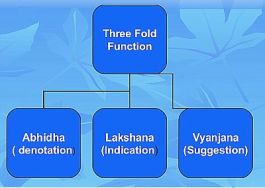
Now, according to Indian Poetics, a word has three functions: it signifies or denotes (abhida); it indicates (lakshana); and it suggests (vyanjana).

The meaning that is comprehended immediately after the word is uttered is its primary meaning (mukhya-artha). The meaning thus conveyed and its relation to the next word and its own meaning is a mutual relation of the signifier and the signified (vachya-vachaka). The power that creates the relation among words is Abhida-vyapara, the power of denotation or sense. The suggestive power of the word is through Vyanjana-artha.

The meaning of a word or a sentence that is directly grasped in the usual manner is Vakyartha (denotation or literal sense); and, the power of the language which conveys such meaning is called Abidha-vritti (designating function). It is the principal function of the word .The primary sense Vakyartha is the natural (Svabhavokti) and is the easily comprehended sense of the word.

In certain cases where a particular word is not capable of conveying the desired sense, another power which modifies that word to produce the fitting or suitable meaning is called Lakshana-vritti (indicative function). Such secondary sense (lakshana) could even be called an unnatural meaning (Vakrokti) of the word.

**

There are certain other peculiar situations:

There is the complicated question of words having similar spelling; but having different pronunciations and conveying different meanings (homograph). Such words have been the concern of Grammarian from ancient times onwards.  Some argue such cases should, technically, be treated as different words with similar pronunciation and similar meaning. But, some Grammarians point out that there are, in fact, no true Homonyms. They do differ, at least slightly, either in the way they are pronounced or their usage or relevance.

 [If someone says saindhavam anaya, it might mean the ‘bringing of a horse’ or ‘bringing salt’. The exact meaning of the term saindhava is to be determined according to the intention of the speaker uttered in a given context,]

There is also the issue of Dyotya-artha  (co-signified) as when two entities are jointly referred by using the conjunctive term such as  ‘and’  or ‘or’ (cha; Va). It is said; the particles such as ‘and’, ‘or’ do not, by themselves, carry any sense if they are used independently. They acquire some context and significance only when they are able to combine (samuchchaya) two or more entities of the similar character or of dissimilar characters.

shamrock-small

Artha in art

The concept of Artha also appears in the theories of Art-appreciation. There, the understanding of art is said to be through two distinctive processes – Sakshartha, the direct visual appreciation of the art-work; and, Paroksharta, delving into its inner or hidden meanings or realms (guhyeshu-varteshu). The one concerns the appreciation of the appealing form (rupa) of the art object (vastu); and, the other the enjoyment of the emotion or the essence (rasa) of its aesthetic principle (guna vishesha).  Artha, in the context of art, is, thus, essentially the objective and property of art-work; as also the proper, deep subjective aesthetic art-experience.

In the traditions of Indian art, the artist uses artistic forms and techniques to embody an idea, a vision; and, it is the cultured viewer with an  understanding  heart  (sah-hrudaya), the aesthete (rasika) that partakes that vision.

It is said; an artistic creation  is not a mere inert object, but it is truly  rich in meaning (Artha). And, it is capable of evoking manifold emotions , transforming the aesthete. As for a connoisseur , it is not only a source of beauty; but is also an invitation to explore and enjoy the reason (Artha) of that beauty. Thus, Artha, understood in its wider sense as experience,  is the dynamic process of art-enjoyment  that bridges the art-object and the connoisseur.

shamrock-small

Artha in Arthashastra

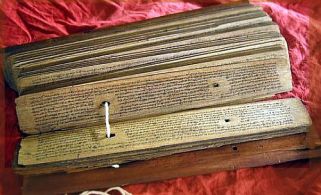
arthashastra manuscript

In the Arthashastra ascribed to Kautilya, the term Artha means more than ‘wealth’ or ‘material well being’ that follows the Dharma. There are numerous interpretations of Artha in the context of Kautilya’s work.

Here, Artha is an all-embracing term having a verity of meanings. It includes many shades and hues of the term : material well-being of the people and the State (AS:15.1.1); economy and livelihood of the people ; economic efficiency of the State in all fields of activity including agriculture and commerce(AS:1.4.3) . It also includes Rajanithi; the ‘politics’; and the management of the State. Artha, here, is the art of governance in its widest sense.

But, all those varied meanings aim at a common goal; have faith in the same doctrine; and, their authority is equal or well balanced. The purpose of life was believed to be, four-fold, viz. the pursuit of prosperity, of pleasure and attainment of liberation (Artha, Kama, Moksha); all in accordance with the Dharma prescribed for each stage of life.

That is because; there is a fear that the immoderate pursuit of material advantage would lead to undesirable and ruinous excesses. And therefore, Artha must always be regulated by the superior aim of Dharma, or righteousness.

*

To start with, Artha is interpreted as sustenance, employment or livelihood (Vrtti) of earth-inhabitants. It also is said to refer to means of acquisition and protection of earth.

 [manuṣyāṇāṃ vṛttir arthaḥ, manuṣyavatī bhūmir ity arthaḥ //–KAZ15.1.01]

Artha is also taken to mean material well-being or wealth. It is one of the goals in human life. Here, it is with reference to the individual, his well being and his prosperity in life. That perhaps is the reason Artha, in the text, is taken as Vrtti or sustenance or occupation or means of livelihood of people (Manushyanam Vrtti).

It is said; such Vrtti was primarily related to the three-fold means of livelihood – agriculture; animal husbandry and trade – through which men generally earn a living.

*

Arthashatra is also concerned with the general well-being of the earth and its inhabitants. And, since the State is directly charged with the responsibility of acquiring, protecting and managing the territory and its subjects, the Arthashastra necessarily deals with statecraft, economy and defence of the land and its people.

In the older references, Arthashastra is described as the science of politics and administration. But, in the later times, it came to be referred to as DandaNitishastra or Rajaniti -shastra / Raja -dharma.

But Arthashastra is more comprehensive. It includes all those aspects and more.

Artha sastra

In the concluding section of his work, Kautilya says ‘the source of livelihood of the people is wealth’. Here, the wealth of the nation is both the territory of the Sate and its inhabitants who follow a variety of occupations (AS: 15.1.1). The State or the Government has a crucial responsibility in ensuring the stability and the material wellbeing of the nation as a whole as also of its individual citizens. Therefore, an important aspect of Arthashastra is the ‘science of economics’, which includes starting of productive ventures, taxation, revenue collection and distribution, budgets and accounts.

The ruler’s responsibilities in the internal administration of the State are threefold: raksha, protection of the Sate from external aggression; Palana, maintenance of law and order within the State; and, Yogakshema, safeguarding the welfare of the people and their future generations – tasyāḥ pṛthivyā lābha.pālana.upāyaḥ śāstram artha.śāstram iti /.

Kautilya cautions that a judicious balance has to be maintained between the welfare and comfort of the people on one hand and augmenting the resources of the State on the other through taxes, levies , cess etc. The arrangement for ensuring this objective presupposes – maintenance of law and order and adequate, capable , transparent  administrative machinery.

It is also said that the statecraft, which maintains the general social order should take adequate measures to prevent anarchy.

Apart from ensuring collection of revenue there have also laws to avoid losses to the State and to prevent abuse of power and embezzlement by the employees of the State. These measures call for enforcement of laws (Dandanithi) by means of fines, punishments etc. The Tax payers as also the employees of the state machinery are subject to Dandanithi.

The king was believed to be responsible as much for the correct conduct (achara) of his subjects, and their performing the prescribed rites of expiation (prayaschitta) as for punishing them, when they violated the right of property or committed a crime. The achara and prayaschitta sections of the smrti cannot accordingly be put outside the “secular ” law.
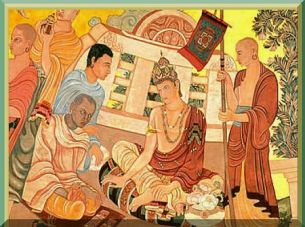
Arthashastra

Arthashatra prescribes how the ruler should protect his territory. This aspect of protection (Palana) covers principally, acquisition of territory, its defence, relationship with similar other/rival rulers (foreign-policy), and management of state-economy and administration of state machinery.

Since the safety of the State and its people from aggression by rival states or enemies is of great importance, the King will also have to know how to deal with other Kings using all the four methods (Sama, Dana, Bedha and Danda) ; that is,  by friendly negotiations; by strategies ; as also by war-like deterrents. Thus, to maintain an army and be in preparedness becomes an integral part of ‘science of economics’, the Arthashastra.

**

[Prof. Hermann Kulke and Prof. Dietmar Rothermund in their A History of India (Rutledge, London, Third Edition 1998-Page61) write:

The central idea of Kautalya’s precept (shastra) was the prosperity (Artha) of king and country. The king who strove for victory (vijigishu) was at the centre of a circle of states (Mandala) in which the neighbor was the natural enemy (Ari) and the more distant neighbor of this neighbor (enemy of the enemy) was the natural friend (Mitra). ..

The main aim of the Arthashastra was to instruct the king on how to improve the qualities of these power factors; and, to weaken those of his enemy even before an open confrontation took place. He was told to strengthen his fortifications, extend facilities for irrigation, encourage trade, cultivate wasteland, open mines, look after the forest and build enclosures for elephants and, of course, try to prevent the enemy from doing likewise. For this purpose he was to send spies and secret agents into his enemy’s kingdom. The very detailed instructions for such spies and agents, which Kautalya gives with great psychological insight into the weakness of human nature, have earned him the doubtful reputation of having even surpassed Machiavelli’s cunning advice in Il Principe.

But actually Kautalya paid less attention to clandestine activities in the enemy’s territory than to the elimination of ‘thorns’ in the king’s own country.

Since Kautalya believed that political power was a direct function of economic prosperity, his treatise contained detailed information on the improvement of the economy by state intervention in all spheres of activity, including mining, trade, crafts and agriculture. He also outlined the structure of royal administration and set a salary scale starting with 48,000 Panas for the royal high priest, down to 60 Panas for a petty inspector.

All this gives the impression of a very efficiently administered centralized state which appropriated as much of the surplus produced in the country as possible. There were no moral limits to this exploitation but there were limits of political feasibility. It was recognized that high taxes and forced labour would drive the population into the arms of the enemy and, therefore, the king had to consider the welfare and contentment of his people as a necessary political requirement for his own success. ]

 lotus-blossming

B.Tatparya or intention

Tatparya [lit. the about which; Tat (that) +Para (object of intension)] is described as the intention or the desire of the speaker (vak-turiccha); and also as the gist, the substance or the purport of the meaning intended to be conveyed by the speaker. The context plays a very important role in gathering the apt or the correct Tatparya of an utterance (sabdabodha) or a sentence in a text. The contextual factors become particularly relevant when interpreting words or sentences that are ambiguous or carry more than one meaning.

It is said; in the case of metaphors or the figures-of- speech, the intended meaning (Tatparya) is gathered not by taking the literal meaning of each of its individual words but by grasping the overall intention of the expression in the given context (sabda-bodha).

The Mimamamsa and Nyaya Schools which take the sentence to be a sequence of words, relay on Tatparya to explain how the relevant meaning is obtained from a collection of words having mutual relation. Each word in a sentence carries its own meaning; but a string of unconnected isolated words cannot produce a unified meaning. Tatparya, broadly, is the underlying idea or the intention of a homogeneously  knit sentence,  in a particular context, that is required to be understood.

The Mimamsa lays down a framework for understanding the correct meaning of a sentence: denotation (Abhida) – purport (Tatparya) – indication (Lakshana), where by the power of denotation one comprehends the general idea of the sentence; by the power of purport one understands its special or apt sense; and, by the power of indication one grasps the suggested meaning (Dhvani) of the sentence.

According to The Encyclopaedia of Indian Philosophies, Volume 5: The Philosophy of the Grammarians edited by Harold G. Coward and  K. Kunjunni Raja ;  the meaning of a sentence can be considered from two standpoints: from that of the speaker and from that of the listener. The general approach of the West has been from the speaker’s point of view. The Indian approach has been mainly from the listener’s point of view.

In a normal speech situation there can be five different aspects of the meaning of an utterance: (1) what is in the mind of the speaker when he makes the utterance; (2) what the speaker wants the listener to understand; (3) what the utterance actually conveys ;(3) what the listener understands as the meaning of the utterance; and (5) what is in the mind of the listener on hearing the utterance.

In a perfect linguistic communication, all the five factors must correspond. But, due to various causes there are bound to be differences that might disturb a perfect communication.

Let’s say that when the speaker is uttering a lie, he clearly intends to misdirect the listener. Here, what is in the mind of the speaker is different from what is conveyed to the listener. Even otherwise, quite often what the listener understands as the meaning of the utterance might be different from what the speaker intends to convey. The problem could be caused either by the lack of expressive power of the speaker or the inability of the listener  to understand; or it could be both.

Here, what is in the mind of the speaker before he speaks and what is in the mind of the listener after he hears are both intangible. They cannot be objectively ascertained with certainty. It is only what is said explicitly that can be objectively   analyzed into components of syllables, words and sentences. It however does not mean that the other aspects or components of the entire body of communication are less important.

lotus-blossming

C. Shakthi (power of expression)

The power of word (sabda-shakthi) is that through which it expresses, indicates or suggests its intended meaning. The term Shakthi is also understood as the relation that exists between word (Sabda) and its meaning (Artha) – (sabda-artha-sambandha). This relation is considered to be permanent and stable.

The understanding of the relationship between word and its meaning is called vyutpatti. Salikanatha (Ca.8th century) ,  a Mimamsa philosopher  belonging to the Prabhakra School , in his Prakarana-pancika  lists  eight means for such comprehension of the meaning of the words. They are:

  • (i) grammar;
  • (ii) comparison;
  •  (iii) dictionary;
  •  (iv) words of a trustworthy person;
  •  (v) action;
  •  (vi) connotation of the sentence;
  • (vii) explanation;  and,
  •  (viii) proximity of a word, the meaning of which is already established.

*

Shakthi is the primary relationship between a word and its meaning. Unless the listener recognizes or remembers their continuing relationship he cannot understand the purport (Tatparya) of a statement. Shakthi is therefore described as a Vrtti, a function which binds the word and meaning together in order to bring out a particular intended  sense – (Vrtti-jnanadhina –pada-jnana-janya –smrti-vishaya)

It would have been ideal if every word had a single meaning; and every meaning had only one word. That would have helped to avoid plausible confusion and ambiguities. But, in all natural languages that are alive and growing, the words, often, do carry more than one meaning; and, a meaning can be put out in verity of words. Even the borders of the meanings are not always fixed. The meanings or various shades of meaning are context sensitive, depending on the context and usage.

There would be no problems if the meaning and intent of a sentence is direct and clear. But, if there are ambiguities, the direct–meaning of the sentence would become inconsistent with its true intent.  It is here that the power of Shakthi comes into play.

The term Shakthi is often used for Vrtti or the function. Grammarians recognize various types of such Vrtti-s. Among those, the main Vrtti-s employed to explain the various types of meaning conveyed by speech are: Abhidana; Lakshana ; Gauni ; Tatparya ; Vyanjana ; Bhavakatva; and Bhojakatva.

Of these Vrtti-s or Shakthi-s, Lakshana which has the power of suggestion is considered most important.  Three conditions for Lakshana are generally accepted by all schools. The first is the incompatibility or inconsistency of the primary meaning in the given context. Such inconsistency produced by the uncommon usage of the word will force a break in the flow of thought, compelling the listener to ponder over in his attempt to understand what the speaker meant; and,   why he has used the word in an irregular way. Such inconsistency can either be because of the impossibility or of the unsuitability of associating the normal meaning of the word to context at hand.

The second condition is some kind of relation that exists between the primary (normal) meaning of the term and its meaning actually intended in the context. This relation can be one of proximity with the contrary or one of similarity or of common quality. The latter type is called Gauni Lakshana which the Mimamsakas treat as an independent function called Gauni. According to Mimamsakas,  the real Lakshana is only of the first type, a relation of proximity with contrariety (oppositeness) .

The third condition is either acceptance by common usage or a special purpose intended for introducing the Lakshana. All faded metaphors (nirudha lakshana) fall into the former category; and , the metaphorical usages , especially by the poets , fall into the latter.

[Panini, however, did not accept Lakshana as a separate function in language. He did not consider the incompatibility etc on which the Lakshana was based by the Grammarians as quite relevant from the point of view of Grammar. The sentences such as: ‘he is an ass’ and ‘He is a boy ‘are both grammatically correct. His Grammar accounts for some of the popular examples of Lakshana; like ‘the village on the river’  (gangayam ghosah) by considering proximity as one of the meanings of the locative case.  Similarly, Panini does not mention or provide for the condition of yogyata or consistency, which is considered by the later Grammarians as essential for unity of sentence. The expression Agnina sinchati (He sprinkles with fire) is grammatically correct, though from the semantic point of view it may not be quite proper, because sprinkling can be done only with liquid and not with fire.]


In the next part let’s look at the discussions on the relationship  between the word (sabda) and meaning (Artha)  are carried out by the Scholars of Indian Poetics (Kavya-shastra).
15056504_645354352310812_8567339100530740859_n


Continued in Part Three


 Sources and References

  1. The Philosophy of the Grammarians, Volume 5; edited by Harold G. Coward, Karl H. Potter, K. Kunjunni Raja
  2. Tatparya and its role in verbal understanding by Raghunath Ghosh; University of North Bengal
  3. The Birth of Meaning in Hindu Thought by David B. Zilberman
  4. The Meaning of Nouns: Semantic Theory in Classical and Medieval India by M.M. Deshpande
  5. Routledge Encyclopaedia of Philosophy: Index edited by Edward Craig
  6. Hermeneutical Essays on Vedāntic Topics by John Geeverghese Arapura
  7. the Emergence of Semantics in Four Linguistic Traditions: Hebrew, Sanskrit…edited by Wout Jac. Van Bekkum
  8. 8 A Comparative History of World Philosophy: From the Upanishads to Kant by Ben-Ami Scharfstein
  1. Sonic Theology: Hinduism and Sacred Soundby Guy L. Beck
  2. Indian Philosophy: A Very ShortIntroduction by Sue Hamilton
  3. Culture and Consciousness: Literature Regainedby William S. Haney
  4. The Sphota Theory of Language: A Philosophical Analysisby Harold G. Coward
  5. Bhartr̥hari, Philosopher and Grammarian: Proceedings of the First International conference on Bharthari held at Pune in 1992 edited by Saroja Bhate, Johannes Bronkhorst
  6. Being and Meaning: Reality and Language in Bharthari and Heideggerby Sebastian Alackapally
  7. Bharthari, the Grammarianby Mulakaluri Srimannarayana Murti
  8. Word and Sentence, Two Perspectives: Bhartrhari and Wittgensteinedited by Sibajiban Bhattacharyya
  9. Kautilya’s Arthashastra by RP Kangale
  10. PICTURES ARE FROM INTERNET


Tags: , , , , , , , , , , , , , , , , , , , , , , , , ,

The meaning of ‘MEANING’- Part One

The most common Sanskrit term for meaning is Artha.  Various phrases, such as ‘sense’, ‘reference’, ‘denotation’, ‘connotation’, ‘designatum’ and ‘intention’, have been used to render that Sanskrit term. Artha, basically, refers to the object signified by a word. Artha is an all-embracing term having a verity of hues and shades of meanings. In numerous contexts, it stands for the meaning of the word (pada+artha) as also for  an object (padartha)  in the sense of an element of external reality. It could also mean Artha (money), the source of all Anartha (troubles); and Anartha could also be nonsense , meaningless or  purposeless (nish-prayojanam)  . Artha is also one of the pursuits of life – wealth or well being. Artha could also signify economic power and polity. And, finally, Paramartha is the ultimate objective.

Artha

The Grammar in the ancient Indian context was a highly respected subject. The Vedic traditions such as Nyaya, Mimamsa and Vedanta ; the Buddhist and Jain traditions;  also the various traditions of Grammar and literary schools (Kavya),  each have contributed significantly to the development of numerous  theories regarding Grammar, philosophy of Grammar and semantics. These studies, regarded as specialized branches of learning dealing with language have, within their own ambit, tried to explain the manifold aspects of language behaviour.

[Jan E.M. Houben, “Part II: The Sanskrit Tradition.” In: The Emergence of Semantics in Four Linguistic Tradition (W. van Bekkum, Jan E.M. Houben, Ineke Sluiter, Kees Versteegh), pp. 49-145. Amsterdam: John Benjamins, 1997)” , writes :

The literature in the Sanskrit tradition dealing with semantic problems is very extensive. The Sanskrit tradition is the dynamic product of the interactions of different philosophical, religious and cultural currents. Even within the  Brahminical,  Buddhist or Jaina traditions, numerous disciplines, doctrines, and branches of learning-are continuously interacting with each other. That is why a discussion of semantics in the Sanskrit tradition should not be limited to one specialized discipline, e.g. Päninian grammar. Rather, an attempt should be made to introduce to the reader the major participants and the major issues in the dialogues which continue over centuries.]

The power of the language is one of the oldest themes in Indian thought. The later Grammarians such as Bharthari paid enormous importance to the study of language. According to him, ‘a thought cannot be without language’; ’There is no cognition without the process of words’;   all knowledge is illumined through words, and it is quite not possible to have cognition that is free from words (Vakyapadiya: 1.123). Bhartrhari says the knowledge comes out in the form of words. Speech is an embodiment of thought. That relation is natural; and, is not artificial.

śabdādibhedaḥ śabdena vyākhyāto rūpyate yataḥ / tasmād arthavidhāḥ sarvāḥ śabdamātrāsu niśritāḥ
 *

Thus, the spoken aspect of the language gains importance in the process of thinking. Thinking, here, is seen as a sort of internal speaking. Such inaudible speech is the seed or the potent form of explicit speech that is heard by others. 

In a way, a language grows with the thought; or rather the thought grows with language. In the ultimate analysis, they might even be identical. In that sense, the philosophy of language is not a mere academic pursuit, but is the basic foundation for all philosophy.

According to Bhartrhari, language is used for communication of ideas through spoken words. Grammar deals with this communicative language which consists of (a) sentences and words, (b)  appropriate meanings  corresponding to the words and the sentences ; and, (c) compatibility between word-sound (sabda) and its meaning (Artha).

At the same time, Bhartrhari also says ‘nahi sarvesham sataam shabdo abhidayakyaha (VP: 2.2.68) – ‘a word cannot always fully express the true nature of an object’.  An object is not fully expressed by the word that denotes it. A word , according to him, is an indicator; has limited powers; and, what is intended is more powerful that the word itself.

 na ca sāmānyavat sarve kriyāśabdena lakṣitāḥ /viśeṣā na hi sarveṣāṃ satāṃ śabdo+abhidhāyakaḥ
 *

Bhartrhari says; just as pure knowledge cannot manifest without an object, so also an object cannot exist without its related properties.

But often, the properties expressed by the word are not always real. Let’s take the term, ‘white color of the cloth’ (patasya shukla) which really is non-existent. It means that when a feature of an object is expressed in words it hardly matters whether the feature actually exists or not.

Bhartrhari explains: Let’s say, our perception of a fast revolving fire is called fire-circle (alata-chakra). It is a word that is commonly used. But, that is an illusion. There is no fire-circle as such. Similarly ‘hare’s horn’ (sasa-sringa) , ‘sky-flower’ (kha-pushpa) are just words that refer to non-reality. Thus, the word not only presents an incomplete picture, but it also projects non-reality.

Yet, the word with its limited power, tries to signify a ‘perceived’  reality; and, checks it through ‘speaker’s intention’.

He was perhaps putting forward an argument about the limitations of the language to describe Absolute Reality.

I reckon what Bhartrhari was trying to put across was: Reality transcends language. Further, whatever picture it presents is not always reality. Words often misrepresent or distort the facts of external life. Thus, the linguistic world and the external do not always perfectly synchronize.

And yet, though the language we use is rather imperfect and is limited to give us a complete picture of the reality,  it is our only window to the world.  We have to make the best use of that unique facility gifted to us as human beings.

It was also said:

Language is the most important human behaviour; and makes communication and interconnectedness possible. With practice, it makes even a child capable to deal with the world (balaanam ca yathatha pratipadane: VP: 2.117)

abhyāsāt pratibhāhetuḥ sarvaḥ śabdo+aparaiḥ smṛtaḥ/ bālānāṃ ca tiraścāṃ ca yathārthapratipādane
 *

Language is the limit of the world as we know. All cognition is enlightened only when pierced by the word (sabda).

 shamrock-small

Study of Grammar

There are many words in the Vedas which convey multiple meanings. And, at times, a few words from other languages that were in proximity during its days also crept in.

There were also attempts to systematize not merely the Vedic texts, but also its precise rendering. Towards that end, the original text, Samhita-patha, meant continuous recitation, was re-cast into Pada-patha, the word for word arrangement of the text. This helped to produce a full analysis of the phonetic content of text.

That led to the development of the Pratisakhyas, a set of rules for regulating the combination of letters and their pronunciations as per the requirements that are specific to each Shakha or the branch a Veda. These Pratisakhyas are considered to be the earliest formulations of Sanskrit grammar.

Along with the Pratisakhyas, the Brahmanas; the Nighantu (glossaries); Nirvachana (clear explanation of words/terms listed in the Nighantu); and Nirukta (a branch of etymology offering explanations about the derivation of certain chosen words of the Vedas) all contributed to refining the Sanskrit Grammar (Vyakarana).

In due course, linguistic analyses developed from Vedic utterances (Chandas) towards the spoken language (Bhasha). Through all these writings, the Sanskrit language was growing along with its grammar.

Grammar- Vyakarana also known as  Pada-Shastra  (the science of words)  which treats  the word as the basic unit ; and , deals with the  study of  the spoken language involving words and sentences ,  came to regarded as one of the most important Vedanga (branch of the Vedic studies).

For the these reason, Sanskrit grammar was never an artificial construct; but , was a naturally developed system. Another salient feature of Sanskrit grammar is its philosophical thrust. No language other than Sanskrit has such a developed philosophy of Grammar.

**

Grammar (Vyakarana) was recognized from the earliest times in India as a distinct science, a field of knowledge with its own parameters that distinguished it from other branches of learning/persuasions.  

In the linguistic traditions of ancient India, Vyakarana, of course, occupied a preeminent position. But, at the same time, there existed a parallel system of linguistic analysis- Nirvachana shastra or Nirukta – which served a different purpose. Both these traditions are classed among the six Vedangas, the disciplines or branches of knowledge, which are auxiliary to the study of Vedas and which are designed to preserve the Vedas in their purity.

The Vyakarana (Grammar) tradition is universally well known, through a number of treatises, but, mainly through Panini’s famous text Astadhyayi. However, in regard to Nirvachana-shastra, of the several works of that class which were said to be in existence before sixth century B C E, only one work, the Nirukta of Yascacharya,  has survived . His Nirukta is looked upon as the oldest authoritative treatise regarding derivation of Vedic words.

The origin of Grammar cannot, of course, be pinpointed. Yaska and Panini are the two known great writers of the earliest times whose works have come down to us. They were perhaps before fifth century BCE; and, Yaska is generally considered to be earlier to Panini. Yaska’s work Nirukta is classified as etymology; and Panini’s work Astadhyayi as Grammar (Vyakarana). Though Panini is recognized as the earliest known Grammarian, it is evident that he was preceded by a long line of distinguished Grammarians. Panini refers to a number of Grammarians previous to his time.  But, very little is known about those ancient Masters.

floral design2

Before we proceed further, let us briefly go over the outline of the course of Sanskrit Grammar during the ancient times.

The history of Sanskrit grammar is generally classified into three broad segments: the Grammars that were in use prior to the time of Panini (Pre-Panian); the Grammars that follow the system devised by Panini (Panian); and, those Grammars whose systems and methods vary from that of Panini (Non- Panian).

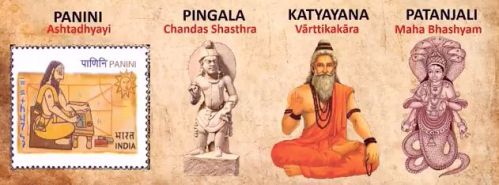
In any case, whatever be the type or the School  of Sanskrit Grammar that is discussed, it , invariably,  is  carried out with reference to the  classic tradition promulgated by Panini and, enriched by three  celebrated works : Astadhyayi (of Panini);  Vrttikas (of Katyayana) ; and, Mahabhashya  (of Patanjali) .  The three authors, the Trinity (Muni traya) , are revered as the Sages of Sanskrit Grammar .

The system of Panini, looked upon as a Great Science concerning words – Paniniyam Mahashastram (Paniniyam mahashastram pada sadhu yukta lakshanam) is always at the center of vast and varied traditions of Sanskrit Grammar. Of all the ancient Schools of Grammar, it is  only the system of Panini that is acknowledged as  being complete , comprehensive and thoroughly logical ; and, that which has survived to this day, in its entirety.

Panini, doubtless, inherited a rich and vibrant tradition of Sanskrit Grammar. There , surely , were many treatises on Grammar and Etymology; but now, all of those are lost for ever.  It is reasonable to presume that it was on the basis of the works of his predecessors that Panini could develop a grand system that is now universally accepted; and, is hailed as the perfect and profound exposition of linguistic science But, one cannot say, with certainty, to what extent Panini was indebted to each of his predecessors.

Panini , in his Astadhyayi , specifically refers to ten Grammarians (Vaiyyakaranah) and linguists , who flourished prior to his time (Ca.500 BCE)  : Sakatayana; Gargya; Galava; Sakalya; Senaka; Sphotayana; Bhardvaja; Apisapi; Kashyapa ; and, Cakra-varmana.

In addition, Panini also mentions Yaska, the Etymologist Ca. 650 BCE) – yaska-ādibhyo gotre PS_2, 4.63. And, Yaska, in his Nirukta, also mentions the four Grammarians referred to by Panini:  Sakatayayana; Gargya; Galava; and, Sakalya. However, the works cited by both the scholars are lost; but, we find reference to their ideas in the commentaries by the later authors.

All this indicates that Vyākaraa as a science of language was well established even prior to the times of Yaska and Panini. That seems quite possible; because the studies concerning Grammar and the structure of language can be   traced back to Rigveda. And, there is enough evidence to demonstrate that the science of Vyākaraa was well developed in Vedic times; and , in the Brahmana, Aranyaka and Upanishad periods.

Of the Grammarians mentioned by Panini and Yaska , some  belonging  to Vedic  times, were, perhaps,  the prominent ones . In addition,  there are references to the Schools of Grammar associated with some other Scholars.

 Let’s, for instance, just take a quick look at some of the ancient Grammarians.

**

Brhaspathi, the son of Angirasa, was an exponent of the Sanskrit grammar. According to Patanjali‘s Mahabhashya, Brhaspathi is said to have taught Grammar to Indra

(Bhaspati Indrāya divyam varasahasram, pratipada-uktānām śabdānām śabda-pārāyaam provāca na antam).

And, Indra taught it to Bharadvaja, who, in turn, instructed the other sages

(Brhaspatir Indraya; Indro Bharadvajaya; Bharadvaja rshibhya).

*

The Sanskrit grammar written by Indra was called Aindra. The Aindra or Aindri was referred to in the Pratisakhyas, Katantra; and was also quoted by Panini and other Grammarians. It appears, the technical terms used by the Aindra Grammar were simpler and archaic as compared to those in the work of Panini.

Aindra is traditionally considered to be one among the older Schools of Grammar. And, some scholars claim that Aindra was known to Panini; and, was quoted by others as well.

[Arthur Coke Burnell, in his work On the Aindra School of Sanskrit Grammarians, Their Place in the Sanskrit and Subordinate Literatures (Basel Mission Book & Tract Depository, 1875) states that the two Non-Panian Schools of Grammar, viz., Aindra and Katantra were  in use  in South India ; and, that the Tamil grammatical work Tolkappiyam  was described as aindiram nirainda Tolkappiyam  (comprising Aindra).

Fragments of the Kātantra-grammar with a commentary; and, a seemingly earlier version named  Kaumāralāta , have come to light in the Turfan region (modern Turkestan); and, are dated to the 4th–5th cent. CE..  Although the Kātantra was studied throughout most of India and beyond, the grammar had a close aliation with Buddhists , as its presence in the Turfan, Tibetan translations, and the commentary by Durgasiha, a Buddhist, attest  to.  As is typical of almost all the non-Pāinian grammars, the Kātantra does not formulate rules for Vedic usage or for the pitch accent.

Further, Burnell compares the Tokappiyam with two Non-Pāinian schools of Grammar, namely, the Katantra school of Sanskrit grammar and the Kaccayana, a Pali school of Southern India. Based on the comparisons, Burnell concludes that the Tolkappiyam corresponds to the Katantra School closely. He also demonstrates that many of the technical terms of the Tolkappiyam and of later Tamil Grammars were merely simple translations of Sanskrit terms, which he attributes to the Aindra School or the other pre-Pāinian texts.

Please also read Indigenous grammatical traditions Tamil and the Dravidian, – -Grammatical concepts in Traditional Tamil grammars and in other Dravidian languages by Dr. E. Annamalai, the University of Chicago ]

*

Bharadvaja, the son of Brhaspathi, was also a great Grammarian.   He authored Bharadvaja Shiksha; and instructed many sages. Bharadvaja was also said to be well versed in medical sciences.

There is a mention of another Bharadvaja, who wrote several Varttikas (explanatory notes). These were said to be similar to Kashyapa’s Varttikas. And, according to Patanjali, they were comparatively, more comprehensive and clear than those of Katyayana (

Katyayanam:-  ghusañjñāyām prakti grahaam śidarthamMhBh.1.1.20.1).

Panini, in his Astadhyayi, mentions Bharadvaja – to Bhāradvājasya – PS_7, 2.63 .

*

There is also a mention of Pauskarasadi a great Grammarian, who, it is believed, was a contemporary of Krishna-dvaipayana Vyasa. Patanjali in his Mahabashya quotes an opinion offered by Pauskarasadi

caya dvitīyā bhavanti śari parata paukarasāde ācāryasya matena – (P_8,4.48) KA_III,465.1-3

*

Galava was said to be another great Grammarian. He is credited with   introducing Krama-patha  (step-by-step recitation) and Shiksha as related to Grammar. Panini mentions Galava four times; twice along with Gargya; and once with Kashyapa.

iko hrasvo ‘yo Gālavasya | PS_6,3.61 |  a Gārgya-Gālavayo | PS_7,3.99 | ttīyādiu bhāitapuska puvad Gālavasya |  PS_7,1.74| na +udātta svaritodayam  a-Gārghya-Kāśyapa-Gālavānām | PS_8,4.67 |

Patanjali  mentions Babhravya (also associated with Krama-patha) along with Mandavya: 

sa yathā iha bhavati Bābhravya, Māṇḍavya iti evam suśrut , sauśruta iti atra api prāpnoti na ea doa  – P_1,1.3.2

*

Bhaguri was a great grammarian. He is said to have prepared the explanatory notes (Varnikā; Vartika) based on the roots of the words (Dhatu-patha). He, perhaps, belonged to the Lokayata School. Patanjali mentions him as: Vartikā Bhāgurī Lokāyatasya – P_7,3.45.

*

Cakravarmana was a great Sanskrit grammarian. Panini mentions his name in the Astadhyayi. He must have been earlier to Apisali; because , both the authors  (Panini and Apisali ) quote his views ( Esa Cakravarmanasya6.1.130)

*

Kasakrtsna was a respected Grammarian, who explained the rules of the ancient Grammar. Towards the end of his Mahabhashya, Patanjali mentions Kasakrtsna along with Apisali and Panini were highly reputed Grammarians (Paninina proktam Paniniyam, Apisalim Kasakrtsnam iti Pas_14 )

*

Sakalya was a popular Grammarian.  He is respected as the author of the padapatha of the Rigveda , where the sentences of the Samhita Paatha (the original text, as it is) were broken down into words (pada) and arranged in sequential order (a word-by-word pronunciation scheme).  Śākalya is said to have composed four works relating to Grammar – Salakyatantra; Veda-mitra-Sakalaya; Sakalacharana; and, Pada samhita.

Yaska also mentions Sakalya:  veti.ca.ya.iti.ca.cakāra.śākalyah (Nir.6.28)

Panini quotes Sakalya at least four times in his Astadhyayi:

sambuddhau śākalyasya-itāv anāre || PS_1,1.16 || iko ‘savare śākalyasya hrasvaś ca || PS_6,1.127 || lopa śākalyasya || PS_8,3.19 || sarvatra śākalyasya || PS_8,4.51 ||

Patanjali also quotes the opinions of Sakalya; and, respectfully addresses him as Acharya:

uña Sākalyasya Acāryasya matena praghya-sañjñā bhavati P_1,1.17-18.2

 *

Apisali was a great Grammarian, who systematically constructed a work on Grammar in eight chapters. His rules covered not only the Vedic words (vaidlka) ; but also the words in common usage.   Panini quoted the opinion of Apisali (vā supyāpiśalePS_6, 1.92 .)

Patanjali mentions Apisali along with other great Grammarians :

proktādaya ca taddhitā na upapadyante Pāininā proktam Pāinīyam, Apiśalam, Kāśaktsnam itiPas_14;   Apiśala-Pāinīya-Vyāīya-Gautam-īyāP_6,2.36

 *

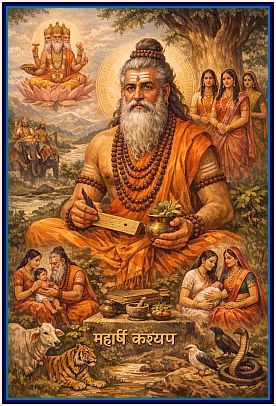
Kasyapa was another grammarian.  Panini, in his Astadhyayi, often cites Kasyapa’s views, along with those of other reputed Grammarians such as Gargya, Galava and others.

tṛṣi-mṛṣi-kśe Kāśyapasya |PS_1, 2.25| na+udāttasvaritodayam a-Gārghya-Kāśyapa-Gālavānām |PS_8,4.67| vikara-kuītakāt kāyape|PS_4,1.124Kāśyapa-kauśikā bhyām ṛṣibhyā ini |PS_4,3.103|

And, Patanjali quotes Kashyapa as many as twelve times kāśyapa grahaam kimartham. kāśyapa grahaam pūjārtham – P_1,2.25

*

The name of Gargya is mentioned along with that of Sakalya in the Pratisakhya.  Panini in his grammar also mentions Sakalya and Gargya (along with Galava): a Gārgya-Gālava yo |PS_7, 3.99| Oto Gargyasya |PS_8, 3.20|

Patanjali mentions Gargya almost countless times: Gārgyāyaa Vātsyāyana parama Gārgyāyaa parama Vātsyāyana – P_1, 1.72.5

*

It appears; there were two Sanskrit Grammarians who went by the name  Śākaāyana  . The later Sakatayana (who perhaps was a contemporary of Panini –?) is also mentioned by some , as the author of the Sphota–theory, later championed by Brthrhari.

Some scholars recognize Sakatayana as the author of Unadi Sutra (a supplement to Panini’s Grammar Astadhyayi, providing additional set of rules to derive nouns from their verbal roots; and, saying that all wordscanbeanalysed by the addition of affixes to verbal roots)

The elder Śākaāyana was said to be an early Etymologist (Nairukta).  Even though his works are lost, his views are made known indirectly through references by Yaska and Panini.

This Sakatayana was also a celebrated Grammarian – Anu Sakatayanam Vaikaranah. And, his Grammar is, of course, no longer in existence; and, therefore, it is not clear what type or School of Grammar it represented.  Panini refers to Sakatayana at least three times

Laṅaḥ śākaṭāyanasya+eva –PS_3, 4.111 | V-yor laghuprayatnataraḥ śākaṭāyanasya –PS_8, 3.18 | Riprabhṛtiṣu śākaṭāyanasya – PS_8, 4.50 |

Sakatayana is said to have held the view that all nouns are essentially derived from verbal roots.

Atha ananvite arthe aprādeśike vikāre padebhya / pada itara Ardhānt sañcaskāra śākaāyana  Nir.1.13.

Patanjali, in his Mahabashya mentioned Sakatayana at least seven times; and, also spoke of Sakatayana’s theoryLaṅaḥ śākaṭāyanasya +eva-  PS_3, 4.111 .

Yāska defends Śākaāyana’s view that the etymological derivation of all nouns are from verbal root.   However, he also mentions; Gargya (descendant of Sage Garga, as mentioned in the Nirukta (1.3.12-13); and, others opposed Sakatayana’s views; and, remarked that all nouns  cannot be traced to verbal roots :  na sarvāi iti gārgyo vaiyākaraānāś caeke- 1.12 .

They argued that some words which are derived from custom or through common usage (Rudi) are, in any case, a part of the living language. And, such word cannot be derived only from verbal roots.

Nāma Ākhyātayo tu karm upasamyoga dyotakā.bhavanty ucca avacā pada Arthā bhavanti iti.Gārgyas – Nr.1,3:

Prof. Bimal Krishna Matilal in his The word and the world refers to the debate of Nirkutavs.  Vyakarana as an interesting philosophical discussion between the Nairuktas  (Etymologists) and the inīyas(Grammarians).

The ancient Grammarian Sakatayana says  that prepositions when not attached (to nouns or verbs) do not express meanings; but, Gargya says that they illustrate (or modify) the action which is expressed by a noun or verb, and that their senses are various (even when detached). This view was challenged by Gargya. This debate goes to the heart of the compositionality debate among ancient Indian Mimamsakas and Vyakarana / Grammarians.

*

Panini mentions one Sphotayana, who spoke about the word and its meaning (ava sphoāyanasya – PS_6,1.123),; and, as the one who originally came up with Sphota concept (Sphota-tattva) . Yaska had also said to have cited Sphotayana. Later Patanjali also commented upon the theory of Sphota (Sphota vada)

– evam tarhi sphoa śabda dhvani śabdaguaḥ – P_1,1.70.2

Later, the central theme of Brthrhari’s remarkable work Vakyapadiya was the theory of Sphota concept (Sphota vada), now commonly understood as ‘ meaningful   linguistic unit, revealed by sounds’.

*

In the later times, Vyakarana came to be divided into Pracheena-vyakarana (प्राचीनव्याकरणम्) – pre-Panini ; and Navya vyakarana (नव्यव्याकरणम्)- post Panini. Later age Grammarians recognize the eight Grammarians of merit,  Vyakarana-shastra-pravartakas (व्याकरणशास्त्रप्रवर्तकाः) :

इन्द्रश्चन्द्रः काशकृत्स्नापिशली शाकटायनः । पाणिन्यमरजैनेन्द्राः जयन्त्यष्टौ च शाब्दिकाः ॥

Indra (इन्द्रः), Chandra (चन्द्रः), Kasha (काशः), Krtsnapishali (कृत्स्नापिशली), Shakatayana (शाकटायनः), Panini (पाणिनिः), Amarajainendra (अमरजैनेन्द्रः), Jayanti (जयन्तिः) are the eight Masters of shabda (word) or grammar.]

floral design2

As can be seen from the foregoing; Panini and Yaska represent a stage of Grammar that came into being after several centuries of growth. Both these scholars recall a number of ancient Grammarians who worked and preached much before their times. Some scholars speak of an ‘Aindra’ School of Grammar as being the earliest set of Grammarians. Patanjali refers to another tradition said to have originated from Brihaspathi.

Perhaps the earliest historical figure that is said to have dealt with the study of language seems to be Sakalya the author of the Padapatha  (arrangement of words of a verse in sequence) of the Rig-Veda; and, he is mentioned by Panini. Again, Panini also mentions one Sphotayana who spoke about the word and its meaning. Bhartrhari also refers to Sphotayana.  And, Yaska mentions another ancient authority – Audumbarayana   

(indriya.nityam.vacanam.audumbarāyaṇaḥ – 1,1).

Further, Bhartrhari, citing Yaska, states that Audumbarayana, as also Varttakas held views similar to his Sphota-vada.  There is also a mention of another sage Sakatayana who is said to have held the view that all words must be derived from verbal roots.But, no authenticated works of any of these authors have come down to us.

na.nirbaddhā.upasargā.arthān.nirāhur.iti.śākaṭāyanaḥ1,3: pada itara  ardhānt  sañcaskāra śākaṭāyanaḥ – 1,13

There were several theories or Schools of Grammar in use even during the time of Bhartrhari. He  refers to ‘other Grammars (Vyakaranatara), to other Grammarians (anya vaiyyakaranah) as also to ‘other traditional works’ (smatyantara)’; as also to the conflicting theories of other person’ or ‘theories of others’ ( apare) .  He does not specify who those other schools of Grammars etc were. It is surmised that the ‘other Grammars (Vyakaranatara) mentioned by Bhartrhari might refer to ancient Grammarians Apisali and Kasakrtsna. But again, nothing much is known about those ancient scholars and their theories.

  Eke varnayanti, anye varnayanti; apare varnayati; anvesham darshanam; apareshu vyakhyanam etc

 *

[The Kannada grammatical tradition begins in the 12th century with two treatises written by Nagavarma (who mentions earlier grammatical works, which have not survived): the  Sabda-smrti, which is in Old Kannada ; and which constitutes a part of the Kavya-avalokana,  a poetical work, and the Karnataka-basha-bushana , which is an independant work in Sanskrit Sutras

Other works would follow, some composed in (Old) Kannada, such as Kesiraja’s Sabda-mani-darpana (13th century) ; and Krishnamacharya’s Hosagannada-nudi-gannadi (19th century), which studies the links between Kannada, Sanskrit , Tamil and other languages ; and, another work Karnataka-sabda-anusasana of Bhattakalanka Deva (17th century) was composed in Sanskrit ; and, was  influenced by Jainendra’s grammar .]

**

Thus, the study of Grammar and the philosophy of language, in varied traditions, have always taken an important position in Indian thought. In Grammar, the nature of words, meanings and the relationship between them and their variances are studied. It was said:  “the foremost among the learned are the Grammarians, because Grammar lies at the root of all learning” (prathame hi vidvamso  vaiyyakarabah , vyakarana mulatvat sarva vidyanam – Anandavardhana ) 

Grammar was not an artificial construct; but, was the very life blood of learning and understanding, developed directly and naturally from the spoken language. Bharthari, in his Vakyapadiya, described Grammar as the ‘purifier of all the sciences’. Bhartrhari compared the science of Grammar to the medical science; and, said that just as the medicines remove the impurities of the body, so does Grammar removes the impurities of speech (chikitsitam van-malaanam) and of the mind.  Bhartrhari who inherited the traditional attitude towards Grammar, regarded it as the holiest branch of learning; and, elevated Grammar to the status of Agama and Sruti, leading the way to liberation (dvāram apavargasya) . He believed the use of correct forms of language enables clear thinking; and, makes it possible to gain philosophic wisdom or to pursue other branches of valid knowledge.

Tad dvāram apavargasya vāmalānā cikitsitam / pavitra sarva-vidyānām adhividya prakāśate – BVaky. 1.14

Prajñā  viveka labhate bhinnair āgama-darśanai / kiyad vā śakyam unnetu svatarkam anudhāvatā- BVaky. 2.489

Sādhutva jñāna viṭayā seyaṃ vyākaraṇa-smṛtiḥ / avicchedena śiṣṭānām idaṃ smṛti –nibandhanam – BVaky. 1.158

*

Grammar – Vyakarana also known as Pada –Shastra  (the science of words) which  treats the word as the basic unit and  deals with the  study of  the spoken language involving words and sentences ,  is regarded as one of the most important Vedanga (branch of the Vedic studies). The primary object of Vyakarana, in that context, was to study the structure of the Vedic language in order to preserve its purity and to ensure its longevity. Panini asserted that the Grammar should be studied in order to preserve the Vedas (rakshatam Vedanam adhyeyam vyakaranam). 

Thus, safeguarding the purity of its language, its correct usage (sadhutva) meant ensuring the continuity (nitya) of Vedas in their pristine form.

*

In the Indian traditions, the language is said to be fully alive and is truly experienced in its oral form, when it is spoken as it should be. The spoken word is regarded as its primary form while written word, as a secondary aid,  is only a coded   representation of the spoken word; but , without its nuances. The learning and preserving the Vedas therefore includes the ability to pronounce, to articulate the text with its correct ascent, meter, stress, pauses and so on. . The elaborate network of Pryatshakha-s was devised to ensure the pure and disciplined form of its presentation.

[Sri Sankara , commenting on the Sutra concerning the symbols and reality  (तदनन्यत्वमारम्भणशब्दादिभ्यः ॥ १४ ॥ tadananyatvam ārambhaṇa-śabdādibhyaḥ || 14 ||),  remarks, “ We see that the knowledge of the real sounds  a, aa, e, ee  etc., is reached by means of the unreal written letters.”(B.S. 2.1.6.14). He perhaps was suggesting that the spoken language is the real language.]

Thus , the study of Grammar ; and, faithfully following its traditional rules played very important role in that process.

[Of the Vedic Schools, the Mimamsa is particularly interested in correct interpretation of the Vedic passages relating conduct of Yajna. Those are considered as knowledge ‘handed down by tradition – aamnaya. Hence Mimamsa is also known as Vakya-shastra.

Vyakarana which is one of the sub-branches (upanga) of Vedic texts also deals with the study of spoken language involving words (Pada –shastra ) and sentences (Vakya-shastra) .

The Sutras of Jaimini (Mimamsa–sutra) governs the Mimamsa; while the rules of Grammar laid out by Panini ( Astadhyayi) govern the Vyakarana – shastra.

Grammar is applicable to Vedic texts and also to the study of language in general (sarvaveda-parisada). It is the right royal road (ajihma raja-paddathi) which all can tread.]

*

But, the study of language went far beyond that; and, Grammar was extended, through linguistic analysis, into philosophical inquiry.

According to Bhartrhari, Grammar is Vak-yoga or Sabda-purva yoga– meditation centered on language.  In Bhartrhari’s vision, the language we speak is the medium of self-expression of the Ultimate Reality communicated through meaning-bearing words. For him, the question of Being is interwoven with the question of language , that of becoming . There is no philosophy of Being without the philosophy of language. He described Grammar as the Royal road to those who seek liberation; and as the efficient means to realize Brahman. Ultimately, he asserts, speech (Sabda) is Brahman.

For Bhartrhari, Sabda Brahman or Sabdatattva or Sabda eva tattvam the undifferentiated Reality   is one with the ultimate Reality – Para Brahman. Bhartrhari conceives the ultimate Reality as being in the nature of the Word; and , from it all of existence is manifested. The world is only a transformation (vivarta) of the Sabdatattva (speech – principle) which is identical with the ultimate Reality, Brahman. The Sabda-tattva of Bhartrhari is , thus, the Absolute; and, there is no distinction between Sabda Brahman and Para Brahman the supreme.

That marks his departure from Vedanta, where the Supreme Consciousness, Para – Brahman, is beyond language.

[It needs to be mentioned here that the concept of Sabda Brahman was known and discussed even before the time of Bhartrhari. For instance; Maitrayani Upanishad (4.2.2) and Brahma-bindu Upanishad (verse 17) do discuss about Sabda-Brahman. However, the connotation of Sabda-Brahman, in those texts, varied from that of Bhartrhari.

Those texts made a distinction between Sabda-Brahman and Para (Highest) Brahman.  There, the Sabda-Brahman referred to the words or sounds of the Veda, while the Para Brahman referred to the Ultimate Reality. Thus, the Vedas, in general, was distinguished from the Highest Brahman as the Absolute.

(Dve vidye veditaye tu sabdabrahma, parm ca yat I sabdabrahmani nisnatah param brahmadi gacchathi – Brahmabindu Upanishad -17)]

***

Dr. Victor Bartholomew D’avella writes  in his well researched  very scholarly Doctoral Thesis : Creating the perfect language : Sanskrit grammarians, poetry, and the exegetical tradition

The history of Sanskrit grammar extends beyond strict grammatical texts; and, that many important debates are first noted in the works of Bhāmaha and Vāmana, who, in turn, were seeking to both account for, and establish, the grammar for poetry.

The poetic diction formed a particular subset of the Sanskrit language, not only in so far as it was ornamented, but also as being devoid of a range faults (doṣhas);  some of which are other wise acceptable (excessive complexity, technical words, vulgarity, etc.). Among these ,grammatical incorrectness blemishes the body of a poem to the core.

For this reason Bhāmaha   and Vāmana must have felt compelled to compose their respective chapters on  śabdaśuddhi , “purification of language.” Such guidelines could only have been necessary in the first place if poets took occasional license that warranted either justification or repudiation, and if the rules them-selves were not always so clear-cut.

The motivatingforces behind these decisions varied, and it has been dicult to state one single guiding principle.

 In the case of Bhāmaha, he appears to have particularly disfavored excessive complexity in derivations and reading more into a sūtra than what was readily apparent or already accepted asa necessary addenda to the Astadyayi  (upasakhyānas and  iṣṭis). 

Vāmana, on the other hand, was more willing to exploit the available interpretive stratagems in the grammatical tradition.  Earlier, Daṇḍin had labelled  those readers fools (kudhī ) who are unable to derive forms that rely on a more subtle understanding of Pāinis rules in light of the commentaries, much like the grammarian in the dialog. For Vāmana ,though, it seems that only those devices with general acceptance were valid. 

 shamrock-small

The earliest of the known text of etymology (Nirukta) that has come down  to us is that from Sanskrit. And that was composed by Yaska, who in turn cites number of his predecessors in that field. Similarly, the oldest known Grammar  Astadhyayi is also in Sanskrit; and, it was composed by the Great Grammarian Panini. And, Panini also similarly mentions other renowned Grammarians that lived before his time. And, Patanjali   a Grammarian who came a couple of centuries after Panini wrote an elaborate commentary (Maha Bhashya) on Panini’s work. He was, in turn, followed by many other scholars who wrote glosses on Patanjali. There have also been re-arrangements of Panini’s Sutras and the interpretations arising out of such exercises.

The overall aim of Sanskrit Grammar was not to list out the rules and to standardize the language; but, to bring out the intended meaning of the structure of words. As Yaska puts it (Nirukta: 2.1.1), the aim was to get the real meaning of the spoken word (artha.nityaḥ.parīkṣeta.kenacid.vṛtti.sāmānyena). Thus, Sanskrit Grammar was an attempt to purify (samskruta), to discipline and to explain the behaviour of the spoken language, so that its  inner meaning could shine forth unhindered.

[Panini’s Grammar (Astadhyayi), as per its working-scheme, attempts to produce words and sentences based on their verbal roots (dhatu), nominal themes (prathipadika) and suffixes (pratyaya). These constituent elements are invested with meaning. Derived from these elements, in their various combinations, words and sentences are formed to express collection of meanings as held by these elements.

However, according to Patanjali (Mahabhashya) the meaning-bearers are not the word-constituents, but the words themselves. Here, Patanjali follows the lead given by his predecessor Katyayana in his annotated commentary (Vrittika) on Panini’s Astadhyayi.

There is obviously a difference in the two attitudes towards Grammar.

For Patanjali, the Grammar analyzes the words, thereby arriving at their constituent elements, though such parts are not the true bearers of the meaning. This perhaps is the reason that many understand Grammar as Vyakarana, in the sense of analysis.

For Panini, on the other hand, Grammar proceeds differently. It is a way of synthesis. His Grammar does not divide the words into stems and suffixes. On the contrary, it combines the constituent elements with a view to form words. So, Grammar here is understood as “the word formation “or as an “instrument by which forms are created in various ways” (vividhena prakarena akrtayah kriyante yena).]

Panini and others

The rules of the classical Sanskrit had been set by the Sutras of Panini, the Vrattika of Katyayana and the Mahabhashya of Patanjali. The works of these three sages (muni traya) came to be regarded by the later scholars as the highest authority.

During the periods following the three Great Sages  the question of perceiving the intended meaning of the spoken word engaged the attention of the Grammarians and the philosophers of the language. The more significant of such Scholar-Grammarians, among others, were: Mandana Misra, Kaumarila Bhatta, Kunda Bhatta, Abhinavagupta and Bhartrhari. In particular, Bhartrhari who belonged to the tradition of these classical Grammarians in  his major work, Vakyapadiya, discusses the ways in which the outer word-form could unite with its inner meaning. 

Let’s talk about these stalwarts and their theories of language later in the series

[It appears by about the eleventh century, the Grammar and the  Grammarians had lost their premier position. By then, Kavya (poetry or poetic expressions) that can be subtle and suggestive  had taken the center stage; and grammar which concerned  itself with the arrangement of words into sentence was considered rather pedestrian. The poetic schools argued: ‘What is unsaid in poetry is more evocative than the explicit’. That was to suggest that appreciation of  poetic beauty does not solely dependent on following the strict order of words or other conventions. The true enjoyment of poetic beauty , in fact, goes beyond the regulated regimens. For instance; Anandavardhana who regarded the concept of Rasa-Dhvani as the principal or the ideal element in appreciation of poetry, said that the suggested sense of poetry is not apprehended (na vidyate) by mere knowledge of Grammar (Sabda-artha-shasana-jnana) and dictionary. It is grasped (Vidyate, kevalam) only by those who know how to recognize the essence of poetic meaning (Kavya-artha-tattva-jnana) – Dhv.1.7

It was even said; poetry follows Grammar as far as possible.  But, when it finds the rules of Grammar too constrained or suffocating, it switches over to other means of expressions that are more appropriate or conducive to its natural flow. It might even invent its own means and modes. At times, when those inventive expressions of poetic suggestions are so charming and become so popular, they walk into Grammar per se and take their position as the tail piece or the appendix of Grammar – ‘vyakaranasya puccham’ .

And, before all these, way back in the sixth century B C E, Yaska , in his Nirukta had instructed : while deriving the meaning of a word , in its own context, one should try to stick to the rules of the Grammar (Vyakarana) as far as possible; but, if this is of no avail in bringing out the hidden meaning of the term in question , then one should abandon such rules – na saṃskāram ādriyeta / viśaya-hi vṛttayo bhavanti (Nir.2.1). 

Scholars like Nagesha Bhatta say that Grammarians cannot always afford to be wooden-headed ; but, must necessarily learn to accept (svikara avashyakah) the power of suggestion (Dhvani) – vyakarananamapi etat svikara avashyakah) in poetry .]

shamrock-small

What is meaning?

Study of language has been one of the fundamental concerns of Indian philosophy. All Schools of thought began their discussion from the problems of speech, meaning and the language.

And, in particular, extracting the exact meaning of a sentence in a text has been one of the main concerns of all the Indian Schools of thought.

Down the ages, each of the traditions, each School of philosophy, the Grammarians, Scholars and poets have been asking the same set of questions: ‘What is meaning?’; ‘What is the relationship between word and its meaning?’ The most common term employed to denote ‘meaning’ is Artha, which term was used mostly by Bhartrhari in his Vakyapadiya.

In the English language, the term ‘meaning’ is directly connected with and derived from the verb ‘to mean’; and it is taken to stand for terms such as ‘sense’, ‘reference’, ‘denotation’, ‘connotation’, ‘designatum– that which is named’ and ‘intention’. In the modern academic discussions the term ‘meaning’ is usually understood in the sense of ‘meaning of a word’.

But, in Sanskrit language, though the term ‘Artha’ basically refers to the object signified by a word, it makes room to denote various shades or the distinctions within its specific   context. And yet, the term ‘Artha’ has no clear derivation from any verb or verb-root. And, the term Artha itself gives rise to another term ‘Arthayate’, which means ‘to request, to beg; to strive or to obtain’.

In the Sanskrit language, apart from this general term (Artha) there are host of other terms that bring out varying shades or aspects of what in English is referred to as :’ the ‘meaning’  or ‘to mean’. For instance: ‘Tatparya’ (the that about which) ; ’Abhipraya ‘(intent or what one has in his mind; ‘Abhi-daha’ (to express or to denote); ‘Uddeshya’ (to point out or to signify or to refer); ‘Vivaksa’ (intention or what one wishes to express); ‘Sakthi’ (power of expression); ‘Vakyartha’ (the import of the sentence); ‘Vachya’ and ‘Abhideya’ (both meaning : what is intended to be expressed);’Padartha’ (the object of the expression); ‘Vishaya’ (subject matter);’Abidha’ (direct or literal meaning of a term) which is in contrast to lakshana the symbolic sign or metaphoric meaning; and, ‘Vyanjana’ (suggested meaning and so on .

[Even the Vedic sages recognized the fact that the literal meaning of an utterance is  , often,  only a part of its total meaning ; and, those who try to analyze the literal meaning  run the risk of losing sight of the intended or the signifying meaning of the speech (Vāk). Rig-Veda (10.71.2-4) does, in fact, distinguish between a person who takes in only the literal meaning of a verse; and, a wise person who grasps the inner meaning and its true significance. The former: ‘sees, but does not see; hears, but does not hear. But, it is to the latter that speech reveals itself completely, as does a loving wife to her husband’ 

4 One man hath ne’er seen Vāk, and yet he seeth: one man hath hearing but hath never heard her. But to another hath she shown her beauty as a fond well-dressed woman to her husband..tr. by Ralph T.H. Griffith, [1896]

Further, it is said; the great poets select their words , winnowing away the chaff from the grain; and, only the persons of equal scholarship and literary taste can truly appreciate  good poetry.

atrā sakhāyaḥ sakhyāni jānate bhadraiṣāṃ lakṣmīr nihitādhi vāci || yajñena vācaḥ padavīyam āyan tām anv avindann ṛṣiṣu praviṣṭām |tām ābhṛtyā vy adadhuḥ purutrā tāṃ sapta rebhā abhi saṃ navante |uta tvaḥ paśyan na dadarśa vācam uta tvaḥ śṛṇvan na śṛṇoty enām |uto tvasmai tanvaṃ vi sasre jāyeva patyauśatī suvāsāḥ |uto tvasmai tanvaṃ vi sasre jāyeva patya uśatī suvāsāḥ ||(10.71.2-4)

Anandavardhana does not attack the usual divisions of speech into sentences and words; into stems and suffixes; as also the distinction between the primary and the transferred or metaphorical sense of the words (Abidha; Lakshana). He accepts all such divisions; but, in addition, he puts forward a third potential or capacity of language. He calls that as ‘the capacity to suggest a meaning other than the literal meaning. Such suggestive power of language is named as ‘Vyanjana’.

It is said; Anandavardhana adopted and improved upon the idea of Vyanjana; and, also adopted Bhartrhari’s concept of Sphota; and, thereupon  he developed his theory of suggestion (Dhvani)   and its value in appreciation of in poetry (Kavya).]

*

In many of these discussions, it is difficult to draw a clear distinction between the literal meaning (Artha) and the concept it represents (Pratyaya). In the Sanskrit texts, the terms such as ‘Sabda’ (word); ‘Artha’ (object); ‘Pratyaya’ (concept) are horribly mixed up and are used interchangeably.

But, generally speaking, the subtle relation between Sabda and Artha is one of identity. The word, sound, sense and knowledge overlap each other. Normally, Sabda denotes a meaning-bearing word-sound, while Nada signifies ‘voiced’ or vowels or non-linguistic sounds.

Bhartrhari says Sabda, that which when articulated gives out the meaning or intent of the speaker ;  and , the  Artha, its meaning, are  two different aspects of one and the same thing (ekasyva athmano bhedau, sabda-arthau aprathishatau – VP: 2.31).

Similarly, Vak is another term that has varieties of references.  Vak , grammatically , is  a feminine noun meaning – speech , voice , talk , language ( also of animals and birds), sound ( also of inanimate objects such as stones or of a drum) , a word , saying , phrase , sentence , statement and speech personified. Bhartrhari raises Vak to sublime heights. In his Vakyapadiya, Bhartrhari  states that ‘It is Vak which has created all the worlds (vageva visva- bhuvanani jajne;  Vakyapadiya: I.112)

The Rig Veda contains glorious references to the power of speech.  For the Vedic seers who herd and spoke about their experiences, speech was the most wonderful faculty. Speech was also held in great reverence. Many of the later philosophical theories on language have their roots in Vedas.

There are  hymns that specifically refer to the speech (Vak).

 (1) Asya-vamiya –sukta (Rig Veda : 1.164) which is one the most philosophical hymns of Rig Veda places Vak at the peak of the universe. Here , Vak has been divided into four parts ; the three parts are hidden ; and , only the fourth part is spoken by the mortals.  Vak is also identified with the lifegiving Sarasvathi – a source of great delight which causes all the good things of life to flourish.

catvā́ri vā́k párimitā padā́ni, tā́ni vidur brāhmaṇā́ yé manīṣíṇaḥ /  gúhā trī́ṇi níhitā néṅgayanti, turī́yaṁ vācó manuṣyā̀ vadanti  / 1.164.45 /

(2) The hymn 10.71.5 of Rig Veda which speaks about the origin of language is much discussed by the later Grammarians. Here, two types of people are mentioned: those who see Vak and understand her ; and , those who see the form but do not understand her.  That might be because the Rishis were basically the seers that heard or vizualized the eternal impersonal truth.

uta tvaṃ sakhye sthirapītam āhur nainaṃ hinvanty api vājineṣu | adhenvā carati māyayaiṣa vācaṃ śuśruvām̐ aphalām apuṣpām ||

But, in the ancient texts, Vak is not mere speech. It is something more sacred than ordinary speech; and , carries with it a far wider significance. In Rig Veda, there are three kinds of references to Vak:  Vak is speech in general; Vak also symbolizes  cows; and, Vak is personified as goddess revealing the word.  And, Vak is, indeed,  the principle  underlying every kind of speech and  language in  nature. It  includes even the sounds of cows, animals, frogs, birds, trees and hills.  It was said; the extant of Vak is  as wide as the earth and fire.

In the most celebrated Vagambhari Sukta (Rig Veda: 10.125) , the Vak herself describes her powers and functions. Vak , here , is deity personified. It declares Vak as the highest principle that supports all gods , controls all things and exists universally in all things.

Aham rashtri samgamani vasoonaam, Chikithushee pradhamaa yagniyaanaam, Thaam maa devaa vyadhaduha puruthra,Bhuristhathram bhooyar visayanthim.

The Brahmanas go further and state that Vak is Brahman ( Brahma vai vak : Ait. Br.4.211) . The tendency to view Vak , speech, as the principle forming all things is prominent throughout the Brahmana-texts.

But, it was Bhartrhari who expanded on the theory of Sabda-Brahman as the ultimate principle of all things . However, the concept of Sabda-brahman did exist in slightly in the earlier texts, as said before.

 shamrock-small

Meaning is context-sensitive

Meaning   could be taken as the content carried by the words exchanged by people when communicating through language. In other words, the communication of meaning is the purpose and function of language. A sentence therefore should convey an idea from one person to another. Meanings may take many forms, such as evoking a certain abstract idea, conveying an emotion or denoting a certain object.

But, generally, it is the context in which a term is used that brings out the sense that it is trying to express. The context, in each case, is circumscribed by various factors. Elaborate sets of rules or guide-lines were drawn up by each School to identify such ‘context’ in each class of texts.

Among the traditional Schools of thought, it was indeed the Mimamsa School, especially the Mimamsa of Prabhakara, that gave  much  thought  to the question of  language (communicating knowledge);  and , it  took special care to lay down the ground rules for deriving the correct or apt meaning of a text. The Mimamsa method is generally followed by the other Schools as well.

According to Mimamsa , there are six means of ascertaining the correct meaning of a text: Sruti– direct statement; Linga implication derived from another word or term; Vakya– syntactic connection; Prakarana – context of the situation; Sthana – location; and, Samakhya – meaning derived from etymology .Of these six, each is stronger than the succeeding one.

Mimamsa  asserts that even to understand the purport or to determine the purpose of a text ,  six factors are  necessary : consistency in the meaning between the introduction and the conclusion; repetition of the main topic; the novelty of the subject matter; the result intended ; corroborative and explanatory remarks; and, arguments in favour of the main topic. These six Linga-s or indicators are accepted by all Schools of thought.

 *

Panini who gained fame as a Great Grammarian , as the author of  Astadhyayi (the eight chapters)  – also called  Astaka , Sabda-anushasana  and Vrittisutra –  sought to ensure  correct usage of words by  purifying  (Samskrita)  the  language (bhasha)  – literary and spoken ( vaidika-laukika) – that  was in use during his days.

Panini also stressed the importance of the context in deriving the meaning of a word. According to Panini, it is the social context that ultimately recognizes which is the ‘good’ (shista) language.

It is the language employed by those in authority or the sphere of influence forming the crest of a social order that gains authenticity. Such users of the correct language are known as Sista -s ‘elite or cultured’; and , the language as used by them is taken as the standard. Thus, an accepted literary form is the result of a process of translating social dominance into medium of exchange among the elite. Eventually, it is the community of the learned (shista) that decides and shapes the form of the good language. The language-ability, in turn, points to who the ‘learned’ are. Therefore, the learned decide what is learning; and, which, in turn, who is learned. It is a loop.

*

And, Brihad-devata , a secondary Vedic text of 4-5th century BCE attributed Saunaka, mentions that the rules for interpreting a Vedic text should generally cover: the objective to be served by the text (Artha); the relevance of subject matter under discussion (prakarana); a reference to it in another portion of the text (linga); its suitability of relevance (auchitya); the geographical location (desha); the contextual time (kala).

*

Bhartrhari also lists out contextual factors which are similar to those listed in Brihad-devata. He pointed out that in many cases of language behavior, the literal meaning conveyed by the expression may not be the intended meaning. Here, in such cases, the contextual factors play a vital role in determining the intended sense of the passage. It is by gaining a thorough understanding, in each case, of context – along with the specific and the grammatical factors that determine the intended sense – one would be able to successfully avoid confusions and misrepresentations in reading a text.

Bhartrhari generally follows the six criteria laid down in Brihad-devata, but substitutes Vakya (sentence) in place of Linga (reference to in another place). But, more importantly, Bhartrhari further extends the list of criteria to determine the ‘context’ to fourteen factors.  

Bhartrhari   repeatedly refers to the importance of contextual factors in determining the meaning of an expression.  His elaborate list of contextual factors includes:

  • Samsarga (contact) or Sam – yoga (association) : the connection known to exist between two things; 
  • 2. Viprayoga (dissociation): the absence of such connection;
  • 3. Sahacarya (companionship): mutual association;
  • 4.  Virodhita  (opposition): Antonym – opposite in meaning;
  • 5.Artha: the objective or the intended purpose;
  • 6. Prakarana: the context or subject under discussion;
  • 7. Linga: indication from another place;
  • 8. Sabda – syanyasya samnidhih  (nearness to  another word): similar to Samsarga ;  it restricts the meaning to a particular zone; 
  • 9. Samarthya  (capacity): capacity to express; 
  • 10. Auchitya (propriety  or aptness):  say, whether to take direct meaning or metaphorical meaning;
  • 11. Desa (place) the geographical region to which the text belongs;
  • 12. Kala (time) the period in history in which the text is composed;
  • 13.  Vyakti (grammatical gender);  and,
  • 14.  Svara (accent) the tone and tenor of the text.

*

Apart from these, abhinaya (gesture) and apadesa (pointing out directly) are also taken as determining the exact meaning of an ambiguous expression.

Bhartrhari also underlines the fact that a word can carry multiple meanings; and , the grammarian should explain how only one of those meanings would be apt in a given context.

Bhartrhari pointed out that in many cases of language behaviour, the literal meaning conveyed by the word is not its intended meaning. And, it is the contextual factors that play a vital role in determining the intended meaning of a passage. He also laid much importance on the situational context such as the – the speaker, the listener, the time, the place and the tone as well as the social and cultural background.

All these factors discussed above were classified under three headings: 1) Grammatical construction; 2) Verbal context, and, 3) Non-verbal situational- context.

Bhartrhari in his Vakyapadiya also states that Meaning in language is dependent on usage and on the speaker-listener relationship, as also on their capacities to communicate and to comprehend – Sabdabodha (verbal cognition).

According to Bhartrhari, the process of understanding the particular meaning of a word has three aspects:  first , a word has an intrinsic power to convey one or more meanings (abhidha); second, it is the intention of the speaker which determines the particular meaning to be conveyed (abhisamdhana) ; and , third, the actual application (viniyoga  ) of the word and its utterance.


Particular – General

That which is commonly understood and used (prasiddhi) is considered by Bhartrhari   as the primary meaning of the word. The secondary meaning of a word normally requires a context for its understanding, although sometimes the context may clarify only the primary meaning. Usually, the secondary meaning of a word is implied when a word is used for an object other than it normally denotes, as for example, when the word is used as a metaphor.

With regard to the nature of the meaning of a word, Bhartrhari speaks in terms of its general or universal (jati) and its relative or specific (vyakti) connotations. Bhartrhari says that every word first of all means the class (jati) of that word. For instance; the word ‘cow’ initially refers to the general class of all that is in the form of cow. Later, it is implied to refer to its particular form (vyakti). Thus, what is universal is then diversified into relative or a particular for. As in Advaita, the universal (Brahman) appears as relative or specific limited. It is ultimately the Brahman (Sabdatattva) that turns out to be the meaning (Artha) of all words.

The fundamental beliefs with regard to sound in the ancient Indian texts are: 

1.sound is eternal like space, since both are imperceptible to touch;  2. Sound is eternal and liable to perish immediately after its utterance; and , it could be passed from one to another; Sound is eternal , as there is no cognition of the cause that might destroy it.

[There was also another line of discussion on whether Artha is universal or the particular? Grammarian Vyadi says that the words refer to Dravya (substance) or the particular. Another Grammarian Vajapyayana, on the other hand, argues that words including proper names refer to Jati or class or universal.

Panini seems to have  left  the question rather open-ended.]

flower-design

In the next part let’s briefly talk about the ‘meaning’ and interpretations of the terms such as Artha, Tatparya and shakthi; and , then concerns of the poets and scholars on the relation between Artha (meaning) and sabda (word) before we move on the discussions of Bhartrhari’s concepts and theories concerning word, sentence, meaning , Kala (Time), Sphota (intuitional grasping of the intended sense), theories of error, different stages/ levels of speech (Vak) and Sabda Tattva (the ultimate Reality) so on ..

20161107144229

Continued in Part two


Sources and References

  1. The Philosophy of the Grammarians, Volume 5 ; edited by Harold G. Coward, Karl H. Potter, K. Kunjunni Raja
  2. 2. Hermeneutical Essays on Vedāntic Topics by John Geeverghese Arapura
  3. The Emergence of Semantics in Four Linguistic Traditions: Hebrew, Sanskrit …edited by Wout Jac. Van Bekkum
  4. A Comparative History of World Philosophy: From the Upanishads to Kant by Ben-Ami Scharfstein
  5. Sonic Theology: Hinduism and Sacred Sound by Guy L. Beck
  6. Indian Philosophy: A Very Short Introduction by Sue Hamilton
  7. Culture and Consciousness: Literature Regained by William S. Haney
  8. The Sphota Theory of Language: A Philosophical Analysis by Harold G. Coward
  9. Bhartr̥hari, Philosopher and Grammarian: Proceedings of the First International conference on Bharthari held at Pune in 1992 edited by Saroja Bhate, Johannes Bronkhorst
  10. Being and Meaning: Reality and Language in Bhartṛhari and Heidegger by Sebastian Alackapally
  11. Bhartṛhari, the Grammarian by Mulakaluri Srimannarayana Murti
  12. Word and Sentence, Two Perspectives: Bhartrhari and Wittgenstein edited by Sibajiban Bhattacharyya
  13. Vedic Grammar For Students by Prof. A A Macdonell (Oxford at the Clarendon Press, 1916)
  14. PICTURES ARE FROM INTERNET
 
5 Comments

Posted by on November 12, 2016 in Artha-Meaning, General Interest, Sanskrit


Tags: , , , , , , , , , , , , , , , , , , , , , , , , , ,

About Upavarsha … Part Three

Continued from Part Two


 Upavarsha – Bodhayana

1.1. Sri Sankara, in his commentary on Brahma sutras, adopts a particular way of presentation. On each subject (vishaya), he first gives one interpretation and then follows it up by the other interpretation. It is explained; the first one represents the opposing views (purva-paksha) of ‘others’ (apare); and, it is meant to be rejected.  But, Sri Sankara does not quote the opposing views nor does he mention the name of the opponent. He merely sums up, raises them as the views of ‘others’, and finally dismisses them. Sri Sankara’s own views are presented in the later set of interpretation.

1.2. In contrast, Sri Sankara whenever he refers to the views of Upavarsha not only he mentions the Vrttikara by name but also treats him with great respect, as Bhagavan. Sri Sankara in his Brahma-sutra-bhashya (3.3.53) quotes the views of Upavarsha as being authoritative – ata eva ca bhagavato upavarṣeṇa.  Following his lead, the latter Sub-commentators of Advaita School, Anandajnana and Govindananda, recognize Upavarsha as the most eminent Vrttikara.

1.3. Similarly, in the Mimamsa School also, Sabarasvamin a noted Mimamsaka, in his Bhashya (Sabara bhashya) on the fifth sutra of Mimamsa sutra of Jaimini  –  autpattikas tu śabdasyārthena saṃbandhas tasya jñānam – refers to a Vrttikara prior to his (Sabara’s) time, without, of course, mentioning his name (vṛttikāras tv anyathemaṃ granthaṃ varṇayāṃcakāra tasya nimitta parīṣṭir ity evamādim).

At the same time, in his Bhashya on the same sutra (1.1.5), Sabarasvamin , while explaining the term ‘Gaur’ (atha “gaur” ity atra kaḥ śabdaḥ) refers to Upavarsha by name addressing him with the epithet ‘Bhagavan’ (gakāraukāravisarjanīyā iti bhagavān upavarṭaḥ). It, therefore, seems reasonable to conclude that the Vrttikara referred to by Sabara was not Upavarsha.  And yet; it is not clear who that Vrttikara was.

[An unfortunate feature of the traditional texts is that they do not mention the names of the old teachers-commentators whose opinions are being quoted. Such practice might have been an idiom of a well-understood literary etiquette. But, it has led to needless debates and speculations.  Very often, it is left to a commentator who comes perhaps a century or more later to tell us that (let’s say) Sri Sankara actually meant such-and–such commentator when he said ‘someone ‘or ‘others’. Similar is the position with regard to those commentators that are referred to as ‘Vrttikara ‘or ‘Vakyakara’ without mentioning their names or the titles of their texts.  There is therefore always an element of skepticism associated with such sub-commentaries. ]

1.4. The Advaita scholar, Govindananda in his Ratna-prabha explains that the ‘others’ (apare) referred by Sri Sankara in his Bhashya does actually, stands for the Vrttikara Bodhayana – draṣṭāro baudhāyanādibhiḥ smṛtā ityāha-pratīti.  Another Advaita scholar Anandagiri agrees with this identification.

1.5. The Advaita School, thus, believes that Upavarsha and Bodhayana are two different persons.  And, the other dimension of the debate is that many wonder whether the terms ‘others ‘or ‘some’ truly refer to Bodhayana. That debate is still not concluded.

divider1

Bodhayana

2.1. The mention of Bodhayana in this and similar other contexts give rise to number of questions such as: Who was this Bodhayana? What were his views? Why Bodhayana and Upavarsha are often mentioned in the same breath? Do the names Bodhayana and Upavarsha refer to one and the same person; or they two different persons? And so on.

2.2. Bodhayana is a very celebrated name in the long line of scholars of very ancient India. There have been many eminent persons in various fields of study going by the name of Bodhayana. It is also said that Bodhayana is the southern form of Baudhayana. Further, the name Baudhayana itself stands for ‘descendent of Budha or Bodha’. The linage of Bodhayana stretches at least from about 800 BCE to 200 BCE.

But for the limited purpose of our discussion here, let us confine to Bodhayana the Vrttikara.  His commentary on the Brahma sutra was recognized as an authority by many teachers of the later period, particularly by Sri Ramanuja.

Ramanuja

2.3. And again, not much is known for certain about Bodhayana, other than his authorship of the Vritti (commentary) on the Brahma-sutras, the guidebook to understanding Vedanta. This Vritti is of cardinal importance to the history of Sri Vaishnava philosophy, because Sri Ramanuja mentioned that he followed the interpretations of Bodhayana while commenting on the Brahma Sutras of Badarayana.

In the opening verse of Sri Bhashya, Sri Ramanuja mentions: ‘The previous masters have abridged the detailed commentary on Brahma sutra which had been composed by Bhagavad Bodhayana. The words of the sutra will be explained in accordance with their views.

(Bhagavad Bhodayana kritam vistirnam Brahma-sutra – vrttim purvacharyah samskipuh I tan-mata-anusarena sutraksarani vyakhyasyante II)

2.4. In the Sri Bhashya of Sri Ramanuja, Bodhayana is generally addressed as Vrttikara, the commentator. He quotes the views of the Vrttikara Bodhayana seven times.

The interpretations of Bodhayana are traditionally respected by the followers of Sri Ramanuja. And, their tradition regards Bodhayana second only to the author of Brahma sutra (Badarayana). Yet; the commentary of Bodhayana is not extant today, apart from its fragments quoted by Sri Ramanuja. Sri Ramanuja quoted the above seven comments of the Vrttikara Bodhayana. And, these are his only words that have survived.

Even though they are few in number, each of them expresses a special point of Bodhayana’s thought.

2.5. As regards time of Bodhayana, the scholars surmise that the Vrttikara may have lived in the fifth century (?) A D.

divider1

Bodhayana-Upavarsha

3.1.   As mentioned earlier, the Advaita School believes that Bodhayana is different from Upavarsha.  That is also quite possible because of the vast time difference between the two. While Upavarsha may belong to about the fourth century BCE, Bodhayana the Vrttikara may have lived in the fifth or the sixth century AD.

3.2. However, there are very interesting references and comments linking Bodhayana with Upavarsha.

(a) A  Vedanta text of a much later period Prapancha-hrdaya, under the chapter  Upanga Prakaranam, mentions that Bodhayana wrote a very detailed commentary titled Krtakoti on  all the twenty parts of Mimamsa, covering both the Purva and Uttara Mimamsa (Mimamsa sutra 12 parts and Samkarshana-kanda 4 parts – ascribed to Jaimini; together with  the Brahma sutra 4 parts ascribed to Badarayana). It was also said that the commentary on Brahma sutra (Brahma–sutra Vrtti), in particular, was quite detailed.

It was said that these three works were unified under a title called Krtakoti. Fearing that the great length of the commentary would cause it be cast into oblivion, Upavarsha somewhat abridged it.

Tasya vimsaty-adhyaya nibaddhasya Mimamsa Sastrasya Krtakoti nama-
dheyam bhashyam Bddhayanena krtam. Tad grantha bahulya bhayadii-
pekshya kinchid samkshiptam Upavarshena krtam  (Prapanchahrdaya .45)

And later, it is said, Devasvamin further abridged Upavarsha’s abridged version.

But, all those works ascribed Bodhayana are dispersed and lost; and none is available now. Since Sri Ramanuja quoted from the condensed version of Bodhayana’s commentary on Brahma sutra, it could be said the rare fragments of those texts were extant until his time (11th century). But, Bodhayana commentaries on Mimamsa sutra, if any, were lost much earlier; and had passed out of existence by the time of Kaumarila Bhatta (8th century).

(b) There is also a tradition which recognizes Krtakoti as the name of an author. According to Avanti-sundari-katha of Dandin, Krtakoti was the name of Upavarsha who was also known as Bodhayana.   And, also according to Manimekhalai, Krtakoti was a scholar of Mimamsa and was reckoned along with Vyasa and Jaimini. And, in the Sanskrit lexicon Vaijayanti, Krtakoti-kavi is said to be another name of Upavarsha – Halabhutistu’ pavarshah Krtakoti Kavischa sah; and, Upavarsho Halabhutih Krtakotir Ayachitah ]

(c) There is another complication. Some scholars believe that Bodhayana and Upavarsha were the two names of one and the same person; and Bodhayana might have been the Gotra name of Upavarsha. The great scholar Sri Vedanta Desika (14th century) in his Tattvatika, a commentary on Sri Ramanuja’s Sri Bhashya, identified Bodhayana with Upavarsha – Vrttikarasya Bodhayanasyiva hi Upavarsha iti syan nama.

It is surmised that Sri Vedanta Desika might have come to conclusion because ‘Bodhayana’ might have been the Gotra of Upavarsha. The other reason could be that the Vedanta scholars frequently referred to a Vrttikara, without, however, mentioning his name. In the process, both Upavarsha and Bodhayana were each addressed as Vrttikara. There might have been a mix-up. In any case, Sri Vedanta Desika does not cite any authority or a tradition in support of statement.

(d) Sri Ramanuja reckons Bodhayana as being the foremost among his Purava-acharya-s (Past Masters of his tradition) Viz. Bodhayana, Tanka, Dramida, Guhadeva, Kapardi and Baruchi. But, he does not, anywhere, equate Bodhayana with Upavarsha.

(e) Another reason for not identifying Bodhayana with Upavarsha is the stand taken by their followers on the question of the unity or otherwise of the Mimamsa as a whole.

It is said; Bodhayana laid equal importance of Jnana and Karma Kandas; as   the two together constituted the doctrinal system (Shastraikatva).   He held the view that directly after completing the rituals one should take up the investigation into Brahman, which is the study of Vedanta. His position was coined by the later Vedanta Schools as jnana-karma-samucchaya-vada, the doctrine that synthesizes jnana and karma.  This was also the position taken by Sri Ramanuja in his Sri Bhashya.

Sri Sankara, on the other hand, did not accord much significance to rituals, naturally, tended to differ from Bodhayana.

(f) Bodhayana’s position also meant that Purva and Uttara Mimamsa are two sections of the same text.

But, Sri Sankara’s basic position was that the Mimamsa Sutra which commences with the statement Atato Dhrama jijnasa is quite separate from the Brahma Sutra commencing with Atato Brahmajijnasa.  Sri Sankara’s Shatra-aramba refers to the beginning of the Brahma sutra; and not to Mimamsa that covered both Purva and Uttara. Sri Sankara presents his commentary as a sort of Mimamsa by calling it as Vedanta-mimamsa. He does not use the terms Purva Mimamsa or Uttara -Mimamsa. He did not seem to regard Brahma Sutra as a latter part of the same text.

Sri Sankara maintained that the two systems are addressed to different class of persons. Karma-kanda consist injunctions to act in order to achieve certain results. But, liberation is not a product or a thing to be achieved. Jnana-kanda is about Brahman that already exists; it pertains to the ultimate purpose which is true knowledge of Self, and it is addressed to one who is intent on liberation.   Each section of Veda is valid in its own sphere; but, the two sections cannot logically be bound together.

Sri Sankara generally followed the explanations provided by Upavarsha. And, these were not the same as the views attributed to Bodhayana.  Naturally, these led to doctrinal differences between Sri Ramanuja and Sri Sankara.

(g) It, therefore, seems safe to assume that Upavarsha, Krtakoti and Bodhayana as being three different persons.

divider1

Sphota – Varna

4.1. Sri Sankara, in his Brahma Sutra Bhashya, mentions Upavarsha on two occasions. First, in the commentary on the Sutra at 3.3.53eka ātmanaḥ śarīre bhāvāt – which discusses the existence of Atman (We have talked about this aspect in the earlier part of this article)

ata eva ca bhagavato upavarṣeṇa prathame tantra ātmā astitvābhidhānaprasaktau śārīrake vakṣyamāḥ ityuddhāraḥ kṛtaḥ /.

And, the second, in a passage   comments on the Sutra which deals with the doctrine of words (Varna Vada). At the end of the discussion, he states: Bhagavan Upavarsha says the words (Pada) are none other than the various letter-sounds (Varna). He agrees with Upavarsha. Before that, he goes through the opposing view (Purva-paksha) put forward by a Sphotavadin a votary of the Sphota theory.

4.2. Sri Sankara, of course, does not usually name the Purvapakshin the one who hold the opposing view point. Accordingly, in the commentary on the Sutra in question also he does not name or specify the Sphotavadin who in the present case is the Purvapakshin. But his commentators identify the Sphotavadin with the Grammarian (Vyakarana-kara) Bhartrhari who generally is referred by the epithet

5.1. Bhartrhari (c. 450-510 CE?) was a Grammarian and also a philosopher. He was well versed in the study of Mimamsa and Vedanta. In the citation to the  later editions of the text Bhartrhari  is celebrated as a great Grammarian (Maha-vaiyyakarana) , Great poet (Maha-kavi) , Yogi (Maha Yogi) , a great warrior  (Maharaja) and the ruler of Avanti (Avantisvara)  who composed Vakyapadiya   (iti Sri Bhartrhari virachitam Vakyapadiyam ).

5.2. In his celebrated work the Vakyapadiya (a treatise on sentences and words) Bhartrhari expounded the Sphota-vada (doctrine of Sphota) which had its origins in the germ-ideas mentioned in ancient texts.

6.1. The term ‘Sphota’ does not easily translate into English, as it usually happens.  The Sphota is derived from the root ‘sphut‘ which means ‘to burst’, but it also describes what ’is revealed’ or ’is made explicit’. Sphota can also refer to the abstract or conceptual form of an audible word. Sphota is somewhat similar to the Ancient Greek concept of logos or Word.

[ The Sphota theory is one of the significant contributions of India to the philosophy of Grammar. The Sphota concept was developed over long periods; but, it was fully put forward by Bharthrhari .

The earliest historical figure who dealt with linguistic study seems to be Sakalya, the author of the Pada-paatha of Rig-Veda, and who is mentioned by Panini. Sakalya is credited with breaking down the Samhita (the original text of the verses) into words, identifying the separate elements of compound words. Later, Brihad-devata attributed to Saunaka said that a sentence is made up of words; and the words, in turn, are made of phonemes (Varna).

Nagesha Bhatta (author of Manjusha and Shpota-vada) identifies Sage Sphotayana, mentioned by Panini in one of his rule, as the originator of the Sphota concept.  Bhartrihari quotes Yaska as mentioning that another ancient authority, the sage Audumbarayana together with Varttaksa held views similar to the Sphota theory. Yaska had mentioned (Nirukta: 1-2) about a theory suggested by Audumbarayana that a sentence or an utterance is primary and is a whole,  an indivisible unit of language. Audumbarayana, it appears, had also mentioned that the four-fold classification of words into : noun, verb, upasarga and nipata does not hold good(2). And therefore, Bhartrhari claimed that the views of these ancients support his own theory –Sphota-vada.

Clipboard01

 [But, Yaska himself had not agreed with Audumbarayana; and, had went  to talk about Bhava – the being and becoming of  verbs from their roots’ and about their transformations (Vikara) .]

In any case, the original idea of Sphota seems to go back to the Vedic age when Vak or speech was considered to be a manifestation of the all – pervading Brahman , and Pranava (Aum) was regarded as the primordial speech sound from which all forms of Vak were supposed to have evolved.  Perhaps, this claim provided the model upon which the Vyakarana philosophers based their concept of Sphota. Indeed Sphota is often identified with Pranava.

 Bharthrhari maintained that the primary function of the words was to combine into a sentence, in its complete utterance, to give forth a meaning.  The sentence with its words is to be taken as an integral unit; and, not as a clutter of fragments. Bharthrhari argued that for the purpose of linguistic analysis it might be fine to split the sentence into words, then into the roots and suffixes of the words, syntaxes etc. Such analytical splitting might be useful for study of language and its grammar.

But, such fragmented approach is surely not suitable in the real world where men and women live, communicate and transact. In a speech-situation where the speaker communicates ones ideas and the listener grasps his/her speech, it is necessary that the utterance has to be complete. The speaker communicates and the listener understands his/her utterance as a single unit. The listener grasps it as a whole; and the understanding is like an instantaneous flash of insight (prathibha). Just as the meaning derived from the sentence is unitary, the symbol (the sentence) which signifies it is also an integral unit.  Its meaning is experienced, known through perception. This, rather roughly put, is the concept called Sphota – the sentence being taken as an integral symbol.

Let’s say, when a painter conceives a picture in his mind and gives it a substance on the canvass he does use variety of strokes, different colors, varying shades etc. But, that does not mean one has to look for individual strokes shades etc. or as a permutation of those that went in to make the picture. The viewer, rightly, takes in, absorbs the picture and its spirit as a whole, as an integral unit.

 Bharthrhari says those who know the language well, listen to the sentence. And those who do not know the language may hear words only as sound bits.  Sphota in essence is the real experience of listening to a sentence as a whole and grasping its meaning through perception.]

6.2. In his Sarva-darshana-samgraha, Sri Madhava (generally accepted as the pre-ascetic name of Sri Vidyaranya who was the Jagadguru of Sri Sringeri Mutt from 1380 to 1386) describes Sphota in two ways. The first as: that from which the meaning bursts forth or shines forth. And, the second as: an entity that is manifested by the spoken letters and sounds. Sphota may, thus, be conceived as a two sided coin. On the one side it is manifested by the word-sound; and, on the other it simultaneously reveals word meaning.

6.3. In philosophical terms, Sphota may be described as the transcendent ground on which the spoken syllables (Varna) and conveyed meanings (Artha) find their unity as word or Sabda. To put it in another way, that which expresses a meaning; or the process of expressing a meaning through a word could be called Sphota.

7.1. Bhartrhari deals with Sphota at two levels: one on the metaphysical plane and the other on the empirical plane. . Sphota refers to the ‘non-differentiated language principle’. This gave rise to the theory of “word monism – Sabda-advaita. The theory is that Brahman first manifested itself as Sound and then as form. The Sphota, Sabda-Brahman, manifested as Logos or Word, is the power through which the Lord manifests in the universe. Liberation is achieved when one attains unity with that ‘supreme word principle’. Within this theory, consciousness and thought are intertwined; and Grammar becomes a path to liberation. Sphota-vada is a monistic (Advaita) philosophy based on Sanskrit grammar (as per Swami Vivekananda’s   explanation).

7.2. At the empirical level, Bhartrhari is concerned with the process of communicating meaning. He deals with the word and the sound distinctions; the word meaning; the unitary nature of the whole sentence; the word object connection; and the levels of speech, etc. His focus is on cognition and language.

8.1. Bhartrhari explains : If the letters  float away and disappear the instant we utter them and if each sound is replaced by another in quick succession, then one can hardly perceive the word  or a sentence as a whole. And the question that comes up is- then, how does one grasp the meaning of a word or of a sentence?

Bhartrhari goes on to say that a sentence is not a mere collection of words or an ordered series of words. A sentence-Sphota is the primary unit of meaning. A sentence is a sequence-less, part-less whole that gets expressed or manifested in a sequential and temporal utterance. A word or sentence is grasped as a unity by intuition (pratibha). According to Bhartrhari, Sphota is an auditory image of word. It is indivisible and without inner-sequence.

8.2. Bhartrhari explains that initially the word exists in the mind of the speaker as a unity, but is manifested as a sequence of different sounds, giving raise to the appearance of differentiation. Bhartrhari states: “All difference presupposes a unity”; and where there is a duality there is an identity pervading it. Otherwise one cannot be related to the other or each would constitute a world by itself.

8.3. For Bhartrhari, Sphota is the real substratum, proper linguistic unit, which is identical with its meaning. Language is  the vehicle of meaning or of thought. Thought anchors language and the language anchors thought. In this way, there are no essential differences between a linguistic unit and its meaning or the thought it conveys.

[Bhartrhari argues that the words do not designate the objects in the external world directly (sakshat), but indirectly through the intervention (upadana) of universals which are mental, and which reside in words. Universals which are thus intimately connected with the language and mind, on the one hand, and with the whole of existence, on the other, constitute the basis of our knowledge of the external world.]

9.1. However, Upavarsha rejected the Sphota-vada; and, argued all this talk of unity of meaning etc. is largely an illusion, for it is the words, its articulated elements (Varna) that make the unity.  By rejecting the Sphota -theory ,  Upavarsha , in effect , dismissed its notion that  every act of creation and every sound that issues forth in the universe is the duplication of the initial Big Bang. When we utter a sound or word the Big Bang is duplicating itself in our mind.

(For that reason, some Western scholars call Upavarsha the Fred Hoyle of ancient India.)

9.2. Upavarsha, in turn, came up with his theory of   Varna-vada; according to which the smallest phonetic units that can carry the meaning (phonemes =Varna-s) alone are real constituents of a word.  He said: what is called as a ‘word’ (Sabda) is its individual letters – (for instance the word ‘gauh’ – cow is made of ‘g’, ’au’ and ‘h’). He decaled sounds are only Varna -s; and, there is no need for a Sphota.

9.3. The position so taken by  Upavarsha opposes the Sphota doctrine (Sphota Vada) which is based in the philosophical principle which  in effect says that ‘gauh’ is the essence of the word; and, its individual letter-sounds are artificially distinct from that word.

[10 .1. The Sphota theory developed by Bhartrhari had its supporters as also its opponents.

The main opposition seems to have come from Mimamsa School. Sabarasvamin presents Upavarsha’s views in his Mimamsa-sutrabhasya. But, pointed attack came in the later periods, particularly in the works of Kaumarila Bhatta, a noted Mimamsa Scholar (7th -8th century). He attacked the manner in which the Sphota phenomenon was supposed to reveal the meaning of word-sounds (Sabda). Kaumarila argued that the word (Sabda), whether be it individual or be a part of sentence, is nothing more than a collection of word-sounds or spoken words . And, it is with this collection of sounds alone that the meaning is associated. The listener grasps the sound of the words and their meaning. There is nothing else here, he said, one need not assume a mystical process of Sphota etc. Kaumarila the Mimamsaka was, thus, in agreement with Upavarsha on the issue of Sphota.

10.2. Interestingly, the support to Bhartrhari also came from another Mimamsa Scholar Mandana Misra, a contemporary of Kaumarila Bhatta. Mandana wrote a brilliant book (Sphota-siddhi) based Bhartrhari’s Vakyapadiya. He supported Bhartrhari’s presumption of the whole being prior to the parts as also the whole being greater than the sum of its parts. He agreed with Bhartrhari, it is not the individual words but the complete thought of the sentence that ultimately matters.

Mandana offers the example of a picture. He points out that in our perception of a picture; it is conceived as a whole, over and above its various parts. Similarly when we perceive a piece of cloth our cognition is of the cloth as whole; and it is quite distinct from the particular threads and colors involved.

He says: This aspect is brought out clearly by Bhartrhari who describes the painter as going through three stages when he paints a picture:  “when a painter wishes to paint a figure having parts like that of a man, he first sees it gradually in a sequence , then as the object of a single cognition ; and then he paints it on the surface of a cloth or whatever”.

10.3. The Jain philosopher Prabhachandra in his Prameya-kamala-marthanda attempts to reconcile the two opposing views; and, comes up with his own doctrine of ‘Interminacy’ (syavada, anekantavada),which, essentially, is a principle that encourages acceptance of multiple or plural views on a given subject]

[ Devadatta Kali (David Nelson) in the introduction to his very well written work Svetasvataropanisad: The Knowledge That Liberates, writes:

Although the Indian thinkers are not immune to disputation , by and large , their culture has valued the principle of accommodation and acceptance and acceptance…Throughout the centuries of Indian philosophical traditions , the differing views have often been seen as just that – as differing views of a single reality that lies beyond human power of articulation. The tendency has often been to harmonize opposing views as distinct parts of a larger whole whose fullness lies well beyond the reach of mere perception or reason. It needs to be stressed that the primary purpose of sacred literature is to impart spiritual knowledge, not to fuel intellectual or sectarian debate – or to create confusion.]

11.1. Sri Sankara refers to Upavarsha as the originator of Varna-vada, which contrasted with Sphota-vada of Bhartrhari. Sri Sankara agrees with Upavarsha and supports Varna- vada as against Sphota-vada (Sankara Bhashya on Brahma Sutra: 1.3.28). He does not approve the concept of Sphota-vada; and, says the meaning of a word can be known from its constituent letters, sounds and the context.  Here, he remarks: Bhagavad Upavarsha says ‘but, the words are none other than various letter-sounds (Varna)- varna eva tu na sabddh iti bhagavan upavarsah (BS: 1.3.28).

11.2. He then follows up with a debate on whether the words are letter-sounds of this kind or whether they are Sphota. And then built up his own arguments to oppose the Sphota vada, based on what he calls ‘the tradition of the Masters’- (Acharya –sampradayokti-purvakam siddantam aaha varna iti).

11.3. While he agrees that the word is nothing other than letter-sounds (Varna) Sri Sankara does not seem to be emphatic. On the question why a letter-sound (say, ’a’) should be heard differently according to its utterances, Sri Sankara explains that such differences are duo the conditions (Upadi) imposed externally or from elsewhere. Otherwise (Athava – meaning or) the differences could be due to intonation; and not necessarily due to the letter-sounds. And, therefore, he says, there is no weakness in our contention.  And, there is no need, he says, to bring in the concept of Sphota to decide upon the meaning of the word when it can be derived directly from the Varna-s that form the word.

The scholars believe, here, Sri Sankara, was not putting forth an original argument, but was merely condensing the previous refutations of the Sphota theory.

11.4. In his argument in favor of Varna Vada, Sri Sankara says: only the individual letters are perceived; and, they are combined through inference of the mind into word aggregate. Because the psychological process is one of inference and not of perception, there can be no degree of cognition. According to Sri Sankara, the inference Pramana is all –or-nothing process*. The error, if it is to be overcome, must be completely replaced all at once by a new inferential construction of mind or by a super-conscious intuition of Brahman.

[* According to almost all the Schools of Indian philosophy, the valid means of knowledge (Pramana) other than perception either reveal the object completely or do not reveal at all. However, Bhartrhari argues that perception need not always be an ‘all–or-nothing processes’. There could be vagueness initially; but, the perception could improve as one tries to gain clarity of an object (say as a distant tree or committing a stanza after repeated attempts).

According to Bhartrhari , each sound helps in understanding meaning bit by bit, at first vaguely, the next one little more clearly, and so on, until the last sound, aided by the preceding impressions, finally revea1.s the meaning with clarity and distinctness. The Sphota is revealed in stages by each succeeding sound, but by itself it is indivisible. It is comprehended in a process which begins with complete ignorance, passes through partial understanding, and ends in complete knowledge (dyana)

Bhartrhari asserts that it is the cognition of the Sphota in its entirety that is important in understanding meaning. That is not to say that we do not cognize the individual letters or sounds, but that they are secondary in relation to the Sphota, which is the real object of cognition.

This point is very important to Sphota theory in its contention that error due to vagueness of perception of initial letters can gradually and positively be overcome. It is also crucial for the Sphota theory in its contention that the existence of Sphota is not guesswork, as Mimamsaka-s maintain, but is a proved by direct and clear perception.]

11.5. The other Acharyas and commentators also toed the line of Bhagavan Upavarsha and Sri Sankara; and, supported Varna- vada as against Sphota-vada. Vacaspati Misra, who commented on Sri Sankara’s Vedanta Sutra Bhashya, also rejected the Sphota theory. He came up with his own theory of Abhihitanvaya-vada; and, said the understanding of the meaning of a whole sentence is reached by inferring to it, in a separate act of lakshana or implication, from the individual meanings of the constituent words.

12.1. Thus, the Vedic Vak as Sabda-Brahman became the object of philosophical debate during the later periods. The early Mimamsa School which championed Varna-vada argued that the individual word or the letter (Varna) as the prime substance of Vak. The School of the Grammarians, on the other hand, put forth Sphota-vada which developed the notion of Sphota to explain the mysterious manner by which meaning is conveyed in sentence. They explained Sphota as a process of cognition which culminates in the intuitive perception of the Absolute as Sabda –Brahman. These two are the main platforms for the discussion of the Indian philosophy of language.

12.2. Two principle Schools, Mimamsa and the School of Grammarians (Vaiyyakarani) have made huge contributions to the study of language and the philosophy of Grammar and of language. And, both were particularly interested in Sabda. Both believed that Sabda is eternal and manifests itself; and, is not created. They, however, differ on the view in regard to Sabda and the meaning (artha).

13.1. Bhagavan Upavarsha, whoever he might have been, was indeed an intellectual giant of his times. He was a worthy successor to the remarkable sage-scholars such as Badarayana and Jaimini. His contribution to the development of Indian thought is enormous.

13.2. Many however feel that Upavarsha   could have given little more thought to the Sphota theory instead of dismissing it off-hand. That perhaps could have leant a greater impetus to the growth of rational thinking within the Indian philosophical traditions.

[For more on Bhartrhari and the Sphota theory , please visit

http://www.iep.utm.edu/b/bhartrihari.htm ]

header

Sources and References

  1. A History of Early Vedānta Philosophy, Part 2 by Prof. Hajime Nakamura
  2. The Encyclopedia of Indian Philosophies, Volume 3: Advaita Vedanta Up to … edited by Karl H. Potter
 
Leave a comment

Posted by on September 20, 2015 in Bodhayana-Upavarsha


Tags: , , , , , , , , , , , , , , , , , , , ,

Kavya and Indian Poetics – Part Eight

Continued from Part Seven

[I could not arrange the topics in a sequential order (krama). You may take these as random collection of discussions; and, read it for whatever it is worth. Thank you.]

Udbhata and Vamana

The scholars of the early period of Indian Poetics, somehow, seem to come in pairs. It was Bhamaha and Dandin followed by Udbhata and Vamana; and then came Anandavardhana and Abhinavagupta.

Udbhata and Vamana were both said to be in the service of King Jayapida of Kashmir (Ca. 776-807 AD). Udbhata followed Bhamaha ; while Vamana followed Dandin. They developed upon and expounded the distinctive features of Dandin and Bhamaha; as also upon the differences that separate the two.

Udbhata is said to have written a commentary titled Bhamaha-vivarana (also called Kavya-alankara-vivrti ), on Bhamaha’s Kavyalamkara. It is believed that he also wrote a commentary on Bharata’s Natyashastra. Both the works are now not available. He is also credited (by some) with a Kavya: Kumarasambhava. What has come down to us is his Kavya-alamkara-sara- samgraha (a synopsis of the essence of Kavya Alamkara) clarifying the position of Alamkara principles that govern the Kavya.

And, Vamana in his Kavya-alamkara–sutraVritti expanded on the concept of Gunas dealt in Dandin’s work; and, at the same time, he underplayed the importance of Alamkaras. Vamana’s work, unlike that of his predecessors, is in the Sutra format interspersed by couplets or aphorisms (Karika). Because of that, his work marks a phase in the history of Sanskrit Poetic literature. The illustrations he provides are chosen from the works of the previous authors. A commentary on Kavya-alamkara–sutraVritti titled Kavi-priya is also credited by some sources to Vamana

Though Udbhata and Vamana were contemporaries, and were both employed in same Royal Court, each does not mention the other by name while criticizing the other’s views.

Their predecessors – Bhamaha and Dandin – generally dealt with Alamkara as figurative speech; Udbhata and Vamana, however, treat Alamkara as a poetic principle; and, talk in terms of its theories. Thus, in different ways, Udbhata and Vamana represent the initial efforts to organize the concept of poetic diction under theoretical principles.  Both authors, however, continued the major thrust of the Alamkara or Alamkara–oriented tradition of speculation.

bar3

Udbhata

Udbhata’s Bhamaha-vivarana, which is an explanation or commentary on Bhamaha’s Kavyalankara is said to have dealt mainly with Alamkara. In his explanations, he generally followed Bhamaha and his definitions of certain Poetic principles. The Alamkaras that Udbhata talks about in his Kavya-alamkara-sara-sangraha are almost the same as those mentioned by Bhamaha in his Kavyalankara. Udbhata’s work gained great fame; almost overshadowing the original work of Bhamaha, perhaps because he remained focused on Alamkara and did not deviate into discussions on Guna / Dosha (grammatical purity) or such other elements of Kavya.

He expanded on the forms of Alamkara mentioned by Bhamaha. For instance; Bhamaha mentioned one kind of Atishayokti (hyperbole) while Udbhata distinguishes four varieties of it. Similarly, in place of Bhamaha’s two forms of Anuprasa (Alliteration), Udbhata describes four. He adds Drastanta (illustration) and Kavya-lingana (poetical reasoning- where the sense of a sentence or of a word is represented as a cause of something of which it becomes an attribute) to the forms of Alamkara-s mentioned by Bhamaha.  While dealing with the varieties of Anuprasa, Udbhata recognises three different Vrttis or modes of expression. His classification of Alliterations into three classes was based on the ‘aural-effects’: primary alliterations classed as elegant (upa-nagarika); ordinary (gramya), and harsh (parashu).

Udbhata also brought into his work the element of analysis of the principles involved in the concepts. He explains the grammatical basis for different forms Upama (Similes). Here, he illustrates the forms of resemblance as qualified by different suffixes like – vat, – kyac, – kalpap etc. He also differs from Bhamaha on some minor points.

[ As regards the grammatical basis for the concept of  Upama (similes), it may be mentioned that a general theory of comparison was in existence even before the time of the Kavyas. The grammarian Panini (Ashtadhyayi 2.1.55.6; 2.3.72; 3.1.10) uses the four elements of comparison: the subject of comparison (upameya or upamita); the thing with which it is compared (upamana); the property of similarity (samanya, or samanadharma); and the grammatical indicator of comparison (samanya-vacana or dyotaka). These were perhaps basic or general concepts; but, not full-blown rhetorical theories of poetics.

upamānāni sāmānya-vacanaiḥ upamitaṃ vyāghra-ādibhiḥ sāmānya-aprayoge || PS_2,1.55-56 ||… tulya-arthair atulā-upamābhyāṃ tṛtīyā ‘nyatarasyām || PS_2,3.72 ||… upamānād ācāre || PS_3,1.10 |

The technical terms used for describing the process involved in bringing out comparisons in a Kavya, also seemed have links with poetics in Yaska’s Nirukta. Yaska (Nirukta 3.13) discusses an idea about upama or simile, which he attributes to Gargya: atha.ata.upamāh/ yad.atat.tat.sadṛśam.iti.gārgya , ‘Not that, but like that’ – the illustration provided merely suggests some aspects of resemblance to properties in the subject; but it is not identical to the subject.

That is to say that similes and allegory  do perform useful functions in a Kavya; but, they have their limitations. It is another way of suggesting that an allegory is untidy or incomplete,  in that there is always a residue of meaning that cannot be adequately brought out by an allegorical Interpretation.

Yaska and Panini were perhaps concerned with semantic properties of language. Panini used these terms to explain grammatical constructions that create similarities, such as compounds, suffixes, and so on. But, Yaska seemed to be focused on the question whether the subject of comparison (upameya) is greater or less than its compared (upamana).

In both cases, however, there is a sense of commonality (sadharana-dharma) that bridges the subject (Upameya) and the object picked up for comparison (Upama); and, the necessity of balancing both the meanings in the comparison, explicitly or otherwise.

And during the later periods of the Kavya, comparisons were  not  tied down or limited  to mere terms or expression, but were extended and  stretched over to sentences and even to chapters; and, presented as allegories ]

Udbhata’s contribution to the theory of Rasa (Rasa-vada) is more significant. He improved upon the elements of Rasa enumerated by in Natyashastra. In his Kavya-alamkara-sara-samgraha while discussing Rasa-vada-alamkara, the principles of Rasa in conjunction with the theories of Alamkara (santaḥ kavaya iti saṃbandhaḥ), he included the Shanta Rasa (tranquility) to the eight Rasa-s mentioned by Bharata. Later, Abhinavagupta elaborated on the theories of Rasa and accepted Shanta, suggested by Udbhata, as the primary or the fundamental Rasa from which all Rasa-s arise into which all Rasa-s subside.

anaucityapravṛttānāṃ kāmakrodhādikāraṇāt / bhāvānāṃ ca rasānāṃ ca bandha ūrjasvi kathyate // UKss_4.5 //

The seeds of the Alankara doctrine as in Bhamaha’s work thus flower in Kavya-alamkara-sara-samgraha of Udbhata. The notion of Rasa is, comparatively, more developed in Udbhata’s work   than in that of his predecessor. It was Udbhata who brought out a clear distinction as also the relation between Rasa and Bhava. According to him, Bhava is a particular state of mind or emotion; Anubhava (that which follows Bhava) is the external manifestation or expression of that Bhava; and, Rasa is the aesthetic delight or experience caused by Anubhava.

ratyādikānāṃ bhāvānāmanubhāvādisūcanaiḥ / yatkāvyaṃ badhyate sadbhis tat preyasvadudāhṛtam // UKss_4.2 //rasa bhāva tadābhāsavṛtteḥ pra śamabandhanam /
anyānubhāva niḥśūnyarūpaṃ yattatsamāhitam // UKss_4.7 //

[ Please do read the scholarly Essay ‘Understanding  Udbhata’ by YIGAL BRONNER

Here is a brief extract :

Contrary to the prevailing view, it needs to be pointed out that the big breakthrough of Kashmiri poetics took place, or at the very least decisively began, a generation or two before Ananadavardana

This breakthrough was led by Udbhaṭa (c.800) and, to a lesser extent, Vamana, his colleague at the court of Jayāpīḍa (r. 776-807), and Rudraṭa, who must have followed them by no more than a couple of decades.

As we learn from Kalhaṇa’s report, King Jayapida actively recruited intellectuals who belonged to a vast range of disciplines and philosophical schools in a way that may have encouraged an inter-disciplinary approach. Indeed, the court was highly tolerant of these scholars’ denominations, if not actively encouraging diversity in this area. For example, the list of pandits of this king ends, or culminates, with the rising sun of the Buddhist scholar Dharmottara, who we directly influenced Vamana’s re-thinking of Alamkaras.  It is perhaps not a coincidence that it was here, in this fertile setting that invited thinking across schools and theologies, that the erosion of boundaries between poetics and dramaturgy began, and that models from Mimamsa, Buddhist epistemology, and other disciplines began to be applied to the study of poetry.

It was during this important phase that all the building blocks of Ānanda’s theory were introduced and Sanskrit poetics dramatically changed its course, as voices within the tradition testify. The genius of Ānanda’s Dhvanyāloka (Light on Suggestion -Dhvani) was in the perfect combination of his predecessors’ building blocks in a uniquely coherent and hence uniquely powerful – some would say too powerful – package or framework.

Having said that; One needs to recognize that Sanskrit poetics underwent its pivotal turning point during Jayāpīḍa’s reign and under Udbhaṭa’s lead. It is this thinker whom Indologists have most misunderstood and neglected, partly, of course, because of the loss of the bulk of his corpus.  But enough has been preserved or quoted to at least begin to understand his true impact.

According to Kalhaṇa’s account, which is unique in its wealth of details, the king appointed numerous poets’ laureate and even assigned some of them to high government posts. Indeed, the two highest offices went to the literary theorists who are the focus of this essay:  Vamana, who was made a minister or councillor to the king (mantrin), and Udbhaṭa, who was installed as the chief scholar in his assembly (sabhāpati), the highest academic placement in the kingdom. Kalhaṇa even mentions Udbhaṭa’s astronomical remuneration in the only report in his chronicle of the wages paid to an academic: an  extraordinary sum .]

daisies_white

Vamana

Vamana is held in high esteem among the major scholars in the early Indian Poetics. His Kavyalankara-sutra-vrtti is a very significant work that comes up with original ideas and concepts.  It is regarded as the earliest attempt at evolving a philosophy of literary aesthetics.

The Kavyalankara-sutra-vrtti is divided into five Divisions or topics (Adhikarana), each of which consist two or three chapters (adhyaya). There are in all twelve Adhyayas.

:- The first Adhikarana (having three chapters: Prayojana pariksha; Adhikari chinta; and Kavya-kanti) deals with the need or prayojana of Kavya ; characterises the nature of those who are fit for studying Alankaras, and declares that style is the soul of poetry.

:- The second Adhikarana (having two chapters: Pada Dosha and Vakya Dosha) is about the defects of words, sentences, propositions and their meanings.

:- The third Adhikarana (having two chapters : Guna-alamkara- vivechana; and Sabda–Guna nirupana)  discusses the aspects of  Gunas

:- the fourth Adhikarana (having three chapters : Sabda-Alankarika  vichara ; Upamani nirupana ; and , Upama prapancha nirupana) deals with Yamaka , Anuprasa, Upama and such other Alamkaras.  

:- The fifth Adhikarana (having two chapters: Kavya samaya; and Sabda shodhana) is devoted to poetical conventions, observance of the rules of sandhi, necessity of grammatical purity and the like. The last chapter also deals with the purity of words.

**

Just as Udbhata followed Bhamaha, Vamana followed Dandin. But, unlike Udbhata, who focused on a single principle for inquiry (Alamkara), Vamana attempted to find a way of covering under a single organized whole the various principles that had been discussed by his predecessor Dandin. He brings into his work an analytic interest to the study of poetry attempting to offer rational explanations of the principles involved in the subject. Further, he introduces fresh concepts and ideas into the theory of Poetics.

[ Please see a detailed note on the influence of Vamana on the later writers of sanskrit poetics.]

Dr. Victor Bartholomew D’avella writes  in his remarkably well researched  very scholarly Doctoral Thesis : Creating the perfect language : Sanskrit grammarians, poetry, and the exegetical tradition

Although Vāmana neither mentions Bhāmaha by name nor quotes his work in the Kāvyālaṅkāra-sūtra or its auto-commentary, we can conclude for various reasons that Vāmana knew the Kāvyālakāra  of Bhāmaha; and, that he was responding to specific grammatical points put forth by Bhāmaha. The strongest evidence for a direct response is the fact that Vāmana chose not only to write a section titled Sabdaśuddhi  at the  close of his work just as Bhāmaha ; but even began this section with a direct counter of Bhāmaha’s acceptance of   varuau , etc

The other two instances, where both authors handle the same sutra, do not oer the same kind of explicit contradiction, but they do demonstrate how Vāmana took up the same topics in a more profound manner so as to engage the KV and other grammatical sources now lost to us.

Vāmana also rejects Bhāmaha’s  restriction on derivations (Kāvyālakāra  of Bhāmaha – 6.29), namely, that one should not use of  jñāpaka , “hints,” or yogavibhāga , “rule splitting,” to achieve a correct form.

Furthermore, though no ta direct response to Bhāmaha per se, Vāmana ensured that his rules were pointed and clearly applicable to existing poetic usage in a manner that Bhāmaha does less often.

Vāmana responded, in all likelihood, directly to Bhāmaha’s work so as to codify how the full range of grammatical devices could be applied to poetic language.

Despite their dierences, both authors evince an often creative and exible attitude toward grammar and lack much of the rigidity commonly associated with Sanskrit grammarians. In this regard, they still embody much of the accommodating spirit we have seen in the above quoted dialog.

bar3

Guna and Alamkara

Though Vamana elaborated upon the ideas put forward by Dandin, he does markedly differ from Dandin on several issues. For instance; Dandin uses the term Alamkara in the sense of embellishment or ornamentation that decorates the body of Kavya. Alamkara in Dandin’s work is not the principle ; but , is Soundaryam, beauty of the expression or figurative speech.  Vamana, on the other hand, generalizes Alamkara as a theoretical principle.  Further, though Vamana uses some of the older names of Alamkaras, such as, visesokti, rupaka, or aksepa, he gives entirely different meanings. And in all he describes thirty-three Alamkaras.

ekasya guṇasya hāneḥ kalpanāyāṃ śeṣairguṇaissāmyaṃ yattasya dārḍhyaṃ viśeṣoktiḥ / rūpakaṃ cedaṃ prāyeṇeti / // VKal_4,3.23 //upamānasya kṣepaḥ pratiṣedha upamānā akṣepaḥ /// VKal_4,3.27 //

Vamana opens his work with the famous quote pithily catching his view of Kavya: Kaavyam graahyam alankaaraat; Soundaryam alankaarah (VKal_1,1.1-2). A Kavya becomes agreeable on account of Alamkara; and, Alamkara means Beauty. Thereafter, he outlines the notions of merit or Guna and Alamkara; and, links Alamkara with Guna in a Kavya.

Earlier, Bhamaha had said that Kavya is made out of words and meaning (Sabda Artha sahitau Kavyam) . Perhaps, Bhamaha himself was aware of the limitations of his definition; and, therefore he added on to it the element of beauty by way of elegant figures of speech. Vamana, however, differed from Bhamaha; and said that Kavya is an organic whole composed of elements where Guna (quality or poetic excellence) and Alamkara (the principle of beauty) are also vital to it. Thus, Kavya has two dimensions: the substance (Vastu) of which it’s made (words and meaning); and the value of beauty for which it is made (Guna and Alamkara). The merit of Vamana’s theory lies in coordinating this principle with other elements of Kavya.

vastūnāṃ bhāvānāṃ svabhāvasya sphuṭatvaṃ yadasāv arthavyaktiḥ – VKal_3,2.14

Vamana says: the special features that create beauty (shobha) of Kavya are the Gunas (Kavya-shobhayah kartaro dharmah Gunah-VKal_3,1.1). And, those elements that enhance or brighten that beauty are the Alamkaras (Taditasya–hetavastu Alamkarah –VKal_3,1.2). Of the two, the former (Guna) is highly essential (nitya) for a Kavya (Purve niyatah). According to him there can be no luster in the Kavya without Guna (pūrve guṇā nityāḥ tair vina kavya sobha anupapatteh-VKal_3,1.3). Thus, Vamana assigns greater importance to the notion of Guna or stylistic element or poetic excellence; and, Alamkara comes next.  In the process, Vamana attempted to clarify the distinction between Guna and Alamkara.

Though Vamana retained the ten Gunas enumerated by Dandin :

1. Ojas:  vigour or brilliance of long compounds;

2. Prasada:  clarity and lucidity;

3. Shlesha:  well knit composition skilfully employing many shades of meanings;

4. Samata:  evenness of sound within a line;

5. Samadhi:  ambivalence through the use of metaphors;

6. Madhurya:  sweetness in the refinement of expression;

7. Sukamarata: soft and delicate;

8. Udaratva:  exaltation or liveliness;

9. Arthavyakti: directness avoiding obscure words, pun etc; and,

10. Kanti: glow or luminous elegant turns of phrases or grace,

he modified their names, and also increased the number of Gunas to twenty.  He also explained the Gunas in his own manner.

While retaining the ten traditional Gunas, Vamana created  two sets of the same ten Gunas under two broad heads: Sabda-Gunas (qualities relating to words) and Artha-gunas (qualities relating to sense or meaning).  These two classifications are sometimes referred to as the subtle (Artha Sarira) and gross (Sabda Sarira) bodies of Kavya.  That again harks back to the two basic concerns of the Sanskrit Poetics -Sabda and Artha – the word and its meaning; the first is about how the word is treated in the text, and the other is about the shades or the layers of meaning that the word is capable of revealing. Both, Sabda and Artha brighten the beauty (Kavya shobha) and enhance the quality of Kavya – khalu śabdā-arthayor dharmāḥ kāvya śobhāṃ kurvanti te guṇāḥ. And, the distinctions of the two groups as marked by Vamana helped to clear some of the vagueness in the definition of Guna as offered by Bharata and Dandin.

Vamana attempts to explain each Guna in terms of both Sabda and Artha. For example, Prasada (clarity and lucidity) as a Sabda-Guna, according to him, means readability (saithilya) of the text – bandhasya śaithilyaṃ śithikatvaṃ prasādaḥ; and, as Artha-guna it means propriety (auchitya) of sense – samprati artha guṇa vivecanā artha māha .

Generally, Vamana treats Guna-Dosha as relative concepts.  Along with excellent Gunas that shine brilliantly, there could be some whose luster has dimmed and do not fit well into the context. At the same time, there could be defects (Dosha) which cannot boast of any redeeming feature; but yet, somehow,  turn  into merits because  the context desperately  needs such expressions.

As Dandin says, collyrium (a kind of dark eye shadow) is not a thing of beauty in itself; yet, it endows glamour and luster to the sparkling eyes of a beautiful woman.

Elsewhere, it is mentioned that Nir-doshatva or faultlessness is itself a Guna. Thus Gunas and Doshas are not absolute entities. Their merits or defects are relative; and, each, in its turn, enhances or diminishes the beauty of the composition depending on the context in which it is placed.

bar3

Rasa

As regards Rasa, Vamana accords it a comparatively a higher position than his predecessor did. He abandoned the approach of Bhamaha and Dandin who treated Rasa as a subsidiary element (Rasavat) of the verse. Instead, he treated Rasa as an aspect of Guna which is considered essential to Kavya. And, within the Guna, he assigned Rasa the virtue of of Kanti (glow or brightness) and classified it under Artha Guna. Vamana did not however accord an independent status to Rasa.

The later Schools criticized Vamana for treating ‘unfairly’. They pointed out that Vamana erred in failing to recognize the merit of Rasa which is the ultimate poetic experience. It was argued that Rasa should have been accorded an independent status , if not the prime status.

Riti

Riti could , broadly , be taken as the characteristic way of presentation adopted by a poet; and, its synonyms are : Marga, Gati, Pantha and Prasthana.  Dandin had earlier highlighted two styles (Marga) of presenting a Kavya: Vaidarbhi and Gaudi, each having its special characteristics. To that, Vamana added Panchali – sā tridhā vaidarbhī gauḍīyā pāñcālī ceti . (And, much later, Rudrata, in his Kavya-alamkara, added Latiya as the fourth Riti; while Raja Bhoja in his Sringara Prakasa added Avantika and Magadhi as other styles.)

All these names perhaps suggest styles that were characteristic to those geographical regions. According to Vamana, only the Vaidarbhi Marga, which he approves, has all the twenty Gunas – sweet as the notes of the lute. According to Vamana, the Gaudiya is marked by Ojas (vigour) and Kanti (grace) , but it lacks Madhurya  (sweetness) and Saukumarya (delicacy) plagued by long winding compounds and bombastic words. And, Panchali, he says, while it has Madhurya and Saukumarya, it is devoid of Ojas and Kanti.  He remarks that the difference between Vaidarbhi and other modes (Gaudi, Panchali etc) is analogous to differences between silken thread and jute fiber (I.2.11-18).

Gauḍī dambarabaddhā syād vaidarbhī lalitakramā / pāňcālī miśra bhāvena lāṭī tu mṛdubhiḥ  padaiḥ //

As said earlier; Dandin had named certain literary styles as Marga-s (say, Vaidarbhi and Gaudiya Marga). Vamana not only modified the concept of style, but also renamed Marga as Riti – style or diction – rītīnāṃ pūrvā vaidarbhī grāhyā , guṇānāṃ sākalyāt .  Riti, according to him, is a particular mode or organization of verbal structure that is different from common usage –   Visista pada-racana – having the excellences of Gunas. He, in fact, calls this structure or arrangement of words as Viseso Gunatma (1.2.8) – a combination of various Gunas. 

Thus, though he inherited the idea of Marga from Dandin, Vamana integrated it with the notion of Guna, the poetic excellences or virtues. And, his idea of Riti brought into its fold other modes of analysis and poetic principles, particularly Alamkara, to create a holistic view of poetry. Vamana is revered as the originator and exponent of the Riti School.

(For more on Riti, please click here)

maze

Before going to Vamana (Ca. 776-807 AD) , lets us take a leap in time  ; and, reach Kuntaka who  perhaps was a younger contemporary of the great Abhinavagupta (Ca. 950 – 1020 AD.

Kuntaka preferred to do away Riti’s  association  with  the obsolete geographical   areas ; and, advocated classifying the manners of expression (Riti) in the light of prevailing tendencies among the erudite scholars of Sanskrit literature. He tried to show how each Marga or Riti or style is characterized by the manner of employing Alamkaras and delineating the Rasas.

He said; these Ritis – having synonyms  such as  Gati, Marga, Pantha  and Prasthana etc. ,- are the characteristic ways of a writer.   The Ritis  are unique to each author, springing from his creative genius and his approach to the subject (Kavi-svabhava) . And, it is rather too simplistic to merely associate a Riti with a geographical area. 

Kutaka also objected to the old practice of classifying the Vaidarbhi,  Gaudi and Panchali type of Ritis as Uttama , Madhyama and Adhama , receptively.  He said; the quality of a Kavya and its presentation  cannot  be decided merely  going  by  part of the country from which  it originated and its customs (Desa-achara) . What truly matters , he said,  is the poetic genius, innovative skill and craftsmanship (Prathibha , Shakthi , and Vyutpatti).

Kuntaka mentions that in this context one could perhaps consider three styles (Margas) , the hallmark of each poet (Kavi svabhava); each of which having  a charm of its own : Sukumara (graceful); Vichitra (graphic or artistic skill); Madhyama (combination of both).  And, it is rather absurd to treat  one among them as being superior (Uttama)  and the rest as either passable (Madhyama) or bad (Adhama)

He also speaks of certain virtues (Gunas) of each those three Margas .

For instance ; in regard to Sukumara Marga, he mentions Madhurya (sweetness of expressions) that gracefully and lucidly combines Sabda (Pada-nama samatvam) with Artha (Sabda-rtha ramaniyata ya vinyasa vaichitram)  . The next is Prasada , the Guna by  virtue of which an idea is presented with clarity and ease. The third Guna is Lavanya , the alluring beauty that delights the heart of a responsive reader (Sahrudaya)

The Vichitra Marga of Kuntaka is dominated by the intricately crafted  flashy style (Vakrata) .

Though Kuntaka speaks, mainly, of the two Margas and their combinations, he cautions that these are mere illustrations. And, Margas , which spring from  poetic genius , are indeed countless in their varieties and in their subtle differences depending upon the skill and the attitude of the poet (Kavi-svabhava). 

kuntaka vj

Thus, Riti is not just a regional mode of arranging words or diction or style; and, it could mean harmony and rhythm in the composition , as well. Just as in the human body the placement and proportion of each organ contributes to the handsome or otherwise appearance of a person, so also the arrangement of the words which aptly bring out the poetic and the dramatic intent of the component are highly important. Riti aims to harmonize Sabda and Artha, the body and the soul.

Prof.SK De (in his Sanskrit Poetics) explains : it should be observed that the term Riti is hardly equivalent to the English word style, by which it is often rendered, but in which there is always a distinct subjective valuation. … Riti is not, like the style, the expression of poetic individuality as is generally understood by western criticism, but it is merely the outward presentation of its beauty called forth by a harmonious combination of more or less fixed ‘literary excellence (Gunas)’.

maze

Riti represents for Vamana the collection of Gunas in harmony with faultless (A-doshau) Alamkara-s , which produce Soundaryam (or Shobha) of Kavya. Paka (maturity) is another term that Vamana introduced to denote Shobha or the natural beauty of the thing described. It is this Paka, the inexplicable delight that the Sahrudaya enjoys.

(udayati hi sa tādṛk kvāpi vaidarbha rītau  sahṛdaya hṛdayānāṃ rañjakaḥ ko’pi  pākaḥ VKal_1,2.21.)

The language and its structural form lead us to the inner core of poetry. And, when that language becomes style (Riti), it absorbs into itself all the other constituent elements of poetry. It allows them, as also the poetic vision, to shine through it.

Vamana , therefore, accorded Riti a very high position by designating Riti as the Soul of Kavya – Ritr Atma kavyasya / śarīrasyeveti vākyaśeṣaḥ (I.2.6) – Riti is to the Kavya what Atman is to the Sarira (body). Here, it is explained that in his definition of Riti, Pada-rachana   represents  the structure or the body while Riti is its inner essence. Through this medium of its unique Visista  Pada-rachana  the Gunas  become  manifest and reveal the presence of Riti, the Atman.

As Riti, according to Vamana, is the essence (soul) of Kavya, so the Gunas are the essential elements of the Riti. That is to say; the Gunas, being essential to Riti, are the inseparable property of poetry; whereas, the Alamkaras being only external ornamentation to the body of poetry are not recognised as inseparable property of poetry.  In other words:- the Gunas are inherent to poetry (Samavaya-samvandha) ; and,  the Alankaras are merely connected with poetry (Samyoga-samyandha).

padānāṃ sandhiḥ padasandhiḥ / sa ca svara samavāyarūpaḥ pratyāsattimātrā rūpo vā / sa virūpo yasminniti vigrahaḥ //2.2. 7/

The explanation offered by Vamana meant that the verbal structure having certain Gunas is the body of Kavya, while its essence, Riti, is the soul of Kavya. Thus, Vamana independently introduced the concept of Atman (soul) into the Kavya composition. The earlier scholars had not discussed or visualized the ‘soul’ (Atman) of Kavya. The later authors followed the lead provided by Vamana and started visualizing Kavya and talking about it in terms of the body (Sarira) and soul (Atman) of poetry.

With the heightened position of Riti as the essence of Kavya, the Alamkara had to take a secondary place. The Alamkara, the decorative ornamentation of the verbal structure or the charm of expressions came to be looked upon as the external features that beautify (saundaryam alankarah) the body of Kavya – kavyam grahyam alankarat. Thus, it is quite feasible for a good Kavya to subsist without Alankaras, which are extraneous elements; but not without Riti its very soul. Thus, a clear distinction emerges between Guna /Riti the poetic excellence which is the soul and the Alamkara the ornamentation which is the body of Kavya.

[The later critics , of course, wondered, how Gunas could be any more ‘inherent – Samavaya-samvandha’ than the Alamkara in a poetic expression, if they are present or absent as required for the differentiation that Vamana made in the styles  (Riti) that he highlighted.]

Literally interpreted, this doctrine means: the Alamkara-s are just imposed on the   body of Kavya which is already ‘en-souled’   by Guna-s the poetic excellences or qualities. That is; the body and soul are distinct. The soul is not perceptible to the senses or to the onlookers. But, the soul resides in the body; and reveals itself through body and lends the body its life and a purpose to exist.

Whatever be the views adopted / accepted  or rejected  by the later scholars, it was Vamana who first brought into discussion the concept of soul and tried to make a distinction between the body (structure) and soul (essence) of poetry. He also attempted to define Kavya with reference to specific verbal structures possessing certain specific virtues (such as beauty, Soundaryam or Shobha) that hold within its bosom the essence of Kavya; and that essence, according to Vamana is Riti. As he explains, Riti is the flowing together of all the essential elements of Kavya – :

Rinati gacchati asyam guna iti riyate ksaraty asyam vanmaddhu-dhareti va ritih  ( Vamana KSS).

Thus, Vamana is the first Alamkara writer (Alamkarika) to bring a sense of balance into his School.  Till his advent, the Alamkara School was engrossed with elegant expressions of   poetic beauty; and, they seem to have missed the aspect of the inner essence of Kavya. Vamana brought into discussion the aesthetic effect as something other than an appreciation of alluring word-play.  He also makes the process of understanding the purpose or the intentions of the poet himself as central to poetic appreciation. If the poet and the reader, in harmony, commonly share the poetic delight that would be the  greatest fulfillment of the Kavya.  He thus broadens his inquiry by bringing together the poet and the reader, and also by including the proper effect of poetry seen as a coordinated outcome or flowering of   all the elements of poetry. With his concepts of Riti and Guna we move almost close to the essence of poetry.

bar3

Vamana’s mode of thought – forging a dualism between the soul and the body of Kavya, between the qualities of the soul and the ornaments of the body – paved way for the advent of a theory in the ninth century, which since then has dominated Sanskrit poetics and literary criticism: the theory of suggestion (Dhvani). The Dhvani School propagated by Anandavardhana retains the distinction between the body and soul of Kavya. But, here the soul is Dhvani, the suggestive power of poetry, and not Riti the diction.

With the emergence of later Schools, the concept of Riti came under attack. The theory of Riti suffered a setback , as the proponents of the Dhvani School asserted that the heart of all art-forms – drama, poetry, music or art- is one and the same –  the aesthetic experience of the Sahrudaya – the cultured reader or listener.

The Dhvani School argued that although Vamana said that Riti is the soul of poetry, it does not go into the inner depths of Kavya. Riti, at best, is an arrangement of words and meanings characterized by various Gunas. A particular Guna might be appropriate in a specific context. The verbal compositions could be tight knit and high flowing in a given context; but, a simple, lucid narration might be appropriate in another situation. One may admire grandeur in one situation; and simplicity in another. It is the context that decides appropriateness of style.  This is an essential aspect of any Kavya. The Riti School, somehow, seemed to have missed this point.

[Although Anandavardhana did not support the theory of Riti, he reduced the ten Gunas stated by Vamana into three; and, equated them to the three Ritis put forward by Vamana. Anandavardhana did not go further in analyzing the Guna doctrine.

Mammata following Anandavardhana, discussed the doctrine of Guna in his Kavyaprakasa; and, remarked  that the ten Gunas defined by Dandin and Vamana were  nothing but some Alamkaras ; and,  some of them could be treated as the  reverse of the Doshas.]

It is true, they said, that Alamkara – the figures of speech, and Riti – the  distinctive verbal compositions , do lend a charm to Kavya.  But, that represents the body of Kavya while its essence or soul is Rasa.  And, the essential objective of Kavya is Rasa, the experience of the Sahrudaya – the cultured reader or listener. It is for the delight the Sahrudaya that Kavya is created. They also pointed out that the Riti School seemed to have missed the involvement of the reader in the process of poetic experience. And, that perhaps is the reason, they said, why the advocates of Riti could not assign Rasa its due place in poetics

The Dhvanyaloka of Anandavardhana expanded on the object (phala) of poetry; and, how it is achieved (vyapara). The Rasa, it said, is the ultimate enjoyment by the reader; such enjoyment is the object of poetry. According to Anandavardhana, Rasa is not made; but, it is revealed; and its revelation is best when done through Dhvani, the power of suggestion. And, that is why words and meanings must be transformed to suggestions (Dhvani) of Rasa.

There was however some respite to the Riti SchoolDespite the overwhelming importance accorded to suggestion and to the suggestion of Rasa, the Dhvani School could not ignore the relevance of expression (Riti). It was pointed out by other critiques that a worthy poet who carefully seeks the suggested sense (Dhvani) has necessarily to rely on apt words in order to covey the suggestion.

It was also pointed out that suggestion (Dhvani) can hardly be evoked by mere mention of a name or a term. It needs a certain environment. The sense of ‘suggestion’ has to arise out of the contextual factors backed by appropriate descriptions. These include the literary meaning as also the suggestive possibilities of the expression such as: the sound echoing the sense, rhythm, imagery and symbols. All these devices are to be used for helping to evoke the right response in the mind and the heart of the reader.  Such environment for evoking Dhvani , it was pointed out, is nothing but Riti.  Thus , it is only through Riti that the language acquires a limitless suggestive power. Eventually Dhavni, however lauded, which aims to evoke emotional response or enjoyment of the listener or the reader (Rasa)  has inevitably to depend on  Riti for its manifestation.

As regards Alamkara, they said, it might belong to body of Kavya, but to a gifted poet it comes spontaneously without much effort; and, that does help the suggestion of Rasa. As Vamana said, Kavya springs (Kavya bija) from poets creative genius (pratibha). It is the beautiful mind that gives birth to beautiful expressions; and beautiful expressions bring forth beautiful suggestions. And, all suggestions need not be poetic.

The doctrine of Riti, despite its limitations, is truly a major contribution to the study of literary compositions. During the recent times it attracted much attention as it was recognized that the theory of Riti has close affinities with modern day stylistic studies of literature.

Lotus pond

Continued in

Next Part


Sources and References

Glimpses of Indian Poetics by Satya Deva Caudharī

Indian Poetics (Bharathiya Kavya Mimamse) by Dr. T N Sreekantaiyya
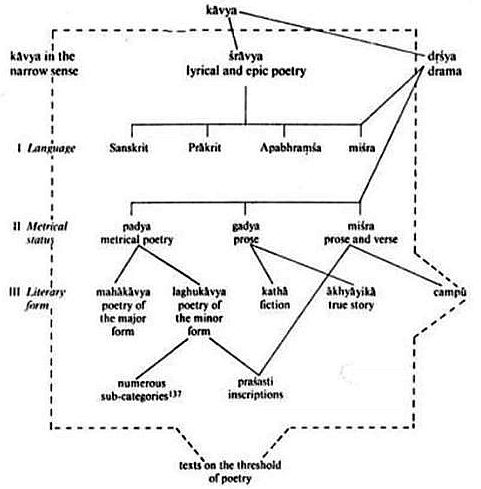
Sahityashastra, the Indian Poetics by Dr. Ganesh Tryambak Deshpande

History of Indian Literature by Maurice Winternitz, Moriz Winternitz

A History of Classical Poetry: Sanskrit, Pali, Prakrit by Siegfried Lienhard

Literary Cultures in History by Sheldon Pollock

The Philosophy of the Grammarians, Volume 5 By Harold G. Coward

A Comparative Study of the Indian Poetics and the Western Poetics by Mohit Kumar Ray

A history of Indian literature. Vol. 5, Scientific and technical …, Volume 5 by Edwin Gerow

 
Leave a comment

Posted by on August 24, 2015 in Kavya, Sanskrit


Tags: , , , , , , , , , , , , , , , , ,

Kavya and Indian Poetics – Part Seven

Continued from Part Six

[I could not arrange the topics in a sequential order (krama). You may take these as random collection of discussions; and, read it for whatever it is worth. Thank you.]


Indian poetics – Kavya Shastra

It is customary to begin the history of Indian poetics with Natyashastra. Out of its thirty six chapters, two chapters deal with Rasa-bhava (Ch 6 & 7) and Alamkara-guna (Ch 16). The other chapters touch upon related topics, such as: plot (Ch 19), genre (Ch 18, 20), meter (Ch 15). By and large, the text relates to dramaturgy in its practical applications. The aspects of Poetics that appear in the text , of course, are not directly related to Kavya. In Natyashastra, the nature of poetry as outlined in it is incidental to the discussions on Drama; and, it does not have an independent status.

[In Chapter sixteen of the Natyashastra, titled as kāvyalakao nāma oaśo’dhyāya , Bharata lists thirty-six of  Kavya Lakshanas (features)

atriśa-lakaānyeva kāvya-bandheu nirdiśet 16. 135

He calls them as Kavya Vibhushanam, the adornments which enhance the beauty of a Kavya (prabandha śobhākaraāni); and, together help in producing the Rasa – samyak prayojyāni rasāyanāni.

Etāni kāvyasya ca lakṣaṇāni/  ṣaṭtriṃśad uddeśa nidarśanāni । prabandha śobhākaraṇāni  tajjñaiḥ /  samyak prayojyāni rasāyanāni 16.172

But, Bharata neither illustrates these Lakshanas , nor does he specify how these are to be employed in a Kavya. He also does not try to differentiate the Lakshanas from the Alamkaras.

The renowned scholar Dr. V. Raghavan observes: By Lakshanas , Bharata refers to the features of the Kavya in general ; and, not necessarily of Drama alone.  He also makes a rather ambiguous statement :  Lakshana differs from Alamkara , in the sense that it is more comprehensive ; and, is also not a separate entity like the  ornament . Lakshana belongs to the body of the Kavya  . It is Aprathaksiddha ; it is the  Kavyasarira itself.  It is said; the Lakshana gives grace to Kavya; while, Alamkara is added to it for extra beauty. (Let me admit; I do not pretend to have understood this , entirely)

Dr. Raghavan also  says;  gradually , the Lakshana died in the Alamkara shastra. And , in the later times , some authors assigned the Lakshanas different names. For instance; Raja Bhoja and Saradatanaya call it as Bhushana; and, Jagaddhara calls it Natya-alamkara.

For more on Lakshanas , please click here]

**

The Indian poetics effectively  takes off from Kavya-alamkara of Bhamaha (6th century)   and Kavyadarsa  ( 1, 2 and 3of Dandin (7th century).  There seems to be no trace of Kavya-s during the long centuries between Bharatha and Bhamaha. There are also no texts available on Kavya-shastra belonging to the period between the Natyashastra of Bharata and Bhamaha (6th century). Perhaps they were lost even as early as 6th century. The early phase of Indian Poetics, the Kavya-shastra, is represented by three Scholars Bhamaha, Dandin and Vamana.

The intervening period, perhaps, belonged to Prakrit. Not only was Prakrit used for the Edicts and the Prasastis, but it was also used in writing poetical and prose Kavyas. The inscriptions of Asoka (304–232 BCE) were in simple regional and sub-regional languages; and, not in ornate Kavya style. The inscriptions of Asoka show the existence of at least three dialects, the Eastern dialect of the capital which perhaps was the official lingua franca of the Empire, the North-western and the Western dialects.

By about the sixth or the Seventh century the principles of Poetics that Bharata talked about in his Natyashastra (first or second century BCE) had changed a great deal. Bharata had introduced the concept of Rasa in the context of Drama . He described Rasa by employing the analogy of taste or relish, as that which is relished (Rasayatiti Rasah) ; and , regarded Rasa as an essential aspect of a Dramatic performance.  He said that no sense proceeds without Rasa (Na hi rasadrte kaschid- arthah pravartate). He did not, however, put forward any theories about the Rasa concept. He did not also elaborate much on Alamkaras, the figures of speech, which he mentioned as four: Upama, Dipaka, Rupaka and Yamaka. Later writers increased it vastly. Rajanaka Ruyyaka named as many as 82 Alamkaras.

As the concepts of Rasa and Alamkara were transferred to the region of Kavya, several questions were raised:  why do we read any poetry? Why do we love to witness a Drama? What is it that we truly enjoy in them? What makes poetry distinctive as a form and what distinguishes good poetry from the bad? , and so on. 

Ultimately, the answer could be that we love to read or listen to a poem, or see a Drama because doing so gives us pleasure; and, that pleasure is par excellence, unique in itself and cannot be explicitly defined or expressed in words.

But, unfolding of the Indian poetics or the study of the aesthetics of poetry came about in stages. Generally speaking, the development of Sanskrit literary theory is remarkably tardy, spread over several generation of scholars.

The Organized thinking about Kavya seems to have originated with the aim of providing the rules by which an aspiring writer could produce good Kavya.

***

Kavya–agama, the elements of Poetics

The Indian aesthetics takes a start from Natyashastra, winding its course through the presentations of Bhamaha, Dandin and Vamana; and , later gains vastness in writings of Anandavardhana, Abhinavagupta, Vishwanatha and Jagannatha Pandita.

These scholars are, generally, classified as originators of ideas; compilers and commentators.

Among the scholars , over the centuries, Bharatha, Bhamaha, Dandin ,Vamana , Anandavardhana and Kuntala could be called originators of poetic principles or elements.

The compilers were: Mammata, Vishwanatha and Jagannatha.

And among the commentators; Udbhata, Bhattaloa, Srismukha, Bhattanaya, Bhattatauta and Abhinavagupta are prominent.

Of the three scholars of the older School of Poetics – Bhamaha, Dandin and Vamana – Bhamaha (6th century) son of Rakrilagomin is the oldest ; and, is held in high esteem by the later scholars.

*

Books on Poetics have been written in three forms: in verse, in Sutra-form and in Karika.

Verses:  Bharatha, Bhamaha, Dandin, Udbhata, Rudrata, Dhananjaya, Vagbhata I,  Jayadeva  , Appayya Dikshita and others

Sutra vritti: The principles and concepts are written in concise Sutra form. the explanations are followed in the commentary. Initially, Vamana and Ruyyaka adopted this form. Some others in the later times almost followed it: Vagbhatta II , Bhanumisra , Jagannatha et al.

Karika: In crisp verses or couplets. Anandavardhana, Kuntaka, Mammata, Hemachandra, Vishwanatha and others adopted Karika form. Their basic statements are in Karika , while their explanations are  in prose.

design

Before we talk about the stages in the development of Indian Poetics let me mention, at the outset, the elements of Poetics in a summary form. Later we shall go through each stage or each School in fair detail.

The elements of Poetics or Kavya-agama are said to be ten:

  • (1) Kavya-svarupa (nature of poetry); causes of poetry, definition of poetry, various classes of poetry and purpose of poetry;
  • (2) Sabda-Shakthi, the significance of words and their power;
  • (3) Dhvani-kavya , the poetry suggestive power is supreme ;
  • (4) Gunibhuta-Vangmaya-kavya , the poetry where suggested  (Dhvani)  meaning is secondary to the primary sense;
  • (5) Rasa: emotive content;
  • (6)  Guna: excellence of poetic expression ;
  • (7)  Riti ; style of poetry or diction;
  • (8)  Alamkara : figurative beauty of poetic expressions ;
  • (9)  Dosha ; blemishes in poetic expressions that need to be avoided; and ,
  • (10)  Natya-vidhana the  dramatic effect or dramaturgy.

At times, the Nayaka-nayika-bheda the classification of the types of heroes and heroines is also mentioned; but, it could be clubbed either under Rasa or under Natya-vidhana.

Of these, we have already, earlier in the series, familiarized ourselves with the elements such as the causes, the definition, various classes as also the purposes of Kavya.  We have also talked about Sabda (word) and Artha (Meaning) as also the concepts of Dhvani and Rasa.  We shall in the following paragraphs talk about the other elements of Kavya such as Alamkara, Guna/ Dosha, Riti, Dhvani , Vakrokti Auchitya, etc.

Then again, the whole of Poetics broadly developed into eight Schools: Rasa, Alamkara, Riti, Guna/Dosha, Vakrokti, Svabhavokti, Auchitya and Dhvani.

We shall briefly talk about these elements a little later.

Although the concepts of Rasa and Alamkara could be traced back to more ancient periods, it was Bharata who applied those concepts to the theory and practice of Drama.   In a similar manner, the notions of Riti and Guna were adopted into Bharata’s ideas of Guna and Dosha. He implied, although not explicitly, that the style  (Vrtti) must be appropriate with the matter presented and with the prevailing mood of a particular situation.

Bharata’s notions of Guna (merit), Dosha (defect), Riti (style) or Vakrokti (oblique poetry or deviations) ,Savabhavokti (natural statements), Auchitya ( propriety) etc. were fully developed by the later scholars such as Bhamaha, Dandin , Vamana and Kuntaka , although  each with slightly varied interpretations of the ideas suggested by Bharata.

Over the centuries , though many Schools (sampradaya) developed in the field of Indian poetics , each was not opposed to the others. Each Sampradaya propagated its own pet ways of poetry ; and, at the same time made use of the expressions of other schools as well.  For instance; Bharata spoke , in particular ,  about Rasa; Bhamaha of Alamkara; Vamana of Riti; Anandavardhana of Dhvani; Kuntaka of Vakrokti; and Kshemendra of Auchitya (relevance). The later poets saw all of those as varied expressions of poetry that are not in conflict with each other. But , three things – Rasa , Guna and Alamkara – are accepted universally by poets of all schools.

theories of poetics

theories of poetics2

(Source; Thanks to Sagar G.Ladhva )

But, let me give here an abstract in the words of Prof. Mohit Kumar Ray ( as given in his A Comparative Study of the Indian Poetics and the Western Poetics )

To sum up; all theorists agree that the language of poetry is different from the language of prose. They also agree that sound and sense are the two main elements of poetry; and that poetry is born when they are blended harmoniously together. The  varied speculations are about how this blending can be brought about,  leading to different schools : Alamkara, Riti, Svabhavokti, Dhvani, Vakrokti etc

But, neither Alamkara nor Riti nor Vakrokti etc by itself, individually, accounts for poesies of a poem. An Alamkara cannot be super-added. It must be integral to the poem. Similarly, a particular style, all by itself, cannot make a Kavya. It must be in keeping with the cultural level of the poet and the reader as also with the nature of the thought-content of the poem. There are various factors that go to determine the style.

Again, a deviation or stating a thing an oblique way cannot make a Kavya. What is stated should be in harmony with the predominant passion or Rasa of the work.

In other words, the production of Rasa demands the use of all or some of the elements of the poetics depending upon the appropriateness or the nature of the idea envisioned in the Kavya; because, a Kavya is an organic unity. We must have suggestion, we may have elegant figures of speech or deviation also ; we may even have an attractive unique style and so on . But all these elements must be integrated into the matrix of the Kavya.

What is poetry if it does not produce Rasa or give the reader an experience of aesthetic delight?

2007_1009image0115a

The Indian Poetics

Rasa

Of the various poetic Schools, chronologically, Rasa is taken as the oldest because it is discussed in Natyashastra, where, Rasa meant aesthetic appreciation or joy that the spectator experiences .  As Bharata says , Rasa  should be relished  as an emotional or intellectual  experience : 

Na rasanāvyāpāra āsvādanam,api tu mānasa eva (NS.6,31) .

The Nāṭyashāstra asserts that the goal of any art form is to invoke  such Rasa.

Bharata’s theory of  Rasa was crafted  mainly in the context of the Drama.  He was focused on the  dancer’s or actor’s performance ; and , the effort needed to convey her/his  own experiences to the spectator , in order to create aesthetic appreciation or enjoyment  of the art in the heart and mind of the spectator.  

Bharata elaborated the process of producing  Rasa in terms of eight Sthayi Bhavas , the principle emotional state expressed with the aid of Vibhava (the cause) and Anubhava (the enactment); thirty-three Vyabhicāri (Sanchari) bhāvās, the transient emotions; and, eight Sattivikbhavas , the involuntary physical reactions.  

These  various Bhavas involved expressions through words (Vachika), gestures (Angika) and other representations (Aharya), apart from involuntary body-reactions (Sattvika). Such elements employed to convey the  psychological state of the character thus  , in all  , amounted to forty-nine or more . 

The famous Rasa-sutra or basic “formula”,  in the Nāṭyashāstra, for evoking  Rasa, states that   the vibhāva, anubhāva, and vyabhicāri bhāvas together produce Rasa : 

tatra vibhāvā-anubhāva vyabhicāri sayogād rasa nipatti

Thus, Bharata’s concept  and derivation of Rasa was mainly in the context of the Drama. That concept  – of the enjoyment by the recipient spectator- as also his views on the Gunas and Dosha that one must bear in mind while scripting and enacting the play , were later  enlarged , transported  and adopted into Kavya as well.

In the context of the Kavya, though Rasa is all pervasive, it has been enumerated separately, because Rasa, which came to be understood as the ultimate aesthetic delight experienced by the reader/listener/spectator, is regarded as the touch-stone of any creative art. Rasa has, therefore, been discussed in several layers  – independently, as also in relation to other aspects of poetic beauty , such as : the number of Rasa, each type of Rasa,  nature of aesthetic pleasure of each of type Rasa, importance of Rasa, its association with other Kavya-agamas and so on. Some accepted Rasa as Alamkara (Rasavath), while others regarded it as the soul or the essential spirit of any literary work.

Both in Drama and in Kavya, Rasa is not a mere means; but, it is the desired end or objective that is enjoyed by the Sahrudaya, the cultured spectator or the reader. In the later texts, the process of appreciation of Rasa became far more significant than the creation of Rasa. The poet-scholars like Bhamaha and his follower took to Rasa very enthusiastically. Later, Anandavardhana entwined the concept of Dhvani (suggestion) with Rasa.

Indian Aesthetics considers that among the various poetic theories (Kavya-agama), Rasa is of prime importance in Kavya.  And, very involved discussions go into the ways and processes of   producing Rasa, the ultimate aesthetic experience that delights the Sahrudaya, the connoisseurs of Kavya.

Again, what is poetry if it does not produce Rasa or give the reader an experience of aesthetic delight?

Rasa is therefore regarded as the cardinal principle of Indian aesthetics.  The theory of Rasa (Rasa sutra) or the realization of Rasa  (Rasa Siddhi) is discussed in almost all the works on Alamkara Shastra in one way or the other. The importance of the Rasa is highlighted in Alamkara Shastra, by calling it the Atman (the soul), Angin (the principle element), Pradhana-Pratipadya (main substance to be conveyed), Svarupadhyaka (that which makes a Kavya), and Alamkara ( ornamentation) etc.

Alamkara

Although Bharata , in his Natyashastra mentions four components of Alamakara  (upamā rūpakaṃ caiva dīpakaṃ yamakaṃ) as related to Drama, he does not elaborate on it.

upamā rūpaka caiva dīpaka yamaka tathā alakārāstu vijñeyā catvāro nāakāśrayā NS.6.  41

The Alamkara School , therefore, is said to take off effectively from the works of Bhamaha and Dandin.  It appears , the two scholars were not separated much either in time or in location; and yet, it is hard to ascertain whether they were contemporaries. But, they seemed to have lived during a common period (6th or 7th century) or the time-interval between the two was not much. But, it is difficult to say with certainty who was the elder of the two, although it is assumed that Bhamaha was earlier . Generally, it is believed that Bhamaha lived around the late sixth century while Dandin lived in the early seventh century.

It could be said that the early history of Sanskrit poetics started with the theory of Alamkara that was developed into a system by Bhamaha and later by Dandin. It is however fair to recognize that their elaborations were based in the summary treatment of poetics in the 16th chapter of Natyashastra. The merit of the contributions of Bhamaha and Dandin rests in the fact that they began serious discussion on Poetics as an independent investigation into the virtues of the diction, the language and Alamkara (embellishments) of Kavya; and, in their attempt to separate Kavya from Drama and explore its virtues.

[In their discussions, the term Alamkara stands for both the figurative speech and the Poetic principle (Alamkara), depending on the context. That is to say; in their works, the connotation of Alamkara as a principle of embellishment was rather fluid. Though Alamkara , as a concept,  was the general name for Poetics, Alamkara also meant the specific figures of speech like Anuprasa, Upama etc. And, the concepts of Rasa, Guna, Riti were also brought under the umbrella of Alamkara. ]

Bhamaha’s Kavyaalamkara and Dandin’s Kavyadarsha are remarkably similar in their points of view, content and purpose. Both try to define the Mahakavya or the Sargabandha, elaborated in several Cantos. Their methods focus on the qualities of language (Sabda) and the meaning (Artha) of poetic utterances. Again, the format of their works is also similar. They often quote one another or appeal to a common source of reference or tradition. There are similarities as also distinctions between the views held by the two. At many places, it seems as if one is criticizing the other,  without however naming. It is as though a dialogue of sorts  had developed between the two authors. The major thrust of both the works pursues a discussion on the distinctive qualities (Guna) of Alamkara and debilitating distractions (Dosha) of poetic expressions.

Both the authors discuss the blemish or Dosha – the category that had come to represent the inverse of Alamkara, such as Jati, Kriya, Guna and Dravya.  They held the view that just as certain Gunas or merits enhance the poetic effects, so also certain Doshhas, blemishes – both explicit and implied – destroy the poetic  elegance and excellence. 

But, they also pointedly disagreed on certain issues. For instance; Dandin appears to reject Bhamaha’s views on the differences between the narrative forms of Katha and Akhyayika (1.23.5)

apādaḥ padasaṃtāno gadyam ākhyāyikā kathā / iti tasya prabhedau dvau tayor ākhyāyikā kila.

And, he also seems  to argue against Bhamaha’s views that poetry must  have  Vakrokti .

Bhamaha , in turn, gives prominence to Alamkara, though he considered Rasa as an important element. According to him, all types of Kavya-s should have Vakrokti (oblique expressions) – as Samanya lakshana, Atishayokti (hyperbole) expressions transcending common usage of the of words (Svabhavokti) . It is only through these, he said, the ordinary is transformed to extraordinary. 

Dandin differed from Bhamaha.  He did not agree with the idea that there is no Alamkara without Vakrokti and that Savbhavokti, natural expressions, has no importance in Kavya.  He argued, the Alamkara, the figurative expressions could be of two kinds – Svabhavokti and Vakrokti; and the former takes the priority (Adya Alamkrith). The Svabhavokti  is a clear (sputa)  and beautiful (Charu) statement of things as they are –

Svabhavokti raso charu yathavad vastu varnanam.

And,  Svabhavokti , also known as Jati (Jatimiva Alamkrtinam)  . It has to have a well balanced (Adhika-mrudva samanam) emphasis on the content, emotion and thought; as also on its form and poetic expression.

Svabhavokti cannot be Gramya (rustic), vulgar, insipid or stale ; but, it has to be a clear (sputa, pusta) , well coined, attractive  (Charu), statement of things , as they are:

Navosthor Jatir- agramya shlesho klistaha sputo rasaha / vikata-akshara bandasha krutsva-mekatra durlabham // Bana’s harsha-charita//

(For more on Svabhavokti , please click here)

[Vakrokti has no equivalent in the western literary criticism. Vakrokti could be referred to as ‘oblique or indirect’ reference.  It could also mean irony / ambiguity/ gesture/paradox / tension or all of them put together.]

Bhamaha did not speak much about the aspect of Guna. He briefly touched upon Madhurya (sweetness) , Ojas (vigor) and Prasada (lucidity) ; and , he did not even name them specifically as Guna-s. Further, he did not see much difference between Madhurya and Prasada :

Madhuryam abhibanchanti prasadam Ca samedhasah/ Samasavanti bhuyansi na padani prajunjate //KA.Ch. Bh_2.1 //

Dandin, on the other hand, devoted almost the entire of the first chapter of his Kavyadarsa to the exposition of two modes of poetic expressions, which ,for some reason, named them as :  Vaidarbhi and Gaudi . He seemed to favor the former –Vaidarbhi. According to Dandin, the ten Gunas are the life of the Vaidarbhi mode of expression

Slesha, Prasada, Samata, Madhurya, Sukumaratva, Arthavyaki, Udaratva, Ojas, Kanti and Samadhi.

Rajasekhara also hails the Vaidarbhi enthusiastically :

Aho hrudyam Vaidarhi Ritihi /  Aho Madhuryam paryaptam /   Aho nish-pramadaha Prasadaha // (Vidda-salabhanjika  Act One)

[Dr. Victor Bartholomew D’avella writes : The  two works of  Alakāraśāstra  (poetics) that deal with the topic of linguistic purity in poetry – Bhāmaha’s Kāvyālakāra  and Vāmana’s  Kāvyālakārasūtra  – address a number of specific grammatical problems ; but, in dierent ways. These represent dierent attitudes towards  the interpretation of Pāinis grammar. The final chapter of each work bears the title Śabdaśuddhi or  Śabdaśodhana  (Purification of Language); and, in them , each author gives guidelines for good, i.e., grammatically correct, poetic usage.]

Design Pieter Weltevrede

Here, we need to briefly talk about the concept of Vritti, which  like many such others that originated in the Natyashastra, later walked into the arena of the Kavya.

Bharata regards the Vrttis or the modes of expression as one among the most important constituent elements of the play. In fact, he considers the Vrttis as the mother of all poetic works

– sarveāmeva kāvyānā-mātkā vttaya  smḥ  (NS.18.4). 

In a play, the Vrtti stands for the ways of rendering a scene; or, the acting styles and the use of language, diction that different characters adopt in a scene, depending upon the nature or the Bhava that is peculiar to that character– rasochita-artha-sandarbha.

The Vrttis are said to be of four kinds (vrttis caturdha) : Kaisiki; Sattvati; Arabhati; and, Bharati. The explanations provided by Bharata were principally with regard to the theatrical performances.

The Kaisiki-vrtti (graceful style) which characterizes the tender  Lasyanga  associated  with expressions of love, dance, song as also with charming costumes and delicate actions portrayed with care, is most suited to Srngara-rasa

-(tatra kaisiki gita-nrtya-vilasadyair mrduh srngara- cestitaih ).

The Sattvati Vrtti (flamboyant style) is a rather gaudy style of expressing ones emotions with excessive body-movement; exuberant expressions of joy; and, underplaying mellow or sorrow moods. It is a way of expressing ones emotions (mano-vyapara) through too many words.

The Arabhati-vrtti is a loud, rather noisy and energetic style. It is a powerful exhibition of one’s anger, valour, bordering on false-pride, by screaming, shouting, particularly, in tumultuous scenes with overwhelming tension, disturbance and violence.  It involves furious physical movements (kaya-vyapara).

And, the Bharati-vrtti is mainly related to a scene where the speech or dialogue delivery is its prominent feature.  But, generally, the Bharati-vrtti, related to eloquence, is of importance in all the situations (vrttih sarvatra bharati).

*

And, when you come to the Kavya, the written texts, which are either read or recited (Shravya Kavya), you find that the Vritti which is predominant here is the Bharati Vrtti, the eloquent and free flowing speech or well composed words and sentences. And, there is, of course, the Kaisiki Vrtti, for depicting the scenes of love (Srngara), tenderness (Lavanya) , lovely evenings, moon lit nights, graceful locations  and captivating speech etc.

And, the Sattavati – which is used for portraying violent action – is almost absent in the Kavya.

Bharati or the words of the text of the Kavya will be modified, according to the situation, by Kaisiki and Arbhati vrttis. This gives raise to two modes (Marga) or kinds of poetic diction or styles (Riti):  Vaidarbhi Riti and Gaudi Riti.  The excellence (Guna), like Madhurya (sweetness or lucidity) and Ojas (vigour) form their essence.

According to Dr. V.  Raghavan, the Madhurya Guna and Kaisiki Vrtti  (sweetness and delicate grace) characterize the Vaidarbhi Riti; while, Ojas Guna and Arbhati Vrtti  (vigor and energy) go with the Gaudi Riti.

 **

Both – Bhamaha and Dandin- seemed to be   concerned with Kavya-sarira or the body of poetry. Both recognized that Kavya is essentially about language; and, that language is caught in a rather small compass. They seemed to argue that Kavya, however extensive, is knit together by its building-blocks – individual verses. Thus, the stanza is the basic unit of composition (Varna-vrtta metrics). And, every stanza has to strive towards perfection.  They held that for achieving such perfection, it is essential that there should be a happy confluence of Sabda (word) and Artha (meaning) that produces a beauteous  form (body) – Kavya-sariraSabda-Artha-sahitau-Kavyam . They also said that Alamkara, the poetic figures of speech, are essential ingredients of such beauteous  harmony.

***

During the period of Bhamaha and Dandin, the plot of the Kavya was seen as its body.  That, somehow, seemed to suggest that what is said is not as important as  how it is said. The artistic expressions – ornate language, polished phrases seemed to be the prime issue. Therefore, the forms of Alamkara such as rhetorical figures of speech, comparisons, rhythms and such others gained more prominence.

In other words, they believed that Kavya is a verbal composition conveying a definite sense. It must be presented in a charming manner, decorated with choosiest rhetorical devices or figures of speech – Sabda-alamkara and Artha-alamkara.

The fundamental idea appeared to be that every notion can be expressed in infinite number of forms. Therefore, gaining mastery over language is  a prerequisite for a  credible poet. That is because, mastering the language enables one to have access to the largest possible number of variations; and, employ them most appropriately.  Kuntaka in his Vakrokti- jivita  (Ca. 10th century)  says the :  the Real word is that which is chosen out of a number of possible synonyms  and that which is capable of  expressing  the desired sense most aptly. And the real sense is that which by its alluring nature , spontaneously delights  the mind of the Sahrudaya ( person of taste and culture) –ahladkari sva spanda sundarah

Sabdau vivaksitartha kavachakautheyshu sathvapi  I  arthah sahrudaya ahladkari sva spanda sundarah  // Vjiv_1.9 //

In the process, distinctions are made between figures of sound (Sabda-alamkara) and the figures of sense (Artha-alamkara).  In the Sabda-alamkara, many and varied options of paraphrasing are used. Here, the option to express something in an obvious, simple and clear manner i.e. to say exactly what one means, is avoided. Such plain statements are considered Gramya (rustic) in contrast to urbane and refined (Nagarika) expressions. For instance; Bhamaha gives prominence to Alamkara, though he considered Rasa as important element. According to him, all types of Kavya-s should have Vakrokti (oblique expressions), Atishayokti (hyperbole)  expressions transcending common usage of the of words (Svabhavokti) .It is only through these that the ordinary is transformed to something that is extraordinary.

The basic idea is : Kavya (poetry) is neither a mere thought nor emotion nor even a matter of style. It is how an alluring idea incarnates itself in  beautiful expressions . The function of the Alamkara is to heighten the effect; to aid the poet to present his thought and emotion splendidly and naturally .

Alamkara is that which adorns (Bhusana) or that by which something is adorned – Alankarotiti alankarah; Alankriyate anena iti alankarah. And, Alamkara is ‘the beauty in poetry’ Saundaryam alahkarah – Vamana: K.A.S. 1.2. The function of an Alamkara is to provide a brilliant touch (Camatkara) to the object of description, Camatkrtir-alamkarah.

It is said; the term Alamkara combines within itself the elements of Poetics and of the Aesthetics as well. Alamkara-sastra is therefore the science which suggests and instructs how a Kavya should be; and, also prescribes certain canons of propriety.

As Nilakantha Diksita says: a Poet, who is gifted with the genius of creating extraordinary composition (vinyasa visesa bhavyaih), can turn even the  common place situations into very interesting episodes.

Yaneva sabda-nvayam- alapamah  /  yaneva cartha-nvaya-mullikhamah / Taireva vinyasa visesa bhavyaih  / sammohayante kavayo jaganti  //

Thus, the concept of Alamkara essentially denotes that which helps to transform ordinary speech into an extraordinary poetic expression (Sabartha sahitya). The term Alamkara stands for the concept of embellishment itself , as well as for the specific means and terms that embellish the verse.

As the Alamkara concept began to develop into a system, there appeared endless divisions and sub-divisions of these Alamkaras. In the later poetics, Alamkara is almost exclusively restricted to its denotation of poetic figures as a means of embellishment.

During the later periods of Indian Poetics, the Alamkara School was subjected to criticism. It was said that the Alamkara School was all about poetic beauty; and, it seemed to have missed the aspect of the inner essence of Kavya. The later Schools, therefore, considered Alamkara as a secondary virtue .  They declared that Poetry can exist without Alamkara and still be a good poetry.

Although the concept of Alamkara was played down in the later periods, its utility was always acknowledged as the Vishesha or quality of Sabda and Artha.

[ Please click here to read more on the concept of Alamkara]

alamkara

Both – Bhamaha and Dandin – agree on the central place accorded, in Kavya, to Alamkara, figurative speech. Both held that the mode of figurative expression (Alamkara), diction (Riti) , grammatical correctness (Auchitya) , and sweetness of the sounds (Madhurya) constitute poetry. Both deal extensively with Artha-alamkara that gives forth striking modes of meaningful expressions.

Dandin also recognized the importance of Alamkaras, as means of adding charm to poetry – Kavya sobhakaran dharmann alamkaran pracasate  – K.D. II.1. Dandin, however, gives far more space to the discussion on those figures of speech that are defined as phonetic features (Sabda-alamkara) e.g. rhyme (Yamaka) than does Bhamaha.

This distinction turns into a basic factor in all the subsequent Alamkara related discussions. The differences that cropped up on this point do not lie chiefly in the kind or quality of Alamkara; but, it seems more to do with function of the organization and presentation of the materials.

Let’s take a look at each of their works.

Rangoli 3

Bhamaha

Bhamaha’s work, called Kavyalankara or Bhamahalankara consists of six Paricchedas or chapters and about 400 verses. They deal mainly with the objectives, definition and classification of Kavya,  as also with the Kavya-agama the elements of the Kavya , such as,  Riti ( diction), Guna (merits), Dosha (blemishes ), Auchitya  (Grammatical correctness of words used in Kavya) ; and , mainly with  the Alamkara the figurative expressions .

As an addendum to the text , appearing after the final verse 64 of the last  Chapter – Pariccheda (6.64) – there are two verses which summarize the topics  covered  by Kavyalankara.  It says: the subject relating to the body of the poetry (śarīraṃ)  was determined (nirṇītaṃ) in sixty verses; in one hundred and sixty verses , the topic of Alamkara was discussed; the defects and blemishes (Dosha) that could occur in a Kavya were mentioned in fifty verses; the logic that determines (nyāya-nirṇayaḥ) the format of a Kavya are stated in seventy verses; and, the criteria that specify the purity of words (śabdasya śuddhiḥ) used in a Kavya are enumerated in sixty verses.

Thus, in all,  five subjects (vastu-pañcakam), in that order (krameṇa) , spread over six Paricchedas (ṣaḍbhiḥ paricchedair), comprising  four hundred verses, have been dealt with by Bhamaha , for the benefit of the readers. 

ṣaṣṭyā śarīraṃ nirṇītaṃ śataṣaṣṭyā tva-alaṅkṛtiḥ / pañcāśatā doṣadṛṣṭiḥ saptatyā nyāyanirṇayaḥ // Bh_6.65 // ṣaṣṭyā śabdasya śuddhiḥ syād ityevaṃ vastupañcakam /
uktaṃ ṣaḍbhiḥ paricchedair bhāmahena krameṇa vaḥ // Bh_6.66 //

Bhamaha’s kavyalankara , was perhaps, meant to facilitate a critical study of the subject of Kavya ; and, to serve as a practical handbook  for the benefit of those engaged in the art of poetical composition .

At the end of Kavyalankara (Pariccheda 6. 64), Bhamaha says : after gaining a good understanding of the views of reputed poets; and, having worked out the characteristics  of Kavya by ones own effort and intelligence,  this work is composed by Bhamaha , the son of Rakrila Gomin, for the benefit of the good people .

avalokya matāni satkavīnām avagamya svadhiyā ca kāvyalakṣma /  Bhāmahena grathitaṃ Rakrila-gomi sūnu-nedam // Bh_6.64 //

[The benefit  of a Kavya, according to Bhamaha, is chiefly twofold, viz. acquisition of fame on the part of the poet and delight for the reader.]

While defining Kavya, Bhamaha says – sabdarthau sahitau kavyam; word and sense together constitute Kavya – in its both the forms of poetry and prose.  The Kavya could be in Sanskrit, Prakrit (regional language) or even in Apabhramsha (folk language) 

śabdārthau sahitau kāvyaṃ gadyaṃ padyaṃ ca taddvidhā / saṃskṛtaṃ prākṛtaṃ cānyad apabhraṃśa iti tridhā // Bh_1.16 //

Towards the end of the First Pariccheda, Bhamaha provides the broad guideline for composing a delightful and charming Kavya (śobhāṃ viracitamidaṃ). He instructs that the poet should exercise great caution ; and , use his discretion while  selecting the words that are most apt in the given  context.

He says: a garland-maker (malakara), while stringing together a garland,  selects the sweet-smelling , beautiful looking flowers (surabhi kusumaṃ) ; and,  rejects the ordinary ones ; and again , he also knows precisely that of  the flowers so selected, which flower of a particular color and shape  , placed in its appropriate position,  would look pretty when interwoven with other flowers  and enhance the beauty of the garland . In a similar manner; just as the garland-maker  does (sādhu vijñāya mālāṃ yojyaṃ), the poet , while composing a Kavya, should take abundant care to select the appropriate words and place them in their right position, in order to produce a charming Kavya

etad grāhyaṃ surabhi kusumaṃ grāmyam etannidheyaṃ dhatte śobhāṃ viracitamidaṃ sthānamasyaitadasya / mālākāro racayati yathā sādhu vijñāya mālāṃ yojyaṃ kāvyeṣvavahitadhiyā tadvadevā-bhidhānam // Bh_1.59 //

At the same time, Bhamaha cautions that mere eloquence is of no avail , if it fails to produce powerful poetic expressions. He exclaims : what is wealth without modesty?! What is night without the bright and soothing moon ? What use is of  mere clever eloquence, without the capacity to compose a good poetry (Sat-kavita)? 

vinayena vinā kā śrīḥ ; kā niśā śaśinā vinā / rahitā satkavitvena kīdṛśī vāgvidagdhatā // Bh_1.4 //

These definitions and instructions, obviously focus on the external element or the body of Kavya. His explanation implied that word and sense in a Kavya must be free from blemishes (nirdosa) and should be embellished with poetic ornamentation (salankara). 

Bhamaha lays great stress on Alamkara, the figurative ornamentation. In his opinion, a literary composition, however laudable, does not become attractive if it is devoid of Alamkara, embellishments (Na kantamapi nirbhusam vibhati vanitamukham). Alamkara, according to him, is indispensable for a composition to merit, the designation of Kavya. Bhamaha is, therefore, regarded as the earliest exponent, if not the founder, of the Alamkara school of Sanskrit Poetics.

Bhamaha regards Alamkara as that principle of beauty which adorns poetry; and, that which distinguishes poetry from Sastra (scriptures) and Varta (ordinary speech) . He says; a poetry devoid of Alamkaras can have no charm – Na kantamapi  nirbhusam vibhati vanita mukham –  kavyalankara 1.36.

Bhamaha divides (Bh_2.4) Alamkara in four groups that are represented as layers of traditional development (Anyair udartha). They are similar to those four mentioned by Bharata (Upama =comparison; Rupaka = metaphorical identification; Dipaka = illuminating by several parallel phrases being each completed by a single un-repeated word; and, Yamaka = word-play by various cycles of repetition). In addition there is the fifth as alliteration (Anuprasa). Bhamaha in this context mentions one Medhavin  (ta eta upamādoṣāḥ sapta medhāvinoditāḥ ) who perhaps was an ancient scholar who wrote on the Alamkara theory. The four groups that Bhamaha mentioned perhaps represent earlier attempts to compile Alamkara Shastra.

anuprāsaḥ sayamako rūpakaṃ dīpakopame / iti vācāmalaṃkārāḥ pañcaivānyairudāhṛtāḥ // Bh_2.4 //

Panini had earlier used the term Upama, in a general sense to denote Sadrasha (similarity) –  Upamanani samanya-vacanaih / Upamitam vyaghradibhih samanya prayoge . But, Bhamaha accorded Upama, the element of comparison, much greater importance. Bhamaha discusses , at length (Pariccheda 2.verses 43 to 65), the criteria that should be kept in mind while assessing the degree of similarity and dissimilarities between the two objects that are chosen for comparison. He says; the two objects might resemble ; but they cannot be identical. Therefore, one should select only those  qualities that are  common to both; and, are appropriate in the context . But, in any case, the Upama should be real; and, should not be pushed to extremes. 

Bhamaha recognized Vakrokti, the extra-ordinary turn given to an ordinary speech,  as an essential entity underlying all Alamkaras; and, as one of the principal elements of a Kavya. 

Saisa sarvaiva vakroktiranay artho vibhavyate / Yatno a’syam kavina karyah kol-amkaro’ naya  vina / –  kavyalankara 11.85

He also talked about the other elements of Kavya such as  Riti, however, without much stress.  He did not seem to attach much importance to Riti or mode of composition; because, in his opinion, the distinction between the Vaidarbhi and the Gaudi Riti is of no consequence. He however, introduced the notion of Sausabdya, the grammatical appropriateness in poetry- which relates to the question of style , in general, rather than to any theory of poetics.

tadetadāhuḥ sauśabdyaṃ nārthavyutpattirīdṛśī / śabdābhidheyālaṃkāra- bhedādiṣṭaṃ dvayaṃ tu naḥ // Bh_1.15 //

His rejection of the usefulness of the Riti and the Marga analysis of poetry perhaps accounts for his comparatively lighter treatment of the Gunas of which he mentions only Madhurya, Ojas and Prasada.

Bhamaha, in fact, rejects the Guna approach as being ‘not-trustworthy’. He is a thorough Alamkarika. His concern is with the form of poetry; and, not so much with its variations. He is also believed to have held the view that Gunas are three (and not ten) – guṇānāṃ samatāṃ dṛṣṭvā rūpakaṃ nāma tadviduḥ; and,  are nothing but varieties of alliterations.

upamānena yattattvam upameyasya rūpyate / guṇānāṃ samatāṃ dṛṣṭvā rūpakaṃ nāma tadviduḥ // Bh_2.21 /

As regards Rasa, Bhamaha again links it to Alamkara. He treats Rasa as an aspect of Alamkara, Rasavat (lit. that which possesses Rasa). According to him, the suggested sense (vyangyartha), which is at the root of Rasa, is implicit in the vakrokti. Bhamaha did not however elaborate on the concept of Vakrokti. He meant Vakrokti as an expression which is neither simple nor clear-cut; but, as one which has curvature (vakra) – vakroktir anayārtho vibhāvyate. He took it as a fundamental principle of poetic expression .

[Bhamaha regarded Vakrokti as an essential entity underlying  Alamkaras; but, is not clear whether or not Bhamaha regarded Vakrokti as an Alamkara  per se]  

Vakrokti is explained as an expressive power, a capacity of language to suggest indirect meaning along with the literal meaning. This is in contrast to svabhavokti, the matter-of-fact statements. Vakrokti articulates the distinction between conventional language and the poetic language. Vakrokti is regarded as the essential core of all poetic works as also of the evaluation and appreciation of art in general. Thus, vakrokti is a poetic device used to express something extraordinary and has the inherent potential to provide the aesthetic experience of Rasa.

Thus the seeds of Vakrokti, Riti, Rasa and Dhvani which gained greater importance in the later periods can be found in Bhamaha’s work.

However, the critics of Bhamaha point out that Alamkara-s of Bhamaha are nothing but external elements; and that he seemed to have bypassed the innermost element the Atman (soul) of poetry.

[ Please also read Kavalankara of Bhamaha (Edited , with translation into English) by Pandit P.V.Naganatha Sastry ; Motilal Banarsidass, 1970]

design33

[Bhamaha  also speaks of a  concept called Bhavikatva , which he treats  it as an Alamkara  which has the virtue (Guna) of  adorning not merely a sentence (vakya) but a passage or a composition (Prabandha) as a whole (Bhavikatvamiti prahuh prabandha –vishayam gunam– 3.53).

bhāvikatvam iti prāhuḥ prabandhaviṣayaṃ guṇam / pratyakṣā iva dṛśyante yatrārthā bhūta-bhāvinaḥ // Bh_3.53 //

It is described as Prabandha-guna, by virtue of which – as Dr. V Raghavan explains – the events or the ideas of the past (bhuta) and future (bhavi) narrated by the poet come alive and present themselves  so vividly as if they belong to the present. As one reads a Kavya, the beauty and the essence of it should appear (dṛśyante) before one’s eyes; and, the events in the story should unfold in reality as if they are happening  right in her/his presence (pratyakshayam-antva). Such a Guna of an Alamkara, the imagination or visualization, creating a mental image (vastu samvada) which instills a sense of virtual-reality  (pratyakṣā iva dṛśyante yatrārthā) into the rendering, also goes by the name Bhavana or Udbhavana or Bhavika; the very essence of the Rasa realization (Rasavad). It binds the Kavi and the Sahrudaya together into a shared aesthetic experience.

Dandin also refers to Bhavikatva or Bhavika or Kavi-bhava, as a Prabandha-guna. But, he seems to relate it to Auchitya and Kavi-abhipraya, the attitude and the approach of the poet (Bhavah Kaveh abhiprayah). However, Dandin’s interpretation was not carried forward by the later writers, who preferred to follow Bhamaha.

And, in the later periods, Bhavika, somehow, got mixed up with other concepts (Prasada; Sadharanikarana etc) ; and , lost its focus .

For more on Bhavika , please click here; and here ]

Rangoli 2

Dandin

Dandin’s Kavyadarsa (7th century) is a very influential text. And , it covers a wide range of subjects  concerning the Kavya , such as : the choice of language, and its relation to the  subject matter; the components or the  elements of Kavya : the story (kathavastu) ;  the types of descriptions and narrations that should go into Mahakavya also known as  Sarga-bandha (Kavya , spread over several Cantos) – sargabandho mahākavyam ucyate tasya lakṣaṇam; the ways (Marga) of Kavya, regional styles characterized by the presence or absence of the expression-forms (Guna); various features of syntax and semantics; factors of Alamkara- the figurative beauty of expressions; and  the Alamkara-s of sound  (Sabda) and sense (Artha).

Dandin in his Kavyadarsha said every poem needs a body and Alamkara. By body he meant set of meaningful words in a sentence to bring out the desired intent and effect.  Dandin clarified saying ; now, by body (sariram), I mean a string of words (padavali) distinguished by a desired meaning (ista-artha) – sariram tadvad ista-artha vyvachinnapadavali.

taiḥ śarīraṃ ca kāvyānām alaṃkārāś ca darśitāḥ – śarīraṃ tāvad iṣṭārthavyavacchinnā padāvalī // DKd_1.10 //

In the succeeding Karikas, Dandin , under the broad head Sariram discusses such subjects as meter, language, and genres of poetic compositions ( epic poems, drama etc.,) , and the importance of such categories. Such words putting forth the  desired meaning could be set either in poem (Padya) , prose (Gadya) or mixture (Misra) form.

padyaṃ gadyaṃ ca miśraṃ ca tat tridhaiva vyavasthitam – padyaṃ catuṣpadī tac ca vṛttaṃ jātir iti dvidhā // DKd_1.11 //

Dandin accepted Alamkara-s as beautifying factors that infuse grace and charm into poetry; and, as an important aspect of which raises far above common-place rustic crudity.

Kamam sarvepya alankaro rasam-arthe nisincatu / Tathapya gramyatai vainam bharam vahati bhuyasa //  kavyadarsa. 1.63.

He said; Alamkara-s are the beautifying factors of poetry and they are infinite in number;  and,  whatever beautifies poetry could be  called Alamkara

Kavya sobhakaran dharmann-alahkaran pracaksate  – kavyadarsa. II. 1

In his work, Dandin talks mainly about Alamkara-s that lend beauty and glitter to the Kavya- Sabda-alamkara and Artha-alamkara. The first covers natural descriptions, similes (Upama) of 32 kinds, metaphors (Rupaka) , various types of Yamaka (poetic rhymes)  that juggle with  syllables and consonants . Among the Artha-alamkara is Akshepa that is to say concealed or roguish expressions, such as hyperbole (Atishayokti) , pun or verbal play  producing more than one meaning (Slesha) , twisted expressions (Vakrokti). And, he said : whatever that lends beauty to poetry is Alamkara: Kavya-sobhakaran dharman-alankaran pracaksate

Dandin is, generally, accused of attaching more importance to the elegance of the form and to erudition than to creative faculty. I reckon , that is rather unfair. He was attempting to  draw a clear  distinction between  kavyasarira and Alamkara.

Dandin, like Bhamaha, belongs to what came to be known as Alamkara School.  But, his emphasis is more on Sabda-alamkara, the ornaments of sound (Sabda), which is not prominent in Bhamaha. The bulk of the third Pariccheda of his Kavyadarsa is devoted to an exhaustive treatment of Chitrakavya ( which later came to be labeled as Adhama – inferior- Kavya) and its elements of  rhyming (Yamaka) , visual poetry (matra and Chitra) and puzzles (Prahelika).

With regard to Rasa, Dandin pays more importance to it than did Bhamaha. While dealing with Rasa-vada-alamkara, the theory of Alamkara combined with Rasa, he illustrates each Rasa separately. Dandin pays greater attention to Sabda-almkara than does Bhamaha. Dandin says : thanks to the words alone the affairs of men progress ( Vachanam eva prasadena lokayatra pravartate )

Iha śiṣṭānuśiṣṭānāṃ śiṣṭānām api sarvathā – vācām eva prasādena lokayātrā pravartate // DKd_1.3 //

Dandin also gives importance to alliteration (Anuprasa), which he discusses under Madhurya Guna, the sweetness or the alluring qualities of language. Alliterations and rhyming (Yamaka) were not ignored by Bhamaha (they were, in fact, his first two types of Alamkara); but, treated lightly.  In comparison, are accorded full treatment in Dandin‘s work.

Bahamas, as said earlier, mentions just four types of Alamkara-s such as: Upama, Rupaka, Dipaka and, Yamaka. He does not, however, go much into their details.  Dandin, on the other hand, while accepting the same figures as Bhamaha, explores the variations provided by each figure internally. He notices thirty-two types of similes (Upama) as also various other forms of Rupaka (Metaphors), etc.  This effort to look at Alamkaras in terms of ‘sound-effects’ than as theoretical principles was rejected by subsequent authors.

[Rudrata also classified the Artha-alamkara into four types :  Vastava (direct statement of facts) ; Aupamya (simile); Atishaya (exaggeration); and , Slesha (play or twist of words)

Udbhata does not, however, divide Alamkaras into Sabda-alamkaras and Artha-alamkaras; but , he gives six groups of Alamkaras; of which , four are Sabda-alamkaras and the rest are Artha-alamkaras.

He has given much importance to Anuprasa; and, his concept of Kavya-vrtti is based on Anuprasa. Among the Artha-alamkaras, he gives greater importance to Slesa, which he treats as the very secret of the poetic language. Udbhata considers both Gunas and Alamkaras as the beautifying factors of poetry]

*

One of the criticisms leveled against Dandin is that he uses the term Alamkara in the limited sense of embellishment rather than as a broader theory or principle of Poetics. He defines Kavya in terms of its special features: Kavyam grahyam Alamkarat; Saundaryam alamkarah . The Alamkara here is not the principle but Soundaryam, beauty of the expression.

Dandin devotes a section of the first chapter or Pariccheda, to the ten Gunas or qualities mentioned by Bharata.

Slesah prasadah samata samadhir madhuryamojah Padasaukumaryam/ Arthasya Ca vyaktirudarata Ca kantisca kavyasya Gunah dasaite //NS.17.95//

śleṣaḥ prasādaḥ samatā mādhuryaṃ sukumāratā – arthavyaktir udāratvam ojaḥ kānti samādhayaḥ // DKd_1.41 //

guna.jpg

But, Bharata had not discussed  much on the  Guna-doctrine; and nor did  he  state whether they belonged  to Sabda or Artha; nor in what relation they stand in poetry. He merely stated  that ten Gunas are the mere negation of Dohsa

Dandin  went on and  said the Gunas that make beautiful are called Alamkara  ; and, he included the Gunas dear to him under Alamkara. (Kavya shobha karan dharman alamkaran pracakshate).

kāvya śobhā kārān dharmān alaṃkārān pracakṣate – te cādyāpi vikalpyante kas tān kārtsnyena vakṣyati // DKd_2.1 //

[But, he does not seem to consider Gunas and Alamkaras as identical; for the Gunas relate to the forms of language – say, sound or its capacity to produce a meaning ; but, not specifically to the categories of Alamkara.]

But Dandin qualified his statement by remarking that Guna is an Alamkara belonging to the Vaidarbhi-Marga exclusively. Thus, it appears, in his view, Guna forms the essence or the essential condition of what he considers to be the best poetic diction. The importance of Gunas lies in their positive features. The contrary of a particular Guna marks another kind of poetry. Thus Ojas vigor (use of long compounds) marks the Gaudiya Marga; and, its absence marks the Vaidarbhi Marga.

It should be mentioned; Dandin elaborates a theory of two modes (Marga) or kinds of poetic diction or styles to which he assigns geographical names Vaidarbhi and Gauda. He mentions that excellences (Guna, like sweetness or lucidity) form their essence.

Iti vaidarbhamargasya prana dasa gunah smrtah/ Esamviparyah prayo drsyate gaudavartmani //KD.1.42//

But, such classification later became a dead issue as it was not logical; and many are not sure if such regional styles did really exist in practice. Only Vamana took it up later; but, diluted it.

Vamana laid more emphasis on Riti; yet, he accords importance to Alamkaras . He clearly states that it is a synonym for Saundarya i.e., beauty; and, because of this beauty, poetry is distinguished from Sastra and Lokavarta.

He further said that although Gunas make a poem charming, the Alamkaras enhance such poetic charm :

Kavya sobhayah kartaro dharmah gunah tad atisayahetu vastvalankarah –   kavyalankarasutra – III.l

For Bhamaha , Alamkara is the principle of beauty in poetry; and, for Dandin, Alamkara is Sobha-dharma. Dandin also considers the whole Vanmaya (literature) into two modes of figurative expression.

But, Vamana takes a broader approach than that of Bhamaha and Dandin; and, he recognizes Alamkara as Saundarya itself. Thus, he not only considered Alamkara as an essential element of poetry;  but,  also identified beauty with it – Saundaryam alamkarahkavyalankarasutra; 1.2

Vamana , in his Kavyalamkara, stated that , poetry is acceptable from the ornamentation (Alamkara)  point of view. But , he is careful to explain Alamkara not in the narrow sense of a figure of speech, but in the broad sense of  the principle of beauty. He says : Kavyam grahyam alamkarat; Saundaryam alamkarah // VKal_1,1.1-2 // .

Dandin also mentions Vakrokti; but, he does not treat it as essential to Alamkara.

Chapter five of Kavyadarsa is an inquiry into poetic defects (Dosha) that spring from logical fallacies. It is based in the view that there is a limit to the poet’s power to set aside universal laws of reasonable discourse . The poet does not wish to speak nonsense; his ultimate declaration should be  as rational and as reasonable as that of any other person . Poetry does not therefore lie in the poet’s intention as such, but the unusual means he adopts to convey his meaning. This line of argument puts poetry properly on both sides of what is logical and what is illogical.

[ Before going further , let me mention in passing about the Kannada classic Kavi-raja-marga ….

It is said; Kavi-raja-marga (Ca.850 C.E.), the earliest and one of the foundational texts available on rhetoric, poetics and grammar in the Kannada language, was inspired by the Kavyadarsa of Dandin . It is generally accepted that Kavi-raja-marga was co-authored by the famous Rashtrakuta King Amoghavarsha I Nrupathunga (who ruled between 814 A.D. and 878 A.D); and, his court poet Sri Vijaya – ‘Nrupatungadeva-anumatha’ (as approved by Nrupatungadeva).

Though the Kavi-raja-marga generally follows Kavyadarsa, it goes far beyond and tries to forge a meaningful interface between Sanskrit and Kannada.

Kavi-raja- marga, praised as a mirror and guiding light to the poets, was perhaps composed during the formative stages in the  growth of Kannada literature. And, it was meant to standardize the writing styles in Kannada, for the benefit of aspiring poets. It was also intended to serve as a guide book to the Kannada Grammar, as it then existed.

The work is composed of 541 stanzas, spread over three Chapters. The First Chapter enumerates  errors (Dosha) that one might possibly commit while writing poetry; the Second Chapter deals with Sabda-alamkara; and, the Third Chapter covers Artha-alamkara.

The Book, among other things, dwells on the earlier two styles of composing  poetry in Kannada (kavya-prakaras) – the Bedande and  the Chattana;  and , the way of prose writing – the Gadya-katha. And, it mentions that these styles were recognized by Puratana-kavi (earlier poets) and Pruva-acharyas (past Masters).  

In that context, Kavi-raja-marga recalls with reverence many Kannada poets, authors and scholars who preceded its time:  Vimalachandra , Udaya, Nagarjuna, Jayabhandu and the 6th century King Durvinita of the Western Ganga Dynasty as the best writers of Kannada prose; and, Srivijaya; Kavisvara, Pandita, Chandra and Lokapala as the best Kannada poets.

But, sadly, the works of all those eminent poets and authors are lost to us.

The Kavi-raja-marga continues to inspire, educate and guide the Kannada scholars, even to this day.]

GreenBodhiTree

The older School (Prachina) – of Bhamaha, Dandin, Vamana and others – dealt with natural or human situation idealized by the poet for its own sake. The attention of the Prachina School was focused on ornamented figures of speech (Alamkara) and the beauty (sobha, carutva) of the expression or on the ‘body’ of poetry.

The Navina School represented by Anandavardhana (9th century) and his theory of Dhvani mark the beginning of a new-phase (Navina) in Indian Poetics.  It pointed out that the reader should not stop at the expression but should go further into the meaning that is suggested, or hinted, by it. The Navina School laid more importance on the emotional content (Bhava) of the Kavya. But, here, the emotive element was not directly expressed in words (Vachya) ; but , had to be grasped by  the reader indirectly (Parokshya ) through suggestions. Yet, through the description of the situation the reader understands the emotion and derives that exalted delight, Rasa.

Raja Bhoja , in his Srngaraprakasha, classified Alamkara into those of Sabda (Bahya – external); those of Artha (Abhyantara – internal) and, those of both Sabda and Artha (Bhaya-abhyantara – internal as well as external). In any case; Alamkara has to aid the realization of the Rasa or to heighten it; and, shall not dominate the vital   aspects of the Kavya.  

Here, the words (Sabda), explicitly mean (Vakyartha) the body (Sarira) of the Kavya. The subtle, suggested essence of the Kavya that resides within and is extracted with delight by the cultured reader (Sahrudaya) is the Dhavni.

Thus the evolution of the Navina School marks a transition from the ‘outer’ element to the ‘inner’ one, in regard to the method, the content and appreciation of the Kavya. The criteria, here, is not whether the expression sounds beautiful; but, whether its qualities (Guna) are apt (Auchitya) to lead the reader to the inner core of the poetry.

Lets talk about these and other elements of Kavya in the subsequent issues.

lotus -leaf

Continued in

The Next Part

Sources and References

Glimpses of Indian Poetics by Satya Deva Caudharī

Indian Poetics (Bharathiya Kavya Mimamse) by Dr. T N Sreekantaiyya

Sahityashastra, the Indian Poetics by Dr. Ganesh Tryambak Deshpande

History of Indian Literature by Maurice Winternitz, Moriz Winternitz

A History of Classical Poetry: Sanskrit, Pali, Prakrit by Siegfried Lienhard

Literary Cultures in History by Sheldon Pollock

The Philosophy of the Grammarians, Volume 5 By Harold G. Coward

A Comparative Study of the Indian Poetics and the Western Poetics by Mohit Kumar Ray

A history of Indian literature. Vol. 5, Scientific and technical …, Volume 5 by Edwin Gerow

For more on What is Kavya , please click here

Other illustrations are from Internet

 
3 Comments

Posted by on August 19, 2015 in Kavya, Sanskrit


Tags: , , , , , , , , , , , , , , , , , , , , , ,

Kavya and Indian Poetics – Part Four

Continued from Part Three

[I could not arrange the topics in a sequential order (krama). You may take these as random collection of discussions; and, read it for whatever it is worth. Thank you.]

Dhvani – Rasa Dhvani

Poetry is basically a verbal icon or a verbal structure; and, as such, there cannot be any poetry without words. Therefore, any discussion on poetry necessarily  involves discussion on words. The poetry also invokes emotional response. And, that is followed by the understanding of it’s  emotive language ; and, the appreciation by the reader of the true import of the poet. All these elements are , therefore, highly essential for enjoyment of poetry.\

Thus, the success of a good Kavya fundamentally involves three aspects:  the poet’s creative inspiration (Prathibha); its  form  by way  of the words (Sabda) and meaning (Artha), i.e. body (Sarira) of the Kavya ;  and , the aesthetic  effect it has  upon the reader (Rasa

Kavih karoti kvyam; Rasam jananthi panditah.

Abhinavagupta, citing his teacher Bhattatauta, says: the poet and an appreciative cultured listener/reader share a common experience of delight (kavaye shrotruh samanau anubhavas-tatah). And, both are partners in poetic experience; each is inspired in his own manner.

While the poet is blessed with creative genius (karayatri), which is an unfettered faculty (Prakhya-purna); the good-hearted reader (sahrudaya) is endowed with the receptive power (Bhavayatri), which lets her/him enjoy good poetry with delight (Asvadana). He empathizes with the poet (Upakhya); and, recreates , for his relish, the poet’s  creative experience (Anu-sristi) ; just as the moon reflects the glow of the Sun.

Abhinavagupta says: If the poet has Prathibha, the creative genius ; the listener has its reflection or counterpart Prathibhana (Adhikari chatra vimala prathibhana sahrudayah). Yaska remarks that the poet and the listener , each in his own manner , could even be called a Rishi, a seer. The poet has direct experience (sakshath rishi) ; and, the listener derives the same delight by listening to the poet (shruth rishi).  

sākṣāt.kṛta dharmāṇa ṛṣayo babhūvuḥ / te avarebhyo asākṣāt kṛta dharmabhya upadeśena mantrānt samprāduḥ //Nir. 1.20//

The ultimate object of Kavya is Rasa, the aesthetic delight. As Taittiriya Upanishad remarks in another context: rasam hi evaayam labhvaanandi bhavati- on experiencing Rasa , one becomes truly blissful.

Let’s, therefore, briefly talk about words, meanings and Rasa.

shabdartha

As mentioned earlier in the series, a word has three functions: it signifies or denotes (abhida); it indicates (lakshana); and, it suggests (vyanjana). 

The meaning that is comprehended immediately after the word is uttered is its primary meaning (mukhya-artha). The meaning thus conveyed; its relation to the next word ; and, its own meaning is a mutual relation of the signifier and the signified (vachya-vachaka). The power that creates the relationship among words is Abhida-vyapara, the power of denotation or sense. The suggestive power of the word is through Vyanjana-artha.

Of these, the Vyanjana-artha, which is the suggested sense or the essence of the word is most interesting; and, is much debated. This is based in the principle that   the meaning of word is not limited to its literal sense; the word has the power to reach far beyond the obvious.

In poetry, the word acquires another power Vyanjana-vritti the suggestive function. It is the    power which activates the potential hidden in the word. And, the word acquires a new glow. Through the suggestive function of the word; a new meaning or plurality of meanings emerges transcending the obvious literal sense, far more beautiful and sensitive.

The suggestive word, the suggested meaning, the power of suggestion; and, their mutual relationship are virtually the lifeblood of Indian poetics.  In fact, this is what that distinguishes poetry from other forms of literature.

The suggested sense Vyanjana-artha, which (though not explicit) becomes the object of awareness, is regarded as the essence of poetry. The Dhvani School put forward by Anandavardhana (Ca. 850 AD) through his Dhvanyaloka (also called Kavyaloka and Sahridayaloka), brought focus on the potential power of the word in a Kavya. Here, the word (Sabda), together with its literal sense (Vakyartha) is said to form the body (Sarira) of Kavya, it is the cloak of its soul.  But, the essence of poetry is elsewhere; it is not directly visible; and, that essence is the suggested sense of the word (Vyanjana-artha).

Which is to say : it is not the direct literal and obvious meaning that is explicit in poetry, but it is the suggested, indirect (paroksha-artha) and emotive meaning that matters. It does not mean that words and primary meanings are unimportant.

What is suggested here is that:  though the words of a Kavya and their literal sense must be given their due importance, they are but a medium for emotive and indirect meaning to flash forth. In good poetry, this suggested meaning dominates over the words and their literal meaning. As Anandavardhana puts it, the latter are compared to a woman’s body ; and, the former to her grace and beauty, which is a subtler manifestation and a more profound meaning of the womanhood.

The primary meaning can be understood by all. But, the suggested meaning is understood only by those who are gifted with some imagination and a sort of intuition. Here, the mere knowledge of the word alone is not enough to understand and enjoy the poetic import or the essence of the Kavya. It needs intuition or Prathibha.  

Mammatacharya calls Prathibha as – nava-navaonvesha-shalini prajna – the ever inventive and resourceful intellect. Prathibha is also called, at times, as Vasana.  Only those endowed with Prathibha can truly enjoy the essence and beauty of Kavya.

That is why, it is remarked, that the Grammarians (unlike the goodhearted cultured reader the Sahrudaya) cannot truly appreciate and enjoy the Rasa of good poetry. They are incapable of looking beyond what appears obvious.

[One of the hymns of the Rig-Veda  makes a distinction between a person who merely learns the literal meaning of a verse ; and , a person who  goes beyond the ordinary meaning of the words, and  tries to understand  and grasp its inner significance. It says :

the former sees , but , does not see; and, he hears , but does not hear. It is only to the latter that Vac (speech) reveals herself completely, just as a loving wife to her husband.

uta tvaḥ paśyan na dadarśa vācam uta tvaḥ śṛṇvan na śṛṇoty enām |  uto tvasmai tanvaṃ vi sasre jāyeva patya uśatī suvāsāḥ |RV_10,071.04|

In another passage of the Rig-Veda , it is said that the great poets select their words by ‘winnowing away the chaff from the grain’; and, only the persons of equal learning and refinement can truly appreciate their poems, fully.

saktum iva titaunā punanto yatra dhīrā manasā vācam akrata | atrā sakhāyaḥ  sakhyāni jānate bhadraiṣāṃ lakṣmīr nihitādhi vāci |RV_10,071.02

Yaska , the Niruktakara, remarks : a person, who merely recites the Vedas, without comprehending its meaning, is like a pillar (sthaanu) or a mere load-bearer (bhara-haara). And, it is only he who fully grasps and appreciates the meaning of what he is reciting (arthajña) that will attain the good both here and hereafter (bhadram-aśnute-nākam); having been purged of all impurities by the power of knowledge (jñāna vidhūta pāpmā).

sthāur ayam bhāra-hāra kila abhūd adhītya vedam na vijānāti yo artham  / yo arthajña it sakalam bhadram aśnute nākam eti jñāna vidhūta pāpmā (Nir.1. 18)  ]

rangoli

It is said; in the highest class of Kavya, the denoted meaning (Vakyartha)  and  the denoting meaning (Lakshyartha)  is subservient to  revealing the suggested sense word (Vyanjana-artha); and , it is  called Dhvani by the scholars – dhvanir iti sūribhiḥ kathitaḥ  – Dhv.1.13

yatrārthaḥ śabdo vā tam artham upasarjanīkṛta-svārthau / vyaṅktaḥ kāvya-viśeṣaḥ sa dhvanir iti sūribhiḥ kathitaḥ // DhvK_1.13 //

The suggested sense of the word, designated as Dhvani (resonance or tone or suggestion), is regarded by Anandavardhana as the soul of a Kavya:  Kavyasya Atma Dhvanih.

Mammata   (Kavyaprakasa 1.4-5) seems to suggest  that Anandavardhana graded the entire body of Kavya into three classes (some dispute Mammata’s statement and point out that Anandavardhana did not say any such thing ) :  

(a) Dhvani-kavya (the poetry that suggests) as the true Kavya, the best (Uttama), where Dhvani the unspoken suggestive element is dominant;

(b) the second, Gunibhuta-vamgmaya-kavya (well endowed descriptive poetry, as the middle (Madhyama) where Dhvani is secondary to Alamkara, and serves as a decoration for the spoken or expressed meaning; and ,

(c) and Chitra Kavya (poetry that structured into various patterns or drawings) as the least (Adhama) which depends entirely on verbal play for its elegance and elaboration, and where Dhvani the suggestive power of poetry is absent.

tadadoṣau śabdārthau saguṇāvan-alaṅkṛtī punaḥ kvāpi / idam-uttamam-atiśayini vyaṅgye vācyāddhvanirbudhaiḥ kathitaḥ // MKpr-K_4 //

atādṛśi guṇībhūta-vyaṅgyaṃ vyaṅgye tu madhyamam / śabdacitraṃ vācya citram avyaṅgyaṃ tvavaraṃ smṛtam // MKpr-K_5 

[Anandavardhana (9th century) and his theory of Dhvani mark the beginning of a new-phase (Navina) in Indian Poetics.   The Dhvanyaloka of Anandavardhana marks a departure from the old ways of understanding Kavya. It makes an attempt to study Poetics from aesthetic point of view, assimilating all the essentials of various other schools. By giving prominence to Rasa, he lends a new explanation to all the problems of Poetics. According to that, Alamkara, Riti and Guna have their importance only in the context of Dhvani the suggestion which is the soul of Kavya.

The older School (Prachina) – of Bhamaha, Dandin Vamana and others – that belonged to about the 7th century dealt with natural or human situation idealized by the poet , for its own sake. The attention of the Prachina School was focused on ornamented figures of speech (Alamkara) and the beauty (sobha, carutva) of the expression or on the ‘body’ of poetry. Their Rasa theory generally was based in dramatic art .Therefore it did not come under Poetic proper.

The Navina School pointed out that the reader should not stop at  the expression but should go further into the meaning that is suggested, or hinted, by it. This suggested sense is the essence of Kavya. It differs from the expressed and the indicated sense. The Navina School laid more importance on the emotional content (Bhava) of the Kavya. But, here, the emotive element was not directly expressed in words (Vachya) ; but , had to be grasped by  the reader indirectly (Parokshya ) through suggestions. Yet, through the description of the situation the reader understands the emotion and derives that exalted delight, Rasa.

Anandavardhana, in his Dhvanyaloka , says that Vynjaartha (the un-expressed or the suggested meaning) is Dhvani – perhaps, inspired by Bhartrhari’s theory of Sphota . It is the essence of poetry. It sheds light on the function of suggestion in poetry. It is Vyanjana (revealing) and Dhvanana (echoing) or gamana (implication) or pratyayana (acquainting) of poetry which is superior to Vachya (expressed meaning)

Here, the words (Sabda), explicit mean (Vakyartha) the body (Sarira) of the Kavya. The subtle, suggested essence of the Kavya that resides within and is extracted with delight by the cultured reader (Sahrudaya) is the Dhavni.

The Dhvani theory introduced a new wave of thought in Indian Poetics. According to this school the Kavya that suggests Rasa is excellent. In Kavya, they said, neither Alamkara nor Rasa but Dhvani which suggest Rasa, the poetic sentiment, is the essence, the soul ( Kavyasya-atma sa eva arthas –  Dhv.1.5).

While stating that Dhvani is superior, Navina also establishes the status of Rasa. In this scheme the relative positions of Rasa, Guna, Alamkara and Dosa get fixed. It gives due credit to poet’s imagination and his sense of propriety.

Though Dhvani was regarded the soul of poetry, the Navina did not lose sight of Rasa. It divided Dhvani into three kinds – Vastu (matter), Alamkara (figures of speech) and Rasa (emotion) .

Thus the evolution of the Navina School marks a transition from the ‘outer’ element to the ‘inner’ one, in regard to the method, the content and appreciation of the Kavya. The criteria, here, is not whether the expression sounds beautiful; but, whether its qualities (Guna) are adequate (Auchitya) to lead the reader to the inner core of the poetry.]

It is said; the concept of Dhvani was inspired by the ancient doctrine of Sphota, that which flashes or bursts forth the meaning. The term Sphota signifies:  bursting; opening; expansion; disclosure; the eternal and imperceptible element of sound and words; and, is the real vehicle of the idea which bursts or flashes on the mind when a sound is uttered.

Nagesha Bhatta (author of Manjusha and Shpota-vada) identifies Sage Sphotayana, mentioned by Panini in one of his rule, as the originator of the Sphota concept.  Bhartrihari quotes Yaska as mentioning that another ancient authority, the sage Audumbarayana together with Varttaksa held views similar to the Sphota theory. Yaska had mentioned (Nirukta: 1-2) about a theory suggested by Audumbarayana that a sentence or an utterance is primary and is a whole,  an indivisible unit of language. Audumbarayana, it appears, had also mentioned that the four-fold classification of words into : noun, verb, upasarga and nipata does not hold good. And therefore, Bhartrhari claimed that the views of these ancients support his own theory –Sphota-vada.

Clipboard01

[But, Yaska himself had not agreed with Audumbarayana; but, had gone on to talk about Bhava – the being and becoming of  verbs from their roots and about their transformations (Vikara) ]

 In any case, the original idea of Sphota seems to go back to the Vedic age when Vak or speech was considered to be a manifestation of the all – pervading Brahman , and Pranava (Aum) was regarded as the primordial speech sound from which all forms of Vak were supposed to have evolved.  Perhaps, this claim provided the model upon which the Vyakarana philosophers based their concept of Sphota. Indeed Sphota is often identified with Pranava.

It was Bhartrhari (around 485 AD) in his great work Vakyapadiya (all about sentence and word) elaborated and established the Sphota doctrine in the realm of Grammar and in Philosophy.

According to Bhartrhari, the perfect perception is that in which there is identity between the object (namely, the Sphota) and the form of its cognition (namely, words or the letters of sounds). This special kind of perception is held to be function of mind, rather than of the external senses.

flower3

Abhinavagupta (10th -11th century) who wrote a great commentary, titled Dhvanya-Lochana or Lochana, on Anandavardhana’s Dhvanyaloka, explains the concept of Dhavni in two ways:

As  Sabda Shakthi moola based in the sound of the expression  ; and as Artha-Shakthi rnoola based in the implied meaning of the expression. He says, Dhvani, in poetics, is so termed because it sounds, rings, or reverberates (Dhvanat iti Dhvani);

And, in the second, he says Dhvanyate iti Dhvani that meaning which is implied is Dhvani. The second, suggesting the implied meaning is the more appropriate one.

Thus, the faculty of indicating something which it is not is the distinguishing character of Dhvani. In other words, in a verbal expression abhidha and lakshana form the body; and, Vyanjana or Dhvani is in the nature of its  contents. Dhvani is the essence or soul of poetry.

While expanding on the concept of Dhvani, Anandavardhana did not confine himself to the words and sentences, but went on to include all contextual factors such as: the tone and gestures, the sound effect produced, the rhythm, the metere as well as the literal sense.

But at the same time, Anandavardhana did not get involved in the comprehensive linguistic phenomenon, the Vyanjana and its suggestive power. Similarly, he did not venture into the philosophical and grammatical world of Sphota as Bhartrhari did.  Anandavardhana confined his attention to the poetic language and to the suggestion of meanings of aesthetic value. His theory of Dhvani, to put it simply, is Vyanjana or suggestion as applied to poetry. In the process, Anandavardhana chose to align his theory of Dhvani with Rasa as initially outlined by Bharata. It is these two concepts – Dhvani and Rasa – that are the building blocks of Anandavardhana’s  theory of Poetics.

According to Anandavardhana, the element of Rasa has to reside in the poet, in his creation Kavya and in the reader, the enjoyer. The poet has to be inspired, charged with emotion to create a poetry that comes alive with suggestions (Dhvani). The poet is the first reader of his Kavya; and the first one to experience Rasa from its Dhvani sensitivities. For instance, Adi Kavi Valmiki was so intensely hurt and saddened by the wailing of curlew bird whose mate was shot down by a hunter in the woods, that his grief (Shoka) poured out into a verse (Shloka) filled with pathos that became the Rasa of Ramayana.

Anandavardhana maintained that experience of Rasa comes through the unravelling of the suggested sense (Dhavani). It is through Dhvani that Rasa arises (Rasa-dhavani).  The experience of the poetic beauty (Rasa) though elusive, by which the reader is delighted, comes through the understanding heart.

Thus, the principle of Dhvani is the most important of the Kavya dharma, understanding Kavya. And, the Rasa experience derived from its  inner essence is the ultimate aim of Kavya. Hence, the epithet Kavyasya Atma Dhvani resonates with Kavyasya Atma Rasah.

Although it decaled that the soul of Kavya is verily the Rasa, the Dhvani School did not abandon the concepts of the  earlier (Prachina)  Schools : Alamkara, Riti and Auchitya etc . It assimilated within it all their essences. It said; the Gunas really qualify the Rasa; hence a Kavya should employ Gunas that are relevant to its dominant Rasa. As regards the Alamkaras that decorate the body of Kavya   with beauteous and sparkling expressions and render it more attractive, they do nourish the Rasa. Thus, The Dhvani School accorded each element of Kavya its appropriate position.

And then there is the element or principle of Auchitya (propriety). Be it Alamkara or Guna, it would  be beautiful and relishing only so long it is  appropriate from the point of view of Rasa . And, they would be rejected if they are not appropriate to the main Rasa (Angirasa) of the Kavya. In the same vein, what is normally considered a Dosha (flaw) might turn into Guna (virtue) when it is appropriate to the Rasa. That again means, the beauty or the delight of a Kavya resides in its experience, Rasa.

Dhvani principle can be said, briefly, in statements: Rasa (aesthetic experience) is the soul of poetry; the mode in which the body of the poetry reveals it is Dhvani (suggestion); and, the harmonious accordance of the body and the soul is Auchitya (propriety) . Rasa, Dhvani and Auchitya are the Prastha traya, the three fundamental principles of Kavya Shastra.

rangoli

As I understand it ; the basic position of Anandavardhana is that an emotion cannot be evoked in a reader by mere mention of a name or a term and its bare description. It has to be suggested by describing the situation and the contextual factors. These include the literary meaning as also the suggestive possibilities of the expression such as: intonation , stress, the sound echoing the sense, rhythm, indicative imagery (bodhaka) , and expressive symbols (vachaka).

According to Anandavardhana, all these devices are to be used for helping to evoke the right response in the mind and the heart of the reader. With that, the same utterance may convey different suggestions to different people depending upon their level of understanding and receptivity. He thus brought the emotional response or enjoyment of the listener or the reader (Rasa) within the ambit of ‘meaning’. Thus, language acquires a limitless suggestive power. The object of such power is to provide unalloyed pleasure (Ananda) to the reader by evoking the Rasa.

Anandavardhana introduced a sort of new norm into Kavya.  He said there should be one predominant Rasa (which he called Angirasa) in a Kavya which includes Drama, Epic, lyric etc. According to him, in a Kavya, all other Rasas that are either mutually conflicting or supportive   should be subordinate to its Angirasa. But, Bharata who was mainly concerned with the successful productions of Drama that has to please varieties of people with different   or varied tastes, did not seem to considered it from that angle. And, therefore, Bharata, though he stressed on the structural unity of the plot did not, perhaps, consider it necessary for a Drama (as a whole) to portray a particular single Rasa of its own. In a Drama, each character would evoke a rasa that is peculiar to it.

aṅgirasa-viruddhānāṃ vyabhicāriṇāṃ prācuryeṇāniveśanam, niveśane vā kṣipram evāṅgirasa-vyabhicāry-anuvṛttir iti dvitīyaḥ / aṅgatvena punaḥ punaḥ pratyavekṣā paripoṣaṃ nīyamānasyāpy aṅga-bhūtasya rasasyeti tṛtīyaḥ / anayā diśānye ‘pi prakārā utprekṣaṇīyāḥ / virodhinas tu rasasyāṅgirasāpekṣayā kasyacin nyūnatā sampādanīyā / yathā śānte ‘ṅgini śṛṅgārasya śṛṅgāre vā śāntasya / paripoṣa-rahitasya rasasya kathaṃ rasatvam iti cet-uktam atrāṅgirasāpekṣayeti /

The later writers of Kavya had adopted the idea of a predominant Rasa for the work as a whole. And, therefore, Anandavardhana stated that even the construction of a plot must be made in such a way that there is scope for highlighting a chosen predominant Rasa. According to him, events and descriptions, figures of speech etc not directly relevant to the development of the theme and its main Rasa should be avoided in a good Kavya.

Another point stressed by Anandavardhana is that the imaginative sensibility necessary for proper appreciation of a Kavya can be acquired only by close study of classical works and by constant practice of response to works of art. According to him, the most important element in the import of a Kavya is the emotion (Rasa) suggested; and that can be appreciated and enjoyed by persons of refined sensibilities (Sahrudaya). What is important is the harmony between the heart and mind of the reader and that of the poet (atrā sakhāyaḥ sakhyāni jānate bhadraiṣāṃ lakṣmīr nihitādhi vāci || Rig-Veda 10.71.2).

Anandavardhana remarks that not all scholars, Grammarians and logicians get to fully appreciate and enjoy a Kavya. Only those who rise above the confines of rules, petty prejudices and individual fixations can truly appreciate the poet’s point of view. 

Anandavardhana, therefore, says that Dhvani, the  suggested sense is not apprehended (na vidyate) by mere knowledge of Grammar (Sabda-artha-shasana-jnana) and dictionary. Poetic beauty is apprehended (Vidyate, kevalam) only  by those who know how to recognize the essence of poetic meaning (Kavya-artha-tattva-jnana) – Dhv.1.7

śabdārtha-śāsana-jñāna-mātreṇaiva na vidyate / vidyate sa tu kāvyārtha-tattvajñair eva kevalam // DhvK_1.7 //

Abhinavagupta, in his Lochana, explains the literary sensitivity (Sahrudayatva) as the faculty of entering into the heart of the poet. He says that the more a person is attuned to aesthetic impressions from literature by constant exposure to literary works, the more mirror- like becomes his heart.  The constant relishing (char­vana) of poetry refines his sensibility to an extent that suggestions (Dhvani) ignite in his heart the aesthetic experience. Such, aesthetic delight   (Rasa) has no end outside of itself. Abhinavagupta names such out-of-the-world poetic relish enjoyed by a Sahrudaya as Chamatkara (Chitta-vistara) .

dvitīyasmiṃs tu pakṣe rasa-jñataiva sahṛdayatvam iti / tathā-vidhaiḥ sahṛdayaiḥ saṃvedyo rasādi-samarpaṇa-sāmarthyam eva naisargikaṃ śabdānāṃ viśeṣa iti vyañjakatvāśrayy eva teṣāṃ mukhyaṃ cārutvam /vācakatvāśrayāṇāṃ tu prasāda evārthāpekṣāyāṃ teṣāṃ viśeṣaḥ / arthānapekṣāyāṃ tv anuprāsādir eva || DhvA_3.15-16 ||

Anandavardhana exalts the poetic-freedom of a creative writer which, according to him, transcends the powers of nature. He says in the world (Samsara) of poetry the Poet rules supreme, the whole world transforms according to his wishes. As Abhinavagupta explained, good poet through his intuitive power (Prathibha) can bring to life even the inanimate.

In the later times, the unalloyed aesthetic pleasure (Ananda) that a reader derives from the Kavya by evoking its Rasa was compared by Bhattanayaka (10th century) to Absolute Bliss (Brahmananda); and placed it even above Yogic experience. Abhinavagupta (11th century) however moderated Bhattanayaka’s claim by explaining that Yogic experience is Absolute and beyond subject-object relation. And, aesthetic experience, he said, gives bliss for short periods; and, therefore cannot be considered supreme, though it is superior to worldly pleasures.  This explanation was in line with Anandavardhana’s own views.

divider1

Ananadavardhana classifies Dhvani in various ways.The scheme of his   classification is detailed and complicated; there are in fact as many as fifty-one varieties of Dhvani.  One can, at best, attempt to give only the brief outlines of a few of it here.

Broadly, the Dhvani is classified in three ways:

1.According to the ways the suggested meaning is related to the literal or the prima facie meaning. This is divided into two types:

A (i), the first type where the literal sense is not intended or not meant (avivaksita – va­cya)

This is again subdivided into two:

: – the type where the literal sense is completely set aside (atyantatiraskita-vacya);

:and, the type where the literal meaning is shifted or deflected (arthantarasamkramita – va­cya); 

A (ii) The second type where the literal sense is in fact intended, but it sub-serves the implied sense (vivaksi­tanyapara – vacya);

2.the second type ac­cording to the element in the text which effects the suggestion of Dhvani;

3.and, the third principle of classification is based on the nature of Dhvani per se. Here,the suggested meaning may be of three kinds.

C(i) :-  It may be a thing (Vastu Dhvani), some rare fact or idea or an event or occur­rence is implied.

C (ii) : –  It may be some Alankaara or figure of speech that is suggested (Alamkara Dhvani) .

C (iii): – The third type of Dhvani is the most important type of Dhvani. It is called Rasa – Dhvani where in Rasa or flavour or emotion or mood or sentiment of poetry is evoked. Rasa is an ideal and impersonalised form of joy. Rasa can only be suggested but not described.

dhvani types

Both Vastu Dhvani and Alamkara Dhvani can be expressed by direct meaning (Vacyaartha) or by suggestion (Vyangyanartha). But the third variety of implicit sense of Rasa Dhvani cannot be expressed through the direct meaning of words, nor in words commonly used in day-to-day life (loka vyavahaara).

The Rasa Dhvani, the most important type of Dhvani, consists in suggesting Bhava, the feelings or sentiments. In Rasa Dhvani, emotion is conveyed through Vyanjaka, suggestion. Rasa is the subject of Vyanjaka, as differentiated from Abhidha and Lakshana. .

Anandavardhana regarded Rasa Dhvani as the principal one.  Abhinavagupta accepted that; and expanded on the concept by adding an explanation to it. He added the Pratiiyamana or implied sense which is two-fold :  one is Loukika or the one that we use  in ordinary life;  and the other is Kavya vyapara gocara  or one  which is used only in poetry.

The Loukika Dhvani in poetry is again two-fold:  the one that suggests Vastu or some matter (Vastu Dhvani); and, the other which suggests a figure of speech (Alamkara Dhvani) .

In Abhinavagupta’s classification, the Vastu Dhavani and Alamkara Dhavani are merely parts of poetry; but, are superior to direct designation. The real essence of poetry is , of course, the Rasa Dhavani.

Abhinavagupta differed from Anandavardhana over the issues of the emotion of the poet. Anandavardhana viewed the melting of experience in the poet and out flowing of this empathy as inspired poetic form solidified in words. Abhinavagupta, however, explained it as the generalized state of creative medium, where the poet is an impersonal observer expressing human experience in poetry, as an intermediary.

Ananadavardhana classification is generally accepted and has come to stay. But, what has changed is the types of discussions around it. The later discussions are more pointed and specific.

***

Ananadavardhana claims, it is the Dhvani that allows new poetry to come into being. Here, speech (Vani) that is adorned (vibhusita) by Dhvani attains a freshness (navatvam), even where the words are arranged to show apparent conventional meaning (pūrvārthā-anvayavaty api) – (Dhl.4.2). Though the relation between the word and its meaning might, at times, be fixed; the suggestions they evoke (Dhvani), in the context, are not conditioned by the conventional denotative meaning of those words.  

ato hy anyatamenāpi  prakārea vibhūitā / vāī navatvam āyāti pūrvārthānvayavaty api // DhvK_4.2 //

While commenting on this verse, Abhinavagupta explains that because of the wonders of the speech (ukti-vaichitryam), these poetic expressions take on countless meanings; and, still have scope for further innovations.  He asks : what is this ukti-vaichitryam (kimidam-uktivaicitryam ?); and ; responds by saying : it is the ever renewing (nava-navonvesha) wonder in speech that arises not only from the novelty of descriptions , but also , indeed, from the novelty of the object of utterance as well – uktirhi vācya-viśea-pratipādi vacanam / tad vaicitrye katha na vācya vaicitryam /

 In other words; it indicates a new description and a new object. Here, the speech or the language (Vacya) and that which is described (Vacaka), are intricately related to each other. Each poetic work has its own locale and objects. No new poet can merely borrow from earlier poets; and, yet be able to compose a credible new work. The unique perspective that each poet brings to the objects, enables the object to appear new and be described with awe and wonder. That ensures limitlessness of the poetic utterances.  That is why, he remarks, the poetry did not end with the first poet, Adi Kavi Valmiki. And, poetry can never come to an end.

yadyanvīyate anyaiḥ kavibhiḥ tattarhi ityarthaḥ / anyeṣāṃ vālmīkivyatiriktānām 

img-thing

Many scholars did not entirely agree with Anandavardhana’s exposition of Dhvani. Those who criticized his views include: Bhattanayaka, Kuntaka, Mahimabhatta, Dhananjaya, Bhoja, Rajasekhra, Vishwanatha and few others. The questions raised were : If Guna and Alamkara are left out , what else is there to lend beauty to Kavya? If it is argued that Guna and Alamkara are different from Dhvani , how can they be said to produce beauty? Many seemed to accept Dhvani ; but as a secondary  function.  Mammata carried forward the argument that Rasa is the principle substance and the object of poetry. He stated vakyatha Rasatmakarth kavyam establishing the correlation between Rasa and poetry; and pushing down the Dhvani. Mahimabhatta included all types of Dhvani under the head Anumana, the inference, since Dhvani has no independent or cognizable existence

Bhatta Nayaka (8th-9th centuries) who wrote Hridayadarpana to refute  Anandavardhana’s theory , pointed out that Rasa can be experienced; but not suggested.  He also introduced the concept of Sadharanikarana, the generalization of the art experience. And, as apart of that experience he mentioned that  Bhaavana generalizes  the content ; and; Bhoga brings about the aesthetic relish. 

Bhatta Nayaka states that poetic experience is never narrow nor is it limited only to the incidents relating to an individual; it is always universal. The emotional experiences portrayed in Kavya are freed from personal limitations; they no longer are the pains and pleasures of a particular hero or heroine; but, are transformed and elevated into aesthetic experiences enjoyed by all the receptive, sensitive readers and spectators (Sahrudaya).

Thus, freed from the limitations of space and time, the poetic experiences (Rasa) attain a universal form, bringing delight to all, across the varied classes, regions and generations. Bhatta Nayaka names such a phenomenon as Bhavakatva or Sadharanikarana (universalized form) – Bhavakatva vyaparena bhavyamano Raso bhogena param bhujyate.

In order to illustrate his concept, Bhatta Nayaka , observes : a  spectator cannot have Rati -bhava in respect of a heroine, say Shakuntala, because he knows that she is wife of Dushyanta. Hence, she cannot be the cause of  his emotional experience  of love (alambana-vibhava). Then , he asks, how can the spectator relish Sringara -rasa? To overcome this,  Bhatta Nayaka suggested Sadharanikarana , by the function of Bhavakatva. By this, the  sentiment based in a character (say, Shakuntalatva etc) is forgotten for a moment ; and , she is visualized just as a Nayika, any lovely looking heroine . This helps, he says,  in enjoying Srngara-rasa, in a generalized way .

However , Abhinavagupta rejected Bhattanayaka’s hypothesis  , because ” it is a burden to accept two  separate functions like Bhavana and Bhoga”.

*

Dr. Kunjunni Raja concludes (page 315) : many of criticisms against the Dhvani theory are due to the fact that the poets and literary critics did not confine themselves to a relatively small portion of language behavior, which is definite; but, tried to extend it to the totality of human experience, including the emotional. 

Eventually, Ananadavardhana, Abhinavagupta , Mammata and others stoutly  defended  the Dhvani and Rasa Dhvani ; and, successfully deflected most of the criticisms.

lotus-buds

Continued in

The Next Part

Sources and References

Glimpses of Indian Poetics by Satya Deva Caudharī

Indian Poetics (Bharathiya Kavya Mimamse) by Dr. T N Sreekantaiyya

Sahityashastra, the Indian Poetics by Dr. Ganesh Tryambak Deshpande

History of Indian Literature by Maurice Winternitz, Moriz Winternitz

A History of Classical Poetry: Sanskrit, Pali, Prakrit by Siegfried Lienhard

Literary Cultures in History by Sheldon Pollock

The Philosophy of the Grammarians, Volume 5 By Harold G. Coward

 
4 Comments

Posted by on July 24, 2015 in Kavya, Sanskrit


Tags: , , , , , , , , , , , , , ,

Kavya and Indian Poetics – Part Three

Continued from Part Two

[I could not arrange the topics in a sequential order (krama). You may take these as random collection of discussions; and, read it for whatever it is worth. Thank you.]

 Classifications of the Kavya

kavya2

Kavya has been classified into  incredible number of different  categories.

Agnipurana –kavyadilakshanam– classifies Vanmaya (everything that is expressed in words, i.e. literature) in several ways: Dhvani, Varna, Pada and Vakya (Ag. pu. 336.1); and  into Shastra, Itihasa and Kavya (Ag.pu.3336.2).

dhvanir-varṇāḥ padaṃ vākyam ityetadi vāṅmayaṃ mataṃ //AP_336.001cd/
śāstre itihāsa vākyānāṃ trayaṃ yatra samāpyate /AP_336.002ab/

And later, Vanmaya was again classified into Shastra (Veda, Purana and even Epics) and Kavya. And, it was said ; in the Shastra the words (śabda)  are important; in the Itihasa (historical narration) the facts (niṣṭhatā) are important; whereas in the Kavya the ability to express the  meaning  (abhidhā)  is more important .

śāstre śabda pradhāna-tvam itihāseṣu niṣṭhatā //AP_336.002cd/
abhidhāyāḥ pradhānatvāt kāvyaṃ tābhyāṃ vibhidyate /AP_336.003ab/

Shastra , in turn , has again been classified into Apaurusheya and Paurusheya.

[The term Shastra commonly refers to a treatise or text on a specific field of knowledge. In early Vedic literature, the word referred to any precept, rule, teaching, ritual instruction or direction. For instance; in the Rig-Veda 8.33.16 the term Sastra  means rule or instruction : – nahi ṣastava no mama śāstre anyasya raṇyati.

And, the Ṛigveda-prāti-śākhya (11.36; 14.30) uses the term Shastra to referto  its  prātiśākhya tradition.

And, in late and post Vedic literature Shastra referred to any treatise, book or instrument of teaching, any manual or compendium on any subject in any field of knowledge, including religious.

Yaska calls Nirukta (etymology) as a Shastra – śabdānām itaretara upadeśaḥ  śāstra- Nir.1.2

And, Shastra  is often a suffix, added to the subject of the treatise, such as Yoga-Shastra, Nyaya-Shastra, Dharma-Shastra, Koka– or Kama-Shastra, Artha-Shastra, Alamkara-Shastra (rhetoric), Kavya-Shastra (poetics), Sangita-Shastra (music), Natya-Shastra (theatre & dance) ; and such  others.

Here, the term Shastra is commonly understood as that which instructs or teaches; it covers the theory of a practice as also the practice of a theory.

*

Just by the way, let me mention about a totally different kind of interpretation of the term Shastra ,  which is commonly understood as that which instructs or teaches .

Paramartha (an Indian Buddhist scholar-monk who arrived in China during 546 C E; and went on to the Court of the Emperor Wu, at Liang), in his translation into  Chinese of Abhidhammakosa-bhashya, of Vasubandhu, explains the term Shastra by breaking it into two syllables – shas and tra.

According to Paramartha, the first (shas) relates NOT to the root ‘to instruct’; but, to the root shas, ‘to destroy’.

And, the second part (tra) relates to the root ‘trayi’, meaning ‘to to save or to rescue’ (trayate, trati); OR, to the root Tr, related to the meaning ‘to cross over’ (tarati, tarayati).

Accordingly, Paramartha interpreted the term Shastra as that which destroys the impediments (klesha); and, as that which rescues, saves and enables one to cross over the sea of existence (samsara). ]

rangoli

[ If we take a bird’s-eye view of the Sanskrit literature we may classify them as Epic and Lyric kavyas, the charita kavyas (dealing with the lives of kings and patrons of learning), the prasastis or panegyrical verses, the different types of dramas, lyric kavyas, the century collections or satakas, the stotra literature or adoration hymns, the Campus or works written in prose and verse, the katha, literature, the nlti literature, the didactic verses and stray verses such as are found in the anthologies.

The sources of the materials of kavya as held by Rajasekhara, are Sruti, Smrti, Purana, Itihhsa, Pramana-vidya, Samaya-vidya or the sectarian doctrines of the Saivas, Pancaratrins, etc., the Arthashastra, the Natyashastra and the Kamashastra, the local customs and matiners, the different sciences and the literature of other poets

–  Prof. S. N. Dasgupta, A History of Sanskrit Literature – Classical Period – vol. I ]

design rangoli

In the Literary traditions

 (a) Shravya and Drshya

In the literary traditions, even from the very early period, Kavya was classified in several different ways. The usual means were (a) by language; (b) by whether it was poetry or prose or a mixture of both; and (c) by the literary form.

And, to start with, Kavya was said to be either oral – Shravya (one that is listened to) or Drshya or Prekshya (one that is seen, visual comprehension) . This was the primary differentiation.

[ The classical name of what we call a play or a Drama was Rupaka. It was a generic term that comprised various types of plays.  And the best form of such Rupakas is the Nataka. Dhananjaya in his  Dasarupaka (ten forms of Drama) while talking about Rupaka explains : it is called a Rupaka or a representation because of the acts put on by the actors (abhinaya)  by assuming (rupakam tat samaropad )  the forms of various characters  such as gods or kings  and men and women  .  And, it is called a show because of the fact it is seen (rupam drsyatayocyate). Thus, Drama is the reproduction of a situation (Avastha-anikrtir natyam)  , in a visible form (rupa),  in the person of the actors.

The earlier authors considered Drama as the art of reproduction by imitation (anukriti). But, Abhinavagupta objected to such a banal view, saying that mere imitation of other’s movements would produce the ludicrous; and, the imitation of other’s feelings and emotions is impossible. He held the view that Drama is an artistic production, where music, dancing, acting and the dress, dyeing, and the stage environment etc., all come together in the dramatic performance. According to him, such Dramatic performance becomes an art when recitation in the form of dialogues associated with suitable gestures, postures, movement, dancing, dress and music etc., succeeds in giving expressions to sentiments and passions so as to rouse similar sentiments in the minds of the audience. Thus, Drama is an entirely a new art that aims to enliven the mind of the audience and to produce in them an aesthetic joy; and, it is not an imitation in any ordinary sense of the term. ]

Here, Drshya generally stands for Drama (Nataka) and Dance-drama (Geya-nataka) the visual comprehension of a theatrical performance; and, the Shravya covers the entire range of lyrical and epic poetry in general. And some times, in a narrow sense, the Shravya is itself known as Kavya. That might be because; in the ancient times the Epics were narrated or recited before a gathering of ardent listeners. And, individual poems or their stanzas, in most cases, gained popularity among the common people who enjoyed listening to them.  The boundaries between the oral and written poetry was never clear. Yet, the oral traditions seemed to have a strong influence over written versions.  And, in fact, even during the medieval times the written texts were corrected with reference to its oral version.

[ Please do read the Article Oral Traditions]

[However, as the classical poetry grew more complex and more elaborately structured, it became rather difficult to rely only on the oral rendering. Reading or studying a text gradually replaced listening as the commonest means of enjoying Kavya.]

But, the distinction of – Shravya and Prekshya– is not strictly observed. For instance; Drama (Nataka) is at once a Kavya- prose and poetry-  that can be read (Shravya) and that be witnessed (Drshya) on the stage. In fact, some of the finest poetry of the ancient times can be found in Sanskrit Dramas. Thus, the Drama came to be  regarded as the most enjoyable of all the forms of Kavya (Kavyeshu naatakam ramyam). Kalidasa endorses both the forms  : ‘Drama, verily, is a feast that is greatly enjoyed by a variety of people of different tastes

Natyam bhinnaruchir janasya bahuda-apekshym samaradhanam

Another is the Chitra-Kavya, where the words of the poetry are woven into figures and diagrams (Chiyrabandha) , that can be seen and read is at once a Shravya and Prekshya.

[For more on Chitrkavya: please check here :

https://sreenivasaraos.com/2012/10/10/chitrakavya-chitrabandha/]

Coming back to Drama, the Drshya Kavya, it again was classified into two classes: Major (Rupaka) and Minor (Upa-Rupaka). Abhinavagupta explains Rupam as that which is seen by the eyes and the works containing such matter is Rupani or Rupaka. Dhanika while commenting on Dhanajyaya’s Dasarupakam explains that the terms Natyam, Rupam and Rupakam can be treated as synonymous.

Sanskrit Dramas are classified according to Subject-matter, Hero, and Rasa (Vastu neta rasas tesam bhedako). The main aspects of the Drama (Rupaka) are the plot, the hero and the Rasa (pradhāna, netà and rasa).

The subject or the story should always be about celebrated and important persons.

The Subject-matter (vastu) can be depicted in two ways (Vastu ca dvidha) the main theme (adhikarika) among with the subordinate (angam) and the incidental events (prasangika)  

Tatra adhikarikam  mukhyam angam  prasahgikam viduh.

The plot should be simple, the incidents are consistent; the progression of the events should spring direct from the story.

The hero (Neta) of the Nātaka should be a worthy or exhalted person of virtue.

Prakhyāta-vamso rājarsih-divyo-vā yatra näyakah/ tat prakhyātam vidhātavyam vrttam-atra-adhikārikam//

A Nataka should comprise one rasa-either Srngara or Vira; and in conclusion the Adbhuta becomes prominent

Eko rasa – angi -kartavyo virah srigara eva va / angamanye rasah sarve kuryannivahane -adbhutam

In the presentation of the play one should avoid showing such events as: long travel; murder; war; violent over throw; bloodshed; eating; taking bath; un-dressing; sex act etc.

Dura-dhavanam; vadham; yuddham; rajya-dessadiviplavan/ samrodham; bhojanam; snanam ; suratam; ca-anulepanam/ amvara-grahanadini pratyakshani na nirdiset na-adhikaraivadham kvapi tyajyam – avasyakam na ca //

*

Viswanatha in his Sâhitya-Darpana described Rupaka (Nataka) as the most logical and perfect theatrical composition. It progresses in a systematic manner and concludes successfully, bringing joy to all. He says, according to the Dasarupaka, the structure of the plot of the Rupaka consists three essential elements: Avastha; Arthaprakrti; and, Samdhi.

These structural divisions or sequence of events of the drama correspond with the elements of the plot and the actions associated with the progressive stages in the hero’s attempts to successfully realize his purpose or objects.

(1) According to such a format prescribed for a Sanskrit Drama, the plot is expanded over five elements (Arthaprakrti):

The opening sequence (mukha) is the seed (bija) very small at the beginning (arambha) ; and , expands (bindu) in multiple ways as the action proceeds into episodes (pathaka)  depicting various events (pathaki) and their resolution (karya). These are said to be the five elements of the plot (arthaprakrti).

Bīja bindu patākākhya prakaro kārya lakaā / arthapraktaya pañca tā etā parikīrtitā //

(2) These five stages (Avastha) of action that are related to the achievement of the hero’s desired object (phala) are mentioned as:

  1.  Arambha (the beginning) – mere eagerness for the obtaining of the most important result;
  2. Yathna or Prayatna (effort) – exertion attended with great haste;
  3. (prospect of success) – with means at hand, but also with fear of failure;
  4. Niyathapthi (certainty of success) – the confidence  of succeeding because of the absence of risk; and
  5. Phalagama or phalayoga (successful attainment of the desired objective of the hero).

Avasthah panca karyasya prarabdhasya phalarthibhih / ararmbha-yatna-praptyasa-niyatapti-phalagamah.

(3) And, Samdhi is the third essential element of the narration of the story and in the development  or the unfolding of the plot. Such sequence of events (Samdhi) or Junctures  which are also five in number,  correspond to the five stages (Avastha)  associated with the actions or the stages in the hero’s realization of his purpose are : the opening (mukha); the progression (pratimukha); the development (garbha); the pause in which one stops to reflect because of anger or passion or temptation (avamarsa or Vimarsa); and, the  successful conclusion (upasamhrti or nirvahana).

Antaraik arthasambandhah samdhir ekanvaye sati / Mukha-pratimukhe- garbhahs avamarsa upasarnhrtih

Arthapraktaya pañca pañcāvastā samanvitā / yathā sakhyena jāyante mukhādyā pañca sandhaya 

The Nivahana (conclusion or finale) is that Samdhi (juncture) in which the elements of the plot that started with the opening scene (Mukha) and sprouted (Bija) in the subsequent scenes and later systematically and progressively spread over in the later scenes finally concluded with the hero attaining his desired objective.

Bija va anto mukhadyartha viprakirna yathayatham / aikarthyam uparuyante yatra nirvahanam hi tat //

The plot may have all or any of the SamdhisThe Samdhis, in turn, are said to have sixty-four sub-divisions or limbs (Angas).  These help to fulfill the purpose of their respective Samadhi. The Samdhis are related to each other and to their limbs (Anga). And, they are also related to the five stages (Avastha) of the action in the play.

And, in a play it is not necessary to use all the sixty-four Angas; and, even when used,  they should be in tune with the dominant Rasa of the play.

Dr. Manjulal Gupta in her very well researched  scholarly work A Study of Abhinavabharati on Bharata’s Natyasastra and Avaloka on Dhananjaya’s Dasarupaka enumerates these sixty-four Angas and discusses each; and, in detail, on particularly those  Angas on which Bharata and Dhananjaya differed.

***

An interlude should always be made in between the acts of a Drama; and, performed by one or more characters middling or inferior who connect to the story of the Drama and to the sub-divisions of the plot by briefly explaining to the spectators what has occurred in the intervals of the acts or what is likely to happen later on.

The initial scenes are always auspicious and happy–feeling (adi-mangala); and, as the story unfolds, unbearable miseries are unjustly mounted by the crafty villain on the virtuous hero. In the midst of all the troubles that the hero is facing, near about the mid-point of the story, something good happens to the hero (madhya-mangala).  Somewhere in the second-half of the story, the trials and tribulations of the lovers, relieved by the rather clumsy attempts of the usually inept, food and fun loving sidekick, the vidushaka .  And,  after a hard fought  and suspenseful struggle, eventually the good and the Dharma triumphs; and all ends well (antya-mangala).

[ For more on the structure of Sanskrit Drama, please do read a very scholarly article by Ven.Dr.Thero.]

design rangoli

Dhananjaya’s Dasarupakam says the the Dramas are of ten types ; and are based in Rasas ( dasadhaiva rasasrayam ) . It lists  the  major types of Dramas as :

 natakam ca prakaranam bhanah prahasanam dimah vyayoga samavakarau vithy ankeha- Ihāmrga iti

[The ten chief varieties of drama (Rupaka) are: the Nataka; the Prakarana; the Bhana; the Prahasana; the Dima; the Vyayoga; the Samavakara; the Vithi; the Anka (=Utsrstikanka); and , the Ihāmrga ]

Vishvanatha in his Sahityadarpana  (6. 7-11 page 118-119) gives the  list of ten major Rupakas  along  with  examples of  these  varieties:

Major (Rupaka):

  • (1) Nataka (e.g. Abhijnanasakuntalam of Kalidasa);
  • (2) Prakarana (e.g. Malathi-Madhava of Bhavabhuti);
  • (3) Bhana (e.g. Karpuracharita of Vatsaraja);
  • (4) Vyayoga (e.g. Madhyama-Vyayoga of Bhasa);
  • (5) Samavakara (e.g. Samudra-manthana of Vatsaraja);
  • (6) Dima (Tripuradaha of Vatsaraja);
  • (7) Ihamrga ( e.g. Rukminiharana of Vatsaraja);
  • (8) Anka or Utsrstikanta (e.g. Sharmistha-Yayati) ;
  • (9) Vithi (e.g. Malavika) ,and
  • (10)  Prahasana (Mattavilasa of Mahendravarman).

*

Please do read a brief study of the Dasarupaka of Viswanatha , according to his Sahityadarpana – by Dr. Leena Chandra K

*

As regards the Upa-rupakas, they were considered as a minor class of dramatic works; as distinct form the major works satisfying all the requirements prescribed for  a Rupaka or Nataka proper.  But, the earlier texts such as Natyashastra do not make a mention of the Upa-rupaka class of plays.

Perhaps, the earliest reference to Uparupaka occurs in is the Kamasutras of Vatsyayana who mentions plays  Hallisaka, latyarasaka and Preksanaka of Uparupaka type  watched by men and women of taste. Ahhinavagupta’s commentary on the Natyashastra occasionally mentions Upa-rupakas; but, without defining the class. Rajashekara calls his Prakrit play Sattaka as not being a Nataka, but resemling a Natika, excepting that pravesakas, viskambhakas and ankas do not occur.

Thus , it seems that Upa-rupaka was a minor class of dramatic work; not satisfying all the classic, dramatic requirements, even when a full theme was handled.

Vishvanatha in his Sahityadarpana also lists the eighteen  minor types (Upa-Rupaka) , with examples :

Minor types of Drama (Upa-Rupaka)  :

  • (1) Natika (e.g. Ratnavali of Sri Harsha);
  • (2) Trotaka (e.g. Vikramorvasiya of Kalidasa);
  • (3) Ghosti (e.g. Raivatamadanika);
  • (4) Natyarasaka (e.g.Vilasavathi );
  • (5) Sattaka (e.g. Rajasekhara’s Karpuramanjari);
  • (6) Prasthana (e.g. Srngaratilaka);
  • (7)Ullapya ( e.g. Devimahadeva);
  • (8) Kavya (e.g. Yadavodaya);
  • (9)  Prenkhana (e.g. Valivadha);
  • (10) Rasaka (e.g. Menakahita);
  • (11) Samlapaka (e.g. Mayakapalika);
  • (12) Srigadita (e.g. Kridarasatala);
  • (13) Silpaka (e.g. Kanakavathi-madhava);
  • (14) Vilasika ;
  • (15) Durmallika (e.g. Bindumathi);
  • (16) Prakaranika;
  • (17) Hallisa (e.g. Keliraivataka); and,
  • (18) Bhanika (e.g. Kamadatta)

(For a detailed discussion on Uparupakas : please click here)

[Whatever scholastic value these classifications may possess, it is not of much significance in the historical development of the drama, for most of the varieties remain unrepresented in actual practice. The earlier drama does not appear to subscribe fully to the rigidity of the prescribed forms, and it is only in a general way that we can really fit the definitions to the extant specimens.

In the theoretical works, everything is scholastically classified and neatly cataloged ; forms of the drama, types of heroes and heroines, their feelings, qualities, gestures, costumes, make-up, situations, dialects, modes of address and manner of acting. All this perhaps gives the impression of a theater of living marionettes. But in practice, the histrionic talent succeeds in infusing blood into the puppets and translating dry formulas into lively forms of beauty, while poetic genius overcomes learned scholasticism and creates a drama from the conflict of types and circumstances.

Prof. S. N. Dasgupta, A History of Sanskrit Literature – Classical Period – vol. I  ]

navamallika

(b) Padya – Gadya – Champu

Kavya

Source : Laws practice Sanskrit drama by Prof. S N Shastri

There is another classification based in the form in which a work is composed: works written in Padas (metrical poetry, padya); Gadya (prose); and Misra or Champu (in various mixed forms, partly in verse and partly in prose)

gadyaṃ padyañca miśrañca kāvyādi trividhaṃ smṛtam (AP.336.08).

And, in Drama too the dialogues in prose are interspersed by lyrical songs.

Earlier, from Bhamaha (Ca.7th century) to Rudrata (Ca. 9th century), literature was classified either as poetry or as prose. The poetry was ‘nibaddha-mukta’ (unfettered) and prose as ‘sarga-bandha’ (structured into divisions or Cantos).

design rangoli

Works in Prose, generally, narrated romantic tales, prose romances etc. Such prose Kavya is categorized as (i) Katha, a narration in the form of story, fiction (e.g. Kadambari of Banabhatta; Dasakumara-Charita of Dandin, and Vasvadatta of Subandhu); and as (ii) Akhyayika, almost a non-fiction, historical narrative recounting the deed of Kings and heroes of old (e.g. Harshacharita of Banabhatta).

A distinction between historical and fictional genres (Akhyayika and Katha) was drawn as early as Bhamaha (seventh century), who contrasts Katha (imaginary tales) narratives with Akhyayika “that celebrate the real events of gods and others”.  These traditional categories often overlap each other. Historical facts were often treated as malleable material that could be molded in any manner to suit the desired impact of the text. Such supposedly historical narratives generally dealt with the contemporary Kings and their ancestors composed under Royal patronage; and, such Courtly works were meant, mainly, to please the patrons.

Katha is again of two types: complete story (Sakala katha) or a description of an episode (Eka-desa-varnana) called Khanda Katha. Here again, Katha was made into two other classes: those based on invented or fictional themes (Utpadya or Kalpita); and, those based on themes derived from well-known sources such as history (Itihasa) and legends (Purana).

The most well known among the Katha (stories) or fictional narrations themes (Utpadya or Kalpita) are the Brhat-katha of Guṇaḍya originally in Paisachi (a form of Prakrit) retold in Sanskrit by Somadeva (11th century) as Katha-saritsagara; the collection of moral tales or fables Pancha-tantra and Hitopadesa; and, the collection of highly entertaining stories or tales include the Vetala-pancavisatika, Sukasaptati   and Sihāsana-dvatrim-sātika.

Then there is the Kādambarī of Banabhatta  (7th century) which describes the affairs of two sets of lovers through a series of incarnations, in which they are constantly harassed by a cruel fate.

Another fine example of tales is the eminently readable Dasa-kumara-carita by Daṇḍin (6th-7th centuries), in which, within the framework of a boxing story, the picaresque adventures of ten disinherited princes are described in prose.

**

 The third genre Champu, with alternate narrations of prose and verse allows the poet greater ease or   felicity of expression. It affords the poet ample opportunities to display not only his erudition but also his command over prose as also over the verse form.

The Champu was usually a full-fledged composition of epic proportions. The Champu used metrical and non-metrical language with more or less equal prominence. The prose too was ornate and almost lyrical.

A narrative mixed in prose and verse has many examples. Sanskrit Drama too was a mixture prose and verse. Among the literary works there are many well known Champu Kavyas; for example:  Nalachampu of Trivikrama, and Ramayana Champu, Bhojachampu and Bhagavatachampu by Abhinava Kalidasa. The Prabandha or the prose in ornate style is also interspersed with verses.

The Jain writers used Champu for religious texts, while the Bengal Vaishnava School wrote Champu Kavyas relating to Krishna. The Bhoja-prabandha of Ballalasens (16th century) narrates stories of King Bhoja. The Jain Prabandhas are semi-historical works; a curious mix of legends and anecdotes.

A subject treated in prose romance was also, sometimes, rendered in Champu form. For instance; the Vasavadatta of Subandhu a work in prose   was rendered in Champu as Vasavadatta Champu.

The Champu and Prabandhas forms of literature appear to have been popular in South India, even during the later times. The Champu form of narration continued to grow with religious and biographical themes.  For instance; the political affairs of contemporary Deccan and Karnataka as well as Anglo-French conflicts form the theme of Anandaranga-champu of Shrinavasa.

And, there was the Devashankara’s Purohit’s Alamkara-manjusha, which praises the achievements of Peshwa Madhav Rao I.

The longer compositions, be it Prose or Verse or the mixed Champu, all  share a few common features. They all treat a unified theme and develop it in all its fullness, spread over chapters or junctures (Sandhi) or stages in the development of the theme, following a proper sequence of events. In that sense, they resemble a Drama.

navamallika

(c) Sanskrit –Prakrit -Misra

At later times, another type of classification was brought in by scholars such as Bhamaha (6th – 7th century) who classified all poetry as (i) Sanskrit; (ii) Prakrit ( local or regional languages commonly spoken) or (iii) Apabramsha (dialects prevalent  before the rise of the modern languages) . Dandin (6th -7th century), added one more category: Misra, a work written in a mixture of languages.

In the 8th-9th century, Rajasekhara, in his Kavya-mimamsa, a work devoted to literary theory, notes three important features of Indian literature: (i) It is composed in many languages including dialects and the speech of small communities; (ii) while having a distinct Indian character, it has immense regional variety of forms and themes; and (iii) it is worldly and concerns the travails of ordinary human life.

In his invocation to Lord Shiva, from whom Kavya is believed to have originated, Rajasekhara compares the various aspects of Kavya to the different organs of Shiva (Shivaroopa).  Following his interpretation if one compares Shiva to a Kavya Purusha, i.e.  to a human form, one could say that

Sabda (words) and Artha (meaning) constitute body (trunk) of the Kavya Purusha  .

Of the languages, Sanskrit is his face; Prakrit his arms; Apabhramsa his waist; and, Paisachi his   feet.  The mixed (Misra) languages are his chest.

Kavya Purusha, just as Shiva, is sweet, graceful; is having composure (Sama) pleasant nature  (prasanna), melody (madhura) as also vigor  (Ojas) and liberal (Udara) . His voice is noble.

Rasa is his soul (Atma) ; and,  Vritha its hair.

His verbal quirks are dialogues (questions and repartee, riddles (Prahelikas) and Samasya (problems).

Kavya Purusha is decorated with alliterations (Anuprāsa) and similes, Upama (sabda, artha, Alamkaras)

– (Rājaśekhara, Kāvyamīmā, Chapter 3 – kāvyapuruṣotpattiḥ tṛtīyo ‘dhyāyaḥ 3)

śabdārthau te śarīraṃ, saṃskṛtaṃ mukhaṃ, prakṛtaṃ bāhuḥ, jaghanam aparbhraṃśaḥ, paiśācaṃ pādau, uro miśram /
samaḥ prasanno madhura udāra ojasvī cāsi /
ukticaṇaṃ te vaco, rasa ātmā, rāmāṇi chandāṃsi, praśnottara pravahlikā dikaṃ ca vākkeliḥ, anuprās upamādayaśca tvām alaṅkurvanti /
bhaviṣyato ‘rthasyābhidhātrī śrurirapi bhava antamabhistauti-

‘catvāri śṛṅgāstrayo ‘sya pādā śīrṣe saptahastāso ‘sya /
tridhā baddho vṛṣabho roravīti maho devo martyānāviveśa’ /

Rajasekhara also says that a poet has to learn to compose Kavya in Sanskrit as also in Prakrit. His Prakrit composition has to be according to his own outlook, taste and talent. But, he should pay particular attention to the Vachya-Vachaka relation of Sabda and Artha. And, while handling more than one language, assigning meanings (Artha) has to be done with great care; and the poetry that flows from such careful process   would stand any test.

Drama, even in its earliest times, had been multi lingual, written in a mixture of languages. Here, the rural and certain other characters spoke not in chaste Sanskrit but in their own Prakrit or Apabhramsa dialects.  Among the Kavyas, an early example of the use of Apabramsha is the Vikramorvashiyam of Kalidasa, when Pururavas asks the animals in the forest about his beloved who had disappeared. Compositions in Apabhramsa continued (particularly in the Sindh region-Saindhava) until Vikram Samvat 1700 (about 1643 AD), when Bhagavatidasa wrote Migankaleha Chariu.

bhasha

Source : Laws practice Sanskrit drama by Prof. S N Shastri

Even much earlier to that, Bharata in Natyashastra (around second century BCE) states, in general, the languages to be used in a play (pathya) as of four types: Atibhasha (to be used by gods and demi-gods); Aryabhasha (for people of princely and higher classes); Jatibhasha (for common folks, including the Mleccha , the foreigners) and, Yonyantari (for the rest , unclassified) . The security guards and doorkeepers were said to speak Dakshinatya (Southern) or Bahliki (Northwest -Bacteria region)

As regards the songs, the Dhruva songs sung by women were generally in Prakrit. Natyashastra also discusses the features of the Dhruva songs composed in regional dialects ; and , in that context mentions seven known dialects  (Desha-bhasha) of its time : Māgadhī, Āvantī, Prācyā, Śaurasenī,  Ardha-māgadhī, Bāhlikā  and   Dākiātyā  (NŚ 5.17-48).

Śaurasenī was the language spoken around the region of Surasena (Mathura area). And, in the play the female characters, Vidūṣaka (jester), children, astrologers and others around the Queens’ court spoke in Śaurasenī. It was assigned a comparatively higher position among the Prakrit dialects.

In comparison, Magadhi , the dialect of the Magadha region in the East , was spoken in the play by lesser characters such as servants, washer -men, fishermen, , barbers ,doorkeepers , black-smiths, hunters  and by the duṣṭa (wicked). Even otherwise, the people of Magadha as such were not regarded highly and were projected in poor light.

In some versions, there is a mention of Mahārāṣṭ also. It was a language spoken around the river Godavari; and, according to linguists, it is an older form of Marāṭhī. In some plays, the leading-lady and her friends speak in Śaurasenī; but , sing in Mahārāṣṭ.

It is said; in the earliest times the Sanskrit as a spoken language had at least three distinct dialects: Udichya (North West); Madhyadesya (Mid region) ; and, Prachya (East). It is believed that the Classical Sanskrit, as refined by Panini, was based primarily in Udichya and Madhyadesya dialects.

The forms of Prakrit such as Magadhi, Ardha Magadhi and Apabhramsa were dominant in the East, up to the beginning of the 4th century AD. Most of the literary works during the early period were in Prakrit. Apabhramsa was of considerable importance till about 150 BCE. The earliest reference to Apabhramsa is found in Mahabhashya of Patanjali. It appears that Apabhramsa was not the name of any particular language but was used to denote all deviations from the normal Sanskrit.

 It was only by about the second century AD   more and more works, including those of Buddhists and Jains, came to be written in Sanskrit.

Following that period, some regional languages (Desi Bhasha) became vehicles of the living thought and emotions of the people. The literary activities in these languages picked up . And, lyrical poetry was composed in a mixture of languages- Sanskrit and Regional. There were of course number of great Kavyas in regional languages like Tamil, Kannada, Telugu, and Malayalam and others. Here too the Poetic traditions of the Sanskrit language were closely followed.

navamallika

 (d) Literary and the non-literary works

Kavya, the poetic way of expression is employed both by the literary and the non-literary works.  The non-literary works though in poetic form are not regarded as Kavya per se. For instance; presentation of Astronomy in Varahamihira’s Brahmasamhita; or of Algebra in Bhakara’s Leelavathi contain many verses, beautiful descriptions of nature and of poetic merit that they almost are Kavya. Similarly, Suryapandita’s work on Astronomy (Bhaskarabhushana) has beautiful verses praying to Sun god.  There are also numbers of philosophical works elucidated in poetry.

Sanskrit Poetics endorses the role of Kavya as a vehicle for imparting instructions. While the earlier theoreticians – Bhamaha, Dandin and Vamana- count the renown or fame (Kirti) won the poem and enjoyment (Priti) of the reader among aims of the Kavya, the later poets include instructions (Upadesha) as n additional aim. They also say that unlike scriptures (Prabhu samhita), the Kavya instructs in a gentle and persuasive voice, just as the sweet whispering of the beloved in to ones ears (Kantha-samhita).

At the same time, it would be incorrect to count educational or instructive poetry, religious hymns or narrative literature as Kavya. That is to say, it is not the mere outer form that decides the poetic merit of Kavya.

And, Kavya need not also always have to deal with learned matters. In fact, too much learning will affect the appeal of a poem. It might turn preachy. There are therefore short poems or couplets that in a capsule form impart moral codes (Niti), wisdom and erotic (Sringara). The most well known poems of this genre are Bhartrhari’s sets of stanzas on Sringara and Vairagya.

Kshemendra (11th century) makes a distinction between Kavya and Shastra, that is, between the purely poetic works and the subject oriented works that are in poetic form. And, he also mentions of works that fall in the intermediate zone: Shastra-kavya – poetry that is also technical; and, Kavya-shastra – a technical work that is also poetry.

This distinction, some regard, as useful, because a certain technical work may also provide good poetry while imparting knowledge. But, at the same time, a Kavya might also be sung as a stotra (e.g. Gitagovinda of Jayadeva).

Basically, Shastra is informative in its character and the style is textual; Kavya, on the other hand, is complex in its structure, employing a language of its own, embellished with artistic metaphors, similes and unusual expressions.

In order to allow his text not only to convey information but also to convey it in an artistic manner, the author-poet uses complex structures. But yet, the natural language is the foundation of the poetry. Although the words used in Kavya and in the non-literary Shastra works are the same they do not evoke the same joy or other emotions.

The poetry, on the other hand, creates for itself a language which has a character of its own (Riti, marga). It might depart from the ordinary day-to-day common usage. With that the poem aims at a definite stylistic effect (vishista). The poet arranges his building-bricks in a manner that is different from that of a non-literary work.

The poet assembles his material in a non-standard fashion; and as Vamana points out the creative process involve using a word-order (pada-charana) in peculiar or specialized (Visista) ways that possess certain characteristics (Kavya-alamkara). Vamana puts forth the view that that the special characteristics (Visesha) of a Kavya are mainly derived from the fact that the poet deliberately attempts to create a fresh or ingenious style of depiction with his unique expressions. The poetic language wears a clock or a veil, so to say.

Vamana and others lay much emphasis on the style (Riti or Marga); and, regard it as the most essential virtue of a Kavya. But, such views are not generally accepted, because Riti is but one among the ten traditionally recognized essential elements of a Kavya; and style is not everything that one looks for in a Kavya.

navamallika

(e)  Mahakavya – Laghukavya

The other major division of lyrical poetry was to categorize Kavya into: (i) Mahakavya, long poems structured into chapters, following all the prescribed regulations of classical poetry; and, (ii) Laghu-kavya, shorter poems or poetry of the minor form.

Bhamaha and Vamana describe these forms as Nibaddha (cohesive poetry) and A-nibaddha (non-cohesive poetry).  Nibaddha which is equated with Mahakavya includes both the long poems (in verse, prose or a mixture of the two) as also Drama. A-nibaddha equated with Laghu-kavya covers all kinds of short poems say of one or two stanzas.

Mahakavya is the elaborate court epic  kavya in classic style narrating a noble story element (kathavastu) of sublime characters   spread over several cantos (sarga bandho mahākāvyam ārabdhaṃ saṃskṛtena) adorned with eighteen types of descriptions (asta-dasha-varnana), with well chosen forms (guna) of expression, syntax, and graces of rasa and beauty (alankara) and endowed with  eloquent imagination; and , at the same time,    satisfying all the norms and principles (kavya-lakshana)   prescribed  for a Maha-kavya by the Kavya -shastra texts – kāvyaṃ sphuṭad-alaṅkāraṃ guṇavad-doṣa varjitam (AP.336.07) . Apart from these, it must promote and further the cause of the Dharma.

Thus, a Mahakavya  composed by a great poet must be complete in all aspects :

sarva vṛtti pravṛttañca sarva bhāva prabhāvitam /sarva arītirasaiḥ puṣṭaṃ / ata eva mahākāvyaṃ tatkartā ca mahākaviḥ //AP.336.31-32//

The Laghu-Kavya comprises within it several: Muktaka – single stanza poem; Yugala – two stanza poem; Sandanitaka (or Vishesaka) = three stanza poem; Kapalaka = Four stanza poem; Kulaka – five to fifteen stanza poem; Samghata = series of stanzas; Kosha (treasure) – collection of stanzas; and Khanda-kavya– short poetic work – ākhyāyikā kathā khaṇḍa-kathā pari-kathā tathā.

mahākāvyaṃ kalāpaś ca paryābandho viśeṣakam //kulakaṃ muktakaṃ koṣa iti padya kuṭumbakam /AP.336.23-24//

***

According to Bhamaha, a Mahakavya should be composed of Sargas (Cantos- Sargabandha – sargabandho mahakavyam). Its subject matter (Vastu) should be Noble. It may concern the humans or the legends of divine beings (devadicarita). It may be based on a traditional lore or on an imagined story (Utpadya-vastu) rooted in Arts (Kalashraya) or in treaties (Shastras).

Its hero (Nayaka) should be noble; and, should be endowed with all the virtues. Prominence should be given to the hero; describing his noble birth, prowess, training in Shastra etc.

A Kavya, according to Bhamaha, may be in prose (Gadya) or verse (Padya). It may be written in Sanskrit, Prakrit or Apabhramsa.

The story should be narrated in refined language (a-gramya) with graceful and meaningful words adorned with Alankaras (salamkaram).

Manthra (state councils), Doothaprayana (emissaries-relation with other states), battles, victory of the hero, are to narrated in five Samdhis.  It should be comprehensible without detailed explanation; but, complete in all aspects.

One predominant sentiment should run through the entire length of the poem. The other Rasas could be brought out separately.

Though it deals with the four-fold Purusharthas, the Artha should be given prominence. Worldly matters should be depicted.

sargabandho mahakavyam mahatamca mahaccayat; a-gramya,, sabdamartham ca salamkaram sadasrayam mantra-dutaprayarajinayakabhyudayaisca yat; panacabhih santibhiryuktam natiyakhyeyamrdhimat; Caturvargabhidhanepi bhuyasarthopadesakrt yuktam lokasvabhavena rasaisca sakalaihiiprthak; nayakam pragupanayasya vamsaviryasrutadibhithi natasyaiva vadham bruyadanyot karsabhidhitaya yadi kavya’ sarirasya na sa vyapitayesyate – Kavyalankara I, 18-23 .

**

Dandin in his Kavyadarsa gives an elaborate definition of Mahakavya, the summit of Kavya genre – sargabandho mahākavyam ucyate tasya lakṣaṇam :

The composition in Cantos (Sargabandha) begins with a benediction (asis or Mangala), or a salutation (namaskriya) or an indication of the plot (Vastu-nirdesha) – āśīrnamaskriyā vastunirdeśo vāpi tanmukham .

Its story (Katha) is based on a traditional narrative (itivrtta), or on a true event  (ithihasa) from one or the other sources – itihāsa kathodbhūtam itarad vā sadāśrayam .

It deals with the fruits of the four aims of life (chatur-varga phala Purushartha) and four types of heroes – catur udātta-nāyakam . Its hero  or the principal character (Nayaka) is well accomplished in all the arts, graceful  and noble (Dhirodatta). The Anti-hero (Prati-nayaka) lacks all such virtues; but is powerful , passionate and full of anger.

The sequence of events in the Sarga-bandha should be structured in Samdhis (junctures) providing for a logical progression of the events in the story. Accordingly, a Kavya should begin with an happy opening (Mukha or Adi-mangala) , against which is set the second Samdhi (Prati-mukha) . Following which the third Samdhi , the Garbha (embryo) gradually unfolds the plot. That leads to the fourth Samdhi , the Vimarsa the crisis or the testing-times in the life of the principal character (Nayaka). And, his trails and tribulations are resolved (Nirvahana)  in the fifth Samdhi. And , the Kavya is concluded on an auspicious note ( Antya-mangala).

Adorned (Alamkara) with eighteen (ahsta-dasha-varnana) types of descriptions  including that of 

the cities (nagara); oceans (arnava); mountains (shaila); seasons (vasantadi ritu); the raising of the sun and moon (chandra surya-udaya-asthamana);

nagarā arṇava śailā rtu candrā arka udaya varṇanaiḥ ;

playing in pleasure-parks (vana vihara), (udyana), and in water (jala krida); drinking parties , first blossoming of love (Purva-raga) and the delights of love-making (madyapana surata); weddings (vivaha); the separation of lovers (viraha) – udyāna salila kṛīḍā madhu pāna aratotsavaiḥ; discussions with the wise (vipralambha), weddings, the birth of a son (putrodaya)

– vipralambha vivāhaiś ca kumāro udaya varṇanaiḥ;

state-craft (raja-mantra); gambling or dispatching  messengers (dyuta);  wars  (yuddha);  campaigns (jaitra-yatra); and,  accomplishments of the hero (nayaka abyudaya)

mantra dūta prayāṇāji nāyakā abhyudayair api.

*

It is not too condensed; but , is pervaded with Rasa (aesthetic mood) and Bhava (basic emotion) – alaṃkṛtam asaṃkṣiptaṃ rasa bhāva nirantaram;

having  Cantos (Sarga) that are not overly diffuse; composed in meters that are pleasing to hear, with proper junctures , and ending with different meters (that is, meters different from the main or the carrying meter of the Canto)

sargair anativistīrṇaiḥ śravyavṛttaiḥ susaṃdhibhiḥ .

Such a Kavya pleasing to the world and well ornamented (Sadalamkriti) will last until the end of creation

– sarvatra bhinna vṛttāntair upetaṃ loka rañjanam ; kāvyaṃ kalpāntara sthāyi jāyate sad alaṃkṛti.

Even if it lacks some of these features, a Kavya does not become bad, if the perfection of the things that are present delights the connoisseurs (Sahrudaya).

nyūnam apy atra yaiḥ kaiś cid aṅgaiḥ kāvyaṃ na duṣyati, yady upātteṣu saṃpattir ārādhayati tadvidhaḥ  

sargabandho mahākavyam ucyate tasya lakṣaṇam &
āśīrnamaskriyā vastunirdeśo vāpi tanmukham // DKd_1.14 //
itihāsakathodbhūtam itarad vā sadāśrayam &
caturvargaphalāyattaṃ caturudāttanāyakam // DKd_1.15 //
nagarārṇavaśailārtucandrārkodayavarṇanaiḥ &
udyānasalilakṛīḍāmadhupānaratotsavaiḥ // DKd_1.16 //
vipralambhair vivāhaiś ca kumārodayavarṇanaiḥ &
mantradūtaprayāṇājināyakābhyudayair api // DKd_1.17 //
alaṃkṛtam asaṃkṣiptaṃ rasabhāvanirantaram &
sargair anativistīrṇaiḥ śravyavṛttaiḥ susaṃdhibhiḥ // DKd_1.18 //
sarvatra bhinnavṛttāntair upetaṃ lokarañjanam &
kāvyaṃ kalpāntarasthāyi jāyate sad alaṃkṛti // DKd_1.19 //
nyūnam apy atra yaiḥ kaiś cid aṅgaiḥ kāvyaṃ na duṣyati &
yady upātteṣu saṃpattir ārādhayati tadvidhaḥ // DKd_1.20 //

**

The ultimate test of a classic poet is Mahakavya, presented as a splendid unity of descriptive and narrative delight. Its long narrative has to be structured into Cantos (Sargabandha) rendering the theme in sequential junctures (Samdhi).

The earliest surviving Kavya is Buddhacarita by Ashvaghosa (first century). Some of the renowned Mahakavya-are: Raghuvaśa and Kumārasambhava by Kalidasa; Kirātārjunīya by Bharavi; Śiśupāla-vadha by Māgha; Naiśadha-carita by Sri-Hara; and, Bhaṭṭikāvya, by Bhaṭṭi.

Unlike the prose narrative (Katha and Akhyayika) and the mixed genre of Champu or Drama (Rupaka) , the Makakavya is a poem composed entirely of quatrain-like Kavya stanzas. The Kavya poet arranges his or her in variety of elaborate meters, usually keeping the single ‘carrying’ meter up to the end of the Canto. The concluding verses are , however, composed in a different meter. 

The characteristics of a Mahakavya may generally be treated as falling under two broad heads: essential and non-essential or formal. The essential characteristics are based on three constituents of Kavya: plot (Vastu or Itivrtta), the hero (Netr or Nayaka) and the main emotional content that it aims to portray (Bhava).

The plot must not be entirely fictitious; but must have a base in history or in Purana. The hero must be accomplished person of very high linage, a very noble person (Dhirodatta). The delineations of various sentiments and emotions are the third characteristic.

The non-essential characteristics are many; and, they generally apply to the techniques of narration and descriptions. A list of such characteristics includes that the number of Sarga should not exceed thirty but should not be less than eight. The number of verses should not be less than thirty but should not exceed two hundred. The last two or three verses of a Canto should be composed in a different meter or meters.

These characteristics are not essential. They may or may not be present in a Kavya.(e.g. The Haravijaya has more than fifty Cantos; some Cantos of Naisadhiyacharita contains more than two hundred verses; and the first Canto of the Bhattikavya has only twenty-seven verses).

**

Among the Laghukavya-s, a comparatively more detailed form is Khanda Kavya, which takes an independent position between Laghukavya and Mahakavya.

Kavya consisting one Section (Khanda) is called Khanda Kavya. It is different from a series of stanzas (Samghata). Khanda can employ themes much more freely and it usually narrates a story; or it might sometimes provide a background to the narrative. The classic examples of Khandakavya are: Kalidasa’s Meghadutam having about just over one hundred stanzas and Bilhana’s Chauri-surata-panchasika (fifty stanzas concerning secret enjoyment of love-act).

The other forms of Laghu-kavya generally comprise : Muktaka – single stanza poem; Yugmaka (also called Yugma, Yugala or Yugalaka) – two-stanza poem; Sandanitaka (or Visesaka) – three stanza poem; Kapalaka – four –stanza poem; Kulaka – five to fifteen stanza poem; Samghata – series of stanzas;  and, Kosha – collection of stanzas – kulakaṃ muktakaṃ koṣa iti padya kuṭumbakam.

In Yugmaka, the pair, two stanzas are closely linked by both syntax and content. Both the Mukataka and Yugmaka show a clear tendency to be constructed on one sentence –one –stanza principle.

If the number of stanzas exceeds two  Sandanitaka (the chain) , Kapalaka (the group) or Kulaka (the multitude)  are the terms used , in a narrow sense, are the names given to poems of three , four or four or five to fifteen  stanzas respectively.

kalāpo ‘tra pravāsaḥ prāganurāgāhvayo rasaḥ / saviśeṣakañca prāptyādi saṃskṛtenetreṇa ca // ślokair anekaiḥ kulakaṃ syāt sandānitakāni tat/AP_336.036/

Samghata (the junction) is a sort of longer poetry all written in the same meter, dealing with one single theme through the whole series of stanzas: a mountain , a season, a wedding , a battle etc.

The Kosha (treasure) on the other hand is longer and heterogeneous. These perhaps could be called Anthologies; and these form an important category in Sanskrit and Prakrit literature. They are collections of Muktakas selected from various sources, arranged as per a theme or in a random fashion.

The single stray verse (Muktaka) containing a single line of thought, emotion or expression or description or a summary – muktakaṃ śloka ekaikaś camatkāra kṣamaḥ satā ṃ– is very often used in all types of Kavyas. It is either used at commencement of the Kavya either as benediction (Mangala) or to pay homage to the earlier Masters of the tradition or to summarize the theme that is going to be presented or the mood  of the Kavya itself . These single stanza poems could be compared to Indian miniatures; both present selected fields of animate and inanimate reality typical of the art in question.

The single unit of two or more stanzas in the same meter or in alternate meter (Paryaya Bandha)

navamallika

(f)  Dhvani – Guna – Chitra

Anandavardhana (Ca. 850 AD) in his Dhvanyaloka chose a different type of classification. He graded the Kavya into three classes :

(a) Dhvani-kavya (the poetry that suggests) as the true Kavya, the best (Uttama), where Dhvani the unspoken suggestive element is dominant;

(b) Gunibhuta-vamgmaya-kavya (well endowed descriptive poetry, as the middle (Madhyama) where Dhvani is secondary to Alamkara, and serves as a decoration for the spoken or expressed meaning; and,

(c) Chitrakavya (poetry that structured into various patterns or drawings) as the least (Adhama) which depends entirely on verbal play for  its elegance and elaboration, and where Dhvani the suggestive power of poetry is absent.

Anandavardhana believed that all good poetry has two modes of expression – one that is expressed by words  embellished by Alamkara ; and the other that is implied or concealed – what is inferred by the listener or the reader And , in  the implied one –  the Dhvani – lies the soul of the poetry.

Anandavardhana regarded Dhvani – the suggestive power of the Kavya as its highest virtue. The Alamkara, figurative ornamental language, according to him, came next. In both these types of Kavya, there is a close association between the word and its sound, and between speech (vak) and meaning (artha). The word is that which when articulated gives out meaning; and meaning is what a word gives us to understand. Therefore, in these two types of Kavya there is a unity or composition (sahitya) of word (sabda-lankara) and its meaning (artha-lankara).

Then, Anandavardhana expanded on the object (phala) of poetry and how it is achieved (vyapara). The Rasa, he said, is the ultimate enjoyment by the reader; such enjoyment is the object of poetry. According to him, Rasa is not made; but, it is revealed; and its revelation is best when done through Dhvani. And, that is why words and meanings must be transformed to suggestions (Dhvani) of Rasa.

Anandavardhana’s classification is generally accepted and has come to stay. But, what has changed is the types of discussions around it. The later discussions are more pointed and specific.

Let’s talk about the concepts of Sphota, Dhvani and Rasa in the next segment.

golden-bodhi-tree-symbol-thai-style-isolate-background-vector-illustration-54289542

 Continued in

The Next Part

Sources and References

I gratefully acknowledge these and other wonderfully well researched  works of great merit

Glimpses of Indian Poetics by Satya Deva Caudharī

Indian Poetics (Bharathiya Kavya Mimamse) by Dr. T N Sreekantaiyya

Sahityashastra, the Indian Poetics by Dr. Ganesh Tryambak Deshpande

History of Indian Literature by Maurice Winternitz, Moriz Winternitz

A History of Classical Poetry: Sanskrit, Pali, Prakrit by Siegfried Lienhard

Literary Cultures in History by Sheldon Pollock

ALL Pictures are from Internet

 
6 Comments

Posted by on July 21, 2015 in Kavya, oral traditions, Sanskrit


Tags: , , , , , , , , , , , , , , , , , , , , , , ,

Kavya and Indian Poetics – Part One

[I could not arrange the topics in a sequential order (krama) . You may take these as random collection of discussions; and, read it for whatever it is worth. Thank you.]

Kavya Shastra

The Indian Poetics over the centuries was known by different names at different stages of its development.  Valmiki in his Epic, Ramayana, refers to Poetics as Kriya-kalpa (kriya-kalpa vidashcha kavyavido janan– Uttara Kanda. 93.7).

 Lalitavistara Sutra a Buddhist text believed to belong to the first or second century explains the term Kriya–kalpa as the rules  for creating poetic works  (Kavya-karana-vidhi) ; and says that  the term means  Kavya-alamkara , the poetics

– kriya–kalpa iti kavya-karana-vidhi kavya-alamkara ithyarthaha 

Vatsayana  (Ca. second century) in his famous Kama sutra , while enumerating the fourteen types of arts (Kala) that a cultured urbane  person (Nagarika)  should cultivate , also uses the terms  chando-jñānamKavya-kriya-kalpa   to denote the Poetics  (Kamasutra 1.3.15). 

Jayamangala , in his commentary on Kamasutra, explains the term  Kriyakalpa as the science that determines  the nature of poetry

-Kriyakapa iti Kavya-karana-vidhi , Kavya-alamkara ityartha. 

 The poet Dandin (6th-7th century) in his Kavyadarsha, a handbook of classical Sanskrit Poetics, calls Poetics as Kriyavidhi, the rules of poetry

vācāṃ vicitra-mārgāṇāṃ nibabandhuḥ kriyāvidhim // 1.9 //

But, by the time of Bhamaha (Ca.6-7th century) the term Alamkara or Alamkara shastra was in wide use.  As such , he opens his work with words Kavya-alamkara ityeshu yatha buddi vidiyate; and, follows it with the phrase Kavya-lakshana.

Dandin also uses the term Kavya-lakshana.  It was believed that Alamkara, the figurative speech or ornamentation, was the principle virtue that lent Kavya its grace and brilliance

Kavya-shobha-karaan dharman alamkaran prachakshte

The titles of the books, of  his period and thereafter , on Poetics, therefore, were centered upon the term Alamkara , such as: Kavyalamkara (by Bhamaha, Ca.6- 7th century) ; Kavya-alamkara-sara- Samgraha (by Udbhata-8th century) ; Kavya-alamkara- sutra-vritti (by Vamana Ca. 8th ) and Kavya-alamkara (by Rudrata – c. 9th-century) .

The tendency to describe Poetics in terms of Alamkara went on for a considerable period of time. Though Alamkara was the general name for Poetics, the term Alamkara  referred  both to one of the principles of Poetics and  also to the specific expressions of   figures of speech like Anuprasa, Upama etc. And the concepts of Rasa, Guna, and Riti were also brought under the overall ambit of Alamkara principle.

Rajashekhara  (9th -10th  century)  the poet and scholar  treated  Poetics  as a Shastra; and , he named Poetics as  Sahitya Vidya; the finest essence of all the four Vidyas . And the poets who followed Rajasekhara began to describe Poetics as Sahitya.  For instance;   Vishwanatha named his book on Poetics as Sahitya-darpana ; Ruyyaka titled his book as sahitya-mimamsa ; and, Bhojaraja called Poetics as Kavya shastra.

[Sahitya derived from the root ‘Sahita‘ – being together or united – suggests a system that binds together Sabda (word) and Artha (its meaning).That relation is natural – Nisarga siddha sabda-artha sambandha.

And, Sahitya  generally represents the notion of literature – everything preserved in writing, or even in speech; but, here, practically it was a synonym for Kavya. (Perhaps Vangmaya – things made of language) could be a better term) ]

Thus, over the long period, from time to time, the Shastra of Poetics had been called variously  as Kriya-kalpa; Kavya-karana-vidhi; Kavya-kriya-kalpa; Kriya-vidhi; Alamkara Shastra; Sahitya Vidya and Kavya shastra.

The terms Kriya–kalpa, Kavya–vidhi etc went out of use quite early. And, the scope of the term Alamkara, since the time of Anandavardhana  (Ca.10th century)  got restricted to one of the elements of poetry , which is  the ornamentation and figures of speech like Anuprasa , Upama etc ; and,  it was scarcely used in its  wider sense of poetics.

The term  Sahitya which etymologically means to put together in the sense of  composition , coordination , balance , concord and contact , in recent times,  is used to cover all forms of literature (vangmaya) . It covers even Grammar, philosophy, logic, etymology, technical subjects like medicine , Law  etc; apart from  prose, poetry drama etc.

Therefore, the scholars generally opine that for Poetics, the term Kavya shastra seems more suited (though some employed the grandiose term Kavya Mimamsa); particularly since the term Kavya includes prose, poetry, Drama and all other forms of creative writings.  Besides, the suffix Shastra (Sahsanath shasanam) signifies the theory of practice as also the practice of theory.

Further, the term Kavya Shastra sounds better than Kriya, Kapla, and Vidhi etc. And, Kavya Shastra was therefore used by writers like Bhamaha, Dandin, Vamana, Rudrata, Rajasekhara and others to denote Poetics. Since the Indian Poetics began to take a systemic form during the times of Bhamaha and Dandin, attempting to expound the essence of Kavya, its aesthetics and style and lucidity of composition etc, we may as well adopt their nomenclatures. 

That is one view. And, there are other views too.

Literature

According to Dr. Ganesh Tryambak Deshpande (Bharathiya Sahityashastra, The Indian Poetics), the Indian Poetics developed in stages over a period of about two thousand years.  During these long centuries , the Indian Poetics attained maturity. He enumerates six stages of development : Kriyakalpa (around 2nd century BCE) ; Kavyalakshana (from Bharata up to 6th century AD) ; Kavya-alankara (600 AD to 850 AD) ;  Sahitya (say from 850 to 1100 AD); and, Sahitya-paddathi (1100 AD – 1650 AD).

Bharata’s Natyashastra , according to Dr. G.T. Deshpande , represents the first stage of Indian poetics (Kriyakalpa) where the diverse elements of arts, literature, music, dance, stage management and cosmetics combined harmoniously to successfully produce an enjoyable play- Drshya-kavya.

During the next (second) stage (Kavyalakshana) the poetics grew independent of the theater. The discussions during this period were mostly regarding the general nature of Kavya. This period is marked by the works of Bhamaha and Dandin, say up to 600 AD.

In the third stage (Kavya-alankara)   stretching from Bhamaha and Dandin up to Rudrata, say from 600 AD to 850 AD, the concepts of Alankara (embellishments) Gunas (characteristics) and Rasa gained a little more clarity. The characteristic beauty (Saundaryam or Shobha) associate with poetry and the means of creating highly enjoyable poetry came into discussion.

The fourth stage (Sahitya) was the period of analysis and understanding the basic concepts of literature and Grammar. This was the period from Mammata to Anandavardhana (say from 850 to 1100 AD). The questions raised during this period, basically, were :

:- ‘What is truly Sahitya (literature)?’ ; ’Does it merely mean a combination of words and meanings? Or, is there anything more to it?’ ;

:- ‘What are the special features of poetry?’ ;

:- ‘ Do the words in the poetry convey the same meaning as anywhere else?’ ; and ,

:-  ‘How is the meaning  (Artha) of  poetry conveyed?’ etc.

It is in this period, the poetics (Kavya) became independent of the earlier concepts of Alamkara, Dvani etc.

And, the sixth stage (Sahitya-paddathi) was the methodical study of the poetry  in all its aspects . It was the period that stretched  from 1100 AD – 1650 AD, say ending with Jagannatha Pandita.

img-thing


Main concerns – Sabda and Artha

One of the problems that engaged attention of the Grammarians and the philosophers alike was the subtle relation between the linguistic element (Sabda) and its meaning (Artha).  Sabda can roughly be understood as word, a sound, a meaningful unit of speech. Patanjali explained the term Sabda as that which when articulated gives out the meaning or intent the of the speaker.  And, Mandana Misra, in his Sphotasiddhi said: Sabda is the cause that produces the intended meaning.

According to Bhartrhari (4th or 5th century) “There is no cognition without the operation of words. All knowledge is illumined through words’’. In Bhartrhari’s scheme of things, the problem of meaning is basic. It is through the meaning conveyed by the words that knowledge is experienced.” “It is only the thought as expressed in words that can be understood, communicated and criticized. A language grows with the thought; or rather the thought grows with language. In the ultimate analysis they might even be identical.”

Two main concerns of the Sanskrit Poetics seemed to be: the word, and its meaning. The first one concerns how the word is treated in the text; and, mainly how it is formally used. It could be the elaborate embellishments (Alamkara) artistically arranged to enhance the beauty of the presentation; or it could be the elegance of the diction or even oblique ways of twisting. The other is about the shades or the layers of meaning that the word is capable of revealing. Generally, it was about the ways (vyapara) of achieving the objectives (phala) of the poet and his poetry.

The late-tenth-century philosopher and literary theorist Abhinavagupta felt that Kavya is not just about meaning, it is something more than that ; and, he put it  directly: “It is not the mere capacity for producing meaning as such that enables a text to be called Kavya. And that is why we never apply that term to everyday discourse or the Veda.”

Raja Bhoja (1011–1055) in his Srngaraprakasha says, that of the things made of language (Vangmaya) Kavya is one species. The elements that make the language are the words and meanings. And, word and meaning when  harmoniously  composed (sahitau) constitute Kavya. . Thus Kavya is a composition ( unity , sahitya) of word and meaning.

Then he goes on to say:

What, however, does the word “word” signify? It is that through which, when articulated, meaning is understood, and it is of twelve sorts, starting with base and affix and ending with sentence, section, and whole work.

“Meaning” is what a word gives us to understand, and it is of twelve sorts, starting with action and tense and ending with word-meaning and sentence-meaning.

And last, “composition” signifies the coordinated relation between word and meaning; and it, too, is of twelve sorts, starting with denotation and implication and ending with avoidance of faults, employment of expression-forms (guna), connection with factors of beauty (alañkara), and presence of rasa.

King Somesvara III (around 1130) of the Kalyana Chalukya dynasty in his Manasollasa, an encyclopedic work, says:

Words make up the body of a literary text, meaning is its life-breath, tropes its external form, emotional states and feelings its movements, meter its gait, and the knowledge of language its vital spot. It is in these that the beauty of the deity of literature consists.

Manasollasa vol 2-page 171 ( 225) verses 205-206

The scholars of Poetics, of course, need to be concerned with the beauty and elegance of expression; but, at the same time they also need to be exercised over the sense that such arrangements of words would produce. The Poetic-scholars realized that neither logic (Nyaya) nor Grammar (Vyakarana) would provide them with right answers. The position, simply put, is :

Poetry in any of its forms does need words; and the arrangements of those words, however clever or elegant, do have to convey a sense or meaning. The poetic beauty does not solely dependent on the strict order of words or other conventions. It in fact goes beyond regulated regimens. It is only the right or judicious combination of the two – Sabda and Artha – that produces relishing aesthetic expressions and suggestive poetry. The ultimate merit of a Kavya is in its enjoyment (Rasa) by the Sahrudaya the reader endowed with culture and taste.

The Great Poet Kalidasa, commences his Classic Raghuvamsa by submitting a prayer to Parvati and Parameshvara, the parents of the world, who are united like word and meaning. And, he prays, for the gift of speech fit with appropriate meaning.

वागर्थाविव संपृक्तौ वागर्थप्रतिपत्तये / जगतः पितरौ वन्दे पार्वतीपरमेश्वरौ

vāgarthāviva sapktau vāgarthapratipattaye/ jagata pitarau vande pārvatīparameśvarau || 1-1 ||

design rangoli

Now, regarding words:  according to Indian Poetics, a word has three functions: it signifies or denotes (abhida); it indicates (lakshana); and it suggests (vyanjana).

shabdartha

The meaning that is comprehended immediately after the word is uttered is its primary meaning (mukhya-artha). The meaning thus conveyed and its relation to the next word and its own meaning is a mutual relation of the signifier and the signified (vachya-vachaka). The power that creates the relation among words is Abhida-vyapara, the power of denotation or sense. The suggestive power of the word is through Vyanjana-artha.

The meaning of a word or a sentence that is directly grasped in the usual manner is Vakyartha (denotation or literal sense); and, the power of the language which conveys such meaning is called Abidha-vritti (designating function). The term Sabdabodha ‘verbal comprehension’ or ‘verbal cognition’ is also used at times. It is intended to denote meaning of a sentence as understood by the listener.

In certain cases where a particular word is not capable of conveying the desired sense, another power which modifies that word to produce the fitting or suitable meaning is called Lakshana-vritti (indicative function).

The primary sense Vakyartha is the natural (Svabhavokti) and is the easily comprehended sense of the word. When the perception of the primary sense is obstructed, the word conveys the sense other than the primary sense; but, the two meanings (somehow) seem related.  Thus, the secondary sense (lakshana) could even be called an unnatural meaning (Vakrokti) of the word.

For instance; when the word Purusha is uttered, one immediately understands it as a reference to a male member of the human race. It is the primary sense of the word. It might refer to an individual or to a generic attribute. In any case; the word Purusha and its meaning are related. It is a signified–signifier relationship; one pointing towards the other. This relationship is termed Abhida.

However, in the world we live, we do not always use a word only in its primary sense. Many times, the word in its primary sense may not be adequate.  Then, we attempt to attribute a sense to the word that is different or distinct from the primary sense. This would be secondary sense – lakshanika or lakshyartha – of that word. The word in its secondary sense is called lakshana. The relationship between the secondary sense and the word is described as lakshya-lakshya sambandha

Such process of superimposition (aropita) is called lakshana or indication. The three: the obstruction caused due to incompatibility of primary sense; the connection between the primary and the secondary sense; and, the convention (rudi) – are all interrelated. Here, there ought to be some justification for switching over to the un-natural meaning of the word; and, it should be generally acceptable (or should have gained currency in the common usage).

The indication (lakshana) is thus of two types: one, sanctioned by usage (rudi-lakshana); and , the other , where the speaker uses it for a specific or a specialized purpose (prayojanavato lakshana).

lotus design

As regards the Grammarians’ point of view, of the three functions of the word, the secondary or the indicative Lakshana-vritti is the most important and popular.  Three conditions for Lakshana are generally accepted by all schools of Grammar.

The first is the incompatibility or inconsistency of the primary meaning in the context, which produces a break in the flow of thought, forcing the listener to think in order to understand what the speaker would really have meant by the uncommon usage and why he has used the word in an irregular way.  The inconsistency could be either because of  the impossibility of associating the normal meaning with the other word meanings of the sentence ; or  it could be because  of the normal meaning’s unsuitability in the context.

The second condition is about the kind of relation between the primary (normal) meaning of the term and its meaning as intended by the speaker in a given context. This relation can be one of proximity to the alternate (contrary) meaning or one of similarity or of mixed quality. The latter type is called Gauni Lakshana which the Mimamsakas treat as an independent function called Gauni. According to Mimamsakas, the real Lakshana is only of the first type, a relation of proximity with contrariety (oppositeness).

The third condition could either be acceptance of its meaning in common usage ; or it could be a meaning derived from the root of the word (Dathu) for a  special purpose intended for introducing the Lakshana. All faded metaphors (nirudha lakshana) fall into the former category, and metaphorical usages, especially by the poets, fall into the latter.

[The common examples given here are of Pankaja which in common usage means lotus; but literally means something born out of slush. The other is the Ashva-karna a type of leaf , but literally the ears of a horse. In all such cases, it is the meaning in common usage that is  generally accepted ; and the literal meaning is treated as faded metaphor.]

*

[The Great Grammarian Panini did not accept Lakshana as a separate function in language. He did not consider the incompatibility etc., on which the Lakshana was based by other Grammarians as quite relevant from the point of view of Grammar. The sentences such as:’ He is an ass’ and ‘He is a boy ‘are both correct grammatically. Panini’s Grammar provides some popular examples of Lakshana; like ‘the village on the river’ (gangayam ghosah) by considering proximity as one of the meanings of the locative case.

Similarly, Panini does not mention or provide for the condition of yogyata or consistency, which is considered by the later Grammarians as essential for unity of sentence.

The expression Agnina sinchati (He sprinkles with fire) is grammatically correct, though from the semantic point of view it may not be quite proper, because sprinkling can be done only with liquid and not with fire.]

It does not mean that some words are merely vachaka and certain others are only Lakshya, and so on. The use of words, their role and the intended effect are context sensitive. The same word could be employed in any number of ways; each performing its role its own context. All the shades of meaning are necessary and relevant in poetry; but, each in its own context.

lotus design

Similarly, Riti, as put forward by Vamana, is an arrangement of words and meanings characterized by various Gunas. A particular Guna might be appropriate in a particular context. The verbal compositions could be tight knit and high flowing in a given context; but , a simple , lucid narration might be appropriate in  an  another situation. One may admire grandeur in one situation; and simplicity in another. It is the context that decides appropriateness of style.

Rajasekhara, therefore, says:  A sentence is an arrangement of words which embodies the content that the speaker wishes to convey

(pada-nama-abidhita-arthagrathanakarah sandarbhah vakyam – Kavyamimamasa (22) of Rajasekhara).

For instance; take the word Mother. The word in its primary sense is woman who has given birth to a child. In the specific context when one says ‘Kausalya is the mother of Rama’ you are referring to a particular person. And when one says , ‘necessity is the mother of invention’, one is not referring to a physical mother but to suggest the sense of ‘origin’. Here, the primary sense of the term does not work. Similarly, when the Saint Ramaprasad or the Vaggeyakara Sri Shyama Shastry calls out to Devi in anguish as Mother, it suggests the intensity of his devotion; and, the depth of his longing for her love and protection. Devi is not the physical mother but a projection of the universal Mother principle as also the specific Mother deity. It is said; the  vibrations of the suggested meaning of the word are indeed truly powerful.

6a00d8341c73fe53ef00e550bc80098833-640wi

Then, there is the most interesting and much debated Vyanjana-artha which is the suggested sense or the essence of the word. This is founded in the principle that   the meaning of word is not limited to its literal sense; the word has the power to reach far beyond the obvious.

In poetry, the word acquires another power Vyanjana-vritti the suggestive function. It is the    power which activates the potential hidden in the word. And, the word acquires a new glow. Through the suggestive function of the word, a new meaning emerges, transcending the obvious literal sense, far more beautiful and sensitive.

The word which connotes the suggested sense (through the suggestive function Vyanjana –vritti) is named Vyanjaka. The relationship between the suggestive word and the suggested meaning (Vyanjana-artha) is described as vyangya-vyanjaka sambandha.

The suggestive word, the suggested meaning, the power of suggestion; and their mutual relationship are virtually the lifeblood of Indian poetics.  In fact, this is what that distinguishes poetry from other forms of literature.

The suggested sense Vyanjana-artha, which, though not explicit, becomes the object of awareness is regarded the essence of poetry. The Dhvani School put forward by Anandavardhana, brought focus on the potential power of the word in a Kavya. Here, the word (Sabda) together with  its literal sense  (Vakyartha )  is said to form the body of Kavya , it is its  cloak .  But, the essence of poetry is elsewhere; it is not directly visible; and, that essence is the suggested sense of the word (Vyanjana-artha).

It other words: it is not the direct literal and obvious meaning that is explicit in poetry, but it is the suggested, indirect and emotive meaning that matters.  Hence, though the words of a Kavya and their  the literal sense must be given their due importance , they are  but a medium for emotive and indirect meaning flash forth .

In a good poetry, this suggested meaning dominates over the words and their literal meaning. As Anandavardhana put it: The latter are compared to a woman’s  body and the former to her grace and beauty which is a subtler manifestation  and a more profound meaning of the womanhood.

The primary meaning can be understood by all. But, the suggested meaning is understood only by those who are gifted with some imagination and a sort of intuition.

Here, the mere knowledge of the word alone is not enough to understand and enjoy the poetic import or the essence of the Kavya. It needs intuition or Prathibha. Mammatacharya calls Prathibha as – nava-navaonvesha-shalini prajna – the ever inventive and resourceful intellect. Prathibha is also called, at times, as Vasana

Only those endowed with Prathibha can truly enjoy the essence and beauty of Kavya. That is why, it is remarked,  the Grammarians (unlike the goodhearted cultured reader the Sahrudaya) cannot truly appreciate and enjoy the Rasa of good poetry. They are incapable of looking beyond what appears obvious.

Anandavardhana, therefore, says that such suggested sense is not apprehended (na vidyate) by mere knowledge of Grammar (Sabda-artha-shasana-jnana) and dictionary. It is apprehended only (Vidyate, kevalam) by those who know how to recognize the essence of poetic meaning (Kavya-artha-tattva-jnana) – Dhv.1.7

It is said; in the highest class of Kavya, the denoted meaning (Vakyartha )  and  the denoting meaning (Lakshyartha)  is subservient to  revealing the suggested sense word (Vyanjana-artha); and , it is  called Dhvani by the scholars – Dhv.1.13

The suggested sense of the word designated as Dhvani (resonance or tone or suggestion) is regarded Anandavardhana as the soul of Kavya : Kavyasya Atma Dhvanih.

[The concept of Dhvani was said to be inspired by the ancient doctrine of Sphota. The term Sphota signifies:  bursting; opening; expansion; disclosure; the eternal and imperceptible element of sound and words; and , is the real vehicle of the idea which bursts or flashes on the mind when a sound is uttered.

Nagesha Bhatta identifies Vedic Sage Sphotayana, mentioned by Panini in one of his rules, as the originator of Sphota theory. Bhartrhari, however, states that Audumbarayana (mentioned by Yaska) had put forth views similar to the Sphota concept.

In any case, the original idea of Sphota seems to go back to the Vedic age when Vak or speech was considered to be a manifestation of the all – pervading Brahman , and Pranava (Aum) was regarded as the primordial speech sound from which all forms of Vak were supposed to have evolved.

It was Bhartrhari (around 485 AD) in his great work Vakyapadiya (all about sentence and word) elaborated and established the Sphota doctrine in the realm of Grammar and in Philosophy.

According to Bhartrhari, the perfect perception is that in which there is identity between the object (namely, words or the letters of sounds ) and the form of its cognition (namely, the Sphota) . This special kind of perception is held to be function of mind, rather than of the external senses.

This is a major subject; and deserves to be discussed separately.]

But, when one begins to talk of words (Sabda), naturally, it leads to Grammar (Vyakarana), which concerns itself with the arrangement of words into sentences. It does not account for the pattern of meanings.  The poetry on the other hand is not much concerned with the arrangement of words. But, it does strive to convey a meaning.

In the case of poetry, the arrangement of words (Sabda or pada) might be  logical but not necessarily grammatical. That is because; the poetic beauty does not solely dependent on the strict order of words or other conventions. It , in fact,  goes beyond regulated regimens. The unique virtue of poetry is that it provides space for experimentation, and to introduce hitherto unknown or unusual terms and expressions, regardless of their grammatical correctness. And at the same time , it was recognized  that the poetic beauty does not merely depend on ornate figures of speech or on the twisted or unusual expressions ; but , it is primarily  in the intrinsic merit of the poetry itself.

The combination of words or arrangement of words expressing the idea or the content which the poet intends to convey at a ‘single stroke’ is the sentence (Vakya) in the poetry. A sentence is defined by Rajasekhara as an arrangement of words which embodies the content that the speaker wishes to convey

(pada-nama-abidhita-arthagrathanakarah sandarbhah vakyam – Kavyamimamasa (22) of Rajasekhara).

The meaning of a sentence expresses a complete idea. The sentence in poetry is called Vachana (Vakyam vachanam vyavaharanti – Kavyamimamsa). In poetry the terms Vakya, Vachana and Ukti are synonymous. A characteristic turn of expression attains the status of poetry (Ukti-visesah kavyam).

[Among the ancient Grammarians, neither Panini nor Gautama defined the sentence. Katyayana was perhaps the first to define a sentence. He called it ekatin, that which has one finite verb. Panini, however, seems to have held that a sentence can have many more than one finite verb.  The later Grammarians also seemed to accept Panini’s view. But, from Katyayana’s point of view such a sentence may be considered as a complex sentence made up of two or more sentences, but fundamentally forming one single sentence.]

design rangoli

The relation between Grammar and poetry is interesting.

Yaska , the great Etymologist of the ancient times,states : Vyakarana  (Grammar) deals with linguistic analysis to establish the exact form of words to properly express ideas, while Nirukta focuses on linguistic analysis to help establish the proper meaning of the words, given the context they are used in the Vedic texts.

But , at the same time, Yaska remarks : while deriving the meaning of a word, in its own context, one should try to stick to the rules of the Grammar (Vyakarana) as far as possible; but, if this is of no avail in bringing out the hidden meaning of the term in question, then one should abandon such rules

na saṃskāram ādriyeta / viśaya-hi vṛttayo bhavanti (Nir.2.1)

*

And, Poetry, in the Indian traditions, is often called vyakaranasya puccham – the tail piece or the appendix of Grammar. The Grammar determines the correctness of the words and their arrangement within a sentence. The poetry is however more concerned with the appropriateness and mutual relations among the words.  The poetry, as far as possible, follows Grammar. But , when it finds the rules of Grammar too constrained or suffocating , it switches over to other means of expressions that are more appropriate or conducive to its natural flow; or , it invents its own means. At times, when those inventive expressions of poetic suggestions are so charming and become so popular, they walk into Grammar per se; and, the Grammar must necessarily accept poetic inventions (svikara avashyakah).

Continued in

Part Two 

PEACOCK TREE

Sources and References

Glimpses of Indian Poetics by Satya Deva Caudharī

Indian Poetics (Bharathiya Kavya Mimamse) by Dr. T N Sreekantaiyya

Sahityashastra, the Indian Poetics by Dr. Ganesh Tryambak Deshpande

History of Indian Literature by Maurice Winternitz, Moriz Winternitz

A History of Classical Poetry: Sanskrit, Pali, Prakrit by Siegfried Lienhard

Literary Cultures in History by Sheldon Pollock

https://archive.org/details/in.ernet.dli.2015.142231/page/n76

 
9 Comments

Posted by on July 9, 2015 in Kavya, Sanskrit


Tags: , , , , , , , , , , , ,