RSS

Author Archives: sreenivasaraos

Bodhayana the Vrttikara – Part Three

Continued from Part Two

The Outlook of Bodhayana

1.1. In the earlier part, we talked about the fragments of Bodhayana Vrtti as quoted in Sri Ramanuja’s Sribhashya – his commentary on the Brahma Sutras. And as said, even though Bodhayana the Vrttikara is quoted only about seven times in Sribhashya, each of those fragments expresses an aspect of Bodhayana’s thought.

Based on those fragments, let’s try to reconstruct Bodhayana’s thoughts.

1.2. Both Sri Sankara and Sri Ramanuja frequently refer to a Vrttikara.  It is, somehow, presumed that both the Acharyas refer to one and the same Vrttikara, that is, Bodhayana.  But, the difference is that whenever Sri Sankara quotes the commentator (vrttikara) he does not mention his name, and he also does not quote him fully. He usually summarizes and adduces them as being the differing theories or the stand of the opponent (Purva-paksha). And, whenever Sri Sankara cites Upavarsha, he mentions the Vrttikara by his name addressing him with great respect as Bhagavan (the revered) and treats him as the elder of his own tradition.

In a similar manner, Sri Ramanuja does not mention   the Vrttikara Upavarsha. But, he treats Bodhayana with great respect addressing him as Bhagavad, the Divine. And, he quotes the views of Bodhayana from the fragments of Bodhayana Vrtti as the authority. He reckons Bodhayana as the foremost among his Purva-charyas the revered Masters of his tradition.

It is, therefore, presumed that Sri Sankara was closer to Upavarsha; and that Sri Ramanuja followed Bodhayana.

[Some critics have however pointed out that the arguments of the Vrttikara rejected by Sri Sankara are not exactly the same as the ones quoted by Sri Ramanuja. And, they wonder whether the Acharyas could be referring to different Vrttikaras..!.?

It is also said that, over a long period, since many scholars went by the name of Baudhayana or Bodhayana, the Vrttikara Bodhayana quoted by Sri Ramanuja could be quite different from the Bodhayana to whom Sri Sankara is presumed to have referred. ]

divider1

2.1. Since Bodhayana is often addressed as Vrttikara, the commentator (sometimes without mentioning his name), it is evident that his authority was accepted by the later generations of Vedanta Schools. Generally, the views of Bodhayana are believed to go along with that of Brahma sutra.. Based on that, it is said that Bodhayana was surely closer to Sri Ramanuja than to Sri Sankara.

 Following  Sri Ramanuja, all his descendents in his line (Parampara) and all the followers of his School regard Bodhayana as an authority, next only to Badarayana the author of Brahma Sutra.  Accordingly, the Sri Vaishnava tradition reveres the commentary of Bodhayana as almost the Scripture.

2.2. Bodhayana, no doubt, was a faithful commentator (Vrttikara) of the Sutras. He tried to stay close to the words of the Brahma Sutra; and, did not seem to come up with original or fresh theories of his own. His comments are cogent and stay close to the point. Bodhayana appears to have been essentially a theist; and, his views, generally, were closer to those of Sri Ramanuja and Sri Bhaskara.

2.3. Obviously, Bodhayana   held the scriptures in great esteem. He emphasized the absolute sacredness of the Vedas. According to him, the scriptures are not open to criticism of human speculation.”We can understand the meaning of what is handed down by the scriptures; but, we cannot question scriptures” (Fragment: 13)

 2.4. He stayed close to the   Mimamsa faith according to which, Sruti that which is heard or is of divine origin cannot be questioned. But, it is only in Smrti, that which is remembered or the works authored by humans, there is a possibility of offering varied interpretations.

2.5. To revere and explain the scriptures was, for him, the highest duty. He thought that each word and each phrase of the scripture merited study with complete attention. Accordingly, his special area was commenting on the scriptures. Since commenting necessarily involves taking a certain intellectual stand and adopting a certain philosophical view, there is a particular world-view running through his commentaries.

2.6, Bodhayana was essentially a theist.  His views, generally, differ from that of Sri Sankara; but, are closer to that of Sri Ramanuja. And, Sri Ramanuja paid greater respect to his views; and, cited them as authorities.

3.1. Bodhayana, as reflected in his explanations quoted by Sri Ramanuja, laid equal importance of Jnana and Karma Kanda-s of the Mimamsa. According to him, the two segments – Purva and Uttara – of the Mimamsa together constituted the doctrinal system (Shastraikatva).  And, because of that, perhaps, he wrote commentaries on both the Purva and Uttara Mimamsa.  

3.2. He held the view that directly after completing the rituals one should take up the investigation into Brahman, which is the study of Vedanta. His position was coined by the later Vedanta Schools as jnana-karma-samucchaya-vada, the doctrine that synthesizes Jnana and Karma. Sri Ramanuja too was a votary of Samucchaya-vada.   Sri Sankara who did not accord much significance to rituals, naturally, tended to differ from Bodhayana.

Besides, Bodhayana does not discuss or even mention the concept of Maya. He strongly refuted the Vijnanavada theory which reduces the objects of the material world merely to the status of dream experiences.

4.1. As regards his views on the God, Bodhayana appears to have been a theist.  For him, the individual soul (Jiva) and God were not exactly identical. God for him is the infinity Bhuman for which the individual soul aspires.    And, the importance of Bhakthi as service and as absolute surrender to God was stressed by him.

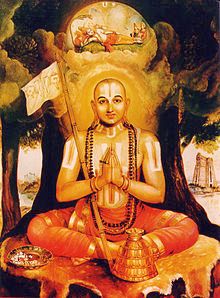
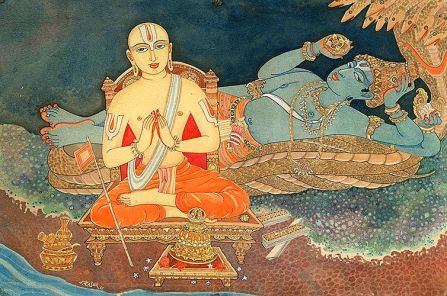
Ramanuja4

4.2. According to Sri Ramanuja’s account, Bodhayana took Para Brahman, the Supreme Brahman, as the absolute principle. And, in Bodhayana’s view Brahman is identical with Lord (Isha), the Supreme Lord (Parameshwara).It is the source, the womb of all matter (bhuta yoni). Thus, Brahman, besides being the personified God, is also the cause (sarva-vikara-karana) from which everything evolves (parinama paksha). It is also the Atman of all things; the God that dwells within everything (sarva-bhutha-antaratman), controlling and directing them. Sri Ramanuja extended it further; and said that Brahman has all the spiritual and physical existence as his body.

Bodhayana, however, does not seem to attribute Brahman with a body (vigrahavat). But, somehow, he appeared to believe in the Upanishad description of Brahman with four feet (chatush paada).It is not clear in which sense he understood it.

5.1. As regards the individual self (Jiva) , Bodhayana thought that it has two aspects. One is the gross body (sthulam sariram) which we experience ordinarily, and which perishes at its death.  And the other is the subtle body (sukshmam sariram) composed of extremely fine elements, and which is not visible to naked eye. At the death of the physical body, the subtle body that was hitherto enwrapped in it moves and eventually sets up the next gross body. That is to say, sukshmam sariram is the seed of the body that manifests. Thus, subtle body is un-manifest (a-vyakta), while the gross body is manifest (vyakta).

5.2.According to Bodhayana, in state of deep sleep the individual self is united with Brahman as existence, Sat; and, on waking it gets separated. This seems nearer to the explanation offered by Uddalaka Aruni (Chandogya Upanishad: 6.8.1), and to the Brahma Sutra.

6.1. Bodhayana believed that the state of ‘bondage and final release (bandha –moksha) ’is more aptly related to the subtle body, and to its activities. And, therefore, the subtle body is superior (para) to the embodied self (sarira) which is ‘feeble in power’ (tanumahiman). This, in a way, is closer to the Samkhya view of Purusha; but, it markedly differed from the view taken by Brahma sutra.

6.2. As for the final release, Bodhayana believed that the individual self eventually unites with Brahman.  But, the release comes in stages. And, even after full release (Moksha), the individual self retains its identity but without the false sense of ego; and, does not entirely merge with Brahman. And, even after attaining Moksha, it does not acquire the power to create, to preserve and to withdraw the manifest world. Therefore, even in the state of final release, the individual self and the Supreme self are not entirely identical.

Following that, Sri Ramanuja explained Moksha as a state of blessedness in the company of the Highest Being (Paramatman). Sri Ramanuja emphasized the importance of Bhakthi, absolute devotion, and Parapatti complete surrender to the will of the Supreme, making oneself worthy of His grace, as the best means to attain salvation.

7.1. Sri Sankara and Sri Ramanuja apart from their doctrinal differences on the question of Duality and Non-duality also seemed to differ in their approach to Brahma Sutra and in treatment of the Purva and Uttara Mimamsa of the Vedanta School.

7.2. At the outset, it seems   Sri Ramanuja treated the Brahma Sutra as the basic text and interpreted it in the light of the comments and explanations offered in the Vritti of Bodhayana, other Vrttikaras, Vakyakaras and the revered Masters of his tradition (Purva-charyas).  He also seemed to support the view that the Purva and Uttara Mimamsa together formed one text. And that he believed in the coordinated union of Jana and Karma. Sri Ramanuja is said to be   much closer to the Brahma Sutras in its literal interpretation.

divider1

The approach of Sri Sankara

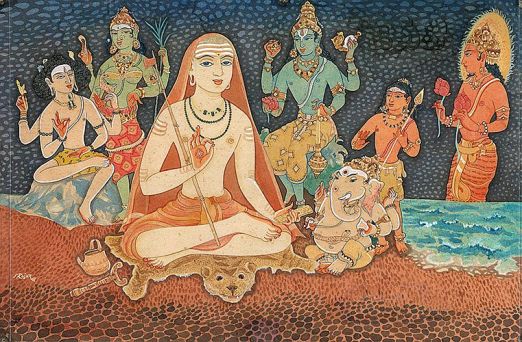
Shankarar - Smarta Tradition Deities

The approach of Sri Sankara to the Upanishads in general and to the Brahma Sutra in particular presents a very interesting and a striking contrast.

8.1. Upanishads

(a) Sri Sankara regards himself as the votary of Upanishads (Aupanishada).He even calls his way of thinking or the doctrine as Aupanishadam Darshanam, the Upanishad System. He defines the Upanishads as the texts that lead the aspirants close to the highest reality. He said, the primary meaning of the word Upanishad was knowledge, while the secondary meaning was the text itself.

He insists Upanishads constitute the final purpose and the import of the Vedic lore; and that is the reason he chose to write commentaries on the Upanishads and on the other two texts that depend almost entirely on the Upanishads – Badarayana’s Brahma Sutra and the Bhagavad Gita. While doing so, he isolates Upanishad portion of the Vedic lore from the rest and narrows down the scriptural authority to ten or twelve ancient Upanishads.

(b) According to him, the goal held out by the Upanishad tradition is liberation (Moksha) from worldly involvements. Sri Sankara described himself as Moksha-vadin (Sarvesham Mokshavadi – nama-abhyupagam- VSB: 2.1.11; and, Sarve Mokshavadi abhirbhyupa gamyate: VSB: 1.1.4)

(c) Sri Sankara strongly advocated study of Upanishads; and at the same time cautioned that study of Upanishad alone would not lead to Moksha. He also recognized that the study of Upanishads is not absolutely necessary or is it a pre-condition for attainment of Moksha. The function of knowledge as expounded in the Upanishads, he said, is the removal of obstacles; but, it has its own limitations.

As regards the limitations of textual knowledge, he explained: Moksha is not the fruit or the effect of knowledge (jnana). Liberation being identical with Brahman is ever present, eternal and is beyond the subject-object relations. So long as such distinctions  of subject –object, the knower and the known  are maintained there can be no experience of non-distinction or oneness of Reality. The texts can only contribute to causing the discovery of truth; leaving the truth to assert itself (svapramanya).

Sri Sankara declares the supremacy of direct experience, the final proof (antya-pramanam) which he calls – anubhava, avagati or Brahmavagati. Regarded in its true essence and as it is, Atmaikatva, Brahmatvatva, or Sarvatmata is a self-conscious, self-radiant experience which cannot be taken as object (vishaya). He also says that Vedic authority is not binding after one attains the goal

(d)  He pointed out; even those who were outside the Upanishad fold were as eligible to Moksha as those within the fold were. He declared that all beings are Brahman, and therefore the question of discrimination did not arise. All that one was required to do was to get rid of Avidya (duality).

8.2. Mimamsa

(a) As regards the Mimamsa, Sri Sankara’s basic position was that the Mimamsa Sutra which commences with the statement Atato Dhrama jijnasa is quite separate from the Brahma Sutra commencing with Atato Brahmajijnasa.  Sri Sankara’s Shatra-aramba refers to the beginning of the Brahma sutra; and not to Mimamsa that covered both Purva and Uttara. He does not use the terms Purva Mimamsa or Uttara -Mimamsa.  He preferred to present his commentary as Vedanta-mimamsa.

 Sri Sankara did not seem to regard Brahma Sutra as a latter part of the same text. He regards Brahma Sutra as a separate shastra (prathak-shastra), distinct  from Purva Mimamsa.  He maintained that the two systems are addressed to different class of persons.

Purva Mimamsa which deals with Karma-kanda consists injunctions to act in order to achieve certain results. But, he argues, liberation is not a product or a thing to be achieved.

And, Jnana-kanda, in contrast, is about Brahman that already exists; it pertains to the ultimate purpose which is true knowledge of Self, and it is addressed to one who is intent on liberation.  

 Each section of Veda is valid in its own sphere; but, the two sections cannot logically be bound together.

(c) He said The two texts are distinguishable in four ways: Vishaya (subject); Adhikara (qualifications for the aspirant); Phala (end result or the objective) ; and, Sambhanda ( related-ness) .

: – Vishaya: the subject matter of  Karma-kanda is Dharma which is understood by it as ritual-action. Mimasakas hold the view that the real purport of the scriptures was to provide injunctions (vidhi) and prohibitions (nishedha) . The scriptural injunctions regarding rituals  are treated as mandatory;  while  the texts that relate to wisdom as  spill – over (sesha).

Sri Sankara said, the subject of Jnana-kanda is Brahman. And, knowing Brahman, he asserted , is the real purpose of all  scriptures.  Sri Sankara averred the true intent of the scriptures was to describe the Reality as it is. Sri Sankara rejected the Mimamsa view and argued that scripture were not mandatory in character, at least where it concerned pursuit of wisdom. Upanishads, he remarked, dealt with Brahman and that Brahman could not be a subject matter (Vishaya) of injunction and prohibitions.

 : – Adhikara: Aspirant in the Karma-kanda has limited ambitions; and, is yet to understand the limitations of the results achieved by Karman.  The aspirant of the Jnana-kanda, however, is well aware of the limits of the results achieved by Karman; and, there about fore , seeks the limitless Brahman.

Sri Sankara mentions fourfold Adhikara or qualifications of  an ardent student of Vedanta : Nitya-anitya-vastu- viveka (capacity to discriminate the real from the transitory); Vairagya (Dispassion); Samadi Shatka Sampatti (Six virtues of the mind : Sama-equanimity; Dama-control over senses including mind; Uparama -observing one’s Svadharma; Titiksha – patience, forbearance; Samadhanam– profound absorption or contemplation;  and , Shraddha – absolute  faith or devotion).

: – Phala: Karma-kanda aspires for worldly prosperity and heavenly pleasures. The aim of Jnana-kanda, he said, is liberation (Moksha). Further, he pointed out that Brahma Sutra says (3.5.36-37) even those who do not perform rituals are qualified to gain knowledge.

In Sri Sankara’s view the passages in the Karma –kanda informs us of the approved means for attaining desirable and yet unaccomplished ends. The Upanishads (jnana-kanda), on the other hand, reveal to us knowledge of the ever present entity – Brahman.

He pointed out that rituals could in no way bring about wisdom, much less Moksha.. He asserted, while the rewards (phala) of the rituals were not matter of direct experience, wisdom which is the fruit of Vedanta is based on immediate and personal experience; one need not have to wait for the reward nor one be in doubt whether the reward would or would not come.

This was in sharp contrast to the position taken by Mimamsakas who believed that rituals alone would lead one to higher levels of attainment. Further, the deities would reward only those entitled to perform the rituals alone. The entitlement involved the caste, creed and other parameters.

: – Sambandha: Karma-kanda informs of the ends not yet in existence; but is yet to be achieved. The realization of such ends depends upon following the appropriate action as prescribed. 

The subject of Jnana-kanda is that which is eternal without a beginning or end. The knowledge of Brahman is end itself, where there is an identity of the revealed object (Sadhya) and the means of revelation (Sadhana) . Jnana-kanda is fulfillment; Karma –kanda is impetus to act more and more.

8.3. the Brahma Sutras,

Sri Sankara held the Brahma Sutra in very high regard; and yet, he does not take them as the original or independent texts equal in authority to the Upanishads. He takes the Brahma Sutras as expository or highly abridged indicators to the crucial passages from Upanishads. He claims that Badarayana’s text is in fact a summary of the philosophy of Upanishads. The philosophy of Brahma Sutra is indeed the philosophy of the Upanishads.

Sri Sankara undertakes to interpret Badarayana’s Brahma Sutra not as in end by itself, but in order to expound through it what he understood as the philosophy of Upanishads. He asserts they are not his own; but, are the true and proper import of the Vedic texts as   held and nurtured by the tradition to which he belongs. It is only that he is re-stating them and putting forth a little more clearly.

The Sutras of Badarayana according to Sri Sankara have one purpose; that is to string together the flowers (cardinal themes) of Vedanta Akyas (sentences) – Vedanta –akya-kusumagratanat vat sutranam (BB .1.1.2)

It was the words and the ideas of the Upanishad texts that, primarily, guided Sri Sankara and not the Sutras per se. This did not mean an encroachment upon the authority of Badarayana whom he revered as Bhagavan; but, it was only to bring out his intentions more clearly. 

For Sri Sankara, the Brahma Sutras derive their authority from the original Upanishads; and, therefore the meaning of the Sutras will have to be understood and interpreted in the light of the Upanishad texts. And at places , Sankara’s interpretations seem to be far-fetched This is in contrast to Sri Ramanuja’s approach that followed the Vrttis of Bodhayana and other Acharyas, the Masters of his tradition. Sri Ramanuja was much closer to Brahma Sutras in its literal interpretation.

***

9.1. The overview seems to be that the Brahma Sutras are open to multiple interpretations; and, each interpretation is valid in its own context.

draft_lens19135557module156995806photo_1329348026aa-aa-a-

Sources and References

  1. A History of Early Vedanta Philosophy, Part 2 by Prof. Hajime Nakamura
  2. Sri Sankara and Adhyasa-Bhashya by Prof. S. K. Ramachandra Rao (2002)
  3. Brahma Sutras According to Sri Sankara by Swami Vireswarananda

 http://www.wisdomlib.org/hinduism/book/brahma-sutras/d/doc62756.html

  1. Spiritual Freedom in the Brahma Sutras by Carol Pitts, Les Morgan
  2. The Vedanta Philosophy of Sankaracharya: Crest-Jewel of Wisdom, Atma BodhaBy Charles Johnston
  3. The Vedanta-sutras with the Sri-bhashya of Ramanujacharya;translated into English by M. Rangacharya, andM. B. Varadaraja Aiyangar; Volume I; published by the Brahmavidin Press.; 1899

http://www.yousigma.com/biographies/vedasutraswithsribhashya.pdf

 
Leave a comment

Posted by on October 6, 2015 in Bodhayana-Upavarsha


Tags: , , , , , , , , , , , , , , , ,

Bodhayana the Vrttikara – Part Two

Continued from Part One

 Bodhayana the Vrttikara

1.1. It is said ; Bodhayana the Vrttikara had written commentaries on   all the twenty parts of Mimamsa, covering both the Purva and Uttara Mimamsa.  It is also said that his commentary on Brahma Sutra (Brahma–sutra Vrtti), in particular, was quite detailed. Since the commentaries covered both karma and Jnana kanda-s, Bodhayana was respected as an adept in both aspects of Mimamsa.

1.2. Bodhayana is regarded amongst the early commentator on Brahma Sutra; and one who came to be recognized as an authority by generations of commentators that followed him. His commentary profoundly influenced the followers of his doctrine.

1.3. All the works ascribed to Bodhayana are dispersed and are lost; and, none is available now. It seems that fragments of his Brahma Sutra Vritti were extant till about the 11th century. But, his commentaries on Mimamsa Sutra were lost much earlier; and , had passed out of existence by the time of Kumarila Bhatta (Ca. 700 A D).

2.1. As Sri Ramanuja (1017–1137 A D) was preparing to write his Bhashya (detailed commentary) on the Brahma Sutras, he wished to consult the Brahma–Sutra-Vrtti of Bodhayana. The text ascribed to Bodhayana had the reputation of being the most authoritative explanation of the Brahma Sutras, based in a philosophy of theism, which was also the way Sri Ramanuja understood the Upanishads. But, the work of Bodhayana was not available anywhere in South India. It seems that even Sri Yamunacharya the predecessor of Ramanuja had not seen a copy of Bodhayana Vrtti.

2.2. When he learnt that fragments of Bodhayana’s Brahma-Sutra-Vrtti were available in Kashmir, Sri Ramanuja , who by then was past sixty years of age, set out on a long and an hazardous journey, with a small band of disciples; starting from Sri Rangam in deep South to Srinagar up North in the foothills of the Himalayas, a straight-distance of more than 3, 300 KMs. But, the route taken by Sri Ramanuja and his disciples was much circuitous. They are said to have traveled up from the western coastal belt of India to the eastern regions of Puri,  Kasi, Naimish-aranya, Varanasi,  Salagrama in Nepal;  then West to Dwaraka, Pushkaram , on to Bhatti (near Lahore) and finally into the Himalayan districts of Kashmir valley.

2.3. It is said; once in Srinagar (Kashmir) Sri Ramanuja had considerable difficulty in tracing the copy of Bodhayana’s Vrtti. It was finally located in the State Library. But, the Library authorities allowed him to read it within the premises of the Library; and, they did not permit him to take the fragmented old text out of the Library. Then, it is said, Sri Ramanuja’s   disciple Sri Kuresa (Kurattalvan or Srivatsanka Misra) gifted with remarkable memory-power memorized the complete text of Bhodayana’s Brahma Sutra Vrtti written in the ancient document.

2.4. Obviously, what Sri Ramanuja read and what Sri Kuresa memorized was the abridged (Sanskiptha) version of Bodhayana Vrtti. And, Sri Ramanuja based his commentary of Brahma Sutra (Sri Bhashya) on the explanations given in that abridged version.

Ramanuja 2

3.1. In the opening verse of Sri Bhashya, Sri Ramanuja says:  ‘The previous Masters have abridged (purvacharyah samskipuh) the detailed commentary on Brahma sutra which had been composed by Bhagavad Bodhayana (Bhagavad Bhodayana kritam vistirnam Brahma-sutra – vrttim). The words of the Sutra will be explained (sutraksarani vyakhyasyante) in accordance with their views and traditions (tan-mata-anusarena).

Bhagavad Bhodayana kritam vistirnam Brahma-sutra – vrttim purvacharyah samskipuh I tan-mata-anusarena sutraksarani vyakhyasyante II

3.2. Apart from the excerpts quoted by Sri Ramanuja nothing else of Bodhayana Vrtti is extant today. The Bodhayana Vrtti or what has remained of it, is traditionally respected by the followers of Sri Ramanuja. And, their tradition regards Bodhayana as second only to the author of Brahma Sutra (Badarayana).

3.3. In the Sri Bhashya of Sri Ramanuja, Bodhayana is generally addressed as Vrttikara, the commentator. Sri Ramanuja quoted seven comments / explanations of the Vrttikara Bodhayana; and, these are his only words that have survived.  Even though those fragments are few in number, each of them expresses a special point of Bodhayana’s thought.

3.4. As regards the Purva-charyas, the elders of his tradition, who are said to have abridged (purvacharyah samskipuh) the detailed commentary on Brahma sutra which had been composed by Bhagavad Bodhayana (Bhagavad Bhodayana kritam vistirnam Brahma-sutra – vrttim), we do not know exactly who they were. But, in another context Sri Ramanuja mentions the Purva-charyas of his tradition. It is not clear whether the two sets of Purva-charyas were the same or were different.

Purva-charyas

4.1. In his Vedartha-samgraha,(93) Sri Ramanuja mentions the names of six teachers of Vedanta who are said to have expounded the philosophy akin to Vishishta-advaita :

1. Bodhayana; 2. Tanka; 3. Dramida; 4. Guhadeva; 5. Kapardi; and, 6. Bharuci.

Bhagavad Bodhayana- Tanaka- Dramida- Guhadeva- Kapardi – Baruchi – prabhrty- avigita-sista- parigrahita-puratana – Veda-Vedanta- vyakhyana-suvyaktar-thasrutinikaranidarshito-yam- panthah I

This path is declared in many Srutis, whose meaning has been made very clear by the ancient commentators on Veda and Vedanta, accepted by Masters such as Bhagavad Bodhayana- Tanaka- Dramida- Guhadeva- Kapardi – Baruchi, who have never advocated heretical teachings.

4.2. Sri Ramanuja acknowledges these six teachers as ancient authorities whose views are acceptable to him. And, in particular, he quotes quite often from the works ascribed to Tanaka and Dramida.

4.3. After mentioning that his own explanations of the Brahma Sutras would be in accordance with the interpretations provided by these ancient teachers, Sri Ramanuja commences his Sri Bhashya with the discussion on the first Sutra of the Brahma Sutra: Atato Brahma jignasaha. Thereafter, the words of the Sutra are taken up, one after the other, for examination of their context, meaning and grammar. He then gives the Vakyartha of the Sutra, the meaning that is conveyed by the Sutra as a whole. And, then he delves into the philosophical interpretations of the Sutras in accordance with the views of these ancient teachers of his tradition.

4.4. But, very little is known about these ancient seers. And, sadly, their works too have not survived. Though their names are recited by Sri Yamuna and Sri Ramanuja we do not know the Acharya-paramapara between these Masters named as Purva-charyas.

5.1. Before coming back to Bodhayana the Vrttikara, let’s try to find what little is known about the Purva-charyas of Sri Ramanuja’s tradition.

Tanaka

Tanaka also known as Brahmanandin or Nandin is described as Atreya or Atrivamsiya (descendent of Sage Atri). He is usually referred to with the epithet Vakyakara, the author. Tanaka, well versed in the field of Vedanta, is said to have written commentaries on both the Chandogya Upanishad and the Brahma-sutras. All his works are lost. But his sayings are quoted by the later scholars.  His time is estimated to be around 550 AD; which is, after Bodhayana, but before Dramida, Brhatprapancha and Sri Sankara.

At the beginning of his commentary (Sribhashya) on the Brahma Sutra, Sri Ramanuja explains meditation (Dhyana) taught in the Upanishads as an un-interrupted continuous stream of thought or remembrance (Smrti) like a stream of poured out oil. Then he quotes the Vakyakara (Tanaka) :

Knowledge (Vedana) which is the means to release is worship (Upasana).  When carrying out the Upasana, the object of meditation should be Brahman with attributes, endowed with many virtues.  In order to complete the Prajna based meditation, cleansing of the body and mind is necessary. For this, seven types of preparations are prescribed. The meditation on Brahman, with these preparations, the attainment of emancipation is made possible.

And, he goes on to say that the worship should be continuous. Having explained that, he   says that   in order to gain knowledge one must perform throughout one’s life the various actions (Karma) prescribed in the scriptures.

 Hence, Tanaka emphasized the union of knowledge and action, which later came to be known as: Jnana-karma-samucchaya-vada.  He was opposed to the notion of instantaneous enlightenment.

In Tanaka’s work the relationship between Brahman and the phenomenal world is likened to that between the ocean and its foam. Sri Ramanuja states that Tanaka puts forth Parinama-vada and explains the phenomenal world arising out of Brahman like Dadhi (coagulated milk) from milk.

If we can try to summarize Tanaka’s views :

Brahman is the Atman of all and everything is pervaded by Brahman; That which exists in the space within the heart, the golden person seen in the eye and so on which are discussed in the Upanishads refer to Brahman. Its essence is pure consciousness Prajna. It is eternal and has a form which is beyond the senses; yet, it resides in everything and controls the desires of all the deities and beings. Thus, Tanaka, it seems, held that each of the individual selves corresponds to the body of Brahman.

Dravida

Dravida (also Dramida) is respectfully referred to as Dramidacharya, the Bhashyakara or Bhashyakrt, the commentator par excellence. His views are often cited by Sri Ramanuja in Sribhashya and in Vedarthasamgraha. Dravida is said to have written a commentary on Brahma Sutra as also commentaries on Chandogya Upanishad and Mandukya Upanishad. Dravida was later than Tanaka, as Dramida is said to have written a Bhashya on the Vakyas of Tanaka (Brahmanandi – virachitam vakyanam sutra-rupanam bhashyakarta Dravidacharyo api).

Sri Sankara also cites Dravida as an authority at the beginning of his commentary on Chandogya Upanishad (3.10).

It is said; Dravida explained Brahman as the absolute principle, creator of the universe (Visva-srj); as the Supreme Divinity (Para-devata) having internal attributes (Antarguna); and, as Lord of the world (Lokeshvara) who creates the phenomenal world and regulates all the worlds.

Dravida did not seem to make a distinction between Brahman and Isvara. Brahman or Isvara’s relation to the universe is compared to that of a King with his Kingdom. The theistic doctrine of liberation is presented on the basis of relation between the Lord and the individual self.

According to Dravida the Highest Self and individual self belong to the same genus (Jati) just as the sparks coming out of the fire but are not identical.

The individual self purified from all taints by performing meditation is liberated by the grace of the Lord; and then attains union with the Lord. The liberation according to Dravida is that the individual self residing in peace with the Highest Self; and that is granted by the grace of the Lord.

And, while it is with the Lord, the individual self still retains its identity as before. Though it is in union with the Highest Self, it does not possess the powers of creation, sustenance and dissolution. On this point Tanaka and Dravida are one; and it is close to the doctrine of Sri Ramanuja.

Bharuchi

Bharuchi (Baruchi) said to be an ancient scholar on Vedanta. Traditionally, he is placed before Dramidacharya. He is said to have held the view that Samkhya and Yoga as two systems that complement each other. Bharuchi, it seems, also advocated combination of knowledge (Jnana) and action (Karma)- Jnana-karma-samucchaya . Sri Ramanuja held Bharuchi in high esteem; but, does not explicitly quote any of his views.

Bharuchi is also recognized as an author or a commentator on Dharmasatra. He is said to have written a commentary on certain chapters (first four chapters, parts of chapter 5 and verses of later chapters) of Manusmrti. He is also credited with commentary on Vishnudharmasutra. Bharuchi is mentioned as an authority   in Vijnaneshvara’s Mithakshara on Yajnavalkya-smrti ; and, in Sri Madhvacharya’s Tika on Parasara-samhita. One of his quotations also occurs in the commentary composed on the Apastamba Grhyasutra by Sudarshana Suri, a teacher of Visishtadvaita Vedanta.

However, none of his works on Vedanta has survived. Vishal Agarwal, a noted scholar, has attempted to reconstruct Bharuci’s views on Vedanta issues as gleamed from the comments on certain verses of Manusmrti.  According to that:

(a) Bharuchi appeared to have believed in the combination of action and knowledge as essential for salvation. Bharuchi says: in all the stages of life, combination of knowledge and action is to be known as the means of attaining Brahmaloka. Performing rites such as Agnihotra, regularly all through one’s life is obligatory no matter whether one takes Sanyasa or not.

(b) Bharuchi seemed to believe in a distinction between Jivas and Brahman. Bharuchi supports the Samkhya doctrine of duality of Purusha and Pradhana.

 (c) Bharuchi appears to believe that the soul is ‘nirguna’ in the sense that it does not have Gunas such as: sattva, rajas and tamas. However, Bharuchi believes in the duality of souls and matter in the effected world.

And

(d): Bharuchi refers to the distinction between dualists and non-dualists amongst Vedantins.

In summary, it appears that Bharuchi’s Vedantic views resembled those of Sri Ramanuja, Bhaskara Bhatta and other non-Advaitins, more than they resembled the views of Advaita Vedanta.

[For more, please check:

http://vishalagarwal.bharatvani.org/articles/acharyas/Bharuchi/index.htm ]

Guhadeva

Guhadeva and Kapardin were said to be ancient Vedanta teachers and authors. The two were referred to by Sri Ramanuja as Sista– wise and erudite. But, nothing much is known these scholars; and Sri Ramanuja does not also seem to quote from their works.

As regards Guhadeva, some scholars surmise:  if Guhadeva mentioned by Sri Ramanuja is the same as the ancient scholar Guhasvamin, then it is possible that he could be the one who flourished during the first century B.C.E; and, to whom the commentaries on the Apastamba-shrautasutra and the Taittiraya-aranyaka are attributed.

Kapardin

Kapardin is a peculiar name. It does not seem to be the proper name of the person. It is a descriptive term. Kapardin indicates one who has matted, braided hair or hair twisted into a bun on top (Kapardakapardi)

jatilo mundah smasänagrhasevakah I ugra vratadharo Rudro yogi tripuradärunah II.

Rudra is often addressed as Kapardin (E.g. Ima Rudraya tavase Kapardine – RV.1.114.1 – Rudra with hair knotted like Kaparda , a cowry shell  )   .

And, it seems during the Vedic times some men and women sported braids or plaits of hair. For instance; a woman having four plaits of hair was called Chatush-kapardin; and, the Vasithas wearing their hair in a plait on the right side were known as Dakshinatas – kaparda. [Ref: Vedic Index of Names and Subjects, Volume 1; Volume 5 by Arthur Berriedale Keith]

It is also said; a certain Kapardin (Ca. 800-25 A.D.) assisted a Rashtrakuta Chieftain in extending his rule in the region ; due to which act, the region came to be known in his honor as KapardikaDvipa or KavadiDvipa.  The term Kapardika Dvipa occurs in the inscriptions of the Kadamba Kings who ruled over Goa and Banavasi region of North Karnataka. Some surmise that the name of the strip along the west coast – Konkan, may have derived from Kapardika.

In the context of Vedanta texts, Karpadi might refer to a sage who is said to have written commentaries on the texts of the Taittiriya (Apastamba) Shakha of the Krishna Yajurveda. We do not know if Sri Ramanuja was referring to this Kapardin. In any case nothing much is known about the commentator Kapardin.

divider1

Ramanuja

6.1. As said earlier, even though Bodhayana is quoted only about seven times in Sribhashya, each of those fragments expresses a particular aspect of Bodhayana’s thought. In the Sribhashya, Bodhayana is usually referred to as Vrttikara, the author of the Vrtti.

6.2. In his interpretation of the first sutra of the Brahma sutra (athāto Brahma jijñāsā: BS: 1.1.1), Sri Ramanuja explains: ‘Therefore, the Vrttikara says: immediately after acquiring the knowledge of the rituals, the enquiry into the Brahman is to be undertaken. He later will declare that Karma-Mimamsa and Brahma-Mimamsa together constitute one-body of doctrine (shastra), saying: The Sariraka (that is Brahma sutra) is combined with the sixteen chapters of Jaimini School. It is thus established that the two constitute one body of doctrine”. (Samhitam etac sarirakam Jaiminiyena sodasa-lakshne-neti shastraikatva siddhih)

Bodhayana is quoted to support the interpretation that the two Mimamsas are indeed parts of one text; and to establish the unity of karma and Jnana (Jana-Karma-samucchaya).

***


6.3. Next, Sri Ramanuja takes up a quotation from Vrttikara’s Brahma Sutra Vrtti: Vrttir api “jagad-vyapara-varjam samano jyothisho” iti (Sribhasyha). This passage is taken from Vrttikara’s commentary on Brahma Sutra (4. 4.17).  The Sutra (4.4.17) jagadvyāpāravarjam, prakaraāt, asamnihitatvācca, in effect, says the released soul attains all powers of the Lord (Isvara) except the powers of creation etc.

Sri Ramanuja explains:  The commentary (Vrtti) also says: In the state of final release, the individual self is equal (samano) to the Highest light- jyothisho (Brahman), except for the cosmic actions ( of creation, of maintenance and of dissolution of the universe). (Jagad-vyapara-varjam samano jyothisho)

[A similar explanation is also attributed to Bhashyakara Dramida: Since the emancipated individual self is in union with the Divine, although it has no physical body, like the divine it can accomplish all purposes – “Devata-sayujyad asarirasyapi devatavat sarva-artha-siddhis syat “]

***

6.4. In the Chandogya Upanishad (6.8.1) the philosopher Uddalaka Aruni is said to have taught his son Svetaketu:

“My Dear, understand from me the true nature of sleep. When a person is absorbed in dreamless sleep (svapiti) he is one with the Being (Sat), he has returned to his self (svam apitah), though he knows it not. Therefore, they say of him “he sleeps (svpiti), for he has gone to his self (svam apitah).

Uddalako harunih svetaketum putram uvaca,
svapnantam me, saumya, vijanihiti, yatraitat
purushah svapiti nama, sata, saumya, tada
sampanno bhavati svam apito bhavati, tasmadenam
svapitity-acakshate svam he apito bhavati.

As a tethered bird grows tired of flying about in vain to find a place of rest and settles down at last on its own perch, so the mind, tired of wandering about hither and thither, settles down at last in the Self, dear one, to whom it is bound. All creatures, dear one, have their source in That. That is their home; That is their strength. There is nothing that does not come from That. Of everything That is the inmost Self. That is the truth; the Self supreme. You are That, Svetaketu; you are That.” (Ch.Up.6.8.1-2)”

Sa yatha sakunih sutrena prabaddho disam disam
patit-vanyatrayatanam-alabdhva bandhanam
evopasrayate, evam eva khalu, saumya tan mano
disam disam patit-vanyatrayatanam-alabdhva
pranam evopasrayate prana bandhanam hi, saumya, mana iti.

Sri Ramanuja notes the interpretation of the Vrttikara on this passage of the Chandogya Upanishad (6.8.1) at 1.1.10 of Sribhashya:

Therefore, the Vrttikara (meaning Bodhayana) says (tad aha Vrttikarah): “The passage, ‘he has become one with the Being (Sat) ‘, is established by the fact that the beings become one with Sat (Being = Brahman) and again are separated from Sat. And the scripture describing deep sleep says. ‘Just as a man embraced by his beloved wife is aware of nothing external or internal, so also this Purusha (the individual self) when embraced by the intelligent-self (Prajna-atman) is aware of nothing external or internal’,”

[tad aha Vrttikarah – ‘sata somya tada sampanno bhavatiti samapt-tasya-samapttibhyam etad adhyavastyate; prajnenatmana samparisvaktah – iti caha’ iti]

***

6.5. In explaining Brahma Sutra (1.2.1) [Savatra-prasiddhopadesat, – the being which consists of mind is Sat (Brahman)] Sri Ramanuja says that the famous sage Shandilya in Chandogya Upanishad (3.14) teaches not the individual self, but the highest Self. He then quotes the Vrttikara, who says: “And all this is indeed Brahman. Brahman the self of all is the Lord (Isha).” (Sarvam khilva iti sarvatma brahmesah)

[A similar statement is attributed to Vakyakara Tanaka: All beings are achieved by Atman – Aymety eva tu grhniyat sarvasya tannispatter iti.  The realization that Atman is identical with Brahman will destroy all bondages together with its causes.]

***

6.6. While commenting on the famous passage in Chandogya Upanishad (7.24.1)yatra na anyat pashyati, na anyah srunoti, na anyath vijananathi sa Bhumah – which declares “where one sees nothing else; hears nothing else; cognizes nothing else, that is the infinite (Brahman). But, where one sees something else; hears something else; cognizes something else, that is small (finite)”, Sri Ramanuja (BS: 1.3.7) explains that ‘Infinite Bhuma’ here is the Supreme Self; and is not the individual self.

Yatra nanyat pasyati nanyac-chrnoti nanyadvijanati sa bhuma, atha yatranyat pasyati anyacchrnoti anyadvijanati tad-alpam; yo vai bhuma tadamrtam,
atha yadalpam tan-martyam, sa, bhagavah, kasmin pratisthita iti, sve mahimni, yadi  va na mahimniti.

 In support of explanation, Sri Ramanuja quotes the Vrttikara, who says: “that infinite Bhuma, which Chandogya declares, is the highest Brahman. First, the name is mentioned then a series up to the infinite, and then the Atman is taught”

(Bhuma tu eveti bhumaparam Brahma, namadi paramparayati-mana urdhvam asyopadeshat) 

***

6.7. In regard to the honey-doctrine (madhu vidya) which occurs in the third Book of Chandogya Upanishad (3. 1-5)  Sri Ramanuja comments (BS: 1.3.32) : This is a teaching that one who meditates in accordance with the doctrine becomes the god Vasu, the god Aditya  and the others; and, he ultimately can reach Brahman. Though it might seem like meditation on the forms of sun, its real meaning is to meditate on those forms leading to meditation on Brahman”.

Then, he quotes the Vrttikara who says: “It is Brahman that has to be meditated upon in regard to all things. Verily, this applies to Madhu Vidya also” (tad aha Vrttikarah – ‘asti hi madhu vidyeshu sambhavo Brahmana eva sarvatra nicayyatvat iti’)

The import of the Vrttikara’s comment is understood to be that the various forms of worship taught in the Upanishads are truly directing towards meditation on Brahman (Asti hi madhu vidyeshu sambhavo Brahmana eva sarvatra nicayyatvati)

divider1

7.1. The above seven quotations are the only ones from the Vrttikara in Sri Ramanuja’s Sri Bhashya.

 [The views of a certain Vrttikara are also cited in Sri Sankara’s Brahma-sutra-bhashya, but they are presented as the ‘other’ or the opposing view

It is generally believed that the Vrttikara whom Sri Sankara rejects and the Vrttikara that Sri Ramanuja accepts is the same person, despite lack of definite proof.

However, the problem arises when the views of the Vrttikara as rejected by Sri Sankara are not the same as quoted by Sri Ramanuja. ]

8.1. In the next part let’s try to reconstruct Bodhayana’s thoughts or philosophical outlook based on his comments/explanations as quoted in Sribhashya of Sri Ramanuja.

sricharana

lotus

Continued

In the

Next Part

Sources and References

  1. 1. A History of Early Vedānta Philosophy, Volume 2; by Hajime Nakamura
  2. The Vedanta-sutras with the Sri-bhashya of Ramanujacharya; translated into English by M. Rangacharya, and M. B. Varadaraja Aiyangar; Volume I; published by the Brahmavidin Press.; 1899
  3. http://www.yousigma.com/biographies/vedasutraswithsribhashya.pdf
  4. The Vedanta−sutras with Ramanuja’s Sribhashya – Translated by George Thibaut

  5. All images are from Internet
 
Leave a comment

Posted by on October 1, 2015 in Bodhayana-Upavarsha


Tags: , , , , , , , , , , , , , , , , , , ,

Bodhayana , the Vrttikara – Part One

Baudhayana- Bodhayana

1.1. Baudhayana is a very celebrated name in the long line of scholars of very ancient India. There have been many eminent persons in various fields of study going by the name of Baudhayana. It is also said that Bodhayana is the Southern form of Baudhayana. Further, the name Baudhayana itself stands for ‘descendent of Budha or Bodha’.

1.2. To start with, there is a single reference to one Jara-Bodha in the Rig Veda:

Jara-bodha tad vividdhi vise-vise yagniyaya stoman rudraya   drisikam (RV 1.27.10).

Here, he is praised as a hero of high knowledge and wide fame; and, one who awakens others.  The term Bodha is also used in the sense of illumination, awakening. Thus, it is deduced that the name Jara Bodha (Bodha the elder)   might refer to a sage who was alert even in his ripe old age. And as an adjective, Jara Bodha gives the meaning ‘attending to the invocation’.

1.3. Bodha is also the name of a Risi in the Mantra Patha (2. 16, 14). And, Baudhi-putra is the name of  ‘son of a female descendant of Bodha’. He is mentioned in the last Vamsa (list of teachers) of Madhyamdina recession of the Brihadaranyaka Upanishad (6. 4, 31) as the pupil of the Rishi Salankayaniputra.

1.4. There is also mention of Prati-Bodha along with Bodha in two passages of the Atharvaveda,

(ṛṣī Bodha-Pratībodhāv asvapno yaś ca jāgṛviḥAV: 5.30.10; and

Bodhaś ca tvā Prati-bodhaś ca rakṣatām asvapnaś ca tvānavadrāṇaś ca rakṣatām |- AV.8.1.3).

Prati-Bodha, it is said, refers to a Rishi possessing  ‘mystic intelligence’.

Kena Upanishad (Section 2.4 ) states that one attains the realization (matam) the Oneness  of all that permeates and pervades the whole of existence by the inner awakening , a kind of intuition or  reflective perception (pratibodha-viditam matam ).

Pratibodha-viditam matam amrtatvam hi vindate I Atmana vindate viryam vidyaya vindate amrtam /4/

The names Bodha and Prati- Bodha obviously refer to persons having alert, watchful mind and a sort of intuition.

1.5. And, there is also a Prati-Bodha-Putra who is said to be the son of a female descendent of Prati Bodha. She is mentioned as a teacher in the Aitareya Aranyaka (3 1, 5) and Sankyayana Aranyaka (7.14)

atha ha smāsya putra āha madhyamaḥ prātiyodhīputro magadhavāsī pūrvam evākṣaraṃ pūrvarūpam uttaram uttararūpam  .

1.6. Further, Mahabharata mentions a certain Bodha Piṅgala , who appears as Adhvaryu-priest of King Janamejaya-(brahmābhavac chārṅgaravo adhvaryur  bodhapiṅgalaḥ – M.Bh. 01,048.006). Some believe that this Bodha Piṅgala might refer to Baudhayana , the originator of  the Baudheya shakha of the Shukla yajurveda. 

Baudhayana-s as Sutrakara-s

2.1. In the later Vedic literature, there are references to Baudhayana as the earliest of the Sutrakaras; his successors being Bharadwaja, Apastamba and Hiranyakeshin.

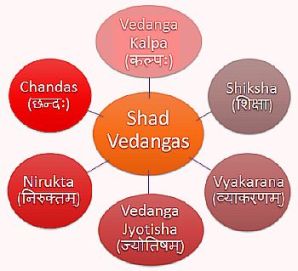
2.2. In the development of Vedic lore, the Vedanga-s (the limbs of the Vedas) play a very important role. There are six Angas or explanatory limbs, to the Vedas: the Siksha and Vyakarana of Panini; the Chhandas of Pingalacharya; the Nirukta of Yaska Charya; the Jyotisha of Garga; and, the Kalpas authored by various Rishis.

vedangas

Regarding the Kalpa, each of the four divisions of the Vedas has its own special Kalpa Sutra.  They are meant to guide the daily life and conduct of those affiliated to its division.

These manuals became a necessity when the procedures of the rituals became rather too complicated  to ordinarily follow.  Āśvalāyana, therefore, says ‘Kalpas were written by teachers like Śaunaka and others, in view of the limitations of man’s ability’

(tatra-puruṣa-aśakti-parihāram upalakṣya śaunakādibhir ācāryaiḥ kalpaḥ praṇītāḥ- Āśv. ŚS. I.1.1)

2.3. There are several Schools and traditions of Kalpa Sutras; and are ascribed to various Rishis. Among the Kalpa Sutras, the Asvalayana, Sankhyana and the Sambhavya belong to the Rig-Veda. The Mashaka, Latyayana, Drahyayana, Gobhila and Khadirai belong to the Sama-Veda. The Katyayana and Paraskara belong to the Sukla Yajur-Veda. The Apastamba, Hiranyakeshi, Bodhayana, Bharadvaja, Manava, Vaikhanasa and the Kathaka belong to the Krishna Yajur-Veda. The Vaitana and the Kaushika belong to the Atharva-Veda.

3.1. These Kalpa Sutras are generally divided into three or four divisions: Srauta, Grihya and Dharma; and when it is divided into four divisions, the Sulbha Sutra is included.

Generally, the set of Kalpa Sutra texts include: Grihya-sutra (relating to domestic rituals); Srauta-sutra (relating to formal Yajnas); and, Dharma-sutra (relating to code of conduct, ethics, customs and laws).

 [To put it simply: Kalpa is the method of ritual. The Srauta Sutras which explain the ritual of Yajnas belong to Kalpa. The Srauta is a manual for the benefit of a class of priests designated  as Hotri or Hotar who invoke gods and perform Yajnas. The Sulba Sutras describe the measurements which are necessary for laying out the sacrificial areas. The Grihya Sutras concern with domestic life (the ceremonies from Garbhadhana to Upanayana,, the duties of the three stages (Traivarnika) as Brahmachari and Grihastha, the duties of a teacher, of a pupil, the marriage customs, the Pancha-Maha-Yagna, funeral ceremonies and so many other things that are to be performed by a Grihastha etc ). And, the Dharma Sutras which deal with ethics, customs and laws, also belong to Kalpa.]

3.2. The Sulba-sutra (derived out of the root ‘ Sulb’ meaning ‘ to measure or to mete out’) relates to mathematical calculations involved in construction of Yajna altars (vedi, chiti) , Kamya Agnis (fire places and platforms) ; and , specification of the implements used in Yajna (yajna-ayudha).

For instance , it is said; of the three Agnis maintained by a householder : the Garhapatya is circular; Ahavaniya is square; and Dakshinagni , the sacred fire, is semi circular. However, all the three measure the  same area .

[ For more on the measures involved in the construction of the Vedis, chitis and Agnis etc .,  as also of the bricks used therefor , please check the paper produced by Dr. Sreelatha.]

3.3. Thus, Kalpa sutras by their nature are supplementary texts affiliated to the main division of a Veda.

4.1. The Sulba Sutra needs special mention. The Sulbha sutras are the oldest geometrical treaties which represent in coded form. It represents the much older and traditional Indian mathematics. The Sulba Sutras are considered to date from 800 to 200 BCE. There are four, named after their authors: Baudhayana (800 BCE), Manava (750 BCE), Apastamba (600 BCE), and Katyayana (200 BCE).

[Please check:

http://www-history.mcs.st-andrews.ac.uk/HistTopics/Indian_sulbasutras.html ]

4.2. The oldest among them is said to be Baudhayana Sulbha sutra.  It is believed to have been compiled by or composed by Baudhayana.  Or, more precisely, it belonged to the School of Bodhayana or was compiled by the descendents or followers of Bodhayana. It belongs to Taittiriya Samhita of Krishna Yajurveda; and is the 19th Prashna or Chapter of the Baudhayana Srauta Sutra, the oldest sutra of Taittiriya recession.

Sutras ascribed to Baudhayana

5.1. Apart from Sulba Sutra, the list of sages associated with Srauta, Grihya and Dharma Sutras, includes Baudhayana . He is regarded the earliest of the Sutrakaras; the first to compose the Kalpa Sutras of the Taittiriya Samhita He was followed by Bharadwaja, Apastamba and Hiranyakeshin.

5.2. Thus, the name Bodhayana or Baudhayana (who originally was said to belong to Kanva Shakha of Shukla Yajurveda)  is associated with each of the Kalpa Sutras classified under the Taittiriya Shakha of Krishna Yajurveda. The Sutras ascribed to Baudhayana are six in number: the Srauta Sutra; the Karmanta Sutra; the Dvividha Sutra; the Grihya Sutra; the Dharma Sutra; and the Sulbha Sutra.

Age of the Sutras associated with Baudhayana

6.1. As regards the age of the Sutras associated with Baudhayana:

(a) Among the Srauta Sutras , the Baudhayana Srauta Sutra, the one composed by Baudhayana or his followers,   is considered the oldest. Some say, in all probability, it is older than some of the Brahmanas, such as the Gopatha Brahmana. And, it is regarded as one of the most important texts of the late Vedic period in general. They are among the earliest texts of the sutra genre, perhaps compiled in the 8th to 7th centuries BCE

(b) And, the Baudhayana Grihya Sutra is oldest Sutra of the Taittiriya ;  and,  it mentions  Kanva  Baudhayana  as the maker of the Pravachana  , while it names  Apastamba , Vaikhanasa,  and Satyasadhi  Hiranyakeshin  as   Sutra-karas,  the compilers of Sutras  . Among them, Bodhayana the Pravachana-kara is respected as a teacher par excellence, and as the originator of the whole system of instructions among its followers. Bodhayana the Pravachana-kara is placed above the Sutra-karas, the compilers of the Sutras.

The scholars who have studied the text observe : The Baudhayana Grihya Sutra is one of the longest and most important – and yet, curiously, one of the more neglected – of the codes of domestic ritual. 

Please click here for more on Bodhayana’s Grihya Sutra

**

Further, Prof. Timothy Lubin, in his detailed article “Baudhāyanīya Contributions to Smārta Hinduism” ,identifies some of the Baudhāyana tradition’s contributions to defining the distinctive features of the later Smārta tradition, including (1) the standardization of domestic ceremony (eventually including image worship) through the liberal application of Vedic mantras, the use of the homa as a ritual framing device, and the adaptation of Śrauta procedural rules and patterns; and (2) its formal recognition of the authority of customary norms (ācāra) as an extra-canonical basis for right practice, and in particular the validity of folk practices.

**

(c) Dharma sutras of Gautama, Apastamba, Baudhayana and Vashita are assigned to 600 to 300 BCE.

(d) The Sulbha Sutras of Baudhayana are placed around 800 BCE. It deals with Vedic Geometry and is said to contain the first use of what has come to be known as Pythagorean theorem , quadratic equations ; finding a circle whose area is the same as that of a square (the reverse of squaring the circle); as also the calculation of the square-root of 2 correct to five decimal places; and so on.

[dīrghasyākaayā rajjuh pārśvamānī, tiryadam mānī, cha yatpthagbhute kurutastadubhayā karoti

A rope stretched along the length of the diagonal produces an area which the vertical and horizontal sides make together.]

[Please also check:

http://glimpse2u.weebly.com/baudhayana.html]

https://mysteriesexplored.wordpress.com/2011/08/31/baudhayana-pythagoras-theorem-world-guru-of-mathematics-part-8/ ]

6.2. Thus, the Sutras ascribed to Bodhayana or Baudhayana are spread over long centuries generally accepted as ranging from 800 BCE to 300 BCE. These texts cannot obviously be the works of a single person, but could be the descendents and followers of Baudhayana School or tradition.

[The noted scholar R L Kashyap in his Date of the Rigveda  argues: The Shulba Sūtrā texts of Baudhāyana, Ashvalāyana etc., can be dated 3100-2000 BCE; 1900 BCE is the drying up of Sarasvati and the end of Vedic age. The Vedic civilisation ended, as indicated by the Harappa ruins, due to ecological causes, draughts and desertification. There was no invasion by anyone.]

The other Baudhayana –s

7.1. Away from Baudhayana the Sutrakara, down the line, there were numerous others who went by the name of Baudhayana or Bodhayana. For instance:

(a) A certain Bodhayana makes his appearance in the Mahabharata.  In an interesting episode , Bodhayana a Rishi happens to  meet Krishna in the dead of the night  on the battle field ; and requests Krishna to name after him (Bodhayana)  the Amavasya (no moon night) that occurs one day prior to the normal Amavasya .  On the Bodhayana Amavasya, generally, those who follow Bodhayana Sutras offer oblation (tarpana)  to their  departed ancestors (Pitris) .

(b) Further away from all these, there is a Bodhayana in the 6th -7th century AD. He is said to be the author of a farce or a satirical comedy titled Bhagavadajjukam (The saint-courtesan) which hilariously pictures the confusions and absurd situations that follow when the souls of a hermit and a courtesan get interchanged. The monk and his transformation as a courtesan by the exchange of souls give enough scope for amusement as also to ridicule the hypocrisy  and to  puncture the vanity that shrouds the ‘high society’. The work also exposes the practices of sham mendicants and lampoons the degeneration of the contemporary society.

Bhagavadajjukam of this Bodhayana is one of the earliest farces and it is often clubbed with the Mattavilasa-prahasana of the Pallava King Mahendravarman since both the works are mentioned in the Mamndur inscription of the Pallava ruler.

4PAN1T

Bodhayana the Vrttikara

8.1. But, the present article is not about any of the Baudhayana-s or Bodhayana-s mentioned above. The Bodhayana about whom we are about to discuss is the Bodhayana the Vrttikara. He is the celebrated author of the Vrtti (a short gloss explaining the Sutras  in a little more, extended manner, but not as extensively as a Bhashya, a full blown commentary) on the Brahma-sutras, the guidebook to understanding Vedanta. His Vrtti is of cardinal importance to the history of Sri Vaishnava philosophy.

8.2. Not much is known for certain about Bodhayana, other than his authorship of the Vritti.  However, a tradition holds that Bodhayana was a direct disciple of Vyasa. We do not know that for certain. But, whatever be the case, Bodhayana the Vrttikara was certainly a great teacher of Vedanta; and is always referred to with great respect.

8.3. And, in any case, he was not one among the many Bodhayana-s who were associated with Srauta, Grihya, Dharma and Sulba Sutras which are surmised to range between 800 BCE and 600 BCE. Bodhayana’s Vrtti is a commentary on Badarayana’s Brahma Sutra; and the Brahma Sutra, in turn, is dated around 200 BCE. Some scholars opine that Bodhayana the Vrttikara may have lived in or around the fifth century AD.

Bodhayana- Upavarsha

9.1. There is much debate concerning the relation between Bodhayana and Upavarsha another Vrttikara.   There are even suggestions which make out that Bodhayana and Upavarsha were the names of one and the same person.

[ For more on Upavarsha the Vrttikara , please check:

https://sreenivasaraos.com/2015/09/17/about-upavarsha-part-two/]

(a). A  Vedanta text of a much later period Prapancha-hrdaya mentions that Bodhayana wrote a very detailed commentary titled Krtakoti on  all the twenty parts of Mimamsa, covering both the Purva and Uttara Mimamsa (Mimamsa sutra 12 parts and Samkarshana-kanda 4 parts , all ascribed to Jaimini; together with  the Brahma sutra 4 parts ascribed to Badarayana). It was also said that the commentary on Brahma sutra (Brahma–sutra Vrtti), in particular, was quite detailed. Since the commentary covers both karma and jnana kanda-s, Bodhayana was respected as an adept in both aspects of Mimamsa.

It was said that these three works were unified under a title called Krtakoti. Fearing that the great length of the commentary would cause it to be cast into oblivion, Upavarsha somewhat abridged it.

Tad grantha bahulya –bhayad upekshya kimchid samsksiptam Upavarshena krtam (Prapanchahrdaya .45)

And later, it is said, Devasvamin further abridged Upavarsha’s abridged version.

All these works of Bodhayana are dispersed and lost; and none is available now. Since Sri Ramanuja quoted from Bodhayana’s commentary on Brahma sutra it could be taken that the rare fragments of those texts were extant until his time (11th century). But, his commentaries on Mimamsa sutra were lost much earlier; and had passed out of existence by the time of Kumarila Bhatta (Ca. 700 A D).

According to this version Upavarsha was a successor to Bodhayana.

[That doesn’t look quite plausible since Upavarsha is generally dated around 400 BCE and Bodhayana the Vrttikara is placed around 5th century A D]

(b) . There are versions that identify Bodhayana with Upavarsha.

There are also traditions which recognize Krtakoti as the name of an author. According to Avanti-sundari-katha of Dandin, Krtakoti was the name of Upavarsha who was also known as Bodhayana.   And, also according to Manimekhalai, Krtakoti was a scholar of Mimamsa and was reckoned along with Vyasa and Jaimini. And, in the Sanskrit lexicon Vaijayanti, Krtakoti-kavi is said to be another name of Upavarsha]

(c) Apart from that, some scholars believed that Bodhayana and Upavarsha were the two names of one and the same person; and Bodhayana might have been the Gotra name of Upavarsha.

The great scholar Sri Vedanta Desika (14th century) in his Tattvatika, a commentary on Sri Ramanuja’s Sri Bhashya, identified Bodhayana with Upavarsha.

Vrttikarasya Bodhayanasyiva hi Upavarsha iti syan nama

It is surmised that Sri Vedanta Desika might have come to that conclusion because ‘Bodhayana’ might have been the Gotra of Upavarsha. The other reason could be that the Vedanta scholars frequently referred to a Vrttikara, without, however, mentioning his name. In the process, both Upavarsha and Bodhayana were each addressed as Vrttikara. There might have been a mix-up.

In any case, Sri Vedanta Desika does not cite any authority or a tradition in support of statement.

(d) Sri Ramanuja, who reckons Bodhayana as being the foremost among his Purava-acharya-s (Past Masters of his tradition Viz. Bodhayana, Tanka, Dramida, Guhadeva, Kapardi and Baruchi) does not, anywhere, equate Bodhayana with Upavarsha.

(e) Another reason for not identifying Bodhayana with Upavarsha is the stand taken by their followers on the question of the unity or otherwise of the Mimamsa as a whole.

It is said; Bodhayana laid equal importance of Jnana and Karma Kandas; as   the two together constituted the doctrinal system (Shastraikatva).   He held the view that directly after completing the rituals one should take up the investigation into Brahman, which is the study of Vedanta. His position was coined by the later Vedanta Schools as jnana-karma-samucchaya-vada, the doctrine that synthesizes jnana and karma.  This was also the position taken by Sri Ramanuja in his Sri Bhashya.

Sri Sankara, on the other hand, did not accord much significance to rituals, naturally, tended to differ from Bodhayana.

Bodhayana’s position also meant that Purva and Uttara Mimamsa are two sections of the same text.

But, Sri Sankara’s basic position was that the Mimamsa Sutra which commences with the statement  Atato Dhrama jijnasa is quite separate from the Brahma Sutra commencing with Atato Brahmajijnasa.  Sri Sankara’s Shatra-aramba refers to the beginning of the Brahma sutra; and not to Mimamsa that covered both Purva and UttaraSri Sankara presents his commentary as a sort of Mimamsa by calling it as Vedanta-mimamsa. He does not use the terms Purva Mimamsa or Uttara -Mimamsa. He did not seem to regard Brahma Sutra as a latter part of the same text.

Sri Sankara maintained that the two systems are addressed to different class of persons. Karma-kanda consist injunctions to act in order to achieve certain results. But, liberation is not a product or a thing to be achieved. Jnana-kanda is about Brahman that already exists; it pertains to the ultimate purpose which is true knowledge of Self, and it is addressed to one who is intent on liberation.   Each section of Veda is valid in its own sphere; but, the two sections cannot logically be bound together.

Sri Sankara generally followed the explanations provided by Upavarsha. And, these were not the same as the views attributed to Bodhayana.  Naturally, these led to doctrinal differences between Sri Ramanuja and Sri Sankara.

(e) .Thus, the Advaita School believes that Bodhayana is different from Upavarsha.  That is also quite possible because of the vast time difference between the two. While Upavarsha may belong to about the fourth century BCE, Bodhayana the Vrttikara may have lived in the fifth or the sixth century AD.

It, therefore, seems safe to assume that Upavarsha, Krtakoti and Bodhayana as being three different persons.

In the next part, let’s talk about the thoughts of Bodhayana as reflected in the fragments quoted in Sri Ramanuja’s Sri Bhashya.

Lotus

Continued

 In the

 Next Part

Sources and References

  1. 1. Vedic index of names and subjects II (i912) by Arthur Anthony MacDonnell
  2. 2. A History of Early Vedānta Philosophy, Part 2by Prof. Hajime Nakamura
  3. The Encyclopaedia of Indian Philosophies, Volume 3: Advaita Vedanta Up to … edited by Karl H. Potter
 
6 Comments

Posted by on September 24, 2015 in Bodhayana-Upavarsha


Tags: , , , , , , , , , , , , , , , , , , , , , , ,

About Upavarsha … Part Three

Continued from Part Two


 Upavarsha – Bodhayana

1.1. Sri Sankara, in his commentary on Brahma sutras, adopts a particular way of presentation. On each subject (vishaya), he first gives one interpretation and then follows it up by the other interpretation. It is explained; the first one represents the opposing views (purva-paksha) of ‘others’ (apare); and, it is meant to be rejected.  But, Sri Sankara does not quote the opposing views nor does he mention the name of the opponent. He merely sums up, raises them as the views of ‘others’, and finally dismisses them. Sri Sankara’s own views are presented in the later set of interpretation.

1.2. In contrast, Sri Sankara whenever he refers to the views of Upavarsha not only he mentions the Vrttikara by name but also treats him with great respect, as Bhagavan. Sri Sankara in his Brahma-sutra-bhashya (3.3.53) quotes the views of Upavarsha as being authoritative – ata eva ca bhagavato upavarṣeṇa.  Following his lead, the latter Sub-commentators of Advaita School, Anandajnana and Govindananda, recognize Upavarsha as the most eminent Vrttikara.

1.3. Similarly, in the Mimamsa School also, Sabarasvamin a noted Mimamsaka, in his Bhashya (Sabara bhashya) on the fifth sutra of Mimamsa sutra of Jaimini  –  autpattikas tu śabdasyārthena saṃbandhas tasya jñānam – refers to a Vrttikara prior to his (Sabara’s) time, without, of course, mentioning his name (vṛttikāras tv anyathemaṃ granthaṃ varṇayāṃcakāra tasya nimitta parīṣṭir ity evamādim).

At the same time, in his Bhashya on the same sutra (1.1.5), Sabarasvamin , while explaining the term ‘Gaur’ (atha “gaur” ity atra kaḥ śabdaḥ) refers to Upavarsha by name addressing him with the epithet ‘Bhagavan’ (gakāraukāravisarjanīyā iti bhagavān upavarṭaḥ). It, therefore, seems reasonable to conclude that the Vrttikara referred to by Sabara was not Upavarsha.  And yet; it is not clear who that Vrttikara was.

[An unfortunate feature of the traditional texts is that they do not mention the names of the old teachers-commentators whose opinions are being quoted. Such practice might have been an idiom of a well-understood literary etiquette. But, it has led to needless debates and speculations.  Very often, it is left to a commentator who comes perhaps a century or more later to tell us that (let’s say) Sri Sankara actually meant such-and–such commentator when he said ‘someone ‘or ‘others’. Similar is the position with regard to those commentators that are referred to as ‘Vrttikara ‘or ‘Vakyakara’ without mentioning their names or the titles of their texts.  There is therefore always an element of skepticism associated with such sub-commentaries. ]

1.4. The Advaita scholar, Govindananda in his Ratna-prabha explains that the ‘others’ (apare) referred by Sri Sankara in his Bhashya does actually, stands for the Vrttikara Bodhayana – draṣṭāro baudhāyanādibhiḥ smṛtā ityāha-pratīti.  Another Advaita scholar Anandagiri agrees with this identification.

1.5. The Advaita School, thus, believes that Upavarsha and Bodhayana are two different persons.  And, the other dimension of the debate is that many wonder whether the terms ‘others ‘or ‘some’ truly refer to Bodhayana. That debate is still not concluded.

divider1

Bodhayana

2.1. The mention of Bodhayana in this and similar other contexts give rise to number of questions such as: Who was this Bodhayana? What were his views? Why Bodhayana and Upavarsha are often mentioned in the same breath? Do the names Bodhayana and Upavarsha refer to one and the same person; or they two different persons? And so on.

2.2. Bodhayana is a very celebrated name in the long line of scholars of very ancient India. There have been many eminent persons in various fields of study going by the name of Bodhayana. It is also said that Bodhayana is the southern form of Baudhayana. Further, the name Baudhayana itself stands for ‘descendent of Budha or Bodha’. The linage of Bodhayana stretches at least from about 800 BCE to 200 BCE.

But for the limited purpose of our discussion here, let us confine to Bodhayana the Vrttikara.  His commentary on the Brahma sutra was recognized as an authority by many teachers of the later period, particularly by Sri Ramanuja.

Ramanuja

2.3. And again, not much is known for certain about Bodhayana, other than his authorship of the Vritti (commentary) on the Brahma-sutras, the guidebook to understanding Vedanta. This Vritti is of cardinal importance to the history of Sri Vaishnava philosophy, because Sri Ramanuja mentioned that he followed the interpretations of Bodhayana while commenting on the Brahma Sutras of Badarayana.

In the opening verse of Sri Bhashya, Sri Ramanuja mentions: ‘The previous masters have abridged the detailed commentary on Brahma sutra which had been composed by Bhagavad Bodhayana. The words of the sutra will be explained in accordance with their views.

(Bhagavad Bhodayana kritam vistirnam Brahma-sutra – vrttim purvacharyah samskipuh I tan-mata-anusarena sutraksarani vyakhyasyante II)

2.4. In the Sri Bhashya of Sri Ramanuja, Bodhayana is generally addressed as Vrttikara, the commentator. He quotes the views of the Vrttikara Bodhayana seven times.

The interpretations of Bodhayana are traditionally respected by the followers of Sri Ramanuja. And, their tradition regards Bodhayana second only to the author of Brahma sutra (Badarayana). Yet; the commentary of Bodhayana is not extant today, apart from its fragments quoted by Sri Ramanuja. Sri Ramanuja quoted the above seven comments of the Vrttikara Bodhayana. And, these are his only words that have survived.

Even though they are few in number, each of them expresses a special point of Bodhayana’s thought.

2.5. As regards time of Bodhayana, the scholars surmise that the Vrttikara may have lived in the fifth century (?) A D.

divider1

Bodhayana-Upavarsha

3.1.   As mentioned earlier, the Advaita School believes that Bodhayana is different from Upavarsha.  That is also quite possible because of the vast time difference between the two. While Upavarsha may belong to about the fourth century BCE, Bodhayana the Vrttikara may have lived in the fifth or the sixth century AD.

3.2. However, there are very interesting references and comments linking Bodhayana with Upavarsha.

(a) A  Vedanta text of a much later period Prapancha-hrdaya, under the chapter  Upanga Prakaranam, mentions that Bodhayana wrote a very detailed commentary titled Krtakoti on  all the twenty parts of Mimamsa, covering both the Purva and Uttara Mimamsa (Mimamsa sutra 12 parts and Samkarshana-kanda 4 parts – ascribed to Jaimini; together with  the Brahma sutra 4 parts ascribed to Badarayana). It was also said that the commentary on Brahma sutra (Brahma–sutra Vrtti), in particular, was quite detailed.

It was said that these three works were unified under a title called Krtakoti. Fearing that the great length of the commentary would cause it be cast into oblivion, Upavarsha somewhat abridged it.

Tasya vimsaty-adhyaya nibaddhasya Mimamsa Sastrasya Krtakoti nama-
dheyam bhashyam Bddhayanena krtam. Tad grantha bahulya bhayadii-
pekshya kinchid samkshiptam Upavarshena krtam  (Prapanchahrdaya .45)

And later, it is said, Devasvamin further abridged Upavarsha’s abridged version.

But, all those works ascribed Bodhayana are dispersed and lost; and none is available now. Since Sri Ramanuja quoted from the condensed version of Bodhayana’s commentary on Brahma sutra, it could be said the rare fragments of those texts were extant until his time (11th century). But, Bodhayana commentaries on Mimamsa sutra, if any, were lost much earlier; and had passed out of existence by the time of Kaumarila Bhatta (8th century).

(b) There is also a tradition which recognizes Krtakoti as the name of an author. According to Avanti-sundari-katha of Dandin, Krtakoti was the name of Upavarsha who was also known as Bodhayana.   And, also according to Manimekhalai, Krtakoti was a scholar of Mimamsa and was reckoned along with Vyasa and Jaimini. And, in the Sanskrit lexicon Vaijayanti, Krtakoti-kavi is said to be another name of Upavarsha – Halabhutistu’ pavarshah Krtakoti Kavischa sah; and, Upavarsho Halabhutih Krtakotir Ayachitah ]

(c) There is another complication. Some scholars believe that Bodhayana and Upavarsha were the two names of one and the same person; and Bodhayana might have been the Gotra name of Upavarsha. The great scholar Sri Vedanta Desika (14th century) in his Tattvatika, a commentary on Sri Ramanuja’s Sri Bhashya, identified Bodhayana with Upavarsha – Vrttikarasya Bodhayanasyiva hi Upavarsha iti syan nama.

It is surmised that Sri Vedanta Desika might have come to conclusion because ‘Bodhayana’ might have been the Gotra of Upavarsha. The other reason could be that the Vedanta scholars frequently referred to a Vrttikara, without, however, mentioning his name. In the process, both Upavarsha and Bodhayana were each addressed as Vrttikara. There might have been a mix-up. In any case, Sri Vedanta Desika does not cite any authority or a tradition in support of statement.

(d) Sri Ramanuja reckons Bodhayana as being the foremost among his Purava-acharya-s (Past Masters of his tradition) Viz. Bodhayana, Tanka, Dramida, Guhadeva, Kapardi and Baruchi. But, he does not, anywhere, equate Bodhayana with Upavarsha.

(e) Another reason for not identifying Bodhayana with Upavarsha is the stand taken by their followers on the question of the unity or otherwise of the Mimamsa as a whole.

It is said; Bodhayana laid equal importance of Jnana and Karma Kandas; as   the two together constituted the doctrinal system (Shastraikatva).   He held the view that directly after completing the rituals one should take up the investigation into Brahman, which is the study of Vedanta. His position was coined by the later Vedanta Schools as jnana-karma-samucchaya-vada, the doctrine that synthesizes jnana and karma.  This was also the position taken by Sri Ramanuja in his Sri Bhashya.

Sri Sankara, on the other hand, did not accord much significance to rituals, naturally, tended to differ from Bodhayana.

(f) Bodhayana’s position also meant that Purva and Uttara Mimamsa are two sections of the same text.

But, Sri Sankara’s basic position was that the Mimamsa Sutra which commences with the statement Atato Dhrama jijnasa is quite separate from the Brahma Sutra commencing with Atato Brahmajijnasa.  Sri Sankara’s Shatra-aramba refers to the beginning of the Brahma sutra; and not to Mimamsa that covered both Purva and Uttara. Sri Sankara presents his commentary as a sort of Mimamsa by calling it as Vedanta-mimamsa. He does not use the terms Purva Mimamsa or Uttara -Mimamsa. He did not seem to regard Brahma Sutra as a latter part of the same text.

Sri Sankara maintained that the two systems are addressed to different class of persons. Karma-kanda consist injunctions to act in order to achieve certain results. But, liberation is not a product or a thing to be achieved. Jnana-kanda is about Brahman that already exists; it pertains to the ultimate purpose which is true knowledge of Self, and it is addressed to one who is intent on liberation.   Each section of Veda is valid in its own sphere; but, the two sections cannot logically be bound together.

Sri Sankara generally followed the explanations provided by Upavarsha. And, these were not the same as the views attributed to Bodhayana.  Naturally, these led to doctrinal differences between Sri Ramanuja and Sri Sankara.

(g) It, therefore, seems safe to assume that Upavarsha, Krtakoti and Bodhayana as being three different persons.

divider1

Sphota – Varna

4.1. Sri Sankara, in his Brahma Sutra Bhashya, mentions Upavarsha on two occasions. First, in the commentary on the Sutra at 3.3.53eka ātmanaḥ śarīre bhāvāt – which discusses the existence of Atman (We have talked about this aspect in the earlier part of this article)

ata eva ca bhagavato upavarṣeṇa prathame tantra ātmā astitvābhidhānaprasaktau śārīrake vakṣyamāḥ ityuddhāraḥ kṛtaḥ /.

And, the second, in a passage   comments on the Sutra which deals with the doctrine of words (Varna Vada). At the end of the discussion, he states: Bhagavan Upavarsha says the words (Pada) are none other than the various letter-sounds (Varna). He agrees with Upavarsha. Before that, he goes through the opposing view (Purva-paksha) put forward by a Sphotavadin a votary of the Sphota theory.

4.2. Sri Sankara, of course, does not usually name the Purvapakshin the one who hold the opposing view point. Accordingly, in the commentary on the Sutra in question also he does not name or specify the Sphotavadin who in the present case is the Purvapakshin. But his commentators identify the Sphotavadin with the Grammarian (Vyakarana-kara) Bhartrhari who generally is referred by the epithet

5.1. Bhartrhari (c. 450-510 CE?) was a Grammarian and also a philosopher. He was well versed in the study of Mimamsa and Vedanta. In the citation to the  later editions of the text Bhartrhari  is celebrated as a great Grammarian (Maha-vaiyyakarana) , Great poet (Maha-kavi) , Yogi (Maha Yogi) , a great warrior  (Maharaja) and the ruler of Avanti (Avantisvara)  who composed Vakyapadiya   (iti Sri Bhartrhari virachitam Vakyapadiyam ).

5.2. In his celebrated work the Vakyapadiya (a treatise on sentences and words) Bhartrhari expounded the Sphota-vada (doctrine of Sphota) which had its origins in the germ-ideas mentioned in ancient texts.

6.1. The term ‘Sphota’ does not easily translate into English, as it usually happens.  The Sphota is derived from the root ‘sphut‘ which means ‘to burst’, but it also describes what ’is revealed’ or ’is made explicit’. Sphota can also refer to the abstract or conceptual form of an audible word. Sphota is somewhat similar to the Ancient Greek concept of logos or Word.

[ The Sphota theory is one of the significant contributions of India to the philosophy of Grammar. The Sphota concept was developed over long periods; but, it was fully put forward by Bharthrhari .

The earliest historical figure who dealt with linguistic study seems to be Sakalya, the author of the Pada-paatha of Rig-Veda, and who is mentioned by Panini. Sakalya is credited with breaking down the Samhita (the original text of the verses) into words, identifying the separate elements of compound words. Later, Brihad-devata attributed to Saunaka said that a sentence is made up of words; and the words, in turn, are made of phonemes (Varna).

Nagesha Bhatta (author of Manjusha and Shpota-vada) identifies Sage Sphotayana, mentioned by Panini in one of his rule, as the originator of the Sphota concept.  Bhartrihari quotes Yaska as mentioning that another ancient authority, the sage Audumbarayana together with Varttaksa held views similar to the Sphota theory. Yaska had mentioned (Nirukta: 1-2) about a theory suggested by Audumbarayana that a sentence or an utterance is primary and is a whole,  an indivisible unit of language. Audumbarayana, it appears, had also mentioned that the four-fold classification of words into : noun, verb, upasarga and nipata does not hold good(2). And therefore, Bhartrhari claimed that the views of these ancients support his own theory –Sphota-vada.

Clipboard01

 [But, Yaska himself had not agreed with Audumbarayana; and, had went  to talk about Bhava – the being and becoming of  verbs from their roots’ and about their transformations (Vikara) .]

In any case, the original idea of Sphota seems to go back to the Vedic age when Vak or speech was considered to be a manifestation of the all – pervading Brahman , and Pranava (Aum) was regarded as the primordial speech sound from which all forms of Vak were supposed to have evolved.  Perhaps, this claim provided the model upon which the Vyakarana philosophers based their concept of Sphota. Indeed Sphota is often identified with Pranava.

 Bharthrhari maintained that the primary function of the words was to combine into a sentence, in its complete utterance, to give forth a meaning.  The sentence with its words is to be taken as an integral unit; and, not as a clutter of fragments. Bharthrhari argued that for the purpose of linguistic analysis it might be fine to split the sentence into words, then into the roots and suffixes of the words, syntaxes etc. Such analytical splitting might be useful for study of language and its grammar.

But, such fragmented approach is surely not suitable in the real world where men and women live, communicate and transact. In a speech-situation where the speaker communicates ones ideas and the listener grasps his/her speech, it is necessary that the utterance has to be complete. The speaker communicates and the listener understands his/her utterance as a single unit. The listener grasps it as a whole; and the understanding is like an instantaneous flash of insight (prathibha). Just as the meaning derived from the sentence is unitary, the symbol (the sentence) which signifies it is also an integral unit.  Its meaning is experienced, known through perception. This, rather roughly put, is the concept called Sphota – the sentence being taken as an integral symbol.

Let’s say, when a painter conceives a picture in his mind and gives it a substance on the canvass he does use variety of strokes, different colors, varying shades etc. But, that does not mean one has to look for individual strokes shades etc. or as a permutation of those that went in to make the picture. The viewer, rightly, takes in, absorbs the picture and its spirit as a whole, as an integral unit.

 Bharthrhari says those who know the language well, listen to the sentence. And those who do not know the language may hear words only as sound bits.  Sphota in essence is the real experience of listening to a sentence as a whole and grasping its meaning through perception.]

6.2. In his Sarva-darshana-samgraha, Sri Madhava (generally accepted as the pre-ascetic name of Sri Vidyaranya who was the Jagadguru of Sri Sringeri Mutt from 1380 to 1386) describes Sphota in two ways. The first as: that from which the meaning bursts forth or shines forth. And, the second as: an entity that is manifested by the spoken letters and sounds. Sphota may, thus, be conceived as a two sided coin. On the one side it is manifested by the word-sound; and, on the other it simultaneously reveals word meaning.

6.3. In philosophical terms, Sphota may be described as the transcendent ground on which the spoken syllables (Varna) and conveyed meanings (Artha) find their unity as word or Sabda. To put it in another way, that which expresses a meaning; or the process of expressing a meaning through a word could be called Sphota.

7.1. Bhartrhari deals with Sphota at two levels: one on the metaphysical plane and the other on the empirical plane. . Sphota refers to the ‘non-differentiated language principle’. This gave rise to the theory of “word monism – Sabda-advaita. The theory is that Brahman first manifested itself as Sound and then as form. The Sphota, Sabda-Brahman, manifested as Logos or Word, is the power through which the Lord manifests in the universe. Liberation is achieved when one attains unity with that ‘supreme word principle’. Within this theory, consciousness and thought are intertwined; and Grammar becomes a path to liberation. Sphota-vada is a monistic (Advaita) philosophy based on Sanskrit grammar (as per Swami Vivekananda’s   explanation).

7.2. At the empirical level, Bhartrhari is concerned with the process of communicating meaning. He deals with the word and the sound distinctions; the word meaning; the unitary nature of the whole sentence; the word object connection; and the levels of speech, etc. His focus is on cognition and language.

8.1. Bhartrhari explains : If the letters  float away and disappear the instant we utter them and if each sound is replaced by another in quick succession, then one can hardly perceive the word  or a sentence as a whole. And the question that comes up is- then, how does one grasp the meaning of a word or of a sentence?

Bhartrhari goes on to say that a sentence is not a mere collection of words or an ordered series of words. A sentence-Sphota is the primary unit of meaning. A sentence is a sequence-less, part-less whole that gets expressed or manifested in a sequential and temporal utterance. A word or sentence is grasped as a unity by intuition (pratibha). According to Bhartrhari, Sphota is an auditory image of word. It is indivisible and without inner-sequence.

8.2. Bhartrhari explains that initially the word exists in the mind of the speaker as a unity, but is manifested as a sequence of different sounds, giving raise to the appearance of differentiation. Bhartrhari states: “All difference presupposes a unity”; and where there is a duality there is an identity pervading it. Otherwise one cannot be related to the other or each would constitute a world by itself.

8.3. For Bhartrhari, Sphota is the real substratum, proper linguistic unit, which is identical with its meaning. Language is  the vehicle of meaning or of thought. Thought anchors language and the language anchors thought. In this way, there are no essential differences between a linguistic unit and its meaning or the thought it conveys.

[Bhartrhari argues that the words do not designate the objects in the external world directly (sakshat), but indirectly through the intervention (upadana) of universals which are mental, and which reside in words. Universals which are thus intimately connected with the language and mind, on the one hand, and with the whole of existence, on the other, constitute the basis of our knowledge of the external world.]

9.1. However, Upavarsha rejected the Sphota-vada; and, argued all this talk of unity of meaning etc. is largely an illusion, for it is the words, its articulated elements (Varna) that make the unity.  By rejecting the Sphota -theory ,  Upavarsha , in effect , dismissed its notion that  every act of creation and every sound that issues forth in the universe is the duplication of the initial Big Bang. When we utter a sound or word the Big Bang is duplicating itself in our mind.

(For that reason, some Western scholars call Upavarsha the Fred Hoyle of ancient India.)

9.2. Upavarsha, in turn, came up with his theory of   Varna-vada; according to which the smallest phonetic units that can carry the meaning (phonemes =Varna-s) alone are real constituents of a word.  He said: what is called as a ‘word’ (Sabda) is its individual letters – (for instance the word ‘gauh’ – cow is made of ‘g’, ’au’ and ‘h’). He decaled sounds are only Varna -s; and, there is no need for a Sphota.

9.3. The position so taken by  Upavarsha opposes the Sphota doctrine (Sphota Vada) which is based in the philosophical principle which  in effect says that ‘gauh’ is the essence of the word; and, its individual letter-sounds are artificially distinct from that word.

[10 .1. The Sphota theory developed by Bhartrhari had its supporters as also its opponents.

The main opposition seems to have come from Mimamsa School. Sabarasvamin presents Upavarsha’s views in his Mimamsa-sutrabhasya. But, pointed attack came in the later periods, particularly in the works of Kaumarila Bhatta, a noted Mimamsa Scholar (7th -8th century). He attacked the manner in which the Sphota phenomenon was supposed to reveal the meaning of word-sounds (Sabda). Kaumarila argued that the word (Sabda), whether be it individual or be a part of sentence, is nothing more than a collection of word-sounds or spoken words . And, it is with this collection of sounds alone that the meaning is associated. The listener grasps the sound of the words and their meaning. There is nothing else here, he said, one need not assume a mystical process of Sphota etc. Kaumarila the Mimamsaka was, thus, in agreement with Upavarsha on the issue of Sphota.

10.2. Interestingly, the support to Bhartrhari also came from another Mimamsa Scholar Mandana Misra, a contemporary of Kaumarila Bhatta. Mandana wrote a brilliant book (Sphota-siddhi) based Bhartrhari’s Vakyapadiya. He supported Bhartrhari’s presumption of the whole being prior to the parts as also the whole being greater than the sum of its parts. He agreed with Bhartrhari, it is not the individual words but the complete thought of the sentence that ultimately matters.

Mandana offers the example of a picture. He points out that in our perception of a picture; it is conceived as a whole, over and above its various parts. Similarly when we perceive a piece of cloth our cognition is of the cloth as whole; and it is quite distinct from the particular threads and colors involved.

He says: This aspect is brought out clearly by Bhartrhari who describes the painter as going through three stages when he paints a picture:  “when a painter wishes to paint a figure having parts like that of a man, he first sees it gradually in a sequence , then as the object of a single cognition ; and then he paints it on the surface of a cloth or whatever”.

10.3. The Jain philosopher Prabhachandra in his Prameya-kamala-marthanda attempts to reconcile the two opposing views; and, comes up with his own doctrine of ‘Interminacy’ (syavada, anekantavada),which, essentially, is a principle that encourages acceptance of multiple or plural views on a given subject]

[ Devadatta Kali (David Nelson) in the introduction to his very well written work Svetasvataropanisad: The Knowledge That Liberates, writes:

Although the Indian thinkers are not immune to disputation , by and large , their culture has valued the principle of accommodation and acceptance and acceptance…Throughout the centuries of Indian philosophical traditions , the differing views have often been seen as just that – as differing views of a single reality that lies beyond human power of articulation. The tendency has often been to harmonize opposing views as distinct parts of a larger whole whose fullness lies well beyond the reach of mere perception or reason. It needs to be stressed that the primary purpose of sacred literature is to impart spiritual knowledge, not to fuel intellectual or sectarian debate – or to create confusion.]

11.1. Sri Sankara refers to Upavarsha as the originator of Varna-vada, which contrasted with Sphota-vada of Bhartrhari. Sri Sankara agrees with Upavarsha and supports Varna- vada as against Sphota-vada (Sankara Bhashya on Brahma Sutra: 1.3.28). He does not approve the concept of Sphota-vada; and, says the meaning of a word can be known from its constituent letters, sounds and the context.  Here, he remarks: Bhagavad Upavarsha says ‘but, the words are none other than various letter-sounds (Varna)- varna eva tu na sabddh iti bhagavan upavarsah (BS: 1.3.28).

11.2. He then follows up with a debate on whether the words are letter-sounds of this kind or whether they are Sphota. And then built up his own arguments to oppose the Sphota vada, based on what he calls ‘the tradition of the Masters’- (Acharya –sampradayokti-purvakam siddantam aaha varna iti).

11.3. While he agrees that the word is nothing other than letter-sounds (Varna) Sri Sankara does not seem to be emphatic. On the question why a letter-sound (say, ’a’) should be heard differently according to its utterances, Sri Sankara explains that such differences are duo the conditions (Upadi) imposed externally or from elsewhere. Otherwise (Athava – meaning or) the differences could be due to intonation; and not necessarily due to the letter-sounds. And, therefore, he says, there is no weakness in our contention.  And, there is no need, he says, to bring in the concept of Sphota to decide upon the meaning of the word when it can be derived directly from the Varna-s that form the word.

The scholars believe, here, Sri Sankara, was not putting forth an original argument, but was merely condensing the previous refutations of the Sphota theory.

11.4. In his argument in favor of Varna Vada, Sri Sankara says: only the individual letters are perceived; and, they are combined through inference of the mind into word aggregate. Because the psychological process is one of inference and not of perception, there can be no degree of cognition. According to Sri Sankara, the inference Pramana is all –or-nothing process*. The error, if it is to be overcome, must be completely replaced all at once by a new inferential construction of mind or by a super-conscious intuition of Brahman.

[* According to almost all the Schools of Indian philosophy, the valid means of knowledge (Pramana) other than perception either reveal the object completely or do not reveal at all. However, Bhartrhari argues that perception need not always be an ‘all–or-nothing processes’. There could be vagueness initially; but, the perception could improve as one tries to gain clarity of an object (say as a distant tree or committing a stanza after repeated attempts).

According to Bhartrhari , each sound helps in understanding meaning bit by bit, at first vaguely, the next one little more clearly, and so on, until the last sound, aided by the preceding impressions, finally revea1.s the meaning with clarity and distinctness. The Sphota is revealed in stages by each succeeding sound, but by itself it is indivisible. It is comprehended in a process which begins with complete ignorance, passes through partial understanding, and ends in complete knowledge (dyana)

Bhartrhari asserts that it is the cognition of the Sphota in its entirety that is important in understanding meaning. That is not to say that we do not cognize the individual letters or sounds, but that they are secondary in relation to the Sphota, which is the real object of cognition.

This point is very important to Sphota theory in its contention that error due to vagueness of perception of initial letters can gradually and positively be overcome. It is also crucial for the Sphota theory in its contention that the existence of Sphota is not guesswork, as Mimamsaka-s maintain, but is a proved by direct and clear perception.]

11.5. The other Acharyas and commentators also toed the line of Bhagavan Upavarsha and Sri Sankara; and, supported Varna- vada as against Sphota-vada. Vacaspati Misra, who commented on Sri Sankara’s Vedanta Sutra Bhashya, also rejected the Sphota theory. He came up with his own theory of Abhihitanvaya-vada; and, said the understanding of the meaning of a whole sentence is reached by inferring to it, in a separate act of lakshana or implication, from the individual meanings of the constituent words.

12.1. Thus, the Vedic Vak as Sabda-Brahman became the object of philosophical debate during the later periods. The early Mimamsa School which championed Varna-vada argued that the individual word or the letter (Varna) as the prime substance of Vak. The School of the Grammarians, on the other hand, put forth Sphota-vada which developed the notion of Sphota to explain the mysterious manner by which meaning is conveyed in sentence. They explained Sphota as a process of cognition which culminates in the intuitive perception of the Absolute as Sabda –Brahman. These two are the main platforms for the discussion of the Indian philosophy of language.

12.2. Two principle Schools, Mimamsa and the School of Grammarians (Vaiyyakarani) have made huge contributions to the study of language and the philosophy of Grammar and of language. And, both were particularly interested in Sabda. Both believed that Sabda is eternal and manifests itself; and, is not created. They, however, differ on the view in regard to Sabda and the meaning (artha).

13.1. Bhagavan Upavarsha, whoever he might have been, was indeed an intellectual giant of his times. He was a worthy successor to the remarkable sage-scholars such as Badarayana and Jaimini. His contribution to the development of Indian thought is enormous.

13.2. Many however feel that Upavarsha   could have given little more thought to the Sphota theory instead of dismissing it off-hand. That perhaps could have leant a greater impetus to the growth of rational thinking within the Indian philosophical traditions.

[For more on Bhartrhari and the Sphota theory , please visit

http://www.iep.utm.edu/b/bhartrihari.htm ]

header

Sources and References

  1. A History of Early Vedānta Philosophy, Part 2 by Prof. Hajime Nakamura
  2. The Encyclopedia of Indian Philosophies, Volume 3: Advaita Vedanta Up to … edited by Karl H. Potter
 
Leave a comment

Posted by on September 20, 2015 in Bodhayana-Upavarsha


Tags: , , , , , , , , , , , , , , , , , , , ,

About Upavarsha … Part Two

Continued from Part One

 Upavarsha the Vrttikara

1.1. In the earlier part, we surmised that Upavarsha – a revered scholar, commentator and teacher might have originated from the Takshashila region in the North West; and later, perhaps, might have migrated to Pataliputra in the East sometime before the Fourth century BCE. And that according to some sources , Upavarsha was the brother of Varsha a teacher of great repute. And ; it also said that Panini the Grammarian and his younger brother Pingala both  studied under Varsha. Further , that Vyadi (also called Dakshayana), another student of Varsha, was either the maternal uncle (mother’s brother) of Panini or was the great-grandson of Panini’s maternal uncle.

[It seems Upavarsha might not have been his real name. It merely means that he was the ‘younger brother of Varsha’.]

Thus all those learned scholars and great teachers were related to each other in one way or the other; they all hailed from Takshashila region; and they all sought patronage in the Court of the Kings at Pataliputra. Among them, Upavarsha an authoritative commentator (Vrttikara) on Mimamsa (a system of investigation, inquiry into or discussion on the proper interpretation of the Vedic texts) was looked upon and honored as the most venerable, Abhijarhita.

1.2. Upavarsha was regarded as an authority by all branches of the orthodox Schools;, including the Mimamsa School. Both Sabaraswamin and Bhaskara, the Mimamsaka-s, treat the ancient Vrttikara as an authority; and, quote his opinions as derived from ‘the tradition of Upavarsha ‘(Upavarsha-agama).  Bhaskara calls Upavarsha as ‘shastra-sampradaya- pravarttaka’.

In the Vedanta School, Sri Sankara, in particular, had great reverence for Upavarsha and addressed him as Bhagavan, as he does Badarayana; while he addressed Jaimini and Sabara, the other Mimasakas, as Teachers (Acharya). Sri Sankara’s disciples and followers continued to make frequent references to the works of Vrittikara on the   Brahma Sutra often referred to Sariraka-mimamsa-vritti of Sage Upavarsha.

1.3. In the later centuries, Bhagavan Upavarsha came to be celebrated as the most venerable (Abhijarhita) Shastrakara and Vrittikara, the commentator par excellence.

In this segment of the article, we shall talk of Upavarsha the Vrittikara.

*rangoli

Before that, a short explanation about Vritti and related terms:

At a stage in the development of Vedic texts and certain other subjects, there came into vogue a practice of collating each School’s salient arguments, the essential aspects and important references bearing on the subject into very short or briefest possible pellets of terms.  Such highly condensed text-references came to be known as Sutra-s.

 The term Sutra literally means a thread; say, such as the one over which gems are strewn (sutre mani gana eva). But, technically, in the context of ancient Indian works, Sutra meant an aphoristic style of condensing the spectrum of all the essential aspects, thoughts of a doctrine into terse, crisp, pithy pellets of compressed information  ( at times rather disjointed )  that could be committed to memory. The object of the Sutras appeared to be to aid the student to learn it by heart; and, use it as a sort of synoptic notes on a subject mentioned in a text.  And, by tapping that Sutra, the student would recall the relevant expanded form of the referred portions of the text. . A Sutra was therefore not merely an aphorism but was also a key to an entire discourse on a subject. Traditionally, each Sutra is considered as a discourse rather than as a statement.

But, the problem appeared to be that the concept of Sutra was carried too far and to ridiculous extremes. Brevity became its most essential character. For instance; sve cha is a Sutra; and, it has to be linked to a text and to the relevant statement in that text.  It is said, a Sutrakara would rather give up a child than expend a word. The Sutras often became so terse as to be inscrutable. And, one could read into it any meaning one wanted to. It was said, each according to his merit finds his rewards.

The problem was worse compounded when a Sutra was repeated number of times. For instance in the Mimamsa Sutras, lingadarsanac ca is repeated thirty times and tatha canyarthadarshanam is repeated twenty-four times. It becomes very difficult to unfathom the intentions of the Sutrakara.

Vritti (Sadvrittih sannibandhana) is the next generation text which attempts to lessen the ambiguity and bring some clarity into Sutra-patha    . The Vritti , simply put , is  a gloss, which expands on the Sutra; seeks to point out the derivation of forms that figure in the Sutra (prakriya); offers explanations on what is unsaid (anukta)  in the Sutra and also clarifies on what is misunderstood or imperfectly stated  (durukta) in the Sutra.

Vrittika is a Note or an annotation in between the level of the Sutra and the Vritti. It attempts to focus on what has not been said by a Sutra or is poorly expressed.  And, it is shorter than Vritti.

Bhashya is a detailed , full blown ,  exposition on the subjects dealt with by  the Sutra ; and it  is primarily based on the Sutra , its Vrittis , Vrittikas ,  as also on several other authoritative texts and traditions. Bhashya  includes in itself  the elements of :   explanations based on discussion (vyakhyana); links to other texts that are missed or left unsaid in the Sutra (vyadhikarana) ;  illustrations using examples (udaharana) and counter-examples (pratyudhaharana) ; rebuttal  or condemnation  of   the opposing views of rival schools (khandana) ; putting forth  its own arguments  (vada) and counter arguments (prati-vada)  ; and , finally establishing   its own theory and  conclusions (siddantha).

For instance;  Panini’s Astadhyayi is the principal text in Sutra format; Vararuchi-Katyayana wrote a Vartika , a brief explanations on selected Sutras of Astadhyayi; and,  Patanjali wrote his Maha-bhashya, a detailed commentary on Panini’s Astadhyayi, making use of Katyayana’s Vritti as also  several other texts and references on the subject. Patanjali presented the basic theoretical issues of Panini’s grammar; expanded on the previous authors; and, supported their views and even criticized them in the light of his own explanations.  

***

Before we get into a discussion on the Upavarsha the Vrittikara, we need to learn a little bit about Mimamsa, one of the six Darshana-s or systems of the Indian philosophy (Nyaya, Vaseshika, Sankhya, Yoga, Uttara Mimamsa and Purva Mimamsa)

The term Mimamsa derived from the root ‘man’ suggests the meaning of ‘to think’ or to analyze. And, it particularly refers to ‘probing and acquiring proper knowledge’ (pujita-vichara) or ‘critical review and rational investigation of the Vedas’ (Vedartha-vichara). The word Mmāsā also denotes discussion, enquiry, deliberation and disputation on some point of doubt or ambiguity for reaching a reasonable solution’ (ini’s Aṣṭādhyāyī -3.1.6- maanbadhada -stanchion deerghashcha-abhyaasasya)

The early texts, such as, the Taittirīya Sahitā, Aitareya Ārayaka, Bhadāraya and Chāndogya Upanishads use words like Vicikitsā to covey the sense of Mīmā (coming to a conclusion). And, the expression ‘Mīmāsante’ itself suggests ‘coming to a conclusion after considering alternate meanings and doubts; which process indicates an attempt to arrive at a clear understanding of texts that were not easily understood at the surface level, after some thorough reflection.

Jaimini, in his Purva-Mimamsa-Sutra, refers to the rules to be adopted in this regard, as were laid down by his predecessors. This suggests that over a long period of time these rules were systematised; Jaimini inherited the rich tradition of Mīmāsā setting; and, brought them together in his Purva-Mimamsa-Sutra.

Jaimini’s significant contribution was that he organised the techniques of interpretation by employing a five-step model called an Adhikaraa.

Dr. T.S. Rukmani explains:

An Adhikaraa proceeds gradually from the text or passage under discussion (Viaya); which allows more than one meaning/interpretation, to stating the doubt regarding which interpretation could be the correct one (samasyā/saśaya). The third step is postulating one meaning and examining how reasonable it is (pūrva-paka); which is then discarded later in the fourth step (Uttara), as not being sound. This finally leads to the fifth step which is the arrival of the correct meaning or conclusion called Niraya/Siddhānta. 

This methodology later came to be systematized into the six maxims or six Agas, which can be viewed as the main set of hermeneutical principles within which could be accommodated many subsets.

These six rules were broadly understood as Ekavākyatā (the unity of meaning between the beginning (Upa-krama) and end (Upa-sahāra) of a work); Arthavāda (embellishments); Abhyāsa (repetition or practice): Apurva (novelty); Upapatti (method of argument within boundaries); and, Phala (fruit or the result).

This six-step- syllogism came in handy particularly when one had to deal with the statements that can have opposite meanings; and, it later gained universal acceptance. For instance; Sabara Swamin, in his commentary on the Purva-Mimamsa followed the same Adhikarana methodology. Bādarāyaa’s Brahma-sutras also freely used Jaimini’s rules of interpretation to lay down its principles.

Bādarāyaa divides the Chapters of the Brahma-sutra into Pādas (sections); and, connects such Pādas, within units called Adhikaraa-s, in order to maintain an overall unity (Ekavākyatā) amongst all the Adhikaraa-s; and, also of the text as a whole.

Later, Sri Śakara, in his commentary, also adheres to the methodology, as in the Mimamsa -Sutra; and, succeeds in maintaining the coherence of meaning between the start (Upa-krama) and the conclusion (Upa-sahāra) of an Adhikaraa.

rangoli

Presently, the Mimamsa Sutra is said to be in two segments: the Purva (earlier or the first) Mimamsa compiled by Jaimini; and the Uttara (latter) Mimamsa ascribed to Badarayana.

There is a line of argument which asserts that Mimamsa Sutra was a single text and was having twenty chapters (vimshathy adhyayah) comprising twelve Chapters (Adhyayas) of Mimamsa dealing with the ritual aspects of the Vedas; four chapters of Devata Kanda or Sankarshana kanda addressing various deities  ; followed by four chapters of Mimamsa dealing with Upanishad doctrines.

The portion of twelve chapters dealing with rituals together with four chapters of Devata Kanda is known as Purva Mimamsa (Karma Kanda). And the remaining last four chapters dealing with Upanishads is known as Uttara Mimamsa (Jnana Kanda).

There is a counter argument which states that  the  Purva-Mimamsa and Uttara-Mimamsa were initially two independent treaties authored by Jaimini and Badarayana respectively; and, were later put together with suitable emendations by someone described as Vyasa – ‘the arranger’. 

[Sureshvara, an early commentator and said to be a disciple of Sri Sankara, in his Nishkarmyasiddhi, a commentary on Mimamsa sutra (1.2.1), seems to suggest that Jaimini was also the author of the Brahma Sutra. This supports the view that Uttara and Purva Mimamsa were a part of a single text. But this interpretation is generally rejected.]

In any case, Purva-Mimamsa (prior investigation) collated by Jaimini dwells on the early portion of Vedas, particularly the Brahmans; and, is mainly concerned with Vedic rituals. Therefore, it is also called Karma-Mimamsa or simply Mimamsa.

Jaimini , the champion of Purva-Mimamsa , strongly holds the view that performance of rituals as prescribed by the Vedas is the fundamental duty of a householder. Thus, raising of the offspring and faithfully performing the prescribed rituals is the duty.  Jaimini declared that  the purpose of human life (Purusharta) is to attain heaven (Svarga) through performance of rituals which is the most essential duty of a person. A person leading life on the right path (Dharma) has to perform the prescribed rituals throughout his life, even in case he has gained knowledge of Brahman. 

The Purva-Mimamsa system attaches a lot of importance to the Verbal testimony which is essentially the Vedic text. Jaimini accepts the ‘Word’, the ‘Sabda’ as the only means of knowledge. ; and,  that ‘Sabda’ is necessarily the Vedic word.

According to Jaimini, knowledge has twofold meaning: Vidya and Upasana. He said, since the rituals are prescribed by the Vedas, the knowledge (vidya) of the Vedas is essential in order to perform the rituals properly. The term Vidya also means remembrance (Jnapaka) which is used in the sense of worship (Upasana). In the case of a person who performs rituals (karma) diligently with knowledge (Vidya) and contemplates (Upasana) on the deity, the fruits of his actions (Karman) will follow him even after his death.

[His Holiness Sri Jagadguru Sankaracharya of Kanchi Kamakoti Peetam while in conversation with Professor Hajime Nakamura, Professor of Indian philosophy, University of Tokyo (during January 1960) explained the difference between Jnana and Upasana. The Paramacharya said that the two are entirely different. While Upaasana is mental action, Jnana, which also belongs to the realms of the mind, is not action. Action is something done in obedience to an injunction. When the knowledge of Reality is comprehended, the mind continues to dwell on that Reality ; and, it  does not respond to any injunction, whether that injunction comes from any external agency or is the result of the prompting of the senses… You concentrate on God, imagining He is like this or that, until real Jnana dawns on you and you understand God as He really is. Thereafter you do not react to any direction to worship this or that form.]

Jaimini hardly involves God (Isvara) into his scheme of things. He clings to the prescriptive and liturgical aspects of Vedas, setting aside their esoteric message. He generally ignores the Upanishads. His follower Sabaraswamin described the non-human origin of the Vedas in terms of the anonymity or inability to remember the authors of the Vedas.

In the view of  , Upanishads are mere appendages; and, do not have an independent status.

In sharp contrast, the Uttara-Mimamsa (posterior investigation) of Badarayana is centred primarily on the Upanishads. It regards Upanishads as highest authority and the most meaningful, valid means of knowing the Absolute Truth. Badarayana recognized Upanishads as Shruthis, the Revelations, the super sensory intuitional perceptions of the ancient Rishis; and as the crowning glory of Vedic thought.

The Uttara-Mimamsa centred on Upanishads is mainly concerned with Vedic metaphysics (Jana-Kanda), primarily an inquiry into Ultimate Reality or Truth, the Brahman. Therefore, it is also called Brahman-Mimamsa or simply Vedanta.

It has also been called by many other titles, such as : Brahma–vichara–Shastra, the treatise for investigating Brahman; Vedanta-mimamsa-Shastra or Vedanta shastra; Vedanta Sutra; Sariraka sutra or Sariraka shastra or Sarirakam shastram.  It is also the Chatur-lakshani (having four chapters) as compared to Dwadasha-lakshani (the Purva Mimamsa of twelve chapters).

Brahma-Sutra is regarded as the logical foundation (Nyaya prasthana) of Vedanta. Its forte is Para Vidya, the Supreme knowledge which liberates.  Badarayana does not value the rituals, much; but aims at the ultimate release or liberation, Moksha,

Brahma-Sutra appears to have been compiled mainly for two reasons: to uphold the authority of Upanishads; and, to criticize the views of the rival schools (say, Samkhya, Vaisheshika and Buddhist) that did not honor Upanishads. But, its ultimate goal is to guide the ardent seeker along the path culminating in realization of  the true   nature of the Absolute Reality  (Brahman) , which indeed is the final liberation , the Moksha.  

Thus, the Purva and Uttara Mimamsa project two opposite views of life; and yet are closely allied.

Sri Sankara regards Brahma-Sutra as being a shastra (prathak-shastra) that is distinct and  separate from Purva-Mimamsa

Sri Sankara was the most ardent supporter of the Brahma-Sutra or Uttara-Mimamsa. He argued vigorously to uphold the Supremacy of Upanishads as the crown of the Sruti (Sruti Siras). He emphasized that Upanishads are the means towards attaining Brahman. 

He declared Self (Atman) is Brahman. This knowledge (Vidya) of this One Reality is not only the foundation of all knowledge (Vidyas) but is also the absolute ‘truth of the fact’- Brahmavidya sarva vidya pratistha (Mundaka Up.1.1.1)

rangoli

2.1. Upavarsha, respected as  the foremost among the Vrttikara-s,   is said to have written Vritti-s (commentaries) on both the segments of the Mimamsa Sutra. And, his Sariraka-mimamsa-vritti is believed to be   the earliest commentary on Badarayana’s Brahma Sutras.

In this context, it should be mentioned that there is a belief that it was Upavarsha who first divided the Vedic texts into Karma-kanda (ritualistic section) and Jnana-kanda (knowledge section) leading to better understanding of the themes and problems in Vedanta.

2.2. Sri Sankara often refers to Vritti-s. He speaks more specifically of Sariraka-mimamsa-vritti, a commentary on Brahma Sutra, the author of which is identified as Upavarsha.

Sri Sankara refers to a discussion held by Upavarsha on the nature of Self in Brahma Sutra (3.3.53) – eka atmanah sarire bhavat – , which according to Sri Sankara establishes the existence of Self.  He says the existence of a self that is different from the body and capable of enjoying the fruits of shastra is (already) stated at the beginning of the shastra (Shastra-aramba), in the first Paada – Shastrah-pramukha eva prathame pade. The scholars wonder whether this expression refers to the first Tantra (Prathama Tantra) which is commonly understood as Purva Mimamsa.

And, the same discussion appears in the commentary on Mimamsa-Sutra (1.1.5).

2.3. Further, Sri Sankara mentions:  ‘ Bhagavan Upavarsha has written a Vrtti on Purva Mimamsa. And, in that, he is referring to his another Vrtti on Saririka Mimamsa.

Ata Eva Bhagavata Upavarshena Prathame Tantre I Atma-stitv-abhidhana-prasaktau Sarirake Vakshyamaha ityuddharaha Krutaha II (3.3.53)

All these statements seem to support the view that that Upavarsha may have commented on both Purva and Uttara Mimamsa. This, in a way, is confirmed by Sabaraswamin the author of a major commentary on Mimamsa Sutra, who in his work summarizes the views of Upavarsha.

rangoli

3.1. It is said; during the time of Sabarasvamin (Ca.  300-200 BCE) a noted Mimasaka, Purva Mimamsa and Uttara Mimamsa formed one philosophical system. But, by the time of Kumarila Bhatta and Sri Sankara they were regarded as two separate, mutually exclusive philosophies.

Giving up the ideal of liberation by the Mimamsakas, and the rejection of the rituals by the Vedantins must have come about at a later stage. But, again by the time of Kumarila Bhatta the Mimamsa came closer to the idea of liberation.

3.2. In any case, both the Schools of Mimamsa hold Upavarsha in very high esteem. Sabarasvamin in his Bhashya (Sabara bhashya– 1.1.5), the oldest surviving commentary on the Purva-mimamsa-sutra, refers to Upavarsha with great reverence, addressing him as Bhagavan, the venerable. Sabarasvamin is said to have drawn on Upavarsha for his commentary on Mimamsa-Sutra.

[Sabara bhashya is remarkable for various reasons. Sabarasvamin in many places differs from the views of his contemporaries. The most noticeable is the absence of reference to re-birth and liberation. Sabara is therefore believed to belong to a conservative school that did not subscribe to these notions, but staunchly adhered to performance of Yajnas.

According to some scholars, this obliquely points to the speculation that the belief in re-birth could have originally belonged to other traditions, but found its way into Upanishads.

Incidentally, Sabarasvamin’s commentary seems to mark the point of departure for other commentators of the Mimamsa. Its varied interpretations gave rise to two main schools Mimamsa philosophy: that of Kaumarila Bhatta (AD 620-700) and Prabhakara Misra (AD 650-720).]

3.3. Another ancient writer Sundarapandya (Ca. Prior to sixth century) who is said to have written Vrttika-s on  Mimamsa Sutra and on Brahma Sutra  had  also commented in his Varttika on Upavarsha’s Sariraka-mimamsa-vritti. The followers of the Advaita School and the Mimamsaka Kumarila Bhatta quote Sundarapandya.  Vachaspathi Misra in his Bhamathi says: atraiva brahmavidam gatham udaharanti.

3.4. Another Mimamsaka, Bhaskara (who was later than Sri Sankara but before Vachaspathi Misra) also addresses Upavarsha as Bhagavan. Both Sabaraswamin and Bhaskara treat the ancient Vrttikara as an authority; and, quote his opinions as derived from ‘the tradition of Upavarsha ‘(Upavarsha-agama).  Bhaskara describes Upavarsha as ‘shastra-sampradaya- pravarttaka’

3.5.  In a similar manner, Sri Sankara whenever he refers to Upavarsha treats him with great respect and quotes his views in his Brahma-sutra-bhashya (3.3.53) as being authoritative.

4.1. Sri Sankara indicates that Upavarsha’s commentary on Brahma Sutra was called Sariraka –mimamsa – vritti (but that work is now lost). Sri Sankara perhaps adopted the term Sariraka from Upavarsha; and, titled his own Bhasya on Brahma Sutra as Sariraka-mimamsa-Bhashya.

Sri Sankara regards Upavarsha as an elder teacher of his own tradition (sampradaya). He displays enormous reverence towards Upavarsha and addresses him as Bhagavan and Sampradaya vit, the upholder of the right tradition; just in the manner he addresses the Great Badarayana. Sri Sankara generally followed the views of Upavarsha; and often quoted him.

Bhagavan Upavarsha matena Uttaram dattam

Tatra Upavarshasya etad darsanam napunarasyeti bhranti nirakaranartham aha Pratyaksha iti !

4.2. Following his lead, the latter commentators of Advaita School (such as Padmapada, Govindananda, Anandagiri, as also Jayanta Bhatta an exponent of the Nyaya School) respect Upavarsha as the  great Vrttikara ; and,  have cited certain views which they attribute to Upavarsha.

4.3. Thus, Upavarsha was held in great esteem by Mimamsakas as well as by Vedantins.

rangoli

5.1. Sabarasvamin, the great Mimamsaka, is said to have drawn on Upavarsha for his commentary on Mimamsa-Sutra. Some of Sabarasvamin’s arguments resemble those put forward in Sri Sankara’s Sariraka Bhashya. Thus, indirectly, both their arguments were derived from Upavarsha.

For instance; there is a discussion in Sabara–bhashya (MS: 1.1.1) on the question as to whether Dharma is well known or unknown.  And , it is  very similar to  Sri Sankara’s  discussion ,  in his Sariraka –bhashya,   in regard to the nature of Brahman ,  as to whether Brahman is known or unknown.  The commentators remark that the objections raised therein and their solutions can be traced back to Upavarsha. Thus, both Sabaraswamin and Sri Sankara base some of their arguments on the explanations provided by. Upavarsha

5.2. In a similar manner, Sundarapandya in his Varttika on Mimamsa Sastra drew upon Upavarsha. And, Sri Sankara in turn sourced both from Upavarsha and Sundarapandya.

Many ideas of Upavarsha put forward by Sundarapandya echo in the works of Sri Sankara. For instance:

(a) :- Sri Sankara in his commentary on the fourth Sutra of the first Pada of the first Adhyaya of Brahma Sutra cites three karikas which were later identified as those belonging to Sundarapandya. The Prabodha-parisuddhi, a commentary on Padmapada’s Pancapadika refers directly to the three verses of Sundarapandya, saying: slokatrayam sundarapandya-pranitam pramanayati iti aha.

Sundarapandya in his Varttika on Upavarsha’s Sariraka-mimamsa-vritti, had mentioned the six means of knowledge (cognition) advocated by Upavarsha. These are, briefly:

  1. Pratyaksha (direct or immediate); 
  2. Anumana (inference);
  3.  Sabda  (verbal or textual testimony);
  4.  Upamana (analogy); 
  5.  Artha-patti  (presumption);   and, 
  6. Abhava  (non- apprehension).

Sundarapandya remarks that the Vrttika-kara   (Upavarsha) believes that these six modes of acquiring knowledge are valid only until the Self is ascertained.  But, once the subject-object differentiation is erased they no longer matter. He therefore makes a distinction between relative knowledge (sesha-jnana) and absolute knowledge (a-sesha-jnana). Upavarsha, he says, believes that absolute knowledge is attainable through Adyaropa or Apavada (adyaropa-apavada-ubhayam nishprapancham prapanchate).

In a similar manner, Sri Sankara recognizes Vedanta Shastra as the most potent means to pierce through the veil of Avidya, ignorance. Anything that shows false as false, the distortion as distortion is helpful; as it guides us to   move towards the ‘fact itself’, Atmaikatva. The texts contribute to causing the discovery of truth; enabling the truth to assert itself (svapramanya).

However, Sri Sankara pointed out that the texts; the scriptural authorities including Vedas are wound around the instructor and the instructed – sisrita and shishya – relations.  As long as distinctions such as the knower -the known – and the means of knowing (Pramata, Prameya and Prama) are maintained there can be no experience of non-distinction or oneness of Reality. Because, the Absolute is beyond the subject-object relations. And, its experience does not dependent on external factors or on proof   to reveal it (paradhina-prakasha).

(b) : – Sundarapandya explains:  the attribute-less Brahman can at best be described by the method of superimposition followed by its withdrawal. The Absolute knowledge, however, is neither the process of superimposition nor is it the negation.  Incidentally, Sundarapandya is also believed to have contemplated on the concept of Maya and on the pristine nature of Brahman without Maya.

[The Adhyaropa-Apavada method of logic is said to have been  pioneered by Upavarsha; and, it consists in initially assuming a position and later withdrawing that assumption, after a discussion.

This method can effectively illustrate the distinction between appearance and reality. An excellent application of this method can be found in the treatment of the three states of life, viz. waking, dreaming and sleeping. Gaudapaada’s karika on the Mandukya-Upanishad takes this up as the main theme; and, shows how the method could be employed to arrive at the fourth state, the Turiya, by sublimating the other three. By the residual reasoning, Gaudapaada states that Turiya alone is proved real while the others are mere assumptions or constructions (Vikalpa) ]

In order to educate the mind to interpret the reality as it is, Sri Sankara and others in the Vedanta School employed Adhyaropa-Apavada of deliberate provisional ascription and its later withdrawal. For the convenience of teaching, you accept a thing or an attribute that is actually not there ; and,  later negate that once the student is mature enough to realize the actual position. For example, we teach the child about sun.-rise, sun-set and about East-West and other directions. But , as the child advances in age and in  learning, the earlier teaching is negated and the child realizes that the sun neither  rises nor sets ; and the what we call directions are , after all , notional.

Similarly, Adhyaropa-Apavada logic was employed to prove the theory of transformation (Vivarta) in the phenomenal world, by taking the specific illustration of a pot made of clay. Here clay is the cause (adhyaropa);  and  its transformation (apavada) is the pot .

(c) :- His verses quoted by Amalanda and Kumarila Bhatta indicate that Sundarapandya believed  that Karma and Jnana  Kanda-s are separate; and, that he  rejected  the idea of their  combination ,  jnana-karma samuccaya.

Sri Sankara  also regarded Brahma Sutra as distinct and separate shastra (prathak-shastra) from Purva Mimamsa.

Sri Sankara also said that the study of the Mimamsa was intended for a particular class of people; but not necessarily for those who would inquire into the nature of Brahman.  He pointed out that the Purva-Mimamsa and the Uttara-Mimamsa were intended for different purposes; and were written by different authors. These should not therefore be regarded as integrally related as two parts of a unified work.

5.3. Thus, while the ancient commentator Sabaraswamin drew upon Upavarsha for his commentary on Mimamsa-Sutra, another ancient writer Sundarapandya wrote a Varttika on Upavarsha’s Sariraka-mimamsa-vritti. Sri Sankara, in turn, followed the sub-commentary of Sundarapandya.  It is said; the doctrine   elaborated by Sri Sankara in his Adhyasa Bashya stemmed out of the germ ideas put forth by Upavarsha and Sundarapandya (among others). It is not surprising that Sri Sankara held both the teachers in such high regard.

rangoli

6.1. Apart from delineating the six means of knowledge that were adopted by the later Advaita Schools, Upavarsha is believed to have initiated a discussion on self-validation (svathah pramanya) that became a part of the Vedanta terminology. Svatah pramana: true knowledge is valid by itself; not made valid or invalid by external conditions (sva-karya-karane svatah pramanyam jnanasya).

[As a general rule, knowledge (except memory) is taken to be valid on its own strength, unless invalidated by contrary knowledge. (Memory is not considered valid knowledge as it is dependent on previous cognition or impressions which might get faded or distorted; and, so is the dream.)]

6.2. According to Sri Sankara, Upavarsha was the first to draw attention to the paradoxical essence of Atman, beyond the pale of its ordinary sense.

7.1.. It is said; Upavarsha developed a theory on Atman (Atma-vada).  He emphasized that the postulation of ‘Self’ as distinct from body and the mental process was rather inevitable. He argued that   the Self cannot in any manner be revealed to another person; but, it cannot be denied by oneself either. It is affirmed by introspection, but that process cannot itself be regarded as self.

As for the proof of the existence of Atman, Upavarsha holds the view that Atman is known by perception as it is the object of ‘I’.

7.2. A verse quoted in Nyayamanjari of Jayanta of the Nyaya School (dated around ninth century) cites the Atman-theory of ‘the followers of Upavarsha’ (Aupavarsha): ‘they understand the Atman to be directly perceptible (pratyaksha) ;  For Atman can be known by ‘I’ consciousness.

[Tatra pratyaksham atmanam Aupavarsha prapedire I aham-pratyaya-gamyatvat svayuthya api kechana II]

The argument seems to be that the existence of Atman need not be proved by reasoning or verbal arguments. It is in each one’s own experience. Self is the consciousness of being. This was also the faith of the later Mimamsa school of Kumarila Bhatta.

Sri Sankara too adopted the proposition of Upavarsha; and, explained: “For all men are conscious that the Atman (self) exists. No one ever thinks ‘I do not exist’.

At another place (BS: 1.1.1), he says that the inner-self (pratyagatma) is the object of “I consciousness’ (asmat-pratyaya-vishaya); and, that it is directly perceptible (aparoksha).

7.3. Sri Sankara expanded further on the Atman-theory of Upavarsha, and extended it to the Supreme Self, transcending the individual.

rangoli

8.1. Then there is also the concept of Atmaikatva which in some way was derived from Upavarsha.

8.2. Atmaikatva, absolute oneness of Self, is the main theme of Sri Sankara’s Sariraka Mimamsa Bhashya.  It is about the unity of the Atman as pure consciousness ,  which is the goal of all Upanishads – as  expressed by Sri Sankara in his Brahma Sutra commentary on Sutra 4 : : Atmaikatava-vidyapratipattayesarva Vedanta arabhyante .

This one Self is Brahman. This knowledge (vidya) of this One Reality is not only the foundation of all knowledge (vidyas) but also is the absolute ‘truth of the fact’- Brahmavidya sarva vidya pratistha (Mundaka Up.1.1.1)

8.3. But, this vidya which Upanishads teach is rather shrouded (guhahitagahvaresta); and, is attainable only through Adyatma –yoga (contemplation on Self).  Vedanta texts can only prepare you for that and point the way towards its experience.

8.4. The truth is self-revealing (svaprakasha), and not dependent on an external factor to reveal it (paradhina-prakasha). The Self needs no proof, needs no Pramanas in their conventional meaning. Because they all involve the distinctions of the knower, the known and the means of knowing:  Pramata, Prameya and Prama.

But the Absolute is beyond the subject-object relations. So long as such distinctions are maintained there can be no experience of non-distinction or oneness of Reality.

The texts can only contribute to causing the discovery of truth; leaving the truth to assert itself (svapramanya).

8.5. Sri Sankara declares the supremacy of direct experience , the final proof (antya-pramanam) which he calls – anubhava, avagati or Brahmavagati

Regarded in its true essence and as it is, Atmaikatva, Brahmatvatva, or Sarvatmata is a self-conscious, self-radiant experience which cannot be taken as object (vishaya).

rangoli

9.1. Upavarsha is believed to have held the view that Brahman is the source, the ground and the goal of all universes. Sri Sankara and Padmapada (Sri Sankara’s disciple) expanded on this view. Upavarsha is quoted as explaining the term ‘Brahma-jignasa’ as Brhmane jignasa,meaning the enquiry for Brahman. Sri Sankara and others remark that when Vrttikara (Upavarsha) says that the enquiry is for Brahman, he is right, for, knowledge of Brahman is indeed the fruit of this enquiry.

9.2. Padmapada says that Upavarsha explained the word ‘atha’   appearing at the opening of the Brahma Sutra as referring to that ‘after the enquiry into the antecedent condition’, the enquiry into Brahman follows ( Ref :Panchapadika )

draft_lens19135557module156995806photo_1329348026aa-aa-a-


Continued

In the

Next Part


 Sources and References:

  1. A History of Early Vedānta Philosophy, Part 2 by Prof. Hajime Nakamura
  2. Encyclopaedia of Indian Philosophies: Advaita Vedānta up to Śakara…By Karl H. Potter
  3. The Philosophy of Sankar’s Advaita Vedanta by Shyama Kumar Chattopadhyaya
  4. H.H. JAGADGURU’S Madras Discourses (1957-1960) Part II- Japanese Professor’s Interview

http://www.kamakoti.org/kamakoti/stotra/acharyascall/bookview.php?chapnum=64

 
2 Comments

Posted by on September 17, 2015 in Bodhayana-Upavarsha


Tags: , , , , , , , , , , , , , , , , ,

Kavya and Indian Poetics – Part Eleven

Continued from Part Ten

[I could not arrange the topics in a sequential order (krama). You may take these as random collection of discussions; and, read it for whatever it is worth. Thank you.]

Kavi

The  Court Poet

So far in the series we have talked about Poetry (Kavya) and the Poetics (Kavya Shastra), let us round up the discussion with a few words about the Poet (Kavi) himself.

Poetry in India, of course, is very ancient; and has been in vogue even from the Vedic times. In the context of Rig Veda, Kavi refers to one who through his intuitional perception (prathibha), sees the unseen (kavihi-krantha-darshano- bhavathi) and gives expression to his vision (Darshana), spontaneously, through words. He is the wise Seer. It was said: one cannot be a Kavi unless one is a Rishi (naan rishir kuruthe kavyam). However, not all Rishis are Kavi-s. A Kavi is a class by himself.

But, the Kavi, the Poet, we are referring to in the series and here is not the Vedic Kavi. He is far different from the Vedic Kavi in almost every aspect; and, is vastly removed from him in space, time, environment, attitude, objective etc.  And, his poetry is neither a Rik nor a mantra; but, is a cultivated art , ornate with brilliance and flashing elegance.

The Sanskrit poet who creates Kavya is neither a Rishi nor a seer; but, he is very much a person of the world who has taken up writing as a profession to earn his living. He usually sprang from a class that possessed considerable cultural refinement. And, Sanskrit being the language of the academia and the medium of his work, he was well versed in handling it.  

He is urbane, educated and is usually employed in the service of a King. Apart from writing classy poetry, his other main concern is to please and entertain his patron. He is very much a part of the inner circle of the Court; and, is surrounded by other poets and scholars who invariable are his close rivals in grabbing the King’s attention and favors.

During those times, a Great King would usually have in his service a number of poet-scholars who vied with each other to keep the King happy and pleased. Their main task was to entertain the King. Apart from such Court poets, there were a large number of wandering bards who   sang for the common people. They walked through towns and villages singing songs of love and war. Of course, their recitations were not classy or of the standard of the court poet-singers.

Court poet

As Vatsayana (in his Kama sutra) describes, the Court poet, generally:  is an educated suave gentleman of leisure having refined taste and versatility; fairly well-off; lives in urban surroundings (Naagara or Nagarika); loves to dress well (bit of a dandy, indeed- smearing himself with sandal paste, fragranting  his dress with Agaru smoke fumes, and wearing flowers); appreciates art, music and good food; and, loves his occasional drink in the  company of friends and courtesans.

A Court poet, sometimes, is also portrayed as rather vain, nursing a king-sized ego; and, desperately yearning to be recognized and honored as the best, over and above  all the poets in the Royal Court.

Thus, his attitudes find expressions in various ways – outwardly or otherwise. The dress, polished manners and cosmetics all seemed to matter. But, more importantly, it seemed necessary to have  a sound educational foundation, idioms of  social etiquette , and a devotion to classical literature (Sahitya)  , music (Samgita) and other fine arts (lalita kala).  Though his Poetry was developed in the court, its background was in the society at large.

Poet

The Poet

Rajasekhara an eminent scholar, critic and poet, was the Court poet of the Gurjara – Prathihara King Mahendrapala (Ca.880 to 920 AD) who ruled over Magadha. In his Kavyamimamsa, which is virtually an Handbook guiding aspiring poets, Rajasekhara outlines the desirable or the recommended  environment, life-style, daily routine, dispositions etc for a poet,     as also the training and preparations that go to make a good poet.

Sanskrit Kavya, in middle and the later periods, grew under the patronage of Royal courts. And, sometime the King himself would be an accomplished scholar or a renowned poet.

According to Rajasekhara, many of the poets depended on the patronage of local rulers and kings. Among them, the more eminent ones were honored as Court-poets (Asthana Kavi).  Those who performed brilliantly  endeared themselves to the king; and, were richly rewarded.There was, therefore, a fierce rivalry among the poets in the King’s court to perform better than the next poet;  and , somehow,   be the  king’s favorite.

A successful poet would usually be a good speaker with a clear voice; would understand the language of gestures and movements of the body; and would be familiar with other languages  , arts as well.

An archetypical picture of a poet that Rajasekhara presents is very interesting. The Kavi, here, usually, lives in upper middle class society that is culturally sensitive. His house is kept clean and comfortable for living. He moves from places – changing his residence – about three times in an year, according to the seasons. His country residence has private resting places, surrounded by antelopes, peacocks and birds such as doves, Chakora, Krauncha and such other. The poet usually has a lover (apart from his wedded wife) to whom he addresses his love lyrics.

As regards the daily life of the poet, Rajasekhara mentions the Kavi would usually be a householder following a regulated way of life such as worshipping at the beginning of each day, followed by study of works on poetics or other subjects or works of other poets. All these activities are, however, preparatory; they stimulate his innate power of creativity and imagination (prathibha). His creative work proper (Kavya-kriya) takes part in the second part of the day.

Towards the afternoon, after lunch, he joins his other poet-friends,seated comfortably  (tatra yathāsukhamāsīnaḥ kāvyagoṣṭīṃ pravarttayed) where they indulge in verse-riddle games structured around question-answers (Prashna-uttata). Sometimes, the poet discusses with close friends the work he is presently engaged with – antarāntarā ca kāvyagoṣṭhīṃ śāstra-vādā-nanujānīyāt.

In the evening, the poet spends time socializing with women and other friends, listening to music or going to the theater.   The second and the third parts of the night are  for relaxation, pleasure and sleep.

Of course, not all poets followed a similar routine; each had his own priorities.  Yet; they all seemed to be hard-working; valuing peace, quiet and the right working conditions. They were of four kinds:

 catur-vidhaś-cāsau/asūryampaśyo,niṣaṇṇo, dattāvasaraḥ, prāyojanikaśca /

There were also those who chose to write when moved or inspired or during  their leisure . They were, as Rajasekhara calls them, occasional poets (data-vasara). Among them was a class who wrote only on occasions (prayojanika) to celebrate certain events – dattāvasaraḥ, prāyojanikaśca.

Rajasekhara also mentions of those poets who were totally devoted to their poetic work. They invariably shut themselves from daylight (asūryampaśyo), dwelling in caves or remote private homes away from sundry noises and other disturbances

As regards the poet’s writing materials and other tools, Rajasekhara mentions that the writing materials are almost always within the reach of the poet; and, are contained in a box. The contents of the box were generally:  a slate and chalk; a stand for brushes and ink-wells; dried palm leaves (tāḍipatrāṇi) or birch bark (bhūrjatvaco); and an iron stylus (kaṇṭakāni). The common writing materials were palm leaves on which letters were sketched with metal stylus. The alternate writing surface was the birch bark cut into broad strips. The slate and chalk was for preparatory  or draft work.

tasya sampuṭikā saphalakakhaṭikā, samudgakaḥ, salekhanīkamaṣībhājanāni tāḍipatrāṇi bhūrjatvaco vā, salohakaṇṭakāni tāladalāni susabhmṛṣṭā bhittayaḥ, satatasannihitāḥ syuḥ /

baddena.jpg 

What does it take to make one a ‘good’ poet

There is an extended debate interspersed across the theories of Indian Poetics speculating on what does it take to make one a good poet.

Dandin mentions the requisites of a good poet as:  Naisargika Prathibha natural or inborn genius; Nirmala-shastra – jnana clear understanding of the Shastras; Amanda Abhiyoga ceaseless application and honing ones faculties.

Bhatta-tauta   explained Prathibha   as the genius of the intellect which creates new and innovative modes of expressions in art poetry – Nava-navonvesha –shalini prajna prathibha mathah

Rudrata and Kuntaka add to that Utpatti, the accomplished knowledge of the texts and literary works; and, Abhyasa, constant practice of composing poetic works.

According to Vamana, Utpatti includes in itself awareness of worldly matters (Loka-jnana); study of various disciplines (Vidya) ; and , miscellaneous information (Prakirna).

Vamana also mentions: Vrddha seva – instructions from the learned experienced persons;   Avekshana– the   use of appropriate words avoiding blemishes by through study of Grammar; and ; Avadhana – concentration or single pointed devotion to learning and composing as other the other areas of study and learning.

Thus, to sum up, most seem to agree that the natural inborn genius is the seed out of which poetry sprouts (Kavitva-bijam prathibhanam – Vamana. K.S.13.6); and that talent needs to be nurtured and developed through training Utpatti (detailed study of  Grammar, the literarily works and scriptures as also of  knowledge of worldly matters) ; and  Abhyasa , Abhiyoga, Prayatna (constant practice of composing poetry) .

An aspiring poet gifted with natural talent would do well to sincerely  follow the prescribed regimen either on his own or , better still, under the guidance of a well-informed teacher who himself is a poet or a learned scholar.

**

The great scholar Abhinavagupta (Ca.950-1020 AD) in his Lochana (a commentary on Anandavardhana’s Dhvanyaloka) says that Prathibha the intuition might be essential for creation of good poetry. But, that flash of flourish alone is not sufficient. Abhinavagupta explains that Prathibha is inspirational in nature; and, it does not last long; and it also, by itself or   automatically, does not transform into a work of art or poetry. There definitely is a need of a medium  that obeys  objective laws (which he calls unmeelana –shakthi) ; and, which sustains, harnesses and gives form and substance to those fleeting moments of inspiration. Apart from that, the aspiring poet has to study hard, broaden his intellect, hone his skills and practice his craft diligently.  It is only then, he says, a poetic work can bring forth refined, lively and forceful expressions that delight all.

**

Kavi-shiksha

Rajasekhara, just prior to Abhinavagupta, had also emphasized the importance of training and preparation in the making of a poet.  He treats the subject in a little more detail.

He mentions that the cultivator of Sanskrit poetry, variously known as Kavi, Budha or Vidwan, is not born as poet; nor is he self taught. Anyone gifted with talent (Prathibha) to create poetry and determined to become a poet should be prepared for detailed education (Utpatti)  spread over long years of hard work (abhiyoga, prayatna), study (Abhyasa) with  ceaseless dedication (Shraddha) . He should have the strength of mind not to be enticed away from his chosen path; and should pursue the study of Kavya in all its forms and layers with single-pointed (Ekagra) devotion.

Rajasekhara remarks there is no merit in becoming a half-baked poet. If one is truly sincere to his intention, then one should strive to become a professional poet of  true class . He should make that as his life-ambition, the ultimate goal in his life; and, should be prepared to make whatever sacrifices it demands.

The ardent learner is advised to seek guidance from a professional, learned teacher (Upadhyaya) and study under him the basic subjects of phonetics such as Vyakarana (Grammar) , Nirukta (Etymology) , Kosha (lexicon) , Alamkara (ornamentation) and Chhandas ( poetic meters) along with standard works on Kavya Shastra (Poetics).  Apart from studying these subjects individually, they should be studied with special reference to classic works of Kavya that have been written according to the formats and disciplines prescribed in texts of Kavya Shastra.

The study of the works of the Master would help the student to gain wholesome appreciation of the poetic process, the techniques of various forms of poetry and their components, such as meter (Chhandas), grammar (Vyakarana) , embellishments (Alamkara) etc. He should try out the principles he learnt by applying them to practice-poems (Abhyasa kriti) to be crafted as a part of his learning process.

The training included exercises to improve the student’s literary and the non-literary vocabulary, use of right words, picking the apt terms among the various synonyms; developing metrical skill; finding the most appropriate expression for each attribute, the most suitable simile, etc; and, creating verbal structure according to syntax within the rhythmic framework.

The preparation and the training would also include gaining familiarity with various branches of learning, such as: art (Kala), music (samgita), erotic’s (kamasastra), logic (nyaya), state craft (arthasastra) as also of the  natural world of mountains, oceans, trees , birds  and animals etc . He could also gain an understanding of sciences, astronomy, gemology etc. And, of course, familiarity with such important sources of literary material as the Epics Ramayana and Mahabharata as well as with the Puranas was also essential

The object of such elaborate training was to ensure that the student learnt to work at his text in a deliberate manner respecting the host of rules and norms that govern Kavya; and also to ensure that his poetic compositions grow out of a clear thought process based on a free but carefully made choice of all the elements. Far more important was the organization and co-ordination of these elements to give the composition the quality of a work of art.

Thus, at the end, very little would separate the connoisseur and critic from the writer of kavya.


RainAutumnSummer

Banabhatta

While on the subject of ‘The Poet’, I cannot resist talking about the redoubtable Banabhatta. Let’s dwell on him for a while.

The Sanskrit poets are generally reticent when it comes to their personal details. Some might perhaps give out frugal particulars such as the names of their parents, their Gotra and the village they came from. Beyond that, hardly any information that might throw light on the cultural and social life of their period is given out. Sometimes, even the simple task of ascertaining their period, by itself, becomes a minor exercise.

A notable exception to such general practice was Banabhatta, a versatile scholar and poet, a contemporary and a close associate of King Harsha Vardhana of Thaneshvar and Kanuj, who ruled over North India from 606 to 647 A D.  Banabhatta’s fame rests on his remarkable romantic prose work Kadambari, perhaps the world’s first Novel; and on Harshacharita a glorified biography of his friend and patron King Harsha Vardhana.

[Banabhatta is also credited with some other, lesser known, works.  It is said; Banabhatta composed a devotional poem Candisataka, of one hundred and two stanzas, in praise of goddess Chandi. Further, Parvathi-parinaya, a drama in five acts describing the marriage o f Siva and Pravathi; and, another drama, Mukutataditakam concerning the conflict between Bhima and Duryodhana, are also ascribed to Banabhatta. But, nothing much is known about these works.]

kadambari_of_banaBanabhatta, sadly, passed away before he could complete his magnum opus Kadambari woven into complicated, interrelated plots   involving two sets of lovers passing through labyrinth of births and re-re-births. It was later completed by his son Bhushanabhatta.

In this marvelous complex texture, men and demigods; the earth and the regions beyond; the natural and the supernatural; love and curses, are all blended naturally. There are also amazing transformations of gods into demigods; demigods into men; men into animals and birds. Their relations persist and continue over   successive births. They create unusual situations that make the author to construct intriguing devices to advance the development of the plot.

There is a well-known, interesting adage with a play on words: Kādambari rasajnānām āhāropi na rochate- while savouring ‘Kādambari‘ – the book, readers lose interest in (eating) food (Kādambari).

Bana, especially, in his Kadamabari, was celebrated  for  his rich  figurative speech; his command over  language;  his clever use of words;  and,  his  deep understanding of human nature. His descriptions are amazing; his similes and metaphors are matchless; and, even his critics could not help admire, exclaim Bana’s brilliance. He had a unique  manner of describing even the most familiar things in life. For instance; look at the ingenuity in scripting the  love-message that Princess Kadambari sent to her lover:

love letter

“What message can I send to you?   If I say: ‘You are very dear to me’, that would be a needless repetition;  If I say: ‘I am yours’ , that would be a childish prattle; In case I say: ‘I have deep affection for you’, that would  be improper for a Queen;  I cannot say:  ‘Without you I cannot live’, because that would be rather untrue;   If I cry out: ‘I am overtaken by Cupid’, that would sound silly ; I cannot, of course, say :  ‘I have been forcibly abducted’,  that would be sheer helplessness  of a captive girl; ‘ If I insist : You must come at once ‘, that might be construed as arrogance ;   If , on the other hand, I offer myself and say : ‘I will come to you of my own accord’, then I could be mistaken to be a horny , fickle minded  woman; If  I submit , imploring : ‘This slave is not devoted to anybody else, but to you alone’, then that would amount to demeaning myself , a Queen;   If I make a pretext  : ‘I do not send messages for fear of refusal’, that would be a rather senseless excuse  lacking trust in you;  If I beseech you wailing : ‘I shall suffer terrible pains in case I lead an undesired life’, that would suggest that I am weak and lacking conviction in myself; and, If I finally declare :  ‘You will come to know of my love through my death’, that would be pointless”. [History of Indian Literature by Moriz Winternitz (page 409)]

kadabari0008

[ Please click here for Kadambari, with a scholarly introduction and translation, as rendered by  by Prof. C M Ridding, formerly scholar of Griton College, Cambridge; published by the Royal Asiatic Society, London , 1896

Please click here for Banabhatta’s Kadambari , translated with an Introduction by Gwendolyn Layne; Garland Publishing, NY & London;1991 ]

Kadambari

Banabhatta gives glimpses of his early life and youth in the introductory verses of his Kadambari and in the first two Ucchavasas of the Harshacharita. And, in the third Ucchavasa of Harshacharita he describes how he came to write that work.

His story is truly amazing.

Banabhatta mentions that he was born to Chitrabhanu and Rajadevi of Bhojaka Brahmin family, which was rich in wealth and in learning, belonging to Vatsyayana Gotra. Chandrasena and Matrsena were his half-brothers. And, Ganapathi, Adipathi, Tarapathi and Shyamala were his parental cousins..

They lived in the village of Pritikuta on the banks of Hiranyabahu (the Sona River) which raises in the Vindhya hills and flows through the Dandaka forest. The scholars opine that the ancestral home of Banabhatta might have been  in the region of Madhya Pradesh from where the Sona river rises . From here , Banabhatta, later , went to the court of King  Harshavardhana in Kanyakubja (Kanuj) in Uttar Pradesh.

Bana lost his mother Rajyadevi at a tender age. He was brought up by his father Chitrabhanu who was learned in scriptures and in literature. Chitrabhanu played a large part in molding his interests ; and,  remained a great influence even in the later years .

Bana’s teacher was said to be one, Bhravu . Banabhatta, at the commencement of his Kadambari, submits his salutations to his teacher Bhravu, who was also respected by the kings of the Mukharin dynasty – (namami bharvos-carana-ambuja-dvayam  sasekharair moukharibhih krtarcanani). The commentator, Bhanuchandra, however, mentions that Banabhatta’s teacher was known as Bhatusa or Bhartsu.

Sadly, Bana lost his father while he was just about fourteen years of age. He felt his father’s absence very deeply and missed him sorely. The death of his father left the clueless young Bana , just stepping into adolescence, rather rudderless. He came into wealth and money with none to guide him. After recovering from anguish and sorrow, he found life rather hollow and boring; grew more and more impatient by each day; and got into irregular life of nasty habits.  Bana   went totally astray indulging in carefree, reckless, restless life in the company of a most weird bunch of friends.

His motley crowd  of friends, medley of varied talents, came from an amazing assortment of backgrounds , various classes of life and professions. Bana, in fact, names about forty-four of his friends, some them of dubious character. His friends circle included poets, singers, actors, story tellers, physicians, jugglers, goldsmiths, potters, Jain monks, Buddhist nuns, shampooers, gamblers, snake doctors and so on. There were also many women in the group.

For instance ,  he mentions that among his friends , Candasena and Matrsena  were born out of a Brahmin father and a Sudra mother; Rudra, Venibhadra  and Narayana were poets; Isana was song writer in Prakrit; Bharata was a composer of songs set to music ; Govinda was a writer; Sudrsti was a reader of letters; Susivana was a panegyrist (an orator who delivers eulogies or panegyrics); Mayuraka was a snake-charmer ; Viravarman was a painter; Kumaradatta was a varnisher; Damodara was, a potter ;   Kumaraan was a manufacturer of dolls; Carmkara and Sindhusena were goldsmiths;  Jimuta was a  drummer; Somila , Grahaditya  were singers; Jayasena was a story teller; Madhukara and Paravata were pipers; Darduraka and Tandavika were dance teachers; Sikkhadaka was an actor; Mandaraka was a physician; Akhandalaka and Bhlmaka were  dice players (gamblers); Vihamgama was an alchemist;  Lohitaksa was  a treasure-seeker ; Tamracuda was a shaiva  ascetic; Viradeva was a  Jain  monk;  Cakoraka was a juggler ;  Karalakesa was a magician ; and Vakaragoha was a snake doctor (Visha vaidya)  so on.

There were also many women among his friends.  Among them :  Mayuraka was the daughter of a forest-man; Anangavana and Suchivana  were born in family of Prakrit poets;  Chandaka was the seller of betel leaves;  Harinika was a dancer; Sudrati was an artist;  another Chandaka was a physician  ; Karangika was an  independent artisan; Keralika was massage girl; Karangika, the maid of honor ; and, Sumati  and Cakravakika ( the elderly)  were  Buddhist  nuns.

After the excitement the of a fling at wild and reckless living wore off, Bana set out to take a look at the world; and took along with him a colorful   bunch of his friends and his two half brothers. He aimlessly wandered across many countries,  in an irresponsible manner.

The good outcome of his travels was that during the sojourn   , he studiously attended a number of assemblies (gosthl) of poets and connoisseurs; and, other scholarly circles (mandala). As he said: he paid visits to Royal courts; submitted his respects to ‘the Schools of the wise’; attended ‘assemblies of able men deep in priceless discussions’; and, ‘plunged into circles of clever men endowed with profound natural wisdom’.

Bana gained a great deal of experience during these febrile years of wandering. That gave him a direct experience of life outside of his closed circle.  That helped him to gain an insight into life, its nature and an understanding of the many-sided world filled with men and women of various manners of behavior. His travel experiences widened his horizons; enabled him to depict in his works the pictures of  varied  characters in real   life; and, it  also   ignited the poetic genius latent in him. Bana returned home a much more mature, wiser and determined.

On his return, he was surprised to see his home taken over by host of his relatives; most whom sporting long brown hair like wisps of fire had their forehead besmeared with ashes. Worse still, the house choked with smoke emanating from Homa kunda (fire-altar),  was echoing with Vedic chants. The smoke of the clarified butter had darkened the foliage of trees. The backyard of the house marked by hoofs of cows was filled with remains of Kusa grass; and , was  littered with pieces of wood and cow dung. The whole ground was rendered brown by the sacrificial offerings.

Inside the house, the floor was littered with puffed rice; nivara paddy rice cakes; mats made of dark deer skins;and, the branches of fig leaves were hanging by the pegs on the wall. At many places, the soma-juice was oozing out of the hollows in the wood. The children with little tufts were running around the house; and, some sat on different sides  of the altar watching  , curiously, what was going on.

That was rather too much for Bana to take in. He, definitely, was very uncomfortable with the scene as also with  the  persons who filled it.

Bana, then, promptly went back to his country house in the mango grove outside of the village. His friends were overjoyed with his return, clasped him to their hearts; and, celebrated the joyous reunion by drinking, dancing and singing all night. As Bana said, the reunion with his long last childhood friends was like the joy of the highest release (moksha).

Bana, thereafter, spent some of the most enjoyable days of his life amidst his friends.

One summer afternoon while Bana was lazing under the shadow of a mango tree, a messenger, called  Mekhalaka, delivered him a letter from Krishna the brother of King Harshavardhana. In that, Krishna urged Bana to posthaste call on the King who was camping at Manitara. Accordingly, Bana promptly set out meet the mighty ruler.  He traveled two days and one night and reached Manitara on the third day; and sought audience with the King. And, that meeting with the King changed the course of Bana’s life, in a very healthy way.

The King, who had heard of the wayward ways of the spoilt youth, was rather reluctant to talk to him. He even tried to reproach the young Brahman for wasting his wealth, heath and youth; and, smearing the fair name of his family.

But, as they conversed, the atmosphere cleared ; the two came to  like each other and, became sort of friends. And, in time Banabhatta won the  regard of the Emperor who became his patron.

It seems, Bana spent some considerable time with King Harshavardhana.

When Bana later revisited his Prithikuta one autumn, he was besieged by his friends who lustily cheering , demanded accounts of King Harsha, his stay in the Capital and other interesting experiences he had.

To comply with their wishes, Bana tells us, he began writing  the great biography of Emperor Harshavardhana. That was how Harshacharita came to be written. Harshacharita narrates Harsha’s  rise to power and glory; and ends with his conquest of the world. The work is a sophisticated, erudite display of Banabhatta’s descriptive and poetic genius.

[ Please click here for The Harsa-Carita of Bana; Translated by Edward Byles Cowell and F.W. Thomas; Published under the patronage of The Royal Asiatic Society, London – 1897] 

Later on, Banabhatta married and led a happy married life. He settled down in the Court of King Harshavardhana as his poet and confidant,

What rescued Bana from the abyss of depravation were his poetic genius and the moderating influence of his patron King.

Banabhatta’s regret was that he could not complete his Kadambari an intricate work spread over a large canvas. His son , variously called Bhushanabhatta or Pulinda, who by then had grown up, did complete the third and the last part of Kadambari’s elaborate structure .

Bhushnabhatta wrote:

I bow in reverence to my father,

Master of speech.

This story was his creation,

A task beyond other men’s reaches.


The world honoured his noble spirit in every home.

Through him I, propelled by

Merit, gained this life.


When my father ascended to heaven

The flow of his story

Along with his voice

Was checked on earth.


I , considering the unfinished work to be

A sorrow to the good,

Again set it in motion-

But out of no pride in my poetic skill.


(Translation of Prof. Gwendolyn Layne, University of Chicago)

Kadambari Bhushana Bhatta

lotus-flower-meaning-3


Sources and References

A history of Sanskrit literature – Classical period – Vol. I  – by  Prof. S. N. Dasgupta

A History of Classical Poetry: Sanskrit, Pali, Prakrit by Siegfried Lienhard

Glimpses of Indian Poetics by Prof. Satya Deva Caudharī

Indian Kāvya Literature: The bold style (Śaktibhadra to Dhanapāla) By Anthony Kennedy Warder

Kadambari – translated by Prof. Gwendolyn Layne

http://members.aceweb.com/gwenlayne/Kadambari.intro.pdf

Banabhatta – His Life and Literature by S V Dixit

ALL IMAGES ARE FROM  INTERNET

 
7 Comments

Posted by on September 9, 2015 in Kavya, Sanskrit


Tags: , , , , , , , , , ,

Kavya and Indian Poetics – Part Ten

Continued from Part Nine

[I could not arrange the topics in a sequential order (krama). You may take these as random collection of discussions; and, read it for whatever it is worth. Thank you.]

Kavyasya Atma – the Soul of Poetry


Another line of speculation that is unique to Indian Poetics is to muse about the soul (Atman) of Poetry. Every literary endeavour was regarded a relentless quest to grasp or realize the enigmatic essence that inhabits the Kavya body.

As Prof Vinayak Krishna Gokak explains in his An Integral View of Poetry: an India Perspective:  Poetry in its manifestation resembles the series of descending arches in a cave. It is dim lit, leaving behind the garish light of the day, as we walk into it. And as we begin to feel our way, we detect another passage, leading to yet another. But, we do know that there is light at the other end. And, when we have passed through the archways, we stand face-to-face with the ultimate mystery itself. This seems to the inner core, the essence and the fulfillment of poetry. It is the Darshana, perception, of Reality

Then he goes on to say:  When we say the poet is inspired, we mean that he had a glimpse of Reality, its luminous perception. It is this perception that elevated him into a state of creative excitement. Such vision is the intuitive perception. It reveals the many-splendored reality that is clouded by the apparent. It is the integral experience in which the intuitive and instinctive responses are in harmony.

But, this intuitive perception in poetry is rarely experienced in its pristine purity. It is colored, to an extent, by the attitudes, the experiences and the expressions of the poet. The attitude seeps into the structure of words, phrases, rhythms that give form to poetry. The attitude forms the general framework of the poetic experience.

The soul of the Kavya is truly the poet’s vision (Darshana) without which its other constituents cannot come together.


Thus, the inquiry into the appeal of the Poetry was meant to suggest a sort of a probe delving deep into the depths of Kavya to seize its essence. It was an exploration to reach into the innermost core of the Kavya.  The term used to denote that core or the fundamental element or the principle which defines the very essence of Kavya was Atma, the soul.

In the context of Kavya, the concept of Atma, inspired by Indian Philosophy, was adopted to characterize it as the in-dweller (Antaryamin), its life-breath (Prana), its life (Jivita) , consciousness (Chetana) ; and to differentiate it from the  exterior or the body (Sarira) formed out of the words. That is to say; while structure provided by the words is the physical aspect of Kavya, at its heart is the aesthetic sensitivity that is very subtle and indeterminate.

In the Indian Poetics, the term Atma stands for that most elusive factor which is the highly essential, extensive factor illumining the internal beauty of Kavya. Though one can talk about it endlessly, one cannot precisely define it. One could even say, it is like a child trying to clasp the moonbeams with its little palms.   It is akin to consciousness that energizes all living beings (Chaitanya-atma). Its presence can be felt and experienced; but one cannot see its form; and, one cannot also define it in technical terms

^*^*^

In the Kavya-shastra, generally, two types of texts are recognized: Lakhshya grantha and Lakshana grantha.

The texts that describe the characteristics of good poetry and define the technical terms of Kavvya shastra are the Lakshana granthas. These outline and define the concepts ;and, illustrate them with the aid of citations from  recognized and time-honored works of poetry or drama, composed by  poets of great repute. Sometimes, the author of a Lakshana grantha would himself compose illustrative model pieces,  as examples.

Lakshya Grantha is  a creative work of  art , the Kavya , in the form of a poem or a drama , generally, following the prescriptions of the Lashana granthas.

Various thinkers and writers of the Lakshana granthas, over a long period, have put forward several theories based on their concept of the essential core , the heart or the soul of the  Kavya (kavyasya Atma). While the authors like Bhamaha, Dandin, Udbhata and Rudrata focused on Alamkara; Vamana emphasized the concept of Riti. However, it was Anandavardhana who changed the entire course of discussion by introducing the concept of Dhvani.  But, , Dhananjaya the author of Dasharupaka and its commentator Dhanika , as also  Mahimabhatta the author of Vyaktiviveka , firmly opposed the concept of Dhvani.

Let’s see some of these in a summary form before we get into a discussion:

Author Lakshana Grantha Atma
Bharata Natyashastra Rasa
Bhamaha Kaavya-alamkara Alamkara
Dhandi Kaavya-adarsha Dasha (ten ) Gunas
Vamana Kaavya-alankara-sutra Reeti
Anandavardhana Dhvanya-loka Dhvani
Kshemendra Auchitya-vicharachara Auchitya 
Mammata Kavya-prakasha Dhvani
Kuntaka Vakrokti Jivitam Vakrokti

kavya lakshana

Traditionally, the Kavya was defined by Bhamaha as Sabda-Artha sahitau Kavyam (KA.1.15) – the combination or a complex of words and their meanings. His explanation also implied that word and sense in a Kavya must be free from blemishes (nirdosa) .  Bhamaha then extended his explanation to bring in the element of Alamkara; and, said: Kavya is the happy fusion of Sabda and Artha which expresses Alamkaras relating to them

Sabda-abhideya-alamkara-bhedadhistam dvayam tu nah I Sabda-Artha sahitau Kavyam (KA.1.15).

Dandin also said the body of Kavya is a group of sounds which indicates the desired effect or the desired import of the poet

Sariram tavad ista-artha vyvachinna padavali (KA 1.10b).

But, the later Schools pointed out that Bhamaha and Dandin seemed to be talking about the body of Kavya, but not about the Kavya itself. And, their   definition of Kavya is centred on the external element or the body of Kavya; but, it misses the spirit or the soul of the Kavya.  The basic idea of the critics, here, was that Kavya is much more than a collection of words; it is about the vision of the poet and the aesthetic delight it presents to the reader.

It was argued that if the structure of words (Pada-rachana or Padavali) could be taken as the body (Sarira) of the Kavya, then it is separate or different from its soul (Atma) which is its   inner–being. Further, Padavali – the group of words – by itself and not accompanied by sense is not of great merit.

Thus, a clear distinction was sought to be made between the body of the Kavya and the spirit or the soul which resides within it. And from here,  began a quest for the soul of Kavya (Kavyasya Atma).

As regards the meaning (Artha) conveyed by words in the Poetry, it was also examined in terms of its external and internal forms. It was said :

the language and its structural form lead us to meaning in its dual forms. Thought in poetry manifests itself in two ways: as the outer and the inner meaning. The Outer meaning dominates poetry through its narration. Yet, it permits inner meaning to come into its own seeping through its narrative patterns or poetic excellence. The Outer meaning plays a somewhat semi transparent role in poetry.  It achieves its fulfillment when it becomes fully transparent revealing what lies beneath it.

The inner meaning of poetry is embodied in it’s suggestive, figurative or expressions evoking Visions.  It reveals the moods, the attitudes and the vision of the poet expressed with the aid of imagery and rhythm. Such vision is the intuitive perception. It reveals the many-splendored reality that is clouded by the apparent”.

^*^*^

It was perhaps Vamana the author of Kavyalankara-sutra-vritti  who initiated the speculation about the Atman or the soul of poetry. He declared – Ritir Atma kavyasya – // VKal_1,2.6 // (Riti is the soul of Poetry). Vamana’s pithy epithet soon became trendy ; and, ignited the imagination of the champions of other Schools of poetics. Each one re-coined Vamana’s phrase by inserting into it (in place of Riti) that Kavya-guna (poetic virtue) which in his view was the fundamental virtue or the soul of poetry.

For instance; Anandavardhana idealized Dhvani as the Atma of Kavya; Visvanatha said Rasa is the Atma of Kavya; while Kuntaka asserted that Vakrokti as the Jivita – the life of Kavya. Besides, Rajasekhara (9th century) who visualized literature, as a whole, in a symbolic human form (Kavya Purusha) treated Rasa as its soul (Atma).

**

Although Vamana was the first to use the term Atma explicitly, the notions of the spirit or the inner-being of Kavya were mentioned by the earlier scholars too, though rather vaguely. They generally talked in terms Prana (life-breath) or Chetana (consciousness) and such other vital factors in the absence of which the body ceases to function or ceases to live. But, such concepts were not crystallized. 

[Nevertheless, those epithets, somehow, seemed to suggest something that is essential, but not quite inevitable.]

For instance; Dandin had earlier used the term Prana (life-breath) of the body of poetry which he said was the Padavali (string of words or phrases) – Sariram tavad istartha vyavachhina padavali (KA-1.10). He also used Prana in the sense of vital force or vital factor (say for instance: iti vadarbhi –margasya pranah).

Udbhata who generally followed Dandin, in his Alamkara-samgraha, a synopsis of Alamkara, stated that Rasa was the essence or the soul of Kavya.

While Dandin and his followers focused on Sabda Alamkara, Vamana (Ca.8th century) raised questions about the true nature of Kavya; and said Ritiratma Kavyasya – the soul of the poetry abides in its style – excellence of diction.

Anandavardhana said: all good poetry has two modes of expression – one that is expressed by words embellished by Alamkara; and the other that is implied or concealed – what is inferred by the listener or the reader.  And , this implied one or the suggested sense, designated as Dhvani (resonance or tone or suggestion) , is indeed  the soul of Kavya: Kavyasya Atma Dhvanih.

A little later than Anandavardhana, Kuntaka (early tenth century) said that indirect or deflected speech (Vakrokti) – figurative speech depending upon wit, turns , twists and word-play is the soul of Kavya. He said that such poetry showcases the inventive genius of the poet at work (Kavi-karman).

[The complex web of words (Sabda) and meanings (Artha) capable of being transformed into aesthetic experience (Rasa) is said to have certain characteristic features. These are said to be Gunas and Alamkara-s. These – words and meanings; Alamkara; Gunas; and, Rasa – though seem separable are, in fact , fused into the structure of the poetry. The Poetics, thus,  accounts for the nature of these features and their inter-relations

All theories, one way or the other, are interrelated; and, illumine each other. The various aspects of Kavya starting from making of poetry (kavya-kriya-dharma) up to the critique of poetry (kavya-mimamsa)  and how human mind perceives and reacts to it, was the main concern for each theory. ]

^*^*^

Alamkara

Alamkara denotes an extraordinary turn given to an ordinary expression; which makes ordinary speech into poetic speech (Sabartha sahitya) ; and , which indicates the entire range of rhetorical ornaments as a means of poetic expression. In other words, Alamkara connotes the underlying principle of embellishment itself as also the means for embellishment.

According to Bhamaha, Dandin and Udbhata the essential element of Kavya was in Alamkara. The Alamkara School did not say explicitly that Alamkara is the soul of Poetry. Yet, they regarded Alamkara as the very important element of Kavya. They said just as the ornaments enhance the charm of a beautiful woman so do the Alamkaras to Kavya: shobha-karan dharman alamkaran prakshate (KA -2.1). The Alamkara School, in general, regarded all those elements that contribute towards or that enhance the beauty and brilliance of Kavya as Alamkaras. Accordingly, the merits of Guna, Rasa, and Dhvani as also the various figures of speech were all clubbed under the general principle of Alamkara.

Though Vamana advocates Riti, he also states that Alamkara (Soundarya-alamkara) enhances the beauty of Kavya. Vamana said Kavya is the union of sound and sense which is free from poetic flaws (Dosha) and is adorned with Gunas (excellence) and Alamkaras (ornamentation or figures of speech).

According to Mammata, Alamkara though is a very important aspect of Kavya , is not absolutely essential. He said; Kavya is that which is constructed by word and sentence which are (a) faultless (A-doshau) (b) possessed of excellence (Sugunau) , and, (c) in which rarely a distinct figure of speech  (Alamkriti) may be absent.

Riti

Vamana called the first section (Adhikarana) of his work as Sarira-adhikaranam – reflexions on the body of Kavya. After discussing the components of the Kavya-body, Vamana looks into those aspects that cannot be reduced to physical elements. For Vamana, that formless, indeterminate essence of Kavya is Riti.

Then, Vamana said; the essence of Kavya is Riti (Ritir Atma Kavyasya – VKal_1,2.6 ); just as every body has Atma, so does every Kavya has its Riti. And, Riti is the very mode or the act of being Kavya. Thus for Vamana, while Riti is the essence of Kavya, the Gunas are the essential elements of the Riti. The explanation offered by Vamana meant that the verbal structure having certain Gunas is the body of Kavya, while its essence (soul) is, Riti.

Riti represents for Vamana the particular structure of sounds (Vishista-pada-rachana Ritihi) combined with poetic excellence (Vishesho Gunatma) . According to Vamana, Riti is the going or the flowing together of the elements of a poem

Rinati gacchati asyam guna iti riyate ksaraty asyam vanmaddhu-dhareti va ritih (Vamana KSS). 

The language and its structural form lead us to the inner core of poetry. And, when that language becomes style (Riti), it absorbs into itself all the other constituent elements of poetry. It allows them, as also the poetic vision, to shine through it.

Vamana, therefore, accorded Riti a very high position by designating Riti as the Soul of Kavya – rītirnāmeyam ātmā kāvyasya / śarīrasyeveti vākyaśeṣaḥ  (I.2.6) – Riti is to the Kavya what Atman is to the Sarira (body). Here, it is explained that in his definition of Riti, Pada-rachana   represents the structure or the body while Riti is its inner essence. Through this medium of Visista Pada-rachana  (viśiṣṭā padaracanā rītiḥ viśeṣo guṇātmā – 1,2.7the Gunas become manifest and reveal the presence of Riti, the Atman.

Auchitya

Kshemendra – wrote a critical work Auchitya-alamkara or Auchitya-vichara-charcha (discussions or the critical research on proprieties in poetry), and a practical handbook for poets Kavi-katnta-abharana (ornamental necklace for poets) – calls Auchitya the appropriateness or that which makes right sense in the given context as the very life-breath of Rasa – Rasajivi-bhootasya.

He said Auchitya is the very life of Kavya (Kavyasya jivitam) that is endowed with Rasa (Aucityam rasa siddhasya sthiram kavyasya jivitam).

Abhinavagupta avers that the life principle (jivitatvam) of Kavya could said to be  the harmony that exists among the three : Rasa, Dhvani and Auchitya –  Uchita-sabdena  Rasa-vishaya-auchityam bhavatithi darshayan Rasa-Dhvane jivitatvam   suchayati.  Thus, Auchitya is entwined with Rasa and Dhvani

He asserts that Auchitya implies , presupposes and stands for ‘suggestion of Rasa’ – Rasa-dhvani – the principles of Rasa and Dhvani. 

The most essential element of Rasa , he said, is Auchitya.  The test of Auchitya is the harmony between the expressed sounds and the suggested Rasa. And , he described  Auchitya as that laudable virtue (Guna) which embalms the poetry with delight  (aucityaṃ stutyānāṃ guṇa rāgaś ca andanādi lepānām – 10.31)

According to Kshemendra, all components of Kavya perform their function ideally only when they are applied appropriately and treated properly. “When one thing befits another or matches perfectly, it is said to be appropriate, Auchitya”:

(Aucityam prahuracarya sadrasham kila; Aucitasya ka vo bhava stadaucityam pracaksate).

The concept of Auchitya could , perhaps, be understood as the sense of  proportion  between the whole (Angin) and the part (Anga) and harmony on one side; and, appropriateness and adaptation on the other.

It said; be it Alamkara or Guna, it will be beautiful and relishing if it is appropriate (Uchita) from the point of view of Rasa; and, they would be rejected if they are in- appropriate . And, what is normally considered a Dosha (flaw) might well turn into Guna (virtue) when it is appropriate to the Rasa

But, many are hesitant to accept Auchitya as the Atma of the Kavya. They point out that Auchitya by its very nature is something that attempts to bring refinement into to text; but, it is not an independent factor. And, it does not also form the essence of Kavya. Auchitya is also not a recognized School of Poetics.

[Please click here for a detailed discussion on Auchitya. Please also read the research paper : ‘A critical survey of the poetic concept Aucitya in theory and practice’ produced by Dr. Mahesh M Adkoli

Please also read Dr.V. Raghavan’s article: The History of Auchitya in Sanskrit Literature ]

maze

Vakrokti

Kuntaka defined Kavya on the basis of Vakrokti, a concept which he developed   over the idea earlier mentioned by Bhamaha and others.  According to him, Kavya is the union of sound, sense and arranged in a composition which consists Vakrokti (oblique expressions of the poet), delighting its sensible reader or listener –

(Sabda-Artha sahitau vakra Kavi vakya vyapara shalini I bandhe vyavasthitau Kavya tat ahlada karini:  VJ 1.7).

Kuntaka also said that  the word and sense, blended like two friends, pleasing  each other, make Kavya  delightful

Sama-sarva gunau santau sahhrudaveva sangathi I parasparasya shobhayai sabdartau bhavato thatha  II 1.18.II

Kuntaka, declared Vakrokti as jivitam or soul of poetry. By Vakrokti, he meant the artistic turn of speech (vaidagdhyam bhangi) or the deviated from or distinct from the common mode of speech.

abhāvetāv alaṅkāryau tayoḥ punar alaṅkṛtiḥ / vakroktir eva vaidagdhya bhaṅgī bhaṇitir ucyate – Vjiv_1.10

Vakratva is primarily used in the sense of poetic beauty. It is striking, and is marked by the peculiar turn imparted by the creative imagination of the poet. It stands for charming, attractive and suggestive utterances that characterize poetry. The notion of Vakrata (deviation) covers both the word (Sabda) and meaning (Artha). The ways of Vakrokti are, indeed, countless.

Vakrokti is the index of a poet’s virtuosity–kavi kaushala. Kuntaka describes the creativity of a poet as Vakra-kavi–vyapara or Kavi–vyapara–vakratva (art in the poetic process).  This according to Kuntaka , is the primary source of poetry; and, has the potential to create aesthetic elegance that brings joy to   the cultured reader with refined taste (Sahrudaya).

According to Kuntaka, Vakrokti is the essence of poetic speech (Kavyokti); the very life (Jivita) of poetry; the title of his work itself indicates this.

Rasa

Rasa (the poetic delight) though it is generally regarded as the object of Kavya providing joy to the reader rather than as the means or an element of Kavya , is treated  by some as the very essence of Kavya.

Yet; Indian Aesthetics considers that among the various poetic theories (Kavya-agama), Rasa is of prime importance in Kavya. And, very involved discussions go into ways and processes of   producing Rasa, the ultimate aesthetic experience that delights the Sahrudya, the connoisseurs of Kavya.

The Rasa was described as the state that arises out of the emotion evoked by a poem through suggestive means, through the depiction of appropriate characters and situations and through rhetorical devices. The production of Rasa or aesthetic delight was therefore regarded the highest mark of poetry.  It was said – The life breath (Prana) of Kavya is Rasa.

Further, Poetry itself came to be understood as an extraordinary kind of delightful experience called Rasa. It was exclaimed: Again, what is poetry if it does not produce Rasa or give the reader an experience of aesthetic delight?

Rasa is thus regarded as the cardinal principle of Indian aesthetics.  The theory of Rasa (Rasa Siddhanta) and its importance is discussed in almost all the works on Alamkara Shastra in one way or the other. The importance of the Rasa is highlighted by calling it the Atman (the soul), Angin (the principle element), Pradhana-Pratipadya (main substance to be conveyed), Svarupadhyaka (that which makes a Kavya), and Alamkara (ornamentation) etc.

Mammata carrying forward the argument that Rasa is the principle substance and the object of poetry, stated ‘vakyatha rasatmakarth kavyam’, establishing the correlation between Rasa and poetry.

Vishwanatha defined Kavya as Vakyam rasathmakam Kavyam – Kavya is sentences whose essence is Rasa.

Jagannatha Pandita defined Kavya as: Ramaniya-artha prathipadakah sabdam kavyam ; poetry is the  combination of words that provides delight (Rasa) . Here, Ramaniyata denotes not only poetic delight Rasa, pertaining to the main variety of Dhvani-kavya, but also to all the ingredients of Kavya like Vastu-Dhvani Kavya; Alamkara-Dhvani –Kavya, Guni-bhutha –vyangmaya-kavya; Riti; Guna, Alamkara, Vakrokti etc.

**

[While talking about Rasa, we may take a look at the discussions on Bhakthi Rasa.

Natyashastra mentions  four main Rasas and their four derivatives, thus in all eight Rasas (not nine). These Rasas were basically related to dramatic performance; and Bhakthi was not one of those. Thereafter, Udbhata (9th century) introduced Shantha Rasa. After prolonged debates spread over several texts across two centuries Shantha was accepted as an addition to the original eight.

But, it was Abhinavagupta (11th century) who established Shantha  as the Sthayi-bhava the basic and the abiding or the enduring Bhava form which all Rasas emerge and into which they all recede. His stand was: one cannot be perpetually angry or ferocious or sad or exited or erotic, at all the time. These eight other Rasas are the passing waves of emotions, the colors of life. But, Shantha, tranquility, is the essential nature of man; and it is its disturbance or its variations that give rise to shades of other emotions. And, when each of that passes over, it again subsides in the Shantha  that ever prevails.

During the times of by Abhinavagupta and Dhanajaya, Bhakthi and Priti were referred to as Bhavas (dispositions or attitudes); but, not as Rasas. Even the later scholars like Dandin, Bhanudatta and Jagannatha Pandita continued to treat Bhakthi as a Bhava.

[Later, each system of Philosophy or of Poetics (Kavya-shastra) applied its own norms to interpret the Rasa-doctrine (Rasa Siddantha) ; and in due course several Rasa theories came up. Many other sentiments, such as Sneha, Vatsalya; or states of mind (say even Karpanya – wretchedness) were reckoned as Rasa. With that, Rasas were as many as you one could identify or craft (not just nine).]

It was however the Gaudiya School of Vaishnavas that treated Bhakthi as a Rasa. Rupa Goswami in his Bhakthi-Rasa-amrita–Sindhu; and the Advatin Madhusudana Sarasvathi in his Bhagavad-Bhakthi Rasayana asserted that Bhakthi is indeed the very fundamental Rasa. Just as Abhinavagupta treated Shantha as the Sthayi Bhava, the Vaishnava Scholars treated Bhakthi as the Sthayi, the most important , enduring  or  the abiding Bhava  that  gives rise to Bhakthi Rasa.

Their texts described twelve forms of Bhakthi Rasas – nine of the original and three new ones. Instead of calling each Rasa by its original name, they inserted Bhakthi element into each, such as: Shantha-Bhakthi-Rasa, Vira-Bhakthi-Rasa, Karuna-Bhakthi-Rasa and so on. They tried to establish that Bhakthi was not one among the many Rasas; but, it was the fundamental Rasa, the other Rasa being only the varied forms of it. The devotee may assume any attitude of devotion like a child, mother, master, Guru or even an intimate fiend. It was said “Bhakthi encompasses all the Nava-rasas”.

Bhakthi, they said, is the Sthayi (abiding) Bhava; and it is the original form of Parama-Prema (highest form of Love) as described in Narada Bhakthi Sutra. What constitutes this Love is its essence of Maduhrya (sweetness) and Ujjvalata (radiance).

Although, an element of individualized love is involved in Bhakthi, it is not confined to worship of a chosen deity (ista Devatha). The Vedanta Schools treat Bhakthi as a companion of Jnana in pursuit of the Brahman. They hold that Bhakthi guides both the Nirguna and the Saguna traditions. Just as Ananda is the ultimate bliss transcending the subject-object limitation, Bhakthi in its pristine form is free from the limitations of ‘ego centric predicament’ of mind. And, both are not to be treated as mere Rasas.

Bhakthi is that total pure unconditional love, accepting everything in absolute faith (Prapatthi).

Now, all Schools generally agree that Bhakthi should not be confined to theistic pursuits alone; as it pervades and motivates all aspects human persuasions including studies, arts and literature. In the field of art, it would be better if the plethora of Rasa-theories is set aside; because, the purpose of Art, the practice of Bhakthi and the goal of Moksha are intertwined.

Therefore, it is said, it is not appropriate (an-auchitya) to narrow down Bhakthi to a mere Rasa which is only a partial aspect. Bhakthi is much larger; and it is prime mover of all meaningful pursuits in life.]

maze

Dhvani and Rasa-Dhvani

With the rise of the Dhvani School, the elements of Rasa and Dhvani gained prominence; and, superseded the earlier notions of poetry. And, all poetry was defined and classified in terms of these two elements.

Anandavardhana said: all good poetry has two modes of expression – one that is expressed by words embellished by Alamkara; and the other, that is implied or concealed – what is inferred by the listener or the reader.

The suggested or the implied   sense of the word designated as Dhvani (resonance or tone or suggestion) through its suggestive power brings forth proper Rasa. Abhinavagupta   qualified it by saying:   Dhvani is not any and every sort of suggestion, but only that sort which yields Rasa or the characteristic aesthetics delight.

For Anandavardhana, Dhvani (lit. The sounding-resonance) is the enigmatic alterity (otherness) of the Kavya-body- Sarirasye va Atma ….Kavyatmeti vyavasthitah (as the body has Atma, so does Dhvani resides as Atma in the Kavya)

yo ‘rthaḥ sahṛdaya-ślāghyaḥ kāvyātmeti vyavasthitaḥ / vācya-pratīyamānākhyau tasya bhedāv ubhau smṛtau –DhvK. 1.2

Anandavardhana regarded Dhvani – the suggestive power of the Kavya, as its highest virtue. The Alamkara, figurative ornamental language, according to him, came next. In both these types of Kavya-agama, there is a close association between the word and its sound, and between speech (vak) and meaning (artha). The word is that which , when articulated, gives out meaning; and,the  meaning is what a word gives us to understand. Therefore, in these two types of Kavya there is a unity or composition (sahitya) of word (sabda-lankara) and its meaning (artha-lankara).

Anandavardhana‘s definition of Kavya involves two statements: Sabda-Artha sariram tavath vakyam; and, Dhvanir Atma Kavyasa – the body of poetry is the combination of words and sounds; and; Dhavni, the suggestive power is the soul of the poetry. Here, Anandavardhana talks about poetry in terms of the body (Sabda–artha sariram tavath vakyam) and soul of the Kavya (Dhvanir atma Kavyasa). And he also refers to the internal beauty of a meaningful construction of words in the Kavya. And, he declares Dhvani as the Atma, the soul of poetry.

kāvyasyātmā dhvanir iti budhair yaḥ samāmnāta-pūrvas tasyābhāvaṃ jagadur apare bhāktam āhus tam anye / kecid vācām sthitam aviṣaye tattvam ūcus tadīyaṃ tena brūmaḥ sahṛdaya-manaḥ-prītaye tat-svarūpam // DhvK_1.1 //

The Dhvani theory introduced a new wave of thought into the Indian Poetics. According to this school, the Kavya that suggests Rasa is excellent. In Kavya, it said, neither Alamkara nor Rasa , but Dhvani which suggest Rasa, the poetic sentiment, is the essence, the soul (Kavyasya-atma sa  eva arthaa Dhv.1.5). He cites the instance of the  of the sorrow (Soka) separation (viyoga) of two birds  (krauñca-dvandva) that gave rise to poetry (Sloka) of great eminence.

kāvyasyātmā sa evārthas tathā cādikaveḥ purā / krauñca-dvandva-viyogotthaḥ śokaḥ ślokatvam āgataḥ  – DhvK_1.5

Anandavardhana maintained that experience of Rasa comes through the unravelling of the suggested sense (Dhvani). It is through Dhvani that Rasa arises (Rasa-dhavani).  The experience of the poetic beauty (Rasa) though elusive, by which the reader is delighted, comes through the understanding heart.

Then, Anandavardhana expanded on the object (phala) of poetry and on the means of its achievement  (vyapara). The Rasa which is the object of poetry, he said, is not made; but, it is revealed. And, that is why words and meanings must be transformed to suggestions of Rasa (Rasa Dhvani).

The Rasa Dhvani, the most important type of Dhvani, consists in suggesting Bhava, the feelings or sentiments. In Rasa Dhvani, emotion is conveyed through Vyanjaka, suggestion. Rasa is the subject of Vyanjaka, as differentiated from Abhidha and Lakshana.

Anandavardhana, in some instances, considers Rasa as the Angi (soul) of poetry. Its Anga-s (elements) such as Alamkara, Guna and Riti seem to be dependent on this Angi.

Thus, the principle of Rasa Dhvani is the most significant aspect of the Kavya dharma, understanding Kavya. And, the Rasa experience derived from its inner essence is the ultimate aim of Kavya. Hence, the epithet Kavyasya Atma Dhvani resonates with Kavyasya Atma Rasah.

Anandavardhana regarded Rasa-Dhvani as the principal or the ideal concept in appreciation of poetry. He said that such suggested sense is not apprehended (na vidyate) by mere knowledge of Grammar (Sabda-artha-shasana-jnana) and dictionary. It is apprehended only (Vidyate, kevalam) by those who know how to recognize the essence of poetic meaning (Kavya-artha-tattva-jnana) – Dhv.1.7

śabdārtha-śāsana-jñāna-mātreṇaiva na vedyate / vedyate sa tu kāvyārtha-tattvajñair eva kevalam – Dhv.1.7

The confusion and chaos that prevailed in the literary circles at that time prompted Mammata to write Kavyaprakasa , to defend and  to establish the Dhvani theory on a firm footing ; and, also to  refute the arguments of its  opponents.

Abhinavagupta accepted Rasa-Dhvani ; and expanded on the concept by adding an explanation to it.  He said, the pratīyamānā or implied sense which is two-fold:  one is Laukika or the one that we use in ordinary life; and the other is Kavya vyapara gocara  or one  which is used only in poetry – pratipādyasya ca viṣayasya liṅgitve tad-viṣayāṇāṃ vipratipattīnāṃ laukikair eva kriyamāṇānām abhāvaḥ prasajyeteti.

He also termed the latter type of Rasa-Dhvani as Aloukika, the out-of–the world experience. It is an experience that is shared by the poet and the reader (Sahrudaya). In that, the reader, somehow, touches the very core of his being. And, that Aloukika is subjective ultimate aesthetic experience (ananda); and, it is not a logical construct. As Abhinavagupta says, it is a wondrous flower; and, its mystery cannot really be unraveled.

As regards the Drama , Abhinavagupta and Dhananjaya  both agree that Rasa is always pleasurable (Ananadatmaka); and Bhattanayaka compares such Rasa – Anubhava (experience of Rasa) to Brahma-svada, the relish of the sublime Brahman.  

[However, the scholars , Ramachandra and Gunachandra , the authors of Natya Darpana (12th century), sharply disagreed and argued against such ‘impractical’ suppositions.  They pointed out that Rasa, in a drama,  is after-all  Laukika (worldly, day-to-day experience); it is  a mixture of pain and pleasure (sukha-dukka-atmaka); and , it is NOT always pleasurable (Ananadatmaka) . They argued, such every-day experience  cannot in any manner be Chamatkara or A-laukika (out of the world) ecstasy comparable to Brahmananda etc., But, their views did not find favor with the scholars of the Alamkara School ; and, it  was eventually, overshadowed  by the writings of the stalwarts like Abhinavagupta, Anandavardhana, Mammata, Hemachandra , Visvanatha and Jagannatha Pandita.]

In any case, one can hardly disagree with Abhinavagupta. The concept of Kavyasya-Atma, the soul of Poetry is indeed a sublime concept; and, one can take delight is exploring layers and layers of its variations. Yet, it seems, one can, at best, only become aware of its presence, amorphously; but, not pin point it. Kavyasya-Atma, is perhaps best enjoyed when it is left undefined.

Happiness is such a fragile thing!! Very thought of it disturbs it.

march_of_elephants_wj35

Continued 

in the

Next Part

Sources and References


An Integral View of Poetry: an India Perspective by Prof Vinayak Krishna Gokak

Glimpses of Indian Poetics by  Dr. Satya Deva Caudharī

 
4 Comments

Posted by on September 5, 2015 in Kavya, Sanskrit


Tags: , , , , , , , , , , , , , , , , , ,

Kavya and Indian Poetics – Part Nine

Continued from Part Eight

[I could not arrange the topics in a sequential order (krama). You may take these as random collection of discussions; and, read it for whatever it is worth. Thank you.]

Vakrokti

After the Riti School of Poetics  propagated by Vamana, we should have, in the chronological order, dealt with the Dhvani elaborated by Anandavardhana. Since we have already talked about Dhvani, Rasa and Rasa Dhvani in the earlier installments of the series (Part four) , let’s move on to Vakrokti.


Abstract

The concept of Vakrokti has been running like a thread  through the Indian Poetics right from its very early times (6th-7th centuries); but was vaguely discussed as one of the secondary aspects by all the Schools of Kavya Shastra

It was however developed into a full-fledged theory of Poetics by the great Scholar Rajanaka Kuntaka of Kashmir who is said to have lived during the period between the middle of the tenth century and the middle of the eleventh century. He definitely was later than Anandavardhana (820–890 A D) the author of Dhvanyaloka, a landmark work that establishes the doctrine of Dhvani, the aesthetic suggestion.

Kuntaka was perhaps a younger contemporary of the great Abhinavagupta (Ca. 950 – 1020 AD) or a contemporary who perhaps was relatively unknown or one who was yet to be adequately recognized by the Poetic scholars. Although Abhinavagupta in his Lochana (or formally, Dhvanyālokalocana – Illustration of Dhvanyāloka) refers to various views related to Vakrokti (atha sa kavya-jivitatvena vivaksita etc), he does not mention Kuntaka or the Vakroktijivita-kara by name.

However, in the later periods, Kuntaka came to be honored as one of the original thinkers in the field of Indian Poetics; and, his Vakrokti-jivita is recognized as a brilliant work that brings critical insight into investigation of Poetic elements. He is lauded for his systematic analyses of the principles of Poetics and their implications.

His Vakrokti-jivita establishes the Vakrokti School which attempts to define Kavya in terms of its distinctive (vakra) expressions that are characteristic to poetry and to the essential principle of poetry itself (Alamkara-samanya-lakshana).

His concept of Vakrokti brings within its comprehensive scope all known kinds of imaginative , innovative turns (ukti-vaichitrya)  and modes of suggestive indirect (vakra)  expressions (bhaniti-prakara)  that are unique to poetry (away from the banal words) created by the skill (vaidagdhya or kavi-kaushala) of a poet gifted with inborn genius (prathibha).

Kuntaka explains Vakrokti as the artistic turn of speech (vaidagdhya bhaṅgī bhaṇitiḥ) or the deviated or distinct from the common mode of speech. Vakratva is primarily used in the sense of poetic beauty. It is striking, and is marked by the peculiar turn imparted by the creative imagination of the poet. It stands for charming, attractive and suggestive utterances that characterize poetry.

The notion of Vakrata (deviation) covers both the word (Sabda) and meaning (Artha). The ways of Vakrokti are, indeed, countless. Vakrokti is the index of a poet’s virtuosity–kavi kaushala. Kuntaka describes the creativity of a poet as Vakra-kavi–vyapara or Kavi–vyapara–vakratva (art in the poetic process).  This according to Kuntaka is the primary source of poetry; and, has the potential to create aesthetic elegance  that brings joy to   the cultured reader with refined taste (Sahrudaya).

While Anandavardhana emphasized the object and delight of poetry from readers’ point of view, Kuntaka brought a sense of balance into poetic appreciation by highlighting the poet’s own point of view.  He attempted to outline the poetic process (Kavi vyapara), the genius-at work (kavi – karma)  , and the mysterious process of how the Kavya takes shape in the poet’s mind and emerges as a thing of great beauty. .

Another important aspect of Kuntaka’s work is the holistic view it takes of the Kavya. According to Kuntaka, the words, their meanings, the poet and the reader are all integrated into a fabulously rewarding poetic experience; one cannot be artificially separated from the other .

The concept of Vakrokti, as elaborated by Kuntaka, is unique to Indian poetics. The western literary criticism has no notion that is either equivalent or one that corresponds to it.

[ However, Sri C Rajendran in his essay “Vakrokti as Poetic Art: A Study in Macbeth” attempts to illustrate the elements or the shades of Vakrokti in Shakesphere’s Macbeth. And , says : Shakespeare makes use of phonetic figurativeness on certain occasions, not only to secure rhyme and rhythm, but also to suggest contrast, irony and the like.]

srivatsa enless knot

Vakra

The term Vakrokti is composed of Vakra + Ukti, where the latter (Ukti) derived from Vac-paribhashane can easily be taken to mean a poetic expression, a clever speech or a pithy statement. It is however the former component (Vakra) of the term Vakrokti, evoking diverse  shades of meanings and suggestions, that is widely discussed and interpreted in various manners.

In the classic Sanskrit poetry, the word Vakra has often been used in the sense of a ‘curvilinear nature’ (vakratva) of an object or an expression that suggests or evokes a sense of delicate beauty.

For instance, the great poet Kalidasa in his Kumarasambhava (3.29) uses the term Balendu-vakrani  (बालेन्दु- वक्राण्यविकाशभावाद् बभुः पलाशान्यतिलोहितानि Ku.3.29) to describe the palasa flower buds that are curved (vakrani) like the just emerging crescent moon (Balendu). Here, Vakra implies the loveliness of the curve that enhances the grace and elegance of the palasa buds and of the crescent moon.

palas1

[Interestingly, Kuntaka also employs the phrase Balendu-sundara –samsthana-yuktatvam, itaratra rudyadi vaichitram (2.35) – like the delicate beauty of crescent moon – to explain the terms that are commonly associated with Vakrata.]

There is also a term Vakra-smita which suggests the gentle mischievous smile that plays tantalizingly at the curve of the lips (Vakrosthika).

The curly hairs coiled into lovely rings hanging down a handsome forehead are compared to the gentle curves of a river flowing placidly (Urmimat) along the plains. The loveliness is not just  in the curve (vakratva) but it  is more in the images of grace and beauty it evokes.

Similarly, a poetic expression that is uncommon, indirect, evasive and deviant or curved (vakra) does not become attractive unless it brings forth a sense of delight and beauty that gladdens the heart of the reader (sahrudaya). It is only then an indirect expression could be termed as Vakrokti.

Elsewhere, Bana Bhatta in his Kadambari terms the Vakra or crooked way of speech as parihāsa- jalpitā, the good humored banter or leg-pulling

Otherwise, the Dictionary meaning of Vakrokti is variously: oblique, evasive, crooked, bent, curved, curling, indirect, roundabout, cruel, retrograde, dishonest etc

Nineplanets Navagraha 2

Vakrokti


In the Schools of Indian Poetics, Bhamaha (Ca.7th century) was perhaps the earliest to mention  Vakrokti, as a concept.   And, down the centuries discussions related to Vakrokti were carried out by Dandin, Vamana, Rudrata, Kuntaka, Abhinavagupta and Raja Bhoja among others. But, there is a marked divergence in their understanding of the concept, in their treatment and in their presentations as well.

For instance; the early scholars of Poetics – Bhamaha, Dandin and Vamana – treat Vakrokti to imply modes of expressions which evoke or reveal  the beauty that is inherent in the structure of words (Sabda-almkara).

Bhamaha regards Vakrokti not as an Alamkara, but as a characteristic mode of expression which underlies all Alamkaras; and, as that which is fundamental to Kavya.

Dandin distinguishes Vakrokti from Svabhavokti – the natural way of narration- and assigns priority to the latter.

Later , Rudrata treats Vakrokti as a mere play of words or pretended speech in which a word or a sentence meant by the poet in one sense is understood by the reader in quite another sense, either because it is uttered with a peculiar intonation (kaku) which changes the meaning , or because the words carry more than one meaning (slesha).

[ For more on Slesha , please read :Extreme Poetry , the South Asian movement of simultaneous narration by Yigal Bronner. It is  an excellent work , principally devoted to the study of Slesha]

Vamana differs from Rudrata and treats Vakrokti as an aspect of Artha-alamkara where the indicated sense (lakshana) is brought out or amplified by taking help of similarities (sadrushya). Thus, Vakrokti, in his view, is basically a metaphor (Sadrushya –laksnana- Vakroktihi).

Thus, while Bhamaha and Dandin use the term in an extended sense; Rudrata and Vamana limit its relevance to a particular figure of speech, be it Sabda-alamkara or Artha-alamkara.

It was Kuntaka who fully developed a unique theory of Poetics based upon Bhamaha’s explanation of Vakrokti as the distinguishing characteristic of all Alamkaras (Alamkara-samanya-lakshana). He expanded the concept to denote selection of words and phrases, as also turning of ideas that are peculiar to poetry. He tries to keep the matter-of-fact, day-to-day speech away from the language of poetry.

Likewise, Abhinavagupta explained Vakrata as a heightened form of expression, which is different from matter-of-fact speech ; and, which is a composite element of all figurative poetic expressions – Lokottarena rupena avasthanam .

To sum up : Bhamaha and Dandin  use the term Vakrokti  in an extended sense ; while , Vamana and Rudrata employ it to  designate a particular figure of speech, whether be it Sabda-alamkara or Artha-alamkara.

Bhamaha’s concept of Vakrokti was fully developed into a unique theory of poetics by Kuntaka in his Vakrokti-jivita. Here, Kuntaka elaborates on Vakrokti as the distinguishing characteristic of all poetic- figurative language  (Alamkara-Samanya-lakshana); and,  analyzes all poetic speech from the point of view of Vakrokti .

Let’s take a look at the views  of some of those scholars. in a little more detail.

Nineplanets Navagraha 2

Bhamaha

Bhamaha treats Rasa as an aspect of Alamkara, Rasavat * (lit. that which possesses Rasa). According to him, the suggested sense (vyangyartha), which is at the root of Rasa, is implicit in the vakrokti. However, Bhamaha did not elaborate on the concept of Vakrokti; he did not define Vakrokti; and, he did not also regard Vakrokti as Alamkara. He did not also consider Vakrokti as a synonym for Alamkara. He meant Vakrokti as an expression which is neither simple nor clear-cut; but, as one which is evasive or rather ambiguous (vakra)

– vakroktir anayārtho vibhāvyate. 

Vakrokti , according to him, is  a poetic device used to express something extraordinary and has the potential to provide the aesthetic experience of Rasa. Such Vakrokti, according to Bamaha, is desirable for the purpose of adorning poetic speech (bhūṣāyai parikalpyateVjiv_1.36)

[However, Kuntaka asserts that Rasavat* and its related Alankaras, as explained by Bhamaha and others are not Alamkaras at all; but, are Alamkaryasthat which are adorned. Rasavat, that which possess Rasa, according to Kuntaka, reveals its own nature. For instance; Srngara, a Rasa is adorned by an Alamkara in the form of Rupaka, which is called Rasavat. Here, in this instance, a Rasa (say, Srngara) is an Alankarya, that which is ornamented by Alahkaras; and thus, it cannot be both Alankarya and Alankara, at the same time – alankaryatam natikramati. Having said that let me also mention, it is rather difficult, at times, to decide when a certain Alankara is Rasavat; and, when it is Alankara proper.]

*

Bhamaha was the champion of the Alamkara School; and, regarded Alamkara as the most essential element of poetry. He implicitly argued that Alamkara exemplifies the nature of poetry, which is characterized by the composition of speech (Sabda) and its meaning (Artha) in an ‘oblique’ (vakra) manner.  It is not only what you say but also how you say it that matters.

Though Bhamaha did not explicitly define Vakrokti, he spoke  about it in connection with Atishayokti (hyperbole), a form of Alamkara which he explains as one that excels , that which is distinct from ordinary speech , and that which transcends common usage of the of words (Lokathi-krantha-gocharam vachah). It is only through these, he said, the ordinary is transformed to extraordinary.  This might be taken as his indirect way of explaining Vakrokti.

[Kuntaka appreciates Bhamaha’s views on Atishayokti one of the essential elements of Alamkara; and , he takes it as supporting his concept of Vakrokti (Vakrokti-vaichitrya or Vichitra-marga). He says both the modes – Atishayokti and Vakrokti– represent departure from conventional usage (prasiddha-vyatirekitva). ]

Thus, Bhamaha’s Vakrokti is a striking expressive power (a quality of all Alamkaras), a capacity of language to suggest indirect meaning along with the literal meaning. It is the mode of expression that gives rise to Alamkara. He took Vakrokti as a fundamental principle of all modes of Alamkaras imparting beauty to their expressions-

-Vacham vakratha-sabdoktir-alamkaraya kalpate.

He wonders and questions: What is poetic beauty – Alamkara- without Vakrokti

-Ko alamkaraanya vina?

Vakrokti  contrasts with Svabhavokti, the matter-of-fact statements, the common ways of speech. Bhamaha underplays the role Svabhavokti in poetry. He argues that it is the Vakrokti which articulates the distinction between the languages of poetry from the conventional forms of speech

– (yuktam vakra-svbhavokthya sarvamevai tadishyate – Kayalamkara: 1, 30).

Bhamaha states that Vakrokti is an essential element of poetry. Bhamaha regards Vakrokti as the core of all poetic works, as also of the evaluation and appreciation of art in general. According to him, all types of Kavya-s should have Vakrokti as Samanya lakshana. It is through Vakrokti the meaning of the poetry flashes forth; and, therefore, Vakrokti must adorn all forms of poetry like epics, Drama etc.

Dr, De remarks : apparently , Bhamaha regards Vakrokti not as an Alamkara ; but, as a characteristic mode of expression , which underlies all Alamkaras; and, which forms an essential element of poetry , whose meaning can be manifested by Vakrokti alone. … Thus, Bhamaha takes Vakrokti as the fundamental principle of all poetic expressions; and, indirectly of poetry itself. 

saiṣa sarvaiva vakroktir anayārtho vibhāvyate / yatno ‘syāṃ kavinā kāryaḥ ko ‘laṅkāro ‘nayā vinā // Bh_2.85 //

It is often said; Kuntaka revived the old tradition of Alamkara, headed by Bhamaha. For Bhamaha, Vakrokti was the principle underlying all Alamkaras. And for Kuntaka, Vakroti is the very life of poetry and the only artistic way of expression, embellishing poetic word and sense.

Ubhiavetava alankaryau tayoh punar alankrtih / Vakrokti reva vaidagdhya bhangi bhaniti rucyate // (V.J. 1.10)

Kuntaka tried to project the concept of Alamkara as the distinguished quality of feeling brought about by the beauty of word and sense together. The function of an Alamkara is often described as adorning the thought and emotions with beauty. Even in this sense, Kuntaka treats every poetic concept in the light of Vakrokti, the life force (Jivita) of poetry; and, all other concepts being secondary.

Dr. S.K. De observes

“Alamkara system established by Bhamaha was given a new turn; or rather the implicit ideas were developed by Kuntaka to its logical consequences. In fact Vakrokti system of Kuntaka may properly be regarded as an offshoot of the older Alamkara system. In spite of the obviously extreme nature of his central theory and his somewhat quaint nomenclature his work is of great value as presenting a unique system or rather systematizing the Alamkara theory of earlier writers in a refreshing original way.

Kuntaka clarified and vindicated his position by pointing out that the correct term for the figure is not just Alamkara, the ornament, or figure of speech; but, it is Kavya-alamkara, the poetic figure. Therefore Vakratva Vaicitrya which is a peculiar turn of expression depending on the Kavi-vyapara differentiates a poetic figure. This is the significant original contribution of Kuntaka to Sanskrit Poetics.” (History of Sanskrit Poetics – Pp. 187-89).

Nineplanets Navagraha 2


Dandin

Both – Bhamaha and Dandin – agree on the central place accorded, in Kavya, to Alamkara  which lends beauty (Kavya-shobha-kara-dharma). Both hold that the mode of figurative expression (Alamkara), diction (Riti), grammatical correctness (Auchitya), and sweetness of the sounds (Madhurya) constitute poetry. Both deal extensively with Artha-alamkara that gives forth    amazingly rich meaningful expressions.

Dandin, however, differed from Bhamaha on certain issues. He gave far more space to the discussion on those figures of speech that are defined as phonetic features (Sabda-alamkara) e.g. rhyme (Yamaka) than does Bhamaha.

As compared to Bhamaha, Dandin uses the term Vakrokti in a rather limited sense ; modifying it and confining it to an element , which along with others,  suggests , in  general , ornate  poetic expression.

[This distinction is basic to all subsequent Alamkara related discussions. Their differences on this point do not lie chiefly in the kind or quality of Alamkara; but seems more to do with function of the organization and presentation of the materials.]

Dandin did not also agree with the idea that there is no Alamkara without Vakrokti. And he also did not agree with the statement that Savbhavokti, natural expressions, has no importance in Kavya.  He said, the Alamkara, the figurative expressions could be of two kinds – Svabhavokti and Vakrokti; and that the former takes the priority (Adya.Alamkrith).

In fact, Dandin divides Kavya into two speech patterns (dvidhā svabhāvoktir vakroktiś ceti vāṅmayam) Svabhavokti and all the rest (collectively called Vakrokti), thus restricting the significance of Vakrokti. He says Svabhavokti  cannot be ignored in a Kavya. Dandin defines and illustrates three types of Svabhavokti and argues that Svabhavokti could very well be treated as an Alamkara. He rejects the idea that Svabhavokti does not constitute Alamkara.

śleṣaḥ sarvāsu puṣṇāti prāyo vakroktiṣu śriyam/ bhinnaṃ dvidhā svabhāvoktir vakroktiś ceti vāṅmayam //iti saṃsṛṣtiḥ // DKd_2.363 //

Dandin  points out that the natural way of explaining – ‘telling as it is’ – Svabhavokti, is one of most essential modes of expression in all types of texts  including philosophical or scientific treatise. And, Svabhavokti is a very highly desirable (ipsita) virtue (guna) in the Kavya also; and could be employed effectively , depending on  the context.

nānāvasthaṃ padārthānāṃ rūpaṃ sākṣād vivṛṇvatī /svabhāvoktiś ca jātiś cetyādyā sālaṃkṛtir yathā // DKd_2.8 //

vakrokti2

Kuntaka

The Vakrokti-jivita is composed of Four Chapters (Unmesa).  Dr. Sushil Kumar De sums up its contents as under:

The first Unmesha describes generally the nature of a Kavya and the characteristics of  Sabda and Artha as its constituent elements; among other things, dealing with Kuntaka’s theory of Kavi-vyapara-vakratha , which , according to him, is essential in poetry.

This Vakrata is is then classified categorically into varieties; enumerated as six numbers , according  as it appears in the arrangement of letters (Varna-vinyasa), in the parts of a word (Pada); in a sentence (Vakya) ; in a particular topic (Prakarana); or, in the whole composition (Prabandha).

The rest of the chapters gives a summary account of these , along with illustrations, describes the charaterestics of the three Margas (corresponding to Vamana’s three Ritis)- viz., Sukumara; Vichitra; and, Madhyama – concluding with  an account of their constituent Gunas or excellences.

Of the six varieties of Vakrata, which taken up in detail in the rest of the work , the second Unmesha deals with – (1) Varna-vinyasa; (2) Pada-purvardha Vakrata; and, (3) Pada-pararda-vakrata, called Pratyaya- vakrata.

The third Unmesha  deals with (4) Vakya-vakrata; while the fourth Unmesha is deoted to the explanation of (5) Prakarana-vakrata; and (6) Prabandha-vakrata.

**

Kuntaka prefaces his work Vakrokti-ivita with a pithy statement of objective.

jagattritayavaicitryacitrakarmavidhāyinam / śivaṃ śaktiparispandamātropakaraṇaṃ numaḥ // VjivC_1.1 //

lokottara camatkāra kāri vaicitrya siddhaye / kāvyasyāyam alaṅkāraḥ ko ‘pyapūrvo vidhīyate // Vjiv_1.2 //

Here, he mentions that the purpose of his writing the book was to establish the idea of vaichitrya which has the potential to reveal  an  extraordinary, out-of-the-world (lokottara) charm inherent in poetry

-lokottara–chamatkara-kari-vaichitra-siddhaye.

 He agrees there  might be many commonly used words (Svabhavokti) that could possibly convey a certain sense. But, he argues,  it is only the  meaning-laden poetic expression alive and throbbing with charm (Alamkara), in its own peculiar (Vakra) style (Riti) that can suggest (Dhvani)   the true import of a poet gifted with genius (prathibha) and   bring  joy to the heart of a sensitive reader (Sahrudaya) . It is a delightful poetic experience   in which the poet and the reader are equal partners.  This, in a way, could be said to sum up the nature of Vakrokti in Kavya. And, these ideas form the core of Kuntaka’s theory of Poetics.

In his work, the phrases such as Vakratva, Vakra-bhava etc   become synonymous with Vaichtrya (striking or charming presentation). Kuntaka explains that Vakratva or Vaichtrya consist unusual expressions which are different from the commonly accepted mode of speech, such as the ones we find in Shastras and other texts. Vakratva is thus a deviation from the matter-of-fact manner of narration or from the one that is generally used in day-to-day transactions. Vakratva or Vakrokti is employed to achieve a remarkable, extraordinary (lokottara) effect that enhances the quality and attractiveness of a Kavya.

srivatsa enless knot

Kuntaka refers to the conventional definition of Kavya which states that the friendly coexistence of words and meaning is indeed Kavya (Sabda-artha sahitau Kavyam).  He quips , in literature, there is always a mutual tension/relation between the word and the meaning

anyūnān-atirikt tatva-manohāriṇy-avasthitiḥ // Vjiv_1.17 

But, he qualifies that statement by saying that the alliance of word and meaning must have some special, remarkable or outstanding qualities which he calls Vakratva or Vaichitrya. Kuntaka says: Poetry is composition where the  word and meaning are harmoniously organized into a structure by the operation of Vakrokti, providing delight to the reader. According to Kuntaka , Vakrokti is the essence of poetic speech (Kavyokti); the very life  (Jivita) of poetry; the title of his work itself indicates this.

Kuntaka describes Vakrokti as Vaidagdhya-bhangi-bhaniti suggesting  that Vakrokti is a ‘clever or knowing’ mode of expression (bhaniti) characterized by peculiar turn (bhangi or Vaichiti) brought forth by the skill of the poet (Vaidagdhya or Kavi-kaushala).

abhāvetāvalaṅkāryau tayoḥ punaralaṅkṛtiḥ / vakroktireva vaidagdhya bhaṅgī bhaṇitir ucyate // Vjiv_1.10 //

Thus , it seems that Kuntaka’s concept of Vakrokti is  something that brings within its comprehensive scope all known kinds of imaginative , innovative terns (ukti-vaichitrya)  and modes of suggestive indirect (vakra)  expressions (bhaniti-prakara)  that are unique to poetry (away from the banal words) created by the skill ( vaidagdhya or kavi-kaushala) of a poet gifted with genius (prathibha).

^*^*^

Kuntaka also attempts to bring under the umbrella of Vakrokti the other elements of Poetics (Kavya-agama).

Kuntaka says that Vakrokti governs all the Alamkaras ; and he takes Alamkara to mean abhidana-prakara-visesha.  He asserts that Alamkaras cannot be externally or artificially added on to poetry; the poetic speech by itself is an Alamkara.  And, in fact, he describes, the Alamkaras as Vakya-vakratva. According to him, what are called as Alamkaras are nothing but different facets or aspects of Vakrokti.

Similarly, in regard to Rasa, he accepts the importance of Rasa; but, regards it as a particular way of realizing Vakratva in a Kavya.

In a like manner, Kuntaka accepts the concept of Dhvani, the power of suggestion; and, its importance, in a Kavya. But, he does not consider it as an independent element of Poetics (Kavya-agama). He does not also regard Dhvani as ‘the soul of the poetry’ (Kavyasya Atma).  Kuntaka treats Dhvani as a particular form of Vakrokti by naming it as Upachara-vakrata, the suggestion based upon indication.

^*^*^

Kuntaka takes care to mention that Vakra or Vaichitra does not mean wild, eccentric or outlandish expressions that might disturb or annoy the reader. He asserts that the inventive expressions and phrases that a skillful poet creates out of his imagination should be pleasing, cultured and merited to delight the reader in a healthy way (tadvid-ahlada-kari).

śabdārthau sahitau vakra kavivyāpāra śālini /bandhe vyavasthitau kāvyaṃ tadvid āhlādakāriṇi // Vjiv_1.7 //

Kuntaka says it would be incorrect   to presume that all Kavyas are appreciated by all types of people for a single reason. Different types of Kavyas holds different types of appeal to different sorts of people for  whole sets of different reasons. Over generalization is indeed simplistic. As he puts it; there could be a hundred and one reasons for the appeal of different Kavya-s to readers of different tastes.

Kuntaka therefore does not totally reject the Svabhava or the common way describing emotions, events and objects. Kuntaka holds that vastu–svabhava has its own simple, natural beauty; and, Svabhavokti is ornamented (Alamkarya) in its own fashion.  He brings Svabhavokti under the scope of a special kind of Vakya-vakrata in which the svabhava (character) of the subject matter – whether be it sahaja (natural) or aharya (artificial or made-up) – could be described in an elegant way (sukumara –marga).

In the Sukumara-marga the poet’s natural eloquence finds abundant scope (Satisaya) to bring out the sweetness (Madhurya), clarity (Prasada), loveliness (Lavanya) and fluency or smoothness (Abhijata).

Kuntaka mentions two other styles: Vaichitrya and Madhyama. The Vaichitrya-marga dominated by peculiar types of Alamkaras is regarded a rather difficult style demanding more skill and maturity of treatment. The Madhyama-marga is the style that stands midway between the Vaichitrya and Sukumara Margas combining the good features of the other two styles (Ubhayatmaka).

srivatsa enless knot

In that context, Kuntaka emphasizes that what is essential in a Kavya is the genius of the poet to transform – through his skill, imagination and creativity- that which t is ordinary into something extraordinary; and, present it as a wonderful object of great beauty bringing  joy to the heart of the reader. He believed that the poet’s genius cannot be categorized (kimapi or kopi).  The true poetic genius is ever resourceful rejuvenating itself all the time (nava-navonmesha shalini prathibha).

Kuntaka illustrates the phenomenon of transforming the mundane into something out of the ordinary (lokottara) by comparing the task of the poet (kavi vyapara) in creating his poetry with that of the painter in the creation of his Art. Just as the poet works with words in their innumerable forms, so also the artist paints a picture using various materials, lines, colors, tones and shades etc (vākya-vakratā – 111.4).

Kuntaka extends the analogy by saying that none of the materials that a painter employs is an object of beauty per se. For instance; the canvass, chalk, paint etc are all commonplace, drab things. The painter uses all those different items; and none of that is elegant.  It is his genius that creates matchless beauty out of such ordinary things. Further, a painter conceives a picture in his mind and gives it a substance on the canvass by  use of variety of strokes, different colors, varying shades etc. Though he paints the picture stroke by stroke, part by part he visualizes the image in his entirety. The viewer too, rightly, takes in, absorbs the picture and its spirit as a whole, as an integral experience.

yathā citrasya kimapi phalakā dyupakaraṇa kalāpavyatireki / sakala prakṛta padārtha jīvitāyamānaṃ citrakara-kauśalaṃ pṛthakatvena mukhyatayodbhāsate, tathaiva vākyasya mārgādi prakṛta padārtha sārthavyatireki kavi kauśala lakṣaṇaṃ kimapi sahṛdaya hṛdayasaṃvedyaṃ sakala prastuta padārtha sphurita bhūtaṃ vakratva mujjṛmbate 

Similarly when we perceive a piece of cloth our cognition is of the cloth as whole; and it is quite distinct from the particular threads and colors involved.

The poetic process (Kavya karma) too is similar. The poet uses different means, rhetoric and other qualities of word and meaning, style (Riti); but, the beauty does not reside in any one of them singly. The real loveliness and beauty is created by the magic touch of the poet’s own genius. Art is what gives form and beauty to matter. Kuntaka’s approach to Poetics was that of an artist. Further, the Kavya, just as a painting, is much more than the sum of its parts.

Dr. K . Krishnamurthy explains this phenomenon in the  scholarly fashion  :Vakrokti is not just an out of the way expression or a poetic turn; it is the masterly art underlying every element of poetry and involving effortless and spontaneous transformation of prosaic raw materials into things of consummate beauty (New Bearings of Indian Literary Theory and Criticism).

^*^*^

It is said that Kuntaka ‘s views on the poetic process and on the integral nature of Kavya  were inspired by the holistic theory of Bhartrhari (Ca.5th century) put forward in his remarkable work Vakyapadiya. In his doctrine of Sphota , Bhartrhari explaining the relations that exist between the word (pada) and the sentence (Vakya) argues that a sentence is an unbreakable whole , the meaning of which flashes forth only after it is completely uttered (Vakya-sphota). The words are but a part of the whole; and have no independent existence; and, are understood only in the context of a completed sentence. Thus, Bhartrhari asserted that the whole is real while parts are not, for they are constructs or abstracted bits. The natural home of a word is the sentence in which it occurs.

Kuntaka, at places, does refer to the arguments of Bhartrhari.  He believed that a poem is an all-comprising thing of beauty; an organic entity. One cannot truly separate the ornament (Alamkara) from that which is adorned (Alamkarya); the joy of creation from the enjoyment of poetry. Thus, the words, their meanings, the Alamkara (ornament), the Alamkarya (that which is ornamented), the poet and the reader are all integrated into a fabulously rewarding poetic experience. The beauty consists in their wholeness; endearingly delighting in each other’s elegance 

–  sāhityamanayoḥ śobhāśālitāṃ prati kāpyasauVjiv_1.17 .

One cannot artificially separate them. Kuntaka, therefore, is often described as a holist.

[Kalidasa had earlier remarked that  the Sabda and Artha should both be equally beautiful ; and, the learned reader should find it hard to decide which enhances the other.

kaṇṭhasya tasyāḥ stanabandhurasya muktākalāpasya ca nistalasya / anyonya śobhā jananād babhūva sādhāraṇo bhūṣaṇabhūṣyabhāvaḥ // Ku.Sa_1.42 // ]

^*^*^

Kuntaka was aware of the theory about the suggestive power of poetry (Dhvani) that was introduced by Ānandavardhana. But, Anandavardhana’s emphasis was on the enjoyment (Rasa) that a reader derives by unraveling the poet’s intention through its suggestive power (Dhvani).

One could argue that Anandavardhana’s doctrine is loaded rather heavily on one side. It is the reader who is suggestible. His theory does not seem to put premium on poetic genius and the mysterious process of creating poetic beauty.

Kuntaka seeks to take a perspective view of things. He does appreciate the the ‘reader’s-side’ of the picture; why and how they enjoy poetry; and the importance of their experience or enjoyment of poetry. He does recognize that the joy it brings to the hearts is indeed the object of poetry.

At the same time, Kuntaka intended to present a balanced or an alternate view of the picture.  He looked at poetry from the poet’s own point of view.  He attempted to outline the poetic process (Kavi vyapara) – how the Kavya takes shape in the poet’s imagination and emerges as a thing of beauty. He forcefully proposed: that instead of merely looking for poetic words and expressions that suggest meanings and evoke emotions of love, etc., in the readers, one can could very well, also, appreciate and take delight in the wonderful poetic-genius-at work (kavi – karma) which creates poetic expressions of matchless beauty suggesting evocative poetic meanings that lovingly bind into each other like ardent lovers. The beauty of poetry cannot be compartmentalized; it is integral to poetry; and, resides in the harmony of its wholeness.

design rangoli

According to Kuntaka, the Vakrata created by the Kavi-vyapara, operates at six levels:

    1. Varna-vinyasa-vakrata;
    2. Pada-purvardha-vakrata;
    3. Pada-parardha vakrata;
    4. Vakya-vakrata;
    5. Prakarana-vakrata; and,
    6. Prabandha-vakrata.

kavi-vyāpāra-vakratva-prakārā sabhavanti a / pratyeka bahavo bhedāsteā vicchitti-śobhina // Vjiv_1.18 /

Varavinyāsa vicchitti pada sadhāna sapadā / svalpayā bandha saundarya lāvayam abhidhīyate // Vjiv_1.32 //

Commencing from the arrangement of syllables (Varna), its coverage systematically extends from the former and the latter parts of a word (Pada-purvardha and Pada-parardha); to a sentence (Vakya); to a specific topic or episode (Prakarana); and, thereon to the composition as a whole (Prabandha).

The logic of this scheme appears to be that it moves progressively from the micro to the macro in the structure of a Kavya. The smallest unit in the language is the syllable (Varna) including the lexical stem and the grammatical suffix; next comes the words, which when woven together  constitute a sentence; and, a series of meaningful sentences help to construct an episode; and, the skilful arrangement of the episodes composes a Kavya.

 Here, apart from the fundamental smaller units,  Kuntaka takes into account the  larger units of the Kavya also –  such as, the  context , the Acts / Cantos, the varied innovative methods of presentation;  and, the  composition itself , as a whole . Thus, Kuntaka reviews the entire range of the poetic creation from the point of view of its artistic efficacy, which, among other things, involves deviation from the norm (Vakrata).

It is said; the Vakroktijivita is a treatise on the function of imagination and artistic skill in inventive poetry; and, Vakrokti is a linguistic manifestation of the basic obliquity of the poet’s creative process, infusing beauty and elegance to his work

saundarya lāvayam abhidhīyate-

Kuntaka’s classification of Vakrokti, to a large extent, is based on Anandavardhana’s concept of Dhvani; and, its elaboration.  Anandavardhana organizes Dhvani into Varna, Pada; pada-avayava; and so on. His categorization, principally, is in terms of the Vyanjaka.  The word which connotes the suggested sense (through the suggestive function (Vyanjana-vritti) is named as Vyanjaka. The relationship between the suggestive word and the suggested meaning (Vyanjana-artha) is described as vyangya-vyanjaka sambandha. It is this mutual relationship, which, virtually, is the lifeblood of Indian poetics.  In fact, this is what that distinguishes poetry from other forms of literature.

Following Anandavardhana, Kuntaka’s classification is based on the different devices of language, beginning from syllables, the very small ingredients; moving on further in scale, extending to the whole work. But, the entire gamut of such varied components of language has necessarily to spring from the innate creative genius of the poet, his Prathibha.

The six elements of Vakratva that Kuntaka enumerates  together cover the elegance of all Sabda and Artha Alamkaras; the precision of grammatical affixes, termination etc ; the diction of the Riti; Gunas – the desirable virtues and merits of poetry; the element of Rasa, the joy of reading poetry. According to Kuntaka, it is this six-fold Vakrata that distinguishes poetry from other types of narrations; and, in turn, these enhance the vital essence (Vakrokti-jivitam) of a Kavya.

**

I. Varna-vinyasa-vakrata

The first is Varna-vinyasa-vakrata (oblique arrangement of consonants or syllables). It works at the level of phoneme, when similar or identical syllables or consonants are skilfully arranged or are repeated at varying intervals; or when new consonants or syllables are employed ; or , when stops are combined with their homorganic nasals, with a view to produce certain sound-effects. It also includes alliteration and chime. This Varna-vinyasavakrata itself is recognised as Anuprasa or alliteration.  The Varna-vinyasa-vakrata, according to Kuntaka, is wide enough to include varieties of beauties in the arrangement of syllables

Vara Vinyāsa Vakratā lakaa śabdā-alakāro apyatitarā ramaīyaḥ; Varṇa Vinyāsa vicchittivihitā lāvaṇya lakṣaṇa guṇa saṃpadasty eva (VjivC_1.19)

Kuntaka, here, insists on maintaining harmony of the sound effect with the meaning of the words and their aptness to the context of theme and it’s Rasa.

 *

II. Pada-purvardha-vakrata

The second type of Vakrata is Pada-purvardha-vakrata (lexical obliquity).  It is said; the lexical aspects (शाब्द) of the language may contribute to the total effect of the poetry; as it would augment the possibilities of bringing to surface the latent poetic beauty (Dhvani) through the artistic use of Pratipadika and Dhatu, which form the base part of the nouns and the verbs, respectively. This type of Vakrata includes the peculiar use of synonyms, conventional words, attributive words, covert expressions and so on.

The Pada-purvardha-vakrata would, in turn, include several modes of Vakrata, obliquities, such as   :

(1) Rudhi-vaicitrya-vakrata: the words of common usage are employed even to elucidate complex ideas or to expand on unusual attributes or to denote the meaning of certain peculiar terms

yatra rūher asabhāvya dharmādhyā aropa garbhatā pratīyate (Vjiv_2.8).

This is the art of beautifying the word-structure through conventional means

(2) Paryaya-vakrata: use of a synonym which approximates most to the meaning intended; and, contributes to the excellence of the presentation

paryāyastena vaicitrya parā paryāya vakratā (Vjiv_2.12)

(3) Upacara-vakrata: when two objects distinctly differ from each other (dūrāntare) , a common attribute, however slight (leśenāpi) , is metaphorically superimposed in order to bring out some sort of resemblance (sāmānyam upacaryate) – Vjiv_2.14

(4) Visesana-vakrata – use of appropriate epithets and adjectives to endow a novel or a fresh charm, even to the familiar Alamkaras; and, when such substitute- epithets have great poetic merit, they contribute to heighten the charm of verbs or nouns. This type of Vakrata is, therefore, regarded as the vital essence (jivita) of all good poetry. Kuntaka insists that such epithets should be purposefully utilized by the poet in order to infuse extraordinary charm into the three-fold poetic entity (vastu): Rasa, Svabhava and Alamkara

Viśeaasya māhātmyāt kriyāyā kārakasya vā / yatra ullasati lāvaya sā viśeaa vakratā // Vjiv_2.15 /

(5) Samvriti-vakrata: when the subject that is being described is deliberately concealed by the use of pronouns etc., (sarvanāmā-di bhi) sometimes, pronouns are used to conceal an object when its nature is uncertain. It is also said; certain exceedingly beautiful subjects shine most by their concealment; and hence, it is needless to go for elaborate descriptions in such cases.

Yatra savriyate vastu vaicitryasya  vivakayā  / sarvanāmādi bhi kaiścit soktā savti vakratā // Vjiv_2.16 /

(6) Vritti-vaicitrya-vakrata: peculiar use of Vrttis such as adverbial compounds (Avyaya),, verbal and nominal derivatives in order to provide an effective base for suggesting a sense of beauty (ramaīyatā), in a unique way;

Avyayībhāva mukhyānā vttīnā ramaīyatā / yatra ullasati sā jñeyā Vtti –vaicitrya-vakratā // Vjiv_2.19 //

(7) Bhava-vaicitrya-vakrata: wherein an activity that is yet to be accomplished is imaginatively described as if it has already been completed (siddhatvenā abhidhīyate), to produce a sense of surprise and delight

yatra bhāvo bhavedeṣā Bhava-Vaicitrya- vakratā (Vjiv_2.20)

(8) Linga-vaicitrya-vakrata: strange use of genders to signify one and the same object.Although other genders are equally possible (sāmānā adhikaraṇyataḥ),  a specific gender is preferred; or, the feminine gender is preferred  to designate an object, even though other genders of the word could possibly have been employed

  –śobhābhyudetyeṣā Liṅga-vaicitrya-vakratā Vjiv_2.21

(9) Kriya-vaicitryavakrata: artistic use of verb-roots, in varied manners, to produce a unique beauty of expression. It has five varieties; and, these five which add charm to the idea described are regarded as the five forms of beauty in action.

karmādisavti pañca prastuta aucitya cārava/ kriyā-vaicitrya-vakratva prakārāsta ime sm  // Vjiv_2.25 //

**

III. Pada-parardha-vakrata

The third type of Vakrata is Pada-parardha-vakrata (grammatical obliquity relating to the terminal part of the word)- parārdhasya pratyaya-lakaasya vakratā. It consists in a peculiar use of tense, case, number, voice, person, affix and particles.

This type of Vakrata is again sub-divided into seven varieties:  Kala-vaicitrya-vakrata; Karaka-vakrata; Sankhya-vakrata; Purusha-vakrata; Upagraha-vakrata: Pratyaya-vakrata; and, Pada-vakrata.

(1) Kala-vaicitrya-vakrata: employing tenses appropriate (aucityāntarata samayo ramaīyatām) to the subject of description; (Vjiv_2.26)

(2) Karaka-vakrata: elevating a common supplementary action and treating it as if it is primary (kāraka-sāmānya prādhānyena-nibadhyate); and, reducing the status of the really pre-eminent one into that of an auxiliary (kārakāā viparyāsa; ( Vjiv_2.27). Here, even the inanimate objects are projected as if they are alive

tattvā adhyāropaān mukhya gua bhāvā abhidhānata .

(3) Samkhya-vakrata: oblique use of singular or plural numbers (yatra sakhyā-viparyāsa sakhyā-vakratā vidu); where ‘we’ is used in place of “I’, or when two words of different numbers are brought together in a strange manner; (Vjiv_2.29)

(4) Purusha-vakrata: when third person (He) is employed in the place of first (I) or the second person (You) – – with a view to induce a dramatic effect;

Pratyaktā parabhāvaś ca viparyāsena yojayate / yatra vicchittaye saiā jñeyā Puruha vakratā  (Vjiv_2.30)

(5) Upagraha-vakrata: verb-affix- it is when two affixes are possible for a root; but when, one is preferred as against the other, for aesthetic reasons;

– padayor ubhayor ekam aucityād viniyujyate (Vjiv_2.31)

(6) Pratyaya-vakrata: use of unusual affixes apart from and also in place of the usual affixes; and, – pratyayādanya pratyaya kamanīyatām (Vjiv_2.32)

(7) Pada-vakrata: the parts of speech , in Sanskrit, are classified into four groups viz., Nama (noun), Akhyata (verb), Upasarga (preposition) and Nipata (having no inflections). While the Nouns and verbs were discussed in the earlier classifications, Kuntaka covered under this section, the Nipata and Upasarga, the words that do not take case terminations.

The Upasargas and the Nipatas have the usual meaning assigned to them by grammarians; but, in poetry, they tend to acquire special meaning due to the ingenuity of the poet; and, they are rendered into the means of suggesting the desired Rasa

Rasādi-dyotana yasyām Upasarga Nipātayo / vākyaika jīvitatvena sāparā Pada vakratā (Vjiv_2.33)

**

IV. Vakya-vakrata

Vakya-vakrata – the   deviation from the common mode of constructing a sentence, or its artistic improvisation – is the fourth type of Vakrata. It is an index of the poet’s skill; as it comprises all the three principal entities of poetry: Rasa; Svabhava; and, Alamkara.

Kuntaka compares the artistic composition of a Kavya to the creation of a painting.

According to Kuntaka: Just as the total appeal of a painting is distinct from the beauty of its individual elements, like: lines, the colour-shades etc., that go to fashion it; similarly, it is the over-all brilliance and beauty of a poetry that brings out the inherent ‘poetic-image’ to life, captivating and enthralling the persons of taste (Sahrudaya); and, it is not the mere external verbal usage.

Kuntaka says: out of the countless varieties of artistic beauty, even a single type is enough to contribute the extraordinary delight to the men of taste. And, when several such varieties of Vakrata harmoniously blend, enhancing the beauty of one another (parasparasya śobhāyai) , they bring extraordinary beauty to poetry , just as in the case of a  portrait  composed  of many pleasing colours

janayantyetā citra-cchāyā manoharām  (Vjiv_2.34)

Thus, in Vakya-vakrata, different constituent elements of poetry like words, meanings etc., contribute their own, beauty; but, the unique skill of the poet shines out distinctively through its overall composition and its subtle suggestive power.  The lucidity of the self-expression (Dhvani) of the sentence-form should be regarded as the essence of its beauty.

Both Bhartrhari and Mandana Misra employ a similar analogy to illustrate the relation that exists between a sentence and its words. They point out that when we view a picture, it is conceived as a whole, over and above its various parts. The composite image is quite distinct from the particular strokes, sketches, threads and colour-shades etc., that have gone into making of it. An artist paints the picture in parts though he visualizes it as a single image. The viewer of a  painting , rightly, also  takes in, absorbs the picture and its spirit as a whole, as an integral unit; and , he  does not look for individual strokes, shades etc or the permutation of such details that went into making the picture. Similar is the case, they say, with the construction of a sentence through use of many words. The listener grasps and understands those series of word- sounds as a single unit.

*

Further, Kuntaka says that this Vakya-vakrata or the beauty of the content of the subject matter that is being described could be said to have two sub-verities: Sahaja-vakrata (natural) and Aharyavakrata (imposed); and, these do enhance the beauty of other kinds of Vakrokti as well

Sahajā-Ahārya-kavi-kauśala-śālinī, nirmiti nūtana ullekha lokāti-krānta-gocarā (Vjiv_3.2)

(a) The first type of this Vastu-vakrata is:  When the subject-matter is endowed with natural grace and beauty (sahaja-saundarya), its inherent beauty, by itself, is enough to capture the hearts of the refined readers. In these cases, the expressions are to be delicately adorned with subtle Alamkaras; taking care to avoid overdoing it. Kuntaka advices that in the case of Sahaja-vakrata, the poets must exercise adequate discretion while choosing words from out of the many charming expressions that the language offers. And, only that particular one which is most appropriate; and, that which conveys intended idea in the best possible manner should be selected.

(b) The other type of Vastu-vakrata, which makes abundant use of Alamkaras, is studded or superadded (Aharya) with skilful and ingenious expressions crafted by a poet gifted with originality and enterprise. Such unique creative Alamkaras do enhance the charm and brilliance of the narration.

Thus, the Vakya-vakrata combines in itself the three essential virtues of a good poetry: Svabhava (natural charm); Alamkara (ornamentation); and, Rasa (delightful poetic experience). And, therefore, the range of the Vakya-vakrata, which is mainly concerned with the pleasurable (tad vid āhlāda-dāyinīm) poetic content (Vastu); and, that which is relevant to his subject is indeed very vast:  Rasa- Rasa

-Svabhāvā-Alakārāā sarveā kavi-kauśala-meva jīvitam (VjivC_3.16).

*

 V. Prakarana-vakrata

The art of devising episodes or incidents in such a way that they heighten the total effect of the poetry is regarded as Prakarana-vakrata or the distinctive excellence in the arrangement of the episodes; and, the proper placement of each episode.

The Prakarana vakrata comprises all those factors which contribute to the effective presentation of the sequence of events in an episode. Apart from the contextual metaphorical figures of speech (Alamkaras), it brings together all the interesting strategies that are employed in composing the episodes or the narrative poetry.

Vakratāyā Prakārāām-Aucitya-Gua-śālinām/etad uttejanāyāla sva-spandam-ahatāmapi //VjivC_3.23// Rasa-Svabhāv- Alakārā- sasāram api  sthitā / anena navatā yānti tad vid āhlāda-dāyinīm // VjivC_3.24 //

The originality or ingenuity in plot-construction through innovations; organic unity among the episodes; the systematic unfolding of the series of events in the plot through a sequence of episodes ; the techniques like introducing a play within the play (garbhanka); maintaining suspense till the end; and, integration of various segments into a harmonious whole, come under the Prakarana-vakrata.

Again, the fifth type of the Vakrata, viz., the Prakarana-vakrata is sub-classified into eight modes of innovation.

(1)  Bhava-purna-sthiti-vakrata : Kuntaka suggests that, a poet should select only such themes, from the well-known source ,   as are capable of evoking Rasas, Bhavas, and of generating a sense of wonder (camatkāra-kāraaṃ. Utpāditā-adbhutām)

(2) Utapadya-lavanya-vakrata: When a poet is constructing a plot of his own, even though it might be based  on a wall-known source, if he succeeds in infusing even a small streak of originality; and modifies the original to enhance its effectiveness ,that would sparkle the narration.

itivtta-prayukte api kathā vaicitrya vartmani / utpādya lāvayā danyā lasati vakratā (Vjiv_4.3)

(3)  Prakarana-upakarya-upkaraka bhava vakrata: The poet should try to achieve and to maintain an organic unity; to bind a consistent relationship between the various incidents described in the different parts of the episode as also of the work, as a whole

Upakārya-Upakarttva pari-spanda parisphuran (Vjiv_4.5)

 (4) Angirasa nisyandanikasa – vakrata : When the same theme or a similar event (say, like moon-rise, sun-rise etc.,) is repeatedly described at different places, it might tend to get rather tedious (eka evā abhidheyātmā badhyamāna puna puna). In such cases, the poet needs to exercise restrain while elaborating on descriptions of  such themes; and, should ensure that it is concise; appropriate to the plot; blends with the context  harmoniously; and, it is endowed with the suitable Alamkaras and Rasas.  It should also be invested with beauty; and presented in a strikingly new style crafted by the poet – (bheda-bhagīm-utpāditā-adbhutām –Vjiv_4.8)

Yatrā Agirasa niyandanikaa ko ‘pi lakyate / pūrvottarai rasapādyakāde kāpi vakratā // Vjiv_4.10 //

(5) Viśiṣṭā- prakarna-vakrata: All the incidents in a Drama or the Cantos of a Kavya cannot be equally important. The poet’s skill resides in making good use of even a small incident; and, transforming it, so that it makes a significant contribution to the plot, as a whole

pradhāna-vastu-nipattyai vastvantara-vicitratā (Vjiv_4.11)

(6)  A-pradhana prasanga –vakrata: Similarly, all the Acts of a Drama or Cantos (Sarga-Bandhā) in an epic may not be of equal importance. Usually, that particular Act or canto, where the dominant Rasa flourishes, would be made particularly beautiful.  Its artistic excellence cannot either be imitated or be repeated in other parts of the work. Yet; the poet should strive to maintain a balance among the prominent and the not-so-prominent (A-pradhana) Acts or Cantos

yad aga sargabandhāde saundaryāya nibadhyate (Vjiv_4.9

(7) Prakarana-antara vakrata or Garbhanka: The poet could ingeniously device to introduce a play within the play, where the main actors themselves are seen in the role of an audience witnessing a play performed by other actors

Kvacit prakaraasyā anta smta prakaraā antaram (Vjiv_4.13)

(8)  Sandhi-vinivesa-vakrata: It is essential that the preceding and succeeding episodes in a literary work are lucidly related. Therefore, the sequence of episodes in a play should flow naturally; each episode following the next logically; and, the series of episodes are bound (viniveśanam) to each other through delightful junctures (Sandhi).

Mukhābhi-Sandhi-sahlādi savidhānaka -bandhuram / pūrvottarādi sagatyā adagānā Viniveśanam // Vjiv_4.14 //

*

[Some scholars observe that Kuntaka’s Vakrokti-jivita is indeed a very useful manual or a guidebook to the aspiring poets and authors. At the same time, they point out, the tendency , bordering on obsession, to classify and sub-classify each concept; and, to pigeonhole those countless miniscule fragments, sadly, led to a sort of pedantic hair-splitting. It almost restricted and suffocated poetic-freedom; and, that eventually turned the Sanskrit Kavyas of the later periods into listless, unenterprising works lacking originality. Thus, though Sanskrit, in some form or other, lingered on, what is undeniable is that its vital signs had grown very weak. And, the past glory of its golden era was lost forever.]

VI. Prabandha vakrata

The outstanding eminence (visesata) of the composition, as a whole, is regarded as Prabandha-vakrata. It is marked by originality, resourcefulness and inventive genius of the poet (Prathibha).

The Prabandha Vakrata is, again, classified by Kuntaka into varieties having varied distinctive features of the Kavya; such as:

Rasantara vakrata; Samapana-vakrata; katha-viccheda-vakrata; Anusangika –phala-vakrata; Namakarana vakrata; and, Tulya-katha-vakrata.

(1)Rasantara vakrata: When there is a departure from the dominant Rasa of the source or the original story; and, when the poet,  in his own modified version of the theme deliberately abandons the original Rasa;  and , substitute it with another Rasa , endowing  a fresh beauty to the whole narration  of his work till its conclusion (nirvahaa),  is regarded as Rasantara vakrata

Rasāntarea ramyea yatra nirvahaa bhavet (Vjiv_4.16)

(2) Samapana-vakrata:  The poet, in his wisdom, might opt to deviate from the way the original story ended. He might choose to conclude (Samapanam) his version of the same story with a different sort of Rasa, to delight the readers. It transforms a rather depressive ending of the original story into heart-warming ’happy-ending’. This is said to be one of the inventive ways (Vakrata) of beautifying the nature of the whole composition; and, bringing hope and cheer into one’s life –

itihāsaika-adeśena prabandhasya samāpanam.. kurvota yatra sukavi sā vicitrāsya vakratā (Vjiv_4.18-19)

(3) Katha-viccheda-vakrata :  Supposing , the even flow of the original story is been broken (viccheda) ; and, its Rasa (aesthetic import – vicchinna virasā kathā)  is impaired by the intrusion of an incident whose connection with the main story is not quite significant ; the poet might , then, in his modified version, give such an  incident a new turn so that it attains importance in maintaining unbroken course of events  ; and, it  eventually  becomes  a key factor  in  the  successful conclusion of the main story . Such a transformation of a stray incident into a substantive one; binding the poet’s own version into a cohesive narration; and investing the whole composition with novelty, is recognized as Katha-viccheda-vakrata.

(Prabandhasyā anubadhnāti navā kāmapi vakratāmVjiv_4.21)

(4) Anusangika –phala-vakrata:  The Hero (Nayaka) of an Epic story or a classical Drama is, usually, focused on achieving his goal; and, marches towards it, despite several intrusions, with a single-minded devotion (yatraika phala sapatti samudyukto api Nāyaka). And, along his way, he might also accomplish some accidental or incidental (Anusangika) victories that eventually bear fruits (Phala); and, enhance his glory

sva māhātmya camatkārāt sā parāpyasya vakratā (Vjiv_4.23)

(6) Tulya-katha-vakrata: The poet could skilfully weave into the principal theme of his composition, the stories relating to the subsidiary characters; and, their stories   could run parallel (Tulya-katha) to the life-events of the Hero (Nayaka) , the main character

tat tulya pratipattiu (Vjiv_4.22)

(7) Namakarana vakrata: A poet can also display his artistic skill in assigning fresh and attractive titles (Namakarana) to the main work (pradhāna-savidhānā) as also to each of its Acts or Chapters (akanāmn). Such pithy and eye-catching titles could capture the essence and the nature of the events that are about to unfold there under

pradhāna-savidhānā-akanāmn āpi kurute kavi  (Vjiv_4.24)

design rangoli

Imagination in Indian Poetics’ in ‘An Introduction to Indian Poetics’– Edited by Dr. Raghavan and Nagendra 

Kuntaka’s remarkable classic Vakroktijivita is a sustained attempt to define modes of Vakrokti as manifested in the works of great poets. But, while the Rasa theory and Dhvani theory of Indian poetics are relatively well known, the same cannot be said of Vakrokti, which has not received the attention it merits. But, actually, Vakrokti deserves closer scrutiny because of its consistent orientation towards poetic art; and, also because of its contemporary relevance as an effective tool in the interpretation of a work of art , in its own right.

 Kuntaka takes the stand that one has to analyze the obliquity manifested in the poetic language in order to fathom the creativity of the poet. The modern stylisticians also take a similar stand, defining style as a deviation from the norm; and, analyzing linguistic expressions to find out the nature and extent of the deviations literary language manifests.

 However, while the methods followed in modern stylistics are more or less mechanical, it is remarkable that Kuntaka does not for once forget the fact that it is the creative imagination of the poet which fashions the obliquity of the he poetic language. He also reiterates that obliquity is not an end in itself; it is aimed at creating aesthetic enjoyment in the discerning reader through the strikingness Vaicitrya .

Prof. T N Srikantaiah rightly points out that Kuntaka’s Vakroktijivita is nothing but a treatise on the function of imagination in poetry; and Vakrokti, is a linguistic manifestation of the basic obliquity of the poet’s creative process.

maze

The importance of Kuntaka’s work lies in that it brings a fresh perspective to the appreciation of Kavya. In several places he refuses to follow conventional explanations.  His style of writing is lucid, precise and yet vigorous.  It is marked by elegance and sensitivity. Whatever be the reactions to the rather strange sounding name he assigns to his theory of Poetics, one has to appreciate his brilliance, literary acumen and critical insight he brings into investigation of Poetic virtues. He systematically analyses the principles of Poetics and their implications. His concept of Vakrata is doubtless an important contribution to the body of Poetics (Kavya Shastra).

What Kuntaka did was to extend and systematize the Alamkara theories of Bhamaha and Udbhata, and provide it with fresh interpretations.  Though he respected the views of the Old Masters he did not take them in as a whole without questioning   . He brought his own priorities, judgments and interpretations. His Vakrokti lends a new but unexpected dimension to the theory of Alamkara. His theory Vakrokti is unique, as it attempts to bring under its fold all the essential principles of Poetics.

It is rather unfortunate that the later Sanskrit Poetic tradition did not accord Kuntaka and his doctrine the attention and importance they deserved. It was perhaps the emotional appeal of Dhvani and the overwhelming influence exerted by Anandavardhana and Abhinavagupta that sidelined Kuntaka’s concept of Vakrokti and its implications. Kuntaka’s was a lone voice. His isolation could also be because by then the Poetics was taken over by philosophers who dealt with the philosophy of Grammar and Grammar of philosophy. The aspects of suggestive expressions, poetic genius and the process of creating poetry were not further developed by orthodox writers.

flower-violet

 Continued in

Next Part


Sources and References

  1. Vakrokti Jivita of Rajanaka Kuntaka: Edited and commented by Prof. Susil Kumar De
  2. Sanskrit Poetics as a Study of Aesthetics by Prof. Susil Kumar De
  3. The Concept of Vakrokti in Sanskrit Poetics: a Reappraisal by Suryanarayana Hegde
  4. Vakrokti and Dhvani Controversies about Theory of Poetry in Indian Tradition by Bimal Krishna Matilal
  5. 5. A Comparative Study of the Indian Poetics and the Western Poetics by Mohit Kumar Ray
  6. https://sg.inflibnet.ac.in/handle/10603/95696
  7. http://gretil.sub.uni-goettingen.de/gretil/1_sanskr/5_poetry/1_alam/kunvjivu.htm
  8. https://www.academia.edu/12621139/Vakrokti_as_Poetic_Art_A_Study_in_Macbeth
  9. https://shodhganga.inflibnet.ac.in/bitstream/10603/94890/7/07_chapter%203.pdf
 
1 Comment

Posted by on August 31, 2015 in Kavya, Sanskrit


Tags: , , , , , , , , , , , , , , ,

Kavya and Indian Poetics – Part Eight

Continued from Part Seven

[I could not arrange the topics in a sequential order (krama). You may take these as random collection of discussions; and, read it for whatever it is worth. Thank you.]

Udbhata and Vamana

The scholars of the early period of Indian Poetics, somehow, seem to come in pairs. It was Bhamaha and Dandin followed by Udbhata and Vamana; and then came Anandavardhana and Abhinavagupta.

Udbhata and Vamana were both said to be in the service of King Jayapida of Kashmir (Ca. 776-807 AD). Udbhata followed Bhamaha ; while Vamana followed Dandin. They developed upon and expounded the distinctive features of Dandin and Bhamaha; as also upon the differences that separate the two.

Udbhata is said to have written a commentary titled Bhamaha-vivarana (also called Kavya-alankara-vivrti ), on Bhamaha’s Kavyalamkara. It is believed that he also wrote a commentary on Bharata’s Natyashastra. Both the works are now not available. He is also credited (by some) with a Kavya: Kumarasambhava. What has come down to us is his Kavya-alamkara-sara- samgraha (a synopsis of the essence of Kavya Alamkara) clarifying the position of Alamkara principles that govern the Kavya.

And, Vamana in his Kavya-alamkara–sutraVritti expanded on the concept of Gunas dealt in Dandin’s work; and, at the same time, he underplayed the importance of Alamkaras. Vamana’s work, unlike that of his predecessors, is in the Sutra format interspersed by couplets or aphorisms (Karika). Because of that, his work marks a phase in the history of Sanskrit Poetic literature. The illustrations he provides are chosen from the works of the previous authors. A commentary on Kavya-alamkara–sutraVritti titled Kavi-priya is also credited by some sources to Vamana

Though Udbhata and Vamana were contemporaries, and were both employed in same Royal Court, each does not mention the other by name while criticizing the other’s views.

Their predecessors – Bhamaha and Dandin – generally dealt with Alamkara as figurative speech; Udbhata and Vamana, however, treat Alamkara as a poetic principle; and, talk in terms of its theories. Thus, in different ways, Udbhata and Vamana represent the initial efforts to organize the concept of poetic diction under theoretical principles.  Both authors, however, continued the major thrust of the Alamkara or Alamkara–oriented tradition of speculation.

bar3

Udbhata

Udbhata’s Bhamaha-vivarana, which is an explanation or commentary on Bhamaha’s Kavyalankara is said to have dealt mainly with Alamkara. In his explanations, he generally followed Bhamaha and his definitions of certain Poetic principles. The Alamkaras that Udbhata talks about in his Kavya-alamkara-sara-sangraha are almost the same as those mentioned by Bhamaha in his Kavyalankara. Udbhata’s work gained great fame; almost overshadowing the original work of Bhamaha, perhaps because he remained focused on Alamkara and did not deviate into discussions on Guna / Dosha (grammatical purity) or such other elements of Kavya.

He expanded on the forms of Alamkara mentioned by Bhamaha. For instance; Bhamaha mentioned one kind of Atishayokti (hyperbole) while Udbhata distinguishes four varieties of it. Similarly, in place of Bhamaha’s two forms of Anuprasa (Alliteration), Udbhata describes four. He adds Drastanta (illustration) and Kavya-lingana (poetical reasoning- where the sense of a sentence or of a word is represented as a cause of something of which it becomes an attribute) to the forms of Alamkara-s mentioned by Bhamaha.  While dealing with the varieties of Anuprasa, Udbhata recognises three different Vrttis or modes of expression. His classification of Alliterations into three classes was based on the ‘aural-effects’: primary alliterations classed as elegant (upa-nagarika); ordinary (gramya), and harsh (parashu).

Udbhata also brought into his work the element of analysis of the principles involved in the concepts. He explains the grammatical basis for different forms Upama (Similes). Here, he illustrates the forms of resemblance as qualified by different suffixes like – vat, – kyac, – kalpap etc. He also differs from Bhamaha on some minor points.

[ As regards the grammatical basis for the concept of  Upama (similes), it may be mentioned that a general theory of comparison was in existence even before the time of the Kavyas. The grammarian Panini (Ashtadhyayi 2.1.55.6; 2.3.72; 3.1.10) uses the four elements of comparison: the subject of comparison (upameya or upamita); the thing with which it is compared (upamana); the property of similarity (samanya, or samanadharma); and the grammatical indicator of comparison (samanya-vacana or dyotaka). These were perhaps basic or general concepts; but, not full-blown rhetorical theories of poetics.

upamānāni sāmānya-vacanaiḥ upamitaṃ vyāghra-ādibhiḥ sāmānya-aprayoge || PS_2,1.55-56 ||… tulya-arthair atulā-upamābhyāṃ tṛtīyā ‘nyatarasyām || PS_2,3.72 ||… upamānād ācāre || PS_3,1.10 |

The technical terms used for describing the process involved in bringing out comparisons in a Kavya, also seemed have links with poetics in Yaska’s Nirukta. Yaska (Nirukta 3.13) discusses an idea about upama or simile, which he attributes to Gargya: atha.ata.upamāh/ yad.atat.tat.sadṛśam.iti.gārgya , ‘Not that, but like that’ – the illustration provided merely suggests some aspects of resemblance to properties in the subject; but it is not identical to the subject.

That is to say that similes and allegory  do perform useful functions in a Kavya; but, they have their limitations. It is another way of suggesting that an allegory is untidy or incomplete,  in that there is always a residue of meaning that cannot be adequately brought out by an allegorical Interpretation.

Yaska and Panini were perhaps concerned with semantic properties of language. Panini used these terms to explain grammatical constructions that create similarities, such as compounds, suffixes, and so on. But, Yaska seemed to be focused on the question whether the subject of comparison (upameya) is greater or less than its compared (upamana).

In both cases, however, there is a sense of commonality (sadharana-dharma) that bridges the subject (Upameya) and the object picked up for comparison (Upama); and, the necessity of balancing both the meanings in the comparison, explicitly or otherwise.

And during the later periods of the Kavya, comparisons were  not  tied down or limited  to mere terms or expression, but were extended and  stretched over to sentences and even to chapters; and, presented as allegories ]

Udbhata’s contribution to the theory of Rasa (Rasa-vada) is more significant. He improved upon the elements of Rasa enumerated by in Natyashastra. In his Kavya-alamkara-sara-samgraha while discussing Rasa-vada-alamkara, the principles of Rasa in conjunction with the theories of Alamkara (santaḥ kavaya iti saṃbandhaḥ), he included the Shanta Rasa (tranquility) to the eight Rasa-s mentioned by Bharata. Later, Abhinavagupta elaborated on the theories of Rasa and accepted Shanta, suggested by Udbhata, as the primary or the fundamental Rasa from which all Rasa-s arise into which all Rasa-s subside.

anaucityapravṛttānāṃ kāmakrodhādikāraṇāt / bhāvānāṃ ca rasānāṃ ca bandha ūrjasvi kathyate // UKss_4.5 //

The seeds of the Alankara doctrine as in Bhamaha’s work thus flower in Kavya-alamkara-sara-samgraha of Udbhata. The notion of Rasa is, comparatively, more developed in Udbhata’s work   than in that of his predecessor. It was Udbhata who brought out a clear distinction as also the relation between Rasa and Bhava. According to him, Bhava is a particular state of mind or emotion; Anubhava (that which follows Bhava) is the external manifestation or expression of that Bhava; and, Rasa is the aesthetic delight or experience caused by Anubhava.

ratyādikānāṃ bhāvānāmanubhāvādisūcanaiḥ / yatkāvyaṃ badhyate sadbhis tat preyasvadudāhṛtam // UKss_4.2 //rasa bhāva tadābhāsavṛtteḥ pra śamabandhanam /
anyānubhāva niḥśūnyarūpaṃ yattatsamāhitam // UKss_4.7 //

[ Please do read the scholarly Essay ‘Understanding  Udbhata’ by YIGAL BRONNER

Here is a brief extract :

Contrary to the prevailing view, it needs to be pointed out that the big breakthrough of Kashmiri poetics took place, or at the very least decisively began, a generation or two before Ananadavardana

This breakthrough was led by Udbhaṭa (c.800) and, to a lesser extent, Vamana, his colleague at the court of Jayāpīḍa (r. 776-807), and Rudraṭa, who must have followed them by no more than a couple of decades.

As we learn from Kalhaṇa’s report, King Jayapida actively recruited intellectuals who belonged to a vast range of disciplines and philosophical schools in a way that may have encouraged an inter-disciplinary approach. Indeed, the court was highly tolerant of these scholars’ denominations, if not actively encouraging diversity in this area. For example, the list of pandits of this king ends, or culminates, with the rising sun of the Buddhist scholar Dharmottara, who we directly influenced Vamana’s re-thinking of Alamkaras.  It is perhaps not a coincidence that it was here, in this fertile setting that invited thinking across schools and theologies, that the erosion of boundaries between poetics and dramaturgy began, and that models from Mimamsa, Buddhist epistemology, and other disciplines began to be applied to the study of poetry.

It was during this important phase that all the building blocks of Ānanda’s theory were introduced and Sanskrit poetics dramatically changed its course, as voices within the tradition testify. The genius of Ānanda’s Dhvanyāloka (Light on Suggestion -Dhvani) was in the perfect combination of his predecessors’ building blocks in a uniquely coherent and hence uniquely powerful – some would say too powerful – package or framework.

Having said that; One needs to recognize that Sanskrit poetics underwent its pivotal turning point during Jayāpīḍa’s reign and under Udbhaṭa’s lead. It is this thinker whom Indologists have most misunderstood and neglected, partly, of course, because of the loss of the bulk of his corpus.  But enough has been preserved or quoted to at least begin to understand his true impact.

According to Kalhaṇa’s account, which is unique in its wealth of details, the king appointed numerous poets’ laureate and even assigned some of them to high government posts. Indeed, the two highest offices went to the literary theorists who are the focus of this essay:  Vamana, who was made a minister or councillor to the king (mantrin), and Udbhaṭa, who was installed as the chief scholar in his assembly (sabhāpati), the highest academic placement in the kingdom. Kalhaṇa even mentions Udbhaṭa’s astronomical remuneration in the only report in his chronicle of the wages paid to an academic: an  extraordinary sum .]

daisies_white

Vamana

Vamana is held in high esteem among the major scholars in the early Indian Poetics. His Kavyalankara-sutra-vrtti is a very significant work that comes up with original ideas and concepts.  It is regarded as the earliest attempt at evolving a philosophy of literary aesthetics.

The Kavyalankara-sutra-vrtti is divided into five Divisions or topics (Adhikarana), each of which consist two or three chapters (adhyaya). There are in all twelve Adhyayas.

:- The first Adhikarana (having three chapters: Prayojana pariksha; Adhikari chinta; and Kavya-kanti) deals with the need or prayojana of Kavya ; characterises the nature of those who are fit for studying Alankaras, and declares that style is the soul of poetry.

:- The second Adhikarana (having two chapters: Pada Dosha and Vakya Dosha) is about the defects of words, sentences, propositions and their meanings.

:- The third Adhikarana (having two chapters : Guna-alamkara- vivechana; and Sabda–Guna nirupana)  discusses the aspects of  Gunas

:- the fourth Adhikarana (having three chapters : Sabda-Alankarika  vichara ; Upamani nirupana ; and , Upama prapancha nirupana) deals with Yamaka , Anuprasa, Upama and such other Alamkaras.  

:- The fifth Adhikarana (having two chapters: Kavya samaya; and Sabda shodhana) is devoted to poetical conventions, observance of the rules of sandhi, necessity of grammatical purity and the like. The last chapter also deals with the purity of words.

**

Just as Udbhata followed Bhamaha, Vamana followed Dandin. But, unlike Udbhata, who focused on a single principle for inquiry (Alamkara), Vamana attempted to find a way of covering under a single organized whole the various principles that had been discussed by his predecessor Dandin. He brings into his work an analytic interest to the study of poetry attempting to offer rational explanations of the principles involved in the subject. Further, he introduces fresh concepts and ideas into the theory of Poetics.

[ Please see a detailed note on the influence of Vamana on the later writers of sanskrit poetics.]

Dr. Victor Bartholomew D’avella writes  in his remarkably well researched  very scholarly Doctoral Thesis : Creating the perfect language : Sanskrit grammarians, poetry, and the exegetical tradition

Although Vāmana neither mentions Bhāmaha by name nor quotes his work in the Kāvyālaṅkāra-sūtra or its auto-commentary, we can conclude for various reasons that Vāmana knew the Kāvyālakāra  of Bhāmaha; and, that he was responding to specific grammatical points put forth by Bhāmaha. The strongest evidence for a direct response is the fact that Vāmana chose not only to write a section titled Sabdaśuddhi  at the  close of his work just as Bhāmaha ; but even began this section with a direct counter of Bhāmaha’s acceptance of   varuau , etc

The other two instances, where both authors handle the same sutra, do not oer the same kind of explicit contradiction, but they do demonstrate how Vāmana took up the same topics in a more profound manner so as to engage the KV and other grammatical sources now lost to us.

Vāmana also rejects Bhāmaha’s  restriction on derivations (Kāvyālakāra  of Bhāmaha – 6.29), namely, that one should not use of  jñāpaka , “hints,” or yogavibhāga , “rule splitting,” to achieve a correct form.

Furthermore, though no ta direct response to Bhāmaha per se, Vāmana ensured that his rules were pointed and clearly applicable to existing poetic usage in a manner that Bhāmaha does less often.

Vāmana responded, in all likelihood, directly to Bhāmaha’s work so as to codify how the full range of grammatical devices could be applied to poetic language.

Despite their dierences, both authors evince an often creative and exible attitude toward grammar and lack much of the rigidity commonly associated with Sanskrit grammarians. In this regard, they still embody much of the accommodating spirit we have seen in the above quoted dialog.

bar3

Guna and Alamkara

Though Vamana elaborated upon the ideas put forward by Dandin, he does markedly differ from Dandin on several issues. For instance; Dandin uses the term Alamkara in the sense of embellishment or ornamentation that decorates the body of Kavya. Alamkara in Dandin’s work is not the principle ; but , is Soundaryam, beauty of the expression or figurative speech.  Vamana, on the other hand, generalizes Alamkara as a theoretical principle.  Further, though Vamana uses some of the older names of Alamkaras, such as, visesokti, rupaka, or aksepa, he gives entirely different meanings. And in all he describes thirty-three Alamkaras.

ekasya guṇasya hāneḥ kalpanāyāṃ śeṣairguṇaissāmyaṃ yattasya dārḍhyaṃ viśeṣoktiḥ / rūpakaṃ cedaṃ prāyeṇeti / // VKal_4,3.23 //upamānasya kṣepaḥ pratiṣedha upamānā akṣepaḥ /// VKal_4,3.27 //

Vamana opens his work with the famous quote pithily catching his view of Kavya: Kaavyam graahyam alankaaraat; Soundaryam alankaarah (VKal_1,1.1-2). A Kavya becomes agreeable on account of Alamkara; and, Alamkara means Beauty. Thereafter, he outlines the notions of merit or Guna and Alamkara; and, links Alamkara with Guna in a Kavya.

Earlier, Bhamaha had said that Kavya is made out of words and meaning (Sabda Artha sahitau Kavyam) . Perhaps, Bhamaha himself was aware of the limitations of his definition; and, therefore he added on to it the element of beauty by way of elegant figures of speech. Vamana, however, differed from Bhamaha; and said that Kavya is an organic whole composed of elements where Guna (quality or poetic excellence) and Alamkara (the principle of beauty) are also vital to it. Thus, Kavya has two dimensions: the substance (Vastu) of which it’s made (words and meaning); and the value of beauty for which it is made (Guna and Alamkara). The merit of Vamana’s theory lies in coordinating this principle with other elements of Kavya.

vastūnāṃ bhāvānāṃ svabhāvasya sphuṭatvaṃ yadasāv arthavyaktiḥ – VKal_3,2.14

Vamana says: the special features that create beauty (shobha) of Kavya are the Gunas (Kavya-shobhayah kartaro dharmah Gunah-VKal_3,1.1). And, those elements that enhance or brighten that beauty are the Alamkaras (Taditasya–hetavastu Alamkarah –VKal_3,1.2). Of the two, the former (Guna) is highly essential (nitya) for a Kavya (Purve niyatah). According to him there can be no luster in the Kavya without Guna (pūrve guṇā nityāḥ tair vina kavya sobha anupapatteh-VKal_3,1.3). Thus, Vamana assigns greater importance to the notion of Guna or stylistic element or poetic excellence; and, Alamkara comes next.  In the process, Vamana attempted to clarify the distinction between Guna and Alamkara.

Though Vamana retained the ten Gunas enumerated by Dandin :

1. Ojas:  vigour or brilliance of long compounds;

2. Prasada:  clarity and lucidity;

3. Shlesha:  well knit composition skilfully employing many shades of meanings;

4. Samata:  evenness of sound within a line;

5. Samadhi:  ambivalence through the use of metaphors;

6. Madhurya:  sweetness in the refinement of expression;

7. Sukamarata: soft and delicate;

8. Udaratva:  exaltation or liveliness;

9. Arthavyakti: directness avoiding obscure words, pun etc; and,

10. Kanti: glow or luminous elegant turns of phrases or grace,

he modified their names, and also increased the number of Gunas to twenty.  He also explained the Gunas in his own manner.

While retaining the ten traditional Gunas, Vamana created  two sets of the same ten Gunas under two broad heads: Sabda-Gunas (qualities relating to words) and Artha-gunas (qualities relating to sense or meaning).  These two classifications are sometimes referred to as the subtle (Artha Sarira) and gross (Sabda Sarira) bodies of Kavya.  That again harks back to the two basic concerns of the Sanskrit Poetics -Sabda and Artha – the word and its meaning; the first is about how the word is treated in the text, and the other is about the shades or the layers of meaning that the word is capable of revealing. Both, Sabda and Artha brighten the beauty (Kavya shobha) and enhance the quality of Kavya – khalu śabdā-arthayor dharmāḥ kāvya śobhāṃ kurvanti te guṇāḥ. And, the distinctions of the two groups as marked by Vamana helped to clear some of the vagueness in the definition of Guna as offered by Bharata and Dandin.

Vamana attempts to explain each Guna in terms of both Sabda and Artha. For example, Prasada (clarity and lucidity) as a Sabda-Guna, according to him, means readability (saithilya) of the text – bandhasya śaithilyaṃ śithikatvaṃ prasādaḥ; and, as Artha-guna it means propriety (auchitya) of sense – samprati artha guṇa vivecanā artha māha .

Generally, Vamana treats Guna-Dosha as relative concepts.  Along with excellent Gunas that shine brilliantly, there could be some whose luster has dimmed and do not fit well into the context. At the same time, there could be defects (Dosha) which cannot boast of any redeeming feature; but yet, somehow,  turn  into merits because  the context desperately  needs such expressions.

As Dandin says, collyrium (a kind of dark eye shadow) is not a thing of beauty in itself; yet, it endows glamour and luster to the sparkling eyes of a beautiful woman.

Elsewhere, it is mentioned that Nir-doshatva or faultlessness is itself a Guna. Thus Gunas and Doshas are not absolute entities. Their merits or defects are relative; and, each, in its turn, enhances or diminishes the beauty of the composition depending on the context in which it is placed.

bar3

Rasa

As regards Rasa, Vamana accords it a comparatively a higher position than his predecessor did. He abandoned the approach of Bhamaha and Dandin who treated Rasa as a subsidiary element (Rasavat) of the verse. Instead, he treated Rasa as an aspect of Guna which is considered essential to Kavya. And, within the Guna, he assigned Rasa the virtue of of Kanti (glow or brightness) and classified it under Artha Guna. Vamana did not however accord an independent status to Rasa.

The later Schools criticized Vamana for treating ‘unfairly’. They pointed out that Vamana erred in failing to recognize the merit of Rasa which is the ultimate poetic experience. It was argued that Rasa should have been accorded an independent status , if not the prime status.

Riti

Riti could , broadly , be taken as the characteristic way of presentation adopted by a poet; and, its synonyms are : Marga, Gati, Pantha and Prasthana.  Dandin had earlier highlighted two styles (Marga) of presenting a Kavya: Vaidarbhi and Gaudi, each having its special characteristics. To that, Vamana added Panchali – sā tridhā vaidarbhī gauḍīyā pāñcālī ceti . (And, much later, Rudrata, in his Kavya-alamkara, added Latiya as the fourth Riti; while Raja Bhoja in his Sringara Prakasa added Avantika and Magadhi as other styles.)

All these names perhaps suggest styles that were characteristic to those geographical regions. According to Vamana, only the Vaidarbhi Marga, which he approves, has all the twenty Gunas – sweet as the notes of the lute. According to Vamana, the Gaudiya is marked by Ojas (vigour) and Kanti (grace) , but it lacks Madhurya  (sweetness) and Saukumarya (delicacy) plagued by long winding compounds and bombastic words. And, Panchali, he says, while it has Madhurya and Saukumarya, it is devoid of Ojas and Kanti.  He remarks that the difference between Vaidarbhi and other modes (Gaudi, Panchali etc) is analogous to differences between silken thread and jute fiber (I.2.11-18).

Gauḍī dambarabaddhā syād vaidarbhī lalitakramā / pāňcālī miśra bhāvena lāṭī tu mṛdubhiḥ  padaiḥ //

As said earlier; Dandin had named certain literary styles as Marga-s (say, Vaidarbhi and Gaudiya Marga). Vamana not only modified the concept of style, but also renamed Marga as Riti – style or diction – rītīnāṃ pūrvā vaidarbhī grāhyā , guṇānāṃ sākalyāt .  Riti, according to him, is a particular mode or organization of verbal structure that is different from common usage –   Visista pada-racana – having the excellences of Gunas. He, in fact, calls this structure or arrangement of words as Viseso Gunatma (1.2.8) – a combination of various Gunas. 

Thus, though he inherited the idea of Marga from Dandin, Vamana integrated it with the notion of Guna, the poetic excellences or virtues. And, his idea of Riti brought into its fold other modes of analysis and poetic principles, particularly Alamkara, to create a holistic view of poetry. Vamana is revered as the originator and exponent of the Riti School.

(For more on Riti, please click here)

maze

Before going to Vamana (Ca. 776-807 AD) , lets us take a leap in time  ; and, reach Kuntaka who  perhaps was a younger contemporary of the great Abhinavagupta (Ca. 950 – 1020 AD.

Kuntaka preferred to do away Riti’s  association  with  the obsolete geographical   areas ; and, advocated classifying the manners of expression (Riti) in the light of prevailing tendencies among the erudite scholars of Sanskrit literature. He tried to show how each Marga or Riti or style is characterized by the manner of employing Alamkaras and delineating the Rasas.

He said; these Ritis – having synonyms  such as  Gati, Marga, Pantha  and Prasthana etc. ,- are the characteristic ways of a writer.   The Ritis  are unique to each author, springing from his creative genius and his approach to the subject (Kavi-svabhava) . And, it is rather too simplistic to merely associate a Riti with a geographical area. 

Kutaka also objected to the old practice of classifying the Vaidarbhi,  Gaudi and Panchali type of Ritis as Uttama , Madhyama and Adhama , receptively.  He said; the quality of a Kavya and its presentation  cannot  be decided merely  going  by  part of the country from which  it originated and its customs (Desa-achara) . What truly matters , he said,  is the poetic genius, innovative skill and craftsmanship (Prathibha , Shakthi , and Vyutpatti).

Kuntaka mentions that in this context one could perhaps consider three styles (Margas) , the hallmark of each poet (Kavi svabhava); each of which having  a charm of its own : Sukumara (graceful); Vichitra (graphic or artistic skill); Madhyama (combination of both).  And, it is rather absurd to treat  one among them as being superior (Uttama)  and the rest as either passable (Madhyama) or bad (Adhama)

He also speaks of certain virtues (Gunas) of each those three Margas .

For instance ; in regard to Sukumara Marga, he mentions Madhurya (sweetness of expressions) that gracefully and lucidly combines Sabda (Pada-nama samatvam) with Artha (Sabda-rtha ramaniyata ya vinyasa vaichitram)  . The next is Prasada , the Guna by  virtue of which an idea is presented with clarity and ease. The third Guna is Lavanya , the alluring beauty that delights the heart of a responsive reader (Sahrudaya)

The Vichitra Marga of Kuntaka is dominated by the intricately crafted  flashy style (Vakrata) .

Though Kuntaka speaks, mainly, of the two Margas and their combinations, he cautions that these are mere illustrations. And, Margas , which spring from  poetic genius , are indeed countless in their varieties and in their subtle differences depending upon the skill and the attitude of the poet (Kavi-svabhava). 

kuntaka vj

Thus, Riti is not just a regional mode of arranging words or diction or style; and, it could mean harmony and rhythm in the composition , as well. Just as in the human body the placement and proportion of each organ contributes to the handsome or otherwise appearance of a person, so also the arrangement of the words which aptly bring out the poetic and the dramatic intent of the component are highly important. Riti aims to harmonize Sabda and Artha, the body and the soul.

Prof.SK De (in his Sanskrit Poetics) explains : it should be observed that the term Riti is hardly equivalent to the English word style, by which it is often rendered, but in which there is always a distinct subjective valuation. … Riti is not, like the style, the expression of poetic individuality as is generally understood by western criticism, but it is merely the outward presentation of its beauty called forth by a harmonious combination of more or less fixed ‘literary excellence (Gunas)’.

maze

Riti represents for Vamana the collection of Gunas in harmony with faultless (A-doshau) Alamkara-s , which produce Soundaryam (or Shobha) of Kavya. Paka (maturity) is another term that Vamana introduced to denote Shobha or the natural beauty of the thing described. It is this Paka, the inexplicable delight that the Sahrudaya enjoys.

(udayati hi sa tādṛk kvāpi vaidarbha rītau  sahṛdaya hṛdayānāṃ rañjakaḥ ko’pi  pākaḥ VKal_1,2.21.)

The language and its structural form lead us to the inner core of poetry. And, when that language becomes style (Riti), it absorbs into itself all the other constituent elements of poetry. It allows them, as also the poetic vision, to shine through it.

Vamana , therefore, accorded Riti a very high position by designating Riti as the Soul of Kavya – Ritr Atma kavyasya / śarīrasyeveti vākyaśeṣaḥ (I.2.6) – Riti is to the Kavya what Atman is to the Sarira (body). Here, it is explained that in his definition of Riti, Pada-rachana   represents  the structure or the body while Riti is its inner essence. Through this medium of its unique Visista  Pada-rachana  the Gunas  become  manifest and reveal the presence of Riti, the Atman.

As Riti, according to Vamana, is the essence (soul) of Kavya, so the Gunas are the essential elements of the Riti. That is to say; the Gunas, being essential to Riti, are the inseparable property of poetry; whereas, the Alamkaras being only external ornamentation to the body of poetry are not recognised as inseparable property of poetry.  In other words:- the Gunas are inherent to poetry (Samavaya-samvandha) ; and,  the Alankaras are merely connected with poetry (Samyoga-samyandha).

padānāṃ sandhiḥ padasandhiḥ / sa ca svara samavāyarūpaḥ pratyāsattimātrā rūpo vā / sa virūpo yasminniti vigrahaḥ //2.2. 7/

The explanation offered by Vamana meant that the verbal structure having certain Gunas is the body of Kavya, while its essence, Riti, is the soul of Kavya. Thus, Vamana independently introduced the concept of Atman (soul) into the Kavya composition. The earlier scholars had not discussed or visualized the ‘soul’ (Atman) of Kavya. The later authors followed the lead provided by Vamana and started visualizing Kavya and talking about it in terms of the body (Sarira) and soul (Atman) of poetry.

With the heightened position of Riti as the essence of Kavya, the Alamkara had to take a secondary place. The Alamkara, the decorative ornamentation of the verbal structure or the charm of expressions came to be looked upon as the external features that beautify (saundaryam alankarah) the body of Kavya – kavyam grahyam alankarat. Thus, it is quite feasible for a good Kavya to subsist without Alankaras, which are extraneous elements; but not without Riti its very soul. Thus, a clear distinction emerges between Guna /Riti the poetic excellence which is the soul and the Alamkara the ornamentation which is the body of Kavya.

[The later critics , of course, wondered, how Gunas could be any more ‘inherent – Samavaya-samvandha’ than the Alamkara in a poetic expression, if they are present or absent as required for the differentiation that Vamana made in the styles  (Riti) that he highlighted.]

Literally interpreted, this doctrine means: the Alamkara-s are just imposed on the   body of Kavya which is already ‘en-souled’   by Guna-s the poetic excellences or qualities. That is; the body and soul are distinct. The soul is not perceptible to the senses or to the onlookers. But, the soul resides in the body; and reveals itself through body and lends the body its life and a purpose to exist.

Whatever be the views adopted / accepted  or rejected  by the later scholars, it was Vamana who first brought into discussion the concept of soul and tried to make a distinction between the body (structure) and soul (essence) of poetry. He also attempted to define Kavya with reference to specific verbal structures possessing certain specific virtues (such as beauty, Soundaryam or Shobha) that hold within its bosom the essence of Kavya; and that essence, according to Vamana is Riti. As he explains, Riti is the flowing together of all the essential elements of Kavya – :

Rinati gacchati asyam guna iti riyate ksaraty asyam vanmaddhu-dhareti va ritih  ( Vamana KSS).

Thus, Vamana is the first Alamkara writer (Alamkarika) to bring a sense of balance into his School.  Till his advent, the Alamkara School was engrossed with elegant expressions of   poetic beauty; and, they seem to have missed the aspect of the inner essence of Kavya. Vamana brought into discussion the aesthetic effect as something other than an appreciation of alluring word-play.  He also makes the process of understanding the purpose or the intentions of the poet himself as central to poetic appreciation. If the poet and the reader, in harmony, commonly share the poetic delight that would be the  greatest fulfillment of the Kavya.  He thus broadens his inquiry by bringing together the poet and the reader, and also by including the proper effect of poetry seen as a coordinated outcome or flowering of   all the elements of poetry. With his concepts of Riti and Guna we move almost close to the essence of poetry.

bar3

Vamana’s mode of thought – forging a dualism between the soul and the body of Kavya, between the qualities of the soul and the ornaments of the body – paved way for the advent of a theory in the ninth century, which since then has dominated Sanskrit poetics and literary criticism: the theory of suggestion (Dhvani). The Dhvani School propagated by Anandavardhana retains the distinction between the body and soul of Kavya. But, here the soul is Dhvani, the suggestive power of poetry, and not Riti the diction.

With the emergence of later Schools, the concept of Riti came under attack. The theory of Riti suffered a setback , as the proponents of the Dhvani School asserted that the heart of all art-forms – drama, poetry, music or art- is one and the same –  the aesthetic experience of the Sahrudaya – the cultured reader or listener.

The Dhvani School argued that although Vamana said that Riti is the soul of poetry, it does not go into the inner depths of Kavya. Riti, at best, is an arrangement of words and meanings characterized by various Gunas. A particular Guna might be appropriate in a specific context. The verbal compositions could be tight knit and high flowing in a given context; but, a simple, lucid narration might be appropriate in another situation. One may admire grandeur in one situation; and simplicity in another. It is the context that decides appropriateness of style.  This is an essential aspect of any Kavya. The Riti School, somehow, seemed to have missed this point.

[Although Anandavardhana did not support the theory of Riti, he reduced the ten Gunas stated by Vamana into three; and, equated them to the three Ritis put forward by Vamana. Anandavardhana did not go further in analyzing the Guna doctrine.

Mammata following Anandavardhana, discussed the doctrine of Guna in his Kavyaprakasa; and, remarked  that the ten Gunas defined by Dandin and Vamana were  nothing but some Alamkaras ; and,  some of them could be treated as the  reverse of the Doshas.]

It is true, they said, that Alamkara – the figures of speech, and Riti – the  distinctive verbal compositions , do lend a charm to Kavya.  But, that represents the body of Kavya while its essence or soul is Rasa.  And, the essential objective of Kavya is Rasa, the experience of the Sahrudaya – the cultured reader or listener. It is for the delight the Sahrudaya that Kavya is created. They also pointed out that the Riti School seemed to have missed the involvement of the reader in the process of poetic experience. And, that perhaps is the reason, they said, why the advocates of Riti could not assign Rasa its due place in poetics

The Dhvanyaloka of Anandavardhana expanded on the object (phala) of poetry; and, how it is achieved (vyapara). The Rasa, it said, is the ultimate enjoyment by the reader; such enjoyment is the object of poetry. According to Anandavardhana, Rasa is not made; but, it is revealed; and its revelation is best when done through Dhvani, the power of suggestion. And, that is why words and meanings must be transformed to suggestions (Dhvani) of Rasa.

There was however some respite to the Riti SchoolDespite the overwhelming importance accorded to suggestion and to the suggestion of Rasa, the Dhvani School could not ignore the relevance of expression (Riti). It was pointed out by other critiques that a worthy poet who carefully seeks the suggested sense (Dhvani) has necessarily to rely on apt words in order to covey the suggestion.

It was also pointed out that suggestion (Dhvani) can hardly be evoked by mere mention of a name or a term. It needs a certain environment. The sense of ‘suggestion’ has to arise out of the contextual factors backed by appropriate descriptions. These include the literary meaning as also the suggestive possibilities of the expression such as: the sound echoing the sense, rhythm, imagery and symbols. All these devices are to be used for helping to evoke the right response in the mind and the heart of the reader.  Such environment for evoking Dhvani , it was pointed out, is nothing but Riti.  Thus , it is only through Riti that the language acquires a limitless suggestive power. Eventually Dhavni, however lauded, which aims to evoke emotional response or enjoyment of the listener or the reader (Rasa)  has inevitably to depend on  Riti for its manifestation.

As regards Alamkara, they said, it might belong to body of Kavya, but to a gifted poet it comes spontaneously without much effort; and, that does help the suggestion of Rasa. As Vamana said, Kavya springs (Kavya bija) from poets creative genius (pratibha). It is the beautiful mind that gives birth to beautiful expressions; and beautiful expressions bring forth beautiful suggestions. And, all suggestions need not be poetic.

The doctrine of Riti, despite its limitations, is truly a major contribution to the study of literary compositions. During the recent times it attracted much attention as it was recognized that the theory of Riti has close affinities with modern day stylistic studies of literature.

Lotus pond

Continued in

Next Part


Sources and References

Glimpses of Indian Poetics by Satya Deva Caudharī

Indian Poetics (Bharathiya Kavya Mimamse) by Dr. T N Sreekantaiyya

Sahityashastra, the Indian Poetics by Dr. Ganesh Tryambak Deshpande

History of Indian Literature by Maurice Winternitz, Moriz Winternitz

A History of Classical Poetry: Sanskrit, Pali, Prakrit by Siegfried Lienhard

Literary Cultures in History by Sheldon Pollock

The Philosophy of the Grammarians, Volume 5 By Harold G. Coward

A Comparative Study of the Indian Poetics and the Western Poetics by Mohit Kumar Ray

A history of Indian literature. Vol. 5, Scientific and technical …, Volume 5 by Edwin Gerow

 
Leave a comment

Posted by on August 24, 2015 in Kavya, Sanskrit


Tags: , , , , , , , , , , , , , , , , ,

Kavya and Indian Poetics – Part Seven

Continued from Part Six

[I could not arrange the topics in a sequential order (krama). You may take these as random collection of discussions; and, read it for whatever it is worth. Thank you.]


Indian poetics – Kavya Shastra

It is customary to begin the history of Indian poetics with Natyashastra. Out of its thirty six chapters, two chapters deal with Rasa-bhava (Ch 6 & 7) and Alamkara-guna (Ch 16). The other chapters touch upon related topics, such as: plot (Ch 19), genre (Ch 18, 20), meter (Ch 15). By and large, the text relates to dramaturgy in its practical applications. The aspects of Poetics that appear in the text , of course, are not directly related to Kavya. In Natyashastra, the nature of poetry as outlined in it is incidental to the discussions on Drama; and, it does not have an independent status.

[In Chapter sixteen of the Natyashastra, titled as kāvyalakao nāma oaśo’dhyāya , Bharata lists thirty-six of  Kavya Lakshanas (features)

atriśa-lakaānyeva kāvya-bandheu nirdiśet 16. 135

He calls them as Kavya Vibhushanam, the adornments which enhance the beauty of a Kavya (prabandha śobhākaraāni); and, together help in producing the Rasa – samyak prayojyāni rasāyanāni.

Etāni kāvyasya ca lakṣaṇāni/  ṣaṭtriṃśad uddeśa nidarśanāni । prabandha śobhākaraṇāni  tajjñaiḥ /  samyak prayojyāni rasāyanāni 16.172

But, Bharata neither illustrates these Lakshanas , nor does he specify how these are to be employed in a Kavya. He also does not try to differentiate the Lakshanas from the Alamkaras.

The renowned scholar Dr. V. Raghavan observes: By Lakshanas , Bharata refers to the features of the Kavya in general ; and, not necessarily of Drama alone.  He also makes a rather ambiguous statement :  Lakshana differs from Alamkara , in the sense that it is more comprehensive ; and, is also not a separate entity like the  ornament . Lakshana belongs to the body of the Kavya  . It is Aprathaksiddha ; it is the  Kavyasarira itself.  It is said; the Lakshana gives grace to Kavya; while, Alamkara is added to it for extra beauty. (Let me admit; I do not pretend to have understood this , entirely)

Dr. Raghavan also  says;  gradually , the Lakshana died in the Alamkara shastra. And , in the later times , some authors assigned the Lakshanas different names. For instance; Raja Bhoja and Saradatanaya call it as Bhushana; and, Jagaddhara calls it Natya-alamkara.

For more on Lakshanas , please click here]

**

The Indian poetics effectively  takes off from Kavya-alamkara of Bhamaha (6th century)   and Kavyadarsa  ( 1, 2 and 3of Dandin (7th century).  There seems to be no trace of Kavya-s during the long centuries between Bharatha and Bhamaha. There are also no texts available on Kavya-shastra belonging to the period between the Natyashastra of Bharata and Bhamaha (6th century). Perhaps they were lost even as early as 6th century. The early phase of Indian Poetics, the Kavya-shastra, is represented by three Scholars Bhamaha, Dandin and Vamana.

The intervening period, perhaps, belonged to Prakrit. Not only was Prakrit used for the Edicts and the Prasastis, but it was also used in writing poetical and prose Kavyas. The inscriptions of Asoka (304–232 BCE) were in simple regional and sub-regional languages; and, not in ornate Kavya style. The inscriptions of Asoka show the existence of at least three dialects, the Eastern dialect of the capital which perhaps was the official lingua franca of the Empire, the North-western and the Western dialects.

By about the sixth or the Seventh century the principles of Poetics that Bharata talked about in his Natyashastra (first or second century BCE) had changed a great deal. Bharata had introduced the concept of Rasa in the context of Drama . He described Rasa by employing the analogy of taste or relish, as that which is relished (Rasayatiti Rasah) ; and , regarded Rasa as an essential aspect of a Dramatic performance.  He said that no sense proceeds without Rasa (Na hi rasadrte kaschid- arthah pravartate). He did not, however, put forward any theories about the Rasa concept. He did not also elaborate much on Alamkaras, the figures of speech, which he mentioned as four: Upama, Dipaka, Rupaka and Yamaka. Later writers increased it vastly. Rajanaka Ruyyaka named as many as 82 Alamkaras.

As the concepts of Rasa and Alamkara were transferred to the region of Kavya, several questions were raised:  why do we read any poetry? Why do we love to witness a Drama? What is it that we truly enjoy in them? What makes poetry distinctive as a form and what distinguishes good poetry from the bad? , and so on. 

Ultimately, the answer could be that we love to read or listen to a poem, or see a Drama because doing so gives us pleasure; and, that pleasure is par excellence, unique in itself and cannot be explicitly defined or expressed in words.

But, unfolding of the Indian poetics or the study of the aesthetics of poetry came about in stages. Generally speaking, the development of Sanskrit literary theory is remarkably tardy, spread over several generation of scholars.

The Organized thinking about Kavya seems to have originated with the aim of providing the rules by which an aspiring writer could produce good Kavya.

***

Kavya–agama, the elements of Poetics

The Indian aesthetics takes a start from Natyashastra, winding its course through the presentations of Bhamaha, Dandin and Vamana; and , later gains vastness in writings of Anandavardhana, Abhinavagupta, Vishwanatha and Jagannatha Pandita.

These scholars are, generally, classified as originators of ideas; compilers and commentators.

Among the scholars , over the centuries, Bharatha, Bhamaha, Dandin ,Vamana , Anandavardhana and Kuntala could be called originators of poetic principles or elements.

The compilers were: Mammata, Vishwanatha and Jagannatha.

And among the commentators; Udbhata, Bhattaloa, Srismukha, Bhattanaya, Bhattatauta and Abhinavagupta are prominent.

Of the three scholars of the older School of Poetics – Bhamaha, Dandin and Vamana – Bhamaha (6th century) son of Rakrilagomin is the oldest ; and, is held in high esteem by the later scholars.

*

Books on Poetics have been written in three forms: in verse, in Sutra-form and in Karika.

Verses:  Bharatha, Bhamaha, Dandin, Udbhata, Rudrata, Dhananjaya, Vagbhata I,  Jayadeva  , Appayya Dikshita and others

Sutra vritti: The principles and concepts are written in concise Sutra form. the explanations are followed in the commentary. Initially, Vamana and Ruyyaka adopted this form. Some others in the later times almost followed it: Vagbhatta II , Bhanumisra , Jagannatha et al.

Karika: In crisp verses or couplets. Anandavardhana, Kuntaka, Mammata, Hemachandra, Vishwanatha and others adopted Karika form. Their basic statements are in Karika , while their explanations are  in prose.

design

Before we talk about the stages in the development of Indian Poetics let me mention, at the outset, the elements of Poetics in a summary form. Later we shall go through each stage or each School in fair detail.

The elements of Poetics or Kavya-agama are said to be ten:

  • (1) Kavya-svarupa (nature of poetry); causes of poetry, definition of poetry, various classes of poetry and purpose of poetry;
  • (2) Sabda-Shakthi, the significance of words and their power;
  • (3) Dhvani-kavya , the poetry suggestive power is supreme ;
  • (4) Gunibhuta-Vangmaya-kavya , the poetry where suggested  (Dhvani)  meaning is secondary to the primary sense;
  • (5) Rasa: emotive content;
  • (6)  Guna: excellence of poetic expression ;
  • (7)  Riti ; style of poetry or diction;
  • (8)  Alamkara : figurative beauty of poetic expressions ;
  • (9)  Dosha ; blemishes in poetic expressions that need to be avoided; and ,
  • (10)  Natya-vidhana the  dramatic effect or dramaturgy.

At times, the Nayaka-nayika-bheda the classification of the types of heroes and heroines is also mentioned; but, it could be clubbed either under Rasa or under Natya-vidhana.

Of these, we have already, earlier in the series, familiarized ourselves with the elements such as the causes, the definition, various classes as also the purposes of Kavya.  We have also talked about Sabda (word) and Artha (Meaning) as also the concepts of Dhvani and Rasa.  We shall in the following paragraphs talk about the other elements of Kavya such as Alamkara, Guna/ Dosha, Riti, Dhvani , Vakrokti Auchitya, etc.

Then again, the whole of Poetics broadly developed into eight Schools: Rasa, Alamkara, Riti, Guna/Dosha, Vakrokti, Svabhavokti, Auchitya and Dhvani.

We shall briefly talk about these elements a little later.

Although the concepts of Rasa and Alamkara could be traced back to more ancient periods, it was Bharata who applied those concepts to the theory and practice of Drama.   In a similar manner, the notions of Riti and Guna were adopted into Bharata’s ideas of Guna and Dosha. He implied, although not explicitly, that the style  (Vrtti) must be appropriate with the matter presented and with the prevailing mood of a particular situation.

Bharata’s notions of Guna (merit), Dosha (defect), Riti (style) or Vakrokti (oblique poetry or deviations) ,Savabhavokti (natural statements), Auchitya ( propriety) etc. were fully developed by the later scholars such as Bhamaha, Dandin , Vamana and Kuntaka , although  each with slightly varied interpretations of the ideas suggested by Bharata.

Over the centuries , though many Schools (sampradaya) developed in the field of Indian poetics , each was not opposed to the others. Each Sampradaya propagated its own pet ways of poetry ; and, at the same time made use of the expressions of other schools as well.  For instance; Bharata spoke , in particular ,  about Rasa; Bhamaha of Alamkara; Vamana of Riti; Anandavardhana of Dhvani; Kuntaka of Vakrokti; and Kshemendra of Auchitya (relevance). The later poets saw all of those as varied expressions of poetry that are not in conflict with each other. But , three things – Rasa , Guna and Alamkara – are accepted universally by poets of all schools.
theories of poetics

theories of poetics2

(Source; Thanks to Sagar G.Ladhva )

But, let me give here an abstract in the words of Prof. Mohit Kumar Ray ( as given in his A Comparative Study of the Indian Poetics and the Western Poetics )

To sum up; all theorists agree that the language of poetry is different from the language of prose. They also agree that sound and sense are the two main elements of poetry; and that poetry is born when they are blended harmoniously together. The  varied speculations are about how this blending can be brought about,  leading to different schools : Alamkara, Riti, Svabhavokti, Dhvani, Vakrokti etc

But, neither Alamkara nor Riti nor Vakrokti etc by itself, individually, accounts for poesies of a poem. An Alamkara cannot be super-added. It must be integral to the poem. Similarly, a particular style, all by itself, cannot make a Kavya. It must be in keeping with the cultural level of the poet and the reader as also with the nature of the thought-content of the poem. There are various factors that go to determine the style.

Again, a deviation or stating a thing an oblique way cannot make a Kavya. What is stated should be in harmony with the predominant passion or Rasa of the work.

In other words, the production of Rasa demands the use of all or some of the elements of the poetics depending upon the appropriateness or the nature of the idea envisioned in the Kavya; because, a Kavya is an organic unity. We must have suggestion, we may have elegant figures of speech or deviation also ; we may even have an attractive unique style and so on . But all these elements must be integrated into the matrix of the Kavya.

What is poetry if it does not produce Rasa or give the reader an experience of aesthetic delight?

2007_1009image0115a

The Indian Poetics

Rasa

Of the various poetic Schools, chronologically, Rasa is taken as the oldest because it is discussed in Natyashastra, where, Rasa meant aesthetic appreciation or joy that the spectator experiences .  As Bharata says , Rasa  should be relished  as an emotional or intellectual  experience : 

Na rasanāvyāpāra āsvādanam,api tu mānasa eva (NS.6,31) .

The Nāṭyashāstra asserts that the goal of any art form is to invoke  such Rasa.

Bharata’s theory of  Rasa was crafted  mainly in the context of the Drama.  He was focused on the  dancer’s or actor’s performance ; and , the effort needed to convey her/his  own experiences to the spectator , in order to create aesthetic appreciation or enjoyment  of the art in the heart and mind of the spectator.  

Bharata elaborated the process of producing  Rasa in terms of eight Sthayi Bhavas , the principle emotional state expressed with the aid of Vibhava (the cause) and Anubhava (the enactment); thirty-three Vyabhicāri (Sanchari) bhāvās, the transient emotions; and, eight Sattivikbhavas , the involuntary physical reactions.  

These  various Bhavas involved expressions through words (Vachika), gestures (Angika) and other representations (Aharya), apart from involuntary body-reactions (Sattvika). Such elements employed to convey the  psychological state of the character thus  , in all  , amounted to forty-nine or more . 

The famous Rasa-sutra or basic “formula”,  in the Nāṭyashāstra, for evoking  Rasa, states that   the vibhāva, anubhāva, and vyabhicāri bhāvas together produce Rasa : 

tatra vibhāvā-anubhāva vyabhicāri sayogād rasa nipatti

Thus, Bharata’s concept  and derivation of Rasa was mainly in the context of the Drama. That concept  – of the enjoyment by the recipient spectator- as also his views on the Gunas and Dosha that one must bear in mind while scripting and enacting the play , were later  enlarged , transported  and adopted into Kavya as well.

In the context of the Kavya, though Rasa is all pervasive, it has been enumerated separately, because Rasa, which came to be understood as the ultimate aesthetic delight experienced by the reader/listener/spectator, is regarded as the touch-stone of any creative art. Rasa has, therefore, been discussed in several layers  – independently, as also in relation to other aspects of poetic beauty , such as : the number of Rasa, each type of Rasa,  nature of aesthetic pleasure of each of type Rasa, importance of Rasa, its association with other Kavya-agamas and so on. Some accepted Rasa as Alamkara (Rasavath), while others regarded it as the soul or the essential spirit of any literary work.

Both in Drama and in Kavya, Rasa is not a mere means; but, it is the desired end or objective that is enjoyed by the Sahrudaya, the cultured spectator or the reader. In the later texts, the process of appreciation of Rasa became far more significant than the creation of Rasa. The poet-scholars like Bhamaha and his follower took to Rasa very enthusiastically. Later, Anandavardhana entwined the concept of Dhvani (suggestion) with Rasa.

Indian Aesthetics considers that among the various poetic theories (Kavya-agama), Rasa is of prime importance in Kavya.  And, very involved discussions go into the ways and processes of   producing Rasa, the ultimate aesthetic experience that delights the Sahrudaya, the connoisseurs of Kavya.

Again, what is poetry if it does not produce Rasa or give the reader an experience of aesthetic delight?

Rasa is therefore regarded as the cardinal principle of Indian aesthetics.  The theory of Rasa (Rasa sutra) or the realization of Rasa  (Rasa Siddhi) is discussed in almost all the works on Alamkara Shastra in one way or the other. The importance of the Rasa is highlighted in Alamkara Shastra, by calling it the Atman (the soul), Angin (the principle element), Pradhana-Pratipadya (main substance to be conveyed), Svarupadhyaka (that which makes a Kavya), and Alamkara ( ornamentation) etc.

Alamkara

Although Bharata , in his Natyashastra mentions four components of Alamakara  (upamā rūpakaṃ caiva dīpakaṃ yamakaṃ) as related to Drama, he does not elaborate on it.

upamā rūpaka caiva dīpaka yamaka tathā alakārāstu vijñeyā catvāro nāakāśrayā NS.6.  41

The Alamkara School , therefore, is said to take off effectively from the works of Bhamaha and Dandin.  It appears , the two scholars were not separated much either in time or in location; and yet, it is hard to ascertain whether they were contemporaries. But, they seemed to have lived during a common period (6th or 7th century) or the time-interval between the two was not much. But, it is difficult to say with certainty who was the elder of the two, although it is assumed that Bhamaha was earlier . Generally, it is believed that Bhamaha lived around the late sixth century while Dandin lived in the early seventh century.

It could be said that the early history of Sanskrit poetics started with the theory of Alamkara that was developed into a system by Bhamaha and later by Dandin. It is however fair to recognize that their elaborations were based in the summary treatment of poetics in the 16th chapter of Natyashastra. The merit of the contributions of Bhamaha and Dandin rests in the fact that they began serious discussion on Poetics as an independent investigation into the virtues of the diction, the language and Alamkara (embellishments) of Kavya; and, in their attempt to separate Kavya from Drama and explore its virtues.

[In their discussions, the term Alamkara stands for both the figurative speech and the Poetic principle (Alamkara), depending on the context. That is to say; in their works, the connotation of Alamkara as a principle of embellishment was rather fluid. Though Alamkara , as a concept,  was the general name for Poetics, Alamkara also meant the specific figures of speech like Anuprasa, Upama etc. And, the concepts of Rasa, Guna, Riti were also brought under the umbrella of Alamkara. ]

Bhamaha’s Kavyaalamkara and Dandin’s Kavyadarsha are remarkably similar in their points of view, content and purpose. Both try to define the Mahakavya or the Sargabandha, elaborated in several Cantos. Their methods focus on the qualities of language (Sabda) and the meaning (Artha) of poetic utterances. Again, the format of their works is also similar. They often quote one another or appeal to a common source of reference or tradition. There are similarities as also distinctions between the views held by the two. At many places, it seems as if one is criticizing the other,  without however naming. It is as though a dialogue of sorts  had developed between the two authors. The major thrust of both the works pursues a discussion on the distinctive qualities (Guna) of Alamkara and debilitating distractions (Dosha) of poetic expressions.

Both the authors discuss the blemish or Dosha – the category that had come to represent the inverse of Alamkara, such as Jati, Kriya, Guna and Dravya.  They held the view that just as certain Gunas or merits enhance the poetic effects, so also certain Doshhas, blemishes – both explicit and implied – destroy the poetic  elegance and excellence. 

But, they also pointedly disagreed on certain issues. For instance; Dandin appears to reject Bhamaha’s views on the differences between the narrative forms of Katha and Akhyayika (1.23.5)

apādaḥ padasaṃtāno gadyam ākhyāyikā kathā / iti tasya prabhedau dvau tayor ākhyāyikā kila.

And, he also seems  to argue against Bhamaha’s views that poetry must  have  Vakrokti .

Bhamaha , in turn, gives prominence to Alamkara, though he considered Rasa as an important element. According to him, all types of Kavya-s should have Vakrokti (oblique expressions) – as Samanya lakshana, Atishayokti (hyperbole) expressions transcending common usage of the of words (Svabhavokti) . It is only through these, he said, the ordinary is transformed to extraordinary. 

Dandin differed from Bhamaha.  He did not agree with the idea that there is no Alamkara without Vakrokti and that Savbhavokti, natural expressions, has no importance in Kavya.  He argued, the Alamkara, the figurative expressions could be of two kinds – Svabhavokti and Vakrokti; and the former takes the priority (Adya Alamkrith). The Svabhavokti  is a clear (sputa)  and beautiful (Charu) statement of things as they are –

Svabhavokti raso charu yathavad vastu varnanam.

And,  Svabhavokti , also known as Jati (Jatimiva Alamkrtinam)  . It has to have a well balanced (Adhika-mrudva samanam) emphasis on the content, emotion and thought; as also on its form and poetic expression.

Svabhavokti cannot be Gramya (rustic), vulgar, insipid or stale ; but, it has to be a clear (sputa, pusta) , well coined, attractive  (Charu), statement of things , as they are:

Navosthor Jatir- agramya shlesho klistaha sputo rasaha / vikata-akshara bandasha krutsva-mekatra durlabham // Bana’s harsha-charita//

(For more on Svabhavokti , please click here)

[Vakrokti has no equivalent in the western literary criticism. Vakrokti could be referred to as ‘oblique or indirect’ reference.  It could also mean irony / ambiguity/ gesture/paradox / tension or all of them put together.]

Bhamaha did not speak much about the aspect of Guna. He briefly touched upon Madhurya (sweetness) , Ojas (vigor) and Prasada (lucidity) ; and , he did not even name them specifically as Guna-s. Further, he did not see much difference between Madhurya and Prasada :

Madhuryam abhibanchanti prasadam Ca samedhasah/ Samasavanti bhuyansi na padani prajunjate //KA.Ch. Bh_2.1 //

Dandin, on the other hand, devoted almost the entire of the first chapter of his Kavyadarsa to the exposition of two modes of poetic expressions, which ,for some reason, named them as :  Vaidarbhi and Gaudi . He seemed to favor the former –Vaidarbhi. According to Dandin, the ten Gunas are the life of the Vaidarbhi mode of expression

Slesha, Prasada, Samata, Madhurya, Sukumaratva, Arthavyaki, Udaratva, Ojas, Kanti and Samadhi.

Rajasekhara also hails the Vaidarbhi enthusiastically :

Aho hrudyam Vaidarhi Ritihi /  Aho Madhuryam paryaptam /   Aho nish-pramadaha Prasadaha // (Vidda-salabhanjika  Act One)

[Dr. Victor Bartholomew D’avella writes : The  two works of  Alakāraśāstra  (poetics) that deal with the topic of linguistic purity in poetry – Bhāmaha’s Kāvyālakāra  and Vāmana’s  Kāvyālakārasūtra  – address a number of specific grammatical problems ; but, in dierent ways. These represent dierent attitudes towards  the interpretation of Pāinis grammar. The final chapter of each work bears the title Śabdaśuddhi or  Śabdaśodhana  (Purification of Language); and, in them , each author gives guidelines for good, i.e., grammatically correct, poetic usage.]
Design Pieter Weltevrede

Here, we need to briefly talk about the concept of Vritti, which  like many such others that originated in the Natyashastra, later walked into the arena of the Kavya.

Bharata regards the Vrttis or the modes of expression as one among the most important constituent elements of the play. In fact, he considers the Vrttis as the mother of all poetic works

– sarveāmeva kāvyānā-mātkā vttaya  smḥ  (NS.18.4). 

In a play, the Vrtti stands for the ways of rendering a scene; or, the acting styles and the use of language, diction that different characters adopt in a scene, depending upon the nature or the Bhava that is peculiar to that character– rasochita-artha-sandarbha.

The Vrttis are said to be of four kinds (vrttis caturdha) : Kaisiki; Sattvati; Arabhati; and, Bharati. The explanations provided by Bharata were principally with regard to the theatrical performances.

The Kaisiki-vrtti (graceful style) which characterizes the tender  Lasyanga  associated  with expressions of love, dance, song as also with charming costumes and delicate actions portrayed with care, is most suited to Srngara-rasa

-(tatra kaisiki gita-nrtya-vilasadyair mrduh srngara- cestitaih ).

The Sattvati Vrtti (flamboyant style) is a rather gaudy style of expressing ones emotions with excessive body-movement; exuberant expressions of joy; and, underplaying mellow or sorrow moods. It is a way of expressing ones emotions (mano-vyapara) through too many words.

The Arabhati-vrtti is a loud, rather noisy and energetic style. It is a powerful exhibition of one’s anger, valour, bordering on false-pride, by screaming, shouting, particularly, in tumultuous scenes with overwhelming tension, disturbance and violence.  It involves furious physical movements (kaya-vyapara).

And, the Bharati-vrtti is mainly related to a scene where the speech or dialogue delivery is its prominent feature.  But, generally, the Bharati-vrtti, related to eloquence, is of importance in all the situations (vrttih sarvatra bharati).

*

And, when you come to the Kavya, the written texts, which are either read or recited (Shravya Kavya), you find that the Vritti which is predominant here is the Bharati Vrtti, the eloquent and free flowing speech or well composed words and sentences. And, there is, of course, the Kaisiki Vrtti, for depicting the scenes of love (Srngara), tenderness (Lavanya) , lovely evenings, moon lit nights, graceful locations  and captivating speech etc.

And, the Sattavati – which is used for portraying violent action – is almost absent in the Kavya.

Bharati or the words of the text of the Kavya will be modified, according to the situation, by Kaisiki and Arbhati vrttis. This gives raise to two modes (Marga) or kinds of poetic diction or styles (Riti):  Vaidarbhi Riti and Gaudi Riti.  The excellence (Guna), like Madhurya (sweetness or lucidity) and Ojas (vigour) form their essence.

According to Dr. V.  Raghavan, the Madhurya Guna and Kaisiki Vrtti  (sweetness and delicate grace) characterize the Vaidarbhi Riti; while, Ojas Guna and Arbhati Vrtti  (vigor and energy) go with the Gaudi Riti.

 **

Both – Bhamaha and Dandin- seemed to be   concerned with Kavya-sarira or the body of poetry. Both recognized that Kavya is essentially about language; and, that language is caught in a rather small compass. They seemed to argue that Kavya, however extensive, is knit together by its building-blocks – individual verses. Thus, the stanza is the basic unit of composition (Varna-vrtta metrics). And, every stanza has to strive towards perfection.  They held that for achieving such perfection, it is essential that there should be a happy confluence of Sabda (word) and Artha (meaning) that produces a beauteous  form (body) – Kavya-sariraSabda-Artha-sahitau-Kavyam . They also said that Alamkara, the poetic figures of speech, are essential ingredients of such beauteous  harmony.

***

During the period of Bhamaha and Dandin, the plot of the Kavya was seen as its body.  That, somehow, seemed to suggest that what is said is not as important as  how it is said. The artistic expressions – ornate language, polished phrases seemed to be the prime issue. Therefore, the forms of Alamkara such as rhetorical figures of speech, comparisons, rhythms and such others gained more prominence.

In other words, they believed that Kavya is a verbal composition conveying a definite sense. It must be presented in a charming manner, decorated with choosiest rhetorical devices or figures of speech – Sabda-alamkara and Artha-alamkara.

The fundamental idea appeared to be that every notion can be expressed in infinite number of forms. Therefore, gaining mastery over language is  a prerequisite for a  credible poet. That is because, mastering the language enables one to have access to the largest possible number of variations; and, employ them most appropriately.  Kuntaka in his Vakrokti- jivita  (Ca. 10th century)  says the :  the Real word is that which is chosen out of a number of possible synonyms  and that which is capable of  expressing  the desired sense most aptly. And the real sense is that which by its alluring nature , spontaneously delights  the mind of the Sahrudaya ( person of taste and culture) –ahladkari sva spanda sundarah

Sabdau vivaksitartha kavachakautheyshu sathvapi  I  arthah sahrudaya ahladkari sva spanda sundarah  // Vjiv_1.9 //

In the process, distinctions are made between figures of sound (Sabda-alamkara) and the figures of sense (Artha-alamkara).  In the Sabda-alamkara, many and varied options of paraphrasing are used. Here, the option to express something in an obvious, simple and clear manner i.e. to say exactly what one means, is avoided. Such plain statements are considered Gramya (rustic) in contrast to urbane and refined (Nagarika) expressions. For instance; Bhamaha gives prominence to Alamkara, though he considered Rasa as important element. According to him, all types of Kavya-s should have Vakrokti (oblique expressions), Atishayokti (hyperbole)  expressions transcending common usage of the of words (Svabhavokti) .It is only through these that the ordinary is transformed to something that is extraordinary.

The basic idea is : Kavya (poetry) is neither a mere thought nor emotion nor even a matter of style. It is how an alluring idea incarnates itself in  beautiful expressions . The function of the Alamkara is to heighten the effect; to aid the poet to present his thought and emotion splendidly and naturally .

Alamkara is that which adorns (Bhusana) or that by which something is adorned – Alankarotiti alankarah; Alankriyate anena iti alankarah. And, Alamkara is ‘the beauty in poetry’ Saundaryam alahkarah – Vamana: K.A.S. 1.2. The function of an Alamkara is to provide a brilliant touch (Camatkara) to the object of description, Camatkrtir-alamkarah.

It is said; the term Alamkara combines within itself the elements of Poetics and of the Aesthetics as well. Alamkara-sastra is therefore the science which suggests and instructs how a Kavya should be; and, also prescribes certain canons of propriety.

As Nilakantha Diksita says: a Poet, who is gifted with the genius of creating extraordinary composition (vinyasa visesa bhavyaih), can turn even the  common place situations into very interesting episodes.

Yaneva sabda-nvayam- alapamah  /  yaneva cartha-nvaya-mullikhamah / Taireva vinyasa visesa bhavyaih  / sammohayante kavayo jaganti  //

Thus, the concept of Alamkara essentially denotes that which helps to transform ordinary speech into an extraordinary poetic expression (Sabartha sahitya). The term Alamkara stands for the concept of embellishment itself , as well as for the specific means and terms that embellish the verse.

As the Alamkara concept began to develop into a system, there appeared endless divisions and sub-divisions of these Alamkaras. In the later poetics, Alamkara is almost exclusively restricted to its denotation of poetic figures as a means of embellishment.

During the later periods of Indian Poetics, the Alamkara School was subjected to criticism. It was said that the Alamkara School was all about poetic beauty; and, it seemed to have missed the aspect of the inner essence of Kavya. The later Schools, therefore, considered Alamkara as a secondary virtue .  They declared that Poetry can exist without Alamkara and still be a good poetry.

Although the concept of Alamkara was played down in the later periods, its utility was always acknowledged as the Vishesha or quality of Sabda and Artha.

[ Please click here to read more on the concept of Alamkara]

alamkara

Both – Bhamaha and Dandin – agree on the central place accorded, in Kavya, to Alamkara, figurative speech. Both held that the mode of figurative expression (Alamkara), diction (Riti) , grammatical correctness (Auchitya) , and sweetness of the sounds (Madhurya) constitute poetry. Both deal extensively with Artha-alamkara that gives forth striking modes of meaningful expressions.

Dandin also recognized the importance of Alamkaras, as means of adding charm to poetry – Kavya sobhakaran dharmann alamkaran pracasate  – K.D. II.1. Dandin, however, gives far more space to the discussion on those figures of speech that are defined as phonetic features (Sabda-alamkara) e.g. rhyme (Yamaka) than does Bhamaha.

This distinction turns into a basic factor in all the subsequent Alamkara related discussions. The differences that cropped up on this point do not lie chiefly in the kind or quality of Alamkara; but, it seems more to do with function of the organization and presentation of the materials.

Let’s take a look at each of their works.

Rangoli 3

Bhamaha

Bhamaha’s work, called Kavyalankara or Bhamahalankara consists of six Paricchedas or chapters and about 400 verses. They deal mainly with the objectives, definition and classification of Kavya,  as also with the Kavya-agama the elements of the Kavya , such as,  Riti ( diction), Guna (merits), Dosha (blemishes ), Auchitya  (Grammatical correctness of words used in Kavya) ; and , mainly with  the Alamkara the figurative expressions .

As an addendum to the text , appearing after the final verse 64 of the last  Chapter – Pariccheda (6.64) – there are two verses which summarize the topics  covered  by Kavyalankara.  It says: the subject relating to the body of the poetry (śarīraṃ)  was determined (nirṇītaṃ) in sixty verses; in one hundred and sixty verses , the topic of Alamkara was discussed; the defects and blemishes (Dosha) that could occur in a Kavya were mentioned in fifty verses; the logic that determines (nyāya-nirṇayaḥ) the format of a Kavya are stated in seventy verses; and, the criteria that specify the purity of words (śabdasya śuddhiḥ) used in a Kavya are enumerated in sixty verses.

Thus, in all,  five subjects (vastu-pañcakam), in that order (krameṇa) , spread over six Paricchedas (ṣaḍbhiḥ paricchedair), comprising  four hundred verses, have been dealt with by Bhamaha , for the benefit of the readers. 

ṣaṣṭyā śarīraṃ nirṇītaṃ śataṣaṣṭyā tva-alaṅkṛtiḥ / pañcāśatā doṣadṛṣṭiḥ saptatyā nyāyanirṇayaḥ // Bh_6.65 // ṣaṣṭyā śabdasya śuddhiḥ syād ityevaṃ vastupañcakam /
uktaṃ ṣaḍbhiḥ paricchedair bhāmahena krameṇa vaḥ // Bh_6.66 //

Bhamaha’s kavyalankara , was perhaps, meant to facilitate a critical study of the subject of Kavya ; and, to serve as a practical handbook  for the benefit of those engaged in the art of poetical composition .

At the end of Kavyalankara (Pariccheda 6. 64), Bhamaha says : after gaining a good understanding of the views of reputed poets; and, having worked out the characteristics  of Kavya by ones own effort and intelligence,  this work is composed by Bhamaha , the son of Rakrila Gomin, for the benefit of the good people .

avalokya matāni satkavīnām avagamya svadhiyā ca kāvyalakṣma /  Bhāmahena grathitaṃ Rakrila-gomi sūnu-nedam // Bh_6.64 //

[The benefit  of a Kavya, according to Bhamaha, is chiefly twofold, viz. acquisition of fame on the part of the poet and delight for the reader.]

While defining Kavya, Bhamaha says – sabdarthau sahitau kavyam; word and sense together constitute Kavya – in its both the forms of poetry and prose.  The Kavya could be in Sanskrit, Prakrit (regional language) or even in Apabhramsha (folk language) 

śabdārthau sahitau kāvyaṃ gadyaṃ padyaṃ ca taddvidhā / saṃskṛtaṃ prākṛtaṃ cānyad apabhraṃśa iti tridhā // Bh_1.16 //

Towards the end of the First Pariccheda, Bhamaha provides the broad guideline for composing a delightful and charming Kavya (śobhāṃ viracitamidaṃ). He instructs that the poet should exercise great caution ; and , use his discretion while  selecting the words that are most apt in the given  context.

He says: a garland-maker (malakara), while stringing together a garland,  selects the sweet-smelling , beautiful looking flowers (surabhi kusumaṃ) ; and,  rejects the ordinary ones ; and again , he also knows precisely that of  the flowers so selected, which flower of a particular color and shape  , placed in its appropriate position,  would look pretty when interwoven with other flowers  and enhance the beauty of the garland . In a similar manner; just as the garland-maker  does (sādhu vijñāya mālāṃ yojyaṃ), the poet , while composing a Kavya, should take abundant care to select the appropriate words and place them in their right position, in order to produce a charming Kavya

etad grāhyaṃ surabhi kusumaṃ grāmyam etannidheyaṃ dhatte śobhāṃ viracitamidaṃ sthānamasyaitadasya / mālākāro racayati yathā sādhu vijñāya mālāṃ yojyaṃ kāvyeṣvavahitadhiyā tadvadevā-bhidhānam // Bh_1.59 //

At the same time, Bhamaha cautions that mere eloquence is of no avail , if it fails to produce powerful poetic expressions. He exclaims : what is wealth without modesty?! What is night without the bright and soothing moon ? What use is of  mere clever eloquence, without the capacity to compose a good poetry (Sat-kavita)? 

vinayena vinā kā śrīḥ ; kā niśā śaśinā vinā / rahitā satkavitvena kīdṛśī vāgvidagdhatā // Bh_1.4 //

These definitions and instructions, obviously focus on the external element or the body of Kavya. His explanation implied that word and sense in a Kavya must be free from blemishes (nirdosa) and should be embellished with poetic ornamentation (salankara). 

Bhamaha lays great stress on Alamkara, the figurative ornamentation. In his opinion, a literary composition, however laudable, does not become attractive if it is devoid of Alamkara, embellishments (Na kantamapi nirbhusam vibhati vanitamukham). Alamkara, according to him, is indispensable for a composition to merit, the designation of Kavya. Bhamaha is, therefore, regarded as the earliest exponent, if not the founder, of the Alamkara school of Sanskrit Poetics.

Bhamaha regards Alamkara as that principle of beauty which adorns poetry; and, that which distinguishes poetry from Sastra (scriptures) and Varta (ordinary speech) . He says; a poetry devoid of Alamkaras can have no charm – Na kantamapi  nirbhusam vibhati vanita mukham –  kavyalankara 1.36.

Bhamaha divides (Bh_2.4) Alamkara in four groups that are represented as layers of traditional development (Anyair udartha). They are similar to those four mentioned by Bharata (Upama =comparison; Rupaka = metaphorical identification; Dipaka = illuminating by several parallel phrases being each completed by a single un-repeated word; and, Yamaka = word-play by various cycles of repetition). In addition there is the fifth as alliteration (Anuprasa). Bhamaha in this context mentions one Medhavin  (ta eta upamādoṣāḥ sapta medhāvinoditāḥ ) who perhaps was an ancient scholar who wrote on the Alamkara theory. The four groups that Bhamaha mentioned perhaps represent earlier attempts to compile Alamkara Shastra.

anuprāsaḥ sayamako rūpakaṃ dīpakopame / iti vācāmalaṃkārāḥ pañcaivānyairudāhṛtāḥ // Bh_2.4 //

Panini had earlier used the term Upama, in a general sense to denote Sadrasha (similarity) –  Upamanani samanya-vacanaih / Upamitam vyaghradibhih samanya prayoge . But, Bhamaha accorded Upama, the element of comparison, much greater importance. Bhamaha discusses , at length (Pariccheda 2.verses 43 to 65), the criteria that should be kept in mind while assessing the degree of similarity and dissimilarities between the two objects that are chosen for comparison. He says; the two objects might resemble ; but they cannot be identical. Therefore, one should select only those  qualities that are  common to both; and, are appropriate in the context . But, in any case, the Upama should be real; and, should not be pushed to extremes. 

Bhamaha recognized Vakrokti, the extra-ordinary turn given to an ordinary speech,  as an essential entity underlying all Alamkaras; and, as one of the principal elements of a Kavya. 

Saisa sarvaiva vakroktiranay artho vibhavyate / Yatno a’syam kavina karyah kol-amkaro’ naya  vina / –  kavyalankara 11.85

He also talked about the other elements of Kavya such as  Riti, however, without much stress.  He did not seem to attach much importance to Riti or mode of composition; because, in his opinion, the distinction between the Vaidarbhi and the Gaudi Riti is of no consequence. He however, introduced the notion of Sausabdya, the grammatical appropriateness in poetry- which relates to the question of style , in general, rather than to any theory of poetics.

tadetadāhuḥ sauśabdyaṃ nārthavyutpattirīdṛśī / śabdābhidheyālaṃkāra- bhedādiṣṭaṃ dvayaṃ tu naḥ // Bh_1.15 //

His rejection of the usefulness of the Riti and the Marga analysis of poetry perhaps accounts for his comparatively lighter treatment of the Gunas of which he mentions only Madhurya, Ojas and Prasada.

Bhamaha, in fact, rejects the Guna approach as being ‘not-trustworthy’. He is a thorough Alamkarika. His concern is with the form of poetry; and, not so much with its variations. He is also believed to have held the view that Gunas are three (and not ten) – guṇānāṃ samatāṃ dṛṣṭvā rūpakaṃ nāma tadviduḥ; and,  are nothing but varieties of alliterations.

upamānena yattattvam upameyasya rūpyate / guṇānāṃ samatāṃ dṛṣṭvā rūpakaṃ nāma tadviduḥ // Bh_2.21 /

As regards Rasa, Bhamaha again links it to Alamkara. He treats Rasa as an aspect of Alamkara, Rasavat (lit. that which possesses Rasa). According to him, the suggested sense (vyangyartha), which is at the root of Rasa, is implicit in the vakrokti. Bhamaha did not however elaborate on the concept of Vakrokti. He meant Vakrokti as an expression which is neither simple nor clear-cut; but, as one which has curvature (vakra) – vakroktir anayārtho vibhāvyate. He took it as a fundamental principle of poetic expression .

[Bhamaha regarded Vakrokti as an essential entity underlying  Alamkaras; but, is not clear whether or not Bhamaha regarded Vakrokti as an Alamkara  per se]  

Vakrokti is explained as an expressive power, a capacity of language to suggest indirect meaning along with the literal meaning. This is in contrast to svabhavokti, the matter-of-fact statements. Vakrokti articulates the distinction between conventional language and the poetic language. Vakrokti is regarded as the essential core of all poetic works as also of the evaluation and appreciation of art in general. Thus, vakrokti is a poetic device used to express something extraordinary and has the inherent potential to provide the aesthetic experience of Rasa.

Thus the seeds of Vakrokti, Riti, Rasa and Dhvani which gained greater importance in the later periods can be found in Bhamaha’s work.

However, the critics of Bhamaha point out that Alamkara-s of Bhamaha are nothing but external elements; and that he seemed to have bypassed the innermost element the Atman (soul) of poetry.

[ Please also read Kavalankara of Bhamaha (Edited , with translation into English) by Pandit P.V.Naganatha Sastry ; Motilal Banarsidass, 1970]

design33

[Bhamaha  also speaks of a  concept called Bhavikatva , which he treats  it as an Alamkara  which has the virtue (Guna) of  adorning not merely a sentence (vakya) but a passage or a composition (Prabandha) as a whole (Bhavikatvamiti prahuh prabandha –vishayam gunam– 3.53).

bhāvikatvam iti prāhuḥ prabandhaviṣayaṃ guṇam / pratyakṣā iva dṛśyante yatrārthā bhūta-bhāvinaḥ // Bh_3.53 //

It is described as Prabandha-guna, by virtue of which – as Dr. V Raghavan explains – the events or the ideas of the past (bhuta) and future (bhavi) narrated by the poet come alive and present themselves  so vividly as if they belong to the present. As one reads a Kavya, the beauty and the essence of it should appear (dṛśyante) before one’s eyes; and, the events in the story should unfold in reality as if they are happening  right in her/his presence (pratyakshayam-antva). Such a Guna of an Alamkara, the imagination or visualization, creating a mental image (vastu samvada) which instills a sense of virtual-reality  (pratyakṣā iva dṛśyante yatrārthā) into the rendering, also goes by the name Bhavana or Udbhavana or Bhavika; the very essence of the Rasa realization (Rasavad). It binds the Kavi and the Sahrudaya together into a shared aesthetic experience.

Dandin also refers to Bhavikatva or Bhavika or Kavi-bhava, as a Prabandha-guna. But, he seems to relate it to Auchitya and Kavi-abhipraya, the attitude and the approach of the poet (Bhavah Kaveh abhiprayah). However, Dandin’s interpretation was not carried forward by the later writers, who preferred to follow Bhamaha.

And, in the later periods, Bhavika, somehow, got mixed up with other concepts (Prasada; Sadharanikarana etc) ; and , lost its focus .

For more on Bhavika , please click here; and here ]

Rangoli 2

Dandin

Dandin’s Kavyadarsa (7th century) is a very influential text. And , it covers a wide range of subjects  concerning the Kavya , such as : the choice of language, and its relation to the  subject matter; the components or the  elements of Kavya : the story (kathavastu) ;  the types of descriptions and narrations that should go into Mahakavya also known as  Sarga-bandha (Kavya , spread over several Cantos) – sargabandho mahākavyam ucyate tasya lakṣaṇam; the ways (Marga) of Kavya, regional styles characterized by the presence or absence of the expression-forms (Guna); various features of syntax and semantics; factors of Alamkara- the figurative beauty of expressions; and  the Alamkara-s of sound  (Sabda) and sense (Artha).

Dandin in his Kavyadarsha said every poem needs a body and Alamkara. By body he meant set of meaningful words in a sentence to bring out the desired intent and effect.  Dandin clarified saying ; now, by body (sariram), I mean a string of words (padavali) distinguished by a desired meaning (ista-artha) – sariram tadvad ista-artha vyvachinnapadavali.

taiḥ śarīraṃ ca kāvyānām alaṃkārāś ca darśitāḥ – śarīraṃ tāvad iṣṭārthavyavacchinnā padāvalī // DKd_1.10 //

In the succeeding Karikas, Dandin , under the broad head Sariram discusses such subjects as meter, language, and genres of poetic compositions ( epic poems, drama etc.,) , and the importance of such categories. Such words putting forth the  desired meaning could be set either in poem (Padya) , prose (Gadya) or mixture (Misra) form.

padyaṃ gadyaṃ ca miśraṃ ca tat tridhaiva vyavasthitam – padyaṃ catuṣpadī tac ca vṛttaṃ jātir iti dvidhā // DKd_1.11 //

Dandin accepted Alamkara-s as beautifying factors that infuse grace and charm into poetry; and, as an important aspect of which raises far above common-place rustic crudity.

Kamam sarvepya alankaro rasam-arthe nisincatu / Tathapya gramyatai vainam bharam vahati bhuyasa //  kavyadarsa. 1.63.

He said; Alamkara-s are the beautifying factors of poetry and they are infinite in number;  and,  whatever beautifies poetry could be  called Alamkara

Kavya sobhakaran dharmann-alahkaran pracaksate  – kavyadarsa. II. 1

In his work, Dandin talks mainly about Alamkara-s that lend beauty and glitter to the Kavya- Sabda-alamkara and Artha-alamkara. The first covers natural descriptions, similes (Upama) of 32 kinds, metaphors (Rupaka) , various types of Yamaka (poetic rhymes)  that juggle with  syllables and consonants . Among the Artha-alamkara is Akshepa that is to say concealed or roguish expressions, such as hyperbole (Atishayokti) , pun or verbal play  producing more than one meaning (Slesha) , twisted expressions (Vakrokti). And, he said : whatever that lends beauty to poetry is Alamkara: Kavya-sobhakaran dharman-alankaran pracaksate

Dandin is, generally, accused of attaching more importance to the elegance of the form and to erudition than to creative faculty. I reckon , that is rather unfair. He was attempting to  draw a clear  distinction between  kavyasarira and Alamkara.

Dandin, like Bhamaha, belongs to what came to be known as Alamkara School.  But, his emphasis is more on Sabda-alamkara, the ornaments of sound (Sabda), which is not prominent in Bhamaha. The bulk of the third Pariccheda of his Kavyadarsa is devoted to an exhaustive treatment of Chitrakavya ( which later came to be labeled as Adhama – inferior- Kavya) and its elements of  rhyming (Yamaka) , visual poetry (matra and Chitra) and puzzles (Prahelika).

With regard to Rasa, Dandin pays more importance to it than did Bhamaha. While dealing with Rasa-vada-alamkara, the theory of Alamkara combined with Rasa, he illustrates each Rasa separately. Dandin pays greater attention to Sabda-almkara than does Bhamaha. Dandin says : thanks to the words alone the affairs of men progress ( Vachanam eva prasadena lokayatra pravartate )

Iha śiṣṭānuśiṣṭānāṃ śiṣṭānām api sarvathā – vācām eva prasādena lokayātrā pravartate // DKd_1.3 //

Dandin also gives importance to alliteration (Anuprasa), which he discusses under Madhurya Guna, the sweetness or the alluring qualities of language. Alliterations and rhyming (Yamaka) were not ignored by Bhamaha (they were, in fact, his first two types of Alamkara); but, treated lightly.  In comparison, are accorded full treatment in Dandin‘s work.

Bahamas, as said earlier, mentions just four types of Alamkara-s such as: Upama, Rupaka, Dipaka and, Yamaka. He does not, however, go much into their details.  Dandin, on the other hand, while accepting the same figures as Bhamaha, explores the variations provided by each figure internally. He notices thirty-two types of similes (Upama) as also various other forms of Rupaka (Metaphors), etc.  This effort to look at Alamkaras in terms of ‘sound-effects’ than as theoretical principles was rejected by subsequent authors.

[Rudrata also classified the Artha-alamkara into four types :  Vastava (direct statement of facts) ; Aupamya (simile); Atishaya (exaggeration); and , Slesha (play or twist of words)

Udbhata does not, however, divide Alamkaras into Sabda-alamkaras and Artha-alamkaras; but , he gives six groups of Alamkaras; of which , four are Sabda-alamkaras and the rest are Artha-alamkaras.

He has given much importance to Anuprasa; and, his concept of Kavya-vrtti is based on Anuprasa. Among the Artha-alamkaras, he gives greater importance to Slesa, which he treats as the very secret of the poetic language. Udbhata considers both Gunas and Alamkaras as the beautifying factors of poetry]

*

One of the criticisms leveled against Dandin is that he uses the term Alamkara in the limited sense of embellishment rather than as a broader theory or principle of Poetics. He defines Kavya in terms of its special features: Kavyam grahyam Alamkarat; Saundaryam alamkarah . The Alamkara here is not the principle but Soundaryam, beauty of the expression.

Dandin devotes a section of the first chapter or Pariccheda, to the ten Gunas or qualities mentioned by Bharata.

Slesah prasadah samata samadhir madhuryamojah Padasaukumaryam/ Arthasya Ca vyaktirudarata Ca kantisca kavyasya Gunah dasaite //NS.17.95//

śleṣaḥ prasādaḥ samatā mādhuryaṃ sukumāratā – arthavyaktir udāratvam ojaḥ kānti samādhayaḥ // DKd_1.41 //
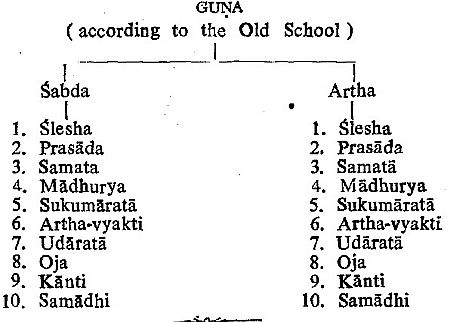
guna.jpg

But, Bharata had not discussed  much on the  Guna-doctrine; and nor did  he  state whether they belonged  to Sabda or Artha; nor in what relation they stand in poetry. He merely stated  that ten Gunas are the mere negation of Dohsa

Dandin  went on and  said the Gunas that make beautiful are called Alamkara  ; and, he included the Gunas dear to him under Alamkara. (Kavya shobha karan dharman alamkaran pracakshate).

kāvya śobhā kārān dharmān alaṃkārān pracakṣate – te cādyāpi vikalpyante kas tān kārtsnyena vakṣyati // DKd_2.1 //

[But, he does not seem to consider Gunas and Alamkaras as identical; for the Gunas relate to the forms of language – say, sound or its capacity to produce a meaning ; but, not specifically to the categories of Alamkara.]

But Dandin qualified his statement by remarking that Guna is an Alamkara belonging to the Vaidarbhi-Marga exclusively. Thus, it appears, in his view, Guna forms the essence or the essential condition of what he considers to be the best poetic diction. The importance of Gunas lies in their positive features. The contrary of a particular Guna marks another kind of poetry. Thus Ojas vigor (use of long compounds) marks the Gaudiya Marga; and, its absence marks the Vaidarbhi Marga.

It should be mentioned; Dandin elaborates a theory of two modes (Marga) or kinds of poetic diction or styles to which he assigns geographical names Vaidarbhi and Gauda. He mentions that excellences (Guna, like sweetness or lucidity) form their essence.

Iti vaidarbhamargasya prana dasa gunah smrtah/ Esamviparyah prayo drsyate gaudavartmani //KD.1.42//

But, such classification later became a dead issue as it was not logical; and many are not sure if such regional styles did really exist in practice. Only Vamana took it up later; but, diluted it.

Vamana laid more emphasis on Riti; yet, he accords importance to Alamkaras . He clearly states that it is a synonym for Saundarya i.e., beauty; and, because of this beauty, poetry is distinguished from Sastra and Lokavarta.

He further said that although Gunas make a poem charming, the Alamkaras enhance such poetic charm :

Kavya sobhayah kartaro dharmah gunah tad atisayahetu vastvalankarah –   kavyalankarasutra – III.l

For Bhamaha , Alamkara is the principle of beauty in poetry; and, for Dandin, Alamkara is Sobha-dharma. Dandin also considers the whole Vanmaya (literature) into two modes of figurative expression.

But, Vamana takes a broader approach than that of Bhamaha and Dandin; and, he recognizes Alamkara as Saundarya itself. Thus, he not only considered Alamkara as an essential element of poetry;  but,  also identified beauty with it – Saundaryam alamkarahkavyalankarasutra; 1.2

Vamana , in his Kavyalamkara, stated that , poetry is acceptable from the ornamentation (Alamkara)  point of view. But , he is careful to explain Alamkara not in the narrow sense of a figure of speech, but in the broad sense of  the principle of beauty. He says : Kavyam grahyam alamkarat; Saundaryam alamkarah // VKal_1,1.1-2 // .

Dandin also mentions Vakrokti; but, he does not treat it as essential to Alamkara.

Chapter five of Kavyadarsa is an inquiry into poetic defects (Dosha) that spring from logical fallacies. It is based in the view that there is a limit to the poet’s power to set aside universal laws of reasonable discourse . The poet does not wish to speak nonsense; his ultimate declaration should be  as rational and as reasonable as that of any other person . Poetry does not therefore lie in the poet’s intention as such, but the unusual means he adopts to convey his meaning. This line of argument puts poetry properly on both sides of what is logical and what is illogical.

[ Before going further , let me mention in passing about the Kannada classic Kavi-raja-marga ….

It is said; Kavi-raja-marga (Ca.850 C.E.), the earliest and one of the foundational texts available on rhetoric, poetics and grammar in the Kannada language, was inspired by the Kavyadarsa of Dandin . It is generally accepted that Kavi-raja-marga was co-authored by the famous Rashtrakuta King Amoghavarsha I Nrupathunga (who ruled between 814 A.D. and 878 A.D); and, his court poet Sri Vijaya – ‘Nrupatungadeva-anumatha’ (as approved by Nrupatungadeva).

Though the Kavi-raja-marga generally follows Kavyadarsa, it goes far beyond and tries to forge a meaningful interface between Sanskrit and Kannada.

Kavi-raja- marga, praised as a mirror and guiding light to the poets, was perhaps composed during the formative stages in the  growth of Kannada literature. And, it was meant to standardize the writing styles in Kannada, for the benefit of aspiring poets. It was also intended to serve as a guide book to the Kannada Grammar, as it then existed.

The work is composed of 541 stanzas, spread over three Chapters. The First Chapter enumerates  errors (Dosha) that one might possibly commit while writing poetry; the Second Chapter deals with Sabda-alamkara; and, the Third Chapter covers Artha-alamkara.

The Book, among other things, dwells on the earlier two styles of composing  poetry in Kannada (kavya-prakaras) – the Bedande and  the Chattana;  and , the way of prose writing – the Gadya-katha. And, it mentions that these styles were recognized by Puratana-kavi (earlier poets) and Pruva-acharyas (past Masters).  

In that context, Kavi-raja-marga recalls with reverence many Kannada poets, authors and scholars who preceded its time:  Vimalachandra , Udaya, Nagarjuna, Jayabhandu and the 6th century King Durvinita of the Western Ganga Dynasty as the best writers of Kannada prose; and, Srivijaya; Kavisvara, Pandita, Chandra and Lokapala as the best Kannada poets.

But, sadly, the works of all those eminent poets and authors are lost to us.

The Kavi-raja-marga continues to inspire, educate and guide the Kannada scholars, even to this day.]

GreenBodhiTree

The older School (Prachina) – of Bhamaha, Dandin, Vamana and others – dealt with natural or human situation idealized by the poet for its own sake. The attention of the Prachina School was focused on ornamented figures of speech (Alamkara) and the beauty (sobha, carutva) of the expression or on the ‘body’ of poetry.

The Navina School represented by Anandavardhana (9th century) and his theory of Dhvani mark the beginning of a new-phase (Navina) in Indian Poetics.  It pointed out that the reader should not stop at the expression but should go further into the meaning that is suggested, or hinted, by it. The Navina School laid more importance on the emotional content (Bhava) of the Kavya. But, here, the emotive element was not directly expressed in words (Vachya) ; but , had to be grasped by  the reader indirectly (Parokshya ) through suggestions. Yet, through the description of the situation the reader understands the emotion and derives that exalted delight, Rasa.

Raja Bhoja , in his Srngaraprakasha, classified Alamkara into those of Sabda (Bahya – external); those of Artha (Abhyantara – internal) and, those of both Sabda and Artha (Bhaya-abhyantara – internal as well as external). In any case; Alamkara has to aid the realization of the Rasa or to heighten it; and, shall not dominate the vital   aspects of the Kavya.  

Here, the words (Sabda), explicitly mean (Vakyartha) the body (Sarira) of the Kavya. The subtle, suggested essence of the Kavya that resides within and is extracted with delight by the cultured reader (Sahrudaya) is the Dhavni.

Thus the evolution of the Navina School marks a transition from the ‘outer’ element to the ‘inner’ one, in regard to the method, the content and appreciation of the Kavya. The criteria, here, is not whether the expression sounds beautiful; but, whether its qualities (Guna) are apt (Auchitya) to lead the reader to the inner core of the poetry.

Lets talk about these and other elements of Kavya in the subsequent issues.
lotus -leaf

Continued in

The Next Part

Sources and References

Glimpses of Indian Poetics by Satya Deva Caudharī

Indian Poetics (Bharathiya Kavya Mimamse) by Dr. T N Sreekantaiyya

Sahityashastra, the Indian Poetics by Dr. Ganesh Tryambak Deshpande

History of Indian Literature by Maurice Winternitz, Moriz Winternitz

A History of Classical Poetry: Sanskrit, Pali, Prakrit by Siegfried Lienhard

Literary Cultures in History by Sheldon Pollock

The Philosophy of the Grammarians, Volume 5 By Harold G. Coward

A Comparative Study of the Indian Poetics and the Western Poetics by Mohit Kumar Ray

A history of Indian literature. Vol. 5, Scientific and technical …, Volume 5 by Edwin Gerow

For more on What is Kavya , please click here

Other illustrations are from Internet

 
3 Comments

Posted by on August 19, 2015 in Kavya, Sanskrit


Tags: , , , , , , , , , , , , , , , , , , , , , ,