RSS

Tag Archives: Natyashastra

Concerning the Dasarupa of Dhananjaya – Part Two

Continued from Part One

Dance-Drama

As mentioned earlier, the Dasarupa of Dhananjaya is a compilation of the extracts taken from the Natyashastra of Bharata.

Dhananjaya’s work is , essentially, a collection of the rules, the terminologies, their definitions and the elements pertaining to Drama, as extracted from the Natyashastra; and, arranged under certain broad heads. The Dasarupa is a compact work, intended to serve as a manual for the use of those interested in the subject of Drama.

As its name suggests, the text is focused on the ten types or classes of Drama that were mentioned in the Natyashastra; and, on the presentation and analysis of their technical features, plot constructions along with their distinguishing characteristics.

[Let me mention, at the outset, what I have posted below is but a brief summary of the few of the selected topics described in the Dasarupa. I have tried to avoid going into various sub-classifications and too many details enumerated in the text. For the complete text, with its translation in English, please click here.]

**

Before we discuss the main subjects covered by the Dasarupa, let’s briefly take a broad look at its structure and the arrangement of its theme and topics. .

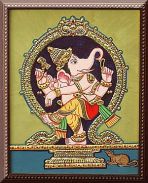
The Dasarupa which commences with a prayer submitted to Lord Ganesha has four Prakashas or sections, containing, in all, about three hundred Karika (verses).

Namas tasmai Ganesaya yatkanthah puskarayate / mada-abhoga-ghana-dhvano nilakanthasya tandave //

Homage to that Ganesha whose throat, deeply resonant in his excessive frenzy (mada-abhoga), serves as a drum in the vibrant  dance of Shiva, just as the sound of the wildly expanding thundercloud at the dance of the peacock
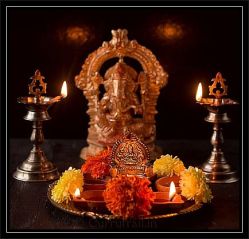
ganesha puja

BOOK ONE

The First Book or the First Chapter consists of 68 verses.  After paying homage to Lord Vishnu who displayed ten incarnations (Dasa-Avatara); and, to Bharata who enunciated the ten forms of Drama (Dasarupa), Dhananjaya seeks the blessings of Sarasvathi the Goddess of wisdom, arts and all learning. He says : the goddess Sarasvati graciously provides themes for literary works to persons of intelligence; and , through those works culture is spread among others.

kasya cid eva kada cid dayaya visayam Sarasvati vidusah / ghatayati kam api tam anyo vrajati jano yena vaidagdhim.

He then states the objective of his work as to give concisely and directly the import of the rules pertaining to Drama, as set down in Natyashastra, in its own words (tasyarthas tatpadais tena samksipya kriyate anjasa)

Dhananjaya then goes on to list (pratipadam laksma) the definitions of some of the fundamental technical terms that appear in the Natyashastra – (pratipadam aparam laksma kah kartum iste)

He commences by stating that Drama is an imitation of situations in life (Avastha-anikrtir natyam); and, it is called a Rupa (form), because it is, basically, a visual presentation (rupam drsyatayocyate), made by actors who assume the forms of various characters that are assigned to them (rupakam tat samaropad), such as gods, kings, men or women of various sorts.  It is said; Rupa refers to delineation, giving a concrete form to an idea. Then, he just lists the names of the ten chief varieties of Drama that are based in different Rasas (dasadhaiva rasasrayam)

natakam ca prakaranam bhanah prahasanarn dimah vyayoga samavakarau vlthyankeha imrga iti

[The phrase Avastha-anikrtir natyam, as quoted by Dhananjaya might give an  impression as though the Drama is the art of reproduction by imitation (anukriti), But, Abhinavagupta had  earlier objected to such a banal view, saying that mere imitation of other’s movements would produce the ludicrous; and, the imitation of other’s feelings and emotions is impossible.

He held the view that Drama is an artistic creation, where music, dance, acting as also the dress, colours, and the stage environment etc., all unite harmoniously in an effort to create a delightful dramatic performance. According to him, such a presentation becomes an art when its narration in the form of dialogues associated with suitable gestures, postures, movement, dance, dress and music etc., succeeds in giving expressions to sentiments and passions so as to rouse similar sentiments in the minds of the audience. Thus, Drama is an entirely a new art that aims to enliven the hearts and minds of the audience; generates in them an aesthetic joy; and, it is not an imitation in the ordinary sense of the term. ]
rose-SG

 Marga- Desi

Dhananjaya mentions the broad categories of Dance-forms as: the Marga (the pure or pristine); and, the Desi (the regional or improvised)

adyam padartha-abhinayo Margo Desi tatha param.

As regards the particular Dance forms, Dhananjaya says: the Nrtya, which, principally, is display of various emotional states (bhava-asrayam nrtyam), is a representation of the traditional Marga class. While, Nrtta, with emphasis on limb-movements, in tune with rhythm and timing (nrttam tala-laya-asrayam), belongs to the popular Desi style.

Under each of these (Nrtya and Nrtta) there is again a two-fold division: Lasya, the graceful, gentle and fluid pleasing dance; and, Tandava, the vigorous, energetic and brisk invigorating movements (lasya-tandava-rupena natakad-dyupakarakam.)

[ Here, Dhananjaya markedly deviated from Bharata . To start with, Bharata had not  classified Tandava and Lasya  as either vigorous or gentle dances . In fact , the term Lasya does not appear in the Natyashastra. Bharata had merely mentioned of these two (Tandava and Sukumara) as the types of dances  that are performed in the Purvaranga, before the commencement of the play.

And , Dhanajaya’s attempt to classify Nrtta as Desi (regional) and Nrtya as Marga (pure and traditional) was criticized as  being illogical. It was pointed out that Nrtta was the dance that Shiva taught to his disciple Tandu ; and , it was pure and pristine. And, Nrtta is indeed of the Marga class.]

*

After offering short definitions of these terms, which  are auxiliaries to Nataka and to the other varieties of Drama,  Dhananjaya moves on to the definition of such terms as are directly connected with the major theme of his work –  the Drama (Rupa).

He broadly follows Bharata , who had said : A Nātaka is having five Arthaprakrti; five kâryāvasthās; five Samdhis; four Vrittis;   sixty-four Sandhyaga; twenty-one Sandhyantārā, thirty-six Abhusanas; and, ninety music..

Yattu pancachatuh –sastiscatuh –pancaikavisatih / sattrinsatravtisca tat-Natakam

rose-SG

Vastu -Neta -Rasa

The rest of the First Chapter is devoted to the discussion of Vastu, the subject-matter, in detail, about its sub-divisions; and, also of the structural components or the elements of the plot.

He states that the three essential elements , on which the  Dramas are based and  classified,  are :

  • the Vastu (subject-matter) ;
  • the Neta (the leading character- the Hero) ; and ,
  • the Rasa (the sentiment it portrays ) . ‘

It is on the basis of these three criteria that Dramas are categorized into different types – Vastu Neta Rasas tesam bhedako.

The plot should be simple; the incidents should be consistent; and, the progression of the events should spring direct from the story. It should make an interesting presentation on the stage; and, should provide entertainment to varied class of spectator. That is the basic purpose of the Drama. The ability to please the spectators, to capture their imagination and to make them visit the theatre more often is a major indicator of the success of the play.

The Subject-matter (vastu) can be of two-folds (Vastu ca dvidha) :  the main theme  known as the principal subject (adhikarika); and,  the subordinate (angam)  as the  incidental events (prasangika)

– Tatra adhikarikam mukhyam angam prasahgikam viduh.

The major theme (Vrttam) of a Drama would, usually, be about the intense desire or the objective (Adhikara) of the principal character of the play (i.e., the Hero, the Adhikarin); and, how he goes about to realize that goal. The sequence of incidents or actions that follow during the course of the Hero’s attempts, mainly, to achieve his objective or the desired result would be its principal subject (Adhikarika); and, the related minor ones would form the incidental the subject (prasangika).

[For instance; in Ramayana, the story of Rama and Sita is Adhikarika. The stories of Sugriva and Vibhishana are Prasangika, supplementary to the main story.]

vastu2

Source : Laws practice Sanskrit drama by Prof. S N Shastri

Arthaprakrti

The action of the play expands in manifold ways (vistary anekadha), just as a seed (Bija) very small at the beginning, grows, in stages, and expands into a tree.

The process of unfolding of the story could be marked by five stages or elements of action (Arthaprakrti or Karyalakshana):

:- (1) the beginning (Bija) or the cause (hetu) giving rise to various types of actions;

:- (2) the expansion (Bindu), which like the drop of oil in water, spreads and joins the broken ends, expands and maintains the continuity (accheda-karana), till the very end of the play, in all the Acts;

:- (3) the episodes of  considerable length (Pathaka), which  carry forward  and support the main cause of the  action ;

:- (4) the incidents within the episode (Prakari), of limited duration and of minor importance , yet, serving the principal plot; 

:- (5) and, finally, the conclusion (Karya), which also sums up the whole action, starting  from the beginning  and leading up  to the ultimate gainful result  (Phala).

Bija-bidu-patakakhya prakari-karya-laksanah arthaprakrtayah panca ta etah parikirtitah.

Following the analogy of the seed and the tree, it is explained, in Arthaprakrti also, the Bija, the germinal-idea, just like a seed, is the origin. And, it goes through several stages namely:

  • appearance (Utpatti);
  • opening up (Udgnatana);
  • going forth or sprouting (Udbheda); and,
  • coming out distinctly (Nirbedha).

And, just as the seed develops gradually into a tree and bears fruit, here too the Bija develops, in stages, and finally concludes in Karya. And, thus, it succeeds in bringing the whole series of actions in the play to  a happy (mangala) desired finale  (Phala) .

Bīja bindu patākā ca prakarī kāryameva ca arthapraktaya pañca jñātvā yojyā yathāvidhi NS.19.21

 [The charge levelled against Dhananjaya and Dhanika is that they just state the Arthaprakrti and fail to discuss its importance in the play or its relation with the Avastha, another format of plot-construction.]

**

Avastha

The plot could also be structured in another manner so as to depict the successive, ordered (Yathasamkhya) stages of action (Avastha) in the Hero’s (Neta) attempts to accomplish his purpose. The actions involved in the hero’s way to success are structured into five distinct segments or stages :

:- (1) beginning of the action (Arambha) with eagerness to attain the result;

:- (2) the efforts made by the hero to move resolutely, with great haste, towards his objective, despite the odds and resistance he has to contend with (Yatna or Prayathna);

:- (3) actions leading him nearer to the objective, with hope of success mixed with fear of failure (Prathi-sambhava);

:- (4) actions or incidents that ensure certainty of realizing his goal,  as by then the dangers and risks  would have been bypassed or  eliminated (Niyatapti) ; 

(5) and, finally, the crowning glory, the complete and satisfactory achievement of his desired objective (Phala-agama or Phala-prapti or Phala-yoga)

Avasthah panca karyasya prarabdhasya phalarthibhih ararnbha-yatna-praptyasa-niyatapti-phalagamah.

The Avastha, with its five stages, is a comprehensive model which begins with eagerness and zeal; resolutely passes through strenuous efforts, overcoming several obstacles, mixed with anxiety, hope and fear; and, finally ends happily  in the total acquisition of the desired object.  Its elements, taken together, portray the physical, mental and psychological states of the hero (Neta) throughout the action of the play. 

These five stages, in their successive order (Yathasamkhya), form the essential, classic features of any type of human endeavour; not merely Drama.

The Brihadaranyaka Upanishad calls upon:

‘You are what your deep, driving desire is; as your desire is, so is your will (sa yathā-kāmo bhavati tat-kratur-bhavati); as your will is, so is your deed (yat-kratur-bhavati tat-karma kurute) ; as your deed is, so is your destiny (yat-karma kurute tad-abhi-sapadyate”- (Brhu. Up. 4.4.5).

sa yathā-kāmo bhavati tatkratur bhavati | yatkratur bhavati tat karma kurute |  yat karma kurute tad abhi-saṃpadyate || BrhUp_4,4.5 ||

 ***

Samdhi

Another way of structuring the plot (the body, the Sarira of the play) is by creating links, for connecting one scene with the other. These are the Samdhis, the segments of the plot (Artnavayavah), joined mutually or with the limbs (angaih) of the otherantaraika-artha-sambandhah samdhir ekanvaye sati. These Samdhis (junctures) are meant to knit together the various structural divisions of the Drama, consistent with the elements of the plot, and with the stages in the Hero’s struggle on his way to achieving his purpose, right from the beginning up to the successful conclusion.

The five stages of  the developments or the progressions in the action of the play in that regard are :  

:- (1) Mukha (lit. face) , the section where the action originates in a seed-form (Bija) giving rise to various purposes and sentiments (mukham bijasamutpattir nana-artha-rasa-sambhava );

:- (2) Prathimukha ,  the development of the seed – sometimes visible  and sometimes not ; but, there all the while and progressing (laksya-alaksya atayodbhedas tasya pratimukham bhavet);

:- (3) Garbha, the section of the play where the seed springs up and strives to grow despite the difficulties and challenges it is confronted with (garbhas tu drstanastasya bijasya-anvesanam muhuh);

:- (4) Vimarsa or Avamarsa, a crucial or rather testing time in the development of the seed which has now  grown into Garbha , facing troubles; and, when  one stops to reflect (avamrsed) because of getting embroiled in entanglements (aslesa), snared in temptations (vilobana), doubts, anger , or following a misleading clue, thus temporarily arresting its development (krodh en avamrsed yatra vyasanad va vilobhanat); 

(5) and, finally, the Nirvahana  or the Upasamhrti, when the scattered threads are harmonized and knit together;  when all the main incidents of the play are  meaningfully interwoven ; and , the play is brought to a successful conclusion – (bijavanto mukhadyartha viprakirna yathayatham aikarthyam uparuyante yatra nirvahanam hi tat).

Mukha-pratimukhe garbhah sa vamarsa upasarnhrtih.

 [For an exhaustive study of the Samdhis, please click here.[

gse_multipart51466

These three – Arthaprakrti, Avastha and Samdhi – could be treated as parallel methods of structuring the divisions of the play.  It is also said; they are not mutually exclusive. The five elements, that mark the stages of action, in each of these, correspond with the five elements of the other two, in an ordered sequence – Krama (yathasamkhyena jayante).

Arthaprakrtayah panca panca-avastha-samanvitah yathasamkhyena jayante mukhadyah panca samdhayah.

The structural divisions or sequence of events of the drama – Avastha; Arthaprakrti; and, Samdhi – each in its own manner,   corresponds with the elements of the plot and the actions associated with the progressive stages in the hero’s attempts to successfully realize his purpose or object.

:- Avastha are the stages of action in the progression of the events in the play

:- Arthaprakrtis are in effect, the means for attaining the desired result or success (Phala). These, again, are said to be sequenced in five stages of action (Avastha)

:- The Samdhis are junctures or the sequence of events in the development of the play; and, associated with the actions or the stages in the hero’s realization of his purpose (Phala-siddhi).

[It seems that Bharata had suggested just two parallel methods or principles of classification for projecting the development of the plot – Avastha and Samdhi – each having five steps. The Samdhi was again divided into 64 sub-sections –Samdhyangas. And, Bharata had not discussed or even suggested inter-relation between these two models.

The schemes of the Avastha (stages) and the Samdhi (junctures), both having five phases, are related to the structure of the play, the dramatic incidents, the development of the theme, and the movement of the plot. While Avastha attempts to delineate or mark the successive stages in the action of the play through various sub-divisions; the Samdhi, following the analogy of the seed and its growth, tries to combine the various types of action into meaningful whole.

When taken together, you find that the Avastha and Samdhi are closely related, with each stage of the Avastha corresponding with each juncture of the Samdhi. Both mark the divisions in the development of the plot, in five stages. Bharata had said: the Samdhis depend on the Avasthas (Samdhyo hi Avastha paratantrah)

Dr. Manjul Gupta explains: Looking at the position, we may finally say that Samdhis are the important parts of a plot. A plot is divided into five parts marking different phases of the main aim. These five Samdhis are related to each other, ‘to their limbs’. .. and, somehow or other, with the five Avasthas of the action.

Thus, the Arambha of Avastha corresponds with Mukha of Samdhi; and similarly, the Prayathna with the Prathimukha; the Prathisambhava with the Garbha; the Niyatapi with the Vimarsa; and, the Phalayoga with the Nirvahana.

 *

Dhananjaya goes further and inserts Arthaprakrti, the constituent elements in a plot, mentioned by Bharata (NS.19.21) as the third format (besides Avastha and Samdhi) for outlining the structure of the plot. And, he had said, they are found in the Itivrtta, just as the five Avasthas do.

bījaṃ binduḥ patākā ca prakarī kāryameva ca / arthaprakṛtayaḥ pañca jñātvā yojyā yathāvidhi // BhN_19.21 //

Dhananjaya suggested that the five elements of the Arthaprakrti (viz., Bija; Bimdu; Pathaka; Prakari; and Karya), corresponded with the five stages  of action as described under Avastha ; and , from these arise five junctures , the Samdhi , beginning with Mukha , the opening.

arthaprakrtayah panca panca-avastha-samanvitah yathasamkhyena jayante mukhadyah panca samdhayah // DR.1.21//

The difference between Avastha and Arthaprakrti seems to be that while the former (Avastha) pertains to the principal plot; the latter (Arthaprakrti) covers the subsidiary plots also. And, while the action of every play consists of five Avasthas, but, in the case of five Arthaprakrtis, it is not necessary that all should be present. The other difference appears to be that in the Avastha, its stages follow an ordered sequence. But, Arthaprakrti is not bound by such regulations; the sequence and the prominence of its elements might be altered to suit the needs of the plot. 

However, Bharata had not said anything about the inter-relations that might exist among the three formats of the play, viz., the Avastha, the Samdhi and the Arthaprakrti.

But the later writers (e.g. Katayavema and Dhundiraja) accepted the suggestion made by Dhananjaya for treating Avastha, Samdhi and Arthaprakrti as parallel ways of dividing or demarcating the structure of the Drama into successive ordered segments (yathasamkhyena jayante).

It could, therefore, be said that each element of Samdhi identifies; and, also leads to the corresponding elements of the Arthaprakrti and Avastha.
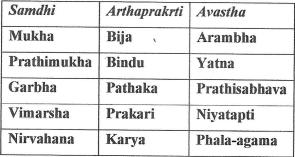
Arthaprakrti, Samdhi , Agama0004

It has been suggested that these three sets of five each, Pentad (panchayatam), could be taken as three ways of analyzing the structure of the plot of a Sanskrit Drama (Rupaka) from three different angles.

Summing up, Viswanatha in his Sâhitya-Darpana described Rupaka (Nataka) as the most logical and perfect theatrical composition. It progresses in a systematic manner and concludes successfully, bringing joy to all.  He says, according to the Dasarupa, the structure of the Rupaka consists: five elements of the plot (Arthaprakrti), matching with the five stages (Avastha) of the action, from which arise five structural divisions or sequence of events (Samdhi) of the drama, which correspond with the elements of the plot and the actions associated with the stages in the hero’s attempts to successfully realize his purpose or objects.

Please also read the brief study of the Dasarupaka of Viswanatha by Dr. Leena Chandra K ]
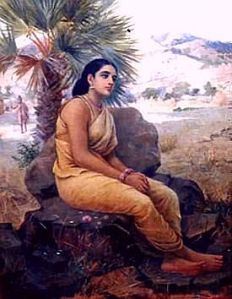
shakuntala333

[The Shakuntalam of Kalidasa  (check here for an English translation) is hailed as a classic play  that epitomizes all the virtues and characteristics of the hoary Sanskrit theatrical traditions.

We may take a look at the structure of the play in terms of the three modes of Samdhi , Arthapaprakrti and Avastha.

Kalidasa’s celebrated  play  Abhijnana Shakuntalam has seven Acts; and, the action is spread over six years. The plot is structured into series of actions , each leading to the next.

The progression of the plot of the Shakuntalam can be analyzed according to dramatic conventions set out in the Natyasastra. This may be done taking into account all the three axes : Arthaprakrti ; Avastha-s ( states of action); and, Sandhi-s (joints of action) .

Act I features the Mukha-Sandhi, in which the King Dushyanta comes upon the beautiful lass Shakuntala; it gives rise to cause (hetu) for the begining of action (Bija – Arthaprakrti), which is the King deeply falling in love with Shakuntala; and, that  opening sets the  stage for action in the play (Arambha-Avastha).

shakuntalam5shakuntalam2

Act II and Act III explore the expansion (ArthaprakrtiBindu), when the King makes effort (AvasthaYatna or Prayathna) to moves towards his objective ; and that develops into their wedding (Pratimukha-Sandhi),

But the King  and Shakuntala must urgently separate; and, they  are filled with hope of success mixed with fear of failure (Prathi-sambhava Avastha); and their love  strives to grow despite the difficulties and challenges it is confronted with (Garbha Sandhi). That gives reason to  carry forward  and support the main cause of the  action (Pathaka Arthaprakrti ) .
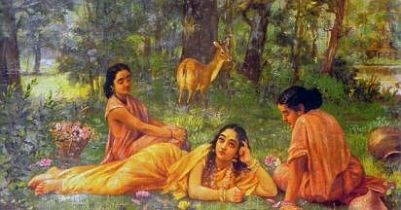
shakuntalam3

Acts IV and V relate to the period of separation, wherein hope of reunion is affirmed , despite absence; and this section is a continuation of the Garbha-Sandhi. This occurs when Shakuntala leaves the hermitage and also when she and the king are separated, after his rejection of her;  serving the principal plot (Prakari Arthaprakrti).

This state of uncertainty also marks  Vimarsa or Avamarsa Sandhi , when the King actually does reject Shakuntala , a crucial or rather testing time in the development of the seed (Bija) which has now  grown into Garbha , facing troubles; and, when  the charecters  stops to reflect (avamrsed) because of getting embroiled in entanglements (aslesa), snared in temptations (vilobana), doubts, anger , or following a misleading clue, thus temporarily arresting its development.

Acts V and VI bring hope of realizing the  goal (Niyatapti-Avastha), when Indra calls upon Dushyanta to join him in heaven; and, the audience knows that the King will  eventually reunite with Shakuntala.  It is followed by actions or incidents that ensure certainty of realizing the Lovers’ goal,  as by then the dangers and risks  are likely to be  bypassed or  eliminated .

The final Act VII celebrates the reunion of Shakuntala and Dushyanta; it marks the Nirvahana  or the Upasamhrti Sandhi, when all the scattered threads are harmonized and knit together;and, all the main incidents of the play are  meaningfully interwoven ; and , when the play is brought to a successful conclusion.

This final Arthaprakrti (Karya) also sums up the whole action, starting  from the beginning  and leading up  to the ultimate gainful result  (Phala). This Avastha (Phala-agama or Phala-prapti or Phala-yoga) is indeed  the crowning glory, the complete and satisfactory achievement of the desired objective  of the hero and the Leading Lady  as they joyfully reunite with their son Bharata.]

shakuntalam4

p1140060

Itivrtta

As regards the story of a play, it could either be adopted (itivrttam) from the incidents that occur in the well-known (Prakhyatha) legends of the past; or, could be a story invented (Uthpadya) by the poet; or else, it could be a mixture (Misra) of the two.  The story could also be about gods (Divya), humans (Marthya) and the like (Divyadivya).

prakhyatam itihasader utpadyam ; kavi-kalpitam;  misram ca samkarat tabhyam divya-martyadi-bhedatah.

It is also said; whatever be the original story, if it is not suitable for the hero or is inconsistent with the sentiment (Rasa) he represents, then the story can be modified or re-arranged in some other way. After determining the beginning and end of the play in this manner; and, after dividing it into five parts, the author should then break it up into small sections; the divisions called junctures (Samdhi).

[Surprisingly,even in the case of historical narrations (akhyayika), Anandavardhana (Ca.850) counseled poets to alter any received historical account that conflicted with the emotional impact they sought to achieve. Thus, according to him, one can and should change fact to suit the dominant Rasa of the work.]

The purpose of such reshaping of the story and characters by the playwright is to achieve a harmony of theme and character in order to serve the ultimate purpose of the drama ,  the Rasa – the  enjoyment by the cultured spectators concept of

 Yat tatra-anucitam Kim cin nayakasya rasasya va viruddham tat parityajyam anyatha va prakalpayet.

[The best example of this is Kalidasa’s reworking of Abijnana-shakuntalam and Vikramorvasiya, the former from the Mahabharata and the latter from the Vedas, Epics, and Puranas.]

Dhanika the commentator mentions that the Vastu is initially classified as the principal (Adhikarana) and subsidiary (Prasangika); and, each of these two are again sub-divided in three ways (Prakhyatha, Uthpadya and Misra), keeping in view of the source of the story, the characters, the portrayal and the dramatic conventions.

[But, Bharata had divided the plot (Itivrtta) into only two classes – the principal and the subsidiary; and, had not attempted their further sub-divisions. 

tivṛttaṃ tu nāṭyasya śarīraṃ parikīrtitam / pañcabhiḥ sandhibhistasya vibhāgaḥ samprakalpitaḥ // BhN_19.1 /

itivtta dvidhā caiva budhastu parikalpayet ādhikarikameka syāt prāsagikam-athāparam 19. 2

The explanation provided is that Bharata did not attempt to divide the dramatic components into tight compartments, because:  he was more concerned with the successful production of a play.  He was focused on coming up with an interesting presentation that would provide wholesome entertainment to the spectators ; and , at the same time he had to pay attention to the  playwright , the actors and the very process of production.

But, the later commentators like Abhinavagupta and Dhananjaya were basically theoreticians who relished offering  scholarly interpretations of the vast variety of technical terms , principles and concepts etc., together with illustrations of their applications by citing passages from the  great plays that preceded their times (such as the plays of Bhasa, kalidasa, Bhavabuthi, Sriharsha and others). These scholars were, however, not much concerned with the nutty gritty or practical details of play-production or the structure and management of the playhouse.]

Dhananjaya says that the chosen subject could be arranged in six ways: showing what needs to be put forth; displaying emotion; the element of surprise; representations for sustaining interest in the story; and concealing what needs to be concealed,

The task of dramatization of the underlying story (Itivrtta) calls for selection, omission and meaningful arrangement of the incidents. Some types of actions should be presented on the stage; while certain other types that are unsuitable for display might either be indicated by words or not shown at all.

There might be incidents in the play which have happened either in the past or in the distant lands; and, there might also be certain types of actions which might neither be possible nor advisable to show on stage. All such matters have to be suggested or indicated by various other clever devices (Arthopaksepaka).

[Normally, the action in a play depicts the events that occurred during the course of that day (or night). But, there are some noted exceptions to such conventions. For instance: in the Uttara-rama-charita of Bhavabhuthi, the events in the first  Act and the second Act are separated by as many as twelve years. Similarly, several years elapse between the last two Acts of the Abhijnana-shakuntalam . In such cases, an intermediate scene (Vishkambha) is introduced as a link; and, also to explain / narrate the occurrences that took place  subsequent to  the previous Act.

Further, it is said; a chariot, an elephant or a horse should not be brought on the stage. Similar is the case with palaces, hills or lakes. Such animals and geographical features might be suggested or indicated through models made of cheap materials. And, in case an army has to be introduced on the stage, that should be symbolically represented by the movement (gati-vīcāra) of four to six persons dressed as soldiers.

But, in many cases, the unity of place is not strictly observed; and, travels are undertaken, often, by aerial routes, riding the celestial rathas]

In regard to the continuity of action taking place after a lapse of time , that is achieved through  suggestions or indications   made in  one oe more of the five ways  : (1) Vishkambha, an interlude; (2) Pravesaka confined to lesser characters, which use Prakrit; (3) Culika, suggestions from behind the curtain; (4) Ankamukha, anticipatory scene, at the close of an Act a character alludes to the subject of the following Act; and, (5) Ankavatara , the seed of the subject-matter of an Act in the previous Act before it has drawn to its close, so that the following is a continuation of the one preceding it. 

arthopakṣepakaiḥ sūcyaṃ pañcabhiḥ  pratipādayet / viṣkambha cūlikā aṅgāsy āṅkāvatāra praveśakaiḥ // DhDaś_1.52 //

It is only that part of the action which is fit to be exhibited is divided into Acts and presented on the stage in an ingenious and a highly interesting manner.

[Natyashastra prescribes that in the presentation of the play , one should avoid showing such events as: long travel; murder; war; violent overthrow; bloodshed; eating; taking bath; undressing; sex act etc.

Dura-dhavanam; vadham; yuddham; rajya-dessadiviplavan/ samrodham; bhojanam; snanam ; suratam; ca-anulepanam/ amvara-grahanadini pratyakshani na nirdiset na-adhikaraivadham kvapi tyajyam – avasyakam na ca // ]
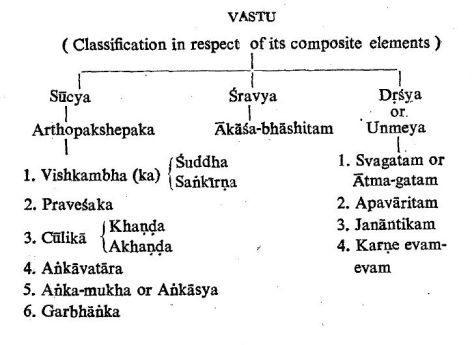
vastu

Source : Laws practice Sanskrit drama by Prof. S N Shastri

[The classical Sanskrit Drama, in its presentation, followed a traditional format.

Plays were usually presented at the spring festival. The Srngara and Vira are the usual dominant Rasas of the play. The dialogues are interspersed with lyrical stanzas and songs; and, often with dance movements. Tragedy, in the Western sense of the term, was not there, for every drama must have a happy ending.

A drama always opened with Naandi, or benediction, submitted by the well accomplished Sutradhara, stage-manager or director, to Lord Shiva, praying for successful completion of the play , for the joy (nanda) and the prosperity of the audience. It is said; the Sutradhara enters singing  in  Bhinna-panchama, the Raga that belongs to the Madhyama-grama, having Dha as its Amsha; and, Panchama as its end-note (the Nyasa).

It is said; it is called Naandi , because it pleases (Nanda) the gods –Nandati devata asyam  iti  Naandi ; and, also because , it pleases the spectators and confers blessings on them. 

Right after the Naandi, the Sutradhara  , appears in a section , preliminary to the play, called  Prarochana ,  where he would praise the literary merit and scholarship of the playwright;   laud the high quality of his play that the audience is about to watch; and, compliment the audience for their wisdom in choosing to witness such an excellent play (unmukhī karaṇaṃ tatra praśaṃsātaḥ prarocanā) .

The Prarochana would be followed by Prastavana, the prelude to  the play-proper, where the Sutradhara would strike a light-hearted conversation with a Nati , Vidusaka or a minor character regarding the play that is just about to be presented. All these take place in the Purvanga, the preliminary , before the commencement of the play .

sūtradhāro naṭīṃ brūte mārṣaṃ vātha vidūṣakam / svakāryaṃ prastutākṣepi citroktyā yat tadāmukham // DhDaś_3.7 // prastāvanā vā tatra syuḥ kathādghātaḥ pravṛttakam / prayogā tiśayaścātha vīthyaṅgāni trayodaśa // DhDaś_3.8 //

The initial scenes are always auspicious, spreading a happy–feeling (adi-mangala); and, as the story unfolds, unbearable miseries are unjustly mounted  on the virtuous hero , by the crafty villain. In the midst of all the troubles that the hero is facing, near about the mid-point of the story, something good happens to the hero (madhya-mangala).  Somewhere in the second-half of the story, amidst the trials and tribulations of the lovers,  a sort of relief  arrives  through the  clumsy attempts of the usually inept, food and fun loving sidekick, the vidushaka . 

And, after a hard fought and suspenseful struggle (in which the gentle heroine, for no fault of her, is somehow drawn in), the anti-hero falls; eventually the Good, the Love and the Dharma triumphs; and, all ends well (antya-mangala).

The play concludes with a Bharatavakya, praying for the welfare of the king with good governance, the happiness of his subjects ; and, the peace and  prosperity of all beings in all the three worlds.]
lotus offering

Numerous subdivisions

The Dasarupa goes into lot of details, enumerating the subdivisions of the various elements of action (much of it not being quite significant). For instance:

  • 12 subdivisions of the opening scene (Mukha);
  • 13 subdivisions of the progression (Prathimukha);
  • 12 subdivisions of the development (Garbha); 
  • 13 subdivisions of the pause (avamarsa) ,
  • 5 kinds of intermediate scenes (arthopaksepaka) ;
  • 14 subdivisions of the conclusion ( Nirvahana )
  • 64 types of Samdhyangas (Divisions or Limbs of Samdhis)
  • 12 limbs of Garbha
  • 13 types of Avamarsa
  • 72 types of Sandnyantaras which act as inter-links
  • And so on

 **

The First Book of Dasarupa concludes with the advice:  after examining the entire body of divisions of the subject matter presented in these and the following sections, as well as in the works like the Ramayana and Brhatkatha, one should thereupon compose a story expanded with the appropriate selection of Hero (Neta) and sentiments (Rasa) , bound together with appropriate and pleasing words (ucita-caru-vacah).’

ityady asesam iha vastu-vibhedajatam / Ramayanadi ca vibhavya Brhatkatham ca / asutrayet tad anu netrra-sanugunyac / citram katham ucita-caru-vacah-prapancaih //DhDaś_1.61 //

***

In the next part we shall talk about the types of Heroes , Heroines and the supporting charecters ; and, also about the Vrttis , which Bharata regarded as the mother of all poetic works.
Nayana5 crop


Continued

In

Part Three

Sources and References

The Dasarupa a treatise on Hindu dramaturgy by George C. O. Haas, Columbia University press / 1912

 A Study of Abhinavabharati on Bharata’s Natyasastra and Avaloka on Dhananjaya’s Dasarupaka – by Manjul Gupta

Sahityadarpanah of Viswanathakavirajah

The Theory of the Samdhis and the Samdhyangas in Natya Shastra by T.G. Mainkar

Sanskrit Dramaturgy

https://open.library.ubc.ca/media/download/pdf/831/1.0094658/2

All images are from Internet

 
Leave a comment

Posted by on December 4, 2017 in Dasarupa, Natya


Tags: , , , , , , , , , , , , , , , , , , , , , , , , , , , , , ,

Concerning the Dasarupa of Dhananjaya

6495

Part One – Introduction

As it is often mentioned, the Natyashastra of Bharata is an encyclopaedic work. Though its main subject is the Theatre, the text actually encompasses all forms of art expressions. Bharata  presents a detailed inquiry into the various facets of drama,  including its origin; its nature; its theories; the theatrical techniques  with all their components of speech, body-language, gestures, costumes, décor as also the state of mind of the performers, apart from rituals, architecture of theater etc.

Apart from Drama per se, the Natyashastra covers a wide range of subjects such as the mythological origins of the Drama, the rituals (Purva-ranga-vidhi), music, dance, prosody, painting, sculpture, architecture of theatre etc. Its author, in fact, claims that there is no knowledge, no craft, no lore, no art, no technique and no activity that is not found in Natya-Shastra (NS. 1.116).

Na tajjñāna na tacchilpa na sā vidyā na sā kalā  nāsau yogo na tatkarma nāye’smin yanna dśyate NS.1.116

Therefore, over the centuries, Natyashastra has come to be regarded as the earliest available authentic source material for the study of  varieties of  subjects , under diverse disciplines , related to  ancient India: such as:

    • theories of music (sruti, svara , murchana etc.,);
    • chaste classical music (gandharva);
    • improvised music (gana); stage–music (dhruva gana);
    • other vocal music (gitam); various types of instrumental music (vadyam);
    • dance (nrtyam);
    • costumes and makeup (aharya);
    • poetry (kavya);
    • prosody (alamkara shastra) ;
    • meter (chhandas);
    • aesthetics (rasa);
    • stage craft (ranga-abhinaya );
    • design and construction of theatre (natya-mantapa , natya-griha) ;
    • architecture (shilpa);
    • painting (lekhya) ; and,  so on .

It is not therefore surprising that Natyashastra, revered as the classic text on performance, arts and culture, was, in due course, elevated to the status of Veda, the fifth Veda called Natya-veda. And, its author came to be described as a Muni, a sage.

But, over a period, this monumental authoritative work, of great antiquity, invested with an almost of semi-divine character, was getting inaccessible to the practitioners of the Art, who, generally, were not scholars. Therefore, progressively, the yawning gap between the theory and practice did seem to further widen.  The reasons for such a state were many.

To start with, Natyashastra is a considerably huge work, consisting about six thousand Granthas or verse-stanzas spread over thirty-six or thirty-seven chapters.

The arrangement of the subject-matter was somewhat unsystematic. The text was rather too elaborate and cumbersome for ordinary use.The myths, rituals and practices were all seemed to be mixed up.  And, some passages were repeated without valid  reason. For instance; the passages discussing the Prakrit dialects occur two times. Similarly, the portions discussing the explanatory/ intermediary scenes such as Viskambhaka etc., also appear twice, at chapters 18 and 19. Besides, some verses are repeated; but, out of context. There was also some confusion about terms such as Vithi and Prahasana , which were mentioned among the forms of Vrtti and also among the  types of Rupakas

Natyashastra was written in archaic Sanskrit, employing rather a too brief Sutra format. Its method of exposition was : classification, definition and analysis of technical terms with a brief explanation of the concept behind them. But, many times , a term  was just stated, without a clear explanation or without providing illustrations. As a result, in certain cases, it becomes  difficult to clearly ascertain what Bharata ‘really’ meant. 

Another factor is that the Natyashastra belongs to a distant past; and, the concepts and terminologies that were mentioned in its own context were far removed from later times (say, 11th century). And, therefore, it was left to the ingenuity and enterprise of each reader to come up with his/her own interpretation of Bharata’s true intent. . 

For a general reader or even for a practicing Artist, Natyashastra tended to be inscrutable without the aid of a well written, lucid commentary. And, such commentaries, which were also handy, were rare. At times, a commentary, itself, needed another sub-commentary to explain what it was attempting to say.

It is said; there was a commentary on Natyashastra written by Kohala, believed to have been a disciple or a contemporary of Bharata. And, Bharata himself had said that the subjects or the material he did not cover in the Natyashastra would be dealt with by Kohala in his study –

śeam-uttaratantrea kohalastu kariyati NS.37.18

But, sadly, Kohala’s commentary is lost.

Dattila and Matanga who wrote authoritative works on Music are believed to have written on dancing, as well. And again, the portions of their works relating to Natya have not survived.

Bharata’s Natyashastra is dated between second century BCE and second century CE. Since the time of Bharata, for over a period of say a thousand years, up to about the tenth century – as mentioned by Sarangadeva (11th century) in his Sangita-ratnakara – numerous treaties on the Natyashastra were produced, from to time, by various scholars like Shandilya, Kirtidhara, Drauhini, Rahula and Harsha.

Even thereafter, many more commentaries were written, especially by those from the Kashmir region, such as: Sankuka and his predecessors Lollata and Udbhata; Bhattodbhata, Matrgupta, Srisankuka, Bhattanayaka, Visakhila, Rudrata and others.

But, sadly, by about the eleventh century, almost all commentaries written by the ancient savants on Natyashastra had been lost. Few of those survived only as fragments by way of citations made by Abhinavagupta and other authors.

Further, there is the complication of many recessions of the text, with no two MS being alike in regard to the number of Chapters as also the number of Slokas in each Chapter.

gse_multipart51466

With all the other previous commentaries having been lost, Abhinavagupta’s work Abhinavabharati (by about the close of the tenth century) is the earliest known and available commentary on Natyashastra; and, it is also the best. It serves as a bridge between the world of the ancient,forgotten wisdom; and the scholarship of the succeeding generations. And, Abhinavagupta himself said that he wrote the commentary in order to save and perpetuate the ancient tradition

Evam anyad api ūhyam iti an-upayogyāt samastaṁ na likhitam āgama-bhraṁsa-rakṣanāya tu diṅ nirupitā

But, the Abhinavabharati, though basically a commentary on and a companion volume to Bharata’s Natyashastra, is , for all purposes, an independent work in its own right. It, again, is a detailed exposition on various subjects such as: drama, dance, poetry, music, art, prosody and also aesthetics with reference to Anandavardhana’s Dhvanyaloka (820-890).

Abhinavagupta comments on a range of subjects, at different levels: conceptual, structural and technical. He cites and discusses the views of many ancient authorities who wrote on drama, dance, music etc. He illustrates the principles and its application in Natya, through examples taken from well-known Dramatic works.

Abhinavagupta not only expands on Bharata but also interprets him in the light of his own experience and knowledge; and, also with references to the then current practices. And, at many places, he differs from Bharata; and, introduces concepts and practices that were not present during Bharata’s time.

Abhinavagupta, thus, comments, practically, on its every aspect; further, he brings in the concepts of his School pratyabhijna, while interpreting Bharata’s text.

However, because of its encyclopedic character and the exhaustive scholarly treatment of the subjects, the monumental Abhinavabharathi is not an easy text that could be read and understood by the general readers. It again needs the aid of a commentary or explanations provided by other scholars.

For instance; authors like Mammata, Hemachandra, Visvanatha and Jagannatha who supported the views of Abhinavagupta provided explanations of his concepts. And those who did not agree with Abhinavagupa, such as Ramachandra and Gunachandra (1100-1175) the authors of Natyadarpana; Siddhichandragrahi, author of Kavya-prakasha-khandana;  as also Rudrabhatta, author of Rasakalika , analysed the text and criticized the Rasa – theory (Rasa-vada or Rasa-siddantha) as enunciated  by Abhinavagupta.

All those critics pointed out that the experience of Rasa is not always entirely pleasurable (alukika, chamatkara) as claimed by Abhinavagupta; instead, it would, in fact, depending on the context, be pleasurable or be painful (sukha-dhukkatmako rasah).

The commentaries on the Natyashastra and on the Abhinavabharati, up to about 12th century, were concerned mainly with the poetics (kavya, alamkara) in general, and, on the theories of Rasa (Rasa-vada or siddantha),  in particular. They touched upon Drama and Dramaturgy in passing, without much discussion.  Therefore, from the point of view of those interested in Drama, particularly, such commentaries were not of much help.  Further, they were far removed, in time, from their principal texts. And, because of their stylized writing, such commentaries were also not easily accessible to the general readers.

And, in the mean time, the performing-art, the tradition of Drama, had declined over a period; and, it had almost faded away by about the eleventh century. The Drama, as an art, was tapering out; and, was lingering on merely in the form of minor one-act plays (Uparupakas), mainly in the regional languages, with a heavy input of dance and songs; but, with barely adequate emphasis on Abhinaya (acting) and Sahitya (script).

e3ff95faa3

It was in such a context that the compilation of the principal elements of Drama made by Dhananjaya (11th century) variously known as Dasarupa or Dasarupaka or Dasarupakam, gained great significance. It brought a breath fresh life into the theories and practices of the performing art of the Drama that were fading out.

Dhananjaya, in his brief work, containing just about 300 Karikas (verses) spread over four Prakashas (chapters or sections), focused mainly on the aspects of Drama, its various forms and their essentials. He, for the most part, followed Bharata closely ; and, compiled the rules pertaining to Drama, in the form of a brief manual. At the commencement of his work, Dhananjaya , in all modesty , admits that since Bharata had adequately covered all aspects  concerning Drama, there is very little scope to say anything new or to add anything substantial

– Pratipadam aparam lakshma  kah kartum ishte – DR.1.4 

Dhananjaya, therefore, states that in his work, he would be restating the principles of Natya-veda (dramaturgy), its terminologies and definitions as were laid down in the great compendium Natyashastra, in a more concise and systematic form, in Bharata-muni’s own words

kim cit pragunaracanaya laksanam samksipami .

And, Dhananjaya indicates that his brief compilation (samksipya) is mainly for the benefit of those ‘slow-wit’ (manda-buddhinam) who are likely to get confused (mati-vibhramah) by the diffused and elaborate treatise.

 Vyakirne mandabuddhinam jayate mativibhramah / tasyarthas tatpadais tena samksipya kriyate nyasa //

And , at the same time , Dhananjaya , following the lead given by Bharata [who had said that he devised the dramas to give , among other things, relief to those unlucky ones afflicted with sorrow and grief or over-work

dukhārtānā śramārtānā śokārtānā– NS.1.114 

And makes it abundantly clear that the prime objective of a Drama is to provide entertainment (ananda).

Dhananjaya taunts; and mocks at one who naively believes that Drama, like history (itihasa), is there only to give knowledge.

He wryly remarks ‘ I salute  (tasmai namah) that simpleton  (alpabuddhih) who has averted his face from what is delightful ..!’

anandanisyandisu rupakesu/ vyutpattimatram phalam alpabuddhih/ yo ‘pitihasadivad aha sadhus/  tasmai namah svaduparahmukhaya//DR.1.6//

natya ganapthi

Dhananjaya’s work is mostly a collection of extracts taken from the Natyashastra; and, arranged under certain subjects.  In its style, the Dasarupa is extremely condensed. The first part of his work is entirely a listing of definitions on certain technical terms and concepts that figure in the Natyashastra. Here, at times, Dhananjaya offers brief explanation on the etymology, the meaning and the application of the term. The Dasarupa is thus a highly compressed manual, avoiding lengthy descriptions or justifications.

Because of its compact and brief mode of presentation; the simple  arrangement of the material; convenience of reference; and, because it is handy (not being too lengthy or elaborate), the Dasarupaka of Dhananjaya soon gained wide  popularity among the scholars, playwrights, critics and commentators, as also among the general readers.

For the later writers on prosody and Dramaturgy, Dhananjaya’s compilation turned into a comprehensive useful reference-book or a source material. They made frequent use of the text by citing the rules and definitions listed in it.

And, in fact, the Sahityadarpana of Viswanatha Kaviraja (14th century), recognized as one of the most comprehensive a compilation on Indian aesthetics, in its Chapter Six  (Drsya-sravya-kävya-nirüpanah) which deals with Drsya aspect (dramaturgy) makes extensive use of citations from Dasarupaka.

As the great scholar and Spiritualist George Christian Otto Haas, (1883-1964), observes in his Treatise on Dasarupa ; “A similar dependence on the Dasarupa and recognition of its value is found also in other dramaturgic treatises”. He said; “The excellence of Dhananjaya’s presentation and its convenient form gave the Dasarupaka a prominence that it has retained to the present day”.

[ Another work of similar nature and of equal eminence ; but , much  more detailed  studded with comments and illustrations, is the Natya Darpana of Ramachandra and Gunachandra]

gse_multipart51466

But, there was also a flip side to Dhananjaya’s work.

Its drawback was mainly with regard to the inconsistency in the treatment of its subjects. On the one hand, Dhananjaya carried too far the work of his abridgment; and, left out quite a number of important matters; and, on the other, he went into needless, minute classifications and sub classifications where it was not called for. C O Haas reminds the words of Bhamaha – dhikhedayaiva vistarah – too much elaboration wearies the mind; and, remarks – ‘it may not be untrue’.

As George C O Haas observed; in many instances, brevity was achieved at the cost of clarity. In several cases, Dhananjaya tried to reduce definitions or the meaning of certain technical terms, into a single word, without offering any further explanation. In such cases, the intent of Dhananjaya has to be construed by referring to parallel passages in the Natyashastra or other related text.

Because of such shortcomings and the absence of even-handed treatment, Dhananjaya’s work (just as either Natyashastra or Abhinavabharati) is unintelligible without the aid of a commentary.

Fortunately, that lacuna was made good by a commentary titled Dasarupavaloka (meaning the examination of the Dasarupa) or, in short, Avaloka written by Dhanika, a contemporary of Dhananjaya (in fact, believed to be Dhananjaya’s younger brother). Avaloka of Dhanika, is a supplement; and, is of immense help in understanding the Dasarupa. And, therefore, Avaloka has come to be regarded as an essential and an inseparable part of the main text – the Dasarupa.

In his commentary and explanations, Dhanika closely follows the views put forward by Dhananjaya.  And, in addition, he himself composed about twenty-four stanzas – twenty in Sanskrit and four in Prakrit – in order to illustrate certain concepts and definitions cited by Dhananjaya in his Dasarupa. It is said; Dhanika, in his own right, was a reputed scholar and a poet. And, it appears,  he had composed a treatise on poetics, titled Kavyanirnaya, from which he frequently quoted. But, sadly that work is not extant.

Dr. Manjul Gupta, in Part Two of Chapter Two of her detailed treatise A Study of Abhinavabharati on Bharata’s Natyasastra and Avaloka on Dhananjaya’s Dasarupaka – writes:

Dhanika’s commentary is indispensable and it helps us a lot in understanding the meaning of Dhananjaya’s otherwise short and pithy sentences.  Sometimes, we could not even guess the meaning of Dhananjaya if Dhanika would not have offered us help. The real merit of Dhanika’s Avaloka lies in the occasionally lengthy discussions  of disputed and obscure points as in the Book four on sentiments and in his collection of illustrative quotations, many of which are valuable in obtaining a clear conception of the principles of Sanskrit Dramaturgy.

In his explanation of rules, stated by Dhananjaya, Dhanika not only refers to the scenes and situations of the principal Sanskrit dramas but also quotes such passages as would serve to illustrate the matters under discussion. He quotes not only from dramatic works but also from other fields of literature, particularly from the sententious poetry and  Kavyas of Magha and Kalidasa. Occasionally, he corroborates his statements by an excerpt from the Bharatiya Natyasastra or some other technical work.

LotusEmerging

Since Abhinavagupta, Dhananjaya and Dhanika were believed to be almost contemporaries; living in Kashmir; writing and commenting on similar subjects, there has, often, been a tendency among the scholars to compare and evaluate their works.

At the outset, Dasarupa and Avaloka were not so much concerned with poetics as did the works of Anandavadhana, Abhinavagupta or Mammata. Instead, their concern was mainly with dramatic representations; and, classification and sub-classification of the elements of the Drama, in detail. Dhananjaya’s focus was on the exposition of the ten types of Drama; and, he kept his text short and simple, as a collection of major principles pertaining to Drama that were expounded in Bharata’s Natyashastra.

The scholarly opinion, across the board, is that as compared to Dasarupa, which mainly confines itself to compiling certain extracts and explanations relating to the Drama, the Abhinavabharati is definitely a far superior, comprehensive treatise. The Abhinavabharati, which is regarded as the best guide to Natyashastra discusses various dimensions and aspects  related to several subjects, at different levels, from the  point of view of an aesthete; offers comments on the statements of Bharata , either by way of elucidation or by way of criticism; cites and sums up the views of numbers of other scholars; and, eventually comes up with its own convincing explanations in the light of the practices prevalent durimg  its time.

Another issue is with regard to the needlessly elaborate and hair-splitting exercise undertaken by Dhananjaya to classify and sub-classify its subjects , such as the Hero (Neta), Heroine (Nayika), Srngara-rasa and the plot (Vastu). But, the major objection raised by the scholars is about Dhananjaya’s selection and treatment of the very subject matter of his work.

The critics point out: though Bharata mentioned ten types of Drama, he discussed mainly about its two forms – Nataka and Prakarana, perhaps because these two alone fulfilled all those requirements that were necessary for Rupaka (Major type). Further, Bharata had also explained : as these two major forms alone depict varieties of situations , made up of all the styles (Vrttis) and representations,  they lend  enough scope for display of Rasas (Rasapradhana or Rasabhinaya or vakya-artha-abhinaya); while the other eight forms are incomplete , as they are not presented in the graceful style, the kaisikivrtti .

Further, the distinctions, as made out, among the eight Uparupaka (minor type) are largely hypothetical; and, there is no historical evidence to corroborate such theories. All those minor types  have very limited themes and rather narrow subjects; and, are also incapable of presenting a spectrum of Rasas.  Except for the Bhana, the one-man-stand-up shows (ekaharya or ekabhinaya) and Prahasana, the comic skits or parodies intent only on providing amusement (Ranjaka pradhana), not many of the other types of minor class of dramas were produced even in the earlier periods. And, by the time of Dhananjaya, the other (six) minor category of plays had almost become obsolete.

Therefore, it was pointed out that Dhananjaya’s effort of carefully subdividing and meticulously categorizing the details of elements under such  formats of the Drama as  had become almost obsolete, is of mere theoretical interest and has no practical value or utility. They stopped short of calling it a futile exercise. (We shall talk about the various classifications of the Drama, later in the series).

The celebrated scholar of the yesteryear’s Dr. V Raghavan , therefore , rejected such attempts to classify the Drama into major and minor types, as they do not represent the ‘facts of historical development’. “These hypothetical theories about the derivation and the evolution of Rupakas and Uparupakas are no doubt interesting, but, we have no historical evidence to corroborate these theories , meaning such minor types were either not produced or have not survived ”.

8697784345_e75913d220

And, as between Dhanika’s Avaloka and Abhinavagupta’s Abhinavabharati, the latter again is lauded and held up as a work of better scholarship. As compared to Abhinavabharati, the Avaloka is inadequate in many places, though it attempts to illustrate every point with examples.  But, sometimes, Dhanika’s examples are not quite appropriate to the point in question. It also said; Dhanika leaves many issues untouched in his commentary, without providing adequate explanation.

Dhanika, in sections Two and Four of his Avaloka, frequently cites verses from the anthology of love-poems Amarusataka, ascribed to Amaru or Amaruka (7th -8th century), to illustrate the different types of Nayikas or heroines, particularly the Abhisarika-nayika who sets out , in great anxiety, to meet her lover . He intended to use the cited verses, primarily, to picture her costumes and gestures (section 2) and Vyabhichari-bhavas or transitory waves of feelings  she experiences (section 4). But, he often, fails to convince  how the cited verses illustrate the point that he is trying to make. Similarly, he quoted five stanzas from Anandavardhana’s work; but, did not comment on it.

While reviewing the Character and Value of Avaloka, C O Hass takes a very stern view; and remarks:

Although professedly an aid to the understanding of the text, the commentary leaves much to be desired; and, is not nearly as helpful as the average work of its kind. Sometimes, it explains a very simple and clear statement though it requires no comment. Often, on the other hand, it does not clarify obscure words and phrases; and, whole sections are occasionally dismissed with the single word ‘spastam ‘(it is clear). Even where Dhananjaya’s definitions of technical terms are illustrated by means of examples from Sanskrit literature, the absence of further explanation sometimes leaves the exact meaning in doubt.’

Dr. Manjul Gupta observes that the charge made by  Haas might be true to an extent; yet,  it cannot be denied that the Avaloka of Dhanika is indispensable; and, it  helps a lot in understanding Dhananjaya’s work , particularly some of his short and pithy sentences.

Haas had also moderated his assessment of the Avaloka  by remarking that its  real merit  lies in its lengthy discussions on  certain disputed and obscure points ; and, in his collection of illustrative quotations , many of which help greatly in obtaining a clear conception of the principles of Sanskrit dramaturgy.

e3ff95faa3

Despite its shortcomings, the Dasarupaka, in combination with Avaloka, is definitely of immense help in the study of Sanskrit dramaturgy in general; and, Natyashastra in particular; whatever might be its inadequacies.

Manohar Laxman Varadpande, in his History of Indian Theatre (1987), observes:  The main contribution of Dasharupakam   along with its commentary Avaloka, to the Sanskrit dramaturgy is a detailed analysis of the different types of heroines (Nayikabheda), and a critical delineation of erotic sentiment (Shringara Rasa). The writer has confined himself to a deep understanding of the ten types of Sanskrit dramas based upon the elements of Vastu (plot), Neta (heroes/heroines), and Rasa (the emotive aspect of plays). The influence of Dasharupakam is very evident on later Sanskrit dramaturgists.

And, recognizing the relevance and the value of Dasarupaka in the context of Dance, Dr. Mandakrantha Bose m, in her book The Movement and Mimesis: The Idea of Dance in the Sanskritic Tradition  (1991), writes:

The Dasarupaka reflects considerable changes in the discourse on dancing since Bharata’s Natyasastra. Dhananjaya’s strength lies particularly in the fact that he composed a methodical account of the categories of dance and provided clear, if brief, explanation. Prior to his work, much of the information available, including what we find in Abhinavagupta, is fragmentary, existing as quotations from lost works or from the general body of literature. Sometimes the information comes in as passing remarks or views not clearly expressed. In Dhananjaya the concepts and the categories are set down and defined unambiguously enough to suggest that their meanings had come to be generally accepted…. Apart from that, the text also gives some quite vital information leading to our understanding of the use of gesture language in drama. Gestures obviously formed a very important technique for expressing meaning in the performance of a play.

According to Dr. Bose, one of the most important contributions of Dhananjaya is the distinction he draws between Nrtta and Nrtya. He explained Nrtta as that which depends on rhythm and tempo (Nrttam tala-laya ashrayam – DR.1.9); and Nrtya as that which is dependent on emotion (Bhavashrayam Nrthyam – DR.1.9). The definitions he provided of the terms such as Nrtta, Nrtya, Tandava and Lasya mark a distinct stage in the evolution of the understanding of dance and drama. And, Dhananjaya was also the first writer to use the term Nrtya to denote mimetic dance and also dance-dramas.

Further, Dhanajaya’s classification of Nrtya as belonging to the Marga (pure) tradition; and, Nrtta as the Desi (regional) popular dance form, was also very significant, though it marked a departure from Bharata.  Yet, Dhananjaya remained anchored in Bharata’s basic view that both Nrtta and Nrtya are auxiliaries to Drama.

The trend that Dhananjaya set in, categorizing Nrtta and Nrtya respectively as Desi and Marga , was taken up and continued by the later scholars such as Sarangadeva (Sangita-ratnakara), Pundarika Vittala (Nartana-nirnaya) and such others.

*

Finally , all said and done , Dasarupaka is still relevant  and has its usefulness . In fact , the scholar Sri Adya Rangacharya in the introduction to his edition of the Natyashastra  remarked : Almost a thousand years ago a writer called Dhananjaya wrote a treatise called Dasarupaka (ten forms of plays). He did what I originally intended to do, viz. abridge the work only as far as it concerned drama.

Thus, whatever be the criticisms levelled against it, I do agree that the Dasarupa of Dhananjaya is an authentic work that revived and continued the tradition established by Natyashastra.

jasmine-250x250

But, before we get into a discussion on the text, let’s briefly talk about Dhananjaya, the author of Dasarupa; and, about Dhanika the author of Dasarupavaloka, the commentary on Dasarupa.

Dhananjaya, the author of Dasarupa or Dasarupaka, in the concluding verse of his work mentions : the Dasarupam, of great interest to the learned and wise, was presented to the world by Dhananjaya – the son of Vishnu, inspired by his discussions with the Sovereign Lord Munja.

Visnoh sutenapi Dhanamjayena / vidvan- manoragani bandhahetuh / aviskrtam Munja-mahisagosthi / vaidagdhyabhaja Dasarupam etat (DR.4. 91)

Now, the King Munja, mentioned by Dhananjaya, is identified as the ruler of the Malava region, in west-central India, comprising parts of western Madhya Pradesh and parts of south-eastern Rajasthan.  King Munja, son of Sīyaka, the seventh Raja of the Paramara Dynasty, who ruled the Malava Kindom, with its capital at Dhārā, during c. 974 – 995 CE, was renowned by many other names or epithets, such as: Vakpati-raja-deva; Utpalaraja; Amoghavarsha; Sri-vallabha; and, Prithvi-vallabha.

It is said; Munja, apart from being a valiant warrior, was an accomplished poet; and, was also a generous patron of arts and literature. For instance; the lexicographer Halayudha, and Padmagupta the author of Navasahasarikacarita recall with gratitude the benevolence of the ‘friend of poets’ – kavimitra, kavibandhava – Vakpathiraja

sa jayati Vakpatirajah sakala-arthi-manorathaika-kalpataruh); and, (Sarasvati kalpalataika-kandam/vandamahe Vakpatirajadevam / yasya prasadad vayam apy ananya-/ kavindracirne pathi samcaramah etc.

Some of the verses composed by Munja (Sri Vakpathi-raja-deva; Srimad-Utpalaraja) were quoted by the later scholars in their works ; as for instance : the renowned scholar , commentator and poet  of the eleventh century , Ksemendra (in three of his works on poetics: Suvrittatilaka, Kavi-kanthā-bharaa and Auchitya-Vichāra Charchā); and, Vallabhadeva (15th century) in his compilation of aphorisms (Subhāitāvalī) . Further, Dhanika, in his Avaloka also quotes a stanza as ascribed to Munja (Vakpati-raja-paranamo- Munjadevasya).

Concerning Dhananjaya himself nothing much  is known save that he was the son of Vishnu ; was a court-poet (Asthana-kavi)  at the court of the Malava King Munja; and , that it was the discourses with his King and patron that inspired him to compose the Dasarupa.

As regards Dhanika, the author of Dasarupavaloka, a commentary or an ‘Examination of the Dasarupa’, it is said, he also held an official position (Maha-sadhya-pala) in the Royal Court of King Utpalaraja, i.e., Munja. Dhanika also described himself as the son of Vishnu. And, therefore, it is surmised that Dhanika, the commentator, was the younger brother of Dhananjaya, the author; and, both functioned as officials in the Court of the King Munja. As mentioned earlier, Dhanika was also a poet and scholar in his own right. He is said to have written a treatise on poetics, titled Kavyanirnaya, which is lost; and , composed verses, which he frequently quotes in his Avaloka.

There are some other speculations, as well. It has been suggested by some , because of the similarity of the names – Dhananjaya and Dhanika (both meaning a person of substantial wealth) ; and as , each describes himself as the ‘son of Vishnu’; and , both were in the employ of the Paramara king of Malava , Munja,  at Dhara (10th century) ,  it is very likely that the names Dhananjaya and Dhanika refer to one and the same person. That would go to suggest that Dhananjaya wrote a commentary on his own work.

But, the scholars have generally taken the view that Dhanika was a contemporary of Dhananjaya; very probably his brother, who collaborated in the production of the work Dasarupa.

SHAKUNTHALAM

In the next part we shall, briefly, discuss the structure and subjects dealt with in the Dasarupa, along with notes from Avaloka.

 Continued in Part Two


Sources and References

The Dasarupa a treatise on Hindu dramaturgy by George C. O. Haas, Columbia University press / 1912

 A Study of Abhinavabharati on Bharata’s Natyasastra and Avaloka on Dhananjaya’s Dasarupakaby Manjul Gupta

Sahityadarpanah of Viswanathakavirajah

All images are from Internet
 
1 Comment

Posted by on November 22, 2017 in Dasarupa, Natya


Tags: , , , , , , , , , , , , , , , , , ,

Music of India – a brief outline – Part Twelve

Continued from Part Eleven –Prabandha

Part Twelve (of 22 ) – Desi Samgita  

Marga – Desi

1.1. The term Desi, very often, is used along with or in contrast to another term – Marga. Both these terms – Marga and Desi – refer to the traditional systems of Music of India.

Marga or Margi or Gandharva is the ancient class of Music that precedes the time of Natyashastra (say, before second century BCE). Marga (the path or the tradition) signifies something that which is chaste and classical. And, Shiva himself is said to have taught this Marga Music, on his Veena, in his Sri Dakshinamurthy form, to the sages sitting around him.

The early Marga songs were in praise of Shiva (Shiva-stuti). And, during the times of Natyashastra, Marga songs were traditionally sung for offering worship to gods, in the preliminaries (purvanga), that is, before the commencement of the play proper. Bharatha explains Marga or Gandharva as the Music dear to gods (atyartham iṣṭa devānā), giving great pleasure to Gandharvas; and, therefore it is called Gandharva.

(atyartham iṣṭa devānā tathā prīti-kara puna | gandharvāā ca yasmād dhi tasmād gāndharvam ucyate || (NS Ch. 28, 9).

Marga Music was both sacred and well regulated (Niyata).And, by its very nature; Marga was rather somber and not quite flexible.

1.2. While Marga was the sacred Music devoted to please the gods by submitting gentle appeals, Desi was the art-Music that set out to hold a charming appeal to human beings. It was said; Desi is that which delights the hearts of humans (hrudaya-ranjaka), enchants common folks, cowherds, women, children and nobility alike; and, reflects the range of emotions and tunes springing from different regions. In other words, it was meant for ‘pleasing the hearts of the people’; its nature varied from Desha to Desha – region to region. It was basically the Music of the regions (Desha = region).

Deshe-Deshe jananam yadruchya hrudaya-ranjakam I Gitam ca vadanam nruttam tad Desi  ethyabiyate  II

Abala-bala-gopalaihi kshitipali nirjecchaya I Giyate sanuragena svadeshe Desir ucchate  II

[Sangita-ratnakara of Sarangadeva ;  Chapter One  about Svara  ; Verses 23 and 24 ;  pages 14/ 15 – edited by Pandit Subrahmanya Sastri]

[ The verse Abala bala – appears at: Brihaddeshi – First Chapter) (Desha-utpatti prakaranam) – Verse 13

https://ia601602.us.archive.org/20/items/Trivandrum_Sanskrit_Series_TSS/TSS-094_Brihaddesi_of_Matangamuni_-_KS_Sastri_1928.pdf]

Desi the music of the land was rooted in the music of the regions, capturing the unique flavors of the regions and sub-regions; and, giving expression to the moods, joys and sorrows of common people. The term Desi encompassed all forms of created songs (Gita); and even the art forms of instruments (vadya) and dance (Nŗtta).

Nana videshu deshshu jantunam sukhado bhavet Tat pratibhuti likanam narendranamydruchayat Desha desha pravratsau dwanirdeshiti sanjjnatah

As compared to Margi, Desi was relatively free, less rigid and improvised music of the countryside.

1.3. But, it would not be correct to equate Desi with folk (jaana-pada) and tribal songs.

Desi music was in strict conformity with the lakshana-s (theoretical principles) and the lakshya (practices in vogue) of the then established classical or well regulated (Niyata) Music of its times.  Desi Music was perhaps more relaxed in its approach; and its form opted for a lesser regimen of the Grammar.

Chatura Kallinatha (15th century) in his Kalanidhi, a commentary on Sangita-ratnakara, states that of the ten older types of Grama-Ragas, the Raganga, Bhashanga, Kriyanga and Upanga were regarded as Desi Ragas. He remarks that in these Desi Ragas though some liberty was taken, the rules of the Marga-Ragas were not totally disregarded.

1.4. Matanga also says that Desi is modeled after the Marga; and both allow scope for structured (Nibaddha) and un-structured (Anibaddha – like Aalapi) Music. He says, Ragas are classified according to the number of notes composing them; such as odava (pentatonic) using five notes; shadava  (hextatonic) using six notes; and, sampurna (heptatonic) using all the seven notes.No classical melody (marga) can be composed from less than five notes.

According to Matanga, no  Marga or Desi Raga can be composed of four Svaras (notes) or less. He remarks: those with less than five Svaras are used by tribes such as Savara, Pulinda, Kambhoja, Vanga, Kirata, Valheeka, Andhra, Dravida and forest dwellers. 

The exception being a class of stage songs called dhruvas, which though regarded as classical melodies, are found to be composed of four notes.

Catuh-svarat prabhrti na margah svara-pulinda-kamboja-vanga-kirata-vahlika-andhra-dravtda-vanadisu prayu;yatel /Tathacaha Bharatah:-‘shat-svarasya prayogo’sti tatha panca-svarasyaca  catuh-svara-proyage’pi hyavakrista-dhruvasvapi” //

[Thus, Raga is technically penta-tonic. And, usually there is an upper limit of seven notes. But in Hindustani Music, Ragas with nine Svaras are common; and a few mixed Ragas have even twelve Svaras (say, Basant Bahar).]

Obviously, Desi was conceived as a chaste classical music, well regulated but not too rigidly. It was the art-music of the land. It was different from the tribal or folk music of the rural mass. Sarangadeva did not also equate Desi with folk music or Loka or Jaanapada sangeet.

Padmapurana

Similarities and differences

2.1. Just as there are similarities between Marga and Desi, there are also differences. To put these in a summary form:

2.2. Marga was the classical phase of the ancient Indian music. It was basically a sacred class of music; and in theatre it was sung to offer prayers to gods during the purvanga the preliminaries before the commencement of the play per se. It was somber and also not flexible. Marga was the icon of the Higher tradition. Its songs were composed in chaste Sanskrit following the rules of Chhandas (metre) Vyakarana (Grammar).  Its music was based in the Jaati-s (melodies) and in Shadja and Madhyama Grama-s (groups of melodies).

2.3. Desi was the art-music of the regions. It represented the flowering of the Prakrit (other than Sanskrit) phase that began to flourish by around 4th century. Songs of Desi Sangita were in Sanskrit as also in Prakrit and other vernacular languages.  They were modeled upon incidental music of the early theatre. Desi music was free flowing, vigorous and attractive; appealing to ones heart (hrdaya-ranjaka); as also providing scope for improvisation.  Its melodic portfolio could be expanded to include all other types of melodies and Ragas.

2.4. One could say that the distinction of the two – Marga and Desi- is largely historical. The transmission from Marga to Desi was a progression from a regimented few towards a spectrum of wide choices. With the growth in art and art forms many styles of music sprang up in diverse regional traditions. The ways of musical expressions also diversified and grew in abundance. For instance; eighteen Jaati-s, two Grama-s and seven Grama Ragas expanded into more than 250 Ragas by the medieval times. Alongside, the varieties of rhythmic patterns, time-units and the entire system of Taala also grew very appreciably. Thus, the advent of Desi and its rapid development greatly enlarged the boundaries of ancient musical structure; opened up new horizons; and, altered and brightened the future course of Indian Music.

2.5. The classification of the Music of India into two strata – Marga Samgita and Desi Sangita – dates back to at least to the eighth or to the ninth century, mainly through the treatise Brhad-Desi by Matanga.

[I wonder whether Marga and Desi are shifting or dynamic concepts. They are not fixed. What was Desi of ancient times could as well be called Margi of the present day. Let me explain. The Karnataka Sangita as it is practiced and performed today honors the theoretical principles, rules, disciplines and the hoary traditions. It is contemplative and devotional in its nature. The chaste and pure classical music of today has taken the place of Marga. The other popular form of music – sugam-sangget, loka-sangeet and film-sangeet etc – that quickly attracts with its catchy tunes and beats is the Desi of today. This is just a muse. ]

katchery

[Classical and folk music

3.1. Before we get back to Matanga, let’s digress for a short while, and talk about classical and folk music.

(i). In all literal art forms, two conventions (dharmi) or two streams of expressions are recognized; one is the Loka-dharmi and the other is the Kavya-dharmi.  Similar conventions or forms exist in, music, dance or art. Loka-dharmi in poetry stands for a localized or an individual’s expressions of her/his experience or emotions. Kavya–dharmi is when an individual’s emotions are turned into a song or into a poem; and it is enjoyed by all as a beautiful piece of poetry. Here, an individual’s intimate emotions are shared by all as a work of art, independent of the poet’s localized circumstances that caused the poem. The poem that is enjoyed by its listeners/readers is far removed from its original Desha (location), Kaala (circumstances) and Karana (the cause that triggered the emotion). The emotional content (let’s say, love)  in the poem is no longer limited to poet’s or to one particular person’s experience , but is  generalized and shared by all as the idiom of expression of the entire gamut of  that emotion (love).

In the present context, perhaps, one could (roughly) equate the folk music with Loka-dharmi and the Classical music with Kavya–dharmi.

(ii). The folk music is essentially the outpouring of the elementary, subjective human emotions. It generally is about purely personal emotions limited to an individual. It is spontaneous; and its purpose is to fulfill an immediate need to give forth to an emotional experience that is tied to a specific incident in one’s life or to an occasion, time, and place. In other words, folk music is immediately relevant for the emotions of only a small group, a community with a shared background and emotional state.

Folk music is spontaneous and does not require training in a developed musical system.

Folk music is certainly significant and pleasing; and is a powerful emotive language of a people. It is the medium through which shared feelings are communicated and experienced by the community.  But, it is the innocent expression of basic, natural feelings, limited to the context of a particular time and situation. And, it is rather undeveloped or underdeveloped; is without structure, grammar or classifications; and does not require training in creating a song-form.

In comparison; Classical music is not the simple expression and an instant gratification of a basic human emotion. It is a highly developed and complex art form ; and its creation is involved not merely with musical genius of the composer , but also with the intellectual processes and sensitivities that determine the quality of the creation in terms of musical contents of melody , rhythm;  the structure and the Grammar  of the composition;  and its appeal.

Here, the personal impressions or feeling of the composer are sublimated into a classical form that goes beyond subjective self. The composer’s or the performer’s individual identity is left behind. The created music is universal and is for all, instead of being limited to a specific individual’s personal feelings or to an occasion.

Thus, both the folk and the classical are genuinely powerful and qualitatively rich in aesthetic value. They both aim to interact with human minds and hearts, each in its own way. One is elementary, subjective and localized; and, the other is developed, objective with its own sensitivities and is almost universal. The difference appears to be in the purpose of their creation, which defines their context and relation with the rest of mankind.

For a detailed discussion, please check:

http://citeseerx.ist.psu.edu/viewdoc/download?doi=10.1.1.125.8776&rep=rep1&type=pdf  ]

 Indian Folk music


Brhaddeshi

rishi1

4.1. Matanga or Matanga Muni or Matanga-Bharatha (as he is regarded one among the five-Pancha Bharathas: Nandikesvara, Kohla, Dattila, Bharatha and Matanga) takes a very important position between Bharatha (Ca.2nd century BCE) and Sarangadeva (Ca.13th century). It is surmised that he perhaps lived during sixth or the seventh century.

4.2. Matanga’s fame rests mainly on his outstanding treatise Brhaddeshi. It carries forward the tradition of Natyashastra and Dattilam; and at the same time it establishes the Desi Sangita on a firm pedestal. Brhaddeshi bridges the Marga and the Desi class of Music; and also provides the basis for the emergence of the Mela system of classifying the Ragas.   One could say, Brhaddeshi gave a new birth to Indian Music; and, revitalized its creative genius by bringing the concept of Raga into the very heart of the Music traditions and their sensibilities.

Brhaddeshi also serves as a reference to many earlier authors whose works are now lost, such as: Kashyapa, Kohala, Durgasakti, Maheshwara, Yastika, Vallabha, Vishvavasu   and Shardula.

4.3. The edition of Brhaddeshi, as it has come down to us, is an incomplete text. Only about five hundred of its verses are available. Those available verses and chapters deal only with Music; and conclude with the remark that the next Chapter will deal with Musical instruments (Vadya).  Sadly, that and subsequent Chapters, if any, are not available. However, some commentators of the later periods cite from Brhaddeshi the references pertaining to instruments, taala and dance.

5.1. In the available chapters, the first portion starts with the definition of Desi.  The term Desi, here, refers to all forms created of songs; and, it comprehends the three arts of Gita (song), Vadya (instruments) and Nŗtta (dance). One of Matanga’s major contributions is his scholarly focus on the regional element in music. Brhaddeshi (Brihat + Desi) is thus a masterly compilation of the music traditions of the various regions (Desha).

5.2. Next, the concept of Nada is described as the most subtle vibration which is the basis for speech, music, dance and all other forms of activities. Then, the text goes on to discuss two Grama-s: Shadja-grama and Madhyama-grama. From these, Grama-s the music elements Sruti, Svara, Murchana, Tana, Jaati and Raga are derived.

5.3. Matanga deals with Grama, Murchana and Jaati, rather briefly. According to Matanga, twenty-one Murchana-s evolved from the three main Grama-s: Shadja, Madhyma and Gandharva. Murchana were of two kinds: one, having seven Svaras and the other having twelve Svaras

(sa-Murcchana dvi-vidha; sapta-svara-Murchanat dvadasha-svara-Murchana cheti).

The Murchana with Seven Svaras  was divided into four parts: Purna, Shadava, Audava, and Sadharana, The Purna contained  seven Svaras (hexatone) ; Shadava , six Svaras (heptatone) ; Audava , five  Svaras (pentatonic) ; and the Sadharana , two displaced (vikrita} Svaras :  antara-gandhara and kakali-nishada.

And, the Murchana with Twelve Svaras manifest in three registers (Sthana): low, medium and high (Mandra, Madhya and Tara).

5.4. The text then discusses Sruti (silent intervals between Svaras), Svara intervals in the two Grama-s and other terms and concepts such as, Tana, Varna, Alamkara, Jaati, Gita and Raga. Various other aspects including the popular melodies of his time are given in the other chapters.  As the name suggests, it is a huge work and is highly informative.

5.5.  He says that the Aroha (ascending) and the Avaroha (descending) pattern of Svaras form the Murcchana of a Raga. Murcchana, in effect, describes the string of notes that, with further embellishments (Alamkaras) of thirty-three varieties, constitutes the core of a Raga. These Alamkaras are indeed the musical excellences that adorn the songs.

5.6. After allotting a chapter to the Jaati-s, Matanga devotes a special chapter to the Ragas.  Here, he deals with Grama-raga; and the Desi-ragas: Bhasa, Vibhasa and Antarabhasa. These Desi-ragas are again classified into four categories, Raganga, Bhashanga, Kriyanga and Upanga.

5.7. Indeed, it is in this chapter of the Brhaddeshi we first come across the definition of Raga as given by Matanga, and as understood by all later literature on Classical Music. In the history of the Ragas, Brhaddeshi is, therefore, a landmark text.

border_128_small 

Raga

8.1. The term Raga conveys many shades of meanings ranging from color, hue, tint, dye, love, desire, passion, emotional attachment  (as opposed to it is Viraga– detachment)  , beauty, melody and so on .

But, in the context of music it had a special connotation; and, it had been in use many centuries, even prior to Matanga. Bharatha in his Natyashastra used the term Raga in compound terms in association with Jaati raga, Grama raga. And, he perhaps meant ‘Raga’ in the general sense to suggest color or aesthetic appeal or enjoyment or pleasure. He employed the term Jaati to indicate melodies, but also used the term Grama Raga. But, somehow, he did not explain the terms Jaati and Grama-raga and their mutual relationship.

8.2. There was also the Murchana which was described in Natyashastra as the string of seven Svaras used in an order (krama) in their fixed positions. Later, in the Gandharva, Murchana came to be understood as an arrangement having a gradual Aroha (ascent) and Avaroha (descent) of the seven Svaras (notes). Different musical expressions were derived from the Murchanas by permuting the seven Svaras in any number of ways.

8.3. Further, the term and the concept of Grama-raga was in common use, as evidenced by the seventh century rock inscription at kudumiyamalai in South India. The inscription which basically was meant as lessons for the pupils mentions seven verities of melodies or Grama-ragas :

  • (1) Madahyama-grama;
  • (2) Shadja-grama;
  • (3) Sadava;
  • (4) Sadharita;
  • (5) Paricama;
  • (6) Kaisikamadhyama-grama ; and
  • (7) Kaisika.

These seven seem to correspond to the Grama-ragas in the Naradiya-shiksa the text said to belong first or second century BCE.

8.4. The term Raga seemed to have been in use even prior to 7th century. For instance; Poet Kalidasa (5th century) had suggested Raga Saranga (Madhyamadi) for rendering the introductory song to the first Act of his play Abhijnana Shakuntalam. And, in a fable appearing in the fifth volume of Panchatantra (5th century or earlier), a donkey poses as a musician and explains Gramas, Ragas etc.

8.5. Following the steps of Bharatha, Matanga also recognized Shadja-grama and Madhyama-grama as two basic Grama-s (groups or clusters). From these Grama-s he derived Sruti, Svara, Murchana, Tana, Jaati and Raga. The Aroha (ascending) and Avaroha (descending) pattern of Svaras, according to Matanga, formed Murchana of a Raga.

[It needs to be mentioned here that Bharatha’s concepts of Jaati, Murchana and Giti continued to be in use even during the time of Matanga. He uses these terms and offers his explanations with illustrations from Natyashastra.

Matanga regards Ragas as one of the seven classes of songs (gitis, melodies) current in his time: (1) Shuddha; (2) Bhinnaka; (3) Gaudika; (4) Raga-giti; (5) Sadharani; (6) Bhasha-giti; and, (7) Vibhasha—gitis.  

Of the seven classes of gitis, it is said; the Shuddha and the Bhinnaka have each five varieties; Gauda has three varieties; Ragas are of eight varieties; Sadharani is of seven varieties; Bhasha is of sixteen kinds; and, Vibhasha as of twelve kinds.

The Raga-gitis are the fourth in Matanga’s enumeration (Raga-gitis-caturthika). He defines the various classes of gitis, and describes Raga -gitis as: “Attractive note compositions, with beautiful and illuminating graces.”

He also mentions that the eight varieties of Ragas went by the name of (1) Takka, or Taku; (2) Sauvira; (3) Malava-panchama; (4) Shadava or Khadava ;(5) Votta·raga; (6) Hindolaka; (7) Takka-Kaisika; and,  (8) Malava-Kaisika

Taku-ragasca; Souviras-tatha; Malava—pancamah/ Khadavo; Votta-ragasca; tatha Hindolakah parah// Taka-kasika ityuktas tatha Malava-Kaiskah I Ete ragah samakhyata namato muni-pungavaih// 314-15//

Here then we have the first enumeration of eight of the earliest ragas known by name. Some of them may have been derived from the 18 jatis described by Bharata.

And, then he recommends the Raga-giti for singing in dramatic sequences. He quotes Bharatha and says: Madhyama-grama (Ma Grama) melodies be used in the Mukha (opening of the drama); the Shadja-grama (Sa Grama) melodies in Prati-Mukha (progression of the play); the Sadharana (mixed scales) in the Grabha (development stages); and, Panchama-Jaati melodies for the Vimarsha (pauses)- (NS: 28.41-45)

Further, even among the music-related terms of the older (Marga) Sangita that he explained, the term Raga was used]

[In the meantime:

There is a remarkable text which the scholars have neither been able to date nor understand it fully. It is titled Gitalamkara; and, is said to have been written by an author who, for some reason, called himself Bharata. The book aimed at controlling or disseminating the arguments of the rivals (Vadi-mattagaja-ankusha) . In its Chapter 14, the book cites thirty-six ‘Ragas’ (which are named here as Varna or colors).They are classified into three groups: Purusha (male); Stri (female) and Apatya (descendents). This, by a long stretch of time, foreshadows the Raga-Ragini-Purta concept that came about in later times. The scholars suggest that Varna might have been the older name of Raga (which also suggests color).

Alan Danielou suggests that the Gitalamkara might be a very ancient text, perhaps even prior to the time of Bharata , because it is  quoted by very ancient authors.  However, Emmie te Nijenhis differs ; and, observes that Gitalamkara certainly existed before 1199 CE ; but , not necessarily before Natyashastra or Brihaddesi.

The Gitalamkara treats the three ancient Gramas (Nandyavarta, Jimuta and Subhadra) in an un-usual manner. Instead of treating them as basic scales, as others did, it merely lists characteristic series of four Svaras (tetrachord) for each of them. This perhaps goes back to the period before the three Gramas: Shadja, Madhyama and Gandhara Gramas came to be recognized.

It is bit confusing to say the least. For more, please see:  Le Gitalamkara by Alan Danielou; and, Musical Literature by Emmie te Nijenhuis.]

9.1. Yes; it seems the word Raga with its multiple meanings was in use even from early times. But, it was not used in Music or in Music-theories in the way we know it and use it now.  It is, therefore, difficult to say Raga as it is understood today, had fully evolved and was recognized as such at the time of Natyashastra.

9.2. Which is to say; the notion of melodies that are created by artistic and ingenious arrangement of ascending and descending Svaras had been there for a very long time. It was a rather amorphous concept; its structure had not been determined; and, was waiting to be defined in a clear language.

That is, precisely, what Matanga did.

 border_128_small

Raga-lakshanam

10.1. The chapter titled Raga-lakshanam (characteristics of Raga) in the Brhaddeshi commences with two questions and a request: ‘What is meant by the word Raga? And, what are the lakshana-s of a Raga? You must please explain the origin and nature   of Raga clearly ’.

Kim ucchyate raga-shabdena ? kim va ragasya lakshanama  ? I  Utpatthi lakshanam-tasya yathavad vaktum arhasi     II (278)

Matanga replies:

The nature of the Raga system (Raga-margasya- lit. path) has not been explained by Bharatha and others (Bharathadi); and, it is going to be explained (Nirupayate) by us, according to theory (lakshana) and also practice (lakshya) – (279).

Raga-margasya vad rupam yannoktam Bharathadibhih I Nirupayate tasmad abhir lakshya –lakshana –samyuktam II

10.2. Then he goes on to explain: A Raga is called by the learned, as that kind of sound composition (dhwani-bhedaya), which is adorned with musical notes (Svara), in some peculiarly (visesena) , stationary (sthayi) , or ascending (aroha), or descending, (avaroha) or moving values (varna), which  are capable of affecting the mind with peculiar feelings or of colouring (Ranjyate) the hearts of men. A Raga is that which delights: Ranjana-jjayate ragau..

Svara-varna visheshena dhwani-bhedaya va punah I  Ranjyate yena yan kashichit sa ragah samsthatham   II 280

10.3. OR –  (Athava), it is that particular sound (dhwani vishesa) which is adorned by Svara and Varna (svara varna vibhushitaham); and that which delights the minds of the people (Ranjako jana-chittanam) is called Raga by the wise.

Athava-Yo asya dhwani vishesathu svara varna vibhushitaham I Ranjako jana-chittanam sah ragah kathitho vidhuv II 281

[Following Matanga, Sarangadeva in his Sangeeta-ratnakara described Raga as: ranjayati itihi rāga- that which delights  is Raga.]

10.4. After defining Raga, in two way:  as that particular  arrangement or ornamentation of Svara and movement of Varna (Svara-Varna vishesha ; vibhushitam); and as the distinction of melodic sounds (Dhwani-bhedana)  which delight the minds of people (Ranjako jana-chittanam) , Matanga takes up  the etymological  explanation  of the term Raga and its origin (Utpatthi).

Matanga says: this is how the word Raga is derived (Ithevam raga-shabdasya utpatthir abhidiyate). He explains that the word Asvakarna when it is derived from its root might literally mean the ears of a horse. But, in practice (rudi), Asvakarna is generally understood as the tree whose leaves resemble in shape the ears of a horse. Similarly, the word Pankaja literally means one that is born (ja) out of mud (panka). But, Pankaja in convention and common usage refers only to the lotus-flower.

In a like manner, he says, the word Raga has etymological as well as special conventional meaning like the word Pankaja. He explains: whatever might be its other meanings, the word Raga (derived from the root ranj = to please), effectively suggests, here, as that which generates delight: Ranjana-jjayate ragau.

Ithevam raga-shabdasya utpatthir abhidiyate I  Ranjana-jjayate  ragau utpatthih samudahrutah II 283

Ashva-karnadi vidha rude yaugikau vaapi vachakah I  Yogarudosthva raage jneyam pankaja-shabdavat II 284

[ Among the many  tools (Nyaya) employed in the olden days to extract and to explain the meaning of the words and terms ,the  Samabhirudha Nyaya derived the meaning of a word from its root;  and , Vyavaharika Nyaya  interpreted the word through conventions (rudi)  and its common usage (paddathi)  in day-to-day life (Vyavahara).

The words Asvakarna and Pankaja are common illustrations of these Nyayas. And, Matanga’s argument is based on similar lines.

There are many other similar words, such as:  Mantapa which normally is understood as an open-hall; but, its etymological meaning could be ‘one who drinks scum of boiled rice (Ganji)’. And, the term Kushala is generally used to denote an expert or a highly skilled person (pravina); but, its etymology analysis would lead to one who is ‘good at cutting grass (kush). And, similarly, Ashva-gandha is literally ‘smell of the horse; but in common usage it refers to a medicinal herb.

Bhartrhari, in his Vakyapadiya emphasizes the importance of contextual factors in the determination of the meaning of expressions. Etymology is without doubt important in its own context; but, in the day-to-day conversations the conventional meaning (Vyvaharica artha) takes precedence over the etymologically derived sense. Panini the Grammarian also recognized the fact the people who spoke the language and used it in their daily  lives were better judges in deriving, meaning of  the words

Therefore, the generally accepted rule in the Indian poetics is that the conventional meaning overrides the etymological derivation.  It is said; the conventional (rudi) meaning is grasped immediately and directly while its etymological sense has to derived indirectly through analysis. And, the essential nature of the word lies in its power (Skakthi) to signify directly. ]

10.5. Thus, the term Raga, in its etymological and technical sense, means a particular combination or sequence of Svaras and Varnas which delights, charms or colors  (in broader sense) the mind. Therefore, every Raga, while it delights also creates an emotional mood which colors or influences the mind in its own unique manner. It colors different minds in different ways. That is why a single Raga can yield divergent expressions, associations and experiences.

Padmapurana

General and Special characteristics

11.1. Along with defining Raga and explaining its concept, Matanga takes up the question of its identity. He says that the identity of Raga is conceived in two ways (dvivida matham):  through its general (Samanya) classification and through its special characteristics (vishesha lakshana). He mentions the general categories as four (Chatur vidha tu samanya); and, that the Raga’s special identity lies in Amsa and other features (vishesha cha Amshakadhikam).

Samanya cha visheshacha lakshana dvivida matham I  Chatur vidha tu samanya vishesha cha Amshakadhikam II 282

11.2. General (Samanya) classification

As regards the four broad categories (Chatur vidha tu samanya) that Matanga mentioned, some say, he, perhaps, was referring to Desi ragas that are classified into four categories, Raganga, Bhashanga, Kriyanga and Upanga. These ragas are the basis for all musical forms presented in the later Samgita traditions and forms.

[But, during the later times the connotation and interpretation of these terms underwent thorough revision. The Ragas came to be classified into Janaka and Janya. And, Janya ragas were further classified into: Sampurna — Varja; Krama- Vakra; Upanga — Bhashanga: Nishadantya, Dhaiva- tantya and Panchamantya. ]

[There is another interpretation which says that the four general categories mentioned by Matanga might refer to : Purna, Shadava, Audava, and Sadharana, The Purna contained  Svaras (hexatone ) ; Shadava , six Svaras(heptatone ) ; Audava , five  Svaras (pentatonic ) ; and the Sadharana , two displaced (vikrita} Svaras :  antara-gandhara and kakali-nishada.]

Amsa and other characteristics

11.3. Amsa was said, during the time of Matanga, to be the prominent or predominant Svara through which the Raga manifested

  • raga-janakatvad vyapakatvaccha Amsasya pradhanyam  

During his time, the term Amsa and Vadi were used alternatively. Kallinatha in his commentary has said that both Amsa and Vadi used to convey the idea of creating the pleasing sensations of the Ragas

Sa vadi tyogyatavashdt amsha syat rakti-vyanjakatvat

Along with Amsa, nine other characteristics (Dasha-lakshanam) of Jaati (melodies) were listed in Natyashastra (28.74) as also in Dattilam (55) as Graha, Amsa, Tara, Mandra, Sadava, Audavita, Aplatva, Bahutva, Apa-Nyasa and Nyasa.

These are briefly:

: – Graha – It is the initial note –Adi-Svara– used at the beginning of a song;

: – Amsa – It is the prominent note (key note) in the song. The melodic expression of the song depends on it;

: – Tara – It is the high register; the upper limit of the notes to be used. It is the fourth note from Amsa which belongs to middle sthana;

: – Mandra –It is the low register; the lower limit of the note to be used;

: – Sadavita –Six notes are used omitting one;

: – Audavita -Five note are used dropping two.

: – Alpatva – It is the use of a note or notes in small measure. It is twofold: by skipping over the particular note or notes; and by non-repetition;

:- Bahutva – It is of two kinds: by using the notes fully or by repeating it often

: – Apa-nyasa– It is before the final note (penultimate) . It is note with which a section of the song ends –Vidari;

: – and, Nyasa – It is the note with which the song ends.

[ In the introduction to his work Ragas and Raginis, Prof. O C Ganguli writes:

The starting note (graha) and the terminating note (nyasa) have now almost lost their significance. But the Amsa (predominant note) is of great importance. It is also called the Vadi (lit. the speaker, or announcer) i.e. the note which indicates, manifests, or expresses the peculiar character of the raga; and, receives the greatest emphasis in the structure of the raga. It is also called the jiva, or the soul of the raga. Just as the Vadi note determines the general character of a raga, the Vivadi or the dissonant note, distinguishes and differentiates it from other forms of ragas, by avoidance of the Vivadi note. For, this dissonant note destroys the character of the melody. The Vivadi note gives the negative element, and, the other three, the positive determining elements of a raga. Every raga has its special types of a serial of notes for ascent (aroha) and descent (avaroha) which determines its structure. The degree of insistence or importance of particular notes lends flesh, blood, color, and life to the scale and creates a Raga (Ranjayati iti ragah- ‘that which colors, is a raga).]

stock-vector-ornamental-seamless-borders-vector-set-with-abstract-floral-elements-in-indian-style

Svara, Varna and Alamkara

12.1. In the explanations offered by Matanga, he mentions Svara, Varna and Alamkara etc.

Svara

12.2. The Svara, here, indicates the arrangement of five or more ascending and descending notes. According to Matanga, Svara is the sound which has musical quality that creates melody. When the interval between the notes (Sruti) is raised or lowered, the musical quality gets altered.

Depending on their level of importance in a Raga, Svaras are classified under the four categories Vadi, Anuvadi, Samvadi and Vivadi (sonant, assonant , consonant  and dissonant). Bharatha defines these in his Natyashastra. here , the Vadi is the most important Svara to a Raga. It is repeated often and used as a fundamental note  upon which the raga sculpture is erected. Sa, shuddha ri, antara ga or pa are examples of Vadi Svaras.

When sung with the Vadi Svaras, only certain Svaras have a pleasant or concordant effect. These are Samvadi Svaras, and they generally have nine or thirteen shruti intervals between them and their corresponding Vadi Svara .

The Anuvadi Svaras help in adding substance to a Raga, and they are not emphasized.

The Vivadi Svaras are those which are discordant and create a displeasing effect when rendered with the Vadi Svara. The space between these two is usually one Svara, though it is often more than two Sruthi differences.

[ Sruthi is derived from Sru (to listen) Srunyanta iti srutayah –that which is heard is Sruti. Matanga , quoting Khohala , says – Srutis are infinite varieties of sounds in the Universe, comparable to the ceaseless waves produced when the ocean is struck by great winds.]

Varna

12.3. And, Varna refers to special note sequences that indicate different kinds of movement. The function of Varna in a Raga is to manifest a song; and, it is, therefore, known as gana-kriya. The Varna-s are said to be of four kinds, depending on the movement of Svara. They indicate the general direction of the melodic line.   When a note remains more or less at the same level it is called Sthayi-varna (stable); when the notes are ascending or descending these are known as Arohi and Avarohi. And, a mixture of the three is sanchari-varna, wandering, back-and-forth.

Alamkara

12.4. Alamkara (adornment or ornamentation) refers to graces and flourishes in the music. Alamkara contributes to enhancing the artistic beauty in the presentation of Music.  It has been a vital aspect of the creative process even from very early times. Bharatha, in a famous verse, remarks that “A song without Alamkara will be like a night without moon; a river without water; a creeper without a flower; and, a woman without any ornament.”

Shashina rahiteva nisha, Vijaleva nadee lata, Vipushpeva avibhooshitheva cha kantha, geethir-alamkara-viheena syath.

The Alamkaras are associated with Varna (appearance, color, word, and syllable). It is said; if Varna is the architecture or the structure, then the Alamkara is its decoration bringing out and enhancing its natural beauty. In Music,the term Alamkara represents the combinations of progressions and ornamentation. The harmonious blending of structure and decoration is basic to all forms of Indian art.  And, in early Music, probably, no precise distinction was  made between Varna and Alamkara.

Alamkaras, as recurring patterns of variations formed out of Svaras, were associated with each of the four Varnas. They were classified according to the Varna underlying them. Accordingly, there were four broad categories of Alamkaras:

Sthayi -Varna –Alamkara; Arohi-Varna-Alamkara; Avarohi-Varna-Alamkara; and, Sanchari-Varna –Alamkara.

12.5. Under these categories, Natyashastra had earlier listed thirty-three types of Alamkaras. But, Dattila later abridged the list to thirteen. Matanga who followed Natyashastra reckoned thirty-three Alamkaras.  However, in later times the list grew up to eighty-eight types of Alamkaras.

Dattila’s list of thirteen Alamkaras , which is  regarded as the basic contained :

  • 1. Prasanna-adi, begins with low note;
  • 2. Prasanna-anta, ends with low note;
  • 3. Prasanna-madhya, low note in the middle;
  • 4. Prasanna-adyanta, begins and ends with low note;
  • 5. Bindu, higher note touched like lightning;
  • 6. Nivrtta-pravrtta, lower note touched quickly;
  • 7. Prenkholita, even swing between two notes;
  • 8. Tara-mandra-prasanna, gradual rise followed by sudden drop;
  • 9. Mandra-tara-prasanna, sudden rise followed by gradual descent;
  • 10. Sama, even ascent and/or descent;
  • 11. Kampita, quiver in low register;
  • 12. Harita, quiver in middle register; and,
  • 13. Recita, quiver in high register

[Source: As listed in Early Indian musical speculation and the theory of melody by Lewis Rowel]

Gamaka

13.1. Karnataka Samgita has developed an intricate system of Alamkara with subtle variations.  It is celebrated as Gamaka. And, Gamaka, as such, was not mentioned in Natyashastra. But, the text does talk about different types of Alamkaras as that which add beauty and aesthetic value to Music.

13.2. Matanga, in his Brhaddeshi, however, does mention Gamaka. For in instance; while discussing about Raga-giti , one of the seven charming song-forms, he mentions that Raga-giti should be rendered with varied delicate Gamakas (lalithau–Gamakau-vichitrau); and should be adorned with Svara pronunciations, lucid, powerful and even (300); and the Vibhasha–giti should be sung blending in the Gamakas that are pleasant on the ears (Gamakau–srotra-sukhadai-lalithairasthu) and are also delicate , according to the will of the singer (yadrucchaya samyojya)   to the delight of the people (lokan-ranjathe)- (308).

13.3. Sarangadeva in Chapter three: Prakīrņaka-adhyāya of his Sangita-ratnakara treats Gamaka in greater detail. He lists fifteen types of Gamakas (Panchadasha Gamaka): the kinds of shake or oscillations that Svaras can be endowed with.

Tripa; Spurita; Kampita; Lina; Andolita; Vali; Tribhinna; Kurula; Ahata; Ullasita; Plavita;  Gumpita; Mudrita; Namita; and, Misrita.

स्वरस्य कम्पो गमकः श्रोतृचित्तसुखावहः | तस्य भेदास्तु तिरिपः स्फ़ुरितः कम्पितस्तथः ||लीन आन्दोलित वलि त्रिभिन्न कुरुलाहताः | उल्लासितः प्लावितस्च गुम्फ़ितो मुद्रितस्तथा || नामितो मिश्रितः पञ्चदशेति परिकीर्तिताः |

Sarangadeva’s descriptions are closer to our understanding of Gamaka.

  1. Tripa: Playing one of the notes of a phrase with some stress.
  2. Spurita: wherein the lower note is faintly heard and the second note is stressed.
  3. Kampita: A slight tremble oscillating between two Svaras.
  4. Lina: Merging of a note softly into another note.
  5. Andolita: A free swinging. Holding on a note for some time and then pulling the string or gliding on it so as to reveal a higher note.
  6. Vali: deflecting the string in a circling manner for producing the chhaya of two or three notes from the same Svara-sthāna.
  7. Tribhinna: Produced by placing the left-hand fingers on a Svara-sthāna so that the fingers are in contact with three strings, and then by plucking the three strings with the right hand fingers either simultaneously or successively (only in fretted instruments).
  8. Kurula: production of a note of another sthāna with force
  9. Ahata: Sounding a note and then producing another note without a separate stroke (only in Veena).
  10. Ullasita: Glide. Starting on a note and reaching a different (higher or lower) note by gliding over the intermediate notes.
  11. Plavita: This is a variety of Kampita.
  12. Gumpita: The tone is slender at the start and goes on increasing in both volume and pitch- in vocal music.
  13. Mudrita: Produced by closing the mouth and singing – in vocal Music.
  14. Namita: Singing in a slender tone –vocal Music.
  15. Misrita: Mixture of two or three of the other varieties.

[For more: please check http://music.karthiksankar.com/tag/gamaka/ ]

[Various commentators on Indian music have mentioned different numbers of Gamakas. For example:

Narada in Sangeeta Makaranda describes nineteen Gamakas;

Nanya Deva’s Bharata Bhashya gives a list of seven gamakas;

Sangita Samayasara of Parsvadeva describes seven types of Gamakas ;

Haripala in Sangeeta Sudhakar also describes seven Gamakas; and,

Sangita Parijata of Ahobala describes 17 Gamakas .

There is also a mention of Dasha-vida Gamaka, which is slightly different from that of Sarangadeva. 

Sangita Sudha of Govinda Dikshitar follows Saranga Deva and Parsva Deva, while dealing with the topic of Gamakas. The 15 Gamakas and 96 sthayavagas have been explained in the same order as in Sangita Ratnakara.

Although the Gamakas are formally listed as fifteen, Sarangadeva remarks, the Gamaks are indeed countless.

*

Please check:

https://sg.inflibnet.ac.in/bitstream/10603/173579/12/12_chapter%205.pdf

http://www.indian-heritage.org/music/gamaka.htm ]

14.1. In today’s Karnataka Samgita, Gamakas are essential aspects of Manodharma Sangita. Gamaka is much more than an ornament to Karnataka Sangita. It is a very essential constituent of its musical element and its elaboration.

Gamaka enhances the melodic beauty inherent in a plain Svara; serves  as a connecting link between two adjacent Svaras in a Raga phrase; endowing  the Svara passage with a fine touch of aesthetic beauty. This does not mean that plain notes are absent in our classical rendition.

Parsvadeva, in his ‘Sangeetha Samaya Sara’ defines Gamaka as :- “When a note produces the color of srutis other than those which are its own, it is known as Gamaka.”

4.2. Gamaka is any graceful turn, curve or cornering touch given to a single note or a group of notes, which adds emphasis to each Raga’s unique character.  Gamaka, in short, is the movement of Svaras which bounce, slide, glide, shivers, rapidly oscillates or skips. It provides movement and animates Svaras to bring out the melodic character and expression (bhava) of a Raga. Each Raga has specific rules on the types of Gamakas that might be applied to specific notes, and the types that may not. Every Raga has, therefore, to be necessarily rendered with the appropriate Gamakas. They depend on the manner of quivering, oscillations or shaking that the Svaras can be endowed with.

Of the celebrated Trinity of Karnataka Samgita, Sri Syamasastri , who is renowned  as an exponent of Viambita laya compositions,  made extensive use of Gamakas , which excel in Chowka kala (like kampita and· jaru). Other Gamakas also find their place in his compositions, appropriate to the Ragas employed. He, like none else, has explored wide and varied possibilities of Gamakas, to portray his deep and meditative frame of mind; and, for giving expressions to his emotional states.

14.3. Gamaka-rendering is a highly individualistic and a specialized skill. Not merely that the Gamakas are designed specifically for vocal music and for instrumental music, but also that each performer would, in due course, develop her/his own Gamaka-improvisations.

And therefore, two ragas with identical ascending (Aroha) and descending (Avaroha) Svaras and born out of the same parent (Janaka) Raga might sound totally different in character and expression , mainly because of the Gamakas that are employed. One could say that Karnataka Sangita is Gamaka oriented.

And, it is, perhaps, because of such extensive use of Gamakas, it has not been easy to commit Karnataka Sangita to notation system.  Gamakas can be taught and practiced only by oral method, through Guru-Shishya interactions.

[In Hindustani Music, Meend and Andolan are similar to Gamakas.]

15.1. Other Angas of Karnataka Sangita

Apart for the above mentioned,  there are certain other Angas (limbs) that are essential to the song formats in Karnataka Sangita. These are:  Pallavi, Anu-pallavi, Chjttaswaram, Mukthayiswaram  and  Charanam .

The Pallavi is a sort of introduction to the piece; and, it must establish the RagaTaala and bhava of the entire song. The Pallavi is rendered usually, in the middle octave (madhyama sthayi), though Sangathis take it to the higher and lower octaves at times. Pallavi is the counterpart of Udgraha of the Prabandha compositions.

The Anu-pallavi links the Pallavi to the Charanam.  It is analogous to Melapaka of the Prabandha. The Anu-pallavi is usually sung in the higher octave. The Charanam provides the climax of the Sahitya aspect of the song. Neraval and Kalpanaswara often resolve in the Charanam, though this is not a rule. The Charanam has a range from the lower to the middle to the higher octaves, thus having the widest range of the angas of a song.

Taala

16.1. For Indian Music, Sruthi and Laya are said to be the parents of music: ‘Shruthi Matha Laya Pitha ’ . The term  Laya  (to be one with) denotes Taala (rhythm).  Sarangadeva remaked that music, vocal , instrumental, and dance  are based on units of time-measure, or Taala:

‘gitam vaadyam thathaa nrtyam yatasthale pratishthitham.’

Bharatha said that without a sense of Taala, one could neither be called a singer or a drummer. Earler to that , Bharatha  had further elaborated on Taala in the 29th chapter of the Natyashastra, saying that it is a definite measure of time upon which Gana, or song, rests: ‘ganam talena dharyathe’.

16.2. While Raga dictates the appearance and characteristics of a melody, it is the Taala that sets the rhythm and beat of any piece in Indian music. All Taalas of Karnataka Sangita are cyclical in nature, i.e. a single unit is taken and repeated to form the Taala pattern or rhythm. There are different units of Taala. An important unit, one of the smallest, is the akshara (lit. Alphabet) . The akshara is not defined in terms of absolute duration ; but it is conceived as  a variable that changes according to the mood of the composer, the piece and the performer involved.

The akshara is further divided into Svaras. And, the Svaras are of five different measures – Tisra (3), Chatusra (4), Misra (7),Khanda (5) and Sankeerna (9). The smallest measure of Svaras is Tisra. Strangely enough, two is not taken as the smallest number, perhaps because two is too small a number to stand on its own as a beat. The number divisible by 2 that is used instead is four, in Chatusra.

These Svara divisions are made easier to remember with the help of the meaningless syllables used primarily in dance or percussion training. For Tisra, the syllables ‘Tha Kita’ are used. Chatusra is denoted by the syllables ‘Thakadhimi’; Khanda – ‘Thaka Thakita’; Misra -‘Thakita Thakadhimi’; and , Sankeerna – ‘Thakadhimi Thaka Thakita’.

16.3. The means and materials of Taala according to Bharatha in his Natyashastra are ‘laya, yati and pani’. The Laya, or tempo, is divided into fast, medium and slow speeds, i.e. Druta, Madhya and Vilambita.  And, Yati is a kind of method of application of laya. It is of many kinds; the three of which are sama, srotogata and gopuccha. The sama-yati possesses three units of tempo: one in the beginning, one in the middle and one in the end. The srotogata contains three units of tempo, as well: the first is slow (vilambita), the second is medium (Madhya) and the third is fast (druta). The gopuccha-yati consists of three units of tempo, where in the beginning of the song the tempo is fast, then it becomes medium and in the end it becomes slow.

16.4. The present day Karnataka Sangita has a Taala System based on the scheme of Sapta Taala (seven Taala). In order to facilitate easy and accurate methods of reckoning these Taalas, the shadangas (six parts) are used. There are symbols to denote these angas. Except for the anga known as ‘laghu,’ the others have fixed time measures.

[For more, please check A Brief Overview of the Evolution of Indian Music https://sites.google.com/site/chitrakoota/Home/carnatic-music]

border_128_small

Raga

 17.1. It is very essential to understand that Raga is not merely a scale or a mode. To limit a Raga to the confines of a scale might not be quite correct. A Raga has dimensions that go beyond its scales, such as swaroopalakshana and bhava. One might ordinarily,   even, say, a Raga is not a tune, nor is it a ’modal’ scale, but rather a continuum with scale and tune as its extremes. But, Ragas are actually more complex than this limited definition. How the musical sounds are conjured up and configured in such a way as to produce that tender or powerful but indescribable feeling in the listener is truly a very complex process.  The artistic transformation of a scale into Raga is a phenomenon that is unique to the Music of India,

17.2. Indeed, Raga is basically a feeling, an emotional experience shared by the performer and the listener. The expression of the Raga is essentially  through the combination of certain notes and twists of melody. But, Raga is more than its structure. Raga is an icon. It is  indeed a living, fluid, organic entity.

The raga bhava is visualization of the Raga in a seemingly tangible form that draws the listener into the music.

In the introduction to his work Ragas and Raginis, Prof. O C Ganguli writes:

According to Matanga, an ancient authority, : A Raga is called by the learned, as that kind of sound composition (dhwani-bhedaya), which is adorned with musical notes (Svara) , in some peculiarly (visesena) , stationary (sthayi) , or ascending (aroha), or descending, (avaroha) or moving values (varna), which are capable of affecting the mind with peculiar feelings or of colouring ( Ranjyate ) the hearts of men. A Raga is that which delights: Ranjana-jjayate ragau.

If the combinations, growing out of the component members or elements (svaras) of a raga-composition, have any significant qualities, or functions, the ensemble of the raga-form must spell and express some particular states of feelings and emotions.  Indeed, they are believed to represent particular moods, association, or atmosphere of the human mind, or of nature, and to be able to call up and invoke a distinctive kind of feeling answering to the state of the mind, or its physical environment, for the time being.

 Ragas have, therefore, the power of producing certain mental effects and each is supposed to have an emotional value, or signification which may be called the ethos of the raga. Ragas may be said to stand for the language of the soul, expressing itself variously, under the stress of sorrow, or the inspiration of joy, under the storm of passion, or the thrills of the expectation, under the throes of love-longing, the pangs of separation, or the joys of union.

17.3. Ragas keep changing shape; their rendering vary from time to time ; and, new ones are born while others are forgotten. They gain full status when they are repeatedly played and heard. Their main features have to be established and tested by experienced performers whose knowledge and interpretation contributes to the very  understanding  of the raga-bhava. In this context, Indian musicians often speak of a ‘raga grammar’, sets of rules and patterns that determine the selection of intervals and characteristic melodic movements. This practical knowledge is orally transmitted ; it  guides the melodic development of every performance; and,  it also forms the  essential framework for the manifestation of each raga’s personality as developed by the performer.

While Raga lakshana is the Grammar of a Raga, the theoretical that define the characteristics of a Raga, Raga Prayoga is movement of the Raga through Aroha (upward sequence of Svaras) and Avaroha (downward sequence of Svaras) that give its identity along with the application of Gamakas

17.4. Each raga has its own definite personality; and can easily be recognized.  A musician may compose in the same Raga many number of times; and, yet it is possible that new tunes can be composed using that Raga. That is to say, though a given Raga has certain melodic phrases, their forms and expressions are truly unlimited. And yet, a Raga can be recognized in the first few notes, because the feelings produced by the musician’s execution of these notes are intensely strong. The effect of Indian music is cumulative rather than dramatic. As the musician develops his discourse in his Raga, it eventually colors the thoughts, elevates and delights the listeners.

18.1. The term Raga typically representing ‘color’ (rañj) has the innate power to influence or colour the connoisseur’s mind in countless ways (even if one  might  be incapable of identifying its specific notes or even recalling its name); be it tranquility, love whether in separation or union, pathos, ecstasy, devotion, or a combination of these and so on (but hardly ever with disgust, fear or  anger) . Each Rāga does have its own unique personality and emotional flavor, regardless of the composition, singer, instrument, style etc.

18.2. Many a Rāga readily lends itself to varied treatment so as to communicate several Rasas even while retaining its distinct individuality. But when the Rāga becomes the soul of a composition, it takes on the very spirit (jivita) of the lyrics to suggest distinct sentiments and finely picture the   nuances that the mere words by themselves would not have refined felicity  to capture the essential sensibility of the song.

The Indian singer keeps repeating the lines (Sangathi) with variations in micro-tones and speeds (Sruti, Laya, Gati) and ornamentation (Alamkara), so as to derive and create a wide range of transient moods and delicate hues from the underlying emotional tone of the lyric (Sahitya).

For example:

in Karnataka Samgita, the rare Rāga Mukhārī par excellence creates a somber ambiance; sweetness characterizes Raga Mohana, the equivalent of the Hindustani Bhūpāli.

The energetic Natta, that often opens a Southern concert, lends itself readily to the heroic sentiment; while Raga Revatī is considered the most sublime Rāga, because its notes correspond to the Vedic chant.

Instrumentalists who improvise on the popular composition Raghuvaśasudhā in the Rāga Kadhana Kutūhala  do enjoy  their  enthusiastic , competitive rendering adorned with elements of playfulness, astonishment and even humor; and,

the delightful pentatonic Raga Malkauns (Hindola) is of course is an all-time favorite for most of the listeners.

The modes of   rendering a particular Rāga vary not only with the  temperament (Mano-dharma) of the performer , but also with the one’s attitude towards the Raga that is taken up for elaboration (Aalap); and, the structure of the Kriti (composition) that is to follow. Sometimes,  the Rāgas sharing the same scale (for example, Darbārī Kāaa hovering in the lower and Aāna in the upper register) are to be treated and elaborated in entirely different ways.

The same melodic mode (Rāga) or rhythmic cycle (Taāla) might give forth contrasted  high (Mārga) and the   popular (Deśīya) styles of rendering.

18.3. There is also a School of Music – Ragamala, which associates a Rāga with a particular Rasa (emotional state) or a season (Ritu) of the year.

For instance:

the Ragas Megh and Malhār are associated  with the onset of the monsoon;

Ragas Bahār and Vasant  exude with the joy  of welcoming the life-giving spring season ;

the Raga Bhūpāla evocative of dawn, is  permeated with the peace and tranquillity of early morning;

another morning Rāga Miyan-kī-Toī, with its characteristic sliding of the Gandhara note, evokes the  rolling thunders ;

with the dawn, the Raga Pahāī reminds one of the sprawling landscape of the mountains or rolling foothills; and,

there is faith that Raga Dīpak miraculously lights up your entire nature that surrounds you.

A systematic analysis might elucidate such affinities in other Rāgas as well.

**

19.1. Raga is the central and predominant melodic concept in Indian music. Raison d’être of a classical music performance is projecting the entity of a Raga in its fullest splendor, so as to offer to the listeners an aesthetic experience which only that Raga can generate ( that is, Raga–specific) .

19.2. Raga-bhava-rasa is a continuum. The Raga ambiance creates a mood that binds together the performer and the listener. The elaboration of the idyllic tender passages manifests or becomes (Bhava) the emotive world; and, it creates is an experience shared by the creator and the enjoyer (rasika). In that we, somehow, touch the very core of our being. And, that out-of-the world (alaukika) subjective ultimate aesthetic experience (ananda) is not a logical construct. As Abhinavagupta says, it is a wondrous flower; and, its mystery (Chamatkara) cannot really be unraveled.

Singing

20.1. The advent of Raga changed the whole phase of Indian Music.  With its coming, the ancient music-terms and concepts such as Jaati, Grama, and Murchana etc no longer are relevant in the Music that is practiced since say, fourteenth century. Since then Raga has taken the center stage; and, it is the most important concept in music composition, music performances and even in music-listening.

20.2. The proliferation of Ragas led, in the South, to systematic ways of classifying or grouping (Mela) them based on the technical traits of their scales (Svaras). In North India, Ragas are classified according to such characteristics as mood, season, and time of the day or night. Classification of Ragas plays a major role in Indian Music theories.

Though the present-day system is evolved from the structure suggested by Venkatamakhin, it has many differences.

For example, Venkatamakhin did not believe that the parent melakarthas must contain  Sampoorna (complete) Aroha and Avaroha as long as they contained the seven notes in some form or the other.

The idea that they should have these seven notes in their complete form in the ascending and descending sequences of Svaras is attributed to Govindacharya, who, in the late 18th century, re-organized the Mela-kartas making them all Sampoorna so that a certain mathematical elegance could be maintained

[We shall talk about Mela-system later in the series]

In the next segment of this series

let’s take a look at the various forms of Karnataka Samgita.

veena_23140

Next:

Forms of Karnataka Sangita

Sources and References

  1. Third Quarterly Report – SIPA Textbook Committee

http://citeseerx.ist.psu.edu/viewdoc/download?doi=10.1.1.125.8776&rep=rep1&type=pdf

  1. Rāga-s in Bṛhaddēśī: English translation of the verses and the prose passages describing the Rāga-s, in the Bṛhaddēśī of Mataṅga by Dr. Hema Ramanathan
  2. Brhaddasehi of Matanga by Dr. N . Ramanathan
  3. History of Indian Music by Swami Prajnananda
  4. Music and Musical Thought in Early India by Lewis Eugene Rowell
  5. Comparative Musicology and Anthropology of Music: Essays on the History of … By Bruno Nettl, Philip V. Bohlman
  6. Essays on Indian Music by Raj Kumar
  7. Emergence of the Desi tradition by T.M. Krishna
  8. Raga:  http://www.ragaculture.com/raga.html
  9. http://www.indian-heritage.org/music/gamaka.htm
  10. http://music.karthiksankar.com/tag/gamaka/
  11. A Brief Overview of the Evolution of Indian Music https://sites.google.com/site/chitrakoota/Home/carnatic-music
 
4 Comments

Posted by on May 21, 2015 in Music, Sangita


Tags: , , , , , , , , , , , , , , , , ,

Music of India – a brief outline – Part seven

Continued from Part six – Gandharva

Part Seven ( of 22 ) – Music in Natyashastra

music in natya

Gandharva and Gana

1.1. Gandharva and Gana were two major Musical genres of the ancient times.  The Gandharva, as we saw in the previous segment, was the type of songs that were sung during the worship of gods. And, the music performed in the course of play (Natya) was termed as Gana by Abhinavagupta.

In the Natyashastra, the term Gana is employed to denote any song; but, in particular to Dhruva songs performed during the play. In other words, broadly, Gitikas were considered Gandharva and Dhruva as Gana.

1.2. Abhinavagupta said; Gandharva and Gana flourished side by side even during later times. And he also pointed out that during the time of Bharatha, the Gana adopted regional tunes for its Dhruva songs. In support of his argument, Abhinavagupta quotes another authority Vriddha (Senior) Kashyapa to show that changes in the Sruti scheme of Bharatha were freely made in Desi ragas.

(kiyad vā rāga-bhāā-deśī-mārgādi-gatānā svarāā śruti vaicitrya brūmah |)

1.3. In the later times, Sarangadeva (13th century) classified Prabandha and other Musical forms of Desi–samgita also under Gana. He speaks of Gana as being of two kinds: Nibaddha (structured) and A-nibaddha (unstructured).

Nibaddha refers to compositions governed by rules, say as in a Prabandha. And, the A-nibaddha is free flowing improvised music, say as in Aalapti (Aalap).

But, both the modes had to work within the accepted ambit of Music (Samgita).

[Let’s talk of Prabandha in the next segment of this series.]

2.1. The Gana of Natyashastra had its roots in Gandharva. And Gandharva songs were also used before the play proper. For instance; in the Purvanga, that is during the preliminaries before the commencement of the Drama per se, the Gandharva songs of the type Nirgita were sung, to the accompaniment of instruments, offering prayers to Shiva. This was followed by a song in Gitaka format; and by a Tandava dance of Shiva or a Lasya of Shiva and Devi to another Gitaka-song.

Thereafter, the Sutradhara (a sort of compère) and his troupe enter the stage, move in a rhythmic dance like steps   and sing Gandharva-songs ( Gitikas)  to delight the gods; bowing to Sakra i.e. Indra (in the East), Yama in the South, Varuna in the West, and to Kubera in the North ; and  praying to gods for successful enactment and completion of the play. However, during the course of the play the Gana was used.

2.2. Though Gana owed much to the Gandharva, the two differed in a number of ways.

The Gandharva was regulated Music (niyata), while Gana was relatively free, improvised or incidental Music.

Gandharva songs were sung to invite the blessing of gods before the commencement of the play.

And, Gana music was tailored to the various dramatic requirements of the performance. And, since Gana was meant for entertainment, it was molded, largely, by the taste of the spectators at the play.

2.3. In his commentary on the 33rd chapter of Natyashastra, Abhinavagupta draws a four-fold distinction between Gandharva and Gana Music-s.

According to Abhinavagupta , the two differ in their :

in Svarupa –  structure and ways of employing Svara, Taala and Pada;

in Phala –  the  benefits or the objectives ;  the one is in praise of Shiva and pleasing gods  while the other strives to gladden the hearts of  the audience in a theatrical performance; 

in Kaala – the context or the occasions of their rendering , one is for worship and the other is for entertainment;

and , in Dharma – in their distinctive nature and functions.

Let see this in a little more detail:

Svara, Taala, Pada and Phala

Svara

3.1. As regards the Musical aspects, in Gandharva , the Svaras were employed at fixed intervals (Sruti); and the Sruti intervals were well defined. For instance; in the Shadja Grama, Ri was on the third Sruti above Sa; Ga was on the second Sruti above Ri and so on.

Such rigidity was not needed in Gana –

Kim ca antarāla-niyamo….gāndharve’vaśya-samvedha | na tv eva gāne

Abhinavagupta while explaining this aspect says that he is elaborating what was in actual practice (pratiti) during those times (uktam api pratītam anucitrīyate).

Taala

3.2. In Gāndharva, the Taala, which measured time through a fixed number of demarcations, was also governed by rigid rules. Its main aim was to establish Saamya or equipoise. Taala occupied a secondary position (angāngibhāva) to Svara.

 In the case of Gana, the Taala enjoyed more flexibility. The Taala in a play could aesthetically be improvised to suit the dramatic situations and also to provide entertainment through colorful rhythmic play.

Pada

3.3. The importance of Pada also varied in the two types of Music.

In Gandharva, the Svara and Taala had predominance over Pada.

In Gana, the text of the songs, the Pada, needed much attention as its words were of importance.

The role of Pada is, thus, different in Gana and Gāndharva.

Phala

3.4. The Gandharva is pleasant and it also bestows merit (punya).

But Gana is used only for its effect and not for its intrinsic merit. ‘It is, therefore, unjust to identify the two.’

(anāditvād dṛṣṭādṛṣṭa-phalatvāc ca pradhāna gāndharvam… | gāna hi prīti-kārye vartate | tena tādātmya tāvad ayuktam)

3.4. As regards the context (Kaala) in which Gandharva and Gana are used ,

Gandharva could be used only in the Purvanga (ritual prologue to the play) .

But , during the course of the play Dhruva songs were sung in Grama-jaatis .

Thus, the function or the nature (Dharma) of the Gandharva and Gana differed: Gandharva to please the gods and Gana to entertain humans.

Shakuntala_201211_18

Natyashastra

Before we speak of its Samgita a few words about Natyashastra

4.1. Natya-Shastra is a detailed compendium of more than about five thousand verses spread over thirty-six chapters dealing with all aspects of play production. The text was meant as practical manual imparting technical instructions about the performing arts; and, for production of   successful theatrical performances. It is said that the text which we now know as Natya-Shastra was based on an earlier text that was much larger (Adi-Bharata or Dwadasha-sahasri, because it contained twelve thousand verses). There are also frequent references to the writers of the earlier time and other views.

4.2. Natya-Shastra describes itself as Natyaveda, the fifth Veda that would be accessible to all the four castes (1:12). It claims that the text imbibes in itself the articulated – spoken word or text (patya) from Rig-Veda; the ritual and the body-language (abhinaya) from Yajur Veda; musical sound, the song-notes from Sama Veda; and, Sattvika (understanding of the relation between mind and body-expressions) – for conveying various bhavas through expressions exuding grace and charm – from Atharva Veda (Natya-Shastra – 1:17-19) .

4.3. The text is permeated with the Vedic symbolism and the imagery. The theatrical production is compared to Yajna; with the stage being the vedika,   the altar. The dramatic spectacle, just as Yajna, is said to have a moral and ethical purpose.  The object of the drama was to show men the proper way, a way in which one could live and behave, so that one might become a ‘ better person’.

4.4. The text reveres and worships Vedic gods such as Indra, Varuna and Vayu (not the gods celebrated in Puranas); talks mainly in terms of the symbolism and imagery of the Vedic Yajna following the Vedic ethos; and it consistently projects the world-view cherished by the Rig-Veda: of the one formless or unformed (Arupa) evolving in to multiple forms (rupa prati rupa) and then on to the form beyond (Para rupa),

4.5. It is, therefore, generally believed that the text was articulated at a time when the Vedic life-style tempered by the somber contemplative speculation of the Upanishad, was still alive.

The mention of the Buddhist Bhiksus and Jain Samanas indicate that Natya-Shastra was of post – Buddha and Mahavira period.  And, its Dhruva songs are in a form of Prakrit, which predates the great poet Ashvaghosha’s play (first century).

For these reasons, the scholars generally believe that Natya-Shastra might have been composed sometime around the first or second century BCE, but not later.

5.1. The compiler of Natya-Shastra calls it a prayoga Shastra – a framework of principles of praxis or practice. Bharata makes a significant opening statement: “I am creating a theory and text of performance; of practice and experimentation” . He also underlines the fact that the efficacy of its formulation lies in practice (prayoga).

5.2. There is a certain flexibility built in to the structure of the text. It provides for varied interpretations and readings. The author himself encourages innovations and experimentation in production and presentation of plays. He even permits modification of his injunctions; and states the rules “can be changed according to the needs of time (kaala) and place (desha)” . The text accordingly makes room for fluidity of interpretation and multiple ways of understanding it. The intellectual freedom that Bharata provided to his readers/listeners ensured both continuity and change in Indian arts over the centuries.

6.1. The term Natya is derived from the root Nat (= to act); and the one who acts is a Nata. And, Natya is the art of the Nata, which is the dramatic art. The actor re-lives the ‘life’ of the character he plays; and , presents before the spectators his interpretation of that character, by means of dramatic-art.

Bharatha explains: when the nature of the world possessing pleasure and pain both is depicted by means of representations through speech, songs, gestures , music and other (such as, costume, makeup, ornaments etc) it is called Natya. (NS 1.119)

Yo’yaṃ svabhāvo lokasya sukha dukha samanvita som gādya abhinaya ityopeto nātyam ity abhidhīyate 119

Natyashastra (6.10) provides a comprehensive framework of the Natya-veda, in a pellet form, as the harmonious  combination  (sagraha) of the  various essential components that contribute towards the  successful production of a play.

Rasā bhāvāhya abhinayā dharmī vtti pravttaya siddhi svarās tathā atodya gāna ragaśca sagraha 6.10

The successful production (Siddhi) of a play enacted on the stage (Ranga) with the object of arousing joy (Rasa) in the hearts of the spectators involves various  elements of the components of  the actors’ gestures, actions (bhava) and speech; bringing forth (abhinaya) their intent, through the medium of theatrical (natya dharmi) and common (Loka dharmi) practices; in four styles of representations (Vritti-s) in their four regional variations (pravrttis) ; with the aid of  melodious songs  accompanied by  instrumental music (svara-gana-adyota).

6.2. The text employs Natya as a generic term, which broadly covers drama, dance and music. At the time the Nataya-shastra was compiled, the arts of poetry, dance, music and drama; and even painting, and sculpture were not viewed as separate and individualized streams of art forms. It was an integral vision of art, which blossomed in multiplicity. All art expressions were viewed as vehicles of beauty providing both pleasure and education, through refinement of senses and sense perceptions. The reason that theatre-arts were discussed specifically was that, in the ancient Indian context, drama was considered the most comprehensive form of art-expressions.

7.1. The compiler of the Natyashastra, whoever he might be, comes across as a person of great learning, culture and rooted in good tradition (sampradaya, parampara). He was well grounded not merely in Vedic learning and its ethos  , but also  in  kavya (literature) , fine arts,  Ayurveda (medicine),  jyothisha  (astrology), ganitha  (mathematics), vastu-shilpa (architecture) and hatha-yoga,  His understanding of the human anatomy – particularly the motor and sensory systems and the joints; the relation between the physical stimulus and psychic response; as also the relation between psychic states and expressions through physical movements ; were truly remarkable.

7.2. Natya-Shastra has provided a sustainable foundation and framework for development of theory and practice of arts in India. It also touches on the related areas of cultural life of India. It is the foundation on which Indian philosophical thinking squarely rests.  Just as Panini standardized the classical form of Sanskrit, Bharata standardized the classical form of drama. He gave it status and dignity; a form and an objective; a vision and finally a technique. His brilliant intuition and intellect has inspired generations of artists over several centuries.

[The attempt to explain Bharata as an acronym for three syllables Bha (Bhava), Ra (Raga) and Ta (Taala) somehow does not seem convincing. At the time Natya-Shastra was composed, music was discussed in terms of pada (words), svara (notes) and tala (time-unit) which formed the components of Gandharva music. The term Raga (in the sense we understand it now) did not come into circulation until Matanga’s Brihaddesi,   (about sixth century).]

[For more on Natyashastra please click here.]

Abhinavabharati

8.1. Natyashastra is composed in a cryptic Sutra form; and is not easy to read or to understand. As Shri Adya Rangacharya remarked, the text is rather rambling and repetitive; and the word-to-word translation would not be of much use since its terms could be interpreted in more than one way. One does, therefore, need the guidance of a commentary to wade through Natyashastra. The earliest commentary on Natyashastra that has survived and that which is most celebrated is the Abhinavabharati of Abhinavagupta (11th century).

8.2. Abhinavagupta was a visionary and a philosopher who combined in himself the experiences of a mystic and a Tantric. He was gifted with extraordinary incisive intellectual powers of a logician, as also the skills of a commentator and an art critic. He illumines and interprets the text of the Bharata at many levels: conceptual, structural and technical. In addition, he summed up the views of his predecessors (that is, the scholars who earlier commented on Natyashastra), before presenting his own arguments. Abhinavagupta brought fresh perspectives to the concepts of Bharata, particularly on aesthetic experience (Rasa) and art creation. Although Abhinavabharati is a commentary, it is for all purposes an independent treatise on aesthetics in Indian dance, poetry, music and art.

[For more on Abhinavabharati please click here.]

Samgita

f_23026898108m_fd054f2

9.1. Natyashastra was mainly concerned with Drama. And, the role of Music in it, in conjunction with other components, was primarily to heighten the dramatic effects of the acts and scenes in the play. Music, in that context, was another beautiful, artistic, effective device to articulate the moods of various theatrical situations through appropriate thematic tunes and songs. Therefore, Natyashastra was more interested in applied-music than in Music per se (Samgita-shastra).

9.2. The ‘Music’ that the Natyashastra talks about is indeed the Samgita. The term Samgita in the early Indian context denoted a composite art-form comprising vocal (Gitam) and instrumental (Vadyam) music; as also Nrttam the dance movements or dance (Gitam, Vadyam tatha Nrttam trayam Samgitam uccyate)The last one, Nrttam, the dance, is composed of all those three elements (Tauryatrico nama – NS.35.26)). –

[ Dr.R. Satyanarayana surmises that what came to be known as Samgita was, perhaps, at one time called as Tauryatica. Panini’s Ashtadhyayi calls a of group of musicians as Turya, in which the Veena-players were prominent . The Indian Lexicon Amarakosa also names the combination of Gita, Vadya and Nrtta as Tauryatricam :

tauryatrikaṃ nṛtta-gīta-vādyaṃ natyamidaṃ trayam – 1.7.428 

Hemachandra (12th century) also says :

Gita, Vadya, Nrttam trayam Natyam Tauryatricam ca tat. ].

Gitam, Ganam, Vadyam, atodyam, lasyam, Tandavakyam, nrtyam / Gitadi tritayam samgitam tam Natyabhumiyakkum Rangam – Nagavarma, Kannada poet, 12th century

[The Gitam, the song format, is a fusion of Nada (sounds) and Akshara (composition made of words). Its musical element is named Dhathu; while its composition made of words is called Mathu. Lohana Pandita, in his Raga-tarangini, says:

Dhatu-matu-samayauktam Gitam iti uccyate budhaih; tatra nadatmako dhatur matur akshara sambhavah’.

Gitam, going by its traditional definition, strictly belongs to the Salaga Suda class of Prabandha, which is composed two Angas (elements) – Pada (words) and Taala (time-beats); and, having three components or Dhatus (Tri-dhatuka Prabandha) :  Udgraha, Dhruva and Abhoga. For more on that, please click here. But, in common practice, anything that is sung goes by the name of Gita (Giyata iti Gitam).

The term Vadyam, covers a wide variety of musical instruments, such as : the varied string instruments; different types of Drums; bell-metal cymbals ; and a host of wind instruments including  flutes, pipes , conch,  trumpets etc.

The third component of Samgita involves three forms

Nrtta: the display of smart looking (shobhahetu) limb movements in  tune with attractive and catchy Taala (rhythm) and Laya (tempo) – Nrttam Taala Laya ashrayam (DR.I. 9). But, in itself, it is devoid of meaningful content; and, is valued for its mere visual beauty of body movements (gatrasya viksepaha).

Nrtya: the means of putting forth different aesthetic moods or bhava (bhavahetu orbhavashraya) or giving expression to individual words of the song through appropriate gestures, facial expressions,expressing emotions through Abhinaya-pada-artha-abhinayatmaka. The key ingredient in this is the elaborate gesture-language. Abhinaya (lit. To bring near, that is to present before the eyes), is a harmonious combination of striking pose, eloquent gestures, lucid facial expressions, various glances,  and meaningful movements of the feet, hands, fingers and feet.

Thus, Nrtta is pure dance movements, without emotions; Nrtya is that which brings forth the emotional content of the song or the dance theme.

Nandikeshvara (Abhinayadarpana. 1. 15-16) distinguished Nrtya from Nritta, thus:

Bhavabhinaya-hinam tu nrittamitya-abhidhyate | Rasabhava-vyanjana adi yuktam nrityam ity uchyate

And, Sarangadeva said that Nrtya and Nrtta can both be of two kinds –Tandava and Lasya (SR. 7. 28); and, while Tandava is uddhata (vigorous), the Lasya is of Lalita (delicate) movements (SR. 7. 29- 30).

*

And, the third, the Natya: the art form gives forth Rasa (ultimate aesthetic enjoyment) ; and, is based in Rasa – Natyam rasam-ashrayam (DR.I. 9). It gives expressions to the inner or true meaning of the lyrics through dance gestures –vakyartha-abhinayatmaka.

Thus, Natya, the dance, delightfully brings together and presents in a very highly expressive, attractive visual and auditory form, the import of the lyrics (sahitya), the nuances of its emotional content to the accompaniment of soulful music and rhythmic patterns (tala-laya).

*

Later, Pundarika Vittala  his work (Nartana-nirnaya), uses the term  Nartana, generally, to mean ‘Dance’, Pundarika said that by Nartana he meant it to be a general class name for Dance. And, that the term Natrana would cover the three forms of Dance: NatyaNrtya and Nrtta. The last (Nrtta) would again be subdivided into three other types: visama (acrobatic), vikata (ludicrous) and laghu (light and graceful), identified respectively as rope-dancing, a comic dance, and a dance based on easy karanas.

Thus, it seems, in the later times, while Nartana stood for the general class name; the other three were its sub-divisions.

Please also read the highly educative introduction written by the renowned scholar  Shri T R Srinivasa Ayyangar to Sangraha Chudamani of Govindaedited by Pandit Sri S .Subrahmanya Sastry; published by The Adyar Library, 1938.]

In the latter times, the scope of the term Samgita narrowed down to what we now call ‘music’. Dance became a separate art form. And, within Music the vocal remained the more dominant aspect. The instrumental music follows what is rendered vocally.

**

10.1. Natyashastra pays considerable importance to aspects of Music. It devotes eight of its (chapters 27-34) to Music in the play and Music in general. In fact, chapters 28-36 offer one of the earliest sources of Indian music theory.

10.2. The chapter twenty seven deals with music employed in theatre. The next five Chapters 28-33 are devoted to Gandharva Music and its applications. Of these:

:- Chapter twenty eight covers Jaati (melodic types), Sruti (micro-intervals), Svara (notes), Grama (scales), Murcchana (arrangement of the Svaras) and Sthanas (registers).

:-  Chapter twenty nine describes the techniques of plying stringed instruments like the Veena; and distinctions between vocal and instrumental music, further dividing vocal into two types, Varna (colour or syllables) and Giti (‘song’ with lyrics).

:-  Chapter thirty which has only thirteen verses describes wind instruments like the Vamsa (flute) and ways of playing it.

:-  Chapter thirty-one deals with Taala (time-units or rhythm), Laya (three types of tempo), Yati (three types of movements), Pani (three ways of beginning), Ghana (cymbals),  and Chhandas (metrical cycles).

:-  Chapter thirty two   ( which pertains directly to this  post) defines Dhruva songs, their specific employment, forms, and illustrations; definition of song form (Gana); qualities of singer (guna); defects (dosha) of a singer; qualities of a Veena player; qualities of a flute player; qualities of male and female voices; and, qualities of teacher and pupil.

: – Chapter thirty-three deals with Avanaddha – various types of rhythmic instruments – Mrdanga, Pavana and Dardura – their techniques and their application in Drama. Its next, the Chapter thirty-four relates the origin and nature of drums.

: – And, the last three chapters of the treatise, 34 ; 35 ; and 36 (as also  37) provide details regarding the different characters, varieties of costumes and popularization of the art of histrionics. The concluding two chapters lay down the principles for distributing roles and the qualifications for members of the troupe.

[Natyashastra provided rules not merely for singing but also for speech delivery (Vachika) . It mentions that in order to bring out the right effects the speech should be well articulated and should respect the virtues (Dharma) of: Svara (notes), Sthana (voice registers), Varna (pitch of the vowel), Kaku (intonation), and Laya (tempo) – NS.19.43-59.

It specifies that the scenes involving humor (Hasya) and erotic or love (Srungara) the speech should be modulated by Madhyama and Panchama Svaras (notes); acute pitch (Udatta and Svarita); and , medium tempo (Madhya Laya). Where as in the scenes depicting heroics (Vira) and wonder (Adbhuta ) the speech should be in Shadja and Rishabha Svaras; acute and trembling pitch (Udatta and Kampita) ; and , quick tempo (Druta Laya). And, in the scenes of pathos (Karuna) the speech should in slow tempo (vilamba).

As regards the voice registers (Sthana), they vary according to the space (distance) on the stage between the characters.  It is said:  to call a character that is at a distance, the voice should proceed from the top register (Siras); to call one who is a short distance the voice register should emanate from chest (Uras); and, to speak to one who is standing next the voice register should be from the throat (Kanta). ]


Music

11.1. For the limited purpose of this article, let’s assume that Music here refers to singing and the playing of wind and stringed instruments that produce a melody; and to the percussion instruments.

11.2. Music was an essential part of the Indian dramatic art. Natyashastra mentions groups of music-makers or Kutapa-s who brighten (ujjvala-yati) the stage (ranga). These were: Tata, the singers and players of stringed instruments; Susira players of wind-blown instruments; Avadhana, players of percussion instruments such as Mrudanga, Pavana, Dardura and Ghana (cymbals); and the Natyakrta, the group of actors who took part in the play.  During the play, Dhruva songs were sung by the actors on the stage as also the singers in the wings, to the accompaniment of musical instruments.

The Gita (song), Vadya (instruments) and Natya (enactment of play) should, ideally, coordinate and perform harmoniously – supporting and strengthening each other with great relish. And, the three Kutapa-s, in combination should suggest a seamless movement like a circle of fire (Alaata chakra); and should brighten (Ujjvalayati) the stage.

Let’s talk about Dhruva Gana in the next Part.

Yakshagana_bhima

Continued in Part Eight

Dhruva Gana

Sources and References

Studies in the Nāyaśāstra: With Special Reference to the Sanskrit Drama…

By Ganesh Hari Tarlekar

Sonic Liturgy: Ritual and Music in Hindu Tradition

By Guy L. Beck

Poetics of performance by TM Krishna

Language of Sanskrit Drama Language of Sanskrit Drama by Saroja Bhate

http://www.sanskrit.nic.in/svimarsha/v6/c10.pdf

Dattilam: A Compendium of Ancient Indian Music edited by Emmie te Nijenhuis

Pictures are from Internet
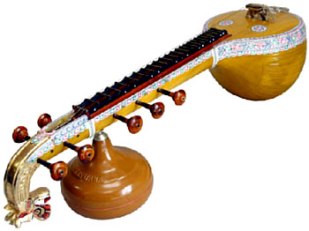
 
4 Comments

Posted by on April 24, 2015 in Music, Sangita


Tags: , , , , , , , , , , ,