RSS

Author Archives: sreenivasaraos

Kavya and Indian Poetics – Part Six

Continued from Part Five

[I could not arrange the topics in a sequential order (krama). You may take these as random collection of discussions; and, read it for whatever it is worth. Thank you.]


Can Kavya be defined?

The beginning of Sanskrit Kavya is, usually, illustrated by a dramatic moment when the first poet Adi Kavi Valmiki was impulsively provoked to cry out in anguish, as he watched a hunter strike down one of the sweet-voiced Krauncha pair.  The scene occurs in the verses [1-2-9 to 16] of the Second Sarga (chapter) of the First Book (Kanda) – Balakanda of Ramayana.

Two cries are uttered: first, the piteous wailing cry of the bird (karuna gir) on seeing her mate struck down , and withering on the ground covered with blood; and, the second, the cry of the sage , stricken with grief on seeing  the Kraunca hen scream in pain.

It is the karuna gir, the mournful lament of the Kranunchi that evokes in Valmiki the Karunyam, empathy or compassion. The term  karuna – usually translated as compassion – that occurs three times in the passage – is derived from the root Kri – meaning ‘ to pour out’ ; and, the term is meant to suggest pouring out , in response; or sharing the pain and anguish by ‘entering into the agony of another’. In that sense, Valmiki is giving voice to the inarticulate painful, heart wrenching shrill of the mourning female bird.

In the intensity of his feeling of compassion, Valmki thought ‘this is wrong’; and, cried out:

‘Since Nishada, you killed one of this pair of Krauncha birds, engaged in love; you shall not live very long’.

 मा निषाद प्रतोष्ठां त्वमगमः शाश्वतीः समाः |यत् क्रौञ्चमिथुनादेकमवधीः काममोहितम् || १५||

It is said; Adi Kavi Valmiki after pronouncing his first (Adi) Sloka exclaimed in amazement; what is this that is uttered by me (Kim idam vyahtham maya … किमिदं व्याहृतं मया…!).

His exclamation – Kim idam – what is this? – is a perpetual question in Kavya-shastra ; and, it has prompted endless debates over the centuries

What, then, is this wonderful thing called Kavya? !!

*

Before we progress further, let me digress here for a while..

Sri Aurobindo studied the Ramayana and the Mahabharata; and wrote on the greatness of these epics; and of the Great Poet Valmiki.

The Ramayana of Maharishi Valmiki is said to be the first metrically composed poem in Sanskrit.  So it is known as Adikavya, where Maharishi Valmiki describes beautifully the story of Rama’s banishment, Sita’s abduction and Ravana’s destruction.

As we follow the hero’s adventures step by step, we see him walking with Visvamitra in the Bala-kanda; crossing the Ganges with Guha in the Ayodhya-kanda; journeying in Dandaka with Sita and Lakshmana in the Aranya-kanda; meeting Sugriva in the Kishkinda-kanda; listening to Sita’s message from Hanuman in the Sundara-kanda; and, killing Ravana in the Yuddha-kanda.

Several times the story is recapitulated. Repetitions are used as brushstrokes to make the structure absolutely clear. Though the epic is long, nowhere we miss the main thread of the story. It is the simplicity of the structure and the creative genius of Valmiki that made Ramayana so popular.

 Sri Aurobindo comparing the Ramayana with the Mahabharata says,

… It differs only by a greater simplicity of plan, a more delicate ideal temperament and a finer glow of poetic warmth and colour. The main bulk of the poem in spite of much accretion is evidently by a single hand and has a less complex and more obvious unity of structure. There is less of the philosophic, more of the purely poetic mind, more of the artist, less of the builder. The whole story is from beginning to end of one piece and there is no deviation from the stream of the narrative.”

According to Sri Aurobindo, Valmiki remains unsurpassed till today. Valmiki is not a mere story-teller. He is the hero as a poet taking the civilizations of the past in their entirety to study the step reached so far by mankind struggling towards perfection. He has made the epic a path-finder, a character-builder and  a means for attaining human perfection

Sri Aurobindo points out that through  the  ideal  characters  of  Ramayana, Valmiki  “makes us  conscious  of the immense forces that are behind our life…”. The poet, by the living characterization   of the ideal human beings, has made the great human values like strength and courage, gentleness and purity “fidelity and self sacrifice‟ appealing to the emotion and the aesthetic sense in a gracious and harmonious manner.

In the Ramayana  the  poet  has  “lent a  certain  high  divineness to the   ordinary  things  of  life, conjugal  and filial and maternal and fraternal feeling, the duty of the prince and leader and the  loyalty of follower and subject, the greatness of the great and the truth and worth of the simple…]

 Padmapurana

Many have tried to explain what Kavya is?

The following explanations  of Kavya , as put forward by various scholars, is quite interesting:

: – Saba- arthau -sahitau Kavyam

– Poetry is the combintion of word and meaning (Bhamaha, Kavyalankara 1.6);

: – Nanu Sabda-arthau Kavyam

– Poetry is word and meaning (Rudrata, Kavyalamkara 2.1);

:- Tad adosau Sabda-arthau sagunya alamkriti punah kvapti

– this poetry is word and meaning , without blemishes, adorned with excellences , sometimes without the Alamkaras, figurative expressions.(Mammata , Kavyaprakasa 1.4);

:- Adosau sagunau sa-alamkarau cha sabda-arthau Kavyam

– Poetry is word and meaning , without blemishes, furnished with excellences and Alamkara figures of speech ( Hemachandra , Kavyanushasana  1) ;

:- Sadhu-sabda-artha-samdarbham  guna-alamkara-bhushitam , sphuta- itirara- sopetam Kavyam  kurvita kirtaye

Let the poet ,with the object of gaining fame, compose Kavya intertwining word and meaning , and decorated with excellences and figures (Alamkara) and other poetic  sentiments in a clear style  (Vagbhata , Vagbhata-alamkara 1.2);

: – Sabda-arthau- nirdoshou sagunau prayah alamkarau Kavyam

– Poetry is word and meaning; without faults, furnished with excellences and – often – with Alamkara, figurative speech (Vagbhata, Vagbhata-alamkara 1; and Kuntaka, Vakroktivijaya 1.7);]

***

In addition, Kuntaka came up with a detailed explanation. According to him, the word (Sabda) alone is not the body of poetry, but it is the happy fusion of word and sound which stands for ‘the body’ :  Sabdartyha sahitau kavyam. Kuntaka says the word (Sabda) and sense (Artha) , blended like two friends, enthusing each other, make Kavya delightful

Sama-sarva gunau santau sahhrudaveva sangathi I parasparasya shobhayai sabdartau bhavato thatha II

Further, Kuntaka says that the Real word is that which is chosen out of a number of possible synonyms and expresses the desired sense most aptly.  And, the real sense is that which by its own alluring nature causes pleasure in the mind of the Sahrudaya  (person of taste and culture)

Sabdau vivaksitartha kavachakautheyshu sathvapi I arthah sahrudaya ahladkari sva spanda sundarah II V.J.1.9

The togetherness of the word and sense is nothing but a captivating state which creates in the mind of the reader or the listener poetic delight which is exactly what is desired by the poet himself, neither less nor more

Sahitya manayo shobha shalitam prati kashyasau I Atyunna na athiriktha manoharinya vasthithihi II V.J.1.17

***

Then again, the scholars of the later period attempted to come up with a technical ‘Definition’ of Kavya , in place of  ‘explanations’. When the Poetic scholars set out to define Kavya, they set for themselves certain norms, parameters and ground rules. And, also decided to keep out the Drama (which they considered it as Agama-antara, a different tradition) out of the purview of Kavya, for the limited purpose of arriving at a definition; and, similarly, the non-literary forms of Kavya were also kept aside.

According to the rules so framed:  any definition of Kavya should be free from three kinds of flaws (Dosha): it should not be too terse, covering too little (A-vyapti); it should not be too verbose, saying more than what is needed (Ati-vyapti);  and , it should nor be improbable or incompetent (A-samartha). 

Therefore, any definition of Kavya had to be brief, precise and easy to understand; it should be definite without shadow of alternatives; and, should, as far as possible, be free from technical terms that need further explanations.

But, Kavya, I reckon, cannot of course be defined with precision;  or be  presented in a capsule as a well knit, and packed accurate pellet of information.

Each generation of Poet-Scholars, right from Bhamaha to Jagannatha Pandita tried to define Kavya. They, at best, tried to draw its clear picture. Their attempts could be termed as explanations, circumscribed by their understanding, rather than as definitions.

The explanations offered by those scholars, nevertheless, help us to gain some insight into the nature and role of elements of poetry; and their mutual relationships. All those scholars base their explanations in certain technical terms and elements (Kavya-agama) each having its own connotation: Sabda, Artha, Rasa, Alamkara, Riti, Dhvani, Vakrokti, Dosha, and, Dhvani.

Bhamaha (6th century) said:  ‘Kavya is where the Sabda (word) and Artha (its meaning) are harmoniously combined – Sabda-Artha sahitau Kavyam .But, that was not regarded by many as an ideal explanation, since it does not specifically pertain to Kavya; and can  be extended to cover even non-literary or technical works.

Bhamaha then extended his explanation to bring in the element of Alamkara; and, said: Kavya is the happy fusion of Sabda words and Artha which expresses Alamkaras relating to them

Sabda-abhideya-alamkara-bhedadhistam dvayam tu nah I Sabda-Artha sahitau Kavyam (KA.1.15).

It was not clear whether Bhamaha meant Alamkara as the poetic principle or as the ornamental figures of speech. Further, the term Alamkara itself needs to be explained. Hence, this definition was not considered ideal.

Dandin says the body of Kavya is a group of sounds which indicates the desired or the happy aim intended by the poet – Sariram tavad ista-artha vyvachinna padavali (KA 1.10b). Here, the term ista-artha the desired effect or the desired import of the poet is rather too vague; and needs to be explained. Further, Dandin seemed to be defining the body of the Kavya rather than the Kavya itself. And, Padavali – the group of words – by itself and not accompanied by sense is not of great merit.

Vamana said Kavya is the union of sound and sense which is free from poetic flaws and is adorned with Gunas (excellence) and Alamkaras (ornamentation or figures of speech). Here, it was pointed out that the poetic excellence (Gunas) might be an essential aspect of a Kavya; but, the same cannot be said about Alamkara, the figure of speech.

Then again, Vamana said; the essence of Kavya is Riti (Ritir Atma Kavyasya). Riti represents for Vamana the particular structure of sounds (Vishista-pada-rachana Ritihi) combined with poetic excellence (Vishesho Gunatma). According to Vamana, Riti is the going or the flowing together of the elements of a poem

Rinati gacchati asyam guna iti riyate ksaraty asyam vanmaddhu-dhareti va ritih (Vamana KSS). 

But, Vamana’s definition involves technical terms that need to be commented upon offering explanations. Hence, it is not an ideal one.

Anandavardhana‘s definition of Kavya involves two statements: Sabda-Artha sariram tavath vakyam; and, Dhvanir Atma Kavyasa – the body of poetry is the combination of words and sounds; and; Dhavni, the suggestive power is the soul of the poetry. Anandavardhana talks in terms of the body and soul of the Kavya. And he also refers to the internal beauty of a meaningful construction of words in the Kavya. But, Dhvani is a highly technical term, needing much explanation. This definition again   was not treated as an ideal one.

Abhinavagupta outlines a good (uttama) Kavya as that which is composed by a poet gifted with creative genius (Prathibha)  consisting of  Rasa; Vaisadya; and , Soundarya (Rasavesa – vaisadya – Soundarya – Kavya nirmana kshamatvam). That is to say; a Kavya should necessarily provide the delight (Rasa) that a good-hearted reader can enjoy with relish (asvadayanyti sumanasah). Vaisadya is the diction, with clear, precise and yet enjoyable expressions that a reader can understand and appreciate  without too much effort. And, Soundarya is the beauty , the charm (ramaniyata)  that adorns the composition (kavi karma) , providing a rare delight (lokottaraaahlada-janaka) that enchants the reader and captivates his attention, with ease. 

Kuntaka defined Kavya on the basis of Vakrokti, a concept which he himself put forward.  According to him, Kavya is the union of sound, sense and arranged in a composition which consists Vakrokti (oblique expressions of the poet), delighting its sensible reader or listener

– (Sabda-Artha sahitau vakra Kavi vakya vyapara shalini I bandhe vyavasthitau Kavya tat ahlada karini VJ 1.7).

Kuntaka also said that  the word and sense, blended like two friends, creating each other, make Kavya  delightful

– Sama-sarva gunau santau sahhrudaveva sangathi I parasparasya shobhayai sabdartau bhavato thatha  II . 

These definitions too are not acceptable because Vakrokti, like Alamkara, Riti and Dhvani is again a technical term.

Mammatacharya , initially , comes up with a highly idealized general vision of the Kavya.  in his Kavyaprakasa  he defines Kavya as : that which touches the innermost cords of human mind ; and, diffuses itself into the crevices of the heart ; working up a lasting sense of delight. It is an expression of the beautiful form and melodious language of the best thoughts and noblest emotions, which is the spectacle of life, awakening the finest souls (translation of: Sri M Srinivasachariar)

Sakala-prayojan-amaulibhūta samanantarameva rasā-asvādana-samudbhūta vigalita vedya āntaramānandam prabhu-samita śabda pradhāna vedādiś āstrebhya śabdā –a rthayor gua-bhāvena rasā agabhūta vyāpārapravaatayā vilakaa yat kāvya lokottara varanā-nipua  kavi karma

And later , when he comes to the specifics , Mammata explains Kavya as  that which is constructed by word and sentence which are (a) faultless (A-doshau) , (b) possessed of excellence (Sugunau) , and (c) in which rarely a distinct figure of speech  (Alamkriti) may be absent – tadadoṣau śabdārthau saguṇāvan alaṃkṛtī punaḥ kvāpi /3/

This definition was attacked by many, pointing out that it is impossible to compose a Kavya without a single blemish; and not a single Kavya would satisfy Mammata’s requirement. Further, it was remarked that the adjective Alamkriti doesn’t seem to be quite appropriate as it merely enhances the quality of a Kavya, but is not an essential aspect of Kavya. And, Mammata has employed number of technical terms like : Dosha, Guna, and Alamkara , which again need to be explained ; and , it also includes an alternate view like ‘Alamkriti punah kvapi. Thus Mammata’s definition was also rejected.

Vishwanatha briefly defined Kavya as Vakyam rasathmakam Kavyam – Kavya is sentences whose essence is Rasa. But, here, Rasa is a technical term which has multiple explanations. And, many said Kavya cannot merely be sentences or collection of words; there has to a happy fusion of word (Sabda) and sense (Artha). Hence, this definition also fell short.

Jagannatha Pandita defined Kavya as: Ramaniya-artha prathipadakah sabdam kavyam ; poetry is the  combination of words that provides delight. Here, Ramaniyata denotes not only poetic delight Rasa, pertaining to the main variety of Dhvani-kavya, but also to all the ingredients of Kavya like Vastu-Dhvani Kavya; Alamkara-Dhvani –Kavya, Guni-bhutha –vyangmaya-kavya; Riti; Guna, Alamkara, Vakrokti etc.

This definition covering all aspects of poetics covers  a wider field than Rasa which is limited to certain criteria. Moreover, the word Ramaniyata is not a technical term, but it covers all the essentials of a Kavya.

Jagannatha Pandita’s definition of Kavya as : Ramaniya-artha prathipadakah sabdam , seems almost nearer to the ideal.

But, I reckon, Kavya is best left un-defined, not put into a straight jacket.   Leaving it to the delight and enterprise of each reader or listener to work out his own levels of appreciation, derive the sense he sees as the best and enjoy the experience of Kavya in his own way seems to be better approach.

divider1

 Cause of poetry (Kavya hetu)

According to Rajasekhara , the poet is endowed with Karayitri Prathibha the creative genius while the reader or listener is to have Bhavayitri Prathibha the faculty for appreciation of good poetry; obviously, the poet posses both the faculties.

The Kavi Prathibha the creative intuition is the essential without which no creative art is possible.

The scholars have tried to present other factors that might be responsible for outflow of poetry (Kavya hethu).

Dandin mentions three causes of poetry: Naisargika Prathibha natural or inborn genius; Nirmala-shastra –jnana clear understanding of the Shastras; Amanda Abhiyoga ceaseless application and honing ones faculties.

Rudrata and Kuntaka also mention three causes:  Shakthi, the inborn intellectual brilliance; Utpatti, the accomplished knowledge of the texts and literary works; and, Abhyasa, constant practice of composing poetic works.

Vamana says three causes of poetry are: Loka, knowledge of the worldly matters, norms of behavior; Vidya. learning of various disciplines; and Prakirna  , miscellaneous ,  that is six causes : Lakshajnata , study of the texts; Abhiyoga, practice ; Vrddha seva , instructions from the learned experienced persons; Avekshana, the   use of appropriate words avoiding  blemishes;  Prathibhana, the inborn poetic genius ; and Avadhana, concentration or single pointed devotion to learning and composing.

Mammata  , in his Kavyaprakasha, puts forth the following as the three causes of poetry, while doing so he included the causes mentioned by Vamana: inborn intuitive power; proficiency in worldly conduct as also the study of scriptures and standard literary works; and, practice of composing poetic works through the help of some persons proficient in this art.

śaktir nipuṇatā loka-śāstra kāvyādya-avekṣaṇāt / kāvyajña śikṣayā abhyāsa iti hetus tad udbhave // MKpr-K_3 //

Earlier, Bhamaha , in his Kavyalamkara , had mentioned the three elements _  Utpatti, Abhyasa and Prathibha  – as  being the cause (hetu) of Kavya.

kāvyaṃ tu jāyate jātu kasya citpra tibhāvataḥ // Bh_1.5 //

In the ‘causes of poetry’ (Kavya hethu) mentioned above, while Utpatti and Abhyasa stand for  the constant learning-effort  and refinements that polish the poetry , the terms Shakthi or Prathibha,  is explained in various ways.

According to Rudrata, Shakthi or Prathibha is that essential factor through which the poet spontaneously presents any subject matter that haunts him or occupies his mind, using appropriate expressions.  This explanation seems to  lay more stress on the external form of poetry. Therefore, Bhatta-tauta brought in the most essential internal factor ‘ He explained Prathibha , in his often quoted words,  as the genius of the intellect (prajna) which creates new and innovative modes of expressions in art poetry –  Nava-navonvesha –shalini prajna prathibha mathah.

Vamana said, Prathibha is the seed for creating Kavya : Kavitva-bijam prathibhanam (K.S.13.6)

Kuntaka and Mammata tried to explain the very basis of the Prathibha. Kuntaka said: the faculty of creating a poetic work is an unique intellectual power, which gains maturity due to the inborn and acquired impressions (Samskara paripaka prouda prathibha) gathered in poet’s life-time.

Mammata, adding, said: Shakthi is the intellectual power that could be said to be  a sort of a mass of  impressions serving as a seed for sprouting of poetic work: Shakthih kavitva bija-rupah samskara vishesha (Kavyaprakasa 1.3)

Both these scholars suggest that Prathibha or Shakthi is essentially an inborn talent or genius; and, it cannot be acquired artificially or by mere hard work.

Hemachandra also accepts Prathibha as the prime cause of poetry; but says, that such essential inborn poetic gift should be refined and honed or chiseled by intellectual application (Utpatti) and constant practice (Abhyasa) .

The other factors that go into creation of a good Kavya include Utpatti and Abhyasa. Utpatti stands for detailed study of literary works and scriptures as also for knowledge of worldly matters. Through it, the natural (Sahaja) or inborn Prathibha gets refined, precise and capable of understanding the essentials of poetry as also of life. And, Abhyasa is constant practice of writing and creating poetry.

Jagannatha Pandita mentions that in addition to the above three factors , the divine grace (Devatha anugraha) is also essential.

The general view appears to be that Prathibha is the most essential factor for creation of Kavya (Kavya hetu) but it needs to be refined and polished by Utpatti and Abhyasa.

Then there is also the question whether the cause of poetry (Kavya hetu) could be the same as the fruits of benefits of poetry (Kavya prayojana) , such as achieving riches or fame or poetic pleasure etc. The opinion, in general, appears to be negative. The reason adduced is that , the Kavya hetu the cause of poetry  is prior to composition of poetry, while Kavya prayojana , the fruits of poetry come after the Kavya is composed and read by others.  But, at times, the fruits of a Kavya may act as an incentive and spur the poet to compose more and better poetry.

divider1

The purpose of Kavya

While the earlier theorists on poetics – Bhamaha , Dandin and Vamana-  state that the objectives of poetry are the renown (Kirti) won by the poem and its poet; and , enjoyment (Priti) enjoyed by the readers or the listeners of the poetry. The later sets of critics add instructions (upadesha) as one of the other virtues of a good poetry.

While composing poetry, a poet experiences aesthetic pleasure as a poet. And, after that, while reading or witnessing his own composition he feels aesthetic delight as a Shrudaya.  But, in a situation when he does not feel aesthetic pleasure due to some reason, he is neither a poet nor a reader, but an ordinary person.

Dhananjaya , following the lead given by Bharata [who had said that he devised the dramas to give , among other things, relief to those unlucky ones afflicted with sorrow and grief or over-work

– dukhārtānā śramārtānā śokārtānā– NS.1.114 ],

 makes it abundantly clear that the prime objective of a Drama is to provide entertainment (ananda). Dhananjaya taunts; and mocks at one who naively believes that Drama, like history (itihasa), is there only to give knowledge.

He wryly remarks ‘ I salute  (tasmai namah) that simpleton  (alpabuddhih) who has averted his face from what is delightful ..!’

anandanisyandisu rupakesu/ vyutpattimatram phalam alpabuddhih / yo ‘pitihasadivad aha sadhus/ tasmai namah svaduparahmukhaya//DR.1.6//

*

The purpose of Kavya is to communicate, and to communicate effectively. The ultimate aim of poetry is to provide a sort of aesthetic rupture – Rasanubhava. Its said; Sadah parnivrtutti, the unalloyed joy is the foremost purpose of poetry . The suggestions offered in a persuasive manner, the kantha samhitopadesha comes only next.

These experiences are related both to the poet and to the Sahrudaya, the reader or spectator , either directly or indirectly.

divider1

Kavya Prayojana

There have been elaborate discussions on Kavya Prayojana – the benefits derived from Kavya or poetry. Those benefits are seen both from the point of view of the poet (Kavi) and of the cultured reader with refined tastes (Sahrudaya).

[ There is a wise-saying (subhashita) that declares : In the whole of this insipid world, there are just two sweet things: enjoyment of Kavya and company of good friends

Asare khalu samsare dve phale hi  amrutopame / kavya-rasa svadah,  sujane  sangah saha ]

It is generally agreed that the study of Kavya benefits us all (Loka-mangala). That is because, there is a faith that the poetry purifies the hearts and minds of the readers; and, it leads to the well-being (hita) of all and to a more civilized world. As regards the poet, it purifies him/her also, because, it elevates the consciousness of the poet in creating such sublime poetry.

It is said; Kavya confers all the four kinds of benefits (Chatur-varga –prapti) that are the seminal and enduring values of human life (Purushartha): Dharma, Artha, Kama and Moksha. And, apart from that there is an immediate sense of delight as the reader savours (asvada) the nectar of inspiring, sublime poetry (Kavya-amruta-rasa).

Visvanatha says that the group of four benefits (Chatur-varga phala-prapit) is obtained, with great difficulty, by persons of dry intellect through dull and insipid Shastras: but, the riches of the same group can be attained, with ease, even by dullards, through delightfully pleasing Kavya.

The drift of the discussions in the Indian poetics indicate that Kavya confers both the visible and the invisible benefits. Mammata mentions six types of benefits that Kavya produces or leads to. His views  and that of the other scholars  could ,  generally , be, summarized as :

(1) the joyful experience  (Rasa) of  delight  (Ananda)   is the prime purpose of the Kavya- Kavya-ananda;

(2) the grace (Devata Prasada) that  leads to liberation (Moksha) which is the highest goal of human existence;

(3) it brings to the poet fame (Yashas, Kirti)  and wealth  (Dhana);

(4) it imparts knowledge (jnana) instructions (Vyavahara –jnana) for the betterment of our lives;

(5) it whispers into our hearts the agreeable advice(Vibodha) as in the manner of a lover (Kantha-samhita) ;

(6)  it renders us emotionally stronger (Buddhi -vivardhana) with enthusiasm for life (Utsaha) love (Priti, kama) for life and enjoyment (Sukha,Vilasa) , fortitude (Dhairya) , control over senses (Nigraha ), avoidance of the harmful (Anista –nivarana) etc.

*

And, Abhinavagupta in his Locana, commenting on Anandavardhana’s Dhvanyaloka, Uddyota 1, muses:  I often wonder, is not this world, filled with materials and objects, truly inert (jada)? The men and women who populate also, at times, seem inert. Methinks, it is only the creative genius of the poet (prathibha) that has the power to energize (sacetana) and enliven such rather insipid and inert existence. It can make the hard, rock-like world spring forth life-giving water.

The poet gifted with creative intellect (Prakhya); and, the learned listener/ reader (sahrudaya) blessed with understanding heart (Upakhya), together enrich the literary principles  (Sarasvathyas tatvam kavi-sahrudaya-akhyam vijayate).

apūrvaṃ yadvastu prathayati vinā kāraṇ-akalāṃ- jagadbhāva prakhyaṃ nija-rasa-bharāt-sārayati ca/ kramāt prakhyopākhyā prasara subhagaṃ bhāsayati tat sarasvatyā-statvaṃ kavi-sahṛdayā-akhyaṃ vijayate //

*

Vishvanatha Kavi (Sahityadarpana – 3.6 to 7) avers :  Poetry is an unusual out-of-the world (Alaukika) phenomenon, which cannot be defined in terms of ordinary human logic. It is an extraordinary creation of a highly gifted genius-Alaukika-vibhavatam. In the day-to-day common life; sorrow proceeds from sorrow; fear breeds fear; and, even what seems to be pleasure can later cause pain.  But, the poetic genius performs the miracle of deriving pleasure even from painful situations; it even transforms horror into aesthetic experience.  Hence, why not have faith in poetry, which can turn any kind of unpleasant experience, including pain and sorrow, into aesthetic poetic delight.?.!.

Hetutvam soka-harshader-gatebyo loksamsrayat/ Soka-harsha-dyo loke jayantam nama laukikah //3.6//

Alaukika-vibhavatam praptebhyah kavyasasrayat/ Sukham sanjayate tebhyah sarvebhyo apiti ka ksatih  //3.7//

***

Sri Aurobindo studied the Ramayana and the Mahabharata; and wrote on the greatness of these epics; particularly on their relevance to our lives.

He said; the two great Epics of India, the Ramayana and the Mahabharata, are not merely the sagas of heroes or a mythology but a day to day reality for Indians. The thoughts and ideas embodied herein have greatly influenced the thinking of the common man of India. They are, as Sri Aurobindo says, “…a highly artistic representation of intimate.

As regards Ramayana, Sri Aurobindo said that it has played a vital role in building a strong foundation for the Indian culture. “The work of Valmiki has been an agent of almost incalculable power in the molding of the cultural mind of India: it has presented to it to be loved and imitated in figures like Rama and Sita, made so divinely and with such  a  revelation  of  reality  as  to become  objects  of enduring cult and worship, or like Hanuman, Lakshmana, Bharata  the living human image of its ethical ideals; it has fashioned much of what is best and sweetest in the national character, and it has  evoked and fixed  in  it  those  finer  and  exquisite  yet  firm soul-tones  and  that  more delicate humanity  of temperament  which  are  a  more  valuable  thing  than the  formal  outsides  of  virtue and conduct.”

Ramayana is not just an epic written for the sake of the entertainment of the intellect but it is a revelation propelled by the supreme afflatus of the divine urge. Its penetrating attractiveness causes profound elation and high-spiritedness in each and every sensible heart. It makes us realize the mystically luminous and resplendent history of India encompassing the true cultural processes. The whole of the Ramayana is molded for a greater societal transformation from an unreal materialism to enduring spiritualism. It is truly the heart and soul of India.

**

For a very detailed discussion on Kavya Prayojana, please click here.

lotus twin

Continued

In

Next Part


Sources and References

Glimpses of Indian Poetics by Satya Deva Caudharī

Indian Poetics (Bharathiya Kavya Mimamse) by Dr. T N Sreekantaiyya

Sahityashastra, the Indian Poetics by Dr. Ganesh Tryambak Deshpande

History of Indian Literature by Maurice Winternitz, Moriz Winternitz

A History of Classical Poetry: Sanskrit, Pali, Prakrit by Siegfried Lienhard

Literary Cultures in History by Sheldon Pollock

The Philosophy of the Grammarians, Volume 5 By Harold G. Coward


Leave a comment

Posted by on July 26, 2015 in Kavya, Sanskrit


Tags: , , , , , , , , ,

Kavya and Indian Poetics – Part Five

Continued from Part Four

[I could not arrange the topics in a sequential order (krama). You may take these as random collection of discussions; and, read it for whatever it is worth. Thank you.]

Language of Kavya

Prose is often concerned with the day-to-day experiences and speaks in the common language. But, when those words and expressions walk into poetry, they acquire a totally different nature. The common words (prasiddha) are transformed into suggestive expressions that are less known outside of poetry (a-prasiddha). This is akin to the movements in classical dance where a simple thing such as walking as in common life (loka dharmi) is transformed into idioms of dance expressions (natya dharmi). Similarly, in poetry, If the common language is understood by all (loka dharmi), the poetic expressions are relished by Sahrdaya, the cultured ones (kavya dharmi).

As regards the distinctions between language of poetry and the language of everyday, the earliest modes of such distinctions were of course the meter (chhandas), enlivening of the text with innovative and decorative phrases (Alamkara) along with detailed descriptions of the emotions as also of the surroundings. Kavya also makes abundant use of metaphors; the repetition of conventional patterns and images; and, of long winding unusual expressions. And, naturally, such poetry does not yield itself at the first glance or reading. It needs to be savored slowly in small measures, over and over again.

The technique of poetry makes use of different devices in various ways. But, to ensure that poetry retains its own natural language-flow, usually, it   avoids use of banal words.  In order to just avoid the over-used words, the poets often try being innovative and create words, phrases and expressions that are striking and rather unusual. The various forms of metaphors and similes thus created leads to a broadening of the perspective and produces a multiple view of the subject in an artistic manner. Not only the poets reveal familiar subjects in a new light, but they also reveal truths that hitherto were not quite obvious. They also unfold relationships and beauties that are either not present in ordinary life or else remain unrecognized.

Hamsa

Kuntaka (10th century) in his Vakrokti-jivita finds Bhamaha’s definition of Kavya – Sabdarthau sahitau Kavyam– ‘Poetry is composed of word and meaning together’ – rather inadequate.

Kuntaka remarks:  the mere fact that word and meaning exist together cannot be the defining characteristic of poetic expression; for it is what characterizes all linguistic expressions whether be it prose, poetry or whatever; no linguistic expression is possible without it.

Therefore, Kuntaka observes, the language of poetry is a special kind of Sahitya – Visistam evah sahityam abhipretam.  Its uniqueness consists in the fact that the word and the meaning have equal importance: – Anyu-nana-atiriktatva. They ‘vie with each other’ – paraspara sparsparditva; they are united like two intimate friends – suhrudva iva samgatau; and,  they  delight in  the beauty of each other – parasparasya sobhaya bhavataha.  

samasarvaguṇau santau suhṛdāv iva saṅgatau / parasparasya śobhāyai śabdārthau bhavato yathā // VjivC_1.18 //

The relation between words in Kavya is indeed unique .  Their  harmony resides  in the creative genius  (pratibha) of the poet ; and, is  realized in an inspired  poetic instant (tat-kalo-likhita)  while on the sublime  road of poetry (alaukika kavya-marge)  i.e. of poetic activity (kavi-karma-vartmani) . Such inspired poetry enchants the minds of the sensitive readers or listeners (chetana-chamatkarita, sahrudaya-ahladakarita).

Although several other words might possibly be available for expressing a single  idea, the expression chosen by a gifted poet  is exceptional and irreplaceable

sabdo vivakshit-arthai-kava-vacahako ‘nyesu satsv api.

Kuntaka illustrates how there is accord not only between the words and their meanings, but also between the words themselves; and between the meanings themselves – in fact, among all the constituent elements poetry.  He gives examples from the works of great poets such as Magha and Bhavabhuti.

Kuntaka shows how such accord results in the musical quality of poetry.  He remarks; like music, poetry is that which, by virtue of the beauty of tits expressions, its composition, fills the hearts of the connoisseurs with delight instantly, even when its meaning has not been pondered:

aparyalocite ‘py arthe bandha-saundarya-sampada / gitavad dhrdayahliidarh tadvidam vidadhati yat // VjivC_1.37 //

Hamsa

Poetry is a more liberated form of expression as compared to prose. One cannot easily define poetry.  Poetry discards the rigidity, the disciplines and the correctness of the structure prescribed by the grammar. Poetry enjoys the voluptuous malleability and freedom with words and sounds; it bends and twists them in any number of ways. Its concern is not so much with the correctness of form than with the sensitivity, refinement and brevity in expression of a range of thoughts, feelings and human emotions of joy, sorrow, grief, hope, despair, anger and fulfillment.

Poetry can be subtle and suggestive. The imagery that poetry evokes can hardly be captured in words. What is unsaid in poetry is more evocative than the explicit.

Grammar (Vyakarana) concerns itself with the arrangement of words into sentences. It does not, however, account for the pattern of meanings. The poetry is  also much concerned with the arrangement of words. But, in addition , it does strive to convey a meaning. The poetic beauty does not solely dependent on the strict order of words or other conventions. It in fact goes beyond regulated regimens.

Poetry, in the Indian traditions, is often called ‘vyakaranasya puccham’ – the tail piece or the appendix of Grammar. The Grammar determines the correctness of the words and their arrangement within a sentence. The poetry is however more concerned with the appropriateness and mutual relations among the words.  The poetry, as far as possible, follows Grammar. But , when it find the rules of Grammar too constrained or suffocating , it switches over to other means of expressions that are more appropriate or conducive to its natural flow; or , it invents its own means.

At times, when those inventive expressions of poetic suggestions are so charming and become so popular, they walk into Grammar per se.  Scholars like Nagesha Bhatta say that Grammarians must necessarily accept (svikara avashyakah) the power of suggestion (Dhvani)

– vyakarananamapi etat svikara avashyakah).

It is , therefore, often said that the poets enjoy a rare privilege; and a certain liberty that others cannot claim. They seem to have the licence to wield the language in any manner they choose, appropriate to their work. In a way of speaking; a poet can typically write ‘against the natural language’; breaking conventions , transgressing grammatical rules , and saying what could not have been said ordinarily .

Thus, Poetry has the power to set us free from the limited confines of our own set rules. Poetry represents the world as a man chooses to see it. Poetry is Truth, but not necessarily reality.

Poetry is a search for syllables to express an unknown. It is both direct and indirect ; and, is  universal. It appeals to the heart. It finds its echo in another heart. Poetry is the heart talking through the mind.

Hamsa

The complex web of words and meanings capable of being transformed into aesthetic experience is said to have certain characteristic features. These are said to be Gunas and Alamkaras. These – words and meanings; Alamkara; Gunas; and, Rasa – though seem separable are in fact fused into the structure of the poetry. Poetics accounts for the nature of these features and their inter-relations

That is to say that poetry creates for itself a language which has a character of its own (Riti, Marga). It might, if it so chooses, depart from the ordinary day-to-day common usage. With that the poem aims at a definite stylistic effect (vishista). The poet arranges his material or the building-bricks in a non-standard fashion, in a manner that is different from the ordinary usage.

As Vamana points out, it is the creative process that involves using word-order (pada-charana) in peculiar or specialized (Visista) ways that possess certain characteristics (Kavya-alamkara). Vamana puts forth the view that such special characteristics (Visesha) of a Kavya are mainly derived from the fact that the poet deliberately attempts to create a fresh or ingenious style of depiction with his unique expressions. The poetic language wears a clock or a veil, so to say.

This unique virtue of poetry provides space for experimentation. For instance; Bhamaha indulged in vakrokti, a twisted way of expressing a thing; Dandin brought in Samdhi-guna; and Udbhata introduced the secondary expressions (amukhya-vyapara). Such hitherto unknown or unusual terms necessarily called for explanations or indication (lakshana) in order to be understood.

In the process, Vamana and others lay much emphasis on the style (Riti or Marga); and, regard it as the most essential virtue of a Kavya. But, such views are not generally accepted, because Riti is but one among the ten traditionally recognized essential elements of a Kavya; and Riti(style ) is not everything that one looks for in a Kavya.

This has reference to the mistaken notion that Kavya is all about high-flown language. For instance; Bhatti takes pride in stating that his poems would not be intelligible to people who are not scholars. This wrong perspective arose probably from the fact that the grammatical and lexicographical sciences as well as the philosophical discipline had attained a high water-mark of respect with the learned people who alone could be the judges of poetry.  It had also something to do with the vain culture of Court-poetry where the rival poets threw challenges at each other in the form of abstruse verses. The failure to solve the puzzle-like verses invariably ended in humiliation.

This high-brow and twisted view of poetic language however, was not universal. Bhamaha urged that kavya should be written in such a manner as to be intelligible even to those who have no learning or general education. Later, Vamana who examined the whole issue said that the poetic beauty does not exist merely in twisted or unusual expressions; but, in the intrinsic merit (guna) of the poetry itself. Then he said, the ultimate object of good poetry in rasa, the enjoyment.

Thus, the general view is that in order to enable his text not only to convey   but also to dress its narration in an artistic manner , the poet might  reasonably  use complex expressions and  structures. But yet, he should not lose sight of the fact that the natural language is the foundation of good  poetry.

The popularity of Ramayana among the common people is the standing testimony to this truth. In spite of the high regard for finer poetry, Indians have always considered the simpler Epic of Ramayana as an ideal Kavya.

Hamsa

The poetic way of expression is employed both by the literary and the non-literary works.  The non-literary works though in poetic form are not regarded as Kavya per se. For instance; presentation of Astronomy in Varahamihira’s Panchasiddhantika. or his Brihadjataka ; or of the Algebra in Bhaskara’s Lilavathi contain many verses (click here for its review), beautiful descriptions of nature and of poetic merit that they almost are Kavya. Similarly, Suryapandita’s work on Astronomy (Bhaskara-bhushana) has beautiful verses praying to Sun god.  There are also numbers of philosophical works elucidated in poetry.

[ Let me digress for a while:

Acharya Varahamihira was one of the greatest astrologers of ancient India. Belonging  to the 6th century CE of the Gupta Age; he composed numerous texts on astrology and allied subjects. Among his notable works is the Brihat Samhita, which is an extraordinary treatise on not just astrology but a host of other subjects from architecture to agriculture, from meteorology to physiognomy, from economics to dental hygiene

Varahamihira also “known as Varaha or Mihira, was considered to be one of the ‘nine gems’ or Navaratnas of king Vikramaditya or Chandragupta II’s court. He was a famous astrologer, astronomer, philosopher, scientist, mathematician and poet.

 There are several legends and folk tales associated with him, which attest to his popularity not just in ancient India, but also in the subsequent times.

There is some contention about his date of birth, but Varahamihira was born Circa 500 CE in Kapittha and died in Avanti (Ujjain) in 587 CE

He was the son of Adityadasa, a sun-worshipping Maga-Brahmin and an astrologer. Varahamihira learnt astrology from his father and mastered the Vedas and after a meeting with the great mathematician, Aryabhata at Kusuma-Pura, he became interested in astronomy

Often referred to as the Prince of Indian Astronomers, Varahamihira’s major works are in the field of astronomy and astrology. He famously composed Pancha-siddhantika, and other works like Yoga-Tantra-Brihat-Jataka; Laghu -Jataka; Brihat-yatra; Brihat-Vivaha-patala; Swalpa-vivahapatala; and  the Brihat-Samhita.

The Pancha-siddhantika is his most famous astrological work; for, it gives valuable references to five contemporaneous astronomical works, viz. Pitamaha, Romaka, Paulisha, Vaashishtha and Surya

Of these, Romaka and Paulisha are known to be references to Roman and Greek schools of thought, which Varahamihira himself preferred

In the foundation of these five systems, he devised three branches or Skandhas. These were, Siddhanta and Ganita (theory and mathematics); Hora and Jataka (horoscopy and natal astrology); and, Samhita (collection), a branch which dealt with all other aspects of knowledge. It is to this third branch that the Brihat Samhita belongs.

The Brihat Samhita is truly the magnum opus of Varahamihira (the great 6th century scholar). He deals with a dizzying number of subjects in this encyclopedic treatise and gracefully condenses knowledge from all important walks of life for future generations. scholars and laymen alike stand to benefit from the study of this text, for it has both -scientific and literary merit.

Varahamihira has displayed his poetic genius even in the treatment of a highly technical subject.  He is not pedantic or verbose in diction nor monotonous in versification…. his diction is lucid, charming and elegant.

For more on Brihat Samhita , please do read the research paper of Dr. Urmi Chanda : Brihat Samhita: The magnum opus of Varahamihira ]

***

Even in the non-technical works, the materials of Shastra and Itihasa very often overlap. The materials of Shastra can appear in Itihasa, as they frequently do in the Mahabharata or in a kavya. Similarly, the materials of Itihasa can appear in kavya, as in the Harshacharita of Banabhatta.  And, many masters of systematic thought across the religious and philosophical spectrum wrote kavya, often very un-philosophical kavya.

Sanskrit Poetics approves role of Kavya as a vehicle for imparting instructions. But, Kavya need not always deal with learned matters. In fact, too much learning will affect the appeal of a poem. It might turn preachy. There are therefore short poems or couplets that in a capsule form impart moral codes (Niti), wisdom and erotic (Sringara). The most well known poems of this genre are Bhartrhari’s sets of stanzas on Sringara and Vairagya.

Although the words used in Kavya and in the non-lterary Shastra works are the same they do not evoke the same joy or other emotions

Kshemendra makes a distinction between Kavya and Shastra; that is between the purely poetic works and other subject oriented works that are in poetic form. And he also mentions of works that fall in the intermediate zone: Shastra-kavya – poetry that is also technical; and, Kavya-shastra – a technical work that is also poetry.

Basically, Shastra is informative in its character and its style is textual; Kavya, on the other hand, is complex in its structure, employing a language of its own, embellished with artistic metaphors, similes and unusual expressions.

The non-literary work might use, within reasonable bounds, flowery or artistic language or aim at achieving a definite stylistic effect (vishista).But; it would be a mistake if it gets its priorities wrong. It should be more focused on its primary objective which is imparting information, instructions and knowledge, than on seemingly artistic flourish of its language. That would be, as they say, counting the trees but loosing the woods, which is laying premium on minor detail but missing the big picture.

Hamsa

Raja Bhoja (1011–1055) states: another way by distinguishing kavya from ordinary language is in terms of directness. Ordinary language is the direct language of Shastra and everyday life; kavya, in contrast, is the indirect language abounding in descriptions, but, its statements do not prescribe action. Its way of saying is  indirect , indirection (Vakrokti) — an unique manner of expression. 

Raja Bhoja says: Do not read kavya the way you read Shastra, Purana, or the Vedas; do not be concerned (except insofar as it is a source of pleasure) about a breach between what is said and what is really meant; about its relation with an actual world;   and about information or injunction. And do not expect the language of the kavya to be like ordinary language; its purposes are different.

According to Bhoja, all kinds of texts—science, narratives of things, including Shastra and Purana, have the capacity to teach us something by prescribing (Vidhi) or prohibiting  action (Nishedha) of some sort. Bhoja calls this the educative function.

But, Kavya neither prescribes nor prohibits any sort of action; nor does it quote the past authorities in support of its suggestions. It does not expressly enjoin or define appropriate action. Its relevance resides precisely in its own utterances (Ukti).

The Shastra and the Vedas act like a master in commanding (Prabhu Samhita) ; the texts of the wise sages are  like a counseling  by a friend in (Mitra Samhita) ;and,  kavya’s Ukti (utterances) are  like sweet whisperings  of the beloved (Kanta Samhita) . Kavya’s ways are endearing and more persuasive.

Hamsa

The Veda is set apart from the domain of Kavya, for various reasons.   The Vedas impart instructions in regard to true knowledge and right action (Dharmavidhi). Imparting knowledge and instructions are its primary functions; and the question of language, however meticulous, is secondary. The role of language in Veda does not seem to be as crucial as it is in a Kavya. At the same time, Kavya too instructs, in its own way; but without commanding the reader to act in a certain manner.

The Vedas are believed to be intuitive perceptions (Darshana) as envisioned by the seers (Rishi). They are direct; and, its authors transmit their vision, in its pristine purity, perfectly, by expressing exactly what they mean. However, in the kavya, as in everyday life, we often employ metaphorical language, which may give out multiple meanings.  But no such divergence occurs between verbal intention and the Truth as depicted in the texts of the Rishis. .

Elements of kavya are doubtless present in the Veda itself (Sruti) as also in   the Smruti (Vedic texts remembered),    in the narratives of the events that occurred in the past (itihasa), and in ancient lore (purana).  But such poetic elements are incidental to the principal objects of those texts; and, therefore are not of prime importance to their traditional readers or listeners.

There are also other difference between the Vedic poetry and Kavya. The language of the Vedas is different from the classic Sanskrit of the post-Panini era. The imagery and poetic vocabulary too are different. For instance; you do not find in the Samhitas descriptions of young , beautiful  adorable girls through pet idioms that became common in the Kavya works : moon-like or lotus-like face; fleeting eyes of a gazelle; narrow waist; gait like that of a swan etc. There are also no poetic conventions or symbolisms   in the Samhita that speak in terms of: a Chakora bird which is nourished by moon beams; a Chataka bird which feeds on rain-drops; or, Chakravaka which is ever faithful and pining for its partner.

The two ideas seem to be present here:  (i) what makes kavya different from everything else has essentially to do with language itself; (ii)   and, accordingly, literary analysis must center on language. These are two presuppositions that span the entire history of kavya theory and profoundly influenced its production.

A K Warder, in his Indian Kavya Literature (vol. One) explains the distinctions between the literary and non-literary works, particularly those on philosophical subjects. And, the dictions he mentions can very well cover the technical works:

 “Kavya is distinguished from philosophy and most scriptures, in that it is centered in man. As compared with philosophy, which may also be humanist in outlook, Kavya is an art form, presenting its truths and its comments through images and individual characters. The humanism of Kavya differs from that of the critical and analytical schools of philosophy in its endless riches of concrete details, which aims to present by examples the infinite variety of particular times, places, persons situations and actions. Its subject matter is human experiences of life, accumulated over thousands of years, an epic of humanity which is not available to us in any other form. This experience is presented in terms of human emotions: the reactions of the people to situations in life’.

lotus design

Continued in

Next Part


References and Sources

Literary Cultures in History by Sheldon Pollock

Indian Kavya Literature (vol. One) by A K Warder

 
Leave a comment

Posted by on July 25, 2015 in Kavya, Sanskrit


Tags: , , ,

Kavya and Indian Poetics – Part Four

Continued from Part Three

[I could not arrange the topics in a sequential order (krama). You may take these as random collection of discussions; and, read it for whatever it is worth. Thank you.]

Dhvani – Rasa Dhvani

Poetry is basically a verbal icon or a verbal structure; and, as such, there cannot be any poetry without words. Therefore, any discussion on poetry necessarily  involves discussion on words. The poetry also invokes emotional response. And, that is followed by the understanding of it’s  emotive language ; and, the appreciation by the reader of the true import of the poet. All these elements are , therefore, highly essential for enjoyment of poetry.\

Thus, the success of a good Kavya fundamentally involves three aspects:  the poet’s creative inspiration (Prathibha); its  form  by way  of the words (Sabda) and meaning (Artha), i.e. body (Sarira) of the Kavya ;  and , the aesthetic  effect it has  upon the reader (Rasa

Kavih karoti kvyam; Rasam jananthi panditah.

Abhinavagupta, citing his teacher Bhattatauta, says: the poet and an appreciative cultured listener/reader share a common experience of delight (kavaye shrotruh samanau anubhavas-tatah). And, both are partners in poetic experience; each is inspired in his own manner.

While the poet is blessed with creative genius (karayatri), which is an unfettered faculty (Prakhya-purna); the good-hearted reader (sahrudaya) is endowed with the receptive power (Bhavayatri), which lets her/him enjoy good poetry with delight (Asvadana). He empathizes with the poet (Upakhya); and, recreates , for his relish, the poet’s  creative experience (Anu-sristi) ; just as the moon reflects the glow of the Sun.

Abhinavagupta says: If the poet has Prathibha, the creative genius ; the listener has its reflection or counterpart Prathibhana (Adhikari chatra vimala prathibhana sahrudayah). Yaska remarks that the poet and the listener , each in his own manner , could even be called a Rishi, a seer. The poet has direct experience (sakshath rishi) ; and, the listener derives the same delight by listening to the poet (shruth rishi).  

sākṣāt.kṛta dharmāṇa ṛṣayo babhūvuḥ / te avarebhyo asākṣāt kṛta dharmabhya upadeśena mantrānt samprāduḥ //Nir. 1.20//

The ultimate object of Kavya is Rasa, the aesthetic delight. As Taittiriya Upanishad remarks in another context: rasam hi evaayam labhvaanandi bhavati- on experiencing Rasa , one becomes truly blissful.

Let’s, therefore, briefly talk about words, meanings and Rasa.

shabdartha

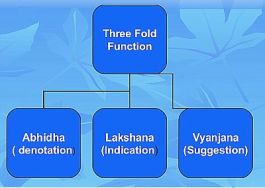
As mentioned earlier in the series, a word has three functions: it signifies or denotes (abhida); it indicates (lakshana); and, it suggests (vyanjana). 

The meaning that is comprehended immediately after the word is uttered is its primary meaning (mukhya-artha). The meaning thus conveyed; its relation to the next word ; and, its own meaning is a mutual relation of the signifier and the signified (vachya-vachaka). The power that creates the relationship among words is Abhida-vyapara, the power of denotation or sense. The suggestive power of the word is through Vyanjana-artha.

Of these, the Vyanjana-artha, which is the suggested sense or the essence of the word is most interesting; and, is much debated. This is based in the principle that   the meaning of word is not limited to its literal sense; the word has the power to reach far beyond the obvious.

In poetry, the word acquires another power Vyanjana-vritti the suggestive function. It is the    power which activates the potential hidden in the word. And, the word acquires a new glow. Through the suggestive function of the word; a new meaning or plurality of meanings emerges transcending the obvious literal sense, far more beautiful and sensitive.

The suggestive word, the suggested meaning, the power of suggestion; and, their mutual relationship are virtually the lifeblood of Indian poetics.  In fact, this is what that distinguishes poetry from other forms of literature.

The suggested sense Vyanjana-artha, which (though not explicit) becomes the object of awareness, is regarded as the essence of poetry. The Dhvani School put forward by Anandavardhana (Ca. 850 AD) through his Dhvanyaloka (also called Kavyaloka and Sahridayaloka), brought focus on the potential power of the word in a Kavya. Here, the word (Sabda), together with its literal sense (Vakyartha) is said to form the body (Sarira) of Kavya, it is the cloak of its soul.  But, the essence of poetry is elsewhere; it is not directly visible; and, that essence is the suggested sense of the word (Vyanjana-artha).

Which is to say : it is not the direct literal and obvious meaning that is explicit in poetry, but it is the suggested, indirect (paroksha-artha) and emotive meaning that matters. It does not mean that words and primary meanings are unimportant.

What is suggested here is that:  though the words of a Kavya and their literal sense must be given their due importance, they are but a medium for emotive and indirect meaning to flash forth. In good poetry, this suggested meaning dominates over the words and their literal meaning. As Anandavardhana puts it, the latter are compared to a woman’s body ; and, the former to her grace and beauty, which is a subtler manifestation and a more profound meaning of the womanhood.

The primary meaning can be understood by all. But, the suggested meaning is understood only by those who are gifted with some imagination and a sort of intuition. Here, the mere knowledge of the word alone is not enough to understand and enjoy the poetic import or the essence of the Kavya. It needs intuition or Prathibha.  

Mammatacharya calls Prathibha as – nava-navaonvesha-shalini prajna – the ever inventive and resourceful intellect. Prathibha is also called, at times, as Vasana.  Only those endowed with Prathibha can truly enjoy the essence and beauty of Kavya.

That is why, it is remarked, that the Grammarians (unlike the goodhearted cultured reader the Sahrudaya) cannot truly appreciate and enjoy the Rasa of good poetry. They are incapable of looking beyond what appears obvious.

[One of the hymns of the Rig-Veda  makes a distinction between a person who merely learns the literal meaning of a verse ; and , a person who  goes beyond the ordinary meaning of the words, and  tries to understand  and grasp its inner significance. It says :

the former sees , but , does not see; and, he hears , but does not hear. It is only to the latter that Vac (speech) reveals herself completely, just as a loving wife to her husband.

uta tvaḥ paśyan na dadarśa vācam uta tvaḥ śṛṇvan na śṛṇoty enām |  uto tvasmai tanvaṃ vi sasre jāyeva patya uśatī suvāsāḥ |RV_10,071.04|

In another passage of the Rig-Veda , it is said that the great poets select their words by ‘winnowing away the chaff from the grain’; and, only the persons of equal learning and refinement can truly appreciate their poems, fully.

saktum iva titaunā punanto yatra dhīrā manasā vācam akrata | atrā sakhāyaḥ  sakhyāni jānate bhadraiṣāṃ lakṣmīr nihitādhi vāci |RV_10,071.02

Yaska , the Niruktakara, remarks : a person, who merely recites the Vedas, without comprehending its meaning, is like a pillar (sthaanu) or a mere load-bearer (bhara-haara). And, it is only he who fully grasps and appreciates the meaning of what he is reciting (arthajña) that will attain the good both here and hereafter (bhadram-aśnute-nākam); having been purged of all impurities by the power of knowledge (jñāna vidhūta pāpmā).

sthāur ayam bhāra-hāra kila abhūd adhītya vedam na vijānāti yo artham  / yo arthajña it sakalam bhadram aśnute nākam eti jñāna vidhūta pāpmā (Nir.1. 18)  ]

rangoli

It is said; in the highest class of Kavya, the denoted meaning (Vakyartha)  and  the denoting meaning (Lakshyartha)  is subservient to  revealing the suggested sense word (Vyanjana-artha); and , it is  called Dhvani by the scholars – dhvanir iti sūribhiḥ kathitaḥ  – Dhv.1.13

yatrārthaḥ śabdo vā tam artham upasarjanīkṛta-svārthau / vyaṅktaḥ kāvya-viśeṣaḥ sa dhvanir iti sūribhiḥ kathitaḥ // DhvK_1.13 //

The suggested sense of the word, designated as Dhvani (resonance or tone or suggestion), is regarded by Anandavardhana as the soul of a Kavya:  Kavyasya Atma Dhvanih.

Mammata   (Kavyaprakasa 1.4-5) seems to suggest  that Anandavardhana graded the entire body of Kavya into three classes (some dispute Mammata’s statement and point out that Anandavardhana did not say any such thing ) :  

(a) Dhvani-kavya (the poetry that suggests) as the true Kavya, the best (Uttama), where Dhvani the unspoken suggestive element is dominant;

(b) the second, Gunibhuta-vamgmaya-kavya (well endowed descriptive poetry, as the middle (Madhyama) where Dhvani is secondary to Alamkara, and serves as a decoration for the spoken or expressed meaning; and ,

(c) and Chitra Kavya (poetry that structured into various patterns or drawings) as the least (Adhama) which depends entirely on verbal play for its elegance and elaboration, and where Dhvani the suggestive power of poetry is absent.

tadadoṣau śabdārthau saguṇāvan-alaṅkṛtī punaḥ kvāpi / idam-uttamam-atiśayini vyaṅgye vācyāddhvanirbudhaiḥ kathitaḥ // MKpr-K_4 //

atādṛśi guṇībhūta-vyaṅgyaṃ vyaṅgye tu madhyamam / śabdacitraṃ vācya citram avyaṅgyaṃ tvavaraṃ smṛtam // MKpr-K_5 

[Anandavardhana (9th century) and his theory of Dhvani mark the beginning of a new-phase (Navina) in Indian Poetics.   The Dhvanyaloka of Anandavardhana marks a departure from the old ways of understanding Kavya. It makes an attempt to study Poetics from aesthetic point of view, assimilating all the essentials of various other schools. By giving prominence to Rasa, he lends a new explanation to all the problems of Poetics. According to that, Alamkara, Riti and Guna have their importance only in the context of Dhvani the suggestion which is the soul of Kavya.

The older School (Prachina) – of Bhamaha, Dandin Vamana and others – that belonged to about the 7th century dealt with natural or human situation idealized by the poet , for its own sake. The attention of the Prachina School was focused on ornamented figures of speech (Alamkara) and the beauty (sobha, carutva) of the expression or on the ‘body’ of poetry. Their Rasa theory generally was based in dramatic art .Therefore it did not come under Poetic proper.

The Navina School pointed out that the reader should not stop at  the expression but should go further into the meaning that is suggested, or hinted, by it. This suggested sense is the essence of Kavya. It differs from the expressed and the indicated sense. The Navina School laid more importance on the emotional content (Bhava) of the Kavya. But, here, the emotive element was not directly expressed in words (Vachya) ; but , had to be grasped by  the reader indirectly (Parokshya ) through suggestions. Yet, through the description of the situation the reader understands the emotion and derives that exalted delight, Rasa.

Anandavardhana, in his Dhvanyaloka , says that Vynjaartha (the un-expressed or the suggested meaning) is Dhvani – perhaps, inspired by Bhartrhari’s theory of Sphota . It is the essence of poetry. It sheds light on the function of suggestion in poetry. It is Vyanjana (revealing) and Dhvanana (echoing) or gamana (implication) or pratyayana (acquainting) of poetry which is superior to Vachya (expressed meaning)

Here, the words (Sabda), explicit mean (Vakyartha) the body (Sarira) of the Kavya. The subtle, suggested essence of the Kavya that resides within and is extracted with delight by the cultured reader (Sahrudaya) is the Dhavni.

The Dhvani theory introduced a new wave of thought in Indian Poetics. According to this school the Kavya that suggests Rasa is excellent. In Kavya, they said, neither Alamkara nor Rasa but Dhvani which suggest Rasa, the poetic sentiment, is the essence, the soul ( Kavyasya-atma sa eva arthas –  Dhv.1.5).

While stating that Dhvani is superior, Navina also establishes the status of Rasa. In this scheme the relative positions of Rasa, Guna, Alamkara and Dosa get fixed. It gives due credit to poet’s imagination and his sense of propriety.

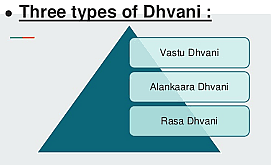
Though Dhvani was regarded the soul of poetry, the Navina did not lose sight of Rasa. It divided Dhvani into three kinds – Vastu (matter), Alamkara (figures of speech) and Rasa (emotion) .

Thus the evolution of the Navina School marks a transition from the ‘outer’ element to the ‘inner’ one, in regard to the method, the content and appreciation of the Kavya. The criteria, here, is not whether the expression sounds beautiful; but, whether its qualities (Guna) are adequate (Auchitya) to lead the reader to the inner core of the poetry.]

It is said; the concept of Dhvani was inspired by the ancient doctrine of Sphota, that which flashes or bursts forth the meaning. The term Sphota signifies:  bursting; opening; expansion; disclosure; the eternal and imperceptible element of sound and words; and, is the real vehicle of the idea which bursts or flashes on the mind when a sound is uttered.

Nagesha Bhatta (author of Manjusha and Shpota-vada) identifies Sage Sphotayana, mentioned by Panini in one of his rule, as the originator of the Sphota concept.  Bhartrihari quotes Yaska as mentioning that another ancient authority, the sage Audumbarayana together with Varttaksa held views similar to the Sphota theory. Yaska had mentioned (Nirukta: 1-2) about a theory suggested by Audumbarayana that a sentence or an utterance is primary and is a whole,  an indivisible unit of language. Audumbarayana, it appears, had also mentioned that the four-fold classification of words into : noun, verb, upasarga and nipata does not hold good. And therefore, Bhartrhari claimed that the views of these ancients support his own theory –Sphota-vada.

Clipboard01

[But, Yaska himself had not agreed with Audumbarayana; but, had gone on to talk about Bhava – the being and becoming of  verbs from their roots and about their transformations (Vikara) ]

 In any case, the original idea of Sphota seems to go back to the Vedic age when Vak or speech was considered to be a manifestation of the all – pervading Brahman , and Pranava (Aum) was regarded as the primordial speech sound from which all forms of Vak were supposed to have evolved.  Perhaps, this claim provided the model upon which the Vyakarana philosophers based their concept of Sphota. Indeed Sphota is often identified with Pranava.

It was Bhartrhari (around 485 AD) in his great work Vakyapadiya (all about sentence and word) elaborated and established the Sphota doctrine in the realm of Grammar and in Philosophy.

According to Bhartrhari, the perfect perception is that in which there is identity between the object (namely, the Sphota) and the form of its cognition (namely, words or the letters of sounds). This special kind of perception is held to be function of mind, rather than of the external senses.

flower3

Abhinavagupta (10th -11th century) who wrote a great commentary, titled Dhvanya-Lochana or Lochana, on Anandavardhana’s Dhvanyaloka, explains the concept of Dhavni in two ways:

As  Sabda Shakthi moola based in the sound of the expression  ; and as Artha-Shakthi rnoola based in the implied meaning of the expression. He says, Dhvani, in poetics, is so termed because it sounds, rings, or reverberates (Dhvanat iti Dhvani);

And, in the second, he says Dhvanyate iti Dhvani that meaning which is implied is Dhvani. The second, suggesting the implied meaning is the more appropriate one.

Thus, the faculty of indicating something which it is not is the distinguishing character of Dhvani. In other words, in a verbal expression abhidha and lakshana form the body; and, Vyanjana or Dhvani is in the nature of its  contents. Dhvani is the essence or soul of poetry.

While expanding on the concept of Dhvani, Anandavardhana did not confine himself to the words and sentences, but went on to include all contextual factors such as: the tone and gestures, the sound effect produced, the rhythm, the metere as well as the literal sense.

But at the same time, Anandavardhana did not get involved in the comprehensive linguistic phenomenon, the Vyanjana and its suggestive power. Similarly, he did not venture into the philosophical and grammatical world of Sphota as Bhartrhari did.  Anandavardhana confined his attention to the poetic language and to the suggestion of meanings of aesthetic value. His theory of Dhvani, to put it simply, is Vyanjana or suggestion as applied to poetry. In the process, Anandavardhana chose to align his theory of Dhvani with Rasa as initially outlined by Bharata. It is these two concepts – Dhvani and Rasa – that are the building blocks of Anandavardhana’s  theory of Poetics.

According to Anandavardhana, the element of Rasa has to reside in the poet, in his creation Kavya and in the reader, the enjoyer. The poet has to be inspired, charged with emotion to create a poetry that comes alive with suggestions (Dhvani). The poet is the first reader of his Kavya; and the first one to experience Rasa from its Dhvani sensitivities. For instance, Adi Kavi Valmiki was so intensely hurt and saddened by the wailing of curlew bird whose mate was shot down by a hunter in the woods, that his grief (Shoka) poured out into a verse (Shloka) filled with pathos that became the Rasa of Ramayana.

Anandavardhana maintained that experience of Rasa comes through the unravelling of the suggested sense (Dhavani). It is through Dhvani that Rasa arises (Rasa-dhavani).  The experience of the poetic beauty (Rasa) though elusive, by which the reader is delighted, comes through the understanding heart.

Thus, the principle of Dhvani is the most important of the Kavya dharma, understanding Kavya. And, the Rasa experience derived from its  inner essence is the ultimate aim of Kavya. Hence, the epithet Kavyasya Atma Dhvani resonates with Kavyasya Atma Rasah.

Although it decaled that the soul of Kavya is verily the Rasa, the Dhvani School did not abandon the concepts of the  earlier (Prachina)  Schools : Alamkara, Riti and Auchitya etc . It assimilated within it all their essences. It said; the Gunas really qualify the Rasa; hence a Kavya should employ Gunas that are relevant to its dominant Rasa. As regards the Alamkaras that decorate the body of Kavya   with beauteous and sparkling expressions and render it more attractive, they do nourish the Rasa. Thus, The Dhvani School accorded each element of Kavya its appropriate position.

And then there is the element or principle of Auchitya (propriety). Be it Alamkara or Guna, it would  be beautiful and relishing only so long it is  appropriate from the point of view of Rasa . And, they would be rejected if they are not appropriate to the main Rasa (Angirasa) of the Kavya. In the same vein, what is normally considered a Dosha (flaw) might turn into Guna (virtue) when it is appropriate to the Rasa. That again means, the beauty or the delight of a Kavya resides in its experience, Rasa.

Dhvani principle can be said, briefly, in statements: Rasa (aesthetic experience) is the soul of poetry; the mode in which the body of the poetry reveals it is Dhvani (suggestion); and, the harmonious accordance of the body and the soul is Auchitya (propriety) . Rasa, Dhvani and Auchitya are the Prastha traya, the three fundamental principles of Kavya Shastra.

rangoli

As I understand it ; the basic position of Anandavardhana is that an emotion cannot be evoked in a reader by mere mention of a name or a term and its bare description. It has to be suggested by describing the situation and the contextual factors. These include the literary meaning as also the suggestive possibilities of the expression such as: intonation , stress, the sound echoing the sense, rhythm, indicative imagery (bodhaka) , and expressive symbols (vachaka).

According to Anandavardhana, all these devices are to be used for helping to evoke the right response in the mind and the heart of the reader. With that, the same utterance may convey different suggestions to different people depending upon their level of understanding and receptivity. He thus brought the emotional response or enjoyment of the listener or the reader (Rasa) within the ambit of ‘meaning’. Thus, language acquires a limitless suggestive power. The object of such power is to provide unalloyed pleasure (Ananda) to the reader by evoking the Rasa.

Anandavardhana introduced a sort of new norm into Kavya.  He said there should be one predominant Rasa (which he called Angirasa) in a Kavya which includes Drama, Epic, lyric etc. According to him, in a Kavya, all other Rasas that are either mutually conflicting or supportive   should be subordinate to its Angirasa. But, Bharata who was mainly concerned with the successful productions of Drama that has to please varieties of people with different   or varied tastes, did not seem to considered it from that angle. And, therefore, Bharata, though he stressed on the structural unity of the plot did not, perhaps, consider it necessary for a Drama (as a whole) to portray a particular single Rasa of its own. In a Drama, each character would evoke a rasa that is peculiar to it.

aṅgirasa-viruddhānāṃ vyabhicāriṇāṃ prācuryeṇāniveśanam, niveśane vā kṣipram evāṅgirasa-vyabhicāry-anuvṛttir iti dvitīyaḥ / aṅgatvena punaḥ punaḥ pratyavekṣā paripoṣaṃ nīyamānasyāpy aṅga-bhūtasya rasasyeti tṛtīyaḥ / anayā diśānye ‘pi prakārā utprekṣaṇīyāḥ / virodhinas tu rasasyāṅgirasāpekṣayā kasyacin nyūnatā sampādanīyā / yathā śānte ‘ṅgini śṛṅgārasya śṛṅgāre vā śāntasya / paripoṣa-rahitasya rasasya kathaṃ rasatvam iti cet-uktam atrāṅgirasāpekṣayeti /

The later writers of Kavya had adopted the idea of a predominant Rasa for the work as a whole. And, therefore, Anandavardhana stated that even the construction of a plot must be made in such a way that there is scope for highlighting a chosen predominant Rasa. According to him, events and descriptions, figures of speech etc not directly relevant to the development of the theme and its main Rasa should be avoided in a good Kavya.

Another point stressed by Anandavardhana is that the imaginative sensibility necessary for proper appreciation of a Kavya can be acquired only by close study of classical works and by constant practice of response to works of art. According to him, the most important element in the import of a Kavya is the emotion (Rasa) suggested; and that can be appreciated and enjoyed by persons of refined sensibilities (Sahrudaya). What is important is the harmony between the heart and mind of the reader and that of the poet (atrā sakhāyaḥ sakhyāni jānate bhadraiṣāṃ lakṣmīr nihitādhi vāci || Rig-Veda 10.71.2).

Anandavardhana remarks that not all scholars, Grammarians and logicians get to fully appreciate and enjoy a Kavya. Only those who rise above the confines of rules, petty prejudices and individual fixations can truly appreciate the poet’s point of view. 

Anandavardhana, therefore, says that Dhvani, the  suggested sense is not apprehended (na vidyate) by mere knowledge of Grammar (Sabda-artha-shasana-jnana) and dictionary. Poetic beauty is apprehended (Vidyate, kevalam) only  by those who know how to recognize the essence of poetic meaning (Kavya-artha-tattva-jnana) – Dhv.1.7

śabdārtha-śāsana-jñāna-mātreṇaiva na vidyate / vidyate sa tu kāvyārtha-tattvajñair eva kevalam // DhvK_1.7 //

Abhinavagupta, in his Lochana, explains the literary sensitivity (Sahrudayatva) as the faculty of entering into the heart of the poet. He says that the more a person is attuned to aesthetic impressions from literature by constant exposure to literary works, the more mirror- like becomes his heart.  The constant relishing (char­vana) of poetry refines his sensibility to an extent that suggestions (Dhvani) ignite in his heart the aesthetic experience. Such, aesthetic delight   (Rasa) has no end outside of itself. Abhinavagupta names such out-of-the-world poetic relish enjoyed by a Sahrudaya as Chamatkara (Chitta-vistara) .

dvitīyasmiṃs tu pakṣe rasa-jñataiva sahṛdayatvam iti / tathā-vidhaiḥ sahṛdayaiḥ saṃvedyo rasādi-samarpaṇa-sāmarthyam eva naisargikaṃ śabdānāṃ viśeṣa iti vyañjakatvāśrayy eva teṣāṃ mukhyaṃ cārutvam /vācakatvāśrayāṇāṃ tu prasāda evārthāpekṣāyāṃ teṣāṃ viśeṣaḥ / arthānapekṣāyāṃ tv anuprāsādir eva || DhvA_3.15-16 ||

Anandavardhana exalts the poetic-freedom of a creative writer which, according to him, transcends the powers of nature. He says in the world (Samsara) of poetry the Poet rules supreme, the whole world transforms according to his wishes. As Abhinavagupta explained, good poet through his intuitive power (Prathibha) can bring to life even the inanimate.

In the later times, the unalloyed aesthetic pleasure (Ananda) that a reader derives from the Kavya by evoking its Rasa was compared by Bhattanayaka (10th century) to Absolute Bliss (Brahmananda); and placed it even above Yogic experience. Abhinavagupta (11th century) however moderated Bhattanayaka’s claim by explaining that Yogic experience is Absolute and beyond subject-object relation. And, aesthetic experience, he said, gives bliss for short periods; and, therefore cannot be considered supreme, though it is superior to worldly pleasures.  This explanation was in line with Anandavardhana’s own views.

divider1

Ananadavardhana classifies Dhvani in various ways.The scheme of his   classification is detailed and complicated; there are in fact as many as fifty-one varieties of Dhvani.  One can, at best, attempt to give only the brief outlines of a few of it here.

Broadly, the Dhvani is classified in three ways:

1.According to the ways the suggested meaning is related to the literal or the prima facie meaning. This is divided into two types:

A (i), the first type where the literal sense is not intended or not meant (avivaksita – va­cya)

This is again subdivided into two:

: – the type where the literal sense is completely set aside (atyantatiraskita-vacya);

:and, the type where the literal meaning is shifted or deflected (arthantarasamkramita – va­cya); 

A (ii) The second type where the literal sense is in fact intended, but it sub-serves the implied sense (vivaksi­tanyapara – vacya);

2.the second type ac­cording to the element in the text which effects the suggestion of Dhvani;

3.and, the third principle of classification is based on the nature of Dhvani per se. Here,the suggested meaning may be of three kinds.

C(i) :-  It may be a thing (Vastu Dhvani), some rare fact or idea or an event or occur­rence is implied.

C (ii) : –  It may be some Alankaara or figure of speech that is suggested (Alamkara Dhvani) .

C (iii): – The third type of Dhvani is the most important type of Dhvani. It is called Rasa – Dhvani where in Rasa or flavour or emotion or mood or sentiment of poetry is evoked. Rasa is an ideal and impersonalised form of joy. Rasa can only be suggested but not described.

dhvani types

Both Vastu Dhvani and Alamkara Dhvani can be expressed by direct meaning (Vacyaartha) or by suggestion (Vyangyanartha). But the third variety of implicit sense of Rasa Dhvani cannot be expressed through the direct meaning of words, nor in words commonly used in day-to-day life (loka vyavahaara).

The Rasa Dhvani, the most important type of Dhvani, consists in suggesting Bhava, the feelings or sentiments. In Rasa Dhvani, emotion is conveyed through Vyanjaka, suggestion. Rasa is the subject of Vyanjaka, as differentiated from Abhidha and Lakshana. .

Anandavardhana regarded Rasa Dhvani as the principal one.  Abhinavagupta accepted that; and expanded on the concept by adding an explanation to it. He added the Pratiiyamana or implied sense which is two-fold :  one is Loukika or the one that we use  in ordinary life;  and the other is Kavya vyapara gocara  or one  which is used only in poetry.

The Loukika Dhvani in poetry is again two-fold:  the one that suggests Vastu or some matter (Vastu Dhvani); and, the other which suggests a figure of speech (Alamkara Dhvani) .

In Abhinavagupta’s classification, the Vastu Dhavani and Alamkara Dhavani are merely parts of poetry; but, are superior to direct designation. The real essence of poetry is , of course, the Rasa Dhavani.

Abhinavagupta differed from Anandavardhana over the issues of the emotion of the poet. Anandavardhana viewed the melting of experience in the poet and out flowing of this empathy as inspired poetic form solidified in words. Abhinavagupta, however, explained it as the generalized state of creative medium, where the poet is an impersonal observer expressing human experience in poetry, as an intermediary.

Ananadavardhana classification is generally accepted and has come to stay. But, what has changed is the types of discussions around it. The later discussions are more pointed and specific.

***

Ananadavardhana claims, it is the Dhvani that allows new poetry to come into being. Here, speech (Vani) that is adorned (vibhusita) by Dhvani attains a freshness (navatvam), even where the words are arranged to show apparent conventional meaning (pūrvārthā-anvayavaty api) – (Dhl.4.2). Though the relation between the word and its meaning might, at times, be fixed; the suggestions they evoke (Dhvani), in the context, are not conditioned by the conventional denotative meaning of those words.  

ato hy anyatamenāpi  prakārea vibhūitā / vāī navatvam āyāti pūrvārthānvayavaty api // DhvK_4.2 //

While commenting on this verse, Abhinavagupta explains that because of the wonders of the speech (ukti-vaichitryam), these poetic expressions take on countless meanings; and, still have scope for further innovations.  He asks : what is this ukti-vaichitryam (kimidam-uktivaicitryam ?); and ; responds by saying : it is the ever renewing (nava-navonvesha) wonder in speech that arises not only from the novelty of descriptions , but also , indeed, from the novelty of the object of utterance as well – uktirhi vācya-viśea-pratipādi vacanam / tad vaicitrye katha na vācya vaicitryam /

 In other words; it indicates a new description and a new object. Here, the speech or the language (Vacya) and that which is described (Vacaka), are intricately related to each other. Each poetic work has its own locale and objects. No new poet can merely borrow from earlier poets; and, yet be able to compose a credible new work. The unique perspective that each poet brings to the objects, enables the object to appear new and be described with awe and wonder. That ensures limitlessness of the poetic utterances.  That is why, he remarks, the poetry did not end with the first poet, Adi Kavi Valmiki. And, poetry can never come to an end.

yadyanvīyate anyaiḥ kavibhiḥ tattarhi ityarthaḥ / anyeṣāṃ vālmīkivyatiriktānām 

img-thing

Many scholars did not entirely agree with Anandavardhana’s exposition of Dhvani. Those who criticized his views include: Bhattanayaka, Kuntaka, Mahimabhatta, Dhananjaya, Bhoja, Rajasekhra, Vishwanatha and few others. The questions raised were : If Guna and Alamkara are left out , what else is there to lend beauty to Kavya? If it is argued that Guna and Alamkara are different from Dhvani , how can they be said to produce beauty? Many seemed to accept Dhvani ; but as a secondary  function.  Mammata carried forward the argument that Rasa is the principle substance and the object of poetry. He stated vakyatha Rasatmakarth kavyam establishing the correlation between Rasa and poetry; and pushing down the Dhvani. Mahimabhatta included all types of Dhvani under the head Anumana, the inference, since Dhvani has no independent or cognizable existence

Bhatta Nayaka (8th-9th centuries) who wrote Hridayadarpana to refute  Anandavardhana’s theory , pointed out that Rasa can be experienced; but not suggested.  He also introduced the concept of Sadharanikarana, the generalization of the art experience. And, as apart of that experience he mentioned that  Bhaavana generalizes  the content ; and; Bhoga brings about the aesthetic relish. 

Bhatta Nayaka states that poetic experience is never narrow nor is it limited only to the incidents relating to an individual; it is always universal. The emotional experiences portrayed in Kavya are freed from personal limitations; they no longer are the pains and pleasures of a particular hero or heroine; but, are transformed and elevated into aesthetic experiences enjoyed by all the receptive, sensitive readers and spectators (Sahrudaya).

Thus, freed from the limitations of space and time, the poetic experiences (Rasa) attain a universal form, bringing delight to all, across the varied classes, regions and generations. Bhatta Nayaka names such a phenomenon as Bhavakatva or Sadharanikarana (universalized form) – Bhavakatva vyaparena bhavyamano Raso bhogena param bhujyate.

In order to illustrate his concept, Bhatta Nayaka , observes : a  spectator cannot have Rati -bhava in respect of a heroine, say Shakuntala, because he knows that she is wife of Dushyanta. Hence, she cannot be the cause of  his emotional experience  of love (alambana-vibhava). Then , he asks, how can the spectator relish Sringara -rasa? To overcome this,  Bhatta Nayaka suggested Sadharanikarana , by the function of Bhavakatva. By this, the  sentiment based in a character (say, Shakuntalatva etc) is forgotten for a moment ; and , she is visualized just as a Nayika, any lovely looking heroine . This helps, he says,  in enjoying Srngara-rasa, in a generalized way .

However , Abhinavagupta rejected Bhattanayaka’s hypothesis  , because ” it is a burden to accept two  separate functions like Bhavana and Bhoga”.

*

Dr. Kunjunni Raja concludes (page 315) : many of criticisms against the Dhvani theory are due to the fact that the poets and literary critics did not confine themselves to a relatively small portion of language behavior, which is definite; but, tried to extend it to the totality of human experience, including the emotional. 

Eventually, Ananadavardhana, Abhinavagupta , Mammata and others stoutly  defended  the Dhvani and Rasa Dhvani ; and, successfully deflected most of the criticisms.

lotus-buds

Continued in

The Next Part

Sources and References

Glimpses of Indian Poetics by Satya Deva Caudharī

Indian Poetics (Bharathiya Kavya Mimamse) by Dr. T N Sreekantaiyya

Sahityashastra, the Indian Poetics by Dr. Ganesh Tryambak Deshpande

History of Indian Literature by Maurice Winternitz, Moriz Winternitz

A History of Classical Poetry: Sanskrit, Pali, Prakrit by Siegfried Lienhard

Literary Cultures in History by Sheldon Pollock

The Philosophy of the Grammarians, Volume 5 By Harold G. Coward

 
4 Comments

Posted by on July 24, 2015 in Kavya, Sanskrit


Tags: , , , , , , , , , , , , , ,

Kavya and Indian Poetics – Part Three

Continued from Part Two

[I could not arrange the topics in a sequential order (krama). You may take these as random collection of discussions; and, read it for whatever it is worth. Thank you.]

 Classifications of the Kavya

kavya2

Kavya has been classified into  incredible number of different  categories.

Agnipurana –kavyadilakshanam– classifies Vanmaya (everything that is expressed in words, i.e. literature) in several ways: Dhvani, Varna, Pada and Vakya (Ag. pu. 336.1); and  into Shastra, Itihasa and Kavya (Ag.pu.3336.2).

dhvanir-varṇāḥ padaṃ vākyam ityetadi vāṅmayaṃ mataṃ //AP_336.001cd/
śāstre itihāsa vākyānāṃ trayaṃ yatra samāpyate /AP_336.002ab/

And later, Vanmaya was again classified into Shastra (Veda, Purana and even Epics) and Kavya. And, it was said ; in the Shastra the words (śabda)  are important; in the Itihasa (historical narration) the facts (niṣṭhatā) are important; whereas in the Kavya the ability to express the  meaning  (abhidhā)  is more important .

śāstre śabda pradhāna-tvam itihāseṣu niṣṭhatā //AP_336.002cd/
abhidhāyāḥ pradhānatvāt kāvyaṃ tābhyāṃ vibhidyate /AP_336.003ab/

Shastra , in turn , has again been classified into Apaurusheya and Paurusheya.

[The term Shastra commonly refers to a treatise or text on a specific field of knowledge. In early Vedic literature, the word referred to any precept, rule, teaching, ritual instruction or direction. For instance; in the Rig-Veda 8.33.16 the term Sastra  means rule or instruction : – nahi ṣastava no mama śāstre anyasya raṇyati.

And, the Ṛigveda-prāti-śākhya (11.36; 14.30) uses the term Shastra to referto  its  prātiśākhya tradition.

And, in late and post Vedic literature Shastra referred to any treatise, book or instrument of teaching, any manual or compendium on any subject in any field of knowledge, including religious.

Yaska calls Nirukta (etymology) as a Shastra – śabdānām itaretara upadeśaḥ  śāstra- Nir.1.2

And, Shastra  is often a suffix, added to the subject of the treatise, such as Yoga-Shastra, Nyaya-Shastra, Dharma-Shastra, Koka– or Kama-Shastra, Artha-Shastra, Alamkara-Shastra (rhetoric), Kavya-Shastra (poetics), Sangita-Shastra (music), Natya-Shastra (theatre & dance) ; and such  others.

Here, the term Shastra is commonly understood as that which instructs or teaches; it covers the theory of a practice as also the practice of a theory.

*

Just by the way, let me mention about a totally different kind of interpretation of the term Shastra ,  which is commonly understood as that which instructs or teaches .

Paramartha (an Indian Buddhist scholar-monk who arrived in China during 546 C E; and went on to the Court of the Emperor Wu, at Liang), in his translation into  Chinese of Abhidhammakosa-bhashya, of Vasubandhu, explains the term Shastra by breaking it into two syllables – shas and tra.

According to Paramartha, the first (shas) relates NOT to the root ‘to instruct’; but, to the root shas, ‘to destroy’.

And, the second part (tra) relates to the root ‘trayi’, meaning ‘to to save or to rescue’ (trayate, trati); OR, to the root Tr, related to the meaning ‘to cross over’ (tarati, tarayati).

Accordingly, Paramartha interpreted the term Shastra as that which destroys the impediments (klesha); and, as that which rescues, saves and enables one to cross over the sea of existence (samsara). ]

rangoli

[ If we take a bird’s-eye view of the Sanskrit literature we may classify them as Epic and Lyric kavyas, the charita kavyas (dealing with the lives of kings and patrons of learning), the prasastis or panegyrical verses, the different types of dramas, lyric kavyas, the century collections or satakas, the stotra literature or adoration hymns, the Campus or works written in prose and verse, the katha, literature, the nlti literature, the didactic verses and stray verses such as are found in the anthologies.

The sources of the materials of kavya as held by Rajasekhara, are Sruti, Smrti, Purana, Itihhsa, Pramana-vidya, Samaya-vidya or the sectarian doctrines of the Saivas, Pancaratrins, etc., the Arthashastra, the Natyashastra and the Kamashastra, the local customs and matiners, the different sciences and the literature of other poets

–  Prof. S. N. Dasgupta, A History of Sanskrit Literature – Classical Period – vol. I ]

design rangoli

In the Literary traditions

 (a) Shravya and Drshya

In the literary traditions, even from the very early period, Kavya was classified in several different ways. The usual means were (a) by language; (b) by whether it was poetry or prose or a mixture of both; and (c) by the literary form.

And, to start with, Kavya was said to be either oral – Shravya (one that is listened to) or Drshya or Prekshya (one that is seen, visual comprehension) . This was the primary differentiation.

[ The classical name of what we call a play or a Drama was Rupaka. It was a generic term that comprised various types of plays.  And the best form of such Rupakas is the Nataka. Dhananjaya in his  Dasarupaka (ten forms of Drama) while talking about Rupaka explains : it is called a Rupaka or a representation because of the acts put on by the actors (abhinaya)  by assuming (rupakam tat samaropad )  the forms of various characters  such as gods or kings  and men and women  .  And, it is called a show because of the fact it is seen (rupam drsyatayocyate). Thus, Drama is the reproduction of a situation (Avastha-anikrtir natyam)  , in a visible form (rupa),  in the person of the actors.

The earlier authors considered Drama as the art of reproduction by imitation (anukriti). But, Abhinavagupta objected to such a banal view, saying that mere imitation of other’s movements would produce the ludicrous; and, the imitation of other’s feelings and emotions is impossible. He held the view that Drama is an artistic production, where music, dancing, acting and the dress, dyeing, and the stage environment etc., all come together in the dramatic performance. According to him, such Dramatic performance becomes an art when recitation in the form of dialogues associated with suitable gestures, postures, movement, dancing, dress and music etc., succeeds in giving expressions to sentiments and passions so as to rouse similar sentiments in the minds of the audience. Thus, Drama is an entirely a new art that aims to enliven the mind of the audience and to produce in them an aesthetic joy; and, it is not an imitation in any ordinary sense of the term. ]

Here, Drshya generally stands for Drama (Nataka) and Dance-drama (Geya-nataka) the visual comprehension of a theatrical performance; and, the Shravya covers the entire range of lyrical and epic poetry in general. And some times, in a narrow sense, the Shravya is itself known as Kavya. That might be because; in the ancient times the Epics were narrated or recited before a gathering of ardent listeners. And, individual poems or their stanzas, in most cases, gained popularity among the common people who enjoyed listening to them.  The boundaries between the oral and written poetry was never clear. Yet, the oral traditions seemed to have a strong influence over written versions.  And, in fact, even during the medieval times the written texts were corrected with reference to its oral version.

[ Please do read the Article Oral Traditions]

[However, as the classical poetry grew more complex and more elaborately structured, it became rather difficult to rely only on the oral rendering. Reading or studying a text gradually replaced listening as the commonest means of enjoying Kavya.]

But, the distinction of – Shravya and Prekshya– is not strictly observed. For instance; Drama (Nataka) is at once a Kavya- prose and poetry-  that can be read (Shravya) and that be witnessed (Drshya) on the stage. In fact, some of the finest poetry of the ancient times can be found in Sanskrit Dramas. Thus, the Drama came to be  regarded as the most enjoyable of all the forms of Kavya (Kavyeshu naatakam ramyam). Kalidasa endorses both the forms  : ‘Drama, verily, is a feast that is greatly enjoyed by a variety of people of different tastes

Natyam bhinnaruchir janasya bahuda-apekshym samaradhanam

Another is the Chitra-Kavya, where the words of the poetry are woven into figures and diagrams (Chiyrabandha) , that can be seen and read is at once a Shravya and Prekshya.

[For more on Chitrkavya: please check here :

https://sreenivasaraos.com/2012/10/10/chitrakavya-chitrabandha/]

Coming back to Drama, the Drshya Kavya, it again was classified into two classes: Major (Rupaka) and Minor (Upa-Rupaka). Abhinavagupta explains Rupam as that which is seen by the eyes and the works containing such matter is Rupani or Rupaka. Dhanika while commenting on Dhanajyaya’s Dasarupakam explains that the terms Natyam, Rupam and Rupakam can be treated as synonymous.

Sanskrit Dramas are classified according to Subject-matter, Hero, and Rasa (Vastu neta rasas tesam bhedako). The main aspects of the Drama (Rupaka) are the plot, the hero and the Rasa (pradhāna, netà and rasa).

The subject or the story should always be about celebrated and important persons.

The Subject-matter (vastu) can be depicted in two ways (Vastu ca dvidha) the main theme (adhikarika) among with the subordinate (angam) and the incidental events (prasangika)  

Tatra adhikarikam  mukhyam angam  prasahgikam viduh.

The plot should be simple, the incidents are consistent; the progression of the events should spring direct from the story.

The hero (Neta) of the Nātaka should be a worthy or exhalted person of virtue.

Prakhyāta-vamso rājarsih-divyo-vā yatra näyakah/ tat prakhyātam vidhātavyam vrttam-atra-adhikārikam//

A Nataka should comprise one rasa-either Srngara or Vira; and in conclusion the Adbhuta becomes prominent

Eko rasa – angi -kartavyo virah srigara eva va / angamanye rasah sarve kuryannivahane -adbhutam

In the presentation of the play one should avoid showing such events as: long travel; murder; war; violent over throw; bloodshed; eating; taking bath; un-dressing; sex act etc.

Dura-dhavanam; vadham; yuddham; rajya-dessadiviplavan/ samrodham; bhojanam; snanam ; suratam; ca-anulepanam/ amvara-grahanadini pratyakshani na nirdiset na-adhikaraivadham kvapi tyajyam – avasyakam na ca //

*

Viswanatha in his Sâhitya-Darpana described Rupaka (Nataka) as the most logical and perfect theatrical composition. It progresses in a systematic manner and concludes successfully, bringing joy to all. He says, according to the Dasarupaka, the structure of the plot of the Rupaka consists three essential elements: Avastha; Arthaprakrti; and, Samdhi.

These structural divisions or sequence of events of the drama correspond with the elements of the plot and the actions associated with the progressive stages in the hero’s attempts to successfully realize his purpose or objects.

(1) According to such a format prescribed for a Sanskrit Drama, the plot is expanded over five elements (Arthaprakrti):

The opening sequence (mukha) is the seed (bija) very small at the beginning (arambha) ; and , expands (bindu) in multiple ways as the action proceeds into episodes (pathaka)  depicting various events (pathaki) and their resolution (karya). These are said to be the five elements of the plot (arthaprakrti).

Bīja bindu patākākhya prakaro kārya lakaā / arthapraktaya pañca tā etā parikīrtitā //

(2) These five stages (Avastha) of action that are related to the achievement of the hero’s desired object (phala) are mentioned as:

  1.  Arambha (the beginning) – mere eagerness for the obtaining of the most important result;
  2. Yathna or Prayatna (effort) – exertion attended with great haste;
  3. (prospect of success) – with means at hand, but also with fear of failure;
  4. Niyathapthi (certainty of success) – the confidence  of succeeding because of the absence of risk; and
  5. Phalagama or phalayoga (successful attainment of the desired objective of the hero).

Avasthah panca karyasya prarabdhasya phalarthibhih / ararmbha-yatna-praptyasa-niyatapti-phalagamah.

(3) And, Samdhi is the third essential element of the narration of the story and in the development  or the unfolding of the plot. Such sequence of events (Samdhi) or Junctures  which are also five in number,  correspond to the five stages (Avastha)  associated with the actions or the stages in the hero’s realization of his purpose are : the opening (mukha); the progression (pratimukha); the development (garbha); the pause in which one stops to reflect because of anger or passion or temptation (avamarsa or Vimarsa); and, the  successful conclusion (upasamhrti or nirvahana).

Antaraik arthasambandhah samdhir ekanvaye sati / Mukha-pratimukhe- garbhahs avamarsa upasarnhrtih

Arthapraktaya pañca pañcāvastā samanvitā / yathā sakhyena jāyante mukhādyā pañca sandhaya 

The Nivahana (conclusion or finale) is that Samdhi (juncture) in which the elements of the plot that started with the opening scene (Mukha) and sprouted (Bija) in the subsequent scenes and later systematically and progressively spread over in the later scenes finally concluded with the hero attaining his desired objective.

Bija va anto mukhadyartha viprakirna yathayatham / aikarthyam uparuyante yatra nirvahanam hi tat //

The plot may have all or any of the SamdhisThe Samdhis, in turn, are said to have sixty-four sub-divisions or limbs (Angas).  These help to fulfill the purpose of their respective Samadhi. The Samdhis are related to each other and to their limbs (Anga). And, they are also related to the five stages (Avastha) of the action in the play.

And, in a play it is not necessary to use all the sixty-four Angas; and, even when used,  they should be in tune with the dominant Rasa of the play.

Dr. Manjulal Gupta in her very well researched  scholarly work A Study of Abhinavabharati on Bharata’s Natyasastra and Avaloka on Dhananjaya’s Dasarupaka enumerates these sixty-four Angas and discusses each; and, in detail, on particularly those  Angas on which Bharata and Dhananjaya differed.

***

An interlude should always be made in between the acts of a Drama; and, performed by one or more characters middling or inferior who connect to the story of the Drama and to the sub-divisions of the plot by briefly explaining to the spectators what has occurred in the intervals of the acts or what is likely to happen later on.

The initial scenes are always auspicious and happy–feeling (adi-mangala); and, as the story unfolds, unbearable miseries are unjustly mounted by the crafty villain on the virtuous hero. In the midst of all the troubles that the hero is facing, near about the mid-point of the story, something good happens to the hero (madhya-mangala).  Somewhere in the second-half of the story, the trials and tribulations of the lovers, relieved by the rather clumsy attempts of the usually inept, food and fun loving sidekick, the vidushaka .  And,  after a hard fought  and suspenseful struggle, eventually the good and the Dharma triumphs; and all ends well (antya-mangala).

[ For more on the structure of Sanskrit Drama, please do read a very scholarly article by Ven.Dr.Thero.]

design rangoli

Dhananjaya’s Dasarupakam says the the Dramas are of ten types ; and are based in Rasas ( dasadhaiva rasasrayam ) . It lists  the  major types of Dramas as :

 natakam ca prakaranam bhanah prahasanam dimah vyayoga samavakarau vithy ankeha- Ihāmrga iti

[The ten chief varieties of drama (Rupaka) are: the Nataka; the Prakarana; the Bhana; the Prahasana; the Dima; the Vyayoga; the Samavakara; the Vithi; the Anka (=Utsrstikanka); and , the Ihāmrga ]

Vishvanatha in his Sahityadarpana  (6. 7-11 page 118-119) gives the  list of ten major Rupakas  along  with  examples of  these  varieties:

Major (Rupaka):

  • (1) Nataka (e.g. Abhijnanasakuntalam of Kalidasa);
  • (2) Prakarana (e.g. Malathi-Madhava of Bhavabhuti);
  • (3) Bhana (e.g. Karpuracharita of Vatsaraja);
  • (4) Vyayoga (e.g. Madhyama-Vyayoga of Bhasa);
  • (5) Samavakara (e.g. Samudra-manthana of Vatsaraja);
  • (6) Dima (Tripuradaha of Vatsaraja);
  • (7) Ihamrga ( e.g. Rukminiharana of Vatsaraja);
  • (8) Anka or Utsrstikanta (e.g. Sharmistha-Yayati) ;
  • (9) Vithi (e.g. Malavika) ,and
  • (10)  Prahasana (Mattavilasa of Mahendravarman).

*

Please do read a brief study of the Dasarupaka of Viswanatha , according to his Sahityadarpana – by Dr. Leena Chandra K

*

As regards the Upa-rupakas, they were considered as a minor class of dramatic works; as distinct form the major works satisfying all the requirements prescribed for  a Rupaka or Nataka proper.  But, the earlier texts such as Natyashastra do not make a mention of the Upa-rupaka class of plays.

Perhaps, the earliest reference to Uparupaka occurs in is the Kamasutras of Vatsyayana who mentions plays  Hallisaka, latyarasaka and Preksanaka of Uparupaka type  watched by men and women of taste. Ahhinavagupta’s commentary on the Natyashastra occasionally mentions Upa-rupakas; but, without defining the class. Rajashekara calls his Prakrit play Sattaka as not being a Nataka, but resemling a Natika, excepting that pravesakas, viskambhakas and ankas do not occur.

Thus , it seems that Upa-rupaka was a minor class of dramatic work; not satisfying all the classic, dramatic requirements, even when a full theme was handled.

Vishvanatha in his Sahityadarpana also lists the eighteen  minor types (Upa-Rupaka) , with examples :

Minor types of Drama (Upa-Rupaka)  :

  • (1) Natika (e.g. Ratnavali of Sri Harsha);
  • (2) Trotaka (e.g. Vikramorvasiya of Kalidasa);
  • (3) Ghosti (e.g. Raivatamadanika);
  • (4) Natyarasaka (e.g.Vilasavathi );
  • (5) Sattaka (e.g. Rajasekhara’s Karpuramanjari);
  • (6) Prasthana (e.g. Srngaratilaka);
  • (7)Ullapya ( e.g. Devimahadeva);
  • (8) Kavya (e.g. Yadavodaya);
  • (9)  Prenkhana (e.g. Valivadha);
  • (10) Rasaka (e.g. Menakahita);
  • (11) Samlapaka (e.g. Mayakapalika);
  • (12) Srigadita (e.g. Kridarasatala);
  • (13) Silpaka (e.g. Kanakavathi-madhava);
  • (14) Vilasika ;
  • (15) Durmallika (e.g. Bindumathi);
  • (16) Prakaranika;
  • (17) Hallisa (e.g. Keliraivataka); and,
  • (18) Bhanika (e.g. Kamadatta)

(For a detailed discussion on Uparupakas : please click here)

[Whatever scholastic value these classifications may possess, it is not of much significance in the historical development of the drama, for most of the varieties remain unrepresented in actual practice. The earlier drama does not appear to subscribe fully to the rigidity of the prescribed forms, and it is only in a general way that we can really fit the definitions to the extant specimens.

In the theoretical works, everything is scholastically classified and neatly cataloged ; forms of the drama, types of heroes and heroines, their feelings, qualities, gestures, costumes, make-up, situations, dialects, modes of address and manner of acting. All this perhaps gives the impression of a theater of living marionettes. But in practice, the histrionic talent succeeds in infusing blood into the puppets and translating dry formulas into lively forms of beauty, while poetic genius overcomes learned scholasticism and creates a drama from the conflict of types and circumstances.

Prof. S. N. Dasgupta, A History of Sanskrit Literature – Classical Period – vol. I  ]

navamallika

(b) Padya – Gadya – Champu

Kavya

Source : Laws practice Sanskrit drama by Prof. S N Shastri

There is another classification based in the form in which a work is composed: works written in Padas (metrical poetry, padya); Gadya (prose); and Misra or Champu (in various mixed forms, partly in verse and partly in prose)

gadyaṃ padyañca miśrañca kāvyādi trividhaṃ smṛtam (AP.336.08).

And, in Drama too the dialogues in prose are interspersed by lyrical songs.

Earlier, from Bhamaha (Ca.7th century) to Rudrata (Ca. 9th century), literature was classified either as poetry or as prose. The poetry was ‘nibaddha-mukta’ (unfettered) and prose as ‘sarga-bandha’ (structured into divisions or Cantos).

design rangoli

Works in Prose, generally, narrated romantic tales, prose romances etc. Such prose Kavya is categorized as (i) Katha, a narration in the form of story, fiction (e.g. Kadambari of Banabhatta; Dasakumara-Charita of Dandin, and Vasvadatta of Subandhu); and as (ii) Akhyayika, almost a non-fiction, historical narrative recounting the deed of Kings and heroes of old (e.g. Harshacharita of Banabhatta).

A distinction between historical and fictional genres (Akhyayika and Katha) was drawn as early as Bhamaha (seventh century), who contrasts Katha (imaginary tales) narratives with Akhyayika “that celebrate the real events of gods and others”.  These traditional categories often overlap each other. Historical facts were often treated as malleable material that could be molded in any manner to suit the desired impact of the text. Such supposedly historical narratives generally dealt with the contemporary Kings and their ancestors composed under Royal patronage; and, such Courtly works were meant, mainly, to please the patrons.

Katha is again of two types: complete story (Sakala katha) or a description of an episode (Eka-desa-varnana) called Khanda Katha. Here again, Katha was made into two other classes: those based on invented or fictional themes (Utpadya or Kalpita); and, those based on themes derived from well-known sources such as history (Itihasa) and legends (Purana).

The most well known among the Katha (stories) or fictional narrations themes (Utpadya or Kalpita) are the Brhat-katha of Guṇaḍya originally in Paisachi (a form of Prakrit) retold in Sanskrit by Somadeva (11th century) as Katha-saritsagara; the collection of moral tales or fables Pancha-tantra and Hitopadesa; and, the collection of highly entertaining stories or tales include the Vetala-pancavisatika, Sukasaptati   and Sihāsana-dvatrim-sātika.

Then there is the Kādambarī of Banabhatta  (7th century) which describes the affairs of two sets of lovers through a series of incarnations, in which they are constantly harassed by a cruel fate.

Another fine example of tales is the eminently readable Dasa-kumara-carita by Daṇḍin (6th-7th centuries), in which, within the framework of a boxing story, the picaresque adventures of ten disinherited princes are described in prose.

**

 The third genre Champu, with alternate narrations of prose and verse allows the poet greater ease or   felicity of expression. It affords the poet ample opportunities to display not only his erudition but also his command over prose as also over the verse form.

The Champu was usually a full-fledged composition of epic proportions. The Champu used metrical and non-metrical language with more or less equal prominence. The prose too was ornate and almost lyrical.

A narrative mixed in prose and verse has many examples. Sanskrit Drama too was a mixture prose and verse. Among the literary works there are many well known Champu Kavyas; for example:  Nalachampu of Trivikrama, and Ramayana Champu, Bhojachampu and Bhagavatachampu by Abhinava Kalidasa. The Prabandha or the prose in ornate style is also interspersed with verses.

The Jain writers used Champu for religious texts, while the Bengal Vaishnava School wrote Champu Kavyas relating to Krishna. The Bhoja-prabandha of Ballalasens (16th century) narrates stories of King Bhoja. The Jain Prabandhas are semi-historical works; a curious mix of legends and anecdotes.

A subject treated in prose romance was also, sometimes, rendered in Champu form. For instance; the Vasavadatta of Subandhu a work in prose   was rendered in Champu as Vasavadatta Champu.

The Champu and Prabandhas forms of literature appear to have been popular in South India, even during the later times. The Champu form of narration continued to grow with religious and biographical themes.  For instance; the political affairs of contemporary Deccan and Karnataka as well as Anglo-French conflicts form the theme of Anandaranga-champu of Shrinavasa.

And, there was the Devashankara’s Purohit’s Alamkara-manjusha, which praises the achievements of Peshwa Madhav Rao I.

The longer compositions, be it Prose or Verse or the mixed Champu, all  share a few common features. They all treat a unified theme and develop it in all its fullness, spread over chapters or junctures (Sandhi) or stages in the development of the theme, following a proper sequence of events. In that sense, they resemble a Drama.

navamallika

(c) Sanskrit –Prakrit -Misra

At later times, another type of classification was brought in by scholars such as Bhamaha (6th – 7th century) who classified all poetry as (i) Sanskrit; (ii) Prakrit ( local or regional languages commonly spoken) or (iii) Apabramsha (dialects prevalent  before the rise of the modern languages) . Dandin (6th -7th century), added one more category: Misra, a work written in a mixture of languages.

In the 8th-9th century, Rajasekhara, in his Kavya-mimamsa, a work devoted to literary theory, notes three important features of Indian literature: (i) It is composed in many languages including dialects and the speech of small communities; (ii) while having a distinct Indian character, it has immense regional variety of forms and themes; and (iii) it is worldly and concerns the travails of ordinary human life.

In his invocation to Lord Shiva, from whom Kavya is believed to have originated, Rajasekhara compares the various aspects of Kavya to the different organs of Shiva (Shivaroopa).  Following his interpretation if one compares Shiva to a Kavya Purusha, i.e.  to a human form, one could say that

Sabda (words) and Artha (meaning) constitute body (trunk) of the Kavya Purusha  .

Of the languages, Sanskrit is his face; Prakrit his arms; Apabhramsa his waist; and, Paisachi his   feet.  The mixed (Misra) languages are his chest.

Kavya Purusha, just as Shiva, is sweet, graceful; is having composure (Sama) pleasant nature  (prasanna), melody (madhura) as also vigor  (Ojas) and liberal (Udara) . His voice is noble.

Rasa is his soul (Atma) ; and,  Vritha its hair.

His verbal quirks are dialogues (questions and repartee, riddles (Prahelikas) and Samasya (problems).

Kavya Purusha is decorated with alliterations (Anuprāsa) and similes, Upama (sabda, artha, Alamkaras)

– (Rājaśekhara, Kāvyamīmā, Chapter 3 – kāvyapuruṣotpattiḥ tṛtīyo ‘dhyāyaḥ 3)

śabdārthau te śarīraṃ, saṃskṛtaṃ mukhaṃ, prakṛtaṃ bāhuḥ, jaghanam aparbhraṃśaḥ, paiśācaṃ pādau, uro miśram /
samaḥ prasanno madhura udāra ojasvī cāsi /
ukticaṇaṃ te vaco, rasa ātmā, rāmāṇi chandāṃsi, praśnottara pravahlikā dikaṃ ca vākkeliḥ, anuprās upamādayaśca tvām alaṅkurvanti /
bhaviṣyato ‘rthasyābhidhātrī śrurirapi bhava antamabhistauti-

‘catvāri śṛṅgāstrayo ‘sya pādā śīrṣe saptahastāso ‘sya /
tridhā baddho vṛṣabho roravīti maho devo martyānāviveśa’ /

Rajasekhara also says that a poet has to learn to compose Kavya in Sanskrit as also in Prakrit. His Prakrit composition has to be according to his own outlook, taste and talent. But, he should pay particular attention to the Vachya-Vachaka relation of Sabda and Artha. And, while handling more than one language, assigning meanings (Artha) has to be done with great care; and the poetry that flows from such careful process   would stand any test.

Drama, even in its earliest times, had been multi lingual, written in a mixture of languages. Here, the rural and certain other characters spoke not in chaste Sanskrit but in their own Prakrit or Apabhramsa dialects.  Among the Kavyas, an early example of the use of Apabramsha is the Vikramorvashiyam of Kalidasa, when Pururavas asks the animals in the forest about his beloved who had disappeared. Compositions in Apabhramsa continued (particularly in the Sindh region-Saindhava) until Vikram Samvat 1700 (about 1643 AD), when Bhagavatidasa wrote Migankaleha Chariu.

bhasha

Source : Laws practice Sanskrit drama by Prof. S N Shastri

Even much earlier to that, Bharata in Natyashastra (around second century BCE) states, in general, the languages to be used in a play (pathya) as of four types: Atibhasha (to be used by gods and demi-gods); Aryabhasha (for people of princely and higher classes); Jatibhasha (for common folks, including the Mleccha , the foreigners) and, Yonyantari (for the rest , unclassified) . The security guards and doorkeepers were said to speak Dakshinatya (Southern) or Bahliki (Northwest -Bacteria region)

As regards the songs, the Dhruva songs sung by women were generally in Prakrit. Natyashastra also discusses the features of the Dhruva songs composed in regional dialects ; and , in that context mentions seven known dialects  (Desha-bhasha) of its time : Māgadhī, Āvantī, Prācyā, Śaurasenī,  Ardha-māgadhī, Bāhlikā  and   Dākiātyā  (NŚ 5.17-48).

Śaurasenī was the language spoken around the region of Surasena (Mathura area). And, in the play the female characters, Vidūṣaka (jester), children, astrologers and others around the Queens’ court spoke in Śaurasenī. It was assigned a comparatively higher position among the Prakrit dialects.

In comparison, Magadhi , the dialect of the Magadha region in the East , was spoken in the play by lesser characters such as servants, washer -men, fishermen, , barbers ,doorkeepers , black-smiths, hunters  and by the duṣṭa (wicked). Even otherwise, the people of Magadha as such were not regarded highly and were projected in poor light.

In some versions, there is a mention of Mahārāṣṭ also. It was a language spoken around the river Godavari; and, according to linguists, it is an older form of Marāṭhī. In some plays, the leading-lady and her friends speak in Śaurasenī; but , sing in Mahārāṣṭ.

It is said; in the earliest times the Sanskrit as a spoken language had at least three distinct dialects: Udichya (North West); Madhyadesya (Mid region) ; and, Prachya (East). It is believed that the Classical Sanskrit, as refined by Panini, was based primarily in Udichya and Madhyadesya dialects.

The forms of Prakrit such as Magadhi, Ardha Magadhi and Apabhramsa were dominant in the East, up to the beginning of the 4th century AD. Most of the literary works during the early period were in Prakrit. Apabhramsa was of considerable importance till about 150 BCE. The earliest reference to Apabhramsa is found in Mahabhashya of Patanjali. It appears that Apabhramsa was not the name of any particular language but was used to denote all deviations from the normal Sanskrit.

 It was only by about the second century AD   more and more works, including those of Buddhists and Jains, came to be written in Sanskrit.

Following that period, some regional languages (Desi Bhasha) became vehicles of the living thought and emotions of the people. The literary activities in these languages picked up . And, lyrical poetry was composed in a mixture of languages- Sanskrit and Regional. There were of course number of great Kavyas in regional languages like Tamil, Kannada, Telugu, and Malayalam and others. Here too the Poetic traditions of the Sanskrit language were closely followed.

navamallika

 (d) Literary and the non-literary works

Kavya, the poetic way of expression is employed both by the literary and the non-literary works.  The non-literary works though in poetic form are not regarded as Kavya per se. For instance; presentation of Astronomy in Varahamihira’s Brahmasamhita; or of Algebra in Bhakara’s Leelavathi contain many verses, beautiful descriptions of nature and of poetic merit that they almost are Kavya. Similarly, Suryapandita’s work on Astronomy (Bhaskarabhushana) has beautiful verses praying to Sun god.  There are also numbers of philosophical works elucidated in poetry.

Sanskrit Poetics endorses the role of Kavya as a vehicle for imparting instructions. While the earlier theoreticians – Bhamaha, Dandin and Vamana- count the renown or fame (Kirti) won the poem and enjoyment (Priti) of the reader among aims of the Kavya, the later poets include instructions (Upadesha) as n additional aim. They also say that unlike scriptures (Prabhu samhita), the Kavya instructs in a gentle and persuasive voice, just as the sweet whispering of the beloved in to ones ears (Kantha-samhita).

At the same time, it would be incorrect to count educational or instructive poetry, religious hymns or narrative literature as Kavya. That is to say, it is not the mere outer form that decides the poetic merit of Kavya.

And, Kavya need not also always have to deal with learned matters. In fact, too much learning will affect the appeal of a poem. It might turn preachy. There are therefore short poems or couplets that in a capsule form impart moral codes (Niti), wisdom and erotic (Sringara). The most well known poems of this genre are Bhartrhari’s sets of stanzas on Sringara and Vairagya.

Kshemendra (11th century) makes a distinction between Kavya and Shastra, that is, between the purely poetic works and the subject oriented works that are in poetic form. And, he also mentions of works that fall in the intermediate zone: Shastra-kavya – poetry that is also technical; and, Kavya-shastra – a technical work that is also poetry.

This distinction, some regard, as useful, because a certain technical work may also provide good poetry while imparting knowledge. But, at the same time, a Kavya might also be sung as a stotra (e.g. Gitagovinda of Jayadeva).

Basically, Shastra is informative in its character and the style is textual; Kavya, on the other hand, is complex in its structure, employing a language of its own, embellished with artistic metaphors, similes and unusual expressions.

In order to allow his text not only to convey information but also to convey it in an artistic manner, the author-poet uses complex structures. But yet, the natural language is the foundation of the poetry. Although the words used in Kavya and in the non-literary Shastra works are the same they do not evoke the same joy or other emotions.

The poetry, on the other hand, creates for itself a language which has a character of its own (Riti, marga). It might depart from the ordinary day-to-day common usage. With that the poem aims at a definite stylistic effect (vishista). The poet arranges his building-bricks in a manner that is different from that of a non-literary work.

The poet assembles his material in a non-standard fashion; and as Vamana points out the creative process involve using a word-order (pada-charana) in peculiar or specialized (Visista) ways that possess certain characteristics (Kavya-alamkara). Vamana puts forth the view that that the special characteristics (Visesha) of a Kavya are mainly derived from the fact that the poet deliberately attempts to create a fresh or ingenious style of depiction with his unique expressions. The poetic language wears a clock or a veil, so to say.

Vamana and others lay much emphasis on the style (Riti or Marga); and, regard it as the most essential virtue of a Kavya. But, such views are not generally accepted, because Riti is but one among the ten traditionally recognized essential elements of a Kavya; and style is not everything that one looks for in a Kavya.

navamallika

(e)  Mahakavya – Laghukavya

The other major division of lyrical poetry was to categorize Kavya into: (i) Mahakavya, long poems structured into chapters, following all the prescribed regulations of classical poetry; and, (ii) Laghu-kavya, shorter poems or poetry of the minor form.

Bhamaha and Vamana describe these forms as Nibaddha (cohesive poetry) and A-nibaddha (non-cohesive poetry).  Nibaddha which is equated with Mahakavya includes both the long poems (in verse, prose or a mixture of the two) as also Drama. A-nibaddha equated with Laghu-kavya covers all kinds of short poems say of one or two stanzas.

Mahakavya is the elaborate court epic  kavya in classic style narrating a noble story element (kathavastu) of sublime characters   spread over several cantos (sarga bandho mahākāvyam ārabdhaṃ saṃskṛtena) adorned with eighteen types of descriptions (asta-dasha-varnana), with well chosen forms (guna) of expression, syntax, and graces of rasa and beauty (alankara) and endowed with  eloquent imagination; and , at the same time,    satisfying all the norms and principles (kavya-lakshana)   prescribed  for a Maha-kavya by the Kavya -shastra texts – kāvyaṃ sphuṭad-alaṅkāraṃ guṇavad-doṣa varjitam (AP.336.07) . Apart from these, it must promote and further the cause of the Dharma.

Thus, a Mahakavya  composed by a great poet must be complete in all aspects :

sarva vṛtti pravṛttañca sarva bhāva prabhāvitam /sarva arītirasaiḥ puṣṭaṃ / ata eva mahākāvyaṃ tatkartā ca mahākaviḥ //AP.336.31-32//

The Laghu-Kavya comprises within it several: Muktaka – single stanza poem; Yugala – two stanza poem; Sandanitaka (or Vishesaka) = three stanza poem; Kapalaka = Four stanza poem; Kulaka – five to fifteen stanza poem; Samghata = series of stanzas; Kosha (treasure) – collection of stanzas; and Khanda-kavya– short poetic work – ākhyāyikā kathā khaṇḍa-kathā pari-kathā tathā.

mahākāvyaṃ kalāpaś ca paryābandho viśeṣakam //kulakaṃ muktakaṃ koṣa iti padya kuṭumbakam /AP.336.23-24//

***

According to Bhamaha, a Mahakavya should be composed of Sargas (Cantos- Sargabandha – sargabandho mahakavyam). Its subject matter (Vastu) should be Noble. It may concern the humans or the legends of divine beings (devadicarita). It may be based on a traditional lore or on an imagined story (Utpadya-vastu) rooted in Arts (Kalashraya) or in treaties (Shastras).

Its hero (Nayaka) should be noble; and, should be endowed with all the virtues. Prominence should be given to the hero; describing his noble birth, prowess, training in Shastra etc.

A Kavya, according to Bhamaha, may be in prose (Gadya) or verse (Padya). It may be written in Sanskrit, Prakrit or Apabhramsa.

The story should be narrated in refined language (a-gramya) with graceful and meaningful words adorned with Alankaras (salamkaram).

Manthra (state councils), Doothaprayana (emissaries-relation with other states), battles, victory of the hero, are to narrated in five Samdhis.  It should be comprehensible without detailed explanation; but, complete in all aspects.

One predominant sentiment should run through the entire length of the poem. The other Rasas could be brought out separately.

Though it deals with the four-fold Purusharthas, the Artha should be given prominence. Worldly matters should be depicted.

sargabandho mahakavyam mahatamca mahaccayat; a-gramya,, sabdamartham ca salamkaram sadasrayam mantra-dutaprayarajinayakabhyudayaisca yat; panacabhih santibhiryuktam natiyakhyeyamrdhimat; Caturvargabhidhanepi bhuyasarthopadesakrt yuktam lokasvabhavena rasaisca sakalaihiiprthak; nayakam pragupanayasya vamsaviryasrutadibhithi natasyaiva vadham bruyadanyot karsabhidhitaya yadi kavya’ sarirasya na sa vyapitayesyate – Kavyalankara I, 18-23 .

**

Dandin in his Kavyadarsa gives an elaborate definition of Mahakavya, the summit of Kavya genre – sargabandho mahākavyam ucyate tasya lakṣaṇam :

The composition in Cantos (Sargabandha) begins with a benediction (asis or Mangala), or a salutation (namaskriya) or an indication of the plot (Vastu-nirdesha) – āśīrnamaskriyā vastunirdeśo vāpi tanmukham .

Its story (Katha) is based on a traditional narrative (itivrtta), or on a true event  (ithihasa) from one or the other sources – itihāsa kathodbhūtam itarad vā sadāśrayam .

It deals with the fruits of the four aims of life (chatur-varga phala Purushartha) and four types of heroes – catur udātta-nāyakam . Its hero  or the principal character (Nayaka) is well accomplished in all the arts, graceful  and noble (Dhirodatta). The Anti-hero (Prati-nayaka) lacks all such virtues; but is powerful , passionate and full of anger.

The sequence of events in the Sarga-bandha should be structured in Samdhis (junctures) providing for a logical progression of the events in the story. Accordingly, a Kavya should begin with an happy opening (Mukha or Adi-mangala) , against which is set the second Samdhi (Prati-mukha) . Following which the third Samdhi , the Garbha (embryo) gradually unfolds the plot. That leads to the fourth Samdhi , the Vimarsa the crisis or the testing-times in the life of the principal character (Nayaka). And, his trails and tribulations are resolved (Nirvahana)  in the fifth Samdhi. And , the Kavya is concluded on an auspicious note ( Antya-mangala).

Adorned (Alamkara) with eighteen (ahsta-dasha-varnana) types of descriptions  including that of 

the cities (nagara); oceans (arnava); mountains (shaila); seasons (vasantadi ritu); the raising of the sun and moon (chandra surya-udaya-asthamana);

nagarā arṇava śailā rtu candrā arka udaya varṇanaiḥ ;

playing in pleasure-parks (vana vihara), (udyana), and in water (jala krida); drinking parties , first blossoming of love (Purva-raga) and the delights of love-making (madyapana surata); weddings (vivaha); the separation of lovers (viraha) – udyāna salila kṛīḍā madhu pāna aratotsavaiḥ; discussions with the wise (vipralambha), weddings, the birth of a son (putrodaya)

– vipralambha vivāhaiś ca kumāro udaya varṇanaiḥ;

state-craft (raja-mantra); gambling or dispatching  messengers (dyuta);  wars  (yuddha);  campaigns (jaitra-yatra); and,  accomplishments of the hero (nayaka abyudaya)

mantra dūta prayāṇāji nāyakā abhyudayair api.

*

It is not too condensed; but , is pervaded with Rasa (aesthetic mood) and Bhava (basic emotion) – alaṃkṛtam asaṃkṣiptaṃ rasa bhāva nirantaram;

having  Cantos (Sarga) that are not overly diffuse; composed in meters that are pleasing to hear, with proper junctures , and ending with different meters (that is, meters different from the main or the carrying meter of the Canto)

sargair anativistīrṇaiḥ śravyavṛttaiḥ susaṃdhibhiḥ .

Such a Kavya pleasing to the world and well ornamented (Sadalamkriti) will last until the end of creation

– sarvatra bhinna vṛttāntair upetaṃ loka rañjanam ; kāvyaṃ kalpāntara sthāyi jāyate sad alaṃkṛti.

Even if it lacks some of these features, a Kavya does not become bad, if the perfection of the things that are present delights the connoisseurs (Sahrudaya).

nyūnam apy atra yaiḥ kaiś cid aṅgaiḥ kāvyaṃ na duṣyati, yady upātteṣu saṃpattir ārādhayati tadvidhaḥ  

sargabandho mahākavyam ucyate tasya lakṣaṇam &
āśīrnamaskriyā vastunirdeśo vāpi tanmukham // DKd_1.14 //
itihāsakathodbhūtam itarad vā sadāśrayam &
caturvargaphalāyattaṃ caturudāttanāyakam // DKd_1.15 //
nagarārṇavaśailārtucandrārkodayavarṇanaiḥ &
udyānasalilakṛīḍāmadhupānaratotsavaiḥ // DKd_1.16 //
vipralambhair vivāhaiś ca kumārodayavarṇanaiḥ &
mantradūtaprayāṇājināyakābhyudayair api // DKd_1.17 //
alaṃkṛtam asaṃkṣiptaṃ rasabhāvanirantaram &
sargair anativistīrṇaiḥ śravyavṛttaiḥ susaṃdhibhiḥ // DKd_1.18 //
sarvatra bhinnavṛttāntair upetaṃ lokarañjanam &
kāvyaṃ kalpāntarasthāyi jāyate sad alaṃkṛti // DKd_1.19 //
nyūnam apy atra yaiḥ kaiś cid aṅgaiḥ kāvyaṃ na duṣyati &
yady upātteṣu saṃpattir ārādhayati tadvidhaḥ // DKd_1.20 //

**

The ultimate test of a classic poet is Mahakavya, presented as a splendid unity of descriptive and narrative delight. Its long narrative has to be structured into Cantos (Sargabandha) rendering the theme in sequential junctures (Samdhi).

The earliest surviving Kavya is Buddhacarita by Ashvaghosa (first century). Some of the renowned Mahakavya-are: Raghuvaśa and Kumārasambhava by Kalidasa; Kirātārjunīya by Bharavi; Śiśupāla-vadha by Māgha; Naiśadha-carita by Sri-Hara; and, Bhaṭṭikāvya, by Bhaṭṭi.

Unlike the prose narrative (Katha and Akhyayika) and the mixed genre of Champu or Drama (Rupaka) , the Makakavya is a poem composed entirely of quatrain-like Kavya stanzas. The Kavya poet arranges his or her in variety of elaborate meters, usually keeping the single ‘carrying’ meter up to the end of the Canto. The concluding verses are , however, composed in a different meter. 

The characteristics of a Mahakavya may generally be treated as falling under two broad heads: essential and non-essential or formal. The essential characteristics are based on three constituents of Kavya: plot (Vastu or Itivrtta), the hero (Netr or Nayaka) and the main emotional content that it aims to portray (Bhava).

The plot must not be entirely fictitious; but must have a base in history or in Purana. The hero must be accomplished person of very high linage, a very noble person (Dhirodatta). The delineations of various sentiments and emotions are the third characteristic.

The non-essential characteristics are many; and, they generally apply to the techniques of narration and descriptions. A list of such characteristics includes that the number of Sarga should not exceed thirty but should not be less than eight. The number of verses should not be less than thirty but should not exceed two hundred. The last two or three verses of a Canto should be composed in a different meter or meters.

These characteristics are not essential. They may or may not be present in a Kavya.(e.g. The Haravijaya has more than fifty Cantos; some Cantos of Naisadhiyacharita contains more than two hundred verses; and the first Canto of the Bhattikavya has only twenty-seven verses).

**

Among the Laghukavya-s, a comparatively more detailed form is Khanda Kavya, which takes an independent position between Laghukavya and Mahakavya.

Kavya consisting one Section (Khanda) is called Khanda Kavya. It is different from a series of stanzas (Samghata). Khanda can employ themes much more freely and it usually narrates a story; or it might sometimes provide a background to the narrative. The classic examples of Khandakavya are: Kalidasa’s Meghadutam having about just over one hundred stanzas and Bilhana’s Chauri-surata-panchasika (fifty stanzas concerning secret enjoyment of love-act).

The other forms of Laghu-kavya generally comprise : Muktaka – single stanza poem; Yugmaka (also called Yugma, Yugala or Yugalaka) – two-stanza poem; Sandanitaka (or Visesaka) – three stanza poem; Kapalaka – four –stanza poem; Kulaka – five to fifteen stanza poem; Samghata – series of stanzas;  and, Kosha – collection of stanzas – kulakaṃ muktakaṃ koṣa iti padya kuṭumbakam.

In Yugmaka, the pair, two stanzas are closely linked by both syntax and content. Both the Mukataka and Yugmaka show a clear tendency to be constructed on one sentence –one –stanza principle.

If the number of stanzas exceeds two  Sandanitaka (the chain) , Kapalaka (the group) or Kulaka (the multitude)  are the terms used , in a narrow sense, are the names given to poems of three , four or four or five to fifteen  stanzas respectively.

kalāpo ‘tra pravāsaḥ prāganurāgāhvayo rasaḥ / saviśeṣakañca prāptyādi saṃskṛtenetreṇa ca // ślokair anekaiḥ kulakaṃ syāt sandānitakāni tat/AP_336.036/

Samghata (the junction) is a sort of longer poetry all written in the same meter, dealing with one single theme through the whole series of stanzas: a mountain , a season, a wedding , a battle etc.

The Kosha (treasure) on the other hand is longer and heterogeneous. These perhaps could be called Anthologies; and these form an important category in Sanskrit and Prakrit literature. They are collections of Muktakas selected from various sources, arranged as per a theme or in a random fashion.

The single stray verse (Muktaka) containing a single line of thought, emotion or expression or description or a summary – muktakaṃ śloka ekaikaś camatkāra kṣamaḥ satā ṃ– is very often used in all types of Kavyas. It is either used at commencement of the Kavya either as benediction (Mangala) or to pay homage to the earlier Masters of the tradition or to summarize the theme that is going to be presented or the mood  of the Kavya itself . These single stanza poems could be compared to Indian miniatures; both present selected fields of animate and inanimate reality typical of the art in question.

The single unit of two or more stanzas in the same meter or in alternate meter (Paryaya Bandha)

navamallika

(f)  Dhvani – Guna – Chitra

Anandavardhana (Ca. 850 AD) in his Dhvanyaloka chose a different type of classification. He graded the Kavya into three classes :

(a) Dhvani-kavya (the poetry that suggests) as the true Kavya, the best (Uttama), where Dhvani the unspoken suggestive element is dominant;

(b) Gunibhuta-vamgmaya-kavya (well endowed descriptive poetry, as the middle (Madhyama) where Dhvani is secondary to Alamkara, and serves as a decoration for the spoken or expressed meaning; and,

(c) Chitrakavya (poetry that structured into various patterns or drawings) as the least (Adhama) which depends entirely on verbal play for  its elegance and elaboration, and where Dhvani the suggestive power of poetry is absent.

Anandavardhana believed that all good poetry has two modes of expression – one that is expressed by words  embellished by Alamkara ; and the other that is implied or concealed – what is inferred by the listener or the reader And , in  the implied one –  the Dhvani – lies the soul of the poetry.

Anandavardhana regarded Dhvani – the suggestive power of the Kavya as its highest virtue. The Alamkara, figurative ornamental language, according to him, came next. In both these types of Kavya, there is a close association between the word and its sound, and between speech (vak) and meaning (artha). The word is that which when articulated gives out meaning; and meaning is what a word gives us to understand. Therefore, in these two types of Kavya there is a unity or composition (sahitya) of word (sabda-lankara) and its meaning (artha-lankara).

Then, Anandavardhana expanded on the object (phala) of poetry and how it is achieved (vyapara). The Rasa, he said, is the ultimate enjoyment by the reader; such enjoyment is the object of poetry. According to him, Rasa is not made; but, it is revealed; and its revelation is best when done through Dhvani. And, that is why words and meanings must be transformed to suggestions (Dhvani) of Rasa.

Anandavardhana’s classification is generally accepted and has come to stay. But, what has changed is the types of discussions around it. The later discussions are more pointed and specific.

Let’s talk about the concepts of Sphota, Dhvani and Rasa in the next segment.

golden-bodhi-tree-symbol-thai-style-isolate-background-vector-illustration-54289542

 Continued in

The Next Part

Sources and References

I gratefully acknowledge these and other wonderfully well researched  works of great merit

Glimpses of Indian Poetics by Satya Deva Caudharī

Indian Poetics (Bharathiya Kavya Mimamse) by Dr. T N Sreekantaiyya

Sahityashastra, the Indian Poetics by Dr. Ganesh Tryambak Deshpande

History of Indian Literature by Maurice Winternitz, Moriz Winternitz

A History of Classical Poetry: Sanskrit, Pali, Prakrit by Siegfried Lienhard

Literary Cultures in History by Sheldon Pollock

ALL Pictures are from Internet

 
6 Comments

Posted by on July 21, 2015 in Kavya, oral traditions, Sanskrit


Tags: , , , , , , , , , , , , , , , , , , , , , , ,

Kavya and Indian Poetics – Part Two

Continued from Part One

[I could not arrange the topics in a sequential order (krama) . You may take these as random collection of discussions; and, read it for whatever it is worth. Thank you.]

 Kavya – Rise and Decline

Kavya

Kavya literally means the creation of a Kavi, which term derived from ‘kru-varne’ denotes one who describes; and, it is generally taken to mean a poet. The term Kavi in the Vedic context, however, meant a Rishi, a Drastara (seer) who through his intuition envisions (Darshana) the true nature of entities and their varied states of being (vicitra-bhava-dharmamsa-tattva-prakhya).

Later, according to Yaska, the great Etymologist, the term Kavi came to denote, comprehensively, all those who express themselves through their intuitional (artistic) creations . The creative expression could be through words, color, sculpture, sound, or any other form, so long it flows out of intuition (prathibha) and manifests in an enjoyable form, to the benefit of all beings. Kavitva (poetry) thus , basically ,  encompasses in itself all forms of art expressions.

sarvāi prajñānāni pratimuñcate medhāvī / kavi krānta darśano  bhavati  vyacikhyapan nākam savitā varanīyah  /Nir.12,13/

A hymn in Rig Veda (RV.10.129.4) remarks : it is the Kavi who discovered in his heart,  through contemplation, the bond between the Eternal and the transitory . He is the seer krāntadarshi , one who has insight ; can see and grasp the inner significance of things.

sato bandhum asati nir avindan hṛdi pratīṣyā kavayo manīṣā – RV_10,129.04 

It was said; a Kavi can even visualize  the depths of the ocean (samudre antaḥ kavayo vi cakṣate – RV.10,177.01)

The entire universe is said to mirror in the mind of the Kavi (Mathi-darpane kavinam vishwam prathi-phalathi)

In the world of Kavya (Kavya samasara), the Kavi alone is the King. He can mold it in any manner he wishes.

Apare kavya-samsare kavireva prajapathihi / yathasmai rochate vishvam tathedam parivartate //

[In fact , the concept of Kavi was raised to sublime heights. The Isha Upanishad  addresses the Creator  of the Universe as the Supreme Poet (kavir manishi paribhuh swayambhuh – Ish Up  verse 8) who conceives the grand design and expresses himself spontaneously through his creation. He is the seer, the thinker who expands his consciousness to encompass the entire Universe (viśvā rūpāṇi prati muñcate kaviḥ- RV.5.81.2). The creator, the Kavi, through his all-pervasive consciousness becomes one with his creation.]

In the later times, the scope of the term Kavi was narrowed down to mean an author who creates Kavya. Here also , it was said that one cannot be a Kavi unless one is a seer having the faculty to envision (Darshana) and to see that which is beyond the obvious, lifting the veil of the apparent (Drasta) –  Nan rishir kurute kavyam

Kavya in the sense of poetry during the time of Natyashastra (first or second century BCE) was just an ingredient of Drama.

During the time of Natyashastra, Drama enjoyed the preeminent position; and was respected as being the highest form of art expression. All faculties, right from architecture, stage craft, painting, costumes, makeup and even poetry, music, dance etc were treated as the elements that contribute to a credible dramatic performance. It was only much later that each of these arts developed into independent disciplines gaining more depth and spread.

In the later times, a complete turnaround came about; and, Drama was classified as one of the forms of Kavya. Yet; Drama continued to be the most popular form of entertainment. Kalidasa remarked : ‘Drama, verily, is a feast that is greatly enjoyed by a variety of people of different tastes

– Natyam bhinna-ruchir janasya bahuda-apekshym  samaradhanam.

 And, for some period of time, Drama was treated as the most delightful form of Kavya – Kavyeshu Natakam ramyam. 

Perhaps , the elevation of Drama to the most delightful form of Kavya  followed a sort of gradation of poetic experience. It was said; that to include Prose under Kavya  might sound good as a rhetorical principle.  But, the restrictions of Chhandas, rhyme etc do limit the scope as also the appeal of the prose-Kavyas. And,  for similar reasons , just as the metrical Kavya has advantage over prose, so the ‘recited poem’ and Drama have an advantage over metrical Kavya , as they both enjoy the benefit of the musical effects of the sounds that enhance the  beauty of presentation, and hence  the pleasure of the listener . The Drama scores over the ‘recited poem’ because it has the additional power to bring in the embellishment of spectacular the visual effects; hence, Kavyeshu Natakam ramyam.

But, with the decline of Drama, the Dramaturgy became stagnant after Bharata till about 13th or 14th century, that is until scholars such as Dhanajaya, Sagaranandi, Ramachandra-Gunachadra and Simhabhupa came to its rescue by writing treaties. Among these, Dhananjaya’s Dasa Rupaka is an outstanding work. Dhananjaya condensed Bharata’s vast work; and, treated the whole subject under four broad heads or elements: Vastu (plot); Neta (main character/s); Dasa-rupaka (ten classes or types of plays); and, Rasa (aesthetic enjoyment)

[We have inherited a rich collection of Dramas as also the literature on dramaturgy. More than about five hundred Sanskrit plays, meant for staging, are available. In addition, there are many fragments on palm leaves yet to be edited and published.

Natyashastra (Ca.200 BCE) is of course the most well known text on dramaturgy; and, it is a monumental encyclopedia on all aspects related to drama, dance ,  music and even Kavya. The varied versions of Natyashastra were followed in different parts of the country.

It appears there were texts on Drama even much prior to Natyashastra. Panini (Ca.500 BCE) the great Grammarian, in his Astadhyayi (4.3.110-11), mentions two ancient Schools  –  of Krsava and Silalin- that were in existence during  his time

– Parasarya Silalibhyam bhikshu nata-sutreyoh  (4.3.110); karmanda krushas shvadinihi  (4.3.111).

It appears that Parasara , Silalin , karmanda and Krsava were the authors of  Bhikshu Sutras and Nata Sutras. Of these , Silalin and Krsava  were said to have prepared the Sutras  (codes )  for the Nata ( actors or dancers). At times,  Natyashastra refers to the performers (Nata) as Sailalaka -s  .

The assumption is that the Silalin-school , at one time,  might have been a prominent theatrical tradition, particulaly in Mathura of Surasena region. Some scholars opine that the Nata-sutras of Silalin (coming under the Amnaya tradition) might have influenced the preliminary part (Purvanga) of Natyashastra , with its elements of worship (Puja).

Natyashastra itself cites many previous sources, without, of course, specifically naming them.

Between the time of Natyashastra (Ca. 200 BCE) and the Abhinavabharati of Abhinavagupta (10-11th century) there were several authors and commentators on the subject of Drama and related subjects. Some of such ancient authorities mentioned are: Kohala, Shandilya, Kirtidhara, Matrigupta, Udbhata, Sri Sanuka, Lottata, Bhattanayaka and others. But, sadly the works of those savants are lost to us; but, they survive in fragments as cited by the later authors.

However, these texts do point out and confirm that Drama, theater indeed formed a vital and engaging aspect of the Indian society.

But, this thriving performing-art tradition declined over a period and almost faded away by about the twelfth century.

The tradition, though tapering out, did continue in some forms as minor or one-act plays – Uparupakas- mainly in regional languages, with a major input of dance and songs; but, with just a little stress on Abhinaya (acting) and Sahitya (script).]

*

Mammaṭācārya  (11th century) explained that Kavya  meant poetry, prose , drama, music as also  dance  i.e. all those forms of art  which delight  and touch the inner most chord of human sensitivity . That was before; dance and music again branched out.

Kavya is very often translated as poetry. This is rather imprecise, because in Kavya both poetry (Padya) and prose (Gadya) are employed. The two – Padya and Gadya – are also used in Drama , Champu Kavya , as also in technical texts and treatises.

Ideally, Kavya has no restriction of languages or its forms . Kavya need not always have to be in Sanskrit (Marga). It could as well be in Prakrit covering group of regional languages (Desi), including Sinhalese, Javanese. As the scholar Sheldon Pollock says , the languages of the Kavya  termed such as Sanskrit, Prakrit, Apabhramsa or whatever , all refer to social and linguistic characteristics and not to particular people or places; and , least of all the structure and internsic merit of the work.

[ While on the question of languages, let me digress here for a while :

There is an interesting contrast between the Western and Indian concepts on the question of language.  In the West, one language is used for all purposes. That is in sharp contrast to the Indian practice. A different language for different purposes is the Indian way.  That brings in a greater depth and diversity into the cultural milieu of Indian life.

[For instance; say, in America or England, English is the language that almost everyone speaks at home, on the street, in office; and even in the Church. But, let’s say in Karnataka, one may speak Kannada /Telugu / Tulu/ Konkani etc at home as ‘mother-tongue’; use Kannada in the street; speak and submit application to Government and public offices in Kannada the ‘official language’; transact in English at workplace and with outside world; bargain with the meat vendor in Urdu and with the vegetable vendor in Tamil; sing Hindi movie songs; and, recite mantras and prayers in Sanskrit. ]

In ancient India, while Sanskrit was used for learning traditional texts; for intellectual discourses; and, for reciting mantras, it was the Prakrit that was used for popular music, poetry, dance, informal day-to-day conversations, and for simpler instructions. There was also a practice of composing songs with mix of Sanskrit and Prakrit words. Such compositions were named as Mani-pravala (a mix of gems and coral beads)

The Sanskrit drama too, in an attempt to reflect the everyday social behaviour, adopted a multi-lingual approach. The different characters in the play spoke different languages and dialects depending upon their standing in the court hierarchy or their cultural/ regional background.  

The Arthashastra does not anywhere specify a particular language as suited to statecraft or as the ‘official language’. The Edicts by the Kings were issued both in Sanskrit and in many other popular languages. There was no concept of National language or National literature.

Buddhism and Jainism which arose in the Eastern parts of India adopted primarily the regional languages of Pali and Magadhi for their texts. In fact, Vac as speech or any language was considered sacred, if it conveys noble thoughts or sacred knowledge.

Coming to the present-day India,  with formation of states on the basis of language, we have the three language formula of the Regional language, the official language and the link language. While the Regional languages got bitterly involved in rebelling against the domination of  Hindi , the English language gained greater acceptance in almost every field of activity. Now , English has marginalized all the Indian languages – including Hindi –  not only as the bureaucratic language, but also as the medium of business, administration,  judiciary, scientific studies, medicine, higher education  and every other intellectual writing , speech and media.

An unfortunate collateral damage of this mêlée of Hindi Vs Regional languages has been in the decline in the quality, growth and status of every language of India. In the pre-independence era , literary works in Indian languages and even in the dialects had been rich in quality  and reached great heights   . But, sadly, in the period after Independence , the quality of writing in Indian languages has gone down visibly . In contrast,  the English wiring by Indian authors has excelled and gained  larger readership across the continents.]

Prakrit

In fact, the early phase of the Kavya was dominated by Prakrit which was spread across many regions of India. It was only towards the end of the first century or the beginning of the second century that the Sanskrit Kavya began to flower in earnestness.

To say a few word about Prakrit;  the term is said to be derived from Prakrut, meaning natural (or the original as opposed to Vikrti, the modified) .  Another explanation says that Prakrit is the common name given various dialects which sprang up in the early times  in India from the corruption of Sanskrit –

(Prakritih , tatra –bhavam tata agatam va Prakritam– Hemachandra 13th century).

The first complete edition of the original text of Prákrita-PrakásaThe Prákrit grammar of Vararuchi, with the commentary (Manoramá) of Bhámaha,  along with various readings from a collation of six manuscripts, which were stored in the Bodleian Library at Oxford, and in the libraries of the Royal Asiatic Society and the East India House, as prepared by Prof. Edward Byles Cowell, the Professor of Sanskrit in the  Oxford University, was published by Stephen Austin, Hertford – 1854.

Prof. E B Cowell,  in the preface to his The Prakrit Prakasha (Prakrit Grammar of Vararuchi ) , Turner & Co, London , 1868 says :

Prakrit almost always uses the Sanskrit roots; its influence being chiefly restricted to alterations and elisions of certain letters in the original word. It everywhere substitutes a slurred or a indistinct pronunciation for the clear and definite utterance of the older tongue; and, continually affects a concurrence of vowels, such as is utterly repugnant to the genius of the Sanskrit.

*

An important commentary on Prakrita-Prakasha , the Grammar of Vararuchi ,is that by Bhamaha (10-11th century). He cites two verses in Paisachi from the Brahatkatha, now lost:

 Under Sutra 4 :  ivasya pi vah / Kamalam piva mukham/

Sutra I4 :  hrdayasya hitaakam / Hitaakam barasi me taluni /

Another important Prakrit Grammar is that of Hemachandra of Gujarat (1088-1172)

.

In any case, Prakrit  was the language of the common people ; spoken by the social and cultural groups, other than  the elite. The earliest known Prakrit Grammar is Prakrita Prakasa ascribed to Vararuchi (first century).

Prakrit is a comprehensive term covering a group of regional languages and dialects.  In Vararuchi’s Grammar, only four varieties of Prakrit are mentioned: Maharastri, Paisachi, Magadhi and Suraseni.   The later Grammarians expanded the list. Prakrit, thus, would include what is now known as Pali (language of the Tripitakas); Magadhi (language of Magadha) and Ardha-Magadhi (language of the Jain texts); Sauraseni (language of the Matura region) ; Lati( language of Lata the southern  region of Gujarat);  Gaudi ( language of Eastern India and Bengal)  and Maharstri (earlier form Marathi) etc.

According to Prof. Alfred C . Woolner (Introduction to Prakrit , published by the  University of the Punjab, Lahore, 1917): The non-canonical texts of the Svetambaras were written in a form of Maharastri  , which is termed as Jaina-Maharastri. And, the language of the Digambara cannon, in some respects, resembles Suraseni; and, is termed as Jaina-Suraseni.

*

Because of the lack of strict rules governing these languages they were more relaxed in their nature; and, rather experimental in their usage.

[The Buddhist scholar A. Thitzana in his book Kaccayana Pali Vyakaranam  (a translation along with notes and explanations, of the ancient Pali Vyakarana composed  by Kaccayana (Snkt. Kathyayana) said to be a close disciple of the Buddha ; and , one who was honored with an an exalted position in the Sangha – Etadagga ), writes : The Sanskrit, Pali and Prakrit are the languages interwoven and intertwined with the ancient Indian society as the linguistic threads in the matter of daily communications and in learning , among diverse communities. It is no wonder, therefore, the Grammar of each language have certain things in common , despite having some distinctive features of their own in many respects.

The Pali Vyakarana (Grammar)  written by the grammarian Kaccayana , though to an extent , is based upon and related to the Grammar -tradition of Panini ,is for all purposes an independent work , which has its own style and character . Thus , there are significant differences and independent ways of  presentation of its Grammar and its rules.]

Prakrit was also the language employed in the early centuries of literacy (c. 250 BCE – 250 AD.) for public inscriptions and Prashasti (praise-poems), until it was displaced, rather dramatically and permanently, by Sanskrit.

Then there were Paisachi and Apabhramsa two other forms of Prakrit. Paisachi, as Prof. A K Warder explains, was a dialect which appears to have been current, say between fourth century BCE and first century AD, in the region lying between Avanti (Ujjain) and the Godavari basin.  Besides that two other explanations are offered to indicate the sources of Prakrit  : one mentions the sub-Himalayan region, from Kashmir valley to Nepal/ Tibet; and, the other mentions Kekeya, the region on the east banks of the Indus River.

According to A K Warder; linguistically and historically, Paisachi, Pali and the language of the Magadha-inscriptions form a closely related group representing what may be called early Prakrit that was current between 4th century BCE and second century BCE; early Magadhi also belonged to this group.

[ However, George Abraham Grierson, in his research paper The Pisaca languages of north-western India –  Published by the Royal Asiatic Society, London, 1906 , holds a different view:

We are therefore driven to the conclusion that the Modern Paisaca languages are neither of Indian nor of Eranian origin, hut form a third branch of the Aryan stock, which separated from the parent stem after the branching forth of the original of the Indian languages, but before the Eranian languages had developed all their peculiar characteristics. ]

The nouns and verbs in Prakrit forms ( Suraseni, Apabramsa, Magadhi, Ardha-Magadhi and Maharastri) follow that of Sanskrit , with local variations. For instance ; see the various forms of Sanskrit Putra ( son ) and Prakrit Putta :
quellen0531

(Source: :Prakrit / by George Abraham Grierson (1911)

http://www.payer.de/quellenkunde/quellen036.htm )

**

[Émilie Aussant  , Univ. Paris Diderot, Sorbonne Paris Cité, Paris, France, writes in her Linguistics in Premodern India:

The most ancient grammar of a Middle Indo-Aryan language known to us is the Prakrata-prakasha,  of Vararuci, which was probably written between the 3rd  and the 5th centuries. This work deeply influenced later Prakrit Grammarians, those of the Eastern school, that is to say, Purushottama , Ramasarman and Markandeya, who are his direct successors; as  also those of the Western (or Southern) School, with  Hemacandra at the forefront.

Prakrit grammars mainly differentiate themselves   : 1)  by the dialect (s) they describe (Vararuci’s Prakrata-prakasha  primarily describes the Maharastri- the Prakrit -par excellence; and,  devotes a very few Sutras to Paisachi, Magadi and Suraseni) ; Hemancandra’s Sabdanusasana describes Sanskrit, Maharastri, Suraseni, Magadhi , Paisaci, Chulika-Paisachi and Apabramsa.  And,  2)  by their classification and enumeration .

The Eastern school of Prakrit grammarians is characterized by the following features:

1) the study of the same languages, which are classified as Basha (language mainly used in stage- plays by high-ranking characters); Vibasha  (dialects used in stage-plays by low-ranking characters); Apabramsa  (dialects spoken by cultured persons and/or used by poets) ; and, Paisahika (dialects used in tales);

 2) A large part of these grammars is devoted to Mahrastri, the description of which is the basis for the description of the other Prakrits;

 3) Vararuci’s description of Maharastri  is strictly followed.

*

The vast majority of Prakrit grammars are written in Sanskrit and are conceived as appendices to Sanskrit grammars, allowing for Prakrit units—which are considered to be modified forms (Vikrti) of Sanskrit—to be formed from Sanskrit .

The Pali grammars, though subject to the influence of Sanskrit grammars—Panini’s Astadyayi, Sarvavarman’s Katantara; Candragomin’s Candra-vyakarana — do not teach Pali-units as modifications of Sanskrit forms, probably because Sanskrit is less important than Pali for the Buddhist communities of the Theravda tradition.

***

From the fragments of Paisachi of the Brhadkatha and those  from works of Vararuchi the Grammarian (Ca.1st century) that have survived, it appears, Paisachi resembled what came to be known as Pali, though distinct in minor details. It is said; the Paisachi went into decline mainly because the Shatavahana emperor (around first century BCE and first century AD) totally despised it, calling it low or vulgar Prakrit.

By about the first century, the Prakrit – the intermediate or unclassified – was replaced in speech by a sort of vernacular (Desi) called Apabhramsa (falling away), a vernacular of Western India which achieved literary form in the Middle Ages ; and,  was used by Jaina writers in Gujarat and Rajasthan for the composition of poetry. Its chief characteristic is the further reduction of inflexions, which are in part replaced by prefixes, as in modern Indian vernaculars.

Historically , Apabhramsa is treated as the later form of Prakrit; but, rather as a corrupted form of Prakrit. And again, there were several forms of Apabhramsa; and, the major form of it was the one spoken in the Sindhu region, hence known as Saindhava.  Some regard Apabhramsa as the early phase of modern Indo-Aryan languages.

According to Prof. Alfred C . Woolner (Introduction to Prakrit , published by the  University of the Punjab, Lahore, 1917): The only text of Grammar which describes the literary Apabramsa is the Nagara-Apabramsa, which perhaps belonged to Gujarat. This again, is said to to be related to Varcada Apabramsa of Sindh. Some other forms , such as Dakkani and other dialects of Prakrit are also sometimes styled as Apabramsa.

Most of the texts in Apabramsa belonging to the first millennium (say, up to 1000 AD) are lost. But some fragments or illustrations  of Apabramsa lyrics  have survived  , for instance , in  the anthology  ( muktaka  or kosa) of the Prakrit lyrics of Satavahana ; in the act Four  of Kalidasa’s drama Vikramorvasiya ( early fourth century) ; in Puspadanta’s Mahapurana  (mid tenth century) ; in Raja Bhoja’s Srñgaraprakasa (eleventh century); and in Chalukya King Someswara’s Manasollasa (twelfth  century) . Many of these citations are , in fact , erotic stanzas of a sort familiar to the Prakrit tradition. And they strive to create a rural , homely and amorous ambiance.

Some isolated verses in Apabramsa occur in Jain works; in the tales like Betala Panca-vimshati ; and, also in Prakrita –pingalam , an anthology of about the fourteenth century.

*

As Prakrit gained strength, it branched into independent languages; and, accumulated greater expressive power.  At the same time, Sanskrit began to decline steadily and losing its fluidity.

[In fact, Bhartrhari (Ca.450 CE) laments that the social influence of Prakrit was extremely great and was a threat to the historical tradition of Sanskrit Grammar. The schools of Sanskrit Grammar had fallen into disarray; and , in addition study of Prakrit was also flourishing.]

The period spanning between Bharata ‘s Natyashastra (say second century BCE) and the fourth century AD, could be said to be the period of Prakrit, in all its forms. Not only was Prakrit used for the Edicts and the Prasastis (praise-poems), but it was also used in writing poetical and prose Kavyas. The inscriptions of Asoka (304–232 BCE) were in simple regional and sub-regional languages; and, not in ornate Kavya style. The inscriptions of Asoka show the existence of at least three dialects: the Eastern dialect of the capital which perhaps was the official lingua franca of the Empire; the North-western;  and , the Western dialects. And much before Asoka, the Buddhist cannon (Tripitaka) and the Jataka tales were written in Prakrit forms, the then spoken language of the people.

The edicts of Asoka employ two types of scripts. The most important, used everywhere in India , except the North-West, was Brahmi; which is normally read from left to right. Local variations of the Brahmi script are evident even at the time of Asoka. In the following centuries these differences developed further, until distinct alphabets evolved. The tendency to ornamentation increased with the centuries, until in the late medieval period the serifs at the tops of letters were joined together in an almost continuous line, to form the Nagari alphabets.

The other script used in the edicts of Asoka was called Kharosthi; which was derived from the Aramaic alphabet, which was widely used in Achaemenid Persia and in the North-West India.  The Kharosthi is read from right to left. Kharosthi was adapted to the sounds of Indian languages by the invention of new letters and the use of vowel marks, which were lacking in Aramaic. Kharosthi was little used in India proper after the 3rd century A.D.; but, it survived some centuries longer in Central Asia, where many Prakrit documents in Kharosthi script have been discovered. Later, Kharosthi was replaced in Central Asia by a form of the Gupta alphabet, from which the present-day script of Tibet is derived.

[It is said; the rock inscription of Asoka at Brahmagiri (in Chitradurga District of Karnataka) , though it is etched in the Brahmi script, it is composed in Prakrit language (inscribed from left to right). The person who etched the inscription (Lipikara) , conveying the message of the Emperor Asoka, was Chapada , who hailed from the Gandhara region. At the foot the Edict, Chapada  singed his name in Kharosthi  language (from right to left) – as Chapadena Likitham Lipikarena .

    1. से हेवं देवानंपिये
    2. आहा | मातापितीसु सुसूसितविये | हेवमेव गरुत्वं प्राणेसु द्रहीयतवयं | सचं
    3. वतवियं | से इमे धंमगुणा पवतितवया | हेवमेव अंतेवससिना
    4. आचारिये अपचायितविये ज्ञातिकेसु च कु य(था) – रहं पवतितये
    5. पोराणा पकिती दिघावुसे च एसं हेवं एत कटविये |

The practice of etching the message composed in Prakrit language , using the Brahmi script, continued for a considerable period of time. For instance; the kings of the Shatavahana , the Vakataka and the Pallavala  dynasties , up to about the end of Fourth Century,  followed the same method.]

In the period after Asoka, a number of Prakrit forms came to fore. Here, we find the old Ardha-magadhi, old Sauraseni and the Magadhi, besides Paisachi which perhaps was the language of the Vindhya region. There is an abundance of poetic works composed in Prakrit during the period of Satavahanas (say from 230 BCE to 220 AD). It seems that even during the period between Second century BCE and the First century AD, Prakrit was the language of the Royal Courts. The poetry of this period is represented by the Anthology Saptasataka OR Gatha-sattasai (the seven hundred songs) attributed to King Haala of the Satavahana dynasty (c. third century) ; and by the Brhad-katha of Gunadya (in Paisachi).

The most important literary work in Prakrit is the Saptasataka of the Satavahana King Haala, who ruled in the Deccan in the 1st century A.D. It is a large collection of self-contained stanzas of great charm and beauty, in the Arya metre (Chhandas). Its great economy of words and masterly use of suggestion (Dhvani)  would indicate that the verses were written for a highly educated literary audience; but , they contain simple and natural descriptions and references  to the lives of peasants and common people , which point to popular influence. The treatment of the love affairs of country folk suggests that Haala may have adopted from widely diffused source in South Indian folk-song traditions.

Further, during the earlier centuries up to 300 A. D., some kings like the Satavahanas, the Ikshwakus and the Pallavas had championed the cause of Prakrit and directed that local languages alone  be used  in the official and public documents.

Karpura-Manjari by  Rajashekhara (Ca.9th century), esteemed for his proficiency in the Prakrit,  is a unique play, which is entirely in Prakrit; and, even the King the hero, speaks and sings in Sauraseni Prakrit. In the preliminary to the Drama per se, the Sutradhara (stage-manager) muses aloud : Why has this poet totally abandoned Sanskrit ; and, used only the Prakrit in the play? His assistant , who is by his side, replies in Maharastri : Sanskrit poems are harsh ; but, a Prakrit poem is smooth and easy to sing. The difference between the two is as that between a mirthless man and a pleasant   woman.

The Karpura-Manjari, in its four Acts (Javanikantara), narrates how king Candapala eventually succeeds in marrying the beautiful Karpura-Manjari, the daughter of the Kuntala King ; and, thus becomes a paramount sovereign.

The fame of Rajashekhara rests firmly on his play Karpūra-Mañjarī, which, it is said, to please his wife, Avantisundari, a woman of taste and accomplishment.

*

However, as the period advanced ,  the Prakrits ceased to be used for public documents; and, even the Buddhists and the Jains disregarded the advice of the founders of their religions and began to compose works in Sanskrit. There were also not many Prakrit plays in the latter periods. 

**

Rise of Kavya

The Arthashastra  ( dated somewhere between 150 BCE – 120 CE)  which reflects the conditions obtaining in the Royal Courts of its time  mentions  a host of Court employees such as : Sutas, Puranikas, Magadhas ( those who herald ) and Kusilavas (chroniclers , bards and singers) . There is even the mention of monthly honorariums granted to teachers and pupils (Acharyah Vidyavantas cha).  But, strangely, there is no mention of a court poet.  And, among the literary works mentioned in Arthashastra there is no mention, anywhere, of Kavya. Further, no Kavya of note belonging to the period between the 2nd century B.C. and the early  2nd century A.D. has come down to us.

It was perhaps towards the end of this period that the Kavyas seemed to develop. The Buddhacharita, the Kavya of Asvaghosa (Ca.  First century); the plays of Bhasa (First or Second century) belong to what could be called as the pre-classic period of early ornate Kavya period.  These are perhaps the earliest known Kavya-poets of eminence. And, Kavya as ornate court poetry perhaps blossomed in the courts of Western Ksatrapas (35–405) who ruled over the western and central part of India; and, during the reign of Kushanas, particularly in the second century AD. But, the dates of the works of this period cannot be ascertained with any certainty.

The later Sanskrit writers tried to bring in the informal flavor of Prakrit into their works. (And, another reason could be that the Sanskrit authors too had to come to terms with the changes taking place within the society they lived.) Some major writers such as, Kalidasa, Bhavabhuthi, Dandin, Vishakhadutta and Banabhatta made some of their local characters speak in Prakrit, just to usher a sense of reality into their dialogues. Dandin went a step further by grafting a theory of Riti, by legitimizing the Prakrit influence on Sanskrit. Writers like Rajashekara, Hemachandra, and Jayadeva, though scholars of Sanskrit coined fresh Prakrit terms and phrases for expressing new ideas.  Thus, whatever may have been their original regional specificity, by the time of Bhamaha and Dandin ( 6-7th century)  both the literary Prakrit and Apabhramsa were no longer treated as tied to a  particular place; but , were regarded  as varieties of  languages in their own right.

Therefore, Anandavardhana (Ca. 850) while drafting a new theory of Kavya made use of materials that had not been previously subjected to critical scrutiny. And, among such material were the Prakrit songs (gatha) from perhaps the second or third century. It is said; the informal and sensitive Prakrit lyrics helped Anandavardhana to appreciate how the meaning of the work as a whole resides in an emotional content (Rasa); and, how that can be effectively communicated only through suggestion (Dhvani).

And, Kshemendra (mid eleventh century), also from Kashmir, advises the aspiring poets of talent to “listen to the songs and lyrics and rasa-laden poems in local languages . . . to go to popular gatherings and learn local languages,”

For a short period, there was a practice among the writers to compose Kavyas both in Sanskrit and in Prakrit. For instance:

:-  the lexicographer and poet Dhanapala, son of Sarvadeva, who lived at Dhara , the capital of  Malava, was the author of the Paiyalacchi, a Prakrit vocabulary, completed in 972-973 A.D, and after his conversion to Jainism, he composed Rsabha-pancasika, fifty verses in Prakrit, in honor of Rsabha Deva, the first Thirthankara ; 

:- Rajasekhara  (who lived about the year 900 A. D) , the author of Kavyamimsa, composed a play called Sattaka,  same as a Natika or minor comedy , wholly in Prakrit;

:- Dhanika son of Visnu, (last quarter of the tenth century), who prepared a commentary on the Dasarupa not only wrote poetry in Sanskrit but also in Prakrit;

:- Visvanatha (first half of the fourteenth century), a literary theorist, wrote one Prakrit Kavya besides his Sanskrit works;  and

:- Anandavardhana, in addition to a courtly epic in Sanskrit, wrote a text in Prakrit “for the education of poets” , most likely a textbook on aesthetic suggestion.

Muñja, king of the Paramaras who was  Raja Bhoja’s uncle (Ca.  996), appears to be the only Sanskrit poet who produced a serious body of verse in Apabhramsa as well as in Sanskrit (both  preserved only in fragments).

Although the number of Prakrit Kavyas tapered out, popular tales, songs and verses set in simple, natural and delightful styles continued to be composed in good numbers.  For instance; Kouhala (Ca.800), in his delightful Maharastri romance Lilavali, pictures a conversation between a youth and his Love. She goads her lover to  narrate a tale. The helpless young man pleads his ignorance: “Ah, my love, you will make me look ridiculous for my lack of learning in the arts of language. Far from telling a great tale, I should in fact keep silent.” She  does not give up , but cajoles him :  “Oh , come my beloved , tell me any story in clear Prakrit that I can understand. Why do we need to care for rules and heavy words?  So tell me a  delightful tale in Prakrit, easy to understand which simple women love to hear. .”

In the biography of Yasovarman of Kanyakubja (Ca. 725) the poet defends the virtues of Prakrit, saying: “From time immemorial in Prakrit alone, that one could combine new content and mellow form. . . . All words enter into Prakrit and emerge out of it, as all waters enter and emerge from the sea”. And, he laments “…. many men no longer understand [Prakrit’s] different virtues; great poets [in Prakrit] should just scorn or mock or pity them, but feel no pain themselves.”

The golden age of Kavya

The golden age of ornate court Kavya was the stretch of about 125 years (from 330-455) during the reign of the Gupta dynasty (approximately between 350 and 550 AD). This was also the age of Kalidasa (say, between 375 and 413 AD) – acknowledged as the greatest of poets. The other great poets and scholars said to belong to this golden age of the Gupta Era were : Matrgupta; Mentha or Hastipaka; Amaru.  They were later followed by other distinguished poet–scholars like Bhartrihari (450-510); Varahamihira (505-587); Bhatti (about 600 AD); and, Bharavi (Ca.6th century) .

Then there was the Emperor Harsavardhana of Thanesar and Kanauj who ruled from 606 to 647 AD. And, Banabhatta his Court poet immortalized his patron in his historical romance Harshacharita. And, Magha (Ca. 7th century) a poet in the Court of King Varmalata of Sharmila (Gujarat/Rajasthan)   created undoubtedly one of the most complex and beautiful poetic works, the Shishupala-vadha. He was followed by   Bhavabuthi the playwright and poet in the court of the King Yashovarman of Kanauj (Ca.750 AD).

Around the seventh century , the convention was invented (and quickly adopted everywhere) of prefacing a literary work with a eulogy of poets past (kaviprasamsa). Bana, author of the Harsacarita (c. 640), the first Sanskrit literary biography that takes a contemporary as its subject, seems to have been the first to use it. This is not to say that earlier writers never refer or allude to predecessors. In a well-known passage in the prologue to Kalidasa’s drama Malavikagnimitra, an actor complains to the director, “How can you ignore the work of the great poets—men like Dhavaka, Saumilla, Kaviratna— and present the work of a contemporary poet like Kalidasa?” to which the director famously replies, “Not every work of literature is good just because it is old, or bad just because it is new.”

Puranamiti

(The Old is not necessarily admirable; and the New always not despicable; the wise discriminate and decide; fools let others decide for them. – Kalidasa, Act-I, Malavikagnimitra)

Such kaviprasamsa-s, apart from paying homage and expressing one’s appreciation of the past-poets , served other purposes as well. To start with, it was a way of educating the present generation about  the past Masters, even those who have faded out of peoples’ memory.

It was also indicative of the author’s affiliation to a linage (parampara) of his predecessors. For instance; Bana’s praise-poems or Eulogy (kaviprasamsa) offers a broad view  of the main varieties of Kavya that were current during his time; the foremost representations among each of those varieties that the author he appreciated most. Bana’s tributes to his elders include : in the  class of  the tale (katha) in Sanskrit prose (or Prakrit or Apabhramsa verse) was the Sanskrit work Vasavadatta of Subandhu (c. 600);  in the prose biography (akhyayika) , it was the lost Prakrit work of Adhyaraja; in the Sanskrit court-epic (mahakavya) , it was , of course, Kalidasa ;  and, in  the class of Prakrit court-epic (skandhaka) , it was Pravarasena ;  in the Sanskrit, Prakrit, or Apabhramsa lyric or anthology of lyrics (muktaka and rosa), it was  the Prakrit collection of Satavahana; and , in the drama (nataka) it was indeed  the match-less  Bhasa . 

And, amidst the conspicuous absence of any sort of Literary Criticism in the early periods of Kavya, such kaviprasamsa-s , as of Bana , provide a glimpse or a window-view into the standards that the authors adopted  to form  literary judgment over their predecessors works. It was also indicative of the values and merits that the writer himself cherished to look for in a Kavya. And, yet the criteria for selection the work were not clearly stated. Some of those virtues could perhaps  be : the beauty , elegance , charm of the language; command over the language  that splendidly brought out just the right meaning that author intended ; lucid and  sparkling expressions and phrases; the emotive content; vivid descriptions that graphically captured the locale as also the mood of the situation; the delight(Rasa) that it provides to the reader; and, the ways that the Kavya benefits the reader (Kavya-prayojana).

Having said that let me also mention that such kaviprasamsa served only a limited purpose. It was, at best , an appreciation; not an appraisal of the literary merits of a Kavya or its elements such as the  plot, characterization, or voice (Dhvani ) etc.  It did not also give even a clue to the chronology of the authors or the works.

[ A  practice of Prarochana , sequenced right after  the Naandi (seeking the blessings of the Devatas for successful completion of the play and to bring joy (nanda) to the audience  and to the gods : Nandati devata asyam  iti  Naandi) ; but, before the Prastavana , the prelude to the commencement of  the play proper, became a common feature of Sanskrit plays , particularly after the time Bhasa ( 3rd or 4th century). In the Prarochana , the Sutradhara would praise  the literary merit and scholarship of the playwright   and  laud the high quality of his play that the audience is about to watch .

The Prarochana was , of course ,  just a manner of introducing the play and playwright while welcoming the audience . You could call it a ‘ promotion’ of the play; and, it did not mention the past luminaries.]

With the passing of those wonderfully well gifted, creative, brilliant poet-scholars, the golden age or the  classical age of Kavya may be considered to have come to an end.

Rise of Sanskrit

The rise of Sanskrit as a medium of Kavya and other forms of literary works, and the fall of Prakrit are in some way related.

With the establishment of mighty Empires that stretched from Afghanistan in the West to the far ends of the East, the power and influence of Indian Empire, its culture, art, philosophy and literature spread across to the lands beyond the Himalayas and across the seas.
Buddhist influence

The religious scholars, particularly the Buddhists from China, Tibet and Far East traveled across many regions of India to study and to gather texts to be later translated into their own languages.  Their medium of study was invariably Sanskrit, which was written and spoken by most Indian scholars, in almost the same manner. One could say that Sanskrit was India’s language up to about the tenth century. It was in Sanskrit that Indian scholars discussed with the visiting scholars; and, it was also the language of its international diplomacy.

From the second century, and increasingly thereafter, Sanskrit came to be used for public texts, including the quite remarkable Kavya-like poems in praise of kingly lineages (Vamshavali). Prior to that , for about four centuries , say from 250 BCE  it was only the Prakrit that was used for inscriptions, whether for issuing a royal proclamation, glorifying martial deeds, commemorating a Vedic sacrifice, or granting land to Brahman communities.

Similarly, the early Buddhist Canon containing the discourses delivered by the Buddha and other Buddhist texts say up to first or second century of the Common Era were in Pali, a form of Prakrit.  Likewise, the religious texts of the Jains were composed mostly in Ardha –Magadhi, also a form of Prakrit.  These and others, in general, began to adopt Sanskrit for both scriptural and literary purposes.

Later, after the second century AD, large number Buddhist scriptures came to be written in Sanskrit (although the Buddha had insisted that his teachings be in the language spoken the common people). And, thereafter it became a practice to compose texts in Sanskrit. By about the Middle Ages, considerable numbers of eminent Buddhist scholars , who wrote their religious or secular texts in Sanskrit,  had gained renown across all Buddhist countries .  Just to name a few: Dharmakirti (c. 650); Ratnasrijñana (900); Dharmadasa (1000?), Jñananasrimitra (1000) and Vidyakara (1100).

The Jains who earlier composed their texts in a form of Prakrit also switched over to Sanskrit. For instance, take the case of Jains in Karnataka  who  created great Sanskrit poetic works like Adipurana of Jinasena , the Champu Kavyas ( mix of poetry and prose) of Somadevasuri and Prince Yasotilaka. At the same time , they wrote new work in Kannada (Pampa’s courtly epics of the mid-ninth century) and Apabhramsa (Puspadanta’s Mahapurana of 970).

The reasons that prompted the writers, even those writers on philosophy and religion, were many ; but, mostly , they were related to the changed circumstances and the eminent position that Sanskrit had secured, by then, not only in India’s neighboring countries but also in the far off lands.  Sanskrit had extended far beyond the Sub Continent, into Central Asia and as far as the islands of Southeast Asia.

At the same time, neither Prakrit nor Apabhramsa, nor any of the regional-language literature, could command such wide readership or audience. They were in no position to compete with Sanskrit, internationally. Although works of great merit were produced in these languages, they could not reach the readers beyond the limits of their vernacular world. They were hardly known in the outside world.

[ In a way of speaking, in terms of the literary and spoken means of communication in the present-day India – internally and internationally , English could be said to have replaced Sanskrit. And, in the visual media , Bollywood movies enjoy a wider reach and greater appeal than the regional films (however well they might be  made)]

The Sanskrit works, on the other hand, enjoyed readership even outside India. For instance; the works of the great Buddhist Sanskrit poets, such as, Asvaghosa (second century) and Matrceta (not later than 300), were read not only in Northern India but also in much of Central Asia. In Qizil and Sorcuq (in today’s Xinjiang region of China), manuscript fragments were found bearing portions of Asvaghosa’s dramas and his two courtly epics, Saundarananda and Buddhacarita.

Such wide range of circulation was possible not merely because of the influence that Buddhism commanded in those countries, but also because of  the universal acceptance of Sanskrit language and recognition of its aesthetic power and beauty.

The  non-religious Sanskrit poetry  spread as far as up to Southeast Asia, where by the ninth or tenth century at the latest, literati in Khmer country were studying masterpieces such as the Raghuvamsa  of Kalidasa; the Harsacarita , the early-seventh-century prose of the great writer Bana; and , the Suryasataka of the latter’s contemporary, Mayura.

Therefore, any writer of merit – whether religious or secular – aspiring for wider readership, more serious attention and greater fame, naturally opted to write in Sanskrit. And, his Sanskrit work had a better chance of acquiring an almost global readership and following among erudite, aesthetic Sahrudaya –s.

Therefore, the desire to reach out to a larger audience and to acquire recognition from the worthy peers , seems to have prompted aspiring writers to compose in Sanskrit . Such works covered a wide range of subjects – from Grammar, Chhandas, Alamkara, and poetic conventions to study of character, narratives, plots, and the organization of elements that create the emotional impact of a work – such as Rasa etc.

*

Dr. Victor Bartholomew D’avella writes  in his astonishingly well researched  very scholarly Doctoral Thesis : Creating the perfect language : Sanskrit grammarians, poetry, and the exegetical tradition

It is often routinely  said that the Sanskrit was codified by Pāini and Patañjali . Although this might be true to a certain extent;  this was hardly the case throughout much of Sanskrit’s long history.

There is a very complex network of scholars , in each generation,  striving to determine what correct Sanskrit is. The intricacy of these debates increases rapidly ; because, almost every step along the way is another interpretative choice that requires further justification. It is not only necessary to decide what the constituent elements of a word are; but also , how to understand the sūtras that could potentially account for it.

For many Sanskrit grammarians, the status of Sanskrit had a number of parallels — other modes of speech were comprehensible ; but,  correct grammar played an important role in the admittance to, and admiration from, certain communities — yet also dierences in so far as we nd statements about acquiring  dharma , “merit,” through the use of   śuddha , “purified,” or sādhu , “correct,” speech beginning in the Mahābhāya .

This added dimension incorporates grammar and the linguistic purity ; and, it regulates into the larger system of  dharma -oriented activities . Several of the texts provide further testament to these assertions.

**

Prof. A.S. Altekar in his Education in  Ancient India ; Published by Nand Kishor & Brothers, Benaras – 1944;  talks about the neglect, of Vernaculars following the ascendancy of Sanskrit

The revival of Sanskrit that took place early in the first millennium was undoubtedly productive of much good; it immensely enriched the different branches of Sanskrit literature which began to reflect the ideals and ideas of the individual and the race. But owing to the deep fascination for Sanskrit, society began to identify the educated man with the classical scholar.

But when the best minds became engaged in expressing their thoughts in Sanskrit, Prakrits were naturally neglected. As long as Sanskrit was intelligible to the ordinary individual, this was not productive of much harm. But from about the 8th century A.D. Prakrits and vernaculars became widely differentiated from Sanskrit, and those who were using them began to find it difficult to understand the latter language. Hindu educationalists did not realize the importance of developing vernacular literature in the interest of the man in the Street.

Hence, the Hindu educational system was unable to promote the education of the masses probably because of its concentration on Sanskrit and the neglect of the vernaculars.

*

Decline of Kavya

Though Sanskrit in some form or other lingers on in today’s India, what is undeniable is that it’s vital signs have grown very weak.

The reasons for the rapid decline of Kavya are many; and, some of them complement each other. Perhaps the most telling blow was the political instability and virtual anarchy in North India following the invasion of Muslim forces starting from the tenth or the eleventh century. The Royal Courts and the systems that supported the growth of Kavya were totally destroyed; and were never revived. The Kavya and its creators were truly orphaned.

And, even when the Sanskrit poets secured patronage in some Royal Courts, their Kavya became inward looking and dispirited, having lost connection with the society at large. Virtually all the Court poetry was about caritas (poetic chronicles) , vijayas (battles fought and won ) , or abhyudayas (accounts of success), detailing this campaign and that military victory. The poets, as paid employees of the Court, were duty bound to praise their Masters.

Sheldon Pollock in his very well researched and presented  scholarly work Sanskrit Literary Culture from the Inside Out , examines the state of Kavya in the later times with particular reference to the Courts at Kashmir , Vijayanagar and Varanasi. I will try to summarize his views, briefly.

Sanskrit literary culture in Kashmir, commenced by about the sixth century; and by the middle of the twelfth century it reached its zenith, with more innovative literature being written than perhaps anywhere else in the region. By the end of the twelfth century , the orderly life in urban Kashmir suffered   near total dissolution. And, after the establishment of Turkic rule in Kashmir, around 1420, the literary culture was totally shattered. No Kashmiri Sanskrit literature was ever again created or was it circulated outside the valley, as it used to do. Many of its important literary works  survived only through recopying in the seventeenth and eighteenth centuries; but, virtually all of those originated from the twelfth century or earlier.

As regards Vijayanagar (1340–1565) in Karnataka, though the Literature, in general, did enjoy Royal patronage, the energy of Sanskrit Kavya slowly depleted. In Vijayanagara, Sanskrit was not dying rapidly as it did in Kashmir.  Sanskrit learning in fact continued during the long existence of the empire, and after. But, the spirit of the Kavya was somehow lost. Vijayanagara’s Sanskrit literature, as Sheldon Pollock says, presented a picture of an exhausted literary culture. It seemed as though the Court culture insulated the poets from the simple pleasure and pains of the ordinary day-to-day life of common people. Their poetry was mostly about singing the glory of their Royal patrons. Such Sanskrit poetry was socially irrelevant; but was supported by Court as sort  of   state enterprise.

Of the Sanskrit literary works of the Vijayanagara times, with rare exception, not a single one is recognized as great, and continued to be read after it was written. Most of its Kavyas were did not circulate to any extent beyond its region; nor did they attract serious commentaries, nor included in a credible anthology.

In contrast, the literature in regional languages – Kannada and Telugu- flourished during these times.  For instance; . Kumaravyasa’s Kannada Bharata (c. 1450) not only circulated widely in manuscript form but also continues to be  recited all over the Kannada-speaking world, as the Sanskrit Mahabharata itself had been recited all over India a thousand years earlier.

The Maratha court of Tanjavuru in the early eighteenth century was an active cultural centre in the South. Its Sanskrit scholarship as also that in regional languages was indeed of a high order. But, the Sanskrit literary production, while prominent, appeared  to have remained wholly internal to the palace. Not a single Sanskrit literary work of the period transcended its moment in time.

In the south as in the north, Sanskrit writers had ceased to make literature that made history. The Kavya of these later times seemed have been drained of vitality.   There seemed to be neither enterprise nor enthusiasm. What was strange was that the authors of Court-epics did not show much zeal to invent fresh themes. Most found it adequate to re-narrate the familiar myths and legends in their own characteristic styles.

As Sheldon Pollack puts it :  Sanskrit literature ended when it became a practice of repetition and not renewal, when the writers themselves no longer evinced commitment to a central value of the tradition and a feature that defined literature itself: the ability to make literary newness, “the capacity,” as a great Kashmiri writer put it, “to continually re-imagine the world.”

**

Dr. Buddhadeva Bose (1908-1974) , regarded as one of the five poets who moved to introduce modernity into Bengalipoetry, in his Modern Poetry and Sanskrit Kavya, writing about Kalidasa says  though he admires Sanskrit greatly , ‘ the truth is , no real connection has been established between our way of life today and Sanskrit literature…. The Sanskrit poetry is comprehensively artificial; and, no longer represents or speaks to, the intimate concerns of the modern reader.’  He asks : ‘how do we read Sanskrit poetry as poetry , if it  fails to provoke the intellectual and emotional response that draws us to poetic language; in other words, if it fails to fulfill our expectations about poetry’. Further he says : ’ In the whole world , only Sanskrit has been turned into a huge and much respected corpse , which cannot be approached without our first having mastered the technique of dissection. This is the main reason for our alienation from Sanskrit poetry’.

*

Prof. Bhupendra Yadav in his article Decline of Sanskrit writes:

The blame for Sanskrit’s decline lies not in the manner the new curricula framework has been drafted, but in its very “complexity” that for long made it inaccessible to a majority of the population

It is wrong to argue that Sanskrit has lost importance because the new NCF does not give it “it’s due”. The decline of Sanskrit had set in much earlier. The intricacies of Sanskrit language have made it difficult to comprehend of most Indian languages though the rich literature in Sanskrit is the fount of our cultural heritage. Hindu religious ceremonies are impossible without the recitation of mantras in Sanskrit. Yet, Sanskrit is not our link language. It is, however, listed as one of our 18 “national languages” in the Constitution’s Eighth Schedule. Sanskrit acquired a grammar even before classical literature (like the works of Kalidasa) ; and, epics (like Ramayana and Mahabharata) were written in Sanskrit. Ancient Sanskritists made Sanskrit obscure more than two thousand years ago. Consequently, Sanskrit failed to be the mother tongue of any significant section of society with less than 50,000 people owning it as their mother tongue in 1991.

Calling Sanskrit a Deva-basha caused it more harm than good  . And, Sanskrit has been turned into a “heritage site” ; and, like all such items, Sanskrit has everyone’s respect but no one’s support on crucial occasions, like when the lingua-franca was decided in the Constituent Assembly of India in 1949.

*

However , Dr. Kunhan Raja  feels all is not lost ; and, it is not as bad as it is made to look.

Kunhan Raja (1961:2-3) writes that among the languages that started developing a literature in the pre-Christian era, Sanskrit is the only one that continues as a living language. The languages of Egypt, Mesopotamia, Asia Minor, Syria and Carthage are only historical names now. The Chinese and Greek of those early days have changed and hence, in – comprehensible. But; Sanskrit has continued substantially the same throughout these millennia. Vedic texts are intelligible to those who know modern Sanskrit

[Please check here for a collection of articles concerning the studies of Sanskrit undertaken  in various parts of the world, in countries outside India, covering a vast range of texts and topics pertaining to the Vedic lore, Buddhism, Jainism, Indian philosophy, art, archaeology, epics , classics, literature and literary criticism.]

*

Literary criticism

The practical literary criticism of the type that we are familiar with today, discussing and analyzing issues such as the plot, catheterization, style of presentation, poetic content, its freshness , arrangement of chapters, the validity of the work etc did not for some reason develop in the Kavya tradition. The references to to earlier works would either to praise them very highly (Kavai-prashamsa) or to condemn it outright. The sense of balance in their approach somehow seemed to be lacking.

Prof. Sriramamurti of Andhra University , in his paper ‘Critic and criticism in Sanskrit‘ observed that even in the present period : The utter lack of practical criticism is a sad omission on the part of Sanskrit writers. This has led to the recent tradition of studying only portions of Maha kavyas and never looking at them as single artistic pieces. Hence we were unable to get at the spirit of the poem, much less to receive the message intended to be conveyed by the immortal poets of our literature.

Question of the sense of History

Then there is the question of the sense of History. It is not that the ancient Indian authors did not have taste for history; but, they did not seem to cultivate taste to chronicle the historical events and facts objectively. Although Bhamaha (early seventh century) drew a distinction between historical and fictional genres (akhyayika and katha), such distinction was hardly ever maintained. In the Indian tradition, the historical writing was usually a branch of Kavya. For instance, the Rajatarangini by Kalhana (Ca.1150) which chronicles the Royal linage of Kashmir is regarded by some as History. But Kalhana himself explicitly identifies his work as a Kavya; and , he affiliates it with literature by frequently citing earlier poems that had achieved the synthesis of literature with History. Moreover, the work was regarded as literature by his contemporaries.

What was surprising was that Anandavardhana (Ca. 850) counseled poets to alter any received historical account that conflicted with the emotional impact they sought to achieve. Thus, according to him, one can and should change fact to suit the dominant Rasa of the work.

The problem appeared to be that Chronology was malleable and was horribly mixed up. And, the events were not sequenced in the order they occurred. The other was the woeful lack of the critical approach.  The ancient authors did not seem to cultivate taste for criticism of the historical truths.

The  reason for such flexible approach could be that the author would invariably be serving as an employee of the King as his  Court poet, who was asked  to write the about the glory of his King’s  ( patron’s) predecessors. In the circumstances, the Poet would not go into analysis of the circumstances, critically examine historical facts; but, was duty bound to praise his patron and his ancestors. And, while writing the ‘History ’ (itivritta of heroes of the Nayaka), the poet would also try to exhibit his poetical skills in extolling his subjects by treating them as heroes (Nayaka) investing them with unbelievable virtues . And, in the narration , he would also try  make room  to entertain and to instruct as a Poet, to teach morals and to generalize the course of human destiny.

Some examples of the works of this genre are Banabhatta’s Harshacharita (7th century) about the life and times of King  Harshavadhana ; Vakpathi’s Prakrit work Gavdavaha ( 8th century) about King Yashovardhana of Kanauj; and, Bilhana’s Vikramankadevacharita (12th century) woven around the dynasty of Chalukya kings , and specially about his patron Vikramaditya VI.

Bilhana, in particular, rewarded his patron by mixing mythology with the chronicles of the Chalukya dynasty.  He makes an epic out of a historical theme. He commences with the allusion to gods who out of benevolence create the Chalukya dynasty in order to ensure and maintain safety of the world.

[Talagunda_Pillar_inscription_(455-460_AD)The efforts to eulogies, singing the praise of the patrons to the skies, extended even to inscriptions etched on rocks and pillars . The earliest and the most elaborate example of such laudatory inscriptions is the one scripted by Kubja Kavi (Kubjasva kavyam idam shamtale lilekha). The inscription carved vertically on the shaft of the pillar, dated around the fifth century, is located in the Talagunda village of Shivamogga district, Karnataka. It was set up in the time of the Kadamba king Śāntivarma (c. 455-60)
In a very scholarly, beautifully crafted meticulous inscription, running into thirty five stanzas, composed in chaste and refined Sanskrit, employing nine types of Chhandas (meters) , the poet  Kubja sings the glory and eminence of the ancestors of his patron Santivarma; particularly that of the founder of the Kadamba dynasty,  King Mayura Varma (r.345–365 C.E.) , elevating them to the level of gods and demigods.  He also spins a fanciful tale vividly describing and extolling the valor and generosity of the youthful King Mayura Varma.]

Continued in Part Three ->
 

8317d2fd3c2bdb938f53181929e3182b 


Sources and References

I gratefully acknowledge these and other wonderfully well researched  works of great merit

Glimpses of Indian Poetics by Satya Deva Caudharī

Indian Poetics (Bharathiya Kavya Mimamse) by Dr. T N Sreekantaiyya

Sahityashastra, the Indian Poetics by Dr. Ganesh Tryambak Deshpande

History of Indian Literature by Maurice Winternitz, Moriz Winternitz

A History of Classical Poetry: Sanskrit, Pali, Prakrit by Siegfried Lienhard

Literary Cultures in History by Sheldon Pollock’

what is kavya
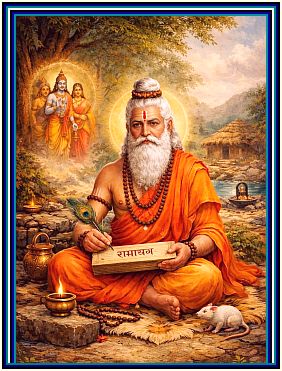
 
Leave a comment

Posted by on July 12, 2015 in Kavya, Sanskrit


Tags: , , , , , , ,

Kavya and Indian Poetics – Part One

[I could not arrange the topics in a sequential order (krama) . You may take these as random collection of discussions; and, read it for whatever it is worth. Thank you.]

Kavya Shastra

The Indian Poetics over the centuries was known by different names at different stages of its development.  Valmiki in his Epic, Ramayana, refers to Poetics as Kriya-kalpa (kriya-kalpa vidashcha kavyavido janan– Uttara Kanda. 93.7).

 Lalitavistara Sutra a Buddhist text believed to belong to the first or second century explains the term Kriya–kalpa as the rules  for creating poetic works  (Kavya-karana-vidhi) ; and says that  the term means  Kavya-alamkara , the poetics

– kriya–kalpa iti kavya-karana-vidhi kavya-alamkara ithyarthaha 

Vatsayana  (Ca. second century) in his famous Kama sutra , while enumerating the fourteen types of arts (Kala) that a cultured urbane  person (Nagarika)  should cultivate , also uses the terms  chando-jñānamKavya-kriya-kalpa   to denote the Poetics  (Kamasutra 1.3.15). 

Jayamangala , in his commentary on Kamasutra, explains the term  Kriyakalpa as the science that determines  the nature of poetry

-Kriyakapa iti Kavya-karana-vidhi , Kavya-alamkara ityartha. 

 The poet Dandin (6th-7th century) in his Kavyadarsha, a handbook of classical Sanskrit Poetics, calls Poetics as Kriyavidhi, the rules of poetry

vācāṃ vicitra-mārgāṇāṃ nibabandhuḥ kriyāvidhim // 1.9 //

But, by the time of Bhamaha (Ca.6-7th century) the term Alamkara or Alamkara shastra was in wide use.  As such , he opens his work with words Kavya-alamkara ityeshu yatha buddi vidiyate; and, follows it with the phrase Kavya-lakshana.

Dandin also uses the term Kavya-lakshana.  It was believed that Alamkara, the figurative speech or ornamentation, was the principle virtue that lent Kavya its grace and brilliance

Kavya-shobha-karaan dharman alamkaran prachakshte

The titles of the books, of  his period and thereafter , on Poetics, therefore, were centered upon the term Alamkara , such as: Kavyalamkara (by Bhamaha, Ca.6- 7th century) ; Kavya-alamkara-sara- Samgraha (by Udbhata-8th century) ; Kavya-alamkara- sutra-vritti (by Vamana Ca. 8th ) and Kavya-alamkara (by Rudrata – c. 9th-century) .

The tendency to describe Poetics in terms of Alamkara went on for a considerable period of time. Though Alamkara was the general name for Poetics, the term Alamkara  referred  both to one of the principles of Poetics and  also to the specific expressions of   figures of speech like Anuprasa, Upama etc. And the concepts of Rasa, Guna, and Riti were also brought under the overall ambit of Alamkara principle.

Rajashekhara  (9th -10th  century)  the poet and scholar  treated  Poetics  as a Shastra; and , he named Poetics as  Sahitya Vidya; the finest essence of all the four Vidyas . And the poets who followed Rajasekhara began to describe Poetics as Sahitya.  For instance;   Vishwanatha named his book on Poetics as Sahitya-darpana ; Ruyyaka titled his book as sahitya-mimamsa ; and, Bhojaraja called Poetics as Kavya shastra.

[Sahitya derived from the root ‘Sahita‘ – being together or united – suggests a system that binds together Sabda (word) and Artha (its meaning).That relation is natural – Nisarga siddha sabda-artha sambandha.

And, Sahitya  generally represents the notion of literature – everything preserved in writing, or even in speech; but, here, practically it was a synonym for Kavya. (Perhaps Vangmaya – things made of language) could be a better term) ]

Thus, over the long period, from time to time, the Shastra of Poetics had been called variously  as Kriya-kalpa; Kavya-karana-vidhi; Kavya-kriya-kalpa; Kriya-vidhi; Alamkara Shastra; Sahitya Vidya and Kavya shastra.

The terms Kriya–kalpa, Kavya–vidhi etc went out of use quite early. And, the scope of the term Alamkara, since the time of Anandavardhana  (Ca.10th century)  got restricted to one of the elements of poetry , which is  the ornamentation and figures of speech like Anuprasa , Upama etc ; and,  it was scarcely used in its  wider sense of poetics.

The term  Sahitya which etymologically means to put together in the sense of  composition , coordination , balance , concord and contact , in recent times,  is used to cover all forms of literature (vangmaya) . It covers even Grammar, philosophy, logic, etymology, technical subjects like medicine , Law  etc; apart from  prose, poetry drama etc.

Therefore, the scholars generally opine that for Poetics, the term Kavya shastra seems more suited (though some employed the grandiose term Kavya Mimamsa); particularly since the term Kavya includes prose, poetry, Drama and all other forms of creative writings.  Besides, the suffix Shastra (Sahsanath shasanam) signifies the theory of practice as also the practice of theory.

Further, the term Kavya Shastra sounds better than Kriya, Kapla, and Vidhi etc. And, Kavya Shastra was therefore used by writers like Bhamaha, Dandin, Vamana, Rudrata, Rajasekhara and others to denote Poetics. Since the Indian Poetics began to take a systemic form during the times of Bhamaha and Dandin, attempting to expound the essence of Kavya, its aesthetics and style and lucidity of composition etc, we may as well adopt their nomenclatures. 

That is one view. And, there are other views too.

Literature

According to Dr. Ganesh Tryambak Deshpande (Bharathiya Sahityashastra, The Indian Poetics), the Indian Poetics developed in stages over a period of about two thousand years.  During these long centuries , the Indian Poetics attained maturity. He enumerates six stages of development : Kriyakalpa (around 2nd century BCE) ; Kavyalakshana (from Bharata up to 6th century AD) ; Kavya-alankara (600 AD to 850 AD) ;  Sahitya (say from 850 to 1100 AD); and, Sahitya-paddathi (1100 AD – 1650 AD).

Bharata’s Natyashastra , according to Dr. G.T. Deshpande , represents the first stage of Indian poetics (Kriyakalpa) where the diverse elements of arts, literature, music, dance, stage management and cosmetics combined harmoniously to successfully produce an enjoyable play- Drshya-kavya.

During the next (second) stage (Kavyalakshana) the poetics grew independent of the theater. The discussions during this period were mostly regarding the general nature of Kavya. This period is marked by the works of Bhamaha and Dandin, say up to 600 AD.

In the third stage (Kavya-alankara)   stretching from Bhamaha and Dandin up to Rudrata, say from 600 AD to 850 AD, the concepts of Alankara (embellishments) Gunas (characteristics) and Rasa gained a little more clarity. The characteristic beauty (Saundaryam or Shobha) associate with poetry and the means of creating highly enjoyable poetry came into discussion.

The fourth stage (Sahitya) was the period of analysis and understanding the basic concepts of literature and Grammar. This was the period from Mammata to Anandavardhana (say from 850 to 1100 AD). The questions raised during this period, basically, were :

:- ‘What is truly Sahitya (literature)?’ ; ’Does it merely mean a combination of words and meanings? Or, is there anything more to it?’ ;

:- ‘What are the special features of poetry?’ ;

:- ‘ Do the words in the poetry convey the same meaning as anywhere else?’ ; and ,

:-  ‘How is the meaning  (Artha) of  poetry conveyed?’ etc.

It is in this period, the poetics (Kavya) became independent of the earlier concepts of Alamkara, Dvani etc.

And, the sixth stage (Sahitya-paddathi) was the methodical study of the poetry  in all its aspects . It was the period that stretched  from 1100 AD – 1650 AD, say ending with Jagannatha Pandita.

img-thing


Main concerns – Sabda and Artha

One of the problems that engaged attention of the Grammarians and the philosophers alike was the subtle relation between the linguistic element (Sabda) and its meaning (Artha).  Sabda can roughly be understood as word, a sound, a meaningful unit of speech. Patanjali explained the term Sabda as that which when articulated gives out the meaning or intent the of the speaker.  And, Mandana Misra, in his Sphotasiddhi said: Sabda is the cause that produces the intended meaning.

According to Bhartrhari (4th or 5th century) “There is no cognition without the operation of words. All knowledge is illumined through words’’. In Bhartrhari’s scheme of things, the problem of meaning is basic. It is through the meaning conveyed by the words that knowledge is experienced.” “It is only the thought as expressed in words that can be understood, communicated and criticized. A language grows with the thought; or rather the thought grows with language. In the ultimate analysis they might even be identical.”

Two main concerns of the Sanskrit Poetics seemed to be: the word, and its meaning. The first one concerns how the word is treated in the text; and, mainly how it is formally used. It could be the elaborate embellishments (Alamkara) artistically arranged to enhance the beauty of the presentation; or it could be the elegance of the diction or even oblique ways of twisting. The other is about the shades or the layers of meaning that the word is capable of revealing. Generally, it was about the ways (vyapara) of achieving the objectives (phala) of the poet and his poetry.

The late-tenth-century philosopher and literary theorist Abhinavagupta felt that Kavya is not just about meaning, it is something more than that ; and, he put it  directly: “It is not the mere capacity for producing meaning as such that enables a text to be called Kavya. And that is why we never apply that term to everyday discourse or the Veda.”

Raja Bhoja (1011–1055) in his Srngaraprakasha says, that of the things made of language (Vangmaya) Kavya is one species. The elements that make the language are the words and meanings. And, word and meaning when  harmoniously  composed (sahitau) constitute Kavya. . Thus Kavya is a composition ( unity , sahitya) of word and meaning.

Then he goes on to say:

What, however, does the word “word” signify? It is that through which, when articulated, meaning is understood, and it is of twelve sorts, starting with base and affix and ending with sentence, section, and whole work.

“Meaning” is what a word gives us to understand, and it is of twelve sorts, starting with action and tense and ending with word-meaning and sentence-meaning.

And last, “composition” signifies the coordinated relation between word and meaning; and it, too, is of twelve sorts, starting with denotation and implication and ending with avoidance of faults, employment of expression-forms (guna), connection with factors of beauty (alañkara), and presence of rasa.

King Somesvara III (around 1130) of the Kalyana Chalukya dynasty in his Manasollasa, an encyclopedic work, says:

Words make up the body of a literary text, meaning is its life-breath, tropes its external form, emotional states and feelings its movements, meter its gait, and the knowledge of language its vital spot. It is in these that the beauty of the deity of literature consists.

Manasollasa vol 2-page 171 ( 225) verses 205-206

The scholars of Poetics, of course, need to be concerned with the beauty and elegance of expression; but, at the same time they also need to be exercised over the sense that such arrangements of words would produce. The Poetic-scholars realized that neither logic (Nyaya) nor Grammar (Vyakarana) would provide them with right answers. The position, simply put, is :

Poetry in any of its forms does need words; and the arrangements of those words, however clever or elegant, do have to convey a sense or meaning. The poetic beauty does not solely dependent on the strict order of words or other conventions. It in fact goes beyond regulated regimens. It is only the right or judicious combination of the two – Sabda and Artha – that produces relishing aesthetic expressions and suggestive poetry. The ultimate merit of a Kavya is in its enjoyment (Rasa) by the Sahrudaya the reader endowed with culture and taste.

The Great Poet Kalidasa, commences his Classic Raghuvamsa by submitting a prayer to Parvati and Parameshvara, the parents of the world, who are united like word and meaning. And, he prays, for the gift of speech fit with appropriate meaning.

वागर्थाविव संपृक्तौ वागर्थप्रतिपत्तये / जगतः पितरौ वन्दे पार्वतीपरमेश्वरौ

vāgarthāviva sapktau vāgarthapratipattaye/ jagata pitarau vande pārvatīparameśvarau || 1-1 ||

design rangoli

Now, regarding words:  according to Indian Poetics, a word has three functions: it signifies or denotes (abhida); it indicates (lakshana); and it suggests (vyanjana).

shabdartha

The meaning that is comprehended immediately after the word is uttered is its primary meaning (mukhya-artha). The meaning thus conveyed and its relation to the next word and its own meaning is a mutual relation of the signifier and the signified (vachya-vachaka). The power that creates the relation among words is Abhida-vyapara, the power of denotation or sense. The suggestive power of the word is through Vyanjana-artha.

The meaning of a word or a sentence that is directly grasped in the usual manner is Vakyartha (denotation or literal sense); and, the power of the language which conveys such meaning is called Abidha-vritti (designating function). The term Sabdabodha ‘verbal comprehension’ or ‘verbal cognition’ is also used at times. It is intended to denote meaning of a sentence as understood by the listener.

In certain cases where a particular word is not capable of conveying the desired sense, another power which modifies that word to produce the fitting or suitable meaning is called Lakshana-vritti (indicative function).

The primary sense Vakyartha is the natural (Svabhavokti) and is the easily comprehended sense of the word. When the perception of the primary sense is obstructed, the word conveys the sense other than the primary sense; but, the two meanings (somehow) seem related.  Thus, the secondary sense (lakshana) could even be called an unnatural meaning (Vakrokti) of the word.

For instance; when the word Purusha is uttered, one immediately understands it as a reference to a male member of the human race. It is the primary sense of the word. It might refer to an individual or to a generic attribute. In any case; the word Purusha and its meaning are related. It is a signified–signifier relationship; one pointing towards the other. This relationship is termed Abhida.

However, in the world we live, we do not always use a word only in its primary sense. Many times, the word in its primary sense may not be adequate.  Then, we attempt to attribute a sense to the word that is different or distinct from the primary sense. This would be secondary sense – lakshanika or lakshyartha – of that word. The word in its secondary sense is called lakshana. The relationship between the secondary sense and the word is described as lakshya-lakshya sambandha

Such process of superimposition (aropita) is called lakshana or indication. The three: the obstruction caused due to incompatibility of primary sense; the connection between the primary and the secondary sense; and, the convention (rudi) – are all interrelated. Here, there ought to be some justification for switching over to the un-natural meaning of the word; and, it should be generally acceptable (or should have gained currency in the common usage).

The indication (lakshana) is thus of two types: one, sanctioned by usage (rudi-lakshana); and , the other , where the speaker uses it for a specific or a specialized purpose (prayojanavato lakshana).

lotus design

As regards the Grammarians’ point of view, of the three functions of the word, the secondary or the indicative Lakshana-vritti is the most important and popular.  Three conditions for Lakshana are generally accepted by all schools of Grammar.

The first is the incompatibility or inconsistency of the primary meaning in the context, which produces a break in the flow of thought, forcing the listener to think in order to understand what the speaker would really have meant by the uncommon usage and why he has used the word in an irregular way.  The inconsistency could be either because of  the impossibility of associating the normal meaning with the other word meanings of the sentence ; or  it could be because  of the normal meaning’s unsuitability in the context.

The second condition is about the kind of relation between the primary (normal) meaning of the term and its meaning as intended by the speaker in a given context. This relation can be one of proximity to the alternate (contrary) meaning or one of similarity or of mixed quality. The latter type is called Gauni Lakshana which the Mimamsakas treat as an independent function called Gauni. According to Mimamsakas, the real Lakshana is only of the first type, a relation of proximity with contrariety (oppositeness).

The third condition could either be acceptance of its meaning in common usage ; or it could be a meaning derived from the root of the word (Dathu) for a  special purpose intended for introducing the Lakshana. All faded metaphors (nirudha lakshana) fall into the former category, and metaphorical usages, especially by the poets, fall into the latter.

[The common examples given here are of Pankaja which in common usage means lotus; but literally means something born out of slush. The other is the Ashva-karna a type of leaf , but literally the ears of a horse. In all such cases, it is the meaning in common usage that is  generally accepted ; and the literal meaning is treated as faded metaphor.]

*

[The Great Grammarian Panini did not accept Lakshana as a separate function in language. He did not consider the incompatibility etc., on which the Lakshana was based by other Grammarians as quite relevant from the point of view of Grammar. The sentences such as:’ He is an ass’ and ‘He is a boy ‘are both correct grammatically. Panini’s Grammar provides some popular examples of Lakshana; like ‘the village on the river’ (gangayam ghosah) by considering proximity as one of the meanings of the locative case.

Similarly, Panini does not mention or provide for the condition of yogyata or consistency, which is considered by the later Grammarians as essential for unity of sentence.

The expression Agnina sinchati (He sprinkles with fire) is grammatically correct, though from the semantic point of view it may not be quite proper, because sprinkling can be done only with liquid and not with fire.]

It does not mean that some words are merely vachaka and certain others are only Lakshya, and so on. The use of words, their role and the intended effect are context sensitive. The same word could be employed in any number of ways; each performing its role its own context. All the shades of meaning are necessary and relevant in poetry; but, each in its own context.

lotus design

Similarly, Riti, as put forward by Vamana, is an arrangement of words and meanings characterized by various Gunas. A particular Guna might be appropriate in a particular context. The verbal compositions could be tight knit and high flowing in a given context; but , a simple , lucid narration might be appropriate in  an  another situation. One may admire grandeur in one situation; and simplicity in another. It is the context that decides appropriateness of style.

Rajasekhara, therefore, says:  A sentence is an arrangement of words which embodies the content that the speaker wishes to convey

(pada-nama-abidhita-arthagrathanakarah sandarbhah vakyam – Kavyamimamasa (22) of Rajasekhara).

For instance; take the word Mother. The word in its primary sense is woman who has given birth to a child. In the specific context when one says ‘Kausalya is the mother of Rama’ you are referring to a particular person. And when one says , ‘necessity is the mother of invention’, one is not referring to a physical mother but to suggest the sense of ‘origin’. Here, the primary sense of the term does not work. Similarly, when the Saint Ramaprasad or the Vaggeyakara Sri Shyama Shastry calls out to Devi in anguish as Mother, it suggests the intensity of his devotion; and, the depth of his longing for her love and protection. Devi is not the physical mother but a projection of the universal Mother principle as also the specific Mother deity. It is said; the  vibrations of the suggested meaning of the word are indeed truly powerful.

6a00d8341c73fe53ef00e550bc80098833-640wi

Then, there is the most interesting and much debated Vyanjana-artha which is the suggested sense or the essence of the word. This is founded in the principle that   the meaning of word is not limited to its literal sense; the word has the power to reach far beyond the obvious.

In poetry, the word acquires another power Vyanjana-vritti the suggestive function. It is the    power which activates the potential hidden in the word. And, the word acquires a new glow. Through the suggestive function of the word, a new meaning emerges, transcending the obvious literal sense, far more beautiful and sensitive.

The word which connotes the suggested sense (through the suggestive function Vyanjana –vritti) is named Vyanjaka. The relationship between the suggestive word and the suggested meaning (Vyanjana-artha) is described as vyangya-vyanjaka sambandha.

The suggestive word, the suggested meaning, the power of suggestion; and their mutual relationship are virtually the lifeblood of Indian poetics.  In fact, this is what that distinguishes poetry from other forms of literature.

The suggested sense Vyanjana-artha, which, though not explicit, becomes the object of awareness is regarded the essence of poetry. The Dhvani School put forward by Anandavardhana, brought focus on the potential power of the word in a Kavya. Here, the word (Sabda) together with  its literal sense  (Vakyartha )  is said to form the body of Kavya , it is its  cloak .  But, the essence of poetry is elsewhere; it is not directly visible; and, that essence is the suggested sense of the word (Vyanjana-artha).

It other words: it is not the direct literal and obvious meaning that is explicit in poetry, but it is the suggested, indirect and emotive meaning that matters.  Hence, though the words of a Kavya and their  the literal sense must be given their due importance , they are  but a medium for emotive and indirect meaning flash forth .

In a good poetry, this suggested meaning dominates over the words and their literal meaning. As Anandavardhana put it: The latter are compared to a woman’s  body and the former to her grace and beauty which is a subtler manifestation  and a more profound meaning of the womanhood.

The primary meaning can be understood by all. But, the suggested meaning is understood only by those who are gifted with some imagination and a sort of intuition.

Here, the mere knowledge of the word alone is not enough to understand and enjoy the poetic import or the essence of the Kavya. It needs intuition or Prathibha. Mammatacharya calls Prathibha as – nava-navaonvesha-shalini prajna – the ever inventive and resourceful intellect. Prathibha is also called, at times, as Vasana

Only those endowed with Prathibha can truly enjoy the essence and beauty of Kavya. That is why, it is remarked,  the Grammarians (unlike the goodhearted cultured reader the Sahrudaya) cannot truly appreciate and enjoy the Rasa of good poetry. They are incapable of looking beyond what appears obvious.

Anandavardhana, therefore, says that such suggested sense is not apprehended (na vidyate) by mere knowledge of Grammar (Sabda-artha-shasana-jnana) and dictionary. It is apprehended only (Vidyate, kevalam) by those who know how to recognize the essence of poetic meaning (Kavya-artha-tattva-jnana) – Dhv.1.7

It is said; in the highest class of Kavya, the denoted meaning (Vakyartha )  and  the denoting meaning (Lakshyartha)  is subservient to  revealing the suggested sense word (Vyanjana-artha); and , it is  called Dhvani by the scholars – Dhv.1.13

The suggested sense of the word designated as Dhvani (resonance or tone or suggestion) is regarded Anandavardhana as the soul of Kavya : Kavyasya Atma Dhvanih.

[The concept of Dhvani was said to be inspired by the ancient doctrine of Sphota. The term Sphota signifies:  bursting; opening; expansion; disclosure; the eternal and imperceptible element of sound and words; and , is the real vehicle of the idea which bursts or flashes on the mind when a sound is uttered.

Nagesha Bhatta identifies Vedic Sage Sphotayana, mentioned by Panini in one of his rules, as the originator of Sphota theory. Bhartrhari, however, states that Audumbarayana (mentioned by Yaska) had put forth views similar to the Sphota concept.

In any case, the original idea of Sphota seems to go back to the Vedic age when Vak or speech was considered to be a manifestation of the all – pervading Brahman , and Pranava (Aum) was regarded as the primordial speech sound from which all forms of Vak were supposed to have evolved.

It was Bhartrhari (around 485 AD) in his great work Vakyapadiya (all about sentence and word) elaborated and established the Sphota doctrine in the realm of Grammar and in Philosophy.

According to Bhartrhari, the perfect perception is that in which there is identity between the object (namely, words or the letters of sounds ) and the form of its cognition (namely, the Sphota) . This special kind of perception is held to be function of mind, rather than of the external senses.

This is a major subject; and deserves to be discussed separately.]

But, when one begins to talk of words (Sabda), naturally, it leads to Grammar (Vyakarana), which concerns itself with the arrangement of words into sentences. It does not account for the pattern of meanings.  The poetry on the other hand is not much concerned with the arrangement of words. But, it does strive to convey a meaning.

In the case of poetry, the arrangement of words (Sabda or pada) might be  logical but not necessarily grammatical. That is because; the poetic beauty does not solely dependent on the strict order of words or other conventions. It , in fact,  goes beyond regulated regimens. The unique virtue of poetry is that it provides space for experimentation, and to introduce hitherto unknown or unusual terms and expressions, regardless of their grammatical correctness. And at the same time , it was recognized  that the poetic beauty does not merely depend on ornate figures of speech or on the twisted or unusual expressions ; but , it is primarily  in the intrinsic merit of the poetry itself.

The combination of words or arrangement of words expressing the idea or the content which the poet intends to convey at a ‘single stroke’ is the sentence (Vakya) in the poetry. A sentence is defined by Rajasekhara as an arrangement of words which embodies the content that the speaker wishes to convey

(pada-nama-abidhita-arthagrathanakarah sandarbhah vakyam – Kavyamimamasa (22) of Rajasekhara).

The meaning of a sentence expresses a complete idea. The sentence in poetry is called Vachana (Vakyam vachanam vyavaharanti – Kavyamimamsa). In poetry the terms Vakya, Vachana and Ukti are synonymous. A characteristic turn of expression attains the status of poetry (Ukti-visesah kavyam).

[Among the ancient Grammarians, neither Panini nor Gautama defined the sentence. Katyayana was perhaps the first to define a sentence. He called it ekatin, that which has one finite verb. Panini, however, seems to have held that a sentence can have many more than one finite verb.  The later Grammarians also seemed to accept Panini’s view. But, from Katyayana’s point of view such a sentence may be considered as a complex sentence made up of two or more sentences, but fundamentally forming one single sentence.]

design rangoli

The relation between Grammar and poetry is interesting.

Yaska , the great Etymologist of the ancient times,states : Vyakarana  (Grammar) deals with linguistic analysis to establish the exact form of words to properly express ideas, while Nirukta focuses on linguistic analysis to help establish the proper meaning of the words, given the context they are used in the Vedic texts.

But , at the same time, Yaska remarks : while deriving the meaning of a word, in its own context, one should try to stick to the rules of the Grammar (Vyakarana) as far as possible; but, if this is of no avail in bringing out the hidden meaning of the term in question, then one should abandon such rules

na saṃskāram ādriyeta / viśaya-hi vṛttayo bhavanti (Nir.2.1)

*

And, Poetry, in the Indian traditions, is often called vyakaranasya puccham – the tail piece or the appendix of Grammar. The Grammar determines the correctness of the words and their arrangement within a sentence. The poetry is however more concerned with the appropriateness and mutual relations among the words.  The poetry, as far as possible, follows Grammar. But , when it finds the rules of Grammar too constrained or suffocating , it switches over to other means of expressions that are more appropriate or conducive to its natural flow; or , it invents its own means. At times, when those inventive expressions of poetic suggestions are so charming and become so popular, they walk into Grammar per se; and, the Grammar must necessarily accept poetic inventions (svikara avashyakah).

Continued in

Part Two 

PEACOCK TREE

Sources and References

Glimpses of Indian Poetics by Satya Deva Caudharī

Indian Poetics (Bharathiya Kavya Mimamse) by Dr. T N Sreekantaiyya

Sahityashastra, the Indian Poetics by Dr. Ganesh Tryambak Deshpande

History of Indian Literature by Maurice Winternitz, Moriz Winternitz

A History of Classical Poetry: Sanskrit, Pali, Prakrit by Siegfried Lienhard

Literary Cultures in History by Sheldon Pollock

https://archive.org/details/in.ernet.dli.2015.142231/page/n76

 
9 Comments

Posted by on July 9, 2015 in Kavya, Sanskrit


Tags: , , , , , , , , , , , ,

Music of India – a brief outline – Part Twenty-two

Continued from Part Twenty one – Dhrupad Part One

Part Twenty two (of 22) – Dhrupad – Part Two

akbar_and_tansen_visit_haridas

Bani

Dhrupad flourished as the principal  music format during the 16th century in the Mughal Courts.  During its affluent times, Dhrupad developed into four distinct melodic forms known as Vani or Bani. It might be rather incorrect to label or call them as ‘styles’.

Because, apart from the ways of rendering the songs many other  complex elements were associated with each Bani, such as :  the ideology (spiritual or otherwise) , the intent, devotion, melodic types, nature of compositions, repertory , ways of transmitting orally from generation to generation, how they viewed their own Music and how they liked the world to view their Music and so on

And, above all there was the question of tradition; because, for a Dhrupad performer Tradition is of prime importance. According to their traditions, Dhrupad is a body of spiritual and mystical knowledge to be practiced with devotion (Bhakthi) and dedication (Shraddha). It is primarily an act of submission to ones indweller; not a tool for entertainment.

During the time of Akbar, four classes of Bani-s seem to have gained prominence. Though they might have been distinct in their initial stages, later each assimilated some aspects of the other Bani-s.  Therefore, by about the 17-18th century , they almost had merged into one ancient tradition.

A Dhrupad singer of Akbar’s time was addressed as Kalawant. The Kalawants identified themselves with a  Bani, which they came to regard as their tradition.

The four Bani-s of Akbar’s time were: Govarhar, Khandahar, Nauhar and Daguar; and, each was named after the place of its origin or its originator.

Taj mahal design

 [ Giti-Bani

 Before going further, lets talk a bit about Gitis.

Giti is a familiar concept in the ancient Indian music; and, is associated with Alamkara and Gamaka.  The very ancient scholars such as Kashyapa, Yastika, Shardula, Durga Shakthi, Bharata and Matanga; and, later Sarangadeva, all have discussed about Gitis.

These Gitis were not Ragas or similar forms. Here, in these texts, Giti was understood as the methods or styles of producing a song; as various modes of rendering Grama Ragas and regional tunes ;   singing  the songs composed in deśa-bhāā; also rendering the songs coming from various regions and people.

In general, Giti could be taken to have meant charming song-forms; or as modes of singing a piece of music combining poetry, melody and rhythm.

 :- Kashyapa mentions two Gitis – (Bhasha and Vibhasha);

:- according to Bharata , Yashtika spoke of three Gitis – (bhasha, vibhasha, and, antar bhasha);

:- but, Matanga says that Yashika mentioed five Gitis – (Shuddham, Bhinna, Vesara, Gaudi and Sadharita) ;

:- Shardula recognized only one Giti (bhasha);

:- Durgashakti accepted five Gitis – (shuddha, bhinna, gaudi, raga (vesara/ vegasvara), sadharana);

:- and, Bharata talked of four (pada) Gitis –  (magadhi, ardha magadhi, sambhavita, prithula).

Matanga, in his Brihaddeshi (302-308), discusses, in fair detail, the seven kinds of Gitis: (1) Shuddha; (2) Bhinnaka; (3) Gaudika; (4) Raga-giti; (5) Sadharani; (6) Bhasha-giti; and, (7) Vibhasha—gitis.  

Of the seven classes of Gitis, it is said; the Shuddha and the Bhinnaka have each five varieties; Gauda has three varieties; Ragas are of eight varieties; Sadharani is of seven varieties; Bhasha is of sixteen kinds; and, Vibhasha as of twelve kinds.

He also relates the various Gitis to the Shadja grama and Madhyama grama Ragas,current in his time; and, explains the Ragas with reference to these seven classes of Gitis.

Matanga talks about the Gitis in association with Alamkaras and Gamakas. For in instance; while discussing about Raga-giti, one of the seven charming Gitis; the fourth in his enumeration (Raga-gitis-caturthika); and, with attractive ” svara compositions, with beautiful and illuminating graces”, he mentions:

 :- Raga-giti , adorned with (shobhane bhavath) delightful Svara articulations of lucid, powerful (raurasau), of even quality (sama), should be rendered with varied delicate Gamakas (lalithau–Gamakau-vichitrau); and, should be ornamented with delightful Svara articulations in all the four melodic movements (chaturnamapi varnanamthat are  lucid (prasanna) , powerful (raura) and even (sama) (300-301);

:- Shuddha Giti is that which  is full of Svaras and Srutis that are straight (samaihi) , delicate  (lalita) and steady  (ruju) in the mandra, madhya (lit. not mandra) and Tara  ranges (shruthibhi purna), (291-2)

:- Bhinna Giti is that which consists subtle, quick moving, turning, swinging, scattered, (sukshmashca prachalai vakra sullasita prasaritau ) delicate (lalitha)  Svaras, high (Tara) and low (Mandra)- ( 292-293)

:- The three Gauda (melodies) are beautiful (shobhanah) with Svaras rendered with delicate Ohala (a type of shakes) , made up of  sounds like ‘haa-s’ (ha-kara)  and ‘ooh-s’  (U-kara). The Õhali gives expression to mandra tones, with the chin resting on the chest (chibukam hrudaye –nyasya).

The delicate Ohali should be rendered  by expert singers (geyo-vidhuhu)  in quicker and quicker tempo ( druta-drta-taro), full of shake (saha kampane pidita), rendered both by distinct and barely visible hand movements ( drusta-drustena panina) (on the Veena?) with karanas over the three octaves (tristhana) and full of movement over the entire octave range  (svara-sthana-chalanakula). (293-299)

:- Sadharana Giti, according to experts on Giti (Gitignau) , should be made up of a judicious combination (su–yogitau) of straight and delicate, a little subtle (sukshma-sukshmaischa), a little plain, pleasant (su-shravya), slightly quick paced (irsha-druta), soft (mrudu) and gentle (lalita) , movements and Svaras, that are smooth, with subtle variations in tone (kaku misrau) . Thus, Sadharana Giti is understood (jneyo) as resting on all the Gitis (sarva-giti-samashrayah). (302-303)

:- Bhasha  Giti is defined by the experts on the Giti ( Giti-vichakshnau) , as being characterized by movements that spring from the throat (gatrajau), smoothly (lakshanau), drenched with expression (kakurakthau), well-structured (suyogitau), shaken delicately ( kampitai)  and powerfully, imbued with Prakrit intonations coming from Malva region  (Malavi )   (Malavi kaku nanchitau), and expressed in gentle, soft ovements  (lalitha sukumarascha) in a controlled manner (samyate)-( 304-306).

:- Vibasha Giti should be rendered blending in the Gamakas that are pleasant on the ears (Gamakau–srotra-sukhadai-lalithairasthu), following public taste (rajyate lokah) , with delicate as well as bright (lalitau bhrahubhi diptau), strong shakes   (kampitai)  and plain (samaihi) movements , shooting up to the Tara and Atitara  ranges, and softened as well as flaming ones in the middle range (madhyama diptau) , incorporating gamakas that are pleasant to the ear and delicate (srotra–sukhadai lalitai astu), according to the singer’s will (yadrucchaya samyojya)  , and to the delight of the people  (lokan ranjate) – (306-308).

But , Sarngadeva accepted just five out of the seven Gitis:  shuddha, bhinna, gaudi, rag (vesara/ vegasvara), and sadharani.  His time was just before  the period that came under Persian influence.

Perhaps , because of that reason, during the early Mughal times too, these five types of Gitis continued to be recognized; and, each type of Giti was associated with a group of Ragas.

*

Now, Giti meant the way of singing (Gita); thus , giving a form to the Ragas.

During the Mughal times, it is said,

:- Shuddha Giti (the pure) used straight and soft notes; 

:- Giti (innovative) with articulated, fast and charming Gamaka phrases (Alamkara); 

:- Giti (Eastern) sonorous with soft , unbroken mellow stream of singing in all the three tempos (Kaala) Mandara (slow), Madhya (middle) and Tara (upper) with appropriate Gamaka Alamkaras; 

:- or Vegasvara Giti (fast notes) suited  for speed or fastness in rendering the notes (Svaras) ; and,

:- the Sadharani or Sadharan Giti  (General) combined in itself the virtues and merits of the other four Gitis.

[Matanga also describes Sadharana Giti (302-303) as  the universal form of Giti ; combining in itself the merits the other four other Gitis.  He described Sadharana Giti as that which is sung with svaras that are smooth and fine (Lalita); is gentle, pleasant to the ear, slightly quick, and soft. And, when rightly produced, it is related with all types of Gitis. It is therefore universal or Sadharana. And, in this way, it is considered to be connected to all the Gitis.

Rujubhir lalitah kinchit suksmasuksmais cha susravaih / isaddrutais cha kartavya mrdubhir lalitais tatha / / prayogair masrnaih suksmaih kaku misraih suyojitaih / svaraih sadharana Gitir gitijanaih samudahrta / evem sadharana jneya sarva giti samasraya // 302-303// ]

[ King Nanyabhupala (who reigned in Mithila between 1097 and 1133 A.D) in his Bharatabhashya, connects each type of Giti to specific hours (yamas) of the day. For instance; the two Gitis, shuddha and bhinna, are assigned to the first yama or prahara (a three-hour period) of the day. The Giti, gaudi, is placed at mid-day; vesara is in the first part of the day; and sadharana is said to be common to all hours of the day.

Nanyadeva was referring to Gitis in association with the Ragas with the time of singing. He extended the concept to the relations between the seasons and the Ragas. For instance, Nanyadeva , in his Sarasvati-hrdaya-alamkara hara, while discussing seasonal Grama ragas, quotes Matanga thus – yadah matanga – 

sarve raga mahadeve samyak santoshkarakaha |hemant-greeshma-varshasu kaleshu gan-shasimiha | shadja-madhyam-gandhargrama geya yathakramam ||3

All Ragas are dear to Lord Mahadeva. Yet; it would be proper to sing the songs of shadja; madhyama; and, gandhara gramas during winter, summer and rainy seasons.

At another place ,Narada, in the third khanda of the chapter Sangeetadhyaya of his Sangeet Makranda, had categorized ragas according to the suryansh (solar) and chandransh (lunar) groups, i.e. sun- and moon-based ragas. He further said

evam kalavidhin gyatva gayedhyaha sa sukhi bhavet || ragavelapraganen raganan hinsako bhavet | yaha shrinoti sa daridri ayurnashyati sarvada

One who sings the raga-s according to their designated times, attains peace and prosperity. The raga-s themselves shall become violent and lose their attraction if sung off their times. Such (singers) become poor and live a short life

Nanyadeva recommends :  Hindola raga is best in spring; Pancama in summer; Sadjagrama and Takka during the monsoons; Bhinnasadja (Bhairava) is best in early winter; and, Kaisika in late winter

Somesvara (Manasollasa 1131 CE) is said to be the earliest to codify the tradition of allocating the six Ragas to the six seasons:

(1) Sri-raga is the melody of the Winter (2) Vasanta of the Spring season (3) Bhairava of the Summer season (4) Pancama of the Autumn (5) Megha of the Rainy season and (6) Nata-narayana of the early Winter.

Following that tradition, Sarangdeva (12th century) in his Sangeet Ratnakara, emphasized the importance of the performance of the ragas in their proper season and time.

In the chapter Raga-viveka-adhyaya, Sarangdeva laid special emphasis on the specific times and seasons for the performance of ragas. He also makes mention of the allotted times and seasons for the rendition of the ancient Gram-ragas. For e.g. he says

Shadjagrama raga is to be performed in Varsha ritu; Bhinna Kaishik in Shishira ritu; Gaud Pancham in Grishma ritu; Bhinna Shadja in Hemanta ritu, Hindol in Vasanta ritu,;and , Raganti in Sharad ritu

Sarngadeva  also mentions the hour of the day against every Raga that he describes, using phrases like geyo’hnah prathame-yame (to be sung during the first yama or prahara of the day); and, madhyama’hnogeyo (to be sung during mid-day).

He associated pure and simple ragas to early morning; mixed and more complex ragas to late morning; skillful ragas to noon; love-themed and passionate ragas to evening; and , common (sadharani)  ragas to night. Sarngadeva also connects the Ragas to seasons.

In the later times, the idea of linking the ethos or character of a Raga with the hour of the day was carried on by many writers.

This concept was explained and systematized by Pandit VN Bathkhande by establishing the relation between the pattern of Svaras and hour of the day/night; and, its impact on the singer and the listener. He also put forth a system of forging a relation between Vadi Svaras, Tivra Madhyama and PurvangaUttaranga Ragas with the time of the day/night. For more please click here ]

Source :The Dictionary of Hindustani Classical Music by Bimalakanta Roychaudhuri ]

Hindola Raga

During the Mughal period,  each type of Giti came to be associated with a particular Dhrupad Bani (akin to the different gayakis of present-day), in its rendering of Alaap. In that process, Shuddha Giti corresponded with Daagar Bani; Binna Giti with Khandar Bani; Gaudi Giti with Gaudhara or Gobarahara Bani; and Sadharani Giti with Nauhar Bani. As regards the Vesara Giti, it corresponded with songs of any type of Bani that need to be rendered with speed. ]

*

Govarhar or Shuddha Bani:

Tansen is said to be the originator of this Bani. It is said; he was originally a Gauda Brahmin (Ramtanu Pandey). And therefore, his style came to be known as Gaudiya or Govarhari Bani. This Bani was characterized by its smooth glides, almost linier in character. Its gait was slow and contemplative; spreading a feeling of repose and peace.

Gauhar Bani was described as Shuddha Bani that is chaste and pure. Its rendering was straight and simple with the gaps between the words and between the stanzas , bridged by aans or meands. It  was ideally suited for compositions in slow tempo (Vilamba kala) portraying Shantha, Gambhira and Bhakthi Rasas.

Khandahar Bani:

Raja Samokhan Singh was a famous Beenkar. He , perhaps , belonged to Kandahar region (?). Thus, his style of singing came to be known as Kandahar Bani.

[It is said; the traditional weapon of Samokhan Singh‘s family was Khanda, after which the Bani of Dhrupad is named i.e., Khandar Bani. This family was also called as Khandara Beenkar, after their family weapon Khanda , a double-edge straight sword (Sanskrit khaga).

There is an alternate explanation; according to which , Maharaja Samokhan Singh, the famous Beenkar, belonged to the region of Khandar. Its dialect was Kandari. Now; Kandar is a Village in Jalore Tehsil of Jalore District, Jodhpur Division of the Rajasthan State. It is located 34 KM towards South from District headquarters Jalore. ]

The  Khandar Bani was rich in its variety. Its gait was majestic and robust, using heavy and vigorous Gamakas, expressive of valor. In contrast to Gaudiya or Govarhari Bani , it usually was not sung in slow tempo.

Khandar Bani was prominent in Jor, Alaap of the Rudra Bina.  Along with bewildering pattern of vigorous Gamakas, it could also bring out soft and delicate notes. The Dhrupad compositions of this Bani were set mostly in Madhya and Dhrut laya, with the singer innovating series of Bol-tans in rhythmic patterns along with the Pakhawaj. The Bani was  best  suited for expressing   the fast and furious Vira Rasa.

Nauhar Bani:

Its founder was Rajput Shri Chand who belonged to Nauhar. It style was characterized by quick, jerky passages employing a variety of Gamakas. It usually moved in quick successions, moving as it were in slow deliberate curves from the first to its third or fourth note, and then changing course . Thus, the Nauhar Bani with its jumpy chhoots (short, quick musical run) surprised the listeners at each of its movements.

Nauhar Bani was  technically called Chhoot style with predominance of Madhya laya , spacious Dhrupad  compositions .It  was ideally suited for depicting the joy and wonder of Adbhuta  Rasa of songs set to smaller beats.  This style of rendering is very popular with wandering minstrels singing songs of love and war.

Daguar Bani:

It said to have been founded by Braj Chand who belonged to a place called Daguar. Hence his style came to be known as Daguar Bani. It was characterized by its delicately executed meends (glides) with sliding Gamakas. It was marked by correct intonation, purity of design, simplicity of execution and a massive structure. It adopted the contemplative elaboration of Govarhar.

The rendering of the songs and Dhrupad in  Daagar Bani  was  mostly in Vilambit and Madhya laya, providing greater scope for portraying various Rasas in different Taalas .It was well suited for Dhamar songs. And, in its medium tempo it judiciously blended in the Kandahar Bani to add color to its performance.

(Source : Bimal Mukherjee in his Indian Classical Music – Changing Profiles outlining the characteristics of the Banis )

The following stanza pithily captures the salient features of each of the four Bani-s.

Jor Jor se Kandhar gave; Madhu bole se Nauhar leve; Saans badi hai gauhar ki;  Alaapchari hai Dagur ki.

The poem indicates that

Kandahar Bani became famous due to its voice culture; broad and high pitched tones , forceful expression   and the smoothness of its style.

The Nauhar Bani was famous for its sweet and delicate expression. Its attention was on the bol-bant.  The Bol-banav must have developed , here ,  in Layakari.

The Govarhar Bani was known for its deep and sustained breath control.

And, the Daguar Bani developed great expertise in Alapchari, with much attention on the treatment of the Svaras.

During the later centuries when the Gharanas came into being, each Gharana adopted into its own style one or more features from among the four Bani-s. The Bani-s gradually lost their distinctive qualities.

For instance;

:- the Gayaki of Ustad Alladiya Khan of Jaipur-Atrauli Gharana was influenced by Govarhar Bani through its contemplative elaboration , deep breath and smooth glides;

:-  the Agra Gharana derived from Nauhar Gharana adopted most of its features, specially the sweetness in its essence;

:- And, the family of Daguar singers and the Beenkars, of course, adopted the Daguar Bani with its insistence on purity and delicately executed meends;

:- The Kirana Gharana seems to be influenced by Daguar Bani.  

:- The voice culture of the Kandahar Bani is , of course ,  a desired virtue of all Gharanas.

Thus, in Dhrupad , the concept of Gharanas seemed to operate as crystallization of ideas about the ways of combining musical styles and features of the bygone Bani-s.

Mughal Shamsa, smallest

Gharanas

With the disintegration of the Mughal Empire, the political structure of North India fragmented into numbers of small states ruled by Nawabs and Maharajas. With that, the historical tradition of Music of India was rudely disrupted, as the Musicians denied of patronage had to move from Court to Court in search of a livelihood. And, the Musicians were forced to leave behind the theoretical aspects of their  Music, but to practice Music as a craft to please their new–found patrons.

Raja Aniruddh Sing

An interesting fallout of the political re-arrangement was that each ruler of a small state competed with his rival in studding his court with famed musicians. It is said, rulers of some states borrowed heavily to get hold of top-notch performers. Each ruler was keen to establish the superiority of the Music of his court over that of others. Each would goad his musicians to come up with specialized styles and techniques of singing.

The Music across North India, thus, came to be stratified into styles of various court-music. Each was known as a Gharana (‘family’ or ‘house’), named after its patron-state (such as: Gwalior Gharana, Patiala Gharana, Jaipur Gharana and so on). Each ruler desired to have his very own personalized Gharana of music.  And if no particular geographical region can be identified then a Gharana would take the name of the founder; as for instance: Imdadkhani Gharānā named after the great Imdad Khan (1848 -1920) who served in the Royal Courts of Mysore and Indore.

A  Gharana, in due course,   turned into a symbol of social standing, affluence and power among the rulers.

[A noted musician Ustad Hameed khan explained that, ‘In order for a Gharānā to come into existence, the same style of musical esthetic ideology and collection of musical knowledge should be maintained by a family of musicians at least for three generations. The musical knowledge passed to members of the family and blood relatives under strict manners’. The necessary criteria to recognize a Gharānā is that, the musical knowledge should preserve and only transformed to family members. But it is also accepted that in such cases where the continuity of generations lacks, in that cases Gharānās were continued through the lineage of prime disciples who has complete knowledge particular Gharānā.

 Chapter iii.pdf – Shodhganga]

Music party on a riverside terrace

The Musicians who suffered most under the changed circumstances were the Dhrupad singers. All along their history they were sheltered by the patronage of Royal Courts.  And, their Classic Music of contemplative devotional nature was not favored by the new breed of Nawabs   who were looking for entertainment. 

Royal Muscians at a marriage celebration 1565

And, Dhrupad, rigid and somber as it was, they said, surely was not entertainment. Dhrupad was hard put to survive in a Music world that was dominated by the attractive Khyal, Thumri, Tappa and such other popular styles. The Been and Pakhawaj which were closely associated with the Dhrupad also found it hard to secure patronage.

In the colonial period it was the Nautch-gana that took the central stage in the court entertainment. The Nautch was a popular court dance performed by Nautch-girls in India. The culture of the performing art of the Nautch rose to prominence during the later period of Mughal Empire, and the British East India Company Rule. It spread to the palaces of the Nawabs and of the Princelystates; to the pleasure resorts of  the senior officials of the BritishRaj; and , even to the places of smaller Zamindars.

nautch gana

If Dhrupad as a class of pristine pure Music has survived to this day it is primarily due to the dedication, faith , steadfastness and sacrifices of certain families who selflessly dedicated their lives , generation after generation, in protecting , preserving and propagating the ancient Music they inherited from their ancestors in its pure and traditional form. We all owe these families a deep debt of gratitude.

The Classical Dhrupad is today represented by descendants of five major families, each preserving its stylistic music tradition. These have come to be known as the Gharanas of Dhrupad.

Daguar Gharana

dagar-brothers-2

The most well known among the Dhrupad traditions or Gharanas is the Daguar Gharana , which is said to have been initiated by the sixteenth century musician Nayak Haridasa Daguar.  And , it was preserved and continued since the eighteenth century by  a Pandeya Brahmin from Rajasthan,  who converted to Islam  under the influence of the Sufi Saints.

The Dhrupad of the Daguars’ is said to represent the Daguar Bani of the 16th century. Its performance is characterized by very restrained, contemplative Raga elaboration. It pays much attention to the purity of its music and voice production. The primary emphasis is on accurate, exhaustive and meditative exploration of Raga in  the Alap. The composition (Bandish) is often given a lesser amount of time. The overall ambiance of Daguars’ Dhrupad is contemplation, grandeur and a deep sense of devotion.

The singers of the Daguar Gharana are renowned for their high standard of voice culture and purity of vocal delivery. Their   presentation   is  governed by theoretical rules and norms.  Most of its singers are well acquainted with music-theories (Shastra).

In the modern times , the Dhrupad of Daguar Gharana is represented the four senior  exponents : Ustad Nasir Aminuddin Daguar of Calcutta, Ustad Rahim Fahimuddin Daguar of Delhi, Ustad Zia Fariduddin Daguar of Bhopal and Ustad Hussein Sayeeduddin Daguar of Pune.

Dharbhanga Gharana

The Dharbhanga Gharana is said to have been founded by two brothers Radhakrsna and Kartarama, Gauda Brahmins from Vraja, who later found patronage in the Court of Dharbhanga, in North Bihar.

Dharbhanga Gharana is said to have adopted the Gaurahara Bani as its basic style. But , it also combines in its tradition the  robust voice culture of Kandahar Vani and the swiftness of the Nauhar Bani.  The distinctive feature of the Dharbhanga Gharana is, therefore, powerful and expressive vocal delivery, combined with very lively, joyful style of performance, skilful Layakari improvisation. There is not much emphasis on restrained, meditative slow movements or on voice culture and such other technical aspects.

The senior musician of the Dharbhanga tradition is Pandit Vidur Mallik of Vrindaban who succeeded the legendry Pandit Ram Chatur Mallik (1906-1990).

Talvandi Gharana

Talvandi Gharana from North-West India is purely a Muslim tradition founded by Chanda Khan and Suraja Khan from Punjab; and, it appears, it is continued in Pakistan.

Since the Talvandi Gharana descended from Muslim tradition, the conventional designations of the various stages of the Alap elaboration and the names denoting Dhrupada performance are in Urdu terms. The entire performance is regarded as an offering to Allah. Yet, the repertoire includes some Hindu devotional songs along with the majority Muslim religious themes. In the Talvandi Gharana, there is full-length Raga Alap ;but  , the improvisation in the rendering of the pre-composed Bandish is rather restricted.

Its leading exponent is Ustad Hafiz Khan Talvandivale of Lahore.

Betiya Gharana

The Betiya Gharana of Dhrupad is from Eastern India ; and , it is associated with Royal Court of Betiya in Bihar.  It flourished mainly during the nineteenth century, after it was founded by Kathakas (story-tells or bards)   from Varanasi (Banaras). A Muslim teacher from Kapi, a disciple of Ustad Haidar Khan of Lucknow, is also associated with the Betiya Gharana.

The Betiya Gharana gathered strength in Eastern India because of its association with the Vishnupur Gharana, a tradition of Dhrupad and Khyal that emerged from the Court at Vishnupur in West Bengal. The Dhrupada of Betiya and Vishnupur Gharana influenced the devotional music that developed in Bengal during 19th century (e.g. Brahma-samgit).

Because of the congregational nature of its rendering, the emphasis of the Dhrupad of the Betiya Gharana is on the composition and the clarity in its presentation. The Alap is kept to a minimum, while the improvisation (Layakari, Bola-bamta) is hardly attempted.

Mathura Gharana

The Mathura Gharana originates from the Dhrupad music of the Vaishnava temples in the Vraja region. The originators of this branch of Dhrupad are said to be Chaturvedi Brahmins from Mathura who having been trained in the temple-music lore and tradition entered the mainstream of classical music.

The Mathura Gharana, similar to the Dharbhanga Gharana, focuses on the composition and on its presentation in powerful, vigorous manner. And, just as in Betiya Gharana, here too the Alap is very short. But, it allows for improvisation though in a limited, straightforward manner. Because of its primary association with temple-rituals, there is a strong emphasis on the clarity in the presentation of the text; the words take preference over musical features.

rangoli

Over the centuries, the ancient Dhrupad as a musical genre and a structural model has inspired generations of traditions as a classic art -Music and also as a sublime devotional over pouring.

If Dhrupad has survived its misfortunes and re-emerged as a form of chaste Music despite the encircling callousness and neglect verging on destitution, it is mainly because of three factors. 

One; it is the intrinsic merit, power, the purity of form and intent of the pristine Dhrupad. 

The other is commitment, dedication and sacrifice of generations of families that have protected preserved Dhrupad in its purity; and ensured its propagation as a living tradition.

The parallel, Vaishnava temple – rituals have  also helped Dhrupad  to continue as a  strong tradition.

Rendering of Dhrupad

sri_raga

The musical objects in singing Dhrupad are the exposition and development of Raga;  the expressive rendering of the composed text with its  melody; and , the demonstration of the melodic sensitivity, rhythmic dexterity and the vocal technique of the singer.

Dhrupad is therefore normally performed by a soloist or by two singers who improvise alternately and combine in performance of the composed song. A solo melodic instrument (traditionally Veena, but now a Sarangi or harmonium may also accompany, in a subdued manner.

The essential accompaniment is the  Tanpura or Tambura which provides the Sruti drone throughout the performance. Then there is the Pakhawaj which plays a very significant role in performance

The rendering of Dhrupad which is bound by tradition follows a certain prescribed format in its  performance– sequence.

The broad pattern of Dhrupad performance consists two phases. The opening and the major phase is Alap which elaborately explores the chosen Raga in great detail, developing each note with purity and clarity and unfolding the Raga in slow, medium, and fast tempos. Alap usually occupies over two-thirds of the entire performance.  In the second phase, a Dhrupad composition is sung to the accompaniment of the Pakhawaj.

The Raga development begins in slow (Vilambit) contemplative elaboration of the Svaras (notes) of the Raga in meditative tones, leading to expansion in the medium (Madhyama) tempo and finally cascading in fast (Dhrut)  role of notes. The Alap is the soul and substance of a Dhrupad performance. Alap is performed in stages, with each stage developing the notes in progressively higher notes; but, it is difficult to demarcate the stages.

Ragalapti According to Sarangadeva

91b4687d21b2f895c4d47583be311fb3

Sarangadeva  (13th century)  in  the Third Chapter (Prakirnaka Adhyaya)  of his Sangita Ratnakara  describes two forms of Raga elaborations: Ragalapti  which is Anibaddha –  unstructured , not bound either by meaningful words (pada)  or by Taala (time units) – free-flowing improvised development and exploration of the Raga (similar to Alap of the present-day) ; and , the other being, Rupakalapti  , which is Nibaddha , where melodic improvisation is done with the aid of the words of the song and the Taala ( similar to Bandish of Dhrupad).

Sangitaratnakara (3.189-196) gives the earliest known descriptions of the formal structure of Alap (Ragalapti). According to Sarangadeva, Ragalapti or Ragalapana is the demonstration of the Raga , with  emphasis on  the important notes and ornamentation  of the Raga.  And, it has to be developed in four stages. Then he goes on to provide the technical details of Ragalapti. Here,  some of the terms he employs  have either since  gone out of use  or have acquired different meanings or connotations.

He says, the Svara (note) on which the Raga is established is known as Sthayi (yatro-praveshyate ragah Svare). This note functions as the initial (Adi-Svara), sectional final (Apa-nyasa, note with which a section of the song ends –Vidari); and final (Nyasa)-  (SSR 3.191). 

[Here, the term Sthayi term should not be confused with modern Sthayi or the first section of the Dhrupad composition.]

Then he says, the fourth note from this (Sthayi) should be called Dvayardha. There should be a phrase (chalanam – movement) called the opening phase (mukha-chala) about a note lower than the fourth. This is the first section. (SSR.3. 192)

Having made the movement (chalanam) about the fourth (Dvayardha) ,  there should be an increase in tempo (gati)  . This is the second section. The eighth note from the Sthayi is called the Dvi-guna (octave) – (SSR.3.1.193).

The Svaras (notes) occurring between the fourth (Dvayardha) and the eighth (Dvi-guna) are called Ardha-sthita (intervening notes).  After having made movements (Chalanam) about the Ardha-sthita, there should be an increase in the tempo (gati). This is the third section. (SSR.3. 194)

Progressing further,  there should be an another increase in the tempo   . This is the fourth section. Thus, Ragalapti is held by the learned as having these four sections- (SSR.1.195).

Thus, the establishment of the Raga should be made by means of very gradual, clear, circuitous ornamentation (Gamaka or Sthaya) ; and should be pervaded by the vital notes (jivasvara) of the Raga- (SSR.1.196).

In the four sections of Ragalapti as described by Sarangadeva, the Raga development takes place through  Sthayi, i.e. from below the fourth (Dvayardha) , around the fourth in the Purvanga  and proceeds on to    Dvi-guna the eighth note in the Uttaranga.

It is clear from Sarangadeva’s descriptions that the gradual extension of the range from the region of Sthayi the initial note   to the eighth note (Dvi-guna) , in a number of stages , with increase in tempo at stage [ moving from the slow tempo (Vilambit)  of Sthayi  to the fast tempo (Druta)  of Dvi-guna] , was the most prominent feature of Ragalapti .

This was, perhaps, the format over which the Alap of the Dhrupad was developed in later times.

Singing

Present Practice

The Classical Dhrupad of the present times is usually rendered in three segments : Alap. nom-tom and Bandish (composition).

Alap

Alap is often the most extended part of the Dhrupad performance. Because, it is here that the performer enjoys full freedom to develop and improvise the various facets of the musical elements of the Raga. Alaap is developed in three stages, in three tempos (Laya) : Vilambit (slow), Madhya (medium) and Drut (brisk) .

The Alap in Vilambit Laya (slow tempo) begins in contemplative, meditative elaboration of the notes (Svara) from the lower octave (Purvanga).

The basis of the North Indian Raga is the scale of five or more notes of which Shadja (Sa) is the Adhara Svara (ground note). The melodic expression of the Raga depends on it. Since the Alap is the exposition of the characteristics of the Raga, Shadja is sustained throughout the performance as a drone (together with the fourth or the fifth note). The singer begins each stage by first singing the note Shadja from the middle octave and then proceeds to establish the mood of the Raga by singing the various notes forming that particular Raga. Thus, the development of the Raga proceeds in several phrases each of which returns to the Shadja.  Therefore Shadja plays an important part in the structure of the Alap.

The absorbing resonant peaceful musical sounds suggest to the listener the essential nature of the Raga; and then gradually the complete picture is uncovered. The Alap is a free floating pure rendition of the Raga, not fettered by words or time-units. The performer, however, takes the aid of meaning-less musical sounding syllables (om, num, re, ri, na, ta, tom) as a prop to support his elaboration of the Raga and to lend it a personality.

The second stage of Alap would be in Madhya Laya (medium tempo) . Its melodic span and structure are similar to the Vilambit Alap.  The singer , here,  embarks  on the notes of the middle octave.  And, the melody will now acquire a faster tempo- Dugun (twice)

The third stage of Alap would be in Drut Laya (brisk tempo).

This is called the Drut  Alap. Its melodic structure can be similar to the Alap in medium tempo. but the melody is rendered to a distinct fast tempo-  Tigun (thrice) and Chaugun ( four times).; and it escalates into a crescendo as it nears the conclusion.

In the second and third stage the singer may not , however , use  the notes of the lower octave ,but keep to the middle and higher octaves. But,  this would depend on the nature of the Raga whether it is  Uttaranga or Purvanga  Pradhana   (oriented) Raga.

To sum up ; in the Dhrupad performance, the tempo changes a number of times. As said earlier; initially, the singer begins in slow tempo, which is then quickened as the performance progresses. This is done in stages. The initial tempo is called Thah-Laya; and it is increased in multiples.  That tempo, when it escalates   is known as Dugun (twice) , Tigun (thrice) and Chaugun ( four times). Sometimes this increase can also be in fractions such as ½ (Adi) or even 1/1-4 (Khud).

[ Please do read a scholarly article on the structure  and rendering of the Alap written by Acharya Dr Chintamani Rath .]

Nom tom

The Alap then slides into the more rhythmic nom-tom section, where the Raga develops with a steady pulse , employing meaningless syllables such as nom tom dir tana etc; but, without the binding of the Taala.

Nom tom of Dhrupad is derived from Tena, which is mentioned as one of the Six Angas (limbs or elements)  of Prabandha : Svara, Birudu, Pada, Tena, Paata, and Taala.

Tena or Tenaka was described as vocal syllables, meaningless and musical in sound with many repetitions of   the syllables or sounds like tenna-tena-tom, conveying a sense of auspiciousness (mangala-artha-prakashaka). It was sung after Ragalapti; but, before the main section of the Prabandha i.e. the Dhruva , which was set in meaningful words (pada) and meter (Chhandas) with appropriate Taala cycles. A similar practice of singing nom tom after rendering the Alap , but before the Bandish   came into vogue in Dhrupad.

In the instrumental music, Tena was meant to be played on the Veena in the Nanda type of songs of the Viprakirna class of Prabandha. It gained prominence as  Tana or Taanam (played soon after the latter part of the Alapana) in the Veena play of the Karnataka Sangita. The equivalent of Tena in Hindustani instrumental music (particularly Sitar) is the Jor.

The Jor in instrumental music and   the Nom tom of Dhrupad both have a simple pulse; but , with no well-defined rhythmic cycle.

The melodic outline of non tom usually echoes the rising and falling arches of the Alap although less attention is paid to development of individual notes. The individuality of nom tom rests mainly on style and vocal technique , rather on form.

sangita

Bandish

Prabandha is defined by Matanga as a type of composition that is well structured (Prabhadyate iti Prabandhah).  The term Bandish is the re-formed name for Bandha of the Prabandha Music. Bandish in Dhrupad refers to a well structured composition where the words (Pada), music (Raga) and rhythm (Taala) are fixed (Dhruva or Sthayi) in relation to each other, with an even stress on all the three components.

The ancient Salaga Suda class of Prabandha compositions usually had four divisions or sections (Dhatu): Udgraha, Melapaka, Dhruva and Abhoga. And Antara was an additional optional section.

Udgraha is the commencing section of the song. Here the song is first grasped (udgrahyate), hence the name Udgraha; Dhruva is the main body of the song and that which is repeated. Dhruva is so called because it is rendered again and again (refrain); Melapaka is the bridge, the uniting link between the two Udgraha and Dhruva; and, Abhoga is the conclusion of the song. Abhoga gets its name because it completes (Abhoga) the Dhruva. Once the Abhoga has been sung, Dhruva should be repeated.

Since the Dhruva-Prabandha originated from the Salaga Suda class of Prabandha, the two have similar structure. The Dhruva-Prabandha was cyclic song with the formal structure of Udgraha, Dhruva and Abhoga and an additional section Antara, if needed. Here, Antara was in a high register; the first phase of Dhruva served as refrain, repeated at the end of the song and also at the end of the first and the second sections.  In all these aspects, the Dhruva Prabandha somewhat resembles the modern Dhrupad.

The Dhrupad (Dhruva-pada) which evolved from the Dhruva Prabandha of the Salaga Suda Prabandha split Abhoga, which was quite lengthy,   into two sub parts the Sanchari and the Abhoga. The opening Udgraha and Melapaka were combined into one section called as Sthayi. Thus, the present-day Dhrupad composition usually consists four sections (Dhatu): Sthayi, Antara, Sanchari and Abhoga.

Sarangadeva’s descriptions of Dhruva Prabandha illustrate the remarkable continuity in the musical form over a period of six to seven hundred years, a period during which many changes took place in North Indian Music.

The four Dhatus (sections) of a Dhrupad composition are, briefly:

: – Sthayi – The initial or the opening section of the composition; and, that which establishes the Raga in Madhya and Mandra octaves (Saptaka). Sthayi is often repeated during the performance.

: – Antara–follows immediately after the Sthayi and explores the Raga more extensively, especially accentuating the upper half of  the Madhyama ( middle octave) and in the upper half of  the octave (Uttaranga) , which is then repeated

: – Sanchari- Allows free movement to explore the Raga fully.

: – Abhoga – Gives a sense of completion to the elaboration ; and rounds off the development stage of the composition.

pakhawaj

The percussion accompaniment, the Pakhawaj joins the performance at the commencement of the composition-rendering. Dhrupad compositions are usually set in Chautaal (12 beats cycle) generally performed in slow or medium tempo; those set to Sultaal (10 beats cycle) are performed at a lively  brisk tempo ; Tivrataal (7 beats cycle) ; Dhamar (14 beats cycle) or Aditaal (16 beats cycle). A composition in Dhamar-Taal is called Dhamar; and , the one set also set in Dhamar-Taal, performed in medium tempo, describe the Krishna-Gopis enactment of Holi festival is known as Holi-Dhamar. And, the composition set to Jhap-Taal is known as Sadra

pakawaz

After going through the structured sequential rendering of the composition, the performer delves into series of variations and rhythmic improvisations. this section of the performance is marked by  a lively interplay between the vocalist and the Pakhawaj player, weaving out patterns of rhythmic improvisations. The playful rivalry  or lively dialogue (sawal-javab)  between the singer and the instrument player, one kindling and inspiring  the other to do one better, is a very entertaining part of the performance.

Improvisations are executed mainly through playing on the words of the text by breaking it up , but keeping intact  the group of words   so formed . This division of words  that synchronize  with the beats and cross rhythms is called Bol- Bant. In addition, melodic ornamentations, such as meend and Gamaka are also employed for improvisation and adornment .

Both non tom and Bamt have counterparts in Karnataka Sangita. Nom tom which is derived from the jor and Jhala style of plucked string instruments and from the use of meaningless nom-tom syllables, is analogous to Tanam , a delightful  idiom of the Veena  which features prominently in the performance of the Ragam-tanam-pallavi and in the instrumental  (veena  in particular) rendering of Kriti ( but not often in vocal music).

The strict diminution of Laya-bamt has its counterpart in the South Indian Anuloma which may also involve augmentation. The Neraval technique, in which the melody is varied while the rhythm and words of the song remain intact, perhaps bears some resemblance to Bol-bamt of Dhrupad.

The sonorous Pakhawaj contributes brilliantly to the final effect. But, all variations and improvisations must end and come together at the Mukhda, the initial melodic phase ends on the sum.

The Dhrupad concert concludes with auspicious sonorous long drawn out Hari Omkara in a prayerful mood of submission and fulfillment.

lotus-flower-meaning-3

rangoli

Generally, the Classic Dhrupad is distinguished by strict adherence to a performing sequence.

[But in the present times the formats are adopted depending on the performance – duration, class of audience and for other reasons. Following are some of the format options:

(a) A 3-tier Alap, followed by a Chautala composition.

(b) A 3-tier Alap, followed by a Chautala composition, and then by a Dhamara composition in the same Raga.

(c) A 3-tier, or even a single-tier (Tier 1) Alap, followed by a Dhamara composition.

(d) A 3-tier or a single-tier (Tier 1) Alap, followed by a Dhamar composition, and then by a Sula Taal composition in the same Raga.

(e) A 3-tier Alap, followed by a Chautala composition, and then a Sula Taal composition in the same Raga. ]

Shamsa with name of Shah Jahan, Mughal, 17th c, India

Gharanas of Instrumental Music

music

The instrumental music of Sarod, Sitar and Surbahar developed their own system of Gharanas. And, almost all of them flowed from the line of Tansen, his sons and daughter. The more well known of such instrumental-music Gharanas were :

(i)  Gulam Ali Sarod Gharānā founded by Gulam Ali (1775?-1850) – disciple of Pyar Khan of Tansen’s son line;

(ii)  Jaipur sitar Gharānā of  Amrit  Sen (1813-1893) , great grandson of Masid Khan of Tansen’s son line;

(iii)  Indore Beenkār Gharānā of  Bande Ali Khan (1826-1890)  , disciple of Nirmal Shah of Tansen’s daughter line;

(iv)  Vishnupur Gharānā of Gadhadar Chakravarti (18-19th century ),  disciple of Bahadur Khan of Tansen’s son line;

(v)  Imdadkhani sitar, surbahār Gharana of  Imdad Khan (1848-1920) , disciple of Amrit Sen of Tansen’s son line;

and (vi) the  Senia Maihar Gharānā of Ustad  Allauddin Khan(1881-1972), disciple of Wazir Khan of Tansen’s daughter’s line (Chapter iii.pdf – Shodhganga)

However during the later times ( say from late 19th  century) the separating walls have melted down.   The playing of each instrument searched for and adopted the best possible techniques suited to that instrument. And, across instruments each has influenced other instruments.  Senia musicians, in particular, spread all over India encouraged inter-mingled experiments with other musicians- Indian and Western. They were more open to various aspects of rendering music as well as new musical instruments and their performance methods.

rudra_vina1_gross

Beenkars

I cannot resist talking about Beenkars despite the length of this post. Let me put it briefly.

Though Dhrupad is basically a vocal tradition, many musical instruments, particularly the Veena, are closely associated with its music. The Rudra Veena players, generally called as Beenkar Kalawant, made the Dhrupad way of rendering as completely their own style of playing. They took up to elaborate expansion of Raga-Alap – in slow, resonant, long drawn out pure (Shuddha) notes in a grand manner. The Jor-Jhala on Been was developed wonderfully well with improvised and exhilarating rhythmic patterns. The rendering of the structured composition was systematically executed with enterprising variations to synch with contrasting Taala-s to the accompaniment of Pakhawaj.

The Been was associated with the Gwalior singers who came to Akbar’s court. Tansen (1520-1589), the most celebrated of them all, was initially in the service of Raja Man Sing Tomar of Gwalior.  Along with the Dhrupad-singing, Tansen had learnt to play on Veena from his Guru Swami Haridas of Vrindaban. Dhrupad was said to be at its peak while Tansen was in the Court of Akbar. It is said; the Dhrupad performers of those times sang as they played on the Veena.

It is said; Tansen’s daughter Saraswathi became a leading player of the Veena, which was her father’s favourite instrument.  Her husband, Prince Misri Singh of Rajasthan, a pupil of Swami Haridas, was also an eminent Veena player.

Misri Singh Naubat Khan

Their descendants were Beenkars as well as Dhrupadiyas. And, they carried forward and developed the traditions of instrumental music (particularly of Veena and Sitar) as well as Dhrupad singing. They came to be known as Seniya Beenkars; and, established what is now known as Seni Beenkar Gharana, the most important musical family in North Indian Classical Music.

Sadarang

Top row, left to right: Tansen, Firoz Khan ‘Adarang’, Ni’mat Khan ‘Sadarang’ (playing the Been). Bottom row, left to right: Karim Khan (Adarang’s disciple who went to the court of Hyderabad), and Karim Khan’s son, Khushhal Khan ‘Anup’, a celebrity musician at the Nizam’s court. [ Rare Book and Manuscript Library, University of Pennsylvania, Lawrence J Schoenberg Collection/Wikimedia]

[ Peter Weismiller in hisThe Been and Beenkars: An Historical Perspective ‘, while writing about Sadarang ((1670–1748)– (Tansen’s great-great-great-grandson) ,mentions

After the reign of Aurangzeb, who ‘destroyed and abolished what little music was left in his court’, better times returned with the reigns of Bahadur Shah (1708- 1719) and (especially) of Mohammad Shah Rangile (1719 –1748), a great patron of music and the last of the Mughals to wield considerable temporal power.

His reign marked a most important turning-point in the history of North Indian music, for his chief instrumentalist, the Beenkar Sadarang (born Nyamet Khan, Tansen’s great-great-great-grandson), initiated a change in performance practice and, ultimately, musical taste.  Paradoxically, this change both elevated the Been and its players to new heights of prestige and set forces in motion that would eventually eclipse the Been tradition.

Sadarang did this by refining the Khyal style to a new elegance, teaching new Khyal compositions to his disciples (particularly those outside his family) and having them perform this newly ennobled art before the gratified Mohammed Shah Rangile and his court.  Sadarang was rewarded for his innovations by being allowed to perform the Been as a solo instrument, apparently a rare occurrence before this time.

Sadarang bequeathed to his descendants a paramount legitimacy as Beenkars and guardians of a special knowledge.  To be sure, much of Sadarang’s knowledge ultimately derived from Haridas Swami and Tansen, and must equally have been a part of their heritage of his Rababiya and vocalist cousins; logically, only those techniques proper to the Been might not have been.  

However, it is possible that certain compositions and Ragas, especially newer ones, may have been “hoarded” by particular lineages within Tansen’s descendants.  For example; while the raga Bilaskhani Todi -said to have been composed by Tansen’s son, Bilas Khan, on the occasion of his father’s death -is widely known, some among Tansen’s descendants may well have reserved for their own family members rarely-heard (“achop”) Ragas as well as Ragas and compositions they themselves had developed.

A period of chaos followed the reign of Muhammad Shah Rangile.   Harold Powers [ The New Grove Dictionary of Music and Musicians (London, 1980)] informs us: “…many of the Delhi musicians dispersed to regional centres of independent power… The most important patronage outside Delhi was at Lucknow, the court of the Nawabs of Oudh, but other princely states and the newly rich tax-farmers and businessmen in Calcutta also patronized musicians.

*

As regards Khyal; it is said: by the seventeenth century, khayal was established as a form of court entertainment that drew upon both the religious qawwali and the secular cutkula. The form, continued to evolve over the eighteenth century with musicians incorporating features of the dhrupad style within it. It is in this period that khayal performance assumed a structure that bears resemblance to its presentation style today.

During this period, terminology in khayal was rooted in concepts such as SwarRag and Taal. The concepts were (and are still) common to music genres across North and South India, e.g. dhrupad and Carnatic music .]

sadarag 2

The descendants of Bilas Khan (Tansen’s son) were Rababiyas (players of Rabab) and also Dhrupadiyas. The Sarod tradition originated from the Rababiyas.

These two branches, together, constitute the Seni Gharana. All their members are Beenkars (Veena Player) and Dhrupadiyas.

Apart from Seniyas and their disciples, there were other streams of the Been tradition in different courts of North India. The prominent among them were the Courts at Lucknow, Gwalior and Jaipur. But, all that ended abruptly in 1856 when the British deposed the princely rulers and annexed their states. By the end of the 19th century, Rampur was the only state that supported Musicians; and, was considered – the most important seat of Hindustani classical music.

Miyan Himmat Khan kalāwant, chief hereditary musician to the last of the Mughal emperors Akbar Shah and Bahadur Shah Zafar

 Miyan Himmat Khan kalāwant (d.c.1845), chief hereditary musician to the last Mughal emperors Akbar Shah (r. 1806–37) and Bahadur Shah Zafar (r. 1837–58). He was the direct descendent of Sadarang, the creator of the khayal.

*

[Been and Rabāb , playing Dhrupad music, were the prime instruments in Indian music about two centuries after Tansen ; and that lasted  until 18 century,. But with the change s in the socio-cultural scenery, Been and Rabab which were based in serious and difficult Dhrupad music lost their   position to Sitar and Sarod which were amenable to experimentation.

Sarod seems to have appeared in mid-eighteenth century, which is later than Sitar. But, it quickly it acquired the place of the traditional Rabāb which had many limitations for performing khayāl based music.]

With the loss of patronage, change in life-styles and tastes in music, the Beenkars and their art lost their relevance. Been was considered cumbersome, and its music ‘old-fashioned and unattractive’. Its Music had no ‘demand’. The agony was exacerbated with the Beenkars, coming from traditional background, were hopelessly ill-equipped to adapt to the strange new world outside of the Royal Courts.

In modern times, only a few of the most dedicated Beenkars have been able to survive and preserve their traditions.

Given the long and rigorous training required to gain mastery over the instrument; and, bleak prospects   of making a living as a Dhrupad singer or Beenkar, few would venture to take a leap into the unknown.

Even though there has been a revival of sorts in listening to Dhrupad and Dhammars over the past few years, the appreciation for this music remains rather tepid. Many therefore feel the future of the Been does not seem particularly bright, unless a Chamatkar occurs.

[For more on Beenkars , please check Peter Weismiller’s very informative article at:

http://www.rudraveena.org/peter_weismiller.html ]

3689508840_acbe116319

References and Sources

  1. Singing the praises of the Divine by Selina Thielemann
  2. Music and Tradition: Essays on Asian and Other Musicsby D. R. Widdess, R. F. Wolpert
  3. Tradition of Hindustani Music by Manorma Sharma
  4. Social Mobilisation And Modern Society by Jayanti Barua
  5. Music Contexts: A Concise Dictionary of Hindustani Musicby Ashok Damodar Ranade
  6. Sagītaśiromai: A Medieval Handbook of Indian Musicedited by Emmie Te Nijenhuis
  7. Sangitaratnakara :Vol IVol II ; Vol III and Vol IV
  8. Sangitaratnakara : Sanskrit text of the Nartana-adhyaya
  9. ALL PICTURES ARE FROM INTERNET
 
16 Comments

Posted by on June 21, 2015 in Music, Sangita


Tags: , , , , , , , , , , , , , , , , , , , , ,

Music of India – a brief outline – Part Twenty-one

Continued from Part Twenty – Lakshana Granthas – Sri Subbarama Dikshitar and Sangita –Sampradaya-Pradarshini

Part Twenty one (of 22) – Dhrupad – Part One

 A Musical Anthology of the Orient - India IV - front

Prabandha to Dhruva-pada

As discussed elsewhere in the series, in the early Indian systems of music, there were two broad categories of musical rendering: Anibaddha Gita and Nibaddha Gita. The terms Anibaddha and Nibaddha could roughly be translated as un-structured (un-bound) and structured (bound).

Natyashastra explains: one that is governed by Chhandas and Taala signifies Nibaddha. And similarly, the absence of these is Anibaddha (NS. 32.28-38).

Sarangadeva (13th century) in the fourth Canto of his Sangita-ratnakara says: the Gayana (singing) is twofold – Nibaddha and Anibadda. That which is composed of Anga-s (limbs or parts) and Dhatu-s (elements or sections) is Nibaddha Samgita. He clarifies Anibaddha as Aalapi which is free from such structures, which is not bound or which lacks rules (bandha-hinatva) – Alapir bandha-hinatvad Anibaddham itirita (Sangitaratnakara: 4.5).

Thus, Anibaddha Gita  is free flowing music that is not  restricted  by Taala; it is also   free from disciplines of Chhandas (meter) and Matra (syllables) ;  and, it does not also need the support of compositions woven with  meaningful words (Pada or Sahitya) . In fact, none of these – neither Taala, nor Grammar, nor lyrics – has a role to play in the Anibaddha Samgita.

The Nibaddha Gita, in comparison, is rendering of a pre-composed structured musical composition that is governed by Chhandas and Taala; and has words (meaningful or otherwise); as also has a definite beginning and an end. In short; it is a composition (like Prabandha, Giti, and Kriti etc)

Sarangadeva says that Nibaddha has three names: Prabandha, Vastu and Rupaka.

The best and the most well established form of Nibaddha Samgita is Prabandha. During the 5-7th centuries they were described as a form of Desi composition of varied nature and forms (Desikara- Prabandho yam), such as: kanda, vritta, gadya, dandaka, varnaka, karshita-gatha, dvipathaka, vardhati, kaivata, dvipadi, vardhani, dhenki, ekatali, etc

However, in the context of Music, Prabandha is a comprehensive term which refers to a well-knit composition. And, within in the gamut of Music itself, the Prabandha stands for a particular, specified form of songs constructed according to a prescribed format.

Prabandha as a class of Music was, perhaps, first mentioned in the final Canto of Matanga’s Brihad-deshi (Ca.5th century). Here, he described Prabandha simply as Prabhadyate iti Prabandhah (that which is composed is a Prabandha); and, classified it under Desi Samgita (a collection of many song types then popular in various regions). Matanga explains Desi Samgita with the aid of about forty-eight Prabandha songs. However, Matanga remarks that the Prabandha-s are indeed countless; and ‘their complexities are beyond the understanding of weaker minds’.

Prabandha received a detailed treatment in the fourth Chapter Prabandha-adhyaya of Sarangadeva’s Samgita-Ratnakara. Sarangadeva explained Prabandha as that which is pleasant; and that which is governed by rules regarding Raga, Taala, Chhandas, Vritta (Sanskrit verses) and Anga. In his work, Sarangadeva described about 260 types of Prabandha-s with their variations.

Prabandha was the dominant song-form for about thousand years or a little more till about the 17-18th century.

Parshvadeva (Ca.10-11th century), a Jain-musicologist- Acharya, in his Sangita-samaya-sara divided the Prabandha into three classes: Suda, Alikrama and Viprakirna. And, later in the 13th century, Sarangadeva split the Suda into Shuddha Suda and Chayalaga (the Apabhramsa or colloquial form of Chayalaga is Salaga Suda). With this, the major types of Prabandha were counted as four: Shuddha Suda, Salaga Suda, Alikrama and Viprakirna.

Among these, the Shuddha Suda was considered pure; but, rather rigid.  It had to contain six Anga-s or limbs   (Svara, Birudu, Pada, Tena, Paata and, Taala); and , four sections, Dhatu-s (Udgraha, Melapaka, Dhruva and Abhoga).

In contrast; Salaga Suda set to Desi Ragas (Desi-ragadi-samabandat Salagatvam api smrtam) was a more popular form of Prabandha. It was simpler in structure. It belonged to Taravali Jaati (class) of Prabandha and needed only two Angas  : Pada and Taala. It also had only three Dhatus:  Udgraha, Dhruva and Abhoga (but not Melapaka), and an Antara if needed. Hence, the Salaga Suda came to be known as Tri-dhatuka Prabandha; and, was considered pseudo-classical. Yet, the Salaga Suda ranks high among the ancient type of refined songs.

sangita

Before we go further, let’s get familiar with the constituents of the Anga and Dhatu.

Among the six Angas ( limbs or elements ) of Prabandha : Svara signifies the notes (sol-fa passages); Birudu stands for  words of praise, extolling the subject of the song and also including the name of the singer or the patron;  Pada the meaningful  words; Tena or Tenaka are vocal syllables , meaningless and musical in sound with many repetitions of   the syllables like Te and Tna conveying a sense of  auspiciousness (mangala-artha-prakashaka); Pata vocalized drum syllables  or beats of the percussion and other musical instruments; and,  Taala is musical meter or the cyclic time units.


Dhatus are the sections (divisions) of a song. Four Dhatus are described.

: – Udgraha is the commencing section of the song. Here the song is first grasped (udgrahyate), hence the name Udgraha.

Udgraha is said to consist a pair of rhymed lines, followed by an ornamental passage; and, then by a passage of text describing the subject of the song. Thus there should be pair of lines in the Udgraha and also in the third section.

: – Melapaka is the bridge, the uniting link between the two Udgraha and Dhruva.

The Melapaka should be rendered adorned with ornamentation (Alamkara).

: – Dhruva is the main body of the song and that which is repeated. Dhruva is so called because it is rendered again and again(refrain); and, because it is obligatory or constant (dhruvatvat).  [It is also said ’the Dhruva is in the Udgraha itself – Udgraha eva yatra syad Dhruvah]

: – and, Abogha is the conclusion of the song. Abogha gets its name because it completes (Abogha) the Dhruva. It should mention the name of the singer.

Once the Abogha has been sung, Dhruva should be repeated (refrain).

[Note: Here, If there is no Antara, Dhruva is followed by the Abogha, sung once. This is followed by the Dhruva on which the song rests.

If there is an Antara, it is sung in any order at the pleasure of the singer; but, it should be followed by Dhruva, Abogha and Dhruva each rendered once in the same order.]

Seven types of Salaga Suda songs are mentioned by Sarangadeva in his Sangita –ratnakara: Dhruva, Mantha, Prati-mantha, Nihsaru, Addatala, Rasaka and Ekatali. A similar classification is mentioned in Sangita-siromani and in Kumbha’s Sangita-raja.

Here, excepting Dhruva, all the other song-types are named after their Taala.

Of these seven varieties of the Salaga Suda compositions, the Dhruva type was the prominent one.  And, the Dhruva was different from the others in its construction.


sangita


Some explanation on the term Dhruva:

Dhruva, in the context of Natyashastra, initially meant stage-songs, which formed an important ingredient of the play. And, Natyashastra says:  without songs the Drama is incapable of providing joy (NS. 32. 282). Therefore, much importance was assigned to Dhruva Gana. Natyashastra devotes one entire and a lengthy chapter (Chapter 32) for discussing the Dhruva songs.It is said; these were called Dhruva-s because they are steadfast (Dhruva) in the principles of Pada (words), Varna (syllables) and Chhandas (meter); and, are all regularly (Dhruvam) connected with one another. Dhruva is explained as Nityatva and Nischalatva having a character of stability.

Abhinavagupta explains that the type of these songs was called Dhruva (=standpoint; locus of reference)  because in it, the   Vakya  (sentence) , Varna (syllables), Alamkara (grace notes), Yatis (succession   of rhythm  patterns),  Panyah (use or non-use of drums) and Laya (beats)  were  harmoniously fixed (Dhruva)  in relation to each other (anyonya sambandha) .

Vakya –Varna–Alamkara yatyaha -panayo-layah I   Dhruvam-anyonya sambandha yasmath smada Dhruva smrutah II

He further says, the composition (pada samuha) structured as per a rule (niyatah) and that which supports (adhara) singing could be called Dhruva (Dhruvah- Gitya-adhara niyatah pada –samuha).

At another place, Abhinavagupta explains Dhruva as the basis or the support (adhara) on which the song rests. Abhinavagupta soya: just as the painting is supported by wall, the Dhruva song is supported by Pada (word). And, Pada in turn is supported by, the Chhandas (meter) – (Abhinavagupta: NS.32.8).

Thus, in the Dhruva Gana the words of the song are regulated by Chhandas. And, the words are then set to appropriate tunes and Taala-s.

Abhinavagupta explains that the Dhruva songs help to enhance the artistic sense of the important themes that occur in various situations in a play.

sangita

[Srimad Bhagavatha (Canto 5, Chapter 31) provides rare examples of the Rasaka songs (of both the Shuddha Suda and Salaga Suda Prabandha). They celebrate the celestial dance and songs of Krishna and the Gopis.

Another instance cited in Srimad Bhagavata Purana (Chapter 33 of the Tenth Book) mentions of Gopis of the Vraja singing in chorus, but in a way that ‘the notes did not harmonize’. Yet Krishna showed his appreciation. And, when another Gopi sang the melody measured to a beat (Dhruva) Krishna was much pleased (Tad eva Dhruvam unninye tasyai maanam ca bahvadat– SBP.10.33.10). This reference is taken to mean that Gopi sang a melody set (Dhruva) to Chhandas. ]

sangita

But, in Prabandha, the Dhruva Prabandha refers to a rigid and tightly knit structure consisting three sections or Dhatus (Udgraha, Dhruva and Abogha) and an additional section Antara, if needed.

Although, Prabandha, as a genre, has disappeared, its influence has been long-lasting, pervading most parts, elements and idioms of Indian Music – both of the North and of the South. The structures, internal divisions, the elements of Meter (Chhandas), Raga, Taala and Rasa , as also the musical terms that are prevalent in the Music of today are all derived from Prabandha and its traditions. Many well-known musical forms have emerged from Prabandha.  Thus, Prabandha is, truly, the ancestor of the entire gamut of varieties of patterns of sacred-songs, art-songs, Dance-songs and other musical forms created since 17-18th century till this day.

For instance; the Dhrupad (Dhruva-pada) of the Hindustani Sangita Paddathi, which insists on maintaining purity of the Ragas and the Svaras, evolved from Salaga Suda Prabandha, which had four Dhatus namely Udgraha, Dhruva, and Abhoga; and an Antara (optional). [Here, Udgraha and Melapaka ( of Shuddha Suda) were combined into one division called the Sthayi.]

Of the three Dhatus that resulted (Sthayi, Dhruva and Abhoga), the Abhoga, being very long was split into two sub parts the Sanchari and the Abhoga. The Dhruva was also dropped. Thus the modern Dhrupad, rooted in Prabandha, has four divisions: Sthayi, Antara,  Sanchari and Abhoga. And the entire song was named Dhruva-Pada (Dhrupad).

Dhrupad retained the essential nature of the Prabandha tradition of deep introspection in elaboration of the Raga and in expanding the rhythmic patterns. To put it simply, the essential nature of Dhrupad is its somber atmosphere and emphasis on rhythm.  Accordingly, the Dhrupad has continued to maintain the distinctions of Anibaddha (un-structured) and Nibaddha (structured) Gana through its Aalap and Bandish sections.

Here, the term Bandish meaning the structure of the song is the re-formed name for Bandha of the Prabandha Music.  And, similarly, Vastu of Sangita-ratnakara took on the Persian name Chiz to denote either a text, or a text and its melodic setting.

Thus, Dhrupad, which is derived from Salaga Suda class of Prabandha, has a long and a distinguished history. And, it is among the most ancient forms of Music that are in practice.

Raga

Dhrupad in Royal Courts

Though Prabandha has been in existence even prior to 5th century AD, it seems to have come into prominence in North India during the fifteenth century. Legendry figures such as Swami Haridas, his Guru, Vyasa Das, and Nayak Baiju, popularly known as Baiju Bawra are considered its main exponents. The pupil of Swami Haridas, Tansen emerged as the most famous performer of his times.  Tansen (born at Behat, Gwalior,  in 1493 or 1506 as Ramtanu Pandey – died in 1586 or 1589 as Tansen) gained  renown as the chief musician of Akbar’s court . During those times, Dhrupad was the principal type of Music in the Mughal Courts.

But, the initial driving force behind the preservation and consolidation of Dhrupad Gayan indeed came from Raja Man Singh Tomar of Gwalior (1486-1516). He rejuvenated the ancient form of Dhrupad and brought it into the main stream of Music by replacing traditional Sanskrit verses by songs in the language of  his region (Madhya-Desha). The language of the Madhya-Desha (Madhya-deshiya-bhasha) which was later termed as Braj Bhasha developed into the main the language of Dhrupad songs.  Tansen was initially in the Court of Gwalior, before he migrated to the Mughal Court of Akbar. It was mainly the support and patronage lent by Raja Man Singh that gained a pride of place to this genre of Music.

Raja_Man_Singh (1)

Raja Man Singh, a generous patron of the arts, is also credited with composing three volumes of songs: (i) Vishnu-pada (songs in praise of lord Vishnu), (ii) Dhruva-pada, and (iii) Hori and Dhamar songs associated with the color festival of Holi. He is also said to have caused the compilation of a comprehensive treatise on music in Hindi, Man-kutuhal.  Later, Fakir Allah is said to have translated it into Persian during the time of Aurangzeb. Man-kutuhal was the basis of the Raga-mala concept. Some of its songs are included at the end of the Adi Granth Sahib, the 1604 revision of the Holy Guru Granth Sahib.

During the Mughal period, and especially under Akbar’s reign, the traditional devotional music took a back seat; and Darbar Sangeet (Court Music) came into limelight. Abul Fazl (1551- 1602 AD) a courtier in Akbar’s Court mentions that there were numerous musicians in the court, Hindus, Iranians, Kashmiris and Turks; both men and women.  With that, the fusion of the Persian and Indian music gained encouragement.  It is said; at the initiative of Tansen the Rabab (a plucked instrument from Central Asia) was fused with the traditional Indian stringed instrument, Veena to create Sarod which does not have frets ; and, the  sounds of which are  very close to the vocal style .

Indian Music Moughal court

Abul Fazl reports that nineteen singers were divided into seven groups; each for day of the week.  There were also instrumental players. And the entire team headed by Tansen.

Tansen_of_Gwalior._(11.8x6.7cm)_Mughal._1585-90._National_Museum,_New_Delhi. (1)

And, Tansen apart from being a great singer was a well accomplished musicologist (Lakshanika) and a composer. He is credited with Music texts such as Sangeeta Sara, Ragamala;  as also Shri Ganesha Stotra , and many Dohas (couplets) outlining the Lakshana (characteristics) of several Ragas. According to some scholars, Tansen is said to have reduced about 4000 Ragas and Raginis of his time into a system of 400. He is also said to have reduced the number of Taalas to 12. Many well-known and popular Ragas with the prefix Mian or Mian ki   owe their origin to Tansen.  Just to name a few :  Miyan Malhar, Miyan ki Todi, Mian ki Mand, Mian ka Sarang etc. in addition he is said to have created  major Ragas like , Darbari-Kanada, Darbari-Todi, and Rageshwari. 

Tansen’s School of Music, Senia later branched into two: one under his elder son Bilas Khan who headed the Rabab-players; and the other, under his second son Suratsen who headed the Sitar-players. His daughter Saraswathi and her husband Misri Singh are said to have initiated the tradition of Beenkars.

[ Katherine Butler Schofield , professor of Music in King’s Collage, London, briefly talks about the great seventeenth-century savant of Indian music – Khushhal Khan Kalāwant ‘Gunasamudra’, the ‘Ocean of Virtue’.  Khushhal Khan was the Great-grandson of the most famous Indian musician of them all, Tansen. He was one of the most feted Mughal court musicians of his time, as a virtuoso classical singer of exceptional merit; and, as one who wrote extensively on music. He was also the chief musician to the Mughal emperors Shah Jahan (r. 1627–58) and Aurangzeb (r. 1658–1707).

Mughal nobleman Inayat Khan ‘Rasikh’ (1753 in his biographical dictionary (takira) of Hindustani musicians—the Risāla-i ikr-i Mughanniyāni Hindustani Bihisht-nishīn, writes briefly about Khushhal Khan.

wedding procession of Dara Shikoh

In the portrait of the wedding procession of Dara Shukoh (1633), Katherine Butler Schofield identifies the person dressed in pink/red and singing with other renowned court musicians, as Khushhal Khan.]

Texts and traditions

sarang_ragini_ragamala_ca1605

One of the earlier texts of the Dhrupad tradition is Anupa Sangita-ratnakara written in Sanskrit by Bhavabhatta, a musician-scholar in the court of Raja Anup Singh of Bikaner. It deals with various aspects of Dhrupad Music; the language, melodic structure, Raga improvisation, Taala, the intent and ethos of Dhrupad singing etc. Three other similar works credited to Bhavabhatta are Anupa Sangita Vilasa, Dhruva-pada Tilaka and Anupankusha (Bhava-manjari). The latter work refers to Dhrupad songs related to Dance.

[ please also click here for  a note ( below Para 2.5) on translations of music texts into Persian and other Indian languages , undertaken during Mughal period. ]

There is of course a large collection of Dhrupad songs (Pada-sangrah and Padavali)  in the Braj Bhasha most of which are devotional songs as also songs related  to Krishna and Gopis . In addition there were Dhrupad songs compiled by various Court musicians during the 16-17th centuries.  Among these were, the Hazar Dhrupad or Sahasra a compilation of 1004 Dhrupad songs by Nayak Bakshu at the instance of Shah Jahan (mid 17th century); and, an anthology titled Kitab-i-Nauras attributed to Ibrahim Adil Shah are notable.

Another type of collection of Dhrupad songs relates to the devotional songs of the Vaishnavas in and around Mathura and Brindavan region.  These are the Dhrupad songs in the Vaishnava temples both in performance of congregational worship (Samaja-Gayana) and as solo songs (Haveli Dhrupada) accompanying the daily worship. The temple songs have to follow a strict regimen (there is not much freedom as is allowed in classical Dhrupad).

For instance: the early morning song for awakening the deity (Suprabatha) has to be in Raga Bhairava; the forenoon songs have to be in Bhilaval, Ramkali etc  ; during the mid-day offering of the Rajabhoga , Dhrupad songs in Todi, Sarang and Dhanasri are to be sung; in the afternoon when the deity wakes up from  siesta (Uttapana)  songs  are to be in Puriya or Purvi; the evening songs are to be in Hamira and Yaman; and , at the conclusion of the day’s worship sequences the deity is put to sleep after Sayana-Arati with a song in Raga Bihag.

haveli-397x287

There are also large numbers of seasonal songs, religious dramas of the Vraja region on themes related to Krishna’s childhood games, Rasalila group-dance songs, Holi color festival (Hori-Dhamar) etc. There are also Dhrupad songs related to the life-events of Sri Chaitanya Mahaprabhu (Chaitanya-Lila).

[Apart from the Haveli Sangeet , the music associated with the Radha-Vallabha Sampradaya (a Vaishnava tradition devoted to Sri Krishna , founded in the sixteenth century by Sri Hita Harivamsa of Vrindavan) , the Samaja Gayan is said to be the most significant form of  devotional music based in Drupad and Dhamar . It is an attractive , inter active choral music that demands long years of study and practice. The Samaja Gayan is rendered in Ragas , appropriate for the season and for the hour of the day , set to attractive Talas. The compositions of the Samaj Gayan are , usually, sung in call-and-response (sawal-javab) style, to the accompaniment of musical instruments, such as : harmonium, Pakhawaj and cymbals. The Samaja Gayan is special to the Braj area.]

**

The difference between the art music of Classical Dhrupad and the Dhrupad-Dhamar tradition of the Vaishnava temple appears to be that: the former was performed mainly for entertainment within the ambiance of the Royal Court under the patronage of a Ruler, with the devotional content of the traditional Dhrupad mostly taken out. And, when the Royalty and its patronage vanished the performers were left adrift, rootless seeking a livelihood elsewhere. And therefore, Dhrupad did suffer, particularly after the advent of the more popular Khyal.  Whereas in the case of the temple oriented Dhrupad, it has been continuing, without a break, as a matter of tradition with religious flavor.

That does not mean the two forms are disconnected. There is a living interaction between the two classes of performers. And, the descendants of the Court Musicians such the Dagar and the Mallik families as also those coming from the Haveli Samgit tradition of the temples are  both responsible for the survival of the Dhrupad traditions, even during these times.

dhrupad-dagar-cd-250x250

Continued in Part Two

References and Sources

  1. Singing the praises of the Divine by Selina Thielemann
  2. Music and Tradition: Essays on Asian and Other Musicsby D. R. Widdess, R. F. Wolpert
  3. Tradition of Hindustani Music by Manorma Sharma
  4. Social Mobilisation And Modern Society by Jayanti Barua
  5. Music Contexts: A Concise Dictionary of Hindustani Musicby Ashok Damodar Ranade
  6. Sagītaśiromai: A Medieval Handbook of Indian Musicedited by Emmie Te Nijenhuis
  7. ALL PICTURES ARE FROM INTERNET
 
Leave a comment

Posted by on June 21, 2015 in Music, Sangita


Tags: , , , , , , , , ,

Music of India – a brief outline – Part Twenty

Continued from Part Nineteen – Lakshana Granthas– Continued

Part Twenty (of 22 ) – Lakshana Granthas – Continued

15 . Sri Subbarama Dikshitar and Sangita –Sampradaya-Pradarshini


 subbarama Dikshitar

Sri Subbarama Dikshitar

Sri Subbarama Dikshitar is the last of the Great Musician-Composer-Musicologist-Scholars of the Karnataka Sangita.  His towering personality and scholarship stands far above any of his contemporaries. And, there is none equal to him even during the present times. He was the culmination of a long, historic and a chaste tradition of Indian Music that evolved over the centuries.  Sri Subbarama Dikshithar combined in himself a great musicologist, historian, composer, and a great musician. His unique contribution is the composition of sancharis for all ragas figuring in Sangita Sampradaya Pradarshini.

The whole world of Karnataka Sangita lovers, musicians, musicologist, scholars and everyone associated with Indian Music are greatly indebted to Sri Subbarama Dikshitar for his monumental Sangita-Sampradaya-Pradarshini and its associated works. But for his Great works into which he poured all his learning and knowledge, the accumulated wisdom of the centuries would have been lost to the modern age.  Dr. V. Raghavan compares Sri Subbarama Dikshitar’s Sangita –Sampradaya-Pradarshini to a huge and permanent dam which impounded and preserved the music of the golden age of Karnataka music; and from which practicing musicians, theorists, editors and publishers of recent times have been continuously drawing inspiration and sustenance .

Sri Subbarama Dikshitar was the inheritor of a distinguished and glorious tradition- Dikshitar Parampara – of Musician-Composer-Scholars. The three successive generations of the great composer-musicians of the Dikshitar Parampara are indeed like the pillars of Karnataka Sangita.

The crest jewel in this Sarasvathi-kanta-abharana – that is the Dikshitar Parampara, was Sri Mutthuswamy Dikshitar (1775‑1835), one of the Trinities of Karnataka Sangita.

He was the son of Sri Ramaswamy Dikshitar (1735 – 1817 A.D) who was proficient in the Lakshana (theory) and Lakshya (practice) of Karnataka Sangita. The popular Raga Hamsadhwani with which the concerts invariably takeoff (after the Varna) and which has also become a    regular part of repertoire of Hindustani Music is said to be the creation of Sri Ramaswamy Dikshitar. He is also credited with large number of Tana-varnas, Pada-varnas, Darus, Raga-malikas and Kirtanas. His Raga-malika in 108 ragas and Taalas (Ashtottara Satha Raga Taala Malika) is an icon of his versatility and creative genius.

After Mutthuswamy, two sons – Chinnaswamy and Baluswamy–and a daughter Balambika were born to Sri Ramaswamy Dikshitar. All were accomplished musicians.

Chinnaswamy Dikshitar (1778-1823) the second son of Sri Ramaswamy Dikshitar was, in his own right, a gifted musician and composer. His two Kritis composed in honor of Sage Narada: Ganalola karunalavala (in Todi) and Narayanananti (in Kalyani) are well known. The first line of the Pallavi Ganalola karunalavala, and the Anupallavi manita guna sujnana dhurina were popularly sung in Raga-Tana-Pallavi rendering during the early parts of the 20th century. Chinnaswamy is said to have created Sanchari phrases for many Ragas; and also used diverse Taalas like Dhruva, Triputa, Adi, Matya and Ragana Matya in his compositions. Sadly; Chinnaswamy died quite young at the age of 45, while on a pilgrimage to Madurai.

The youngest of the three brothers was Baluswamy Dikshitar (1786‑1858). He was younger to Sri Mutthuswamy Dikshitar by nearly about ten years. Since his illustrious elder brothers had taken to Veena, Vocal music and composing, Baluswamy decided to try something different and new. At the suggestion of the Dubash Venkatakrishna Mudaliar who was their family friend and patron, Baluswamy started learning to play on the western instrument – Violin – that was just getting popular in Madras. Venkatakrishna Mudaliar appointed an European tutor to teach Baluswamy. Within about three years, Baluswamy became an accomplished violinist. It was his genius that adopted the western instrument Violin to Karnataka Sangita. He soon started accompanying, on violin, his elder brother Mutthuswamy who played Veena. Thus, what started as a jest or an experiment, in due time, became a regular feature of the Karnataka Sangita. Now, it is hard to imagine a Karnataka Music concert without its most visible and audible element, the violin , accompanying the main singer.

[ Please also see : https://sreenivasaraos.com/2012/09/13/sri-muthuswami-dikshitar-and-sri-vidya-1-of-8/ ]

Dikshitar Family tree

[I acknowledge with thanks the source; the Thesis of Dr. R K Dhanya, at

http://shodhganga.inflibnet.ac.in/bitstream/10603/168455/8/08_chapter%202.pdf ]

**

Sri Subbarama Dikshitar (1839-1906) comes in as the fruit or the culmination of the distinguished Dikshitar Parampara. He was born in Tiruvarur in 1839 (i.e. four years after the demise of Sri Mutthuswamy Dikshitar) as the second son of   Shivarama Iyer and Annapurni who was Baluswamy Dikshitar’s youngest daughter.

[Though he gained fame as Subbarama, the initial name accorded to him after birth was Balasbrahmanya Sarma]

[Sri Subbarama Dikshitar in his Sangita Sampradaya Pradarshini writes a brief note about himself in the Chapter Vaggeyakara Caritam under the Paragraph 72 Subbarama Dıksita :

With the name’ Balasubrahmanya Sarma ´, I am the son of Balasvami Dıksiita, the youngest brother of Muddusvami Dıksita. Balasvami Dıksita’s youngest daughter’s name was Annapurniamma. Her husband was Sivaramayya who belonged to Bharadvaja Gotra, and Drahyayana Sutra. Ramaswami Ayya, who was his first son, was very talented in music and Veena was felicitated by kings and attained heavenly abode at the age of 45. And, Ramasvami Ayya had two sons, Veena Cinnasvami; and, the other was the third principal of the Maharaja’s High School and musical connoisseur, Venkatarama.

I was born as the second son (of Sivaramayya and Annapurniamma) in Tiruvarur in the Saka year 1761 (1839 A.D.) during the year of Vilambi, Tula Rasi, and Hasta Nakshatra.

When I was five years old, Balasvami Dıksita took me to Ettayapuram, and got me tutored in Sanskrit, Telugu, and music. At that time, Jagadvıra Rama Kumara Ettappa Maharaja, who was very well versed in astrology, summoned the great astrologers, and studied my horoscope. He looked at Balasvami Dıksita, and told him, “The bearer of this horoscope is the son to all the three of you. So, adopt him. He will be famous like Dıksita.” Just as his command, my maternal grandfather, Balasvami Dıksita adopted me during Plavanga ˙ year, Makara Rasi; and , initiated me into Brahmopadesa and Srı Vidya-upadesa. I learnt the sciences of epics and drama, great epics like Manu Caritra and Vasu Caritram, Grammar, and poetic meters from Vilattikolam Krsnayamatya, who was a great Sanskrit and Telugu scholar. I not only learnt Veena from my father, but also learnt in detail the secrets (intricacies) of laksya and laksana of music.]

Please also check : http://shodhganga.inflibnet.ac.in/bitstream/10603/168455/9/09_chapter%203.pdf

**

dist23 crop

None of the three brothers – Mutthuswamy, Chinnaswamy nor Baluswamy – had a male child. On the advice of Kumara Ettappa Maharaja of Ettayapuram, who was their patron, Baluswamy adopted Subbarama the second son of his daughter Annapurni as his son. When Subbarama was adopted and brought to Ettayapuram he was just a lad of five years. Baluswamy, under the patronage of the Maharaja, arranged for the education of Subbarama in Sanskrit (Vyakarana, kavya, Alamkara), Telugu, Music and Veena. Subbarama was a bright young boy eager to learn; and, by the age of 17 he was just flowering into a talented musician and composer.

Ettiyapuram emblem

[ For more on the Rajas of the Ettayapuram , please click here.]

[ For a very informative study of the Historical importance of Ettayapuram by Sheeba Parvathi , please check here]

[It is however very sad to see the present state of  the Ettayapuram palace, almost in  ruins . Please click here and follow  the heart-breaking pictures]

*

Sri Subbarama Dikshitar later in his life fondly recalled his teen-years in Ettayapuram, his education and the patronage of the Maharaja. He said:

 “When I was only seventeen, I composed a Tana Varna in Darbar and when it was presented before the King, some in the assembly thought that my father had actually composed it. The King, therefore, told me, ‘I am going out and shall come back in one hour; by that time you should sit here, compose and keep ready for me a Jati-svara in Yamuna Kalyani. and , the King specified that in the Jati-svara, after Pallavi and Anu-pallavi, there should be a Svara-passage starting on Dha, and the next Svara-passage should be set in three tempos fast (druta), medium (madhyama)  and slow (Vilamba) , and again in the same three in reverse order, and then the Muttayisvara. The King, to test my ability ordered that I should not, while composing the piece, leave the spot;  and , he also set two guards to watch me.

I finished the Jati-svara in the given format before the scheduled time. And , the King, after listening to it, himself took me to my father, announced the new composition, made me sing my new composition and rewarded me with a pair of shawls and ten sovereigns’’.

EttayapuramPalace remains

Sri Subbarama Dikshitar also speaks of his experiences as a musician in the Court of Ettayapuram:

 “For Jagadvira Rama Eddappa Maharajah, I composed two Chowka -varnas for dance  in Anandabhairavi and Surati; and a Raga-malika in nine Ragas. And, in the distinguished Sadsas (gathering) that included His Holiness Sri Sankaracharya of Kamakoti Pitha, Veena Subbukutti Iyer, Tirumalaraya-pattanam Ramudu Bhagavatar, Tirukkadayur Bharati (a direct pupil of Mutthuswamy Dikshitar) and Vidvans in different Shastras, I sang a Tana-varna in Ramakriya and the Kriti Sankaracharyam in Sankarabharana*”.

[* The Kriti Sankaracharyam celebrating the many faceted genius of Sri Sankara was made popular by Smt.MS Subbulakshmi in her concerts. Please check the link for her rendering of the Kriti:

  https://www.youtube.com/watch?v=i5BIpgWoCVg  ]

In his nineteenth year (1858), Subbarama Dikshita was appointed Asthana Vidwan of Ettayapuram, succeeding his foster-father Baluswamy Dikshitar who just had passed away.

Sri Subbarama Dikshitar led a busy and academically rich life at Ettayapuram. Sri Subbarama Dikshitar gained fame as a musician and a composer (Vak-geya-kara).

Though later in his life Sri Subbarama Dikshitar gained fame as a Lakshanakara, his contributions as a Vaggeyakara are also significant. While basically adhering to the style of Sri Mutthuswamy Dikshitar , Sri Subbarama Dikshitar displayed a great versatility , and produced not only kritis but also many Tanas, Chowka and Pada Varnas, Svarajatis, Raga-malikas and Darus with liberal Svarakshara passages and alliterations. And, he also employed many antique ragas like Gauri, Kaapi and Mechabauli in his compositions..

He composed the music for some of Krishnasamayya’s (another artist attached to the Court) lyrics. In his description of one of Krishnasamayya’s kritis, Devi divya nama in the Raga Mechabauli, he mentions that the music for it was composed by him. 

The kriti ‘Amba paradevate’, in the Raga Rudrapriya, is said to be a creation of both Krishnaswamy Ayya (lyrics) and Subbarama Dikshitar (music).

Sri Subbarama Dikshitar also set to music, the Valli-Bharatam, a Tamil composition by Kadigai Namassivaya Pulavar of the Ettayapuram Court. And, he set another composition, Ma-moha-lahiri in Khamas by the same Tamil scholar to dance-music, similar to famous Useni Svarajati. It is printed in the Sangita Sampradaya Pradarshini. He also did a Tamil translation of the Telugu Mahabharata.

His writings and compositions were generally in Telugu language.

*

As regards the Lakshana of his Kritis, Sri Subbarama Dikshitar followed the Mela- classification according to Govindacharya, though in his Raga-Lakshana Grantham Sangita-Sampradaya-Pradarshini, he  adopted the Venkatamakhin classification of Melas.

His compositional style, though resemble that of Sri Muthuswamy Dikshitar in many aspects, has its own inimitable style.

He builds in to his compositions some of the features of the Kritis of Sri Muthuswamy Dikshitar. For instance; he integrates the Raga-mudras into the Sahitya (lyrics) ; say, as in the case of  Punnagagandhari in the Kriti Mannaru ranga deva; and, Rama-ramakali-kalusha in the kriti Rama-rama. He also employs the Mudra ‘Guruguha’ in some of his Kritis.

Sri Subbarama Dikshitar was  also an adept in using poetic Alamkaras like Anu-prasa and Yamakas. For instance; his Daru Varnam in the Raga Nata-Narayani, has alliteration of the word Mana in the phrase: Maanani, Maanavati and Maanamagu

None can deny that Sri Subbarama Dikshitar had his own unique style. 

*

His Raga-malika compositions employ the Ragas, like: Gauri, Pahadi, Paraju, Darubar and Sri. In his Raga-malika’ Kaminchina kalavathira’, Sri Subbarama Dikshitar used Ragas, such as: Lalitha, Paraju and Gauri, in a series (all are Janya-ragas of Mayamalavagaula).

His Raga-malika – ‘Kanakambari’, the Sahitya of which was composed by one Krishna Kavi, is virtually a Grammar illustrating seventy-two Raganga-Ragas. Here, Sri Subbarama Dikshitar has succeeded in seamlessly integrating the Raga-mudra into the Sahitya. For instance; in the phrase’ kaamita subha phaladayakaa pinaakapani’, the Raga-name Kaapi is woven; and, in ‘Priyamuna-ayame kori’, the Raga Yamuna is hidden.

**

Poetic excellence and musical prowess are the hallmark of his compositions. Some of his exquisite Varnams gained popularity. For instance; his Chowka Varnam in Raga Surati beautifully portrays the Raga-bhava with its delicate prayogas and Gamakas. In this Varnam, the Sahitya (meaningful words) succeeds   the Charana; and the Varnam concludes with the Pallavi.

Sri Subbarama Dikshitar preferred to follow the traditional pattern of Varnams having an Anubanda. All his Varnams, therefore, end with the Pallavi (due to the presence of Anubanda at the end of Citta Svara) ; and,  not with the Caranam , as in the case of the Varnams of other composers.

[Pada Varnams used for dance choreography are also called as Chowka Varnams or Ata Varnams. They usually are set in slower tempo (Chowka kalam) ; and, have longer lines and pauses, enabling  apportrayal of the Bhava of the Varnam . All its Svaras are accompanied by Sahitya (lyrics) and Sollukattus which are made up of rhythmic syllables. The dancer performs the Sahitya in Abhinaya and the Sollukattus in Nritta. Chowka Varnams, are, thus, well suited to dance. 

Further, learning to sing Chowka Varnams is considered a part of developing a good voice culture. The Chowka kalam rendering helps one to explore the Raga, in depth. It also helps the learner to balance the Tala; to adjust the Gamakas; and, to pay greater attention to pauses.]

*

The body of his known Musical creations  (about 35) include Eight Kritis (two in Bhairavi, two in Shankarabharanam; and one each in Sriranjani, Yadukula kambodhi , Natakuranji , and Kalyani); Seven  Raga-malikas (of these four are in praise of the King); Twelve Varnams (four Tana-varnams, three Chowka Varnams and five Pada varnams ); and two Darus.

Most of his compositions are set in Rupaka Taala or Tisra Eka Taala.

[ For a list of the Compositions of Sri Subbarama Dikshitar , please check : http://shodhganga.inflibnet.ac.in/bitstream/10603/168455/11/11_chapter%205.pdf ]

Somehow very few of Sri Subbarama Dikshitar’s  Kritis are rendered in the concerts. V. Subramanyam (in Shanmuka Jan-Mar 2008) wonders that might be because his compositions are tightly knit and sophisticated; their musical content is hard to assimilate and to bring out the nuances and Sancharas effectively; and, they do demand Sangita jnana.

**

As mentioned earlier,Sri Subbarama Dikshitar followed the Mela-classification according to Govindacharya, though in his Raga-Lakshana Grantham Sangita-Sampradaya – Pradarshini , he  adopted the Venkatamakhin classification of Melas,

Sri Tyagaraja gave form to most of the Ragas in the Sampūrṇa-Raga-paddhati system, where each Mela-karta has all the seven Svaras in their Aroha (ascending) and Avaroha (descending) scales. Here, the 72 Melakarta Ragas (from Kanakangi to Rasikapriya) are grouped under Twelve Chakras.

(Please check here for Muddu Venkatamakhin’s Appendix (Anubandha) to Chaturdandi  Prakashika )

Sri Mutthusvami Dikshitar followed the other system – Venkatamakhin’s classification  of Melas  – termed  as Raganga Raga (equivalent term to Mela-kartha) , which adopts the principle that the Raganga Raga needs to be Sampurna in either Aroha or Avaroha,  but non-linear (A-sampurna , not-sampurna).  Here , under  Venkatamahin’s scheme (Kanakambari to Rasamanjari) ,  Sri Mutthusvami Dikshitar gave form to most of those Ragas through his compositions. (But, at the same time, he was quite aware of the classifications under the other system as well)

Prof. Ramanathan explains: The difference between Mela-karta and Raganga-raga is that while the former (Mela-karta) had to have all the seven Svaras in both the Aroha (ascent) and in the Avaroha (descent); but, for the latter (Raganga-raga) it was sufficient if the seven Svaras were present  either in Aroha or in Avaroha.

Further , in Mela-karta, the  Aroha and Avaroha the seven Svaras have to occur in their regular (krama) sequence ; while in the Raganga –raga , the  sequence of Svaras in   Aroha  and  Avaroha could be irregular (vakra) .

In other words; the Melakarta Ragas are all Sampurna Ragas, but the converse is not true, i.e., all Sampurna Ragas are not Melakarta Ragas.

Sri Subbarama Dikshitar in his Sampradaya-Pradarshini, meticulously explains, describes and illustrates , in great detail, all the 72 Raganga Ragas,  spread over three volumes: Volume I (1-24); Volume II(25-36); and  Volume III(37-72).

In Volume One  of Sampradaya-Pradarshini, pages xix to xxvi , Sri Subbarama Dikshitar provides the names and other details of the 72 Raganga and Janya Ragas, in a tabular from under the title “ Ragangopanga Bhashanga – Raga Murchana Table’.

Please check http://www.ibiblio.org/guruguha/ssp_cakram1-4.pdf ; and go to page xix.

And , on page xxxvii , Sri Subbarama Dixshitar  provides the graphic presentation  of the 72 Raganga Ragas , in the Raganga Raga Chakram

Raganga raga Chakram0001

*

Sri Subbarama Dikshitar in his Sangita-prachina-paddathi outlines the Guna–Dosha (merits and shortcomings) of a Vak-geya-kara, the composer who sets his lyrics to music. According to him, the composer of a traditional Karnataka Sangita Kritis that satisfy the norms and requirements as laid out in the Lakshana Granthas: should be endowed with sharp intellect; should possess thorough knowledge of Vyakarana, use of various types Vibhakthis and Chhandas; should have the gift of dexterous use of words , the ability to bring out various shades of their meaning picturesquely ; should have an insight into dance and other art forms;  and, necessary have the  sense  and understanding of the Rasas.

At the same time, he cautions that a Composer should keep aside professional jealousy, prejudices and rivalry while working. He should have a sense of balance and keep his mind open to alternate views and opinions. And yet; he should have the ability to establish his stand in the gathering of the learned (Sadas).

Sri Subbarama Dikshitar was indeed a repository of all such virtues and merits.

**

Unlike in the case of Sri Tygaraja, the main line of disciples (Shishya-parampara) in the Dikshitar tradition (Dikshitar-parampara) is represented by its family members. Sri Ramaswamy Dikshitar was followed by his famous son Sri Mutthuswamy Dikshitar. And, Sri Mutthuswamy Dikshitar was followed by his brother Baluswamy Dikshitar who in turn was followed by his son Subbarama Dikshitar.

Sri Subbarama Dikshitar was followed by his son whom he named him as Mutthuswamy Dikshitar (who later gained fame as Ambi Dikshitar). And, Sri Ambi Dikshitar was followed by his son Tiruvarur Baluswami Dikshitar.

[As said; Sri Dikshitar’s line was  carried on , mainly,  by his family members.  Apart from his descendants and the Tanjavur Quartet, Sri Subbarama Dikshitar mentions the following  few as Muddusvami Dıksita’s disciples:

1. Tirukkadayur Bharati, an expert in Tamil and music; 2. Avudayargudi (koil) Veena Venkataramayya; 3. Tevur Subrahmanyayya; 4. Tiruvarur suddha mrdangam Tambiyappa, well versed in mrdangam, laksya and laksana; 5. Koranadu Ramasvami, an exponent of laksya and laksana of Bharata ; 6. Tiruvalandur Bilvavanam, an expert Nagasvaram player; 7. Tiruvaur Ayyasvami, composer of many tana varnas;  8. Tiruvarur Kamalam, famed in the arts of music and dance; and, 9. Vallalargudi (koil) Ammani well versed in music.]

Please also check here for an article featuring the Dikshitar Shishya parampara.

*

Ambi Dikshitar

Sri Ambi Dikshitar (1863-1936) who succeeded Sri Subbarama Dikshitar as the Asthana Vidwan (court musician) at Ettayapuram, stayed there for a long time. Later, he migrated to Madras where he lived for the rest of his life.

Sri Ambi Dikshitar is credited with Kritis , such as : Ganapathe mahamathe (Kalyani); Gananathaya (Gowli); Ganapathi sodaram (Arabhi); Varasidhi vinayakam (Naata); Sri Saraswathi vidhiyuvathi (Devakriya); Gopika manoharam (Mohanam) and a few others. He adopted the signature (Mudra) Guruguha, following his celebrated ancestor Sri Mutthuswami Dikshitar.  

[ please check here for the list of the compositions of Sri Ambi Dikshitar]

But, his fame rests mainly on preserving and propagating the Kritis of Sri Mutthuswami Dikshitar; and bringing up a line of eminent disciples.

While in Madras, Sri Ambi Dikshitar gathered around him a circle of disciples, scholars and admirers. Sri Ambi Dikshitar made his life mission to preserve and propagate the Kritis of Sri Mutthuswamy Dikshitar in their pristine purity. In his efforts, he was ably aided by Justice T. L. Venkatrama Iyer; brothers Tirunelveli, Anatakrishrna Iyer and Sundaram Iyer; and others.

DK PattammalSri Ambi Dikshitar initiated and guided Smt. D. K. Pattammal in singing Dikshitar’s Kritis.  He was also the teacher of the renowned musician –  Artist Shri S. Rajam who popularized rendering of Dikshitar’s Kritis over All India radio Madras. Shri Rajam also presented pictorial representations of many of Dikshitar’s Kritis.

SubbaramaDikshitar-Stamp

The making of Sangita Sampradaya Pradarshini

Dr. V Raghavan describes in detail the course of events that led to Sri Subbarama Dikshitar writing the major work of his life [Collected Writings on Indian Music by Dr. V. Raghavan, Vol.III.  P.87-95]. Here is a summary of that.

Sri  A.M.Chinnaswāmi Mudaliyār , a Superintendent at that time in the Madras Government Secretariat, a Roman Catholic Christian with a consuming passion for Karnataka music, having started on his gigantic project of presenting Oriental Music in European Notation, sought out representatives of the direct Shishya-parampara of Tyagaraja like Walajahpet Krishnaswami Bhagavatar and wrote out 800 pieces of Tyagaraja and other composers in Staff Notation, checking his scripts with the aid of violinists trained in Western music who were asked to play them by sight.

Though this journal was praised by many, the response was meager and Chinnaswamy Mudaliar had to discontinue its publication.

issue-243

During this period (1895) , A.M.Chinnaswāmi Mudaliyār  , with his eyesight failing after years of notating and casting types,  began corresponding with Sri  Subbarama Dikshitar , who was then serving as the Asthana Vidwan at the Court of Ettayapuram , known for its patronage of arts.  He also came into contact with Sri Subbarama Dikshitar and the Rajah of Ettayapuram.  This relationship proved very significant, as it culminated in the publication of the Sangita Sampradaya Pradarshini in the year 1904, with the patronage of the Rajah of Ettayapuram. But, sadly, Sri Chinnaswamy Mudaliar passed away before the Book was published.

For a detailed study on the life and works of Sri Chinnaswamy Mudaliar ; as also on the notation system developed by him for the Karnataka Samgita , please do read the research paper produced by Smt. Aishwarya Shankar . Please check here.

*

[ Sri Subbarama Dikshitar , explaining the context, writes:

With the intention of making music as language, A. M. Cinnasami Mudaliyar , M.A. started writing a book called ‘Pracına Gana ‘, in English notation, in the year 1895; and, was trying to publish it. At that time, he came to know about me, brought to me the work he was doing. I mentioned to him the details of the Gamakas and other features of the Venkatamakhi’s system of music.  I suggested to him that it would be useful to publish the Kritis of Carnatic music using the staff notations , to bring out their characteristic shades and Bhavas. 

Thereafter, Cinnasami Mudaliyar stopped his projects; and, for three years, learnt the intricacies of Gamakas and the traditions of Venkatamakhin from me. Later he came to Ettayapuram, visited the Maharaja, and requested him that he should order Subbarama Dıksita to complete this ‘Sangıta Sampradaya Pradarsini’ in Telugu, which would prevent the loss of Venkatamakhin’s rules of laksya and laksana; and, also include the symbols for the Gamaka, tala kala pramanas (time scale), and have it printed in the music printing press ‘Vidya Vilasini’, belonging to the Court. As per the command of the Maharaja to me, I started on the 21st December 1901, and not only completed the ‘Purva vaggeyakara caritramu’; but also the information that is contained in this book, ‘Sangıta laksana sangraha ‘ that supports the symbols of Gamakas and Talas, which was started on 17th December, 1903, and is being continued.]

Between the years 1895 and 1899 , Sri Subbarama Dikshitar made several trips to Madras to stay with Chinnaswamy Mudaliar and teach him the compositions of Sri Mutthuswamy Dikshitar and confirming the corrections of Chinnaswamy Mudaliar’s staff notations.

By about 1899, Chinnaswamy Mudaliar was finding it very difficult to carry out the printing and publication of these works, because of his failing eyesight. He therefore visited Ettayapuram and personally appealed to all those who mattered, including the Rajah himself, and convinced them the need for the Ettayapuram Samsthanam to take up the task of completing his mission and to ensure publication of  his compilation. He also urged that Subbarama Dikshitar should be allowed to help in finalizing the notations for the entire music of the Dikshitar School.

Sri Subbarama Dikshitar himself records that he would not have undertaken the huge task but for the appeals and insistence of Sri Chinnaswami Mudaliar. In the year 1901, Subbarama Dikshitar at the age of 60 began working on the Sangita Sampradaya Pradarshini. It is truly a work of great love and intense dedication for the subject of Music. It reflects the depth of learning and artistic wisdom of Sri Dikshitar. Besides the original musical works  (Varnas, Kritis, Raga-malikas, Darus  etc)   which Sri Subbarama Dikshitar himself composed , the explanatory notes  he offers on the Raga-lakshanas, that illustrate the  unique characteristic Svara phrases of each Raga, he adds elaborate Sanchari phrases that help in understanding the structure of the Raga.

An important aspect of this Book is the use of Gamaka signs in the notation that help in defining minute details in the musical structure of the composition. The explanations on how the Gamaka signs are to be interpreted and rendered in vocal and instrumental music are also given. This method of notation, aimed at reflecting the form of the song as it would be sung, has helped to retain the compositions in their original form, ensuring some uniformity and authenticity in the way they are rendered.  

And, it is through his monumental work that we know about many compositions of Vaggeyakaras before and during his time.  His Book, an encyclopedia of musicology, is indeed a treasure house.

Before the task got underway, Sri Chinnaswami Mudaliar made an appeal to Sri Subbarama Dikshitar that he should put down in writing notations and everything that he knew without holding back anything for any reason. Sri Dikshitar agreed to that. True to his word, he unselfishly poured out his entire learning and knowledge into the Great Book the Sangita Sampradaya Pradarshini.

Sri Subbarama Dikshitar worked on Sangita Sampradaya Pradarshini for more than four years. Its printing began towards the latter part of  1901 ; and , just as the work was in progress, Sri Chinnaswamy Mudaliar sadly passed away in December 1901.

-Ettaiyapuram_raja Jagannathan ChettiarThanks to the continued patronage of the Rajah, the Sangita Sampradaya Pradarshini was completed in the middle of 1904, after four years of hard work. Its types for Telugu and for the Gamaka-signs were ordered and specially made.  The credit for having printed this very difficult material at a time when printing in this country was in its infancy goes to Sri T. Ramachandra Iyengar and the Vidya Vilasini Press at Ettayapuram. The book was published under the authority of Rao Bahadur K. Jagannathan Chettiar, Secretary of the Ettayapuram Samsthanam. It was doubtless one of the most authentic documenters of Indian music and musicology.

In his work, Sri Subbarama Dikshitar acknowledged the assistance he got from the Principal of Maharaja’s College in Pudukottai, Sri S. Radhakrishna Iyer, for his research on the Lakshanas, drawing material from various early works on musicology.

Sangita Sampradaya Pradarsini

The Sangita Sampradaya Pradarsini was published on 15, February 1904, (Śobhana, Phalguna , Krishna-paksha, Chaturdasi, Monday)  in two volumes running into 1770 pages. In 1905, his book Prathama-abhyasa Pustakamu was published.

This included early lessons in music as well as some Kritis. It contains both theoretical and practical aspects of elementary teaching methods; and is relevant to the music field even to this day. In this book Sri Subbarama Dikshitar included thirty-two compositions, under the title Nottaswara Sahithyamu with Svara notation, as technical compositions for beginners (Abhyasagana).

In 1906, the book Samskritantara Dravida Keertana with tunes he composed for Krishnasamayya’s sahitya was brought out.

Later, Sri Subbarama Dikshitar intended to bring out the Collected Edition of the compositions of Sri Tyagaraja, the Kritis of Syama Shastry and the Padams of Kshetrayya. But, before his dream could be realised, death snatched him in the year 1906, when he was just about 67 years of age.

rangoli

Sangita Sampradaya Pradarshini

The monumental work contains the biographies of 77 musicologists and musicians right from the time of Sarangadeva to those of Subbarama Dikshitar himself, as also the biographies of some Ettayapuram rulers.

There is also  an exhaustive tabular statement of Raganga, Upanga and Bhashanga Ragas with

    • their Murchanas;
    • 170 Gitas of Venkatamakhin ;
    • 10 Prabandhas ;
    • 229 compositions of Sri Mutthuswami Dikshitar; 
    • 41 Chittai-tanas of Venkatamakhin;
    •  some Raga-malikas  (including the longest Raga-malika, the Asttotttara-sata-ragamalika of Sri Ramaswamy Dikshitar and the  superb 72 Raganga-raga-malika of Sri Subbarama Dikshitar),
    • Suladis, SvarajatisVarnasDarus,  and Padas – all numbering about one hundred.
    • The 72 Melas and their Janyas, with Raga-lakshanas, explanations, illustrative Lakshana-Gitas and Sancharas are also given.

*

Regarding the organization of the material in the Sangita Sampradaya Pradarshini, Dr. P P Narayanaswami writes :

The mathematical precision with which Sri Subbarama Diksitar penned this great work is really amazing. The Svara-sahitya, vertical alignment everywhere is executed with utmost care. The format of presentation of the various Raganga and the Janya-ragas follows a uniform pattern. The Chakra and Mela number and the mnemonic phrases are listed at the commencement of each section.

This is followed by the name of the particular Raga with a specification of whether it is Raganga or a Janya, with the classification of Bhasanga or Upanga Raga.

Immediately following this, a Laksana Sloka by Muddu Venkatamakhin is provided. Then comes the Arohana/Avarohana scales of the Raga, referred to as “Murccana“, to indicate that they are not mere scales in the usual sense; but a way to understanding the melodic characteristics of the Ragas. The Arohana- Avarohana scales do not follow the conventions we are used to (where we expect all seven notes in the proper sequential order; and no Dlrgha notes to be present).

In the next paragraph, the Laksana details are provided by Sri Subbarama Diksitar. On the Lakshya side, we first see a Gitam by Venkatamakhin. This is followed by some compositions in that Raga, which invariably includes one or two by his grand uncle Sri  Muttuswami Diksitar.

While major Ragas like Bhairavi, kambhoji, Shankarabharanam feature many important compositions, most others have just only one or two illustrative compositions. Sometimes, there are Cauka-varnas, Prabandhas, Padas, and so on.

Each section concludes with a Sancari composed by Subbarama Diksitar himself in some specific Taala structure. Due to limitations in printing, the various Avartas in each song are arranged in a continuous manner,  with the Danda mark (I or II) separating them (and not in separate vertical columns of equal length, that we are accustomed to in present day musical work)

The book employs several carefully crafted Gamaka symbols. The role of each of them is clearly explained by the author in the chapter on Gamaka symbols, with illustrations.

 ****

For the details of the Ragas and Taalas dealt in the Sangita Sampradaya Pradarshini, please check :

http://shodhganga.inflibnet.ac.in/bitstream/10603/168455/13/13_chapter%207.pdf

Sri Subbarama Dikshitar introduced symbols for the 15 Gamakas of Karnataka Sangita, perhaps based on his discussions with Sri Chinnaswamy Mudaliar.

Some compositions of Sri Tyagaraja and Sri Shyama Sastri, besides 229 of Sri Muthuswami Dikshitar also find place.  In addition to two volumes of the main work Sri Subbarama Dikshitar also brought out Prathama Abhyasa Pustakam of 230 pages meant for the beginners. 

Thus, the Sangita Sampradaya Pradarshini is a singularly valuable resource for understanding the traditions of Karnataka Sangita and of Sri Muttuswami Dikshitar in particular.

In order to celebrate the 100 years of its publication in 1904, an English translation was undertaken by Dr.P.P. Narayanaswami and Dr. Vidya S Jayaraman along with a team of volunteer proofreaders.  An English Web-edition has also been brought out. The English Web-edition is based on the original Telugu version and includes all the Gamaka symbols (ornamentation) and Svara notations as given in the original Edition. The Vaggeyakara Caritamu, the biographical accounts of Composers, is also given.

For an analysis of the of Sangita sampradaya Pradarshini , please check :

http://shodhganga.inflibnet.ac.in/bitstream/10603/168455/10/10_chapter%204.pdf

**

For the Web-edition of Sangita Sampradaya Pradarshini, please check the following link.

http://www.ibiblio.org/guruguha/ssp.htm

We all owe a great debt of gratitude to Sri Subbarama Dikshitar, Sri Chinnaswamy Mudaliar, The Samsthanam of Ettiyapuram and its printers for this magnificent work.  The efforts of the translators (into English) and their teams are truly commendable.

**

[ For a detailed study of the Life and works of Sri Subbarama Dikshitar, please do read the Doctoral  Thesis submitted to the University of Kerala by Dr. Smt. R K Dhanya, during the year 2013.

Dr. Dhanya, in her excellently well prepared paper, comprehensively covers the life-sketch and events of Sri Subbarama Dikshitar; study of literary and musical excellence his compositions; comparison with the compositions of Sri Mutthuswami Dikshitar; and, the Ragas and Talas dealt in Sri Subbarama Dikshitar’s monumental  work  the Sangita sampradaya Pradarshini

You may start with the link:

http://shodhganga.inflibnet.ac.in/handle/10603/168455

And, thereafter, follow the links to each of the eight chapters of her paper , commencing with :

 http://shodhganga.inflibnet.ac.in/bitstream/10603/168455/7/07_chapter%201.pdf

issue-245

lotus

Continued in

Next Part

Sources and References

https://archive.org/details/AENarayanaswamiPPSubbaramaDikshitarSangitaSampradayaPradarsini0288/page/n2/mode/1up

  1. Collected Writings on Indian Music (Vol.III. P.87-95 ) by Dr. V. Raghavan
  2. Dikshitar Parampara by Dr. R. Vedavalli
  3. The Birth of Sangita Sampradaya Pradarshini by Dr.Arvindh Ranganathan
  4. V Subramanian, Shanmuka Jan-Mar 2008 Subbarama Dikshitar Vaggeyakara.

http://musicresearchlibrary.net/omeka/files/original/9075b9e1a27e515bf14cc261dc274758.pdf

7. Sangita Sampradaya Pradarsini (English Web Edition)

http://ibiblio.org/guruguha/ssp.htm

The pictures are taken from Internet.

 
5 Comments

Posted by on June 14, 2015 in Music, Sangita


Tags: , , , , , , , , , , , , , ,

Music of India – a brief outline – Part Nineteen

Continued from Part Eighteen – Lakshana Granthas– Continued

Part Nineteen (of 22 ) – Lakshana Granthas – Continued

 14. Venkatamakhin – Chatur-dandi-prakashika – Mela and Melakarta


Note venkat

Venkatamakhin also referred to as Venkateshwara Dikshita and Venkatadhvari was the son of Govinda Dikshita, the author of Sangita Sudha and the minister of the Nayak Kings at Thanjavuru.

Venkatamakhin was said to be a distinguished Mimamsa scholar; and, is credited with Karmāntha Mimamsa, a work on the Mimamsa and Vrittikabharana, a commentary on Kumarila Bhatta’s work. Venkatamakhin is also said to have composed twenty four Ashtapadis on Lord Tyagaraja, the presiding deity at Tiruvarur temple.

Venkatamakhin shows enormous respect towards his father Govinda Dikshita, mother Nagamba and his elder brother Yajnanarayana Dikshita. He mentions that his elder brother Yajnanarayana Dikshita taught him Tarka (Logic), Vyakarana (Grammar) and Mimamsa Shastra, as also Music.  Yajnanarayana Dikshita, who also was in the service of Raghunatha Nayaka, was a renowned scholar of his times. He is said to have written a play Raghunatha-Vilasa and a Champu-kavya Raghunatha Bhupa Vijaya in honor of the King. Apart from that, Yajnanarayana Dikshita is credited with Shitya-Ratnakara a treatise on Sanskrit literature and Grammar.
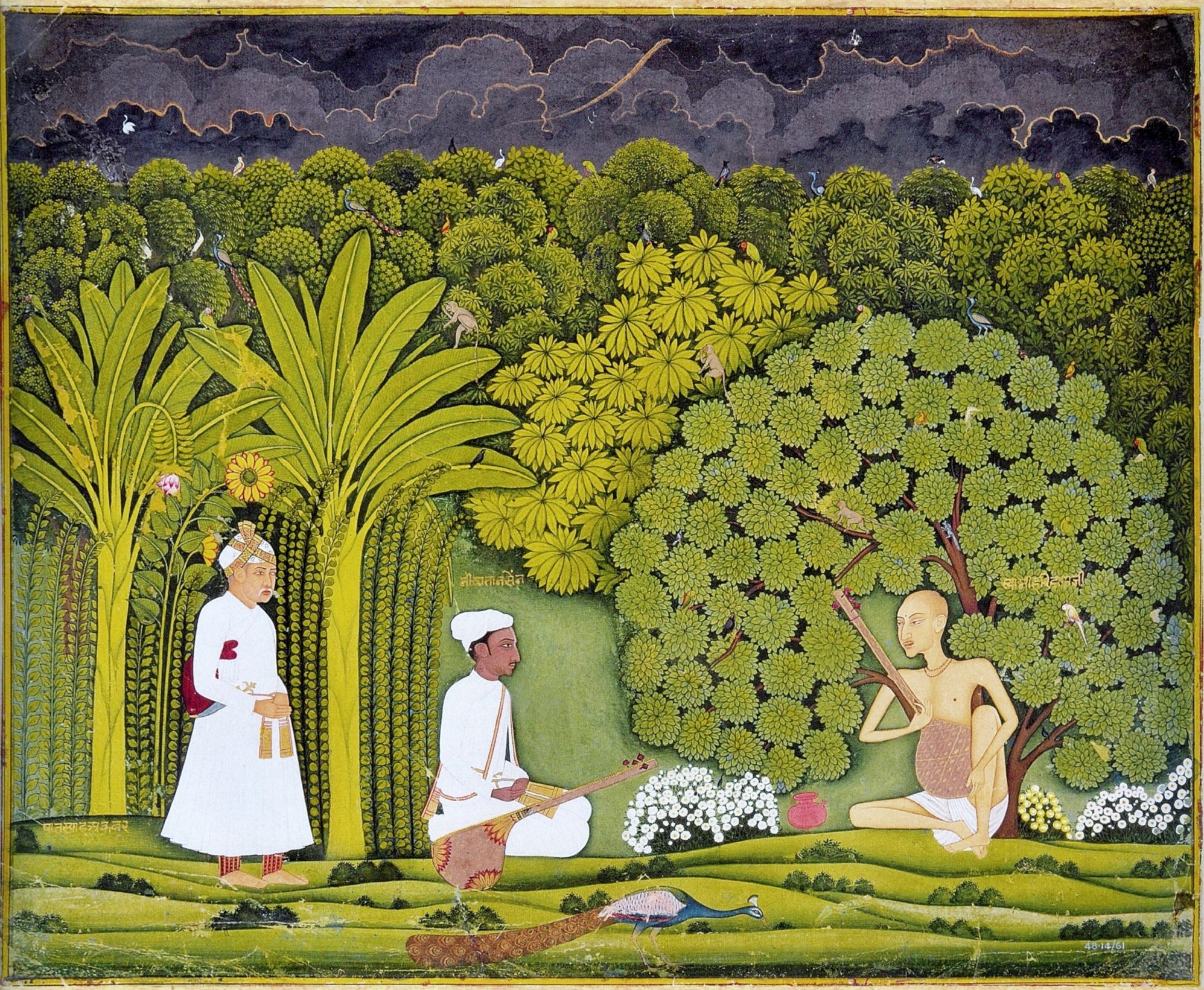
Neelakantha Dikshita a minister in the Court of Nayak Kings was a disciple of Venkatamakhin. Neelakantha Dikshita was also a well known poet of his times; and is said to have written a Kavya Siva Leelarnava, which describes the Leelas of Lord Sri Meenakshi Sundareswara of Madura.
[The picture at the top of this post  is taken from a painting  made by Sri S Rajam. There is an interesting anecdote connected with it.  When Sri Rajam intended to provide an illustration of Venkatamakhin as an introductory painting for the Apr 2008-March 2009 calendar brought out by L&T, he had no earlier pictures of Venkatamakhin to guide him. His research into the archives of Sri Kanci Mutt led him to an interesting detail showing that Venkatamakhin who was also a skillful vainika wore his long hair in a coil such that it did not touch his body; he coiled it atop his head. Shri S Rajam then pictured Venkatamakhin with coiled locks of hair, rudraksha-mala; and surrounded by musical instruments such as Veena, Tambura etc. as also scrolls of ancient manuscripts, lending the picture an air scholarship and a spiritual aura.]

Chatur-dandi-prakashika

Venkatamakhin fame rests mainly on his work Chatur-dandi-prakashika, which he wrote (perhaps around the year 1650) under the patronage of the Fourth Nayaka King Vijaya Raghava who succeeded Raghunatha Nayaka and ruled up to 1672.

Chatur-dandi-prakashika is a treatise on Music that illumines four forms of song-formats: Gita, Prabandha, Thaya and Aalapa (Gita-prabandha-sthaya-alapa-rupa-chatur –dandi) which seemed to have formed the pattern (or profile) for concert performances during 14-15th centuries. In that context, he makes frequent references to Gopala Nayaka (1205-1315) and to Tanappa-charya whom he calls Parama-guru ( Guru’s Guru) . Both of these were, perhaps, renowned performers of Charurdandi.

Along with the text, Venkatamakhin is said to have composed Lakshana-gitas on a large number of Ragas.

The text of the Chatur-dandi-prakashika was said to contain ten Chapters (Prakarana), each dealing with: Veena, Sruti, Svara, Mela, Raga, Alapa, Thaya, Gita, Prabandha and Taala. Among these, portions of Prabandha-prakarana and the entire Taala-prakarana are lost. But, interestingly, it is the Appendix (Anubandha) to the main text that brought focus on Venkatamakhin.

The Veena-prakarana generally follows the concepts and techniques described in Somanatha’s Raga-vibodha and Ramamatya’s Svara-mela-kalanidhi ; and,  discusses about two kinds of fret-arrangements and tuning of the Veena-strings. Venkatamakhin mentions three types of Veena: Shuddha-mela-veena; Madhyama-mela-veena; and, Raghunathendra-mela-veena.

While describing the arrangement of the frets on each of the three types of Veena, Venkatamakhin follows the illustrations provided by Ahobala Pandita.  According to that, arrangement of frets could be done in two ways: One with fixed frets on which all Ragas could be played (Sarva-raga-mela-veena); and the other with frets specially placed to suit playing of a particular Raga (Eka-raga-mela-veena) .

Venkatamakhin informs that during those days, besides the common Shuddha and Madhya-mela Veena described by Ramamatya, there was also a Veena with a higher tuning, i.e. in this tuning the first three strings are ignored and the fourth one tuned to Shadja has frets for three Sthanas. It was named by Govinda Dikshita as Raghunathendra-mela-veena, in honour of the King.

In the Second Chapter dealing with Srutis, Venkatamakhin ,in the traditional manner,  talks about 22 Srutis and their distribution over Seven Svaras. He explains that the 22 Srutis are not placed at equal intervals, but are placed at specific intervals depending upon the  Svara structure in the Raga. For instance, he says, the Shadja and Shuddha Rishabha on the Veena should be divided equally into three parts ; and two frets be introduced and thus three Srutis of `ri’ are seen (Sa – – ri).

The third Chapter on Svaras explains the nature of Shuddha and Vikrita Svaras. He explains the Shuddha Svaras with the illustration of Mukhari Raga having Sa, Ma and Pa having 4 Srutis; Ga and Ni having 2 Srutis; and, Ri and Dha having 3 Srutis.

As regards Vikrita Svaras, Venkatamakhin asserts that in practice there are only five in number and not 7 or 12 as mentioned in the texts of Ramamatya and Sarangadeva.  The five Vikrita Svaras according to him are: Sadharana Gandhara; Antara Gandhara; Varali Madhyama; Kaishiki Nishadha; and, Kakili Nishadha.

Dr. N. Ramanathan explains: the one interesting feature of Venkatamakhin’s descriptions of Shuddha and Vikrita Svaras is that he considers the same Svara to be different if its interval from its previous Svara is altered.

Then, Venkatamakhin goes back to the ancient Gramas – Shadja, Madhyama and Gandhara; as also to the Murchana and the Tana. He also talks about Alamkara, Gamaka and Vadi-Samvadi Svaras. In all these, he refers to the descriptions as given in the older texts. As regards Vadi-Samvadi, he applies the ancient system to his contemporary practices and gives illustrations.

The Fourth Chapter is about his exposition of Mela scheme. He tried forming as many number of Melas as possible by permuting Shuddha and Vikrita Svaras. With this, he comes up with 72 Melas. Venkatamakhin asserts that his scheme of 72 Melas comprehends all the Melas that may have existed in the past and those that might be created in future.  Out of the 72 Melas, Venkatamakhin was able to identify the Ragas of only 19 Melas. Therefore, he could name only 19 Melas; the rest were not assigned any names. These (53) he considered as theoretical possibilities, but (then, at that time) non-functional since no known Ragas could fit in to his scheme of these Melas.

[According to Emmie Te Nijenhuis:  Venkatamakhin’s system of nineteen Melas closely resembles the Ramamatya’s Mela system: fifteen of Venkatamakhin’s Melas are almost identicle with Ramatya’s Melas. For instance; the Mela Bhairavi of Venkatamakhin corresponds to Hindola of Ramamatya. Similarly, Venkatamakhin’s Shankarabharanam corresponds to Ramatya’s Kedaragaula and Saranganata Melas.  However, Venkatamakhin’s Bhupala, Pantuvarali, Simharava and Kalyani are not found in Ramamatya’s system.]

While describing the 19 Melas, he also gives the Svaras and the 22 Srutis in each case. And , while naming the 19 Melas he also indicates each one’s position  (number) in his Grand scheme of 72 Melas.

    • 1.He starts with Mukhari which is his first Mela and also the first among the 72;
    • 2. Samavarali (3);
    • 3.Bhupala (8);
    • 4.Hejjuli (13);
    • 5.Vasanthabhiravi (14);
    • 6. Gaula (15); 
    • 7. Bhiravi Raga (20);
    • 8.Ahiri (21);
    • 9.Sri Raga (22);
    • 10. Kambhoji (28);
    • 11. Shankarabharanam (29);
    • 12. Somantha (30);
    • 13. Desaki (35);
    • 14. Naata (36);
    • 15.  Shuddha Varali (39);
    • 16. Pantuvarali (45);
    • 17. Shuddha Ramakriya (51);
    • 18. Simharava Raga (58) – an invention of Venkatamakhin; and,
    • 19. Kalyani (65).

[The numbers mentioned in the brackets indicate the number assigned to the Mela in the overall scheme of 72 Melas.]

Venkatamakhin went by recognizing a Mela Raga if all the seven Svaras occurred in it, either in the Aroha or in the Avaroha. He did not insist that a Mela Raga should be a Sampurna Raga, with all the seven Svaras in both the Aroha and Avaroha. Further, during the time of Venkatamakhin the concept of Mela-karta had not yet evolved. All his discussions are in terms of the Melas.

While talking about his scheme of 72 Melas, Venkatamakhin makes very interesting remarks :

I have no doubt worked out the 72 Melas , but it might be said that this permutation is a waste , since, of these 72, only a few are known and found in practice; my reply is that I have devised a scheme which would comprehend all Ragas of all times and of all countries , Ragas now known and Ragas which might be created in future, Ragas which we do not know  at all and Ragas which are only in text books , Ragas that are Desiya Ragas and the already generally accepted Melas of those  Desi Ragas , such Ragas like Pantuvarali and Kalyani  and their generally accepted Melas – it is to comprehended all these that I have devised this scheme of 72 Melas . Wherefore should one fear that it will be futile?

[Source: Collected writings on Indian Music .Vol 2 .p.264-5 by Dr. V. Raghavan]

Yes, indeed; it was not a futile exercise at all , but a path breaking pioneering work that led to improvements and refinements of the entire theory and scheme of the Melas and their derivatives.

[Venkatamakhin’s Mela scheme was thoroughly revised later. (We shall talk about these in a little while). The concept of Mela-karta (Janaka) from which other ragas may be derived and of Raganga Ragas also came about after Venkatamakhin’s time. Following that, the rest 53 Melas which Venkatamakhin could not name were duly recognized and assigned names. And, finally 72 Mela-karta Ragas were identified and named. Along with coining names, a system of hashing (Ka-ta-pa-yadi) for identifying the Raga-number with the aid of the first two syllables of its name was also introduced.]

In the Fifth Chapter – Raga prakarana – Venkatamakhin recalls the ancient system of identifying a Ragas with ten characteristics (Lakshanas) – Graha, Amsa, Tara, Mandra, Sadava, Audavita, Aplatva, Bahutva, Apa-Nyasa and Nyasa. He again talks of the earlier classification of Ragas as Grama raga, Bhasha Raga etc.  He describes 55 Ragas picked on the basis Graha Svaras (the initial note – Adi-Svara).  He starts with Ragas having Shadja as Graha Svara, then the Ragas with Rishabha as Graha Svara and so on. In case of each Raga, he mentions the Mela to which it belongs  as also their Lakshana and Lakshya.

He gives a classified list (according to Graha, Nyasa etc) of 54 Ragas with their descriptions, their Svara structure and their Mela.

The Sixth Chapter, Alapa-prakarana talks of various stages in developing a Raga Aalapa.

The Seventh Chapter Thaya-prakarana is the briefest with only seven verses. Venkatamakhin describes Thaya (Sthaya) as a melodic phase with rich musical potential that forms the main ingredient in Raga elaboration.  AS Dr. Ramanathan explains : In the Raga-alapana , Thaya is that in which a particular Svara is taken as the stationary point from which phrases are built up encompassing four Svaras in the ascending direction and later in the descending direction and finally conclude on mandra -sa.

The Eighth Chapter Gita-prakarana is about the Gita (the song); and also about the Shuddha Suda and Salaga Suda class of Prabandha. The latter, the Salaga Suda, in particular is treated a Gita. Venkatamakhin describes seven forms of Prabandhas under Salaga Suda: Dhruva, Mattha, Pratimattha, Nisharuka, Attatala, Rasa, and Ekatali

The Ninth Chapter Prabandha–prakarana is the extension of its previous Chapter; but , it is incomplete.  Here, Venkatamakhin describes Prabandha in terms of Six Angas (limbs or elements): Svara, Birudu, Pada, Tena, Paata, and Taala;   and Four Dhatus (sections in a song): Udgraha, Melapaka, Dhruva and Abogha. Then, he goes into to the classification of Prabandha depending upon the (a) number of Angas and (b) number Dhatus of which they are composed.  He also provides number of illustrations.

The Tenth and the Last Chapter on Taala is lost.

When you look back you find that Chatur-dandi prakashika, basically, recalls the Music practise as they existed during 14th to 17th centuries.  It throws light on the history of those times and clarifies some issues. But, by the time Venkatamakhin wrote this text, many of the subjects he discussed, particularly the Prabandha, were fading away giving place to newer forms of song-formats and improvised ways of rendering the Raga and the song.

Venkatamakhin was criticized for making uncalled for remarks such as: Ramamatya could not even understand what a Sheppard could easily understand; and, that not even Lord Shiva can improve upon his Mela scheme. (He, of course, was proved wrong as his Mela scheme was revised and improved upon). During the early 20th century controversies raged over the Melas of Venkatamakhin. Some critics argued that the Kanakambari -Phenadyuti nomenclatures – the Mela names –  found in the Appendix to Chatur-dandi – prakashika though ascribed to Venkatamakhin are not actually his own** . It was also pointed out that Venkatamakhin’s Mela was already marked with Ka-ta-pa-yadi prefixes. And they said, it is not known who invented this ingenious system ; but, it could not be Venkatamakhin. Most of such controversies have now been put to rest.

[**Prof N Ramanathan in his article The Post-Sangitaratnakara Svara System (included under The Traditional Indian Theory and Practice of Music and Dance – Edited by Jonathan Katz) observes: It is unlikely that the Appendix was written by Venkatamakhin himself. One cannot sure that Venkatamakhin himself is the author of the names of the seventy-two Melas, Kanakambari, Phena- dyuti etc.,; their Janyas and their Lakshanas in Slokas.

In the Text proper, the Svaras of the Ragas Mukhari are mentioned as being all Shudddha; and, Mukhari is placed as the First Mela. However, in the Appendix, the names of the Melas are different; and, the First Mela, here, is Kanakambari. And, Mukhari Raga is listed under the Twentieth Mela. Further, under the First Mela, another different Raga (that is – Shuddha Mukhari) is given.  This seems to suggest that Shuddha Mukhari comprises only the Shuddha Svaras.

The conclusion that follows is: that in the intervening period between the writing of the Text and the writing of the Appendix, certain changes had taken place in the Svara system.  To illustrate: in the old system Ga was five Srutis away from Sa; and, in the new system, Ga was four Srutis away from Sa. Similarly, in the old system, Shuddha –rsabha was three Srutis, while in the new system it was two Srutis.  Hence, the old scale of Shuddha Svaras was different from the new one. ]

Chatur-dandi-prakashika is known and recognized today mainly because of the 72 Mela Scheme that he introduced. And, this exercised great influence in reorganizing the Ragas and the Music structure in Karnataka Sangita.  In that regard, Chatur-dandi-prakashika is a very important text.

header

Mela

Mela is a Kannada word that is still in use; and, it signifies ‘group’ or ‘gathering’. There have been many attempts, at various stages in the history of Karnataka Sangita, to organize the then known Ragas by groping them into categories. The earliest known such attempt was by the sage Sri Vidyaranya (1320-1380) who in his Sangita-sara   grouped about 50 Ragas into 15 Melas.

Following Sri Vidyaranya, Ramamatya in the Fourth Chapter – Mela-Prakarana– of his Svara-mela-kalanidhi (1550 AD) introduced the theoretical framework for classifying then known Ragas into 20 Melas, the notes and names of which were taken from the prominent Ragas of that time.  This was an improvement over the system initiated by Sri Vidyaranya.

Ramamatya lists 20 Melas: 1.Mukhari; 2.SriRaga; 3. Malavagaula; 4. Saranganata; 5. Hindola ; 6. Shuddha-ramakriya; 7. Desaki; 8.Kannadagaula; 9. Shuddanti; 10.Ahari; 11.Nada-ramakriya; 12.Shuddhavarjati; 13. Ritigaula; 14. Vasantha-bhairavi; 15.Kedaragaula; 16.Hejujji; 17.Samavarali; 18.Revagupti; 19. Samantha; and 20. Kambhoji.

Ramamatya gives details of Shuddha-Svaras and Vikŗta-Svara-s occurring in each of the Mela, a list of sixty-four Janya Raga-s classified under each Mela, and the Sruti positions of Svaras in the Melas. Mukhari is established as the Shuddha-Svara Saptaka in this treatise

Later scholars, that is after Ramamatya, started computing the maximum number of seven Svara combinations they could derive (melaprasthara) based on the number of Svara positions. Here, each author computed a different number of Melas based on the number of Svarasthanas he had theorised.

For example, during the second half of the 16th century Pundarika Vittala (in his Raga-manjari) introduced Ramamatya’s 19-Mela system in North India. But, he changed the names and scales of several Melas. He wrote two treatises. One was Sadraga Chandrodaya, and the other  was Ragamanjari. In Sadraga Chandrodaya Pundarika Vittala gives 19 Melas  with  66 janya ragas ; but, in Ragamanjari he gives 20 Melas and 66 janya ragas. (It is explained; in Ragamanjari Pundarika Vittala gives one extra Mela, because of the chatusruti Ri and kaisiki Ni combination). But, in his Sad-Raga-chandrodaya Pundarika Vittala mentions the possibility of 90 Melas.

Another South Indian musicologist who migrated to North was Srikantha who wrote his Rasa-kaumudi at about the same time. In classifying 37 important Ragas, he reduced Ramamatya’s 19 Melas to 11 or in fact to 10 as his scales of Malhara and Saranga were actually the same. His system resembled the contemporary Arabic system of 12 predominant modes (Maqam).

Then, following Ramamatya and Pundarika Vittala, Ahobala Pandita classified 122 Ragas under six Mela categories and three subdivisions:

Audava(pentatonic), Shadava(hexa-tonic) and  Sampurna (hepta-tonic).

Hridayanarayana Deva who followed Ahobala Pandita, arrived at 12 Melas composed of two sets of six Melas depending on the number of Vikrita Svaras.

Lochana Kavi also came up with 12 Melas.

And, in Somantha’s Raga Vibhodha there are 960 possible Melas.

Even though they all came up with this computation they found that only a limited number of these were actually used in the form of a Raga.  Therefore, Somanatha felt that 23 Melas would suffice to classify the 67 Ragas then in practice.

Thus, right from 14th century, Musician-scholars have been classifying and re-classifying Ragas into different sets of Melas, each according to his pet theory.

When you look back you will find that over a long period there had been a tendency to evolve as many numbers of Melas as possible.

The proliferation of Melas seemed to have come about because that instead of abstracting Melas from out of the Ragas in vogue, attempts were made to arrive at as many number of Svara-structures as possible out of the known Shuddha ( pure) and Vikrta ( modified) Svaras. This practice came to known as Mela –prastara (elaboration or spreading of the Melas). For instance; a Mela is basically a collection of seven Svaras. By permutation of these Svaras in varying ways one could arrive at a number of plausible Melas. Somanatha , as mentioned earlier, claimed that he could devise as many as 960  plausible Melas; but then , he found it reasonable to restrict the numbers to 23  abstracted from the then known Ragas.

This process of Mela-prastara went on till the number of Melas (or Mela-karta) settled down at 72.

Melas0001

[For a detailed  and scholarly discussion on ‘The Mela Classification of Ragas ‘ with particular reference to Pundarika Vittala , please refer to Chapter 8 Mela system of Dr.Padma Rajagopals’s thesis.]

*

One of the most important texts in that context was Chatur-dandi-prakashika of Venkatamakhin (1650), which brought the Mela system on a rational basis. It classified the Ragas according to the system of 72 basic scales (Mela). The basics of system still prevail, though with modifications.

In 1620, Venkatamakhin also corrected Ramamatya’s system by reducing it to 19 from the original 20 Melas, because he found that the notes of the two Melas were similar.

But, in the Appendix (Anubandha) to his Chatur-dandi-prakashika, Venkatamakhin mentions the possibility of classifying Ragas (Kanakangi to Rasikapriya) built on 12 Svara-Sthanas under a 72 Mela-scheme made into two groups of 36 each (Shuddha Madhyama and Prathi Madhyama). It was, at this time, only a theoretical possibility, since all those 72 Melas were yet unknown. Out of such 72 Melas, Venkatamakhin was able to identify the Ragas of only 19 Melas. The rest (53) he considered as mere theoretical possibilities; and, non-functional since no known Ragas could fit in to his scheme of these Melas.  Therefore, he could name only 19 Melas; the rest (53) were not assigned any names.

[The scheme of 72 Melas devised by Venkatamakhin , during his time, was almost unknown outside the scholarly circles. Maharaja Tulaja of Tanjavur, in his work –Sangita saramritam (1735) – remarked that the Melas of Venkatamakhin had not attained publicity; and, for practical purposes,  the Ragas covered under Twenty-one  Melas would be sufficient.]

*

[There is some interesting discussion on Todi, presently, a prominent Raga in Karnataka Sangita. Venkatamakhin calls Todi an ‘outhara’ raga. He does not include Todi in the 19 Melas called as ‘praak-prasiddha melas. According to his scheme of Asampurna paddhati, Todi is the eighth raganga raga known was Janatodi.

Some scholars do not however agree with Venkatamakhin’s treatment of Todi. They point out that Todi is not a ‘northern’ Raga; and, its traces can be found in the Southern music – say in the Divya Prabandhams as Mudirnda Kurinji – though it was fully developed in the period of the Trinities.

Prof. Sambamurthy also did not agree that Todi was an outhara raga; and, he described Todi as a ‘naya ragam’- the one that offers ample scope for alapana, niraval and swaraprasthara. He said Todi was a sarvaswara gamaka varika rakti raga. Dr. S.A.K. Durga called Todi as one of the ragas having most samvaaditva (consonance) or arguably the most consonant raga.
Todi which is sung often with shadja varja and panchama varja, seems to have been among the favourites of  Sri Dikshitar’s family. For instance; Ramaswamy Dikshitar composed a padam in Todi; Muthuswami Dikshitar’s dhyana kriti in his Navarana group is in Todi; Chinnaswamy Dikshitar’s popular pallavi ‘Gaanalola Karunaala vaala’ is in Todi; and, Baluswami Dikshitar’s chittaswarams for ‘Gajavadana,’ give the essence of Todi.

Todi – formally titled as Hanumatodi is the 2nd rāga in the 2nd chakra – Netra.  It is the 8th Melakarta rāga (parent scale) in the 72 Melakarta rāga system – Sampurna paddhati. 

Sri Tygaraja who followed Sampurna paddhati, has composed about 32 kritis in Todi, with each composition starting at every single note of the three octaves. It is a very popular raga, very often sung in the concerts. Yet; Todi is known to be a difficult raga, because of the complexity in its Prayoga (execution). That, perhaps, is the reason why beginners are not taught  Todi and Saveri. ]

It is said that it was Venkatamakhin’s grandson Muddu Venkatamakhin, who gave the nomenclature for the Mela Ragas, (Kanakambari, and Phenadhyuti etc) in his Gitam called Raganga Raga Anukramanika Gitam (numbered as 15.14.1 in Sri Subbarama Dikshitar’s Sangita Sampradaya Pradarshini (1904). Please check page  250 /664 of the web-page / page 207 of the Book .

In Muddu Venkatamakhin’s Ragalakshana a drastic shift takes place in the Mela-concept. He synthetically creates Janya Ragas for the remaining 53 Melas that were earlier considered non-functional. Here for the first time the Raga-description is based purely on its Svara-sthanas. It is also at this stage that the Raga Grammar or its characteristic is described in terms of its   Aroha and Avaroha Svaras.

(Please check here for Muddu Venkatamakhin’s Appendix (Anubandha) to Chaturdandi  Prakashika )

Some say, it is likely that Muddu Venkatamakhin’s scheme grew in two stages. In the second stage the Katapayadi prefixes were added to suit the Raga-names; or the other way. The Gitas in the Raganga (Mela-kartha) Ragas bear the names with their Katapayadi prefixes.

Shri TM Krishna observes: ‘The Muddu Venkatamakhin tradition, which uses the terms Raganga Raga (equivalent term to Mela-kartha) and Janya Raga, adopts the opinion that the Raganga Raga needs to be Sampurna in either Aroha or Avaroha but non-linear (A-sampurna). It is believed that Muddu Venkatamakhin wrote Lakshanas for the Raganga (Mela) ragas and their Janyas.

Sri Muthusvami Dikshitar gave form to most of these Ragas through his compositions. As regards the A-sampura (not-sampurna) Ragas, Sri Muthusvami Dikshitar chose to change their structure in order to mitigate the ill-effects of direct Vivadi Svaras in their scale.

[Sri Subbarama Dikshitar while writing about the life of Sri Ramaswamy Dikshitar (father of Sri Mutthuswamy Dikshitar) says he learnt Mela system from Venkata Vaidyanatha Dikshitulu, who was the maternal-grandson of Venkatamakhin (Vaggeyakara Caritramu, pg.25, SSP English Translation Vol.1). This Venkata Vaidyanatha Dikshitulu is identified by some as Muddu Venkatamakhi.

However, Dr. R. Sathyanarayana differs. According to the dates given by Dr. Sathyanarayana (Rāgalakaam of Śrī Muddu Venkatamakhin; Introduction, pg.9) Muddu Venkatamakhin may have been born around 1650 A.D and Venkata Vaidyanatha was a younger contemporary who taught Ramaswamy Dīkṣhitar at around 1750 A.D.]

Again, during late 17th – early 18th century, a person called Govindacharya the author of Samgraha-chudamani changed the names of some Melas of Venkatamakhin

[Sri  T R Srinivasa Ayyangar  , in his introduction to Sangraha Chudamani of Govinda , edited by Pandit Sri Subrahmanya Sastry  (Published by The Adyar Library, 1938) writes : The author of this work Govinda , popularly known as Govindacharya, to distinguish him from his famous namesake , does not seem to have been known otherwise to fame. Neither his place of nativity , nor his antecedents  , nor the time when he flourished can be traced with any accuracy.

Further , Sri Ayyangar mentions : a manuscript copy of Sangraha Chudamani  was in possession of Manabuccavadi  Venkata Subba Ayyar , an immediate disciple of Sri Thyagaraja; and, it had been copied by Maha vadidyanatha Sivan and  Pattanam Subrahmanya Ayyar..

It is , therefore, very likely that Sri Thyagaraja was familiar with the text and its Mela classifications.]

Govindacharya expanded on Venkatamakhin’s Mela concept   by introducing  the  Sampoorna Meladhikara (equivalent term to Melakarta) scheme which  has a complete (sampoorna) Saptaka : both in the Arohana and the Avaroha  structure; and importantly the Svaras are to be in linear order. In this scheme, the Mela-kartas arise out of systematic permutation of the seven Svaras into the twelve Svara-sthanas

Govindacharya is also said to written lakshana-gitas and lakshana-slokas (numbering in all 366) covering 294 Janya RagasAnd, it is believed, he refined the Katyapadi prefixes by linking the Mela Ragas to their first two syllables of their names. This system of 72 Mela is the Karnataka Mela system of the present day.

Some say; while devising the system of 72 Meladhikara-s, based on 22  Srutis,  Govindacharya  adopted the nomenclatures and characteristics that were used by the musicologist Akalanka  (later than Venkatamakhin?) in his Telugu  work Sangita sara sangrahamu.   Akalanka  had developed his system on the basis of the Sruti positions in a Rudra-veena ; and, had employed the Katapayadi mode of computation. In the system devised by Akalanka, the Melakartas were complete both in the Aroha and the Avaroha. Sri  Subrahmanya Sastry beleives that Sri Tyagaraja was the first Vakgeyakara to introduce Akalanka’s  Melakartas ; and to compose Kritis , illustrative of their principles.

[Please refer to the Sangraha Chudamani of Govinda, edited by the renowned scholar, Pandit Sri S . Subrahmanya Sastry; and, published by Adyar Library, 1938. Please do read the highly educative introduction written by Sri T R Srinivasa Ayyangar.

But , there is a dispute about the very name Akalanka. Dr. V Raghavan, in the introduction to Sangita Sara Sangrahamu Tiruvenga Dakaviedited by Dr. Narendra Sharma, remarks that the name Akalanka is ‘absolutely unreal’; and, Sri Srinivasa Ayyangar might have misunderstood the opening verse of the manuscript.  He surmises that its  author might have been one Tiruvenkata , who wrote it for a Lady named Kuntalamba (page ix).

Further , Dr.  Raghavan states : there is hardly any ground for asserting that this Telugu text, in rather untidy Telugu,  is the source for Govinda. ‘ –  Page xi]

In any case :

Govindacharya’s insistence on a Sampurna Arohana–Avarohana profile lent the Mela-karta a sort of elegance. And, seen from another view, the Mela-karta scheme appears as a product of mathematical abstraction. And, naming of the Mela, the ragas, the Svaras (and introduction of Vivadi Svaras) seem rather incidental to its technical process.

Sri Mutthuswamy Dikshitar followed Venkatamahin’s scheme (Kanakambari-Phenadyuti); while, Sri Tyagaraja gave forms to most of the Ragas in the other scheme (Kanakangi-Rantnangi).   The subtle but main difference between the two schemes appears to be the importance given to the linearity and non-linearity of the Svaras in Arohana and Avarohana.

*

Prof. Ramanathan explains : The difference between Mela-karta and Raganga-raga is that while the former (Mela-karta) had to have all the seven Svaras in both the Aroha (ascent) and in the Avaroha (descent); but, for the latter (Raganga-raga) it was sufficient if the seven Svaras were present either in Aroha or in Avaroha. Further , in Mela-karta , the Aroha and Avaroha the seven Svaras have to occur in their regular (krama) sequence ; while in the Raganga-raga , the  sequence of Svaras in  Aroha and Avaroha could be irregular (vakra) .

In other words; the Melakarta Ragas are all Sampurna Ragas, but the converse is not true, i.e., all Sampurna Ragas are not Melakarta Ragas

With these stipulations, the sequence of the Svaras in Aroha and Avaroha became the defining characteristic of a Raga. And , in about a century following the Chaturdandi-prakashika , the eminent composers , mainly the Trinity, composed Kritis in the Ragas classified under all the 72 Melas.

But , in the later period , the distinction between the Mela and the Raganga-Raga gradually faded away; and, the two concepts merged into one.

Thus, the formulation of the 72 Mela-prastara and the later auxiliaries greatly influenced the course of the South Indian classical music of the later period.

As per Shri TM Krishna: ‘Mela started out as a way to organize existing Ragas but moved to creating scales as Ragas using the Mela structure. Probably for the first time in musical history theory influenced practice. This is probably why many Ragas in performance even today are only Svara structures sans features that give a Raga an organic form’.

bar3

Raga Pravaham  a monumental work and a reference source of immense value to learners, teachers, musician and musicologists alike, is an Index of about 5,000 Karnataka Ragas, compiled by Dr. Dhandapani and D. Pattammal. The list of Ragas is given both alphabetically and Mela karta wise. The different kramas for the same Ragas and same scales with different names are also listed.

Apart from indexing Mela-karta Ragas, Janya ragas, Vrja and Vakra Ragas and their derivatives; the Raga Pravaham lists about 140 Hindustani Ragas, which are  allied or equivalent to Karnataka Ragas.

In his introduction to Raga Pravaham, the renowned musicologist and scholar Prof .Dr. S. Ramanathan (1917-1988)-(Wesleyan University, U.S.A),  wrote :

The Raga system in Carnatic music has a long and interesting history from the time of Matanga’s Brihaddesi, where you come across the definition of Raga. The system has evolved through the centuries. Ragas like Gaula, Takka etc. are mentioned in the Brihaddesi.

By the 13th century, the Sangita Ratnakara of Sarangadeva lists as many as 264 Ragas. Here, you come across Ragas like Sankarabharana, Sri Raga, Todi, Malavagaula (which is referred to as Taurushka), and Kedaragaula etc.

In the 14th Century Vidyaranya, in his musical treatise Sangeetha Saram gives a list of fifteen Mela Ragas ; and , by the year 1550, Ramamatya in his Swara Mela kalanidhi speaks of 19 Melas and several derivatives from each of them.

In the beginning of 17th Century, Somanatha’s Raga Vibhoda; and Govinda Dikshitar’s Sangita Sudha are two important works which deal with Ragas current at that time.

In the latter half of 17th Century, Venkatamakhi, son of Govinda Dikshitar appeared on the scene; and, in his monumental work Chatur-Dandi-Prakasika expounded the 72 Mela-karta schemes, which brought the Mela Janya system on a rational basis.

In this work, he only showed the possibility of 72 Mela  kartas. But, in his scheme, a Raga could be a Mela  only in case it had all the seven Svaras either in the ascent (arohana) or In the descent (avarohana). Kedara-Gaula which is Audava Sampurna was a Mela in his scheme.

It is believed that it was Venkatamakhi’s grandson Muddu Venkatamakhi, who gave the nomenclature for the Mela Ragas, (Kanakambari and Phenadhyuti etc) in his Gitam called Raganga-Raga-Anukramanika-Gitam (found in Subbarama  Dikshitar’s  Sangitha Sampradaya Pradarsini, 1904).

Later, Govindacharya, the author of Sangraha Chudamani gave the nomenclature Kanakangi, Ratnangi etc. to the 72 Mela karta Ragas. These Melas had all the seven notes in the ascent (arohana) and in the descent (avarohana) as well. He has also given Lakshana-gitas and lakshana-slokas for many Janya Ragas.

Though the arohana and avarohana krama of a Raga does not tell us everything about the Raga, it provides the frame work on which it is built. Ragas like Sahana, Ahiri, Neelambari, Devagandhari and Yadhukula Kambhoji defy definition. But for the majority of the Ragas, the Krama helps.

bar3

When you look back the long and interesting history of Raga in Karnataka Sangita stretching from Matanga to the present-day, you find that the system has evolved through several stages. If Matanga defined the Raga and lent it a sense of identity, it was Ramamatya that activated the process of binding the Ragas into structured groups.  This was improved upon by Venkatamahin; and later perfected by Muddu Venkatamahin and Govindacharya. These series of concepts and their refinements have provided Karnataka Sangita a unique and a thorough theoretical foundation.

*

The voluminous  Sangita Sampradaya Pradarshini by  Sri Subbarama Dikshitar (1839-1906) , the grandson of Sri Mutthuswami Dikshitar , running into about 1700 pages is a source-book on Music of India , tracing the history of Music from Sarangadeva to the 20th century through a series of biographies of noteworthy musicians and music-scholars . It  also provides  exhaustive details on 72 Melas  as also tables of Ragas, Ragangas, Upanga-s, Bhashangas with their Murcchanas, Gamakas, in addition to details of the  Taalas.

The Mela system also travelled North.  Pandit  Shri Vishnu Narayan Bhatkhande (1860-1936), a scholar and a musicologist, in his colossal work ‘Hindustani Sangeet Paddhati’ reorganized the Uttaradi or North Indian Music, mainly,  by adopting the concept of Mela system as expanded by Venkatamakhin (1660) and others  .

Vishnu Narayan Bhatkhande Stamp

Bhatkhande also adopted the idea of Lakshana-geetas that Venkatamakhin and other scholars employed to describe the characteristics of a Raga. Bhatkhande arranged all the Ragas of the Uttaradi Sangita into ten basic groups called ‘Thaat’, based on their musical scales.  The Thaat arrangement, which is an important contribution to Indian musical theory, broadly corresponds with the Mela-karta system of Karnataka Sangita.

The ten basic Thaats (or musical scales or frameworks) according to the System evolved by Pandit VN Bhatkhande are (From Wikipedia):

Thaats

Thaat-2

[ It is said;Pundit Bhatkhande composed a Dhrupad (in Raga Purvi ; set to jhap tala)  in praise of Venkatamakhin and his  Chaturdandi Prakasika.

ab chatura dandi mata venkata sunave ||
dvadasa suran ke khata chakra banave || (ab chatura)
ra ga ra gi ra gu ri gi ri gu ru gu rachave ||
dha na dhi ni dha nu dhi ni dhi nu dhu nu manave || (ab chatura)
dva saptati mela prati madhyama so janita
raganga saba janaka ade kahave ||
aroha avaroha ke bheda ko sadha
bhashanga rupanga chatura upa jave || (ab chatura)

 Pundit Bhatkhande states in this composition that Venkatamakhin authored the work Chaturdandi Prakasika; and, that he modelled 12 chakras with the 12 tonal scale. He then goes on to state that Venkatamakhin  conceived of the different flavours of each of these positions (to constitute 16 swaras); he specifies three varieties of ‘ri’, ‘ga’, ‘dha’ and ‘ni’ and calls them out by name (ra, ri, ru, ga, gi, gu, dha, dhi, dhu, na, ni and nu). Bhatkhande then states that Venkatamakhin also explains the various combinatorial possibilities of ‘ra ga’, ‘ra gi’, ‘ra gu’, ‘ri gi’, ‘dha na’, ‘dha ni’, ‘dha nu’, ‘dhi ni’, ‘dhi nu’, ‘dhu nu’. In the sanchari, he states that Venkatamakhi conceived of the mathematical possibility of 72 families (melas) of ragangas (the janaka) raga-s taking into account the two madhyama possibilities (and the invariant Sa and Pa – not mentioned in the composition). Bhatkhande then states that Venkatamakhi spelled out (with authority and clarity) the murchanas (aroha-s and avaroha-s) of the various bhashanga-s and upanga-s that belonged to each family (raganga). The first and the last phrases of the composition contain the composer’s mudra (chapa) ‘chatura’. Bhatkhande adopted the pseudonym ‘Chatura pandit’ and all his compositions have the mudra ‘chatura’ built into them. This composition thus features two occurrences of the chapa. The dhatu and the matu of the composition blend extremely well and this dhrupad makes a powerful musical tribute to Venkatamakhin.

(Source  acknowledged with thanks : http://srutimag.blogspot.in/2013/07/the-chaturdandi-prakasika-and-chatura.html)

[Please check here for a comparative study of Mela-kartas and Thaats -https://bioinfopublication.org/files/articles/2_1_7_IJNN.pdf ]

whitelotusmandala

The 72 Mela-kartas

Emmie Te Nijenhuis in her Indian Music: History and Structure explains the 72 Mela-kartas.

The 72  Mela-kartas are arranged in 12 series (Chakras) each having 6 Ragas. All are having the same tonic (Shuddha Sa) and fifth (Shuddha Pa). All the Mela-kartas in the Chakras from 1 to 6 have a perfect fourth (Shuddha Madhyama; abbreviated as Ma). And, the Mela-kartas in the Chakras numbering 7 to 12 have augmented fourth (Prati Madhyama; abbreviated as Mi). With respect to the other notes in the scale Chakras 7 to 12 duplicate Chakras 1 to 6 respectively.

For a list of the seventy-two Melakarta Ragas , classified under two broad categories (Shudda Madhyama and Prati Madhyama Ragas)  ; and,  enumerated under twelve Chakras , from Indu  (1) to Aditya (12) , please click here .

The name of each of the 12 chakra suggests its ordinal number as well.

:- Indu  stands for the moon, of which we have only one – hence it is the first chakra.(Eka Indu)

:-Nētra  means eyes, of which we have two – hence it is the second (Dve Neta)

:-Agni is the third chakra as it denotes the three divyagnis (fire, lightning and Sun).They could be the three Agnis viz. Aahavaneeyam, Anvwaaharyam & Gaarhapathyam. (Tri Agni)

:-Vēda  denoting four Vedas is the name of the fourth chakra (Chatus Chakra)

:-Bāa  comes fifth as it stands for the five bāṇaa of Manmatha (Pancha bana)

:-Rutu  is the sixth chakra standing for the 6 seasons of Hindu calendar(Shad Riru)

:-Rishi, meaning sage, is the seventh chakra representing the seven sages (Sapta Rishi

:-Vasu  stands for the eight vasus of Hinduism (Asta Vasu)

:-Brahma  comes next of which there are 9 (Nava Brahma)

:-Dishi The 10 directions, including akasha (sky) and patala (nether region), are represented by the tenth chakraDishi. (Dasha Dishi)

:- Rudra  Eleventh chakra  is Rudra of which there are eleven (Ekadash Rudra)

:- Aditya Twelfth comes Aditya  of which there are twelve (Dwadasha Aditya)

[Please do read Sri S Rajam’s most wonderful illustrations of the 12 Chakras and their 72 Melakarta-s.

http://www.carnaticindia.com/images/downloads/Rasi_Pocket_new.pdf]

Each Chakra is determined by the lowest, middle or highest variety of the second (abr, Ra, Ri Ru) and third note (abr. Ga, Gi, Gu).

The six Ragas of each series are individually determined according to the lowest , middle and the highest variety of the sixth (abr. Dha, Dhi, Dhu) and seventh note (abr. Na, Ni, Nu).

In order to make a clear diction between the three varieties of notes –Ga, Dha and Ni, the vowels of these tone syllables are changed, a- indicating the lowest;  –i indicating the middle; and –u indicating the highest variety.

In short, the structure of the first (that is lower) tetrachord (purvanga) of a Raga is determined by its serial (chakra) number, while the structure of the second (the higher) tetrachord (uttaranga) is determined by the number of scale within the particular series (chakra) . Multiplying the serial (chakra) number (after having subtracted 1) by the number 6 and adding the number of the scale within the series, one arrives at the exact Mela (karta) number.

Melakarta

( Source : Raga Pravaham by Dr. Dhandapani and D. Pattammal)

**

Katapayadi

The schemes of 72 Mela and Mela-karta employed a system of deriving the Mela-number by referring to the first two syllables of its name. This helped in easy tracking of a Mela from among the 72. The system of assigning a prefix number to each Mela was adopted from the ancient Katapayadi formula which classifies the letters of the Sanskrit alphabets in a specified manner.

Some scholars believe that the Great Grammarian Panini (5th century BCE) was the first to come up with the idea of using letters of the alphabet to represent numbers. And, that the Brahmi numerals were developed by using letters or syllables as numerals.

Hashing 1

But, it is not clear who introduced the practice of numbering the Melas by means of the Katapayadi prefixes. In the earlier references to Mela system (either by Sri Vidyaranya or Ramamatya or Pundarika Vittala) the prefixes were not mentioned. But, in the Appendix (Anubandha) to the Chatur-dandi-prakashika the Melas were already marked by Katapayadi prefixes.

ancient_indian_katapayadi_mnemonic_for_remembering_raga_names_

According to the scheme, the consonants have numerals assigned as per the above table. All stand-alone vowels like a (अ) and  (ऋ) are assigned to zero. In case of a conjunct, consonants attached to a non-vowel will not be valueless. The only consonant standing with a vowel is ya (य). So the corresponding numeral for kya (क्या) will be 1. There is no way of representing Decimal separator in the system.

Under this naming scheme, the number of a Mela-karta (Janaka) Raga is obtained by decoding the first two letters using the Katapaya scheme; and reversing it. For instance; For Divyamani – Di=8; and Va=4, giving 84. And reversing that you get 48, which is its Mela number. Once you get the Mela number you get its notes too

[ For more on that please check : http://rksanka.tripod.com/music/katapaya.html]

Melakarta  File by courtesy of Sri Basavarjtalwar at https://upload.wikimedia.org/wikipedia/commons/0/0e/Melakarta.katapayadi.sankhya.72.png ]

Melakarta.katapayadi.sankhya.72

 Please click on the figure for an enlarged view.

Please do read the scholarly work  A Karnatik Music Primer by Dr. Parthasarathy Sriram at

 http://www.ae.iitm.ac.in/~sriram/karpri.html

References and Sources:

I gratefully acknowledge

  1. Caturdandiprakasika of Venkatamakhi by Dr. N.Ramanathan
  2. The Anukramaikā Gīta in the SSP by Sumithra Vasudev http://musicacademymadras.in/webjournal/sumithra.pdf
  3. Indian Music: History and Structure by Emmie Te Nijenhuis
  4. The “ka-Ta-pa-ya” scheme http://rksanka.tripod.com/music/katapaya.html
  5. A Brief Overview of the Evolution of Indian Music

https://sites.google.com/site/chitrakoota/Home/carnatic-music

6. Collected writings on Indian Music .Vol 2  by Dr. V. Raghavan

ALL PICTURES ARE FROM INTERNET

 
19 Comments

Posted by on June 12, 2015 in Music, Sangita


Tags: , , , , , , , , , , ,