RSS

Author Archives: sreenivasaraos

The Three Women In Mahabharata (1 Of 3 )- Sathyavathi

The men play dice and wage wars in Mahabharata , as anywhere else ; but it is the women who wield power and influence. It is the women who take decisions , direct the course of events and decide the fate of men and their generations to follow. The women are the true leaders of the Epic The three women in particular who wielded power in more than one form were Sathyavathi the dusky fragrant fisher girl who became the queen , Pritha the fair maiden who reluctantly became the mother of five sons and Krishnaa , daughter of the fire , Druapadi. The Epic is interwoven with their remarkable sagacity in exercise of their power and leadership. Some say the Epic, in a way , is a study in use and abuse of power.

These women displayed that the truly powerful do not cling to power. They know when and how to wield it ; but , even more importantly, when not to use it.

Satyavathi

Satyavathi in her relentless drive to accomplish ; and more importantly, to retain power, manipulated the lives of persons around her. She tried her hardest. Most of her schemes did not turn out well. Towards the end of her life , she was angry , sad and disillusioned . But, what was worse was that her progenies were left to suffer the wrath of her greed . They reaped a bitter harvest.

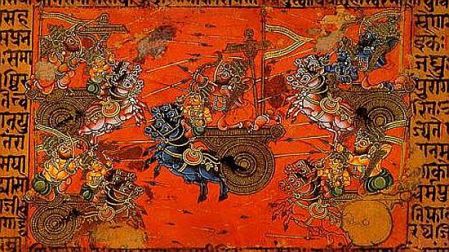
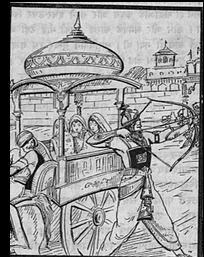
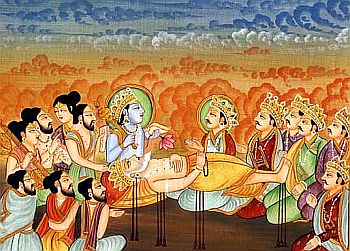
Battle-of-Kurukshetra-Manuscript-Illustration

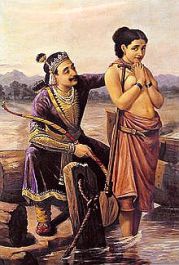
As Kali, the dusky nubile fisher-girl smelling of fish, was transformed into musk fragrant Satyavathi , she took Hasthinapur by storm. The queen to-be , she insisted her blood alone be heir to the throne of Hasthinapur. With that , she caused the prince Devavrata to turn into Bishma , who then locked himself in the shell of his self-imposed vows;  lost the sensation of being alive; and, distanced himself from life; and  yet he chose to cling on to mere existence. 

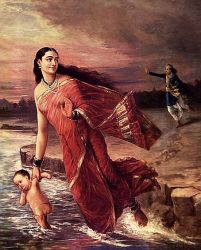
Ravi_Varma-Shantanu_and_Satyavatibhisma

*

Her aged husband died leaving her with two sons. Both her sons later died in their youth without producing an heir to the throne. The elder one died valiantly waging a lone battle; and , the other was too young and consumptive. The younger son too died in his youth of poor health and overindulgence:  sarvāsām eva nārīṇāṃ citta-pramathano ‘bhavat /  tābhyāṃ saha samāḥ sapta viharan pṛthivīpatiḥ (MBh 01,096.056-57 )

He left behind two voluptuous widows in the prime of their youth; “Both were tall, black wavy hair. Fingernails and toe nails painted red, pointed. Hips round and full. Swelling and large breasts – bṛhatī śyāme nīlakuñcita mūrdhaje raktatuṅga nakhopete pīnaśreṇi payodhare  (MB.1.96.54)

The young Vicitravirya, driven by passion, became a victim of his own lust- vicitravīryas taruṇo yakṣmāṇaṃ samapadyata  suhṛdāṃ yatamānānām āptaiḥ saha cikitsakaiḥ  jagāmāstam ivādityaḥ kauravyo yamasādanam (Adi parva, 96.57-58).

The dead prince had produced no heir to the throne. 

Satyavati then tried to entice her stepson Bhishma by offering to release him from his vow of celibacy; and, asked him to marry the widows of his half-brother and produce sons. A piqued Bishma however sternly refused to oblige her “Let doom overtake the world ! Immortality cannot tempt me, nor lordship of the three worlds .. ! I will not break the vow.”

She was unwilling to accept defeat. She did not want it said that it was because of her , the great line of the Bharatas came to an end. Hungry for grandsons, desperate to propagate her lineage , Sathyavathi summoned Vyasa, born to her by Parasara , out of wedlock; and, ordered him to produce sons from his half-brother’s widows through Niyoga *.

[*an accepted ancient  practice, in which a woman (whose husband is either incapable of fatherhood or has died without fathering a child) could request and appoint a man for helping her bear a child , in order to continue the dynasty.]

Vyasa an ascetic , who never lived in the family of his mother’s husband, shocked , refused to obey his mother’s orders. He even counseled his mother that preserving the dynasty by adopting such heinous means was improper (VI.24.46-48).

Satyavati desperately argued that the directives of elders, though apparently improper , ought to be obeyed ; and, such compliance attracted no blame, particularly as it would remove the sorrow of a grieving mother.

It was when Bhishma stepped in and urged Vyasa to obey his mother that he gave in reluctantly; and, agreed to engage in what he described as “this disgusting task” (VI.24.56).

Vyasa wondered whether such progeny born of out of wedlock “vyabhicharodbhava “ VI.25.28) could ever be a source of happiness for him. How prophetic were his words…!

Vyasa asked his mother that the widows be on a year-long vow and austerity so that they purified themselves of the lust they were tainted with through seven years of over indulgence Satyavathi was in a hurry for a heir ; and, was in no mood to wait. She ordered Vyasa to be done with his task at the earliest.

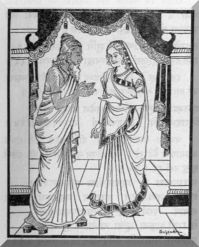
vyasa satyavati

The helpless Vyasa gave in to his mother’s demands; and said – ‘If I am to give unto my brother children so unseasonably, then let the ladies bear my ugliness. That in itself shall, in their case, be the austerest of penances. If the princess of Kosala can bear my strong odor, my ugly and grim visage, my attire and body, she shall then conceive an excellent child.'(Sambhava Parva; Section CV)

Satyavati then went to her daughter-in-law and seeing her in private spoke to her these words of beneficial and virtuous import, ‘O princess of Kosala, listen to what I say. It is consistent with virtue. The dynasty of the Bharatas hath become extinct from my misfortune. Beholding my affliction and the extinction of his paternal line, the wise Bhishma, impelled also by the desire of perpetuating our race, hath made me a suggestion, which suggestion, however, for its accomplishment is dependent on thee. Accomplish it, O daughter, and restore the lost line of the Bharatas. O thou of fair hips, bring thou forth a child equal in splendor unto the chief of the celestials. He shall bear the onerous burden of this our hereditary kingdom.’

Thus, Satyavathi, in a way,   tricked and manipulated her widowed daughters-in-law into believing that the young Bhishma would be coming to them.

Thereafter, splendidly decked, and having bathed on the fourth day after the monthly cleansing, the eldest first awaits the appointed father of her future child.

When suddenly Vyasa barged into the bedroom with his flowing red locks, ash covered dark body and fiercely glowing eyes , they were totally unprepared ; and were  aghast and shocked beyond belief . It was in that state one woman closed her eyes in fright ; and, the other went pale in horror.(Section CVI)

The result was that one had a son born blind and manipulative ; the other had a son pale and near-impotent , hankering for sex.

Even then Satyavathi had learned nothing. She wanted healthy grandsons at any cost. Yet, again she talked Ambika into having sex with Vyasa. Ambika , had not overcome her fright of Vyasa , yet. She therefore deceived Satyavathi ; and, this time sent in her maid instead, who without fear and aversion accepted the sage. Their child was the virtuous Vidura, possibly the sole true grandson of Satyavati. She arranged to educate him along with his half-brothers . She assigned Vidura to assist and guide the blind Dritharastra. 

Vidura, too, however, died childless. Satyavathi’s other grandson, Pandu died just as his putative father Vicitravirya, without having been able to father progeny.

After her grandson Pandu’s death, Satyavati realized how in vain were her efforts ; and, meekly obeyed her son Vyasa when he advised her not to be a witness to the suicide of her race. “The green years of the earth are gone. . . . . Do not be a witness to the suicide of your own race.” Vyasa asked her to leave the court and retire to the forest with her daughters-in-law. She accepted Vyasa’s advice and retired gracefully to the forest, unlike the obsessed Bhishma who chose to linger on aimlessly.

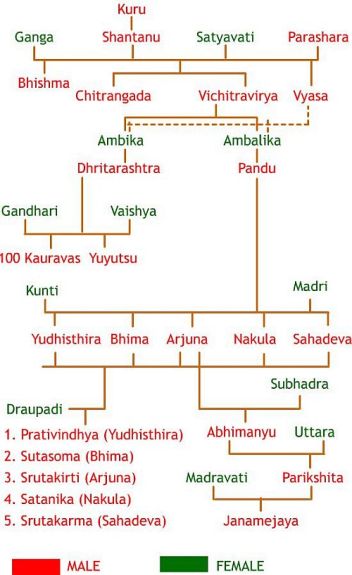
Kuru Vamsha tree

To an extent, Satyavati succeeded in using her manipulative power and accomplishing what she desired . But that did not take her far; as she had not learnt when not to use power. She had also not learnt to value reason and intuition.

In her progeny-hungry lifetime, driven mainly by an obsessive desire to retain power, Satyavati saw her husband, her two sons and one grandson die; the eldest grandson born blind; the youngest one not qualified to be king, being base-born, despite being the only fully healthy and virtuous issue. The middle one dared death for sex and succumbed. “Passion overpowered him , it seemed that he wanted to commit suicide, as it were. First he lost his sense, Then, clouded by lust, he sought the loss of his life “. (Adi parva, 01,116.007- 011 )

.. the monarch, overpowered by passion, forcibly sought the embraces of Madri, as if he wished to put an end to his own life. His reason, thus beguiled by the great Destroyer himself by intoxicating his senses, was itself lost with his life. And the Kuru king Pandu, of virtuous soul, thus succumbed to the inevitable influence of Time, while united in intercourse with his wife – MBh. Adi Parva-Section 125 – Sambhava Parva continued – Translation of  Sri Kesri Mohan Ganguly

kāmaṃ kāmabalāt kṛtaḥ / tata enāṃ balād rājā nijagrāha rahogatām vāryamāṇas tayā devyā visphurantyā yathābalam/ sa tu kāmaparītātmā taṃ śāpaṃ nānvabudhyata  mādrīṃ maithuna dharmeṇa gacchamāno balād iva / jīvitāntāya kauravyo manmathasya vaśaṃgataḥ  śāpajaṃ bhayam utsṛjya jagāmaiva balāt priyām / tasya kāmātmano buddhiḥ sākṣāt kālena mohitā   saṃpramathyendriya grāmaṃ pranaṣṭā saha cetasā / sa tayā saha saṃgamya bhāryayā kurunandana pāṇḍuḥ  paramadharmātmā yuyuje kāladharmaṇā / Book 1; Chapter 116; verses 9-11

Thereafter the question of succession to the throne , with which Satyavathi was so obsessed all her life, took a crooked path; and, it eventually led to internecine bloodbath.

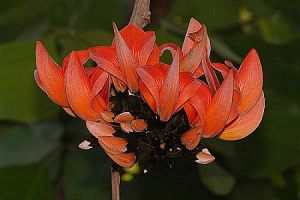
Kimshuka butea-frondosa


Next…Kunti….

 
17 Comments

Posted by on September 7, 2012 in Mahabharata


Tags: , ,

Bhishma – A Life Unfulfilled

Bhishma , to me , looks an enormous waste of strength , learning and of life .He, in a way , also represents how inactivity and misplaced sense of loyalty could diminish a mighty one to a minuscule and be brushed aside with disdain. at no risk of retaliation. He brings grief on to himself and unto others around him by his inactivity and at times by needlessly meddling in others’ lives . His life too ends in a sort of irony with his past haunting to wound him mortally and thereafter prompting him to render lengthy discourses , from his death bed , on the things that he did not practice in life .His listener, too tired , listless and disillusioned scarcely had time or opportunity to put into use what he learnt from the savant on a death bed of arrows.

I wonder how his treatment of women, earlier in his life, will stand up to the present day norms of decency towards women and respecting their freedom of choice.

As his half-brother Vichitravirya was still a child when he was crowned the king, Bhishma ruled as his regent , with the approval of his step mother  – Satyavathya mate sthitha . When the young king was of the age to marry, Bhishma looked around for a suitable bride. He heard that the king of Kashi was holding a swayamvara for his three daughters. Since Vichitravirya himself was too young and weak to stand any chance of being chosen by the young women, Bhishma raided the swayamvara and forcibly abducted the three brides-to be – Amba, Ambika, and Ambalika – against their will , while the assembled suitor-kings/princes were shouting protests that his he broke the code of conduct that all of them had agreed upon , to respect the wishes and the decisions of the three women .

bhishma3

Of the three sisters , Amba’s is a heart rendering tale ,one of suppressed rage of a strong female .She went up to Bhishma and said “you are well aware that Salva the king of Saubala. and I are married in spirit, if not according to the sastras. You brought me here by force, do you think what you did was right.” Bhishma conceded and sent her back to Salva.

Ecstatic, Amba ran to Salva and asked him “Marry me.” Salva however rejected her because of his humiliation in defeat to Bhishma and told her ” One conquered by  another , O fair one, and released from his house , I do not receive. Go back to Bhishma and do as he commands ” . Here , Salva’s rejection was not for fear of Bhishma ; but , was due his false sense of pride that was badly hurt ; and even by spiteful jealousy ( adigrha-darsina) . The author of  Mahabharata , in fact , condemns Salva for unreasonably deserting Amba who was in a desperate situation ( evam sambhashamanam tu …pratatya jata)

Amba returned to Hastinapura and narrated her predicament to Bhishma who then asked Vichitravirya to marry the third sister Amba too . But , he too refused Amba saying that he couldn’t marry someone whose heart was already with another.

Amba, desperate then, attacked Bhishma rebuking him that he and his meddling ways were the cause of all her troubles. ` You took me by force. According to the Kashtriya code of conduct you necerrrily have to marry me. Therefore, `Marry me,” she demanded, “ and, set things right.” Bhishma, of course, had taken the vow of Brahmacharya and insisted on preserving his celibacy intact.

For six long years, Amba doggedly ( parinishaya) went from warrior to warrior, seeking someone who would fight Bhishma on her behalf. None came forward; such was the fear that Bhishma evoked in the minds of men.

[One version mentions that Amba did about twelve years of severe , determined penance ( tapase dhrta samkalpa) on the banks of the river Bahuda  (perhaps Jhelum ..?) , in the foothills of the Himalayas. It is said; the god Skanda assured her that in due course she would be the cause of Bhishma’s death.]

Finally, consumed by helpless rage,  Amba threw herself into a funeral pyre .

It is said Amba was born again as Shikandin, vowed to kill Bhishma.

Amba is an example of the suppressed voice of a strong female As a woman she lacked the ability to avenge herself. No male dared to help her against Bhishma. She therefore needed to be a man of the kshatriya class to fulfill her vow. Perhaps there might be a case of transformation lurking here. In any case , at the great battle of Kurukshetra , Sikhandin joined Arjuna on a chariot, and they slew Bhishma with a flood of arrows. Bhishma refused to retaliate against Sikhandin because he recognized Amba in him.

A couple of interesting themes come up in this part of the story. One is the use of ambiguous sexualities. The other is the fine line between love and hate. Some believe Amba’s time in the forest led to love for Bhishma, which masqueraded as intense hatred. Killing him was also a favor done to him by releasing him from his self-forced bachelorhood.

 ***

It might have been a common practice among the princes of those days to take brides by force , if necessary .But, Bishma captured the brides to be , not for himself but for his half-brother, still a boy, and incapable of winning a wife for himself. No kshatriya princess would love to or even care to marry a man who cannot win a wife for himself .

Somehow the Bharatas seemed to have fallen into a habit of bringing home brides by force , much against their will. . It started with Satyavati , then Ambika and Ambalika. Similar was the story with Gandhari and Madri . Bishma could be credited with bringing brides for three generations of the Bharatas – for his father, for his half-brother, and for his nephews, though he himself remained unmarried. None of those women had a happy life ; they were angry and hurt all their life.

****

Ambika and Ambalika were married to Vichitravirya. However, soon after the marriage, Vichitravirya died of consumption , producing no heir to the throne. Hastinapura was left with two widowed queens, a widowed queen mother and a regent ; but no king. Therefore ,Vyasa ,the son born to the queen-mother out of wedlock ,was summoned to father sons from out of the widowed queens. Pandu and Dhritarashtra were born of that loveless copulation – one was pale with anemia and the other was born blind.

I understand that true love and passion cannot be bought or demanded; and that intimacy comes only when a woman gives it freely on her own terms .Offering her body to her partner epitomizes her commitment. It signifies intense expression of love . In this case, Ambika and Ambalika were forced into loveless copulation with their brother-in-law in order to produce an heir to the throne.

This idea of a levirate marriage was introduced into Mahabharata , with Vyasa fathering sons through the widows of his half-brother. This also brought into focus the separation of love and sex .This theme extended further into the epic when it became an important premise of the relationship of Pandu and his wives, Kunti and Madri. Pandu’s cursed life forced his wives to beget children from someone else . Out of devotion to their husband, they vulnerably joined flesh with another ,  be they gods. Kunti the warm -blooded woman she was , longing for intimacy with her husband cried at the funeral of Pandu and Madri, “She was more fortunate than I, to have seen his face alive again” .

The purpose of all this sordid mess was to perpetuate the Bharata lineage. However, no Bharata blood ran through the veins of Dhritarashtra or Pandu or even in the sons of Pandu. With this as a foundation, is it any wonder the family was dysfunctional..?!

Bishma , to put it bluntly , not only messed up his life but threw the lives of those around him and the of the next generation into a vortex of sordid mess presided over by a blind father and a meddlesome patriarch.

 ****

The most brazen act of evil by the Kauravas was threatening a woman’s chastity; and with that the Kauravas sank to the lowest level of adharma. That was also the lowest point in Bishma’s life.

Draupadi a bride of the Bharatas , his granddaughter-in-law, a woman in her periods and clad in a single piece of cloth was dragged by her hair into an open assembly , stripped almost naked and called a whore. Bhishma the elder statesman and the most senior member of the royal family , just watched in silence and shame ; he did not utter a word in protest or in her defense. Even if his misplaced loyalty prevented him uttering a protest , he could have defended her as any right thinking man would have done had a helpless woman been dragged and humiliated in public, in his presence.

Draupadi , the brave woman she was , amidst all that wretchedness, pointedly challenges Bhishma the knower of Dharma and demands an answer from him , whether Yudhishtira had a right to stake her in the game after he had staked and lost himself and became a slave. Bhishma shame facedly confesses his inability to decide the issue. ”I am unable to answer your question because Dharma is subtle”, he says (na dharmasaukshmyat subhage vivektutm shaknomi te prasnam imam yatthaavat).He even tells her lamely that its essence is concealed in a dark cavern (dharmasya tattvam nihitath guhaayaam). Even if she were to be a slave , was it not an elder’s Dharma to defend a helpless woman in that state?

“Shrinking from ones moral duty, refusal to act when it is difficult to act , attachment to ones interests alone and finding a pretext to one’s delusion- these weaknesses destroy a person and his society.”-Mahabharata.

Watching a unrighteous act that he knew was heinous, keeping his mouth shut was the greatest of unrighteousness of Bishma . That was the conduct of a coward, not of a Kshatriya. He went against his Swadharma. His inaction illustrated that Kshatriya’s “witness” stance brings about the destruction of the kingdom and of the Dharma. The Kshatriya duty is to fight to protect the weak; for that is his Dharma, the truth of his nature. By not being true to his Dharma because of inaction, Bhishma brought destruction and misery not only to himself but also to the society of which he was a pillar. He acted just as a confused, helpless old man scared of his evil and powerful grandson, would do.

The genius of Krishna was that he did not go by the external forms of what looked like dharma . He saw through the evil and improvised apt ways to protect the larger interests of the Dharma. He believed as he said that the essence of Dharma was in ones life , in living it , practicing it and experiencing it; and not in merely talking about it.

It is a validation of this fact we find in Bhishma who from his bed-of-arrows advises Yudhishthira on the duties, responsibilities of a king and the need to protect Dharma. Bhishma in fact had not practiced what he preached. He remained a mute witness to the aggression of Adharma .And to think ,all that happened was because of the greed of one man for power and the inaction of another who refused to stand in the way of that greed, though he was duty bound to; that hurts.

Had Bishma acted in the true spirit of his Dharma, Mahabharata would have been a different Epic.

 ****

As the war looked destined , I am intrigued to no end by his inability to assert his authority in order to settle the dispute . He , perhaps out of a misplaced sense of loyalty to the blind king , his nephew , supports greed and aggression ; and leads the fight , though reluctantly , against what he knew was righteous. He perhaps reasoned that the Kurus (whether righteous or not) were in power now and they had to be supported. That was tragic not merely to Bhishma but to the millions of warriors that perished in the war and to their following generations.

Ganga Bhishma

The life story of Bhishma is truly amazing . Bhishma was one of the Vasus, a demi-god, born amidst humans. He was to be killed right at birth by drowning him in the Ganga, just as his seven elder brothers were killed . He escaped death because Shantanu his father desired to be left with at least one son . Of the eight sons of Shantanu and the Ganga , only Bhishma was spared death . I wonder whether that was a blessing or a curse . To me , Bhishma was cursed to live.

Bhishma

At the commencement of the Epic , we come across Bhishma as a young , handsome, strong , austere, brave, self-sacrificing prince, who renounces the throne for his father’s happiness. An ideal son. But somewhere down the way he appears to have lost focus on life. As the Epic gathers pace and gallops towards the inevitable doom, Bhishma ends up as a confused , disillusioned , neglected and a lonely old man whose life littered with errors. He was gifted with everything that a man could ask for ; yet he threw away most of those advantages ; for no reason.

**

There is an interesting comparison between Bhishma of Mahabharata and Vibhishana (younger brother of Ravana) of Ramayana.  In either case, the person who occupied the throne they served tried to violate the chastity of a pure and a virtuous woman. Both those kings (Ravana and Duryodhana) had sunk to the lowest level of adharma. Both Vibhishana and Bhishma strongly disagreed with the acts of their respective kings. But, it was Vibhishana who had the courageous detachment to disassociate himself from the immoral regime of his king, his brother, and to join the forces of Dharma which his brother opposed. Vibhishana‘s unpopular decision was open to controversies and even to ridicule. Yet, Vibhishana was steadfast; he stood by his decision which according to him was the right one, by all counts.

In contrast, Bhishma the old-guard needlessly chose to cling to what he did not approve, because of his misplaced sense of loyalty. And, he eventually brought grief on to himself and unto others around him by his indecision and inactivity.His life too ends in a sort of irony with his past haunting to wound him mortally and thereafter prompting him to render lengthy discourses, from his death bed, on the things that he did not practice in life . His listener, too tired, too listless and disillusioned, scarcely had time or opportunity to put into practice what he learnt from the savant on a death bed of arrows.

Bhishma2

Bhishma, it is said, was gifted with a boon to choose the time of his death. The death dare not approach him till he accorded it his permission. Yet, I sometimes wonder why he chose to live so long. It is sad to see a self-sacrificing , almost a god getting bogged in the mire of this world , meddling with everyone’s life and finally living on and on , unwanted and uncared when he could have chosen to end the agony. Bhishma endured so much pain in life and in battle that even the bed of arrows did not hurt him anymore. It was sad for one who didn’t even want to be born.

There is perhaps a lesson here , too much attachment and involvement in where it is not needed is not merely unrewarding but is dangerous too ; while at the same time sheer inactivity renders one irrelevant. Our texts have always talked about a sense of balance that life should have.


partnernhm (1)


https://ia600603.us.archive.org/21/items/in.ernet.dli.2015.99494/2015.99494.The-Adyar-Library-Bulletin-Vol19part1-4may-dec.pdf


13 Comments

Posted by on September 7, 2012 in Mahabharata


Tags: , ,

Sabda- The Spoken Word – Grammarians’ View

“The three worlds would have merged in darkness had there been no light called Sabda” said Acharya Dandin (6th century) the celebrated author of prose romance and an expounder on poetics.

The ancient Indian philosophers and Grammarians loved elaborate discussions on all aspects of the spoken word: its origin in the mind and body of the speaker; its articulation; its transmission; the grasp of the sound and the essence of the word by the listener; its ultimate reception by the speaker’s intellect and such other related issues.

Each of the major schools of Indian philosophy such as Mimamsa, Tantra, Yoga and Prabhakaras viewed and interpreted the origin and nature of the Universe by exploring the nature and manifestations of the sound. They built elaborate philosophical edifices around the concepts they evolved during that process. Those traditions considered sound as one of the most important principles of existence; as the source of matter and as the key to be free from it. They described Sound as the thread-like link between the material and spiritual realms.

Even Gaudapada, Sri Sankara’s parama Guru, in his Karika, dealt at length the sacred syllable OM composed of three maatras : A, U and M, which according to him represented three levels of consciousness. He also came up with his theory of a super consciousness, the turiya, the fourth,para-vak.

The great Indian poetic genius Kalidasa spoke of speech (Vak) and its meaning (Artha) as functional in sustaining the universe and their need to be in unison as Parvathi and Parameshwara the originators of the Universe.

The many-sided genius, the Philosopher Abhinavgupta (10th century) described the word as the incarnation of the divine mother. The Sabda and Artha as shabdartha-brahman  are the embodiment of Shiva and Shakti.

I do not propose to discuss here any of those philosophical or mystical aspects of sound and the spoken word. I would be content to restrict myself to the Grammarians’ point of view of Sabda, its constituents and the related issues.

***

The Grammar in the ancient Indian context was a highly respected subject. Bhartṛhari in his Vakyapadiya described grammar as the “purifier of all the sciences.” He said the use of correct forms of language makes possible   the philosophic or any other pursuit of knowledge.

The spoken word too enjoyed a premier position. That might be because the speaker and listener are both present to the utterance simultaneously and the communication is almost instantaneous. This immediacy seemed to guarantee the genuineness of the exchange.

It appears to me, the questions, among others, that engaged the attention of the Grammarians such as Panini, Kathyayana, Patanjali and Brthrihari were:

How does a word consisting of a succession of phonemes generate a unique meaning? How does a sentence consisting of a succession of words generate a meaning?

Whether a given element in a sequence carries a self-sufficient meaning or whether the constituent element conveys not only its own independent meaning but also simultaneously an additional qualified meaning determined by the dynamics of the context.

***

Sabda, in Grammar, is a technical term; and,  is commonly used to denote sound .  Grammatically, Sabda is a masculine term. And ,  it   stands for a vast variety of references that include  “ sound , noise, voice , tone , note , word , speech , language , the sacred symbol  Aum , verbal  communication , testimony , oral tradition , verbal authority or verbal evidence”.  Although the term Sabda is used in rather countless ways , in the Indian thought , it basically  relates to theories of sound; and,  it is generally understood as linguistic sound , mostly connoting vocal sound which carries meaning (Artha) , either in the form of an object or a thought .

Here, I have used the word “spoken word” to represent the term ‘Sabda’, rather loosely, for want of a better term.

In Grammar, Sabda stands for word manifested by Dhvani (sound). It has the innate power to convey a certain sense (Artha). Further, in all schools of Indian thought there is an assumed relationship between Sabda (word) and Artha (meaning).

Sabda, it is said, normally, has two aspects: un-lettered sound (Dhvani) and the lettered sound (Varna).

The signifier (Dhvani) is tied to the signified (Artha).It is also said; Dhvani and Artha together make a word (Sabda).

The relation between Sabda and Artha is one of identity. The word, sound, sense and knowledge overlap each other. Generally, Sabda denotes a meaning-bearing word-sound, while Nada signifies ‘voiced’ or vowels or non-linguistic sounds.

Similarly, Vak is another term that has varieties of references.  Vak , grammatically , is a feminine noun meaning – speech , voice , talk , language ( also of animals and birds) , sound ( also of inanimate objects such as stones or of a drum) , a word , saying , phrase , sentence , statement and speech personified.

But, in the ancient texts, Vak is not mere speech. It is something more sacred than ordinary speech; and carries with it a far deeper significance. The Rishis are said to have visualized the sublime form of Vak which is regarded eternal and beyond the ordinary senses.

In Rig Veda there are three kinds of references to Vak: Vak is speech in general; Vak also symbolizes cows; and , Vak is personified as goddess revealing the word.  It also appears that Vak is the energy that is underlying every kind of speech; and it also is the language of nature in which the sounds of cows, animals, frogs , birds , trees and hills find expression  . The extant of Vak is said to be as wide as the earth and fire.

Here, in this post , Vak , in a limited sense, refers to human speech.

*****

A speaker wills to give expression, through intellect, to something that arises in him. For this purpose, he employs a sentence comprising words uttered in a sequence. The word itself comprises letters or syllables (varnas) that follow one after the other.

The spoken word emerges out of one’s mouth, no doubt. However, it needs the assistance of several body parts in order to manifest itself. The throat, head, tongue, palate, teeth, lips, nose, root of the tongue and bosom are the eight places where the sounds of the letters originate.

Generally, a two-fold effort is needed to utter a letter or a syllable: the internal effort (abhyantara prayatna) and the external effort (bahya prayatna). The former is classified into two kinds while the latter (the external) into eleven kinds. The ancient Grammarians obviously went great lengths to trace the origination of each letter, its appropriate sound; the intricacies and efforts involved in producing them.

When a person wills to express a thought orally, the air inside his body spurs and moves up. Sabda then manifests through Dwani – sound, with the assistance of appropriate organs. That Sabda or the Vak, which term roughly translates to speech or utterance, becomes manifest.

Grammarians classify Vak into subtle and gross forms. Of these, Para and Pashyanti are the subtle forms of Vak; while Madhyama and Vaikhari are its gross forms.

Para is the highest manifestation of Vak and is often referred to as Sabda Brahma. Para and Pashyanti are inaudible; they are beyond the range of the physical ear. It is said, Sri Dashinamarthy and other sages communicated through these very subtle forms of vak. Pashyanti which also means the visual image of the word, is indivisible and without inner-sequence; meaning that the origin and destination of speech are one.

Madhyama is an intellectual process, during which the speaker becomes aware of the word as it arises and takes form within him; and he grasps it. Madhyama vak is a sequenced but a pre-vocal thought, Here, the sound is nada  and is in a wave or a vibratory (spandana) form .

Vaikhari vak is sequenced and verbalized speech. Vaikhari is the articulated speech, which, in a waveform, reaches the ears and to the intellect of the listener. Vaikhari is the physical form of nada that is heard and apprehended by the listener. It gives expression to subtler forms of vak but is not its ultimate.

**

[The theological explanation of the manifestation of speech could briefly be as under:

It is explained; the process of manifestation of speech, like that of the Universe, takes place in four stages. First, in the undifferentiated substratum of thought, an intention appears. This first impulse, the self-radiant consciousness is para-vak (the voice beyond).  Gradually, this intention takes a shape .We can visualize the idea (pashyanthi-vak) though it is yet to acquire a verbal form. It is the first sprout of an invisible seed; yet searching for words to give expression to the intention. This is the second stage in the manifestation of the idea. Then the potential sound, the vehicle of the thought, materializes finding   words suitable to express the idea. This transformation of an idea into words, in the silence of the mind, is the third stage .It is the intermediary stage (madhyama-vak) .The fourth stage being manifestation of non-vocal verbalized ideas into perceptible sounds .It is the stage where the ideas are transmitted through articulated  audible syllables (vaikhari-vak).  These four stages are the four forms of the word.

The three lower forms of speech viz. Pashyanthi, madhyama and vaikhari which correspond to intention, formulation and expressionare said to represent iccha-shakthi (power of intent or will),jnana-shakthi (power of knowledge) and kriya-shakthi (power of action).These three are construed as the three sides of the triangle at the center of which is the dot-point (bindu) representing the undifferentiated notion para-vak. The triangle with the Bindu at its centre suggests the idea of Isvara the divinity conceived as Sabda-brahman.

The urge to communicate or the spontaneous evolution of Para-pasyanti into vaikhari epitomizes, in miniature, the act of One becoming Many; and the subtle energy transforming into a less_ subtle matter. Thus the speech, each time, is an enactment in miniature of the involution of the One into Many and the evolution of the Many into One as it merges into the intellect of the listener. ]

***

The comprehension of the verbalized and sequenced vaikhari vak entails pratibha or “flash of insight” that reveals to the listener the pasyanti vak, in the form it originated within the speaker. A perfect communication is when vak is identical and is sequence less at both the ends. Bhartrhari in hisVakyapadiya contends: “Just as light has two powers, that of being revealed and that of being the revealer, similarly, all words have two distinct powers. No meaning is conveyed by words which by themselves are not the objects of knowledge”

That, roughly, is the Sphota vada of the Grammarian Philosopher Bhartrhari.  Some say it is analogous to the creation theory of Big Bang and the withdrawal.

For more on Sphota vada, please see –Who was Upavarsa ?

[ In his Sarva-darshana-samgraha, Sri Madhava describes Sphota in two ways. The first as: that from which the meaning bursts forth or shines forth. And, the second as: an entity that is manifested by the spoken letters and sounds. Sphota may, thus, be conceived as a two sided coin. On the one side it is manifested by the word-sound; and , on the other it simultaneously reveals word meaning.

In philosophical terms, Sphota may be described as the transcendent ground on which the spoken syllables and conveyed meanings find their unity as word or Sabda.

Nagesha Bhatta identifies this theory with Sage Sphotayana, mentioned by Panini in one of his rules. Bhartrhari, however, considers Audumbarayana (mentioned by Yaska) as having put forth views similar to the Sphota concept.In any case, the original idea of Sphota seems to go back to the Vedic age when Vak or speech was considered to be a manifestation of the all – pervading Brahman , and Pranava (Aum) was regarded as the primordial speech sound from which all forms of Vak were supposed to have evolved.  Perhaps, this claom provided the the model upon which the Vyakarana philosophers based their concept of Sphota. Indeed Sphota is often identified with Pranava.

Patanjali the Grammarian holds that knowledge is the key factor – a word is a word when it has a meaning. Further, he makes a distinction between Sphota and Dhvani. According to him, Sphota is permanent element in the word, and is the essence of it; while Dhvani – the uttered sound – is an fleeting element, and is only an aspect of Sphota. For Patanjali, Sphota may be a singular letter or a fixed pattern of letters. He concludes that Sphota is permanent , unchanging and is manifested by the changing sounds (Dhvani ) uttered by the speaker and heard by the listener.

On the basis of Patanjali’s explanation, Sphota is both internal and external. The internal form of Sphota is the innate essence of the word –meaning. The external aspect of Sphota is the uttered sound which is perceived by the sense organs. It merely serves to manifest the inner Sphota with its inherent word-meaning ]

***

The ancient Grammarians used the term Dwani to denote the sound of an utterance that reaches the ears of the listener. Dwani is therefore the physical form or the vehicle of a word. Dwani in turn  is determined by the nature of the varnas (syllables) composing it .

[Later , the medieval Indian aestheticians such as Anandavardhana and Abhinavagupta used the term Dwani  to imply the subtle  mood or the rasa evoked by a poem or a gesture in a play or in dance. Here, in this post, let us stick to the meaning of Dwani as termed by the Grammarians.]

Dwani is the auditory aspect   of the Sabda.  The intellect of the listener grasps Dwani as in a flash, Sphota.  The Sphota is therefore the intellectual, subtle and inaudible aspect of the Sabda.

Bhartahari employed the term Sphota to indicate the whole, Artha to refer to the concept or meaning and Dwani to refer to the uttered and heard sound.

The term Sphota does not easily translate into English.  The Sphota is derived from the root ‘sphut’ which means ‘to burst’, but it also describes what ’is revealed’ or ’is made explicit’. Sphota, therefore, means that from which the meaning bursts forth, shines forth etc.  Sphota thus refer to the abstract or conceptual form of a word. Sphota is somewhat similar to the Ancient Greek concept of logos or Word.

For instance, as Patanjali explains, the word ghtata consists letters/syllables gh, a, t and a, uttered in a sequence. The letters as heard are Dwani .Immediately after the last letter is uttered the whole (akhanda), indivisible (not sequential) sense bursts forth in a flash Sphota.

The Grammarians  believed that It was not mere  memory or the past association with the object (jnapaka) , but a unifying higher cognition , superior to  memory ,  termed “pratibha ” that revealed in a “flash” or Sphota the single indivisible sequence less meaning of a word or a sentence .

According to Bhartṛhari, this pratibha or flash of understanding is the insight into the whole meaning of a word or a sentence and it is the light, which removes ignorance. It is indefinable (avicarita) because what it reveals is not some “thing” or an “idea,” but rather the dynamic interrelatedness of all things.

***

That sound of the word Ghata (gh, a, t and a) can be produced in any number of ways, either naturally (prakrta) or in a modified manner (vikruta). That word can be uttered slowly (vilambita), a little more quickly (madhyama) or even very quickly (druta).The variations in speed or in the mode of utterance are called vritti. The vritti might vary the form in which the word is uttered (Dwani); but it does not alter the content and the sense of the word.

For instance, a pot in bright light can be seen clearly. The pot could be seen for a longer time if clear light continues to fall on it. The visibility of the pot depends on the quality of light that falls on it. The variation in the quality of light does not alter the very nature or the status of the pot. Similarly, the change in speed or accent or mode of uttering a word (vritti) does not alter its Sabda or Sphota. The physical aspect of the word that is the quality of its sound (Dwani) might vary but its Sphota remains unchanged. Thus, in effect Sabda too remains unchanged.

Again, Dwani the physical form of the sound could be articulate (like human voice) or inarticulate (like sounds of animals, drums etc.)  Nevertheless, the intellect perceives that Dwani in a flash (Sphota) depending on the listener’s experience (anubhava), reasoning (yukthi) and authority of scriptures (Sastras and Grammar).

The distinction between Sabda and Dwani is basic to the Indian philosophy of language. Thus, in Sanskrit Grammar Sabda stands for the word manifested by Dwani, the articulated sound. While Dwani is variable, Sabda is not. The purpose of the Dwani is to give expression to and to act as a vehicle for Vak. The Dwani as perceived by the intellect of the speaker in a flash is Sphota. The Sphota is the intellectual impression of the audible sound patterns. The Sabda therefore combines in itself the physical form (dwani) of word and its intellectual inaudible from (Sphota).

References:

For a detailed and an intellectual discussion on the above concepts and their relevance in modern times, please check Sequence from Patanjali to Post _modernity by Shri A.V. Ashok.

Please also read a highly interesting paper “Speech versus Writing” In Derrida and Bhartahari “By Harold G. Coward

For a discussion on Sabda, Vak and other concepts in various schools of Indian philosophy, please check The Vedic Conception of Sound in Four Features

The Philosophy of the Grammarians, Volume 5  – edited by Harold G. Coward, Karl H. Potter, K. Kunjunni Raja

 
8 Comments

Posted by on September 7, 2012 in Speculation


Tags: , , , , ,

Who was Upavarsa ..?

Upavarsha is one of the remarkable sage-scholars who come through the mists of ancient Indian traditions. And, again, not much is known about him.

Upavarsha is recognized as one of the earliest and most authoritative thinkers of the Vedanta and Mimamsa Schools of thought. He is placed next only to the author of the Brahma sutra.  Among the many commentaries on Brahma sutra the one by Upavarsha was most highly regarded.  It is believed that the words of Sri Sankara explain the correct account of Upavarsha’s doctrines. He is quoted twice by Sri Sankara in his Brahma-sutra-bhashya (3.3.53).  

Upavarsha was  looked upon as an authority by all branches of Vedanta Schools; and  is respected in the Mimamsa School also. Both Sabaraswamin and Bhaskara treat the ancientVrttikara as an authority; and, quote his opinions as derived from ‘the tradition of Upavarsha ‘ (Upavarsha-agama).  Bhaskara calls Upavarsha as ‘shastra-sampradaya- pravarttaka’ ; the promulgator of the pristine traditions of the Shastras

[ A Vritti is a short gloss explaining the aphorisms in a slightly more elaborate way; but not as extensively as a Bhashya, a detailed commentary/critique. A Vrttikara is thus a commentator on traditional texts, providing brief explanatory notes. The most well known of the Vrttikara-s are Upavarsha and Bodhayana.]

Upavarsha’s time is surmised to be  around 500-300 BCE. We come to know Upavarsha through references to his views by Sri Sankara and others. He was an intellectual giant of his times. He is credited with being the first to divide the Vedic lore into Karma-kanda (ritualistic section) and Jnana-kanda (knowledge section).

As said ;the earliest Acharya to have commented upon Badarayana’s Brahma Sutra is believed to be Upavarsha.  His sub-commentary (Vritti) on Brahma Sutra is titled asSariraka-mimamsa-vritti. Sri Sankara and his disciples make frequent references to the works of Vrittikara-s, commentators on the   Brahma Sutra; and, in particular to Sariraka-mimamsa-vritti of sage Upavarsha.

It is said; the ancient commentator Sabaraswamy drew upon Upavarsha for his commentary on Mimamsa-Sutra. Another ancient writer Sundarapandya is also said to have commented in his Varttika on Upavarsha’s Sariraka-mimamsa-vritti. Sri Sankara too relied upon Upavarsha‘s Vritti for his commentary on Brahma Sutra. In addition, Sri Sankara followed the sub-commentary of Sundarapandya.  It is said; the doctrine   elaborated by Sri Sankara in his Adhyasa Bashya stemmed out of the germ ideas put forth by Upavarsha and Sundarapandya ( among others ) . It is not surprising that Sri Sankara held both the teachers in such high regard.

Sri Sankara regards Upavarsha a forerunner of his own tradition (sampradaya). He displays enormous reverence towards Upavarsha; and, addresses him as Bhagavan and Sampradaya vit , the upholder of the right tradition, just in the manner he addresses the Great Badarayana.  Sri Sankara addressed Jaimini, Sabara and other Mimasakas only as teachers (Acharya). 

Sundarapandya in his Varttika on Upavarsha’s Sariraka-mimamsa-vritti, mentions the six means of knowledge (cognition) advocated by Upavarsha. These are, briefly: Pratyaksha (immediate); Anumana (inference) ; Sabda (verbal or textual-testimony); Upamana (analogy);  Artha-patti (presumption); and,  Abhava  (non- apprehension).  He remarks that the Vrittika-kara   (Upavarsha) believes that these six modes of acquiring knowledge – Pramana – are valid only until the Self is ascertained. 

But, once the subject-object differentiation is erased, they no longer matter. He therefore makes a distinction between relative knowledge (sesha-jnana) and absolute knowledge (a-sesha-jnana). Upavarsha, he says, believes that absolute knowledge is attainable through Adyaropa or Apavada (adyaropa-apavada-ubhayam nishprapancham prapanchate). Sundarapandya explains; the attribute-less Brahman can be described by the method of superimposition followed by its withdrawal. The Absolute knowledge, however, is neither the process of superimposition nor is it the negation.  Incidentally, Sundarapandya is also believed to have contemplated on the concept of Maya and on the pristine nature of Brahman without Maya.

[The Adhyaropa-Apavada method of logic pioneered by Upavarsha consists in initially assuming a position and later withdrawing that assumption, after a discussion. ]

Apart from delineating the six means of knowledge that were adopted by the later Advaita Schools, Upavarsha is believed to have initiated a discussion on self-validation (svathah pramanya) that became a part of the Vedanta terminology. Svatah pramana: true knowledge is valid by itself; not made valid or invalid by external conditions (sva-karya-karane svatah pramanyam jnanasya).

 [As a general rule ,  knowledge (except memory) is taken to be valid on its own strength , unless invalidated by contrary knowledge. (memory is not considered valid knowledge as it is dependent on previous cognition or impressions which might get faded or distorted ; and , so is the dream.)]

There is a view that Purva Mimamsa and Uttara Mimamsa were initially two independent treaties authored by Jaimini and Badarayana respectively; and, were later put together with suitable emendations by someone described as Vyasa – “the arranger”.  And, Upavarsha the Vrttikara commented upon the text in that combined form.  

Sri Sankara refers to a discussion held by Upavarsha on the nature of Self in Brahma Sutra (3.3.53). And, the same discussion appears in the commentary on Mimamsa-Sutra(1.1.5). Further Sri Sankara mentions:  ‘ Bhagavan Upavarsha has written a Vrtti on Purva Mimamsa. And, in that, he is referring to his another Vrtti on Saririka Mimamsa  (Brahma Sutra) ’.

 Ata Eva Bhagavata Upavarshena Prathame Tantre I Atma-stitv-abhidhana-prasaktau Sarirake Vakshyamaha ityuddharaha Krutaha II (3.3.53)

This suggests that Upavarsha may have commented  on both Purva and Uttara Mimamsa.

Sri Sankara whenever he refers to Upavarsha treats him with great respect and quotes his views in his Brahma-sutra-bhashya (eka ātmanaḥ śarīre bhāvāt – 3.3.53) as being authoritative. And the latter Sub-commentators of Advaita School, Anandajnana and Govindananda, recognize  Upavarsha as the Vrttikara.

Sri Sankara, in his commentary on Brahma sutra, adopted a particular way of presentation. On each subject (vishaya), he first gives one interpretation and then follows it up by the other interpretation. It is explained; the first one is given as the opposing views (purva-paksha) of ‘others’ (apare); and, it is meant to be rejected. But, Sri Sankara does not quote the opposing views; he merely sums up, raises them as the views of ‘others’, and finally dismisses them. Sri Sankara’s own views are presented in the later set of interpretation.

The later scholars, Anandajnana and Govindananda, explain that the ‘others’ referred by Sri Sankara, actually, stands for the Vrttikara Bodhayana. The Advaita School, thus, believes that Upavarsha and Bodhayana are two different persons.  And, the other dimesion of the  debate is  whether the terms  ‘others ‘ or ‘some’ truly refer to Bodhayana . That debate  is still not concluded.

Similarly , Sabarasvamin a noted Mimasaka in his bhashya (Sabara bhashya) on the fifth sutra of Mimamsa sutra of Jaimini refers to a Vrttikara prior to his (Sabara’s) time, without, of course, mentioning his name. In the Bhashya on the same sutra (1.1.5), Sabarasvamin also refers to Upavarsha by name and with the epithet ‘Bhagavan’  (gakāraukāra visarjanīyā iti bhagavān upavarṭaḥ ). As regards the other Vrttikara, it is not clear who that Vrittikara was. But, he, in any case , was not Upavarsha. 

[An unfortunate feature of the traditional texts is that they do not mention the names of the old teachers-commentators whose opinions are being quoted. Such practice might have been an idiom of a well-understood literary etiquette. But, it has led to needless debates and speculations.  Very often, it is left to a commentator who comes perhaps a century or more later to tell us that (let’s say) Sri Sankara actually meant such-and–such commentator when he said ‘some one ‘or ‘others’. Similar is the position with regard to those commentators that are referred to as ‘Vrttikara ‘ or ‘Vakyakara’ without mentioning their names .  There is therefore always an element of scepticism associated with such sub-commentaries. ]

Bodhayana, it is said, laid equal importance of Jnana and Karma Kandas; as   the two together constituted the doctrinal system (Shastraikatva).   He held the view that directly after completing the rituals one should take up the investigation into Brahman, which is the study of Vedanta. His position was coined by the later Vedanta Schools as jnana-karma-samucchaya-vada, the doctrine that synthesises jnana and karma. Sri Sankara who did not accord much significance to rituals, naturally, tended to differ from Bodhayana. 

Sri Sankara’s basic position was that the two sections are addressed to different class of persons. Karma-kanda consists injunctions to act in order to achieve certain results. But, liberation is not a product or a thing to be achieved. Jnana-kanda is about Brahman that already exists; it pertains to the ultimate purpose which is true knowledge of Self, and it is addressed to one who is intent on liberation.   Each section of Veda is valid in its own sphere; but, the two sections cannot logically be bound together.

There is  an alternate view that Upavarsha was a successor to Bodhayana. It is said that   Bodhayana wrote a Bhashya titled ‘Krtakoti’ on the Brahma Sutra. Fearing that the great length of the commentary would cause it be cast into oblivion, Upavarsha somewhat abridged it. And later, it is believed, Devasvamin further abridged Upavarsha’s abridged version.

But, there is also a belief that the names Upavarsha and Bodhayana refer to one and the same person ; and , Bodhayana might have been the linage, Gotra name, of Upavarsha. Sri Vedanta Deshika supported the view in his Tattvatika

  (Vrttikarasya  bhodhayanasiva  hi Upavarsa iti syan nama  ) .

This School beleives that  Bodhayana’s theory of assigning equal importance to Karma andJnana Kandas was adopted by Yadavaprakasha, Sri Ramanuja’s teacher. Bodhayana, it is said, had recognized  that Jnana and Karma Kandas  together constitute the doctrinal system (Shastraikatva). 

Sri Ramanuja in his Sri Bhashya quotes the views of the Vrttikara Bodhayana seven times. In the opening verse of Sri Bhashya, Sri Ramanuja says: ‘The previous masters have abridged the detailed commentary on Brahma sutra which had been composed by Bhagavad Bodhayana. The words of the sutra will be explained in accordance with their views. “(Bhagavad Bhodayana kritam vistirnam Brahma-sutra – vrttim purvacharyah samskipuh I tan-mata-anusarena sutraksarani vyakhyasyante II)  

Sadly, Bodhayana’s vrtti is no longer extant.

***

Sri Sankara indicates that Upavarsha’s commentary on Brahma Sutra was called Sariraka –mimamsa – vritti (but that work is now lost). Sri Sankara perhaps adopted the term Sarirakafrom Upavarsha; and, titled his own Bhashya on Brahma Sutra as Sariraka –mimamsa – Bhashya.

Upavarsha is believed to have held the view that Brahman is the source, the ground and the goal of all universes. Sri Sankara and Padmapada expanded on this view. Upavarsha is quoted as explaining the term ‘Brahma-jignasa’ as Brhmane jignasa, meaning the enquiry for Brahman. Sri Sankara and others remark that when Vrittikara (Upavarsha) says that the enquiry is for Brahman, he is right…, for, knowledge of Brahman is indeed the fruit of this enquiry.

Padmapada says that Upavarsha explained the word ‘atha’  as referring to that ‘ after the enquiry into the antecedent condition’, the enquiry into Brahman  follows ( Ref : Panchapadika ). 

It is said; Upavarsha developed a theory on Atman (Atma-vada).  He emphasized that the postulation of “self” as distinct from body and the mental process was rather inevitable. He argued that   the self cannot in any manner be revealed to another person; but, it cannot be denied by oneself either. It is affirmed by introspection, but that process cannot itself be regarded as self.

As for the proof of the existence of Atman, Upavarsha holds the view that Atman is known by perception as it is the object of ‘I’.

A verse quoted in Nyayamanjari of Jayanta of the Nyaya School (dated around ninth century) cites the Atman-theory of ‘the followers of Upavarsha’ (Aupavarsha): ‘they understand the Atman to be directly perceptible (pratyaksha) ;  For Atman can be known by ‘I’ consciousness.

 [Tatra pratyaksham atmanam Aupavarsha prapedire I aham-pratyaya-gamyatvat svayuthya api kechana II]

The argument seems to be that the existence of Atman need not be proved by reasoning or verbal arguments. It is in each one’s own experience. Self is the consciousness of being. This was also the faith of the later Mimamsa school of Kumarila Bhatta.

Sri Sankara too adopted the proposition of Upavarsha. Sri Sankara explained: “For all men are conscious that the Atman (self) exists. No one ever thinks ‘I do not exist’ “. At another place (BS : 1.1.1), he says that the inner-self (pratyagatma) is the object of “I consciousness’ (asmat-pratyaya-vishaya); and, that it is directly perceptible (aparoksha).

Sri Sankara expanded further on the Atman-theory of Upavarsha, and extended it to the Supreme Self, transcending the individual.

***

Some people   call Upavarsha the Fred Hoyle of ancient India  , in the sense that both rejected the Big Bang theory. Upavarsha rejected the Sphota-vada , which in essence said that every act of creation and every sound that issues forth in the universe is the duplication of the initial Big Bang. When we utter a sound or word the Big Bang is duplicating itself in our mind.

Bhartrihari (c. 450-510 CE?) expanding on an ancient idea is said to have propounded Sphota-vada In his famous work the Vakyapadiya.

The term ‘sphota’ does not easily translate into English, as it usually happens.  The Sphota is derived from the root ‘sphut’ which means ‘to burst’, but it also describes what ’is revealed’ or  ‘is made explicit’. Sphota can also refer to the abstract or conceptual form of an audible word. Sphota is somewhat similar to the Ancient Greek concept of logos or Word.

Sphota is also interpreted to mean that from which the meaning bursts forth, shines forth etc. To put it in another way, that which expresses a meaning; or the process of expressing a meaning through a word is called sphota.

Bhartrihari deals with Sphota at two levels : one on the metaphysical plane and the other on the empirical plane. The theory is that Brahman first manifested itself as Sound and then as form . The Sphota, Sabda-brahman , the manifester as Logos or Word, is the power through which the Lord manifests in  the universe. Liberation is achieved when one attains unity with that ‘supreme word principle’. Within this theory, consciousness and thought are intertwined; and Grammar becomes a path to liberation. Sphota-vada is a monistic philosophy based on Sanskrit grammar. (Swami Vivekananda’s explanation).

At the empirical level, Bhartrihari is concerned with the process of communicating meaning. He deals with the word and the sound distinctions; the word meaning; the unitary nature of the whole sentence; the word object connection; and the levels of speech, etc. His focus is on cognition and language.

If the letters  float away and disappear the instant we utter them and if each sound is replaced by another in quick succession, then one can hardly perceive the word  or a sentence as a whole. And the question that comes up is- then , how does one grasp the meaning of a word or of a sentence?

Bhartrihari held the view that the sentence is not a collection of words or an ordered series of words . A sentence-sphota is the primary unit of meaning. A sentence is a sequence_ less, part_ less whole that gets expressed or manifested in a sequential and temporal utterance. A word or sentence is grasped as a unity by  intuition (pratibha). According to Bhartrhari, sphota is an auditory image of word. It is indivisible and without inner-sequence.

 Bhartrihari explains that initially the word exists in the mind of the speaker as a unity but is manifested as a sequence of different sounds, giving raise to the appearance of differentiation. Bhartrhari states: “All difference presupposes a unity”;  and where there is a duality there is an identity pervading it. Otherwise one cannot be related to the other or each would constitute a world by itself.

For Bhartrhari, Sphota is the real substratum, proper linguistic unit, which is identical with its meaning. Language is not the vehicle of meaning or of thought. Thought anchors language and  the language anchors thought. In this way , there are no essential differences between a linguistic unit and its meaning or the thought it conveys. Sphota refers to the” non-differentiated language principle”. This gave raise to  the theory of “word monism“.

However, Upavarsha rejected the Sphota-Vada. He in turn came up with his theory of  Varna-vada; according to which the smallest phonetic units that can carry the meaning (phonemes -varnas) alone are real constituents of a word. He said sounds are only Varnas and there is no need for a sphota.

Sri Sankara refers to Upavarsha as the originator of Varna-vada, which contrasted with Spotavada of Bhartrhari. According to Varna- vada, the Varna-s, phoneme (speech sounds) , alone are real constituents of the word; and there is nothing else in the word apart from Varna-s.

Sri Sankara remarks (BS: 1.3.28): Bhagavad Upavarsha says ‘But, the words are none other than various letter-sounds (Varna). He then follows up with a debate on whether the words are letter-sounds of this kind or whether they are Sphota. 

Sri Sankara supported Varna vada as against Spotavada (Sankara Bashya on Brahma Sutra: 1.3.28) ; and followed Upavarsha . He did not approve the concept of Sphota-vada; and, said the meaning of a word can be known from its constituent letters, sounds  and the context. But, Sri Sankara, the scholars believe, was not putting forth an original argument, but was  merely condensing the previous refutations of the Sphota theory.

The other Acharyas and commentators too toed a similar line and did not approve the Sphota theory.Vacaspati Mishra who commented on Sri Sankara’s Vedanta Sutra Bhashya, too rejected the Sphota  theory . He came up with  his own theory of Abhihitanvaya-vadaand said the understanding of the meaning of a whole sentence is reached by inferring to it, in a separate act of lakshana or implication, from the individual meanings of the constituent words.

***

Upavarsha, whoever he might have been, was indeed an intellectual giant of his times. He was a worthy successor to the remarkable sage-scholars such as Badarayana and Jaimini. His contribution to the development of Indian thought is enormous.

Many however feel that by dismissing off-hand the Sphota theory he derailed the growth of rational thinking within the Indian philosophy.

[Please read the companion post About Upavarsha

 at  https://sreenivasaraos.com/2013/12/10/about-upavarsha-part-one/ ]

 [For more on Bhartrhari  and the Sphota  theory , please visit

http://www.iep.utm.edu/b/bhartrihari.htm ]

design star

 
7 Comments

Posted by on September 7, 2012 in Indian Philosophy


Tags: , , , , , , ,

Abhinavagupta

Though Hinduism has now virtually been rooted out of Kashmir, the region, at onetime, was a renowned center of learning. And,  its erudite and enlightened scholars such as Abhinavagupta (10th century), Augusta (8th century), Somananda (9th century), Utpaladeva (9th century), Anandavardhana (9th century) and others made immense contribution to the development of Indian Philosophies, literature and art.

The most outstanding of them was Abhinavagupta Acharya (c. 950 to c. 1020 C.E) a great philosopher, intellectual and a spiritual descendant of Somananda the founder of the Pratyabhijna, the “recognition” metaphysics school of Kashmiri Saivite monism. Abhinavagupta was a many sided genius and a prolific writer on Shaivism, Tantra, aesthetics, Natya, music and a variety of other subjects. Among his most notable philosophic works are the Isvara-pratyabhijña-vimarshini and the more detailed Isvara-pratyabhijña-vivrti-vimarsini, both commentaries on Isvara-pratyabhijña (Recognition of God) by Utpaladeva , an earlier philosopher of the pratyabhijna school .

Abhinavagupta’s  works on poetry , drama, and dance, include the Lochana a commentary on the Dhvanyaloka by Anandavardhana; and, the Abhinavabharati a detailed commentary on Bharata Muni’s Natyasastra covering almost every important aspect of Indian aesthetic and poetics . His theory of Rasa is a land mark in Sanskrit art and literature.

Abhinavagupta was born in Kashmir, probably around 950 A.D. The tradition has it that after his 70th year Abhinavagupta entered the Bhairava cave near the village Bhiruva, along with his 1200 disciples;  and , was never seen again.

*

Abhinavagupta opens his work Tantrasàra, with the Verse :

Vimalakalà-asrayà-abhinavasrsti-maha janani/bharitatanus ca pancamukha-guptarucir janakah /

tadubhaya-yàmala-sphurita-bhàva-visargamayam/Dhrdayam-anuttaràmr-takulam-mama samsphuratàt //

May my heart shine forth, embodying the bliss of the ultimate, for it is  one with the state of absolute potential made manifest in the fusion of these two, the `Mother’ grounded in pure representation, radiant in ever new genesis, and the `Father,’ all-enfolding [Bhairava], who maintains the light [of consciousness] through his five faces  {formed from the emissions produced through the fusion of these two, my mother Vimalà, whose greatest joy was in my birth, and my father [Nara]Simhagupta, [when both were] all-embracing  in their union. Translation by Alexis Sanderson

*

What little is known of him comes from his works; and, in his own words. At the end of Ishwar Pratyabhijna Vimarshini, a commentary on Kashmir Shaivism text ascribed to  Utpaladeva, Abhinavagupta states that his remote ancestor Attrigupta, a great Shaiva teacher, who lived in Antarvedi – a tract of land lying between the Ganga and the Yamuna – migrated to Kashmir at the invitation of the King Lalitaditya (700-736 A.D) . He was followed, many generations later, by  Varahagupta another great scholar of Shaiva philosophy. His son, Narasimha Gupta, a great Shaiva teacher , was the father of Abhinavagupta. And Vimla or Vimalkala was the mother of Abhinavagupta (vimalakalāśray ābhinavasṛṣṭi mahā janan. His father’s maternal grandfather, Yashoraja, was a man of great learning and wrote a commentary on Paratrinshika . a dialogue between Bhairava (Shiva) and Bhairavi (Shakti) .
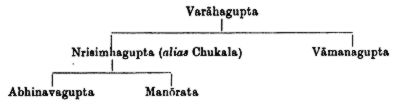
abhinavagupta parent


*

Abhinavagupta always described himself as kashmirika, as one hailing  from the land of Kashmira.

It is believed that Abhinava was a Yoginibhu, i.e. born of a Siddha and  Yogini. The Kaula system believes that a progeny of parents who are sincere devotees of Lord Shiva is endowed with exceptional spiritual and intellectual prowess; and ,will be a depository of knowledge.

Abhinava might not have been his real name, but one assigned to him by his teachers, because of his brilliance. He describes his work Tantraloka (1.20) : ‘This is the work written by Abhinavagupta, who was so named by his Gurus”- abhinavaguptasya kṛtiḥ seyaṃ yasyoditā gurubhirākhyā. The name Abhinava suggests the virtue of being “ever-new and ever creative, progressively innovating oneself”.And, it also suggests competence and authoritativeness. Abhinavagupta was, in fact, all these and more.

He was also referred to as Abhinavagupta-pada. The suffix pada signifies a reverential form of address (say, just as in Sri Shankara Bhagavat-pada) .  There is also a clever explanation of the term “gupta_pada” which translates to “one with hidden limbs” , a poetic synonym for snake. Thus, Abhinava was also regarded as an incarnation of Sesha , the legendary serpent.

Abhinava lost his mother Vimalakala when he was just two years of age. The pain of separation and the longing for his mother haunted him all his life. He, later in his works, frequently referred to his mother with love and reverence. The relation between the mother and the child, he said, is the closest that nature can forge. The bond of love and friendship between the mother and the child is the strongest; and, is the most enduring bond in the world.

While ruing the loss of his mother early in his childhood, Abhinavagupta reconciled to the fact , saying : It is the will of God , who prepares men  for the future work to be accomplished through them – Mata vyayu-yujadamum kils balya eva / Devo hi bhavi-parikramani samskaroti//

His father Narasimha-gupta (aka. Cukhulaka), after the death of his wife Vimalakala, assumed an ascetic way of life; and yet continued to bring up his three children (two sons : Abhinava, Manorata and the daughter Amba). He became more focused on his spiritual endeavor. He was Abhinava’s first teacher. Abhinava, later, recalled his father with gratitude for the training he received from him in Grammar (pitra sa sabda-gahane-krta-sampravesah), logic, literature and music (geya vidya).

Abhinava was a diligent pupil ; and, put his heart and soul in to his studies. By one account, Abhinava had as many as fifteen teachers; Narasimha Gupta, his father being his first teacher.  His other teachers were said to be : Vamanatha; Bhutiraja; Bhutiraja-tanaya; Laksmanagupta; Induraja; and Bhatta-Tota. These teachers taught the boy Abhinavagupta  varied subjects , such as : Tantras; Brahmavidya; monistic Saivism; Krama ; Trika; Dhvani; and Dramaturgy 

Among his teachers.  Lakshmana Gupta was the son and a direct disciple of Somananda, in the lineage of TryambakaHe taught Abhinavagupta the monastic subjects:  Krama,  Trika  and  Pratyabhijna   (except Kula).

His  two other teachers on these subjects were Bhutiraja and his son Helaraja, both of whom were adepts in Prathyabhijnana and Karma systems

The most prominent of his teachers was , of course, Shambhu Natha of Jalandhara (in the present-day Punjab). Guru Shambhu Natha, who preached monistic shaivism, initiated Abhinava in to Ardha_thrayambaka , a doctrine of Kaula school of Tantric tradition. It is said that Shambhu Natha asked his wife to act as a conduit (dauti) for transmitting the initiation through Kaula process (having sexual connotations). It was at the instance of Shambhu Natha that Abhinava authored his monumental Tantraloka, in which he compared Shambhu Natha to the sun in his power to dispel the darkness of ignorance; and to the moon shining over the ocean of Trika knowledge.

śrī śambhunātha bhāskara caraṇa nipāta prabhā pagata saṃkocam abhinavagupta hṛdambuja metad vicinuta maheśa pūjana hetoḥ //1. 21

[While on the topic of teachers, let me suggest to you , a  very scholarly dissertation submitted by Benjamin Luke Williams to the Harvard University during December 1917-Abhinavagupta’s Portrait of a Guru: Revelation and Religious Authority in Kashmir. Mr.Williams observes, among other things, : The conception of an ideal guru in the writings of Abhinavagupta lays stress on the guru’s capacity to awaken their disciple to an all-encompassing grasp of reality. It also exceeds this requirement through an implicit argument – modeled by Abhinavagupta’s narration of his own religious education – that the guru should be scholastically trained; and, be sensitive to the beauty of Sanskrit literature….the ideal guru should not only be a fully-enlightened master; but, should also be schooled in the finer points of Indian scholastic discourse and a connoisseur of Sanskrit poetry; in short, a multi-cultural Siddha. ]

*

As regards his immediate family, it is said, Abhinava had a younger brother Manoratha and an elder sister Amba. Manoratha was one among Abhinava’s earlier batch of disciples. And, one of his fellow students was Karna married Amba. Karna and Amba had a son Yogeshwardatta , who was precociously talented in Yoga. After the death of her husband, Amba too devoted herself entirely to Yoga and to the worship of Shiva. Later, Amba’s in-laws too became devote followers of Abhinava.

A cousin of Abhinava was Kshema who later became renowned as his illustrious disciple Kshemaraja. Mandra, the cousin and childhood friend of Karna, too became Abhinava’s disciple. Vatasika, Mandra’s aunt, took exceptional care of Abhinava and offered him support to carry on his life’s work. It was while staying in her suburban house at Pravapura (eastern district of the present-day Srinagar) that Abhinava wrote and completed his Tantraloka, in which he recorded his gratitude towards Vatasika for her concern, dedication and support. Abhinavagupta also mentioned his disciple Rāmadeva as being  faithfully devoted to scriptural studies and for serving his master.

He also mentions that while writing this text, he recollected all the shastras he had earlier learnt from all his Gurus

Ittham grhe Vatsalika-avartane sthitah samadhyaya matim/  bahuni purva-srutanya-kalayan svabhuddhya shashtrani tebhyah samavapya saaram

*

Abhinava did not become a wandering monk nor did he take on Brahmanical persuasions. He did not marry  (Dara-suta-prahrti-bandhakatham-naptaha); he followed an ascetic way of life; and yet, he lived in his ancestral home surrounded by the members of his family, loving friends and disciples. He lived the life of a scholar, a teacher and a Yogi immersed in Shiva. Referring to the atmosphere in his family, Abhinava said,” All the members of the family regarded material wealth as a straw and they set their hearts on the contemplation of Shiva”- Ye sampadam truna-mamamsata Shambh-seva –sampuritah svahrudayam hrdi bhavayantah (Tantraloka 12.)

He lived in a nurturing and a caring environment. An epoch pen-painting depicts him  seated in Virasana, surrounded by devoted disciples and family, performing on Veena while dictating verses of  Tantrāloka to one of his attendees, as  two dauti (women yogi) wait on him. He was ever surrounded by his friends and disciples.

Madhu raja , a disciple of Abhinavagupta, in his stotra praising his Guru,  calls him  ‘Abhinava Dakshinamurthi Devah’ – an incarnate of Sri Dakshinamurthi. The following is the gist of the Dhyanasloka composed by Madhuraja in honor of his Guru, as  translated by Dr. K . C. Pandey.

May that Supreme Being Sri Dakshinamurthi in the form of my Guru Abhinavagupta , who is an incarnation of Shiva Srikantha  ; and ,who has come to Kashmir ; may he protect us all.

His eyes are glowing with spiritual bliss. The center of his forehead is clearly marked with tri-pundraka, three lines drawn with the sacred ash (Bhasma). His ears adorned with Rudraksha are beautiful. His luxurious hair (Shikha) is tied with garland of flowers. His beard is long. His body shining like roses. His neck appears black, because of its being smeared with paste of camphor , musk , sandal, saffron etc., indeed looks splendid.
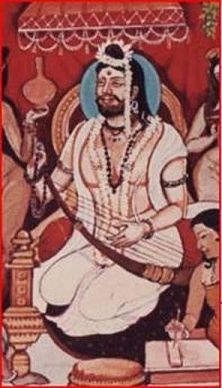
Abhinavagupta

His long Yajnopavita is left loose. He is attired in silk cloth, white like the moon-beams. He is sitting majestically in Virasana, on a soft cushion placed over a throne of gold, over which is a canopy decked with strings of pearls . His right hand wearing the rosary of Rudraksha is resting on his right thigh; with his fingers gesturing Jnana-mudra . He, with his lotus-like delicate fingers of the left hand is also playing upon the Veena  spreading melodious and enchanting Music  (Nada) all around.

 He is seated in an open hall decorated with beautiful eye-catching paintings . And, the hall looks superb with rows of lamps and sweet-smelling garlands, colourful  flowers . And, the entire area is pervaded by the fragrance of incense and sandal etc. The hall is resounding with melodious songs and music on various instruments. There are also dancers displaying their skills joyfully. His assembly was also honoured by the presence of Yoginis and Siddhas who attained a high status.

The Great Guru Abhinavagupta is attended by all his pupils, such as Kshemaraja who devotedly sits at the foot of his master and studiously writing down the utterances of the Master. There are also two female messengers (Dutis) standing beside the Guru ; and, serving him with whisks. They also hold a jar full of water distilled from the grain kept soaked in water for three nights (Shiva –rasa). They also carry a box of betel-leaves, a basket of citron and lotus.

No wonder that about 1,200 of his friends and disciples faithfully followed Abhinavagupta, as he marched in to the Bhairava cave, reciting loudly his Bhairara_stava, never to be seen again.

[ Please click here for

Kāśmīrīya Mahāmāheśvara Ācārya Abhinavagupta (A biographical docu-feature on his life & works)

And

Here for Abhinavagupta’s Unique Contribution to Indian Tradition by Dr. N C Panda ]
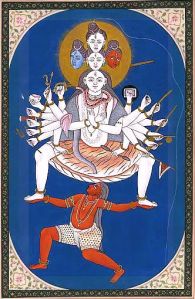
Svacchanda Bhairava

A prolific writer on a wide ranging subjects , Abhinava  authored more than about 40 works, some of which survive to the present day.

Abhinavagupta’s works are sometimes classified according the branches of his triad (trika) will (icchā) – knowledge (jnana) – action (kriya).

But according to another classification, Abhinavagupta’s works fall into four broad groups.

The first group of his works deals with Tantra. His monumental encyclopedic work the Tantraloka or Light on the Tantras is an authoritative text. It explores doctrine and the inner meaning of rituals in the Shaiva and Shakta Agamas.

The text is named as Tantraloka; because, it is said to light up the path of the ardent followers of the Tantra (Alokamasadya yadiyamesha lokah sukham sancharita kriyashu)

The work came to be written at the request of  Manoratha  , his cousin and his pupils Mandra and others.The actual writing took place, while Abhinavagupta was staying in the house of Mandra , located in Pravarapura ( eastern district of the present-day Srinagar)

The text enumerates the Tantrik Agamas and the three methods of realizing the Ultimate Reality: SambhavopayaSaktopaya and Anovapaya. The Tantraloka , apart from being a philosophical work, is also a practical guide to the arnent students of Tantra-vidya.

iti samadhikamenam trimsatam yah sada budhah / ahnikanam samabhyasyetsa saksadbhairavo bhavet

Tantraloka is a detailed work divided into thirty-seven Ahnikas (Chapters).  It has been published with commentary of Jayaratha.  The topics discussed therein are : (1) the cause of bondage;(2) the way to freedom;(3)knowledge as distinct from ignorance;(4) the concept of Moksha ;(5) what is the ultimate reality ; (6) manifestation of the universe ;(7) Bimba-Pratibimba Vada; (8) Shaiva Agama; and,(9) Biographical notes.

*

Tantrasara is a summarized version of Tantraloka. The Tantrasara containing twenty-two Ahnikas deals with a variety of topics which have a  bearing on varied spiritual disciplines. It gives prominence to the various modes of spiritual disciplines prescribed for different classes of spiritual aspirants. It also explains the ancillary topics such as the concept of Divine Grace; different kinds of initiatory rites (Diksha); and, the modes of Shaiva worship etc. Besides, it also discusses the abstract aspects of   Trika School of philosophy. The entire text is replete with mystic symbols and description of esoteric practices.

Tantra-Vata-Dhanika is a small work in verse form, which aims to teach the principles of Shaiva Tantras in a nutshell.  Basically, this text is a brief summary of Tantraloka. It is like a seed, dhanika of the huge banyan tree, vata of Tantra ideology.

Paramartha-sara is text containing 105 karikas. It is called   Paramartha-sara,  because it encapsulates the essence (Sara) or the hidden (ati-gudham) principles of the Trika Philosophy, as explained by Abhinavagupta – aryasatena  tadidam samksiptam  sastra-saram-atigudham. This text is said to be an adaptation of the Adhara-karikas of the revered sage Sesha Muni, who is also referred to as Adhara  Bhagavan. The Paramartha-sara of Abhinavagupta, mainly, deals with subjects such as: metaphysical reality; ontology of Shaiva Siddantha; theories concerning creation; manifestation of thirty-six Tattvas; causes for human bondage;  and, the ways leading towards liberation etc. Yogaraja,one of  the  disciples  of Ksemaraja wrote a detailed  commentary on Paramartha-sara.

The other important work of this group is Malini-Vijaya Vivrti , a commentary. It is a voluminous work, composed in simple Sanskrit verse on the philosophic principles and doctrines of practice of Kashmir Shaiva Siddantha The alternate title of this text is Sripurva-shastra. It was, initially, addressed to two of his pupils: Karna and Mandra – sacchisya-karna-mandrabhyam codito‘ham punah.

*

The second group consists few small treatises like Bodh-Punch Dashika;  and  Stotras  or hymns in praise of deities such as Bhairava. The text is made of sixteen Sanskrit verses. It is called Bodha-panca-dasika, because,  in fifteen verses, it teaches  the basic principles of monistic Shaiva doctrine . It speaks of the Shaiva conception of Shiva and Shakthi; their relation; and, the consequent emanation of the universe etc .The last  and the sixteenth verse ,briefly  states  the object of the composition- sukumara-matin sisyan-prabodhay-itumanjasa / ime Abhinava-guptena slokah pancadasoditah// 

The Bhagavadgitartha-sangraha is a short commentary on Bhagavad-Gita, where Abhinavagupta gives the traditional interpretation from the Shaiva point of view.

*

A third group includes his works on art of the theater and art of writing plays; poetics; aesthetics and the rhetoric. The great scholar Prof. P.V. Kane remarked “his two works, i.e. Lochana and Abhinavabharati are monuments of learning, critical insight, literary grace and style.” Lochana, his commentary on  Dhvanyaloka of Anandavardhana is a highly regarded work in aesthetics. Abhinavabharati is an extensive commentary on Natyasastra of Bharata Muni. His analysis of Rasa is very appealing and distinguishable from other interpretations. For example, Bharata talks about eight types of Rasa, while distinguishing it from sthaayibhaava.

The Abhinavabharati and Lochana suggest that bhoga (pleasure) is produced not only by the senses but also by the removal of moha (ignorance). They also suggest that art and literature are not mere vinoda (entertainment) but are outpourings of the ananda arising of knowledge.

The Abhinavabharati is the earliest available, the most famous and celebrated commentary on the Natyashastra of Bharata, expounding , among other things , on the theory Rasa.

***

Abhinavagupta emphasized that intuition (prathibha), inner experience was the lifeblood of good poetry. He said , creativity (karaka) was the hallmark of poetry as it brings into the world a new art experience. Poetry need not aim to remind (jnapaka) what is already present; that , he said , was the function of sastras. A poet need not seek justification or approval of scriptural authority. He is the lord of his domain. He is the creator. Abhinava  recommend, the poet need not allow himself to be bound by logic, propriety and such other restrictions.

Abhinavagupta , in his Lochana, says prathibha the intuition might be essential for creation of good poetry . But , that flash of enlightenment alone is not sufficient . He explains , what sustains that vision is the “unmeelana_shakthi” which is something that charges the mind, opens up or awakens the potent faculties.

Abhinavagupta clarifies that prathibha is inspirational in nature and it does not, by itself , transform automatically, into a work of art or poetry. It needs a medium to  harness it, bring it forth through lively , delightful or forceful expression . And , that medium has to be cultivated, honed and refined diligently over a period to produce a work of class.

In this context, Abhinavagupta mentions three essentials that a poet has to keep in view. They are Rasa (rasa_vesha), Vaishadya and Soundarya.

The rasa concept is well known ; and,  is expounded by Bharata muni.

The second one refers to clarity in thought, lucidity in expression and comfortable communication with the reader.

The third is the sense of poetic beauty . A good poetry can manifest, according to him, only when the delightful combination of these three essentials are charged or supported by prathibha.

He cites Valmiki and kalidasa as classic examples; and, states it is the wonderful combination of those poetic virtues and prathibha that sets them apart from the rest of the tribe.

[Abhinavagupta , it appears had a special regard for Kalidasa. In his Locana, while commenting on Anandavardhana’s Dhvanyaloka, Uddyota-1 – DhvK_1.6and speaking of pratibhā-viśeṣam , the creative genius,  Abhinavagupta  ponders :

In this wonderful   stream of literature,  flowing  since the time immemorial, there have been varied types and class of poets . And, there have been some gifted  poets in each generation . But, tell me; how may of those can even be compared to the matchless , Sovereign (prabhṛtayo) Kalidasa. You might be able to name a very few , say, two , three or , at best, five; but, surely never  more than that.

pratibhā-viśeṣaṃ pari-sphurantam abhivyanakti / yenāsminnati vicitra kavi paramparā vāhini saṃsāre kālidāsa prabhṛtayo dvitrāḥ pañcaṣā vā mahākavaya iti gaṇyante / ]

*

The fulfillment of poetry is Ananda, joy. It therefore needs a good reader (Sah_hrudaya) who can understand, appreciate, empathize and enjoy the beauty of the poetry. He is an integral part of poetic experience.

Subash kak remarks “Abhinava emphasized the fact that all human creativity reveals aspects of the seed consciousness. This explains his interest in drama, poetry, and aesthetics.”
Nineplanets Navagraha 2

The last group constitutes his work on the Pratyabhijnyasastra, the monistic philosophy of Kashmir Shaivism. In this group , we have his matchless contributions to this system. Among his most notable works in this category are the Isvara-pratyabhijña-vimarsini and the concise Isvara-pratyabhijña-vivrti-vimarsini, both commentaries on Isvarapratyabhijna (“Recognition of God”) by Utpaladeva, an earlier philosopher of the pratyabhijna school.

The Para-trisika-vivarana on the Trika system of yoga is very profound text detailing minute ideas regarding the esoteric principles and doctrines of the Trika system of Shaiva-yoga in its highest aspect. The text deals with Ultimate Reality, Para Tattva;  and the path to its realization, centered above on  the theory and practice of  mantra Yoga.

[ Abhinavagupta dedicates this monumental work to his Parama Guru Somananda saying : I have written this work after reflecting and meditating on the thoughts of Sri Somananda that have spontaneously entered my heart ; enabling me to realize the same pure state of Truth.

Tat-tattva-nirmala-sthithi-vibhaghi-hrdaye svayam pravistamiva / Sri Somananda-matham vimarshya  maya nibaddamidam// ]

*

Abhinavagupta was a devotee of Lord Shiva ; and, he led a celibate life. He is considered the greatest exponent of the Kashmiri Saivite monism. This school viewed Shiva (the manifestation of ultimate reality), the individual soul, and the universe as essentially one. The philosophy of pratyabhijna refers to the way of realizing this identity.

Kashmir Shaivism is intensely monistic. It is not much concerned with worshiping a personal god ; its emphasis is upon meditation , reflection and guidance by a guru. It aims at attaining the transcendental state of Shiva consciousness.

It explains the creation as Shiva’s abhasa, shining forth of himself in his dynamic aspect of Shakti. Abhasavada is therefore another name of the system . Shiva the Supreme Self is immanent and transcendent; and performs , through Shakthi , the five actions of creation, preservation, destruction, revealing and concealing. During this process , Shiva as the Universe Vishwanatha, on his own will creates , expands, flourishes , retracts in to a most minute form till the next cycle of creation and expansion.

Kashmir Shaivism is called Trika philosophy because all its interpretations are three fold. Trika stands for threefold science of the individual, the energy and the universal consciousness. It also represents three modes of knowledge of Reality, viz. non-dual (abheda), nondual-cum-dual (bhedabheda), and dual (bheda). The Trika School also argued that reality is represented by three categories : transcendental (para), material (apara), and a combination of these two (para_apara) . This three-fold division is again reflected in the principles of  Shiva, Shakti, anu or pashu. The Trika is also known as Svatantrya vadaSvatantrya and Spanda expressing the same concepts.

The purpose of Trika is to show how an individual rises to the state of universal consciousness through Shakthi. Shiva represents pure consciousness, Shakti its energy, and anu the material world. Pashu is the individual who acts according to his conditioning, almost like an animal; pashas are the bonds that tie him to his behavior; and pathi or pashupathi (Lord of the Flock) is Shiva personified whose knowledge liberates the pashu and makes it possible for him to reach his potential.

Abhinavagupta classified Trika philosophy into four systems : Krama  system,  Spanda  system,  Kula system and Pratyabhijna  system.

The mind is viewed as a hierarchical (krama) collection of agents (kula) that perceives its true self spontaneously (pratyabhijna) with a creative power that is vibrating  or pulsating (spanda)

Explaining the Spanda system, Abhinavagupta says whatever that appears to be moving is actually established in the unmoved point. Although everything seems to be moving , actually, they are not moving at all.

As for the Kula system, he says that Kula means the science of totality. In each and every part of the universe totality shines . Take an infinitesimally small object, in that you will find the universal energy. A macrocosm resides in microcosm .

The fourth, the Pratyabijnya system deals with the school of recognition. The Pratyabhijnya School, initiated by Sri Somananda; and developed by Utpaladeva, reached its culmination in Abhinavagupta. This School conceived Shiva (the manifestation of ultimate reality), the individual soul, and the universe as essentially one; Pratyabhijna refers to the way of realizing this identity.

Abhinavagupta, while explaining this school of recognition, says, man is not a mere speck of dust; but, is an immense force, comprising a comprehensive consciousness and capable of manifesting through his mind and body limitless powers of knowledge and action (Jnana Shakti and Kriya Shakti). The state of Shiva-consciousness is already there, you have to realize that and nothing else.

His non-dual philosophy, in essence, is similar to the one expounded by Sri Shankara. He considers the universe completely real, filled with infinite diversity and not different from Shiva , the supreme consciousness. He expands on this concept and shows that the various levels of creation, from the subtlest to the grossest, are all the same and Shiva.

He conceived Shiva, the I or Consciousness (Aham) , as an expression of the supreme freedom This concept of freedom (Svatrantya) is one of the principal achievements of Kashmiri Shaivism .

Abhinavagupta explains that Shiva brings about the manifestation of the world by the means of His svatantrya –shakthi or absolute autonomy by which he effects all changes without undergoing any change in Himself. The world is abhasa, pratibimba projected or reflected in the mirror of cosmic consciousness. Abhinavagupta  illustrates this  position  with  the aid  of  analogy of the reflection in  a mirror : just as earth,  water etc. are  reflected  in a clean mirror without being contaminated, so also the entire world of objects appears together in the one Lord consciousness- nirmale mukure yadvadbhanti bhumi-jala- dayah.. visvavrttayah.

Abhinavagupta asserts that Shiva, the Ultimate Reality, manifests himself as the world – asthasyadekarupena vapusa canmahesvara! Ghatadivat. He says;  in reality,  the jiva, the individual soul, is none other than the Lord Shiva Himself, having taken up the form of the bounded being – Shiva eva grhita pasu bhavah. The whole of this existence, according to Abhinavagupta, is indeed the manifestation of that Absolute Reality Shiva – Bharupam..paratattvam tasmin vibhati sat trimsad-atma jagat 

*

But, the basic difference between the Sri Shankara and Abhinavagupta is that the philosophy of Abhinavagupta is theistic absolutism.  It is similar to Vishitadvaita.  Abhinavagupta accepts the monistic and absolute  pure  consciousness   as  the  only  eternal reality; but, at the same time establishes Shakthi as the very essential nature of such monistic Reality. Hence, the aspect of the pure and perfect I-consciousness is His static aspect in which He is known as Shiva; and, the aspect of His phenomenal manifestation through the five divine activities is His dynamic aspect in which He is known as Shakthi.  Thus, Shiva is the basic eternal Reality and Shakthi is the divine nature of such Absolute Reality. Shiva and Shakthi are also said to be identical; the difference being just in nameittham nanavidhaih rupaih! kridaya prasruto nityameka-eva sivah prabhuh.
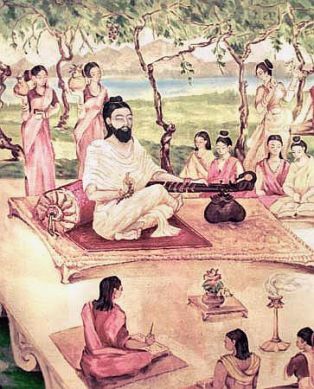
Abhinavagupta 3

Abhinavagupta was a mystic and a Sadhaka par excellence. According to him; one’s body is indeed a worthy place of worship. All the devatas , vidyas, cakras, trisulas, mandalas  etc. are present in the body.

Beyond this there is no other Dhama  , a place, which is more   suitable for true worship – deha-eva-param-lingam  sarvata tat-vatmakam  shivam.. Atraiva  devata cakram  bahirantah sada yajet .

Abhinavagupta advises that a serious seeker should  obtain proper initiation , Diksha , from a worthy Guru, who  has the immense power of grace. The Sadhaka through relentless practice of Mantra, Japa and Bhavana (contemplation), should strive to attain true realization – tat svarupam japah prokto Bhava –bhavapada-cyutah.

He categorized such means of achievement (Upaya) into:  Anavopaya; Saktopaya and Sambhavopaya.. These Upayas are hierarchical; and, are meant for different levels of  Sadhakas.

Abhinavagupta asserts  that Moksha is nothing else  but  the  awareness   of  one’s  true  nature –  Moksha hi nama naivanyah sva-rupa-prathanam hi sah . He assures,  an  aspirant  who  meditates on that Great Brahman, will truly realize Shiva in his heart.

***

Kashmir Shaivism, reached its culmination in the philosophy of Abhinavagupta and Kshemaraja (10th century) ; and,  in the theory of Recognition , Shaivite philosophy found its full flowering .

Together with Somananda’s disciple Utpaladeva, Abhinavagupta is the most important representative of the School . Many believe Shiva himself appeared in Kashmir in the form of Abhinavagupta to enlighten the people. In any case , Abhinavagupta is a precious jewel of our heritage . His works and teachings continue to influence our thoughts.

Abhinavagupta talks about Shadanga_yoga, a system of yoga comprised of six aspects. According to him, prana (life force) and manas (mind) are interdependent. The Yoga consists in harnessing these two together. The disciplines of yama, niyama and aasana prescribed by Patanjali are meant for conditioning the body; they are the indirect methods.

Whereas, the methods that help directly are  dhyana  (meditation),  dharana (contemplation),  tarka (reasoning) and  Samadhi (absolute identity with the ideal). Contemplating on the identity of self and the Shiva  is essential; and it can be achieved through divine grace. It leads to emancipation and freedom from ignorance; and roots out the sense of duality. This he called it Pratyabhijnathe new method  (margo navaha).
guru charana

flordeloto


References:
http://www.koausa.org/Shaivism/index.html
http://www.koausa.org/Saints/Abhinavagupta/article3.html
http://www.thenewyoga.org/guru_abhinavagupta.htm
http://en.wikipedia.org/wiki/Abhinavagupta

https://www.academia.edu/24993006/Abhinavagupta?email_work_card=interaction_paper

https://www.academia.edu/24993006/Abhinavagupta?email_work_card=view-paper

Images are from Internet


Tags: ,

Citta the preacher

Among the followers of the Buddha there were many lay disciples , the householders, who excelled in the understanding of the Dhamma and in preaching the Dhamma . The foremost among them was Citta .He was the model that the Buddha urged others to emulate .He was the foremost disciple in expounding the Dhamma.On one occasion, the Buddha said to the monks: “Should a devoted mother wish to encourage her beloved only son in a proper way she should say to him: ‘Try to become like the disciple Citta “

A wealthy merchant who owned the hamlet of Macchikāsanda near the city of Savatthi celebrated the birth of a son by covering the village streets with flowers of various hues. The streets at once looked colorful and picturesque . The baby boy was hence promptly named Cittagahapati . His family and friends called him , for short , Citta . Because of his birth in Macchikāsanda , he also acquired the name Macchikásandika. The boy grew up to be a bright and an articulate young man . Besides his family trade Citta acted as the Treasurer of the City Council of Savatthi, where he now lived. He also owned a tributary village called Migapattaka . He had a resort in the grove Ambarukkhavana, in his native village of Macchikāsanda .

Once when the monk the Elder Mahānāma visited Macchikāsanda, Citta, pleased with his demeanor, invited him , for a meal at the Ambarukkhavana grove .Citta was so impressed with the discourse delivered by the monk that at its conclusion he dedicated the Ambarukkhavana grove to the Sangha . Later he built a splendid monastery there for the use of monks . The monastery came to be celebrated as the Ambātakārāma; and was the residence of a large numbers of monks . Discussions often took place there between Cittagahapati and the resident Bhikkhus . Among eminent Elders who visited the Ambātakārāma were Isidatta of Avanti , Mahaka of magical powers ,Kāmabhū ,Godatta and the Elder Lakuntaka Bhaddiya who lived there in solitude and in meditation . A monk named Sudhamma was another permanent resident of the Ambātakārāma .

Citta , by diligence and dedication , not only grasped the heart of the Dhamma but also became quite an adept in explaining the Dhamma. The Buddha considered Citta the most learned and lucid of all the lay Dharma teachers. The Buddha recognized Citta as the foremost in expounding the Dhamma .He held up Citta as a model for others to follow. The Tipitaka contains discourses preached to and by Citta . The sixty-first section in Tipitaka , Citta Samyutta Nikáya is named after him and contains a record of his discussions . In the Samyutta Nikaya there are two sutras wherein he discussed Dhamma with the monks. They indicate his profound grasp of the subtle aspects of the Dhamma.

The first documented teaching by Citta relates to a discussion that a group of monks were having at the Ambātakārāma monastery . The discussion was about whether it is the sense objects that fetter the mind ; or whether it is the sense organs that cause the fetters or whether fetters and sense objects are one and the same. Citta joined the discussion and explained by using a simile .“ Suppose a black ox and a white ox were tied together with a yoke or rope. Now , would it be right to say that the black ox was the fetter of the white ox or that the white ox was the fetter of the black ox?” he explained “Certainly not; The black ox is not the fetter of the white ox nor is the white ox the fetter of the black ox. They are both fettered by the yoke or rope. Similarly, the eye is not the fetter of visual objects nor are visual objects the fetter of the eye .The sense faculties do not bind the external objects. Instead, they are bound or yoked by craving.”. The monks were delighted by Citta’s lucid explanation .

On another occasion, the monk Kamabhu, perplexed by one of the Buddha’s sayings, asked Citta if he could explain what it meant. The saying was:

Pure-limbed, white-canopied, one-wheeled,
The chariot rolls on.
Look at he who is coming,
He is a faultless stream-cutter, he is boundless.

Citta explained the verse with understanding and insight. He said: “‘Pure-limbed’ means virtue, ‘white-canopied’ means freedom, ‘one wheeled’ means mindfulness, ‘rolls on’ means coming and going. ‘Chariot’ means the body, ‘he who is coming’ means the enlightened one, ‘stream’ means craving, ‘faultless’, ‘stream-cutter’ and ‘boundless’ all mean one who has destroyed the defilements.” Citta’s ability to give a spiritual interpretation to what appeared to be merely a beautiful verse surprised and delighted Kamabhu .

The laymen and Bhikkhus respected Citta as a great teacher. Citta used his knowledge to help both believers and non-believers.

It appears that Citta did not formally join the Order though he had encouraged many of his friends to do so. That might have been because of his certain commitments in his personal life as a householder.

Citta’s visit to the Buddha at the Jetavana monastery is recorded in the Canon. It is said , Citta loaded five hundred carts with food and other offerings for the Buddha and his disciples visited Savatthi, accompanied by three thousand followers. They traveled at the rate of one yojana a day and reached Savatthi at the end of a month. Then Citta went ahead with five hundred of his companions to the Jetavana monastery and fell at the feet of the Buddha. Citta stayed at the monastery for one whole month offering alms-food to the Buddha and the bhikkhus ; and also feeding his own party of three thousand. All this time, his stock of food and other offerings. were being replenished. The Buddha preached to him the Salāyatana-vibhatti.

The Salāyatana-vibhatti Sutta is a series of definitions of the

six internal senses,
* six external sense objects,
* six groups of consciousness,
* six groups of contacts,
* eighteen mental researches,
* thirty six tracks for creatures,
* six satisfactions to the banished,
* three bases of mindfulness, and
* the supreme trainer of the human heart. 

On the eve of his return journey, Citta put all the things he had brought with him in the rooms of the monastery as offerings to the Buddha .The Buddha said, “Ananda, this disciple is fully endowed with faith and generosity; he is also virtuous and his reputation spreads far and wide. Such a one is sure to be revered and showered with riches wherever he goes.”

Then the Buddha spoke in verse as follows:

He who is full of faith and virtue, who also possesses fame and fortune, is held in reverence wherever he goes.

The Dhammapada Atthakatha says that once Citta made offerings to some monks and one of the monks was rather rude. He was therefore rebuked by Citta . The monk complained to the Buddha against Citta but Buddha rebuked him and asked him to apologize to Citta (the monk became an arahant eventually).

The Buddha uttered the following Verses to the monks :

The fool will desire undue reputation, precedence among monks,
authority in the monasteries, honor among families.

Let both laymen and monks think, “by myself was this done;
in every work, great or small, let them refer to me.”
Such is the ambition of the fool; his desires and pride increase.

Asantam bhavanamiccheyya / purekkharanca bhikkhusu / avasesu ca issariyam / pujam parakulesu ca.

Mameva kata mannantu / gihi pabbajita ubho / mamevativasa assu/ kiccakiccesu kismici / iti balassa sankappo/ iccha mano ca vaddhati

When Citta lay ill just before his death, he did not wish for heaven because he did not aspire to anything so impermanent. True to his calling he gave his last advice to those gathered around his death bed. Citta requested them to have trust and confidence in the Buddha and the Dhamma ; and to remain unswervingly generous to the Sangha.

Citta was an ideal lay disciple , an ideal preacher and an ideal son.

****

Should a devoted mother wish to encourage her beloved only son in a proper way she should say to him:

‘Try to become like the disciple Citta

buddha-tashkent-behl

Reference:
http://www.budsas.org/ebud/rdbud/rdbud-05.htm

 
5 Comments

Posted by on September 6, 2012 in Buddha, Buddhism


Tags: , ,

Vidhyadharas and Nagas

The classic Indian epics such as the Mahabharata, the Ramayana and the Puranas refer to many exotic tribes, describing them as superhuman or subhuman. Narrations about these tribes are often mixed with mythology and fables. These includeGandharvas, Yakshas, Kinnaras, Kimpurushas, Rakshasas, Nagas, Suparnas, Vanaras, Vidyadharas, Valikilyas, Pisachas, Devas (within them Vasus, Rudras, Maruts, and Adityas) and Asuras (within them Danavas, Daityas and Kalakeyas.)

These exotic tribes may not have interacted frequently with the mainstream .The knowledge of them was perhaps very limited, which may have spurred the invention of fables and myths about them.

In the Indian mythology the exotic tribes were non-human or in some cases super human, living in distant planets . They were endowed exotic capabilities, that include

1. The ability to appear and disappear at will

2. The ability to fly in air

3. The knowledge of flying-craft (vimana)

4. The ability to change shape at will

5. The ability to read the mind of people

6. The knowledge about other inhabited places like the Earth

7. The ability to influence natural forces

In any case, these tribes had a profound influence on the myths, fables, culture and arts of Indian through the ages.

Vidhyadharas

Among them, the Vidyadharas belong to a category of beings known as Upadevas, or almost-Devas. They appear frequently in the epic and folk lore .Vidyadharas-as semi divine beings are very often depicted in Indian art and sculptor. Their fascinating figures are quite popular. They are usually seen on either side of the images of deities (Brahmanical, Buddhist and Jaina) and on the walls of temples.

By Shilpi Shri Siddalinga Swamy of Mysore

The treatment of Vidhyadharas in our lore is however not uniform. Their treatment in the Puranas, epics and literature, could be said to be three – fold.

In the Puranas:

Shrimad Bhagavatha describes the Bhuvarloka – the level of semi-demigods where the Carana, Vidyadhara, Kinnara, Kimpurusa etc reside. “Below Rahu by 10,000 yojanas [80,000 miles] are the planets known as Siddhaloka, Caranaloka and Vidyadhara-loka.” (SB 5.24.4). “Beneath Vidyadhara-loka, Caranaloka and Siddhaloka, in the sky called antariksha, are the places of enjoyment for the Yaksas, Raksasas, Pisacas, ghosts and so on. Antariksha extends as far as the wind blows and the clouds float in the sky. Above this there is no more air.” (SB 5.24.5)

A vidhyadhara cursed to live on earth tells Krishna “I am the well-known Vidyadhara named Sudarsana. I was very opulent and beautiful, and I used to wander freely in all directions in myVimana. Once I saw some homely sages of the lineage of Angira Muni. Proud of my beauty, I ridiculed them, and because of my sin they made me assume this lowly form.”

In another instance, Citraketu, the King of the Vidyadharas traveled by his Vimana, round the world. He visited hundreds of people in several places and was praised by the sages. He stayed on the heights of Kulâcalendra [Mount Meru].

In Mahabharata and Ramayana:

When Bhimasena went in search of the Saugadhika in the Himavath , by ascending the Gandhamadana mountain , he saw hillocks , thronged with Vidyadharas, inhabited on all sides by foresters and Kinnaras and Kimpurushas, and Gandharvas (3-044.164) .On the summits of the mountain were seen amorous Kimpurushas with their paramours, mutually attached unto each other; as also many Gandharvas and Apsaras clad in white silk vestments; and lovely-looking Vidyadharas, wearing garlands; and mighty Nagas, and Suparnas, and Uragas, and others. (3,145)

dadṛśur giripādāṃś ca nānā dhātu samācitān /  āsevitān kiṃpuruṣair gandharvaiś ca samantataḥ / vidyādhara gaṇākīrṇān yutān vānara kiṃnaraiḥ / tathā kiṃpuruṣaiś caiva gandharvaiś ca samantataḥ – 03,145.12-13

In Valmiki Ramayana – Sundara Kanda : When Hanuman leaps on the Himavath in search of theSanjivani 

“Vidhyadharas who lived there, became afraid and flew away with their women folk, leaving behind their golden jugs of wine in the liquor house, gold vases, a varieties of sauces that can be licked, eatables, various meats, skins of oxen and swords with golden hilts.

The intoxicated Vidyadharas with garlands around their neck decked with red flower garlands and smeared with sandal paste, with reddened eyes, and with lotus shaped eyes, obtained the sky. Vidyadhara women wearing necklaces, anklets, armlets and bangles stood in the sky with surprise and with smiles along with their loved ones. Vidyadharas and great sages stood in the sky in a group, showing their great prowess and viewed the mountain.”

“This Hanuman, who is equal to a mountain, who is the son of Vayu, and who has great speed, wants to cross the ocean which is abode to crocodiles. Hanuma has decided to perform an impossible task for the sake of Rama and Vanaras and wants to obtain the other side of ocean which is hard to obtain.” Vidyadharas thus listened to the words of those great people and looked at the incomparable Hanuma, best among Vanaras, standing on the mountain. “

Hanuma went, like Garuda, in the sky served by clouds (or streams of water), served also by birds,…served in various ways by excellent courageous groups of Vidyadharas.

*

According to the Nispanna-yogavali, a Vajrayana Buddhist text of 9-10th century, credited to Mahapandita Abhayankara Gupta of the Vikramasila monastery, the King of Vidhyadaras was known as Sarvartha-siddha ; he holds a garland of flowers; and, his complexion is said to be white- Sarvarthasiddho Vidyadhara-rajendro gaurah kusuma-mala-hastha.

flower2

In Sanskrit literature:

The Katha- sarith -Sagara, is a famous 11th century collection of Indian legends, fairy tales and folk tales written by Somadeva who said his source was the text of Gunadhya’s Brihat Katha in Paisachi dialect. The principle tale is the adventures of Naravahanadatta, son of the legendary king Udayana and his final attainment of Madanamanjarika as his wife and the land of the Vidyadharas as his kingdom. A large number of tales are built into this central story to make it the largest collection of Indian tales. The Katha-sarit-sagara deals not so much with concrete historical events but with problems and processes of life. The characters in the main story relate stories of other characters who in turn relate others’ stories and so on, like a stack. No story ends in separation or death. Here, all journeys really end in fulfillment of love.

Here, the Vidyadharas are beings known as Upadevas, or almost-Devas who live in a realm of their own, in the Himalayan region. The Vidyadharas, here, can fly through the air, change their appearance at will and are generally amorous and musically gifted. The Vidyadharas and humans deal with each other, and many humans married Vidyadhara damsels. The Vidyadharas are essentially neutral – they cooperate with the universal hierarchy, but they neither favor nor oppose the human race.

Gandharva depivtion in art

In other Sanskrit works too, the Vidyadharas are bearers of wisdom and resemble humans in most aspects except that they are all beautiful to look at and can change forms at will. They mingle with humans and intermarry. Vidyadharas are mentioned also in the Buddhist and Jain tales .The play, Nagananda by King Sri Harsha (606 – 648 C.E.) is based on the legend of the Vidyadharas that appears in the Brahatkatha by Gunadhya.  In that legend, all the characters in the play are mythological figures and creatures with the Bodhisattva Jimuthavahana at the center.

The scene of the play is the semi-divine regions of Vidyadhara loka and Siddha loka. The hero of the play is Jimuthavahana, Prince of the Vidyadharas, who on the Malaya Mountain meets and marries the Siddha princess Malayavati, a votary of Goddess Gauri (Shiva’s wife).The Siddhas are the inhabitants of the subtle world Siddhaloka;  and , are born with mystic powers. They walk and travel in space; they can be perceived to be present, but they cannot be seen.

As regards the main scene of the play; the description of the Malaya hill in Nagananda, mentions sandalwood trees , elephants, the ocean waves , pearls , banana plants and leaves etc. As per tradition, sage Agasthya lived in Malaya hill and Krishna’s elder brother Balarama visited him there. It is said to have seven peaks. Further, in Valmiki Ramayana , Kishkinda khanda , it is mentioned that “When Vali repulsed the buffalo-shaped demon Dundubhi towards Malaya mountain, then that buffalo entered the cave of Mt. Malaya, and Vali entered therein wishing to kill that buffalo. [4-46-3, 4].

In “Lord Sri Caitanya Mahaprabhu’s Travels to the Holy Places” , it is recorded after leaving Sri Ranga, Caitanya Mahaprabhu reached Rsabha-parvata, … Panagadi, Camtapura, Sri Vaikuntha, Malaya-parvata and Kanya-kumari.

The Malaya hills therefore, by all accounts, might refer to the ranges in the peninsular region of India stretching south from Sri Sailam, in the southern end of the Western Ghats.

Malayavathi was a Siddha princess. The term Siddha originally denoted one of the eighteen categories of celestial beings. These beings of semi-divine status were said to be pure and dwelling between the earth and the heaven. Later they became associated with a class of more adept human beings, yogis. Sage Agasthya is credited with introducing Siddha cult to the South. The Siddhas who worship Shiva have been particularly strong in Southern India from the early ages.They are also adepts in Tantra and alchemy. The Siddha cult is still revered and practiced in South India.

Above all , Shankachuda , the hapless Naga cries out in agony “After hastily paying my respects at the shrine of Gokarna , on the ocean’s shore , I again come to this slaughter-house of the Nagas.”

Gokarnam arnava thate tvaritam pranmya prasthosmi tam khalu bhujagama –vadha –bhumim /

Malayavathi, therefore, might have been a Southern princess who married a Vidyadhara Emperor-to be, from the Himalayan region.

 [ Having discussed the academic aspects let me throw in a dampener.

There is another way to look at the whole issue . Nagananada is work of fiction based on a fable. The locations of the play Vidhyadhara-loka and siddha-loka might just be names; the locations could have been anywhere else too. Similarly the characters in the play could have been anyone else and not necessarily Vidhyadharas or Nagas. It is also possible the names of places and the charectars were random selections.There is no need to read too much into them . Just look at the more important things .

The more important factors are  the story line, its technique and the message of love, nobility and non-violence. These are in abundance in the play. Therefore, the play would still be of great significance, even if one ignores the context of the locale and the origin of its characters.

Let us however go along with the locale, characters and the spirit as portrayed in the play.]

8697784345_e75913d220

Nagananda, inspired by Buddhism, is one of the best Sanskrit dramas in five acts dealing with the popular story of Jimuthavahana’s self-sacrifice to save the Nagas. The story depicts how prince Jimuthavahana inspired by the noble virtues taught by the Buddha, offers his body to stop serpents being consumed daily by Garuda the leader of the birds; and how he succeeds in converting Garuda to the principle of ahimsa, abstention from causing injury to living beings.

Nagananda, ‘Joy of the Serpents,’ is in some respects quite unique. It is a rare instance of a Buddhist drama that has come down to us, well preserved.

**

Nagananda is often cited as a typical example of Drama that satisfies all the norms of a classic Nataka or Rupaka. Viswanatha in his Sâhitya-Darpana described such Rupaka (Nataka) as the most logical and perfect theatrical composition.  He says, according to the Dasarupaka, the structure of the Rupaka consists: five elements of the plot (arthaprakrti), matching with the five Stages (avastha) of the action, from which arise five structural divisions or sequence of events (samdhi) of the drama, which correspond with the elements of the plot and the actions associated with the stages in the hero’s pursuit and realization of his purpose, which is the conclusion (upasamhrti or nirvahana).

According that prescribed format for a Sanskrit Drama, the plot is expanded over five elements (Arthaprakrti): The opening sequence (mukha) is the seed (bija) very small at the beginning (arambha) ; and , expands (bindu) in multiple ways as the action proceeds into episodes (pathaka)  depicting various events (pathaki) and their resolution (karya). These are said to be the five elements of the plot (arthaprakrti).

Bīja bindu patākākhya prakaro kārya lakaā / arthapraktaya pañca tā etā parikīrtitā //

These five stages (Avastha) of action that are related to the achievement of the hero’s desired object (phala) are mentioned as:  Arambha (the beginning) – mere eagerness for the obtaining of the more important result; Yathna or Prayatna (effort) – exertion attended with great haste; Prapthya (prospect of success) – with means at hand, but also with fear of failure; Niyathapthi (certainty of success) – the confidence  of succeeding because of the absence of risk; and Phalagama or phala-yoga (successful attainment of the desired objective of the hero).

Avasthah panca karyasya prarabdhasya phalarthibhih / ararmbha-yatna-praptyasa-niyatapti-phalagamah.

The sequence of events (Samdhi) or Junctures corresponding to the five stages  (Avastha) of action are : the opening (mukha); the progression (pratimukha); the development (garbha); the pause in which one stops to reflect because of anger or passion or temptation (avamarsa or Vimarsa); and, the  successful conclusion (upasamhrti or nirvahana).

Antaraik arthasambandhah samdhir ekanvaye sati / Mukha-pratimukhe- garbhahs avamarsa upasarnhrtih

The Nivahana (conclusion or finale) is that Samdhi (juncture) in which the elemrnts of the plot that started with the opening scene (Mukha) and sprouted (Bija) in the subsequent scenes and later systematically and progressively spread over in the later scenes finally concluded with the hero attaining his desired objective.

Bija va anto mukhadyartha viprakirna yathayatham / aikarthyam uparuyante yatra nirvahanam hi tat //

*

The Bija, the seed or cause of the plot ( or Vibhava)  of Nagananda is Jimuthavahana’s strong desire to serve the world denouncing all the pleasures. In the opening scene (mukha) the hero announces: “Everything including my own body is certainly preserved by me for others.” After the seed (Bija) is planted, the incidents expand like a drop (Bindu) of oil on water. There is a determined effort (yatna) to achieve the object of desire. It is this step (Niyathapthi) which sustains the continuity of the action throughout the play.

The progress of the plot (Arthaprakrti) begins (Arambha) in the opening scene (mukha)  with Jimuthavahana’s determination to pass the days of his youth away from worldly temptations ; but , in serving and paying his utmost devotion to his old parents. He goes in search (Prayatna) of a penance grove in Malaya Mountain up to the point where the hero discovers Shankhachuda; and scarifies himself , as an act of boundless compassion – the object of his desire (Phalagama) –  and saves  the victim  whose body was about to be offered to Garuda.

 *

As a Nataka, the Nagananda conforms to the rules of dramaturgy , on broad lines. The Vastu, the plot, is famous, as it is a story  derived from the Buddhist legend Brhatkatha by Gunadhya. Its hero (Neta) is a worthy and an exalted person of virtue. The play displays Srngara, Vira and Adbhuta Rasas, though it’s dominant Rasas is Shantha. The play is in five acts; and, each act ,,except the first, begins with Pravesaka.

Though the drama is Buddhist in inspiration,  Goddess Gauri steps in to rescue  and  restoring Jimuthavahana back to life . The hero is a Bhodisatva, the Buddha in-making, and the heroine is an ardent devotee of Goddess Gauri. The religious affiliations are blended harmoniously; though the play is Buddhist  in its tenor . Ultimately, it is the Goddess Gauri who restores the dead hero to life, and  brings the play to a happy and an  auspicious (Mangala) conclusion.

The play begins with the auspicious Naandi verses, in salutations to the Buddha; and, it concludes (Mangala) with a prayer to the Goddess Gauri. A unique characteristic of this drama is the invocation to the Lord Buddha in the Naandi verses (considered one of the best examples of the dramatic compositions) .

The Naandi slokas submit a prayer to the Buddha in a rather very unusual  and interesting way:

[The Aupsaras, the celestial nymphs, in mock anger accuse the Buddha: “Oh, you, the one pretending to meditate; tell me on which woman are you meditating;  open your eyes for a moment  and see . You are the savior, yet you do not protect us  while we  are hit by the shafts of the cupid. Is your benevolence false ? Are you really compassionate?! Who could be more cruel  than you?”

May the all-conquering Buddha, who overcame the amorous temptations of the daughters of Mara, thus resentfully addressed by the nymphs, protect you!

As the Mara holds his attractive arrows; as  his band of followers dance playing on resounding drums; as the bewildered  Apsaras quiver and  watch with  eyes rolling, brows Knitted , and  mouths agape , crying and smiling at the same time; as the Siddhas (sages) submit their salutations with their heads  bent down; and as Indra , the king of Devas, with his hair standing on end, watches with astonishment –  the Buddha , the Lord of the sages, seated in rock-firm posture, filled with transcendental knowledge, continues to mediate in supreme bliss, unperturbed by the surrounding enchantments.

May such triumphant Buddha, the Lord of the sages (Munindra), protect you.

buddha nagananda

Dhyanam vyajaha upetya chintayasi kam unmilaya chakshuh kshanam / Pashya ananga sharah athuram jana imam trata api no rakshasi / Mithya karunika asi nighrunatara svatham kruthsu anyah puman  /Irshayam Mara vadhubhihi itya abhihitau Bhuddau jinah paathu  vah // 1.1//

ध्यानव्याजमुपेत्य चिन्तयसि कामुन्मील्य चक्षुः क्षणं /पध्यानङ्गशरातुरं जनमिमं त्राताऽपि नो रक्षसि ।मिथ्याकारुणिकोऽसि निर्घृणातरस्त्वत्तः कुतोऽन्यः पुमान्/ सेर्ष्यं मारवधूभिरित्यभिहितो बोधौ जिनः पातु वः ॥ १.१ ॥

Kamena akrushya chapam hatah patu pata hatha avalingabhir virau / Brumandol uthkampa jumbha smitham chalelitha drusham divya nari janena / Siddhau prahvo utthamangahahi pulakita vaspusha vismayad vasavena / Dhyayath bhodaha avaptitah achalitha ithi vah paathu drustau Munindraha //1.2//  

कामेनाकृष्य चापं हतपटुहावल्गिभिर्मारवीरैर् / भ्रभङ्गोत्कल्पजृम्भास्मितचलितद्दृशा दिव्यनारीजनेन । सिद्धैः प्रह्वोत्तमाङ्गैः पुलकितवपुषा विस्मयाद्वासवेन / ध्यायन् बोधेरवाप्तावचलित इति वः पातु दृष्टो मुनीन्द्रः ॥ १.२ ॥ ]

buddha9490

The Dasrupaka mentions the main aspects of the Drama (Rupaka) as : the plot, the hero and the Rasa (pradhāna, netà and rasa). The subject or the story should always be about celebrated and important persons. The plot should be simple, the incidents should be consistent; the progression of the events should spring direct from the story.

The plot (Vastu) of Nagananda is, of course, derived from a well respected source , is a noble one , lauding the virtues of Dharma, Ahimsa ( non violence)  and Karunya ( compassion towards all beings), wishing the welfare and happiness of all  .

As regards Jimuthavahana, the Neta, hero of the play Nagananda, oriented to the Buddhist ideal of compassion; he  is a noble type of character. Dhanika, a commentator of Dhananjaya’s Dasa-rupaka,  treats Jimuthavahana of the Nagananda on par with Rama in the highest category of the heroes (Neta) – Dhirodddata. Because, Jimuthavahana has control over his senses; does not let emotions override his actions; maintains his composure even under dire circumstances; shelters the weak and threatened; always wishes and strives to do good to others; sacrifices his kingdom to serve his parents; and, offers himself as a meal to Garuda , in order to protect and save a hapless child-snake, Shankachuda, the only son of his mother. Jimuthavahana is also wise, well versed in Shastras and is skilled in arts; he paints a beautiful portrait of his beloved Malayavathi.

 *

In regard to the Rasa, the emotional experience that it conveys, Abhinavagupta (11th century) the celebrated philosopher and commentator , cites Nagananda as a classic example of depicting  and conveying Shanta rasa (peace and tranquility). He characterized the main features of the play as : its philosophical outlook (Tattva-jnana); and the hero’s intense desire to seek liberation (Mokska) as his ultimate object of attainment (Phala). Abhinava, points out that for plays of such genre, the Shantha rasa is the most appropriate.

The sthayi Bhava of Shantha Rasa is well brought out by Sri Harsa, beginning with Jimuthavahana’s conversation with his friend Atreya. The description of the philosophical truths, evils of worldly pursuits, transitory nature of life and the merits of practicing austerities after renouncing the world are supported by Vibhava, Anubhava and Sanchari Bhavas that are most suitable for the Sthayins that project Santa Rasa. His desire to attain liberation is the cause (Vibhava). The willful renunciation of worldly pleasures , pondering  over  the spiritual and philosophical  aspects of life,  the practice of austerities , and the self-less desire to to good to all beings are well depicted as the Anubhavas. Finally, Jimuthavahana achieves  his desired objects (phala prapthi or phalayoga) when he rescues Shankhachuda from certain death.

*

According to the earlier norms; a Nataka should comprise one Rasa-either Srngara or Vira; and in the concluding part the Adbhuta  would become prominent

Eko rasa – angi -kartavyo virah srigara eva va / angamanye rasah sarve kuryannivahane –adbhutam

It was also said  that in the presentation of the play one should avoid , among other things, showing such events as: long travel; murder; war; violent over throw; bloodshed; eating; etc., etc.

Dura-dhavanam; vadham; yuddham ; rajya-dessadiviplavan/ samrodham; bhojanam; snanam ; suratam; ca-anulepanam/ amvara-grahanadini pratyakshani na nirdiset na-adhikaraivadham kvapi tyajyam – avasyakam na ca //

Against such cliches, Abhinavagupta in his Abhinavabharati, a commentary on Natyasastra, argued that a play could be a judicious mix of several Rasas, but should be dominated by one single Rasa that defines the tone and texture of the play. He cited Nagananda of Sri Harsha; and, explained though the play had to deal with the horrific killing of the hapless Nagas, it underplays scenes of violence, and radiates the message of peaceful coexistence and compassion towards all beings. It is the aesthetic experience of Shanta – peace and compassion towards the fellow beings – which the spectator carries home

white lotus

Towards the end of the play, the Great Goddess Gauri restores Jimuthavahana to life, blesses and crowns him as the Emperor of the Vidhyadharas; and sprinkles him with the waters of the nearby Manasa Lake. As nobles of the Vidhyadharas carry gifts of many jewels, gems and the chowries of yak’s tail, white as the autumn moon; Gauri gifts Jimuthavahana with the golden wheel ,the four-white tusked elephant and finally the most beautiful maiden , Malayavathi.

Jimuthavahana, in great jubilation, with hands raised above his head,  submits to the Goddess Gauri  and prostrates at her feet : Bhagavathi , Devi one who grants all wishes, more than asked for, removes all miseries and pains , the supreme protector of all beings, I bow at your feet Oh Gauri , the ever celebrated goddess  of the Vidyadharas.

Bhagavathi,  abhilashita adhika varade, prani-pathitha-janatri harini / sharanye charanau namamhyaham te Vidyadhara  Devate , Gauri //5.35//

Mahadevi

Nagas

naga

*

Finally, as regards the Nagas, it is said that Nagas were a group of people spread throughout India during the period of Mahabharata. Their original abode could be the Airavata region in the far north, near the Iravati River (Ravi). As per Mahabharata, Nagas and Suparnas were two races having kinship. Kadru was the mother of the Naga race (1-16,122). Sister of Kadru viz. Vinata was the mother of Suparnas .The Suparnas headed by Garuda were formerly servants of the Nagas. With the help of Devas, Garuda ended that slavery; and later Suparnas became enemies of the Nagas (3,159).

Mahabharata also mentions that the territory of Suparnas, the enemies of Nagas ,was close to Hiranyapura the city of the Daityas and Danavas. Suparnas were described thus:-“By their acts they may be said to belong to the Kshatriya order, but they are all without any compassion as they mercilessly slay the Nagas, their kinsmen. They never attain to spiritual enlightenment in consequence of their hatred towards their relatives. However, the race of Suparnas is much regarded in consequence of the favor that is shown to it by Vishnu, the younger brother of Deva king Indra. All Suparnas dwell in only a single province of the region containing the cities of Patalam and Hiranyapura (5,101).

Naga race was almost exterminated by Janamejaya, the Kuru king, who conducted the massacre of Nagas at Takshasila. That massacre was stopped by Astika, a Brahmin whose mother was a Naga (Vasuki’s sister Jaratkaru). The city named after Takshaka, viz Takshasila (Taxila) to the west of the river Vitasta (Jhelum) was the abode of Naga Takshaka.

naga deva nagadevi

Nagas had kingdoms also in Nagaland and Andhra Pradesh. Arjuna’s wife Uloopi was a Naga princess in the line of Kauravya belonging to the race of Airavata, the original Nagas. Uloopi’s former husband was slain by a Suparna. She was childless. A son named Iravat was born to Arjuna and Uloopi. But Uloopi’s brother hated Arjuna since he destroyed the Nagas dwelling in Khandava forest ;and therefore abandoned Uloopi and his son. Iravat grew in the territory of Nagas, protected by his mother. Later when Arjuna visited the Deva region to the northeast of the Naga territories, Arjuna accepted him as his beloved son, and asked him to render assistance in battle at Kurukshetra. Iravat participated in the War with cavalry force driven by Naga warriors. He was slain by the Rakshasa Alamvusa, the son of Risyasringa (6, 91).

Some scholars opine that a tribe called Suparna (to which Garuda belonged) was the archrival of the Nagas. The Suparnas were probably falcon rising or falcon worshipping tribes

In any event, Jimuthavahana brought about peace and reconciliation between the Nagas and Suparnas. He succeeded in convincing the Suparnas the futility of perusing the hostilities and inflicting needless harm on other living beings.

OLYMPUS DIGITAL CAMERA

The first half of the play is permeated with gentle romance; the Siddha princess from South marries a Vidyadhara Emperor of the Himalayan region. The later half is about nobility, sacrifice and peaceful coexistence. The Buddha is the moving spirit behind Jimuthavahana’s efforts to bring about peace between two warring tribes; and the Goddess Gauri blesses his success. The Nagananda aptly commences with a salutation to the Buddha and ends with a benediction to Goddess Gauri.

What more can anyone ask…

By Shilpi Shri Siddalinga Swamy of Mysore

References:

http://www.yorku.ca/inpar/nagananda_boyd.pdf
http://en.wikipedia.org/wiki/Naga_Kingdom#Naga_cities

Note: This was attempted , initially , as a response to a blog posted by
 sharmila pn
nagananda — tracing harshavardhana’s play geographically

श्रीहर्षविरचितं नागानन्दम्: The Sanskrit Text with Annotated English

..

Paintings of Vidhyadhara and Garuda
By Shilpi Shri Siddalinga Swamy of Mysore

others from Internet
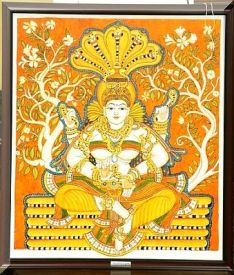
 
11 Comments

Posted by on September 6, 2012 in Sanskrit


Tags: , , , ,

Simple Genius By David Baldacci & The Beal Treasure: New History Of A Mystery By Peter Viemeister

The other day I was reading the popular book Simple Genius by David Baldacci , a story woven around codes , espionage etc. The book itself was rather flatfooted with the author not responding with alacrity to the challenges  thrown at him by the subject. But, it lead me to other books on the subject of codes etc. Among those I found , The Code Book by Simon Singh and The Beal Treasure: New History of a Mystery by Peter Viemeister quite interesting. I wish to write about them separately. Some related websites that I have listed at the bottom of this page too were very engaging.

This blog is mostly about the Beal cipher code and the fascinating stories surrounding it ..

Simple Genius involves ciphers, computers, childhood traumas and the CIA, among other elements. Woven through the evolving relationship between King and Maxwell are forays into classical codes and Internet encryption (factual), Virginia colonial history (slightly fictionalized) and modern-day government operations at Camp Peary, a CIA “farm” on the York River. While the story and characters that Baldacci places at the installation are entirely fictional, the camp itself is not, although “if you call the CIA and ask them about Camp Peary, they don’t admit that it exists.”

To research it, Baldacci went along the river as close to the station as he could, and talked to locals who have lived with its various agencies (it started out as a Navy base) all their lives. One of the most chilling sentences in the book has to do with the unidentified jets that land there: A small-town newspaper editor tells King and Maxwell, “I knew something was up before Gulf One and Afghanistan and Iraq started because that damn runway at Peary looked like Chicago’s O’Hare what with all the traffic going in.” That’s precisely what a local resident told Baldacci—a quote not only stranger but stronger than fiction.

Baldacci’s villains are not the only ones playing games. His books are filled with literary allusions, historical “borrowings,” name games, etc. Simple Genius includes a reprint of the famous Beale Cipher, only one page of which has ever been deciphered—using the Declaration of Independence as the key—and which allegedly leads to a vast treasure buried in Tidewater Virginia. (Baldacci, whose family owns a country place in Bedford County, says he grew up with treasure hunters digging holes all around the area.) And the new edition of Wish You Well has an appendix encouraging readers to begin to track their own family histories. davidbaldacci.com

*****

The stories woven around riddles, codes and treasure hunts have always enthralled me since the time I read Edgar Allen Poe; and that was a long time ago. I tried a few times to break codes , only to be reassured that I not good at that one too. I am far from a passable code breaker. Among the films the subject of ” A Beautiful Mind” based on John Nash’s life that touches on his game theory, a mathematical study of winning games (which led to fundamental changes in economics and political science) interested me much. There were a few other movies based on numbers like Er-dos-Bacon number gamesGood Will Hunting and Proof etc . Among the number riddles ,the stories concerning the proof of Fermat’s last theorem, the best way to stack oranges and such others have fascinated me a great deal.

The Beal Cipher is another of those intriguing stories. It concerns an enormously complicated codes running into three pages and if correctly decoded lead to a treasure worth millions of dollars. The Beal Ciphers could be real or it could an elaborate hoax. In any case, it attained a mythic status. Some well known books have been written about the Cipher. For instance, The Beal Treasure: New History of a Mystery by Peter Viemeister, The Code Book by Simon Singh and Simple Genius by David Baldacci are some of the better known. There are also a number of websites offering to sell solutions to decrypt the code.

Is it a complete hoax, as many claim it? It could be..! Did someone went to great lengths to create an amazingly perplex one? I am not sure . In any case Please read on…

The Beale Treasure Cipher

The story of the Beale ciphers begins in January 1820, when a stranger by the name of Thomas J. Beale rode into the town of Lynch-burg, Virginia, and checked himself into the Washington Hotel.

“In person, he was about six feet in height,” recalled Robert Morriss, the hotel owner, “with jet black eyes and hair of the same color, worn longer than was the style at the time. His form was symmetrical, and gave evidence of unusual strength and activity; but his distinguishing feature was a dark and swarthy complexion, as if much exposure to the sun and weather had thoroughly tanned and discolored him; this, however, did not detract from his appearance, and I thought him the handsomest man I had ever seen.”

Although Beale spent the rest of the winter in Lynch-burg and was “extremely popular with every one, particularly the ladies,” he never spoke about his background, his family and the purpose for his visit. Then, at the end of March, he left as suddenly as he had arrived.

Beale returned two years later, and once again he spent the rest of the winter in Lynchburg and disappeared in the spring, but not before he entrusted Morriss with a locked iron box, which he said contained “papers of value and importance.” Morriss dutifully guarded the box, waiting for Beale to collect it, but the swarthy man of mystery did not return to Lynchburg. He disappeared without trace, never to be seen again.

Eventually, 23 years later in 1845, Morriss’s curiosity got the better of him and working on the assumption that Beale was dead, he cracked open the locked box. Inside he found a note written by Beale in plain English, and three sheets full of numbers. The note revealed the truth about Beale, the box, and the ciphers.

In April 1817, almost three years prior to his first meeting with Morriss, Beale and twenty-nine others had embarked on a journey across America. After travelling through the rich hunting grounds of the Western plains, they arrived in Santa Fe, before heading north in search of buffalo. Then, according to Beale’s note, they struck lucky: “The parties, encamped in a small ravine, were preparing their evening meal, when one of the men discovered in a cleft of the rocks something that had the appearance of gold. Upon showing it to the others it was pronounced to be gold, and much excitement was the natural consequence.”

The note went on to explain that Beale and his men mined the site for the next eighteen months, by which time they had accumulated a large quantity of gold, as well as some silver which was found nearby. In due course, they agreed that their new found wealth should be moved to a secure place, and decided to take it back home to Virginia, where they would hide it in a secret location. To reduce the weight, Beale traded some of the gold and silver for jewels, and in 1820 he traveled to Lynch-burg, found a suitable location, and buried the treasure. It was on this occasion that he met Morriss for the first time.

When Beale left at the end of the winter, he rejoined his men, who had continued to work the mine during his absence. After another eighteen months, Beale revisited Lynchburg with even more to add to his stash. This time there was an additional reason for his trip. His companions were concerned that, in case of an accident to themselves, then the hidden treasure would not find its way to their relatives. Hence, Beale was instructed to find a reliable person, who could be confided in to carry out their wishes in the event of their sudden death, and Beale selected Morriss to be that person.

Upon reading the note, Morriss felt responsible for finding the treasure and passing it onto the relatives of the presumably dead men. Unfortunately, there was a problem. The description of the treasure, its location, and the list of the relatives had been encrypted, and had been transformed into the three sheets that contained nothing but numbers. Beale’s note said that the key required to decipher the sheets would be posted to Beale by a third party, but it never materialized, and so Morriss was forced to unscramble the three sheets from scratch. This task occupied his mind for the next twenty years, and ended in complete failure.

In 1862, at the age of 84, Morriss knew that he was coming to the end of his life and realized that he had to share the secret of the Beale ciphers; otherwise any hope of carrying out Beale’s wishes would die with him. Morriss confided in a friend, but unfortunately the identity of this person remains a mystery. Only two things are known about Morriss’s friend. First, he published a pamphlet, which contains the entire Beale story, including the Beale ciphers and Morriss’s account of the events surrounding the mystery. Second, the anonymous pamphleteer made the first breakthrough in deciphering one of Beale’s cryptic papers.

The second Beale cipher, like the other two, contains about 800 numbers, beginning with the sequence; 115, 73, 24, 807, 37, … The pamphleteer guessed that each number corresponded to a word in the Declaration of Independence. For example, the first number in the sequence is 115 – the 115th letter of the Declaration is ‘instituted’, which begins with the letter I. Hence the first number, 115, represents the letter I. The second number in the sequence is 73 – the 73rd word in the Declaration is ‘hold’, which begins with the letter H. Hence, the second number, 73, represents the letter H.

The Opening of the “Declaration of Independence”

When 1, in 2 the 3 course 4 of 5 human events it becomes

necessary 10 for one people to dissolve the political bands

which have 20 connected them with another, and to assume

among the powers 30 of the earth, the separate and equal

station to which 40 the laws of nature and of nature’s God

entitle them 50, a decent respect to the opinions of mankind

requires that 60 they should declare the causes which impel

them to the 70 separation. We hold these truths to be self-evident,

and that 80 all men are created equal, that they are endowed

by 90 their Creator with certain inalienable rights, that among

these are 100 life, liberty and the pursuit of happiness; That

to secure 110 these rights, governments are instituted among men


By continuing this process, the pamphleteer revealed the following message from Beale:

“I have deposited in the county of Bedford, about

four miles from Buford’s, in an excavation or vault,

six feet below the surface of the ground, the

following articles: … The deposit consists of two

thousand nine hundred and twenty one pounds of

gold and five thousand one hundred pounds of silver;

also jewels, obtained in St. Louis in exchange for silver

to save transportation … The above is securely packed

in iron pots, with iron covers. The vault is roughly lined

with stone, and the vessels rest on solid stone, and are

covered with others …”

The lack of success means that we cannot exclude the possibility that the Beale ciphers are an elaborate hoax. Skeptics have searched for inconsistencies and flaws in the Beale story. For example, Beale’s letter enclosed in the box with the ciphers written in 1822, but it contains the word stampede”, which was not seen in print until 1844. However, it is quite possible that the word was in common usage in the Wild West at a much earlier date, and Beale could have encountered it on his travels.

Evidence in favor of the probity of the ciphers comes from historical research, which can be used to verify the story of Thomas Beale. Peter Viemeister, searched for evidence to prove that Thomas Beale existed. Using the census of 1790 and other documents, Viemeister has identified several Thomas Beales, who were born in Virginia and whose backgrounds fit the few known facts. Most of the details we have about Beale concern his trip to Santa Fe and there is evidence to corroborate his discovery of gold.

For example, Jacob Fowler, who explored the American southwest in 1821-22, noted in his journal that the Pawnee and Crowe tribes “speake on the most friendly terms of the White men and Say they are about 35 in number” – this number is similar to the size of Beale’s party. Also, there is a Cheyenne legend dating from around 1820 which tells of gold and silver being taken from the West and buried in Eastern Mountains?

Consequently, the tale of the Beale ciphers continues to enthrall code breakers and treasure hunters. However, anybody who might be tempted to take up the challenge of the Beale ciphers should take heed of some words of caution given by the author of the pamphlet:

Before giving the papers to the public, I would give them a little advice, acquired by bitter experience. It is, to devote only such time as can be spared from your legitimate business to the task, and if you can spare no time, let the matter alone … Never, as I have done, sacrifice your own and your family’s interests to what may prove an illusion; but, as I have already said, when your day’s work is done, and you are comfortably seated by your good fire, a short time devoted to the subject can injure no one, and may bring its reward.”

Regardless, there have been many attempts to break the remaining cipher(s). Most attempts have tried other historical texts as keys (eg. the Magna Carta, various books of the Bible, the U.S. Constitution, the Virginia Royal Charter, etc), assuming the cipher texts were produced with some book cipher, but none have been recognized as successful to date. Breaking the cipher(s) may depend on random chance (as, for instance, stumbling upon a book key if the two remaining cipher texts are actually book ciphers); so far, even the most skilled crypt-analysts who have attempted them have been defeated. Of course, Beale could have used a document that he had written himself for either or both of the remaining keys, thus rendering any further attempts to crack the codes useless.

Resource :

 http://www.simonsingh.net/Beale_Treasure_Ciphers.html

http://www.simonsingh.net/Cryptograms.html

 *************************

To find out more about codes and ciphers, visit the following . I found them very interesting:
http://www.simonsingh.net/home.html

https://www.securetrust.com/resources/cryptography-history/

http://en.wikipedia.org/wiki/Beale_ciphers

http://www.simonsingh.net/Crypto_Links.html

**************************************************************

In case you do not believe any of what I wrote above , please check Beale Ciphers Analyses by Ron Gervais :http://www.angelfire.com/pro/bealeciphers/index.html

It says it provides a Freeware, analyses, and links to websites presenting hypotheses of the Beale Ciphers, including a summary of their arguments. The objective is to fill a void: a repository of serious efforts to study and analyze the ciphers.

 
Leave a comment

Posted by on September 6, 2012 in Books


Valid knowledge in Indian thought

The correct or the valid knowledge in Indian thought is called prama which stands for awareness of a thing as it really is and that which is free from misapprehension . The Indian thought is therefore concerned with what generates correct knowledge as also with what generates incorrect knowledge. The incorrect or invalid knowledge is called aprama or bhrama.

The sources of correct knowledge are known as pramana . It is a method , a device to verify the truth of a piece of knowledge that is acquired. It is largely a method of deduction but at times has room for intuition. Each school of thought adopted its method of cognition, pramana. The differences among the schools were more in their emphasis and on their perception of truth ratherthan in the methods they employed. For instance , Samkhya defined truth as the mode of agreeing entirely with the object .The Nyaya school thought that truth must be effective and should lead us to the desired object. Utility , according to them , was the criterion of truth. Vedanta , on the other hand , defined truth as that which was free from contradictions.

Valid knowledge , in general , emphasizes objectivity. Consistency in time and space is a necessary feature of Valid knowledge. What contributes to such knowledge is pramana . The purpose of pramana is to define its object clearly , specifically and to illuminate the object. It does not however generate a new fact but it brings forth experiencing a fact as it actually is. The pramanas , however , have their own limited fields of operation ; their validity is restricted to what they can possibly reveal. That perhaps explains the multiplicity of methods employed to verify ones experiences.

Charvakas accepted only one source of valid knowledge , viz. sense perception or direct observation (pratyaksha). Charvakas were strictly empirical and dismissed subjective experiences beyond sensations as being irrelevant. The Vaisheshikas considered deductive analysis or reasoning ( anumana , inference) as an additional method. They explained the nature and characteristics of the physical world by employing the first method pratyaksha but introduced the element of soul by inference. The Buddhists too relied heavily on inference . The Samkhya thinkers said that in addition to sense-perception and inference , the verbal testimony Sabda (which included scriptural testimony) could also be a means of valid knowledge . The Samkhya being essentially atheistic confined Sabda to mean unerring authority (aaptavacana) in matters pertaining to daily life.

The Nyaya school was essentially logistic in its orientation. It tried to examine the sources and contents of valid knowledge. It built a logical link between the subject , the knower(pramata) ; the means or method of obtaining knowledge (pramana) ; and the object , the knowable (prameya) . In addition , it put forth analogy (Upama) as the fourth method . Analogy , it said , comprehensively included in itself the other three methods. Analogy was , however , not an altogether new method . The Samkhya classified analogy under verbal testimony which in turn was included under inference. Nyaya however assigned an independent status to the method of analogy.( For more on Nyaya please see Nyaya a scheme of logic )

The Mimamsa school added two more methods Viz. presumption (arthapatti) and non-apprehension (abhava). Presumption , the Mimamsakas said , comes in handy when direct-sense perception, inference, verbal testimony or comparison do not directly help . The other line abhava or non-apprehension is a method to ascertain the non-existence of a thing. It too was treated as an independent and a positive process of knowing a thing.

Vedanta accepted all the six methods as means’s for acquiring valid knowledge.

*****

It does not mean that one school or the other employed a particular method to the exclusion of all the other methods . Each of the methods had its own sphere of functioning; each supplemented the other ; and together contributed to the empirical knowledge of an object. Very often , a school of thought employed all the methods but laid emphasis on a particular method depending on the orientation of that school. For instance , the first four schools (Charvaka, Nyaya, Vaisheshika and Samkhya) relied heavily on argumentation and were therefore described as “ reason-dominant (yukthi-pradhana) “.

Of the six methods, the ones that were directly employed were the sense-perception (observation) , inference (deductive reasoning) and scriptural authority ; while presumption and non-apprehension were clubbed under inference. And here again, inference by definition was guided by sense-perception. Thus , observation and scriptural authority stood out as the only two independent methods.

It was however around Sabda the scriptural authority that differences sprang up among the various schools .Mimamsakas put undue stress on scriptural authority , by which they meant the authority of the Vedas which they declared were eternal and therefore infallible. They subordinated every other method of cognition to authority of the Vedas ( particularly to the authority of the Brahmana portions) . Samkhya and Nyaya schools , in contrast , refused to accept the Vedas as the sole source of scriptural authority . They said the words of any trustworthy person (aptha) could be considered a source of valid knowledge and the Vedas could be one such. The Vaisheshika and the Nyaya school to a certain extent , refused to accept the divine origin of the Vedas but admitted the Vedas as one among the valid scriptural authority. The Buddhists went a step further; they rejected the divine origin of the Vedas and refused to accept the Vedas as a source of valid knowledge.

The Vedanta took a rather an intermediate position. It accepted the authority of the Vedas but tilted towards its informative passages viz. the Upanishads , almost to the exclusion of its ritualistic portions. Further , it said , sense -perception acts as a guide for the world while scriptures help to appreciate the significance of the reality . Vedanta therefore recommended a combination of scriptures (sruthi) and reason (yukthi or tarka). The debate on the undisputed authority of the Vedas and its authorship was , in a way , sidetracked.

adisankarar_image

The genius of Sri Sankara was that he rose above the apparent contradictions and charted a new path of reason and intuition.

He did not regard the scriptures either as eternal or immutable. He accepted the scriptures but conceded it a limited authority . “ In inquiries concerning religious conduct it may be that the scripture is the sole authority . But it cannot be so in our investigation into reality . Here , scriptures as well as other sources of knowledge such as phenomenal experience become valid , according to necessity. For , after all , the purpose of such investigation is to end in transcendental experience and to inform us about reality” (VSB 1,1 ,2) .

He said when the meaning of the scripture was not clear or when there were apparent contradictions , one must rely on reason . He also cautioned that reason can often be barren (sushka tarka) when it was devoid of intuition . He spoke of the value of reason blessed by intuition that becomes a part of ones experience.

According to Sri Sankara , no method is valid if it is contradicted by other methods. Each method is valid inasmuch as it makes known what is not made known by other methods. For instance , Intuition becomes suspect when it is contradicted by reason ; similarly reason is futile if not supported by intuition. The two have to compliment each other. He declared, “Intuition is not opposed to intellect. Reality is experience. Realizing the Supreme Being is within ones experience”.

Sri Sankara placed personal experience , common as well as extraordinary , above all the other methods of cognition . He gave credence to an individual’s subjective experience. He said that if the scriptures say things that contradict our perceptional experience , then they loose their credibility. “ Even a hundred scriptural passages will not become authoritative when they , for instance , announce that fire is cool or dark”(VSB 43,14).

Among the misconceptions that have grown around Sri Sankara, the persistent and the most erroneous one is that he regarded world as an illusion. It is a gross misrepresentation of Sri Sankara . He accepted the phenomenal reality of the world. He gave credence to an individual’s subjective experience in the world. He said that individual’s experience cannot be disputed, because the experience he went through was real to him; though that might not be real from the absolute point of view .Sri Sankara drew a distinction between the absolute view (para_marthika )and the relative view(vyavaharika) of things.

Sri Sankara explained that vyavaharika (relative) and para_marthika (absolute) are both  real. However, that relative reality is “limited” in the sense it is biologically or mechanically determined and is subject to contradictions. The absolute on the other hand is beyond contradictions. By “absence of contradiction “ (badha-rahithyam), he did not refer merely to the earlier knowledge being contradicted by later knowledge, but also to the experiences at one plane of reality being contradicted by those at the other plane. Sri Sankara was careful to point out that the two dimensions – Vyavaharika and Paramarthika– are two levels of experiential variations. That does not mean they are two orders of reality. They are only two perspectives. Whatever that is there is there ; and That (tat) is REAL and is not affected by our views one way or the other.

Sri Sankara said the methods of cognition such as sense-perception and inference are dependent on sense organs , which in turn function within the ambit of body-consciousness. The Self cannot be regarded as a subject (knower , employing a method) and unless there be a subject it is meaningless to speak of a method. Therefore all methods , including scriptures , have only phenomenal relevance.

Thus , in a very real sense , all the methods of cognition are relevant only in the phenomenal, vyavaharika (relative) context of the world that we live in . All those methods cease to be authentic beyond the relative existence.

Reality is experience (anubhava). Realizing the Supreme Being is within ones experience.

vedic-om

Indebted to

Prof.SKR Rao

 
4 Comments

Posted by on September 6, 2012 in Indian Philosophy, Nyaya


Tags: ,

Nyaya: a scheme of logic in Vedanta,

Nyaya is a method or a scheme of logic employed to prove or to disprove a proposition. Several types of Nyaya are employed in the texts of the Vedanta. The employment of a Nyaya becomes necessary when the subject discussed is either vague or is disputed; and when the other methods of reasoning are ineffective.

Nyaya is an illustration, model or a metaphor. It formulates in a nutshell an entire argument. It epitomizes a whole viewpoint. The merit of a Nyaya is that it is derived from common experiences in daily-life. It is therefore easier to relate to the Nyaya and its purport. The popular ancient readers such as PanchatantraHithopadeshaataka tales and Jain fables are treasure houses of Nyayas.

While the analogy or illustration is important (as in Rajju-sarpa, Sukthi- Rajatha or Rekha-gavaya-nyaya etc.); the more important than that is the validity of the argument, its methodological precision and its import. The more popular Nyayas in Vedanta are Adhyaropa Apavada and Prasajya-Prathisedha.

For instance, the Adhyaropa-Apavada attempts to prove its theory of transformation (Vivarta) in the phenomenal world. It effectively draws upon the Rajju-sarpa illustration. The rope’s appearance as a snake is not a mere Illusion. It involves a psychological process of transformation and projection while the physical object remains unaltered. The snake seems to emerge out of the coil of rope, in semi darkness; and dissolves into it when light is brought in.

The snake, in reality, was never present. The rope as a physical reality was ever present; even while the snake appeared in its place. Nevertheless, the snake could not have appeared in the absence of a physical foundation. It is therefore not a total illusion (alika).The snake-status is a superimposition or an assumption (Adhyaropa); and its subsequent annulment is withdrawal (Apavada).

The models equivalent to the above are the Sukthi-Rajatha, Shell and Silver analogy, the Akashanilima-Nyaya (blue sky) and the Stambha-Nara-Nyaya (Man in the post). The mother-of-pearl is mistaken for pure silver, the attribute -less sky appears blue, and the stump of wood is mistaken for a man at night. The unreal status is superimposed on the actual and is later withdrawn. The knowledge of the world is an appearance of Brahman, just as the man in the stump is only an appearance of the stump, and the silver in nacre an appearance of nacre.

There are a number of other Nyayas employed as metaphors, models and analogies to illustrate certain points of view. The following are a few of them.

There is a Nyaya called Rekha-gavaya-nyaya. An urban person had not seen a wild Bison. A forester draws a picture of the Bison (gavaya) and the townsman takes the very drawing for the animal .When on a later occasion, he visits the forest and sees the real animal, it dawns on him that the drawing and the animal are two different things.

Similarly, in Aksharajnana-nyaya the teacher marks on the paper with ink and asks the child to recognize in them alphabets and numbers. The child learns to recognize those forms and later, in a way, learns to de-code the symbols to understand and recognize the things and values they stand for.

These two Nyayas are employed to explain that scriptures describe the Absolute as the creator of the phenomenal world and attribute several traits like “truth”, ”knowledge”, ”bliss” and “infinity” etc. to the Absolute which is without any attributes. The seeker later learns and realizes the true nature of the Brahman.

The Samudrataranga-Nyaya illustrates that the countless waves rolling in the vast ocean are one and the same and are not separate from each other or from the great ocean. All are one, in reality. The difference is only apparent. The innumerable Jivas , though apparently perceived to be separate from one another are , in reality , one .

Oornanabhi-Nyaya, just as the spider brings forth the thread from its mouth to weave its web and withdraws it again into its mouth; this world is projected forth by Brahman and then again withdrawn by Brahman. The world is nothing but the Being of Brahman. And, Brahman alone is reality.

Ghatakasha-Nyaya, this is the analogy of space in a pot which is the same as the space pervading the universe (Mahakasha). When the pot is broken, the apparent distinction vanishes. Similarly, when the body and mind are broken, the embodied jiva becomes one with the Brahman.

Arundathi Nyaya is derived from the practice of showing the Arundathi star to the new bride. As the star is very faint and not easy to sight she is gradually led from the nearby brighter stars step by step to the Aundathi star. This underlines the principle of leading from gross to the subtle, from general to the particular and from known to the unknown.

For more on Nyayas please visit
http://www.dlshq.org/download/vedbegin.htm . 

***
The models employ something that is already familiar in order to explain certain concepts that are at once abstract and real. Let me mention that these analogies are not perfect. They have their limitations and are brittle at times; and if pressed too hard they might crumble .There cannot be a perfect analogy; and argument is not evidence. Its purpose is to illustrate. The models attempt to represent something that which cannot be perceived. Nyaya is the finger and not the moon. Therefore, there is always an element of inadequacy. One has to strive to extract from the model what is called “a positive analogy”. The notion of transformation (Vivarta) is thus what one could call a logical construction.

Nonetheless, the value of these Nyayas consists in that they facilitate a passage from the observable to the actual and from the factual to the theoretical .Sri Shankara’s merit is in the consistent interpretations he provides to an axiomatic system that the Upanishads provided. And in doing so he contributed significantly to the Indian theory -formation.

divider

Indebted to Prof.SRK Rao

 
Leave a comment

Posted by on September 6, 2012 in Indian Philosophy, Nyaya


Tags: ,