RSS

Monthly Archives: September 2012

Bharata’s Natya-Shastra – some reflections

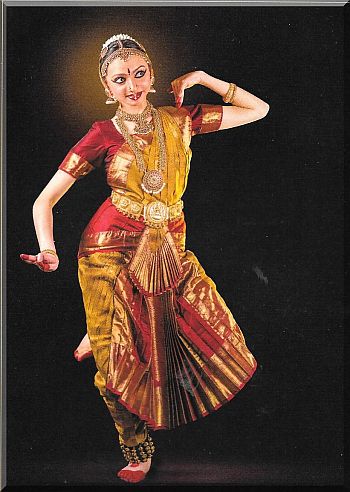
Nayana dutta2

1. Natya-Shastra is a detailed compendium of technical instructions about the performing arts. It was meant as a practical manual for  production of successful theatrical performances, which included music and dance as well as acting. It was also intended as a guide to the poet and to the performer, alike. 

As Prof. Adya Rangacharya stated in his The Natyasastra: English Translation with Critical Notes

The eminence of the Natyasastra lies not merely in the fact that it was the first book on the subject on theatrical art; but that, it was the first comprehensive treatise on Dance, Drama and Music;  and , it marks  the origin of our dramatic tradition. It laid down the essentials of the Drama as a representation of the ways of the world; the nature and attitudes of the people; their ways of behavior and manners of speech. It also provided a framework for the Drama by highlighting its essential ingredients: 

(1) a playwright who has vision to the grasp of things and has the capacity to articulate that in an interesting way, through speech and action;

(2) the story that holds the attention of the audience;

(3) a virtuoso director  who can transform a script into a dramatic performance;

(4) the set of  skilled artists with clarity of speech and endowed with talent to give form and substance to the dream of the playwright and the vision of the director;  and , not the least ,

(5) the perceptive ,  intelligent  and   cultured spectators  who appreciate and enjoy a good  performance.

1.1. The text is in the form of elaborate dialogues between the author and a group of Munis , sages who wished to know about Natya-Veda, the knowledge of the performing arts such as dance, music and dramaThe author, in response, presents a detailed inquiry in to the various facets of drama including its nature; its origin; its theories; techniques of the theater with all its components of speech, body-language, gestures, costumes, décor and the state of mind of the performers, apart from rituals, architecture of theater etc.

Written in archaic form of Sanskrit, the text consists about six thousand (5,569 – to be exact) sutras or verse-stanzas spread over thirty-six chapters. Some passages are in prose.

Because the Natyasastra has about 6,000 verses, the text is also known as Sat-sahasri. The later authors and commentators (Dhanika, Abhinavagupta and Sarada-tanaya) refer to the text as Sat-sahari; and, its author as Sat-sahasri-kara.

But, the text having 6,000 verses is said to be a condensed version of an earlier and a larger text having about 12,000 verses (dwadasha_sahasri). It is said; the larger version was known as Natya- agama and the shorter as Natya-shastra.

Please click here for The Natyasatra – A treatise on Hindu Dramaturgy and Histrionics Ascribed to Bharata Muni; Translated into English by Manmohan Ghosh;  Published by Asiatic Society of Bengal, Calcutta – 1951]

2. Though the  Natya-Shastra speaks of theater (natya), it actually encompasses all forms of art expressions. The text, in fact, claims that there is no knowledge, no craft, no lore, no art, no technique and no activity that is not found in Natya-Shastra (1.116).

न तज्ज्ञानं न तच्छिल्पं न सा विद्या न सा कला । नासौ योगो न तत्कर्म नाट्येऽस्मिन् यन्न दृश्यते ॥ ११६॥

The reason that theater-arts were discussed specifically, is that, in the ancient Indian context, drama was considered the most comprehensive form of art-expressions. Further, at the time the Nataya Shastra was compiled, the arts of poetry, dance, music and drama; and even painting, sculpture and architecture were not viewed as separate and individualized streams of art forms. Natyashastra presented  an integral vision of art, which blossomed in multiplicity.

It was only during the later periods these art-forms developed into independent art-expressions. Similarly, even the other minor forms of Drama , such as: Opera, Poetic-drama, realistic plays and so on, later evolved and grew apart, assuming independent identities.

[Vishnudharmottara (Ca. sixth century) asserted that painting and sculpture without the knowledge of the Drama and the Dance would not have much depth; and, that Drama and Dance, in turn, do require a knowledge of music and of the songs, which again is dependent on mastery over languages – both Sanskrit and Prakrit – with a thorough understanding of the elements of prose, poetry, grammar, meter, prosody etc. It thus underlines the interdependence of the arts.]

All art expressions were viewed as vehicles of beauty, providing both pleasure and education, through refinement of senses and sense perceptions. The object of the drama was to show men and women the proper way to live, a way in which one could live and behave, so that one might be a still better person.

“A play shows your actions and emotions. Neither gods nor demons are depicted as always good or always evil. Actually, the ways of the world as represented here are not only of the gods but also of yours. It gives you good advice; it gives you enlightenment and also entertainment. It provides peace of mind to those who afflicted with miseries, sorrow, grief or fatigue. There is no art, no knowledge, no yoga, and no action that is not found in Natya .”- (Natya-Shastra 1: 106=07; 112-16)

na taj jñānaṃ na tacchilpaṃ na sā vidyā na sā kalā । nāsau yogo na tatkarma nāṭye’smin yanna dṛśyate ॥ 116॥

[ Kalidasa remarked : ‘Drama, verily, is a feast that is greatly enjoyed by a variety of people of different tastes

– Natyam bhinnaruchir janasya bahuda-apekshym samaradhanam. ]

Bharatha explains: when the nature of the world possessing pleasure and pain both is depicted by means of representations through speech, songs, gestures , music and other (such as, costume, makeup, ornaments etc ) it is called Natya. (NS 1.119)

yo’ya  svabhāvo lokasya sukha dukha samanvita som gādya abhinaya ityopeto nātyam ity abhidhīyate 119

Thus, according to Bharata, the Drama is but a reflection or a representation of the actions of Men and women of various natures (Prakrti) – avastha-anikrtir natyam . That is to say; the Drama, in its various forms of art, poetry etc , strives to depict the infinite variety of human characters .

That is the reason; Bharata says, one should study the various human habits and natures (Prakrti) on which the art of Drama is based.  And, for which the world, the society we live in is the most authoritative source of knowledge (Pramana) . All those involved with the Drama should realize this truth – (NS: 25.123)

Nana-sheelah prakutyah  sheele natyam pratihitam / tasma-loka-pramane hi vigneyam natya yo krubhihi // (NS: 25.123)

Having said that; the theater was conventional; yet, imaginative. The costumes and make up were stylized and symbolic; and, not what is commonly seen on the city-streets. In any case, Natyashastra requires a performer to present much more than an external representation of the character, such as correct speech, gesture etc.  His/ her stage performance will have to go far beyond technical skill, in order to be believable and accepted by the spectators.

There is, however, not much discussion about scenery; perhaps because scenery was used sparingly.

Theater had a sacred significance. Prayers and rituals were conducted and the stage was consecrated before the commencement of the play ( Purvanga) .

*

Natyashastra (6.10) provides a comprehensive framework of the Natya-veda, in a pellet form, as the harmonious combination (sagraha) of the various essential components that contribute towards the successful production of a play.

Rasā bhāvāhya abhinayā dharmī vtti pravttaya siddhi svarās tathā atodya gāna ragaśca sagraha 6.10

Bharata also mentions the five elements of the plot (artha-prakrti) of the Drama as :

  1. the seed (Bija);
  2. the expansion or the intermediate point which links to the next (Bindu);
  3. the episode (Pataka);
  4. the incident in the episode (Prakari) and
  5. the dramatic outcome (Karya).

These are to be used according to the main Rasa of the play and the prescriptions of the Shastra.(NS: 19.21)

Bijah Bindu Pataka cha Prakari  karyameva cha / Artha-prakrutyah pancha tatva yojya tata vidihi // (NS:19.21)

As regards the success of the play (Siddhi), it is said,  the successful production (Siddhi) of a play enacted on the stage (Ranga) with the object of arousing joy (Rasa) in the hearts of the spectators involves  various  elements of the components of  the actors’ gestures, actions (Anubhava) and speech (vachika); bringing forth (abhinaya) their intent, through the medium of  theatrical (natya-dharmi) and common (Loka-dharmi) practices; in four styles of representations (Vritti-s) in their four regional variations (pravrttis) ; with the aid of  melodious songs  accompanied by  instrumental music (svara-gana-adyota).

The assembly of spectators with different tastes and levels of appreciation should all be able to enjoy the play. Therefore, Bharata instructs that a play should be such that it caters to the interests and dispositions of varied class of men and women; the young and the old, with each class looking for its own favorite type of entertainment . And, it is upon such versatile ability that the success of a play depends. The play-production, thus, was aimed to satisfy the happy, responsive spectators and enthuse them to visit the theater more often. 

Bharata, in a way, sums up the virtues and merits of Nataka , a dramatic work, that captivates the hearts of the spectators and brings glory to its playwright , producer and the actors .

The work of art that satisfies all classes of spectators ; and is a happy and enjoyable composition, which is graceful on account of being  adorned with sweet and elegant words; free from obsolete and obscure meaningless verbose ; easily grasped and understood by the common people ; skillfully arranged ; interspersed with delightful songs and dances; and,  systematically  displaying varied types of sentiments  in its plot devised into Acts, scenes, junctures etc.

mdu-lalita-padārthaha-śabdārtha-hīna ;   budha jana sukha bhogya,  yuktiman – ntta-yogyam bahu rasa kta mārga , sandhi-sandhāna-yukta  bhavati  jagati  yogya  nāaka  prekakāām 16.130

***

Bharata elaborates (NS.27.57-61) :

The young are keen on the portrayal of love; and, those after money relish scenes depicting acquisition of wealth. And, the ones who love adventure delight in the terrible and odious acts of battle and combats; whereas the old and pious always praise the enactment of well known tales and legends from the Puranas  (epics) lauding the virtues and good deeds ; the devout look for philosophical and religious aspects ; and, those disinterested in the mundane seek liberation (moksha) .  The common folks, the women, children and the dimwitted lap up with relish comic situations evoking laughter and fun, attractive costumes and make up.

Apart from these types, Bharata also mentions an elite class of appreciative spectators with refined tastes and deep interest in the technical aspects of production. Such connoisseurs were also aware of the theatrical traditions and conventions of performance on the stage. These were the well-informed class who cared more about the aptness of the techniques of performance, critically evaluated the merits (guna) , the defects (dosha)  and the success of the theatrical performance as a whole.

Then, there were also the artists specialized in different branches of music and dance; the scholars who relished subtle nuances in the rendering of speech and the lyrics of the songs; and, there were the accomplished courtesans who were experts in presenting alluring and  delectable performances .

All such elite class were the cream of spectators, for whose approval and appreciation the whole of theatrical group collectively and individually looked forward with great hope and fear.

The producer of the Drama had also the onus to please the patron who sponsored and financed the play –production and display.

Nānāśīlāḥ praktaya śīle nāya vinirmitam uttamā-adhama madhyānā vddha bāliśayo itām 57

Tuṣyanti taruā kāme vidagdhā samayātvite arthevarthaparā ścaiva moke cātha virāgia 58

Śūrāstu vīra raudreu niyuddhevāhaveu ca dharmā akhyāne  purāeu vddhā stuyanti nityaśa 59

Na śakyamadhamairjñātumuttamānā viceṣṭitam tattva bhāveu sarveu tuyanti satata budhā 60

Bālā mūrkhā striyaścaiva hāsyanaipathyayo sadā yastuṣṭo tuṣṭimāyāti śoke śokamupaiti ca 61

Abhinavagupta observes Drishta-phala [visible fruits] like banners (pataka) or material rewards do not indicate success of a play production. Real success is achieved when the play is performed with skilled precision, devoted faith and pure concentration. To succeed, the artist must immerse the spectator with pure joy of Rasa experience. The spectator’s concentrated absorption  appreciation and enjoyment is indeed the success.

Dhananjaya in his Dasarupaka remarks that responsive spectators, fired by enthusiasm and imagination, contribute to the success of the play in the manner of ‘children playing with clay elephants ‘. ” When children play with clay-elephants, etc., the source of their joy is their own utsaha (enthusiasm). The same is true of spectators watching  and almost sharing  the heroic deeds of  characters , say  like, Arjuna and other heroes on the stage.”…… 

Kridatam mrnrnayair yadvad balanam dviradadibhih / svotsahah svadate tadvac chrotrnam Arjunadibhih.

**

2.1. The text employs Natya as a generic term, which broadly covers drama, dance and  music. It does not treat dance as a separate category of art form. Bharata while dealing with Angika-abhinaya (body-language) speaks of nrtta, pure movements that carry no meaning- as compared to Abhinaya (literally meaning that which carries the meaning forward towards the audiencei. e. gestures that convey specific meaning. Nrtta was, in fact, meant to provide beauty, grace and a certain luster to the performance. The postures of the nrtta (called karanas) were classified by Bharata as tandava and sukumara, to convey vigor and grace.

[ Nandikeshwara (perhaps a later author who, for some reason, assumed the name of an ancient figure/person ?), author of Abhinaya_darpana, is believed to be the first to recognize dance as an independent art. He called it natanam; and classified it into nrtta (Pure dance), nrtya (abhinaya – expression- aspectand natya (combination of nritta and nrtya with a dramatic element to it).

Dhananjaya in his Dasarupa, while drawing a  distinction  between nrtta and nrtya , explains the term  nrtta as that which  depends on rhythm and tempo – nrttam tala-layam ashrayam (DR. 1. 13) ; and,  nrtya as  that which is dependent on emotion – Bhava-ashrayam nrtyam (DR. 1. 12).

As mentioned earlier, Nandikeshwara explained Natya as the combination of nrtta and nrtya .]

3.1. It is said that the text which we know as Natya-Shastra was based on an earlier text that was much larger. And, many views presented in Natya-Shastra are believed to be based on the works of other scholars. There are frequent references to other writers and other views; there are repetitions; there are contradictory passages; there are technical terms, which are not supported by the tradition.

[ It appears there were texts on Drama even much prior to Natyashastra. Panini (Ca.500 BCE) the great Grammarian, in his Astadhyayi (4.3.110-11), mentions two ancient Schools  –  of Krsava and Silalin – that were in existence during  his time – 

Parasarya Silalibhyam bhikshu nata-sutreyoh  (4.3.110); karmanda krushas shvadinihi  (4.3.111).

It appears that Parasara , Silalin , karmanda and Krsava were the authors of Bhikshu Sutras and Nata Sutras. Of these , Silalin and Krsava  were said to have prepared the Sutras (codes) for the Nata (actors or dancers). At times, Natyashastra refers to the performers (Nata) as Sailalaka -s  . The assumption is that the Silalin-school , at one time,  might have been a prominent theatrical tradition. Some scholars opine that the Nata-sutras of Silalin (coming under the Amnaya tradition) might have influenced the preliminary part (Purvanga)  of Natyashastra , with its elements of worship (Puja).

However, in the preface to his great work Natya-shastra of Bharatamuni (Volume I, Second Edition , 1956) Pundit M. Ramakrishna Kavi mentions that  in the Natyavarga of Amara-kosha (2.10.12) there is reference to three  schools of Nata-sutra-kara : Silalin ; Krasava; and,  Bharata .

 Amarakosha

It appears that in the later times,  the former two Schools (Silali and Krasava) , which flourished earlier to Bharata , went out of existence or merged with the School of Bharata; and, nothing much has come down to us  about these older Schools. And, it is also  said, the Bharata himself was  preceded  by  Adi-Bharata, the originator and Vriddha (senior) Bharata.  And, all the actors of whatever earlier Schools, later came to be known as Bharata-s. ]

3.2. These factors lend support to the view that Natya-Shastra might have been the work of not one single author but of several authors, spread over a long period of time.

Ms. Kapila Vatsyayan, a well known scholar, however, observes that the text projects an integrated vision and   a unity of purpose. She points out many instances of reference to later chapters in the text, and says they are indicative of the coherent and well knit organic nature of the work. 

For those reasons, she concludes, Natya-Shastra might well be considered as the work of a single author or of a single tradition.

4.1. Rasa, as discussed in Natyashastra, meant aesthetic appreciation or the joy that the spectator experiences.  As Bharata says , Rasa  should be relished  as an emotional or intellectual  experience : na rasanāvyāpāra āsvādanam,api tu mānasa eva (NS.6,31) .

The yashāstra states that the goal of any art form is to invoke  such Rasa.

[Bharata explains Rasa  as an experience that can be relished – like the taste of food – Rasyate anena iti rasaha (asvadayatva), which is associated with palate (ability to distinguish between and appreciate different flavors) . Yet ; the aesthetic senses that are primarily engaged with a theatrical presentation  are only the eye and the ear. The senses of taste, touch and smell are not , generally, associated with   the type of ones experience that Bharta talks about  while witnessing a Drama. These are personal or individual experiences. But, Rasa, the aesthetic experience enjoyed by all the spectators , in a play, in common, is mainly through two senses : the eye and the ear. That , perhaps , is the reason why Bharata says that the Rasa in a play should be relished only as an emotional or intellectual experience.]

Bharata’s theory of Rasa was crafted mainly in the context of the Drama.    After naming the eight Rasas, he says ‘these are the Rasas recognized in Drama’nāṭye rasāḥ smṛtāḥ – (N.S 6.15).  

śṛṅgāra-hāsy-akaruā raudra-vīra-bhayānakā bībhatsa-ādbhuta-sajñau cetyaṣṭau nāye rasā sm 15

In the prose-passage following the verse thirty-one of Chapter six, Bharata commences his exposition of Rasa, saying: I shall first explain Rasa; and, no sense or meaning proceeds without Rasa (Na hi rasa-adrate kaschid-arthah pravartate).

tatra rasāneva tāvadādāvabhivyākhyāsyāma na hi rasādte kaścid artha pravartate

He , then  focused on the dancer’s or actor’s performance and effort to convey the   psychological  state , which the character is experiencing , to the spectator, in order to create  Rasa – the aesthetic appreciation or enjoyment of the art – in the heart and mind of the spectator.

The famous Rasa-sutra or basic “formula”, in the Nāyashāstra, for evoking Rasa, states that   the vibhāva, anubhāva, and vyabhicāri bhāvas  together produce Rasa:  tatra vibhāvā-anubhāva vyabhicāri sayogād rasa nipatti 

Bharata elaborated the process of producing  Rasa in terms of eight Sthayi Bhavas – the principle emotional state of the character expressed by the performer  with the aid of Vibhava (the cause) and Anubhava (the enactment)  ; thirty-three Vyabhicāri (Sanchari) bhāvās – the transient emotions; and, eight  Sattivika-bhavas – the involuntary physical reactions.

Among these Bhavasthe more important  ones are said to be vibhāva and anubhāva , which  invoke the Sthāyi bhāva, or the principle emotion at the moment. Such elements that are employed to convey the psychological state of the character, thus, in all, amounted to forty-nine or more. 

[The Sattvika , the involuntary–reflexes (such as being stunned, going pale , stammering, shedding tears etc.,)  were perhaps meant to introduce a realistic style of acting – suited to the situation as also to the nature, psychological state and the social standing of the character , as compared to the purely conventional style .]

It is explained; they are called Bhavas because they happen (Bhavanti); they cause or bring about (Bhavitam); and, are felt (bhava-vanti). Bharata explains that  Bhavas  effectively bring out the dominant sentiment of the play – that is the Sthāyibhāvā – with the aid of various Bhavas , such as words (Vachika), gestures Angika), costumes ( Aharya) and bodily reflexes (Sattva) – for the enjoyment of the good-hearted spectator (sumanasaḥ prekṣakāḥ) . Then it is called the Rasa of the scene (tasmān nāṭya rasā ity abhivyākhyātāḥ).

Nānā bhāvā abhinaya vyañjitān vāg aṅga sattopetān / Sthāyibhāvān āsvādayanti sumanasaḥ prekṣakāḥ / harṣādīṃś cā adhigacchanti tasmān nāṭya rasā ity abhivyākhyātāḥ //6.31//

In brief; Abhinaya is the art of communicating bhāva (emotion) to produce Rasa (aesthetic enjoyment). In other words, it is the Bhavas that produce Rasa; and, it is not the other way.

The Rasa theory of the yashāstra is considered one of its most important contributions, with several scholars over the centuries , until today, discussing and analyzing it extensively.

Thus, Bharata’s concept and derivation of Rasa was mainly in the context of the Drama. They all are related to concrete and tangible emotions, based upon human experiences. There is no mysticism whatsoever here. That concept-of the enjoyment by the recipient spectator – as also his views on the Gunas and Dosha, relating to the  scripting and enacting the play, were later  enlarged , transported  and adopted into Kavya as well. In either case, the human element was never lost sight of ; and, the spectator or the avid reader remained  at the center of art-experience. 

*

Bharata, initially, names four Rasas (Srngara, Raudra, Vira and Bhibhatsa) as primary; and, the other four as being  dependent upon them . That is to say ; the primary Rasas, which represent the dominant mental states of humans, are the cause or the source for the production of the other four Rasas.

Bharata explains that Hasya (mirth) arises from Srngara (delightful); Karuna (pathos) from Raudra (furious); Adbhuta (wonder or marvel) from the Vira  (heroic); and, Bhayanaka (fearsome or terrible) from Bhibhatsa ( odious).

śṛṅgārāddhi bhavedd-hāsyo raudrācca karuṇo rasaḥ vīrāccaiv-ādbhuto-utpattir-bībhatsācca  bhayānakaḥ 6.39

But, effectively, the eight Rasas listed in yashāstra are well accepted. Some scholars remark that the   distinction of four basic Rasas ; and , their associate four Rasas is a mere technical detail that the spectators may not be interested in.

śṛṅgāra hāsya karuā raudra vīra bhayānakā bībhatsā adbhutasajñau cetyaṣṭau nāye rasā sm  6.15

Later, by the time of Abinavagupta Shanta rasa came into discussion; and, eventually was  recognized . Thus , concept of Navarasasa was accepted. (for more on  discussion about Shantha Rasa , please click here). Later on Vatsalya , Bhakthi and such others were also named as Rasas. Thus the number of Rasas is not mere nine or eleven , it could be more. 

**

4.2. Bharata gave a definite structure to the drama; and said every play must portray and convey a  dominant Rasa; and , each of the eight rasas providing enjoyment to the audience. A Rasa depends on the type of the story and sort of the hero. According to Dhananjaya, hero (neta), story (vastu) and rasa (artistic enjoyment) constitute the essential ingredients of a drama – Vastu neta rasas tesam bhedako .

Natya-Shastra strives with a single pointed devotion to bestow an artistic form and content to what was still then a vulgar source of entertainment. Bharata could say with pride “parents could watch a dramatic performance in company of their sons and daughters-in-law.”(Natya-Shastra24.297)

5.1. That leads us to the question who was this author? Was Bharata his name   ? Was Bharata the name of his tribe? Or, was it a clever acronym?

There are, of course, no clear answers to these questions. The author made no attempt to reveal his identity. The book, as I mentioned earlier, is in the form of dialogue between Bharata and the sages.  The author was explaining the broad parameters, the basic principles and techniques of theatrical art as they then existed. He was not expounding the text as if it were his discovery or as his personal position. He was lucidly and systematically explaining a tradition that was alive and vibrant. These factors lead us to believe that Bharata, whoever he was, might have been a practicing- well informed-leading performer of his time,  belonging to a certain tradition . Bharata perhaps   belonged to a community of artists, actors, dancers, poets, musicians who shared a common heritage and common aspirations. 

5.2. From the prologue, couched in mythological language and imagery, it appears, Bharata was also a teacher and a preceptor of a school or an academy. He had a number (100?) of sons and pupils each of them being an accomplished performer or a learned theoretician. He produced plays with their assistance; by assigning each one a specific role.

It is very unlikely there were ‘theatrical Companies’, as such . Perhaps the family of Bharatas – producers, directors  (Sutradhara) and actors, as also their disciples of various talents and ranks, managed the theater as a group, under the leadership of the senior Bharata being in charge. It does, also, appear that the actors of various ranks of importance, dancers, musicians, assistants and minor functionaries did receive a systematic training in their  craft.

Such a troupe leader (Bharata) might also have been the one who assigned roles in a play; and, taught the rules of  the art/craft to the actors and actresses. His chief function seems to have been mostly supervisory. He might also have been involved in the design and structure of the theater hall (Natya-shala)

Thus, the Bharata, whoever he might be, should have been one capable of performing all those diverse and difficult tasks, with a sense of responsibility and commitment. Besides, he should have been one  who was sensitive to human frailty; and, also conversant with the language  customs  and nature of people of different classes and regions,

The term Bharata perhaps initially referred to  such a multi-talented virtuoso; and also, a producer / director of plays. The author of the Natya-Shastra was perhaps one such “Bharata”.

5.3. Incidentally, the text – in its chapter 35 – Bhumika vikalpa – provides a sort of elaborate explanation of the term Bharata, as : one who conducts as the responsible leader of a performance – as producer , director and stage manager  – who is required to be an expert not only in acting but  also in all those arts which together constitute a performance – by acting in many roles, by playing many instruments and by providing many accessories – is called Bharata – (Natya-Shastra 35: 63-68, 69-71).

[ In this connection, I shall speak of the qualities of a Director. An enumeration of his qualities will constitute these characteristics; they are: First of all, he should possess knowledge of characteristics of everything concerning the theater, desirable refinement of speech, knowledge about the Tala, rules for timing of songs, and of the theory relating to musical notes and to the playing of musical instruments.

63-68. One who is an expert in playing the four kinds of musical instrument, well-trained in rites prescribed in the Sastras, conversant witli the practices of different religious sects and with polity and the science of wealth, expert in the manners of courtezans (kama-shastra), and in poetics(kavya-shastra) , knows the various conventional Gaits  and movements (gati-prakara), throughly appreciates all the States (bhava) and the Sentiments (rasa), is an expert in producing plays, acquainted with various arts and crafts, conversant with the rules of prosody and the metrical feet (chhandas shastra), and is clever in studying the different Sastras, acquainted with the science of stars and planets and with the working of the human body, knows the extent and customs of the earth, its continents and divisions, mountains and people, and the descendants of different royal lines (prasutivit) , is fit to attend to the Sastras relating to his works, capable of understanding them and of giving instruction [on the subjects]; should be made a teacher {acharya) and a Director (Sutradhara)

69-71. Now listen to me speaking about the natural qualities of a Director. He should be possessed of memory , intelligence and judgement; should be patient, liberal, firm in his words, poetical, free from any -disease, sweet [in his manners], forbearing, self-possessed, sweet-tongued, free from anger, truthful, impartial, honest, resourceful (pratimanta) and free from greed for praise.

– The Natyashastra –  translation by Manmohan Ghosh – 1950 – (page 546) – Chapter 35. Bhumika vikalpa – Verses 63 to 71 ]

5.4. The author of the Natya-Shastra is also often addressed, in later times, as Bharata­muni. Shri Adya Rangacharya, a noted scholar, remarks.  “The usual trappings of a muni (sage) are nowhere mentioned”. On the other hand, his sons misused their knowledge and ridiculed the sages (ṛṣīṇāṃ vyaṅgya-karaṇaṃ); and the enraged sages promptly cursed them “as due to pride  ( madonmattā ) in your knowledge you have taken to arrogance (a-vinayam) ; your corrupt-knowledge (ku-jnana) will be destroyed (nāśameṣyati )” — (Natya-Shastra 36: 32 – 38).

yasmājjñāna-madonmattā na vetthā vinayāśritāḥ । tasmād etaddhi bhavatāṃ kujñānaṃ nāśameṣyati ॥ 38

5.5. Bharata recounting this sad episode, cautions the community of artists not to overreach themselves, in arrogance, just because the art had bestowed upon them a special position in the society . The art that empowered them, he counsels, derives its strength from the society; and, the artists, therefore, have a special responsibility to cultivate discipline, self-restraint and humility (Natya-Shastra 36: 29 – 38).

5.6. Bharata refers, repeatedly, to the power that creative art is capable of wielding; and to the responses – both subtle and intense – they can evoke in the hearts of men and women. He asks his sons and disciples not to destroy drama which has its origins in the hoary past of the Vedas and their upangas (supplementary texts). He implores them to preserve the dramatic art by teaching it to their disciples ( siṣyebhyaśca tadanyebhyaḥ); and to spread the art by practicing it (prayacchāmaḥ  prayogataḥ ).

jānīdhvaṃ tattathā nāṭyaṃ brahmaṇā sampravartitam । śiṣyebhyaśca tadanyebhyaḥ prayacchāmaḥ  prayogataḥ ॥ 36.49

mā vai praṇaśyatāmetan nāṭyaṃ duḥkha-pravartitam । mahāśrayaṃ mahāpuṇyaṃ vedāṅgo-upāṅga -sambhavam ॥ 36.50

5.7. [The attempt to explain Bharata as an acronym for three syllables Bha (bhava), Ra (raga) and Ta (tala) , somehow, does  not seem convincing at all.  At the time Natya-Shastra was composed, music was discussed in terms of pada (words), svara (notes) and tala (rhythm) forming components of a certain style of music called gandharva said to have been derived from Sama. Bharata talks about structured and unstructured music: bhaddha (structured like a verse or a stanza; and with rhythm) and anibhaddha (unstructured – without rhythm, analogues to the present-day aalap). The term raga did not come to prominence  until Matanga (about sixth century), in his Brihaddesi, elucidated the categories of muchchhanas and jatis; and introduced the term raga and outlined its concept.]

5.8. Thus, the author of the Natya-Shastra, whoever he might be, comes across as a multi-talented virtuoso, a person of great learning, culture and rooted in good tradition (sampradaya, parampara). He was well grounded not merely in Vedic learning and its ethos, but also in kavya (literature) , fine arts, Ayurveda (medicine), jyothisha (astrology), ganitha (mathematics), vastu-shilpa (architecture) and  hathayoga. His understanding of the human anatomy- particularly the motor and sensory systems and the joints; the relation between the physical stimulus and psychic response; as also the relation between psychic states and expressions through physical movements  were truly remarkable.

6.1. As regards its date, it is not clear when the Natya-Shastra was initially articulated. There are, of course, a host of debates concerning the date of composition of the text. I however tend to go along with the argument that Natya-Shastra was a post Upanishad text; but, it was prior to the age of the Puranas; and certainly much earlier to the age of classic Sanskrit drama. The following, briefly, are some of the reasons:

*. Natya-Shastra describes itself as Natyaveda, the fifth Veda that would be accessible to all the four castes (1:12). It claims that the text imbibes in itself the articulated- spoken word (paatya) from Rig-Veda ; the ritual and the body-language (abhinaya) from Yajur Veda; musical sound , the sung-note, from Sama Veda; and Sattvika (understanding of the relation between mind and body-expressions) – for conveying various bhavas through expressions exuding grace and charm – from Atharva Veda . (Natya-Shastra – 1:17-19)

jagrāha pāṭhyamṛgvedātsāmabhyo gītameva ca । yajurvedādabhinayān rasānātharvaṇādapi ॥ 17॥

vedopavedaiḥ sambaddho nāṭyavedo mahātmanā । evaṃ bhagavatā sṛṣṭo brahmaṇā sarvavedinā ॥ 18॥

utpādya nāṭyavedaṃ tu brahmovāca sureśvaram । itihāso mayā sṛṣṭaḥ sa sureṣu niyujyatām ॥ 19॥

*. The text is permeated with the Vedic symbolism and the imagery. The theatrical production is compared to yajna; with the stage being the vedika,   the altar. The dramatic spectacle, just as yajna, is said to have a moral and ethical purpose.

The text might have, therefore, arisen at a time when the Vedas were not a remote theoretical fountain head, but a living-immediate experience. 

*. The text strongly recommends that puja, worship, be offered to the stage before commencement of the show. It however recognizes puja as distinct from yajna. There is, however, no reference to “image” worship.

*. The gods revered and worshiped in the text are the Vedic gods; and not the gods celebrated in the puranas. For instance, Natya-Shastra begins with a salutation to Pitamaha (Brahma) and Maheshwara. There is no specific reference to Shiva. There is no mention of Nataraja even while discussing karanas and angaharas. Ganesha and the avataras of Vishnu are conspicuously absent. There are no references either to Krishna or to the celestial raasa dance. 

*.The gifts showered by the gods on successful performance of the play are similar to the gifts received by the performer at the conclusion of the yajna.

“Indra (Sakra) gave his auspicious banner (dhwaja) , then Brahma a kutilaka (a crooked stick) and Varuna a golden pitcher (bhringara) , Surya an umbrella, Shiva success (siddhi) and Vayu a fan , Vishnu a throne (simhasana), Kubera a crown  and Saraswathi –visibility and audibility.” (Natya-Shastra-1.60-61)

brahmā kuṭilakaṃ caiva bhṛṅgāraṃ varuṇaḥ śubham । sūryaśchatraṃ śivassiddhiṃ vāyurvyajanameva ca ॥ 60॥

viṣṇuḥ siṃhāsanaṃ caiva kubero mukuṭaṃ tathā । śrāvyatvaṃ prekṣaṇīyasya dadau devī sarasvatī ॥ 61॥

*. It therefore appears; during the time Natya-Shastra was compiled the prominent gods were the Vedic gods such as Indra, Varuna and Vayu; and not the gods of the Puranas that came in to prominence centuries later.

*.The mention of the Buddhist bhiksus and Jain samanas indicate that Natya-Shastra was post –Buddha and Mahavira.

*. Natya-Shastra employs a form of Prakrit, which predates the great poet Ashvaghosha’s play (first century).

For these reasons, the scholars generally agree that Natya-Shastra might have been composed sometime between second century BCE and second century AD, but not later.
indian_aesthetic

7. 1.The questions whether or not the Natya-Shastra was compiled in a particular year by a particular person are not  very important. Whatever are the answers to those questions, the importance of the work would not be diminished nor its wisdom distracted. What is of great importance is that Natya-Shastra has provided a sustainable foundation and framework for development of theory and practice of arts in India. Just as Panini standardized the classical form of Sanskrit, Bharata standardized the classical form of drama. He gave it status and dignity; a form and an objective; a vision and finally a technique.

7.2. Bharata ensured that drama and dramatic performance is first a work of art before it is literature – drsya kavya a form of literature that could be seen and heard.

7.3. His brilliant intuition and intellect has inspired generations of artists over several centuries. It is immaterial whether or not Bharata was an individual or when he lived.

flower2

8.1. The Natyashastra consists of 36 chapters. The outer and spatial aspects, such as the stage, the theater building etc. are discussed in Chapters 1–5. Chapters 6–7 discuss the theory of rasa, i.e. the crucial question as to how to evoke a mood, while Chapters 8–13 focus on the physical acting technique. The verbal aspect, such as speech and sound, is dealt with in Chapters 14–19, while Chapters 20–21 discuss the types and structure of drama. The outer aspects of acting, such as the costume and the make-up types, are dealt with in Chapters 22–26. More general aspects are touched upon in several chapters, while Chapters 28–33 focus on music. Aspects of the theater troupe and the distribution of roles are then discussed, after which the focus returns to the very beginning, i.e. to the question of the divine origin of the art of the theater. ( Kapila Vatsyayan : Bharata, The Natyashastra, New Delhi, 1996).

*

It could be said that the Natya-shastra is broadly modeled into four sections, based on Abhinaya or modes of conveying theatrical expressions which bring pleasure, pure delight (Rasa) to the cultured spectators (sahrudaya). Such Abhinaya-s are: Sattvika (conveyed through expressions which delight the mind); Angika (natural and appropriate movements of body, limbs and face); Vachika (delivery through speech and songs); and Aharya (costume, decoration, make-up and such others to heighten the beauty or the effectiveness of the dramatic presentation).
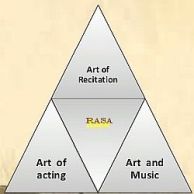
natyashastra-4-638

The author of the Natya-shastra seems to have assigned greater importance to Sattvika elements, the expressions of which are conveyed through the aid of movements, gestures (Angika) and speech (Vachika).

Angika relates to the movement of the parts of the body, which is classified into three major parts – the Anga, Patyanga and Upānga  . Angika relates to how the emotion, thoughts and the thing  are to be expressed or represented through the  movement of the Anga (limbs), which include facial expressions. There are two types of basic Abhinayas as Pada-artha abhinaya (when the artist delineates each word of the lyrics with gestures and expressions); and, Vākyā-rtha abhinaya (where the dancer acts out an entire stanza or sentence). Āngika abhinaya uses the total body to express certain meaning. Hasta (hand) Abhinaya is an important aspect of Āngika.

Vachika abhinaya is the expression through speech. It is done with the help of speech and songs. Bharatha  deals in detail with the different meters in poetry, strong and weak points of poetic writing and diction. He  also talks about Figures of speech (Alamkara) . Nātyasāstra says that words spoken during Nātya should be full of suggested meaning.

yasāstra in its 15th -19th Chapters explains vocal movements. It recognizes the importance of expressions through the medium of voice in the presentation of a Drama; they are its   basic features; and, form the very substance of the Dramas. Other movements depend on and follow vocal movements.

Bharatha mentions three kinds of voice expressions-: 1) Mandra; 2) Madhya; and, 3) Tāra.

The sound which origins from the heart , having a quality of bass is called Mandra. The sound originating from the throat, in the normal manner is named Madhya.  And, Tāra is the high-pitched sound originating  from the head.

According to yasāstra, the vācikā-bhinayas divided into seven parts .

    • 1) Prakāsa-bhāsana– loud and clear speech;
    • 2) Ātmagata-bhāsaa– talking to self;
    • 3) Apavārita-bhāsaa (asides);
    • 4) Janāntika-bhāsaa (audiable to others);
    • 5) Sāmūhika-bhāsana – group expressions (simultaneous talk);
    • 6) Ekala- bhāsana – single expressions (monologue);
    •  7) Ākāsa- bhāsana – talking to the sky (talking to no one in particular); and,
    • 8) Rahasyakathana – stage-whisper

8.2. The Sattvika aspects are dealt in Chapters 6 and 7; followed by Angika in Chapters 8 to 13; and, Vachika in Chapters 14 to 20.  The Aharya which deals with costume, scenic presentation, movement on the stage along with music from the wings etc follow in the later Chapters.

The 23rd Chapter of  yasāstra  details the Āhārya abhinaya, which covers several aspects , such as  the make-up (Angaracanā ); costumes and ornaments  (Alankāra prasādhana); use of specific colors; hair styles;  as well as costumes suitable for particular characters. The Aharya also covers the background sceneries (Pusta), stage props and décor.

The four-fold core Chapters are supported by information and descriptions about the origin and greatness of the theatrics; different forms of the stage and the norms for construction; qualifications and desirable modes of behavior of the actors; and the rituals and prayers before and after the play etc.

Thus, the core of the theatrical art and science is dealt in 29 Chapters  – from 6 to 34.

flower2

9.1.  A question that is often asked is: why were the ancient Indian scholars and seers reluctant to disclose, in their works, details of themselves and of their times? Did they lack a sense of history? 

There is, of course, an array of explanations, in answer to that.

But, I think it had a lot to do with the way the ancients defined their relation to a school of thought, and the position, they thought, their text occupied in the tradition of that school. They always viewed themselves as a part of an ongoing tradition – parampara. Invariably, even the best known of our thinkers (say, the Buddha, Badarayana or Sri Sankara) did not claim that they propounded an absolutely new idea that was totally unknown hitherto. They always said, they were interpreting or elucidating the truth in the light of eternal pristine principles.  They did not lay claim to novelty or uniqueness. They placed their work in relation to the larger and broader river or stream of the tradition. Within that tradition, individual styles, innovative ideas or enterprising leaps of thought were surely discerned; but, they were always placed and viewed in context of the overall ongoing tradition.

9.2. As regards Natya-Shastra, as Kapila Vatsyayan  summed up beautifully:

“ it was analogous to the Gomukh demarcating the glaciers above and the rivers which flow with streams of the Alakananda and the Mandakini , the Bhagirathi and others with their manifold confluences and some divergences , but all of which we recognize as the Ganga. The analogy of streams, confluences (prayaga) and the continuous flowing and yet unchanging nature of the river is the closest approximation in which the parampara of the Natya-Shastra, the text and dramatics of inflow confluences, outflow and ultimate inflows in to the ocean, can be explained.”

9.3. The individual biological identity in terms of the physical events of the birth and the personal life of the author did not, therefore, seem to be a psychical concern. Individual effort and contribution in furthering a school of thought was, no doubt, important; but, it was viewed as an integral part of the dynamics of the flow and course of the river called parampara, characterized with its nature of continuity and change.

The attitude signified being alive to a sense of tradition rather than lack of a sense of history.

flower2

1 0. Why  was the text called a Shastra?

The term Shastra does not always carry connotations of ritual or religion. Nor does it always mean classical, as in shastriya sangeeth

The Sanskrit- English dictionary of Sir Monier-Williams describes the term as an order, a command, a rule, teaching, and instruction manual relating to religious precepts. But,  Shastra, in fact, means much more than that.

10.1.In the Indian context , Shastra is a very extensive term that takes in almost all human activities – right from cooking to horse and elephant breeding; love making to social conduct; economics to waging wars; justice system to thievery ; and of course all the arts- from archery to poetry. There  is a  Shastra – a way of doing and rationalizing — for almost everything. A Shastra binds together the theory that provides a framework for rationalizing the practice; and the practice that illustrates the theory. Shastra is, at once, the theory of practice and practice of a theory- enriching each other.

10.2. The author of Natya-Shastra prefers to call it a prayoga Shastra – a framework of principles of praxis or practice. Bharata makes a significant opening statement: “I am creating a theory and text of performance; of practice and experimentation” . He also underlines the fact that the efficacy of its formulation lies in practice (prayoga) – vibhāvayati yasmācca nānārthān hi prayogataḥNS.8.7

10.3. There is a certain flexibility built in to the structure of the text. It provides for varied interpretations and readings. The author himself encourages innovations and experimentation in production and presentation of plays. He even permits modification of his injunctions; and states the rules “can be changed according to the needs of time (kaala) and place (desha)” . The text accordingly makes room for fluidity of interpretation and multiple ways of understanding it. The intellectual freedom that Bharata provided to his readers/listeners ensured both continuity and change in Indian arts over the centuries.
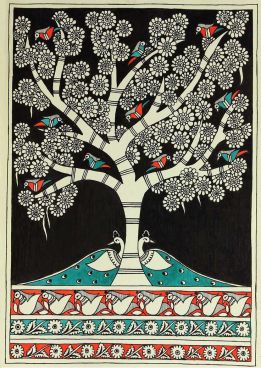
tree of life

11. 1.Natya-Shastra,throughout, talks in  terms of the metaphor of the seed (bija) and the tree. It talks of the organic inter-relatedness of the parts and the whole; each branch of the text being distinct and yet inspired by the unitary source. Introduction of the core theme is the seed (bija) and its outer manifestation is like a drop of liquid or a point (bindu) that spreads and enlarges (vistara) to fill the structured space. That denotes both the process and the structure.

11.2. Bharata also explains the relationship between the structure of the drama, its plot, bhava and rasa through the imagery of a tree. The text grows like a tree and gives out shoots like the proverbial Asvattha tree.” Just as a tree grows from a seed and flowers and fruits… So the emotional experiences (rasa) are the source (root) of all the modes of expressions (bhava). The Bhavas, in turn, are transformed to rasa.”(Natya-Shastra: 6-38)

yathā bījād bhaved vṛkṣo vṛkṣāt puṣpaṃ phalaṃ yathā । tathā mūlaṃ rasāḥ sarve tebhyo bhāvā vyavasthitāḥ ॥ NS.6.38

11.3. This idea of multiplicity springing out of a unity is derived from the worldview nourished by the ancient Indians. Bhartrhari (Vakyapadiya), for instance, observes that diversity essentially pre-supposes an underlying unity (abedha-purvaka hi bhedah).  In other words, he says, where there is difference or division there must be a fundamental identity underneath it ; else, each cannot relate to the other; and , each object in the world would be independent of , or unconnected to  every other thing in existence.

Such holistic view  treats the world as a living organism, a whole with each part interrelated and inter dependent. The expanding universe is viewed as a process of sprouting from the primordial source (bija), blooming, decaying and withering away, at some time; but only to revive and burst forth with renewed vigor. The seed (Bija) is the source / origin of the tree; and, Bija is also its end product. The relationship between the universe and the human; between nature and man, too, has to be understood within the cyclical framework of the Bija– and – the tree concept.

Bharata seems to suggest that theater is an organism, just as life is an organism that re-invents itself.


flower2

12 . Let me end this in the way Bharata concluded his Natya-Shastra:

He who hears the reading of this Shastra , which is auspicious, sportful, originating from the mouth of Brahman , very holy , pure good, destructive of sins; and he who puts in to practice and witnesses carefully the performance of drama will attain  the same blessed goal which masters of Vedic knowledge and performers of yajna – attain.” (Natya-Shastra-37:26-28 )

ya idaṃ śruṇuyān nityaṃ proktaṃ cedaṃ svayambhuvā । kuryāt prayogaṃ yaścaivamathavā’dhītavān naraḥ 26

yā gatirvedaviduṣāṃ yā gatiryajñakāriṇām । yā gatirdānaśīlānāṃ tāṃ gatiṃ prāpnuyāddhi saḥ 27

 dānadharmeṣu sarveṣu kīrtyate tu mahat phalam । prekṣaṇīyapradānaṃ hi sarvadāneṣu śasyate 28

 [ http://sanskritdocuments.org/doc_z_misc_major_works/natya37.html?lang=iast]

golden-bodhi-tree-symbol-thai-style-isolate-background-vector-illustration-54289542

Please also read Abhinavabharati – an interpretation of Bharata’s Natya-Shastra


Sources and references

Bharatamuniya Natya-Shastra by prof.SKR Rao

Bharata: The Natya-Shastra by Kapila Vatsyayan

Introduction to Bharata’s Natya-Shastra by Adya  Rangacharya

An introduction to natya shastra – gesture in aesthetic arts  by  M. S. Thirumalai, Ph.D.

Translation of the Natya-Shastra verses from the Natya-Shastra by Man Mohan Ghosh

http://sanskritdocuments.org/doc_z_misc_major_works/natya36.html?lang=iast

Images are from Internet
 
12 Comments

Posted by on September 13, 2012 in Abhinavagupta, Music, Natya, Sanskrit


Tags: , , ,

Who were the Vratyas – the searching wanderers?

[This article attempts to trace the meaning that the term Vratya acquired  at various stages in the unfolding of Indian history; and, wonders how well that meaning mirrored the state of Indian society at that  given stage.]

Every civilization has certain unique features, which differentiate it from the rest. Indian civilization is distinguished by its resilience; continuity with change; and its diversity. The composite fabric of Indian civilization is woven with strands and shades of varying textures and hues.

Rig Veda repeatedly refers to the composite character of its society and to its pluralistic population. It mentions the presence of several faiths, cults and languages; and calls upon all persons to strive to become noble parts of that pluralistic society.

The pluralistic character of that society was characterized not merely by its composition but also by the divergent views held by its thinkers. There were non -conformists and dissenters even among the Vedic philosophers. In addition, there were individuals and groups who were outside the pale of the Vedic fold; and who practiced, the pre-Vedic traditions; and rejected the validity of the Vedas and its rituals.

The prominent among such dissenters and rebels were the Vratyas. They were an atrociously heterogeneous community; and defied any definition. Even to this day, the meaning of the term Vratya is unclear; and is variously described. The amazing community of the Vratyas included magicians, medicine men, shamans, mystics, materialists, vagrant or mendicant (parivrajaka), wandering madmen, roaming- footloose warriors, mercenaries, fire eaters, poison swallowers , libidinous pleasure seekers and wandering swarm of austere ascetics.

Some of them were violent and erotic; while some others were refined and austere; and a lot others were just plain crazy. It was a random assortment of nuts and gems.

[ Even in the later times , Vratya was used as derogatory term. For instance ; in the Drona parva of the Mahabharata (07,118.015) the Vrishni-s and Andhaka-s were branded Vratyas – uncouth and uncultured

vrātyāḥ saṃśliṣṭakarmāṇaḥ prakṛtyaiva vigarhitāḥ / vṛṣṇy andhakāḥ kathaṃ pārtha pramāṇaṃ bhavatā kṛtāḥ]

The Rig Veda mentions Vratyas about eight times (e.g. 3:26:6; 5:53:11; 5:75:9; 9:14:2); and five groups of the Vratyas are collectively called pancha-vrata (10:34:12).

The Atharva Veda (15th kanda) devotes an entire hymn titled vratya- suktha (AVŚ_15,3.1 to AVŚ_15,18.5) to the “mystical fellowship” of the Vratyas.

The Pancavimsa-brahmana Tandya and Jaiminiya Brahmanas too talk about Vratyas; and, describe a sacrifice called Vratya-stoma, which is virtually a purification ritual.

*

The Rig Veda, generally, employs the term Vratya  to denote: breakaway group or an inimical horde or a collection of men of indefinite number; living in temporary settlements.

The Atharva-Veda too, uses the word in the sense of a stranger or a guest or one who follows the rule; but, treats it with a lot more respect. Apparently, the perceptions changed a great deal during the intervening period.

The Jaiminiya Brahmana (2:222) describes  Vratyas   as ascetics roaming about themselves in an intoxicated state; and speak impure speech (Vacha hy avratam amedhyam vadanti) .

The Tandya (24:18.2) , however, addresses them as divine-Vratyas (daivā vai vrātyāḥ sattram āsata budhena).

The Vajasaneyi-samhita refers to them as physicians and as guardians of truth. They seem to have been a community of ascetics living under a set of strange religious vows (Vrata).

Interestingly, Shiva-Rudra is described as Eka –Vratya* (AV 10.8.1.9.1). Shatha-rudriya celebrating the glory of one- hundred-and-eight forms of Rudra hails Rudra as Vrata-pathi, the chief of the Vratyas (TS.4.5.6.1)

[ The Atharva-veda (AV: 15. 1-7) speaks of seven attendants of the exalted Eka Vratya, the Vratya par excellence  :

Bhava of the intermediate space in the East;  Sarva in the South; Pashupati in the West; Ugra of the North; Rudra of the lower region; Mahadeva of the upper region ; Asani of  lightening ; and, Ishana of all the intermediate regions.

It is said; though they are named differently they in truth are the varying manifestations of the one and the same Eka Vratya.

While Rudra, Sarva, Ugra and Asani are the terrifying aspects, the other four: Bhava , Pashupathi, Mahadeva and Ishana are peaceful aspects.

Of these, Bhava and Sarva, by virtue of their rule over sky and earth, protect the devote against calamities, contagious diseases and poisonous pollution.

sa ekavrātyo ‘bhavat sa dhanur ādatta tad evendradhanuḥ ||6||nīlam asyodaraṃ lohitaṃ pṛṣṭham ||7||nīlenaivā priyaṃ bhrātṛvyaṃ prorṇoti lohitena dviṣantaṃ vidhyatīti brahmavādino vadanti ||8|| (AVŚ_15,1.6a to 8a)]

[*  However, Dr.RC Hazra in his work Rudra in the Rg-veda (page 243) remarks that Eka-Vratya is to be identified with Prajapathi ; and , not with Rudra,  as some scholars seem to think.]

The Atharva Veda (15.2.1-2) makes a very ambiguous statement: “Of him in the eastern quarter, faith is the harlot, Mitra the Magadha, discrimination is the garment, etc…..” in the southern quarter Magadha is the mantra of the Vratya; in the other two quarters Magadha is the laughter and the thunder of the Vratya. (Mitra, maAtm, hasa and stanayitnur).  It is not clear what this statement implies. But it is taken to mean that the Magadha tribes were friends, advisers and thunder (strong supporters) of the Vratyas.

tasya prācyāṃ diśi śraddhā puṃścalī mitro māgadho vijñānaṃ vāso ‘har uṣṇīṣaṃ rātrī keśā haritau pravartau kalmalir maṇiḥ  – (AVŚ_15,2.1[2.5]e) ; tasya dakṣiṇāyāṃ diśy uṣāḥ puṃścalī mantro māgadho vijñānaṃ vāso ‘har uṣṇīṣaṃ rātrī keśā haritau pravartau kalmalir maṇiḥ – (AVŚ_15,2.2[2.13]e) ; tasya pratīcyāṃ diśīrā puṃścalī haso māgadho vijñānaṃ vāso ‘har uṣṇīṣaṃ rātrī keśā haritau pravartau kalmalir maṇiḥ -(AVŚ_15,2.3[2.19]e); tasyodīcyāṃ diśi vidyut puṃścalī stanayitnur māgadho vijñānaṃ vāso ‘har uṣṇīṣaṃ rātrī keśā haritau pravartau kalmalir maṇiḥ – (AVŚ_15,2.4[2.25]e)

The implication of this is rather interesting. The breakaway group from among the Vedic people (including the Pre-Vedic tribes), that is, the Vratyas left their mainland and roamed over to the East; and ultimately settled in the regions of Magadha, where they found friends and supporters. The reason for that friendly reception appears to be that the Magadha tribes in Eastern India were not in good terms with the Vedic people in the Indus basin; and saw no difficulty in accommodating the Vratyas. And, more importantly, the Magadhas did not follow or approve the Vedic religion; and they, too, just as the Vratyas, were against the rites, rituals and sacrifices of the Vedic community.

The Vedic people too did not seem to regard the Brahman of the Magadha region. They were considered not true Brahmins, but only Brahmins by birth or in name (brahma-bandhu Magadha-desiya)- (Latyayana Srauta sutra . 8.6)

The Vratyas roamed about, mostly, in the regions to the East and North-west of the Madhya-desha, that is, in the countries of Magadha and Anga . That is to say; the Vratyas were more in the East.  But, that does does not mean that they were confined only to the East. The Atharva Veda confirms that they traveled to all directions. However, their movements were restricted by the Himalayas in the North; Vindhyas in the South; and , by the unfriendly tribes in the West. But, in the East , they were free to roam about , without hindrance

They spoke the dialect of Prachya, the source of the languages of Eastern India. It is also said ; the Vratyas  also spoke  the language of the initiated (dīkṣita-vācaṃ vadanti) , though not themselves initiated (a-diksita), but as’ calling that which is easy to utter (a-durukta)  ‘ (Panchavimsa Brahmana, 17.1.9 aduruktavākyaṃ duruktam ) . This may mean that the Vratyas were familiar and comfortable both in Sanskrit and Prakrit.

garagiro vā ete ye brahmādyaṃ janyam annam adanty aduruktavākyaṃ duruktam āhur adaṇḍyaṃ daṇḍena ghnantaś caranty adīkṣitā dīkṣitavācaṃ vadanti ṣoḍaśo vā eteṣāṃ stomaḥ pāpmānaṃ nirhantum arhati yad ete catvāraḥ ṣoḍaśā bhavanti tena pāpmano ‘dhi nirmucyante

They lived alone or in groups, away from populated areas. They followed their own cult-rules and practices. They drifted far and wide; roamed from the Indus valley to banks of the Ganga. They were the wandering seekers.

 [According to Mahamahopadhyay Haraprasad Sastri,the vast territory to the South of the Ganga and North of the Vindhya ranges extending from Mudgagiri (Monghyr) in the East to the Charanadri (Chunar) in the West was called the land of Magadha tribes. The Anga region was around Bhagalpur area.]

The Kesi-suktha  of Rig Veda (10:13:6); Latyayana- sruta-sutra (8.6-7); Bahudayana –sruta- sutra (26.32); Panchavimsati Brahmana (17. 1.9-15) and vratya-sukta of Atharva Veda (15th kanda), provide graphic descriptions of these magis, the Vratyas. 

These descriptions, when put together, project a truly impressive, colorful and awe-inspiring image of the wandering Vratyas.

The Pancavimsa Brahmana of Sama Veda describes them as hordes , who rode open rickety chariots / carts, with planks (amargagamirthah) tied together with strings, suitable for rough roads (vipatha) drawn by  horses or  mules (LSS 8:6,10-11). The Vipatha was said to be in greater use in the Eastern regions (Prachyartha)

vipatha-vāhau vātaḥ sārathī reṣmā pratodaḥ kīrtiś ca yaśaś ca puraḥsarau – (AVŚ_15,2.2[2.14]f)

They carried lances (Pra-toda) , bows (AV 15.2.1)  and a goad (pratoda) .

They were distinguished by their black turbans (krishnam ushnisham dharayanti),  with flutters at the ends , worn in a slanting manner (LSS 8.6-7); wearing  garments with fringes of red (valukantani damatusam), two fringes on each side; a white blanket thrown across the shoulders (BSS 26.32); displaying long matted hair (kesi); a set of round ornaments for the ears (pravartau); jewels (mani) hanging by the neck;  rows of long necklaces of strange beads  (Kalmali) swinging across the chest ; two (dvi) deer-skins /sheepskins folded double (dvisamhitany ajinani) , tied together, for lower garment; and, footwear (Upanah) of black hide , with flaps, for the feet (upanahau).

 valūkāntāni dāmatūṣāṇītareṣāṃ dve dve dāmanī dve dve upānahau dviṣaṃhitāny ajināni – (PB 17.1.15) – etad vai vrātyadhanaṃ yasmā etad dadati tasminn eva mṛjānā yānti

The Panchavimsati Bralhmana (17.1.9-15) further states that the Vratya leader (Grhapati) was distinguished by brown robes ; and, silver ornaments for the neck.  He wore a turban (Usnisa), carried a whip (Pratoda), a kind of bow (Jyahroda*), was clothed in a black (krsnasa) garment and two skins (Ajina), black and white (krisna-valaksa), and owned a rough wagon (Viratha) covered with planks (phalakastirna). He also wore garment lined of silver coins (Niska). His shoes were black and pointed.

uṣṇīṣaṃ ca pratodaś ca jyāhṇoḍaś ca vipathaś ca phalakāstīrṇaḥ kṛṣṇaśaṃ vāsaḥ kṛṣṇavalakṣe ajine rajato niṣkas tad gṛhapateḥ  – (PB 17.1.14)

[* The descriptions of the Jya-hroda, a sort of arms carried by the Vratya, occur in the Pancavimsa Brahmana (17.1.14) as also in the Katyayana (22.4.2) and Latyayana (8.6.8) Sutras. It is described as a ‘bow not meant for use’ (ayogya’ dhanus); and also as a ‘bow without an arrow’ (dhanushka anisu). It obviously was a decorative-piece meant to enhance the impressive look of the Chief.]

**

Vratyas used a peculiar type of reclining seats (asandi)

Vratya Asandi

[A-sandi is a generic term for a seat of some sort  , occurring frequently in the later Samhitas and Brahmanas, but not in the Rig-Veda.  In the Atharvaveda (AV. 15.3.2) the settle brought for the Vratya is described at length. It had two feet, lengthwise and cross-pieces, forward and cross-cords. It had a seat (Asada) covered with a cushion (Astarana) and a pillow (Upabarhana), and a support (Upasraya)

āsandīm āruhyodgāyati devasākṣya eva tad upariṣadyaṃ jayat.

so ‘bravīd āsandīṃ me saṃ bharantv iti ||2||tasmai vrātyāyāsandīṃ sam abharan ||3||tasyā grīṣmaś ca vasantaś ca dvau pādāv āstāṃ śarac ca varṣāś ca dvau ||4||bṛhac ca rathantaraṃ cānūcye āstāṃ yajñāyajñiyaṃ ca vāmadevyaṃ ca tiraścye ||5||ṛcaḥ prāñcas tantavo yajūṃṣi tiryañcaḥ ||6||veda āstaraṇaṃ brahmopabarhaṇam ||7||sāmāsāda udgītho ‘paśrayaḥ ||8||tām āsandīṃ vrātya ārohat ||9||(AVŚ_15,3.1a- 9a)

The Satapatha Brahmana (Sat.Brh.5.4.4.1) also describes the Asandi as an elaborate low seat, with diminutive legs; and, of some length on which a man could comfortably stretch himself, if he chose to. And, more than one person could sit on such a seat. It was said to be made of Khadira wood, perforated (vi-trinna), and joined with straps (vardhra-yukta). It perhaps meant a long reclining chair/ rest. The Asandi is described in the Satapatha Brahmana, as a seat for a king or a leader.

maitrāvaruṇyā payasyayā pracarati | tasyā aniṣṭa eva sviṣṭakṛdbhavatyathāsmā āsandī māharant yuparisadyaṃ vā eṣa jayati yo jayatyantarikṣasadyaṃ tadena muparyāsīnamadhastādimāḥ prajā upāsate tasmādasmā āsandī māharanti saiṣā
khādirī vitṛṇā bhavati yeyaṃ vardhra -vyutā bharatānām ]

[ Please check here for more on Asandi , in the context of the evolution of the Yogic-practices.]

**

They moved among the warriors (yaudhas), herdsmen and farmers.  They did not care either for the rituals or for initiations (adhikshitah); and not at all for celibacy (Na hi brahmacharyam charanthi) . They did not engage themselves in agriculture (Na krshim) or in trade (Na vanijyam). They behaved as if they were possessed (gandharva grithaha) or drunk or just mad.

hīnā vā ete hīyante ye vrātyāṃ pravasanti na hi brahmacaryaṃ caranti na kṛṣiṃ vaṇijyāṃ ṣoḍaśo vā etat stomaḥ samāptum arhati – (PB 17.1.2)

The scholars generally believe, what has come down to us as Tantra is, in fact, a residue of the cult-practices of the Vratyas. The Tantra, even to this day, is considered non-Vedic, if not anti-Vedic.

The Atharva Veda (Vratya Kanda) mentions that Vratyas were also a set of talented composers and singers. They found they could sing a lot better- and probably hold the notes longer – if they practiced what they called pranayama, a type of breath control. They even attempted relating their body-structure to that of the universe. They learnt to live in harmony with nature. There is, therefore, a school of thought, which asserts, what came to be known as Yoga in the later periods had its roots in the ascetic and ecstatic practices of the Vratyas. And, the Vratyas were, therefore, the precursors of the later ascetics and yogis.

It is said, the theoretical basis for transformation of cult-practices into a system (Yoga) was provided by the Samkhya School. Tantra thus yoked Samkhya and Yoga. Over a long period, both Samkhya and Yoga schools merged with the mainstream and came to be regarded as orthodox (asthika) systems, as they both accepted the authority of the Vedas. Yet, the acceptance of Samkhya and Yoga within the orthodox fold seemed rather strained and with some reservation, perhaps because the flavor -the sense of their non-Vedic origin rooted in the Vratya cult practices of pre  Vedic period –  still lingers on.

The German scholar and Indologist Jakob Wilhelm Hauer (1881 –1962) – who had made the beginnings of Yoga in India the theme for his doctor’s thesis –   in his Der Yoga als Heilweg  (Yoga as a way of salvation) traces the origin of Yoga to the wandering groups of the Vratyas.

JW Hauer, who represented the leading commentators on Eastern thought in the days of CG Jung, mentions that many of the groups that had roots in the Vratya tradition (such as: Jaiminiyas, Kathas, Maitrayaniyas and Kausitakins) were eventually absorbed into the orthodox fold. He also remarks that Chandogya and Svetasvatara Upanishads are closer in spirit to the Vratya- Samkhya ideologies.

It is the Svetasvatara Upanishad which declares Rudra as the Supreme, matchless and one without a second – eko hi rudro na dvitiiyaaya tasthu – SV.3.2. It establishes Rudra as the Absolute, the ultimate essence, not limited by forms and names

– na tasya pratima asti yasya nama mahadyasha – SV.4.19)

eko hi rudro na dvitīyāya tasthe ya imāṃl lokān īśata īśanībhiḥ / pratyaṅ janās tiṣṭhati saṃcukocāntakāle saṃsṛjya viśvā bhuvanāni gopāḥ // SvetUp_3.2 // 

nainam ūrdhvaṃ na tiryañcaṃ na madhye parijagrabhat / na tasya pratimā asti yasya nāma mahad yaśaḥ // SvetUp_4.19 // ]

Shiva Ekapada 2

The Samkhya school, in its earlier days, was closely associated with two other heterodox systems, i.e., Jainism and Buddhism. In a historical perspective, Samkhya-Yoga and Jainism – Buddhism were derived from a common nucleus that was outside the Vedic tradition. And, that nucleus was provided by the Vratya movement.

Interestingly, Arada Kalama, the teacher of Gotama who later evolved in to the Buddha, belonged to Samkhya School. Gotama had a teacher from the Jain tradition too; he was Muni  Pihitasrava a follower of Parsvanatha. The Buddha later narrated how he went around naked, took food in his palms and observed various other rigorous restrictions expected of a Sramana  ascetic. The Buddha followed those practice for some time and gave them up, as he did not find merit in extreme austerities.

The Buddha, the awakened one, was a Yogi too. His teachings had elements of old-yoga practices such as askesis (self-discipline), control, restraint, release and freedom. The early Buddhism, in fact, preserved the Yogi – ideal of Nirvana.

Thus, the development of religions and practices in Eastern regions of India, in the early times, was inspired and influenced – directly or otherwise – by the Vratyas.

The contribution of the Vratyas, according to my friend Prof. Durgadas Sampath, was that they gave a very time and space based approach to the issues.  They were the initial social scientists with rationality as the anchor, he says.

Some of the characteristics of the Vratya-thought found a resonant echo in Jainism and Buddhism. Just to mention a few:

Man and his development is the focal interest;

his effort and his striving is what matters, and not god’s grace;

the goal of human endeavor is within his realm;

a man or a woman is the architect of one’s own destiny ; and

there is nothing supernatural about ones  goals and ones attainments.

There was greater emphasis on contemplation, introspection, pratikramana  (back-to-soul);

and, a deliberate shift away from exuberant rituals and sacrifices seeking health, wealth and happiness.

The Vratya was neither a religion, nor was it an organized sect. It was a movement seeking liberation from the suffocating confines of the establishment and searching for a meaning to life and existence. The movement phased out when it became rather irrelevant to the changed circumstances and values of its society.  The Vratyas, the searching wanderers, the rebels of the Rig Vedic age, faded in to the shadowy corners of Vedic religion, rather swiftly; yet they left behind a lingering influence on other systems of Indian thought.

*****

The Jain tradition claims that it existed in India even from pre- Vedic times and remained unaffected by the Vedic religion. It also says, the Jain religion was flourishing, especially in the North and Eastern regions of India, during the Vedic times.

Because of the basic differences in their tenets and practices, the two traditions opposed each other. As a part of that ongoing conflict, certain concepts and practices appreciated by one religion were deprecated by the other. The term Vratya was one such instance.

The term Vratya has a very long association with Jainism; and its connotation in Jainism is astonishingly different from the one implied in the Vedic tradition where it is employed to describe an inimical horde. On the other hand, Vratya in Jainism is a highly regarded and respected term. The term Vratya, in the Jaina context, means the observer of vratas or vows.

Thus, while the Vedic community treated the Vratyas as rebels and outcasts, the tribes in the eastern regions hailed Vratyas as heroes and leaders (Vratya Rajanya).

The Vedic and the Jain traditions both glorify certain Kings who also were great religious Masters. In the Hindu tradition, Lord Rsabha – son of King Nabhi and Merudevi, and the ancestor of Emperor Bharata (after whom this land was named Bharatavarsha) is a very revered figure : 

ततश्च भारतं वर्षमेतल्लोकेषुगीयतेभरताय

The Rig Veda and Yajur Veda, too, mention Rishabhadeva and Aristanemi.

According to the Jain tradition Rishabhadeva is the first Tirthankara of the present age (avasarpini); and, Aristanemi is the twenty-second Tirthankara.

The Jain tradition refers to Rishabhadeva as Maha-Vratya, to suggest he was the great leader of the Vratyas.

Further, the Mallas, in the northern parts of the present-day Bihar, with their capital at  the city of Kusavati or Kusinarawere a brave and warlike people; and were one of the earliest independent republics (Samgha). The Jaina Kalpasutra refers to nine Mallakis as having formed a league with nine Lichchhavis, and the eighteen Ganarajas of Kasi-Kos’ala.They were also said to be  a part of a confederation of eight republics (atthakula)  until they were vanquished and absorbed into the Magadha Empire, at about the time of the Buddha. The Mallas were mentioned as Vratya – Kshatriyas.

Similarly, their neighboring tribe, the Licchhavis who played a very significant role in the history and development of Jainism were also called as the descendants of Vratya-Kshatriyas. Mahavira was the son of a Licchhavi princess; and he had a considerable following among the Licchhavi tribe. In the Jaina Kalpa Sutra, Tris’ala, the sister of  Chetaka – the Lichchhavi chief of Vesali, is styled Kshatriyani  .

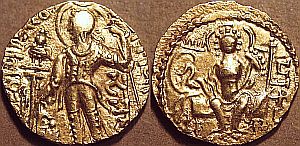
[The Licchhavis continued to be one of the major Ganas (Non-monarchical – Independent states). Even later in the 4th century AD, Chandragupta I of the Gupta dynasty married a Licchhavi princess, Kumāradevi, and, this marriage was commemorated on gold coins. Their son, Samudra Gupta, was called Lichchhavi-dauhitra (grandson of the Licchhavis) in inscriptions. The Licchhavis, therefore, were still a political force.]

samudragupta

The Buddha too visited Licchhavi on many occasions; and had great many followers there. The Licchhavis were closely related by marriage to the Magadhas.

The Buddhist tradition has preserved the names of eminent Lichchhavis like prince Abhaya, Otthaddha, Mahali, general Siha, Dummukha and Sunakkhatta. The Mallas, like the Lichchhavis , were ardent champions of Buddhism. In the Mahaparinibbana Suttanta they are sometimes called Vasetthas

Pundit Sukhlalji explains,  the two ethnic groups of ‘Vratva’ and ‘Vrsala’ followed non-Vedic tradition; and both believed in non‑violence and austerities.  He suggests that both the Buddha and Mahavira were Kshatriyas of Vrsala group. He also remarks that the Buddha was known as ‘Vrsalaka’.

It is not surprising that the Lichchavi, Natha and Malla clans of Eastern India proved fertile grounds for sprouting of non-Vedic religions such as Jainism and Buddhism.

Thus, both Buddhism and Jainism were in tune with  the philosophic atmosphere prevailing in Magadha, around sixth century BCE. Apart from his philosophical principles, the Buddha’s main contribution was his deprecation of severe asceticism in all religions and acceptance of a sensible and a rational approach to life.

The nucleus for development of those non Vedic religion was, reputedly, the ideas and inspiration derived for the Vratya movement.

pto5pe6ac

In the mean time Vedic perception of Vratyas had undergone a dramatic sea- change.

Latyayana –srauta-sutra (8.6.29) mentions that after performing Vratya-homa the Vratya should Tri-vidya-vrti the threefold commitment to study of Vedas, participating in the performance of Yajnas; and giving and accepting gifts. These three were the traditional ways of the priestly class.

Apasthamba (ca. 600 BCE), the Lawgiver and the celebrated mathematician who contributed to development of Sulbasutras, refers to Vratya as a learned mendicant Brahmin, a guest (athithi) who deserves to be welcomed and treated with respect. Apasthamba, in support of that, quotes sentences to be addressed by the host to his guest from the passages in Atharva Veda (15:10 -13).

According to Atharva Veda, Vratya is a srotriya, a student of the scriptures, (of at least one recession), and a learned person  (Vidvan) faithful to his vows (vratas). In summary, the passages ask:

” Let the king , to whose house the Vratya who possesses such knowledge comes as a guest , honor him as superior to himself, disregarding his princely rank or his kingdom.

Let him, to whose house the Vratya possessing such knowledge comes as a guest, rise up of his own accord to meet him, and say “Vratya, where didst thou pass the night? Vratya, here is water; let it refresh thee .Vratya let it be as thou pleasest. Vratya, as thy wish is so let be it done.”

[From Hymns of the Atharva Veda, by Ralph T.H. Griffith…Hymn x and xi of Book 15]
http://www.sacred-texts.com/hin/av/av15011.htm

[ tád yásyaiváṁ vidvān vrā ́tyo rājñó ’tithir gṛhān āgáchet  // – 15.10.1

Śréyāmsam enam ātmáno mānayet táthā kṣatrāya  nā ́ vṛścate táthā rāṣṭrāya nā ́ vṛścate // -1510.2

tád yásyaiváṁ vidvān vrā ́tya úddhṛteṣv agníṣu ádhiśrite agni hotré ’tithir gṛhān āgáchet // – 1`5.12.1

tád yásyaiváṁ vidvān vrā ́tya ékāṁ  rā ́trim átithir gṛhé vásati  / yé pṛthivyā ́ṁ púnyā lokā ́s tān evá ténā ́va rundhe// — 15.13.1 ]

There is, thus, a gulf of difference between the perception of the early and later Vedic periods. This amazing transformation seems to have come about as a result of sustained and successful contacts between the Upanishads and the systems of Samkhya and Yoga. There was a healthy interaction between the two streams of the Indian tradition. The Samkhya-Yoga ideas found a place in the Upanishads. At the same time, the Upanishads brought its impact on Buddhism and Jainism. The savants of orthodox tradition such as Kumarila Bhatta (ca.6th century AD) accepted the Buddhist schools as authoritative because they had their roots in the Upanishads. (Tantra vartika)

The ideologies of the two traditions moved closer during the period of Upanishads. It was a period of synthesis.

shamrock-small

The term Vratya acquired a totally different meaning by the time of the Dharma Shastras. Manu Smruti (dated around third or second century BCE) states that, if after the last prescribed period, the twice-born remain uninitiated, they become Vratyas, fallen from Savitri. (Manusmriti: verse II.39)

Manusmriti (verse X.20)  also informs that those whom the twice-born  ( Brahmin , Kshatriya and Vaishya ) beget from  wives of equal caste, but who, not fulfilling their sacred duties, are excluded from the Savitri (initiation), must also designate by the appellation Vratyas.

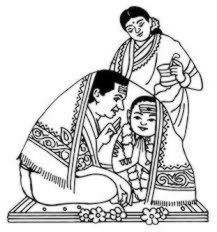
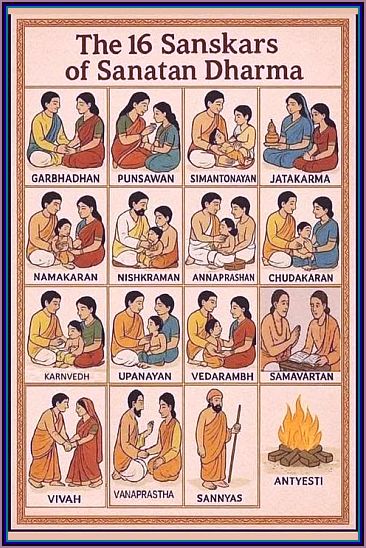
The samskara of initiation or upanayana (ceremony of the thread) was considered essential for the dvijas (the twice-born). Manusmriti mentions the recommended age for upanayana and for commencing the studies. It also mentions the age before which these should take place.

In the eighth year after conception, one should perform the initiation (Upanayana ceremonies of sacred thread) of a Brahmana, in the eleventh year after conception (that) of a Kshatriya, but in the twelfth year that of a Vaisya. (MS: II.36)

The initiation of a Brahmana who desires proficiency in sacred learning should take place in the fifth year after conception, that of a Kshatriya who wishes to become powerful in the sixth, and that of a Vaisya who longs for success in his business in the eighth.(Ms: II.37)

The time for the Savitri initiation of a Brahmana does not pass until the completion of the sixteenth year (after conception), of a Kshatriya until the completion of the twenty-second, and of a Vaisya until the completion of the twenty-fourth. (MS: II.38)

After those (periods men of) these three (castes) who have not received the sacrament at the proper time, become Vratyas (outcastes), excluded from the Savitri (initiation) (MS. II.39)

garbhāṣṭame’bde kurvīta brāhmaasyaupanāyanam | 
garbhādekādaśe rājño garbhāt tu dvādaśe viśa || 36 ||

brahmavarcasakāmasya kāryo viprasya pañcame | 
rājño balārthina aṣṭhe vaiśyasyaihārthino’ṣṭame || 37 ||

ā odaśād brāhmaasya sāvitrī nātivartate | 
ā dvāviśāt katrabandhorā caturviśaterviśa || 38 ||

ata ūrdhva trayo’pyete yathākālamasask | 
sāvitrīpatitā vrātyā bhavantyāryavigarhitā || 39 ||

Oddly, the insistence on upanayana and making it compulsory seems to have come into vogue in the post-Upanishad period. During the Atharvana period, initiation was regarded as second-birth; and was associated with commencement of studies or as a requirement for performing a sacrifice. The significance of the second birth in the Vedic time was, therefore, largely, religious and not social. Not everyone was required to obtain the Upanayana samskara. The upanayana was a voluntary ceremony for those who wished to study or perform a sacrifice.

It was only after the Grihya-sutras crystallized, upanayana turned into a samskara, as a recognition of ones position in the social order. Some scholars , however , suggest, Vratya does not necessarily denote a person who has not undergone upanayana samskara; but, it refers to one who does not offer Soma sacrifice or keep the sacred fire(agnihotra).

(http://www.sanathanadharma.com/samskaras/edu1.htm)

upanayana

 [ Dr. Ananat Sadashiv Altekar  ( 1898-1960)- who was the Professor and Head of the Department of Ancient Indian History and Culture at Banaras Hindu University –  (in his Education in Ancient India, 1934) explains that it was in the times of the Upanishads that the Upanayana ceremony gained greater importance. Upanayana literally meant taking a young boy to a teacher in order to hand him over to the latter for his education in the Vedas.  Thus, the Upanayana occasion  marked the entry of a student, as an inmate (Antevasin), into Guru-kula to pursue Vedic studies. The Upanayana was thus primarily linked to pursuit of studies; and, it was not compulsory for all.

And, again, an Upanayana had to be performed every time a student approached a new teacher; or, when he embarked upon a new branch of study. Dr. Altekar mentions that there were occasions when even married men had to undergo Upanayana while approaching a renowned teacher for learning a new subject (Br. Up.6.2.4). And, such a ceremony that was so often repeated, Dr. Altekar opines, could not have been an elaborate one. It was, by its very nature, a domestic and simple performance. The student had to approach the Teacher, holding the sacred fuel (Samitt), and indicating his complete willingness to learn and to serve the Teacher, as also to tend his sacred Agni-s (Ch.Up.6.5.5 and 5.11.7; and Mu. Up. 1.2.12).

An ardent young student entering a new phase of life after Upanayana was said to be born a second time – Dvija. (A similar notion of a ‘second-birth’ came into vogue in Buddhism when lay person was admitted into the Sangha)

According to Dr. Altekar,  for several centuries, Upanayana was not regarded as a Samskara ritual. And, it seems to have become a popular Samskara – ceremony only in the later times. In the earlier times, one was called a Vratya if he was not offering Soma sacrifice or if one was not tending to sacred fires. But, in the later times, the one who had not undergone a Upanayana Samskara came to labelled a Vratya. Subsequently, such a Vratya was re-admitted into the orthodox fold (even if his past three ancestors had failed to undergo Upanayana altogether- Vratya pita pitamaho va na Somam priveshya Vratyah – Sri Madhava’s commentary on Parasara Smriti), provided he underwent the purification ritual of Vratya –stoma (Paraskara Grihya Sutra 2.5)

In course of time, Upanayana came to be regarded as an essential bodily Samskara (Sarira samskara) for all the three classes. And, the non-performance of Upanayana would disqualify one from entering into a valid wedlock.

Although Manu prescribed 8th, 11th and 12th year as suitable for performance of the Upanayana for the Brahmana, Kashtriya and Vaishya boys, it was not taken by the later Law-givers as an absolute norm. For instance; Baudhayana considered anytime between 8 and 16 years of age, for all classes, as suitable. The change in the norm perhaps came about because of the change in the conception and the nature of the Upanayana. In the earlier times, Upanayana marked the commencement of Vedic education ; and, therefore, the child had to start learning at a quite young age. But when Upanayana became a bodily Samskara, any age between 8 and 16 was considered good enough. In any case, commencement of  Vedic studies after the age of 16 was discouraged, perhaps because it was thought that the boy’s capacity to absorb and learn a new subject might have by then gone rather slow.

*

Since the Upanayana ceremony was linked to commencement of education, the Upanayana of girls was as common as that of boys. There is ample evidence to show that such was the case. The Atharvaveda (XI. 5. 18) expressly refers to maidens undergoing the Brahmanharya discipline (brahmacaryeṇa kanyā yuvānaṃ vindate patim ) ; and, the Sutra texts of the 5th century B. C. supply interesting details in its connection. Even Manu includes Upanayana among the sanskaras (rituals) obligatory for girls (II. 66).

After about the beginning of the Christian era, the Upanayana for girls went out of vogue. But, Smriti writers of even the 8th century A. D. like Yama admit that in the earlier times the girls had the privilege of Upanayana and Vedic studies.

The discontinuance of Upanayana was disastrous to the educational and religious status of women. The mischief caused by the discontinuance of Upanayana was further enhanced by the lowering of the marriageable age. In the Vedic period girls were married at about the age of 16 or 17; but by Ca. 500 B. C. the custom arose of marrying them soon after the attainment of puberty. Later writers like Yajnavalkya (200 A. D.), Samvarta and Yama, vehemently condemn the guardian who fails to marry a girl before the attainment of the puberty. Therefore, the Smritis written by 11th century began to glorify the merits of a girl’s marriage at the age of 7, 8, or 9, when it was regarded as an ideal thing to celebrate a girl’s marriage at so young an age, female education could hardly prosper. ]

***

In any case, during the period of Dharma sastras, those who did not adhere to the prescriptions of the sastras and did not perform the prescribed rites and ceremonies were termed Vratyas.There were, obviously, many people who didn’t bother to follow the rules.

The smritis therefore, provided a provision for purification of the errant persons through a ritual (vratya stoma); and created a window for taking them back into the fold; and for rendering them eligible for all rites and rituals.

[ In the Puranas , the Sisunaga kings are mentioned as Kshattra -bandhus, i. e., Vratya Kshatriyas.]

The object of the entire exercise undertaken by the sastras, seemed to be to build and preserve a social order, according to its priorities .But, in the later periods these smaskaras lost their social significance, entirely. The social conditions deteriorated rapidly during the medieval period.  Even in the religious life, upanayana remained just a routine ritual, often meaningless. Agnihotra vanished almost entirely.

In a way of speaking , almost all of us are Vratyas, in terms of the smritis.

[.. Let me digress, here, for a little while.

In the Vedic era, women were initiated into the thread ceremony. It was essential for both sexes who wished to study [Atharva Veda 11.5.18a, Satpatha Brahmana.1.2.14.13, and Taittariya Brahamana II.3.3.2-3]

Yama, a Law-giver even prior to Manu, upheld education for women, but stipulated the female students should not engage in begging their meals, wearing deer-skins or growing matted hair (as male students might do) [VirS.p.402]

All that changed radically, for worse, during the period of Dharma sastras. The woman lost the high status she once enjoyed in Vedic society. She lost some of her independence.  She became an  object to be protected.

The harsh prescriptions of the Dharma shatras have to be placed in the context of its times, in order to understand why such changes came about.

The period after 300 B.C witnessed a succession of invasions and influx of foreigners such as the Greeks, the Scythians, the Parthian, the Kushans and others. The political misfortunes, the war atrocities followed by long spells of anarchy and lawlessness had a disastrous effect on the society. Fear and insecurity haunted the common people and householders.

Sons were valued higher than the daughters because of the increased need for fighting males, in order to survive the waves of onslaughts. It was   imperative to protect women from abductors. The then society deemed it advisable to curtail women’s freedom and movements. The practice of early marriage perhaps came in as a part of those defensive measures. The education of the girl child was no longer a priority. The Sastras compromised by accepting marriage as a substitute for Upanayana and education. The neglect of education, imposing seclusion and insecurity that gripped their lives, had disastrous consequences upon the esteem and status of women .The society in turn sank into depravity.

The Manusmruti and other Dharmasastras came into being at the time when the orthodox society was under dire threat and when it was fighting for survival. The society had entered in to self preservation – mode. The severity of the Dharma Shastras was perhaps a defensive mechanism, in response to the threats and challenges thrown at its society.

Its main concern was preserving the social order and to hold the society together. Though the sastras pointed out the breaches in observance of the prescribed code of behavior, it was  willing to condone the lapses, purify the wayward and naughty; and admit them back into the orthodox fold. Further, It even readily took  under its fold the alien hordes such as Kushans, Yavanas (Ionians or Greeks), Sakas (Scythians) and others; and recognized them as Vratya – Kshatriyas…]

logo_header_lg

To sum up, Vratya in the early Rig Veda denoted an amorphous collection of heterogeneous groups of pre- Vedic tribes and  the dissenters from among the Vedic community, who rejected the Vedic concepts and extrovert practices of rites, rituals and sacrifices seeking from the gods gifts of health, wealth and glory. The Vratyas turned in to nomads and drifters. The wandering seekers roamed the land and finally settled down in the Magadha region, in the East, where they found acceptance.

The Vratyas appeared to be a set of extraordinarily gifted and talented people, who brought fresh perspectives to life and existence; to the relations between man and nature and between nature and universe. Their innovative ideas spawned the seeds for sprouting of systems of thought such as samkhya and Yoga. Those systems in turn inspired and spurned the movement toward rationalism and man -centered – non Vedic religious systems Jainism and Buddhism.

What the Vratyas did, in effect, was they deliberately moved  away from the extrovert and exuberant rites and rituals; brought focus on man and his relation with the nature and his fellow beings. Their scheme of things was centered round reason (not intuition). They turned the mind inwards, contemplative and meditative.

It is clear that in the ancient times, the two religious systems – one in the Indus valley on the west and the other along the banks of the Ganga in the east- developed and flourished independent of each other. Their views on man – soul –world – god relationships, differed significantly. Because of the basic differences in their tenets and practices, the two traditions opposed each other. They seemed to have even stayed away from each other. That, in a manner, explains why the Saraswathi is referred over fifty times in the Rig Veda, while the Ganga hardly gets mentioned.

Towards the later Vedic era something magical (chamathkar) appears to have taken place. By the time of Atharvana period, the concepts and perceptions of the two traditions seemed to have moved closer.The later Vedic traditions recognized and and accorded Vratyas a place of honor. That was  the result of  sustained and successful contacts between the Upanishads and the systems of Samkhya and Yoga; and the impact that Upanishads brought  on Buddhism and Jainism. It was the age of understanding and  synthesis.

The interaction between the two systems heightened during the period of the Buddha and Mahavira. In the later centuries, the texts of the orthodox school (e.g. Brahma sutras, Yoga Sutra, Panini’s grammar, Anu Gita etc.) devoted more attention and space for discussing the Buddhist principles, especially the theories relating to cognition.

The shift towards East was symbolized by the transfer of the intellectual capital of ancient  India from Takshashila (Taxila) to Pataliputra (Patna) and Nalanda, when Taxila was overrun by the invading Persians (third century BCE).That provided an impetus not merely for fresh activity within the orthodox schools , but also for greater interaction with the heterodox religions.

Both the traditions inspired, influenced and enriched each other over the centuries; absorbing and complementing each other’s principles and practices; and finally synthesizing into that fabulous composite culture, the Indian culture.

That synthesis was symbolized when the post Vedic tradition hailed and worshipped its god Ganapathy with the joyous chant Namo Vratapataye – salutations to the chief of the Vratyas.( Ganapaty-atharva-shirsha)

The Dharmasastras mark a period of degeneration in the orthodox society, as it reeled under the onslaught of hordes of successive invaders and plunderers. The concerns of security and survival took precedence over innovation, development and expansion. It became an inward looking society seeking for right answers and remedies to preserve its form and structure. It’went in to a self-preservation mode. Its society metamophasized and shrank into a pupa:  cautious and ultra conservative.

Vratya then meant someone naughty and unmanageable ( It appears , it is only the Marathi language that still retains such meaning of the term). Yet, the society could ill afford to abandon him to his whims and wayward manners. It was willing to pardon, purify and welcome him back in to its fold, clasping him dearly to its bosom. It was ready to accept even   the foreigners as its own.For instance ;  the medieval Rajput families descended from immigrant races from West in the distant past were treated Vratya-Kshatriyas ; and given pedigrees going back to Rama, Yadu, Arjuna and such other heroes of the mythologies

Thereafter, for a long period of time, the term Vratya went off the radar screen of the Indian religious life; because the samskaras and their associated disciplines had lost their sanctity and significance.

Shivaji Coronation

The only other occasions when Vratya came in to play , were in the context of the vratya stoma purifying ceremonies.

*. Vratya stoma ceremonies were performed before anointment and coronation of kings, in the middle ages. For instance, Shivaji went through Vratya stoma and upanayana ceremonies, on May 29, 1674, before he was crowned.(For details , please refer to Malhar Ramarao Chitnis – Siva chatrapathiche charitra Ed by K N Sane , 1924 – based on the reports of eyewitnesses and court officials – page 197 of the Book / page 228 of the link )

*. Even as late as in the 19th and early 20th centuries, the Hindus returning from foreign lands were purified through Vratya stoma.

*. Dr. S. Radhakrishnan stated that individuals and tribes were absorbed in to Hinduism through vratyastoma.(The Hindu View of Life)

*. Satguru Sivaya Subramuniyaswami cites many instances of people forcibly converted to other faiths  re -admitted to Hinduism and issued Vratya stoma certificates.

lotus-design

At each stage in the evolution of Indian History, Vratya was accorded a different meaning; and that meaning amply mirrored the state of Indian society at that stage.

The obscure term Vratya, in a strange manner, epitomizes and conceals in its womb the tale of unfolding of Indian thought through the ages.

rudra

Sources and references:

 Early Indian Thought by prof.SK Ramachandra Rao

http://www.jainworld.com/jainbooks/Books/ARHAT.htm

‘The Path of Arhat: A Religious Democracy’ by Justice T. U. Mehta

http://www.jainworld.com/jainbooks/life%20&legacy%20of%20mahavira/CHAPTER%20I.pdf

Jaina Tradition and Buddhism:

http://jainsamaj.org/literature/atharvaveda-171104.htm

Rsabha in the Atharvaveda by Dr. Satya Pal Narang

http://www.bihar.ws/info/History-of-ancient-Bihar/Mention-of-Magadha-in-vedic-literature.html

Mention of Magadha in Vedic Literature

http://www.sanathanadharma.com/samskaras/sources.htm

SanatanaDharma –sources

http://www.sanathanadharma.com/samskaras/edu1.htm#Vratya

Sanathana Dharma – Vratya

http://www.sacred-texts.com/hin/av/av15011.htm

Hymns of the Atharva Veda, by Ralph T.H. Griffith…Hymn x and xi of Book 15

http://www.himalayanacademy.com/resources/books/hbh/hbh_ch-5.html

Does Hinduism Accept Newcomers? Satguru Sivaya Subramuniyaswami

http://www.fortunecity.com/greenfield/tree/21/pplmanu.htm 

The Vratyas and their references in the Brahmanical  and Buddhist Literature by Prof . L . B. keny  (proceedings of the Indian History Congress Vol.9 (1946); pages 106 to 113

https://www.jstor.org/stable/44137045?read-now=1&seq=1#page_scan_tab_contents

https://www.academia.edu/30983941/Inquiries_into_Vr%C4%81tya_phenomenon_an_introduction by Prof. Tiziana Pontillo

ALL IMAGES ARE FROM INTERNET

 
23 Comments

Posted by on September 13, 2012 in History, Indian Philosophy, Rigveda, Vratya


Tags: , , ,

Oral Traditions

Oral Traditions

1. The essence of all religions and spiritual paths has come down to us mainly through oral traditions. It was passed on from generation to generation by speaking or singing them to one another, to their children and to their children’s children. The traditions were safeguarded, kept alive and revitalized by the teacher or the story teller or the singing minstrel.

1.1. Besides carrying the core of the doctrine, the oral tradition was luscious with song, poetry, myth, parable and wonder. These appeared to have had a more lasting and a stronger impact than did the codes, dogmas and the formal texts. Consequently, the great stories have become a part our collective- psyche.

2. Let’s take a look at the other worlds before we reach the classical oral traditions of India.

2.1. In the western world, most people, regardless of their religious affiliations, are familiar with the events in the life of Jesus – his forty days  in the desert; or changing water in to wine; or his last supper and his crucifixion. Similarly, the events in the life of the historical Buddha are also well known. His life as a prince shielded from harsh realities of life; his renunciation; his enlightenment under the Bodhi tree; his perambulations teaching Dharma and his death have been celebrated in song, dance and visuals.

2.2. The stories of the great ones bring alive, to us, their teachings and traditions. Jesus, in turn, used parables as vehicles to convey his message. His parables were simple stories that brought his tenets closer to the lives of ordinary men and women. The Buddha too had earlier employed such teaching methods.

2.3. Tibetan Buddhism, in contrast, has a more interesting and a complex method of storytelling. The Termas  of the Tibetan Buddhism  are, in fact, texts in disguise .They are the stories of wonder and awe, concealing within their womb the seeds of true message.  Such termasare said to be time-coded, waiting for a designated adept (treasure-gatherer) to reveal itself.

2.3. In Sufism, the clever and entertaining fables of a beloved – seemingly foolish  Mullah Nasruddin demonstrate the stupidity of self obsessions of the humans, in a manner  that all could recognize and enjoy. The Sufis told stories, made jokes, entertained and offended human sensibilities by holding a mirror to their frailties, in a way that no other one did.

3. In Zen Buddhist tradition, the stories and koans have been in use, for a longtime, as a tool for training the mind ( or dissolving the mind). Koans are designed not to reveal their meaning to the student easily and instantly; but, to throw his mind in to a vortex and a crisis .That crisis should be so intense and overpowering as to break   through the barriers of reason and barge into non-conceptual, direct apprehension of reality, the Satori.  Such Satori would occur, unexpectedly, in a flash after years of struggle trying to “understand” it.

3.1. Entertainment never was (or is) the object of a koan. One can still read the stories and be amused; but, that is not why the koans were narrated. Within a Zen tradition, the teaching-stories were preserved and passed on a lineage as a part of its training traditions. There is a certain simplicity and purity about those stories; and, they have to be placed, essentially, within the student –teacher relationship and in the context of sadhana.  The story finds its fulfillment in the satori attained by the student.

3.2. Going back into the Zen history we find that  the seeds of the Zen were in the Dhyana school of Bodhidharma who discouraged mere book learning. He said, Dhyana is not an intellectual exercise one can learn from books. Instead, it’s a practice of studying mind and seeing into one’s nature. The face-to-face transmission of the Dharma was important. That meant, the student and the teacher have to work together face –to – face. That made the student –teacher relation and interaction critical to its success.

images

4. Before we come to the classical oral heritage  of India, let us briefly talk about that fabulous folk tradition of India.

The folk oral traditions of India go back into timeless antiquity. The heroes and heroines of the bygone eras are kept alive through songs and dances of simple rustic people. The nomadic tribes that wandered far into distant valleys in search of pastures and waterholes to tend their herds burst out into poignant soulful songs pining for their beloveds and yearning for the smells, sounds and feel of their motherland. Nehru, in his Discovery of India talks about how tribes that had drifted apart long ago, recognized each other through their songs, after centuries of separation.

4.1. The two major epics that shaped the Indian sensibility, the Ramayana and Mahabharata, were preserved and spread as oral epics. The Suthas narrated and sang the glory of its heroes and heroines in divine fervor. Even to this day the tradition of devote groups of listeners gathering around a sutha to listen to the ancient stories, rather than read the epic poems themselves, is still alive.

5.1. Though poetry is easier to remember than prose, the oral tradition in Indian literature was not confined to poetic literature. Indian story telling has been molded to suit oral form right from the very beginning of narrative fiction in India. The stories in the Kathasaritasagara and the Jathaka are structured for oral rendering by wandering minstrels.

5.2. India owes a lot of its rich tradition of story telling to its tribal people.

The tradition of story telling evokes pictures of weary travelers, at the end of a long day’s hard journey, gathering around a fire lit on the sands of a river bank under the starry night, listening with rapt attention and amusement to the stories of wonder and awe of distant lands inhabited by exotic people, narrated by an elder, in magical soothing voice with theatrical and lyrical interludes. With each re-telling, the stories gathered additional narrative, becoming more circuitous to enhance the drama of the live recitation.

The power of the spoken language to ignite the listener’s imagination and transport him to the world of ideas, dreams, myths and fables, is truly amazing. And, Myth is a very effective ancient way of teaching. What cannot be conveyed through philosophical discussions and logical debates can be transmitted more easily through myth and metaphor. Ancient myth speaks to us in multiple ways both rational and non-rational. 

As a professor of Mass communication remarked, “In the saying of the word, something is also done, and cannot be undone. Indian literature is full of tales in which a word was misused, uttered capriciously or wrongly, with mischievous or even disastrous consequences. And, in some ways the power of words can be seen as magic; but this is not mere magic. “

6. The period around and after the 10th Century, was the glorious period of Indian oral heritage. The groups of inspired poets, charged with devotion and love – Nanak, Dnyaneshwar, Eknath,  Tukaram, Kabir, Mira, Allamaprabhu, Akkamahadevi, Purandara Dasa, Narsi Mehta, Surdas and a hoast of others known as the bhakti poets, sang.  pouring out some of the very best poetry in the Indian literary history. They created poetry of abiding beauty in the languages spoken by the people.

Before that the Alwars and Nayanmaars of South India sang in pristine Tamil; and charged with devotion and dedication, poured their hearts out to their gods in musical ecstasy,

6.1. The songs of all those bards, permeated with fragrance of devotion, also carried love and concern for their fellow beings. They tried to guide and steer their brethren away from ignorance and superstition. Their messages   were a challenge to the established theology and social order. The lines and verses of their poetry, easy to remember and recite , have an amazing range and depth of philosophic, social and moral concerns. In many instances they held their communities together and brought about social integration. Those songs are relevant, even today; and are sung in the villages and cities. Their influence is so profound and pervasive that those songs are now a part of our collective psyche.

7. 1.There has never been a central agency or an organization in India to monitor or diffuse cultural values among its people. The spread of cultural values has always been, at the grass root level, by countless iterant, unassuming bards, fakirs, saints many of them outlandish and exotic. They came from all segments, all divisions of the society. They came from different regions, different religions, different sects and sub sects. They roamed about the countryside without any expectation or reward .They preached and lived what they believed. Those nameless, non-conforming selfless savants have been the guardians of Indian culture.

7.2 . Lets briefly talk about one such group of unassuming bards; the Bauls of Bengal. They belong to a fabulous folk tradition, which has a history that stretches back to about seven hundred years. Their tradition is a delightful amalgam of bhakthi of Vaishana School, tantra of Shajiya Buddhism and the mysticism of the Sufis. The Baul synthesis is characterized by four elements: there is no written text and therefore all teachings are through song and dance; God is to be found in and through the body and therefore the emphasis on kaya (body) sadhana, the use of sexual or breath energy; and, absolute obedience and reverence to Guru.

7.3. Bauls are easily noticeable by their attire, demeanor and way of living. They are wanderers, beggars, poets and musicians praising God in song, dance and mystical poetry. The message of the Bauls is encoded in their song and poetry; and is accessible through the appreciation and understanding of its rich symbolism.

7.4. Baul singer though romanticized in folk art, music and poetry, is a part of the fast vanishing tribe. As wanderers and beggars Bauls are looked down upon; are considered vagrants in polite society; and kept away as heretics by the orthodox. Their religious life is not bound by conventions and rules; but springs from intuition and lived-relationship with the divine. Bauls life is permeated with the fragrance of a passionate yet profound reliance upon the Beloved, the personal god within. The celebration of that relationship with all its ecstasy and heartbreaking agony is the lifeblood of a Bauls existence.

[ Please do check here for Reading the metaphors in Baul songs: some reflections on the social history of rural colonial Bengal – Thesis Submitted for the Degree of Doctor of Philosophyby Dr. Manjita Mukharji (nee Palit)]

8. 1. As regards other forms of folk art and drama in particular, they continue to thrive in most Indian languages. Even during the ancient times the Sanskrit drama made a generous use of folk elements and folk dialects.

8.2. In the present day, the Kannada and Tulu languages have the Yakshagana theatre, the Gujarati language has the Bhavai theatre and the Marathi has the Tamasha performances. These regional forms do not have a fixed and written text to support the performance. They are spontaneous and depend on improvisation by the actors. And for that reason, when compared to plays with written scripts, they are closer to the audiences. That does not mean they are primitive forms of drama; on the contrary they are sophisticated in technique, presentation and performance.

8.3. The plays of modern Indian playwrights such as Girish Karnad, Habib Tanvir and others are rooted in the oral traditions of literature. They are less marked by the influences of the west and are closer to Indian culture and tradition.

8.4. Even today, access to traditional knowledge of subjects like art, music, grammar or   philosophy is widely held to require a direct oral transmission from   master to pupil.  In India, it is this oral tradition that is held to embody   the pure transmission of music;  its teachers and students, alike, are still not comfortable in reducing musical sounds in to written notations.

8.5. Among the many traditions (parampara) inherited in India, the tradition of Vishwakarma (the sculptors and architects) is unique. The principles , rules , measurements , proportions as also the aspects of expression of the deities to be sculpted are described in Shilpasastra, Natyasastra and various other texts; and all of which are in Sanskrit. The scholars who could read those texts knew next to nothing about sculpture. While, the Shilpis who actually carved the images had no knowledge of Sanskrit or access to the texts; and therefore could not know the texts or interpret the shlokas. This dichotomy was bridged by the generations of Shilpis who through experience learnt the craft, imbibed its principles and concepts; and passed them on to their succeeding generations and to their disciples

The mode of transmission of knowledge of this community was both oral and practical. The rigor and discipline required to create objects that defy time and persist beyond generations of artists, has imbued this tradition with tremendous sense of purpose, and zeal to maintain purity and sensitivity of its traditions; and to carry it forward. This has enabled them to protect and carry forward the knowledge, the art and skills without falling prey to the market and its dynamics.

8.6. India’s age-old love for the oral found a powerful means of expression in cinema. Indian cinema, with descriptive passages than narrative sequences; as also studded with songs and dances; and with the story always ending on a happy note with the Good and Love triumphing over the bad guys and the Loveless., is more akin to folk tales than to what cinema is in the western world.

9. 1. The most amazing of all the oral traditions preserved in India are the oral traditions of the Vedas.

“The three worlds would have merged in darkness had there been no light called Sabda” said Acharya Dandin (6th century) the celebrated author of prose romance and an expounder on poetics.

9.2. For Indian thinkers, language was primarily the spoken word or speaking itself (vaak). Indian philosophy has been even more emphatic than Western thought with regard to the priority of the oral over the written. The tradition in both Hindu and Buddhist philosophy has been to correct the written text with the oral. It is the oral word, carefully memorized, guarded by the discipline of the prathi_shakins, and passed down from teacher to student through succeeding generations that has remained authoritative and authentic in India.

Not merely that; the meaning or the purport of a term in a  text  is derived and explained based on its precise pronunciation. Because, the written word, inscribed on a surface,  is unable to bring out the various shades of the term . For instance, Sri Sayanacharya offered several interpretations to the term ‘Asat’. He explains, the form of Asat – with ascent of the first syllable – in many ways :  in the sense of untruth ‘ (asatya); and once each in the senses of ‘ inauspious ‘ (ashubha); ‘ un-manifest (avyakrta), and ‘ indescribable ‘ (nirupdkhya) . The form of Asat –without ascent- is understood as to mean:  ‘ goes or reaches ‘ (gacchati, prapnoti), and ‘ fruitful (phala-sadhana-samarthah).

Sri Sankara commenting on symbols and reality, curiously remarks, “ We see that the knowledge of the real sounds  a, aa, e, ee  etc., is reached by means of the unreal written letters.”(B.S. 2.1.14). He perhaps was suggesting that the spoken language is the real language.

9.3. The ancient Indian philosophers and Grammarians just loved elaborate discussions on all aspects of the spoken word: its origin in the mind and body of the speaker; its articulation; its transmission; the grasp of the sound and the essence of the word by the listener; its ultimate reception by the speaker’s intellect and such other related issues.

9.4.Each of the major schools of Indian philosophy such as Mimamsa, Tantra, Yoga and Prabhakaras viewed and interpreted the origin and nature of the Universe by exploring the nature and manifestations of the sound. They built elaborate philosophical edifices around the concepts they evolved during that process. Those traditions considered sound as one of the most important principles of existence; as the source of matter and as the key to be free from it. They described Sound as the thread-like link between the material and spiritual realms.

Panini’s Astadhyayi, the Grammar, is also based on the sound of spoken Sanskrit.

9.5. The French philosopher Jacques Derrida said: The spoken word is given a higher value because the speaker and listener are both present to the utterance simultaneously. There is no temporal or spatial distance between speaker, speech, and listener, since the speaker hears himself speak at the same moment as the listener does. This immediacy seems to guarantee the notion that in the spoken word we know what we mean, mean what we say, say what we mean and know what we have said.

It is only of late we have come to regard that speech and writing are expressions of one and the same language; and that language can be best understood by combining both the form and content of writing.

10. 1. Perhaps the most salient feature of ancient Indian linguistic culture was the concern for the preservation of sacred texts and the purity of the language in which they were composed. This concern arose out of the willingness of the society not only to commit the resources (time, effort, energy,  enthusiasm and material resources) for this transmission, but also to the development of a technique that would guarantee the purity , entirety  and constancy of the texts. The decision or strategy devised was to commit the sacred texts to memory and to transmit the sacred texts orally, but in a highly controlled way that was rightly felt to be the only way to avoid the introduction of error into the texts. As anyone who has witnessed a demonstration of this technique can attest, the outcome seems to be fairly foolproof, better anyway than via literacy and handwritten transmission, where scribal error and individual additions and emendations can often be introduced.

10.2. Tradition accepts that Rishi Veda_Vyasa categorized and compiled four Vedas by splitting the primordial single Veda and rendered the Vedas more amenable to study and to memorize. The task of preserving and perpetuating each branch of the Veda, in its entirety and purity , was assigned to a specified Shakha (meaning branch).The followers of each Shakha , identified as Shakins of that particular Vedic school, were responsible for preserving their assigned part of the Veda. Followers of each Shakha would learn and preserve one the four Veda Samhitas along with their associated Brahmana, Aranyaka, Upanishads and the Sutras such as Grhyasutra and Shrautasutra. Only a small number of these Shakhas have survived; the prominent among them are Sakala and Baskala. [For more on Shakas, please see the link in the comments section]

It is astounding that large bodies of Vedic texts could be preserved in oral traditions for over thousands of years, safeguarding their purity and entirety.

10.3. In order to achieve this difficult task, an elaborate and a meticulous system of recitations were devised. These systems of discipline with their checks and balances , ensured the correctness of a text including the correct sequence of its words; purity of the language; exact pronunciation of the words; precise stress on syllables ; measured pause between syllables; appropriate tone, accent, modulation and pitch of recitation; proper breath control etc. Shiksha one of the six Vedangas (limbs of Veda) that dealt with phonetics and phonology of Sanskrit, laid down rules for correct pronunciation of Vedic hymns and mantras. Please click here.

10.4. Along with this, several patterns of Vedic chants were devised to ensure complete and perfect memorization of the text and its pronunciation including the Vedic pitch accent. These patterns called Pathaas ensured correct recital of the Veda mantra by weaving the mantras into various patterns and complex combinations of such patterns. There are eleven acknowledged patterns or Patahaas Viz. Samhitha or vakhyaa, padaa, krama, jataa, maala, Sikhaa, rekhaa, dhvajaa, dandaa, rathaa and Ghana. Please see the links in the comments section

10.5. Among these, The Samhita Paathaa and Pada Paathaa are natural (Prakrithi) way of reciting the words of the mantras, in their normal sequence. The rest are Vikrithi (or artificial) Paathaas. Recently mathematical series have been devised to work out the Krama, Jata and Ghana Paatha patterns. For more on this and for greater details on Paathas please click see the link in the comments section.

10.6. By applying such stringent methods of learning and complicated patterns of recital, each generation committed to memory long passages of its assigned texts through incessant practice spread over a number of years, retained the form and content of the texts in their pristine purity; and  succeeded in transmitting it, orally, to the next generation. This was how the Vedic texts were retained in oral form, uncorrupted, over the centuries. It was an act of intense reverence, dedication and love.Rarely has any other oral tradition of poetry been so venerated and so well preserved as the Vedic tradition.

11. 1. Because the regimen was already so well established the epics too were committed to the oral tradition. In the mantra tradition, orality was best suited to preserve the purity and the secrecy of the sacred syllables. The primary purpose here was to talk to gods and not merely to know what gods had spoken. The mantra had therefore to be learned in a proper way from/by a proper person and pronounced in a proper manner. Writing the syllables and words on paper (stone , copper , bark or whatever) would not therefore be a substitute for learning  and pronouncing the mantra  properly. The efficacy of precisely articulated sounds is believed to be in its power to invoke gods and spirits.

As my friend Shri DSampath says the mantras and the dhyana slokas have audio – visual dimensions to them, to enable better retention. And , knowledge transfer in such cases would be  effective when it is oral.

As regards the religious life of a community , the oral traditions have a very strong affiliation.

With the invention of the printing press, there was a radical shift away from hearing to the scriptures or Epics, recited by a Suta or a Puranica, the one who recites. The study of a text turned into ‘silent reading’. But, the worship practices, the core of the religious life, invariably, involve chanting Mantras or singing prayer hymns. Further, music is the most refined of all the sound-events; and, is ideally suited for devotional worship. Beautiful sounds have a special capacity to convey ones emotional appeals more eloquently than the written texts can do. The ‘silent reading’ of the written words, in such contexts, just do not have a place.

One has to; therefore, recognize the strong bond that exists between religious practices and oral traditions.

12.1. It was however in the Sutras – the pithy, unambiguous, aphorisms laying out all the essential aspects of each topic and dealing with all aspects of the question, free of repetitiveness and flaw – the oral tradition functioned as key to open a vast treasure

12.2.. Sutra literally means a thread but technically it meant in the ancient Indian context, an aphoristic style of condensing the spectrum of thoughts of a doctrine into terse, crisp, pithy pellets of compressed information that could be easily committed to memory. They are analogous to synoptic notes on a lecture; and by tapping on a note, one hopes to recall the relevant expanded form of the lecture. Perhaps the Sutras were meant to serve  a  similar purpose. A Sutra is therefore not merely an aphorism but a key to an entire discourse on a subject. Traditionally, each Sutra is regarded as a discourse rather than a statement.

12.3. Problems arose when the sutra-concept was overdone and often carried to its extremes. It is said a Sutrakara would rather give up a child than expend a word. The Sutras often became so terse as to be inscrutable. And, one could read into it as many meanings  as one wanted to.

It was left to the genius of the commentator; the Bashyakara to pinpoint Vishesha Vakya the exact statement in the Vedic text referred to by the sutra; to maintain consistency in treatment – in the context and spirit of the original text; to bring out the true intent and meaning of the Sutrakara’s reasoning and conclusions. It was therefore said, each according to his merit finds his rewards. But, it was here the written and printed texts came to rescue of the teachers and learners, alike.

13.1. The oral method of preserving and communicating knowledge had a fatal flaw. There are instances where the collective wisdom of a race acquired throughout the centuries was ruined and  wiped out of existence  in a flash by catastrophes, earthquakes, tsunamis , war or whatever. Those unfortunate occurrences demonstrated time and again the risks involved is storing the racial memories in a line of individuals.

13.2. The inevitability of the spoken word has also vastly diminished in today’s world. The reliance on spoken word is no longer necessary, nor it is always possible; and in a large number of instances it is treated not merely as unreliable but also relegated to the status of non-communication. Even in the field of literature oral literature was seen as a sign of cultural backwardness.

14.1. It would be wrong to assume that one type of communication is superior to the other. Each has its strengths and weaknesses. 

The spoken word can be beautiful and soul stirring in a way that the written word can never be; it alone is capable of preserving the purity of the word, its sound and its form.

On the other hand, the written word preserves thoughts in a very meticulous manner for dissemination and further study; and it surely can be disbursed more easily.

Each tradition has its value and its place in the scheme of things.

14.2. The unique feature of the Indian classical literature is the interaction between the oral and written texts, Sheldon Pollock in his The Language of the Gods writes:

In contrast to Veda and its strictly oral transmission,    large post-Vedic literatures were expressed in writing. Nevertheless, writing did not extinguish the spoken word. Rather, we find new performing styles; recitatives in simple meters without accentuation, songs and dramatic staging.

None of this should be taken to suggest that the rise of the manuscript culture in India, whether diachronically or synchronically viewed, entailed a clean and permanent break between the oral and the written. To the contrary, the ongoing interaction of the oral and literate constitutes one of the most remarkable and unique features of Indian literacy culture.

That is to say; the oral and written texts are relevant and important in their own context. While the Vedic oral rendition has its own status, there would have been no effective distribution of Puranas and epics without the written texts.

design2

Prof. Shrikant S. Bkhulkar, in his paper, titled ‘Orality and Textuality: (A) In Relation to the Text of the Śaunaka Sahitā of the Atharvaveda’ writes:

As is well-known, the tradition of the Veda recitation has continued in India at least for the past three thousand years. In this tradition, the text preserved through the oral transmission is generally considered authentic, if compared to that preserved in the manuscript tradition. While editing a Samhita text of a Veda, it is essential to take into consideration the evidence of the actual recitation of that text, for the oral transmission is supposed to have greater authority than the written text

In the case of the V, there was and still is a living tradition of the V recitation well-preserved in various parts of India. That tradition could be treated as trustworthy in preference to the manuscript tradition.

On the other hand, the tradition of the Atharva-Veda-Śamhita was not preserved meticulously. The manuscripts of the AVŚ have a number of variants. The accent of the text as preserved in those manuscripts is at times irregular. The Pada-text appears to have been prepared arbitrarily. There is no much help from the ancillary texts. The Samhita underlying Sri Sāyaa’s commentary sometimes differs from the Samhita text represented by the manuscripts

Further, there are a number of mantras quoted by sakalapāhas in the Kaulas most of which are found in the present text of the Pippalāda Samhita, in its Kashmiri and Orissa transmissions. These mantras were probably used by the followers of the Śaunaka Śākhā and were incorporated into the Kaulas at the time of its composition or at a later stage.

Unlike the tradition of the V or the Yajurveda, there is no well-preserved tradition for the recitation of various mantra modifications (viktipāha), namely, krama, jaā, or ghana. The living tradition of the AVŚ was thus not perfect as compared with that of the V.

Fortunately, there lived some good Atharva-vedins who were able to recite the entire Samhita as they learnt from their Gurus. The text as finally corrected in places by reference to the oral renderings of the Vidwans.

Considering their importance; the tradition of the recitation of the AVŚ has been revived in recent years. All the Veda-murtis belonging to the Rigveda and continue the vrata of recitation of the AV, following the example of their predecessors

However, they no longer use the traditional pothi for their study and memorizing; they use a authentic printed text, particularly, the edition prepared by well-known scholars. The oral tradition is thus being preserved on the basis of a printed text, which is much free from mistakes and variants. Thus, on the basis of the inter-textuality of the oral and the written traditions. the original reading is restored.

partnernhm (1)

References and Sources:

.

1. Paragraph 10.2: For Shakhas please click here:

http://en.wikipedia.org/wiki/Shakha

2. Paragraph 10.3. For Shiksha Please click on:

http://en.wikipedia.org/wiki/Shiksha

3. Paragraph 10.4. For eleven acknowledged methods of pathas , please click on:

http://en.wikipedia.org/wiki/Samhitapatha

4. Paragraph 10.5. For mathematical series devised to work out the Krama, Jata and Ghana Paatha patterns please click on :

http://pvkalathur.blogspot.com/2007/08/v-e-d-s.html

5. Sources and References:

http://www.theosophy-nw.org/theosnw/world/general/ge-kavi.htm

Unbroken Chain of Oral Tradition by Dr. Harischandra Kaviratna

http://ccbs.ntu.edu.tw/FULLTEXT/JR-PHIL/ew95321.htm

“Speech versus Writing” In Derrida and Bhartṛhari by Harold G. Coward

http://www.rocw.raifoundation.org/masscommunication/BAMC/DevelopmentofContemporarymedia/lecture-notes/lecture-17.pdf

Mass Communication in Ancient India

https://mailman.rice.edu/pipermail/sasialit/2003-May/016866.html

Telling a Ramayana by G N Devy

 
7 Comments

Posted by on September 13, 2012 in General Interest, History, oral traditions


Tags: , , ,

Ardha-Nari

Ardha-Nari

(A bunch of thoughts – Posted in response to a Note from Shri D Sampath)

ardhanarishvara_shiva_shakti

In both the Shakta and Shaiva traditions of Tantra school, the Ultimate Reality is conceived as the Unity of Shakti and Shiva They are regarded as one.

Ardhanarishvara “the Lord Whose Half Is Woman” represents a transgendered being created by the union of Shiva (male) and Shakti (female). The Ardhanari form illustrates how the female principle of God- Shakti is inseparable from the male principle of God – Shiva. The Ardhanarishvara, above all, represents the totality that lies beyond duality.

Siva in the compound form of Ardha-nari is a hermaphrodite from whose womb the phenomenal existence proceeds.

Ardhanari Sundareshvara temple Madurai

Shiva Ardha-nari is described, as being the Soul of the World, and as partaking of the nature of both sexes. From him, all existence is derived. The creation is evolving itself. Death is nothing more than a change of body and a passing from state of visibility into invisibility. Every moment, some part of the world passes into this Invisibility. It does not utterly perish, but only disappears from our sight, or being translated into some other form.

There is also a tradition , which visualizes the whole of this existence as the unity of Lakshmi the Goddess  and Vishnu. The Devi is the Mother principle that brings forth and sustains this Universe.

vishnu lakshmi combined

According to  Shaktha tradition, Devi is identified as the source of all manifestation, male and female … it is her body that splits in half. In other words, she is the androgynous divine.  Shakthas therefore customarily refer to the hermaphrodite from as Ardhanarishwari using the feminine ending i to suggest saying she is “a goddess who is half woman”.

(Devi as Ardha-purusha)

The significance of this view is rather interesting. Shakta creation theories place the Goddess at the center of the scheme of things. They argue that since the nature of the Cosmos is reflected in the human body; and since it is the Female who gestates and gives birth to new life,  it  is appropriate to recognize  the hermaphrodite from as being principally feminine.

In the Shakta view, the Ardhanarishwari illustrates Devi, the Goddess, as producing her consort Shiva out of herself, balancing perfectly her feminine and masculine aspects.

[ I reckon, the arguments about the male or female orientations of Ardha-nari are rather pointless, beyond a certain level of analysis . After all, the Supreme Divine is neither female nor male;  rather, it encompasses and transcends all gender distinctions.]

ganga composite

Ardha-nari in iconography is depicted as half-male and half-female. Ardhanarishvara is typically shown with the left half of his body being female and the right half, male. The female (Shakti, or Parvati, or Uma) half is usually garbed in red and often holds a lotus, while the male half (Shiva) wears a tiger skin or an ascetic’s cloth around the waist. The skin of the female half is tan, while that of the male half is light blue. His/her gaze is pensive, serene; his/her pose sensuous, inviting.

Ardhanari with sons

The cult of Ardhanarishvara appears to have reached a pinnacle during the tenth through the twelfth centuries and again in the eighteenth and early nineteenth centuries, when he-she became a popular subject in sculpture and painting. The best sculptural depictions of Shiva as Ardhanari are to be seen in the sensuous Chola dynasty bronzes and the sculptures at Ellora and Elephanta.

AN01027847_001_l

It was as though two objects were simultaneously perceived in close proximity. In one half it was as white as camphor and in the other half it is as red as red lead. The body of a single unit was highly wonderful. In one-half there was flowing tresses. In the middle of the necklace there was a flower. The body of the crescent moon-crested Lord had silk in one-half that was beautiful with a single anklet, ear-ring and bracelet. The body of the companion of Kubera shone with a single breast“.

 [Skanda Purana]

ardhanari

Her body is fair like the champak flower;
His body is like camphor.
She has elaborately braided hair decked with pearls;
And he has matted hair.

From Her you hear the movement of tinkling anklets and bracelets,
His lotus feet have glistening anklets of snakes.
She is adorned with golden armlets,
And He has armlets of snakes

Hers is the dance that creates differentiation;
His is the dance that destroys everything.
I bow to the Mother of the Universe.
I bow to the Father of the Universe.

[“Ardhanarinateshwara Stotra,” or

 “Hymn to the Lord of the Dance Who Is Half Woman”]

ardhanariswara

Ms. Ellen Goldberg observes: the true Shakti-Shiva balance of Ardha-nari enables the devotees to overcome the purely human biases and prejudices. As she explains “The image of Ardhanarishwara does not merely present a synthesis of masculine and feminine gender traits, but rather attempts to portray a fundamental belief in the possibility of personal transcendence, usually understood as the attainment of non dual consciousness. …

[However, it can only capture this ideal if and when the ego of gender — which at times distorts and privileges the male half of the image — has been recognized and [overcome].”

The Tantra ideology believes that no one is just male ; and, no one is just female; everyone is bi-sexual. The elements of both  sexes are there in each of us. The Ardha-narishvara , in a way, represents this concept. Now , modern psychology, depth psychology particularly, also says that man is both man and woman

***

http://shaktisadhana.50megs.com/Newhomepage/shakti/shivanshakti2.html

Please see Ardhanareeshwara Stuthi which describes Shiva as Ardha nari

http://www.stutimandal.com/gif_misc/ardhanari_nateshvar_stuti.htm

Please also check the Shaktha version of Ardhanareeshwari Stotra a beautiful poetry which sings the glory and the sublime beauty of the Mother as Ardha nari.

http://shaktisadhana.50megs.com/Newhomepage/stotras/ardhanari.html

nandalal_bose_untitled_d5716157h

Rig Veda also speaks about the One appearing as many; and the single egg splitting into Bhuta and Prana. ‘He, who is described as male, is as much the female and the penetrating eye does not fail to see it’. The male is only so much male as much he is female; and the female is only as much female as much she is male. The maleness and femaleness are the attributes contained in one frame.

In the hymn ‘Ekohum bahusyami’ (Shiva Purana), Shiva says, I am One, but wishes to be many.

srichakra0001

The imagery of the all enveloping space issuing out of a dimension-less Bindu often occurs in Tantric texts. The Bindu at the center of the Sri Chakrais the symbolic representation of the complete harmony (samarasya) of Shiva (consciousness) and Shakti (energy). It signifies a state of non-duality where all tendencies and distinctions have vanished.  By worshiping the Devi in Sri Chakra one is actually worshiping the highest ultimate force in the Tantric ideology, Sri Ardhanari, where all aspects are non-existent.

Ardha Nari and Dakshina murthy

The followers of Sri Vidya who worship the Sri Cakra too envision the deity as Mother Goddess.

It is explained the Sri Chakra is itself androgynous by its very nature . Bindu is Kameshwara, the ground of the universe; the Trikona is Kameshwari the mother of the universe. The union of the two is Sri Chakra, which in its androgynous form symbolizes the underlying unitary principle in all existence.

The Samayin school of Sri Vidya regards Shiva and Shakthi as one; Shiva becomes Kameshwara and Kameshwari becomes Shiva. The identity of Shiva and Shakthi is the foundation of phenomenal manifestation in order to create (srusti), preserve (sthithi) and withdraw (samhara).

Ardhanari33

This school regards Shiva as Dakshina_ murthi. The expression Dakshina means a woman, a female principle which is competent to create, unfold and manifest. And, when Dakshina assumes a form as Dakshina_murthi, it is Ardha-nari.

Kashmiri Shaivism too argues that the Absolute is not merely self-luminous but is also self-consciousness and dynamic. The two aspects of self-luminosity (svaprakasha) and self-consciousness (vimarsha) are the representations of Shiva and Shakthi.

And, their non-duality is figuratively expressed through the concept and the form of Ardha–nari, the two conjoined- the one as two and inseparable. This school believes that the Absolute manifests itself as multiplicity while never shedding its fundamental nature. The entire world of experience –diversity and unity, subjective or objective- is the manifestation of the Absolute.

The relationship between the world of manifestation and multiplicity, with the Absolute is sought to be explained with the analogy of the gold and the ornaments made out of it.Shiva is the essence and when this force fuses with Shakthi it results in multitude of manifestations.

The relation between Shiva and Shakthi is also compared to the relation between the sun and its rays. The analogy represents the union of the core substance and energy it radiates; the Being and his Shakti. It embodies the principle of Ardhanaeeshwara.

Brahman is static Shakti; and Shakti is dynamic Brahman.

ot23

**

Ajna chakra is positioned at the eyebrow region and is said to represent the psychic channels Ida and Pingala which meet here with the central shushumna channel, before rising to the crown chakra, Sahasra. Ajna is considered the chakra of the mind. It is the seat of intuition, and the ability to see the underlying reasons behind everything. It is here that all energies of the body meet up and become one. The presiding over this chakra is, aptly, the Ardhanareeshwara also called Shukla –mahakala, a hermaphrodite form of Shiva-Shakthi symbolizing the primordial duality of Subject and Object and the culmination of all energies. The deity of this chakra is Haakinii, the one with six faces and six arms.

***

Rig Veda speaks about Dyava-Prihtvi  Heaven and Earth as parents who sustain all creatures; they are also the parents of the gods. One is a prolific bull and the other a variegated cow, both being rich in seed.  In this case, the Earth or Matter was the wife; and the Soul often identified with Heaven or the subtle ether was the husband. By their conjunction all things come in to existence. So inseparable is their union, as father and mother, that the two blend together, forming one great Hermaphroditic deity from whom sprang every varied part of the Universe.

[Dyaus is usually referred to as the father (Dyaus pita), while Prithvi the Earth is the Mother (Prithvi –mata).But, strangely, both are, at times, spoken of as two maidens or mothers (RV: 10.64.14).And, in about 20 passages, Dyaus is feminine and is called as a Devi (goddess) .Prof. MacDonnell remarks that Dyaus’s female counterpart (Prithvi) was so dominating and overpowering as even the gender of Dyaus of got subdued into a feminine status.]

In this material system, the Intelligent Being was sometimes regarded the animating Soul and sometimes the husband of the Universe (purusha), while the Universe (creation) on the other hand was sometimes reckoned the body and sometimes the wife of the Intelligent Being (prakriti). The husband and wife blended together into one hermaphrodite; whatever is said of the one is also said of the other. Shiva and Parvathi form that compound deity partaking of both sexes, the Ardha-Nari. The union of the two is as perfect as that of the soul and body in a person.

The Great Poet Kalidasa hails the two as inseparable like the word  (vak) and its meaning (artha). 

The expression Purusha etymologically signifies that which moves ahead (purati agre gachchhati) . It is derived from the root pf which carries shades of meanings as protecting, pervading, filling etc. Prakriti the feminine principle represents matter, nature and life . Prakriti evolves, changes and binds; but it needs the presence of Purusha to enliven, to create and to preserve life. The Universe is the manifestation of Purusha and Prakriti, entwined inseparably.

(Painting by Sheree Rehema who says “This is easily my favourite of any art piece I’ve done, and symbolizes creation, love, and divine unity amongst a host of other things for me. I hope the love shines through.”)

***

Similar ideas appear in other cultures and other religions. Please check this interesting site for details. It showcases comprehensively then on-binary and inter-sexed deities in Egyptian, Greek, Hindu,Kabbalah,Buddhist,Christian, Polynesian, Sumerian, African Aztec and Norse traditions :

http://www.whatisgender.net/phpBB3/viewtopic.php?t=187

When you make the two one, and when you make the inner as the outer and the outer as the inner and the above as the below and when you make the male and female into a single one, so that the male will not be male and the female not be female …. Then you shall enter the Kingdom.”

Jesus of Nazareth, in the Gnostic Gospel of Thomas, Logion 22

Zohar considered the most important work of kabbalah or Jewish mysticism  too holds the belief that the Godhead is complex, rather than simple, and that divinity is dynamic and incorporates gender, having both male and female dimensions. The oneness of God is perceived in androgynous terms as the pairing of male and female; the former characterized as the capacity to overflow and the latter as the potential to receive.

George Stanley Faber in his The Origin of pagan idolatry (1812) makes an interesting observation in this regards:

We sometimes find in these texts the serpent was produced from the egg, and sometimes the egg from the serpent. They stand therefore connected mutually with each other in the relation of parent and child. It is perhaps that contradictory relationship which is feigned to subsist between the great father and the great mother. The one is said to be the husband of the other; and from their mystic embrace all things are generated: yet the great father is described as the parent of his consort; and the great mother is represented as the parent of her husband.

But the great father was Adam reappearing in Noah: and the great mother was the Earth melting into the character of that smaller world the Ark. These two being blended into one, whatever is said of the former is equally said of the latter: and, as the great god was also a goddess, and as the great goddess was also a god; each of them, by whatever name they may be distinguished, is alike pronounced to be one and all things.

Such is also the character of Janus, Jupiter, Pan, and every other chief god: they are declared to be each the same person. Such also is the character of Isis, Isi, Venus, and the other kindred goddesses: they are each declared to be one person, and properly they are the Earth and the Ark viewed conjointly; yet, from their hermaphroditic union with the great father, they are each like him declared to be the Universe.

ardhanari tantric

The Shakta texts declare that Devi is the Brahman (the Supreme Divine), and that Shiva and all other gods and goddesses are her aspects. Amazingly, the Ardhanarishwari produces her consort Shiva out of herself, perfectly balancing Her Feminine and Masculine aspects. She is atonce the mother and the consort.

The tantric text Pingalo-panishat (verse 21) describes the Devi. She is seated in the centre of the triangle (trikona chakra) the three sides of which are represented by the three gods Brahma (creator), Vishnu (preserver) and Rudra (destroyer). They are the expressions of the aspects of Shakthi. They are her creations. She is Chinmayi, pure consciousness. She is masculine, feminine and nature .She is the mother goddess, the mother- father of the entire universe. She is the hermaphroditic Devi in the form of Ardha-Nari.

Ardhanari 2 sepia

At the same time, the other texts describe that in the single character of Hiranyagarbha all the three offices of Brahma, Vishnu, and Siva, are united. He is at once the creator, the preserver, and the destroyer. He is the primeval hermaphrodite, or the great father and great mother blended together in one person. Consequently, he is the hermaphroditic Siva in the form of Ardha-Nari.

[http://www.amcbryan.btinternet.co.uk/origin-of-pagan-idolatry-vol-1.pdf ]

Certain traditions tend to depict Ganesha also in the Ardha-Nari form

Ganesha Ardha Nari

****

The Chinese, the Pythagorean, the Orphic, and the Platonic theology regard same great father and great mother united in the single mysterious person of the hermaphroditic Adonis, or Zeus, Phoenician, or Orphic theology.

According to Greek mythology Hermaphroditus the child of Hermes and Aphrodite fell so passionately in love with Salmacis, a nymph, that they beseeched Zeus , the king of gods, to unite them for all times. Zeus did accede to their request and joined them in a single body. Since then , it is believed , man and woman reside in each other.

The Pythagoreans were fond of expressing such notions by numbers. Similar to this is the Chinese opinion, that one produces two, that two produce three, and that three produce all things.

In Chinese Taoism this concept is symbolized by the coming together of YIN and YANG in the Tao. Like Ardhanarishvara the Greek god Hermes, is associated with communication; the intermediate being that often serves to mediate between women and men, mortals and deities, and between other entities.


Androgynous Azoth by Johann Georg Gichtel(1638 – 1710)

According to some interpreters of Tarots, the central figure is androgyny; and the scarf conceals this fact. This figure represents Truth, just as Ardha –nari represents Truth and harmony in nature.

Similarly, the Hermit is the Androgynous keeper of self knowledge. He too wears a veil.


***

Finally, The Supreme Reality is conceived as non-dual, having within it, a subtle duality of Shiva and Shakthi – the Power holder and Power- described as being (Sat) and will (Chit). What is called the Power becomes the Mother, Tripurasundari and the Power Holder, Shiva her Concert. Though they are one in principal, they appear distinct. Shiva and Devi both encompass each other’s aspects and each becomes the substratum of Ardhanareeswara.

ardhanarishvara_parvati_shiva_pg81sm

At another level, Ardhanareeswara´s iconographical embodiment of paradox and the meeting of dualities-embodied sonically as well as visually- and synthesis; embodied by individual men and women. The male hormone Testosterone in women and the female hormone Estrogens in men testify to the fact that characteristics of both sexes are present in each one of us. The production of these in our bodies keeps our personalities and our bodies in balance. The differences are brought together in the beautifully conceived anthropomorphic form of Ardhanareeswara.

The form encompasses everything from action to inaction, eternal rest to endless activity, the terrible and the benign. The Devi depicted on the left half of the deity, is the power of god by which creation, protection, and destruction of the universe is accomplished. The philosophy of the Ardhanareeswara places the genders on equal terms without question.

Ardhanareeshwara stands for a profound philosophic truth that the female and the male are complementary to each other and it is their combination, the blending of grace and power  that contributes to the creation , preservation and propagation of life.

It is one of those things; as a concept Ardha-nari is highly fascinating;  and one can talk endlessly  about it eloquently and even sing in rapture. But as a reality, it is very hard to deal with; and more so live it. It is worse than living hell.

6a00d8341c73fe53ef00e550bc80098833-640wi

Resources:


Lalitha Sahasranama, Soundarya Lahari and Bhakararaya’s commentary on  Bhavanopanishath.

Women, Androgynes, and Other Mythical Beasts by Wendy Doniger O’Flaherty

The Lord Who Is Half Woman: Ardhanarisvara in Indian and Feminist Perspective by Ellen Goldberg

ALL PICTURES ARE FROM INTERNET

 
11 Comments

Posted by on September 11, 2012 in Ardha-nari, Indian Philosophy, Speculation


Tags: , , , ,

Halfway to Freedom

Margaret Bourke-White (June 14, 1904 – August 27, 1971) was an American photographer and photo journalist. She was  a correspondent and the first female photographer for LIFE magazine during the WWII years. “My insatiable desire to be on the scene when history was being made was never more nearly fulfilled,” she later wrote, “I witnessed that extremely rare event in the history of nations, the birth of twins”.  For the next two years, starting in 1946, the saga of the independence and subsequent partition of India consumed her attention. She lived in India during those traumatic years, met and talked to the leaders and to the common people; she took some astounding photographs of the agony and horrors of partition.  She was “one of the most effective chroniclers” of the violence that erupted at the independence and partition of India and Pakistan.  She produced her most famous work Halfway to Freedom. It was a chronicle of the fight for India’s independence and the resulting formation of Pakistan. 

margretburquewhite

In September 1947, White went to Pakistan. She met Jinnah and wrote about her visit. The following  are  the excerpts from her book  Halfway to Freedom  A Report on the New India, Simon and Schuster, New York, 1949.

You will find how prophetic she was : milking the American cow was not a new idea that flashed  in  the blitz of Afghan war of the 80’s , it was there right from the moment of Pakistan’s birth. She foresaw the hegemony of the feudal lords; and, their anxiety to ensure that its people are ever held in the deadening grip of religious superstition.

***

Pakistan was one month old. Karachi was its mushrooming capital. On the sandy fringes of the city an enormous tent colony had grown up to house the influx of minor government officials. There was only one major government official, Mohamed Ali Jinnah, and there was no need for Jinnah to take to a tent. The huge marble and sandstone Government House, vacated by British officialdom, was waiting. The Quaid-i-Azam moved in, with his sister, Fatima, as hostess. Mr. Jinnah had put on what his critics called his “triple crown”: he had made himself Governor-General; he was retaining the presidency of the Muslim League — now Pakistan’s only political party; and he was president of the country’s lawmaking body, the Constituent Assembly.

“We never expected to get it so soon,” Miss Fatima said when I called. “We never expected to get it in our lifetimes.”

If Fatima’s reaction was a glow of family pride, her brother’s was a fever of ecstasy. Jinnah’s deep-sunk eyes were pinpoints of excitement. His whole manner indicated that an almost overwhelming exaltation was racing through his veins. I had murmured some words of congratulation on his achievement in creating the world’s largest Islamic nation.

“Oh, it’s not just the largest Islamic nation. Pakistan is the fifth-largest nation in the world!”

The note of personal triumph was so unmistakable that I wondered how much thought he gave to the human cost: more Muslim lives had been sacrificed to create the new Muslim homeland than America, for example, had lost during the entire Second World War I hoped he had a constructive plan for the seventy million citizens of Pakistan. What kind of constitution did he intend to draw up?

 ***

 What plans did he have for the industrial development of the country? Did he hope to enlist technical or financial assistance from America?

“America needs Pakistan more than Pakistan needs America,” was Jinnah’s reply. “Pakistan is the pivot of the world, as we are placed” — he revolved his long forefinger in bony circles — “the frontier on which the future position of the world revolves.” He leaned toward me, dropping his voice to a confidential note. “Russia,” confided Mr. Jinnah “is not so very far away.”

I wondered whether the Quaid-i-Azam considered his new state only as an armoured buffer between opposing major powers. He was stressing America’s military interest in other parts of the world. “America is now awakened,” he said with a satisfied smile. Since the United States was now bolstering up Greece and Turkey, she should be much more interested in pouring money and arms into Pakistan. “If Russia walks in here,” he concluded, “the whole world is menaced.”

In the weeks to come I was to hear the Quaid-i-Azam’s thesis echoed by government officials throughout Pakistan. “Surely America will build up our army,” they would say to me. “Surely America will give us loans to keep Russia from walking in.” But when I asked whether there were any signs of Russian infiltration, they would reply almost sadly, as though sorry not to be able to make more of the argument. “No, Russia has shown no signs of being interested in Pakistan.”

This hope of tapping the U. S. Treasury was voiced so persistently that one wondered whether the purpose was to bolster the world against Bolshevism or to bolster Pakistan’s own uncertain position as a new political entity. Actually, I think, it was more nearly related to the even more significant bankruptcy of ideas in the new Muslim state — a nation drawing its spurious warmth from the embers of an antique religious fanaticism, fanned into a new blaze.

Jinnah’s most frequently used technique in the struggle for his new nation had been the playing of opponent against opponent. Evidently this technique was now to be extended into foreign policy. ….

 ***

 Jinnah revived the moribund Muslim League in 1936 after it had dragged through an anemic thirty years’ existence, and took to the religious soapbox. He began dinning into the ears of millions of Muslims the claim that they were downtrodden solely because of Hindu domination.

During the years directly preceding this move on his part, an unprecedented degree of unity had developed between Muslims and Hindus in their struggle for independence from the British Raj. The British feared this unity, and used their divide-and-rule tactics to disrupt it. Certain highly placed Indians also feared unity, dreading a popular movement which would threaten their special position. Then another decisive factor arose. Although Hindus had always been ahead of Muslims in the industrial sphere, the great Muslim feudal landlords now had aspirations toward industry. From these wealthy Muslims, who resented the well-established Hindu competition, Jinnah drew his powerful supporters.

One wonders whether Jinnah was fighting to free downtrodden Muslims from domination or merely to gain an earmarked area, free from competition, for this small and wealthy clan.

The trend of events in Pakistan would support the theory that Jinnah carried the banner of the Muslim landed aristocracy, rather than that of the Muslim masses he claimed to champion. There was no hint of personal material gain in this. Jinnah was known to be personally incorruptible. The drive for personal wealth played no part in his politics. It was a drive for power. ..

 ***

 With his burning devotion to his separate Islamic nation, Jinnah had taken all these formidable obstacles in his stride. But the blow that finally broke his spirit struck at the very name of Pakistan. While the literal meaning of the name is “Land of the Pure,” the word is a compound of initial letters of the Muslim majority provinces which Jinnah had expected to incorporate: P for the Punjab, A for the Afghans’ area on the Northwest Frontier, S for Sind, -tan for Baluchistan. But the K was missing.

Kashmir, India’s largest princely state, despite its 77 per cent Muslim population, had not fallen into the arms of Pakistan by the sheer weight of religious majority. Kashmir had acceded to India, and although it was now the scene of an undeclared war between the two nations, the fitting of the K into Pakistan was left in doubt. With the beginning of this torturing anxiety over Kashmir, the Quaid-i-Azam’s siege of bad colds began, and then his dismaying withdrawal into himself. ….

Later, reflecting on what I had seen, I decided that this desperation was due to causes far deeper than anxiety over Pakistan’s territorial and economic difficulties. I think that the tortured appearance of Mr. Jinnah was an indication that, in these final months of his life, he was adding up his own balance sheet. Analytical, brilliant, and no bigot, he knew what he had done.

Like Doctor Faustus, he had made a bargain from which he could never be free. During the heat of the struggle he had been willing to call on all the devilish forces of superstition, and now that his new nation had been achieved the bigots were in the position of authority. The leaders of orthodoxy and a few “old families” had the final word and, to perpetuate their power, were seeing to it that the people were held in the deadening grip of religious superstition.


Leave a comment

Posted by on September 11, 2012 in Books


Tags: , , , ,

The future Blogging

Ms. Uropinion  in her The brave new world of blogs talking about the future of blogging in India predicted that a time has come for specialized blog-sites that cater to the needs and aspiration of those interested in their chosen fields ; they might be authors, journalist, social and political commentators, artists and musicians; and as such.

I also often come across comments expressing disappointment with the sort of response they obtain from Sulekha and its participating members to their earnest and thought provoking articles. They also remark, with a wry smile, while their light hearted pieces and flippant forwards gather comments in bushels and carry away the cake; their real efforts are left sniffing the candles. Many enlightened bloggers (such as Giridhar Gopal, Dr.Saurav Basu and a few others) would prefer to focus their energies on Book projects or other projects that interest them rather than post copiously on Sulekha.

I think, the two issues that I mentioned are in some way related. Let me explain.

Uropinion was talking, largely, from her experience on Sulekha which is not a site for specialists.Sulekha, on the other hand, is rather a social blog-site that feeds on feel-good factors; and caters mainly to Indian interests. It is a heterogeneous but a friendly community that looks for comfort, camaraderie and appreciation. You see, predominantly, short accolades and appreciations – verbal and non verbal- without saying why you found the effort likable. You do not generally come across elaborate or involved debates flying across the pages and carrying forward your issue.

Its function and utility is not specialized. I understand there are, in fact, a few members who post articles on subjects such as world or European history, economy, study of languages etc. on other sites; but prefer to post light pieces and blogs of Indian interests on Sulekha. In addition, the stars of the vintage Sulekha, the eminent writers such as Rajiv Malhotra, Ramachandra Guha, Subash Kak and other scholars who posted masterly essays on Indian history, culture, and philosophy  migrated out of Sulekha long back. In a way, a sort of specialization or call it non-specialization had already arrived in Sulekha, by default.

As Shri DSampath remarked, every portal has its ambiance; and every portal has its congruous identity. The people, who make up the composite culture of the portal, mobilize and respond to only that which is congruent. If some Bloggers are disappointed with the tepid response to their serious writing; it is just in the nature of things. To put it rather crudely, Sulekha is the wrong tree. As DSampath says, this phenomenon of selective support is true in any portal; that might happen anywhere, in any portal given its ambiance.

Having said that, the quality or the relevance of a post cannot be judged merely by the number of hits it gains. Nor can the importance of such contributions be belittled. Limited viewership does not translate to negligence. It just means the appreciation here is selective, as anywhere else. It also means that all are not capable of presentation or appreciation of rare perspectives on non- ephemeral subjects. Not many can do that; and those that do, add to the richness and to the diversity of a portal, albeit a non-specialized one as Sulekha.

The Brave New world of Blogs, the future that Uropinion was predicting entered India many years back. There are in existence for quite some years a large number of forums that cater to special interests such as history, religion, sports, music, technical subjects etc. The number of blog-sites devoted to gossip on TV soaps and movies are literally countless. Many national level newspapers (say Times of India, Economic Times, The Outlook and many others) and TV -News channels (Say NDTV, CNN-IBN and others) carry blog-site where political and current affairs are hotly discussed. The recent phenomenon in Indian world of weblogs. , is the entry of Mega- Stars including Big B; the great and inimitable Laloo  too is chugging along merrily  riding his royal saloon.

***

The future of blogging is no longer the specialized sites of the kind we were talking about; but it is  something else. That might perhaps relate to the effectiveness of the blog-posts and the roles they can play in the society.

A couple of years back, PBS, headquartered in Arlington, Virginia, a non–profit media enterprise, broadcast a series of programs reviewing the alarming state of the major national –level news papers in US , the predicaments they face and the bleak future they stare at.  The programs also reviewed the mounting pressure for profits faced by the daily newspapers, as well as growing challenges from cable television and the Internet. The telecast highlighted the sad tale of the Los Angeles Times and the trials and tribulations of its beleaguered editorial staff; because the saga of the Los Angeles Times had become emblematic of the difficulties facing many daily newspapers.

According to the review, the problems confronting the national level news papers such as The Washington Post and The New York Times and the L.A. Times were:  the fall in Newspaper stocks caused by the dwindling circulations coupled with huge loss in advertisement revenues. The other problems faced were the saturated market in media industry and lack of fresh investment which in turn was related to the tardy economic growth (the US economic growth is around 2.4 percent as compared to that of China at 9.9 percent and India at nearly 8.5 percent.)

The genesis of the Newspaper problems were traced to the change in the ownership patterns which shifted from eminent families who just enjoyed the prestige of owning a major Newspaper and were satisfied with moderate profits; to public corporations who not only had to show decent profits but also had to keep chasing profit graphs quarter after quarter to satisfy the stock traders. In order to keep happy their faceless masters the newspapers cut costs by economizing on the production, marketing and even in the news rooms by downsizing the staff strength.

In the process, the reporter on the street who investigated, verified, gathered, and reported the news was served the layoff notice. The newspapers had to run twice as hard, just to stay where they are. That was just as the Queen said to Alice “Well..! In my country you have to run and run to stay where you are.”

The problem was exacerbated with the invasion of internet which cut into the revenue from the classifieds and other advertisements, which accounted for more than 70 percent of a newspaper’s revenue. With the internet spreading into all aspects of life, those hunting for houses, used cars, jobs, antiques etc. increasingly resort to internet to search for those items rather than run through the classifieds.

The other problem from the internet was that the websites like Google; Yahoo etc. collate news items from newspapers and post them on their web pages. They are not gathering news from the field but are recycling news gathered by the newspaper reporters. The newspapers do not, however, derive income from such news updates.

The major problem was however the content of the newspapers; to strike a balance between International, National and Local news. This was the hardest part. The fall in circulation of the dailies that publish international news was attributed to this factor. The average American is more interested in local news than in international affairs. He buys a newspaper not to be educated about unrest in Iraq but to learn what is happening in his neighborhood or town. That led to hyper localization of news.

In an attempt to bridge the gap between the international and local news, many Newspaper magnets speculated whether the phenomenal increase in Bloggers and the explosion of posts  on blog-sites could be tapped for better use? Whether blog sites could complement news-papers? The speculations even spread to whether bloggers could be employed as grassroots intermediary to distill information for a specific niche of readership.

In this context, the role that bloggers could play in local journalism was also discussed. Let’s say, if any one who reports a happening is accepted as a journalist; then by that norm, any one who posts an event on his blog page could also be considered a citizen journalist. If that is so, can blogging be employed for reporting and spreading of news and events – just as local newspapers? If that possibility is acceptable, do we need specialists who report to newspapers and pursue that as a career? Or can not the bloggers supplement or replace their efforts; and help to cut costs?

The issues involved in pursuing that line of thought were: Will the entries posted by the bloggers carry any weight or value? Do they have the credibility to be accepted as news? In the larger context, are they capable of bringing about changes in attitudes or of influencing events in our living-world?

How far can the bloggers go in that direction? Anyone with a camera, a phone and a laptop might be able to record, but do they have the background knowledge and history to make a proper assessment. Does that person even know whether or not something is new or news? What happens if that person makes a mistake in their reporting? Are there fact checkers? What happens when students, researching papers relay on those news-items? How do we deal with sensitive issues such as libel and slander? What separates the professional journalists from Joe American the blogger who slanders people online and puts erroneous information on the Web without bothering to check and see if it is accurate?

The debate has so far remained inconclusive

A majority of the Newspapermen thought that blogging and traditional journalism play by different rules and will remain distinct.But they too thoght that at some stage the two need to come closer.

Preesently the biggest impact of blogging on mainstream journalism has been the adoptation of a more personal voice in reporting and in narration.Further , many mainstream news media outlets are now incorporating blogs on to their websites.A reporter’s or an editor’s blog provides a way to include details that might not make it to the published official article.It serves  as a tools to a journalist to air his own views and to radiate his personality.

The assimilation of bloggers in to mainstream journalism is still a faraway prospect. It is likely that the two might, someday, become a bit closer

[As regards the position in India is concerned, it is very different from the one in US; and such exigencies as we discussed are not even in sight. Because, India is one of the few countries in the world where newspaper readership is soaring, and where the print media is doing wonderfully well. The growth prospects of India’s newspaper publishing industry are phenomenal. At the same time, blogging is yet to gain credibility as a source of news and events.

Further, the invasion of internet into newspaper’s ad-revenue from classifieds is not significant yet, thanks to low level of internet penetration in the hinterland as also the literacy levels.

The growth in technology and changes in financial structures are yet to catch India. Influx of foreign capital into dailies, if that happens, might perhaps have a huge impact. It is rather not very predictable right now.The Govt. is therefore cautious about increasing the threshold limit.

Having said all the good things about Indian journalism, I cannot help mentioning that Editorial columns/pages are rapidly loosing their voice of any kind (let alone the sage like voice). The issue is related to India’s present standing in the International diplomatic community. India’s economic status might have shown an improvement, but its role in International diplomacy is vastly diminished. The reason for that is that India does not seem to have an opinion on any major international issue/crisis. Even in case it has one, it is put out very cautiously and timidly that hardly any one takes notice of it. India is also not on any group specially designed to solve a crisis or to mediate or to recommend a way out. This status is reflected in Indian newspaper editorials also.]

****

The next stage of improvement in blogging would mostly be in technical aspects- in terms of content display, versatility, transfers, access modes, encryptions etc.

***

The other new thing about blogging is the Corporate Blogging or Blogging as a career. A number of businesses are hiring people to write blogs or to update online journals. Companies are looking for candidates who can write in a conversational style about timely topics that would appeal to customers, clients and potential recruits .For instance,a number of products in stores like Whole Foods have stories on their labels: stories about how this little artisan bakery was founded, about how this family got into organic cheese-making, about how that wine is donating part of its profits to a charity. These companies aren’t trying to be cute; they’re just trying to get you to connect to the product.

Interestingly, even a mega company like IBM is now promoting blogging. A recent announcement by IBM posted on its Intranet site encouraged all its 320,000+ employees’ worldwide to consider engaging actively in the practice of “blogging”. Most of the posts are however tech related.

It seems that an increasing number of people now blog for a living; or they blog as part of their work. In many cases those who blogged for fun or as a hobby graduated into “professional” status. In addition, a lot of former journalists are becoming entrepreneurial bloggers.

Those interested in writing blogs that deal with professional or work-related topics might wish to read Robert Scobel’s “Corporate Weblog Manifesto, and his follow-up post. A great deal of it is based in common sense, but there appears to be something about blogging that encourages us to set common sense aside.

**

All said and done, I think the future of blogging is limited only by the imagination of those who may blog now or in the future.

 
2 Comments

Posted by on September 11, 2012 in General Interest


Tags: , , , ,

Inculturation…Enculturation …the soft method

The other day I was reading the blog posted by my friend Shri Giridhar Gopal  on forced conversions of Hindus to other religions. I agree, such methods are reprehensible and must be condemned.It was not merely Islam but Christianity too that targeted Hindus and sought religious conversions to its faith by creating deprivation and loss of self-esteem, through the abuse of the power of the state against Hindus. For instance, in 1545, King John III of Portugal commanded the then Governor of Goa to ensure that neither public nor private idols of Hindu heathens be allowed on the island of Goa and that severe punishment be meted out to those who persist in keeping them. Thereafter, a terrible inquisition followed during which Hindus were killed, brutalized and their temples razed to the ground. Yet, only a minority of Hindus converted to Christianity. Hindus suffered prolonged and atrocious persecution but somehow survived as a religion of a vast majority on their own soil.

That speaks of the resilience of Hinduism and also about the futility of forced conversions. This fact was not lost on the Church which over the centuries developed soft methods in tandem with strong-arm tactics, to convert targeted groups.

Shri Giridhar Gopal also rightly observes that a thinking mind should be allowed to decide which religion he or she must follow, according to his or her conscience. He was obviously talking about conversions that come about because of one’s convictions.

That question also engaged the attention of the Church which pondered how to bring about change in ones conviction, particularly if one belongs to an older and well established culture as in India; and especially when Hindus do not consider any religion as wholly false and regard all religions as having some errors in them and that all religions lead to God; and therefore do not see the need for forcing a conversion.

That question gave raise to another issue: what is a proper way of understanding conversion?

The latter question was born out of the realization that most people do not really convert; the old habits die hard; and that most people remain, in some form or other, in the religion into which they were born. They, often, will change. Those that change find themselves in situations with a bit of conflict, and are perplexed about the issue. There was more than one motivation that drove them to change. They tilted into the new religious option in different ways; some through their heart and emotions; some, more in desperation than in real hope; and some through their intellect. In any case, what they might have disliked was certain aspects of their old religion; but not their family, society and the culture they were born into. To them, an alien religion divorced from the surrounding culture, was an artificial implant.

[ Please do click here and read Roman Catholic Brahmin]

It was therefore necessary to retain the ambiance of the host culture even after one crossed over, for whatever reason, to the new religion. The new religion should preferably nestle in to the indigenous social and cultural practices without causing much emotional disturbance. The priority was to get the lost flock; molding them in to the desired cultural patterns could come later. That was the approach of the Church in Southern India.

Accordingly, the Missionaries in Southern India of the earlier times found it prudent not to talk about social customs and observances of caste practices, while focusing on the virtues of the New Religion; since those matters belonged to the civil society and varied from caste to caste. Therefore, caste, symbols and race were treated as relative and not the object of religion. The object was not to talk about social customs, but to show the Christian way to salvation. The approach was so designed as to make a distinction between religion and culture; and to show religion is different from culture. According to which, the symbols and signs of Brahmins, such as the thread and the tuft are social not religious; and a Brahman convert can continue his caste practices and those are not to be construed as ‘idolatry’. In other words, one could talk about religion without referring to culture of the people.

The belief that religions can enter into dialogue without referring to cultural symbols that might be used in religious rituals was initiated in the Catholic Church by Roberto de Nobili (1577- 1656), a Tuscan Jesuit Missionary who arrived in the Southern city of Madurai during the early years of the seventeenth century.

undefined

Roberto de Nobili was born in Montepulciano, Italy, in 1577, 16 January1656. His father served in the papal army which fought the Turks during crusades. He joined the Society of Jesus in 1596 and reached Goa on May 20, 1605. After a stay in Cochin, he arrived in Madurai the temple city and a great cultural centre, during Nov 1606.

He observed that the Sadhus and Brahmins were highly respected in the society. He also noticed that generally the parangis, the Portuguese foreigners, were poorly regarded; and were looked down. The local elite found the Europeans’ leather shoes, alcohol consumption, carnivorous diet as well as their primitive hygiene rather offensive. That was compounded by the foreigners’ disdain for the indigenous religion and culture.  They were therefore kept on the outer fringe of the respectable society.

ROBERT DE NOBILI

De Nobili reckoned that converting only the illiterate and the lower classes of Indian society brought no credit to Christ. In 1607 he wrote to one of his relatives: “In spite of twelve years of work, our Fathers have not been able to make a single convert. At the most, they have baptized in articulo mortis three or four sick people.” He looked for a different method of approach. It seemed to him that the Hinduism could only be broken from within. He concluded that if Christianity was to be a credible religion in India, it was imperative to convert educated upper class and Brahmin scholars. That would help him serve his mission better.

**

Having that in view, he tried entering in to the core of the orthodox society. He distanced himself from the image the people had about the uncouth Portuguese. He presentedhimself as a Kshatriya, a Raja_sanyasi from the country of Roma. People of Madurai did take notice of him but could not appreciate the strange amalgam of a foreigner, a Kshtriya and a sanyasi spreading the message of an alien god. He remained at best an object of curiosity and was not taken seriously.
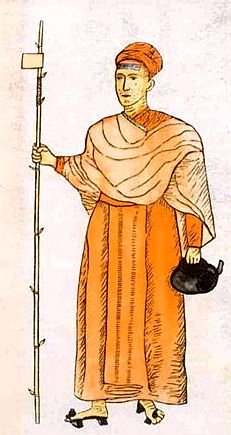
De Nobili was fully convinced that to make any impact on a sophisticated culture, he had not only to learn the language but also to adapt himself to the way of life of the people. The immediate inspiration to Roberto de Nobili, in that regard, was another Italian Jesuit, who preceded him by a few decades.

Metto Ricci

He was Matteo Ricci who lived in the mid-sixteenth century. He was one of the few missionaries allowed to enter the Chinese society. He transcended his status as a foreigner by mastering the Chinese language and the Confucian literary classics. The imperial court and the educated class recognized him as a distinguished scholar. He wore the appropriate attire for a Chinese scholar, “…silk dresses and published works on such topics as astronomy, science and philosophy.” He was particularly admired for his map-making skills as well as for being an accomplished teacher of mnemonic techniques, that is, ways of memorizing things. Ricci did not initially concern himself with making many converts. As a Confucian scholar he was convinced “…that the ethical precepts of Confucianism were reconcilable with Christian morality.” He attempted reconciling the Gospel with Confucianism which played an important role in Chinese culture. Yet, he was highly regarded by the Chinese. At his death, at age 58, hundreds paid their respects as his body “lay in state.” The emperor decreed that he be buried in a special tomb, an unheard of honour for a foreigner and even rare for any Chinese.

Ricci’s entire project was however rejected by the Vatican because it could not favor Ricci‘s endorsement of the veneration of family ancestors. However, many, even within the Church, considered its decision a retrograde step.

Roberto de Nobili in consultation with his superiors, the Archbishop of Caranganore and the Provincial of Malabar (Father Laerzio) derived a plan of breaking in to the Hindu society. Robede-nobili-rto de Nobili decided to follow the steps of the fellow Jesuit, Ricci. Like Ricci, he took great care not to impose his Western views or culture on the local population. Instead, he tried becoming one among them by adopting the role, customs and attitude of a sanyasi.
He was determined that he has to be a Brahmin mendicant in order to be effective as a religious preacher. Accordingly, he called himself a Romaca Brahmana; he shaved his head, applied gandha (sandalwood paste), started wearing ochre-robes, wooden shoes; carried danda (stick) and kamandalu (water jug) like a Hindu monk. He also gave up meat. He engaged a Brahmin cook, ate only rice and vegetables and started sleeping on the floor. He learnt Tamil and Sanskrit from a Telugu Brahmin pundit Shiva Dharma; and in a while became quiet an adept in southern languages. He studied Sanskrit texts and holy books; and started writing Christian psalms and prayers in Tamil patterned on the Indian songs and prayers.

He opened a school of catechism and slowly started introducing Christian theology.He then built a church and presbytery on a site granted to him by a cousin of the king of Madurai. All his servants were Brahmins. He lived and dressed like a Sannyassi. It is also said that he wore a three-stringed thread across the chest just like Brahmins. He claimed the three-stringed thread represented the Holy Trinity of the Father, the Son and the Holy Spirit . He became an Iyer (preceptor) to local people who started venerating him for his austere life, kind manners and healing powers which he had acquired modestly.

He was careful not to criticize the local customs and practices. For instance, he did not criticize the customs like Sati though, it is said, he witnessed scenes of women committing Sati on the death of Nayaka of Madurai. Instead, he praised the extraordinary courage and steadfastness of those women. He also did not criticize or comment on the caste system prevailing in the Hindu society. He appeared rather convinced that the caste customs were not all to be condemned. Certain of these, were civil and social in character, he said, and might be tolerated. Nobili, in fact, avoided all public intercourse with the lower castes.

Roberto de Nobile’s intense study of both the Hindu religion and culture gave him access to the people whom he came to admire. His way of life, his move from a house into a simple hut and his vegetarian diet of rice and Vegetables signified identification with the people of the land. He was able to secure a sympathetic hearing from the Brahmins.

His methods seemed to work. In a short period of time he succeeded in gaining more than a hundred converts in the very city where his fellow missionaries had laboured in vain for years.

The representatives of the Church in Portuguese Goa were however alarmed at the unchristian ways of De Nobili and complained to the Vatican about his dangerous methods and the consequences of indianizing the Holy faith. They were scandalized by the extent of De Nobili’s adaptation of the local culture. They powerfully argued that sacred symbols of Christianity cannot be understood and revered in isolation of the ethos and the culture from which they originated. “The Gospel message cannot be purely and simply isolated from the culture in which it was first inserted, nor, without serious loss, from the cultures in which it has already been expressed down the centuries…. It has always been transmitted by means of an apostolic dialogue”.

They were in effect stating that the Catholic religion has particular cultural roots; and it cannot entirely be “disincarnated” from its historical origins in the culture of Jesus. The more one suppresses or modifies the language of the Bible and its symbols on cultural grounds, the more one trivializes culture of the Bible itself. Similar is the case with the liturgy and other cultural expressions of the Church, which has carried the mystical life of Christ through the centuries. The Christians wherever be they placed should follow the methods, the forms, the symbols, the rituals and the dictates of the Holy See, which is the sole authority on all matters religious and secular, concerning the life of Christians

His fellow Jesuits in Madurai too charged him with countenancing superstition by allowing use of pagan rites; and encouraging schism and dissension by permitting no intermingling, even within the church, between the Brahmin converts and the lower caste converts.

De Nobili responded by submitting to the Holy See a detailed exposition of his views on religion, culture and the relation between the two. He gave ‘a norm by which we can distinguish between social actions and those purely religious’ (‘quod regulam, qua dignosci debent, quae sint apud hos Indos politica et quae sacra’).

He argued that religion was different from culture. The religion, he said, was concerned with salvation of human beings and to reveal the ways to attain that salvation. The object of religion is not to talk about social customs and observances of castes. The caste, symbols and race are all relative and are not the object of the religion; they are merely the socio-cultural patternsand had no religious meaning. These matters belong to the civil society.”These ceremonies” he asserted “belong to the mode, not to the substance of the practices; the same difficulty may be raised about eating, drinking, marriage, etc., for the heathens mix their ceremonies with all their actions”. Besides, culture is not personal; it is always a collective possession. Religion does not need to be empirically connected to cultural conditions. One can therefore talk to a person about religion without referring to culture. The religious doctrines can stand independent of the cultural symbols.

As regards the charge of schism he denied having caused any such thing. He explained that he had founded a new Christianity, which never could have been brought together with the older. The separation of the churches, he pointed out, had been approved by the Archbishop of Cranganore; and it precluded neither unity of faith nor Christian charity.

He explained that his taking up Brahmin life style, was motivated by his keen desire to convert the Brahmins to Christianity; and not to enter into a dialogue between cultures and religions. His thrust was essential to break in to Hinduism; and   in a sense his life style was a weapon to win the enemies. The earlier missionaries failed to understand the ways of entering in to the Hindu society; and therefore their success, if any, in spreading the Gospel was dismal. His method, he said, had been working very well and had brought into the true faith hundreds of upper castes and Brahmins, who would truly be the future of the Faith in India. He argued, what was of paramount importance was spreading the Gospel and converting upper castes in large numbers; and it did not really matter whether they retained or not their social – cultural symbols and patterns. In any case the core concern of the Church is the Faith and not culture.

He defended himself by providing documentation of the fact the early church had sanctioned and integrated different pagan customs and rituals. In defense, Nobili wrote a comprehensive document that carefully outlined his position. It was entitled An answer to the objections raised against the method used in the new Madurai Mission to convert pagans to Christ.

In this defense Nobili supported his actions with the history of contextualization. He cited the council of Jerusalem in Acts 15 and also an unusual document containing the instructions St. Gregory sent to St. Augustine of England in the fifth century.

He traced the history and the development of Christianity and explained how the Christian faith in its early years until the fourth century absorbed and adopted the Greco Roman cultural symbols , patterns , behaviours and religious icons and rites in order to establish itself in the civilized world. He argued that a similar approach should be adopted in India too. His method, he submitted, would also demonstrate that Christianity is not confined to one race and that all races can live in it, and that caste or culture is not religion. A Brahman convert, if he is not comfortable giving up his caste marks and symbols could be allowed to retain his caste practices , so long as they do not interfere with his Christian faith. In that sense, he said, certain symbols and signs of Brahmans such as ‘the thread and the tuft are social, not religious, insignia’ (‘Lineam et Curuminum non inter superstitiosa, sed inter politica esse’) and these are not even the exclusive symbols of any one group.

De Nobili argued that the adoption of brahmanical customs was the only way in which Christian faith could be presented.  He insisted that his method was in accordance with the practices of the early Church: whatever was not directly contrary to the Gospel could be employed in its service.

Initially, the reports sent against him produced an unfavorable impression, but after his defense was examined by the tribunal set up by him, Pope Gregory XV (pope from 1621 to 1623) refrained from issuing a condemnation. On 31 January, 1623, Gregory XV, by his Apostolic Letter, Romanae Sedis Antistes took an interim decision ” until the Holy See provide otherwise”,  in favor of de Nobili,. Thus, de Nobili was tacitly vindicated.

A Bull of Gregory XV (1623) authorized the Brahmins and other “Gentile” converts to wear cordons (sacred thread) and kudumis (tufts), the other caste insignia such as ashes or sandal paste. The condition prescribed by the Bull was that a Cross could be attached to the thread, if so desired, provided both the Cross and the thread are handed to the converts by a Catholic priest who would bless them by reciting prayers approved by the ordinary of the district. The wearing sandal, ashes, ornaments and emblems were allowed for general use “for the sake of adornment, of good manners, and bodily cleanness, without any respect to religion and also not in satisfaction of a superstition”.

As to the separation of the converts based on their castes, it was said that the pope understood that the customs connected with the distinction of castes, are deep rooted in the ideas and habits of Hindus. An abrupt suppression, even among the Christians would impede the growth of Christianity. They were to be dealt with by the Church, as had been dealt with slavery, serfdom, and the like institutions of past times. In other words, the Church found it prudent to distance itself from the caste issue.

Robert de Nobili, encouraged by the stand taken by the Vatican continued with his methods. It is said that he succeeded in converting 1208 members of higher caste including twelve eminent Brahmins; and 2675 of lower castes. One of his early converts was his teacher Shiva Dharma himself, who of course continued to sport his tuft and the sacred thread with a Cross attached to it. That made it easier for others to retain the traits of their earlier faith and yet become Christians. On the advice of Nobili, the superiors of the mission and the Archbishop of Cranganore resolved that henceforward there should be two classes of missionaries, one for the Brahmin and the other for the lower castes.

As a part of his exercise to indianize the Catholic Mass, De Nobili introduced Indian terms in to the Catholic terminology. For instance, Kovil was used by him in place of Church; Prasadam for Communion; Aiyar for Priest, Vedam or Yesur Vedam for the Bible, and Poojai for Mass. Nobili chose to take on the name Tattuva Bodhakar or Teacher of Reality. He also initiated the process of providing Indian form to Christian names. For instance he termed Devasahayam (helped by God) for Lazar; Rayappan (person of the rock) for Peter; Arulappan (person of grace) for John; and Chinnappan (the little one) for Paul. He pioneered the efforts to popularize Christ’s message in Tamil, Telugu and Sanskrit. He tried in vain to replace Latin in Seminary by Sanskrit.

Early on Nobili noted that the growth of the Indian Church would be stunted if it depended on foreigners for its sustenance. Therefore, it wasn’t long before he devised a bold plan to raise up hundreds of indigenous leaders.

Vincent Cronin in his book “A Pearl to India: The Life of Roberto de Nobili”, writes :

Nobili wanted to train seminarists [sic] who, having preserved their Indian customs and their castes, would be respected by their Hindu countrymen, to whom they could speak on equal terms. He wanted his future priests to present Christianity to the Indian people in their own languages, not in a jargon in which all religious terms were Portuguese; to be well trained in Christian theology but also experts in the religion of the Hindus around him; to depend for support and protection on their own countrymen, not on foreigners. In the first half of the seventeenth century such a plan was extremely bold and farsighted

He had his detractors both inside and outside the Church. But in Goa Nobili had many enemies.

Nobili, they cried, was the shame—the ineffaceable shame—of the missions; he complicated the simplicity of Christian truth, he deformed the method bequeathed by the apostles, mixing with it pagan rites and ceremonies; he was destroying the old traditions of the diocese of Goa; he was polluting the Gospel with specious emblems of caste; then, by frauds and deceits, insinuating this into the depths of men’s hearts. Instead of giving them salutary and profitable advice, with his superstitious inventions he led the credulous minds of the Hindus into error and deception; he mixed together things profane and holy, earthly and heavenly, vile and excellent.

He was on one occasion imprisoned but was saved by the timely intervention of the king of Madurai. Thereafter he was transferred from Madurai to Jaffna in Sri Lanka. As his health was deteriorating he requested the Church to send him back to his city, Madurai where he wished to spend his last days. He was however shifted to Mylapore, where he came to be called O Santho Padre (saintly priest). He had grown old, partially blind and frail but kept his austere habits and vegetarian food habits. As he grew weaker day-by-day his friends tried to administer him chicken soup as nourishment. But, De Nobili refused to take that. He insisted not merely in calling himself a Brahmin but in living like one.

Someone commented that pretension when sustained over long periods is such a dangerous game. It obliterates the thin dividing line between the reality and the world of make believe. De Nobili fasted unto death like an Indian ascetic and died on 16 Jan, 1656.There is no tomb or a memorial in his name either at Madurai, Mylapore, Jaffna or Salem.

Roberto de Nobili - Alchetron, The Free Social Encyclopedia

 It is rather a paradox; De Nobili maintained all his working life that religion need not be empirically connected to cultural conditions. He tried demonstrating that premise by distancing himself from polluting persons and polluting substances; and rigorously simulating the austere life of a Brahmin. But that, in effect, meant De Nobili had to enter Hindu religion through its culture. In other words, the Hindu culture was his door to the Hindu religion. In order to enter into the religious world of Brahmins he had to take recourse to their cultural practices, symbols and mode of life. That obliquely demonstrated the proximity between culture and the religion; just the point De Nobili was laboring hard to disprove. That in a way supported what his detractors were stating all along: One can not talk of religion and of God merely in terms of syllogisms but it should relate to the culture that help the religion make meaningful statements. Else, the converts might eventually abandon their cultures together with their religion.

Dr. C. Joe Arun SJ in his essay Religion as Culture: Anthropological Critique of de Nobili’s Approach to Religion and Culture says that De Nobili was not concerned with understanding different religions and cultures; his main aim was to convert as many people as possible. In doing so he needed a sound justification and therefore he artificially delinked religion from culture. Dr. Joe Arun feels that De Nobili could have entered into the world of Hindus by understanding their religion as a part of their cultural traditions and still he could have made significant progress in his mission.

***

The years following De Nobili’s death witnessed some interesting developments in the Church. In the year 1659 , three years his death, the office of Propaganda Fide echoed De Nobili by stating unequivocally that European missionaries were to take with them not ‘France, Spain or Italy, or any part of Europe’ but the Faith ‘which does not reject or damage any people’s rites and customs’. They were told “To be different does not necessarily mean opposition or contradiction”.

The Vatican had agreed to localization of several preaching methods in Eastern and African countries. It meant that message of the Gospel should be conveyed in the terms that are familiar to the people, lest they perceive Christianity as something foreign and irrelevant to their way of life. The liturgy must “think, speak, and ritualize according to the local cultural pattern.”

In India, after the death of De Nobili in 1656, many of the Jesuits continued his policy, despite objections from the other religious orders, mainly the Capuchins (the members of the Franciscan order), who were in charge of the French mission at Pondicherry.

The Jesuits, in deference to the Brahmin converts, formulated a scheme, with the approval of the Pope, for organizing two classes of missionaries, one for the Brahmins and another for the lower castes. The scheme did not however come in to being because of the combination of a number of factors such as the decline in the power of the Jesuits leading to their suppression ; the invasion of India by the Dutch; the insistence of Portugal upon its rights of patronage over all the churches of India, the downfall of the religious spirit in Europe during the eighteenth century, and finally by the destruction during the French Revolution of the colleges and religious houses that supplied workers for the mission.

Charles-Thomas Maillard de Tournon, Patriarch of Antioch, sent by Pope Clement XI, with the power of legatus a latere, to visit the new Christian missions of the East Indies issued a decree dated 23 June 1704 consisting sixteen articles concerning practices in use or supposed to be in use among the neophytes of Madura and the Carnatic. The Tournon decree condemned and prohibited Jesuits’ practices as defiling the purity of the faith and religion, and forbade the missionaries, on pain of heavy censures, to permit such practices any more.

With these measures, the distinction between Brahmin and pariah missionaries became almost extinct. But, as the conversions from the higher castes became fewer and fewer, Pope Benedict XIV, at the request of the Jesuits, consented to try a new solution to the knotty problem, by forming a band of missionaries who would attend only to the care of the pariahs. The scheme became formal through the Constitution Omnium sollicitudinum published on 12 September, 1744. The scheme however was not a great success.

The Jesuit missionaries thereafter pursued a design which Nobili had also in view, but could not carry it out. They opened their college at Triruchirapalli. That enabled Jesuits to make a wide breach into the wall of Brahminic reserve, as hundreds of Brahmins sent their sons to be taught by the Catholic missionaries. Within about a few years about fifty of those young men embraced the faith of their teachers.

****

Three centuries after the death of De Nobili, Pope John XXIII revived the issue of localization of religious practices by affixing his pontifical seal of approval to the work of pioneers like Matteo Ricci and Roberto de Nobili. In calling the Second Vatican Council in 1962, he opened the windows of the Catholic Church to let in some fresh air; which according to some conservatives led to all sorts of confusion.

His successor Pope Paul VI who presided over the remaining sessions of the Second Vatican Council, too, emphasized the importance of the dialogue with the traditional religions and their cultures. In his allocution to translators in 1965, Pope Paul VI declared that vernacular languages had become vox ecclesi, the voice of the Church (EDIL 482). Pope Paul VI is said to have remarked “A faith, which does not become a culture is a faith that has not been fully received.”

The idea that the Gospel should be preached in terms familiar to the people, lest they perceive Christianity as something foreign and irrelevant to their way of life; and that the liturgy must “think, speak, and ritualize according to the local cultural pattern” was gaining ground.

***

De Nobili was partially vindicated, though in a strange a manner. De Nobili, all his life, worked hard on the premise that culture and religion are two separate concepts and religion could be independent of the culture. That premise did not seem to find favor with the Church. However, the Church found it worthwhile to adopt and pursue his methods; that of entering a host religion through the portals of its culture. Such a process came to be known, in due course, as inculturation or enculturation.

Inculturation is the theological avatar of the anthropological term enculturation. It suggested a process by which the Gospel could be presented to a specific culture that is being evangelized. The process, in effect, meant using the culture of the host society as a door to usher in Christianity.

The term Inculturation or enculturation gained currency after Pope John Paul II officially adopted it in his 1979 Apostolic Letter Catechesi Tradendae. Since then, it has become a much discussed and a highly debated issue. Innumerable books and articles have been written on the subject. It is said that the pope meant inculturation as an ongoing dialogue between local cultures and the Christian faith. And yet, the term is not always clearly understood and each group has its own interpretation. The concept still remains rather fluid.

Inculturation or enculturation does not mean amalgamation or coming together of the two cultures. Neither the Church nor the host culture is changed. The host culture is not condemned, nor is it required to be phased out in order for the people to enter the Church. Thus, inculturation, in effect, became an arrangement under which, the convert accepts the theology of the church and the person of Jesus, while the Church does not question his culture and its practices.

Inculturation focuses on the local situation; and it cannot take place until the “other” culture is understood. It tries to re-express the Gospel, using the host culture’s own value. But the problem in older societies like in India is that it is not easy to demarcate the boundaries of its culture; because its cultures and religions run into each other. Culture of the people in India is not confined to their dress, their food or their artistic expressions. Their Culture embraces the whole human reality. It includes language, thought, the entire symbolic system and especially the idioms of religious expressions. It is not easyto isolate cultural elements, customs etc. and Christianize them.  Therefore, when the Church accepts the culture of its converts, it accepts a part of their religion too. That by implication means the other religions are not devilish any more.

Interestingly, the decree Nostra Aetate (meaning In our Time ), the declaration on the relation of the Church with Non-Christian Religions , promulgated on Oct 28 , 1965 in affirmation of the Second Vatican Council  had earlier stated, ” The Catholic Church rejects nothing that is true and holy in these religions. She regards with sincere reverence those ways of conduct and of life, those precepts and teachings which, though differing in many aspects from the ones she holds and sets forth, nonetheless often reflect a ray of that Truth which enlightens all men. ” It also spawns the idea of nurturing the “seeds of truth” present in other religions – in other words, to help the Hindu be a good Hindu or help the Muslim worship his one God – as if those seeds were themselves distinct ways of salvation, independent of Christ and even more independent of the Church. It is said the proposal was approved with an overwhelming majority of 2,221 to 88.

That put Evangelism and missionary activities of the Church in a totally different light. Conversion has always been an irritant in multi-religious countries. It involves convincing people that their religion is wrong or inadequate; and ultimately persuading them, by whatever means, to convert to the new religion. The Church, it seemed, was wary of taking that approach.

Now, once the elements of Salvation and doctrinal superiority are taken out of the equation, the conversions lose their religious significance; and are no longer religious phenomena. Perhaps the only significance they might be left with, in a multi-religious society like India, is the creation of social groups which might have the potential of turning in to vote –banks.

But, at the same time, the Church is missionary by her very nature; and every Christian is a missionary. The Church believes that its existence and growth depends on the mission carried out by its faithful. Conversions are the lifeblood of the Church. What purpose will it serve the Church if it merely carries on socio-political debates without gaining converts? The Church cannot obviously give up its missionary activities. Or does it mean the Church prefers to build the fold where the sheep are, instead of going after the sheep to bring them in to the fold  ¿.There appears to be some confused or covert thinking here.

****

Many traditional and conservative Catholics within the Church were therefore not comfortable with the interpretation and the implementation of the inculturation; and they feared, the Church runs the risk of self-contradictions. Further, they pointed out, the more one suppresses or modifies the language and the rites of the Bible on cultural grounds, the more one trivializes its culture. The same argument could be applied to the liturgy and other cultural expressions of the Church. They insisted that Gospel message should not be isolated from the culture in which it was first inserted; and the unity of the Roman rite and a universal Christian vocabulary must be maintained. They argued that the changes in the liturgy should be made “only when the good of the church genuinely and certainly requires them” and not as a matter of routine.

They also pointed out a paradox in the situation. They said if you accept that inculturation expresses the mystery of Christ in a better way, it might then mean that such cultures complement something that is lacking in the Gospel. Would it not suggest that Gospel by itself is somewhat inadequate? Thus the consequences and implications of inculturation are unpredictable; and the Church better be weary of thatprocess.

***

Despite such criticisms, the contemporary evangelization lays emphasis on the importance of enculturation, with encouragement from Rome. The supporters of inculturation argue it is not always easy to distinguish between faith and culture, between values and counter- values. Finding solutions is often arduous. Inculturation, they insist, is a marvelous and mysterious exchange of gifts: “In one direction, the Gospel reveals to each culture the supreme truth of the values that the culture embodies and allows the culture to unleash that truth; in the other, each culture expresses the Gospel in an original way and reveals new aspects of it.”

But somewhere along the line the process seems to have gone overboard. While the Second Vatican Council, especially Gaudium et Spes, stressed the priority of the Faith over culture, some recent developments in India seem to suggest that evangelists regard culture as the ultimate source and norm of faith.

I understand that the Church has so far approved for India a program for Inculturation in about 168 dioceses; and about 45 churches have been fully incultured. Today , the methods innovated by De Nobili are being employed quiet brilliantly by some christian missions. The Inculturation in the Indian context involves providing a Hindu orientation to the lay out, structures and interiors, furniture and religious fixtures of a church. Some of them have been refurbished and redesigned to include murals, panels, furniture et al inspired by Hindu symbols.

In some instances the image of Jesus too is depicted in Hindu style: as in the case of Jesus sitting cross-legged on a lotus (installed in a church in Hyderabad), or Jesus emerging after a purifying bath in the Ganges with temples on the riverbanks (in a mural in a Hardwar church). At a church in Nadia, Jesus looks like Sri Chaitanya Mahaprabhu, the 15th century Vaishna saint of Bengal, his arms raised in a beatific trance. At a church in Jhansi, scenes from Christ’s life, in a set of 40 paintings, mare depicted in Indian forms. At a seminary near Shillong Jesus is shown standing under a pine tree with people in Khasi and Garo headgear around him. At Ambapara, Jesus is shown as a Bhil tribal.

Inculturation

The robes of the missionaries (with saffron tinge) and in some cases even the names (such as Swami Abishiktananda etc.) have been given a Hindu orientation. . The Seminaries or Churches in many cases are called Ashrams, and resemble Hindu temples in appearance.

On the path of Nobili: The modern day Christian Missionaries dawning the robe of Sanyasis to convert the Hindu populace. Source: https://www.facebook.com/VRindus Bede Griffiths

One of such churches was built by Bede Griffith built in Tiruchirapalli District of Tamil Nadu. It is named Sachidananda Ashramam. The gateway to the Ashram, in Hindu style, depicts God the Father as masculine, an androgynous image representing Jesus and a feminine face suggesting the Holy Spirit. The Vimana, or colorful cupola, above the temple’s sanctum, constructed in traditional style using symbolism from the Bible; and also the lotus and the symbols of the five elements, depict Christ seated in various yoga postures. His saints too adore the Vimana. The sanctum itself is built like a Garbhagriha, dark and mysterious. Jesus sits in side the sanctum on a Lotus, like a yogi. Four adjoined statues face the four cardinal directions sitting knee-to-knee in the classic lotus posture. They are situated in a large black lotus, and even Jesus is black. The monks in saffron robes begin every prayer with the sacred Sanskrit syllable Om.

Inculturation3

The worship rituals are conducted in Hindu style with waving   of Arati, burning incense and flower decorations. Chanting of mantras of Jesus in Indian style and meditations are also carried out. There is an admixture of religious symbols, bordering on syncretism. Bede Griffith himself was attired as a Hindu monk in saffron robes. Sachidananda Ashramam might look like a bridge between the Christian faith and Hinduism; yet, to many it seems to reflect an unresolved problem within Catholicism.

The other methods of inculturation or Indiazitation include not merely equating Madonna with Mother Goddess Devi; Virgin Mary with Kanya Kumari; and Infant Jesus with child Krishna, but also depicting them as such. Sometimes, it is suggested that Jesus spent his youth in India mastering forms of Yoga or that Jesus is one among the Avatars. The Sanskrit texts are interpreted to suggest that the terms such as Isa, Ishwara and Parameswara referred to Jesus in the first place; and that Prajapati is really Jehovah.

There may not be much substance in such portrayals. But they do help in melting down the natural barriers and resistance to an alien God from an alien culture; and renders it easier for the Hindus to accept the icons of Christianity as their own.

Inculturation2

***

Recently the Church in Kerala brought an ‘Indianised’ Bible with references to the Upanishads, Bhagavad Gita, Manusmriti and drawings of a turbaned Joseph and sari clad Mother Mary with baby Jesus in her arms. The Catholic Church’s spokesperson Father Paul Thelekat described it as an attempt to make contextual reading and understanding. Over such 70 references to non Christian texts have been made in the Bible and 30 scholars participated in making the commentary, Fr Thelekat said.

The new Indian Bible has also references to Meerabai, Mahatma Gandhi, and Rabindranath Tagore in the interpretations of biblical passages.

“An attempt has been made to give a Bible which is more relevant for India. There is nothing added or subtracted from the text of the Bible, which has been reproduced as such”.

Thelekat said while interpreting Treasure in Heaven of Mt 6:19.21 said …’this concept is found a classical expression in the Bhagavad Gita’s call to disinterested action: ‘Work alone is your proper business never the fruits it may produce” (2:47), or while commenting on the third appearance of Jesus to disciples (John 21:1.14)… ‘The Lord ever stands on the shores of our life every moment and every age, every day and every night he comes, comes, ever comes’ (Gitanjali XLV

The deluge story of the Book of Genesis is interpreted with reference of such stories in Mesopotamia and Satapath Brahmana (1.8.1-10) and Mahabharata.

http://timesofindia.indiatimes.com/articleshow/msid-3328291,prtpage-1.cms

Please also check William Dalrymple’ article  Sisters Of Mannarkad: In this pocket of Kerala, local myth fuses Goddess Bhagavati and Mother Mary into family.

enculturation

The culture in Indian society is centred on the family traditions; similar is the case with the Indian Christian communities too. They have learnt to make adjustments and to work out a way of life and a way of response to the Gospel. For instance, each community has a way of celebrating a wedding. When a family turns Christian it does not abandon its traditional customs; instead, it adds on a new ritual, the Christian ritual. They keep their socio cultural customs, but add on a prayer or a symbolic action to Christianize the celebration. An inter-cultural encounter thus becomes an  inter-religious encounter too.

The social status of a convert is not greatly altered; he might sometimes fall in to a different sub-category. For instance a dalit converted to Christianity is labelled a dalit Christian. He continues to follow, mainly, his family traditions and life-cycle rituals.

There are innumerable Hindus who accept Jesus Christ and follow his teachings without converting to Christian religion. There are also those who refused to join the Church officially or those that adopted an independent way of life even after baptism, like Brahmabandab Upadyayaya, Nehemiah Gorey, Manilal Parekh and Pandita Ramabhai et al.

Even among ordinary Hindus, that is at the level of people who are not regarded intellectuals, one can notice their acceptance of Christ; but in their own way. For instance, the shrine of Infant Jesus in Bangalore, especially on Thursdays, is thronged by Hindu worshippers and quite a number of them  come from upper castes and Brahmin families. Their acceptance of Jesus is a matter of simple faith, an answer to their prayers. It is a direct communion between the worshipper and Jesus; and it involve neither the Church nor its doctrines.

There are other cases where Christian at some stage of his/her life discovers that s/he is heir to two religious traditions feeling that s/he is Hindu-Christian, Buddhist-Christian, etc. They seek to integrate both, with a fair amount of success. Such cases do not involve interaction with other cultures; they are inter – religious encounters. Therefore, perhaps to guard against the dangers of “reverse-inculturation”, the Church banned Yoga and other non-religious practices in the Church premises.

Inculturation has thus traversed a full circle since the time of Roberto De Nobili to the present day.

All these, bring us back to the question we started with: what is a proper way of understanding conversion and its need in a multi-cultural and multi – religious society in India, given the inculturation phenomenon.


******

Infant Jesus

Resources

History of the missions by Bernard de vaulx

History of the Catholic Church from the Renaissance to the French Revolution by Rev. James MacCaffrey
inculturation by Eugene Lapointe
Religion as Culture: Anthropological Critique of de Nobili’s Approach to Religion and Culture byDr.C. Joe Arun SJ
Malabar Rites
Roman Catholic Brahmin! By Jyotsna Kamat
The Challenges of Gospel-Culture Encounter  by Fr. Michael Amaladoss, S.J.
Dialogue in a New Key by Fr. Michael Amaladoss, S.J.
Who was Roberto de Nobili?
‘Om Namah Jesus’

https://www.indiamahesh.com/2015/05/the-christian-swami-forgotten-tale-of-roberto-de-nobili-a-k-a-tattva-bodhakar/

All illustrations are from internet

 
14 Comments

Posted by on September 11, 2012 in Inculturation


Tags: , , , ,

The scholar …the drifter

Rahula

Rahula Sankrityayana (1893 – 1963)

In my article on Tibetan Buddhism, which I posted quite sometime back, I made a brief reference to the efforts of Mahapandita Rahula Sankrityayana in bringing back from Tibet, precious books and ancient manuscripts that were no longer available in India. In that context, I wrote a few lines about the scholar and his life. One of the readers exclaimed “Wow..! He seems to have been quite a cool guy: a one-time Arya Samaji turned Tibet-travelling, Scripture-collecting, travelogue writing, Soviet-loving former Brahmin turned Buddhist founder of the Communist Party of Bihar.” And said” You have been too short on him. Why don’t you write more about him?”

I am not sure if the Mahapandita ever regarded himself a cool-guy. I wonder, despite his scholarship, whether the term cool-guy meant anything to him. His time was much before the slang entered into books. Even in case he was wise to the term, I suspect, he could not have cared less.

I had no opportunity to meet the Mahapandita. I did, of course, send him a few letters. He replied in Hindi to my letters in English. That was during 1960 – 61, my hard times, the years of great stress and total confusion. He was, at that time, teaching in Vidyalankara Pirivena, a Buddhist Institution in Sri Lanka. He advised me to dig into Pali texts if I have to understand the Buddha and his teachings. I later came to know that soon after that he returned to India; and died of caner, in the year 1963, at Darjeeling. I could not pursue Pali studies. I had other priorities; I had to earn a living. That took me to the wilderness called Bombay. (Please see my earlier years in Bombay and  Dorabjee )

I was initially attracted to Rahula Sankrityayana through his books on travel, especially his fascinating experiences in that land of mystery, Tibet. The other book of his that I liked was “Volga to Ganga”, a literary adventure spread over 22 short stories. It attempts to reconstruct early human history from pre-Vedic times to the then modern India (1944). It focuses on various stages in the civilizations that flourished in the regions between the basins of the two great rivers the Volga in Russia and the Ganga in India. The remarkable thing about the book is the way it presents history as a series of stories of imaginary characters. That was very fascinating. During those days I regarded the books of Will Durant and Sankrityayana, among a few others, as   self-learning tools, since my formal education  had snapped at that stage.

He was born as Kedarnath Pande in an orthodox Brahmin family in a small village in Azamgarh district of Eastern Uttar Pradesh. He lost his mother Kulawanti at a very early age; and, his father Govardhan Pande, with the aid of the boy’s grandmother brought him up . His basic education was in Urdu and Sanskrit at the village school.

In his autobiography titled “Meri Jivan Yatra’, he writes that while learning Urdu , the lines : “Sair kar duniya ki gaafil zindgani phir kahan / zindagi gar kuchh rahi tau naujavani phir kahan?” ( Oh !ignorant, go and travel all over the world .You will not get this life again . Even if you live long, youth will never return) gripped his attention ; and , he was much fascinated by its import. He was bitten by the travel-bug quite early in life. Travel or Wanderlust  became almost the theme song of his life. 

His education , of course ,  did not last long. Restless by nature, he ran away from home at the age of nine, to ‘take a look at the world”. He survived by doing odd jobs; and serving the groups of wandering mendicants, sadhus. Some say; he learnt Devi Upasana during this period. After staying with the sadhus for nearly a year, he returned home for a brief period ; and, then again left for Varanasi to study Sanskrit under a Vaishnav pundit, Baba Ram-udar Das. He also taught himself some Indian languages and English. He learned photography as well.

He again left Varanasi on a long pilgrimage of South India. On return, he settled down at the Arya Samaj, Lahore; and pursued Vedic studies. He , at that time, was in his twenties; and, his writing career started here. He wrote for Sanskrit and Hindi periodicals. The massacre at Jillian wallah Baugh (1919) shook him rudely; and , he decided to plunge into the national movement.

He was imprisoned for three years, during 1925-27. It was while he was serving his term in the prison, Kedarnath got acquainted with the Buddha and his teachings. It had a profound impact on him.  He, later in his life, wrote “I had given my heart and mind to Arya Samaj. But, I had to take them back when I discovered the Buddha”.

Soon after his release from prison , he traveled to Sri Lanka (1928) and got admitted to the renowned Buddhist monastic college, Vidyalankara Pirivena. He learnt Pali and Sinhalese languages; and studied the Buddhist texts – the Tipitakas – in the original. He assumed the name Rahula (after the Buddha’s son) Sankrityayana (the assimilator).

After a stay of about three years, he left Sri Lanka and joined Dr. Rajendra Prasad (who later became the first president of the Indian Republic) in social constructive activities. He also became the president of the Azamgarh unit of the Indian National congress.

Bitten by the travel bug, he quickly left for the forbidden land of Tibet. The India – Tibet border, during the British Raj, was virtually sealed; and, it was extremely difficult to enter Tibet from India. Sankrityayana, therefore, took a circuitous and a very hazardous route to Tibet, which was hardly traveled. He entered Tibet through Kashmir. Ladakh and Kargil and traveled on foot in company of petty thieves, smugglers and petty merchants desperate for trade and a small profit.

While in Tibet , he traveled extensively, in company of a Tibetan monk, Gendun Choephel, searching for copies of ancient Sanskrit texts that were destroyed in India, centuries earlier; but had survived , hidden away in the thousand-year old libraries in remote monasteries in Tibet. Gendun Choephel was Rahula’s translator and guide  as well as his mediator for Tibetan culture. The two  visited many monasteries and discussed with many Lamas. Some say; he even got secret initiations. Sankrityayana’s main purpose was to collect and bring back to India the ancient Sanskrit texts or their translations that were no longer available in India. For Rahula, historical research was a part of his political fight; for him researching  and understanding history was the key to the present. He did succeed in this , to a certain extent.  Appreciating Gendun Chopel’s  help and learning, Rahula invited him to join his entourage;  to visit the Buddhist holy sites in India . It is said; Rahula returned to India after fifteen month’s stay in Tibet with  twenty-two mules loaded with Sanskrit  and Tibetan manuscripts; and Thanka paintings  obtained from Tibetan monasteries.

Gendun_Chophel

Incidentally, his friend and guide Amdo Gendun Chopel (1903-1951) was no less a colorful person. He too lived an interesting and an adventurous life. Gendun Choephel visited India and was thoroughly taken up by the turbulence of the freedom movement. It is said, in India he experienced the most creative phase of his life. He traveled across the country as a Buddhist pilgrim, lived in the crowded city of Calcutta, saw the ocean, visited brothels and libraries, wrote his first newspaper articles and translated the Kamasutra in to Tibetan, enriching it with notes based on his newly gained experiences.

Gendun Choephel returned to Tibet in 1946. Rahula’s leftist ideology obviously seemed to have rubbed off on him. He got associated with the Tibetan Revolutionary Party ; and, designed its logo: a sickle crossed by a sword. The Tibetan Revolutionary Party’s goal was to overthrow the tyrannical regime in Lhasa. He began to write the political history of Tibet ; but this attempt was abruptly stopped by his arrest.

He was accused of insurrection and thrown in jail for three years. In 1949 , he was freed. But his heart was broken ; and, he promptly drowned his desperation in alcohol. Soon afterwards, in 1951, the Chinese army overran the Tibetan troops in Eastern Tibet.  Shortly after the occupation of Lhasa by the Chinese army, Gendun Choephel died , in the middle of October, 1951.

His, often quoted, famous last words were “Now, we are fucked.” Though the remark , in his characteristic blunt manner, sounds rather obtuse ; in retrospect, few would argue against it.

During his last years, Gendun Choephel  gained reputation as a scholar , a revolutionary thinker and a radical intellect. And, he became a role model for many young Tibetans in Chinese-occupied Tibet; as also  for those in exile in India; particularly,  for the members of the ill-fated Tibet Improvement Party in the Kalimpong region .

A film titled “Angry Monk – Reflections on Tibet“, based on Gendun Choephel’s life , was made, in 2005, by Luc Schaedier, a filmmaker from Zurich.

The following are some quotes attributed to Gendun Choephel :

“In olden days, even in Europe, the world was thought to be flat. And when some intelligent people claimed the opposite, they were exposed to various difficulties, such as being burnt alive. Today, even in Buddhist countries everybody knows that the world is round. However in Tibet, we still stubbornly state that the world is flat.”… Newspaper article, Tibet Mirror, Kalimpong, 1938

*

In Tibet, everything that is old
Is a work of Buddha
And everything that is new
Is a work of the Devil
This is the sad tradition of our country… Poem, Tibet 1946

*

“As for me — I have little shame I love women. Every man has a woman. Every woman has a man. Both in their mind desire sexual union. What chance is the for clean behavior? If natural passions are openly banned, unnatural passions will grow in secrecy. No law of religion — no law of morality can suppress the natural passion of mankind  ‘… Foreword of a Kama sutra- translation, Calcutta 1939

Please check: http://www.angrymonkthefilm.ch/en/gendun_choephel/

**

[It is said; the Mahapandita Rahula Sankrityayana visited Tibet – the land of the Lamas –  four times during 1929, 1934, 1936, and 1938 , spending fifteen months in the first; and six months in each of the subsequent journeys; discovering, examining, copying and photographing   rare texts that were lost to India. He succeeded in bringing back to India, in all, photographs of more than eighty works which , later, were deposited with the Bihar Research Society at Patna, Bihar]

On his return, Rahula Sankrityayana  with the help of his friend Kasi Prasad Jayaswal, the reputed Indologist,  arranged and classified the manuscripts; and , also identified some of the manuscripts, the originals of which were lost. Most of the books and manuscripts he brought back from Tibet had been lost in India; but preserved in Tibet. What he had brought back was a literary treasure. All his later writings revolved around this collection, in one way or the other.

He settled down in Patna for a while, researching into the Sanskrit and Tibetan manuscripts he brought back from Tibet. He even toyed with the idea of setting up a Buddhist University in Nalanda.

[His dream was fulfilled years later when his disciple Dr. Jagdish Kashyap founded the Nava-Nalanda Maha Vihara, during 1970.]

While working on the Buddhist manuscripts in Patna, he was asked by the Mahabodhi Society, Calcutta to go to England to spread the message of the Buddha. Sankrityayana accompanied by Ananda Kausalayana, a Buddhist monk and scholar, left for Europe and England during the year 1932.They traveled together in Europe for nearly one year.

While in England, the celebrated Indologist Theodor Stcherbatsky was greatly impressed by the scholarship of Sankrityayana ; and , invited him to Russia. He stayed in Russia for more than ten years, until 1948. Sankrityayana did not have formal education and degrees; yet, in consideration of his learning and scholarship, he was appointed professor of Indology (1937-8) at the University of Leningrad. At the University , he taught Indology , Sanskrit and Bengali. He published about ten books in Bengali while he was there.

He became a member of the Communist Party, around 1938. By about this time , he gave up his monastic status.

There at the University, he came in contact with a Mongolian scholar Lola (Ellena Narvertovna Kozerovskaya). She could speak French, English, and Russian;  and could write in Sanskrit. She helped him in his work on Tibetan – Sanskrit dictionary. They got married; and had a son, Igor. This was Sankrityayana’s second marriage. He   was married when very young; but, nothing much is mentioned of his child-wife or what became of her.

He traveled to Tibet again, in 1944, for an extended stay of three years. He also visited India to participate in the peasant’s movement. He was now a full-fledged member of the Communist Party. He wrote books and pamphlets on communist ideology. “It was easier” , he later wrote, “for a student of Buddhist philosophy to understand Marxist philosophy.”

Despite such bonhomie, the communist party found it hard to tolerate his radical views and behavior. He was promptly expelled from the communist party and USSR, after about a decade of his life as a communist. His Russian wife and son were not allowed to accompany Rahul to India. Stalin was then in control of the Soviet Union.

On his return to India, he resumed his Buddhist work. He again took to travel and visited Sri Lanka (where he taught Sanskrit), Japan, Korea, China, and Manchuria. He saw a fire temple in Baku ; and , discovered an inscription in Devanagari script. From there, he went to Tehran, Shiraz and Baluchistan ; and, finally returned to India. It is said that during his lifetime he visited Tibet four times.

Sankrityayana  was a multilingual linguist, well versed in several languages and dialects, including Hindi, Sanskrit, Pali, Bhojpuri, Urdu, Persian, Arabic, Tamil, Kannada, Tibetan, Sinhalese, French and Russian. He was also an Indologist, a Marxist theoretician  and a creative writer.

As regards his physical appearance, it is said Rahula was a very handsome person, standing over six feet tall , with wide forehead, broad shoulders and chest. He had a pleasant and a winsome disposition.

Rahula2

He started writing during his twenties ; and , wrote , in all, around 150 books and dissertations, covering a variety of subjects. Apart from travelogues he wrote extensively on a verity of subjects such as sociology, history, philosophy, Buddhism, Tibetology, lexicography, grammar, textual editing, folklore, science, drama, and politics, He also produced two huge dictionaries, one Tibetan – Sanskrit; and the other Russian-Sanskrit. He also prepared a glossary of Hindi terms for administrative use. He also collected and wrote about the ecstatic songs (Doha) in Apabramsha dialect spoken by the eccentric Siddha saints of Bihar and Bengal. In honour of him, Patna Museum, Patna, has a special section, where a number of rare manuscripts, paintings and other items collected by him are displayed.[many however fear that Sankrithyayana’s manuscripts are allowed to be stolen from India.

[Please checkhttp://www.birgitkellner.org/index.php?id=171]

rajam_symbols_10

The publication of Rahula Sankrityayana’s two-volume History of Central Asia in 1956-57 in Hindi was a benchmark in historical writing in India. The book however appears rather incomplete; because , he could not finish it in the way he wanted. Rahula wished to document the transition in Central Asia from Tsarists exploitation to the socialist epoch, giving a clear picture of the economic, cultural and educational achievements of the Soviet period. He envisaged that as the ‘most important’ part of the book.

In a representation dated 30-04-1946 addressed to “Our dear teacher Comrade Stalin”, Sankrityayana requested “I am writing this letter to you, our greatest leader, with the request that I may be allowed and granted facilities for six months (or whatever times) trip for the central Asia to collect the necessary materials.–With the best regards, I am one of your millions of followers”

But he was not allowed to visit the region and collect field data. Because , the Central Committee of the CPSU considered his visits to Central Asian Regions of USSR was ‘inadvisable’.  That decision was conveyed to Sankrityayana through a letter dated 4th Oct 1946 signed by M. Suslov  :  In the secretariat of Comrade Zhdanov A.A.—  In connection with the letter of Rahula Sankrityayana addressed to Comrade I.V. Stalin we inform you that this question was discussed in April this year in the Secretariat of the CC of the A-UCP(b). The journey of R.  Sankrityayana to the Central Asian Republics then was considered to be inadvisable”.

[  Please check http://www.revolutionarydemocracy.org/rdv6n1/sankrit.htm ]

No reasons were assigned in the letter of Suslov as to why Sankrityayana’s visit to Central Asia was considered inadvisable. Sankrityayana was , of course, mystified and bitterly upset about the decision handed down.

With the permission to visit central Asia being denied ,  he was unable to collect further materials he needed: the planned three-volume history was  reduced to two volumes.

He later  wrote that if there was any major fault of the Soviet administration it was  the extent of suspicion which had reached its highest point there.

chapter_end

He wrote his diaries in Sanskrit. But his passion was Hindi. He wrote almost all his books in Hindi. He wrote forcefully, elegantly and charmingly. His prose was magnificent. He strove hard for the cause of Hindi. He was , for several years, actively associated with All India Hindi Sahithya Sammelan. He was a major figure in the field of Hindi literature. One of the reasons for his expulsion from the communist party was perhaps his strong emotional attachment to Hindi.

The well known historian Kashi Prasad Jaiswal wrote:

“A perusal of his remarkable works does not only make dead history return to life and comprehension of Indian history easy, but it also helps unravel many a historical knots. The great compiler and interpreter of his limitless data, which from their unbounded range in quantity make their handling extremely difficult, deserves unqualified gratitude of the reading public. The world of Hindi may take this achievement for a piece of pride, for no language either in the east or west has produced such a work.”

Explaining his association with Buddhism, Sankrityayana said he was attracted to the personality and the teaching of the Buddha ; and, was impressed by the Buddha’s advice to the Kalamas: “Do not accept my words only because they come from me. Reflect on them and accept them only in case you find them acceptable.” Later, Sankrityayana, in turn, advised his students “Do not accept scripture or tradition. Accept only what you learn with your own mind and agree with that.”

His favorite line from the Buddha was: “I’ve used ideas as boats to cross the river with, not to carry them around upon my head.” It was this attitude that made him embrace Arya Samaja, Buddhism, Theravada, Mahayana, monasticism, communism, and lay life in turn. He was ready to accept change; he refused to be tied sown to a fixed idea or to an ideal.

He was convinced that Buddhism, far from being different from or antagonistic to, Vedic ideas and ideals, was in fact a part and an extension of Vedic tradition and its  way of thinking. Buddhism , he said, was very much a voice from within the Hindu fold. Sankrityayana argued that his conversion to Buddhism was for him, not a change from one religion to another, but just a change in emphasis on certain things.

He explained, the Buddha himself said what he taught was the Veda and Upanishads (esa vedopanisado). The principles were there; but , the method of reaching those principles was what the Buddha discovered. This was the original contribution of the Buddha to human weal and welfare.

He quoted , in his support, the great Mimamsaka Kumarila Bhatta (c.620 AD) “The Buddhist denominations and other faiths are all derived from the Upanishads. And inasmuch as they advocate the withdrawal of one’s excessive attachment to objects of sense-pleasure, they are all authentic and praiseworthy.”

For some reason, Sankrityayana did not seem to think highly of Yoga or meditation. He called them “indulgence of old men.” That, coming from a former monk truly queered the pitch among the orthodox Buddhists.

He was not free from controversies in other areas too. He was accused of using history as a vehicle to carry his Marxist ideologies. For instance, the Gupta era is regarded the golden age; a very prosperous era during which the arts, literature,   culture and economy in general flourished. But , Sankritiyayana tried to project it as an age of tyranny and oppression. He seemed to argue that “suppression was the foundation of economic progress in history. How could an Empire be prosperous unless its common people are exploited? ”. In a way, he was the forerunner of historians like Romilla Thapar, RS Sharma and a few others.

Kamala_Sankrityayan Late in life, Sankrityayana married, for the third time. He married Dr. Kamala (1920-2009) , a Nepali lady of Indian origin. She, in her own right , was a highly regarded and  a well known Nepali  and Hindi writer, Scholar and Translator . They had a daughter (Jaya) and a son (Jeta).

For a stretch of time he settled down to a quiet married life with Kamala and their two children – Jaya and Jeta – in the   placid and cool Hill-town of Mussoorie , often described as the Queen of  Hills . They resided in a house (Hern Lee Cottage) in  the picturesque Happy Valley that was provided by one of his admirers – Smt. , Kamlendu Mati Shah, who belonged to the royal family of Tehri. These were ,  perhaps, some his happiest years of his life.

Thereafter, Sankrityayana  accepted a teaching job (as a professor of Buddhism)  at Vidyalankara Pirivena, in Sri Lanka, (which eventually emerged in to the University of Kelaniya in 1978), where he fell seriously ill. Memory loss, diabetes, high blood pressure and a mild stroke struck him down .

Rahula Sankrityayana (1893-1963), the stormy petrel of Indian intellectual world, described as a ‘polyglot and world traveler’; ‘a lover of Himalayas who went beyond Himalayas and became one with those ranges’ ; and, ‘a liberal humanist ever in search of knowledge  and an insatiable quest for freedom’ , was  one of the most widely traveled scholars, who spent forty-five years of his life on travel and away from home, searching for India’s soul and a meaning to his existence; died , at the age of seventy , in Darjeeling, in 1963.

-Rahul-Sankrityayan-Stamp

[ Please also check the opening paragraphs of MN Roy: brief outline of life-events and thoughts- Part One]

Pipal

References:

http://en.wikipedia.org/wiki/Mahapandit_Rahul_Sankrityayan

http://www.kamat.com/jyotsna/blog/rahul_sankrityayan.htm

http://www.frif.com/new2006/angr.html

http://www.revolutionarydemocracy.org/rdv6n1/index.htm

 
13 Comments

Posted by on September 11, 2012 in Rahula Sankrityayana


Tags: ,

Temple Architecture – Devalaya Vastu – Part Nine (9 of 9)

Some norms adopted in the Shipla shastra

I. Determination of cardinal points (Dik nirnaya)

In Sanskrit, the root, ma, stands for that which gives existence to a thing, gives it a reality in our world; and demonstrates the relation between things. The term matir, for mother is derived from that root ma.There is a close relation in the Indian thought, between measurement (maa_na) and creation.Measurement separates and differentiates the elements of the world and provides them an identity or a recognizable standard form. Perhaps the first act of measurement in our universe was the breaking of the barrier between time and timelessness; and, it surely saved our existence from perpetual chaos.

Maana not merely measures the elements of space and time, but also governs the standard of ones conduct in life.

It is said that the ritual of measurement performed at the commencement of the temple building or of a Vedic altar is a re-enactment of creation of the world. The importance accorded to precise orientation and precise measurements in the construction of the temple reveals the symbolism involved in the act. The Sanskrit term, vimana, referred to the temple signifies a ‘well-measured’ or “well-proportioned” structure. The standard texts on temple architecture carry extensive discussions on the systems of proportional measurements and the techniques employed for determining true cardinal points.

The ancient text Shathapatha Brahmana repeatedly refers to the term prachee meaning the correct East-West line. Ascertaining the exact cardinal points and drawing the East-West line (prachee) was one of the primary concerns of the ancients. It was considered essential to align any auspicious structure say, yupa, the sacrificial altar; a mantapa, the pavilion; or a temple, along the prachee.

prācī hi devānāṃ digatho udañcamudīcī hi manuṣyāṇāṃ / dik amaṅgulibhireva yoyupyeranna kāṣṭhairdārubhirvā itaraṃ śavaṃ vyṛṣanti / nettathā karavāma yathetaraṃ śavamiti tasmādaṅgulibhireva yoyupyeranna/ kāṣṭhairyadā hotā sūktavākamāha – Sa.pa, Br. 1.8.3.[18]

The Sulaba Sutras of Bhodayana and Kathyayana too describe methods to determine true cardinal points.

The Yajna altar of the Vedic times, which was reconstructed each year around the time of vernal equinox, carried a rich symbolism. The altar built of five layers, represented the five seasons, five elements and five directions. The altar was surrounded by a wall of 360 bricks representing 360 days of the year. The fired bricks symbolized the elements of fire, earth, and water. The akasha   provided space and air by breathing upon the bricks of the altar and bringing them to life.

The Shilpa Shastra texts, such as Kashyapa Shilpa sutraVastu Vidya; Vishwakarma Vastu Shastra; Shilpa Rathnam; Ishana Shiva Guru Doctrine and Manasara etc   too discuss elaborately the instruments and the methods employed to determine true directions.

The instrument that the texts talk about in this regard is the Sanku Yantra or the gnomon. The gnomon is probably mankind’s oldest astronomical device.  The Sanku in its simplest form is a piece of sharp edged, smooth surfaced  pole made of wood or other material, firmly  erected perpendicular to a leveled ground rendered “as smooth as a mirror“, The method uses the movement of the Sun and the shadows it casts . And, it is often described as the Indian Circle Method.

The Sanku (gnomon) or its variations were used by all ancient civilizations for determining the east-west direction and also for knowing time. The Indian astronomers also used it for the determination of the solstices, the equinoxes and the geographical latitudes. For instance, Brahmagupta described a conical gnomon, the staff (yasti) of which represented the radius of the celestial sphere and was used for determination of the position of heavenly bodies, and also for terrestrial surveying. The Sawai Jai Singh’s Observatories at Ujjain includes a Sanku Yantra. (Please check:

http://www.engr.mun.ca/~asharan/JAI_SINGH/index.html )

Sanku Yantra at Ujjain

Sundial-at-Jantar-Mantar-in-Jaipur

For the limited purpose of our discussion, let us confine to the Sanku discussed in the texts of Shilpa Shastras and its use for determining the cardinal points. Each text of the Shilpa Shastra  recommends its own set of specifications for the height and girth of the gnomon; the material or the wood to be used for making the gnomon; the mode of embedding the gnomon into the earth; the type of ropes and the pegs to be used; and the measurements to be taken etc. Some of the salient recommendations of only four of Shilpa texts are briefly tabulated under.

Temple Architecture part 9 corrections2

Before drawing the plans and designs for a temple, the orientation of the site has to be established properly. The best way to go about it is to commence the exercise at a time when the sun is in the northern part of the sky, and on a day when there are no sunspots disfiguring its visible surface.

Before erecting the Sanku pole, it is essential that the ground is rendered absolutely clean, smooth and flat. The Mayamata and Manasara describe what is called as “water method” to ensure an even and a flat surfaced ground. The selected ground, in a square shape, is leveled and enclosed by a frame of bricks; and is filled with water. Then, with the aid of a measuring rod the height of water at different points are checked to ensure that the water column is of same height throughout. After it is dried out the uneven surfaces, wrinkles and blotches are corrected and evened out by suitably increasing/decreasing the level at selected points.

The Vastu Vidya Shilpa text suggests an improvement over the above method. After the leveling by water-method has been carried out, it recommends the use of a device called avanatha constructed out of three wodden strips of equal length (25 inches each).An equilateral triangle constructed out of the three wodden strips is placed at different points on the prepared ground. If the pendulum (plumb line) suspended from the apex of the triangle stayserect at all test-points; it means that the pegs stand at equal height. If not, suitale corrections have to be carried out, until it is required. Finally, after the ground has been dried, cleaned and fine-leveled, it again is checked by the avanatha.

The Sanku has to be erected in the mid region of the prepared ground. The ritual of erecting the Sanku is called Sanku_sthapana. The sanku is made of either ivory or the seasoned kadira (hard) wood which does not bend in the heat of the sun. Its surface should be smooth, perfectly circular and without irregularities; and pointed at one end.

The total length of the sanku would normally be 18 inches; of which six inches would be under the ground level. The effective height of sanku, above ground, would normally be 12 inches. The Manasara text however recommends 24 inches as the best (uttama) and 18 inches as next-best (madhyama) height of the Sanku. The girth of the Sanku at its bottom should range between two inches to six inches. Its top-end should be pointed; but it should not be too thin; else it might be difficult to mark its shadow on the ground, especially during the evenings. The diameters at the top and bottom should be proportionate to their length.

The Sanku should be fixed firmly and it should stand perpendicular to the ground. With the base of the Sanku as the centre, a circle should be described around the sanku, having a radius equal to twice the height of the Sanku. It is argued that the radius of that circle should not be too long; nor should it be too short. In either case of extreme, it would be difficult to obtain correct readings, especially during the evenings. Most texts recommend that the radius should be twice the height of the Sanku.

[There is some confusion here. Some texts say the diameter (vyasa) should be twice the height of the Sanku. While some other texts say that the radius (trigya) should be twice the height of the Sanku. But all texts say that the radius should not be less than the height of the Sanku. I have, in the interest of uniformity, adopted here the radius as equal to twice the height of the Sanku.]

The Shilpa texts such as Shilpa DipikaRaja_vallabha and Kunda _siddhi recommend a unique method to ensure that the Sanku is standing perpendicular to the ground. They suggest that in case the height of the Sanku is 12 inches, a circle should be described with the base of Sanku as the centre and with a radius of 16 inches. This in effect forms a right angled triangle , with the radius as the base of the triangle (16 inches), the Sanku as its height (12 inches); and the string(rajju) connecting the top of the Sanku to the point of intersection of the base of the triangle with the circle forming the hypotenuse. If the sanku stands absolutely perpendicular then the string (hypotenuse) should measure exactly 20 inches. This exercise was based on the theory of Brahmagupta (6thcentury AD) otherwise known as the Pythagorean Theorem.
Now, having completed the preliminary work — of leveling and smoothening the ground; erecting the sanku ; and drawing a circle , round its base, with a radius equal to twice  its height — you proceed with the task of  determining the cardinal points with the help of gnomon. It is recommended that the first reading is taken at sunrise during a month when the solar path is towards the north (uttarayana) during a bright fortnight when sunrise is clear, when there are no spots in the solar disc and when the sun is in the asterism of the appropriate fortnight.

As the sun rises in the morning, you keep observing the sanku’s shadow. When the shadow of the top of the Sanku just falls on the circle, mark the point. By evening, when the shadow of the sanku gets longer, you again mark the point where the shadow intersects the circle.Connect the two points with a straight line. This line points directly East-West. This East-West line is called prachee. A line perpendicular to the E-W line is the north-south direction.

In this method, as the sun rises in the east, the shadow points west. Then, as the day advances, the shadow first swings to the north and then to the east, as the sun travels to west.The problem with this method is that the shadows are shorter in the summer than in the winter, because the earth is tilted toward the sun in summer and away from the sun in the winter. Another issue is that the sun moves most rapidly at the equinoxes. And, therefore the points marked on the circle indicate   only approximately correct directions.

An improvement over this method is the drawing of circles with these East and West points as centres. The radius of the circles is the distance between those East and West points. The intersection of these circles creates a fish shaped figure. A line drawn between the points where the two circles intersect indicate the geographic North-South.


***

In Uttarayana Punyakala or Makara Sankranti, Sun in his entourage, after touching the southernmost tip of his path (23.5 degrees or Circle of Tropic of Capricorn – Makara Sankranti Vritta), he reverses his movement from travelling in southern direction and from that day onwards he starts travelling in the Northern direction for next six months, from Makara up to Mithuna signs, till he reaches northernmost tip of his path (23.5 degrees or Circle of Tropic of Cancer – Karkataka Sankranti Vritta). From that point, which termed as Dakshinayana Punya Kala, again he starts travelling in Southern direction, again for another six months, from Kataka up to Dhanu signs, till he reaches the circle of tropic of Capricorn. Utarayana can also be explained as the progress of the Sun to the north of equator – The Summer solstice. Dakshinayana is the progress of Sun to the south of the equator – The winter half of the year.

In a period of six months as the sun moves from the Tropic of Capricorn to the Tropic of Cancer his position shifts by 47 degrees. That is, the sun’s position shifts by about 8 degrees in each month. Accordingly, the sun shadow on the ground too shifts gradually during this period. Theoretically, the Indian circle method leads to the error up to 8′ in the time near spring and autumn equinox (March and September). If the East-West line (prachee) has to be fixed accurately, the readings taken earlier need to be fine-tuned. The Shiva Guru Doctrine suggests the following method in this regard.

The shadow points of the Sanku intersecting the circle drawn around it should be marked everyday both in the morning. Over a period of time these markings form a curvaceous line or an arc. Further, when the shadow of the Sanku is within the circle, three points have to be marked three circles should be drawn with these three points as the centre. The points of intersections of these circles should be marked. Let us name these points as A-a; and B-b. When the lines joining A-a  and B-b are joined and extended backwards they converge in the point N, as shown in the following diagram. A line drawn at 90 degrees to the line indicating North would be the East-West line.

***

As the sun rises and sets at shifting points on the horizon, the vertical gnomon casts its shadow in different directions on different days of the year, while the length of shadow also varies from day to day through the year.

The shadow of the sun will on any given day of the year follow a curved path from west towards east. From spring equinox to autumn equinox the path will curve towards south. From autumn equinox to spring equinox (yellow area above) the curving is northerly.

The amount by which the sun changes its declination during the day decreases as the sun moves away from equinox, and on the days of solstice the change is zero.

Shilpa Shastras caution that the points marked out on the ground based on the shadows cast by the sanku do not therefore indicate the true cardinal points. The readings need to be suitably corrected depending on the movement of the sun.

The texts suggest that the East- West line should be established with adjustments- by reduction- of the following numbers of digits for each ten day period of each month. There, again, is no uniformity in this regard. The corrections suggested by each text are different. Please see the following table for the month -wise corrections suggested by two major texts.

Temple Architecture part 9 corrections

After carrying out the corrections, you plot the readings and draw the lines and arcs. The final drawing will look as under.

The East-West line is named Brahma Sutra; The North-South line is named Yama Sutra; and, the Diagonal lines are named Karna Rekhas. The entire exercise is called Dik parchheda or Prachee sadhana, which is achieving the true cardinal points.

Guided by the stars

The practice of determining the directions, based on the position of stars is rather ancient. TheKathyayaneeya sulba sutra mentions that the true East can be determined with reference to the position of the pairs of stars: Chiita and Swathi;Shravana  and Prathi  shravana;Krutthika and Prathi krutthika; and Pushya and Punarvasu , when they are 86 inches above the horizon. The text however does not detail the method to be employed. There is no description, either, of Prathi Shravana and Prathi Krutthika stars.

The Shilpa texts –Kathyayaneeya sulba sutra, Raja Vallabha and Shilpa deepika– mention that the line connecting the polar star (dhruva) and the two stars of the Ursa Major (Saptha Rishi mandala) , when extended would point to North.

***

A few points need to be mentioned by way of clarification.

The exercises described were undertaken to find the geographic North Pole which is the pole about which the Earth seems to spin. They were not talking about the Magnetic North Pole.

The Magnetic North Pole is currently wandering at a few kilometers per year through the far north of Canada, while the Geographic North Pole is in the Arctic..

The methods which we discussed so far were being followed by the Shiplis until about the 17thcentury .Thereafter, with the introduction of magnetic compasses, the ancient methods were given up. Now everyone goes by the compass to ascertain the directions. Yet, many feel that determining the geographic north, as the ancient did, is a superior method.

Incidentally, the diagram, based on the Sanku method, for positioning the yupa, the sacrificial altar, looked as shown below.

****

II. Four Types of Architects

The ancients mention four types of architects – the Sthapati, Sutragrahin, Vardhaki and Takshaka.

The Sthapati is the chief architect or master builderempowered to plan, design and direct the construction from the beginning to the end. He is well-qualified in Shastras and the Vedas. He is pictured as a cultured, decent man free from vices. He has the ability to direct his team. 

The Sutragrahin is the supervisor and is said to be normally the Sthapati’s son or disciple. He is also well-qualified in the Vedas and Sastras. He is an expert draftsman or Rekhagna, who directs the rest of the work force. His job is to see that all building parts are aligned correctly. He should be able to give instructions to the other craftsmen.

The Vardhaki is the painter and has made a special study of it. He is also well-versed in the Vedas. Vardhaki joins together the building elements shaped by Taksaka.

Taksaka is the craftsman who cuts and shapes the building elements. The Takshaka is also the master carpenter who is responsible for all the intricate wood work including doors, windows, pillars etc.

These four classes are considered the representations of Viswakarma, Maya, Manu and Twasta, the sons of Brahma, the creator.

Acharya is the learned preceptor who gives the yajamana (one who sponsors the temple project) the necessary advice and guidance in selecting the proper site, the sthapati and other silpins. The sthapati, yajamana and the ahcarya form the trinity of vastusthapana (construction); they are compared to Brahma, Vishnu and Rudra .

 ****

Beluru Chennakeshava

[ Before we move on to the specific types of Building-materials, let me digress for a brief while. 

When you look back over the long periods of temple-construction-history, you will find that the Indian temples were built with all types of materials depending upon the availability from region to region , during each period. The materials, necesserily, play an important role in the overall appearance, construction techniques, durability  and the monumental character of these temple structures.

The earliest structures were fashioned from less durable materials such as timber, bamboo, brick and mortar.  They have mostly disappeared or are detectable only by the most fragmentary remains. 

The most distinctive   feature of the Indian temple-architecture of the period later than the Third Century, is the stone. The highly evolved techniques of excavating and cutting blocks of stone constitute one of the major technical achievements associated with the history of the Indian temples.

The construction of rock cut sanctuaries; and the later temples, with use of stones like granite, marble, soap-stone, sandstone and locally available stones such as marble, mark a very significant phase in the development of Temple-architecture.  The stones were used with most intricate and ornate carvings and sculptors throughout India.

However, in regard to the details of the design, many of the later stone temples were modelled on wood and bamboo architecture of the past. This is apparent from the carvings, roof forms and window shapes.  This usage of timber and bamboo; or designs imitating such material-patterns, govern the form of temples mostly in the Himalayan valleys; and, in the regions of Kerala and Bengal.

Thus, the distinctive architectural styles of Indian temples developed in their own manner, broadly, due to the geographical, climatic, cultural, historical and regional differences between the Northern plains  and  the Southern peninsula  of India. 

However, principally, the stone is considered as the most dependable and enduring building material, for all kinds of temple structures. Even the images of the deities are, generally, carved out of stone. But, in rare cases (as in Sri Jagannath temple at Puri or at Sri Marikamba temple in Sirsi, Karnataka) the principal idol Dhruva-bhera is made of wood.

The temple groups at Aihole and Pattadakal in North Karnataka date back to about 5th century; and, seem to represent the early attempts to experiment with several styles; and, to evolve an acceptable and a standard regional format. Here, temples of the Northern and the Southern styles, carved out of stone, are found next to each other. 

Besides, Badami, the capital of the Early Chalukyas, who ruled much of Karnataka in the 6th to 8th centuries, is known for its ancient cave temples carved out of the sandstone hills above it.

ellora by Robert Melville Grindlay 1813

The rock cut structures developed during the 7th -9th century under the rule of Pallavas, led the way of Southern style of temple architecture.  The rock-cut temple-models (of the Ratha type) and the structural temples like those at the shore temple at Mahabalipuram; and the Kailasanatha and Vaikuntha Perumal temples in Kanchipuram (700-800 A.D.) are the best representations of the Pallava style.

During the Pandyas’ rule, the South Indian temples were added with the lofty gateways Gopurams, at the entrance, with the basic temple composition. The Gopurams made the temple visually attractive and also provided the temples with an enclosure.  The Gopurams evolved from a rectangular base with a pyramid crowned with a barrel-vaulted (Valabhi) form.

 In the 11th century the Chola rulers built one of the tallest temples of that time the Brihadeshvara temple, Thanjavur with a height of 60 Mts.

 In the later period, the temples extended; and, became more intricate.

The Hoysalas (1100-1300A.D.), who ruled the Kannada country, improved on the Chalukyan style, by building extremely ornate, finely chiseled, intricately sculptured temples mounted on star shaped pedestals. The Hoysala temples are noted for the delicately carved sculptures in the walls, depressed ceilings, lathe-turned pillars in a variety of fanciful shapes; and fully sculptured vimanas. The exterior is almost totally covered with sculpture, the walls decorated with several bands of ornamental motifs and a narrative relief.

*

From the early decades of the Twentieth Century, the modern materials such as steel, reinforced concreate, cement, bricks, plasters, mortar, Glass, fiber-glass etc., have come into extensive use. However, attempts are made to adhere to the traditional temple-formats, layouts and designs.

*

Thus, the building-materials, in the temple construction, have varied over the times. It could be taken as the idiom of the times we live in. It is context sensitive; differing according to the distinctive geographical, regional and cultural variations. And, it is also governed by what is considered as the most efficient, feasible and effective engineering factors – such as: durability, resistance to climatic changes, earthquakes ; as also its being amenable to the current work-practices.]

Varanasi 3

III .Building Materials used in temple architecture

The building materials that are prominently used in temple construction are the stone, the bricks and the wood (apart from earth which we discussed separately in the earlier part of this series). The Shilpa texts describe in detail the nature of these materials and the criteria for their selection, for various purposes. Let us take a quick look at these three materials.

Kedareshvara_temple_Balligavi

A.Stones

The stones are the major ingredients in temple construction. One cannot think of a temple constructed without using stones. It is therefore natural that the Shilpa texts discuss the stones quite elaborately.

Porch of Parvati's Temple at Chillambram - 1847

The following, in brief, is the summarized observations and recommendations of some shilpa texts.

The stones collected from open source such as mountain or hill are stronger and more durable as compared to those dug out of earth. Similarly, the stones or boulders dug out from the coastal areas are considered weak, as they could be eroded by the chemicals and the salt content of the sea. They are not considered fit to bear heavy loads. The reason for preferring the stones from hills or mountains could be that they are well seasoned by constant exposure to the vagaries of weather; and are unaffected by salts and other chemicals.

Srirangam 1840 James Fergusson

Srirangam 1840 by James Ferguson

Stone should be free from lines, patches, blotches, blots and cracks or other faults. The white lines or patches in a black or other coloured stone are acceptable. But, black lines or black patches in white or other coloured stones are not acceptable at all. The explanation given is, the white lines, the patches of quartz, strengthen the rock structure; while black lines of baser materials weaken the stones. The traces of chlorite or olivine cause green or black patches and weaken the stones; therefore, such stones are not recommended for temple construction. The Vishnu Darmottara Purana talks in great detail about the faults in the rocks and the methods to test the rocks.

Temple entrance

Udayagiri Caves of Odisha

Udayagiri Caves of Odisha

Stones such as marble, steatite, khondalite, sandstone, basalt etc are not fit for carving a diety. They are not recommended in load bearing areas, either. They could be used in other areas, if needed.

Akshardham2

Colour

As regards their colour, the stones are of four basic colours: white, red, yellow and black. Some of them could be tainted with traces of other colours. Stones of white colour are regarded the best for temple construction. The next in the order of preference are the red, yellow and black coloured stones. . It is preferable to use uniformly the stones of the same colour.

The Kashyapa Shilpa mentions seven categories of white stones: white as milk, as the conch, as jasmine, as moon, as pearl, as alum and as the kundapushpa (a variety of jasmine).The white stones with traces of blue or slight brown or bee-like black lines are considered good for temple construction.

Hampi Pillar

Adalaj stepwell, Gujrat

The red coloured stones are of five types: Red as red hibiscus flower (japa kusuma), as kinsuka(bright red), as the indragopa insect, as parijatha flower, as the blood of a rabbit, and as pomegranate flower.

The yellow colour of the stones is of two types: yellow as the Banduka flower, and as koranti flower.

The black of the stones comes in ten colours: black as the pupil of the eye, as mascara, blue lotus, as bee, as the neck of peacock, as kapila cow, as urd gram etc.

Cambodia Royal palace

Cambodia Royal Palace

“Age”

The stones are also classified according to their “age”-: child (baala), youthful (taruna) and the old (vriddha).

If a stone when tapped gives out a faint sound or the sound is as that of mud, or of half burnt brick; such stones are classified as baala– the child; to mean raw or immature. The baala stones are not fit for making idols or for bearing loads.

If a stone when struck produces the sound resembling the ring of a bell and if such sound resonates for quite a while, such a stone is classified as taruna youthful. Such stone should have a cold touch and a soft feel. If the stones emanate fragrance it is much better. The taruna– the youthful – stones are fit for carving images and for crucial areas of temple.

An old, the vriddha, stone does not give out any sound and has a dry appearance.It gives the touch and feel of a frog or a fish. It might have many holes or might be in a state of decay. Such old and spent stones are not fit for making images or for load bearing areas.

Madurai meenakshi temple 2

Vaikuntanathar temple at Srivaikuntam near Tirunelveli

“Gender”

Stones are also classified according to their “gender”. Those stones which give bronze sound at the hammer   weight are called “male’. Those which give brass sound are called “female’. And, those that do not produce any sound are called genderless (neuter).

A hollow stone may be taken as pregnant and hence should be discarded. When smeared with a paste, overnight, it changes its colour. Shilpa Ratna describes dozens of such pates Some stones are said to carry poisonous effects. These stones too should be tested by application a paste; and should not be used.

It is suggested that male stones are used for carving male deities; female stones are used for carving female deities; and the neuter stones are used for other constructions. Further it is said, the male stones could also be used for construction of sikhara (tower) and stone walls; the female stone could be used for structures above foundations; and the neuter stones could be used for foundations.

Male stones are big, round or polygonal, are of a singular shape and uniform colour; they are weighty and give out sparks when hammered. When dug out, its apex will be towards north. If the apex is inclined towards north or west facing, the rock is considered inauspicious. Highly compact rocks like dolerites, bronzites, proxenites and peridoties as well as lamprophyres are regarded male rocks.

A female rock is of medium weight , square or octagonal, thick at root and thin near the apex, cold to touch, soft to feel and on being struck gives out sonorous notes like that of a mridanga (drum).

A neuter gender stone is one that doesn’t give any sound on being struck and narrow towards its bottom and triangular on its upper side ; and such stones may be used only for the foundation.

aihole

  seventh century temple at Aihole, Karnataka

[ About Chisels and carving – Khanitra-pancakam srestharn -excerpts from Pride of India: A Glimpse Into India’s Scientific Heritage

Five types of chisels are good. The different varieties are lanji (biting), langali (plough like), grdhradanti (like vulture teeth), sucimukha (needle tipped) and vajra (diamond like). All are made up of steel and each one of two types is narrow and broad.

Men beat the chisel on the long mallet, with the short mallet people use for breaking stone. All instruments are sharpened, dipped in cow’s urine and then smeared with ingida (asafetida) oil and whetted in leather.

Bhedastu lafiji, Iangali, grdhradantI, suclmukha, vajra iti, sarve ayasa dvividha bhavanti ksinah prasastasca, musaladharubhe musaladandena khanitrarh ghatayanti prayojayanti silabhedane tat I Sarvastrani tiksnani, gavarnbuputitani I Tatah ingidalepitani carrnasanitani ca I

Sculptors apply a softening mixture. Shell-solvent, Kustharasa, sea salt and the powder of the bark of the ukatsa tree are thus the four fluids for the softening of stones. With this plan, after immersing the chisel for 10 days, sculptors use the chisel in sacrificial rites and also dig with ease.

Silpakarah pralepayanti dravakarasam II Sankhadravakustharasa -saindhavakharpara- ukatsavalkalacurnena sahitarh siladravanartha- mevam rasacatustayarn anena mantrena dasaharnardanante vaitane khanitrarh prayojayanti khananarnacaranti bhadrena sthapakah II]

pillars

[ The following are some prescriptions on preparation and mixing of the mortar

There should be 5 parts extract of beans, nine and eight parts molasses (thick treacle that drains from sugar ) and curd or coagulated by acid (respectively). Clarified butter (ghee) 2 parts, 7 parts milk, hide (extract) 6 parts.

Pancamsarn masayusarn syannavastarnsarn gudarn dadhi II Ajyam dvyarnsam tu saptarnsarn kslram carma sadarnsakam 

There should be 10 parts of myrobalan*. Coconut two parts, honey one part. Three parts plantain are desired.

Traiphalarh dasabhagarn syannalikerarn yugarnsakam II Ksaudrame karnsakam  tryarnsarn kadallphalamisyate

In the powder (thus) obtained, 1/10th lime should be added. Larger quantity than others of molasses, curd and milk is best

Labdhe curne dasarnse tu yufijItavyarh subandhanam II Sarvesamadhikarn sastarn gudarn ca dadhi dugdhakam

In two parts of lime, (add) karaka, honey, clarified butter, plantain, coconut and bean. When dry (add) water, milk, curd, myrobalan along with molasses gradually.

Curna dvyarnsam karalarn madhu ghrta kadall narikeram ca masarn Suktestoyarn ca dugdharh dadhigudasahitarn traiphalarh tat krarnena I

Now in the powder (thus) obtained, grow one in hundred parts. It (the compound) is said by leading thinkers who know the technology as rocklike.

Labdhe curne satarnsesmsakamidamadhuna canuvrddhirn prakuryadetad bandharh drsatsadrsamiti kathitarh     tantravidbhirrnunindraih II]

Pillars pillars rajasthan

Coming back to the issue of acoustics in the stones, the Shilpis   displayed a remarkable skill and ingenuity in crafting “musical “pillars, which when struck at right points produce sonorous octaves. One can see such pillars in the Vijaya Vittala temple at Hampi; Meenakshi temple at Madurai; and at Sundarehwara temple at Trichendur. There might be such “musical” in other temples too. Usually such pillars are of granite and charnockites; and of different girths and volumes to produce the right octaves.

[ As regards the assembling Pillars Starnbha-sandhayah ,following are a few excerpts from Pride of India: A Glimpse Into India’s Scientific Heritage

Assembly of Pillars: It is said that there are five types of assemblies suitable for pillars; these are Mesayuddha, Trikhanda, Saubhadra, Ardhapani and Mahavrtta.

Mesayuddharn trikhandam ca saubhadram cardhapanikam I Mahavrttarn ca paficaite stambhanam sandhayah smrtah II

When there is a central tenon* (projection at the end of a piece of wood etc., with a width) a third (that of the pillar) and a length twice or two and half time its width, this is Mesayuddha (mortise – A hole to receive a tenon ,and tenon) assembly

Svavyasakarnamadhyardhadvigunam va tadayatam I Tryarnsaikam madhyarnasikham mesayuddharn prakIrtitam II)

In the Trikhanda assembly, there are three mortises and three tenons arranged as a Swastika, The assembly called Saubhadra comprises four peripheral tenons.

Svastyakararn trikhandarn syat satriciili trikhandakarn I Parsve catuhsikhopetam saubhadramiti sarnjfiitam II

An assembly is called Ardhapani (scarf joint) when half the lower and half the upper pieces are cut to size according to the thickness chosen (for the pillar)

Ardham chitva tu mule Sgre canyonyabhinivesanat I Ardhapaniriti prokto grhitaghanamanatah

When there is a semicircular section tenon at the centre, the assembly is called Mahavrtta, the well advised man employs this for circular section pillars

Ardhavrttasikharn madhye tanmahavrttarnucyate I Vrttakrtisu padesu prayunjita vicaksanah II

The assembling of (the different parts of) a pillar should be done below the middle and any assembling done above will be a source of accident; (however) the assembly which brings together the bell-capital and the abacus gives the certainty of success. When a stone pillar, with its decoration, (is to be assembled) this should be done according to the specific case.

Stambhanam starnbhadairghyardhadadhah sandhanamacaret I Stambhamadhyordhvasandhisced vipadamaspadam sad a II Kumbhamandyadisarnyuktam sandhanam sam pad am padam I Salankare silastarnbhe yathayogam tathacaret II

It should be known that the assembling of the vertical pieces is done according to the disposition of the different parts of the tree; if the bottom is above and the top is below, all chance of success is lost

Sthitasya padapasyangapravrttivasato viduh / Urdhvamulamadhascagram sarvasampadvinasanam II ]

Pillars Veera Narayana Temple Belavadi, Karnataka

Veera Narayana Temple Belavadi, Karnataka

Ramanathaswamy Temple

B.Bricks (Ishtaka)

Bricks have been in use for thousands of years in construction of yupa the sacrificial altars and Chaithyas the early temples of the Vedic ages. Shathapatha Brahmana  as also Shilpa Rathna describes the methods for moulding and burning the bricks. The Sulba sutras and Manasara detail the dimensions of the bricks of various sizes in relation to the sacrificial altars constructed for various purposes. The remnants of the Indus valley civilization too amply demonstrate the extensive use of bricks in construction of buildings and other structures.

During the later ages, the bricks were used in the temple structures mainly for erecting Gopuras the temple towers and Vimanas the domes over the sanctum.

As per the descriptions given in Manasara the bricks were made in various sizes; the size of the bricks varying from 7 inches to 26 or even  to 31 inches in length. The length of the bricks were 1 ¼, 1 ½, 1 ¾ or 2 times the width .The height of the brick was ½ its width or equal to the width. Thus, bricks of different sizes, shapes, and types were made. The composition, shape and baking of a brick depended upon the use to which it was put.

Interestingly, the bricks with straight and linier edges were called male bricks; while those with a broad front side and a narrower back side or those of curved shape were called female bricks. The bricks in concave shape were called neuter bricks. The male bricks could be used in the construction of the prasada, the sanctum. The female bricks were used for the sanctum of female deities. The neuter bricks were generally not used in temple construction; but were used for lining the walls of the well.

According to Shukla Yajurveda Samhita, bricks were made from thoroughly mixed and pulverized earth and other ingredients. The earth was strengthened by mixing goat hair, fine sand, iron flake or filings and powdered stone. Earth was also mixed with ‘raal oil’, etc. and thoroughly beaten and blended in order to increase the strength of the material by enhancing the cohesion of the earth particles. Triphala concoction is said to render the earth, white ants (termite) and microbe proof.

[ Maya-mata and other Shilpa–texts give details about brick-making (Istaka-sangrahanam).  Following are a few excerpts from Pride of India: A Glimpse Into India’s Scientific Heritage

Salty, off-white, black and smooth, red and granulated, these are the four kinds of clay

Usaram pandurarn krsnacikkanarn tarnrapullakarn II Mrdascatasrastasveva grhniyat tamrapullakam I

Clay suitable for making bricks and tiles must be free from gravel, pebbles, roots and bones and must be soft to touch.

Asarkarasmarnulasthilostarn satanuvalukam II Ekavamam sukhasparsamistarn lostestakadisu

Then fill the clods of clay in knee-deep water; then having mixed, pound with the feet forty times repeatedly

Mrt-khandarn purayedagre janudaghne jale tatah u Alodya mardayet padbhyarn catvarirnsat punah punah 

After soaking the clay in the sap of fig, kadamba, mango, abhaya and aksha and also in the water of myrobalan for three months, pound it

Ksiradrumakadarnbamrabhayaksa – tvagjalairapi II Triphalambubhirasiktva mardayenmasamatrakam  

These (bricks) are in four, five, six and eight unit (widths) and twice that in length. Their depth in the middle and in the two ends (is) one fourth or one-third the width. Again these bricks should normally be dried and baked.

Catus-pancas adast abhi rmatrai staddhidvigul)ayatai:lll Vyasardhardhatribhagaikatlvra madhye parespare I Istaka bahusah sosyah samadagdhah punasca tah II

According to the experts, only after one, two, three or four months, again throwing (the baked bricks) in water, and extracting (them) from the water with effort, (will put the brick to use)

Eka –dvi- tri-catur-masarnatitya  -iva vicaksanah I Jale praksipya yatnena jala duddhrtya tat punah II)  ]

*

Brick lying was done with the aid of molds; and, the bricks were burnt in enclosed kilns. The works like Shilpa Ratna and Vastuvidya explain that the brick moulds were baked for 24 hours in a fire of firewood.

Bricks black in color or half baked or broken or defective otherwise were rejected. The bricks should be well burnt and be of uniform color.

According to Shulba Sutra, bricks measuring 22.8 X 11.4X 5.7 cms were used in construction of walls. The Bodhayana Sulaba sutra specifies the arrangement of bricks, while constructing a wall. The brick should be directed in a dextral and laevo order. The brick ends should not be piled one over the other. The joints of the brick in each third row of brick may fall over the brick of the first row; this is the ‘Malla Lila’ style of fixing the brick, based on the arrangement of the joints of the brick.

The bricks having a smooth surface are not to be set one above the other, but are to be fixed in straight line and the wall should be of an equal thickness all over. The corners of the walls should be on the ratio of 5: 3: 4 and at right angle to each other. According to the Sumrangana Sutradhara, the square of the diagonal of the wall should be equal to the sum total of the square of the width of the wall.

It is said that the altar constructed for major sacrifices, bricks of about 200 types were used, depending upon the size and shape of the altar.

[For the details of the different types of altars and their measurements; the type and the number of bricks needed for each type of altar and their arrangement : please check here for section 5.2.1 and onward  of  the excellent research paper produced by Dr. Sreelatha.]

C.Wood

doors of temple

Wood has limited use in traditional temple structure of medieval times. Its application is mainly for carving doors, erecting Dwajasthamba  the flag posts and for other utilities such as platforms, stands etc. But, in rare cases (as in Sri Jagannath temple at Puri or at Sri Marikamba temple in Sirsi) the principal idol dhruva bhera is made of wood. The most extensive use of the wood is of course in the construction of the Ratha the temple chariot. In rare cases as in Puri a new chariot is created each year.

Shatapatha Brahmana a Vedic text of about 1500 BC or earlier makes repeated references to wood and its applications. During its time the temples and the images were mostly made of wood (kasta shilpa). The text mentions a certain Takshaka as a highly skilled artist who carved wood. It names a number of trees the wood from which was used for various purposes. For instance Shaala (teak) and Kadira a type of hard wood was used for carving images, pillars, gnomon (sanku) and other durables. Certain other trees are also mentioned as being suitable for pillaras, posts etc: Khadi, Shaal, Stambak, Shinshipa, Aajkarni, Kshirani, Dhanvan, Pishit, Dhanwalan, Pindi, Simpa, Rahjadan, and Tinduka.

Trees such as Nibaka (Neem), Panasa (jackfruit), Asana, Sirish, Kaal, Timish, Likuch, Panas, Saptaparni, wood are said to be best for roofing work.

Coconut, Kramuk, Bamboo, Kitki, Oudumbara (silk cotton etc. wood is suited for hut constructions, ribs and rafters etc.

However use of certain trees considered holy or godlike was not recommended in temple construction. The trees such as Ashwattha (Peepal), Vata, Nagrodha (banyan), Chandana (sandalwood), Kadamba, Badari, Shami, Bilva, Parijatha, kinsuka, and Bakula, were   some such sacred and godlike trees.

Chandana, Kadira, Saptaparni, Satwak, etc. were used for engraving and carving artwork.

-temple-main-door

The southern text Shilpa Rathnam states that the wood from the following is not suited for temple construction.;

Trees from a place of public resort, trees from a village or from the precincts of a temple, trees that have been burnt, trees in which are birds’ nests, trees growing on anthills, trees in which are honeycombs, trees fruiting out of season, trees supporting creepers, trees in which maggots dwell, trees growing close to tanks or wells, trees planted in the earth but reared by constant watering, trees broken by elephants, trees blown down by the wind, trees in burning-grounds, in forsaken places, or in places which had been paraclieris, withered trees, trees in which snakes live, trees in places where there are hobgoblins, devils, or corpses, trees that have fallen down of themselves, – these are all bad trees and to be avoided.

Age

The lifetime of a tree was regarded as 103 years. The trees under the age of 16 were Baala – child trees; and those above 50 years of age were Vriddha– trees in their old age. The trees between the age of 16 and 50 years were regarded most suitable for construction of temple and homes.

Tall trees of uniform girth without knot and holes, in their youth, grown on dense hilly regions   are most suited for construction of pillars. The trees that are white under the bark are in the best category; followed by those having red, yellow and dark interiors; in that order. The juicy or milky trees are preferable.

Gender

The trees that are round from the root to its apex, give a gentle fragrance, are deep rooted, are solid and temperate may be taken as masculine trees, yielding male wood.

The feminine trees have slender roots and are thick at apical part, but a much thicker middle part with no fragrance or odor in the wood.

The wood should be straight and without any knot, crevice or cavity. The structure built by joining such male and female wood last for centuries

Neuter Trees

Slender and long in the middle of the trunk and having a thick head, is a genderless tree. While the male trees serve for pillars; female trees for wall-plates, beams, and capitals; the hermaphrodite trees serve for cross-joists, joists, and rafters.

Agastya Samhita has described the wood that is to be used in a chariot, boat or an aircraft. A youthful and healthy tree should be cut and its bark removed, thereafter, it should be cut in squares after which are to be transported to the workshop where these pieces should be stored upon spread out sand in an orderly manner for 3 to 8 months for seasoning. The root and apex sides must be marked because in pillars the root side is to be kept down and apex part up.

As far as possible, only one type of wood may be used for one particular construction. The use of more than tree types of wood in a construction is not recommended.

It is said the ISI standard A-883-1957 regarding a wooden items is based on the specification s mentioned in the ancient Indian Texts

Precautions in the selection of the building materials:

No used building material should be used.

Stolen and renovated material should never be purchased.

Materials confiscated by the King should not be used.

The wood culled from the trees cut down in a cremation ground; temple, ashram or shrine should not be utilized.

temple-door-in-singapore

IV.Ayaadi Shadvarga

Ayadi _shadvarga is a matrix of architecture and astrological calculations.  According to Samarangana Sutradhara Ayaadi-shadvarga is a set of six criteria: Aaya, Vyaya, Amsha, Nakshatra, Yoni and Vara-tithi, which are applied to certain dimensions of the building and its astrological associations. The purpose of the exercise is to ascertain the longevity of the house as also the suitability to its owner. These norms are applied to temples too.

The term Aaya could be taken to mean increase or plus or profit; Vyaya – decrease or minus or  loss; Nakshatra,- star of the day; Yoni – source or the orientation of the building; Vara- day of the week; and Tithi – the day in lunar calendar for construction of building and performing invocation of Vastu Purusha..

The area of the structure is divided by certain factors assigned to each element of the Aayadi Shadvarga; and the suitability or longevity of the building is ascertained from the reminder so obtained.

For instance, if the plinth area of the house is divided by 8; and the remainder is either 1 or3 or 5, then these are called Garuda garbhaSimha garbha and Rishabha garbha, which are auspicious. Hence the plinth area of the building should be manipulated or altered to arrive at an   auspicious reminder.

The rule is also applied to ascertain the longevity of the building. According to this method the total area should be divided by 100 and if the reminder is more than 45, it is good and if it is more than 60 it is very good. For instance, if the length of the house 11 meters, and the width 5 meters, then its area is 11 X 5 = 55 sq.mts. Multiply the area by 27 (Nakshatra factor) , 55 X 27 = 1485. Divide the product 1485 by 100. The remainder is 85,-which indicates the projected longevity of the house. Since the reminder is more than 60, .it is a very healthy result.

There is another method for arriving at the Aayadi value. The result is categorized in to eight types of Aayas. According to this method, the area (length X breadth) is multiplied by 9; and divided by 8. The reminders 1 to 8 are interpreted as good or bad, as indicated in the following table.

Aaya

Symbolizing

Reminder

Interpretation

Dhwajaya

Money

01

 Good. Brings wealth
Dhumraya

Smoke

02 

Not good. ill heath of the head of the family and spouse.
Simhaya

Lion

03

 Very Good. Victory over enemies; health ,wealth and prosperity.
Shwnaya

Dog

04

Bad. Ill health and bad omens.
Vrishabhaya

Bull

05

Good. wealth and fortune.
Kharaya

Donkey

06

Very bad. Head of family will turn a vagabond; premature death in family.
Gajaya

Elephant

07

Good. Life of head of family and members brightens; improvement in heath and wealth.
Kakaya

Crow

08

Very bad. Sorrow to family; and no peace.

[For more on Ayadi calculations; pleaase check

Ayadi calculations 

http://www.boloji.com/index.cfm?md=Content&sd=Articles&ArticleID=666

http://www.vastu-design.com/seminar/14a.php]

Manasara says

When there is more merit than demerit, there is no defect in it; but if the demerit is more than the merit, it would be all defective.”

navamallika

References:

Vastu Darsha  by Dr. G Gnanananda.

Orienting From the Centre  by Michael S. Schneider

www.geomancy.org/…/summer/orienting/index.html

Cosmogony and the Elements… by John McKim Malville

http://www.ignca.nic.in/ps_05005.htm

Vastu Interiors

http://www.gkindia.com/vastu/vastubuilding1.htm

 
26 Comments

Posted by on September 10, 2012 in Temple Architecture


Tags: ,

Temple Architecture – Devalaya Vastu – Part eight (8 of 9)

Iconometry

The ancient Indian art of sculpture, Shilpa Shastra, developed its own norms of measures and proportions. It is a complex system of iconometry that defies rigid definitions .It is called Talamana paddathi, the system of measurements by Tala, the palm of hand (from the tip of the middle finger to the wrist). It plays a central role in the creation of temple icons and images.

Iconometry (the doctrine about proportions) was an integral part of the Murti shilpa, creation of the idols.

As explained in the earlier part of this post, the Dhyana shlokas, the contemplative hymns, delineate the spiritual quality of each deity and its forms and attributes, the lakshanas. The Dhyana Slokas also provide the details of the flexions – slight, triple, or extreme bends; the details of the number of arms and faces that endow a super-human quality to the idol; and also the descriptions of its ayudhas the weapons, the ornaments etc. They also specify whether the image should be dynamic or static, seated or standing; and they also detail the hand gestures and poses.

But, it is the elaborate rules of the traditional iconometry that guide the practicing Shilpi in sculpturing the image and realizing his vision. These rules specify thevarious standards to be adopted for ensuring a harmonious creation endowed with well proportioned height, length, width and girth. These rules also govern the relative proportions of various physical features – of each class and each type of the deities.

The standards of iconometry are of immense use for other reasons, as well. For instance, the iconometry of an image helps the sculptures of a later period in restoration work; in checking which of the known canons of iconometry were followed by the sculptors; in deducing which methods of sculpting were employed; and in hypothesizing how many sculptors were involved in executing the work. It also helps the art historians in dating sculptures; and the art students in studying the iconometric values of different Schools, across different periods and regions; and to ascertain the variations within a given set of stipulated proportions.

Two systems of iconometry seem to have existed; and both were called taalamana.

In the first system, the tala, measured by the length of the palm (from the wrist to the tip of the middle finer) of the shilpi or the yajamana, the one who sponsors the project, is taken as an absolute unit of measurement (and the image-face is made equal to that length). That tala is subdivided into twelve angulas; and such an angula becomes a fixed-length. In practice, the angula (literally ‘finger’) is a finger’s width and measures one quarter of the width of the shilpi’s fist (as explained in the earlier posts). The value of the angula so derived becomes a fixed length (manangulam). And, all other measurements of the image are in terms of that unit.

The second is the system of derived proportions (deha labdh angulam). Let me explain. The stone or the block of wood selected for carving is divided into a number of equal parts. In case the selected piece is divided into ten equal parts, the division is known as dasatala (ten face-lengths) or in case it is divided in to nine equal parts then the division is known as navatala (nine face-lengths) and so on.

The shilpa shastra normally employ such divisions on a scale of one (eka tala) to ten (dasa tala).Each tala is subdivided in to 12 angulas. For instance, if the intended height of the image is nine tala (which is regarded the standard height for images of certain deities and celestial beings), the texts mention that the selected piece of material should be divided into 108“Its own angulas “.The expression “its own angula” is explained thus: divide the total length of the selected stone or wooden piece, which will cover the entire height of the idol from head to foot, into 108 equal parts. One of the parts would then be its own angula.

There are obvious differences between the two systems. The manangulam system relies on a fixed set of measurements; while the deha labdh angulam is a system based on derived proportions. In the former system, the measurements are related to the size of the palm of the shilpi; and if the image is navatala, it would mean that the height of the image is nine times the size of the tala or the palm of shilpi; and the size of the image-face is one tala or one-ninth of the total height of the image.

In the second method, the unit of measurement is derived from the divisions marked on the stone piece. If the image is said to be navatala, it means that the height of the image is 108 times “its own angula”. This system is more flexible.

In Shilpa Shastra, the multiplicity and relative sizes take precedence over the absolute specific sizes of the units. Therefore, the proportions of the head-trunk-arms-legs of the image; and the finer specifications of nose, nail, ears and their shapes are always discussed in terms of their proportions and in relations to the other organs and particularly to that of the size of the face. Similar logic is extended to panels where more than one variety of images have to be accommodated harmoniously.

Dr. Gift Siromoney and his team who have carried out remarkable Iconometric studies based on measurements made by anthropometric instruments says:

“ In  Indian art the important figures in a group are often represented as taller figures and inferior beings are represented as smaller figures. To such smaller figures a lower tala is often prescribed. However, if both the larger and the smaller figures were to represent deities of equal rank (say Siva and Vishnu) then strictly speaking they should be made in the same proportion, or in other words in the same tala”.

http://www.cmi.ac.in/gift/Iconometry/icon_pallavasculpture.htm

I think this needs some explanation .Let us assume that three types of figures of three different statuses are to be depicted on the same panel. The sculptor, in such a case, would adopt the image of mid-status, as the standard; and relate the proportions of the other two images to that of the standard image. Those two images would then have to be made in different sizes; but in same proportions as that of the standard image. Assuming that the standard image was made by adopting the nava tala, the image would then have a height of 108 angulas, the angulas being “its own angulas”. The image with least status, among the three, would be made to a shorter height, say, of 96 angulas; but by borrowing the angula value from the image of the standard size. Similarly, the image with the best status, among the three, would be made to a greater height, say, of 120 angulas; but here again the angula value is borrowed from the image of the standard size.

In the two cases, other than the standard one, the basic unit of measure is not “its own angula”; but it is a unit borrowed from the standard Image. In other words, the proportions of these two images are derived from that of a third image. Such instances, perhaps, explain the need for adopting the second system; the flexible system of derived proportions.

Over a period of time, the two systems got mixed up ; and in some texts it became rather difficult to make out , which system the text was actually referring to. The confusion got compounded with both the systems carrying the same title, talamana paddathi. The practicing Shilpis do therefore have to check carefully whether the specifications mentioned in a given text belong to the first system or to the second system. In case they belong to the first system, the image- face length will have to be 12 fixed-angulas; irrespective of its total height.
Despite the differences, there are certain features common to both the systems. The first is, the face – length, in either case, is divided in to three equal parts: the fore-head, nose and nose-to-chin. Secondly, the pubis (base of the male organ) is the midpoint of the height of a nude figure. In other words, the distance from the sole of the feet to the pubis is equal to the distance from the pubis to the topknot. Thirdly, the celestial beings are assigned a higher tala compared to human figures. And, fourthly, children are represented in a lower tala like the chatusra tala (four tala). The face length will be comparatively large for children and dwarfs.

The Indian system makes use of the fact that persons with disproportionately larger faces appear short and those with smaller faces appear tall. Dwarf figures were therefore made by adopting the four “taala” system where the total height is only four times the face length. This demonstrated that the figures of different sizes can be made while following the same set of proportions.  For instance, the height of a nine tala image might be the same as that of a tentala image; but, the ten tala image with its smaller face-size looks taller than the nine tala image.

iconometric proportions of Buddha

As mentioned earlier, the shilpa shastra normally employs a method of division of the image-body, on a scale of one (eka tala) to ten (dasa tala). Each tala is divided in to 12 angulas. There are variations within each type of tala. That is, each type of tala is sub-divided into three sub-types: The standard or the mean height is the madhyama tala; while the extended height is Uttama tala. The diminished height is adhama tala. Accordingly,   along with the height, certain other dimensions of the latter two images are duly modulated, depending on the nature and the status of the image; and the importance assigned to it in the overall context of the theme of the sculpture.

For instance, the madhyama navatala (standard length of nine-face lengths) is normally used for images of celestial beings such as Yakshas, Apsaras and Vidhyadharas. Here, the height of the image would be nine talas (with each tala divided in to 12 angulas) or a total height of 108 angulas. And, the face length – from the chin up to the root of the hair on the forehead – would be 12 angulas or one tala. The length from throat to navel would be two tala; from navel to top of knee would be three tala; from the lower knee to ankle would be two tala making a total of eight tala. One tala is distributed equally between the heights of foot, knee, the neck and topknot. The nava tala thus has a total of nine tala units, in height (108 angulas).

 [From Matsya -puranam,  Pratima -nirmana -varnanam,– making of the idols

The worship of idols made of gold, silver, copper, gems, stone, wood, metal, or alloys with iron, copper, brass, and bronze is praised.

Sauvarni rajati vapi tamri ratnamayi tatha  / SailI darumayi capi lohasadhamayi tatha II

Ritika dhatuyukta va tamra-karmsya-rnayi tatha I Subhadarumayi vapi devatarca prasasyate II

Make idols in nine Tala ( with each Tala divided into 12 angulas) , starting with the face of one  Tala. The neck should be 4 angula (fingers) wide; then the chest one Tala. Below that, the beautiful navel famous for its depth and expansiveness of a finger width should be made with one Tala.

Pratima-mukha-manena navabhagan prakalpayet I Catur-angula bhavedgriva bhagena hrdayarn punah II

Nabhistas-madadhah karya bhagenaikena sobhana I Nimnatve vistaratve ca angulam parikirtitarn II

Build the parts below the navel in one Tala. The thigh and the knee come in 2 Tala in four fingers width. The legs are done in two Tala, the feet in 4 fingers (angula) width. Similarly, the crown is of 14 (angulas) fingers, as is well known.

Nabhir-adhastatha-medham bhagen-ekena kalpayet I Dvi-bhage-anayatavuru januni caturangule II

Janghe dvibhage vikhyati padau ca caturangulaih Caturdasa angulas tad van maulirasya  prakirtitah II   ]

The texts also mention that the images of the devas such as the eight Vasus, the eight Dikpalas and the eight Vidyeshwarsa are to be depicted in Uttama navatala. Whereas, the images of Rakshasas, Siddhas, Gandharvas and the pitris are to be depicted in adhama navatala.

In such cases, the images in uttama nava tala type are rendered four angulas taller and the images in the adhama nava tala type are rendered four angulas shorter. The said four angulas are to be distributed, evenly, between the heights of the foot, the kneecap, the neck and the topknot. These two variations are in effect, the deviations from the standard values of the image.

It is said that The uttama dasatala is built on the values of navatala ( regarded purest in terms of the proportions) by systematically adding one angula to each section of navatala ;  the thighs and legs being , as usual, twice the height of the “heart” etc. The uttama dasatala aims to project the majesty of the higher divinities.

***

There is no uniformity among the various Shilpa texts. Some texts describe a system of one to twelve talas. There is even a mention of a twenty-one tala image of Bhirava; but that measure is hardly in use.

Some texts mention that human figures and gods at rest, or while involved in some pleasant activity, should measure ten talas. And, when performing heroic deeds, their height increases to twelve talas. Further, in their fearsome aspect, they even grow to fourteen talas.

But, the Shilpis in South India do not, generally, go beyond ten talas (dasatala).Thus, in effect, only ten types of divisions from the eka tala (single tala) to dasa tala (ten tala) are in use. These ten talas correspond to 12, 24, 36, 48, 60, 72, 84, 96, 108 and 120 angulas, in sequence. The series is built by adding 12 angulas for each successive tala.

These talas have their three variations, as state earlier. The standard or the mean height is the madhyama tala; while the extended height is Uttama tala; and the diminished height is adhama tala.

Uttama dasatala(124) and nine other talas – by Shilpi Shri Siddalinga Swamy

As per the norms that are commonly in use, the animals and birds are depicted in four or less talas. For instance, tortoise and fish are depicted in one tala; crocodile and rabbit in two tala; and the dwarfs, the kinnaras , the birds and the vahanas of the deities are depicted in three or four talas.

Humans and demigods are depicted in five to eight talas; Vamana an incarnation of Vishnu in seven talas.

The relative height of goddesses is eight or nine talas, while children are six talas high. The consorts of the deities and minor goddesses are depicted in eight talas.

The talas from nine to twelve are meant for images of deities. But, again, there is no unanimity among the texts in this regard. Nine tala (nine face-lengths) is largely taken as the height of certain gods and celestial beings.

According to some texts, the Uttama dasatala is applied to major deities like Vishnu, Shiva, Brahma, Rama, Buddha and Jina; so that they might look tall and majestic.

The madhyama dasatala is applied to the images of Lakshmi, Saraswathi, Uma and other major. The rest are depicted in Adhama dasatala, in accordance with the importance assigned to them.
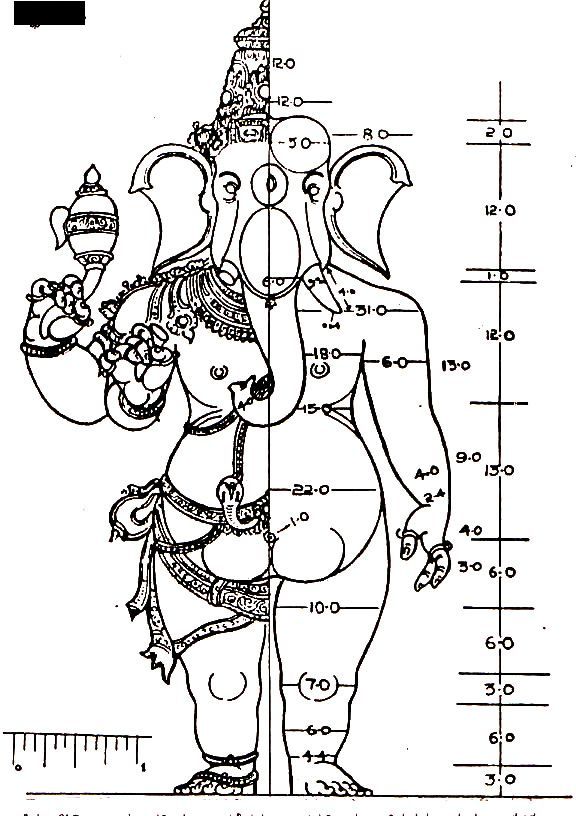
The extra ordinary deities like Trivikrama or Narasimha or the huge demons are at times depicted in twelve talas.

Out of the ten varieties of talas mentioned above, four varieties are in wider use. The iconometry of these talas are briefly indicated in the following table.

Vertical proportions of four main types of Images

(Figures in angulas)

Type of the image/Particulars 7* Tala 8 Tala 9 Tala 10 Tala
Face 12 12 12 13
Neck 03 04 04 05
Neck to the horizontal line connecting the nipples(heart) 09 10 12 13
From there to navel(belly, udara) 09 10 12 13
From navel to genitals(lower belly, vasti) 09 10 12 13
Thigh 18 21 24 26
Knee 03 04 04 05
Leg 18 21 24 26
Foot 03 04 04 05
         
Total height in angulas 84 96 108 120

(One Tala = 12 angulas)

[I am also referring to Brahmiya Chitra Karma Shastram (translated admirably into Kannada by the renowned scholar Dr. Gnananda) a rare text of the Vaishnava Agama dated around fifth or sixth century. The text divided into four major divisions (adhikarana), twenty-three chapters has in total about 1115 verses (sloka).The third Adhikarana of the text titled Maanadhikarana Kaanda (chapters 16,17 and 18 of a total of 357 verses). This Adhikarana provides various types of units of measurements and proportions of dasatala and Uttama dasatala image .It specifies with precision the measure and proportion of the gatra of each body part.

Let’s, for instance, take the measures and proportions given in  the text in relation to Uttama Dasatala of 120 + 4 managulam. That is, the height of the proposed image is divided equally into 120 mana-angulas and providing for another four additional angulas distributed at different body-parts for corrections/ extensions at joints etc. A standard unit of a mana-angula is reckoned according to the following table:

Paramanu is the least and incredibly tiniest unit. And, it is described as:”when the sun’s rays pass through a close knit lattice (jaala) the minute breadth of a beam of light (anu-gatra) is Paramanu”. Human eye, of course, cannot make out a Paramanu.

8 Paramanu=one anu

8 anu = one renu (a speck of dust)

8 renu= one romagra or valagra (tip of a single brand of hair)

8 romagra = one likhya (it is not clear what it is; perhaps the egg of la very small insect)

8 likhya = One Yuka (a minute insect, perhaps)

8 likhya = One yuva (a standard grain of barley)

And

8 yuva = one mana-angula.

(In practice, an angula is taken as 1/12 of a tala. A tala in Dasatala is one-tenth (1 / 10) of the image height or the length from tip of the middle finger to the wrist of Shilpi’s or the Yajamana’ palm. The subdivisions of a Tala follow the above table.)

To take a specific aspect ,let’s say the length of a figure from its shoulder to the tip of the middle figure , the Sarvatala Vibhagaha – the chapter 18 of the text details the measurements of  fingers, figure joints, nails etc, among others.

According to that, the total length from shoulder point to the tip of the middle figure is taken as 63a 4y (63 ½ a). The length is accounted in this manner: arm= 27a + elbow= 2a + forearm = 21a + outer hasta-tala (from wrist to beginning or knuckle of middle finger) = 7a + middle figure =6a, 4y (6 ½ a).]

design2

The  Brhat-Samhita of  Varaha Mihira (Ca. Sixth Century CE), under the Chapter 58 – Prathima Lakshana Adhyaya gives another version of the Iconometric  measurements :

1.The fine particles moving in the rays of the sun coming into a room through the window opening are known as atoms.

2. Eight atoms make a hair’s end; eight hair’s ends make a nit; eight nits make a louse; eight lice make a barley seed; eight barley seeds make an inch, which is known as a unit of measure

8 atoms=1 dust particle ; 8 dust particles=1 tip of hair; 8 tips of hair=1 nit; 8 nits=1 louse; 8 lice = 1 barley grain;8 barley grains =1 digit

3.The height of the pedestal of an image shall be one-third of seven-eighths of the height of the entrance. The height of the image shall be twice the height of the pedestal.

4. The breadth and length of the face of the image shall each be 12 inches. The sage Nagnagit says that in the Dravida country the face of the image is 14 inches long.

5.The nose, the forehead, the chin, the neck, and the ear of the image shall each be 4 inches; the mouth shall be 2 inches ; the breadth of the chin shall also be 2 inches.

6.The forehead shall be 8 inches long; 2 inches from it are the frontal bones which shall be 4 inches, and the ear shall be 2 inches broad.

7.The space between the ear and the eyebrows shall be four inches and a half and the lobes of the ear shall be well formed.

8. According to Vasishta the interval between the end of the eye and the ear shall be 4 inches; the lower lip shall be an inch broad and the upper one shall be one-half the size of the lower,

9.The Goccha(?) shall be half an inch; the mouth shall be 4 inches long; the breadth of the mouth when open shall be 3 inches, and the opening shall be an inch and a half.

10.The nose shall be two inches broad; the sense of smell is at the tip of the nose; the nose shall be two inches high; the interval between the eye and the tip of the nose shall be four inches

11.The eye-lid shall be two inches broad; the eye- ball shall also be two inches broad; the breadth of the pupil of the eye shall be two-thirds of an inch. The eye-lids shall be open with a space of half an inch. The centre of the pupil of the eye where the sense of sight remains shall be one-fifth of two-thirds of an inch.

12.From one end of an eyebrow to the other end of the other eyebrow shall be ten inches. The breadth of the eye-brow shall behalf an inch. The interval between the eyebrows shall be two inches; and the length of each eyebrow shall be four inches.

13.The breadth of the hair of the eyebrows shall be half an inch throughout; at the end of the. eye shall be formed the figure of the Karavira flower about an inch in dimensions.

14.The breadth of the head shall be 32 inches; the same when measured across shall be 14 inches. In paining 12 out of the 32 inches shall be visible and the rest shall be invisible.

15.The face with the hair growing about it shill be 16 inches according to Nagnagit; the neck shall be 10 inches broad ; the same when measured around shall be 21 inches.

16.The heart shall be 12 inches below the neck; the navel shall be 12 inches below the heart., and the genital organ shall be 12 inches below the centre of the navel.

17.The thighs shall be 24 inches long; the shanks shall also be 24 inches; the knee-shell shall be 4 inches, and the feet shall be 4 inches high.

18.The length of the feet shall be 12 inches and the breadth shall be 6 inches; the length of big toe shall be 3 inches; the same when measured around shall be 5 inches; the next toe shall also be 3 inches.

19.The other three toes shall each be one-eighth less than the length of the toe before it. The height of the big toe shall be an inch and a quarter.

20.The learned say that the nail of the big toe shall be three-fourths of an inch broad and that the toe- nails shall each be half an inch or less.

21.The shanks when measured around at the end shall be 14 inches. The breadth at the place shall be 5 inches. The breadth of the shauks at the middle shall be 7 inches; the shanks when measured around at the middle shall be 27 inches.

22. The knee shall be 8 inches broad at the middle; the knee when measured around at the middle shall be 24 inches. The breadth of the thigh at the middle shall be 14 inches 5 the same when measured around at the middle shall be 28 inches,

23.The hip shall be 18 inches broad; the same when measured around shall be 44 inches. The navel shall be an inch deep-

24.The measure of the body round the middle of the navel shall be 42 inches. The interval between the two nipples of the breast shall be 10 inches and the arm-pit shall be at a distance of 6 inches from the nipple.

25.The shoulders shall be 8 inches long; the upper arm shall be 12 inches long; the lower arm should be 6 inches and the wrist shall be 4 inches.

26.The upper arm when measured around at its Rocca shall be 16 inches and the lower arm when measured around at the wrist shall be 12 inches. The breadth of the palm shall be 6 inches and its length shall be 7 inches,

27.The middle finger shall be 5 inches long; the fore fore-finger shall be shorter than the middle finger by one half of the length of its middle- joint; the length of the ring finger shall be the same as that of the fore finger; and the little finger shall be shorter than the middle finger by its last joint.

28. The thumb shall consist of two joints, and the other fingers of three joints each. The breadth of the nails shall be one -half of the length of the joints on which they grow-

29.The images shall be shaped and adorned according to the fashion of the country. By placing images in temples, a person becomes prosperous.

design2

Stella KramrischDr. Stella Kramrisch explains in her Hindu Temple: the rules are that the proportions of the trunk are the same in all the four types. The distance from the root of the neck to the genitals is divided in to three equal parts, in each case:  neck-heart; heart-navel; and navel-genitals. The length of the thigh and that of the leg are twice as long as each of the three earlier mentioned sections. Further, the knee and the foot are of equal height. The actual lengths of these lengths might vary, but their proportions are maintained. As regards the size of the face, it is 12 angulas (except in the case of dasatala).
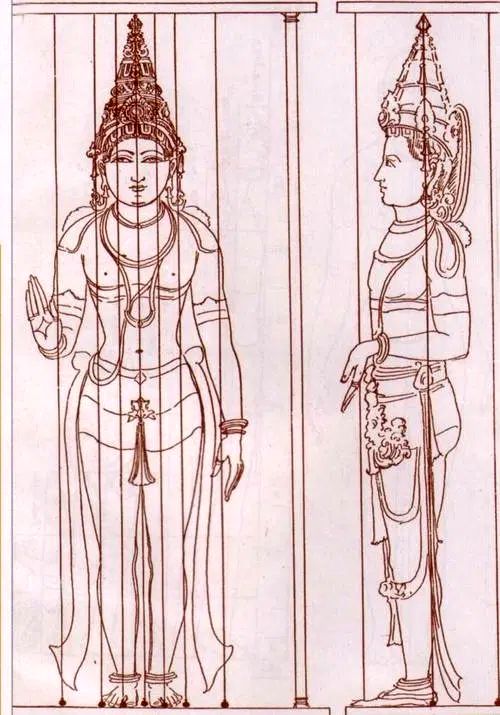
Sometimes, the height that is not included in the texts is added to the image by enhancing the height of the parts above its hair, starting from its forehead. Such height, at times, is quite considerable. Because, the gods of higher hierarchy are adorned with elaborate crowns in order to emphasize and enhance their majesty and grandeur. The height of the crown might often exceed the height of the face. The head together with the crown atop would form one sculptural unit. The elaborately crowned gods thus exceed the proportions of the human body and standout with a super natural appearance.

Apart from defining the relative height of the various gods, the tala also serves as a module for all representations of each separate figure. In addition to the norms concerning the height, there are extensive specifications for horizontal measurements such as the width of the shoulders, the waist, the head, the neck, the nose, the distance between the eyes, and so on. This is also the case with the measurements for depth; such as the distance between the back of the head and the tip of the nose, the back and the nipples, etcetera. There are measurements for the figure in the frontal position, in profile or in three-quarter profile. For such measurements, a central axis line or a plumb line is used, brahmasutra, which runs from the crown of the head through the navel to between the heels.

central axis

The position of the body (standing, reclining, seated, dancing, and so on), of the arms and legs, also plays an important role in the iconographic determination of the images. (please see the earlier part of this post)

design rangoli

[ As mentioned earlier, there is no uniformity across the various systems.  In various treatises various scales of Taala, proportion for iconometry were mentioned.

And, one of such one of the systems has units of measurements for common usage consisting of Yava (size of the barley grain); Angula (digit-width of a finger) equivalent to eight Yava; Vitasti is the standard Taala unit measuring a palm span equivalent to twelve Angulas; Hasta (cubit) equivalent to twenty-four Angulas; Danda (a stick) equivalent to four Hastas; Rajju (a rope) equivalent to four Dandas.

The system has micro level units of measurements, Anu (atom), Renu (a speck of dust) equivalent to eight Anus, Valagra (tip of a hair) equivalent to eight Renus, Liksha (?) equivalent to eight Valagras; and, Yuka (louse) equivalent to eight Likshas. Yava is supposed to be equivalent to eight Yuka.

The system also has macro level units for measuring long distances, Krosh equivalent to five hundred Dandas; Goruta equivalent to two thousand Dandas; and Yojana equivalent to eight thousand Dandas.]

design rangoli

[ Sri Abanindranth Tagore  (7 August 1871 – 5 December 1951) in his famous work ‘Some notes on Indian Artistic Anatomy”; translated into English and published by the Indian Society of Oriental Art, during 1914; describes a parallel system of Tala-mana , according to Sukranitisara and Brihatsamhita. He says:

Sukranitisara, another text, recognizes five different classes of images: — Nara (human); Krura (terrible); Asura (demoniac); Bala (infantile); and, Kumara (juvenile). Each of these five classes or sets of images (murtis) is assigned a particular scale/proportion (Tala-mana):

 Nara murti = ten Talas; Krura murti = twelve Talas; Asura murti = sixteen Talas; Bala murti = five Talas; and, Kumara murti = six Talas.

Here, a Tala is defined as: a quarter of the width of the artist’s own fist is called an Angula or finger’s width. And, twelve such Angulas make one Tala.

The Nara or Dasha (ten)Tala measure is recommended for deities or heroic persons, such as: Nara-narayana, Rama, Krishna, Indra, Bhargava, and, Arjuna, etc.

The Krura or Dwadasha (twelve) Tala measure is for figures who represent destructive tendencies;   such as :  Chandi, Bhairava, Narasimha, Hayagriva, and, Varaha etc.

The Asura or Sodasha (sixteen) Tala measure is to be used for  depicting demoniacal figures like; Hiranyakasipu, Hiranyakasha, Ravana,  Kumbhakarna,   Shumbha, Nishumbha, Mahisha, and, Raktabija, etc.

The Bala or Pancha (five) Tala measure is to be used for representing all types of infants, such as : Bala-Krishna, Infant-Rama, Gopalas etc.

And, the Kumara, or Shat (six) Talas, for the period of childhood, past infancy, before the approach of youth;  such as  Bala-gowri, Uma, Vamana, Krishnasaksh, etc..

Besides these given measures there is another measure current in Indian iconography which is known as the Uttama Nava-tala. In this type of images, the whole figure is divided into nine equal parts which are called Talas. A quarter of a Tala is called an Amsa or Unit. Thus, there being four Amsas to each Tala, the length of the whole figure from tip to toe is 9 Talas or 36 Amsas.

The heights or vertical lengths of the various parts of a figure made according to this, Talas are  : middle of forehead to chin = 1 Tala; collar-bone to chest = 1 Tala; chest to navel =1 Tala; , navel to hips = 1 Tala;  hips to knees = 2 Talas; knees to insteps = 2 Talas;  forehead to crown of the head = 1 Amsa;  neck = 1 Amsa;  knee-caps = 1 Amsa;  feet = 1 Amsa.

The widths or horizontal measures are as follows: Head = 1 Tala, neck = 2 1/2 Amsas; shoulder to shoulder = 3 Talas;  chest=  6 Amsas;  waist = 5 Amsas;  hips = 2 Talas;  knees =  2 Amsas; , ankles = 1 Amsa;  feet = 5 Amsas.

The hands and their parts are as follows:  Lengths: shoulders to elbows = 2 Talas, elbows to wrists = 6 Amsas; palms = 1 Tala. The widths  near armpits = 2 Amsas; elbows = I 1/2 Amsas; wrists = 1 Amsa.

The face of the figure is divided into three equal portions:  middle of forehead to middle of pupils; pupils to tip of the nose; and, from tip of the nose to chin.

According to Sukranitisara, the proportions of a Nava-tala figure should be as follows:

From the crown of the head to the lower fringe of hair = 3 Angulas in width; forehead = 4 Angulas ;  nose =  4 Angulas ; from tip of nose to chin = 4 Angulas; and , neck = 4 Angulas  in height;  eye-brows =  4 Angulas  long and half an Angula  in width; eyes = 3 Angulas  in length and two in width ; pupils = one third the size of the eyes ; ears =  4 Angulas in height and 3 in width.  Thus, the height of the ears is made equal to the length of the eye-brows.

Palms = 7 Angulas long’ the middle finger = 6 Angulas; the thumb = 3 Angulas, extending to the first phalanx of the index finger.

The thumb has two joints or sections only-, while the other fingers have three each. The ring finger is smaller than the middle finger by half a section; and, the little finger smaller than the ring finger by one section, while the index finger is one section short of the middle.

The feet should be 14 Angulas long; the big toe= 2 Angulas; the first toe = 2 ½ or 2 Angulas; the middle toe = 1 1/2 Angula; the third toe = l ½  Angula ; and , the little toe = l ½  Angula

Female figures are usually’ made about one Amsa shorter than males.

The proportions of child-figures should be as follows:—

The trunk, from the collar-bones below, should be 4 ½ times the size of the head. Thus the portion of the body, between the neck and the thighs is twice and the rest 2 1/2 times the size of the head. The length of the hands should be twice that of the face or the feet.

Children have short necks and comparatively bigheads; for the growth of the head, with increase of age, is much slower than that of the rest of the body.

bar3

In this context, Sri Abanindranth Tagore quotes Prof. Ordhendra Coomar Gangoly (1881-1974), popularly known as O.C. Ganguly , one of the foremost authorities on Indian Art. 

O C Ganguly

The Talas given here do not exhaust the various measures current in Indian sculpture.  In the 4th chapter of the Sukraniti Sara as also in the chapter on Pratima lakshana of the Brihat Samhita measurements are given for the average human body according to which the average male figure is stated to be eight times the face which is represented by one Tala.

Any height for a human ‘male, which is less than the eighth measure is conceived in the Sukraniti-sara as dwarfish or below the average.

The average human female figure is given as of the seventh measure (Sapta-Tala).

The average infant figure is laid down as of the fifth measure (Pancha-tala).

The measures higher than the Asta Tala are reserved for the images of gods ;, demons, Rakshasas and other super-human beings.

Thus the image of the goddess according to the Sukranitisara is always in the ninth measure (Nava Tala smrita Devi).That of the Rakshasas   is the tenth measure.

The South Indian manuscripts however differ a little from the Sukraniti-sara and other works in respect of the rules for the measure of the deities.

But; except in the case of the image of Ganesha and Krishna, all the measures given for the images of the deities are higher than the Asta-tala , the average human measure, the higher measurements suggesting a relatively ‘heroic’ type.

In the South Indian manuscripts, each measure is again divided into three different classes e.g. the Uttama (best) Madhyamā [medium) and the Adhama (lowest). Thus the Uttama Dasa-tala is represented by 124 Angulas or parts; the Madhyamā-dasa-tala by 120 parts; and, the Adhama-dasa-tala by 116 parts. 

Special injunctions are laid down for constructing particular images in a measure specially reserved for them.

design rangoli

The noted Scholar Vinod Vidwans , in his  Expressing with grey cells: Indian perspectives on new media arts, writes :

Every culture has its set of norms for defining beauty based on the tradition, religious beliefs, as well as indigenous evolved notions of beauty. These norms have an impact on people’s behavior and artistic expression. Traditional Indian artists have developed elaborate system of measurements and proportions. Once the conceptual framework for desired entity – an image, sculpture, or architectural monument – is designed or pre-visualized (of course, treatises lay down the process of visualization by emphasizing the importance of contemplation and meditation), artists were supposed to employ the Taala and Maana measurements for bringing the image into expected scale of proportion for actual manifestation.

Since Maana is a system of proportions, there were several distinct sets of measurements. Maana is measurement along the vertical axes, Pramana is along the horizontal axes, Parimaana is around the circumference, Unmaana is along the transverse planes and depths, and Upamaana stands for proportions between negative spaces, i.e., space between the parts .

The purpose of Taala-Maana system was to provide standardization that will eventually lead to harmonious creations. The Taala-Maana measurements laid down in the treatises are supposed to be aesthetic proportions for visual composition. Indian tradition has evolved a unique calculus of aesthetic proportions applicable across plastic and performing arts.

The Taala-Maana system is applicable to performing arts of music, dance, and theater where units of measurements are interpreted in terms of time. The same Taala unit is interpreted in the context of dance as a relative proportion in terms of number of hand spans between the feet in a particular posture or the length of a step, and, with reference to music, it is the unit of a rhythmic cycle, a temporal unit .

The Taala-Maana system is in no sense a prescriptive system; in fact, it is a descriptive system, a calculus of aesthetics that lays down the canons of beauty allowing individual artists to freely explore the beauty of forms with all its possible variations. These canons were never a hindrance to artistic creativity. No two temples or sculptures are the replicas of each other, though they are based on these same canons. Taala-Maana system is a conceptual and perceptual standard of aesthetics, an essence of a long Indian tradition and collective wisdom. The system is sufficiently complex and evolved over a period of time.

The idea of Taala-Maana stands for the integration and manifestation of inner structure, rhythm, and vital energy of the work of art. Artistic vision is scaled to human sense of proportion leading a way towards abstraction and idealized designs that reveal archetype quest for form and meaning. The ultimate objective of any artistic expression is to evoke a unique kind of aesthetic experience. To achieve this artists construct an imaginative world that is meaningful.

A performing artist creates an imaginary world using the artistic devices of language, poetic phrases, dialogues, rhyming words, beautiful hand gestures, and body postures. In arts like painting, sculpture, and architecture, artists use the visual language of shapes, forms, colors, texture, positive and negative spaces to create meaningful reality. In both cases, the languages of creative expression require a grammar of aesthetics.

Normally, this grammar is implicitly present and followed by artists intuitively. Otherwise artists have their own explicit grammar or canons for the language of artistic expression based on certain mathematical ratios or proportions. Any artistic creation has a definite structure in space and time. These canons or grammar provide mathematical foundations to create beautiful and meaningful structures. Mathematics is a study of quantifiable abstract concepts and their structure, order, and relations. Its results are applicable to the real world as well as imaginary worlds.

design rangoli

Dr . Gift Siromoney and his team of researchers applied computer analysis methods to study a large sample of South Indian sculptures; those included the sculptures of the Pallava, Chola, and Pandya and Chera periods. It is said that anthropometric instruments were used for the analysis of facial proportions of the carvings; cluster analysis was used for collating the sculptures into groups that contain very similar features.

The team came up with the conclusion that there existed two systems of proportions which had run into each other. The average values of the facial proportions of the sculptures that were studied were at variance with the proportions prescribed in the canonical texts.

The sculpture seemed to have enjoyed a certain degree of artistic freedom within the framework of the Shilpa texts. The shilpis innovated or improvised their working methods for creation of well proportioned images.

Please visit Dr. Siromoney’s home page and other study reports:

http://www.cmi.ac.in/gift/Iconometry.htm


Next post

Norms in Temple Architecture

References:

Cannons of Icometry by Dr. Gift Siromoney

http://www.cmi.ac.in/gift/Iconometry/icon_southindian.htm

http://www.cmi.ac.in/gift/Iconometry/icon_pallavasculpture.htm

Hindu iconology by Pandit Sri Rama Ramanuja Achari

www.australiancouncilofhinduclergy.com

Line drawings

By Shilpi Sri Siddalinga Swamy,

Dr. Jnananada

And from Shilpa Soundarya

Other images are from internet 

 
31 Comments

Posted by on September 9, 2012 in Temple Architecture


Tags: