RSS

Category Archives: Sanskrit

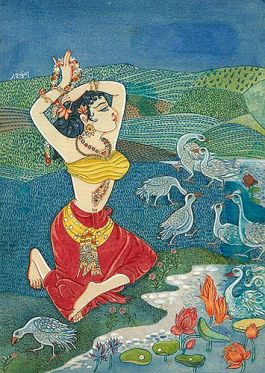
Ritu Varnana and Barahmasa

From: Venetiaansell 

Dear Dr Rao, I read your post on sharad rtu with great interest.  I am a student of Sanskrit and currently doing some research on the description of each rtu and in particular the flowers associated with each and would be interested to know more. Can you recommend any good books or articles about rtuvarnana in Sanskrit literature? I look forward to hearing from you. Best, Venetia
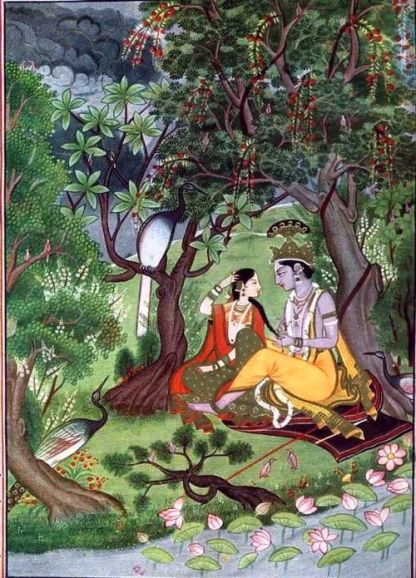
Ritu

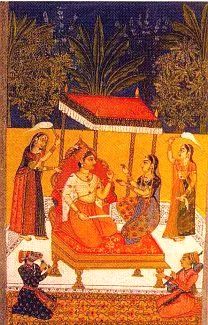
Creation of the Artist Kailash Raj

A. Ritu- varnana in Sanskrit Literature

1.1. Dear Venetiaansell , Greetings. The phenomena of the seasons, day and night, birds and beasts and flowers, are often employed  in Sanskrit poetry to frame human emotions, or are personified as counterparts of the human subjects of the poet. And, throughout the literature, a deep love of nature is implicit, especially in  the poems of  Kalidasa; who, for this reason , among others, is regarded very highly.

Kalidasa’s Meghadutam, a work of little over 100 verses, has always been one of the most popular of Sanskrit poems. Its theme has been imitated in one form or another by several later poets both in Sanskrit and in the vernaculars. As compared to similar other  Indian poems of that nature, this work has unity and balance; and, gives a sense of wholeness that is rarely found elsewhere. In its small compass, Kalidasa has crowded so many lovely images and word-pictures that the poem seems to contain the quintessence of the  whole of Indian natural scenery.

As regards the ritu- varnana in its proper natural sequence, the most renowned, of course, is again  that by the Great Kalidasa in his various poetic works, and especially in the Ritu-samharam, the melody of the seasons or the garland of the seasons, running into six cantos describing the six seasons of the year; and how with each change in the season, the mood and behaviour of a young lover too would alter. In his other work, the Meghdootam, the intensity of the lovelorn Yaksha is far deeper. However, he weaves his yearning around the clouds; and thus, the description is confined to the rainy season.

In Kalidasa’s romantic poetry; graceful sensuality, colours and the music of love resonate with the world of blossoms and birds. The urges and pains of his nayaka and nayika are shared by the deer, birds, trees and the sky. It is a world where trees long for the touch of a lovely woman as much as a man longs for her embrace.  There is an unspoken bond between the song of the peacock and the lament of the separated lover. The messages of love are conveyed through clouds; and , the changing seasons mirror the changing colours of love.

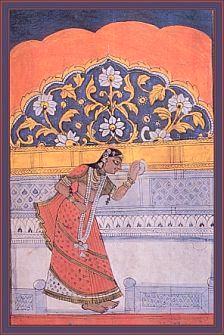
Kalidasa’s nayika adorns herself with blossoms and sprouts of the forest as ornaments ; and decorates her lotus-like feet with the red dye from the forest flowers and herbs . She is decked in various fragrant flowers; a padma in her hands; kunda blossoms in her hair; the pollen of lodhra flowers on her face; the fresh kurbaka flowers in her braid ; the lovely sirisha flowers on her ears (Karna-avatamsam) ; and, the nipa flowers that bloom in the parting of her hair .

The nocturnal path of the lovelorn abhisarika nayika is traced   at dawn by the mandara flowers that have fallen from her hair and the golden lotuses that have slipped off her ears (Ritusamharam 2.11-12). Kalidasa’s nayika is not a mere mortal but a yakshi, the very life and spirit of a tree; and the trees mirror her exuberant ardour.’ 

Abhisarika

Kalidasa’s virahini-nayika of the Meghadutam, separated from her lover; like a lotus deprived of the sun ; like a solitary Chakravaka bird isolated from her mate ; and, crestfallen like a lotus withered by winter, is a chaste lovelorn woman, pining for her lover.
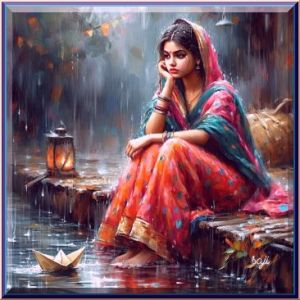
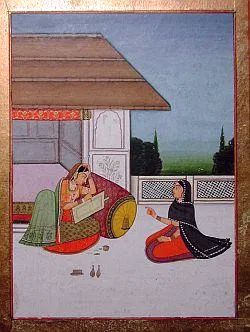
She sits with her face resting in the cup of her palms, her locks covering her face as clouds cover the moon. She spends her time alone in  her bed with her ornaments cast off;   counting the days of her separation  by placing flowers on the threshold ; by painting the likeness of her beloved , singing songs reminiscent of her lover  and talking to the Sarika bird (Meghadutam 2.20-2.33).
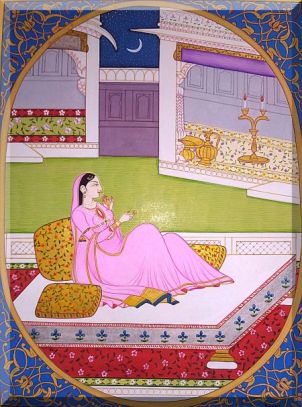
virahini

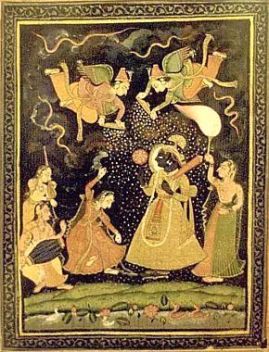
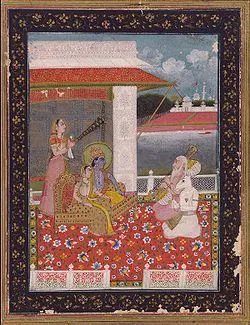
The Virahini Nayika sends messages to Krishna through her maid .
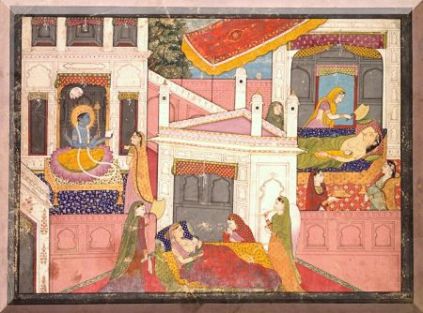
Krishna message

There is a certain dignity in her poignancy; a  grace in her sorrow. The colors of her pathos resemble that of the wilted flowers and the movements of her eyes and limbs speak of her pain even when her words do not.
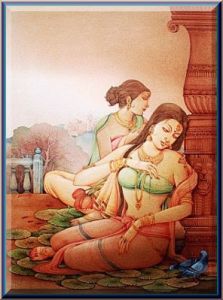
If Kalidasa’s Meghadutam is the epitome of the virahini in early Sanskrit poetry, his Ritusamharam is the poetic testimony of how intimately the loves, pathos and lives of the human are tied with the colours and sounds of the seasons. Of all the seasons’, vasanta or spring is especially important to those in love, for the blossoms of spring are like the arrows of Kama. Red is the colour of the spring season everywhere and it is when:

The mango tree bent with clusters of red sprouts kindle ardent desire in women’s hearts

The ashoka tree that bears blossoms red like coral makes the hearts of women sorrowful

The atimukta creepers whose blossoms are sucked by intoxicated bees excite the lovers

The kurabaka tree whose blossoms are lovely as the faces of women pain the hearts of sensitive men

The kimsuka grove bent with blossoms, waved by winds, appears like a bride with red garments.   — Ritusamhara (15–20)

sugandhikālāgurudhūpitāni dhatte janaḥ kāmamadālasāṅgaḥ // KalRs_6.15 //
puṃskokilaś cūtarasāsavena mattaḥ priyāṃ cumbati rāgahṛṣṭaḥ /
kūjaddvirephāpyayam ambujasthaḥ priyaṃ priyāyāḥ prakaroti cāṭu // KalRs_6.16 //
tāmrapravālastabakāvanamrāś cūtadrumāḥ puṣpitacāruśākhāḥ /
kurvanti kāmaṃ pavanāvadhūtāḥ paryutsukaṃ mānasamaṅganānām // KalRs_6.17 //
āmūlato vidrumarāgatāmraṃ sapallavāḥ puṣpacayaṃ dadhānāḥ /
kurvantyaśokā hṛdayaṃ saśokaṃ nirīkṣyamāṇā navayauvanānām // KalRs_6.18 //
mattadvirephaparicumbitacārupuṣpā mandānilākulitanamramṛdupravālāḥ /
kurvanti kāmimanasāṃ sahasotsukatvaṃ bālātimuktalatikāḥ samavekṣyamāṇāḥ // KalRs_6.19 //
kāntāmukhadyutijuṣāmacirodgatānāṃ śobhāṃ parāṃ kurabakadrumamañjarīṇām /
dṛṣṭvā priye sahṛdayasya bhavenna kasya kandarpabāṇapatanavyathitaṃ hi cetaḥ // KalRs_6.20 //

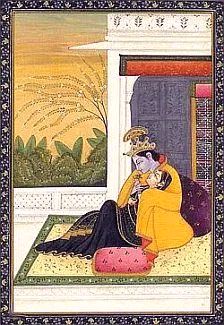
Vasanta is also the season when cuckoos sing in indistinct notes; the bees hum intoxicating sweet sounds; and, the travelers separated from their lovers lament. Kama the god of love who wages a war, as it were, on those in love,  fashions his arrows from the mango blossom; his bow from the kimsuka flower; the bowstring from a row of bees. His parasol is the moon; and, he wafts the gentle breeze from the Malaya mountain whose bards are the cuckoos (Ritusamharam 28).
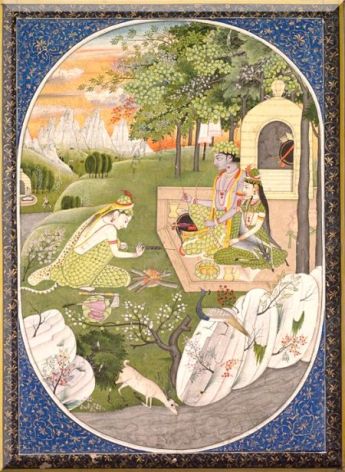
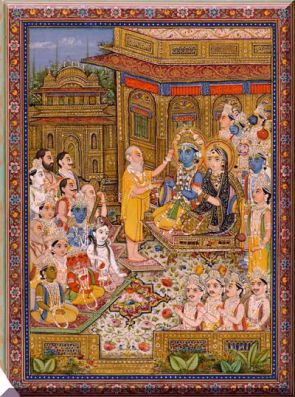
Krishna Radha2

1.2. Another poet and playwright , Rajashekhara (Ca.9th century) in his Kavyamimamsha , a treatise on poetry summarized , for the benefit of the aspiring poets essaying to portray seasons in their works , how the seasons were portrayed in the poetic works prior to his time. In addition, he collated the standards as authorized by the texts. Rajashekhara came up with comprehensive season- descriptions, outlining each season’s basic characteristic features, months-wise divisions, individuality of each month, and the imagery that a poet should preferably employ for representing a season. He also deduced the natural human responses to a given season.

1.3. The great poet Dandin (Ca.6-7th century) renowned for his colorful Sanskrit prose, too, in his Kavyadarsha (‘Mirror of Poetry’) the handbook of classical Sanskrit poetics, mandated that a classic work of poetry (maha-kavya) should essentially include eighteen (ahsta-dasha varnana) types of descriptions including that of the

  • city (nagara);
  • ocean (saagara);
  • mountains (shaila) ;
  •  seasons (vasantadi ritu);
  • the moon;
  • the sun rise and sunset (chandra-surya udaya –asthamana);
  • parks (udyana);
  • strolling in the gardens (vana vihara);
  • water-sports (jala krida) ;
  • pleasures of wine and love making (madyapana surata);
  • wedding (vivaha);
  • discussions with the wise (vipralamba) ;
  • pangs of separation (viraha); 
  • birth of sons (putrodaya);
  • state-craft (raja-mantra);
  • gambling or sending messengers (dyuta);
  • wars (yuddha);
  •  campaigns (jaitra-yatra);  and,
  • accomplishments of the hero (nayaka abyudaya).

1.4. The description of seasons thus became an integral part of classic poetry . Apart from Kalidasa’s poetry, there are some beautiful heart-warming descriptions of the seasons in the poetic works of other notable poets too; for instance, as in: Bhattikavya by Bhatti; Kiratarjuniya by Bharavi; Shishupala-vadha by Magha; Naishadhacharita by Shriharsha among others.

2.1. The Natya-shashtra too had earlier directed how seasons should be represented in a drama, especially on the stage through an actor’s performance – acts, gestures, facial demeanours and other expressions.

2.2. The Puranas also evinced interest in season-description. The Matsya Purana has a whole chapter dedicated only to the month of spring; while the Samba Purana alludes to different colours of the sun in the six ritus. The Chitra-sutra in the Vishnudharmottarpurana (c.6th century) prescribes certain general rules for the depiction of each of the four seasons.

3.1. According to Chitrasutra of the Vishnudharmottarpurana, the depiction of each of the four seasons could be symbolically represented in the paintings by employing certain idioms of expression, such as:

Summer: languorous men seeking shade under trees, from the harsh summer sun; buffaloes wallowing in the mire of muddy waters; birds hiding under a thick abundance of leaves; and, lions and tigers seeking cool caves to retire in.

Rain: An overcast sky, with heavy rain filled clouds weighed down with their aquatic excess; flashes of lightning and the beautiful rainbow; animals like tigers and lions taking shelter in caves; and, sarus (cranes) birds flying in a row.

Autumn: Trees laden with ripe fruit; the entire expanse of the earth filled with ripened corn ready for harvest; lakes filled with beautiful aquatic birds like geese; the pleasant sight of blooming and blossoming lotus flowers; and, the moon brightening up the sky with a milky white lustre.

Winter: the earth wet with dew; the sky filled with fog; men shivering from the cold, but crows and elephants seem euphoric.

[A collection of learned essays by the great scholar Dr. V Raghavan ‘Rtu in Sanskrit Literature’ (1972) published by Shri Lal Bahadur Shastri Kendriya Sanskrit Vidyapeetha , Delhi, comprehensively deals with all aspects of Rtu varnana  in Sanskrit texts including Rig Veda and , epics and puranas.]

B. the Barahmasa tradition
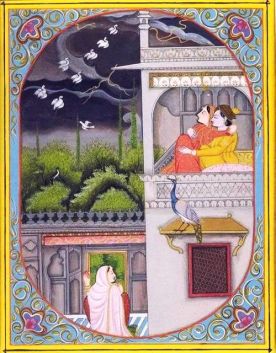
baramasaBaramasa2

4.1. With the decline of classic Sanskrit poetry, the ritu-varnana found abundant expression in the Barahmasa tradition. Barahmasa meaning twelve months are based on the lunar calendar comprising months of Chaitra, Vaishakha, Jyestha, Ashadha, Shravana, Bhadrapada, Ashvina, Karttika, Agrahayana, Paushya, Magha and Phalguna. Each two of them are respectively the ritus or seasons of Vasanta, Grishma, Varsha, Sharada, Hemanta and Shishira.

4.2. The glory and characteristic beauty of each season came to be celebrated in a specialized form of poetry, music and art (paintings) as Barahmasa, describing the splendour, aura and magic of nature as it emerges with the change of each season. The expressions of the ritu– theme were rendered highly eloquent with the emotive songs and music; as also by the exquisite miniature paintings depicting the glory and poignant character of each season woven into stories of tender love, separation and reunion.
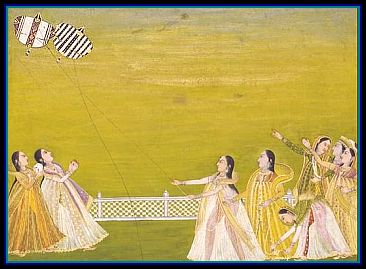
4.3. The essential theme of the Barahmasa is the passionate yearning of lovelorn hearts, the pangs of separation that each change of season stimulates. Each month bringing a special message to the beloved, every season a special reminder of the joys of love and longing. The nature participates in the world of human emotions and mirrors the lovers’ or singer’s experience of tenderness and pain of love.
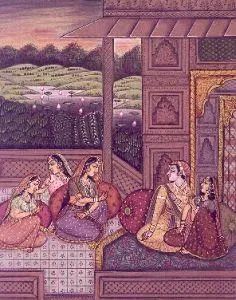
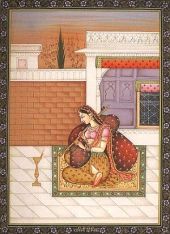
love lornlove lorn.j2 pg

4.4. The transformations in nature such as the gentle unfolding of a bud’s petals; or melting of a winter night into dew-drops; or the dark dreadful clouds rending with their roar the sky and the earth and frightening the lovely nayika into the arms of her beloved Nayaka and bursting forth into torrential rains – all become symbolic expressions of the seasons and the state of love of the ardent lovers. The Barahmasa depictions of poetry, music and painting, bind the two confronting worlds, the worlds of man and of nature into one thread.

Barahmasa Poetry
5.1. The Barahmasa Poets over the centuries have used the imagery of the Ritu Varnana or changing seasons to depict different facets of human emotions and moods, varying states of romantic love as they respond and change in accordance with seasons. The songs of the seasons resonate with the heart of the lover and the beloved. Nature as always forms the very companion of the yearning lovers.
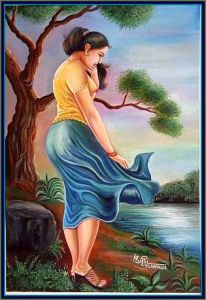
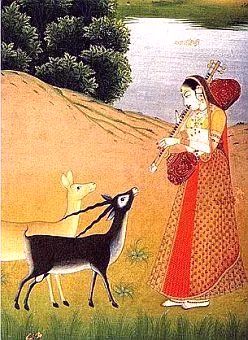
5.2.In expressing her lament and relating it to the colours and moods of the seasons , nayika the heroine likens the throbbing of her heart to the pulsating sap of the trees; the trembling longing within her to the drifting movement of the clouds ; and , the agony of her forlorn state to the pain of lonely birds. She is not alone in her anguish; her piquant cry is heard by the deer, the birds and the blossoms that surround her; they too empathize and share her pain. In Barahmasa poetry there is a strong and sympathetic resonance between the heart of the nayika and the world of nature around her, it is a world that shares her romantic urges and longings.
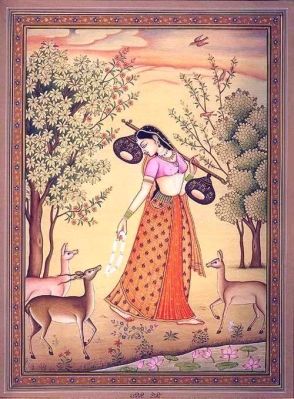
Nayikanayika2

6.1.Let me add; the theme of Barahmasa occurs not merely in regional representations but in classical poetry too. Let’s, for instance, take the case of Kumarasambhava and the Ramayana. Both are epics; but, while the Kumarasambhava is a chaste classic observing all the mandated norms of poetics and other conventions,the Ramayana represents an amalgam of various folk traditions. In Ramayana, the poet attempts exploring the turmoil in the lovelorn heart of Rama the prince of Ayodhya in exile ,after separation from his beloved Sita , by placing his distress in contrast to the glowing beauty of the season; and picturing    how it affects Rama.

The poetry here truly transforms into a viraha song.  Rama describes to his brother Lakshmana the sublime beauty of nature that surrounds them; and gives vent to his grief of separation aggravated by the beauty that envelops him. Rama narrates the onset of monsoon in a rather intuitional manner describing the gathering of clouds ; and how they remind him of his brother Bharata and his friend Sugriva are with their wives and in their kingdoms while he is lonely and sad deprived of both.

Thus the vein of ritu-varnana in the Ramayana is closer to the Barahmasa convention. In contrast, the descriptions of nature in Kumarasambhava, in the context of Parvathi’s penance, lack such subjective responses.
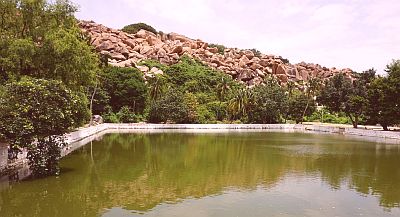
Pampa sarovara

Oh! Soumitri, Pampa Lake is magnificent , glowing with her emerald green  like waters (vaiduurya vimala udaka ); adorned with  fully bloomed lotuses (phulla padma utpalavatī);  surrounded by many trees , Pampa looks truly delightful (śobhate pampā).

saumitre śobhate pampā vaidūrya vimala udakā | phulla padma utpalavatī śobhitā vividhaiḥ drumaiḥ || 4-1-3||

This auspicious Pampa is pleasant  with its delightful forests overspread with many diverse flowers, cool waters, though I am sad 

śokārtasya api me pampā śobhate citra kānanā | vyavakīrṇā bahu vidhaiḥ puṣpaiḥ śītodakā śivā || 4-1-6|| 

The green pasture lands have turned into  colorful pastures covered with  variety of  laden trees… and with flower-fall  covering it like  shining flowery carpet  of varied colors  of red, blue , yellow etc.,

adhikam pravibhāti etat nīla pītam tu śādvalam | drumāṇām vividhaiḥ puṣpaiḥ paristomaiḥ iva arpitam || 4-1-8||

Breeze coming out from those mountain caves along with the high callings of lusty black cuckoos are making the trees to dance, and the air itself is as though singing as an accompaniment to that dancing

matta kokila sannādaiḥ nartayan iva pādapān | śaila kandara niṣkrāntaḥ pragīta iva ca anilaḥ || 4-1-15 ||

At the shore of this Lake Pampa rejoicing are these birds in groups, and these trees loaded with the mating sounds of  birds; and the callings of the male black cuckoos, are  inspiring love in me.

asyāḥ kūle pramuditāḥ sanghaśaḥ śakunāstviha | dātyūharati vikrandaiḥ puṃskokila rutaiḥ api | 4-1-28  | svananti pādapāḥ ca ime mām anaṅga pradīpakāḥ |

***

Radha

7.1. But, the most eloquent and lovely expressions of Barahmasa are through songs and poetry of viraha, music full of pathos of a young woman Nayika deeply engrossed in love. These representations brimming with the finest imagery and most tender emotions, intense longing, lyrical felicity, rhythmic vibrancy and dramatic conflict of the worlds of man and nature, besides their mystic connotations, form the themes of Barahmasa.

virahaviraha2

7.2. The Barahmasa poetry has gifted the Indian literature with some of its best lyrics forming the heart-touching love-lore inspired by the folk traditions. Pictorially very rich and emotionally most fervent, the Barahmasa poetry, which subsequently had its transforms in art, is a genre of the Indian countryside. These forms of poetry, music and art are uniquely Indian. Its riches , distinctively Indian, are woven into the cyclic changes in nature and into the lives, loves, and woes of the Indian people in a manner that is not known in other literature and art traditions of the world. They are incomparable.

7.3. The Barahmasa themes are mostly entwined with the celestial love of Sri Radha and Krishna. Alberuni (ca.1030) observed that Vasudeva Krishna had a special place in the hearts of the common people who loved to call him by many names. He says; people called out Krishna, out of sheer love, by different names in each of the twelve months; such as: in Margasirsha:  Keshava; Paushya:  Narayana; Magha:  Madhava; Phalguna:  Govinda; Chaitra:  Vishnu; Vaisakha:  Madhusudana; Jyestha:  Trivikrama; Ashadha:  Vamana; Shravana:   Sridhara; Bhadrapada:  Hrishikesa; Ashvayuja:  Padmanabha; and in Karttika:  Damodara.

madhavamadhava 2

8.1. The Barahmasa poetry has two basic forms, one, literary, and the other, oral. The oral Barahmasa of the regional dialects later became an important ingredient of the literary poetic tradition. The literary traditions were inspired by the simple songs of the village women pining for the husband or the lover away from her, giving vent to “torments of separation, of estrangement, and feverish waits” ; sung either in the rainy four months from Ashadha to Ashvin or through the twelve months. Literary, Barahmasasare a part of the written literature and are endowed with poetic merit and compositional excellence. Barahmasa, oral or written, as a genre, has five broad types, namely, religious, farming-related, narrative, viraha, and the Barahmasa of chaste woman’s trial.
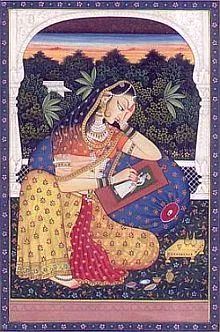
chastechaste2

8.2. Viraha Barahmasa or the seasonal poetry of longing is the most evocative in this genre of romantic poetry. This group of the Barahmasa compositions is inspired by the romantic lore of Sri Radha and Krishna and their beautiful idealized love. The poets charged with Krishna-Radha intoxication recreated the celestial Vrindavana of the Braj country through a class of poetry called ritikavya. Of the many poets in this genre those that stand out are: Bidyapati (1352–1448), Keshavadasa (1555–1617), Bihari (16th century) and Ghanananda (1673–1760).

8.3. Bidyapati the Maithili poet glorifies the sublime love of Sri Radha-Krishna; and charmingly describes the essence of seasons and , in particular , of the lord of the seasons the Basanta the spring : ‘ the rays of the sun in their youthful prime; the golden kesara flower; the fragrant kanchan and Jasmine flower garland; the pollen of flowers floating in the air like a canopy over the patala, tula, kinsuka and clove-vine tendrils;   the koil singing its sweetest note ; tribes of honey-bees arrayed their ranks; the water-lily that has just found life with its new leaves ; and the refreshing and  shining in Brindaban’.
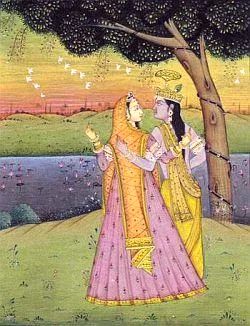
brindabanbrindaban.2 jpg

9.1. But, the archetype Barahmasa poetry and the inspiration for all forms of Barahmasa expressions are Keshavadasa’s sublime verses scripted in Brij-basha. The poet Keshavadasa (1555–1617) in his Rasikapriya (a comprehensive compendium of nayakas and nayikas, their moods, meetings and messengers, considered a lakshana grantha, foundational work, in riti kavya tradition), he vividly describes the essential features of the twelve lunar months of the year; and the pain each month evokes in the heart of the nayika at the impending separation from her beloved.

9.2. Starting with the month of Chaitra, Keshavadasa portrays the heroine urging her beloved not to leave her in that month; describing to him the beauty and tenderness of that month. She cajoles him to stay with her; and to enjoy along with her the thrill and ecstasy of living and loving in the paradise on earth created especially for their enjoyment. She convinces him that it is a blessing to be alive amidst that beauty. Such loving requests follow in each of the other months too; as every month has something special that makes separation painful and unbearable.

The following are briefly the suggestive descriptions of Barahmasa according to Rasikapriya.

Chaitra: charming creepers and young trees have blossomed and parrots, sarikas and nightingales make sweet sounds.
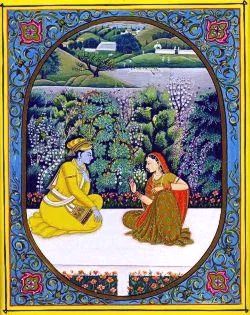
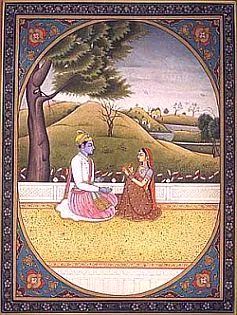
charmingcharming 2

Baisakha: the earth and the atmosphere are filled with fragrance and all around there is fragrant beauty, but this fragrance is blinding for the bee and painful for the lover who is away from home.

Jyestha: the sun is scorching and the rivers have run dry and mighty animals like the elephant and the lion do not stir out.
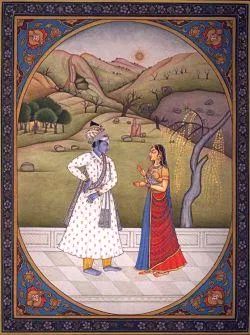
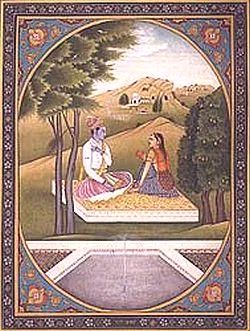
jestaAshada

Ashadha: strong winds are blowing, birds do not leave their nest and even the sadhus make only one round.

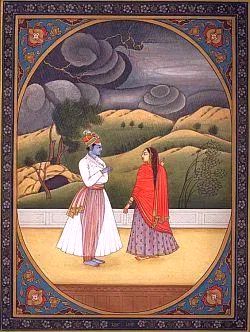
Shravana: rivers run to the sea, creepers have clung to trees, lightning meets the clouds, and peacocks make happy sounds announcing the meeting of the earth and the sky.

shravanabhadrapada

Bhadrapada: dark clouds have gathered, strong winds blow fiercely, there is thunder as rain pours in torrents, tigers and lions roar and elephants break trees.

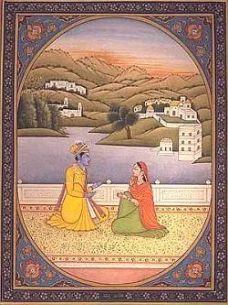
Ashvina: the sky is clear and lotuses are in bloom, nights are brightly illuminated by the moon, people celebrate the Durga festivities and it is time for paying respects to ones ancestors.

ashvinakartika

Kartika: woods and gardens, the earth and the sky are clear and bright lights illuminate homes, courtyards are full of colourful paintings, and the universe seems to be pervaded by a celestial light.

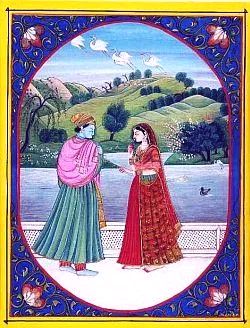
Margashirsha: rivers and ponds are full of flowers and joyous notes of hamsas fill the air, this is the month of happiness and salvation of the soul.
margashirapausha

Pausha: the earth and the sky are cold. It is the season when people prefer oil, cotton, betel, fire and sun shine.

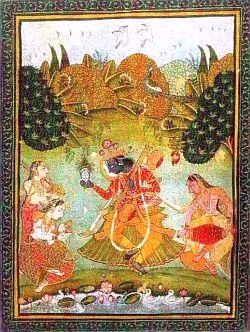
Magha : forests and gardens echo with the sweet notes of peacocks, pigeons and koel and bees hum as if they have lost their way, all ten directions are scented with musk, camphor and sandal, sounds of mridanga are heard through the night.
maghaphalguna

Phalguna: the fragrance of scented powders fills the air and young women and men in every home play holi with great abandon.

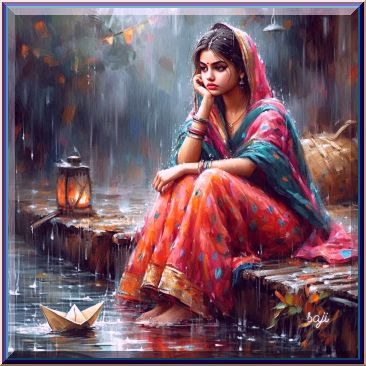
9.3.The Barahmasa poetry reflects the moods of the lovers in the brilliant spring, sad autumn or monotonous winter; but none is so evocative as of the splendour and awe inspiring beauty of the Indian monsoon. It is uniquely Indian. Further, the Indian attitude to the monsoons is fundamentally different from that of the west. To a common Indian villager, monsoons are a symbol of hope and life; while a westerner might view rain and snow as a sign of gloom and despair.

When the rains come down like blessings from heaven, suddenly the world looks beautiful; the earth smells lovely, and the heart smiles! The bond that India has to rains is much like the colder nations of the North have towards spring. A lot of our happiness and physical well being is associated to raining, raining well and raining in time.
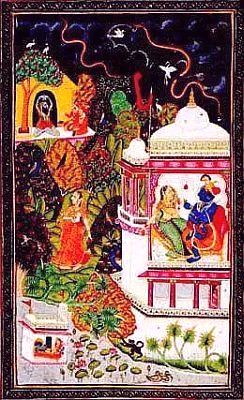
rainsrains2

Monsoon poetry

10.1. Whether we are talking about music – classical, folk as well as devotional – dance, painting or sculpture, the rains and their incessant music are a recurring theme in India’s many-splendored art treasure. The diverse dialects of India’s far flung villages are replete with songs welcoming the life giving rains flowing down from heavens like blessings; and their message of bounty. And, they allude that just as all rain water falling from the skies flows to merge with the ocean, all living beings flow finally into the shining pool of divinity.  The divine object of their single-minded devotion is Krishna – the Ghanashyam, dark like the monsoon clouds, the one born on a rain-stormy night in the monsoon month of Shravana. And Krishna the dark one is the icon of the monsoon season and the songs dedicated to him are composed in the soul-soothing monsoon Raga Megh Malhar. The romance of Radha and Krishna, the eternal lovers, is the theme of rain songs. The constant longing of any beloved waiting for her lover to return home is envisioned as an epitome as of Sri Radha.
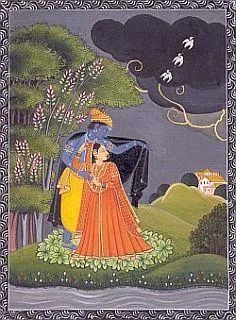
meghamegha2

10.2. As the Krishna-Sri Radha celestial love permeated into folk music and dance as well as into the celebration of festivals, the songs about their love created a treasure-house of KajrisShravan jhoolaschaitis, thumris and other light classical music compositions with an edgy eroticism.

10.3. These soulful songs celebrate various seasons and sometimes the festivals occurring during such seasons, such as Holi in the month of Phalguna. In most cases Sri Radha is the lonely Nayikaconstantly longing and waiting for her beloved Krishna the eternal lover. In other cases it is a Nayikaseparated from her loved one, usually a warrior, in whose context the cycle of the changing seasons is depicted.

Barahmasa Music

11.1. The raga melodies of classical Indian music are in harmony not only with the time of the day or night but also with the seasons of the year. Each raga is personified by a colour, the overall mood bhava, the nature surrounding the hero and heroine (nayaka and nayika).   The raga elucidation as envisioned in Indian music is a delightful amalgam of art, colour, poetry and music.

11. 2. As regards the seasons and the ragas, most of the ragas in the classical music are set in accordance to various seasons. Generally:

Basant (chaitra – vaishakha): the ragas Hindol and Raga Bahar sung early in the dawn are  associated with the festive and invigorating season of spring Basant (chaitra –vaishakha) when kimshuka trees are full with lustrous red flowers; mango trees laden like bejewelled women; pond waters filled with lotuses; breezes loaded with their fragrances blowing pleasantly; the eventides and daytimes enjoyable with the fragrant breezes; air ringing with the passionate cries of male koil birds; and, women brimming with desire sporting in swimming pools like she elephants in heat; and bashful ladies playfully dressed in light silks of reddish hue of kusumbha flowers. The women decked in pearl pendants and in just unfolded whitish flowers of jasmine (mallika) and karnikara; and in red Ashoka flowers.
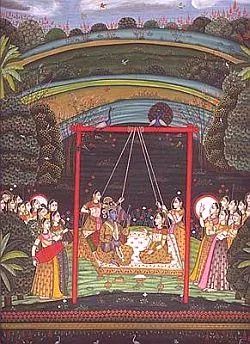
basantvasishakha

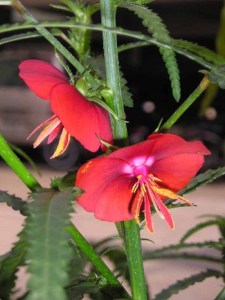
Grishma (jeshta –ashadha):  raga Deepak sung during the evening of the Grishma (jeshta –ashadha) season of blazing summer light and the grief of separation when men are away from home on work or trade or war. And, the women decked in white pearly ornaments, jasmine garlands, cool silks and dabbed in pure sandalwood paste liquefied with coolant scents like yellow camphor, kastuuri etc laze on rooftops in moonlit nights savoring portions , enjoying music , lustfully   awaiting their   husbands or lovers. Just blossomed bright and fiery safflower kusumabha embrace the tree trunks with tongues of fire. Fragrant lotuses and patala (trumpet flowers) are overlaid on cool waters of the pond,

Varsha (shravana-bhadrapada : Raga Megha or Megh- Malhar or Desh and their derivatives sung during the midday of the rainy season of the Varsha (shravana-bhadrapada); the most romantic of all seasons ; the season of dark clouds rumbling like beats of war drums   , the thunder and  flashes of lightning ,the gentle patter of raindrops and the pageant of rainbows ;  the season that delights the thirsty chataka birds, the lustily cheering peacocks brilliant with fanlike expansive colourful plumage; the season that captures the joy and relief from dry heat, the season that brings life and hope to all existence. The breeze is ruffling the wet treetops of Kadamba, SarjaArjuna and ketaki trees; and the fragrance of their flowers is wafting through the windswept woodlands. The intoxicated women decked in vakula, malalthiKadambaKesara and ketaki flowers and with bunch of Kakuba flowers adorning their ears, are hasting into the bed cambers and into the arms of waiting lovers.

sharadbhairav

Sharada (ashviyuja-karthika): the serene Raga Bhirav sung in tranquil mornings of the season of bright sun, lustrous moon; glowing blue sky; gentle flowing rivers with clear waters; lakes with abundance of white and blue lotuses and lazy swans floating just after a long flight from Lake Manasa in the Himalayas; trees pleasantly laden, swaging under the weight of flowers and fruits; the transitional phase between rains and winter is blessed with bounty of natureThe green earth is decked with red golden colourful trees; the grand flowers of KadambaSarjaKatuja, Arjunaand Nippa; and of the Shyama creepers as also   flaming red Banduka flowers. The fragrance of those flowers is intoxicating. The joyous women with long, thick, black hair unfurled wearing pendants of pearl and gold   are adorned in white jasmine and colourful lotuses
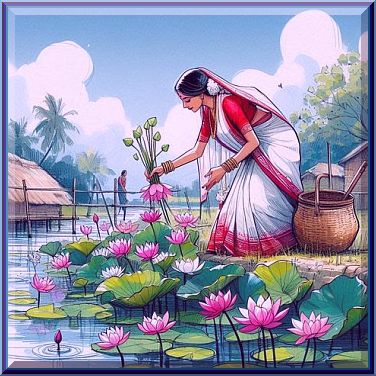
Hemanta (margashira-pushya) – The season is associated with the lofty raga Shree sung during late autumn twilights.  Winter with the earth wet with dew; the sky filled with fog; men shivering from the cold, but crows and elephants seem euphoric. The lusty women retain body-heat by smearing their bosoms red with Kashmir kumkum and fragrant wood-turmeric (kalliyaka) skincare. And their hair is fumigated with vapours of kaala agaru ( aloe vera resin).
hemantashishira

Shishira (magha –phalguna): the transitory season of cool days; the diminishing phase of winter; the season of cool comfort gladdening the hearts of lusty women with Malkoaunsa Raga sung in the chill and silent nights of winter.

11.3. It is said; the Seasonal Ragas can be sung and played any time of the day and night during the season with which they are associated despite the usual rule.

Miniature paintings

12.1. A vast number of schools of miniature paintings such as Bundi, Krishnagarh, Jaipur, Mewar and Marwar giving expression to the Barahmasa concepts and idioms flourished during the mid centuries under the patronage of Pala Kings of Bengal , the Mughals and the Rajputs of Rajasthan. The hill states and even smaller states from Central India too nurtured the paintings of Barahmasa tradition. Datia, one of the schools of painting in Central India, painted a timeless series of Ashtayama, another form of Barahmasa. . These sublime works of art, which gained fame as iconic representations of the seasons and as metaphors for emotions, have inspired generations of artists, poets and lovers. Over the generations, the artists of the diverse schools of miniature paintings have strained to retain the aesthetic values and technical excellence achieved by their pioneers.

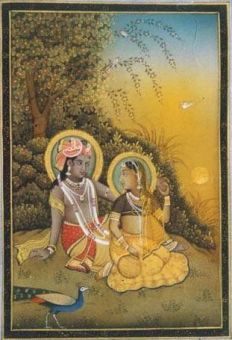
radha krishnaradha krishna2

2.2. In most of these depictions Krishna is the central figure of love and the embodiment of the magic of the seasons and the melodies specially associated with the season.  Its scenery epitomizes the landscape of the imagination, in Indian painting. The Barahmasa schools lovingly capture the delights, the emotions and the enjoyment of the lovers in each of the six seasons. These pictures do tell a tale; each one narrates an event that illustrates the beauty, love and togetherness in the lives of the lovers. That story is entwined on the splendour of nature that surrounds them, in each season.

C. Ragamala

13.1. During the later periods, say by about the fourteenth century, the music- literature developed a series of short verses, in Sanskrit, called Dhyana slokas meaning verses for contemplation , outlining in brief the characteristics (swaroopa) of the raga expressions (raga –bhava) , treating a raga as a human person (nayaka –nayika) , divine (devatha) or semi-human being (gandharva). It also provided for descriptions of Raga wives, (ragini), their numerous sons (ragaputra) and daughters (ragaputri). This poetry often amorous, illustrates the love of a maiden and her lover.

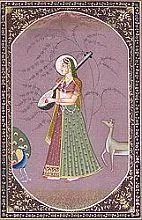
ragamala5ragamala6ragamala7

13.2. This led to the creation of Ragamala (garland of Ragas) School of painting which attempted translating the emotional appeal of a raga into visual representations. Each raga personified by a colour, mood, the nature surrounding the hero and heroine (nayaka and nayika).  It also elucidated the season and the time of day and night in which a particular raga is to be sung. The colours, substance and the mood of the Ragamala personified the overall bhava and context of the Raga. It is a delightful amalgam of art, colour, poetry and music.
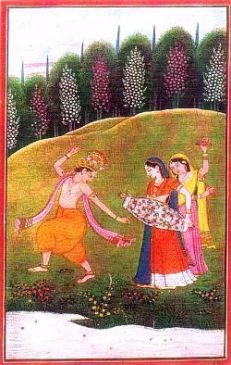
ragamala8ragamala9

The Barahmasa and the Ragamala – series of paintings are the evidence that the native genius in painting had survived the vicissitudes of political history since the days of Ajanta.

13.3. The development of the Ragamala School, however, got rather stunted as its theme lost relevance in the context of the present-day music. Further, the school did not seem to have the flexibility to accommodate and to describe newer raga innovations. The wonderful school therefore has virtually now faded away, sadly

14.1. Yet, the raga-ragini classification is still useful from the historical, academic, artistic and philosophical perspectives; and, could perhaps even help in understanding and performing music.
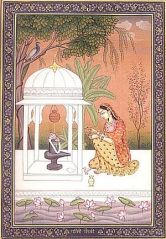
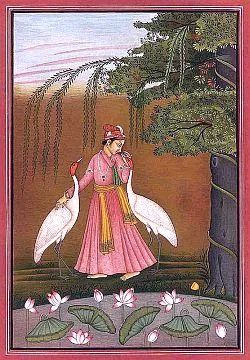
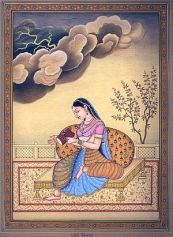
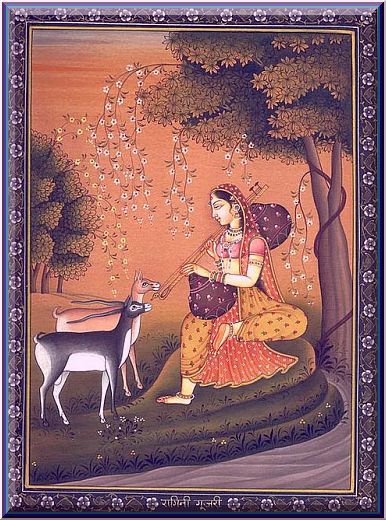
Ragini BhairaviRagini MeghaRagini Gurjari

[ Dr. Anjan Chakraverty who did his post-graduation in Landscapes in Indian Miniature Painting from the Faculty of Visual Arts, Banaras Hindu University, Varanasi, explains:

http://vmis.in/upload/Assets/Exhibition/23/ragmala/part2.html

Every raga has its special sequence of ascending notes (aroha) and descending notes (avaroha) that determine its structure or that (lit. an array or setting). A raga experience would change from dawn to dusk, from a sunny afternoon to a moonlit night, from spring to autumn, so on and so forth. On the basis of this, ragas and raginis were associated with particular moods and regions, with particular seasons and, categorically, to the explicit hours of the day and night.

For example Dipaka raga was associated with fire and scorching heat while the recital of Megha raga, in contrast, was ideal for the season of clouds and rains, its flawless rendition promising downpour. Similarly, Vasanta raga is meant to express the joy of life in spring and Nata raga, the heroic martial spirit of the man. Bhairavi ragini is the plaintive melody of the morning and raga Yaman is meant to evoke the somber, explicitly devotional mood in the early hours of the evening. However, a raga is not a song or tune, on the other hand numberless songs can be composed in a certain raga-mould.

With a view to emphasize the divine qualities of music, each raga and ragini was attributed with a particular rupa or psychic form. The psychic form was further divided into the invisible sound form or the nadamaya rupa and tangible or image form referred to as devatamaya rupa. It was required on the part of a performer (kalavanta) to imbibe the presiding spirit or ethos of a melody and please the deified form. Raga-dhyanas or contemplative prayer-formulas were devised for the purpose, passed on from the master (acharya) to the student.

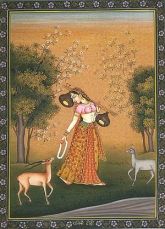
Ragini SehutiRagimi TodikaRagini Bhujanga

In Narada’s Sangita Makaranda, datable between 7th and 11th century C.E., do we come across for the first time a classification system of six ragas as male and six raginis, attached to each raga, as females forming six cohesive families, raga-parivara. However, this system was not followed by the painters.

 It is in the Sangita Makaranda that we find for the first time a classification of ragas according to the proper hour for rendition. Mesakarna or Kshema Karna, a sixteenth-century rhetorician from Rewa (central India), in his treatise Ragamala compiled the elaborate system of six ragas, each with five raginis and eight ragaputras.]
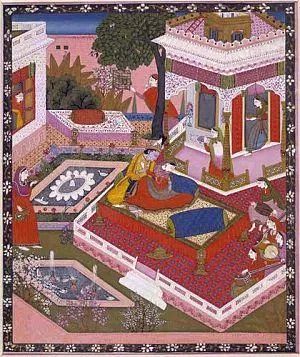
sangita makaranda

List of books and other references.

Rtu in Sanskrit Literature by Dr. V Raghavan; Shri Lal Bahadur Shastri Kendriya Sanskrit Vidyapeetha, Delhi (1972)

Kavyamimamsa of Rajasekhara: Original Text in Sanskrit and Translation with Explanatory Notes by Sadhana Parashar, D K Print world, (2000)

Vishnudharmottarapurana: English translation by Priyabala Shah, Baroda (1961)
The Seasons in Mahakavya Literature, by Danielle Feller : (1995 )

Barahmasa in Indian Literature, Charlotte Vaudeville; Triloki N. Madan (1986)

Barshmasa (Agam55) by V. P. Dwivedi

Baramasa: The Painted Romance of Indian Seasons (Portfolio) by Daljeet, National Museum, (2009)

The Flute and the Lotus: Romantic Moments in Indian Poetry and Painting by Harsha Dehejia, (2002)

The Loves of Krishna in Indian painting and poetry by WG Archer

Flora and Plant Kingdom in Sanskrit Literature by Shri Jyotsnamoy Chatterjee; Eastern Book Linkers, (2003)

 Ritusamharam: http://www.giirvaani.net/giirvaani/rs/rs_intro.htm

Monsoon Ragas by Vimla Patil : http://www.esamskriti.com/essay-chapters/Monsoon-Ragas-1.aspxBarahmasa:

Songs of Twelve Months by Prof P. C. Jain and Dr. Daljeet http://groups.google.com/group/mintamil/browse_thread/thread/9b6cabddd8d32161?pli=1

Romantic Moments in Poetry : http://http-server.carleton.ca/~hdehejia/content/RMinPoetry.pdf

Bidyapati’s Description of spring: http://www.indiadivine.org/articles/382/1/Bidyapatis-Description-of-Spring/Page1.html

History of Flowers and Gardening in India By Dr. Jyoti Prakash  :  http://www.cityfarmer.org/indiagarden.html

  All pictures are from internet


Tags: , , , , ,

Sharad Ritu – season of tender beauty, grace and celebrations

sharat ritu

Traditionally, Indian seasons– Ritus – are six, each of about two month’s duration. In the part of the country where I now live, in Southern Karnataka, there are virtually five seasons: a short spring, summer, monsoon, post monsoon and winter,  where Hemanta and Shishira run into each other. Each of the seasons, – Ritus – has a beauty and splendor of its own. Sadly, we have lost the links with nature; as also with the songs and the Ragas inspired by nature.

Ritu is a division of the year , reflecting the change of seasons. The concept of Rtu occurs in Rig Veda also, where only three Ritus are mentioned: Varsha , Grishma and Sharad. Later, the year was further divided; and, two more Rtus were added. A hymn in Taittareya Brahmana has a beautiful graphic presentation of the Ritus in the image of a bird: Vasantha is the head of the bird called Samvathsara (year); Grishma its right wing; Sharad its left wing; Varsha its tail; and , Hemanta its middle part.

Tasya re Vasantha shirahah/Grishmo Dakshina pakshahah/ Sharad uttara-pakshhah/Varshap pucchyam/ Hemanto Madhyama. (TBrh: 1.10.4.1)

It was during the epic period that the seasons were counted as six: Vasantha – spring; Grishma – summer; Varsha – rainy season; Sharad – autumn; Hemanta – winter; and, Shishira – cool season preceding the spring.

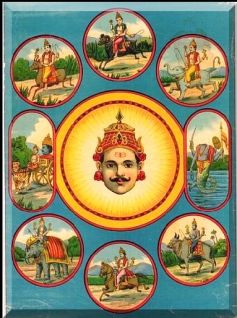
The Puranas (say, the Brahmanda Purana) mention six seasons. The Matsya Purana has a whole chapter dedicated only to the month of spring; and, the Samba Purana gives a reference to the different colors of the sun in the Six Ritu’s : Kapila (tawny or yellowish-brown) in Vasantha Rtu ; Tapta-kanchana (furnace  gold)  in Greeshma ; Sweta (white) in Varsha Rtu; Pandu (pale) in Sharad Rtu; Pingala (coppery or reddish brown) in Hemanta Rtu; and , Raktha (reddish) in Sishira Rtu.

The Chitrasutra of the Vishnudharmottara-purana (5th– 6th century), however , mentions four Ritus; and,  outlines their general features.

Summer : Under trees, languorous men seek shade from the harsh summer sun, buffaloes wallowing in the mire of muddy waters, birds hiding under a thick abundance of leaves, and lions and tigers seeking cool caves to retire in.

Rain: An overcast sky, with heavy rain filled clouds weighed down with their aquatic excess, flashes of lightning and the beautiful rainbow, animals like tigers and lions taking shelter in caves, sarus (cranes) birds flying in a row.

Autumn: Trees laden with ripe fruit, the entire expanse of the earth filled with ripened corn ready for harvest, lakes filled with beautiful aquatic birds like geese, the pleasant sight of blooming and blossoming lotus flowers, the moon brightening up the sky with a milky white luster.

Winter : the earth wet with dew, the sky filled with fog, men shivering from the cold, but crows and elephants seem euphoric.

harmony

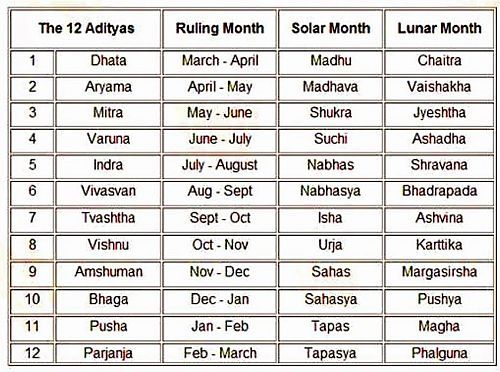
Two sets of calendars – solar and lunar – for the  twelve  months  of the year were developed over a period. And, the names of the months of the solar year , at one time , carried different  sets of names. 

The names of  the  months , according to solar calendar (Sauramana) , in each of the six seasons (Ritus)  are: Vasantha  (Madhu and Madhava) the sweetness of spring; Grishma: (Sukra and Suci)  the blazing light of summer; Varsha: (Nabha and Nabhasya ) the monsoon rain bearing clouds; Sharada : (Urya and Isa) the fertility and mellow of autumn; Hemanta: (Saha and Shahya ) the cold and winter; Sisira:  (Tapa and Tapsya )  the beginning of the hot season.

It is also said; these were the names used in the ancient days. For instance; the Maitrayani-Samhita of Krishna Yajur Veda   enumerates  the  very set of  names of the months . 

madhuś ca mādhavaś ca vāsantikā tū agner antaśleo ‘si // śukraś ca śuciś ca graitū;  nabhaś ca nabhasyaś ca vārikā tū;  iaś urjaś ca śāradā tū ; sahaś ca sahasyaś ca haimantikā tū; tapaś ca tapasyaś ca śaiśirā tū agner antaśleo ‘si   //MS_2,8.11//

*

The names of the months of the lunar calendar (Chandramana) in the respective seasons are: Vasantha (Chaitra and Vishakha); Grishma (Jestha and Ashada); Varsha (Shravana and Bhadrapada); Sharada (Ashvina and Kartika); Hemanta (Margashira and Pushya); and, Sisira (Magha and Phalguna).

solar months 2

*

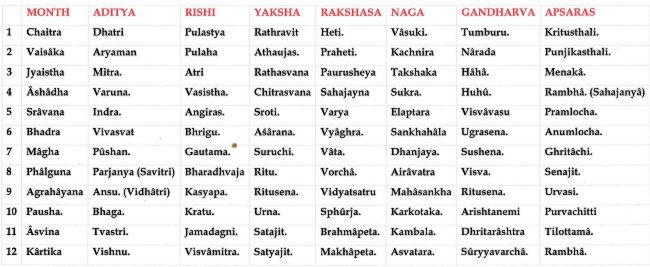
Srimad Bhagavatha -Purana(Skanda-4; Chapter-2) lists the Adityas, Rishis, Yakshas, Rakshas, Nagas, Gandharvas and Apsaras , associated with each month of the year .But, here, the names of the months , their sequence and the related Adityas slightly differ.

Bhagavatha Purana Table

***

It is said, in the ancient days; the month of Margasirsha also known as Agrahayana was at the head of the twelve-month period; which is to say, it marked the commencement of the year from the vernal equinox. But, in the later periods the sequence of the months was changed to what we are familiar with now. And, similarly, the Nakshatras were reckoned from Krittka; and, not from Ashvini, as of now. The scholars opine that during the period when the sun was near Orion at the time of the vernal equinox, i.e. around 3000 years ago or more, the year was reckoned as commencing from the month of Margasirsha (Agrahayana).

And, Margasirsha was the best , most auspicious and the most enjoyable of all the months of the year ; neither too hot nor too cold, neither too wet nor dry; when the udders of the cows are full of milk. And, it was also the harvesting season when the long months of hard work fructified. There is a sense of peace and joy enveloping all existence.

The Mahabharata war is believed to have commenced on the eleventh day of the bright fortnight of Margasirsha (Agrahayana) – Margashirsha Shukla Ekadasi, when the star Krittika was in ascendancy. And, it was on the First Day of the Great War that Lord Krishna delivered the celestial Bhagavad-Gita.

In the Bhagavad-Gita, Krishna says that among the months, he is the MargashirshaMasanam Margashirsha nam- Bhagavad-Gita. 10.35

design star

[Alberuni c.1030 observed that Vasudeva Krishna had a special place in the hearts of the common people who loved to call him by many names. He says , people called out Krishna , out of sheer love , by different names in each of the twelve months; such as : in Margasirsha:  Keshava; Paushya:  Narayana;  Magha:  Madhava;  Phalguna:  Govinda;  Chaitra:  Vishnu;  Vaisakha:  Madhusudana; Jyestha:  Trivikrama;  Ashadha:  Vamana;  Shravana:   Sridhara;  Bhadrapada:  Hrishikesa; Ashvayuja:  Padmanabha;  and , Karttika:  Damodara .]

[The earliest inscriptional reference to Indian seasons and months appears on the Edicts of Emperor Asoka (c.272 B.C.) found at Dhauli and Jaugada. It mentions Tisya Naksatra (Tisya or Pausa) and Chaturmasi (full moon in all seasons). The casket inscription from the time of Meander (c. 115-90 B.C.) at Shinkot is the earliest known inscription to mention a month. It refers in Prakrit, to two months – Karttika and Vaisakha in connection with the relics of the Buddha.]

*

The Solar year (Sauramana) was based on ‘solar division’ – the diurnal motion of the Sun ; and,  the Lunar year (Chandramana) was based on the ‘lunar division’- the phases of the moon .

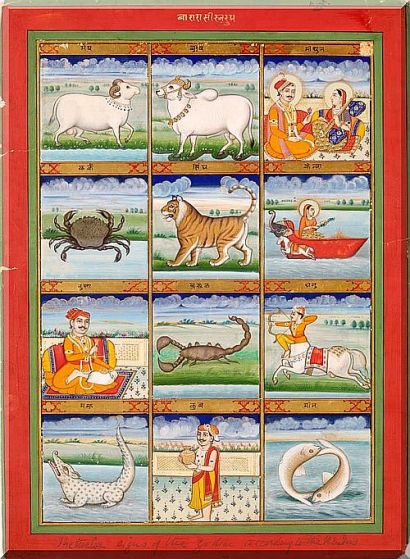
The solar year is approximately 365 days and the months are calculated by the sun’s entrance into a particular Rasi or Zodiac sign. These are divided into twelve, Mesha (Aries), Vrsabha (Taurus), Mithuna (Gemini), Kartaka (Cancer), Simha (Leo), Kanya (Virgo), Tula (Libra), Vrscika (Scorpio), Dhanus (Sagittarius), Makara (Capricorn), Kumbha (Aquarius), and Mina (Pisces).

Astrological signs

The Lunar calendar is roughly around 354 days; ten less than the solar year(*) and its months are named after Nakshatras or constellations in which their full moons are placed. The lunar months lasts from one new moon to the next but it is named after the Indian solar month in which it begins. As mentioned earlier, the lunar month are Chaitra and Vaishakha for spring (Vasantha) ; Jyestha and Asadha for summer (Grishma); Sravana and Bhadrapada for the monsoon (Varsha); Asvin and Karttika for the autumn (Sharad); Agrahayana and Pausha for winter (Hemantha) ; and. Magha and Phaguna for  later cool season (Shishira).

The poets have sung of the glory of each season either individually or as a garland of seasons. The Great Kalidasa’s Rtu Samhara is of course the most celebrated of all such romances of the six seasons.

[*  It is said; a Solar year actually measures 365.2422 days; while a Lunar year is shorter having only 354.372 days ; the difference between the two reckoning being 10.8702 days , each year. In order to reconcile the difference between the two calendars, an additional month is added to the Lunar calendar once in three years. Such additional month is termed as Adhika –masa. And, the year in which such Adhika-masa is added would thus have 13 months, as compared to 12 months in other years. In the cycle of 36 months, the Adhika-masa would be the 33rd month; and, would commence from the close of the 32nd month – that is , from next day of full moon and up to end of Amavasya. The Adhika-masa would actually measure 32.6106 days.]

design star

It is the post monsoon season – Sharad Ritu, which is dearer to me. It is a season of festivals marked by benevolence, grace and beauty. As per the lunar calendar, Sharad Ritu follows the Varsha (monsoon) and precedes Hemantha (early winter). It comprises months of Ashvina and Karthika, which is September to November months in the Gregorian calendar. In the year 2007 , Sharad Ritu commenced from Oct 12, Sharad Ritu corresponds to early autumn in the West but it is not the same.

The nature is at its benevolent best in Sharad Ritu. The oppressive heat of the summer is a distant memory and the chill of the winter is still on its way. The annoying downpour of the monsoon has just ended. The weather is mild, pleasant and refreshing. Sharad is a season of moderation, comfort and peace. It is the season of the middle path.  It is a soothing delight, as its designated Raga Malkauns a pentatonic haunting melody. The rivers are neither dry as in summer nor flooded, muddy brown, twirling with orphaned twigs and overflowing menacingly as in monsoon. In Sharad Ritu, the rivers are moderately full, transparently clear; rippling down the gentle slopes in peals of temple bells.

Sharad Ritu brings a blush to the countryside. The nature is bedecked as a bride with light green, decorated with profusion of colorful flowers and bountiful laden fruit trees with chirping birds. There is peace, joy and fulfillment abounding in the air.

The days are sunny, yet pleasantly cool and comfortable. The skies are clear blue with white cotton clouds floating lazily. The nights mildly intoxicating are slightly chill, clear and cloudless.

Srimad Bhagavatam describes the resplendent beauty of Sharad Rtu in Venu Gitam (Canto 10):

ittham sharad svaccha jalam padmakara sugandhina /nyavishad vayunavatam sa gogopala kochyutaha / kusumita vanaraji sushmibhrunga dvijakula gushta sarah sarIn mahidram / madhupatir avagahya charayangAha saha pashupAla balahaschukUja veNum //

It says; the water is pure, fresh and playing host to the beautiful lotuses waiting to bloom. In the autumn, the monsoon clouds too have disappeared, making way for clear sunshine; the lotuses bloom and spread their fragrance everywhere –padmakara sugandhina.

Flower buds, that had hitherto been soaked and ruined by incessant monsoon rains, now bloom joyfully–kusumita vanaraji – adorning the trees with colour. The aroma and nectar of these flowers attract the buzzing honey bees (sushmi bhrunga). With fragrance, color and cheer all around, can the cuckoos and peacocks help themselves but sing and dance to their hearts content – dvija kula gushTa sarah sarin mahIdram.

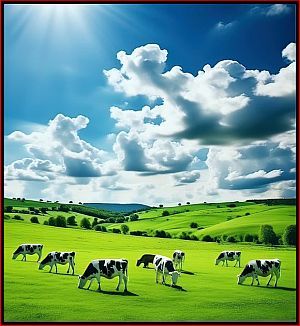
In Sharad Ritu, the cows graze happily and produce abundant milk, bringing prosperity all around.

In certain regions of India, the bright, soothing and joyful Sharad Purnima, is celebrated as a harvest festival; and, is known by other names such as : Kumаrа Рurnimа, Kоjаgiri Рurnimа, Nаvаnnа Рurnimа, Аshwin Рurnimа оr Kаumudi Рurnimа.

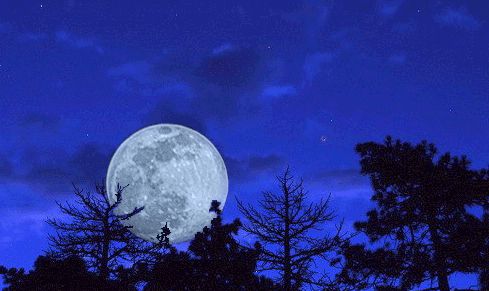
It is believed that on the Sharad Purnima, the moon glows with all its sixteen phases (kalas). On this night, the sky is clear; and, the moon is at its largest, brightest; shining without a blemish.

On this auspicious day, many divine pairs like RadhaKrishna, Shiva Parvati, and Lakshmi Narayan are worshipped ; and, are offered flowers and kheer (sweet dish made of rice and milk).

sharat Moon

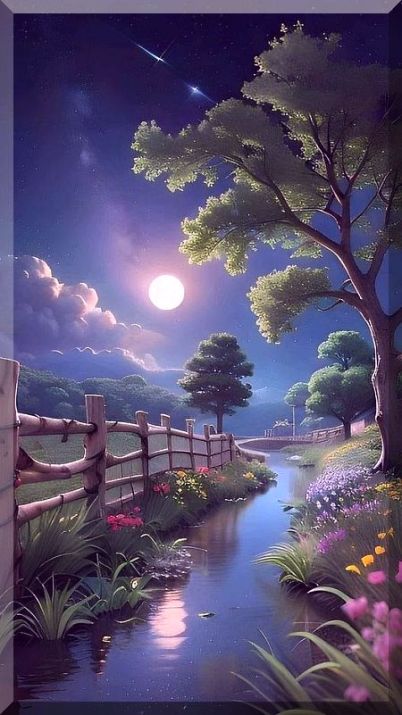
The splendid cloudless full moon night of Sharad Ritu is an idiom of glory, peace and joy in the Indian poetics. It is the delight of eager young lovers that long to be with their beloved. The ecstatic beauty of Sharad Purnima is etched in Indian psyche. Its glory, tenderness and joy are celebrated in songs, legends and poems of love. Our classical poets and epics sing lovingly the beauty and joy of the delightful moonlit nights of Sharad Ritu.

Full Moon

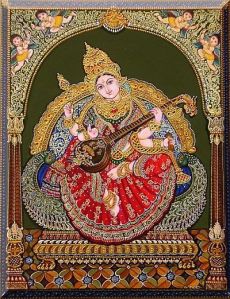
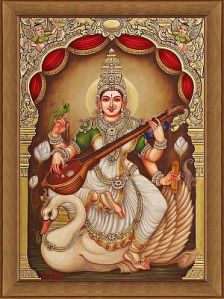
Soundarya-lahari, meaning waves of beauty, a tantric work in poetic form   dedicated to the Mother, in devotional ecstasy,   calls her Saratchandra Vadana, one with a face as    radiant and blissful as the moon in Sharad Ritu. And, Goddess Sarasvathi is described as Sharad-indu Sundara Vadane  – having a blissful radiant face as beautiful as the moon of the Sharad Rtu. 

atriversedge

The tradition of Rtu-Varnana, describing the seasons, became frequent when such descriptions came to be recognized as a mandatory feature (ashta-dasha –varnana, eighteen types of descriptions) of a Maha-kavyas the major epic like poems

The classical Indian poetry abounds with expressions like Sharadendu vilasam (the glory of the moon lit nights of Sharad), Sharath-chandrika – dhavala-prakasham (glorious brightness of Sharad) etc. The food – loving court jester encouraged by bright cool comfort and a feeling of luxury compares Sharad night, gleefully, to curd rice and ghee (Gritha-supa-samanvayam).

Maharas

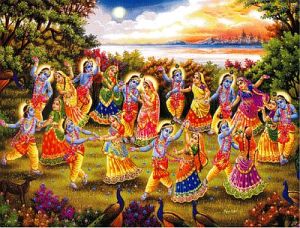
It was under the resplendent full moon of Shard Ritu, amidst the mango and Kadamba groves along the banks of the gentle flowing Yamuna that Sri Krishna and Gopis enacted their celestial dance Rasa Leela. It was the night; the haunting melody of Krishna’s flute enraptured the hearts of Gopis. Srimamad Bhagavatham sings the glory and joy of Rasa Leela with love and divine ecstasy. Every region and every language in India cherishes at its heart in lyrical rapture the love, graceful beauty and bliss of that Sharad Purnima. Year after year the devotees throng at the Vraj-bhumi on the Sharad Purnima  under the heavenly glow of the scar- less full moon , to re enact Rasa Leela with longing and elation as an act of devotion  and humble tribute to the love of Krishna and the Gopis.

The Great Poet Valmiki in his Epic Ramayana (4.29.27) talks of ‘The Mountains washed spotless by great clouds and their glittering peaks now shine as if bathed in moonbeams’.

abhivṛṣṭā mahāmeghair nirmalāś citra-sānavaanuliptā iva ābhānti girayaś candra-raśmibhiḥ ||

Kalidasa the great poet of ancient India in his Ritu-Samhara (song of the seasons) sings of the “golden plenitudes” of Sharad Ritu in passages of high lyrical imagery. (RS.3.21- 3.28) Sharad is the season of slenderness and grace; cool as the sandalwood (candanaṃ candra-marīci-śītalaṃ); of clear moon (śarad-indu-nirmalam); of radiant moon (vimala kiraṇa candraṃ); and of light, floating, soft colored silks. Kalidasa fondly talks of cheerful women dressed in light-hearted elegance of “silks dyed scarlet with mallow juice, delicate silks saffron dyed and shining pale gold veils”- anupama mukha rāgā rātrimadhye vinodaṃ śaradi taruṇa kāntāḥ sūcayanti pramodān –  KalRs_3.24 .

He compares Shard Ritu to a bride; decked in white as the moon and the swan, adorned with jewels and flowers; moving with gentle grace like the rivers in Shard Ritu. The sky scattered lightly with thin clouds is as a king fanned with a white fly-whisk. The women adorn their hair with jasmine and ears with blue lotus; pine for the beloved. The travelers see in the lotuses the dark lustrous eyes of their beloveds; in the infatuated swans, they hear the tinkle of the beloveds’ golden girdle; and in Bhandu-jiva, flowers look for the gleam of their coral lips. Travelers sigh and pine for their beloveds –  bandhujīve priyāṇāṃ pathika jana idānīṃ roditi bhrānta-cittaḥ- KalRs_3.26.

Autumn

Viśākhadatta in his Mudrārākāsa (3.8) sings the tender grace of the Sharad :  The tumult of the rains gradually gives way to the stillness of Sharad.  The sky is free of clouds, water grows clear at the rise of the star of Agastya (not surprisingly says one poet – they heard he swallowed the ocean in one mouthful and are scared stiff) and the torrents of the monsoon become gently meandering rivers once again.  The sound and light special effects – flashes of lightning, drumbeats of thunder – are replaced by a finer beauty, characterized by the superfluity of white, in the bright moon, the swans, the lotuses and the tall kāśa grass.  The world is freshly washed and now sparkles in the sun:

Apām uddhtānā nijam upadiśantyā sthitipadaṃ Dadhatyā śālīnām avanatim udāre sati phale |

Mayūrānām ugra viam iva harantyā madam aho I Kta ktsnasy’ āya vinaya iva lokasya śaradā ||

And, Bhāravi, in his Kiratarjuniya, describes a river whose sandbanks white cows are gradually leaving as if her white silk robe was slipping down. 

**

This tradition of Rtu-Varnana occasionally spilled into Dramas. For instance, in the Bhana plays of the Gupta Era (4th-6th centuries) the tradition set by Bhasa and Kalidasa was continued by including songs singing the glory of one or the other season.

Let me say a few words about Bhana plays (a type of Rupaka) because not many of the Bhana plays have survived. . The Bhana plays are essentially short dramatic presentations (Prahasana) or burlesque one-act plays which , flippantly, satirized the respectful figures in the society . They are different from elegant Sanskrit court-plays. They deal with the common place and the trivial. They expose the seamy side of urban life and of the court officials, in particular ; and,  debunk the hypocrites  moving under the guise of the virtuous.

These short plays were , usually in monologue, featuring a single actor who assumes the role of a Vita (paramour) or a Dhurta (rouge, swindler, gambler or cheat) . He is described as : a clever and shrewd parasite who  describes roguish exploits (on subjects invented by himself) through imaginary conversations  engaged with himself or with  some one else or  with imaginary persons  (akasa-bhasita).

Generally the eloquent Style is employed ; the subject, which is invented by the author, is treated in a single Act. The Bhana has two Junctures, the opening (mukha) and the conclusion (nirvahana), with their subdivisions.

bhanas tu dhurtacaritam svanubhutam parena va / yatropayarnayed eko nipunah pandito vitah / sambodhano -ukti-pratyukti kuryad akasabhasitaih / sucayed vlra-srngarau saurya-saubhagya-samstavaih/ bhuyasa bharati vrttir ekankam vastu kalpitam / mukha-nirvahane sange lasyangani dasapi ca.

Singing and music, from background , precede and close the performance; and in between also  give musical effects to the imaginary conversations that the single actor  carries on. 

.

Usually, the narrator is a Vita who loiters in the locality of the courtesans where he is a familiar figure and picks up conversation with whoever passes his way. He also calls on any courtesan at his sweet will.

Vita is a very interesting character in the plays of this genre. He narrates dramatically, a variety of occurrences as happening either to himself or others. He is generally a cultured, shrewd; but a deprived person; but, very familiar with the ways of the courtesans (vaisika sastra). He is quick-witted and knows how to manipulate courtesans through flattery and sweet-talk . He is truly the man of the world; gifted with jab of the tongue, wit and humor; and has familiarity with arts, poetry etc. He has also a strong sense of friendship and ever ready to help the needy. But his special interest is in enjoyment of worldly pleasures, and the sensuous company of the cheerful, fun-loving courtesans.

On the flip-side; a Vita would usually be one who was once wealthy; but squandered it all through misplaced trust or sheer gullibility or in gambling . Quite often, his family would have disowned him tired of his reckless and irresponsible ways. He is also disappointed in love.

In other words: basically , he is good at heart; but, a looser, incompetent or unable to succeed. He is described as a gallant parasite (Vita) who preys on courtesans and their paramours.

The Dhurta- vita-samvada presents the picture of one such  seemingly clever , experienced, but worn-out Vita, who  finding the rainy season too depressing, comes out seeking some amusement. He has no money either for a game of dice or for a drink — even his clothes are reduced to one garment. He , then  , wends his way towards the street where courtesans live, transacting with  their clients  of various kinds . He , sadly, cannot afford a courtesan, either.  At the end, dragging his feet, he reaches the house of the roguish couple Visvalaka and Sunanda, who were then busily engaged in a  discussion on certain awkward problems of sex-act. He gleefully joins the discussion.

Vatsayana in his Kama -sutra has immortalized the Vita characters.

The three playwrights of this period scripted  Bhana plays to highlight the features of certain seasons: Padma-prabhrur-takam (by Shudraka) and Ubhaya-abhisarika   (by Vararuchi) described Vasantha the spring, while Dhurta-vita-samvada (by Isvaradattadescribed Varsha the rainy season. The last mentioned also carried brief descriptions of Sharad, Grishma, and Vasantha Rtus, as in Kalidasa’s epic poem.

Here is a simplified and abridged version of Sharad as in the Dhurta-vita-samvada:

In the Shard Rtu the veil of the clouds vanishes; moon shines up in the blue night sky; breeze is gentle and pleasant; and whole of delightful existence is filled with intoxicating fragrance of flowers withering gently from the Aasan trees; the lover swims in the scented lotus pond  with his beloved who as the Chakravaka bird is well versed in the secrets of love; the air around is scintillated with the music of Saras birds and the peels of girdle bells and anklets of cheerful beauties playing around the pool whose forehead is adorned with the Bindi bright as the Bandhuka flower .

OLYMPUS DIGITAL CAMERA

Dakshinayana is the Ayana (half year) of the Devi, the Mother Goddess. Dakshina is also understood as the grace; the feminine principle; and, as the Mother who creates, unfolds and brings forth manifestation. Dakshinayana is the life giving season in which all creatures and vegetation thrive. Dakshinayana is the time of receptivity and is the feminine phase of the Earth. It is the season of re-generation, in which all creatures and vegetation come to life and thrive. The thirsty plants and animals fanatically drink and soak in the elixir of life, and regain their vitality.  

It is also the season of festivity.  All the major festivals from Krishna Janmashtami, through Gauri, Ganesh, and Nava-Ratri, on to Deepavali are celebrated during Dakshinayana.  Sharad Ritu, in particular, is the Rtu dedicated to  the Devi.

In the ancient and medieval times, Dakshinayana was also the season of reunion; when men travelling on business hurried back home before the rain bearing clouds broke out in torrents; and, when the separated lovers ran into each other arms.

Even for the ascetics, the recluse and the Parivrajakas (wandering monks) the monsoon was a period of retreat. During the four months (Chatur-masa) of Dakshinayana when travel used to be difficult and hazardous the monks in the olden days used to assemble at a place far away from towns for exchange of views and experiences. It was essentially a period of study, reflection and contemplation. The period of retreat commenced from the end of Ashada (June–July) and through the months of Shravana, Bhadrapada, Asvina and ending in the Kartika, the day after Deepavali (November) marking the beginning of  winter 

The Dakshinayana begins with pouring monsoon rains beating down the heat and ushering in cool relief, And, as the Aayana ends, the mild winter steps in as a  prelude to spring

[ In contrast; the Uttarayana (Jan – July) is a long period of dry heat, blazing summers and swirl dusty winds. During this uncomfortable season of heat, dust and winds the life withers and dies.  The heat takes away moisture from all living things. It is also the season of ‘hot’ diseases and epidemics. The village minor goddesses such as Sitala (small pox) are ‘cooled’ or appeased (shanthi).

At the same time; Uttarayana is also the invigorating   , new good healthy wealthy beginning.  It is the time of harvest, gathering the fruits of your efforts.  Uttarayana is also the northward noble path (Deva Yana) that leads the virtuous to gods; and, is therefore called Uttarayana Punyakaala. The old warrior Bhishma of Mahabharata lay in wait on the bed of arrows for the arrival of Uttarayana. On the dawn of Uttarayana the Grand-old Bhishma chose to give up his life.

Uttarayana is the time of fulfilment, while Dakshinayana is the season of growing up.

Many of the festivals in Uttarayana are in celebration of male gods.  Maha Shivaratri heralds the true beginning of hot summers. It is followed by   Holi  the festival of colours marking  the burning down of Kama .

The season of six months from January to July is regarded   masculine in nature, while Dakshinayana is the feminine phase of the Earth.]

sarasvathi tanjoresarasvathi

Sharad Ritu is aptly named after Sharada the goddess of speech (vac), learning and fine arts. She is the presiding deity of the Ritu. Sharad Ritu personifies the mild- glowing beauty, serenity, grace and compassion of mother Sharada. The ten days following the new- moon in the month of Ashwina in Sharad Ritu are celebrated as Navarathri (Sharan navarathri) in devote reverence and in worship of the mother. Display of learning, performance of arts and honouring the learned and the virtuous during Navarathri are all in humble submission to the mother. Bengal has a tradition of commencing the Durga Puja with Saraswathi Puja. Saraswathi is regarded as daughter of mother goddess Durga.

Navaratri

The tenth day of Navarathri in Sharad Ritu, Vijaya- Dashami is one among the three most auspicious days in our calendar. It is the most sought-after day for launching ones hopes and ventures. Vijaya-Dashami signifies rescue of Dharma from the creeping shadows of the unjust, instating the virtuous to their rightful position and the victory of good over evil.

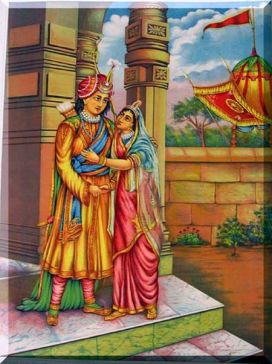
On this day, the Pandavas ended long years of their humiliating exile and incognito; the friendless brothers found an ally in Virata and celebrated it with the bonding of young Abhimanyu and Uttara. 

Abhimanyu

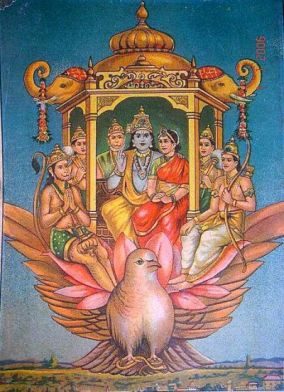
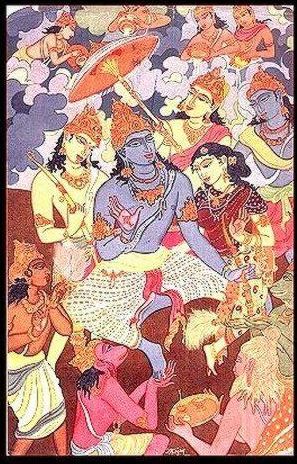
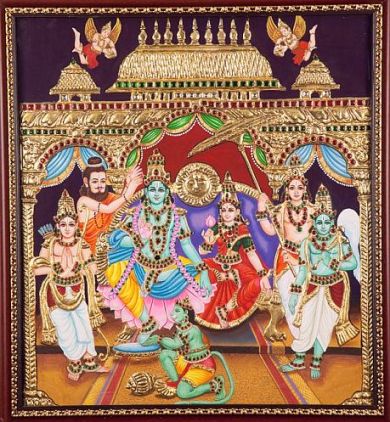
On this day, Sri Rama with his consort , on return from years of exile and vanquishing the demon king Ravana ,was enthroned in Ayodhya

Rama pushpaka RAMA PATTABHISHEKA

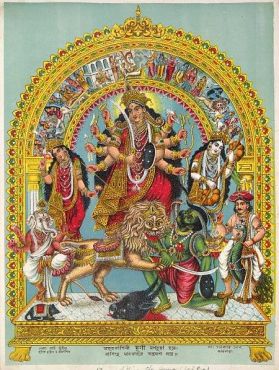
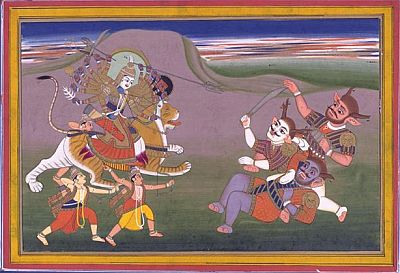
It was on this day the Goddess Durga mata destroyed horde of evil forces, restored light and hope in the hearts of the virtuous. It is a day of victory and rejoices.

durga 9

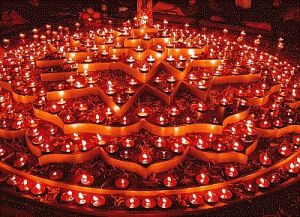
The later month of Sharad Ritu is Karthika, the month of the infant commander of the divine forces, Karthekeya the vanquisher of evil and darkness. Karthika is the month of lights. Numerous Little lamps are lit in homes and temples to dispel darkness and ignorance.

diyas full

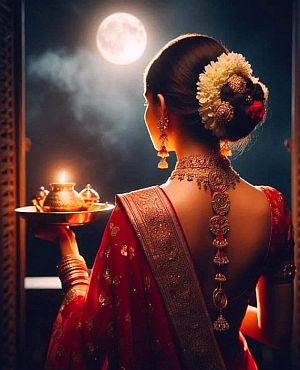
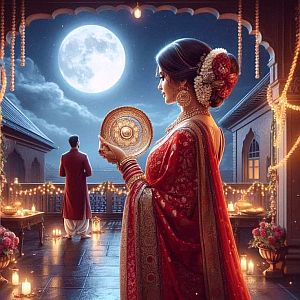
Karthik-ki-chauth (Karwa chauth) the fourth day after new moon in Karthika is the day when women in the North and Western parts of India fast and pray in loving devotion for the longevity and prosperity of their husbands.

Sharad Ritu, which commences on a pious note of devotion and fulfilment peaks into a burst of sparkling and spectacular lights and lavish celebrations. Deepavali or Diwali certainly is the most popular and the noisiest of Hindu festivals.  Deepavali (array of lights) is a festival of four days, which literally illumines our hearts, homes and streets; dazzles with sparklers and firecrackers; and draws friends and neighbors together in a net of goodwill. It also signifies victory of good over evil, delivering from darkness and leading towards light. It is a festival in celebration of life, its goodness and fulfillment.

As Sharad Ritu nears its end, the leaves on the trees turn from green to yellow to red and to dusty brown. The trees let go the aged leaves, that once clothed, fed and sheltered them; with grace and gratitude. They gently place the departed friends, with reverence, on the floor.

If the spring signifies the exuberance of youth; and the sizzling heat of summer, downpour of the monsoon represent the rigors, vicissitudes and uncertainties of life; Sharad Ritu is the mellow maturity and fulfillment of life before it slides into its evening. It inspires a sense of amazement, grace and reverence towards life. It is the golden mean, away from extremes of burning passions and debilitating regrets. It is the summation of the quality life.

Our seers visualized a life worth- living as spans of Sharad Ritu; not merely, because it is the most enjoyable season but also because it suggests an interpretation and a sense of balance that life should have. That perhaps was the reason our ancients measured meaningful life spans as representations of Sharad Ritu. A young person on threshold of life greets his beloved at the time of wedding “Oh! The auspicious one, the cause of my life, may we live to see a hundred Sharad seasons (subhage, tvamjeeva sharadahshhatam)”.

The Vedic aspirations of living a long, rich and purposeful life are expressed as enjoyment of life as in Sharad Ritu.

Paśyema śarada śata| jīvema śarada śata| budhyema śarada śata| rohema śarada śata | pūema śarada śata| bhavema śarada śatam | bhūsema śarada śata| bhūyasī śarada śatam | (AVŚ_19,67.1-8)

May we see a hundred Sharad Ritus. May we live a hundred Sharad Ritus. May we be wakeful in a hundred Sharad Ritus. May we ascend through a hundred Sharad Ritus. May we enjoy prosperous hundred Sharad Ritus. May we adorn a hundred Sharad Ritus .May we live more than a hundred invincible Sharad Ritus.

All pictures are taken from Internet.

Please do read

Shishira Ritu

 
21 Comments

Posted by on September 20, 2012 in General Interest, Sanskrit, Sharad Ritu


Tags: , ,

Music in Sama Veda

Following my post the state of music in Ramayana, there was some discussion about Sama and its relation to music. I was asked to say a little more about the music in Sama Veda; hence this post.

  1. Sama Veda Samhita

1.1. The earliest form of organized Music that we know about is the Music of Sama Veda or the Saman. Sama Veda is linked to music through Yajna.

The Yajna-s, were at the very heart of the Vedic way of living. During the Yajna-s, it was customary to invoke and invite devas (gods) by singing hymns dear to them or dedicated to them ; and to recite the mantras while submitting to them offerings (havish) through Agni, the carrier (havya-vahana). The group of priests who sang (Samaga or Chandoga) the Mantras, initially, compiled a text for their use by putting together selected Mantras from Rig-Veda (the oldest known text) that could be sung during the performance of a Yajna or a Soma Yaga. That collection of lyrical Mantras came to be known as Sama Veda Samhita; and was regarded as one of the three Vedas(Trayi)..

1.2. Out of the 1,549 mantras in Sama Veda Samhita, as many as 1,474 mantras are taken from Rig Veda (mainly from the eighth and the ninth Mandalas). Most of the mantras are in Gayatri chhandas (metre), while some are in Pragatha. It is said; the term Sama is composed of: SA, which stands for Rik (Vedic Mantra); and AMA, meaning various notes (Brihad Up: 1-3-22).

eṣa u eva sāma | vāg vai sāmaiṣa sā cāmaś ceti tat sāmnaḥ sāmatvam | yad v eva samaḥ pluṣiṇā samo maśakena samo nāgena sama ebhis tribhir lokaiḥ samo ‘nena sarveṇa tasmād v eva sāma | aśnute sāmnaḥ sāyujyaṃ salokatām | ya evam etat sāma veda || BrhUp_1,3.22 ||

Sama Veda is thus, virtually, a musical rendering of the selected mantras from Rig Veda. In other words, Sama took maathu (words) from Rig Veda; and provided dhathu ,  the musical substance to those words. Sama Veda is perhaps the earliest known musical literature.

1.3. The Sama Veda Samhita has two segments. The first segment is called Sama – Yoni (adhara) mantra Samhita, meaning that it is the basic text. This segment contains the selected mantras as they appear in the Rig Veda . This, virtually, is the source book.

The second segment called Sama–gana text. Here, the mantras are not in the order they originally appear in Rigveda. But, the selected mantras are rearranged to suit the sequence of rituals during the Yajna; or according to the meters (chhandas) or the gods to whom mantras are addressed.

2.Sama-gana

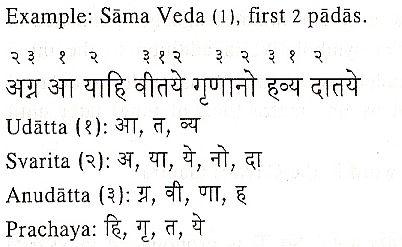
2.1. While rearranging the text for the purpose of singing, the selected mantras are converted to Saman by turning, twisting, elongating its syllables; and, by inserting various modulations, rests, and other modifications.  The musical effect or the ‘floating form’ of the Sama-gana is enhanced by interpolation of Svaras and meaningless sounds called Stobha (which resemble shouts of joy) such as: Hoyi, Hoi, Hova, Hai, Haw, Oi, Ai, Ha, Ho, Uha, Tayo, etc. This is the text for singing; expanding each mantra with notations and instructing how mantras are to be sung. This is the Sama Veda as it is generally understood and sung.

2.2. Sama-singing (Sama-gana) was an integral part of a Yajna. Sama, thus, represents the earliest known instance of deep relationship between religious life and Music. There were numerous styles of singing Sama. Patanjali in his Mahabhashya remarks that there were a thousand recessions (shakhas) or ways of singing Sama – sahasra-vartma samvedah.  That perhaps was a poetic manner of suggesting there were a range of styles of rendering Sama.  

[Some texts speak of thirteen Samaga-charyas – ways of singing Sama. But names of about only eleven are mentioned:  Ranayaniya; Chatyamugra; Kaleya; Kalvala; Mahakaleya; Langalayana; Mahakalvala; Sardula; Langala; Kouthuma; Jaiminiya]

2.3.  In any case, of the many, only three recessions (shakhas) Viz. Kauthumiya, Ranayaniya and Jaiminiya, have survived. The Kauthumiya and Ranayaniya carry the same set of mantras; but, their internal grouping differs; and there are also variations in their svaras (accent). The Jaiminiya is said to be different from the other two, in both the aspects. Of the three shakhas, Kauthumiya is regarded the prominent one.

  1. Archika

3.1. Throughout, Sama Veda is arranged in two streams of classification. And, the two often   interrelate. One is Arcika, the way in which Sama Veda text is structured and the way its Riks (stanzas) are grouped. The other is Gana, the musical aspect which details the manner of singing the Sama Riks.

First, Archika (group of Riks sung in adoration), is essentially the collection of the texts (yoni) of individual Riks adopted from Rigveda. Here, the selected Riks from Rigveda are put together under several chapters (prapathakas). And, under each prapathaka; the Riks are bunched into sets of ten (dasasti) or less.

3.2. The Sama Veda text is broadly made into two Arcikas.

The first Arcika (Purvarchika or Shadarchika) is made of six chapters (prapathakas) together with an Appendix.  The Purvarchika consists about 650 Riks selected from Rigveda that  are grouped partly according to meters (chhandas) and partly according the gods  (devatha) that are propitiated. The first five prapathakas have about 585 Riks to be sung in honour of Agni, Indra and Soma-Pavamana.  The sixth prapathaka having 55 Riks is called Aaranya or Aranyakanda.  There is also an Appendix consisting 10 Riks attached to Purvarchika; and is called Mahanamani (or Sakravayah) to be sung in honour of Indra the Great (Mahan).

3.3. The second Arcika, Uttararcika (that which follows the first) is made up of nine prapathakas, divided into number of segments (khandas). Under these Khandas, about 900 Riks are grouped into about 300 songs of three Riks each. The Riks, here, are arranged according to the sequence of events that occur in the course of the performance of the Yajna. It is presumed that the Uttararcika is, comparatively, of a later origin. And, it is regarded as an essential supplement to the Purvarchika.

  1. Gana

4.1. As regards the Gana, the musical element of the Sama Veda, the Riks included in the first five chapters (prapathakas) of the first Arcika (Purvarchika) and those under Mahanamani are known as Grama-geya-gana – that is , the songs meant to be sung in homes and in the villages – praying to gods (devatha) Agni, Indra Soma and Visvedevah – during the course of domestic functions such as Brahmayajna (teaching of Vedas), Upakarma and other worships.

The Riks included under the sixth chapter (prapathaka) of the Purvarchika – that is Aaranya or Aranyakanda – are meant to be sung in the solitude of forests. Hence, they are named Aranya gana. The singing is of contemplative nature; and, it is deemed as sacred-music.

The Purvarchika way of singing (both the Grama and the Aranya gana) is deemed Prakrti-gana, the natural way of rendering a song.  And, it appears that the hymn-melodies for the Soma-yaga performed at homes in the villages (Grama) were different from those performed by the hermits living in the forests (Aranya).

4.2. As regards the singing (Gana) of the Riks included under the second Arcika (Uttararcika), it basically consisted two kinds of songs: Uha-gana (numbering 936) sung during the Soma Yajna; and Uhya-gana (numbering 209) singing within oneself.

The texts (yoni Riks) of most of the songs were adopted from Purvarchika. But, here, the singing style is improvised with unusual variations; and, therefore it is named Vikrti-gana (not the straightway of singing). It is also said; the same Rik can be sung in different tunes, producing different Samas. The number of such Samas can vary from one to eighteen..!

[It is also said; Uha and Uhya were composed for the purpose of indicating the order of rituals in the Yajna. And, that Uha is related to Grama-gana; and , Uhya to Aranya –gana.]

*

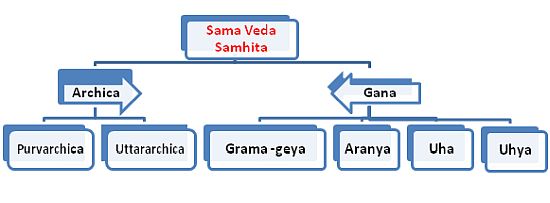
In summary; The Sama Veda Samhita, is arranged in two primary sections – the verse books (Archica) and melody books (Gana). The Archica is divided in two parts: Purvarchica and Uttararchica.  And, as regards melody (Gana) there are four styles of singing hymns: Grama-geya-gana; Aranya-gana; Uha-gana; and; Uhya-gana.  There is a mutual relation between the Riks contained in Arcika and the Gana books.

Sama Veda 4

*

  1. Sama-chanting

5.1. The priests who sing the Mantras at the Yajna are designated as Udgathru-s (derived from udgita – to sing ’high’ or loud).

Chandogya Upanishad (1.3.6) explains the term Udgita by splitting it into three syllables ud-gī-tha: Ud meaning breath (Prana) in high pitch (utti shati); Gir refers to speech (vag gī); and, tha : in which all this is established (sthita )

atha khalū-udgīthākarāy upāsīta ud-gī-tha iti | prāa evot |prāena hy uttiṣṭhati | vag gī | vāco ha gira ity ācakate | anna tham | anne hīda sarva sthitam || Ch.Up_1,3.6 ||

The Sama Veda Samhita came to be compiled, essentially, for the use and guidance of Udgathru-s .  They were usually a group of three singers (Prasthothru, Udgathru and Prathiharthra). And, the group, together, rendered the Sama in five stages.

Prasthava: The initial portion of the mantra is sung by an Udgathru designated as Prasthothru.  And, he starts with a deep Huuum sound (Hoon- Kara).

Udgita: Prasthothru is followed by the chef Ritwik (designated the chief Udgathru) who sings his portion of the Rik. He commences with an elongated Om Kara.

Prathihara: the mid-portion is sung loudly by Prathiharthra. This adulates the Devatha to whom Rik is addressed.

Upadrava: The chief  Udgathru sings again; and

Nidhana: the final portion is sung by all the three together, commencing with prolonged Om-kara.

When a mantra, as per the above format, is sung three times, it is then a stoma. Some texts describe the set of these five stages (Prasthava, Udgita, Prathihara, Upadrava and Nidhana) as Bhakthi. Its number is extended to seven by adding Hoon- Kara and Om Kara.

  1. Elements of chanting

6.1. Shiksha, a branch of Veda lore (vedanga), deals with elements of chanting and phonetics. According to Taittiriya Upanishad (1. 2), the elements of chanting includes six factors: Varna (syllable); Svara (accent); Maatra (duration); Balam (stress); Sama (even tone) ; and Santana (continuity) . The first four deal with correct pronunciation of individual syllables; and the last two with the recitation of the entire line or the verse.

oṃ śīkṣāṃ vyākhyāsyāmaḥ | varṇaḥ svaraḥ | mātrā balam | sāma santānaḥ | ityuktaḥ śīkṣādhyāyaḥ ||

Briefly, Varna is the correct pronunciation of every isolated syllable, combination of consonants and ovals and compound letters. Svara is how a syllable has to be pronounced in one of the three accents (udatta, anudatta and svarita). Maatra is the time duration for pronouncing a syllable. There are of four types: hrasva– a short one – duration for short ovals; dhirga –  two unit-duration for long vowels; plutam– longer than two–unit duration; and, the fourth is ardha- maatra, half unit, meant for consonants not accompanied by vowels.

Sama Svaras

6.2. In the beginning, Sama-gana employed only three notes called Udatta, Anudatta and Svarita. The lyre (Vana-Veena) accompanying the singing had only three strings, one for each note. The songs were perhaps like Ga Ga -Re Re -Sa Sa Sa. This kind of singing might have suited for chanting hymns.

The three notes were differentiated depending on whether it was produced from above or below the palate (taalu).

Udatta refers to sound produced from above the palate; and is acutely accented (uchchaih).

Anudatta was gravely accented (nichaih); produced from below the palate.

Svarita is a combination of udatta and anudatta, with udatta in the first-half. It is called a circumflexed accent.

[It is also explained that in context of Sama Veda , Udatta meant the highest Svara; Anudatta , just lower; and Svarita is the summation of the two.]

In the written/printed texts of the Rig Veda, Udatta is not indicated by any symbol; Anudatta is indicated by underlining the syllable; and Svarita is indicated by a vertical line above the syllable.

The Sama–gana texts, however, indicate Udatta by writing the Sanskrit numeral –one above the letter; Anudatta by writing the numeral–three above the letter; and Svarita by writing the numeral–two above the letter. In the Sama text, the syllables that have no symbols are called prachaya.

Please see the following example:

  1. Sama Svara and Venu Svara

7.1. Dr. Lalmani Misra, a noted scholar, explained the (Rig) Vedic priests used a single or two notes. The Sama singers improved on that and used at least three notes. “The singers explored further and discovered more notes. M G R S D has been determined to be the basic set of notes used in this order by Sāmik singers” , he said, “Sāmik notes were exactly those followed in Shadja grāmik tradition.”

7.2. As Sama-gana originated from the Yajna, its purpose, at least in the initial stages, was limited to chanting by the Udgathrus. Later, as the Sama Music developed, the number of notes increased from three to four, then five (which continued for a very long time), then six and finally seven. With that, the number of strings of the lyre too increased. Thus, over a period, the Sama scales expanded from three to seven notes. (It is not clear when or at what stage seven notes were introduced into Sama).

7.3. Naradiya Shiksha is a text that deals mainly with the musical notes and the pronunciation of the words in the Vedic language. Some believe it might pre-date Bharata’s Natyashastra. Narada Shiksha explaining the Sama music states that there were three Gramas (Sadja, Madhyama and Gandhara). It also mentions that each Grama has seven Murchanas (a total of 21 Murchanas). (But, it does not define Grama or Murchana). The set Murchanas related to Gandhara Grama are meant to please Devas; and the other two to please Pitris and Rishis. In addition, it mentions 49 Taanas.

[According to some other texts (Samavidhana Brahmana and Arseya Brahmana), Sama-Gana employed seven Svaras (notes): 1. Prathama; 2. Dvitiya; 3. Tritiya; 4. Chaturtha; 5. Panchama or Mandra (low); 6. Shasta or Krusts (high); and, Antya or Atiswara (very high)]

7.4. Naradiya Shiksha relates the Sama Svaras to the notes on the flute (Venu) as: Ma, Ga, Ri, Sa, Dha, Ni, and Pa.

Sama svara Venu svara
01 Prathama Madhyama Ma
02 Dwithiya Gandhara Ga
03 Trithiya Rishabha Ri
04 Chathurtha Shadja Sa
05 Panchama Nishadha Ni
06 Shasta Daiwatha Dha
07 Sapthama Panchama Pa
       

7.5. In the later Sama texts, it became customary to write the numerals (one to seven) on top of the Sama mantras to indicate their note-delineations (Sama vikara).

  1. Derivation of Svaras

8.1 . Naradiya Shiksha (1.5.3; 1.5.4) explains that each Sama-svara was derived from the sounds made by a bird or an animal in its appropriate season. For instance, bulls roar was Rishabha; kraunchaka’s (heron) cry was Madhyama; elephant’s trumpet was Nishadha; and koel’s (cuckoo) melodious whistle was Panchama and so on. Please see the table below.

Name in SamaMusic Symbol Sama VedaSvara Bird/animalSound associated
Madhyama Ma svarita heron
Gandhara Ga udatta goat
Rishabha Ri anudatta bull
Shadja Sa svarita peacock
Nishadha Ni udatta elephant
Daiwatha Dha anudatta horse
Panchama Pa svarita koel
  1. Descending order of Sama Svaras

8.1. As can be seen, the Sama notes were of Nidhana prakriti (diminishing nature) or Vakragati, following Avaroha karma, a descending order (uttarottaram nicha bhavanthi).

The order of the Svaras in Sama-music was: Ma, Ga, Ri, Sa, Ni, Dha, and Pa. The order of the svaras was revised in the later texts to: Sa, Ri, Ga, Ma, Pa, Dha and Ni ; as we are familiar with it today.

[Another Shiksha text, the Yajnavalkya Shiksha gives the names of the seven Svaras as SA-RI-GA-MA-PA-DA-NI; and says that the seven Svaras belonged to Aranya-gana.]

Dr. Misra says  that the ancient musical scale using notes in descending order can be translated into modern Shadja grām by considering the Madhyam  to be Shadja and moving up the scale.

8.2. Even then, since the Sama notes were in a descending order there was not much flexibility in music. Dr. Misra remarks “In those times there were no microphones or loudspeakers. Sam was sung in large, wide, open or canopied spaces, with the intention that all present should be able to hear it. In such a condition if the song has notes M G R S D (as in Sama) it would be audible at best in a single room, but if the notes, S N D P G starting from Tār-saptak are sung they would be loud enough for all to hear. So, from this angle of usage too, S N D P G seems more appropriate than M G R S D. “

Further since the Raga concept was, then, yet to be evolved, there might not have been much depth and variation in the rendering of Vedic or Sama music.

As Dr. N.Ramanathan, a noted musicologist remarked, Sama music was to acquire the rhythmic-time- patterns. That is to say, the taala system was yet to evolve.

  1. Development of Sama music

9.1. The Sama music, in its later stages, was just ripe; and it was also eager to grow and expand both in scope and content.

Historically, the Sama chanting is recognized by all musicologists as the basis for the Indian Music. The roots of Sangita, the traditional (classic) Indian Music are firmly founded in Sama- gana.

9.2. The Saman initially gave rise to a body of devotional songs called Marga or Gandharva sung in Jati. No matter who sang and in which region it was sung, the Sama and the Marga music had to follow the traditional approved format.

As a result of the disciplines evolved over the ages, a well structured system of music could be erected during the Gupta period on the foundations of the Sama–gana. It was during this period that Indian music started gaining the form with which we now are familiar.

9.3. From Marga, the devotional music (Vaidika) , was born the Art music (laukika) Desi,  the Music of Ragas. Desi, the one derived from regions, sprang from the common people; and, it varied from region to region. Desi was inspired from life, spontaneous and fluid.

9.4. Then for over a thousand years the Music scene was dominated by a structured Music (Nibaddha-samgita) format called Prabandhas (a type of Khandakavya). Since Prabandha grew rigid it had to give place, by about 17th century, to varieties of free flowing (Manodharma-samgita) such as Padas,  Kritis or Kirtanas, Varnas, Javalis etc.

9.5. Of late, the Marga and Desi; the classical folk and other improvised forms Of Music are coming together, enriching and inspiring each other. It is wonderfully delightful development.

  1. Music and spiritual progress

10.1.  Music in the Vedic times was sung and played for entertainment. Its other main use was during the performance of the Yajna; and it was here that Sama-gana was born. The concept of Nada-Brahman does not appear in Rigveda or in the early Upanishads. The metaphysical concept of Nada – Brahman is not discussed either in Sama Veda or its recitations (shakhas).  It seems to have come from Yoga or Agama.  Similarly, the notion  that music would lead to spiritual development did not seem to have existed then.

10.2. It was only in the later texts, say of 4th to 6th century AD, such as Brihaddeshi, Vayupurana and Naradiya shiksha assigned the musical taanas, names of the various Yajnas; and said that the benefits of those yajnas could be obtained by singing the relative taanas. It seems , at that stage, the idea that music was a way to liberation (moksha sadhana) was yet to get established .

[ In the later times,  Music was elevated to the status of a Veda ; and , came to be reckoned as the fifth Veda (Panchama Veda).  It was, therefore, held in high esteem and invested with an aura of spiritual pursuit (Sadhana),  leading to liberation from earthly-attachments. It is said; for both the performer and the good-hearted listener (sah-hrudaya), pure-music (Samgita) can be a fulfilling blessed experience. 

For instance ; Yajnavalkya (Yajnavalkyasmrti-III-4-115) describes Samgita as the most sublime of all the fine-arts that pleases ; and , has the potential to convey all shades of emotions . It is a Vidya that, if practiced diligently, can lead the aspirant towards liberation- mokamārga niyacchati

āvādanatattvajña śrutijātiviśārada / tālajñaś cāprayāsena mokamārga niyacchati // Yj_3.115 //

gītajño yadi yogena nāpnoti parama padam /rudrasyānucaro bhūtvā tenaiva saha modate // Yj_3.116 //

And much later, Abhinavagupta, commenting on Natyashastra, remarked that Gandharva bestows bliss and leading towards Moksha. Such Music , he said, is a worthy offering to gods.  And, gods would be delighted with sublime Music than with reading Puranas or lecturing on Yoga exercises.

In support of his observation, Abhinavagupta quotes verses (26,27 and 28 of Chapter 36) of the Naytashastra :

The recital of poetry, performance of dance (drama) along with songs and instrumental music are equal in merit to the recitation of Vedic hymns.

hyaya tathā geya citravā aditrameva ca  veda-mantrārtha-va-canai sama hyatad bhaviyati 26

I have heard from the god of gods (Indra) and even from Shankara (Shiva) that music (vocal and instrumental) is indeed purer and superior to taking a ceremonial dip in a river and repeating a mantra (Japa) a thousand times.

śruta mayā devadevāt tattvata śakarāb-ddhitam  snāna japya saha srebhya pavitra gīta vāditam 27

Whichever places that reverberate with the auspicious sounds of songs and music of Natya will forever be free from inauspicious happenings.

yasmin nātodya nāyasya gīta pāhya dhvani śubha  bhaviyatya śubha deśe naiva tasmin kadācana 28॥ ]

***

  1. Musical instruments

We may make a brief mention about the musical instruments mentioned in Rig Veda,.  The following musical instruments find reference in the Rig Veda. These instruments later developed into vana (lyre), veena, Venu or vamsha (flute) and mridanga (drums).

Karkari (RV 2.43.3) and Tunabha were veena –like string instruments. In fact, all string instruments were called veena.

Vana (RV 1.85.10; 6.24.9 etc.) was a lyre; a plucked string instrument like a harp. Rig Veda (10.32.4) mentions the seven tones (varas0 of the vana (vanasya saptha dhaturit janah).

Naali (RV 10.135.7) was a wind instrument similar to flute.

Dundhubhi (RV 1.28.51; 6.47.29 etc.) was a drum to keep betas and rhythm.

Adambarara was also a drum made from udambara tree.

Shanka vadya blowing of conch is also mentioned.

Musical instruments were basically used as accompaniments to singing and dancing. There are no references to playing them solo.

(*)While on the subject of swaras, let me append here the wonderful explanation of the swaras in Indian music offered by Shri S Rajam the renowned artist and musician. He says:  The Seven swaras have twelve swara divisions:

Carnatic System Syllable Hindustani System Western
Shadja SA Shadj C
Suddha Ri R1 Komal Rishab D Flat Db
Chatusruti Ri R2 Thivra Rishab D
Sadarana GA G1 Komal GA E Flat Eb
Antara GA G2 Thivra GA E
Suddha MA M1 Komal MA F
Prati MA M2 Thivra MA F Sharp F+
Panchama PA Pancham G
Suddha Da D1 Komal Da A Flat Ab
Chatusruti Da D2 Thivra Da A
Kaisiki NI N1 Komal NI B Flat Bb
KakaliNI N2 Thivra NI B


SA & PA are constant. Others have two levels (sthanas). Thus there exist twelve swara sthanas. Four more having shades of other swaras – Suddha Gandharam, Shatsruti Rishaba, and Suddha Nishada  & Shatsruti Dhaivata – make up a total of sixteen.

72 Sampoorna Ragas having all seven swaras both in ascending (arohana) & descending (avarohana) emerge as Mela ragas. Each mela has all the seven swaras but drafts varying swarasthana formulations.

Each mela raga applied to permutations & combinations of swara sthanas gives scope to 484 janya (sub) ragas. 72 mela ragas have thus a potential to give the colossal 34776 janya ragas. Of course, this is only an arithmetical projection & not a melodic feasibility.

Of 72 melas, the first 36 have M1 & the second 36 have M2.

http://www.indian-heritage.org/music/Melakartha%20Raga%20Booklet%20-%20new.pdf

Sources and References

http://www.omenad.net/page.php Dr. Lalmani Mishra

Sama-gana : http://en.wikipedia.org/wiki/Samagana

http://www.ragaculture.com/history.html

The tradition of Indian art music (a historical sketch)   by Acharya Chintamani Rath

Sama Veda & its Music by R L Kashyap

 Vaidika sahithya Charithre by Dr, NS Anantharanga Char

*

*
Painting by Shri S Rajam

http://rkmathbangalore.org/Books/Vedanta%20Kesari/%282007,%20September%29.pdf

 
30 Comments

Posted by on September 15, 2012 in Music, Rigveda, Sanskrit


Tags: , , ,

The state of music in the Ramayana

My friend Shri DSampath posted a delightful blog weaving the Ramayana tale with colourful strands of lines of great charm set   in catchy tunes, chosen from popular Hindi movie songs. It was enterprising and highly entertaining too. Naturally, the blog was well received and was hugely popular. I enjoyed the sparkle of wit and wisdom.

That set me to think about Ramayana and music.

Ramayana

anjan7bRajam

After the Music of Sama comes the singing of Akhyana or ballads, narrating a story in musical forms. Of all the Akhyana-s, the Ramayana of the Adi Kavi Valmiki is the most celebrated one. It is a divine ballad (Akhyanam Divyam) narrating history of ancient times (Itihasam puratanam).

It is believed; the Ramayana had its origins in folk lore; and was preserved and spread as an oral epic (Akhyana), for a very long-time. It is suggested that poet Valmiki rendered the folk lore into a very beautiful, sensitive and lyrical epic poem by about 7th century BCE. Thereafter, in age after age, the Suthas narrated and sang the glory of Rama and Sita, in divine fervor; and spread the epic to all corners of the land and beyond. Even to this day , the tradition of devote groups of listeners gathering around a Sutha to listen to the ancient story of chaste love between Rama and his beloved, and their unwavering adherence to Dharma amidst their trials and tribulations; is still very  alive. What characterize the Dharma in Ramayana are its innocence, purity and nobility. The Indian people prefer listening with joy, the rendering of Ramayana as musical discourse, to reading the epic themselves.

Ramayana of Valmiki is a renowned Kavya, an Epic poem in classic style. It is also the Adi-Kavya, the premier Kavya; the most excellent among the Kavyas (Kavyanam uttamam); and, the best in all the three worlds (Adikavyam triloke).

The Epic of Valmiki is at the very core of Indian consciousness; and is lovingly addressed variously as:

  • Sitayasya-charitam-mahat;
  • Rama-charitam;
  • Raghuvira-charitam;
  • Rama-vrttam;
  • Rama-katha; and
  • Raghu-vamsa-charitam.

The Great scholar-philosopher Abhinavgupta (Ca.11th century) hailed Valmiki as Rasa Rishi one who   created an almost perfect epic poem adorned with the poetic virtues of Rasa, Soundarya (beauty of poetic imagery) and Vishadya (lucid expression and comfortable communication with the reader) ; all charged and brought to life  by Prathibha , the ever fresh intuition.

The Adi Kavi states that his Epic poem  (Kavyam)  Ramayana , adorned with Srngara,  Karuna, Hasya, Raudra, Bhayanaka and Vira Rasas is sung by Kusi – Lava – 

 rasaiḥ śṛṃgāra karuṇa hāsya raudra bhayānakaiḥ | virādibhī rasair yuktam kāvyam etat agāyatām (R.1-4-9 )

Music

Ramayana is more closely associated with music than other epics. That might be because Ramayana is rendered in verse; and, its poetry of abiding beauty melts into music like molten gold, with grace and felicity. Further, the epic has a certain lyrical lustre to it. The epic itself mentions that the Rama tale was rendered in song by two minstrels Kusi and Lava to the accompaniment of Veena, Tantri- laya-samanvitam (I.20.10), during the Asvamedha.

There are innumerable references to Music in Ramayana. Music was played for entertainment and in celebration at the weddings and other auspicious occasions; (II.7.416-36; 48.41.69; III.3, 17; 6.8; IV 38.13; V.53.17; VI.11.9; 24.3; 75.21 etc.)  . Music was also played in palaces and liquor parlours (IV 33.21; V.6.12; X.32; 37.11.4; Vi.10.4). Soulful songs were sung to the accompaniment of instruments, at religious services and in dramas. Music was played in the festivities; to welcome and see off the guests. The warriors fighting on the battlefield were lustily cheered and enthused by stout drum beats;   and piercing blow of conches, horns and trumpets.

There is also mention of those who took to music as a profession. Besides, there were court (state) sponsored musicians. Music was thus a part of social fabric of the society as described in Ramayana.

There are numerous events narrated in Ramayana where Music was sung or played. The word Samgita in Ramayana is a composite term covering Gana (vocal), Vadya (instrumental) and Nritya (dance). Samgita or Music was referred to as Gandharva-vidya. There is also a mention of Karna sung to the accompaniment of Veena (R. VII. 71.5). Samgita was also Kausika (kaisika) the art of singing and dancing (gana-nrtya-vidya), the art of singing and dancing in groups (kausika-charya) to the accompaniment of instruments.

 For instance:

:- The sage Valmiki, the author of the Epic, at the commencement says that the Ramayana he composed is well suited to musical rendering in melodious (madhuram) tunes (Jatis) having all the seven notes (Svaras) in three registers (vilambita, Madhyama and Drita) with proper rhythm (laya) to the accompaniment of string instruments (tantrī laya samanvitam)

– pāhye geye ca madhuram pramāai tribhir anvitam | jātibhi saptabhi yuktam tantrī laya samanvitam (R.1-4-8)

:- Describing the glory and the beauty of Ayodhya, it is said the city resounding with the rhythmic  drum beats of Dundubhi, Mrudanga and Panava; with the melodious tunes of string instruments like Veena , the city , indeed, was unique ; and undoubtedly the best city on earth

dundubhībhi mdangai ca vīābhi paavai tathā | nāditām   bhśam atyartham pthivyām tām anuttamām (R.1.5.18)

: – And, in the hermitage of Rishyasrnga the girls sent by King Lomapada sang and danced

tāḥ citra veṣāḥ pramadā gāyaṃtyo madhura svaram  (R.I .10.11 ).

 :- When  Sri Rama and his three brothers took birth, the Gandharvas in great jubilation  sang cheerfully; the celestial nymphs Apsaras danced with great delight, the Devas played on the drums enthusiastically, while the heavens showered flowers ; and,  with that there was a great festivity in Ayodhya among its joyous people who had  thronged in celebration

jagu kalam ca Gandharvā nantu ca Apsaro gaā | deva dudubhayo nedu pupa vṛṣṭi ca khāt patat  utsava ca mahān āsīt ayodhyāyām janākula (R. 1-18-17 )

: – Sri Rama himself is said to have been proficient in Music (Gandharve Ca bhuvi Sresthah).

: – As Lakshmana enters the inner court  of the Vanara King Sugriva, he hears singing and ravishing strains of the music of the Veena and other string instruments.

: – As Hanuman flew over the sea towards Lanka he heard a group of musicians singing sons (kausika-charya).

:-  Hanuman , as he entered the city of Lanka, while going from one building to another,  heard a sweet song which was decorated by sound from the three svaras – Mandra, Madhya and Tara of love lorn women like Apsara women in heaven.

:-Hanuman while wandering at night through the inner courts of Lanka heard melodious and sweet  songs adorned with Tri-sthana and Svara; and, the songs had regular Taala (sama-taala) and aksara (words) – (R.V.4.10)

– Śuśrāva madhuram gītam tri sthāna svara bhūitam | strīām mada samddhānām divi ca apsarasām iva  (R . 5-4-10 )

:-  Hanuman heard musical notes coming from stringed instruments which were comforting to ears:

Tantrīsvanāh karasukhā pravttā | svapanti nārya patibhi suvttā (R. 5-5-9 )

:-  Hanuman found the huge palace of Ravana, vast like the legendary mansions of Kubera, encircled by many spacious enclosures; filled with hundreds of best women; and, resounding with the sounds of percussion on Mrudangas with deep sound

mdanga tala ghoai ca ghoavadbhir vināditam ( R.5-6-43)

:- Silently wandering through the inner courts of Ravana, in the middle of the night, the bewildered Hanuman came upon sleeping groups of women, adorned with rich and sparkling ornaments (R 5.10-37-44) . These women who were skilled in dance and music, tired and fast asleep, lying in various postures, was each clutching or hugging to a musical instrument ; such as Veena,  Madduka; pataha; Vamsam ; Vipañchi; Mridanga ; Paava; Dindima;  and, Adambar. 

Hanuman  sees a lady of the court, tired and asleep, clutching to her Veena,  like a cluster of lotuses entwining a boat moored on the banks of a stream

kācid vīām parivajya prasuptā samprakāśate | mahā nadī  prakīrā iva nalinī potam āśritā (R. 5-10-37  )

There was one woman with black eyes sleeping with an instrument called Madduka under arm pit shone like a woman carrying an infant boy with love

Maḍḍukena asita īkaā | prasuptā bhāminī bhāti bāla putrā iva vatsalā  (5-10-38).

A woman with beautiful body features and with beautiful breasts slept tightly and hugged instrument called Pataha as though hugging a lover, meeting him after a long time

paaham cāru sarva angī pīya śete śubha stanī | cirasya  ramaam labdhvā parivajya iva kāminī (5-10-39)

Another woman with lotus like eyes hugging a  vaśam (flute  ) slept like a woman holding her lover in secret

kācid vaśam parivajya suptā kamala locanā | raha priyatamam ghya sakāmeva ca kāminī (R. 5-10-40 )

Another woman skilled in dance obtained sleep getting  Vipanchi an instrument like Veena and being in tune with it like a woman together with her lover

vipañcaiim parighyānyā niyatā nttaśālinī | nidrā vaśam anuprāptā saha kāntā iva bhāminī (R.5-10-41)

Another woman with lusty eyes slept hugging a percussion instrument called Mridanga

Anya kanaka … mdangam paripīya angai prasuptā matta locanā (R. 5-10-42 )

Another tired woman slept, clutching an instrument called Panava between her shoulders and reaching arm pits

bhuja pārśva antarasthena kakagena krśa udarī | paavena saha anindyā suptā mada krta śramā (R. 5-10-43 )

Another woman with an instrument called Dindima near her slept in the same way as a woman hugging her husband and also her child

iṇḍimam parigrhya anyā tathaiva āsakta iṇḍimā | prasuptā  taruam vatsam upagūhya iva bhāminī (R. 5-10-44 )

And, Another woman with eyes like lotus petals slept making the instrument called Adambara pressing it by her shoulders

kācid āambaram nārī bhuja sambhoga pīitam |ktvā kamala patra akī prasuptā mada mohitā (R. 5-10-45 )

Some excellent women slept hugging strange instrumentsātodyāni vicitrāi parivajya vara striya(6.10.49)

: – Some versions of Ramayana mention that Ravana was a reputed Saman singer; and music was played in his palace. He, in fact, suggests to Sita, she could relax like a queen listening to music in his palace, instead sitting tensely under the tree

– mahārhaṇi ca pānāni śayanānyāsanāni ca | gītam nṛttaṃ ca vādyaṃ ca labha maṃ prāpya maithili (R. 5-20-10 )

:- According to some versions of the Ramayana , Ravana was a well known player of Veena  called Ravana-hastaka (an instrument played with a bow).

:- As Ravana’s soldiers prepare for the war, they hear the sounds of the Bheri played by Rama’s monkey –army. Sarama asks Sita to listen and rejoice the Bheri sounds resembling the thundering rumbles of the clouds

Samanahajanani hesya bhairava bhiru bherika / Bherinadam ca gambhiram srunu toyadanihsvanam – (6-33-22)

:- Ravana  compared the battlefield to a music stage; bow (weapon for firing arrows) to his Veena; arrow to his musical bow; and the tumultuous noise of the battle to music

– jyā śabda tumulām ghorām ārta gītam ahāsvanām | nārā catalasam nādām tām mamā hita vāhinīm | avagāhya maha raṅgam vādayiṣyāntagan raṇe – ( R. VI: 24:43-44)

:- As the battle ended with victory to Rama, the  Apsaras danced to the songs of Gandharvas, such as Narada the king of Gandharvas (Gandharva-rajanah), Tumbura, Gopa, Gargya, Sudhama, Parvata, and Suryamandala (R.6.92.10). Tumbura sang in divine Taana (divya-taaneshu).

:-The triumphant Rama, the foremost among men, on his return, was greeted and loudly cheered by the people of Ayodhya accompanied by sounds of conchs  (shankha) buzzing in the ears and tremendous sounds of Dundhubi

 – Śankha śabda praādaiśca dundubhīnān ca nisvanai | prayayū puruavyāghrastā purīn harmyamālinīm (R. 6-128-33)

:- Rama drove to his palace, surrounded by musicians cheerfully playing on the cymbals, Swastika and such other musical instruments singing auspicious (mangalani) songs

– Sa purogāmi abhistūryaistālasvastikapāibhi | pravyāharadbhirmuditairmagalāni yayau vta ( 6-128-37 )

:- On that auspicious and most joyous occasion of the coronation of the noblest Sri Rama, the Devas, the Gandharva sang gracefully ;and , the troupes of Apsaras  danced with great delight

– Prajagur deva-gandharvā nantuśc āpsaro gaā | abhieke  tadarhasya tadā rāmasya dhīmata (6-128-72 )

 Ramapattabhishekam

Music terms

Ramayana is not a thesis on music; it is an epic poem rendering the story of chaste love between a husband and his wife. The music or whatever elements mentioned therein is incidental to the narration of the story. And, yet, Valmiki accorded importance to music and elements of music in his work. He crafted situations where music could be introduced naturally. More importantly, his verses have a very high lyrical quality; and, can be rendered into music quite easily. All these speak of Valmiki’s   love for music and his aesthetic refinement.

Many Music-terms are mentioned in Ramayana, indicating the state of Music obtaining during the time of its composition – (not necessarily during the event-period).

:-  Valmiki mentions that Kusi–Lava sang in Marga style – Marga-vidhana-sampada – (R. I.4.35); in seven melodic modes called Jatis (jatibhih saptabhir) that were pure (shuddha) – (R. I.4.8 ).

:-  Valmiki endorsed use of sweet sounding words, with simple and light syllables; and advises against harsh words loaded with heavy syllables (R. IV.33.21).

: – The music of Kusi-Lava was Baddha, structured into stanzas – with apt rhythm (laya), tempo (sthana) and words (Pada)-  (R.I.4.8).

:-  Valmiki mentions, Kusi-Lava were familiar with Murchana and Tri- Sthana; as also with the rhythmic patterns – Laya, Yati – in three-speeds. Tri-Sthana might either refer to three voice registers (Mandra, Madhyama and Tara) or three tempos (Vilamba, Madhyama and Druta).

: – Lava and Kusi were said not to fall away from Raga. Here, the term Raga is said to mean sweetness of voice (kanta-madhurya).

Here are some terms that  might need short explanation:

: – Marga or Gandharva is regarded the music fit for gods.  It is said to have been derived from Sama Veda; and constituted of Pada (the text), Svara (notes) and Taala (rhythm).Marga was rather sombre and not quite flexible too. Marga or Gandharva in the later centuries gave place to free flowing Desi the Music derived from the folk and the regions.

:- Baddha is a song format that is well structured into stanzas – with apt rhythm (laya), tempo (sthana) and words (Pada). It contrasts with Anibaddha unstructured Music without restrictions of Taala. It is analogous to the present-day Aalap, and rendering of Ragamalika, Slokas etc. The Baddha – Anibaddha distinction is observed even today, just as in Valmiki’s time.

: – Grama (group) was the basic gamut of notes employed in the early music-tradition. The ancient tradition is said to have employed three Grama-s beginning from ShadjaMadhyama, or Gandhara note. Later, the third Grama, based on Gandhara reportedly went out of vogue as it required moving in a usually high range of notes.

: – Jati refers to the classification of musical compositions as per the tones. Svaras and Jatis were seven primary notes such as Shadja, Rshabha etc of the octaves – patya-jati. Ana is said to be a drag note generally called ekasruti.

It means Kusi Lava rendered the verses in several melodies. However, since the raga concept was, then, yet to be evolved, there might not have been much depth and variation in their rendering.

:-   Murchhana was the ancient mode of extending available tonal frameworks by commencing ascents and descents, ranging over (purna) seven notes, every time from a new note. This mode gave place to the Mela system around the 15th -16th century.

Instrumental Music

Valmiki’s Ramayana mentions varieties of musical instruments. The musical instruments were collectively mentioned as Atodya The term also  denoted instrumental music. The musical instruments, of the time, were categorized, broadly, as those played by hand (hastha-vadya); and as those played by mouth (mukha- vadya) (R. II.65.2).

The string and percussion instruments came under the former category; while the wind instruments were among the latter category. Instrumental Music was primarily individualistic; not orchestrated.

It appears instruments were used mainly as accompaniments (not solo) and depended on vocal music. Group music- vocal with instruments –appeared to be popular.

In another manner , the musical instruments were  classified under four broad categories : Tatha which included all stringed instruments; Anaddha which included all that  were covered or were struck like drums; Sushira which included all wind  instruments like the flute and the Shanka; and, Ghana which included all  solid cymbal-like resonators.

String instruments

Among the string instruments (Tatha), Ramayana mentions two kinds of Veena: Vipanchi (fingerboard plucked ones with nine strings like the Veena as we know) ;Vana or Vallaki (a multi stringed harp); and, Kanda-Veena (made by joining reeds). In fact, till about 19th century, string instruments  of all kinds were called Veena: harps like the Chitra; fingerboard plucked ones like  the Vipanchi,  Rudra Veena, the Saraswati Veena and the Kacchapi Veena; bowed ones such as the Ravana hastaveena and the Pinaki Veena.

Percussion instruments

As regards the percussion instruments, the Epic refers to quite a large number of them:

    • Mrudanga; Panava (a kind of Mridanga which had a hole in the middle with strings were laid from one side to another);
    • Aataha; Madduka (a big drum of two faces having twelve and thirteen angula- finger lengths);
    • Dundubhi (Nagaara); Dindima (resembling Damaru but smaller in size);
    • Muraja (a a bifacial drum, the left one of eight fingers and right one of seven fingers);
    • Adambara (a sort of kettle drum made of Udambara wood);
    • Bheri (two faced metal drum in a conical shape , the leather kept taut by strings; the right face was struck by a kona and the left one by hand, striking terror in the heart of the enemy 
    • Pataha (resembling Dholak);  and
    • Dundubhi (drums made of hollow wood covered with hide) played during wedding ceremonies as also for welcoming the winning-warriors .

Gargara was another drum used during the wars.

 All these were leather or leather bound instruments. They were played with metal or wooden drum-sticks with their ends wrapped in leather.

There is also a mention of BhumiDundubhi where the lower part of a huge drum is buried in a pit while the exposed upper part covered with animal hide is beaten with big sized metal or wooden drum-sticks to produce loud booming sounds. It was played during battles to arouse the warriors; to celebrate victory; or in dire emergency. BhumiDundubhi was also played at the time of final offering (Purna-Ahuthi) at the conclusion of a Yajna.

The other instruments to keep rhythm (Taala) were: Ghatam and cymbals. Aghathi was a sort of cymbal used while dancing.

Wind instruments

The instruments played by mouth (mukha- vadya) , that is the wind instruments, mentioned in Ramayayana include :

    • Venu or Vamsa (flute) ,
    • Shankha ( conch) blown on auspicious occasions and at the time of wars ;
    • Tundava (wind instrument made of wood);
    • Singa ( a small blower made of deer horns to produce sharp and loud sounds); and,
    • kahale or Rana-bheri (long curved war- trumpet).

The flute was also used for maintaining Aadhara- Sruthi (fundamental note). [Tambura or Tanpura did not come into use till about 15th-16th century.]

State of Music

It is evident that during the period in which Ramayana was composed (say 7th century BC) , the Music was fairly well developed ; and the basic concepts were, in place. However, a full-fledged musicology and elaborate theories on music were yet to develop. Marga system was prevalent; and, Desi with its Ragas was yet centuries away.

Singing well known texts of poetry, in public, appeared to be the standard practice.  Instruments were used for accompaniment and not for solo performances. Group singing with instrumental support appeared to be popular. Music was very much a part of the social and personal life.

Mahabharata

As compared to Ramayana, there is relatively less information about Music in Mahabharata. Yet; Music (Gandharva) did occupy an important place in the life of its people. There are references to Music played on various occasions, including welcoming and seeing off the guests.  Along with singing (Gita) such Musical instruments as Panav, Vansa and Kansya Tala etc., were played. The Music instruments were broadly covered under the term Vaditra, denoting the four-fold group of Tata, Vitata, Ghana and Sushira -Vadyas.

In Shanti-parva, there are references to Veena and Venu.  The string instrument (Tantri-Vadya) Veena, was played during religious ceremonies like Yajnas; and, for relaxation by the ladies of the Queen’s court- vīṇā-paṇava-veṇūnāṃ svanaś cāti manoramaḥ / prahāsa iva vistīrṇaḥ śuśruve tasya veśmanaḥ – 12,053.005

In Dronaparva, there are references to Drum class instruments like: Mridanga, Jharjhara, Bheri, Panava, Anaka, Gomukha, Adambara, and Dundubhi (paṇavānaka-dundubhi-jharjhar-ibhiḥ – 07,014.037).

Andin Virata-parva, there is a reference to Kansya (solid brass instrument), the cymbal; Shankha (conch) and Venu (flute), the wind instruments Sushira -Vadyas. And, Gomukha was perhaps a cow-faced horn or trumpet – śaṅkhāś ca bheryaś ca gomukhā-ḍambarās tathā – 04,067.026.

The known Musical Instruments of the Mahabharata Period could be grouped as under:

Muscial instruments in Mahabharata

elepphant carriage

References:

Ramayanadalli Sangita (Kannada) by Dr. R Satyanarayana

Origin of Indian Instrumental Music Music is found …

http://shodhganga.inflibnet.ac.in/bitstream/10603/13634/8/08_chapter%202.pdf

http://www.4to40.com/discoverindia/index.asp?article=discoverindia_musicalinstruments

Musical Instruments

http://www.hvk.org/articles/1098/0000.html

Telling a Ramayana

www.srinivasreddy.org/summer/History%20Notes.doc

Music of India

http://www.nadsadhna.com/glossary.html

Glossary of music terms

The Music and Musical Instruments of North Eastern India by Dilip Ranjan Barthakur

Painting by Shri S Rajam


16 Comments

Posted by on September 15, 2012 in Music, Rigveda, Sanskrit


Tags: , , , ,

Sri Muthuswami Dikshitar and Sri Vidya (8 of 8)

Kamalamba Navavarana kritis-Part two

tt65

Continued from page one.

While discussing the Navavarana kritis, I propose to restrict myself to those portions of the kritis that have reference to Sri Vidya and Sri Chakra. Most of such references occur in the Charanam segment of the kritis.

[ Note : The worship of Sri Yantra involves use of ten types of Mudras (Dasa-mudrani) – the gestures through the fingers – from Sarva-Samkshobhini to Sarva-Trikhanda . For a discussion on ; and, for the illustration of these Mudras, please click here.]

1.      First Avarana – Bhupura

Kamalaambaa Samrakshatu Maam– Ananda Bhairavi – Misra Chapu (Triputa)

[The avarana is Bhupura and the Chakra is Trailokyamohana chakra ‘enchants the three worlds’. The yogini is Prakata; Mudra is Sarva Somkshibhni; Siddhi is Anima; and the mental state of the aspirant is Jagrata. The presiding deity is Tripura. Her Vidya is Am Am Sauh.The gem is topaz. The time is 24 minutes and the Shaktis are 28 that include the ten starting with Anima, the eight Matruka Devis starting with Brahmya and Maheshwari;  and the ten Mudra Shaktis. 28 is the dominant number. This avarana corresponds to the feet of the mother goddess.]

Tripuraadi Chakreshvari Animaadi Siddhishvari Nitya Kaameshvari
Kshitipura Trailokyamohana Chakra Vartini Prakata Yogini
Suraripu Mahishaasuraadi Marddini Nigama Puraanaadi Samvedini
Tripureshi Guruguha Janani Tripura Bhanjana Ranjani
Madhuripu Sahodari Talodari Tripura Sundari Maheshvari

The Bhupura Chakra, the earth stretch, includes within its spacial scope the entire design even as the earth supports the entire existence . As he enters the first Avarana, Dikshitar submits his salutations to the Mother Goddess Kamalamba and prays for protection and guidance.

He address her as the magnificent transcendental beauty without a parallel in three worlds (Tripura Sundari); the conqueror of three levels of existence; the presiding deity of Tripura and other chakras (Tripuraadi Chakreshvari); Kameshwari; the empress of Trailokyamohana Chakra (Trailokyamohana Chakravartini) of Bhupura (Kshithipura). She is the presiding deity of the chakra (Tripureshi); mother of Guruguha; and the enchanting beauty of all the tree worlds (tripura Sundari).

He also submits his salutations to Anima and other Siddhi deities of the Avarana (Animaadi-Siddhishvari); the Nitya Devis; the Yogini of the Avarana (PrakataYogini); and Maheshwari and other Matruka Devis.

[The Eight Siddhis (Asta-siddhi) are: 1.Aimā: reducing one’s body to the size of an atom; 2.Mahimā: expanding one’s body to an infinitely large size; 3.Laghimā: becoming almost weightless; 4. Garima – power to become inordinately heavy; 5. Prāpti: ability to be anywhere at will; 6. Prākāmya: realizing whatever one desires; 7.Īśiva: supremacy over nature; and,8. Vaśiva: control of natural forces

Asta-siddhis

The Nityas are the primary Devatas of the first Chakra. The Nitya Kameshwari is at the center. They are sixteen in number, 1. Kameshwari; 2.Bhagamalini; 3.Nityaklinna; 4.Bherunda; 5.Vanhivasini; 6. Maha-vajreswari; 7.Shivadooti (Roudri); 8.Twarita(Kshipra-prada) ; 9.Kulasundari; 10. Nitya;  11. Neelapataka; 12.Vijaya; 13 .Sarvamangala; 14.Jwalamalini; 15.Chidroopa (Chitra); and 16.Maha-nitya (Vichitra).

They are represented in the triple-girdle (Tri-vrtta), between the outermost enclosure (Bhupura) and the sixteen—petalled -lotus (Asta-dala-padma of the second enclosure), in the form of sixteen vowels, each of them inscribed on a petal, in an anti-clock sequence. They are worshipped during the brighter half of the month (Shukla-paksha), in a sequential order : Kameshvari on the first day; Bhagamalini on the second day; and, so on , till the fifteenth day . But, during the darker half of the month (Krishna-paksha) , the worship sequence is reversed , starting with Maha-nitya ( Vichitra). The full-moon or the New-moon represent the culmination of all the phases (Kalas) of the moon or of the Nityas. The sixteenth aspect of the moon (Shodashi) is looked upon as Maha-Tripura-Sundari (or Lalitha) , represented by the central point (Bindu) of the Sri Chakra. ]

Nityas of Sri Vidya

Thus, along with the prayers, he brings out the salient features of the Bhupura Chakra, the Earth principle. The name of Raga Anandabhiravi is suggested by the phrase Kamalaja-ananda Bodhasukhi. His signature also appears in Guruguha janani.

2, Second Avarana – Shodasha dala padma

Kamalambaam Bhajare Re Maanasa –Kalyani- Adi.

[The avarana is Shodasa Dala, and the Chakra is Sarva asha paripuraka chakra ‘fulfiller all desires and expectations’; the yogini is Gupta Yogini; Mudra is Sarva Vidravini; the Siddhi is Laghima; and the mental state is Swapna, The presiding deity is Tripureshi. Her vidya is Aim Klim Sauh. The gem is sapphire. The time is three hours. The Shaktis are the sixteen starting with Kamakarshini.16 is the dominant number. This avarana corresponds to the Savdhistana chakra of the mother goddess.]

Sarvaashaa Paripuraka Chakra Svaamineem Parama Shiva Kaamineem
Durvaasaarcchita Gupta Yogineem Dukha Dhvamsineem Hamsineem
Nirvaana Nija Sukha Pradaayineem Nityakalyaaneem Kaatyaayaneem
Sharvaaneem Madhupa Vijaya Venim Sad Guruguha Jananeem Niranjaneem
Garvita Bhandaasura Bhanjaneem Kaamaa Karshanyaadi Ranjaneem

Nirvishesha Chaitanya Roopineem Urvee Tatvaadi Svaroopineem

The sixteen petaled lotus(shodasha-dala-padma) called sarva-asha-paripuraka-chakra , the fulfiller of all desires , is the second enclosure. In the sixteen   petals , the sixteen vowels of Sanskrit alphabet is inscribed.These symbolize sixteen kalas or aspects or phases.This Avarana is about the self protection of the devotee (atma-raksha); and liberation from discontent by seeking identity with Shiva the ever complete and content.

He calls upon his mind to meditate on Kamalamba and cast aside attachments to illusory existence (kalpita maaya) .The craving Asha springs from discontent; and is quenched when discontent is eliminated. That is possible when devotee identifies himself with Shiva, ever complete and ever content.

He worships the presiding deity of Sarvasaparipuraka chakra, the fulfiller of all desires and expectations (Dukha Dhvamsineem); the beloved of Parama Shiva; the bestower of true and everlasting bliss (Nirvaana-Nija-Sukha-Pradaayineem). 

She is the manifestation of attribute_ less supreme spirit (Nirvishesha-Chaitanya-Roopineem). She is also the representation of the world and its principles (Urvee Tatvaadi Svaroopineem).

When he calls her “she who is worshipped by Durvasa (Durvaasaarcchita)”, he is referring to the Kaadi matha tradition to which he belonged. The sage Durvasa is one of the gurus of the Kaadi matha.

Dikshitar also refers to the Gupta Yogini, the yogini of this avarana; the sixteen, Shakthis starting with Kama-akarshini (Kaamaa-Karshanyaadi-Ranjaneem). They are also called Nithyas and named Kamakarshini (fascinating the desires), Budhyakarshini (fascinating the intellectetc. They relate to powers in the Five Elements, the ten senses of perception or Indriyas (being further divided into five organs of action and five sense organs) and the Mind.   

The phrase Nija-Sukha-Pradaayineem-Nitya-kalyaaneem refers to the sixteen Devis of this avarana, called Nitya Kala or Nitya Devis.

[The sixteen presiding deities (Nityas) in the second Avarana, all ending in the phrase Akarshini  (the one who attracts or draws forth) are – Kama-akarshini; Buddhi-akarshini, Ahamkara-akarshini; Chitta-akarshini, Dhairya-akarshini; Smrti-akarshini; Sharira-akarshini;  Shabda-akarshini, Sparsha-akarshini; Rupa-akarshini, Rasa-akarshini;, Gandha-akarshini; Nama-akarshin; Bija-akarshini, Atma -akarshini; and, Amrtita-akarshini .]

The Goddess Kamalamba, in this Kriti, is served by Lakshmi and Sarasvathi. This is said to have been inspired by the phrase “sacamara Rama Vani savya-dakshina sevita”, which appears in the Lalita-sahasranama. Sri Dikshitar, in his another Kriti in Nasamani Raga, commences  with the words “Shri Rama Sarasvati sevitam shri Lalitambam bhavaye”

*

The Raga mudra is in the phrase Nityakalyaneem; and , his signature is in Guruguha -jananeem.

3. Third Avarana –Ashta dala padma

Shree Kamalaambikayaa Kataakshitoham -: Shankarabharanam-Rupaka

 [The avarana is ashta dala; The Chakra is Sarvasamkshobana chakra ‘agitates all’. The Yogini is Guptatara; Mudra is Sarvakarshini; the Siddhi is Mahima; and the mental state is Shushupti. The Presiding deity is Tripura Sundari. Her vidya is Hrim Klim Sauh. The gem is cat’s eye. The time is day and night. The Shaktis are the eight starting with Ananga Kusuma. 8 is the dominant number. This avarana corresponds to the navel region of mother goddess.]

Ananga Kusumaadyashta Shaktyaakaarayaa
Arunavarna Samkshobhana Chakraakaarayaa
Anantakotyandanaayaka Shankara Naayikayaa
Ashta Vargaatmaka Gupta Tarayaa Varayaa
Anangaa Dyupaasitayaa Astadalaabjasthitayaa
Dhanur Baanadhara Karayaa Dayaa Sudhaa Saagarayaa

Eight petalled lotus (astha dala padma) called Sarva-samkhobhana-Chakra the agitator of all, is the third Avarana. Each petal has a consonant inscribed within it that begins with ‘Ka’  The petals represent eight divinities associated with erotic urges , independent of physical body (ananga).

The Avarana is about overcoming agitations (Samshkoba) and the formless erotic urges (ananga)that arise in mind .These refer to mental pleasures and agitations related to the modalities of mind such as rejection (repulsion or withdrawal), acceptance (attention or attachment) and indifference (detachment).

The eight petals of the Avarana Asta dala represent eight divinities associated with such erotic principles. Sri Dikshitar refers to them as Ananga-Kusumaadyashta-Shaktyaakaarayaa.

The eight Shakthis referred to as Ananga-kusuma are:

    1. Ananga-kusuma;
    2. Ananga-mekhala;
    3. Ananga-madana;
    4. Ananga madanatura;
    5. Ananga-rekha;
    6. Ananga-vegini;
    7. Ananga-amshuka; and
    8. Ananga-malini.

These Shakthis are described as Guptatara yogini-s.

Dikshitar obviously succeeded in gaining freedom from mental agitations and urges caused by these erotic principles.

Dikshitar is thrilled with divine ecstasy; I am blessed by the grace of mother Kamalamba (Shree Kamalaambikayaa Kataakshitoham); and I have realized that Absolute Brahman (Sacchidaananda Paripurna Brahmaasmi). 

He describes the Devi as the one seated on the red colored (Aruna Varna) Samkshobhana Chakra, amidst its eight petals (Anangaa-Dyupaasitayaa-Astadalaabjasthitayaa) having names starting with Ananga (Ananga Kusumaadyashta).

In the eight petals of the lotus, eight consonants such as ka, cha, ta and so on are inscribed (Ashta-Vargaatmaka). 

She holds in her hands the bow and arrows (Dhanur-Baanadhara-Karayaa). She is the ocean of mercy (Dayaa-Sudhaa-Saagarayaa).

Ananga has also a reference also to the cult of Cupid or Eros (Manmatha or Kamaraja) and its deities that have merged into the tradition of Sri Vidya. Dikshitar is referring to the school propagated by Kamaraja, the Kamaraja vidya or Kadi matha; and continued by the sage Agasthaya. Dikshitar belonged to this school.

He mentions the yogini of the Avarana, Gupta Tarayaa (Gupta Tarayaa Varayaa).

Raga mudra is hinted in Shankara Naayikayaa, the beloved of Shankara. His signature appears in the phrase Guruguha-tatrai-padayaa.

4. Fourth Avarana –chaturdasha trikona

 Kamalaambikaayai Kanakamshukaayai-Kambhoji -Khanda Ata

[The Avarana is chaturdasha trikona, a figure made of 14 triangles; the Chakra is Sarvasoubhagya dayaka chakra, ‘grants excellence’. The Yogini is Sampradaya Yogini; the Mudra is Sarva Shankari; the Siddhi is Ishitva. The mental state is Iswara Vichara. The presiding deity is Tripura Vasini. Her vidya is is Haim Hklim Hsauh. The gem is coral. The time is day and night . The Shaktis are the fourteen starting withSamkshobhini.14 is the dominant number. This avarana corresponds to the heart of mother goddess.]

Sakala Saubhaagya Daayakaambhoja Charanaayai
Samkshobhinyaadi Shaktiyuta Chaturthyaavaranaayai
Prakata Chaturddasha Bhuvana Bharanaayai
Prabala Guruguha Sampradaayaantah Karanaayai
Akalanka Rupa Varnaayai Aparnaayai Suparnaayai
Sukara Dhruta Chaapa Baanaayai Shobhanakara Manukonaayai
Sakunkumaadi Lepanaayai Charaacharaadi Kalpanaayai
Chikura Vijita Neelaghanaayai Chidaananda Purna Ghanaayai

Dikshitar worships the presiding deity of the fourth Avarana, playing on the words occurring in the title of the Chakra: sarva sowbhagya dayaka, the bestower of all prosperity and addresses the Mother as Sakala-Saubhaagya-Daaya-kaambhoja-Charanaayai, the goddess with lotus like feet and benefactor of all good things in life. He inserted the Raga mudra, in the phrase kaambhoja Charanaayai, worshiping her lotus feet.

This Chakra referred to as Sarva-saubhagyadayaka – that which grants all auspicious things in life – is also called Manukona, named after the fourteen Manus; and, it consists of fourteen triangles. The fourteen Shakthis (called as Sampradaya-Yoginis)  that are involved here are:  

    1. Sarva-samkshobini;
    2. Sarva-vidravini;
    3. Sarva-akarshini,
    4. Sarva-stambhini;
    5. Sarva-jhrambhini;
    6. Sarva-vashamkari;
    7. Sarva-ahladini;
    8. Sarva-sammohini;
    9. Sarva-ranjani;,
    10. Sarva-anmodinI,
    11. sarva-arthasadhaka;
    12.  Sarva-sampattipurani;
    13. Sarva-mantramayi; and
    14. Sarva-dvandvakshyamkari.

The fourteen triangles are inscribed with fourteen consonants beginning with ka and ending with dha. The fourteen corners represent fourteen powers of mother goddess.

The fourteen triangles (chaturdasha-trikona) of the chakra represent fourteen channels  of the vital forces in the body(naadis), corresponding with the fourteen divinities Sarva Samkshobhini and thirteen others.

Sri Dikshitar refers to these fourteen forces of the fourth avarana as Samkshobhinyaadi-Shaktiyuta Chaturthya-avaranaayai.

He adulates the Devi as manifest ruler (prakata-bharanayai) of the fourteen worlds (chaturdasha buvana). The fourteen worlds also represent the faculties :

the Mind (Manas), the Intellect (Buddhi), Being (Chitta), the Conscious Ego (Ahamkara) and the ten Indriyas.

This avarana corresponds to the heart of the mother goddess. Dikshitar addresses Kamalamba as the heart (antah karanaayai) of the great tradition (prabala-sampradaya) to which Dikshitar (Guruguha) belongs. He is referring to the tradition of the Kaadi matha of the Dakshinamurthy School of Sri Vidya.

He describes the mother as seated in fourteen triangle (manu-konayai), smeared with vermilion (sa-kunkumayai), holding in her beautiful hands (su_kara) arrows (baana-chaapa). 

She is the creator of movable and immovable existence (Charaacharaadi-Kalpanaayai).

 She is the embodiment of consciousness (chit) and bliss (ananda).

The symbolism of this Avarana is the one cherished by all, sarva-sowbhagya-dayaka; for it suggests the identity of Shiva with his Shakthis (Chidananda-purna-ghanaayai).

*

The Raga-mudra Kambhoji appears slightly altered as “Kambhoja” in the line Daya-kambhoja-caranayai .

5. Fifth Avarana –Bahir dasara

Shree Kamalaambikaayaah Param Nahire- Bhairavi -Misra Jhampa

[The Avarana is Bahirdasara; the Chakra is Sarvarthasadhakachakra, the ‘accomplisher of all’. The Yogini is Kulotteerna yogini; the Mudra is Sarvonmadini; and the Siddhi is Vashitva. The mental state is Guroopa Sadanam. The presiding deity is Tripura Shri. Her vidya is is Haim Hklim Hsauh. The gem is pearl. The time is lunar day. The Shaktis are the ten starting with Sarva Siddhi Prada.10 is the dominant number. This avarana corresponds to the neck of mother goddess.]

Shreekantha Vishnu Virinchaadi Janayitrayaah
Shivaatmaka Vishvakartryaah Kaarayitryaah

Shreekara Bahirdashaara Chakra Sthityaah
Sevita Bhairavi Bhaargavee Bhaaratyaah

Charanam:

Naadamaya Sukshmarupa Sarva Siddhipradaadi Dasha Shaktyaaraadhita Moorthe
Shrotraadi Dasha Karana-aatmaka Kula Kauli Kaadi Bahuvidhopaasita Keertthe
Abheda Nitya Shuddha Buddha Mukta Saccida Anandamaya Paramaadvaita Sphurtthe
Aadi Madhyaanta Rahitaaprameya Guruguha Modita Sarva Arttha Saadhaka Sphurtte
Mulaadi Navaadhaara Vyaavrtta Dashadhvani Bhedajhna Yogibrunda Samraksanyaa
Anaadi Maayaa Avidyaakaarya Kaarana Vinoda Karana Patutarakataaksa Viksanyaah.

This avarana which is in the form of a figure with ten corners is called Bahir dasara , the outer ten triangles; and represents ten vital currents  (pranas)  responsible for the various functions of body and mind. They are also the representations of ten incarnations of Vishnu meant to accomplish welfare of mankind. Hence the chakra is called Sarvartha-Sadhaka, the accomplisher of all objects.

Dikshitar addresses the Devi as the auspicious one (Shreekara) seated on the Bahirdasara Chakra, served by Bhairavi (Kaali), Bhargavee (Lakshmi) and Bharathi (Saraswathi).

The term Bhairavi is also the Raga-mudra, here. (Shreekara-Bahirdashaara-Chakra-Sthityaah-Sevita Bhairavi-Bhaargavee-Bhaaratyaah)

The Shakthis of the avarana are ten in number; and are named Sarva-Siddhiprada, Sarva Sampathprada, and Sarva-Priyankari and so on.

Dikshitar worships the ten manifestations of these shakthis (Sarva-Siddhipradaadi-Dasha Shaktya-araadhita-Moorthe); and describes them as the subtle forms of sounds in the body (Naadamaya Sukshmarupa).

The yoginis of the chakra are Kulotteerna-yoginis; and are also called Kuala yoginis.

Dikshitar worships the mother as being present in various forms (Bahu-vidho-pasthitha) such as the ten yoginis kula, Kaula and others (Dasha Karana-aatmaka-Kula-Kauli Kaadi).

The term Dasha-karana stands for the ten organs, consisting of the five sense organs (Jnanendriya-s) and the five organs of action (Karmendriya-s).

The ten Shakthis (Dasha Shakthi) referred to here as Kulotteerna Yoginis  (those who enhance the prosperity of the generations) are:

    1. Sarvasiddhiprada;
    2. Sarva-sampatprada;
    3. Sarva-priyamkari;
    4. Sarva-mangalakarini;
    5. Sarva-kamaprada;
    6. Sarva-duhkhavimocani;
    7. Mrtyu-prashamani;
    8. Sarva-vighnanivarini;  
    9. Sarva-sundari; and,  
    10. Sarva-saubhagyadayini.

He describes the fifth avarana Sarvartha Sadhaka, the accomplisher of all objects, in highly lyrical terms. He hails her as the ultimate good (Shiva) and the objective of the Tantra and Vedic rituals alike; and as the supreme non-dual non-differentiated ever pure enlightened free self, consciousness and bliss. She is the incomparable, non-dual being, without an end or beginning. She is loved in devotion by Guruguha; and is manifested in Sarvartha-Sadhaka-Chakra. She is the sublime inspiration.

(Abheda Nitya Shuddha Buddha Mukta Saccida Anandamaya Paramaadvaita Sphurtthe, Aadi Madhyaanta Rahitaaprameya Guruguha Modita Sarva Arttha Saadhaka Sphurtte).

She is also present as Naada, sound, in the nine vital centers such as Muladhara and other chakras. She protects yogis; dispels delusion and ignorance. The nine chakras referred to are :

Muladhara, Svadhistana, Manipura, anahata, Vishuddha and Ajna; together with Manasa chakra (mind centre) situated above Ajna, Soma chakra (lunar-centre) situated above Manasa-chakra; and Sahasra-padma, symbolically, located above the head.

The Sahasra is the seat of consciousness (Shiva).

 6. Sixth Avarana –Antar dasara

Kamalaambikaayaastava Bhaktoham- Punnaagavaraali -Thrisra Eka

[The Avarana is Antardasara; the Chakra is Sarvaraksakara chakra The gem is emerald. The time is Lunar Fortnight. The Shaktis are the ten starting with Sarvagnya.10 is the dominant number. This avarana corresponds to the middle of the eyebrows (bhrukuti) of the mother goddess.] ‘Protects all’. The Yogini is Nigarbha Yogini; the Mudra is Sarva mahankusha; and the Siddhi is Prakamya. The mental state is Upadesa. The presiding deity is Tripura Malini. Her vidya is is Hrim Klim Blem.

Dasha-kala-atmaka Vahni Svaroopa Prakaasha-antar-dashaara
Sarva Rakshaakara Chakreshvaryaah
Tridasha-adi-nuta

Kachavarga Dvaya Maya Sarvajhnaadi
Dasha-shakti-sameta Malini Chakra-eshvaryaah
Tri-dashavim-shad-varna Garbhini Kundalinyaah
Dasha-mudraa Sama-araadhita Kaulinyaah
Dasharathaadinuta Guruguha Janaka Shiva Bodhinyaah
Dashakarana Vrutti Mareechi Nigarbha Yoginyaah Shree

The ten- sided figure (antar-dasara) called Sarva-raksha karaka (one that protects all) consisting ten triangles is the sixth avarana. The ten triangles represent the powers of the mother goddess who presides over ten vital fires (vanyaha). These represent  the ten specific fires within the body; they  being the fire of :

    1. purgation (Rechak);
    2.  digestion (Pachak);
    3. absorption (Shoshak);
    4.  burning (Dahak)
    5.  secretion of enzymes (Plavak); 
    6. acidification (Ksharak);
    7.  to take out or excrete (Uddharak);
    8. fires of pessimism and frustration (Kshobhak);
    9. fire of assimilation (Jrambhak); and
    10. fire of creating luster (Mohak).

The significance of this avarana is explained as protection from all obstacles. The devotee distances himself from all that hinders his spiritual progress; and he begins to develop the awareness he is Shiva (the consciousness).

Dikshitar describes the Antar-dasara-chakra , consisting the inner set of ten triangles , as endowed with ten aspects; and, glowing like fire (Dasha-kala-atmaka-Vahni-Svaroopa-Prakaasha-antar-dashaara) . 

These ten vital fires correspond to the ten divinities , also referred to as the Nigarbha yogini-s, are:

    1. Sarvajna;
    2. Sarva-shaktiprada;
    3. Sarva-aishvaryapradayini;
    4. Sarvajna-namayi,
    5. Sarva-vyadhivinashini;
    6. Sarva-dharasvarupa;
    7. Sarva-papahara;
    8. Sarva-anandamayi;
    9. Sarva-rakshasvarupini;, and,
    10. Sarve-psitaphalaprada 

These ten along with the presiding deity Tripura Malini, reside in the ten-cornered-figure Antar dasara (Sarvajhnaadi Dasha-shakti-sameta Malini Chakra-eshvaryaah).

Tripura Malini is the goddess of the Chakra Sarvarakshakara (Sarva-Rakshaakara-Chakreshvaryaah).

The ten triangles are inscribed with ten consonants beginning with letters of the Ka and Ca groups (Tridasha-adi-nuta Kachavarga Dvaya Maya). They, again, represent the powers of the mother goddess who presides over ten vital fires (vanyaha).

She is the goddess Kaulini, propitiated by ten Mudras . The ten Mudra-s are:

    1. Sarva-samkshobhini;
    2. Sarva-vidravini;
    3. Sarva-akarshini,
    4. Sarva-veshakari;
    5. Sarva-anmodini;
    6. Mahankusha;
    7. Khecari;
    8. Bija,
    9. Yoni and
    10. Tr-ikhanda

The mudras of the avarana are Mahakusha Mudra (Dasha-mudraa Samaaraadhita-Kaulinyaah).

Dikshitar also mentions the yogini of the chakra: Nigarbha yogini (Nigarbha-Yoginyaah). 

Dikshitar describes the Sri Chakra as containing in itself the fifty six alphabets and also being the very representation of Kundalini (Tri-dashavim-shad-varna Garbhini Kundalinyaah).

Sri Chakra  has several symbolisms. As per the Tantric ideology , the Sanskrit alphabet is regarded the vocal epitome of the universe; and each letter is transformed into energy when introduced into the chakra. It acquires the character of a “seed-syllable” , Bija-kshara, representing a divine aspect or a retinue divinity.

Here , the Tantra texts explain that the consonants are basically inert and depend on vowels (just as Shiva depends on Shakthi) to manifest in a meaningful form. It is only when the germinating power (bija) of the vowels is infused with consonants, the latter gain meaning. That is the reasons the vowels are Bija-aksharas. They transform ordinary letters into mother like condition (Matrka); that is, they impregnate ordinary letters with meaning and power. The consonants inscribed into Sri Chakra derive power since they are now in union with Shakthi.

Further, in Tantra, the articulate sound is the basic structure overwhich all our thoughts, emotions, aspirations and pleasures are woven as fabrics.

As regards Kundalini, it is basically a terminology of the Yoga school. In Tantra the term has an extended meaning. Tantra regards the creation as an expression of the universal energy (maha-kundalini); Its representation in the individual is the kundalini. That Kundalini is the basis for all his intentions, cognitions and actions. The awakening of Kundalini signals the spiritual progress. It is by means of its mediating power (mantra-shakthi) , the individual realizes the oneness of consciousness-energy.

Dikshitar therefore says that the vowels and consonants inscribed into the Sri Chakra as representations of energy and consciousness.

Dikshitar hides the Raga mudra (Punnagavarali)  in a delightful flight of phrases (Ati-madhuratara-vaanyaah-Sharvaanyaah-Kalyaanyah-Ramaniya-punnaaga-varaali-Vijita-Venyaah-Shree)  She whose braided hair excels the beauty of  lovely black bees swarming around the Punnaga tree.

The Charanam concludes with salutations to the Yogini of the chakra, the ten aspects of  Nigarbha Yogini, shining brightly like the rays of light (Dashakarana-Vrutti-Mareechi-Nigarbha-Yoginyaah-Shree)

Devi sri chakra

7. Seventh Avarana-Ashtara

Shree Kamalaambikaayaam Bhaktim Karomi- Sahana-Thrisra Triputa

[The avarana is asthakona; the Chakra is Sarvarogahara chakra ‘cures all ills’. the Yogini is Rahasya Yogini; The Mudra is sarva khechari; and the Siddhi is Bhukthi. The mental state is Manana. The presiding deity is Tripura Siddha. Her vidya is is Hrim Shrim Sauh. The gem is diamond (Vajra). The time is Lunar month. The Shaktis are the eight, starting with Vashini. 8 is the dominant number. This avarana corresponds to the forehead (lalata) of the mother goddess.]

Raakaachandra Vadanaayaam Raajiva-nayanaayaam
Paakaarinuta Charanaayaam Aakaashaadi Kiranaayaam Hrimkaara

Vipina-harinyaam Hrimkaara-Susharirinyaam
Hrimkaara Taru Manjaryaam Hrimkaareshvaryaam Gauryaam

Sharira-traya Vilakshana Sukhatara Svaatmaanu Bhoginyaam
Virinci Harishaana Harihaya Vedita Rahasyayoginyaam
Paraadi Vaagdevataa-rupa-vashinyaadi Vibhaaginyaam
Charaatmaka Sarva-roga-hara Niraamaya Raaja-yoginyaam
Karadhruta Vinaa Vaadinyaam Kamalaanagara Vinodinyaam
Sura-nara-munijana-modinyaam
Guruguha-vara-prasaadinyaam

Eight-cornered figure (ashtara) called Sarva-roga-hara (the remover of all deceases) is the seventh avarana. In the eight triangles formed by this figure, eight divinities presiding over speech reside.They are known as deities of self expression (Vak-Devatha). These include four forms of speech : Para; Pashyanthi; Madhyama and Vaikhari.

These eight Shaktis also rule over basic urges and contradictions in life (dwandwa) such as  cold (water) and heat (fire); happiness (air) and sorrow( earth); as also the Desire(akasha-space) and the three Gunas  of  Sattva  (consciousness) , Rajas  (ego) and Tamas (mind).

The eight Shakthis that are involved here are collectively known as Rahasya Yoginis are:

    1.  Vashini;
    2. Kameshi;
    3. Medini;
    4. Vimala;
    5. Aruna;
    6. Jayini;
    7. Sarveshi; and
    8. Kaulini

The significance of this enclosure is its power to eradicate the most basic of diseases viz. involvement with impure, fleeting existence laden with stress. The blessed state is attained when the distinctions between the subject, the object and transactions between them are dissolved.

Hrim is the Bija-mantra (seed-syllable) of this chakra. In the context of Sri Vidya, hrim is a particularly sacred syllable; it represents the mother goddess herself. Dikshitar worships the mother as the very embodiment of hrim (Hrimkaara-Susharirinyaam Hrimkaara-Taru-Manjaryaam). She is Gauri; she is the presiding deity of hrim (Hrimkaare-shvaryaam-Gauryaam).

Dikshitar refers to his tradition (Kadi-matha) by invoking the name of one of its gurus Hayagreeva (Harihaya-Vedita). He also refers to the Yogini of the chakra Rahasya Yogini (Rahasya-yoginyaam); and to the letters of the Pa group inscribed in the eight triangles, representing eight Shakthis (Vasini and others) presiding over the aspect of speech (Paraadi-Vaagdevataa-rupa-vashinyaadi Vibhaa-ginyaam).

Dikshitar refers to the basic nature of the chakra Sarvarogahara chakra ‘cures all ills’ and calls the mother the Raja Yogini, who cures all kinds of illness ( Charaatmaka-Sarva-roga-hara Niraamaya Raaja-yoginyaam).

The Raga mudra (Sahana) is in the phrase Harishaana; while the composer’s signature is in  Guruguha-vara-prasaadinyaam.

 8. Eight Avarana –Trikona

Kamalaambike Avaava-Ghanta-Adi

[The Avarana is Trikona; the Chakra is Sarvasiddhiprada chakra, ‘grants all attainments’. the Yogini is Athi Rahasya Yogini; the Mudra is Sarva Beeja; and the Siddhi is Iccha. The mental state is Nitidhyasana. The presiding deity is Tripuraamba. Her vidya is is Hsraim Hsrklim Hsrsauh.. The gem is Gomaya .The time is a ritu- two months. The Shaktis are the three: Kameshwari, Vajreshwari and Bhagamalini. (4+3=7) is the dominant number. This avarana corresponds to the top of the head (masthka) of the mother goddess]

Lokapaalini Kapaalini Shoolini Lokajanani Bhagamaalini Shakrudaa
Aalokaya Maam Sarva Siddhipradaayike Tripuraambike Baalaambike

Charanam

Santapta Hema Sannibha Dehe Sadaa-akhandaika-rasa-pravaahe
Santa-apahara Trikona-gehe Sa-kaameshvari Shakti-samuhe
Santatam Mukti Ghantaamani Ghosaayamaana Kavaata-dvaare
Ananta Guruguha Vidite – Karaahnguli Nakhodaya Vishnu Dashaavataare –
Antahkaraneksu Kaarmuka – Shabdaadi Pancha Tanmaatra Vishikhaatyanta
Raagapaasha Dvesa-ankusha Dharakare Atirahasya Yoginipare

The primary triangle with its apex downward (East) and colored white (Sattva) surrounding immediately around the central point , Bindu , is the eighth avarana. It is called Sarva Siddhi-prada-chakra, the one that bestows all accomplishment.

This triangle does not intersect with other triangles; and stands independent. It is Kama Kala. It is feminine in its aspect; and represents three fundamental manifestations of the mother goddess: Kameshwari (symbolizing-moon-creation); Vajreshwari (symbolizing-sun-preservation); and Bhagamalini (symbolizing – fire – dissolution).

The three angles of the triangle also represent three forms of speech : Pashyanthi, Madhyama and Vaikhari. The triangle is therefore the speech aspect Vak-Bhava.

It also represents the three powers of Iccha (will) , Jnana (knowledge) and Kriya (activity). The three corners of the triangle stand for three peaks(kuta) of the fifteen-lettered mantra; or as three dimensions of all existence. The triangle itself is regarded the abode of the mother goddess (kama-kala).

Dikshitar in divine ecstasy sings the glory of the Mother, the protector of worlds adorned with garland of skulls and holding a trident. She is Bhagamalini, symbolizing fire representing Rudra’s power of dissolution. She is also Tripurambika; the presiding deity of the avarana. She is Balamba. She is the ruler of the Sarva-siddhi-prada chakra :

Lokapaalini-Kapaalini-Shoolini-Lokajanani-Bhagamaalini-Shakrudaa-Aalokaya-Maam-Sarva Siddhi-pradaayike Tripura-ambike Baala-ambike 

She whose body is glowing like molten gold (Santapta-Hema-Sannibha-Dehe); She who is the eternal undifferentiated unique bliss (Sadaa-akhandaika-rasa-pravaahe ); She who resides in the enchanting Trikona chakra (Santa-apahara-Trikona-gehe); and delighting in the company of Kameshwari (symbolizing moon – creation) and host of  other friends (Sa-kaameshvari Shakti-samuhe).

The eight cornered figure that surrounds the Trikona, suggests five basic elements of phenomenal existence (tanmatras: earth, water, fire, air and space), symbolized by five arrows of flowers (pancha bana) which is also the symbol of Kama; passion (raga) symbolized by the noose (pasha); aversion (dwesha) symbolized by the goad (ankusha); and mind (manas) symbolized by sugarcane stalk (ikshu danda); all of which are held by the deity, in the company of the yogini of the avarana , Athi Rahasya Yogini.

Dikshitar puts the entire thing, beautifully, in just two compact lines:

Antahkaraneksu Kaarmuka – Shabdaadi Pancha Tanmaatra Vishikhaatyanta
Raagapaasha Dvesa-ankusha Dharakare Atirahasya Yoginipare.

The Raga mudra is in Mukti Ghantaamani Ghosaayamaana; while the composer’s mudra is in Ananta Guruguha Vidite.

Tripurasundari (1)

9. Ninth Avarana-Bindu

Kamalaambaa Jayati-Ahiri-Rupaka

[The avarana is the Bindu and the Chakra is Sarvanandamaya chakra, ‘ replete with bliss’. The yogini is parathi para Rahasya; the Mudra is sarva yoni; and the Siddhi is Prapthi. The mental state is Savikalpa Samadhi. The presiding deity is her Transcendent Majesty Lalita Maheshwari Mahatripurasundari. Her vidya is Kamaraja vidya : ka e i la hrim ha sa ka ha la hrim sa ka la hrim, plus a secret 16th syllable. The gem is ruby. The time is year. The Shakti is Maha Tripura Sundari the personification of Brahman. This avarana corresponds to Brahma_randra on the top of the head of the mother goddess.]

Pallavi

Shri Kamalaambaa Jayati Ambaa Shri Kamalaambaa Jayati Jagadaambaa

Shri Kamalaambaa Jayati Shringaara Rasa Kadambaa Madambaa

Shri Kamalaambaa Jayati Chidbimbaa Pratibimbendu Bimbaa

Shri Kamalaambaa Jayati Shreepura Bindu Madhyastha

Chintaamani Mandirastha Shivaakaara Manchasthita Shivakaameshaankasthaa

Anupallavi

Sukara-ananaadya-arccita Mahaa-tripura
Sundarim Raajaraajeshvareem
Shreekara Sarva-ananda-maya Chakra-vaasinim Suvaasinim Chintayeham
Divaakara Sheetakirana Paavakaadi Vikaasakarayaa
Bheekara Taapa-traya-adi Bhedana Dhurinatarayaa
Paakaripu Pramukhaadi Praarthita-Sukalebarayaa
Praakatya Paraaparayaa Paalitodayaakarayaa

Charanam

Shrimaatre Namaste Chinmaatre Sevita Ramaa Harisha Vidhaatre
Vaamaadi Shaktipujita Paradevataayaah Sakalam Jaatam
Kaamaadi Dvaadashabhir-upaasita Kaadi Haadi Saadi Mantra-rupinyaah
Premaaspada Shiva Guruguha Jananyaam Pritiyukta Macchittam Vilayatu
Brahmamaya Prakaashini Naamaroopa Vimarshini Kaamakalaa Pradarshini Saamarasya Nidarshini

This Kriti employs all eight Vibhaktis. The Pallavi is in the nominative case; the first three lines of the Anu-pallavi are in the accusative case; and, the rest of the Anu-pallavi is in the instrumental case.

The first line of the Charanam is in the dative case, and, it also incorporates the vocative (in the word Cinmatre). The consecutive lines are in ablative, genitive and locative cases.  The last two lines, meant to be sung in the Madhyama-kala, are again in the nominative case, in order to return to the main Pallavi line.

The Raga Mudra (Ahiri) is slightly altered as “Ahari”; and, it occurs in the phrase Ramahari.

**

The ninth enclosure is the Bindu. It is called Sarvananda-maya chakra , the supremely blissful one.  It is independent of the intersecting triangles. This, in a temple, would be the sanctum sanctorum, with all the other circles or enclosures representing various parts of the temple as you move inwards.

It is this Bindu that is in reality the Sri Chakra; it represents the mother goddess Maha Tripura Sundari, Lalitha or Rajarajeshwari herself; and everything else is a manifestation of her aspects.

The goddess is nothing other than the devotees own self. The self here refers to individual consciousness (buddhi) which is beyond the body-mind complex. It is filled with all bliss (sarvananda maya). This constant, abundant bliss is the expression of the union of Shiva (consciousness) and Shakthi (power of deliberation Vimarsha). It is the very basis of existence.

The significance of this avarana is the complete harmony (samarasya) of principles of pure consciousness (Shiva) and the principle of energy as deliberation (vimarsha shakthi). It signifies a state of non-duality, where all tendencies of approach and withdrawal become nonexistent, dissolve in a state in which the devotee ultimately rests. Bliss, in Tantra, is explained as resting in oneself (Svarupa pratishta).

Dikshitar bursts forth into a fountain of divine ecstasy and sings the glory and the celebration of the Supreme Mother Goddess in highly lyrical and sublime poetry. The krithi is also rich in Sri Vidya lore.

He describes the Mother as the very personification of the Bindu, the pure consciousness at the centre of Sri Chakra (Chidbimbaa Pratibimbendu Bimbaa); and as one who resides as the Bindu, in a mansion of ruby (Chintaamani Mandirastha), at the heart of the Sri Chakra (Shreepura Bindu Madhyastha).

Here the expression bimbendu, refers to the moon and the point.

As per the Tantric ideology the mother goddess is the moon; and the fifteen phases of the moon are her individualized aspects, kalas. She resides in the lunar orb.

The phrase Chintamani mandira-sthitha carries with it an elaborate background.

The Devi’s mansion is visualized as situated in a great garden (mahodyana) rich with many species of trees such as Santana, Kalpaka, Hari-chandana, Parijatha, Bilva etc. The garden is enclosed by four ramparts made of nine gems.

The central hall of her mansion (prasada) is made of coral (manikya mantapa). Inside this vast enclosure are three tanks (vapika) of immortality (amrita), of biiss (ananda) and of deliberation (vimarsha). There is also a grove of lotus flowers (padmatavi). Amidst all these is the magnificent mansion of the “wish granting jewel” (Chintamani-mandira). The mother goddess resides (sthitha) in this enchanting mansion.

At the entrance of this mansion (Kavaata-dvaare), the bejeweled bells (Ghantaamani) constantly (Santatam) ring and announce loudly the message of salvation (Mukti-Ghantaamani Ghosaaya-maana).

The line “Shivaakaara-Manchasthita Shiva-kaamesha-ankasthaa” ordinarily means that the goddess is sitting on the cot in embrace of Shiva.

But, in Sri Vidya, the imagery of the cot on which the mother goddess rests has a symbolic significance. The Mother Goddess is imagined to be seated at the Bindu (in her mansion) on a cot (mancha).

The four corners of the Bhupura represent the four legs of the cot. The four legs are the four principles of the phenomenal world: emanation (shristi-Brahma); preservation (sthithi-Vishnu); dissolution (upasamhara-Rudra);  and  withdrawal of the entire creation into a very subtle form (Ishvara).

The plank (phalakha), which rests on the four legs of the cot is Shiva; he represents the principle of reception, retention of the withdrawn phenomena. Such dichotomy of existence is preserved (anugraha) until the time for re-emanation arrives.

This principle is Sadashiva-tattva (the ever auspicious but inert principle of pure consciousness) ; corpse-like , hence also called Sadashiva-preta .  The Mother Goddess rests on this plank, the principle, of Shiva.

The Mother Lalitha is surrounded by nine guardian spirits (nava-shakthi) :

    1. vibhuthi (splendor), 
    2. unnathi (upliftment) ,
    3. Kaanthi (lustre) ,
    4. hrsti (satisfaction),
    5.  kirti (celebrity) ,
    6. shanthi (courtesy) ,
    7. vyushti (prosperity) ,
    8. utkrshta (excellence)  and
    9.  riddhi  (supremacy or accomplishment).

*

Lalitha parameshwari

In Tantra, the female is the predominant aspect and the male is subordinate to her. The plank of the cot is male; and the female rests on that. The cot is inert, and the Devi is dynamic. Yet, the male provides the female a field to function; and the two cannot be separated. Sri Chakra demonstrates this principle.

It is explained further, Shiva and Shakthi should not be viewed as mere male or female principles. They are indeed neither male nor female; nor even neuter. They represent the unity of consciousness and energy the very basis and the essence of all Universe.

Lalitha tripura sundari

[The seat of Lalitha or Maha Tripurasundari is Yoga pitha, in the form of red lotus, impressed with the Sri Chakra design, symbolizing the very heart of the devotee. The symbolism of this appears to be that Mother goddess worshipped in Sri Chakra is indeed the universe in all its aspects; and the devotee has to identify this principle in his body; and again his body too is Sri Chakra and the universe in miniature.]

The presiding deity of the avarana is Maha Tripura Sundari and her chakra is Sarvanandamaya chakra. Dikshitar meditates on the chakra and the presiding deity worshipped by Varahi and other attendant deties, the Yoginis (Sukara-ananaadya-arccitaMahaatripura –Sundarim Rajaraajeshvareem).

Sri Dikshitar mentions the Sun (Divaakara), the moon (Sheetakirana) and the fire (Paavaka) as the expansion (Vikaasa) and manifestation of the presiding deity.

Here, he is referring to the view that the central point, the Bindu, is actually composed of three dots or drops (Bindu traya) representing three fires (vanhi): Moon (soma); Sun (surya); and Fire (Agni).

The Bindu expanding into three three is an act of swelling (ucchuna); and is the immediate unfolding of the Sri Chakra.

Sri Dikshitar then sings the glory and the powers of the mother worshipped by Lakshmi, Shiva, Vishnu, Brahma and other divinities.

In the line “Kaamaadi – Dvaadashabhir-upaasita Kaadi – Haadi- Saadi – Mantra-rupinyaah”, Dikshitar is recalling the twelve gurus and the traditions of the Sri Vidya. The Sri Vidya tradition which centres on the worship of Sri Chakra considers the following twelve gods and sages as its gurus:

Manu, Chandra, Kubera, Lopamudra, Kama (Manmatha), Agasthya, Nandisha, Surya, Vishnu, Skanda, Shiva and Durvasa.

It is said; each of the twelve gurus propagated a school with regard to the worship and significance of Sri Chakra. Of these, only two schools have survived to this day; one is the school started by Manmatha (also called Kamaraja) known as Kadi-matha. The Kadi tradition was continued by sage Agasthya.

The other school is Hadi-matha started by Lopamudra wife of the Sage Agastya. There is also an obscure third school called Sadi-matha.

Dikshitar belonged to the Kadi Matha School, started by Kamaraja.

Let my loving mind (chittam) be dissolved (vilayatu) in her, whose beloved (prema) is Shiva, and who is the mother (jananyaam) of Guruguha.

In the line “Brahmamaya-Prakaashini-Naamaroopa-VimarshiniDikshtar touches upon the core concepts of Sri Vidya.

Shiva as consciousness is illumination (prakasha); and the Kameshwari as the energy to unfold the creation, to evolve, is the deliberation (vimarsha).

The two principles are undistinguished, united and in perfect harmony at the time of dissolution (pralaya).

They however appear distinct at the time of creation (shristi) and preservation (sthithi).

The twin aspects of illumination (prakasha) and evolution (vimarsha) are the basis of the expanding universe. The relation between the two is analogues to that of lamp and its light. The rays of lamp spread in all directions and is responsible for life and its evolution.

Shiva is absolute consciousness (Brahmamaya-Prakaashini) and vimarsha the energy flows into the world of names and forms (Naamaroopa-Vimarshini).

These two principles come together again at the time of withdrawal or dissolution.

The phrase “Kaamakalaa-Pradarshini “ is again a reference to the concepts of Sri Vidya. The triangular formation of three dots or drops (Bindu traya) at the centre of Sri Chakra is rich in symbolism. The triangle is named Kama Kala.

One of the interpretations is that the top dot is shiva and the bottom dots are Shakthi (energy) and nada (sound). Here, Kama is the union of Shiva (kameshvara) and Shakthi (Kameshvari): and the concrete manifestation of the two is Kala. This is also referred to as Nada-bindu-kala.

The other interpretation is that the top dot stands for Kama (primordial desire to evolve) and the bottom two dots represent the manifestation and eventual withdrawal.

The concluding phrase “Saamarasya Nidarshini” suggests the complete harmony (samarasya) of the principle of pure consciousness (Prakasha, Shiva) and the principle of energy, as evolution or expansion (Vimarsha, Shakthi). It signifies (nidarshini) a state of non-duality, a state in which the devotee ultimately rests (Svarupa pratishta).

Please check here for a rendering of the Kamalamba-Navavarana-Kritis

Sri Dikshitar concludes in his auspicious Mangala kriti (Sri Kamalambike-Sri Raga) in deep devotion, fulfillment and celebration of the Mother’s transcendent powers and glory- Shri Kamalambike Shive Lalite mam pahi – Oh Kamalambika, gracious and auspicious one, protect me.

[ Note : The worship of Sri Yantra involves use of ten types of Mudras (Dasa-mudrani) – the gestures through the fingers – from Sarva-Samkshobhini to Sarva-Trikhanda . For a discussion on ; and, for the illustration of these Mudras, please click here.]

Sri Rajarajeshwari by Shilpi Sri Siddalaing aSwamy

Reference:

http://www.ecse.rpi.edu/Homepages/shivkuma/personal/music/kamalambasamrakshatu.pdf

Painting of Sri Rajarajeshwrai by Shilpi Siddanthi Shri Siddalainga Swamy of Mysore

http://carnatica.net/special/features.htm

Other pictures are from Internet
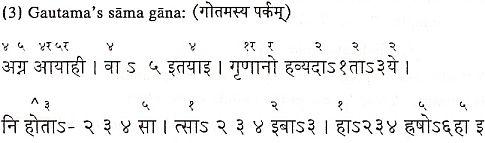


Tags: , , ,

Sri Muthuswami Dikshitar and Sri Vidya (6 0f 8)

The structure of Sri Chakra 

The basis of Sri Chakra is its mantra; the fifteen lettered mantra in three groups: a e i la hrim; ha sa ka ha la hrim; sa ka la hrim. The sixteenth letter “srim” is present in a subtle form. Sri Chakra is basically a triad; and, is also related to number nine (tridha chaiva navadha chaiva chakra-samketakam punah) . The triangle which is primary to the chakra has three angles and the deity residing in it is Tripura. The mantra of each of the nine enclosures of Sri Chakra is three lettered; the Mother Goddess is worshiped in her three forms; the Kundalini energy in the individual is threefold, and the phenomenal processes arising out of the union of Shiva and Shakthi are also three. The Chakra design represents Tripura or Tripura Sundari; while her manifest powers (yogini) are nine. There are also three dimensions of the Sri-chakra corresponding to the three sections (kuta) of the mantra; and, each of these dimensions has a further division into three units. Each of these nine units are called as chakras that are encased in Sri Chakra.

All its other interpretations are also in terms of three and nine. The three groups that constitute the mantra are called Kuta (peaks) or Khanda (segments). They are interpreted variously in sets of three as:

  • Agni (fire), Surya (sun) and  Chandra  (moon);
  • srishti (creation), Shtithi (preservation) and laya (dissolution) ; 
  • Iccha ( will), jnana (knowledge) and kriya (action); 
  • Sattva, Rajas and Tamas;
  • Jagrat (wakefulness) ; swapna (dream state)  and sushupthi (deep sleep);
  • Jnatra (the knower), jnana (the knowledge) and  jneya ( the known) ;
  • as Atma (individual self), Antaratma (inner being) and Paramatma (supreme self); and  also as
  • past , present and future.

In general, the Sri Yantra is a ‘cosmogram’ – a graphic representation of the universal processes of emanation and re-absorption reduced to their essential outline.

The diagram of the Sri Chakra is primarily a Matrix (i.e. womb) of nine interlocking triangles. Five of these triangles have their apex facing downward. They are

Shakthi trikonas, the triangles representing five forms of feminine energy, Shakthi. The other four triangles with their apex facing upward are Shiva trikonas representing the male aspect, Shiva, Consciousness. In Tantra, the feminine is the active principle; and the male is passive. The Tantra texts mention that Sri Chakra is produced when five forms of Shakthi and four forms of Shiva unite. The intersection of these nine triangles creates forty-three triangles. It is customary to regard the point at the centre also as a triangle. Thus, in effect there are forty-four triangles in Sri Chakra; and these are arranged in nine enclosures (navavaranas), in groups of three. 

The intersection of two lines is called Sandhi; and there are 24 such Sandhis. These intersections have certain significance. The meeting of two lines represents union of Shiva and Shakthi. 

And, the points where three lines meet are called marma sthanas. There are 18 such marma sthanas.

The meeting of three lines represents explicit harmony between Shiva and Shakthi; and they are vital spots in the body where the life-energy resides as well as accumulates. The marma has thus been called the Seat of Life or Jiva-sthana.

 sri-yantra-horn

A total of 43 triangles are created from the overlapping of the nine original triangles.

As regards the Bindu , the dimensionless point at the core of the Sri Chakra Yantra, the Tantra texts explain  that Bindu is Kameshwara , the ground of the universe; and the immediate triangle is Kameshwari the mother of universe; the union of purusha and prakriti. The union of these two is the Sri Chakra, which represents the entire phenomenal pattern. This is denoted by the secret syllable shrim. In fact, it is this point, coloured red, which really is the Sri Chakra. Every other detail is an expansion or a manifestation of its aspects. The mother goddess worshipped in Sri Chakra is the universe. The devotee has to identify that principle in his body, for his body is the Sri Chakra or the universe in epitome. He is guided in this endeavour by the guru who is the representative of Shiva.

The Bindu also represents, at various times, the principles or activities known as the Pancha Kriya of:

  • Emanation of the cosmos from its primal source; 
  • Projection of creation into the primal void;
  • Preservation of the created universe;
  • Withdrawal of the creative and preservative energies in cosmic dissolutions;
  • and lastly, Retention of the withdrawn energy-universe for the next cycle of re-creation.

These five activities are regarded as the five modes of expression of the Universal Mother.

There are several other explanations.

Bindu is regarded a sphere in its own right. The expanded form of the Bindu is the triangle formed by three points and is called Sarva siddhi prada (the sphere of fulfilment of all aspirations). It is described as Prakriti (as per the Samkhya ideology – Vyakta the manifest creation) composed of three Gunas (fundamental fabric of all existence) Sattva, Rajas and Tamas.

The Kadi School explains sattva as that which covers and conceals (aavarana); while the other two Gunas as that which project the world of duality or multiplicity (vikshepa). The three gods Brahma (creator), Vishnu (preserver) and Rudra (destroyer) are actually the representations of these three gunas. They are in turn the three aspects of the Devi represented as trikona chakra.

It also explained that from Shakthi flashes forth the creative impulse known as nada (sound), which manifests as Kundalini or the creative urge, in all living beings. Here, Bindu is Shiva; Bija is Shakthi; and nada is their union. These give rise to the power of will (icchha shakthi); the power of knowledge (jnana shakthi); and power of action (kriya shakthi).These in turn give rise to Rudra, Vishnu and Brahma.

Another explanation is, Bindu, also called Sarvanandamaya (all blissful), and represents the transcendental power (Para Shakthi) and absolute harmony (saamarasya) between Shiva and Shakthi. This is equivalent to what the Vedanta calls the Brahman. Owing to the power of the will (icchha shakthi) there comes about an apparent differentiation of Shakthi from Shiva, expressed in the form of triangle.  Here again, the triangle is the expansion of the Bindu (bindu vikasana).

If the Bindu represents the Para-nada, the triangle represents the Pashyanti, the second stage of the sound, nada. The enclosure next to this, the eight sided figure (ashta kona chakra) is the Madhyama or the third stage in the development of sound. The rest of the Chakra represents the physical or the phenomenal stage, the Vaikhari, which is the manifest and articulate form of sound. The Vaikhari form is represented by the fifty letters of the alphabet, called matrikas or the source of all transactions and existence.

The sixteen vowels (from aa) constitute the lunar sphere (Chandra mandala), the twenty-four consonants (from ka to tha) the solar sphere (Surya mandala); and the remaining ten consonants (from ma to ksha) the sphere of fire (Agni mandala). Thus, the triangle is also known as tri kuta, tri khanda and tri mandala.

Bindu is identified with Shiva and trikona with Shakthi. The process of evolution (shristi) or the apparent separation of Shiva and Shakthi is referred to as adi-dwandwa. The evolution from the primary state into the mundane level is regarded as a descent, avarohana krama; whereas the withdrawal from the gross to the very subtle state is termed Samhara krama.  Here the devotee moves into higher spiritual levels; and therefore it is termed arohana krama. It is a gradual process.

The significance of the triangle is explained thus:

The name of the goddess is Tripura; and number three is important in approaching her. She is of the nature of the sun, the moon and the fire. She is masculine, feminine and neuter. Her form is red, white and the mixture of the two. Her mantra has three letters (hrim, klim, sauh); and from this mantra three segments of time – past, present and future – emerge. From this mantra too emerge the realms, three Vedas, three states of existence ( waking, dreaming and sleeping) and three gods Brahma, Vishnu and Shiva.

sriyantra1

All these geometric designs are contained within Sri Chakra, arranged in nine enclosures or nava-avaranas.They are also termed as nine chakras. Each of this has its name, a characteristic physical form and a spiritual significance. Each has its colour suggesting its tendencies. Each Chakra has its presiding deity (chakreshwari or Chakra nayika); and she is a variant form of the mother goddess abiding at the Bindu. The Chareshwari rules over her set of attendant divinities; such as Yoginis who aid the devotee on in his spiritual progress, and the Mudra Devatas, seal-divinities, who welcome, purify and delight the devotee.

The yoginis have a special role in Sri Chakra worship. They make explicit the union of the male and female aspects of the Sri Chakra in each of its enclosures. They are in fact, the symbols of urges, aspirations, inhibitions, limitations, obstructions and powers active in each individual. The yoginis aid the devotees, but derive their power from the mother goddess.

Sri Chakra is verily the body of the mother goddess, who resides as energy in the universe and as pure consciousness in the individual. The nine enclosures symbolize in a graded series the significance of the universal and individual; the ideological and ritual; expressive and contemplative; and the in inner and outer aspects of Sri Chakra.

The outer group of chakras (1, 2 and 3) symbolizes extension or shristi. They represent Shiva aspect of the chakra. The middle group (4, 5 and 6) symbolizes the preservation or sthithi. They represent Shakthi aspect of the chakra. The inner group (7, 8 and the Bindu) symbolize absorption or samhara. The Bindu represents the transcendental aspect of mother goddess. The other two avaranas (7and 8) are also Shakthi aspects.

The nine chakras are interpreted in terms of Time (kaala), the five elements that compose all things (Pancha-Bhuthas); and three states of awareness-wakefulness, dream and deep sleep.

The nine chakras are also interpreted as corresponding to parts in human body.

No. Chakra Corresponding to part of human body
01 Bhupura First line: feet; Second line: knees; and third line : thighs
Triple girdle Mid portion of the body
02 Shoidasha-dala padma Region below navel and  up to penis region ; kati
03 Ashta-dala padma Navel region – nabhi
04 Chaturdasha Abdominal region-kukshi
05 Bahir -dasha Neck-kantha
06 Antar-dasha Region between eye brows- bhru-madhya
07 Ashtara Forehead-lalata
08 Trikona Top of the head- masthaka
09 Bindu Opening on the crown of the head leading to Sahasra Dala padma (Brahma randra)

The nine avaranas are again recognized as chakras said to be situated along the central channel or the Shushumna nadi.

No. Avarana in Sri Chakra Nadi-chakra
01 Bhupura Muladhara
02 Shoidasha dala padma Svadhistana
03 Ashta-dala padma Manipura
04 Chaturdasha Anahatha
05 Bahir _dasha Vishuddha
06 Antar-dasha Ajna
07 Ashtara Manasa-chakra
08 Trikona Soma-chakra
09 Bindu Sahasra Padma

352a19a522d5dfb8c5520437e9aff400

The nine avaranas, enclosures that compose Sri Chakra are briefly as under. These are described in the order of absorption (Samhara-krama) according to Dakshinamurthy tradition. It starts with the outermost enclosure-Bhupura- and leads to Bindu, the central point.

1. Bhupura also called Trilokya –mohana-chakra (Deluder of the Realms) , is the four-sided enclosing wall. The three lokas being three levels of experience:  attainments, obstructions and powers. They are also related to the body- mind complex of the devotee.

A tantra design is always enclosed within an outer wall serving as a protective cover. As the devotee enters into the Mandala he leaves behind the normal worldly distractions and conflicts; and emigrates into a world of symbols and visualizations. A Mandala is thus a mansion of gods and goddesses, a symbol of a higher form of existence.

PANCHALOGHA MAHA MERU Sri yanta 3d Maha Meru

There are actually six gateways to the fort Sri Yantra, if we take a three-dimensional view of it; the four obvious dwaras and those ‘above’ and ‘below’. The Eastern gate is the way of the mantras. The Southern gate is the way of devotion or bhakti. The Western gate is for the performance of rites and rituals, or karma-kanda. The Northern gate is the way of wisdom, or Jnana. The gate ‘below’ is the ‘path of words’ while the gate ‘above’ is the way or ‘road of liberation’. These are located at the Southern and Northern gate, respectively, i.e. ‘above’ is north, ‘below’ is south. Each of these gates also stands for one of the six primary chakras in the body.

The Bhupura Chakra, the earth stretch, includes within its spatial scope the entire design even as the earth supports the entire existence. Bhupura is a Shiva aspect and is made up of three lines or ramparts. The first (outermost) line is identified with the attainments of yoga powers called Siddhis. They are needed for self-protection along the inward journey. Such Siddhis are eight in number; and are attained consequent on gaining control over the elements and the mind.

The second or the middle line represents the powers of eight mother-like divinities Mathrika who rule over emotions such as passionate longing (Brahmi), violent anger (Maheshwari), avarice (kaumari) obstinacy (Varahi) etc

The third (inner) line of the square is identified with ten feminine deties, Mudra devathas, carrying seals of authority. The mudras are an approach to the divinities. These could be gross (sthula) being body postures and gestures by hand; subtle (sukshma) by way of seed-mantras; and para transcendental that is mental or intuitional approach.

These three lines are also taken to represent the Mother goddess; the outermost line corresponds to her feet; the middle line to her thighs; and the inner line to her knees.

There are also three concentric circles (trivritta) representing three objectives of life: Dharma, Artha and Kama.

The avarana is Bhoopura and the Chakra is Trailokyamohana chakra ‘enchants the three worlds’. The yogini is Prakata; Mudra is Sarva Somkshibhni; Siddhi is Anima; and the mental state of the aspirant is Jagrata. The presiding deity is Tripura. Her Vidya is Am Am Sauh.The gem is topaz. The time is 24 minutes and the Shaktis are 28 that include the ten starting with Anima, the eight starting with Brahmya and the ten Mudra Saktis. 28 is the dominant number.

This avarana corresponds to the feet of the mother goddess.

2. The sixteen petalled lotus (shodasha dala padma) called sarva asha paripuraka chakra, the fulfiller of all desires, is the second enclosure. In the sixteen   petals, the sixteen vowels of Sanskrit alphabet is inscribed. These symbolize sixteen kalas or aspects or phases. They are also called nithyas and named Kamakarshini (fascinating the desires), Budhyakarshini (fascinating the intellect) etc. These relate to powers in the Five Elements, the ten senses of perception or Indriyas (being further divided into five organs of action and five sense organs) and the Mind.

The significance of this enclosure is explained as self-protection (atma raksha) of the devotee. Since frustrated desire is the strongest obstacle to spiritual progress, the next stage is wisely concerned with satisfying them. Only he who has experienced can renounce. The values of virtue, wealth and pleasure are granted at this stage.

The craving Asha springs from discontent; and is quenched when discontent is eliminated. That is possible when devotee identifies himself with Shiva, ever complete and ever content.

This is achieved by the cultivation or strengthening of power over mind, ego, sound, touch, sight, taste, smell, intellect, steadiness, memory, name, growth, ethereal body, revivification, and physical body.

The avarana is Shodasa Dala, and the Chakra is Sarvasaparipuraka chakra ‘fulfils all expectations’; the yogini is Gupta Yogini; Mudra is Sarva Vidravini; the Siddhi is Laghima; and the mental state is Swapna, The presiding deity is Tripureshi. Her vidya is Aim Klim Sauh.The gem is sapphire. The time is three hours.  The Shaktis are the sixteen starting with Kamakarshini. 16 is the dominant number.

This avarana corresponds to the Savdhistana chakra of the mother goddess.

3. Eight petalled lotus (astha dala padma) called Sarva-samkhobhana –Chakra the agitator of all, is the third avarana. Each petal has a consonant inscribed within it that begins with ‘Ka‘  The petals represent eight divinities associated with erotic urges , independent of physical body(ananga).These relate to mental pleasures derived through five organs and through the modalities of mind: rejection(repulsion or withdrawal), acceptance (attention or attachment) and indifference(detachment).

This enclosure represents the last of the first group of the chakras that symbolizes Shrusti or emanation.

The avarana is ashta dala; The Chakra is Sarva-samkshobana chakra ‘agitates all’. The Yogini is Gupta- Tara; Mudra is Sarvakarshini; the Siddhi is Mahima; and the mental state is Shushupti. The Presiding deity is Tripura Sundari. Her vidya is Hrim Klim Sauh. The gem is cat’s eye. The time is day and night. The Shaktis are the eight starting with Ananga Kusuma. 8 is the dominant number.

This avarana corresponds to the navel region of mother goddess.

4. Fourteen triangles (chaturdasha trikona) called sarva sowbhagya dayaka; the bestower of all prosperity is the fourth enclosure. This is in the form of a complex figure made up of fourteen triangles. The fourteen triangles are inscribed with fourteen consonants beginning with ka and ending with dha. The fourteen corners represent fourteen powers of mother goddess. These are said to preside over fourteen principle channels of vital forces in human body (naadis) corresponding with fourteen powers Sarva -Samkshobhini and others.

They are also related to the seat of Shaktis who represent: the Mind (Manas), the Intellect (Buddhi), Being (Chitta), the Conscious Ego (Ahamkara) and the ten Indriyas.

This enclosure refers to the channels of life currents in the human body (prana) and their identity with the aspects of Sri Chakra. The explanation given in Tantra texts is that the breathing in human body is influenced by five elements present in the body; and in turn those five elements are influenced by the manner we breathe. Normally, we breathe 360 times in a unit of time called nadika (equivalent to 24 minutes). A day (dina) consists 60 such nadikas. Therefore, in a day (24 hours) we breathe 21,600 times. The collection of all breathes is mother goddess herself. This is called nadi-chakra, the organization of winds within the body. The distribution of breathes among the body centres are as follows:

Chakra Number of Breathes Time taken Hrs-mins-sec
Muladhara 0,600 00-40-00
Svadhistana 6,000 06-40-00
Manipura 6,000 06-40-00
Anahata 6,000 06-40-00
Vishuddha 1,000 01-06-40
Ajna 1,000 01-06-40
Sahasra 1,000 01-06-40
Total 21,600 24-00-00

The navel is the central point for distribution of all breathes and life forces moving along the channels. Normally breath alternates between the ida channel reaching the left nostril and pingala the channel reaching the right nostril. The former is moon principle and cools the body; and the latter is sun principle warms the body. The two meet at muladhara, close to kundalini. Around this central channel is a network of 72,000 channels of which the more important are the 14 mentioned earlier in this paragraph. These are referred also as 14 divinities. In this avarana the number 14 is dominant.

Sri Chakra is also described as the diagrammatic representation of the cycle of time (kaala chakra) and of the chakras in human system.

The Avarana is Chaturdasara; the Chakra is Sarva soubhagya dayaka chakra, ‘grants excellence’. The Yogini is Sampradaya Yogini; the Mudra is Sarva Shankari; the Siddhi is Ishitva. The mental state is Iswara Vichara. The presiding deity is Tripura Vasini. Her vidya is Haim Hklim Hsauh.The gem is coral. The time is day and night. The Shaktis are the fourteen starting with Samkshobhini.14 is the dominant number.

This avarana corresponds to the heart of mother goddess.

5. Ten-sided figure (bahir-dasara) called Sarvartha Sadhaka chakra (accomplisher of all objects) consisting ten triangles, is the fifth avarana. It is named “the outer ten cornered figure” (bahir dasara) in order to distinguish it from a similar figure enclosed within it.

The ten triangles in this avarana house ten auspicious deties , such as Sarva siddhi prada, Sarva sampath prada, Sarva priyamkari, Sarva mangala karini and so on. The five of the triangles are inscribed with consonants beginning with Ka; and the other five triangles are inscribed with consonants beginning with Cha..These represent ten powers of mother goddess who presides over ten vital forces pranas active in the body. The idea of vayu the winds or vital currents is fundamental to the concept of channels.

The vital currents are divided into two groups: prana- panchaka andnaga-panchaka. The first group consist:  prana, apana, vyana, udana and samana vayus. These are responsible for body functions such as respiration, blood circulation, digestion, voice and separation of nutrients from food etc.

The second group consists vital currents such as naga, kurma, krkara, devadatta and dhananjaya. These are involved in body movement like belching, yawning movement of eyelids, causing various sounds in the body. The Dhanajaya vayu, it is said, is the last to leave the body at its death. In this avarana the number ten is dominant.

The Avarana is Bahirdasara; the Chakra is Sarvarthasadhakachakra, the ‘accomplisher of all’. The Yogini is Kulotteerna yogini;; the Mudra is Sarvonmadini; and the Siddhi is Vashitva. The mental state is Guroopa Sadanam. The presiding deity is Tripura Shri. Her vidya is is Haim Hklim Hsauh.The gem is pearl. The time is lunar day. The Shaktis are the ten starting with Sarva Siddhi Prada.10 is the dominant number.

This avarana corresponds to the neck of mother goddess.

6. Ten sided figure (antar dasara) called Sarva raksha karaka (one that protects all) consisting ten triangles is the sixth avarana. It is named antar dasara, the inner ten cornered figure, since it is placed within a similar ten cornered figure, mentioned earlier.

The ten triangles are inscribed with ten consonants beginning with the five of Tha and the five of Tta group. They represent the powers of the mother goddess who presides over ten vital fires (vanyaha).These represent the ten specific fires within the body; being the fire of purgation (Rechak), digestion (Pachak), absorption (Shoshak), burning (Dahak), the secretion of enzymes (Plavak), acidification (Ksharak), to take out or excrete (Uddharak), the fires of pessimism and frustration (Kshobhak), the fire of assimilation (Jrambhak) and creating lustre (Mohak).

This enclosure is the third of the second group of chakras representing Preservation. The advent of inner realization begins here. The significance of this avarana is explained as protection from all obstacles. The devotee distances himself from all that hinders his spiritual progress; and he begins to develop an awareness he is Shiva ( the consciousness).

The Avarana is Antardasara; the Chakra is Sarvaraksakara chakra ‘protects all’. The Yogini is Nigarbha Yogini; the Mudra is Sarva mahankusha; and the Siddhi is Prakamya. The mental state is Upadesa. The presiding deity is Tripura Malini. Her vidya is is Hrim Klim Blem.The gem is emerald. The time is Lunar Fortnight. The Shaktis are the ten starting with Sarvagnya.10 is the dominant number.

This avarana corresponds to the middle of the eyebrows (bhrukuti) of the mother goddess.

7. Eight-cornered figure (ashtara) called Sarva roga hara (the remover of all deceases) is the seventh avarana. In the eight triangles formed by this figure, eight divinities presiding over speech reside. Between them they cover all the alphabets in Sanskrit grammar. These shakthis also rule over contradictions in life (dwandwa) such as  cold(water) and heat(fire); happiness(air) and sorrow( earth);  as also the Desire(akasha-space) and the three gunas  of Sattvas (consciousness), Rajas(ego) and Tamas(mind).

The significance of this enclosure is its power to eradicate the most basic disease viz. involvement with impure, fleeting existence that is laden with stress. The blessed state is attained when the distinctions between the subject, the object and transactions between them are dissolved.

The avarana is asthakona; the Chakra is Sarvarogahara chakra ‘cures all ills’. The Yogini is Rahasya Yogini; the Mudra is sarva khechari; and the Siddhi is Bhukthi. The mental state is Manana. The presiding deity is Tripura Siddha. Her vidya is is Hrim Shrim Sauh.The gem is diamond (Vajra).The time is Lunar month. The Shaktis are the eight, starting with Vashini. 8 is the dominant number.

This avarana corresponds to the forehead (lalata) of the mother goddess.

The Four Weapons

In between the mandalas of eight triangles and the central triangles are the four weapons — flowery bow, flowery arrows, noose (pasha) and goad (ankusha). They are red in colour. They are the weapons of both the mother goddess as Kameshwari and also of Shiva as Kameshwara.

8. The primary triangle with its apex downward (East) and coloured white (Sattva) surrounding immediately around the central point, Bindu, is the eighth avarana. It is called Sarva Siddhi prada chakra, the one that bestows all accomplishment. This triangle does not intersect with other triangles; and stands independent. It is Kama Kala. It is feminine in its aspect; and represents three fundamental manifestations of the mother goddess: Kameshwari (symbolizing moon – creation); Vajreshwari (symbolizing sun- preservation); and Bhagamalini (symbolizing fire -dissolution).

The three angles of the triangle also represent three forms of speech: Pashyanthi, Madhyama and Vaikhari. The triangle is therefore the speech aspect Vak Bhava.

It also represents the three powers of iccha (will) , jnana (knowledge) and kriya(activity).The three corners of the triangle stand for three peaks(kuta) of the fifteen-lettered mantra; or as three dimensions of all existence. The triangle itself is regarded the abode of the mother goddess (kama-kala).

The Avarana is Trikona; the Chakra is Sarva-siddhi-prada chakra, ‘grants all attainments’. The Yogini is Athi Rahasya Yogini; the Mudra is Sarva Beeja; and the Siddhi is Iccha. The mental state is Nitidhyasana. The presiding deity is Tripuraamba. Her vidya is is Hsraim Hsrklim Hsrsauh..The gem is Gomaya .The time is a ritu- two months. The Shaktis are the three starting with Kameshwari. (4+3=7) is the dominant number.

This avarana corresponds to the top of the head (masthka) of the mother goddess.

9. The ninth enclosure is strictly not an enclosure. It is the central dimensionless point, the Bindu. It is called Sarvananda-maya chakra, the supremely blissful one.  It is independent of the intersecting triangles. It is coloured red. This, in a temple, would be the sanctum sanctorum, with all the other circles or enclosures representing various parts of the temple as you move inwards.

It is this Bindu that is in reality the Sri Chakra; it represents the mother goddess Maha Tripura Sundari, Lalitha or Rajarajeshwari herself; and everything else is a manifestation of her aspects.

The goddess is nothing other than the devotees own self. The self here does not refer to jiva, engaged in organizing the body, mind and senses. The self here refers to individual consciousness (buddhi) which is beyond the body-mind complex. It is filled with all bliss (sarvananda maya). This constant, abundant bliss is the expression of the union of Shiva (consciousness) and Shakthi (power of deliberation Vimarsha). It is the very basis of existence. It is called beautiful, sundara, in this sense. It is in this sense the supreme mother goddess is called Maha Tripurasundari.

The significance of this avarana is the complete harmony (samarasya) of principles of pure consciousness (Shiva) and the principle of energy as deliberation (vimarsha shakthi).It signifies a state of non-duality, where all tendencies of approach and withdrawal become nonexistent, dissolve in a state in which the devotee ultimately rests. Bliss, in Tantra, is explained as resting in oneself (Svarupa pratishta).

There is also a school which propounds that the central point is composed of three dots or drops(Bindu traya) representing three fires(vanhi): Moon(soma);Sun(surya); and Fire(Agni).The top dot symbolizes the head of the deity; and the pair of dots at the bottom symbolize the breasts of the Mother. It is explained that the central point expanding into the three is an act of swelling (ucchuna); and that is how the central point becomes the primary triangle in Sri Chakra.

The avarana is the Bindu and the Chakra is Sarvanandamaya chakra, ‘replete with bliss’. The yogini is parathi para Rahasya; the Mudra is sarva yoni; and the Siddhi is Prapthi. The mental state is Savikalpa Samadhi. The presiding deity is her Transcendent Majesty Lalita Maheshvari Mahatripurasundari. Her vidya is Kamaraja vidya: ka e i la hrim ha sa ka ha la hrim sa ka la hrim, plus a secret 16th syllable. The gem is ruby. The time is year. The Shakti is Maha Tripura Sundari the personification of Brahman.

This avarana corresponds to Brahma-randra on the top of the head of the mother goddess.

srichakra002

Travelling from the outer periphery wall to the inner bindu is an ascent through various levels of consciousness and mystical significance, overcoming myriad obstacles of conditioning and fears along the way. As he proceeds inward from the outermost enclosure the devotee’s thoughts are gradually refined; and the association of ideas is gradually freed from the constraints of conventional reality. The Devi is felt or visualized in his heart and then drawn out through the breath and installed in the yantra. She is then worshipped as actually residing there. The true home of Devi is however in his heart .The devotee identifies himself with the Devi and goes through the worship guided by the symbolism. Whatever be the details, the symbolism involved is important in the external worship  (baahya pooja); and more so in internal worship ( Antahpooja- contemplation on the import of the chakra).In baahya pooja, the sadhaka or the practitioner worships the deity with a feeling that he and the Goddess are two different entities ; and , for fulfilling a desire or kaamyasaadhana . The Antahpooja is sublime seeking identity with the Goddess.  For more on this , please click here 

Sri Chakra is also a construct of space and time, just as the universe is a space time continuum. The way of the universe is continuous and constant change. That change, in a relative existence, is measured by the phases of moon. Mother goddess is the principle of time; she is kala or nitya. The Sri Chakra also puts forth the interdependence of time and space. The devotee views the evolution of the universe as the unfolding of a changeless reality of Mother Goddess.

The Sri Chakra represents the interplay of the purusha and prakriti; the universe and its energy. The union of the Devi (energy) and Shiva (consciousness) worshipped in Sri Chakra is the universe and its evolution. The universe is thus stylized into a pattern of energies, symbolized by the patterns and layout of Sri Chakra. It provides a model to the individual for transformation. The consciousness of the individual finds in it an articulation; and the model helps in breaking the barriers of subjective feelings and limitations of the objective world. The devotee identifies that his body is the Sri Chakra or the universe in epitome; and that The Yantra too is the Devi. The aim is to realize that oneness, the bliss of pure consciousness.

Continued in the Next Part

Kamalamba Navavara kritis –Part One

Reference;

The Tantra of Sri Chakra by Prof.SK Ramachandra Rao(1953)

Lalita Tripurasundari, the Red Goddess

http://www.shivashakti.com/tripura.htm

Sri Yantra – the Significance and Symbolism of its design

http://www.sriyantraresearch.com/

http://www.sriyantraresearch.com/Optimal/optimal_sri_yantra.htm
Sri Yantra Definition
http://www.sriyantraresearch.com/Definition/sri_yantra_definition.htm
Hymns of Sri Chakra
http://www.bhagavadgitausa.com.cnchost.com/HYMNS%20OF%20SANKARA.htm


Tags: , , ,

Sri Muthuswami Dikshitar and Sri Vidya (4 of 8)

The music of Sri Muthuswami Dikshitar

dikshithar-1 (2)

Sri Muthuswami Dikshitar was a versatile intellect. He was open to  varieties of influences. His works reflect some of those influences rather explicitly ; while some others shine through in a subtle way. Before we get into a discussion about Dikshitar’s creations, we need to recognize a few features that influenced him.

Sri Muthuswami Dikshitar was a vainika-gayaka, a musician who sang as he played on the Veena. He was well trained both in vocal and instrumental music. Naturally, the graces, the rich Gamaka prayogas of his compositions structured in slow tempo shine in mellow glow when played on the Veena.

In his childhood, he received training in the Lakshya and Lakshana aspects of Carnatic music. The Lakshana Gitams and Prabandhas of Venkatamakhi formed an important input of his training. Later, as a composer, he chose to follow Venkatamukhi’s system of Mela -classification of Ragas.

He spent seven years at Varanasi, in the prime of his youth. He was captivated by the grandeur, the spaciousness and the purity of the ancient Druphad School. He learnt Dhrupad diligently; and ,that left a lasting impression on his works.

Earlier in his teenage, he gained familiarity with Western music; and, the traces of its influence can be noticed in the movement of his songs.

He had a good command over Sanskrit; and, learnt to use it to express his ideals and aspirations in pristine poetry. He had a fascination for Sabdalankara, beautifully turned phrases and wordplay . He had the composure of a yogi and the heart of a poet. Dikshitar’s kritis are therefore adorned with poetic imagery, tranquil grace, a certain majesty steeped in devotion.

Sri Dikshitar had acquired a fair knowledge of Jyothisa, Ayurveda, and iconography and of temple architecture.

He was unattached to possessions or to a place . He was a virtual pilgrim (jangama) all his life. He visited a large number of shrines ; and, sang about them and the deities enshrined there.

He was intensely devotional ; yet, was not overly affiliated to a particular deity. He composed soulful songs in praise of a number of gods and goddesses.

He had a fascination for composing a set of  kritis exploring the various aspects of  a particular deity or the different dimensions  of a subject , as if he had undertaken a project.

He was an Advaitin, well grounded in Vedanta.

And above all,

Sri Dikshitar was an ardent Sri Vidya Upasaka; a Sadhaka, an intense devotee of Devi, the Divine Mother. He was a master of Tantra and of Yantra Puja. The Tantra ideology permeates all through his compositions.

It is the harmonious confluence of these influences that one finds in Dikshitar’s music.

***

Output:

Anandamruthavarshini  by Shri S Rajam

Sri Muthuswami Dikshitar was prolific; about 479 of his compositions have now been identified, spread over 193 ragas. These include four Ragamalikas and about forty Nottuswara sahithya verses.

[For a detailed statistical analysis of the compositions of Sri Dikshitar , as undertaken  by Dr. P. P. Narayanaswami , please click here.

Please do refer to a very remarkable site created by  a group headed by its Chief Data Analyst –  Smt. Meera Subramanian  , listing as many as 510  compositions of Sri Muttuswamy Dikshitar,  along with its lyrics , audio and video files as also the deity-wise classification of his Kritis

For the list of Dikshitar compositions compiled by Todd Mc Comb , please click here

The Website of Rasikas.org has listed 481 compositions of Sri Mutthuswamy Dikshitar . These include the four sub-categories : Guruguha Vibhakthi; Neelothpalamba Vibhakthi;Pancha-bhutha-linga Vibhakthi; and, Samgita Sampradaya Pradarshini  ]

The great Venkatamakhi who formulated the 72 Mela-kartha ragas is reported to have wondered ”of the 72 Melas only a few are known and found in practice… and will the permutation be a waste.?‘(Dr. V Raghavan:  paper presented at All India Oriental conference, at Hyderabad, 1941).

It was the genius of Muthuswami Dikshitar that gave form and substance to all the 72 Mela-kartha ragas, fulfilling the dream of Venkatamakhi. He gave expression to nearly 200 ragas of that system.

Sri Muthuswami Dikshitar was a pilgrim virtually all his life. He visited a large number of shrines and sang about them and the deities enshrined there. He was intensely devotional yet not overly affiliated to a particular deity. He composed soulful songs in praise of a number of gods and goddesses. About 74 of such temples are featured in his kritis; and there are references to about 150 gods and goddesses. The most number of his kritis (176) were in praise of Devi the mother principle, followed by (131) kritis on Shiva. Dikshitar was the only major composer who sang in praise of Chaturmukha Brahma.

Sri Dikshitar has composed songs in honor of some other lesser-known divinities : Saṇdhyā dēvīm Sāvitrīm-Rāga Dēvakriya, Ādi-Tāla; Bhūśāpatim – Rāga Bhūṣāvati, Rūpaka Tāḷa; and, Renukādēvi Samrakśtōham – Rāga Kannada Bangāḷa, Miśra Jhampe.

**

Some scholars have said that Dikshitar’s songs are summaries of Durga Suktam, Sri Suktam and Purusha Suktam.   He built in the mantras in a few krithis like Sri Raaja raajeshwari  (madyamavathi), pavanatmaja aagaccha (Naatta). For the benefit of those who couldn’t practice rituals he composed vaara krithis on navagrahas.

Navagraha by Raja Ravi Varma

Similarly, he opened the doors to the secret world of Sri Vidya, for the benefit of all, through his Kamalamba navavarana kritis.

Krithi Groups

Dikshitar had a fascination for composing sets of kritis on a composite theme, perhaps in an attempt to explore the various dimensions of the subject. In some of these, he employed all the eight Vibhaktis, the various cases that delineate a noun. No other composer has attempted so many group kritis in such a planned, orderly, meticulous fashion. The following are some Important Krithi Groups. Please also check here. 

The selection of Raga and Taala; and the diction of these kritis demonstrate his musical skills and intellectual refinement.

For greater information on Group Kritis of Dikshitar, please check here.

Ragamalika

Just as his father Sri Ramaswamy Dikshitar (who had composed the longest ever Raga-malika in Karnataka Samgita- the Ashtotrasata ragatalamalika – set in 108 Ragas and various Taalas) ,   Sri Mutthuswamy Dikshitar  was also an adept in the Raga-malika format. Though he did not attempt anything as lengthy or as grand as his father did, the four delightful Raga-malikas that Sri Mutthuswamy Dikshitar created are true gems of art. 

: – Madhavo-mam-patu– is a Raga-malika on the ten avatars of Lord Vishnu, with ten passages set to ten Ragas (Nata, Gaula, Sri, Arabhi, Varali, Kedara, Vasanta, Surati, Saurashtra and Madhyamavati).

 Of the ten Ragas employed in the Raga-malika, five are Ghana-ragas excellent for rendering Taana on the Veena. The sixth Raga Kedara , is invigorating and the last four Ragas are Mangala Ragas leading up to the final Mangalam in Madhyamavati.

The Raga of each passage blends admirably well its Sahitya. Here too, Sri Dikshitar adopts his favorite Vibhakthi scheme of addressing the subject. The first eight passages are in the eight Vibhakthi cases, in their order (krama) ; and , the rest two- ninth and tenth are in the accusative case . 

While rendering the Raga-malika, the singers can progress from one passage to the next without having to repeat the Pallavi of the just concluded passage. 

: – The Ragamalika Purna-chandra-bimba-vadane in celebration of Goddess Kamalambika at Tiruvarur is composed of six Charanas in six different Ragas: ‘Shad-raga-malika‘.  The Ragas are: Poornachandrika, Saraswatimanohari, Narayani, Suddhavasanta, Hamsadhwani and Nagadhwani; and, all the six belong to ‘Dheera Sankarabharana’ (29th) Mela, Sri Dikshitar’s favorite. 

: – The third Raga-malika Simhasana-sthite in four passages is addressed to most graceful Devi seated on her throne in a serene tranquil posture. The four are Mangala-prada Ragas, auspicious, soothing and peaceful – Saurashtra, Vasanta, Surati and Madhyamavati. This Raga-malika is therefore sung at the conclusion of Sri Dikshitar’ annual celebration festivals. It is also a favorite of the Bharatanatyam dancers. 

:- Perhaps , Sri Dikshitar’s most famous Raga-malika is his ‘ Chaturdasha Raga-malika’ –  ‘Sri Vishwanatham bhajeham’ set in fourteen Ragas singing in ecstasy the glory of the Lord of the universe Shiva. The fourteen Ragas are interwoven with the passages in an intricate pattern.

 Chapter 12 of Shqdhganga describes this Ragamalika as

 “ The Pallavi has two Ragas, starting with Sri Raga; and, each Raga is encapsulated in two lines of one Avarta; the second being in Madhyama kala. Similarly, the Anu-pallavi is set to four Ragas  :  Gauri, Nata, Gaula and Mohanam. But, at the end, after Mohanam, a Viloma passage takes us through the same four ragas of the Anu-pallavi and the two of the Pallavi in reverse order, back to Sri.  

The same pattern is followed in the Charanam with eight Ragas : Sama, Lalita, Bhairavam, Saranga, Sankarabharanam, Kambhoji, Devakriya and Bhupala. And, these are again taken in reverse order in a Madhyama-kala sahitya, back to the Pallavi in Sri.

Sri  Dikshitar has followed a pattern not only in the order of the occurrence of the Ragas, but also in terms of the lengths of the Avartas for each Raga.

The fifth and sixth Ragas- Gaula and Mohanam – have been allotted 1 ½ Avartas, all in Madhyama-kala; while the preceding Ragas have been given 2 full Avartas – one each in Sama kala and Madhyama kala.

The same pattern has been followed in the first half and second half of the Charanam of the Raga-malika.  Another striking feature of the Sahitya of this Raga-malika of  Sri Dikshitar is that the last part of the Svara-sahitya set to each Raga is composed of the same words as of the last part of the preceding line of Sahitya.” 

Chronological order

It is rather difficult to arrange Sri Dikshitar’s compositions in a chronological order.

His Nottuswara-Shitya verses were, of course, composed in his early years while his family lived at Manali a small town near Madras. His first composition as Vak-geya-Kara was Srinathandi in Mayamalava-gaula, at the hill shrine of Tiruttani; and, his last composition was  Ehi Annapurne in Punnagavarali while he was at Ettayapuram during his last years.

It is believed that the set of Vibhakti kritis followed his first composition. Thereafter, he traveled to Kanchipuram, Mayuram, Chidambaram, Vaidyanatha koil and Kumbhakonam. He often visited Tiruchirapalli (where it is said his daughter lived).

He spent his productive years at Tiruvavur and his final years in Ettayapuram. In between, he is believed to have visited about 70 temples; and, sung the glory of those deities. It is however not possible to arrange those kritis in a sequence.

Please check here for a map of his probable travels in South India: 

varanasi2

Before going further, we need to talk a bit about Sri Muttuswami Dikshitar’s first Kriti as a Vak-geya-Kara , Srinathandi-guruguho-jayati in the Raga Mayamalava-gaula in the fifteenth Mela (the Mela in which Sri Dikshitar composed many Kritis) . The mantra of Sri Vidya also has fifteen matras (syllables).

After submitting salutations to the past Gurus of the Kadi-matha, the principal tradition of the Sri Vidya lore (shri nathadi guruguho) , Sri Dikshitar bows down to his Guru Yogi Chidambaranatha. Elsewhere, in another Kriti  composed in Raga Purvi, a Bhashanga-janya-raga of Mayamalava-gaula, Sri Dikshitar  adores his Guru  and Master Chidambaranatha as none other than Guruguha;  and , says ‘I am the humble servant of Guruguha, or I, myself, am of the form of Guruguha himself’

 -shri guruguhasya dasoham nocet cidguruguha evaham.

The opening line Srinathandi-guruguho-jayati-jayati, which bows to all the deities and Gurus of the Sri Vidya traditions, has been much debated. This line is said to be an almost a takeoff from the opening lines of the first shloka of the Sri Vidya paddhathi:

Shri nathadi gurutrayam ganapatim  pithatrayam bhairavam / siddhaugam vatukatrayam padayugam dutikramam mandalam/ viran dvyasta catushka shashti navakam viravali pancakam/ srIman-malini-mantra-rajasahitam vandeguror mandalam

This Shloka invokes the deities and the galaxy of Gurus (Guru-mandala) in the realm of the Supreme sovereign Srividya Parabhattarika.  It begins with salutations to the three generations of Gurus (Srinathadi gurutrayam – one’s own Guru; his Guru – Parama Guru; and his Guru – Parameshthi Guru) ; and prayers to Ganapathi  (Ganapatim).

Ganesha blessing

It also recalls with reverence the three centres or seats of Shakthi (Piitha-trayam – Jalandhara, Purnagiri and Kamarupa); the eight Bhairavas (Bhairavam); the Siddhas (siddhaugam); the three celibates Brahmacharis (vatukatrayam – Skanda, Chitra and Virinchi); and then, submits to the feet of the Mother Goddess (Padayugam).

Then salutations are submitted to the group of Duti goddesses (dutikramam mandalam); to those who have attained Siddhi (Viran); to the sixty-four Siddhas (dvyasta catushka shashti); nine Mudra goddesses (navakam); and to the five supreme deities (viravali pancakam– Brahma, Vishnu, Rudra, Ishwara and Sadashiva).

Then, at the end, the devotee submits to the Goddess of Malini-Chakra with Mantra-raja; and, to all the Gurus of all the traditions of Sri Vidya (vande-guror mandalam).

Devi sri chakra

Likewise, Sri Dikshitar, in his Kriti  –jayati , submits to his Guru, the Lord of the Universe, and all the Gurus of the Kadi Matha of the Sri Vidya tradition. And, to the Srividya Parabhattarika, the supreme Mother Goddess, who is invoked by the mantra beginning with Ka and ending with Ma (The Kadi Vidya of Sri Manmatha runs:  KA, E, I, LA , HRIM- vagbhavakua), residing in the centre of the Mani Chakra which resembles a thousand-petalled lotus.

And, to Maheshwara  the Lord  who obliterates  all types of illusions and delusions; who is meditated upon constantly by  Hamsa mantra , the Ajapa-japa (you breath out with a sound of ’Sa’; and you breath in  with a sound of ‘Ha’; and, throughout the day and night you perform the Hamsa Japa.

 (The Hamsa Japa is :  I am He , Shivo Hum, I am Shiva ,  breathing in and out continuously , instinctly and with ease ,  without being aware of your doing so. This effortless and ceaseless Japa is called Ajapa-japa).

And, to the Guruguha, Skanda, who is worshiped by kings of Mayamalava Gaula Desha and others; who is surrounded by Vishnu and other gods; and, who has expounded the real truth of Pranava to His father Mahesha.

**

The composition, ‘Sri Nathadi guruguho jayati jayati’ in Mayamalava-gau!a is ideal for the music students to practice in graded speeds, the ascent and descent of the Raga, the janta svara prayogas, alankara patterns, mandra-sthayi phrases etc.

In terms of Music, the first line of the Pallavi (Srinathandi-guruguho-jayati -jayati) summarizes all the ascending (Arohana) and descending (Avarohana) notes of the Mayamalava gaula:   “SA RI Ga Ma Pa Dha Ni SA Ni Dha Pa Ma Ga Ri”, in all the three speeds (kaala).  

[ It is said; upon his initiation into Sri Vidya Upasana , Sri Mutthuswami Dikshitar was assigned the ordained name ‘Chidananda-natha‘. In the Pallavi of his first Kriti ‘, ‘Sri Nathaadi Guruguho Jayati,’ he refers to himself by his Diksha-name (rahasya-nama) as : ‘Sri Chidananda Naathoham iti’- श्री चिदानन्द नाथोऽहमिति ]

And , in regard to Sahitya , The prathama-akshara- prasa in the Charana  and in the Madhyama-kaala–sahitya is very interesting , where each line commences with ma or Ma.

Charanam:

  •  MAyamaya vishvadhishthano
  • MAtmaka kadi matanushthano
  • MAlini mandalanta vidhano
  • MantrAdyajapa hamsa dhyAno
  • MAyakarya kalana hIno
  • mAmaka sahasra kamallsiIno
  • mAdhurya ganamrita pano
  • mAdhavadyabhayavarapradano
  • mAyashabaLita brahma rupo
  • mArakoti sundara svarupo
  • matimatam hridayagopuradIpo
  • mattashuradi jayapratapo
  • mAyamalavagauLadidesha
  • mahipati pujita pada pradesha
  • mAdhavadyamara brinda prakasha
  • maheshasya maharthopadesha

 Madhyama Kala Sahityam:

  •  MAyaamaalavagaulaadidesha
  • Mahipati Pujitha Pada Pradesha
  • MAdhavaadyamara Brunda Prakaasha
  • Maheshasya Mahaarthopadesha

Ragas:

Dikshitar followed the Mela-paddhati (a system of classifying Ragas) devised by Venkatamakhi, to whose school he belonged. In handling the Vivadi-melas, Dikshitar followed Venkatamakhi; and, avoided inharmonious expressions, prayogas.

Further, since Kharaharapriya was not a part of Venkatamakhi’s scheme; there is no known composition of Dikshitar in that Raga. The twenty-second Mela-karta was Sri Raga; the Mangala kriti of the Navavarana series is composed in Sri Raga. Again, the Venkatamakhi-tradition treated Bhairavi and Anandha Bhairavi as Upanga Ragas; so did  Sri Dikshitar.

[Though Sri Dikshitar generally followed the Asampurna-Mela system of Venkatamakhin, he was quite familiar with the other, Govindacharya’s Sampurna-Mela system as well.

For instance; the Raga of his Kriti Shri-shulinim-shritapalinim according to Asampurna-Mela is Shailadeshaksi. But, in the Kriti, he uses the Raga-mudra as Shulinim , which is the Raga-name in the Sampurna-Mela system.

Similarly, the Raga of his Kriti Hariyuvatim-haimavatim is Deshi-simharavam according to the older system; but, the Raga-mudra is Hemavathi which is the corresponding Raga-name in the other system.

And, his Kriti Shri Nilotpala-nayike in Raga Nari Ritigaula contains the Raga-mudra Natabhairavi in the Anupallavi as per the Sampurna-Mela system.]

Some scholars opine that Sri Dikshitar’s major service to Carnatic music is that he gave expression to nearly 200 Ragas of Venkatamakhi’s system. He also breathed life into a number of ancient Ragas that were fading away. Several ancient Ragas found a new lease of life though Sri Dikshitar’s kritis.

To name a few of them: Mangalakaisiki, Ghanta, GopikavasantaNarayana Gaula,Sulini, Samantha, maargadhesi and mohana naatta. Even today, their  Lakshanas are illustrated mainly through Sri Dikshitar’s creations.

There are many Ragas which are employed only by Dikshitar. Take for instance: Saranganata, Chhaya Goula,  Poorvi , Padi Mahuri Suddhavasanta ,Kumudakriya, and Amritavarshini.

In the Raga Dwijavanti, his Kritis Chetasri and Akhilandeshwari  stand out in solitary splendor.

He transformed many Outhareya, the Hindustani Ragas into Karnataka form through his creative genius. His interpretation and rendering of Ragas like Dwijavathi, Ramkali, and Yamankalyan, Hamirkalyani, and Brindavan sarang are highly original and creative. He made them into his own. His Cheta-sri is so wonderfully well adapted to Carnatic Raga-bhava that one scarcely notices the Outhareya traces in its character. He took in the best aspects of the other system;  transformed them ; and, enriched both the systems.

Shankarabharanam scale appears to have been his forte.  There are as many as 96 kritis based on that scale. The kritis in Harikambhoji scale number about 63; while 57 kritis are in Kharaharapriya scale. He had a special affinity for Mayamalava-gaula in which he composed about 51 songs. The derivatives of that scale such as Saalanga Nata, Paadi and Mangala Kaishiki would have been lost but for Sri Dikshitar.

**

About forty-four of his compositions are set in forty Vivadi Ragas. Since Sri Dikshitar followed the A-sampurna-Mela-Paddathi of Venkatamakhin , even the Janaka-Ragas might look like Janyas. But, in fact, all those Vivadi-Ragas are Raganga or Melakartas. However, they do not have Vivadi-Svara-Sancharas. For instance; Raga Shuddha-Saveri under Kanakambari; and Manohari under Gangatarangini.

As many as forty of these Melas, are Vivadi-Ragas. Sri Dikshitar uses many means (Upaya) to counteract the jarring-effects of Vivaditva. These  measures include :

    • (i) Janti prayōga – using the Svara in pairs to  reduce the Vivadi- effect;  
    • (ii)  Alpatva – minimum usage or skipping  of the Vivadi-Svaras;
    • (iii) Dheergha-prayoga -Elongating one of the Vivadi Svaras to smoothen its effect; and 
    • (iv) Langhana or Dhatu-prayoga-using  crisscross Svara pattern to reduce the Vivadi effect.

[ Please do read about the frequency Analysis of the Ragas used by Sri Mutthuswami Dikshitar , as attempted by Sri Vishnu Vasudev. Please click here.]

Taala:

Sri Dikshitar was accomplished in the matter of Taalas, the rhythmic patterns. He is the only composer to have set his music in all the seven basic Taalas. He employed all the Saptha (Seven) Taalas in his Vara-Stutis i.e. a song for each day of the week.  He is said to have used ten improvised varieties of Taalas in his compositions. The majority of his compositions are set in Adi (190) and Rupaka (139) Taalas.

 Sri Dikshitar, in his compositions, has employed only Suladi Taalas; to the exclusion of Chapu and other Taalas. Each of his Nava-Graha Kritis is set in a different Suladi Taala. 

Music:

Rama

The most fascinating aspect of Sri Dikshitar’s Kritis  is the grandeur and majesty of his music, sublime lyrics, intellectual brilliance and the overall technical sophistication. They exude a tranquil joy. His vision of the Ragas and their structure is  truly inspiring.

Sri Dikshitar was blessed with the heart of a poet and the composure of a yogi. He was an intense devotee; but, was undemonstrative. There is, therefore, a certain composure, measured grace, dignity and a mellow joy glowing through his music,  as in his life.

The Druphad way of elaboration captured his imagination. The tempo of his songs is mostly the Vilamba-kala – slow, measured and majestic; rich in Gamaka just as the meends on a Veena. Sri Dikshitar aptly called himself “Vainika-gayaka Guruguha-nuta”.

[The musical structure of his Kritis display how well they are suited for playing on the Veena. For instance; he has employed wide Jaarus extensively in the phrase Murari-prabhruti occurring in his Kriti Sadashivam-Upasmahe (Raga Shankarabharanam; and, there is a Jaru from lower Shadja to Tara-sthayi -Rishabham). And again, the first line of the Charana of the Kriti Tyagaraja Maha-Dwajaroha (Raga Shri) has an elaborate Jaru :

Srishti-svarupa-vasanta-vaibhavam-ashtadhvajendra-vimana-bhuta-samashti-gaja-vrishabha-kailasa–vaham-ashlesha-mah-aratha -sthitam.]

Sri Dikshitar’s treatment of a Raga exemplifies the essence of the Raga bhaava; and, brings out its delicate shades. It is as if the musician is immersed in contemplative meditation. The graces, the rich Gamakaprayogas of his compositions structured in slow tempo shine in mellow glow when played on the Veena.

This is amply reflected in his works ; for instance in

The other compositions of this genre are: Dakshinamuthe (Shankrabharanam); Manasa-guruguha (Anandabhiravi); Ehi-Annapaurne (Punnagavarali); Amba Neelayatakshi (Nilambari), and ,each of the Nava-avarana kritis.  These are indeed monumental works.

It is not that all aspects of his music are slow and spacious. He built into his compositions exhilarating bursts of speed and sparkling delight as if in celebration of the divine spirit, towards the end. Certain kritis are interlaced with Madhyamakala-Sahitya, passages in tempo faster than the rest of the kriti (E.g. Mahaganapatim  in Nata).

Although the Kritis of Sri Tyagaraja are known for their elaborate Sangathi improvisations, there are some archaic Sangahtis in the Kritis of Sri Dikshitar as well(e.g.  in  Arunacala-natham in Raga Saranga ; and,  Pahimam-ratnachalanayaka in  Raga Mukhari).

Sri Dikshitar redefined the treatment of even the traditional Karnataka Ragas by way of elaborate beginning, rich in Gamakas resembling the sliding Meends as, for instance, in the slow paced majesty of Akshya-linga-Vibho  (Shankarabharanam);  or in Balagopala (Bhiravi), portraying the beauty of the divine child, Krishna. His Nirajakshi-Kamakshi in Hindolam with Dha flat entirely changed the way Hindolam came to be sung by his contemporaries, as also by the later Carnatic musicians.

It is believed; before the time that Sri Dikshitar went to Varanasi, the Hindola Raga in the Carnatic system was, generally, rendered with Chatusruti-Dhaivata (say, as in the kriti, Manasuloni of Sri Thyagaraja). While Sri Dikshitar was in the North, he had listened to Raga Malkauns (equivalent to Hindola of the South), sung with Shuddha Dhaivata, expanding it freely in all the three octaves. Sri Dikshitar felt such charm and appeal could be brought into the Hindola of the Karnataka-samgita. He thereafter, composed his splendid Nirajakshi-Kamakshi in Hindola with Dha flat, while retaining the purity of the Hindola Raga.

Some say; Sri Thyagaraja’s Kriti Samaja-vara-gamana in Hindola, shows the shades of Sri Dikshitar’s influence. Thais is because, his treatment of Hindola in his earlier Kriti – Manasuloni , was quite different.

*

Sri Dikshitar was well versed in the Alapana-paddhati; and, followed it in the elaboration of a kriti. The musicologists have said “The most outstanding aspect of the compositions of Sri Dikshitar is their richness in Raga-bhava”. His sense of selection of the apt Sancharas of the Raga to bring out the true emotion is remarkable. They range stretching from the Mandra to the Tara-sthayi ; and, give a complete picture of the Raga.  It is said that if you sing his kriti in Akara, it can bring out the character of its Raga. His kritis are virtually, Raga-alapana, chiseled to fit in with Taala ; and ,dressed in Sahitya.

[ Please also read Smt. Vidya S Jayaraman’s conversation with Dr.V.V.Srivatsa ]

Structure of kritis

His kritis are well structured, close knit and written in graceful Sanskrit. Sri Dikshitar’s kritis do not usually have more than one Charanam; and, as many as 157 of his creations are Samasti-charanams, carrying no Anupallavi or the Anupallavi itself acting as Charanam. His rhythm is subtle ; and, the lyrics are divine.

Sri Dikshitar’s kritis with Samashti-charanam have enriched the variety of musical forms in Karnataka Samgita. These Kritis composed in Madhyama-kala are highly popular ; e.g.

Since he did not compose multiple Charanas,  his single Charranas tended to be quite lengthy ,as compared to the Kritis composed in Pallavi-Anupallavi-Charanam format. Such fairly long Charanas, however, enabled Sri Dikshitar to provide exhaustive information about various deities, shrines, concepts of the Sri Vidya  tradition etc. The Madhyama-kala-sahitya that he employed for such Kritis, also  helped in introducing some variation in such long Charanas.

 [Perhaps his only multiple-charana creations are his Kriti ‘Maye-tvam’ (Tarangini) ; and , his  four  Ragamalikas]

Each of his compositions is unique, brilliantly crafted and well chiseled work of intricate art. It is incredible how delicately he builds into his tight-knit kritis a wealth of information about the temple, its deity, its architecture and its rituals; and about jyothisha, tantra, mantra, Sri Vidya, Vedanta etc. He also skillfully builds into the lyrics, the name of the Raga (Raga-mudra) and his Mudra, signature. 

Sri Dikshitar also built in phrases of Samgita-shastra in the body of  the few of  his kritis, sometimes giving technical details in precise ways.

For instance; in his Kriti ‘Meenakshi-me-mudam-dehi (Purvi-Kalyani), the phrase ‘Dasa-Gamaka-Kriye’ refers to Dasavidha-Gamakas discussed in ancient music-texts.

And, similarly, the phrase ‘Dvisapatati-raganga-raga-modinim’ in the KritiSringira-rasa-manjariin Rasamanjari Raga (Rasikapriya) refers to the scheme of seventy two Melas. 

Language and wordplay 

Except for one kriti in Telugu and three Mani-pravala-kritis (Sanskrit+Telugu+Tamil) , all his other compositions are in Sanskrit.

[ The term  is said to be made of mani + pravala,  meaning a mixture of gems and coral]

Sri Dikshitar is credited with one Chauka-kala-pada-varnam – ‘Rupamu juchi’ (Todi, Ata taala) and a Daru Ni sati (Sriranjani) also in Telugu.

Sri Dikshitar had a good command over Sanskrit; and, had learnt to express through it his ideals and aspirations in pristine poetry. He had the composure of a yogi and the heart of a poet. Sri Dikshitar’s  kritis are therefore adorned with poetic imagery, tranquil grace, a certain majesty steeped in devotion.

He had a fascination for Sabda-alankaras, adorning his poetry with beautifully turned phrases ringing sweetly like temple bells; captivating rhymes of Prasa and Anuprasa. He loved the intricate play of words and to coin sweet sounding phrases. Look at the pada lalithya, a grand procession of enchanting phrases : 

  • Akalanka darpana kapola vishesha
  • Mana matrike maye marakata chaye
  • Devi Shakthi beejodbhava matrikarna swaroopini
  • And
  • Komlakara pallava pada kodanda Rama.

 The rhyming and ringing phrases – Shyamalanga- vihanga- sadayapanga-satsanga- are of unparallel beauty.

***

The structures in the compositions of poetry and of a Kriti, as also in the playing of the Mrdanga are said to follow certain rhythmic patterns (Yati-s). 

There is, of course, the usual format which follows the uniform length of lines (Sama).

In addition, there are certain varied and improvised patterns of composing and structuring the lines in a Kriti; such as :  

(1) broadening or increasing like the flow of  a river (Srotovaha);

(2) tapering or decreasing like a cow s tail (Gopuccha);

(3) increasing, then decreasing;  broadening towards the middle like the contours of a drum (Mrdanga); and,  

(4) first decreasing and  then increasing; narrowing towards the middle, as the contours of an hourglass-shaped drum (Damaru).

composition patterns

And, there is also an arrangement that is devoid of any obvious pattern; it could be irregular or rugged (visama). It is rather difficult to define or illustrate such patterns.

Sri Dikshitar who was well versed in Kavya-prayoga, composing poetry, was, obviously familiar with these geometric patterns that were  meant to  improvise the structure of lines in a stanza.

*

Sri Dikshitar often structured his lyrics in geometric patterns. He enjoyed a childlike delight in employing Yatis (geometric patterns) such as Gopuccha (tapering like the tail of a cow) or it’s opposite, the Sorotovaha (broadening like the flow of a river) for structuring his lyrics. For instance; in his Sri Varalakshmi (Sri) and MayeTwam-Yahi (Sudha Tarangini) he used the tapering pattern of Gopuccha.

Sarasa Pade,

Rasapade,

Sapade,

Pade.

de

Sarasa Kaye

Rasakaye

Sakaye

Aye

In his kriti Tyagarajayoga Vaibhavam (Anandabhairav) , Sri Dikshitar uses both the YatisGopuccha Yati and Srotovaha.

The phrases are:  Gopuccha Yati (like a cow’s tail):

Tyagaraja Yoga Vaibhavam

Agaraja Yoga Vaibhavam

Rajayoga Vaibhavam

Yoga Vaibhavam

Vaibhavam

Bhavam

Vam


 And Srotovaha Yeti (flowing or expanding like a river )

Sam

Prakasham

Svarupa Prakasham

Tatva svarupa Prakasham

Sakala Tatva svarupa Prakasham

Shivashaktyadi Sakala Tatva svarupa Prakasham

design rangoli

Alamkaras

Sri Dikshitar brings out the beauty of the Raga and the Sahitya, at many places, through the Svarakshara. For instance:

In the Kriti ‘Pancamatanga-mukha-Ganapatina-paripalitoham-Sumukhena-SriMalahari, Rupaka), the Pallavi is set to the Svaras ‘Pa- dha-Ma- pa –dha- pa- ma- ga- ri- sa- pa- dha- Sa’

In the Kriti ‘Sadacalesvaram-bhava-yamham’ (Bhupalam, Adi), the Pallavi has the Svaras ‘sa- Dha- sa- Pa’

*

Sri Dikshitar , at times, used Svara-sahitya i.e., the words matching with the syllables of the notes. For instance; Sadasrita (in Akshayalinga Vibho) could be tuned as Sa-Da-Pa-Ma; and, Pashankushsa-Dharam (in Siddhi Vinayakam) could be tuned as Pa- SA- Ga- RI- Ni- SA.

Muhana Prasa

Rhyming in the first letter of line is called Muhana. One can observe it in the entire Carana of the Kriti Tyagarajaya-namaste (Begada, Rupaka) as follows:

Mukundādi-pūjita-sōmaskanda-mūrtaye / Muchukundādi-bhakta-jana manōratha pūrtaye/ Mukurabhmba pratibimbitha mukha-spurthaye / Munipaki mga kītādi mukti-pradakīrtaye

Dvitiyakshara Prasa

Rhyming in the second letter of each line is called Dvitiyakshara Prasa. One can observe it in the Carana of the Kriti Tyagarajam-bhajare (Yadukula-kambhoji, Rupaka) as follows

pauādi dikpālapūjita gātram / nītpalāmbānukūla tara kalatram /  trikya guru guha tātam trinetram / sailōkādi kaivalya prada caritram /

 Antya Prāsam

Rhyming words at the end of the lines is called as Antya Prasa. One can observe it in the Anupallavi and in the entire part of Carana of the Kriti Ttyagarajo-virajate (Athaa, Rupaka) as follows:

Vāgartha mayabhuvana rājo / Hari vānchitārtha prada rājo / Hara śri guru gua ganea rājo /Samsevita rājādi rājo /

Gamakas

 A striking feature of his compositions is the Jaaru Gamakas; both the upward and the downward slides: Digu-Jaarua and Ettaru-Jaaru. For instance; in the Kritis Hiranmayim Lakshmim (Lalita);  Arunachalanatham (Saranga);Ananda-natana-prakasham (Kedara) and , “Kari-kalabha-mukham’ (Saveri), one can see abundant use of Jaaru Gamakas.

He also uses many Chittasvara patterns like in the Kriti ‘Balambikē’ (Manoranjani), which has Shuddha-Rshabha and Shuddha Gandhara, bringing in the Vakratva: Ri- Ga- Sa-Ri-Ni-Sa-Dha-Sa,’; ‘Sa-Sa-Ri-Ri-Ga-Ri-Ga-Ga-Ri-Ri-Sa’.

Madhyama-Kala- Sahitya

The slow gait of his compositions is often balanced with an ornamentation of Madhyama-kala-Sahitya or Chittasvaras (For instance: Anandeshwarena-samrakṣhitoham Anandabhairavi -Chapu Taala; and, Soundara-rajamashraye– Brindavanasaranga- Rupaka Taala)

The Madhyama-Kala -Sahitya is one among the many interesting decorative features (Anga) of the Kritis of Sri Dikshitar.  It is seen mostly after the Carana; but, in some cases, the Madhyama-Kala section is also in the Anupallavi. It is also seen in both the Anupallavi and in the Carana; but, it rarely is also seen in Pallavi or in all the sections. The tempo of the Madhyama-kala, in all these cases, is double the tempo of the actual Vilamba Kala. There are numerous instances in his Thyagaraja- Vibhakthi –Kritis.

Apart from the Vibakthi group, the Kriti Tyāgarāja-mahādwajārōhanam in Sri Raga has the Madhyama-Kala passages in all its sections – Pallavi, Anupallavi and Carana.

Raga Mudra

Sri Muthuswami Dikshitar set the trend for embedding Raga-mudra, the name of the Raga, in the lyrics. This served the purpose of establishing the Raga of the kriti; and, it also added a novel lyrical beauty. Sometimes the Raga-mudra could be as simple as Brindavana  Sarangendra;  or Satchidananda  Bhiravisham; or  Krithika  Suddha Dhyanyena.  

In the Kriti ‘Panca-Matanga’ (Malahari),the Raga-mudra is woven in the phrase ‘Kali-malaharaa-caturea’. And, in the Kriti ‘Sri Parvathi- Parameshvarau’ (Bhouli), the Raga-mudra is embedded in the phrase ‘Chithbim –boulila- vigrahau’.

 In the Kriti Tygāgaraja-pālayāṣumām (Gaua) the Raga-mudra is in the phrase ‘suthārtānga gaulāga’. In the Kriti Tyāgarāja-yōgavaibhavam (Anandabhairavi) it is depicted as ‘sacchit-ānanda-bhiravīam’. And, in Viravasanta- Tyāgarāja (Vīravasanta) it is in the beginning as ‘Vīravasanta-Tyāgarājamām’.

*

But, at times, he would ingeniously suggest the Raga by hiding it in a complex word, through shlesha, a skillful play on words. For instance, as in:

(Veena+Abheri) to suggest Abheri;

(Panchamukha+arishadvarga_rahita) to suggest Mukhari; and

(Chidbimbou+lilavigrahou) to suggest Bouli

Some of the Ragas have peculiar names and require great skill to blend them into the composition. For example; the Raga names like Paraz, Mahuri and Arabhi are rather unusual; and yet, he successfully binds them into the composition without marring  its  literary merit . For instance :

“Bhakthajananam athisamiparujumarga darsitam,

Tvamahurisadayo, Samsarabhithyapaham.”

Again there is a Raga with the name ‘Andhali’ which conveys no specific meaning. But in ‘Brihan-nayaki-varadayaki’ through the phrase   ‘Andhaliharana-chana-pratapini’ he develops a fine poetic expression out of it: “The fragrance of her shining beauty attracts even blind bees.”

The name of the Raga ‘Varali’ enhances the artistic beauty of the song ‘Mamava-Minakshi through the phrase ‘Madhuravani-Varali-veni.’ These are typical of Sri Dikshitar’s poetic excellence and his ability to achieve natural flow of delightful phrases set to sublime music.

Sri Dikshitar also specialized in the use of different Vibhakti (the various cases that delineate a noun) running parallel. A striking example is the first batch of eight krtis he composed in praise of Lord Subrahmanya of Tiruttani.

Sanskrit language employs eight cases (vibhaktis) for the declination of a noun, namely nominative (prathama), accusative (dvitIya), instrumental (tritIya), dative (chaturthi), ablative (panchami), genitive (Shasti), locative (saptami) and vocative (sambhodhana). The eight cases for the noun Guruguha would be: Guruguhah (Guruguho); Guruguham; Guruguhena; Guruguhaya; Guruguhat; Guruguhasya; Guruguhe; and, (hey or Oh..!) Guruguha.

Mutthuswamy Dishitar

Dance

Many of the Kritis of Sri Mutthuswamy Dikshitar are eminently suited for depiction in Dance form. Just to mention a few: Rupamu-juchi (Todi, Adi Taala); Meenakshime mudam (Gamaka-kriya, Adi); Chetah-Sri-Bala-Krishnam (Dvijavanthi, Rupaka) Kadambari Priyayai (Mohana, Misra Chapu) and Arunacha-natham (Saranga, Rupaka)

They also present a graphic picture of its principal characters.

Meenakshime-mudam-dehi-mechakangi-Raja Matangi (Gamaka-kriya, Adi-Taala) is graphic picture of the Mother Goddess Meenakshi. The descriptive lyrics vividly portray the beauty, the grace and the virtues of the Goddess. It offers abundant scope for the Dancer to  to meaningfully express through her Abhinaya the various facets of Her beauty , her power and her compassion. And, shades of Srngara are also woven into it by employing the Rati as the Sthayi Bhava; and, Moha, Harsha, Jadata, Mati and Vitarka as Sanchari Bhavas.

Sri Dikshitar weaves a picture of her beauty; with her eyes (Meenakshi, Meena-lochani), her face (vadane-vidambana – vidhu); her arms (mani-valaye); her radiant skin (marakata chaaye); and her waist (shaath-udari), which captivates all (vashankari) ,

Describing virtues and the nobility of Meenakshi, he calls her as: the fountainhead, the Mother of all knowledge (Maana-Matru; Meye); the means of achieving knowledge (Maye); adept in the art of Music (Dasha-kriye); the most compassionate Mother (Hrudaye) who rids one of all bondages (Pasha-mochani).

She verily is the loveliest one who resides in the Kadamba grove (Manini, Kadamba-vana-vasini). She the beloved of Mahadeva-Sundaresha (Mahadeva-Sundaresha-Priye) is the jubilant victorious one (Vijaye).

*

Chetah-Sri-Bala-Krishnam-bhajare (Dvijavanthi, Rupaka Taala) is a delightful word-picture of the most adorable child Krishna.  It lovingly describes the beautiful features of the boy Krishna. One might even say, it is a form of meditation.

O mind, worship the child Krishna, the one who grants liberation; and the worship of whose lotus-feet assures fulfilment of all the desired objectives in life.

The child of Nandagopla is resplendent like the rain-bearing cloud; his neck is shapely like a conch; and, he is adorned in yellow glowing robes. The upholder of the Govardhana mountain, the spouse of Rukmini , the one who is the slayer of Putana and other evil-doers, is indeed the incarnation of Purushottama (Vishnu), whose arena of sport is the hearts of sages which are  free  from passions ,.

The mouth of the Bala Krishna is fragrant with the  smell of fresh butter; the soft-spoken one; the one whose eyes are like lotus-petal; the one reclining on a Banyan leaf; the one whose nose is shapely like a Champa flower; the one who is radiant like the flax flower; the one bowed to by Indra and the other seven protectors of the eight directions of the world; the one wearing a deer musk Tilaka on his forehead; the one wearing fresh Tulasi and forest-flower Vanamala garlands; the one encircled by Rishis like Narada; the guardian of the worlds; he indeed is  the cowherd extolled by Guruguha.

*

The Kriti Ananda-natana-prakasham, in the Raga Kedara , dedicated to Lord Nataraja of Chidambaram, is another Kriti that is eminently suited for Dance. The Kriti is studded with ‘Sollukattu’ that or Bols , the  vocalized syllebles.

*

And, on the occasion of the Arangetram of  Kamalam , one of his disciples  and also one of the Dasis attached to the temple of Sri Thyagarajaswami at Tiruvarur, Sri Dikshitar composed a Padavarnam on Sri Thyagesha – Rupamu chuchi- in Raga Todi; and, a Daruvarnam – Nin sati Daivamandu ledani– the Raga Sriranjani.

*

Sri Mutthuswami Dikshitar’s  two Kritis – Kadambari Priyayai and Arunacha natham – do definitely differ from his other well known compositions steeped in Bhakthi and Vairagya Bhavas.

The Kriti Kadambari Priyayai-Kadamba Kananayayi –Namaste –Namaste  (Raga Mohana, Misra Chapu Taala) is beautifully suited for an elaboration as a Padam in a Bharatha-natya recital. It brings nature and Srngara Rasa together beautifully.  Its Kala -pramana is eminently suited for Abhinaya.

In his other Kriti – Aruaachala-natham-smarami-anisam-apeeta kuchamba-sametam  (Saranga, Rupaka Taala) , which is based in Srngara Rasa, Sri Dikshitar brings out the Nayaka-Nayika-bedha in its fullest expression.

The sheer beauty of this piece lies in the fact the Nayaka-Nayika-bedha is installed within a larger Bhava of Madura-Bhakti, wherein the Jeevatma and Paramatma are in union.

Here in these cases, Srngara should be viewed as an aspect of Madhura Bhakthi; and , should not be taken as  something that is improper .

**

Guruguha:

The mudra, the signature for his kritis occurs as Guruguha not only in his classic creations commencing with Srinathadi, but also in this earlier Sanskrit verses grouped under Nottuswara-Sahitya. The term Guruguha means the Guru dwelling in the cave of my heart; and it normally refers to Kartikeya. The term however acquires shades of other meanings depending on the context.

Sri Dikshitar was an Advaitin; and, in that context, the term Guru refers to the Supreme Principle Brahman. In his Sri Guruguha-dasoham he says” I am Guruguha”.

Sri Dakshinamurthy, the yogic incarnation of Shiva, is often referred to by Sri Dikshitar as Guruguha.

Again, in his Jambu-pathe (yaman-kalyan), he refers to Shiva the Guru in  nirvikalpa-Samadhi as Guruguha, the attribute-less (nir–vishesha), blemish-less (niranja) supreme consciousness (chaitanya)

– nir-vishesha- chaitanya- niranjana- Guruguha Guroo

Sri Dikshitar was also a yogi. In his Shrinathadi-guruguho-Jayati, the Guruguha is the Lord seated in his Sahasrara-Lotus; and, absorbing the nectar of his sweet music

In the Shakta tradition, the universe is interplay of Shiva and Shakthi. The Guru is Shiva the body, and Shakthi the energy as Guhya-shakthi, the intrinsic power. Guruguha is at times a wordplay based on this dual principle.

Sri Dikshitar was also a Srividya-Upasaka ;and, as per its tradition ,he submitted his salutations to that Guru-parampara (the linage of his Guru’s). Sri Vidya graduates the evolution from the most subtle form (Shukshma) to the gross in 36 steps; the first being Shiva-tatva , and the final one being Prithvi-tatva.

According to this School, Shiva is Adinatha the progenitorShiva is Adi-guru. The Tantric texts identity the Guru and the Mantra with the deity; the three are one. The Mantra represents Manas (mind), the Devata stands for the Prana (vital force); and, the Guru represents the aspirants own self (Atman).  That is the reason Sri Dikshitar in his Sri Guruguha-dasoham exclaims : “I am Guruguha”.

In the Sri Vidya tradition, the Guru is not an abstract concept. Guru is an individual. He also symbolizes the hoary tradition Sampradaya in a succession of masters. The human guru is the contemporary master; who has descended in an unbroken line of gurus beginning from Adi Guru Shiva himself. He not only reveals the transcendental reality to the disciple; but also helps him to realize his own essential reality (svartha–parartha-prakatana-paro-guruh). Devotion to the human guru is to purify the mind and fortify it with the spirituality of the Guru. In his Anandeshwara (Anandabhiravi), Sri Dikshitar refers to his Guru , who initiated him, as the incarnation of Guruguha (jnana-pradana- Guruguha-rupa).

Sri Dikshitar refers to the Guru-parampara as Adi- guruguha-varena. He mentions Paramashiva, Durvasa, Agasthya, Hayagreeva and other Gurus of Sri Vidya tradition. Elsewhere, he makes a mention of twelve Upasakas in three Schools of worship in Sri Vidya – Kadi, Hadi and Sadi – in his line  Kamadi-dwadasha-bhi rupasthitha-kadi -hadi -sadi-mantra- rupinya-iharena-navanathena-adyena. Shiva is Adi-guru, the Guruguha  who resides in the cave of the heart.

Influence of Advaita

Sri Muthuswami Dikshitar was well grounded in Vedanta ; and ,he was an Advaitin. The influence of that School of Vedanta is visible in several of his kritis.

For instance;

In these compositions, he speaks about the identity of jiva and Brahman; the superimposition, Aadhyasa; the seemingly real yet not- real (Maya); the errors in perception, each atom being the microcosm of the universe (chidvilasa koti koti cidabhasa) and other Advaita concepts. In his Kamalamba Navavarana kritis in Shankarabharanam he declares “I am guruguha”.

Lalitaparameshwari

Influence of Sri Vidya

Sri Muthuswami Dikshitar was a Devi Upasaka; and, was well versed in all aspects of Sri-Vidya-Upasana. His kritis, permeated with Sri Vidya concepts, are too many to be listed here. The prominent among this genre is the Kamalamba-navavarana -kritis, a series that is rich in celebration of the deities and traditions of Sri Chakra worship, expounding in each of its  nine kritis, the details of the each Avarana of the Sri Chakra.

According to Sri Dikshitar, Sri Vidya protects the devotee: Bhaktanam Abhayapradam; leads his way to well being ; and, also to the way to liberation (bhukti-mukti-prada-margam) .He sings in inspired devotion; and, beseeches the Divine Mother to protect him ; and, to guide him along the right path.

There are references to Shaktha tradition in his Nilothpalamba-Vibhakthi compositions, the Guruguha Vibhakthi and Abhayamba Vibhakthi compositions, in addition to references in several individual compositions.

Dikshitar composed about 40 kritis spread over four sets of compositions on the subjects related to Sri Vidya; Kamalamba Navavarana (11+2 kritis); Nilothpalamba kritis (9 kritis); Abhayamba kritis (10 kritis) and Guru Kritis (8 kritis).

Of these the Kamalamba set of kritis, is highly well organized; and, is truly remarkable for its classic structure , majesty and erudite knowledge.

Let us talk more about Sri Chakra, Sri Vidya and their influence on Sri Dikshitar, in the next sections.

tt65

Sri Muthuswami Dikshitar was a many splendored genius. He gave form and substance to all the 72 Mela-kartha-ragas. Besides, he breathed life into several ancient Ragas that were fading away from common memory. He redefined the paradigm of Karnataka Samgita . Each of his compositions exemplifies the essence of Raga-bhava; and captures the depth and soulfulness of the melody. His vision of the Ragas and their structure is sublime.

His compositions are crisp, well chiseled and rich in knowledge.  His Sanskrit is delightfully captivating. His synthesis of Karnataka and Hindustani Music systems is creative and original. He took the best in the other systems and adorned the Carnatic System; enriching both. Dikshitar revolutionized Karnataka classic ethos , while being  firmly positioned within its orthodox framework.

He excelled in all the four aspects of the traditional music viz. Raga, Bhava, Taala and Sahitya. The technical sophistication, intellectual brilliance and the majesty of his music is unsurpassed.

Sri Dikshitar was a scholar well grounded in good tradition (sampradaya). To him, music was more than an art; it was serene contemplation; a way of worship in tranquility; and, it was also an outpouring of his soul in celebration of the divine. He described the divine as embodiment of Raga, Bhava and Tala (Bhava-Raga-Taala – swarupakam).

He was a yogi, with the heart of a poet; there is therefore a certain composure and majesty in his music along with sublime poetic imagery adorned by grace and enchanting beauty. His Kritis exude with soulful repose, peace and transcendental joy.

[It is said; the compositions of Sri Thyagaraja reveal, as in a mirror, his personality; his family circumstances; his problems in life; his varying moods; his pains and pleasures; his spiritual yearning; and, his intimate mystic experiences. It seems possible to reconstruct his life-events and personality by piecing together some of his compositions. The same could be said, to a certain extent, in the case of few other musicians, such as: Jayadeva kavi; Kshetrayya; Annamayya; Sri Purandaradas; Sri Shyama Sastri; and others.

(For a comparative study of the compositions of Sri Dikshitar and Sri Thyagaraja , written by the well-known musician-musicologist Prof. S R Janakiraman, please click here and also here)

But, in the case of Sri Dikshitar; his compositions are remarkably free from personal elements. We may admire his scholarship, his mastery over language and music; his superb artistry enriching his creations with beauty and excellence; his dexterity in weaving together and harmoniously synthesizing various strands of elements into precise, compact, faultless Kritis; and, his greatness, in general.  But, we do not get to peep into his family circumstances, his personal likes, dislikes, pains and pleasures in his life. He hardly brings into his works, the personal issues or factors; or, his reactions or views on the life around him. There is a sense of detachment; and, Yogic poise that permeates his compositions.

That does not mean that Sri Dikshitar, as a person ceased to be human.  Sri Dikshitar was a Jivanmukta, the one who is liberated even while encased in the body. He existed in the real world; but, his moorings and attachments in the phenomenal world had withered away. He rested in himself (Svarupa-pratishta). And, he regarded his Music pursuit as a spiritual quest in search of the most sublime state of consciousness, his identity (sva-svarupa-prapti) with the Mother goddess.]

aravinda

Continued in Part Five

Sri Chakra and Sri Vidya

Sources:

Compilation of Dishitar’s compositions  Dr. P. P. Narayanswami’s page
Statistical Analysis of Dikshitar’s compositions – Dr. P. P. Narayanaswami’s page
Group Kritis of Dikshitar

List of temples mentioned in his works

 Muthuswami Dikshitar – A Creative Genius by Chitravina N Ravikiran

Guru principle and Guruguha in Dikshitar

https://ramsabode.wordpress.com/2008/11/19/lec-dem-the-beauty-of-sangeetham-sahityam-in-muthuswami-dikshitars-compositions/

I gratefully acknowledge the paintings by Sri S Rajam

 
10 Comments

Posted by on September 14, 2012 in Music, Muthuswami Dikshitar, Sanskrit, Sri Vidya


Tags: , , ,

Abhinavabharati – an interpretation of Bharata’s Natyasastra

This may be treated as a sequel to my earlier blog Abhinavagupta wherein I presented a brief life sketch of the great scholar and mystic. I made, therein, a passing reference to his monumental work Abhinavabharati (a commentary on Bharata’s Natyasastra) but could not discuss its salient features as the blog was already getting lengthy. I propose to talk here about a few aspects of Abhinavabharati. It would not be a review or a commentary on the great work, because such a task is beyond my capabilities. I shall try to avoid as many technical terms as possible.

Abhinavagupta22

1. Abhinavagupta (11th century) was a visionary endowed with incisive intellectual powers of a philosopher who combined in himself the experiences of a mystic and a tantric. He was equipped with extraordinary skills of a commentator and an art critic. His work Abhinavabharati though famed as a commentary on Bharata’s Natyasastra is, for all purposes, an independent treatise on aesthetics in Indian dance, poetry, music and art. Abhinavabharati along with his other two works Isvara pratyabhijna Vimarshini and Dhvanyaloka Lochana are important works in the field of Indian aesthetics. They help in understanding Bharata and also a number of other scholars and the concepts they put forth.

2. There are only a handful of commentaries that are as celebrated, if not more, as the texts on which they commented upon. Abhinavabharati is one such rare commentary. Abhinavagupta illumines and interprets the text of the Bharata at many levels: conceptual, structural and technical. He comments, practically, on its every aspect; and his commentary is a companion volume to Bharata’s text.

3. There are a number of reasons why Abhinavabharati is considered a landmark work and why it is regarded important for the study of Natyasastra. Just to name a few, briefly:

(i).The Natyasastra is dated around second century BCE. The scholars surmise that the text was reduced to writing several centuries after it was articulated. Until then, the text was preserved and transmitted in oral form. The written text facilitated reaching it to different parts of the country and to the neighbouring states as well. But, that development of turning a highly systematized oral text in to a written tome, strangely, gave rise to some complex issues, including the one of determining the authenticity of the written texts. Because, each part of the country, where the text became popular, produced its own version of Natyasastra and in its own script. 

For instance, Natyasastra spread to Nepal, Almora to Ujjain, Darbhanga, Maharashtra, Andhra, Karnataka, Tamil Nadu and Kerala. The earliest known manuscripts which come from Nepal are in Newari script. The text also became available in many other scripts – Devanagari, Grantha, Tamil, Kannada, Telugu and Malayalam. There were some regional variations as well. It became rather difficult for the later-day scholars, to evolve criteria for determining the authenticity and purity of the text particularly with the grammatical mistakes and scribes errors that crept in during the protracted process of transliterations. Therefore, written texts as they have comedown to us through manuscripts merely represent the residual record or an approximation to the original; but not the exact communication of the oral tradition that originated from Bharata.

[Similar situation obtains in most other Indian texts/traditions.]

His commentary Abhinavabharati dated around tenth or the eleventh century predates all the known manuscripts of the Natyasastra, which number about fifty-two; and all belong to the period between twelfth and eighteenth century. The text of Natyasastra that Abhinavagupta followed and commented upon thus gained a sort of benchmark status.

(ii). Because Natyasastra was, originally, transmitted in oral form, it was in cryptic aphoristic verses –sutras that might have served as “memory-aid” to the teachers and pupils, with each Sutra acting as pointer to an elaborate discussion on a theme. The Sutras, by their very nature, are terse, crisp and often inscrutable. Abhinavabharati, on the other, hand is a monumental work largely in prose; and it illumines and interprets the text of the Bharata at many levels, and comments on practically every aspect of Natyasastra. Abhinava’s commentary is therefore an invaluable guide and a companion volume to Bharata’s text.

(iii). Abhinavabharati is the oldest commentary available on Natyasastra. All the other previous commentaries are now totally lost. And , therefore ,  the  importance of Abhinavagupta’s work can hardly be overstated. The fact such commentaries once existed came to light only because Abhinavagupta referred to them in his work and discussed their views.

Abhinava is the only source for discerning the nature of debate of his predecessors such as Utpaladeva , Bhatta Lollata, Srisankuka, Bhatta Nayaka and his Guru Bhatta Tauta. It is through Abhinavagupta’s quotations from Kohala , whose work is occasionally referred to in the Natyashastra, that we can reconstruct some of the changes that took place in the intervening period between his time and Bharata’s. Among other authorities cited by Abhinavagupta are : Nandi, Rahula, Dattila, Narada, Matanga, Visakhila, Kirtidhara, Udbhata, Bhattayantra and Rudrata, all of whom wrote on music and dance.

The works of all those masters can only be partially reconstructed through references to them in Abhinavabhrati. Further, Abhinavagupta also brought to light and breathed life into ancient and forgotten scholarship of fine rhetoricians Bhamaha, Dandin and Rajashekhara.

Abhinava also drew upon the later authors to explain the application of the rules and principles of Natya. For instance; he quotes from Ratnavali of Sri Harsh  (7th century); Venisamhara of Bhatta Narayana (8th century); as also cites examples from Tapaas-vatsa-rajam  of Ananga Harsa Amataraja  (8th century) and Krtyaravanam (?).

[ But, it is rather surprising  that Abhinava does not mention or discuss the works of renowned dramatists such as Bhasa, Sudraka, Visakadatta and Bhavabhuti, though he regards Valmiki and Kalidasa as the greatest of the writers.]

What was interesting was that each of those scholars was evaluating Bharata’s exposition of the concepts of rasa and Sthayibhava against the background of the tacit assumptions of their particular school of thought such as Samkhya, yoga and others. Abhinavagupta presented the views of his predecessors and then went on to expound and improve upon Bharata’s cryptic statements and concepts in the light of his own school –Kashmiri Shaivism.

As Prof. Mandakranta Bose observes : 

One of the most illuminating features of Abhinav Gupta’s work is his practice of citing  and drawing upon the older authorities critically , presenting their views to elucidate Bharata’s views ; and , often rejecting their views , putting forth  his own observations to  provide evidence to the contrary . For instance, while explaining the ardhanikuttaka karana which employs ancita of the hands, Sankuka’s description, which is different from Bharata’s, is included. Abhinav Gupta’s citation of the two authorities thus shows us that this karana was performed in two different ways.

It is  apparent that Abhinava’s  grasp of the subject was not only extraordinarily thorough but  was also based on direct experience of the art as it was practiced in his time. From his experience , he explains the Natyashastra according to the concepts current in his own time. And, many times , therefore, he differed from Bharata. And, often he introduced concepts and practices that were not present during Bharata’s time. For instance, Abhinavagupta speaks of minor categories of drama, such as  nrttakavya and ragakavya – the plays based mainly in dance or in music. The concept of  such minor dramas was , however,  not there in the time of  Natyashastra . 

Abhinavagupta provides the details of several dance forms that are mentioned but not described in the Natyasastra. For instance, he describes bhadrasana, one of the group dances termed pindlbandha by Bharata but not described by him . 

His  commentary on the fifth Chapter of Natyashastra expands on Bharata’s description of the preliminaries of a dramatic performance ; and , covers such topics as the use of Tala, vocal and instrumental music, and the arousal of the sringara and raudra rasas in course of depictions of gods and goddesses.

Abhinavagupta , thus,  not only expands on Bharata but  also interprets him in the light of his own experience and knowledge . His commentary , therefore, presents the dynamic , and evolving state  of the art of  his time,  rather than a description of  Natya  as was frozen in Bharata’s time .

(iv).Abhinavaguta’s influence has been profound and pervasive. Succeeding generations of writers on Natya have been guided by his concepts and theories of rasa, bhava, aesthetics and dramaturgy. No succeeding writer or commentator could ignore Abhinavaguta’s commentary and the discussions on two crucial chapters of the Natyasastra namely VI and VII on Rasa and Bhava.

His work came to be accorded the highest authority and was regarded as the standard work , not only on music and dance but on  poetics (almkara shastra)  as well. Hemacandra in his Kavyanusasana, Ramacandra and Gunacandra in their Natyadarpana, and Kallinatha in his commentary on the Sangitaratnakara often refer to Abhinavagupta.  The chapter on dance in Sarangadeva’s Sangitaratnakara  is  almost entirely based on Abhinava’s work. 

Abhinavabharati is thus a bridge between the world of the ancient and forgotten wisdom and the scholarship of the succeeding generations.

flower2

(v). Abhinavagupta turned the attention away from the linguistic and related abstractions; instead, brought focus on the human mind, specifically the mind of the reader or viewer or the spectator. He tried to understand the way people respond to a work of art or a play. He called it Rasa-dhvani. According to which the spectator is central to the  active appreciation (anuvyavasāya) of a play.

He placed the spectator at the centre of the aesthetic experience. He said the object of any work of art is Ananda . He emphasized that the Sahrudaya, the initiated spectator/audience/receptor, the one of attuned heart, is central to that experience. Without his hearty participation the expressions of all art forms are rendered pointless. An educated appreciation is vital to the manifestation and development of art forms. And, an artistic expression finds its fulfillment in the heart of the recipient.

The aim of a play might be to provide pleasure; that pleasure must not, however, bind but must liberate the spectator.

4. Abhinavabharati just as Natyasastra is also a bridge between the realms of philosophy and aesthetics, and between aesthetic and mysticism. Abhinava did not consider aesthetics and philosophy as mutually exclusive. On the other hand, his concepts of aesthetics grew out of the philosophies he admired and practiced – the Shiva siddantha. 

Interestingly, while Abhinavagupta extended and applied philosophical schools of thought to understand and to explain concepts such as rasabhava etc, the latter-day exponents of aesthetics such as the Gaudiya Vaishnavas, reversed the process. They strove to derive a school of philosophy by lending interpretations to poetic compositions and to the characters portrayed in them. For instance. The Vaishnavas interpreted poet Jayadeva’s most adorable poetry Gita_Govinda; and its characters of Krishna and Radha in their own light; and derived from that, a new and a vibrant philosophy   of divine love based in Bhakthi rasa.

The two approaches have become so closely intertwined that it is now rather difficult to view them separately. In any case, they enrich and deepen the understanding of each other.

6. The aesthetics and philosophy, in his view, both aim to attain supreme bliss and freedom from the mundane. Along their journey towards that common goal, the two, at times, confluence as in a pilgrimage; interact or even interchange their positions.

Abhinava’s view, in a way, explains the thin and almost invisible dividing line between the sacred and profane art; religious and secular art; or between religion and art in the Indian context. 

flordeloto

8. The famous Rasa sutra or basic formula to invoke Rasa, as stated in the yasāstra, is :

– vibhāva anubhāva vyabbhicāri samyogāt rasa nispattih.

Vibhāva represents the causes, while Anubhāva is the manifestation or the performance of its effect communicated through the abhinaya.

The more important vibhāva and anubhāva are those that invoke the sthāyi bhāva, or the principle emotion at the moment of the performance. The Sthayibhava combines and transforms all other Bhavas ; and , make them one with it.

Thus, the Rasa sutra states that the Vibhāva, Anubhāva, and Sanchari or the Vyabhicāri bhāvas together (samyogād) produce Rasa (rasa nispattih).

[ Mammata says that vibhavas, anubhavas and vyabhicchari-bhavas are called so only in case of a drama or a poem. In the practical world , they are known simply as causes, effects and auxiliary causes respectively.

Karananyatha karyani sahakarini yani ca/ Ratyadeh sthayino loke tani cen natya-kavyayoh/ Vibhava anubhavasca kathyante vyabhiicarinah/ Vyakah sa tair vibhavadyaih sthayibhavo smrtah // (Kayaprakasha .4.27-28 ) ]

[ In the context of the Drama and Poetry , the  terms Vibhava, Anubhava, Sanchari, Sattvika and Sthayi are explained thus:

Vibhava, Vibhavah, Nimittam, and Hetu all are synonyms; they provide a cause through words, gestures and representations to manifest the intent (vibhava-yante); and the term Vibhavitam also stands for Vijnatam – to know vividly.  The Vibhavas are said to be of two kinds : Alambana,  the primary cause (kaarana) or the stimulant for the dominant emotion ; and , Uddipana  that which inflames and enhances the emotion caused by that  stimulant.

Anu’ is that which follows; and, Anubhava is the manifestation or giving expression the internal state caused by the VibhavaIt is Anubhava because it makes the spectators feel (anubhavyate)  or experience the effect of the acting (Abhinaya) by means of words, gestures and the sattva. Thus, the psychological states (Bhavas) combined with Vibhavas (cause) and Anubhavas (portrayal or manifestations) have been stated.

Vybhichari bhava or Sanchari Bhavas are  complimentary or transitory psychological states. Bharata mentions as many as thirty-three transitory psychological states that accompany the Sthayi Bhava, the dominant Bhava that causes Rasa.

The Sattvika Bhavas are reflex actions or involuntary bodily reactions to strong feelings or agitations that take place in ones mind. Sattvas are of eight kinds : Stambha (stunned and immobile); (Svedah sweating); Romanchaka (thrilled, hair-standing-on-end); Svara bedha (change in voice); Vipathuh (trembling); Vivarnyam (pale or colorless);  Asru ( breaking into tears); and, Pralaya ( fainting). These do help to  enhance the effect of the intended expression or state of mind (Bhava). 

The  Sthayi Bhavas  , the dominant Bhavas, which are most commonly found in all humans are said eight : Rati (love); Hasya (mirth); Sokha (sorrow); Krodha (anger); Utsahah (energy); Bhayam (fear); Jigupsa (disgust); andl Vismaya ( wonder).

Thus, the eight Sthāyi bhavās, thirty-three Vyabhicāri bhāvās together with eight Sātvika bhāvas, amount to forty-nine psychological states, excluding Vibhava   and Anubhava.

Bharata lists the eight Sthayibhavas as:

      1.  Rati (love);
      2. Hasaa (mirth);
      3. Shoka (grief);
      4. Krodha(anger);
      5.  Utsaha (enthusiasm or exuberance) ;
      6. Bhaya (fear) ;
      7.  Jigupsa (disgust)  ; and
      8.  Vismaya (astonishment).

rati-hāsaśca śokaśca krodho-utsāhau bhayaṃ tathā । jugupsā vismayaśceti sthāyibhāvāḥ prakīrtitāḥ ॥ 6. 17

And , each of these Sthayibhavas  gives rise to a Rasa. 

Rati  to Srngara Rasa; Haasa – Hasya; Shokha – Karuna; Krodha – Raudra ; Utsaha – Veera; Bhaya- Bhayajaka; Jigupsa  – Bhibhatsa; and, Vismaya – Adbhuta.

śṛṅgāra-hāsya-karuṇā-raudra-vīra-bhayānakāḥ।bībhatsā-adbhuta saṃjñau cetyaṣṭau nāṭye rasāḥ smṛtāḥ ॥ 6.15

The Eight Sattivikbhavas are;

      1. Stambhana (stunned into inaction);
      2. Sveda (sweating);
      3.  Romancha (hair-standing on end in excitement);
      4. Svara-bheda (change of the voice or breaking of the voice);
      5.  Vepathu (trembling);
      6. Vairarnya (change of color, pallor); 
      7. Ashru (shedding tears); and,
      8. Pralaya  (fainting) .

stambhaḥ svedo’tha romāñcaḥ svarabhedo’tha vepathuḥ । vaivarṇyam-aśru pralaya ityaṣṭau sātvikāḥ smṛtāḥ ॥ 6.22॥

The Sanchari-bhavas  or Vybhichari-bhavas are enumerated as thirty in numbers; but, there is scope a few more. They are :

      1. Nirveda (indifference);
      2. Glani (weakness or confusion);
      3. Shanka (apprehension or doubt);
      4. Asuya (envy or jealousy);
      5. Mada (haughtiness, pride),
      6. Shrama (fatigue);
      7. Alasya (tiredness or indolence),
      8. Dainya (meek, submissive),
      9. Chinta (worry,anxiety);
      10. Moha (excessive attachment,delusion),
      11. Smriti (awareness,recollection),
      12. Dhrti (steadfast);
      13. Vrida (shame);
      14. Chapalata (greed ,inconsistency);
      15. Harsa (joy);
      16. Avega (thoughtless response, flurry);
      17. Garva (arrogance, haughtiness);
      18. jadata (stupor, inaction );
      19. Vishada (sorrow, despair);
      20. Autsuka (longing);
      21. Nidra (sleepiness);
      22. Apsamra (Epilepsy);
      23. Supta (dreaming),
      24. Vibodha (awakening);
      25. Amasara (indignation);
      26. Avahitta (dissimulation);
      27. Ugrata (ferocity),
      28. Mati (resolve);
      29. Vyadhi (sickness);
      30. Unmada (insanity);
      31. Marana (death);
      32. Trasa (terror);  and,
      33. Vitarka (trepidation).
  1. bhava

Source : Laws practice Sanskrit drama by Prof. S N Shastri

Dhanika explains these Bhavas as follows-:

Vibhāva indicates the cause, while Anubhāva is the performance of the bhāva as communicated through the Abhinaya. The more important Vibhāva and Anubhāva are those that invoke the Sthāyi bhāva, or the principle emotion at the moment. Thus, the Rasa-sutra states that the Vibhāva,  Anubhāva, and Vyabhicāri bhāvas together produce Rasa.

These Bhavas are expressed  by the performer with the help of speech (Vachika); gestures and actions (Angika) , and costumes etc., (Aharya).

The Āngika-abhinaya (fascial expressions, gestures/movement of the limbs) are of great importance, particularly in the dance. There are two types of basic Abhinayas:  Padārtha-abhinaya (when the artist delineates each word of the lyrics with gestures and expressions); and,   or Vākyārtha-abhinaya (where the dancer acts out an entire stanza or sentence). In either case, though the hands (hastha) play an important part, the Āngika-abhinaya involves  other body-parts , as well,  to express meaning of the lyrics , in full .

Here, the body is divided into three major parts – the Anga, Pratyanga and Upānga

1) The six Angās -:

      1. Siras (head);
      2. Hasta (hand);
      3. Vakshas (chest);
      4. Pārshva (sides);
      5. Kati-tata (hips); and,
      6. Pāda ( foot ).

Some consider Grivā (neck) to be the seventh

2) The six Pratyangās -:

      1. Skandha (shoulders);
      2. Bāhu (arms);
      3. Prusta (back);
      4. Udara (stomatch);
      5. Uru (thighs);
      6. Janghā (shanks).

Some consider Manibandha (wrist); Kurpara (elbows) and Jānu (knees) also as Pratyanga

3) The twelve Upāngās or minor parts of the head or face which are important for facial expression.-:

      1. Druṣṭi (eyes)
      2. Bhrū (eye-brows);
      3. Puta (pupil);
      4. Kapota (cheek);
      5. Nāsikā (nose);
      6. Adhara (lower lip)
      7. Ostya (upper lip);
      8. Danta (teeth)
      9. Jihva ( tongue) etc,. ]

****

It is explained; they are called Bhavas because they happen (Bhavanti), they cause or bring about (Bhavitam);  and, are felt (bhava-vanti). Bhava is the cause bhavitam, vasitam, krtam are synonyms. It means to cause or to pervade. These Bhavas  help to bring about (Bhavayanti) the Rasas to the state of enjoyment. That is to say : the Bhavas manifest  or give expression  to the states of emotions – such as pain or pleasure- being experienced by the character

– Sukha duhkha dikair bhavalr bhavas tad bhava bhavanam//4.5//

Bharata explains they are called  Bhavas because they effectively bring out the dominant sentiment of the play – that is the Sthāyibhāvā – with the aid of various supporting expressions , such as words (Vachika),  gestures (Angika), costumes (Aharya) and bodily reflexes (Sattva) – for the enjoyment of the good-hearted spectator (sumanasaḥ prekṣakāḥ) . Then it is called the Rasa of the scene (tasmān nāṭya rasā ity abhivyākhyātāḥ).

Nānā bhāvā abhinaya vyañjitān vāg aṅga sattopetān / Sthāyibhāvān āsvādayanti sumanasaḥ prekṣakāḥ / harṣādīṃś cā adhigacchanti tasmān nāṭya rasā ity abhivyākhyātāḥ //6.31//

The terms Samyoga and Nispatti  are at the center of all discussions concerning Rasa.

Bharata used the term Samyogad in his Rasa sutra (tatra vibhāvā-anubhāva vyabhicāri sayogād rasa nipatti ), to indicate the need to combine these Bhavas properly. It is explained;  what is meant here is  not the combination of the Bhavas among themselves; but, it is their alignment with the Sthayibhava the dominant emotion at that juncture.

It is only when the Vibhava (cause or Hetu), Anubhava (manifestation or expression and sancharibhava  (transitory moods ) as also  the Sattvas ( reflexes)   meaningfully unite with  the Sthayibhava, that the right , pleasurable , Rasa is projected (Rasapurna). 

The Sthayi bhava and Sanchari bhava cannot be realized without a credible cause i.e., Vibhava , and its due representations i.e., Anubhava. The Vibhavas and Anubhavas as also Sattva, on their own, have no relevance unless they are properly combined with the dominant Sthayibhava and the transient Sanchari bhava.

That is to say; it is only when  the Sthayi bhava combines all these through Sanchari bhava , and transforms them  eventually  Rasa could be produced ; else, the Vibhava and Anubhava  etc., on their own  are of  no value.

Bharata uses the term  Nispatthi (rendering) for realization of the Rasa in the heart  and mind of the Sahardya.

[Bharata made a distinction between Rasa and Sthayin. He discussed eight Rasas and eight Sthayins separately in his text.

He also omitted to mention  Sthayin in his Rasa-sutra. But, he asserted that only Sthayins attain the state of Rasa.  And in the discussion on the Sthayins , Bharata elaborated how these durable mental states attain Rasatva .]

Dhananjaya also explains that such desired Rasa results only when the Sthayin produces a pleasurable sensation by combining the Vibhavas, Anubhavas and the Sattvikas; as also the Sanchari Bhavas

vibhavair anubhavais ca sattvikair vyabhicaribhih aniyamanah svadyatvam sthayi bhavo rasah smrtah//

Bharatha explains: when the nature of the world possessing pleasure and pain both is depicted by means of representations through speech, songs, gestures , music and other (such as, costume, makeup, ornaments etc ) it is called Natya. (NS 1.119)

yo’ya  svabhāvo lokasya sukha dukha samanvita som gādya abhinaya ityopeto nātyam ity abhidhīyate  1.119

Mandala777

Dr. Natalia R Lidova writes in her learned paperRasa in the Natyashastra -Aesthetic and the Ritual

The  Nāyaśāstra  presents the concept of rasa  as a three-level hierarchy. The first level, initial in a sense, materializes in the vibhāvas  (causes) and anubhāvas  (manifestations , which condition the choice of scenic representational means, termed abhinayas  by the author. Man’s actions and responses, and as surrounding best suited to his feelings are represented on stage with the help of a range of devices, which help to disclose the message and content of the drama. In this, the vibhāvas concern the scenic props, make-up, costumes and mise-en-scènes while the anubhāvas  determine the choice of acting device

So, why is it called  vibhāva ? It is said that the vibhāva is an instrument of knowledge.Vibhāva is [the same as] ‘cause’, ‘motive’, ‘impulse’ –[all these words are synonyms]. It determines such means of representation as speech, movements of the body and manifestations of thenature. That is why it is called vibhāva . Just as ‘defined’ and ‘comprehended’ are words close in their meaning”

[atha vibhāva iti kasmāt | ucyate vibhavo vijñānārtha |vibhāva kāraa nimitta hetur-iti paryāyā |vibhāvyate’nena vāg-aga-sattva-abhinayā ity-ato vibhāva |yathā vibhāvita vijñātam-ity-anartha-antaram NŚ, p. 92].

Also:  It is called vibhāva,  because it defines many meanings of the drama resting on such means of representation  as speech  and movements of the body”

[bahavo’rthā vibhāvyante vāg-aga-abhinaya-āśritā | anenayasmāt-tena-aya vibhāva iti sajñita NŚ 7.4]

As for the anubhāva, “the means of representation  produced  by  speech ,  movements of the  body and manifestations of nature is perceived with this (anubhāvyate’nena vāg-aga-sattvai-kto’bhinaya iti NŚ, p.92).

The same idea is expressed in verse a bit later in greater detail: As the message of the drama is perceived with the help of such means of representation as speech and movements of the body, when combined with speech  and the movements of the principal and auxiliary parts of the body, it is known as anubhāva

[vāg-aga-abhinayena-iha yatas-tv-artho’nubhāvyate | vāg-aga-upāga-sayuktas-tv-anubhāvas-tata smta NŚ 7.5 ]

The treatise demands the vibhāvas  and anubhāvas  be related to natural human conduct in particular practical situations andthere are so many that define all of them is simply impossible:“ vibhāvas and anubhāvas  are well known in the world. For the reason of their closeness to the nature of the world, their traits are not specified in order to prevent excessive liking for  specification.

[vibhāva-anubhāvau loka-prasiddhāv-eva | loka-svabhāva-upagatatvāc-ca-eā lakaa na-ucyate | ati- prasaga-nivty-arthañ-ca NŚ, p. 92[

And further on: The wise know the vibhāvas and anubhāvas, as well as the means of representation that fully reflect the essense of the world and follow the ways of the world.

[loka-sva-bhāva-sasiddhā loka-yātrā-anugāmina | anubhāva-vibhāvāś-ca jñeyās-tv-abhinayair budhai NŚ 7.6]

As the theatre merely imitates reality, the combination of vibhāvas  and anubhāvas  causes the emergence of a purely theatrical image, the bhava , which imitates natural human conduct and, at the same time, essentially differs from it.

Unlike the number of vibhāvas  and anubhāvas , which is practically unlimited, as is the number of actual situations in real life and spontaneous human reactions to them, the bhāvas  are limited innumber. The treatise indicates it as: “eight stable bhāvas, thirty three transitory and eight essential ones – such are the three varieties”

 [aṣṭau bhāvā sthāyina | trayas-triśad-vyabhicāria | aṣṭau sātvikā iti bhedā NŚ, p. 92]

*

The treatise offers two types ofrasa description.

The  first sees rasa  as a dramatic structural link and presents the technicalities of its achievement. In this, rasa  emerges as natural result of the various production elements interacting, and really does come close to bhāva

The second kind of description characterizes the impact of rasa  on the audience and defines the essential features of this phenomenon.

To the definitions of the essence of rasa  which, as I see it, the author of the treatise  borrowed  from the older  tradition , belong  all  that concern the interpretation of the term rasa , based on its comparison with the pleasure experienced by the eater of an excellently cooked dish. I sought to see in this context the number of protecting gods and color associations, the emergence of rasa  from sthāyibhāva , and its impact on the audience, i.e., the description of rasa in its receptive aspect – as a kind of savouring.

 The concept of rasa  in the  Nāyaśāstra  is a conglomeration of information, more or less devoid of inner contradictions – information coming from various eras when theoretical substantiation was being sought for the theatre. The treatise retains an echo of the past when the rasa emerged as sacral idea and the bhava as an aesthetic emotion that promotes it. At the same time, it contains a concept of the rasa as an element of the artistic structure close to the bhava typologically and by the nature of its manifestation.

The many layers of which the idea of the rasa consists in the treatise account for the heterogeneity of its content and bred the various interpretations that occurred in the mediaeval tradition of the theory of drama.

Characteristically, mediaeval theoreticians were concerned about the same several fundamental questions: whether the rasa and the bhāva  belonged to phenomena of the same nature; or whether the rasa  was something entirely different; whether all rasas could produce the most sublime form of bliss (ānanda-rūpa) or whether some rasas produced pleasant sensations (sukha) and the others disagreeable ones (dukha); and, last but not least, whether the rasa was transcendental, supernatural and other-worldly (alaukika) or it entirely belonged to the earthly world (laukika).

*

Abhinavagupta finally put the matter to rest in some of these questions . His main merit was that he brought back to the rasa its original status of the sublime goal , or, to use Indian theoreticians’ vocabulary, of “the soul of poetry”. It was repeatedly suggested that in the  Abhinavabharātī.

Abhinavagupta not so much interpreted the theory of rasa  presented in the  Nāyaśāstra as brought forth an original aesthetic concept. As it really is, it becomes evident in attentive reading that Abhinavagupta proceeded from the  Nāyaśāstra and, possibly, also relied on oral and other traditions to revive the original concept of rasa.

 As he saw it, though the sthāyi-bhāva was generating (siddha), while the rasa generated (sādhya); the former was an earthly sensation ordinary and common by nature (sādhāraa); while the rasa was extraordinary (asādhāraa ), unique and transcendental ,  while its perception (rasāsvāda) brought special pleasure (camatkāra) and the utmost bliss (ānanda -rūpa ), comparable to the yogi’s religious ecstasy in the contemplation and cognition of Brahman.

In the years that followed, Abhinavagupta’s interpretation of rasa  became dominant and was supported by almost all theoreticians of the 11th-14th centuries CE. It had an impact on the 15th century doctrine of  bhaktī-rasa  in Gaudiya Viṣṇavism

*

As I see it, three stages can be singled out in the evolution of the concept of rasa :

 first, its emergence as a symbolic expression of a ritualistic content;

second, close in time to the  Nāyaśāstra , when rasa evolved into a theoretical term and acquired a specific aesthetic content, which gradually ousted its sacral essence;

and the third, when the aesthetic aspect became dominant, but the transcendental (alaukika) element of rasa  was also singled out and emphasized in the late philosophical and mystical tradition.

As the result, the sacral aspect of the analyzed category was the reason for the unique popularity and broad dissemination of the concept of rasa.

Mandala777

Dhanajaya  explains Natya as an art form that is based in Rasa – Natyam rasam-ashrayam (DR.I. 9). It gives expressions to the inner or true meaning of the lyrics through dance gestures – vakyartha-abhinayatmaka

Natyashastra (6.10) provides a comprehensive framework of the Natya, in a pellet form, as the harmonious combination (sagraha) of the various essential components that contribute towards the successful production of a play.

Rasā bhāvā hya abhinayā dharmī vtti pravttaya siddhi svarās tathā atodya gāna ragaśca sagraha 6.10

The successful production (Siddhi) of a play enacted on the stage (Ranga) with the object of arousing joy (Rasa) in the hearts of the spectators involves  various  elements of the components of  the actors’ gestures, actions (bhava) and speech ; bringing forth (abhinaya) their intent, through the medium of  theatrical ( natya dharmi) and common (Loka dharmi) practices; in four styles of representations (Vritti-s) in their four regional variations (pravrttis) ; with the aid of  melodious songs  accompanied by  instrumental music (svara-gana-adyota).

The Naṭyashastra asserts that the goal of any art form is to invoke Rasa, the aesthetic enjoyment of the cultured spectator (sumanasaḥ prekṣakāḥ or Sahrudaya) . And, such enjoyment has got to be an emotional or an intellectual experience : Na rasanāvyāpāra āsvādanam,api tu mānasa eva ( N.S ,6.33)

Abhinava begins by explaining his view of aesthetics and its nature. Then goes on to state how that aesthetic experience is created. During the process, he comments on Bharata’s concepts and categories of Rasa and Sthayibhava, the dominant emotive states , and of Sattvika , the involuntary bodily reflexes 

He also examines Bharata’s other concepts of Vibhava, Anubhava and vyabhichari (Sanchari) bhavas and their subcategories Uddipana (stimulantand Aalambana (ancillaries).

Abhinava examines these concepts in the light of Shaiva philosophyand explains the process of One becoming many and returning to the state of repose (vishranthi). [I would not be discussing here most of those concepts.]

For Abhinavagupta, soaked in sublime principles of Shaiva Siddantha, the aesthetic experience is Ananda the unique bliss.He regards such aesthetic experience as different from any ordinary experience; and, as a subjective realization. It is Alukika (out of the ordinary world), he said, and is akin to mystic experience. That experience occurs in a flash as of a lightening; it is a Chamatkara. It is free from earthly limitations and is self luminous (svaprakasha). It is Ananda.

Abhinavagupta and Dhananjaya agree that Rasa is always pleasurable (Ananadatmaka); and Bhattanayaka compares such Rasanubhava (experience of Rasa) to Brahma-svada, the relish of the sublime Brahman.  

[The scholars , Ramachandra and Gunachandra , the authors of Natyadarpana  (12th century), argued against such ‘impractical’ suppositions.  They pointed out that Rasa, in a drama,  is after-all  Laukika ( worldly , day-to-day experience); it   is   a mixture of pain and pleasure (sukha-dukka-atmako-rasah) ; and , it is NOT always pleasurable (Ananadatmaka) . They argued ,  such every-day experience  cannot  in any manner   be Chamatkara or A-laukika (out of the world) ecstasy comparable to Brahmananda etc.

They pointed out that the reader or the spectator enjoys reading poetry or witnessing a Drama not because he relishes pain or horror; but, because he appreciates the art and skill of the poet or the actors in portraying varied emotions  so effectively. One should not take a simplistic view ; and, be deceived by unrealistic suppositions; pain is ever a pain 

But, their views did not find favor with the scholars of the Alamkara School ; and, it was eventually, overshadowed  by the writings of the stalwarts like Abhinavagupta, Anandavardhana, Mammata, Hemachandra , Visvanatha and Jagannatha Pandita.]

sphota

Let’s talk a little more about rasa.

9. Rasa–roughly translated as artistic enjoyment or emotive aesthetics –is one of the most important concepts in classical Indian aesthetics, having pervasive influence in theories of painting, sculpture, dance, poetry and drama. It is hard to find a corresponding term in the English language. In its aesthetic employment, the word rasa has been translated as mood, emotional tone, or sentiment or more literally, as flavour, taste, or juice.

The chapters VI and VII in Bharata’s Natyasastra have been the mainstay of the Rasa concept in all traditional literature, dance and theater arts in India. Bharata says that which can be relished (āsvādana, rasanā) – like the taste of food – is Rasa –Rasyate anena iti rasaha (asvadayatva) .Though the term is associated with palate, it is equally well applicable to the delight afforded by all forms of art; and the pleasure that people derive from their art experience. It is literally the activity of savoring an emotion in its full flavor. The term might also be taken to mean the essence of human feelings.

If Rasa is that which can be tasted or enjoyed; then Rasika is the connoisseur.

The Chitrasutra of the Vishnudharmottara purana  says,” Anything be it beautiful or ugly, dignified or despicable, dreadful or of a pleasing appearance, deep or deformed, object or non-object, whatever it be, could be transformed in to rasa by poets’ imagination and skill ”

10. Bharata, initially, names four Rasas (Srngara, Raudra, Vira and Bhibhatsa) as primary; and, the other four as being  dependent upon them . That is to say that the primary Rasas, which represent the dominant mental states of humans, are the cause or the source for the production of the other four Rasas.

Bharata pairs each of these principal Rasas with a specific subsidiary: Sṛṅgāra with Hāsya; Raudra with Karua (pathos); Vīra with Adbhuta (wonder); and, Bībhatsa with Bhayānaka (terror).

Bharata explains that Hasya (mirth) arises from Srngara (delightful) ; Karuna (pathos) from Raudra (furious); Adbhuta (wonder or marvel) from the Vira (heroic);  and, Bhayanaka (fearsome or terrible) from Bhibhatsa (odious).

śṛṅgārādhi bhaved hāsyo raudrā cca karuṇo rasaḥ vīrā ccaivā adbhuto utpattir bībhatsā cca bhayānakaḥ  6.39

It is explained;  each of these pairs exemplifies a different mode of ‘causation’ that may, in reality, be generalized to all our emotions.

Hāsya would be the natural result of the ‘semblance’ (ābhāsa) of any emotion; Karua exemplifies those evoked by the real-life consequences of the same actions that evoke the principal emotion (destructive anger); Adbhuta typifies the class of those directly evoked in onlookers by the very actions that evoke the primary Rasa (admiring the exemplary feats accomplished against all odds, instead of simply identifying ourselves with the hero);  and Bhayānaka the possibility of two different emotions being occasioned by the same cause.

***

The publication of Abhinavabharati brought in to focus and opened up a whole new debate on Bharata’s theories on Rasa the aesthetic experience.

But, Abhinavagupta in his Abhinavadharati does not entirely agree with Bharata. He accepts that each Rasa , in its own manner provides pleasure to the spectators. But, he wonders , how could the basic four Rasas give raise to the other four. The Rasa that mimics (anukrti) the original could, at best, might be a semblance; but,  it cannot be the same as the original. Further, he remarks, it is hard to believe that Raudra (ferocious) would cause a sense of Karuna (pity or compassion) in the heart of the spectator. Actually, he says, when the spectator is witnessing Raudra, he is enjoying the fury and ferocious aspect of the action.

Abhinava did however accept the eight Rasas identified Bharata as corresponding to fundamental  human feelings, such as : delight, laughter, sorrow, anger, energy, fear, disgust, heroism, and astonishment. These Rasas comprise the components of aesthetic experience. A Rasa , thus denotes an essential mental state or the primary feeling that is evoked in the person who  reads or listens or views a work of art.

srungāra hāsya karuna–raudra vīra bhayānakah Bibhatsā adbhuta sangjñaucetyastau nātye rasāh smrutāh //NS.6.15//

Abhinavagupta interpreted Rasa as a “stream of consciousness”.  He then went on to expand the scope and content of the Rasa spectrum by adding the ninth Rasa: and, establishing the Shantha rasa, the Rasa  of tranquility and peace.

[ It needs to be mentioned, here, that Abhinavagupta was not the first to speculate on the Shantha-rasa. For instance; much earlier to his time, Udbhata (8th-9th century), another scholar from Kashmir, in his Kavya-alankara-vivrti was said to have introduced Shantha Rasa. After prolonged debates, spread over several texts across two centuries, Shantha was accepted as an addition to the original eight Rasas.

There is an interesting sidelight:

According to Dr. VM Kulkarni (Some Unconventional Views on Rasa), the Anu-yoga-dvara-sutra  (Ca.3rd century), one of the sacred texts of the Svetambara Jains ( as also one of the oldest canonical literature on mathematics) , lists nine types of Kavya-rasas, as  : Vira, Srngara, Adbhuta, Raudra, Vridanaka, Bhibhatsa, Hasya, Karuna and Prashantha  .

The enumeration of the Rasas, as also the explanations offered thereon by the Anu-yoga-dvara-sutra, in many ways, differ from those in Bharata’s Natyashastra.  Here, not only the sequence in listing of Rasas is altered; but also, it excludes the Bhayanaka-rasa, which is replaced by Vridanaka –rasa. Further it, extends Bharata’s list by adding Prashantha (same as Shantha) as the ninth Rasa.

Hemachandra  Suri  (late 11th century) , another Jain scholar and author of Kavya-anushasana, a work on poetics,  explains that Vira , here, is the first , the best  and the noblest of all Rasas , as it stands for Tyga-vira ( magnanimity in  renunciation ) and Tapo-vira ( excellence in austerities) , which are much superior to Yuddha-vira ( heroics in a battle), which basically is cruelty ,  causing injury to others (paropaghata).

The Vridanaka rasa (modesty)  whose Sthayi-bhava is Vrida or Lajja ( shyness, bashfulness ) is illustrated by the love and reverence that aged parents show towards  the newly wedded bride who steps into their home , which causes a sense of shyness and gratefulness in the heart of the bride.

The Anu-yoga-dvara-sutra (3rd century or earlier), which pre-dates Abhinavaguta (11th century) by several centuries, is perhaps the earliest text that recognizes Prashantha (Shantha) as a Rasa ; and , lists it as   the ninth Rasa. Prashantha is described , here, as a Rasa characterized by Sama (tranquility) which arises from composure of the mind divested of all Vikaras (aberrations or passions) . As an illustration of Prashantha , it cites the lotus-like glowing  face of a Jina , adorned  with calm eyes, gentle smile, unaffected  by passions like anger, attachment, fear etc.

It is very unlikely that either Udbhata or Abhinavagupta had come across the  third century Jaina-text Anu-yoga-dvara-sutra ; and  its explanations of Shantha-rasa .] 

*

Abhinava explained that Shantha Rasa underlies all the other mundane Rasas as their common denominator (Sthayin). Shantha Rasa is a state where the mind is at rest, in a state of tranquility. The other Bhavas are more transitory  (sancharin) in character than is Shanta rasa.  For instance ; one cannot be either angry , amorous, fearsome or humorous all the time . Those are the moods or the responses to varying situations (Sanchari ). The mental states, Rati etc., do change. But, Shanta  , the undisturbed tranquility is your basic state; and , it is a permanent state – Nitya Prakrti.  It is from Shanta  all the other Rasas emanate ;  and , it is into Shanta they all resolve back. Shanta Rasa is the ultimate Rasa , the summum bonum.

Abhinava considered Shantha Rasa (peace, tranquility) – where there is no duality of sorrow or happiness; or of hatred or envy;  and, where there is equanimity towards all beings –  as being not merely an additional Rasa;  but, as the highest virtue of all Rasas. It is one attribute, he said, that permeates all else; and, in to which everything else moves back to reside (hridaya_vishranthi). 

na yatra duḥkhaṃ na sukhaṃ na dveṣo nāpi matsaraḥ । samaḥ sarveṣu bhūteṣu sa śāntaḥ prathito rasaḥ ॥

Following Abhinavagupta, the theory of Nine-Rasas, the Navarasa, became universally acceptable in all branches of Indian aesthetics. And, shantha rasa has come to be regarded as the Rasa of Rasas. Even Ramachandra and Gunachandra (authors of Natya-Darpana) accepted Shantha as the ninth Rasa; but, remarked that there could be more number of Rasas than mere nine . They pointed out that  emotional states such as Sukha, Dukkha, Sneha , Laulya etc., could also be treated as Rasas.  Likewise; Rudrata added Preyas (with Sneha as the dominant state) ; Raja Bhoja added Vatsalya; others added Bhakthi; and, Visvesvara added Maya (with mithya-jnana as the dominant state). Thus, in a way of speaking, Rasas are virtually countless. 

However, the question whether Shanta Rasa is fit for stage; and, whether a Sthayi-bhava, Anubhava, Sanchari and Sattvika can be aligned to Shanta Rasa is a subject of endless debate since the eighth century.  Some , particularly Dhananjaya  (DR.4.35) and Dhanika, argued that Shanta Rasa can occur in kavya ; but , it cannot occur in Nataka, as it is not possible to enact it on stage. They even crticized inclusion of Sama among the Sthayibhavas . It was pointed out that it is impossible to enact Shama which is complete stoppage of all action; and, in fact ,it  has no connection with acting .  They , therefore, claimed that Shanta Rasa is not fit to be depicted in drama.

As against that, Abhinavagupta and others of his School argued strongly and rejected such objections.

They pointed out that if other Sthayins can be presented as Rasa, then Sama ( equanimity)  and desire for tattva-jnana  (philosophical knowledge) can also be turned into Rasa.

And, as if to rebut the objections raised by Dhananjaya and others ,  Mammata  ( 12thcentury),  a follower of Abhinavagupta, in his  Kavyaprakasha ,  describing the characteristics of the Shanta Rasa , states : Shantha-rasa is to be known from that which arises from the desire to attain liberation, which leads to the knowledge of the Truth ; and Truth is just another name  for knowledge of the ever blissful  Self (Atma-jnana), the highest happiness. The realization that Truth alone is the means to attain liberation (mokha-pravartakaa) is the Sthayi-bhava of Shantha. Its nature is different from that of other Sthayi-bhavas, like Rati etc., which are transitory, as they arise and disappear from time to time.

The virtues such as Nirveda (dispassion), Tattva-jnana (philosophical knowledge) and Vairagya (renunciation) are its Vibhavas. Its Anubhavas (manifestations) are the practices of Yama (self-control), Niyama (self-regulation), Adyathma  (spiritual outlook),  Dhyana  (meditation),  and Dharana (rooted in the self).  And , its  Sanchari  Bhavas  (passing moods) are  Nirveda  (world-weariness),  Smrti  (awareness), Dhriti  (steadfast),  unperturbed ( no romancha) ; and,  Sthamba  (unwavering mind).

Nirveda can be both sthayi-bhava and vyabhichari-bhava. When it is born of tatvajnana, it is permanent; and , is the sthayibhava of Shanta-rasa. Otherwise, it is only a vyabhichari-bhava.]

Further, they pointed out and argued,  if Shanta can be portrayed in poetry, why not in Drama , which is also a form of poetry (Drishya Kavya). A virtuoso, an expert actor, can create any Sthayi and present any delectable Rasa. And, therefore, the Shanta rasa can also be enjoyed as an aesthetic experience by the spectators in a drama. If it is said that Shanta cannot be enjoyed by all, then the other Rasa such a Roudra , Bhibathsa and Bhayanaka  cannot also be enjoyed by all. We cannot deny Shanta just because it is not portrayed more often. In the plays depicting the lives of saints who try to attain self-realization or liberation (Moksha) as also  the lives of other noble persons ( say, like the hero in  the play Nagananda), the  Shanta Rasa should be the dominant Rasa. The other instance of such successful presentation is  the role of Buddha in the dramas. Similar is the case with  the Natakas like Prabodhachandrodaya  and Sankalpasuryodaya .

Abinavagupta also said  that the philosophical outlook  and knowledge (Tattva-jnana) and the desire or liberation (mumukshatva) is the means to liberation (Mokska). When such intense desire for Atma-jnana (realization of the self) is presented as the hero’s object of attainment (phala-yoga) ), the Shanta has to be most suitable Rasa.

Further, Abhinavagupta mentioned Bhakti as an important component of the Shantha Rasa. Following which, the later poetic traditions reckoned Bhakthi (devotion) and Vathsalya (affection) as being among the Navarasa. The magnificent Epic Srimad Bhagavatha was hailed as the classic example of portrayal of Bhakthi, Vathsalya, and Shantha rasas. The poets and the divine inspired singers, notably after 11th century, provided a tremendous impetus to the Bhakthi movement.

white lotus

11. Rasa is conveyed to the enjoyer– the Rasika or Sahrudaya – through words, music, colors, forms, bodily expressions, gestures etc. These modes of expressions are called Bhavas. For example, in order for the audience to experience Srngara (the erotic rasa), the playwright, actors and musician work together employing appropriate words, music, gestures and props to produce the Bhava called Rati (love).

The term Bhava means both existence and a mental state; and, in aesthetic contexts it has been variously translated as feelings, psychological states, and emotions. In the context of the drama, they are the emotions represented in the performance.

According to Bharata, the playwright experiences a certain emotion, which then is expressed on the stage by the performers through words, music, gestures and actions. The portrayal of emotions is termed bhavasRasa, in contrast, is the emotional response that is inspired in the spectator. Rasa , thus, is an aesthetically transformed emotional state experienced, with enjoyment, by the spectator.

Bharata accepted Rasa as the essence of a dramatic production; and it is the ultimate test of its success. And, in the Sixth Chapter of Natyashastra, he states that While the Rasas are created by Bhavas, the Bhavas by themselves carry no meaning in the absence of Rasa  . It is from the combinations of Bhavas that the Rasa emerges; and, not the other way.  In the prose-passage following the verse thirty-one of Chapter six , Bharata commences his exposition of Rasa , saying : I shall  first explain Rasa; and, no sense or meaning proceeds without Rasa (Na hi rasa-adrate kaschid-arthah pravartate). The forms and manifestations  of the Bhavas are defined by the Rasa.

12. Abhinavagupta argues that a play could be a judicious mix of several rasas, but should be dominated by one single rasa that defines the tone and texture of the play. He cites Nagananda of Sri Harsha and explains though the play had to deal with the horrific killing of the hapless Nagas; it underplays scenes of violence, and radiates the message of peaceful coexistence and compassion. It is that aesthetic experience of peace and compassion towards the fellow beings that the spectator carries home.

Similarly, Abhinava explains, a character in the play might display several Bhavas ; but, its inner core or essence is meant to convey a single dominant RasaHe also says there is one main Rasa (Maha rasa) in which other Rasas appear as shades

 [Dhananjaya , in his Dasarupaka  said : A Nataka should comprise one Rasa-either Srngara or Vira; and in conclusion the Adbhuta becomes prominent

Eko rasa – angi -kartavyo virah srigara eva va / angamanye rasah sarve kuryannivahane -adbhutam

But, Abhinava  , does not mention any such restrictions.]

The varying  Anubhavas – the modes of expressions, the facial and bodily gestures; the passing moods (Sancharin), as also involuntary reflexes ( sattvika)  – would be colored or delineated by the enduring Bhava (Sthayin) relating to the intended dominant the Rasa that is meant to be conveyed to the spectator (prekshaka) .

For instance, Rama is regarded the personification of grace, dignity, courage and valor. He projects a sense of peace and nobility . That does not mean Rama should perpetually be looking dull and stiff like a starched scarf. He too has his moments of humor, anger, frustration, rage, helplessness, sorrow, dejection and even boredom. The modes of expression of those emotions (Anubhava and sanchari bhavas) through his gesture and words are meant  to contribute to the overall Sthayi-bhava that Rama conveys , leading to  the Shantha Rasa. Therefore , his smile is gentle and beatific, his laugh is like peels of temple bells, his love is graceful , he does not lose composure while in sorrow , his anger is like a white-hot flame with no smoke of haltered, and his treatment of the enemy is dignified and has an undercurrent of compassion.

While in the portrayal of Ravana, the smile is sardonic, the laughter is bellowing and thunderous , the expressions of love are heavily tinted with greed and passion, his anger is grotesque and full of hate, his treatment of his followers is laced with contempt , he is intolerant of any dissent and shows no mercy to the vanquished. Raudra, the fearsome aspect is conveyed through the combination of the Anubhavas , the sanchari bhavas and the sattvika , that are appropriate to his character 

The gestures ( Anubhavas and Sanchari Bhavas, as also Sattvika ) – smile, laughter, love, anger and other reflex action  etc., – in either case are the similar; but, the manner they are enacted, the personality they radiate and the character they help to portray are different. But all such bhavas , combining into a Sthayi Bhava, contribute to conveying the intended Rasa.

[ In this context , he talks about the relation between the Bhava and the Rasa. He says : when Rati (love)  is expressed towards  god , then the suggested mood (Bhava) is called  Bhakthi  .  Similar is the case with regard to love shown towards muni (sage) , guru (teacher), nrupa (king), putra (son) etc. When that  love is suggested or expressed towards  a beloved  (kantha), it is termed as Srngara- rasa –

(Rati-devadi vishaya vyabhichari tathanjitha  Bhavah proktaha / yadi sabdan muni-Guru-nrupa-putradi vishayaha , kantha vishayasthu vyakta Srungaraha )

Then he talks about misplaced or inappropriate (anauchitya) expressions such the Bhavas  leading to aberration or their improper manifestations  : Rasa-Abhaasa or Bhava Abhaasa .

For instance ; Rati or Srngara towards  another man’s wife (upanayika) – Ravana; Hasya , humor  or  fun  or ridicule directed against a Guru ; Raudra or Vira , anger,  against one’s own parents ; and, projecting Bhayanaka  or horror in a noble hero like Rama – are all considered as Abhaasa , aberrations..

 Tad abhasa anuchitya pravarthitaha / tadbhasa rasa-abhasa, bhava-abhasa uctyate/  ]

Dhanajaya , therefore , says that  when Sthayin is brought out by means of  authentic Vibhava, Anubhava, Sattvika and Vyabhicharin ;  the resultant produce is enjoyed by the spectator; and, it is then Rasa.

It is therefore said, Bhava is that which becomes (bhoo, bhav, i.e., to become); and Bhava becomes Rasa. And, it is not the other way. Rasa is the essence of art  that is conveyed.

20170916213529

13. Abhinava makes a distinction between the world of drama  (Nātyadharmī) and the real but ordinary life (Lokadharmī). In the artistic process, where presentations are  made with the aid of various kinds of dramatic features such as Abhinayas and  synthetic creations  ,  we are moving from the gross  and un-stylized movements of  daily life to more subtle forms of expressions and experiences; we move from individualized experiences to general representations (sadharani-karana); and from multiplicity to unity (aneka-eka).

Among the primary emotions, anger (krodha), sorrow (śhoka), disgust (jigupsā), and fear (bhaya) are painful; whereas , love (rati), enthusiasm (utsāha), surprise (vismaya), and laughter (hāsa) are pleasant.

Abhinava analyzes each in turn to demonstrate how the pleasurable emotions necessarily contain elements of pain and vice-versa

He says that the feeling that might cause pain in real life is capable of providing pleasure in an art form. He explains, while viewing a performance on stage one might appreciate and enjoy the display of sorrow, separation, cruelty, violence and even the grotesque; and one may even relish it as aesthetic experience. But, in real life no one would like to be associated with such experiences.

[ Natyadarpana of the Jain scholars Ramachandra and Gunachandra (12th century), however, refute Abhinavagupta’s position that all Rasas are always pleasurable (Ananadatmaka). They, instead, point out that each Rasa, in its wake, brings its own pleasure and pain as well (sukha-dukkha-atmaka). They call attention to the fact that the four Rasas –Karuna, Raudra, Bhayanaka and Bhibhatsa – do cause indescribable pain to the Sahrudayas; and, those gentlefolk simply shudder when they are made to watch horrific scenes, such as the abduction of Sita or the disrobing of Draupadi in an open court.  

Similar views were expressed by Siddhichandra in his Kavya-prakasha-khandana.]

According to Abhinavagupta, a true connoisseur of arts has to learn to detach the work of art from its surroundings and happenings; and view it independently (svātantrya) .

He asserts, the “willful suspension of disbelief” (Artha-kriyākāritva) is a pre-requisite for a receptive spectator to  enjoy any art expression. The moment one starts questioning it or doubting it and looking at it objectively; the experience loses  its aesthetic charm; and, it becomes same as a mundane object.

One enjoys a play only when one can identify the character as character from the drama and not as ones friend or associate. The spectator should also learn to disassociate the actor from the character he portrays.

The Hero and Heroine  in a play are just portraying the roles assigned  to them, as best as they can. In other words; they are trying to convey certain states of emotions and the sate of being of the character-roles they are playing . They are like a pot (patra) or receptacle, which carries the emotional state of primary (real) role to the spectator. The actor merely  serves as a vessel or  a receptacle or a means of serving relish (Asvadana) ; and, that is the reason, a role is called a Patra.

The characters on the stage represent the real role ; but , are not the real ones; and, they do not completely identify themselves with the original. Hence, the Vibhava is like a cause; but, not an exact cause. The performance, the acting by the hero, heroine and other characters in a play is Anubhava, one of the several ways of bringing out the emotional states of the characters they are playing out on the stage. Such Anubhava could be called as ensuing responses.

The hero or heroines in a play don’t become the lover and beloved in real life. They understand and accept here, what their their roles are; and, try to show what might be the emotional experiences of the character , and its reactions to the given situation  . The actors  try to  resemble the character , for few hours of the play ; and, act on the stage accordingly, through which the spectators understand , grasp and enjoy  the emotional states in the play. The act of the lovers on stage is  essentially  a ‘third person’ experience

While our hearts resonate (hdaya-spanda) with the presentations of the dramatis personae, our focus is centered on understanding (tanmayī-bhavana) the interactions going on the stage . Abhinavagupta  observes that the theatrical experience is quite unlike the experience in the mundane and the real world; it is Alaukika – out of the world.

In summary; he draws a theory that the artistic creation is the expression of a feeling that is freed from localized distinctions; it is the generalization (sadharanikarana)  of a particular feeling. It comes into being through the creative genius (prathibha) of the artist. It finally bears fruit in the spectator who derives Ananda, the joy of aesthetic experience. That, he says, is Rasa – the ultimate emotional experience created in the heart of the Sahrudaya. 

He illustrates his position through the analogy of a tree and its fruit. Here, the play is the tree; performance is the flower; and spectator’s experience .

Rasa, the relish (Asvada) by the spectator, is the ultimate product (phala) of a dramatic performance, as that of a fruit borne by a tree :  “the play is born in the heart of the poet; it flowers as it were in the actor; and, it bears fruit in the delight (ananda) experienced by the spectator.” .. ”And, if the artist or poet has inner force of creative intuition (prathibha)…that should elevate the spectator to blissful state of pure joy Ananda.”

According to Abhinavagupta, the object of the entire exercise is to provide pure joy to the spectator. Without his participation all art expressions are pointless.

Thus, he brought the spectator from the edge of the stage into the very heart of the dramatic  performance and its experience.

Lotus-flower_15

14. There is a very interesting discussion about the progression in the development of a character, from the playwright’s desk (or even prior) to the theatrical stage. . Abhinava discusses the arguments, in this regard, of his predecessors (such as Sankuka, Lollota, and Bhattanayaka) and then puts forth his own views.

Let’s, for instance, take a character from history or mythology (say, Rama). No one, really, was privy to the mental process of that person. Yet, the playwright tries to grasp the essence of the character; and, strives to give a concrete form to the abstract idea of Rama, in his own way. The director, the sutradara, tries to interpret the spirit and substance of the play, and the intentions of the playwright, as he understands it. The actor in turn absorbs the inputs provided by both the playwright and the director. In addition, the actor brings in his own creative genius, skill, his experience on the stage, and his own understanding of the character in order to recreate the “idea” of Rama. All the while, the actor is also aware that he is just an actor on stage trying to portray a character. 

The actor’s emotional experience while enacting the character might possibly be similar to what the playwright and /or the director had visualized; but it certainly would not  be identical.

The actor as a true connoisseur and a skilled performer has an identity of his own; he does not merely imitate (anukarana) the character as if he were its mold (paratikrirti); but, he projects the possible responses of the character (anukirtana) to the situations depicted in the play-text (paatya), in his own way, through the portals of the character’s stated disposition (bhava) and its essential nature (svabhava) , as he has understands it (aropita-svarupa).

What is presented on stage is the amalgam, in varying proportions, of experiences and impressions derived from diverse sources.  The actor’s inspiration finds its roots in several soils. His performance on stage, thus, resembles the mythical inverted tree, with its roots in the sky and its branches spreading down towards the earth. Its roots are invisible. But, its branches and leaves spreading down in vivid forms are very alive; and, the fruits they bear are within our experience.

We see the actors on the stage; and applaud their performance. But, the whole of the dramatic production and display is the fruit (siddhi, phala) of the collective participation of all those involved with it; and, bringing it to us alive. They are like the extensions of the roots, branches, and leaves. The actors on the stage are like the, flowers and fruits, ever green, tender and fresh, inviting us to partake and enjoy. What is witnessed is the fulfillment or the fruits of the dedication and efforts of many – seen and unseen.

In so far as the spectator is concerned, he, of course, would not be aware of the contributions of either the playwright or the director or the supporting technicians; or even of the mental process of the actor in producing the artistic creation. His experience is derived, entirely, from the performance presented on the stage.

Further, there is absolutely  no way an actor or a spectator could feel and experience in exactly the same way as the “original “- on whom the character was modeled. The spectator does not obviously receive the original; instead he infers from the forms of created artistic-imitations of the original presented on the stage, sieved through the combined efforts and experiences of the playwright, the director and the actor.

Abhinava remarks, the question whether the idea of the character as received by the spectator through the performance on the stage , was identical to its “original “ historical personage, is not quite relevant. What matters, he says, is the emotional experience (rasa) inspired in the shahrudaya the goodhearted – cultured spectator. How did it impact him? That, in fact, is the essence and fulfilment of any art.

Another illustration discussed in this context is that of Chitra_turaga, a pictorial horse. Abhinava said he got it from his predecessor Sri Sankuka .  He had said: about a painted horse we can say that it is a horse and it is not a horse; and, from  the aesthetic point of view, it is real and unreal. Thus , a  painting of a horse is not a horse; but, it is an idea or the representation of a horse. One doesn’t mistake the painting for the horse. The artistic creation though not real can arouse in the mind of the spectator, the experience of the original object. Art cannot reproduce all the qualities of the original subject. The process of artistic creation is, therefore, inferential and indirect; rather than direct perception.

Mammata, a eleventh century Kashmiri aesthete, endorsed Abhinava’s views by stressing that the object in art is a virtual and not physical.

Bhattauta, another scholar from Kashmir, in his treatise called Kavya Kautuka, alo says that a dramatic presentation is not a mere physical occurrence. In witnessing a play we forget the actual perpetual experience of the individuals on the stage. The past impressions, memories, associations etc. become connected with the present experience. As a result, a new experience is created and this provides new types of pleasure and pains. This is technically known as ‘Aesthetic rapture’ (camatkāra) – rasvadana, camatkara, carvana.

Anandvardhan extended the scope of Rasa to  literature. He combines Rasa with his Dhvani theory. According to him, Dhvani is the technique of expression; and, Rasa stands for the ultimate enjoyment of poetry or drama. Suggestion (Dhvani) in abstraction does not have any relevance in an art. The suggested meaning has to be charming and it is the Rasa element which is the ultimate source of charm in drama and poetry.

A very attractive  form of ‘suggestion’ (Dhvani) is said to be when  the poem is dramatized (yāyita) by the creative imagination (bhāvakatva) so that all the signifying elements of sound, syntax, rhythm, rhyme, intonation, context and composite sense  come alive and converge on the evocation of Rasa as the  primary meaning  (Mukhyā-artha).

According to Abhinavagupta a real work of art, in addition to possessing emotive charge carries a strong sense of suggestion and the potential to produce various meanings. It can communicate through suggestions and evoke layers of meanings and emotions.

Mammaa says the simple statement “the sun sets,” can, in real life, suggest a virtually unlimited number of meanings to different listeners.

*

Abhinavgupta talks about Sadharanikarana, the generalization. He points out that while enjoying the aesthetic experience, the mind of the spectator is liberated from the obstacles caused by the ego and other disturbances. Thus transported from the limited to the realm of the general and universal, we are capable of experiencing Nirvada, or blissfulness. In such aesthetic process, we are transported to a trans-personal level. This is a process of de-individual or universalization – the Sadharanikarana.

[Anandavardhana says, the sorrow (soka) of the First Poet, which arose out of the separation of the couple of the krauncha birds, took the form of a verse (sloka).

Kavyasyatma sa evarthas tatha cadikaveh pura/ Kraunca dvandva viyogottha sokah slokatvamagatah (Dhyanyaloka.1.5)

Abhinavgupta explains; the soka which took the form of sloka is the sthayibhava of karunarasa that was experienced by the Adi Kavi Valmiki. And, that sorrow is not to be taken merely as the personal sorrow of the sage-poet (na tu muneh soka iti mantavyam ); but , it belongs to the muni and the bird alike; and, indeed, it is also the generalized (sadharinikarana) or the universal form of sorrow that is experienced and relished by the aesthetes (sahrudaya) of all the generations.]

A true aesthetic object, Abhinava declares, not merely stimulates the senses but also ignites the imagination of the viewer. With that, the spectator is transported to a world of his own creation. That experience sets the individual free from the confines of place, time and ego (self); and elevates him to the level of universal experience.  It is liberating experience. Thus art is not mundane; it is Alaukika in its nature.

lotus-purple

Please also read Bharata’s Natyasastra -some reflections
References:

Bharata: The Natyasastra by Kapila Vatsayan

Introduction to Bharata’s Natyasastra by Adya Rangacharya

 A glimpse into Abhinavagupta’s ideas on aesthetics by Geetika Kaw Kher

https://www.academia.edu/24993006/Abhinavagupta?email_work_card=interaction_paper

ALL PICTURES ARE FROM INTERNET

 
14 Comments

Posted by on September 13, 2012 in Abhinavagupta, Natya, Sanskrit


Tags: , ,

Bharata’s Natya-Shastra – some reflections

Nayana dutta2

1. Natya-Shastra is a detailed compendium of technical instructions about the performing arts. It was meant as a practical manual for  production of successful theatrical performances, which included music and dance as well as acting. It was also intended as a guide to the poet and to the performer, alike. 

As Prof. Adya Rangacharya stated in his The Natyasastra: English Translation with Critical Notes

The eminence of the Natyasastra lies not merely in the fact that it was the first book on the subject on theatrical art; but that, it was the first comprehensive treatise on Dance, Drama and Music;  and , it marks  the origin of our dramatic tradition. It laid down the essentials of the Drama as a representation of the ways of the world; the nature and attitudes of the people; their ways of behavior and manners of speech. It also provided a framework for the Drama by highlighting its essential ingredients: 

(1) a playwright who has vision to the grasp of things and has the capacity to articulate that in an interesting way, through speech and action;

(2) the story that holds the attention of the audience;

(3) a virtuoso director  who can transform a script into a dramatic performance;

(4) the set of  skilled artists with clarity of speech and endowed with talent to give form and substance to the dream of the playwright and the vision of the director;  and , not the least ,

(5) the perceptive ,  intelligent  and   cultured spectators  who appreciate and enjoy a good  performance.

1.1. The text is in the form of elaborate dialogues between the author and a group of Munis , sages who wished to know about Natya-Veda, the knowledge of the performing arts such as dance, music and dramaThe author, in response, presents a detailed inquiry in to the various facets of drama including its nature; its origin; its theories; techniques of the theater with all its components of speech, body-language, gestures, costumes, décor and the state of mind of the performers, apart from rituals, architecture of theater etc.

Written in archaic form of Sanskrit, the text consists about six thousand (5,569 – to be exact) sutras or verse-stanzas spread over thirty-six chapters. Some passages are in prose.

Because the Natyasastra has about 6,000 verses, the text is also known as Sat-sahasri. The later authors and commentators (Dhanika, Abhinavagupta and Sarada-tanaya) refer to the text as Sat-sahari; and, its author as Sat-sahasri-kara.

But, the text having 6,000 verses is said to be a condensed version of an earlier and a larger text having about 12,000 verses (dwadasha_sahasri). It is said; the larger version was known as Natya- agama and the shorter as Natya-shastra.

Please click here for The Natyasatra – A treatise on Hindu Dramaturgy and Histrionics Ascribed to Bharata Muni; Translated into English by Manmohan Ghosh;  Published by Asiatic Society of Bengal, Calcutta – 1951]

2. Though the  Natya-Shastra speaks of theater (natya), it actually encompasses all forms of art expressions. The text, in fact, claims that there is no knowledge, no craft, no lore, no art, no technique and no activity that is not found in Natya-Shastra (1.116).

न तज्ज्ञानं न तच्छिल्पं न सा विद्या न सा कला । नासौ योगो न तत्कर्म नाट्येऽस्मिन् यन्न दृश्यते ॥ ११६॥

The reason that theater-arts were discussed specifically, is that, in the ancient Indian context, drama was considered the most comprehensive form of art-expressions. Further, at the time the Nataya Shastra was compiled, the arts of poetry, dance, music and drama; and even painting, sculpture and architecture were not viewed as separate and individualized streams of art forms. Natyashastra presented  an integral vision of art, which blossomed in multiplicity.

It was only during the later periods these art-forms developed into independent art-expressions. Similarly, even the other minor forms of Drama , such as: Opera, Poetic-drama, realistic plays and so on, later evolved and grew apart, assuming independent identities.

[Vishnudharmottara (Ca. sixth century) asserted that painting and sculpture without the knowledge of the Drama and the Dance would not have much depth; and, that Drama and Dance, in turn, do require a knowledge of music and of the songs, which again is dependent on mastery over languages – both Sanskrit and Prakrit – with a thorough understanding of the elements of prose, poetry, grammar, meter, prosody etc. It thus underlines the interdependence of the arts.]

All art expressions were viewed as vehicles of beauty, providing both pleasure and education, through refinement of senses and sense perceptions. The object of the drama was to show men and women the proper way to live, a way in which one could live and behave, so that one might be a still better person.

“A play shows your actions and emotions. Neither gods nor demons are depicted as always good or always evil. Actually, the ways of the world as represented here are not only of the gods but also of yours. It gives you good advice; it gives you enlightenment and also entertainment. It provides peace of mind to those who afflicted with miseries, sorrow, grief or fatigue. There is no art, no knowledge, no yoga, and no action that is not found in Natya .”- (Natya-Shastra 1: 106=07; 112-16)

na taj jñānaṃ na tacchilpaṃ na sā vidyā na sā kalā । nāsau yogo na tatkarma nāṭye’smin yanna dṛśyate ॥ 116॥

[ Kalidasa remarked : ‘Drama, verily, is a feast that is greatly enjoyed by a variety of people of different tastes

– Natyam bhinnaruchir janasya bahuda-apekshym samaradhanam. ]

Bharatha explains: when the nature of the world possessing pleasure and pain both is depicted by means of representations through speech, songs, gestures , music and other (such as, costume, makeup, ornaments etc ) it is called Natya. (NS 1.119)

yo’ya  svabhāvo lokasya sukha dukha samanvita som gādya abhinaya ityopeto nātyam ity abhidhīyate 119

Thus, according to Bharata, the Drama is but a reflection or a representation of the actions of Men and women of various natures (Prakrti) – avastha-anikrtir natyam . That is to say; the Drama, in its various forms of art, poetry etc , strives to depict the infinite variety of human characters .

That is the reason; Bharata says, one should study the various human habits and natures (Prakrti) on which the art of Drama is based.  And, for which the world, the society we live in is the most authoritative source of knowledge (Pramana) . All those involved with the Drama should realize this truth – (NS: 25.123)

Nana-sheelah prakutyah  sheele natyam pratihitam / tasma-loka-pramane hi vigneyam natya yo krubhihi // (NS: 25.123)

Having said that; the theater was conventional; yet, imaginative. The costumes and make up were stylized and symbolic; and, not what is commonly seen on the city-streets. In any case, Natyashastra requires a performer to present much more than an external representation of the character, such as correct speech, gesture etc.  His/ her stage performance will have to go far beyond technical skill, in order to be believable and accepted by the spectators.

There is, however, not much discussion about scenery; perhaps because scenery was used sparingly.

Theater had a sacred significance. Prayers and rituals were conducted and the stage was consecrated before the commencement of the play ( Purvanga) .

*

Natyashastra (6.10) provides a comprehensive framework of the Natya-veda, in a pellet form, as the harmonious combination (sagraha) of the various essential components that contribute towards the successful production of a play.

Rasā bhāvāhya abhinayā dharmī vtti pravttaya siddhi svarās tathā atodya gāna ragaśca sagraha 6.10

Bharata also mentions the five elements of the plot (artha-prakrti) of the Drama as :

  1. the seed (Bija);
  2. the expansion or the intermediate point which links to the next (Bindu);
  3. the episode (Pataka);
  4. the incident in the episode (Prakari) and
  5. the dramatic outcome (Karya).

These are to be used according to the main Rasa of the play and the prescriptions of the Shastra.(NS: 19.21)

Bijah Bindu Pataka cha Prakari  karyameva cha / Artha-prakrutyah pancha tatva yojya tata vidihi // (NS:19.21)

As regards the success of the play (Siddhi), it is said,  the successful production (Siddhi) of a play enacted on the stage (Ranga) with the object of arousing joy (Rasa) in the hearts of the spectators involves  various  elements of the components of  the actors’ gestures, actions (Anubhava) and speech (vachika); bringing forth (abhinaya) their intent, through the medium of  theatrical (natya-dharmi) and common (Loka-dharmi) practices; in four styles of representations (Vritti-s) in their four regional variations (pravrttis) ; with the aid of  melodious songs  accompanied by  instrumental music (svara-gana-adyota).

The assembly of spectators with different tastes and levels of appreciation should all be able to enjoy the play. Therefore, Bharata instructs that a play should be such that it caters to the interests and dispositions of varied class of men and women; the young and the old, with each class looking for its own favorite type of entertainment . And, it is upon such versatile ability that the success of a play depends. The play-production, thus, was aimed to satisfy the happy, responsive spectators and enthuse them to visit the theater more often. 

Bharata, in a way, sums up the virtues and merits of Nataka , a dramatic work, that captivates the hearts of the spectators and brings glory to its playwright , producer and the actors .

The work of art that satisfies all classes of spectators ; and is a happy and enjoyable composition, which is graceful on account of being  adorned with sweet and elegant words; free from obsolete and obscure meaningless verbose ; easily grasped and understood by the common people ; skillfully arranged ; interspersed with delightful songs and dances; and,  systematically  displaying varied types of sentiments  in its plot devised into Acts, scenes, junctures etc.

mdu-lalita-padārthaha-śabdārtha-hīna ;   budha jana sukha bhogya,  yuktiman – ntta-yogyam bahu rasa kta mārga , sandhi-sandhāna-yukta  bhavati  jagati  yogya  nāaka  prekakāām 16.130

***

Bharata elaborates (NS.27.57-61) :

The young are keen on the portrayal of love; and, those after money relish scenes depicting acquisition of wealth. And, the ones who love adventure delight in the terrible and odious acts of battle and combats; whereas the old and pious always praise the enactment of well known tales and legends from the Puranas  (epics) lauding the virtues and good deeds ; the devout look for philosophical and religious aspects ; and, those disinterested in the mundane seek liberation (moksha) .  The common folks, the women, children and the dimwitted lap up with relish comic situations evoking laughter and fun, attractive costumes and make up.

Apart from these types, Bharata also mentions an elite class of appreciative spectators with refined tastes and deep interest in the technical aspects of production. Such connoisseurs were also aware of the theatrical traditions and conventions of performance on the stage. These were the well-informed class who cared more about the aptness of the techniques of performance, critically evaluated the merits (guna) , the defects (dosha)  and the success of the theatrical performance as a whole.

Then, there were also the artists specialized in different branches of music and dance; the scholars who relished subtle nuances in the rendering of speech and the lyrics of the songs; and, there were the accomplished courtesans who were experts in presenting alluring and  delectable performances .

All such elite class were the cream of spectators, for whose approval and appreciation the whole of theatrical group collectively and individually looked forward with great hope and fear.

The producer of the Drama had also the onus to please the patron who sponsored and financed the play –production and display.

Nānāśīlāḥ praktaya śīle nāya vinirmitam uttamā-adhama madhyānā vddha bāliśayo itām 57

Tuṣyanti taruā kāme vidagdhā samayātvite arthevarthaparā ścaiva moke cātha virāgia 58

Śūrāstu vīra raudreu niyuddhevāhaveu ca dharmā akhyāne  purāeu vddhā stuyanti nityaśa 59

Na śakyamadhamairjñātumuttamānā viceṣṭitam tattva bhāveu sarveu tuyanti satata budhā 60

Bālā mūrkhā striyaścaiva hāsyanaipathyayo sadā yastuṣṭo tuṣṭimāyāti śoke śokamupaiti ca 61

Abhinavagupta observes Drishta-phala [visible fruits] like banners (pataka) or material rewards do not indicate success of a play production. Real success is achieved when the play is performed with skilled precision, devoted faith and pure concentration. To succeed, the artist must immerse the spectator with pure joy of Rasa experience. The spectator’s concentrated absorption  appreciation and enjoyment is indeed the success.

Dhananjaya in his Dasarupaka remarks that responsive spectators, fired by enthusiasm and imagination, contribute to the success of the play in the manner of ‘children playing with clay elephants ‘. ” When children play with clay-elephants, etc., the source of their joy is their own utsaha (enthusiasm). The same is true of spectators watching  and almost sharing  the heroic deeds of  characters , say  like, Arjuna and other heroes on the stage.”…… 

Kridatam mrnrnayair yadvad balanam dviradadibhih / svotsahah svadate tadvac chrotrnam Arjunadibhih.

**

2.1. The text employs Natya as a generic term, which broadly covers drama, dance and  music. It does not treat dance as a separate category of art form. Bharata while dealing with Angika-abhinaya (body-language) speaks of nrtta, pure movements that carry no meaning- as compared to Abhinaya (literally meaning that which carries the meaning forward towards the audiencei. e. gestures that convey specific meaning. Nrtta was, in fact, meant to provide beauty, grace and a certain luster to the performance. The postures of the nrtta (called karanas) were classified by Bharata as tandava and sukumara, to convey vigor and grace.

[ Nandikeshwara (perhaps a later author who, for some reason, assumed the name of an ancient figure/person ?), author of Abhinaya_darpana, is believed to be the first to recognize dance as an independent art. He called it natanam; and classified it into nrtta (Pure dance), nrtya (abhinaya – expression- aspectand natya (combination of nritta and nrtya with a dramatic element to it).

Dhananjaya in his Dasarupa, while drawing a  distinction  between nrtta and nrtya , explains the term  nrtta as that which  depends on rhythm and tempo – nrttam tala-layam ashrayam (DR. 1. 13) ; and,  nrtya as  that which is dependent on emotion – Bhava-ashrayam nrtyam (DR. 1. 12).

As mentioned earlier, Nandikeshwara explained Natya as the combination of nrtta and nrtya .]

3.1. It is said that the text which we know as Natya-Shastra was based on an earlier text that was much larger. And, many views presented in Natya-Shastra are believed to be based on the works of other scholars. There are frequent references to other writers and other views; there are repetitions; there are contradictory passages; there are technical terms, which are not supported by the tradition.

[ It appears there were texts on Drama even much prior to Natyashastra. Panini (Ca.500 BCE) the great Grammarian, in his Astadhyayi (4.3.110-11), mentions two ancient Schools  –  of Krsava and Silalin – that were in existence during  his time – 

Parasarya Silalibhyam bhikshu nata-sutreyoh  (4.3.110); karmanda krushas shvadinihi  (4.3.111).

It appears that Parasara , Silalin , karmanda and Krsava were the authors of Bhikshu Sutras and Nata Sutras. Of these , Silalin and Krsava  were said to have prepared the Sutras (codes) for the Nata (actors or dancers). At times, Natyashastra refers to the performers (Nata) as Sailalaka -s  . The assumption is that the Silalin-school , at one time,  might have been a prominent theatrical tradition. Some scholars opine that the Nata-sutras of Silalin (coming under the Amnaya tradition) might have influenced the preliminary part (Purvanga)  of Natyashastra , with its elements of worship (Puja).

However, in the preface to his great work Natya-shastra of Bharatamuni (Volume I, Second Edition , 1956) Pundit M. Ramakrishna Kavi mentions that  in the Natyavarga of Amara-kosha (2.10.12) there is reference to three  schools of Nata-sutra-kara : Silalin ; Krasava; and,  Bharata .

 Amarakosha

It appears that in the later times,  the former two Schools (Silali and Krasava) , which flourished earlier to Bharata , went out of existence or merged with the School of Bharata; and, nothing much has come down to us  about these older Schools. And, it is also  said, the Bharata himself was  preceded  by  Adi-Bharata, the originator and Vriddha (senior) Bharata.  And, all the actors of whatever earlier Schools, later came to be known as Bharata-s. ]

3.2. These factors lend support to the view that Natya-Shastra might have been the work of not one single author but of several authors, spread over a long period of time.

Ms. Kapila Vatsyayan, a well known scholar, however, observes that the text projects an integrated vision and   a unity of purpose. She points out many instances of reference to later chapters in the text, and says they are indicative of the coherent and well knit organic nature of the work. 

For those reasons, she concludes, Natya-Shastra might well be considered as the work of a single author or of a single tradition.

4.1. Rasa, as discussed in Natyashastra, meant aesthetic appreciation or the joy that the spectator experiences.  As Bharata says , Rasa  should be relished  as an emotional or intellectual  experience : na rasanāvyāpāra āsvādanam,api tu mānasa eva (NS.6,31) .

The yashāstra states that the goal of any art form is to invoke  such Rasa.

[Bharata explains Rasa  as an experience that can be relished – like the taste of food – Rasyate anena iti rasaha (asvadayatva), which is associated with palate (ability to distinguish between and appreciate different flavors) . Yet ; the aesthetic senses that are primarily engaged with a theatrical presentation  are only the eye and the ear. The senses of taste, touch and smell are not , generally, associated with   the type of ones experience that Bharta talks about  while witnessing a Drama. These are personal or individual experiences. But, Rasa, the aesthetic experience enjoyed by all the spectators , in a play, in common, is mainly through two senses : the eye and the ear. That , perhaps , is the reason why Bharata says that the Rasa in a play should be relished only as an emotional or intellectual experience.]

Bharata’s theory of Rasa was crafted mainly in the context of the Drama.    After naming the eight Rasas, he says ‘these are the Rasas recognized in Drama’nāṭye rasāḥ smṛtāḥ – (N.S 6.15).  

śṛṅgāra-hāsy-akaruā raudra-vīra-bhayānakā bībhatsa-ādbhuta-sajñau cetyaṣṭau nāye rasā sm 15

In the prose-passage following the verse thirty-one of Chapter six, Bharata commences his exposition of Rasa, saying: I shall first explain Rasa; and, no sense or meaning proceeds without Rasa (Na hi rasa-adrate kaschid-arthah pravartate).

tatra rasāneva tāvadādāvabhivyākhyāsyāma na hi rasādte kaścid artha pravartate

He , then  focused on the dancer’s or actor’s performance and effort to convey the   psychological  state , which the character is experiencing , to the spectator, in order to create  Rasa – the aesthetic appreciation or enjoyment of the art – in the heart and mind of the spectator.

The famous Rasa-sutra or basic “formula”, in the Nāyashāstra, for evoking Rasa, states that   the vibhāva, anubhāva, and vyabhicāri bhāvas  together produce Rasa:  tatra vibhāvā-anubhāva vyabhicāri sayogād rasa nipatti 

Bharata elaborated the process of producing  Rasa in terms of eight Sthayi Bhavas – the principle emotional state of the character expressed by the performer  with the aid of Vibhava (the cause) and Anubhava (the enactment)  ; thirty-three Vyabhicāri (Sanchari) bhāvās – the transient emotions; and, eight  Sattivika-bhavas – the involuntary physical reactions.

Among these Bhavasthe more important  ones are said to be vibhāva and anubhāva , which  invoke the Sthāyi bhāva, or the principle emotion at the moment. Such elements that are employed to convey the psychological state of the character, thus, in all, amounted to forty-nine or more. 

[The Sattvika , the involuntary–reflexes (such as being stunned, going pale , stammering, shedding tears etc.,)  were perhaps meant to introduce a realistic style of acting – suited to the situation as also to the nature, psychological state and the social standing of the character , as compared to the purely conventional style .]

It is explained; they are called Bhavas because they happen (Bhavanti); they cause or bring about (Bhavitam); and, are felt (bhava-vanti). Bharata explains that  Bhavas  effectively bring out the dominant sentiment of the play – that is the Sthāyibhāvā – with the aid of various Bhavas , such as words (Vachika), gestures Angika), costumes ( Aharya) and bodily reflexes (Sattva) – for the enjoyment of the good-hearted spectator (sumanasaḥ prekṣakāḥ) . Then it is called the Rasa of the scene (tasmān nāṭya rasā ity abhivyākhyātāḥ).

Nānā bhāvā abhinaya vyañjitān vāg aṅga sattopetān / Sthāyibhāvān āsvādayanti sumanasaḥ prekṣakāḥ / harṣādīṃś cā adhigacchanti tasmān nāṭya rasā ity abhivyākhyātāḥ //6.31//

In brief; Abhinaya is the art of communicating bhāva (emotion) to produce Rasa (aesthetic enjoyment). In other words, it is the Bhavas that produce Rasa; and, it is not the other way.

The Rasa theory of the yashāstra is considered one of its most important contributions, with several scholars over the centuries , until today, discussing and analyzing it extensively.

Thus, Bharata’s concept and derivation of Rasa was mainly in the context of the Drama. They all are related to concrete and tangible emotions, based upon human experiences. There is no mysticism whatsoever here. That concept-of the enjoyment by the recipient spectator – as also his views on the Gunas and Dosha, relating to the  scripting and enacting the play, were later  enlarged , transported  and adopted into Kavya as well. In either case, the human element was never lost sight of ; and, the spectator or the avid reader remained  at the center of art-experience. 

*

Bharata, initially, names four Rasas (Srngara, Raudra, Vira and Bhibhatsa) as primary; and, the other four as being  dependent upon them . That is to say ; the primary Rasas, which represent the dominant mental states of humans, are the cause or the source for the production of the other four Rasas.

Bharata explains that Hasya (mirth) arises from Srngara (delightful); Karuna (pathos) from Raudra (furious); Adbhuta (wonder or marvel) from the Vira  (heroic); and, Bhayanaka (fearsome or terrible) from Bhibhatsa ( odious).

śṛṅgārāddhi bhavedd-hāsyo raudrācca karuṇo rasaḥ vīrāccaiv-ādbhuto-utpattir-bībhatsācca  bhayānakaḥ 6.39

But, effectively, the eight Rasas listed in yashāstra are well accepted. Some scholars remark that the   distinction of four basic Rasas ; and , their associate four Rasas is a mere technical detail that the spectators may not be interested in.

śṛṅgāra hāsya karuā raudra vīra bhayānakā bībhatsā adbhutasajñau cetyaṣṭau nāye rasā sm  6.15

Later, by the time of Abinavagupta Shanta rasa came into discussion; and, eventually was  recognized . Thus , concept of Navarasasa was accepted. (for more on  discussion about Shantha Rasa , please click here). Later on Vatsalya , Bhakthi and such others were also named as Rasas. Thus the number of Rasas is not mere nine or eleven , it could be more. 

**

4.2. Bharata gave a definite structure to the drama; and said every play must portray and convey a  dominant Rasa; and , each of the eight rasas providing enjoyment to the audience. A Rasa depends on the type of the story and sort of the hero. According to Dhananjaya, hero (neta), story (vastu) and rasa (artistic enjoyment) constitute the essential ingredients of a drama – Vastu neta rasas tesam bhedako .

Natya-Shastra strives with a single pointed devotion to bestow an artistic form and content to what was still then a vulgar source of entertainment. Bharata could say with pride “parents could watch a dramatic performance in company of their sons and daughters-in-law.”(Natya-Shastra24.297)

5.1. That leads us to the question who was this author? Was Bharata his name   ? Was Bharata the name of his tribe? Or, was it a clever acronym?

There are, of course, no clear answers to these questions. The author made no attempt to reveal his identity. The book, as I mentioned earlier, is in the form of dialogue between Bharata and the sages.  The author was explaining the broad parameters, the basic principles and techniques of theatrical art as they then existed. He was not expounding the text as if it were his discovery or as his personal position. He was lucidly and systematically explaining a tradition that was alive and vibrant. These factors lead us to believe that Bharata, whoever he was, might have been a practicing- well informed-leading performer of his time,  belonging to a certain tradition . Bharata perhaps   belonged to a community of artists, actors, dancers, poets, musicians who shared a common heritage and common aspirations. 

5.2. From the prologue, couched in mythological language and imagery, it appears, Bharata was also a teacher and a preceptor of a school or an academy. He had a number (100?) of sons and pupils each of them being an accomplished performer or a learned theoretician. He produced plays with their assistance; by assigning each one a specific role.

It is very unlikely there were ‘theatrical Companies’, as such . Perhaps the family of Bharatas – producers, directors  (Sutradhara) and actors, as also their disciples of various talents and ranks, managed the theater as a group, under the leadership of the senior Bharata being in charge. It does, also, appear that the actors of various ranks of importance, dancers, musicians, assistants and minor functionaries did receive a systematic training in their  craft.

Such a troupe leader (Bharata) might also have been the one who assigned roles in a play; and, taught the rules of  the art/craft to the actors and actresses. His chief function seems to have been mostly supervisory. He might also have been involved in the design and structure of the theater hall (Natya-shala)

Thus, the Bharata, whoever he might be, should have been one capable of performing all those diverse and difficult tasks, with a sense of responsibility and commitment. Besides, he should have been one  who was sensitive to human frailty; and, also conversant with the language  customs  and nature of people of different classes and regions,

The term Bharata perhaps initially referred to  such a multi-talented virtuoso; and also, a producer / director of plays. The author of the Natya-Shastra was perhaps one such “Bharata”.

5.3. Incidentally, the text – in its chapter 35 – Bhumika vikalpa – provides a sort of elaborate explanation of the term Bharata, as : one who conducts as the responsible leader of a performance – as producer , director and stage manager  – who is required to be an expert not only in acting but  also in all those arts which together constitute a performance – by acting in many roles, by playing many instruments and by providing many accessories – is called Bharata – (Natya-Shastra 35: 63-68, 69-71).

[ In this connection, I shall speak of the qualities of a Director. An enumeration of his qualities will constitute these characteristics; they are: First of all, he should possess knowledge of characteristics of everything concerning the theater, desirable refinement of speech, knowledge about the Tala, rules for timing of songs, and of the theory relating to musical notes and to the playing of musical instruments.

63-68. One who is an expert in playing the four kinds of musical instrument, well-trained in rites prescribed in the Sastras, conversant witli the practices of different religious sects and with polity and the science of wealth, expert in the manners of courtezans (kama-shastra), and in poetics(kavya-shastra) , knows the various conventional Gaits  and movements (gati-prakara), throughly appreciates all the States (bhava) and the Sentiments (rasa), is an expert in producing plays, acquainted with various arts and crafts, conversant with the rules of prosody and the metrical feet (chhandas shastra), and is clever in studying the different Sastras, acquainted with the science of stars and planets and with the working of the human body, knows the extent and customs of the earth, its continents and divisions, mountains and people, and the descendants of different royal lines (prasutivit) , is fit to attend to the Sastras relating to his works, capable of understanding them and of giving instruction [on the subjects]; should be made a teacher {acharya) and a Director (Sutradhara)

69-71. Now listen to me speaking about the natural qualities of a Director. He should be possessed of memory , intelligence and judgement; should be patient, liberal, firm in his words, poetical, free from any -disease, sweet [in his manners], forbearing, self-possessed, sweet-tongued, free from anger, truthful, impartial, honest, resourceful (pratimanta) and free from greed for praise.

– The Natyashastra –  translation by Manmohan Ghosh – 1950 – (page 546) – Chapter 35. Bhumika vikalpa – Verses 63 to 71 ]

5.4. The author of the Natya-Shastra is also often addressed, in later times, as Bharata­muni. Shri Adya Rangacharya, a noted scholar, remarks.  “The usual trappings of a muni (sage) are nowhere mentioned”. On the other hand, his sons misused their knowledge and ridiculed the sages (ṛṣīṇāṃ vyaṅgya-karaṇaṃ); and the enraged sages promptly cursed them “as due to pride  ( madonmattā ) in your knowledge you have taken to arrogance (a-vinayam) ; your corrupt-knowledge (ku-jnana) will be destroyed (nāśameṣyati )” — (Natya-Shastra 36: 32 – 38).

yasmājjñāna-madonmattā na vetthā vinayāśritāḥ । tasmād etaddhi bhavatāṃ kujñānaṃ nāśameṣyati ॥ 38

5.5. Bharata recounting this sad episode, cautions the community of artists not to overreach themselves, in arrogance, just because the art had bestowed upon them a special position in the society . The art that empowered them, he counsels, derives its strength from the society; and, the artists, therefore, have a special responsibility to cultivate discipline, self-restraint and humility (Natya-Shastra 36: 29 – 38).

5.6. Bharata refers, repeatedly, to the power that creative art is capable of wielding; and to the responses – both subtle and intense – they can evoke in the hearts of men and women. He asks his sons and disciples not to destroy drama which has its origins in the hoary past of the Vedas and their upangas (supplementary texts). He implores them to preserve the dramatic art by teaching it to their disciples ( siṣyebhyaśca tadanyebhyaḥ); and to spread the art by practicing it (prayacchāmaḥ  prayogataḥ ).

jānīdhvaṃ tattathā nāṭyaṃ brahmaṇā sampravartitam । śiṣyebhyaśca tadanyebhyaḥ prayacchāmaḥ  prayogataḥ ॥ 36.49

mā vai praṇaśyatāmetan nāṭyaṃ duḥkha-pravartitam । mahāśrayaṃ mahāpuṇyaṃ vedāṅgo-upāṅga -sambhavam ॥ 36.50

5.7. [The attempt to explain Bharata as an acronym for three syllables Bha (bhava), Ra (raga) and Ta (tala) , somehow, does  not seem convincing at all.  At the time Natya-Shastra was composed, music was discussed in terms of pada (words), svara (notes) and tala (rhythm) forming components of a certain style of music called gandharva said to have been derived from Sama. Bharata talks about structured and unstructured music: bhaddha (structured like a verse or a stanza; and with rhythm) and anibhaddha (unstructured – without rhythm, analogues to the present-day aalap). The term raga did not come to prominence  until Matanga (about sixth century), in his Brihaddesi, elucidated the categories of muchchhanas and jatis; and introduced the term raga and outlined its concept.]

5.8. Thus, the author of the Natya-Shastra, whoever he might be, comes across as a multi-talented virtuoso, a person of great learning, culture and rooted in good tradition (sampradaya, parampara). He was well grounded not merely in Vedic learning and its ethos, but also in kavya (literature) , fine arts, Ayurveda (medicine), jyothisha (astrology), ganitha (mathematics), vastu-shilpa (architecture) and  hathayoga. His understanding of the human anatomy- particularly the motor and sensory systems and the joints; the relation between the physical stimulus and psychic response; as also the relation between psychic states and expressions through physical movements  were truly remarkable.

6.1. As regards its date, it is not clear when the Natya-Shastra was initially articulated. There are, of course, a host of debates concerning the date of composition of the text. I however tend to go along with the argument that Natya-Shastra was a post Upanishad text; but, it was prior to the age of the Puranas; and certainly much earlier to the age of classic Sanskrit drama. The following, briefly, are some of the reasons:

*. Natya-Shastra describes itself as Natyaveda, the fifth Veda that would be accessible to all the four castes (1:12). It claims that the text imbibes in itself the articulated- spoken word (paatya) from Rig-Veda ; the ritual and the body-language (abhinaya) from Yajur Veda; musical sound , the sung-note, from Sama Veda; and Sattvika (understanding of the relation between mind and body-expressions) – for conveying various bhavas through expressions exuding grace and charm – from Atharva Veda . (Natya-Shastra – 1:17-19)

jagrāha pāṭhyamṛgvedātsāmabhyo gītameva ca । yajurvedādabhinayān rasānātharvaṇādapi ॥ 17॥

vedopavedaiḥ sambaddho nāṭyavedo mahātmanā । evaṃ bhagavatā sṛṣṭo brahmaṇā sarvavedinā ॥ 18॥

utpādya nāṭyavedaṃ tu brahmovāca sureśvaram । itihāso mayā sṛṣṭaḥ sa sureṣu niyujyatām ॥ 19॥

*. The text is permeated with the Vedic symbolism and the imagery. The theatrical production is compared to yajna; with the stage being the vedika,   the altar. The dramatic spectacle, just as yajna, is said to have a moral and ethical purpose.

The text might have, therefore, arisen at a time when the Vedas were not a remote theoretical fountain head, but a living-immediate experience. 

*. The text strongly recommends that puja, worship, be offered to the stage before commencement of the show. It however recognizes puja as distinct from yajna. There is, however, no reference to “image” worship.

*. The gods revered and worshiped in the text are the Vedic gods; and not the gods celebrated in the puranas. For instance, Natya-Shastra begins with a salutation to Pitamaha (Brahma) and Maheshwara. There is no specific reference to Shiva. There is no mention of Nataraja even while discussing karanas and angaharas. Ganesha and the avataras of Vishnu are conspicuously absent. There are no references either to Krishna or to the celestial raasa dance. 

*.The gifts showered by the gods on successful performance of the play are similar to the gifts received by the performer at the conclusion of the yajna.

“Indra (Sakra) gave his auspicious banner (dhwaja) , then Brahma a kutilaka (a crooked stick) and Varuna a golden pitcher (bhringara) , Surya an umbrella, Shiva success (siddhi) and Vayu a fan , Vishnu a throne (simhasana), Kubera a crown  and Saraswathi –visibility and audibility.” (Natya-Shastra-1.60-61)

brahmā kuṭilakaṃ caiva bhṛṅgāraṃ varuṇaḥ śubham । sūryaśchatraṃ śivassiddhiṃ vāyurvyajanameva ca ॥ 60॥

viṣṇuḥ siṃhāsanaṃ caiva kubero mukuṭaṃ tathā । śrāvyatvaṃ prekṣaṇīyasya dadau devī sarasvatī ॥ 61॥

*. It therefore appears; during the time Natya-Shastra was compiled the prominent gods were the Vedic gods such as Indra, Varuna and Vayu; and not the gods of the Puranas that came in to prominence centuries later.

*.The mention of the Buddhist bhiksus and Jain samanas indicate that Natya-Shastra was post –Buddha and Mahavira.

*. Natya-Shastra employs a form of Prakrit, which predates the great poet Ashvaghosha’s play (first century).

For these reasons, the scholars generally agree that Natya-Shastra might have been composed sometime between second century BCE and second century AD, but not later.

indian_aesthetic

7. 1.The questions whether or not the Natya-Shastra was compiled in a particular year by a particular person are not  very important. Whatever are the answers to those questions, the importance of the work would not be diminished nor its wisdom distracted. What is of great importance is that Natya-Shastra has provided a sustainable foundation and framework for development of theory and practice of arts in India. Just as Panini standardized the classical form of Sanskrit, Bharata standardized the classical form of drama. He gave it status and dignity; a form and an objective; a vision and finally a technique.

7.2. Bharata ensured that drama and dramatic performance is first a work of art before it is literature – drsya kavya a form of literature that could be seen and heard.

7.3. His brilliant intuition and intellect has inspired generations of artists over several centuries. It is immaterial whether or not Bharata was an individual or when he lived.

flower2

8.1. The Natyashastra consists of 36 chapters. The outer and spatial aspects, such as the stage, the theater building etc. are discussed in Chapters 1–5. Chapters 6–7 discuss the theory of rasa, i.e. the crucial question as to how to evoke a mood, while Chapters 8–13 focus on the physical acting technique. The verbal aspect, such as speech and sound, is dealt with in Chapters 14–19, while Chapters 20–21 discuss the types and structure of drama. The outer aspects of acting, such as the costume and the make-up types, are dealt with in Chapters 22–26. More general aspects are touched upon in several chapters, while Chapters 28–33 focus on music. Aspects of the theater troupe and the distribution of roles are then discussed, after which the focus returns to the very beginning, i.e. to the question of the divine origin of the art of the theater. ( Kapila Vatsyayan : Bharata, The Natyashastra, New Delhi, 1996).

*

It could be said that the Natya-shastra is broadly modeled into four sections, based on Abhinaya or modes of conveying theatrical expressions which bring pleasure, pure delight (Rasa) to the cultured spectators (sahrudaya). Such Abhinaya-s are: Sattvika (conveyed through expressions which delight the mind); Angika (natural and appropriate movements of body, limbs and face); Vachika (delivery through speech and songs); and Aharya (costume, decoration, make-up and such others to heighten the beauty or the effectiveness of the dramatic presentation).

natyashastra-4-638

The author of the Natya-shastra seems to have assigned greater importance to Sattvika elements, the expressions of which are conveyed through the aid of movements, gestures (Angika) and speech (Vachika).

Angika relates to the movement of the parts of the body, which is classified into three major parts – the Anga, Patyanga and Upānga  . Angika relates to how the emotion, thoughts and the thing  are to be expressed or represented through the  movement of the Anga (limbs), which include facial expressions. There are two types of basic Abhinayas as Pada-artha abhinaya (when the artist delineates each word of the lyrics with gestures and expressions); and, Vākyā-rtha abhinaya (where the dancer acts out an entire stanza or sentence). Āngika abhinaya uses the total body to express certain meaning. Hasta (hand) Abhinaya is an important aspect of Āngika.

Vachika abhinaya is the expression through speech. It is done with the help of speech and songs. Bharatha  deals in detail with the different meters in poetry, strong and weak points of poetic writing and diction. He  also talks about Figures of speech (Alamkara) . Nātyasāstra says that words spoken during Nātya should be full of suggested meaning.

yasāstra in its 15th -19th Chapters explains vocal movements. It recognizes the importance of expressions through the medium of voice in the presentation of a Drama; they are its   basic features; and, form the very substance of the Dramas. Other movements depend on and follow vocal movements.

Bharatha mentions three kinds of voice expressions-: 1) Mandra; 2) Madhya; and, 3) Tāra.

The sound which origins from the heart , having a quality of bass is called Mandra. The sound originating from the throat, in the normal manner is named Madhya.  And, Tāra is the high-pitched sound originating  from the head.

According to yasāstra, the vācikā-bhinayas divided into seven parts .

    • 1) Prakāsa-bhāsana– loud and clear speech;
    • 2) Ātmagata-bhāsaa– talking to self;
    • 3) Apavārita-bhāsaa (asides);
    • 4) Janāntika-bhāsaa (audiable to others);
    • 5) Sāmūhika-bhāsana – group expressions (simultaneous talk);
    • 6) Ekala- bhāsana – single expressions (monologue);
    •  7) Ākāsa- bhāsana – talking to the sky (talking to no one in particular); and,
    • 8) Rahasyakathana – stage-whisper

8.2. The Sattvika aspects are dealt in Chapters 6 and 7; followed by Angika in Chapters 8 to 13; and, Vachika in Chapters 14 to 20.  The Aharya which deals with costume, scenic presentation, movement on the stage along with music from the wings etc follow in the later Chapters.

The 23rd Chapter of  yasāstra  details the Āhārya abhinaya, which covers several aspects , such as  the make-up (Angaracanā ); costumes and ornaments  (Alankāra prasādhana); use of specific colors; hair styles;  as well as costumes suitable for particular characters. The Aharya also covers the background sceneries (Pusta), stage props and décor.

The four-fold core Chapters are supported by information and descriptions about the origin and greatness of the theatrics; different forms of the stage and the norms for construction; qualifications and desirable modes of behavior of the actors; and the rituals and prayers before and after the play etc.

Thus, the core of the theatrical art and science is dealt in 29 Chapters  – from 6 to 34.

flower2

9.1.  A question that is often asked is: why were the ancient Indian scholars and seers reluctant to disclose, in their works, details of themselves and of their times? Did they lack a sense of history? 

There is, of course, an array of explanations, in answer to that.

But, I think it had a lot to do with the way the ancients defined their relation to a school of thought, and the position, they thought, their text occupied in the tradition of that school. They always viewed themselves as a part of an ongoing tradition – parampara. Invariably, even the best known of our thinkers (say, the Buddha, Badarayana or Sri Sankara) did not claim that they propounded an absolutely new idea that was totally unknown hitherto. They always said, they were interpreting or elucidating the truth in the light of eternal pristine principles.  They did not lay claim to novelty or uniqueness. They placed their work in relation to the larger and broader river or stream of the tradition. Within that tradition, individual styles, innovative ideas or enterprising leaps of thought were surely discerned; but, they were always placed and viewed in context of the overall ongoing tradition.

9.2. As regards Natya-Shastra, as Kapila Vatsyayan  summed up beautifully:

“ it was analogous to the Gomukh demarcating the glaciers above and the rivers which flow with streams of the Alakananda and the Mandakini , the Bhagirathi and others with their manifold confluences and some divergences , but all of which we recognize as the Ganga. The analogy of streams, confluences (prayaga) and the continuous flowing and yet unchanging nature of the river is the closest approximation in which the parampara of the Natya-Shastra, the text and dramatics of inflow confluences, outflow and ultimate inflows in to the ocean, can be explained.”

9.3. The individual biological identity in terms of the physical events of the birth and the personal life of the author did not, therefore, seem to be a psychical concern. Individual effort and contribution in furthering a school of thought was, no doubt, important; but, it was viewed as an integral part of the dynamics of the flow and course of the river called parampara, characterized with its nature of continuity and change.

The attitude signified being alive to a sense of tradition rather than lack of a sense of history.

flower2

1 0. Why  was the text called a Shastra?

The term Shastra does not always carry connotations of ritual or religion. Nor does it always mean classical, as in shastriya sangeeth

The Sanskrit- English dictionary of Sir Monier-Williams describes the term as an order, a command, a rule, teaching, and instruction manual relating to religious precepts. But,  Shastra, in fact, means much more than that.

10.1.In the Indian context , Shastra is a very extensive term that takes in almost all human activities – right from cooking to horse and elephant breeding; love making to social conduct; economics to waging wars; justice system to thievery ; and of course all the arts- from archery to poetry. There  is a  Shastra – a way of doing and rationalizing — for almost everything. A Shastra binds together the theory that provides a framework for rationalizing the practice; and the practice that illustrates the theory. Shastra is, at once, the theory of practice and practice of a theory- enriching each other.

10.2. The author of Natya-Shastra prefers to call it a prayoga Shastra – a framework of principles of praxis or practice. Bharata makes a significant opening statement: “I am creating a theory and text of performance; of practice and experimentation” . He also underlines the fact that the efficacy of its formulation lies in practice (prayoga) – vibhāvayati yasmācca nānārthān hi prayogataḥNS.8.7

10.3. There is a certain flexibility built in to the structure of the text. It provides for varied interpretations and readings. The author himself encourages innovations and experimentation in production and presentation of plays. He even permits modification of his injunctions; and states the rules “can be changed according to the needs of time (kaala) and place (desha)” . The text accordingly makes room for fluidity of interpretation and multiple ways of understanding it. The intellectual freedom that Bharata provided to his readers/listeners ensured both continuity and change in Indian arts over the centuries.

tree of life

11. 1.Natya-Shastra,throughout, talks in  terms of the metaphor of the seed (bija) and the tree. It talks of the organic inter-relatedness of the parts and the whole; each branch of the text being distinct and yet inspired by the unitary source. Introduction of the core theme is the seed (bija) and its outer manifestation is like a drop of liquid or a point (bindu) that spreads and enlarges (vistara) to fill the structured space. That denotes both the process and the structure.

11.2. Bharata also explains the relationship between the structure of the drama, its plot, bhava and rasa through the imagery of a tree. The text grows like a tree and gives out shoots like the proverbial Asvattha tree.” Just as a tree grows from a seed and flowers and fruits… So the emotional experiences (rasa) are the source (root) of all the modes of expressions (bhava). The Bhavas, in turn, are transformed to rasa.”(Natya-Shastra: 6-38)

yathā bījād bhaved vṛkṣo vṛkṣāt puṣpaṃ phalaṃ yathā । tathā mūlaṃ rasāḥ sarve tebhyo bhāvā vyavasthitāḥ ॥ NS.6.38

11.3. This idea of multiplicity springing out of a unity is derived from the worldview nourished by the ancient Indians. Bhartrhari (Vakyapadiya), for instance, observes that diversity essentially pre-supposes an underlying unity (abedha-purvaka hi bhedah).  In other words, he says, where there is difference or division there must be a fundamental identity underneath it ; else, each cannot relate to the other; and , each object in the world would be independent of , or unconnected to  every other thing in existence.

Such holistic view  treats the world as a living organism, a whole with each part interrelated and inter dependent. The expanding universe is viewed as a process of sprouting from the primordial source (bija), blooming, decaying and withering away, at some time; but only to revive and burst forth with renewed vigor. The seed (Bija) is the source / origin of the tree; and, Bija is also its end product. The relationship between the universe and the human; between nature and man, too, has to be understood within the cyclical framework of the Bija– and – the tree concept.

Bharata seems to suggest that theater is an organism, just as life is an organism that re-invents itself.


flower2

12 . Let me end this in the way Bharata concluded his Natya-Shastra:

He who hears the reading of this Shastra , which is auspicious, sportful, originating from the mouth of Brahman , very holy , pure good, destructive of sins; and he who puts in to practice and witnesses carefully the performance of drama will attain  the same blessed goal which masters of Vedic knowledge and performers of yajna – attain.” (Natya-Shastra-37:26-28 )

ya idaṃ śruṇuyān nityaṃ proktaṃ cedaṃ svayambhuvā । kuryāt prayogaṃ yaścaivamathavā’dhītavān naraḥ 26

yā gatirvedaviduṣāṃ yā gatiryajñakāriṇām । yā gatirdānaśīlānāṃ tāṃ gatiṃ prāpnuyāddhi saḥ 27

 dānadharmeṣu sarveṣu kīrtyate tu mahat phalam । prekṣaṇīyapradānaṃ hi sarvadāneṣu śasyate 28

 [ http://sanskritdocuments.org/doc_z_misc_major_works/natya37.html?lang=iast]

golden-bodhi-tree-symbol-thai-style-isolate-background-vector-illustration-54289542

Please also read Abhinavabharati – an interpretation of Bharata’s Natya-Shastra


Sources and references

Bharatamuniya Natya-Shastra by prof.SKR Rao

Bharata: The Natya-Shastra by Kapila Vatsyayan

Introduction to Bharata’s Natya-Shastra by Adya  Rangacharya

An introduction to natya shastra – gesture in aesthetic arts  by  M. S. Thirumalai, Ph.D.

Translation of the Natya-Shastra verses from the Natya-Shastra by Man Mohan Ghosh

http://sanskritdocuments.org/doc_z_misc_major_works/natya36.html?lang=iast

Images are from Internet
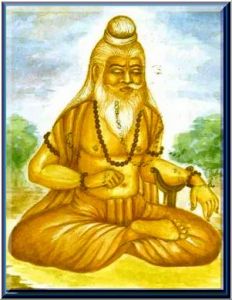
 
12 Comments

Posted by on September 13, 2012 in Abhinavagupta, Music, Natya, Sanskrit


Tags: , , ,

Vidhyadharas and Nagas

The classic Indian epics such as the Mahabharata, the Ramayana and the Puranas refer to many exotic tribes, describing them as superhuman or subhuman. Narrations about these tribes are often mixed with mythology and fables. These includeGandharvas, Yakshas, Kinnaras, Kimpurushas, Rakshasas, Nagas, Suparnas, Vanaras, Vidyadharas, Valikilyas, Pisachas, Devas (within them Vasus, Rudras, Maruts, and Adityas) and Asuras (within them Danavas, Daityas and Kalakeyas.)

These exotic tribes may not have interacted frequently with the mainstream .The knowledge of them was perhaps very limited, which may have spurred the invention of fables and myths about them.

In the Indian mythology the exotic tribes were non-human or in some cases super human, living in distant planets . They were endowed exotic capabilities, that include

1. The ability to appear and disappear at will

2. The ability to fly in air

3. The knowledge of flying-craft (vimana)

4. The ability to change shape at will

5. The ability to read the mind of people

6. The knowledge about other inhabited places like the Earth

7. The ability to influence natural forces

In any case, these tribes had a profound influence on the myths, fables, culture and arts of Indian through the ages.

Vidhyadharas

Among them, the Vidyadharas belong to a category of beings known as Upadevas, or almost-Devas. They appear frequently in the epic and folk lore .Vidyadharas-as semi divine beings are very often depicted in Indian art and sculptor. Their fascinating figures are quite popular. They are usually seen on either side of the images of deities (Brahmanical, Buddhist and Jaina) and on the walls of temples.

By Shilpi Shri Siddalinga Swamy of Mysore

The treatment of Vidhyadharas in our lore is however not uniform. Their treatment in the Puranas, epics and literature, could be said to be three – fold.

In the Puranas:

Shrimad Bhagavatha describes the Bhuvarloka – the level of semi-demigods where the Carana, Vidyadhara, Kinnara, Kimpurusa etc reside. “Below Rahu by 10,000 yojanas [80,000 miles] are the planets known as Siddhaloka, Caranaloka and Vidyadhara-loka.” (SB 5.24.4). “Beneath Vidyadhara-loka, Caranaloka and Siddhaloka, in the sky called antariksha, are the places of enjoyment for the Yaksas, Raksasas, Pisacas, ghosts and so on. Antariksha extends as far as the wind blows and the clouds float in the sky. Above this there is no more air.” (SB 5.24.5)

A vidhyadhara cursed to live on earth tells Krishna “I am the well-known Vidyadhara named Sudarsana. I was very opulent and beautiful, and I used to wander freely in all directions in myVimana. Once I saw some homely sages of the lineage of Angira Muni. Proud of my beauty, I ridiculed them, and because of my sin they made me assume this lowly form.”

In another instance, Citraketu, the King of the Vidyadharas traveled by his Vimana, round the world. He visited hundreds of people in several places and was praised by the sages. He stayed on the heights of Kulâcalendra [Mount Meru].

In Mahabharata and Ramayana:

When Bhimasena went in search of the Saugadhika in the Himavath , by ascending the Gandhamadana mountain , he saw hillocks , thronged with Vidyadharas, inhabited on all sides by foresters and Kinnaras and Kimpurushas, and Gandharvas (3-044.164) .On the summits of the mountain were seen amorous Kimpurushas with their paramours, mutually attached unto each other; as also many Gandharvas and Apsaras clad in white silk vestments; and lovely-looking Vidyadharas, wearing garlands; and mighty Nagas, and Suparnas, and Uragas, and others. (3,145)

dadṛśur giripādāṃś ca nānā dhātu samācitān /  āsevitān kiṃpuruṣair gandharvaiś ca samantataḥ / vidyādhara gaṇākīrṇān yutān vānara kiṃnaraiḥ / tathā kiṃpuruṣaiś caiva gandharvaiś ca samantataḥ – 03,145.12-13

In Valmiki Ramayana – Sundara Kanda : When Hanuman leaps on the Himavath in search of theSanjivani 

“Vidhyadharas who lived there, became afraid and flew away with their women folk, leaving behind their golden jugs of wine in the liquor house, gold vases, a varieties of sauces that can be licked, eatables, various meats, skins of oxen and swords with golden hilts.

The intoxicated Vidyadharas with garlands around their neck decked with red flower garlands and smeared with sandal paste, with reddened eyes, and with lotus shaped eyes, obtained the sky. Vidyadhara women wearing necklaces, anklets, armlets and bangles stood in the sky with surprise and with smiles along with their loved ones. Vidyadharas and great sages stood in the sky in a group, showing their great prowess and viewed the mountain.”

“This Hanuman, who is equal to a mountain, who is the son of Vayu, and who has great speed, wants to cross the ocean which is abode to crocodiles. Hanuma has decided to perform an impossible task for the sake of Rama and Vanaras and wants to obtain the other side of ocean which is hard to obtain.” Vidyadharas thus listened to the words of those great people and looked at the incomparable Hanuma, best among Vanaras, standing on the mountain. “

Hanuma went, like Garuda, in the sky served by clouds (or streams of water), served also by birds,…served in various ways by excellent courageous groups of Vidyadharas.

*

According to the Nispanna-yogavali, a Vajrayana Buddhist text of 9-10th century, credited to Mahapandita Abhayankara Gupta of the Vikramasila monastery, the King of Vidhyadaras was known as Sarvartha-siddha ; he holds a garland of flowers; and, his complexion is said to be white- Sarvarthasiddho Vidyadhara-rajendro gaurah kusuma-mala-hastha.

flower2

In Sanskrit literature:

The Katha- sarith -Sagara, is a famous 11th century collection of Indian legends, fairy tales and folk tales written by Somadeva who said his source was the text of Gunadhya’s Brihat Katha in Paisachi dialect. The principle tale is the adventures of Naravahanadatta, son of the legendary king Udayana and his final attainment of Madanamanjarika as his wife and the land of the Vidyadharas as his kingdom. A large number of tales are built into this central story to make it the largest collection of Indian tales. The Katha-sarit-sagara deals not so much with concrete historical events but with problems and processes of life. The characters in the main story relate stories of other characters who in turn relate others’ stories and so on, like a stack. No story ends in separation or death. Here, all journeys really end in fulfillment of love.

Here, the Vidyadharas are beings known as Upadevas, or almost-Devas who live in a realm of their own, in the Himalayan region. The Vidyadharas, here, can fly through the air, change their appearance at will and are generally amorous and musically gifted. The Vidyadharas and humans deal with each other, and many humans married Vidyadhara damsels. The Vidyadharas are essentially neutral – they cooperate with the universal hierarchy, but they neither favor nor oppose the human race.

Gandharva depivtion in art

In other Sanskrit works too, the Vidyadharas are bearers of wisdom and resemble humans in most aspects except that they are all beautiful to look at and can change forms at will. They mingle with humans and intermarry. Vidyadharas are mentioned also in the Buddhist and Jain tales .The play, Nagananda by King Sri Harsha (606 – 648 C.E.) is based on the legend of the Vidyadharas that appears in the Brahatkatha by Gunadhya.  In that legend, all the characters in the play are mythological figures and creatures with the Bodhisattva Jimuthavahana at the center.

The scene of the play is the semi-divine regions of Vidyadhara loka and Siddha loka. The hero of the play is Jimuthavahana, Prince of the Vidyadharas, who on the Malaya Mountain meets and marries the Siddha princess Malayavati, a votary of Goddess Gauri (Shiva’s wife).The Siddhas are the inhabitants of the subtle world Siddhaloka;  and , are born with mystic powers. They walk and travel in space; they can be perceived to be present, but they cannot be seen.

As regards the main scene of the play; the description of the Malaya hill in Nagananda, mentions sandalwood trees , elephants, the ocean waves , pearls , banana plants and leaves etc. As per tradition, sage Agasthya lived in Malaya hill and Krishna’s elder brother Balarama visited him there. It is said to have seven peaks. Further, in Valmiki Ramayana , Kishkinda khanda , it is mentioned that “When Vali repulsed the buffalo-shaped demon Dundubhi towards Malaya mountain, then that buffalo entered the cave of Mt. Malaya, and Vali entered therein wishing to kill that buffalo. [4-46-3, 4].

In “Lord Sri Caitanya Mahaprabhu’s Travels to the Holy Places” , it is recorded after leaving Sri Ranga, Caitanya Mahaprabhu reached Rsabha-parvata, … Panagadi, Camtapura, Sri Vaikuntha, Malaya-parvata and Kanya-kumari.

The Malaya hills therefore, by all accounts, might refer to the ranges in the peninsular region of India stretching south from Sri Sailam, in the southern end of the Western Ghats.

Malayavathi was a Siddha princess. The term Siddha originally denoted one of the eighteen categories of celestial beings. These beings of semi-divine status were said to be pure and dwelling between the earth and the heaven. Later they became associated with a class of more adept human beings, yogis. Sage Agasthya is credited with introducing Siddha cult to the South. The Siddhas who worship Shiva have been particularly strong in Southern India from the early ages.They are also adepts in Tantra and alchemy. The Siddha cult is still revered and practiced in South India.

Above all , Shankachuda , the hapless Naga cries out in agony “After hastily paying my respects at the shrine of Gokarna , on the ocean’s shore , I again come to this slaughter-house of the Nagas.”

Gokarnam arnava thate tvaritam pranmya prasthosmi tam khalu bhujagama –vadha –bhumim /

Malayavathi, therefore, might have been a Southern princess who married a Vidyadhara Emperor-to be, from the Himalayan region.

 [ Having discussed the academic aspects let me throw in a dampener.

There is another way to look at the whole issue . Nagananada is work of fiction based on a fable. The locations of the play Vidhyadhara-loka and siddha-loka might just be names; the locations could have been anywhere else too. Similarly the characters in the play could have been anyone else and not necessarily Vidhyadharas or Nagas. It is also possible the names of places and the charectars were random selections.There is no need to read too much into them . Just look at the more important things .

The more important factors are  the story line, its technique and the message of love, nobility and non-violence. These are in abundance in the play. Therefore, the play would still be of great significance, even if one ignores the context of the locale and the origin of its characters.

Let us however go along with the locale, characters and the spirit as portrayed in the play.]

8697784345_e75913d220

Nagananda, inspired by Buddhism, is one of the best Sanskrit dramas in five acts dealing with the popular story of Jimuthavahana’s self-sacrifice to save the Nagas. The story depicts how prince Jimuthavahana inspired by the noble virtues taught by the Buddha, offers his body to stop serpents being consumed daily by Garuda the leader of the birds; and how he succeeds in converting Garuda to the principle of ahimsa, abstention from causing injury to living beings.

Nagananda, ‘Joy of the Serpents,’ is in some respects quite unique. It is a rare instance of a Buddhist drama that has come down to us, well preserved.

**

Nagananda is often cited as a typical example of Drama that satisfies all the norms of a classic Nataka or Rupaka. Viswanatha in his Sâhitya-Darpana described such Rupaka (Nataka) as the most logical and perfect theatrical composition.  He says, according to the Dasarupaka, the structure of the Rupaka consists: five elements of the plot (arthaprakrti), matching with the five Stages (avastha) of the action, from which arise five structural divisions or sequence of events (samdhi) of the drama, which correspond with the elements of the plot and the actions associated with the stages in the hero’s pursuit and realization of his purpose, which is the conclusion (upasamhrti or nirvahana).

According that prescribed format for a Sanskrit Drama, the plot is expanded over five elements (Arthaprakrti): The opening sequence (mukha) is the seed (bija) very small at the beginning (arambha) ; and , expands (bindu) in multiple ways as the action proceeds into episodes (pathaka)  depicting various events (pathaki) and their resolution (karya). These are said to be the five elements of the plot (arthaprakrti).

Bīja bindu patākākhya prakaro kārya lakaā / arthapraktaya pañca tā etā parikīrtitā //

These five stages (Avastha) of action that are related to the achievement of the hero’s desired object (phala) are mentioned as:  Arambha (the beginning) – mere eagerness for the obtaining of the more important result; Yathna or Prayatna (effort) – exertion attended with great haste; Prapthya (prospect of success) – with means at hand, but also with fear of failure; Niyathapthi (certainty of success) – the confidence  of succeeding because of the absence of risk; and Phalagama or phala-yoga (successful attainment of the desired objective of the hero).

Avasthah panca karyasya prarabdhasya phalarthibhih / ararmbha-yatna-praptyasa-niyatapti-phalagamah.

The sequence of events (Samdhi) or Junctures corresponding to the five stages  (Avastha) of action are : the opening (mukha); the progression (pratimukha); the development (garbha); the pause in which one stops to reflect because of anger or passion or temptation (avamarsa or Vimarsa); and, the  successful conclusion (upasamhrti or nirvahana).

Antaraik arthasambandhah samdhir ekanvaye sati / Mukha-pratimukhe- garbhahs avamarsa upasarnhrtih

The Nivahana (conclusion or finale) is that Samdhi (juncture) in which the elemrnts of the plot that started with the opening scene (Mukha) and sprouted (Bija) in the subsequent scenes and later systematically and progressively spread over in the later scenes finally concluded with the hero attaining his desired objective.

Bija va anto mukhadyartha viprakirna yathayatham / aikarthyam uparuyante yatra nirvahanam hi tat //

*

The Bija, the seed or cause of the plot ( or Vibhava)  of Nagananda is Jimuthavahana’s strong desire to serve the world denouncing all the pleasures. In the opening scene (mukha) the hero announces: “Everything including my own body is certainly preserved by me for others.” After the seed (Bija) is planted, the incidents expand like a drop (Bindu) of oil on water. There is a determined effort (yatna) to achieve the object of desire. It is this step (Niyathapthi) which sustains the continuity of the action throughout the play.

The progress of the plot (Arthaprakrti) begins (Arambha) in the opening scene (mukha)  with Jimuthavahana’s determination to pass the days of his youth away from worldly temptations ; but , in serving and paying his utmost devotion to his old parents. He goes in search (Prayatna) of a penance grove in Malaya Mountain up to the point where the hero discovers Shankhachuda; and scarifies himself , as an act of boundless compassion – the object of his desire (Phalagama) –  and saves  the victim  whose body was about to be offered to Garuda.

 *

As a Nataka, the Nagananda conforms to the rules of dramaturgy , on broad lines. The Vastu, the plot, is famous, as it is a story  derived from the Buddhist legend Brhatkatha by Gunadhya. Its hero (Neta) is a worthy and an exalted person of virtue. The play displays Srngara, Vira and Adbhuta Rasas, though it’s dominant Rasas is Shantha. The play is in five acts; and, each act ,,except the first, begins with Pravesaka.

Though the drama is Buddhist in inspiration,  Goddess Gauri steps in to rescue  and  restoring Jimuthavahana back to life . The hero is a Bhodisatva, the Buddha in-making, and the heroine is an ardent devotee of Goddess Gauri. The religious affiliations are blended harmoniously; though the play is Buddhist  in its tenor . Ultimately, it is the Goddess Gauri who restores the dead hero to life, and  brings the play to a happy and an  auspicious (Mangala) conclusion.

The play begins with the auspicious Naandi verses, in salutations to the Buddha; and, it concludes (Mangala) with a prayer to the Goddess Gauri. A unique characteristic of this drama is the invocation to the Lord Buddha in the Naandi verses (considered one of the best examples of the dramatic compositions) .

The Naandi slokas submit a prayer to the Buddha in a rather very unusual  and interesting way:

[The Aupsaras, the celestial nymphs, in mock anger accuse the Buddha: “Oh, you, the one pretending to meditate; tell me on which woman are you meditating;  open your eyes for a moment  and see . You are the savior, yet you do not protect us  while we  are hit by the shafts of the cupid. Is your benevolence false ? Are you really compassionate?! Who could be more cruel  than you?”

May the all-conquering Buddha, who overcame the amorous temptations of the daughters of Mara, thus resentfully addressed by the nymphs, protect you!

As the Mara holds his attractive arrows; as  his band of followers dance playing on resounding drums; as the bewildered  Apsaras quiver and  watch with  eyes rolling, brows Knitted , and  mouths agape , crying and smiling at the same time; as the Siddhas (sages) submit their salutations with their heads  bent down; and as Indra , the king of Devas, with his hair standing on end, watches with astonishment –  the Buddha , the Lord of the sages, seated in rock-firm posture, filled with transcendental knowledge, continues to mediate in supreme bliss, unperturbed by the surrounding enchantments.

May such triumphant Buddha, the Lord of the sages (Munindra), protect you.

buddha nagananda

Dhyanam vyajaha upetya chintayasi kam unmilaya chakshuh kshanam / Pashya ananga sharah athuram jana imam trata api no rakshasi / Mithya karunika asi nighrunatara svatham kruthsu anyah puman  /Irshayam Mara vadhubhihi itya abhihitau Bhuddau jinah paathu  vah // 1.1//

ध्यानव्याजमुपेत्य चिन्तयसि कामुन्मील्य चक्षुः क्षणं /पध्यानङ्गशरातुरं जनमिमं त्राताऽपि नो रक्षसि ।मिथ्याकारुणिकोऽसि निर्घृणातरस्त्वत्तः कुतोऽन्यः पुमान्/ सेर्ष्यं मारवधूभिरित्यभिहितो बोधौ जिनः पातु वः ॥ १.१ ॥

Kamena akrushya chapam hatah patu pata hatha avalingabhir virau / Brumandol uthkampa jumbha smitham chalelitha drusham divya nari janena / Siddhau prahvo utthamangahahi pulakita vaspusha vismayad vasavena / Dhyayath bhodaha avaptitah achalitha ithi vah paathu drustau Munindraha //1.2//  

कामेनाकृष्य चापं हतपटुहावल्गिभिर्मारवीरैर् / भ्रभङ्गोत्कल्पजृम्भास्मितचलितद्दृशा दिव्यनारीजनेन । सिद्धैः प्रह्वोत्तमाङ्गैः पुलकितवपुषा विस्मयाद्वासवेन / ध्यायन् बोधेरवाप्तावचलित इति वः पातु दृष्टो मुनीन्द्रः ॥ १.२ ॥ ]

buddha9490

The Dasrupaka mentions the main aspects of the Drama (Rupaka) as : the plot, the hero and the Rasa (pradhāna, netà and rasa). The subject or the story should always be about celebrated and important persons. The plot should be simple, the incidents should be consistent; the progression of the events should spring direct from the story.

The plot (Vastu) of Nagananda is, of course, derived from a well respected source , is a noble one , lauding the virtues of Dharma, Ahimsa ( non violence)  and Karunya ( compassion towards all beings), wishing the welfare and happiness of all  .

As regards Jimuthavahana, the Neta, hero of the play Nagananda, oriented to the Buddhist ideal of compassion; he  is a noble type of character. Dhanika, a commentator of Dhananjaya’s Dasa-rupaka,  treats Jimuthavahana of the Nagananda on par with Rama in the highest category of the heroes (Neta) – Dhirodddata. Because, Jimuthavahana has control over his senses; does not let emotions override his actions; maintains his composure even under dire circumstances; shelters the weak and threatened; always wishes and strives to do good to others; sacrifices his kingdom to serve his parents; and, offers himself as a meal to Garuda , in order to protect and save a hapless child-snake, Shankachuda, the only son of his mother. Jimuthavahana is also wise, well versed in Shastras and is skilled in arts; he paints a beautiful portrait of his beloved Malayavathi.

 *

In regard to the Rasa, the emotional experience that it conveys, Abhinavagupta (11th century) the celebrated philosopher and commentator , cites Nagananda as a classic example of depicting  and conveying Shanta rasa (peace and tranquility). He characterized the main features of the play as : its philosophical outlook (Tattva-jnana); and the hero’s intense desire to seek liberation (Mokska) as his ultimate object of attainment (Phala). Abhinava, points out that for plays of such genre, the Shantha rasa is the most appropriate.

The sthayi Bhava of Shantha Rasa is well brought out by Sri Harsa, beginning with Jimuthavahana’s conversation with his friend Atreya. The description of the philosophical truths, evils of worldly pursuits, transitory nature of life and the merits of practicing austerities after renouncing the world are supported by Vibhava, Anubhava and Sanchari Bhavas that are most suitable for the Sthayins that project Santa Rasa. His desire to attain liberation is the cause (Vibhava). The willful renunciation of worldly pleasures , pondering  over  the spiritual and philosophical  aspects of life,  the practice of austerities , and the self-less desire to to good to all beings are well depicted as the Anubhavas. Finally, Jimuthavahana achieves  his desired objects (phala prapthi or phalayoga) when he rescues Shankhachuda from certain death.

*

According to the earlier norms; a Nataka should comprise one Rasa-either Srngara or Vira; and in the concluding part the Adbhuta  would become prominent

Eko rasa – angi -kartavyo virah srigara eva va / angamanye rasah sarve kuryannivahane –adbhutam

It was also said  that in the presentation of the play one should avoid , among other things, showing such events as: long travel; murder; war; violent over throw; bloodshed; eating; etc., etc.

Dura-dhavanam; vadham; yuddham ; rajya-dessadiviplavan/ samrodham; bhojanam; snanam ; suratam; ca-anulepanam/ amvara-grahanadini pratyakshani na nirdiset na-adhikaraivadham kvapi tyajyam – avasyakam na ca //

Against such cliches, Abhinavagupta in his Abhinavabharati, a commentary on Natyasastra, argued that a play could be a judicious mix of several Rasas, but should be dominated by one single Rasa that defines the tone and texture of the play. He cited Nagananda of Sri Harsha; and, explained though the play had to deal with the horrific killing of the hapless Nagas, it underplays scenes of violence, and radiates the message of peaceful coexistence and compassion towards all beings. It is the aesthetic experience of Shanta – peace and compassion towards the fellow beings – which the spectator carries home

white lotus

Towards the end of the play, the Great Goddess Gauri restores Jimuthavahana to life, blesses and crowns him as the Emperor of the Vidhyadharas; and sprinkles him with the waters of the nearby Manasa Lake. As nobles of the Vidhyadharas carry gifts of many jewels, gems and the chowries of yak’s tail, white as the autumn moon; Gauri gifts Jimuthavahana with the golden wheel ,the four-white tusked elephant and finally the most beautiful maiden , Malayavathi.

Jimuthavahana, in great jubilation, with hands raised above his head,  submits to the Goddess Gauri  and prostrates at her feet : Bhagavathi , Devi one who grants all wishes, more than asked for, removes all miseries and pains , the supreme protector of all beings, I bow at your feet Oh Gauri , the ever celebrated goddess  of the Vidyadharas.

Bhagavathi,  abhilashita adhika varade, prani-pathitha-janatri harini / sharanye charanau namamhyaham te Vidyadhara  Devate , Gauri //5.35//

Mahadevi

Nagas

naga

*

Finally, as regards the Nagas, it is said that Nagas were a group of people spread throughout India during the period of Mahabharata. Their original abode could be the Airavata region in the far north, near the Iravati River (Ravi). As per Mahabharata, Nagas and Suparnas were two races having kinship. Kadru was the mother of the Naga race (1-16,122). Sister of Kadru viz. Vinata was the mother of Suparnas .The Suparnas headed by Garuda were formerly servants of the Nagas. With the help of Devas, Garuda ended that slavery; and later Suparnas became enemies of the Nagas (3,159).

Mahabharata also mentions that the territory of Suparnas, the enemies of Nagas ,was close to Hiranyapura the city of the Daityas and Danavas. Suparnas were described thus:-“By their acts they may be said to belong to the Kshatriya order, but they are all without any compassion as they mercilessly slay the Nagas, their kinsmen. They never attain to spiritual enlightenment in consequence of their hatred towards their relatives. However, the race of Suparnas is much regarded in consequence of the favor that is shown to it by Vishnu, the younger brother of Deva king Indra. All Suparnas dwell in only a single province of the region containing the cities of Patalam and Hiranyapura (5,101).

Naga race was almost exterminated by Janamejaya, the Kuru king, who conducted the massacre of Nagas at Takshasila. That massacre was stopped by Astika, a Brahmin whose mother was a Naga (Vasuki’s sister Jaratkaru). The city named after Takshaka, viz Takshasila (Taxila) to the west of the river Vitasta (Jhelum) was the abode of Naga Takshaka.

naga deva nagadevi

Nagas had kingdoms also in Nagaland and Andhra Pradesh. Arjuna’s wife Uloopi was a Naga princess in the line of Kauravya belonging to the race of Airavata, the original Nagas. Uloopi’s former husband was slain by a Suparna. She was childless. A son named Iravat was born to Arjuna and Uloopi. But Uloopi’s brother hated Arjuna since he destroyed the Nagas dwelling in Khandava forest ;and therefore abandoned Uloopi and his son. Iravat grew in the territory of Nagas, protected by his mother. Later when Arjuna visited the Deva region to the northeast of the Naga territories, Arjuna accepted him as his beloved son, and asked him to render assistance in battle at Kurukshetra. Iravat participated in the War with cavalry force driven by Naga warriors. He was slain by the Rakshasa Alamvusa, the son of Risyasringa (6, 91).

Some scholars opine that a tribe called Suparna (to which Garuda belonged) was the archrival of the Nagas. The Suparnas were probably falcon rising or falcon worshipping tribes

In any event, Jimuthavahana brought about peace and reconciliation between the Nagas and Suparnas. He succeeded in convincing the Suparnas the futility of perusing the hostilities and inflicting needless harm on other living beings.

OLYMPUS DIGITAL CAMERA

The first half of the play is permeated with gentle romance; the Siddha princess from South marries a Vidyadhara Emperor of the Himalayan region. The later half is about nobility, sacrifice and peaceful coexistence. The Buddha is the moving spirit behind Jimuthavahana’s efforts to bring about peace between two warring tribes; and the Goddess Gauri blesses his success. The Nagananda aptly commences with a salutation to the Buddha and ends with a benediction to Goddess Gauri.

What more can anyone ask…

By Shilpi Shri Siddalinga Swamy of Mysore

References:

http://www.yorku.ca/inpar/nagananda_boyd.pdf
http://en.wikipedia.org/wiki/Naga_Kingdom#Naga_cities

Note: This was attempted , initially , as a response to a blog posted by
 sharmila pn
nagananda — tracing harshavardhana’s play geographically

श्रीहर्षविरचितं नागानन्दम्: The Sanskrit Text with Annotated English

..

Paintings of Vidhyadhara and Garuda
By Shilpi Shri Siddalinga Swamy of Mysore

others from Internet

 
11 Comments

Posted by on September 6, 2012 in Sanskrit
 

Tags: , , , ,