RSS

Category Archives: Music

Sri Muthuswami Dikshitar and Sri Vidya (5 0f 8)

Sri Chakra and Sri Vidya

According to Tantric texts, the Chakra, Mandala or Yantra is a sphere of influence and a consecrated environment. It is an instrument to harmonize feelings; and also to coordinate inner and outer forces.

The term Yantra is derived from the root yam suggesting a sense of control (say, as in niyantra to control), giving raise to the meaning of an instrument that can control or be controlled. In that sense, the body is a yantra. The other term tra is from the root word trayati, that which liberates. Yantra is that which controls and liberates. It draws towards the centre as also takes away from the centre of all reality.

The basic energies of the universe, which are idealized as the deities, can be approached through a mental creative process, that is, through words or through created forms. The Deities are therefore represented both in words and forms.

There are different degrees of abstraction. We can represent a deity through the description of its characteristics in words, or sounds, that is, mantras. Similarly, we can represent a deity through diagrams, geometrical abstractions   or patterns, the yantra. The representation of a deity through mantra or yantra is considered more subtle than through an image.

Yantras are the visual equivalents of the mantras. The yantra has the mantra as its soul; and the deity is the soul of the mantra. The difference between the mantra and the deity is the difference between the body and the soul. The deity is invoked by drawing its yantra and calling its subtle name (bija akshara).

All the elementary geometric figures –lines, triangles, crosses, and point (bindu) – have a symbolic value corresponding to their basic notions. They can be combined to form complex figures to give expression to forces, the inner aspects and qualities embodied in a given form of creation. It is said, there no shape, no form which may not be reduced to yantra patterns. Every shape, every leaf, every flower is a yantra, which through its shape, colour, formation, perfume can tell the story of its creation.

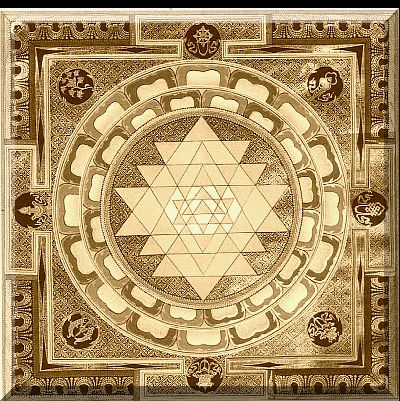
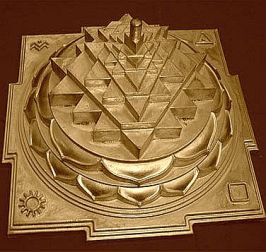
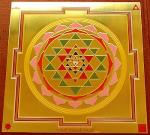
srichakra0001

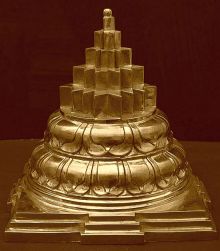
Yantras which are drawn on flat surfaces are basically conceived as solid forms. The drawing is a mere suggestion of its three dimensional aspects of the yantra. And, the yantra is itself a static image of the moving, living combination of forces represented in a divinity.

PANCHALOGHA MAHA MERU Sri yanta 3d

A Yantra is structured in three levels, of spaces(i) the level of physical world of beings and things (mahakasha); (ii) the level of thoughts and feelings (Chittakasha); and (iii) the level of pure, undifferentiated consciousness (Chidakasha).

The first level is predominantly inert , Tamas; while the second level is active and emotional, Rajas. The third level is of light and pure awareness Sattva.

A Yantra is a means to progress from the gross to the subtle, sukshma.

To put it in another way, Yantra is an instrument to transform matter into energy ; and, the energy into consciousness. In the final analysis, the walls separating the objective world, the subjective person and the Universal consciousness break down; and, it is all One at the end. This complete harmony of existence is symbolized by Bindu; a dimensionless point at the center of the Yantra or Chakra.

In fact, chakra is regarded the expansion or the evolution of that Bindu. The Bindu , in turn, is epitome or the microcosm of the Chakra. The Yantra facilitates the movement of consciousness from the concrete form of Chakra to the abstract Bindu. It also enables movement from the abstract Bindu to the form of Chakra. A Yantra , in essence,  is a map of the universe in its emanation and absorption.

Sri Chakra

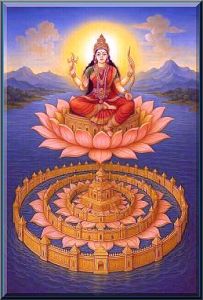
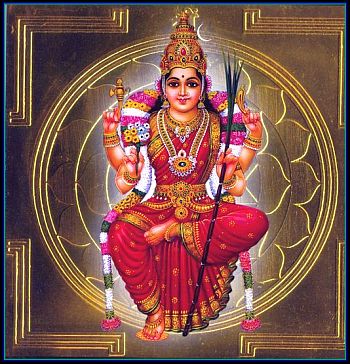
Sri Chakra Yantra is regarded the supreme Yantra; the Yantra Raja, the king of Yantras. It is the Yantra of the Shaktha school of Tantra. It is also variously regarded as the visual representation of the city, mansion, island or the body of the Mother Goddess Devi, Tripurasundari, Lalitha, Rajarajeshwari and Parabhattarika, the supreme controller. The design also stands for this divinity’s court with all her attendant aids, guards, pavilions, enclosures and entrances. The principal divinity is regarded as being at the center, the Bindu at the heart of the Chakra.

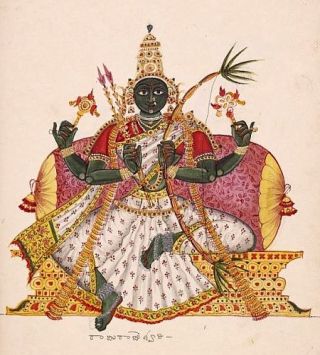
Rajarajeswari

The prefix Sri denotes that the Yantra is auspicious, beneficent, salutary, benign and conducive to prosperity. Sri is Lakshmi, the goddess of beauty and prosperity. Sri is also the Mother Goddess who rules the universe (tvam sris tvam ishvari).She is called Mother, because all living beings depend upon her for being, for happiness for fulfillment of their destiny (sriyete sarvair iti sriah). Sri Chakra is a representation of the interplay of the principles of pure consciousness (Shiva) and primordial power (Shakthi). Sri Chakra represents the essential aspects of the universe ;and also of the constitution of the devotee’s body-mind complex.

The concept and worship of Sri Chakra is relevant in the context of an esoteric discipline known as Sri Vidya.

Sri Vidya is hailed as the Vidya of Sri (the knowledge that leads to the ultimate benefit mukthi – liberation), she therefore is the highest divinity. Sri Vidya is also the Vidya that yields Sri (prosperity). Sri Vidya is thus Bhukthi Mukthi prada the bestower of well-being, prosperity and liberation. Sri Vidya is the path and also the goal.

The term Vidya usually stands for knowledge, learning, discipline and a system of thought. But, in the context of Tantra, it has an extended meaning. Here, it variously refers to a female deity, to the personification of her consciousness; or to the manifestation of her power.Each of these vidyas has a characteristic form and particular dhyana, mantra, kavacha and other  worship details .

Devi Durga is described as the Vidya in all beings (Ya Devi sarvabhutheshu, Vidya rupena samsthita); and , the form of her Vidya is the primordial energy Adi prakrithi.

The Tantra texts classify ten divinities into three levels of Vidyas:

(1) Maha_vidya, the extraordinary Vidyas, consisting Kali and Tara. The worship of these divinities requires great rigor, austerity, devotion, persistence and a sort of detachment. The practice of Maha_vidya is very difficult and filled with risks and dangers ;

(2) Vidya, the normal Vidyas consist deities Shodashi (or Tripura), Bhuvaneshwari, Bhiravi, Chinmastha and Dhumavathi. The practice of this class of Vidya is considered safe and suitable for householders;

and

(3) Siddha Vidya, the Vidya for adepts involves deities Kamalaa, Matangi and Bhagalamukhi. This class is not for normal persons as it involves rituals that cannot be practiced normally.

Shodashi is the first among the Vidyas in the middle group; she is otherwise known as Sri Vidya. Shodashi literally meaning “a girl of sixteen” , is identified with deities Lalitha, Raja_rajeshwari, Sundari, Kameshwari and Bala. Lalitha is the playful one; all creation, manifestation and dissolution is her play. She is Mahatripura Sundari the most magnificent transcendental beauty without a parallel in all the three worlds. She is the conqueror of three levels of existence.

The Tantra texts however explain that the Vidya is called Shodashi because the mantra of the Vidya is made up of sixteen seed-syllables (bija akshara). There is another school (Kadi Vidya) which says the mantra consists fifteen visible syllables (ka e i la hrim; ha sa ka ha la hrim; sa ka la hrim). It is explained that ka represents the air; ha the fire; sa the water; la the earth; and, e the space. The fifteen syllables are: one of space, two of air; three of fire; four of water; and five of earth. The sixteenth letter is “srim” in subtle form. The mantra then becomes Shodashi, the sixteen lettered.

The fifteen lettered (panch-dasha-akshari) mantra  is  considered the verbal form of the Devi. But, it is implicit or hidden. It is only when the sixteenth syllable ‘Srim’ is included; the mantra becomes explicit or becomes visible. Srim is regarded the original or the own form of the Mother Goddess. And, with the sixteenth syllable (Srim) the She comes to be celebrated as Sri-vidya.  And, the mantra itself becomes the body of the Mother Goddess. She manifests the un-manifest. She is Prakrti. The auspicious Sri (Srim) is thus revered as Saguna Brahman,  the sa-kara approach to the absolute principle of the Devi. 

The mantra (fifteen or sixteen letters) is , thus, an expression of Sri Vidya. The verbal expression (nada or sound) of the Vidya is mantra ; and, its visual expression is the Sri Chakra Yantra. The two are essentially the same. Both seek identity of consciousness with Maha Tripura Sundari.

Ka is the first letter in the fifteen-lettered (pancha-dashi) mantra of the Devi in the Sri Vidya tradition. Ka is an important syllable in the fifteen-lettered mantra, for it appears three times. Here, Ka variously stands the principle from which everything arises; for illumination (Kan dipatu); or for the principle of consciousness (buddhi) in beings; and, also for the symbol of Self.  And Ka also stands for  the form-less Brahman (ka iti Brahmano naamah). 

The fifteen lettered mantra is divided into three groups: ka e i la hrim; ha sa ka ha la hrim; and; sa ka la hrim. The three groups that constitute the mantra are called Kuta (peaks) or Khanda (segments). They are interpreted variously in sets of three as: 

  • Agni(fire) , Surya(sun) and Chandra(moon); 
  • Srishti (creation), Shtithi (preservation) and laya (dissolution);
  •  Iccha ( will), jnana(knowledge)and kriya (action);
  • Sattva, Rajas and Tamas;
  • Jagrat (wakefulness); swapna (dream state) and sushupthi (deep sleep);
  • jnatra (the knower), jnana (the knowledge) and jneya ( the known) ;
  • Atma (individual self) , Antaratma (inner being) and Paramatma (supreme self); and as ,
  • Past , present and future ( the three assumed layers of Time).

There is also a view that the first group starting with ka is kadi_matha (ka e i la hrim); the second group starting with ha is Hadi_matha ( ha sa ka ha la hrim ); and the third group starting with sa is Sadi_matha (sa ka la hrim ).

Another interesting aspect is that the vowels (aa, e, i etc.,) are regarded as representations of Shakthi; while the 35 consonants are basically inert and depend on vowels (just as Shiva depends on Shakthi) to manifest in a meaningful form. It is only when the germinating power (bija) of the vowels is infused with consonants, the latter gain meaning. That is the reasons the vowels are Bija-aksharas. They transform ordinary letters into mother like condition (matrika); that is, they impregnate ordinary letters with meaning and power.

Sri Vidya is also described as Chandra_kala_vidya, the lore of the lunar digits. This school of Sri Vidya explains that the fifteen letters of the mantra correspond to fifteen digits of the moon in each fortnight, commencing from prathipada, the first day of the brighter half, when the moon “comes out of the sun”; and, ending with the full moon on the fifteenth day. Similarly, in the dark half of the moon cycles, all digits “return to the sun”. The emanation of the fifteen digits of the moon from the Sun culminates in the full moon (purnima); while the absorption of the digits into the Sun results in new moon (Amavasya).The sixteenth letter (Shodasha kala or Srim) is said to be present in each of the digits which are called Kalas or nityas. The digits are invoked as forms of the Mother goddess.

The first digit is Maha Tripura Sundari; the second is Kameshwari; and, the third is Bhagamalini. These three together form the primary triangle which is the immediate unfolding of the central Bindu representing Mother Goddess.

The Sri Vidya tradition which centers on the worship of Sri Chakra, considers the following twelve gods and sages as its Gurus: Manu, Chandra, Kubera, Lopamudra, Manmatha, Agasthya, Nandisha, Surya, Vishnu, Skanda, Shiva and Durvasa.

It is said each of the twelve gurus propagated a school with regard to the worship and significance of Sri Chakra.  Of these, only two schools have survived to this day; one is the school started by Manmatha (also called Kamaraja) – known as Kadi_matha. The Kadi tradition was continued by Sage Agastya. The other school is Hadi_matha , started by Lopamudra , wife of the Sage Agastya. There is also a mention of an obscure third school called Sadi_matha.

Of the three, the Kadi_ matha (with its mantra starting with letter Ka) is regarded the oldest ; and , its attitude and worship is Sattvic. It insists on virtue, discipline and purity of rituals. The prominent Gurus of this School are Paramashiva, Durvasa, Hayagreeva and Agasthya. Of the other two schools, Hadi_matha is Rajasik ; and, the Sadi _matha is Tamasik.

Kadi matha accepts Vedic authority ; and, formulates its position in accordance with the Vedic tradition. The other School is considered different (iyam anya cha vidya).The term Samaya also means Vedic convention; as orthodox and valid. Hence Kadi School came to be known as Samaya.

Samaya believes in sameness of Shiva and Shakthi; and, the form of worship is purely internal. Hence , Kadi School is also known as Para Vidya , where the worship (archana) is conducted in the space of one’s heart (hrudayakasha madhye).

The external worship conducted, say by Kaulas, lays greater importance on the Muladhara and Swadhistana Chakras, which are said to be situated at the base of the spinal column; and, which relate essentially to physiological needs and psychological urges.

The Samaya School , on the other hand, prescribes that the internal  worship (antar aradhana) be conducted  at higher levels, viz., from Manipura to Sahasra. The seat of Tripura is at Sahasra, beyond the six Chakras. It is also the seat of supreme consciousness, Shiva from which Shakthi springs forth.

Shakthi is of the same nature as Brahma (Brahma rupini) that divides itself five-fold. It is a spontaneous un-foldment. In Samaya system, Brahman is called Sadashiva; it is the Bindu, from which emerges Nada which is Para_shakthi. It is at the Sahasra, the Bindu Sthana that Shiva and Shakthi reside. They are the same; one cannot be without the other.

Samaya is centered on knowledge (jnana), which is the realization of the identity of Shiva and Shakthi: Shiva becomes Kameshwara and Kameshwari becomes Shiva. Their names too get intertwined; for instance: Shiva and Shivaa; Tripura and Tripuraa; Bhava and Bhavani; Shambu and Shambhavi; Rudra and Rudrani; and , Sundara and Sundari etc.

Dakshinamurthi is a revered seer of the Kadi (Samaya) School. The term Dakshina literally means a woman and refers to the feminine principle, which can create, unfold and manifest. When Dakshina assumes a form, it results in Dakshinamurthi a variety of Shiva’s forms. Dakshinamurthi, as Ardha_nari; Kameshwara and Kameshwari, are together regarded the principle deities of Kadi School.

Sri Chakra is the main device employed by Kadi (Samaya) school; and the worship is mainly through symbolism ; and, successive identifications. The symbolism involves identification (saamaya) of the arrangements and the lines of the diagram with the structure of the Universe; the psycho-physical aspects of the devotee with the spatial arrangement of the diagram representing the goddess; and identifying the Mantra with the Yantra.

As regards the worship of Sri Chakra, there are three recognized procedures :

:- Hayagreeva tradition regarded as Dakshina_chara, the right handed method, reciting Lalitha_sahasra Nama and Lalitha_tristathi offering kunkumam.

:- Anandabhirava tradition , a Vama_chara,a left handed method; and

:-  Dakshinamurthy tradition , a doctrinal school.

Of the three, the last one is considered the best.

*

Sri Vidya  traditions speak of two forms of Sri Chakra. One is its physical representation of lines and forms. This form entails external worship (puja) according to prescriptions of kalpa sutra, spread over 26 steps. Here, Kameshwara and Kameshwari are the deities that receive worship.

There are, again, three methods of worship of Sri Chakra.

The shrishti_krama the expansion mode of worship, carried out in morning, comprehends the chakra from the central point the Bindu to the outer square.

The Sthithi_krama the preservation mode of worship, carried out in the afternoon, comprehends the Chakra from the outer square to the eight-fold lotus ; and, from the Bindu to the fourteen cornered figure.

The third, Samhara_krama the absorption mode of worship, carried out in the night, comprehends the chakra from the outer square to the central point.

 [Even in this method the visualizations and contemplations are not entirely dispensed with.]

The other form of worship is Viyacchakra, the chakra emerging within ones heart. This entails visualization of Bindu, which is in the center of the Sahasra, within ones heart. The ability to visualize Viyacchakra is known Assamaya. The worship (maanasa puja) is offered internally and consists wholly of visualizations and contemplation; and , is carried out in seclusion by one who is in control of his senses.

The process here involves a four-fold conceptualization of identity (aikya chintana). They are , briefly :

:- Identity of the Supreme goddess who is un_manifest with Sri Chakra which is manifest;

:- Identity of the design of Sri Chakra with the Universe. It is viewed as a cosmogram ;

:- Identity of the individual with the Universe . This is done primarily on the basis of the Shat chakra ideology (six chakras- muladhara, svadhistana, manipura, anahata, visuddha and ajna) and the tattvas , the principles , of Shaivagama;  and ,

:-  Identity of the letters of the alphabets (matrikas) with the deities located in various segments of the Sri Chakra.

As can be seen from the above the six factors involved are :

  1. the Universe (Brahmanda);
  2. the individual (pindanda);
  3. the structure of Sri Chakra;
  4. the letters of the alphabets(matrikas);
  5. the goddess (Devi); and
  6. the mantra specific to her.

[It is explainedMatrka-cakra, is the articulate sound over which all our thoughts, emotions, aspirations fears and pleasures are woven, as nothing can go beyond the articulate sound, which evolves into an extremely complex universe of sentence to meanings, meanings to mental images and mental images to pleasures and pain. This is called as matrka-sakti that can spread out externally by way of object-denotations, cognition, intentions (raja), emotions like sorrow, pleasure, envy, memory traces etc.(vikalpa), and the world of endless differentiation. This is the outward emanation (vikasa), standing for creation (srishti-krama); and, it can also contract (sankocha) by withdrawing the world of differentiation into pure awareness (samhara)]

The Tantra texts emphasize the merit of inner worship (antar_yaga), once a fair degree of understanding has been gained. They said “Best of all forms of worship is inner worship. External worship (ritualistic) is to be resorted until the dawn of understanding.”

In any case, Sri Vidya is the worship of Mother Goddess incarnated in the Sri Chakra. Her worship includes the worship of her consorts (Devata) and aids (yogini); all of whom are female. The ritualistic details are characteristically feminine.

The Upaasana of Srividya is explained in Upanishads like Kenopanishad and Bhavanopanishad ; and , in various Tantra texts, extensively. For more on the worship practices, please click here.

A Sri Vidya Upasaka worships beauty and grace; rejecting ugliness in thought, word and deed.  Sri Vidya is the path of devotion and wisdom. The wisdom consists in realizing ones identity (sva svarupa prapti) with the Mother Goddess. It is this wisdom that liberates the devotee (jivan Mukthi). This liberating wisdom is granted to him by the Mother out of pure love, when the devotee surrenders to her completely in full faith and devotion. The Mother is the path and the goal. Sri Vidya is the culmination of all paths, the consummation of all transformations.

lotus-flower-meaning-3

[ Śri-Vidyā as a living Tantra has always countenanced change as part of the dynamic of a universe construed to be power itself. ..Śri-Vidyā embodies her contrast as saubhāgya-sampradāya, the tradition that entreats to prosperity by invoking divine self-identification with grace, beauty, and good fortune

The Goddess is transcendence and immanence, outside and in, macrocosm and microcosm and she is more: She is whatever she needs to become to be anything that is possible and all that precludes possible or impossible. Whatever transcendence is, she manifests as, for there is at once the narrowest sense of her fullness recovered through specific ritual arts of identification and the broadest sense of her inclusion in every kind of experience, in every aspect of reality. Unlike those who would prefer the perfection of final liberation to make for simple extrication from a world of opposites, Śri-Vidyā asserts that transcendence possesses no otherness and demands immanence without exception must be none other than she, the goddess herself in some manifestly karmic or playful form. Such a universe is not inscrutable nor can it be reduced to comprehension; illusions must be real in so far as they refuse any sensibility of falsity; options trump exiguity without the slightest diminishment of integrity.

What makes Śri  “the auspicious” is that there can be no scarcity, no summation, no ultimacy  that finalizes  less than another possibility; and all of this Śri reveals herself as Vidyā , a science, a process of veracity, an impeccable wisdom, a mantra  feminine-encoded as reality true to itself but beholden to none. Śri-Vidyā conceals itself in contradictions that pose no threat to those who embrace paradox as the solution to a world that is itself not a problem to be solved.. Śri-Vidyā flourishes, never fails; it assimilates, takes on new characters  in varied forms.

Douglas R. Brooks in the Forward to an Article concerning Sri Vidya and Tantra byJeffrey S Lidke ]

lotus red

Sri Muthuswami Dikshitar was initiated into Srividya Maha Shodasakshari Diksha. In his first kriti , he referrers  to its Guru tradition, its twelve gurus and three schools of worship, Kadi, Hadi and SadiKamaadi dwadashabhirupa_sthitha kadi hadi sadi mantra rupinya .

Sri Dikshitar also mentions that he followed the tradition of the Sages Durvasa , Agasthya and Hayagreeva ; and, declares he belonged to Kadi School: maatmaka kadi mathanusthano.

Sri Dikshitar followed the Kadi practice of worship of Sri Chakra from Bhupura , the outer square to the Bindu, the central point. He had a certain pride in his tradition; in his kriti Kamalambikai, he states “prabala guruguha sampradaya anthah karayayai – referring to his hallowed tradition

Sri Dikshitar composed about forty kritis,  spread over four sets of compositions on the subjects related to Sri Vidya;  Kamalamba Navavarana (11+ 2 kritis); Nilothpalamba kritis (8 kritis); Abhayamba kritis (10 kritis); and, Guru Kritis (8 kritis). Of these the Kamalamba set of kritis, is highly well organized; and,  is truly remarkable for its classic structure , majesty and erudite knowledge. More of that in the succeeding sections.

Sri Muthuswami Dikshitar, in his kritis, yearns for Videha Mukthi. He beseeches the Divine Mother repeatedly and addresses her as one who grants Videha mukthi (Mamaka videha mukthi sadanam– Ranganayakam-Nayaki); the bestower of videha mukthi (vikalebara kaivalya danaya– Guruguhaya-Sama); and , at times , he feels he is nearing videha mukthi(Videha kaivalyam yami-Tyagaraje-Saranga). Sri Muthuswami Dikshitar was a jivan Muktha who attained his Videha Mukthi.

Videha mukthi is a concept of the later Advaita Schools. It believes, one can attain liberation (moksha) from attachments while still encased in a body. Such an attained one is Jivan Muktha. The body continues to function till its Prarabdha Karma is exhausted; thereafter, the mortal coils fall away. Videha mukthi is shedding off the body by a Jivan muktha, the one who has already attained liberation.

Jivanmukthi, emancipation while yet alive, is also a concept of the Tantra Siddantha , which believes that it is possible for a person to transact with the world without getting involved in it. In other words, one lives on actively and cheerfully, amidst distractions and confusions of the world without letting his self reflect them. His moorings in the phenomenal world have withered away; his instinct of self-preservation and insecurity has been minimized. He is alive only to essential thing in life that is the source of life. The real world continues to exist for him. But he does not rest in the world but rests in himself (Svarupa pratishta).

In the Sri Vidya  tradition, a jivan muktha is a devotee, a Bhaktha as well as a Jnani the wise one. Here, the wisdom consists in realizing his identity (sva svarupa prapti) with the Mother goddess. It is this wisdom that liberates him (jivan Mukthi). This liberating wisdom is granted to him by the Mother , out of pure love, when he completely surrenders to her in full faith and devotion.

Sri Muthuswami Dikshitar, either way, was a jivan Muktha who attained Videha Mukth with the grace of the Devi.

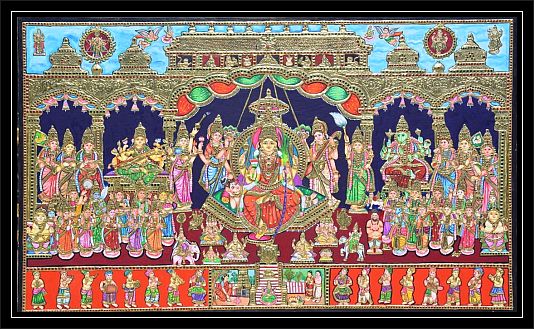
Rajarajeshwari

Continued in the Next Part

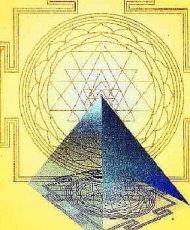
The structure of Sri Chakra


Reference;

The Tantra of Sri Chakra by Prof.SK Ramachandra Rao (1953)

 
13 Comments

Posted by on September 14, 2012 in Music, Muthuswami Dikshitar, Sri Vidya, Tantra


Tags: , , , , ,

Sri Muthuswami Dikshitar and Sri Vidya (4 of 8)

The music of Sri Muthuswami Dikshitar
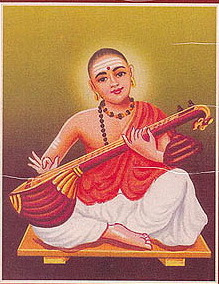
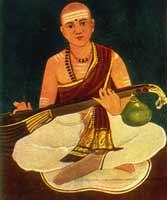
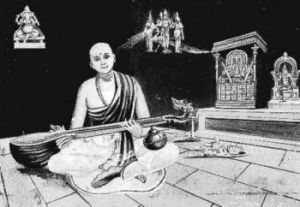
dikshithar-1 (2)

Sri Muthuswami Dikshitar was a versatile intellect. He was open to  varieties of influences. His works reflect some of those influences rather explicitly ; while some others shine through in a subtle way. Before we get into a discussion about Dikshitar’s creations, we need to recognize a few features that influenced him.

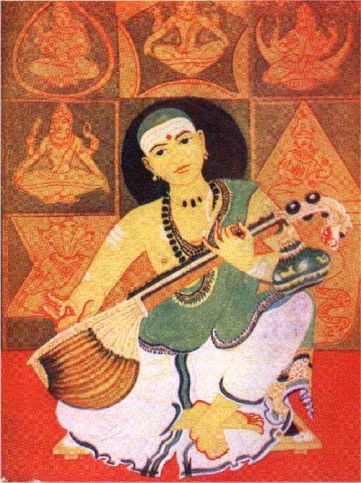
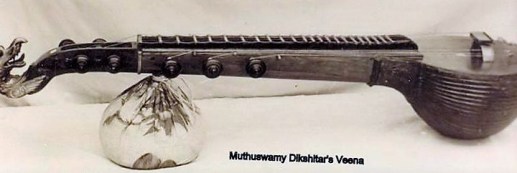
Sri Muthuswami Dikshitar was a vainika-gayaka, a musician who sang as he played on the Veena. He was well trained both in vocal and instrumental music. Naturally, the graces, the rich Gamaka prayogas of his compositions structured in slow tempo shine in mellow glow when played on the Veena.

In his childhood, he received training in the Lakshya and Lakshana aspects of Carnatic music. The Lakshana Gitams and Prabandhas of Venkatamakhi formed an important input of his training. Later, as a composer, he chose to follow Venkatamukhi’s system of Mela -classification of Ragas.

He spent seven years at Varanasi, in the prime of his youth. He was captivated by the grandeur, the spaciousness and the purity of the ancient Druphad School. He learnt Dhrupad diligently; and ,that left a lasting impression on his works.

Earlier in his teenage, he gained familiarity with Western music; and, the traces of its influence can be noticed in the movement of his songs.

He had a good command over Sanskrit; and, learnt to use it to express his ideals and aspirations in pristine poetry. He had a fascination for Sabdalankara, beautifully turned phrases and wordplay . He had the composure of a yogi and the heart of a poet. Dikshitar’s kritis are therefore adorned with poetic imagery, tranquil grace, a certain majesty steeped in devotion.

Sri Dikshitar had acquired a fair knowledge of Jyothisa, Ayurveda, and iconography and of temple architecture.

He was unattached to possessions or to a place . He was a virtual pilgrim (jangama) all his life. He visited a large number of shrines ; and, sang about them and the deities enshrined there.

He was intensely devotional ; yet, was not overly affiliated to a particular deity. He composed soulful songs in praise of a number of gods and goddesses.

He had a fascination for composing a set of  kritis exploring the various aspects of  a particular deity or the different dimensions  of a subject , as if he had undertaken a project.

He was an Advaitin, well grounded in Vedanta.

And above all,

Sri Dikshitar was an ardent Sri Vidya Upasaka; a Sadhaka, an intense devotee of Devi, the Divine Mother. He was a master of Tantra and of Yantra Puja. The Tantra ideology permeates all through his compositions.

It is the harmonious confluence of these influences that one finds in Dikshitar’s music.

***

Output:

Anandamruthavarshini  by Shri S Rajam

Sri Muthuswami Dikshitar was prolific; about 479 of his compositions have now been identified, spread over 193 ragas. These include four Ragamalikas and about forty Nottuswara sahithya verses.

[For a detailed statistical analysis of the compositions of Sri Dikshitar , as undertaken  by Dr. P. P. Narayanaswami , please click here.

Please do refer to a very remarkable site created by  a group headed by its Chief Data Analyst –  Smt. Meera Subramanian  , listing as many as 510  compositions of Sri Muttuswamy Dikshitar,  along with its lyrics , audio and video files as also the deity-wise classification of his Kritis

For the list of Dikshitar compositions compiled by Todd Mc Comb , please click here

The Website of Rasikas.org has listed 481 compositions of Sri Mutthuswamy Dikshitar . These include the four sub-categories : Guruguha Vibhakthi; Neelothpalamba Vibhakthi;Pancha-bhutha-linga Vibhakthi; and, Samgita Sampradaya Pradarshini  ]

The great Venkatamakhi who formulated the 72 Mela-kartha ragas is reported to have wondered ”of the 72 Melas only a few are known and found in practice… and will the permutation be a waste.?‘(Dr. V Raghavan:  paper presented at All India Oriental conference, at Hyderabad, 1941).

It was the genius of Muthuswami Dikshitar that gave form and substance to all the 72 Mela-kartha ragas, fulfilling the dream of Venkatamakhi. He gave expression to nearly 200 ragas of that system.

Sri Muthuswami Dikshitar was a pilgrim virtually all his life. He visited a large number of shrines and sang about them and the deities enshrined there. He was intensely devotional yet not overly affiliated to a particular deity. He composed soulful songs in praise of a number of gods and goddesses. About 74 of such temples are featured in his kritis; and there are references to about 150 gods and goddesses. The most number of his kritis (176) were in praise of Devi the mother principle, followed by (131) kritis on Shiva. Dikshitar was the only major composer who sang in praise of Chaturmukha Brahma.

Sri Dikshitar has composed songs in honor of some other lesser-known divinities : Saṇdhyā dēvīm Sāvitrīm-Rāga Dēvakriya, Ādi-Tāla; Bhūśāpatim – Rāga Bhūṣāvati, Rūpaka Tāḷa; and, Renukādēvi Samrakśtōham – Rāga Kannada Bangāḷa, Miśra Jhampe.

**

Some scholars have said that Dikshitar’s songs are summaries of Durga Suktam, Sri Suktam and Purusha Suktam.   He built in the mantras in a few krithis like Sri Raaja raajeshwari  (madyamavathi), pavanatmaja aagaccha (Naatta). For the benefit of those who couldn’t practice rituals he composed vaara krithis on navagrahas.
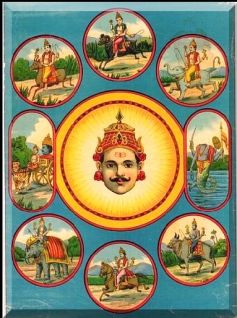
Navagraha by Raja Ravi Varma

Similarly, he opened the doors to the secret world of Sri Vidya, for the benefit of all, through his Kamalamba navavarana kritis.

Krithi Groups

Dikshitar had a fascination for composing sets of kritis on a composite theme, perhaps in an attempt to explore the various dimensions of the subject. In some of these, he employed all the eight Vibhaktis, the various cases that delineate a noun. No other composer has attempted so many group kritis in such a planned, orderly, meticulous fashion. The following are some Important Krithi Groups. Please also check here. 

The selection of Raga and Taala; and the diction of these kritis demonstrate his musical skills and intellectual refinement.

For greater information on Group Kritis of Dikshitar, please check here.

Ragamalika

Just as his father Sri Ramaswamy Dikshitar (who had composed the longest ever Raga-malika in Karnataka Samgita- the Ashtotrasata ragatalamalika – set in 108 Ragas and various Taalas) ,   Sri Mutthuswamy Dikshitar  was also an adept in the Raga-malika format. Though he did not attempt anything as lengthy or as grand as his father did, the four delightful Raga-malikas that Sri Mutthuswamy Dikshitar created are true gems of art. 

: – Madhavo-mam-patu– is a Raga-malika on the ten avatars of Lord Vishnu, with ten passages set to ten Ragas (Nata, Gaula, Sri, Arabhi, Varali, Kedara, Vasanta, Surati, Saurashtra and Madhyamavati).

 Of the ten Ragas employed in the Raga-malika, five are Ghana-ragas excellent for rendering Taana on the Veena. The sixth Raga Kedara , is invigorating and the last four Ragas are Mangala Ragas leading up to the final Mangalam in Madhyamavati.

The Raga of each passage blends admirably well its Sahitya. Here too, Sri Dikshitar adopts his favorite Vibhakthi scheme of addressing the subject. The first eight passages are in the eight Vibhakthi cases, in their order (krama) ; and , the rest two- ninth and tenth are in the accusative case . 

While rendering the Raga-malika, the singers can progress from one passage to the next without having to repeat the Pallavi of the just concluded passage. 

: – The Ragamalika Purna-chandra-bimba-vadane in celebration of Goddess Kamalambika at Tiruvarur is composed of six Charanas in six different Ragas: ‘Shad-raga-malika‘.  The Ragas are: Poornachandrika, Saraswatimanohari, Narayani, Suddhavasanta, Hamsadhwani and Nagadhwani; and, all the six belong to ‘Dheera Sankarabharana’ (29th) Mela, Sri Dikshitar’s favorite. 

: – The third Raga-malika Simhasana-sthite in four passages is addressed to most graceful Devi seated on her throne in a serene tranquil posture. The four are Mangala-prada Ragas, auspicious, soothing and peaceful – Saurashtra, Vasanta, Surati and Madhyamavati. This Raga-malika is therefore sung at the conclusion of Sri Dikshitar’ annual celebration festivals. It is also a favorite of the Bharatanatyam dancers. 

:- Perhaps , Sri Dikshitar’s most famous Raga-malika is his ‘ Chaturdasha Raga-malika’ –  ‘Sri Vishwanatham bhajeham’ set in fourteen Ragas singing in ecstasy the glory of the Lord of the universe Shiva. The fourteen Ragas are interwoven with the passages in an intricate pattern.

 Chapter 12 of Shqdhganga describes this Ragamalika as

 “ The Pallavi has two Ragas, starting with Sri Raga; and, each Raga is encapsulated in two lines of one Avarta; the second being in Madhyama kala. Similarly, the Anu-pallavi is set to four Ragas  :  Gauri, Nata, Gaula and Mohanam. But, at the end, after Mohanam, a Viloma passage takes us through the same four ragas of the Anu-pallavi and the two of the Pallavi in reverse order, back to Sri.  

The same pattern is followed in the Charanam with eight Ragas : Sama, Lalita, Bhairavam, Saranga, Sankarabharanam, Kambhoji, Devakriya and Bhupala. And, these are again taken in reverse order in a Madhyama-kala sahitya, back to the Pallavi in Sri.

Sri  Dikshitar has followed a pattern not only in the order of the occurrence of the Ragas, but also in terms of the lengths of the Avartas for each Raga.

The fifth and sixth Ragas- Gaula and Mohanam – have been allotted 1 ½ Avartas, all in Madhyama-kala; while the preceding Ragas have been given 2 full Avartas – one each in Sama kala and Madhyama kala.

The same pattern has been followed in the first half and second half of the Charanam of the Raga-malika.  Another striking feature of the Sahitya of this Raga-malika of  Sri Dikshitar is that the last part of the Svara-sahitya set to each Raga is composed of the same words as of the last part of the preceding line of Sahitya.” 

Chronological order

It is rather difficult to arrange Sri Dikshitar’s compositions in a chronological order.

His Nottuswara-Shitya verses were, of course, composed in his early years while his family lived at Manali a small town near Madras. His first composition as Vak-geya-Kara was Srinathandi in Mayamalava-gaula, at the hill shrine of Tiruttani; and, his last composition was  Ehi Annapurne in Punnagavarali while he was at Ettayapuram during his last years.

It is believed that the set of Vibhakti kritis followed his first composition. Thereafter, he traveled to Kanchipuram, Mayuram, Chidambaram, Vaidyanatha koil and Kumbhakonam. He often visited Tiruchirapalli (where it is said his daughter lived).

He spent his productive years at Tiruvavur and his final years in Ettayapuram. In between, he is believed to have visited about 70 temples; and, sung the glory of those deities. It is however not possible to arrange those kritis in a sequence.

Please check here for a map of his probable travels in South India: 
varanasi2

Before going further, we need to talk a bit about Sri Muttuswami Dikshitar’s first Kriti as a Vak-geya-Kara , Srinathandi-guruguho-jayati in the Raga Mayamalava-gaula in the fifteenth Mela (the Mela in which Sri Dikshitar composed many Kritis) . The mantra of Sri Vidya also has fifteen matras (syllables).

After submitting salutations to the past Gurus of the Kadi-matha, the principal tradition of the Sri Vidya lore (shri nathadi guruguho) , Sri Dikshitar bows down to his Guru Yogi Chidambaranatha. Elsewhere, in another Kriti  composed in Raga Purvi, a Bhashanga-janya-raga of Mayamalava-gaula, Sri Dikshitar  adores his Guru  and Master Chidambaranatha as none other than Guruguha;  and , says ‘I am the humble servant of Guruguha, or I, myself, am of the form of Guruguha himself’

 -shri guruguhasya dasoham nocet cidguruguha evaham.

The opening line Srinathandi-guruguho-jayati-jayati, which bows to all the deities and Gurus of the Sri Vidya traditions, has been much debated. This line is said to be an almost a takeoff from the opening lines of the first shloka of the Sri Vidya paddhathi:

Shri nathadi gurutrayam ganapatim  pithatrayam bhairavam / siddhaugam vatukatrayam padayugam dutikramam mandalam/ viran dvyasta catushka shashti navakam viravali pancakam/ srIman-malini-mantra-rajasahitam vandeguror mandalam

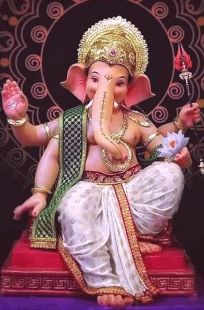
This Shloka invokes the deities and the galaxy of Gurus (Guru-mandala) in the realm of the Supreme sovereign Srividya Parabhattarika.  It begins with salutations to the three generations of Gurus (Srinathadi gurutrayam – one’s own Guru; his Guru – Parama Guru; and his Guru – Parameshthi Guru) ; and prayers to Ganapathi  (Ganapatim).
Ganesha blessing

It also recalls with reverence the three centres or seats of Shakthi (Piitha-trayam – Jalandhara, Purnagiri and Kamarupa); the eight Bhairavas (Bhairavam); the Siddhas (siddhaugam); the three celibates Brahmacharis (vatukatrayam – Skanda, Chitra and Virinchi); and then, submits to the feet of the Mother Goddess (Padayugam).

Then salutations are submitted to the group of Duti goddesses (dutikramam mandalam); to those who have attained Siddhi (Viran); to the sixty-four Siddhas (dvyasta catushka shashti); nine Mudra goddesses (navakam); and to the five supreme deities (viravali pancakam– Brahma, Vishnu, Rudra, Ishwara and Sadashiva).

Then, at the end, the devotee submits to the Goddess of Malini-Chakra with Mantra-raja; and, to all the Gurus of all the traditions of Sri Vidya (vande-guror mandalam).
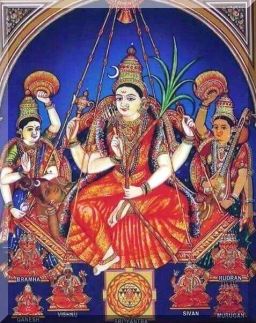
Devi sri chakra

Likewise, Sri Dikshitar, in his Kriti  –jayati , submits to his Guru, the Lord of the Universe, and all the Gurus of the Kadi Matha of the Sri Vidya tradition. And, to the Srividya Parabhattarika, the supreme Mother Goddess, who is invoked by the mantra beginning with Ka and ending with Ma (The Kadi Vidya of Sri Manmatha runs:  KA, E, I, LA , HRIM- vagbhavakua), residing in the centre of the Mani Chakra which resembles a thousand-petalled lotus.

And, to Maheshwara  the Lord  who obliterates  all types of illusions and delusions; who is meditated upon constantly by  Hamsa mantra , the Ajapa-japa (you breath out with a sound of ’Sa’; and you breath in  with a sound of ‘Ha’; and, throughout the day and night you perform the Hamsa Japa.

 (The Hamsa Japa is :  I am He , Shivo Hum, I am Shiva ,  breathing in and out continuously , instinctly and with ease ,  without being aware of your doing so. This effortless and ceaseless Japa is called Ajapa-japa).

And, to the Guruguha, Skanda, who is worshiped by kings of Mayamalava Gaula Desha and others; who is surrounded by Vishnu and other gods; and, who has expounded the real truth of Pranava to His father Mahesha.

**

The composition, ‘Sri Nathadi guruguho jayati jayati’ in Mayamalava-gau!a is ideal for the music students to practice in graded speeds, the ascent and descent of the Raga, the janta svara prayogas, alankara patterns, mandra-sthayi phrases etc.

In terms of Music, the first line of the Pallavi (Srinathandi-guruguho-jayati -jayati) summarizes all the ascending (Arohana) and descending (Avarohana) notes of the Mayamalava gaula:   “SA RI Ga Ma Pa Dha Ni SA Ni Dha Pa Ma Ga Ri”, in all the three speeds (kaala).  

[ It is said; upon his initiation into Sri Vidya Upasana , Sri Mutthuswami Dikshitar was assigned the ordained name ‘Chidananda-natha‘. In the Pallavi of his first Kriti ‘, ‘Sri Nathaadi Guruguho Jayati,’ he refers to himself by his Diksha-name (rahasya-nama) as : ‘Sri Chidananda Naathoham iti’- श्री चिदानन्द नाथोऽहमिति ]

And , in regard to Sahitya , The prathama-akshara- prasa in the Charana  and in the Madhyama-kaala–sahitya is very interesting , where each line commences with ma or Ma.

Charanam:

  •  MAyamaya vishvadhishthano
  • MAtmaka kadi matanushthano
  • MAlini mandalanta vidhano
  • MantrAdyajapa hamsa dhyAno
  • MAyakarya kalana hIno
  • mAmaka sahasra kamallsiIno
  • mAdhurya ganamrita pano
  • mAdhavadyabhayavarapradano
  • mAyashabaLita brahma rupo
  • mArakoti sundara svarupo
  • matimatam hridayagopuradIpo
  • mattashuradi jayapratapo
  • mAyamalavagauLadidesha
  • mahipati pujita pada pradesha
  • mAdhavadyamara brinda prakasha
  • maheshasya maharthopadesha

 Madhyama Kala Sahityam:

  •  MAyaamaalavagaulaadidesha
  • Mahipati Pujitha Pada Pradesha
  • MAdhavaadyamara Brunda Prakaasha
  • Maheshasya Mahaarthopadesha

Ragas:

Dikshitar followed the Mela-paddhati (a system of classifying Ragas) devised by Venkatamakhi, to whose school he belonged. In handling the Vivadi-melas, Dikshitar followed Venkatamakhi; and, avoided inharmonious expressions, prayogas.

Further, since Kharaharapriya was not a part of Venkatamakhi’s scheme; there is no known composition of Dikshitar in that Raga. The twenty-second Mela-karta was Sri Raga; the Mangala kriti of the Navavarana series is composed in Sri Raga. Again, the Venkatamakhi-tradition treated Bhairavi and Anandha Bhairavi as Upanga Ragas; so did  Sri Dikshitar.

[Though Sri Dikshitar generally followed the Asampurna-Mela system of Venkatamakhin, he was quite familiar with the other, Govindacharya’s Sampurna-Mela system as well.

For instance; the Raga of his Kriti Shri-shulinim-shritapalinim according to Asampurna-Mela is Shailadeshaksi. But, in the Kriti, he uses the Raga-mudra as Shulinim , which is the Raga-name in the Sampurna-Mela system.

Similarly, the Raga of his Kriti Hariyuvatim-haimavatim is Deshi-simharavam according to the older system; but, the Raga-mudra is Hemavathi which is the corresponding Raga-name in the other system.

And, his Kriti Shri Nilotpala-nayike in Raga Nari Ritigaula contains the Raga-mudra Natabhairavi in the Anupallavi as per the Sampurna-Mela system.]

Some scholars opine that Sri Dikshitar’s major service to Carnatic music is that he gave expression to nearly 200 Ragas of Venkatamakhi’s system. He also breathed life into a number of ancient Ragas that were fading away. Several ancient Ragas found a new lease of life though Sri Dikshitar’s kritis.

To name a few of them: Mangalakaisiki, Ghanta, GopikavasantaNarayana Gaula,Sulini, Samantha, maargadhesi and mohana naatta. Even today, their  Lakshanas are illustrated mainly through Sri Dikshitar’s creations.

There are many Ragas which are employed only by Dikshitar. Take for instance: Saranganata, Chhaya Goula,  Poorvi , Padi Mahuri Suddhavasanta ,Kumudakriya, and Amritavarshini.

In the Raga Dwijavanti, his Kritis Chetasri and Akhilandeshwari  stand out in solitary splendor.

He transformed many Outhareya, the Hindustani Ragas into Karnataka form through his creative genius. His interpretation and rendering of Ragas like Dwijavathi, Ramkali, and Yamankalyan, Hamirkalyani, and Brindavan sarang are highly original and creative. He made them into his own. His Cheta-sri is so wonderfully well adapted to Carnatic Raga-bhava that one scarcely notices the Outhareya traces in its character. He took in the best aspects of the other system;  transformed them ; and, enriched both the systems.

Shankarabharanam scale appears to have been his forte.  There are as many as 96 kritis based on that scale. The kritis in Harikambhoji scale number about 63; while 57 kritis are in Kharaharapriya scale. He had a special affinity for Mayamalava-gaula in which he composed about 51 songs. The derivatives of that scale such as Saalanga Nata, Paadi and Mangala Kaishiki would have been lost but for Sri Dikshitar.

**

About forty-four of his compositions are set in forty Vivadi Ragas. Since Sri Dikshitar followed the A-sampurna-Mela-Paddathi of Venkatamakhin , even the Janaka-Ragas might look like Janyas. But, in fact, all those Vivadi-Ragas are Raganga or Melakartas. However, they do not have Vivadi-Svara-Sancharas. For instance; Raga Shuddha-Saveri under Kanakambari; and Manohari under Gangatarangini.

As many as forty of these Melas, are Vivadi-Ragas. Sri Dikshitar uses many means (Upaya) to counteract the jarring-effects of Vivaditva. These  measures include :

    • (i) Janti prayōga – using the Svara in pairs to  reduce the Vivadi- effect;  
    • (ii)  Alpatva – minimum usage or skipping  of the Vivadi-Svaras;
    • (iii) Dheergha-prayoga -Elongating one of the Vivadi Svaras to smoothen its effect; and 
    • (iv) Langhana or Dhatu-prayoga-using  crisscross Svara pattern to reduce the Vivadi effect.

[ Please do read about the frequency Analysis of the Ragas used by Sri Mutthuswami Dikshitar , as attempted by Sri Vishnu Vasudev. Please click here.]

Taala:

Sri Dikshitar was accomplished in the matter of Taalas, the rhythmic patterns. He is the only composer to have set his music in all the seven basic Taalas. He employed all the Saptha (Seven) Taalas in his Vara-Stutis i.e. a song for each day of the week.  He is said to have used ten improvised varieties of Taalas in his compositions. The majority of his compositions are set in Adi (190) and Rupaka (139) Taalas.

 Sri Dikshitar, in his compositions, has employed only Suladi Taalas; to the exclusion of Chapu and other Taalas. Each of his Nava-Graha Kritis is set in a different Suladi Taala. 

Music:
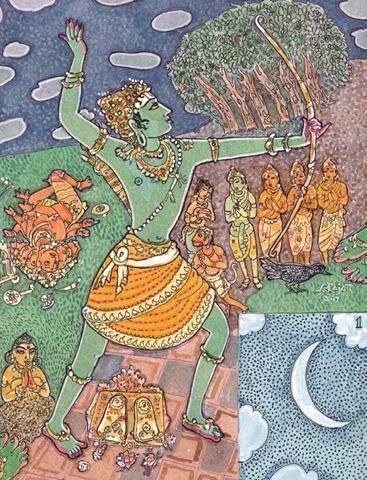
Rama

The most fascinating aspect of Sri Dikshitar’s Kritis  is the grandeur and majesty of his music, sublime lyrics, intellectual brilliance and the overall technical sophistication. They exude a tranquil joy. His vision of the Ragas and their structure is  truly inspiring.

Sri Dikshitar was blessed with the heart of a poet and the composure of a yogi. He was an intense devotee; but, was undemonstrative. There is, therefore, a certain composure, measured grace, dignity and a mellow joy glowing through his music,  as in his life.

The Druphad way of elaboration captured his imagination. The tempo of his songs is mostly the Vilamba-kala – slow, measured and majestic; rich in Gamaka just as the meends on a Veena. Sri Dikshitar aptly called himself “Vainika-gayaka Guruguha-nuta”.

[The musical structure of his Kritis display how well they are suited for playing on the Veena. For instance; he has employed wide Jaarus extensively in the phrase Murari-prabhruti occurring in his Kriti Sadashivam-Upasmahe (Raga Shankarabharanam; and, there is a Jaru from lower Shadja to Tara-sthayi -Rishabham). And again, the first line of the Charana of the Kriti Tyagaraja Maha-Dwajaroha (Raga Shri) has an elaborate Jaru :

Srishti-svarupa-vasanta-vaibhavam-ashtadhvajendra-vimana-bhuta-samashti-gaja-vrishabha-kailasa–vaham-ashlesha-mah-aratha -sthitam.]

Sri Dikshitar’s treatment of a Raga exemplifies the essence of the Raga bhaava; and, brings out its delicate shades. It is as if the musician is immersed in contemplative meditation. The graces, the rich Gamakaprayogas of his compositions structured in slow tempo shine in mellow glow when played on the Veena.

This is amply reflected in his works ; for instance in

The other compositions of this genre are: Dakshinamuthe (Shankrabharanam); Manasa-guruguha (Anandabhiravi); Ehi-Annapaurne (Punnagavarali); Amba Neelayatakshi (Nilambari), and ,each of the Nava-avarana kritis.  These are indeed monumental works.

It is not that all aspects of his music are slow and spacious. He built into his compositions exhilarating bursts of speed and sparkling delight as if in celebration of the divine spirit, towards the end. Certain kritis are interlaced with Madhyamakala-Sahitya, passages in tempo faster than the rest of the kriti (E.g. Mahaganapatim  in Nata).

Although the Kritis of Sri Tyagaraja are known for their elaborate Sangathi improvisations, there are some archaic Sangahtis in the Kritis of Sri Dikshitar as well(e.g.  in  Arunacala-natham in Raga Saranga ; and,  Pahimam-ratnachalanayaka in  Raga Mukhari).

Sri Dikshitar redefined the treatment of even the traditional Karnataka Ragas by way of elaborate beginning, rich in Gamakas resembling the sliding Meends as, for instance, in the slow paced majesty of Akshya-linga-Vibho  (Shankarabharanam);  or in Balagopala (Bhiravi), portraying the beauty of the divine child, Krishna. His Nirajakshi-Kamakshi in Hindolam with Dha flat entirely changed the way Hindolam came to be sung by his contemporaries, as also by the later Carnatic musicians.

It is believed; before the time that Sri Dikshitar went to Varanasi, the Hindola Raga in the Carnatic system was, generally, rendered with Chatusruti-Dhaivata (say, as in the kriti, Manasuloni of Sri Thyagaraja). While Sri Dikshitar was in the North, he had listened to Raga Malkauns (equivalent to Hindola of the South), sung with Shuddha Dhaivata, expanding it freely in all the three octaves. Sri Dikshitar felt such charm and appeal could be brought into the Hindola of the Karnataka-samgita. He thereafter, composed his splendid Nirajakshi-Kamakshi in Hindola with Dha flat, while retaining the purity of the Hindola Raga.

Some say; Sri Thyagaraja’s Kriti Samaja-vara-gamana in Hindola, shows the shades of Sri Dikshitar’s influence. Thais is because, his treatment of Hindola in his earlier Kriti – Manasuloni , was quite different.

*

Sri Dikshitar was well versed in the Alapana-paddhati; and, followed it in the elaboration of a kriti. The musicologists have said “The most outstanding aspect of the compositions of Sri Dikshitar is their richness in Raga-bhava”. His sense of selection of the apt Sancharas of the Raga to bring out the true emotion is remarkable. They range stretching from the Mandra to the Tara-sthayi ; and, give a complete picture of the Raga.  It is said that if you sing his kriti in Akara, it can bring out the character of its Raga. His kritis are virtually, Raga-alapana, chiseled to fit in with Taala ; and ,dressed in Sahitya.

[ Please also read Smt. Vidya S Jayaraman’s conversation with Dr.V.V.Srivatsa ]

Structure of kritis

His kritis are well structured, close knit and written in graceful Sanskrit. Sri Dikshitar’s kritis do not usually have more than one Charanam; and, as many as 157 of his creations are Samasti-charanams, carrying no Anupallavi or the Anupallavi itself acting as Charanam. His rhythm is subtle ; and, the lyrics are divine.

Sri Dikshitar’s kritis with Samashti-charanam have enriched the variety of musical forms in Karnataka Samgita. These Kritis composed in Madhyama-kala are highly popular ; e.g.

Since he did not compose multiple Charanas,  his single Charranas tended to be quite lengthy ,as compared to the Kritis composed in Pallavi-Anupallavi-Charanam format. Such fairly long Charanas, however, enabled Sri Dikshitar to provide exhaustive information about various deities, shrines, concepts of the Sri Vidya  tradition etc. The Madhyama-kala-sahitya that he employed for such Kritis, also  helped in introducing some variation in such long Charanas.

 [Perhaps his only multiple-charana creations are his Kriti ‘Maye-tvam’ (Tarangini) ; and , his  four  Ragamalikas]

Each of his compositions is unique, brilliantly crafted and well chiseled work of intricate art. It is incredible how delicately he builds into his tight-knit kritis a wealth of information about the temple, its deity, its architecture and its rituals; and about jyothisha, tantra, mantra, Sri Vidya, Vedanta etc. He also skillfully builds into the lyrics, the name of the Raga (Raga-mudra) and his Mudra, signature. 

Sri Dikshitar also built in phrases of Samgita-shastra in the body of  the few of  his kritis, sometimes giving technical details in precise ways.

For instance; in his Kriti ‘Meenakshi-me-mudam-dehi (Purvi-Kalyani), the phrase ‘Dasa-Gamaka-Kriye’ refers to Dasavidha-Gamakas discussed in ancient music-texts.

And, similarly, the phrase ‘Dvisapatati-raganga-raga-modinim’ in the KritiSringira-rasa-manjariin Rasamanjari Raga (Rasikapriya) refers to the scheme of seventy two Melas. 

Language and wordplay 

Except for one kriti in Telugu and three Mani-pravala-kritis (Sanskrit+Telugu+Tamil) , all his other compositions are in Sanskrit.

[ The term  is said to be made of mani + pravala,  meaning a mixture of gems and coral]

Sri Dikshitar is credited with one Chauka-kala-pada-varnam – ‘Rupamu juchi’ (Todi, Ata taala) and a Daru Ni sati (Sriranjani) also in Telugu.

Sri Dikshitar had a good command over Sanskrit; and, had learnt to express through it his ideals and aspirations in pristine poetry. He had the composure of a yogi and the heart of a poet. Sri Dikshitar’s  kritis are therefore adorned with poetic imagery, tranquil grace, a certain majesty steeped in devotion.

He had a fascination for Sabda-alankaras, adorning his poetry with beautifully turned phrases ringing sweetly like temple bells; captivating rhymes of Prasa and Anuprasa. He loved the intricate play of words and to coin sweet sounding phrases. Look at the pada lalithya, a grand procession of enchanting phrases : 

  • Akalanka darpana kapola vishesha
  • Mana matrike maye marakata chaye
  • Devi Shakthi beejodbhava matrikarna swaroopini
  • And
  • Komlakara pallava pada kodanda Rama.

 The rhyming and ringing phrases – Shyamalanga- vihanga- sadayapanga-satsanga- are of unparallel beauty.

***

The structures in the compositions of poetry and of a Kriti, as also in the playing of the Mrdanga are said to follow certain rhythmic patterns (Yati-s). 

There is, of course, the usual format which follows the uniform length of lines (Sama).

In addition, there are certain varied and improvised patterns of composing and structuring the lines in a Kriti; such as :  

(1) broadening or increasing like the flow of  a river (Srotovaha);

(2) tapering or decreasing like a cow s tail (Gopuccha);

(3) increasing, then decreasing;  broadening towards the middle like the contours of a drum (Mrdanga); and,  

(4) first decreasing and  then increasing; narrowing towards the middle, as the contours of an hourglass-shaped drum (Damaru).
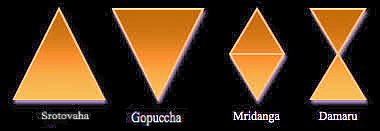
composition patterns

And, there is also an arrangement that is devoid of any obvious pattern; it could be irregular or rugged (visama). It is rather difficult to define or illustrate such patterns.

Sri Dikshitar who was well versed in Kavya-prayoga, composing poetry, was, obviously familiar with these geometric patterns that were  meant to  improvise the structure of lines in a stanza.

*

Sri Dikshitar often structured his lyrics in geometric patterns. He enjoyed a childlike delight in employing Yatis (geometric patterns) such as Gopuccha (tapering like the tail of a cow) or it’s opposite, the Sorotovaha (broadening like the flow of a river) for structuring his lyrics. For instance; in his Sri Varalakshmi (Sri) and MayeTwam-Yahi (Sudha Tarangini) he used the tapering pattern of Gopuccha.

Sarasa Pade,

Rasapade,

Sapade,

Pade.

de

Sarasa Kaye

Rasakaye

Sakaye

Aye

In his kriti Tyagarajayoga Vaibhavam (Anandabhairav) , Sri Dikshitar uses both the YatisGopuccha Yati and Srotovaha.

The phrases are:  Gopuccha Yati (like a cow’s tail):

Tyagaraja Yoga Vaibhavam

Agaraja Yoga Vaibhavam

Rajayoga Vaibhavam

Yoga Vaibhavam

Vaibhavam

Bhavam

Vam


 And Srotovaha Yeti (flowing or expanding like a river )

Sam

Prakasham

Svarupa Prakasham

Tatva svarupa Prakasham

Sakala Tatva svarupa Prakasham

Shivashaktyadi Sakala Tatva svarupa Prakasham

design rangoli

Alamkaras

Sri Dikshitar brings out the beauty of the Raga and the Sahitya, at many places, through the Svarakshara. For instance:

In the Kriti ‘Pancamatanga-mukha-Ganapatina-paripalitoham-Sumukhena-SriMalahari, Rupaka), the Pallavi is set to the Svaras ‘Pa- dha-Ma- pa –dha- pa- ma- ga- ri- sa- pa- dha- Sa’

In the Kriti ‘Sadacalesvaram-bhava-yamham’ (Bhupalam, Adi), the Pallavi has the Svaras ‘sa- Dha- sa- Pa’

*

Sri Dikshitar , at times, used Svara-sahitya i.e., the words matching with the syllables of the notes. For instance; Sadasrita (in Akshayalinga Vibho) could be tuned as Sa-Da-Pa-Ma; and, Pashankushsa-Dharam (in Siddhi Vinayakam) could be tuned as Pa- SA- Ga- RI- Ni- SA.

Muhana Prasa

Rhyming in the first letter of line is called Muhana. One can observe it in the entire Carana of the Kriti Tyagarajaya-namaste (Begada, Rupaka) as follows:

Mukundādi-pūjita-sōmaskanda-mūrtaye / Muchukundādi-bhakta-jana manōratha pūrtaye/ Mukurabhmba pratibimbitha mukha-spurthaye / Munipaki mga kītādi mukti-pradakīrtaye

Dvitiyakshara Prasa

Rhyming in the second letter of each line is called Dvitiyakshara Prasa. One can observe it in the Carana of the Kriti Tyagarajam-bhajare (Yadukula-kambhoji, Rupaka) as follows

pauādi dikpālapūjita gātram / nītpalāmbānukūla tara kalatram /  trikya guru guha tātam trinetram / sailōkādi kaivalya prada caritram /

 Antya Prāsam

Rhyming words at the end of the lines is called as Antya Prasa. One can observe it in the Anupallavi and in the entire part of Carana of the Kriti Ttyagarajo-virajate (Athaa, Rupaka) as follows:

Vāgartha mayabhuvana rājo / Hari vānchitārtha prada rājo / Hara śri guru gua ganea rājo /Samsevita rājādi rājo /

Gamakas

 A striking feature of his compositions is the Jaaru Gamakas; both the upward and the downward slides: Digu-Jaarua and Ettaru-Jaaru. For instance; in the Kritis Hiranmayim Lakshmim (Lalita);  Arunachalanatham (Saranga);Ananda-natana-prakasham (Kedara) and , “Kari-kalabha-mukham’ (Saveri), one can see abundant use of Jaaru Gamakas.

He also uses many Chittasvara patterns like in the Kriti ‘Balambikē’ (Manoranjani), which has Shuddha-Rshabha and Shuddha Gandhara, bringing in the Vakratva: Ri- Ga- Sa-Ri-Ni-Sa-Dha-Sa,’; ‘Sa-Sa-Ri-Ri-Ga-Ri-Ga-Ga-Ri-Ri-Sa’.

Madhyama-Kala- Sahitya

The slow gait of his compositions is often balanced with an ornamentation of Madhyama-kala-Sahitya or Chittasvaras (For instance: Anandeshwarena-samrakṣhitoham Anandabhairavi -Chapu Taala; and, Soundara-rajamashraye– Brindavanasaranga- Rupaka Taala)

The Madhyama-Kala -Sahitya is one among the many interesting decorative features (Anga) of the Kritis of Sri Dikshitar.  It is seen mostly after the Carana; but, in some cases, the Madhyama-Kala section is also in the Anupallavi. It is also seen in both the Anupallavi and in the Carana; but, it rarely is also seen in Pallavi or in all the sections. The tempo of the Madhyama-kala, in all these cases, is double the tempo of the actual Vilamba Kala. There are numerous instances in his Thyagaraja- Vibhakthi –Kritis.

Apart from the Vibakthi group, the Kriti Tyāgarāja-mahādwajārōhanam in Sri Raga has the Madhyama-Kala passages in all its sections – Pallavi, Anupallavi and Carana.

Raga Mudra

Sri Muthuswami Dikshitar set the trend for embedding Raga-mudra, the name of the Raga, in the lyrics. This served the purpose of establishing the Raga of the kriti; and, it also added a novel lyrical beauty. Sometimes the Raga-mudra could be as simple as Brindavana  Sarangendra;  or Satchidananda  Bhiravisham; or  Krithika  Suddha Dhyanyena.  

In the Kriti ‘Panca-Matanga’ (Malahari),the Raga-mudra is woven in the phrase ‘Kali-malaharaa-caturea’. And, in the Kriti ‘Sri Parvathi- Parameshvarau’ (Bhouli), the Raga-mudra is embedded in the phrase ‘Chithbim –boulila- vigrahau’.

 In the Kriti Tygāgaraja-pālayāṣumām (Gaua) the Raga-mudra is in the phrase ‘suthārtānga gaulāga’. In the Kriti Tyāgarāja-yōgavaibhavam (Anandabhairavi) it is depicted as ‘sacchit-ānanda-bhiravīam’. And, in Viravasanta- Tyāgarāja (Vīravasanta) it is in the beginning as ‘Vīravasanta-Tyāgarājamām’.

*

But, at times, he would ingeniously suggest the Raga by hiding it in a complex word, through shlesha, a skillful play on words. For instance, as in:

(Veena+Abheri) to suggest Abheri;

(Panchamukha+arishadvarga_rahita) to suggest Mukhari; and

(Chidbimbou+lilavigrahou) to suggest Bouli

Some of the Ragas have peculiar names and require great skill to blend them into the composition. For example; the Raga names like Paraz, Mahuri and Arabhi are rather unusual; and yet, he successfully binds them into the composition without marring  its  literary merit . For instance :

“Bhakthajananam athisamiparujumarga darsitam,

Tvamahurisadayo, Samsarabhithyapaham.”

Again there is a Raga with the name ‘Andhali’ which conveys no specific meaning. But in ‘Brihan-nayaki-varadayaki’ through the phrase   ‘Andhaliharana-chana-pratapini’ he develops a fine poetic expression out of it: “The fragrance of her shining beauty attracts even blind bees.”

The name of the Raga ‘Varali’ enhances the artistic beauty of the song ‘Mamava-Minakshi through the phrase ‘Madhuravani-Varali-veni.’ These are typical of Sri Dikshitar’s poetic excellence and his ability to achieve natural flow of delightful phrases set to sublime music.

Sri Dikshitar also specialized in the use of different Vibhakti (the various cases that delineate a noun) running parallel. A striking example is the first batch of eight krtis he composed in praise of Lord Subrahmanya of Tiruttani.

Sanskrit language employs eight cases (vibhaktis) for the declination of a noun, namely nominative (prathama), accusative (dvitIya), instrumental (tritIya), dative (chaturthi), ablative (panchami), genitive (Shasti), locative (saptami) and vocative (sambhodhana). The eight cases for the noun Guruguha would be: Guruguhah (Guruguho); Guruguham; Guruguhena; Guruguhaya; Guruguhat; Guruguhasya; Guruguhe; and, (hey or Oh..!) Guruguha.
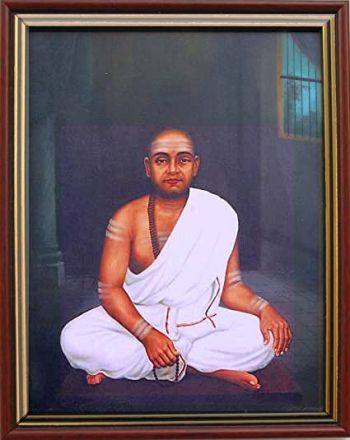
Mutthuswamy Dishitar

Dance

Many of the Kritis of Sri Mutthuswamy Dikshitar are eminently suited for depiction in Dance form. Just to mention a few: Rupamu-juchi (Todi, Adi Taala); Meenakshime mudam (Gamaka-kriya, Adi); Chetah-Sri-Bala-Krishnam (Dvijavanthi, Rupaka) Kadambari Priyayai (Mohana, Misra Chapu) and Arunacha-natham (Saranga, Rupaka)

They also present a graphic picture of its principal characters.

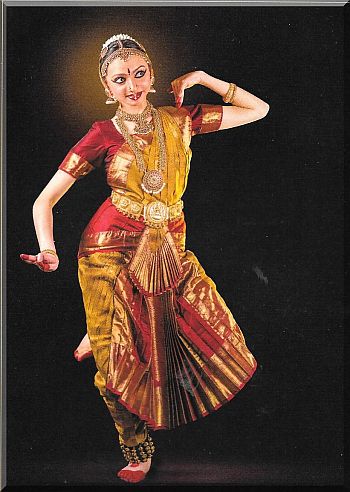
Meenakshime-mudam-dehi-mechakangi-Raja Matangi (Gamaka-kriya, Adi-Taala) is graphic picture of the Mother Goddess Meenakshi. The descriptive lyrics vividly portray the beauty, the grace and the virtues of the Goddess. It offers abundant scope for the Dancer to  to meaningfully express through her Abhinaya the various facets of Her beauty , her power and her compassion. And, shades of Srngara are also woven into it by employing the Rati as the Sthayi Bhava; and, Moha, Harsha, Jadata, Mati and Vitarka as Sanchari Bhavas.

Sri Dikshitar weaves a picture of her beauty; with her eyes (Meenakshi, Meena-lochani), her face (vadane-vidambana – vidhu); her arms (mani-valaye); her radiant skin (marakata chaaye); and her waist (shaath-udari), which captivates all (vashankari) ,

Describing virtues and the nobility of Meenakshi, he calls her as: the fountainhead, the Mother of all knowledge (Maana-Matru; Meye); the means of achieving knowledge (Maye); adept in the art of Music (Dasha-kriye); the most compassionate Mother (Hrudaye) who rids one of all bondages (Pasha-mochani).

She verily is the loveliest one who resides in the Kadamba grove (Manini, Kadamba-vana-vasini). She the beloved of Mahadeva-Sundaresha (Mahadeva-Sundaresha-Priye) is the jubilant victorious one (Vijaye).

*

Chetah-Sri-Bala-Krishnam-bhajare (Dvijavanthi, Rupaka Taala) is a delightful word-picture of the most adorable child Krishna.  It lovingly describes the beautiful features of the boy Krishna. One might even say, it is a form of meditation.

O mind, worship the child Krishna, the one who grants liberation; and the worship of whose lotus-feet assures fulfilment of all the desired objectives in life.

The child of Nandagopla is resplendent like the rain-bearing cloud; his neck is shapely like a conch; and, he is adorned in yellow glowing robes. The upholder of the Govardhana mountain, the spouse of Rukmini , the one who is the slayer of Putana and other evil-doers, is indeed the incarnation of Purushottama (Vishnu), whose arena of sport is the hearts of sages which are  free  from passions ,.

The mouth of the Bala Krishna is fragrant with the  smell of fresh butter; the soft-spoken one; the one whose eyes are like lotus-petal; the one reclining on a Banyan leaf; the one whose nose is shapely like a Champa flower; the one who is radiant like the flax flower; the one bowed to by Indra and the other seven protectors of the eight directions of the world; the one wearing a deer musk Tilaka on his forehead; the one wearing fresh Tulasi and forest-flower Vanamala garlands; the one encircled by Rishis like Narada; the guardian of the worlds; he indeed is  the cowherd extolled by Guruguha.

*

The Kriti Ananda-natana-prakasham, in the Raga Kedara , dedicated to Lord Nataraja of Chidambaram, is another Kriti that is eminently suited for Dance. The Kriti is studded with ‘Sollukattu’ that or Bols , the  vocalized syllebles.

*

And, on the occasion of the Arangetram of  Kamalam , one of his disciples  and also one of the Dasis attached to the temple of Sri Thyagarajaswami at Tiruvarur, Sri Dikshitar composed a Padavarnam on Sri Thyagesha – Rupamu chuchi- in Raga Todi; and, a Daruvarnam – Nin sati Daivamandu ledani– the Raga Sriranjani.

*

Sri Mutthuswami Dikshitar’s  two Kritis – Kadambari Priyayai and Arunacha natham – do definitely differ from his other well known compositions steeped in Bhakthi and Vairagya Bhavas.

The Kriti Kadambari Priyayai-Kadamba Kananayayi –Namaste –Namaste  (Raga Mohana, Misra Chapu Taala) is beautifully suited for an elaboration as a Padam in a Bharatha-natya recital. It brings nature and Srngara Rasa together beautifully.  Its Kala -pramana is eminently suited for Abhinaya.

In his other Kriti – Aruaachala-natham-smarami-anisam-apeeta kuchamba-sametam  (Saranga, Rupaka Taala) , which is based in Srngara Rasa, Sri Dikshitar brings out the Nayaka-Nayika-bedha in its fullest expression.

The sheer beauty of this piece lies in the fact the Nayaka-Nayika-bedha is installed within a larger Bhava of Madura-Bhakti, wherein the Jeevatma and Paramatma are in union.

Here in these cases, Srngara should be viewed as an aspect of Madhura Bhakthi; and , should not be taken as  something that is improper .

**

Guruguha:

The mudra, the signature for his kritis occurs as Guruguha not only in his classic creations commencing with Srinathadi, but also in this earlier Sanskrit verses grouped under Nottuswara-Sahitya. The term Guruguha means the Guru dwelling in the cave of my heart; and it normally refers to Kartikeya. The term however acquires shades of other meanings depending on the context.

Sri Dikshitar was an Advaitin; and, in that context, the term Guru refers to the Supreme Principle Brahman. In his Sri Guruguha-dasoham he says” I am Guruguha”.

Sri Dakshinamurthy, the yogic incarnation of Shiva, is often referred to by Sri Dikshitar as Guruguha.

Again, in his Jambu-pathe (yaman-kalyan), he refers to Shiva the Guru in  nirvikalpa-Samadhi as Guruguha, the attribute-less (nir–vishesha), blemish-less (niranja) supreme consciousness (chaitanya)

– nir-vishesha- chaitanya- niranjana- Guruguha Guroo

Sri Dikshitar was also a yogi. In his Shrinathadi-guruguho-Jayati, the Guruguha is the Lord seated in his Sahasrara-Lotus; and, absorbing the nectar of his sweet music

In the Shakta tradition, the universe is interplay of Shiva and Shakthi. The Guru is Shiva the body, and Shakthi the energy as Guhya-shakthi, the intrinsic power. Guruguha is at times a wordplay based on this dual principle.

Sri Dikshitar was also a Srividya-Upasaka ;and, as per its tradition ,he submitted his salutations to that Guru-parampara (the linage of his Guru’s). Sri Vidya graduates the evolution from the most subtle form (Shukshma) to the gross in 36 steps; the first being Shiva-tatva , and the final one being Prithvi-tatva.

According to this School, Shiva is Adinatha the progenitorShiva is Adi-guru. The Tantric texts identity the Guru and the Mantra with the deity; the three are one. The Mantra represents Manas (mind), the Devata stands for the Prana (vital force); and, the Guru represents the aspirants own self (Atman).  That is the reason Sri Dikshitar in his Sri Guruguha-dasoham exclaims : “I am Guruguha”.

In the Sri Vidya tradition, the Guru is not an abstract concept. Guru is an individual. He also symbolizes the hoary tradition Sampradaya in a succession of masters. The human guru is the contemporary master; who has descended in an unbroken line of gurus beginning from Adi Guru Shiva himself. He not only reveals the transcendental reality to the disciple; but also helps him to realize his own essential reality (svartha–parartha-prakatana-paro-guruh). Devotion to the human guru is to purify the mind and fortify it with the spirituality of the Guru. In his Anandeshwara (Anandabhiravi), Sri Dikshitar refers to his Guru , who initiated him, as the incarnation of Guruguha (jnana-pradana- Guruguha-rupa).

Sri Dikshitar refers to the Guru-parampara as Adi- guruguha-varena. He mentions Paramashiva, Durvasa, Agasthya, Hayagreeva and other Gurus of Sri Vidya tradition. Elsewhere, he makes a mention of twelve Upasakas in three Schools of worship in Sri Vidya – Kadi, Hadi and Sadi – in his line  Kamadi-dwadasha-bhi rupasthitha-kadi -hadi -sadi-mantra- rupinya-iharena-navanathena-adyena. Shiva is Adi-guru, the Guruguha  who resides in the cave of the heart.

Influence of Advaita

Sri Muthuswami Dikshitar was well grounded in Vedanta ; and ,he was an Advaitin. The influence of that School of Vedanta is visible in several of his kritis.

For instance;

In these compositions, he speaks about the identity of jiva and Brahman; the superimposition, Aadhyasa; the seemingly real yet not- real (Maya); the errors in perception, each atom being the microcosm of the universe (chidvilasa koti koti cidabhasa) and other Advaita concepts. In his Kamalamba Navavarana kritis in Shankarabharanam he declares “I am guruguha”.
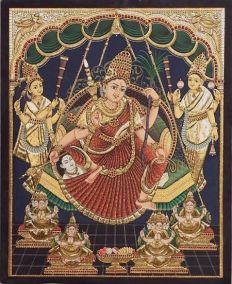
Lalitaparameshwari

Influence of Sri Vidya

Sri Muthuswami Dikshitar was a Devi Upasaka; and, was well versed in all aspects of Sri-Vidya-Upasana. His kritis, permeated with Sri Vidya concepts, are too many to be listed here. The prominent among this genre is the Kamalamba-navavarana -kritis, a series that is rich in celebration of the deities and traditions of Sri Chakra worship, expounding in each of its  nine kritis, the details of the each Avarana of the Sri Chakra.

According to Sri Dikshitar, Sri Vidya protects the devotee: Bhaktanam Abhayapradam; leads his way to well being ; and, also to the way to liberation (bhukti-mukti-prada-margam) .He sings in inspired devotion; and, beseeches the Divine Mother to protect him ; and, to guide him along the right path.

There are references to Shaktha tradition in his Nilothpalamba-Vibhakthi compositions, the Guruguha Vibhakthi and Abhayamba Vibhakthi compositions, in addition to references in several individual compositions.

Dikshitar composed about 40 kritis spread over four sets of compositions on the subjects related to Sri Vidya; Kamalamba Navavarana (11+2 kritis); Nilothpalamba kritis (9 kritis); Abhayamba kritis (10 kritis) and Guru Kritis (8 kritis).

Of these the Kamalamba set of kritis, is highly well organized; and, is truly remarkable for its classic structure , majesty and erudite knowledge.

Let us talk more about Sri Chakra, Sri Vidya and their influence on Sri Dikshitar, in the next sections.
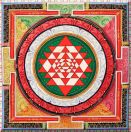
tt65

Sri Muthuswami Dikshitar was a many splendored genius. He gave form and substance to all the 72 Mela-kartha-ragas. Besides, he breathed life into several ancient Ragas that were fading away from common memory. He redefined the paradigm of Karnataka Samgita . Each of his compositions exemplifies the essence of Raga-bhava; and captures the depth and soulfulness of the melody. His vision of the Ragas and their structure is sublime.

His compositions are crisp, well chiseled and rich in knowledge.  His Sanskrit is delightfully captivating. His synthesis of Karnataka and Hindustani Music systems is creative and original. He took the best in the other systems and adorned the Carnatic System; enriching both. Dikshitar revolutionized Karnataka classic ethos , while being  firmly positioned within its orthodox framework.

He excelled in all the four aspects of the traditional music viz. Raga, Bhava, Taala and Sahitya. The technical sophistication, intellectual brilliance and the majesty of his music is unsurpassed.

Sri Dikshitar was a scholar well grounded in good tradition (sampradaya). To him, music was more than an art; it was serene contemplation; a way of worship in tranquility; and, it was also an outpouring of his soul in celebration of the divine. He described the divine as embodiment of Raga, Bhava and Tala (Bhava-Raga-Taala – swarupakam).

He was a yogi, with the heart of a poet; there is therefore a certain composure and majesty in his music along with sublime poetic imagery adorned by grace and enchanting beauty. His Kritis exude with soulful repose, peace and transcendental joy.

[It is said; the compositions of Sri Thyagaraja reveal, as in a mirror, his personality; his family circumstances; his problems in life; his varying moods; his pains and pleasures; his spiritual yearning; and, his intimate mystic experiences. It seems possible to reconstruct his life-events and personality by piecing together some of his compositions. The same could be said, to a certain extent, in the case of few other musicians, such as: Jayadeva kavi; Kshetrayya; Annamayya; Sri Purandaradas; Sri Shyama Sastri; and others.

(For a comparative study of the compositions of Sri Dikshitar and Sri Thyagaraja , written by the well-known musician-musicologist Prof. S R Janakiraman, please click here and also here)

But, in the case of Sri Dikshitar; his compositions are remarkably free from personal elements. We may admire his scholarship, his mastery over language and music; his superb artistry enriching his creations with beauty and excellence; his dexterity in weaving together and harmoniously synthesizing various strands of elements into precise, compact, faultless Kritis; and, his greatness, in general.  But, we do not get to peep into his family circumstances, his personal likes, dislikes, pains and pleasures in his life. He hardly brings into his works, the personal issues or factors; or, his reactions or views on the life around him. There is a sense of detachment; and, Yogic poise that permeates his compositions.

That does not mean that Sri Dikshitar, as a person ceased to be human.  Sri Dikshitar was a Jivanmukta, the one who is liberated even while encased in the body. He existed in the real world; but, his moorings and attachments in the phenomenal world had withered away. He rested in himself (Svarupa-pratishta). And, he regarded his Music pursuit as a spiritual quest in search of the most sublime state of consciousness, his identity (sva-svarupa-prapti) with the Mother goddess.]

aravinda

Continued in Part Five

Sri Chakra and Sri Vidya

Sources:

Compilation of Dishitar’s compositions  Dr. P. P. Narayanswami’s page
Statistical Analysis of Dikshitar’s compositions – Dr. P. P. Narayanaswami’s page
Group Kritis of Dikshitar

List of temples mentioned in his works

 Muthuswami Dikshitar – A Creative Genius by Chitravina N Ravikiran

Guru principle and Guruguha in Dikshitar

https://ramsabode.wordpress.com/2008/11/19/lec-dem-the-beauty-of-sangeetham-sahityam-in-muthuswami-dikshitars-compositions/

I gratefully acknowledge the paintings by Sri S Rajam
 
10 Comments

Posted by on September 14, 2012 in Music, Muthuswami Dikshitar, Sanskrit, Sri Vidya


Tags: , , ,

Sri Muthuswami Dikshitar and Sri Vidya (3 of 8)

Dikshitar and Hindustani music

dikshitar.3 jpg

While you read the article….listen to
  Jambu pathe maam pahi  in Yaman Kalyani sung by Shri TM Krishna

(Thanks to Sashidhar Vasisth)

[The majestic Jambu pathe (Yamuna Kalyani, Rupakam) a masterpiece by Sri Dikshitar, is based in the Hindustani Raga – Yaman Kalyan. The stately gait of the composition is akin to the Dhrupad style of singing.  The kriti is one of his Pancha linga group kritis extolling the manifestations of Shiva among the five elements of nature (Panchabhuta); and, is in celebration of the water-element (Appu), singing in praise the glory of Jambukeswara the deity in the temple at Tiruvanaikaval near Trichy in Tamil Nadu.

Jambupathe -Shri SRajam
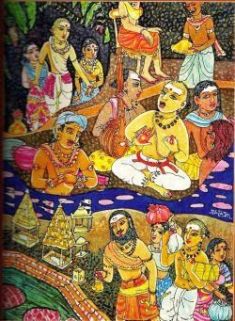
The final passage – Madhyama-kala- sahitya – nirvikalpaka samAdi nishta Siva kalpakataro ; nirvisesha caitanya niranjana guruguha guro – is a rare gem , a true classic, where Sri Dikshitar calls out to Shiva , pure consciousness (caitanya), devoid of attributes (nirvisesha); the Supeme Guru (Guro);  and the one from whom originated the pristine purest (niranjana) Lord Guruguha.

 To  summarize Sri Ravi Rajagopalan in the series of articles  on : Yamuna Kalyani–A Journey Back in Time-Part III :

Sri Dikshitar invokes the deeply meditative and contemplative structure of the devotional Dhrupad in this composition. The Devotional Dhrupads are always composed in cau tala and are sung in slow tempo. The rendition of the complete composition is compulsory and no part of the devotional text is indispensable. The Alapa is either omitted or reduced to a few characteristic phrases of the raga. Rhythmic and melodic improvisation too is given little space and in some temples and traditions, improvisation is avoided.

The similarities ‘Jambupate’ has with the devotional Dhrupad give us a clue as to how the composition has to be rendered and there can be no doubt about it.

Sri Dikshitar’s Yamuna Kalyani as found in “Jambupate” has Sa, Ga and Pa as the chief nyasa svaras, Ni and Ma figuring prominently with M1 as an alpa prayoga figuring in avarohana passages through the murccana GM1R & Ni is  vakra in aroha passages. Ga and Pa seem to be the amsa svaras with Ri being very weak. The sancaras range from mandhara Pa/Dha to tara sthayi Ga. In fact there is no tradition of singing Dikshitar’s Jambupate in Madhyama sruti, while all others including the modern tuned up compositions such as  “Krishna nee begane” and “Bhavayami Gopalabalam” are all sung in Madhyama sruti.

jambukeswarar-templejambukeshwara

Please check the link for the text and brief explanation  http://guru-guha.blogspot.in/2007/11/dikshitar-kriti-jamboo-pathae-raga.html ]

lotus

During his stay at Varanasi, Muthuswamy Dikshitar enjoyed splendid opportunities of listening to Hindustani music in its pristine forms. He seemed to be impressed greatly by the ancient Drupad form of singing and of playing the string instruments; particularly by its elaboration of raga (alap), the tempo and the structure of the lyrics . He diligently studied and learnt the Druphad. This had a profound influence on his creative genius, and apparently modeled his portrayal of ragas in general and in transforming the Hindustani ragas into Carnatic form, in particular. His synthesis of Carnatic and Hindustani Music systems is creative and original.

Singing

The influence of Hindustani music on Dikshitar and his works are manifold. It is not confined to composing some kritis based on Outhareya that is Hindustani ragas. The influence is evident in the structure of his kritis, the tempo of his music, in the selection of the Talas and in elaboration of the raga too.

His kritis are well structured, close knit and written in graceful Sanskrit akin to Druphad compositions. Dikshitar’s kritis do not have more than one Charanam; and many of his creations are Samasti-charanams carrying no Anupallavi or the Anupallavi acting as Charanam. His rhythm is subtle and lyrics are divine.

The Druphad way of elaboration appears to have captured his imagination. The tempo of his songs is mostly the Vilambakala– slow, measured and majestic; rich in gamaka just as the meends on a Been. Dikshitar’s treatment of the raga exemplifies the essence of raga bhaava and brings out its delicate shades. It is as if the musician is immersed in contemplative meditation. A scholar aptly remarked “…. Dikshitar’s kritis are epitome of the spiritual record of India”.

This is amply reflected in his works: for instance in Chetasri (Dvijawanthi);, Balagopala (Bhairavi); Sri Rajagopala, Meenkshi-Me-Mudam (Poorvikalyani); Jambu pathe maam pahi (yaman-kalyani); and, in  Sri Subramanyaya Namasthe (Kambhoji).

It was not all slow and spacious. He built into his compositions exhilarating bursts of Madhyamakala gathi, of speed and sparkling delight as if in celebration of the divine, towards the end.

He did not merely import the Hindustani ragas but transformed them and gave them an entire new form and luster. That was the creative genius of Dikshitar. For instance, his interpretation and rendering of ragas like Dwijavathi, Ramkali, Yamakalyani, Hamirkalyani, and Brindavan sarang are highly original and creative. He made them into his own. His Cheta sri is so wonderfully well adapted to Carnatic raga_bhava that one scarcely notices the Outhereya traces in its character. 

Similar is the case with his Kriti in Raga Bhairavam (Kaala Bhairavam bhajeham) , which has the shades of Ahir Bhairav. And, his Kriti in Raga Kashi – Ramakriya  (Soma-skanda vimanastam) has the flavour of Raga Pooriya.

He took in the best aspects of the other system, transformed them and enriched both the systems.

His Jambupathe (Yamankalyani), Parimalaranganatham (HamirKalyani),  Rangapuravihara  (Brindavana Saranga) and Mamava pattabhrama (manirangu) bear testimony to his virtuosity. They are the bench-mark kritis in those ragas; and, are splendid examples of aesthetic excellence of the ragasancharas.

The Hindustani influence spilled over to some of his compositions in Carnatic ragas too, by way of elaborate beginning and by gamakas resembling sliding meends;  as , for instance in :

the grandeur and slow paced majesty of Akshyalinga Vibho (Shankarabharanamin contemplation of the Shiva the Yogi;

 the Balagopala (Bhiravi), portraying the delight and  beauty of the divine child  Krishna.

his Nirajakshi Kamakshi in Hindolam with dha flat re-defined the way Hindolam was sung by his contemporaries and by the later Carnatic musicians.

design2

Justice Sri T L Venkatarama Aiyar , in his biography of Sri Mutthuswami Dikshitar (National Biography Series, National Book Trust, 1968) , observes that during the days of Venkatamakhin , the differences between the Karnataka and Hindustani systems were not much pronounced. And, Venkatamakhin was well versed in both the systems of Music; and, he composed Lakshana-Gitas on Ragas that  were known to have been derived from the Outhareya -Ragas.

For instance; Venkatamakhin composed a Lakshna Gita  , commencing with the words ‘ Ambarakesha Shambu Re’–  for the Raga Brindavani (based in the Hindusthani Raga Sarang). The Raga-sanchara, the Aroha  (Sa Ri Ma Pa Ni) and Avaroha  (Sa Ni Pa Ma Ri Sa) of the Raga handled by him is the same as that of the Karnataka Raga Madhyamavathi – except that it takes also Kakili (Tivra) Nishadha and has certain other characteristic Sancharas. The Lakshana of Brindavani in this Gita , conforms fully with that of Raga Sarang of Hindustani system.

After the days of Venkatamakhin, the Raga Brindavani came to be known as Brindavana Saranga, combining in itself  the names of both the systems. Under the new Raga, there was an occasional use of Sadharana (Komal) Gandhara. And, the Kakili-Nishada-Prayoga was dropped; and, this completely changed the complexion of the Raga.

*

Sri Mutthuswami Dikshitar, who followed Venkatamakhin’s system, was also well versed in the Dhrupad of the Hindustani system; and, he adopted a similar approach. He created numerous other musical gems, assimilating the the beauties of the either melodic systems.  Of these , a special mention needs to be made of the Kriti in the Raga Yaman Kalyani (based in the Raga Yaman) – Jambu -pathe mam pahi – which, for its richness of Raga-bhava and and grandeur, stands unrivalled.

The two other Kritis composed Sri Mutthuswami Dikshitar dedicated to  Lord Pashupathishvara and Sri Sathyanarayana  are  in Shiva-Panthuvarali (now called Shubha-Panturarali). This Raga corresponds to Mikya-ki-Todi of Hindustani system . These Kritis gained great popularity; and, until then Shiva-Panthuvarli was a rather an obscure Raga in the Karnataka samgita. Though the Shiva-Panthuvarali was primarily based in an Outhareya Raga, it had its own originality , and was pure. That was the creative genius of Sri Dikshitar.

Similar was the case with Raga Sarang (Brindavani ), Malkhauns (Hindolam).

And, his Kriti in Hamir Kalyani – Parimala Ranganatham- is again a brilliant composition, bringing out the characteristic features of the Raga in its Hindustani mode, occasionally touching upon Raga Kedar.

Raga Jaya-Jaya-Vanthi is another Hindustani Raga which has been adopted into Karnataka Samgita , as Dwijavanthi.  The Kriti – Chetas-Sri-Balakrishnam– composed by Sri Dikshitar in the Raga Dwijavanthi is a magnificent structure featuring a full view of the Raga in all its  aspects. And, therefore, this Kriti is rightly regarded as the epitome of the Raga Dwijavanthi.

There is another Raga called Malava-Panchama, in which Sri Dikshitar composed a Kriti – Vasudevam-upasmahe. This Raga resembles Raga Basant of the Hindusthani system; but, with a few modifications.

*

The Vilamba kaala rendering of Sri Dikshitar’s  Kritis, to the accompaniment of Veena, was ideally suited for gracefully executing the Jaru (sliding) Gamakas , which is also a characteristic of Drupad Samgita.  These Gamaka-graces impart beauty  and eloquence to the Raga-bhava  of the songs. The Kritis of Sri Dikshitar are unrivalled , in any system  of Music, for the richness of their  Gamakas.

With these creative compositions, Sri Mutthuswami Dikshitar enriched both the systems of the Music of India.

design2 

Dikshitar was a scholar well grounded in good tradition (sampradaya) . To him, music was more than an art; it was serene contemplation, a way of worship in tranquility and it was also an outpouring of his soul in celebration of the divine. He took his music seriously. His involvement in Western or Hindustani music was not flippant .The influences of those other systems on the traditional Carnatic music, which he practiced with great devotion and diligence, was purposeful and did not in any manner diminish the pristine tradition of Carnatic music, his forte . He took the best in the other systems and adorned the Carnatic System; enriching both the donor and the recipient systems. Dikshitar revolutionized Carnatic classic ethos while firmly positioned within its orthodox framework.

The efforts of Sri Dikshitar to forge a meaningful link between the two Music traditions soon bore fruit. Hardly about seventy years after his departure , the monumental  Sangeeta Sampradaya Pradarshini  published by his Grandson Sri Subbarama Dikshitar in the year 1903 records all those Ragas adopted from Hindustani system as having been well integrated into Karnataka Music and classified as derivatives of the Melakarta Ragas.

Such integration was brought into effect even in practice of Music. For instance; initially , the Musicians of the Mysore Durbar such as the Vainikas – Veena Seshanna, Veena Subbanna and Vekatagiriyappa – introduced new compositional format  called ‘Nagmas’ , inspired by the Music of North India. Later, Mysore Dr. V Doraiswamy Iyyangar carried on the innovative tradition by playing regularly, in the concerts, the Tillanas in Ragas, Durbari Kanada, Jhenjuti, Kapi, Behag etc.

Now, of course, most of the vocal and instrument artist do sing the adopted Ragas, regularly , without distinction.

[ Now , listen to another  delightful version of Jambu pathe  beautifully  rendered by a group of youngsters]

3689508840_acbe116319

I cannot resist posting here some excerpts (in a summarized form) from a wonderfully well researched paper ‘North Indian Ragas in the compositions of Muttuswami Dikshitar’ written by the Musicologist, Composer and Scholar Dr.V.V.Srivatsa, an authority on the compositions of Sri Dikshitar.

Dr. V.V. Srivatsa

While discussing the relations between the Ragas adopted from the Hindustani Music into the Karnataka Music tradition, Dr.Srivatsa treats them under four broad heads:

(i) Ragas adopted from the Hindustan Music, maintained with the same nomenclature (e.g. Ramkali)

(ii) Ragas adopted from Hindustani Music, and retained with Northern music content , but with different names (e.g. Hamveer Kalyani which is Raga Kedar in Hindustani Music)

(iii) Ragas of Hindustani Music which have been integrated into Karnataka Music (e.g. Jhenjuti)

And

(iv) Ragas of Hindustani Music which have musical equivalent in Karnataka system (e.g. Karnataka Devagandhari – Bhimpalas)

[The Ragas carrying similar names but with different musical content are ignored]

446929_f260

According to Dr. Srivatsa, though Sri Dikshitar did introduce some Ragas into Karnatik Music; several were in vogue even before his time. For instance, he mentions, Lalitha, a Raga of North Indian origin, was used by all members of the Musical Trinity. And, the Ragas like Gurjari, Hamveer, Kalyani and Ramkali were in use at the Trinity’s time. Ragas like Bhairavi (Sindhu Bhairavi), Behag and Bageshri came in shortly thereafter. Recent infusions include Ragas like Shivaranjani, Bairagi-Bhairav (Revati), Basant-Bahar and so on.

Raga Lalita was in vogue in the Karnataka Music even prior to the era of the Trinity. Then, Sri Shyama Sastri’s ‘Nannu brova Lalita’; Sri Tyagaraja’s ‘Seethamma maayamma’; and, Sri Dikshitar’s two compositions ‘Agasteeshwaran Bhajeham’ and ‘Hiranmayeem Lakshmim’ immortalized Raga Lalita in Karnataka Music.

The Raga Lalita closely resembles Raga Vasanta (which sometimes is called Dakshinatya Vasanta to differentiate it from Basant of Hindustani Music).It is surmised that Raga Vasanta was from the North; and, integrated into Karnataka Music.

Raga Hamveer Kalyani was in use in the Karnataka Music from even before the times of the Trinity. The sixteenth century text ‘Rasa-kaumudi’ ( ascribed to Śrikanha, dealing with music, dance, and related general topics from the Nava Rasas to the ornamentation of women) mentions this Raga. Further; Sri Paidala Gurumuthy Sastri* had included Raga Hamveer Kalyani in the list of 22 Bhashanga Ragas that were in vogue during his time. He had clearly mentioned that the Raga was adopted from Northern system.

However, the Hamveer kalyani of the present-day Karnataka Music corresponds to Raga Kedar of Hindustani Music; but, not to Hamveer Kalyan also of Hindustani system.

There are compositions of Sri Dikshitar (Pashupatheeswaram) in Shiva Pantuvarali which corresponds to Hindustani Todi. It is believed; Shiva Pantuvarali was in use in Karnataka Music even in the days prior to Sri Dikshitar.  There is a Kriti of Sri Tyagaraja – Ennallu Oorage’– in this Raga.

(*Paidala Gurumurthi Sastri was a disciple of Sonti Venkatasubbayya and a contemporary of Sri Ramaswamy Dikshitar. He was a Telugu Brahmin belonging to the Murikinati sect; and , lived during the 17th century in the village of Kayatar in Tirunelveli district of Tamil Nadu. He was famous as great composer of one thousand geetams (Veyigita Paidala Gurumurti) illustrating the Janaka and the JanyaRagas; and also lakshana geetams that illustrate the characteristic features of the Ragas . He was a composer of kritis in Rakti ragas, and had a vast knowledge of sastras and Vedas. It is said that Paidala Gurumurthi was the first to mention that Raga Sahana as a derivative of raga Kambhoji. He was highly regarded for his technical knowledge of the Ragas – Sastrajna and Raga bheda dureena .)

*

There are some Ragas that have come from folk tradition, And, Jhenjuti is one such. Sri Dikshitar has used the Raga-mudra (in his kriti Gajanba Nayako) as Jhenjuti and its South Indian name ‘Chenjurti’ or ‘Chenchurutti’.

Similar is the case with Raga Piloo, which is proximate to Hindustani Raga Kafi. The Karnataka Kapi  has three versions : Maharaja Swathi Tirunal ‘s version being close to Kharaharapriya; Sri Dikshitar’s being similar to Kaanada; and, Sri Shyama Sastri’s version being midway between Durbar and Kharaharapriya.

**

As regards Karnataka Shuddha Saveri; it is an Audava Raga with Shuddha Svaras (Rishabha, Madhyama, and Dhaivata), and does not have the Gandhara or Nishada Svaras. The Karnataka Shuddha Saveri is equivalent to Hindustani Raga Komkali. Sri Dikshitar while introducing this Raga into Karnataka Music named it as ‘maana-danda’ or the standard format. His Grandson Sri Subbarama Dikshitar later classified Karnataka Shuddha Saveri as an Upanga of the First Melakarta Raga.

Similar was the case with Kamala-manohari, a non-Vivadi Raga which is Janya of a Vivadi Melakarta.

446929_f260

The characteristic of Karnataka Shuddha Saveri is elaborate and elongated prayoga of Rishabha-Svara. It has a strong resemblance to Komkali, a Prabhat Kaala (morning) Raga of the Hindustani Music. And, Karnataka Shuddha Saveri was one among the favourites of Sri Dikshitar. His Ekamresha Nayike in Shuddha Saveri is a true classic.

The Karnataka Raga Shuddha Saveri approximates to Raga Malahari and to Kannada Bangala, which has a limited use of Nishada Svara. The Raga Malahari, which has no Nishada (Nishada-varjya) and which has Gandhara only in the Avaroha, is an old Raga of the Karnataka system in which Sri Pauradaradasa composed Pillari-geetas for the benefit of the beginners. Of the Trinity, only Sri Dikshitar has composed in these three Ragas- Shuddha Saveri, Malahari and Kannada Bangala. And, Sri Dikshitar alone has composed Kritis both in Kannada Gowla and Karnataka Devagandhari. 

The Karnataka Devagandhari which approximates to Raga Abheri has only Shuddha Daivata. Sri Subbarama Dikshitar in his ‘ Sangeeta Sampradaya Pradarshini’ mentions of a Suladi composed by Sri Purandaradasa in the Raga Karnataka Devagandhari ( Hasugala kareva dhvani) set to Rangana Jati Mattya Tala.

[Dr.Srivatsa opines that the current popular version of the Abheri of ‘Nagumomu ganaleni’ is rather corrupted; and, it is not the same as Raga Abheri of Sri Dikshitar’s ‘Panchashat peetha rupini’.]

Sri Dikshitar’s Kriti in Raga Karnataka Devagandhari (Kaayaaarohanesham) has the shades of the Hindustani Bhimpalas (as in Sri Bhimsen Joshi’s rendering of Haribhajane mado nirantara).

The examples of Hindola and Malkauns can also be considered. However, the Hindustani influence is not significant in Sri Dikshitar’s Kritis – ‘Nirajakshi Kamakshi’; ‘Sarasvathi Vidyuvathi’; and, ‘ Govardhana Girisham’.

**

There is a special group of Ragas that use both Shuddha Madhyama and Prati Madhyama Svaras. The instances of Such Ragas are: Yamuna Kalyani, Hamveer Kalyani and Saranga. Of these, Hamveer Kalyani and Yamuna Kalyani (Yaman Kalyan) are of Northern origin.

The Ragas Yaman and Yamuna Kalyani differ in that the latter has the Shuddha Madhyama in the passage ‘Ma-Ga-Ma-Ri-Sa’ .  The Astapadi ‘Saa virahe tava  deena’ and the Devaranama ‘Hari smarane mado niratara’ are good examples of Yamuna kalyani.

In Raga Yaman, though the Shuddha Madhyama Svara is used in passages like ‘ Ma-Ga-Sa-Ni-Ri-Sa’ you will not find ‘Ma-Ga-Ma-Ri-Sa’.

The two compositions by Sri Dikshitar in Raga Yaman is an adaptation of the Northern Raga Yaman. And, Jambu Pathe is one such

*

There are some Ragas which are Dwi-Madhyama in structure; but, with Shuddha Madhyama as the dominant Svara; and, Prati Madhyama as the subordinate Svara. The instances of such Ragas are: Ramkali, Arda-deshi, Ahir-Marwa etc. It is only Sri Muttuswami Dikshitar that has used such Ragas.

Sri Dikshitar’s Kriti in Ramkali resembles, in structure, a Dhrupad composition. Further, the Pallavi – ‘Rama Rama kali kalusha virama’ (meaning Rama mitigates the evils of the Kali era) hides the Raga-mudra.

*

We go back to the case of Dwi-Madhyama Ragas . The Raga Marwa is of folk origin; and, is a Janya-Raga of Maya-malava-cowla . The Raga Marwa omits Rishabha Svara in ascendent scale, Arohana; and , has a Sampurna Arohana. The raga-scale makes it a distant cousin of Ragas Lalita and Vasanta – the difference being the presence of Rishabha Svara (Ri) in the raga Lalita and the use of Panchama Svara (Pa) in the descendent scle Avarohana of Raga Marwa.

However, the use of Prati-Madhyama Svara in prayogas like ‘Ni-Dha-Ma-Pa’ or ‘ Dha-Ma-Pa-Ni’ makes it a Bhashanga Raga and Dwi- Madhyama Raga.

We have Sri Dikshitar’s  Kriti in Raga Marwa  (Maruvaakadi Maalini).  This is similar to Raga Ramkali where the Shuddha Madhyama dominates.

Raga Poorvi, a Bhashanga Raga, which has its origin in the Northern tradition, has also Dwi-Madhyama. The only Kriti in that Raga (Ekaika Raga) – ‘Shri Guruguhasya daasoham nochet Guruguha eva hum’- is a part of the Guruguha Vibhakti Series.

**

Raga Brindavana Saranga is quite different from Raga Brindavani. In the tradition followed by Sri Tyagaraja, the rendering of Brindavana Saranga involves emphasis on Gandhara Svara, bringing it very close to Sri Raga (as in his Kriti Kalamalpta kula).

But, in Sri Dikshitar’s kritis – Rangapura Vihara and Soundara rajam – the Gandhara is rather weak. His Brindavana Saranga is closer to Madhyamavati.

The Raga Brindavani of northern origin; and is equivalent to Raga Shuddha Sarang of Hindustani system. The dominant Svara of the Brindavani is Kakili Nishada, which is alien to the 22nd Melakarta Raga; and, is classified as a Bhashanga Raga of the 22nd Melakarta system. Sri Dikshitar’s kriti in this Raga is ‘Swaminathena Samrakshitoham’.

446929_f260

The Ragas in Karnataka system are categorized and classified in as many as twenty ways. One among such methods is to group the Ragas under the broad heads of Shuddha (Pure); Sankeerna (Unclassified); and Chaayalaga (having the shadow or flavour of other ragas) – Shuddha, Chaayalakah prokto Sankeernaani thataivach.

The Shuddha Ragas are those which possess the intrinsic character (Lakshana) of the Raga; and, provide ample scope for its exposition in all the facets of its elaboration- Alapana, Sangathi, Neraval and Svara-prastara.  Further, even a flash or a single movement (Sanchara) is adequate to identify it. The celebrated examples of the Shuddha Ragas are: Kalyani; Kambhoji; Saveri; Shankarabharana, Todi; Bhairavi; Dhanyasi and so on.

Sankeerna Jati Ragas are those which are not facile enough to full exploration of Alapana; but, are usually identified by the Kritis in that Raga. The instances of such Sankeerna Ragas are : Devamrutavarshini; Mandari; and Manji etc.

A Chaayalaka Raga is one which carries the flavour of nuances of other Ragas. Lets say when one sings Raga Natakapriya, the shades of Ragas Chakravaka, Kharaharapriya and Todi pass through. And, while rendering Raga Ghanta the passages of Punnagavarali and Dhanashri with a pronounced play of Shuddha Nishada appear. Similarly, Raga Dwijavanti (Cheta Shri balakridhnam) could be said to be a Chaayalaka having the shades of Sahana, Dhanyasi and Yadukula Kambhoji.

lotus

Continued in Part Four

The music of Sri Dikshitar

Resource:

Muthuswami Dikshitar – A Creative Genius by Chitravina N Ravikiran

I gratefully acknowledge Shri S Rajam’s  painting of Jambu-linga

 
2 Comments

Posted by on September 13, 2012 in Music, Muthuswami Dikshitar, Sri Vidya


Tags: , ,

Sri Mutuswami Dikshitar and Sri Vidya (2 of 8)

Sri Dikshitar  and the Western Music

While the Dikshitar family lived in Manali, a Zamindari near Madras, the family enjoyed the patronage of the Zamindar Muddukrishna Mudaliyar and his son Venkatakrishna Mudaliar (sometimes referred to as Chinnaswami). The Zamindars were closely connected with the East India Company as its Dubash (interpreters); and in that capacity they often called on Fort St. George the seat of the Company in South India. Since the Zamindars were reputed art connoisseurs, they were regularly invited to Fort St. George to listen to the European Airs played by the Irish bands. The bands played simple Celtic marching tunes, lilting melodies, easy on the drums and bagpipes and flutes.

The zamindars would sometimes take along with them the Dikshitar brothers, who were in their teens, to listen to the “English” bands. That was how Muthuswami Dikshitar and his younger brother Baluswami came to gain familiarity with the Western music.

aquatint of the Fort Square inside Fort St. George by Thomas Daniell,

During this association, it is said, that   at the suggestion of Col. Browne who was in the service of the East India Company, Muthuswami Dikshitar composed the text in Sanskrit and Telugu for well known Western tunes. He also composed other songs in Sanskrit and Telugu based on Western notes. The collection of these compositions numbering about forty later came to be known as “Nottuswara Sahithya“. Nottu is Telugu/Tamil transformation of the word Note. It is a unique genre of music.

A list of about forty of the Nottuswara works of Dikshitar is given in the website KarnATik

The noted scholar musician Shri M.R.Shankara Murthy has  , however, in his book , listed 30 nottu songs, in addition to eight other songs. Please also check 

http://maddy06.blogspot.in/2010/09/nottuswara-muthuswamy-dikshitars.html

Of these about forty compositions of “Nottuswara sahithya“, the notation is available for only thirty-six compositions. The text or sahithya for these compositions are in Sanskrit and Telugu and they are in the form of verses or songs. They do not have segments of Pallavi, Anupallavai and Charanam, as one would find in the classic kriti format of Carnatic music. The compositions are not in Shankarabharanam per se ; but are  based on simple melodies and devoid of the ornamentation (gamaka) that is characteristic of Carnatic music.

These songs or verses are in praise of the different Gods and Goddesses of different holy places, such as Srirangam, Tirupathi, Kanchi, Madurai, etc.

[The songs are praise of Ganesha (1),Saraswathi (2), Shiva (11), Vishnu/Krishna (5), Devi (10), Skanda (4), Anjaneya (1), Rama (6)]

Curiously, those songs composed during the end years of the 18th century bear the “Mudra” or the composer’s signature as “Guruguha”. That was several years before Dikshitar composed his first kriti, as Vak_geya Kara, (Srinathadi guruguho jayath...) on the hills of Tiruttani (around 1809). The “Nottuswara “songs were  thus the forerunners of Dikshitar’s monumental classic compositions; and Dikshitar had decided upon his signature, Mudra, quite early in his life, even before he left for Varanasi.

Among these songs, about thirteen of them were replicas of well-known European songs/tunes of those days. Dikshitar set Sanskrit words to the music of those songs. These were the songs:

Sr.

No.

Song commencing

with words

Replica of the song or the tune
01 Santatam_PahimamSangita Shyamale British National Anthem “God save the King/queen “
02 Vande Meenakshi Irish melody “Limerick”
03 Vara shivabalam “Castilian Maid” by Thomas Moore
04 Peetavarnam Bhaje Persian verse “taza ba-taza nau ba-nau” which B. H. Palmer and Gertrude Bell made into pleasant English jingle.
05 Jagadeesa guruguha “Lord MacDonald’s Reel”
06 Subramanyam Surasevyam the regimental march of the Grenadiere guards, the senior foot guards regiment of the British Army-“British Grenadiere”
07 Kancheesam Ekambaram “country dance”
08 Ramachandram Rajeevaksham English song “Let us lead a life of Pleasure”
09 Sakala suravinuha tune of “Quick March”
10 SakthiSahitha Ganapathim song “Voulez Vouz Dansers”
11 Sowri Vidhinute English song “oh Whistle and I will come to you, my lad.”
12 Kamala Vandita Playful tune of ‘Galopede’ folk dance where men and women in two lines dance briskly
13 Shyamale Meenakshi Nursery rhyme ”Twinkle twinkle little star” based on French tune Ah! Vous dirai-je

Madra East India Co 1639 by William Simpson

Madras East India Co.1639 by William Simpson

As regards the  rest of the songs composed by Sri Muthuswami Dikshitar, they were all based on the Western scale of C Major, which corresponds to the scale of Shankarabharanam of Carnatic music and Bhilaval that of Hindustani music. [The songs were not, however, in Shankarabharanam or Bhilaval per se.] These were independent works based on western notes; and were not replicas of European tunes.

All the forty or more  songs were set to Tisra Eka Tala (three units) or Chaturasra Eka Tala (four units) which corresponds to ¾ and 4/4 timings of the Western Music. The range – Shruthi – of these songs is generally in middle octave.

[ Please click here for the texts of the Nottu-svara songs

https://sanskritdocuments.org/doc_z_misc_major_works/nOTTUsvarasAhityam.html

Please click here for the Notu-svarams along with Notations for thirty three songs composed by Sri Muthuswamy Dikshitar 

http://www.ibiblio.org/guruguha/md_nottu_notation.pdf ]

The songs were written in Telugu script. The preserved manuscripts  of the songs were, years later (around 1832), presented by the well-known musicians of that period Kuppaiah and Seshaiah to Charles Philip Brown (an officer of the East India Company, who did remarkable work in classical Telugu literature) while he was at Madras. They were called a collection of “Jathi_swaramulu”. It appears those songs were, at the time, used as lessons for the beginners. One of them was the popular Sanskrit song “Vara Veena Mrudu Pani” in Raga Mohanam which was converted into a Gitam. The song is practiced as Gitam by all beginners, even today.

Madras Govt House Fort St George

A manuscript preserved in the Government Oriental Manuscripts Library, Chennai, labelled as Manuscript no. D. 2536  contains twenty of such songs of  Dikshitar, written in Telugu script. Of these, twelve are composed in Sanskrit language and the other eight are composed in Telugu language. The Sanskrit songs which were the replicas of the European Airs carry English captions and bear the mudra as “Guruguha”.

Smt. S A K Durga, Professor Emeritus at the University of Madras, writes in the Journal of the Indian Musicological Society  (January 1, 2011):

A study of the melodic content of the European airs in those composition shows that a few melodies are reels and jigs from Irish folk tunes, since in the Western band at the Collector’s Office there were Irish musicians at that time… There are some changes from the original European melodies and the melodies of Nottuswara Sahithyam compositions in European airs, for example the one in Castilian mode, a folk tune that was transcribed by Benjamin Carr (1768-1831). In his book, the composition appears notated in 3/8 meter (Carr’s musical miscellany in occasional numbers, 1812). The song in Lord McDonald’s reel, Jagadeesa Guruguha, has two sections. The original A and B lines are switched with an additional word to pick up to the first beat of the song. One finds that these compositions are not a homogenous collection of British airs but there is diversity in their melodic content from the original tunes.

These earlier compositions of Muthuswami Dikshitar also throw light on his mastery in synthesizing two different music cultures. .. His compositional attitude in worshiping the different deities at different shrines is also revealed in his Nottuswara Sahithya-s. The choice of the Sanskrit language for these compositions reveals his spirit of national integration.

madras fort st george

Although written by Muthuswami Dikshitar in the late 18th century when he was in his teens, before he started to compose   kriti-s, a few of these songs were first published as Nottuswara Sahithya in Sri Manali A.M. Chinnaswami Mudaliar’s work “Oriental Music in Staff Notation” (1893), that is  nearly   sixty years after Dikshitar’s death (1836) .  In their first appearance in print , the songs were published  without any caption. The text was printed in English, Telugu and Tamil characters.

After this, Sri Subbarama Dikshitar, the grandson/ the adopted son of Baluswami Diksihtar, published these in his Prathamabhyasa Pusthakamu in 1905. (Later, there appeared  a few more publications with notation.)  The book contained both theoretical and practical aspects of elementary teaching methods; and is relevant to the music field even to this day.

In this book , Sri Subbarama Dikshitar included thirty-two compositions, under the title “Nottaswara sahithyamu” with Swara-notation, as technical compositions/lessons  for beginners (Abhyasagana). He did not however mention the titles of the European Airs which served as the models for some of the songs. It is likely that these songs were practiced, not as songs adopted from the Western style , but  as simple Karnatak melodies composed with the scale of Sankarabharanam, without any microtonal ornamentation .  During the late 19th and early 20th century, these songs meant  for the beginners were taught in place of Gitam, to fameliarize  the young learners with melodic movements or phrases in the scale.

Subbarama Dikshitar’s monumental compendium Sangeeta Sampradaya Pradarshini, published in 1904, also contains references to the Nottuswara Sahithya.

Some scholarly articles have been published on the subject. For instance, Prof. P. Sambamoorthy has published an article in the Journal of the Music Academy, 1951, and Dr. V. Raghavan has contributed another article on “Nottuswara sahithyam” of Muthuswami Dikshitar in 1977 in the Journal of the Music Academy . I  wish these were put on the net for the benifit of a larger number of  music lovers and general readers .

Chitraveena N Ravikiran remarks that while referring to the influence of Western music many talk only of his “English note” compositions; but few realize that its influence is more pervasive and is subtle. One can notice it in the way the movements of the song proceed, he says.

Plan of the Town of Madras and its limits, published in 1834

Plan of the Town of Madras and its limits, published in 1834 -by Courtesy of Philip Jagessar

Fort St George on the Coromandel Coast.  Belonging to the East India Company of England

Fort St George on the Coromandel Coast. Belonging to the East India Company of England

Continued in Part Three

Sri Dikshitar and Hindustani music

Resource:

Homage to the Great Composer – Sri Muthuswami Dikshitar by– Dr.S.A.K.Durga

http://www.readperiodicals.com/201101/2692214731.html

http://tributes.sangeethapriya.org/dikshithar/downloads/groupkrithis.html

All pictures are from internet


2 Comments

Posted by on September 13, 2012 in Music, Muthuswami Dikshitar, Sri Vidya


Tags: , , ,

Sri Muthuswami Dikshitar and Sri Vidya (1 of 8)

Sri Muthuswami Dikshitar- a life sketch

sri mutthusamy dikshitar

Sri Muthuswami Dikshitar ( 1775 (?) – 1835), one of the trinity of Carnatic Music, was a complete musician; a scholar and a Sadhaka, the one who attained his goal . The genius of Sri Muthuswami Dikshitar was that he was a remarkable synthesis of a versatile composer adept in several distinctive forms of music; of a towering scholar in Sanskrit, which adorned his music with grace, dignity and tranquility; and , of a Sadhaka steeped in devotion and good tradition (Sampradaya vit).

Each of his compositions is unique; brilliantly crafted and well chiseled work of intricate art. The most fascinating aspect of Sri Dikshitar’s songs is the grandeur and majesty of his music; the intellectually sublime lyrics;  and,  the overall tranquil joy.

There is hardly a composer comparable to Sri Dikshitar, in versatility, in enriching his work with such poetic imagery, technical sophistication; and, above all in permeating his compositions with soulful repose.

sri mutthusamy dikshitar 2sri mutthusamy dikshitar 1

DikshitarDikshitar.2jpg

Sri Muthuswami Dikshitar was the son of Sri Ramaswami Dikshitar (1735 – 1817), a well-known scholar – composer- musician of his time.

Ramaswami Dikshitar is described as the son of Bhagirathyamma and Vekateshvara Dikshita, a Dravida Brahmin belonging to Auttara Kashyapa Gotra, Apastamba Sutra. Ramasvami Dikshita was born in the Saka-samvathsara 1657 (1735 AD) at Kanchipuram.

When he was of about seven years of age, his parents moved from  Virachipuram (?) or Kanchipuram to Govindapuram, near Tanjavuru. In order to pursue his interest in music, Ramaswami Dikshita is said to have stayed as an Ante-vasin, a resident student, for a period of about two years,  with the famous composer-musician of those times –  Meratturu Veerabhadrayya of Tanjavuru; and , learnt Kritis composed by  him in Rakthi and Desi Ragas. He also learnt to sing, with ease and understanding, the Svaras, Alapana, Pallavi and the Svara-kalpana.

Thereafter, he studied further under Venkata-Vaidyanatha Dikshita of Madhyarjuna (maternal-grandson of the Great Venkatamakhin). Here,  for one year he learnt Veena; and, followed it up with the study of Venkatamakhin’s Chaturdandi Prakashika with its Raga, Upanga, Bhashanga Ragas, Gitas and Tala-lakshanas.

And, much later, at the instruction of his guru Yogi Chidambaranatha, Ramasvami Dikshita shifted his family from Govindapuram to Thiruvavur in the Tanjavuru district. He settled down in Tiruvavuru having gained reputation as a much learned scholar, composer and musician.

tiruvarur_temple (1)

Ramaswami Dikshitar had to his credit a large number of Tana varnas, Pada varnas, Darus, Ragamalikas and Kirtanas. His Mudra, signature, was ‘Venkatakrishna‘.

[For details of the compositions credited to Sri Ramaswami Dikshitar, please check page 11 of Chapter Two of Dr.  R K Dhanya ‘s research paper ]

His Ragamalika composed in 108 Ragas and set to different Taalas (Ashtottara Shatha Raga Taala Malika) was an outstanding composition, not merely for its sheer size but also for its melodic charm and rhythmic patterns; and , for deployment  of some uncommon Ragas and Taalas.

Please click here for the available text of the Ashtottara Shatha Raga Taala Malika

The Raga- Tala- Malika, composed in the Telugu language, employs all the Ghana Ragas (Nata, Gaula, Varali, Shri and Arabhi), as also, many important Mela Ragas (e.g. Todi, Mayamalavagaula, Shankarabharana, Kalyani, Pantuvarali, and Gmakakriya).

In addition, many   Upanga and Bhashanga Ragas are employed (e.g. Sama, Mohana, Manirangu, Bilahari, Saveri, Punnagavarali, Kuranji, Surati, Begada and Devagandhari). The Prati-madhyama Ragas used are Ramakriya, Kalyani, Saranga, Yaman and Gamakakriya.  

 Dr. Dhanya writes : The first 7 sections of this composition are in the Suladi sapta Taalas and the remaining in the I08 Taalas. Rare Taalas like Lali, Lakshana, Srimatkirti, Simhavikrama, Rarigalila, Kavilokita,  Akshara, Kala and Sri are used in it. This is a rare composition in Carnatic music for its style, extent and virtuosity . But , unfortunately, its complete text is not available ; and, only 61 Ragas and Taalas now exist.

*

Two other remarkable creations of Sri Ramasvami Dikshitar are:  

:- the Anuloma ‑ pratiloma- Daru composed in the rare Raga Ganga-tarangini, the lyrics (sahitya), of which can be read in normal order (anulomam}, as also in the reverse order (pratilomam); and, in either case it yields the same text.

:-  a Svara-sthana-pada-Varna  in Todi Raga, where its lyrics in  Telugu skilfully uses only the seven of its letters:  Sa, Ri, Ga, Ma , Pa, Dha, and   Ni. The Telugu words in the Sahitya of this Pada Varna are skilfully constructed using these seven lettersFor instance; its Charanam reads:

marimari ganisaga nipani dagadani  / maniganiga nimmanigada / mari ni pathama manigA marIniga\\

(Source; Grateful thanks to the scholar Shri P P Narayanaswami)

**

Sri Ramaswami Dikshitar also gained fame through his improvisations of the popular melody, the Raga Hamsadhvani. He is said to have composed a Lakshana Prabandha, in this Raga, beginning with the words ‘Chandaseya aurunda maladharadedicated to Lord  Nataraja of Chidambaram. This is said to be the  very  first composition set in Hamsadhvani

Thyagarajasvami and his consort Nilotpalamba

Sri Ramaswami Dikshitar , for a major part of his life, lived during the reign of Tulaja II , Amarasimha and the early Sarabhoji period. His other patrons were Manali Venkatakrishna Mudaliar and his son Chinnayya Mudaliar.

It was at Thiruvavur that Ramaswami Dikshitar, just past forty years of age; was blessed with a son ; who , it is generally beleived  was born on March 25th, 1775 in the Manmatha year, Phalguna month , under the Krithika nakshatra , just as the annual Vasantotsava was being celebrated in the temple of Sri Tyagaraja Swamy and Sri Nilothpalambika.

[ There is an alternate version; according to which : Sri Mutthuswamy Dikshitar was born on  Sunday, March 24, 1776 , Rohini Nakshatra, Vrshabha rasi

Another version mentions that Sri Mutthuswamy Dikshitar could have been born between 9 A.M on 23rd March 1776 to 8 A.M. 24th March, Phalguna Masa,  under  Krittika star )

ther-car-festival-of

He named the baby boy as Muthuswami  after his protecting deity Karthikeya. Following Muthuswamy, two sons – Chinnaswamy (formally – Venkata-vaidyanatha Sharma, named after his Guru) – (17781823) and Baluswamy (formally Balakrisna Sarma) – (17861859) ; and , a daughter – Balambika or Balambal – were born to Ramaswamy Dikshitar and Subbalakshmiammal . (According to some, Chinnaswamy and Balambal were twins)

Dikshitar Family tree

[ for more details on family history : please  check : http://shodhganga.inflibnet.ac.in/bitstream/10603/168455/8/08_chapter%202.pdf ]

[Unlike in the case of Sri Thyagaraja, the Shishya-paramapa (the line of disciples) of Sri Dikshitar was, mainly, his descendants. According to Dr. V. Raghavan, in his book entitled Muttuswami Dikshitar, published by the National Center for the Performing Arts, 1975 :

The main line of Dikshitar’s pupils is represented by his own family. After Baluswami Dikshitar, there was the great Subbarama Dikshitar…. His son was Ambi Dikshitar (full name: Muttuswami Dikshitar) who succeeded him as court musician at Ettayapuram; and, stayed there for a long time. Late in life, he migrated to Madras where he lived for the rest of his life.

While in Madras he built  a school around himself; and, it was the starting point of a strong and fruitful movement. The well-known Vedanta Bhagavatar of Kallidaikurichi, who also happened to live in Madras at that time, threw himself enthusiastically into this active propagation of Dikshitar Kritis.

There were two young Veena brothers of Tirunelveli, Anatakrishrna Iyer and Sundaram Iyer, who made copies of Dikshitar kritis from the manuscripts of Sri Ambi Dikshitar. These formed the basis on which they propagated Dikshitar kritis……

Of Dikshitar’s own direct line, Sri Ambi Dikshitar’s son Tiruvarur Baluswami Dikshitar is the present living representative. (Note: this article was written earlier to 1975)

It was mainly due to the devotion, dedication and efforts of Sri Ambi Dikshitar, while he was in Madras, the musical heritage of Sri Muttuswami Dikshitar came to be extended outside of the family.

In the early years, the disciples of Sri Ambi Dikshitar such as Smt. D.K.Pattammal and Justice T.L.Venkatrama Iyer did loyal service, with great enthusiasm, in popularizing the compositions of Sri Muttuswami Dikshitar.

Please also check this article.]

e3ff95faa3

Apart from the traditional education in Veda and Vedangas, the boy Muthuswami received training in the lakshana and lakshya (theory and practice) aspects of Karnataka Samgita. The lakshana geethas and prabandhas of Venkatamakhin formed an important input of his training . He gained proficiency, in Veena and in vocal music as well.

He also gained training in Vyakarana (through a text named Kaumudi – it could be either Siddhānta-Kaumudī by Bhaṭṭoji Dīkṣita or its abridged version Laghu-kaumudi by his student Varadarāja), Kavya, Nataka, and Alamkara aspects of poetics.

By about the age of sixteen, Muthuswamy had gained familiarity with Jyothisha, Ayurveda and Tantra.

Muthuswami was a studious lad; rather absorbed in himself . Concerned with the boy’s detached attitude; his parents got him married at an early age. That didn’t seem to change the young man’s attitude; and, therefore he was married the second time.

At the invitation of Muddukrishna Mudaliyar, Zamindar and an art connoisseur, Ramaswami Dikshitar moved his family to Manali, a Zamindari near Madras. Muddukrishna Mudaliyar was a Dubash (interpreter) closely connected with the East India Company. He was succeeded by his son Venkatakrishna Mudaliar, who continued the patronage to the Dikshitar family.

Venkatakrishna Mudaliar (sometimes referred to as Chinnaswami) was also a Dubash of the East India Company; and , in that capacity  he used to visit, quite often, Fort St George, the official seat of East India Company in South India. He would often take Muthuswami and his brothers to Fort St. George, to listen to ‘airs’- Western Music played by Irish men in the British band. It was here that Muthuswami Dikshitar gained familiarity with Western music.

Madras St. Thome Street, Fort St. George, Madras - 1804

It is said ; at the suggestion of Col. Browne who was in the service of the East India Company, Dikshitar composed the text in Sanskrit and Telugu for well known Western tunes. He also composed songs in Sanskrit and Telugu based on Western notes. The collection of these compositions , numbering about forty , later came to be known as “Nottuswara Sahithya“.

Another significant fallout of the Dikshitar family association with the court at the Fort St. George was that Baluswami, the younger brother of Muthuswami became fascinated by an instrument called Fiddle whose well tuned sounds seemed to approximate human voice. Baluswami learnt the Fiddle from an Irish musician; and, soon became quite an adept in playing Carnatic music over fiddle. And , thereafter  the family wondered why it could not replace traditional Veena as the accompanying instrument. They tried it out ; and, it worked very well. Since then Fiddle (Violin) has become an indispensable accompaniment for a Carnatic music concert.

*

[ About his  uncle Cinnasvami Dıksita  and his  adopted father  Balasvami Dıksita, Sri Subbarama Dikshitar writes in his Sangita Sampradaya Pradarshini:

38. Cinnasvami Dıksita (Venkata-vaidyanatha Sharma)

He was Muddusvami Dıksita’s brother. He was well educated in Sanskrit and Telugu. He was an expert in music. He was a great veena player. He was a great soul who possessed expertise in vocal as well as in instrumental music. He was felicitated in the courts of Manali Cinnaya Mudaliyar, and in the court of other kings.

He composed two krtis, on Narada. One was Ganalola karunalavala, in the Raga Todi; and, the other was Narayanananta in the Raga Kalyani. He went to Madurai along with his younger brother, and passed away in his forty-fifth year.

39. Balasvami Dıksita (Balakrsna Sarma)

He was born as the third son of Ramasvami Dıksita in the Saka year 1708 (1786 A.D) in the year of Parabhava, in Mithuna rasi, Asvinı naksatram and in Kanya lagnam. He was the younger brother of Muddusvami Dıksita. He was named Balakrsna Sarma. He was an expert in Telugu and very well versed in music. He was an expert in playing the instruments such as Veena, Svarabat, Fiddle, citar (sitar) and Mrdangam . He knew the intricacies of musical laksya and laksana.

Even when he was very young, Cinnaya Mudaliyar at first arranged for him to learn violin from an English man. He learnt western music as well as Hindu music for three years and played very well in front of Manali Mudaliyar and other music-lovers. During his childhood, one day in a gathering of Mudaliyar,  Sonti Venkatasubbayya played the Gıta, and Taana  in the Raga Takka, looked at the Mudaliyar and told him that that Raga is known only in their family. Immediately, the young Balasvami Dıksita looked at the Mudaliyar and told him that he was going to sing that Takka Raga Gıta; and, to listen. As he sang it as, Aramajju aparadha, he was felicitated with a pearl necklace and a pair of earrings.

Afterwards, he along with his intelligent brothers lived in Kanci and other holy places ; went to Tiruvarur;  and lived there for some time. Then, with a disciple called Hari, who was with him since his childhood, and with his second older brother he went to Madurai and lived there for some time. When his brother passed away, he went to Setu with Hari and from there reached Ettayapuram and visited the Maharaja.

There, when he played Fiddle, the instrument that was new for those times, the Maharaja was very pleased and felicitated him greatly. He also recognized his talents in laksya and laksana, and his delicate playing on the Veena. The Maharaja also built a house for him, made him the court musician and got him married a second time.

The oldest son of the then Maharaja, Kumara Ettappa Maharaja (who was later coroneted) , learnt laksana and laksya of music from him. For the krtis he had composed in Sanskrit, in many Ragas following the patterns of Varnas, he (Balasvami) composed Muktayı svaras with intricate innovations, which pleased the Maharaja. Apart from that, he composed Kırtanas in Telugu on Srı Grdhracala Kartikeya in the Ragas Saranga, Darbar, Kannada and Rudrapriya.

With the permission of Kumara Ettappa Maharaja, who was well versed in astrology, he took me under his wings as his grandson, and initiated me to Brahmopadesa, taught me Veena and educated me in musical laksya and laksanas. He composed an Atta tala Varna in the Raga Naata, and made every Svara in that Tana Varna shine magically and in the last four Avarta Svaras he embedded the four Jatıs,  one in each of the Avarta. After hearing this Tana Varna, the Maharaja felicitated him with a pair of todas (bangles), which were valued at one thousand gold coins and which were adorned with rubies and the face of lion. He also presented him with a pair of valuable (shawls) cloths. He also rewarded the disciples who sang the Varna.

After that Maharaja, his brother was crowned; and, he too learnt music from him. He composed Darus on Venkatesvara Ettappa Maharaja, who was the embodiment of music, in the Ragas Rudrapriya, Darbar and Vasanta, with Muktayi svaras with paatava. After listening to them, the Maharaja felicitated him by presenting him with two shawls and thousand gold coins for each Daru. He used to sing Gıtagovinda (Astapadi) ; and chant the name of God on every ekadasi day without fail. As the days passed thus, in the Saka ´ year 1931 (1859 A.D) in Pingala year and on Kumbha Rasi, Shukla trtıya day, he attained the heavenly abode.

*

Balasvami Dıksita adopted his  youngest daughter’s son  –  Subbarama Dikshita , the author of the monumental Sangita Sampradaya Pradarshini.

[ please click here for more on Dishitar Parampara ]

 Sri Subbarama Dikshita writes about himself:

72 . Subbarama Dıksita

With the name ‘Balasubrahmanya Sarma’, I am the adopted son of Balasvami Dıksiita, the youngest brother of Muddusvami Dıksita. Balasvami Dıksita’s youngest daughter’s name was Annapurniamma. Her husband was Sivaramayya who belonged to Bharadvaja Gotra, and Drahyayana Sutra.  They had two sons. Ramaswami Ayya, who was their  first son, was very talented in music and Veena was felicitated by kings and attained heavenly abode at the age of 45. And, Ramasvami Ayya had two sons, Veena Cinnasvami; and, the other was the third principal of the Maharaja’s High School and musical connoisseur, Venkatarama.

I was born as the second son (of Sivaramayya and Annapurniamma) in Tiruvarur in the Saka year 1761 (1839 A.D.) during the year of Vilambi, Tula Rasi, and Hasta Nakshatra.

When I was five years old, Balasvami Dıksita took me to Ettayapuram, and got me tutored in Sanskrit, Telugu, and music. At that time, Jagadvıra Rama Kumara Ettappa Maharaja, who was very well versed in astrology, summoned the great astrologers, and studied my horoscope. He looked at Balasvami Dıksita, and told him, “The bearer of this horoscope is the son to all the three of you. So, adopt him. He will be famous like Dıksita.” Just as his command, my maternal grandfather, Balasvami Dıksita adopted me during Plavanga year, Makara Rasi; and , initiated me into Brahmopadesa and Srı Vidya-upadesa. I learnt the sciences of epics and drama, great epics like Manu Caritra and Vasu Caritram, Grammar, and poetic meters from Vilattikolam Krsnayamatya, who was a great Sanskrit and Telugu scholar. I not only learnt Veena from my father, but also learnt in detail the secrets (intricacies) of laksya and laksana of music. ]

[Please also read the analysis , made by Sri Vishnu Vasudev,  of the life of Sri Mutthuswami Dikshitar based on his biography by  Justice T.L. Venkatarama Aiyer, in a series of posts (parts 123 and 4)]

lotus design

When Muthuswami was about 25 years of age, he accompanied his family guru Yogi Chidambaranatha to Varanasi, in obedience of  the guru’s wish.  Muthuswami’s wives too followed their husband. Muthuswami spent seven fruitful years in Kashi. Those were his most wonderful and educative years ; and , left a lasting influence on his life and works. A whole new world opened to Muthuswami at Kashi. During this period, Dikshitar acquired a wealth of knowledge under yogi’s tutelage. The yogi taught him Advaita Siddhantha, Tantra; and , also initiated him into Sri Vidya Upasana.

[ It is said; upon his initiation into Sri Vidya Upasana , Sri Mutthuswami Dikshitar was assigned the ordained name ‘Chidananda-natha‘.

In the Pallavi of his first Kriti ‘, ‘Sri Nathaadi Guruguho Jayati,’ he refers to himself by his Diksha-name (rahasya-nama) as : ‘Sri Chidananda Naathoham iti’- श्री चिदानन्द नाथोऽहमिति.

The noted scholar , Dr. V Raghavan , in his Sanskrit Mahakavya devoted to  Sri Muttuswami Dikshitar (chapter 8) mentions : “dadau yathavad vara sakta-deekshaam sakam Chidaananda rahasya-namna.”]

During these years, while in Kashi, Dikshitar visited several holy places in the Himalayan region – such as , Badrinath, Kedarnath and Pashupathinath; and , worshiped the deities in those shrines.

Badrinath temple, Uttaranchalkedarnath evening

During his stay at Varanasi, Muthuswamy Dikshitar had splendid opportunities to listen to Hindustani music in its pristine forms. He seemed to have been greatly impressed by the ancient Drupad form of singing and of playing the string instruments; particularly by its elaboration of Raga (Aalap), the measured tempo and the structure of the lyrics. This had a profound influence on his creative genius; and, apparently on his portrayal of Ragas in general ; and, in transforming the Hindustani Ragas into their Carnatic form, in particular.

[ It is said that while in Varanasi , Sri Dikshitar stayed with his Guru Sri Chidambaranatha yogi in a house situated in one of the lanes near Hanuman Ghat. Attached to the house is the temple of Sri Chakra Lingeshwara worshiped by Sri Dikshitar and his Guru. The  temple had fallen into ruins for many years. In the year 1936, when Kanchi Kamakoti Maha Periyava Sri Sri Chandrasekharendra Saraswathi Swamigal visited Varanasi , he identified this temple and arranged for its restoration. Thereafter. Sri T M Arunachala Sastrigal of Tanjore  and his descendants devoted themselves  for the worship and maintenance of the temple.

Sri Chakra Lingeshwar where Dikshitar stayed with his Guru

The remarkable feature of the Sri Chakra Lingeshwara is that the Linga  is embedded with Sri Yantra.

chakra lingeswara varanasiSri Chakra Lingeshwar

Next to the Linga is the image of Sri  Dakshinamuthi swaroopa Ardhanarishwara    worshiped by Sri Dikshitar.

Dakshina murthi as Ardhanarishvara

The  image panel on the temple wall includes a portrait of Sri Dikshitar.

Mutthuswamy Dikshitar’s idol sculptured on the walls of the temple.Mutthuswamy Dikshitar’s idol  on the walls of the temple.

[Source : I gratefully acknowledge the web-page of  Dr Meera Rajaram Pranesh  at

http://www.vanamalaarts.org/sri-mutthuswamy-dikshitar-and-varanasi-kashi/ ]

At the end of the seven years, Yogi Chidambaranatha advised Muthuswami to return to South; and, to commence his music and spiritual career with the worship of Karthikeya on the hills of Tiruthani. Soon after that, the Yogi attained his Samadhi. Dikshitar performed the final rites of his departed guru and left Varanasi.

Chidambaranatha yogi samadhi

Yogi Sri Chidambaranatha’s Samadhi is located within the temple near Hanuman Ghat on the banks of the Ganga.

chidbambaranatha chidbambaranatha2

The family at Manali, in the meanwhile, had fallen on bad days. The life there was becoming increasingly difficult ; and, Ramaswami Dikshitar too was in poor health. The family therefore, decided to return to Thiruvarur. After making arrangements for the family’s return to Thiruvarur, Muthuswami headed straight to Tiruthani as ordained by his Guru.

It is said; immediately after being blessed by the Lord there , Dikshitar started composing kritis. The first kriti he composed was Srinathadi Guruguho jayathi in Raga Mayamalava-gaula. His first group of kritis called Guruguha vibhakti krithis were also composed in Tiruthani. It was here that Dikshitar became a proper Vak-geya Kara, the composer who sets his lyrics to music. The Mudra, his signature to his creations was Guruguha, which approximates to ” the Guru dwelling in the cave of my heart”. Dikshitar was then around 33 years of age.

Manasollasa (also called Abhjilashitarta Chintamani) ascribed to the Kalyana Chalukya King Someshwara III (1127-1139 AD) is an encyclopedic work, written in Sanskrit, covering a wide range of subjects.  Its Chapter Three: Prakirnaka: deals with topics such as: Guna–Dosha (merits and de-merits) of Vak-geya-kara (composers who set  songs to music). The text grades the composers (Vak-geya-kara) into three classes. According to its classification,  the lowest is the lyricist; the second is one who sets to tune the songs written by  others; and, the highest is one who is the  Dhatu Mathu Kriyakari – who writes the lyrics (Mathu), sets them to music (Dhatu) and ably presents (Kriyakari)  his compositions.

Sri Dikshitar was indeed an Uttama-Vak-geya-kara of the highest order.]

On his way back home to Thiruvarur, Dikshitar stayed for sometime with a Yogi , Sri Ramachandra Saraswathi, popularly known as Upanishad Brahmendra who lived and taught in Kancipuram.

[Incidentally, Sri Upanishad Brahmendra  was also an early teacher of  Sri Tyagaraja , the great composer musician.]

During his stay in Kanchipuram, Dikshitar set to music “Rama Ashtapadhi” a collection of stanzas composed by Sri Upanishad Brahmendra. Dikshitar returned to Thiruvarur in the year 1809. The Ashtapadi , sadly , is no longer available.

The years at Thiruvarur were very productive. Here, Dikshitar composed sixteen Kritis on the various attributes of Ganesha; eleven Kritis of Navavarana group on Sri Kamalamba; and, a set of Kritis on Thygaraja and Nilothpalambika the presiding deities of the town. The Nilothpalambika set of krithis enlivened certain rare Ragas like Narayanagowla that were almost fading away.

Three years after Muthuswami returned to Thiruvarur (1814), his father Ramaswami Dikshitar, at the age of eighty-two, passed away in  Saka-Dhatu-Nama- samvathsara  1739 (1817 AD) in Magha-masa on the auspicious Shiva-rathri night.

Further, it was becoming increasingly difficult to carry on life at Thiruvarur. The Dikshitar brothers , therefore , decided to move to Tanjavur in search of a living. Tanjavur, in those days, was relatively peaceful, secure ; and, was a center for culture and learning, while most of the Southern regions was under the threat of the Sultan.

[ It is said that at Thanjavur,  the Dikshitar-brothers met Sri Shyama Sastry, another of the Trinity; and,  the four , together, composed/completed a Varnam. It is said ; that the Chowka Varna, ‘Sami ninne kori‘, in Sriranjini Raga composed by Sri Ramaswamy Dikshitar, had only one Svara passage. And, to that Sri Shyama Sastry added by composing  the second chararna-svara; while Sri Chinnaswami Dikshitar added the third charana-svara; and, Sri  Muthuswamy Dikshitar contributed the fourth.  (please check page 47 of Justice venkatarama Aiyar’s biography of Sri Dikshitar)

The association of Sri Shyama Sastri and Sri Muthuswami Dikshitar in Thanjavur is indeed one of the most fascinating aspects in the history of South Indian Music. ]

*

At Thanjavur,  the Dikshitar-brothers , in order to earn a living, began to accept students interested in learning music. They were then approached by one Mahadeva Annavi (Subbarayan), a Veena player  and a dance-master (Nattuvanar) to teach his sons. His four sons who became disciples of Sri Muthuswamy  Dikshitar and propagated his musical compositions  –  Chinnaiah Pillai (1802-1856); Ponnayya Pillai (1804-1864); Sivanandam Pillai(1808-1863) and the legendary Vadivelu Pillai (1810-1845) – gained great fame as Thanjavur Quartet. Of these , Chinnaiah and Sivanandam were Bharatha_natyam masters and composers of some popular Tana Varnams, Pada Varnams, and Thillanas etc. 

Mahadeva annavi0007

They were the pioneers of  the Bharatanatyam Margam as we know it today. This Margam includes Alarippu, Jathiswaram, Shabdam, Varnam, Padam/Javali, Tillana and Shloka. Many of these dance items were composed specially by Ponnaiya Pillai, As he was a musician, the names for the dance items follow their musical forms. 

Mural at the Big Temple - The quartet

Chinnaiah , the eldest of the four, was a great teacher of dance; and, he later moved to the Mysore court of Sri Krishnaraja Wodeyar III  (1794-1868) who was a great patron of art and literature ; and , who was himself a poet and an author of many works . Some of Chinnaiah’s compositions are dedicated to Wodeyar. He also wrote a Telugu work  called Abhinaya Lakshanamu, a version of the reworked  Sanskrit text  Abhinayadarpana of Nandikeshvara .

Ponnaiah was a composer of great merit. Several of his kritis , including Ambaneelambari’  (Neelambari),  ‘Satileni’ (Poorvikalyani) and Tillanas as also other Nrtta compositions (Jatisvarams and Thillanas),  are  popular among musicians even to this day.

During their stay at King Serfoji’s Durbar in Tanjavur, they brought into  use western musical instruments such as  violin and clarinet , as an accompaniments for Carnatic music and performance of dance. Sivanandam , in particular, is credited with introducing the clarinet to Carnatic music.

Vadivelu Pillai, the youngest, was a virtual genius , praised by Dikshitar as eka-sandhi-grahi , one who grasps immediately after just one listening. Vadivelu contributed significantly to Dance also. The great Tyagaraja too admired Vadivelu’s musical skills. A Lutheran German protestant missionary Frederick Schwartz is said to have taught violin Ivory vio;in presented to Vadivelu by Maharaja Swati Tirunalto Vedanayagam Shastriyar; and, he, in turn, taught the instrument to Vadivelu. Thereafter, Vadivelu popularized violin among the Carnatic musicians.  He soon became  a favorite of Swathi Thirunal Maharaja who appointed him his Court Musician. It is said ; in 1834,  Swati Thirunal  Maharaja gifted him a rare Violin made of ivory (which is now said to be placed in  the Quartet’s ancestral home at 1818, West Main Street, Behind Brihadeswara Temple). Both these geniuses, sadly , died at their young age – Swati Thirunal at 34; and, Vadivelu at 35.
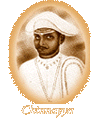
chinnayaponnayasivanandamvadi

The brothers propagated the famed Pandanallur style of Bharata Natyam.  The renowned Nattuvanar Sri Meenakshisundaram Pillai descended from the Thanjavur Quartet.

**

Smt.  Nandini Ramani writes :

They were the first to formalize the performance pattern of Bharatanatyam, and codify lessons called Adavus (basic steps and the different categories of rhythm patterns) required for the same. They were the ones to plan and set the order of the different items of the repertoire in performance. The order they set is as follows. 

Melapraptialarippujatiswaramsabdamswarajatichaukavarnamragamalikapadamjavali, and tillana.

They also composed several pieces for each category set to different ragas and talas (rhythm structure). The compositions were in Telugu, their mother tongue, and they addressed their family deities, Sri Brihadisvara and Brihannayaki, as well as the kings and ministers who patronized them and also the different deities whom they worshipped during their travels. All of these were presented by them in the performing art tradition, earning wide fame and reputation. They were invited by the royal patrons of Thiruvananthapuram and Mysore, as sitting doyens of art, to spread the art in those regions, while the king also popularized it by arranging performances in all the temples.

TANJAVUR QUARTET

[Souurce : http://maddy06.blogspot.in/search/label/Music?updated-max=2014-11-28T13:10:00-05:00&max-results=20&start=4&by-date=false]

***

Sri Dikshitar during his stay in  Thanjavur composed a number of Samasti Charana Kirtanas.

[A kriti generally follows a certain structure: Pallavi the opening passage of two lines is followed by Anupallavi. Raga is introduced with the cyclical rendition and improvisation of Pallavi and Anupallavi. The body of the kriti is its Charanas. Each Charana usually has four lines. The final Charana contains the Mudra or the signature of the composer.

However, certain kritis of Dikshitar have only two segments Pallavi and Anupallavi, where the latter acts as the Charana. Such kritis are called Samasti Charana Kritis. They perhaps represent a stage in the evolution of the kriti format. E.g.Anandamritakarshini (Amritavarshini); Hari Yuavatheem Haimavathim (Hemavathi) etc.]

Dikshitar brothers stayed in Thanjavur for about three years (about 1817 -1820).

Baluswamy who was proficient in Veena, Swarbat, Sitar and Mridangam, along with his brother  Chinnaswami joined the court of Venkateshwara Eddappa I [1761 – 1839] the Raja of Ettayapuram (Tirunelveli district) , as Asthana Vidwans of Ettayapuram Samsthanam.

Soon after that, Sri Muthuswami Dikshitar too left Tanjavur; and, he went on a virtual pilgrimage visiting a number of temples; and composing kritis in honor of the deities he visited. In a way of speaking, his life was a long pilgrimage.

Please click here for a map of his probable temple visits.

[Please click here for the lists of about 150 temples/deities featured to in Dikdhitar’s kritis]

Years later, Sri Muthuswami Dikshitar also settled down in Ettayapuram at the request of the king. A few years later , Dikshitar’s both wives passed away. Some sources mention that Dikshitar had a daughter and she lived in Tiruchirapalli; but, not much is known about her.

SriYantra2

Dikshitar comes through as a very astute scholar-devotee, a Sadhaka. He was a viraktha, unattached to possessions, to places or to emotions. He was voluntarily poor and accepted his poverty with equanimity. He did not seek favor or patronage from anyone. He was an intense devotee ; but, was  undemonstrative. In his compositions, you never find despondency, helplessness or begging for divine grace or intervention. There is certain composure, measured grace, dignity and a mellow joy in his works as in his life. He was solely devoted to Sri Vidya Upasana and to his music which was his medium of self-expression. His works exude serene contemplation and soulful joy.

It was on Naraka Chaturdasi ,the fourteenth day of the lunar calendar, in the month of Ashwija, the day preceding Deepavali (October 18th, 1835), Sri Muthuswami Dikshitar performed Parva Mandala puja to Devi and sang Ehi Annapurne (Punnagavarali). This was Sri Dikshitar’s last composition. Thereafter, he asked his disciples to sing Meenakshi mey mudam dehi (Purvi Kalyani) . When they sang the Anupallavi , he asked them to repeat the phrases Meena lochani pasha mochini. As they were singing, Muthuswami Dikshitar uttered “Shive pahi, Shive pahi, Shive pahi” and breathed his last , like a true yogi.

dikshitar sketch

Sri Muthuswami Dikshitar had been yearning for Videha Mukthi. For instance; in the Kriti Sri Rajarajesvarim (Madhyamavati), he requests the Mother to protect him by granting the Videha-mukthi [videha kaivalyam aasu ehi dehi mam pahi – विदेह कैवल्यं आशु एहि देहि मां पाहि] ] . He beseeches the Divine Mother repeatedly and addresses her as the one who grants Videha mukthi (Mamaka videha mukthi sadanam– Ranganayakam-Nayaki); the bestower of videha mukthi (vikalebara kaivalya danaya-Guruguhaya-Sama); and , at times, he feels he is nearing videha mukthi (Videha kaivalyam yami-Tyagaraje-Saranga).

Videha mukthi is a concept of the later Advaita schools. It believes, one can attain liberation (moksha) from attachments even while still encased in a body. Such an attained one is a Jivan Muktha. The body continues to function till its Prarabdha Karma is exhausted; thereafter, the mortal coils fall away. Videha mukthi , that is to say , is shedding off the body by a Jivan muktha, the one who has already attained liberation.

In the Sri Vidya tradition, a jivan muktha is a devotee, a Bhaktha as well as a Jnani the wise one. Here, the wisdom consists in realizing his identity (sva svarupa prapti) with the Mother goddess. It is this wisdom that liberates him (jivan Mukthi). This liberating wisdom is granted to him by the Mother out of pure love, when he completely surrenders to Her in absolute faith and loving devotion.

Jivanmukthi, emancipation while yet alive, is also a concept of the Tantra Siddantha which believes that it is possible for a person to transact with the world without getting involved in it. In other words; one lives on actively and cheerfully, amidst distractions and confusions of the world without letting his self reflect them. His moorings in the phenomenal world have withered away; and,  his instinct of self-preservation and insecurity has  minimized. He is alive only to essential thing , the very source of life. The real world continues to exist for him; but, he does not rest in the world; instead, he rests in himself (Svarupa pratishta). Sri Muthuswami Dikshitar, either way, was a jivan Muktha.

The king and Baluswami Dikshitar performed the last rites of the departed genius. The Samadhi of Sri Muthuswami Dikshitar is at Ettayapuram;  but, it appears to be in a rather poor condition. In a petition submitted to Shri. Abdul Kalam then president of India, the petitioners submitted

“It is the fervent desire of all music lovers as well as all lovers of Indian culture across the world that this Samadhi be declared as a heritage site and treated as a National Monument, ideally with a beautiful museum. We are extremely concerned that there has been a move made to demolish this important cultural and artistic memorial.”

mutthuswami dikshitar stamps

Sri Muthuswami Dikshitar was a many splendored genius. He redefined the paradigm of Carnatic music. Each of his compositions exemplifies the essence of Raga Bhava and captures the depth and soulfulness of the melody. His vision of some of the Ragas and their structure is sublime. He achieved what the revered Venkatamakhi, at one time, thought was not possible; he gave form and substance to all the 72 Melakarta-ragas. Besides, he breathed life into several ancient Ragas that were fading away from memory. His compositions are crisp and well chiseled. His Sanskrit is delightfully captivating. His synthesis of Carnatic and Hindustani Music systems is creative and original. His kritis replete with soothing, graceful Sanskrit lyrics, many with winsome Samashti Charanams, comparable to the Dhrupad stanzas, occupy an exclusive niche in the world of Indian Music. The technical sophistication, intellectual brilliance and the majesty of his music is unsurpassed. Sri Muthuswami Dikshitar is indeed a crest jewel of Indian music and spirituality.

Dikshitar's idol with the veena he used in the forefront.

draft_lens19135557module156995806photo_1329348026aa-aa-a-

Continued in Part Two:

Sri Dikshitar and Western Music

Resources:

http://www.geocities.com/vc_sekaran/files/dikshitar_life.html

http://www.geocities.com/Vienna/Strasse/5926/dikshitarbio.htm

Map: courtesy of http://www.carnatica.net/special/md-kshetra-ii.htm

http://hamletram.blogspot.com/2014/02/violin-comes-to-chennai.html

Biography by Justice Sri T L  Venkataramayyar

I gratefully acknowledge Shri S Rajam’s paintings of Shri Dikshitar’s life-events

All other pictures are from Internet

 
20 Comments

Posted by on September 13, 2012 in Music, Muthuswami Dikshitar, Sri Vidya


Tags: , , ,

Bharata’s Natya-Shastra – some reflections

Nayana dutta2

1. Natya-Shastra is a detailed compendium of technical instructions about the performing arts. It was meant as a practical manual for  production of successful theatrical performances, which included music and dance as well as acting. It was also intended as a guide to the poet and to the performer, alike. 

As Prof. Adya Rangacharya stated in his The Natyasastra: English Translation with Critical Notes

The eminence of the Natyasastra lies not merely in the fact that it was the first book on the subject on theatrical art; but that, it was the first comprehensive treatise on Dance, Drama and Music;  and , it marks  the origin of our dramatic tradition. It laid down the essentials of the Drama as a representation of the ways of the world; the nature and attitudes of the people; their ways of behavior and manners of speech. It also provided a framework for the Drama by highlighting its essential ingredients: 

(1) a playwright who has vision to the grasp of things and has the capacity to articulate that in an interesting way, through speech and action;

(2) the story that holds the attention of the audience;

(3) a virtuoso director  who can transform a script into a dramatic performance;

(4) the set of  skilled artists with clarity of speech and endowed with talent to give form and substance to the dream of the playwright and the vision of the director;  and , not the least ,

(5) the perceptive ,  intelligent  and   cultured spectators  who appreciate and enjoy a good  performance.

1.1. The text is in the form of elaborate dialogues between the author and a group of Munis , sages who wished to know about Natya-Veda, the knowledge of the performing arts such as dance, music and dramaThe author, in response, presents a detailed inquiry in to the various facets of drama including its nature; its origin; its theories; techniques of the theater with all its components of speech, body-language, gestures, costumes, décor and the state of mind of the performers, apart from rituals, architecture of theater etc.

Written in archaic form of Sanskrit, the text consists about six thousand (5,569 – to be exact) sutras or verse-stanzas spread over thirty-six chapters. Some passages are in prose.

Because the Natyasastra has about 6,000 verses, the text is also known as Sat-sahasri. The later authors and commentators (Dhanika, Abhinavagupta and Sarada-tanaya) refer to the text as Sat-sahari; and, its author as Sat-sahasri-kara.

But, the text having 6,000 verses is said to be a condensed version of an earlier and a larger text having about 12,000 verses (dwadasha_sahasri). It is said; the larger version was known as Natya- agama and the shorter as Natya-shastra.

Please click here for The Natyasatra – A treatise on Hindu Dramaturgy and Histrionics Ascribed to Bharata Muni; Translated into English by Manmohan Ghosh;  Published by Asiatic Society of Bengal, Calcutta – 1951]

2. Though the  Natya-Shastra speaks of theater (natya), it actually encompasses all forms of art expressions. The text, in fact, claims that there is no knowledge, no craft, no lore, no art, no technique and no activity that is not found in Natya-Shastra (1.116).

न तज्ज्ञानं न तच्छिल्पं न सा विद्या न सा कला । नासौ योगो न तत्कर्म नाट्येऽस्मिन् यन्न दृश्यते ॥ ११६॥

The reason that theater-arts were discussed specifically, is that, in the ancient Indian context, drama was considered the most comprehensive form of art-expressions. Further, at the time the Nataya Shastra was compiled, the arts of poetry, dance, music and drama; and even painting, sculpture and architecture were not viewed as separate and individualized streams of art forms. Natyashastra presented  an integral vision of art, which blossomed in multiplicity.

It was only during the later periods these art-forms developed into independent art-expressions. Similarly, even the other minor forms of Drama , such as: Opera, Poetic-drama, realistic plays and so on, later evolved and grew apart, assuming independent identities.

[Vishnudharmottara (Ca. sixth century) asserted that painting and sculpture without the knowledge of the Drama and the Dance would not have much depth; and, that Drama and Dance, in turn, do require a knowledge of music and of the songs, which again is dependent on mastery over languages – both Sanskrit and Prakrit – with a thorough understanding of the elements of prose, poetry, grammar, meter, prosody etc. It thus underlines the interdependence of the arts.]

All art expressions were viewed as vehicles of beauty, providing both pleasure and education, through refinement of senses and sense perceptions. The object of the drama was to show men and women the proper way to live, a way in which one could live and behave, so that one might be a still better person.

“A play shows your actions and emotions. Neither gods nor demons are depicted as always good or always evil. Actually, the ways of the world as represented here are not only of the gods but also of yours. It gives you good advice; it gives you enlightenment and also entertainment. It provides peace of mind to those who afflicted with miseries, sorrow, grief or fatigue. There is no art, no knowledge, no yoga, and no action that is not found in Natya .”- (Natya-Shastra 1: 106=07; 112-16)

na taj jñānaṃ na tacchilpaṃ na sā vidyā na sā kalā । nāsau yogo na tatkarma nāṭye’smin yanna dṛśyate ॥ 116॥

[ Kalidasa remarked : ‘Drama, verily, is a feast that is greatly enjoyed by a variety of people of different tastes

– Natyam bhinnaruchir janasya bahuda-apekshym samaradhanam. ]

Bharatha explains: when the nature of the world possessing pleasure and pain both is depicted by means of representations through speech, songs, gestures , music and other (such as, costume, makeup, ornaments etc ) it is called Natya. (NS 1.119)

yo’ya  svabhāvo lokasya sukha dukha samanvita som gādya abhinaya ityopeto nātyam ity abhidhīyate 119

Thus, according to Bharata, the Drama is but a reflection or a representation of the actions of Men and women of various natures (Prakrti) – avastha-anikrtir natyam . That is to say; the Drama, in its various forms of art, poetry etc , strives to depict the infinite variety of human characters .

That is the reason; Bharata says, one should study the various human habits and natures (Prakrti) on which the art of Drama is based.  And, for which the world, the society we live in is the most authoritative source of knowledge (Pramana) . All those involved with the Drama should realize this truth – (NS: 25.123)

Nana-sheelah prakutyah  sheele natyam pratihitam / tasma-loka-pramane hi vigneyam natya yo krubhihi // (NS: 25.123)

Having said that; the theater was conventional; yet, imaginative. The costumes and make up were stylized and symbolic; and, not what is commonly seen on the city-streets. In any case, Natyashastra requires a performer to present much more than an external representation of the character, such as correct speech, gesture etc.  His/ her stage performance will have to go far beyond technical skill, in order to be believable and accepted by the spectators.

There is, however, not much discussion about scenery; perhaps because scenery was used sparingly.

Theater had a sacred significance. Prayers and rituals were conducted and the stage was consecrated before the commencement of the play ( Purvanga) .

*

Natyashastra (6.10) provides a comprehensive framework of the Natya-veda, in a pellet form, as the harmonious combination (sagraha) of the various essential components that contribute towards the successful production of a play.

Rasā bhāvāhya abhinayā dharmī vtti pravttaya siddhi svarās tathā atodya gāna ragaśca sagraha 6.10

Bharata also mentions the five elements of the plot (artha-prakrti) of the Drama as :

  1. the seed (Bija);
  2. the expansion or the intermediate point which links to the next (Bindu);
  3. the episode (Pataka);
  4. the incident in the episode (Prakari) and
  5. the dramatic outcome (Karya).

These are to be used according to the main Rasa of the play and the prescriptions of the Shastra.(NS: 19.21)

Bijah Bindu Pataka cha Prakari  karyameva cha / Artha-prakrutyah pancha tatva yojya tata vidihi // (NS:19.21)

As regards the success of the play (Siddhi), it is said,  the successful production (Siddhi) of a play enacted on the stage (Ranga) with the object of arousing joy (Rasa) in the hearts of the spectators involves  various  elements of the components of  the actors’ gestures, actions (Anubhava) and speech (vachika); bringing forth (abhinaya) their intent, through the medium of  theatrical (natya-dharmi) and common (Loka-dharmi) practices; in four styles of representations (Vritti-s) in their four regional variations (pravrttis) ; with the aid of  melodious songs  accompanied by  instrumental music (svara-gana-adyota).

The assembly of spectators with different tastes and levels of appreciation should all be able to enjoy the play. Therefore, Bharata instructs that a play should be such that it caters to the interests and dispositions of varied class of men and women; the young and the old, with each class looking for its own favorite type of entertainment . And, it is upon such versatile ability that the success of a play depends. The play-production, thus, was aimed to satisfy the happy, responsive spectators and enthuse them to visit the theater more often. 

Bharata, in a way, sums up the virtues and merits of Nataka , a dramatic work, that captivates the hearts of the spectators and brings glory to its playwright , producer and the actors .

The work of art that satisfies all classes of spectators ; and is a happy and enjoyable composition, which is graceful on account of being  adorned with sweet and elegant words; free from obsolete and obscure meaningless verbose ; easily grasped and understood by the common people ; skillfully arranged ; interspersed with delightful songs and dances; and,  systematically  displaying varied types of sentiments  in its plot devised into Acts, scenes, junctures etc.

mdu-lalita-padārthaha-śabdārtha-hīna ;   budha jana sukha bhogya,  yuktiman – ntta-yogyam bahu rasa kta mārga , sandhi-sandhāna-yukta  bhavati  jagati  yogya  nāaka  prekakāām 16.130

***

Bharata elaborates (NS.27.57-61) :

The young are keen on the portrayal of love; and, those after money relish scenes depicting acquisition of wealth. And, the ones who love adventure delight in the terrible and odious acts of battle and combats; whereas the old and pious always praise the enactment of well known tales and legends from the Puranas  (epics) lauding the virtues and good deeds ; the devout look for philosophical and religious aspects ; and, those disinterested in the mundane seek liberation (moksha) .  The common folks, the women, children and the dimwitted lap up with relish comic situations evoking laughter and fun, attractive costumes and make up.

Apart from these types, Bharata also mentions an elite class of appreciative spectators with refined tastes and deep interest in the technical aspects of production. Such connoisseurs were also aware of the theatrical traditions and conventions of performance on the stage. These were the well-informed class who cared more about the aptness of the techniques of performance, critically evaluated the merits (guna) , the defects (dosha)  and the success of the theatrical performance as a whole.

Then, there were also the artists specialized in different branches of music and dance; the scholars who relished subtle nuances in the rendering of speech and the lyrics of the songs; and, there were the accomplished courtesans who were experts in presenting alluring and  delectable performances .

All such elite class were the cream of spectators, for whose approval and appreciation the whole of theatrical group collectively and individually looked forward with great hope and fear.

The producer of the Drama had also the onus to please the patron who sponsored and financed the play –production and display.

Nānāśīlāḥ praktaya śīle nāya vinirmitam uttamā-adhama madhyānā vddha bāliśayo itām 57

Tuṣyanti taruā kāme vidagdhā samayātvite arthevarthaparā ścaiva moke cātha virāgia 58

Śūrāstu vīra raudreu niyuddhevāhaveu ca dharmā akhyāne  purāeu vddhā stuyanti nityaśa 59

Na śakyamadhamairjñātumuttamānā viceṣṭitam tattva bhāveu sarveu tuyanti satata budhā 60

Bālā mūrkhā striyaścaiva hāsyanaipathyayo sadā yastuṣṭo tuṣṭimāyāti śoke śokamupaiti ca 61

Abhinavagupta observes Drishta-phala [visible fruits] like banners (pataka) or material rewards do not indicate success of a play production. Real success is achieved when the play is performed with skilled precision, devoted faith and pure concentration. To succeed, the artist must immerse the spectator with pure joy of Rasa experience. The spectator’s concentrated absorption  appreciation and enjoyment is indeed the success.

Dhananjaya in his Dasarupaka remarks that responsive spectators, fired by enthusiasm and imagination, contribute to the success of the play in the manner of ‘children playing with clay elephants ‘. ” When children play with clay-elephants, etc., the source of their joy is their own utsaha (enthusiasm). The same is true of spectators watching  and almost sharing  the heroic deeds of  characters , say  like, Arjuna and other heroes on the stage.”…… 

Kridatam mrnrnayair yadvad balanam dviradadibhih / svotsahah svadate tadvac chrotrnam Arjunadibhih.

**

2.1. The text employs Natya as a generic term, which broadly covers drama, dance and  music. It does not treat dance as a separate category of art form. Bharata while dealing with Angika-abhinaya (body-language) speaks of nrtta, pure movements that carry no meaning- as compared to Abhinaya (literally meaning that which carries the meaning forward towards the audiencei. e. gestures that convey specific meaning. Nrtta was, in fact, meant to provide beauty, grace and a certain luster to the performance. The postures of the nrtta (called karanas) were classified by Bharata as tandava and sukumara, to convey vigor and grace.

[ Nandikeshwara (perhaps a later author who, for some reason, assumed the name of an ancient figure/person ?), author of Abhinaya_darpana, is believed to be the first to recognize dance as an independent art. He called it natanam; and classified it into nrtta (Pure dance), nrtya (abhinaya – expression- aspectand natya (combination of nritta and nrtya with a dramatic element to it).

Dhananjaya in his Dasarupa, while drawing a  distinction  between nrtta and nrtya , explains the term  nrtta as that which  depends on rhythm and tempo – nrttam tala-layam ashrayam (DR. 1. 13) ; and,  nrtya as  that which is dependent on emotion – Bhava-ashrayam nrtyam (DR. 1. 12).

As mentioned earlier, Nandikeshwara explained Natya as the combination of nrtta and nrtya .]

3.1. It is said that the text which we know as Natya-Shastra was based on an earlier text that was much larger. And, many views presented in Natya-Shastra are believed to be based on the works of other scholars. There are frequent references to other writers and other views; there are repetitions; there are contradictory passages; there are technical terms, which are not supported by the tradition.

[ It appears there were texts on Drama even much prior to Natyashastra. Panini (Ca.500 BCE) the great Grammarian, in his Astadhyayi (4.3.110-11), mentions two ancient Schools  –  of Krsava and Silalin – that were in existence during  his time – 

Parasarya Silalibhyam bhikshu nata-sutreyoh  (4.3.110); karmanda krushas shvadinihi  (4.3.111).

It appears that Parasara , Silalin , karmanda and Krsava were the authors of Bhikshu Sutras and Nata Sutras. Of these , Silalin and Krsava  were said to have prepared the Sutras (codes) for the Nata (actors or dancers). At times, Natyashastra refers to the performers (Nata) as Sailalaka -s  . The assumption is that the Silalin-school , at one time,  might have been a prominent theatrical tradition. Some scholars opine that the Nata-sutras of Silalin (coming under the Amnaya tradition) might have influenced the preliminary part (Purvanga)  of Natyashastra , with its elements of worship (Puja).

However, in the preface to his great work Natya-shastra of Bharatamuni (Volume I, Second Edition , 1956) Pundit M. Ramakrishna Kavi mentions that  in the Natyavarga of Amara-kosha (2.10.12) there is reference to three  schools of Nata-sutra-kara : Silalin ; Krasava; and,  Bharata .

 Amarakosha

It appears that in the later times,  the former two Schools (Silali and Krasava) , which flourished earlier to Bharata , went out of existence or merged with the School of Bharata; and, nothing much has come down to us  about these older Schools. And, it is also  said, the Bharata himself was  preceded  by  Adi-Bharata, the originator and Vriddha (senior) Bharata.  And, all the actors of whatever earlier Schools, later came to be known as Bharata-s. ]

3.2. These factors lend support to the view that Natya-Shastra might have been the work of not one single author but of several authors, spread over a long period of time.

Ms. Kapila Vatsyayan, a well known scholar, however, observes that the text projects an integrated vision and   a unity of purpose. She points out many instances of reference to later chapters in the text, and says they are indicative of the coherent and well knit organic nature of the work. 

For those reasons, she concludes, Natya-Shastra might well be considered as the work of a single author or of a single tradition.

4.1. Rasa, as discussed in Natyashastra, meant aesthetic appreciation or the joy that the spectator experiences.  As Bharata says , Rasa  should be relished  as an emotional or intellectual  experience : na rasanāvyāpāra āsvādanam,api tu mānasa eva (NS.6,31) .

The yashāstra states that the goal of any art form is to invoke  such Rasa.

[Bharata explains Rasa  as an experience that can be relished – like the taste of food – Rasyate anena iti rasaha (asvadayatva), which is associated with palate (ability to distinguish between and appreciate different flavors) . Yet ; the aesthetic senses that are primarily engaged with a theatrical presentation  are only the eye and the ear. The senses of taste, touch and smell are not , generally, associated with   the type of ones experience that Bharta talks about  while witnessing a Drama. These are personal or individual experiences. But, Rasa, the aesthetic experience enjoyed by all the spectators , in a play, in common, is mainly through two senses : the eye and the ear. That , perhaps , is the reason why Bharata says that the Rasa in a play should be relished only as an emotional or intellectual experience.]

Bharata’s theory of Rasa was crafted mainly in the context of the Drama.    After naming the eight Rasas, he says ‘these are the Rasas recognized in Drama’nāṭye rasāḥ smṛtāḥ – (N.S 6.15).  

śṛṅgāra-hāsy-akaruā raudra-vīra-bhayānakā bībhatsa-ādbhuta-sajñau cetyaṣṭau nāye rasā sm 15

In the prose-passage following the verse thirty-one of Chapter six, Bharata commences his exposition of Rasa, saying: I shall first explain Rasa; and, no sense or meaning proceeds without Rasa (Na hi rasa-adrate kaschid-arthah pravartate).

tatra rasāneva tāvadādāvabhivyākhyāsyāma na hi rasādte kaścid artha pravartate

He , then  focused on the dancer’s or actor’s performance and effort to convey the   psychological  state , which the character is experiencing , to the spectator, in order to create  Rasa – the aesthetic appreciation or enjoyment of the art – in the heart and mind of the spectator.

The famous Rasa-sutra or basic “formula”, in the Nāyashāstra, for evoking Rasa, states that   the vibhāva, anubhāva, and vyabhicāri bhāvas  together produce Rasa:  tatra vibhāvā-anubhāva vyabhicāri sayogād rasa nipatti 

Bharata elaborated the process of producing  Rasa in terms of eight Sthayi Bhavas – the principle emotional state of the character expressed by the performer  with the aid of Vibhava (the cause) and Anubhava (the enactment)  ; thirty-three Vyabhicāri (Sanchari) bhāvās – the transient emotions; and, eight  Sattivika-bhavas – the involuntary physical reactions.

Among these Bhavasthe more important  ones are said to be vibhāva and anubhāva , which  invoke the Sthāyi bhāva, or the principle emotion at the moment. Such elements that are employed to convey the psychological state of the character, thus, in all, amounted to forty-nine or more. 

[The Sattvika , the involuntary–reflexes (such as being stunned, going pale , stammering, shedding tears etc.,)  were perhaps meant to introduce a realistic style of acting – suited to the situation as also to the nature, psychological state and the social standing of the character , as compared to the purely conventional style .]

It is explained; they are called Bhavas because they happen (Bhavanti); they cause or bring about (Bhavitam); and, are felt (bhava-vanti). Bharata explains that  Bhavas  effectively bring out the dominant sentiment of the play – that is the Sthāyibhāvā – with the aid of various Bhavas , such as words (Vachika), gestures Angika), costumes ( Aharya) and bodily reflexes (Sattva) – for the enjoyment of the good-hearted spectator (sumanasaḥ prekṣakāḥ) . Then it is called the Rasa of the scene (tasmān nāṭya rasā ity abhivyākhyātāḥ).

Nānā bhāvā abhinaya vyañjitān vāg aṅga sattopetān / Sthāyibhāvān āsvādayanti sumanasaḥ prekṣakāḥ / harṣādīṃś cā adhigacchanti tasmān nāṭya rasā ity abhivyākhyātāḥ //6.31//

In brief; Abhinaya is the art of communicating bhāva (emotion) to produce Rasa (aesthetic enjoyment). In other words, it is the Bhavas that produce Rasa; and, it is not the other way.

The Rasa theory of the yashāstra is considered one of its most important contributions, with several scholars over the centuries , until today, discussing and analyzing it extensively.

Thus, Bharata’s concept and derivation of Rasa was mainly in the context of the Drama. They all are related to concrete and tangible emotions, based upon human experiences. There is no mysticism whatsoever here. That concept-of the enjoyment by the recipient spectator – as also his views on the Gunas and Dosha, relating to the  scripting and enacting the play, were later  enlarged , transported  and adopted into Kavya as well. In either case, the human element was never lost sight of ; and, the spectator or the avid reader remained  at the center of art-experience. 

*

Bharata, initially, names four Rasas (Srngara, Raudra, Vira and Bhibhatsa) as primary; and, the other four as being  dependent upon them . That is to say ; the primary Rasas, which represent the dominant mental states of humans, are the cause or the source for the production of the other four Rasas.

Bharata explains that Hasya (mirth) arises from Srngara (delightful); Karuna (pathos) from Raudra (furious); Adbhuta (wonder or marvel) from the Vira  (heroic); and, Bhayanaka (fearsome or terrible) from Bhibhatsa ( odious).

śṛṅgārāddhi bhavedd-hāsyo raudrācca karuṇo rasaḥ vīrāccaiv-ādbhuto-utpattir-bībhatsācca  bhayānakaḥ 6.39

But, effectively, the eight Rasas listed in yashāstra are well accepted. Some scholars remark that the   distinction of four basic Rasas ; and , their associate four Rasas is a mere technical detail that the spectators may not be interested in.

śṛṅgāra hāsya karuā raudra vīra bhayānakā bībhatsā adbhutasajñau cetyaṣṭau nāye rasā sm  6.15

Later, by the time of Abinavagupta Shanta rasa came into discussion; and, eventually was  recognized . Thus , concept of Navarasasa was accepted. (for more on  discussion about Shantha Rasa , please click here). Later on Vatsalya , Bhakthi and such others were also named as Rasas. Thus the number of Rasas is not mere nine or eleven , it could be more. 

**

4.2. Bharata gave a definite structure to the drama; and said every play must portray and convey a  dominant Rasa; and , each of the eight rasas providing enjoyment to the audience. A Rasa depends on the type of the story and sort of the hero. According to Dhananjaya, hero (neta), story (vastu) and rasa (artistic enjoyment) constitute the essential ingredients of a drama – Vastu neta rasas tesam bhedako .

Natya-Shastra strives with a single pointed devotion to bestow an artistic form and content to what was still then a vulgar source of entertainment. Bharata could say with pride “parents could watch a dramatic performance in company of their sons and daughters-in-law.”(Natya-Shastra24.297)

5.1. That leads us to the question who was this author? Was Bharata his name   ? Was Bharata the name of his tribe? Or, was it a clever acronym?

There are, of course, no clear answers to these questions. The author made no attempt to reveal his identity. The book, as I mentioned earlier, is in the form of dialogue between Bharata and the sages.  The author was explaining the broad parameters, the basic principles and techniques of theatrical art as they then existed. He was not expounding the text as if it were his discovery or as his personal position. He was lucidly and systematically explaining a tradition that was alive and vibrant. These factors lead us to believe that Bharata, whoever he was, might have been a practicing- well informed-leading performer of his time,  belonging to a certain tradition . Bharata perhaps   belonged to a community of artists, actors, dancers, poets, musicians who shared a common heritage and common aspirations. 

5.2. From the prologue, couched in mythological language and imagery, it appears, Bharata was also a teacher and a preceptor of a school or an academy. He had a number (100?) of sons and pupils each of them being an accomplished performer or a learned theoretician. He produced plays with their assistance; by assigning each one a specific role.

It is very unlikely there were ‘theatrical Companies’, as such . Perhaps the family of Bharatas – producers, directors  (Sutradhara) and actors, as also their disciples of various talents and ranks, managed the theater as a group, under the leadership of the senior Bharata being in charge. It does, also, appear that the actors of various ranks of importance, dancers, musicians, assistants and minor functionaries did receive a systematic training in their  craft.

Such a troupe leader (Bharata) might also have been the one who assigned roles in a play; and, taught the rules of  the art/craft to the actors and actresses. His chief function seems to have been mostly supervisory. He might also have been involved in the design and structure of the theater hall (Natya-shala)

Thus, the Bharata, whoever he might be, should have been one capable of performing all those diverse and difficult tasks, with a sense of responsibility and commitment. Besides, he should have been one  who was sensitive to human frailty; and, also conversant with the language  customs  and nature of people of different classes and regions,

The term Bharata perhaps initially referred to  such a multi-talented virtuoso; and also, a producer / director of plays. The author of the Natya-Shastra was perhaps one such “Bharata”.

5.3. Incidentally, the text – in its chapter 35 – Bhumika vikalpa – provides a sort of elaborate explanation of the term Bharata, as : one who conducts as the responsible leader of a performance – as producer , director and stage manager  – who is required to be an expert not only in acting but  also in all those arts which together constitute a performance – by acting in many roles, by playing many instruments and by providing many accessories – is called Bharata – (Natya-Shastra 35: 63-68, 69-71).

[ In this connection, I shall speak of the qualities of a Director. An enumeration of his qualities will constitute these characteristics; they are: First of all, he should possess knowledge of characteristics of everything concerning the theater, desirable refinement of speech, knowledge about the Tala, rules for timing of songs, and of the theory relating to musical notes and to the playing of musical instruments.

63-68. One who is an expert in playing the four kinds of musical instrument, well-trained in rites prescribed in the Sastras, conversant witli the practices of different religious sects and with polity and the science of wealth, expert in the manners of courtezans (kama-shastra), and in poetics(kavya-shastra) , knows the various conventional Gaits  and movements (gati-prakara), throughly appreciates all the States (bhava) and the Sentiments (rasa), is an expert in producing plays, acquainted with various arts and crafts, conversant with the rules of prosody and the metrical feet (chhandas shastra), and is clever in studying the different Sastras, acquainted with the science of stars and planets and with the working of the human body, knows the extent and customs of the earth, its continents and divisions, mountains and people, and the descendants of different royal lines (prasutivit) , is fit to attend to the Sastras relating to his works, capable of understanding them and of giving instruction [on the subjects]; should be made a teacher {acharya) and a Director (Sutradhara)

69-71. Now listen to me speaking about the natural qualities of a Director. He should be possessed of memory , intelligence and judgement; should be patient, liberal, firm in his words, poetical, free from any -disease, sweet [in his manners], forbearing, self-possessed, sweet-tongued, free from anger, truthful, impartial, honest, resourceful (pratimanta) and free from greed for praise.

– The Natyashastra –  translation by Manmohan Ghosh – 1950 – (page 546) – Chapter 35. Bhumika vikalpa – Verses 63 to 71 ]

5.4. The author of the Natya-Shastra is also often addressed, in later times, as Bharata­muni. Shri Adya Rangacharya, a noted scholar, remarks.  “The usual trappings of a muni (sage) are nowhere mentioned”. On the other hand, his sons misused their knowledge and ridiculed the sages (ṛṣīṇāṃ vyaṅgya-karaṇaṃ); and the enraged sages promptly cursed them “as due to pride  ( madonmattā ) in your knowledge you have taken to arrogance (a-vinayam) ; your corrupt-knowledge (ku-jnana) will be destroyed (nāśameṣyati )” — (Natya-Shastra 36: 32 – 38).

yasmājjñāna-madonmattā na vetthā vinayāśritāḥ । tasmād etaddhi bhavatāṃ kujñānaṃ nāśameṣyati ॥ 38

5.5. Bharata recounting this sad episode, cautions the community of artists not to overreach themselves, in arrogance, just because the art had bestowed upon them a special position in the society . The art that empowered them, he counsels, derives its strength from the society; and, the artists, therefore, have a special responsibility to cultivate discipline, self-restraint and humility (Natya-Shastra 36: 29 – 38).

5.6. Bharata refers, repeatedly, to the power that creative art is capable of wielding; and to the responses – both subtle and intense – they can evoke in the hearts of men and women. He asks his sons and disciples not to destroy drama which has its origins in the hoary past of the Vedas and their upangas (supplementary texts). He implores them to preserve the dramatic art by teaching it to their disciples ( siṣyebhyaśca tadanyebhyaḥ); and to spread the art by practicing it (prayacchāmaḥ  prayogataḥ ).

jānīdhvaṃ tattathā nāṭyaṃ brahmaṇā sampravartitam । śiṣyebhyaśca tadanyebhyaḥ prayacchāmaḥ  prayogataḥ ॥ 36.49

mā vai praṇaśyatāmetan nāṭyaṃ duḥkha-pravartitam । mahāśrayaṃ mahāpuṇyaṃ vedāṅgo-upāṅga -sambhavam ॥ 36.50

5.7. [The attempt to explain Bharata as an acronym for three syllables Bha (bhava), Ra (raga) and Ta (tala) , somehow, does  not seem convincing at all.  At the time Natya-Shastra was composed, music was discussed in terms of pada (words), svara (notes) and tala (rhythm) forming components of a certain style of music called gandharva said to have been derived from Sama. Bharata talks about structured and unstructured music: bhaddha (structured like a verse or a stanza; and with rhythm) and anibhaddha (unstructured – without rhythm, analogues to the present-day aalap). The term raga did not come to prominence  until Matanga (about sixth century), in his Brihaddesi, elucidated the categories of muchchhanas and jatis; and introduced the term raga and outlined its concept.]

5.8. Thus, the author of the Natya-Shastra, whoever he might be, comes across as a multi-talented virtuoso, a person of great learning, culture and rooted in good tradition (sampradaya, parampara). He was well grounded not merely in Vedic learning and its ethos, but also in kavya (literature) , fine arts, Ayurveda (medicine), jyothisha (astrology), ganitha (mathematics), vastu-shilpa (architecture) and  hathayoga. His understanding of the human anatomy- particularly the motor and sensory systems and the joints; the relation between the physical stimulus and psychic response; as also the relation between psychic states and expressions through physical movements  were truly remarkable.

6.1. As regards its date, it is not clear when the Natya-Shastra was initially articulated. There are, of course, a host of debates concerning the date of composition of the text. I however tend to go along with the argument that Natya-Shastra was a post Upanishad text; but, it was prior to the age of the Puranas; and certainly much earlier to the age of classic Sanskrit drama. The following, briefly, are some of the reasons:

*. Natya-Shastra describes itself as Natyaveda, the fifth Veda that would be accessible to all the four castes (1:12). It claims that the text imbibes in itself the articulated- spoken word (paatya) from Rig-Veda ; the ritual and the body-language (abhinaya) from Yajur Veda; musical sound , the sung-note, from Sama Veda; and Sattvika (understanding of the relation between mind and body-expressions) – for conveying various bhavas through expressions exuding grace and charm – from Atharva Veda . (Natya-Shastra – 1:17-19)

jagrāha pāṭhyamṛgvedātsāmabhyo gītameva ca । yajurvedādabhinayān rasānātharvaṇādapi ॥ 17॥

vedopavedaiḥ sambaddho nāṭyavedo mahātmanā । evaṃ bhagavatā sṛṣṭo brahmaṇā sarvavedinā ॥ 18॥

utpādya nāṭyavedaṃ tu brahmovāca sureśvaram । itihāso mayā sṛṣṭaḥ sa sureṣu niyujyatām ॥ 19॥

*. The text is permeated with the Vedic symbolism and the imagery. The theatrical production is compared to yajna; with the stage being the vedika,   the altar. The dramatic spectacle, just as yajna, is said to have a moral and ethical purpose.

The text might have, therefore, arisen at a time when the Vedas were not a remote theoretical fountain head, but a living-immediate experience. 

*. The text strongly recommends that puja, worship, be offered to the stage before commencement of the show. It however recognizes puja as distinct from yajna. There is, however, no reference to “image” worship.

*. The gods revered and worshiped in the text are the Vedic gods; and not the gods celebrated in the puranas. For instance, Natya-Shastra begins with a salutation to Pitamaha (Brahma) and Maheshwara. There is no specific reference to Shiva. There is no mention of Nataraja even while discussing karanas and angaharas. Ganesha and the avataras of Vishnu are conspicuously absent. There are no references either to Krishna or to the celestial raasa dance. 

*.The gifts showered by the gods on successful performance of the play are similar to the gifts received by the performer at the conclusion of the yajna.

“Indra (Sakra) gave his auspicious banner (dhwaja) , then Brahma a kutilaka (a crooked stick) and Varuna a golden pitcher (bhringara) , Surya an umbrella, Shiva success (siddhi) and Vayu a fan , Vishnu a throne (simhasana), Kubera a crown  and Saraswathi –visibility and audibility.” (Natya-Shastra-1.60-61)

brahmā kuṭilakaṃ caiva bhṛṅgāraṃ varuṇaḥ śubham । sūryaśchatraṃ śivassiddhiṃ vāyurvyajanameva ca ॥ 60॥

viṣṇuḥ siṃhāsanaṃ caiva kubero mukuṭaṃ tathā । śrāvyatvaṃ prekṣaṇīyasya dadau devī sarasvatī ॥ 61॥

*. It therefore appears; during the time Natya-Shastra was compiled the prominent gods were the Vedic gods such as Indra, Varuna and Vayu; and not the gods of the Puranas that came in to prominence centuries later.

*.The mention of the Buddhist bhiksus and Jain samanas indicate that Natya-Shastra was post –Buddha and Mahavira.

*. Natya-Shastra employs a form of Prakrit, which predates the great poet Ashvaghosha’s play (first century).

For these reasons, the scholars generally agree that Natya-Shastra might have been composed sometime between second century BCE and second century AD, but not later.

indian_aesthetic

7. 1.The questions whether or not the Natya-Shastra was compiled in a particular year by a particular person are not  very important. Whatever are the answers to those questions, the importance of the work would not be diminished nor its wisdom distracted. What is of great importance is that Natya-Shastra has provided a sustainable foundation and framework for development of theory and practice of arts in India. Just as Panini standardized the classical form of Sanskrit, Bharata standardized the classical form of drama. He gave it status and dignity; a form and an objective; a vision and finally a technique.

7.2. Bharata ensured that drama and dramatic performance is first a work of art before it is literature – drsya kavya a form of literature that could be seen and heard.

7.3. His brilliant intuition and intellect has inspired generations of artists over several centuries. It is immaterial whether or not Bharata was an individual or when he lived.

flower2

8.1. The Natyashastra consists of 36 chapters. The outer and spatial aspects, such as the stage, the theater building etc. are discussed in Chapters 1–5. Chapters 6–7 discuss the theory of rasa, i.e. the crucial question as to how to evoke a mood, while Chapters 8–13 focus on the physical acting technique. The verbal aspect, such as speech and sound, is dealt with in Chapters 14–19, while Chapters 20–21 discuss the types and structure of drama. The outer aspects of acting, such as the costume and the make-up types, are dealt with in Chapters 22–26. More general aspects are touched upon in several chapters, while Chapters 28–33 focus on music. Aspects of the theater troupe and the distribution of roles are then discussed, after which the focus returns to the very beginning, i.e. to the question of the divine origin of the art of the theater. ( Kapila Vatsyayan : Bharata, The Natyashastra, New Delhi, 1996).

*

It could be said that the Natya-shastra is broadly modeled into four sections, based on Abhinaya or modes of conveying theatrical expressions which bring pleasure, pure delight (Rasa) to the cultured spectators (sahrudaya). Such Abhinaya-s are: Sattvika (conveyed through expressions which delight the mind); Angika (natural and appropriate movements of body, limbs and face); Vachika (delivery through speech and songs); and Aharya (costume, decoration, make-up and such others to heighten the beauty or the effectiveness of the dramatic presentation).

natyashastra-4-638

The author of the Natya-shastra seems to have assigned greater importance to Sattvika elements, the expressions of which are conveyed through the aid of movements, gestures (Angika) and speech (Vachika).

Angika relates to the movement of the parts of the body, which is classified into three major parts – the Anga, Patyanga and Upānga  . Angika relates to how the emotion, thoughts and the thing  are to be expressed or represented through the  movement of the Anga (limbs), which include facial expressions. There are two types of basic Abhinayas as Pada-artha abhinaya (when the artist delineates each word of the lyrics with gestures and expressions); and, Vākyā-rtha abhinaya (where the dancer acts out an entire stanza or sentence). Āngika abhinaya uses the total body to express certain meaning. Hasta (hand) Abhinaya is an important aspect of Āngika.

Vachika abhinaya is the expression through speech. It is done with the help of speech and songs. Bharatha  deals in detail with the different meters in poetry, strong and weak points of poetic writing and diction. He  also talks about Figures of speech (Alamkara) . Nātyasāstra says that words spoken during Nātya should be full of suggested meaning.

yasāstra in its 15th -19th Chapters explains vocal movements. It recognizes the importance of expressions through the medium of voice in the presentation of a Drama; they are its   basic features; and, form the very substance of the Dramas. Other movements depend on and follow vocal movements.

Bharatha mentions three kinds of voice expressions-: 1) Mandra; 2) Madhya; and, 3) Tāra.

The sound which origins from the heart , having a quality of bass is called Mandra. The sound originating from the throat, in the normal manner is named Madhya.  And, Tāra is the high-pitched sound originating  from the head.

According to yasāstra, the vācikā-bhinayas divided into seven parts .

    • 1) Prakāsa-bhāsana– loud and clear speech;
    • 2) Ātmagata-bhāsaa– talking to self;
    • 3) Apavārita-bhāsaa (asides);
    • 4) Janāntika-bhāsaa (audiable to others);
    • 5) Sāmūhika-bhāsana – group expressions (simultaneous talk);
    • 6) Ekala- bhāsana – single expressions (monologue);
    •  7) Ākāsa- bhāsana – talking to the sky (talking to no one in particular); and,
    • 8) Rahasyakathana – stage-whisper

8.2. The Sattvika aspects are dealt in Chapters 6 and 7; followed by Angika in Chapters 8 to 13; and, Vachika in Chapters 14 to 20.  The Aharya which deals with costume, scenic presentation, movement on the stage along with music from the wings etc follow in the later Chapters.

The 23rd Chapter of  yasāstra  details the Āhārya abhinaya, which covers several aspects , such as  the make-up (Angaracanā ); costumes and ornaments  (Alankāra prasādhana); use of specific colors; hair styles;  as well as costumes suitable for particular characters. The Aharya also covers the background sceneries (Pusta), stage props and décor.

The four-fold core Chapters are supported by information and descriptions about the origin and greatness of the theatrics; different forms of the stage and the norms for construction; qualifications and desirable modes of behavior of the actors; and the rituals and prayers before and after the play etc.

Thus, the core of the theatrical art and science is dealt in 29 Chapters  – from 6 to 34.

flower2

9.1.  A question that is often asked is: why were the ancient Indian scholars and seers reluctant to disclose, in their works, details of themselves and of their times? Did they lack a sense of history? 

There is, of course, an array of explanations, in answer to that.

But, I think it had a lot to do with the way the ancients defined their relation to a school of thought, and the position, they thought, their text occupied in the tradition of that school. They always viewed themselves as a part of an ongoing tradition – parampara. Invariably, even the best known of our thinkers (say, the Buddha, Badarayana or Sri Sankara) did not claim that they propounded an absolutely new idea that was totally unknown hitherto. They always said, they were interpreting or elucidating the truth in the light of eternal pristine principles.  They did not lay claim to novelty or uniqueness. They placed their work in relation to the larger and broader river or stream of the tradition. Within that tradition, individual styles, innovative ideas or enterprising leaps of thought were surely discerned; but, they were always placed and viewed in context of the overall ongoing tradition.

9.2. As regards Natya-Shastra, as Kapila Vatsyayan  summed up beautifully:

“ it was analogous to the Gomukh demarcating the glaciers above and the rivers which flow with streams of the Alakananda and the Mandakini , the Bhagirathi and others with their manifold confluences and some divergences , but all of which we recognize as the Ganga. The analogy of streams, confluences (prayaga) and the continuous flowing and yet unchanging nature of the river is the closest approximation in which the parampara of the Natya-Shastra, the text and dramatics of inflow confluences, outflow and ultimate inflows in to the ocean, can be explained.”

9.3. The individual biological identity in terms of the physical events of the birth and the personal life of the author did not, therefore, seem to be a psychical concern. Individual effort and contribution in furthering a school of thought was, no doubt, important; but, it was viewed as an integral part of the dynamics of the flow and course of the river called parampara, characterized with its nature of continuity and change.

The attitude signified being alive to a sense of tradition rather than lack of a sense of history.

flower2

1 0. Why  was the text called a Shastra?

The term Shastra does not always carry connotations of ritual or religion. Nor does it always mean classical, as in shastriya sangeeth

The Sanskrit- English dictionary of Sir Monier-Williams describes the term as an order, a command, a rule, teaching, and instruction manual relating to religious precepts. But,  Shastra, in fact, means much more than that.

10.1.In the Indian context , Shastra is a very extensive term that takes in almost all human activities – right from cooking to horse and elephant breeding; love making to social conduct; economics to waging wars; justice system to thievery ; and of course all the arts- from archery to poetry. There  is a  Shastra – a way of doing and rationalizing — for almost everything. A Shastra binds together the theory that provides a framework for rationalizing the practice; and the practice that illustrates the theory. Shastra is, at once, the theory of practice and practice of a theory- enriching each other.

10.2. The author of Natya-Shastra prefers to call it a prayoga Shastra – a framework of principles of praxis or practice. Bharata makes a significant opening statement: “I am creating a theory and text of performance; of practice and experimentation” . He also underlines the fact that the efficacy of its formulation lies in practice (prayoga) – vibhāvayati yasmācca nānārthān hi prayogataḥNS.8.7

10.3. There is a certain flexibility built in to the structure of the text. It provides for varied interpretations and readings. The author himself encourages innovations and experimentation in production and presentation of plays. He even permits modification of his injunctions; and states the rules “can be changed according to the needs of time (kaala) and place (desha)” . The text accordingly makes room for fluidity of interpretation and multiple ways of understanding it. The intellectual freedom that Bharata provided to his readers/listeners ensured both continuity and change in Indian arts over the centuries.

tree of life

11. 1.Natya-Shastra,throughout, talks in  terms of the metaphor of the seed (bija) and the tree. It talks of the organic inter-relatedness of the parts and the whole; each branch of the text being distinct and yet inspired by the unitary source. Introduction of the core theme is the seed (bija) and its outer manifestation is like a drop of liquid or a point (bindu) that spreads and enlarges (vistara) to fill the structured space. That denotes both the process and the structure.

11.2. Bharata also explains the relationship between the structure of the drama, its plot, bhava and rasa through the imagery of a tree. The text grows like a tree and gives out shoots like the proverbial Asvattha tree.” Just as a tree grows from a seed and flowers and fruits… So the emotional experiences (rasa) are the source (root) of all the modes of expressions (bhava). The Bhavas, in turn, are transformed to rasa.”(Natya-Shastra: 6-38)

yathā bījād bhaved vṛkṣo vṛkṣāt puṣpaṃ phalaṃ yathā । tathā mūlaṃ rasāḥ sarve tebhyo bhāvā vyavasthitāḥ ॥ NS.6.38

11.3. This idea of multiplicity springing out of a unity is derived from the worldview nourished by the ancient Indians. Bhartrhari (Vakyapadiya), for instance, observes that diversity essentially pre-supposes an underlying unity (abedha-purvaka hi bhedah).  In other words, he says, where there is difference or division there must be a fundamental identity underneath it ; else, each cannot relate to the other; and , each object in the world would be independent of , or unconnected to  every other thing in existence.

Such holistic view  treats the world as a living organism, a whole with each part interrelated and inter dependent. The expanding universe is viewed as a process of sprouting from the primordial source (bija), blooming, decaying and withering away, at some time; but only to revive and burst forth with renewed vigor. The seed (Bija) is the source / origin of the tree; and, Bija is also its end product. The relationship between the universe and the human; between nature and man, too, has to be understood within the cyclical framework of the Bija– and – the tree concept.

Bharata seems to suggest that theater is an organism, just as life is an organism that re-invents itself.


flower2

12 . Let me end this in the way Bharata concluded his Natya-Shastra:

He who hears the reading of this Shastra , which is auspicious, sportful, originating from the mouth of Brahman , very holy , pure good, destructive of sins; and he who puts in to practice and witnesses carefully the performance of drama will attain  the same blessed goal which masters of Vedic knowledge and performers of yajna – attain.” (Natya-Shastra-37:26-28 )

ya idaṃ śruṇuyān nityaṃ proktaṃ cedaṃ svayambhuvā । kuryāt prayogaṃ yaścaivamathavā’dhītavān naraḥ 26

yā gatirvedaviduṣāṃ yā gatiryajñakāriṇām । yā gatirdānaśīlānāṃ tāṃ gatiṃ prāpnuyāddhi saḥ 27

 dānadharmeṣu sarveṣu kīrtyate tu mahat phalam । prekṣaṇīyapradānaṃ hi sarvadāneṣu śasyate 28

 [ http://sanskritdocuments.org/doc_z_misc_major_works/natya37.html?lang=iast]

golden-bodhi-tree-symbol-thai-style-isolate-background-vector-illustration-54289542

Please also read Abhinavabharati – an interpretation of Bharata’s Natya-Shastra


Sources and references

Bharatamuniya Natya-Shastra by prof.SKR Rao

Bharata: The Natya-Shastra by Kapila Vatsyayan

Introduction to Bharata’s Natya-Shastra by Adya  Rangacharya

An introduction to natya shastra – gesture in aesthetic arts  by  M. S. Thirumalai, Ph.D.

Translation of the Natya-Shastra verses from the Natya-Shastra by Man Mohan Ghosh

http://sanskritdocuments.org/doc_z_misc_major_works/natya36.html?lang=iast

Images are from Internet

 
12 Comments

Posted by on September 13, 2012 in Abhinavagupta, Music, Natya, Sanskrit


Tags: , , ,

HUMAN EXPRESSIONS WORDS, SOUNDS And SILENCE

HUMAN EXPRESSIONS — WORDS, SOUNDS and SILENCE


The varieties of human expressions are almost infinite. There are the bodily expressions through face, eyes, limbs, fingers etc. There are also the expressions through voice such as talking, shouting, crying, singing etc. There is another whole range of expressions through dancing ,  writing, drawing, painting, sculpting, etching, weaving, building, crafting; and through various types of instruments and also through light and shades etc. In addition, there is the complex and exaggerated forms of expressions that combine a variety of these art forms, in an ingenious manner, to produce a sensitive or a stunningly spectacular , mammoth art or a commercial expression, whichever way you choose to look at it.
 
I am talking about theater or opera productions and films.
*
Each of these carries its sub-forms. It is virtually impossible to enumerate all the modes of human expressions. Most of these expressions have flowered into valid art forms. What I do not know of each of those can fill several Universities
 
As one who had to produce words to make a living, I strived at writing a passably good prose in order to make myself understood. I am aware my prose does not measure up to “industry” standards. Poetry interested me a great deal, though I was incapable of writing any sort of poetry. Poetry appealed to the other side of my mind that longed to be lost amidst the flights of fantasy or loved to scale the peaks of idealism or to caress the tender graces of love. Listening to music was of course an experience of wandering in the land of delight. It is an art and an entertainment; closer to my heart.
 
As the years progressed, I realized there was another form of sublime expression that I had not meaningfully cultivated ; and , it was ideally suited to exploring the Self. I am talking about silence. It is the silence of a kind I had not known before.
 
 
I realize Prose is the language of the mind, while poetry is the heart speaking through the medium of mind. The music, on the other hand, is the language of the heart. It emanates from heart and reaches the heart of the listener. These forms of expressions relate to the instruments of mind and heart. There is the human mind; the earth bound mind; ever  judging and doubting the reality in others. But, we have also the loving and the aspiring heart; free from insecurity, eager to establish oneness with the rest of the world. Both of these – head and the heart – explore the known and the unknown, in their own way.
  
Silence of course is the most sublime and the ultimate form of expression. It transcends the limitations of the mind, thought, voice and the heart. It encompasses in itself all other forms of expressions. It is the language of the Soul.
 
Let us briefly talk about forms of expressions in prose, poetry, music and silence.
 
Here is the essence of mankind’s creative genius:
 Mandala777
 
PROSE
 
Prose is the lifeblood of the day to day living. It has the ability to produce concise descriptive expressions, to make life possible among our fellow beings. With the use of language and prose we grope toward understanding; and to  , some degree , intelligently respond to what meets us in the lived world. But since we live more deeply than we can think, we are always short of appropriate expressions. That forces us to improvise,to  innovate and to coin, each day, a new term to keep pace with the world streaking past us at breakneck speed. Keeping pace with the times is surely a true sign of a living and a dynamic language.
 
The growth of the language , however , is always regulated and governed by its grammar. The rigidity of grammar, the orderly structure and its disciplines are essential to preserve the identity and the purity of a language and its form.
 
A good prose aims at full expression within the limitations set by the grammar. Within that approved format a sentence is born of two elements: a thought and then a structure chosen out of an infinite number of possibilities which express the thought. It tries to present the ideas with lucidity and with slight ornamentation; to say it clearly and to make it beautiful, no matter what.
 
The test of a good prose is its ease and its readability; leading you on from each sentence, paragraph and page to the next; not letting your interest wane. It not merely expresses a thought or a feeling that captivates you; but, it also succeeds in evoking a cascade of thoughts and emotions.
*
For that reason, a good prose is comparable to music. A good book is worth reading not merely for the thought it contains but also for the thought which it inspires; just as the charm of music dwells not in the tones but in the echoes of our hearts. Inspire (from the Latin inspirare) means to breathe life into another. As Gass once said, “Language serves not only to express thought but also to make possible thoughts which could not exist without it.”
 
Once you have learned to trust your own voice and allowed that creative force inside you to come out, you can direct it to write short stories, novels, and essays and so on.
 
A good prose is essentially giving a lucid expression to a well composed mind. Prose is the language of the mind.
 
Mandala777
POETRY
 
Poetry is a more liberated form of expression, as compared to prose. One cannot easily define poetry. As Dr. Johnson exclaimed “Sir, what is poetry? Why, Sir, it is much easier to say what it is not. We all know what light is; but it is not easy to tell what it is.”
 
Poetry discards the rigidity, the disciplines and the correctness of the structure prescribed by the grammar. Poetry enjoys the voluptuous malleability and freedom with words and sounds; it bends and twists them in any number of ways. Its concern is not so much with the correctness of form than with the sensitivity, refinement and brevity in expression of a range of thoughts, feelings as also  human emotions of joy, sorrow, grief, hope, despair, anger and fulfillment.
 
Poetry  has the soft power to compress lengthy passages of prose into a few lines of wit and wisdom. That is the reason why some call poetry, life distilled.
 
Poetry can be subtle and suggestive. The imagery that poetry evokes can hardly be captured in words. What is unsaid in poetry is more evocative than the explicit. “Poetry is the opening and closing of a door leaving those who look through to guess about what is seen during a moment” as Carl Sandburg said.
 

[ Poetry, in the Indian traditions, is often called ‘vyakaranasya puccham’ – the tail piece or the appendix of Grammar. The Grammar determines the correctness of the words and their arrangement within a sentence. The poetry is however more concerned with the appropriateness and mutual relations among the words.  The poetry, as far as possible, follows Grammar. But , when it finds that the rules of Grammar are too constrained or suffocating , it switches over to other means of expressions that are more appropriate or conducive to its natural flow; or , it invents its own means. At times, when those inventive expressions of poetic suggestions are so charming and become so popular, they walk into Grammar per se.  Scholars like Nagesha Bhatta say that Grammarians must necessarily accept (svikara avashyakah) the power of suggestion (Dhvani) that poetry alone can display – vyakarananamapi etat svikara avashyakah).

It is, therefore, often said that the poets enjoy a rare privilege; and a certain liberty that others cannot claim. They seem to have the license to wield the language in any manner they choose, appropriate to their work. In a way of speaking; a poet can typically write ‘against the natural language’; breaking conventions, transgressing grammatical rules, and saying what could not have been said ordinarily.]

Poetry , thus, has the power to set us free from the limited confines of our regimen, existence and personality. It is the language in which man explores his own amazement. Poetry represents the world as a man chooses to sees it, while science represents the world as he looks at it. It is the difference between seeing with the heart, and looking at the world unfeelingly. Poetry is Truth, but not necessarily reality.
 
Poetry is a search for syllables to express an unknown. It is direct and universal. It appeals to the heart. It finds its echo in another heart. Poetry is the heart talking through the mind.
 
Mandala777
MUSIC
 
Music is surely the most basic of human expressions and predates the written word. The melodic and rhythmic patterns are natural to humans and are tied to the unique expression of their various cultures. Music and man have influenced each other in a variety of ways, over the ages. Music and sound have infiltrated society on many levels, from sinister use in propaganda to simple listening pleasure. Our actions and emotional responses are greatly influenced by what we hear.
*
Music does not need a specific language ; and, its sounds need not carry meanings to be enjoyed as such. Music is the language of languages; and, is the universal language of mankind. Music is the vernacular of the heart.
 
It can be internal and personal, or uniting and widespread. Everyone can and does participate in music; whether it is creating, listening, or simply singing or humming a tune. From an entire orchestra to a single whisper, memories, new ideas and a whole spectrum of feelings can be roused. Music may produce expressions of various emotions – peaceful, relaxing, exciting, festive, boring, unsettling, unstimulating, invigorating … and so on. We can close our eyes to escape from the visual world; even in silence we can hear breathing and the heartbeat, keeping the sense of rhythm that marks the progression of time.
 
Music is an extremely versatile medium of human expression. It is capable of exploring all the features that are used in verbal communication; and can go beyond. Its sounds carry no meaning; yet, give expression to sorrow, joy, peace and prayer in a manner the words are incapable of achieving.
 
Music can express itself directly and does not need the aid of explanations to reach the listener. For instance, when one writes the most often repeated set of words ”I love you”, it carries with it an infinite shades of meanings. The author has to, each time, prop this term with additional words to provide explanations to clarify which one of those meanings, his set of three famous words meant to say. The mere words “I love you” when written could mean: I like you, I desire you, I want you sexually, or even to mean I hate you. It could be a barely audible murmur full of surrender; a wish for emotional gratification; a heartfelt admiration; a hope for love relationship; a request for intimacy; a submissiveness, a begging to be accepted; a longing for comfort and tenderness; a conquest; a dry meaningless repetition; a mockery or charade; a whiplash of cruelty; or it could a deceit or anything else.
 
Music can expresses all these and more, spontaneously, without external aid. When words fail to express the sentiments and finer emotions of the human heart, music takes the place of the sublimated language. Moreover, it does so in an explicit and structured way, which makes it an interesting window into human understanding, in general. There is none that more powerfully moves and touches consciousness, than music.
 
Music is so ideally suited to express the worlds beyond petty human concerns. It can say that which cannot be said and that on which it is impossible to be silent.. It emanates from the heart and the success of it is ultimately in the heart of the listener. Music is such an experience. It is the language of the heart.
 
After silence that which comes nearest to expressing the inexpressible is music.
 
Mandala777
SILENCE
 
Silence is sublime; and is the ultimate form of human expression. It envelops within itself all other forms of expressions. Every thought and every word is born out of silence, dies back into silence; and, during its life span is surrounded by silence. Silence lends the voice a space for it to reverberate. In silence resounds a voice;and , in voice silence finds its existence. Silence endows identity to thought and sound. Poetry consists in turning the invisible silence into perception and voice.
 
One cannot understand the value of silence unless one respects the validity of language, for the reality that waits to be expressed in language resides in silence. It would be impossible to think of a voice without thinking of silence; the two are inseparable. Voice and silence coexist in ones heart. If noise is the inner chaos , silence is the inner peace. That peace cannot be attained by letting one fight against the other. Peace and silence has to be attained gradually through continuous self discipline. The purpose of silence is to be able to see and hear clearly.
 
The silence we are talking about is not just the absence of sound; but it is the very space of our being and is with us every moment of our life. It transcends speech and thought. Silence also means silence from thoughts. There is something beyond mind that abides in silence. Silence is a quality; it is an experience. A silent mind, freed from slashing waves of thought and thought patterns is a more potent medium of understanding than words.
 
All religious traditions therefore stress the importance of being quiet and still in mind .They tell us that when mind is still , the Truth gets a chance to be heard in the purity of silence. They ask us to let-go all attachments, rather than fight noise. We are asked to let go of our thoughts, emotions and everything; and see what is left. We are asked to watch for that imperceptible interval of infinitesimal duration between thoughts; and seize that silence, hold on to that minute fraction in space and time and let the mind stay open. If we could do that, we are told, we are awake, at last.
 
Silence stabilized is fulfillment. That inner silence brings us in contact with the reality. It is that state of silence, stability and openness which transcends speech and thought, which we call meditation. Zen Masters tell us that the essence of living dwells in visiting that infinitesimal zone of stillness and silence again and again; and enlarging it. “Silence is the essential condition of happiness” said a Zen Master.
 
At the core of Sri Ramana’s teachings is silence. He said the inner silence is ever speaking, it is the everlasting eloquence punctured by thoughts and words; and it is the best language (Para Vac). What exists in truth is Self which resides where there is no “I” ; and that is silence, he said.
 
Our sages’ right from Sri Dakshinamurthi to Sri Ramana Maharsi; and, from the Buddha to the Zen Masters imparted knowledge through silence. Their silence underlined the limitations of rational knowledge, futilities of the blind alleys of metaphysical queries and the frailty hollowness of words. Where silence reigns supreme, words are rendered redundant. The language of their silence helped dispel the doubts, the confusion and uncertainties in the minds of those around them sitting in silence. Silence flows from the transcendent Self and speaks best for the enlightened.
 
Silence is the language of the soul
 
Lotus-flower_15
 

Tags: , , ,