RSS

Category Archives: Music

Music of India – a brief outline – Part Three

tinued from Part Two – Overview (2) North – South branches


Part Three (of 22) –  Overview (3)


Karnataka samgita

1.1. The Music of South India was referred to as Karnataka Sangita, perhaps, even slightly prior to 12th century. King Nanyadeva, a prince of a later branch of the Rastrakuta (Karnataka) dynasty who reigned in Mithtili (Nepal) between 1097 and 1133 A.D. in his Sarasvathi-hrdaya-alamkara-hara mentions Karnata-pata tanas.

Further, the Kalyana Chalukya King Someshwara III (1127-1139 AD) in his Manasollasa (also called Abhjilashitarta Chintamani) calls the Music of his times as Karnata Sangita . This, perhaps, is the earliest work where the name Karnataka Sangita is specifically mentioned .

Later, Thulaja the Nayak ruler of Tanjavuru in his ‘Sangita saramruta’ (1729 – 1735) calls the Music that was in vogue at his time as Karnataka Samgita. That was, perhaps, because the authorities and the Lakshana-granthas he quoted in his work were authored by Kannada-speaking scholars. 

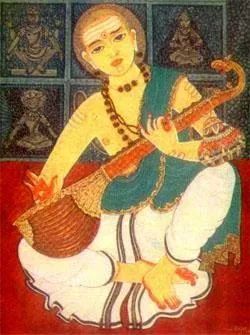
Later, Sri Subbarama Dikshitar in his ‘Sangita-sampradaya-pradarshini’ (1904) refers to Sri Purandaradasa as ‘Karnataka Sangita Pitamaha’ (father of Karnataka Music).

The contributions of the Kannada scholars in terms of –  the Lakshna-grathas that articulated the theoretical aspects of the Music; defining the concept of classifying the Ragas under various Mela-s; refining the elements of Music such as Taala; coining fresh Music terms; and, systematizing the teaching methods , particularly in the early stages of learning  – had been truly enormous.

Texts

1.2. One of the reasons for naming the Dakshinadi as Karnataka Samgita could be that in the initial stages of its development and even in later times up to the 18th century the texts delineating the Grammar (Lakshana –grantha) of Music were authored mostly by Kannada speaking Music-scholars (Lakshanika). The texts were, however, written in Sanskrit and not in Kannada.

The notable among such texts (Lakshana–grantha) in question, mention could be made of 

: – Manasollasa (also called Abhjilashitarta Chintamani ) ascribed to Kalyana Chalukya King Someshwara III (12th century) ;

: – Sangita-Cudamani of Jagadekamalla (1138 to 1150 AD) –   son of king Someshwara , author of Manasollasa;

:- Sangita-sara of  Sage Sri Vidyaranya  (1320 – 1380)  which perhaps was the first text to  group (Mela ) Ragas according to their  parent scale;

: – Sad-raga-chandrodaya of Pundarika Vittala (1583 approx);

 :- Kalanidhi of Catura Kallinatha (Ca,1430),  a reputed commentary on on Sarangadeva’s Sangita-ratnakara ; he was in the court of Immadi  Devaraya ( aka Mallikarjuna) the King of Vijayanagar (1446-65);

: – Swaramela-Kalanidhi  by Ramamatya (Ca.1550) a poet-scholar in the court of Vijayanagar ;

: – Sangita Sudha, attributed to Govindacharya (aka. Govinda Dikshita, Ca 1630);

: – Chaturdandi-Prakasika (a landmark text in Karnataka Sangita) by Venkatamakhin, son of Govinda Dikshita (ca. 1635);

: –  Sangraha Chudamani by Govindacharya (late 17th – early 18th century), which expanded on Venkatamakhi’s work;

:- and,

the Ragalakshanam  ( early 18th century) of Muddu Venkatamakhin (maternal grandson of Venkatamakhin) which makes a drastic shift in the concept of Mela, identifies the Raga by the position of its notes (Svara-sthana) and characterizes a Raga by its Aroha and Avaroha ( ascending and descending notes).

Mela

1.3. The practice of grouping (Mela) the Ragas according to their parent scale, it said, was initiated by Sage Vidyaranya in his Sangita-sara (14th century). Govinda Dikshita (who reverently addresses Sri Vidyarana as: Sri Charana)   confirms this in his Sangita-sudha (1614).  Sri Vidyaranya classified about 50 Ragas into 15 groups (Mela).

Mela is a Kannada term meaning collection or group; and it is still in use (eg. sammelana – is meeting or conference). Sri Vidyaranya ‘s  work on Melakarta system was followed up and improved upon in later times by other Kannada–speaking scholars. 

For instance; Ramamatya, following Sri Vidyaranya, in his Svara-mela-kalanidhi classified the then known Ragas into 20 Melas. His classification of Melas was based on five criteria (Lakshana): Amsa (predominant note); Graha (initial note); Nyasa (final note); Shadava (sixth note); and, Audava (pentatonic structure).

Ramamatya was thereafter followed by:  Pundarika Vittala (16th century); Venkatamakhin (17th century); and his grandson Muddu Venkatamakhin (18th century).

Taala

Sripadarajaru

1.4. Sri Sripadaraja (1406-1504) who presided over the Matta at Mulbagal in Kolar District, Karnataka, is credited with reorganizing the Taala system from out of the numerous Desi Taalas (rhythmic patterns) that were in use. He categorized the Taala under seven categories (Suladi sapta taala), each with a fixed number of counts: dhruva (14), matya (10), rupaka (6), jampa (10), triputa (7), ata (14), and eka (4). The counts were measured in terms of Laghu (of one matra duration- notionally to utter four short syllables) and Dhruta (half that of Laghu). He also provided scope for extending these counts (virama) by adding a quarter duration of a Laghu.

It appears; two other Taalas (jhompata, a Desi Taala and Raganamatya from folk traditions) were also in use.

Of course, today, the Taala regimen has completely been overhauled.

[ For more on The Suladi Sapta Taalas in Carnatik Music – please click here]

power of Music

Music Terms

1.5 . Many of the Music-terms that are in use today were derived from Kannada. For instance: while the music-content of a song is called Dhatu, its lyrics are Mathu (meaning spoken word in Kannada). Similarly, the terms Sarale and Janti-varase are derived from Kannada. Sarale is, in fact, said to be the local (prakrta) version of the Sanskrit term Svaravali (string of Svaras). And, Varase (meaning style in Kannada) refers to ways of rendering the Svaras in high (melu-sthayi) and low (taggu-sthayi) pitch.

Further, the terms to denote ten modes of ornamentation (Dasha-vidha-Gamaka) were also said to be derived from Kannada: Hommu; Jaaru; Rave; and Orike etc.

Teaching Methods

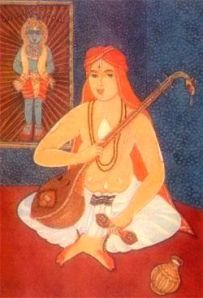
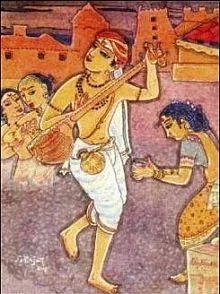
1.6. Apart from charting the path for development of Music in South India, the teaching methods were systematized by Sri Purandaradasa through framing a series of graded lessons. Sri Purandaradasa is credited with devising a set of initial lessons starting with Maya-malava-gaula Raga and later in other Ragas. The Svaravalis, Janti varse, the Suladi Sapta taala alankaras and Gitams, composed by Sri Purandaradasa, form a part of Music-learning. He has also to his credit numerous lakshya and lakshna Gitams; Suladis, Ugabhogas, Devara Nama and kirtanas.

His compositions served as a model for Sri Tyagaraja. The other composers of the 18th century also followed the song-format devised by Sri Purandaradasa which coordinated the aspects of Raga, Bhava and Taala.
kanaka-vyasa-vadi ed

Contribution of Haridasas

2.1. As regards the Haridasas, their contributions to Karnataka Samgita, spread over six hundred years, have been immense, both in terms of the sheer volume and the varieties of their works.

Haridasas were proficient singers and composers; and, spread their message – of devotion, wisdom, ethics in life and social values- through songs and Music. They composed their songs in Kannada, the spoken language of the common people;  not in Sanskrit as was the practice until then. Their songs were accessible even to the not-so-literate masses; and, soon became hugely popular.

2.2. The range of Haridasa Music is indeed very wide. It spread from songs derived from folk traditions (lullaby (laali), koluhadu, udayaraga, suvvake, sobane, gundakriya etc) to Prabandha forms (gadya, churnika, dandaka, shukasarita, umatilaka and sudarshana), to musical opera and to the classic poetry.

But, the bulk of the Haridasa songs were in the format of: Pada; Suladi; and, Ugabhoga. When put together, their numbers run into thousands

2.3. As regards the Music, they seemed to have re-organised Ragas starting with malavagaula, malahari under 32 (battisa) Raga-groups.

[Incidentally, it is said, it was Sri Sripadaraya who first mentioned and introduced into Haridasa-music the stringed drone instrument Tamburi (Tanpura). And, later it came to be identified with the Haridasas in Karnataka music.]

Pada

3.1. Sri Naraharithirtha (13th century), a direct disciple of Sri Madhvacharya, was perhaps the first to compose Kannada songs in Pada- format. (His Ankita or Nama-mudra was Raghupathi.) The model he offered was fully developed and expanded by generations of Haridasa composers. That in turn led to evolution of other song-forms in Karnataka Samgita: Kriti, Kirtana, Javali etc.

3.2. Sri Naraharithirtha, after a considerable gap, was followed by Sri Sripadaraja (Ankita: Rangavittala) who lived for almost a hundred years from 1406-1504. He wrote a good number of Padas as also a long poem in Sanskrit (Bramara-geetha). He also introduced many innovations into Karnataka Music.

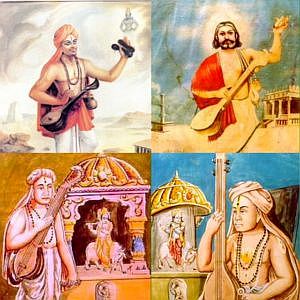
3.3. The later set of Haridasas, mostly, lived around the Vijayanagar times. The prominent among them was the most honoured Sri Vyasaraya (1447-1539), a disciple of Sri Sripadaraja. He composed many Padas (Ankita: Sri Krishna).  He enjoyed the patronage of the Vijayanagar King Sri Krishnadevaraya; and, also had a large following of disciples. During the time of Sri Vyasaraya the Haridasa movement (Daasa-kuta) reached its heights. Sri Purandaradasa and Sri Kanakadasa were prominent members of the Daasa-kuta.

3.4. During the same time, Sri Vadiraja (Ankita: Hayavadana) who had his seat in Sode (North Kanara District) composed varieties of Padas, popular songs and lengthy poems in classic style.

3.5. Among the Daasa-kuta , Sri Purandaradasa (1484-1564) a disciple of Sri Vyasaraya was  , of course,  the most well known of all. He composed countless Padas (Ankita: Purandara Vittala). Though he is said to have composed gita, thaya, padya-vrata (vrittanama) and prabandha (much of which is lost), he is today known mainly by his Padas, Suladis and Ugabhogas.  

His songs cover a range of subjects such as: honesty and purity in ones conduct and thoughts; wholesome   family life; social consciousness and ones responsibility to society; philosophical songs; futility of fake rituals; songs preaching importance of devotion and surrender to God; prayers; narrative songs etc.

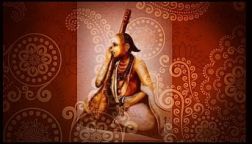
Sri Purandaradasa systematized the methods of teaching Music; and blended lyrics (Mathu), Music (Dhatuu) and Dance (Nrtya) delightfully. He is credited with introducing early-music lessons such as: sarale (svarali), janti (varase), tala- alankaras as well as the group of songs called pillari gitas.  These form the first lessons in learning Karnataka music even today. Sri Purandaradasa was later revered as Karnataka Samgita Pitamaha (father of Karnataka Music).

purandara

It is said; Sri Tyagaraja (1767-1847) derived inspiration from Sri Purandaradasa whom he regarded as one among his Gurus. Sri Tyagaraja, in his dance-drama Prahlada Bhakthi Vijayam pays his tribute to Sri Purandaradasa – వెలయు పురందరదాసుని మహిమలను దలచెద మదిలోన్ (I ponder, in my mind, on the greatness of Purandaradasa who shines in a state of ecstasy, always singing the virtues of Lord Hari which rescues from bad fates). Sri Tyagaraja brought into some of his Kritis the thoughts, emotions and concepts of Sri Purandaradasa.

3.6. A contemporary of Sri Purandaradasa was the equally renowned Sri Kanakadasa (1508-1606). He is remarkable for the range and depth of his works (Ankita: Nele-Adikeshava). He, like the other Haridasas, was driven by the urge to bring about reforms in personal and social lives of people around him. He wrote soulful songs full of devotion (Bhakthi), knowledge (jnana) and dispassion (Vairagya), besides composing classic epic-like poetry in chaste Kannada. His Kavyas: Mohana-tarangini (in Sangatya meter); Nalacharitre, Haribhakthisara and Ramadhyana-charite (in Saptapadi meter) are popular even today.

kanakadasa

3.7. Following Sri Kanakadasa there were generations of Haridasas who continued to compose Padas, Devara Namas Ugabhoga, Suladi, Vruttanama, Dandaka, Tripadi and Ragale (blank verse) etc as per their tradition. Among them  the prominent were : Mahipathidasa(1611-1681) ;  Vijayadasa (1682-1755) ; Prasanna Venkatadasa  (1680-1752) ; Gopaladasa (1722-1762) ; Helavanakatte Giriyamma  (18th century) ; Venugopaladasa (18th century) ; Mohanadasa (1728-1751) ; Krishnadasa (18th century) and Jayesha Vittaladasa (1850-1932).

They all have contributed immensely to the development of Karnataka Samgita. Be bow to them with reverence and gratitude
Dasas-300x300

Pada, Suladi, and, Ugabhoga

4.1. As said earlier; the bulk of Haridasa music can broadly be grouped under three categories: Pada; Suladi; and, Ugabhoga.

4.2. The Padas are structured into Pallavi which gives the gist, followed by Anu-pallavi and Charana (stanzas) which elaborates the substance of the Pallavi. Pada is set to a Raga and a Taala. The Pada-format is closer to that of a Kriti. The term Pada is again derived from Kannada, where it stands for spoken-word or a song.

[Please do read ‘Kannada Suladis of Haridasas’ by  Smt Arati Rao ]

4.3. Suladi (some say that it could suggest Sulaba-hadi , the easy way) is a delightfully enterprising graded and a gliding succession of different Taalas (Tala-malika) and Ragas (Raga-malika). Some others  say, the name Suladi also means Su-haadi (meaning a good path, in Kannada).

The Suladi is a unique musical form that evolved from the Salaga Suda class of Prabandha . It is made up of 5 to 7 stanzas ; and does not, generally, have Pallavi or Anu-pallavi. Each stanza explains one aspect of the central theme of the song. And,   each of its stanzas is set to a different Taala (Taala–malika) chosen from among the nine Suladi Taalas (They in their modern form are: dhruva, mathya, rupaka, jhampa, triputa, atta and eka; in addition to two others jhompata  and  raganamathya), And, at least five Taalas are to be employed in a Suladi.  Occasionally, the folk rhythm Raganmatya Taala is also used.

Therefore, in Suladi, particular attention is paid to the Taala aspect. Sometimes Ragas are not prescribed for rendering a Suladi. Towards the end of the Suladi there is a couplet called Jothe (meaning ‘a pair ‘in Kannada).  Some speculate that Jothe might have been a reflection of Yati , an element of Vadya-prabandha that was sung after the Salaga-prabandha.  
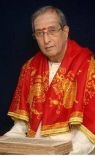
RSatyanarayana Mahamahopadyaya Dr. R. Satyanarayana , who has rendered immense service to various field of study such as Music, Dance, Literature and Sri Vidya,  explains that the Dhruva Prabandha after which Suladi  was patterned employed nine different types of Taalas, while they were sung as a series of separate songs. Thereafter, there came into vogue a practice of treating each song as a stanza or Dhatu (or charana as it is now called) of one lengthy song. And, it was sung as one Prabandha called Suladi. Thus, the Suladi was a Taala-malika, the garland of Taalas or a multi-taala structure.

He mentions that there was also a practice of singing each stanza of a (Suladi) Prabandha in a different Raga. Thus, a Suladi type of Prabandha was a Taala-malika as also a Raga-malika.

Earlier to that,  Matanga had  mentioned  about Chaturanga Prabandha sung in four charanas (stanzas) each set to a different Raga, different Taala , different language (basha) and different metre (Chhandas) . Similarly, another type of Prabandha called Sharabha-lila had eight stanzas each sung in a separate Raga and Taala.

Sarangadeva also mentioned several types of Prabandha-s which were at once Raga- malikas and Taala-malikas such as : Sriranga, Srivilasa, Pancha-bhangi, Panchanana, Umatilaka, and Raga-kadamba.

Thus , the Raga malika, Taala malika and Raga-Taala- malika concept  which was described in the old texts was adopted and improved upon by the Haridasa (Sripadaraya, Vyasaraya, Vadiraja, Purandaradasa and others) to produce series of Suladi songs.

4.4. Ugabhoga is a piece of single stanza, sung in a Raga of performer’s choice.  They are similar to Vrittams which evolved from the Prabandhas of Desi music.  But, they are free from restrictions of meter or the length of the line. Most Ugabhogas don’t have prescribed ragas. It is a form of free rendering where Taala is absent or is not of much importance.  Ugabhoga attempts to convey a message in a nutshell. Therefore, rendering of the theme is more important here. Ugabhoga is characterised by the dominance of Raga- ‘Svara Raga Pradhana’.

Some say; the name Uga-bhoga is related to elements (Dhatu) of Prabandha Music, called Udgraha and A-bogha.  In the song set in Prabandha format, the element Udgraha consisting a pair of lines grasps (udgrahyate) the substance of poem; and, the element A-bogha completes the poem.

Baliya manege vaamana bandante | BhagIrathage sri  Gange bandante |Mucukundage shrI Mukunda bandante | Vidurana manege shrI Krishna bandante | Vibhishanana manege shrI Raama bandante | Ninna naamavu enna naaligeli nindu | Sthalnali srI Purandaravittala ||

As can be seen, there is the opening section (Udgraha) and the last line (Abogha) with the signature (Birudu, Ankita or  Mudra) of the composer. The Ugabhoga is not structured into sections.

There is no prescribed Raga; and there is no Taala either. This Ugabhoga was rendered famous by Smt. ML .Vasantha Kumari who sang the first part in Hamsanandi and the rest in Maand

4.5. The Haridasas through their Padas, Ugabhogas, Suladis and Geetas set to attractive Ragas and Taalas carried to the doors of the common people the message of Bhakthi as also of worldly wisdom.

***

Trinity of Music
Trinity

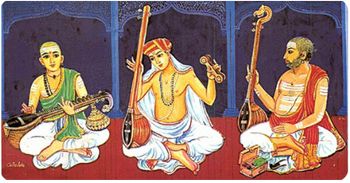
5.1. The contributions of the celebrated Musical Trinity- Sri Tyagaraja, Sri Mutthuswami Dikshitar and Sri Shyama Shastri – are enormous. Their period could doubtless be called the golden age of Karnataka Samgita. Though the three did not meet together, they seemed to have complemented each other wonderfully well.  The approach of each was different from the other. And yet; their combined influences has bound the Music of South India into an integrated system and has given it an identity. For instance; of the three, Shyama Shastri seemed to favour tradition, as most of his compositions are in Ragas mentioned in older treatises. Sri Dikshitar was open to influences from the Music of the West (Nottu sahitya) as also that of the North (Drupad music of North India). Some of his compositions in Vilamba-kaala are set in Ragas derived from North Indian Music. Yet; Sri Dikshitar was authentically original; and was also rooted in tradition, following Mela-Ragas classification of Venkatamakhin and that of Muddu Venkatamakhin’s Ragalakshana.

5.2. Sri Tyagaraja seemed to be more innovative. He brought to life some rare Ragas that were long forgotten and had gone out of use. He also created some new ragas. He perfected the Kriti format of Musical compositions that are in vogue today; introduced the practice of Sangathi elaboration of the Pallavi; and built in Svaras into Sahitya. And, he was also  a prolific composer, having produced large numbers of Kritis/Kirtanas, Utsava-sampradaya kirtanas, Divya nama samkirtanas and Geya Natakas (dance dramas).

5.3. The post-Trinity period saw an explosion of light musical forms, such as: Varnas, Thillanas, Swarajathis, Jathiswarams, Shabdams and Javali. The composers of these musical pieces were mostly the disciples of the Trinity and their subsequent generation of disciples and their followers.
20171017203046

Today and tomorrow

6.1. As you look back, you find that the Music of India developed and changed, over the centuries, at multiple layers due to multiple influences. The Indian classical music as we know today is the harmonious blending of varieties of musical traditions such as sacred music, art music ,  folk music and other musical expressions of India’s extended neighbourhood.  And, yet the Music of India has a unique characteristic and an identity of its own.

6.2. The Music of India has travelled a long way. The modern day Music scene is markedly different from its earlier Avatar, in its practice and in its attitude. The traditional system of patronage vanished long back. Now, the professional musicians have to earn their livelihood by public performance, recoded discs, radio /TV channels, teaching in schools or at home. The relation between the teacher and student , the ways of teaching as also the attitudes of either teaching or learning have all  undergone a sea change; almost a complete departure from the past practices and approaches .   New technology and accessories are brought in to enhance the quality and volume of sound output. Many new instruments, starting with violin and Harmonium, are being adopted for rendering traditional music (saxophone, mandolin etc). The styles of rendering the Alap or the song or even selection of Ragas/kritis are all hugely different. Many musicians have been experimenting with fusion music of various sorts. And above all, there is the overbearing influence of film music.

6.3.  But, at the same time, I believe the fundamental basics of Indian music are not yet distorted. It is, as ever, growing with change, adapting to varying contexts and environments.  This, once again, is a period of exploration and change. It surely is the harbinger of the Music to come in the next decades.
Lotus Blossom_

 In the coming instalments of the series, we will take a look at the various stages in the evolution of the Music of India, separately, each at a time :the  Music of Sama Veda; the  Music in Ramayana; Gandharva or Marga Music; the Music of Dhruvas in Natyashastra ; the Desi Music of Ragas; the Prabandhas along with Daru and other forms  ; various types of song- formats; the best of all formats – the Kritis also ; and at the end , the Lakshana Granthas composed over the centuries, in a bit more detail.

****

In the next part of the series we shall try to catch a glimpse of the Music of Sama Veda.

floral design3

Continued in Part Four

Music of Sama Veda

Sources and References

ಕರ್ನಾಟಕ ಸಂಗೀತ’ದಲ್ಲಿ  ಕನ್ನಡ’

https://neelanjana.wordpress.com/

Important Treatises on Carnatic Music by Harini Raghavan

http://www.nadasurabhi.org/articles/39-important-treatises-on-carnatic-music

Haridasa s’ contribution towards Music

http://www.dvaita.org/haridasa/overview/hdmusic.html

Kannada Suḷādi-s’ by Arati Rao

https://www.academia.edu/37585064/Kannada_Suladi-s.pdf

All images are from Internet
 
8 Comments

Posted by on April 22, 2015 in Music, Sangita


Tags: , , , , , , , , , , , , , ,

Music of India – a brief outline – Part Two

Continued from Part One – Overview


Part Two (of 22) –

Overview (2) – continued

North – South branches

1.1. The Music of India, today, flourishes in two main forms:  the Hindustani or Uttaradi (North Indian music) and the Karnataka or Dakshinadi Samgita (South Indian music). Both the systems have common origins; and spring from the traditional Music of India. But, owing to historical reasons, and intermingling of cultures, the two systems started to diverge around 14th Century, giving rise to two modes of Music.

1.2. In that context, Sarangadeva’s Sangita-ratnakara (first half of 13th century) is of particular importance, because it was written just before influence of the Muslim conquest began to assert itself on Indian culture.  The Music discussed in Sangita-ratnakara is free from Persian influence. Sangita-ratnakara therefore marks the stage at which the ‘integrated’ Music of India was before it branched into North-South Music traditions.

It is clear that by the time of Sarangadeva, the Music of India had moved far away from Marga or Gandharva, as also from the system based on Jatis (class of melodies) and two parent scales.  By his time, many new conventions had entered into the main stream; and   the concept of Ragas that had taken firm roots was wielding considerable authority.  Sarangadeva mentions names of about 267 Ragas.

1.3. In regard to the Music in South India, the Persian influence, if any, came in rather late. Written in 1550, the Svara-mela-kalanidhi of Ramamatya, a minister in the court of Rama Raja of Vijayanagar, makes it evident that the Music of India of that time was yet to be influenced by the Persian music. Somanatha (1609) in his Raga-vibodha confirms this view, although he himself seemed to be getting familiar with Persian music.

Mughal Shamsa, smallest

The Persian influence

Tansen

2.1. The Muslim Sultanat began to get foothold in India by about 1200 A.D, when all major Hindu powers of Northern India had lost their independence,

Conquering Muslims came in contact with a system of Music that was highly developed and, in some ways, similar to their own. The poet Amir Khsru an expert in Music in the court of Allauddin Khilji, Sultan of Delhi (1290-1316) was full of praise for the traditional Music of India. And, at the same time, Khsru was involved with the Sufi movement within Islam which practiced music with the faith that Music was a means to the realization of God.

2.2. But, that didn’t seem to be the general attitude among most of the later Muslim rulers. India in the sixteenth century was politically and geographically fragmented. There were also conflicting cultural practices and prejudices. Though the Mughal era, in general, witnessed musical development, Musicians and Music, as such, did suffer much.

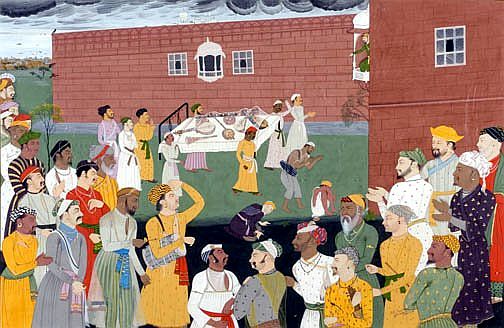
For instance; Aurangzeb (1658-1707) threw the whole lot of musicians out of his court. The grieving , hapless musicians , wailing and lamenting carry the ‘bier’ of music and symbolically bury ‘music’ in Aurangzeb’s presence. Aurangzeb,undaunted, retorted  “Bury it so deep that no sound or echo of it may rise again” (Muntakhab-al Lubab, p.213)

burial-of-music

The unfortunate artists , no longer able to support themselves,  were scattered and had to seek their livelihood in humbler provincial courts. In the process, the accumulated musical knowledge and musical theories developed over the years were lost. The priority of the professional musicians, at that juncture, was to make living by practicing music that pleased their new-found patrons.

2.3. Yet; Music and its traditions did manage to survive and flourish in India despite the Muslim rule and its harsh attitudes towards Music in general and the Indian in particular. Persian Music along with Indian Music was commonly heard in Indian courts; and, the two systems of Music did interact. Amir Khsru, who served in courts of many patrons and assimilated diverse musical influences, is credited with introducing Persian and Arabic elements into Indian Music.

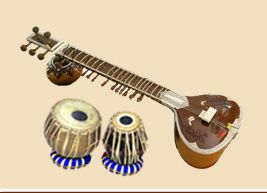
These included new vocal forms as well as new Ragas (Sarfarda, Zilaph), Taalas; and, new musical instruments such as Sitar and Tablas (by modifying Been and Mridamgam). Another modification of Been is said to be Tanpura  (or Tambura, Tanpuri) that provides and maintains Sruti. (Till then, it is said, flute – Venu – provided Sruti). 

Of the vocal forms that were developed, two are particularly important: Qaul, the forerunner of Qawwali, a form of Muslim religious music; and, Tarana a rhythmic song composed of meaningless syllables.

Sitar Tabla

[As regards Sitar, Pandit Ravi Shankar points out that documentation of the history of Sitar between the thirteenth and eighteenth centuries is lacking; and, suggests that Khsru ‘adapted’ probably a ‘Tritantri Veena’, already known to Indians along with its many variations. Khsru gave it the name ‘Sehtar’; reversing the order of the strings in the instrument;  and placing them in present form i.e. ‘the main playing string on outside, and the bass strings closer to the player’s body’. This order is opposite to what we find on Been. But, strangely, the Persian treatise on music written in Gujarat in 1374-75 A.D. Viz. Ghunyat-ul Munya does not mention Sitar or Tabla, though it mentions a number of Tat, Vitat, and Sushira and Ghana instruments.– Bhartiya Sangeet ka Itihaas, Ghunyat ul- Munya, pp. 52-62, Dr. Pranjpay]

Ragaputra_Velavala_of_Bhairava

2.4. Even during the Muslim rule, Music did enjoy some patronage. It appears Sultan Muhammad bin Tughluq (1325-1351) had in his court as many as 1200 musicians. Many other Muslim rulers were also patrons of Music. And, some of them were themselves musicians.

For instance; Husyan Shah Sharqi (1458-1528) Sultan of Jaunpur*, a musician in his own right, is credited with introducing a new form of song–rendering, Khyal (Khayal) lending greater scope for improvisation and technical virtuosity than did the ancient Dhrupad.

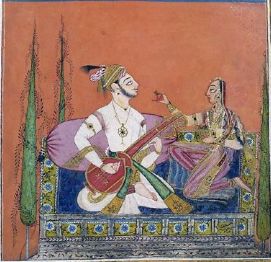
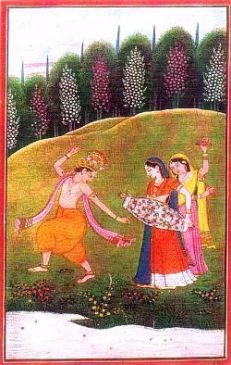
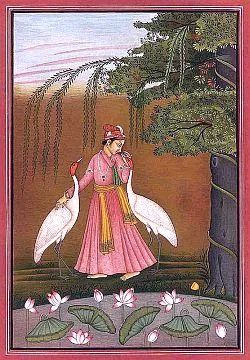
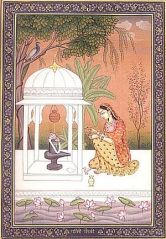
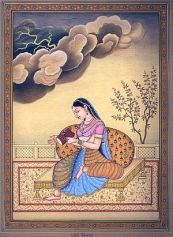
And, Ibrahim Adil shah (1582-1636) of Bijapur (Karnataka), a poet and musician, in his Kitab-i-Nauras (Nava Rasa) compiled his poems set to music. He is also credited with bringing to fore the Raga-mala paintings, depicting pictorial representations to Ragas, their moods and seasons.

Similarly, it is said, the. Khyal singing came into its own due largely to the efforts of Sadarang and Adarang during the reign of Mohammad Shah Rangeela (1719-1748).

[* Swami Prajnanananda in his A History of Indian Music (Volume One- Ancient Period) under the Chapter ‘Evolution of the Gitis and the Prabandhas’ writes:

During Raja Mansingh‘s time Dhrupads were performed in different Ragas’ and Raginis. Khayal form is purely imaginative and colorful. There are different opinions about its evolutions (1) Some say Khayal evolved from Kaivada-prabandha, (2) it originated from Rasak or Ektali-prabandha, (3) it evolved from Rupaka-prabandha, (4) it was created on the image of Sadharani-giti.

In the opinion of Thakur Jaideva Singh, Khayal form is a natural development of ‘Sadharani-Giti’. So Khayal form was neither invented by Indo-Persian poet Amir Khusro nor by Sultan of Jaunpur Hussain Sharqui. The Khayal of slow tempo was designed and made popular by a noted Dhrupadist and Veenkar Niyamat Khan who was in the Court of Sultan Muhammed Shah in 18th Century A.D. Khayal already existed in some form at the time of Akbar in 16th-17th century and it was practiced by Hindu and Muslim musicians like Chand Khan, Suraj Khan and Baj Bahadur. There are lighter forms like Thumri, Dadra and Gazal etc.

[Sadharani –Giti was a style of rendering Dhrupad combining in itself the virtues of four other Gitis or modes of singing that were in vogue during the early Mughal times : Shuddha–Giti (pure, simple, straight contemplative); Bhinna Giti (innovative, articulated, fast and charming Gamaka phrases); Gaudi Giti (sonorous, soft, unbroken mellow stream of singing in all the three tempos); Vesara or Vegasvara Giti (fastness in rendering the Svaras).]

2.5. Even among the Hindu Kings there were Musicians of repute, such as Raja Mansingh of Tomar, Gwalior (1486-1516). He was a generous patron of the arts. Both Hindu and Muslim musicians were employed in his court. He brought back the traditional form of Dhrupad music (Skt. Dhruvapada). He edited a treatise Man Kautuhal, put together by the scholars in his court, incorporating many of the innovations that had entered traditional Indian music since the time of Amir Ahusraw. Raja Mansingh is also credited with compiling/editing three volumes of songs: Vishnupadas (songs in praise of lord Vishnu); Dhrupads; as also, Hori and Dhamar songs associated with the festival of Holi. It is said; later during 1665-66 Fakirullah Saifkhan, a musician in the court of Jahangir (1605-27) partially translated Raja Mansingh’s Man Kautuhal into Persian.

 [Please do read the article about the state of Dhrupad Music in the   Mughal reign during seventeenth-century, written by Katherine Butler Schofield  Professor in Music at King’s College London; and, brought out by the Royal Asiatic Society and the British Library.

Please do not miss to see the colourful illustrations of folios of the Dhrupad songs during the Mughal period.

 She says; of all the arts and sciences cultivated in Mughal India, outside poetry, it is the music that is by far the best documented. She also tells us about the role and power of music at the Mughal court at the empire’s height, before everything began to unravel

Hundreds of substantial works on music from the Mughal period are said to be still extant, in Sanskrit, Persian, and North Indian vernaculars. The following is a brief extract from her talk.

The first known writings in Persian on Indian music date from the thirteenth century CE; and, in vernacular languages from the early sixteenth. These often were translated directly from the Sanskrit theoretical texts.

A particularly authoritative model was Sarngadeva’s Sagīta-ratnākara, the Ocean of Music, written c. 1210–47 for the Yadava ruler of Devagiri (Daulatabad) in the Deccan. This was initially translated into Persian and Dakhni.

Later, the text also came out in vernacular languages, in rather interesting ways. These versions included large additional sections presenting contemporary material chosen from the region in which they were written.

Among such improvised versions, Katherine Butler Schofield  mentions, Ghunyat al-Munya or Richness of Desire, the earliest known Persian treatise on Hindustani music, composed in 1375 for the Delhi-sultanate governor of Gujarat.  

And the other being, Shaikh Abd al-Karim’s Javāhir al-Mūsīqāt-i Muammadī or Jewels of Music, a unique Persian and vernacular manuscript produced at the Adil Shahi court of Bijapur (Karnataka).

Though the Javāhir has its core the Dakhni translation of Sarangadeva’s Sangita ratnakara, it deviates from the main text in number of ways. The Javāhir sidesteps the traditional discussions on Ragas, their concepts, framework and varied forms, which perhaps was getting rather stale by then.  Instead, it introduced the new and vibrant concept of Ragamala (garland of Rāgas).

Katherine Butler Schofield mentions that the Sanskrit authors, in the Mughal domains, continued to write a variety of musical texts. But, what was more notable, during the seventeenth century, was the effort to re-codify and systematise Hindustani music, in new ways; and, in more accessible regional languages, especially suited to the Mughal era.

From there, the translations or the re-rendering of the older texts Hindustani music seem to have moved from Persian  into Hindi, Brajbhasha and other vernaculars , during the reigns of Jahangir and Shah Jahan. For instance; the well-known Sahasras or Thousand Sentiments, a compilation of 1004 Dhrupad songs created by the early sixteenth-century master-musician Nayak Bakhshu, was re-rendered into Brajbhasha, with an introduction in Persian.

The other instance of re-codifying the principles of Hindustani music was the rendering of Damodara’s Sanskrit text, Sagīta-darpaa or Mirror of Music, of early seventeenth century, into Brajbhasha by Harivallabha during the  mid seventeenth-century. Later, in eighteenth-century, it was followed by a gloss in modern Hindi by a hereditary musician, Jivan Khan

Another example is an eighteenth-century interlinear copy of the premier Sanskrit treatise of the early seventeenth century, Damodara’s Sagīta-darpaa or Mirror of Music. Here, alongside the Sanskrit text, we have Harivallabha’s hugely popular mid seventeenth-century Brajbhasha translation, combined with an eighteenth-century gloss in modern Hindi by a hereditary (khandani) musician, Jivan Khan.

**

The first major piece of Mughal theoretical writing in Persian on Hindustani were the chapters on music and musicians written by Akbar’s great ideologue Abu’l Fazl in his Ā’īn-i Akbarī (1593).

But, the process really took off during the reign of Aurangzeb. The translations during his reign were predominantly in Persian. The more prominent among such translated texts, which occupied the canonical position for the next two hundred years, were:

1) The Miftā al-Sarūd or Key to Music: a translation of a lost Sanskrit work called Bhārata-sagīta by Mughal official Qazi Hasan, written in 1664, at Daulatabad

2) The Rāg Darpan or Mirror of Rāga, a work written in 1666 by Saif Khan Faqirullah, completed when he was governor of Kashmir. Faqirullah cites extensively verbatim from the Mānakutūhala, an early sixteenth-century Hindavi work traditionally attributed to Raja Man Singh of Gwalior.

3) The Tarjuma-i Kitāb-i Pārījātak: the 1666 Translation of Ahobala Pandit’s Sanskrit masterpiece Sagītapārijāta by Mirza Raushan Zamir.

4) The fifth chapter of the Tufat al-Hind or Gift of India: 1675 Mirza Khan’s famous work drawn , mainly, from Damodara’s Mirror of Music and from Faqirullah’s Mirror of Rāga. The text which was exhaustive became hugely influential in later centuries.

5) The Shams al-Awāt or Sun of Songs, written in 1698,  by Ras Baras Khan kalāwant, son of Khushhal Khan and the great-great-grandson of Tansen. This work is primarily another Persian translation of Damodara’s Sangitadarpana or Mirror of Music.  The text is enriched with invaluable insights from the orall tradition  of Ras Baras’s esteemed musical lineage.

6) The Nishā-ārā or Ornament of Pleasure, was prepared ,  most likely late seventeenth-century prior to1722 , by the hereditary Sufi musician Mir Salih qawwāl Dehlavi (of Delhi).

These and other treatises written during the time of Aurangzeb cover, in significant depth, a wide range of musical terrain. Their overriding concern and unifying theme, was about the nature of the Rāga, their derivatives and structures.]

2.6. The Persian influence brought in a changed perspective in the style of rendering the classical Indian music as it then existed in North India. The devotional Dhruvapad transformed into the Dhrupad form of singing. And, the Khayal developed as a new form of singing art-music, in the 17th century.

whitelotusmandala

Taking positions

3.1. The periods of 16-18th centuries were rather confusing. While the songs of the Indian music were either in Sanskrit or in a regional language, the Muslim singers found it difficult either to pronounce the words or to grasp the emotional appeal.

Similarly, Hindu musicians found it difficult to render songs in Persian, some of which elaborated Muslim religious themes.

As a result, in either case, in the Music of North India, the words of the songs lost their importance or were of little significance to the singers, while all the attention was focused on voice culture, melodic improvisation and style of rendering the music.

Further, an increasing number of Music-scholars of the North discussed Hindustani Art Music and wrote their works in Persian, Urdu, Hindi and other regional languages, instead of in Sanskrit. Such an admixture of Indian-Persian-Muslim influences over a period of four centuries from the sixteenth resulted in the Hindustani music of today.

karnataka samgita

3.2. Thus, while in the Music of South India the texts were written mainly in Sanskrit ;  and while its  Music continued to be based in structured formats (such as Kriti) and lyrics (Sahitya); the Hindustani music focused on experimenting  with  the possibilities of improvising the musical elements of a song. While Karnataka music retained the traditional octave (sapta svara), the Hindustani music adopted a scale of Shudha Svara saptaka (octave of natural notes).  And at the same time, both the systems exhibited great assimilative power, absorbing folk tunes and regional tilts; and elevating many of the regional tunes to the status of Ragas.

North- South interaction

sangitaratnakara1

4.1. The North and South regions of India had been aware of the developments in each other’s system of Music, art etc; and, there were also attempts to exchange.

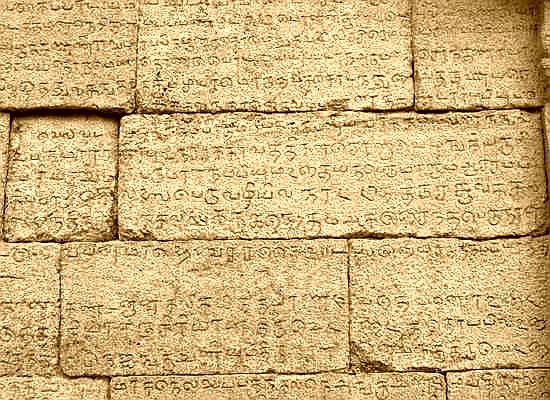
For instance; Mahendra Varma Pallava (CE 600-630), who ruled from Kanchipuram in the seventh century, published some compositions of the North by having them engraved on the rocks on the hill at kudumiyanmalai, in Sanskrit (in Pallava-Grantha characters)  with footnote in Tamil. The inscription is actually an extract of Music lesson (Abhyasa gayana) for developing four types of finger–techniques (Chatush-prahara-Svaragama) for playing on the Veena. The type of the Veena is mentioned as Parivardhini.

The inscription which is in seven sections mentions Ragas such as: Madhyamagrama, Shadjagrama, Shadava, Shadharita, Panchama, Kaisikamadhyama   and KaisikiIt is said in the inscription that these lessons were ‘made for the benefit of the pupils by the King who is the devotee of Maheshwara the Supreme Lord and the disciple of Rudracharya’.

kudimiyanmalai2

The King Nanyadeva (11th century) who established the Rastrakuta dynasty of Karnataka in Mithila (Nepal) in his commentary on Natyashastra refers to Karnata-pata Taanas and to many other elements of the music of the South.

Sarangadeva  in his Sangita Ratnakara (Chapter: Ragadhyaya; Section : Ragangadi Nirnaya Prakarana ), while enumerating ten vibhasha Ragas, mentions a Raga with a Kannada name Devara-vardhini.

Every author of the South based his theory of Karnataka Samgita on the texts of Bharatha, Dattila, Matanga and Sarangadeva.

The  two systems have continued to influence each other  even after Muslim rule . And, that increased  since about the 14th century, in a number of ways. For instance; Gopala Nayaka traveled all the way from the South to become the court musician of Allauddin Khilji (1295-1315) in the North. He cultivated the friendship of the Persian musicologist, Amir Khusrau. Their discussion led to the development of new Ragas. These were incorporated in the treatise on music by the 16th century scholar Pundarika Vittala.

4.2. Till about the late 16th century both the South and North traditions followed the same set of texts.

[Justice Sri T L Venkatarama Aiyar , in his biography of Sri Mutthuswami Dikshitar (National Biography Series, National Book Trust, 1968) , observes that during the days of Venkatamakhin , the differences between the Karnataka and Hindustani systems were not much pronounced. And, Venkatamakhin was well versed in both the systems of Music; and, he composed Lakshana-Gitas on Ragas that  were known to be derived from the Outhareya -Ragas.

Sri Mutthuswami Dikshitar followed Venkatamakhin’s system; he was also well versed in the Dhrupad of the Hindustani system.. He created numerous musical gems, assimilating the the beauties of the either melodic systems.  ]

Pundarika Vittala (1583 approx) a musician-scholar from Karnataka (from around Shivaganga Hills about 50 KMs from Bangalore), who settled down in the North under the patronage of Muslim King Burhan Khan, wrote a series of books concerning Music of North India: Vitthalya; Raga-mala; Nartana-nirnaya; and his famous Sad-raga-chandodaya.

Later he moved to the court of the prince Madhavasimha and Manasimha, feudatory of Akbar. Here he wrote Raga-narayana and Raga-manjari.

In his writings, Pundarika Vittala carried forward the work of Gopala Nayaka (14th century) of grafting Karnataka music on to the newly evolving North Indian music.  In his work Raga-manjari, Pundarika Vittala adopted the parent scale (Mela) classification of Ragas as was devised by Ramamatya (Ca. 1550) in his Swaramela-Kalanidhi. (Ramamatya, in turn, is said to have taken the term Mela meaning ‘group’ and its concept from Sage Vidyaranya’s (1320-1380) Samgita Sara.) Pundarika listed 20 contemporary Ragas of North into Melas, which were not identical with their South Indian examples.

4.3. Somanatha (1609 A.D) a musician scholar hailing from Andhra Desha, largely followed the theories of Pundarika Vittala. Somanatha in his Raga-vibodha mentions 51 Ragas, of which 29 are used in the Music of the present-day: 17 in Karnataka Music, 8 in Hindustani and 4 in both the systems. Some scholars surmise Somanatha’s Ragas mostly correspond to modern Hindustani Ragas; and, though the names of some his Ragas resemble those in Karnataka system it is likely they developed along different lines.

Somanatha is also said to have brought into vogue the practice of writing notations (Raga-sanchara). Raga-vibodha is perhaps the only example before the modern times of any Indian Music using Notations. But, sadly, this valuable text did not receive the level of attention that it deserved.

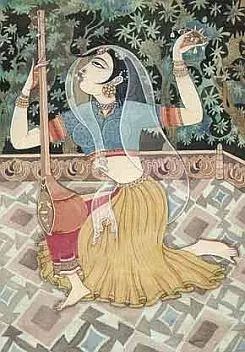
He is also credited with outlining the rules regarding the time of performance, their special characters (Raga-lakshana) or the atmosphere of some of the Ragas. Some of his concepts are still relevant in Hindustani Music, but have not found place in Karnataka Samgita.  For instance; Somanatha in chapter four of his Raga-vibodha describes Raga Abhiri (equivalent to Abheri as it is known now) as a woman (Abhira), dark in complexion, wearing a black dress adorned with a garland of fresh flowers around her neck, attractive ear ornaments. She has a soft and a tender voice; and, wears her hair in beautiful strands.

[Abira is surmised to be a pretty looking Gopi of the Abhira tribe of Mathura region. She is an attractive looking dark complexioned tribal girl.  In the traditional Indian Music, dark complexion of the Ragini and her dark clothes correspond to the predominant note (Amsa) Pa]

4.4. The other significant work that attempted to introduce the elements of South Indian music in the North was Pandita Ahobala (early 17th century) who described himself as a ‘Dravida Brahmana, the son of Samskrita Vidwamsa Sri Krishna Pandita’.

Pandita Ahobala’s Samgita Parijata pravashika describing 68 types of Alamkaras or Vadana-bedha is said to be an improvement over Somanatha’s Raga-vibodha. And, it is regarded by some as the earliest text of the North Indian Music. Following Ramamatya and Pundarika Vittala, Ahobala classified 122 Ragas under six Mela categories. Instead of using specific names for his scales, Ahobala used phrases like vikrta svara, komal, tivra, tivratara, and so on. His scale of Shuddha notes, it is said, corresponds to the current Kafi Thath of the Hindustani system.

Pandita Ahobala’s famous Sangita Parijata was translated into Persian by Mirza Raushan Zamir (1666) as Tarjoma -yi- parijatak, with his own comments.

4.5. There were some other works that classified Ragas (including those of the North) according to Melas, such as: Rasa Kaumudi by Srikantha (Ca. 1575) a South Indian musicologist who migrated North; Raga Tarangini by Locana Kavi (?) recognizing 12 Mela Ragas and 86 Janya (derivative) Ragas which included some Ragas attributed to Amir Kushro; and, Hrdaya kautuka and Hrdaya Prakasha by Hrdaya Narayana Deva (Ca.1660).

lotus reflection

South coming close to North

5.1. By the end of 17th century the classical styles of the two strands of Music had stabilized in their own manners. Seeing that music of North and South were drifting apart in technical aspects, many scholars did make efforts to harmonize the two systems.

5,2, For instance, in the South, Venkatamakhin (1660), author of the monumental Chaturdandi Prakashika which re-structured the Karnataka Samgita, in his list of Desi Ragas included Bhibhas, Hammir, Bilaval, Dhanashri and Malhar which are primarily Ragas of the North.

5.3. And, Sri Mutthuswami Dikshitar, who followed Vekatamakhin’s classification of Mela Ragas, in his youth, lived in Varanasi for about seven years and learnt Dhrupad singing. He brought in the shades of Uttaradi-samgita in some of his Kritis, in his own unique and original manner without compromising pristine Music [e.g. Hamir Kalyani (Kedar), Hindolam (Malkauns), Dvijavanti (Jaijaivanti), Yamuna-kalyani (Yaman) and Brindavana Saranga.]

Gharana-s

6.1. As regards the North Indian music, it was, at that stage, had almost parted with the traditional theories of Music. And, it had come to be regarded more as collection of individual entities than as an organized system of Ragas. Their Ragas were known by the times and seasons they should be performed; their character; magical properties, etc.

6.2. Further, after the disintegration of the Muslim empire the political structure of North India fragmented into numerous small states ruled by Nawabs and Maharajas. Each ruler competed with his rival in studding his court with famed musicians. It is said, rulers of some states borrowed heavily to get hold of top-notch performers. Each ruler was keen to establish the superiority of the Music of his court over that of others. Each would goad his musicians to come up with different styles and techniques of singing, such as: Taans, Murkis, Layakaari, Tayaari, and so on.

The Music across North India, thus, came to be stratified into styles of various court-music. Each was known as a Gharana (‘family’ or ‘house’), named after its patron (such as: Gwalior Gharana, Patiala Gharana, Jaipur Gharana and so on) . Each ruler desired to have his very own personalized Gharana of music. And if no particular geographical region could be identified then a Gharana would take the name of the founder; as for instance: Imdadkhani Gharānā named after the great Imdad Khan (1848 -1920) who served in the Royal Courts of Mysore and Indore.

A  Gharana, in due course,   turned into a symbol of social standing, affluence and power among the rulers .

gharana

6.3. The proliferation of Gharanas gave raise to bewildering styles of singing. Further, there was no exchange of ideas among the Gharanas, because of the element of competition among their patrons. Each Gharana guarded its technique as a secret; and each turned into an island.  Performing to please the patron had taken priority; and, the theoretical aspects were left far behind. Music had become a practical craft. Attempts at standardization did not begin until the twentieth century when Pandit V. N. Bhatkhande worked out a system of classification.

Pandit Bhatkhande’s efforts

PARTHA_BHATKH

7.1. Pandit Vishnu Narayan Bhatkhande (1860-1936), a scholar and a musicologist, in his colossal work ‘Hindustani Sangeet Paddhati’ reorganized the Uttaradi or North Indian Music, mainly,  by adopting the concept of Mela (grouping derived Ragas under a  principal Raga) system as expanded by Venkatamakhin (1660) in the Appendix to his Chatur-dandi-prakashika.

[Venkatamakhin classified the Ragas according to the system of 72 basic scales (Mela)].

Bhatkhande also adopted the idea of Lakshana-geetas that Venkatamakhin employed to describe the characteristics of a Raga. Bhatkhande arranged all the Ragas of the Uttaradi Samgita into ten basic groups called ‘Thaat’, based on their musical scales.  The Thaat arrangement, which is an important contribution to Indian musical theory, broadly corresponds with the Mela-karta system of Dakshinadi samgita.

Rapprochement

8.1. Thus, after the early parts of the 20th century, there began a growing realisation that though the two systems differ from each other in their peculiar and characteristic treatment of Ragas, their fundamental principles are similar. At the same time, the differences in their style of presentation were recognized and given due credit.

Karnataka Music generally begins in Madhyama-kaala (medium tempo) while the Hindustani begins in Vilamba-kaala (slow tempo). The techniques of Alamkara (ornamentation), Gamaka-s and Jaaru (slides) also differ.

The classification of Ragas in the two systems under the Melakartas (the major category) does indeed differ. And yet; certain Ragas of one system correspond to a certain Raga of the other system, though their names differ. For instance; Shubha Pantuvarali, Hindola, Abheri and Mohana of Karnataka Music correspond to Thodi, Malkaunss, Bhimplas and Bhupali of the Hindustani music.

There are plenty more such Ragas that are common to both the systems. Further, there also pairs of Ragas that have the same/similar set of notes (svara-sthana) but slightly differ from one another.

[ Raga Pravaham is a monumental work; and reference source of immense value, is an Index of about 5,000 Karnataka Ragas compiled by Dr. Dhandapani and D. Pattammal. The list of ragas is given both alphabetically and Mela karta wise. The different kramas for the same Ragas and same scales with different names are also listed.

The Mela-karta Ragas, Janya ragas, Vrja and Vakra Ragas and their derivatives , together with their structures, have been Indexed.

In addition, the Raga Pravaham also lists about 140 Hindustani Ragas allied or equivalent to Karnataka Ragas  (pages 277-280 )

A Mela-karta-raga is a Sampurna-Raga (with all seven Svaras) where the ascent (arohana) and descent (avarohana) are in the same (reverse) order e.g. Sankarabharana

The Varja-Ragas are formed by leaving out either in arohana or avarohana or both, one or more Svaras; but keeping the other Svaras unchanged e.g. Hindola, Arabhi, Saramati.

The VakraRagas are formed when the order (Krama) of the Svaras are changed;  e.g. Ritigoula ( in addition one or more Svaras may be left out.]

bar3

Coming close again

Ragini Samgita

9.1. Some distinguished Rāgas (Kāpi, Deś etc.,) of the Karnataka Samgita seem to have come from other regions during Maratha rule; and, are hence referred to as Deśīya.

The Ragas having similar structure, which developed independently in the Karnatak  and Hindustani music traditions, have now been coming closer , tending to influence each other .

Thus, the majestic Darbāri Kāaa — associated with Tansen in Akbar’s court—has influenced the Southern rendering (the Dhaivata note) of the moving aa. With the Carnatic composers and Hindustani musicians popularizing once exclusive Rāgas across the North-South divide, the homogenizing process received a huge boost.

9.2 In the latter half of the 20th century the music of the North and the South did come closer, with the musicians of either branch trying to understand the approach and the idioms of the other.

Jugalbandi

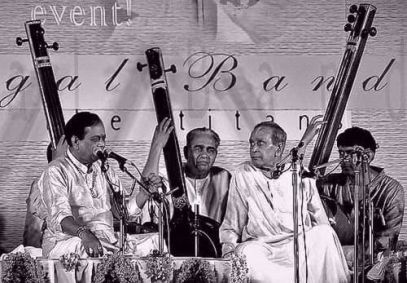
On the performance stage, Ustads , Pandits and Vidwans began singing and  playing together (Jugalbandi) the Ragas common to both; Tabla virtuoso played alongside Mridanga artistes. Now, ragas such as Hamsadhvani, Abhogi and Kiravani became as much Hindustani as they were Karnataka.

9.3. The barriers are thus breaking down and there is a greater awareness among the musicians of today that the music of India is one; and, that two branches that originated from a common stock are indeed the two facets or modes of expressions of an integrated, fundamental Music tradition of India.  And, that the Hindustani and Karnataka systems are but the two classical styles based on a common grammar but with different approaches and modes of expression. It is just their approach, techniques and Mano-dharma that have branched out.

9.4. It is good that the two styles have not attempted to merge into one; because, each enjoys its unique flavour, charm and brilliance. And, it is good that there is a growing mutual respect and appreciation of each other’s genius. The two are indeed variations of the same system and not two different systems altogether.

15056504_645354352310812_8567339100530740859_n

Continued in Part Three

…. Overview (3) – continued

Sources and References

The Rāgs of North Indian Music: Their Structure and Evolution  by Nazir Ali Jairazbhoy

Indian Music: History and Structure   by Emmie Te Nijenhuis’

The Music of India  by Reginald Massey, Jamila Massey

History of Hindustani Classical Music     WWW.itcsra.org

Origins of Indian Music – The medieval period     http://carnatica.net/origin.htm

A BRIEF HISTORY OF INDIAN MUSIC

http://kushanmusic.blogspot.in/2012/02/brief-history-of-indian-music.html

All IMAGES ARE FROM INTERNET

 
5 Comments

Posted by on April 21, 2015 in Music, Sangita


Tags: , , , , , , , , , , ,

Sri Upanishad Brahmendra Yogin

I have heard that Upanishad Brahmendra was one of the teachers of Saint Tyagaraja; and also that he wrote commentaries on Upanishads. I am unable to find information about him, his life etc. Can you please post something on him? Namaskar. Vasudev-anand

Sri Upanishad Brahmendra 

om

1.1. Yes, as you mentioned, not many details of Sri Upanishad Brahmendra’s life are known; and, I reckon there are no major biographies either.  I have also not seen a picture or a sketch of the Yogin. [I read somewhere of an old   sketch on the Mutt walls in Kachipuram where he is depicted in a kaupina. But, I have not seen the Mutt or the sketch].  I understand that the Journal of the Music Academy, Madras, way back in the fifties published The Life and works of Upanishad Brahman written by the well known scholar Dr. V Raghavan; but, that does not seem to be available now, either in print or on the net. However, I came across a brief paragraph about Sri Upanishad Brahman in Prof. SK Ramachandra Rao’s Tantra of Sri Chakra, besides some references to the sage in other works. The following is based on those bits of information.

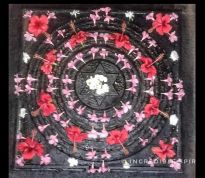
It is said; the Sri Rama Yantra (resembling Sri Chakra) carved on a Saligrama is worshiped in the Mutt. 

upanishad brahmendra muttrama yantra

I wish someone more knowledgeable responds, presenting a fuller picture.

Adishtanam of Sri Upanishad Brahman.jpg

Adistanam of Sri Upanishad Brahmendra

2.1. Sri Upanishad Brahmendra Yogin or Upanishad Brahmendra Saraswati or Upanishad Brahmam a scholar of great merit and a sanyasin, renowned for his unprecedented performance of producing commentaries on all the 108 Upanishads listed in the Mukthiko-panishad, was one of the savants of the eighteenth century. He is reckoned along with Sri Sadashiva Brahmendra (1653? -1753) the renowned Avadhuta, the author of Atma Vidya Vilasa and other Advaita texts and also the composer of sublime kirtans, songs in celebration of various deities; as also with Bhaskararaya Makhin (between 1690 and 1795) the celebrated commentator of Bhavanopanishad a revered text of the Sri Vidya tradition . The Karnataka Music Trinity: Saint Tyagaraja (1767-1847), Sri Mutthuswamy Dikshitar (1775 – 1835) and Sri Shyama Sastry (1762 – 1827) too were contemporaries of Sri Upanishad Brahmendra. What was more remarkable was that all those giants lived, at one time, in and around the Cauvery delta, say within a radius of about a hundred miles.

Early Life

3.1. As regards his early life, it is said that his initial name was Sivarama. He was the son of Sivakamesvara (Sadashiva) Avadhani and Lakshmi Devi of Vadhulasa gotra. His father was a learned scholar who intended to comment on all the Upanishads but, for some reason, could not achieve his ambition. Later in his life, Sri Upanishad Brahmendra towards the end of his vyakhya commentary on Mukthiko-panishad mentioned that he as a dutiful son was trying to fulfil his father’s ambition; and all his works were a tribute to his departed father.

Sivakamesvara Avadhani is said to have hailed from Brahmapuram on the banks of the river Palar.

3. 2. There is no definite information about his date of birth or death. In any event, Sri Upanishad Brahman lived a very long (nearly one hundred years) and a very active and fruitful life. Some biographies of Sri Thyagaraja mention that Sri Upanishad Brahman was younger to Rama-Brahman (father of Sri Thyagaraja) by about twenty-five years; and elder to Sri Thyagaraja by about twenty years. When Sri Thyagaraja last met Sri Upanishad Brahman at Kanchipuram , on his way to Tirumala-Tirupathi, in the year 1839, the former was about seventy-two years of age; which meant that Sri  Upanishad Brahman was at that time about ninety-two years old. By putting together these bits of information one can surmise that Sri Upanishad Brahmendra was born around the year 1747.

3.3. By about the age of twenty-five, Sivarama was initiated into Sanyasa by his guru Sri Vasudevendra Sarasvati and assigned the name: Ramacandrendra Sarasvati. Under the Dasanami order of sanyasins, the Sarasvati sampradaya has two branches: Ananda – Sarasvati and Indra- Sarasvati. Ramacandrendra Sarasvati belonged to the latter order. And, all the sanyasins of the Kanchi-Kamakoti Peeta belong to the Indra-Sarasvati order.

At Thanjavur

4.1. Soon after his initiation into Sanyas, Ramacandrendra Sarasvati wandered for some time as Parivrajaka (wandering monk); and then settled in Thanjavur  which then was the cultural capital of South India , because of the encouragement and patronage extended to  arts and culture  by its  Maratha kings. During his stay at Thanjavur, Ramacandrendra Sarasvati devoted himself to propagation of Upanishad ideals and philosophies. His discourses on Vedas, Upanishads and Ramayana were well attended and highly appreciated. Around this time, Ramacandrendra Sarasvati launched his monumental and almost life-long project of writing commentaries on all the Advaita oriented Upanishads listed in the Mukthiko-panishad.  His involvement in this task was so complete he came to be recognized and respected as Sri Upanishad Brahmendra Yogin or Sri Upanishad Brahman.  His original Sanyas-ashrama name virtually faded into background.

Tanjore_Nayak_Kingdom4.2. The year 1779-80 was a restless and politically uncertain period in the state of Thanjavur. The British East India Company which had been scheming since 1749 to take over the State of Thanjavur finally succeeded. And, in October 1799 the East India Company assumed absolute sovereignty of the State by deposing Raja Serfoji II. The deposed Raja bereft of power and purse was allowed to retain only the capital and a small tract of surrounding villages.

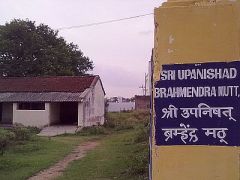
4.3. With the loss of royal patronage and support, most artists and intellectuals migrated out of Thanjavur and drifted into other cities and states in search of livelihood. Upanishad Brahman too did not stay long thereafter in Thanjavur; but went on a pilgrimage to North India. On his return, say, towards the end of the year 1780, he settled down in Kanchipuram and established his own mutt at a place then known as Agasthya-ashrama .The Mutt  later came to be known as Sri Upanishad Brahmendra Mattha. Sri Upanishad Brahman resumed his work on the commentaries.

Philosophical works

5.1. Sri Upanishad Brahmendra was a prolific writer who produced several scholarly works based in Advaita philosophy in addition to commentaries on Bhagavad-Gita and Brahma Sutras.

[please click here for Brahma Sutra Bhashya Siddantha Sangraha edited by  Pandit Sri  V Krishnamacharya ; Adyar Library, 1949]

Apart from those texts , his independent works include: treatise (vritti), study of the origin, nature and validity of knowledge (Paribhasha), advices to aspirants (updaesha), minor dissertations explaining the basic concepts (prakaranas), hymns (stotra) addressed to various divinities, and songs(Divya nama samkirtanam). On the subject of Bhakthi and reciting the name and glory of the Lord he wrote treaties extolling the virtues of their practice (Nama-siddantha). He is said to have evolved the method of contemplation on the Pranava   (AUM), its esoteric quality of sound (pranava-nada).

5.2. Sri Upanishad Brahmendra yogin’s    fame rests mainly on the monumental sets of commentaries he wrote on all the 108 Upanishads listed in the Mukthiko-panishad. He was the first scholar in the Advaita tradition to have provided commentaries on all those listed Upanishads.

[A short explanation appears necessary here. It is not as if there are only 108 Upanishads. The exact number of Upanishads is not known; there are as many Upanishads as one can list. According to some, there are more than 360 Upanishads which include the major and the minor ones; the ancient and the not so ancient; some well known and some hardly known. Even Bhagavad-Gita is listed as an Upanishad, as it is regarded the essence of all Upanishads. Srimad Ananda-thirtha (Sri Madhwacharya) quotes from Brahma tattva and Vishnu Upanishad which now are hardly known.

As per tradition, about thirteen Upanishads are considered major Upanishads; and they represent the core of the Upanishad wisdom. They are of doubtless antiquity and constitute the first tier of the prasthana-traya (the set of three principal texts), the foundations of the Vedic heritage; the other two tiers being the Brahma Sutras and the Bhagavad-Gita. Sri Shankara commented on ten of those major Upanishads (Ishavasya, Kena, Katha, Prashna, Taittireeya, Aithreya, Chandogya, Brihadaranyaka, Mundaka and Mandukya); and cited the other three (Kaushitaki, Svethavatara and Jabaala) as being authoritative.

Over the centuries, varieties of texts gave themselves (or were tagged) the suffix-Upanishad – to their title. That was perhaps meant to provide those texts a halo of authority and an elevated position in the hierarchy of traditional texts. The thoughts in most of such texts were neither fresh nor universal. Many of those texts were theistic and sectarian in their approach; and were, therefore, classified according to their affiliations, such as Vaishnava, Shaiva and Shaktha etc. All such Upanishads are enumerated in the Charana-vyuha section of Atharva Veda, to which they are affiliated. That section itself has a supplementary character about it.

Mukthiko-panishad itself a  minor Upanishad of recent origin , affiliated to Shukla-Yajur Veda, lists 13 major Upanishads , 94 minor  Upanishads and lists itself as the 108th Upanishad.  In the Muktikopanishad , Lord Sri Rama , as the Supreme Brahman, imparts to his disciple Hanuman the essence (Brahmavidya) of the Upanishads (Vedanta) and their nature .  Towards the end, Sri Rama says : I am the visible form of the pure and changeless Brahman. Meditate upon Me to attain Jivanmukthi. ]

5.3. At the end of his gloss on Muktikopanishad , Sri Upanishad Brahmendra mentions that he completed the huge  task in the year Prajothpatti , Dhanrus masa (Margasirasa) , Ekadasi , Asvini , Tuesday (According to some , this works out to    17 – December – 1751 . But, I am , however, not very sure. Sorry).

Sri Upanishad Brahmendra’s commentaries are considered authoritative, and are therefore held in high esteem in the Advaita tradition. It is said he harmonizes (samanvaya) the different shades of Advaita doctrines spread across various texts; and weaves them together into a philosophical framework consistent with the spirit of Upanishads, Brahma sutra, and that of Sri Sankara.

5.4. As a precaution against the possible unauthorized insertions into his texts, Sri Upanishad Brahmendra took care to mention at the end of each of his works the number of stanzas it contained. The total numbers of such stanzas, it is said, add up to about 45,000.A very impressive and valuable contribution to Advaita School.

Manuscripts of his commentaries and his other works are now said to be preserved in the Adyar Library. And, all his commentaries were published by the Adyar Library, Madras during the period 1920-1953.

Association with music

6.1. Sri Upanishad Brahmendra was well versed in music. Although an Advaitin by conviction, he was intensely devoted to Sri Rama, his Ishta-devatha. He followed the Divya nama-samkirtana, the Bhajana form in worship of Sri Rama. He is credited with number of Bhajana-samkirtanas, devotional songs set to music, singing the glory of the Lord.

6.2. He explained Divyanama-samkirtana, the recitation of the sacred name of the chosen deity (Istadevata) as Upaya the means for attaining the ultimate (Upeya) the Brahman. Then, Sri Rama just as the symbol (pratika) Om, according to him, would no longer be a nama of a rupa (form) but will be the very essence of the supreme divinity. Thus, Divya-nama or nama-chit (name –consciousness) is the means (sadhana) and also the end (sadhya). He asserts that the quote “Om eti ekaksharam Brahma” (Bhagavad-Gita: 8.13) gives expression to the identity of the symbol or the name (abhidana) with the object of contemplation (abhideya). Sri Upanishad Brahmendra Yogin explained these concepts in his work Upeya -nama – viveka where he attempts to synchronize Advaita with Bhakthi.

6.3. Sri Upanishad Brahmendra was an integral part of the tradition that was in vogue during those times when the sanyasins based in Advaita ideology also cultivated Bhakthi (devotion) and Sangitha (music). Apart from Upanishad Brahmendra the two other Advaita-sanyasins  – Sri Narayana Thirtha and Sri Sadashiva Brahmendra  – excelled in practice of Nada-vidya as a part of their Sadhana. This was followed by Sri Tyagaraja who had a great affinity towards Upanishad Brahmendra. Sri Tyagaraja too, like his ideal, lovingly adorned Sri Rama in hundreds of his songs; and he too later in his life took to sanyasa – bringing together devotion, music and knowledge of self (jnanavairagya). They all asserted that Bhakthi was the means (sadhana) to realize the goal (sadhya) of attaining unity with God or Brahman.

6.4. Besides this , there arose, in the Cauvery delta , a movement – Bhajana Sampradaya – that firmly believed in the power of the sacred name (Namasiddantha).It asserted the faith that recital of the holy name in loving devotion and giving expression to that through soulful music (nama samkirtana) was the most potent means for liberation. The movement cut across the distinctions of caste (varna) and the stages of life (ashrama). It brought into its fold householders, men, women and children of all sections of the society. Sri Sridhar Venkatesha Ayyaval, Sri Bhodendra Sarasvathi and Sri Bashyam Gopala Krishna Sastry renowned as the triumvirate of Bhajana tradition were the prominent leaders of the congregational devotion (Bhajana mandali) practices. They were followed by Sri Venkataramana – Sadgurusvami who strengthened and gave a form to the Bhakthi and Bhajana-paddathi movement.

Influence on Sri Tyagaraja and Sri Mutthuswami Dikshitar

7.1. The influence of Sri Upanishad Brahman on Sri Tyagaraja and Sri Mutthuswami Dikshitar was significant. Sri Upanishad Brahman and Sri Tyagaraja shared the intense fervour of devotion to their Ista-devatha Sri Rama and to his nama-samkirtana, singing the glory of the Lord. Sri Upanishad Brahman and Sri Mutthuswami Dikshitar shared the principles of Advaita philosophy, the use of its terms in their songs and the adoption of classic Sanskrit as the language of their music.

7.2. While he was living in Thanjavur (prior to 1780), he (then known as Ramacandrendra Sarasvati) used to conduct discourses on Ramayana and also lead chorus-singing of the devotional songs he composed in praise of Sri Rama. It is said, the boy Thyagaraja who was in his early teens, say of ten-twelve years, used to attend, along with his father (Ramabrahmam), the musical discourses and Bhajans conducted by the Sanyasin. (Thiruvayaru where the Ramabrahmam family lived is just 13 Km from Thanjavur).

7.3. The musicologists and experts opine that the traces of Ramacandrendra Sarasvati‘s influence can be found in the Divya-nama-samkirtana songs composed by Sri Thyagaraja. They point out the similarities in the structure of songs and in the word-play (pada-jaala) employed by Sri Thyagaraja and his inspiration, Ramacandrendra Sarasvati.

(e.g.,Kanakambara; Kanakavasana; Celakanaka; Hatakacela;Bhaktha-chandana; Sakalonnata; Rajavandya; Sitamanohara; Rajivaksha; Ranabhima; Jitakama; Navanitasa; Sara-sarastara; Mruduvacana; Niramayanga;  Nadapradipa; Nadasadhana; etc.)

Further it is said; Sri Tyagaraja’s songs: Dhyaname varamaine; Gangasnaname; and Kotinadula which emphasize that the real snana and thirtha (the bath and the holy waters of the pilgrimage) are verily in the contemplation on the name of the Lord and not in the rivers , were inspired by Sri Upanishad Brahmendra‘s Tarangas in his Sri Rama Taranga . It is also mentioned that this work of Sri Upanishad Brahmendra was in turn influenced by the songs in most enchanting opera Krishna-Leela-Tarangini of Sri Narayana Thirtha (1650 -1745).

7.4. As regards Sri Mutthuswamy Dikshitar, he too met Sri Upanishad Brahmendra. After about seven years of stay and study at Varanasi, Sri Dikshitar on his way back home to Thiruvarur, stayed for some time with Sri Upanishad Brahmendra in his mutt at Kanchipuram. This is said to have taken place in the year 1809 when Sri Dikshitar was about thirty-four years of age; and Sri Upanishad Brahmendra was about sixty-two.  During his stay, Sri Dikshitar set to music Rama Ashtapadhi a collection of stanzas composed by Sri Upanishad Brahmendra adoring the glory of Sri Rama. This musical composition is, sadly, lost now.

Dr.V. Raghavan observes that some of the expressions of Advaita-nature used by Upanishad Brahmendra are echoed in Dikshitar’s compositions . For instance ; Avidyakarya; Mayakarya; Vikalebara-kaivalya ; and Bhutabhautika etc. Similarly, he points out that certain  phrases used by Dikshitar resemble those of Upanishad Brahmendra:

Bhava-roga-vaidya(Bhava-rug-vaidya);and, Ramaniya-hrudayavidita (Ramaniya-hrid-vibhava).

Association with Sri Thyagaraja

8.1. When Sri Upanishad Brahmendra and Sri Thyagaraja first met in Thanjavur just prior to 1780, the Sanyasin was a young man of thirty-three years and his admirer was a lad of thirteen. They did not meet again for a very long time. When they met again at Kanchipuram in 1839, after a lapse of nearly sixty years, both had grown into old men; Upanishad Brahmendra was in ripe old age at ninety-two and Thyagaraja too was old, he was seventy-two.

8.2. How this meeting came about is described in fair detail in a weblog page titled manaku teliyani mana tyAgarAju, meaning our Thyagaraja that we do not know. The article is basically about Sri Thyagaraja and references to meeting with Sri Upanishad Brahmendra are incidental to the narration. The article in Telugu language is written in Roman script; and, it makes a very tedious reading. I wish an English translation too was posted.

9.1. It is mentioned that one Kovvur Sundaresa Mudaliyar a wealthy merchant and a Dubash (interpreter as also one who acted as steward, banker and general agent) of the British East India Company at Madras, called on Sri Upanishad Brahmendra at Kanchipuram in order to pay his respects. During the course of their conversation Sundaresa Mudaliyar learnt that the Swamin was well acquainted with Ramabrahmam (father of Thyagaraja). He then went on to describe in laudatory terms the musical genius of Sri Thyagaraja. Sri Upanishad Brahmendra too had heard of the sublime music of Sri Thyagaraja. His conversation with Sundaresa Mudaliyar revived old memories and he longed to see the boy he knew, now grown into a musical celebrity. Sri Upanishad Brahmendra, at the instance of Sundaresa Mudaliyar, decided to send an invitation asking Thyagaraja to visit him at Kanchipuram.

9.2. In his letter, Sri Upanishad Brahmendra mentioned that though he was very desirous of listening to Thyagaraja’s divine music he was unable to visit Thiruvayaru as he was in no position to travel long distances because of his ’extreme age’. And, he said, he would appreciate if Thyagaraja could visit him at Kanchipuram and let him have the pleasure of listening to sublime music. The letter “Sri-mukham’ (a formal communication bearing the official seal and insignia of the Mutt) was sent to Sri Thyagaraja through Thanjavur Rama Rao who was acting as a sort of manager and caretaker of Thyagaraja after the demise of his (Sri Thyagaraja) wife Kamalamba.

[It is said; that srimukham along with some of Thyagaraja’s compositions, in his own writing on palm leaf, are preserved in the Saurastra Sabha at Madurai.]

10.1. The invitation from Sri Upanishad Brahmendra threw Sri Thyagaraja into a dilemma. He could not refuse the invitation from one whom he considered almost a guru (guru-samana) and a very senior person; but, at the same time he was most unwilling to leave his home and his daily worship (Rama-panchayatana) of his beloved deity Sri Rama. He was restless for a couple of days. It is said, it was during these stressful days that Sri Thyagaraja sang the kriti in Todi Raga “koti nadula danushkoti lo undaga, etiki tirugadave O manasaa’; meaning when millions of rivers are merged in danushkoti (the ocean) why do you wander aimlessly, Oh my mind. However, after his disciples assured and promised to conduct regularly the daily puja of his deity Sri Rama, without fail, Sri Thyagaraja agreed to make the trip.

Danushkoti

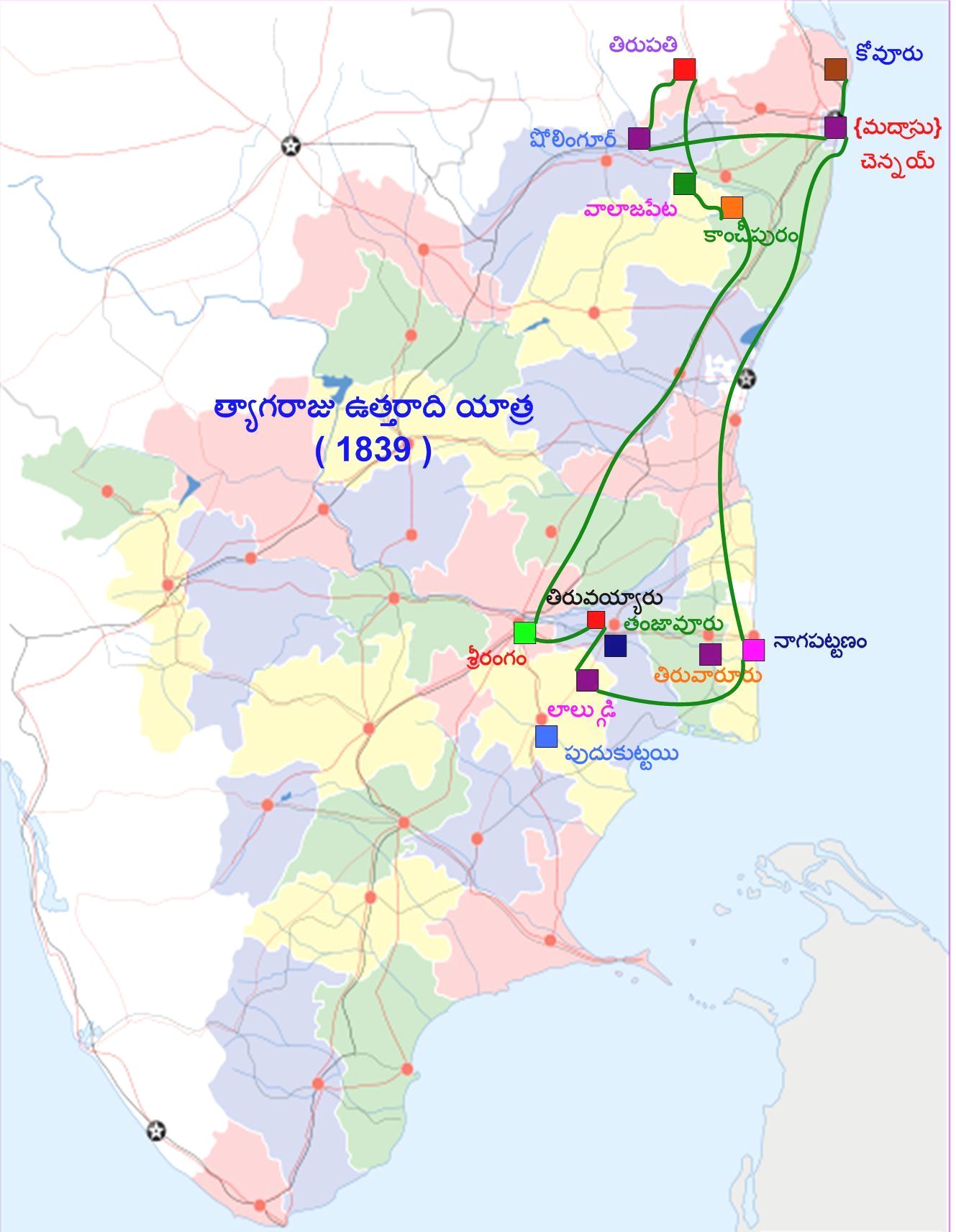
10.2. According to the travel plans arranged and finalized by the Manager Thanjavur Rama Rao, Sri Thyagaraja  and party would first visit Sri Rangam; then on to Kanchipuram to call on  the sage Sri Upanishad Brahmendra honouring  his invitation ; and from there to Tirupthi-Tirumala to have the darshan of Lord Venkateshwara . The return journey would be via Madras, Tiruvattiyur and Lalgudi. Each of those places is a celebrated centre of pilgrimage.

10.3. In the summer of 1839 when Sri Thyagaraja was seventy-two years of age, he departed from Thiruvayaru after attending to the seven-day Chaitra-maasa Saptastana Utsavam celebrations at Panchanadeeswara (Shiva) temple. The travel party included about twenty disciples; and during most of the journey Thyagaraja was carried in a palanquin.

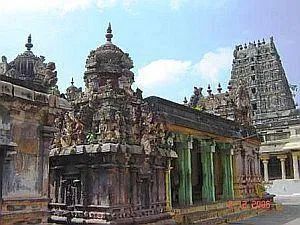
temple 3

Meeting with Sri Thyagaraja

11.1. After worshipping Lord Sri Raganatha at Sri Rangam, the party reached Kanchipuram when the Dolothsavam of the Lord Varadaraja swami was in progress. Sri Thyagaraja was delighted; and in ecstasy he burst forth into the song ‘Varadaraja Ninnukori vacchiti’ (Swarabooshani).

11.2. When they first met (c. 1780) in Thanjavur, Sri  Upanishad Brahmendra, youth of thirty-three was in the prime of life; and Sri Thyagaraja a lad of twelve was  just on the threshold of life. And, when they met again at Kanchipuram (1839) after about sixty years, both had grown into ripe old sages glowing with mellow joy; Sri Upanishad Brahmendra   was about 92 and Sri Thyagaraja was about 72.During those long years both walked the path of life with singular devotion in pursuit of their aspirations and ideals. Both achieved success substantially. The meeting at Kanchipuram was between two blessed and enriched persons sharing mutual regard and admiration.

11.3. Sri Upanishad Brahman was greatly delighted by the musical excellence and pure devotion of Sri Thyagaraja. He enjoyed every moment of Thyagaraja’s stay with him; and is said to have remarked it was worth waiting almost a lifetime for enjoying the delight (raga –sudha) of Sri Thyagaraja’s music. The travel party after a stay of about two weeks at the Sri Upanishad Brahmendra Ashram left for Tirupathi by way of Walajapet where Sri Thyagaraja’s disciple Venkataramana Bhagavatar was waiting anxiously to receive his Guru.

11.4. This was the only elaborate tour that Sri Thyagaraja took in all his life; and, Tirupathi was the farthest place in North that he reached. The trip which basically was undertaken to honour the invitation extended by his guru-samana Sri Upanishad Brahmendra turned out a great success; and musically highly productive. It was a blessing and a boon to Karnataka – music. It gave birth to series o compositions, kriti-groups popularly called kshetra-kritis. They are musical gems; remarkable for their soulful music, inspired rich lyrics and complex structure. The music lovers are in eternal debt to Sri Upanishad Brahmendra and the creator of sublime music Sri Thyagaraja.

Kshetra kirtanas

12.4. At each of the places and temples he visited, Sri Thyagaraja composed inspired kritis singing the glory of its presiding deities: Varadaraja (Sri Rangam); Kamakshi (Kanchipuram); Venkateshwara (Tirupathi); Kovur (Sundareshwara); Lalgudi (Saptharisheeswar and Srimathi). For details : please check Kshetra Kirtanas.

12.5. It was a tradition in those days for the musical composers of merit to compose and sing songs in honour of the presiding deities whenever they visited a prominent temple-town. Such compositions were classified as Kshetra kirtanas. Sri Thyagaraja followed that sampradaya the time honoured practice. Sri Muthuswami Dikshitar too followed this practice. He, in addition, built into his kritis brief references to the temple, its architecture, its rituals and its deity. Amidst these details he skilfully wove the name of the raga (raga mudra) and his own Mudra, signature. All these were structured into well-knit short kritis of grand music glowing with tranquil joy.

rose reflection


References and sources

The Tantra of Sri Chakra

By Prof.SK Ramachandra Rao

Manaku teliyani mana tyAgarAju – 4

http://www.eemaata.com/em/issues/200903/1414.html/4/?fmt=rts

Kshetra Kirtanas

http://www.ipnatlanta.net/camaga/vidyarthi/Thyagaraja/KshetraKritis.htm

Full text of T_T_D_ monthly bulletin vol viii

http://www.archive.org/stream/ttdmonthlybullet015877mbp/ttdmonthlybullet015877mbp_djvu.txt

https://sreenivasaraos.com/2015/02/22/sri-tyagaraja-1767-1847-part-v-visit-to-kanchipuram/

 
6 Comments

Posted by on October 8, 2012 in Music


Tags: , , , ,

The Legacy of Chitrasutra- Fifteen – Shri S Rajam – continued

[This article and its companion posts may be treated as an extension of the series I posted on the Art of Painting in Ancient India .

This is the concluding part of a series that attempted to trace the influence of Chitrasutra, the ancient text and its recommended practices, from the days of the Ajanta to the present period.

In the concluding part of this series we admire the sublime paintings of Shri S Rajam, perhaps the sole votary of Chitrasutra tradition in the modern times.

The part – One of this article briefly outlined Shri S Rajam’s achievements in the field of music and in the music related arts.

In this concluding article part let’s look at a few of the general principles of the Chitrasutra and Shri Rajam as an artist who brought to life the traditional art style of India.]

 Continued from S Rajam Part One

Rama pattabhishekam S Rajam

1.1. The Chitrasutra of Vishnudharmottara, an ancient text dated around sixth century AD, states that one needs to understand music to be a good painter. That might be because the rhythm, fluidity and grace of music have to be transported to painting, in order to make the painting come alive and open its heart to the viewer (sah-hrudaya). That ideal requirement found its fulfilment in Shri S Rajam an eminent musician who is also blessed with a unique gift of creating sublime art works. He practiced both the arts with devotion and dedication over long years of his fruitful life.

1.2. I mentioned earlier that Shri S Rajam has been a true exponent of the Chitrasutra tradition in the modern era. Let’s get to know a bit more about Shri S Rajam’s art, mostly through his own words and pictures; and about his inspiration and guidance..

2. The Early years

2.1. Rajam took to art quite early in his life. By the time he was about fifteen years of age (when he was in Eighth grade) he was sketching fairly well. His father, Sundaram Ayyar as also his friends and relatives who too were artists, encouraged Rajam to hone his skills. He thereafter discontinued formal schooling in his senior year in High school to join the Government School of Arts and Crafts in Madras (1935). He appears to have had a great time in the Art School. He not only had a brilliant academic career but also enjoyed the friendship and support of his friends and teachers.  The Principal was so impressed by Rajam’s talent, that he allowed the boy to complete the six-year course in just four years

school

Later in his life, when he was in his eighties, Shri Rajam while talking about his technique of water-wash said, “I learnt it all from my teacher Shri V. Doraisamy Achari”. Rajam’s Art – school-mates included KCS Panicker, Dhanapal and Kodur Ramamurthy who also flowered into great artists.

3. The quest

quest

3.1. The young Rajam’s visit to the caves of Ajanta was a turning point in his life; it had a profound effect on him; and changed his life and artistic career forever. The ancient art of Ajanta brought about a sea change in Rajam’s outlook of art; his style of depiction in painting; and his attitude to life in general. He realized, painting was not just a technique of putting paint over a surface; it was a way of understanding and expressing your emotions about the life around you; it was a way of looking beyond the forms and appearances that meet the eye; and above all,   it was about giving expression to a deeply spiritual experience that springs from the artists very inner being. The practice of art, he said, was a Sadhana, to be pursued with dedication and reverence.

3.2. The traditional style of the ancient murals at Ajanta so overwhelmed S Rajam    that he suspended his painting activity for a while and got immersed in search of a style of his own that would at once be creative, traditional and soulful. He did eventually, after years of practice, succeed in his search and came up with a unique style that answered his quest and prayer.

Mr. Lewis Thompson (1909-1949)  of England — a poet turned philosopher and Sanyasin  – was also instrumental in Rajam adopting the Oriental school approach in his painting techniques. “I owe it  to  Lewis Thompson who came to Sri Ramana Ashram, where I used to sing occasionally. He was an English poet, deeply interested in Indian philosophy, ten years my senior. He used to write his verses in tiny books. He was responsible for my development and growth in Indian art. He moulded me. He would say, “Art must represent nature, not reproduce it. That’s why you see that Akbar is bigger than the horse in the miniatures. Learn perspective but ignore it once you have mastered it.. The size of the figures depends on their relative importance. “

The following is a brief note on Mr. Thompson.

thompson

[ Lewis Levien Thompson was born on January 13, 1909 in Fulham, England. He received a good conventional education in private schools, despite the modest circumstances of his family.  He was a good singer and accomplished pianist. In his teens, Lewis developed a fascination for the scriptures of the East. He taught himself the Eastern classics, in translations. He also read extensively in anthropology and psychoanalysis. He was greatly influenced by the French poet of the symbolist school Rimbaud (1854-1891) and his wish to discover the soul and the truth.

Like many western intellectuals of the early twentieth century who travelled East in search of spiritual wisdom, Lewis Thompson too abandoned his attachments and allegiances; and plunged into the depths of Eastern philosophy and spirituality. He departed from England when he was 23 years young (July 26, 1932) and lived in India for the remaining seventeen years of his short life. While in India, he wandered the country living off of what others would give him in the form of food and lodging. Thompson was not interested in finding a guru; but he came into close contact with various luminaries, including Sri Ramana Maharishi, Anandamayi Ma, Aurobindo, and Krisha Prem.

During his wandering years in India, Thompson practiced severe self-discipline of an iterant monk and produced some hundred-odd poems; an endless stream of aphorisms; maintained journals over his life in India as a marga, a spiritual discipline; wrote a large number of letters, and various miscellanea.

On June 19, 1949, Lewis Thompson was found wandering dazed and penniless by the River Ganges. Taken to a small room, he languished for two days, writing the last entry in his journal and his last poem, Black Flower, before lapsing into a coma. He died alone in Benares on June 21, 1949.

His journal and a collection of his poems Black Sun were published posthumously during 2001, with an introduction by Richard Lannoy. Lewis Thompson’s work is deeply spiritual, lush with Hindu imagery; and is sensitive, mystical and erotic. He was later described as ‘one of the most original, brave, brilliant and prescient of the pioneers of our contemporary mystical Renaissance’; and,’ as one of the century’s most intrepid spiritual explorers and a ravishing mystical poet’

http://www.richardstodart.com/Lewis%20Thompson.html ]

3.3. It is said; the curious scratch the surface, and, it is only the resolute that overcome the obstacles and delve deeper into learning of enduring value. The quest is always more challenging than curiosity but it surely is rewarding. Shri Rajam’s quest for a unique idiom and a style of expression took him far and wide into ancient caves and temples spread across the country and into the study of varied forms of ancient art-creations, such as the murals, frescos, miniatures, Chola bronzes etc. He spent week after week in the caves of Ajanta, Ellora, Amaravathi, Sittannavasal and Sigiriya (Sri Lanka); as also in the ancient temples of South India and Orissa.

S Rajam at Mahabalipuram

3.4. He took thousands of photographs of the sculptures and the bronzes. He was particularly fascinated by the three-dimensional comeliness and grace of the bronzes. He poured over his photographs and turned them into countless sketches and drawings, learning the art and skill of translating his observation into visual poetry; and coining fresh idioms, phrases and similes of art-expressions to stamp his individuality.

shiva dance

3.5.   He learnt to visualize his design clearly before giving it a form.  “I contemplate on the photograph for many days,” he says, “and form a clear picture in my mind. Then, much later, I transfer the image to the surface of the painting”.Thus, imagination, observation and the expressive force of rhythm became the essential features of his paintings. Through sustained practice,he learnt to make his pictures come alive with rhythm and expression.

In addition , he also studied the ancient texts on painting and sculpture such as the Chitrasutra of Vishnudharmottara, the Kashyapa shilpa sutra etc, along with the epics, puranans and countless dhyana-shlokas which describe precisely the form , appearance , countenance , proportions and the nature of each deity. These texts became his guiding influence; and helped to enhance the authenticity to his depictions.

He also read extensively on the contemporary art-historians and scholars such as Ananada Coomaraswamy, Stella Kramrisch, Gopinatha Rao and others. These helped Rajam as an artist to gain a broader perspective of Indian art.

shiva skanda

In 1939, Rajam met Sri K.V.Jagannathan – the editor of “Kalaimagal”. Rajam’s first published work depicting a Guru and his disciple appeared in Kalaimagal the same year. It was the first of the many that would follow.

His illustrations on the themes based on literature, mythology and philosophy became a regular feature in Kalaimagal and other published works of Sri K.V. Jagannathan. It was a matter of time that his works were sought by other publications such as Dinamani, Kalki etc. The special issues like Deepavali Malar gave him ample space to explore his subjects in depth.

4. An unusual Maverick

maverik

4.1. The initial years of Shri S Rajam’s art-career were stressful; and acceptance did not come easy. He was branded a maverick, perhaps in the sense that he painted like no one else did.  And, not many shared his philosophical perspective on art. He was criticized, mostly, for not belonging to a school of painting. But, that did not deter him in the least. He did not succumb to the trend of the day just for the whim of it. He was convinced that his style was authentic, creative and rooted in the tradition of our culture. He asserted he was not a ‘copier’, but one who painted in his own way. He said, “My art is in representing nature and not in reproducing it”.  It is our fortune Shri Rajam stood his ground. Since then, he has been composing his own one-of-a-kind masterpieces for more than six decades.  And, today his classical genius is not merely well accepted but revered as an icon of creativity and grace rich in tradition.

shiva dance 2

4.2. Even so, Shri Rajam is disappointed with the drift of the times. “Hindu heritage and tradition is ancient and priceless,” he laments, “but devotional art is dying in India and almost extinct. Unfortunately, we Indians ape the Westerners. This attitude wounds me a lot. In tradition, only good things should remain; the bad should be ignored and not continued. This is tradition. The art schools in India have failed to bring forward tradition…., Artistic creation is lacking in arts schools. The training imparted is purely technique oriented, and this by itself is not of much use.”

4.3. His message to the young and budding artists of India is this: “Study scriptures to improve your knowledge. Be modern; there is no problem with that. But know the beauty and elegance of your culture.”

5. Shri Rajam’s art and the Chitrasutra

5.1. Outlook

shiva meditation

(i ). While talking about his approach to  art, Shri Rajam said,”  my art is not, nor was it ever meant to be, realistic or photo-like replicas of life, but rather intuitive perception  of life”. He asserts that in his paintings and line drawings, he attempts to imprison the important moments of the subject’s life to help the contemplative spirit of the observer.His pictures might depict the resemblance but, more importantly, as he said, they aim to bring out the essence or the soul of the subject.

(ii ) . When Shri Rajam said that, he was not merely making a statement but also was echoing the prescriptions of the Chitrasutra which stressed that the concern of the artist should not be to just faithfully reproduce the forms around him. The artist should try to look beyond the tangible world; and beyond the beauty of form that meets the eye. He should lift that veil and look within. The Chitrasutra suggested, the artist should look beyond “The phenomenal world of separated beings and objects that blind s the vision of the reality”.

(iii ). The Chitrasutra emphasizes that art expression is not about how the world appears to one and all, but how the artist would experience and visualize it. Art is an expression of his unique creative genius, imagination, enterprise and individuality as an artist. Its purpose is to present that which is within us; and to evoke an emotional response (the rasa) in the viewer’s heart.

(iv). Shri Rajam’s art creations are excellent illustrations of these principles of the Chitrasutra in the modern times. In his mission, Shri Rajam followed the approach of the classical Indian Art rather that of the west where art directly reproduces the nature and its physical form as it appears to one and all.

5.2. Abstract & Symbolism

symbolism

(i ). While explaining the special features of traditional Indian art, Shri Rajam in his interviews and articles stresses the point that the traditional Indian art relies more on symbolism than on realism. He says, an artist’s power arises from observation translated into visual poetry through similes and suggestions. The eloquent expression of a painting, that is, its Bhava, according to him, consists in drawing out the inner world of the subject. It takes a combination of many factors to articulate the Bhava of a painting; say , through eyes, facial expression, stance , gestures by hands and limbs, surrounding nature, animals , birds and other human figures. Even the rocks, water places and plants (dead or dying or blooming or laden) can be employed to bring out the Bhava. These aspects gain greater importance in narrative paintings, which demand special skills to depict the dramatic effects and reactions of the characters, in its progression from frame to frame.

(ii ). The concept of the abstract and with it a whole set of symbols and symbolisms, that Shri Rajam was discussing, were also the concern of the Chitrasutra. The text suggested the means to render the absolute and the undefined into tangible visual forms.  It said, the objects in nature could be visualized or personified endowing each with a distinct personality in order to illustrate the essence of their character. Accordingly, in the traditional Indian art, the elements of natures like rivers, sun, moon etc   were personified, bringing out their virtues and powers through eloquent symbolisms.  Birds and flowers, trees and creepers too were depicted with a loving grace and tenderness. In certain cases, idyllic nature scenes were created just to convey a sense of joy and wonder.

Shri Rajam’s art abounds in such symbolisms.

5.3. The preparation

preperation

(i). Shri Rajam talks about the way he prepares before commencing on a painting. It is highly interesting. His approach is methodical, thorough and a classic example for others to follow. He studies every available material about the subject, such as the epics, scriptures, the legends; and, archived documents, earlier paintings and photographs in case of personalities. He visualizes his design, contemplates on it and lets it sink into him. He explains “The subject should be visualized with absolutely clarity in the mind’s eye, before setting pencil to paper. I let the preliminary sketch ‘sit’ for a few days, then review, making corrections and changes. Initially I color the background using a soft wash technique originating from the Santhiniketan School, a special feature in all my paintings. Then I define the main figure through light and shade, with highlights in white. I aim to bring out the grace of the human form and poses, for example tribhanga, with the drapery serving to accentuate form as exemplified in Buddhist sculpture.”

shiva dance 3 shiva nrtta2

(ii ) . Even to this day, after nearly seventy years of painting, Shri Rajam visualizes his design after careful study and research into the subject; and only then attempts to draw. He says, “I form a clear picture in my mind. Then, much later, I transfer the image to the surface of the painting.”

5.4. Rekhas, the lines

rekhas

(i) . The Chitrasutra regards the lines – Rekhas – that articulate the form of the figures as the real strength and virtue of a painting; and the ornamentation and colouring as its decorative aspects. Chitrasutra favours employing graceful, steady, smooth and free flowing  lines. The Chitrasutra does not favour straight or harsh or angular or uneven lines. Its masters valued the effects best captured by least number of lines. The economy of lines and simplicity of expression were regarded as the sign of the artist’s maturity.

S_RAJAM_1_31335gS Rajam Antha Rama Sowndharyam

 (ii) . These too are the characteristics of Shri Rajam’s paintings.  The first thing you notice in his works is the strength of the lines that defines precisely the form of the figure. He says, “The line is the life of a painting. I developed my own style, taking from the model of our ancient culture.” He explains that in the oriental traditions, the lines – the Rekhas- are of prime importance unlike in an oil painting. It is the lines that define the substance and form of an oriental painting. He describes his style as closest to Shantiniketan style, emphasizing the lasya – lyrical – aspects.

[The Shantiniketan School of art, sphere headed by the renowned artist Abanindranath Tagore, was a revivalist movement that was started by around 1905. It strived to revive the traditional Indian techniques of art and art styles, deriving inspiration, mainly, from the murals of Ajanta. Its style was, basically, a refined and harmonious blending of simple beauty of expression brought to life by graceful lines and an essential Indianness. The Shantiniketan art done mostly in watercolours depicted Indian religious, mythological, historical and literary subjects. Its style, endowed with the beauty and vigour of its lines, sense of proportion, grace and charm soon became an authentic idiom of Indian art expression.

Shri S Rajam derived inspiration from this tradition too. ]

(iii). The lasya – the lyrical – aspect which Shri Rajam was talking about refers to delineating beautiful figures and their delicate inner feelings through graceful, steady, smooth and free flowing lines that capture their essence. His line-drawings are full of grace and vitality. The delicate touches and intimate details that he deftly adds enliven his figures.

lasya 1lasya2

(iii) Following the tradition of the Chitrasutra , Shri Rajam has depicted nature as in summer; Rainy season; Autumn ; early winter ; and, winter :

SummerRainRain-Thunder

AutumnEarly WinterWinter

(iv) Shri Rajam has also sketched some rather ‘non-traditional’paintings :

Amorphous Man with Red CloudsTrimurthy

Moonlit Mountainscape with YogiSmall Temple in Himalayan Foothills

5.5. Simplicity which is natural and pleasing

simplicity

(i). Shri Rajam says, he aims to infuse into his paintings a simplicity which is natural and pleasing. He stresses the economy of lines and simplicity of form as central to his approach. It is upon this background, he says, he is able to introduce “personal innovations” into his works. That is the reason; his paintings are a rare blend of traditional styles with his unique touch.

(ii). It is because of that approach you find a natural quality and grace in Shri Rajam’s paintings; they almost seem effortless. The vigor, the strength and the power of a heroic figure are brought to life by the vitality of its lines; not by his fat muscles or his sheer size. With use of shading different parts of the body, it produces three dimensional effects in the images.  Even the demons in his paintings are never muscular or excessively fat. The outlines are strong and very sure; and there is an easy and natural depiction of volume, evidencing a good understanding of the rhythm and the structure of the human body.

rakshasa2 s

(iii). His figures are never rigid and static. Their stances are always suggestive of flowing movements of languid grace and charming rhythm. Their distinctive display of smooth motion and the sense of balance are lovely. The painted figures of the “heroes” present a profound sense of peace and joy even while placed amidst activities and contradictions of life.

shiva everywhere

Shri Rajam’s works are excellent illustrations of the principles and aspirations of Chitrasutra.

5.6. Colours

devi green

(i). Another distinctive feature of Shri Rajam’s works is the use of soft color schemes, uniquely decorated costumes; and delicate, deft cultural “touches” that lend authenticity to the context, period and the status / nature of the subject. He often lets elements drift partially off the canvas. But above all else, there is a flow of curve in all of his designs that projects a certain distinctive grace of smooth motion even in stillness.

siva devi

(ii). The other is the use of proper colours:  soft and subdued, the lines firm and sinuous and the expressions true to life. The colours, at times contrasting and at times matching are artistically employed to create magical effects. That effect is enhanced by skilful shading of the body-parts; giving them a three dimensional appearance; and providing depth to the picture. These were precisely the principles that Chitrasutra too recommended.

(iii). The Chitrasutra aptly remarks, when a learned and skilled artist paints with golden colour, with articulate and yet very soft lines with distinct and well arranged garments; and graced with beauty, proportion, rhythm and inspiration, then the painting would truly be beautiful.

How very true that is in the case of Shri Rajam..!

5.6. Eyes

dikshitar. 2 jpg

The Chitrasutra tradition regarded the eyes as the windows to the soul. And, it said, it is through their expressive eyes the figures in the painting open up their heart and speak eloquently to the viewer. It therefore accorded enormous importance to the delicate painting of the soulful and expressive eyes that pour out the essence of the subject. The lively sets of lustrous pools of eyes continue to influence generations of Indian artists; those eyes are, in fact, a hall mark of Indian art works.

One finds a vindication of these principles in Shri Rajam’s paintings.

5.7. Gods & Goddesses

gods

(i). A lot of figures depicted by Shri S Rajam are of gods, goddesses, sages and demons; as also of the kings, queens and the composers of the bygone eras. His involvement in their creation was total; he not merely researched into their every available detail but also tried to get into their spirit. “Practically speaking, to paint the Gods and Goddesses, you must imagine them aggressively,” says Rajam “There are rigid rules of grammar regarding proportions. Yet, the artist has to assume the freedom to compose his picture according to his aesthetic sense. There may not be a physical resemblance to the subject; but one should surely try to bring out the essential nature of its character.”

(ii). You will, therefore, find in Shri Rajam’s paintings the virtues and powers of the gods and demons made explicit by employing varieties of forms, symbols and abstract visualizations. That artistic liberty, freedom and felicity of expression is a characteristic of classical Indian art, as also of Shri Rajam’s art.  He quotes the text (Chitrasutra) and says, “Rules do not make the painting; it is the artist with a soul and vision who creates the art expressions”.

(iii). Many of his creations have now turned into objects of worship; and adorn the walls of the temples and puja-rooms. That might be because, Shri Rajam’s art awakens the divine presence within us; and we respond to the sublime images brought to us in his art. When that happens, we are filled by grace and there is no space left for base desires and pain: we have become that deity.

sankara trinity

Shri Rajam’s art has that magical quality, which brings out the essence of life and the grace that permeate the whole of existence.

5.8. Secular art

Even his secular art is rich in expressive realism, reminiscent of the paintings at Ajanta, Bagh and Sittannavasal. They testify to his love of naturalism – in the depiction of the human form and in the depiction of nature.  Yet, his pictures always seem to suggest to something beyond the obvious, stimulating the senses and igniting the imagination of the viewer.

secular 1secular2

secular3secular4

6. The technique

SRajam2rajam painter

(i). Shri Rajam says, he first paints the outlines , then colours and goes on to finish  with lines.

His themes often required meticulous research. After research, he created the entire painting with the all details in his mind. He started off the paintings with a pencil outline depicting the central figure. The actual painting is done around this central figure thereby creating the required depth. 

(ii). The medium used by Shri Rajam is watercolor on cured plywood, veneer, handmade paper and silk (not the mulberry silk but the tussar silk, the non- violent silk, at the suggestion of The Paramacharya of Kanchi). It is said that in his earlier days Shri Rajam made the paper himself. As regards silk, he says one has to be very careful while painting on silk, because mistakes and wrong lines cannot be corrected or erased easily.

(iii).He used layers of transparent colors. Each color is applied only to be washed away with water using a brush. Upon drying the next layer is applied and washed away. It is this series of washes and the combination of the colors that eventually gave the desired color scheming that was originally envisioned. After the application of the transparent colors, the opaque colors are applied over it. Finally, his characteristic ink outlines (rekhas) were done using a Fine liner pen.

Each painting of his will have about 25 layers of colour; and will be washed ten to twelve times before it is completed. His technique involves washing the paper by dipping the brush in plain water and dabbing it all over the painting. This he does every time after applying a couple of layers of colour. “Do you know why I do it,” he asks. “It is to remove the excess colours from the painting. Only the subtle brush strokes and effects remain and all that is garish is washed away. Do you know I lose more than 30 per cent of the paints this way? It is a loss. But my painting will survive without problems and its life will be as long as the medium on which I do it”.

(iv) . Shri Rajam calls this process “water-wash”, which according to him is an oriental technique, unique to Indian and Chinese painting. The Chinese method, he says, is also the same but the number of washes is not as many as in the Indian method.  He explains, “A wonderful quality of this oriental wash technique is that the painting can be washed in water and no colours will come off except the final touches of tempura colours “.

(v) . He says, such repeated washing –treatment helps the colour stay on the surface and last longer, because through the process, all the colours are absorbed by the handmade paper on which the pictures are painted.  Luckily, the handmade, rag paper etc. that he uses can withstand his water-wash treatment. Not only that, strangely the paintings do not smudge and they emerge all the more beautiful after being subjected to water- wash.

(vi). He uses transparent watercolor while building the layers, and applies opaque colours in the final stages of highlighting and finishing. As colours are applied from light to dark, it enables the undertones of previous colours to be visible. This gives, according to him, a misty and toned effect suitable to portray the imaginative subjects.

(vii). The process is laborious and takes nearly ten washes and about a week to ten days to finish a painting. But, he says, it worth doing it because the method ensures that colours last longer and stay bright. And, even in case the painting gets wet, the colours remain unaffected.

Clearly, this technique requires immense patience and (depending on the size) each painting can take from a few weeks to a few months for completion. It was Rajam’s disciplined approach and incredible ability to multitask that allowed him to simultaneously work on several paintings. It was his capacity to quickly mentally switch from one theme to the other, as the paintings were drying, was the main reason for the volume of work he could produce.

(viii). Shri Rajam recommends that the watercolors be preserved behind glass and ensured that no fungus develops between the painting and the glass.

7. Phenomenal output

shiva devi dance

(i). Considering the volume of study, research and work involved; and the time taken to complete a painting, the prodigious output of Shri Rajam is totally amazing. For this scholarly-painter phenomenon who has entered his nineties, his work is his worship. His zest for work is enormous; and says he is “just beginning”. Even at his age, he is as inspired and enthusiastic about his work as he was in 1940 when he took to painting seriously; and he is no less prolific. Shri Rajam now in his nineties paints for about three to four hours every day.  Art and music are his passions and they keep him young.

(ii). His art work has adorned several books .The paintings produced by him over the years, I reckon, run into a few thousands. I am not sure whether either Shri Rajam or anyone else has kept a count of his artistic output.  Some of his works have also been compiled as books. Notable ones are the Chitra Periya Purana – depicting the legends of the 63 Nayanmars and the Thiruvilaiyadal Puranam – depicting the 64 divine plays of Shiva. Another book titled “Dancing with Shiva” published by the Himalayan Academy, Hawaii , USA has over 300 hundred works of Rajam reproduced with exemplary production value .

Pl see: –
http://www.lntecc.com/homepage/resources/brochures/Sustainabiltiy/ArtHeritageBook.pdf
http://www.lntecc.com/homepage/documents/panchangam/2008_09.pdf
http://www.lntecc.com/homepage/documents/panchangam/2007_08.pdf
http://www.lntecc.com/homepage/documents/panchangam/2006_07.pdf
Pocket Booklet of 72 Melakarta Ragas
‘A Confluence of Art and Music’ – http://www.carnaticdarbar.com/news/201102/20110714.asp
http://www.carnaticdarbar.com/news/201102/20110713-Melakartha-Raga-Booklet.pdf

(Please see www.HimalayanAcademy.com)

It is said , the Himalayan Academy Publications has scanned 923 of Shri Rajam’s creations. Please click here for the web-page:

https://www.himalayanacademy.com/site/search/media_type/painting/file_id/rajam/page/-1/sort/time-descending

https://www.himalayanacademy.com/hamsa/index.html?artist=S.%20Rajam&view=Collection

Apart from that, as I understand, there have not been serious attempts to put together a sizable number of his paintings. There have not been many formal exhibition of Sri. S. Rajam’s works either, except perhaps the one held in Los Alamos, NM, USA in 1981.

(iii). The arrays of subjects chosen by him are vast and diverse. They range from the gods, goddesses, demons, Vedic sages, characters from puranas, literature, history, planetary deities, music composers, Nayanmars , Thirthankaras  and Acharyas of various periods and inclinations  ; festivals , fine arts folk arts and so on and on.

(iv). His works are distributed over book- covers, countless magazines published in various languages, book illustrations, compilations, chronicles, life histories etc. Yet, he feels he has not done quite enough and could have done more; “There is so much more I can do” he rues even at ninety.

(v). Anyone,  even vaguely familiar with his paintings cannot help but wonder how a person, amidst his various interests , pursuits and preoccupations in life, could achieve so much in various other fields of his activities  and yet  produce countless  sublime and soulful precious works of  art .. And, all that in one life time…!

(vi). That was the genius called Acharya Shri S Rajam, the very incarnation of the Vedic seers he admired and adored.

acharya

draft_lens19135557module156995806photo_1329348026aa-aa-a-

Resources & References

Chitrasutra

http://ssubbanna.sulekha.com/blog/post/2008/12/the-legacy-of-chitrasutra-one.htm

http://ssubbanna.sulekha.com/blog/post/2008/09/the-art-of-painting-in-ancient-india-chitrasutra-1.htm

S Rajam

http://www.carnatica.net/mmmela2001/srajam.html

http://www.vidvan.com/painters/rajam/index.htm

An afternoon with S Rajam

http://archives.chennaionline.com/musicnew/carnaticmusic/2004/319th.asp

http://archives.chennaionline.com/musicnew/carnaticmusic/2004/324th.asp

Aesthetic and faithful depiction of character

http://www.hindu.com/fr/2004/05/21/stories/2004052101920700.htm

Visual poetry

http://www.hindu.com/fr/2008/05/16/stories/2008051651090100.htm

Ajanta Cave Paintings

http://www.indian-heritage.org/ajindex.html

https://carnaticmusicreview.wordpress.com/2018/09/17/s-rajam-the-painter/

All the pictures of Shri Rajam are from internet


Tags: , , ,

Legacy of Chitrasutra – Fourteen – Shri S Rajam

[This article and its companion posts may be treated as an extension of the series I posted on  the Art of Painting in Ancient India 

This is the concluding part of a series that attempted to trace the influence of Chitrasutra, the ancient text and its recommended practices, from the days of the Ajanta to the present period.

In this article we move on to the 20th and 21st century   and admire the sublime paintings of Shri S Rajam, perhaps the sole votary of Chitrasutra tradition in the modern times.

The present article briefly outlines Shri S Rajam’s achievements in the field of music and in the music related arts.

In the next part we shall look at Chitrasutra and Shri Rajam as an artist who brought to life the traditional art of India.]

Continued from  The Legacy of Chitrasutra – Thirteen – The Murals of Kerala (Mattanchery and Padmanabhapuram Palaces)

1. Shri S Rajam

1.1 Sangita Kalacharya Vidvan Shri S Rajam is a many splendored jewel of Indian art and music. He is the musicians’ musician; held in very high esteem by the connoisseurs of Carnatic music; he is the creator of sublime art in the pristine and ancient tradition of Chitrasutra; he is an excellent photographer who produced outstanding photographs of temple architecture and sculptures; and, in his youth a hero of early South Indian films who composed songs and sung them too.

The most amazing aspect of his involvement in several branches of arts is that he excelled in each of them; created a unique niche of his own; and , yet remained unaffected by his success.

And, above all , he is a remarkable human being with a flame-like imagination ; and, a teacher with an understanding heart. He is often, aptly, described as a simple man of singular achievements in a plurality of fields. It is hard to cite anyone, in the contemporary world, as comparable to Shri S Rajam. He is a rare gem; and, like any precious gem he is away from public gaze.

1.2. Even as he is mellowing sweetly into his nineties, he retains  the sense of wonder and awe at the marvels of life. He continues  to work with zeal, regularly, at his art; and says with a child-like delight : he is discovering and learning a few new things each day. As regarded music, his other passion in life, he is active as a teacher and as a guide; and  participates in academia and in the discussions at various  Sabhas .

[ Sad to say that about two years after this article was posted, Shri Rajam passed away at the age  of 91 , on 29 Jan 2010 . Please click  here  .

But, prior to that , in January 2009 , Shri Rajam had seen this article; had it read it to him; and, had conveyed his appreciation through his disciple Smt. Vijayalakshmy Subramaniam (please see the comments section) . He had also made certain suggestions/corrections. I gratefully acknowledge  that as his approval and blessings.]

1.3. I have special regard, appreciation and reverence towards Shri S Rajam; because I view him as one of the few gifted artists of the twentieth century who breathed fresh life into the ancient tradition of Chitrasutra – not by talking or writing about the ancient art but by diligently practicing it with devotion and sincerity , over a long period of more than sixty years.

My admiration of him is heightened because he is perhaps the sole true representative and votary of the Chitrasutra in the modern era. To use a favorite phrase of Sri Shankara-bhagavatpada , Shri S Rajam is a Sampradaya-vit, the one who understands Sampradaya  the good tradition.

Shri S Rajam pointed out, “In tradition, only good things should remain; the bad should be ignored and not continued. This is tradition”. And he also said, “Be modern in outlook; there is no problem with that. But, learn to appreciate the beauty and elegance of your culture. Safeguard it; develop it; and, carry it forward for the benefit of the next generation “.

The present article aims, mainly, to talk about that aspect of Shri Rajam’s artistic genius.

But, before we resume discussion on Shri Rajam as an artist, let’s take a quick glance at a few of his life-events  and his  achievements.

2. Early years

S Rajam as babyA Rajam as adolecent01rajamS Rajam as young man

2.1. S Rajam was born at Madurai on 10.02.1919 to Smt. Parvathiamma (also called Chellammal) and Sri V Sundaram Ayyar, a leading advocate of Madras. Sundaram Ayyar was a scholar, a person of culture and a lover of Carnatic music. He, as a connoisseur and patron of music, wrote music-reviews for ‘The Hindu‘; and , his views were respected by artistes such as Ariyakkudi Ramanuja Iyengar and others. S Rajam later in his life recalled, “In case my father felt that a particular sangati was out of place, Iyengar would drop it”.

Ariyakkudi

It is said; at the suggestion of Sri Pudukkottai Dakshinamoorthi   Pillai (1875 – 1925), a noted mridangam and khanjira vidwan of those times, Sundaram Ayyar constructed a spacious hall on the first floor of his house at Mylapore , in order to hold the concerts of the musicians he admired, such as Ariyakudi Ramanujam Iyengar, Madurai Mani, Ambi Deekshithar, Muthiah Bagavathar and Karaikudi Sambasivam. Sundaram Ayyar, it is said, supported and sponsored a young and talented musician Ramaiya who had come to Madras in search of a career in music. Ramaiya later flowered and flourished as a noted singer and a composer of great merit; and gained fame as Papanasanam Sivan (1890 – 1973).

Rajam house Rajam house 2

2.2. Musicians, writers and scholars frequented Ayyar’s household which was a sort of cultural hub in Mylapore of those days. The atmosphere at home was conducive for nurturing love for art and culture in the young hearts of the children at home. Rajam’s younger brother, by about eight years, S Balachender (1927-1990) grew into a larger- than – life personality; a remarkable veena player, with a unique style of his own; a forceful writer; an accomplished actor and an eminent director. Rajam’s two sisters: Jayalakshmi and Saraswathi too were very good singers. Shri Rajam had another younger bother S Gopalaswamy and another younger sister S Kalpakam Balakrishnan who was an accomplished veena player. These two were twins and were the youngest in the family,

2.3. Rajam had his music training at a very young age. Sundaram Ayyar had engaged Ramaiya (Papanasanam Sivan) to train Rajam and his sister Jayalakshmi. Rajam was thus  among the earliest disciples of Papanasanam Sivan. The talented disciple performed  as early as in his 13th year.

Rajam who was then in P.S. High School was an avid movie fan; he hardly missed a silent movie that ran in the tent cinema behind his school. Little did he realize then he himself would very soon be a movie star. The year 1934 proved to be a very important year for Rajam , a handsome lad of fifteen years; as also for his teacher Papanasam Sivan who in his mid-age (say about 44) was in search of a stable career in music. The year saw them launched into successful careers in films and music.

The noted film critique historian Madabhushi Rangadorai who gained fame under his pen-name Randor Guy has described the circumstances that led Papanasam Sivan as also Rajam and family into the world of films. Rajam’s first film was Seetha Kalyanam (1934), a Prabhat Talkies production directed by the well known Marathi and Hindi filmmaker of his day, Baburao Phendharkar

The strikingly handsome fifteen year lad Rajam  of  sharp features and slim figure played the leading role of Sri Rama, while his sister Jayalakshmi played the leading- lady Seetha. (That raised quite a few eyebrows).

The film, in a way, was a family venture, as Rajam’s father Sundaram Ayyar played Janaka, while  Rajam’ s other sister  Saraswathi played Urmila and Rajam’s kid-brother Balachender played a child musician in the court of Demon King Ravana. The music was provided by Rajam’s teacher Papanasam Sivan.

[For more on the Seethakalyanam Film, please check the following link and the references listed on the page.

http://en.wikipedia.org/wiki/Seetha_Kalyanam_(Film) ]

seetha kalyana

The film Seetha Kalyanam and its music was a huge success. It launched Rajam and his teacher Papanasam Sivan on their way to stardom. Some songs set to music by Papanasam Sivan ; and, sung by Rajam became hits. To mention a couple of those: ‘Nal vidai thaarum…’ (Raga Kalyani – based on Saint Thyagaraja’s ‘Amma Raavamaa…’); and, ‘Kaaranam ethu swami….’ (Raga Kaanada – based on Saint Purandaradasa’s composition ‘Sevaka kana ruchirey…).

Following that success, Rajam’s second film was Radha Kalyanam (1935), produced by Meenakshi Movies and directed by C. K. Sathasivan (better known as Saachi). Rajam played the lead role of Krishna while Radha was played by the beautiful looking star of those days M.R. Santhanalakshmi who perhaps was elder to the hero Rajam. The music to the film was provided by the noted singer-composer Sri Harikesanallur Muthiah Bhagavatar.

Rajam’s third film as hero was Rukmini Kalyanam (1936); and, Rajam played Krishna again. The film was directed by the famous Marathi filmmaker, actor and Baburao Phendharkar’s brother Balji Phendharkar.

Of the three films in which Rajam played the leading role, it appears, the first film Seetha Kalyanam, was true success; the other two were not so successful. But, by then the handsome brothers S. Rajam (18) and Balachander (10) had gained fame as ‘Prabhat Prodigy Stars‘ and ‘South Indian Prodigies‘. They toured several cities in India and in Sri Lanka, performing duet-concerts. It is said, like the legendary Lav and Kush, the two handsome and talented young lads were the darlings of art-lovers and the cynosure of all eyes.

Rajam 1Rajam 2Rajam 3

2.4. Shri Rajam played leading roles in three Tamil films Seetha-kalyanam, Radha-kalyanam and Rukmini-kalyanam; and also sang. By then Rajam was married and  his wife was not in favour of his acting in movies. Shri Rajam later humorously remarked, all his three films were Kalyanams ; and , after his own Kalyanam there could not be any more Kalyanams.

Shri Rajam’s association with the world of films was relatively brief ; but, it was highly successful.

In the years thereafter, Shri Rajam   visited many temples in India and Sri Lanka; and, stayed for a while in the 7th century temple of Sri Kailasanathar at Kanchipuram.

S. Jayalakshmi

Shri Rajam did however , later in 1942,  played a supporting triple role of Lord Muruga; the boy-Murga; and, the hunter-Muruga in a hit movie Sivakavi in which the doyen of Tamil films Tyagaraja Bhagavathar the singer- actor played the lead role. Rajam’s sister Jayalakshmi played the leading lady in the film; while Rajam’s father Sundaram Ayyar played guru, the teacher of young Sivakavi.

sivakavi

Later in 1948, Shri Rajam composed music and also sang the song ‘Kaathal puyalthaniley thurumbupol…’ in V. Shantaram’s ‘Nam Nadu’ the Tamil remake of his Hindi film ‘Apna Desh’.

Shri S Rajam thus was a pioneer in the development of the Tamil films. Shri Rajam blessed with an agile mind and good health is today the senior-most living hero, the leading-man, of the Tamil film world. His contribution to Tamil films is recognized by one and all  with pleasure and gratitude.

Please click here for a video on Sri Rajam’s life and achievements

3. Music


3.1. Shri S Rajam is a well recognized, much admired and an honored performing musician. In his home state, Tamil Nadu, he enjoys more fame in the world of music than in art. In one of the interviews to a music journal, Shri Rajam quietly remarked towards the end of the interview “Not many may know that I am a painter; and, I do original classical paintings. I divide my time between painting and music.” Such is the child-like candor and humility of the grand-old man of Indian arts and music…!

3.2. Shri S  Rajam served for about 35 years as music supervisor and a Grade A artiste at the All India Radio (AIR), where he popularized Carnatic Music and also Thirukkural singing . He performed full duration kutcheris based on Tirukkural couplets.  During his tenure, he recorded rare compositions of the Vaggeyakars, produced many operas and musical plays.  He later mentioned that his most cherished program with AIR was the presentation of Silappadikaram as an opera with a huge orchestra. “Our culture is a very ancient one; and, we have the responsibility of passing it on to the next generation in its truest form. I shall strive to do my best in this regard; and , I may even write a book”.

Between 1970 and 1982, while serving AIR, he led a team of artists on a music tour to Africa , presenting a percussion ensemble; and, also toured USA performing 32 musical concerts in various cities. He also performed in Burma, Sri Lanka and Canada.

His lecture demonstration on rare Ragas and kritis, vivadi Ragas, as also on the compositions of Koteeswara Iyer are admired by the connoisseurs. His special interest in vivadi ragas, as also Lakshana and Lakshya aspects of Carnatic music is well known.

[Please check the following for Shri S Rajam’s rendering of Dikshitar’s Navagraha kritis

Rajam S – Music India Online :   Album: Navagraha Krithis

http://www.musicindiaonline.com/music/carnatic_vocal/m/artist.6226/ ]

Sri S Rajam was best known for very aesthetic renditions of ‘vivaadi ragas’, which need a balanced and delicate handling.  Please listen to his rendering  Sri Muttuswami Dikshitar‘s  composition ‘kalavati kamalasana yuvati’ in Raga kalavati, (One of the vivadi ragas). Please click on :

https://youtu.be/g0TSuq0YVSM

rajam u tube

3.3. Shri Rajam continued to serve , till his last days ,  on the expert committee of the Music Academy at Chennai.  His simplicity and willingness to help anyone who approaches  him on subjects related to art and music has endeared him to all ; and , to the young, in particular.

rajam old

3.4. Over the years, many honors have been showered on Shri Rajam. Just to name a few of those: He was awarded the title “Isai Kadal” (ocean of music) by the Tamil Sangham, Karikudi in 1988. He was accorded the Sangeetha Nataka Academy award in 1992; and , the Kala Acharya in 1996. The only significant honor he received from the Madras Music Academy (to which he contributed so much) has been the title of Sangeetha Acharya. Probably the best way to describe him is: Acharya.

It is interesting that as early as 1947 when Shri Rajam was still a young man of about 28 years, the late K.V. Ramachandran (well known Art critic), wrote him: “You know I am not given to praising anyone, still less over praising. If it were in my gift to give a title, and if any one deserves it in India today, you deserve the name of Acharya — the master in painting. I don’t flatter. “Shri Ramachandran (1898-1956) , it is said , was in his day  regarded   the foremost music and art critic in the country. He was not easily pleased; and a ‘good-word’ from him was considered a high reward even by merited artists. His high praise of Rajam signified the eminence that Shri Rajam enjoyed even as a young person.

I understand that at the 76th South Indian music conference and festival of Indian Fine Arts Society to be held in Chennai during Dec 18, 2008 to Jan 4th, 2009, Shri S Rajam would be honored with the title, ‘Sangeetha Kalasikhamani‘. No honor is too high for Vidvan Shri S Rajam.

rajam honour

3.5. While reminiscenceing his musical training, Sri Rajam fondly recalls how his father Sundaram Ayyar took him, while still a lad of ten, to the well known musician Sri Ambi Dikshitar  (son of the renowned Sri Subbarama Dikshitar) for music lessons. Talking about his Guru, Shri Rajam mentions that Sri Ambi Dikshitar had a deep voice of low sruthi that could easily touch the panchama in the lower octave; and Ambi Dikshitar’s voice was well suited for rendering, with clarity, the grand and slow paced compositions of Sri Mutthuswami Dikshitar. Rajam was amused that his teacher , a descendant of the Mutthuswami Dikshitar lineage , should commence his lessons with a composition of Sri Thyagaraja (enta nercina in shuddha dhanyaasi). It was a rare privilege, he remarked, and a great fortune. Later, of course, Sri Ambi Dikshitar taught Rajam many compositions of Sri Mutthuswami Dikshitar, most notable being the Navagraha kritis.

3.6. He had the privilege of being trained in music by a galaxy of stalwarts. He recalls with gratitude and pleasure, “I have undergone training from many Gurus. I learnt Dikshitar kritis from Sri Ambi Dikshitar. It is from Ariyakudi Ramanuja Iyengar that I attained Pathantara suddham and perfection in singing fast tempo. I learnt depiction of vakra, varjya ragas; and swaraprastara from Madurai Mani Iyer. Papanasam Sivan, though a composer himself , taught me lots of Tyagaraja Kritis… Madurai Mani Iyer taught me Nagumomu with chatusruti dhaivata; while Papanasam Sivan taught me in suddhadhaivatam, the correct way…. Although I have learnt from many gurus, I crave to express what we have not heard from other musicians.”

musicians.1 jpgmusicians.2 jpgmusicians.3 jpg

One of the musicians he admired most in his youth was Smt. Veena Dhanammal (1867-1938),  renowned for adherence to traditional values and profundity of music expression. He heard her in the latter years of her life. He spoke of her  from his heart “It was Dhanammal’s music that haunted me in my early years.  Dhanammal was Sarasvathi incarnate – she sang and played the veena alternately. I was fortunate to attend her Friday soirees , some 40 times. I would sit very close to her; and when she sang Akshayalinga vibho, she shed tears while doing niraval on the line ‘padarivana’. Shouldn’t we have the same intensity of feeling while performing? How can you be a real singer if you are not a rasika yourself?”

3.7.kotesvaraiyer S Rajam’s favourite composer is Koteeswara Iyer (January 1870 – October 21, 1936) popularly known as Kavi Kunjara Dasan. “I am deeply interested in Koteeswara Iyer’s compositions” S Rajam said, ” I do not compare any other composer with him, I find great pleasure in singing his compositions”. Koteeswara Iyer was the first composer, after Sri Mutthuswami Dikshitar, who composed krithis in all 72 Melakartha-ragas. His monumental work, “kanda ganamudam” has songs, in praise of Lord Muruga, composed in all the 72 Melas. The songs are in chaste Tamil .

[Please listen to Sri Rajam speaking about Sri Koteeswara Iyer]

3.8. Shri S. Rajam has the distinction of being the only musician to have sung all those 72 compositions; each kriti being accompanied by raga-alapana, neraval and kalpana-svaras. He said,” It is vital to understand the meaning and bhava of a composition to make an emotional presentation or render the song with insight “. His rendering of Koteeswara Iyer’s songs is recorded in a set of ten tapes / nine CDs.  Sri  S. Rajam has also published a book giving notations for all the 72 songs.

3.9.The noted scholar, Prof .N. Ramanathan , in the March 2019 issue of Sruti , writes about the Music of Sri S Rajam:

The music and personality of S. Rajam made a great impression. It is not possible to separate music and his nature.

He was blessed with an enviable voice while very few male singers from Tamil Nadu have a melodious voice. From the panchama in the mandra sthayi to the tara panchama, he had a voice of uniform evenness and steadiness. He did not croon, nor did he use a false (head?) voice. His voice production was clean.

It is common for musicians to set some musical preferences for themselves. The thrust among Carnatic musicians is usually on the madhyama kala or medium tempo. Gamakas like kampita, jaru and vali characterise the melodic line in abundance, but in their performances, we do observe a fundamental incompatibility between the kala-pramanam and the Gamakas.

In other words, when there is an acceleration from the madhyama kala to the druta kala, the Gamakas are intensified instead of being sobered up, resulting in a kind of melodic jarring and confusion.

Rajam gave preference to madhyama kala but maintained a certain restraint in the extent and tempo of Gamakas and kept the melodic expression from getting out of control. As a result, his music might have given the impression of lacking a ‘Carnatic melodic depth’, but the richness of the voice was not sacrificed and the beauty of melodic expression was well maintained.

Dwaram Venkata Swamy Naidu too, as we observe in his recordings, in order to avoid any compromise with the tonal quality of the violin, curtailed the intensity of some Gamakas and also simulated them through ‘viraladi’, the dexterous movement of different fingers, instead of quick up-and-down sliding movements on the string. These could be referred to as aesthetic preferences of artists.

By nature, Rajam was fond of extended plain Svaras devoid of heavy oscillatory tonal movements. Hence, we can understand his liking for and embracing of Mela-Karta-ragas, especially the vivadi ones, and consequently his preference for the kritis of KotiswaraIyer.

As a result, in Cutcherries—both on stage and in All India Radio, the voice came out clear and majestic. He did not exploit or abuse his gifted voice. He was like G.N. Balasubramaniam in his capability of rendering druta kala phrases and briga phrases with ease, but he never indulged in them. In fact, he did not adapt music to project his voice and instead gave primacy to melodic beauty. It is no wonder that even in the later years, his voice did not lose its mettle and remained fresh, despite his continued smoking habit.

Even in the All-India Radio cutcherry performed in his 87th year, the music and voice appeared bright and did not display any signs of ageing. Except on one or two occasions, that too only in the last two years of his life, I have never heard him being troubled by voice or straying off shruti. Today however, we come across many singers with a penchant for harmonium-type brigas, abusing their voices and tragically losing them at a very early age.

At the same time, Rajam did not allow his voice to dominate his music. This is where we see his nature being reflected. He never made any effort to impress the audience through his performances, never played to the gallery. Hence a large number of his performances were those broadcast by All India Radio and not at sabhas. The radio medium was best suited to his nature.

Rajam’s main professional career was as an employee in the Music section of All India Radio, Chennai. He was the architect behind the production of many features like devotional songs, musical dramas and contribution of specific vaggeyakaras. Mi. Pa. Somasundaram and T. Sankaran were his colleagues and they often teamed up in preparing, producing and executing valuable musical features. All three prided themselves on having worked under the legendary G.T. Sastry, Station Director of All India Radio, Trichy, and later Chennai.

design2

3.10 Listen to Shri S. Rajam singing the popular kriti, Sri Valli:

http://www.sawf.org/audio/sivan/srajam_srivalli.ram

…and to Shri S. Rajam speak about Papanasanam Sivan and Natabhairavi:

http://www.sawf.org/audio/sivan/srajam_spk.ram

4. Music & painting

Rajam painting

4.1. Shri S Rajam is the golden link (svarna setu) between music and art. He provided a visual identity and a tangible idiom of expression to Indian classical music through his paintings. For instance; just to mention a few, his series of paintings Origin & Classification of Svaras (inspired by Sangeetha Kalpadrumam of Harikesanallur Muthaiah Bhagavatar), illustrating the origins and characteristics of each of the seven notes of Indian music, explaining their nature and their relation to the Hindustani and Western music systems, is a remarkable work of great learning and sublime art. I have not come across a like of it anywhere else.

Similarly, his series of twelve paintings illustrating Venkatamakhi’s Melakartha scheme by classifying the 72 Mela ragas into 12 Chakras or segments; associating each Chakra with a month of the year (from April- March) ; and, illustrating them through soulful and imaginative paintings is a marvelous example of the delightful amalgam of innovation , scholarship and superb artistry. It is a unique piece of visual poetry and music. This series was also meant as a tribute to Venkatamakhi the great musician-musicologist (1635-1690).

Navagraha

And, his series of paintings illustrating the kritis and particularly the  Navagraha kritis of Sri Mutthuswami Dikshitar are, of course, legendary; and have passed into the folklore of music, astrology, and tantra traditions; and also have become idioms in  classical school of painting.

rajam ramaSRajam

4.2. In each case, he poured into puranas, epics and ancient texts searching for details and for the right idioms of expression. His involvement was complete; and , he was totally absorbed into his work. While recalling his experience while painting the Navagraha series, he mentions, “Inexplicable incidents occurred, a reminder that Dikshitar’s compositions are invested with awesome power. While painting Surya, gusts of wind would snatch the paper away from my hands.  while embarking on Rahu, I found a snake skin hanging from a creeper;  and, even a live snake coiled beneath the finished painting.”

purandaradasa kshetrayya

4.3. His portraitures of the composers in the classical traditions of Indian music are benchmarks; and now, after his advent, one can scarcely visualize the hoary composers but through the eyes of Shri S Rajam. His portrait of the trinity of Carnatic music (Saint Thyagaraja, Sri Mutthuswami Dikshitar and Sri Shyama Shastri) which he painted when he was barely twenty years of age is a true classic; it is a universally acclaimed archetype and one that is even worshipped.

trimurti

4.4. Hallmarks of his portraits are their authenticity. He studied and researched into his subjects thoroughly, grasped the essence of their character and achievements. His portraits therefore bring out not mere the physical resemblance of the subjects but more importantly the essence of their very inner being.

4.5. There are some interesting stories associated with his portraitures of the Music Trinity. In the case of Saint Thyagaraja, the old drawings available at that time (before 1940) showed a weak, melancholic person with his chest bones protruding and having a rather sickly countenance. Shri S Rajam felt offended by the old portraits; and was hurt the saint was shown in a poor light causing injustice to his genius. Shri S Rajam strongly felt that the portrait should aptly project the character and greatness of the person, his achievements, his genius and his mellow glowing sattvic nature;   and not just his physical resemblance.

thyagayya

Sri Mutthuswami Dikshitar was an Upasaka of Sri Chakra and the Devi; he was an advaitin in his outlook. There was always a certain serene detachment about him; and in his eyes. In Shri S Rajam’s portraits, Sri Dikshitar comes across as a calm, composed, handsome young person of lime-color (golden hue) complexion. He always wears a green  (or a blue) shawl over his left shoulder, and sports rudraksha -mala around his neck. His veena is upturned; with the face of the yali looking up.

dikshitar

His portrait of Sri Shyama Shastri which eventually turned into an Indian postal stamp has an interesting story around it. Sri Shyama Shastri too was a Devi Upasaka, but charged with intense devotion and a poignant longing for the Mother. He was a deeply religious person who adhered to the prescriptions of the scriptures. He always had a dash of vermilion (Devi –prasada) right between his eye brows and stripes of Vibhuthi across his forehead; he sported a tuft (Kudumi) and appeared with stubble on his chin, because he shaved only once in a fortnight just as an orthodox Brahmin would do. Sri Shyama Shastri – was a dark, handsome, serious looking person, rather absorbed in himself ; and , had a slight rotund around his waist. He was always dressed in a gold-laced (zari) dhoti and a red upper garment (uttariya). He was fond of chewing betel leaf (paan); his lips are depicted dark red (He is occasionally shown with a paan petti, a small box to hold leaves and nuts). Sri Shyama Shastri’s tambura had a yali-mukham, not usually found in other tambura depictions.

shyamashastri

Another interesting  incident came up  when Shri Rajam had to paint the picture of Venkatamakhin [1635-1690, the great musicologist who devised the Melakartha  system of  classifying ragas in the Carnatic music] as an introductory painting for the Apr 2008 – March 2009 calendar brought out by L&T, he had no earlier pictures of Venkatamakhin to guide him. His research into the archives of Kanci mutt led him to an interesting detail showing that Venkatamakhin who was also a skillful vainika wore his long hair in a coil such that it did not touch his body; he coiled it atop his head. Shri S Rajam then pictured Venkatamakhin with coiled locks of hair, rudraksha-mala; and surrounded by musical instruments such as veena, tambura etc. as also scrolls of ancient manuscripts, lending the picture an air scholarship and a spiritual aura.

venkatamakhin

4.6. It is said, nowhere is the bond between the arts stronger than that binding painting and music (Svarna Sethu) . As sister arts, music and painting share a common vocabulary. Both arts are often referred to as compositions; both talk in terms of tones and shades; and, there is a certain rhythm and fluency in both. In the present Indian context, nowhere do both the arts find their fulfillment, in creative as well as traditional sense, in one person than in Vidvan Shri S Rajam.

samgita


Next

Continued in part Fifteen

—Chitrasutra and Shri S Rajam

Resources & References

S Rajam

http://v-s-gopal.sulekha.com/blog/post/2007/12/mr-s-rajam-the-greatest-classical-painter-of-our.htm

http://v-s-gopal.sulekha.com/blog/post/2008/12/skanda-purana-kanda-puranam-paintings-by-mr-s-rajam.htm

http://www.carnatica.net/mmmela2001/srajam.html

http://www.vidvan.com/painters/rajam/index.htm

An afternoon with S Rajam

http://archives.chennaionline.com/musicnew/carnaticmusic/2004/319th.asp

http://archives.chennaionline.com/musicnew/carnaticmusic/2004/324th.asp

Aesthetic and faithful depiction of character

http://www.hindu.com/fr/2004/05/21/stories/2004052101920700.htm

Visual poetry

http://www.hindu.com/fr/2008/05/16/stories/2008051651090100.htm

Ajanta Cave Paintings

http://www.indian-heritage.org/ajindex.html

S. Rajam – a rare gem

http://www.columbuscarnaticmusic.org/pdf/s.rajam.pdf

http://www.thehindu.com/fr/2009/03/20/stories/2009032051340400.htm

All pictures are from Internet
 

Tags: , ,

Ritu Varnana and Barahmasa

From: Venetiaansell 

Dear Dr Rao, I read your post on sharad rtu with great interest.  I am a student of Sanskrit and currently doing some research on the description of each rtu and in particular the flowers associated with each and would be interested to know more. Can you recommend any good books or articles about rtuvarnana in Sanskrit literature? I look forward to hearing from you. Best, Venetia

Ritu

Creation of the Artist Kailash Raj

A. Ritu- varnana in Sanskrit Literature

1.1. Dear Venetiaansell , Greetings. The phenomena of the seasons, day and night, birds and beasts and flowers, are often employed  in Sanskrit poetry to frame human emotions, or are personified as counterparts of the human subjects of the poet. And, throughout the literature, a deep love of nature is implicit, especially in  the poems of  Kalidasa; who, for this reason , among others, is regarded very highly.

Kalidasa’s Meghadutam, a work of little over 100 verses, has always been one of the most popular of Sanskrit poems. Its theme has been imitated in one form or another by several later poets both in Sanskrit and in the vernaculars. As compared to similar other  Indian poems of that nature, this work has unity and balance; and, gives a sense of wholeness that is rarely found elsewhere. In its small compass, Kalidasa has crowded so many lovely images and word-pictures that the poem seems to contain the quintessence of the  whole of Indian natural scenery.

As regards the ritu- varnana in its proper natural sequence, the most renowned, of course, is again  that by the Great Kalidasa in his various poetic works, and especially in the Ritu-samharam, the melody of the seasons or the garland of the seasons, running into six cantos describing the six seasons of the year; and how with each change in the season, the mood and behaviour of a young lover too would alter. In his other work, the Meghdootam, the intensity of the lovelorn Yaksha is far deeper. However, he weaves his yearning around the clouds; and thus, the description is confined to the rainy season.

In Kalidasa’s romantic poetry; graceful sensuality, colours and the music of love resonate with the world of blossoms and birds. The urges and pains of his nayaka and nayika are shared by the deer, birds, trees and the sky. It is a world where trees long for the touch of a lovely woman as much as a man longs for her embrace.  There is an unspoken bond between the song of the peacock and the lament of the separated lover. The messages of love are conveyed through clouds; and , the changing seasons mirror the changing colours of love.

Kalidasa’s nayika adorns herself with blossoms and sprouts of the forest as ornaments ; and decorates her lotus-like feet with the red dye from the forest flowers and herbs . She is decked in various fragrant flowers; a padma in her hands; kunda blossoms in her hair; the pollen of lodhra flowers on her face; the fresh kurbaka flowers in her braid ; the lovely sirisha flowers on her ears (Karna-avatamsam) ; and, the nipa flowers that bloom in the parting of her hair .

The nocturnal path of the lovelorn abhisarika nayika is traced   at dawn by the mandara flowers that have fallen from her hair and the golden lotuses that have slipped off her ears (Ritusamharam 2.11-12). Kalidasa’s nayika is not a mere mortal but a yakshi, the very life and spirit of a tree; and the trees mirror her exuberant ardour.’ 

Abhisarika

Kalidasa’s virahini-nayika of the Meghadutam, separated from her lover; like a lotus deprived of the sun ; like a solitary Chakravaka bird isolated from her mate ; and, crestfallen like a lotus withered by winter, is a chaste lovelorn woman, pining for her lover.

She sits with her face resting in the cup of her palms, her locks covering her face as clouds cover the moon. She spends her time alone in  her bed with her ornaments cast off;   counting the days of her separation  by placing flowers on the threshold ; by painting the likeness of her beloved , singing songs reminiscent of her lover  and talking to the Sarika bird (Meghadutam 2.20-2.33).

virahini

The Virahini Nayika sends messages to Krishna through her maid .

Krishna message

There is a certain dignity in her poignancy; a  grace in her sorrow. The colors of her pathos resemble that of the wilted flowers and the movements of her eyes and limbs speak of her pain even when her words do not.

If Kalidasa’s Meghadutam is the epitome of the virahini in early Sanskrit poetry, his Ritusamharam is the poetic testimony of how intimately the loves, pathos and lives of the human are tied with the colours and sounds of the seasons. Of all the seasons’, vasanta or spring is especially important to those in love, for the blossoms of spring are like the arrows of Kama. Red is the colour of the spring season everywhere and it is when:

The mango tree bent with clusters of red sprouts kindle ardent desire in women’s hearts

The ashoka tree that bears blossoms red like coral makes the hearts of women sorrowful

The atimukta creepers whose blossoms are sucked by intoxicated bees excite the lovers

The kurabaka tree whose blossoms are lovely as the faces of women pain the hearts of sensitive men

The kimsuka grove bent with blossoms, waved by winds, appears like a bride with red garments.   — Ritusamhara (15–20)

sugandhikālāgurudhūpitāni dhatte janaḥ kāmamadālasāṅgaḥ // KalRs_6.15 //
puṃskokilaś cūtarasāsavena mattaḥ priyāṃ cumbati rāgahṛṣṭaḥ /
kūjaddvirephāpyayam ambujasthaḥ priyaṃ priyāyāḥ prakaroti cāṭu // KalRs_6.16 //
tāmrapravālastabakāvanamrāś cūtadrumāḥ puṣpitacāruśākhāḥ /
kurvanti kāmaṃ pavanāvadhūtāḥ paryutsukaṃ mānasamaṅganānām // KalRs_6.17 //
āmūlato vidrumarāgatāmraṃ sapallavāḥ puṣpacayaṃ dadhānāḥ /
kurvantyaśokā hṛdayaṃ saśokaṃ nirīkṣyamāṇā navayauvanānām // KalRs_6.18 //
mattadvirephaparicumbitacārupuṣpā mandānilākulitanamramṛdupravālāḥ /
kurvanti kāmimanasāṃ sahasotsukatvaṃ bālātimuktalatikāḥ samavekṣyamāṇāḥ // KalRs_6.19 //
kāntāmukhadyutijuṣāmacirodgatānāṃ śobhāṃ parāṃ kurabakadrumamañjarīṇām /
dṛṣṭvā priye sahṛdayasya bhavenna kasya kandarpabāṇapatanavyathitaṃ hi cetaḥ // KalRs_6.20 //

Vasanta is also the season when cuckoos sing in indistinct notes; the bees hum intoxicating sweet sounds; and, the travelers separated from their lovers lament. Kama the god of love who wages a war, as it were, on those in love,  fashions his arrows from the mango blossom; his bow from the kimsuka flower; the bowstring from a row of bees. His parasol is the moon; and, he wafts the gentle breeze from the Malaya mountain whose bards are the cuckoos (Ritusamharam 28).

Krishna Radha2

1.2. Another poet and playwright , Rajashekhara (Ca.9th century) in his Kavyamimamsha , a treatise on poetry summarized , for the benefit of the aspiring poets essaying to portray seasons in their works , how the seasons were portrayed in the poetic works prior to his time. In addition, he collated the standards as authorized by the texts. Rajashekhara came up with comprehensive season- descriptions, outlining each season’s basic characteristic features, months-wise divisions, individuality of each month, and the imagery that a poet should preferably employ for representing a season. He also deduced the natural human responses to a given season.

1.3. The great poet Dandin (Ca.6-7th century) renowned for his colorful Sanskrit prose, too, in his Kavyadarsha (‘Mirror of Poetry’) the handbook of classical Sanskrit poetics, mandated that a classic work of poetry (maha-kavya) should essentially include eighteen (ahsta-dasha varnana) types of descriptions including that of the

  • city (nagara);
  • ocean (saagara);
  • mountains (shaila) ;
  •  seasons (vasantadi ritu);
  • the moon;
  • the sun rise and sunset (chandra-surya udaya –asthamana);
  • parks (udyana);
  • strolling in the gardens (vana vihara);
  • water-sports (jala krida) ;
  • pleasures of wine and love making (madyapana surata);
  • wedding (vivaha);
  • discussions with the wise (vipralamba) ;
  • pangs of separation (viraha); 
  • birth of sons (putrodaya);
  • state-craft (raja-mantra);
  • gambling or sending messengers (dyuta);
  • wars (yuddha);
  •  campaigns (jaitra-yatra);  and,
  • accomplishments of the hero (nayaka abyudaya).

1.4. The description of seasons thus became an integral part of classic poetry . Apart from Kalidasa’s poetry, there are some beautiful heart-warming descriptions of the seasons in the poetic works of other notable poets too; for instance, as in: Bhattikavya by Bhatti; Kiratarjuniya by Bharavi; Shishupala-vadha by Magha; Naishadhacharita by Shriharsha among others.

2.1. The Natya-shashtra too had earlier directed how seasons should be represented in a drama, especially on the stage through an actor’s performance – acts, gestures, facial demeanours and other expressions.

2.2. The Puranas also evinced interest in season-description. The Matsya Purana has a whole chapter dedicated only to the month of spring; while the Samba Purana alludes to different colours of the sun in the six ritus. The Chitra-sutra in the Vishnudharmottarpurana (c.6th century) prescribes certain general rules for the depiction of each of the four seasons.

3.1. According to Chitrasutra of the Vishnudharmottarpurana, the depiction of each of the four seasons could be symbolically represented in the paintings by employing certain idioms of expression, such as:

Summer: languorous men seeking shade under trees, from the harsh summer sun; buffaloes wallowing in the mire of muddy waters; birds hiding under a thick abundance of leaves; and, lions and tigers seeking cool caves to retire in.

Rain: An overcast sky, with heavy rain filled clouds weighed down with their aquatic excess; flashes of lightning and the beautiful rainbow; animals like tigers and lions taking shelter in caves; and, sarus (cranes) birds flying in a row.

Autumn: Trees laden with ripe fruit; the entire expanse of the earth filled with ripened corn ready for harvest; lakes filled with beautiful aquatic birds like geese; the pleasant sight of blooming and blossoming lotus flowers; and, the moon brightening up the sky with a milky white lustre.

Winter: the earth wet with dew; the sky filled with fog; men shivering from the cold, but crows and elephants seem euphoric.

[A collection of learned essays by the great scholar Dr. V Raghavan ‘Rtu in Sanskrit Literature’ (1972) published by Shri Lal Bahadur Shastri Kendriya Sanskrit Vidyapeetha , Delhi, comprehensively deals with all aspects of Rtu varnana  in Sanskrit texts including Rig Veda and , epics and puranas.]

B. the Barahmasa tradition

baramasaBaramasa2

4.1. With the decline of classic Sanskrit poetry, the ritu-varnana found abundant expression in the Barahmasa tradition. Barahmasa meaning twelve months are based on the lunar calendar comprising months of Chaitra, Vaishakha, Jyestha, Ashadha, Shravana, Bhadrapada, Ashvina, Karttika, Agrahayana, Paushya, Magha and Phalguna. Each two of them are respectively the ritus or seasons of Vasanta, Grishma, Varsha, Sharada, Hemanta and Shishira.

4.2. The glory and characteristic beauty of each season came to be celebrated in a specialized form of poetry, music and art (paintings) as Barahmasa, describing the splendour, aura and magic of nature as it emerges with the change of each season. The expressions of the ritu– theme were rendered highly eloquent with the emotive songs and music; as also by the exquisite miniature paintings depicting the glory and poignant character of each season woven into stories of tender love, separation and reunion.

4.3. The essential theme of the Barahmasa is the passionate yearning of lovelorn hearts, the pangs of separation that each change of season stimulates. Each month bringing a special message to the beloved, every season a special reminder of the joys of love and longing. The nature participates in the world of human emotions and mirrors the lovers’ or singer’s experience of tenderness and pain of love.

love lornlove lorn.j2 pg

4.4. The transformations in nature such as the gentle unfolding of a bud’s petals; or melting of a winter night into dew-drops; or the dark dreadful clouds rending with their roar the sky and the earth and frightening the lovely nayika into the arms of her beloved Nayaka and bursting forth into torrential rains – all become symbolic expressions of the seasons and the state of love of the ardent lovers. The Barahmasa depictions of poetry, music and painting, bind the two confronting worlds, the worlds of man and of nature into one thread.

Barahmasa Poetry

5.1. The Barahmasa Poets over the centuries have used the imagery of the Ritu Varnana or changing seasons to depict different facets of human emotions and moods, varying states of romantic love as they respond and change in accordance with seasons. The songs of the seasons resonate with the heart of the lover and the beloved. Nature as always forms the very companion of the yearning lovers.

5.2.In expressing her lament and relating it to the colours and moods of the seasons , nayika the heroine likens the throbbing of her heart to the pulsating sap of the trees; the trembling longing within her to the drifting movement of the clouds ; and , the agony of her forlorn state to the pain of lonely birds. She is not alone in her anguish; her piquant cry is heard by the deer, the birds and the blossoms that surround her; they too empathize and share her pain. In Barahmasa poetry there is a strong and sympathetic resonance between the heart of the nayika and the world of nature around her, it is a world that shares her romantic urges and longings.

Nayikanayika2

6.1.Let me add; the theme of Barahmasa occurs not merely in regional representations but in classical poetry too. Let’s, for instance, take the case of Kumarasambhava and the Ramayana. Both are epics; but, while the Kumarasambhava is a chaste classic observing all the mandated norms of poetics and other conventions,the Ramayana represents an amalgam of various folk traditions. In Ramayana, the poet attempts exploring the turmoil in the lovelorn heart of Rama the prince of Ayodhya in exile ,after separation from his beloved Sita , by placing his distress in contrast to the glowing beauty of the season; and picturing    how it affects Rama.

The poetry here truly transforms into a viraha song.  Rama describes to his brother Lakshmana the sublime beauty of nature that surrounds them; and gives vent to his grief of separation aggravated by the beauty that envelops him. Rama narrates the onset of monsoon in a rather intuitional manner describing the gathering of clouds ; and how they remind him of his brother Bharata and his friend Sugriva are with their wives and in their kingdoms while he is lonely and sad deprived of both.

Thus the vein of ritu-varnana in the Ramayana is closer to the Barahmasa convention. In contrast, the descriptions of nature in Kumarasambhava, in the context of Parvathi’s penance, lack such subjective responses.

Pampa sarovara

Oh! Soumitri, Pampa Lake is magnificent , glowing with her emerald green  like waters (vaiduurya vimala udaka ); adorned with  fully bloomed lotuses (phulla padma utpalavatī);  surrounded by many trees , Pampa looks truly delightful (śobhate pampā).

saumitre śobhate pampā vaidūrya vimala udakā | phulla padma utpalavatī śobhitā vividhaiḥ drumaiḥ || 4-1-3||

This auspicious Pampa is pleasant  with its delightful forests overspread with many diverse flowers, cool waters, though I am sad 

śokārtasya api me pampā śobhate citra kānanā | vyavakīrṇā bahu vidhaiḥ puṣpaiḥ śītodakā śivā || 4-1-6|| 

The green pasture lands have turned into  colorful pastures covered with  variety of  laden trees… and with flower-fall  covering it like  shining flowery carpet  of varied colors  of red, blue , yellow etc.,

adhikam pravibhāti etat nīla pītam tu śādvalam | drumāṇām vividhaiḥ puṣpaiḥ paristomaiḥ iva arpitam || 4-1-8||

Breeze coming out from those mountain caves along with the high callings of lusty black cuckoos are making the trees to dance, and the air itself is as though singing as an accompaniment to that dancing

matta kokila sannādaiḥ nartayan iva pādapān | śaila kandara niṣkrāntaḥ pragīta iva ca anilaḥ || 4-1-15 ||

At the shore of this Lake Pampa rejoicing are these birds in groups, and these trees loaded with the mating sounds of  birds; and the callings of the male black cuckoos, are  inspiring love in me.

asyāḥ kūle pramuditāḥ sanghaśaḥ śakunāstviha | dātyūharati vikrandaiḥ puṃskokila rutaiḥ api | 4-1-28  | svananti pādapāḥ ca ime mām anaṅga pradīpakāḥ |

***

Radha

7.1. But, the most eloquent and lovely expressions of Barahmasa are through songs and poetry of viraha, music full of pathos of a young woman Nayika deeply engrossed in love. These representations brimming with the finest imagery and most tender emotions, intense longing, lyrical felicity, rhythmic vibrancy and dramatic conflict of the worlds of man and nature, besides their mystic connotations, form the themes of Barahmasa.

virahaviraha2

7.2. The Barahmasa poetry has gifted the Indian literature with some of its best lyrics forming the heart-touching love-lore inspired by the folk traditions. Pictorially very rich and emotionally most fervent, the Barahmasa poetry, which subsequently had its transforms in art, is a genre of the Indian countryside. These forms of poetry, music and art are uniquely Indian. Its riches , distinctively Indian, are woven into the cyclic changes in nature and into the lives, loves, and woes of the Indian people in a manner that is not known in other literature and art traditions of the world. They are incomparable.

7.3. The Barahmasa themes are mostly entwined with the celestial love of Sri Radha and Krishna. Alberuni (ca.1030) observed that Vasudeva Krishna had a special place in the hearts of the common people who loved to call him by many names. He says; people called out Krishna, out of sheer love, by different names in each of the twelve months; such as: in Margasirsha:  Keshava; Paushya:  Narayana; Magha:  Madhava; Phalguna:  Govinda; Chaitra:  Vishnu; Vaisakha:  Madhusudana; Jyestha:  Trivikrama; Ashadha:  Vamana; Shravana:   Sridhara; Bhadrapada:  Hrishikesa; Ashvayuja:  Padmanabha; and in Karttika:  Damodara.

madhavamadhava 2

8.1. The Barahmasa poetry has two basic forms, one, literary, and the other, oral. The oral Barahmasa of the regional dialects later became an important ingredient of the literary poetic tradition. The literary traditions were inspired by the simple songs of the village women pining for the husband or the lover away from her, giving vent to “torments of separation, of estrangement, and feverish waits” ; sung either in the rainy four months from Ashadha to Ashvin or through the twelve months. Literary, Barahmasasare a part of the written literature and are endowed with poetic merit and compositional excellence. Barahmasa, oral or written, as a genre, has five broad types, namely, religious, farming-related, narrative, viraha, and the Barahmasa of chaste woman’s trial.

chastechaste2

8.2. Viraha Barahmasa or the seasonal poetry of longing is the most evocative in this genre of romantic poetry. This group of the Barahmasa compositions is inspired by the romantic lore of Sri Radha and Krishna and their beautiful idealized love. The poets charged with Krishna-Radha intoxication recreated the celestial Vrindavana of the Braj country through a class of poetry called ritikavya. Of the many poets in this genre those that stand out are: Bidyapati (1352–1448), Keshavadasa (1555–1617), Bihari (16th century) and Ghanananda (1673–1760).

8.3. Bidyapati the Maithili poet glorifies the sublime love of Sri Radha-Krishna; and charmingly describes the essence of seasons and , in particular , of the lord of the seasons the Basanta the spring : ‘ the rays of the sun in their youthful prime; the golden kesara flower; the fragrant kanchan and Jasmine flower garland; the pollen of flowers floating in the air like a canopy over the patala, tula, kinsuka and clove-vine tendrils;   the koil singing its sweetest note ; tribes of honey-bees arrayed their ranks; the water-lily that has just found life with its new leaves ; and the refreshing and  shining in Brindaban’.

brindabanbrindaban.2 jpg

9.1. But, the archetype Barahmasa poetry and the inspiration for all forms of Barahmasa expressions are Keshavadasa’s sublime verses scripted in Brij-basha. The poet Keshavadasa (1555–1617) in his Rasikapriya (a comprehensive compendium of nayakas and nayikas, their moods, meetings and messengers, considered a lakshana grantha, foundational work, in riti kavya tradition), he vividly describes the essential features of the twelve lunar months of the year; and the pain each month evokes in the heart of the nayika at the impending separation from her beloved.

9.2. Starting with the month of Chaitra, Keshavadasa portrays the heroine urging her beloved not to leave her in that month; describing to him the beauty and tenderness of that month. She cajoles him to stay with her; and to enjoy along with her the thrill and ecstasy of living and loving in the paradise on earth created especially for their enjoyment. She convinces him that it is a blessing to be alive amidst that beauty. Such loving requests follow in each of the other months too; as every month has something special that makes separation painful and unbearable.

The following are briefly the suggestive descriptions of Barahmasa according to Rasikapriya.

Chaitra: charming creepers and young trees have blossomed and parrots, sarikas and nightingales make sweet sounds.

charmingcharming 2

Baisakha: the earth and the atmosphere are filled with fragrance and all around there is fragrant beauty, but this fragrance is blinding for the bee and painful for the lover who is away from home.

Jyestha: the sun is scorching and the rivers have run dry and mighty animals like the elephant and the lion do not stir out.

jestaAshada

Ashadha: strong winds are blowing, birds do not leave their nest and even the sadhus make only one round.

Shravana: rivers run to the sea, creepers have clung to trees, lightning meets the clouds, and peacocks make happy sounds announcing the meeting of the earth and the sky.

shravanabhadrapada

Bhadrapada: dark clouds have gathered, strong winds blow fiercely, there is thunder as rain pours in torrents, tigers and lions roar and elephants break trees.

Ashvina: the sky is clear and lotuses are in bloom, nights are brightly illuminated by the moon, people celebrate the Durga festivities and it is time for paying respects to ones ancestors.

ashvinakartika

Kartika: woods and gardens, the earth and the sky are clear and bright lights illuminate homes, courtyards are full of colourful paintings, and the universe seems to be pervaded by a celestial light.

Margashirsha: rivers and ponds are full of flowers and joyous notes of hamsas fill the air, this is the month of happiness and salvation of the soul.

margashirapausha

Pausha: the earth and the sky are cold. It is the season when people prefer oil, cotton, betel, fire and sun shine.

Magha : forests and gardens echo with the sweet notes of peacocks, pigeons and koel and bees hum as if they have lost their way, all ten directions are scented with musk, camphor and sandal, sounds of mridanga are heard through the night.

maghaphalguna

Phalguna: the fragrance of scented powders fills the air and young women and men in every home play holi with great abandon.

9.3.The Barahmasa poetry reflects the moods of the lovers in the brilliant spring, sad autumn or monotonous winter; but none is so evocative as of the splendour and awe inspiring beauty of the Indian monsoon. It is uniquely Indian. Further, the Indian attitude to the monsoons is fundamentally different from that of the west. To a common Indian villager, monsoons are a symbol of hope and life; while a westerner might view rain and snow as a sign of gloom and despair.

When the rains come down like blessings from heaven, suddenly the world looks beautiful; the earth smells lovely, and the heart smiles! The bond that India has to rains is much like the colder nations of the North have towards spring. A lot of our happiness and physical well being is associated to raining, raining well and raining in time.

rainsrains2

Monsoon poetry

10.1. Whether we are talking about music – classical, folk as well as devotional – dance, painting or sculpture, the rains and their incessant music are a recurring theme in India’s many-splendored art treasure. The diverse dialects of India’s far flung villages are replete with songs welcoming the life giving rains flowing down from heavens like blessings; and their message of bounty. And, they allude that just as all rain water falling from the skies flows to merge with the ocean, all living beings flow finally into the shining pool of divinity.  The divine object of their single-minded devotion is Krishna – the Ghanashyam, dark like the monsoon clouds, the one born on a rain-stormy night in the monsoon month of Shravana. And Krishna the dark one is the icon of the monsoon season and the songs dedicated to him are composed in the soul-soothing monsoon Raga Megh Malhar. The romance of Radha and Krishna, the eternal lovers, is the theme of rain songs. The constant longing of any beloved waiting for her lover to return home is envisioned as an epitome as of Sri Radha.

meghamegha2

10.2. As the Krishna-Sri Radha celestial love permeated into folk music and dance as well as into the celebration of festivals, the songs about their love created a treasure-house of KajrisShravan jhoolaschaitis, thumris and other light classical music compositions with an edgy eroticism.

10.3. These soulful songs celebrate various seasons and sometimes the festivals occurring during such seasons, such as Holi in the month of Phalguna. In most cases Sri Radha is the lonely Nayikaconstantly longing and waiting for her beloved Krishna the eternal lover. In other cases it is a Nayikaseparated from her loved one, usually a warrior, in whose context the cycle of the changing seasons is depicted.

Barahmasa Music

11.1. The raga melodies of classical Indian music are in harmony not only with the time of the day or night but also with the seasons of the year. Each raga is personified by a colour, the overall mood bhava, the nature surrounding the hero and heroine (nayaka and nayika).   The raga elucidation as envisioned in Indian music is a delightful amalgam of art, colour, poetry and music.

11. 2. As regards the seasons and the ragas, most of the ragas in the classical music are set in accordance to various seasons. Generally:

Basant (chaitra – vaishakha): the ragas Hindol and Raga Bahar sung early in the dawn are  associated with the festive and invigorating season of spring Basant (chaitra –vaishakha) when kimshuka trees are full with lustrous red flowers; mango trees laden like bejewelled women; pond waters filled with lotuses; breezes loaded with their fragrances blowing pleasantly; the eventides and daytimes enjoyable with the fragrant breezes; air ringing with the passionate cries of male koil birds; and, women brimming with desire sporting in swimming pools like she elephants in heat; and bashful ladies playfully dressed in light silks of reddish hue of kusumbha flowers. The women decked in pearl pendants and in just unfolded whitish flowers of jasmine (mallika) and karnikara; and in red Ashoka flowers.

basantvasishakha

Grishma (jeshta –ashadha):  raga Deepak sung during the evening of the Grishma (jeshta –ashadha) season of blazing summer light and the grief of separation when men are away from home on work or trade or war. And, the women decked in white pearly ornaments, jasmine garlands, cool silks and dabbed in pure sandalwood paste liquefied with coolant scents like yellow camphor, kastuuri etc laze on rooftops in moonlit nights savoring portions , enjoying music , lustfully   awaiting their   husbands or lovers. Just blossomed bright and fiery safflower kusumabha embrace the tree trunks with tongues of fire. Fragrant lotuses and patala (trumpet flowers) are overlaid on cool waters of the pond,

Varsha (shravana-bhadrapada : Raga Megha or Megh- Malhar or Desh and their derivatives sung during the midday of the rainy season of the Varsha (shravana-bhadrapada); the most romantic of all seasons ; the season of dark clouds rumbling like beats of war drums   , the thunder and  flashes of lightning ,the gentle patter of raindrops and the pageant of rainbows ;  the season that delights the thirsty chataka birds, the lustily cheering peacocks brilliant with fanlike expansive colourful plumage; the season that captures the joy and relief from dry heat, the season that brings life and hope to all existence. The breeze is ruffling the wet treetops of Kadamba, SarjaArjuna and ketaki trees; and the fragrance of their flowers is wafting through the windswept woodlands. The intoxicated women decked in vakula, malalthiKadambaKesara and ketaki flowers and with bunch of Kakuba flowers adorning their ears, are hasting into the bed cambers and into the arms of waiting lovers.

sharadbhairav

Sharada (ashviyuja-karthika): the serene Raga Bhirav sung in tranquil mornings of the season of bright sun, lustrous moon; glowing blue sky; gentle flowing rivers with clear waters; lakes with abundance of white and blue lotuses and lazy swans floating just after a long flight from Lake Manasa in the Himalayas; trees pleasantly laden, swaging under the weight of flowers and fruits; the transitional phase between rains and winter is blessed with bounty of natureThe green earth is decked with red golden colourful trees; the grand flowers of KadambaSarjaKatuja, Arjunaand Nippa; and of the Shyama creepers as also   flaming red Banduka flowers. The fragrance of those flowers is intoxicating. The joyous women with long, thick, black hair unfurled wearing pendants of pearl and gold   are adorned in white jasmine and colourful lotuses

Hemanta (margashira-pushya) – The season is associated with the lofty raga Shree sung during late autumn twilights.  Winter with the earth wet with dew; the sky filled with fog; men shivering from the cold, but crows and elephants seem euphoric. The lusty women retain body-heat by smearing their bosoms red with Kashmir kumkum and fragrant wood-turmeric (kalliyaka) skincare. And their hair is fumigated with vapours of kaala agaru ( aloe vera resin).

hemantashishira

Shishira (magha –phalguna): the transitory season of cool days; the diminishing phase of winter; the season of cool comfort gladdening the hearts of lusty women with Malkoaunsa Raga sung in the chill and silent nights of winter.

11.3. It is said; the Seasonal Ragas can be sung and played any time of the day and night during the season with which they are associated despite the usual rule.

Miniature paintings

12.1. A vast number of schools of miniature paintings such as Bundi, Krishnagarh, Jaipur, Mewar and Marwar giving expression to the Barahmasa concepts and idioms flourished during the mid centuries under the patronage of Pala Kings of Bengal , the Mughals and the Rajputs of Rajasthan. The hill states and even smaller states from Central India too nurtured the paintings of Barahmasa tradition. Datia, one of the schools of painting in Central India, painted a timeless series of Ashtayama, another form of Barahmasa. . These sublime works of art, which gained fame as iconic representations of the seasons and as metaphors for emotions, have inspired generations of artists, poets and lovers. Over the generations, the artists of the diverse schools of miniature paintings have strained to retain the aesthetic values and technical excellence achieved by their pioneers.

radha krishnaradha krishna2

2.2. In most of these depictions Krishna is the central figure of love and the embodiment of the magic of the seasons and the melodies specially associated with the season.  Its scenery epitomizes the landscape of the imagination, in Indian painting. The Barahmasa schools lovingly capture the delights, the emotions and the enjoyment of the lovers in each of the six seasons. These pictures do tell a tale; each one narrates an event that illustrates the beauty, love and togetherness in the lives of the lovers. That story is entwined on the splendour of nature that surrounds them, in each season.

C. Ragamala

13.1. During the later periods, say by about the fourteenth century, the music- literature developed a series of short verses, in Sanskrit, called Dhyana slokas meaning verses for contemplation , outlining in brief the characteristics (swaroopa) of the raga expressions (raga –bhava) , treating a raga as a human person (nayaka –nayika) , divine (devatha) or semi-human being (gandharva). It also provided for descriptions of Raga wives, (ragini), their numerous sons (ragaputra) and daughters (ragaputri). This poetry often amorous, illustrates the love of a maiden and her lover.

ragamala5ragamala6ragamala7

13.2. This led to the creation of Ragamala (garland of Ragas) School of painting which attempted translating the emotional appeal of a raga into visual representations. Each raga personified by a colour, mood, the nature surrounding the hero and heroine (nayaka and nayika).  It also elucidated the season and the time of day and night in which a particular raga is to be sung. The colours, substance and the mood of the Ragamala personified the overall bhava and context of the Raga. It is a delightful amalgam of art, colour, poetry and music.

ragamala8ragamala9

The Barahmasa and the Ragamala – series of paintings are the evidence that the native genius in painting had survived the vicissitudes of political history since the days of Ajanta.

13.3. The development of the Ragamala School, however, got rather stunted as its theme lost relevance in the context of the present-day music. Further, the school did not seem to have the flexibility to accommodate and to describe newer raga innovations. The wonderful school therefore has virtually now faded away, sadly

14.1. Yet, the raga-ragini classification is still useful from the historical, academic, artistic and philosophical perspectives; and, could perhaps even help in understanding and performing music.

Ragini BhairaviRagini MeghaRagini Gurjari

[ Dr. Anjan Chakraverty who did his post-graduation in Landscapes in Indian Miniature Painting from the Faculty of Visual Arts, Banaras Hindu University, Varanasi, explains:

http://vmis.in/upload/Assets/Exhibition/23/ragmala/part2.html

Every raga has its special sequence of ascending notes (aroha) and descending notes (avaroha) that determine its structure or that (lit. an array or setting). A raga experience would change from dawn to dusk, from a sunny afternoon to a moonlit night, from spring to autumn, so on and so forth. On the basis of this, ragas and raginis were associated with particular moods and regions, with particular seasons and, categorically, to the explicit hours of the day and night.

For example Dipaka raga was associated with fire and scorching heat while the recital of Megha raga, in contrast, was ideal for the season of clouds and rains, its flawless rendition promising downpour. Similarly, Vasanta raga is meant to express the joy of life in spring and Nata raga, the heroic martial spirit of the man. Bhairavi ragini is the plaintive melody of the morning and raga Yaman is meant to evoke the somber, explicitly devotional mood in the early hours of the evening. However, a raga is not a song or tune, on the other hand numberless songs can be composed in a certain raga-mould.

With a view to emphasize the divine qualities of music, each raga and ragini was attributed with a particular rupa or psychic form. The psychic form was further divided into the invisible sound form or the nadamaya rupa and tangible or image form referred to as devatamaya rupa. It was required on the part of a performer (kalavanta) to imbibe the presiding spirit or ethos of a melody and please the deified form. Raga-dhyanas or contemplative prayer-formulas were devised for the purpose, passed on from the master (acharya) to the student.

Ragini SehutiRagimi TodikaRagini Bhujanga

In Narada’s Sangita Makaranda, datable between 7th and 11th century C.E., do we come across for the first time a classification system of six ragas as male and six raginis, attached to each raga, as females forming six cohesive families, raga-parivara. However, this system was not followed by the painters.

 It is in the Sangita Makaranda that we find for the first time a classification of ragas according to the proper hour for rendition. Mesakarna or Kshema Karna, a sixteenth-century rhetorician from Rewa (central India), in his treatise Ragamala compiled the elaborate system of six ragas, each with five raginis and eight ragaputras.]

sangita makaranda

List of books and other references.

Rtu in Sanskrit Literature by Dr. V Raghavan; Shri Lal Bahadur Shastri Kendriya Sanskrit Vidyapeetha, Delhi (1972)

Kavyamimamsa of Rajasekhara: Original Text in Sanskrit and Translation with Explanatory Notes by Sadhana Parashar, D K Print world, (2000)

Vishnudharmottarapurana: English translation by Priyabala Shah, Baroda (1961)
The Seasons in Mahakavya Literature, by Danielle Feller : (1995 )

Barahmasa in Indian Literature, Charlotte Vaudeville; Triloki N. Madan (1986)

Barshmasa (Agam55) by V. P. Dwivedi

Baramasa: The Painted Romance of Indian Seasons (Portfolio) by Daljeet, National Museum, (2009)

The Flute and the Lotus: Romantic Moments in Indian Poetry and Painting by Harsha Dehejia, (2002)

The Loves of Krishna in Indian painting and poetry by WG Archer

Flora and Plant Kingdom in Sanskrit Literature by Shri Jyotsnamoy Chatterjee; Eastern Book Linkers, (2003)

 Ritusamharam: http://www.giirvaani.net/giirvaani/rs/rs_intro.htm

Monsoon Ragas by Vimla Patil : http://www.esamskriti.com/essay-chapters/Monsoon-Ragas-1.aspxBarahmasa:

Songs of Twelve Months by Prof P. C. Jain and Dr. Daljeet http://groups.google.com/group/mintamil/browse_thread/thread/9b6cabddd8d32161?pli=1

Romantic Moments in Poetry : http://http-server.carleton.ca/~hdehejia/content/RMinPoetry.pdf

Bidyapati’s Description of spring: http://www.indiadivine.org/articles/382/1/Bidyapatis-Description-of-Spring/Page1.html

History of Flowers and Gardening in India By Dr. Jyoti Prakash  :  http://www.cityfarmer.org/indiagarden.html

  All pictures are from internet


Tags: , , , , ,

Music in Sama Veda

Following my post the state of music in Ramayana, there was some discussion about Sama and its relation to music. I was asked to say a little more about the music in Sama Veda; hence this post.

  1. Sama Veda Samhita

1.1. The earliest form of organized Music that we know about is the Music of Sama Veda or the Saman. Sama Veda is linked to music through Yajna.

The Yajna-s, were at the very heart of the Vedic way of living. During the Yajna-s, it was customary to invoke and invite devas (gods) by singing hymns dear to them or dedicated to them ; and to recite the mantras while submitting to them offerings (havish) through Agni, the carrier (havya-vahana). The group of priests who sang (Samaga or Chandoga) the Mantras, initially, compiled a text for their use by putting together selected Mantras from Rig-Veda (the oldest known text) that could be sung during the performance of a Yajna or a Soma Yaga. That collection of lyrical Mantras came to be known as Sama Veda Samhita; and was regarded as one of the three Vedas(Trayi)..

1.2. Out of the 1,549 mantras in Sama Veda Samhita, as many as 1,474 mantras are taken from Rig Veda (mainly from the eighth and the ninth Mandalas). Most of the mantras are in Gayatri chhandas (metre), while some are in Pragatha. It is said; the term Sama is composed of: SA, which stands for Rik (Vedic Mantra); and AMA, meaning various notes (Brihad Up: 1-3-22).

eṣa u eva sāma | vāg vai sāmaiṣa sā cāmaś ceti tat sāmnaḥ sāmatvam | yad v eva samaḥ pluṣiṇā samo maśakena samo nāgena sama ebhis tribhir lokaiḥ samo ‘nena sarveṇa tasmād v eva sāma | aśnute sāmnaḥ sāyujyaṃ salokatām | ya evam etat sāma veda || BrhUp_1,3.22 ||

Sama Veda is thus, virtually, a musical rendering of the selected mantras from Rig Veda. In other words, Sama took maathu (words) from Rig Veda; and provided dhathu ,  the musical substance to those words. Sama Veda is perhaps the earliest known musical literature.

1.3. The Sama Veda Samhita has two segments. The first segment is called Sama – Yoni (adhara) mantra Samhita, meaning that it is the basic text. This segment contains the selected mantras as they appear in the Rig Veda . This, virtually, is the source book.

The second segment called Sama–gana text. Here, the mantras are not in the order they originally appear in Rigveda. But, the selected mantras are rearranged to suit the sequence of rituals during the Yajna; or according to the meters (chhandas) or the gods to whom mantras are addressed.

2.Sama-gana

2.1. While rearranging the text for the purpose of singing, the selected mantras are converted to Saman by turning, twisting, elongating its syllables; and, by inserting various modulations, rests, and other modifications.  The musical effect or the ‘floating form’ of the Sama-gana is enhanced by interpolation of Svaras and meaningless sounds called Stobha (which resemble shouts of joy) such as: Hoyi, Hoi, Hova, Hai, Haw, Oi, Ai, Ha, Ho, Uha, Tayo, etc. This is the text for singing; expanding each mantra with notations and instructing how mantras are to be sung. This is the Sama Veda as it is generally understood and sung.

2.2. Sama-singing (Sama-gana) was an integral part of a Yajna. Sama, thus, represents the earliest known instance of deep relationship between religious life and Music. There were numerous styles of singing Sama. Patanjali in his Mahabhashya remarks that there were a thousand recessions (shakhas) or ways of singing Sama – sahasra-vartma samvedah.  That perhaps was a poetic manner of suggesting there were a range of styles of rendering Sama.  

[Some texts speak of thirteen Samaga-charyas – ways of singing Sama. But names of about only eleven are mentioned:  Ranayaniya; Chatyamugra; Kaleya; Kalvala; Mahakaleya; Langalayana; Mahakalvala; Sardula; Langala; Kouthuma; Jaiminiya]

2.3.  In any case, of the many, only three recessions (shakhas) Viz. Kauthumiya, Ranayaniya and Jaiminiya, have survived. The Kauthumiya and Ranayaniya carry the same set of mantras; but, their internal grouping differs; and there are also variations in their svaras (accent). The Jaiminiya is said to be different from the other two, in both the aspects. Of the three shakhas, Kauthumiya is regarded the prominent one.

  1. Archika

3.1. Throughout, Sama Veda is arranged in two streams of classification. And, the two often   interrelate. One is Arcika, the way in which Sama Veda text is structured and the way its Riks (stanzas) are grouped. The other is Gana, the musical aspect which details the manner of singing the Sama Riks.

First, Archika (group of Riks sung in adoration), is essentially the collection of the texts (yoni) of individual Riks adopted from Rigveda. Here, the selected Riks from Rigveda are put together under several chapters (prapathakas). And, under each prapathaka; the Riks are bunched into sets of ten (dasasti) or less.

3.2. The Sama Veda text is broadly made into two Arcikas.

The first Arcika (Purvarchika or Shadarchika) is made of six chapters (prapathakas) together with an Appendix.  The Purvarchika consists about 650 Riks selected from Rigveda that  are grouped partly according to meters (chhandas) and partly according the gods  (devatha) that are propitiated. The first five prapathakas have about 585 Riks to be sung in honour of Agni, Indra and Soma-Pavamana.  The sixth prapathaka having 55 Riks is called Aaranya or Aranyakanda.  There is also an Appendix consisting 10 Riks attached to Purvarchika; and is called Mahanamani (or Sakravayah) to be sung in honour of Indra the Great (Mahan).

3.3. The second Arcika, Uttararcika (that which follows the first) is made up of nine prapathakas, divided into number of segments (khandas). Under these Khandas, about 900 Riks are grouped into about 300 songs of three Riks each. The Riks, here, are arranged according to the sequence of events that occur in the course of the performance of the Yajna. It is presumed that the Uttararcika is, comparatively, of a later origin. And, it is regarded as an essential supplement to the Purvarchika.

  1. Gana

4.1. As regards the Gana, the musical element of the Sama Veda, the Riks included in the first five chapters (prapathakas) of the first Arcika (Purvarchika) and those under Mahanamani are known as Grama-geya-gana – that is , the songs meant to be sung in homes and in the villages – praying to gods (devatha) Agni, Indra Soma and Visvedevah – during the course of domestic functions such as Brahmayajna (teaching of Vedas), Upakarma and other worships.

The Riks included under the sixth chapter (prapathaka) of the Purvarchika – that is Aaranya or Aranyakanda – are meant to be sung in the solitude of forests. Hence, they are named Aranya gana. The singing is of contemplative nature; and, it is deemed as sacred-music.

The Purvarchika way of singing (both the Grama and the Aranya gana) is deemed Prakrti-gana, the natural way of rendering a song.  And, it appears that the hymn-melodies for the Soma-yaga performed at homes in the villages (Grama) were different from those performed by the hermits living in the forests (Aranya).

4.2. As regards the singing (Gana) of the Riks included under the second Arcika (Uttararcika), it basically consisted two kinds of songs: Uha-gana (numbering 936) sung during the Soma Yajna; and Uhya-gana (numbering 209) singing within oneself.

The texts (yoni Riks) of most of the songs were adopted from Purvarchika. But, here, the singing style is improvised with unusual variations; and, therefore it is named Vikrti-gana (not the straightway of singing). It is also said; the same Rik can be sung in different tunes, producing different Samas. The number of such Samas can vary from one to eighteen..!

[It is also said; Uha and Uhya were composed for the purpose of indicating the order of rituals in the Yajna. And, that Uha is related to Grama-gana; and , Uhya to Aranya –gana.]

*

In summary; The Sama Veda Samhita, is arranged in two primary sections – the verse books (Archica) and melody books (Gana). The Archica is divided in two parts: Purvarchica and Uttararchica.  And, as regards melody (Gana) there are four styles of singing hymns: Grama-geya-gana; Aranya-gana; Uha-gana; and; Uhya-gana.  There is a mutual relation between the Riks contained in Arcika and the Gana books.

Sama Veda 4

*

  1. Sama-chanting

5.1. The priests who sing the Mantras at the Yajna are designated as Udgathru-s (derived from udgita – to sing ’high’ or loud).

Chandogya Upanishad (1.3.6) explains the term Udgita by splitting it into three syllables ud-gī-tha: Ud meaning breath (Prana) in high pitch (utti shati); Gir refers to speech (vag gī); and, tha : in which all this is established (sthita )

atha khalū-udgīthākarāy upāsīta ud-gī-tha iti | prāa evot |prāena hy uttiṣṭhati | vag gī | vāco ha gira ity ācakate | anna tham | anne hīda sarva sthitam || Ch.Up_1,3.6 ||

The Sama Veda Samhita came to be compiled, essentially, for the use and guidance of Udgathru-s .  They were usually a group of three singers (Prasthothru, Udgathru and Prathiharthra). And, the group, together, rendered the Sama in five stages.

Prasthava: The initial portion of the mantra is sung by an Udgathru designated as Prasthothru.  And, he starts with a deep Huuum sound (Hoon- Kara).

Udgita: Prasthothru is followed by the chef Ritwik (designated the chief Udgathru) who sings his portion of the Rik. He commences with an elongated Om Kara.

Prathihara: the mid-portion is sung loudly by Prathiharthra. This adulates the Devatha to whom Rik is addressed.

Upadrava: The chief  Udgathru sings again; and

Nidhana: the final portion is sung by all the three together, commencing with prolonged Om-kara.

When a mantra, as per the above format, is sung three times, it is then a stoma. Some texts describe the set of these five stages (Prasthava, Udgita, Prathihara, Upadrava and Nidhana) as Bhakthi. Its number is extended to seven by adding Hoon- Kara and Om Kara.

  1. Elements of chanting

6.1. Shiksha, a branch of Veda lore (vedanga), deals with elements of chanting and phonetics. According to Taittiriya Upanishad (1. 2), the elements of chanting includes six factors: Varna (syllable); Svara (accent); Maatra (duration); Balam (stress); Sama (even tone) ; and Santana (continuity) . The first four deal with correct pronunciation of individual syllables; and the last two with the recitation of the entire line or the verse.

oṃ śīkṣāṃ vyākhyāsyāmaḥ | varṇaḥ svaraḥ | mātrā balam | sāma santānaḥ | ityuktaḥ śīkṣādhyāyaḥ ||

Briefly, Varna is the correct pronunciation of every isolated syllable, combination of consonants and ovals and compound letters. Svara is how a syllable has to be pronounced in one of the three accents (udatta, anudatta and svarita). Maatra is the time duration for pronouncing a syllable. There are of four types: hrasva– a short one – duration for short ovals; dhirga –  two unit-duration for long vowels; plutam– longer than two–unit duration; and, the fourth is ardha- maatra, half unit, meant for consonants not accompanied by vowels.

Sama Svaras

6.2. In the beginning, Sama-gana employed only three notes called Udatta, Anudatta and Svarita. The lyre (Vana-Veena) accompanying the singing had only three strings, one for each note. The songs were perhaps like Ga Ga -Re Re -Sa Sa Sa. This kind of singing might have suited for chanting hymns.

The three notes were differentiated depending on whether it was produced from above or below the palate (taalu).

Udatta refers to sound produced from above the palate; and is acutely accented (uchchaih).

Anudatta was gravely accented (nichaih); produced from below the palate.

Svarita is a combination of udatta and anudatta, with udatta in the first-half. It is called a circumflexed accent.

[It is also explained that in context of Sama Veda , Udatta meant the highest Svara; Anudatta , just lower; and Svarita is the summation of the two.]

In the written/printed texts of the Rig Veda, Udatta is not indicated by any symbol; Anudatta is indicated by underlining the syllable; and Svarita is indicated by a vertical line above the syllable.

The Sama–gana texts, however, indicate Udatta by writing the Sanskrit numeral –one above the letter; Anudatta by writing the numeral–three above the letter; and Svarita by writing the numeral–two above the letter. In the Sama text, the syllables that have no symbols are called prachaya.

Please see the following example:

  1. Sama Svara and Venu Svara

7.1. Dr. Lalmani Misra, a noted scholar, explained the (Rig) Vedic priests used a single or two notes. The Sama singers improved on that and used at least three notes. “The singers explored further and discovered more notes. M G R S D has been determined to be the basic set of notes used in this order by Sāmik singers” , he said, “Sāmik notes were exactly those followed in Shadja grāmik tradition.”

7.2. As Sama-gana originated from the Yajna, its purpose, at least in the initial stages, was limited to chanting by the Udgathrus. Later, as the Sama Music developed, the number of notes increased from three to four, then five (which continued for a very long time), then six and finally seven. With that, the number of strings of the lyre too increased. Thus, over a period, the Sama scales expanded from three to seven notes. (It is not clear when or at what stage seven notes were introduced into Sama).

7.3. Naradiya Shiksha is a text that deals mainly with the musical notes and the pronunciation of the words in the Vedic language. Some believe it might pre-date Bharata’s Natyashastra. Narada Shiksha explaining the Sama music states that there were three Gramas (Sadja, Madhyama and Gandhara). It also mentions that each Grama has seven Murchanas (a total of 21 Murchanas). (But, it does not define Grama or Murchana). The set Murchanas related to Gandhara Grama are meant to please Devas; and the other two to please Pitris and Rishis. In addition, it mentions 49 Taanas.

[According to some other texts (Samavidhana Brahmana and Arseya Brahmana), Sama-Gana employed seven Svaras (notes): 1. Prathama; 2. Dvitiya; 3. Tritiya; 4. Chaturtha; 5. Panchama or Mandra (low); 6. Shasta or Krusts (high); and, Antya or Atiswara (very high)]

7.4. Naradiya Shiksha relates the Sama Svaras to the notes on the flute (Venu) as: Ma, Ga, Ri, Sa, Dha, Ni, and Pa.

Sama svara Venu svara
01 Prathama Madhyama Ma
02 Dwithiya Gandhara Ga
03 Trithiya Rishabha Ri
04 Chathurtha Shadja Sa
05 Panchama Nishadha Ni
06 Shasta Daiwatha Dha
07 Sapthama Panchama Pa
       

7.5. In the later Sama texts, it became customary to write the numerals (one to seven) on top of the Sama mantras to indicate their note-delineations (Sama vikara).

  1. Derivation of Svaras

8.1 . Naradiya Shiksha (1.5.3; 1.5.4) explains that each Sama-svara was derived from the sounds made by a bird or an animal in its appropriate season. For instance, bulls roar was Rishabha; kraunchaka’s (heron) cry was Madhyama; elephant’s trumpet was Nishadha; and koel’s (cuckoo) melodious whistle was Panchama and so on. Please see the table below.

Name in SamaMusic Symbol Sama VedaSvara Bird/animalSound associated
Madhyama Ma svarita heron
Gandhara Ga udatta goat
Rishabha Ri anudatta bull
Shadja Sa svarita peacock
Nishadha Ni udatta elephant
Daiwatha Dha anudatta horse
Panchama Pa svarita koel
  1. Descending order of Sama Svaras

8.1. As can be seen, the Sama notes were of Nidhana prakriti (diminishing nature) or Vakragati, following Avaroha karma, a descending order (uttarottaram nicha bhavanthi).

The order of the Svaras in Sama-music was: Ma, Ga, Ri, Sa, Ni, Dha, and Pa. The order of the svaras was revised in the later texts to: Sa, Ri, Ga, Ma, Pa, Dha and Ni ; as we are familiar with it today.

[Another Shiksha text, the Yajnavalkya Shiksha gives the names of the seven Svaras as SA-RI-GA-MA-PA-DA-NI; and says that the seven Svaras belonged to Aranya-gana.]

Dr. Misra says  that the ancient musical scale using notes in descending order can be translated into modern Shadja grām by considering the Madhyam  to be Shadja and moving up the scale.

8.2. Even then, since the Sama notes were in a descending order there was not much flexibility in music. Dr. Misra remarks “In those times there were no microphones or loudspeakers. Sam was sung in large, wide, open or canopied spaces, with the intention that all present should be able to hear it. In such a condition if the song has notes M G R S D (as in Sama) it would be audible at best in a single room, but if the notes, S N D P G starting from Tār-saptak are sung they would be loud enough for all to hear. So, from this angle of usage too, S N D P G seems more appropriate than M G R S D. “

Further since the Raga concept was, then, yet to be evolved, there might not have been much depth and variation in the rendering of Vedic or Sama music.

As Dr. N.Ramanathan, a noted musicologist remarked, Sama music was to acquire the rhythmic-time- patterns. That is to say, the taala system was yet to evolve.

  1. Development of Sama music

9.1. The Sama music, in its later stages, was just ripe; and it was also eager to grow and expand both in scope and content.

Historically, the Sama chanting is recognized by all musicologists as the basis for the Indian Music. The roots of Sangita, the traditional (classic) Indian Music are firmly founded in Sama- gana.

9.2. The Saman initially gave rise to a body of devotional songs called Marga or Gandharva sung in Jati. No matter who sang and in which region it was sung, the Sama and the Marga music had to follow the traditional approved format.

As a result of the disciplines evolved over the ages, a well structured system of music could be erected during the Gupta period on the foundations of the Sama–gana. It was during this period that Indian music started gaining the form with which we now are familiar.

9.3. From Marga, the devotional music (Vaidika) , was born the Art music (laukika) Desi,  the Music of Ragas. Desi, the one derived from regions, sprang from the common people; and, it varied from region to region. Desi was inspired from life, spontaneous and fluid.

9.4. Then for over a thousand years the Music scene was dominated by a structured Music (Nibaddha-samgita) format called Prabandhas (a type of Khandakavya). Since Prabandha grew rigid it had to give place, by about 17th century, to varieties of free flowing (Manodharma-samgita) such as Padas,  Kritis or Kirtanas, Varnas, Javalis etc.

9.5. Of late, the Marga and Desi; the classical folk and other improvised forms Of Music are coming together, enriching and inspiring each other. It is wonderfully delightful development.

  1. Music and spiritual progress

10.1.  Music in the Vedic times was sung and played for entertainment. Its other main use was during the performance of the Yajna; and it was here that Sama-gana was born. The concept of Nada-Brahman does not appear in Rigveda or in the early Upanishads. The metaphysical concept of Nada – Brahman is not discussed either in Sama Veda or its recitations (shakhas).  It seems to have come from Yoga or Agama.  Similarly, the notion  that music would lead to spiritual development did not seem to have existed then.

10.2. It was only in the later texts, say of 4th to 6th century AD, such as Brihaddeshi, Vayupurana and Naradiya shiksha assigned the musical taanas, names of the various Yajnas; and said that the benefits of those yajnas could be obtained by singing the relative taanas. It seems , at that stage, the idea that music was a way to liberation (moksha sadhana) was yet to get established .

[ In the later times,  Music was elevated to the status of a Veda ; and , came to be reckoned as the fifth Veda (Panchama Veda).  It was, therefore, held in high esteem and invested with an aura of spiritual pursuit (Sadhana),  leading to liberation from earthly-attachments. It is said; for both the performer and the good-hearted listener (sah-hrudaya), pure-music (Samgita) can be a fulfilling blessed experience. 

For instance ; Yajnavalkya (Yajnavalkyasmrti-III-4-115) describes Samgita as the most sublime of all the fine-arts that pleases ; and , has the potential to convey all shades of emotions . It is a Vidya that, if practiced diligently, can lead the aspirant towards liberation- mokamārga niyacchati

āvādanatattvajña śrutijātiviśārada / tālajñaś cāprayāsena mokamārga niyacchati // Yj_3.115 //

gītajño yadi yogena nāpnoti parama padam /rudrasyānucaro bhūtvā tenaiva saha modate // Yj_3.116 //

And much later, Abhinavagupta, commenting on Natyashastra, remarked that Gandharva bestows bliss and leading towards Moksha. Such Music , he said, is a worthy offering to gods.  And, gods would be delighted with sublime Music than with reading Puranas or lecturing on Yoga exercises.

In support of his observation, Abhinavagupta quotes verses (26,27 and 28 of Chapter 36) of the Naytashastra :

The recital of poetry, performance of dance (drama) along with songs and instrumental music are equal in merit to the recitation of Vedic hymns.

hyaya tathā geya citravā aditrameva ca  veda-mantrārtha-va-canai sama hyatad bhaviyati 26

I have heard from the god of gods (Indra) and even from Shankara (Shiva) that music (vocal and instrumental) is indeed purer and superior to taking a ceremonial dip in a river and repeating a mantra (Japa) a thousand times.

śruta mayā devadevāt tattvata śakarāb-ddhitam  snāna japya saha srebhya pavitra gīta vāditam 27

Whichever places that reverberate with the auspicious sounds of songs and music of Natya will forever be free from inauspicious happenings.

yasmin nātodya nāyasya gīta pāhya dhvani śubha  bhaviyatya śubha deśe naiva tasmin kadācana 28॥ ]

***

  1. Musical instruments

We may make a brief mention about the musical instruments mentioned in Rig Veda,.  The following musical instruments find reference in the Rig Veda. These instruments later developed into vana (lyre), veena, Venu or vamsha (flute) and mridanga (drums).

Karkari (RV 2.43.3) and Tunabha were veena –like string instruments. In fact, all string instruments were called veena.

Vana (RV 1.85.10; 6.24.9 etc.) was a lyre; a plucked string instrument like a harp. Rig Veda (10.32.4) mentions the seven tones (varas0 of the vana (vanasya saptha dhaturit janah).

Naali (RV 10.135.7) was a wind instrument similar to flute.

Dundhubhi (RV 1.28.51; 6.47.29 etc.) was a drum to keep betas and rhythm.

Adambarara was also a drum made from udambara tree.

Shanka vadya blowing of conch is also mentioned.

Musical instruments were basically used as accompaniments to singing and dancing. There are no references to playing them solo.

(*)While on the subject of swaras, let me append here the wonderful explanation of the swaras in Indian music offered by Shri S Rajam the renowned artist and musician. He says:  The Seven swaras have twelve swara divisions:

Carnatic System Syllable Hindustani System Western
Shadja SA Shadj C
Suddha Ri R1 Komal Rishab D Flat Db
Chatusruti Ri R2 Thivra Rishab D
Sadarana GA G1 Komal GA E Flat Eb
Antara GA G2 Thivra GA E
Suddha MA M1 Komal MA F
Prati MA M2 Thivra MA F Sharp F+
Panchama PA Pancham G
Suddha Da D1 Komal Da A Flat Ab
Chatusruti Da D2 Thivra Da A
Kaisiki NI N1 Komal NI B Flat Bb
KakaliNI N2 Thivra NI B


SA & PA are constant. Others have two levels (sthanas). Thus there exist twelve swara sthanas. Four more having shades of other swaras – Suddha Gandharam, Shatsruti Rishaba, and Suddha Nishada  & Shatsruti Dhaivata – make up a total of sixteen.

72 Sampoorna Ragas having all seven swaras both in ascending (arohana) & descending (avarohana) emerge as Mela ragas. Each mela has all the seven swaras but drafts varying swarasthana formulations.

Each mela raga applied to permutations & combinations of swara sthanas gives scope to 484 janya (sub) ragas. 72 mela ragas have thus a potential to give the colossal 34776 janya ragas. Of course, this is only an arithmetical projection & not a melodic feasibility.

Of 72 melas, the first 36 have M1 & the second 36 have M2.

http://www.indian-heritage.org/music/Melakartha%20Raga%20Booklet%20-%20new.pdf

Sources and References

http://www.omenad.net/page.php Dr. Lalmani Mishra

Sama-gana : http://en.wikipedia.org/wiki/Samagana

http://www.ragaculture.com/history.html

The tradition of Indian art music (a historical sketch)   by Acharya Chintamani Rath

Sama Veda & its Music by R L Kashyap

 Vaidika sahithya Charithre by Dr, NS Anantharanga Char

*

*
Painting by Shri S Rajam

http://rkmathbangalore.org/Books/Vedanta%20Kesari/%282007,%20September%29.pdf

 
30 Comments

Posted by on September 15, 2012 in Music, Rigveda, Sanskrit


Tags: , , ,

The state of music in the Ramayana

My friend Shri DSampath posted a delightful blog weaving the Ramayana tale with colourful strands of lines of great charm set   in catchy tunes, chosen from popular Hindi movie songs. It was enterprising and highly entertaining too. Naturally, the blog was well received and was hugely popular. I enjoyed the sparkle of wit and wisdom.

That set me to think about Ramayana and music.

Ramayana

anjan7bRajam

After the Music of Sama comes the singing of Akhyana or ballads, narrating a story in musical forms. Of all the Akhyana-s, the Ramayana of the Adi Kavi Valmiki is the most celebrated one. It is a divine ballad (Akhyanam Divyam) narrating history of ancient times (Itihasam puratanam).

It is believed; the Ramayana had its origins in folk lore; and was preserved and spread as an oral epic (Akhyana), for a very long-time. It is suggested that poet Valmiki rendered the folk lore into a very beautiful, sensitive and lyrical epic poem by about 7th century BCE. Thereafter, in age after age, the Suthas narrated and sang the glory of Rama and Sita, in divine fervor; and spread the epic to all corners of the land and beyond. Even to this day , the tradition of devote groups of listeners gathering around a Sutha to listen to the ancient story of chaste love between Rama and his beloved, and their unwavering adherence to Dharma amidst their trials and tribulations; is still very  alive. What characterize the Dharma in Ramayana are its innocence, purity and nobility. The Indian people prefer listening with joy, the rendering of Ramayana as musical discourse, to reading the epic themselves.

Ramayana of Valmiki is a renowned Kavya, an Epic poem in classic style. It is also the Adi-Kavya, the premier Kavya; the most excellent among the Kavyas (Kavyanam uttamam); and, the best in all the three worlds (Adikavyam triloke).

The Epic of Valmiki is at the very core of Indian consciousness; and is lovingly addressed variously as:

  • Sitayasya-charitam-mahat;
  • Rama-charitam;
  • Raghuvira-charitam;
  • Rama-vrttam;
  • Rama-katha; and
  • Raghu-vamsa-charitam.

The Great scholar-philosopher Abhinavgupta (Ca.11th century) hailed Valmiki as Rasa Rishi one who   created an almost perfect epic poem adorned with the poetic virtues of Rasa, Soundarya (beauty of poetic imagery) and Vishadya (lucid expression and comfortable communication with the reader) ; all charged and brought to life  by Prathibha , the ever fresh intuition.

The Adi Kavi states that his Epic poem  (Kavyam)  Ramayana , adorned with Srngara,  Karuna, Hasya, Raudra, Bhayanaka and Vira Rasas is sung by Kusi – Lava – 

 rasaiḥ śṛṃgāra karuṇa hāsya raudra bhayānakaiḥ | virādibhī rasair yuktam kāvyam etat agāyatām (R.1-4-9 )

Music

Ramayana is more closely associated with music than other epics. That might be because Ramayana is rendered in verse; and, its poetry of abiding beauty melts into music like molten gold, with grace and felicity. Further, the epic has a certain lyrical lustre to it. The epic itself mentions that the Rama tale was rendered in song by two minstrels Kusi and Lava to the accompaniment of Veena, Tantri- laya-samanvitam (I.20.10), during the Asvamedha.

There are innumerable references to Music in Ramayana. Music was played for entertainment and in celebration at the weddings and other auspicious occasions; (II.7.416-36; 48.41.69; III.3, 17; 6.8; IV 38.13; V.53.17; VI.11.9; 24.3; 75.21 etc.)  . Music was also played in palaces and liquor parlours (IV 33.21; V.6.12; X.32; 37.11.4; Vi.10.4). Soulful songs were sung to the accompaniment of instruments, at religious services and in dramas. Music was played in the festivities; to welcome and see off the guests. The warriors fighting on the battlefield were lustily cheered and enthused by stout drum beats;   and piercing blow of conches, horns and trumpets.

There is also mention of those who took to music as a profession. Besides, there were court (state) sponsored musicians. Music was thus a part of social fabric of the society as described in Ramayana.

There are numerous events narrated in Ramayana where Music was sung or played. The word Samgita in Ramayana is a composite term covering Gana (vocal), Vadya (instrumental) and Nritya (dance). Samgita or Music was referred to as Gandharva-vidya. There is also a mention of Karna sung to the accompaniment of Veena (R. VII. 71.5). Samgita was also Kausika (kaisika) the art of singing and dancing (gana-nrtya-vidya), the art of singing and dancing in groups (kausika-charya) to the accompaniment of instruments.

 For instance:

:- The sage Valmiki, the author of the Epic, at the commencement says that the Ramayana he composed is well suited to musical rendering in melodious (madhuram) tunes (Jatis) having all the seven notes (Svaras) in three registers (vilambita, Madhyama and Drita) with proper rhythm (laya) to the accompaniment of string instruments (tantrī laya samanvitam)

– pāhye geye ca madhuram pramāai tribhir anvitam | jātibhi saptabhi yuktam tantrī laya samanvitam (R.1-4-8)

:- Describing the glory and the beauty of Ayodhya, it is said the city resounding with the rhythmic  drum beats of Dundubhi, Mrudanga and Panava; with the melodious tunes of string instruments like Veena , the city , indeed, was unique ; and undoubtedly the best city on earth

dundubhībhi mdangai ca vīābhi paavai tathā | nāditām   bhśam atyartham pthivyām tām anuttamām (R.1.5.18)

: – And, in the hermitage of Rishyasrnga the girls sent by King Lomapada sang and danced

tāḥ citra veṣāḥ pramadā gāyaṃtyo madhura svaram  (R.I .10.11 ).

 :- When  Sri Rama and his three brothers took birth, the Gandharvas in great jubilation  sang cheerfully; the celestial nymphs Apsaras danced with great delight, the Devas played on the drums enthusiastically, while the heavens showered flowers ; and,  with that there was a great festivity in Ayodhya among its joyous people who had  thronged in celebration

jagu kalam ca Gandharvā nantu ca Apsaro gaā | deva dudubhayo nedu pupa vṛṣṭi ca khāt patat  utsava ca mahān āsīt ayodhyāyām janākula (R. 1-18-17 )

: – Sri Rama himself is said to have been proficient in Music (Gandharve Ca bhuvi Sresthah).

: – As Lakshmana enters the inner court  of the Vanara King Sugriva, he hears singing and ravishing strains of the music of the Veena and other string instruments.

: – As Hanuman flew over the sea towards Lanka he heard a group of musicians singing sons (kausika-charya).

:-  Hanuman , as he entered the city of Lanka, while going from one building to another,  heard a sweet song which was decorated by sound from the three svaras – Mandra, Madhya and Tara of love lorn women like Apsara women in heaven.

:-Hanuman while wandering at night through the inner courts of Lanka heard melodious and sweet  songs adorned with Tri-sthana and Svara; and, the songs had regular Taala (sama-taala) and aksara (words) – (R.V.4.10)

– Śuśrāva madhuram gītam tri sthāna svara bhūitam | strīām mada samddhānām divi ca apsarasām iva  (R . 5-4-10 )

:-  Hanuman heard musical notes coming from stringed instruments which were comforting to ears:

Tantrīsvanāh karasukhā pravttā | svapanti nārya patibhi suvttā (R. 5-5-9 )

:-  Hanuman found the huge palace of Ravana, vast like the legendary mansions of Kubera, encircled by many spacious enclosures; filled with hundreds of best women; and, resounding with the sounds of percussion on Mrudangas with deep sound

mdanga tala ghoai ca ghoavadbhir vināditam ( R.5-6-43)

:- Silently wandering through the inner courts of Ravana, in the middle of the night, the bewildered Hanuman came upon sleeping groups of women, adorned with rich and sparkling ornaments (R 5.10-37-44) . These women who were skilled in dance and music, tired and fast asleep, lying in various postures, was each clutching or hugging to a musical instrument ; such as Veena,  Madduka; pataha; Vamsam ; Vipañchi; Mridanga ; Paava; Dindima;  and, Adambar. 

Hanuman  sees a lady of the court, tired and asleep, clutching to her Veena,  like a cluster of lotuses entwining a boat moored on the banks of a stream

kācid vīām parivajya prasuptā samprakāśate | mahā nadī  prakīrā iva nalinī potam āśritā (R. 5-10-37  )

There was one woman with black eyes sleeping with an instrument called Madduka under arm pit shone like a woman carrying an infant boy with love

Maḍḍukena asita īkaā | prasuptā bhāminī bhāti bāla putrā iva vatsalā  (5-10-38).

A woman with beautiful body features and with beautiful breasts slept tightly and hugged instrument called Pataha as though hugging a lover, meeting him after a long time

paaham cāru sarva angī pīya śete śubha stanī | cirasya  ramaam labdhvā parivajya iva kāminī (5-10-39)

Another woman with lotus like eyes hugging a  vaśam (flute  ) slept like a woman holding her lover in secret

kācid vaśam parivajya suptā kamala locanā | raha priyatamam ghya sakāmeva ca kāminī (R. 5-10-40 )

Another woman skilled in dance obtained sleep getting  Vipanchi an instrument like Veena and being in tune with it like a woman together with her lover

vipañcaiim parighyānyā niyatā nttaśālinī | nidrā vaśam anuprāptā saha kāntā iva bhāminī (R.5-10-41)

Another woman with lusty eyes slept hugging a percussion instrument called Mridanga

Anya kanaka … mdangam paripīya angai prasuptā matta locanā (R. 5-10-42 )

Another tired woman slept, clutching an instrument called Panava between her shoulders and reaching arm pits

bhuja pārśva antarasthena kakagena krśa udarī | paavena saha anindyā suptā mada krta śramā (R. 5-10-43 )

Another woman with an instrument called Dindima near her slept in the same way as a woman hugging her husband and also her child

iṇḍimam parigrhya anyā tathaiva āsakta iṇḍimā | prasuptā  taruam vatsam upagūhya iva bhāminī (R. 5-10-44 )

And, Another woman with eyes like lotus petals slept making the instrument called Adambara pressing it by her shoulders

kācid āambaram nārī bhuja sambhoga pīitam |ktvā kamala patra akī prasuptā mada mohitā (R. 5-10-45 )

Some excellent women slept hugging strange instrumentsātodyāni vicitrāi parivajya vara striya(6.10.49)

: – Some versions of Ramayana mention that Ravana was a reputed Saman singer; and music was played in his palace. He, in fact, suggests to Sita, she could relax like a queen listening to music in his palace, instead sitting tensely under the tree

– mahārhaṇi ca pānāni śayanānyāsanāni ca | gītam nṛttaṃ ca vādyaṃ ca labha maṃ prāpya maithili (R. 5-20-10 )

:- According to some versions of the Ramayana , Ravana was a well known player of Veena  called Ravana-hastaka (an instrument played with a bow).

:- As Ravana’s soldiers prepare for the war, they hear the sounds of the Bheri played by Rama’s monkey –army. Sarama asks Sita to listen and rejoice the Bheri sounds resembling the thundering rumbles of the clouds

Samanahajanani hesya bhairava bhiru bherika / Bherinadam ca gambhiram srunu toyadanihsvanam – (6-33-22)

:- Ravana  compared the battlefield to a music stage; bow (weapon for firing arrows) to his Veena; arrow to his musical bow; and the tumultuous noise of the battle to music

– jyā śabda tumulām ghorām ārta gītam ahāsvanām | nārā catalasam nādām tām mamā hita vāhinīm | avagāhya maha raṅgam vādayiṣyāntagan raṇe – ( R. VI: 24:43-44)

:- As the battle ended with victory to Rama, the  Apsaras danced to the songs of Gandharvas, such as Narada the king of Gandharvas (Gandharva-rajanah), Tumbura, Gopa, Gargya, Sudhama, Parvata, and Suryamandala (R.6.92.10). Tumbura sang in divine Taana (divya-taaneshu).

:-The triumphant Rama, the foremost among men, on his return, was greeted and loudly cheered by the people of Ayodhya accompanied by sounds of conchs  (shankha) buzzing in the ears and tremendous sounds of Dundhubi

 – Śankha śabda praādaiśca dundubhīnān ca nisvanai | prayayū puruavyāghrastā purīn harmyamālinīm (R. 6-128-33)

:- Rama drove to his palace, surrounded by musicians cheerfully playing on the cymbals, Swastika and such other musical instruments singing auspicious (mangalani) songs

– Sa purogāmi abhistūryaistālasvastikapāibhi | pravyāharadbhirmuditairmagalāni yayau vta ( 6-128-37 )

:- On that auspicious and most joyous occasion of the coronation of the noblest Sri Rama, the Devas, the Gandharva sang gracefully ;and , the troupes of Apsaras  danced with great delight

– Prajagur deva-gandharvā nantuśc āpsaro gaā | abhieke  tadarhasya tadā rāmasya dhīmata (6-128-72 )

 Ramapattabhishekam

Music terms

Ramayana is not a thesis on music; it is an epic poem rendering the story of chaste love between a husband and his wife. The music or whatever elements mentioned therein is incidental to the narration of the story. And, yet, Valmiki accorded importance to music and elements of music in his work. He crafted situations where music could be introduced naturally. More importantly, his verses have a very high lyrical quality; and, can be rendered into music quite easily. All these speak of Valmiki’s   love for music and his aesthetic refinement.

Many Music-terms are mentioned in Ramayana, indicating the state of Music obtaining during the time of its composition – (not necessarily during the event-period).

:-  Valmiki mentions that Kusi–Lava sang in Marga style – Marga-vidhana-sampada – (R. I.4.35); in seven melodic modes called Jatis (jatibhih saptabhir) that were pure (shuddha) – (R. I.4.8 ).

:-  Valmiki endorsed use of sweet sounding words, with simple and light syllables; and advises against harsh words loaded with heavy syllables (R. IV.33.21).

: – The music of Kusi-Lava was Baddha, structured into stanzas – with apt rhythm (laya), tempo (sthana) and words (Pada)-  (R.I.4.8).

:-  Valmiki mentions, Kusi-Lava were familiar with Murchana and Tri- Sthana; as also with the rhythmic patterns – Laya, Yati – in three-speeds. Tri-Sthana might either refer to three voice registers (Mandra, Madhyama and Tara) or three tempos (Vilamba, Madhyama and Druta).

: – Lava and Kusi were said not to fall away from Raga. Here, the term Raga is said to mean sweetness of voice (kanta-madhurya).

Here are some terms that  might need short explanation:

: – Marga or Gandharva is regarded the music fit for gods.  It is said to have been derived from Sama Veda; and constituted of Pada (the text), Svara (notes) and Taala (rhythm).Marga was rather sombre and not quite flexible too. Marga or Gandharva in the later centuries gave place to free flowing Desi the Music derived from the folk and the regions.

:- Baddha is a song format that is well structured into stanzas – with apt rhythm (laya), tempo (sthana) and words (Pada). It contrasts with Anibaddha unstructured Music without restrictions of Taala. It is analogous to the present-day Aalap, and rendering of Ragamalika, Slokas etc. The Baddha – Anibaddha distinction is observed even today, just as in Valmiki’s time.

: – Grama (group) was the basic gamut of notes employed in the early music-tradition. The ancient tradition is said to have employed three Grama-s beginning from ShadjaMadhyama, or Gandhara note. Later, the third Grama, based on Gandhara reportedly went out of vogue as it required moving in a usually high range of notes.

: – Jati refers to the classification of musical compositions as per the tones. Svaras and Jatis were seven primary notes such as Shadja, Rshabha etc of the octaves – patya-jati. Ana is said to be a drag note generally called ekasruti.

It means Kusi Lava rendered the verses in several melodies. However, since the raga concept was, then, yet to be evolved, there might not have been much depth and variation in their rendering.

:-   Murchhana was the ancient mode of extending available tonal frameworks by commencing ascents and descents, ranging over (purna) seven notes, every time from a new note. This mode gave place to the Mela system around the 15th -16th century.

Instrumental Music

Valmiki’s Ramayana mentions varieties of musical instruments. The musical instruments were collectively mentioned as Atodya The term also  denoted instrumental music. The musical instruments, of the time, were categorized, broadly, as those played by hand (hastha-vadya); and as those played by mouth (mukha- vadya) (R. II.65.2).

The string and percussion instruments came under the former category; while the wind instruments were among the latter category. Instrumental Music was primarily individualistic; not orchestrated.

It appears instruments were used mainly as accompaniments (not solo) and depended on vocal music. Group music- vocal with instruments –appeared to be popular.

In another manner , the musical instruments were  classified under four broad categories : Tatha which included all stringed instruments; Anaddha which included all that  were covered or were struck like drums; Sushira which included all wind  instruments like the flute and the Shanka; and, Ghana which included all  solid cymbal-like resonators.

String instruments

Among the string instruments (Tatha), Ramayana mentions two kinds of Veena: Vipanchi (fingerboard plucked ones with nine strings like the Veena as we know) ;Vana or Vallaki (a multi stringed harp); and, Kanda-Veena (made by joining reeds). In fact, till about 19th century, string instruments  of all kinds were called Veena: harps like the Chitra; fingerboard plucked ones like  the Vipanchi,  Rudra Veena, the Saraswati Veena and the Kacchapi Veena; bowed ones such as the Ravana hastaveena and the Pinaki Veena.

Percussion instruments

As regards the percussion instruments, the Epic refers to quite a large number of them:

    • Mrudanga; Panava (a kind of Mridanga which had a hole in the middle with strings were laid from one side to another);
    • Aataha; Madduka (a big drum of two faces having twelve and thirteen angula- finger lengths);
    • Dundubhi (Nagaara); Dindima (resembling Damaru but smaller in size);
    • Muraja (a a bifacial drum, the left one of eight fingers and right one of seven fingers);
    • Adambara (a sort of kettle drum made of Udambara wood);
    • Bheri (two faced metal drum in a conical shape , the leather kept taut by strings; the right face was struck by a kona and the left one by hand, striking terror in the heart of the enemy 
    • Pataha (resembling Dholak);  and
    • Dundubhi (drums made of hollow wood covered with hide) played during wedding ceremonies as also for welcoming the winning-warriors .

Gargara was another drum used during the wars.

 All these were leather or leather bound instruments. They were played with metal or wooden drum-sticks with their ends wrapped in leather.

There is also a mention of BhumiDundubhi where the lower part of a huge drum is buried in a pit while the exposed upper part covered with animal hide is beaten with big sized metal or wooden drum-sticks to produce loud booming sounds. It was played during battles to arouse the warriors; to celebrate victory; or in dire emergency. BhumiDundubhi was also played at the time of final offering (Purna-Ahuthi) at the conclusion of a Yajna.

The other instruments to keep rhythm (Taala) were: Ghatam and cymbals. Aghathi was a sort of cymbal used while dancing.

Wind instruments

The instruments played by mouth (mukha- vadya) , that is the wind instruments, mentioned in Ramayayana include :

    • Venu or Vamsa (flute) ,
    • Shankha ( conch) blown on auspicious occasions and at the time of wars ;
    • Tundava (wind instrument made of wood);
    • Singa ( a small blower made of deer horns to produce sharp and loud sounds); and,
    • kahale or Rana-bheri (long curved war- trumpet).

The flute was also used for maintaining Aadhara- Sruthi (fundamental note). [Tambura or Tanpura did not come into use till about 15th-16th century.]

State of Music

It is evident that during the period in which Ramayana was composed (say 7th century BC) , the Music was fairly well developed ; and the basic concepts were, in place. However, a full-fledged musicology and elaborate theories on music were yet to develop. Marga system was prevalent; and, Desi with its Ragas was yet centuries away.

Singing well known texts of poetry, in public, appeared to be the standard practice.  Instruments were used for accompaniment and not for solo performances. Group singing with instrumental support appeared to be popular. Music was very much a part of the social and personal life.

Mahabharata

As compared to Ramayana, there is relatively less information about Music in Mahabharata. Yet; Music (Gandharva) did occupy an important place in the life of its people. There are references to Music played on various occasions, including welcoming and seeing off the guests.  Along with singing (Gita) such Musical instruments as Panav, Vansa and Kansya Tala etc., were played. The Music instruments were broadly covered under the term Vaditra, denoting the four-fold group of Tata, Vitata, Ghana and Sushira -Vadyas.

In Shanti-parva, there are references to Veena and Venu.  The string instrument (Tantri-Vadya) Veena, was played during religious ceremonies like Yajnas; and, for relaxation by the ladies of the Queen’s court- vīṇā-paṇava-veṇūnāṃ svanaś cāti manoramaḥ / prahāsa iva vistīrṇaḥ śuśruve tasya veśmanaḥ – 12,053.005

In Dronaparva, there are references to Drum class instruments like: Mridanga, Jharjhara, Bheri, Panava, Anaka, Gomukha, Adambara, and Dundubhi (paṇavānaka-dundubhi-jharjhar-ibhiḥ – 07,014.037).

Andin Virata-parva, there is a reference to Kansya (solid brass instrument), the cymbal; Shankha (conch) and Venu (flute), the wind instruments Sushira -Vadyas. And, Gomukha was perhaps a cow-faced horn or trumpet – śaṅkhāś ca bheryaś ca gomukhā-ḍambarās tathā – 04,067.026.

The known Musical Instruments of the Mahabharata Period could be grouped as under:

Muscial instruments in Mahabharata

elepphant carriage

References:

Ramayanadalli Sangita (Kannada) by Dr. R Satyanarayana

Origin of Indian Instrumental Music Music is found …

http://shodhganga.inflibnet.ac.in/bitstream/10603/13634/8/08_chapter%202.pdf

http://www.4to40.com/discoverindia/index.asp?article=discoverindia_musicalinstruments

Musical Instruments

http://www.hvk.org/articles/1098/0000.html

Telling a Ramayana

www.srinivasreddy.org/summer/History%20Notes.doc

Music of India

http://www.nadsadhna.com/glossary.html

Glossary of music terms

The Music and Musical Instruments of North Eastern India by Dilip Ranjan Barthakur

Painting by Shri S Rajam


16 Comments

Posted by on September 15, 2012 in Music, Rigveda, Sanskrit


Tags: , , , ,

Sri Muthuswami Dikshitar and Sri Vidya (8 of 8)

Kamalamba Navavarana kritis-Part two

tt65

Continued from page one.

While discussing the Navavarana kritis, I propose to restrict myself to those portions of the kritis that have reference to Sri Vidya and Sri Chakra. Most of such references occur in the Charanam segment of the kritis.

[ Note : The worship of Sri Yantra involves use of ten types of Mudras (Dasa-mudrani) – the gestures through the fingers – from Sarva-Samkshobhini to Sarva-Trikhanda . For a discussion on ; and, for the illustration of these Mudras, please click here.]

1.      First Avarana – Bhupura

Kamalaambaa Samrakshatu Maam– Ananda Bhairavi – Misra Chapu (Triputa)

[The avarana is Bhupura and the Chakra is Trailokyamohana chakra ‘enchants the three worlds’. The yogini is Prakata; Mudra is Sarva Somkshibhni; Siddhi is Anima; and the mental state of the aspirant is Jagrata. The presiding deity is Tripura. Her Vidya is Am Am Sauh.The gem is topaz. The time is 24 minutes and the Shaktis are 28 that include the ten starting with Anima, the eight Matruka Devis starting with Brahmya and Maheshwari;  and the ten Mudra Shaktis. 28 is the dominant number. This avarana corresponds to the feet of the mother goddess.]

Tripuraadi Chakreshvari Animaadi Siddhishvari Nitya Kaameshvari
Kshitipura Trailokyamohana Chakra Vartini Prakata Yogini
Suraripu Mahishaasuraadi Marddini Nigama Puraanaadi Samvedini
Tripureshi Guruguha Janani Tripura Bhanjana Ranjani
Madhuripu Sahodari Talodari Tripura Sundari Maheshvari

The Bhupura Chakra, the earth stretch, includes within its spacial scope the entire design even as the earth supports the entire existence . As he enters the first Avarana, Dikshitar submits his salutations to the Mother Goddess Kamalamba and prays for protection and guidance.

He address her as the magnificent transcendental beauty without a parallel in three worlds (Tripura Sundari); the conqueror of three levels of existence; the presiding deity of Tripura and other chakras (Tripuraadi Chakreshvari); Kameshwari; the empress of Trailokyamohana Chakra (Trailokyamohana Chakravartini) of Bhupura (Kshithipura). She is the presiding deity of the chakra (Tripureshi); mother of Guruguha; and the enchanting beauty of all the tree worlds (tripura Sundari).

He also submits his salutations to Anima and other Siddhi deities of the Avarana (Animaadi-Siddhishvari); the Nitya Devis; the Yogini of the Avarana (PrakataYogini); and Maheshwari and other Matruka Devis.

[The Eight Siddhis (Asta-siddhi) are: 1.Aimā: reducing one’s body to the size of an atom; 2.Mahimā: expanding one’s body to an infinitely large size; 3.Laghimā: becoming almost weightless; 4. Garima – power to become inordinately heavy; 5. Prāpti: ability to be anywhere at will; 6. Prākāmya: realizing whatever one desires; 7.Īśiva: supremacy over nature; and,8. Vaśiva: control of natural forces

Asta-siddhis

The Nityas are the primary Devatas of the first Chakra. The Nitya Kameshwari is at the center. They are sixteen in number, 1. Kameshwari; 2.Bhagamalini; 3.Nityaklinna; 4.Bherunda; 5.Vanhivasini; 6. Maha-vajreswari; 7.Shivadooti (Roudri); 8.Twarita(Kshipra-prada) ; 9.Kulasundari; 10. Nitya;  11. Neelapataka; 12.Vijaya; 13 .Sarvamangala; 14.Jwalamalini; 15.Chidroopa (Chitra); and 16.Maha-nitya (Vichitra).

They are represented in the triple-girdle (Tri-vrtta), between the outermost enclosure (Bhupura) and the sixteen—petalled -lotus (Asta-dala-padma of the second enclosure), in the form of sixteen vowels, each of them inscribed on a petal, in an anti-clock sequence. They are worshipped during the brighter half of the month (Shukla-paksha), in a sequential order : Kameshvari on the first day; Bhagamalini on the second day; and, so on , till the fifteenth day . But, during the darker half of the month (Krishna-paksha) , the worship sequence is reversed , starting with Maha-nitya ( Vichitra). The full-moon or the New-moon represent the culmination of all the phases (Kalas) of the moon or of the Nityas. The sixteenth aspect of the moon (Shodashi) is looked upon as Maha-Tripura-Sundari (or Lalitha) , represented by the central point (Bindu) of the Sri Chakra. ]

Nityas of Sri Vidya

Thus, along with the prayers, he brings out the salient features of the Bhupura Chakra, the Earth principle. The name of Raga Anandabhiravi is suggested by the phrase Kamalaja-ananda Bodhasukhi. His signature also appears in Guruguha janani.

2, Second Avarana – Shodasha dala padma

Kamalambaam Bhajare Re Maanasa –Kalyani- Adi.

[The avarana is Shodasa Dala, and the Chakra is Sarva asha paripuraka chakra ‘fulfiller all desires and expectations’; the yogini is Gupta Yogini; Mudra is Sarva Vidravini; the Siddhi is Laghima; and the mental state is Swapna, The presiding deity is Tripureshi. Her vidya is Aim Klim Sauh. The gem is sapphire. The time is three hours. The Shaktis are the sixteen starting with Kamakarshini.16 is the dominant number. This avarana corresponds to the Savdhistana chakra of the mother goddess.]

Sarvaashaa Paripuraka Chakra Svaamineem Parama Shiva Kaamineem
Durvaasaarcchita Gupta Yogineem Dukha Dhvamsineem Hamsineem
Nirvaana Nija Sukha Pradaayineem Nityakalyaaneem Kaatyaayaneem
Sharvaaneem Madhupa Vijaya Venim Sad Guruguha Jananeem Niranjaneem
Garvita Bhandaasura Bhanjaneem Kaamaa Karshanyaadi Ranjaneem

Nirvishesha Chaitanya Roopineem Urvee Tatvaadi Svaroopineem

The sixteen petaled lotus(shodasha-dala-padma) called sarva-asha-paripuraka-chakra , the fulfiller of all desires , is the second enclosure. In the sixteen   petals , the sixteen vowels of Sanskrit alphabet is inscribed.These symbolize sixteen kalas or aspects or phases.This Avarana is about the self protection of the devotee (atma-raksha); and liberation from discontent by seeking identity with Shiva the ever complete and content.

He calls upon his mind to meditate on Kamalamba and cast aside attachments to illusory existence (kalpita maaya) .The craving Asha springs from discontent; and is quenched when discontent is eliminated. That is possible when devotee identifies himself with Shiva, ever complete and ever content.

He worships the presiding deity of Sarvasaparipuraka chakra, the fulfiller of all desires and expectations (Dukha Dhvamsineem); the beloved of Parama Shiva; the bestower of true and everlasting bliss (Nirvaana-Nija-Sukha-Pradaayineem). 

She is the manifestation of attribute_ less supreme spirit (Nirvishesha-Chaitanya-Roopineem). She is also the representation of the world and its principles (Urvee Tatvaadi Svaroopineem).

When he calls her “she who is worshipped by Durvasa (Durvaasaarcchita)”, he is referring to the Kaadi matha tradition to which he belonged. The sage Durvasa is one of the gurus of the Kaadi matha.

Dikshitar also refers to the Gupta Yogini, the yogini of this avarana; the sixteen, Shakthis starting with Kama-akarshini (Kaamaa-Karshanyaadi-Ranjaneem). They are also called Nithyas and named Kamakarshini (fascinating the desires), Budhyakarshini (fascinating the intellectetc. They relate to powers in the Five Elements, the ten senses of perception or Indriyas (being further divided into five organs of action and five sense organs) and the Mind.   

The phrase Nija-Sukha-Pradaayineem-Nitya-kalyaaneem refers to the sixteen Devis of this avarana, called Nitya Kala or Nitya Devis.

[The sixteen presiding deities (Nityas) in the second Avarana, all ending in the phrase Akarshini  (the one who attracts or draws forth) are – Kama-akarshini; Buddhi-akarshini, Ahamkara-akarshini; Chitta-akarshini, Dhairya-akarshini; Smrti-akarshini; Sharira-akarshini;  Shabda-akarshini, Sparsha-akarshini; Rupa-akarshini, Rasa-akarshini;, Gandha-akarshini; Nama-akarshin; Bija-akarshini, Atma -akarshini; and, Amrtita-akarshini .]

The Goddess Kamalamba, in this Kriti, is served by Lakshmi and Sarasvathi. This is said to have been inspired by the phrase “sacamara Rama Vani savya-dakshina sevita”, which appears in the Lalita-sahasranama. Sri Dikshitar, in his another Kriti in Nasamani Raga, commences  with the words “Shri Rama Sarasvati sevitam shri Lalitambam bhavaye”

*

The Raga mudra is in the phrase Nityakalyaneem; and , his signature is in Guruguha -jananeem.

3. Third Avarana –Ashta dala padma

Shree Kamalaambikayaa Kataakshitoham -: Shankarabharanam-Rupaka

 [The avarana is ashta dala; The Chakra is Sarvasamkshobana chakra ‘agitates all’. The Yogini is Guptatara; Mudra is Sarvakarshini; the Siddhi is Mahima; and the mental state is Shushupti. The Presiding deity is Tripura Sundari. Her vidya is Hrim Klim Sauh. The gem is cat’s eye. The time is day and night. The Shaktis are the eight starting with Ananga Kusuma. 8 is the dominant number. This avarana corresponds to the navel region of mother goddess.]

Ananga Kusumaadyashta Shaktyaakaarayaa
Arunavarna Samkshobhana Chakraakaarayaa
Anantakotyandanaayaka Shankara Naayikayaa
Ashta Vargaatmaka Gupta Tarayaa Varayaa
Anangaa Dyupaasitayaa Astadalaabjasthitayaa
Dhanur Baanadhara Karayaa Dayaa Sudhaa Saagarayaa

Eight petalled lotus (astha dala padma) called Sarva-samkhobhana-Chakra the agitator of all, is the third Avarana. Each petal has a consonant inscribed within it that begins with ‘Ka’  The petals represent eight divinities associated with erotic urges , independent of physical body (ananga).

The Avarana is about overcoming agitations (Samshkoba) and the formless erotic urges (ananga)that arise in mind .These refer to mental pleasures and agitations related to the modalities of mind such as rejection (repulsion or withdrawal), acceptance (attention or attachment) and indifference (detachment).

The eight petals of the Avarana Asta dala represent eight divinities associated with such erotic principles. Sri Dikshitar refers to them as Ananga-Kusumaadyashta-Shaktyaakaarayaa.

The eight Shakthis referred to as Ananga-kusuma are:

    1. Ananga-kusuma;
    2. Ananga-mekhala;
    3. Ananga-madana;
    4. Ananga madanatura;
    5. Ananga-rekha;
    6. Ananga-vegini;
    7. Ananga-amshuka; and
    8. Ananga-malini.

These Shakthis are described as Guptatara yogini-s.

Dikshitar obviously succeeded in gaining freedom from mental agitations and urges caused by these erotic principles.

Dikshitar is thrilled with divine ecstasy; I am blessed by the grace of mother Kamalamba (Shree Kamalaambikayaa Kataakshitoham); and I have realized that Absolute Brahman (Sacchidaananda Paripurna Brahmaasmi). 

He describes the Devi as the one seated on the red colored (Aruna Varna) Samkshobhana Chakra, amidst its eight petals (Anangaa-Dyupaasitayaa-Astadalaabjasthitayaa) having names starting with Ananga (Ananga Kusumaadyashta).

In the eight petals of the lotus, eight consonants such as ka, cha, ta and so on are inscribed (Ashta-Vargaatmaka). 

She holds in her hands the bow and arrows (Dhanur-Baanadhara-Karayaa). She is the ocean of mercy (Dayaa-Sudhaa-Saagarayaa).

Ananga has also a reference also to the cult of Cupid or Eros (Manmatha or Kamaraja) and its deities that have merged into the tradition of Sri Vidya. Dikshitar is referring to the school propagated by Kamaraja, the Kamaraja vidya or Kadi matha; and continued by the sage Agasthaya. Dikshitar belonged to this school.

He mentions the yogini of the Avarana, Gupta Tarayaa (Gupta Tarayaa Varayaa).

Raga mudra is hinted in Shankara Naayikayaa, the beloved of Shankara. His signature appears in the phrase Guruguha-tatrai-padayaa.

4. Fourth Avarana –chaturdasha trikona

 Kamalaambikaayai Kanakamshukaayai-Kambhoji -Khanda Ata

[The Avarana is chaturdasha trikona, a figure made of 14 triangles; the Chakra is Sarvasoubhagya dayaka chakra, ‘grants excellence’. The Yogini is Sampradaya Yogini; the Mudra is Sarva Shankari; the Siddhi is Ishitva. The mental state is Iswara Vichara. The presiding deity is Tripura Vasini. Her vidya is is Haim Hklim Hsauh. The gem is coral. The time is day and night . The Shaktis are the fourteen starting withSamkshobhini.14 is the dominant number. This avarana corresponds to the heart of mother goddess.]

Sakala Saubhaagya Daayakaambhoja Charanaayai
Samkshobhinyaadi Shaktiyuta Chaturthyaavaranaayai
Prakata Chaturddasha Bhuvana Bharanaayai
Prabala Guruguha Sampradaayaantah Karanaayai
Akalanka Rupa Varnaayai Aparnaayai Suparnaayai
Sukara Dhruta Chaapa Baanaayai Shobhanakara Manukonaayai
Sakunkumaadi Lepanaayai Charaacharaadi Kalpanaayai
Chikura Vijita Neelaghanaayai Chidaananda Purna Ghanaayai

Dikshitar worships the presiding deity of the fourth Avarana, playing on the words occurring in the title of the Chakra: sarva sowbhagya dayaka, the bestower of all prosperity and addresses the Mother as Sakala-Saubhaagya-Daaya-kaambhoja-Charanaayai, the goddess with lotus like feet and benefactor of all good things in life. He inserted the Raga mudra, in the phrase kaambhoja Charanaayai, worshiping her lotus feet.

This Chakra referred to as Sarva-saubhagyadayaka – that which grants all auspicious things in life – is also called Manukona, named after the fourteen Manus; and, it consists of fourteen triangles. The fourteen Shakthis (called as Sampradaya-Yoginis)  that are involved here are:  

    1. Sarva-samkshobini;
    2. Sarva-vidravini;
    3. Sarva-akarshini,
    4. Sarva-stambhini;
    5. Sarva-jhrambhini;
    6. Sarva-vashamkari;
    7. Sarva-ahladini;
    8. Sarva-sammohini;
    9. Sarva-ranjani;,
    10. Sarva-anmodinI,
    11. sarva-arthasadhaka;
    12.  Sarva-sampattipurani;
    13. Sarva-mantramayi; and
    14. Sarva-dvandvakshyamkari.

The fourteen triangles are inscribed with fourteen consonants beginning with ka and ending with dha. The fourteen corners represent fourteen powers of mother goddess.

The fourteen triangles (chaturdasha-trikona) of the chakra represent fourteen channels  of the vital forces in the body(naadis), corresponding with the fourteen divinities Sarva Samkshobhini and thirteen others.

Sri Dikshitar refers to these fourteen forces of the fourth avarana as Samkshobhinyaadi-Shaktiyuta Chaturthya-avaranaayai.

He adulates the Devi as manifest ruler (prakata-bharanayai) of the fourteen worlds (chaturdasha buvana). The fourteen worlds also represent the faculties :

the Mind (Manas), the Intellect (Buddhi), Being (Chitta), the Conscious Ego (Ahamkara) and the ten Indriyas.

This avarana corresponds to the heart of the mother goddess. Dikshitar addresses Kamalamba as the heart (antah karanaayai) of the great tradition (prabala-sampradaya) to which Dikshitar (Guruguha) belongs. He is referring to the tradition of the Kaadi matha of the Dakshinamurthy School of Sri Vidya.

He describes the mother as seated in fourteen triangle (manu-konayai), smeared with vermilion (sa-kunkumayai), holding in her beautiful hands (su_kara) arrows (baana-chaapa). 

She is the creator of movable and immovable existence (Charaacharaadi-Kalpanaayai).

 She is the embodiment of consciousness (chit) and bliss (ananda).

The symbolism of this Avarana is the one cherished by all, sarva-sowbhagya-dayaka; for it suggests the identity of Shiva with his Shakthis (Chidananda-purna-ghanaayai).

*

The Raga-mudra Kambhoji appears slightly altered as “Kambhoja” in the line Daya-kambhoja-caranayai .

5. Fifth Avarana –Bahir dasara

Shree Kamalaambikaayaah Param Nahire- Bhairavi -Misra Jhampa

[The Avarana is Bahirdasara; the Chakra is Sarvarthasadhakachakra, the ‘accomplisher of all’. The Yogini is Kulotteerna yogini; the Mudra is Sarvonmadini; and the Siddhi is Vashitva. The mental state is Guroopa Sadanam. The presiding deity is Tripura Shri. Her vidya is is Haim Hklim Hsauh. The gem is pearl. The time is lunar day. The Shaktis are the ten starting with Sarva Siddhi Prada.10 is the dominant number. This avarana corresponds to the neck of mother goddess.]

Shreekantha Vishnu Virinchaadi Janayitrayaah
Shivaatmaka Vishvakartryaah Kaarayitryaah

Shreekara Bahirdashaara Chakra Sthityaah
Sevita Bhairavi Bhaargavee Bhaaratyaah

Charanam:

Naadamaya Sukshmarupa Sarva Siddhipradaadi Dasha Shaktyaaraadhita Moorthe
Shrotraadi Dasha Karana-aatmaka Kula Kauli Kaadi Bahuvidhopaasita Keertthe
Abheda Nitya Shuddha Buddha Mukta Saccida Anandamaya Paramaadvaita Sphurtthe
Aadi Madhyaanta Rahitaaprameya Guruguha Modita Sarva Arttha Saadhaka Sphurtte
Mulaadi Navaadhaara Vyaavrtta Dashadhvani Bhedajhna Yogibrunda Samraksanyaa
Anaadi Maayaa Avidyaakaarya Kaarana Vinoda Karana Patutarakataaksa Viksanyaah.

This avarana which is in the form of a figure with ten corners is called Bahir dasara , the outer ten triangles; and represents ten vital currents  (pranas)  responsible for the various functions of body and mind. They are also the representations of ten incarnations of Vishnu meant to accomplish welfare of mankind. Hence the chakra is called Sarvartha-Sadhaka, the accomplisher of all objects.

Dikshitar addresses the Devi as the auspicious one (Shreekara) seated on the Bahirdasara Chakra, served by Bhairavi (Kaali), Bhargavee (Lakshmi) and Bharathi (Saraswathi).

The term Bhairavi is also the Raga-mudra, here. (Shreekara-Bahirdashaara-Chakra-Sthityaah-Sevita Bhairavi-Bhaargavee-Bhaaratyaah)

The Shakthis of the avarana are ten in number; and are named Sarva-Siddhiprada, Sarva Sampathprada, and Sarva-Priyankari and so on.

Dikshitar worships the ten manifestations of these shakthis (Sarva-Siddhipradaadi-Dasha Shaktya-araadhita-Moorthe); and describes them as the subtle forms of sounds in the body (Naadamaya Sukshmarupa).

The yoginis of the chakra are Kulotteerna-yoginis; and are also called Kuala yoginis.

Dikshitar worships the mother as being present in various forms (Bahu-vidho-pasthitha) such as the ten yoginis kula, Kaula and others (Dasha Karana-aatmaka-Kula-Kauli Kaadi).

The term Dasha-karana stands for the ten organs, consisting of the five sense organs (Jnanendriya-s) and the five organs of action (Karmendriya-s).

The ten Shakthis (Dasha Shakthi) referred to here as Kulotteerna Yoginis  (those who enhance the prosperity of the generations) are:

    1. Sarvasiddhiprada;
    2. Sarva-sampatprada;
    3. Sarva-priyamkari;
    4. Sarva-mangalakarini;
    5. Sarva-kamaprada;
    6. Sarva-duhkhavimocani;
    7. Mrtyu-prashamani;
    8. Sarva-vighnanivarini;  
    9. Sarva-sundari; and,  
    10. Sarva-saubhagyadayini.

He describes the fifth avarana Sarvartha Sadhaka, the accomplisher of all objects, in highly lyrical terms. He hails her as the ultimate good (Shiva) and the objective of the Tantra and Vedic rituals alike; and as the supreme non-dual non-differentiated ever pure enlightened free self, consciousness and bliss. She is the incomparable, non-dual being, without an end or beginning. She is loved in devotion by Guruguha; and is manifested in Sarvartha-Sadhaka-Chakra. She is the sublime inspiration.

(Abheda Nitya Shuddha Buddha Mukta Saccida Anandamaya Paramaadvaita Sphurtthe, Aadi Madhyaanta Rahitaaprameya Guruguha Modita Sarva Arttha Saadhaka Sphurtte).

She is also present as Naada, sound, in the nine vital centers such as Muladhara and other chakras. She protects yogis; dispels delusion and ignorance. The nine chakras referred to are :

Muladhara, Svadhistana, Manipura, anahata, Vishuddha and Ajna; together with Manasa chakra (mind centre) situated above Ajna, Soma chakra (lunar-centre) situated above Manasa-chakra; and Sahasra-padma, symbolically, located above the head.

The Sahasra is the seat of consciousness (Shiva).

 6. Sixth Avarana –Antar dasara

Kamalaambikaayaastava Bhaktoham- Punnaagavaraali -Thrisra Eka

[The Avarana is Antardasara; the Chakra is Sarvaraksakara chakra The gem is emerald. The time is Lunar Fortnight. The Shaktis are the ten starting with Sarvagnya.10 is the dominant number. This avarana corresponds to the middle of the eyebrows (bhrukuti) of the mother goddess.] ‘Protects all’. The Yogini is Nigarbha Yogini; the Mudra is Sarva mahankusha; and the Siddhi is Prakamya. The mental state is Upadesa. The presiding deity is Tripura Malini. Her vidya is is Hrim Klim Blem.

Dasha-kala-atmaka Vahni Svaroopa Prakaasha-antar-dashaara
Sarva Rakshaakara Chakreshvaryaah
Tridasha-adi-nuta

Kachavarga Dvaya Maya Sarvajhnaadi
Dasha-shakti-sameta Malini Chakra-eshvaryaah
Tri-dashavim-shad-varna Garbhini Kundalinyaah
Dasha-mudraa Sama-araadhita Kaulinyaah
Dasharathaadinuta Guruguha Janaka Shiva Bodhinyaah
Dashakarana Vrutti Mareechi Nigarbha Yoginyaah Shree

The ten- sided figure (antar-dasara) called Sarva-raksha karaka (one that protects all) consisting ten triangles is the sixth avarana. The ten triangles represent the powers of the mother goddess who presides over ten vital fires (vanyaha). These represent  the ten specific fires within the body; they  being the fire of :

    1. purgation (Rechak);
    2.  digestion (Pachak);
    3. absorption (Shoshak);
    4.  burning (Dahak)
    5.  secretion of enzymes (Plavak); 
    6. acidification (Ksharak);
    7.  to take out or excrete (Uddharak);
    8. fires of pessimism and frustration (Kshobhak);
    9. fire of assimilation (Jrambhak); and
    10. fire of creating luster (Mohak).

The significance of this avarana is explained as protection from all obstacles. The devotee distances himself from all that hinders his spiritual progress; and he begins to develop the awareness he is Shiva (the consciousness).

Dikshitar describes the Antar-dasara-chakra , consisting the inner set of ten triangles , as endowed with ten aspects; and, glowing like fire (Dasha-kala-atmaka-Vahni-Svaroopa-Prakaasha-antar-dashaara) . 

These ten vital fires correspond to the ten divinities , also referred to as the Nigarbha yogini-s, are:

    1. Sarvajna;
    2. Sarva-shaktiprada;
    3. Sarva-aishvaryapradayini;
    4. Sarvajna-namayi,
    5. Sarva-vyadhivinashini;
    6. Sarva-dharasvarupa;
    7. Sarva-papahara;
    8. Sarva-anandamayi;
    9. Sarva-rakshasvarupini;, and,
    10. Sarve-psitaphalaprada 

These ten along with the presiding deity Tripura Malini, reside in the ten-cornered-figure Antar dasara (Sarvajhnaadi Dasha-shakti-sameta Malini Chakra-eshvaryaah).

Tripura Malini is the goddess of the Chakra Sarvarakshakara (Sarva-Rakshaakara-Chakreshvaryaah).

The ten triangles are inscribed with ten consonants beginning with letters of the Ka and Ca groups (Tridasha-adi-nuta Kachavarga Dvaya Maya). They, again, represent the powers of the mother goddess who presides over ten vital fires (vanyaha).

She is the goddess Kaulini, propitiated by ten Mudras . The ten Mudra-s are:

    1. Sarva-samkshobhini;
    2. Sarva-vidravini;
    3. Sarva-akarshini,
    4. Sarva-veshakari;
    5. Sarva-anmodini;
    6. Mahankusha;
    7. Khecari;
    8. Bija,
    9. Yoni and
    10. Tr-ikhanda

The mudras of the avarana are Mahakusha Mudra (Dasha-mudraa Samaaraadhita-Kaulinyaah).

Dikshitar also mentions the yogini of the chakra: Nigarbha yogini (Nigarbha-Yoginyaah). 

Dikshitar describes the Sri Chakra as containing in itself the fifty six alphabets and also being the very representation of Kundalini (Tri-dashavim-shad-varna Garbhini Kundalinyaah).

Sri Chakra  has several symbolisms. As per the Tantric ideology , the Sanskrit alphabet is regarded the vocal epitome of the universe; and each letter is transformed into energy when introduced into the chakra. It acquires the character of a “seed-syllable” , Bija-kshara, representing a divine aspect or a retinue divinity.

Here , the Tantra texts explain that the consonants are basically inert and depend on vowels (just as Shiva depends on Shakthi) to manifest in a meaningful form. It is only when the germinating power (bija) of the vowels is infused with consonants, the latter gain meaning. That is the reasons the vowels are Bija-aksharas. They transform ordinary letters into mother like condition (Matrka); that is, they impregnate ordinary letters with meaning and power. The consonants inscribed into Sri Chakra derive power since they are now in union with Shakthi.

Further, in Tantra, the articulate sound is the basic structure overwhich all our thoughts, emotions, aspirations and pleasures are woven as fabrics.

As regards Kundalini, it is basically a terminology of the Yoga school. In Tantra the term has an extended meaning. Tantra regards the creation as an expression of the universal energy (maha-kundalini); Its representation in the individual is the kundalini. That Kundalini is the basis for all his intentions, cognitions and actions. The awakening of Kundalini signals the spiritual progress. It is by means of its mediating power (mantra-shakthi) , the individual realizes the oneness of consciousness-energy.

Dikshitar therefore says that the vowels and consonants inscribed into the Sri Chakra as representations of energy and consciousness.

Dikshitar hides the Raga mudra (Punnagavarali)  in a delightful flight of phrases (Ati-madhuratara-vaanyaah-Sharvaanyaah-Kalyaanyah-Ramaniya-punnaaga-varaali-Vijita-Venyaah-Shree)  She whose braided hair excels the beauty of  lovely black bees swarming around the Punnaga tree.

The Charanam concludes with salutations to the Yogini of the chakra, the ten aspects of  Nigarbha Yogini, shining brightly like the rays of light (Dashakarana-Vrutti-Mareechi-Nigarbha-Yoginyaah-Shree)

Devi sri chakra

7. Seventh Avarana-Ashtara

Shree Kamalaambikaayaam Bhaktim Karomi- Sahana-Thrisra Triputa

[The avarana is asthakona; the Chakra is Sarvarogahara chakra ‘cures all ills’. the Yogini is Rahasya Yogini; The Mudra is sarva khechari; and the Siddhi is Bhukthi. The mental state is Manana. The presiding deity is Tripura Siddha. Her vidya is is Hrim Shrim Sauh. The gem is diamond (Vajra). The time is Lunar month. The Shaktis are the eight, starting with Vashini. 8 is the dominant number. This avarana corresponds to the forehead (lalata) of the mother goddess.]

Raakaachandra Vadanaayaam Raajiva-nayanaayaam
Paakaarinuta Charanaayaam Aakaashaadi Kiranaayaam Hrimkaara

Vipina-harinyaam Hrimkaara-Susharirinyaam
Hrimkaara Taru Manjaryaam Hrimkaareshvaryaam Gauryaam

Sharira-traya Vilakshana Sukhatara Svaatmaanu Bhoginyaam
Virinci Harishaana Harihaya Vedita Rahasyayoginyaam
Paraadi Vaagdevataa-rupa-vashinyaadi Vibhaaginyaam
Charaatmaka Sarva-roga-hara Niraamaya Raaja-yoginyaam
Karadhruta Vinaa Vaadinyaam Kamalaanagara Vinodinyaam
Sura-nara-munijana-modinyaam
Guruguha-vara-prasaadinyaam

Eight-cornered figure (ashtara) called Sarva-roga-hara (the remover of all deceases) is the seventh avarana. In the eight triangles formed by this figure, eight divinities presiding over speech reside.They are known as deities of self expression (Vak-Devatha). These include four forms of speech : Para; Pashyanthi; Madhyama and Vaikhari.

These eight Shaktis also rule over basic urges and contradictions in life (dwandwa) such as  cold (water) and heat (fire); happiness (air) and sorrow( earth); as also the Desire(akasha-space) and the three Gunas  of  Sattva  (consciousness) , Rajas  (ego) and Tamas (mind).

The eight Shakthis that are involved here are collectively known as Rahasya Yoginis are:

    1.  Vashini;
    2. Kameshi;
    3. Medini;
    4. Vimala;
    5. Aruna;
    6. Jayini;
    7. Sarveshi; and
    8. Kaulini

The significance of this enclosure is its power to eradicate the most basic of diseases viz. involvement with impure, fleeting existence laden with stress. The blessed state is attained when the distinctions between the subject, the object and transactions between them are dissolved.

Hrim is the Bija-mantra (seed-syllable) of this chakra. In the context of Sri Vidya, hrim is a particularly sacred syllable; it represents the mother goddess herself. Dikshitar worships the mother as the very embodiment of hrim (Hrimkaara-Susharirinyaam Hrimkaara-Taru-Manjaryaam). She is Gauri; she is the presiding deity of hrim (Hrimkaare-shvaryaam-Gauryaam).

Dikshitar refers to his tradition (Kadi-matha) by invoking the name of one of its gurus Hayagreeva (Harihaya-Vedita). He also refers to the Yogini of the chakra Rahasya Yogini (Rahasya-yoginyaam); and to the letters of the Pa group inscribed in the eight triangles, representing eight Shakthis (Vasini and others) presiding over the aspect of speech (Paraadi-Vaagdevataa-rupa-vashinyaadi Vibhaa-ginyaam).

Dikshitar refers to the basic nature of the chakra Sarvarogahara chakra ‘cures all ills’ and calls the mother the Raja Yogini, who cures all kinds of illness ( Charaatmaka-Sarva-roga-hara Niraamaya Raaja-yoginyaam).

The Raga mudra (Sahana) is in the phrase Harishaana; while the composer’s signature is in  Guruguha-vara-prasaadinyaam.

 8. Eight Avarana –Trikona

Kamalaambike Avaava-Ghanta-Adi

[The Avarana is Trikona; the Chakra is Sarvasiddhiprada chakra, ‘grants all attainments’. the Yogini is Athi Rahasya Yogini; the Mudra is Sarva Beeja; and the Siddhi is Iccha. The mental state is Nitidhyasana. The presiding deity is Tripuraamba. Her vidya is is Hsraim Hsrklim Hsrsauh.. The gem is Gomaya .The time is a ritu- two months. The Shaktis are the three: Kameshwari, Vajreshwari and Bhagamalini. (4+3=7) is the dominant number. This avarana corresponds to the top of the head (masthka) of the mother goddess]

Lokapaalini Kapaalini Shoolini Lokajanani Bhagamaalini Shakrudaa
Aalokaya Maam Sarva Siddhipradaayike Tripuraambike Baalaambike

Charanam

Santapta Hema Sannibha Dehe Sadaa-akhandaika-rasa-pravaahe
Santa-apahara Trikona-gehe Sa-kaameshvari Shakti-samuhe
Santatam Mukti Ghantaamani Ghosaayamaana Kavaata-dvaare
Ananta Guruguha Vidite – Karaahnguli Nakhodaya Vishnu Dashaavataare –
Antahkaraneksu Kaarmuka – Shabdaadi Pancha Tanmaatra Vishikhaatyanta
Raagapaasha Dvesa-ankusha Dharakare Atirahasya Yoginipare

The primary triangle with its apex downward (East) and colored white (Sattva) surrounding immediately around the central point , Bindu , is the eighth avarana. It is called Sarva Siddhi-prada-chakra, the one that bestows all accomplishment.

This triangle does not intersect with other triangles; and stands independent. It is Kama Kala. It is feminine in its aspect; and represents three fundamental manifestations of the mother goddess: Kameshwari (symbolizing-moon-creation); Vajreshwari (symbolizing-sun-preservation); and Bhagamalini (symbolizing – fire – dissolution).

The three angles of the triangle also represent three forms of speech : Pashyanthi, Madhyama and Vaikhari. The triangle is therefore the speech aspect Vak-Bhava.

It also represents the three powers of Iccha (will) , Jnana (knowledge) and Kriya (activity). The three corners of the triangle stand for three peaks(kuta) of the fifteen-lettered mantra; or as three dimensions of all existence. The triangle itself is regarded the abode of the mother goddess (kama-kala).

Dikshitar in divine ecstasy sings the glory of the Mother, the protector of worlds adorned with garland of skulls and holding a trident. She is Bhagamalini, symbolizing fire representing Rudra’s power of dissolution. She is also Tripurambika; the presiding deity of the avarana. She is Balamba. She is the ruler of the Sarva-siddhi-prada chakra :

Lokapaalini-Kapaalini-Shoolini-Lokajanani-Bhagamaalini-Shakrudaa-Aalokaya-Maam-Sarva Siddhi-pradaayike Tripura-ambike Baala-ambike 

She whose body is glowing like molten gold (Santapta-Hema-Sannibha-Dehe); She who is the eternal undifferentiated unique bliss (Sadaa-akhandaika-rasa-pravaahe ); She who resides in the enchanting Trikona chakra (Santa-apahara-Trikona-gehe); and delighting in the company of Kameshwari (symbolizing moon – creation) and host of  other friends (Sa-kaameshvari Shakti-samuhe).

The eight cornered figure that surrounds the Trikona, suggests five basic elements of phenomenal existence (tanmatras: earth, water, fire, air and space), symbolized by five arrows of flowers (pancha bana) which is also the symbol of Kama; passion (raga) symbolized by the noose (pasha); aversion (dwesha) symbolized by the goad (ankusha); and mind (manas) symbolized by sugarcane stalk (ikshu danda); all of which are held by the deity, in the company of the yogini of the avarana , Athi Rahasya Yogini.

Dikshitar puts the entire thing, beautifully, in just two compact lines:

Antahkaraneksu Kaarmuka – Shabdaadi Pancha Tanmaatra Vishikhaatyanta
Raagapaasha Dvesa-ankusha Dharakare Atirahasya Yoginipare.

The Raga mudra is in Mukti Ghantaamani Ghosaayamaana; while the composer’s mudra is in Ananta Guruguha Vidite.

Tripurasundari (1)

9. Ninth Avarana-Bindu

Kamalaambaa Jayati-Ahiri-Rupaka

[The avarana is the Bindu and the Chakra is Sarvanandamaya chakra, ‘ replete with bliss’. The yogini is parathi para Rahasya; the Mudra is sarva yoni; and the Siddhi is Prapthi. The mental state is Savikalpa Samadhi. The presiding deity is her Transcendent Majesty Lalita Maheshwari Mahatripurasundari. Her vidya is Kamaraja vidya : ka e i la hrim ha sa ka ha la hrim sa ka la hrim, plus a secret 16th syllable. The gem is ruby. The time is year. The Shakti is Maha Tripura Sundari the personification of Brahman. This avarana corresponds to Brahma_randra on the top of the head of the mother goddess.]

Pallavi

Shri Kamalaambaa Jayati Ambaa Shri Kamalaambaa Jayati Jagadaambaa

Shri Kamalaambaa Jayati Shringaara Rasa Kadambaa Madambaa

Shri Kamalaambaa Jayati Chidbimbaa Pratibimbendu Bimbaa

Shri Kamalaambaa Jayati Shreepura Bindu Madhyastha

Chintaamani Mandirastha Shivaakaara Manchasthita Shivakaameshaankasthaa

Anupallavi

Sukara-ananaadya-arccita Mahaa-tripura
Sundarim Raajaraajeshvareem
Shreekara Sarva-ananda-maya Chakra-vaasinim Suvaasinim Chintayeham
Divaakara Sheetakirana Paavakaadi Vikaasakarayaa
Bheekara Taapa-traya-adi Bhedana Dhurinatarayaa
Paakaripu Pramukhaadi Praarthita-Sukalebarayaa
Praakatya Paraaparayaa Paalitodayaakarayaa

Charanam

Shrimaatre Namaste Chinmaatre Sevita Ramaa Harisha Vidhaatre
Vaamaadi Shaktipujita Paradevataayaah Sakalam Jaatam
Kaamaadi Dvaadashabhir-upaasita Kaadi Haadi Saadi Mantra-rupinyaah
Premaaspada Shiva Guruguha Jananyaam Pritiyukta Macchittam Vilayatu
Brahmamaya Prakaashini Naamaroopa Vimarshini Kaamakalaa Pradarshini Saamarasya Nidarshini

This Kriti employs all eight Vibhaktis. The Pallavi is in the nominative case; the first three lines of the Anu-pallavi are in the accusative case; and, the rest of the Anu-pallavi is in the instrumental case.

The first line of the Charanam is in the dative case, and, it also incorporates the vocative (in the word Cinmatre). The consecutive lines are in ablative, genitive and locative cases.  The last two lines, meant to be sung in the Madhyama-kala, are again in the nominative case, in order to return to the main Pallavi line.

The Raga Mudra (Ahiri) is slightly altered as “Ahari”; and, it occurs in the phrase Ramahari.

**

The ninth enclosure is the Bindu. It is called Sarvananda-maya chakra , the supremely blissful one.  It is independent of the intersecting triangles. This, in a temple, would be the sanctum sanctorum, with all the other circles or enclosures representing various parts of the temple as you move inwards.

It is this Bindu that is in reality the Sri Chakra; it represents the mother goddess Maha Tripura Sundari, Lalitha or Rajarajeshwari herself; and everything else is a manifestation of her aspects.

The goddess is nothing other than the devotees own self. The self here refers to individual consciousness (buddhi) which is beyond the body-mind complex. It is filled with all bliss (sarvananda maya). This constant, abundant bliss is the expression of the union of Shiva (consciousness) and Shakthi (power of deliberation Vimarsha). It is the very basis of existence.

The significance of this avarana is the complete harmony (samarasya) of principles of pure consciousness (Shiva) and the principle of energy as deliberation (vimarsha shakthi). It signifies a state of non-duality, where all tendencies of approach and withdrawal become nonexistent, dissolve in a state in which the devotee ultimately rests. Bliss, in Tantra, is explained as resting in oneself (Svarupa pratishta).

Dikshitar bursts forth into a fountain of divine ecstasy and sings the glory and the celebration of the Supreme Mother Goddess in highly lyrical and sublime poetry. The krithi is also rich in Sri Vidya lore.

He describes the Mother as the very personification of the Bindu, the pure consciousness at the centre of Sri Chakra (Chidbimbaa Pratibimbendu Bimbaa); and as one who resides as the Bindu, in a mansion of ruby (Chintaamani Mandirastha), at the heart of the Sri Chakra (Shreepura Bindu Madhyastha).

Here the expression bimbendu, refers to the moon and the point.

As per the Tantric ideology the mother goddess is the moon; and the fifteen phases of the moon are her individualized aspects, kalas. She resides in the lunar orb.

The phrase Chintamani mandira-sthitha carries with it an elaborate background.

The Devi’s mansion is visualized as situated in a great garden (mahodyana) rich with many species of trees such as Santana, Kalpaka, Hari-chandana, Parijatha, Bilva etc. The garden is enclosed by four ramparts made of nine gems.

The central hall of her mansion (prasada) is made of coral (manikya mantapa). Inside this vast enclosure are three tanks (vapika) of immortality (amrita), of biiss (ananda) and of deliberation (vimarsha). There is also a grove of lotus flowers (padmatavi). Amidst all these is the magnificent mansion of the “wish granting jewel” (Chintamani-mandira). The mother goddess resides (sthitha) in this enchanting mansion.

At the entrance of this mansion (Kavaata-dvaare), the bejeweled bells (Ghantaamani) constantly (Santatam) ring and announce loudly the message of salvation (Mukti-Ghantaamani Ghosaaya-maana).

The line “Shivaakaara-Manchasthita Shiva-kaamesha-ankasthaa” ordinarily means that the goddess is sitting on the cot in embrace of Shiva.

But, in Sri Vidya, the imagery of the cot on which the mother goddess rests has a symbolic significance. The Mother Goddess is imagined to be seated at the Bindu (in her mansion) on a cot (mancha).

The four corners of the Bhupura represent the four legs of the cot. The four legs are the four principles of the phenomenal world: emanation (shristi-Brahma); preservation (sthithi-Vishnu); dissolution (upasamhara-Rudra);  and  withdrawal of the entire creation into a very subtle form (Ishvara).

The plank (phalakha), which rests on the four legs of the cot is Shiva; he represents the principle of reception, retention of the withdrawn phenomena. Such dichotomy of existence is preserved (anugraha) until the time for re-emanation arrives.

This principle is Sadashiva-tattva (the ever auspicious but inert principle of pure consciousness) ; corpse-like , hence also called Sadashiva-preta .  The Mother Goddess rests on this plank, the principle, of Shiva.

The Mother Lalitha is surrounded by nine guardian spirits (nava-shakthi) :

    1. vibhuthi (splendor), 
    2. unnathi (upliftment) ,
    3. Kaanthi (lustre) ,
    4. hrsti (satisfaction),
    5.  kirti (celebrity) ,
    6. shanthi (courtesy) ,
    7. vyushti (prosperity) ,
    8. utkrshta (excellence)  and
    9.  riddhi  (supremacy or accomplishment).

*

Lalitha parameshwari

In Tantra, the female is the predominant aspect and the male is subordinate to her. The plank of the cot is male; and the female rests on that. The cot is inert, and the Devi is dynamic. Yet, the male provides the female a field to function; and the two cannot be separated. Sri Chakra demonstrates this principle.

It is explained further, Shiva and Shakthi should not be viewed as mere male or female principles. They are indeed neither male nor female; nor even neuter. They represent the unity of consciousness and energy the very basis and the essence of all Universe.

Lalitha tripura sundari

[The seat of Lalitha or Maha Tripurasundari is Yoga pitha, in the form of red lotus, impressed with the Sri Chakra design, symbolizing the very heart of the devotee. The symbolism of this appears to be that Mother goddess worshipped in Sri Chakra is indeed the universe in all its aspects; and the devotee has to identify this principle in his body; and again his body too is Sri Chakra and the universe in miniature.]

The presiding deity of the avarana is Maha Tripura Sundari and her chakra is Sarvanandamaya chakra. Dikshitar meditates on the chakra and the presiding deity worshipped by Varahi and other attendant deties, the Yoginis (Sukara-ananaadya-arccitaMahaatripura –Sundarim Rajaraajeshvareem).

Sri Dikshitar mentions the Sun (Divaakara), the moon (Sheetakirana) and the fire (Paavaka) as the expansion (Vikaasa) and manifestation of the presiding deity.

Here, he is referring to the view that the central point, the Bindu, is actually composed of three dots or drops (Bindu traya) representing three fires (vanhi): Moon (soma); Sun (surya); and Fire (Agni).

The Bindu expanding into three three is an act of swelling (ucchuna); and is the immediate unfolding of the Sri Chakra.

Sri Dikshitar then sings the glory and the powers of the mother worshipped by Lakshmi, Shiva, Vishnu, Brahma and other divinities.

In the line “Kaamaadi – Dvaadashabhir-upaasita Kaadi – Haadi- Saadi – Mantra-rupinyaah”, Dikshitar is recalling the twelve gurus and the traditions of the Sri Vidya. The Sri Vidya tradition which centres on the worship of Sri Chakra considers the following twelve gods and sages as its gurus:

Manu, Chandra, Kubera, Lopamudra, Kama (Manmatha), Agasthya, Nandisha, Surya, Vishnu, Skanda, Shiva and Durvasa.

It is said; each of the twelve gurus propagated a school with regard to the worship and significance of Sri Chakra. Of these, only two schools have survived to this day; one is the school started by Manmatha (also called Kamaraja) known as Kadi-matha. The Kadi tradition was continued by sage Agasthya.

The other school is Hadi-matha started by Lopamudra wife of the Sage Agastya. There is also an obscure third school called Sadi-matha.

Dikshitar belonged to the Kadi Matha School, started by Kamaraja.

Let my loving mind (chittam) be dissolved (vilayatu) in her, whose beloved (prema) is Shiva, and who is the mother (jananyaam) of Guruguha.

In the line “Brahmamaya-Prakaashini-Naamaroopa-VimarshiniDikshtar touches upon the core concepts of Sri Vidya.

Shiva as consciousness is illumination (prakasha); and the Kameshwari as the energy to unfold the creation, to evolve, is the deliberation (vimarsha).

The two principles are undistinguished, united and in perfect harmony at the time of dissolution (pralaya).

They however appear distinct at the time of creation (shristi) and preservation (sthithi).

The twin aspects of illumination (prakasha) and evolution (vimarsha) are the basis of the expanding universe. The relation between the two is analogues to that of lamp and its light. The rays of lamp spread in all directions and is responsible for life and its evolution.

Shiva is absolute consciousness (Brahmamaya-Prakaashini) and vimarsha the energy flows into the world of names and forms (Naamaroopa-Vimarshini).

These two principles come together again at the time of withdrawal or dissolution.

The phrase “Kaamakalaa-Pradarshini “ is again a reference to the concepts of Sri Vidya. The triangular formation of three dots or drops (Bindu traya) at the centre of Sri Chakra is rich in symbolism. The triangle is named Kama Kala.

One of the interpretations is that the top dot is shiva and the bottom dots are Shakthi (energy) and nada (sound). Here, Kama is the union of Shiva (kameshvara) and Shakthi (Kameshvari): and the concrete manifestation of the two is Kala. This is also referred to as Nada-bindu-kala.

The other interpretation is that the top dot stands for Kama (primordial desire to evolve) and the bottom two dots represent the manifestation and eventual withdrawal.

The concluding phrase “Saamarasya Nidarshini” suggests the complete harmony (samarasya) of the principle of pure consciousness (Prakasha, Shiva) and the principle of energy, as evolution or expansion (Vimarsha, Shakthi). It signifies (nidarshini) a state of non-duality, a state in which the devotee ultimately rests (Svarupa pratishta).

Please check here for a rendering of the Kamalamba-Navavarana-Kritis

Sri Dikshitar concludes in his auspicious Mangala kriti (Sri Kamalambike-Sri Raga) in deep devotion, fulfillment and celebration of the Mother’s transcendent powers and glory- Shri Kamalambike Shive Lalite mam pahi – Oh Kamalambika, gracious and auspicious one, protect me.

[ Note : The worship of Sri Yantra involves use of ten types of Mudras (Dasa-mudrani) – the gestures through the fingers – from Sarva-Samkshobhini to Sarva-Trikhanda . For a discussion on ; and, for the illustration of these Mudras, please click here.]

Sri Rajarajeshwari by Shilpi Sri Siddalaing aSwamy

Reference:

http://www.ecse.rpi.edu/Homepages/shivkuma/personal/music/kamalambasamrakshatu.pdf

Painting of Sri Rajarajeshwrai by Shilpi Siddanthi Shri Siddalainga Swamy of Mysore

http://carnatica.net/special/features.htm

Other pictures are from Internet
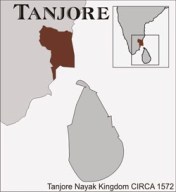


Tags: , , ,

Sri Muthuswami Dikshitar and Sri Vidya (7 of 8)

Kamalamba Navavarana Kritis – Part One

mkamal

Sri Kamalamba at Sri Tyagaraja temple, Tiruvarur.

The years he spent at Tiruvavur were richly creative and highly productive for Sri Muthuswami Dikshitar, the composer.  Sri Dikshitar’s creations at Tiruvavur included a set of sixteen kritis on the various attributes of Ganesha; a set of kritis on Thygaraja and Nilothpalambika the presiding deities of Tiruvarur shrine; a set of Tiruvarur Panchalinga kritis; and eleven kritis of Kamalamba Navavarana group.

Sri  Dikshitar had developed a fascination for composing a series of kritis on a composite theme, perhaps in an attempt to explore the various dimensions of the subject. In some of these, he employed all the eight Vibhaktis, the various cases that delineate a noun.He also composed a series of kritis in a set of ragas, all ending with the same suffix (e.g.Gaula). No other composer has attempted so many group kritis in such a planned, orderly, meticulous fashion.

The most outstanding of such series of compositions is of course the magnificent Kamalamba Navavarana kritis. They are incomparable compositions and are the jewels of Carnatic music.These compositions, intellectually sublime steeped in deep devotion, are a testimony to Sri Dikshtar’s musical genius, his mastery over the Sanskrit language; and his thorough knowledge of and intense dedication to Sri Vidya, Sri Chakra and the worship of its avaranas.

Through its graceful lyrics , majestic sweep of ragas and descriptive details rich in mystical symbolism of Tantra, Mantra, Yoga, Sri Vidya and Advaita ; Dikshitar virtually threw open the doors to the secret world of Sri Vidya,to all those eager to approach the Divine Mother through devotion and music.

It is amazing how Sri Dikshitar builds into each of his crisp and well-knit structure of lyrics, the references to the name of the chakra; the names of its presiding deity, yoginis, mudras, Siddhis and the gurus of the Kadi tradition of Sri Vidya ;and to the seed(Beeja) mantras. In addition he manages to insert, as ever, cogently, the name of the raga and his signature. The Kamalamba Navavarana is a treasure house not merely to the classical musicians but also to the Sri Vidya upasakas.

Kamala is one of the ten maha_Vidyas, the principle deities of the Shaktha tradition of Tantra. But, the Sri Kamalamba referred to by Sri Muthuswami Dikshitar in this set of kritis, is the Supreme Divine Mother herself. The immediate inspiration to Dikshitar was, of course, Sri Kamalamba (regarded one of the sixty-four Shakthi centers), the celebrated deity at the famous temple of Sri Tyagaraja and Sri Nilothpalambika in Tiruvavur.

Thyagarajasvami and his consort Nilotpalamba

Interestingly, the temple complex also accommodates the shrines of Maha_Ganapathi, Subrahmanya, Dakshinamurty and Balamba; all Shakthi deities. The temple complex has a Pushkarini, a lake, named kamalalaya, the abode of Kamala.This tank is referred to by Sri  Dikshitar , in his kritis ,  as Kamalalaya thirtha and the Devi is Kamalalaya thirtha vaibhave. The town of Tiruvarur  is mentioned as Kamala nagara (e.g. Kamalanagara viharinai) and as Kamala pura(e.g.Kamalapura sadanam) ; referring to Devi as one who resides in and walks about the town of Kamalapura/Kamalanagara.

Sri Muthuswami Dikshitar follows the Smahara krama, the absorption path, of Sri Chakra puja and proceeds from the outer avarana towards the Bindu in the ninth avarana at the center of the Sri Chakra. At each avarana, he submits his salutation and worships the presiding deity, the yogini (secondary deity) and the attendant siddhis of that avarana; and describes the salient features of the avarana according to the Kadi School of the Dakshinamurthy tradition of Sri Vidya. It is in effect both worship and elucidation.

Sri Dikshitar devoted one composition to each of the nine avaranas. In addition, there is a Dhyana Kriti, a verse in meditation, preceding the set of nine; and a Mangala kriti, the verse celebrating the auspicious conclusion, at the end. Thus, the Navavarana composition of Dikshitar, per se, is a set of eleven kritis.
The Dhyana kriti Kamalambike_ashrita_kalpa_lathike is composed in Raga Todi (Rupaka). The Vaggeyakara Mudra is in  – Guruguhakarane Sadashiva antahkarane

[The Dhyana-kriti in Todi does not bear the customary Raga_mudra, the name of its Raga.]

The concluding Mangala Kriti – Sri Kamalambike  Shive pahimam, Lalite , Sripathi Vinute  – is in the auspicious Sri Raga , set to Khanda Eka Taala. The Raga Mudra is in the opening line as Sri; and, the Vaggeyakara Mudra is the phrase Shankara-Guruguha-bhaktha vasankari.

Apart from these eleven Kritis; It is customary, as a prelude to Kamalamba Navavarana group of kritis, to invoke Maha_Ganapathi and Lord Subrahmanya by singing Shri Mahaganapathivaratu mam (Gaula) followed byBalasubrahmanyam Bhaje (Surati).

**

Thus , the vocal tradition of the Kamalamba Navavarana has , in all, a set of thirteen kritis. The core kritis are however the nine relating to nine avaranas of Sri Chakra.

For the core nine kritis sang in worship of the Navavaranas of Sri Chakra, Sri Dikshitar employed nine different Ragas and eight different Vibhakthis (case endings denoting the noun) of Sanskrit grammar; and, in addition,  for the ninth avarana kriti he employs a garland of all the eight Vibhakthis.

As regards the Raga-mudra, a distinctive feature of Sri Dikshitar’s compositions, the kritis in Anandabhairavi (first avarana), and shankarabharaaam (third avarana) indicate their Ragas   only partially (the word “Ananda” for the former, and shankara for the latter). The kambhoji, Sahana, and Ahiri compositions have their Raga mudras hidden within complex phrases.  In all the other kritis, the Raga mudra is explicit.

The following briefly is representation of the kriti, the Raga, the taala and the Vibhakthi of the nine kritis:

Kamalamba Vibhakthi

For the complete text of the Kamalamba Navavarana :

kritis in English Click here ;and for the Sanskrit text please click here.

There are several theories explaining Dikshitar’s selection of Ragas for these kritis. Sri  Dikshitar was a meticulous person and had a methodical approach to life and to his works. Dr. R K Srikantan, the celebrated Carnatic musician and scholar, feels that the Ragas selected for these kritis are stringed together by an underlying scheme that is at once simple and logical. He observes that the Raga of each kriti flows into the next, seamlessly with minimum alteration in the structure of its swaras. Here is an extract from his article:

Sri Dikshitar followed the Venkatamakhin sampradaya – the scheme of classifying the Ragas – where Bhairavi and Ananda- bhairavi were treated as Upanga – Ragas. The Ragas adopted by Sri Dikshitar for the nine (Navavarana) Kritis, could broadly be classified under three main categories: two Mela-karta Ragas (Kalyani and Shankarabharnam); three Upanga Ragas (Shahana, Bhairavi, Aanda-bhairavi); and four Bhashanga Ragas (khambhoji, Punagavarali, Ghanta and Ahiri)

The Swara-structure, the sequential change of Ragas was methodical:

Sri Dikshitar has used only four Chakras * – Veda, Netra, Bana and Rudra. This corresponds to the four types of structures in the Sri-Chakra, viz.:  square (chaturanga), circle (vyuha), triangle (tri kona) and point (bindu).

The Swara-structure, the sequential change of Ragas was methodical:

1. From Ananda-bhairavi to Kalyani meant a change of Gandhara.

2. From Kalyani to Shankarabharanam meant a only a change of madhyama.

3. From Shankarabharanam to Khamboji meant an addition of a nishada.

4. From khamboji to Bhairavi meant removal of the additional nishada, addition of a dhaivata and change of gandhara.

5. From Bhairavi to Punnagavarali meant removal of the additional dhavata and introduction of a rishabha.

6. The next song shows changes in gandhara and dhaivata after the removal of the additional rishabha.

7. Ghanta indicates addition of Rishabha and dhaivatha with change in gandhara.

8. The last change is extremely complex. It basically indicates addition of gandhara and nishadha.

[For more on that theme, please check here ]

[* Sri Srikantan is referring to 12 series or Chakras in which the 72 Melakartas are arranged:

The 72 Mēḷakarta ragas are split into 12 groups called Chakrās, with each Chakra containing 6 ragas. The ragas within the chakra differ only in the dhaivatam and nishadam notes (D and N). The name of each of the 12 chakras suggests their ordinal number as well.

The twelve Chakras are:

1. Indu (moon, one);

2. Netra (eyes, two);

3. Agni (sacrificial fires, three types: garha-patya, Ahavaniya and Daksina; and Agni has two other names : Vaishvanara and Jatavedasa);

4. Veda (four Vedas- Rig, Sama, Yajur & Atharvana );

5.Bana (arrows of Manmatha the cupid-five: Aravinda/Asoka/Chuta/Nava-mallika/Nilotpala);

6. Ritu (seasons – six seasons of the year-Vasanta, Greeshma, Varsha, Sharad, Sisira and Hemanta );

7. Rishi (sages – saptharishi – seven –Gowtama, Viswamitra, Kashyapa, Jamadagni, Bharadwaja, Atri and Vasishta);

8. Vasu (a group of celestial beings –  asta-vasu. eight – Aapa, Dhruva, Soma, Dava, Pratyusha, Anila, Anala and Prabhasa));

9. Brahma (reference to the nine cycles of the universe, each presided over by a Brahma – Nava Brahma- Atri, Angirasa, Brighu, Daksha, Kashyapa, Pulaha, Marichi, Vasishta and Pulastya);

10. Dishi (ten directions – eight plus above and below – their guardians being : Indra, Agni, Yama, Niruddhi, Varuna, Vayu, Kubera and Isana ; plus , Akasha and Patala);

11. Rudra (Ekadasha Rudra – eleven forms of Rudra – Aja, Dwasha, Ekapada, Triambake, Aparajita, Isana, Tribhuvana, Sambhu, Hara, Rudra and Ahirputniya); and

12. Aditya ( a group of twelve celestial beings – Dwadasha Aditya – Poosha, Bhaskara, Marichi, Arka, Khaga, Surya, Mitra, Aditya, Ravi, Bhanu, Savita and Hiranyagarbha)

**

The Svaras (notes) involved with the four Chakras  referred  to by Sri Srikantan are:

Veda: Sa, Chatusruthi Rishaba, Sadharana Gandhara, Suddha Ma

Netra: Sa, Suddha Rishaba, Sadharana Gandhara, Suddha Ma

Bana: Sa, Chatusruthi Rishaba, Anthara Gandhara, Suddha Ma

Rudra: Sa, Chatusruthi Rishaba, Anthara Gandhara, Prati Ma

For more , please do read Sri S Rajam’s most wonderful illustrations of the 12 Chakras and their 72 Melakarta-s.

http://www.indian-heritage.org/music/Melakartha%20Raga%20Booklet%20-%20new.pdf ]

As regards the Ahiri, the Raga of the kriti associated with the ninth avarana, there is a view, the raga has all the twenty-two notes in the octave; and such a fusion of all melodic and temporal elements in the same kriti is rather unusual especially when the pallavi has distinctive prose sections put together, seamlessly.

Before we enter a discussion on the Navavarana kritis, let us take a broad look at their association with the Chakras, the deities, the Yoginis, and Siddhis etc. of the Sri Chakra.

Kamalamba yogini

*

The Kamalamba Navavarana kritis are works of musical and poetic excellence. They are adorned with sublime music, intellectual sophistication, soulful devotional lyrics and richly imaginative poetic imagery. Listening to the kritis is a truly rewarding experience, even if one is not aware of or ignores the underlying connotations of Sri Chakra and Sri Vidya tradition.

[Please click here for an article covering an overview of the Sri Kamalamba Navavarana kritis.]

*

The scholarship of Sri Dikshitar as a Vainika has reflected in these compositions through the Gamakas, Viaba-kala and Madhyama-kala -Sahitya. His treatment of the Ragas and use of rare phrases at times bring in an unusual melody and effulgence to these compositions.

The Kamalamba Kritis ranges from Madra to Tara-Sthayi; and , in the other way too,  presenting a complete picture of the range and scope of the Raga,  bringing out  the Lakshaa and grandeur of the Raga, in full measure.

*

As regards the Taala, Sri Dikshitar in this series has employed the Suladi-Sapta-Taalas, with the exception of Dhruva and Mathya Taalas.

The Taalas used include Rupaka (3 beats); Tisra-Tripua (7 beats); Ata-Taala (14 beats) ; and,  Misra-Jhapa (10 beats).

There appears to be a method or a progression in accordance with the sequential order of the Avaranas of the Sri Chakra.

The Kalyani Avaraa is an enclosure of 16 lotus petals (2 times of Adi Taala).

The third Avaraa in Shankarabharaa is in Rupaka Taala, consisting of 6 Kriyas (2 times of Rupaka).

The fourth Avaraa in Kambhoji is in Aa-Taala,  having 14 Kriyas,  representing  the nature of 14 angles of Chakra.

The fifth Avaraa in Bhairavi is set to Jhapa Taala, having 10 Kriyas denoting the ten angled Chakra.

The sixth Avaraa in Punagavarāli set in Rupaka Taala,  has 6 Kriyas according to its order of Avarana .
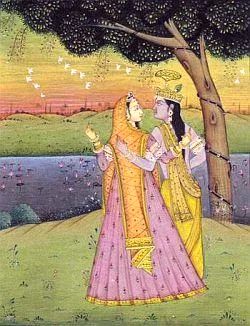
The seventh Avaraa in Raga Sahana is set in Tisra-Jati-Tripua-Taala; it  being the seventh one in order.
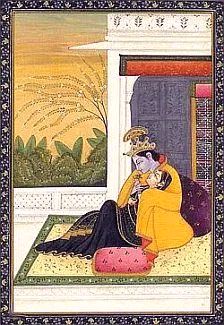
The eighth Avaraa is in Adi Taala referring to 8 Kriyas.

The ninth Avaraa in Ahiri is in Tisra-Jati-Eka-Taala,  has 3 Kriyas , although it is  now being sung in Rupaka with 6 Kriyas highlighting the three elements residing in the Bindu Chakra.

The choice of the Taalas follows a definite scheme. The Avarana in Anandabhairavi is also sung with Misra Chapu Taala; because it has the same number of Taala units, although they differ in the Kriyas. Sri Subbarama Dikshitar, in his Sangita-Sampradaya-Pradarshini, has remarked that this Avarana could be sung with Misra-Jati-Eka-Taala , which again has the same  measure of 7 Matras. That is to say; this Avarana could be sung in three different ways, having either the Triputa, Misra-Eka, or Misra Chapu ( 3 ½ *2=7 Aksharas) , effecting slight change in Kala-pramana.

*

The Kamalamba-Navavarana-Kṛitis are enriched with rhetorical beauties or the decorative Angas.

The other aspects observed in the Navavaraa-Kritis  are summarised as follows.

Todi is a Raga which generally reflects compassion; and, Sri Dikshitar in the invocatory composition begins the song with Madhya-Sthayi-Nishada in accordance with the invocative nature of the song. Another significant description in the composition is Her sitting posture as ’Vinoda Carane’, which means enchanting feet. Sri Dikshitar addresses Her as one who enjoys music and one who bestows best poetic qualities on those who sing in praise of her ‘Sangita-rasike sukavitva -pradayike’,  suggesting both his music and poetry are due to Her blessings . Sri Dikshitar addresses the Devi by varied epithets, such as: ’Tripuradi-chakreshvarī’, ‘Animadi-siddishvarī’, ‘Kshitipura-Trailokya-Mohana-Chakravartinī; and ‘Prakata-Yoginī’.
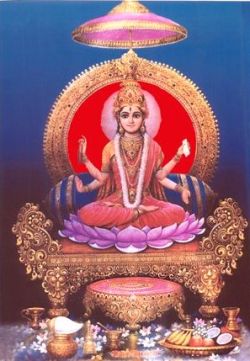
The Kalyani Avarana has the word ‘Kamala’ in the Anupallavi has different meanings with reference to the subsequent word. Kamala inKamala-Vani” refers to Lakshmi and Vani is Sarasvathi; Kamala in “Kamala-pura-sadanā” refers to Tiruvaruru; and , the Kamala  in “Kamala- vadanam” refers to lotus-like face.

The ninth Avaraa is represented by a Bindu. This is here the Mother Goddess resides. She being the empress of the entire empire of Sri Chakra, named as Sarva-anandamaya Chakra, wherein the MahaTripura-Sundarī lives with Kameshvari. It has all Vibhaktis and the lengths of Pallavi, Anupallavi and Caraa represent the three natural equal parts of the Bindu- Moon, Sun and Fire.

The Mangalam Kṛiti is befittingly composed in the Raga Sri set to Khanda-Eka-Taala. This composition has exquisite descriptions and reflects the immense devotion of Sri Dikshitar; and, his adherence to Sri Vidya.

[ Source : Melodic Aspects of Kamalāmbā Navāvaraṇa Kṛti-s of Śrī Muttusvāmi Dīkṣita by Ms. Niranjana Srinivasan]

**

The discussion on each of the Navavarana kritis, with reference to and in the light of traditions, concepts and lore of Sri Chakra and Sri Vidya, follows in the next page.

Continued in the Next Part

Kamalamba Navavarana Kritis – Part Two

 
4 Comments

Posted by on September 14, 2012 in Music, Muthuswami Dikshitar, Sri Vidya, Tantra


Tags: , , ,