RSS

Monthly Archives: September 2012

The Art of Painting in Ancient India – Chitrasutra (3)

[This is the third in the series of articles I would be posting on the art of painting in ancient India with particular reference to the Chitrasutra of Vhishnudharmottara purana. The previous (second) article covered certain concepts and general aspects discussed in Chitrasutra.

The current article deals with the physical features of various classes and types of images, proportions, projections, foreshortening etc.

The next article discusses colours and representation of things seen and unseen; and briefly talks about certain symbolisms mentioned in the text.]
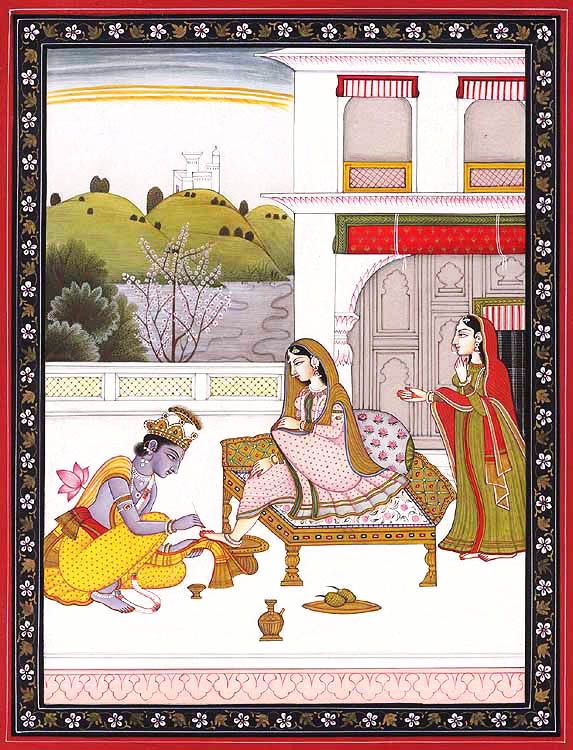
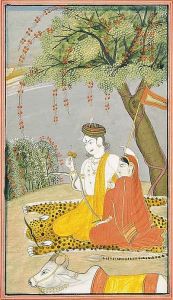
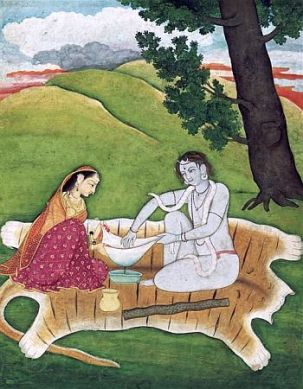
Krishna Tends to Radha's Feet

8. Tala-mana

8.1. The Indian artist never took in the world at a sweeping glance. He had an eye for details. In the canons of Indian art there is a definite and prescribed proportion of the limbs and their ratio to one another. The Indian artist paid more attention to ratio than to the actual standard of measurement of the different limbs. The ratio being the same, the figures may be pygmy or colossal. A standard measurement, however, was in vogue.

The absolute and relative systems of measurement

 It is said; the Indian Vastu and Shilpa shastras recognize two standards of measurement: the absolute and the relative systems.

 In the absolute standard, the smallest unit of measurement is the almost microscopic particle of dust observable in the solar rays or atom. This measurement is named in different ways according to the texts, like for example Trasarenu, Paramanu or Chayanu (shadow of an atom).

Other measurements of the absolute system are the particle of dust called raja or renu, the tip of hair called Balagra, Valagra or Keshagra, the nit called Liksha or Likhya, the louse or yuka, the barley com or yava and the highest unit of this system is the digit or angula which corresponds to the width of the middle finger. They have a relation of one to eight as follows:

  • 8 paramanus make 1 renu
  • 8 renus make 1 balagra
  • 8 balagras make 1 liksha
  • 8 likshas make 1 yuka
  • 8 yitkas make 1 yava
  • 8 yavas make 1 angula
  • 12 angulas make 1 Tala

Manangula is a linear measure; a determined by the length of the middle finger of the artisan or of the patron’s right hand and is employed for the construction of images. This measurement is a fixed unit.

Dehangula is the angula that is in relation to the image itself; and, is derived from the total height of the image to be fashioned. The Dehangula is essentially a relative unit, to indicate the height of an image.

**

According to the Citra-sutras, there are six types of measurement (mana) to be taken along the body of an image. These kinds of measurements constitute the six kinds of iconometric measurement as applied to standing, seated and reclining images.

Mana or measurement of the length of the body or its units (dhirgha); such as the distance from the hair-limit to the eye-line; from that point to the tip of the nose; the length of the arms and of the legs; and so on.

Pramana is the horizontal measurement or breadth (vistara), such as the distance between the two shoulders, the width of the body at the chest level, the width of the belly or the width of the arm or of the thigh

Unmana is the measurement of the elevation or thickness, such as the height of the breasts or of the nose

Parimana is for instance the girth of the arm or of the thigh.

 Upamana is the measurement of the interspaces, i.e., the width of the navel, the interval between the two thighs or the two big toes.

Lambamana are measurements taken along the plumb-lines or sutras.

***

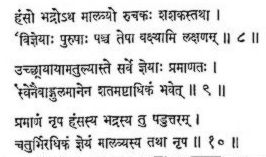
The Chitrasutra gives an elaborate classification of different types of men and women. They are classified into one of the five standard types (Pancha-purusha) called: Hamsa, Bhadra, Malavya, Ruchaka and sasaka.

Hamso Bhadrao tatha Malavyo Ruchaka Sasaka tatha/Vigneyaha Purushaha panch tesham vakshami lakshanam /3.35.8/

Their respective measures are given in terms of angula. The measurement of each of the types would be relative to their respective angulas, such as 108, 106, 104, 100, and 90 angulas.

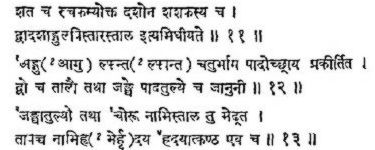
In the context of mana or proportion, the division of the limbs in terms of tala measurement is elaborately discussed in the Vishnudharmottara. Tala is said to be made of 12 Angulas : dvadasa-angula-vistaras tala ityabhidhiyate (3,35,11) . And,  one tala,  was taken as  the length of the palm from the edge of the wrist to the tip of the middle figure. Usually, the face of the image would measure a length of one tala, which, in other words, would be one-ninth of the body length of a Hamsa category image. The proportions of the various parts of the image –body would be in terms of the tala and its denomination (the angula). Hamsa is the standard measurement of body -length of an image; and the proportions of the other categories of images (Bhadra etc.) are to be worked out by taking Hamsa as bench mark.
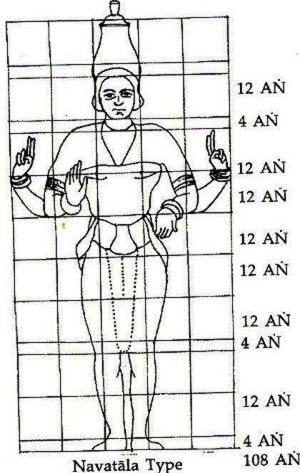
[A similar tala-mana system of proportions and measures governs the shilpa iconography. Its iconometry prescribes the proportion of the limbs and other parts of its body in relation to its face -length. The Indian artists are governed by proportions than by actual measurements. Thus a figure might look pygmy or colossal while the principles that govern the proportions would be the same.

These rules specify the various standards to be adopted for ensuring a harmonious creation endowed with well proportioned height, length, width and girth. These rules also govern the relative proportions of various physical features – of each class and each type of images.

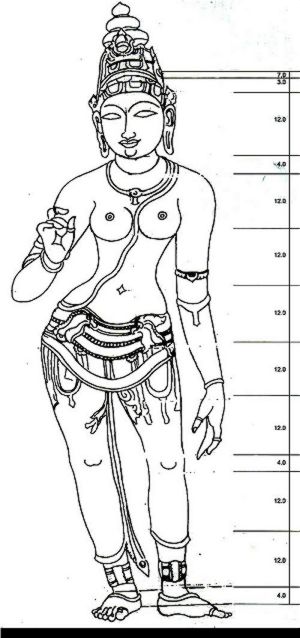
In shilpa-sastra, the madhyama navatala(standard height of nine-face lengths) is normally used for images of celestial beings such as Yakshas, Apsaras and Vidhyadharas. Here, the height of the image would be nine talas (with each tala divided in to 12 angulas) or a total height of 108 angulas.The angula (literally ‘finger’) is a finger’s width and measures one quarter of the width of the shilpi’s fist. The value of the angula so derived becomes a fixed length (manangulam), for all practical purposes, for that image. All other measurements of the image are in terms of that unit.

The face – length of the image i.e., from its chin up to the root of its hair on the forehead – would be 12 angulas or one tala. The length from throat to navel would be two tala; from navel to top of knee would be three tala; from the lower knee to ankle would be two tala making a total of eight tala. One tala is distributed equally between the heights of foot, knee, the neck and topknot. The nava tala thus will have a total of nine tala units, in height (108 angulas).

Hamsa of Chitrasutra corresponds to Nava-tala of the Shilpa sastra.

*

Sthana or stance for the figures grouped in a painting is very important; for, it is vital to indicate the action or repose in the picture, apart from highlighting its central theme.

“In composition the central figure is given importance  over  the other figures. And , that leads to the heightening of the fundamental emotions or fuller expression of the central figure for which alone the others exist.”
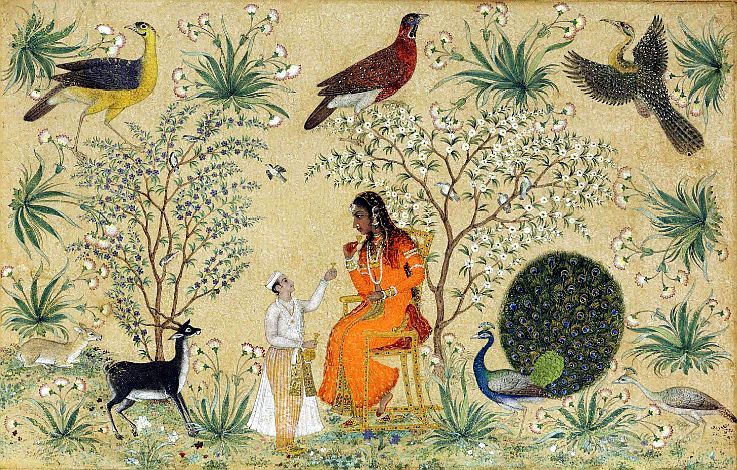
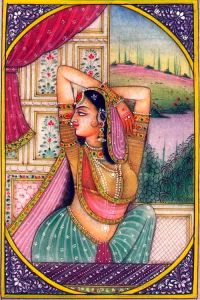
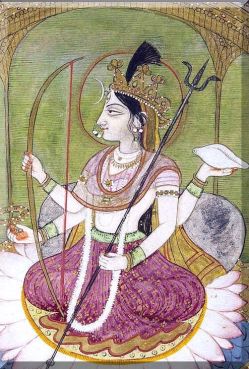
Portrait of a Nobelwoman, Mughal c.1740

8.2.The text describes the characteristic features of the five categories of men.

(i). Hamsa (108 angulas) should be strong, with arms resembling the king of serpents (Sesha) , with moon-white complexion, having sweet eyes, having the color of honey, set in a good-looking face; and with lion-like waist and swan-like majestic gait. The deities are depicted in Hamsa category of style.

(ii).Bhadra (106 angulas) is learned, is of the color of lotus; with full grown tapering round arms, a hairy cheeks and   elephant like step. The rishis, gandharvas, vidhyadharas, ministers and family priests are depicted under this category.

(iii). Malavya (104 angulas) is dark like a mudga –pulse (kidney bean?), good looking ; with a slender waist, arms reaching up to the knees, thick shoulders, broad jawas and a prominent nose like that of an elephant. The kinnaras, nagas, rakshasas and domestic women are depicted under Malavya category.
Hamsa Bhadra

(iv). Ruchaka (100 angulas) is high souled, truthful and clever, of good taste. He is of autumn-white complexion and strong with a conch-like neck. Yakshas, vaishyas and prostitutes are depicted under this category. And,

(v). Sasaka (90 angulas) is clever reddish dark and of a slightly spotted colour; with full cheeks and sweet eyes. The tribal chiefs and sudras are depicted as Sasaka.
Ruchaka

Measurement of Hamsa is the standard measurement given, in relation to which the measurements of the other types are to be worked out;  keeping in mind the characteristics of that particular type.

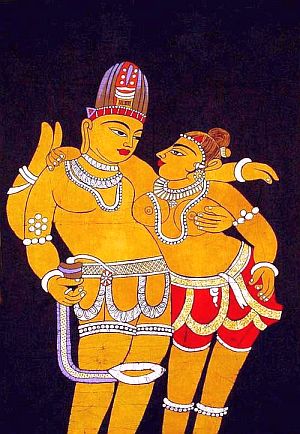
8.3. As regards the female figures, there is a discussion about the body types of women; but , it has not been specified .However,  the discussion does state that they too fall under each of the above five categories of males, according to the measurements of the limbs and parts. Therefore, there would be  five  kinds of female bodies. The figures  corresponding to various categories (say Hamsa, Bhadra etc.) too should be depicted in proportions that are applicable to that male-category. 
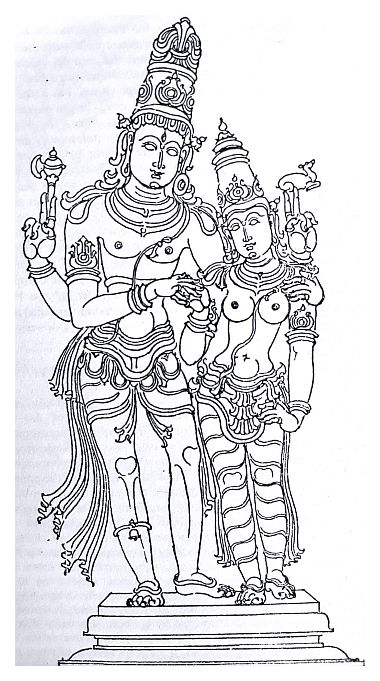
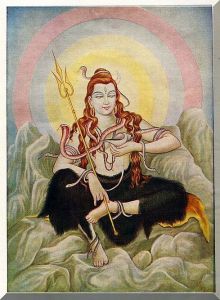
shiva with consoet

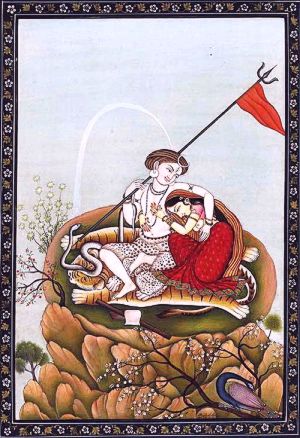
But the size of the female figures should be smaller than of the male figures appearing on the same canvass or surface. Her height should be made to reach the shoulder of the man placed near her, in proportion. Her waist should be two angulas thinner than that of a man. On the other hand, her hips should be made wider by four angulas. The breasts should be rendered soft, charming and proportionate to her chest.

Purushasya sameepastha kartavya Yoshi-Isvara /Nara-skanda pramanena karyeka sa yatha -mithi  / 3.37.2/

Angulau dva Nara-vaksham Striyo madhyam vidiyate / adhika cha katih karya tathaiva chatur-angulam /3.37.3 /

Uruh pramanataha karyai sthanau nrupa manoharau / Nrupascha sarve karthaya Maha-purusha lakshanaha /3.37.4/
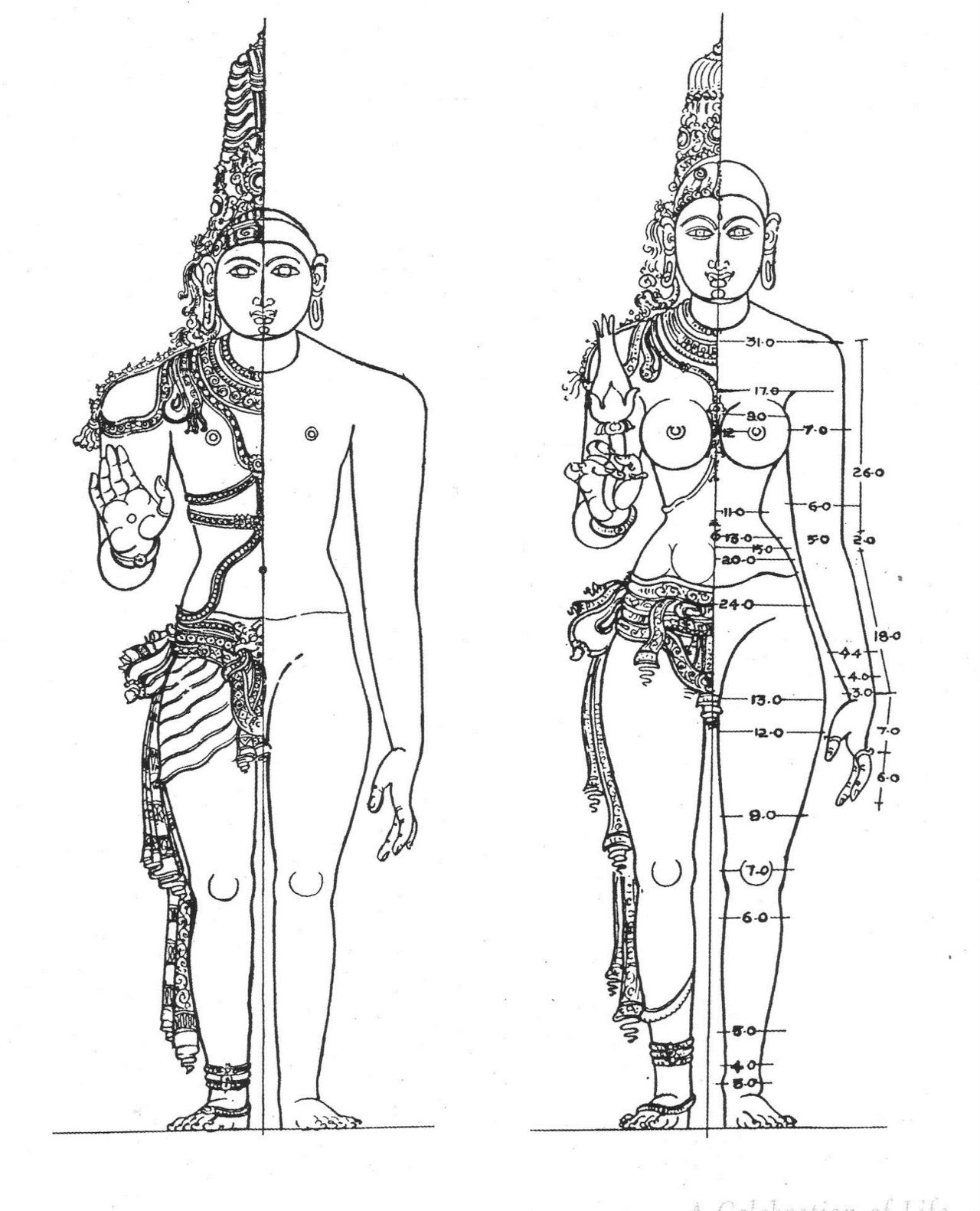
tumblr_m

Talking about women, the text mentions elsewhere, “a female figure should be drawn with one foot calmly advanced, and with the part about the hips and loins broad and flurried on account of amorous dalliance”.
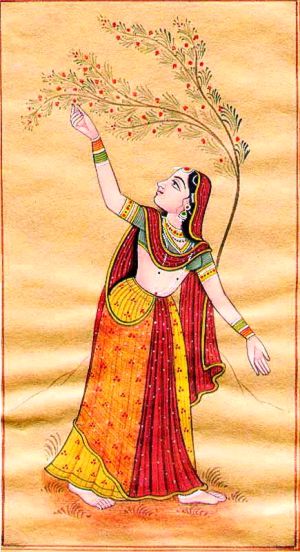
Leela-vilasa-vibrantham-vishala-jhagana-sthalam/sthira-eka-paada-vinyasam-stri-rupam-vilekhe-adbudhaha/ 3.39.50//

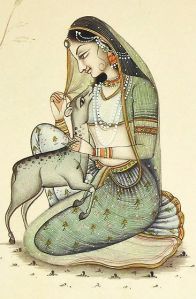
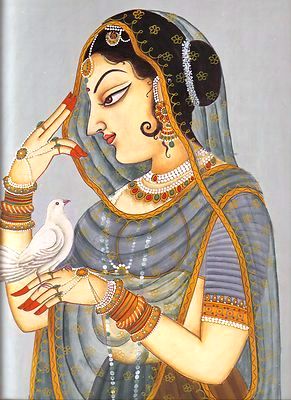
The women of good-family should be made bashful, wearing modest ornaments and not-showy dresses; and, with a slender waist, depicted under Malavya characteristics.

– Malavya maana-thaha karya lajja-vathyaha Kula-striyaha ; Na atyunnatena veshena sa-alamkara thathiva cha / 3.42.25/
mugdhaMugdha2

Her expressions of love are Sukumara (gentle, delicate and graceful). When she is in love, her eyes clearly show her feelings. Her eyes are, at the same time, tearfully smiling, slightly closed; while her eyelids droop. When she looks at her lover with half closed eyes, she appears beautiful, graceful and inviting. And, when she blushes, there are drops of sweat on her cheeks; and, there is a discreet thrill, stiffening her body. It is mainly through her smiling eyes that she expresses love. Her quivering lips, sometimes, show her agitation.
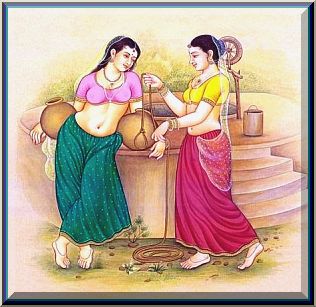
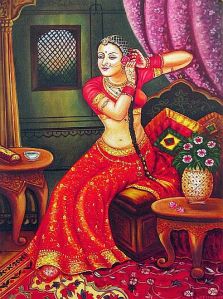
The courtesans on the other hand should be painted with vermilion or emerald color, moon-like complexion or dark like the petals of blue-lotus. Her dress should be unrestrained, designed to excite and evoke erotic feelings. She should be painted as a Ruchaka character.

Ruchakasya tu maanena Veshyaha karya tatha striyaha / Veshyanam uddatham vesham karyam srungara sammatam / 3.42.24 / 

The courtesan expresses her desire through alluring side glances; by touching her ornaments; by scratching her ears, while her big toe draws designs on the ground; and, generally by attractive body-gestures. She is also shown as  exposing her navel, and partially, her breasts; polishing her nails; lifting up her arms ; and, tying  her hair.
courtesancourtesan2

9. Drista – those things visible

9.1. The text then goes to describe in great detail the characteristic appearances of country folk, the nobility, widows, courtesans, merchants, artisans, soldiers, archers, door-keepers, wrestlers, monks , mendicants , bards , musicians , dancers and others. Vivid descriptions of their dresses, movements, habits, and features peculiar to their class are given in Chitrasutra. They make a very interesting reading.

9.2. The text also describes the characteristics of different tribes and castes as distinguished by their complexion; noticeable physical features, costumes and habits.

9.3. The Chitrasutra instructs things that are usually visible should be well represented; resembling what is ordinarily seen in life. The aim of painting is to produce a credible resemblance; but not to merely copy. Persons should be painted according to their country; their colour, dress, and general appearance as observed in day-to-day life . Having well ascertained the person’s country, region, occupation, age and his status in life; his other details such as his seat, bed, costume, conveyance, stance, and his gestures should be drawn.

[The Chitrasutra explores this subject in great depth detailing characteristics of persons hailing from various regions and occupations. It is rather too detailed to be posted here. I have posted a summary of that, along with few other issues,  separately, in the next  article.]
10. Features of the Chitra

10.1. General

There is a detailed enumeration of the features of the images of deities, kings and other class. The Chitrasutra also makes some general remarks of such paintings; and says:

A painting drawn with care pleasing to the eye, thought out with great intelligence and ingenuity and remarkable by its execution beauty and charm and refined taste and such other qualities yield great joy and delight.

A painting without proper position, devoid of appropriate rasa, of blank look, hazy with darkness and devoid of life movements or energy (chetana) is considered inauspicious.

A painting cleanses and curbs anxiety, augments future good, causes unequalled and pure delight; banishes the evils of bad dreams and pleases the household deity. The place decorated by a picture never looks dull or empty.
10.1. a. Deities

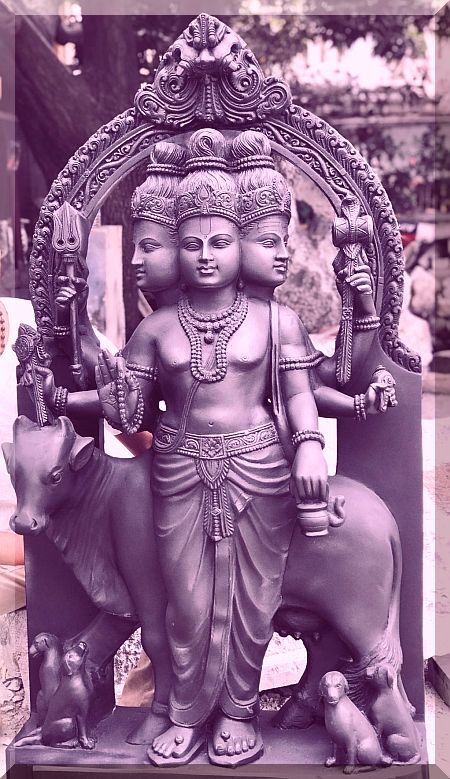
While discussing the image of the deities to be painted, the text says, the painted image should have a pleasing body, a well finished and well proportioned limbs, delicately painted effects of shade and light, facing the viewer. It should be pure and charming adorned by manifold lines and embellishments.

The front view, face, chest and abdomen should remain undiminished; but, it should grow narrow towards the waist from thighs and also from the shoulders. Its shoulders should be broad.  The abdomen should neither be shrunk nor bloated.
torso

The deities should be drawn wearing strings of garlands and ornamented by crowns, earrings, necklaces, bracelets, ornaments of the upper arms, long girdles reaching up to the ornaments on their feet, and sacred threads with ornaments for the head.

The text says, in general, an image possessed of all auspicious and beautiful marks is excellent from every point of view. Its mudras (gestures of hand and fingers) should be benevolent blessing people with welfare, peace and prosperity. Such an image would add to the wealth, crops, fame and the longevity of life of the worshipers. ”  Blessed is the work of art that is endowed with auspicious marks as it is a harbinger of fortune, fame to the country, to the king and to the maker.”
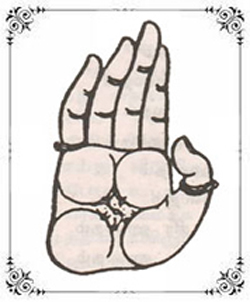
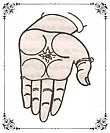
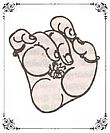
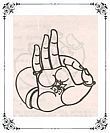
 1_abaya_hasta2_varad_hasta3_katak_hasta4_vyakyana_hasta5_susi_hasta

As regards the depiction of great men such as kings and noble persons, the text recommends their images should possess the auspicious lakshanas associated with greatness.

The height of the head should be 12 angulas and its girth 32 angulas. The structure of the face should be divided into three parts:  forehead (lalata) – 4 angulas high and 8 angulas wide; nose (nasika)- 4 angulas high, 2 angulas deep and  3 angulas wide; the nostrils being 1 angula broad and 2 angulas wide and, chin (hanu or chibaku) – 4 angulas high.

The Chitrasutra lists typical features of the Hamsa – including that of Urna (tuft of hair on the forehead, between the eyebrows) – ½ angula; and, Usnisa ( a sort of protrusion of the skull) – 4 angula high and 6 angula wide. (Yuva is 1/8 of an angula). 

The hair on the head should be made thin, wavy, shiny, with natural glossiness and like the dark blue sapphire. They should be properly ornamented.

As regards the ears, they should be 2 angulas wide and 4 angulas high; the opening auricle being half (1/2) angula wide and 1 angula high.

As for the mouth, the Chitrasutra (36.12-14) mentions that the space between the nose and the lip should be half (1/2) angula. The size of the upper lip is 1 angula; and, the thickness of  the lower lip is half (1/2) angula. The mouth is 4 angula wide.

In chapter (36.25-27) the Chitrasutra mentions some bodily measures, as: the nape is 10 angulas high and 21 angula girth. The distance between the nipples is 16 angulas. The space between the chest and the clavicle is 10 angula. And again, in the same chapter (lines 37-42) it mentions: the abdomen measurement is 42 angulas. The navel is 1 angula. The hip is 42 angulas wide. The penis being 6 angula in size.

Chitrasutra (35.13) mentions the distance between the penis and navel as 1 Tala; and the same measure from navel to heart; and from heart to throat.

Apart from that, it also mentions that their hands should reach up to their knees (aa-janu bahu). The hands and feet of a chakravartin should be webbed (jala). The auspicious mark of small circle of hair (urna or tuft of hair) should be shown between their eyebrows. On the hands near the wrist three delicate auspicious lines slender curving should be drawn; as if scratched by a hare.

Shoulder to elbow 17 angulas long and 18 angulas in girth; and  Elbow to wrist: 17 angulas long and 12 angulas in girth

As per Chitrasutra (36.30-34) : Palm is 6 angula long and 5 angula wide. The middle finger has a measure of 5 angula. The forefinger is half the size of a part less. The fourth finger has the same proportion. The little finger is the smallest among them.

The thumb should be divided into two parts: 4 angulas and 3 angulas. The space between the fingers should be webbed (jaala-anguli)

As regards legs and feet; the Chitrasutra (35.12-13) indicates: the height of the foot up to the end of the ankle should be ¼ tala (3 angulas). The legs- from ankle to the knee- are 2 talas (24 angulas); and, the same are from knees to thighs. Heels -3 angula wide and 4 angula high. Foot 12 angula long and 6 angula wide.

As regards the toes; the big-toe is 3 angula; the next toe is as long as the big-toe; and the other toes are 1/8 shorter than those.
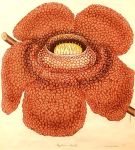
Flower of Rafflesia Arnoldi , Painted and Engraved by Waddell

The text also warns, when an image is devoid of these auspicious marks (lakshanas) it would cause destruction of wealth and crops. And, it instructs that such an image should therefore be made with great care, dedication and devotion.
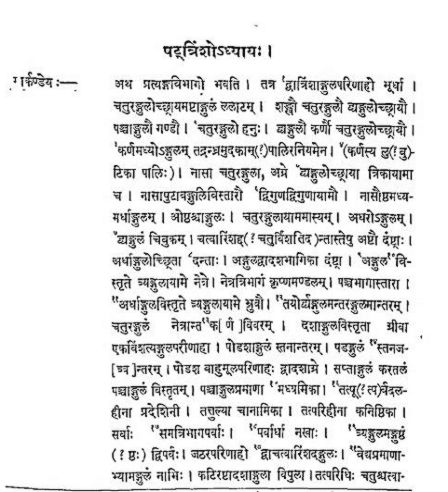
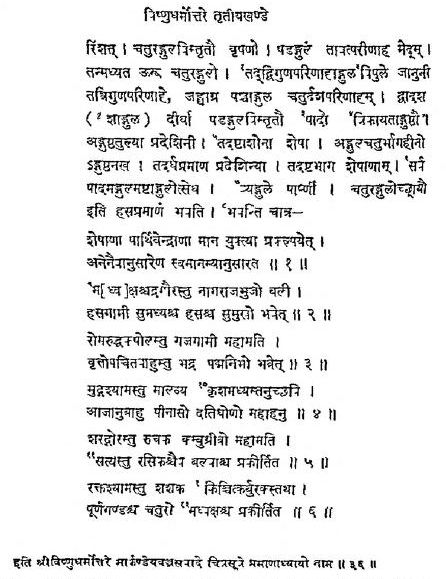
chitrasutra ch 36

chitrasutra ch 36 - 2

[ The Sukraniti-sara says:

Where the image  is intended for worship and  is approached in the spirit of a devotee submitting to his deity, or of a servant appearing before his master, the image must be made to adhere, scrupulously, to the forms and characters prescribed by the Shastras. All other images, which are not meant for worship, can be made according to the artist’s own individual preferences.

Sevaya-sevaka-bhabeshu pratima- -lakshanani smritam. ]

As regards the images of the deities, Prof, S K R Rao writes (The Encyclopedia of Indian Iconography) :
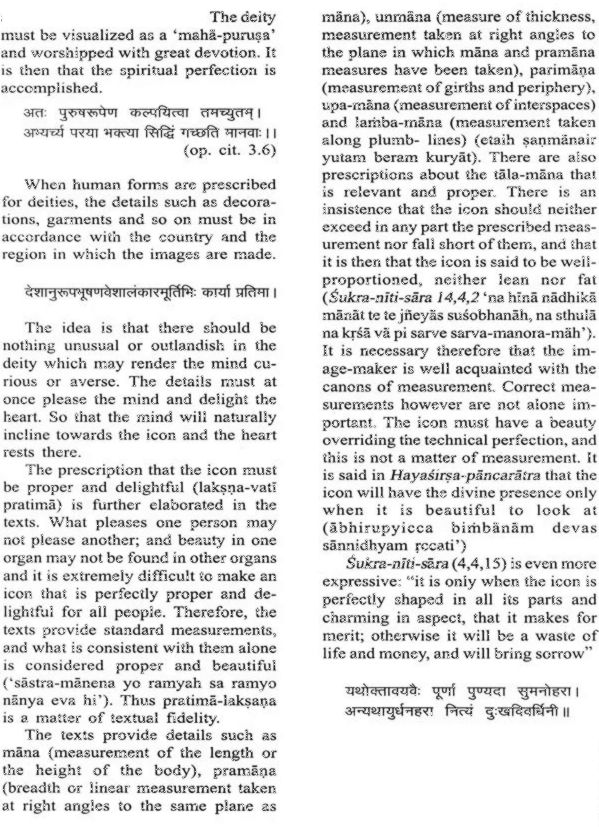
Dhyana sloka extract 5

10.1. b. Others

Vidhyadharas should be shown with garlands and ornaments; and accompanied by their wives on either side. They should be shown either on land or in air, with swords in their hands.

10.2. Face:

10.2. a. Deities

The gods should be represented according to Hamsa measure. The face beautiful should be well developed, well finished, and benign marked with all the auspicious lakshanas. The face should be youthful radiating peace and joy. The face should not be triangular or crooked; nor should it be oval or round. The face should never look angry, sad or blank and lifeless . If such expressions creep in, the image should be discarded.

All organs of senses like eyes, nose, mouth and ears should be made visible.
Gods and gandharvas should be represented without crowns but with crests.

10.2. b. Others

All kings should be endowed with auspicious marks. They should be ornamented suitably.

Daityas and danavas (demons) should be made to have frightened mouths, frowning   faces  round eyes and gaudy garments but without crowns.

10.3. Eyes:

The text pays enormous importance to the depiction of eyes of a painted figure.

The text informs that the eyes are the windows to the soul; and it is through their eyes the figures in the painting open up their heart and speak eloquently to the viewer. 

The section related to the eyes is quite detailed. It gives the measure of each part, as also the descriptions of different types of expressions. The Chitrasutra emphasizes the fact that the fundamental element for a painting to be auspicious is the way that the figure glances – neither upward nor downward; neither too strong nor weak; and, neither angry nor fierce.

Unmilana, ‘opening of the eyes’ , infusing life into the picture by opening the eyes of the figure was the final stage of painter’s work. The importance given to  Unmilana is  stressed by Vishnudharmottara: Sajiva iva drisyate, sasvasa iva yachchitram tachchitram subhalakshanam (3.43. 21-22) – ‘that is an auspicious painting in which the figures appear to be alive and almost breathe and move’

As regards the measure of the eyes, Chitrasutra (36. 19-22) mentions: ‘the eyes are 1 angula high and 3 angula wide; the black orb (Krishna-mandala) – perhaps the iris-  is the third part of the eye. The pupils are the fifth part. The eyebrows are half (1/2) angula thick and 3 angulas long.

The text describes   some positions of the eyes : looking straight; half of eyes , nose and forehead are seen ;one eye is seen in full and half of the eyebrow is suppressed; one eye, one eyebrow, one temple , one ear , half of chin are seen etc.

In each case it describes how the eyes and eyebrows should be foreshortened, that is delicately reduced in size or suppressed by artistic means such as gentle lines, delicate shading or by dots.

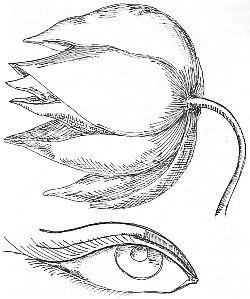
The text describes five basic types of eyes. And, it says the eye could be in the form of a bow (chapakara); or like the abdomen of a fish (matsyodara); or like the petal of blue lotus (utpalaptrabha); or like a white lotus (padmapatranibha) or like a conch (sankhakriti).

Chapakara – 3 yava measure; Matsyodara– 4 yava; Utpalapatrabha – 6 yavas; Padmapatranibha – 9 yavas; and Sankakriti – 10 yavas ( 8 yuvas make 1 angula)
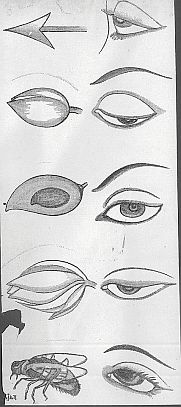
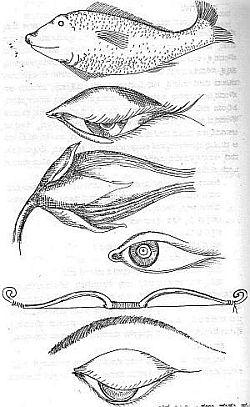
similie Eyes- Vishnudharmottara  Eyes two- Vishnudharmottara

It is explained that   the eye assumes the shape of a bow when looking at the ground in meditation or when lost in a thought.

The eye in the shape of fish should be painted in the case of women and lovers.

The eye in the shape of blue lotus is said to be ever calm and look charming with red at the corners and with black pupils, smiling, gentle and ending in long eye lashes sloping at its end.

The eye in the shape of white lotus petal befits a damsel frightened and crying.

A  conch like eye suggests angry and woe stricken state.

10.3. a. Deities

The eyes of gods  ( of Padma-patra type) should be wide with black pupils, enhancing the beauty of the divine face, beautiful to look at, charming the mind, smiling and with slight reddish tint at its ends like those of blue-lotus petals, with eyelashes bent at the ends, of equal size, gentle; and fluid and pure like cow’s milk. Such gentle serene eyes and pools of tranquility  expressing love and compassion bless the viewers with happiness.

The images with white-lotus petal eyes bring wealth and prosperity. Its eyes should also be even, wide, serene and pleasant to look at. It should have eye-lash sloping at the end and black pupil. Its look should be placid,

Unmilana ‘opening of the eyes’ of the figure is described as the final act; a painting would be complete only with that; and after that, ” an auspicious painting in which the figures  will appear to be alive and almost breathe and move’ . Drawing of eyes with delicate lines and giving an expression to the image infuses life into it.

The artist is cautioned to be careful and not to give an upward or downward or sideward look to the deity. An image of god with too small or too wide eyes; or looking depressed, angry or harsh should be discarded.  In case such mistakes happen, the deity should be discarded.

The text warns of the ill effects of making a painting of a deity with bad proportions or unacceptable dispositions.

[ In a similar manner, the Shukraniti-sara also warns : An emaciated image always causes famine ; a stout image spells sickness for all ; while the one that is well proportioned, without displaying any bones, muscles or veins, will ever enhance one’s prosperity.

Krisa durbhikshada nityam; sthula rogaprada sada, Gudhasandhi  asthi-dhamani  sarvada  saukha vardhini ]

An image of god should  , therefore, be properly made with great care and devotion; and with all the auspicious marks

10.3. b. Others

Daityas and danavas should be given round eyes wide open in fright. Their mouths should also be open as if about to scream. They should be given gaudy ornaments, but no crown.

Representation of human figures with too thick lips, too big eyes and testicles and unrestrained movement are the defects.

10.4. Hair

Hair is an important aspect of the image. It provides it with individuality and it also symbolizes its character.

The text specifies six types of hairstyles: Kuntala (loose) hair; Dakshinavarta (curled towards the right); Taranga (wavy); Simha kesara (lion’s –mane); vardhara (parted) and jatatasara (matted).

10.4. a. Deities

Hair should be represented auspicious, fine resembling deep blue sapphire, adorned by its own greasiness and with endearing curls.

In case of gods, the halo should be drawn around their heads, proportionate to the measurement of the head and colour of the hair. The colour of the halo circle should enhance the glow of the deity. Their body should be devoid of hair.  On their faces, they should have hair only on their eyelashes and eye brows.

Gods and gandharvas should be represented without crowns but with crests.

10.4. b .Others

Sages emaciated yet full of splendour should be represented with long stresses of hair clustered on top of their head, with a black antelope skin as upper garment.

The manes of the sages, ancestors and gods should be made to glow like gold and with ornaments consistent with their own colour, outshining all others.

In the case of kings a circle of hair should be drawn auspiciously between their eyebrows. The hair on a king’s body should be drawn one by one.

The respectable people of country and town should be painted with almost grey hair, adorned with ornaments suitable to their status.

Merchants should be represented with their head covered on all sides by turbans.

Wrestlers should be represented with cropped hair, looking arrogant and impetuous.

Widows are to be shown with grey hair , wearing white dress and devoid of ornaments.

The artist should use his skill and imagination in providing appropriate hair-styles to the figures.

10.5. Arms and hands

In case of gods and kings, arms reaching up to the knees should be strong and tapering resembling the king of serpents or the trunk of an elephant; and should reach up to the knees. Hands should be delicate. The images of the kings should be shown with webbed hands. (I do not know the “why” of this requirement). All kings should be endowed with auspicious marks.
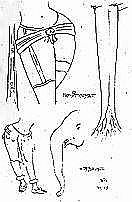
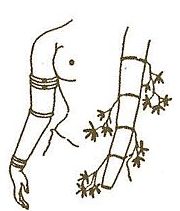
Indian_murti_(statue)arms

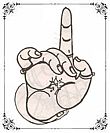
The hands of deities should be delicate and expressive. Their mudras, the gestures by hands and fingers, should be auspicious in benediction.
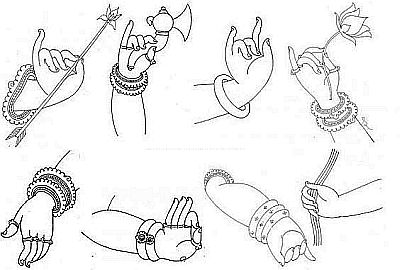
hands

10.6. Feet

There is an elaborate discussion on the feet-positions, which enhance the mood and message of the image. The positions described include, standing straight in traditional position (sampada); standing with a spans apart (vaisakha) ; half straight with left knee advanced and right knee retracted- suggesting movement (pratyalidha); its counterpart that is right knee advanced (alidha) legs in circular motion (mandala).

The knee-bent positions are related to an archer or a javelin thrower or a swords person etc. (as in pratyalidha or alidha). These positions are improvised to show a fat man running or a pitcher- carrier. The bent knees and feet apart positions are also used to depict the broad hips, flurried loins of the amorous dalliance of a woman.

Accordingly, the gods should always be made beautiful, having gaits like: a lion, bull, elephant or a swan.
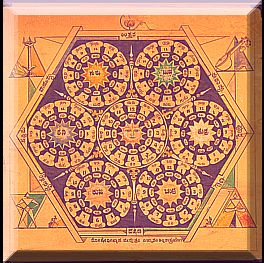
Nineplanets Navagraha 2

[ The Sukranitisara, another text, recognizes five different classes of images: — Nara (human); Krura (terrible); Asura (demoniac); Bala (infantile); and, Kumara (juvenile).  Each of these five classes or sets of images (murtis) is assigned a particular scale/proportion (Tala-mana):

Nara murti = ten Talas; Krura murti = twelve Talas; Asura murti = sixteen Talas; Bala murti = five Talas; and, Kumara murti = six Talas.

Here, a Tala is defined as: a quarter of the width of the artist’s own fist is called an Angula or finger’s width. And, twelve such Angulas make one Tala.

It says; besides these given measures there is another measure current in Indian iconography which is known as the Uttama Nava-tala. In this type of images, the whole figure is divided into nine equal parts which are called Talas. A quarter of a Tala is called an Amsa or Unit. Thus, there being four Amsas to each Tala, the length of the whole figure from tip to toe is 9 Talas or 36 Amsas.

The Sukraniti-sara and Brihatsamhita describe the  details  of the various features of a Nava-tala image. 

According to Sukraniti-sara :

Head : 

The face of the figure is divided into three equal portions:  middle of forehead to middle of pupils; pupils to tip of the nose; and, from tip of the nose to chin.

The Forehead should resemble  the form of a bow. The space between the eye-brows and the fringe of hair in front should show the arched crescent form of a slightly drawn bow.

The Eyebrows are to be  like the leaves of a Neem tree or like a bow. The various emotions, of pleasure or fear or anger etc., are to be shown by raising, lowering, contracting or otherwise modifying the eye-brow like a leaf disturbed by the wind or a bow under different degrees of tension.

The Eyes are usually described as ‘fish-shaped’.  But all similes   used to describe the eyes are inadequate; as  the range of emotions and thoughts that can be expressed through them are truly endless .

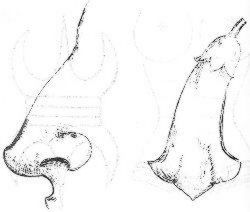
The nose should have the shape of the sesame flower ; and the nostrils are to be  like the seed of the long bean. Noses shaped like the sesame flower are to be seen chiefly in the images of goddesses and in paintings of women. In this form, the nose extends in one simple line from between the eyebrows downwards, while the nostrils are slightly inflated and convex like a flower petal.

Parrot-noses are chiefly for  the images of gods and  male figures. In this type ; the nose, starting from between the eyebrows rapidly gains in height and extends in one sweeping curve towards the tip, which is pointed, while the nostrils are drawn up towards the corners of the eyes. Parrot-noses are invariably associated with heroes and great men, while, among female figures, they are to be seen only in the images of Devi .

Lips, being smooth, moist and red in color, are to resemble the Bimba fruit. The  red and luscious Bandhuka flower should  admirably be adapted to express the formation of the lower and upper lips.

The Chin should have the form of the mango-stone. As compared to  the eyebrows, the nostrils, the eyes or the lips, the chin is more or less inert; being scarcely affected by the various changes of emotion which are so vividly reflected in the other features. It has therefore appropriate to  compare the chin to the inert stone of a fruit, while the others to the living  objects like flowers, leaves, fish, etc.

The ear is also a comparatively inert portion of human  face, and, its shape is compared  to the letter ला ( La in Sanskrit ) .

Neck:

The Neck is supposed to exhibit the form of a conch, the spiral turns at the top of a conch being often well simulated by the folds of the neck. Besides, as the throat is the seat of the voice the analogy of the conch is well suited to express the function, as well as the form of the neck.

Trunk

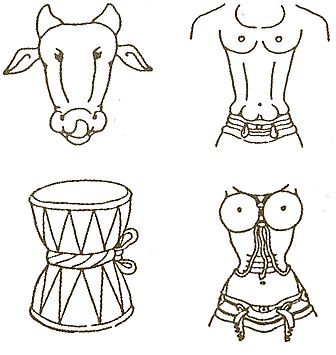
The Trunk, from just below the neck to the abdomen, is to be formed like the head of the cow;  suggesting the strength of the chest and the comparative slimness of the waist as well as the loose and folded character of the skin folding near the abdomen.

The middle of the body should resemble in shape a Damaru (Hour-glass formation); and,  the lion’s waist (Simha kati).

Arms and hands

The, arms are to resemble Elephant’s trunk; strong and supple. 

The Forearms, from the elbows to the base of the palms,  are to be modeled like the trunk of a young plantain tree; emphasizing the supple symmetry as well as the firmness of the arms.

The Fingers are to resemble the  formation of young Champaka flower-buds.

Lower Limbs

The human thigh, in male as well as in female figures, is to be like the trunk of the plantain tree, simulating its smoothness, strength and firmness of build.

The knee-cap should compare to the shell of a crab

The Shins are to be  shaped like fish full of roe.

And, generally, the Hands and Feet  should have a  resemblance to the lotus or the young leaves of plants .

***

As regards the measures and proportions of various features of a Nava-tala image, the Sukraniti-sara and Brihat-samhita   prescribe :

From the crown of the head to the lower fringe of hair = 3 Angulas in width; forehead = 4 Angulas ;  nose =  4 Angulas ; from tip of nose to chin = 4 Angulas; and , neck = 4 Angulas  in height;  eye-brows =  4 Angulas  long and half an Angula  in width; eyes = 3 Angulas  in length and two in width ; pupils = one third the size of the eyes ; ears =  4 Angulas in height and 3 in width.  Thus, the height of the ears is made equal to the length of the eye-brows.

Palms = 7 Angulas long’ the middle finger = 6 Angulas; the thumb = 3 Angulas, extending to the first phalanx of the index finger.

The thumb has two joints or sections only-, while the other fingers have three each. The ring finger is smaller than the middle finger by half a section; and, the little finger smaller than the ring finger by one section, while the index finger is one section short of the middle.

The feet should be 14 Angulas long; the big toe= 2 Angulas; the first toe = 2 ½ or 2 Angulas; the middle toe = 1 1/2 Angula; the third toe = l ½  Angula ; and , the little toe = l ½  Angula.

Female figures are usually’ made about one Amsa shorter than males.

The proportions of child-figures should be as follows:—the trunk, from the collar-bones below, should be 4 ½ times the size of the head. Thus the portion of the body, between the neck and the thighs is twice and the rest 2 1/2 times the size of the head. The length of the hands should be twice that of the face or the feet.

***

Prof. Ordhendra Coomar Gangoly (1881-1974), popularly known as O.C. Ganguly, one of the foremost authorities on Indian Art, remarks:

The Talas given here (Sukranitisara and Brihat-Samhita) do not exhaust the various measures current in Indian sculpture.  In the 4th chapter of the Sukrnniti Sara as also in the chapter on Pratima lakshana of the Brihat Samhita measurements are given for the average human body according to which the average male figure is stated to be eight times the face which is represented by one Tala.

Any height for a human ‘male, which is less than the eighth measure is conceived in the Sukranitisara as dwarfish or below the average.

The average human female figure is given as of the seventh measure (Sapta-Tala).

The average infant figure is laid down as of the fifth measure (Pancha-tala).

The measures higher than the Asta Tala are reserved for the images of gods ;, demons, Rakhsas and other super-human beings.

 Thus the image of the goddess according to the Sukranitisara is always in the ninth measure (Nava Tala smrita Devi).That of the Rakshasas   is the tenth measure.

The South Indian manuscripts however differ a little from the Sukranitisara and other works in respect of the rules for the measure of the deities.

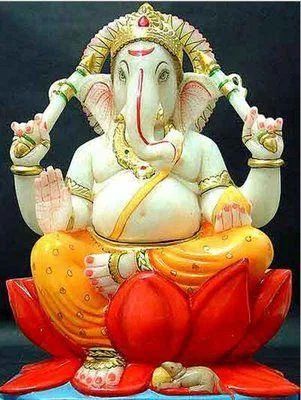
But; except in the case of the image of Ganesha and Krishna, all the measures given for the images of the deities are higher than the Asta-tala , the average human measure, the higher measurements suggesting a relatively ‘heroic’ type.

 In the South Indian manuscripts each measure is again divided into three different classes e.g. the Uttama (best) Madhyamā [medium) and the Adhama (lowest). Thus the Uttama Dasa-tala is represented by 124 Angulas or parts; the Madhyamā-dasa-tala by 120 parts; and, the Adhama-dasa -tala by 116 parts.  Special injunctions are laid down for constructing particular images in a measure specially reserved for them. ]
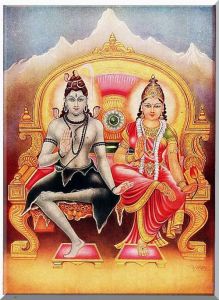
Shiva Parvathi22

11. Postures and perspectives

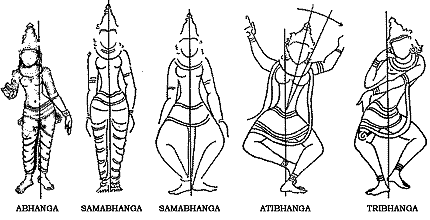
Abhanga etc

Chitrasutra mentions that an image could be presented in any number of positions; but categorizes nine positions as the leading attitudes.

[For more on  postures (Sthanas) please click here; and,  for more on  measures and proportions (Tala-mana)  please click here]

11.1. The nine postures, mentioned under, can perhaps be understood as stylized views, as they are the same figure viewed from different angles. That causes portraying the same figure, with altered body- proportions, because some parts are hidden from view while some others are prominent. The ratio of the head with the other limbs of the body has to be altered in accordance with the different postures and view positions (perspectives). Yet, the image should not look disproportionate. That has to be done by manipulating density of light and shades. These indicate that the Chitrasutra had a sound understanding of the spatial perspective of things.

11.2. The various positions and perspectives are achieved by what the Chitrasutra calls – kshaya and vridhi, decrease and increase, which is the art and skill of foreshortening. The positions are:

(i)*. front view (rivagata);

(ii)*.back view (anrju);

(iii)*.bent position – in profile view (sat-chikrat-sarira);

(Iv)*.face in profile and body in three quarter profile (ardha-vilochana);

(v)*.side view proper (paravagata);

(vi)*.with head and shoulder-belt turned backwards (paravritta);

(vii)*.back view with upper part of the body partly visible in profile (prastagata);

(viii)*.with body turned back from the waist upwards (parivrtta);

And

(ix)*.the back view in squatting position with head bent (samanata).

*

11. 3. Then, the Sage goes on to describe the nature of these positions; and how to draw them (39. 1-32)

(1)  The front view (rivagata) is, of course, the pre-eminent position amongst those enumerated earlier. It presents a beautiful static posture (rju) of a well-proportioned pleasing body  , expertly  shaded with artistic display of light and shade . The pure, charming figure, adorned by manifold lines and embellishments, faces the viewer, in full. The front view, face, chest and abdomen should also remain undiminished. The figures grow narrower towards the waist from the thighs, as well as from the shoulders. Their nose-wings and lips appear foreshortened by a fourth part of their width; and their limbs are foreshortened by a third part of their breadth.

(2).  For the back view (anrju), the portions on the back should be without foreshortening (lit. diminished limbs)

(3) . The profile view in a bent position (sat-chikrat-sarira) could be very alluring. The bent posture (tiryak), well rounded, but slender and tender limbs all contribute to enhance the charm of the posture.  In this profile; only one of the eyes and a portion of the forehead and also of the nose are shown. The one eye that is shown, in the profile, is foreshortened by artistic means; and, the eyebrow is also artistically suppressed (i.e., foreshortened); and is painted with gentle lines. The face is neither straight nor serious; neither black nor shady.

(4)  The next position is called ardha-vilochana ‘ – with one eye – face in profile and body in three quarter profile. Here, the one eye in the face of the figure is shown in full; and, half of the eyebrows is suppressed (i.e., one eyebrow is not to be seen). The forehead (the curve of the forehead in half its usual size); and, the curve of one eyebrow are visible. The other visible part is half of the cheek from one side only; while the other half is invisible (lit. suppressed). Half of the usual length (lit. measure) of the lines on the throat and a yava only of the chin are shown. The navel, one angula less than the opening of the mouth, and three quarters (lit. half and half of that half) of the waist and other (parts) should be shown.

(5)  The side view proper (paravagata) or Parsvagata is as if it is emerging out of the side or the wall (bhittika) or out of the shade (chhayagata). Only its one side is seen – either the right or the left. Only its one eye, one eyebrow, one temple, one ear; and, half of the chin and the hair should be shown. The figure which is well proportioned should exude grace and sweetness.

(6) . The position with the head and shoulder-belt turned backwards (paravritta) is   said to be ” turned back by the cheek” (ganda-paravrtta) whose limbs are not very sharply delineated.  It has appropriate measurement in proper places; looking tender; and, artistically foreshortened, kshaya with dark shades in forehead, cheek and arm and also in the throat, (i.e., the parts that are vaguely discernible, as they are lying in the shade) .

(7) Usually, the wall paintings presenting a back view with upper part of the body, partly visible in profile, are tradition-ally called (prastagata)- ‘derived from the back ‘.  Such pictures reveal the attractive back frame of the body, showing muscles and joints. In such depictions, only one side is seen; the chest, (one) cheek and the outer corner of the eye are only faintly visible.  Such well-proportioned profiles possess qualities like sweetness (madhurya) and grace (Lavanya) .

(8) The Parivrtta is a figure whose upper part of the body is turned back from the waist upwards; and, only a half of it is seen on account of its reversed position.  The upper and lower portions of the body, towards the front, are somewhat lost in shade. Its face is tainted with envy; and, the lower half of the body is like that of a rustic; and, its middle is properly foreshortened and made agreeable to the eye.

(9) The back view in squatting position, with the head ;  with the buttocks in full view; with the soles of the feet joined; with half of the body faintly seen from above; with the part about the entire waist shown; with the two entire soles shown;  with foreshortened lower part of the toes, beautiful all round, well finished, not terrible-looking, with arms visible ; with head and trunk well joined and  bent down towards the legs is known  by the name of Samanata – methodically bending .

The text cautions; these positions should be drawn with care, accompanied by qualities like mana (proportionate measurement, etc.). And then , it adds; if these nine positions are depicted thoroughly , as prescribed,  ‘there is none besides and superior to these’- ( 39. 34-51 )

12. Foreshortening

The concept of foreshortening i.e. the lengthening or the shrinking of the limbs is called Kshaya-vriddhi. It is explained with the help of nine postures (as mentioned above)  when viewed from different angles.

The techniques of foreshortening –  Kshya (decrease); Vrrddhi (increase) and Pramana (proportionate measurement) – are vital to the art of drawing. These techniques are said to be of two kinds – Chitra (simple) and Vichitra (multicolored). the latter, again is graded into three sorts, according to the quality of the results obtained by proportionate measures:  Uttama (full), Madhyama (middling) and Adhama (small).

Further, the techniques of Kshya and Vrddhi are said to be of thirteen varieties, depending upon the nine positions or postures to be depicted in the painting, as mentioned above. The foreshortening will also have to take into account the various positions of the feet and the series of their movements like alidha (the right knee advanced and the left leg retracted); pratyalidha (i.e., with the left knee advanced and the right knee retracted); and, vaisakha (i.e., with feet a span; apart)- as described above.

*

In describing the various kinds of postures, the Chitrasutra advises the display of various kinds of light and shade in and through which the exact position of the postures could be expressed. According to diversity in posture there is a diversity of relation of the different parts of the body which disturbs the normal relation that the head bears to the different limbs. Twelve such postures are described in the Chitrasutra

Foreshortening is achieved, as the text says, by manipulating light and shadows with the aid of coloring, shading with delicate cross lines, stumping and dots; and at the same time maintain the proper proportion (pramana) of the figure and its aspects.

“Weakness or thickness of delineation, want of articulation, improper juxtaposition of colors are said to be defects of painting.”

Daur-balyam sthula-rekhatvam avibhakta tvameva cha / varnanam samkaracha tre chitra-doshaha prakirthitaha / 3.43.18/

*A painting without proper position, devoid of appropriate rasa, blank look, hazy with darkness and devoid of life movements or energy (chetana) is inauspicious.

Sthana -hinam gata-rasam shunya-dristi malimasam /Hina-angam malinam shunyam bhaddam vyadi bhayakulaihi /3.43.22/

“Proper position, proportion and spacing; gracefulness and articulation; resemblances; increasing or decreasing (foreshortening) are the eight good qualities of a painting.”

Sthana Pramanam Bhu-lambo Madhuratvam vibhaktata /Sadushyam Kshaya-vruddi cha gunah astaka idam smrutham /3.43.19 /

Lasativa Bhu-lambo bhibyati iva tatha Nrupa / Hasativa cha Madhuryam Sa-jiva iva drushyate /Sa-svasa iva chitram tat-chitram Shubha-lakshanam /3.43.1-21-22/

The paintings created by the competent artists well-versed in the Shastras, ushers in prosperity; drives away poverty and wretchedness. A painting properly and well positioned, is viewed with wonder and admiration. It ensures a pleasing ambiance, charged with love and happiness. It drives away nightmares; and pleases the Deities resident in the homes. The home indeed looks complete with all the auspicious aspects.

Shastragnaihi su-krutam dakshai Chitram hi Manujaadipa/ Sriya -mavahati kshipram A-lakshmim chapakarshati /3.43.24/

Nirner-jayathi  cha utkantam nirudhya-gatam shubhum / shuddam prathayati -pritim janyatya -tulamapi /3.43.25/

Dus-swapna-darshanam hanthi  preenathi Griha Daivatham /3.43.26 /
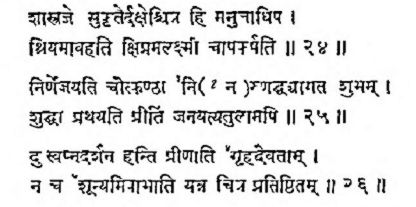
Vishnudharmorrata. 3 jpg

hl66

Next:

Chitrasutra continued

Sources and References:

I gratefully acknowledge  Shri S Rajam’s sublime paintings;  And the other paintings from internet.

Line drawings from Dr. G Gnanananda’s Brahmiya Chitrakarma Sastram

Citrasutra of the Visnudharmottara Purana by Parul Dave Mukherji

Stella Kramrisch: The Vishnudharmottara Part III: A Treatise on Indian Painting and Image-Making.  Second Revised and Enlarged Edition ; (Calcutta University Press: 1928)

Technique of painting prescribed in ancient Indian Texts

http://curiosity-the-key-to-knowledge.blogspot.com/2006/12/technique-of-painting-prescribed-in.html

The “Sarvatobhadra” temple of the Vishnu-dharmottara-purana

https://openaccess.leidenuniv.nl/dspace/bitstream/1887/2668/1/299

_022.pdf

Problems of Iconometry: Comparing the Citrasūtra with the Citralakaa by Matteo Martelli

I gratefully acknowledge the illustrations from the works of Shri S Rajam

All other pictures are from internet

 
15 Comments

Posted by on September 18, 2012 in Art, Chitrasutra, Natya, Vishnudharmottara


Tags: , , , ,

The Art of Painting in Ancient India – Chitrasutra (2)

[ This is the second in the series of articles I would be posting on the art of painting in ancient India with particular reference to the Chitrasutra of Vhishnudharmottara purana.   This article covers certain general aspects discussed in Chitrasutra text. ]

1. The Text

1.1. The Vishnudharmottara Purana or the Vishnudharmottara (as it is usually referred to) is a supplement or an appendix to the Vishnu-purana. It is generally believed to be a later insertion into Vishnu Purana. Some say , it is affiliated to the Pancharatra Agama, associated with the Vyuha doctrine

The   part three of the Vishnudharmottara gives an account, among other things, of the then – known branches, theories, methods, practices and ideals of Indian painting. 

The text deals not only with its religious aspects but also, and to a far greater extent, with its secular applications. It initiates the aspirant into a world of joy and delights that only the colors, forms and representation of things — seen and unseen — can bring forth.

1.2. The Vishnudharmottara asserts that it is but a compilation ; and , is an attempt to preserve the knowledge that was hidden in older sources. Sadly, all those older texts are lost to us. Vishnudharmottara is thus the earliest exhaustive treatise available to us on the theory and practice of temple construction, painting and image making in ancient India.

[Perhaps no other Indian text on art (except  the Nätyashästra)  received as much scholarly attention from art historians as did the Chitrasütra of the Vishñudharmottara Puräna. The text of Chitrasütra was first published in 1912. And, its earliest translation into English was rendered by Stella Kramrisch (1924). She also provided explanations of its art; the interpretations of the key concepts as given in the third khanda of the Chitrasütra. Kramrisch had, in the process, also discussed, in fair detail, the artistic criteria, as also their pictorial modes and conventions.

Ananda. K.  Coomaraswamy, in 1932, took a broader perspective; and, provided the explanations on the creative processes involved in ancient Indian art, in general. He described the visualization of form of the subject, by the artist, through meditative internalization, as a sort of Yoga.  It was in this light that he explained connotations of the specific idioms employed in the theories of Indian art. And, he then interpreted their  depictions , in the light of the aesthetic and iconometric injunctions  detailed under  the six limbs (shad-anga) of traditional Indian painting , as  given in the Chitrasütra 

    1. sädrusya (similarity);
    2. pramäna (proportion);
    3. rüpabhedä (differentiations or typologies of form);
    4. varnika-bhanga (colour differentiation);
    5. bhäva (emotional disposition); and,
    6.  lävanya yojanam (gracefulness in composition) .

The efforts of these two pioneers were carried forward by scholars, such as: Priyabala Shah (1958); C. Sivaramamurti (1978); Parul Dave Mukherji (1998); Isabella Nardi (2003); and others, who provided deeper insights,   additional explanations and interpretations.

We owe all these scholars a debt of deep gratitude.  ]

1.3. Chitrasutra is that part of the Vishnudharmottara which deals with the art of painting (citraśikhaṇḍa – Khanda III, Adhyayas 35-43).  This section , which concentrates on the theory and practice  of painting , is named after its first line of Adhyaya 35.1a  :

– atah param pravakshyami Chitra-sutram tavanagha.

Its compiler described it as “the legacy of the collective wisdom of the finest minds”. 

[As regards the structure of the text :

:- Adhyaya 35 considers the mythic origin of painting and the five types of males together with their differing proportions.

:- Adhyaya 36 discusses measurements and proportions of the different parts of the body and the colours and other distinguishing features of the five male types.

:- Adhyaya 37 deals with the measurements of the five types of females, hair and eye types, and the general characteristics of a Cakravartin, the supreme ruler.

:- Adhyaya 38 gives details on auspicious marks that divine images, both sculpture and painting, should  possess.

: – Adhyaya 39 treats the different postures (sthanas) for figures.

 :- Adhyaya 40 describes how to mix paints, prepare the surface, and apply the paints.

:- Adhyaya 41, of cardinal importance, defines the four types of paintings.

:- Adhyaya 42, equally significant, prescribes the manner in which a large number of beings–royalty, priests, nature and heavenly sprites, demons, wives, courtesans, attendants of vaisnava deities, warriors, merchants, and others should be depicted.

:- And, Adhyaya 43 talks about the nine Rasas in painting, strengths and defects in painting, as well as sculpture in different materials.

In the closing, III.43.37, as if to underscore the unity and interdependence of the arts, states that whatever has been left unsaid about painting can be understood from the section on dance, and what is not given there can be supplied from painting.

-Yad-artha noktham tanruta vigneyam Vasudadhipa / Nruttepi noktham tat Chitram na atra yojyam Naradhipa / ]

Shankardevi-durga-3

Explaining why he took up the compilation; Sage Markandeya said , he was prompted by his concern for the future generations; for their enlightenment, delight and quality of life .

He said it was his firm belief that paintings are the greatest treasures of mankind as they have the aura and power to beneficially influence the minds and lives of the viewers.

1.4. In that context Chitrasutra makes some amazing statements:

*. Great paintings are a balm on the troubled brow of mankind.

*.Of all arts, the best is chitra. It is conducive to attainments in life such as dharma-artha -kama ;  and has the virtue to liberate (emancipate) an individual from his limited confines

Kalanam-Pratamam-Chitrm;Dharma-Artha-Kama-Mokshadam/Manglya-Pradam-chaita-tad-gruhe-yatra Pratishtitm

*. Wherever it is established- in home or elsewhere- a painting is harbinger of auspiciousness.

*. Art is the greatest treasure of mankind, far more valuable than gold or jewels.

*. The purpose of art is to show one the grace that underlies all of creation, to help one on the path towards reintegration with that which pervades the universe.

*. A painting cleanses and curbs anxiety, augments future good, causes unequaled and pure delight; banishes the evils of bad dreams and pleases the household -deity. The place decorated by a picture never looks dull or empty.

1.5. The Vishnudharmottara is dated around sixth century AD, following the age of the Guptas, often described as the Golden Age of Indian Arts. It is perhaps the world’s oldest known treatise on art. However, not much is known of its author, as is the case with most Indian texts .

Vishnudharmottara follows the traditional pattern of exploring the various dimensions of a subject through conversations (Samvada) that take place between a learned Master and an ardent seeker eager to learn and understand. Chitrasutra too employs the pretext of a conversation between the sage Markandeya and king Vajra who seeks knowledge about image making (shilpa).

2. Concepts

2.1. The Chapter 46 of the Third Book of the Vishnudharmottara commences with a request by king Vajra to sage Markandeya seeking knowledge about image-making.

King Vajra questions “How could one make a representation , in painting or image , of   a Supreme being who is devoid of form , smell and emotion ; and destitute of sound and touch?”.

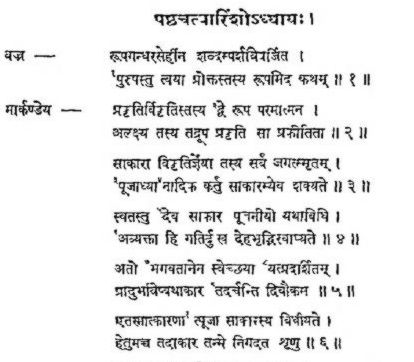
Rupa-Gandha-Rasa-hinaha, Shabda-Sparsha vivargitaha / Purushatu tvaya prokta tasya rupma idam katham / 3.46.1/

Sage Markandeya explains ”The entire universe should be understood as the modification (vikriti) of the formless (prakriti) . The worship and meditation of the supreme is possible for an ordinary being only  when the formless is endowed with a form; and, when that form is full of significance. The best worship of the Supreme is, of course, contemplation of the formless with eyes closed and all senses subdued  in meditation.”

Prakruti-Vikruti tasya rupena Paramathmanha / a-lakshyam tasya tad-rupam Prakruti sa prakeertita /3.46.2/

Sa-kara Vikruti-jneya tasya sarvam Jagatha-tasyaitam /Puja-Dhyana-adikam karthrum Sa-kara sevya shakyate /3.46.3/

Vishnudharmorrata. 2 jpg

2.2. With that, the life in its entirety becomes a source of inspiration for artistic expressions. In another passage, Chitrasutra cites the nature that envelops the artist as the source of his inspiration. The text, therefore, mentions that, as in dance so in painting, there has to be a close relation with the world around us; and, reflection of it in as charming a manner as possible

2.3. And, as regards the skill required to express those emotions in a visible form, the text suggests that painter should take the aid of Natya, because an understanding of Natya is essential for a good painter.

Yatha nritte , tatha chitre  trailokya-anukritis smrita / drishtayas cha tatha bhava angopangani sarvasah / karas cha ye maya nritte purvokta nripasattama / ta eva chitre vijneya nrittam chitram param matam // 3.35.5-7 //

The sage then instructs that without the knowledge of music, one cannot understand Natya. And, without the knowledge of Natya , one can scarcely understand the technique of painting. — “He who does not know properly the rules of Chitra (painting)”, declares the sage , “can scarcely discern the essentials of the images (Shilpa)”.

The same teaching is put in another way too.

One who does not know the laws of painting (Chitra) can never understand the laws of image-making (Shilpa); and, it is difficult to understand the laws of painting (Chitra) without any knowledge of the technique of dancing (Nrtya); and, that, in turn, is difficult to understand without a thorough knowledge of the laws of instrumental music (vadya). But, the laws of instrumental music cannot be learnt without a deep knowledge of the art of vocal music (gana).

All these , mean to say that  the arts of  Music -> Dance -> painting -> sculpture are inter related; and, that Music is at the base of all such fine-arts.

**

Dr. Isabella Nardi , in her Doctoral Thesis ‘ The Theory of Indian Painting (2003) , in summary, opines :

It is difficult to strictly separate certain theories of painting from those of sculpture; as, these two artforms are sometimes treated side by side without distinction in the texts.

While term Citra is generally translated as “painting,” the texts posit Citra in a more abstract sense as a ‘mental image’ that can be differently interpreted and effectuated in practice in both painting and sculpture. The term Citra , therefore, is open to a variety of uses and interpretations; and, a more holistic approach needs to be adopted in understanding the theory of Indian painting.

The tendency to separate the theory of painting from the theory of sculpture is misleading. Indeed, the characteristically holistic outlook of Indian knowledge generally implies that the drawing of such strict boundaries between the sciences, whether art or non-art, is ‘unnatural’.

The text Chitra-sutra places painting and the science of painting in a wider perspective, together with the other arts. It explains how all the arts are correlated to each other; and, stresses the need to know all of them in order to perform painting or sculpting.

3. Chitra and Natya

3.1. That does not mean, the positions of the dancers have to be copied on murals or scrolls. What it meant was that the rhythm, fluidity and grace of the Natya have to be transported to painting . The Chitrasutra says “it (Natya) guides the hand of the artist, who knows how to paint figures, as if breathing, as if  the wind as blowing, as if  the fire as blazing, and,  as if the streamers as fluttering. The moving force, the vital breath, the life-movement (chetana)  are to be explicit in order to make the painting come  alive with rhythm and force of expression . The imagination, observation and the expressive force of rhythm are the essential features of painting”.

[ The Visnudharmottara Purana deals with dance, in its third segment –  chapters twenty to thirty-four. The following is an extract from The Evolution of Classical Indian Dance Literature: A Study of the Sanskritic Tradition (1989) by Dr. Mandakranta Bose, Somerville College.

In chapter twenty (the first chapter of the section) , the author follows the Natyasastra in describing the abstract dance form, nrtta; and, in defining its function as one of beautifying a dramatic presentation.

The chapter twenty deals with the appropriate places for the performance of each category, discussing aspects of the stage and the presentation of the preliminaries. The discussion includes the characteristics of actors, the four different types of abhinayas, namely – angika, vacika, sattvika and aharya, and the names of all the complicated movements necessary for the composition of a dance sequence. In addition, the author briefly touches upon the pindibandhas or group dances mentioned by Bharata and goes on to describe vrtti, pravrtti and siddh; that is – the style, the means of application and the nature of competence.

The twenty-first chapter discusses sthanas or postures while lying down, while the twenty-second deals with the sthanas assumed while sitting. The focus of these two chapters seems to be on dramatic presentation.

The twentythird chapter is devoted to postures meant for both men and women.

The twenty-fourth chapter lists the movements of the major limbs, the angas, along with the meaning attached to each of them. The major limbs, according to this text, are the head, the neck, the chest, the sides, the waist, the thighs, the shanks and the feet. In conclusion, the chapter defines the cari and the karana, the two vital and complicated movements required in dancing.

In the twenty-fifth chapter, the movements of the upangas or minor limbs are discussed, including the glances that express rasa and sthayi and vyabhicaribhavas, the movements of the pupils, eyebrows, nose, tongue and lips as well as the application of these movements.

The twenty-sixth chapter describes three types of hand-gestures, those made with one hand, those made with both-along with the meanings they can convey-and hand-gestures meant for dancing, which convey no meaning.

The twenty-seventh chapter is devoted to the explanation of different kinds of abhinaya and the costumes and decorations necessary for a performance.

The twenty-eighth chapter deals with samanyabhinaya, giving general directions for expressing different moods and responses to seeing, touching and smelling objects. Although the author designates this chapter as a discussion of samanyabhinaya, he includes citrabhinaya, that is, special presentations. In fact, this chapter is a conflation of the contents of chapters twenty-two and twenty-five of the Natyasastra and contains extensive quotations from it.

The twenty-ninth chapter describes the gatis, that is, gaits, the thirtieth discusses the nine rasas and the thirty-first the bhavas.

A new feature of the treatment of body movements that is added to the discussion of body movements appears in the thirty-second chapter, which deals with what is termed rahasyamudras, that is, hand-gestures meant for mystical and ritualistic purposes.

Continuing the discussion in the thirty-third chapter, the author lists more mudras, all meant for religious purposes, and calls them mudrahastas, and associates them with hymns to the gods and goddesses.

The thirty-fourth and final chapter on dancing is devoted to the legend of the origin of dancing. Since the work is devoted to the worship of Vishnu, it is not surprising that its author should view Vishnu as the originator  of the art of dancing]

Flower design

The Chitrasutra recognized the value and the significance of the spatial perspective.

*.“He who paints rolling waves, darting flames, smokey streaks; fluttering banners and Apsaras floating in the sky , indicating the direction and movement of the wind, should be considered a great painter”

Taranga- Agnisikha- Dhuman ; Vijayantya -Apsara -adhikam vayu-gatya likhed yas tu vijneyas sat u chitrakrit // 3.43.28

*.“He who knows how to show the difference between a sleeping , an unconscious and a dead man ; or who can portray the visual gradations of a highland and a low land is a great artist “

Suptam cha chetanayuktam , mritam , Chaitanya-varjitam / nimnonnata-avibhagam cha yah karoti sa chitravit // 3.43.29

3.2. The Shilpa (sculpture) and Chitra (painting) are closely related to Natya (dance) in other ways  too. The rules of the iconography (prathima lakshana appear to have been derived from the Natya-shastra. The Indian sculptures are often the frozen versions or representations of the gestures and poses of dance (caaris and karanas) described in Natya-shastra. The Shilpa and chitra (just as the Natya) are based on a system of medians (sutras), measures (maanas), postures of symmetry (bhangas)   and asymmetry (abhanga, dvibhanga and tribhanga); and on the sthanas (positions of standing, sitting, and reclining). The concept of perfect symmetry is present in Shilpa and chitra as in Nrittya; and that is indicated by the term Sama.

3.3. The Natya and Shilpa shastras developed a remarkable approach to the structure of the human body; and delineated the relation between its central point ( Nabhi, the navel), the verticals and horizontals. It then coordinated them, first with the positions and movements of the principal joints of neck, pelvis, knees and ankles; and, then with the emotive states, the expressions. Based on these principles, Natya-shastra enumerated many standing and sitting positions. These, demonstrated the principles of stasis, balance, repose and perfect symmetry; And, they are of fundamental importance in Indian arts, say, dance, drama, painting or sculpture.

3.4. Another aspect of the issue is that painting as a two-dimensional form, can communicate and articulate space, distance, time and the more complex ideas in way that is easier than in sculpture. That is because , the inconvenient realities of the three dimensional existence restrict the fluidity and eloquence of the sculpture.

The argument here is , making a sculpture is infinitely harder than making a painting.

According to that; it is almost not possible to depict, directly,   in a sculptural panel the time of the day or night – darkness, evening, twilight or bright light etc.. That difficulty also applies to depiction of colours (colour, in fact, is not a medium directly compatible with sculpting). And, it is also not easy to bring out the differences between a dead body and a sleeping person, particularly if the two are placed side by side.  The sculptor – artist (shilpi) will have to resort to some other clever suggestions to bring out the differences. That depends on the ingenuity of the artist

4. Painting in ancient society

4.1. According to Chitrasutra, all works of art including paintings played an important role in the life of its society. The text mentions about the presence of paintings as permanent or temporary decorations on the walls of private houses, palaces and of public places. Apart from wall paintings, the floors of the rich homes and palaces were decorated with attractive patterns and designs inlaid with precious stones.

4.2. Paintings had relevance in the private lives too.The  polite education of a Nagarika  the educated urbane man of town included knowledge and skill of several arts in addition to erudition in literature, rhetoric, grammar, philosophy and allied subjects. Painting was rated high among these Vaiharika-silpas or vinoda-sthanas seats of pleasure or hobbies or arts for one’s own pleasure, enjoyment and amusement (gītaṃ,vādyaṃ, nṛtyaṃ, ālekhyaṃ, viśeṣakacchedyaṃ, KS.1.3.15).

The gentleman   of leisure and culture , painted for pleasure or in earnestness; but, of course, not for earning a living. Such persons, therefore, considered Alekhya, the art of painting as Vinodasthana – a pleasant diversion from other gnawing concerns and thoughts – Ardhalikitam idam Vinodasthanam asmabhihi .

[Sometimes, a gentleman of leisure who had learnt the art as a leisure pastime  had to use it to earn a livelihood when bad days had fallen upon him . The Samvahaka in Mrichchakatika was one such hapless character who bemoans his lot  forced to earn a living  by practicing an art (kaleti sikshita jivikaya samvritta )… It was therefore said that , in any event, it is safer to learn some art , as it might come in handy in your lean days – who knows…!!! ]

Vatsayana  as also Syamalika , describes the tasteful set up and arrangement in the room of a typical urban gentleman of pleasure who evinces interest in literature, dance, music and painting. The articles  in his room  would include  a vina   hanging from a peg on the wall (naaga-danta vasakta vina);   a painting board (chitra palakam) ; a box-full of colors and brushes (vatika tulika samgraha) ; a cup for holding liquid colors  (meant for painting) casually kept on the window sill (alekhya-varnaka-paatram) ; and, books of verses (kurantaka maala).

nāga-dantāvasaktā vīṇā. citra-phalakam. vartikāsamudgakaḥ. yaḥ kaś cit pustakaḥ. kuraṇṭaka-mālāś caKamasutra 1.4.4 

Tatoham aasannam alekhya -varnaka-paatram  gavakshad aksipya.. Padataditaka of Shyamalika  , a monologue play

women playing

The courtesans too were proficient in fine arts such as music, dance, painting poetry as also in body-care techniques. Damodaragupta mentions that a courtesan evinced keen interest in enhancing her array of skills; and, she devoted much time and effort to excel in painting and other fine-arts , to add to her other accomplishments

alekhyadau vyasanam vaidagdhya-akhyataye na tu vinodaya  (Kuttanimala)

Even a calculating courtesan would madly fall in love with a talented painter, though impoverished. Somadeva’s Katha-sarit-sagara narrates number of delightful stories of such young and impetuous courtesans, bordering on recklessness. .

Syamilaka , in his Bana play Padataditaka , provides the instance of Kusumavatika, a courtesan who passionately fell in love (mahan madanon-madah) with a Chitracharya (master painter) Sivasvamin. She was drawn to him mainly by his excellence in his art , though he was utterly poor.

Janita evasmatsvami yathasmatsakhya kusumavatikayah chitracharyam sivasvaminam prati mahan madanonmadah iti- Padataditaka

There were also Shilpini-s the court maidens in the service of the princesses. These talented Shilpini-s were well trained (prauda) painters who excelled in delicate drawing of portraits (viddha-chitra); and, they were often commissioned with the task of carrying the portraits they had drawn of their princess to distant courts to show them to the eligible princes for seeking alliance in marriage. And, sometimes such portraits – of princes and princesses –  were sent round several Royal Courts in search of  suitable alliances . The katha-sarit-sagara carries numerous such tales.

design33

It is said; Nagarakas (city dwellers), connoisseurs of art, accomplished courtesans, painters, and sculptors among others studied standard texts on painting. Such widespread studies naturally brought forth principles of art criticisms as in alankara-sastra.

For the gentlemen of leisure , fine arts like music , dance painting and sculpture were the source of ones’s own pleasure and amusement (vaiharika-silpa or vinodasthana). But , there were several professionals  who practiced these arts and art-forms  as a craft, the main stay of their life.

Kautilya deems it a responsibility of the state to support all such art-masters that spread knowledge among youngsters.

The play Malavikagnimitra mentions that Chitracharyas who combined the theory of the art with proficiency in dance performance were respected  and treated on par with Natyacharyas  in the kings court.

The art of  painting – chitra kala– was recognized as an essential part of the curriculum in the upbringing of children of “good families”.

Education in fine arts like music, dance and painting was considered essential for unmarried maidens of affluent families. The ancient stories are replete with instances of young lovers exchanging paintings as loving gifts.

While on the subject , I may mention that Chitrasutra  regards the Alekhyas or paintings as mangalya-lekhyas – auspicious in homes; and , it  observes:  

the pictures which decorate the homes (including the residential quarters of the king- rajnaam vasagriheshu) should display sringara, hasya and shantha rasa. Only such paintings that depict moods of laughter, fun, playfulness, love and peace should be seen at homes. They should exude joy, peace and happiness; and, should brighten up the homes and lives of its residents.

The pictures that depict  horror; and ,  the ones that evoke fear, rage, disgust , sorrow  and cruelty ; as also those that show battle scenes, death, cremation / burial grounds, heart rendering episodes, wretchedness, glorifying evil and base motives, inauspicious themes etc., should be forbidden and should  never be displayed at homes where children dwell.

Further, the text mentions that the pictures which show a bull with its horns immersed in the sea; men with ugly features or those fighting or inflicted with sorrow due to death or injury; as also the pictures of war, burning grounds as being inauspicious and not suitable for display at homes.

But, the text says, the pictures of all types of depictions and Rasas could be displayed at court-halls, public halls,  galleries and temples.

[Sringara, hasya, shantakhya lekhaniya griheshu te // parasesha na kartavya kadachid api kasyachit / devavesmani kartavya rasas sarve nripalaye / rajavesmani no karya rajnaam vasagriheshu te , sabhave’smasu kartavya rajnam sarvarasa grihe, varjayitva sabham rajno devavesma tathiva cha / yuddha-smashana-karuna-mrita-dukkha-aarthakutsitan / amangalyamscha na likhet kadachid api vesmasu // ]

**

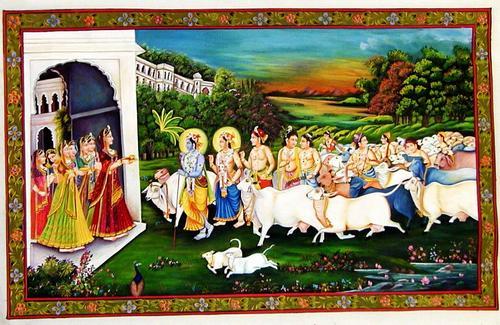
photo16Gopalas returning Home

4.4. Icons were generally classified into four categories:

(1) as those painted on the wall, canvass, paper, wall or pot (chitraja) ;

(2) as those molded in clay or any other material like sandal paste or rice flour (lepeja, mrinmayi, or paishti);

(3) as those cast in metal (pakaja, lohaja, dhatuja); and,

(4) as those  carved in stone, wood or precious stones (sastrotkirana, sailaja, daaravi or rathnaja).

Early icons were made in clay or carved wood; and such images were painted over.

[ As regards the images made of clay, sand or lacquer etc., the Sukraniti-sara says : Images that are drawn or painted, or made of sand, clay or paste or those made for learning – it is no offence if such images fail to conform to the prescribed rules. For , these are intended only  for temporary use; and, are usually thrown away, afterwards, as these are generally made for mere  amusement. They need not always strictly adhere to the conventions prescribed by the Shastras.

Lekhya lepya saikati cha mrinmayi paishtiki tatha, Eteshani laksliana-bhave na kaischit dosha iritah ]

Hallow figures (sushira) of gods, demons, Yakshas, horses, elephants, etc., were placed on the verandas of houses , on the stages and in public squares etc., as pieces of decoration . Such hallow images were usually made of clay, cloth, wood or leather .

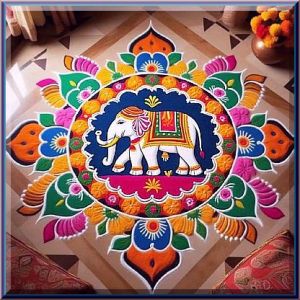
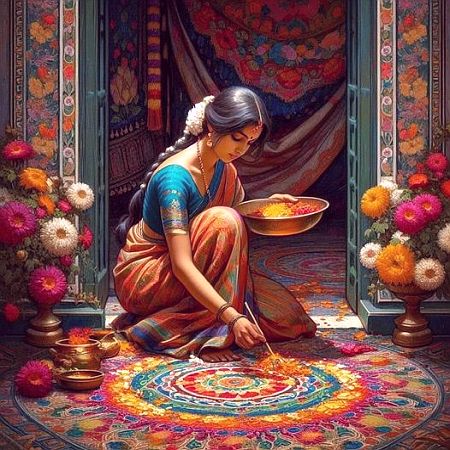
Paintings were classified  as those drawn on the ground – like Rangoli, floor decorations etc (bhumika); those on the wall-like murals and frescoes (bhitthi); and,  portrait (bhava chitra).The first two were fixed (achala); and, the third was portable

4.5. The Patas (poster or banner like paintings) were commonly displayed in public squares. It is mentioned, such paintings were employed as a means and as a method of communicating with the town’s people. The messages displayed picturesquely on the Patas could be understood by all – lettered and unlettered alike.

The art, thus, entertained , educated and enlivened common people.

5. Art Appreciation

5.1. As regards the deities depicted in art, it is explained; in the Indian tradition a deity is a Bimba the reflection or Prathima , the image of god; but , not the god itself. Bimba is reflection, like the reflection of the distant moon in a tranquil pool. That reflection is not the moon ; but, it is a suggestion (prathima) of the moon. In other words, a deity is a personification of a sublime  idea, a conception or his/her mental image of god, translated to a form in lines, color, stone, metal , wood or whatever .

The Chitrasutra says, those qualities that we admire in a divine being are within us. And,  when we respond to those images brought to us in art, we awaken those finer aspects that are latent in us. When we are filled by that grace, there is no space left for base desires and pain; we have become that deity.

5.2. When we view sunrise or a great work of art, Chitrasutra says, we experience the joy brought to us by its sublime beauty (ananda , ahlada), as we let dissolve our identities and attachments; and, become one with the object of beauty. It is a moment that bestows on us the grace that underlies the whole creation. Art, it said, is a liberating experience.

[ Dr. Harsha V. Dehejia  in his The Advaita of Art writes :

The concept of Artha also appears in the theories of Art-appreciation. There, the understanding of art is said to be through two distinctive processes – Sakshartha, the direct visual appreciation of the art-work; and, Paroksharta, delving into its inner or hidden meaning. The one concerns the appreciation of the appealing form (rupa) of the art object (vastu); and, the other, the enjoyment of the emotion or the essence (rasa) of its aesthetic principle (guna vishesha). Artha, in the context of art, is, thus, essentially the objective and property of art-work; as also the proper, deep subjective aesthetic art-experience.

In the traditions of Indian art, the artist uses artistic forms and techniques to embody an idea, a vision; and, it is the cultured, understanding viewer (sah-hrudaya), aesthete (rasika) that partakes that vision.

It is said; an art-object for a connoisseur is not only a source of beauty; but is also an invitation to explore and enjoy the reason (Artha) of that beauty. Thus, Artha is the dynamic process of art-experience that bridges the art-object and the connoisseur.

A work of art  is not a mere inert object; but, it is so rich in meaning (Artha) that  it is capable of evoking manifold emotions and transforming the aesthete.]

shivapancamukha

6. Elements of painting

6.1. While discussing the elements of a painting, the Chitrasutra says :

  • The masters praise the rekha‘s –lines (delineation and articulation of form);
  • the connoisseurs praise the display of light and shade;
  • women like the display of ornaments;  and 
  • the richness of colors appeals  to common folks.

The artists, therefore, should take great care to ensure that the painting is appreciated by everyone”.

 Rekha cha Vartana chaiva Bhushanam Varna meva cha / vijnaya manu-sresta Chitra-karma tu Bhushanam /3.41.10 /

Rekham prashamsam tya Acharyaha ,vartanam cha vichakshanaha / Stri yo Bhushanam icchanti , varnadai itare janaha / 3.41.11 /

Ithi mathva tatha yatnaha karthaya chitra-karmani / sarvasya chitta-grahanam yatha sthanai  manujottama / 3.41.12 /

Talking about lines, Chitrasutra favors graceful, steady, smooth and free flowing lines; but not the crooked and uneven lines. It was said; while the free flowing, continuous, smooth and graceful line are soothing to the eyes (Rekha-nivesotra yad ekadharah), the broken lines offend the eyes. A good painting must be graceful, free of crooked lines.

idam cha paurandram avaimi karma Rekha-nivesstra yad eka-dharah // karma parinata-rekha mamsalair anga-bhangair laghur api likhiteyam drisyate purna-murtih 

The text appears to hold the view; while delineation, shading, ornamentation and coloring are the decorative aspects (visual) of a painting, the rekha, the lines that articulate the forms are its real substance.

Its Masters valued the effects best captured by least number of lines. Simplicity of expression symbolized the maturity of the artist. The artist and the art critics appreciated the best effect in a picture captured by a minimum number of lines composing the figure. In the Viddhasalabhanjika , there occurs a remark of the vidushaka  (court jester) that the painting looks complete with even a minimum of drawing : api laghu likhiteyam drisyate purnamurtih

Incidentally, the main characteristics of the Ajanta paintings are the use of free flowing lines for delineating beautiful figures and their delicate inner feelings; together with use of shading different parts of the body to produce three dimensional effects in the images. The other was the use of proper colors at times contrasting and at times matching to create magical effects. These were precisely the principles that Chitrasutra emphasized.

6.2. The text says  in another context, when a learned and skilled artist paints with golden color, with articulate and yet very soft lines with distinct and well arranged garments; and graced with beauty, proportion , rhythm and inspiration, then the painting would truly be beautiful.

Sva anuliptva akasha nideshanam madhuka Shubha / su-prasanna abhi gupta cha bhumihi sat-Chitra-karmani /3.41.14 /

Su-snigdha vispusta Suvarna-rekham vidvan anyata desha vishesha vesham / Pramana  Shobha-birahiyamanam krutam bhaveth Chitram ativa chitram/3.41.15 /

6.3. The elements that contribute to help a picture to attract  a spectator are merits like delicacy  of line , sweetness of execution , symmetry , likeness to the original , foreshortening , suitable background , spirited and life-like deportment of the figure and so forth .

And, as regards the  defects that  repel the viewer , they are generally :

    • coarseness of line work ,
    • weak and vague drawing ,
    • lack of symmetry ,
    • color-muddling ,
    • inappropriate pose,
    • lack of emotion,
    • vacant look in the figure ,
    • smudgy execution,
    • life-less portrayal
    • , disproportionate limbs ,
    • disheveled hair
    • and so on

Durbalyam, sthula rekhatvam , avibhaktatvam  eva cha / varnanam sankaras, chatra chitradoshah , prakirtitah / sthanam pramanam bhulambho madhuratvam vibhaktata / sadrisyam kshayavriddhi cha gunastakam idam smritam / sthanahinam gatarasam sunya drishtimalimasam / chetanarahityam yat syat tad astakam prakirtitam // lasativa cha bhulambo slishyativa tata nripa / hasativa cha madhuryam sajiva iva drisyate//sasvasa iva yachchitram tachchitram subhalakshanam/ hinangamalinam sunyam baddha-vyadhibhayakulaih // vrittam prakirnakesaischa sumangalyair vivarjitam / pratitam cha likhed dhiman napratitam kathanchana // 3.43.17-23

6.4.  The renowned scholar Sri C. Sivaramamurti , quoting another Shilpa text Upamiti-bhava prapancha-katha  mentions :

For a critical appraisal of a picture  of excellent drawing composed of fine lines, the brush strokes of which are almost imperceptible under a delicate coat of bright color :

it is essential to project an excellent treatment of an illusion of relief on a flat surface ,

    • technically styled chiaroscuro ,
    • appropriate ornamentation ,
    • systematical representation of limbs composing an ideal body ,
    • a proper shading of the figures by a mode of stippling, and
    • a proper  representation of emotion  by an expression of it in the eyes , since it is the heart of the painting

these are all essential factors that go to make a good picture.

Tatas samarpito bandhulayasam dviputasamvartitas chitrapatah , pravighatya cha nirupito harikumarena /  yavad drishtam alikhitam ekapute suvibhakto ujjvalena varnakramena nimnonnata avibhagena samuchhitena bhushanakalaapena suvibhaktha avayava archanayati vilakshanaya bindu vartinya abhinava Sneha rasotsukatyaya parasparam harshotphulla-abaddha-dristikam-samruddha-prema-ati-bhanduraikataya-alanghita-chittanivesam vidyadharam  – mithunakam iti // Upamiti-bhava prapancha-katha

These qualities, while composing a picture, essentially, stress the importance of the virtues of

    • purity of line-work;
    • arrangement of ornamentation;
    • appropriate manipulation of color; and,
    • clarity in the expression of emotions.

It is said; the emotion is the most significant aspect of a painting, the true depiction of which sets apart a Master from the rest

Abhihitam anena aho ranjitoham anena chitrarara-kaushalena , tatha – atra suvishuddha rekha . saghatadi bhushanani , uchitkrama varnavichchhittih pari-sphuto bhava-atishayah – iti / dushkaram cha chitre bhava-aradhanam / tad eva chabhimatam ati-vidagdhanam / tasya chaatra prakashah paripusto drishyate // Upamiti-bhava prapancha-katha 

The master-stroke of the painter, which makes great art distinctive; and which, independent of color and line, adds vitality to the picture is praised by scholars and connoisseurs

6.5. It is said; a great painter tries to represent the ideal. As for the faults that meet his eyes, he ignores them and presents only the good things in life.  Thus, it is in his power to better  the world we live in  , at least in his picture.

Whatever that is not beautiful can be made  to look different in painting ( yad yat sadhu na chitre tat tad anyata syat kriyate )

shivaparvathi

The Guna (merits) and the Dosha (blemishes), the proper portrayal of Rasas, emotions, suggestive imports, styles of execution are all elaborated in  the Chitrasutra, the standard text on the principles of painting in ancient India.

Srungara Hasya Karuna Veera Raudra Bhayanakam / Bhibathsa Adbhuta Shantha cha Nava Chitra-rasaha smruthaha /3.43.1/

Tatra yat Kanthi Lavanya Lekha Madhurya Sundaram / Vidagda Vesha-bharanam Srungare tu Rase -bhaveth /3.43.2

The text at various places airs its clear opinions on what it considers auspicious (good) and “bad “pictures. To put some of these in a summary form :

*.Sweetness, variety, spaciousness of the background (bhulamba) that is proportionate to the position (sthana) of the figure, resemblance to what is seen in nature and minute and delicate execution are the good aspects of a chitra.

*.A painting drawn with care pleasing to the eye, thought out with great intelligence and ingenuity and remarkable by its execution, beauty and charm and refined taste and such other qualities yield great joy and delight.

*.Chitrasutra mentions: proper position, proportion and spacing; gracefulness and articulation; resemblances; increasing or decreasing (foreshortening) as the eight good qualities of a painting.

*.A picture in which all aspects are drawn in acceptable forms in their proper positions, in proper time is excellent.

*.A painting without proper position, devoid of appropriate rasa, blank look, hazy with darkness and devoid of life movements or energy (chetana) is inauspicious.

*.Weakness or thickness of delineation, want of articulation, improper juxtaposition of colors are said to be defects of painting.

*. In a picture one should carefully avoid placing one figure in front of another.

*.A painter who does not know how to show the difference between a sleeping and a dead man or who cannot portray the visual gradations of a highland and a low land is no artist at all.

*. A picture shaded only in some parts and other parts remaining un-shaded is bad (adhama)

*. Representation of human figures with too thick lips, too big eyes and testicles and unrestrained movement are defects.

sharing bhang

[There was even a down-to-earth or rather a harsh discussion on what is ‘good’ and what is ‘beauty’ in a painting.

Nilakanta Dikshita (Ca. 16th-17th century), minister, poet and theologian of Nayaka-period,  known for his incisive satirical wit and quick repartee , in his Vairagya-shataka, poses a mute question: ‘What is beauty?’.

And, he replies;  there cannot be a single definitive answer to that question; as it differs from person to person. And, at times, what one appreciates and adores as ‘beautiful’, the others might find it utterly ridiculous. 

At the end, the question remains unresolved.:

‘A dog delights in the curl of the bitch’s tail; the pig finds joy in the rotund belly of the sow; the monkey jumps with glee and great excitement at the sight of his mate’s toothy chuckle; a donkey can hardly restrain itself when drawn by the loud bray of his sweetheart; and, a human male goes agog bursting into song and dance at sight of lumps of flesh on a woman’s chest.

What is called ‘beauty’ is not in the thing; but, is in the feeling that it evokes. Each one rushes after his own sense of beauty – Loko bhinna ruchihi.

[Svanah pucchanchala-kutilatam; sukurah kukshiposham ; kisa danta-prakatana-vidhim; gardhabha ruksha gosham. . ! ; martyah vakshassvaya -thum api cha strishu dristva  ramante tat saundaryam kim iti phalitam tattadajnanato anyat ..]

There are varied sorts of people who inhabit the earth. Among them are countless who are devoid of education, not to talk of aesthetic sensibilities, who are incapable of appreciating art. Only a few, cultured connoisseurs (sah-hrudaya, rasika) freed from prejudices are blessed with the gift of true art appreciation.

The artists , in general, intensely desire their work to be appreciated.  In their such anxiety, some eagerly offer their creation or handiwork (hastochchyam) to the view of royal connoisseurs  and wealthy patrons with deep humility. But, sadly , mere wealth does not guarantee true appreciation of art.

And, at the same time, the painter too has his own favorite among his creations. Thus, there is a wide range even among art-lovers.

*

Further, the concept of what is beautiful, what is appealing and what is appropriate , also depends on each viewer’s taste; rooted in her/his cultural and intellectual background.

Rudrabhatta, in his Srngaratilaka (3), describes a scene where a group of forest-dwelling hunters, along with their women folk , stray into an abandoned palace, whose king had fled following his defeat. As the hunter-folk wander through the deserted rooms in the building, they come upon murals painted on its walls.

As they gaze at the paintings, they are surprised, amused ; and, break into uncontrollable laughter. Each points out to the other in the group, the details in the painting; and, criticize the dim-witted painters. The women poke fun, ridicule and laugh heartily at the paintings, till their eyes are wet  with tears .

“ I wonder , how could this dumb wit show pearl-strands as jewels on the breasts of these good-looking women, instead of adorning them with Gunja beads; and, why did he put such heavy lotus flowers on their delicate ears, instead of light and colorful  peacock feathers. Strange are the ways of men ….!!!”

tyaktvā guñjaphalāni mauktikamayī bhūṣā staneṣv āhitā strīṇāṃ kaṣṭam idaṃ kṛtaṃ sarasijaṃ karṇe na barhicchadam / itthaṃ nātha tavāridhāmni śavarair ālokya citrasthitiṃ bāspārdrīkṛtalocanaiḥ  sphuṭaravaṃ dāraiḥ samaṃ hasyate // ST_3.3b // ]

matangi

6.6. Chitrasutra cautions against  inconvenient painting stance or a bad seat;  sloppiness and bad temper ; thirst and absentmindedness – as such distractions might affect the quality of the painting.

Durasanam , duranitam , pipasa cha anyachittata / ete chitra-vinasanasya hetavah parikritah / – 3.48.13

6.7. Vishnudharmottara regards art creation  (Chitra-yoga) almost as worship of the divine. It asks the artist to approach his task with reverence. While preparing to paint the deities, it advises the artist to be restrained; wear proper apparel; offer salutations to his Guru, to his elders;  to contemplate on their Dhyana-slokas; sit, facing East, in a serene attitude of peace and joy in his heart; and, commence his task with diligence and great devotion.

Chitra-yoga viseshena svetavasa yatatmavan / brahmanam pujayitva tu svati vachya pranamya cha / pramukho devata-adhyayi chitra-karma samacharet – 3.40;11.13

6.8. Chitrasutra also mentions six limbs (Anga) of painting as:

  1. rupa-bheda (variety of form);
  2. pramana (proportion);
  3. Bhava (infusion of emotions);
  4. lavanya-yojanam (creation of luster and having rainbow colors that appear to move and change as the angle at which they are seen change);
  5. Sadrushya (portrayal of likeness); and
  6. varnika-bhanga (color mixing and brushwork to produce the desired effect)

Roopabhedah pramanani bhava-lavanya-yojanam | Sadrishyam varnakabhangam iti chitram shadakam ||

(i). Rupa-bheda consists in the knowledge of special characteristics of things – natural or man-made. Say, the differences in appearances among many types of men , women or natural objects or other subject matter of the painting.

(ii). Pramana: correct spatial perception of the objects painted and maintaining a sense of harmony, balance and a sense of proportion within the figure and also in its relation to other figures; and to the painting as a whole. The sense of proportion also extended to the way major figures are depicted by placing at the center and surrounding them with lesser figures in smaller size symbolizing their status Vis a Vis the main figure. The Indian artists were guided more by the proportions than by absolute measurements. The proportions were often symbolic and suggestive.

(iii). Bhava: consists in drawing out the inner world of the subject; to help it express its inner feelings. It takes a combination of many factors to articulate the Bhava of a painting; say , through eyes, facial expression, stance , gestures by hands and limbs, surrounding nature, animals , birds and other human figures. Even the rocks, water places and plants (dead or dying or blooming or laden) are employed to bring out the Bhava. In narrative paintings, the depiction of dramatic effects and reactions of the characters from frame to frame demands special skill.

Since colour is a major medium in painting, the emotions and moods are expressed through manipulating colours, their density, tones, lines, light, shades etc. The ingenuity, imagination and skill of the artist discover their limitations here..

(iv). Lavanya –yojanam: Creation of grace, beauty, charm, tenderness and illuminating the painting and the hearts of the viewer. It aims to uplift and brighten the mood of the figures, the viewers and the surroundings.

(v). Sadrushya: Achieving credible resemblance to objects of the world around and to the persons. The resemblances are not mere general but extend to details too. And ,

(vi). Varnika-bhanga : Artistic manner of improvising color combinations, tones and shades. It also involves delicate and skillful use of brushes and other aids. It represents the maturity of the artist’s techniques and fruitfulness of his experience.

Auchitya, the most appropriate expression of a theme, as either in poetry or in art, is a very relevant aspect of any creative activity. The painters took special care to adhere to the basic principles of that factor. It was said; a thing in its right place is beautiful; and, in a wrong place, it is just ugly. A piece of precious diamond that has fallen into one’s eye is nothing but a speck of dust that has to be hurriedly removed, with due care.

The merit of a painting is enhanced or diminished by arrangement of figures and the background in a picture appropriately; avoiding ill-advised depictions.

7. Types of presentations

7.1. The first requisite for a painting is bhu-labha or bhu-lambha the preparation of a proper, smooth, white surface to paint. It could be a canvas (pata), board (phalaka) or a wall (bhitti).

The paintings were executed on various surfaces: wall paintings (bitthi), pictures on board (phalaka), on canvas (pata), on scrolls (dussa-pata) and on palm leaf- manuscripts (patra). The last mentioned, i.e. the scrolls were often in the shape of lengthy rolls facilitating continuous representations. The Chitrasutra instructed that the surface chosen should suit the purpose of the proposed painting; and, in any case, it should be smooth and well coated (anointed). That would help achieve a better presentation of the painting.

7.2. As regards the shapes of the boards and scrolls, Chitrasutra mentions four types: sathya – realistic pictures in oblong frames; vainika – lyrical or imaginative pictures in square frames; naagara -pictures of citizens in round frames; and misra –  mixed types.

Sage Markandeya says (41.1-5): Painting is said to be of four kinds:

    • (1) true to life (Satya);
    •  (2) of the lute player (Vainika);
    • (3) of the city  or  of common man (Nagara) ; and,
    •  (4) mixed (Misra).

I am now, going to speak about their characteristics.

Sathyam cha Vainikam chaiva Nagaram Mishra-meva cha / Chitram Chatur-vidham proktham tasya vakshyami lakshanam /3.41.1/

Yath kinchi loka Sadrushyam chitram tatsy ucchate / Dhirga-ange sa-pramanam cha Sukumaram su-bhumikam / 3.41.2/

Chatursram su-sampurnam , na Dhirgam, no ulbano -akriti / Pramanam sthana lamabadyam Vainikam tan nigadyate /3.41.3/

Drudo cha sarvangam vartulam nahya ulbhanam / Chitram tan Nagaram jneyam talpa -malya -vibhushanam /3.41.4/

:- a painting which bears resemblance (Sadrishya) to the things on earth with their proper proportions in terms of their height, their volume (gatra), appearance etc., is the “true to life or naturalistic” (sathya) category of painting. The resemblance should not be mere general; but, it should extend to details, such as all parts of the tree, creeper, mountains or the animals.[ Dr. Sivaramamurti interprets Satya as : “portraying some object of the world that it intends to represent.”]

:- a painting that is rich in details, in display of postures and maintaining strict proportions; and when placed in a well finished square format   is called Vainika. It obviously is the delight of the connoisseurs. [In certain editions , the term daisikam is inserted in place of Vainikam, to suggest  resembling (sadrsya) provincial or local  characteristics.]

 :-  the Nagara which depicts common folks,  is round , with well developed limbs , with scanty garlands and ornaments. ( It could also mean urban, in contrast to daisikam

:- and, Oh ! The best of men, the Misra derives its name from being composed of the other three categories.

The text again cautions that an artist should not aim to copy.  He may depict the resemblance but, more importantly, he should aim to bring out the essence or the soul of the object.

7.3. The concern of the artist should not be to just faithfully reproduce the forms around him. The Chitrasutra was referring to what is now termed as the “photographic reproduction”. It suggested; the artist should try to look beyond the tangible world, the beauty of form that meets the eye. He should lift that veil and look within. The Chitrasutra suggested to him to look beyond “The phenomenal world of separated beings and objects that blind the reality beyond”.

elepphant carriage

Next:

 Chitrasutra continued


Sources and References:

Greatfully acknowledge  Shri S Rajam’s sublime paintings

Citrasutra of the Visnudharmottara Purana by Parul Dave Mukherji

Stella Kramrisch: The Vishnudharmottara Part III: A Treatise On Indian Painting And Image-Making. Second Revised and Enlarged Edition ; (Calcutta University Press: 1928)

https://openaccess.leidenuniv.nl/dspace/bitstream/1887/2668/1/299_022.pdf

Technique of painting prescribed in ancient Indian Texts

The Painter in Ancient India by  Dr. C. Sivaramamurti

The Theory of Indian Painting: the Citrasutras, their Uses and Interpretations by Isabella Nardi

I gratefully acknowledge the illustrations of Shri S Rajam

Other images are from internet
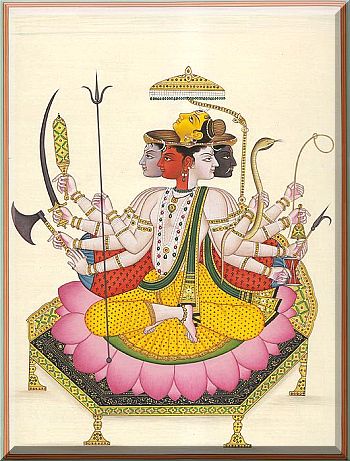


Tags: , , , ,

The Art of Painting in Ancient India – Chitrasutra (1)

[I propose to post a series of articles on the art of painting in ancient India with particular reference to the Chitrasutra of Vhishnudharmottara purana, a text dated about Sixth Century AD.

The current article, by way of introduction, talks about certain concepts concerning the art of painting in ancient India. It also briefly mentions the influence of Chitrasutra on the paintings of Ajanta.

The next set of articles will discuss, briefly, the text of the Chitrasutra.

The articles to follow thereafter will try to cover different aspects of Indian painting such as the preparation of the surface for painting the murals; the costumes of various persons; and more importantly the proportions (tala-mana) to be observed while drawing various figures etc.

I propose to round up with a note about the legacy of Chitrasutra-Ajanta tradition.]

1.1. Indian art has a very long and an illustrious history. Painting as an art form has flourished in India from very early periods as is evident from various epics and other literary sources; and also from the remnants that have somehow survived the test of time, vagaries of nature and vandalism- wanton or otherwise – caused by humans.

1.2. The main characteristic of Indian art has been its remarkable unity and consistency. Though there were regional variations and individual styles, the works produced in diverse geographical and cultural regions shared certain common values, concepts and techniques. And, all those varied   manifestations were inspired by a common general principle. The regional idioms, nevertheless, contributed to the richness of Indian art, and their mutual influences gave birth to multi-faceted development of Indian art.

1.3. That was true not merely of the classical paintings but also of the art works and paintings created by the village craftsmen and artists. Since there never was a nodal body to preserve and develop art in India, it was the initiative, enterprise and imagination of those dedicated humble artists that kept alive the ancient traditions. Their exquisite themes inspired by life around them, painted in their homemade bright colours employing indigenous styles have enriched the cultural diversity of India.

Shiva Parvathi Durbar

Rangoli 2

1.4. Another significant feature of the ancient Indian art was its vision of life and its world view. That inward vision and a sense of peace and tranquillity are its hallmarks. The old paintings serve as a valuable record of the thoughts and aspirations of our ancients. These ancient arts present the world as a great harmony that blends seamlessly into the whole of creation. It recognizes the oneness that exists in all of us, in the animals, the flowers, the trees, the leaves and even in the breeze which moves the leaves. All that is indeed seen as a manifestation of That One.

2.1. Indian art is often classified as religious art, though not all Indian art is purely religious, and some of it is only nominally so. The impression was perhaps grafted by the contemplative imagery presented by the ancient Indian art. But, the art, in general, was inspired by life, by reflecting upon human concerns and aspirations; and celebrating and delighting in the life of this world.

folk art

2.2. Even the religious art is not sectarian. It is at once Hindu, Buddhist and Jain, for its style was a function of time and region and not of religion. Thus, it is not strictly correct to speak of Hindu or Buddhist art, but, rather, of Indian art that happened to render Hindu or Buddhist themes. For example, an image of Vishnu and an image of Buddha of the same period are stylistically the same, religion having little to do with the mode of artistic expression.

Mrs. Fatemeh Taghavi in her research paper writes :  Indian Painting cannot be described in terms of a linear development or chronology unlike the Western art ; but,  it is considered to have evolved in a parallel manner in the course of time and space. The  different styles of paintings  emerged in the due course of time in different geographic locations as a result of  cultural impact. Each style appears  distinct from the other in its  technique;  though, there is a friendly and complex internal relationship by which they can be recognized as uniquely Indian. 

2.3. The Indian art that rendered religious themes shared a common pool of symbols and avoided imitation of the physical and ephemeral world of the senses.For instance ,in all  the Hindu , Jaina and Buddhist themes , alike,   the Chakra – the revolving wheel of time symbolizes the cyclical rhythms of all existence;  the Padma – or the lotus embodies creation – that springs from the bosom of the earth; the Ananta (represented as a snake) symbolizes  water – the most important life-giving force from which all life emerges, evolves  and then resolves; the Swastika – represents  the four-fold aspects of creation ,motion and a sense of stability ; the Purnakalasha the over -flowing pot symbolized creativity and prosperity; the Kalpalata and Kalpavriksha –  the wish-fulfillment creeper symbolize  imagination and creativity; and ,  Mriga – or deer – symbolizes  desire and beauty.

Similarly there were common set of gestures (mudra) by position of  fingers, hands, limbs; and by stance of images in paintings and in sculptures.   These varied mudras made explicit the virtues such as wisdom, strength, generosity, kindness and caring etc.

The objects depicted in Indian art evoked an imagery or represented an idea that sprang from the mind. That might perhaps explain the relative absence of portraiture and even when it was attempted the emphasis was on the ideal person behind the human lineaments rather than on the physical likeness.

Another feature is the absence of the sculptures and other representations of rulers or rich patrons. And, hardly any sculpture or painting bears the signature or the name of its creator. That might again symbolize a move from particular to the universal. But , it surely baffled generations of historians.

3.1. Indian figurative art is therefore not mere portraiture of the specific; but is a symbol pointing to a larger principle. It is akin to the finger pointing to the moon. For instance the image or the painting of the Buddha could be seen as that of the Buddha the historical prince Siddhartha Gotama and Sakyamuni. But, it is more than that. The Buddha –figure is the embodiment of all the compassion, pathos and grace in absolute. Often, certain symbols surrounding the Buddha-image are meant to amplify its message. For instance, the idea of reverence and holiness could be represented sometimes by the surrounding vegetation, flora, fauna, yakshis, gandharvas, and apsaras each playing a specific role in building a totality; or it may be the single austere simple statement of the still centre of peace and enlightenment suggested through the symbols of the Buddha such as the Bodhi tree, seat, umbrella, sandals, footprints etc.

The Buddha –image is , thus, at once particular and universal. The spirit and soul of the Buddha is contained in the body of the particular but impersonalized form; the serene mood of compassion it portrays is everlasting and universal.

4.1. The earliest substantial specimens of Indian painting, that have survived, are the murals found in caves of Ajanta and in Kailashnath temple at Ellora. The Cave temples at Badami, in the Karnataka, and Sittanavasal, in Tamil Nadu too contain paintings of similar style.

Ajanta view from the veranda of cave XVI by J Griffiths

The view from the veranda of cave XVI, Ajunta  by J Griffiths 1880s

But, the most well –known of them all is the set of murals on the walls in Ajanta caves, he oldest of which probably dated from the second century BC  , there on to the early 6th and 7th centuries.

William Dalrymple writes: Sometime, in 1819, a British hunting party in the jungles of the Western Ghats had followed a tiger into a remote river valley and stumbled onto what was soon recognized as one of the great wonders of India: the painted caves of Ajanta. On the walls of a line of thirty-one caves dug into an amphitheatre of solid rock lay the most beautiful and ancient paintings in Buddhist art, the oldest of which dated from the second century BC an otherwise lost golden age of Indian painting. In time it became clear that Ajanta contained probably the greatest picture gallery to survive from the ancient world… Ajanta’s walls represented perhaps the most comprehensive depiction of civilized life to survive from antiquity.

The Art of the Ajanta reflected the glory of the golden age of the Guptas. They depict the tales of the Buddha in his previous births on his way to enlightenment.

Most famous, perhaps, are the two astonishing images of the compassionate Bodhisattvas Avalokitesvara and Vajrapani, beings of otherworldly beauty, swaying on the threshold of enlightenment, caught in what the great historian of Indian art Stella Kramrisch described, wonderfully, as “a gale of stillness.” Even today, the colors of these murals glow with a brilliant intensity: topaz-dark, lizard-green, lotus-blue.

Bodhisattva Padmapani  avalokitesvara2

Bodhisattva Padmapani, the bearer of the Lotus is painted amidst playful monkeys and joyous musicians. Yet, amid all that activity, the Bodhisattva looks within in tranquil harmony. There is a sense of sublime peace that pervades this figure, which is one of the masterpieces of Indian art. And, on the ceilings of the caves are the illustrations of the teeming life of the world, its flowers and fruit, the animals of the world and mythical creatures. The murals also bring to life an innumerable variety of other persons such as princesses, maids, soldiers, guards, mendicants, merchants etc.

4.2. The artists of Ajanta, who created those valuable treasures of the art world, were the inheritors of an ancient tradition that painted and decorated palaces, temples and caves. The theories, principles and techniques followed by those artists came down to them through oral traditions bequeathed by a long line of artists spread over several generations. The narrative mastery and technical knowledge demonstrated by artists at Ajanta suggest existence of several Schools of arts, where painting technique, procedures and preparatory work to be followed in preparing the mural surface were described.

Ajanta by Robert Gill, oil on canvas, 1850-1854

Copy of painting in the caves of Ajanta by Robert Gill, oil on canvas, 1850-1854,

The artists of Ajanta   , in turn,  inspired and guided  the principles and techniques  for the benefit of future generations of artists . These gave raise to many texts.

Some of the  main texts of such nature that dealt with painting techniques were:

The Vishnudharmottara Purana composed in 6-7th A.D. shortly after the mural works of Ajanta.

– The Samaraga Sutradhara, a text of the Shilpa-shastra attributed to  Raja Bhoja,  king of the Paramara dynasty of 11th century , mainly dealing with pictorial and iconographic art.

– The Manasollasa, an encyclopedic work dealing , among other things, the  Southern India paintings tradition attributed to king Somesvara of early 12th century Chalukya dynasty.

– The Silparatna, written in 16th century, a section of which entitled Pratima -Lakshmana (characteristics of images) which contains lot of information on painting technique.

– The Aparajita Pecha of Bhuvana Deva, probably composed after Silparatna that describe architecture and contains concepts on decorative design and preparation of paint ground.

Among these texts, Vishnudharmottara and Samaraga Sutradhara describe the technique of preparation of paint ground using clays earths. The text Manasollasa and Silparatna represents the preparation of ground under southern traditions of the subcontinent where the basic component is lime or burnt and powdered conch shells or white earth of calcareous nature, available in south of India. Some of the important ancient Indian painting text showing basic ingredients and procedure to be followed in the preparation of paint ground and colors are elaborate

There are also many other texts written in Sanskrit in which instructions on mural paintings techniques are systematically stated. Some of the ancient paintings texts have not yet been translated.

M. Singh and B.R. Arbad who conducted technological studies on Ajanta painted mortars , write in their in their research paper Ancient Indian painting recipes and mural art technique at Ajanta

Although Vishnudharmottara was composed one or two centuries after the execution of Ajanta murals, it may be considered as true reference text for proper understanding of painted procedure and appreciation of the painted murals.

The pigments identified at Ajanta are red ochre, yellow ochre, green earth, lapis lazuli, carbon black and shell/kaolin lime. The outlines of the Ajanta paintings are mostly drawn by carbon black or red ochre. The mud mortar thickness varies from few millimeters to an inch in some cases where basaltic stone is very roughly cut. Organic matters such as rice husks, plant seeds and plant fibers are generally found admixed within the mud mortar.

… The raw materials used for the preparation of clay ground are mostly locally available materials collected from either Waghura river in front of Ajanta caves or nearby places. Except blue, all the pigments are locally available materials including green which is the product of basaltic rock disintegration. It appears that aggregate used as fillers to the mud mortar at Ajanta are also byproduct of weathered basalt collected from ravine of Waghura in front of Ajanta caves or nearby places. Except blue, all the pigments are locally available materials including green which is the product of basaltic rock disintegration. It appears that aggregate used as fillers to the mud mortar at Ajanta are also byproduct of weathered basalt collected from ravine of Waghura. The aggregates mostly identified are quartz, zeolites and celadonites.

It is observed that 8-10% lime with organic additives was mixed in the low swelling clay to prepare the mud mortar at Ajanta. The technique of paintings is purely tempera and animal glue has probably been used as binding agent to the pigments at Ajanta and related sites. Unlike fresco painting, the paintings technique in India is either tempera or Sacco and binding medium identified at Ajanta is animal glue. An understanding of the composition of ancient mortar and technology is necessary for creation of new mortar for restoration at Ajanta and other sites.

5.1. Among the many texts,  the Chitrasutra of the Vishnudharmottara Purana, which attempted to preserve the ancient and pass it on in its purity to the subsequent generations , is considered most significant. That ancient treatise provided the artists a grammar to articulate their art expressions. Apart from describing the basic tenets of painting, Vishnudharmottara, literally, provided hundreds of details on the art and the techniques of painting. The Chitrasutra gave a framework of instructions and suggestions on the ways to prepare the walls and other surfaces that hold the murals; the preparation of colours and paints; appropriate choice of colours; different ways of shading; proportions and ratios to be maintained while painting different kinds of male and female figures according to their position and standing in the social strata and occupations; and the ingenious ways of introducing symbolism through plants , birds, animals, and other symbols; and so on.

Main characteristics of the Ajanta paintings are the use of free flowing lines for delineating beautiful figures and their delicate inner feelings; together with use of shading different parts of the body to produce three dimensional effects in the images. The other was use of proper colors at times contrasting and at times matching to create magical effects. These were precisely the principles that Chitrasutra emphasized repeatedly.(explained in the next post).

5.2. Benoy K. Behl an art-historian, filmmaker and photographer who has written extensively on Ajanta art  explains the basic preparation of the surface for painting the mural was guided by the methods recommended in the Chitrasutra. He also explains that “The mural paintings of Ajanta are not frescoes, as they are sometimes mistakenly described, for they were not painted on wet lime plaster. These murals were executed with the use of a binding medium of glue applied to a thin coat of dried lime wash. Below this surface wash were two layers of plaster covering the stone walls. The first was a rough, thick layer of mud, mixed with rock-grit, vegetable fibres, grass and other materials; the second was a finer coat consisting of mud, rock dust or sand and finer vegetable fibres, which provided a smooth surface for the lime wash on which the paintings were made.

The artist got his colours from the simple materials that were available in these hills. For his yellow and red he used ochre, for black he used lamp soot, for his white he used lime. Only for his blue he used lapis lazuli, which came from Afghanistan. These simple colours were blended to provide the numerous colours and subtle hues, which are seen in the Ajanta paintings. “

The Academy of Archaeology & Sciences of Ancient India (A.A.S.A.I) observes “The technique adopted in preparing the ground and pigments were sound and in many places they have stood the test of time. But, in large number of cases, they are fast disappearing not due to the fault of the painter or his technique but due to external conditions like the structural problems, location problems and above all foolish and senseless vandalism.”

6.1. Chitrasutra paid enormous importance to the delicate painting of the soulful and expressive eyes that poured out the essence of the subject. It describes five basic types of eyes. The artist was told that the eyes are the windows to the soul; and it is through their eyes the figures in the painting open up their heart and speak eloquently to the viewer. The painting of the eyes called the “opening of the eyes” was therefore the final and most important detail to be painted. It was usually done in the guiding presence of the Master or was completed by the Master himself. It is not therefore surprising that the expressive set of eyes of the Ajanta tradition continue to influence generations of Indian artists.

7.1. The text clearly mentions that rules do not make the painting; but it is the artist with a soul and vision who creates the art expressions. The Chitrasutra aptly concludes with sagely observation: “In this treatise only the suggestions are given, oh king, for this subject can never be described in detail even in a hundred years. Whatever has not been said here should be inferred by other means…Painting is the best of all arts.”

7.2. The artists appeared to have taken full benefit of the liberty provided by the text. Shakti Maira a noted artist writes “I did not see the figures as having been rendered in a particularly formal way. Their proportions were usually off — head and upper torsos too long for the rest of the body, arms out of proportion with lower limbs, there was hardly any evidence that the strict rules of drawing in the Vishnudharmottara had been followed! What I saw was a powerful freedom and looseness in drawing, what we artists hope to achieve after we have learned all the rules of drawing. These illustrative images were free from formalism, and that is the strength of the expressed emotions and lavanya in this work.

For me, the reason why the Ajanta paintings are so great is that they did not get bogged down in the formalism of art making.

Ajanta

As an artist, I would urge you to experience the mysteries beyond cognitive intellect. Don’t just try and understand the work, try also to experience it directly. That is where the real rasa is. “

Shri S Rajam’s rendering of  Ramayana theme in Ajanta style

As I mentioned earlier , such  artistic freedom was  encouraged  by Chitrasutra of Vishnudharmottara,  which said, valuable as these various instructions are , they are derived from and  subservient to practice . He(artist) has the freedom to work according to his own intellect.

rajput-bridal-procession-BL42_l

8. Let’s talk about the Chitrasutra of Vishnudharmottara, in a little more detail, in the next post.


NEXT:

Continued in 

Part Two

Chitrasutra of Vishnudharmottara


Sources & References

http://www.hinduonnet.com/fline/fl2120/stories/20041008000106400.htm

Ajanta, the fountainhead

 http://www.4to40.com/discoverIndia/index.asp?article=discoverindia_guptas#Military%20Costume

Ancient Indian Costume

 http://conserveheritage.org/paintingpreservation.html

A.A.S.A.I: Paintings Preservation

 http://www.hinduonnet.com/mag/2002/08/04/stories/2002080400430200.htm

ANCIENT INDIAN PAINTING RECIPES AND MURAL ART TECHNIQUE AT AJANTA

http://www.ijcs.uaic.ro/public/IJCS-14-04-Singh.pdf

Ajanta: An artist’s perspective

All Ilustrations are taken from Internet


Tags: , , ,

Origins of Ganesha worship

Ganesha

Ganesha or Ganapathi, undoubtedly, is the most popular among the Hindu gods. His popularity and worship extends also to Buddhism and Jainism. He is worshiped not merely in India but in other parts of the world too. He is an ancient god.  His origins are not certain. It is also not certain when the Ganesha worship began.

1. Vedic origin

1.1. The earliest reference to Ganapathi appears in the second book of the Rig Veda in the rik starting with Gananam tva Ganapati Gum Havamahe (RV 2.23.1). The Ganapathi invoked here, is the Chief of the Ganas, the leader of the group, a superb seer among seers, and the lord of the mantras. It is explained that Ganapathi in this rik refers to Brahmanaspati, a Vedic divinity of the highest order, the leader of the heavenly bands and a sage (kavi) among sages (Jyeshta Rajam Brahmanam, Brahmanaspata).

Gaṇānāṃ tvā gaṇapatiṃ havāmahe kaviṃ kavīnām upamaśravastamam |  jyeṣṭharājam brahmaṇām brahmaṇas pata ā naḥ śṛṇvann ūtibhiḥ sīda sādanam ||RV_2,023.01||

1.2. In the Rig Veda, Brahmanaspati is the lord of all sacred prayers and lord of Satya mantra. He is the destroyer of enemies; and no sacrifice is complete without invoking him. Brahnanaspati was a partner with Brahma in creation. Brahmaņaspathi was also the middle term that once linked the Vedic Brahma and Brihaspathi’. They are the names “of a deity in whom the action of the worshipper upon the gods is personified”.

1.3. Brihaspathi is the personification of piety, purity and knowledge. He is called `the father of the gods,’ and a widely extended creative power is ascribed to him. He is also `the shining’, `the gold-colored,’ and `having the thunder for his voice.” Other epithets of Brihaspati are Jiva – the living, Didivis – the bright, Dhishana – the intelligent, and  for his eloquence, Gishpati– the lord of speech.

There are over one hundred riks in praise of these two deities, giving a picture of their powers and personalities.

ganesha 2

1.4. The Gaņapathi in Rig-Veda is the lord of gaņas or hosts. In the Rig-Veda, the gaņās or hosts of Bŗihaspathi—Brahmaņaspathi are the chants, the riks and the stomas, the words of praise (RV. 4.50.5). They have little to do with the lower vital levels.

sa suṣṭubhā sa ṛkvatā gaṇena valaṃ ruroja phaligaṃ raveṇa | bṛhaspatir usriyā havyasūdaḥ kanikradad vāvaśatīr ud ājat ||RV_4,050.05 ||

1.5. The term Gana also denotes a host of angles (Devas). Indra is referred to as Ganapathi in the tenth book of the Rig Veda (RV. 10.112.9); Indra is the Lord of the companies (Maruts).

 ni ṣu sīda gaṇapate gaṇeṣu tvām āhur vipratamaṃ kavīnām | na ṛte tvat kriyate kiṃ canāre mahām arkam maghavañ citram arca ||RV_10,112.09||

1.6. The mantra ‘namo Ganebhyo ganapathibyasha vo namo’ (16-25) that occurs in Shukla Yajurveda samhita refers to ganas, in plural, and says: salutations to you, Ganas and to the Lord of the Ganas. This mantra appears also in the Rudra prasnam (4.1.5) and in the Maitrayani-Samhita (2,9.4). Gana  in these contexts signifies a group of people as also a collection of mantras. 

namo gaṇebhyo gaṇapatibhyaś ca vo namo namo vrātebhyo vrātapatibhyaś ca vo namo namaḥ kṛchrebhyaḥ kṛchrapatibhyaś ca vo namo namo virūpebhyo viśvarūpebhyaś ca vo namo namaḥ senābhyaḥ senānībhyaś ca vo namo namo rathibhyo varūthibhyaś ca vo namo namaḥ kṣattṛbhyaḥ saṃgrahītṛbhyaś ca vo namo namo bṛhadbhyo ‘rbhakebhyaś ca vo namo namo yuvabhya āśīnebhyaś ca vo namo namaḥ //MS_2,9.4//

1.7. The Taittiriya samhita interprets Ganas as pashus (the beasts of Shiva). They are the Ganas of Shiva — Rudrasya Ganapathyam .There were also Bhuta ganas, the weird and grotesque looking guards of Shiva. Thus, Shiva the Pashupathi; and Shiva the Bhoothnath was also a Ganapathi.

1.8. At a much later period, when the Puranas came to be compiled, the virtues and powers of all the Ganapathis of the past were transferred to the Ganapathi as we are familiar with; that is to our Ganapathi. He became the Lord of Ganas in every sense of the term. Not only that, he became much larger than the sum of the parts.

1.9. It is not significant what shades of meanings the term carried in the past; but it is very important for us that our Ganapathi, the Lord of Ganas, whom we worship with love and adoration, is the embodiment of all the grace, virtues and powers that we admire in any god. He is the inheritor of the combined wisdom and glory of all the gods; and is much more than the sum. He is Maha Ganapathi.  That is what really matters.

2. Elephant god

ganesha 3

2.1. It is not certain how the Ganapathi-elephant association came into being. The earliest reference in that regard is in the Atharva Veda which alludes elephantine countenance (hasthi –varchas) to the Vedic god Brihaspati who was one of the forerunners of our Ganapathi. Our Ganapathi seems to have inherited his features from the descriptions of Brihaspati.

2.2. The other early references are in Maitrayani samhita (2.9.1) and Taittiriya Aranyaka (10.1.5) which appeal to an elephant faced (hasthi-mukha) , single-tusked (dantin) deity with a curved trunk (vakra tunda).He is also described as holding a corn-sheaf, a sugarcane and a club. Those features became the characteristics of our Ganapathi, the Ganesha.

tat karāṭāya vidmahe hastimukhāya dhīmahi /  tan no dantī pracodayāt //MS.2.91//

Vakratunda

2.3. Amarakosha the Sanskrit lexicon (say 4th century AD), lists eight synonyms of Ganesha : Vinayaka, Vighnaraja, Dvai-matura (one who has two mothers), Gaṇadhipa (equivalent to Ganapati and Ganesha), Ekadanta (one who has one tusk), Heramba, Lambodara (one who has a pot belly, or, literally, one who has a hanging belly), and Gajanana having the face of an elephant). It seems by then the Ganapathi and his half- elephant form were quite well established.

vināyako vighnarāja dvaimātura gaṇādhipāḥ / apy ekadanta heramba lambodara gajānanāḥ ( 1.1.93 -94)

ganapthi 31

2.4. Vishnudharmottara, a text dated around 5-6th century, while detailing how to make images of various deities, describes, among others, how the image of Vinayaka should be made (Part Three; Ch 71; verses 13-16). Sage Markandeya explains:

Vinayaka should have the face of an elephant and four hands .He should have a big belly; stiff pair of ears; wearing a tiger skin around his waist and a sacred-thread across his left shoulder down his belly. He should have snake as belt.  a trident and rosary should be placed in right hands; an axe and a pot full of sweets in the left ones. The sweet-pot should be placed near the tip of his trunk. His left tusk should be left un-represented. Vinayaka should be provided a foot-stool; and his one foot should be placed on it.

  • Vinayakasthu kartayo Gaja-vakthra-Chatur-bhujaha / Shukalam cha Aksha-malam cha tasya Dakshina-hasthayoh //13//
  • Paathram Modaka-purnam tu Parashu chaiva Vamataha / Dantascha-sya  na karthavyo Vamo ,  Ripu-nishodana //14//
  • Paada-pitai krutaha Paadaha Eka Asanago bhaveth / Purna-Modaka-patram tu karagre tasya karayeth //15//
  • Lambodaras-tattha karyaha Sthabdha-karnascha-yadava /Vyagra-charmam-bhara-dharaha Sarpa-yajnopavithiman //16//

Gauri Ganesha

 2.5. Before I end this segment let me add, the Tamil language, one of the oldest languages in the world, fondly addresses Ganapathi as Pille or Pilleyar, meaning the little darling or a small child. Some scholars say that term pille also meant, in old Tamil, a young elephant. Incidentally, the Pali word pillaka also means a young elephant. The association of a sweet looking child with the innocent countenance of a young elephant could also have had its origins in tribal lore.

Parvathi and Ganesh

3. Destroyer of obstacles

Ganesh

3.1. Brahmanaspati of the Rig Veda was the divine being who led the aspirant along the path of wisdom and facilitated his progress by removing the obstacles in his path. It is said, this aspect of Brahmanaspati was later expanded in to the role of  Ganapathi as Vinayaka, the destroyer of obstacles. But Ganapathi is also the lord of obstacles (Vighnaraja).But, why would a benevolent god cause obstacles? It is explained that Ganapathi does not cause obstacles but controls obstacles. It is therefore prudent to pray to him before launching on any venture – big or small.

Ganesha Vignaraja

3.2. He intercedes with gods on behalf of humankind and protects them from the wicked influences.

Thus, Ganapathi as the destroyer of obstacles had taken root by about first century AD.

4. God of learning and wisdom

ganesha 4

4.1. Ganapathi is also associated with mental agility and learning. He is akin to Brihaspathi of Rig Veda, the personification of piety, purity and knowledge. He is known for his intelligence, and for his eloquence. He is Gispati – the lord of speech- bṛhaspatiḥ surācāryo gīṣpati rdhiṣaṇo guruḥ (1.3.223)

4.2. Siddham was in the distant past one of the names given to the collection of Sanskrit alphabets. Patanjali explained the term as “that which is established” (pūrvatrāsiddham). The beginners would commence their learning of the alphabets with the chant: ”Om namo Siddham”. Even the scribes of the epigraphs would etch an inscription starting with the words “siddham or Swasthi”. Since Ganapathi evolved also into the god of wisdom and learning the terms Siddham and Swasthi too came to be associated with him.

4.3 Ganapathi is the patron god of wisdom and all branches of learning; not merely spiritual or of art or music or literature but of all human endeavours.

5. Ganapathi worship

belief-04-boxed

ganapathi worship

5.1. I reckon the Ganapathi worship has a history of about two thousand years. The ancient Grihya sutras and Dharma sutras do not mention about praying to Ganapathi at the commencement of a worship-ritual. Natyasastra, dated around second century BCE, too, does not refer to Ganapathi.

5.2. Perhaps the first reference to Ganapathi worship occurs in the Gobhila Grhya Sutra, which belongs Sama Veda. It recommends praying to Ganapathi and to Matrikas at the commencement of a ritual, seeking blessings and support for a smooth and successful completion of the ritual process. Gobhila Grhya Sutra is dated around first century AD. From then Ganapathi has carried on famously.

ganapathi 11a Ganesha Lambodara

5.3. Baudhayana Grihya Sutra which described Ganapathi as Vigneshwara, Bhootha-natha and Gajamukha, too recommended similar worship of Ganapathi. It also prescribed offering apupa and Modakas to propitiate him. The date of this text is disputed; it could perhaps be around the same time as the other Sutras.

ganesha standing

5.4. Another text of first century, Gatha-saptha-shati, sings the praise of Ganadhipathi. The Puranas, which came about around that period too carry detailed references to Ganapathi  and to his worship (e.g. Varaha PuranaVamana Purana and Brahmaiva-vartha purana).

5.6. The Yajnavalkya Smriti (dated around third century AD) mentions Vinayaka as the Lord of the Ganas, appointed by Brahmna and Rudra. Here he is described as one who causes obstacles as well as one who removes them. Yajnavalkya gives four names of Vinayaka the son of Ambika as: Mita, Sammita, Salakantaka and Kusumandarjaputra .Vinayaka here is worshiped as a Tantric deity.

6. Emergence of Ganesha

ganesha 5

6.1. Ganesha appeared in his classic form as a clearly-recognizable deity with well-defined iconographic attributes in the early 4th to 5th centuries. Ganesha images thereafter became prevalent in all parts of India and in many parts of the world.

6.2. Ganesha emerged as a distinct deity in clearly recognizable form in the fourth and the fifth centuries during the Gupta period. His popularity rose quickly. The son of Shiva and Parvati; Ganesha with an elephantine countenance, a curved trunk, pair of big ears and a pot-bellied body of a human is now the Lord of success; and destroyer of evils and obstacles. He is the god of education, knowledge, wisdom and wealth. Ganesha also became one of the five prime Hindu deities (Surya, Vishnu, Shiva and Durga being the other four) worshiped in the panchayatana puja. A new tradition called Ganapathya thereafter came into existence.

Tantric Ganesha

heramba-ganapati

Perhaps no other god , either in Hindu or any other religion, been depicted in as many varieties of forms as Ganesha has been. He has been depicted in every conceivable form.

 Ganesha riding elephant Cambodia, 10th century6.3. With the spread of Indian trade to the Far- East, by around the tenth century, Ganesha a favorite with the traders and merchants reached the shores of Bali, Java, Cambodia, Malaya, Thailand, Vietnam and other islands. In Indo-china, where Hinduism and Buddhism were practiced side by side and influenced each other, Ganesha was the God acceptable and dear to all. Even to today, the people in Burma, Vietnam, Cambodia and Thailand worship Ganesha as the destroyer of obstacles and as the god of success.

**

According to Wikepedia

In Thailand, Ganesha is called Phra Phikanet or Phra Phikanesuan and is worshiped as the deity of fortune and success, and the remover of obstacles. He is associated with arts, education and trade. Ganesha appears in the emblem of the Department of Fine Arts in Thailand. As lord of business and diplomacy, he sits on a high pedestal outside Bangkok’s Central World (formerly World Trade Center), where people offer flowers, incense and a reverential sawasdee Thai Cuisine.
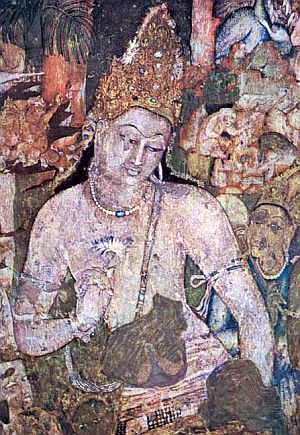
With regards to Indonesia, Ganesha is called the ‘Indonesian God of Wisdom’. Bandung boasts a Ganesha Street. A Ganesha statue from the 1st century AD was found on the summit of Mount Raksa in Panaitan Island, the Ujung Kulon National Park, West Java. While there are not temples dedicated specifically to Ganesha, he is found in every Shiva shrine throughout the islands. An 11th-century CE Ganesha statue was found in eastern Java, Kediri is placed in The Museum of Indian Art (Museum fur Indische Kunst), Berlin-Dahlem. The 9th century statue of Ganesha resides in western cella (room) of Prambanan Hindu temple.

Ganesha_statue_at_Sanggar_Agung_Temple,_Surabaya-Indonesia

Ganesha statue at Sanggar Agung Temple, Surabaya-Indonesia, worshiped by the Chinese, Hindus, Buddhist and even the Kejawen

As regards Thailand, William Jones and Ruchi Agarwal write in ‘ Ganesa and his cult in contemporary Thailand’

Ganesa has long been familiar to the people of Thailand but increasingly evident are the Ganesa cults flourishing in Bangkok. In the process, the deity appears to be acquiring new roles and functions. Ganesa now serves in a number of capacities for some; he is a “fixer,” a deity of last resort that can help devotees to over come obstacles in their lives. Not surprisingly, the growing popularity of the deity is reflected in a rapidly expanding trade in Ganesa images and icons, displayed in shopping mall exhibitions in a variety of forms, colours, shapes and sizes. Readily available at most of Bangkok’s major retail outlets, Ganesa icons are traded online via social media. This phenomenon, both by shifting belief practices associated with Ganesa locally and by evolving trade in Ganesa iconography, is indeed growing . Considering both together, one can say that Ganesa cult is presently the focal point for a number of people, each with its own unique approach to the deity, powers and representation.
Ganesha temple Thailand

**

Bhutan Ganesha Tibet Ganesha
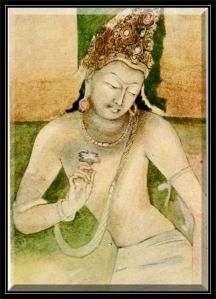
Bhutan Ganesha                                                          Tibet Ganesha

sakya ganesha Tibet  Tantric Gneswha Tibet

Sakya Ganesha Tibet                                         Tantric Ganesha Tibet

6.4. Ganesha appears in Jainism too. A fifteenth century Jain text provides procedures for the installation of Ganapathi images. Images of Ganesha appear in the Jain temples of Rajasthan and Gujarat; the earliest of which is dated around eighth century.

Ganesha in Jainism

7.5. In Buddhism, Ganesha appears not only in the form of the Buddhist god Vināyaka, but also as a Hindu demon form with the same name (Vināyaka). As the Buddhist god Vināyaka, he is the dancing Nritta Ganapathi. Worship of Ganesha is popular also in Tibet.

Buddhist Ganesha Mangolia Buddhist Ganesha Mangolia 2

Buddhist Ganeshas of Mangolia

According to another version, Ganesha as siddhidata (bestower of success) is Buddha himself revealing Ganesha’s powers to his disciple.

7.6. Ganesha traveled to other countries along with Buddhism. In northern China, the earliest known stone statue carries an inscription dated to 531AD.In Japan the Ganesha cult was first mentioned in 806 AD; and is still flourishing. Here, Buddha and ganesha are worshiped together.

ganesha_japan

[Scholars say, artifacts from excavations in Luristan and Harappa and an old Indo-Greek coin from Hermaeus, present images that remarkably resemble Ganesha”. (“Robert Brown in his Book “Ganesha: Studies of an Asian God”: State University of New York Albany).]

8. Whatever might have been his origins, The Ganapathi -Ganesha that we know and adore represents the combination and culmination of the virtues and powers of all the Ganapathis  that preceded him. He is the sum and substance of all the preceding Ganapathis .He is the embodiment of all their grace and wisdom .He is adored by one and all; by all segments of the society and of all ages.

Ganesha in lap Ganesha in lap 2

Children, particularly, love Ganesha as a playful mate and as the best friend. The little Ganesha is a darling.

ganesha child ganesha child2

ganesha dance ganesha dance 2

ganesha as child

Parvathi with sons

Amazing Facts of Ganesha

amazingThere are 250 temples of Ganesha in Japan.
In Japan, Ganesha is known as ‘Kangiten’, the God of fortune and the harbinger of happiness, prosperity and good. Young Japanese worship Ganesha to win in love whereas the old worship the deity to get success in business.

East India Company issued a Ganesha coin in 1839

The British East India Company in 1839 issued a copper ½ Anna coin measuring 32mm with reeded edge and weighing 12.81 grams. The coin carried the Ganesha image on the obverse.

coin 1 coin 2

Another bronze coin weighing 3.4 grams and measuring 16.4 x 15.5mm; the obverse depicts Ganesha seated facing, while the reverse has a lattice design that is rather common to certain areas of India.  But,  I am unable to say  to which state  or era the coin belongs.

coin 3coin 4

Kurundwad –court Fee stamp with Ganesha motif .

Kurundwad (Senior Branch) in Kolhapur District the erstwhile British Bombay Presidency issued a Court Fee paper of Rupees Forty featuring Ganesha at its centre.

stamp paper

Indonesia Currency notes

One of the Indonesian currency notes carries the picture of Ganesha.

indonesia

Silicon Valley in USA selects Ganesha as the presiding Deity of cyberspace technology
“Ganesha is the God of knowledge and Ganesha’s vehicle is the mouse .Hence the computer industry association selected Ganesha as the presiding Deity of Silicon Valley.

Source :  Colin Bruce

krishna ganesha

References:

Ganesha : http://en.wikipedia.org/wiki/Ganesha

Historical development of Ganesha: http://en.wikipedia.org/wiki/Historical_development_of_Ganesha

Posted by Colin : Ganesha, Hinduism€™s favorite representation of God
Origins of worship of Ganesha  http://www.hindunet.com/forum/showflat.php?Cat=15,44&Number=4892&Main=4892


33 Comments

Posted by on September 17, 2012 in Indian Philosophy, Rigveda, Temple worship


Tags: , , , ,

Crazy Wisdom

crazy wisdom

1.1. Crazy wisdom is a way of teaching; and it is prevalent in almost all traditions.  It has been there for a very long-time. Crazy wisdom says: we all are, in truth, interconnected. The separations in the physical world such as human bodies, houses, communities are mere appearances.  Crazy Wisdom seeks to unearth and heal the false beliefs that people have about themselves and of the world around them. It is a means for expressing and maintaining the difference between the conventional point of view and the transcendental point of view.

1.2. The teaching might have gained that name – crazy – because, its teachers were eccentrics who used their eccentricity to bring forth an alternate vision, the one that was different from the pedestrian and dogma-riddled view of existence. They were the masters of inversion, proficient breakers of taboos and lovers of surprises. They relished the delight in contradictions and ambiguity. Sometimes they overdid and went overboard; and were mistaken for tricksters and clowns.

1.3. Crazy wisdom or holy-madness, as it came to be called, does indeed seem crazy to rational mind and commonsense. That is because it is designed, deliberately, to confront, to shock and to confuse an otherwise rational mind. The crazy teacher’s behavior and his teachings turn the ordinary view of life upside down; and, project life in a different perspective. His approach is what one might call “no-holds-bar”. The crazy teacher is willing to employ a wide range of tactics and applications including , but not limited to , provocation, insult, physical and mental abuse, humour, and credulity; and in extreme cases, it might stray in to use of alcohol, drugs and sex. All those unconventional and socially unacceptable ways of behaviour were pressed into service in order to drag the student out of the cocoon, strip him naked and bring him face to face with reality.

1.4. Predictably, such behavioural patterns create scare and conflict in the minds of even the committed followers of the path. It also brings into question, the issues of trust; and abuse of position and power. But a serous seeker will have to face those challenges and resolve the contradictions, all by himself.

1.5. The crazy wisdom or foolish wisdom is thus a two-edged sword, to be handled with extreme caution. The dividing line between wisdom and foolishness is very thin; and it is not possible to say with certainty when a fool is just a fool, or a fool graced by wisdom, or a wise person touched by foolishness.

1.6. In all such traditions, it is said, a genuine crazy –wisdom- teacher will act only in response to the needs of his student, regardless of his own discomfort and personal preferences. His main concern is the awakening of his student .But, it is   the responsibility of the student to understand and learn; and the teacher is not obliged to make it easy for the student.

1.7. It is explained, the teacher, to put it crudely, is like a dispensing machine. The student will have to come up with right questions to get the benefit of the teacher. It is the questions the student frames – internally or explicitly- and the demands he makes in seeking the answers that truly matter. He   can challenge himself to formulate a question that accurately captures the real need; and follow it with intensity. After a period of time, as he begins to endure the heat (tapa), generated by the genuine unanswered questions, the answers start appearing unexpectedly in the most unlikely places or in the most obvious places right under his nose.

That is the basis of the learning process under an Avadhuta or a Siddha or a Zen teacher or the saintly – madman (lama myonpa) of Tibetan Buddhism.

[ By the way, Aryadeva (14th century?), a Buddhist scholar, in his Chatuhsataka (four hundred verses) narrates a story to illustrate (a) madness is a relative concept; and (b) just because one is in a minority he cannot be dismissed as being wrong.

According to his story, a wandering astrologer warned a king that in a week’s time, very heavy rain would pour down on his country; and whoever drinks that rainwater would go insane. The king took the astrologer’s warning quite seriously and ordered to get his well of drinking water tightly covered. His subjects, however, either lacking means or laughing at the astrologer, took no action to secure their sources of drinking water.  It did rain a week hence, as predicted; and the whole of the kingdom’s populace drank the rain water which found its way into their well and tanks. They all, promptly, went mad. The king , who had protected his well, was the only sane person in the whole of his kingdom.

But, the king’s subjects gathered together and laughed and jeered at the king calling him insane. After such repeated heckling, the king – the only sane person in the whole of the kingdom – could no longer endure the irritating jibes. In order to put an end to his agony, the king, at last, decides to drink the rain water. And, he promptly goes mad just, as his subjects. Now, all are alike ; and all are happy in their madness.

Therefore, if one is the sole, single sane person, then he does not get to call the rest as insane. But, at the same time, he would not be wrong if he calls the rest as insane. Then, again, who will listen to him or pay heed to his words …!!

The story also illustrates how ‘madness’ is a relative concept, depending upon each one’s perspective. In the broader view, what defines madness is the social, cultural and other ways of understanding human behavior at different times; and, in different regions. Madness is thus a highly context-sensitive issue.]

****

2.1. Avadhuta, the one who has cast off all concerns and obligations, like the Shiva himself, is the typical teacher of wisdom. He does that in a highly unconventional manner. He has no use for social etiquette; he has risen above worldly concerns. He is not bound by sanyasi dharma either. He roams the earth freely like a child, like an intoxicated or like one possessed. He is the embodiment of detachment and spiritual wisdom..

Avadhuta Gita describes him as :

Having renounced all, he moves about naked./ He perceives the Absolute, the All, within himself.

ātmaiva kevalaṃ sarvaṃ bhedābhedo na vidyate । asti nāsti kathaṃ brūyāṃ vismayaḥ pratibhāti me ॥ 4॥

The Avadhuta never knows any mantra in Vedic meter or any Tantra.

 Ashtavakra Gita describes him in a similar manner:

17.15

The sage sees no difference/ Between happiness and misery,/ Man and woman, / Adversity and success./ Everything is seen to be the same.

sukhe duḥkhe nare nāryāṃ sampatsu ca vipatsu ca । viśeṣo naiva dhīrasya sarvatra samadarśinaḥ ॥ 17-15॥

17.16

In the sage there is neither/ Violence nor mercy,/ Arrogance nor humility,/ Anxiety nor wonder./ His worldly life is exhausted./ He has transcended his role as a person.

na hiṃsā naiva kāruṇyaṃ nauddhatyaṃ na ca dīnatā । nāścaryaṃ naiva ca kṣobhaḥ kṣīṇasaṃsaraṇe nare ॥ 17-16॥

17.18

The sage is not conflicted/ By states of stillness and thought./ His mind is empty./ His home is the Absolute.

samādhāna samādhāna hitāhita vikalpanāḥ । śūnyacitto na jānāti kaivalyamiva saṃsthitaḥ ॥ 17-18॥

18.9

Knowing for certain that all is Self,/ The sage has no trace of thoughts/ Such as “I am this” or “I am not that.”

ayaṃ so’hamayaṃ nāhaṃ iti kṣīṇā vikalpanā । sarvamātmeti niścitya tūṣṇīmbhūtasya yoginaḥ ॥ 18-9॥

18.10

The yogi who finds stillness/ is neither distracted nor focused./ He knows neither pleasure nor pain./ Ignorance dispelled,/ He is free of knowing.

na vikṣepo na caikāgryaṃ nātibodho na mūḍhatā । na sukhaṃ na ca vā duḥkhaṃ upaśāntasya yoginaḥ ॥ 18-10॥

2.2. Among the classical  texts that describe the nature of the Avadhuta,  the prominent ones  are the Avadhuta Gita , the culminating text of the Dattatreya tradition; the Ashtavakra Gita , a text of the highest order, addressed to advanced learners and  dealing  with the means of realizing the Self (atmanu-bhuti) and  the mystic experience  in the embodied state. The third and  a comparatively a recent text is the Atma-vidya-vilasa of  Sri Sadashiva Brahmendra , an Avadhuta who lived during the eighteenth century.

2.3. The other major sect is the Siddha tradition of South India. The Siddha is one who has attained flawless identity with reality.

Jainism too recognizes Siddha as an enlightened teacher. In the Tibetan Buddhism, Siddha is a yogi who has attained magical powers and the ability to work miracles.

2.4. In so far as the folk tradition is concerned, there are a number of regional groups and subgroups. The better known of them are the Bauls of Bengal; the word meaning mad or confused. They are a religious sect of eccentrics. The Baul synthesis is characterized by four elements: there is no written text and therefore all teachings are through song and dance; God is to be found in and through the body and therefore the emphasis on kaya (body) sadhana, the use of sexual or breathe energy; and, absolute obedience and reverence to Guru.

3.1. Avadhuta Gita the ‘Song of the Ever Free’ does not indulge in debates to prove the non-dual nor does it ask you to control your senses; it sees no distinction between sense perception and spiritual realization. It makes some amazing statements:

The mind indeed is of the form of space. The mind indeed is Omni faced. The mind is the past. The mind is present and future and all phenomena. But in absolute reality, there is no mind.

All your senses are like clouds; all they show is an endless mirage.  The Radiant One is neither bound nor free.I am the Bliss, I am the Truth, I am the Boundless Sky

There is neither knowledge nor ignorance nor knowledge combined with ignorance. He who has always such knowledge is himself Knowledge. It is never otherwise.

How shall I salute the formless being, indivisible, auspicious and immutable, who fills all this with its self and also fills the self with its self?
Know it firmly, freely, independently. And maintain it at all times, all conditions. That is all. Be Avadhuta Dattatreya yourself; because, you are yourself that.

Dattatreya

Dattatreya by Shilpi Arun Yogiraj

3.2. In the Ashtavakra Gita, sage Ashtavakra maintains that all prayers, mantras, rituals, meditation, actions, devotion, breathing practices, etc are secondary. These distract the aspirant from self-knowledge. Knowledge/awareness is all that is required. Ignorance does not exist in itself; it is just the absence of knowledge or the lack of awareness. The light of knowledge or consciousness will dispel ignorance revealing the Self. The Self is merely forgotten, not lost.

This is not a belief system or a school of thought. This is simply ‘What Is’ and the recognition of ‘What is’.

Attachment and aversion/ Are attributes of the mind./ You are not the mind. You are Consciousness itself–Changeless, undivided, free./ Go in happiness

rāgadveṣau manodharmau na manaste kadācana । nirvikalpo’si bodhātmā nirvikāraḥ sukhaṃ cara ॥ 15-5॥

*
Ashtavakra does not pay much heed to book learning or to the importance given to mind and its control. You are already free, what will you gain by deliberating or pondering. Remain unattached at all times from all things (including the mind). He advocates direct approach. Teachings of Sri Ramana are remarkably similar to that of sage Ashtavakra.
 *

You can recite and discuss scripture / All you want,/ But until you drop everything / You will never know Truth.

ācakṣva śṛṇu vā tāta nānā śāstrā aṇyanekaśaḥ । tathāpi na tava svāsthyaṃ sarva vismaraṇād ṛte ॥ 16-1॥

*

Ashtavakra then attacks the futility of effort and knowing.

Being pure consciousness, / Do not disturb your mind with thoughts of for and against./ Be at peace and remain happily’ In yourself, the essence of joy.   15.19

mā saṅkalpavikalpābhyāṃ cittaṃ kṣobhaya cinmaya । upaśāmya sukhaṃ tiṣṭha svātmanyānandavigrahe ॥ 15-19॥

Give up meditation completely/ But don’t let the mind hold on to anything./ You are free by nature,/  So what will you achieve by forcing the mind? 15.20

tyajaiva dhyānaṃ sarvatra mā kiṃcid hṛdi dhāraya । ātmā tvaṃ mukta evāsi kiṃ vimṛśya kariṣyasi ॥ 15-20॥

I Am Awareness./ Where are principles and scriptures?/ Where is the disciple or teacher?’ Where is the reason for life?/ I am boundless, Absolute

kva māyā kva ca saṃsāraḥ kva prītirviratiḥ kva vā । kva jīvaḥ kva ca tadbrahma sarvadā vimalasya me ॥ 20-11॥

kva pravṛttirnirvṛttirvā kva muktiḥ kva ca bandhanam । kūṭasthanirvibhāgasya svasthasya mama sarvadā ॥ 20-12॥

**


3.3. atma vidyaAtma_vidya_vilasa is written in simple, lucid Sanskrit. Its subject is renunciation. It also describes the ways of the Avadhuta, as one who is beyond the pale of social norms , beyond Dharma , beyond good and evil; as  one who has discarded scriptures, shastras , rituals or even the disciplines prescribed for sannyasins;one who has gone beyond the bodily awareness , one who realized the Self and one immersed in the bliss of self-realization. He is absolutely free and liberated in every sense – one who “passed away from” or “shaken off” all worldly attachments and cares, and realized his identity with God. The text describes the characteristics of an Avadhuta, his state of mind, his attitude and behavior. The text undoubtedly is a product of Sadashiva Brahmendra’s own experience. It is a highly revered book among the Yogis and Sadhakas.

One of such Sadhakas who really emulated Sadashiva Brahmendra and evolved into an Avadhuta was the 34th  Acharya , the Jagad-guru  of Sri Sringeri Mutt, Sri Chandrasekhar Bharathi Swamiji. He studied Atma_vidya_vilasa intensely, imbibed its principles and truly lived according to that in word and deed. Unmindful of the external world, he roamed wildly in the hills of Sringeri like a child, an intoxicated, and an insane; and as one possessed, singing aloud the verses from Atma_vidya_vilasa:

Discard the bondages of karma. Wander in the hills immersed in the bliss of the Self -unmindful of the world like a deaf and a blind (AVV-15)

avadhūtakarmajālo jaḍabadhirāndhopamaḥ ko’pi । ātmārāmo yatir āḍaṭavīkoṇeśvaṭannāste ॥ 15॥

Rooted in the Brahman absorbed in the bliss within, he for a while meditates, for a while sings and dances in ecstasy. (AVV-21)

tiṣṭhanparatra dhāmni svīyasukhāsvādaparavaśaḥ kaścit । kvāpi dhyāyati kuhacidgāyati kutrāpi nṛtyati svaram ॥ 21॥

He sees nothing, hears nothing, and says nothing. He is immersed in Brahman and in that intoxication is motionless.(AVV-44)

paśyati kimapi na rūpaṃ na vadati na śṛṇoti kiñcidapi vacanam । tiṣṭhati nirupamabhūmani niṣṭhāmavalambya kāṣṭhavadyogī ॥ 44॥

4. 1.LankavataraThe Lankavatara Sutra of the Mahayana Buddhism is another text of the “crazy wisdom” tradition.  It was the text that Bodhidharma followed all his life and bequeathed it to his disciple and successor Hui K’o . Its basic thrust is on “inner enlightenment that does away with all duality.”  One of the recurrent themes in the Lankavatara Sutra is, not to rely on words to express reality. It holds the view that objects do not owe their existence to words that indicate them. The words themselves are artificial creations. Ideas, it says, can as well be expressed by looking steadily, by gestures, by a frown, by the movement of the eyes, by laughing, by yawning, or by the clearing of the throat, or by recollection, or by trembling.

Bodhidharma instructed his disciples to: “Leave behind the false, return to the true; make no discrimination between self and others. In contemplation, one’s mind should be stable, alert and clear like the wall; illuminating with compassion. “

4.2. In Zen too, the “holy madness” is widely used by the roshi (teacher). The adepts of Zen make use of shock techniques such as sudden shouting, abuses, physical violence, hand­clapping, paradoxical verbal responses, koans and riddles in order to induce satori or enlightenment.

4.3. Tibetan Buddhism also has its share of eccentric Lamas who use unconventional methods to initiate their disciples into enlightenment. Crazy wisdom in Tibetan is yeshe cholwa, where craziness and wisdom walk hand in hand. It is craziness gone wise rather than wisdom gone crazy. Padmasambhava (Guru Rinpoche) and Karma Pakshi the second Karmapa are the celebrated crazy-wisdom – teachers in Tibetan Buddhism. They both were regarded as being able to overpower the phenomenal world. They demonstrated that what we call crazy is only crazy from the viewpoint of ego, custom and habit. Crazy wisdom is natural and effortless; not driven by the hope and fear.

There is also another set of “mad lamas (smyon‑pa) who reject  monastic tradition, ecclesi­astical hierarchy, societal conventions, and book learning.

4.4. Crazy wisdom is also practiced in Sufism, where it is known as “the path of blame.” Some Sufi mystics –majzubs – are known for their strange behaviour as well as for their heretical doctrine of their identification with the divine. The Sufi  practitioners of “crazy wisdom” pursue freedom and humility without concern for worldly consequences.

5.1. The crazy teachers were found not just in the East. Socrates was an archetypal wise fool who claimed that his wisdom was derived from his awareness of his ignorance.  His distinctive teaching method consisted in exposing the foolishness of the wise.

5.2. Even in the Christian tradition, the absurd notion that the fool may be wise and that the wise may be foolish—has long been in existence. It is often expressed as the “fool in Christ” or the “fool for Christ’s sake”. Here, foolish wisdom, the “holy folly”, is akin to “holy simplicity” or “learned ignorance”, which is an alternate way to rekindle the love of wisdom in the hearts of men and women. It is singular and sudden; and, is in contrast with the laborious common wisdom of the learned.

5.3. Europe in the sixth century seemed to be a great period for Crazy Adepts.  For instance, there was St. Simeon who liked to pretend insanity for effect.  Once he found a dead dog on a dung heap.  He tied the animal to his belt and dragged the corpse through town.  People of the town were outraged.  But, he was trying to demonstrate the uselessness of excess emotional “dead weight” that people drag through their lives.

The very next day, St. Simeon entered a church and just as the liturgy began, he threw nuts at the congregation.  St Simeon revealed on his deathbed that his life’s mission was to denounce hypocrisy and hubris.

5.4. Another example of the sixth-century spiritual silliness was Mark the Mad, a desert monk who was thought insane when he came into town to atone for his sins.  Only Abba Daniel saw the method in the monk’s madness, and declared the monk the only reasonable man in the city.

5.5. Saint Francis of Assisi was another example of foolish wisdom. He regarded himself as a fool deserving nothing but contempt and dishonour. He is cel­ebrated for his tender love for God and for God’s creatures, big and small.

6.1. The paradoxical idea that the fool may be wise is perhaps as old as humanity itself. It is a common experience that the untutored and innocent, including children, somehow seem to grasp profound truths, while the lettered and the learned just walk past it. Jesus alluded to it  when he thanked  and praised  God  for having hidden from the learned and the clever what he revealed to the merest children (Mt 11:25).

6.2. Without love, foolishness is just foolishness; and wisdom a mere collection of inflated bits of information. Ultimately, the fool­ish wisdom is a gift, a revelation received in humility of mind and simplicity of heart; an un-bounded, luminous, loving energy. It attains the power to convince and transform, more effectively than the sword and rhetoric.

That is possible only when it is graced by tender love for the fellow beings and for the fellow seekers.

 wisdom


Sources and References:

 http://www.spiritual-endeavors.org/basic/crazy.htm

Crazy Spirituality

http://eapi.admu.edu.ph/eapr002/wisdom.htm

Wisdom of the Holy Fools

http://www.onelittleangel.com/wisdom/quotes/book.asp?mc=319

Avadhuta

http://www.shambhala.org/teachings/view.php?id=131

Crazy Wisdom

Ashtavakra

Sri Sadashiva Brahmendra

 Zen Stories by Sylvan Incao


9 Comments

Posted by on September 17, 2012 in Bodhidharma, Buddhism, Indian Philosophy, Vedanta, Zen


Tags: , , , ,

What is no-mind?

Tsung Kao

Tsung-Kao

1.1. When Bodhidharma (470 -543 AD) arrived in China, say in 520 or 526 AD, he setout to help people attain awakening through self-enquiry. The process of that self discovery later transformed into Zen which typically explained its attitude as “when I pass over the bridge, the bridge, but not the water flows” or “It is not the flag that moves. It is not the wind that moves. It is your mind that moves.” These ideas were crystallized by Hui-Neng (638-713 AD) the sixth patriarch of the Cha’n school after Bodhidharma. Following him, Tsung-Kao (1089-1163) brought clarity to the issue and contributed to the development of Zen practice.

1.2. Tsung-Kao in his discourse addressed to his disciple Yung-Mao-Shih, explained how to go about the task of attaining enlightenment. He said, what matters is not hard work but the ability to let go and allow things to happen. Do not hurry; do not be lax lest you become lazy; but do as a musician does as he tunes the strings of a harp – neither too tight nor too loose.

1.3. He remarked that conceptualization or aimless wandering of mind in prejudices and favors is unsuitable for practice of Zen. The grasping mind, he said, is the one that thinks, plans, calculates and decides. How can that mind grasp the no-mind?

2.1. He explained: when I speak of no-mind, I do not mean a lump of clay or a dead wood or a block of stone. It is not lifeless; nor is it devoid of consciousness.  It does not also mean that mind will be paralyzed; no, it cannot be so because the mind by its nature is active and responsive. When I speak of no-mind, I refer to that which is natural and spontaneous at all times and in all circumstances.

2.2. This is analogues to what the Indian texts call unmaana, a clear mindBhagavadGita too asks na kimchid api chintaye stop aimless thinking, drifting; be awake. Awareness perhaps is the word. Tsung-Kao was instructing development of awareness.

2.3. He said, thoughts are like murals on a wall. There can be no painting without the wall; but, they cover and hide the wall. The wall in this context is awareness (prajna), free from thoughts; it is the no-mind. The wall here is analogues to the Vedanta’s imagery of the cloudless -clear –sky .This is also what Bodhidharma taught. He said the thoughts are devoid of substance; they are only shadow-like and have no independent existence. This was also the consistent theme of Sri Ramana Maharishi’s teachings.

The mind indeed is of the form of space. The mind indeed is Omni faced. The mind is the past. The mind is present and future and all phenomena. 
But in absolute reality, 
there is no mind.
 There is neither knowledge nor ignorance nor knowledge combined with ignorance. He who has always such knowledge is himself Knowledge.
 It is never otherwise.
 
– Avadhuta Gita


2.4. Tsung-Kao did not advocate any special effort. He said one must be ordinary, natural and unaffected. He asked his disciples to be spontaneous and natural.

Sitting quietly, doing nothing;  

Spring comes and the grass grows by itself.

 In walking just walk;
In sitting just sit;
Above all, don’t wobble.
*

He also said do not strain or work too hard to be natural, then that begs the question.

Without making an effort

But remaining loose and natural

One can break the yoke

Thus gaining liberation.

Zen-Purple-Flower-with-Black-Stone

3.1. According to Tsung-Kao, there are two aspects to Zen . One, is to develop the right view; and the other is to adopt the right practices.

The right view (chien or samkhya) is compared to climbing up to the top of a hill and looking from there at the village below; it is comprehensive and uninvolved.

The right practice (hsing or yoga) is compared to getting down to the bottom of the sea and walking along its floor. It is getting to the very root of the reality and working one’s way up from that level.

Of the two aspects of Zen, the right “view” is considered more important and direct. Tsung-Kao emphasized that koan is the expedient method which combines the virtues of both the aspects.

3.2. Tsung-Kao was an influential figure in the development of Cha’n School. His importance lies mainly in his successful creation of a teaching method called Koan (Kung-an in Chinese, also called “public cases”) in Cha’ n meditation.

The Koan gained an important position in later Zen. Koan originated in the ninth century and evolved into a dialogue or event that takes place between a Zen teacher and his student. It is in the nature of a problem, a Zen problem. It is not meant to be “understood “ or “solved”. A koan has no right or wrong answer.  In fact, the problem here has neither a solution nor an answer.  It is said, it cannot be solved; but it has to be dissolved. In most cases it is contextual; and  is in the way the student reacts and resolves the dilemma.  It is said , he who knows will know how to answer. The answers could come in a wide variety of manners, ranging from simple verbal responses to acrobatics.

It is the teacher who decides the level of understanding the student has attained, depending on the context and the way the student finds the way out of the dilemma.

3.3. [The use of absurdity for conveying a serious idea is not an exclusive preserve of Zen, many others have done it. But, using it for enlightenment is a Zen specialty. The koan is, however, just one of the many tools employed in Zen.

Almost every activity performed during the course of the day in the Japan of old was elevated to ‘the path of Zen’, whether it be drinking tea, ink-painting, pottery or archery and swordsmanship. Elaborate rules governed these, the trick was to bypass them and unite with the action.

For instance, the Zen archer unlearns his training even as he stands poised with the bow drawn taut in his hands, aiming at the target. Just before he lets the arrow fly, he becomes one with the target. The subsequent release of the arrow has been equated with the resolution of a koan, both occurring without deliberation.]

plants

4.1. The  Koans used in Zen are of two kinds; one  , the natural problems chosen from details of daily life and the other, mere verbal formations. It appears there are nearly two thousand koans in circulation.

The following, for instance, are some of the well-known koans.

*.What is the sound of one hand clapping?

*. Has a dog the Buddha- nature?

*.Who is repeating the Buddha’s name?

*.What was your real face before you were born?

*.All things return to the One.

big-dark-pink-lotus-flower-photo1

4.2. Some Koans take the form of questions, like the one that asks, “If a tree falls in the forest and no one is around to hear, does it make a sound?” There is no “right” answer to this question. It can be argued for years from either perspective, yes or no. there could be at least one other answer. It matters not at all whether the tree makes a sound or not. What is important is that it has fallen.

Has a dog the Buddha- nature?

Has a dog Buddha-nature?
This is the most serious question of all.
If you say yes or no,
You lose your own Buddha-nature.

The “trick” appears to be, to “read between the lines” but also “within the words”. There is always more than that meets the eye.

Truly, words have no power.
Even though the mountain becomes the sea,
Words cannot open another’s mind.

To tread the sharp edge of a sword
To run on smooth-frozen ice,
One needs no footsteps to follow.
Walk over the cliffs with hands free.

[Please click here for a collection of about one hundred  koan parables, written late in the thirteenth century by the Japanese Zen teacher Muju (the “non-dweller). Please also see the gateless gate.]

design

4.3. The teacher introduces certain keywords such as: What; Who: No; and One. The student has to contemplate on those keywords. Koan is described as a complete mind; for when the mind is complete no koan presents a problem. Koan is compared to the use of a fish-hook; when the fish is full it does not bite the hook. It is also compared to a stone used to knock at the door; when the door is opened the stone is of no use. The purpose of koan is to open the door of awakening.

5.1. A typical koan is meant to generate the sensation of doubt-mass. The student is thrown into a vortex of doubt. But there is no intellectual solution to the doubt; it is a mere doubt without content .

For instance, no one can really know the answer to a problem, such as: ”Where did I come from before my birth; and where am I going after my death?”

 The purpose of that koan is to create an intense sensation, a strong feeling and a load on one’s mind. One should stick to this doubt-mass, as they say, on one’s forehead, day and night; keep it there until one can neither drive it away nor put it down, even if one wants to.

spiral

5.2. Po-shan, a follower of Tsung-Kao, describes the state of a student thrown in the vortex of doubt :  the whole world is turned to muddy vortex ; without and within the body and mind ; nothing seems to exist but this burden of doubt sensation ; when he looks up, he does not see the sky and when he looks down he does not see the earth; walking or sitting, he is not aware of doing so. Mountains are not mountains, and rivers are not rivers and the thought is pushed to the dead end.

As the Zen master said : When working at Zen one should not just wait. That is like a traveler who sits idly by the roadside and expects his home to reach him. No, he will have to reach home himself, walking all the way.

6. How does this happen?

6.1. It is explained, there are two aspects to a word or a thought ; one is its head (hua tou) and the other its tail (hua wei). 

The head of a word or thought is the state of mind before a thought arises or a word is uttered. It represents the reality, devoid of forms. (It corresponds to para vak, of the Indian tradition) .

And, the tail of the word or thought is the state of mind after the thought has arisen and the word has been articulated. It is the world of common experience; seemingly real but lacking in substance. (This corresponds to vaikhari vak)

6.2. The Zen teacher asks the student to look inward and watch the state of mind before the thought arises. That is meant to “dissolve the mind’ (mano nasha) , break the thought-barrier to get out of the world of illusions. The mind then becomes void; and, the doubt-mass drops away leading to awakening. This surely is not easy; it takes years and years of practice. The student then returns to the normal world of transactions, but without clinging to it. For him, the mountains are again mountains and the rivers are again the rivers.

Whoever understands the first truth
should understand the ultimate truth.
The last and first,
Are they not the same?

6.2. To explain it from an Indian perspective, the Zen student, just as the follower of Sri Ramana, watches out objectively and identifies the birth of a thought. As he does that, the thought vanishes at once (like a thief sensing trouble, as Sri Ramana explained). The practitioner holds on to that interval of infinitesimal duration between death of a thought and the birth of another. He seizes that silence, that minute fraction in space and time and lets the mind stay open.  It is then, the self-mind or no-mind flashes forth like a clear, limpid pond as the mists hiding it melt away. If one could do that, one is said to be awake, at last. The Zen practitioner comes back, again and again, to that silence.

Lightning flashes,
Sparks shower.
In one blink of your eyes
You have missed seeing

[ Ron Humphreys , in his comments , observes :

The space between two thoughts is indeed a place of awareness and much is derived from the study and employment of that space. Such space forced, as in forcibly retained by excluding thoughts, with the purpose of reaching that amazing place, is mistaken in practice., in this context. One may employ exclusion, or control of thoughts, as a means to discipline mind and exert control over it, but it is not the end all that is described in the article.

So adding the two together, the letting things come and go on their own and the identification of that place as one of value is of upmost importance.

Not forcing this silence but being in it when it occurs.

As exclusionary practices of mediation have purpose, but in the end will not bring full understanding. With attention to this place of silence, I think one will find it pervades all, and thusly does not have to be forced. But first it, in some methods, must be forced, to first train the mind. But training the mind and retaining silence as a natural state are two differing things. ]

***

7.1. The teacher cautions the student:   do not be deceived, the mist might envelop you again. Keep practicing . Keep coming back to that no-mind. Sri Ramakrishna Paramahamsa also said, it was like cleaning and polishing a brass vessel day after day, lest it get dull and tainted.

7.2. The Zen as well as the Indian teachers stress repeatedly, that the process is not an intellectual exercise. It is to discover reality as it really is.  It is ones own experience of freedom from clinging, even while one is alive.  That is also the jivanmukthi of Vedanta. The mind merges with all conditions of life.

It is better to realize mind than body.
When the mind is realized one need not worry about body.
When mind and body become one
The man is free. Then he desires no praising.

In spring, hundreds of flowers; in autumn, a harvest moon;
In the summer, a refreshing breeze;
 in winter snow will accompany your.
If useless things do not hang in your mind,
Any season is a good season for you.

Under blue sky, in bright sunlight,
One need not search around.
Asking what Buddha is
Is like hiding loot in one’s pocket and declaring oneself innocent

**

Designs566

Sources and References

Dhyana and Zen by Prof.SKR Rao

http://1thing2dob4die.blogspot.com/2007/11/zen.html

ZEN

http://thezenfrog.wordpress.com/2008/07/10/chan-master-ta-hui-tsung-kao-and-kung-an-zen/

The Zen Frog

http://www.ashidakim.com/zenkoans/zenindex.html

http://www2.kenyon.edu/Depts/Religion/Fac/Adler/Reln360/Yu-Dahui.pdf

http://www.thezensite.com/ZenEssays/HistoricalZen/TaHui.html

 
10 Comments

Posted by on September 16, 2012 in Bodhidharma, Buddhism, Indian Philosophy, Zen


Tags: , , , ,

Bodhidharma: Stories and Legends

bodhi2

Bodhidharma is usually featured with wild hair, darker skin, an earring, and strikingly wide eyes (lidless, extremely round, sometimes blue).

There are a number of stories and legends surrounding Bodhidharma. Some of that might be real; and a lot others just made up. In any case, they are very interesting. They bring forth the down-to-earth wisdom and the curt wit of Bodhidharma. I could not mention these in my post Origins of Zen School  as they would not fit in there.

It is said; the legends amplify facts and render them in a way they become more significant and larger in scope. That holds good for some of the stories associated with Bodhidharma. They might have sprung using him as the ideal prop to symbolize the essence of Zen. All these stories are placed in the context of the master-disciple relationship. In these stories, Bodhidharma stands for an ideal and an unreachable model; and a stern but loving teacher who guides, unerringly, to awakening.

With these, Bodhidharma introduced to China an alternative to text-based scholastic learning. He was the first to proclaim: “Directly point to the human mind; see one’s nature and become a Buddha; do not establish words and letters.”

As all legends, the stories of Bodhidharma too try saying something new and unexpected. They can be enjoyed as stories and one can also read meaning into them to extract a teaching.

1. According to the Anthology of the Patriarchal Hall, around the year 527 (?) the eighth year of Putong, Bodhidharma called on the Emperor Wu Ti (502-550 A.D.) of Liang dynasty, a fervent patron of Buddhism. The Emperor was then at Jinling (today’s Nanjiang).

Emperor Wu asked Bodhidharma: “After I ascended the throne, I have built countless temples residences for monks and copied innumerable scriptures. How much merit have I accrued?”

Bodhidharma answered: “There is no merit.”

Startled, the Emperor then asked Bodhidharma: “What is the first principle of the holy teachings?”

Bodhidharma replied: “Vast emptiness, nothing holy.”

Emperor, frustrated, then asked Bodhidharma: “Who is this that stands before me?”

Bodhidharma answered:”I don’t know.”

The Emperor did not understand what Bodhidharma was saying. He was disappointed and upset. The meeting was obviously unsuccessful. Thereafter, Bodhidharma moved north, crossing the Yangtze River, floating on a reed.

Years later Emperor Wu realized he was hasty in dismissing Bodhidharma; and with regret wrote an inscription, on hearing the death of the sage:

 Alas..! I saw him without seeing him;
I met him without meeting him;
I encountered him without encountering him;
Now as before I regret this deeply..
!

[This exchange between Bodhidharma and the Emperor later became the basis of a koan in Zen. It also pointed out, we all fall into the trap of expecting our accomplishments to be acknowledged and honoured. Tomes have been written on Bodhidharma’s replies: “Vast emptiness, nothing holy” and “I don’t know”]

*****

2. It is said, as Bodhidharma was walking along a street, a parrot called out to him. The parrot could talk. It said:

Mind Come from the West,
Please teach me the way
To escape from this cage.

Bodhidharma thought, ‘I came here to save people and it’s not working out; at least I can save this parrot.’ And so he taught the parrot:

To escape from the cage,
Stick both legs straight out.
Close both eyes tight.
That’s the way to escape your cage.

The parrot heard and understood. It pretended to be dead. It lay on the bottom of its cage with its legs stuck out still and its eyes closed tight, not moving, not even breathing. The owner found the parrot this way and took it out to have a look. He held the bird in his hand, peering at it from the left and right until he was convinced it was indeed dead. The only thing about it was, it was still warm. But it wasn’t breathing. And so the owner opened his hand and in that instant the parrot was fully revived. It flew away and escaped its cage.

[“Bodhidharma coming from the West” became a much discussed Zen phrase; and came to be regarded ‘`the essence of Zen”.

In another interpretation, the parrot was consciousness, cage the body and the teaching was to be free from bonds of the of physical limitations and go beyond the demands of the body.]

 *****

3. After travelling and teaching around the country Bodhidharma settled at Shaolin-ssu (Shorinji), a monastery on Hao-shan Mountain near Loyang, in what is now Honan province. The legend says that Bodhidharma remained seated in meditation before the wall of the Shaolin Monastery for nine years. While Bodhidharma was meditating, according to the legend, he became sleepy, and his eyelids grew heavy. In frustration, he tore off his eyelids and threw them on the floor, where they became the first tea plants—used from that time as a mild stimulant.

Later, tea-drinking became a habit among the Zen practitioners, to keep awake. It also grew into aesthetic tea-ceremony.

 bodhi 3 
That wall-gazing was called “Pi-kuan”. The Sholin temple where Bodhidharma meditated for long years and achieved enlightenment has preserved a large rock on which, it is said, one can see the shadow of the sage – apparently it burned into the rock.

*****

4. One of Bodhidharma’s disciples among the Shaolin monks was one Shen –kuang. One day, Bodhidharma asked Shen-kuang why he continued to turn to Bodhidharma for teachings; reprimanding him that true enlightenment is not sought through the teachings of another, but from within.

Shen –kuang said, “My mind is in pain and is restless. Please Patriarch, quiet my mind.”

“Find your mind.” said Bodhidharma. “Give it to me, and then I will quiet it and you will feel no pain.”

Shen Kuang searched, but couldn’t find his mind. After some hesitation, he said to Bodhidharma, “Master, I can’t find my mind.”

“See, how well I have quieted your mind.” said the Patriarch. Hearing this instruction Shen Kuang understood the meaning of transmitting the Dharma.

With that transmission of the Dharma, Shen Kuang received a new name. It was Hui K’o, “Able Wisdom,” meaning that his wisdom was abundant. Hui K’o later succeeded Bodhidharma as the second patriarch of the Cha’n school; and as the 29th master of Buddhism, in direct line from the Buddha himself.

Ten thousand Dharmas return to one; to what does the ‘one’ return?
Shen Kuang’s “Spiritual Light” wasn’t clear; he followed after ‘Dharma’,
Before him at Bear’s Ear Mountain he knelt nine years,
Only to seek some Dharma and avoid King Yama.

[The issue that Hui K’o brought up was the restlessness of his mind. But, there has to be a mind in the first place. There is no mind; it is only a bunch of thoughts floating like clouds in the sky. The mind has no existence of its own.  In other words, it is a false issue.]

*****

5.  There are a number of stories illustrating Bodhidharma’s teaching methods. He often used common  objects in   instructing students. He would often point at something and ask: “How do you call this?” He would do this using every available object, often switching the names in formulating a question.

For instance the Master would hold up a staff and ask: “Where do you think I got this? If you call this a staff, you are one whose eyes do not see. If you say it is not a staff, you must be one with no eyes.”

When a monk came to attend on him, the master pointed at the fire and said: “This is fire. But you cannot call it ‘fire,’ for I   just did.” The monk could not answer.

The Master would hold up his hand and ask “what is this?”

[The naming game, as it is called, is authentically Chan; and attributed to Bodhidharma. There are no correct or wrong answers here. It is in the way one reacts; and it is also contextual.

The idea appears to be that he who knows will know how to answer the question without breaking the rule (e.g., one must not speak and yet must not keep silent). Further, if things are empty of that which makes a real thing real, then names do not refer. If they do not refer, then you violate the Buddhist teaching of emptiness. Therefore, one’s ability to find a way out of the dilemma is taken to be a sign of one’s understanding of the Chan teaching. The answers could come in a wide variety, ranging from simple verbal responses to acrobatics.

A person may relate to what he/she believes in one of two ways: the notional way and the direct way. If a person understands it in a notional way, he will see only the verbal symbols of the proposition. On the other hand, a person who understands a proposition in the direct sense would be capable of answering semantic questions relating to the proposition as well as other types of questions.

So what is the appropriate way to handle the relation between a name and the named? It seems that an all-or-nothing attitude is not the right approach. Instead, whether one has acted appropriately in using (not using) some bits of language are the issues to be decided by the teacher, depending on the context and the way the student reacts.

Answering that question, no doubt, is a daunting task. ]

*****

6.Bodhidharma presented an imprint of a beautiful lotus flower in brown sugar to a disciple. The disciple admired the imprint but would not eat it. The master then took the imprint, broke it into pieces, gave it back to the disciple and asked him to eat it. The disciple ate the pieces and enjoyed it.

The master explained” your studies are like this imprint of lotus flower. You can hold it and admire it but you cannot enjoy it until you break it and put it in your mouth. Scholarship is a form and it should be brought into your experience by meditation. The purpose of all learning is to help meditation.

[That was to illustrate that book-learning and meditation, each has its value. Book learning is no substitute for personal experience.]

If you know that everything comes from the mind, don’t become attached. Once attached, you’re unaware. But once you see your own nature, the entire Canon becomes so much prose. It’s thousands of sutras and shastras only amount to a clear mind. Understanding comes in midsentence. What good are doctrines? The ultimate Truth is beyond words. Doctrines are words. They’re not the Way. The Way is wordless. Words are illusions. . . . Don’t cling to appearances, and you’ll break through all barriers.

*****

7. There were as many as six attempts of poisoning Bodhidharma. It is said; some scholars, jealous of Bodhidharma’s celebrity status    offered him a vegetarian meal mixed with poison. Bodhidharma ate it, knowing full well that it was poisoned. He then called for a tray into which he vomited the poisonous food, which turned into a pile of writhing snakes, to the horror of those scholars.

That was followed by another unsuccessful attempt; and this time with a deadlier poison. Again, Bodhidharma ate it. After he finished his meal, Bodhidharma sat atop a huge boulder and spat out the poison. The boulder at once crumbled into a heap of dust.

In four more attempts, jealous people tried without success to poison the Patriarch.

The cause of his death is uncertain. He may have succumbed to the final attempt. Or, he might have walked back home with a shoe in hand, as the legend says.

When mortals are alive, they worry about death. When they’re full, they worry about hunger. Theirs is the Great Uncertainty. But sages don’t consider the past. And they don’t worry about the future. Nor do they cling to the present. And from moment to moment they follow the Way.

*****

8. The martial arts of the Shaolin temple, the weapon-less fighting that later evolved into kung Fu (gong fu) traces its origin and inspiration to Bodhidharma.

When Bodhidharma arrived, the Shaolin temple at Sung Shan (on Hao-shan Mountain near Loyang, in what is now Honan province) was primarily a monastery for translator-monks who poured over Sanskrit and Pali texts to translate them into Chinese. By overdoing their task, the monks had grown physically weak; and, some had even hunched. They were too weak to defend themselves against the robbers who frequently attacked the monastery, for grains. They had also grown feeble in mind; and therefore were not progressing in meditation.

Bodhidharma impressed on the monks the need to be strong both in body and mind. He prescribed them a set of physical exercises, based on Indian yogic practices, which strengthened the monks’ bodies and calmed their minds allowing them to meditate with more resolve.

Bodhidharma’s primary concern was to make the monks physically strong enough to withstand both their isolated lifestyle and the deceptively demanding training that meditation requires. Nonetheless, the techniques he taught also served as an efficient fighting skill. It is said, Bodhidharma initially trained the monks in the ancient Indian style of armless combat, which used mainly punching and fist techniques. It was called Vajramusti (diamond-fist) which he, as a prince, learnt in India. With that, the Shaolin style of fist fighting ch’uan-fa (literally “way of the fist”) was founded.

fist

His system of movements combined artistic and acrobatic styles; and used circular principles to redirect an opponent’s attack. Though those movements were slow and cautious, they were a form of strength. The theory behind it was to always be on guard by using the attacker’s energy and redirecting it back to him in a circle.  These circular techniques, sometimes called “arcs”, allowed a student to yield to an opponent’s thrust, ultimately forcing the opponent to become unbalanced and vulnerable to multiple counters. This style was practiced as exercise and as a form of meditation.

Bodhidharma’s style was eventually formalized into the martial arts style known as the Lohan (Priest-Scholar). It contained eighteen positions and hand movements. It was the basis of Chinese Temple Boxing and the Shaolin Arts, a powerful and well known system of hand-fighting.

The Bodhidharma style did not, perhaps, include (open) empty-hand fights. According to legend, the eighteen positions, which he introduced, were improvised and enhanced to 170, decades after his death, by the two Shaolin monks: Ch’ueh Yuan and Li-shao. This was the basis for kung fu, which, now, is probably the best known of all Asian unarmed martial arts.

The ground rules of martial arts were laid down by Bodhidharma. He prescribed that martial arts should never be used to hurt or injure needlessly. In fact, it is still one of the oldest Shaolin axioms that ‘one who engages in combat has already lost the battle.’ His Five Commandments condemned: killing, robbery, obscenity, telling lies and drinking wine. Meat eating was considered “not necessary”; but there was no commandment against that. Hundreds of years later, the emperor gave the monks meat to eat and wine to drink. This was known as “The Change of the Sixth Ancestor”. Silence was highly prized and to be strived for.

Thus, the system crafted by Bodhidharma by integrating yoga for self-discipline and martial arts for self-defence gave rise to a system that was at once spiritual and combative ; the kung-fu . Monks of the Shaolin Temple specialized in kung fu have continued teaching Bodhidharma’s techniques since 539 CE.

The Shaolin temple’s claim to fame came from its association with the philosophy of Cha’n. When Cha’n travelled to Japan it came to be known as Zen. Bodhidharma’s concept that spiritual, intellectual and physical excellences are an indivisible whole necessary for enlightenment fired the imagination of the Samurai warriors. And, they made Zen their way of life.

 *****

9.Bodhidharma’s life has become the stuff of fables and legends.  His stories and legends have been immortalized over the centuries in a variety of ways; on scrolls, wood block prints. Metals, papier-mâché, plastic etc. His image is easily recognized – a thick rounded body, swaddled in robes, heavy jowls, with thick bushy eyebrows and beard that frame large round eyes that captivate. When asked how long it took to paint a portrait of Daruma, the great Zen artist Hakuin replied, “Ten minutes and eighty years.”

Bodhidharma, he has become a popular icon of Japanese culture, folk lore and politics under the form of Daruma (Dharma – short name for Bodhidharma). There is even a Daruma Temple at Kataoka, near Horyuuji.

In Japan today, one of the most popular talismans of good luck is the armless, legless, and eyeless Daruma doll, or tumbler doll. Sold at temple festivals and fairs, such dolls are typically painted red, and depict Bodhidharma seated in mediation. When knocked on its side, the doll pops back to the upright position (hence “tumbler” doll, or “okiagari koboshi), “falling seven times and rising eight times.” (nana korobi ya oki), symbolizing perseverance through life.

daruma doll

At New Year time, many Japanese individuals and corporations buy a Daruma doll, make a resolution, and then paint in one of the eyes. If, during the year, they are able to achieve their goal, they paint in the second eye. Many politicians, at the beginning of an election period, will buy a Daruma doll, paint in one eye, and then, if they win the election, paint in the other eye. At year end, it is customary to take the Daruma doll to a temple, where it is burned in a big bonfire.

bonfire

These Daruma dolls are also believed to protect children against illnesses such as smallpox and to facilitate childbirth, bring good harvests, ensure healthy rearing of silkworms, and generally bring prosperity to their owners.

The story of Bodhidharma is truly remarkable. It is amazing how the legend and the glory of the austere patriarch hailing from Kanchipuram, deep South in India, travelled to the courts of the Emperors and the monasteries in China, to the Zen schools and temples in Japan and world over. He brought awakening and enlightenment to millions of followers; gave a new dimension and a meaning to life, learning and to martial arts. He even became a tumbling doll, a fertility saint, a talisman, a protector of children and a bringer of good fortune. Bodhidharma is truly a many splendored adorable sage.

****

Even if a Buddha or Bodhisattva should suddenly appear before you, there’s no need for reverence. This mind of ours is empty and contains no such form. Why worship illusions born of the mind?

Your mind is basically empty. If you envision a Buddha, a dharma, or a Bodhisattva and conceive respect for them, you relegate yourself to the realm of mortals. If you seek direct understanding, don’t hold on to any appearance whatsoever, and you’ll succeed.

*****

bodhi4

Sources and references:

http://www.thezensite.com/ZenEssays/Philosophical/Three_LanguageRelated_Methods.html

http://www.onmarkproductions.com/html/daruma.shtmlhttp://www.onmarkproductions.com/html/daruma.shtml

http://www.geocities.com/gabigreve2000/redsmallpoxarticle.html

http://www.thezensite.com/ZenTeachings/Teishos/WhyDidBodhidharmaCome.htm

http://www.onmarkproductions.com/html/daruma.shtml

http://www.geocities.com/gabigreve2000/redsmallpoxarticle.html

http://rivr.sulekha.com/what-is-no-mind_361574_blog

 
8 Comments

Posted by on September 16, 2012 in Bodhidharma, Buddhism, Zen


Tags: , , , , , , ,

Origins of Zen School

bodhayana


1.1. Mahakasyapa was an enlightened disciple of the Buddha. One day, while Mahakasyapa was sitting with the Master, in silence, the Master picked up a lotus flower and held it in front of him. Mahakasyapa, at once smiled knowingly; he understood the master’s teaching. That teaching was an instant communication, a direct meeting of the hearts without use of words. It was a secret teaching; but Mahakasyapa did not keep the secret. He passed it on to his disciples. The later scholars remarked,” If you do not understand, then it is the secret of Sakyamuni. If you do understand, it is Mahakasyapa not keeping the secret”.

1.2. That was how the Dhyana School was born. Its emphasis was on one’s own experience; and asked its students to desist from borrowing others’ experiences. It therefore discouraged undue reliance on what one heard or read. Its teaching had four main aspects:

  • Transmission of the instructions is beyond book learning.
  • It is not couched in words and letters.
  • It points directly to the human mind.
  • It lets one see into one’s own true nature and leads to attaining Buddha- hood.

1.3. The tradition of Dhyana masters began with Mahakasyapa. After the passing away of the Buddha, Ananda, his cousin, became a disciple of Mahakasyapa and received the wordless instruction. The Dhyana School counts 28 masters in the line of Mahakasyapa. They include great names such as Ananda, Asvaghosha, Nagarjuna and Vasabhandu. The twenty-seventh in the lineage was Prajnatara, whose disciple was the 28th Dhyana master Bodhidharma, who also became the first patriarch of the Dhyana –> Cha’n – > Zen schools of China and Japan.

Tibetan sources mention him as Bodhidharmottara  or Dharmottara (Dharma of enlightenment) . Bodhidharma is presumably a shortened form of that name. Let’s , however , stick to the standard usage.

2.1. According to some sources, Bodhidharma (470-543 AD) hailed from Kanchipuram in south India; and was a Pallava prince.  He was the third son of Simhavarman II; and a contemporary of Skandavarman IV and Nandivarman I. He was the disciple of Prajnatara. Bodhidharma lived with his teacher for nearly forty years, until the teacher’s demise. Thereafter, as per the wish of his teacher, Bodhidharma left for China. He arrived at the port city of Kwan-tan (Canton), along the southern coast of China, during the year 520. He was honored by the Chinese emperor Wu-li in whose court was the great translator Paramartha. Bodhidharma soon left the palace headed north and crossed the Yangtze River. He continued moving north until he arrived at the Temple in Ho Nan Province. It was here that Bodhidharma meditated for nine years facing a wall, not uttering a sound for the entire time.

bodhi


2.2. After he initiated his disciple Hui-k’o into Dhyana, Bodhidharma moved on to Chen Sung (One Thousand Saints) Temple to propagate the Dharma. He passed away in 543 AD. It is said Bodhidharma was buried in Shon Er Shan (Bear Ear Mountain) in Ho Nan, and a stupa was built for him in Pao Lin Temple. Later, the Tang dynasty Emperor, Dai Dzong, bestowed on Bodhidharma the name Yuen Che Grand Zen Master, and renamed his stupa as Kong Kwan (Empty Visualization).

Bodhi01


2.3. There is a legend connected with his death; it surely does not sound real and yet, is interesting. It says, soon after his death, someone saw Bodhidharma walking towards India barefoot and with a single shoe in hand. His grave was later exhumed, and according to legend, the only thing found in it was the shoe he left behind.

For nine years he had remained and nobody knew him;
carrying a shoe in hand he went home quietly, without ceremony.

Another legend says that Bodhidharma, during his last days, remarked, “I came to China and transmitted my Dharma to three people. One received my marrow, one received my bones, and one received my flesh.” After the transmission,   Hui K’o received the marrow and Tao Yu received the bones.  A bikshuni Tsang Chih received Bodhidharma’s flesh. And, in the end Bodhidharma had no body at all.

2.4. His main teaching which has impacted Zen was taken from Vajrasamadhi Sutra:” Be at rest in all things and seek nothing, for Buddha-hood is attained by perceiving one’s own true nature.”

[There are varying accounts of Bodhidharma’s early life; his arrival and life in China. Some accounts mention that Bodhidharma lived for 150 years.]

3.1. Bodhidharma was the first patriarch of the Chinese Cha’n School. But, he was not the first one to bring Buddhism into China.  By the time he arrived, the teachings of the Buddha were already prevalent in China. It is not clear when exactly the Buddha’s teachings entered China. In any event, Tao-sheng (360-434 AD) the disciple of the Indian saint Kumara-jiva (ca. 400 AD) had been a well recognized Buddhist teacher. Tao-sheng, following the footsteps of his teacher, advocated the practice of meditation and rejected mere book learning; he also spoke of enlightenment or awakening.

3.2. Bodhidharma relied, to a large extent, on the premier text of Yogachara School of the Mahayana Buddhism: the Lankavatara Sutra. It is regarded a difficult text; and, its basic thrust is on “inner enlightenment that does away with all duality and is raised above all distinctions.”

One of the recurrent themes in the Lankavatara Sutra is, not to rely on words to express reality. It holds the view that objects do not owe their existence to words that indicate them. The words themselves are artificial creations. Ideas, it says, can as well be expressed by looking steadily, by gestures, by a frown, by the movement of the eyes, by laughing, by yawning, or by the clearing of the throat, or by recollection, or by trembling.

Bodhidharma in China

3.3. Bodhidharma instructed his disciples to follow a certain principle; and to practice.

The principle was to: “Leave behind the false, return to the true; make no discrimination between self and others. In contemplation, one’s mind should be stable ,  alert and clear  like the wall ; illuminating  with compassion. .”  He warned, it might sound like the direct, easy path to enlightenment, but it is, in fact, difficult. Bodhidharma’s rigors life long sadhana was  a testimony to that.

[The wall in these contexts carries a special meaning. All mental activities are like murals on a wall. Without the wall there can be no paintings; but the paintings hide the wall, cover it up and hide it from the view. The wall, here, stands for awareness (prajna), free from all thoughts. This (wall) is the original mind or no- mind, as the Buddhists call it. To get back to that blemish– less wall is the aim off Cha’n (Zen) practice.

The wall in this context is analogues to the clear cloudless sky that Vedanta talks about.

The mind is formless like the sky,
Yet it wears a million faces.
It appears as images of the past, or as worldly forms;
But it is not the supreme Self.
All your senses are like clouds;
All they show is an endless mirage.
The Radiant One is neither bound nor free.
I am the Bliss, I am the Truth, I am the Boundless Sky.
–  Avadhuta Gita

This was also what Bodhidharma  taught.]

The practice involved:

(i)The willingness to accept, without complaining, suffering and unhappiness because you understand it is your own karma.

(ii) Understanding that all situations are the consequences of karmic causes, and therefore, you maintain equanimity in all circumstances, both negative and positive.

(iii)  Acting in accordance with ones Dharma (one’s own nature or svabhava) which is therefore pure. Realizing through practice the essence of one’s Nature, which is equanimity.

3.4. It is said, the following four-line stanza captures Bodhidharma’s teaching. Its first two lines echo the Lankavatara Sutra’s disdain for words and its latter two lines stress the importance of the insight into reality.]

A special transmission outside the scriptures,
Not founded upon words and letters;
By pointing directly to [one’s] mind
It lets one see into [one’s own true] nature and [thus] attain Buddhahood
.

buddha-meditation-song

3.5. Bodhidharma approached Buddhism in the most direct, simple and practical way. He grasped that enlightenment was the most fundamental aspect of Buddhism; and , that did not need   either sacred scriptures, rituals or objects of worship,  though all of which had  somehow become a part  of Mahayana Buddhism in India. . He discouraged superstitious veneration of the Buddhas .The practice of meditation, according to him, was the key to awakening ones inner nature, compassion and wisdom

3.6. Bodhidharma’s method also implied that Dhyana is not an intellectual exercise one can learn from books. Instead, it’s a practice of studying mind and seeing into one’s nature. The face-to-face transmission of the Dharma was important. That meant, the student and the teacher have to work together face -to – face. This made the student–teacher relation critical to its success. Consequently, the lineage of teachers also became important.

Ultimately, Dhyana is about coming face-to-face with yourself, in a very direct and intimate way. And, that is not easy.

4.1. Bodhidharma’s teaching became known as the Cha’n sect for its primary focus on cha’n (Dhyan) training and practice. Shortly before his death, Bodhidharma appointed Hui-k’o (486 -593) to succeed him, making Hui-k’o the first Chinese born patriarch and the second patriarch of Cha’n in China. Bodhidharma is said to have passed three items to Hui-k’o as a sign of transmission of the Dharma: a robe, a bowl, and a copy of the Lankavatara Sutra. The following verse is attributed to Hui-k’o:

From the seed bed
Flowers rise.
Yet there is no seed
Nor are there flowers
*
The “seed bed “refers to the heart, which is the ground on which the mind rests and rises. It is what is called the original-mind, devoid of thought constructions (mano vikalpa).The seeds of enlightenment are hidden in it. The flowers of wisdom sprout from those seeds only when there is a seed-bed. But, if the seed-bed is void it has no flowers, no attributes.


This is analogues to what the Upanishads call nirguna (devoid of attributes), daharakasha (the subtle space within the heart). It is in the nature of void; it has no form; and, it is all pervasive. It is the substratum of all existence.

*

4.2. The Third Chinese Patriarch after Bodhidharma was Jianzhi Sengcan, a Taoist, best known for his verses on Faith-Mind. The opening lines of his gatha read:

Follow your nature and accord with Tao
Saunter along and stop worrying.
If your thoughts are tied, you spoil what is genuine.
Don’t be antagonistic to the senses
For when you are not antagonistic to it
It turns out to be the same as complete awakening
The wise person does not strive (wu wei)
The arrogant man ties himself up
If you work on your mind with your mind,
How can you avoid immense confusion?
The Perfect Way knows no difficulties
Except that it refuses to make preferences;
Only when freed from hate and love,
It reveals itself fully and without disguise.
 (D.T.Suzuky’s translation)
*

He advised “Let your mind alone; trust it to follow its own nature.” This is typical of Indian outlook too. We find its formulation in Upanishads. And, this became the main stay of the Mahayana Buddhism, which in turn had pervasive influence on the developments in the Chinese, Tibetan and Japanese traditions.

4.3. The fourth Chinese patriarch was Dayi Daoxin (580 -651); and he was followed by Daman Hongren (601-674).

4.4. The most famous teacher was Hui-Neng (638-713 AD), the sixth and the last Chinese patriarch. He appears to have led an adventures life. He had a huge following. It was during his time that Cha’n entered the realm of fully documented history. Cha’n school, during his time, also emerged out of Indian influence and acquired its unique Chinese characteristics. During his time, the Cha’n school of thought took a definite form. Later, the school branched into five major sects or five houses, which in due course consolidated into two streams of practices. They were Tsao-tung (Sato in Japan) and Lin-chi (Rinzai in Japan).The former retained the simple teachings of Bodhidharma, the serene reflections in silent meditation. The latter branch made the Koan- exercise its corner stone. It is in essence, working on the solution to problem which has no solution; trying to understand something which is not meant to be understto; and it is where talking (hua) ends (tou).

5.1. How Cha’n travelled to Japan, transformed to Zen and wove into the spiritual, artistic, cultural and social fabric of Japan is a long story. As regards Zen as spiritual practice, suffice it to say, it reached Japan in several waves; and each significant wave gave rise to a Zen sect.

5.2. Línjì Yìxuan (Rinzai Gigen, in Japanese) (ca.806), of China, was well trained in Cha’n by the Cha’n master Huang-Po Hsi-Yun. He later gained fame as an accomplished Cha’n master; and, by around the year 851, he founded the Linji school of Cha’n Buddhism. The Linji School ultimately became the most successful and widespread of the Five Houses (Schools) of Cha’n.

5.3. By around this time, the Cha’n practices had entered Japan but were not recognized as separate schools of spiritual enquiry.  However, later during the twelfth century, Myoan Eisai traveled to China to study Cha’n of the Linji School: and on his return to Japan he established a sect of Linji lineage. The sect founded by him in Japan came to be known as Rinzai School.

5.4.  Much later, that is, during the seventeenth century a Chinese monk named Yinyuan Longqi (Japanese name: Ingen Ryuki) also a member of the Linji School of Cha’n introduced into Japan another sect of Cha’n; It was called Obaku – named after Mount Obaku near Ingen Ryuki’s hometown in China.

The Rinzai and Obaku schools share common heritage traced back to Hui-neng the sixth and the last Chinese patriarch; and therefore they are closely related.

5.5. In the meantime , that is around the year 1215, Dogen, a younger contemporary of Myoan Eisai,  also visited China and studied Cha’n under Caodong teacher Tiantong Rujing .On his return Dogen established Soto school , the Japanese branch of Caodong.

5.6. Cha’n as it arrived in Japan acquired the name Zen, which is an abbreviation of the term Zenna (the Japanese form of the Mandarin: Channa) derived from the Sanskrit term Dhyana, Pali Jhana; all of which refer to a type or specific aspect of meditation.

5.7. The schools of Zen that currently exist in Japan are Soto, Rinzai and Obaku. Of these, Soto has the largest following and Obaku has the smallest following. Rinzai is itself divided into several branches, based on affiliations to various temples.

6.  Much has been written concerning the differences between Rinzai and Soto Zen though both advocate study of koans and practice Zazen (sitting meditation). The differences are mainly in the emphasis rather than in their contents. Soto Zen considers the practice of Zazen to be the sole means of realization. While in Rinzai Zen practice, a koan is examined while sitting in order to deepen insight. Soto is considered the more conservative of the two. Rinzai takes a more liberal, at times radical view of the Buddha-nature. The Soto Zen believes the awakening can happen gradually; while Rinzai believes awakening can occur in a flash of insight. In either case, awakening comes as the result of one’s own efforts.

zen-mood-bokeh-garden

7.1. Though Zen recognized the validity of the Buddhist scriptures, it created its own set of texts, over the generations, written in informal language studded with folk sayings and street slang. Zen literature came to be built around anecdotes of its masters; the Buddha is barely mentioned. It is flavoured by a mix of Taoism, Confucianism and Chinese poetry.

7.2. Zen Buddhism’s emphasis on simplicity and the importance of the natural world generated a distinctive aesthetic style that influenced almost all walks of life say, art, literature, landscaping, gardening, tea ceremonies etc.

7.3. The Zen school eventually emerged as the most successful school of Buddhism in China, Korea, Japan and Vietnam. By the mid-1980’s, the Zen traditions of all these countries had been transmitted to America.

8.1. Zen had its roots in India, undoubtedly; but its immediate ancestor and inspiration was the Cha’n school of the Chinese. During the time of Hui-Neng (638-713 AD), the sixth patriarch, the Cha’n school shed its Indian influences and became characteristically Chinese. And, Cha’n, when it moved into and took root in Japan, it became Zen- typically Japanese. It was no longer the simple Indian ideology; and, Zen had acquired a sophisticated, aesthetic style that influenced al walks of life.

8.2. But, the basic tenets of Zen and its “view” was the one provided by Bodhidharma .The enquiry into the nature of the Self, the symbol of the Buddha-hood latent in every living being, forcefully pronounced by Bodhidharma flowered into Cha’n School; and, that had its roots in the Upanishads. The understanding of Zen will be complete when it is viewed as a flowering of the Upanishads.

Buddhas don’t save Buddhas.
If you use your mind to look for a Buddha, you won’t see the Buddha.
As long as you look for a Buddha somewhere else,
You’ll never see that your own mind is the Buddha.
Don’t use a Buddha to worship a Buddha.
And don’t use the mind to invoke a Buddha.
Buddhas don’t recite sutras. Buddhas don’t keep precepts.
And Buddhas don’t break precepts.
Buddhas don’t keep or break anything.
Buddhas don’t do good or evil.
To find a Buddha, you have to see your nature.
-Attributed to Bodhidharma
***

There are no divine scriptures, no world, no imperative religious practices;
There are no gods, no classes or races of men,
No stages of life, no superior or inferior;
There’s nothing but Brahman, the supreme Reality.

 I do not know Shiva; how can I speak of Him?
I do not know Shiva; how can I worship Him?
I , myself, am Shiva, the primal Essence of everything;
My nature, like the sky, remains ever the same.
–  Avadhuta Gita
****
 buddha-wallpapers

Please also read: Bodhidharma -stories and Legends


References and Sources:

Dhyana and Zen by Prof. SKR Rao

The 28th Patriarch of Indian Buddhism:  http://sped2work.tripod.com/bdharma.html

Bodhidharma:  http://en.wikipedia.org/wiki/Bodhidharma

Zen History:  http://en.wikipedia.org/wiki/Zen#Early_history

What is Zen:  http://www.dharmanet.org/lczen.htm

Zen Buddhism:  http://www.metmuseum.org/toah/hd/zen/hd_zen.htm

 
15 Comments

Posted by on September 16, 2012 in Bodhidharma, Buddhism, Zen


Tags: , , ,

Music in Sama Veda

Following my post the state of music in Ramayana, there was some discussion about Sama and its relation to music. I was asked to say a little more about the music in Sama Veda; hence this post.

  1. Sama Veda Samhita

1.1. The earliest form of organized Music that we know about is the Music of Sama Veda or the Saman. Sama Veda is linked to music through Yajna.

The Yajna-s, were at the very heart of the Vedic way of living. During the Yajna-s, it was customary to invoke and invite devas (gods) by singing hymns dear to them or dedicated to them ; and to recite the mantras while submitting to them offerings (havish) through Agni, the carrier (havya-vahana). The group of priests who sang (Samaga or Chandoga) the Mantras, initially, compiled a text for their use by putting together selected Mantras from Rig-Veda (the oldest known text) that could be sung during the performance of a Yajna or a Soma Yaga. That collection of lyrical Mantras came to be known as Sama Veda Samhita; and was regarded as one of the three Vedas(Trayi)..

1.2. Out of the 1,549 mantras in Sama Veda Samhita, as many as 1,474 mantras are taken from Rig Veda (mainly from the eighth and the ninth Mandalas). Most of the mantras are in Gayatri chhandas (metre), while some are in Pragatha. It is said; the term Sama is composed of: SA, which stands for Rik (Vedic Mantra); and AMA, meaning various notes (Brihad Up: 1-3-22).

eṣa u eva sāma | vāg vai sāmaiṣa sā cāmaś ceti tat sāmnaḥ sāmatvam | yad v eva samaḥ pluṣiṇā samo maśakena samo nāgena sama ebhis tribhir lokaiḥ samo ‘nena sarveṇa tasmād v eva sāma | aśnute sāmnaḥ sāyujyaṃ salokatām | ya evam etat sāma veda || BrhUp_1,3.22 ||

Sama Veda is thus, virtually, a musical rendering of the selected mantras from Rig Veda. In other words, Sama took maathu (words) from Rig Veda; and provided dhathu ,  the musical substance to those words. Sama Veda is perhaps the earliest known musical literature.

1.3. The Sama Veda Samhita has two segments. The first segment is called Sama – Yoni (adhara) mantra Samhita, meaning that it is the basic text. This segment contains the selected mantras as they appear in the Rig Veda . This, virtually, is the source book.

The second segment called Sama–gana text. Here, the mantras are not in the order they originally appear in Rigveda. But, the selected mantras are rearranged to suit the sequence of rituals during the Yajna; or according to the meters (chhandas) or the gods to whom mantras are addressed.

2.Sama-gana

2.1. While rearranging the text for the purpose of singing, the selected mantras are converted to Saman by turning, twisting, elongating its syllables; and, by inserting various modulations, rests, and other modifications.  The musical effect or the ‘floating form’ of the Sama-gana is enhanced by interpolation of Svaras and meaningless sounds called Stobha (which resemble shouts of joy) such as: Hoyi, Hoi, Hova, Hai, Haw, Oi, Ai, Ha, Ho, Uha, Tayo, etc. This is the text for singing; expanding each mantra with notations and instructing how mantras are to be sung. This is the Sama Veda as it is generally understood and sung.

2.2. Sama-singing (Sama-gana) was an integral part of a Yajna. Sama, thus, represents the earliest known instance of deep relationship between religious life and Music. There were numerous styles of singing Sama. Patanjali in his Mahabhashya remarks that there were a thousand recessions (shakhas) or ways of singing Sama – sahasra-vartma samvedah.  That perhaps was a poetic manner of suggesting there were a range of styles of rendering Sama.  

[Some texts speak of thirteen Samaga-charyas – ways of singing Sama. But names of about only eleven are mentioned:  Ranayaniya; Chatyamugra; Kaleya; Kalvala; Mahakaleya; Langalayana; Mahakalvala; Sardula; Langala; Kouthuma; Jaiminiya]

2.3.  In any case, of the many, only three recessions (shakhas) Viz. Kauthumiya, Ranayaniya and Jaiminiya, have survived. The Kauthumiya and Ranayaniya carry the same set of mantras; but, their internal grouping differs; and there are also variations in their svaras (accent). The Jaiminiya is said to be different from the other two, in both the aspects. Of the three shakhas, Kauthumiya is regarded the prominent one.

  1. Archika

3.1. Throughout, Sama Veda is arranged in two streams of classification. And, the two often   interrelate. One is Arcika, the way in which Sama Veda text is structured and the way its Riks (stanzas) are grouped. The other is Gana, the musical aspect which details the manner of singing the Sama Riks.

First, Archika (group of Riks sung in adoration), is essentially the collection of the texts (yoni) of individual Riks adopted from Rigveda. Here, the selected Riks from Rigveda are put together under several chapters (prapathakas). And, under each prapathaka; the Riks are bunched into sets of ten (dasasti) or less.
3.2. The Sama Veda text is broadly made into two Arcikas.

The first Arcika (Purvarchika or Shadarchika) is made of six chapters (prapathakas) together with an Appendix.  The Purvarchika consists about 650 Riks selected from Rigveda that  are grouped partly according to meters (chhandas) and partly according the gods  (devatha) that are propitiated. The first five prapathakas have about 585 Riks to be sung in honour of Agni, Indra and Soma-Pavamana.  The sixth prapathaka having 55 Riks is called Aaranya or Aranyakanda.  There is also an Appendix consisting 10 Riks attached to Purvarchika; and is called Mahanamani (or Sakravayah) to be sung in honour of Indra the Great (Mahan).

3.3. The second Arcika, Uttararcika (that which follows the first) is made up of nine prapathakas, divided into number of segments (khandas). Under these Khandas, about 900 Riks are grouped into about 300 songs of three Riks each. The Riks, here, are arranged according to the sequence of events that occur in the course of the performance of the Yajna. It is presumed that the Uttararcika is, comparatively, of a later origin. And, it is regarded as an essential supplement to the Purvarchika.

  1. Gana

4.1. As regards the Gana, the musical element of the Sama Veda, the Riks included in the first five chapters (prapathakas) of the first Arcika (Purvarchika) and those under Mahanamani are known as Grama-geya-gana – that is , the songs meant to be sung in homes and in the villages – praying to gods (devatha) Agni, Indra Soma and Visvedevah – during the course of domestic functions such as Brahmayajna (teaching of Vedas), Upakarma and other worships.

The Riks included under the sixth chapter (prapathaka) of the Purvarchika – that is Aaranya or Aranyakanda – are meant to be sung in the solitude of forests. Hence, they are named Aranya gana. The singing is of contemplative nature; and, it is deemed as sacred-music.

The Purvarchika way of singing (both the Grama and the Aranya gana) is deemed Prakrti-gana, the natural way of rendering a song.  And, it appears that the hymn-melodies for the Soma-yaga performed at homes in the villages (Grama) were different from those performed by the hermits living in the forests (Aranya).

4.2. As regards the singing (Gana) of the Riks included under the second Arcika (Uttararcika), it basically consisted two kinds of songs: Uha-gana (numbering 936) sung during the Soma Yajna; and Uhya-gana (numbering 209) singing within oneself.

The texts (yoni Riks) of most of the songs were adopted from Purvarchika. But, here, the singing style is improvised with unusual variations; and, therefore it is named Vikrti-gana (not the straightway of singing). It is also said; the same Rik can be sung in different tunes, producing different Samas. The number of such Samas can vary from one to eighteen..!

[It is also said; Uha and Uhya were composed for the purpose of indicating the order of rituals in the Yajna. And, that Uha is related to Grama-gana; and , Uhya to Aranya –gana.]

*

In summary; The Sama Veda Samhita, is arranged in two primary sections – the verse books (Archica) and melody books (Gana). The Archica is divided in two parts: Purvarchica and Uttararchica.  And, as regards melody (Gana) there are four styles of singing hymns: Grama-geya-gana; Aranya-gana; Uha-gana; and; Uhya-gana.  There is a mutual relation between the Riks contained in Arcika and the Gana books.

Sama Veda 4

*

  1. Sama-chanting

5.1. The priests who sing the Mantras at the Yajna are designated as Udgathru-s (derived from udgita – to sing ’high’ or loud).

Chandogya Upanishad (1.3.6) explains the term Udgita by splitting it into three syllables ud-gī-tha: Ud meaning breath (Prana) in high pitch (utti shati); Gir refers to speech (vag gī); and, tha : in which all this is established (sthita )

atha khalū-udgīthākarāy upāsīta ud-gī-tha iti | prāa evot |prāena hy uttiṣṭhati | vag gī | vāco ha gira ity ācakate | anna tham | anne hīda sarva sthitam || Ch.Up_1,3.6 ||

The Sama Veda Samhita came to be compiled, essentially, for the use and guidance of Udgathru-s .  They were usually a group of three singers (Prasthothru, Udgathru and Prathiharthra). And, the group, together, rendered the Sama in five stages.

Prasthava: The initial portion of the mantra is sung by an Udgathru designated as Prasthothru.  And, he starts with a deep Huuum sound (Hoon- Kara).

Udgita: Prasthothru is followed by the chef Ritwik (designated the chief Udgathru) who sings his portion of the Rik. He commences with an elongated Om Kara.

Prathihara: the mid-portion is sung loudly by Prathiharthra. This adulates the Devatha to whom Rik is addressed.

Upadrava: The chief  Udgathru sings again; and

Nidhana: the final portion is sung by all the three together, commencing with prolonged Om-kara.

When a mantra, as per the above format, is sung three times, it is then a stoma. Some texts describe the set of these five stages (Prasthava, Udgita, Prathihara, Upadrava and Nidhana) as Bhakthi. Its number is extended to seven by adding Hoon- Kara and Om Kara.

  1. Elements of chanting

6.1. Shiksha, a branch of Veda lore (vedanga), deals with elements of chanting and phonetics. According to Taittiriya Upanishad (1. 2), the elements of chanting includes six factors: Varna (syllable); Svara (accent); Maatra (duration); Balam (stress); Sama (even tone) ; and Santana (continuity) . The first four deal with correct pronunciation of individual syllables; and the last two with the recitation of the entire line or the verse.

oṃ śīkṣāṃ vyākhyāsyāmaḥ | varṇaḥ svaraḥ | mātrā balam | sāma santānaḥ | ityuktaḥ śīkṣādhyāyaḥ ||

Briefly, Varna is the correct pronunciation of every isolated syllable, combination of consonants and ovals and compound letters. Svara is how a syllable has to be pronounced in one of the three accents (udatta, anudatta and svarita). Maatra is the time duration for pronouncing a syllable. There are of four types: hrasva– a short one – duration for short ovals; dhirga –  two unit-duration for long vowels; plutam– longer than two–unit duration; and, the fourth is ardha- maatra, half unit, meant for consonants not accompanied by vowels.

Sama Svaras

6.2. In the beginning, Sama-gana employed only three notes called Udatta, Anudatta and Svarita. The lyre (Vana-Veena) accompanying the singing had only three strings, one for each note. The songs were perhaps like Ga Ga -Re Re -Sa Sa Sa. This kind of singing might have suited for chanting hymns.

The three notes were differentiated depending on whether it was produced from above or below the palate (taalu).

Udatta refers to sound produced from above the palate; and is acutely accented (uchchaih).

Anudatta was gravely accented (nichaih); produced from below the palate.

Svarita is a combination of udatta and anudatta, with udatta in the first-half. It is called a circumflexed accent.

[It is also explained that in context of Sama Veda , Udatta meant the highest Svara; Anudatta , just lower; and Svarita is the summation of the two.]

In the written/printed texts of the Rig Veda, Udatta is not indicated by any symbol; Anudatta is indicated by underlining the syllable; and Svarita is indicated by a vertical line above the syllable.

The Sama–gana texts, however, indicate Udatta by writing the Sanskrit numeral –one above the letter; Anudatta by writing the numeral–three above the letter; and Svarita by writing the numeral–two above the letter. In the Sama text, the syllables that have no symbols are called prachaya.

Please see the following example:

  1. Sama Svara and Venu Svara

7.1. Dr. Lalmani Misra, a noted scholar, explained the (Rig) Vedic priests used a single or two notes. The Sama singers improved on that and used at least three notes. “The singers explored further and discovered more notes. M G R S D has been determined to be the basic set of notes used in this order by Sāmik singers” , he said, “Sāmik notes were exactly those followed in Shadja grāmik tradition.”

7.2. As Sama-gana originated from the Yajna, its purpose, at least in the initial stages, was limited to chanting by the Udgathrus. Later, as the Sama Music developed, the number of notes increased from three to four, then five (which continued for a very long time), then six and finally seven. With that, the number of strings of the lyre too increased. Thus, over a period, the Sama scales expanded from three to seven notes. (It is not clear when or at what stage seven notes were introduced into Sama).

7.3. Naradiya Shiksha is a text that deals mainly with the musical notes and the pronunciation of the words in the Vedic language. Some believe it might pre-date Bharata’s Natyashastra. Narada Shiksha explaining the Sama music states that there were three Gramas (Sadja, Madhyama and Gandhara). It also mentions that each Grama has seven Murchanas (a total of 21 Murchanas). (But, it does not define Grama or Murchana). The set Murchanas related to Gandhara Grama are meant to please Devas; and the other two to please Pitris and Rishis. In addition, it mentions 49 Taanas.

[According to some other texts (Samavidhana Brahmana and Arseya Brahmana), Sama-Gana employed seven Svaras (notes): 1. Prathama; 2. Dvitiya; 3. Tritiya; 4. Chaturtha; 5. Panchama or Mandra (low); 6. Shasta or Krusts (high); and, Antya or Atiswara (very high)]

7.4. Naradiya Shiksha relates the Sama Svaras to the notes on the flute (Venu) as: Ma, Ga, Ri, Sa, Dha, Ni, and Pa.

Sama svara Venu svara
01 Prathama Madhyama Ma
02 Dwithiya Gandhara Ga
03 Trithiya Rishabha Ri
04 Chathurtha Shadja Sa
05 Panchama Nishadha Ni
06 Shasta Daiwatha Dha
07 Sapthama Panchama Pa
       

7.5. In the later Sama texts, it became customary to write the numerals (one to seven) on top of the Sama mantras to indicate their note-delineations (Sama vikara).

  1. Derivation of Svaras

8.1 . Naradiya Shiksha (1.5.3; 1.5.4) explains that each Sama-svara was derived from the sounds made by a bird or an animal in its appropriate season. For instance, bulls roar was Rishabha; kraunchaka’s (heron) cry was Madhyama; elephant’s trumpet was Nishadha; and koel’s (cuckoo) melodious whistle was Panchama and so on. Please see the table below.

Name in SamaMusic Symbol Sama VedaSvara Bird/animalSound associated
Madhyama Ma svarita heron
Gandhara Ga udatta goat
Rishabha Ri anudatta bull
Shadja Sa svarita peacock
Nishadha Ni udatta elephant
Daiwatha Dha anudatta horse
Panchama Pa svarita koel
  1. Descending order of Sama Svaras

8.1. As can be seen, the Sama notes were of Nidhana prakriti (diminishing nature) or Vakragati, following Avaroha karma, a descending order (uttarottaram nicha bhavanthi).

The order of the Svaras in Sama-music was: Ma, Ga, Ri, Sa, Ni, Dha, and Pa. The order of the svaras was revised in the later texts to: Sa, Ri, Ga, Ma, Pa, Dha and Ni ; as we are familiar with it today.

[Another Shiksha text, the Yajnavalkya Shiksha gives the names of the seven Svaras as SA-RI-GA-MA-PA-DA-NI; and says that the seven Svaras belonged to Aranya-gana.]

Dr. Misra says  that the ancient musical scale using notes in descending order can be translated into modern Shadja grām by considering the Madhyam  to be Shadja and moving up the scale.

8.2. Even then, since the Sama notes were in a descending order there was not much flexibility in music. Dr. Misra remarks “In those times there were no microphones or loudspeakers. Sam was sung in large, wide, open or canopied spaces, with the intention that all present should be able to hear it. In such a condition if the song has notes M G R S D (as in Sama) it would be audible at best in a single room, but if the notes, S N D P G starting from Tār-saptak are sung they would be loud enough for all to hear. So, from this angle of usage too, S N D P G seems more appropriate than M G R S D. “

Further since the Raga concept was, then, yet to be evolved, there might not have been much depth and variation in the rendering of Vedic or Sama music.

As Dr. N.Ramanathan, a noted musicologist remarked, Sama music was to acquire the rhythmic-time- patterns. That is to say, the taala system was yet to evolve.

  1. Development of Sama music

9.1. The Sama music, in its later stages, was just ripe; and it was also eager to grow and expand both in scope and content.

Historically, the Sama chanting is recognized by all musicologists as the basis for the Indian Music. The roots of Sangita, the traditional (classic) Indian Music are firmly founded in Sama- gana.

9.2. The Saman initially gave rise to a body of devotional songs called Marga or Gandharva sung in Jati. No matter who sang and in which region it was sung, the Sama and the Marga music had to follow the traditional approved format.

As a result of the disciplines evolved over the ages, a well structured system of music could be erected during the Gupta period on the foundations of the Sama–gana. It was during this period that Indian music started gaining the form with which we now are familiar.

9.3. From Marga, the devotional music (Vaidika) , was born the Art music (laukika) Desi,  the Music of Ragas. Desi, the one derived from regions, sprang from the common people; and, it varied from region to region. Desi was inspired from life, spontaneous and fluid.

9.4. Then for over a thousand years the Music scene was dominated by a structured Music (Nibaddha-samgita) format called Prabandhas (a type of Khandakavya). Since Prabandha grew rigid it had to give place, by about 17th century, to varieties of free flowing (Manodharma-samgita) such as Padas,  Kritis or Kirtanas, Varnas, Javalis etc.

9.5. Of late, the Marga and Desi; the classical folk and other improvised forms Of Music are coming together, enriching and inspiring each other. It is wonderfully delightful development.

  1. Music and spiritual progress

10.1.  Music in the Vedic times was sung and played for entertainment. Its other main use was during the performance of the Yajna; and it was here that Sama-gana was born. The concept of Nada-Brahman does not appear in Rigveda or in the early Upanishads. The metaphysical concept of Nada – Brahman is not discussed either in Sama Veda or its recitations (shakhas).  It seems to have come from Yoga or Agama.  Similarly, the notion  that music would lead to spiritual development did not seem to have existed then.

10.2. It was only in the later texts, say of 4th to 6th century AD, such as Brihaddeshi, Vayupurana and Naradiya shiksha assigned the musical taanas, names of the various Yajnas; and said that the benefits of those yajnas could be obtained by singing the relative taanas. It seems , at that stage, the idea that music was a way to liberation (moksha sadhana) was yet to get established .

[ In the later times,  Music was elevated to the status of a Veda ; and , came to be reckoned as the fifth Veda (Panchama Veda).  It was, therefore, held in high esteem and invested with an aura of spiritual pursuit (Sadhana),  leading to liberation from earthly-attachments. It is said; for both the performer and the good-hearted listener (sah-hrudaya), pure-music (Samgita) can be a fulfilling blessed experience. 

For instance ; Yajnavalkya (Yajnavalkyasmrti-III-4-115) describes Samgita as the most sublime of all the fine-arts that pleases ; and , has the potential to convey all shades of emotions . It is a Vidya that, if practiced diligently, can lead the aspirant towards liberation- mokamārga niyacchati

āvādanatattvajña śrutijātiviśārada / tālajñaś cāprayāsena mokamārga niyacchati // Yj_3.115 //

gītajño yadi yogena nāpnoti parama padam /rudrasyānucaro bhūtvā tenaiva saha modate // Yj_3.116 //

And much later, Abhinavagupta, commenting on Natyashastra, remarked that Gandharva bestows bliss and leading towards Moksha. Such Music , he said, is a worthy offering to gods.  And, gods would be delighted with sublime Music than with reading Puranas or lecturing on Yoga exercises.

In support of his observation, Abhinavagupta quotes verses (26,27 and 28 of Chapter 36) of the Naytashastra :

The recital of poetry, performance of dance (drama) along with songs and instrumental music are equal in merit to the recitation of Vedic hymns.

hyaya tathā geya citravā aditrameva ca  veda-mantrārtha-va-canai sama hyatad bhaviyati 26

I have heard from the god of gods (Indra) and even from Shankara (Shiva) that music (vocal and instrumental) is indeed purer and superior to taking a ceremonial dip in a river and repeating a mantra (Japa) a thousand times.

śruta mayā devadevāt tattvata śakarāb-ddhitam  snāna japya saha srebhya pavitra gīta vāditam 27

Whichever places that reverberate with the auspicious sounds of songs and music of Natya will forever be free from inauspicious happenings.

yasmin nātodya nāyasya gīta pāhya dhvani śubha  bhaviyatya śubha deśe naiva tasmin kadācana 28॥ ]

***

  1. Musical instruments

We may make a brief mention about the musical instruments mentioned in Rig Veda,.  The following musical instruments find reference in the Rig Veda. These instruments later developed into vana (lyre), veena, Venu or vamsha (flute) and mridanga (drums).

Karkari (RV 2.43.3) and Tunabha were veena –like string instruments. In fact, all string instruments were called veena.

Vana (RV 1.85.10; 6.24.9 etc.) was a lyre; a plucked string instrument like a harp. Rig Veda (10.32.4) mentions the seven tones (varas0 of the vana (vanasya saptha dhaturit janah).

Naali (RV 10.135.7) was a wind instrument similar to flute.

Dundhubhi (RV 1.28.51; 6.47.29 etc.) was a drum to keep betas and rhythm.

Adambarara was also a drum made from udambara tree.

Shanka vadya blowing of conch is also mentioned.

Musical instruments were basically used as accompaniments to singing and dancing. There are no references to playing them solo.

(*)While on the subject of swaras, let me append here the wonderful explanation of the swaras in Indian music offered by Shri S Rajam the renowned artist and musician. He says:  The Seven swaras have twelve swara divisions:

Carnatic System Syllable Hindustani System Western
Shadja SA Shadj C
Suddha Ri R1 Komal Rishab D Flat Db
Chatusruti Ri R2 Thivra Rishab D
Sadarana GA G1 Komal GA E Flat Eb
Antara GA G2 Thivra GA E
Suddha MA M1 Komal MA F
Prati MA M2 Thivra MA F Sharp F+
Panchama PA Pancham G
Suddha Da D1 Komal Da A Flat Ab
Chatusruti Da D2 Thivra Da A
Kaisiki NI N1 Komal NI B Flat Bb
KakaliNI N2 Thivra NI B


SA & PA are constant. Others have two levels (sthanas). Thus there exist twelve swara sthanas. Four more having shades of other swaras – Suddha Gandharam, Shatsruti Rishaba, and Suddha Nishada  & Shatsruti Dhaivata – make up a total of sixteen.

72 Sampoorna Ragas having all seven swaras both in ascending (arohana) & descending (avarohana) emerge as Mela ragas. Each mela has all the seven swaras but drafts varying swarasthana formulations.

Each mela raga applied to permutations & combinations of swara sthanas gives scope to 484 janya (sub) ragas. 72 mela ragas have thus a potential to give the colossal 34776 janya ragas. Of course, this is only an arithmetical projection & not a melodic feasibility.

Of 72 melas, the first 36 have M1 & the second 36 have M2.

http://www.indian-heritage.org/music/Melakartha%20Raga%20Booklet%20-%20new.pdf

Sources and References

http://www.omenad.net/page.php Dr. Lalmani Mishra

Sama-gana : http://en.wikipedia.org/wiki/Samagana

http://www.ragaculture.com/history.html

The tradition of Indian art music (a historical sketch)   by Acharya Chintamani Rath

Sama Veda & its Music by R L Kashyap

 Vaidika sahithya Charithre by Dr, NS Anantharanga Char

*

*
Painting by Shri S Rajam

http://rkmathbangalore.org/Books/Vedanta%20Kesari/%282007,%20September%29.pdf

 
30 Comments

Posted by on September 15, 2012 in Music, Rigveda, Sanskrit


Tags: , , ,

The state of music in the Ramayana

My friend Shri DSampath posted a delightful blog weaving the Ramayana tale with colourful strands of lines of great charm set   in catchy tunes, chosen from popular Hindi movie songs. It was enterprising and highly entertaining too. Naturally, the blog was well received and was hugely popular. I enjoyed the sparkle of wit and wisdom.

That set me to think about Ramayana and music.

Ramayana

anjan7bRajam

After the Music of Sama comes the singing of Akhyana or ballads, narrating a story in musical forms. Of all the Akhyana-s, the Ramayana of the Adi Kavi Valmiki is the most celebrated one. It is a divine ballad (Akhyanam Divyam) narrating history of ancient times (Itihasam puratanam).

It is believed; the Ramayana had its origins in folk lore; and was preserved and spread as an oral epic (Akhyana), for a very long-time. It is suggested that poet Valmiki rendered the folk lore into a very beautiful, sensitive and lyrical epic poem by about 7th century BCE. Thereafter, in age after age, the Suthas narrated and sang the glory of Rama and Sita, in divine fervor; and spread the epic to all corners of the land and beyond. Even to this day , the tradition of devote groups of listeners gathering around a Sutha to listen to the ancient story of chaste love between Rama and his beloved, and their unwavering adherence to Dharma amidst their trials and tribulations; is still very  alive. What characterize the Dharma in Ramayana are its innocence, purity and nobility. The Indian people prefer listening with joy, the rendering of Ramayana as musical discourse, to reading the epic themselves.

Ramayana of Valmiki is a renowned Kavya, an Epic poem in classic style. It is also the Adi-Kavya, the premier Kavya; the most excellent among the Kavyas (Kavyanam uttamam); and, the best in all the three worlds (Adikavyam triloke).

The Epic of Valmiki is at the very core of Indian consciousness; and is lovingly addressed variously as:

  • Sitayasya-charitam-mahat;
  • Rama-charitam;
  • Raghuvira-charitam;
  • Rama-vrttam;
  • Rama-katha; and
  • Raghu-vamsa-charitam.

The Great scholar-philosopher Abhinavgupta (Ca.11th century) hailed Valmiki as Rasa Rishi one who   created an almost perfect epic poem adorned with the poetic virtues of Rasa, Soundarya (beauty of poetic imagery) and Vishadya (lucid expression and comfortable communication with the reader) ; all charged and brought to life  by Prathibha , the ever fresh intuition.

The Adi Kavi states that his Epic poem  (Kavyam)  Ramayana , adorned with Srngara,  Karuna, Hasya, Raudra, Bhayanaka and Vira Rasas is sung by Kusi – Lava – 

 rasaiḥ śṛṃgāra karuṇa hāsya raudra bhayānakaiḥ | virādibhī rasair yuktam kāvyam etat agāyatām (R.1-4-9 )

Music

Ramayana is more closely associated with music than other epics. That might be because Ramayana is rendered in verse; and, its poetry of abiding beauty melts into music like molten gold, with grace and felicity. Further, the epic has a certain lyrical lustre to it. The epic itself mentions that the Rama tale was rendered in song by two minstrels Kusi and Lava to the accompaniment of Veena, Tantri- laya-samanvitam (I.20.10), during the Asvamedha.

There are innumerable references to Music in Ramayana. Music was played for entertainment and in celebration at the weddings and other auspicious occasions; (II.7.416-36; 48.41.69; III.3, 17; 6.8; IV 38.13; V.53.17; VI.11.9; 24.3; 75.21 etc.)  . Music was also played in palaces and liquor parlours (IV 33.21; V.6.12; X.32; 37.11.4; Vi.10.4). Soulful songs were sung to the accompaniment of instruments, at religious services and in dramas. Music was played in the festivities; to welcome and see off the guests. The warriors fighting on the battlefield were lustily cheered and enthused by stout drum beats;   and piercing blow of conches, horns and trumpets.

There is also mention of those who took to music as a profession. Besides, there were court (state) sponsored musicians. Music was thus a part of social fabric of the society as described in Ramayana.

There are numerous events narrated in Ramayana where Music was sung or played. The word Samgita in Ramayana is a composite term covering Gana (vocal), Vadya (instrumental) and Nritya (dance). Samgita or Music was referred to as Gandharva-vidya. There is also a mention of Karna sung to the accompaniment of Veena (R. VII. 71.5). Samgita was also Kausika (kaisika) the art of singing and dancing (gana-nrtya-vidya), the art of singing and dancing in groups (kausika-charya) to the accompaniment of instruments.

 For instance:

:- The sage Valmiki, the author of the Epic, at the commencement says that the Ramayana he composed is well suited to musical rendering in melodious (madhuram) tunes (Jatis) having all the seven notes (Svaras) in three registers (vilambita, Madhyama and Drita) with proper rhythm (laya) to the accompaniment of string instruments (tantrī laya samanvitam)

– pāhye geye ca madhuram pramāai tribhir anvitam | jātibhi saptabhi yuktam tantrī laya samanvitam (R.1-4-8)

:- Describing the glory and the beauty of Ayodhya, it is said the city resounding with the rhythmic  drum beats of Dundubhi, Mrudanga and Panava; with the melodious tunes of string instruments like Veena , the city , indeed, was unique ; and undoubtedly the best city on earth

dundubhībhi mdangai ca vīābhi paavai tathā | nāditām   bhśam atyartham pthivyām tām anuttamām (R.1.5.18)

: – And, in the hermitage of Rishyasrnga the girls sent by King Lomapada sang and danced

tāḥ citra veṣāḥ pramadā gāyaṃtyo madhura svaram  (R.I .10.11 ).

 :- When  Sri Rama and his three brothers took birth, the Gandharvas in great jubilation  sang cheerfully; the celestial nymphs Apsaras danced with great delight, the Devas played on the drums enthusiastically, while the heavens showered flowers ; and,  with that there was a great festivity in Ayodhya among its joyous people who had  thronged in celebration

jagu kalam ca Gandharvā nantu ca Apsaro gaā | deva dudubhayo nedu pupa vṛṣṭi ca khāt patat  utsava ca mahān āsīt ayodhyāyām janākula (R. 1-18-17 )

: – Sri Rama himself is said to have been proficient in Music (Gandharve Ca bhuvi Sresthah).

: – As Lakshmana enters the inner court  of the Vanara King Sugriva, he hears singing and ravishing strains of the music of the Veena and other string instruments.

: – As Hanuman flew over the sea towards Lanka he heard a group of musicians singing sons (kausika-charya).

:-  Hanuman , as he entered the city of Lanka, while going from one building to another,  heard a sweet song which was decorated by sound from the three svaras – Mandra, Madhya and Tara of love lorn women like Apsara women in heaven.

:-Hanuman while wandering at night through the inner courts of Lanka heard melodious and sweet  songs adorned with Tri-sthana and Svara; and, the songs had regular Taala (sama-taala) and aksara (words) – (R.V.4.10)

– Śuśrāva madhuram gītam tri sthāna svara bhūitam | strīām mada samddhānām divi ca apsarasām iva  (R . 5-4-10 )

:-  Hanuman heard musical notes coming from stringed instruments which were comforting to ears:

Tantrīsvanāh karasukhā pravttā | svapanti nārya patibhi suvttā (R. 5-5-9 )

:-  Hanuman found the huge palace of Ravana, vast like the legendary mansions of Kubera, encircled by many spacious enclosures; filled with hundreds of best women; and, resounding with the sounds of percussion on Mrudangas with deep sound

mdanga tala ghoai ca ghoavadbhir vināditam ( R.5-6-43)

:- Silently wandering through the inner courts of Ravana, in the middle of the night, the bewildered Hanuman came upon sleeping groups of women, adorned with rich and sparkling ornaments (R 5.10-37-44) . These women who were skilled in dance and music, tired and fast asleep, lying in various postures, was each clutching or hugging to a musical instrument ; such as Veena,  Madduka; pataha; Vamsam ; Vipañchi; Mridanga ; Paava; Dindima;  and, Adambar. 

Hanuman  sees a lady of the court, tired and asleep, clutching to her Veena,  like a cluster of lotuses entwining a boat moored on the banks of a stream

kācid vīām parivajya prasuptā samprakāśate | mahā nadī  prakīrā iva nalinī potam āśritā (R. 5-10-37  )

There was one woman with black eyes sleeping with an instrument called Madduka under arm pit shone like a woman carrying an infant boy with love

Maḍḍukena asita īkaā | prasuptā bhāminī bhāti bāla putrā iva vatsalā  (5-10-38).

A woman with beautiful body features and with beautiful breasts slept tightly and hugged instrument called Pataha as though hugging a lover, meeting him after a long time

paaham cāru sarva angī pīya śete śubha stanī | cirasya  ramaam labdhvā parivajya iva kāminī (5-10-39)

Another woman with lotus like eyes hugging a  vaśam (flute  ) slept like a woman holding her lover in secret

kācid vaśam parivajya suptā kamala locanā | raha priyatamam ghya sakāmeva ca kāminī (R. 5-10-40 )

Another woman skilled in dance obtained sleep getting  Vipanchi an instrument like Veena and being in tune with it like a woman together with her lover

vipañcaiim parighyānyā niyatā nttaśālinī | nidrā vaśam anuprāptā saha kāntā iva bhāminī (R.5-10-41)

Another woman with lusty eyes slept hugging a percussion instrument called Mridanga

Anya kanaka … mdangam paripīya angai prasuptā matta locanā (R. 5-10-42 )

Another tired woman slept, clutching an instrument called Panava between her shoulders and reaching arm pits

bhuja pārśva antarasthena kakagena krśa udarī | paavena saha anindyā suptā mada krta śramā (R. 5-10-43 )

Another woman with an instrument called Dindima near her slept in the same way as a woman hugging her husband and also her child

iṇḍimam parigrhya anyā tathaiva āsakta iṇḍimā | prasuptā  taruam vatsam upagūhya iva bhāminī (R. 5-10-44 )

And, Another woman with eyes like lotus petals slept making the instrument called Adambara pressing it by her shoulders

kācid āambaram nārī bhuja sambhoga pīitam |ktvā kamala patra akī prasuptā mada mohitā (R. 5-10-45 )

Some excellent women slept hugging strange instrumentsātodyāni vicitrāi parivajya vara striya(6.10.49)

: – Some versions of Ramayana mention that Ravana was a reputed Saman singer; and music was played in his palace. He, in fact, suggests to Sita, she could relax like a queen listening to music in his palace, instead sitting tensely under the tree

– mahārhaṇi ca pānāni śayanānyāsanāni ca | gītam nṛttaṃ ca vādyaṃ ca labha maṃ prāpya maithili (R. 5-20-10 )

:- According to some versions of the Ramayana , Ravana was a well known player of Veena  called Ravana-hastaka (an instrument played with a bow).

:- As Ravana’s soldiers prepare for the war, they hear the sounds of the Bheri played by Rama’s monkey –army. Sarama asks Sita to listen and rejoice the Bheri sounds resembling the thundering rumbles of the clouds

Samanahajanani hesya bhairava bhiru bherika / Bherinadam ca gambhiram srunu toyadanihsvanam – (6-33-22)

:- Ravana  compared the battlefield to a music stage; bow (weapon for firing arrows) to his Veena; arrow to his musical bow; and the tumultuous noise of the battle to music

– jyā śabda tumulām ghorām ārta gītam ahāsvanām | nārā catalasam nādām tām mamā hita vāhinīm | avagāhya maha raṅgam vādayiṣyāntagan raṇe – ( R. VI: 24:43-44)

:- As the battle ended with victory to Rama, the  Apsaras danced to the songs of Gandharvas, such as Narada the king of Gandharvas (Gandharva-rajanah), Tumbura, Gopa, Gargya, Sudhama, Parvata, and Suryamandala (R.6.92.10). Tumbura sang in divine Taana (divya-taaneshu).

:-The triumphant Rama, the foremost among men, on his return, was greeted and loudly cheered by the people of Ayodhya accompanied by sounds of conchs  (shankha) buzzing in the ears and tremendous sounds of Dundhubi

 – Śankha śabda praādaiśca dundubhīnān ca nisvanai | prayayū puruavyāghrastā purīn harmyamālinīm (R. 6-128-33)

:- Rama drove to his palace, surrounded by musicians cheerfully playing on the cymbals, Swastika and such other musical instruments singing auspicious (mangalani) songs

– Sa purogāmi abhistūryaistālasvastikapāibhi | pravyāharadbhirmuditairmagalāni yayau vta ( 6-128-37 )

:- On that auspicious and most joyous occasion of the coronation of the noblest Sri Rama, the Devas, the Gandharva sang gracefully ;and , the troupes of Apsaras  danced with great delight

– Prajagur deva-gandharvā nantuśc āpsaro gaā | abhieke  tadarhasya tadā rāmasya dhīmata (6-128-72 )

 Ramapattabhishekam

Music terms

Ramayana is not a thesis on music; it is an epic poem rendering the story of chaste love between a husband and his wife. The music or whatever elements mentioned therein is incidental to the narration of the story. And, yet, Valmiki accorded importance to music and elements of music in his work. He crafted situations where music could be introduced naturally. More importantly, his verses have a very high lyrical quality; and, can be rendered into music quite easily. All these speak of Valmiki’s   love for music and his aesthetic refinement.

Many Music-terms are mentioned in Ramayana, indicating the state of Music obtaining during the time of its composition – (not necessarily during the event-period).

:-  Valmiki mentions that Kusi–Lava sang in Marga style – Marga-vidhana-sampada – (R. I.4.35); in seven melodic modes called Jatis (jatibhih saptabhir) that were pure (shuddha) – (R. I.4.8 ).

:-  Valmiki endorsed use of sweet sounding words, with simple and light syllables; and advises against harsh words loaded with heavy syllables (R. IV.33.21).

: – The music of Kusi-Lava was Baddha, structured into stanzas – with apt rhythm (laya), tempo (sthana) and words (Pada)-  (R.I.4.8).

:-  Valmiki mentions, Kusi-Lava were familiar with Murchana and Tri- Sthana; as also with the rhythmic patterns – Laya, Yati – in three-speeds. Tri-Sthana might either refer to three voice registers (Mandra, Madhyama and Tara) or three tempos (Vilamba, Madhyama and Druta).

: – Lava and Kusi were said not to fall away from Raga. Here, the term Raga is said to mean sweetness of voice (kanta-madhurya).

Here are some terms that  might need short explanation:

: – Marga or Gandharva is regarded the music fit for gods.  It is said to have been derived from Sama Veda; and constituted of Pada (the text), Svara (notes) and Taala (rhythm).Marga was rather sombre and not quite flexible too. Marga or Gandharva in the later centuries gave place to free flowing Desi the Music derived from the folk and the regions.

:- Baddha is a song format that is well structured into stanzas – with apt rhythm (laya), tempo (sthana) and words (Pada). It contrasts with Anibaddha unstructured Music without restrictions of Taala. It is analogous to the present-day Aalap, and rendering of Ragamalika, Slokas etc. The Baddha – Anibaddha distinction is observed even today, just as in Valmiki’s time.

: – Grama (group) was the basic gamut of notes employed in the early music-tradition. The ancient tradition is said to have employed three Grama-s beginning from ShadjaMadhyama, or Gandhara note. Later, the third Grama, based on Gandhara reportedly went out of vogue as it required moving in a usually high range of notes.

: – Jati refers to the classification of musical compositions as per the tones. Svaras and Jatis were seven primary notes such as Shadja, Rshabha etc of the octaves – patya-jati. Ana is said to be a drag note generally called ekasruti.

It means Kusi Lava rendered the verses in several melodies. However, since the raga concept was, then, yet to be evolved, there might not have been much depth and variation in their rendering.

:-   Murchhana was the ancient mode of extending available tonal frameworks by commencing ascents and descents, ranging over (purna) seven notes, every time from a new note. This mode gave place to the Mela system around the 15th -16th century.

Instrumental Music

Valmiki’s Ramayana mentions varieties of musical instruments. The musical instruments were collectively mentioned as Atodya The term also  denoted instrumental music. The musical instruments, of the time, were categorized, broadly, as those played by hand (hastha-vadya); and as those played by mouth (mukha- vadya) (R. II.65.2).

The string and percussion instruments came under the former category; while the wind instruments were among the latter category. Instrumental Music was primarily individualistic; not orchestrated.

It appears instruments were used mainly as accompaniments (not solo) and depended on vocal music. Group music- vocal with instruments –appeared to be popular.

In another manner , the musical instruments were  classified under four broad categories : Tatha which included all stringed instruments; Anaddha which included all that  were covered or were struck like drums; Sushira which included all wind  instruments like the flute and the Shanka; and, Ghana which included all  solid cymbal-like resonators.

String instruments

Among the string instruments (Tatha), Ramayana mentions two kinds of Veena: Vipanchi (fingerboard plucked ones with nine strings like the Veena as we know) ;Vana or Vallaki (a multi stringed harp); and, Kanda-Veena (made by joining reeds). In fact, till about 19th century, string instruments  of all kinds were called Veena: harps like the Chitra; fingerboard plucked ones like  the Vipanchi,  Rudra Veena, the Saraswati Veena and the Kacchapi Veena; bowed ones such as the Ravana hastaveena and the Pinaki Veena.

Percussion instruments

As regards the percussion instruments, the Epic refers to quite a large number of them:

    • Mrudanga; Panava (a kind of Mridanga which had a hole in the middle with strings were laid from one side to another);
    • Aataha; Madduka (a big drum of two faces having twelve and thirteen angula- finger lengths);
    • Dundubhi (Nagaara); Dindima (resembling Damaru but smaller in size);
    • Muraja (a a bifacial drum, the left one of eight fingers and right one of seven fingers);
    • Adambara (a sort of kettle drum made of Udambara wood);
    • Bheri (two faced metal drum in a conical shape , the leather kept taut by strings; the right face was struck by a kona and the left one by hand, striking terror in the heart of the enemy 
    • Pataha (resembling Dholak);  and
    • Dundubhi (drums made of hollow wood covered with hide) played during wedding ceremonies as also for welcoming the winning-warriors .

Gargara was another drum used during the wars.

 All these were leather or leather bound instruments. They were played with metal or wooden drum-sticks with their ends wrapped in leather.

There is also a mention of BhumiDundubhi where the lower part of a huge drum is buried in a pit while the exposed upper part covered with animal hide is beaten with big sized metal or wooden drum-sticks to produce loud booming sounds. It was played during battles to arouse the warriors; to celebrate victory; or in dire emergency. BhumiDundubhi was also played at the time of final offering (Purna-Ahuthi) at the conclusion of a Yajna.

The other instruments to keep rhythm (Taala) were: Ghatam and cymbals. Aghathi was a sort of cymbal used while dancing.

Wind instruments

The instruments played by mouth (mukha- vadya) , that is the wind instruments, mentioned in Ramayayana include :

    • Venu or Vamsa (flute) ,
    • Shankha ( conch) blown on auspicious occasions and at the time of wars ;
    • Tundava (wind instrument made of wood);
    • Singa ( a small blower made of deer horns to produce sharp and loud sounds); and,
    • kahale or Rana-bheri (long curved war- trumpet).

The flute was also used for maintaining Aadhara- Sruthi (fundamental note). [Tambura or Tanpura did not come into use till about 15th-16th century.]

State of Music

It is evident that during the period in which Ramayana was composed (say 7th century BC) , the Music was fairly well developed ; and the basic concepts were, in place. However, a full-fledged musicology and elaborate theories on music were yet to develop. Marga system was prevalent; and, Desi with its Ragas was yet centuries away.

Singing well known texts of poetry, in public, appeared to be the standard practice.  Instruments were used for accompaniment and not for solo performances. Group singing with instrumental support appeared to be popular. Music was very much a part of the social and personal life.

Mahabharata

As compared to Ramayana, there is relatively less information about Music in Mahabharata. Yet; Music (Gandharva) did occupy an important place in the life of its people. There are references to Music played on various occasions, including welcoming and seeing off the guests.  Along with singing (Gita) such Musical instruments as Panav, Vansa and Kansya Tala etc., were played. The Music instruments were broadly covered under the term Vaditra, denoting the four-fold group of Tata, Vitata, Ghana and Sushira -Vadyas.

In Shanti-parva, there are references to Veena and Venu.  The string instrument (Tantri-Vadya) Veena, was played during religious ceremonies like Yajnas; and, for relaxation by the ladies of the Queen’s court- vīṇā-paṇava-veṇūnāṃ svanaś cāti manoramaḥ / prahāsa iva vistīrṇaḥ śuśruve tasya veśmanaḥ – 12,053.005

In Dronaparva, there are references to Drum class instruments like: Mridanga, Jharjhara, Bheri, Panava, Anaka, Gomukha, Adambara, and Dundubhi (paṇavānaka-dundubhi-jharjhar-ibhiḥ – 07,014.037).

Andin Virata-parva, there is a reference to Kansya (solid brass instrument), the cymbal; Shankha (conch) and Venu (flute), the wind instruments Sushira -Vadyas. And, Gomukha was perhaps a cow-faced horn or trumpet – śaṅkhāś ca bheryaś ca gomukhā-ḍambarās tathā – 04,067.026.

The known Musical Instruments of the Mahabharata Period could be grouped as under:

Muscial instruments in Mahabharata

elepphant carriage

References:

Ramayanadalli Sangita (Kannada) by Dr. R Satyanarayana

Origin of Indian Instrumental Music Music is found …

http://shodhganga.inflibnet.ac.in/bitstream/10603/13634/8/08_chapter%202.pdf

http://www.4to40.com/discoverindia/index.asp?article=discoverindia_musicalinstruments

Musical Instruments

http://www.hvk.org/articles/1098/0000.html

Telling a Ramayana

www.srinivasreddy.org/summer/History%20Notes.doc

Music of India

http://www.nadsadhna.com/glossary.html

Glossary of music terms

The Music and Musical Instruments of North Eastern India by Dilip Ranjan Barthakur

Painting by Shri S Rajam


16 Comments

Posted by on September 15, 2012 in Music, Rigveda, Sanskrit


Tags: , , , ,