RSS

Category Archives: Sangita

Music of India – a brief outline – Part Four

Continued from Part Three – Overview (3)


Part Four ( of 22 ) – Music of Sama Veda
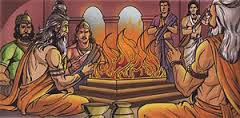
Yajna

 Sama Veda Samhita

1.1. The earliest form of organized Music that we know about is the Music of Sama Veda or the Saman. Sama Veda is linked to music through Yajna.

The Yajna-s, were at the very heart of the Vedic way of living. During the Yajna-s, it was customary to invoke and invite devas (gods) by singing hymns dear to them or dedicated to them ; and to recite the mantras while submitting to them offerings (havish) through Agni, the carrier (havya-vahana). The group of priests who sang (Samaga or Chandoga) the Mantras, initially, compiled a text for their use by putting together selected Mantras from Rig-Veda (the oldest known text) that could be sung during the performance of a Yajna or a Soma Yaga. That collection of lyrical Mantras came to be known as Sama Veda Samhita; and was regarded as the fourth Veda.

1.2. Out of the 1,549 mantras in Sama Veda Samhita, as many as 1,474 mantras are taken from Rig Veda (mainly from the eighth and the ninth Mandalas). Most of the mantras are in Gayatri chhandas (metre), while some are in Pragatha. It is said; the term Sama is composed of: SA, which stands for Rik (Vedic Mantra); and AMA, meaning various notes (Brihad Up: 1-3-22). Sama Veda is thus, virtually, a musical rendering of the selected mantras from Rig Veda. In other words, Sama took maathu (words) from Rig Veda; and provided dhathu   the musical substance to those words. Sama Veda is perhaps the earliest known musical literature.

1.3. The Sama Veda Samhita has two segments. The first segment is called Sama – Yoni (adhara) mantra Samhita, meaning that it is the basic text. This segment contains the selected mantras as they appear in the Rig Veda .This, virtually, is the source book. The second segment called Sama–gana text. Here, the mantras are not in the order they originally appear in Rigveda. But, the selected mantras are rearranged to suit the sequence of rituals during the Yajna; or according to the meters (chhandas) or the gods to whom mantras are addressed.

Sama-gana

2.1. While rearranging the text for the purpose of singing, the selected mantras are converted to Saman by turning, twisting, elongating its syllables; and, by inserting various modulations, rests, and other modifications.  The musical effect or the ‘floating form’ of the Sama-gana is enhanced by interpolation of Svaras and meaningless sounds called Stobha (which resemble shouts of joy) such as: Hoyi, Hoi, Hova, Hai, Haw, Oi, Ai, Ha, Ho, Uha, Tayo, etc. This is the text for singing; expanding each mantra with notations and instructing how mantras are to be sung. This is the Sama Veda as it is generally understood and sung.

2.2. Sama-singing (Sama-gana) was an integral part of a Yajna. Sama, thus, represents the earliest known instance of deep relationship between religious life and Music. There were numerous styles of singing Sama. Patanjali in his Mahabhashya remarks that there were a thousand recessions (shakhas) or ways of singing Sama – sahasra-vartma samvedah.  That perhaps was a poetic manner of suggesting there were a range of styles of rendering Sama.  [Some texts speak of thirteen Samaga-charyas – ways of singing Sama. But names of about only eleven are mentioned:  Ranayaniya; Chatyamugra; Kaleya; Kalvala; Mahakaleya; Langalayana; Mahakalvala; Sardula; Langala; Kouthuma; Jaiminiya]

2.3.  In any case, of the many, only three recessions (shakhas) Viz. Kauthumiya, Ranayaniya and Jaiminiya, have survived. The Kauthumiya and Ranayaniya carry the same set of mantras; but their internal grouping differs; and there are also variations in their svaras (accent). The Jaiminiya is said to be different from the other two, in both the aspects. Of the three shakhas, Kauthumiya is regarded the prominent one.

Archika

3.1. Throughout, Sama Veda is arranged in two streams of classification. And, the two often   interrelate.

One is Arcika, the way in which Sama Veda text is structured and the way its Riks (stanzas) are grouped.

The other is Gana, the musical aspect which details the manner of singing the Sama Riks.

First, Archika (group of Riks sung in adoration), is essentially the collection of the texts (yoni) of individual Riks adopted from Rigveda. Here, the selected Riks from Rigveda are put together under several chapters (prapathakas). And, under each prapathakas; the Riks are bunched into sets of ten (dasasti) or less.

3.2. The Sama Veda text is broadly made into two Arcikas. The first Arcika (Purvarchika or Shadarchika) is made of six chapters (prapathakas) together with an Appendix.  The Purvarchika consists about 650 Riks selected from Rigveda that  are grouped partly according to meters (Chhandas) and partly according the gods  (Devatha) that are propitiated.

The first five prapathakas have about 585 Riks to be sung in honor of Agni, Indra and Soma-Pavamana.

 The sixth prapathaka having 55 Riks is called Aaranya or Aranya -kanda.

 There is also an Appendix consisting 10 Riks attached to Purvarchika; and is called Mahanamani (or Sakravayah) to be sung in hon our of Indra the Great (Mahan).

3.3. The second Arcika, Uttararcika (that which follows the first) is made up of nine prapathakas divided into number of segments (khandas).

Under these Khandas, about 900 Riks are grouped into about 300 songs of three Riks each. The Riks, here, are arranged according to the sequence of events that occur in the course of the performance of the Yajna.

It is presumed that the Uttararcika is, comparatively, of a later origin. And, it is regarded as an essential supplement to the Purvarchika.

Gana

4.1. As regards the Gana, the musical element of the Sama Veda, the Riks included in the first five chapters (prapathakas) of the first Arcika (Purvarchika) and those under Mahanamani are known as Grama-geya-gana – that is the songs meant to be sung in homes in the villages – praying to gods (devatha) Agni, Indra Soma and Visvedevah – during the course of domestic functions such as Brahmayajna (teaching of Vedas), Upakarma and other worships.

The Riks included under the sixth chapter (prapathaka) of the Purvarchika – that is Aaranya or Aranyakanda – are meant to be sung in the solitude of forests. Hence, they are named Aranya gana. The singing is of contemplative nature; and, it is deemed as sacred-music.

The Purvarchika way of singing (both the Grama and the Aranya gana) is deemed Prakrti-gana, the natural way of rendering a song.  And, it appears that the hymn-melodies for the Soma-yaga performed at homes in the villages (Grama) were different from those performed by the hermits living in the forests (Aranya).

4.2. As regards the singing (Gana) of the Riks included under the second Arcika (Uttararcika), it basically consisted two kinds of songs: Uha-gana (numbering 936) sung during the Soma Yajna; and Uhya-gana (numbering 209) singing within oneself. The texts (yoni Riks) of most of the songs were adopted from Purvarchika.

But, here, the singing style is improvised with unusual variations; and, therefore it is named Vikrti-gana (not the straightway of singing). It is also said; the same Rik can be sung in different tunes, producing different Samas. The number of such Samas can vary from one to eighteen..!

[It is also said; Uha and Uhya were composed for the purpose of indicating the order of rituals in the Yajna. And, that Uha is related to Grama-gana, and Uhya to Aranya –gana.]

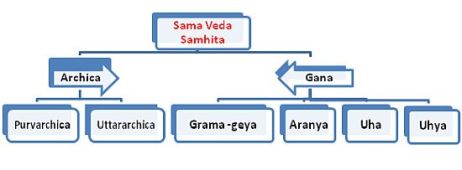
In summary; The Sama Veda Samhita, is arranged in two primary sections – the verse books (Arcika) and melody books (Gana).

The Arcika is divided in two parts: Purvarchika and Uttararcika

And, as regards melody (Gana) there are four styles of singing hymns: Grama-geya-gana; Aranya-gana; Uha-gana; and; Uhya-gana. 

There is a mutual relation between the Riks contained in Arcika and the Gana books.
Sama Veda 4

Sama-chanting

5.1. The priests who sing the Mantras at the Yajna are designated as Udgathru-s (derived from udgita – to sing ’high’ or loud).

Chandogya Upanishad (1.3.6) explains the term Udgita by splitting it into three syllables ud-gī-tha: Ud meaning breath (Prana) in high pitch (utti shati)Gir refers to speech (vag gī); and, tha : in which all this is established (sthita )

atha khalū-udgīthākarāy upāsīta ud-gī-tha iti | prāa evot |prāena hy uttiṣṭhati | vag gī | vāco ha gira ity ācakate | anna tham | anne hīda sarva sthitam || Ch.Up_1,3.6 ||

The Sama Veda Samhita came to be compiled, essentially, for the use and guidance. of the Udgathru-s . They were usually a group of three singers (Prasthothru, Udgathru and Prathiharthra). And, the group, together, rendered the Sama in five stages.

Prasthava: The initial portion of the mantra is sung by an Udgathru designated as Prasthothru.  And, he starts with a deep Huuum sound (Hoon- Kara).

Udgita: Prasthothru is followed by the chef Ritwik (designated the chief Udgathru) who sings his portion of the Rik. He commences with an elongated Om Kara.

Prathihara: the mid-portion is sung loudly by Prathiharthra. This adulates the Devatha to whom Rik is addressed.

Upadrava: The chief Udgathru sings again;

and

Nidhana: the final portion is sung by all the three together, commencing with prolonged Om-kara.

When a mantra, as per the above format, is sung three times, it is then a stoma. Some texts describe the set of these five stages (Prasthava, Udgita, Prathihara, Upadrava and Nidhana) as Bhakthi. Its number is extended to seven by adding Hoon- Kara and Om Kara.

Elements of chanting

6.1. Shiksha, a branch of Veda lore (vedanga), deals with elements of chanting and phonetics. According to Taittereya Upanishad (1. 2), the elements of chanting includes six factors: Varna (syllable); Svara (accent); Maatra (duration); Balam (stress); Sama (even tone) ; and Santana (continuity) . The first four deal with correct pronunciation of individual syllables; and the last two with the recitation of the entire line or the verse.

Briefly, Varna is the correct pronunciation of every isolated syllable, combination of consonants and ovals and compound letters. Svara is how a syllable has to be pronounced in one of the three accents (udatta, anudatta and svarita). Maatra is the time duration for pronouncing a syllable. There are of four types: hrasva– a short one – duration for short ovals; dhirga –  two unit-duration for long vowels; plutam- longer than two–unit duration; and, the fourth is ardha- maatra, half unit, meant for consonants not accompanied by vowels.

Sama Svaras

6.2. In the beginning, Sama-gana employed only three notes called Udatta, Anudatta and Svarita. The lyre (Vana-Veena) accompanying the singing had only three strings, one for each note. The songs were perhaps like Ga Ga -Re Re -Sa Sa Sa. This kind of singing might have suited for chanting hymns.

The three notes were differentiated depending on whether it was produced from above or below the palate (taalu).

Udatta refers to sound produced from above the palate; and is acutely accented (uchchaih).

Anudatta was gravely accented (nichaih); produced from below the palate.

Svarita is a combination of udatta and anudatta, with udatta in the first-half. It is called a circumflexed accent.

[It is also explained that in context of Sama Veda , Udatta meant the highest Svara; Anudatta , just lower; and Svarita is the summation of the two.]

*

It is said; in the beginning, the (Rig) Vedic priests used only three notes : Udatta, Anudatta and Svarita.  The singers of the Sama Veda discovered some more notes and extended the range from  these three Svaras to seven svaras.

Narada (NarS 1.1.12) identifies the seven Sama Svaras (Vaidika)  as: Prathama; Dvitiya, Triya; Chaturtha; Mandra; Krusta; and Atisvara.

And then, he correlates the Sama Svaras used by the Saman singers with the notes of the flute (Venu) – according to the Laukika music (NarS 1.5.1).

Narada offers an explanation that from the ancient Udatta the Svaras Nishada (Ni) and Gadhara (Ga) were derived; from Anudatta, the Svaras –  Rsbha (Ri) and Dhaivata (Dha); and, from Svarita emerged three Svaras:  Shadja (Sa), Madhyana (Ma) and Panchama (Pa).

udātte niāda gāndhārāva anudātte ṛṣabha dhaivato /
svarita prabhavā hyete
adja madhyama pañcamā //

** 

Swami Prajnanananda in his A  History of Indian Music   explains the right hand and figure gestures that the Saman singers used to indicate the Svaras (tones) of the Saman that they were singing.

In the Vedic period, the base-tones (sthana-svaras) like Udatta, Anudatta and Svarita, together with the Savras, such as, Prathama, Dvitiya, etc., were used to be symbolized by different positions or movements of ‘the fingers of the hands as well as by different movements of the upper parts of the bodies of the Saman singers.

The tradition of expressing the tones of the Vedic music, by moving the fingers of the right-hand, is current and common to this day, at least, with the followers of the Ranayaniya and the Kauthuma recessions (shakhas) of the Samaveda.

While singing the Samans, the singers used to indicate the intonation of  the special musical Svaras, with the help of their five fingers of the right-hand thus;

(a) the first finger, the thumb (Angusta) used to stand for denoting the Prathama Svara, to sing;

(b) the second finger (Tarjani), next to the thumb, used to denote the Dvitiya Svara, lower than the first;

 (c) the third finger middle one (Madhyama) used to denote, the Tritiya Svara, lower than the second;

 (d) the fourth finger (Anamika), next to the middle one, and

(e) the last finger (kanisthika) used to denote the Chaturtha and the Mandra of the Saman.

The thumb was made to move and touch the other fingers, and thus helped the singers to sing the Samagana with proper intonation.

*

In the Naradishiksha, we find the mention of both the processes of. the fingers of the right hand as well as different parts of the body. As for example,

Angusthasyottame krushtohyagushthe prathamah svarah/ Pradeshinyam tu gandhara-rishabhastadanantaram // Anamikayam shadjastu kanishthikayam cha dhaivatam | Tasyadhastaccha yonyastu nishadam tatra vinyaset

  [ Note: Here Narada has mentioned about the Laukika or Desi tones, and it should be remembered that Madhyama = Prathama; Gandhdra, = Dvitiya; Rishabha= Tritiya; Shadja = Chaturtha; Dhaivata = Mandra; Nishada=Atisvarya; and, Panchama= krusta.]

And again, the Saman singer will touch, respectively, the middle part of his head, forehead (lalata), middle part of the eyebrows (Bhruvormadhye), ears (Karna), throat (Kanta), thigh (mandra) and heart (hridisthanam), when he will use the Vedic tones Prathama, etc., during the Saman singing

Krustasya murdhani sthanam lalate prathamasya tu/ Bhruvormadhye dvitiyasya tritiyasya cha karnayo//

Kanthasthanam chaturthasya mandrasyorasituchyate / Atisvarasya nichasya hridisthanam vidhiyate //

Now , the hand-poses (mudras), which are adopted in the religious functions (puja) and others (updsana-mudras) as well as the gestures adopted in the art of dancing (nartana-mudras), are all evolved from the Mudras employed by the Saman singers.

**

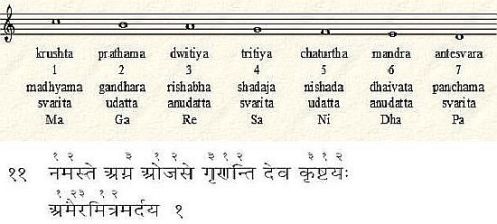
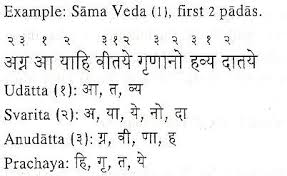
While in writing down / copying the  Vedic  and Saman text , the Udatta and Anudatta  etc were indicated by symbols. 

In the written/printed texts of the Rig Veda, Udatta is not indicated by any symbol; Anudatta is indicated by underlining the syllable; and Svarita is indicated by a vertical line above the syllable.

The Sama–gana texts, however, indicate Udatta by writing the Sanskrit numeral –one above the letter; Anudatta by writing the numeral–three above the letter; and Svarita by writing the numeral–two above the letter. In the Sama text, the syllables that have no symbols are called prachaya.

Please see the following example:
sama verse

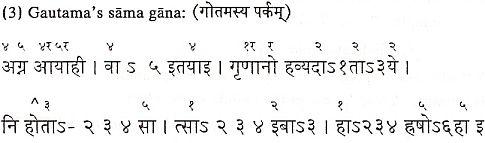
 In the later Sama texts, it became customary to write the numerals (one to seven) on top of the Sama mantras to indicate their note-delineations (Sama vikara).
sama20notes

**

Sama Svara and Venu Svara

7.1. Dr. Lalmani Misra, a noted scholar, explained the (Rig) Vedic priests used a single or two notes. The Sama singers improved on that and used at least three notes. “The singers explored further and discovered more notes. M G R S D has been determined to be the basic set of notes used in this order by Sāmik singers” , he said, “Sāmik notes were exactly those followed in Shadja grāmik tradition.”

7.2. As Sama-gana originated from the Yajna, its purpose, at least in the initial stages, was limited to chanting by the Udgathrus. Later, as the Sama Music developed, the number of notes increased from three to four, then five (which continued for a very long time), then six and finally seven. With that, the number of strings of the lyre too increased. Thus, over a period, the Sama scales expanded from three to seven notes. (It is not clear when or at what stage seven notes were introduced into Sama).

7.3. Naradiya Shiksha is a text that deals mainly with the musical notes and the pronunciation of the words in the Vedic language. Some believe it might pre-date Bharata’s Natyashastra. Narada Shiksha explaining the Sama music states that there were three Gramas (Sadja, Madhyama and Gandhara). It also mentions that each Grama has seven Murchanas (a total of 21 Murchanas). (But, it does not define Grama or Murchana). The set Murchanas related to Gandhara Grama are meant to please Devas; and the other two to please Pitris and Rishis. In addition, it mentions 49 Taanas.

[According to some other texts (Samavidhana Brahmana and Arseya Brahmana), Sama-Gana employed seven Svaras (notes): 1. Prathama; 2. Dvitiya; 3. Tritiya; 4. Chaturtha; 5. Panchama or Mandra (low); 6. Shasta or Krusts (high); and, Antya or Atiswara (very high)]

7.4. Naradiya Shiksha relates the Sama Svaras to the notes on the flute (Venu) as: Ma, Ga, Ri, Sa, Dha, Ni, and Pa.

Narada  says:  Prathama, the first Svara of the Saman singers is the Madhyama Svara of the Venu (flute); Dvitiya, the second, is GandharaTritiya, the third, is traditionally the RsabhaChaturtha, the fourth, is said to be ShadjaPanchama, the fifth, is DhaivataSasta, the sixth, is considered to be NishadhaSaptama, the seventh, is the Panchama.

Yo Samaganam prathamah sa venur Madhyamah Svarah / yo dvitiyah sa Gandharas, trias tu Rsabhah smrtah // Chaturthah Shadja ity ahuh Panchama Dhaivato bhavet / sastho Nishadho vijneyah, saptamah Panchama cmrtah // NarS 1.5.1//

[ The fifth, sixth and the seventh Svaras of the traditional Vaidika music are also indicated by names: Mandra, Atisvarya and Krusta. These correspond to Dhaivata, Nishadha and Panchama of the Venu Svaras]

       Sama svara                      Venu svara
01 Prathama Madhyama Ma
02 Dwithiya Gandhara Ga
03 Trithiya Rishabha Ri
04 Chathurtha Shadja Sa
05 Panchama Nishadha Ni
06 Shasta Daiwatha Dha
07 Sapthama Panchama Pa

Narada (NarS. 1.5. 7-11) explains how and why the five Svaras – Shadja, Rsabha, Gandhara, Madhyama, and Panchama– came to be named as such ‘

Shadja (Sa): Because, it is situated in the nose, the throat, the chest, the palate, the tongue and the teeth; and, because it springs from these six , it is traditionally called Shadja.

Nasam, kantham, uras, talu jihvam, dantams cha samsritah / sadbhih sanjayate yasmath tasmath Shadja iti smrtah //

Rsabha (Ri):  Because, the air, rising from the navel and striking the throat and the head, roars like a bull, it is called Rsabha.

Vayuhu samutthito nabheh kantha-sirasa samahath / nardaty Rsbhavad yasmath tasmath Rsbha ucyate //

Gandhara (Ga): Because, the air, rising from the navel and striking the throat and the head, blows smells to the nose and is delicious; for that reason it is called Gandhara.

Vayuhu samutthito nabheh kantha-sirasa samahath / nasam gandhavah punyo gandharas ten hetuna//

Madhyama (Ma): Because, the essence of the Madhyama is in the air, which rising from the navel, striking the chest and the heart, reaches the navel as abig sound.

Vayuhu samutthito nabhir urohrdi samahath / nabhim prapto mahanado madhyamavatam samasrute //

Panchama (Pa) : Because, the air , which rising from the navel and striking the chest, the heart, the throat and the head springs from these five places , is accounted to be the essence of Panchama

Vayuhu samutthito nabhir urohrtkantha-sirohatah / panchastsnotthitasyasya panchamatvam vidhiyate //

*

Derivation of Svaras

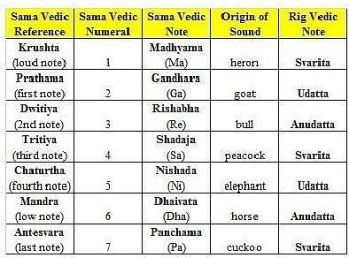
8.1 .Naradiya Shiksha (1.5.3; 1.5.4) explains that each Sama-svara was derived from the sounds made by a bird or an animal in its appropriate season. For instance; the peacock crys was Shadja (Sa); the bulls roar was Rishabha (Ri); sheep-goat bleats was Gandhara (Ga); kraunchaka’s (heron) cry was Madhyama (Ma); koel’s (cuckoo) melodious whistle was Panchama (Pa); the neigh of the horse was Dhaivata (Dha); elephant’s trumpet was Nishadha (Ni). Please see the table below.

Shadjam vadati mayuro, gavo rambanti ca Rsabham / ajavike tu Gandharam, kraunco vadati Madhyamam // pushasaddarane kale kokilo vakti Panchamam / avas tu Dhaivatam vakti, Nishadam vakti Kujarah // NarSh 1.5.3-4 //

The peacock cries Shadja; the bulls moo Rsabha; the she-goat and the sheep Gandhara; the curlew cries Madhyama. And, in the spring time, the cuckoo calls Panchama; the horse produces Dahaivata; and, the elephant, the Nishadha

Name in Sama Music Symbol Sama Veda Svara Bird/animal Sound associated
Madhyama Ma svarita heron
Gandhara Ga udatta goat
Rishabha Ri anudatta bull
Shadja Sa svarita peacock
Nishadha Ni udatta elephant
Daiwatha Dha anudatta horse
Panchama Pa svarita koel


Descending order of Sama Svaras

Sama veda 5

sama veda 6


9.1. As can be seen, the Sama notes were of Nidhana prakriti (diminishing nature) or Vakragati, following Avaroha karma, a descending order (uttarottaram nicha bhavanthi).

The order of the Svaras in Sama-music was: Ma, Ga, Ri, Sa, Ni, Dha, and Pa. The order of the svaras was revised in the later texts to: Sa, Ri, Ga, Ma, Pa, Dha and Ni ; as we are familiar with it today. [Another Shiksha text, the Yajnavalkya Shiksha gives the names of the seven Svaras as SA-RI-GA-MA-PA-DA-NI; and says that the seven Svaras belonged to Aranya-gana.]

Dr. Misra says  that the ancient musical scale using notes in descending order can be translated into modern Shadja grām by considering the Madhyam  to be Shadja and moving up the scale.

Because of that re-orientation of the Sama scales a well-structured system of music could be erected and developed during the later ages.

This, surely, is one of the most significant contribution of the Naradiya Shiksha to the growth and vitality of Indian Music in all its forms.

9. 2. Even then, since the Sama notes were in a descending order there was not much flexibility in music. Dr. Misra remarks “In those times there were no microphones or loudspeakers. Sam was sung in large, wide, open or canopied spaces, with the intention that all present should be able to hear it. In such a condition if the song has notes M G R S D(as in Sama) it would be audible at best in a single room, but if the notes, S N D P Gstarting from Tār-saptak are sung they would be loud enough for all to hear. So, from this angle of usage too, S N D P G seems more appropriate than M G R S D. “

Further since the Raga concept was, then, yet to be evolved, there might not have been much depth and variation in the rendering of Vedic or Sama music.

As Dr. N.Ramanathan, a noted musicologist remarked, Sama music was to acquire the rhythmic-time- patterns. That is to say, the taala system was yet to evolve.

 Development of Sama music

10.1. The Sama music, in its later stages, was just ripe; and it was also eager to grow and expand both in scope and content.

Historically, the Sama chanting is recognized by all musicologists as the basis for the Indian Music. The roots of Sangita, the traditional (classic) Indian Music are firmly founded in Sama- gana.

10.2. The Saman initially gave rise to a body of devotional songs called Marga or Gandharva sung in Jati (melody). No matter who sang and in which region it was sung, the Sama and the Marga music had to follow the traditional approved format.

As a result of the disciplines evolved over the ages, a well structured system of music could be erected during the Gupta period on the foundations of the Sama–gana. It was during this period that Indian music started gaining the form with which we now are familiar.

10.3. From Marga, the devotional music (Vaidika) , was born the Art music (laukika) Desi,  the Music of Ragas. Desi, the one derived from regions, sprang from the common people; and, it varied from region to region. Desi was inspired from life, spontaneous and fluid.

10.4. Then for over a thousand years the Music scene was dominated by a structured Music (Nibaddha-samgita) format called Prabandhas (a type of Khandakavya). Since Prabandha grew rigid it had to give place, by about 17th century, to varieties of free flowing (Manodharma-samgita) such as Padas,  Kritis or Kirtanas, Varnas, Javalis etc.

9.5. Of late, the Marga and Desi; the classical folk and other improvised forms Of Music are coming together, enriching and inspiring each other. It is wonderfully delightful development.

Music and spiritual progress

11.1. Music in the Vedic times was sung and played for entertainment. Its other main use was during the performance of the Yajna; and it was here that Sama-gana was born. The concept of Nada-Brahman does not appear in Rigveda or in the early Upanishads. The metaphysical concept of Nada – Brahman is not discussed either in Sama Veda or its recitations (shakhas).  It seems to have come from Yoga or Agama.  Similarly, the notion  that music would lead to spiritual development did not seem to have existed then.

11.2. It was only in the later texts, say of 4th to 6th century AD, such as Brihaddeshi, Vayu Purana and Naradiya shiksha assigned the musical taanas, names of the various Yajnas; and said that the benefits of those yajnas could be obtained by singing the relative taanas. It seems , at that stage, the idea that music was a way to liberation (moksha sadhana) was yet to get established .

[ In the later times,  Music was elevated to the status of a Veda ; and , came to be reckoned as the fifth Veda (Panchama Veda).  It was, therefore, held in high esteem and invested with an aura of spiritual pursuit (Sadhana),  leading to liberation from earthly-attachments. It is said; for both the performer and the good-hearted listener (sah-hrudaya), pure-music (Samgita) can be a fulfilling blessed experience. 

For instance ; Yajnavalkya (Yajnavalkyasmrti-III-4-115) describes Samgita as the most sublime of all the fine-arts that pleases ; and , has the potential to convey all shades of emotions . It is a Vidya that, if practiced diligently, can lead the aspirant towards liberation- mokamārga niyacchati

āvādanatattvajña śrutijātiviśārada / tālajñaś cāprayāsena mokamārga niyacchati // Yj_3.115 //

gītajño yadi yogena nāpnoti parama padam /rudrasyānucaro bhūtvā tenaiva saha modate // Yj_3.116 //

And much later, Abhinavagupta, commenting on Natyashastra, remarked that Gandharva bestows bliss and leading towards Moksha. Such Music , he said, is a worthy offering to gods.  And, gods would be delighted with sublime Music than with reading Puranas or lecturing on Yoga exercises.

In support of his observation, Abhinavagupta quotes verses (26,27 and 28 of Chapter 36) of the Naytashastra :

The recital of poetry, performance of dance (drama) along with songs and instrumental music are equal in merit to the recitation of Vedic hymns.

hyaya tathā geya citravā aditrameva ca  veda-mantrārtha-va-canai sama hyatad bhaviyati 26

I have heard from the god of gods (Indra) and even from Shankara (Shiva) that music (vocal and instrumental) is indeed purer and superior to taking a ceremonial dip in a river and repeating a mantra (Japa) a thousand times.

śruta mayā devadevāt tattvata śakarāb-ddhitam  snāna japya saha srebhya pavitra gīta vāditam 27

Whichever places that reverberate with the auspicious sounds of songs and music of Natya will forever be free from inauspicious happenings.

yasmin nātodya nāyasya gīta pāhya dhvani śubha  bhaviyatya śubha deśe naiva tasmin kadācana 28॥ ]

***

Musical instruments

12.1 Vocal music was accompanied by lot of musical instruments in the Rig-Veda.

Some of the instruments of Rig-Veda are:  Dundubhi, Vaana, Nadi, Venu, Karkari, Gargar, Godha, Ping and Aghati. The sound of Dundubhi has been described as sound of clouds. Veena commonly denoted string instruments. The other instruments mentioned are: Venu or Vamsha (flute) and Mridanga (drums).

12.2. The string instruments such as Veena were played during a Yajna. Vana was the most popular string instrument of Vedic period. Among string instruments, frequent   references were made to the bow-shaped harp Vana. Vana (RV 1.85.10; 6.24.9 etc.) was a lyre; a plucked string instrument like a harp. Rig Veda (10.32.4) mentions the seven tones (varas0 of the Vana (vanasya saptha dhaturit janah).

Karkari (karkarir yathā bṛhad vadema vidathe suvīrāḥRV 2.43.3) and Tunabha were also veena – like string instruments. The other kind of string instruments mentioned in Rig-Veda is Kand-veena, which was made by combining together bamboo joints and stretching strings on it.

The other kinds of Veena mentioned are : Aghati, Ghatlika or Apghatika, Pichchola or Pichchora stambalveena, Taluk Veena, Godha Veena, Alabu, and  Kapishirshni etc.

In fact, all string instruments were called Veena.

12.3. Some others that were mentioned are:

Naali (RV 10.135.7) was a wind instrument similar to flute.

Dundhubhi (RV 1.28.51; 6.47.29 etc.) was a conical shaped drum with two faces, made by hollowing out a block of wood and stretching an ox’s hide over the mouth. It was played with a stick.

Adambarara was also a drum made from Udambara tree.

Shanka vadya blowing of conch is also mentioned.

Musical instruments were basically used as accompaniments to singing and dancing. There are no references to playing them solo; or in an orchestra

Rishi

divider

Svaras


While on the subject of svaras, let me append here the wonderful explanation of the swaras in Indian music offered by Shri S Rajam the renowned artist and musician. He says:  The Seven swaras have twelve swara divisions:

Carnatic System Syllable Hindustani System Western
Shadja SA Shadj C
Suddha Ri R1 Komal Rishab D Flat Db
Chatusruti Ri R2 Thivra Rishab D
Sadarana GA G1 Komal GA E Flat Eb
Antara GA G2 Thivra GA E
Suddha MA M1 Komal MA F
Prati MA M2 Thivra MA F Sharp F+
Panchama PA Pancham G
Suddha Da D1 Komal Da A Flat Ab
Chatusruti Da D2 Thivra Da A
Kaisiki NI N1 Komal NI B Flat Bb
KakaliNI N2 Thivra NI B


 SA & PA are constant. Others have two levels (sthanas). Thus there exist twelve swara sthanas. Four more having shades of other swaras – Suddha Gandharam, Shatsruti Rishaba, and Suddha Nishada  & Shatsruti Dhaivata – make up a total of sixteen.

72 Sampoorna Ragas having all seven swaras both in ascending (arohana) & descending (avarohana) emerge as Mela ragas. Each mela has all the seven swaras but drafts varying swarasthana formulations.

Each mela raga applied to permutations & combinations of swara sthanas gives scope to 484 janya (sub) ragas. 72 mela ragas have thus a potential to give the colossal 34776 janya ragas. Of course, this is only an arithmetical projection & not a melodic feasibility.

Of 72  Melas, the first 36 have M1 & the second 36 have M2.

http://www.indian-heritage.org/music/Melakartha%20Raga%20Booklet%20-%20new.pdf


Sources and References

http://www.omenad.net/page.php Dr. Lalmani Mishra

Sama-gana : http://en.wikipedia.org/wiki/Samagana

http://www.ragaculture.com/history.html

The tradition of Indian art music (a historical sketch)   by Acharya Chintamani Rath

Sama Veda & its Music by R L Kashyap

 Vaidika sahithya Charithre by Dr, NS Anantharanga Char

*

*
Painting by Shri S Rajam

http://rkmathbangalore.org/Books/Vedanta%20Kesari/%282007,%20September%29.pdf

Edit

19 CommentsPosted by  on September 15, 2012 in MusicRigvedaSanskrit

Tags: 

19 responses to “Music in Sama Veda

  1. iphone 4S kopen

    September 18, 2012 at 6:48 am

    I’ve found youre article on my iPhone 4 Kopen and i wanna say thanks for it! It’s a nice www you have over here! I’ll visit it more in the future! Thanks, Frank

    • sreenivasaraos

      September 18, 2012 at 4:05 pm

      Dear kopen ,thank you for the appreciation.The post , because of its very nature, has many Sanskrit terms . I trust you did not have much difficulty in following the subject. Please check other blogs too. Regards

  2. sreenivasaraos

    September 18, 2012 at 4:07 pm

    thank you.Regards

  3. sreenivasaraos

    September 22, 2012 at 6:49 pm

    Dear libreria online , Thank you for the visit . As I mentioned , I am not very familiar with the technical aspects. I welcome help and guidence. Regards

  4. Saddha

    November 27, 2013 at 1:33 am


    Thank you for quite a detailed article in the Brahmanical Sama Veda. However, Krishna in The Bhagwad Gita was not talking about the Brahmanical Sama Veda when he said, “amongst Vedas I am The Sama Veda”.

    The Bhagwad Gita clearly does not mean that the tunes/melodies of the Sama are the most important!

    As the Gita says in chapter 2 “Buddhau Saranam Anvicche!”

    There is another Sama Vedas — aka Dhamma Vedas, this was revealed by Lord Buddha! This is known as the Nikayas or Tripitika — unfortunately preserved by every nation except India.

    Krishna when he said he was the Sama Veda meant “to be in tune”– to be in tune with what? The Dharma!

    Who tune themselves with the Dharma? Buddhists since only they have the Dharma Chakra! Lord Buddha uses the word “Sama” several times in various Suttas to describe tuning in accordance with The Dharma,

    Thanissaro Bhikku states:

    Dissonant and harmonious (visama and sama): Throughout ancient cultures, the terminology of music was used to describe the moral quality of people and acts. Discordant intervals or poorly-tuned musical instruments were metaphors for evil; harmonious intervals and well-tuned instruments were metaphors for good. In Pali, the term sama — “even” — describes an instrument tuned on-pitch. AN 6.55 contains a famous passage where the Buddha reminds Sona Kolivisa — who had been over-exerting himself in the practice — that a lute sounds appealing only if the strings are neither too taut nor too lax, but “evenly” tuned.

    Lord Buddha describes this tuning to the Dharma process in MN 41 PTS: M i 285 MLS ii 379 Saleyyaka Sutta: (Brahmans) of Sala translated from the Pali byThanissaro Bhikkhu

    “Householders, it’s by reason of un-Dhamma conduct, dissonant [1] (visama) conduct that some beings here, with the break-up of the body, after death, reappear in the plane of deprivation, the bad destination, the lower realms, in hell. It’s by reason of Dhamma conduct, harmonious [1] (Sama) conduct that some beings here, with the break-up of the body, after death, reappear in the good destinations, in the heavenly world.”

    The true Sama Vedas is not knowledge of musical notes, it is knowledge and living in tune with the universe through the Dharma Chakra.

    • sreenivasaraos

      November 27, 2013 at 2:50 am

      Thank you Dear Saddha for your detailed explanation.
      I am grateful.

      Regards

  5. sreenivasaraos

    March 20, 2015 at 8:28 am

    sreenivas: thanks to you . now i know what is sama veda. i belong to yajur(yajus shakha) but my wife was born a sama vedi. so the first time i heard chants in musical form was during my wedding, and after 45 years i read your blog to understand the origin of sama veda
    rgds, girdhar

    • sreenivasaraos

      March 20, 2015 at 8:28 am

      dear shri gopal,
      thank you for the comments. i am glad you could relate to it.
      the later portion of the blog, i fear, became rather technical.
      regards

  6. sreenivasaraos

    March 20, 2015 at 8:29 am

    that was a wonderful blog. i have to read it again & assimilate a lot of things. just loved it. pranaams to you. you are great !

  7. sreenivasaraos

    March 20, 2015 at 8:29 am

    sir, i posted a short blog on colors and music. may see if time permits.
    http://dmrsekhar.sulekha.com/blog/post/2008/09/svetomusica.htm
    dmr sekhar

    • sreenivasaraos

      March 20, 2015 at 8:30 am

      dear shri sekhar,

      thank you for your detailed response. i greatly appreciate the gesture.

      i understand, in sound → color synesthesia, individuals experience colors in response to tones or other aspects of sounds. a lot of that subject is highly technical, and i do not pretend i understand all of that. i am posting a few words from the little i know and from what i read.

      the theory of synchronizing music with colors is highly interesting. there have been theories in that regard even from the time of pythagoras. in the subsequent centuries others too followed it . there has, of course, been plenty of debate around the issue. edwin d. babbitt, scientist who has done work in that field confirms (in his the principles of light and color) the correspondence of the color and musical scales:

      “as c is at the bottom of the musical scale and made with the coarsest waves of air, so is red at the bottom of the chromatic scale and made with the coarsest waves of luminous ether. as the musical note b [the seventh note of the scale] requires 45 vibrations of air every time the note c at the lower end of the scale requires 24, or but little over half as many, so does extreme violet require about 300 trillions of vibrations of ether in a second, while extreme red requires only about 450 trillions, which also are but little more than half as many. when one musical octave is finished another one commences and progresses with just twice as many vibrations as were used in the first octave, and so the same notes are repeated on a finer scale. in the same way when the scale of colors visible to the ordinary eye is completed in the violet, another octave of finer invisible colors, with just twice as many vibrations, will commence and progress on precisely the same law.”

      the theosophists too, especially madam blavatsky, putforward theories relating colors to the seven types of constitution of man and the seven states of matter. (please check- it is in the same page).she was primarily trying to relate the aura in and around the human body to their colors.

      you made a mention, also, of ragas and colors. the indian music made attempts to translate the emotional appeal of a raga into visual representations. that gave rise to schools of paintings called ragamala, in which each raga was personified by color, mood, a verse describing a story of a hero and heroine (nayaka and nayika). the colors, substance and the mood of the ragamala paintings were determined not by the individual notes that go to construct the scale of a raga, but by the overall mood , bhava and context of the raga.

      in the traditional indian morphology, the colors of the deities represent and convey their attributes. for instance, the highest divinities with sublime attributes (gunas) are sky blue signifying their true infinite nature; shiva, the ascetic the supreme yogi is gauranga the colorless- without any attributes; hanuman and ganesh are red like the blood full of energy, vitality and life; and kali’s black does not signify absence of color but is the sum and culmination of all colors and energies in the universe.

      coming back to your subject, you might be interested to check the site that talks of people who “see” music, or sounds. the article says it is another common form of synesthesia, to have colors associated with specific tones, so that listening to music becomes a more intense and complex experience. with your scientific training and background, i am sure you would be in a better position to appreciate it.

      i am told there are musicians in hollywood who find that letters and numbers represent colours, rainbows of textures, rainbows of moods and feelings too.

      there have been attempts in the other direction too,of translating individual colours into music with the aid of compute r graphics.

      i understand there are schools that help the aspirants’ to hone their synesthesia condition.

      much study needed to understand this phenomenon.

      thank you for introducing me to a fascinating subject.

      regards

             
  8. sreenivasaraos

    March 20, 2015 at 8:32 am


    whether by intent, or by research or by serendipity, the twelve basic swaras have been discovered time and again by civilisations across the world. Some however have discovered additional quarter tones, and have developed different forms of scales- with upto 31 tones in a scale. The Vedic form of M G R S D- S N D P G (Nidhana or diminishing order- also a convergent order) was converted to the more flexible ascending sequence leading to progressive flexibility as decadence set in…
    some civilisations have 5 tonal octaves, some have more. all have to go through till the chromatic notes are (re-)discovered, independently. civilisation has been here longer, and degraded and then revamped. music has always been on the ascendancy!
    I liked reading your post- will be keeping note of this!
    regards
    PP
    Plasticpoet

  9. sreenivasaraos

    March 20, 2015 at 8:32 am

    Your article is mind blowing for person like me.
    Hats off to you
    Do you know me? Or my music?
    Am I in your city? What is you phone number and address?

    Sablu

    • sreenivasaraos

      March 20, 2015 at 8:33 am

      Dear Shri Sablu, Yes, as you said, it might very likely be by chance you bumped into this old blog while you were lost in the ‘Recent Comments’ page. Thank you. Since you consider it ‘mindboggling’ for a person like you, I reckon you would be interested in a few other articles I wrote on music. The ones that quickly come to my mind are: The state of music in the Ramayana; Sri Mutthuswami Dikshitar and Hindustani music; the Music of Sri Mutthuswami Dikshitar; and the music of Shri SRajam (a great musician scholar and a creative artist; he was the uncle of our Shri VS Gopal who writes and sings delightfully on Sulekha).You may like to click on the links.

      As regards the several things you mentioned in your comment as also in your note, well… I usally live in Cincinnati –OH; and Bangalore is the location with reference to which I check news updates etc. I am now visiting India; may be here for another couple of months.

      I am truly not surprised if you have not noticed me on Sulekha during all these four years. The reasons are many and they are quite simple: I am not very active on Sulekha; I did not participate in any of the tag –games; I have also not contested in the ongoing EYC series; most of the friends who kept in touch with me have since migrated out of Sulekha; now, I do not know many; I have not written or commented much; not many read what I write and, what I have posted is truly not readable (many have groaned about the length). A bright star on the Sulekha horizon once referred to me as ‘the guy who writes about the dead who do not contradict’. I consider that sums me up pretty well and almost aptly. The reasons for not knowing me, you see, are quite many. They are all valid; and without prejudice. It’s OK.

      Sablu…Yes, I have, of course, seen the name many times spoken with affection, warmth and regard. I am aware; Sablu is popular and is among the elite here. That is great. And, about why I have not checked into Sablu music: I usually log into Sulekha late in the night when most have done with the computer and gone to bed. I said ‘most’ because, the one who keeps company with me is a little boy of just over three; and he delights in running round the house, up and down the stairs, jumping and turning somersaults when no one disturbs him. During those silent hours I prefer to just read or write than turning on music. I normally spend no more than ninety minutes a day on Sulekha.

      Now that I will be here where I am surrounded by sound all the time, I will surely check into your link with pleasure and listen to that with delight.

      Thank you for the comment and the Note.

      Warm Regards

      • sreenivasaraos

        March 20, 2015 at 8:33 am

        Thank you so much Sir,
        I’m highly honored by your kind words and great response. I will love to read thousands blogs of yours in music which made me so glad today to go through your precious blog. Boss such thing is gold and silver even I invest lakhs I will not get such relevant info.
        Does not matter you listen to my music as per your convenience and leisure.So you are actually in OH. Oh I’m so sorry I thought you are Bangalore based. Please do welcome here.
        And please do write more music blogs like you wrote on samveda. i will go through one by one as you also mentioned some links in your comment.
        Kudos to your great knowledge and I touch your feet.
        regards
        SM

  10. sreenivasaraos

    March 20, 2015 at 8:34 am

    Hi,Thank you for posting. If you dont mind can I make a suggestion. The equivalent names for shadja, Rishabha, Gandhara etc are not C , Db, D , Eb etc.. its == Pi, m2, M2, m3(A2), M3, P4, A4(Dim5), P5, m6(A5), M6, m7, M7 ,8ve( Higher Shadja)P = PerfectA = AugmentedDim= DiminishedM = Majorm = MinorWhen sung:Ascending and DescendingDo, Di, Re , Ri, Ma, Fa, Fi, Sol, Si, La, Li , Ti, Do — Do, Ti, Te, La, Le, So, Se, Fa, Mi,Me, Re, Ra, Do

    GODWIN

    • sreenivasaraos

      March 20, 2015 at 8:34 am

      Dear Godwin, Thank you for breathing fresh life into an old and a forgotten blog. Thank you also for the corrections suggested. I shall try to edit the blog. But, the problem is that in the present state of Sulekha editing a blog is a risky proposition. I shall wait for a while // Para// Btw, I noticed in the scholarly essay “Samaveda und Gandharva” included in the book “Ritual, State, and History in South Asia: Essays in Honour of J.C. Heesterman “(page 146) it is mentioned that “Madhyama = F28; Gandhara = E; Rsabha = D; Sadja= C; Dhaivata = A; Nishadha = H; and, Panchama = G” . Please let me have your views before I try to edit the blog-post.// Para// Here is the link to the article “Samaveda und Gandharva”http://books.google.com/books?

  11. Priya

    February 19, 2018 at 11:34 am

    I am trying to learn how to sing samaveda.I have read your blog. I did not understand how to chant as per the numbers. what is the sound of ka and ra appearing on the letters. I know KY and RV chanting.can you help me with SV chanting

    • sreenivasaraos

      February 19, 2018 at 4:01 pm

      Dear Priya,

      Wow… It is great to see you trying to chant.

      But, Maa, it is not easy; and, definitely you cannot get it right unless you are trained and guided by a teacher. It has to be a face-to-face exercise; and has to be practiced diligently, over a period.

      By the way, the indications on the top of the letters are numerals (from one to seven) to suggest their note-delineations (Sama vikara).

      [According to Samvidhana Brahmana and Arsheya Brahmana, Sama-Gana employed seven Swaras (notes): 1. Prathama; 2. Dvitiya; 3. Tritiya; 4. Chaturtha; 5. Panchama or Mandra (low); 6. Shasta or Krusts (high); and, Antya or Atiswara (very high)]

      For instance; please follow the text along with the chanting of the verse 594 of Sama Veda Samhita- (Listen to pundits chanting in streaming audio.)

      at https://sanskrit.safire.com/SamaVeda.html

      The numbers on top are note delineations. and , where it is written within brackets as Dve or Tri , it means that the words have to repeated two or three times .

      Follow the text as you listen carefully.
      *
      You may also enjoy listening to some passages from Sama Veda Samhita kauthuma shakha at https://www.youtube.com/watch?v=TBNEizCsor0

      Some parts the chanting are taken from the text at
      https://sanskritdocuments.org/doc_veda/sv-kauthuma.html?lang=iast

      You may be able to recognize the following verses ; as also Gayatri mantra at 6.44of the tape

      text at 1:42 indraya soma suShutaH pari sravApAmIvA bhavatu rakShasA saha . mA te rasasya matsata dvayAvino draviNasvanta iha santvindavaH .. 561

      2:14 saM te payA.Nsi samu yantu vAjAH saM vR^iShNyAnyabhimAtiShAhaH . ApyAyamAno amR^itAya soma divi shravA.NsyuttamAni dhiShva .. 603

      3:57 yasho mA dyAvApR^ithivI yasho mendrabR^ihaspatI . yasho bhagasya vindatu yasho mA pratimuchyatAm . yashasvyA3syAH sa.N sado.ahaM pravaditA syAm .. 611

      R^itasya jihvA pavate madhu priyaM vaktA patirdhiyo asyA adAbhyaH . dadhAti putraH pitrorapIchyA3M nAma tR^itIyamadhi rochanaM divaH mA tvA mUrA aviShyavo mopahasvAna A dabhan . mA kIM brahmadviShaM vanaH .. 732

      pavamAna ruchAruchA devo devebhyaH sutaH . vishvA vasUnyA visha .. 905 ubhayataH pavamAnasya rashmayo dhruvasya sataH pari yanti ketavaH . adI pavitre adhi mR^ijyate hariH sattA ni yonau kalasheShu sIdati ..

      If you are seriously interested , please secure the guidance of a learned teacher.

      Please keep talking

      Cheers

rangoli

Continued in Part Five

Gandharva Music

Sources and References

http://www.omenad.net/page.php Dr. Lalmani Mishra

Sama-gana : http://en.wikipedia.org/wiki/Samagana

http://www.ragaculture.com/history.html

The tradition of Indian art music (a historical sketch)   by Acharya Chintamani Rath

Sama Veda & its Music by R L Kashyap

 Vaidika sahithya Charithre by Dr, NS Anantharanga Char

http://rkmathbangalore.org/Books/Vedanta%20Kesari/%282007,%20September%29.pdf

 
2 Comments

Posted by on April 22, 2015 in Music, Sangita


Tags: , , , , , , , ,

Music of India – a brief outline – Part Three

tinued from Part Two – Overview (2) North – South branches


Part Three (of 22) –  Overview (3)


Karnataka samgita

1.1. The Music of South India was referred to as Karnataka Sangita, perhaps, even slightly prior to 12th century. King Nanyadeva, a prince of a later branch of the Rastrakuta (Karnataka) dynasty who reigned in Mithtili (Nepal) between 1097 and 1133 A.D. in his Sarasvathi-hrdaya-alamkara-hara mentions Karnata-pata tanas.

Further, the Kalyana Chalukya King Someshwara III (1127-1139 AD) in his Manasollasa (also called Abhjilashitarta Chintamani) calls the Music of his times as Karnata Sangita . This, perhaps, is the earliest work where the name Karnataka Sangita is specifically mentioned .

Later, Thulaja the Nayak ruler of Tanjavuru in his ‘Sangita saramruta’ (1729 – 1735) calls the Music that was in vogue at his time as Karnataka Samgita. That was, perhaps, because the authorities and the Lakshana-granthas he quoted in his work were authored by Kannada-speaking scholars. 

Later, Sri Subbarama Dikshitar in his ‘Sangita-sampradaya-pradarshini’ (1904) refers to Sri Purandaradasa as ‘Karnataka Sangita Pitamaha’ (father of Karnataka Music).

The contributions of the Kannada scholars in terms of –  the Lakshna-grathas that articulated the theoretical aspects of the Music; defining the concept of classifying the Ragas under various Mela-s; refining the elements of Music such as Taala; coining fresh Music terms; and, systematizing the teaching methods , particularly in the early stages of learning  – had been truly enormous.

Texts

1.2. One of the reasons for naming the Dakshinadi as Karnataka Samgita could be that in the initial stages of its development and even in later times up to the 18th century the texts delineating the Grammar (Lakshana –grantha) of Music were authored mostly by Kannada speaking Music-scholars (Lakshanika). The texts were, however, written in Sanskrit and not in Kannada.

The notable among such texts (Lakshana–grantha) in question, mention could be made of 

: – Manasollasa (also called Abhjilashitarta Chintamani ) ascribed to Kalyana Chalukya King Someshwara III (12th century) ;

: – Sangita-Cudamani of Jagadekamalla (1138 to 1150 AD) –   son of king Someshwara , author of Manasollasa;

:- Sangita-sara of  Sage Sri Vidyaranya  (1320 – 1380)  which perhaps was the first text to  group (Mela ) Ragas according to their  parent scale;

: – Sad-raga-chandrodaya of Pundarika Vittala (1583 approx);

 :- Kalanidhi of Catura Kallinatha (Ca,1430),  a reputed commentary on on Sarangadeva’s Sangita-ratnakara ; he was in the court of Immadi  Devaraya ( aka Mallikarjuna) the King of Vijayanagar (1446-65);

: – Swaramela-Kalanidhi  by Ramamatya (Ca.1550) a poet-scholar in the court of Vijayanagar ;

: – Sangita Sudha, attributed to Govindacharya (aka. Govinda Dikshita, Ca 1630);

: – Chaturdandi-Prakasika (a landmark text in Karnataka Sangita) by Venkatamakhin, son of Govinda Dikshita (ca. 1635);

: –  Sangraha Chudamani by Govindacharya (late 17th – early 18th century), which expanded on Venkatamakhi’s work;

:- and,

the Ragalakshanam  ( early 18th century) of Muddu Venkatamakhin (maternal grandson of Venkatamakhin) which makes a drastic shift in the concept of Mela, identifies the Raga by the position of its notes (Svara-sthana) and characterizes a Raga by its Aroha and Avaroha ( ascending and descending notes).

Mela

1.3. The practice of grouping (Mela) the Ragas according to their parent scale, it said, was initiated by Sage Vidyaranya in his Sangita-sara (14th century). Govinda Dikshita (who reverently addresses Sri Vidyarana as: Sri Charana)   confirms this in his Sangita-sudha (1614).  Sri Vidyaranya classified about 50 Ragas into 15 groups (Mela).

Mela is a Kannada term meaning collection or group; and it is still in use (eg. sammelana – is meeting or conference). Sri Vidyaranya ‘s  work on Melakarta system was followed up and improved upon in later times by other Kannada–speaking scholars. 

For instance; Ramamatya, following Sri Vidyaranya, in his Svara-mela-kalanidhi classified the then known Ragas into 20 Melas. His classification of Melas was based on five criteria (Lakshana): Amsa (predominant note); Graha (initial note); Nyasa (final note); Shadava (sixth note); and, Audava (pentatonic structure).

Ramamatya was thereafter followed by:  Pundarika Vittala (16th century); Venkatamakhin (17th century); and his grandson Muddu Venkatamakhin (18th century).

Taala

Sripadarajaru

1.4. Sri Sripadaraja (1406-1504) who presided over the Matta at Mulbagal in Kolar District, Karnataka, is credited with reorganizing the Taala system from out of the numerous Desi Taalas (rhythmic patterns) that were in use. He categorized the Taala under seven categories (Suladi sapta taala), each with a fixed number of counts: dhruva (14), matya (10), rupaka (6), jampa (10), triputa (7), ata (14), and eka (4). The counts were measured in terms of Laghu (of one matra duration- notionally to utter four short syllables) and Dhruta (half that of Laghu). He also provided scope for extending these counts (virama) by adding a quarter duration of a Laghu.

It appears; two other Taalas (jhompata, a Desi Taala and Raganamatya from folk traditions) were also in use.

Of course, today, the Taala regimen has completely been overhauled.

[ For more on The Suladi Sapta Taalas in Carnatik Music – please click here]

power of Music

Music Terms

1.5 . Many of the Music-terms that are in use today were derived from Kannada. For instance: while the music-content of a song is called Dhatu, its lyrics are Mathu (meaning spoken word in Kannada). Similarly, the terms Sarale and Janti-varase are derived from Kannada. Sarale is, in fact, said to be the local (prakrta) version of the Sanskrit term Svaravali (string of Svaras). And, Varase (meaning style in Kannada) refers to ways of rendering the Svaras in high (melu-sthayi) and low (taggu-sthayi) pitch.

Further, the terms to denote ten modes of ornamentation (Dasha-vidha-Gamaka) were also said to be derived from Kannada: Hommu; Jaaru; Rave; and Orike etc.

Teaching Methods

1.6. Apart from charting the path for development of Music in South India, the teaching methods were systematized by Sri Purandaradasa through framing a series of graded lessons. Sri Purandaradasa is credited with devising a set of initial lessons starting with Maya-malava-gaula Raga and later in other Ragas. The Svaravalis, Janti varse, the Suladi Sapta taala alankaras and Gitams, composed by Sri Purandaradasa, form a part of Music-learning. He has also to his credit numerous lakshya and lakshna Gitams; Suladis, Ugabhogas, Devara Nama and kirtanas.

His compositions served as a model for Sri Tyagaraja. The other composers of the 18th century also followed the song-format devised by Sri Purandaradasa which coordinated the aspects of Raga, Bhava and Taala.

kanaka-vyasa-vadi ed

Contribution of Haridasas

2.1. As regards the Haridasas, their contributions to Karnataka Samgita, spread over six hundred years, have been immense, both in terms of the sheer volume and the varieties of their works.

Haridasas were proficient singers and composers; and, spread their message – of devotion, wisdom, ethics in life and social values- through songs and Music. They composed their songs in Kannada, the spoken language of the common people;  not in Sanskrit as was the practice until then. Their songs were accessible even to the not-so-literate masses; and, soon became hugely popular.

2.2. The range of Haridasa Music is indeed very wide. It spread from songs derived from folk traditions (lullaby (laali), koluhadu, udayaraga, suvvake, sobane, gundakriya etc) to Prabandha forms (gadya, churnika, dandaka, shukasarita, umatilaka and sudarshana), to musical opera and to the classic poetry.

But, the bulk of the Haridasa songs were in the format of: Pada; Suladi; and, Ugabhoga. When put together, their numbers run into thousands

2.3. As regards the Music, they seemed to have re-organised Ragas starting with malavagaula, malahari under 32 (battisa) Raga-groups.

[Incidentally, it is said, it was Sri Sripadaraya who first mentioned and introduced into Haridasa-music the stringed drone instrument Tamburi (Tanpura). And, later it came to be identified with the Haridasas in Karnataka music.]

Pada

3.1. Sri Naraharithirtha (13th century), a direct disciple of Sri Madhvacharya, was perhaps the first to compose Kannada songs in Pada- format. (His Ankita or Nama-mudra was Raghupathi.) The model he offered was fully developed and expanded by generations of Haridasa composers. That in turn led to evolution of other song-forms in Karnataka Samgita: Kriti, Kirtana, Javali etc.

3.2. Sri Naraharithirtha, after a considerable gap, was followed by Sri Sripadaraja (Ankita: Rangavittala) who lived for almost a hundred years from 1406-1504. He wrote a good number of Padas as also a long poem in Sanskrit (Bramara-geetha). He also introduced many innovations into Karnataka Music.

3.3. The later set of Haridasas, mostly, lived around the Vijayanagar times. The prominent among them was the most honoured Sri Vyasaraya (1447-1539), a disciple of Sri Sripadaraja. He composed many Padas (Ankita: Sri Krishna).  He enjoyed the patronage of the Vijayanagar King Sri Krishnadevaraya; and, also had a large following of disciples. During the time of Sri Vyasaraya the Haridasa movement (Daasa-kuta) reached its heights. Sri Purandaradasa and Sri Kanakadasa were prominent members of the Daasa-kuta.

3.4. During the same time, Sri Vadiraja (Ankita: Hayavadana) who had his seat in Sode (North Kanara District) composed varieties of Padas, popular songs and lengthy poems in classic style.

3.5. Among the Daasa-kuta , Sri Purandaradasa (1484-1564) a disciple of Sri Vyasaraya was  , of course,  the most well known of all. He composed countless Padas (Ankita: Purandara Vittala). Though he is said to have composed gita, thaya, padya-vrata (vrittanama) and prabandha (much of which is lost), he is today known mainly by his Padas, Suladis and Ugabhogas.  

His songs cover a range of subjects such as: honesty and purity in ones conduct and thoughts; wholesome   family life; social consciousness and ones responsibility to society; philosophical songs; futility of fake rituals; songs preaching importance of devotion and surrender to God; prayers; narrative songs etc.

Sri Purandaradasa systematized the methods of teaching Music; and blended lyrics (Mathu), Music (Dhatuu) and Dance (Nrtya) delightfully. He is credited with introducing early-music lessons such as: sarale (svarali), janti (varase), tala- alankaras as well as the group of songs called pillari gitas.  These form the first lessons in learning Karnataka music even today. Sri Purandaradasa was later revered as Karnataka Samgita Pitamaha (father of Karnataka Music).

purandara

It is said; Sri Tyagaraja (1767-1847) derived inspiration from Sri Purandaradasa whom he regarded as one among his Gurus. Sri Tyagaraja, in his dance-drama Prahlada Bhakthi Vijayam pays his tribute to Sri Purandaradasa – వెలయు పురందరదాసుని మహిమలను దలచెద మదిలోన్ (I ponder, in my mind, on the greatness of Purandaradasa who shines in a state of ecstasy, always singing the virtues of Lord Hari which rescues from bad fates). Sri Tyagaraja brought into some of his Kritis the thoughts, emotions and concepts of Sri Purandaradasa.

3.6. A contemporary of Sri Purandaradasa was the equally renowned Sri Kanakadasa (1508-1606). He is remarkable for the range and depth of his works (Ankita: Nele-Adikeshava). He, like the other Haridasas, was driven by the urge to bring about reforms in personal and social lives of people around him. He wrote soulful songs full of devotion (Bhakthi), knowledge (jnana) and dispassion (Vairagya), besides composing classic epic-like poetry in chaste Kannada. His Kavyas: Mohana-tarangini (in Sangatya meter); Nalacharitre, Haribhakthisara and Ramadhyana-charite (in Saptapadi meter) are popular even today.

kanakadasa

3.7. Following Sri Kanakadasa there were generations of Haridasas who continued to compose Padas, Devara Namas Ugabhoga, Suladi, Vruttanama, Dandaka, Tripadi and Ragale (blank verse) etc as per their tradition. Among them  the prominent were : Mahipathidasa(1611-1681) ;  Vijayadasa (1682-1755) ; Prasanna Venkatadasa  (1680-1752) ; Gopaladasa (1722-1762) ; Helavanakatte Giriyamma  (18th century) ; Venugopaladasa (18th century) ; Mohanadasa (1728-1751) ; Krishnadasa (18th century) and Jayesha Vittaladasa (1850-1932).

They all have contributed immensely to the development of Karnataka Samgita. Be bow to them with reverence and gratitude

Dasas-300x300

Pada, Suladi, and, Ugabhoga

4.1. As said earlier; the bulk of Haridasa music can broadly be grouped under three categories: Pada; Suladi; and, Ugabhoga.

4.2. The Padas are structured into Pallavi which gives the gist, followed by Anu-pallavi and Charana (stanzas) which elaborates the substance of the Pallavi. Pada is set to a Raga and a Taala. The Pada-format is closer to that of a Kriti. The term Pada is again derived from Kannada, where it stands for spoken-word or a song.

[Please do read ‘Kannada Suladis of Haridasas’ by  Smt Arati Rao ]

4.3. Suladi (some say that it could suggest Sulaba-hadi , the easy way) is a delightfully enterprising graded and a gliding succession of different Taalas (Tala-malika) and Ragas (Raga-malika). Some others  say, the name Suladi also means Su-haadi (meaning a good path, in Kannada).

The Suladi is a unique musical form that evolved from the Salaga Suda class of Prabandha . It is made up of 5 to 7 stanzas ; and does not, generally, have Pallavi or Anu-pallavi. Each stanza explains one aspect of the central theme of the song. And,   each of its stanzas is set to a different Taala (Taala–malika) chosen from among the nine Suladi Taalas (They in their modern form are: dhruva, mathya, rupaka, jhampa, triputa, atta and eka; in addition to two others jhompata  and  raganamathya), And, at least five Taalas are to be employed in a Suladi.  Occasionally, the folk rhythm Raganmatya Taala is also used.

Therefore, in Suladi, particular attention is paid to the Taala aspect. Sometimes Ragas are not prescribed for rendering a Suladi. Towards the end of the Suladi there is a couplet called Jothe (meaning ‘a pair ‘in Kannada).  Some speculate that Jothe might have been a reflection of Yati , an element of Vadya-prabandha that was sung after the Salaga-prabandha.  

RSatyanarayana Mahamahopadyaya Dr. R. Satyanarayana , who has rendered immense service to various field of study such as Music, Dance, Literature and Sri Vidya,  explains that the Dhruva Prabandha after which Suladi  was patterned employed nine different types of Taalas, while they were sung as a series of separate songs. Thereafter, there came into vogue a practice of treating each song as a stanza or Dhatu (or charana as it is now called) of one lengthy song. And, it was sung as one Prabandha called Suladi. Thus, the Suladi was a Taala-malika, the garland of Taalas or a multi-taala structure.
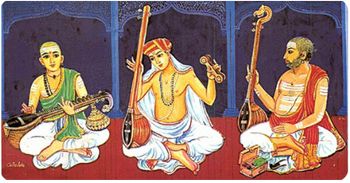
He mentions that there was also a practice of singing each stanza of a (Suladi) Prabandha in a different Raga. Thus, a Suladi type of Prabandha was a Taala-malika as also a Raga-malika.

Earlier to that,  Matanga had  mentioned  about Chaturanga Prabandha sung in four charanas (stanzas) each set to a different Raga, different Taala , different language (basha) and different metre (Chhandas) . Similarly, another type of Prabandha called Sharabha-lila had eight stanzas each sung in a separate Raga and Taala.

Sarangadeva also mentioned several types of Prabandha-s which were at once Raga- malikas and Taala-malikas such as : Sriranga, Srivilasa, Pancha-bhangi, Panchanana, Umatilaka, and Raga-kadamba.

Thus , the Raga malika, Taala malika and Raga-Taala- malika concept  which was described in the old texts was adopted and improved upon by the Haridasa (Sripadaraya, Vyasaraya, Vadiraja, Purandaradasa and others) to produce series of Suladi songs.

4.4. Ugabhoga is a piece of single stanza, sung in a Raga of performer’s choice.  They are similar to Vrittams which evolved from the Prabandhas of Desi music.  But, they are free from restrictions of meter or the length of the line. Most Ugabhogas don’t have prescribed ragas. It is a form of free rendering where Taala is absent or is not of much importance.  Ugabhoga attempts to convey a message in a nutshell. Therefore, rendering of the theme is more important here. Ugabhoga is characterised by the dominance of Raga- ‘Svara Raga Pradhana’.

Some say; the name Uga-bhoga is related to elements (Dhatu) of Prabandha Music, called Udgraha and A-bogha.  In the song set in Prabandha format, the element Udgraha consisting a pair of lines grasps (udgrahyate) the substance of poem; and, the element A-bogha completes the poem.

Baliya manege vaamana bandante | BhagIrathage sri  Gange bandante |Mucukundage shrI Mukunda bandante | Vidurana manege shrI Krishna bandante | Vibhishanana manege shrI Raama bandante | Ninna naamavu enna naaligeli nindu | Sthalnali srI Purandaravittala ||

As can be seen, there is the opening section (Udgraha) and the last line (Abogha) with the signature (Birudu, Ankita or  Mudra) of the composer. The Ugabhoga is not structured into sections.

There is no prescribed Raga; and there is no Taala either. This Ugabhoga was rendered famous by Smt. ML .Vasantha Kumari who sang the first part in Hamsanandi and the rest in Maand

4.5. The Haridasas through their Padas, Ugabhogas, Suladis and Geetas set to attractive Ragas and Taalas carried to the doors of the common people the message of Bhakthi as also of worldly wisdom.

***

Trinity of Music

Trinity

5.1. The contributions of the celebrated Musical Trinity- Sri Tyagaraja, Sri Mutthuswami Dikshitar and Sri Shyama Shastri – are enormous. Their period could doubtless be called the golden age of Karnataka Samgita. Though the three did not meet together, they seemed to have complemented each other wonderfully well.  The approach of each was different from the other. And yet; their combined influences has bound the Music of South India into an integrated system and has given it an identity. For instance; of the three, Shyama Shastri seemed to favour tradition, as most of his compositions are in Ragas mentioned in older treatises. Sri Dikshitar was open to influences from the Music of the West (Nottu sahitya) as also that of the North (Drupad music of North India). Some of his compositions in Vilamba-kaala are set in Ragas derived from North Indian Music. Yet; Sri Dikshitar was authentically original; and was also rooted in tradition, following Mela-Ragas classification of Venkatamakhin and that of Muddu Venkatamakhin’s Ragalakshana.

5.2. Sri Tyagaraja seemed to be more innovative. He brought to life some rare Ragas that were long forgotten and had gone out of use. He also created some new ragas. He perfected the Kriti format of Musical compositions that are in vogue today; introduced the practice of Sangathi elaboration of the Pallavi; and built in Svaras into Sahitya. And, he was also  a prolific composer, having produced large numbers of Kritis/Kirtanas, Utsava-sampradaya kirtanas, Divya nama samkirtanas and Geya Natakas (dance dramas).

5.3. The post-Trinity period saw an explosion of light musical forms, such as: Varnas, Thillanas, Swarajathis, Jathiswarams, Shabdams and Javali. The composers of these musical pieces were mostly the disciples of the Trinity and their subsequent generation of disciples and their followers.

20171017203046

Today and tomorrow

6.1. As you look back, you find that the Music of India developed and changed, over the centuries, at multiple layers due to multiple influences. The Indian classical music as we know today is the harmonious blending of varieties of musical traditions such as sacred music, art music ,  folk music and other musical expressions of India’s extended neighbourhood.  And, yet the Music of India has a unique characteristic and an identity of its own.

6.2. The Music of India has travelled a long way. The modern day Music scene is markedly different from its earlier Avatar, in its practice and in its attitude. The traditional system of patronage vanished long back. Now, the professional musicians have to earn their livelihood by public performance, recoded discs, radio /TV channels, teaching in schools or at home. The relation between the teacher and student , the ways of teaching as also the attitudes of either teaching or learning have all  undergone a sea change; almost a complete departure from the past practices and approaches .   New technology and accessories are brought in to enhance the quality and volume of sound output. Many new instruments, starting with violin and Harmonium, are being adopted for rendering traditional music (saxophone, mandolin etc). The styles of rendering the Alap or the song or even selection of Ragas/kritis are all hugely different. Many musicians have been experimenting with fusion music of various sorts. And above all, there is the overbearing influence of film music.

6.3.  But, at the same time, I believe the fundamental basics of Indian music are not yet distorted. It is, as ever, growing with change, adapting to varying contexts and environments.  This, once again, is a period of exploration and change. It surely is the harbinger of the Music to come in the next decades.

Lotus Blossom_

 In the coming instalments of the series, we will take a look at the various stages in the evolution of the Music of India, separately, each at a time :the  Music of Sama Veda; the  Music in Ramayana; Gandharva or Marga Music; the Music of Dhruvas in Natyashastra ; the Desi Music of Ragas; the Prabandhas along with Daru and other forms  ; various types of song- formats; the best of all formats – the Kritis also ; and at the end , the Lakshana Granthas composed over the centuries, in a bit more detail.

****

In the next part of the series we shall try to catch a glimpse of the Music of Sama Veda.

floral design3

Continued in Part Four

Music of Sama Veda

Sources and References

ಕರ್ನಾಟಕ ಸಂಗೀತ’ದಲ್ಲಿ  ಕನ್ನಡ’

https://neelanjana.wordpress.com/

Important Treatises on Carnatic Music by Harini Raghavan

http://www.nadasurabhi.org/articles/39-important-treatises-on-carnatic-music

Haridasa s’ contribution towards Music

http://www.dvaita.org/haridasa/overview/hdmusic.html

Kannada Suḷādi-s’ by Arati Rao

https://www.academia.edu/37585064/Kannada_Suladi-s.pdf

All images are from Internet

 
8 Comments

Posted by on April 22, 2015 in Music, Sangita


Tags: , , , , , , , , , , , , , ,

Music of India – a brief outline – Part Two

Continued from Part One – Overview


Part Two (of 22) –

Overview (2) – continued

North – South branches

1.1. The Music of India, today, flourishes in two main forms:  the Hindustani or Uttaradi (North Indian music) and the Karnataka or Dakshinadi Samgita (South Indian music). Both the systems have common origins; and spring from the traditional Music of India. But, owing to historical reasons, and intermingling of cultures, the two systems started to diverge around 14th Century, giving rise to two modes of Music.

1.2. In that context, Sarangadeva’s Sangita-ratnakara (first half of 13th century) is of particular importance, because it was written just before influence of the Muslim conquest began to assert itself on Indian culture.  The Music discussed in Sangita-ratnakara is free from Persian influence. Sangita-ratnakara therefore marks the stage at which the ‘integrated’ Music of India was before it branched into North-South Music traditions.

It is clear that by the time of Sarangadeva, the Music of India had moved far away from Marga or Gandharva, as also from the system based on Jatis (class of melodies) and two parent scales.  By his time, many new conventions had entered into the main stream; and   the concept of Ragas that had taken firm roots was wielding considerable authority.  Sarangadeva mentions names of about 267 Ragas.

1.3. In regard to the Music in South India, the Persian influence, if any, came in rather late. Written in 1550, the Svara-mela-kalanidhi of Ramamatya, a minister in the court of Rama Raja of Vijayanagar, makes it evident that the Music of India of that time was yet to be influenced by the Persian music. Somanatha (1609) in his Raga-vibodha confirms this view, although he himself seemed to be getting familiar with Persian music.

Mughal Shamsa, smallest

The Persian influence

Tansen

2.1. The Muslim Sultanat began to get foothold in India by about 1200 A.D, when all major Hindu powers of Northern India had lost their independence,

Conquering Muslims came in contact with a system of Music that was highly developed and, in some ways, similar to their own. The poet Amir Khsru an expert in Music in the court of Allauddin Khilji, Sultan of Delhi (1290-1316) was full of praise for the traditional Music of India. And, at the same time, Khsru was involved with the Sufi movement within Islam which practiced music with the faith that Music was a means to the realization of God.

2.2. But, that didn’t seem to be the general attitude among most of the later Muslim rulers. India in the sixteenth century was politically and geographically fragmented. There were also conflicting cultural practices and prejudices. Though the Mughal era, in general, witnessed musical development, Musicians and Music, as such, did suffer much.

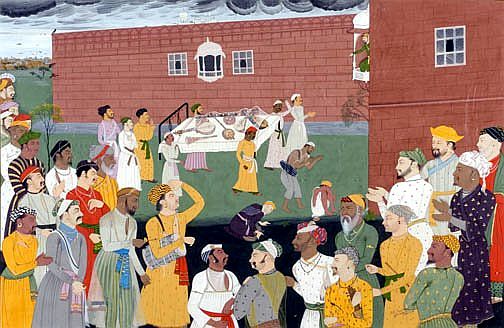
For instance; Aurangzeb (1658-1707) threw the whole lot of musicians out of his court. The grieving , hapless musicians , wailing and lamenting carry the ‘bier’ of music and symbolically bury ‘music’ in Aurangzeb’s presence. Aurangzeb,undaunted, retorted  “Bury it so deep that no sound or echo of it may rise again” (Muntakhab-al Lubab, p.213)

burial-of-music

The unfortunate artists , no longer able to support themselves,  were scattered and had to seek their livelihood in humbler provincial courts. In the process, the accumulated musical knowledge and musical theories developed over the years were lost. The priority of the professional musicians, at that juncture, was to make living by practicing music that pleased their new-found patrons.

2.3. Yet; Music and its traditions did manage to survive and flourish in India despite the Muslim rule and its harsh attitudes towards Music in general and the Indian in particular. Persian Music along with Indian Music was commonly heard in Indian courts; and, the two systems of Music did interact. Amir Khsru, who served in courts of many patrons and assimilated diverse musical influences, is credited with introducing Persian and Arabic elements into Indian Music.

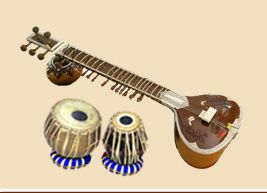
These included new vocal forms as well as new Ragas (Sarfarda, Zilaph), Taalas; and, new musical instruments such as Sitar and Tablas (by modifying Been and Mridamgam). Another modification of Been is said to be Tanpura  (or Tambura, Tanpuri) that provides and maintains Sruti. (Till then, it is said, flute – Venu – provided Sruti). 

Of the vocal forms that were developed, two are particularly important: Qaul, the forerunner of Qawwali, a form of Muslim religious music; and, Tarana a rhythmic song composed of meaningless syllables.

Sitar Tabla

[As regards Sitar, Pandit Ravi Shankar points out that documentation of the history of Sitar between the thirteenth and eighteenth centuries is lacking; and, suggests that Khsru ‘adapted’ probably a ‘Tritantri Veena’, already known to Indians along with its many variations. Khsru gave it the name ‘Sehtar’; reversing the order of the strings in the instrument;  and placing them in present form i.e. ‘the main playing string on outside, and the bass strings closer to the player’s body’. This order is opposite to what we find on Been. But, strangely, the Persian treatise on music written in Gujarat in 1374-75 A.D. Viz. Ghunyat-ul Munya does not mention Sitar or Tabla, though it mentions a number of Tat, Vitat, and Sushira and Ghana instruments.– Bhartiya Sangeet ka Itihaas, Ghunyat ul- Munya, pp. 52-62, Dr. Pranjpay]

Ragaputra_Velavala_of_Bhairava

2.4. Even during the Muslim rule, Music did enjoy some patronage. It appears Sultan Muhammad bin Tughluq (1325-1351) had in his court as many as 1200 musicians. Many other Muslim rulers were also patrons of Music. And, some of them were themselves musicians.

For instance; Husyan Shah Sharqi (1458-1528) Sultan of Jaunpur*, a musician in his own right, is credited with introducing a new form of song–rendering, Khyal (Khayal) lending greater scope for improvisation and technical virtuosity than did the ancient Dhrupad.

And, Ibrahim Adil shah (1582-1636) of Bijapur (Karnataka), a poet and musician, in his Kitab-i-Nauras (Nava Rasa) compiled his poems set to music. He is also credited with bringing to fore the Raga-mala paintings, depicting pictorial representations to Ragas, their moods and seasons.

Similarly, it is said, the. Khyal singing came into its own due largely to the efforts of Sadarang and Adarang during the reign of Mohammad Shah Rangeela (1719-1748).

[* Swami Prajnanananda in his A History of Indian Music (Volume One- Ancient Period) under the Chapter ‘Evolution of the Gitis and the Prabandhas’ writes:

During Raja Mansingh‘s time Dhrupads were performed in different Ragas’ and Raginis. Khayal form is purely imaginative and colorful. There are different opinions about its evolutions (1) Some say Khayal evolved from Kaivada-prabandha, (2) it originated from Rasak or Ektali-prabandha, (3) it evolved from Rupaka-prabandha, (4) it was created on the image of Sadharani-giti.

In the opinion of Thakur Jaideva Singh, Khayal form is a natural development of ‘Sadharani-Giti’. So Khayal form was neither invented by Indo-Persian poet Amir Khusro nor by Sultan of Jaunpur Hussain Sharqui. The Khayal of slow tempo was designed and made popular by a noted Dhrupadist and Veenkar Niyamat Khan who was in the Court of Sultan Muhammed Shah in 18th Century A.D. Khayal already existed in some form at the time of Akbar in 16th-17th century and it was practiced by Hindu and Muslim musicians like Chand Khan, Suraj Khan and Baj Bahadur. There are lighter forms like Thumri, Dadra and Gazal etc.

[Sadharani –Giti was a style of rendering Dhrupad combining in itself the virtues of four other Gitis or modes of singing that were in vogue during the early Mughal times : Shuddha–Giti (pure, simple, straight contemplative); Bhinna Giti (innovative, articulated, fast and charming Gamaka phrases); Gaudi Giti (sonorous, soft, unbroken mellow stream of singing in all the three tempos); Vesara or Vegasvara Giti (fastness in rendering the Svaras).]

2.5. Even among the Hindu Kings there were Musicians of repute, such as Raja Mansingh of Tomar, Gwalior (1486-1516). He was a generous patron of the arts. Both Hindu and Muslim musicians were employed in his court. He brought back the traditional form of Dhrupad music (Skt. Dhruvapada). He edited a treatise Man Kautuhal, put together by the scholars in his court, incorporating many of the innovations that had entered traditional Indian music since the time of Amir Ahusraw. Raja Mansingh is also credited with compiling/editing three volumes of songs: Vishnupadas (songs in praise of lord Vishnu); Dhrupads; as also, Hori and Dhamar songs associated with the festival of Holi. It is said; later during 1665-66 Fakirullah Saifkhan, a musician in the court of Jahangir (1605-27) partially translated Raja Mansingh’s Man Kautuhal into Persian.

 [Please do read the article about the state of Dhrupad Music in the   Mughal reign during seventeenth-century, written by Katherine Butler Schofield  Professor in Music at King’s College London; and, brought out by the Royal Asiatic Society and the British Library.

Please do not miss to see the colourful illustrations of folios of the Dhrupad songs during the Mughal period.

 She says; of all the arts and sciences cultivated in Mughal India, outside poetry, it is the music that is by far the best documented. She also tells us about the role and power of music at the Mughal court at the empire’s height, before everything began to unravel

Hundreds of substantial works on music from the Mughal period are said to be still extant, in Sanskrit, Persian, and North Indian vernaculars. The following is a brief extract from her talk.

The first known writings in Persian on Indian music date from the thirteenth century CE; and, in vernacular languages from the early sixteenth. These often were translated directly from the Sanskrit theoretical texts.

A particularly authoritative model was Sarngadeva’s Sagīta-ratnākara, the Ocean of Music, written c. 1210–47 for the Yadava ruler of Devagiri (Daulatabad) in the Deccan. This was initially translated into Persian and Dakhni.

Later, the text also came out in vernacular languages, in rather interesting ways. These versions included large additional sections presenting contemporary material chosen from the region in which they were written.

Among such improvised versions, Katherine Butler Schofield  mentions, Ghunyat al-Munya or Richness of Desire, the earliest known Persian treatise on Hindustani music, composed in 1375 for the Delhi-sultanate governor of Gujarat.  

And the other being, Shaikh Abd al-Karim’s Javāhir al-Mūsīqāt-i Muammadī or Jewels of Music, a unique Persian and vernacular manuscript produced at the Adil Shahi court of Bijapur (Karnataka).

Though the Javāhir has its core the Dakhni translation of Sarangadeva’s Sangita ratnakara, it deviates from the main text in number of ways. The Javāhir sidesteps the traditional discussions on Ragas, their concepts, framework and varied forms, which perhaps was getting rather stale by then.  Instead, it introduced the new and vibrant concept of Ragamala (garland of Rāgas).

Katherine Butler Schofield mentions that the Sanskrit authors, in the Mughal domains, continued to write a variety of musical texts. But, what was more notable, during the seventeenth century, was the effort to re-codify and systematise Hindustani music, in new ways; and, in more accessible regional languages, especially suited to the Mughal era.

From there, the translations or the re-rendering of the older texts Hindustani music seem to have moved from Persian  into Hindi, Brajbhasha and other vernaculars , during the reigns of Jahangir and Shah Jahan. For instance; the well-known Sahasras or Thousand Sentiments, a compilation of 1004 Dhrupad songs created by the early sixteenth-century master-musician Nayak Bakhshu, was re-rendered into Brajbhasha, with an introduction in Persian.

The other instance of re-codifying the principles of Hindustani music was the rendering of Damodara’s Sanskrit text, Sagīta-darpaa or Mirror of Music, of early seventeenth century, into Brajbhasha by Harivallabha during the  mid seventeenth-century. Later, in eighteenth-century, it was followed by a gloss in modern Hindi by a hereditary musician, Jivan Khan

Another example is an eighteenth-century interlinear copy of the premier Sanskrit treatise of the early seventeenth century, Damodara’s Sagīta-darpaa or Mirror of Music. Here, alongside the Sanskrit text, we have Harivallabha’s hugely popular mid seventeenth-century Brajbhasha translation, combined with an eighteenth-century gloss in modern Hindi by a hereditary (khandani) musician, Jivan Khan.

**

The first major piece of Mughal theoretical writing in Persian on Hindustani were the chapters on music and musicians written by Akbar’s great ideologue Abu’l Fazl in his Ā’īn-i Akbarī (1593).

But, the process really took off during the reign of Aurangzeb. The translations during his reign were predominantly in Persian. The more prominent among such translated texts, which occupied the canonical position for the next two hundred years, were:

1) The Miftā al-Sarūd or Key to Music: a translation of a lost Sanskrit work called Bhārata-sagīta by Mughal official Qazi Hasan, written in 1664, at Daulatabad

2) The Rāg Darpan or Mirror of Rāga, a work written in 1666 by Saif Khan Faqirullah, completed when he was governor of Kashmir. Faqirullah cites extensively verbatim from the Mānakutūhala, an early sixteenth-century Hindavi work traditionally attributed to Raja Man Singh of Gwalior.

3) The Tarjuma-i Kitāb-i Pārījātak: the 1666 Translation of Ahobala Pandit’s Sanskrit masterpiece Sagītapārijāta by Mirza Raushan Zamir.

4) The fifth chapter of the Tufat al-Hind or Gift of India: 1675 Mirza Khan’s famous work drawn , mainly, from Damodara’s Mirror of Music and from Faqirullah’s Mirror of Rāga. The text which was exhaustive became hugely influential in later centuries.

5) The Shams al-Awāt or Sun of Songs, written in 1698,  by Ras Baras Khan kalāwant, son of Khushhal Khan and the great-great-grandson of Tansen. This work is primarily another Persian translation of Damodara’s Sangitadarpana or Mirror of Music.  The text is enriched with invaluable insights from the orall tradition  of Ras Baras’s esteemed musical lineage.

6) The Nishā-ārā or Ornament of Pleasure, was prepared ,  most likely late seventeenth-century prior to1722 , by the hereditary Sufi musician Mir Salih qawwāl Dehlavi (of Delhi).

These and other treatises written during the time of Aurangzeb cover, in significant depth, a wide range of musical terrain. Their overriding concern and unifying theme, was about the nature of the Rāga, their derivatives and structures.]

2.6. The Persian influence brought in a changed perspective in the style of rendering the classical Indian music as it then existed in North India. The devotional Dhruvapad transformed into the Dhrupad form of singing. And, the Khayal developed as a new form of singing art-music, in the 17th century.

whitelotusmandala

Taking positions

3.1. The periods of 16-18th centuries were rather confusing. While the songs of the Indian music were either in Sanskrit or in a regional language, the Muslim singers found it difficult either to pronounce the words or to grasp the emotional appeal.

Similarly, Hindu musicians found it difficult to render songs in Persian, some of which elaborated Muslim religious themes.

As a result, in either case, in the Music of North India, the words of the songs lost their importance or were of little significance to the singers, while all the attention was focused on voice culture, melodic improvisation and style of rendering the music.

Further, an increasing number of Music-scholars of the North discussed Hindustani Art Music and wrote their works in Persian, Urdu, Hindi and other regional languages, instead of in Sanskrit. Such an admixture of Indian-Persian-Muslim influences over a period of four centuries from the sixteenth resulted in the Hindustani music of today.

karnataka samgita

3.2. Thus, while in the Music of South India the texts were written mainly in Sanskrit ;  and while its  Music continued to be based in structured formats (such as Kriti) and lyrics (Sahitya); the Hindustani music focused on experimenting  with  the possibilities of improvising the musical elements of a song. While Karnataka music retained the traditional octave (sapta svara), the Hindustani music adopted a scale of Shudha Svara saptaka (octave of natural notes).  And at the same time, both the systems exhibited great assimilative power, absorbing folk tunes and regional tilts; and elevating many of the regional tunes to the status of Ragas.

North- South interaction

sangitaratnakara1

4.1. The North and South regions of India had been aware of the developments in each other’s system of Music, art etc; and, there were also attempts to exchange.

For instance; Mahendra Varma Pallava (CE 600-630), who ruled from Kanchipuram in the seventh century, published some compositions of the North by having them engraved on the rocks on the hill at kudumiyanmalai, in Sanskrit (in Pallava-Grantha characters)  with footnote in Tamil. The inscription is actually an extract of Music lesson (Abhyasa gayana) for developing four types of finger–techniques (Chatush-prahara-Svaragama) for playing on the Veena. The type of the Veena is mentioned as Parivardhini.

The inscription which is in seven sections mentions Ragas such as: Madhyamagrama, Shadjagrama, Shadava, Shadharita, Panchama, Kaisikamadhyama   and KaisikiIt is said in the inscription that these lessons were ‘made for the benefit of the pupils by the King who is the devotee of Maheshwara the Supreme Lord and the disciple of Rudracharya’.

kudimiyanmalai2

The King Nanyadeva (11th century) who established the Rastrakuta dynasty of Karnataka in Mithila (Nepal) in his commentary on Natyashastra refers to Karnata-pata Taanas and to many other elements of the music of the South.

Sarangadeva  in his Sangita Ratnakara (Chapter: Ragadhyaya; Section : Ragangadi Nirnaya Prakarana ), while enumerating ten vibhasha Ragas, mentions a Raga with a Kannada name Devara-vardhini.

Every author of the South based his theory of Karnataka Samgita on the texts of Bharatha, Dattila, Matanga and Sarangadeva.

The  two systems have continued to influence each other  even after Muslim rule . And, that increased  since about the 14th century, in a number of ways. For instance; Gopala Nayaka traveled all the way from the South to become the court musician of Allauddin Khilji (1295-1315) in the North. He cultivated the friendship of the Persian musicologist, Amir Khusrau. Their discussion led to the development of new Ragas. These were incorporated in the treatise on music by the 16th century scholar Pundarika Vittala.

4.2. Till about the late 16th century both the South and North traditions followed the same set of texts.

[Justice Sri T L Venkatarama Aiyar , in his biography of Sri Mutthuswami Dikshitar (National Biography Series, National Book Trust, 1968) , observes that during the days of Venkatamakhin , the differences between the Karnataka and Hindustani systems were not much pronounced. And, Venkatamakhin was well versed in both the systems of Music; and, he composed Lakshana-Gitas on Ragas that  were known to be derived from the Outhareya -Ragas.

Sri Mutthuswami Dikshitar followed Venkatamakhin’s system; he was also well versed in the Dhrupad of the Hindustani system.. He created numerous musical gems, assimilating the the beauties of the either melodic systems.  ]

Pundarika Vittala (1583 approx) a musician-scholar from Karnataka (from around Shivaganga Hills about 50 KMs from Bangalore), who settled down in the North under the patronage of Muslim King Burhan Khan, wrote a series of books concerning Music of North India: Vitthalya; Raga-mala; Nartana-nirnaya; and his famous Sad-raga-chandodaya.

Later he moved to the court of the prince Madhavasimha and Manasimha, feudatory of Akbar. Here he wrote Raga-narayana and Raga-manjari.

In his writings, Pundarika Vittala carried forward the work of Gopala Nayaka (14th century) of grafting Karnataka music on to the newly evolving North Indian music.  In his work Raga-manjari, Pundarika Vittala adopted the parent scale (Mela) classification of Ragas as was devised by Ramamatya (Ca. 1550) in his Swaramela-Kalanidhi. (Ramamatya, in turn, is said to have taken the term Mela meaning ‘group’ and its concept from Sage Vidyaranya’s (1320-1380) Samgita Sara.) Pundarika listed 20 contemporary Ragas of North into Melas, which were not identical with their South Indian examples.

4.3. Somanatha (1609 A.D) a musician scholar hailing from Andhra Desha, largely followed the theories of Pundarika Vittala. Somanatha in his Raga-vibodha mentions 51 Ragas, of which 29 are used in the Music of the present-day: 17 in Karnataka Music, 8 in Hindustani and 4 in both the systems. Some scholars surmise Somanatha’s Ragas mostly correspond to modern Hindustani Ragas; and, though the names of some his Ragas resemble those in Karnataka system it is likely they developed along different lines.

Somanatha is also said to have brought into vogue the practice of writing notations (Raga-sanchara). Raga-vibodha is perhaps the only example before the modern times of any Indian Music using Notations. But, sadly, this valuable text did not receive the level of attention that it deserved.

He is also credited with outlining the rules regarding the time of performance, their special characters (Raga-lakshana) or the atmosphere of some of the Ragas. Some of his concepts are still relevant in Hindustani Music, but have not found place in Karnataka Samgita.  For instance; Somanatha in chapter four of his Raga-vibodha describes Raga Abhiri (equivalent to Abheri as it is known now) as a woman (Abhira), dark in complexion, wearing a black dress adorned with a garland of fresh flowers around her neck, attractive ear ornaments. She has a soft and a tender voice; and, wears her hair in beautiful strands.

[Abira is surmised to be a pretty looking Gopi of the Abhira tribe of Mathura region. She is an attractive looking dark complexioned tribal girl.  In the traditional Indian Music, dark complexion of the Ragini and her dark clothes correspond to the predominant note (Amsa) Pa]

4.4. The other significant work that attempted to introduce the elements of South Indian music in the North was Pandita Ahobala (early 17th century) who described himself as a ‘Dravida Brahmana, the son of Samskrita Vidwamsa Sri Krishna Pandita’.

Pandita Ahobala’s Samgita Parijata pravashika describing 68 types of Alamkaras or Vadana-bedha is said to be an improvement over Somanatha’s Raga-vibodha. And, it is regarded by some as the earliest text of the North Indian Music. Following Ramamatya and Pundarika Vittala, Ahobala classified 122 Ragas under six Mela categories. Instead of using specific names for his scales, Ahobala used phrases like vikrta svara, komal, tivra, tivratara, and so on. His scale of Shuddha notes, it is said, corresponds to the current Kafi Thath of the Hindustani system.

Pandita Ahobala’s famous Sangita Parijata was translated into Persian by Mirza Raushan Zamir (1666) as Tarjoma -yi- parijatak, with his own comments.

4.5. There were some other works that classified Ragas (including those of the North) according to Melas, such as: Rasa Kaumudi by Srikantha (Ca. 1575) a South Indian musicologist who migrated North; Raga Tarangini by Locana Kavi (?) recognizing 12 Mela Ragas and 86 Janya (derivative) Ragas which included some Ragas attributed to Amir Kushro; and, Hrdaya kautuka and Hrdaya Prakasha by Hrdaya Narayana Deva (Ca.1660).

lotus reflection

South coming close to North

5.1. By the end of 17th century the classical styles of the two strands of Music had stabilized in their own manners. Seeing that music of North and South were drifting apart in technical aspects, many scholars did make efforts to harmonize the two systems.

5,2, For instance, in the South, Venkatamakhin (1660), author of the monumental Chaturdandi Prakashika which re-structured the Karnataka Samgita, in his list of Desi Ragas included Bhibhas, Hammir, Bilaval, Dhanashri and Malhar which are primarily Ragas of the North.

5.3. And, Sri Mutthuswami Dikshitar, who followed Vekatamakhin’s classification of Mela Ragas, in his youth, lived in Varanasi for about seven years and learnt Dhrupad singing. He brought in the shades of Uttaradi-samgita in some of his Kritis, in his own unique and original manner without compromising pristine Music [e.g. Hamir Kalyani (Kedar), Hindolam (Malkauns), Dvijavanti (Jaijaivanti), Yamuna-kalyani (Yaman) and Brindavana Saranga.]

Gharana-s

6.1. As regards the North Indian music, it was, at that stage, had almost parted with the traditional theories of Music. And, it had come to be regarded more as collection of individual entities than as an organized system of Ragas. Their Ragas were known by the times and seasons they should be performed; their character; magical properties, etc.

6.2. Further, after the disintegration of the Muslim empire the political structure of North India fragmented into numerous small states ruled by Nawabs and Maharajas. Each ruler competed with his rival in studding his court with famed musicians. It is said, rulers of some states borrowed heavily to get hold of top-notch performers. Each ruler was keen to establish the superiority of the Music of his court over that of others. Each would goad his musicians to come up with different styles and techniques of singing, such as: Taans, Murkis, Layakaari, Tayaari, and so on.

The Music across North India, thus, came to be stratified into styles of various court-music. Each was known as a Gharana (‘family’ or ‘house’), named after its patron (such as: Gwalior Gharana, Patiala Gharana, Jaipur Gharana and so on) . Each ruler desired to have his very own personalized Gharana of music. And if no particular geographical region could be identified then a Gharana would take the name of the founder; as for instance: Imdadkhani Gharānā named after the great Imdad Khan (1848 -1920) who served in the Royal Courts of Mysore and Indore.

A  Gharana, in due course,   turned into a symbol of social standing, affluence and power among the rulers .

gharana

6.3. The proliferation of Gharanas gave raise to bewildering styles of singing. Further, there was no exchange of ideas among the Gharanas, because of the element of competition among their patrons. Each Gharana guarded its technique as a secret; and each turned into an island.  Performing to please the patron had taken priority; and, the theoretical aspects were left far behind. Music had become a practical craft. Attempts at standardization did not begin until the twentieth century when Pandit V. N. Bhatkhande worked out a system of classification.

Pandit Bhatkhande’s efforts

PARTHA_BHATKH

7.1. Pandit Vishnu Narayan Bhatkhande (1860-1936), a scholar and a musicologist, in his colossal work ‘Hindustani Sangeet Paddhati’ reorganized the Uttaradi or North Indian Music, mainly,  by adopting the concept of Mela (grouping derived Ragas under a  principal Raga) system as expanded by Venkatamakhin (1660) in the Appendix to his Chatur-dandi-prakashika.

[Venkatamakhin classified the Ragas according to the system of 72 basic scales (Mela)].

Bhatkhande also adopted the idea of Lakshana-geetas that Venkatamakhin employed to describe the characteristics of a Raga. Bhatkhande arranged all the Ragas of the Uttaradi Samgita into ten basic groups called ‘Thaat’, based on their musical scales.  The Thaat arrangement, which is an important contribution to Indian musical theory, broadly corresponds with the Mela-karta system of Dakshinadi samgita.

Rapprochement

8.1. Thus, after the early parts of the 20th century, there began a growing realisation that though the two systems differ from each other in their peculiar and characteristic treatment of Ragas, their fundamental principles are similar. At the same time, the differences in their style of presentation were recognized and given due credit.

Karnataka Music generally begins in Madhyama-kaala (medium tempo) while the Hindustani begins in Vilamba-kaala (slow tempo). The techniques of Alamkara (ornamentation), Gamaka-s and Jaaru (slides) also differ.

The classification of Ragas in the two systems under the Melakartas (the major category) does indeed differ. And yet; certain Ragas of one system correspond to a certain Raga of the other system, though their names differ. For instance; Shubha Pantuvarali, Hindola, Abheri and Mohana of Karnataka Music correspond to Thodi, Malkaunss, Bhimplas and Bhupali of the Hindustani music.

There are plenty more such Ragas that are common to both the systems. Further, there also pairs of Ragas that have the same/similar set of notes (svara-sthana) but slightly differ from one another.

[ Raga Pravaham is a monumental work; and reference source of immense value, is an Index of about 5,000 Karnataka Ragas compiled by Dr. Dhandapani and D. Pattammal. The list of ragas is given both alphabetically and Mela karta wise. The different kramas for the same Ragas and same scales with different names are also listed.

The Mela-karta Ragas, Janya ragas, Vrja and Vakra Ragas and their derivatives , together with their structures, have been Indexed.

In addition, the Raga Pravaham also lists about 140 Hindustani Ragas allied or equivalent to Karnataka Ragas  (pages 277-280 )

A Mela-karta-raga is a Sampurna-Raga (with all seven Svaras) where the ascent (arohana) and descent (avarohana) are in the same (reverse) order e.g. Sankarabharana

The Varja-Ragas are formed by leaving out either in arohana or avarohana or both, one or more Svaras; but keeping the other Svaras unchanged e.g. Hindola, Arabhi, Saramati.

The VakraRagas are formed when the order (Krama) of the Svaras are changed;  e.g. Ritigoula ( in addition one or more Svaras may be left out.]

bar3

Coming close again

Ragini Samgita

9.1. Some distinguished Rāgas (Kāpi, Deś etc.,) of the Karnataka Samgita seem to have come from other regions during Maratha rule; and, are hence referred to as Deśīya.

The Ragas having similar structure, which developed independently in the Karnatak  and Hindustani music traditions, have now been coming closer , tending to influence each other .

Thus, the majestic Darbāri Kāaa — associated with Tansen in Akbar’s court—has influenced the Southern rendering (the Dhaivata note) of the moving aa. With the Carnatic composers and Hindustani musicians popularizing once exclusive Rāgas across the North-South divide, the homogenizing process received a huge boost.

9.2 In the latter half of the 20th century the music of the North and the South did come closer, with the musicians of either branch trying to understand the approach and the idioms of the other.

Jugalbandi

On the performance stage, Ustads , Pandits and Vidwans began singing and  playing together (Jugalbandi) the Ragas common to both; Tabla virtuoso played alongside Mridanga artistes. Now, ragas such as Hamsadhvani, Abhogi and Kiravani became as much Hindustani as they were Karnataka.

9.3. The barriers are thus breaking down and there is a greater awareness among the musicians of today that the music of India is one; and, that two branches that originated from a common stock are indeed the two facets or modes of expressions of an integrated, fundamental Music tradition of India.  And, that the Hindustani and Karnataka systems are but the two classical styles based on a common grammar but with different approaches and modes of expression. It is just their approach, techniques and Mano-dharma that have branched out.

9.4. It is good that the two styles have not attempted to merge into one; because, each enjoys its unique flavour, charm and brilliance. And, it is good that there is a growing mutual respect and appreciation of each other’s genius. The two are indeed variations of the same system and not two different systems altogether.

15056504_645354352310812_8567339100530740859_n

Continued in Part Three

…. Overview (3) – continued

Sources and References

The Rāgs of North Indian Music: Their Structure and Evolution  by Nazir Ali Jairazbhoy

Indian Music: History and Structure   by Emmie Te Nijenhuis’

The Music of India  by Reginald Massey, Jamila Massey

History of Hindustani Classical Music     WWW.itcsra.org

Origins of Indian Music – The medieval period     http://carnatica.net/origin.htm

A BRIEF HISTORY OF INDIAN MUSIC

http://kushanmusic.blogspot.in/2012/02/brief-history-of-indian-music.html

All IMAGES ARE FROM INTERNET

 
5 Comments

Posted by on April 21, 2015 in Music, Sangita


Tags: , , , , , , , , , , ,

Music of India – a brief outline – Part One

carnatic_music

Part One (of 22)

Overview

Samgita

1.1. It is said; Music and musical thoughts are the expressions of a range of diverse emotions that co-exist within the hearts or in the inner worlds of a community. It has its roots in its total cultural context, in its traditions, in its philosophy of life and in its aspirations. A  Music can truly be understood and appreciated only when it is viewed as part of the integral experience of that community.

1.2. That is particularly true with regard to India where Music had been woven into the fabric of its various philosophical, religious, cultural and literary traditions for over long ages, stretching back to the forgotten periods of its un-recorded History. Apart from this, a special branch of study devoted to the theory and practice of Music (Samgita-shastra) was developed and enlarged, in stages.  Samgita-shastra, right from the ancient times, is deemed as an integral part of the broad framework of ideas that systematically explain the philosophical basis of sound (Nada); the Grammar and language of Music; and, the aesthetics of Music,

Thus, Music and its study have flourished in all the intellectual traditions of India. Here, Music was valued not only as a delightful sensory experience but also as a vision (Darshana) providing a glimpse of the reality that is beyond the reach of the senses. It is, therefore, held in high esteem and invested with an aura of spiritual pursuit (Sadhana) leading to liberation from earthly-attachments. It is said; for both the performer and the good-hearted listener (sah-hrudaya), pure-music (Samgita) can be a fulfilling blessed experience. Some traditions even elevate Music to the level of sacred lore, the Vedas; calling it as the fifth Veda (Panchama-veda).

1.3. Sage Yajnavalkya (Yajnavalkyasmrti-III-4-115) describes Samgita as the most sublime of all the fine-arts that pleases and has the potential to convey all shades of emotions .  It is a Vidya that, if practiced diligently, can lead the aspirant towards liberation- mokṣamārgaṃ niyacchati

vīṇāvādanatattvajñaḥ śrutijātiviśāradaḥ / tālajñaś cāprayāsena mokṣamārgaṃ niyacchati // Yj_3.115 //

gītajño yadi yogena nāpnoti paramaṃ padam /rudrasyānucaro bhūtvā tenaiva saha modate // Yj_3.116 //

As regards the virtues of the Samgita : Abhinavagupta quotes verses (26,27 and 28 of Chapter 36) of the Naytashastra :

The recital of poetry, performance of dance (drama) along with songs and instrumental music are equal in merit to the recitation of Vedic hymns.

pāṭhyaṃ nāṭyaṃ tathā geyaṃ citravā aditrameva ca । veda-mantrārtha-va-canaiḥ samaṃ hyatad bhaviṣyati ॥ 26॥

I have heard from the god of gods (Indra) and even from Shankara (Shiva) that music (vocal and instrumental) is indeed purer and superior to taking a ceremonial dip in a river and repeating a mantra (Japa) a thousand times.

śrutaṃ mayā devadevāt tattvataḥ śaṅkarāb-ddhitam । snāna japya saha srebhyaḥ pavitraṃ gīta vāditam ॥ 27॥

Whichever places that reverberate with the auspicious sounds of songs and music of Natya will forever be free from inauspicious happenings.

yasmin nātodya nāṭyasya gīta pāṭhya dhvaniḥ śubhaḥ । bhaviṣyatya śubhaṃ deśe naiva tasmin kadācana ॥ 28॥

Later, the Kalyana Chalukya King Someshwara III (1127-1139 AD ) in his Manasollasa (also called Abhjilashitarta-Chintamani)  describes chaste Music as that which educates (Shikshartham), entertains (Vinodartham), delights (Moda-Sadanam) and liberates (MokshaSadahanam)

– ShiksharthamVinodartham Cha, Moda-Sadanam, MokshaSadhaanam Cha.

1.4. Rabindranath Tagore speaking of the Music of India said: “To me it seems that Indian Music concerns itself more with human experience in its relation to God and nature, than with the day-to-day world of common living. The mystic world of Indian Music, like the starry night, has certain serenity, pure, deep and tenderness about it. The Indian Ragas stir our imagination and move us away from mundane towards the ideal. For us, Music has a transcendental significance. ”

lotus-flower-and-bud

Evolution

2.1. The Music of India, over the centuries, has evolved in several stages. Samgita in the ancient context was a composite art comprising Gita (singing), Vadya (instruments) and Nrtya (limb movements) – Gita, Vadya , Nrtyam trayam Natyam Tauratrikam ca tat Samgitam (Hemachandra) .

It was only much later that Nrtya began to develop independently. And, in Music, Gita (singing) had importance over Vadya (instrumental music); and, instrumental music generally follows the vocal styles and nuances. 

Ahobala Pandita   in his Samgita Parijata pravashika (17th century) says it is because of that reason the singing itself came to be known as Samgita

  • Samgita, Gita-vadhittra nrityanama trayam samgitam uccyate; Ganasytra pradhanatvat samgita mitiriyam

[Even the instrumental styles were defined with reference to their relation with singing .

It was said; when one plays on the Veena (following the vocal style) but without singing it was then known as Suska or A-gita . And, when one plays on the Veena; and, sings the song as he plays ,  it is known as Giti

Abhinavagupta explains: every type of Giti can be played on Veena. And, there are three types of Giti: Tatva,Anugata and Ogha.

When the Gana (singing)  is prominent and the Veena follows  Gana completely, it is Tatva; when the Veena follows Gana in some part and then shows its own craftsmanship, it becomes Anugata.

And, when the playing techniques become A-nibaddha; the Karanas become more prominent; and,when the Gana becomes secondary, then the Giti becomes Ogha .

Thus , in the rendering of the Giti, Veena performs an important role.]

The earliest form of singing  that we know about is the Sama-gana or the Saman, the musical way of rendering Sama Veda. That was followed by Gandharva or Marga, an ancient type of sacred music making a pleasant appeal to the gods. Gandharva or Marga or Margi, tended to be rather intellectual; leaving little room for flexibility and imagination.

These limitations had to necessarily bring in several changes. Gandharva, therefore, underwent considerable transformation. And, more importantly, it gave place to Gana, a form of art-music (laukika) that aimed to entertain the spectators at the theater.

2.2. Gana was the Music of the songs – Dhruva Gana – sung during the course of play by the actors on the stage as also by the musicians behind the curtain to the accompaniment of instrumental music. Natyashastra deals elaborately with the theoretical and practical aspects of the Dhruva Gana – its various types, structures, grammar, as also the type of songs to be sung in various contexts in a play.

2.3. Desi  category of music that flourished from around 5th century onwards , in contrast to Margi, was essentially a music springing out of inspiration derived  from various regional musical forms and tones , each having a unique flavour of the sub-culture in which it was rooted. Desi, which is enjoyed by all, is said to be the music of the people, as it is, relatively, free from strict adherence to rules. Desi Music flowered in various ways; it initiated or refined the concept of Raga; developed it further; classified Ragas according to the system of Mela or Melakarta (basic Raga) and its derivatives; and, it introduced new sets of instruments into musical performances.

2.4. For about a thousand years thereafter, which is till about the 17th century, the musical scene of India as also the dance-drama (geya-nataka) was dominated by a class of regulated (Nibaddha) Music called Prabandha, in its various forms. Prabandha is a variety of Khandakavya bound by certain specified elements (Dhatu and Anga). It is a tightly structured (Nibaddha Samgita) song format having specific characteristics that are governed by a set of rules. At times, the faithfulness to a prescribed format was carried to its limits. And, the Prabandha form, in due course, grew rather rigid; and, had to give place to improvised, easier and innovative (manodharma samgita) forms of music, such as Kriti and Dhruvapada (Drupad).

2.5. In the Music of South India, the churning of the Prabandhas and the Padas gave rise to a music format called Kriti (sometimes also called Kirtana, though there is a subtle difference between the two). Though several composers of repute prior to 17th century experimented with the Kriti format, it was the celebrated Trinity of Karnataka Samgita that, later, perfected it during the 18th century.  A Kriti which is explained as that which is constructed (yat-krtam tat-kritih) is primarily a pre-composed music (kalpitha Samgita), comprising pallavi, anu-pallavi and charanas, set to Taala.  And, it is the most advanced form of musical composition in Karnataka-samgita.

A Kriti is also the ultimate test of a composer. The Raga of Kriti should be in harmony with its structure, its lyrics and its musical content. Generally, a Kriti should strikes a good   balance between its words, its structure and its music (Mathu and Dhathu). A good Kriti should succeed in not only capturing the essence of its Raga, but also in aptly bringing out the inner meaning, the Bhava, of its lyrics (Sahitya).

Such a Kriti provides ample scope to the performer to delineate the true nature of a Raga in all its vibrant colours and also to draw out his creative (Mano- dharma), innovative expressions in Raga and Laya. The Musical performances of the present day are dominated by Kriti-rendering along with expanding on Raga-Alapa and Laya vinyasa (Taala or rhythmic patterns).

Along with the Kriti several other song formats with special reference to dance (Varna, Svarajit, and Javali etc) have come into being.

flower

Raga

3.1. A landmark step towards the evolution of the Raga was taken when the concept of Raga was introduced into Music of India by Matanga and others. The music-treatises of the second half of the 17th century were concerned primarily with the iconography of the Raga and were eager to connect the Raga with a deity or a season or a mood or even an environment.

3.2. The Music of Ragas, as we know it today, is the culmination of a long process of development in musical thinking that aimed to meaningfully organise melodic and tonal material. During the earlier times, Sama-gana gave way to Gandharva – gana as the mainstream of the sacred music. And, by the second half of the 17th century the ancient Gandharva Music that figured in Natyashastra was no longer in practice. The system of 17th century was closer to the one we have in the present day.

A familiarity with the traditions within the larger canvas of musical changes over centuries will help us to gain a better understanding of our Music.

musical instruments

Lakshana-granthas

4.1. As said before, the evolution of Music of India in all its forms, including the sacred music, art music, dance music, opera, instrumental music and other recognized forms (Gita-prabandha, Vadya- prabandha, Nritya-prabandha and Lakshana-prabandha) is a long process spread over many centuries. It took a long time for music to come to its present-day form. What we have today is the result of a long unbroken tradition and the fruit of accumulated heritage of centuries, stretching from the notes (Svara) of Sama-gana to the Mela-kartas of Govindacarya.

4.2. What is remarkable about the Music of India is its systematic way of developing musical thinking that aimed to organize and arrive at a golden mean between melody (Raga) and the structure of the compositions (Sahitya). This has lent our music an inner-strength and an identity of its own.

4.3. There followed a very long period stretching over a thousand years – from Natyashatra to Chaturdandi-prashika – which produced most wonderful texts providing substance , structure and a sense of identity to what we now call as Classical Music. These texts on Samgita-shastra (Musicology), classified as Lakshana-granthas, brought together the various strands of the past Music traditions; established a sound theoretical basis for the structural framework Music, its related issues and practice.  Each genre of these texts also provided a model for the subsequent treatises to elaborate on music-theories and practices (Samgita Shastra).

4.4. The authors of ancient Indian musical texts seemed to be concerned with precise ways to describe Music as it should be; how it should be taught, learnt and performed; and, how it should be experienced and enjoyed.  It was an evolutionary process cascading towards greater sophistication.

5.1. The most notable among the texts of ancient and medieval India that deal with Music, briefly , are:

: – Bharatha’s Natya-shastra (Ca.200 BC) – though it treats Music as ancillary to theatre production;

: – Dattilam (around first century), which follows Bharatha closely, ascribed to Dattila marks the transition from Sama-gana to Gandharva, describing musical elements of Svara (scales), Sthana (base notes) and Grama (tonal framework) in terms of Sruti (micro-tonal intervals);

:- Brihadesi ascribed to Matanga (around 5th century) , a landmark text, that established the concept of Raga , dealt with Raga as a special subject,  spoke of Nada as (sound) in metaphysical terms , recognized Desi Music and established it in place of Margi , and became the source-text for the musicologists of the later periods for developing Mela-karta (parent scale) system of classifying Music;

: – Sangeeta Makaranda by Narada (11th century), is virtually a compendium which enumerates 93 Ragas and classifies them into  Raga (masculine) and Ragini ( feminine)  species;

: – Manasollasa (also called Abhjilashitarta-Chintamani) ascribed to the Kalyana Chalukya King Someshwara III (12th century) covers a wide range of subjects related to Music (e.g. the desired qualities of a singer, voice culture, ways of elaborating a song etc) besides clearly stating the structure and the components of a class of Music called Prabandha which dominated Indian Music till about the end of 17th century;

: – Sangita-Cudamani of Jagadekamalla (1138 to 1150 AD ) –   son of king Someshwara ,  author of Manasollasa –  covers many topics related to music , such as  : Alapana  and Gamaka;   the desired qualities of a singer, of a composer; the voice culture; design of  the auditorium, and so on .

:- Sangita-Samarasya of Prasavadeva, a Jain (monk?) of 12-13th century, which discusses various topics relating to Nada (sound), Dhvani (pitch), Shaarira  ( resonating musical voice) , Gita (song), Alapti ( free flowing elaboration of Raga), Sthaya (phrases), Varna ( lines) , Taala (rhythm) and Alamkara (ornamentation)  . It is said; Prasavadeva explained Gamaka as: “When a note produces the colour of Sruthis other than those which are its own, it is known as Gamaka.”

:- the 13th century monumental text Samgita-ratnakara of Sarangadeva ( perhaps the last of the integral Music texts of India before the distinctions of North and South appeared) , which brought together various strands of the past music traditions, defined almost 264 Ragas, established a sound theoretical basis for music and provided a model for the later musicology (Samgita Shastra);

:- Swaramela-Kalanidhi  by Ramamatya (Ca.1550) a poet-scholar in the court of Vijayanagar , which laid the foundation for the theoretical framework for classifying Ragas according to 19  Mela (parent scale) and 166 Janya (derived ) Ragas – this is said to be an improvement over Sage Vidyaranya’s  (1320 – 1380)  initiative  , in his Sangita-sara , to group (Mela ) about 50 Ragas according to their parent scale;

:- Raga-vibodha of Somanatha (1609 A.D) pays special attention to Alamkara (ornamentation) or Vadana-bedha – the techniques of plying on stringed musical instruments (Veena) – such as deflections, slides and others. His exposition of Vadana-bedha (finger-techniques), emphasizing the subtleties of the instrument, is said be based mainly on the vocal techniques of Gamaka-s and Sthaya-s (components of a raga) as described in Sangita-Ratnakara of Sarangadeva (13th century). He is also said to have brought into vogue the practice of writing notations (Raga-sanchara).

:- the fundamental treatise of present Music, Chaturdandi-Prakasika  by Venkatamakhin (ca. 1635) corrected Ramamatya’s Mela system from 19 to 17  and  , more importantly , in its appendix (anubandha) introduced the  possibility of classifying Ragas (Kanakangi to Rasikapriya) under a  72 Mela-karta scheme made into two groups of 36 each (Shuddha Madhyama and Prathi Madhyama)  ;

:- Sangraha-Chudamani  by Govindacharya (late 17th – early 18th century),  which  expanding on Venkatamakhi’s  Chaturdandi-Prakasika introduced the  Sampoorna-Melakarta scheme as well as delineating  Lakshanas for 294 janya  ragas, many of which were till then unknown, with their Arohana and  Avarohana , and also refined the Katyapadi prefixes  by linking the Mela Ragas to their first two syllables;

:- and, the voluminous  Sangita Sampradaya Pradarshini by Sri Subbarama Dikshitar (1839-1906) , the grandson of Sri Mutthuswami Dikshitar , running into about 1700 pages is a source-book on Music of India , tracing the history of Music from Sarangadeva to the 20th century through a series of biographies of noteworthy musicians and music-scholars ; and also providing exhaustive details on 72 Melas  as also tables of Ragas, Ragangas, Upanga-s, Bhashangas with their Murcchanas, Gamakas, in addition to details of the  Taalas.

In addition, there were numbers other Lakshana-granthas of great merit that were written by musician-scholars spread over long periods.

5.2. These works, with the exception of Sangita-parijata, follow the Mela system of classifying the Ragas. For this reason, these texts are closer to the present day than those that were rooted in Murchanas, the important Amsa and the final note Nyasa (which is followed in Sangita-ratnakara).

{We will briefly talk about each of these texts, separately, later in the series]

6.1. As can be seen; the 16th and 17th centuries were of great importance for Music-texts of India. Several important texts touching upon the Music of North India were also written during this period. Of these, the Raga-tarangini of Lochana Kavi (?); Sad-raga-chandrodaya and other works of Pundarika Vittala; Hrdaya-kautaka and Hrdaya-prakasha of Hrdaya–Narayana (Ca.1660) and Sangita-parijata of Ahobala (Ca.1665) are considered important for their bearing on the present day music.

Continued in Part Two

–  Overview (2) continued

lotus-flower-buddha

Sources and References


Music and Musical Thought in Early India by Lewis Rowell

The Traditional Indian Theory and Practice of Music and Dance-  Edited by Jonathan Katz

Early Indian musical speculation and the theory of melody by Lewis Rowell

Abhinavagupta’s theory of musical transcendence

http://pages.pathcom.com/~ericp/Bansuri13Slawek.pdf

Important Treatises on Carnatic Music by Harini Raghavan

http://www.nadasurabhi.org/articles/39-important-treatises-on-carnatic-music

Lakshanagranthas

http://www.indian-heritage.org/music/grandhas.htm

http://www.srinivasreddy.org/summer/Early%20Music.pdf

http://sitardivin.globat.com/seminar2013/017BisakhaGoswamiPoske.pdf

 
3 Comments

Posted by on April 21, 2015 in Sangita


Tags: , , , , , , , , ,