RSS

Author Archives: sreenivasaraos

Varuna and His Decline – Part Six

 Continued from Part Five

V. Varuna Iconography

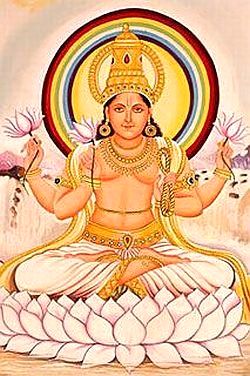
70.1. The Iconography of Varuna is highly varied. The variations are generally two-fold. One, the depiction of his image depends upon the stage of his career at which he is being discussed. For instance :

In the context of the early Rig Veda Varuna is a sublime , gracious and a very handsome deity who is  the lord of all existence .

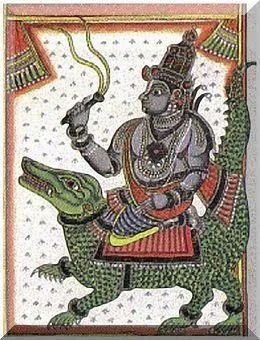
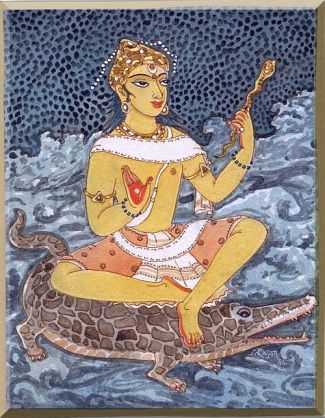
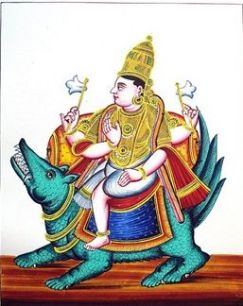
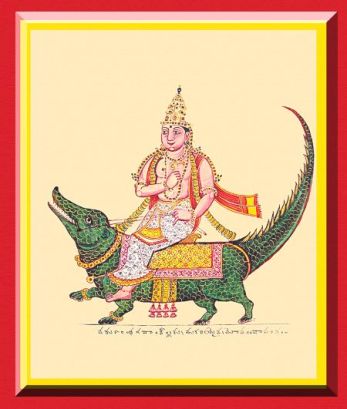
But , in the Brahmanas   he is depicted as a severe looking stern judge holding the punitive noose and riding a fearsome mythical monster Makara.

And again,  when he is portrayed  as a water-god the attributes symbolizing water element are stressed; and, when he is shown as Dikpala , the guardian of  the west , he is shown in the air riding his mount in the sky; and so on.

And the other is that the various texts of Shilpa Shastra and the Puranas each project its own version of Varuna image; and, they differ in details.

Thus , the Iconography of Varuna is not uniform; it is spread across a whole spectrum of varied notions of Varuna. In the iconographic sense there is not one but several Varunas. It might not therefore be possible to discuss the whole range of Varuna features. We may pick up just a few instances.

70.1. Before looking at few instances of his form,  let’s glance at his features in a summary fashion by putting together his descriptions scattered across several texts.

71.1. Most of the descriptions of Varuna celebrate him as the lord of the waters; and some (e.g. Aparajita pruccha)   hail him as the lord of the west. But, his original attributes, mentioned in Rig Veda, of being the lord of the sky or the governor of Rta are not stressed in the texts dealing with his Iconography. They are completely glossed over. That is understandable, because the Shilpa texts and the Puranas are far removed in time from the age of the Rig Veda; and these texts came into being centuries after the Vedic period. By then, Varuna’s decline and his demotion into a mere water-god had been complete.

: – Varuna is shown either in standing posture (sthanaka) or as seated (aasana) or as riding his vahana. But he is not shown in reclining position (shayana). He is shown either alone (kevala) or with his consort/s.

:-The Varuna – iconography sometimes describes him as having four heads (Vishnudharmottara) and four arms (in Rupamandana, Vishnudharmottara  and Aparajita pruccha) ; but, generally he is described with one head and two or four arms.

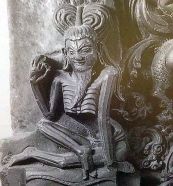
: – Varuna is usually presented as a bright looking, well built god of peaceful and benign disposition.  But he is also shown with a potbelly (a characteristic of lunar gods) . The Brahmana texts show him as an obscure (jambaka) ugly looking, white-spotted (shukla), a rather deformed bald headed fat man with protruding teeth (vikidha)   and yellow or brownish eyes (pingaksha).

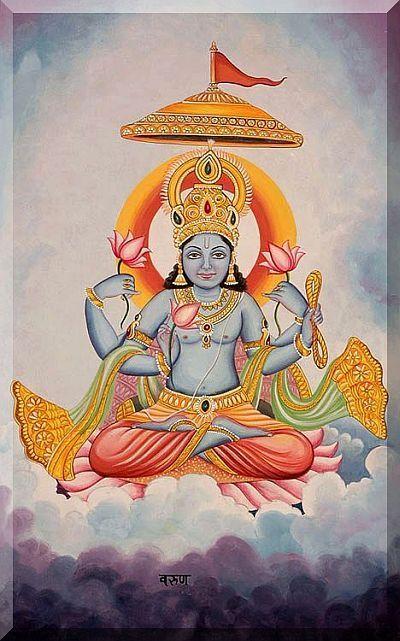
:-  His complexion too varies across the texts. In most of the texts he is described as of fair complexion radiant like a conch or a sparkling crystal (spatika). But he is also described as having glossy sky-blue complexion (Rig Veda, Vishnudharmottara); or lustrous golden complexion (Kashyapa shilpa), or dark complexion (Padma samhitha).

:- Varuna usually favours white colour; his garments, ornaments, garlands and necklaces are of white. But, in some instances he is adorned in red garments (kashyapa shilpa) or yellow garments (Shilparatna).

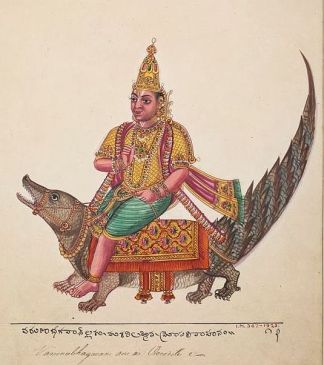
:- He is either seated or is riding a Makara (a mythical monster of which we shall talk a little later); but he is also mentioned as riding a crocodile (Rupa mandana) or seated on a swan or seated on a dog or a Makara with a dog-head (Mathsya Purana).In some older texts (Vishnudharmottara) his chariot is drawn by a set of seven swans. And, at times he is  shown sitting by a waterfowl.

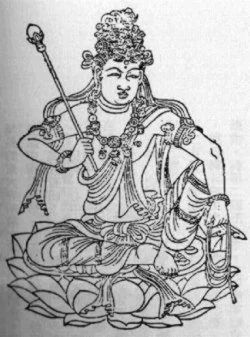
: – The Ayudhas or the objects he holds usually are: the pasa (noose), lotus, a jewel box, and a snake. At times he is depicted with water pot (kamandalu) or a mace (musala) or a conch (shankha).

: – Varuna’s abode as mentioned in the early Vedic texts is the atmosphere. In the   later texts, his abode is in the waters or a region in the ocean (pastatsu) in a multi-pillared mansion. He is also said to have palaces in hilly regions near the Meru on the Pushpagiri hills. Mahabharata mentions that Varuni (also called as Gauri), Vriddhi and Jesta (daughter of Shuklacharya) are his queens. He rides across the heavens in his glittering chariot. He has at his service thousands of spies who report to him on all that the men do or do not do.

Particulars of Varuna Iconography as in:

Rig Veda

72.1. Rig Veda describes Varuna’s appearance in glowing terms: as the most resplendent god of glowing- sky-blue complexion, with Agni in his face and Surya in his eye. He is far sighted (uru-chaksasa). He is the eye of all the worlds (jagath-chakshu- RV.1.25.5). He has soft and beautiful hands (supani) in which he holds lotuses and an auspicious noose . He is splendidly adorned in golden mantel (drapi) and a shining robe. His chariot dazzles brilliantly like sunrays (ghabasti suro nadyauth – RV.1.122.15).Varuna and Mitra ride the golden chariot like floating clouds in the blue sky, drawn by well yoked steeds. (RV.5.62.7). in the midst of vast heavens urukşhaya (RV. 1.2.9) he is seated on a splendid throne placed in his  golden palace of thousand pavilions, thousand columns (RV. 2.41.5) and thousand doors (RV. 7.88.5).  From his glittering throne, the monarch (samrajnya) watches over the deeds of all men and gods (pastyasu) – (RV .1.22.11-12).

Brahmanas
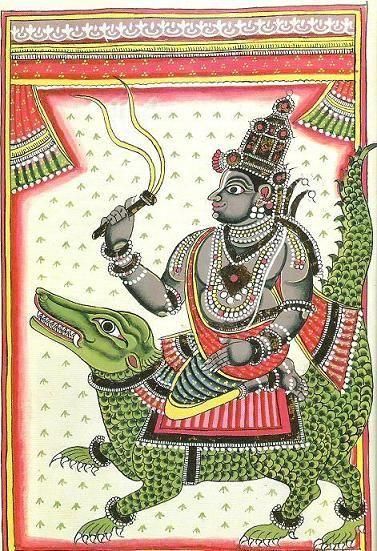
72.2. Taittereya Brahmana (3.9.15.3) and Shatapatha Brahmana (13.3.6.5) present a totally different and a fierce picture of Varuna. He is ugly and deformed. He appears here as an obscure figure (jambaka) , as a white-spotted(shukla) bald headed fat man, with protruding teeth(vikidha)  and reddish brown eyes (pingaksha).But, he is embellished in golden ornaments .

Puranas

72. 3 .1. The sixth century –text Vishnudharmottara Purana (part three, Ch.52, verses 1-21) as also Brihatsamhita carry almost identical descriptions of Varuna. In the Vishunudharmottara, sage Markandeya explains that the image of Varuna the lord of waters should be made on a chariot with seven swans.

**

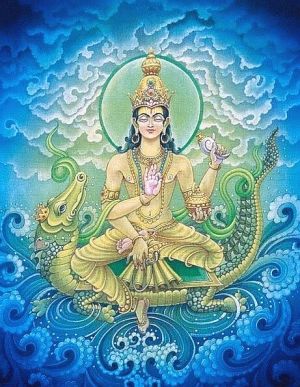
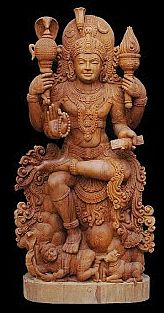
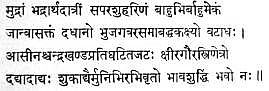
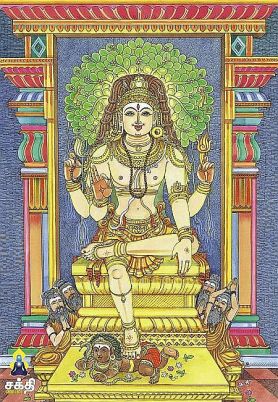
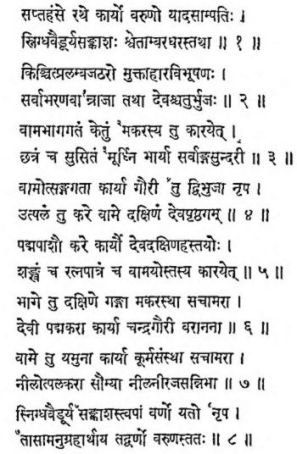
Vishnudharmottara (3. 52. 1-8), while detailing the iconographic features of the Lord of waters (Jala-adipa) Varuna, states that Varuna should be seated in a chariot drawn by seven swans (Saptha-hamse). He should be dressed in white robes, glowing like precious gems. He should be depicted with four arms; a slightly bulging belly (Kinchith-pralambo-jataro), adorned by strings of pearl necklaces swing (Mukta-hara-vibhushanaha ). He should be decorated with varieties of ornaments (Sarva-abharana).

Varuna should be depicted with four arms.  In the two Right-hands he holds a lotus-flower (Padma) and a noose (pasha). In his two left hands he holds a conch (Shankha) and a bowl containing gems (Ratna-patra).

His most beautiful looking, fair complexioned wife, seated on his lap, should place her right hand on the shoulder of Varuna, while she holds a fresh lotus flower in her left hand.

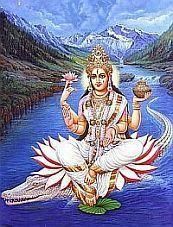
To his left is Goddess Ganga, riding a crocodile. The beautiful faced Ganga, shining like a clear moon, holds a lotus flower (Padma-hasthe).

And, to his left again, is the goddess representing the river Yamuna. She is dark like a blue-lotus; and, rides a tortoise.

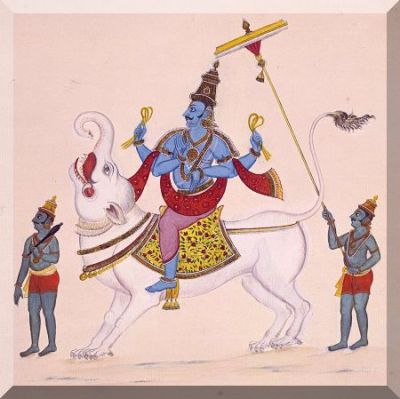
Behind Varuna; and to his left should be displayed his flag carrying the emblem of a crocodile. And, a white parasol should be placed over his head.

Sapta-hamse-rathe karyo Varuno yada sampathi /snigda vaidurya-samkashaha swetambara -dharatha / 3.52.1 /

Kinchith-pralambo-jataro-muktha-hara-vibhushanaha/Sarva-abharana-van-tatha-Devasha   Chatur-bhujaha  /3.52.2. /

Vama-bhagha-gatam ketum Makarasya tu karayeth / Chatram cha susitam mudhni-bharya Sarvanga-sundari /3.52.3 /

Vamothsa Ganga karya Gauri tad dvi -bhuja Nrupa / Utphalam to Kare Vame , Dakshinam Deva-prustagam /3.52.4 /

Padma-Pashau-kare karyayi Deva Dakshina-hasthayohu/Shankham cha Rana-patram cha vama-hasthosya karayeth /3.52.5 /

Bhage tu Dakshine Ganga Makarastha sa-chamara / Devi Padma-karau karya Chandra-gauri varanana /3.52.6 /

Vame tu Yamuna karya kurma-samstha sa-chamara / Nilothphala-kara Soumya Nila-Niraja-sannibha /3.52.7/

Snigda-vaidurya-samkashatvapo-varno yatho Nrupa / thayor anugraha-arthaya tad varno Varunas-thatha /3.52.8 /
Varuna


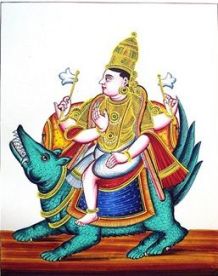
Elsewhere it is said; His colour resembles the glossy brilliant blue (lapis-lazuli). His blue is described as the colour of clear blue sky reflected in a tranquil pool of transparent water. Varuna is depicted with four faces, a slightly prominent belly and four arms holding   in his:   upper right hand – a noose, upper left hand – a conch, lower left hand a – jewel box, and in his lower right hand a lotus.

72.3.2. As per the Varuna Dhyana sloka, Varuna is smiling, gentle colour of snow, lotus or moon. Varuna is wearing white garment; and is well adorned with ornaments and rows of pearl necklaces .He is seated on a magnificent throne along with his two queens (Ganga and Yamuna) . A white umbrella named Abhoga mounted atop the throne is spread over his head. Incidentally, that white umbrella emerged from churning of the ocean and was given to Varuna. White umbrella (sveta chattra) is a royal insignia. His emblem Makara the mythical creature is placed to his left. Varuna, in most cases is depicted as a highly respected king.

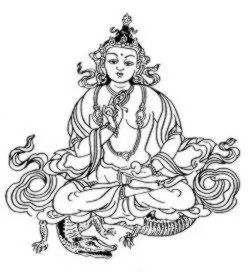
72.3.3. In the Matsya Purana (26.17.18) Varuna is depicted as a mighty (maha-balam) god of peaceful continence. He has two arms; and  he holds the Pasa; and,  gestures assurance (abhaya) or blessings.  He is   fair in complexion; and glows like a conch (shankha) or the crystal (spatika). He is adorned in white garments, ornaments of pearl, white flower garlands, rows of pearl necklaces and an ornate crown. He is riding a dog or a Makara with dog’s head (basha asana).

Again , Matsya Purana   (174.15) sketches Varuna as standing in the midst of army of gods ,  holding a noose and waiting for the fight to commence, like an ocean furious to overshoot the shores .

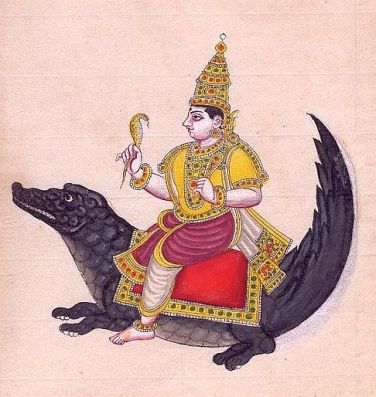
At another place, Matsya Purana (260.17.18) describes Varuna of white complexion like that of a conch and crystal (spatika) . His disposition is peaceful.  He is adorned with white garlands and garments.   He is seated on a Makara or crocodile wearing a crown.
Varuna2

Texts of Shilpa Shastra

Similar descriptions of Varuna are provided in the texts of the Shilpa Shastra.

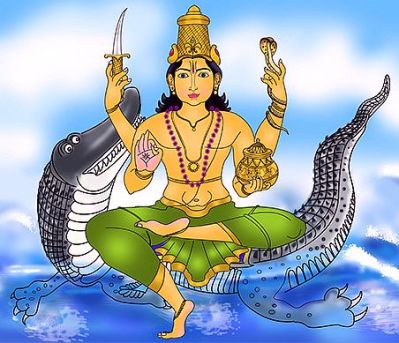
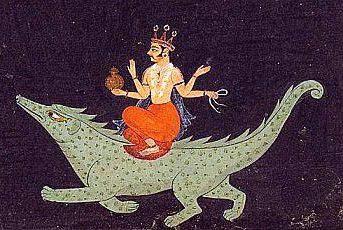
72.4.1. Rupamandana (2.35) describes Varuna the regent of the west as having four arms. In three of his hands he holds a Pasa (noose), a lotus and a jewel box (lower left hand). And, his lower right hand is bestowing blessings on the devote. He is riding a crocodile (nakra –arudam).
Varuna on makara 2

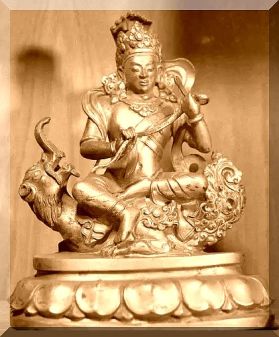
72. 4.2. Pushkara samhitha (4.153) describes Varuna as the lord of waters who is strong and well built (bhimam). His complexion glows like a fresh pearl (muktha-phala dyuthi samam) . He is ever surrounded by thousands of Naga nymphs (naga kanya sahasradyam). He rides a Makara.
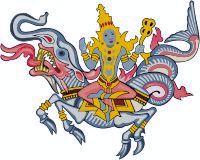
   

72.4.3. In contrast to that, Padma Samhita (22.60) and Haya shirsha Samhitha (Adi.25.8) present Varuna as dark complexioned (varunam shyamalam). Of his two hands he holds in the left a noose (pasa) and with his right he gestures assurance (abhaya pradam) and blessings. He is resplendent with his sparkling   earrings in the shape of Makara (makara kundala) and in his bright crown modest sized crown (karandi makuta).
Varuna on Makara

72.4.4. In Kashyapa shilpa shastra (48.52.-54) Varuna the lord of waters is adorned in red garments (raktha dharo bhushitam); his body is lustrous as gold (swarna varni) .In his two hands he holds a snake (naga) and a noose (pasa) .He rides a Makara with his consort Padmini Devi.
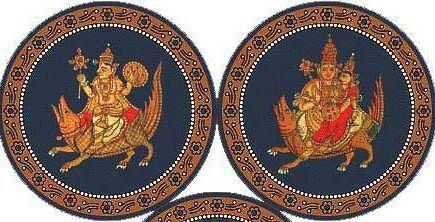
72.4.5. Shilpa -ratna gives a slightly different version of Varuna. Here the benign (saumyam) and peaceful (shantam) looking mighty (maha balam) is resplendent and fair (swetha varnasthu). He is wearing yellow garments (pitha vastra dharam); and is richly ornamented (sarva-bharana bhushitam) and is adorned with a crown (karandi makuta). He holds a noose (pasa) in each of his two hands; and is riding a Makara. . He is placed in a yajna pavilion (yajna satra).

72.4.6. In Aparajita pruccha (213.13) Varuna the regent of the west is described with four arms. He holds in his upper right arm a pasa (noose), in his upper left a lotus or a naga , in the lower left a water pot (kamandalu) and with his lower right he bestows assurance and blessings (varam).He rides a Makara.
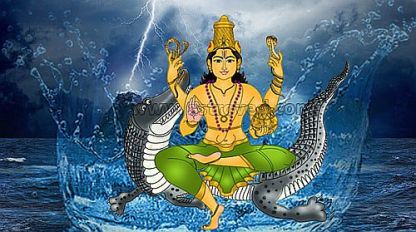
varunan

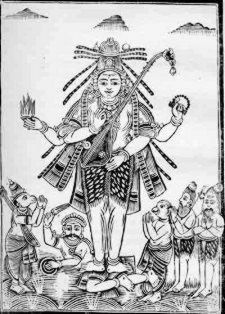
72.4.6. Hayastra Pancharatra depicts Varuna as a water-god; he is shown with two arms standing on back of a swan. His right hand shows gesture of removing fear (abhaya).In his left hand he holds a noose made of a snake. The water pot is to his left. He is accompanied by his consort Vriddhi on the left and his son Pushkara on the right. He is surrounded by serpents, rivers, and water animals.

In the niches of temple walls

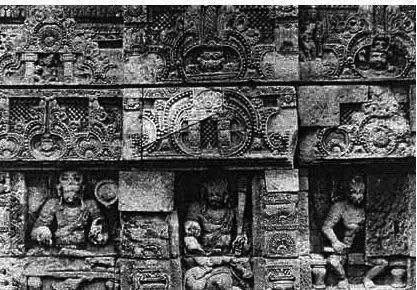
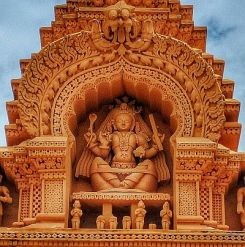
There are of course no temples dedicated to Varuna. But, his image is at times carved in the niche of the western temple walls. Let’s see a few such instances.

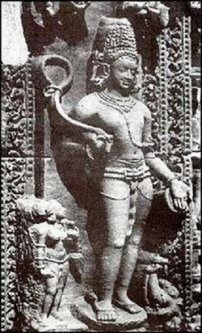
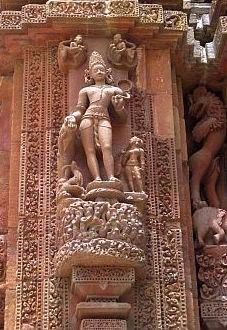
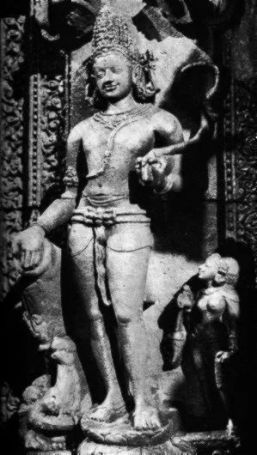
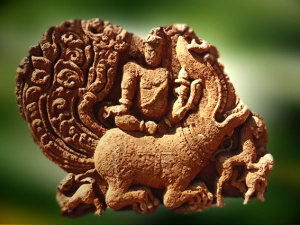
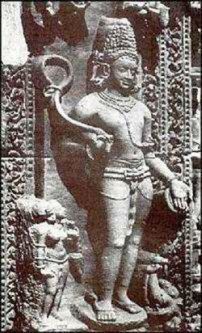
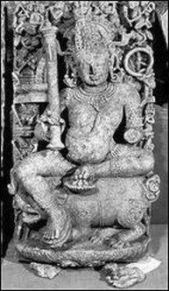
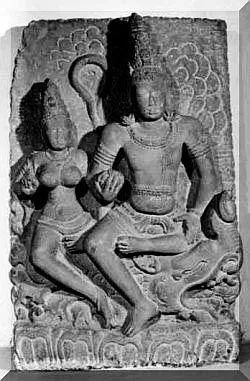
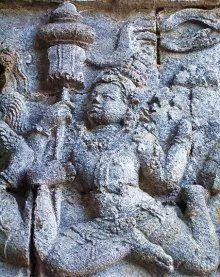
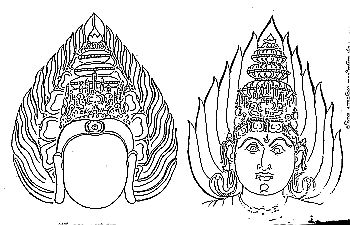
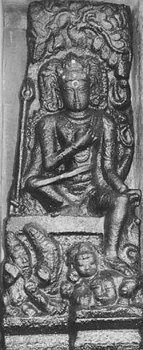
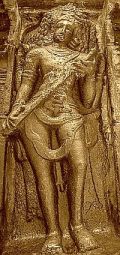
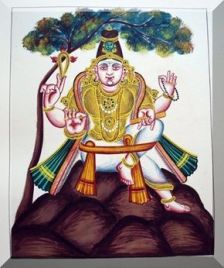
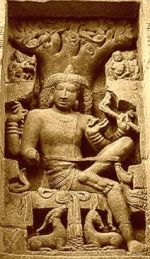
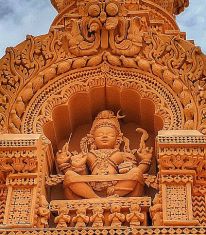
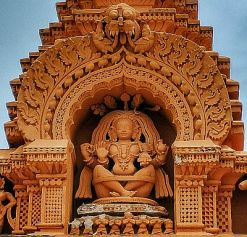
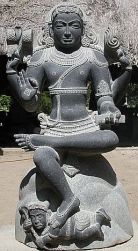
73.1. In the eleventh century Brahmeshwar temple, Bhubaneswar Orissa , an image of Varuna is carved in the niche on its western wall . Varuna is depicted as standing (sthanaka) in a relaxed and graceful posture holding in his right hand a long noose by its end while his left hand is placed on his hip. In his lower left hand he holds a water vessel. He is adorned with jewelled crown,( ratna-kundala,) pearl yajnopavitha that runs down across his chest, , and  with a waist girdle. An oval halo is carved around his head. At his feet lies the Makara with its mouth open standing in the waters. His consorts carved at the base in miniature figures carry lotuses.

73.2. In the Raja-rani temple at Bhubaneswar, Varuna two armed is standing near Makara. He holds a noose in his left hand.  And his right hand shows gesture of removing fear (abhaya)a noose (pasa) by its end in the left. Makara is depicted next to him. This sculpture is remarkable for its relaxed demeanour, pleasant facial expression and rich ornamentation.

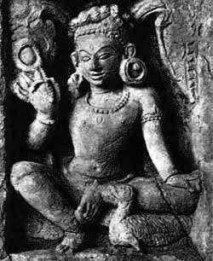
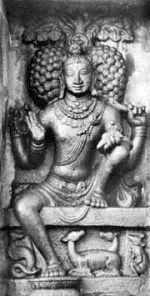
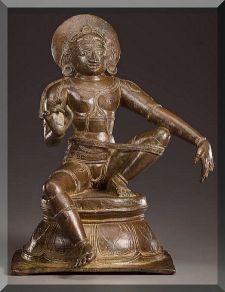
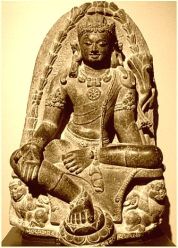
73.4. In the Kosalesvara temple (c. eighth century) at Patnagarh, Orissa, an exquisitely carved image of a youthful Varuna sitting in a relaxed pose (lalithasana) is on the temple wall on the west. He is richly ornamented with a beautiful crown bearing a kirtimukha logo at its centre,  a semi oval Prabhavali (orb ) placed behind his head, rows of necklaces (Hara, Keyura, Kankana, Katisutra) and an yajnopavitha across his chest.
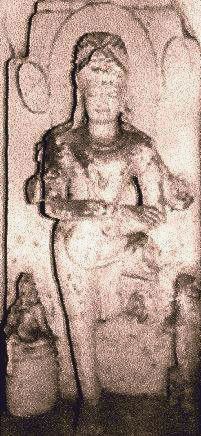
73.5. Varuna is often depicted along with a waterfowl as in the following.
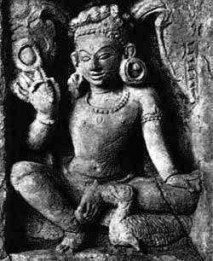
73.6. A seated figure of Varuna is carved on the walls of the Parasuramesvara temple, Orissa, (c.10tcentury).  Varuna is on the lower left.

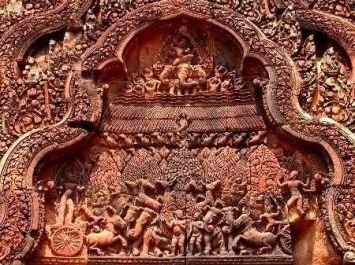
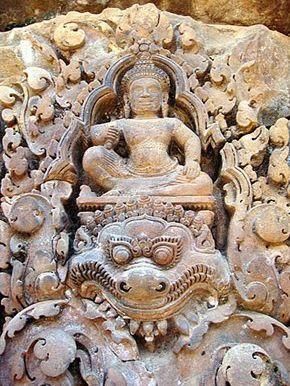
73.7. The tenth-eleventh century temple of   Banteay Srei, Cambodia, displays rich and varied depictions of Varuna as riding a swan or a Makara; and surrounded by host of followers.

W. Makara

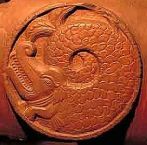
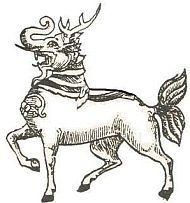
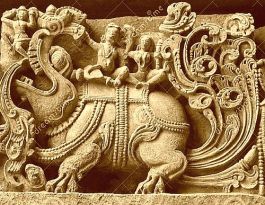
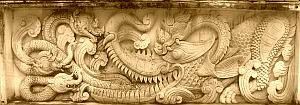
74.1. Makara is often translated as crocodile. In the context of Indian iconography that may not be quite correct. Makara as referred to here is truly a mythical creature that combines in itself the features of several sea and land animals.  Makara has no well defined form or structure. Its appearance varies depending on the features of the animals that combine into its form. Perhaps because of its indefinite form, Makara is termed a monster  in the sense that it is neither this nor that. It is a mythical beast of both land and sea with fanciful features.  Almost any weird combination of animals could be a Makara. But the two common features of all Makara forms are: a long and a probing snout; and the other, an elaborate and spread out tail.

75.1. In the Indian Iconography ,  Makara is a composite figure, generally,  with a trunk as that of an elephant, ears like that of a cow, eyes as those of a fish, body as that of a boar, and the tail elaborate and  bushy like that of a peacock ; and its legs resemble that of a lion . It could even be presented as fantastic marine monster structured with the body and tail of a fish and the forelegs, neck, and head of an antelope, an alligator, or a shark; or whatever.
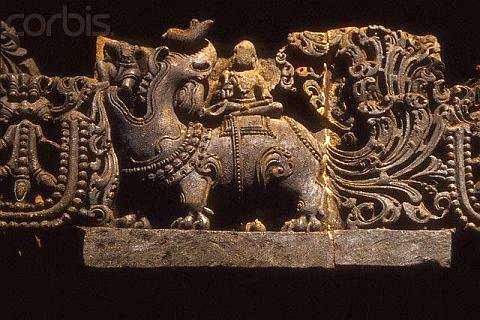
75.2. It is also called kantaka, Asita-dramstra (black teeth) and jala-rupa (water form). Makara may be shown either as carrying a rider on its back (vahaka yuktam) or it may not (svatantram). It may even be shown as if it is ready to pounce and attack (yuddha sannaddham) or just being playful (kridabhi-ramakam).

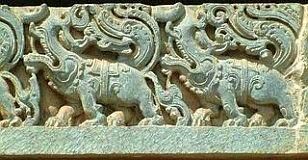
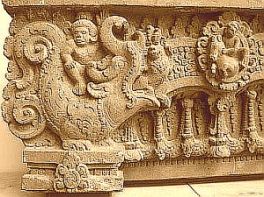
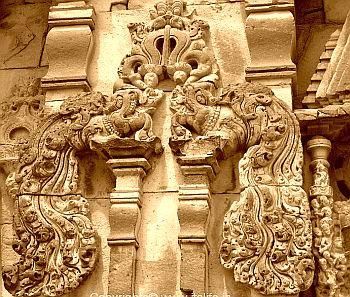
75.3. A feature of Indian temple architecture is Makara –Torana    the ornamental arch way to the temple entrance; it  also adores the doorway   to the sanctum. Makara toranas are very varied with endless permutations of elaborate patterns and designs. But, invariably the toranas are artfully designed to suggest as if the doorway is held afloat, at either end, by the extended snouts of two Makars with frothy or bushy peacock tails. Even the Buddhist monuments including the gateway to the ancient Sanchi stupa are decorated by Makara toranas.
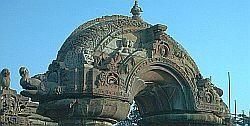
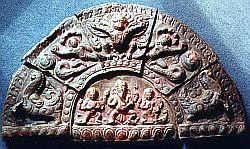
75.4. Sometimes, when it is used as a decorative motif its entire body may not be depicted; but, only its head could be detailed along  with its tail either well spread out and standing up (puchcham urdhva visrtam) or spread around (sarvato gatam) or hanging down to earth (bhu-pranta vikshiptam) .

Makara Indus script

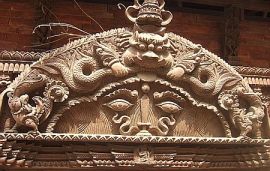
75.5. Makara’s face alone is used in Indian temple architectural element as kirtimukha “glory face”.

Kirtimukha, Nepal

75.6. Makara as a decorative and as a royal insignia is well accepted. It is a widely used decorative embellishment and a symbol in most Indian works of art and in iconography.
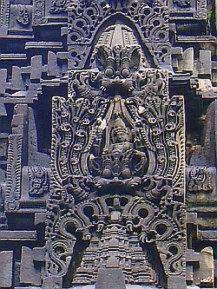
Makara – an Indian symbol that travelled worldwide
76.1. Makara is essentially an Indian symbol. It is very ancient too. In the Bhagavad-Gita Sri Krishna mentions “I am Makara among the aquatics (jhasanam makarah) just as the Ganga among the rivers and Rama among the warriors”- (Gita .10.31). As a sea creature, Makara may have initially been a fish or a crocodile but later on it took many fanciful forms.And, it spread to to the Far East  to Combodia etc.
makara hoysalaMakara, Cambodia

The Makara concept seems to have captured the imagination of rest of the ancient world too. Makara in its various forms and manifestations spread to west . And it is said, Makara‘s metamorphosis is the Babylonian water-god Ea an antelope-fish; the goat-fish Capricorn of the Zodiac; the horse-headed sea-water animal or water-serpent Nykkur of Norse legends; and, the mythical seahorse and the dragon. Even the Sphinx could be termed a Makara.  It is also explained that in old-Greek Makara means ‘the blessed ‘and is root of Greek names such as Makarios.
catphoto

76.2. The combination of the features of an aquatic animal, a serpent, an elephant and the dragon; as also the mystic symbolisms associated with it inspired the legends, myths and all art forms in Burma,  China , Far East and  in Buddhism. It is also said; the ancient flag of ancient seafaring people of Sri Lanka, the Karware carried the Makara emblem with an image of a fish at its centre.  Burma’s animal of five beauties is also a Makara.
Makara Symbolism

77.1. Makara is rich in symbolism. Ananda K Coomaraswamy (in his Yaksha) writes “Makara is a great Leviathan (serpent) moving through the primeval waters, the cosmic ocean of the night sky, which contain the essence of life.” He suggests, Makara stands for Prakrti that manifests the un-manifest. He equates Makara with the abode of lotus which in turn symbolizes life.

77.2. In the Indian calendar , Makara –Sankranthi (in December/ January) marks the end of winter solstice and the entering of the Sun into the tenth house of the Zodiac heading toward the northern hemisphere. It is the dawn for the gods. It also is the birth of time; and the first day of the New Year. Makara is associated with creation-process; thus, it symbolizes time and its cyclic nature. Makara is therefore prominently placed in Sun temples.

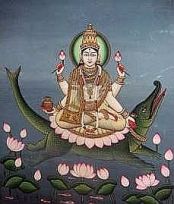
77.3. The Makara, its forms and symbolisms have permeated Indian art and living at various levels. Apart from being a royal insignia and serving as a decorative designer as a structural bracket, Makara is the vahana, the vehicle or the ride, of Varuna, the goddesses Lakshmi, Ganga and Saraswathi; and, is the banner on Kamadeva’s flag. The earrings of Vishnu and other gods are in the shape of Makara (Makara-kundala). In astrology Makara is related to constellation of Capricorn (Makara-raasi) with Sea-Goat as its symbol.

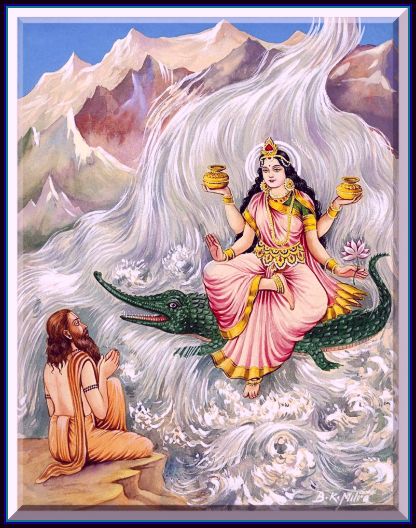
The Vahana of the celebrated holy goddess Ganga who descended from the heavens, to satisfy the penance of the Sage-King Bhagiratha  , to bless and purify the earth , was also the Makara
There is even a depiction of the five-faced Hanuman riding a Makara
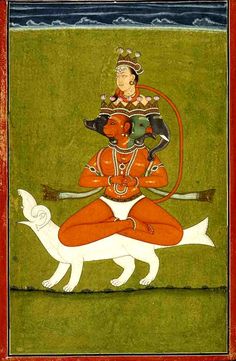
Five-faced Hanuman

77.4. The elephant-like trunk of the Makara and the waters bring together Lakshmi goddess of beauty and prosperity and Ganga the river goddess. Elephants are associated with clouds, rains and waters. Makara which serves Lakshmi, Ganga and other river-goddesses as their vahana, the ride, is also connected with water.
Ganga

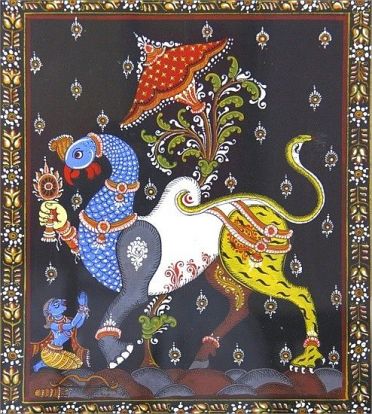
[Note: Wherever there is discrepancy between the narration and the picture  ; please take the narration and ignore discrepancy.]
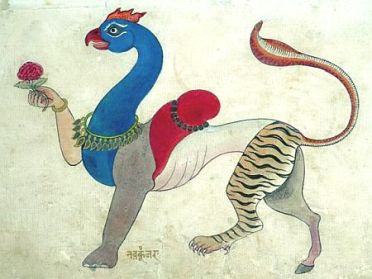
navagunjara

navagunjara

Continued

in the Next Part

References and Sources

1. Indra and Varuna in Indian Mythology by Dr. UshChoudhuri; Nag Publishers, Delhi, 1981

2. The Indian Theogony by Dr.Sukumari Bhattarcharji, Cambridge University Press, 1970

3. Asura in early Vedic religion by WE Hale; Motilal Banarsidass; Delhi, 1986

4. Goddesses in ancient India by PK Agrawala; Abhinav Publications, New Delhi,1984

5. The Hymns of Atharvan Zarathustra by JM Chatterji; the Parsi Zoroastrian Association, Calcutta, 1967; http://www.avesta.org/chatterj_opf_files/slideshow.htm.

6. Outlines of Indian Philosophy –Prof M Hiriyanna; Motilal Banarsidass, Delhi, 2005

7.Original Sanskrit texts on the 0rigin and history of the people of India, their region and institution By J. Muir;Trubner & co., London, 1870.

8. A classical dictionary of Hindu mythology and religion, geography, history, and literature byJohn Dowson; Turner & co, Ludgate hill. 1879.

9. Vaidika Sahitya Charitre by Dr. NS Anantharangachar; DVK Murthy, Mysore, 1968

10. Sri Brahmiya Chitra Karma sastram by Dr. G. Gnanananda

11. Zarathustra Chapters 1-6 by Ardeshir Mehta; February 1999

 http://www.indiayogi.com/content/indgods/varuna.aspx

http://www.bookrags.com/research/varua-eorl-14/

http://www.bookrags.com/wiki/Varuna

http://www.hinduweb.org/home/dharma_and_philosophy/vshirvaikar/Dnyaneshwari/Dnch10pg1.html

http://rashmun.sulekha.com/blog/post/2010/03/vedic-literature-the-degradation-of-varuna-and-indra.htm

http://www.newworldencyclopedia.org/entry/Varuna

http://www.indiadivine.org/audarya/vedic-verses/453851-vak-suktam-aka-devi-suktam.html

http://www.svabhinava.org/HinduCivilization/AlfredCollins/RigVedaCulture_ch07-frame.php

http://en.wikipedia.org/wiki/Ahura_Mazda

http://www.iamronen.com/wp-content/uploads/2010/05/ReadingLila.pdf

 http://www.hummaa.com/player/player.php

All images are by courtesy of Internet

 
10 Comments

Posted by on October 5, 2012 in Iconography, Varuna


Tags: , , , , ,

Varuna and His Decline – Part Five

Continued from Part Four

Decline of a Great and a Noble god

The explanations for Varuna’s decline in stages and his eventual fall from the high pedestal are many. Let’s see some of those.

R. The Decline

Loss of sovereignty

59.1. As mentioned earlier, Varuna derived his sovereignty (kshatra) and the supreme status among the gods by virtue of his being the sole sky-god. He embodied the sky in all its aspects. He encompassed   the sky, the earth and all existence. Besides, he was the all-knowing Lord (Asura –visvavedasa; Devo Aryah) ; and the sole governor of the natural and moral laws that operated in heavens as on earth.

59.2. That, however, was a short-lived glory. Varuna’s suzerainty over the sky was lost. His powers were curtailed.   Varuna soon had to share his powers and control over the sky, the Rta and the Dharman (RV 3.59.1; 1.5.81) with Mitra regarded more active and more vibrant. Mitra came to symbolize the day sky with all its brilliance; while Varuna who earlier was the lord of the entire sky had his authority restricted to the night sky (RV 4.8.3 and TS. 4.8.3) with its thousand stars symbolizing his thousand eyes (sahasraksha) watching in secret the activities of men at night.

That was the beginning of a great slide.

[A brief note on Mitra: Of all the Vedic gods, Varuna is most closely related to Mitra. In the Vedic times Mitra was not an independent god; he was always mentioned in company of his friend (except in one hymn). It is said, he was given the name Mitra because he was the friend of Varuna. They were fused into the dual god  Maitra-Varuna and Deva –asura (a dvandva or compound) sharing common functions and authority (mahaanta mitravaruna samraja devasura –RV 8.25.4). 

In the Avesta , they are termed as Mithra-Ahura (Ahura-Mithra) . They together became the guardians of the world (RV. 2.27.4). And it is said; the great sky shines by their ordinance (RV.10.65.5). They discharge the rains (RV 1.151.9). Their godhead is beyond the ken of the skies or of the rivers (RV 1.151.9). They are awful deities; haters and dispellers of falsehood (RV .1.152.1); they are the gods of the oath. 

Mitra together with Varuna becomes the keeper of Rta and Dharman (RV 8.25). They are described as righteous Rtavan and promoters righteous rites Rtavardha, and lords of truth and light (Rtasya jotisaapathi – RV. 1.2.8; 1.23.5; 1.136.4; 2.27.4; 5.63.1). Varuna becomes Agni in the evening, and rising in the morning he becomes Mitra (AV .2.28.2). It is also said ; while Mitra is the Hotar , the invoker; Varuna is the Agni (Jataveda) – Mitra hota, Varuna jathavedah (RV.3.5.4)

It is explained; though the attributes and the functions of the two are different, dissimilar and contrasting, they complement each other well. The two ever exist and work in harmony. They present a well knit unity; the oneness of two contrasting factors: Being and Non-Being; day and night; light and darkness. Mitra and Varuna are indeed the two aspects of the same reality.

Eventually both Varuna and Mitra had to give place to gods greater than both of them.]

Mitra Varuna surya

 tan mitrasya varuṇasyā abhicakṣe sūryo rūpaṃ kṛṇute dyor upasthe |RV.1,115.05 /

The wonderful host of rays has risen: the eye of Mitra, Varuna, and Agni: the Sun, the soul of all that moves or  Immovable, has filled the heaven, the Earth and the firmament. Rig-Veda: 1, 115,

Association with night and dark traits

60.1. Mitra symbolizing day-sky and light gained identity with god of sunlight (Tai Br. 25.10.10). With that, the virtues of clarity, brightness which reveals reality and the life-giving energy became his attributes. He was also associated with the bright-half of the month (Shukla-paksha).

Varuna, on the other hand, as the night-god acquired the attributes of darkness such as: secrecy, mystery and the nature of concealing. And, he got associated with the darker-half of the month (Krishna –paksha).

60.2. His association with night and darkness is not stressed in the early Vedic texts where he merely represents the star-eyed night sky. But, in the later texts his dark and malevolent traits begins to emerge clearly. It is said, the merciful Mitra pacifies the cruel Varuna (Mitro hi kruram varunam shantham karoti –TS. 2.1.9.5).

60.3. Varuna, the son of Aditi, who was a solar deity (Aditya) and the chief of the Adityas; but now he is drawn nearer to lunar deities: Rudra, Soma, and Yama and to Agni another night god. He also comes close to the gruesome aspects of life symbolized by Nirtti who is the evil genius of destruction, dissolution and misfortune.

Varuna is now portrayed as a spy-master (Spasa) and a stern judge whose punitive weapons are torture, sense of guilt, disease and sudden death. Varuna’s serene form too turns ugly. He now has a potbelly, bald head, protruding teeth and reddish-brown or yellow eyes.

Inconsistent disposition

60.4. The other reason cited for Varuna’s decline is the suspected flaw in his disposition. Varuna was perhaps not wholly benevolent like Indra of the early Rig-Veda. The ambivalent character of Varuna–now favourable and now unfavourable; and his inconsistent disposition was far from admirable. Further, Varuna, for some reason, acquired the unenviable reputation of one indulging in guile and trickery. His character was shaded with a sort of ambiguity. The Vedic poets did not seem amused by a less –than- perfect Varuna; they were decidedly in favour of uncompromisingly good gods.

Further, Varuna was of passive tendencies. And, like his predecessor Dayus, he too lacked aggression and convincing positive traits.

60.5. Loosing suzerainty over the sky and being restricted to night sky marked the beginning of Varuna’s decline and emergence of his darker traits. Thereafter he went down steadily. With the passage of time, the lordship, power and glory depart from Varuna.

The other explanations

The other reasons offered to explain Varuna’s fall from kingship and power, which led to his eventual eclipse, has lot to do with the history of ancient mythology. In the Indian context, history and mythology are entwined; they can hardly be separated.

Bhrigu-Angirasa rift

61.1. One explanation is that Varuna’s decline in the Vedic pantheon has to be placed against the continuing rivalry between two ancient sages Bhrigu the priest of the Anus (in the west) and Angirasa the priest of the dominant Puru-Bharatas in the valley of seven rivers. Their rivalry spread into recurring conflicts between the two clans.

The differences arose between the two sages; it is said, on issues concerning the concept of a single god and the worship practices.

The tendency of the Angirasas to treat all gods as equal and to shift towards worship of the Supreme through personalized forms or murtis; to glorify the warlike Indra; and to sideline the righteous Varuna as also his governing principle Rta  , all these, greatly annoyed  the Bhrigus.

The Bhrigus in turn asserted their faith (which they said was ancient) in monotheism and in the worship of the single-god through formless fire. The Bhrigus placed the ancient god Varuna in the centre of their cosmology and hailed him as the only worship worthy god.

The Angirasas on the other hand glorified the younger god Indra but treated him as one among other gods and as one of the many manifestations of the Supreme Being; and they assigned forms and attribute to all gods. But, as said, the Angirasas were the dominant priests in the Vedic community and their views determined the hierarchy among the Vedic gods.

The battles that Vedic communities had to fight

61.2. According to another argument, the decline of Varuna and the ascendancy of Indra have to be viewed in the context of the trials and tribulations of the Vedic communities; and in the context of the wars they had to fight. Varuna till then their mightiest god belonged to the older generation of gods; he was essentially a god of righteousness and of placid nature. He was ideal for times of peace and comfort. But in hard-times when they were besieged and had to fight back the encroaching enemy they desperately needed a leader who could stand up to the demands of the challenging times, inspire them to act resolutely and to lead them in battle against the foe. They prayed for a god of war to beat back and destroy the troublesome enemy. Varuna was just not such a leader; he hardly had the vigour to inspire the heroic qualities in men, especially as he had no exploits to his credit.

Coming of the new king

62.1. Rig-Veda describes its people ‘as averse to war; peace being their normal rule’ (RV.6.41.5). It also narrates the difficulties of its people having to fight battles without a capable war leader; and the woes it brought   upon people unprepared for war: ‘we are surrounded by mighty enemies; help us’; ’ we lost because we had no king to lead us’; ‘they conquer us because we had no warrior Rajanya’. And eventually all said ‘let’s make a king’. So, they did make a king. They heartily invited the new king to lead them in the battles: “I do hereby crown you as the king. Rule us with courage and an unwavering resolve. Let all your subjects love you. Let thy kingdom be with you forever RV 10.12.02) “. And, to the king ‘who is the dread in the battle contest’ they all ‘bowed in reverence’ (TS.3.4.4.1)

62.2. The times of crisis and war somehow always throw up a boisterous and an inspiring leader; the type that is just needed. That new leader was Indra; full of vigor, a mighty god, a tornado divinity symbolizing storm and wielding a thunderbolt. He is a hero who ‘destroys in conflict the fierce and the exceedingly strong’. He was a god of battles rather than of righteousness. Indra thus possessed the requisites of a war lord and a typical king. He came as an answer to the prayers   of fighting men thirsting for win over enemies, and for power and glory it brought.”Heroes with noble horses, well mounted and passionate for a fight invoke me; invoke me in the battle. I the mighty Indra of victorious powers , lord of spurring vigour lead you on in the combat stirring up the battle dust” (RV .4.42; 10.129). Indra’s warriors did invoke him and stormed into battles shouting his names (Indram narone maditha havanthe – RV.3.34.9).

Rise of Indra and the kingship

indra

62.3. Indra broke the treaty; and, in a fierce battle defeated the dreaded enemy Vrita , who had stolen  waters from the heavens . Mitra and Varuna , described as the arms of the king , helped the king (Rajanya) to kill Vrita (SB . 5.3.5.28). Indra also subdued and routed ten other fearsome enemies, in hard fought battles. Varuna helped Indra in all the battles that he fought.

mitrasyāsi varuṇasyāsīti bāhvorvai dhanur bāhubhyāṃ vai rājanyo maitrā-varuṇa-stasmādāha mitrasyāsi varuṇasyāsīti tadasmai prayacati tvayāyaṃ vṛtram badhediti tvayāyaṃ dviṣantam bhrātṛvyam badhedityevaitadāha – SB. 5.3.5.[28]

Eventually, those victories as also the restoration of waters to the gods established Indra’ authority as the king of gods, bhuvo janasya divyasya rājā (RV. 6.22.9).

Indra, formerly the god of rains, with some relation to war;  now,  turned into the god of war , with some relation to rains.

varuna indra vratra

[As per its etymology, the term Indra denotes the one who, by his power (Indriya), energizes or kindles the vital airs (prana). The Satapatha Bråhmana  6.1.1.2  says, since he kindled (indh ), he is the kindler (indha ). But, cryptically, he is called Indra

sa yo yam madhye prāa | ea evendrastānea prāānmaindra ityācakate paro
‘k
am paro ‘kakāmā hi devāsta iddhā sapta nānā puruānasjanta6.1.1.[2]

Besides the etymology of Indra, as above (from indh), the Taittiriya Bråhmana  (2.2.10.4) offers an altogether different explanation : “No one can withstand this power  in him (idam indriyam) . That is why he is called ‘Indra’.”

Two different etymologies of one word , in one and the same passage,  occur at Satapatha Bråhmana 11.1.6.7

so’rcañcrāmyaścacāra prajākāma sa ātmanyeva prajātimadhatta sa āsyenaiva
devānas
jata te devā divamabhipadyāsjyanta taddevānā devatva
yaddivamabhipadyās
jyanta tasmai sasjānāya divevāsa tadveva devānā devatva
yadasmai sas
jānāya divevāsa1.1.6.[7] ] 

indra3

[Let me digress here for a short while:

(i). The transfer of power from Varuna to Indra marked a significant phase in the social and military history of very ancient India. It redefined the notion of a ‘king’ as in Rig Veda. The ‘king’ in its early phase largely meant a very exalted noblest person who was looked up to by all in reverence (e.g. Dayus and Varuna). The kingship was symbolic rather than  temporal; he need not have to defend a territory or fight an enemy. But, with the installation of Indra as the king, things did seem to change.

It became obvious that a person though righteous but without valour and aggressive tendencies was unfit for kingship. A king, it said, ought to be the foremost   protector of his people. He should be a leader of his people at all times – in war and peace. Because, his subjects look up to him for leadership, guidance and protection; and, they do so in faith, reverence and in fear. In dire times the king should himself lead his warriors in battles   to fight for the honour and the lives of his people. Not only that, the king had to strive to enhance his position as also that of his kingdom among their   rivals. That meant that a king would necessarily have   enemies; and hence the need for a standing army.

(ii). Kingship also meant that the diverse interests of all sections of the society were surrendered to the king   who was expected, in good faith, to harmonize conflicts and to protect interests of all equitably.   That implicit faith and submission to the king elevated kingship to the position of the god-on-earth. And, It also came to be accepted that one could not be a king without a spark of divinity in him (na vishnuh prithvi pathihi).The king therefore was accorded the most exalted and the   highest position in the social hierarchy. He came to be described as the best of men (narotthama). And, even at much later times the Buddha placed the kings (khattiya) higher than Brahmans (Angostura Nikaya, 107). In the epics too the heroes who became gods were all kshatriyas.

And,  during the early Upanishad-period , it was the Kshatriyas who were adepts in Adhyatma-Vidya. The Chandogya-Upanishad (8-14-1; 5-11, 24; 1-8, 9; 1-9-3, 7-1-3, and 5-11); Brihadaranyaka-Upanishad (2-1-20, 2-3 -6); and Kausitiki Brahmana (2-1, 2; 10, 4.) narrate instances where the Brahmans   approached Kshatriyas seeking higher knowledge.  For instance; king Ajatashatru of Kasi , in an assembly of the Kuru-Panchalas , consoles the Brahmin lad Svetaketu, son of Uddalaka Aruni of the Gautama Gotra that he need not be sorry for his inability to explain certain principles of Adhyatma-Vidya , because that has , so far, been the preserve of the Kshatriyas – (Chandogya-Upanishad: 5-3)

(iii). That distinction set the king apart from his people. Further, the king also became distinct from the others of his own class –the kshatriyas. The term Kshatriya was generally applied to all nobles of the ruling class. The king became the Rajanya; he was recognized as separate from the other kshatriyas (Rajas). Rajanya was glorified as the summit of the kshatra. With that, the kingship turned into a hereditary inheritance; and earned the right to live on people and even to oppress them.

(iv). Atharva Veda (AV.15.9.2; 18.2.60) narrates how king after king built his military might and created a class of  ‘ people of aggression ‘   distinct from ‘the patient tillers of soil singing pastoral hymns’.

dhanur hastād ādadāno mṛtasya saha kṣatreṇa varcasā balena |  samāgṛbhāya vasu bhūri puṣṭam arvāṅ tvam ehy upa jīvalokam-(AVŚ_18,2.60)

The priestly class became increasingly dependent on the warrior class; and came closer to the king. The two moved away from the rest.

Warfare thus led to growth of kings, states and their corollaries such as hereditary rights, despotism and standing armies. The King, his advisers and his army became separate from the society.]

Eclipse of Varuna, and shifting of allegiances

63.1. Varuna met the same fate as that befell the other passive sky-gods in all mythologies. They all yielded their position to more active and warlike solar deities. Varuna too had to give place to Indra just as Dayus the ancient god had lost to him (Varuna) earlier. It was said; “The great ones progressively lose their importance and are replaced by other divine figures nearer to man, more concrete and more dynamic- solar gods, Great Gods and Goddesses etc.

As Varuna faded out, Indra assumed:  the Kingship of gods; the main attributes of the old king Varuna; also his other powers and authority such as kshatra, the Asurya, the nature of Aditya , and the Maya. Further, Varuna’s sovereignty too passed on to Indra.

It is said; when Indra is called Asura and is invested with Asurya , it is merely because he inherited those powers from Varuna (satrā vājānām abhavo vibhaktā yad deveṣu dhārayathā asuryam – RV.6.36.1). In a similar manner, Indra is inducted as the fourth Aditya (catvāri te asuryāṇi nāmādābhyāni mahiṣasya santi – RV.10.54.4). And, Varuna’s creative power , the Maya, also passes on to Indra. This Maya is neither the trickery of the Mayin nor is it the deception; but, is a positive creative and a self-revealing function (rūpaṃ-rūpam pratirūpo babhūva tad asya rūpam praticakṣaṇāya- RV.6.47.18).

63.2. The eclipse of Varuna and the triumph of Indra led to re-ordering the hierarchy of gods, and shifting of allegiances. Varuna and his associates lost their superior positions. And, all allegiances shifted towards Indra. Agni and Soma who were associated with Varuna moved over to Indra. “Agni, Soma, Varuna they fall, they all go away. Their empire is overthrown…these Asura have lost their magic power (Asura Maya) – RV 10.124.4-5.”  Varuna the passive Father god, the ex-leader left stranded receded into background. It is, however, mentioned that Indra offered Varuna anominal position , if he recognized and followed the new order of things. 

agniḥ somo varuṇas te cyavante paryāvard rāṣṭraṃ tad avāmy āyan ||nirmāyā u tye asurā abhūvan tvaṃ ca mā varuṇa kāmayāse |ṛtena rājann anṛtaṃ viviñcan mama rāṣṭrasyādhipatyam ehi (Rv.10.124.4-5 )

63.3. The relation between Indra and Varuna is rather interesting. Initially, Varuna was the older god who had friendly relations with the younger god Indra. (Varuna is the friend of Indra in the heavens – RV.7.34.24). Later, Indra turns into a rival and eventually displaces Varuna and appropriates most of his powers.

Transfer of powers

ndrahl99

64.1. As Varuna begins to fall, his kingship passes on to Indra while his spiritual powers are inherited by Prajapathi. The placid god Prajapathi, in particular, begets Varuna’s Asuri Maya. But later, the Asuri Maya branches into two: the one beneficial to gods and men; and the other its darker side wielded by the Asuras: – “the Asuras consecrate Varuna, Soma’s brother because they see in him the form (rupa) of their father Prajapathi” (Jaiminiya Brah. 3.152.)

64.2. In the next phase, Vishnu and Prajapathi together inherit Varuna’s glory and majesty. The powers and attributes that were once associated with Varuna are divided into two distinct spheres; Vishnu the power of creation and encompassing all existence; and, Prajapathi the symbolic spiritual power. In the Brahmana texts both Vishnu and Prajapathi are identified with yajna. And, later, the powers of the Yajna entirely merged with Vishnu . Thereafter Vishnu came to symbolize Yajna (Yajno vai Vishnuhu)

64.3. Varuna’s various other functions are distributed among the lunar deities such as Rudra and Yama.

..And thereafter

65.1. Indra too had a brief span of life as the premier god; and he did not become a Supreme God. Instead, he had to yield place to another god. Perhaps because, by then happier times had dawned on the Vedic community; the wars and its horrors were a memory of the past. In the settled agrarian, pastoral life of peace, security and high idealism the Vedic people needed a more ethical and a loftier god.  Vishnu (until then a minor god)   emerges as the all compassing god, the god of all gods. The virtuous attributes and powers of all other gods are transferred to the incomparable God Vishnu. Into Vishnu all the gods merge; and in him they find their identities.

65.2. Eventually, Indra too surrenders to Vishnu the newly emerging super- god; and bequeaths to him most of his powers and virtues. Similarly Prajapathi who was not endowed with any other special powers pales into insignificance just as his two predecessors – Varuna and Dayus. Prajapathi merges into Vishnu just as the other gods did.

***

The Varuna saga thus touches upon all the three phases  of the Vedic era: the stage of pastoral communities discovering the mysteries of nature, pouring out sublime and  highly idealized poetry rich in abstract symbolism ; the next, the period of wars , distress   and strife; and ,the period of settled agricultural life of peace , quieter rituals and contemplation.

S. The Fall

66.1. As the kingship, power and glory depart Varuna, he becomes somewhat different in his nature and attributes. The cosmic functions are no longer his; he is not the king anymore; his ethical role diminishes; from a supreme sky-god who is inscrutable in his ways, omnipresent and omniscient in nature, he diminishes into one of the many minor gods. As a demigod he serves Prajapathi and later Vishnu as one of the guardians of directions and of the water. It was as if the Chief was pensioned off and assigned a minor rank.

With the fall of Varuna, the term Asura came to mean ‘chief of demons’.

66.2. Today, Varuna is reduced to the guardian of water element; and, is no longer worshiped formally but is prayed in times of drought and sometimes before setting on voyages for steering the safe course of the ships.

***

Thus, the ambivalent character of Varuna-now favorable and now un-favorable; his guile; his associations with night , darkness and gruesome aspects of life; as also  the  rift between two sages, the changes that came about in the  life- circumstances of the Vedic communities  –all these factors contributed to the eclipse of Varuna .

T. The Evolution

67.1. The decline and fall of Varuna and Indra; or the super session of one god by another; or the modification of an older god should not be viewed in isolation. Instead, it should be viewed as a part of a scheme, a process or a phenomenon   of absorption of many into One that swept across the world of ancient Vedic gods.

67.2. That process spread over long centuries totally convulsed the sedate world of Vedic gods. It was akin to churning the ocean. It disturbed the old order; threw out the old set of gods; created and magnified a set of new gods; and restructured the entire Indian pantheon. Under this process of reorganizing the world of Indian mythology… those Vedic gods who had been ‘minor’ in the Rig Veda but who had great potential and offered rich scope for enlarged glorification were remodeled into much greater gods (for instance Vishnu and Rudra). Later those gods came to represent larger segments of life and experiences, and to mobilize greater strength and significance. The virtues and powers of numerous other gods merged into these select gods. They are today the Super Gods among the Indian gods.

At the same time, gods whose characters, functions and achievements had been too vividly described in Rig Veda and who held out little scope for further enlargement were steadily reduced in their status and rank (for instance Agni, Indra and Varuna), And those gods whose profile was too dim and had very little potential for growth were allowed to fade out quietly.

67.3. In this scheme or the process of restructure, the gods that adopted best to the changing needs of times survived and thrived. One way that was done was by underplaying their Vedic characteristics   which were rather sketchy and unsuitable. And, another was by aligning them along with tutelary gods that were already being worshiped. …..In this period of transition, popular sectarian gods were gradually replacing the older Vedic gods. This new approach to the gods redefined the status, character and attributes of the older gods.

This was also a process of absorption of several gods into One; and, it culminated in the emergence of the triad, of which the two: Vishnu and Shiva inherited all the rich, potential and living traits of all the gods that preceded them. They were also endowed with infinite capacity to imbibe the traits of all the gods to come.

67.4. The sequence of gods changing – growing or diminishing in significance – indicates the continual influx of new ideas and a creative conflict with the existing system of thoughts. Yet, all gods – great and small, old and new, spring from One ultimate reality. That was the vision that Rig Veda provided; and it is the same vision that guides all the Indian traditions.

67.5. When viewed against that broad canvass it can be seen that the rise and fall of Vedic gods followed a certain pattern of evolution. Varuna too belonged to that chain of evolution. In that process, Varuna was obscured by the achievements of Indra who answered the demands of the changing times. Indra in turn was thrown down by the very process that had elevated him. Thus, the decline of Varuna was in the normal way of the eclipse of one god by the other, as per a pattern of evolution. This complex and dynamic interplay of light and shadow is a distinctive feature of the Indian pantheon.

Dr. Sukumari Bahttacharji   in her ’The Indian Theogony’ explains: “The Indian mythology was (is) not a static affair, neither was it a luxury.  It was linked with the vital spiritual urges and needs of the people, who projected their most haunting dreams, hopes and cravings into their myths. The changes were not wrought overnight; nor was it easily. From the earliest times, the pantheon is the product of a continual clash and friction, not only with gods of other ethnic groups, but among those of various clans of the Indian society…”

Lotus young and old

U. The ancient inverted tree

68.1. It is beyond doubt that Vedas and the related ancient texts are the roots of Indian ethos, thought and philosophy. They are of high authority, greatly revered and very often invoked. But those roots are lost in the distant antiquity. The language or the clear intent of those texts is not easily understood; its gods and its rites are almost relics of the past. They no longer form active part of our day-to-day living experiences. The worship practices followed by the common Indians of the present day differ vastly from the rites prescribed in the Vedic texts. The gods worshipped by the present generations too vary greatly from the Vedic gods out of which they grew. The present-day gods are the descendants, derivatives or transformation of the Vedic gods; but they bear few marks of resemblance to their remote ancestors.

Inverted tree

68.2. Similarly, the legends of the heroes of the Vedic era are virtually unknown to us. But, it is the wonderful tales and great poems of the epics; Ramayana and Mahabharata- that today fill our hearts and minds; and ignite our imagination. They tell the stories of men and women on earth, facing the challenges of life; rather than of the gods in heaven. The epic stories are nearer to our life-experiences; and therefore are still read and listened to with wonder and delight. They have permeated into the Indian ethos. In it we try to find echoes of our joys, sufferings, frustrations, fulfillment, betrayals, sorrows and our loves. In those epic heroes we seek the images’ of a mother, a son, a teacher, a friend, a lover etc. Every mother finds in her infant son a mischievous and most endearing little-boy Krishna; and every maiden idealizes a husband gentle and faithful as Rama, pure in thought and noble in action. Sita is the ideal of womanhood pure, loving and noble. We strive to build relationships with those heroes who grew into gods. For it is only in relationships that we adore; and it is only in adoration that we learn to live with our gods: to live in friendship with ourselves and with those around us, and, to attain a sense of balance in our lives.

[ Sri Aurobindo studied the Ramayana and the Mahabharata; and, wrote on the greatness of these epics.

He said; the two great Epics of India, the Ramayana and the Mahabharata, are not merely the sagas of heroes or a mythology but a day to day reality for Indians. The thoughts and ideas embodied herein have greatly influenced the thinking of the common man of India. They are, as Sri Aurobindo says, a highly artistic representation of intimate“.

As regards Ramayana, Sri Aurobindo said that it has played a vital role in building a strong foundation for the Indian culture. “The work of Valmiki has been an agent of almost incalculable power in the molding of the cultural mind of India: it has presented to it to be loved and imitated in figures like Rama and Sita, made so divinely and with such  a  revelation  of  reality  as  to become  objects  of enduring cult and worship, or like Hanuman, Lakshmana, Bharata  the living human image of its ethical ideals; it has fashioned much of what is best and sweetest in the national character, and it has  evoked and fixed  in  it  those  finer  and  exquisite  yet  firm soul-tones  and  that  more delicate humanity  of temperament  which  are  a  more  valuable  thing  than the  formal  outsides  of  virtue and conduct.”

Ramayana is not just an epic written for the sake of the entertainment of the intellect but it is a revelation propelled by the supreme afflatus of the divine urge. Its penetrating attractiveness causes profound elation and high-spiritedness in each and every sensible heart. It makes us realize the mystically luminous and resplendent history of India encompassing the true cultural processes. The whole of the Ramayana is molded for a greater societal transformation from an unreal materialism to enduring spiritualism. It is truly the heart and soul of India.]

*

[Dr. Benimadhab Barua observes  on page 27 ( in his Prolegomena To A History Of Buddhist Philosophy) “Whereas in ancient religions  we find efforts towards realizing robust and manly philosophy, the  modern religions seek only to realize images of Pauranic fiction and  effeminate poetry. For instance, while Buddhism in its religious aspirations tried to realize the philosophy of the Upanishads, the later Vaishnava cults aspired to realize the devotional teachings of the Bhagavata Purana. There was a marked distinction between religious order and civic society in ancient religions, whereas in the modern these do not stand apart, but are almost blended into a single system.  Widely divergent in their development as the religions of past and present may seem, their continuity has never been broken.  For, the several lines of growth have converged to a point, only to diverge again in many directions.  This point, which is the connecting link in the chain of past and present  is the teaching of the Bhagavad-gita .”]

Today, the epic-gods are closer to us than their distant ancestors. We try to find in the trials, tribulations and exploit of those heroes and noble women a meaning to our existence, and answers to the testing problems and the dilemmas that confront us each day.

It is the epics and mythologies with their wonderful and delightful tales; and marvelous explanations that are the immediate source of our sense of values in life. They in fact provide form to the notion and substance of the modern-day popular Hinduism. But, still one cannot stop wondering at the fact that all these legends had their simple beginnings in the Vedic hymns.

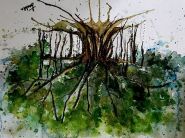
68.3. The growth and development of Indian mythology and thought resembles the imagery of the inverted tree – of which our ancients were very fond – with its roots in the sky and its branches spreading down towards the earth. Its roots are ancient but its growing shoots, leaves, buds, flowers and fruits are ever green, tender and fresh. The roots of our philosophy, religion and culture are in the very distant Vedic past. Though those roots are no longer visible to us the branches and extensions of those roots in vivid forms that have come down to us are very alive; and its fruits are within our experience.

Inverted tree 1

68.4. The idioms of Indian thought are thus dynamic, living and vibrant. They are linked to the spiritual urges and the changing needs, desires and aspirations of its people. The gods, faiths and the worship practices too keep evolving, changing, without parting with the essence of its fundamentals. Therefore, growth, change and adaptation are essential aspects of the Indian thought and living. It is distinguished by continuity with change; as also by its resilience and diversity. That is the genius of the Indian traditions.

The Varuna saga, albeit a painful one, has to be appreciated in that context.

*

To Sum up

CIS:IM.367-1923

69.1. Varuna’s great career ended rather disappointingly; but, it did leave behind a rich legacy of wonderful concepts and norms of behaviour in personal and social life (Rta) that have endured even to this day. Those laws are universal; applicable at all times and therefore eternal. The concept of Rta asserts that the order in nature is self regulated and operates by its own laws (svabhava). Ensuring the perpetuation of the order and harmony in nature is as sacred as it is in conduct of one’s life. That is because; Rta emphasizes the integrity of all forms of life and ecological systems. The principle of Rta recognizes our oneness with our environment and our unity with all life on earth. It is the framework that binds together man, nature and god. Rta is thus the Dharma that pervades and protects all life.

69.2. When that order and harmony is ruptured, the disruptive elements of disorder, chaos and falsehood (an-rta) step in, bringing in their wake ugliness, dishonesty and, decay into life. It is explained; a sin is any inharmonious action done with avarice to gain some immediate and temporary gain. Thus, injuring the harmony that exists in nature and among men is in fact a sin; and attracts punishment. The sin arises because of frailties and human weaknesses; and not because of demons. The evil in the hearts and minds of men are the real demons.

69.3. Sin is compared to unpaid debt (rna); it is a burden and an act of bad faith. The best way to cleanse the sin is to come face to face with it; own it; confess to it; and seek forgiveness with a promise not to err again. Cleansing is in the heart, mind and deed; not in the rituals. That is the Varuna’s way.

69.4. Paschatapa –‘after the burning heat’- signifies the purifying fire of repentance. The life-giving waters over which Varuna presides also signifies purity. Varuna is intimately associated with the both. Thus the Varuna-principle stands for purity in life, in all its aspects. Salutations to Varuna the icon of purity.

lotus white

Continued in Part Six – Varuna Iconography

References and Sources

1. Indra and Varuna in Indian Mythology by Dr. UshChoudhuri; Nag Publishers, Delhi, 1981

2. The Indian Theogony by Dr.Sukumari Bhattarcharji, Cambridge University Press, 1970

3. Asura in early Vedic religion by WE Hale; Motilal Banarsidass; Delhi, 1986

4. Goddesses in ancient India by PK Agrawala; Abhinav Publications, New Delhi,1984

5. The Hymns of Atharvan Zarathustra by JM Chatterji; the Parsi Zoroastrian Association, Calcutta, 1967; http://www.avesta.org/chatterj_opf_files/slideshow.htm.

6. Outlines of Indian Philosophy –Prof M Hiriyanna; Motilal Banarsidass, Delhi, 2005

7.Original Sanskrit texts on the 0rigin and history of the people of India, their region and institution By J. Muir;Trubner & co., London, 1870.

8. A classical dictionary of Hindu mythology and religion, geography, history, and literature byJohn Dowson; Turner & co, Ludgate hill. 1879.

9. Vaidika Sahitya Charitre by Dr. NS Anantharangachar; DVK Murthy, Mysore, 1968

10. Sri Brahmiya Chitra Karma sastram by Dr. G. Gnanananda

11. Zarathustra Chapters 1-6 by Ardeshir Mehta; February 1999

 http://www.indiayogi.com/content/indgods/varuna.aspx

http://www.bookrags.com/research/varua-eorl-14/

http://www.bookrags.com/wiki/Varuna

http://www.hinduweb.org/home/dharma_and_philosophy/vshirvaikar/Dnyaneshwari/Dnch10pg1.html

http://rashmun.sulekha.com/blog/post/2010/03/vedic-literature-the-degradation-of-varuna-and-indra.htm

http://www.newworldencyclopedia.org/entry/Varuna

http://www.indiadivine.org/audarya/vedic-verses/453851-vak-suktam-aka-devi-suktam.html

http://www.svabhinava.org/HinduCivilization/AlfredCollins/RigVedaCulture_ch07-frame.php

http://en.wikipedia.org/wiki/Ahura_Mazda

http://www.iamronen.com/wp-content/uploads/2010/05/ReadingLila.pdf

 http://www.hummaa.com/player/player.php

All images are by courtesy of Internet

 
5 Comments

Posted by on October 4, 2012 in Varuna


Tags: , , , , , ,

Varuna and his decline – Part Four

Continued from Part Three

Varuna’s association with waters

varuna waters

Varuna’s associations with waters are explained at two levels. The two are extremes; so extreme that one is far removed from the other like the rarified deep space from the dark underground. The one is pure metaphysics and high symbolism, while the other is mundane and vulgar. The differences between the two levels cannot be bridged. There is no common ground for reconciliation. The two sets of associations cannot also be rationalized and bound into one. It is best that each is viewed separately, each in its own context–for whatever.

The philosophical explanations and suggestions on the nature of  Varuna’s association with waters have bred numerous debates, theories and speculations. Scholars have come up with varied interesting and intricate explanations which at times sound too abstract; hard to grasp. It is not easy to present them either. We shall briefly see a couple of such explanations and theories.

N. Creation- the process

water-and-drop-of-water

Apah – Dark, deep and unfathomable waters

47.1. The terms Salilam and Apah which denote waters in the Rig Veda are said to be highly significant. Dr. Usha Choudhuri (in her scholarly thesis Indra and Varuna) explains these terms as implying more than just the water-element.   In the most celebrated hymn of creation – Nasadiya Sutktha which occurs in the Tenth Book of Rig Veda, as also in the Vak Suktha (RV.10.8.125) and  in the Hiranya-garbha Suktha  (RV. 10.121 ) the terms Salila and Apah represent Great Waters  or the primeval waters or the primeval matter of creation. They stand for the manifest as also for the un-manifest primeval matter: Prakrti or Vak or Aditi or Viraj.

47.2. Apah or Salilam is conceived as the threshold prior to which there was no distinction between existence and non-existence; between form and formlessness. Whatever that was there prior to it was neither sat nor a-sat; neither being nor non-being. That is; Apah or Salilam represents the crosses-over stage at which the unformed primordial universe transforms into existence. It could be regarded as the first stage of creation. Thus, Apah is Prakrti   as in Samkhya; and it is the primary source of all possibilities of manifestation in the world.

*

According to Dr. Beni-madhab Barua (A History of Pre-Buddhist Indian Philosophy- pages 12 to 16 – Motilal Banarsidas-1921), the ancient philosopher Prajapati Paramesthin theorized that Water (Salila) as the fundamental Principle; from Water, all things are formed; and, Water is the original substance of all that exists.

He asserted that whether one knows it, or does not know it (Veda yadi va na Veda) when there was  neither non-existence nor existence; when there was neither death nor immortality; and, when there was no visible sign to distinguish between days and nights, then there was Water, the unfathomable depth of water (Gahanam Gambhiram); and , there was nothing but water.

” Water was that one thing, breathless, breathed by its own nature.”  There was darkness (tamas), and concealed at first in this darkness Was Water in its indiscriminate or unmanifested form (apraketam). Water was all that existed (sarvama idam)

Water then transformed itself into particular things by an inherent principle – Kama, Cosmic Desire. Kama was the motive force of the changing universe, — the first germ of Mind (manaso retah); and, this Mind was no other than the Sun “whose eye controls this world in highest heaven,”

It was argued that the principle of movement or development is inherent in matter itself; and, involved in the vast processes of nature. In other words, the world evolves from the immanent energy of nature (svadhaya); the movement as a whole is self-determined.

*

The Śatapatha Brāhmaa, which belongs to the Śukla-yajur Veda refers to water as the first creation. “In the be-ginning there was only a creator from whom the water formed, from it, the foam was formed

Prajāpatirvā idamagra āsīt / tasmāt puruāttaptāpo jāyante , apā taptānā pheno jāyate ( (VI-1.3) 

***

47.3. Apah is twofold: as the undifferentiated, un-manifest and formless (a-vyakta or apraketa or a-murta); and as the manifest with forms (vyakta or praketa or murta). It is said; Apah and Salilam denote Prakrti or the creative power (Shakthi) of the Purusha the Absolute principle. It also suggests movement (gati) and action (karma). Thus, Apah or Salilam signifies the state of Becoming; while Purusha signifies the state of Being.

47.4. To explain it in another way; these dark, deep and unfathomable waters (gahanam ghabhiram – RV. 10.129.1) hold in their womb the un-manifest universe. And, it is from these dark waters the manifest world springs forth. Nasadiya Suktha mentions “the un-manifest conceals within itself the formless manifestation. The universe was then undifferentiated in the primeval waters” (RV  agre ‘praketaṃ salilaṃ sarvam ā idam– RV.10.129.3). That is; these Great waters (mahat-salilam)   represent the immense potential of Prakrti in its un-manifest (a-vyakta) state. It has that potential to give expression to infinite possibilities as forms (vyakta).

RV_10,129.01a nāsad āsīn no sad āsīt tadānīṃ nāsīd rajo no vyomā paro yat |
RV_10,129.01c kim āvarīvaḥ kuha kasya śarmann ambhaḥ kim āsīd gahanaṃ gabhīram 
RV_10,129.02a na mṛtyur āsīd amṛtaṃ na tarhi na rātryā ahna āsīt praketaḥ |
RV_10,129.02c ānīd avātaṃ svadhayā tad ekaṃ tasmād dhānyan na paraḥ kiṃ canāsa ||
RV_10,129.03a tama āsīt tamasā gūḷham agre ‘praketaṃ salilaṃ sarvam ā idam |
RV_10,129.03c tucchyenābhv apihitaṃ yad āsīt tapasas tan mahinājāyataikam ||
RV_10,129.04a kāmas tad agre sam avartatādhi manaso retaḥ prathamaṃ yad āsīt |
RV_10,129.04c sato bandhum asati nir avindan hṛdi pratīṣyā kavayo manīṣā ||
RV_10,129.05a tiraścīno vitato raśmir eṣām adhaḥ svid āsī3d upari svid āsī3t |
RV_10,129.05c retodhā āsan mahimāna āsan svadhā avastāt prayatiḥ parastāt ||
RV_10,129.06a ko addhā veda ka iha pra vocat kuta ājātā kuta iyaṃ visṛṣṭiḥ |
RV_10,129.06c arvāg devā asya visarjanenāthā ko veda yata ābabhūva ||
RV_10,129.07a iyaṃ visṛṣṭir yata ābabhūva yadi vā dadhe yadi vā na |
RV_10,129.07c yo asyādhyakṣaḥ parame vyoman so aṅga veda yadi vā na veda ||

***

Varuna symbolizes Prakrti

48.1. The essential character of these primeval waters is Avarana – to cover or to encompass (var). Varuna is the encompasser; he pervades (var) everything; he presides over the visible and the invisible worlds. Varuna is the mythical symbol of primeval matter. And, he is the presiding deity of Apah and salilam. Varuna the lord of these waters, the primeval matter, thus symbolizes Prakrti.

48.2. It is by the will or the desire of Varuna, and through his wisdom-extraordinary (Maya) the forms of the visible world (Murtha) emerge from out of the formless (a-Murtha). Varuna in this sense is the creator; the world is born out of his mind (manas); and thus, he symbolizes kaarana –Brahman, the Brahman with a desire to create.

48.3. Shri Ananda Coomaraswamy too (in his Yakshas) explains Varuna as denoting Prakrti. He states that the term Samudra originally meant the sky; and the sky did not merely signify the physical sky but the all encompassing desire of the Purusha. Varuna is that will of Purusha. Varuna who is described as Rta-Samudra or Rta-sadana   is indeed the Prakrti.

Aditi is Apah and Prakrti

Aditi mother of gods

49.1. Aditi, the Mother – principle,the  Deva matri  , is the mother of all gods . Therefore , all the Devas , the solar deities who represent light and who reside in the heavenly regions are Adityas – the children of Aditi.  Thus , Aditi , the mother of   all existence is described as the mighty mother,’ lofty like a mountain, swelling with sweet milk’, the celestial light (jyothihmati RV .1.115.5), the queen or the guardian of Rta (rtavari), ever expanding and never decaying, gracious guide and great protector (YV. 21.5). She denotes freedom from bondage. She gives birth to manifest world. She is the Mother of all creation. Because the nourishing Mother Aditi is the source of all manifested reality – the past, the present and the future; of “all that has been and will be born” she is   regarded as Prakrti the creative principle, the desire of the Supreme to create (YV.10.7).

49.2. As mentioned earlier, Apah or Maha-salilam the great waters denote primeval matter or the primal cause of creation from which the manifest is born. Thus, Apah, the waters too are mothers (apah asmin matarah) – ‘The waters are our mother (ambayah), womb of the universe’ (RV.1.23.10). Aditi the great mother (mahi mata) who gives give birth to the manifest world is thus equated with Apah, among other things.

49.3. As Apah, Aditi is the creative energy which is active and moving (gati). Since Apah suggested movement (gati), it is said, the life-giving(jiva-nadi) , flowing rivers and streams are deemed feminine (Prakrti) ; while the stagnant Samudra the ocean into which all beings go and from which all beings emerge acquired a masculine identity (Purusha).

49.4. Aditi (Apah and Prakrti) is the forerunner of the Mother –Goddesses of the later texts and lore who symbolize the power (shakthi) of Prakrti in all its aspects.

In the daily prayers (Sandhya-vandana) , the Apah , the divine-mother-principle is worshiped as : O, water!  The source of all happiness; the affectionate Mother, please grant us energy-giving food; and, an insight to enjoy your divine splendor.

Āpohiṣṭā mayobhuvah stāna-ūrje dadhātana Mahe-raāyacakase / Yo va śivatamo rasastasya bhājayate ha na uśatīrivamātara/ tasmā aragamāya vo yasya kayāya jinvatha āpo  jan-ayathā ca na-/

Vak is Apah and Prakrti

50.1. In the Vak Suktha or Devi Suktha    of Rig Veda (RV.10. 10.125), Apah is conceived as the birth place of Vak or Vac   who is the creator, sustainer and destroyer. In an intense and highly charged superb piece of inspired poetry She declares “I sprang from waters there from I permeate the infinite expanse. It is I who blows like the wind creating all the worlds “.

Vak the primal energy the Great Goddess Mother is described in various ways : Vak is the eternal being; the first-born of the eternal waters.   Vak is the Mother who gives form to the formless; gives birth to existence and lends identity to things by naming them. Vak is the faculty which gives expression to ideas. She is the mysterious presence that enables one to hear, see, grasp and express in words or otherwise the true nature of things. She is the navel of energy

50.2. Vak who springs forth from waters, touches all the worlds with her flowering body and gives birth to all existence is indeed the Prakrti. Vac is also Apah and an attribute of Varuna.

I sprang from the waters,
And from there I spread throughout the universe,
I touch that heaven with a flowering body.

I move with Rudras and Vasus,
I walk with the Sun and other Gods,
I esteem Mitra, Varuna
And Indra, Agni and the Asvins.

[Please click here for the rendering of Devi Sukta]

50.3. Eventually; Apah, Aditi, Vak and Varuna all represent the same principle: Prakrti the creative principle.

O. Lotus and the inverted tree

Lotus symbolizes waters and life

lotus.3 jpg

51.1. The Lotus symbolizes waters; and earth is a leaf thereof. The lotus-leaf is called the back of the waters (Tai.sam.5.1.4.2). The earth lies spread on water just as the lotus-leaf does. The noted scholar Ananada K Coomaraswamy (in his Yakshas) too relates lotus to waters. He explains the concept of earth resting on waters in the context of the full-blown lotus flower that supports a divinity in the Indian iconography: ”where it seems to be implied that the figure is supported by a widely extended lotus flower rising out of the waters; and in the last analysis the deity is supported by the waters”.

lotus vishnu

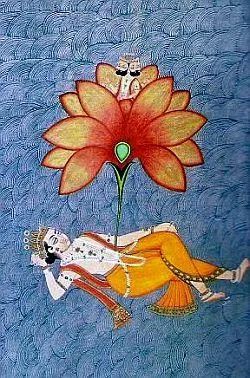
51.2. He also mentions that lotus symbolizes life. The imagery of creation springing forth from the all-encompassing creator was initially related to Varuna. That is because Varuna in the early phases of Rig Veda was the Creator who brought forth all existence. But, since the virtues and powers of Varuna merged into Vishnu, in the later mythologies lotus came to be depicted as rising from the navel of Narayana resting on celestial waters bearing Brahma the abjaja –born of water or born of lotuses.

51.3. In any case, that imagery pictures the principle that all life and existence is born out of the waters.

Inverted tree of life – Varuna

tree with roots

Urdhvamulo ’vaśakha eso ’aśvatthah  sanatanah  / tad eva śukram  tad brahma tad eva amrtam ucyate  / tasmi  lokah  śritah , sarve tad u naty eti kaś cana
*
*
This permanent fig tree has its roots upwards and its branches downwards. It is bright, it is the  Brahman  ; that is it which is called immortality. In it all the worlds have their support and nobody goes beyond it (KaU_6.1)
 **

52.1. Dr. Ananada K Coomaraswamy  referring to the concept of  “The roots of the inverted tree are in the sky and its branches are spread downwards “, says : Varuna called the unborn in Rig Veda symbolizes the root of that tree of life; the source of all creation. That cosmic tree is originally said to have sprung from the navel of Varuna the sky- god blue like the waters reflecting the sky.”

– abudhne rājā varuṇo vanasyordhvaṃ stūpaṃ dadate pūtadakṣaḥRV.1.24.7)

52.2. Tracing the myth of the world tree from Varuna to Narayana, Ananada K Coomaraswamy refers to the remarkable resemblances in the ethical character of Varuna and Vishnu. According to him, ’the cosmic-tree myths of various forms and their relation to the lotus symbol verily owe their origin to Varuna. He says the concept of the cosmic functioning originally represented Varuna.   That concept did not undergo any change; but it only acquired new names and new symbols.

Thus, Varuna is Kaarana Brahman by whose desire the manifest world materializes.

 abudhne rājā varuṇo vanasyordhvaṃ stūpaṃ dadate pūtadakṣaḥ |
 nīcīnā sthur upari budhna eṣām asme antar nihitāḥ ketavaḥ syuḥ |
 uruṃ hi rājā varuṇaś cakāra sūryāya panthām anvetavā u |
 apade pādā pratidhātave ‘kar utāpavaktā hṛdayāvidhaś cit ||
**

Varuna the king of pure intelligence / Sits atop the tree with its roots/ in his un-supported and absolute realm; Its branches spread downwards. 

Varuņa of hallowed understanding,/ Holds aloft a mass of life-giving radiance, which streams down; May these rays sink deep and set within us. (RV. 1.24.7- 8)

 
***

P. Some other explanations for Varuna’s association with waters

Waters, Darkness and Varuna – Prakrti

53.1. Varuna’s association with darkness (tama) metaphorically called night (rathri), as also with waters (Apah) has given rise to number of other highly interesting philosophical speculations.

Nasadiya Suktha says, “In the beginning, darkness was hidden by darkness. All this was unmarked formless waters. ..”. That image of primordial waters was perhaps meant to convey the absence or the sense of absence of all sorts of distinctions in the pre-creation universe. And, similarly, darkness implied a state where day or night was not marked. Here, darkness and waters both seem to mean the same principle -– the all enveloping unformed state before the world of things (sat) arose out of its matrix.

“All this was produced from the dark waters (Taittiriya Aranyaka of the Krishna Yajurveda – 1.23)”.

Àpo va idamasanth-salilam-eva | sa prajapatirekaÏ puÍkaraparÉe samabhavat |
tasyÀntarmanasi kÀmassamavartata | idaÙ sÃjeyamiti | tasmÀdyatpuruÍo manasÀ’bhigacchati | tadvÀcÀ vadati | tatkarmaÉÀ karoti | tadeÍÀ’bhyanÂktÀ |
kÀmastadagre samavartatÀdhi | manaso retaÏ prathamaÎ yadÀsÁt

53.2 As said earlier, Varuna symbolizes un-manifest (a-vyakta or a-praketa or a-sat) as well as manifest (vyakta or praketa or sat) state of existence.

53.3. It is also explained; Rathri the darkness is Varuna (Ait Brh. 4.10); Rathri the starlit night belongs to Varuna (Tai .B 1.7.10); and, Varuna is waters (Apah) as it pervades (var) everything. Thus, both – darkness and waters- become associated with Varuna.

53.4. For these reasons, it is said that Varuna, Rathri and Apah all represent Prakrti.

Water- purifier – joy of life

water-9

54.1. Water is glorified as the nectar or honey (madhu) and the joy of life; and it is also the elixir of immortality. Water is the symbol of creation, life (jeevanam), strength and energy. Water is thus the nourishing mother of all life and existence. Water is as essential to life as is the vital-air (prana– aphomaya pranah. Water is the source of all existence; it   sustains, heals and purifies life.

Water is regarded as an extraordinary and omnipresent element in Rig Veda. It is the support of all lives; and, the savior of everything living or dead on earth. The world moves along  with the pure and simple movement of the water. It washes away the impurities and also cleans the inconsistencies of human behavior. Water is a great medicine. It does away with the diseases and is the benefactor of health, strength, long-life, wealth and immortality.

Yasam Raja Varuno Yati Madhyai Satyanrite Avapashyanje yajnanam| Madhushchutah Shuchaye yah pavakah ta Apao devirih mamvantu|| VII.49.3

The water dwells where gods dwell. The water in which the king of waters Varuna dwells, the water in which Soma lives, in whom all gods drink exhilarating strength, the waters in which the leader of all–Agni enters, who are full of divine values, help me in the world.

He, whose destination is the ocean, who purifies the world, is always flowing, such water lives in the middle of the Universe. Indra, who possesses ‘Vajra‘ and rains the desires, broke opened a path for these divine waters. May these waters help me and be received by me.

Samudrajyestha Salilasya Madhyapunana Yantyanivishmanah | Indrah ya vajri vrishabho rarad TaApoa devirih mamvantu ||

54.2. Shatapatha Brahmana (SB.2.3.2.10) makes an interesting remark: when Agni burns brightly, he then indeed becomes Varuna the purifier (paavaka). There is therefore a belief that the purifying waters cleanses sins, betrayals (abhidudroha)  and falsehood (anŗtam duritam) – (RV. 1.23.22). The one that has been purified shouts in ecstasy: “I have become one with the essence of the celestial energy, rasena”. Water represents that faith (shraddha) in life.

54.3. Though the waters are celebrated by various metaphors, the physical aspect of water is not lost sight. The Chandogya Upanishad describes Waters as the source of all plants and herbs Oshadhis; the giver of good health and destroyer of   diseases. It is the source of joy of healthy living. The mountains, the earth, the atmosphere and the heavenly bodies too derive their form through water (Chandogya Upanishad – 7.10.10) .It is said; even the gods are waters – as they are the foundation and source of the universe and everything is contained in them.(SB. 10.5) .

And again , it is said; the water which is created in the universe; which is pure and full of light; which is full of divine characteristics; the water which flows in the form of river; the water which comes from the digging of the wells, canals; the water which is self-created in the form of waterfalls; and, that which enters into the ocean, help me in this world and thereafter.

Ya Apaodivya Ut Va Sravanti Khanitrima ut va yah swayamjah | Samudrartha Yah Shuchayah pavakasta Apao Devirih Mamvantu || VII.49.2

Varuna too is water.

The term Varuna is said to be derived from the root Vrs (to rain) and the suffix –Una . The root Vrs, is also connected with words like Var and Vari,  which indicate water. This seems to suggest that Varuna, originally, meant ‘one who covers with water’. And, the lexicon Amara-kosha, mentions Ap-pathi (lord of the waters) and Yadasyam-pathi (lord of the aquatic beings) as among the names of Varuna; and, Varunalaya as a synonym for ocean.

In the Bhagavad-gita , Krishna declares; Varuno yadasyadam aham (BG.10.29) – ‘of the dwellers in waters, I am Varuna); and, it is commented upon by Madhusudana, as: yādasām jala-carāā madhye teā rājā varuo ‘ham asmi; to mean , I Varuna , am the King of those who dwell in water.

 *

“Verily all this is water. All the created beings are water. The vital breaths (prana) in the body are water. Quadrupeds are water. Herbs and crops are water. Madhu the nectar is water. Samrat[perpetually shining] is water. Virat [shining] is water. Svarat [self-luminous] is water. The metres (pankti) are water. The Devas are water. Vedic formulas are water. Truth is water. All deities are water. The three worlds denoted by BhuhBhuvah and Suvah are water. The source of all these is the Supreme denoted by the syllable ‘Om”. (Mahanarayana Upanishad- 29.1)

54.4. Since Varuna is waters, Apah, all its virtues and attributes are imbibed in him.

Apah and Sathya

55.1. Varuna who is the lord of waters (Apah) is also related with the order in world and to the laws in nature (Rta), and the Truth (satya). It is said ‘waters are the Truth…where waters flow there the Truth resides …. It is the waters indeed that were made first of this universe, hence when waters flow then everything whatever that exists in the universe is brought forth’ (Sathapatha Brahmana).Water is thus the universal mother –principle in the Rig Veda. Waters are Prakrti.

55.2. The Brihadāranyaka Upaniad (1.2.2.) states that in the beginning water alone existed; and later from it truth (Satya); from truth Brahman; and from him Prajāpati were born.  Prajāpati produced the gods and these gods worship truth alone – Āpā-evedamagra āstu tā āpaḥ .

55.3. Thus Waters, Truth and Varuna symbolize Prakrti.

The child of waters

56.1. Varuna the son of Aditi resides among primal waters. He is described also as Apam-shishuh ‘the child of waters, in the best of the mothers – Aditi’

56.2. It is also said; since Varuna dwells in waters he is Apam Napat, “Son of the Waters’ (RV.1.2.35). Apam Napat is also referred to as the embryo (garbha) of the waters (RV.7.9.3). It is said; the sun when he sinks into waters – to quench his thirst- becomes Varuna the fire in the waters (Apam Napat).

[But, Varuna soon lost this ancient title; and it came to be applied more and more to Agni born of a spark from water and to other solar deities such as Savitr.]

Varuna and the moon

56.7. Another explanation offered to reason Varuna’s association with waters seems to me rather flat. It is said; as the god of the night sky Varuna is related with the celestial bodies that shine in the night sky: the stars and the moon. And, the moon  who  is related to Varuna influences the tides of the ocean and movement of terrestrial waters. Therefore, Varuna is connected with water and the aquatic realm.

Q. Varuna the water-god

varuna god

This is the other-side of Varuna’s association with waters.

57.1. The status and the attributes of Varuna changed drastically, for worse, in the Puranas and the epics. Varuna lost the authority of kingship and the moral superiority that he once enjoyed in the Rig Veda and in the other Samhitas.   He is relegated as the regent of the west and demigod of waters; and practically nothing more.  It was as if the once mighty Varuna had been pensioned off and assigned a minor rank.

57.2. The waters that Varuna is now made in – charge are just waters on earth – plain and simple; they have no symbolic interpretations or philosophical connotations. Varuna is Salilesvara the king of terrestrial waters like lakes, rivers and oceans. Samudra the vast urukşhaya (1.2.9) is his abode. There he resides in his magnificent underwater palace (saagaro varunalayah) a den of sensual delights, surrounded by nymphs, snakes and all types of aquatic creatures.

57.3. His underworld too has gone radical reimaging; it is no longer the sedate and welcoming abode of the Pitris, but it is now tainted by the fearful pollution of death. Varuna has now turned sensuous and cruel; and developed dark and sinister associations.  

sea creatures

He has also lost his good looks. Varuna in this phase does not command much respect. He is often chastened by other gods. Stories are told of his misadventures and humiliations. It appears he abducted and seduced Urvasi a nymph of Indra’s court and fathered a son from her. On another occasion, it is said, Varuna kidnapped Bhadra, daughter of Soma and wife of Uthahya.

57.4. Varuna who once was: the nearest approximation to the Supreme Being, the sovereign of all earth and heavens, the creator and sustainer of life in all three regions, the lord who presided over order in the physical and moral realms, the judge who dispensed justice and handed down punishments, is now turned into the regent of the west and god of seas; and eventually a demigod of local water- bodies; a god of not much consequence… a god of small things….what a fall….!!

In the next section let’s look at the explanations offered for Varuna’s decline and fall.

Epithets

58.1. His association with waters  however earned Varuna number of descriptive epithets, such as: Prachetas, apam-pathi , ambu-raja, jaleshwara, jalaadhipa, vaaripa, udakapathi, salileshwara, Jala-pati, Kesa  (lord of water) ; Sindhu pathi , Nadi-pathi (lord of the seas or rivers ); sarit-pathi (lord of all that flows);  VIloma, Vari-loma (watery hair); Yudh pathi (king of aquatic animals); Uddama (the surrounder) ; bharti  (the nourisher); and, Pashi, Pasha bhrit, (bearer of the noose) .

daprc3a8s-varuna-sur-son-makara-c3a0-aihole-karnataka-en-inde-du-sud-invitc3a9-par-le-dieu-indra-varuna-rejoint-le-royaume-des-devas-illustration-marsailly-blogostelle

Continued in Part Five

References and Sources

1. Indra and Varuna in Indian Mythology by Dr. UshChoudhuri; Nag Publishers, Delhi, 1981

2. The Indian Theogony by Dr.Sukumari Bhattarcharji, Cambridge University Press, 1970

3. Asura in early Vedic religion by WE Hale; Motilal Banarsidass; Delhi, 1986

4. Goddesses in ancient India by PK Agrawala; Abhinav Publications, New Delhi,1984

5. The Hymns of Atharvan Zarathustra by JM Chatterji; the Parsi Zoroastrian Association, Calcutta, 1967; http://www.avesta.org/chatterj_opf_files/slideshow.htm.

6. Outlines of Indian Philosophy –Prof M Hiriyanna; Motilal Banarsidass, Delhi, 2005

7.Original Sanskrit texts on the 0rigin and history of the people of India, their region and institution By J. Muir;Trubner & co., London, 1870.

8. A classical dictionary of Hindu mythology and religion, geography, history, and literature byJohn Dowson; Turner & co, Ludgate hill. 1879.

9. Vaidika Sahitya Charitre by Dr. NS Anantharangachar; DVK Murthy, Mysore, 1968

10. Sri Brahmiya Chitra Karma sastram by Dr. G. Gnanananda

11. Zarathustra Chapters 1-6 by Ardeshir Mehta; February 1999

 http://www.indiayogi.com/content/indgods/varuna.aspx

http://www.bookrags.com/research/varua-eorl-14/

http://www.bookrags.com/wiki/Varuna

http://www.hinduweb.org/home/dharma_and_philosophy/vshirvaikar/Dnyaneshwari/Dnch10pg1.html

http://rashmun.sulekha.com/blog/post/2010/03/vedic-literature-the-degradation-of-varuna-and-indra.htm

http://www.newworldencyclopedia.org/entry/Varuna

http://www.indiadivine.org/audarya/vedic-verses/453851-vak-suktam-aka-devi-suktam.html

http://www.svabhinava.org/HinduCivilization/AlfredCollins/RigVedaCulture_ch07-frame.php

http://en.wikipedia.org/wiki/Ahura_Mazda

http://www.iamronen.com/wp-content/uploads/2010/05/ReadingLila.pdf

 http://www.hummaa.com/player/player.php

All images are by courtesy of Internet

 
12 Comments

Posted by on October 4, 2012 in Varuna


Tags: , , , , , , , , , ,

Varuna and his decline – Part Three

Continued from Part Two

varunan2

Varuna in other Vedic texts, Mahabharata and Puranas

We have seen in the earlier parts that Varuna of the Rig Veda was a highly venerated god. He was hailed as the sole sovereign sky-god; the powerful Asura, the King of both men and gods, and of all that exists. He governed the laws of nature as also the ethical conduct of men. He is very often described as the saviour in times of peril and distress; one who liberates from sin; the merciful god as well as the punisher of the sinners. He is connected with the symbolic waters of creation from which the manifest world emerges.

Let’s see how Varuna fares in the other Vedic texts, and in the epics- Mahabharata and Ramayana – as also in the Puranas.

F. Varuna in Yajur Veda

varuna yajur

36.1. Varuna continues to occupy an exalted position even in the Yajur Veda. There are however no references to his sovereignty as the sky-god.  Varuna in Yajur Veda, essentially, is the governor of Rta the order in nature and in the moral conduct among men. He judges, punishes as also pardons the wrongdoers. He is also related to the primeval   waters (mahat salilam) which have mystical connotations.

The lord of physicians

36.2. In the Yajur Veda, Varuna is related to the beneficial life-giving and lifesaving herbs (oushadha) which depend on water for their existence and growth.  Varuna appears not merely as the god of waters but also as the physician (maha- bheshaja) and the lord of physicians (varunam bheshajam patimYV. 21.40; MS_3,11.2). The herbs Osadhayah come from waters, and Varuna protects the waters as also the herbs. As the lord of waters and of the herbs Varuna the physician becomes a revered deity in Ayurveda the science of life.

The child of the waters

36.3. Yajur Veda mentions that the waters with which Varuna is connected are the waters of the atmosphere. These waters are described as Apah, Maha-salilam the great waters which denote primeval matter from which the manifest world emerges. Aditi the great mother of all gods is also said to give birth to the manifest world. Aditi is thus equated with Apah. As Apah, Aditi is the creative energy which is active (YV.10.7).That is, Aditi the mother of all gods is Prakrti and Shakthi the manifesting or the creative power. The notion of her divinity rests upon her power as a woman, a womb or a mother to give birth to and to bring forth life and existence.

Varuna (son of Aditi) who resides among these waters (Apah) is therefore called the child of the waters (Apam shishu) in the best of mothers. It is explained; the expression ‘best of mothers’ refers to the protective and nourishing nature of the waters as mothers. They are the gracious guides and protective mothers; and, Varuna is their child.

[It is also said; since Varuna dwells in waters he was also called Apam Napat (Apam = water; Napat = fire), ‘Son of the Waters’ (RV.1.22.06). Apam Napat is also referred to as the embryo (garbha) of the waters (apāṃ garbhaḥ prasva ā viveśa– RV.7.9.3). It is said; the sun when he sinks into waters – to quench his thirst – becomes Varuna the fire in the waters (Apam Napat).

It is believed; the clan of the Bhrigus were the first to introduce the fire-ritual and the Soma-ritual; and were also the first to discover the nexus between fire and water (Apam Napat).The Bhrigus were associated with water as also fire. And, Varuna was the supreme deity of the Bhrigus.

Apam Napat, both in Sanskrit and Avestan, also means ‘grandson of waters’. Pra-napat in the Rig-Veda (napāt praṇapāt kuṇḍapāyyaḥ– RV. 8. 17. 13) denotes ‘great-grandson.’(so apāṃ napād anabhimlātavarṇo ‘nyasyeveha tanvā viveṣa– R V. 2. 35.13).

It might also mean the fire that is produced when lightning strikes the earth. Let’s say; Clouds (water) –Here, it perhaps, specifically refers to the lightening: The grandson of the waters has descended to this earth in the form of a different fire. > lightening -> fire; then lightening is the son of water and fire (Agni) is the grandson of water.

Otherwise, the term Apama Napat normally refers to Agni who dwells in the water (RV: 10.45.1). It is said; Agni riding on a horse rose from the depths of waters where he resides. He is thus Apam Napat, the son of the waters.

Agni as Apam Napat is celebrated in one entire hymn (RV: 2.35.6). He is described as: “Brilliant and youthful; he shines without fuel in the waters which surround and nourish him. Clothed in lightning, he is golden in form, appearance, and color. Standing in the highest place, he always shines with undimmed splendor. Steeds, swift as thought, carry the Son of Waters”: aśvasyātra janimāsya ca svar druho riṣaḥ sampṛcaḥ pāhi sūrīn | āmāsu pūrṣu paro apramṛṣyaṃ  nārātayo vi naśan nānṛtāni ||]

In the Yajna

36.4. Yajur Veda is the book of Yajnas. During an Yajna,   Varuna along with Mitra is invoked and invited to take seat on the North side of the altar Yajna-vedi and requested to protect Rta the law of nature ; and also to bring good rains (YV. 2.3; 2.16). The invitation to Varuna to occupy the seat on the North is interesting. North is the direction of the gods; it is the direction of Soma initially (as per Brih. Upanishad) and then of Kubera the sub-divine who is friendly with gods. Thus, in Yajur Veda, Varuna was still the major god of the Yajna. In the later texts Varuna was, however, assigned a seat on the West where the sun sinks into sea and into the night.

Rta in everyday life

36.5. Rta in the Rig Veda generally meant the order in the universe. Yajur Veda gives that principle a practical form, the one that could be applied in the everyday world of men. It says, in heavens Rta could very well be the cosmic order, but on earth Rta means the social, ethical, religious and such other laws that govern him. Yajur Veda warns, the violation of these laws would bring the wrath of Varuna and his noose. Varuna the abstract god of sky and Rta thus takes a practical shape, especially when misery befalls unseen. He is therefore invoked constantly to save erring men from his noose. “Keep us away from nirrti (the fall from the Rta); deliver us from the sin that we have committed”

His three-fold noose

varuna noose

36.6. Varuna is said to hold a three-fold noose to bind those who sin (enah). The three bonds of that noose are commonly understood as the three-fold misery (taapa –traya) or the bonds that restrict a man in three planes: physical, vital and mental.

But, Yajur Veda, in fact, employs the metaphors of the heavens, the waters and the ocean. It says Varuna has three bonds in heaven (trini ta ahurdivi); three in waters (trinyapsu) and three within the ocean (trinyantah samudre) – (YV.29.15). Many scholars right from Sri Sayanacharya have provided explanations to these mystical metaphors. [I am not quite clear about these interpretations. Let me leave it at that, for now. Sorry.]

G. Varuna in Atharva Veda

37.1. Atharva Veda, the main text of the Bhrigus, has a special relation with Varuna.  Here he is venerated as an aspect of the Supreme: ”He is Varuna, He is Agni; He is Mitra; He is Savitr” (AV.13.3.13) . In its philosophical discussions, Varuna is treated as a manifestation of Brahman.

sa varuṇaḥ sāyam agnir bhavati sa mitro bhavati prātar udyan | sa savitā bhūtvāntarikṣeṇa yāti sa indro bhūtvā tapati madhyato divam |tasya devasya kruddhasyaitad āgo ya evaṃ vidvāṃsaṃ brāhmaṇaṃ jināti |AV.13.3.13)

The Atharva Veda does not seem to dwell much on Varna’s sovereignty over the sky or his control over Rta the order in the universe. Yet, the position of Varuna in Atharva Veda continues be exalted

The king who judges and pardons

37.2. Varuna of Atharva Veda is also the king who watches over the world, punishes the guilty; and forgives the sins of those who implore his pardon.

The king Varuna (Varunasya Rajnah) is greeted with respect (Namaste Raajan) – (namas te rajan varuṇāstu manyave viśvaṃ hy ugra nicikeṣi drugdham |sahasram anyān pra suvāmi sākaṃ śataṃ jīvāti śaradas tavāyam ||2|| AV.1.10.1-2). He is Asura the powerful Lord; and is highly celebrated. The king possessed of mystic powers (Maya) is a strict ruler who employs spies to watch over his subjects. He chastises the wrongdoers; and he also pardons those who repent and seek his merciful forgiveness.

Hymns to Varuna

37.3. The hymns in Atharva Veda in praise of Varuna ‘the most impressive deity among all the Vedic gods’ are lofty, more devout and ethical in tone. They pray for purity, forgiveness, and release from sins, and for moral strength against sinning further.   The hymns rise to a pitch of exaltation as they sing the splendour of Varuna. In these hymns Varuna, more than any other Vedic god, appears as a mighty and merciful.

Of the many soulful hymns submitted to Varuna,  the sixteenth hymn in the fourth book of the Atharva Veda (bṛhann eṣām adhiṣṭhātā antikād iva paśyati |ya stāyan manyate carant sarvaṃ devā idaṃ viduḥ ||1||)  sung by sage Vashista celebrating Varuna’s power and omniscience is often quoted and hailed by scholars as being among the most devote and forceful hymns in the Vedic literature

yas tiṣṭhati carati yaś ca vañcati yo nilāyaṃ carati yaḥ prataṅkam |dvau saṃniṣadya yan mantrayete rājā tad veda varuṇas tṛtīyaḥ ||2|| uteyaṃ bhūmir varuṇasya rājña utāsau dyaur bṛhatī dūreantā |uto samudrau varuṇasya kukṣī utāsminn alpa udake nilīnaḥ ||3||uta yo dyām atisarpāt parastān na sa mucyātai varuṇasya rājñaḥ |diva spaśaḥ pra carantīdam asya sahasrākṣā ati paśyanti bhūmim ||4||sarvaṃ tad rājā varuṇo vi caṣṭe yad antarā rodasī yat parastāt |saṃkhyātā asya nimiṣo janānām akṣān iva śvaghnī ni minoti tāni ||5||ye te pāśā varuṇa saptasapta tredhā tiṣṭhanti viṣitā ruṣantaḥ |chinantu sarve anṛtaṃ vadantaṃ yaḥ satyavādy ati taṃ sṛjantu ||6||śatena pāśair abhi dhehi varuṇainaṃ mā te mocy anṛtavāṅ nṛcakṣaḥ |āstāṃ jālma udaraṃ śraṃśayitvā kośa ivābandhaḥ parikṛtyamānaḥ ||7|| yaḥ samābhyo varuṇo yo vyābhyo yaḥ saṃdeśyo varuṇo yo videśyo | yo daivo varuṇo yaś ca mānuṣaḥ ||8||tais tvā sarvair abhi ṣyāmi pāśair asāv āmuṣyāyaṇāmuṣyāḥ putra | tān u te sarvān anusaṃdiśāmi ||9||

The gods know all men do, though men would fain their deeds disguise:
Whoever stands, whoever moves, or steals from place to place,
Or hides him in his secret cell, the gods his movements trace.

Wherever two together plot, and deem they are alone,
King Varuna is there, a third, and all their schemes are known.

His spies descending from the skies glide this entire world around;
Their thousand eyes, all scanning, sweep to earth’s remotest bound.
Whatever exists in heaven and earth, whatever beyond the skies,
Before the eye of Varuna the king unfolded lies.

The secret winking all he counts of every mortal’s eyes;
He wields this universal frame as gamester throws his dice.
Those knotted nooses which thou flingst, O god! the bad to snare,
All liars let them overtake, but all the truthful spare.”

(AV.4.16.7-8)

(Translated by J Muir, Original Sanskrit Texts, 1870)

**

Apam-adhipathi

37.4. While mentioning his connection with waters Varuna is referred to as– Apam-adhipathi  (varuṇo apām adhipatiḥ sa māvatu) the Lord who resides in the primeval waters. These waters are described as of golden hue, pure and purifying; and, they are the material cause for creation (AV.1.33.1-3)

hiraṇyavarṇāḥ śucayaḥ pāvakā yāsu jātaḥ savitā yāsv agniḥ |yā agniṃ garbhaṃ dadhire suvarṇās tā na āpaḥ śaṃ syonā bhavantu ||1||yāsāṃ rājā varuṇo yāti madhye satyānṛte avapaśyan janānām |yā agniṃ garbhaṃ dadhire suvarṇās tā na āpaḥ śaṃ syonā bhavantu ||2||yāsāṃ devā divi kṛṇvanti bhakṣaṃ yā antarikṣe bahudhā bhavanti |yā agniṃ garbhaṃ dadhire suvarṇās tā na āpaḥ śaṃ syonā bhavantu ||3||

H. Varuna in the Brahmanas

varuna bara

38.1. Brahmanas are the books of rites and rituals. Varuna continues to occupy an elevated position even in the Brahmanas. Varuna is the deity who presides over the rule or the order in the proper performance of a Yajna. Varuna removes the bad elements of the Yajna   and protects the auspicious ones (varunah yajnasya   svistam patiAit. Brh.38.7.5). Varuna is vigilant safeguarding Sathya (truth); and is opposed to an-rta (falsehood). Varuna punishes the wrong doers with his knots (granthyah- SB.1.3.1.16).

Offerings to Varuna

38.3. Varuna is a very revered god in the Brahmanas. Oblations are offered to Varuna respectfully along with other deities. He is offered the seat on the North which, according to Taittereya Brahmana, is the direction of Varuna (esa – uttara- varunasya dikTai.Br. 33.8.20.4). This is significant; and is a proof of Varuna’s esteemed position in the Brahmanas and among the Devas. (In the later texts Varuna is sent west)

Varuna is also invoked through an oblation procedure called Varuna-praghasa performed at the commencement of the rainy season in the month of Ashada, seeking deliverance from his noose; and for his grace to lead a healthy and faultless life (SB.2.5.3.1). ”Whatever sins we have committed in the village, forest…in the society and in our own self… from all that we rid ourselves.” This was an occasion devoted mainly to confessions and to seeking varuna’s mercy and forgiveness. Whatever be the practices associated with it, the Varuna-praghasa is essentially a purity-ritual.

varuṇa praghāsairvai prajāpatiḥ | prajā varuṇapāśātprāmuñcattā syānamīvā akilviṣāḥ
prajāḥ prājāyantāthaitaiḥ sāka medhairetairvai devā vṛtramaghnannetairveva
vyajayanta yeyameṣāṃ vijitistāṃ tatho evaiṣa etaiḥ pāpmānaṃ dviṣantam bhrātṛvyaṃ
hanti tatho eva vijayate tasmādvā eṣa etaiścaturthe māsi yajate sa vai
dvyaham anūcīnāhaṃ yajate

In philosophical dialogues

39.1. In the Brahmanas Varuna is celebrated as lord of truth (Gopatha Brh: 1. 1.7); and as one who envelops all existence. The Brahmanas ascribe to Varuna every type of law that relates man with God.

39.2. The Brahmanas talk of   the mystical or the philosophical nature of Varuna through allegories and speculative dialogues.

(i) They mention: the night belongs to Varuna (Varuna Rahtri) Varuna is Rathri (Raathri Varunah) and the black colour belongs to Varuna. Varuna is also identified with waters (Apah) the primal cause of creation; as also with the vital airs: Apana, Prana and Vyana. And, Varuna is Agni too. When Agni burns brightly he then indeed is the purifying Varuna (SB 2.3.2.10). That is because, Varuna symbolizes the notion of essential purity in life and in nature.

(ii).  The Brahmanas, especially the Shatapatha Brahmana (SB) carry elaborate discussions about the relationship that exists between truth (Sathya) and waters. It said; truth is the same as waters for waters are the truth. Hence: ’whereby waters flow that is the form of truth. It is the waters indeed that were first made in the universe. When waters flow everything whatever that exists is produced.”(SB.10.5.4.1). Waters also symbolize the law. Water causes everything to exist and to grow in order. The waters are the reality (SB.7.6.1.4) and represent immortality (Amrtatavam va ApahSB.1.9.3.7). They are the faith (Shraddaha) in life (Tai.Br.3.2.4.1). All gods and all beings are water; as they are the foundation and the ultimate source of the universe; and everything is contained in them (SB 10.5.4.4.15).

[Let’s talk about these issues as also Varuna’s association with waters, separately, in the next section.]

Other identities

40.1. The Kausatakai Brahmana (18.9) says Sri the symbol of prosperity and beauty belongs to Varuna (Sri vai Varunah).

40.2. Varuna is also identified with time. All the movements in time and space belong to him; he is time samvathsara (samvathsaro Varunah- SB. 4.4.5.18).

40.3. Jaiminiyopanishad Brahmana   identifies Varuna with Savita the solar deity. It asks: ’what is Savita?’ what is Savithri?’ Varuna is Savita; waters are Savithri.

Varuna’s identity with Savitar a solar deity perhaps dates back to the early phase of Rig Veda; and it is interesting. To start with, Varuna was one of the solar gods (Adityas) and represented the setting sun; he was also a friend of Aryaman and Mitra another solar god. Varuna and Mitra were invoked together .But, later Varuna’s association with lunar gods (Soma, Yama, Rudra etc.) gets stronger as Varuna slides away from brightness towards darkness.

40.4. The Horse (asva) the epitome of vigour, speed and majesty symbolizes the king and the kingship. Horse is also an emblem of the sun; and, Varuna was one of the solar gods. The horse is thus identified with Varuna and with the power of Asura the king (Varuno vai asvah– Tai.Br.2.2.5.).The much talked about Rajasuya Yaga which establishes the unchallenged supremacy of a king is also about establishing the rule of law in the kingdoms. Since Varuna is associated with the kingship, the horse and upholding the law, it is said, any Rajasuya performed by any king is, in fact, a dedication to Varuna –   the first monarch in the Vedic tradition and the lord of the law Dharmapati (SB.5.3.3.9).

In the legends

41.1. Some Brahmanas carry legends concerning Varuna. The Aitareya Brahmana narrates the legend of the boy Sunahsepa and the king Harischandra who is punished by the god Varuna. This story is also narrated in Puranas and other texts with slight modifications.

41.2. Shatapatha Brahmana and Jaiminiya Brahmana narrate stories of great philosophical merit which depict Varuna as a very wise sage (not as a god or as a king) who has gained the true understanding of the ultimate reality. In these legends, Varuna teaches his son Bhrigu That (tat) by knowing which everything becomes known.

I. Varuna in Aranyakas

42.1. Varuna is briefly discussed in the Aitareya Aranyaka at two places; and both refer to Varuna’s mystical association with waters. There are no allusions to his Vedic glory as the sky-god, or as the king or as the governor of the laws.

42.2. The waters referred to in these passages are philosophical suggestions as they denote the primeval waters or the primeval matter. Here, the creation of waters and of Varuna comes about as an expression of the Supreme Being’s will or desire. It is metaphorically said that they were born out of the manas the mind of the Supreme Being. Varuna is the mythical symbol of primeval matter. Thus, philosophically, waters and Varuna stand for Prakrti or the Becoming. It is the first stage of manifest world.

Aitareya Aranyaka (2.1.7)   says:  “In the beginning One Being was This.  There was nothing else blinking. He desired ‘shall I create the worlds ? He created the worlds, water, light and waters”

Taittareya Aranyaka (1.23) speaks about the dependence of Prakrti on Purusha. “All this That was produced from waters (Prakrti). It needed the support of Purusha. The Atman (Brahman) having manifested itself as the world entered into it”.

J. Varuna in Upanishads

43.1. Upanishads are the fountainhead of philosophical speculations presenting highly idealized metaphysics. It is the idealism of Absolute unity and absence of duality that pervades the Upanishads. In it, the concept of atman outshines all the rest.   It questions:” How could there be a creator, a sustainer or a destroyer? How could there be a king when there is no kingdom to be ordained? How could there be a law or an ordainer of law?

The discussions of individual gods are rather a secondary matter in the Upanishads. All deities are absorbed into the One Absolute. Varuna does not appear in the Upanishads either as a sky-god, or as the governor of Rta or even as the lord of waters.  Varuna appears by name in the discussions that take place in the Upanishads at two levels:  One, in the philosophical symbolisms as an aspect of the Supreme; and the other in elaborate dialogues as a wise teacher imparting knowledge of Truth.

Varuna by Pieter Weltevrede

Varuna by Peter Weltevrede

As an aspect of the Supreme

43.2. Varuna in the Upanishads is mentioned along with other gods; and is identified as an aspect of the Supreme reality, as one “whose abode is water, whose world is the heart, whose light is the mind, and  who is the ultimate resort of every being” (Brihad. Upanishad – Sakalya section – 3.9.16).

At the same time, Varuna’s Vedic characteristics and his Vedic associations are also retained.  When Brahman is addressed as Varuna, it is said: “You are Agni, Varuna and Vayu…but this manifold existence is for sake of Prakrti (Chan. Up.5.1). It is also said : ” Mitra , Varuna along with the meters (pankti) , chants (mantra) , seasons (ritu),the breaths (udana) , the Rishis (Angirasa), the moon and celestial gods all issue forth and enter again into That” ( Maitreyi  Up.7.4).

Similarly, Maha-narayano-panishad prays to Varuna the remover of sins.  Varuna is prayed to remove whatever wrong is done by way of thought, speech and deed. And, it also refers to his noose (Mha N Up. 4.12).  Similar prayers addressed to Varuna appear in some other Upanishads too.

The wise teacher

43.3. Just as the Brahmanas, the Upanishads too contain dialogues of Varuna with his son Bhrigu. These are narrated in detail. For instance, in the most celebrated passages of the Taittereya Upanishad, Bhrigu approaches his father Varuna the wise sage to teach him about Brahman (Brighurvai varuni varunam pitara mupasasara). Varuna teaches him about That “from which the food (anna), the vital breath (prana), the eye, the ear, the mind, the speech are born; and, by which, when born they live; and into which they enter and merge” (Tai.Up.2.11).Varuna here is a seer of the highest order.

K. Varuna in Mahabharata

varuna maha

Khandava forest fire

44.1. Varuna in Mahabharata is no longer the sky god; he is neither a powerful king nor even a judge. His association with the most important aspect Rta the order in the natural world, as also his overseeing ethical aspects of men’s life are glossed over.

Varuna in Mahabharata is presented as the son of Aditi the great mother. He   is one of the Adityas and he is also one among the guardians of the directions (Lokapala). He is the regent of the west the direction of the setting sun perhaps because of his association with darkness and night. He is also a water-god.

Water-god

44.2. Varuna is associated with waters in Mahabharata too. But, these waters are just plain and simple waters; nothing more. The philosophical connotations of the waters (Apah) and the metaphysical quality of darkness etc, associated with it, as in the Brahmanas, are not even mentioned in the Mahabharata. Here, Varuna is Salilesvara the king of all rivers, lakes, local water bodies and ocean.

Varuna is described as a water-god who is handsome; and is endowed with the splendour of lapis lazuli (vaidurya bhasayansarvato). He fills all the quarters of the horizon with his brilliance. His home is under the waters (anthah-saliam) in the Nagaloka which is in the heart of the ocean the Samudra (saagaro varunalayah). There he has a magnificent underwater-palace. Mahabharata (Udyoga Parva- 98) provides an elaborate description of Nagaloka and of Varuna’s most splendid underwater dwelling with its myriad palaces, pavilions and assembly halls. Varuna attired in shining robes and adorned with sparkling jewels sits on a great throne with his wife Varuni. He is surrounded by all kinds of aquatic creatures and demons, rivers, nagas, daityas and sadhyas etc” (Mhb. Vanaparva. 41.5-6)

Pasa the noose

44.3. Brief references are made to Varuna’s Pasa the noose (in Vanaparva 40.2-29; and in the Kandava – vana episode in Adiparva – 227.31-32) – as Pasabhrt, Ugrapasa, Pasin, Pasavan etc. Pasa, the noose is mentioned merely as one of his ayudhas or adorations; it does not carry the significance it had in the Vedas. There are also no references to his authority as a judge or as a king who punishes.

Other references

44.4. Varuna also figures in the episodes of burning down the Kandava forest, presenting Arjuna with deadly weapons and Krishna with the mace Kaumudaki capable of slaying the demons. Earlier in the epic, Varuna granted a boon to the king Nala by which Nala could assume any form he wished. Varuna also presented him a garland of fragrant flowers.

L. Varuna in Ramayana

varuna rama

45.1. As in Mahabharata even in Ramayana, Varuna is just a Dikpala (guardian of a direction) and a water-god Salilaraja. He is said to live in stagnant lakes as also under the sea; and is surrounded by aquatic beings. Earlier in the epic, Varuna presents Dasharatha the old king with a set of two mighty bows.

45.2. However later, the hapless Varuna invites the wrath of the annoyed and furious Rama who is impatient to cross the sea and march into the Lanka Island to rescue his beloved queen .On his way to Lanka Rama spends three nights on the shores of the ocean waiting for it to calm down and to provide a safe passage to his monkey-army. When the sea does not subside Rama gets furious, draws his most lethal weapon Brahmastra threatening to burn down the sea with all its creatures and other inmates.  The frightened sea-god Varuna comes out of the waters with folded hands and begs Rama to calm down. The sea subsides and eventually allows Rama’s army to build a stone bridge across the channel to lead up to the Lanka Island.

M. Varuna in Puranas

varuna purana

46.1. The portrait of Varuna in Puranas is similar to that of his in the Mahabharata and Ramayana. Here also he is the regent of the west and the guardian of the water element. He is worshipped for sending down good and timely rains. He is depicted as riding a mythical water-monster (Makara) that resembles a crocodile. Varuna furnished with a white umbrella moves on the waters holding a noose.

Varuna appears in number of episodes in many Puranas; too many to be recounted here. In the Bhagavata Purana, Varuna is depicted as abiding by the will of Sri Krishna. He participated in all the battles that Indra fought

46.2. In the Puranas the gods such as Indra and Varuna had lost much of their esteem. They are reduced to insignificance; are ill-treated and often humiliated by the powerful and belligerent Asuras. The major gods too chastise them and treat them as minor vassals. Indra in particular has fallen prey to faults and failures such as greed, envy and lust. He is ever anxious; and always in fear of losing his throne. He is scared of not only the villainous but also of the most virtuous as he fears they might displace him as the king of the Devas.   He is therefore busy constantly plotting devious schemes to survive and to keep away the possible- contenders to his throne.

46.3. When Indra and Varuna are offered worship in the Puranas, it is not because they are the gods in heaven but because they are viewed as the reflections of some aspects of Vishnu. That notion was guided by the faith that all gods are verily the manifestations of the One Supreme.

Epithets

46.4. In the Puranas Varuna is called by many names such as : Prachetas; Amburaja; Jalapathi; Kesa (all signifying his lordship over water); Uddama (surrounder); Pasabhrta (one who wields the noose); Viloma, Variloma (of watery hair); and Yadahpathi (king of aquatic animals).

**

Varuna in the Buddhist tradition of Japan

 In the Buddhist tradition of Japan, the Twelve Devas are the gods (ten-s) , the guardian deities, of the twelve directions (Dikpala), including the four quarters and four semi-quarters, up and down.  And, in addition, are the sun and moon, the guardians of Esoteric Buddhist monasteries.

Varuna is one among a number of Hindu deities incorporated into Shinto, introduced into Japan together with Buddhism: Indra (Jap. Taishakuten), Agni (Katen), Yama (Emmaten), Nirrti (Rasetsuten), Vayu (Futen), Ishana (Ishanaten), Kubera (Tamonten), Brahma (Bonten), Prithvi (Chiten), Surya (Nitten), Chandra (Gatten).

varuna sui-ten

Sui-ten (Varuna) is one of those Twelve Devas.  The term Sui-ten, literally means ‘The Deva of Waters’. Sui-ten (Varuna) is described as a fair figure clothed in soft-colored and finely – decorated   garments. He emerges gracefully from the dark-brown background like a water spirit. His knees are highlighted with white gradations; and, are decorated with delicate, finely detailed patterns.

In Japan, Sui-ten was associated not only with the sea, but also with fishermen and a variety of mythical water creatures, including dragons and snakes. Prayers are submitted to Sui-ten for averting shipwreck, floods and drowning.  Chanting of the Varuna Sutra has been an important part of Buddhist spiritual practice.

Varuna sutra

*****

In the next part we shall see a bit more closely of Varuna’s association with waters as also the explanations for his decline and eventual fall.

varuna wall

Continued in Part Four

References and Sources

1. Indra and Varuna in Indian Mythology by Dr. UshChoudhuri; Nag Publishers, Delhi, 1981

2. The Indian Theogony by Dr.Sukumari Bhattarcharji, Cambridge University Press, 1970

3. Asura in early Vedic religion by WE Hale; Motilal Banarsidass; Delhi, 1986

4. Goddesses in ancient India by PK Agrawala; Abhinav Publications, New Delhi,1984

5. The Hymns of Atharvan Zarathustra by JM Chatterji; the Parsi Zoroastrian Association, Calcutta, 1967; http://www.avesta.org/chatterj_opf_files/slideshow.htm.

6. Outlines of Indian Philosophy –Prof M Hiriyanna; Motilal Banarsidass, Delhi, 2005

7.Original Sanskrit texts on the 0rigin and history of the people of India, their region and institution By J. Muir;Trubner & co., London, 1870.

8. A classical dictionary of Hindu mythology and religion, geography, history, and literature byJohn Dowson; Turner & co, Ludgate hill. 1879.

9. Vaidika Sahitya Charitre by Dr. NS Anantharangachar; DVK Murthy, Mysore, 1968

10. Sri Brahmiya Chitra Karma sastram by Dr. G. Gnanananda

11. Zarathustra Chapters 1-6 by Ardeshir Mehta; February 1999

 http://www.indiayogi.com/content/indgods/varuna.aspx

http://www.bookrags.com/research/varua-eorl-14/

http://www.bookrags.com/wiki/Varuna

http://www.hinduweb.org/home/dharma_and_philosophy/vshirvaikar/Dnyaneshwari/Dnch10pg1.html

http://rashmun.sulekha.com/blog/post/2010/03/vedic-literature-the-degradation-of-varuna-and-indra.htm

http://www.newworldencyclopedia.org/entry/Varuna

http://www.indiadivine.org/audarya/vedic-verses/453851-vak-suktam-aka-devi-suktam.html

http://www.svabhinava.org/HinduCivilization/AlfredCollins/RigVedaCulture_ch07-frame.php

http://en.wikipedia.org/wiki/Ahura_Mazda

http://www.iamronen.com/wp-content/uploads/2010/05/ReadingLila.pdf

 http://www.hummaa.com/player/player.php

All images are by courtesy of Internet

 
8 Comments

Posted by on October 4, 2012 in Varuna


Tags: , , , , ,

Varuna and his decline – Part Two

Continued from Part One

Varuna by S Rajam

(Varuna by Shri S Rajam)

(In this section we shall look at Varuna’s aspects: Sovereignty, Rta, judgmental god and  his  association  with waters )

The Main attributes of Varuna in the Rig Veda

As mentioned earlier, The Varuna- hymns are remarkably varied in their content and scope. They portray range of Varuna’s attributes; but, project, mainly, four of his functions: as the universal monarch and lord of the sky; as the upholder of the cosmic order Rta; as related to water element (apah); and, as omniscient deity with unique magical knowledge (Maya)   who oversees men’s’ actions.

We shall briefly discuss each of his functions in this article.

B. The sovereign and the Lord of the sky

Sky-god

9.1. Varuna derived his sovereignty (kshatra) and the supreme status among the gods by virtue of his being the sole sky-god. In most mythologies the concept of a god begins with sky-god. And, the sky-gods are regarded the greatest, for the sky encompasses the earth and all existence. Accordingly, Varuna as the all-compassing sky-god was the supreme among the gods of the early Rig Veda. As the embodiment of the very sky, the whole universe is spread beneath his vision. In Rig Veda,   he is the creator and sustainer of the world. He established and maintained the natural as also the moral laws, and he gave expression to the cosmic order. He is the all-seeing (uruchaksasa) and all-knowing Lord (Asura –visvavedasa). His laws are unassailable; resting like a mountain.

Dayus the Old god of the sky

dayus

10.1. Varuna inherited his sovereignty over the sky from his predecessor the pre-historic (pre Vedic) deity Dayus. The ancient Dayus representing the bright blue sky and the starry dark night sky was the oldest among the Vedic gods. By the time of the Rig Veda he was already ‘a faded and vanishing deity’. In the dim and distant past, Dayus was the supreme sky-god, sometimes described as Asura or the first Asura. He is portrayed as the powerful king, mighty as a ruddy bull and bellowing like thunder. And at night he glowed like a black steed studded with pearls. The ancient King sat in his lofty abode like a grand- old bull, holding a thunderbolt and smiling through the clouds.

10.2. He was the first sky-god; and was regarded as the Great Father (Dayus-pitar), while Prithvi , the great Earth was the Mother principle (mātā pṛthivī-mahīyam – RV_1,164.3) – mātā pṛthivī tatpitā dyauḥ (RV_1,089.04) . 

Dayus is described as the sire who showers true blessing (viśve amṛtā akṛṇvan dyauṣ pitā janitā satyam ukṣanRV_4,001) .The imagery of the Father- sky fertilizing the Mother-earth through rains abounds in most traditions.

The association of Dayus and Prithvi encompassed   the entire visible world as if by two great bowls (dhishane) facing each other (uttana) – (RV. 1.164.33). Dayus and Prithvi together symbolized heaven – earth – couple,  the universal parents, Dyava-Prithvi. Dyau and Pritihvi are said to provide for all creatures in the worlds, they are a mighty pair, who never fail and keep everyone safe (RV. 1.159, 1.160)

pra dyāvā yajñai pthivī tāvdhā mahī stue vidatheu pracetasā |
devebhirye devaputre suda
sasetthā dhiyā vāryāi prabhūata ||

Even today, young couples take their marriage-vows in the name of Dayus and Prithvi   “I am Dayus the sky and you are Prithvi the earth” (Dyaur aham Prithvi tvam – Brhadaranyaka-Upanisad-6.4.20); and promise one another to live as harmoniously as Dayus and Prithvi do.

Dyaur aham prithvi tvam, Retoham retabhru tvam, Manoham asmi vak-tvam, Samaham asmi rikri-tvam, Sa maam anuvruta bhava

I am the sky and you are the earth; I am the  energy , you are  its form; If I am the thought , you are the word that expresses it ; If I am Saman (music) , then you are the Rik (verse)  that embodies it ; You and I, in essence, complete and complement each other; and, follow each other forever.

10.3. The Rig Vedic mythology speaks very little about the exploits or the grandeur of the older deity Dayus. There is very little of a tangible god in Dayus. The reason is not far to seek. Much of his pre-Rig Veda life events perhaps went unnoticed. Further, Dayus had always been an abstract deity. With the passage of time he was associated more and more with the physical sky; and, less and less with kingship. He was a rather passive god; and he also lacked omniscience, authority and creativity. His image of fatherhood too faded into a myth. In contrast, Prithvi the kind and gracious Mother -Earth grew increasingly resplendent; and came to be revered in all cultures as the embodiment of life-giving and life supporting loftiest Mother- Principle (matushpade parame) —  (differentiated from Bhumi the physical earth).Because of her dual nature the manifold beauty Prithvi is celebrated as ‘dvi-rupa prithvi’.

The new Sky-god King

skygod

11.1. Varuna of Rig Veda replaced the older god Dayus and became the new sky-god in the Vedic pantheon. Unlike Dayus, Varuna was not a mere sky-god. He was much more than that. He was the king of gods. He symbolized the sky in all its aspects. As compared to Dayus, Varuna was more tangible and vivid in his personality, with positive characteristics, definite relationships with gods and men; and with concrete achievements to show. He was also charged with specific cosmic functions.

11.2. Varuna the devānām asurā tāv aryā  (RV 7.65.2) the noble lord among the gods is the king of all (Asura Mahat); ruler of all , be they  gods or men – tvaṃ viśveṣāṃ varuṇāsi rājā ye ca devā asura ye ca martāḥ – (RV 2.27.19); king of the whole world (RV 5.85.3); and, of all that exists (RV 7.87.6). As an ethical governor he stands above other gods. He is the independent ruler –svaraj (RV 2.28.1); and the universal monarch (samrat). Varuna declares “I, Varuna, am king…I, Varuna, am Indra   too (aham indro varuṇas te mahitvorvī gabhīre rajasī sumeke- RV 1.4.42)

This contains an image of:

11.3. He declares, “I am king Varuna; these powers (Asurya) were first given to me “(ahaṃ rājā varuṇo mahyaṃ tāny asuryāṇi prathamā dhārayanta – RV 4.42.2). Varuna’s sovereignty (kshatra) over all visible existence is characterized by his omnipresence and omniscience.  His eye is in the sky svadrsa (RV 5.63.2); the golden sun roaming throughout the firmament from dawn to dusk is his eye; and just as the sun that observes everything upon earth he sees all without any hindrance. He is far sighted-uruchaksasa (RV 1.25.16); he is thousand eyed sahasraksha (RV 7.34.10) as the stars in the night sky; he sees all; and he watches all through his ever vigilant spies (spasa). And, he knows all (visvadrastara) through his superior knowledge (asura-maya). He is everywhere in the universe and around it; pervading all things as the inner law and order of creation.

Raja Varunah is the fountainhead of discrimination, and omnipotent wisdom (nemā āpo animiṣaṃ carantīr na ye vātasya praminanty abhvam  – RV. 1.24. 6). Varuna is the king who ensures order and harmony in all his realms.

11.4. Varuna was also armed with the royal authority to judge men, to dispense justice and to impose punishments. Those powers and authority elevated Varuna to the lofty position of a true sovereign lord (samraaj) of the sky, of the earth and of all visible existence. And, he became the uncontested ruler (Kshatriya, Raja) of the sky, of the Adityas the solar deities and of all the realms (raja rastraanam). Dayus the old-god was not endowed with any such power or authority.

Rajasuya

rajasuya

12.1. In the early verses of the Rig Veda, the horse (asva) a symbol of kingship and solar associations is the emblem of King Varuna the sun eyed sky-god. Varuna is Asva the horse. Varuno va asvaha (TB. 2.2.5.3).

Rajasuya is the Yaga (dedication) that establishes a king’s unquestioned authority over all lands; and, it is associated with Varuna. He is the presiding deity of Rajasuya. Whenever an unconquered king performs Rajasuya, Varuna is invoked in that king. He becomes Varuna.  That is because every  Rajasuya is conceived as the re-enactment of the Yaga performed by Varuna , the first universal monarch in the Vedic tradition.

Epithets

13.1. As the emperor (samraj), Varuna is mighty and awe-inspiring, he is Risadas the destroyer of enemies (tuvijātā urukṣayā RV 1.2.9), tuvijata and uruksaya mighty (ahaṃ samrājor ava ā vṛṇe – RV 1.17.1). His might and speed are unequalled (RV 1.24.8). He is at once terrible and merciful.

Raja Varunah the king is a fountainhead of discrimination and wisdom. He is the discriminating (pracetas) wise lord; the clever (grtsa); the adept (sukratu); the skilful in discriminating between  the good and the evil, true and untrue ; and deciding upon the truth of things (daksham or putadaksham) – (RV. (1.2.7-.9; and   1.24.7). Varuna is the knower (vidvas); the wise (medha); the intelligent (dhira). He is the seer (kavi); the inspired (vipra) great-poet (kavitara); the greatest of poets (kavitama).

Varuna is the Great One (Mahat); the vast (brahat); the mighty (bhuri); and the immense (prabhuti).Varuna is rtvan upholding the eternal law – Rta. Varuna is the abode of life (visvayu).

The setback

14.1. Although Varuna remains supreme and the symbol of kingship in Rig Veda, his status declines with time. As a successor to Dayus, Varuna flourished as the sole and undisputed king of the celestial arch only for a short time. It was rather a short-lived glory .Varuna soon had to share his power and authority with Mitra. That marked the beginning of his decline. Just as Varuna succeeded where Dayus had failed; the other gods stepped in and took over from Varuna as he fell short of the demands that new challenges made.”The gods progressively lose their importance and are replaced by other divine figures nearer to man, more concrete and more dynamic- solar gods, Great Gods and Goddesses”.

We shall talk of Varuna’s decline, separately, later in part four of the article.

 C. The Upholder of Rta

rta

It is said; Varuna the Mayin through his power of Maya ordained Rta, Vrata and Dharma.

Maya

15.1. The term Maaya in the context of Rig Veda and Varuna, signifies a sort of peculiar power or wisdom. It does not mean Maya the delusion that Vedanta speaks about; it is also not the magic conjured by a magician or a demon; nor does it connote fraud, illusion, unreality, deception, sorcery, magical skill or exhibition of tricks. It is not even one of Indra’s transforming skills – of changing forms and appearances. 

The Maya of Varuna does not have negative connotations. Varuna’s Maya is not avidya; but it is prajna the revealing vidya.  It suggests his all-comprising knowledge, the wisdom extraordinary. It is through the power of that wisdom (mayaya), the mighty Asura Varuna (asurasya) encompasses all existence, binds together, brings order and harmony into the physical and moral realms; and it is through that power he presides over the relationship between man and man, man and nature , and man and  god (RV. 6. 48, 14; 7. 28. 4; 10. 99. 10; 10. 147. 5). By virtue of that special faculty Varuna comes to represent the inner reality of all things; he is the abode of all life (visvayu).

Rta

16.1.  Rta by far is a most wonderful concept envisioned by the seers of the Rig Veda. Scholars have described it variously in different contexts. I prefer to view Rta as a concept that asserts: world is an order, not chaos, the events and phenomena in nature occur neither by chance nor by random; each being or substance exists in certain established relationship , with itself and with others, according to its own laws (svabhava) in harmony within itself and with the world around it. Rta for me , signifies the natural order and integrity of all forms of life and ecological systems. The principle of Rta recognizes our oneness with our environment and our unity with all life on earth.

16.2. Rta (derived from the root ri – to move) signifies the dynamic principle which is inherent in the Universe. It is the laws of Rta that govern the dynamics of the Universe, which constantly is changing and evolving. And, it is by Rta that stars and planets move; the seasons change; the waters flow down from hills to plains; one is born,  grows up, gets old and dies, perhaps to be born again. Thus, Rta is the reality that defines the framework of natural order as it moves and changes.

The concept of Rta is complex and inclusive. It not only represents the order in the Universe but also defines the relationships between god and the world; man and god; between human beings and all living and non-living beings. The human concepts of morality, virtues as well as the mutual relations among all beings,  are derived from Rta , the Universal order.

When the order in the relationship between man and nature, between man and god and  between man and man,  is disturbed or ruptured, the disruptive elements of disorder, chaos and falsehood (an-rta) step in,  bringing in their wake ugliness , dishonesty , decay and ruin into life. Rta therefore has protective as also moral dimensions to it.

16.3. Looking at it in another manner, Rta reduces chaos, secures order and integration to matter. It also ensures symmetry and harmony in the environment; and, a sense of balance in Mans’ life. Hence the conception of Rta has an aesthetic attribute too; it implies not merely order but also beauty in nature and in life.

17.1.  Rta is viewed in the Rig Veda as the most potent force or as a system that has already been in place. It was not created by gods. In that sense Rta is deemed unborn, eternal or natural. It is even said that gods owe their existence to Rta as they are born of Rta. The gods are described as governors who uphold (gopa rtasya), practice (rtayu) and oversee the physical order and also the moral order of the universe – Rta. The gods reward the virtuous and punish those who infringe Rta. Even the gods are subject to its laws; and they have to abide by it. It seems, the notion of Rta is akin to a constitution or a set of laws of a nation. Even the executive and legislative wings of its government that are charged with the responsibility of   safeguarding, interpreting and implementing the laws have to abide by it ; they are not above the law.(This is a brittle analogy ; not to be pressed too hard.)

17.2. That sounds wonderful and rational. But, an interesting fallout of that concept is: the order that exists on the earth or in the universe is not by the will of gods; but it is due to the larger principle of Rta- the laws of nature which have physical and moral dimensions. That in a way sidelines the importance or even the need for a god.

But, men sinking in the mire of the world desperately need a peg to hang on. They yearn for a god they can trust implicitly, to place their faith, to look for guidance and hope, to love, to pray, to submit, and above all to fear.  Therefore , any religion in the world is based upon two basic assumptions: the ways of nature are governed by the will of god; and that god can be won over by faith, rituals and prayers. 

That critical human need for a god, I reckon, was the undoing of the Rta principle. It’s rational and impersonal aspect was soon given up; and, its laws were personalized as gods of nature such as the sun, moon, the winds, the earth etc; and they were given forms and attributes.  Varuna the governor was portrayed as a stern judge who instilled fear in the hearts and minds of men. Yama the first mortal was later assigned some of those functions.

[According to some scholars, the attempt to give a form (murti) to the formless (a-murta) marked the point of departure between the clans of two great sages Bhrigu and Angirasa. And it gave rise to a cult which retained the worship of the formless through Agni (fire); discarded idols and rejected the personalized gods; and it laid enormous emphasis on monotheism as also on the sharp distinction between the good and the evil. We shall talk a bit more on these issues in the last part of the article.]

Rta in nature

18.1. In the world of natural phenomena, Rta is described as the firm, fundamental and inherent law of nature (RV. 4.24.8-9). It is the controlling and the sustaining power in nature. Rta ordains the laws of the physical world; regulates the laws of birth, growth and decay in nature (RV 2.28.4); controls and balances all natural forces in environment. Through Rta the nature moves in an orderly manner. In short, whole of the manifested world is working by the laws of Rta. 

For instance, it is said;” By the law of Varuna heaven and earth are held apart; the planets rotate in their fixed orbits (ṛtena ṛtam apihitaṃ dhruvaṃ vāṃ sūryasya yatra vimucanty aśvān– RV 5.62.1). By Rta, the sun shines in heaven; the paths are set out for the sun; the seasons (Ritu) change (RV 1.25.8); the hours are bound together; day and night alternate regularly. By the laws of Rta, the moon shining brightly moves at night, and the stars placed up on high are seen at night but disappear by day. Rta causes the rivers to flow into the ocean without over-filling it.

Varuna the lord of Rta is the binder. He binds together the deep- space, the space between the earth and yonder, the winds, the clouds and the rays of light.”

This may contain: the sun shines brightly over the ocean as it reflects in the water on a beach This may contain: the sun is shining through clouds over mountains This may contain: the sky is filled with clouds and sunbeams as if they were floating in the air

Rta in social context

19.1. But its domain is not restricted to the world of phenomena; Rta extends beyond to the sphere of moral order; and into the hearts of men. It is said; ensuring order and harmony in nature is as sacred as it is in the conduct of one’s life. Rta has relevance in all spheres of life and existence.

19.2. Theoretically, Rta might mean the order in the universe and in nature. But the common person on earth views Rta as a set of social, ethical, moral and religious laws and vows. He strives to abide by these laws. Rta thus represents the moral consciousness in the world of men; and provides a framework for all duties and obligations among men as also for the relationship between man and god (RV 7.63.3).

Thus Rta which also means the established path is the order that governs not only the conduct of man, but also the totality of nature.

Sathya, Vrata and Rta

20.1. Prof PV Kane in his monumental “History of Dharmashatras ‘(vol.5, part 1) explains ‘speaking generally, Rta is the order in nature that has been there; and Vrata is the set of laws laid down by gods; and Dharman is the duties and obligations of an individual’.

20.2. It is also explained by others that Sathya, the Truth, is paramount, it is eternal and changeless; and it is beyond all contradictions. It alone exists – in the beginning and forever. It is the subtle essence of all existence. Sathya is the Supreme principle; while Rta is the operational aspect or the projection of that principle in the manifest world. Rta manifests as phenomena of that principle; and, it is shifting and changing. Fresh phenomena are continually reproduced. But, the principle regulating the orderly recurrence of such phenomena is eternal and stays unchanged . Rta is described as the boundary of creation within the limitless universe (na śrāmyanti na vi mucanty ete vayo na paptū raghuyā parijman – RV. 2.28.4). For instance, the notions of changing seasons (Ritu), the notions of sun set or rise, the movement of stars and planets, the flow of winds; and the notion of directions are all relative; while the Absolute governing principle is beyond all limitations.

In other words, Sathya is the principle of integration in the cosmic order; Rta is its operating rule. And, Sathya is the Absolute Truth, while Rta is the relative truth. Rta is subject to limitations of space, time and circumstances (context). It could vary with times; and at times could even be violated, though its violation (an-rta)   leads to chaos and falsehood. To put it in another manner, Sathya is the Truth of Being; and Rta is the truth of Becoming.

20.3. The term Vrata has several meanings, such as: religious or moral practices; religious worship or observances; sacred or solemn vow of undertaking; any vow or pattern of conduct; ordinance or duty. It also means the will or the command of the lord, which has to be obeyed. And, all of that imposes a sense of duty. Thus the term Vrata has extensive scope.

Rta and Dharma

21.1. The term Dharman seems to mean almost the same as Vrata; and it is the code of right conduct in personal, social and religious life of human beings.

Atharva Veda prefers to call Rta as Dharma (AV 6.132); and, says ‘thou art Varuna the guardian of Dharma Dharmanaam pathi – taṃ te tapāmi varuṇasya dharmaṇā  

Prof. Hiriyannaiah points out that the concept of Rta as a cosmic order , as in the Rigveda, was later , in the Brahmana texts,  transformed into the concept of Rna , the sense of indebtedness, at the human level . Further , the Smrti manuals combined the Rta and Rna ideals to define ones Dharma, the sense of ones obligation to conform to the natural, social and moral order . 

21.2. Varuna the upholder of the dynamic Rta, is also connected with Vrata and Dharman (RV: 3.59.1; 5.81.4; 8.52.3; 10.8.4).  In context of Varuna, Vrata and Dharma signify the code of conduct governing the ethical order, the dignity in life and in nature.

21.3. Robert Pirsig in his ‘Lila: an inquiry into morals explains:

Rta, which etymologically stands for “course”, originally meant cosmic order, the maintenance of which was the purpose of all the gods, and later it also came to mean right so that the gods were conceived as preserving the world not merely from physical disorder but also from moral chaos . The one idea is implicit in the other and there is order in the universe because its control is in righteous hands…

The physical order of the universe is also the moral order of the universe; Rta is both .This was exactly what the Metaphysics of Quality was claiming. It was not a new idea. It was the oldest idea known to man. (Lila, 444)

Dharma, like Rta, means ‘what holds together.’ It is the basis of all order. It equals righteousness. It is the ethical code. It is the stable condition which gives man perfect satisfaction.

Dharma is Quality itself, the principle of ‘rightness’ which gives structure and purpose to the evolution of life and to the evolving understanding of the universe which life has created. (Lila, 446)’

Prayers to Rtvan

22.1. Varuna who governs Rta is closer to men than any other god (ṛtasya gopāv adhi tiṣṭhathoRV 5.63.01). Varuna evokes awe and reverence in the hearts of men because of his Asura-Maya and his control over Rta. It inspires a faith that the world is sustained by a just and an eternal law decreed by Rta for the well-being of all. Rig Veda advocates conformity with the aim and purpose of these processes. It is the greatest good. The devote firmly believe that compliance with this law tends to material and spiritual progress and advancement paving way to higher forms of integration in life; while its violation is punished with banishment to andha-tamas and to the house of clay (mrn-maya –graha).

22.2. There is also a haunting fear that violation of ordained laws would bring punishment from the noose wielding severe judge Varuna. Prayers are submitted to Varuna seeking his mercy, forgiveness and release from bonds of sin.

22.3. The devote aspire for the abode of truth (sadanam-rtasya) that is not haunted by fear of death (Amruta-loka). They pray to Varuna to guide them along the path of truth (Rtasya-panthah), to lead them from mortality (mruthah) to immortality (Amruthah); and from untruth (Anrtahah) to truth (rtahah) — (Sampraptam Rtam Amrutam).

Epithets

23.1. Varuna of pure will (putadakasha) along with Mitra is described as Rtvan the governor and the promoter (tayu, tavat) of Rta. The law of Varuna (Rta) extended in heavens as on earth. He is also called dhta-vrata (one who supports Vrata), niti-dhara (one who supports moral laws) and putadakasha (of pure will). He is Dharmanaam pathi, the Lord of Dharma. Varuna safeguards Rta (gopa rtasya) and separates Rta from an-Rta; the true from the false (ṛtena rājann anṛtaṃ viviñcan mama rāṣṭrasyā adhipatyam ehi – RV 10.124.5). Rta thus symbolically represents triumph of good over evil.

Varuna is ritasya-didivim– the illuminators of truth. As a moral governor (gopa-rtasya) Varuna stands far above any other deity. It is said; it was by the law of Varuna that Indra was ordained as Prajapathi, the progenitor.

The fall

24.1. In the later texts, with the rise of Indra and Prajapathi, Varuna loses his superior position. Prajapathi in turn loses his power and authority over creation, sustenance and ordered existence to Vishnu.

Even in the Rig Veda there appears a fear that Rta is losing its importance and it needs to be re-born. The poet Kutsa makes a plea “We ask of Varuna, the knower of the path –I utter this from my heart; let the rta be born anew (navyah jayatam rtam). Know this of me, Oh Heaven and Earth (vy ūrṇoti hṛdā matiṃ navyo jāyatām ṛtaṃ vittam me asya rodasīRV 1.105.15)” .Varuna’s fall eventually brings about the decline in the importance of the Rta principle. The term Asura with which Varuna was specially associated also acquires negative connotations. The later Vedic texts too lament the demise of Rta and the fall of Varuna; as for instance in the legend of the boy Sunahsepa in the Aitareya Brahmana.

[We shall talk about Varuna’s decline separately later in these articles.]

D. Varuna the judge

varuna judge

The all-seeing and all-knowing

25.1. Varuna’s superiority was derived not through his physical power or prowess but through his authority as the ethical overlord; and through his wonderful all-compassing vision and knowledge – Maya. As mentioned earlier, in the context of Rig Veda, Maya signifies wisdom and power. Varuna is described as the celestial god who sees everything and therefore knows everything. He is the seer Kavi and the best among the Kavis (RV 1.2.9).He sees with many eyes uruchaksasa (RV 1.25.5), with as many as thousand eyes (sahasraksha); and nothing escapes his attention. He is vishva – darsata, all seeing (RV 1.25.18); and therefore he is the all-knowing (visva-vedasa).

He controls the destinies of men. Everything is subject to Varuna’s authority and control; nothing happens without his knowledge; and he takes everything.

“Varuna’s power is so great that neither the birds as they fly nor the rivers as they flow, can reach the limit of his dominion, his might, and his wrath(RV 1.24.9)…He embraces the All and the abodes of all beings (RV 8.41.1-2). He is found even in the smallest drop of water. Varuna is omniscient. He knows the flight of all birds in the sky, the path of ships in the ocean, the course of the far travelling wind, and beholds all the secret things that have been or shall be done(RV 1.25.7-11)… None can escape from the sight of Varuna, for his spies ever at work have thousand eyes and look all over the three regions…..He witnesses men’s’ truth and falsehood (RV 7.49.3). He knows all the secret movements of men…If a man walks, sits, sleeps, dreams; if two persons counsel together Varuna is always present there as the third person ….No creature can even wink without him (RV 2.28.6) . The winking of men’s eyes are all numbered by Varuna, and whatever man does, thinks, or devises, Varuna knows.(AV 4.16.4-5) . His snares extend threefold (body, mind and vital energy –prana) seven times.”

uta yo dyām atisarpāt parastān na sa mucyātai varuṇasya rājñaḥ | diva spaśaḥ pra carantīdam asya sahasrākṣā ati paśyanti bhūmim ||4||sarvaṃ tad rājā varuṇo vi caṣṭe yad antarā rodasī yat parastāt |saṃkhyātā asya nimiṣo janānām akṣān iva śvaghnī ni minoti tāni ||5||

The judgmental god

26.1. Of all the Vedic gods, Varuna is the judgmental god. As the King, Varuna judges the morality of men; and dispenses justice. He is the seer of men (nrchaksa – RV 7.60.2); and the seer of their truth and falsehood (RV 7.49.3).  He watches over men’s thoughts, speech and actions; judges them accordingly. Varuna protects the good; he is most compassionate to the virtuous; and extends the lives of the good. He punishes the wrongdoer severely (RV 7.86.3-4) and shortens the lives of the sinners.

 pṛcche tad eno varuṇa didṛkṣūpo emi cikituṣo vipṛccham |
 samānam in me kavayaś cid āhur ayaṃ ha tubhyaṃ varuṇo hṛṇīte ||RV_7,086.03||
 kim āga āsa varuṇa jyeṣṭhaṃ yat stotāraṃ jighāṃsasi sakhāyam |
 pra tan me voco dūḷabha svadhāvo ‘va tvānenā namasā tura iyām ||RV_7,086.04||

He is feared as a severe judge. His wrath is roused by sin which, in fact, is the infringement of his ordinance. He terrifies the guilty; but when gratified with heartfelt repentance and sincere prayers he forgives the penitent wrongdoer and frees him from the bonds of sins.

[In the later texts, some of these functions of Varuna were assigned to Yama the Dharma – raja.]

This may contain: a painting of a person sitting on top of a table

The roots of Sin

27 .1. Sin is viewed as an external accretion; it is not man’s essential nature; and, it can be removed. It meant that man by nature is divine and is not always a sinner. He strays  into sin either through lack of self-control or of ignorance or greed.”It was not our own will, Varuna,” says the seer, “but some seduction which led us astray, wine, anger, dice or thoughtlessness. The stronger perverts the weaker even sleep occasions sin.” (na sa svo dakṣo varuṇa dhrutiḥ sā surā manyur vibhīdako acittiḥ | asti jyāyān kanīyasa upāre svapnaś caned anṛtasya prayotā || RV. 7. 86. 6)

27.2. There is a belief that a person does not commit sins wantonly or of his own will ‘svadaksa’. He strays into the zone of sin because of human frailties, driven by selfishness, by ignorance; by lack of right understanding; by infirmity of will; or by uncontrolled anger, lust or greed; or by wicked company; or by following bad-examples; or because of being frightened by evil dreams (suggesting that even a dream could be provocative); or under influence of liquor.

27.3. The weaknesses in human nature and malevolent influences cause a person to commit sins against his/her fellow beings.   Such sins could include, for instance, murder; extreme indulgence in gambling, liquor; rage; cheating in game of dice; adultery, sexual misconduct etc. It also includes deception, not repaying ones debts; cursing, telling the untruth (an-rta) and to actively carry it out (druh). Such sins are infringement of Varuna’s commands, whether it was deliberate or otherwise.

A person is responsible not merely for his own wrongdoing but also for those of his ancestors. He carries the burden of their sins too.

Sins against nature

28.1. As said earlier, disturbing the harmony in nature or violating the laws of nature is a departure from the established path (Rta) and a departure from what is true and real. it leads to falsehood and chaos. Since such infringement negates Rta the established moral order, it is called an-rta; it also is anti –nature or unnatural. It amounts to disobedience of Varuna’s commands. Varuna is vigilant against an- rta. It   is said; the gods are friendly to the good and are inimical to the evil-minded.

28.2. It is explained, injuring the harmony that exists in nature and among men is in fact a Sin. A sin (paapa) against nature, the truth and the gods attracts punishment from king Varuna rtvan the custodian of Rta.

Varuna’s commands

29.1. Varuna the ethical ruler sets the norms for right thinking, right speech and right conduct. In the hymns of Varuna Suktha (in the seventh mandala of Rig Veda) we have a fairly well developed scheme of right conduct, wrongdoing (the sin), admission of guilt and plea for forgiveness. Varuna asks men not to kill, not to deceive, not to gamble, not to cheat in gambling; not to curse; not to utter lies; not to be overtaken by wine, anger and lust. None can afford to fool him since he   knows the thoughts of all; as also all deeds done and not done ( ato viśvāny adbhutā cikitvāṃ abhi paśyati |kṛtāni yā ca kartvāRV 1.25.11); he sees all and hears all; he sees the truth and falsehood of men. (yāsāṃ rājā varuṇo yāti madhye satyānṛte avapaśyañ janānāmRV 7.49.3) . He notices all malice (AV 1.10.2); and when two people sit and converse there Varuna is present as the third (śaṃsāty uktham uśaneva vedhāś cikituṣe asuryāya manma ||RV 4.16.2). Varuna confronts the evil-doers and binds them with his noose (pasa),which is almost exclusively a weapon of Varuna.

 namas te rajan varuṇāstu manyave viśvaṃ hy ugra nicikeṣi drugdham |
 sahasram anyān pra suvāmi sākaṃ śataṃ jīvāti śaradas tavāyam ||AV. 1.10.2||

[Please click here for an audio rendering of Varuna Suktha]

The punishment

30.1. The punishment that Varuna hands down to sinners are twofold: One is the fall from Lord Varuna’s grace; and, the other is physical punishment by way of disease or untimely death. The fall from Varuna’s favor was more dreaded than the latter; all believers (bhakthas) were desperate to keep their fellowship with Varuna un-impaired. Among the diseases brought by wrath of Varuna the ‘arpayit‘ (one who inflicts diseases) the more commonly mentioned are harimana (jaundice) and jalodara (dropsy) – a condition of abnormal accumulation of fluid in the body tissues or cavities. The sinners pray Varuna to lessen the severity of punishment; and to save from banishment, after death, to mrn-maya –graha the house of clay which perhaps referred to the gloomy underworld in contrast to the bright and cheerful world of pitris (fathers) heaven.

This may contain: an image of the hindu god with his arms spread out in front of him, surrounded by other people and animals

Sin as an unpaid debt –Rna

31.1. Rig Veda has an interesting concept of sin. The sin was the most terrifying aspect of their lives. The Vedic people were therefore vigilant and attentive to the core. Sin, in the Vedic context is that which disturbs the order in nature placed in position by the gods. It is said; Sin is any inharmonious action done with avarice to gain some immediate and temporary gain.  It includes the infringement of the ethical and social laws.

Man’s transgression or sin is considered rna or a debt that he has to repay in full. Sin is akin to an unpaid debt; it is a burden and an act of bad faith.   He has to repay that debt in order to re-establish the order, restore the balance he disturbed. It is like repairing the rupture one caused in the fabric of Rta.

The release

32.1. How does one repay such a terrible debt? Just as a pecuniary debt (rna) is paid-up to get release from bonds of indebtedness, similarly, the burden of sin (papa) could be got rid by realizing and owning one’s weaknesses and wrongdoings; by regretting ones sins;  by repenting sincerely with heartfelt prayers and humble submissions to Varuna seeking his forgiveness; and, by  promising never to commit such sins again.

“O virtuous Lord, it is not our own choice, but our hard environments that betray us”…. “Whatever offence we men commit against divine beings, and whichever your laws we violate through ignorance, may you not, O Lord, be harsh to us on account of that iniquity.”.. ”Opulent and pure Varuna, if through ignorance and infirmity I acted contrary to your laws, yet grant me forgiveness, happiness and peace” (kratvaḥ samaha dīnatā pratīpaṃ jagamā śuce |mṛḷā sukṣatra mṛḷaya ||RV 7.89.3)… “We have broken your laws through thoughtlessness; for those transgressions do not injure us; forgive us O God” (yat kiṃ cedaṃ varuṇa daivye jane ‘bhidroham manuṣyāś carāmasi |acittī yat tava dharmā yuyopima mā nas tasmād enaso deva rīriṣaḥ ||RV 7.89.5)…” Free us from sins committed by our fathers, and from those we have ourselves offended. (ava drugdhāni pitryā sṛjā no ‘va yā vayaṃ cakṛmā tanūbhiḥ | ava rājan paśutṛpaṃ na tāyuṃ sṛjā vatsaṃ na dāmno vasiṣṭham ||RV. 7: 86.5)”.

32.2. Varuna, usually a stern and a severe judge would become merciful; dispel fear and falsehood; grant protection and forgiveness when one truly repents and submits to his will   absolutely (RV 2.28.3; 7.88.6; 7.42.2).

Varuna who inflicts diseases can also relieve the sick. Varuna the great physician maha- bheshaja (RV 1.24.9) has hundreds of remedies (shtam te rajan bheshajam sahasram). Varuna drives away death and disease, cleanses sins and restores good-health, in every sense, of those who repent sincerely and submit to him in faith and devotion.

He is also merciful to those who transgressed his laws in ignorance or thoughtlessness. Varuna is gracious to the penitent who swears he would not again yield to malevolent forces and he would not sin again.

He loosens and unties the rope (pasa) (just as releasing a calf); and frees men from bonds of sins when they plead for forgiveness and mercy. He also sets them free from the sins committed by their forefathers.

The purification is through Paschastapa, ‘after the burning heat’, which signifies the purifying fire of repentance. Thus, purification or release from sins is not through rituals but by getting rid of mental and moral impurities or ill-health in ones heart and mind. The best way to cleanse the sin is to come face to face with it; own it; confess to it; and seek forgiveness with a promise not to err again. Cleansing is in the heart, mind and deed; not in the rituals. That is the way of Varuna the purifier. That is how one repays the debts of sin.

This may contain: a painting of a woman sitting on top of a table

Hymns of Varuna

33.1. Varuna inspired awe and reverence. While the hymns addressed to other gods seek long life, wealth, power and happiness; the hymns submitted to Varuna pray for purity, forgiveness, and release from sins, and for moral strength against sinning further.  The hymns in praise of Varuna ‘the most impressive deity among all the Vedic gods’ are lofty, more devout and ethical in tone. The hymns rise to a pitch of exaltation when they sing the splendour of Varuna. In these hymns Varuna, more than any other Vedic god, appears as a mighty and merciful.

Such attributes and functions ascribed to Varuna impart to his character a moral elevation. “Indra protects from external foe; Varuna protects through upholding moral order (vratāny anyo abhi rakṣate sadā – RV. 7. 83.9) “. Varuna symbolizes   the notion of purity. As a moral governor he stands above other gods.

 vṛtrāṇy anyaḥ samitheṣu jighnate vratāny anyo abhi rakṣate sadā |  havāmahe  vāṃ vṛṣaṇā suvṛktibhir asme indrāvaruṇā śarma yacchatam ||RV_7,083.09||

33.2. It is also said; the notions of surrender, prapatti or sharanagati (absolute submission to the will of god) which form the essential element of the Vaishnava and other Bhakthi traditions have their origins in the hymns dedicated to Varuna in the Varuna –Suktha of Rig Veda.

To sum up

34.1. The concept of Rta asserts that the order in nature is self regulated and operates by its own laws (svabhava)   ;    and not necessarily by the will of gods or of a supernatural being. Ensuring order and harmony in nature is as sacred as it is in conduct of one’s life. That is because; Rta emphasizes the integrity of all forms of life and ecological systems. The principle of Rta recognizes our oneness with our environment and our unity with all life on earth. It is the framework that binds together man, nature and god. Rta is thus the Dharma that pervades and protects all life.

Injuring the harmony that exists in nature and among men is in fact the Sin; and it attracts punishment.

34.2. A sin is an infringement of the natural order (Rta);  it is a burden on the individual and on the society. It is like a debt that one has failed to repay; it is essentially an act of bad faith against fellow beings and nature. It is not the demons that drive a man into arms of sin. But it is ignorance, greed and other human weaknesses that are at  the root of sins. The evil is in the hearts and minds of men; and these are metaphorically described demons. The best way to cleanse the sins or to drive away the demons is to come face to face with them; to own your mistakes; to   confess to it; to sincerely repent your bad acts and to seek forgiveness with a promise not to err again. Cleansing is in the heart, mind and deed; not in the rituals. That is the Varuna’s way.

34.3. The notions of acknowledging ones sins, confessing to ones sins, praying for forgiveness with a pledge never to sin again were prevalent in the Vedic times much before they became popular in other religions.

E. Varuna – waters

This may contain: the hindu god sitting on top of a large blue dragon with two hands in front of him

35.1. In the Rig Veda, Varuna is essentially connected with ‘celestial’ waters; the waters in the atmosphere, the seed of life in the universe. These waters symbolize   the manifest as well as the un-manifest primeval matter- Prakrti or Vak or Aditi or Viraj.   It is the primary source of all possibilities of manifestation in the universe. Varuna is described as the ’hidden ocean’ (samudro apicyah) – sa samudro apīcyas turo dyām iva rohati ni yad āsu yajur dadhe | RV.8.41.8; he is also said to dwell in waters as Soma does in the wood.

35.2. However, there are also passages that suggest Varuna’s control over waters on earth. In these passages Varuna is neither regarded as the god of the ocean, nor is he mentioned as the god of water-element. The references that connect him to waters are mainly in the context of Varuna’s supremacy over all realms and bringing order (Rta) into the physical world. As the creator and as the sustainer of all existence he is said to have conjured up , among other things,    rains in the atmosphere (citrebhir abhrair upa tiṣṭhatho ravaṃ dyāṃ varṣayatho asurasya māyayā ||RV 5.63.3); sent down rains to the earth (tato vi tiṣṭhe bhuvanānu viśvotāmūṃ dyāṃ varṣmaṇopa spṛśāmi – RV.10.125.7); determined the course of the rivers (RV. 7.89.1); and   ensured that the ocean into which the rivers empty themselves does not over flow..’I made to flow the moisture-shedding waters, and set the heaven firm in the seat of Order (Rta)’ – (yāsu rājā varuṇo yāsu somo viśve devā yāsūrjam madanti |vaiśvānaro yāsv agniḥ praviṣṭas tā āpo devīr iha mām avantu || RV 7.49.4)

There are also prayers submitted to Varuna seeking his protection “”May the waters which are celestial, and those which flow; those for which channels are dug, and those which are self-produced; those which are proceeding to the ocean, and are bright and purifying, preserve me! May those (waters) in the midst of which King Varuna goes . . . preserve me!”(yā āpo divyā uta vā sravanti khanitrimā uta vā yāḥ svayañjāḥ –  RV. 7.49.2-4)

35.3. In the later Vedic texts Varuna’s nature and attributes undergo a major shift. Varuna who once was the god of the blue-sky later becomes the god of the sea and eventually of the water element on earth. He is reduced to a mere chief of terrestrial waters, rivers, streams, and lakes, but primarily of the ocean. He then is promptly dispatched undersea.

We shall talk about some other interesting aspects of Varuna’s association with waters, separately and in fair detail, in the fourth part of this article.

Varuna2

Continued in part Three

 – Varuna in Samhitas , Brahmanas and other texts

References and Sources

1. Indra and Varuna in Indian Mythology by Dr. UshChoudhuri; Nag Publishers, Delhi, 1981

2. The Indian Theogony by Dr.Sukumari Bhattarcharji, Cambridge University Press, 1970

3. Asura in early Vedic religion by WE Hale; Motilal Banarsidass; Delhi, 1986

4. Goddesses in ancient India by PK Agrawala,; Abhinav Publications, New Delhi,1984

5. The Hymns of Atharvan Zarathustra by JM Chatterji; the Parsi Zoroastrian Association, Calcutta, 1967; http://www.avesta.org/chatterj_opf_files/slideshow.htm.

6. Outlines of Indian Philosophy –Prof M Hiriyanna; Motilal Banarsidass, Delhi, 2005

7.Original Sanskrit texts on the 0rigin and history of the people of India, their region and institution By J. Muir;Trubner & co., London, 1870.

8. A classical dictionary of Hindu mythology and religion, geography, history, and literature byJohn Dowson; Turner & co, Ludgate hill. 1879.

9. Vaidika Sahitya Charitre by Dr. NS Anantharangachar; DVK Murthy, Mysore, 1968

10. Sri Brahmiya Chitra Karma sastram by Dr. G. Gnanananda

11. Zarathustra Chapters 1-6 by Ardeshir Mehta; February 1999

 http://www.indiayogi.com/content/indgods/varuna.aspx

http://www.bookrags.com/research/varua-eorl-14/

http://www.bookrags.com/wiki/Varuna

http://www.hinduweb.org/home/dharma_and_philosophy/vshirvaikar/Dnyaneshwari/Dnch10pg1.html

http://rashmun.sulekha.com/blog/post/2010/03/vedic-literature-the-degradation-of-varuna-and-indra.htm

http://www.newworldencyclopedia.org/entry/Varuna

http://www.indiadivine.org/audarya/vedic-verses/453851-vak-suktam-aka-devi-suktam.html

http://www.svabhinava.org/HinduCivilization/AlfredCollins/RigVedaCulture_ch07-frame.php

http://en.wikipedia.org/wiki/Ahura_Mazda

http://www.iamronen.com/wp-content/uploads/2010/05/ReadingLila.pdf

 http://www.hummaa.com/player/player.php

All images are by courtesy of Internet
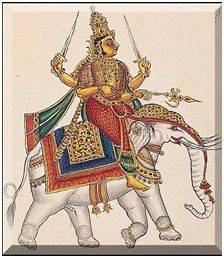
 
7 Comments

Posted by on October 4, 2012 in Varuna


Tags: , , , , , , , , ,

Varuna and his decline – Part One

Varuna

Abstract and Intro

(1) The saga of Varuna is truly amazing. Though his story started with a bang; it sadly ended in a whimper. Perhaps very few other gods – Vedic or otherwise – witnessed such vicissitudes in the turn of their fortunes.

The Varuna story covers a very large canvass – in content, space and time. The story of his preeminence has its roots in the pre-Vedic era; it flourishes in the early Rig Veda inspiring awe and reverence; and as it flows into other Vedas, Brahmanas and Upanishads.  Varuna’s associations with the sky, the water and the order in the universe as also in the ethical conduct of men,  all these, acquire new dimensions with mystical connotations. Till then, he is the highest lord in the Vedic pantheon, the most virtuous and the most powerful all-pervading god.

Varuna, up to a point, is the nearest equivalent to the Supreme; as he is projected as the creator and sustainer of all existence; the lord of Space; the maker of Heaven and Earth. His glory spreads far and wide into the Gathas and into the Bhrigu lore. The treaties entered  by the Mitanni kings of the distant Sumerian region (in about 1500 BCE) are sworn in the name of Varuna and his peer-Vedic –gods.

However, with the parting of ways of the ancient sages Bhrigu and Angirasa, Varuna becomes exclusively the Great God of the Aryans to the west of the Sindhu River; while Indra takes over as the King of the Devas. Varuna is eclipsed in the Vedic pantheon.

(2) Commencing with the Taittiriya Samhita (4.8.3.1) which identifies Varuna, mainly, with night and darkness; his career takes a steep nosedive. Initially, he loses his sole kingship over the sky ; and,  then he has to share his authority with another god who is younger and more energetic – Mitra.  Varuna gets  disassociated with the day sky ; which symbolizes clarity, brightness and brilliance; and , he is made the god of only the night sky. His ethical role too diminishes.

With that, Varuna draws nearer to night, darkness and death. Varuṇa’s dark associations bring him close to gods of negative traits such as Yama, Nirṛti, Soma, and Rudra. His character and disposition too undergo a marked change, for the worse. From a benevolent and graceful god, he turns into a spiteful, malevolent and stern judge cum punisher.

His physical appearance too turns ugly: he is now pictured as a fat, bald ugly looking cruel man with yellow or brownish red eyes, protruding teeth; and, wielding a noose.

One after another, his powers and authority steadily depart from him. Varuna eventually ends up in the Puranas as a demigod in charge of local water bodies; and,  as the guardian of the west where the sun sinks into darkness and from where the night takes over.

(3) The story of his pre-eminence in the pre-Vedic and in the early Rig Veda era; the modifications that came about   in his profile during the later ages; his fall from elevated position; and his eventual eclipse, is truly astounding.

In a manner of speaking, the course of Varuna’s career epitomizes the dynamic character of the Indian mythological lore. And, it also traces graphically the evolution, the development and the vicissitudes that came about in the corkscrew course of Indian theological history in response to the needs , changes and challenges it encountered at each stage of its unfolding over the millennia.

(4) Varuna saga should not be viewed in isolation. It is better appreciated when it is placed against the background of the scheme, the process or the phenomenon that swept across the world of Vedic mythology in the distant past. That process, spread over long centuries, totally convulsed the sedate world of Vedic gods. It was akin to churning the ocean. It disturbed the old order; threw out the old set of gods; created and magnified a set of new gods; and, restructured the entire Indian pantheon.

Under this process of reorganizing the world of Indian mythology… those Vedic gods who had been ‘minor’ in the Rig Veda but who held great potential and offered rich scope for enlargement and glorification were re-modeled into much greater gods.

Later, those gods came to represent larger segments of life and experiences; and to mobilize greater strength and significance. The virtues and powers of numerous other gods merged into those select gods. They are today the Super Gods in the Indian pantheon.

At the same time, those gods whose characters, functions and achievements had been too vividly described in Rig Veda; and, those who held out little scope for further enlargement were steadily reduced in their status and rank And those  gods whose profile was too dim ; and, had very little potential for growth were allowed to fade out quietly.

In this scheme or the process of restructure, the gods that adopted best to the changing needs of times survived and thrived. One way that was done was by underplaying their Vedic characteristics   which were rather sketchy and unsuitable. And, another was by aligning them along with tutelary gods that were already being worshiped. …..In this period of transition, popular sectarian gods were gradually replacing the older Vedic gods. This new approach to the gods redefined the status, character and attributes of the older gods.

This was also a process of absorption of several gods into One; and, it culminated in the emergence of the triad, of which the two: Vishnu and Shiva inherited all the rich, adorable and living traits of all the other gods that preceded them. They were also endowed with infinite potential and capacity to imbibe the traits of all the gods yet to come.

(5) The sequence of gods changing – growing or diminishing in significance – indicates the continual influx of new ideas and a creative conflict within the existing system of thoughts. This complex and dynamic interplay of light and shadow is a distinctive feature of the Indian pantheon.

inverted treeThe growth and development of Indian mythology and thought resembles the imagery of the inverted tree – of which our ancients were very fond – with its roots in the sky and its branches spreading down towards the earth. Its roots are ancient but its growing shoots, leaves, buds, flowers and fruits are ever green, tender and fresh.

श्रीभगवानुवाच |
ऊर्ध्वमूलमध:शाखमश्वत्थं प्राहुरव्ययम् |
छन्दांसि यस्य पर्णानि यस्तं वेद स वेदवित् || 1||

śhrī-bhagavān uvācha
ūrdhva-mūlam adhaḥ-śhākham aśhvatthaṁ prāhur avyayam
chhandānsi yasya parṇāni yas taṁ veda sa veda-vit

The roots of our philosophy, religion and culture are in the very distant Vedic past. Though those roots are no longer visible to us, the branches and extensions of those roots in vivid forms that have come down to us are very alive; and, its fruits are within our experience.

*

The idioms of Indian thought are thus dynamic, living and vibrant. They are linked to the spiritual urges and the changing needs, desires and aspirations of its people. The gods, the faiths and the worship practices too keep evolving, changing, without parting with the essence of its fundamentals. Therefore, growth, change and adaptation are essential aspects of the Indian thought and living. It is distinguished by continuity with change; as also by its resilience and diversity. That is the genius of the Indian traditions.

The Varuna saga, albeit a painful one, has to be appreciated in that context.

maze negetive

(6) Varuna of Rig Veda had a rather disappointing end; but, he did leave behind a rich legacy of wonderful concepts and norms of behavior in personal and social life (Rta) that have endured even to this day. Those laws are universal; applicable at all times and therefore eternal. 

The concept of Rta asserts that the order in nature is self regulated and operates by its own laws (svabhava); and, not necessarily by the will of gods. Ensuring the perpetuation of the order and harmony in nature is as sacred  and as important as it is in conduct of one’s life. That is because; Rta emphasizes the integrity of all forms of life and ecological systems. The principle of Rta recognizes our oneness with our environment and our unity with all life on earth. It is the framework that binds together man, nature and god.  Rta is thus the Dharma – the order – that pervades and protects all life. It asserts the principle that the physical order of the universe is also the moral order of the universe; Rta is both.

When that order and harmony is ruptured, the disruptive elements of disorder, chaos and falsehood (an-rta) step in, bringing in their wake ugliness, dishonesty, falsehood  and, decay into life.

It is explained; a sin is any inharmonious action done with avarice to gain some immediate and temporary gain. Thus, injuring the harmony that exists in nature and among men is indeed the sin; and, it attracts punishment. The sin arises because of frailties and human weaknesses; and not because of demons. The evil in the hearts and minds of men are the real demons.

Sin is compared to unpaid debt (rna); it is a burden and an act of bad faith. The best way to cleanse the sin is to come face to face with it; own it; confess to it; and seek forgiveness with a promise not to err again. Cleansing is in the heart, mind and deed; not in the rituals. That is the Varuna’s way.

Paschat-tapa – ‘after the burning heat’ – signifies the purifying fire of repentance. The life-giving waters over which Varuna presides also signifies purity. Varuna is intimately associated with the both. Thus the Varuna-principle stands for purity in life.

white_lotus_2

(7) Let’s in the following five articles trace the journey of Varuna from the Rig Veda through the other Vedas, Brahmanas, Aranyakas, Upanishads as also Mahabharata and the Puranas. Let’s also later see his connection with Ahur Mazda of the Gathas.

***

A. Varuna in the Rig Veda

The encompasser

1.1. Varuna of Rig Veda, the one who encompasses (var) the whole world, is one of the oldest Vedic deities. He belongs to the older generation of gods than that of Indra; and, his origins go back to the pre-Vedic era. It is said, Varuna was un-created or unborn; he existed before the very dawn of creation; and, he manifested himself along with the wake of the world. That perhaps is a poetic way of suggesting that Varuna had been recognized as a sovereign ruler even before the dawn of Rig Vedic age.

1.2. He is the mightiest of the early Rig Vedic gods. He is celebrated in the Rig Veda variously as: the universal monarch; the king of all gods, the sovereign who dwells in all the realms ; the best among the Adityas the solar deities ; the lord of the sky; the god of heavenly light; the overlord who established and governed the cosmic order Rta; the guardian and upholder of righteousness – Dharma , Dharmanaam pathi; the stern but merciful judge who judges all men and punishes the wrongdoers; the healer with thousand remedies;  the omnipresent and  omniscient, possessing limitless knowledge; kavi, the seer par excellence ;  there is none wiser than he; the wielder of divine power and wisdom Maya; the controller of the destinies of mankind; one who forges the magical and speculative relationship between god and man; the lord of water element , clouds, seas and rivers Sindhu-pathi; and as the king of waters Ambu -raja.

Everything is subject to Varuna’s authority and control; nothing happens without his knowledge; and he takes everything.

1.3. No other Vedic deity is invested with such grand attributes and authority . Together with Mitra, Varuna more than any other god is in charge of the established order of the universe, the fixed rules of conduct – both physical and moral- ‘dhtavrata’.  Varuna inspired awe and reverence.

Lord of Ethics

2.1. The attributes and functions ascribed to Varuna impart to his character a moral elevation and sanctity far surpassing that attributed to any other Vedic deity. His extreme concern is the morality of human beings.

2.2. While the hymns addressed to other gods seek long life, wealth, and power; the prayers submitted to Varuna seek purity of heart, forgiveness, and release from sins; and, for moral strength not to err again. They are replete with humble confessions of guilt and repentance. The hymns in praise of Varuna ‘the most impressive deity among all the Vedic gods’ are lofty, devout and ethical in tone. The hymns rise to a pitch of exaltation when they sing the splendor of Varuna.

In these hymns Varuna, more than any other Vedic god, appears mighty and merciful. He is feared as a severe judge. He terrifies the guilty; but is most compassionate to the virtuous.

The resplendent god

Varuna blue

3.1. Rig Veda describes Varuna’s appearance in glowing terms: as the most resplendent god of radiant- sky-blue complexion, with Agni in his face and Surya in his eye. He is far sighted (uru-chaksasa). He is the eye of all the worlds (jagath-chakshu- RV.1.25.5). He has soft and beautiful hands (supani) in which he holds lotuses and   an auspicious noose. He is splendidly adorned in golden mantel (drapi) and a shining robe.

His chariot dazzles brilliantly like sunrays (ghabasti suro nadyauth – RV.1.122.15).Varuna and Mitra ride the golden chariot like floating clouds in the blue sky, drawn by well yoked steeds. (Rv.5.62.7). in the midst of vast heavens urukşhaya (RV 1.2.9) he is seated on a splendid throne placed in his  golden palace of thousand pavilions, thousand columns (RV 2.41.5) and thousand doors (RV 7.88.5).  From his glittering throne, the monarch (samrajnya) watches over the deeds of all men and gods (pastyasu)- (RV 1.22.11-12).

Verily all of you are very great

4.1. The Mandalas of Rig Veda do not attempt stacking up its gods in a graded order; but strive to discover the Great One (Mahat) that is the source of all. There are no inferiors or superiors among the Vedic gods.”There is no one among you Oh Devas..! who is an infant or a boy .Verily all of you are very great” (na hi vo astyarbhako devaa so na kumaraha, visve sato mahanta iti – RV 8.30.1).

No one god in particular was regarded as the superior deity guiding and controlling the rest. But, all gods of Rig Veda were of co-ordinate power; and no one among them was recognized as supreme God per se, even though some gods were more imposing than others. Such gods included, particularly, Indra, Agni and Varuna, the gods of the warriors, of the yajna and of the pious devotees, respectively.

4.2. You come across in the Vedas, the hymns where a particular deity is lauded in glowing terms and celebrated as the highest among the gods. There is also a tendency  to elevate now this god and later another to the highest pedestal ;and, to look upon him as the greatest power. It is explained; in all such instances the high praise and tributes paid are truly addressed to the Absolute, the Supreme principle; and, not to the god in question who merely is a manifestation of That One. Thus, all gods of Rig Veda are of equal status.

Varuna on makara

The Mighty King

5.1. The equitable status accorded to all gods, as explained above, was generally in the context of the younger gods, the Devas. But, Varuna belonged to the older generation wherein he was honoured with a very special status and hailed as the greatest god, Asura Mahat. Varuna continued to occupy that elevated pedestal until his demise or until the rise of Indra. Therefore in the early hymns of the Rig Veda, Varuna occupies a special and an exalted position. He alone is hailed as the king (Raja) (RV 7.87.6), kshatra (secular power, sovereignty and kingship) and Kshatriya; the king of gods (MS 2.21); the king of the territories (raja-raastranam) (RV 7.34.11); an independent ruler (svaraja) (RV 1.28.1); the self-dependant ruler (svaraat), and samraja the universal monarch (RV 1.36.1; 8.42.1).

5.2. As the emperor, Varuna is mighty and awe-inspiring. He is Risadas the destroyer of enemies (RV 1.2.7), tuvijata and uruksaya mighty (RV 1.02.9). His might and speed are unequalled (RV 1.24.8) . He rules over both men and gods; and presides over the relationship between man and the gods. His sovereignty pervades both the physical and moral domains, where his laws are equally eternal and inviolable.”Indra protects from external foe; Varuna protects and upholds the moral order rtaRV 7.83.9”. Even a god does not dare transgress his immutable ordinances (vrataani).He restricts and fetters the wrong doers with his bonds that he has at his command.

mitraṁ huve pūtadakṣaṁ varuṇaṁ ca riśādasam |dhiyaṁ ghṛtācīṁ sādhantā || 1. 2.07

kavī no mitrāvaruṇā tuvijātā urukṣayā |1,002.09

ṛtena mitrā-varuṇā-vṛtāvṛdhāvṛtaspṛśā |kratuṁ bṛhantamāśāthe || 1. 2.08

vṛtrāṇy anyaḥ samitheṣu jighnate vratāny anyo abhi rakṣate sadā |7,083.09

5.3. He is not only the supreme kshatra, supreme Asura, the wise king, the best of the Adityas but he is also the abode of life (visvayu). The term Asura (one who controls asu = breath or life) meaning the Lord of Life is particularly applied to Varuna (RV 2.8.27).  Prayers are submitted to him to grant an enjoyable  life-span of hundred Shrad-ritus, better than the life lived by their forefathers – śataṃ no rāsva śarado vicakṣe, acyāmāyūṃṣi sudhitāni pūrvā (2.27.10).|He is celebrated as the all knowing Asura (asuro visvavedaha –RV 8.42.1), and as the wise and attentive king (asurah prachetah –RV 1.124.14). In some passages the scope of the term is extended by adding the title ‘the king’ (RV 1.24.14; 10.132.4) or even stronger ‘the universal king ‘(RV 8.42.1).

His dominant position is declared by stating Varuna is the Asura and the king of all gods (RV 2.27.10).  “I am king Varuna; these powers (Asurya) were first given to me”- (ahaṃ rājā varuṇo mahyaṃ tāny asuryāṇi prathamā dhārayantaRV 4.42.2). Mitra and Varuna are described as the two noble (Arya) Asuras (or lords) of the Devas – Devanaam asurah – (tā hi devānām asurā tāv aryā tā naḥ kṣitīḥ karatam ūrjayantīḥRV 7.65.2)

tvaṁ viśveṣāṁ varuṇāsi rājā ye ca devā asura ye ca martāḥ | śataṁ no rāsva śarado vicakṣe’śyāmāyūṁṣi sudhitāni pūrvā || 2.27.10 ||

5.4. In the Rig Veda, the totality of godly powers is called asuratvam; and it is called Mahat the great one. Varuna is Asura- mahat (Mahat devaanaam asuratvam ekam – RV 3.55.1-2). He is also regarded as the sovereign who created the Universe: The All-Wise Varuna – asuro visvavedaha-Rig Veda 8.42.1”. He also put in place the cosmic order and governed the physical as also the moral aspects of existence. He is also the punisher and a fearsome destroyer.

5.5. Thus, Varuna of Rig Veda, heralded as the most exalted god (though only for a brief period) is endowed with these powers and authority. And, with his omniscience and omnipotence he is the nearest approximation to the structure of a Supreme Being, the Almighty God – the creator, preserver and destroyer. But, the text stops short of declaring him or any other deity as the Supreme God. The powers and virtues attributed to Varuna were later crystallized and appropriated among the Trinity of the mythologies which came up later.

Varuna painting

Epithets

6.1. Rig Veda celebrates the glory of Varuna in myriad ways ; and describes him as : the Great One (Mahat); the vast (brahat); the mighty (bhuri);the immense (prabhuti);  the abode of life (visvayu); the knower (vidvas); the wise (medha);the intelligent (dhira); the discriminating (pracetas); the clever (grtsa); the adept , dexterous (sukratu); the inspired (vipra); the seer (kavi); the great-poet (kavitara); the greatest of poets (kavitama).

Amarakosa has five synonyms for Varuna :  (1.1.142) pracetā varuṇaḥ pāśī yādasāṃpatir-appatiḥ

Besides these, Varuna has other sets of titles as being the lord of waters, the lord of Rta;   and as the king and judge. We shall see more of those in the next sections.  He has too many epithets. I admit, it is rather confusing.

Asura

[Before going further, a short explanation of the term Asura in the early Rig Veda:

7.1. The term Asura was used in the Rig Veda to indicate the powerful or the mighty one. Its application was more as an adjective than as a noun. This term was applied not only to gods but also to other powerful individuals. In the early Books of Rig Veda, Asura as a designation appears only in the singular or in dual form (as in Mitra-Varuna). Asura in that context did not refer to a cult or to a group or  to a class of gods, just in the manner it referred to group of Devas , as  in the case of visve devah. In other words, Asura was a title of highest lordship or honor assigned to certain gods who were regarded mighty, powerful and worship- worthy. These gods in general were also addressed as Devas. The older deities celebrated as Devas were often addressed as Asura, just to emphasize their power and might.

For instance; in Rig Veda, Indra the king of Devas is addressed in about sixteen hymns as Asura, possessing Asurya or Asuratya. His deeds are described as Asurani– the powerful, as those of Asuras . Similarly, the three other mighty deities of Rig Veda: Agni, Varuna and Mitra (in company of Varuna) are called Asura. Rudra is described in accusative form as devam asuram (RV. 42.11), the Asura possessing Asurya or bestowing it. Dayus the ancient sky-god too was called Asura. Some other Vedic deities too were at times called Asura, as in the case of : Savitar, Surya, Vayu, Maruts, the Adityas and Apam Napat. Ushas the goddess of dawn was said to possess Asuratva.

7.2. There are no cases in Rig Veda where a god is called Asura in respectful sense in one instance and then called an Asura in the demonic sense in another instance. Hence the change that came about was truly in the usage of the term and the meaning assigned to it at different times; and, it did not signify a change in the nature or the character of the god to whom the term was applied.

As said earlier, Asura meant highest lordship. Dayus the old sky-god was the earliest Asura. But, since Dayus , more and more , came to mean the physical sky and not the Great God, the epithet then was applied to Varuna the new sky-god; and later to Indra and other gods. But, the term Asura was applied particularly to Varuna to signify his supreme lordship over men and gods (viśveṣāṃ varuṇāsi rājā ye ca devā asura ye ca martāḥRV 2. 27.10).

Aditi mother of gods

Aditi, the mother of gods, it is said, produced Mitra and Varuna for Asurya – Might or mightiness.  “This Asura rules over the gods”: mahad devānām asuratvam ekam – RV_3,055.01 to 22

[Sage Kapila , said to be the founder of the Samkhya system of Philosophy, is often addressed as Asura. And, his son or disciple is Asuri , another great Samkhya philosopher.]

No other Vedic god is described in this manner (anyad-anyad asuryaṃ vasānā ni māyino mamire rūpam asminRV_3,038.07 ) . It is explained; the Asurya and the dignity connected with being Asura in the case of Varuna is his original characteristic. That suggests; Varuna was a sovereign ruler even at the dawn of Rig Vedic age. However, in the case of Indra, it is said, his Asurya   was inherited from Varuna; it was not Indra’s own. When Indra is called Asura or invested with Asurya , it is done merely because Indra happened to succeed Varuna as the king of gods.

7.3. The Brihadaranyaka Upanishad (3.1), Mahabharata (shanthi parva: 33.25) and Amarakosha all describe Asuras , the sons of Diti, as the elder brothers or the older gods, while the Devas are the younger ones.

7.4. The sea-change that came about in the meaning assigned to the term Asura can also be explained in the context of the religious history of the Vedic people.

When the Aryan community was undivided, the terms Asura and Deva both denoted gods of high respect. The gods were referred to Asura as also Deva. But at a certain phase of their history, the Vedic people became divided along the lines of affiliation to two great and ancient sages Apam Napat and Angirasa. These sages belonged to the pre –Vedic period. The parting of their ways came about mainly because of the stand each took on issues such as: monotheism; worship of God through formless medium; use of icons in worship; and above all, on the question of the status to be accorded to the old god Varuna.

The Bhrigu clan who generally were to the west of the mighty Sindhu River continued: to regard Varuna as the Greatest and the only God – Asura Mahat; to favor worship through the formless medium of fire and honor the principle of Rta the moral order governed by Varuna as the highest good of all .

The Angirasas who were the preceptors of the dominant Aryans on the east of the Sindhu, on the other hand, elevated the more energetic and vibrant younger gods the Devas (Indra and others) to exalted positions and treated all Devas as equally great .These Devas were personified and described as having forms. Besides, the Angirasas relegated the passive old gods such as Varuna to very low positions in the Vedic pantheon, and also soft peddled Rta principle the moral order governed  by Varuna.

( We shall talk a bit more on these issues in the last part of this article.)

7.5. The parting of their ways was hardly a sweet-sorrow; it was laced with rancor and hate. The Bhrigu and the Angirasa clans each ascribed its own chosen words of abuse to the terms Asura or Deva, depending on to which side of the Sindhu they belonged. In the later Vedic texts Asuras came to mean demons.

Towards the later books of the Rig Veda (6, 7, 8 and 10) the term Asura underwent extraordinary semantic change. It not only became a noun from an adjective; but also acquired a totally different meaning of demon or demonic. And in the sixth Book of Rig Veda (RV 6.022.09), Indra for the first time came to known as janasya divyasya rājā, the king of gods. And the idea, of course, became more popular and crystallized later in the Puranas.

In the Brahmanas of Krishna Yajur Veda , the term Asura was used in the sense of anti-god. It then was usually expressed in plural to suggest a group of beings opposed to gods. And, when it was used in singular (in the same sense) it was expressed as aasura. In the Shatapatha Brahmana the terms Asura and Rakshasa came close to each other.]

The Varuna – hymns

8.1. Varuna is indeed one of the mighty gods of Rig-Veda, though he is celebrated exclusively in just about ten hymns (RV 1.24. 25; 2.28; 5.85; 7.86 to 89 and 8.41 to 42).Besides, he is praised along with Mitra (Maitra –varuna) in twenty-three hymns; and with Indra (Indra-Varuna) in nine hymns. These numbers are rather small as compared to the numbers of hymns addressed to Indra and Agni, which are about six-fold greater.

For instance; in Book Three  no hymn is addressed to Varuna while twenty-two are devoted to Indra. Similarly, in Book eleven there is only one hymn to Varuna while twenty-three are addressed to Indra .

For some reason, Varuna is less frequently mentioned in the last book than in the earlier books of Rig Veda.

That does not in any manner diminish the importance, might, glory and power of Varuna as depicted in Rig Veda.

8.2. If Varuna is so great and important why is it that only a handful of hymns are dedicated to him in the Samhitas?

That might be because of the dark traits associated with him. Varuna was not wholly benevolent like Indra in the early Rig-Veda. Varuna is rather an ambivalent character – now favourable; and now unfavourable. He was a judgmental god who inspired awe and fear. Yet, Varuna was essentially a god of placid nature. And the Vedic poets were decidedly in favor of uncompromisingly good gods who protected people from enemies, diseases and draught. That process perhaps eventually led to Indra replacing the old god Varuna and taking charge as the chief of the Devas.

8.3. The Varuna – hymns are remarkably varied in their content and scope. They portray range of Varuna’s attributes; but, they project, mainly, four of his functions: as the universal monarch and lord of the sky; as the upholder of the cosmic order Rta; as related to water element (apah); and, as omniscient deity with unique magical knowledge (Maya)   who oversees men’s’ actions.

We shall discuss each of his main attributes and functions in the next part of in this article.

Continued in Part Two

img_lotus

References and Sources

1. Indra and Varuna in Indian Mythology by Dr. Usha Choudhuri; Nag Publishers, Delhi, 1981

2. The Indian Theogony by Dr.Sukumari Bhattarcharji, Cambridge University Press, 1970

3. Asura in early Vedic religion by WE Hale; Motilal Banarsidass; Delhi, 1986

4. Goddesses in ancient India by PK Agrawala,; Abhinav Publications, New Delhi,1984

5. The Hymns of Atharvan Zarathustra by JM Chatterji; the Parsi Zoroastrian Association, Calcutta, 1967; http://www.avesta.org/chatterj_opf_files/slideshow.htm.

6. Outlines of Indian Philosophy –Prof M Hiriyanna; Motilal Banarsidass, Delhi, 2005

7.Original Sanskrit texts on the 0rigin and history of the people of India, their region and institution By J. Muir;Trubner & co., London, 1870.

8. A classical dictionary of Hindu mythology and religion, geography, history, and literature byJohn Dowson; Turner & co, Ludgate hill. 1879.

9. Vaidika Sahitya Charitre by Dr. NS Anantharangachar; DVK Murthy, Mysore, 1968

10. Sri Brahmiya Chitra Karma sastram by Dr. G. Gnanananda

11. Zarathustra Chapters 1-6 by Ardeshir Mehta; February 1999

 http://www.indiayogi.com/content/indgods/varuna.aspx

http://www.bookrags.com/research/varua-eorl-14/

http://www.bookrags.com/wiki/Varuna

http://www.hinduweb.org/home/dharma_and_philosophy/vshirvaikar/Dnyaneshwari/Dnch10pg1.html

http://rashmun.sulekha.com/blog/post/2010/03/vedic-literature-the-degradation-of-varuna-and-indra.htm

http://www.newworldencyclopedia.org/entry/Varuna

http://www.indiadivine.org/audarya/vedic-verses/453851-vak-suktam-aka-devi-suktam.html

http://www.svabhinava.org/HinduCivilization/AlfredCollins/RigVedaCulture_ch07-frame.php

http://en.wikipedia.org/wiki/Ahura_Mazda

http://www.iamronen.com/wp-content/uploads/2010/05/ReadingLila.pdf

https://sanskritdocuments.org/mirrors/rigveda/roman03/RV0301.htm

https://sanskritdocuments.org/mirrors/rigveda/roman03/RV0302.htm

All images are by courtesy of Internet
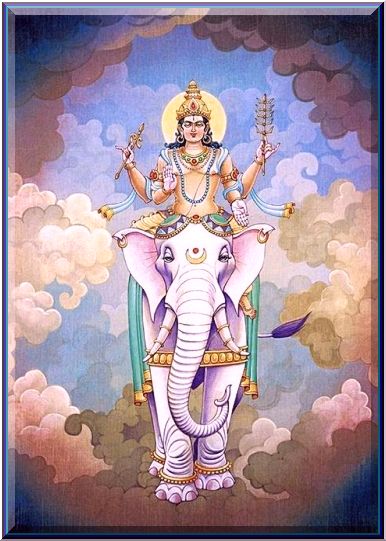
 
19 Comments

Posted by on October 4, 2012 in Varuna


Tags: , , , , , , , , , , , , ,

Sri Dakshinamurthy iconography and some other questions: Part Two

Continued from Part One

Let’s now come to the questions you framed.

Why Dakshinamurthi facing South direction?

Are there any specialties in south direction suggested in Agamas and in Shilpa Sastras?

‘Kuragasanam’ is one of the type of Asanas?

Can you tell me the types of ‘ Chadamudi ‘(Hair Types?)

Why there are such different types of Dakshinamurthi in South Indian temples?

In North India, we can’t see the Dakshinamurthi idol… Why it is so?

In your sixth chapter, I saw a Dakshinamurthi photo. It is very different. Can you tell me from where it is?

****

dakshinamurti

 A. Why Dakshinamurthi facing South direction?

1.1. The direction towards which a temple-deity faces depends upon its disposition and attributes. It also is according to this triple orientation – towards the Sun, towards the center, towards man. The majority of the preserved temples do face the east, but it is not necessary that they physically must. The other directions could be described as being east. To the tantrics that have some obscure symbolism about Sunrise in the east, the directions of south, west and north each have relative value or significance. In Tantra, any direction may notionally be taken to represent east.

1.2. Most temples face east, because it is believed that the doorway of the sanctum facing east is best (uttamottama – most auspicious); west is next best (uttama); even south is permissible (madhyama); and to the north it is inferior (adhamam), not desirable. (Vimanarchana – kalpa patala 3)

2.1. As regards Sri Dakshinamurthy, as you mentioned, he most usually faces the South (except perhaps in few cases such as in the temple at Tiru Anjaikkalam in Kerala where Sri Dakshinamurthy faces east). The south-orientation of Sri Dakshinamurthy appears to be based on the notion that he is seated in the Himalayas looking towards the land-mass where the aspirants reside; that is towards south.

2.2. Another way of understanding it is; Suta –samhita describes the five faces or five aspects of Shiva which are turned towards four cardinal directions and the space above, as: on the West: Sadyojata (representing earth, and pervading ego); on the North: Vamadeva (water and manas); on the South: Aghora (fire and Buddhi); on the East: Tatpurusha (air and maya); and above all: Isana (akasha and soul).

The South face of Shiva is Aghora . It is to your right-hand-side (Dakshina) as you stand facing the Linga of Shiva. Aghora (that which is not dreadful) is the benevolent, benign face of Shiva; and it is directly related to Vidya (the knowledge that liberates) and then to fire (illumination) according to Vatulagama (1.67-69).

Aghora the benevolent is predominantly of sattva nature with minimal of rajas and tamas. It is a state of pure being and energy. It is pure knowledge (para-vidya); and, Sri Dakshinamurthy represents that knowledge.

Sri Dakshinamurthy who corresponds to Aghora the south aspect of Shiva is therefore represented facing south.

3.1. Another, perhaps more plausible, reason could be the one that has to do with the nature and disposition of Sri Dakshinamurthy.

According to the Padma-samhita (kriya-pada 2, 33-34) the door of the sanctum facing east is productive of happiness; the door facing the west enhances health and nourishment; the door facing north brings wealth and prosperity; and the sanctum door facing south makes for liberation.

sloka

Since Sri Dakshinamurthy, the Adi-Guru, teaches knowledge (jnana-karaka) that liberates (mokshadam) it seems appropriate he faces south, according to Padma samhita.

B. Why Dakshinamurthy?

4.1. It is mentioned repeatedly that he is called Dakshinamurthy because he is facing south.And also because the deity is placed in the southern quarter of the temple .Some say ; the name of the deity may have been derived because of this practice.  However, there are few other explanations too.

4.2. According to Tantra tradition in which Sri Dakshinamurthy is a revered Guru of the Kadi (samaya) School, the term Dakshina means a woman and refers to the feminine principle, which can create, unfold and manifest. When Dakshina assumes a form along with Shiva it results in Dakshinamurthy, an androgynous aspect of Shiva. The Tantra tradition Dakshinachara regards and worships Sri Dakshinamurthy as Ardha-nari.

(The Dakshinayana is  regarded as the Ayana (half year) of the Devi, the Mother Goddess, the life giving  feminine phase of the Earth. It  begins with pouring monsoon rains beating down the heat and ushering in cool relief . It is the rejuvenating season   when all creatures and vegetation  come to life and thrive )

4.3. The great seer Sri Ramana Maharishi who perhaps is closest to Sri Dakshinamurthy in his ideals and in his teaching methods, explained the term as Dakshina + Amurthy, meaning a formless entity, one which is capable but is without form.

दक्षिणः सृष्टि स्थित्यन्त विरचना निपुणश्चासौ परमार्थत अमूर्तिश्च आकारविशेषरहितः |

Dakshina refers to He, who is competent to create, sustain, and dissolve this Universe; and, who, however, in reality, in his Absolute state, is A-murthy i.e. formless.

4.4. It is also said; Dakshina refers to Buddhi (intellect), the vision which has the capacity to perceive Brahman (Akhandaakara Vritti) in His non-dual or formless state (A-murthy). Thus, the Brahmavadins  refer to Dakshinamurthy as that Buddhi in each of us – (Dakshinamurthy Upanishad– Verse 31)

शेमुषी दक्षिणा प्रोक्ता सा यस्याभीक्षणे मुखम् ।दक्षिणाभिमुखः प्रोक्तः शिवोऽसौ ब्रह्मवादिभिः ||

4.5. He is called Dakshinamurthy because of his boundless compassion (Dakshinya) towards all creation.

4.6.Dakshina , it is said , also means favourable (anukula ) to the devotee.

4.7. Dakshina is also interpreted as grace. Sri Dakshinamurthy is regarded the very embodiment of grace . It is explained that ‘grace’ (anugraha) is an act of unbound compassion releasing the individual from the coils of samsara. As Guru, he is the sublime ideal of spiritual wisdom adorned with grace towards all aspirants. And, only through his grace can one attain liberation.

4.7. And, It is also mentioned that the term ‘daksha’ denotes one who is capable, skilful or an expert. Daksha also signifies the intelligent or competent. Dakshinamurthy is the Daksha, the Master in music, arts and in all that is accomplished artistically; an exponent, an authority on scriptural learning; an adept in Tantra-vidya; a supreme Yogi; and, a teacher beyond compare who teaches the true knowledge that liberates.

4.8. Sri Shankara, in his Dakshinamurthi Stotra, offers salutations to Sri Dakshinamurti,  the abode of all wisdom; the Supreme Guru; the teacher of all the worlds; and, the healer of all the ills of existence

निधये सर्वविद्यानां भिषजे भवरोगिणाम्  गुरवे सर्वलोकानां दक्षिणामूर्तये नमः

dakshinamurti2

C. Are there any specialities in south direction suggested in Agamas and in Shilpa Sastras?

5.1. Orientation is an essential aspect of the yajna and construction of the yajna vedi, the temples, the towns and buildings. Meticulous care is taken to ensure location of those constructions exactly along the desired axis (Prachi). That was because of the belief that each direction was complimented by the attributes associated with the gods who presided over it. The directions were therefore of much significance to the Vedic people.

5.2. The traditional texts describe the arrangement and attribute of the Dikpalas the Regents who preside over directions. This arrangement is generally followed in the Tantra texts as also in astrology, architectures and Vastu. The classification is briefly as under:

Indra the king of Devas, the Lord of the heavens dwells in the East, which represents power and courage.

Yama the protector of the Law (Dharma raja), guardian of the ancestors and the king of the Dead dwells in the South, which represents justice and the care of the ancestors.

Varuna the protector of rta the cosmic law; guardian of rites; lord of destiny and the lord of water element dwells in the West, which represents knowledge.

And, Kubera the king of Yakshas and the lord of riches dwells in the North, which represents an upper position and wealth.

*

5.3. Since we are talking about the south direction in particular, let’s take a look at it.

In the context of the yajna, the Southern gate is reckoned as the way of the ancestors the pitris; and, the offerings to the departed ancestors are always submitted facing South.

Yama is the Regent and protector of the South. Yama the lord of death is depicted as the embodiment of righteousness, the Dharma;   and he is the king of justice, the Dharma raja. He judges the dead; but, he is amenable to pity and reason, as it happened in the case of Savitri and Pramadvara* in the Mahabharata. 

savitri-yama-1  pramadvara

[* Pramadvara (pramadaam varaa, the best among the most beautiful) was the daughter of Menaka, the Apsara (celestial nymph) and Viswavasu, the king of Gandharvas. Since Pramadvara was abandoned by her parents, Rishi Sthulakesa raised the most delightful little girl with great care and love. Later in her life, just on the eve of her wedding with her beloved Ruru (son of hermit Pramati and damsel Ghritachi) Pramadvara  died suddenly , bitten by a snake. Ruru, the heartbroken bridegroom,  in deep sorrow and bewailing appeals to gods (Devas) to restore his Love Pramadvara  to life. Yama, the Dharmaraja, moved by pity and sympathizing with the plight of Ruru agrees to bring Pramadvara back to life; but, on condition that Ruru should  gift half of his remaining lifespan (Ayu) to her.  Ruru readily agrees to Yama’s rider with alacrity; Pramadvara comes back to life; and, immediately marries Ruru without losing time. The happy parents later beget a son Sunaka. And, his son   Saunaka, later,  as the chief of the Rshis,  performed a very long Yajna in the Naimisha forest (Naimisaranya). Saunaka is the one who heard the recitations of Mahabharata and   Srimad Bhagavata   from Suta and his son Ugrashravas. Saunaka, in turn, narrated these epics.  Saunaka is credited with monumental works, such as the Anukramanis ( a sort of Vedic Index) , Brhaddevata (which narrates  the legends of the Vedic gods ) and Rg Vidhana  (which explains each rk in the context  of the Srauta and Gruhya Sutras)]

Yama is also an adept in Atma-vidya, the knowledge of Self.In the katha Upanishad, Yama, explains to boy Nachiketa: “that knowing which, everything else becomes known?”

yama 3

Sri Dakshinamurthy too was an adept in Atma-vidya. (I am not suggesting a connection).

D. Kuragasanam’ is one of the types of Asanas?

6.1. The Shilpa texts (Ahirbudhnya samhita and others) together describe as many as twenty asanas or sitting postures. They also describe about eleven types of seats or pedestals, also termed as asanas, on which the iconic representations are lodged.

The Kuragasana you mentioned is in fact Kurangasana. It merely refers to the fact that Sri Dakshinamurthy is seated on a throne or pedestal or a seat covered with deer-skin. Kuranga, in Sanskrit, refers to Indian antelope. In Poet Jayadeva’s celestial poem Gita Govinda, Sri Radha covered in the fragrance of Kasturi (deer’s fat or musk) is described as kuranga madena . And, in the Sharada Bhujanga stotra  , Goddess Sharada is described as one who rides a deer (kuranga). Please click here for Sanskrit -English Dictionary , (page 65) where Kuranga is explained as a musk deer.

E. Can you tell me the types of ‘ Chadamudi ‘(Hair Types?)

7.1. Providing elaborate, graceful and attractive hairstyles (Kesha vinyasa or kesha-alankara), which besides enhancing the beauty of the sculpture would also bring out the status, the nature and the attribute of the subject, received a great deal of attention. This was one area along with ornamentation (alamkara) where the shilpis could give wings to their imagination and enterprise; and exhibit originality. Some Shipa texts carry a chapter usually titled Mauli lakshanam, but there is no comprehensive list of hair styles. Some names are not supported by illustrations; and therefore we do not know what those style-names imply. And in some cases the names of the headgears (kirita or mukuta) have got mixed up with the names of hair styles.

 Kuntala0002Mauli0003

The following are some of those Kesha – vinyasas, so far as I know .This is not exhaustive.

(1) Jata-mukuta: A hair-do; hair arranged in long braids and then tied around. It is raised into conical form resembling a crown. The height of the jata-mukuta would be about 1 ½ times the length of the face. (Shiva, Brahma)

  hair Jatamakuta2Jatamakuta

(2) Jata-bhara: long strands of hair let lose flowing down on to the shoulders, around the ears. It could be either neatly combed stylishly and decoratively; or be just dishevelled.(Shiva , Dakshinamurthy)

Jatabhara jata

(3) Jata-mandala: Long strands of thick hair woven into three braids are wound in circular forms and held behind on the neck like a disc or a fan. Its other variation is: some braids are let flowing on to shoulder and back. (Shiva)

jata mandala  sarpanaulisapamauli20002

(4) Sarpa-mauli: Thick strands of hair are woven (pigtailed) to look like snakes; and, tied up and arranged turban-like. The hair-do would look like a turban made of snakes.(Shiva)

(5) Jata-bandha: Strands of hair made rope-like are wound into ball-shape or spindle-like and placed atop the head. (Rishis, Devas, Narada)

jata bandhaJatabhanda

(6) Vikirna-Jata-bandha: Strands of hair made rope-like are spread out to flow on the back, on the shoulders. When the person dances or spins around, the hair- do spreads and whirls in the air. (Nataraja)

(7) Agni-kesha: strands of hair either loose or pigtailed spread out horizontally like the tongues of a spreading flame. (Agni, shakthi, aggressive characters)

 Agnikesha

(8) Kesha –Bandha: The strands of hair are neatly combed and arranged into various conical forms of a series of diminishing tiers and placed in position by tying up the arrangement securely. There are varieties of decorative and stylish hair arrangements under this category. In most cases the conical hair-do is arranged to look like a mounted crown and decorated with ornaments. There are countless variations. (Devis and Queens).

queen2queen 1keshabandhakeshabandha4

(9) Shirastraka: strands of hair are neatly combed, made into number of bunches and each tied into number of small knots to look like rows of water-bubbles. The ends of each bunch are tied into small ball-like knots; and arranged on top of the head. (The Buddha)

buddha head buddha-head-drawingbuddha hair

10) Kuntala: Long locks of hair neatly combed, parted three-ways and tied into decorative shapes or ball-like, mounted on top of head either to one side or to the middle of the head. The ball-like arrangement when it is to one side of the head is just over the over the ear .The hair-do is well ornamented. (Andal, Sathyabhama, Balakrishna)

Kuntala40002aKuntala5hair 4

(11) Dhummila: collecting the hair, tying up the bunch into knots of various shapes. Bunched knot is usually placed behind. It is usually as broad as the person’s face; and wound into three or four rounds. (Devis, Queens)

dummila3Dummila 2  dummilaDummila3

(12) Alakacuda: Specially suited for curly hair. It could be used in depictions of children, women or even men. Hair is neatly parted in the middle and made into two bunches one on the right and the other on the left. Then the bunch on the left is brought over to the right; and similarly the bunch on the left is brought to the left. They then are together tied into ball shapes; and held behind or to the side of the head. Tiny wisps of hair are arranged around the face, like bees around a flower. This depiction is extensively used.(women in queens quarters, and other general use)

[Bharata in his Natyashastra (Chapter 21) while dealing with Pravrtti (local manners and costumes) mentions, among other things, : the women representing characters from Avanthika region should be adorned with curly locks; and those from the Gauda-desha with long hair. The Panchala, Magadhi and Dakshinatya are to have only a braid of hair.  The Kerala beauties should be adorned with long curly locks. As regards the Abhira tribal girls, their hair is to be divided into two plaits. The wives of the sages as also those women away from their husbands should be shown with hair braided in single lock.

veṣā abharaṇa saṃyogān gadatastānnibodhata । āvantya yuvatīnāṃ tu śirassā lakakuntalam ॥ 67॥ gauḍīyān āmalakaprāyaṃ saśikhā pāśaveṇikam । ābhīra yuvatīnāṃ tu dviveṇīdhara eva tu ॥ 68॥

The celestial nymphs should be decorated with crest jewels and a coronet on their plaited heads. The Naga women should be distinguished by the insignia of hood on their head. The Vidyadhara girls are to sport lunar discs on the plait of their hair. The Yakshis are marked by their long crest (shikha).\

divyānāṃ naranārīṇāṃ tathaiva ca śikhaṇḍakam । śikhāpuṭaśikhaṇḍaṃ tu muktā bhūyiṣṭh abhūṣaṇam ॥ 56॥ vidyādharīṇāṃ kartavyaḥ śuddho veṣaparicchadaḥ ।
yakṣiṇyo’psaraścaiva karyā ratnavibhūṣaṇāḥ ॥ 57॥

***

Dr. Rajendra Mittal in his Indo-Aryans Volume I , mentions that the name  Kapardin  indicates one who has matted, braided hair or hair twisted into a bun on top (Kaparda—kapardi). Rudra is often addressed as Kapardin.

And, it seems during the Vedic times, the women had their hair well oiled and combed; and, dressed in braids (Kaparda). And, some  had the practice of weaving braid into four braids, which dangled behind on the back (Rv. X-114-2 ). A woman having four plaits of hair was called Chatush-kapardin.

The men also had their long or short, according to their will. Some men also sported braids or plaits of hair. The Vasistas had long hair, which was coiled on the right (Rv. VII-33-1) ;and, the Vasithas wearing their hair in a plait on the right side were known as Dakshinatas-kaparda.

Dr. Rajendra Mittal , (Indo –Aryans Volume I , page 361)  with reference to the 10th  Century Sculptures of the Bhubaneswar (Orissa) , observes that the beauties of Bhubaneswar were not content merely with quantity  of their naturally endowed hair ; but also they  used artificial stuffing , padding to increase its mass , so as to render different hair-arrangements possible

The arrangements of the hair on the head and their decoration, their modes were virtually limitless.

Hair styles0008 sepia

As regards the styles; in some cases the mass of hair was arranged in gradually receding tiers; some were turned up in fantastic cone, curling and twisting upwards behind the head , and held in position , perhaps with the supports of wires.

And in some, the hair was parted into two streams, left hanging on on either side of the head. And, while in some others, a third palate was added at the top of the crown.

Pearl strings were liberally used as ornaments as also as strings to help the hair-arrangements to to stay in their positions.

There is a very interesting hair-arrangement, where the hair is twisted into six braids in the shape of rays , kept erect either with the application of wax or with the aid of pins or wires.

There were, of course, numerous other fashions in vogue.

142

F. Why there are such different types of Dakshinamurthi in South Indian temples?

8.1. We discussed in fair detail the variations in the depictions of Sri Dakshinamurthy image. Well…the aspect of the divinity one chooses to worship depends on one’s needs and aspirations. As you noticed, the Vyakhyana, medha – Jnana versions and their combinations appear to be popular .They are worshipped praying for scriptural knowledge, intelligence and spiritual progress.

G. in North India, we can’t see the Dakshinamurthi idol… Why it is so?

9.1. I agree, Sri Dakshinamurthy shrines are more in number in the South. But, Sri Dakshinamurthy is worshipped even in the North; and there are some temples dedicated to him. As we already saw, Sri Dakshinamurthy is worshiped in Linga form at the Shiva temples in Kathmandu (Nepal) and in Ujjain. I understand there is an old temple dedicated to Sri Dakshinamurthy in Varodra.

9.2. Shri Dakshinamurti Pitha (Varanasi), with the temple of the deity, is an ancient one. Its history goes back to about the tenth century. The Math is still in active service and the worship continues.

9.3. The Dakshinamurthy tradition was prevalent in Kashmir region too. Abhinavagupta’s teacher (11th century) pleased with his student’s excellence compares him to Sri Dakshinamurthy. Later, Madhuraja Yogin a student of Abhinavagupta reveres his Guru as an incarnation of Sri Dakshinamurthy.” He sits like Dakshinamurti himself as though he has taken an incarnation in Kashmir….May the glorious Dakshinamurti in the form of Abhinava, who is an incarnation of Shrikantha and who has come to Kashmir out of deep compassion, protect us.”

9.4. The noted scholar Shri TA Gopinatha Rao in his book Elements of Hindu iconography (p 273 vol. 2, First edition, 1914) identified a niche figure in the temple of early sixth century at Deogarh MP as Daksinamurti.

9.5. The worship of Sri Dakshinamurthy perhaps travelled along with the Indian traders of 10th– 11th century to Far East. The Phnam Rung Siva temple, Pimay , a Khmer temple complex built during 10th to 13th century in North east Thailand, has a panel depicting Sri Dakshinamurthy in a teaching posture.

9.6. For some reason, the shrines of Sri Dakshinamurthy are not many in North India. I am sorry, I am not aware of its precise reason.

dakshina at Siddheswar temple

H. In your sixth chapter, I saw a Dakshinamurthi photo. It is very different. Can you tell me from where it is?

10.1. I presume, you are referring to the following picture.

dakshinamurti.1 jpg

It is a creation of Shilpi Siddanthi Sri Siddalinga Swamiji of Mysore. He crafted the image in the early stages of career while he about twenty years of age (1903?). I understand the image is located in the caves of the Sri Shambulingeshwara Hills (Chilakawadi Betta) near Chamarajanagar. Sri Dakshinamurthy is depicted seated in Yoga in utkutikasana  with both the legs drawn up on to the seat , bent and crossed  like scissors and held in position by paada-patta or Yoga –patta (as in Yoga Narasimha) which passes round the legs and the body , The four armed figure is holding akshamala in upper-right-hand; veena in upper-left-hand (he is just holding it , but not playing on it ); a palm- leaf text in the lower-left-hand ; and gesturing vyakhyana mudra  in the lower-right –hand. A prabhavali is placed behind the figure of Sri Dakshinamurthy.

It looks different, as you said, because it is a combination of three aspects of Sri Dakshinamurthy: the Yoga-murti, the Vina-dhara and the vyakhyana-murthi. It is Yoga because it is sitting in yogic posture; vina-dhara because it is holding in its back left hand a veena; and it is vyakhyana-murthi because its front right hand is in vyakhyana-mudra, while its front left hand is holding a text.

It is said; the full view of the sculpture reveals that the deity is sitting under a banyan tree; the figures of six Rishis are carved on the lower portion of the pedestal; and Nandi with four arms and human body is standing besides the Rishis.

The sculpture, it appears, was inspired by a similar depiction placed in a niche at the Shiva temple in Nanjangudu .

Dakshinamurti composite Nanjangudu

And , there is a similar illustration in Sritattvanidhi  of Sri Krishnaraja Wodeyar III the then Maharajah of Mysore (1794-1868).

Sri Dakshina murti

***

I trust this might be of some use to you . Please also check the references/links I provided. I wish you Godspeed in your project and in all your endeavors. Regards.

dakshinamurti

Sources and references

I gratefully acknowledge the line-drawings Of Kesha –vinyasa, hair styles From the wonderful text Brahmiya chitra karma sastram by Dr. G Gnanananda

Elements of Hindu iconography by TA Gopinatha Rao

Elements of Indian Art by SP Gupta and SP Asthana

Devalaya vastu by  SK Ramachandra Rao

http://www.treasurehouseofagathiyar.net/07300/7314.htm

http://www.tamilnation.org/literature/pathumakkoththan.pdf

http://manasataramgini.wordpress.com/2005/11/15/a-description-of-abhinavagupta-by-madhuraja-yogin/

http://www.tamilnation.org/heritage/chola/deivanayagam.htm

http://www.tamil.net/list/2000-12/msg00795.html

http://ssubbanna.sulekha.com/blog/post/2009/08/dvarapalas.htm

Other picture from Internet.

 
22 Comments

Posted by on October 3, 2012 in Dakshinamurthy


Tags: , ,

Sri Dakshinamurthy iconography and some other questions: Part One

I am doing a doctorate on Sri Dakshinamurthy. It will be helpful if you can answer the following questions:

Why Dakshinamurthi facing South direction?

Are there any specialties in south direction suggested in Agamas and in Shilpa Sastras?

Can you tell me the types of ‘ chadamudi ‘(Hair Types?)

Why there are such different types of Dakshinamurthi in South Indian temples?

 In North India, we can’t see the Dakshinamurthi idol… Why it is so?

 In your sixth chapter, I saw a Dakshinamurthi photo. It is very different. Can you tell me from where it is?

Please also say abbot iconography.  Thanks]

*****

Dear SD, Thank you for asking specific questions. I notice, all your questions pertain to the depiction of the Sri Dakshinamurthy image. Let’s therefore, for the present, confine our discussion to the various iconographic forms and representations of Sri Dakshinamurthy. I am not sure I know the right answers to all your questions. Let me try.

Before attempting to answer your questions let’s briefly talk about the general features and characteristics of the various forms of Sri Dakshinamurthy image. This might help the discussion to follow.

1. The Principle

1.1. Sri Dakshinamurthy is regarded as an aspect of Shiva, as the universal teacher. He is the young and radiant Adi-Guru, Para-Guru , the Supreme Guru, imparting knowledge that liberates. He is the very personification of spiritual wisdom and eminence; and one who is immersed in Self. His teaching is through the subtlest form of speech- para vak – beyond the range of the physical ear, abiding in silence; the sort of silence that envelops within itself all other forms of expressions. It is the silence that underlines the limitations of rational knowledge, futilities of the blind alleys of metaphysical queries and the frailty hollowness of words. His teaching transcends speech and thought; it is experience. His listeners are learned and wise; ripe in intuitional understanding. The Guru’s language of silence dispels the doubts, the confusion and uncertainties in the minds of those around sitting in silence.

चित्रं वटतरोर्मूले वृद्धाः शिष्याः गुरुर्युवा | गुरोस्तु मौनं व्याख्यानं शिष्यास्तु च्चिन्नसंशयाः ||

1.2. The vata vruksha under which the Guru sits symbolizes   creation as also the expanding universe , which regenerates itself. The tree known as Akshya vruksha with its unique growth pattern also represents the eternal principle, the Dharma. (Vata derived from vat means: to expand, to surround and to encompass). It is meant to suggest that Sri Dakshinamurthy who sits under the vata tree presides over the cyclic processes of srishti (creation), sthiti (preservation), samhara (absorption or gathering up), tirobhava (suppression) and anugraha (revealing true knowledge).

[ Please click here   for Sri Dakshinamurthy Stotram , in Sanskrit with English translation ]

dakshinamurti3

2. Iconography

2.1. The iconographic descriptions of Sri Dakshinamurthy are not uniform. Each of the major texts – Amsumadbheda, Karanagama, Kamikagama, Shilparatna and others – carries varying descriptions of the features, postures and ayudhas of Sri Dakshinamurthy. In addition, there are several versions of his aspects and attributes. The following, in brief, is a summary position of Sri Dakshinamurthy- iconography.

2.2. Sri Dakshinamurthy is depicted as a young person with serene, tranquil and pleasing countenance; seated in a secluded spot in the Himalayas, under a banyan tree (vata vrksha), upon a throne or a rock or an elevated platform (adhastad vata-vrkshasya sailad urdhvam) covered with tiger-skin (vyagara charmoparish that tu) or deer-skin (kurangasana) – Nigrodhanta nivasinam Para-Gurum dhyayami 

Sri Dakshinamurthy who is kevala murti (single or not accompanied by another deity or a consort) is always depicted singly.

Dakshinamurti Nanjangud Dakshinamurti 2 Nanjangudu

He is usually depicted with four arms. In his upper right hand, he holds a rosary (aksha-maala) in kapittha-mudra, as if counting beads of japa-mala; or a snake (sarpa: symbol of tantric knowledge) or both. Sometimes , he is also shown holding a drum (damaru) with a snake coiling around it. The damaru, the srishti (creation) aspect of Shiva, represents the primeval sound and rhythm from which the universe emerges; and, into which it dissolves before re-emerging. The snake coiling around the damaru,  symbolizes Kaala (time); it could either be the beginning or the end of time . 

Mudra- Pustaka – Vanhi  – Nagavila sadbdum  – prasannam  mukta-hara  vibhushitam  – Shashikala bhasvat  Kiritojjvalam |

In his upper-left-hand, he holds a flaming torch (Agni) symbolizing enlightenment or illumination, removing the darkness of ignorance. It also stands for his samhara (absorption or gathering back the created existence) aspect.

His lower-left-hand resting on his left knee (the back of the hand touching the knee) gestures varada-mudra bestowing a boon (varadam vamahastam ); and, it also holds a bunch of kusha grass or a palm-leaf manuscript symbolizing scriptural knowledge.

The lower right-hand is depicted in a number of ways; and, the position of its palm , its fingers/gesture often defines the nature of a particular form of Sri Dakshinamurthy.  The lower-right-hand :

:- (a) either gestures grace (his anugraha aspect) or assurance (abhaya-mudra); or

:- (b) gestures jnana-mudra (thumb and middle/index finger meet each other and touch the  heart  (jnana  mudram hrdi sthane); or

:-  (c) it faces inwards (abhyantara mukham karma)  as in the temple at Ilambyankottur (conveying that knowledge comes from within); or

:-  (d) is held in chin-mudra (the index finger of his right hand is bent and touching the tip of his thumb – the other three fingers are stretched up) indicating identity of the Absolute and the individual; or

:- (e) is held in Vykhyana-mudra (similar to chin-mudra)- butfacing the viewer as if imparting a teaching , while  seated in a relaxed position; and so on

A rare depiction of Jnana-mudra at Ilambyankottur; And the other to the right is chin mudra [ and its next is vyakhyana mudra (Pallava sculpture)

2.3. Sri Dakshinamurthy is most usually depicted in a seated posture (aasana); and at times in standing (sthanaka), as in his Veena-dhara variation (holding a veena). But, he is not depicted in reclining (shayana) postures.

While seated in Virasana, his right leg is stretched down (lambaka padam); and, is stamping upon (samharaka) the dwarf (apasmarapurusha: representing ignorance and delusion) — (apasmaroparishthat tu lamba-pada-talam nyaset). This suppression (nirodha) of ignorance is described as the tirobhava aspect of Sri Dakshinamurti.

And, his left foot bent at the knee is resting on his right knee or thigh (sayanam padakam or kunchita-paada).

His sitting posture is relaxed; his body position and carriage is free from bends and rigidity. His general aspect is calm  (prasannam) and meditative.

Sri dakshinamurthy

2.4. His luxuriant hair of matted locks  (jatabhara, jatabhandha, jatamandala or jatamakuta) , said to represent his sthithi (preservation) aspect, is adorned and enriched with jewelry, the crescent moon, a snake and bunches of wild flowers such as durdhura (dhatura).

The mass of the jatas is either disheveled or held together by a snake or a band (patta-bandha); and, is  arranged in conical shapes to resemble a bright crown (Kiritojjvalam).

In the middle of jatabhara, resides a small smiling face of the Ganga. Curly hair locks fall onto his shoulders and upper arms. On his forehead, he bears a vertical urna (third eye).

It is said ; dhurdhura (dhatura – belonging to Solanaceae family) and other forest-flowers as well as the cobra must be positioned over the right of his head ; the skull and moon over the left ; and , Ganga in the middle.

Sri Dakshinamurthy is modestly adorned with rudraksha-mala; garlands of wild flowers; flowers above his ears (karna avathamsam). The yagnopavita (sacred cord) runs across his chest, which is adorned with sandal-paste, garlands and pearl necklaces (mukta-hara  vibhushitam). He is ornamented with kati-bandha jewelled waist band; naga-bandha armlets; anklets with little bells;  bracelets ; kirti-mukha earring in his right ear and conch- shell earrings (shankha-patra) or an open circular earring (karnavali or vrutta-abharana) in his left earlobe.

The Shipa text Shilpa-ratna suggests that Sri Dakshinamurthy must be adorned with five emblems (pancha mudra) : the gem on the forehead (mani) ;  the ear rings (kundala); the necklaces (kanthika) ; the bracelets on arms and legs (ruchaka) ; and, the girdle (mekhala) .

These ornaments are said to symbolize : spiritual power (virya) ; forbearance (kshanti ) ; generosity (daana) ; moral virtue (shila ) ; and wisdom  (jnana ) .

2.5. The nature of Sri Dakshinamurthy is sattva, pure, blissful , bright and serene (shantha).

His complexion is radiant like a clear crystal (shuddha spatikopama); or the pure silvery white pearl (spatika-rajatha-varna mauktikeem); or soothingly bright as the jasmine flower or the moon (kundendu dhavala prabha ; Shashikala bhasvath) . He is also described as glowing like gold (hema prabha) or dark (shyamabha) . Some Tantric texts describe his complexion as white as milk (kshira-gaura) or snow-white (Kailasadri-nibha), absorbed in self (bhava shuddha).

His countenance is free from even the slightest  traces of disturbance (klesha vargitam). A soothing and gentle smile lights up his expression.

His steady gaze  is fixed upon the tip of his nose (nasagra drshti yuk)  or on the tip of his toes (padagre drhsti patam). His eyes must be slightly open (kimchid unmiltair netraih), as in contemplation (yoga dhyana-anusarinam).

He is dressed in white upper  garments (sittottariya) and yajnopavita (sita-upavita). His lower garment is of tiger skin (vyagra charmambara) or silk (divyambara) , held in place by a serpent.

111

222

( please click here for Sri Dakshinamurthy Upanishad)

2.6. The great teacher-god is surrounded by many animals, particularly the deer and the Nandi bull. The Rishis eager to absorb the Guru’s teaching are at his feet.

Their numbers and names are mentioned differently in different texts. For instance

  • Karanagama mentions four Rishis : Agasthya, Pulasthya, Vishwamitra and Angoras.
  • The  Kamikagama mentions seven Rishis :  Kaushika, Kashyapa, Bharadwaja, Atri, Gautama and two others.
  • And, the Amsumad-bhedagama mentions seven Rishis as Narada, Vashista, Jamadagni, Bhrighu, Bharadwaja, Sanaka, and Agasthya.

The texts also mention that the number of sages depicted could either  be one , two or even three

  • (esham ekam dvayam vapi trayam vaparsvayor nyaseth).

The aged sages must all be shown with matted hair coiled up (jata bhara); dressed in white; and, wearing rudraksha maala . Their height is prescribed not to reach above the chest of Sri Dakshinamurthi.

dakshinamurti-with-the-sages-narada-and-tumburu

3.1. The aforesaid are the general features in depiction of Sri Dakshinamurthy.

In specific illustrations, he could be depicted as either sitting or as standing ; sitting either in virasana or otherwise on a rock or on an elevated seat covered by deer-skin or tiger-skin; either with the legs resting or not resting on the apasmara; he could sit either under the banyan tree or not; his complexion could be fair or golden or red or dark; he could either be surrounded or not surrounded by the rishis.

There are also variations in the details of his gestures (mudra), the ayudhas he holds and their positions (some  versions depict holding a kamandalu water pot or mriga deer or snake noose or a baton like danda or an axe in one of his hands).

There are no strict scriptural prescriptions in these regard.

These details also vary with the disposition or the particular aspect of Sri Dakshinamurthy that is depicted. Some details are revised as a function of the period (Pallava, Chola or later times) and the region (South or North).

4. Variations

4.1. Sri Dakshinamurthy forms are immensely diversified; there are number of versions of his form. Apart from his spiritual eminence, Sri Dakshinamurthy is regarded a Master in Music, in Tantra and in Yoga. The various styles and forms of his depiction are basically related to one or more of these attributes.

Sri Dakshinamurthy representations are grouped under four broad categories that delineate his aspects and attributes:

as a teacher of music and arts (veenadhara Dakshinamurthy);

as the supreme yogi who teaches practice of the control of body and mind for realization of the self (Yoga Dakshinamurthy);

as the Guru who bestows jnana (jnana or medha Dakshinamurthy) revealing the knowledge that liberates;

and, as the master of rhetoric expounding the scriptures (vyakyana-Dakshinamurthi).

Of the four forms, the latter two are more frequently represented. The combinations of two or more aspects are also not rare.

Dakshinamurthi Veena

5. Veena-dhara

5.1. The Vinadhara or veena-dhara or Gaana Dakshinamurthi in extremely handsome   form  is depicted in two variations; in sitting (aasana) posture and in standing (sthanaka) posture. There are many bronze images of Vinadhara in the Chola period; but, sculptural representations and stone images were not many during the early Pallava period. But, in the later periods it seems to have captured the imagination of poets and saint-singers.

The images in the standing posture generally belong to the early Pallava period. The saint poet Appar , a contemporary of the Pallava king Mahendravarman I (600 – 630 CE) , sang “He (Shiva) stands wearing the sweet smelling vibhuthi; holding a veena”. Similarly, Sundarar (8th century) , the last of the Shaiva Nayanmars , describes Shiva “with matted hair hanging down, wearing  yajnopavitha he holds a veena in which he is proficient”.

Dakshinamurthi Veenadhara

The images in sitting posture appear to be later variations.  

In the sitting (aasana) posture, the youthful, charming figure of Sri Dakshinamurthy, with broad shoulders and tapering torso, is sitting with the left leg drawn up and resting on the seat in utkutika posture.

  • His upper body is slightly slanting towards the left, balancing the veena held gracefully across his chest.
  • The lower-left hand supports the instrument; and, is facing upward (vama hastam katakam urdhva vaktram);
  • while the lower-right hand is tenderly placed on the frets as if plucking the strings (katakam dakshina hastam adhomukham);
  • The hand gestures (mudra) are half-open, slanting and tending to extend gracefully (kataka mudra).
  • At times, he is shown holding in his upper hands a deer and an axe. (Amsumadbheda and Karanagama).
  • The gaze of the god is settled on the instrument ; and, he appears absorbed in music.

 The rest of the features are similar to that of vyakhyana-murthy.

The illustrations of this variation can be seen in the 7th century Pallava architecture Dharmaraja Ratha at Mamallapuram; Kailasanatha temple at Kanchipuram and in Shiva temple at Tiruvaikavur near Kumbakonam.

  Dakshinamurti veena  Kapaleeshwarar_Gopurum

5.2. In the standing posture the gestures of the image suggest as if it is holding the veena. The instrument as such may not always be depicted or in some cases it could even be missing. The Chola bronzes are the best illustrations of the sthanaka Vinadhara –murthy (Tiruppur Ambiyan temple).

      Vinadhara-Dakshinamurti , Lalgudi  

5.3. Shri Sivaramamurti, former Director, National Museum, New Delhi, in his work Kalugumalai and Early Pandyan Rock-cut Shrines, describes two forms of Sri Dakshinamurthy, one playing the veena and the other the mridanga, sculpted on the vimana of the Sri Murugan temple of Pandya period at Kazhugumalai near Tirunelveli. Sri Dakshinamurthy playing on a drum (mridanga) is called Pushkara Dakshinamurthy, the Master of instruments.

6. Yoga-murthy


6.1. Sri Dakshinamurthy, the supreme yogi, is often depicted as Yoga-murthy (Yoga Dakshinamurthy). He is shown sitting in utkutikaasana with both the legs drawn up (uddhrtam janvagram) crossing each other from the root of the thigh , heels touching each other (anyonya-baddha – pashnikam)  and held in position by a band, yoga-patta, passing round the waist and the fore-legs, a little below the knee.

Dakshinamurthi Yoga

In the classic versions of Yoga-murti , with four arms.  his front arms are stretched out resting freely on the knees (as in yoga Nrusimha); while the back arms hold a rosary (aksha mala) and a water pot (kamandalu).

His hair is arranged as jata-mandala woven into circular form and held together by a band or a snake and adorned with crescent moon and flowers.

The complexion of Yoga Sri Dakshinamurthy is variously described either as fair or red or golden;  but his throat is dark in color (nila griva).

The image is modestly ornamented; and with snakes and snake-like ornaments

Dakshinamurti Nanjangud

[E.g. Temples of Ilambayam Kottur Dakshinamoorthy; Elimiankottur near Kadabathur; and Shiva temple at Nanjangud near Mysore].

In another form  , as described in Amsumad-bheda-agama :

  • the right leg hangs down from the seat while the left leg is folded vertically with the foot placed on the seat and knee facing upward (lambayed dakshinam padam , vamam utkutikasanam) ;
  • The folded leg is held in position by a band , which goes round the body (sambaddhya yoga pattena deham , yoga pattikaya-baddhya).
  • In this form , the left hand is stretched out resting on the left knee (parasarya vama hastam tu vama-janupari sthitham).

Dakshinamurthi    yoga-dakshinamurti.jpg2

There are some other variations of the Yoga Dakshinamurthy. For instance; the following , from the Avur and the Tiruvengavasal (Pudukkottai) temples, show Sri Dakshinamurthy in relaxed posture, holding an antelope, rosary and  kamandalu (water-pot).

The text Uttara-kamika prescribes that the Yoga-murthi must be  facing south , seated in shade, on a tiger-skin spread upon an auspicious  bejeweled throne (rathna simhasane shubhe), under a banyan tree (tan mula dakshine chhaya-nishannah ratnopa-shobhite pithe vygra-charmottara-chhade) . The tree must be shown resplendent with fruits , flowers and crowded by many kinds of birds.

7. Jnana (jnana or medha Dakshinamurthy)

7.1. Medha denotes intellectual brilliance, vigour and vitality. It is the faculty that refers to the brightness of the mind (Buddhi prakasham); the radiance (prabha) of understanding (medha) and wisdom (prajna); as also the power of learning (vidvath shakthi) and the consummate skill in use of language (vak patuthvam). 

Sri Medha Dakshinamurthy is worshiped as the luminous teacher who ignites intelligence (dhi), memory (smruthi), steadfastness (dhruthi) ; and , in general the intellectual ability and acumen. These virtues are of great merit; and, equip the aspirant with the skill and capability to deal with and to gain insight into the world of existence perceived by the senses.

Vairagya taila samurne, bhakti varti samanvite | prabodha purneti gyapti deepam vilokayet ||

With non-attachment (Vairagya) as the oil; the guileless devotion (Bhakthi) as the wick, the light of pure knowledge glows forth.  

7.2. Jnana , in this context, refers to para-vidya the higher knowledge as compared to apara-vidya the lower knowledge of scriptures, including the Vedas. It is not an activity of the senses or of the intellect (buddhi); but , it is the total perception (drishti or darshana) of all reality. It is the sort of knowledge that leads to the understanding of the problems of being and becoming; to cross over all sorrows (shokasya param trayathi); and, to realize one’s true identity (atma-vidya). It is the knowledge that liberates. It is the content-less intuitional understanding and experience.

yan mauna vyakhyaya  maunipatalam kshana matra taha | maha mauna padam yaati sa hi me parama gatihi

It is explained; it is called jnana or knowledge merely because there is no term to describe the absence of subject-object, knower- knowing distinctions. It is the immediate and non – indirect perception (sakshat aparoksha), self-luminous consciousness (sva-praksha). The expression jnana in the context of Sri Dakshinamurthy is therefore more suggestive than denotative.

7.3. The representations of Medha and Jnana aspects of Sri Dakshinamurthy have got mixed up.

In either case, he is characterized by the jnana-mudra and chin-mudra (described earlier), as also by the scriptures or the Kusha grass he holds. His other ayudhas such as the rosary (akshamala) with a snake  and Agni the torch of illumination; as also his firmly stamping on the apasmara-purusha symbol of ignorance and delusion, amplify his main attributes.

In these depictions, his face is serene, tranquil and smiling.  He is portrayed as embodiment of bliss, immersed in deep meditation with his eyes half-closed (ardha nimila-aksha). Yet, there is eloquence in his being; and there is purity around him.

The Medha-Jnana Sri Dakshinamurthy is composed of bliss, intelligence and existence.

 (Sri Dakshinamurthy at Karuveli temple – by courtesy of  Smt. Ushasuryamani)

7.4. There are number of shrines of Medha Sri Dakshinamurthy; too many to be listed here. Just to mention a few, the better known shrines are located in: temples of Sri Arunachaleshwara, Tiruvannamalai; Sri Kaalahasteeswara, Sri Kaalahasti; and Srikanteshwara temple, Nanjangudu.

dakshinamurti wallat Arunachaleshwara

8. Vyakhyana-murti

8.1. Sri Dakshinamurthy  as Vyakhyana-murti or Dharma-vyakhyana-murti  the teacher of Brahma-vidya is  sitting in absolute comfort (Sukhaseena) fully relaxed assuming veerasana is expounding, interpreting the scriptures. He is sitting on a throne (vyakhya pithe nishannam ) or on white-lotus-seat (sitambuja stham ) or  on a circular padmasana (or kamalasana), the symbol of the sacred syllable OM.  The shade of the banyan tree under which he is sitting is interpreted as Maya, illusion. And , the bull standing nearby is Dharma, the eternal law.

His right leg is hanging below the seat (lambaka padam) while the left one bent at the knee is placed across over the right thigh (sayanam padakam or kunchita-paada). His right foot may or may not rest on the back of the apasmara-purusha. He is depicted with three eyes and four arms. The mass of his hair may be let loose hanging around his ears (jatabhara) or held together by an ornate band (lalata patta). The kesha-vinyasa, the hair-do, is adorned with flowers, crescent moon, a snake and small tinkling bells.

His expression is benign and compassionate. Unlike as in his Jnana version, Sri Dakshinamurthy, as Vyakhyana murti, is not immersed in meditation; here, he is in wakeful (jagrat) state with his eyes fully open.

His left hand in varada-mudra also holds a text of the scriptures; and his right hand gesticulates, in vyakhyana-mudra, as if he is speaking, explaining, teaching or imparting a discourse. The thumb and the index finger of his right hand are joined while the three other fingers are pointed upward; and the palm is facing the viewer. His upper right hand holds the aksha-mala (representing tattvas) while his upper left hand holds Agni (torch of fire) or sarpa (snake) or a lotus or nilotpala flower.

The great teacher is surrounded by Rishis sitting at his feet, eager to learn. The Dharma Vyakhyana-murti is the supreme teacher, the Guru incarnate; most auspicious and readily accessible to eager aspiring learners.

sri Dakshinamurti

Most of the temples in South India depict combinations of Vyakhyana-murti and Medha Dakshinamurthy.

9. Other variations

9.1. As mentioned earlier, the forms and representations of Sri Dakshinamurthy image are immensely diversified ; there are various forms ; many in number.  Kashyapa Shilpa (76.5) mentions a variety with eight hands (ashta-hastham-athapi va ). But, most are, in effect, combinations of any of the four main aspects discussed above. Some of those variations are fairly well known; while many others are rather obscure or specialized forms. Let’s briefly see some of them.

Sri Vidya – Dakshinamurthy

9.2. Sri Dakshinamurthy is a revered seer of the kadi (samaya) matha school of Sri Vidya tradition. Samaya is centred on knowledge (jnana) which is the realization of the identity of Shiva and Shakthi: Shiva becomes Kameshwara and Kameshwari becomes Shiva. Their names too get intertwined. For instance,  Shiva and Shivaa; Tripura and Tripuraa; Bhava and Bhavani; Shambu and Shambhavi; Rudra and Rudrani ; and Sundara and Sundari etc. Therefore, Sri Dakshinamurthy, in this tradition, is worshiped as a combination of Shiva and Shakthi. Nama number 725 of Sri Lalitha Sahasaranama describes Sri Lalitha Parameshwari as Sri Daksinamurti-rupini.

dakshinamurti-the-one-who-faces-south-cropped

Sri Dakshinamurthy, here, is depicted as a Master of Tantra. He has a very heavy jata-bhara, dishevelled and flowing down his shoulders, almost covering the ears. A patra-kundala is worn in the left ear, while there is none on the right. Snakes symbols of Tantra are prominently displayed: coiled loosely around the thighs, with its hooded head on the right; and in the jata-bhara; as also coiled on the damaru drum.

Ardhanari – Dakshinamurthy

9.3. It is explained; the term Dakshina, literally means a woman; and,  it refers to the feminine principle, which can create, unfold and manifest. When Dakshina assumes a form, it results in Dakshinamurthi, an androgynous, variety of Shiva’s form.

Ardha Nari and Dakshina murthy

Sri Dakshinamurthi, as ardha-nari, as Kameshwara and Kameshwari is regarded the principle deity of the Kadi School. The ardha-nari depictions can be seen in some temples; for instance, in the Sivanandeswarar temple in Thirupanthurai, (Tanjore) and in the Thirupulivanam, temple near Chennai

Rishabharudha Dakshinamurthy

9.4. The form of Sri Dakshinamurthy either riding the bull (vrishabha) or standing beside the bull leaning against it with his right elbow placed on the bull’s head or neck is quite popular.

Sri Dakshinamurthy with four arms and three eyes, looks peaceful and pleased (prasanna).

His hair is tied up in the shape of a tall crown (baddha-veni-kirita).

There are number of temples depicting Sri Dakshinamurthy in this aspect ; for instance: in the Vathanyewara (Vallalar) temple, Sri Dakshinamurthy is seated on Nandi; and in Tirunallavanur temple, Sri Dakshinamurthy is portrayed in a standing posture, holding scriptures in the left hand while his right elbow is resting on the Nandi.


Lagudi or Lakuti Dakshinamurthy

A form of Sri Dakshinamurthy holding a cudgel (lagudi or lakuti)  is Lakuti Dakshinamurthy . He is described as of golden complexion , seated under  a Nigrodha tree in  virasana ; decorated by eight serpents (ashta bhogi vilasad bhushanam) ; clothed in tiger skin (vyaghra tvak pata) ; and , holding a cludgel (lagudi or latuki ) . He is surrounded by sages waiting on him .

Samba Dakshinamurthy 

Dakshinamurti Dampathya NanjanguduDakshinamurti Samba

Samba Dakshinamurthy is an unusual form seated alongside  Parvathi who is dark in complexion (shyama) , holding a blue lotus (utpala) and lovingly embracing Dakshinamurthy (vamaropari sthitham giri-sutam anyonya-alinganam) . 

Samba Dakshinamurthy is described as holding a book in the hand that embraces Parvathi;  and in the other two hands he holds a pot filled with nectar (kumbham sudha puritam) , a rosary made of pearls (makthakshamala) , while the other hand gestures wisdom (mudram jnana mayim).

This form depicted along with Parvathi is most unusual; because, Sri Dakshinamurthy is invariably depicted as kevala murthi.

10. Some more variations

Dakshinamurti Samhara NanjanguduDakshinamurti Veena Nanjangudu

10.1. A variety of other depictions are sporadically mentioned. But the iconographic features of these variations are unclear. These forms are perhaps worshiped for specific purposes ; say for attaining health, wealth or knowledge. The following are some of such forms:

  • Samhara Dakshinamurthy (vyakhyam-samhara-samjnam) ;
  •  Lakshmi Dakshinamurthy ;
  • Veera Dakshinamurthy ;
  • Sakti Dakshinamurthy ;
  • Kala Dakshinamurthy ;
  • Apasmara Nivartaka Dakshinamurthy ;
  • Moola Dakshinamurthy;
  •  Shudder Dakshinamurthy ;
  • Vaagisha Dakshinamurthy ;
  • Hamsa Dakshinamurthy;
  •  Chidambaram Dakshinamurthy ;
  • Vira Vijaya Dakshinamurthy;
  • Kirthi Dakshinamurthy;
  • Brahma Dakshinamurthy ;
  • Sakthi Dakshinamurthy;
  • Siddha Dakshinamurthy ;
  • Srividya Dakshinamurthy etc.

Dakshinamurti Vyakhyana NanjanguduDakshimurti Yoga Nanjangudu

There is also a hideous form of Dakshinamurthy . I could not however secure its authentic scriptural reference (Can anyone please help?)

dakshina-murti-tantric

Sri Dakshinamurthy as Linga

10.2. Sri Dakshinamurthy is also represented and worshiped in the Linga form. For instance, the Mahakal Jyotirlinga, cream in color and facing South, in the ancient temple of Mahakaleshwar at Ujjain (Avanthika) is revered as Sri Dakshinamurthy.

Mahakaleshwar Ujjain Pashupathinath Katmandu

In Sri Pashupatinath Temple at Kathmandu, the South face of Shiva Linga is regarded as his anugraha (grace) or jnana aspect and worshipped as Sri Dakshinamurthy.

*

Similarly, the Linga in the five hundred year old cave temple of Sri Gavi Gangadhareshwara in Bangalore is  considered  Dakshinamurthy-swarupam .

Gavi Gangadhareshwara Bangalore Alamgudi Kumbakonam

And, in the Vaikom Mahadeva temple in kerala and in the Alangudi (Kumbakonam) too, the deity enshrined in the form of Shiva Linga is worshipped as Sri Dakshinamurthy.

***

10.3. Sri Dakshinamurthy is also represented in the form of Salagrama. The Dakshina-murti-Salagrama has the shape of a conch, but is black in color.

Dakshinamurti Salagrama

***

10.4. Sri Dakshinamurthy Yantra

dakshinamurthy-yantra-accomplish-the-best-future-250x250

Sri Dakshinamurthy Yantra eight petaled lotus, on the portal of which are visualized Brahma, Sarasvathi, Sanaka, Sanandana, Sanathkumara, Shuka, Vyasa and Ganapathi. Sri Dakshinamurthy, in this form, is the originator of the world (jagatam adya) and represents the absolute principle (avyaya). Dakshinamurthy upasana forms an important aspect in Sri Vidya tradition. Here; he is the Adi Guru of  its  Samaya School  .

Upasana of the Dakshinamurthy involves purva-anga and uttara-anga mantras.

Purva-anga mantra addressed to  : Guru, Ganapati, Durga, Kshetrapala, Saraswathi :

Guruuganapatirdurga kshetrapalah saraswathi / Etah sridakshinamurtheh purvamantradhidevataah

Uttara-anga mantra  addressed to  : Bala, Devi Shadakshari, Svarna Akarshana Bhairava and  Mrita Sanjivani :

Balashadakshari devyah svarnaakarshana bhairavah
Mritasanjivani chaiva mahamrityunjah tatah
Ete panchamahamantra uttaranga mahesatum

The slokas for worship of  the yantra are

Om Namo Bhagavathe Dakshinaamoorthaye|
Mahyam Medhaam Pragnyaam Prayachas Swaha||

Gurave Sarva LokaaNaam Bishaje BavaRogiNaam|
Nidhaye Sarva Vidhyaanaam Dakshinaa Moorthaye Namaha||

Vrushabath Vajaaya VidhMahe Kruni Hastaaya DheeMahee-
Thanno Guru: Prachodayaath||

ApraMeyathva ya theedha Nirmala Nyaana Moorthaye|
Manogi raam Vidhooraaya Dakshinaa Moorthaye Namaha||

Dakshinamurti sculpture

11. Temples

11.1. As it has been pointed out,the temples where Dakshinamurthy is the chief deity are small in number. The Agamas mention twenty – five lila-murtis (Lila generally is playful, active) forms of Shiva. One of the more important of these is Sri Dakshinamurti. Generally, in Chola temples- both of Shiva and Vishnu- a niche in the south wall of the central shrine holds the image of Sri Dakshinamurthy. In all those temples the idol of Sri Dakshinamurthy is either carved on the wall; on the pillars ; or placed in a niche or in a small shrine. Many temple towers too carry various versions of Sri Dakshinamurthy image.

11.2. For some reason, the processional or festival images (utsava-murti) of Sri Dakshinamurthy in bronze or alloy do not appear to be in vogue, except perhaps in the temple at Alangudi near Kumbakonam.

Guru Purnima 2

12. Guru Poornima

12.1. Guru Poornima the full-moon day, which occurs in the month of Ashadha, marks the celebration of the Supreme Guru who taught through eloquent silence. Each year, the aspirants celebrate the day of the Adi-Guru with gratefulness, devotion and reverence.

13. Sri Dakshinamurthy and Avalokitesvara

13.1.Avalokitesvara holds a prominent position among the Bodhisattva-s. His infinite compassion extends  to all sentient beings ; his nature is universal, since it encompasses the entire universe. These two fundamental aspects: the boundless  compassionate and the universal character are said to be common to Avalokitesvara  and Sri Dakshinamurthy. 

Further, many scholars point out similarities even in the representations of Sri Dakshinamurthy and Avalokitesvara Padmapani. There is also a view that each tradition influenced the other.

It is said; by about the fifth century, the Dakshinamurthy tradition was strongly established in the Madurai region. The Potiyil Mountains in the same region was also the cradle of the Avalokitesvara cult.

The scholars have pointed out that the images of Sri Dakshinamurthy of the early Pallava period were depicted holding lotus flowers in their hands. The images carved on the walls or placed in the niche of the Sri Kailasanatha temple of Kancipuram and in the temple at Tirusalvar as also in some other temples of that period support the view.

In the later period- the Chola- the lotus was replaced by Agni (fire) that illuminates; but the fire seemed to have a ‘stem’. That change might have been caused by the growing influence of the Vedic tradition in the South. The argument is that in the early period, the Dakshinamurthy iconography was influenced by the Buddhist tradition.

dakshinamurthy with lotusdakshinamurthyavalokitesvara

with Lotus                 holding Agni              Avalokitesvara

13.2. There is another view too. It is pointed out that the sculptures of Avalokitesvara and Dakshinamurthy- both of Pallava period and both in the region of Potiyil Mountains – are adorned with yajnopavitha and the sandal-paste mark between the eyebrows. It is said; these images in turn influenced the Avalokitesvara bronzes of Sri Lanka (8th century). It is argued, in this case, the Buddhist sculptures, which were smaller in number in South India were influenced by the Hindu iconography.

[Please check the following links for more :

 http://indology.info/email/members/palaniappan/patanjali.shtml 

http://www.poetryinstone.in/tag/dhakshinamurthy ]

 13.3. Both the parties to the argument seemed to have overlooked that in the Indian context , the art and idioms of art expressions were at once Hindu, Buddhist and Jain, for the style was a function of the region and of the times and not of religion. The Indian art that rendered religious themes shared a common pool of expressions and symbols.

 Let’s talk of your questions in the next part.

shiva-lord-shiva

References and sources

Elements of Hindu iconography, vol. 2, by T. A. Gopinatha Rao

Elements of Indian Art  by SP Gupta and SP Asthana

Indian temple Traditions  by Prof SK Ramachandra Rao

http://en.wikipedia.org/wiki/Dakshinamurthy

http://indology.info/email/members/palaniappan/patanjali.shtml

http://www.poetryinstone.in/tag/dhakshinamurthy ]

http://ssubbanna.sulekha.com/blog/post/2008/01/sabda-the-spoken-word-grammarians-view.htm

http://hinduism.suite101.com/article.cfm/mahakaleshwar_jyotirlinga#ixzz0XCZI6ZFq

http://indiatemple.blogspot.com/2009/01/depth-of-dakshinamurthy-shiva.html

http://www.mihira.com/mihjun99/A%20HYMN%20TO%20SRI%20GURU%20DAKSHINAMURTY.htm

https://threadreaderapp.com/thread/1168193425184706561.html

Pictures are by courtesy of internet
 
46 Comments

Posted by on October 3, 2012 in Dakshinamurthy


Tags: , , , , , , ,

Samkhya : Part Six : Samkhya – Buddhism – Vedanta

Continued from Part Five

W. Samkhya and Buddhism

50.1. Samkhya and Samkhya-like ideas certainly predate emergence of Buddhism. One of the teachers of the Buddha is said to have taught a doctrine that resembled Samkhya. There are certain similarities between Samkhya and the early Buddhism. It is likely each influenced the other, in their later stages. That does not however mean that Buddhism is the same as Samkhya. Their dissimilarities are perhaps more significant than their similarities.

50.2. The similarities between Samkhya and the early Buddhism could briefly be mentioned as:

  • acceptance of the notion that life is characterized by suffering;
  • rejection of the notion of absolute God; 
  • rejection of the concept of soul;
  • emphasis on individual rather on cosmic;
  • similarity in the theories of evolution;
  • similarity in the view of the world as a constantly becoming and changing phenomena;
  • acceptance of the concept of Gunas;
  • acceptance of the Satkarya vada that the effect resides in its cause; 
  • similarity in enumeration of the basic elements or components of nature;
  • similarity in the notions of liberation kaivalya or nirvana
  • rejection of both the Vedic authority and the validity of rituals;
  • rejection of extreme practices and self torture etc.

50.3. In each of these similarities, the Buddhist projections appear more radical or perhaps more elaborate. Having said that let me also mention that such similarities are not unique to Samkhya and Buddhism alone. One finds such features generally among other ancient Indian Schools too.
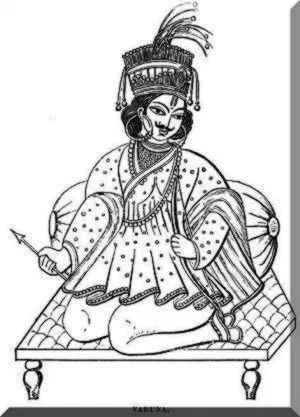
For instance, the adoption of enumeration of various components of nature (Anveshiki) was a well accepted method among other systems of thought; rejection of Vedic authority and its ritualistic attitude was also a feature of other rational schools; the notion of aloofness kaivalya absolute independence was also the ideal of Jains. Similarly, the theories of Karma, Gunas and such other beliefs were commonly accepted by most schools.

50.4. But one similarity which is rather striking is the emphasis on Dukkha suffering and its eradication. That was the stated objective of both the systems. Buddhism however made that the central point of its doctrine. The Buddha’s second and the fourth postulates on the origination of sorrow and the methods of elimination of sorrow are his original contribution to Indian thought; the former being his philosophical stand point and the latter his religious system.

50.5. The other distinctive characteristics of Buddhism are the emphasis on compassion and ethics. . The Buddha asserted that it is not adequate if one merely focuses on elimination of suffering; but one must acquire the skill of probing the nature of the object. Those efforts must essentially be rooted in ethics and a wholesome mental state. The cultivation of the four sublime virtues of loving-kindness, compassion, empathetic Joy, and equanimity is of great importance.

50.6. The Samkhya abandons the idea of the existence of the absolute, but it retains the idea of spirit (Purusha) and of material world (Prakrti); the Buddhism, on the other hand abandoned both these two conceptions, and retained only the fleeting series of mental states (stream of consciousness) as a quasi reality, In either case there is effort to disown the human psycho-physical apparatus and its functioning.

51.1. Samkhya teaches that we should look beyond our personal affinities with Prakrti and realize the timeless unchanging nature of our true self, which resides beyond Prakrti as Purusha the pure consciousness. This realization can be understood as the reverse process of evolution back into the Purusha. Whereupon the Purusha is established in its own nature as kaivalya solitary and independent, indifferently observing the natural world.

51.2. Early Buddhism as also Samkhya attempted to do away with the illusion that empherical ego is the real Self; though the Buddha remained silent on the question of Self as also on the question of nirvana. But, the Buddha’s studious disapproval of metaphysical discussion on these aspects did not seem to have yielded the results he desired. Because, his silence spurred series of speculations in the later Buddhist Schools; and caused much confusion and bewilderment.

51.3 . The nature of Nirvana is perhaps the most debated issue of Buddhist philosophy, probably because the Buddha himself refused to speculate on it. His attitude was, in effect: If you want to know what nirvana is like, then experience it. But clearly Nirvana does not involve the isolation of a pure consciousness as in the case of Samkhya, because there is no such thing as permanent consciousness in early Buddhism. The unique feature of Buddhism is that there is no permanent Self at all, and never was; there are only five skandhas, “heaps” of elements, which constantly interact. It is significant that the skandhas do not constitute a Self; the sense of a Self is merely an illusion created by their interaction. The Buddha emphasized that one should not identify anything as the Self.

[The following are few chosen extracts from Introduction to the Modern Samkhya: Ancient Spirituality for the Contemporary Atheist, written by  Douglas Osto, a member of the Philosophy Programme in the School of Humanities, Massey University, Palmerston North, New Zealand; and,  one who specializes in Indian Mahayana Buddhism, South Asian religions and philosophies, contemporary Buddhist and Hindu practice,

The goal of his book, as Prof. Osto says, is to present a manual of “Modern Sākhya” for use as a path toward transcending personal suffering; a practical guidebook for activating Sākhya philosophy; and, to serve as a tool for transcending suffering.

khya and Buddhism

Although both Sākhya and Buddhism emerged from the same historical context in ancient India and share a number of important features characteristic of the renouncer traditions, the two have followed substantial different paths since.

Buddhism eventually traveled beyond India and  spread throughout all of Asia ; and, in the modern period has undergone profound changes during its transmission to the West.

khya, on the other hand, while exerting a profound influence on India thought throughout the centuries, never took root beyond India ; and , has all but become extinct as an independent religious philosophy in the modern period.

One of the most profound changes to occur to Buddhism in its encounter with modernity has been termed “psychologization“, whereby Buddhism is viewed as psychology; and, its mythological and traditional aspects are either downplayed or ignored. This has in turn led to the “Buddhicization” of psychology, whereby growing numbers of psychologists use Buddhist concepts and techniques for therapeutic reasons.

We see this most clearly in the “mindfulness” craze that has entered mainstream psychology in the United States. Thus a de-traditionalized, psychologized Buddhism is now firmly entrenched within the American medical and psycho-therapeutic communities.

Another aspect of this new Buddhism is the downplaying or complete ignoring of the world-renouncing aspects of Buddhism, in favor of the “this-worldly” benefits of Buddhism

The above comments are not meant as a criticism of modern Buddhism or how it is used by some people in the contemporary world. Rather it is to point out that religions and religious philosophies are constantly undergoing changes and transformations in order to adapt to the needs of people. These days renouncing the world to become a wandering ascetic is not a viable option for most people living in modern, industrialized societies.

Moreover, few people would choose to give up all their worldly possessions, emotional attachments, erotic relationships, and family ties to pursue a transcendent state beyond space, time, death and decay. However, what many people today want as much as the ancient Indian renouncers is to live a life free from suffering, and attain some type of lasting happiness.]

X. Samkhya and Vedanta

52.1. Even prior to the emergence of Samkhya as a system , the Samkhya-like ideas and terms appeared in the Vedas, Upanishads, the Bhagavad-Gita, the epics and other texts .This suggests that the monistic trends in Vedic thought and dualistic concepts of Samkhya had common origins.

52.2. But Samkhya as a doctrine was ever distinct from the Vedic stream of speculative intuitions. The early Samkhya, in sharp contrast, refused to speculate on god and rejected the scriptures and rituals as means for human attainments. It stepped aside cosmological explanations or implications.  It affirmed the existence of the objective-world; emphasized the world has to be understood in the context of human existence; and, said the world is inextricably wound up with the presence of human existence. One has to therefore deal with the world positively.

52.3. The Samkhya separated itself from the scripture- based Vedanta and preferred to be a group of reason-based free thinkers with only a loose scriptural affiliation. But, the Samkhya never rejected the Veda completely unlike the Buddhists and the Jains; but, it maintained that Vedas cannot be accepted as unquestioned sole authority. Besides, the Samkhya brand of atheism never collapsed into the materialism of Charvakas and naturalists (Lokayatas). Samkhya always maintained spiritual and salvation-oriented outlook.

52.4. Though both the Upanishads and Samkhya identified knowledge (jnana) and effective discrimination (viveka) as the means for attaining human aspirations, which is realizing one’s true identity, Samkhya was dualistic to its core, whereas the Upanishads adopted a non-dual approach saying that the absolute consciousness encompasses the entire universe; everything that resides in it is but a transformation of that principle.

53.1. The Samkhya insisted that the individual consciousness, the true identity of man , is distinct from everything else and there are infinite number of such unit consciousness. It said consciousness (Purusha) which sees the world (Prakrti) is separate from what it sees. It asserted that confusing the seer for the seen or mixing both is the cause for man’s suffering.

53.2. Vedanta, on the other hand, asserted the notion of identity of the individual consciousness and the Universal consciousness. It declared that the entire manifest universe is an expression or transformation of that absolute consciousness. Vedanta sharply differed from the Samkhya theory of evolution of the manifest world as emanating through a series of causes and effects.

53.3. Samkhya maintains two independent realities and infinite numbers of Purushas. Vedanta does not accept two infinite-s and multiplicity of Souls.

The extreme form of dualism between subject and object was seen as a basic inadequacy of Samkhya as it left no room for coexistence of the two categories.

53.4. The later variations of the Samkhya School attempted to resolve these difficulties by (1) conceiving Purushas not as distinct from each other, but as various aspects or reflections of one unitary consciousness; and (2) conceiving Prakrti not as distinct from this unified consciousness, but as an aspect of it.

But this, of course, transformed Samkhya into a completely different system; because, it gives up the basic dualism of Purusha and Prakrti.

53.5. With these modifications Samkhya came to resemble the monistic system of Sri Shankara. It was also rendered theistic with Samkhya accepting the existence of a Supreme Being (Parama Purusha) the God.  But, these adaptations rendered Samkhya acceptable to Vedic Schools; and Samkhya came to be regarded, since about the sixteenth century, as one of the six accepted Schools of traditional Indian philosophies (Darshana).

53.6. With or without its modifications, Samkhya is a very important School of thought; and has contributed to the richness, profundity and breadth of the Indian philosophy. The explanations and elaborations offered by most other Schools of Indian thought are based in the foundations provided by the terms and concepts provided by the Samkhya. 

Swami Vivekananda in his exposition of Samkhya philosophy aptly remarked, “If we take into consideration Advaita Vedanta, then our argument will be that the Samkhya is not a perfect generalization …and yet all glory really belongs to the Samkhya. It is very easy to give a finishing touch to a building when it is constructed.”

Y. Kaivalya, Nirvana and Moksha

54.1. Samkhya, Buddhism and Vedanta are the three most important philosophical systems. The three together represent almost the whole of Indian philosophies. Nearly every shade of metaphysical discussion revolves round these three pillars. They may also be viewed as three basic ways of resolving the relation that exists between God and world; Man and God; Man and world; and in general the nature of relation between subject and object.

54.2. All the three systems regard realizing ones true identity and gaining release from suffering of all sorts as the goal of human evolution. There are similarities as also differences among the three modes of inquiry.  All the three instruct the individual to avoid identifying with any physical or mental phenomenon but to let-go all identities. All three agree that enlightenment – variously called as kaivalya, nirvana or moksha- is not an intellectual construct.  They point out that liberation cannot be attained through theoretical knowledge of the scriptures because it is a state that is beyond all categories of thought. In other words, enlightenment or liberation is beyond philosophies. Enlightenment is an experience.

55.1. The question is: since all the three systems regard enlightenment as a state beyond intellect, are they all referring to the same experience or whether there are different kinds of enlightenment?

That question arises because the basic tenets and methods of the three systems are irreconcilably different. Samkhya is dualistic; the early Buddhism may be considered pluralistic; while, Advaita Vedanta is monistic.

55.2. Samkhya is the most radical possible dualism between subject and its object. The separation between the two (Purusha and Prakrti) is so extreme that the system-connect virtually fails because the two neither can come together nor communicate with each other.

55.3. Early Buddhism attempts to combine subject into object. Consciousness according to Buddhism has no independent existence; it is something that is conditioned and arising out of the interaction with other factors (skandas). Buddhism does not believe in a permanent Self. The Self is merely an illusion created by the interaction of the five aggregates (skandas). The Self shrinks to nothing and there is only a void; but the Void is not a thing — it expresses the fact that there is absolutely nothing, no-thing at all, which can be identified as the Self.

Both Samkhya and Buddhism focus on the individual and do not discuss cosmic aspects of existence. Both are basically radical and dualistic in their approach. And, both disregard the Vedas, Vedic authority and its rituals.
55.4. Advaita Vedanta on the other hand conflates object into subject. There is nothing external to Brahman, the One without a second. Since Brahman is a non-dual, self-luminous consciousness, it encompasses the entire universe. And the universe is nothing but the transformation of Brahman. Everything is the Self the Brahman.

56.1. What do kaivalya, nirvana or moksha   mean in these systems

 According to Samkhya, the Purusha in its true form is ever pure and ever-present. The Arhat, said the Buddha, is “deep, immeasurable, and unfathomable, like the mighty ocean.”  The Brahman of Vedanta is an infinite pure consciousness pervading everywhere.

The Samkhya ideal of attaining enlightenment (Kaivalya) is described as Discriminative Knowledge (Viveka-khyāti). It consists in Purusha (pure consciousness) realizing its distinction from Prakrti (everything else) with instruction of Buddhi (knowledge of discrimination).Ignorance (Aviveka)  is failure to differentiate Purusa (Jnasvarupa) as distinct from the intellect, ego, mind and other modifications of Prakrti. Liberation (Kaivalya) in Samkhya is neither the acquisition of a new state, nor the shaking of an old one. It is only the disappearance of the conditioned factors of Aviveka, ignorance or the wrong-knowledge. The state of liberation is named as Kaivalya (aloneness) because the Purusa enjoys unique aloofness in its splendid isolation.

But,  Kaivalya which is essentially based in dualism was viewed as an inadequacy of the Samkhya. The Yoga which has its theoretical base in Samkhya sought to correct the position. In Samadhi the pure consciousness becomes one with the object of meditation. The distinctions between the knower, knowing and the known is obliterated .It is akin to the Advaita ideal of realizing the whole universe as the Self.

56.2. Nirvana is also the realization of the true nature of Reality – of being, non-being and becoming.  The term Nirvana derived from the root va (to blow like the wind) qualified by a negative prefix nir denotes a state of motionless rest where no wind blows, where the fire has been quenched, where the light is extinguished and where the stars have gone out .The Buddha explained it with a simile of an oil-lamp sinking upon itself and expiring when its fuel has been consumed .Nirvana suggests a state of emptiness and nothingness. At the same time Nirvana is described as a state of blessedness, unbound peace and deliverance.

Nirvana is characterized as a state beyond conditioned consciousness, beyond the ceaseless motion of life (Samsara).  It is the absolute extinction of suffering and attainment of unique intuitive wisdom ( Prajna or Pannā). The Buddha however refused to speculate on the nature of it. We therefore do not really know how the Buddha understood Nirvana. The Pali Canon speaks of a state beyond all conceptual thoughts; and yet, it could be experienced in meditation.

But nirvana does not seem to involve the isolation of a pure consciousness, (as in the case of Samkhya) because such concept is not present in the early Buddhism. The concept of a permanent Self is also not there. The Buddha emphasized that one should not identify anything as the Self. Nirvana, in essence is complete freedom by abandoning all sensations, all perceptions, all volitions, and acts of consciousness. It is a state of bliss which is entirely different from and free from all that exists in the Samsara.

The Buddhist Nirvana is not the eternal essence, which is the basis of everything and from which the whole world has arisen (like the Brahman of the Upanishads) but the reverse of all that we know, something altogether different which must be characterized as a nothing in relation to the world, but which is experienced as highest bliss by those who have attained to it (Anguttara Nikaya, Navaka-nipata 34).

56.3. Vedanta says Brahman is One without a second; Brahman is unbound there is nothing outside it. For Sri Shankara, moksha, liberation, is the realization that I am, and always have been, Brahman. One does not attain or merge with this Brahman; one merely realizes that one has always been Brahman. Sri Shankara uses the analogy of the space within a closed jar: that space has always been one with all space; their separateness is nothing but a construct (kalpana vishesha)

57.1. On the face of it the early Buddhism and Vedanta appear to have serious differences. While Buddhism does not believe in a Self, Vedanta says everything is the Self. There is apparently no consciousness in nirvana, but everything is consciousness in moksha. The one appears to be the mirror image of the other. They are extreme positions, trying to resolve the relation between the Self and the non-self by conflating the one into the other. The not-self of Buddhism holds within it the Self; while the Self of Advaita swallows the not-self.

57. 2. How different are they? Or do they mean the same thing in reverse?

It perhaps depends on the way one looks at it. In either case there is no duality between the object (that which is observed) or the subject (that which observes).If you look at it in another way there is not a great deal of difference between the two systems.

In both the systems the right understanding is the key to salvation. It is the right understanding that liberates. In Vedanta, one does not attain or merge with this Brahman; one merely realizes that one has always been Brahman. Similarly in Buddhism too one does not achieve anything new, but realizes ones true nature (or Buddha nature) as being always been pure and unstained. All that one needs to do is to realize that fact.

The concept of Shunya emptiness of later Buddhism is rather fascinating. Shunyata transcends human thoughts and speech. In Mahayana Buddhism shunyata, emptiness not merely refers to the absence of a Self but is also the fundamental characteristic of all reality; shunyata is the category which corresponds to the Vedanta concept of Brahman.

57.3. But can shunyata be reconciled with the One without a second?

Yes, it can be done. The explanation offered is that there is essentially only one thing; and to put it more accurately it is not even one in the numerical sense. We cannot say that it is One, yet, we cannot say it is not one, not two or not any number. The term selected by Vedanta to give expression to its idea  of Reality is: ‘it is not two’ (a-dvaita).

To call it One, is just a way of saying that it is a unity and there is nothing outside it — no duality of a subject and an object. The it (tat) would not even be aware of itself as being one or being alone. It is absolute wholeness. In another way of saying, because there is nothing outside it, its phenomenal experience would be of nothing or nothing, which is shunyata.

58.1. There are some passages in the Pali Canon which almost sound Vedanta- like. Its language too resemble the mysticism of Vedanta

 There is Oh disciples an unborn, un-originated, uncreated and unformed. Were it not there … Oh disciples,.. there would be no possibility of existence of the world of the born, generated, created and formed.(Udana 8.3)

The great ocean is deep, immeasurable and unfathomable..So also the Perfect One is deep, immeasurable and unfathomable as the great ocean. (Samyutta Nikaya 4)

58.2. The Buddha emphasized that nirvana is neither annihilation nor eternal life. In the Brahmanimantanika Sutra (Majjhima-Nikaya), the Buddha said: Do not think that this [nirvana] is an empty or void state. There is this consciousness, without distinguishing mark, infinite and shining everywhere (Vinnanam anidassanam anantam sabbato-pabham); it is untouched by the material elements and not subject to any power.


On another occasion the Buddha describes the state of an Arhant the one who has realized;
 

He who has gone to rest, no measure can fathom him.

There is no word to speak of him.
What thought could grasp has blown away.
And every path to speech is barred.
(Suttanipata)
 *
58.3. Just as there are passages in the Pali Canon which sound like Vedanta, so there are passages in the Upanishads which seem Buddhist-like. Perhaps the most famous among them is Yajnavalkya’s instruction to his wife Maitreyi in the Brhadaranyaka Upanishad: “Arising out of these elements (bhuta), into them also one vanishes away. After death there is no consciousness (na pretya samjna ‘sti)….”
*

Yajnavalkya explains: For where there is a duality, as it were (iva), there one sees another…. But when, verily, everything has become just one’s own self, then what could one see and through what… Through what could one know that owing to which all this is known? So, through what could one understand the Understander? This Self… is imperceptible, for it is never perceived. (II. iv. 12-15)

Thus, the notions of infinity and nothingness appear in both the systems. Nothingness is an image or a reflection of the infinity.

59.1. But, why did Sri Shankara preferred to speak of the One and the Buddha of nothingness?

It seems that the answer to this lies in the nature of their philosophies. In referring to Brahman as One without a second, Sri Shankara tries to describe reality from outside, as it were, because that is the only perspective from which it can be understood as One. Sri Shankara was basically a philosopher; and as all philosophers do, he looks upon the whole of reality objectively and to comprehend its structure. It is as if the philosophizing intellect takes a look at the whole of existence from outside of it.

59.2. But the Buddha was describing his experience. He realized that one cannot get outside of reality and describe it as an object; because one is inseparable from that reality. He also believed too much philosophizing and clinging to ideas is an obstruction to enlightenment. He advocated meditation as a process to let go all attachments, even the attachment to ideas and concepts.

59.3. But both the savants accept that conceptual thinking is part of the problem; not in itself the way to enlightenment. If one accepts that the goal is to attain liberation rather than to understand it, then philosophy too must ultimately be transcended or let go. Philosophy might try to view things externally, but ultimately it is one’s experience that really matters.

59.4. Can nirvana or moksha be experienced? I do not know. But it appears these states suggest a condition where the boundaries of individual identity would simply dissolve. It would perhaps be a complete absence of tension and effort, a letting go of all identities and of everything that was previously clung to;   and one would eventually become that everything which in fact one always was.

60.1. In summary, the difference between the Buddhist nirvana and the Vedantic moksha is one of perspective. The Vedanta explanation — that of realizing ones true identity -is a philosophical view. The Buddhist interpretation of letting go all identities is objective description. But in each case the actual experience appears to be the same. Ones experience is the truest test of all, as Sri Shankara observed.

flower2

Duality is a normal reality of experience.. So Samkhya talks of a framework to link up with the dual world as elementising becomes logical and reasonable..and easier to comprehend. Advaita is an unusual reality… an abstract experience and perhaps can be obtained in a particular state. You can’t understand it as even elemntaising of a whole kills the essence. Buddhism is like Samkhya as it does not delve on question of god and is very practical to remove dukkha… and so is Samkhya.

All theses are true but in different locations… and if all locations exist within us…all these are true…as experiential realities. So one does not contradict the other.

..Prof. Durgadas Sampath

Lotus_Flower purity


References and sources

Vedanta and Buddhism 

http://www.accesstoinsight.org/lib/authors/vonglasenapp/wheel002.html

Enlightenment in Buddhism and Advaita Vedanta 

http://ccbs.ntu.edu.tw/fulltext/Jr-an/26715.htm

 
15 Comments

Posted by on October 3, 2012 in Samkhya


Tags: , , , , , ,

Samkhya : Part Five : Samkhya Karika – continued

Continued from Part Four

[We will be trying to understand only a few concepts of Samkhya –Karika; and not discussing the entire text.)

Samkhya0007

O. The unfolding

33.1. As mentioned earlier, Samyoga the proximity of the Purusha (consciousness) and the a-vyakta (undifferentiated un-manifest Prakrti) disturbs the Gunas, the dormant constituents of the a-vyakta. The three Gunas resting in a state of equilibrium turn restless, struggle among themselves for expression ; and, each strives for ascendency over the other two. That turbulence gives birth to the first stage of the evolution process.

[ However, it is not explained why such proximity should cause agitation among the Gunas]

33.2. It is said; the evolution process detailed in the Samkhya is twofold: one cosmic and the other individual.

Further, the outward process of the unfolding (sarga) is also meant to delineate the reverse process of absorption (apavarga). Samkhya considers evolution and absorption as processes that complement one other.

The evolution processes described in the Samkhya Karika are with particular reference to the individual.

33.3. The turbulence that takes place within the a-vyakta results in the Guna rajas gaining the ascendancy; the rajas then activates sattva. And, the two together overpower the inertia of the tamas; and set in motion the process of evolution.

P. The evolutes of Prakrti

Buddhi

34.1. The first to evolve out of this churning of the Gunas is Buddhi (the intellect) or Mahat (the great one).The latter term is usually employed in the context of cosmic evolution, while the term Buddhi is used with reference to the individual. But, both (Mahat and Buddhi) represent the principle of intellect or discrimination buddhi-tattva.

34.2. Mahat or Buddhi is the first principle which the Purusha sees or witnesses; and, is the first phenomenon to emerge out of the undifferentiated ground of the un-manifest (a-vyakta) and to cross the threshold into manifestation (vyakta).

Buddhi represents the first phase of evolution, and is therefore described as the primacy phenomenon. For this reason, Buddhi or Mahat is otherwise called ‘the seed of the material world’ (prapancha-bija).

34.3. Buddhi is said to be very subtle, transparent, not extended in space and dominantly sattva in its nature.   Buddhi is a unique faculty of human beings. It is man’s instrument for exercise of judgment and discrimination (viveka). It not only ‘knows’ but also ‘works’; meaning, it is awareness as well as the will to be active. For that reason, according to Samkhya-karika, the becoming of man is determined by his fundamental strivings which are guided by the Buddhi. In other words, the man’s place in this world depends upon his inclinations (Gunas) as directed by the Buddhi.

34.4. But, Buddhi, an evolute of Prakrti, is not consciousness; only the Purusha is consciousness. Buddhi is an effective instrument of knowledge or cognition.

Buddhi, the first evolute and the instrument of discretion, is the nearest to Purusha, of all the evolutes of the a-vyakta. It, in a way, compliments the functioning of the Purusha. If Purusha provides consciousness which makes evolution possible, the Buddhi provides requisite knowledge to attain liberation by isolating Purusha from everything else; by showing, at each stage, that Purusha (consciousness) is indeed different from Prakrti (matter) and its evolutes. The function of Buddhi is Adyavasaya or certainty leading to action. The Buddhi instructs the individual that he or she is not prakrti or any of its evolutes; but is essentially the pure consciousness itself. The Buddhi spurs the man to action.  The Buddhi is, thus, the faculty that guides and bestows man the true understanding which liberates him. It is the paucity of this discriminating knowledge (viveka) that subjects the man to bondage and suffering.

[ Samkhya Karika (26) names the five sense organs [Bhuddhi Indriyas- because they are the means or the Dvara of perceiving sound etc by the internal organ] and five organs of action (Karmendriya) namely , voice , hand, foot , organ of excretion and organ of generation. And the Eleventh organ is the mind

buddhi-indriyaṇi cakṣuḥ srotra-ghrāṇa-rasana-tvak-ākhyāni | vāk-pāṇi-pāda-pāyū-upastāḥ karma-indriyāṇi-āhuḥ ||

In the Samkhya system  , the senses , the sense-organs, the sense-objects and sense-perceptions are all discussed within the overall framework of the notion of Purusha and Prakrti ; the three Gunas; the levels of gross (sthula) and subtle (sukshma) ; as also the levels of the interplay of Manas, Ahamkara and Buddhi.

The last three (Buddhi, Manas and Ahamkara) constitute the inner organs (Antha-karana) .They are the powers that open and close the gates; monitor, control and register whatever is carried through. The body-mind complex of human system is active (kartar) through the ‘five organs of action’ (Karmendriya) and receptive through the ‘five organs of perception’ (Jnanendriya) .

These two sets of five each are the vehicles of alertness and responses. These faculties work outward (bahyendriya) and are akin to gates or doors (Dvara) ; while mind (Manas)  and the ego ( sense of “I’) , intellect, judgement (Buddhi ) are the door-keepers. Since the mind (Manas) operates directly with the ten faculties (Bahyendra) it is considered as the eleventh (Ekadasha) and is called the ‘inner-sense’ (Antar –indriya).

Among the eleven organs of perception and action, mind is said to have the nature of both. Because, the organs of sight, speech, hearing etc function within the limitations of their assigned tasks; but are governed by the mind, which is the faculty that judges and determines   . The organ of perception perceives an object as such , no doubt; but , it is the mind that  identifies and determines   : ‘it is an object’; ‘ it is of this nature’ or ‘it is not of this nature’ etc.

It is the mind (Buddhi) which continuously identifies, classifies and determines the objects it perceives. In the process, it is said, the mind keeps transforming itself into the shapes of the objects of which it becomes aware. Its subtle substance takes on the colours, forms of everything that is presented to it by the senses m by the memory and emotions. Yet, it has also the capability to calm and still the senses as also itself, like a jewel in a pond, by the power of the Yoga.]

samkhya tattvas

(source : https://universaltheosophy.com/legacy/movements/movements-sankhya-2/ )

Ahamkara

35.1. Arising out of Buddhi and projected from it is Ahamkara the self-identity, bringing along with it notions of “I-ness” and “mine”. Ahamkara breeds ‘self-assertion’ (abhimana) or self-love; and even self-conceit or self-pity. The Ahamkara is the specific expression – ‘me’ and ‘mine’- of the general feeling of self.

35.2. It is the Ahamkara that sets apart the individual from rest of the world, erecting enclosures around the person. It makes the person think and to interpret everything and every notion in terms of I and the rest. All thoughts, action and speech of an individual are in terms of his or her sense of Ahamkara. It is the foundation of one’s actions of every sort.

35.3. Ahamkara pervades and influences all human experiences; it even colours the Buddhi; and is very scarcely silenced. If Buddhi is predominantly sattva, the Ahamkara is predominantly rajasa. It is dynamic in nature; and pervades all human experiences including mind, senses etc. Ahamkara is functionally an urge for self-preservation and self-perpetuation amidst series of environment changes and fluctuations. The Samkhya therefore regards Ahamkara as an ongoing ceaseless process (vritti) and not as a substance.

Group of sixteen

36.1. In the next stage of evolution, from out of the Ahamkara there emanates ‘a group of sixteen’ elements; in two sets: of eleven and five. Those sixteen elements (tattvas) are nothing but the various transformations (vaikruta) of Ahamkara. This means, the evolution stream which till then was vertical (avyakta —  buddhi — Ahamkara) turns horizontal at the stage of Ahamkara.

36.2. The first set (of eleven) comprises manas (mind), five buddhi-indriyas (five senses of perception: hearing, touching, seeing, tasting and smelling) and five karma- indriyas (five organs of action or rather the functioning of these five organs: speech, apprehension, locomotion, excretion and procreation). The set of eleven represents the first stage of man’s contact with the world. It is characterized as sattvic-ahamkara; meaning its components are predominantly of sattva nature.

36.3. The Manas (mind) the first among the group of sixteen, according to Karika, is described as samkalpa, meaning it is constructive, or analytical or explicit. The Manas is concerned with determined perceptions .It arranges impulses or sensations coming from the senses and organs of action; and is a coordinator of various streams of thoughts, sensations and emotions. The manas acts as a bridge between the internal and external worlds; and, it is said to be involved mainly with a person’s waking experiences.

Antahkarana

37.1. The triad of manasbuddhi and Ahamkara form the antahkarana, the internal organ or instrument, which in other words is a psychological field that is subjective and individualized. It is the threshold area which connects man’s inner world to external world (bahya – karana).  

[Yoga reduces the three components of antahkarana into one Chitta the seat of awareness.]

37.2. Though the antahkarana is formed by the evolutes of un-intelligent Prakriti, its constituent psychological categories are predominantly Sattva in nature. The antahkarana therefore reflects the intelligence of the Purusha, and appears as if it is a conscious entity.

38.1. These thirteen (anthahkarana plus five buddhi-indriyas plus five karma – indriyas) together form the essential psycho-physical instrument which enables Man to know, understand the world and himself. This set of thirteen is also a prelude to the emergence of the physical world.

38.2. In the Samkhya scheme of evolution, the physical world appears only after the basic constituents of mind and the sense and the functioning of sense organs are put in place.

Tanmatras and Bhuta

39.1. The ten senses or indriyas that follow are external (bahya) instruments (karana).

The second set of five (out of the group of sixteen mentioned above) consists the five subtle elements (tanmatras) : shabdasparsha ruparasa and gandha (elemental sound, touch, form, taste and smell). This set of five is characterized by rajasa, the Guna of action. The function of the rajasa Ahamkara is to motivate two other Gunas to be creative.

39.2. From out of the second set consisting five subtle elements, emerges Bhutas a set of five gross elements, the basic elements of nature: earth, water, fire, air and space (pancha-bhuta) leading to the gross or external world. This set of five gross elements is said to betamasa–ahankara, meaning they are the forms of Ahamkara characterized by predominance of the Guna tamas. Because of the predominance of tamas, the Bhutas or material elements are incapable of reflecting intelligence. They are therefore called insentient matter.

 39.3. The gross elements are produced by various combinations of subtle elements. To illustrate:

 First to evolve is the tanmatra that is the essence of sound (sabda), which in turn produces akasha the space element. Therefore, the akasha element contains the quality of sabda perceived by the ear.

Shabda and sparsha together produce marut (air); the air element contains the attributes of sound and touch, although touch is the special quality of air and is sensed by the skin.

The teja (fire) element is derived from the essence of colour (rupa tanmatra). It combines the qualities of sound, touch, and co]or, and its special property sight as perceived by the eyes. 

Shabdasparsharupa and rasa together form apha (water). The water element has all the three preceding qualities–sound, touch, and colour– as well as its special quality taste, as sensed by the tongue.

All five elements combine to produce kshiti (the earth). The five gross elements combine in different ways to form all gross objects of the world that are perceivable. This grossest element kshiti (the earth) contains all of the four previous qualities.

Akasha Sabda        
Vayu Sabda Sparsha      
Agni Sabda Sparsha Rupa    
Apah Sabda Sparsha Rupa Rasa  
Prithvi Sabda Sparsha Rupa Rasa Gandha

 [Note:  Earth means earthly properties, similarly wind means properties of the wind, sky means the ever pervading space and fire means the energy (of creation and destruction) and water means the organic properties]

Q. Twenty-four tattvas

40.1. Thus, buddhiAhamkara, the group of sixteen and the five gross elements together make the twenty-three tattvas the basic components of the Samkhya karika. In addition, the text counts a-vyakta the un-manifest Prakrti as one of the tattvas; thus bringing up the total of the tattvas to twenty-four.

40.2. Thus, the objective world according to Samkhya karika is made of twenty-four tattvas each composed of varying degrees of the three Gunas: sattvarajas and tamas. The term tattva is comprised of two words tat (that) and tva (you) meaning ‘thatness’ or the nature of a thing. The Purusha (consciousness) is not a thing and is not treated as a tattva; Purusha is different from everything else. This is what distinguishes the karika version of Samkhya from the older atheistic version; from the version of Panchashikha; as also from the later versions influenced by the Vedanta.

[To summarize; the first tattva to emerge from avyakta is buddhi (intellect), closely followed by Ahamkara (sense-of-self) and manas the mind or cognition. These three collectively referred to as the inner organ (antahkarana) is predominantly of sattva Guna; and determine how the world is perceived.

That is followed by the five sense organs and the five organs of action. These possess the combined qualities of sattva and rajas; and provide conditions necessary for human functions. At the same stage, the Guna rajas combines with tamas to produce five subtle elements tanmatras (sound, touch, form, taste, smell). This set of subtle elements, in turn generates five gross elements (space, wind, fire, water, earth).

These twenty-three, along with a-vyakta   form twenty-four tattvas or basic components of matter, as per Samkhya karika. Since they are all evolutes of Prakrti, they are not-conscious or intelligent.  They are the objects of experience of the Purusha, the consciousness.

Please see the figure at the bottom of the post.]

R . The scheme

41.1. The evolution as projected in the Samkhya –Karika systematically proceeds, in stages, from the extremely subtle matter in its un-manifest state (a-vyakta) down to the grossest physical element. The ‘group of eleven’, and more particularly the antahkarana which is a psychological field formed by the triad of the subtle forms of intellect, mind and ego is the threshold area which connects man’s inner world to external world (bahya -karana).  In the Samkhya scheme of evolution, “physical world” appears only after the basic constituents of mind and the sense and the functioning of sense organs are put in place.

41.2. In a way, the Samkhya scheme is an inversion of the western model where the man and matter are just created. In contrast, what the Samkhya describes is not an act of creation but a process (vritti) of evolution originating from the most subtle towards the gross.

Samkhya regards the processes of evolution and absorption as complimentary to one another. The Samkhya scheme of absorption is therefore exactly the reverse of its evolution process. Samkhya also believes that just as that which had not existed before can never be brought into existence, that which exists cannot be entirely destroyed, either. Following these principles, the Samkhya projects its scheme of absorption. According to which, at the time of dissolution of the world, the reverse process sets into motion with each effect collapsing back into its cause; the gross physical elements broking down into particles; the particles into atoms; the atoms dissolving into finer energies which in turn merging into extremely fine energies; and ultimately the whole of existences dissolving back into the subtlest un-manifest Prakrti, the a-vyakta. Thus, Prakrti even when all its evolutes are withdrawn remains unaffected; and is eternal.

S. Enumeration

42.1. Some scholars say that the whole of the Samkhya karika can be viewed as a systematic enumeration of its twenty-four tattvas or basic elements which compose the man and his world. Such enumeration is in keeping with the meaning assigned to the term Samkhya suggesting reckoning, summing up or enumeration.

42.2. However, Samkhya Karika is not mere enumeration of categories; it is much more that. It is a method of reasoning, analysis and enquiry into the very core of man’s existence and his identity. The term Samkhya also refers to an individual who has attained true knowledge. Whatever be the meaning assigned to the term, Samkhya is one of the most important Schools of philosophy.

42.3. The method of enumerating their basic principles is not unique to Samkhya .The enumeration procedures seemed to be quite well accepted in the ancient times; and a number of ancient texts followed the enumeration method. For instance, the parts of man are enumerated and correlated with parts of the universe in Rig Veda (10.90) and in Taittiriya Upanishad (1.7).The dialogue that takes place between Yajnavalkya and his wife Maitreyi as many as seventeen of the twenty-five tattvas of the later Samkhya are enumerated (Br. Up . 4.5.12)

42.4. The Samkhya enumeration system is more through, purposeful and logical. The seemingly elaborate system of Samkhya enumeration of the elements of existence (tattvas) is a deliberate effort to systematically reduce the countless manifestations into comprehensible categories. It attempts to trace the stages of development of the categories of existence in their ordered phases of their evolution, consistent with a well thought out scheme (tattva-ntara-parinama).It proceeds from the most subtle to the most gross; and arranges the sets cogently in successive stages of their dependence in order to delineate their mutual relationships.

For instance; at the fundamental level the translucent pure –consciousness Purusha is neither generated nor generating; while the extremely subtle mula-prakriti is un-generated but generating. BuddhiAhamkara and the tanmatras are both generated and generating. The psychological fields manas, the buddhi-indriyaskarmendriyas, as also the elemental mahabhutas are generated and do not generate anything in turn, thus closing the onward flow of the evolution. The reverse process of absorption or dissolution starts with the gross elements at the outer periphery of existence; each stage collapsing back in to its source; and ultimately all dissolving into the primal source the mula-prakrti.

The Samkhya concept of liberation (of which we shall talk a little later) is described in terms of the involution or the absorption process of the manifest world. It is the reverse of the evolution process where the individual in quest of his true identity traces his way back to the origin viz  presence of the pure-consciousness.

T. Purusha-Prakrti

43.1. The relation or rather the non-relation between the Purusha and Prakrti as depicted in the Samkhya Karika is of a very peculiar sort. Purusha never comes in contact with Prakrti; he is ever separate and aloof. Yet, Purusha’s proximity to the a-vyakta disturbs or influences the Gunas; and triggers the process of evolution.

43.2. The two are totally different realities of existence. Purusha is consciousness, passive and does nothing but see rather disinterestedly. Avyakta Prakrti, which is witnessed, is the root cause of the world containing in a potential form infinite possibilities of world and all its characteristics. But, Prakrti does not possess consciousness; it is inert and intelligible.

How Purusha and Prakrti were first formed or came into existence is not explained. But they together form the basis of all existence. Although the manifestation of Prakrti depends on Purusha, the Purusha has no role in creating Prakrti or giving it its shape and appearance.

Because Purusha is perfect and unchanging complete unto itself, there is no reason for it to take active role in the creation of Prakrti. Thus the concept of Purusha is entirely unlike the idea of God the creator of the world.

43.3. Samkhya karika says that Purusha and Prakrti (though unrelated) need one another .Prakrti requires the presence of Purusha in order to manifest and to be known; and Purusha requires the help of Prakrti in order to distinguish itself from Prakrti and thereby realize liberation.  The manifest world (Prakrti) serves its own purpose by serving the purpose of Purusha. Samkhya karika compares the samyoga the association of Purusha and Prakrti to the teaming of a blind person with a lame person. The blind being Prakrti who can move but cannot see and is not intelligent (not conscious); the lame being Purusha who is intelligent and can see, but cannot move (SK: 21).

Purushasya darshanaartham kaivalyaartham tathaa pradhanasya | Pangva-andhavat ubhyorapi samyogh stat-kritah sargah ||

[ Dr. S. Radhakrishnan, (Indian Philosophy, Vol. II, p.326) writes :”If we admit the Samkhya view of prakriti and its complete independence of purusa, then it will be impossible to account for the evolution of prakrti. We do not know how latent potentialities become fruitful without any consciousness to direct them.,]

[The main problem appears to be the polarity between Purusha and Prakrti;  Purusha is so indifferent and Prakrti so mechanical. The simile to explain their interaction as that of a blind man of good foot carrying a cripple of good eye is not a great analogy. It is rather brittle and should not be pressed too hard. Because, both the blind and lame are intelligent; whereas Prakrti is not. The simile would fit better if the lame had no desire to go anywhere and he says nothing and does nothing; while the blind person has no mind at all. Clearly in such a case they would not be able to cooperate; yet Samkhya somehow forges an association between Purusha and Prakrti.]

43.4. Samkhya seeks to understand the world and man’s place in it from the perspective of consciousness. Consciousness is the reason why there is a manifest world, although the Purusha adds nothing to the world. The Purusha only witnesses the world. Since its nature is to witness, it sees the world as an instrument for its own purpose and ends.

43.4. The world is that which is witnessed. Prakrti like a painting acquires meaning and comes alive only when it is viewed by a viewer. The painting is for the enjoyment of the viewer. Purusha is the seer and Prakrti is that which is seen; and Prakrti (matter) is meant for the enjoyment of the conscious Purusha. The world exists for the sake of Purusha.  (Purushartha).

43.5. To start with, the manifest world appears because of the presence of Purusha. Further, all the objects of the world–including the mind, senses, and intellect—in in themselves unconscious — appear to be alive, intelligent, possessed of consciousness only because they are illuminated by the Purusha.

Purusha (consciousness) which has no form appears through objects, which by themselves do not posses consciousness. The objects appear as if they are possessed of consciousness; giving a false impression that consciousness is their nature. In other words, the world appears as conscious, which it is not. Similarly, the conscious appearing object is mistaken for Purusha; the Purusha appears as what it is not.

There is a perpetual dilemma here .The world is real but can manifest only because Purusha the pure consciousness is associated with it. But Purusha can realize its true nature only when it separates itself from Prakrti.

44.1. Since Purusha has no form it can be grasped or understood only in terms of what it witnesses. Samkhya therefore describes everything that appears to Purusha; and eventually discards all that it described. It then says Purusha is radically distinct from everything it witnesses and everything that was described.

The seer is not the seen. This distinction is crucial to Samkhya. The Samkhya follows a method of elimination; it seeks to understand Purusha by identifying what Purusha -is –not and rejecting all that. When Purusha is thus isolated from everything else, one understands that the ultimate ground of human existence is none other than Purusha itself.

U. Dualism in Samkhya karika

45.1. The fundamental dualism in Samkhya centres on the distinction between individual consciousnesses on one hand and the not-conscious world on the other. It is between Purusha and Prakrti in its manifest (vyakta) and un-manifest (a-vyakta) forms. The duality is   between Prakrti the creative factors in creation (becoming) and Purusha (being).

45.2. Purusha is not characterized as made of the three Gunas. Purusha is beyond Gunas; it is subjective, specific, conscious and non-productive. In contrast, the Gunas are the expression of creative factors of Prakrti. In a way of speaking, the dualism in Samkhya could be between the real doers Gunas (becoming) and the passive Purusha (being).

45.3. The Samkhya dualism is not that of body and mind, or a dualism of thought and extension. All such dualisms are included and comprehended on the side of Prakrti, the not- conscious world. Because, according to Samkhya, the mind, the self-awareness of man is all evolutes emerging out of the mula-prarti. Similarly, all of man’s emotions and strivings and urges are also comprehended on the side of the mula-prakrti.

[Before going further some explanations appear necessary, here:

45.4. Samkhya Karika’s treatment of the subject is from the perspective of the individual consciousness. It does not speak of god or cosmic soul. The Purusha and Prakrti are ever separate and do not come together. There is no manifestation of world without Purusha; yet, Purusha exists apart from the world which is not-conscious. The dualism of the Karika is between consciousness and that which is not conscious.

45.5. As regards the plurality of Purushas, the Samkhya Karika underscores its assertion that man or the world is not derived from an all encompassing cosmic source; but each evolves following its own natural laws (svabhava). The Purusha of the Karika is individual; but not personal. The basic concern of the Samkhya Karika is individual suffering and the liberation of the individual. It is not concerned with abstract concepts of suffering or universal spirit. You might recall that the Buddha who had his initial training also pursued similar approach; and refused to get into discussions on cosmos or the cosmic soul. His approach too was highly individualized.

One might perhaps appreciate the concept of plurality of Purushas, if you treat it as jiva of Vedanta or Jainism .The Vedanta Schools however brought the jivas under the umbrella of Brahman or Parama-purusha.

45.6. Again, the question of god too is linked to Karika’s major concern: salvation from suffering. Karika regards the discriminative knowledge alone as the means of salvation. The salvation according to Karika is the realization that Purusha (consciousness) is distinct and separate from Prakrti (materiality). Isvara, god, in case he exists, according to Karika scheme of things, would be a part of Prakrti and therefore not-intelligent. And ,in which case the presence of god, becomes irrelevant to Karika.

The Karika in fact refers to Vedic gods (SK 53 and 54) and makes no attempt to deny their existence; but they are treated as part of Prakrti. And, by implication those gods too are in need of salvation.  In short, the question of salvation is viewed in Karika from non-theistic perspective. Whether or not a god exists makes little difference.

aṣṭa vikalpaḥ daivaḥ tairyagyonaḥ ca pañcadhā bhavati | mānuṣakaḥ ca eka vidhaḥ samasataḥ bhautikaḥ sargaḥ ||SK 53 ||

ūrdhvaṃ sattva-viśālaḥ tamo-viśālaḥ ca mūlataḥ sargaḥ | madhye rajo-viśālaḥ brahmādi stamba-prayaṅtaḥ ||SK 54 ||

The later Samkhya, of course, reconciled with the orthodox systems   by accepting a God. Yoga too was theistic.]

V . Reverse process of release

46.1. Consciousness, ego and mind constitute the inner world of a human being (Samyogi purusha). Human contact (samyoga) with the material world of   appearances, the contact between being and becoming is the real stuff of the world. The Man develops natural inclinations of attachment and involvement in the world that surrounds him. He nurtures clinging to certain urges; and he also dreads isolation. These are the foundations for all his actions. These are also his problems, aspirations, anxiety and frustrations of life.

The Samkhya believes that clinging to the world of appearances leads to suffering. It asks Man to detach from excessive involvements, to exercise control over senses, to discipline the mind and to move away from false identifications.

Samkhya compares the world to a dancing girl who withdraws when she finds no one is paying attention to her. When we look beyond the world, it will go away. This happens with the individuals as they separate themselves from hopes, fears, desires and passions, renouncing the Guna aspects of the intellect  in order to realize their true identity as pure consciousness.

46.2. The Samkhya prescription for removal of suffering is the way of knowledge, the way of right understanding: ‘effective discrimination’  vijanana which separates pristine consciousness form everything that is not consciousness. It instructs that Prakrti is distinct from Purusha which has always been pure and free; and it is only the non- conscious Prakrti that is bound and strives for release.

Samkhya teaches that we should look beyond our personal affinities with Prakrti and realize the timeless unchanging nature of our true self, which resides beyond Prakrti as Purusha the pure consciousness. This realization can be understood as the reverse process of evolution back into the Purusha.

46.3. The Samkhya puts forward the premise, that the translucent consciousness adds nothing to the world ; and it can therefore be understood only in terms of what it witnesses: the un-manifest and manifest world viz, everything that is not consciousness. Following this, Samkhya enumerates all components of the un-manifest and manifest world; and suggests a process of enquiry guided by Buddhi, the faculty of discrimination (viveka), segregating everything that is not conscious in an attempt to view Purusha the consciousness in its isolation. Finally, he realizes Prakrti is distinct from Purusha. It is a state of realization (apavarga) that consciousness is ever pure and free; and consciousness is not matter.“No one is bound, no one is released…only prakriti in its various forms is bound and released” (SK .62).

The kaivalya isolation that Samkhya speaks about is not shuttered retreat from the world but is a way of being in the world sans entangled with Prakrti. The Buddhi which earlier was confused with wrong identities is now clear like a dust-free mirror reflecting the light of Purusha.

47.1. The practical method that Samkhya advocates is involution, a sort of returning to the roots of one’s existence; or returning to the origin or reversing the process of birth (prati- prasava). It is a systematic regression or an attempt to reverse the process of evolution; it is the opposite of spreading out (pra-pancha); leading back to the original state.

47.2. The Samkhya method of enquiry could therefore be described as an individual’s quest for his true identity ; a journey deep into the very core of his existence guided by Buddhi (viveka) ; travelling from the gross outer peripheries of his being into his subtlest inner core; going past the body, mind, senses, urges , etc ; shredding away every identity , every emotion and every thought ; all along the way, at each stage, rejecting what is not-consciousness and stepping into the next inner zone which is more subtle than the previous one; until he sheds away every aspect of Prakrti . It is also a method of giving up all identities. Once he finds Prakrti is distinct from Purusha he realizes the ultimate condition of “otherness”, freedom and isolation which is consciousness, Purusha in itself.

47.3. The relevance of the enumeration of the categories in Samkhya could be viewed in this context of involution. The hierarchical inversion begins with the elements of the body; progressively leading to the avyakata the un-manifest Prakrti which gets to see the Purusha the pure consciousness. To put it in another way, the evolution commences with Purusha seeing the avyakta; and, the cycle ends with the avyaktha seeing the Purusha; the seer becomes the seen. The un-differentiate Prakrti sees the un-differentiated consciousness.  The reversal is complete. Yet, Purusha and Prakrti stay apart; there is no suggestion of the union of the two.

48.1. Samkhya ideology of reversing the normal trend of human existence in the world and attaining the condition of isolation or kaivalya provided the frame work for other spiritual persuasion, such as Yoga, Sri Vidya and other forms of Tantra.

It might perhaps help to understand better if one follows the Sri Chakra model of creation and absorption. In the Sri Vidya tradition, the aspirant regards his body as Sri Chakra wherein the innermost core of man is encased within a nine-fold fort of matter, senses, emotions, thoughts etc. He, following the samhara-krama the absorption method, proceeds from the outer periphery wall (body) to the innermost Bindu (consciousness) in an ascent through various levels of psychic states. As he proceeds inward from the outermost enclosure the devotee’s thoughts are gradually refined; and the association of ideas is gradually freed from the constraints of conventional reality.

Bindu the dimension-less point at the centre of the Chakra, just as the avyakta of Samkhya, represents not only the origin but also the ultimate end of all existence

48.2. The Tantra too followed the hierarchical inversion of the twenty-four principles of Samkhya, but was not happy with Purusha and Prakrti being kept perpetually separate. It aimed to obliterate the subject-object duality; fuse the seer and the seen into one; and realize that unity in the Bindu symbolized as Ardhanarishwara the united Shakthi and Shiva. The Tantra improved upon Samkhya’s twenty-four principle- categorization by adding another twelve to render the dualistic universe into a unity.

48.3. The Yoga Sadhana too is patterned after the reversal of the Samkhya model of evolution. In the Yoga Sadhana, the yogi draws his energy from the root-chakra (muladhara) the earth element up to vishuddhi chakra the element of akasha space. Once at the vishuddha the five elements are purified, the prajna ascendants to   ajna which is the collective frame of reference for manas the mind. The four chakras rising from the ajna correspond to the Samkhya tattvas of manas (Chandra chakra), Ahamkara (Surya chakra) , buddhi (Agni chakra) and   avyakta prakrti (Sahasra chakra).In Yoga, the seer, seeing and the sight all dissolve into one.

49.1. The ultimate ground of human existence, according to Samkhya is Purusha pure-consciousness itself. One dwells in pure translucent consciousness, a kind of emptiness which transcends everything in the manifest and un-manifest world. The realization that one’s essential nature is consciousness: pure and free, relives one of all bondage and suffering. And, that is the supreme ambition of Isvarakrishna’s Samkhya karika.

Verily, therefore, the Self is neither bounded nor emancipated; No one is bound, no one is released. It is Prakrti alone, abiding in myriad forms that is bounded and released.

tasmāt na badhyate-asau na mucyate na api saṃsarati kaścit |
saṃsarati badhyate mucyate ca nānāśrayā prakṛtiḥ | 

तस्मान्न बध्यतेऽद्धा न मुच्यते नापि संसरति कश्चित्
संसरति बध्यते मुच्यते च नानाश्रया प्रकृतिः॥ ६२॥

(Samkhya karika62)

samkhya

 Next: Samkhya – Vedanta and Buddhism

References and Sources

Early Indian Thought by Prof.SK Ramachandra Rao

 Classical Samkhya by Gerald James Larson

Samkhya Karika by Swami Virupakshananada

The Samkhya Karika

http://theosophytrust.org/tlodocs/SankhyaKarika.htm

http://www.archive.org/stream/svuorientaljourn015488mbp/svuorientaljourn015488mbp_djvu.txt

http://www.sacred-texts.com/hin/m09/m09050.htm

http://www.archive.org/stream/svuorientaljourn015488mbp/svuorientaljourn015488mbp_djvu.txthttp://www.hinduwebsite.com/sacredscripts/hinduism/philo/ch07.asp

 
13 Comments

Posted by on October 3, 2012 in Samkhya


Tags: , , , , , , , , , ,