RSS

Author Archives: sreenivasaraos

SRI TYAGARAJA (1767 – 1847) – PART III – Music

 (For my friend Shri Kannan Rangachar)

Continued from  Part II –  Life

thyagaraja-swami 

Many- splendored genius

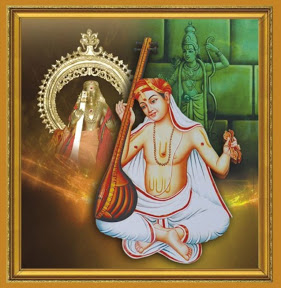
19.1. Sri Tyagaraja was a many-splendored genius. He was a musician, poet, philosopher and Saint combined in one. In him music, poetry and spirituality reside in sublime harmony; and, find spontaneous expression in every note of his music (Samgita) and every phrase of his poetry (Sahitya).

There are some who regard him as a divinity , a saint; and venerate his kritis as sacred literature. There are also those who are in awe of the inspiring music, the lucid poetic expressions and philosophical insights that abound in his Kritis. The ardent devotees of Sri Rama revere his poetry as an outpouring of Rama-Bhakthi. For them, Sri Thyagaraja’s music is a means to attain God’s Grace, Moksha – Sadhana.  And, to most other music lovers, Tyagaraja and Karnataka Samgita are the two names of the same entity that is pure and enjoyable.

19.2. For successive generations of musicians and music lovers in South India, Sri Tyagaraja’s Kritis-kirtanas have been the treasure house of education, enlightenment and enjoyment. Here, they get to admire the sparkling expressions that shine forth in a simple language they can relate to; the effortless ease with which words (Matu) and Music (Dhatua) blend into each other; and, the graceful   movements of his smooth flowing music that makes singing a great pleasure (gana-anukula), a tranquil delight (sukhanubhava).

19.3. It is said; music bestows bliss instantaneously; but, poetry on contemplation. But, for Tyagaraja composing the song and singing (Samgita and Sahitya) followed each other and flowed out at once.

**

Person

20.1. The farther in time we go from him, it is his saintliness that seems to sparkle and take over. But, what is lost sight is the human aspect of Tyagaraja. Perhaps, not many, now, look at him as a person; an individual who lived amidst his fellow beings enduring the pains of a common householder.

He did suffer from poverty; frustrations; sense of insecurity; pain caused by cruel jibes mocking at his indifference towards things that matter in life; his Uncha-Vritti seeking alms while singing along the streets, which normally would dent ones’ self-esteem. He was utterly helplessness against envy and hatred of neighbors and relatives.

But, at the same time; he also did enjoy moments of bliss, joy and fulfillment, derived through his Rama-bhakthi in which he was firmly rooted.

That indeed was the essence of his life encased in a tough shell.  All such varied phases of his life-experiences gained explicit form in his poetry and music.

20.2. Perhaps one cannot truly appreciate the intrinsic merit of his songs without taking into account Tyagaraja the person; the persons who moulded his  life; the events that influenced his outlook and also the ways of his living and feeling; the values in life that he held very high ; and, his intense devotion  (Bhakthi) and dedication towards his Supreme Ideal (paramartha-Sadhana).

21.1. He gave vent to his sorrows, disappointments, frustrations, agony, disgust or mock-anger, hurt and pain, and above all his joy in adoring Sri Rama, by sublimating those emotions into soulful songs that gushed forth spontaneously.

For instance; in his Nadupai balikeru (Madhyamavati) he complains of the local gossip blaming him for the partition of his family home; his Vararagalayajnulu (Chenchu Kambhoji) speaks of his disappointment with his fellow musicians; in his Nayeda vanchana and Etula gadapudavo he refers to confrontation with his cousins (daayadi).

And, there are many other songs through which he pours out bitterness and sorrow. He preferred to compose his pains and pleasures into songs, addressing them to his Sri Rama instead of complaining to mortals. He even points out, in mild sarcasm, the deception that the Lord indulges in (Sadhinchane).

There are of course, countless songs that gushed out in pure ecstasy and delight calling out to Sri Rama.

22.2. Perhaps, he did not wait to search for words or for a Raga to suit the mood or the song. Each followed the other naturally. He improvised his songs and music on the spot to express his emotions with ease. Sri Tyagaraja is, thus, truly matchless for his creative genius.

Shishya parampara

23.1. Sri Tyagaraja, today, is recognized more by his music than by his life-events or by his poetry. He himself was aware of the high quality of his music and songs that made him famous even in distant lands (Dura Deshana). [In his song Dasharathi, he says: How can I ever forget you O Rama / you have made me known in far-off lands..!]. And, after his departure, his fame multiplied and spread far and wide beyond the shores of India.

23.2. In that regard, Sri Tyagaraja   was fortunate to have had around him a line of devoted disciples (Shishya parampara) who were eager to learn. It is said; Sri Tyagaraja, as a teacher, was a strict disciplinarian. He ensured that his students learnt and practiced the right and authentic style of singing his Kritis, without flawing its text (Patantara) or the grammar and diction of the Raga. He would not tolerate deviations from the poetry and music that he created with great earnestness.

24.1. His disciples, even as they left Tanjavuru in search of patronage, elsewhere, carried with them the Kritis, the music and the tradition of their Master, at the heart of which was Rama Bhakthi, with reverence and gratitude. They, in turn, were followed by their descendents and pupils (Shishya parampara) who made their life-mission to preserve and carry forward their precious inheritance. That has helped in maintaining the continuity of Sri Tyagaraja-musical –tradition (Sampradaya) over the generations in its pristine form, in keeping it alive and in spreading it far and wide.
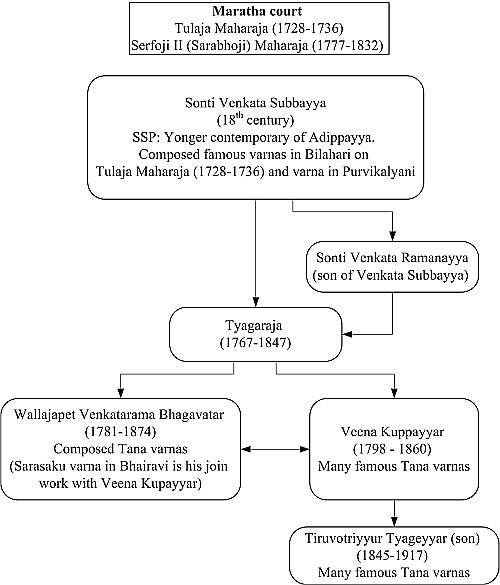
 Tyagaraja linage

24.2. The music of Sri Tyagaraja has come down to us in three main Schools (Sampradayas); the Tillaisthalam (Rama Iyengar); the Umayalpuram (brothers Krishna and Sundara Bhagavathar-s); and, the Walajapet (Venkataramana Bhagavathar and his son Krishnaswamy Bhagavatar) Sampradaya-s.

Among the other important disciples of Sri Thyagaraja  were:  Tiruvottiyur Veena Kuppayyar who wrote down many songs of his teacher (he was also a composer of varnams and kritis); Tanjavuru Rama Rao who served as the manager of Tyagaraja’s household and kept notes of his life-events; and, Manambuchavadi Venkatasubbaiyer (composer of Kritis and Ragamalikas).

We have to be grateful to all these and other savants who served their teacher and his music; and, also enriched our lives.

 [ Before we proceed further lets for a while dwell on Sri Venkataramana Bhagavatar:
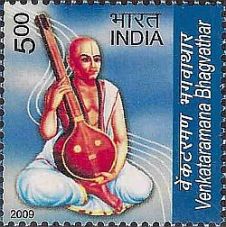
walajpet Venkataramana Bhagavathar

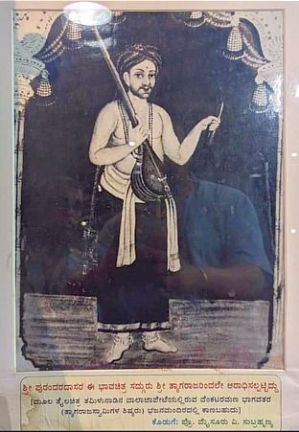
Sri Venkataramana Bhagavathar (1781-1874) was the principal disciple of Sri Tyagaraja. He served his Guru for almost twenty-six years with great devotion; learning music, assisting the Guru in his daily worship, and rendering services needed for the day to day life of his Guru.  Venkataramana, in his, beautiful, clear, print-like handwriting, noted down and preserved the Sahitya of the Kriti-s composed by his Guru. But for his ceaseless effort, the precious works of Sri Tyagaraja would not have come down to us in their purity. We all owe him a debt of deep gratitude.

Venkataramana was born on 18 Feb 1781, at Ariyaloor in Thirucirapalli District, as the son of Nannuswamy and the grandson of Kuppaiah Bhagavatar. They came from a family of hereditary priests and scholars, belonging to the immigrant Saurastra Brahmin community of Dadhichi Gotra. Later, when the family moved to Ayyampet (Ramachandrapura), just about seven miles from Thiruvaiyaru, where Sri Tyagaraja lived, the boy Venkataramana who had developed abiding interest in Music, came under the influence of Sri Tyagaraja; and, eventually became his disciple.

After staying with his Guru for about twenty-six years, Venkataramana, at the behest of his father and the Guru, got married, at the age of 41.  Even thereafter, Venkataramana and his wife Muthulakshmi continued to stay at Ayyampettai. They had three children – two sons and a daughter. The elder son was named Krishnaswamy (after the Ista-devata of Venkataramana); the second son was named Ramaswamy (after the Ista-devata of his Guru Sri Tyagaraja); and, the daughter was named as Tulasamma.

When he was of fifty-three years of age, in the year 1834, Venkataramana with his family moved to Walajapet (or Balajipeta) , at the invitation of Raja of Karveti Nagar. Venkataramana renowned for his Guru-bhakthi carried with him the Padukas and the Tambura that were gifted to him by his Guru Sri Tyagaraja. There at Walajapet, he led his life as a cloth merchant.

Venkataramana Bhagavatar lived in Walajapet for as many as forty years (1834-1874). And, because of his long association with that town, he gained renown as Walajapet Venkataramana Bhagavatar.

At Walajapet, Venkataramana Bhagavatar caused to build a temple for Sri Rama and Sita, worshipped by Sri Tyagaraja; as also for his own Ista-devata Sri Prasanna Rajagopalaswami. He also built a Bhajana Mandir for the benefit of the town’s devotees.
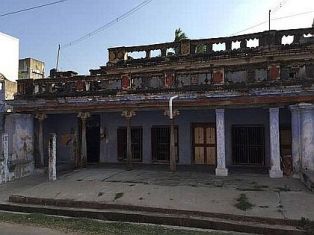
Walajahpet bhajana mandiram

Thanks to Sri V Sriram 

Venkataramana Bhagavatar devoted the rest of his life to pious activities such as Pujas, Bhajans, teaching Music and composing Kritis, in the tradition of his Guru assuming the Mudra’ ‘Ramachandrapura vara Venkataramana’. He also composed, in verse, a brief biography of Sri Tyagaraja.

After living a highly praiseworthy and blemish-less life, Sri Venkataramana Bhagavatar, an icon of Guru-bhakthi, merged with his Ista-daiva, at the grand old age of 93, on 15 Dec 1874. His Jayanti is celebrated at Ayyampettai, every year (Suddha Saptami; Margasira masa), by the linage of his disciples, admirers and lovers of Music.
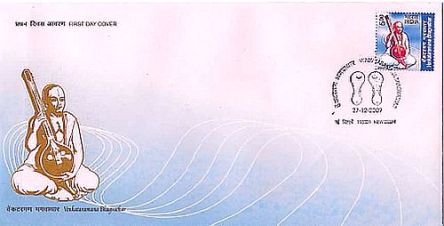
venkataramana b hagavatar firsrday cover

Sri Venkataramana Bhagavatar was a reputed musician and a composer in his own right. His output, in Sanskrit and Telugu, was not only prolific but was also varied. Besides the well known Ragas, he was adept in handling rare Ragas like: Saraswathi, Kamala-manohari, Nama-narayani, Jyothi-svarupini and Suvarnangi. Please Check the article here.

It is said; more than about 150 of his compositions have been traced. Apart from Kritis, his works include Tana Varnams, Pada Varnams, Svarajatis, and Tillanas,   cast in different moulds. Most of his compositions are in praise of Krishna, his chosen deity, and on his Guru Sri Tyagaraja. In one of his Svarajatis, composed in Sanskrit, – Mama Guru Rupa – (Kedaragoula), he describes Lord Rama as a form of his Guru Sri Tyagaraja. And, in another Kriti – Vada rasane Guru prabhavam ( Purvi Kalyani) , he calls upon his tongue to keep singing the glory his Guru who is filled with the Amrita of Rama Nama and Nada. (For more on his Music – please click here)

And, Here is a Sloka composed by Sri Venkataramana Bhagavatar on his Guru:

vyāso naigama carcayā mrdugirā valmīka janmā muni
vairāgye śuka eva bhaktivisaye prahlāda eva svayam |
brahmā nārada eva cāpratimayos sāhitya sa!gītayo
yo rāmāmrta pāna nirjita śivas ta” tyāgarājam bhaje ||

A Vyasa in Vedic learning, a Valmiki in his poetic language, Suka in his detachment, a Prahlada in his devotion, a Brahma and a Narada in his lyrics and his music, he rivals Siva in drinking in the nectar of Rama’s name; I salute that Tyagaraja.

One can experience the fragrance of Bhakthi, Rama-nama and Vedanta, as in the Kritis of Sri Thyagaraja. For instance; the environment of Bhakti-marga, Bhajana-sampradaya, and Nama-siddantha form the theme of his Kritis _ ‘Sri Rama Bramhudu’ (Begada) and ‘Rama bhakthi (Begada). And, in his Kritis, Anandamaya manave (Jothisvarupini); and, ‘Tattvamu teliya’ (Kambhoji), he sings of the Vedanta ideals of Jnana, Kaivalya and the supreme bliss of Svanubhava.

*

And, from the point of view of the history of Karnataka –sangita and the details of Sri Thyagaraja’s life, the contribution of Sri Venkataramana Bhagavathar is priceless. He not only preserved in writing and handed down the largest number of Tyagaraja-kritis, but also carried forward his Guru’s tradition. His palm-leaf manuscripts, artefacts, and other items ; and,   his  notes on many of the incidents concerning Sri Thyagaraja’s life, work, art  etc., form a large collection , which is named ‘Walajapet Manuscripts’ . It is said; the collection holds many unpublished songs of Sri Tyagaraja.  These  collections have been of immense value, serving as source material, for the later scholars in their study of the life and works of Sri Tyagaraja. For more on this, please click here ( see pages 30-47).

It was from the Walajapet collections – preserved at Sourashtra Sabha Museum- that the existence of three Geya-natakas (operas) – Prahlada Bhakti Vijayam; Nauka Charitram; and, Sitarama Vijayam – came to light  . While the texts of the first two operas have been published, the text of Sita Rama Vijayam is yet to be traced fully.

Among the disciples of Venkataramana Bhagavathar, the more prominent were Tiruvottiyur Ramaswami Iyer and Mysore Sadashiva Rao, a Vidwan in the court of the Maharaja of Mysore..

It is said; when Sri Tyagaraja visited Walajapet, on his way to Tirupathi, he stayed with his disciple Venkataramana Bhagavathar for about 12 days. While he was taken in, procession, Venkataramana Bhagavathar’s disciple, Mysore Sadashiva Rao composed the kriti ‘‘Tyagaraja-swami vedalina” in Todi Raga; and, ‘sang it in the immediate presence of the great saint and earned his blessings’.

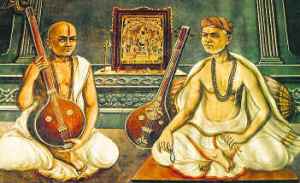
The linage (Shishya Parampara) of Sri Tyagaraja was famously carried forward through -Walajapet Venkataramana Bhagavatar – Mysore Sadasiva Rao- Veena Subbanna R.K. Venkatarama Sastry- R.K. Srikantan; Tiruvottiyur S.A.Ramaswami Iyer . It is alive and vibrant.]
TyaVen

Music

As Sri Tyagaraja, today, is recognized by many, more as a musician let’s talk of his music before coming to other aspects of his works.

Music culture

25.1. The period of Sri Tyagaraja that stretched from the late 18th to mid 19th century, was perhaps the brightest epoch in the history of Karnataka Music. It is hailed as the golden age which witnessed a virtual explosion of new formats of musical forms and compositions of sparkling beauty and charm; as the invigorating phase that ushered in innovation and elaboration of fresh Ragas following the 72 melakarta scheme that was beginning to take root; and as the turning point (parva kala) that gave a new sense of direction, vigour and identity to the music of South India. And above all, it was the period that was adorned by extraordinarily brilliant music composers, musicologists and singers. The wealth of the musical genius of Karnataka music flowered and flourished during this period when every branch of music and music related art-forms got enriched.

Prabandha

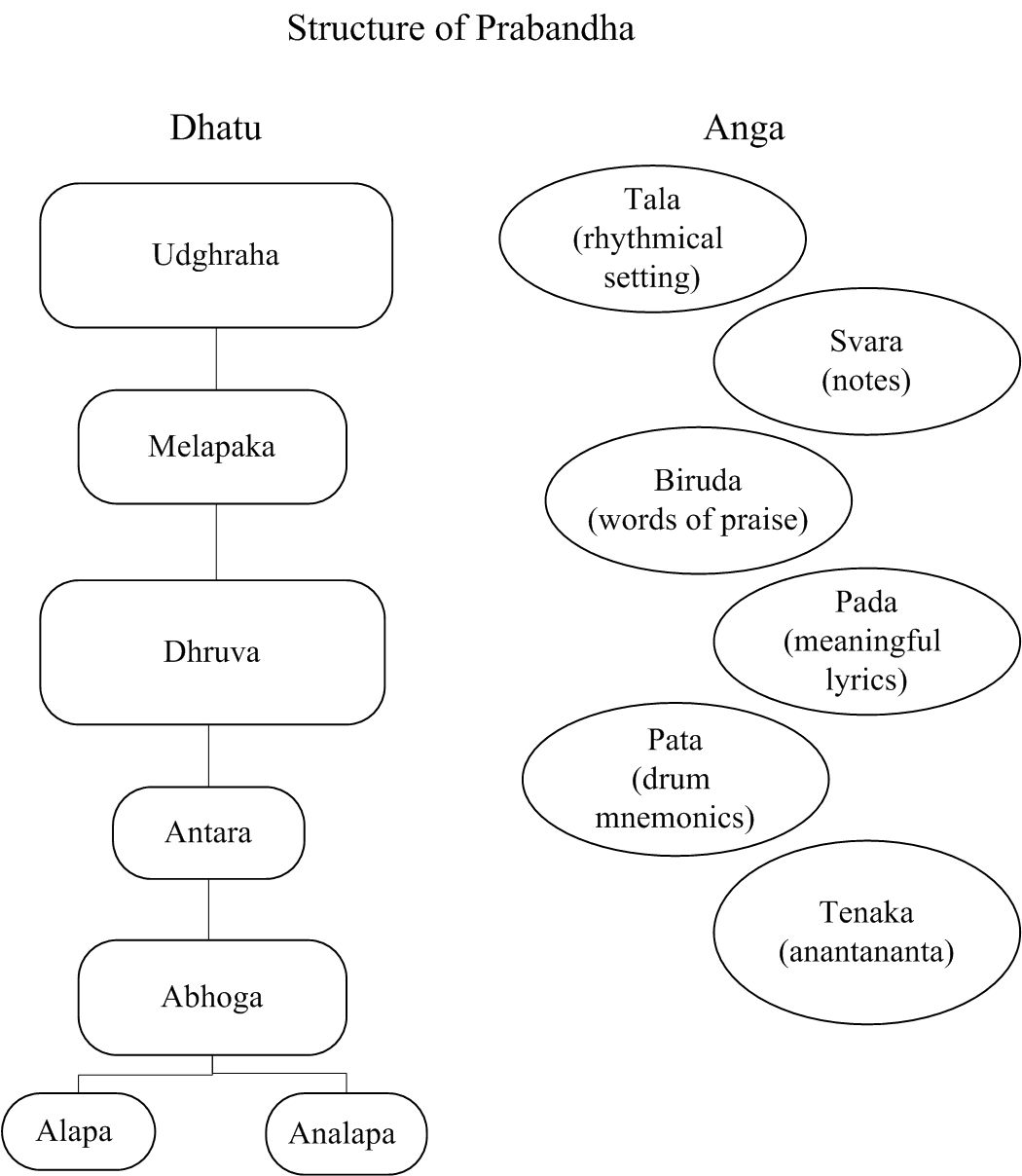
25.2. Until the time of Sri Tyagaraja, the music- scene of South India was dominated by a song-format known as Prabandha which played an important role in the development of music as also of dance-drama. Prabandha, essentially, is a tightly structured (Nibaddha Samgita) musical composition that is governed by a set of rules. Venkatamakhin (son of Govindacharya a Kannada speaking scholar and musicologist who migrated from Mysore to Thanjavur) in his landmark work Chaturdandi Prakasika (ca. 1635) made a systematic classification of Mela or Melakarta Ragas (parent scales) based on combination of varying Swaras (notes).

Chaturdandi Prakasika, as the name denotes, gathered various music-forms under a fourfold system (Chaturdandi) comprising Gita, Prabandha, Thaya and Alapa. Here, Prabandha denotes a composition having specific characteristics; and, that which is well composed – ‘prabandhayeti Prabandha’. However, the definition was narrowed down to include only those compositions which are made up of Six Angas (birudu, pada, tenaka, pāta and tāla) and Four Dhatus (Udgrāha, Melāpaka, Dhruva and Abhoga).

The structure of a Prabandha, by its very nature, had to adhere to a prescribed format. In general, the emphasis appeared to be more on the text than on the musical content. The faithfulness to the form was, at times, carried to its limits. And, the Prabandha form, in due course, grew rather rigid.

And, Prabandha, naturally, had to give place to improvised, easier and innovative (manodharma samgita) forms of music having distinctive features of their own. Yet; it is the basic elements of Prabandha that provide guidelines even to the modern composers of classical music.
prabandha (1)

[Most of the medieval Prabandha-s eventually disappeared because of the stiffness of their musical construction. Yet; it should also be mentioned that Prabandha helped the Karnataka music, enormously, in ensuring continuity of its ancient tradition.]

Nama Siddhanta
trinities4xk9fr

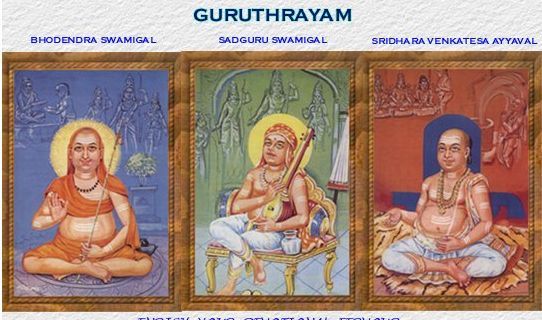
25.3. By about the same time, there arose in the Thanjavur Cauvery delta the doctrine of Nama Siddhanta founded on immense faith in the power of  chanting Lord’s name.  Nama Siddhanta averred that Nama-kirtana is the most effective and the easiest path leading to liberation, in the present age.  This movement ushered in   a tradition of singing devotional hymns and songs in chorus. The Bhajana Sampradaya popularised by Sri Bodhendra, Ayyaval , Sadguru Swami and others gave birth to series of free-flowing, sweet sounding soulful songs of devotion and melody that could be sung by all in a group with ease and delight. This new form of unstructured innovative songs gushed out in the form of hundreds of BhajansDivyanama Kirtanas, Utsava sampradaya kirtanas and Namavalis. The Groups also enacted dance dramas adorned with splendid poetry and tuneful songs of various forms. All these were regarded as a mellow and sweet worship form of the Lord, Madhura-Bhakthi.

***

Sri Tyagaraja and Nama Siddhanta
sriramapattabhishekaimageworshippedinparvathi1

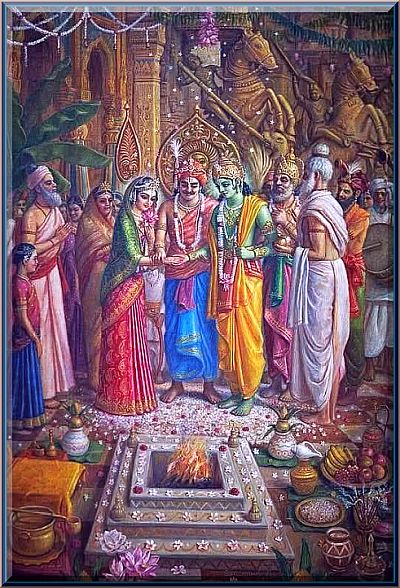
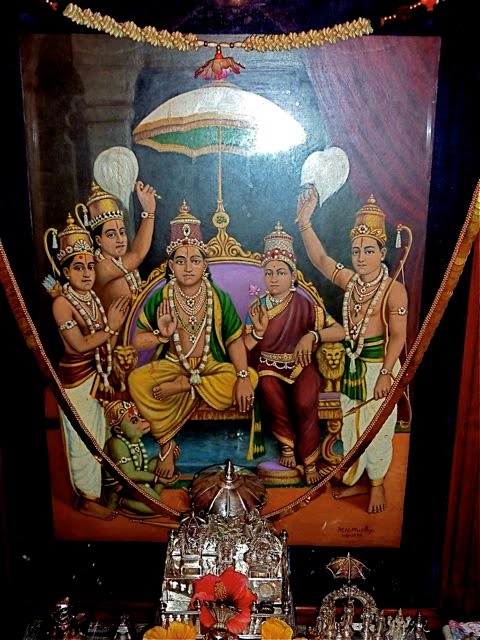
26.1. Sri Tyagaraja in his younger days was surrounded by an environment that was charged with the fervour of Nama Siddhanta. He, naturally, was nurtured on the Bhajana Sampradaya, which was at its height in the Cauvery delta at that time.  He took part in the Bhajana-s conducted by groups at homes or in special halls (Bhajana mandira) , where they celebrated with great enthusiasm the festivals such as the wedding of Sri Rama and Seetha (Seetha Kalyanam); as also of Rukmini (Rukmini Kalyanam).

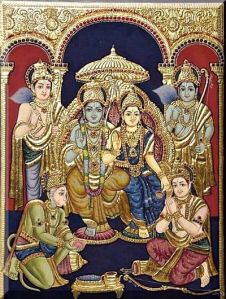
26.2. Sri Tyagaraja was a follower of the Nama Siddhanta tradition and of the larger path of devotion (Bhakti-marga). A significant number of his songs are about the greatness of the Lord’s name and the doctrine relating to its recitation. They seem to have been composed, especially, for singing during the Bhajana and Kirtana sessions. Among these, a set of about twenty-four songs, based on Shodasa Upachara (sixteen modes of worship offered to the deity), grouped under Utsava-sampradaya–kirtanas are simpler in structure but rich in melody and literary quality. In addition, he composed about seventy-eight songs (Divya-nama-sankeerthanam) for congregational singing as also for his daily worship of Sri Rama, his Ista-daiva.

Utsava Sampradaya Kirtanas have three or more charanas and are mostly set to slow tempo. These types of kritis are ideal for devotional congregation and chorus singing on account of the multiple charanas having identical dhatus. Some examples are ‘Rama Rama Rama Sri lali Sri Rama’ (Sahana) with as many as sixteen charanas; ‘Dina janavana’ (Bhupalam); ‘Karuna jalade’ (Nadanamakriya); ‘Bhaja Ramam’ (Huseni); ‘Ramabhirama’ (Darbar).  The other well-known Utsava Sampradaya kritis include ‘Hecharikaga rara’ (Yadukula Kamboji) and ‘Nagumomu’ (Madhyamavati).
sri rama durbar

Geya Nataka

27.1. He is also said to have composed three musical dramas (Geya Nataka). Of these, only two namely: Prahlada Bhakti Vijayam and Nauka Charitam are available. But, the third – Sita Rama Vijayam – is sadly lost.

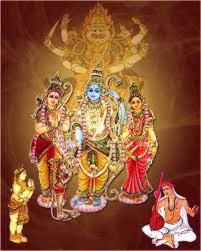
27.2. The main theme of his Prahlada Bhakti Vijayam is not the mere story of Prahlada; but, it is about several aspects of Bhakthi. The unwavering devotion of Prahlada towards his God Sri Hari made a deep imprint in the heart of Sri Tyagaraja. And, he sought to immortalize his admiration of the boy’s Bhakthi through his songs and music.  Here, the treatment of Prahlada’s Bhakti is again characterized by Sri Thyagaraja’s own attitude. In the play, Prahlada addresses his songs to Sri Rama pleading for help, kindness and Love.  Here, Rama is none other than Para Brahman, the Supreme Reality. Sri Tyagaraja’s mentor, Sri Upanishad Brahmendra Yogin had earlier taught him that RA-MA* is indeed the essence of both the Ashtakshari Narayana–mantra and the Panchakshari Shiva–mantra.  Musically, Prahlada Bhakti Vijayam is richly filled with Kirtanas, many of which in rare (Apoorva) Ragas such as ‘Parasu’ and ‘Naga-gandhari’ are popular even to this day.

[*That was by taking RA from Om namo naRAyanaya and MA from Om naMAh shivaya.]
Prahlada Bhakti Vijayam

Prahlada Bhakti Vijayam is richly filled with soulful prayers of Prahlada to Lord Hari. There are also songs sung by the sage Narada and devas in praise of Narayana as he appears  with Lakshmi. Narada also described the conversation between Sri  Hari and Sri Mahalakshmi (lakshmi-hari samvadam) . The opera has forty five kirtanas set in twenty eight ragas, one hundred twenty nine verses, a churnika, a dandaka and one hundred thirty two prose narrations, in Telugu and eleven shlokas in Sanskrit. There are  also mangala– songs at the end of three chapters or scenes. Songs from this opera are set in all tempos – Vilamba, Madhya and Druta kala-s. Many songs from Prahlada Bhakti Vijayam are regularly sung in concerts; for instance: Vasudevayani ‘(Kalyani); ‘Eti janma’ (Varali) ;‘Rara-mayintidaka’ (Asaveri);  ‘Naradamuni’ (Pantuvarali);Sri Ganapathy ni’ (Saurashtram); and the Mangalam – ‘Ni nama rupa mulaku’ (Saurashtram).

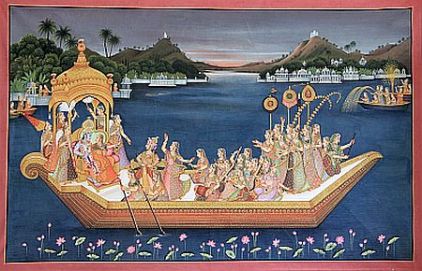
27.3. And, the story of Nauka Charitam, spun around the Gopis beseeching Krishna for help, is mostly a product of Sri Thyagaraja’s imagination, improvising on an incident briefly mentioned in Srimad Bhagavatam. Its theme extols the virtue of selfless absolute surrender to the Lord with Love and devotion. Interestingly, many of the songs in the play are composed to folk tunes.
naukacharitam

The ‘Nauka Charitram comprises twenty one Darus (songs with a pallavi, followed by an optional Anu-pallavi and several charanas) set in thirteen ragas and forty seven padyas (poetic verses set to different meters) , besides fifty- one vachanas (prose passages that set the sequence and provide narration). The songs are mostly set in Madhyama kala; only some are in Druta, while Vilamba kala was not used at all. Some songs from ‘Nauka Charitram’ are often sung in the concerts; e.g.  ‘Sringarichukani’ (Surati) and   ‘Odanu Jaripe’ (Saranga)
Thyagaraja sadguru

Kriti

28.1. One of Sri Thyagaraja’s significant contribution to Karnataka music is the perfection of a composition-form called Kriti (sometimes  called Kirtana though there are subtle differences between the two), which was, at that time, evolving out of the older Prabandha and its immediate predecessor Pada. Amazingly, Sri Tyagaraja as also Sri Dikshitar and Syama Sastri, independent of each other, all contributed to the development of Kriti form, although they do not seem to have met or corresponded.

Ramamatya (Svara-mela-kalanidhi,1550 CE) mentions the Chaturdandi  components of Gita,Thaya, Alapa and Prabandha as the best and the most accomplished format of rendering a musical composition set to a superior variety ((uttamottama) of Raga. And, Venkatamakhin (1660) , in his Raga-prakarana 107-108 , while illustrating  the standard composition-forms, states that the Gita, Thaya and Prabandha of Thanappa and other eminent musicians are available for most of the Ragas , though some of the Desi Ragas like Kalyani and Pantuvarali were not suitable for rendering in that format.  Further,  even up to the time of Raghunatha Nayaka of Tanjavur , such four-fold exposition of a Raga, in that sequence, appears to have been the main stay of the musical performances. The tradition of performing these compositions with a view to illustrate the structure of the Raga continued till the time Shahaji and Tulaja Maharajah

But, within about a century after Venkatamakhin, such forms of rendering a song became obsolete; and, was replaced by the Kriti format, set to a Raga (modal scale) and Tala ( beat cycle of a fixed number of counts organized in a specific pattern), having three segments (Anga)  – Pallavi, Anupallavi and Charanam – each being proportionally longer than the previous one (e.g. Pallavi = 2 Taala cycles; Anu-pallavi = 3 or 4 Taala cycles etc.,) The Pallavi is the refrain of the composition (Kriti).

The Kriti and its adoption as the song-form par excellence came into prominence; and, was accepted as the heart of the concert repertoire . This was primarily due to the prolific and innovative creations by the Trinity of Karnataka samgita

[Prior to the time of Sri Tyagaraja (say, 17th century) composers of great reputation such as Muthu Thandavar and Margadarsi Sesha Ayyangar had experimented with the Kriti format. And, it was the celebrated Trinity of Karnataka Samgita that, later, perfected it. ]

28.2. A Kriti is explained as that which is constructed (yat krtam tat kritih). It is primarily a pre-composed music (kalpitha Samgita), which aims to delineate the true nature of a Raga in all its vibrant colours.  The performer is not expected to deviate from the structure laid down by the composer. And yet; a Kriti provides ample scope to the performer to draw out her/his creative (Mano-dharma), innovative expressions in Raga and Laya. A Kriti can also be sung with or without Niraval. Because, it is said, a Kriti should essentially be beautiful by itself; and, should sound sweet even without elaborations.

28.3. In Karnataka Samgita, a Kriti comprising pallavi; anu-pallavi; and, charanams, set to appropriate Taala is the most advanced form of musical composition.

Sri Tyagaraja kritis use very well the three Angas:  Pallavi to introduce and briefly outlines theme of the song; the charanam to elaborate upon on it in detail; and, the anupallavi, a little more expansive than Pallavi, to bridge the Pallavi with the charanam. Thus, developing the theme of the Kriti, progressively – in stages.  Some scholars, employing the textual analogy, have described Sri Tyagaraja’s Pallavi as Sutra; Anu-pallavi as Vritti; and Charanas as Bhashya. 

[In the traditional texts , the term Sutra denotes a collection  highly condensed pellets of references ; Vritti attempts to slightly expand on the Sutra to bring some clarity; and Bhashya is a detailed , commentary  on the subjects dealt with by  the Sutra and the Vritti. ; and it  is primarily based on the Sutra.]

28.4. Sri Tyagaraja also tried out variations in their arrangement of the Pallavi, Anu-pallavi and Charanam. Some of his Kritis commence with Anu-pallavi; for instance:  ‘Soumitri bhagyame’ (Kharaharapriya) starts with the anupallavi ‘Chitra ratna maya’’; ‘Ela nee daya raadu‘ (Atana) starts with ‘Balakanakamaya chela’; and, ‘Mokshamu galada’ (Saramati) starts with ‘Saakshat karanee’.

 Some of Sri Tyagaraja kritis have a Pallavi and Anupallavi of equal rhythmic length ; and  a Charana that has the combined length of the Pallavi and Anupallavi ; for e.g. ‘Enta nerchina’ (Suddha Dhanyasi); ‘Chakkani raja margamulu’ (Kharaharapriya).

 The other variation on the standard format is where the Pallavi is half the length  of the Anu-pallavi;  for e.g. ‘Marugelara’ (Jayanthasri); ‘Raju vedala’ (Todi).

There are also kritis where the Charana is four times the size of the Anupallavi;  for e.g. ‘Raga Ratna malikache’ (Ritigaula); ‘Tulasidalamula’ (Mayamalavagaula).

An additional variation is introduced in some Kritis where the  tempo of the charanam is faster than that of the rest of the Kriti ; for e.g. ‘Enduko nee manasu’ (Kalyani; ‘Emi dova’ (Saranga) ; and,  ‘Enduko baga teliyadu’ (Mohanam).  

There are Kritis with single Charana,  as also many with multiple Charanas, starting with Anu-pallavi; and some  with  swara sahitya  built into Charanas,  as in the case of his  Pancharatnas.

28.5 . Sri Tyagaraja in his song Sogasuga mridanga talamu (in Raga Sriranjani) provides an outline of how a Kriti should be, in its form and in its content. In this song, he says that a  Kriti should be couched in words ( nija vākkulatō ) conveying the pure spirit of the Upanishads (nigama siro-arthamu) ; should have correctness of musical notes (swara śhuddhamutō)  of the ragas in which they are set; should have pleasant (sokkajeya) rhythm that is enjoyable (Sogasuga mridanga talamu); should be marked by beauties of alliterations and successive increases and decreases of notes and syllables , as also pauses (Yati Visrama) ; it’s  literary expressions should nurture  cultivation of true devotion (Sadbhakti) and dispassion (virati ); and, it  should be adorned with  grace and simplicity embodying  all the nine (nava) Rasas or aesthetic moods.

Pallavi  :  sogasuga mrdanga talamu
jata kurchi ninu sokka jeyu dhIrudevvado

Anupallavi :  nigama shirorthamu galgina
nija vakkulato swara shuddhamuto

Charanam :  yati vishrama sad-bhakti virati draksha rasa nava rasa-
yuta krtiche bhajiyinchu yukti Tyagarajuni tarama shrI Rama

28.6. In number of his other songs; he explains how Music is indeed the expression of the primordial Nada; how music originates in mind and body; and, how music should be presented. According to him, enjoying music is Sukhanubhava – a tranquil delight.

Some of the well known Kritis of that genre are : 

  • Nadaloludai (Kalyana Vasantham);
  • Nadopasana (Begada);
  • Nada Tanum (Chittaranjani);
  • Nada Sudha Rasam (Arabhi)
  • Swara Raga Sudha (Sankarabharanam);
  • Vidulaku Mrokkeda (Mayamalavagowla);
  • Ragasudharasa (Andolika);
  • Samajavaragamana (Hindolam);
  • Mokshamu Galada (Saramati) ; and ,
  • Vara Raga Laya (Chenchu Kambhoji).

date-of-mahabharata-war-from-literary-sources-udayana

Continued in Part IV- Music continued

Sources and references

Manaku Teliyana Tyagaraju: http://eemaata.com/em/issues/200809/1337.html

Tyāgarāja and the Renewal of Tradition: Translations and Reflections by William Joseph Jackson

The Power of the Sacred Name: Indian Spirituality Inspired by Mantras by V. Raghavan

Spiritual Heritage of Sri Tyagaraja by Dr. V Raghavan and C. Ramanujachariar

History of Indian Music by Prof. P. Sambamoorthy

A Tribute to Tyagaraja by V.N. Muthukumar and M.V. Ramana

http://www.parrikar.org/carnatic/tyagaraja/

The Musical Works of Thyagaraja by Prabhakar Chitrapu Prabhakar

http://www.sruti.org/sruti/srutiArticleDetails.asp?ArticleId=4

I acknowledge with thanks the images and other information from his site

http://en.wikipedia.org/wiki/List_of_compositions_by_Tyagaraja

All images are by courtesy of Internet
 
8 Comments

Posted by on February 22, 2015 in Tyagaraja


Tags: , , , , , , , , , , , , , , , , ,

SRI TYAGARAJA (1767 – 1847) – PART II – Life

(For my friend Shri Kannan Rangachar )

Continued from Part I

Tyagaraja Jinaraja Dasa collection

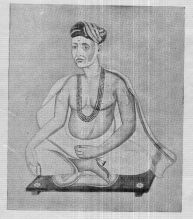
(Said to be a contemporary portrait in the collection of Dr. Jinararajadasa , of the Theosophical Society)

[At the outset, it needs to be mentioned that there is no single authentic account of Sri Tyagaraja’s life. Attempts to reconstruct his life-events based on references that occasionally occur in several of his songs have no real validity. Some of such narrations are but imaginative elaborations.

Even as early as in 1904, that is about 50 years after the departure of  Sri Tyagaraja  , Sri Subbarama Dikshitar (1839-1906) – the grandson of Sri Mutthuswamy Dikshitar ; and, who as a child had met Sri Tyagaraja – remarked that “ he could not easily obtain historical information about Sri Tyagaraja” ; and, had to rely  on other sources.

What we know of Sri Tyagaraja’s life has come down to us through a series of narrations made by his disciples, their descendants and other writers.

The earliest biography of Sri Tyagaraja was written by his direct disciple, Walajapet Venkataramana Bhagavatar along with Tanjavuru Rama Rao. According to some accounts, Venkataramana Bhagavatar was with his master for about thirty years. He is also credited with writing down most of the Tyagaraja-kritis that have come down to us. Similarly, Tanjavuru Rama Rao was the Manager who took care of Tyagaraja’s household. He served his Master for long years.

Their narration was followed by that of Venkataramana Bhagavatar’s son Krishnaswamy Bhagavatar, who was with Sri Tyagaraja only during the last two years of saint’s life. His version was largely based on the notes made by his father; but, he added certain elements of his own.

Krishnaswamy Bhagavatar’s work was followed by that of his son K. K. Ramaswamy Bhagavatar who enlarged it further.

In the meantime, a biography in poetic form was written by Tumu Narasimhadasa, a Ramabhakta and an ardent admirer of Saint Tyagaraja.

These renderings were later followed by many other versions of Tyagaraja’s biography.

His direct disciples, obviously, had a very high esteem and veneration for their Guru. The image of Sri Tyagaraja that emerges from their (Venkataramana Bhagavatar and Tanjavuru Rama Rao) narration is that of a very sincere person; a truly honest follower of his Dharma; a bhaktha intensely devoted to his ideal Sri Rama; an extraordinarily gifted musical genius; a great teacher; and, a poet par excellence. He was far more than a Vak-geya-kara – the one who set words to music. He was, indeed, a divinely inspired singer of most sublime songs in glory of his Lord. He comes across as a poet, saint and philosopher combined in one. Yet;   Tyagaraja, here, appears more human and real.

In the later versions of his biography , Tyagaraja  is transformed and idealized as a divinity incarnate, an Avatar, a reincarnation of Sage Vyasa, of  Shuka, of Prahlada, of  Narada ; and, as one with an Amsha (spark ) of Shiva or Brahma. Many supernatural events and miraculous deeds were woven into his biography.

What follows here-under is somewhat closer to Venkataramana Bhagavatar’s rendering. ]

srirama

Birth

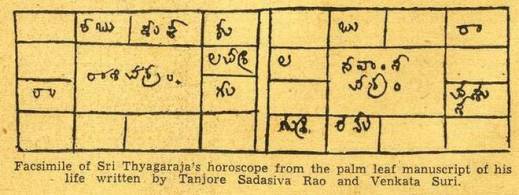
7.1. According to one account, Tyagaraja was born in Sarvajit-nama-samvatsara, Chaitra-masa, Shukla paksha, Saptami, Kataka lagna, Pushyami nakshatra, Monday, corresponding to 4th May 1767.  (Another version mentions the Tithi / star of his birth as Bahula Dasami   and Purvashada Nakshatra).

Thyagaraja HOROSCOPE

He belonged to Bharadwaja gotra; Aapasthamba Sutra; Krishna Yajus-shakha    .
Place

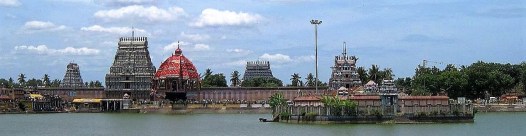
8.1. The place of his birth was Tiruvarur through which the Odambokki River flows. He was named Tyaga (raja) Brahmam after the presiding deity of the temple at that place. Here, the Mulavar, Shiva Linga of precious stone, is celebrated as Tyagaraja. The processional icon of Tyagaraja in Tiruvarur temple is a composite deity comprising the images of Shiva, Uma and Skanda (Somaskanda = sa –uma –skanda).
8.2. Tiruvarur is an ancient town of the Cholas; and was one of the centres where their Kings were crowned. The temple at Tiruvarur figures prominently in Periya-Puranam, a 12th century compendium describing the lives of sixty-three Shaiva saints, the Nayamnar-s. And, by about the sixteenth century it had already come to be recognized as a seat of Sri Vidya, centered on Goddess Kamalambika.  God Tyagaraja was also the Ishta-devata of the Maratha Court at Tanjavuru. The scholars and artists attached to the Telugu and Maratha court were living in Tiruvarur.

8.3. Tiruvavur (regarded as one of the sixty-four Shakthi centers); its temple complex dedicated to Lord Tyagaraja and Devi Nilothpalambika; as also the deity Sri Kamalamba,  figure prominently in the Kritis of Sri Muthuswami Dikshitar. He refers to town of Tiruvarur is as Kamala-nagara (e.g. Kamalanagara viharinai) and as Kamala- pura (e.g. Kamalapura sadanam).  In his Kritis, Devi Kamalamba sports in the temple lake (Pushkarini) named as Kamalalaya thirtha (Kamalalaya thirtha vaibhave). She resides in and walks about the town of Kamalapura/Kamalanagara.

[Tiruvarur has the unique distinction and honor of being the birthplace of Thyagaraja, Muthuswami Dikshitar and Syama Sastri – the Grand Trinity of Karnataka music tradition.]

Tiruvarur_temple

Home

9.1. Tyagaraja belonged to the Telugu speaking Mulakanadu Smartha Brahmin community. In the fifth introductory verse of his Nauka charitram, Tyagaraja mentions his house-name (inti-nama) as Kakarla, which is identified as a village in the erstwhile Kurnool region of Prakasam District in Andhra Pradesh. The ancestors of Tyagaraja might have migrated from Kurnool to Tanjavuru region somewhere around the 1600s, during the Naayak rule, after the fall of Vijayanagar Empire.

9.2. Some accounts mention that Giriraja kavi Brahmam, a scholar well versed in Sanskrit and poetics, was the paternal grandfather Pitamaha of Tyagaraja.  Some others say that Giriraja was in fact his Matamaha, maternal grandfather. This latter view is based on a reference (in a kriti in Bangala Raga), where Tyagaraja calls himself Giriraja suta tanaya (son of Giriraja’s daughter).  Some say that expression,  actually, refers to Ganesha son of Parvathi , daughter of Parvatha (Giri) raja. But now, generally, Giriraja is regarded the paternal grandfather of Tyagaraja.

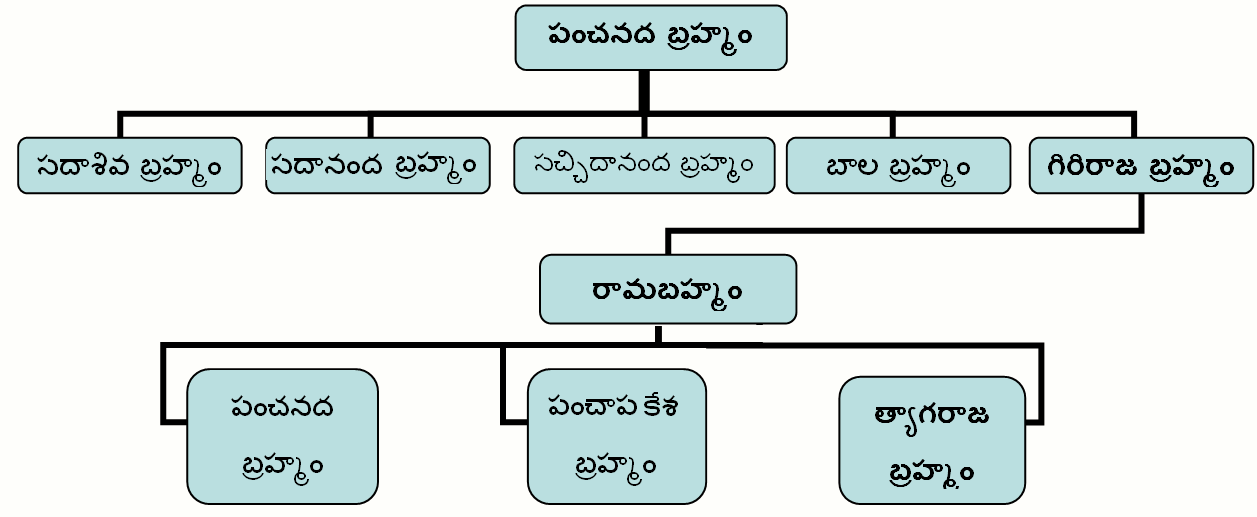
[Sri Subbarama Dikshitar in his Vaggeyakara Caritam (Biographical Notes on composers and musicians), which is numbered as Volume V , under his monumental work  Sangita –Sampradaya-Pradarshini, while writing about Sri Tyagaraja , on page 16, (28. Tygarajayya), commences with the statement : Approximately 250 years ago, there was a great Brahmin Giriraja Kavi in Tiruvarur. He had five sons. The youngest son was named Ramabrahmam. He was an expert in the science of Vedas. He had three sons, Pancapakesa, Ramanatha, and Tyagaraja.]

Tyagaraja’s maternal grandfather was Kalahastayya. He was a Veena player. Tyagaraja , in his childhood , learnt playing Veena from Kalahastayya.

9.3. Kakarla Rama Brahmam and Seethamma are said to be parents of Tyagaraja. They had three sons, of whom Tyaga Brahmam was the third.  Panchanada Brahmam and Panchapakesa Brahmam were Tyagaraja’s older brothers. The eldest son of Rama Brahmam, Panchanatha Brahmam was also called as Japyesa, after the name of the deity at Thiruvaiyaru.

tyagaraja_family_tree4_big

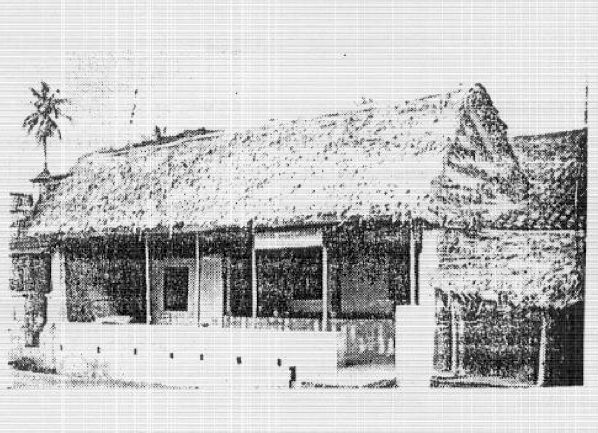
9.4. It is said that while Tyagaraja was still young, the family that was living at Tiruvarur migrated to Thiruvaiyaru, at the invitation of the King of Tanjavuru, Thuljaji. The King, it is said, gifted Ramabrahmam with six acres of land and a house. And, there, in the house gifted by the King, on the Tirumanjana Street, at Thiruvaiyaru, the family resided for very long years. Sri Tyagaraja spent a  major part of his life in that house.

shapeimage_2

[The house in which Sri Tyagaraja lived most of his life and produced sublime music was in existence till recently. Alas, a year or so ago, it was demolished to put in its place a modern memorial for the Saint…! ]

Tanjavuru Maratha Court

10.1. During that time, Tanjavuru was under the Maratha rule, which had a rather chequered history. The Ramabrahmam family, perhaps, moved into Thiruvaiyaru during the reign of Thuljaji who ruled from 1763-1773 and again from 1776-1787. He was said to be a rather weak administrator, but a very generous patron of arts.

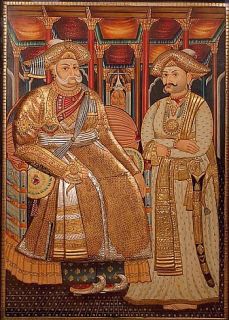
Maharaja Serfoji II of Tanjavur and his son Shivaji II   Maharaja Serfoji II of Tanjavur and his son Shivaji II.

In 1787, Thuljaji was succeeded by his adopted son Serfoji II who then was about ten years of age.Soon afterwards, he was deposed by his uncle and regent Amar Singh who seized the throne for himself. With the help of the British, Serfoji II recovered the throne in 1798. A subsequent treaty forced him to hand over the reins of the kingdom to the British East India Company. Serfoji II was however left in control of the Fort and the surrounding areas. He reigned till 1832.

[He, sadly, was succeeded by Shivaji II (1832 to 1855) who was a weak and feeble prince with barely any authority.]

10.2. It appears that during the most part of Tyagaraja’s adult life, that is for almost 40 years, Tanjavuru was under the rule of Serfoji II (His first reign was from 1787 to 1793 and his second reign was from 1798 to 1832). He was said to be a generous patron of arts and literature; and, his reign was noted for the literary, scientific and technological accomplishments of the Tanjavuru country. The famed  Saraswati Mahal Library at Thanjavur with a nucleus of Serfoji’s collection of about 80,000volumes (most of them with his scribbles on the pages) is another of his valued legacies.

Thiruvaiyaru

Kaviri_at_Thiruvaiyaru

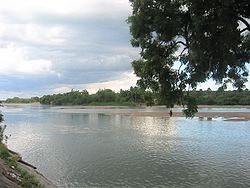
11.1. Thiruvaiyaru situated on the banks of the river Cauvery, 13 km from Tanjavuru gains its name by the fact it is surrounded by five rivers (Pancha-nada-kshetram); and, appropriately, the presiding deity of ancient temple there, Shiva, is celebrated as Pancha-nadi-eswaran. Tyagaraja as a boy seemed to have loved the natural beauty of the place and the rivers surrounding it. Later, in his two songs Muripiemu and Sarivedalina he refers to his region (Ee mahilo sogasaina Chola-Sima yandu) as ‘the most beautiful place in the world , in this Chola region’.

Early years

12.1. During the younger days of Tyagaraja, Thiruvaiyaru was a well regarded centre of learning in Vedas, Sanskrit and music. It is said; Tyagaraja had his initial education in Sanskrit in Thiruvaiyaru. He seemed to have been a studious and a rather serious minded boy. He gained sufficient proficiency in Sanskrit.  Several of his early songs are completely in Sanskrit (For instance; “नमो नमो राघवाय अनिशं” in Desi-Todi, said to be his first Kriti). And, two of his plays – Naukacharitram and Prahlada Bhakt Vijayam – have some slokas in Sanskrit.  All his Telugu songs are replete with Sanskrit words and phrases.

12.2. During his childhood he also had his initial training in music from his maternal grandfather Kalahastayya as also from his mother Seethamma who was fairly proficient in music; and, was also a good singer. She taught her son to sing the keerthanas of Bhadrachala Ramadasu and the padas of Purandaradasa. She was also an ardent devotee of Sri Rama; and, was the first to plant in him the seeds of Rama-bhakthi. Tyagaraja, had his Upanayana at the age of seven; and, at the age of eight, he was initiated into Rama-mantra by his father. Thereafter, he started assisting his father in the daily worship of Sri Rama.

12.3. The boy Tyagaraja also learnt to play on Veena from his maternal grandfather Veena Kalahastayya (even in the later years, there used to be a Veena in Tyagaraja’s Puja-room).  After Kalahastayya’s death, Tyagaraja found in his box “Naradeeyam“, a palm-leaf text related to music. Tyagaraja tried to study the  text; but, could not make much of it , as many portions of the manuscript were not clear to him. He then approached his Guru Ramakrishnananda, who guided and initiated the boy Tyagaraja into Narada mantra

Rama Parivar 2.

13.1. Tyagaraja , even as a teenager was deep into the Bhajana sampradaya  – singing devotional songs, in group, with great fervour- which was at its height in the Cauvery delta at that time. During a Bhajana sessions which lasted for hours, a cycle of religious hymns consisting Namavali, Kirtana, Dhyana Slokas, Mangalas, Divya Nama Kirtans and other hymns were sung. Nama-sankirtanam became his devout passion.

13.2. In the Bhajans that were held in the homes or in the halls (Bhajana-mandali), the groups celebrated special festivals such as Seetha-Kalyana, Rukmini-Kalyana, Radha-Kalyanam etc with great enthusiasm, singing in chorus devotional songs that followed a certain traditional pattern (paddathi). The songs commenced with welcoming the Lord (Heccharikaga raara) ; offering him seat (kolavu) ; then the actual wedding (kalyana mahotsavam) ; waving of light (Aarathi) ; putting the Lord to sleep  by singing soothing songs (Lali) ; and , waking him up next morning (Suprabhatam).

For the use on these occasions, Tyagaraja composed a set of songs (numbering about twenty-seven) that have come to be known as Utsava-sampradaya-kirtanas. They are simpler in structure; but, rich in melody and lyrics. Tyagaraja also composed many other songs (about seventy-eight) – Divya-Nama-sankeerthanam – that celebrate the glory of the Lord and his name. Songs selected from these two sets are now rendered by musicians in the later part of their concerts.

Hanuman meditation

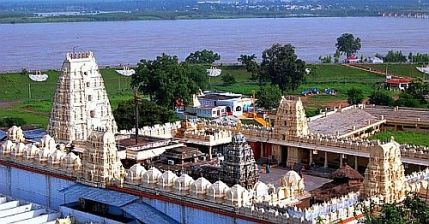
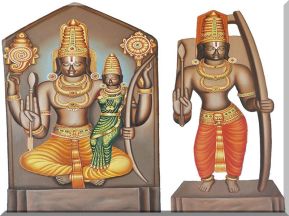
[Speaking of Rama-Bhakthi: Tiruvarur where Tyagaraja was born and Thiruvaiyaru where he lived all his life, are both Shiva-kshetras; and there are no Rama-temples anywhere nearby  or in the surrounding regions. Some, therefore, wonder how Tyagaraja could develop devotion towards Rama. It is explained; the forefathers of Tyagaraja’s parents hailed from Kurnool region and were devoted to Sri Rama at Bhadrachalam. Seethamma, Tyagaraja’s mother, on her marriage, brought with her the idol of Sri Rama that resembled the mulavar at Bhadrachalam , on the shores of the Godavari.

Badrachalam

Here, Sri Rama is depicted with four arms holding a bow and arrow in His lower hands and Shanku and Chakra in His upper hands. Sri Rama is seen seated in yogic posture with Sri Sita–ammavaru is sitting on His left lap, unlike in other versions where She is standing beside Him.  Sri Lakshmana with bow and arrow, devotedly guards them.

Bhadrachalam

Tyagaraja’s mother worshipped this family deity (kula-devatha) daily; and, so did Tyagaraja’s father Ramabrahmam. Tyagaraja , as a boy, used to assist his parents in their daily-worship. Further, Tyagaraja’s mentors Sri Upanishad Brahmendra as also his Guru Sri Ramakrishnananda were ardent Rama-bhaktas.  All these factors and Tyagaraja’s own inclination (samskara) perhaps led to imbibing in him unwavering faith and intense devotion in his Ishta-devata Rama whom he regarded as the Supreme deity, Para-Brahman. Tyagaraja is said to have performed Rama-koti-japa several times over, during his lifetime. ]

Rama Icon worshipped by Sri Tygaraja

Family Life

14.1. Of the two elder brothers of Tyagaraja, Panchapakesa Brahmam died fairly early in his life because of ill health. His older brother Panchanatha Brahmam (also called as Japyesa) settled down as a householder taking care of agricultural lands.

14.2. The accounts that have come down say that Japyesa, did not like Tyagaraja’s ways; disapproved his Unchavriti, Bhajana, Rama puja etc.; and, that he also partitioned the family house and belongings. Japyesa is also said to have repeatedly pressed Tyagaraja into accepting royal patronage. It seems that Japyesa, realizing his younger brother’s rich musical talent, was anxious to turn it into a means of living . Sri Tyagaraja in his songs sometimes refers to the difficulties he had to undergo at the hands of his elder brother.
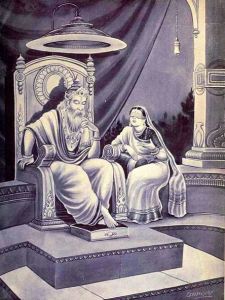
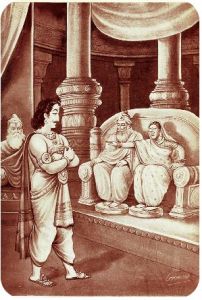
[There are also comments to suggest that Japyesa’s villainy came to be exaggerated in the later accounts perhaps to project  or to heighten Tyagaraja’s misery.]

14.3. Even outside his family, Tyagaraja had to face many detractors. Many seemed to have disliked his appearance, his activities and his songs. A large number of Tyagaraja’s songs are high-strung emotional appeals to Sri Rama to rescue him from his hostile detractors. For instance; in his prarabha-mittundaga he bemoans his fate; and in his Sarivaarilona, he pleads with Rama ‘have I not been ridiculed enough; is it fair on your part to be passive while I am subjected to every sort of agony by these prattlers?’

14.4. Tyagaraja, however, vowed to lead a life of voluntary poverty, in the true traditions of Bhagavatas. He adopted for his livelihood the Unchavriti, going out everyday around the streets of the town, singing the Lord’s songs and receiving handful of rice from householders who might feel like offering. He was intensely committed to avoiding Nara-stuti, praising mere mortals in return for rewards.His Kriti Nidhi-chala sukhama , Ramuni sannidhi chala sukhama (in Raga Kalyani) is said to give expression to his attitude in that regard. (But, there is some debate about the context in which the song was composed)

Tyagaraja’s  actions guided by his cherished principles and faith caused him much trouble and misery. And, these incidents, his anguish and prayers to Rama to rescue him became the subject matter of many of his songs.

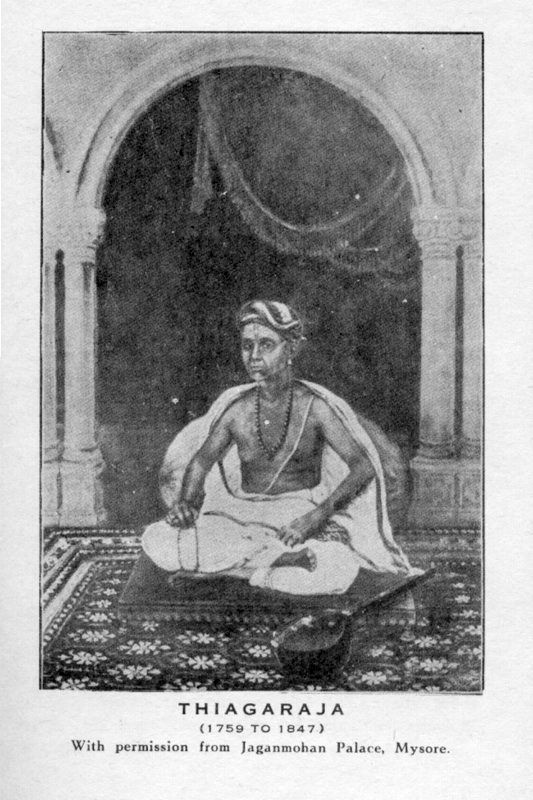
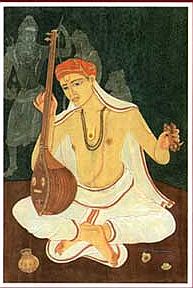
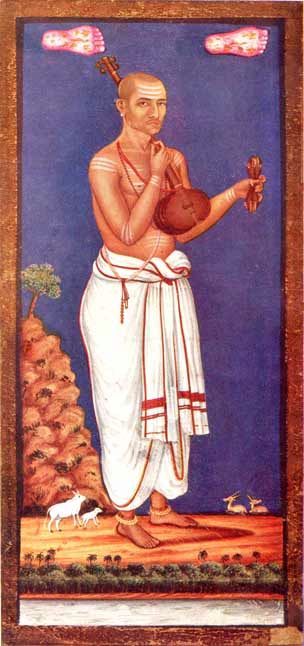
[“In appearance, it is said, Tyagaraja was a tall, lean man of brown complexion. His shoulders were broad…face stern…jaw fleshy but a little pointed at the chin…he wore thulasimala around his neck; gopi-chandana- nama on his forehead. On his right forefinger he wore a gold ring; and, on his ring figure he had a pavithra. He usually was dressed in white, silk-lined, dhoti having a brownish border with carefully made folds. He usually, wore a red silk turban with a broad unfurled tail flowing behind.

Thiagaraja from Jaganmohan palace Mysore

Tyagaraja03

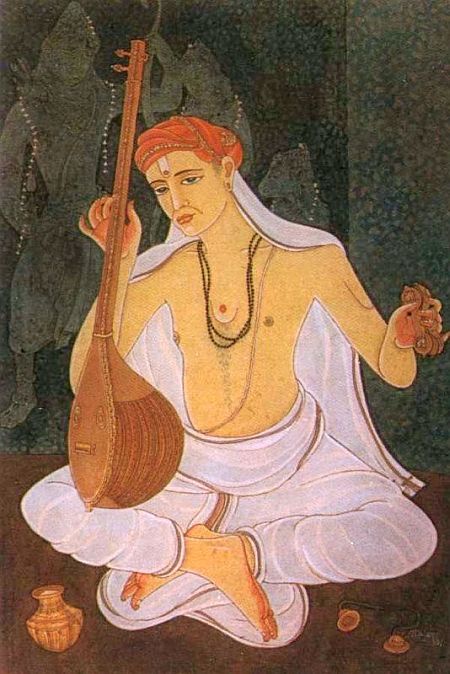
The portrait of Sri Tyagaraja created by Shri S Rajam that has come to be universally recognized is a highly idealized version of the saint as envisioned by the artist.

Tyagaraja William Jackson

As a teacher, Tyagaraja was said to be very strict, often harsh, with his pupils. He would insist on the right rendering of his songs. He would also not tolerate his pupils singing light hearted amorous songs such as Javalis, which were popular at that time. ]

Events

15.1. The period between 1785 and 1791 was eventful in the life of Tyagaraja. The year 1785 was also distressful for the region of Tanjavuru, when it was affected by severe famine and political disorder. When Tyagaraja was eighteen years old (1785), he was married to Parvathi. And, when he was twenty years (1787) his father Ramabrahmam expired. When he was twenty- three (1790), his wife Parvathi passed away. A year later (1791), Tyagaraja married Parvathi’s sister Kamalamba.

15.2. As regards the other tragic events in Tyagaraja’s life; his mother Seethamma passed away in 1804; his brother Japyesa in 1812; and his wife Kamalamba in 1845 (when Tyagaraja was about 78).

15.3. Tyagaraja had only one daughter, Seetha-maha-lakshmi; and she was married (in 1810) to one Kuppuswamy Shastri of Ammal Agraharam. She had a son who was given his grandfather’s name – Tyagaraja.  He, later, married one Guruvammal; but, died rather early in his life (30?), childless. With that and there ended the direct line of Tyagaraja .

Nannupalimpa by S Rajam

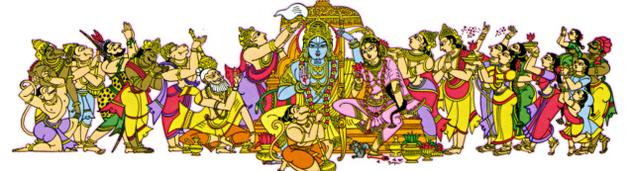
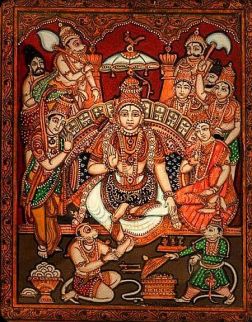
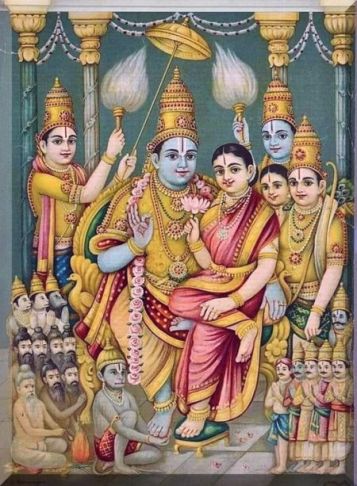
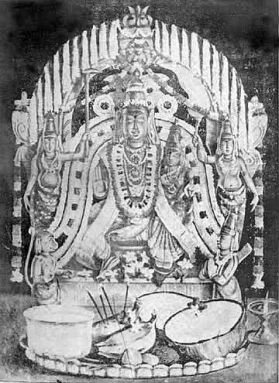
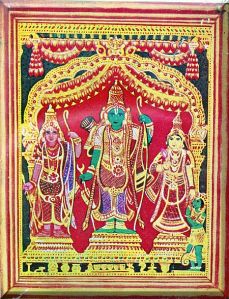
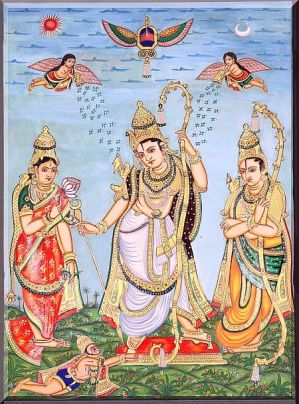
[ It is said; on the occassion of the marriage of Seetha-maha-lakshmi, Sri Tyagaraja’s disciple Venkataramana Bhagavathar walking all the way from Ayyampettai to Tiruvaiyaru, carried on his head the painting of Sri Kodanda Rama, created by  the artist Pallavi Ellayya, portraying Sri Rama with Sita, Lakshmana and Anjaneya (Sitaramanjaneya Pattabhishekam), to be presented to the bride as the wedding gift (Pendli Kanuka). As he entered the wedding-hall carrying that portrait, Sri Thyagaraja was thrilled at its sight ; and,instantly sang in ecstasy the Kriti ‘Nannu palimpa nadachi vachitivao…!!’ (Raga Mohana) – Oh Lord, have you walked all the way to bless me. The following is said to be a scanned copy of that portrait, stated to have been painted by Pallavi Elliah, a disciple of Venkataramana Bhagavathar: courtesy, thanks to rasikas.org  ]

nannu paalimpa nadachi vacchitItvo

15.4. In regard to the other branch of Tyagaraja’s family tree, it is said, Tyagaraja’s elder brother Japyesa had a son named Pattabhi Ramabrahmam. He, in turn, had a son named Panchanda Brahman, whose son also named Pattabhi Ramabrahmam. Their descendants, it is said, still live in Thiruvaiyaru; and are in possession of the Sri Rama image that was  worshiped daily by Tyagaraja.

Later years

16.1. Music for Sri Tyagaraja was not mere Sangeetha-sadhana; but was indeed the Moksha-sadhana, the path to liberation. His pursuit of Nadopasana was for the realization of Nada-Brahman who is none other than the Absolute Reality, the Para-Brahman.  Sri Tyagaraja, in the heart of heart, worshiped Ista-devata Sri Rama as the Supreme deity, Para-Brahman. Sri Tyagaraja devoted his entire life for worship of Sri Rama and of Nada (Nadopasana)–Music.

16.2. All his life, Tyagaraja derived inspiration from his mentor Upanishad Brahmendra and from his Guru Swami Ramakrishnananda. Further, he was guided by the hoary tradition of the Sadashiva Brahmendra the Avadhuta and Sri Narayana Theertha, the composer of Krishna Leela Tarangini. And, all these saintly persons were Sanyasins in whom the three paths of Jnana, Bhakti and Music converged harmoniously. Tyagaraja, in the last phase of his life, yearned to embrace the spiritual order as in the manner of the noble persons (Mahanubhavulu) that preceded him.

Last days

17.1. Following the path illumined by his revered predecessors, Sri Tyagaraja, after bathing in the Cauvery and performing the usual rites, and offering gifts to the needy and to the Brahmans, entered into the order of Sannyasins on 5, January 1847. According to one version; he was initiated into Sanyasa-ashrama by Sri Brahmananda Swami (?) who offered him ocher robes (kashaya vastra) and re-named him as Nadabrahmananda.

17.2. Just a few days prior to that event, Tyagaraja in his Kritis (Giripainela and Paritapamu) mentions of the Sri Rama’s promise to bestow Moksha on him:

I did see Sri Rama resting on a mountain top.  My whole being shook out of sheer Joy. I was thrilled. Tears rolled down from my eyes.  I could hardly talk; I just mumbled. Sri Rama told me, in ten days (padi pūṭla) I shall grant you Moksha”;

“Have you forgotten the promise you made while you were sailing on the Sarayu in a golden boat along with peerless Sita that you would grace me after ten days (padi putla)?”

[Here, padi pūṭa might mean ten days; or five days in case puta is taken to mean a part of the full day – as either day or as night.]

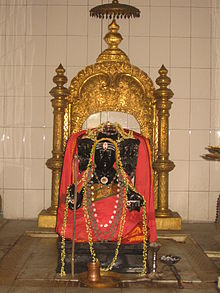
18.1. A day after he took Sanyasa, that is on 6 January 1847, Wednesday (?), on Pushya Bahula Panchami in Prabhava-nama–samvatsara, seated on the banks of Cauvery at Thiruvaiyaru, Sri Tyagaraja reached Brahmi-bhava and attained Samadhi, merging with Para-Brahman.

thyagaraja aradhana

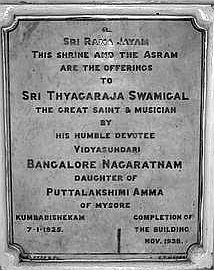
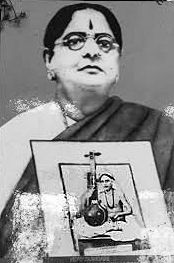
18.2. Each year, on Pushya Bahula Panchami, the music lovers and ardent followers of Sri Tyagaraja gather at the Samadhi on the banks of the Cauvery ,caused to be constructed through the tireless efforts of Bangalore Nagarathnamma .

Samadhi of Sri Thyagaraja Nagarathnamma Bangalore

Scores of disciples and music lovers  celebrate, with love and reverence, the Aradhana of Saint Sri Thyagaraja Swami their Guru and the ideal whose contribution to poetry, to music, to Rama-bhakthi tradition and to the Indian ethos, in general, is truly immense and everlasting.

Tyagaraja_Swamy_Idol_at_samadhi_mandir_in_Tiruvaiyaru

big-dark-pink-lotus

....Continued in Part III

Music of Sri Tyagaraja

Sources:

Manaku Teliyana Tyagaraju: http://eemaata.com/em/issues/200809/1337.html

Tyāgarāja and the Renewal of Tradition: Translations and Reflections by William Joseph Jackson

The Power of the Sacred Name: Indian Spirituality Inspired by Mantras by V. Raghavan

Spiritual Heritage of Sri Tyagaraja by Dr. V Raghavan and C. Ramanujachariar

I acknowledge with thanks the images from Sri Chitrapau Prabhakar’s site

The Musical Works of Thyagaraja by Prabhakar Chitrapu Prabhakar

http://www.sruti.org/sruti/srutiArticleDetails.asp?ArticleId=4

The other images are from Internet

 
11 Comments

Posted by on February 22, 2015 in Tyagaraja


Tags: , , , ,

SRI TYAGARAJA (1767 – 1847) – PART I – Intro

 ( For my friend Shri Kannan Rangachar )

Tyagaraja SRajam 02 

Inheritor of a  rich Legacy

1.1. The genius of Karnataka classical music may be said to have found the peak of its glory and fulfilment in Sri Tyagaraja. “But for the emergence of Sri Tyagaraja along with two of his contemporaries, Mutthuswamy Dikshitar and Shyama Shastry, the Karnataka musical heritage might not have been consolidated and handed down to us in its integrated form, as it is now. It is the extraordinary genius of these Masters and their sublime creations that is the mainstay of the Karnataka music tradition”.

1.2. Sri Tyagaraja comes as a culmination of the music of the masters and giants who preceded him, such as Sri Purandaradasa, Bhadrachala Ramadasa, Jayadeva and Narayana Teertha. Sri Tyagaraja was influenced by the varied excellences of all of these masters. And, in addition he brought in his own grace and brilliance.

As the renowned scholar Dr. V Raghavan explained: “Tyagaraja appears in a long line of a Sampradaya sanctified by Jayadeva. In sheer volume of output, he essays in the direction of Purandaradasa and Kshetragna; in devotion, religious fervour, reformatory zeal and spiritual realisation, his songs approach those of Purandaradasa; when we think of him singing in anguish to his Rama, we find in him a second Ramadasa of Bhadrachala; in his lyrical moods, he takes a page off Kshetragna; in his Pancharatnas and some of his grander  compositions, he treads the path  of the earlier Prabandhakara-s and later Varnakara-s; turning out pieces now and then in the language of the gods, he seems to beckon his contemporary Dikshitar singing the glory of Mother Tripurasundari; when he calls out in anguish to Rama or to Mother goddess , he is like  Shyama Shastri ;  and in his  dramatic compositions he  is  like Narayana Teertha or Merattur Venkatarama Bhagavatar  ( the composer of the Bhagavata Nataka-s in Telugu )  “.

1.3. Tyagaraja in his childhood learnt to sing the songs (padam-s) of Ramadasa and Purandaradasa from his mother who had a fair knowledge of music.

In his musical play Prahalada Bhakti Vijaya, Sri Tyagaraja pays obeisance to many of his eminent predecessors; and, in particular to Bhadrachala Ramadasa who was intensely devoted to Rama  (in Ksheerasagara sayana in Devagandhari and Emidova balkuma in Saranga).

And  again in Prahlada Bhakthi Vijayam  he pays his tribute to Sri Purandaradasa whom he regarded as a Guru . Sri Tyagaraja brought into some of his Kritis,  the thoughts, emotions and concepts of Sri Purandaradasa.

 – వెలయు పురందరదాసుని మహిమలను దలచెద మదిలోన్ (I ponder, in my mind, on the greatness of Purandaradasa who shines in a state of ecstasy, always singing the virtues of Lord Hari which rescues from ill-fate)

purandaradasa 2

Varied influences

:- Sri Upanishad Brahmendra

2.1. The scholars mention that in his childhood (in the years prior to 1780), when he was about ten-twelve years age, Tyagaraja was greatly influenced by a Sanyasin named Ramacandrendra Sarasvati (later renowned as Sri Upanishad Brahmendra Yogin). Sri Ramacandrendra Sarasvati, who then resided in Tanjavuru, used to conduct discourses on Ramayana and also lead chorus-singing of the devotional songs he composed in praise of Sri Rama. Tanjavuru was just about 13 Km away from Thiruvaiyaru where the Tyagaraja family lived. It is said; Tyagaraja, along with his father, used to attend the musical discourses and Bhajans conducted by Sri Ramacandrendra Sarasvati.

Sri Upanishad Brahmendra was well versed in music; and, was intensely devoted to Sri Rama, his Ishta-devatha. He followed the Divya nama-samkirtana, the Bhajana form in worship of Sri Rama. He is credited with number of Bhajana-samkirtanas, devotional songs set to music, singing the glory of the Lord.

Ramayana and Rama-Bhakthi had enormous influence on Sri Tyagaraja, his life and outlook.

rama lakshmana sita

2.2. Dr. V. Raghava , a renowned scholar and musicologist,  opines that the traces of Ramacandrendra Sarasvati‘s influence can be found in the Divya-nama-samkirtana songs composed by Sri Thyagaraja. He points out the similarities in the structure of songs and in the word-play (pada-jaala) employed by Sri Thyagaraja and his inspiration, Ramacandrendra Sarasvati. (e.g.,Kanakambara; Kanakavasana; Celakanaka; Hatakacela;Bhaktha-chandana; Sakalonnata; Rajavandya; Sitamanohara; Rajivaksha; Ranabhima; Jitakama; Navanitasa; Sara-sarastara; Mruduvacana; Niramayanga;  Nadapradipa; Nadasadhana; etc.

He also points out the similarities in the structure of songs and in the word-play (pada-jaala) employed by Sri Tyagaraja and his inspiration, Ramacandrendra Sarasvati in his Tarangas.

Further Dr. Raghavan mentions; Sri Tyagaraja’s songs: Dhyaname varamaine;  Gangasnaname and Kotinadula which emphasize that the real snana and thirtha (the bath and the holy waters of the pilgrimage) are verily in the contemplation on the name of the Lord and not in the rivers, were inspired by Sri Upanishad  Brahmendra‘s  Tarangas  in his Sri Rama Taranga .

It is also mentioned that   Sri Ramacandrendra Sarasvati’s Sri Rama Taranga, was in turn influenced by the songs in most enchanting opera Krishna-Leela-Tarangini of Sri Narayana Thirtha (1650 -1745).

3.1.. Sri Upanishad Brahmendra was an integral part of the tradition that was in vogue during those times when the Sanyasins based in Advaita ideology also cultivated Bhakthi (devotion) and Samgitha (music). Apart from Upanishad Brahmendra the two other Sanyasins – Sri Narayana Thirtha and Sri Sadashiva Brahmendra – excelled in practice of Nada-vidya as a part of their Sadhana.

3.2. Sri Upanishad Brahmendra produced monumental sets of commentaries on all the 108 Upanishads listed in the Mukthiko-panishad. He was the first scholar in the Advaita tradition to have provided commentaries on all those listed Upanishads. And yet; in his work, Upeya-Nama-Viveka, he attempts to synchronize Advaita with Bhakthi. There, he explained Divyanama –samkirtana, the recitation of the sacred name of the chosen deity (Istadevata) as Upaya the means for attaining the ultimate (Upeya) the Brahman.

Then, Sri Rama just as the symbol (pratika) Om, according to him, would no longer be a Nama of a Rupa (form) but will be the very essence of the Supreme divinity. Thus, Divya-nama or nama-chit (name –consciousness) is the means (sadhana) and also the end (sadhya). He asserts that the quote “Om eti ekaksharam Brahma” (Bhagavad-Gita: 8.13) gives expression to the identity of the symbol or the name (abhidana) with the object of contemplation (abhideya).

3.3. Sri Tyagaraja who had a great affinity towards Upanishad Brahmendra, later in his life, followed that hallowed tradition. He too, like his ideal, lovingly adorned Sri Rama in hundreds of his songs; and he too later in his life took to Sanyasa – bringing together devotion, music and knowledge of self (jnana– vairagya). All of his mentors had asserted that Bhakthi was the means (sadhana) to realize the goal (sadhya) of attaining unity with God or Brahman.

Sri rama pattabhishekka

:- Namasiddantha

4.1. Besides this , there had arisen  in the Cauvery delta a movement – Bhajana Sampradaya – that firmly believed in the power of the sacred name of the Lord (Namasiddantha).It asserted the faith that recital of the holy name in loving devotion and giving expression to that through soulful music (nama samkirtana) was the most potent means for liberation. The movement cut across the distinctions of caste (varna) and the stages of life (ashrama). It brought into its fold householders, men, women and children of all sections of the society. Sri Sridhar Venkatesha Ayyaval, Sri Bhodendra Sarasvathi and Sri Bashyam Gopala Krishna Sastry renowned as the triumvirate of Bhajana tradition were the prominent leaders of the congregational devotion (Bhajana mandali) practices. They were followed by Sri Venkataramana – Sadguruswami who strengthened and gave a form to the Bhakthi and Bhajana-paddathi movement.

gurutrayam

4.2. It is also said; Krishna Leela Tarangini, an opera, of Narayana Teertha provided inspiration for Tyagaraja to compose his Nauka Charitram and Prahlada Bhakti Vijayam. Another popular feature of the times was the celebration of Radha, Rukmini, and Seeta Kalyanam-s. The traditional songs sung during those festivals, it is said, inspired Sri Tyagaraja to compose utsava sampradaya kirtanas. And, these became a part of his daily worship of Rama.

4.3. Sri Tyagaraja was thus an inheritor of a long , rich and a holy Sampradaya.

Environment

5.1. Sri Tyagaraja appeared in a period which was thronged by giants in the arts; performers; theorists and composers; authors of dance music, dance-drama; and, composers of Grammatical (Vyakarana) and technical works of great value, such as Lakshanas, Thayas and Varnas.

5.2. Giriraja Kavi, said to be his paternal grandfather, was a poet and a composer.  His maternal grandfather Kalahastayya was a Veena player besides being a scholar.  Sri Ramakrishananda, Tyagaraja’s Guru  (as mentioned in Nauka Charitram) , who initiated him into Rama–mantra (Namo Namo Raghavaya) was himself a scholar, poet and a musician.  And in music, Tyagaraja was the pupil of Sonti Venkataramayya (illustrious musician of the Court), the son of another renowned performer Sonti Subbayya, was one of the great teachers of his time.  Thus, both at home and in his surroundings, Tyagaraja was immersed in the soothing environment of music and Rama-bhakthi.

6.1. Further, during his period, Tanjavuru was virtually the cultural capital of South India. With all the leading scholars and artists migrating to Tanjavuru which provided royal patronage and support, Karnataka music was getting enriched from all directions. The period witnessed development in all most all branches of Manodharma Samgita: alapana, tana, pallavi exposition, niraval and svara kalpana.

6.2. It appears the region was lit up with activities churning out and crystallizing various forms of creative expressions. To have appeared amidst the throng of talents and to have outshone the others with his creations is indeed the greatest testimony to the genius of Sri Tyagaraja.

ps69

Continued in Part II- Life of Tyagaraja

Sources:

Manaku Teliyana Tyagaraju: http://eemaata.com/em/issues/200809/1337.html

Tyāgarāja and the Renewal of Tradition: Translations and Reflections by William Joseph Jackson

The Power of the Sacred Name: Indian Spirituality Inspired by Mantras by V. Raghavan

Spiritual Heritage of Sri Tyagaraja by Dr. V Raghavan and C. Ramanujachariar

I acknowledge with gratitude the Sri Tyagaraja’ s portrait by Shri S Rajam

Other images are from Internet

 
9 Comments

Posted by on February 22, 2015 in Tyagaraja


Tags: , , , ,

Shishira Rtu

[Ms.B i; January 22, 2014; Dear Mr . Sreenivasa Rao,

I am currently working on indianising the curriculum for the school that I work for. In my research, I stumbled upon this article and the one on Sharad Ritu. It is very relevant to the work I am doing, as the curriculum is imparted mainly through stories embedded in local culture.

We are now in the season of Shishira. Would you be able to give a similar description of this season?

Ms.B ; January 24, 2014; what is said about this particular season in these translations is something that I cannot use… these descriptions cannot  be given to children.

I can see that there aren’t many flowers around in this season, but there still are. How are they coping with the cold? How about the birds, squirrels, worms and other creatures? What are the first things to change at the end of Shishira, when Vasantha begins to set in? ]

floral design3

Dear Ms.B , I wrote the article on Rtu Varnana mainly thanks to my friend   Ms. Venetia Ansell, a Sanskrit Scholar from Oxford University – now in India. I expanded on Rtu Varnana by bringing in Barahmasa poetry and painting, just to make it a bit more complete.

Venetia Ansell is managing a Publishing House (Rasala)www.rasalabooks.com ; and also a website devoted to Sanskrit Literature http://venetiaansell.wordpress.com/

Please check on the latter link; and that could, perhaps, answer many of your concerns.

On that page, under the table ‘Categories’ you may click on Seasonal Poetry . There you will find that Venetia has written extensively on seasonal poetry in Sanskrit; as also on flowers of each season as described in the poetic works of Kalidasa and other eminent poets. I am sure the detailed references would be of much use to you in your task.

As regards Shishira please check on pages 10 and 11 of ‘Seasonal Poetry’ at   the following link for a brief description

https://venetiaansell.wordpress.com/2010/03/09/pleasures-of-shishira/

Yes Maa, I agree. Those translated poems on Venetia’s site are about the pleasures of Shishira, enjoyable delights of lovers within the confines of the bedroom.  They, of course, are   not suitable for children. Those pieces of poetry were created in an entirely different context for the pleasure of a totally different set of readers. In contrast, the stanzas you have written are purposeful and serve your objective better.

I have just tried writing a few lines about Shishira. I now realize how difficult it is to write about these subjects for the children. It calls for a special way of understanding and a style of putting across the information in a manner that is at once simple, inoffensive, educative and enjoyable by the children. I had not attempted it earlier.  This is a new experience for me.  I am not sure I got it right. My respect for you, therefore, goes up all the more.

See, if the following could be any use to you. Modify it in any way you think best. I am sorry; I have not been of much help to you. Pardon me.

[As regards Yakshi and others you mentioned, let’s talk of them at another time.]

A. Shishira

Shishira Rtu

1. 1. In the part of country we live, Shishira and Hemantha run into each other. That is mainly because, unlike in the North, we do not experience severe winters. Though Hemantha is described as pre-winter and Shishira as late-winter, both the Rtus are moderately cold, and dewy. While Hemantha is colder, Shishira is its diminishing phase. 

1.2. Shishira is the Rtu comprising Magha and Phalguna, the months related to winter’s cold and snug- comfort.  The Shishira Rtu, season, usually starts in January and ends in March. The mild winter gradually gives place to spring (Vasantha), which itself transforms into summer (Grishma).

1.3. The temperatures during Shishira are pleasant, breaking into enjoyable sunshine, evoking images of warmth, the stoking of the fires.    The sun shines weakly and even the moon is pale. Days are short and nights long. Few flowers or trees are in bloom.  During the latter half of Shishira, trees may shed their leaves.  The life-force of the plants lie dormant, waiting to burst forth at the advent of Vasantha, the spring.  These seasons are typical to tropical and subtropical regions. Some, therefore, even call Shishira; the early spring – prelude to Vasantha.

2.1. Shishira is one of the many names of Vishnu (Shishira sharvaree Kara – Vishnusahasranama 97). And yet;   as Venetia says: ‘Śhiśhira is the much neglected step child among the seasons’. It doesn’t seem to have definition of its own. Shishira, unlike Vasantha or Varsha, is not much celebrated in our poetry.  In the ancient days of the Vedic texts, when the Rtus  were counted as five, Hemantha and Shishira were considered as forming one Rtu. Some texts did not even regard Shishira as a Rtu, but called it a month – Shishira Maasa.

2.2. Shishira (magha –phalguna) is the transitory season of cool days; the waning phase of winter, when the season of cool comforts steadily picks up heat gets quietly warmer. Shishira stands at the threshold when earth changes its fabric. It acquires a rather rough surface after the dry winter. Then the earth switches into its explicit warmer mode.

Aayanas and change of seasons

3.1. Shishira marks the Parva-kaala – change of seasons – from winter into spring; from short days into longer days; and from Dakshinayana into Uttarayana.  It transfers from the night (Dakshinayana) of the gods to the day (Uttarayana) of gods. Shishira stands at the head of Uttarayana. 

3.2. The Indian year is divided into two semesters (Aayana): the fiery (agneya) in which the Sun rises higher in the sky with each passing day, spreading heat, blowing winds, and sapping out (aadana) fluids from all living things. The other is the lunar season (saumya) during which the moon is relatively higher up in the sky than the lowering Sun. It pours in (visarga) moisture through the rains.

3.3. The first of these, the hot season, roughly corresponds with the period between the winter (14th January) and summer solstice (14th July). During this Aayana, the Sun’s angle of elevation increases; and the point of sunrise moves northward (Uttara) along the horizon with each passing day. This is known as Uttarayana; and roughly corresponds to the period between 14th January and 14th July.

3.4. The second is the period between summer and winter solstice, when the Sun’s angle of elevation decreases and apparently moves along the horizon southward (Dakshina). This is the Dakshinayana – the period between 14th July and 14th January.

4.1. The turning points (Sankarnathi) fall on or about 14th January (Makara Sankranthi) and 14th July (Karka Sankranthi) when the Sun’s orientation shifts, and when winter and summer change places. Shishira Rtu covers the transition period from winter to spring, from Dakshinayana to Uttarayana. Uttarayana Sankranthi (14th Jan) is celebrated to mark the beginning of the sun’s journey in the northern solstice. On this day prayers are offered to Surya, the visible representation of the God.  This is followed by Ratha Saptami marking the seventh day of Sun’s journey in the north-easterly direction. And, with that the day temperature increases gradually. Ratha Saptami heralds staring of the harvesting season; and, are celebrated as Surya Jayanthi (birthday).

[This traditional explanation is from the point of view from the Earth.  But, we all know that the Sun does not move; and it is the Earth that rotates on its axis round the Sun.  The earth is titled at about 23 degrees and circles around the Sun with this tilt. It is this tilt that creates the various seasons on different parts of the Earth.

equinox

The tilt of the Earth and its rotation round its axis is very important for the creation of seasons. Supposing the Earth did not tilt round its axis, and had been erect (zero degree), the sun would always have been below on the horizon; the Sun would set and rise at the same time everyday of the year; there would be no variation in daylight hours; there would less sunlight towards either ends of the Earth; and, It would be warm at the equator and cold at the poles. That is to say; with zero tilt,    a single uniform weather condition would have prevailed over the Earth. All through the year, it would have been as if it is the middle of fall or spring; we would have a totally different plant and animal life. Or , it could possibly have been something else; who knows !

With no tilt, the most profound impact on temperatures would have been at the poles where the sun would always circle round its horizon and the temperatures throughout the year would have been uniform.  The day in the Polar Regions would be shorter and colder; the effect on animal and plant life would have been significant without having any ‘growing’ or migration seasons.

Therefore, the earth’s 23 degree tilt doesn’t just give us the variations of the seasons and all the wonderful things we’ll be experiencing from season to season.  The tilt is really important for setting the basic foundations of the environment we take for granted in our part of the world. As you can see, we’d have a very different planet without those 23 degrees.

Having said that; let us be aware that the earth hasn’t always rotated with a 23 degree tilt. Its tilt varies by a couple of degrees every 41,000 years or so. And, that changes the strength of the seasons on the earth as we experience it.  When the tilt is greater, summers are warmer and winters are colder; and, when the tilt is smaller there’s less of a difference in the seasons. Over the last million years the changes in the tilt have   just been 2 or 3 degrees. And, that is huge enough to force huge climate shifts of the glacial cycles that the earth has experienced. Scientists say that the Earth’s tilt is slightly decreasing, which means the variations among the seasons ,  ever so slowly,  is getting less perceptible  .]

5.1. The Dakshinayana begins with pouring monsoon rains beating down the heat and ushering in cool relief, And, as the Aayana ends, the mild winter steps into prelude to spring. Dakshinayana is the life giving season in which all creatures and vegetation thrive. The thirsty plants and animals fanatically drink and soak in the elixir of life, and regain their vitality.   It is the season of life and festivity.  All the major festivals from Krishna Janmastami, through Gauri, Ganesh, and Nava Ratri, on to Deepavali are celebrated during Dakshinayana. This particularly is the Aayana of the Devi – the Mother. Dakshina is also understood as the grace; the feminine principles, the Mother who can create, unfold and manifest. Dakshinayana is the time of receptivity and is the feminine phase of the Earth.

5.2. In contrast; the Uttarayana (Jan – July) is a long period of dry heat, blazing summers and swirl dusty winds. During this uncomfortable season of heat, dust and winds the life withers and dies.  The heat takes away moisture from all living things. It is also the season of ‘hot’ diseases and epidemics. The village minor goddesses such as Sitala (small pox) are ‘cooled’ or appeased (shanthi).

small pox

At the same time; Uttarayana is also the invigorating   , new good healthy wealthy beginning.  It is the time of harvest, gathering the fruits of your efforts.  Uttarayana is also the northward noble path (Deva Yana) that leads the virtuous to gods; and, is therefore called Uttarayana Punyakaala. The old warrior Bhishma of Mahabharata lay in wait on the bed of arrows for the arrival of Uttarayana. On the dawn of Uttarayana the Grand-old Bhishma chose to give up his life. Uttarayana is the time of fulfilment, while Dakshinayana is the season of growing up.

5.3. Maha Shivaratri which heralds the true beginning of hot summers, as also the Holi  the festival of colours marking  the burning down of Kama are celebrated during Uttarayana . Shivaratri, it is said, is the remembrance, in gratefulness, of Shiva the Neelkanta who saved the world by consuming the deadly poison thrown up after Samudra Manthan, churning of the ocean. And, Holi, in some parts of the country, is day on which the fearsome Lord Narasimha killed the tyrant king Hiranyakashipu. 

Many of the festivals in Uttarayana are in celebration of male gods. The season of six months from January to July is regarded   masculine in nature, while Dakshinayana is the feminine phase of the Earth.

[In the ancient and medieval times, Dakshinayana was also the season of re-union; when men travelling on business hurried back home before the rain bearing clouds broke out in torrents; and, when the separated lovers ran into each other arms.

Even for the ascetics, the recluse and the Parivrajakas (wandering monks) the monsoon was a period of retreat. During the four months (Chatur-masa) of Dakshinayana when travel used to be difficult and hazardous the monks in the olden days used to assemble at a place far away from towns for exchange of views and experiences. It was essentially a period of study, reflection and contemplation. The period of retreat commenced from the end of Ashada (June–July) and through the months of Shravana, Bhadrapada, Asvina and ending in the Kartika, the day after Deepavali (November) marking the beginning of  winter ]

6.1. The Rtu of Shishira bridges the winter and hot seasons, marks the transformation of the Earth in its nature and appearance. Shishira stands at the threshold when earth changes its fabric; switches from Devi to Shiva; from thriving into fulfilment. It leads on to way to openness and liberation.

****

B. Birds and flowers

Birds

7.1. Shishira is the season of migratory birds. Every year, in this season, varieties of colorful migratory bird species flock to the   habitats that suit them in Southern India. In these sanctuaries, the arrival of migratory birds commences in the last week of October and continues till February end. 

sea geese in ontario

The annual migration of snow geese turning up in Ontario, Canada is  not only an incredible demonstration of the unique and amazing ways the flocks of birds  have evolved to survive;  but,  it’s also a visual spectacle

7.2. For instance, birds from North Europe, Afghanistan and West Asia make their home in the wetlands of Malady in Udupi district between September and March. The influx of waterfowls in the wetland crosses 1.2 lakh every winter. The best time to watch them is in January and February. Some birdwatchers say they have identified here even the bird species from Patagonian region of South America. These include different varieties of ducks, coots, swans, birds of prey and many others.

[It appears, during this season, in the warm waters of South India, Olive Ridley Turtles arrive to lay eggs.]

7.3. The other is the famous bird sanctuary at the mini-islets of Ranganathittu along the River Cauvery, near Mysore. During the months of January and February, more than 30 species of birds are found here. About 50 pelicans have made Ranganathittu as their permanent home. The season of the sanctuary is from November to June, when Ranganathittu comes alive with birds of different species flocking there to herald the nesting and breeding season. About 40,000 birds of various plumes arrive here from the cold regions of Siberia, Latin America and the Himalayan regions in North India, to nestle and hatch eggs. They stay throughout the summer and fly away after breeding ahead of the onset of monsoon.

7.4. The migratory birds that arrive at Ranganathittu are of wide variety .They range from Pelicans, Painted Storks, Open Billed Storks, River Terns, Spoon Bills, Night Herons, Cormorants and other birds. A lot of other varieties such as Kingfishers, Hornbills, Wagtails and many other species can also be found. Between February and April you’ll find a greater variety of birds with their breeding plumage are at their finest. And, between April and July, you’ll still get to see the Mother birds with their offspring.

Flowers

8.1. As regards the flowers of Shishira as described in the Sanskrit poetry, you may refer to Venetia Ansell’s most delightful series of posts on Seasonal poetry. Please click here for the link.  

Here, she talks of:” Priyagu creepers, their young shoots bowed under their burden of golden yellow  blossom, outshine the beautiful hue of women’s arms arrayed with jewellery – Ritu Samhara of Kalidasa; 3.18.

; And of Kunda – Jasmine buds that bloom in Shishira and withers at the onset of spring  (Vasantha)  , and  “that shine with a glistening sheen as if stars, terrified of the cold, have taken refuge in the kunda creeper: Verse 3 of Śiśira in the Subhāitaratnabhāṇḍāgāram.

 8.2. The season of Shishira is special, as both winter and summer flowers blossom around this time of the year. While the winter flowering plants do wither away, the summer ones begin flowering around January and February.  “In January and February, winter flowers cease to bloom slowly and summer flowers start blossoming”.

The biannual flower show at Lal Baugh celebrates the culmination of the seasonal flowers of winter and summer.

07in_flower_show_2962833f

8.3. Though it is true that flowers bloom in full in spring and summer seasons, there are yet a large variety of flowers that can decorate and brighten-up your garden with their colour and style in the cold months of January and February. These include, among others: 

Witch Hazel, a shrub which produces sweet-smelling flowers having yellow;

the elegant looking Pansies of white, purple, pink or yellow;

the graceful winter Jasmine glowing in mild yellow  strung along creepers lazing on garden slopes;

the coloured snow Drops that create an illusion that garden is covered with snow drops;

and, the Winter Iris of  deep blue, white and lilac that are refreshingly aromatic having  lemony-vanilla-fragrance

. For details please click here.

 Flowering trees

9.1. There are a number of trees in South Karnataka that flower during the Shishira Rtu – January and February. The list is exhaustive. But, let me mention here just a few of the flowering giants of January – March:

Booruga (Kannada) – Red Silk Cotton – bearing   large, cup-shaped, crimson flowers that attract a variety of birds; 

Bombax-malabaricum

Muttuga (Kannada) – Flame of the Forest – like many of the other trees in this season sheds most of its leaves before putting forth clusters of bright orange red flowers that stand out amidst  dry and leafless vegetation;

Muttuga

Honge (Kannada) – Indian Beech Tree – the native, evergreen and hardy Honge – that bear small – pea-plant like flowers – in colours  from white to pale purple attracting butterflies;

Honge

Haladi Mara (Kannada) –  The Tree of Gold – bearing large clusters of bright yellow flowers on its crooked branches;

Haladi mara

Another type of Honge –  Moulmein Rose Wood – bearing   bright mauve flowers on its  drooping stalks ;

Moulmein Rose Wood

and,  Pink Tabebuia- stunningly beautiful clusters of  flowers in deep pink with a pale yellow centre  .

Pink Tabebuia

For details, please click here for Karthik’s Journal on Flowering Tree.

This is a wonderful site where Karthik has posted information and pictures of about twenty-six flowering trees that are found in Bangalore. He has also identified the locations in Bangalore where such species are to be found.

 C. You asked what do the birds, squirrels, worms and other creatures do in winter

animals

10.1. Yes, when the weather gets colder, the days get shorter and the leaves loose colour and fall off the tree, it surely is a hard time for birds, squirrels, worms and other creatures. But, animals are amazing creatures and are very inventive. They learn to survive the cheerless winters by resorting to many tactics. They might: migrate, hibernate, adapt to the situation, and find many other ways to see through the cold unhelpful conditions.

You may find these links useful while teaching the children

http://www.kizclub.com/storytime/winteranimals/winteranimals1.html

http://www.learnersonline.com/learners-online-free/preparing-for-winter-where-are-the-animals/

Let’s look at these with reference to moderate climatic conditions, setting aside the extremes in polar and desert zones.  ;

 Migrate


10.2. The birds, for instance, might migrate to far off warmer places if they can fly long distances. Else, they may just fly into a nearby more tolerable place. Similarly, whales, fish etc travel South or move into deeper, warmer waters. Insects also migrate. Some butterflies and moths fly very long distances.  The mammals in the colder regions also move out in search of food. But, this happens only in extreme conditions. And, it is not warranted in South India which enjoys moderate climate.

As regards the insects and termites, they move through holes in the ground downward into the soil looking for winter shelters. Earthworms also move down, some as far as six feet below the surface. Insects, most times, take shelter beneath the bark of trees, deep inside rotting logs or in any small crack they can find.

ladyhiber04

Snakes and many other reptiles find shelter in holes or burrows, and spend the winter inactive, or dormant. This is similar to hibernation.

Hibernate

**

10.3. Animals, like Bears and some bats, hibernate for part or all of the winter. This is a special, very deep sleep. The animal’s body temperature drops, and its heartbeat and breathing slow down. It uses very little energy. Every living thing learns to adapt.

In the autumn, before the onset of winter, these animals are prepared to live through winter by eating extra food and storing it as body fat. They use this fat for energy while hibernating. Some also store food like nuts or acorns to eat later in the winter.

 As regards the insects, every type of insect has its own life cycle, which is the way it grows and changes. Different insects spend the winter in different stages of their lives. Many insects spend the winter being dormant, or in hibernation. It is a time when growth and development may temporarily halt. The insect’s heartbeat, breathing and temperature drop. Some insects spend the winter as worm-like larvae. Others spend the winter as pupae. (This is a time when insects change from one form to another.) Other insects die after laying eggs in the fall. The eggs hatch into new insects in the spring and everything begins all over again.

Adapt

Adapt

10.4. If an animal or plant is to survive it must be able to fit in with the environmental conditions which surround it in its habitat. This adjustment is called adaptation.

Depending on what sort of habitat it lives in, an animal or plant may have to adjust itself to changes in its environment.  In winter, the most obvious changes are those of shortening of daylight hours and decreasing temperature. This is what happens when autumn turns into winter.

Some animals continue to be active in the winter. They however learn to adapt. Sheep, for instance, grow thick fur or wool to keep warm. So do the Rabbits.

Animals may find winter shelter in holes in trees or logs, under rocks or leaves, or underground. Some mice even build tunnels through the snow. To try to stay warm, animals like squirrels and mice may huddle close together.

Food is hard to find in the winter. Some animals, like squirrels, and mice, gather extra food in the fall and store it to eat later. Some, like rabbits and deer, spend winter looking for moss, twigs, bark and leaves to eat. Other animals eat different kinds of food as the seasons change.

Other ways

**

The puffin species have predominantly black or black and white plumage, a stocky build, and large beaks. They shed the colourful outer parts of their bills after the breeding season, leaving a smaller and duller beak. Their short wings are adapted for swimming with a flying technique under water. In the air they need to beat their wings rapidly (up to 400 times a minute) to stay airborne (Samuele Parentella)

puffins

10.5. Water makes a good shelter for many animals. When the weather gets cold, they move to the bottom of lakes and ponds. There, frogs, turtles and many fish hide under rocks, logs or fallen leaves. They may even bury themselves in the mud. They become dormant. Cold water holds more oxygen than warm water, and the frogs and turtles can breathe by absorbing it through their skin.


References and sources

The Alchemical Body: Siddha Traditions in Medieval India by David Gordon White

http://venetiaansell.wordpress.com/category/seasonal-poetry/page/10/

http://www.wildwanderer.com/blog/?page_id=90

http://www.wildwanderer.com/blog/?page_id=147

http://orchidflowers.wordpress.com/2011/01/

http://www.sciencemadesimple.com/animals.html#more

http://www.ypte.org.uk/environmental/wildlife-in-winter-adaptations-for-survival/112

ALL PICTURES ARE FROM INTERNET


Tags: , , , , , , ,

Siddha and the way of Rasa

[Dear vasudev-anand , the subject of Siddhas, Rasa, sexual fluids, rejuvenation etc is rather bizarre. Here, I hesitate to write about it candidly. But, since you persist, I am posting an outline of it – for whatever it is worth. Trust this helps your task. ]

Siva Appears as a Siddha

Siddha

1.1. A Siddha is one who is said to have attained superhuman powers (Siddhis) or Jivanmukthi (It could also be perfection? or immortality?). Such a Siddha with a divine body (divyadeha) is Shiva himself (Maheshvara Siddha).  He is the perfect One, who has transcended the barriers of time, space and human limitations. A Siddha , in his idealized form , is freed from all wants (anyābhilāṣitā-śūnyam)- the one who has attained flawless identity with the Reality.

1.2. For a Siddha, the world is a play-area (Lila kshetra), in which he experiences the absolute, as he does the world. He, therefore, seeks Jivanmukthi, freedom from human constraints and weaknesses; and, not Moksha the total liberation from existence.    A Siddha is thus, a death-defying, wonder-working wizard. He is in the world; and yet, he is out of it.  For a Siddha, the world has gently slipped away, even as it still remains.

1.3. Siddha is also described as a Kavi, in the Rig-Vedic sense of an exalted seer, in the mold of Asura Kavya Usanas (Shukra – ?) –  said to be the son of Rishi Bhrigu and Kavyamata (Ushana) – who brought together the worlds of the Indra and Rudra. It is said; Kavya Usanas alone knew the secret knowledge (guhya vidya) of life-giving-magic that rejuvenated the old and ailing, and also brought the dead back to life (Sanjivani vidya). A Siddha , who is pure , is also compared to Brihaspathi (the counterpart of Kavya Usanas – Shukra), the Guru of the light-filled worlds of the gods and demigods. He is Vidyadhara. 

[ It is interesting that the healers in the Ayurveda tradition go by the title Kaviraja]

2.1. There have been various traditions of Siddhas: Ancient Alchemist Sittars of South India (18 Sittars starting from Agastiyar and including Kagapujandar, Boghar and others); the nomadic Buddhist Tantrics of Bengal, adepts in Vajrayana techniques (Maha-siddhas, Siddhacharyas); the Alchemists and Yogis of medieval India (Rasa Siddhas); and , mainly the North Indian hoard (ganas) of Natha Siddhas, following the cult founded by Matsyendranatha and developed by Gorakshaka-natha.

The names of Matsyendranātha and Gorakanātha are taken with great reverence in the Nātha sampradāya. Goraksanātha is considered as a disciple of Matsyendranātha, as per the Sampradāya.

Natha siddha lianage

Apart from these Yogīs, the name of the other Yogīs like Cauragīnātha; Jālandharnātha; Kāniphanātha; Mīnanātha; Gahiīnātha; Carpaī; Gopīcanda; Maināvatī; Bharthari; Ratananātha; Dharmanātha; Mastanātha;  etc., are also well known in the Natha Sampradāya.

Siddha-Siddhanta-Paddhati

2.2. The Siddhas were proficient in yoga, alchemy, magical powers (siddhi) and other occult practices. They were also famous for their whimsical behavior. Some names of Siddhas are related to the Nātha tradition of 84 Siddhas.  The Siddhas are, therefore, worshiped in the Nātha tradition with great respect even today.

As regards the Nathas, the term Natha is often used as a name for Lord Śhiva. In the Nātha texts, Śhiva is often called ‘Ādinātha’, the first   or primeval Lord. Scholars Lorenzen and Muñoz explain the word ‘Nātha’ in this way:

Linguistically, the word Nātha is associated with the Sanskrit root Nāth, meaning ‘to have dominion or power” but also “to implore or beseech”. Nātha is also explained in traditional sources according to a homiletic etymology. Thus the Rāja-guhya states that the syllable Nā connotes the anādi (literally “without origin”)-i.e., the primordial form, whereas the syllable that connotes sthāpita, the “established”.  Nātha then would mean the primeval form or dharma established in the three worlds (bhuvana-tryam) according to this religious speculation”.  (Lorenzen & Muñoz 2011: x; Dvivedi 1950: 3).

Siddha

2.3. Siddhamata; Siddhamārga; Yogamārga; Yoga sampradāya; Avadhūtamata; Avadhūta-sampradāya; Gorakh-sampradāya; and, Kānaphaas; etc., are other popular names for Nātha-sampradāya or Nātha Pantha.

The Nātha sampradāya is also known as ‘Ādinātha- sampradāya’ (Order of the Primordial Śhiva)

Traditionally, there are twelve sub-branches within the main  Sampradāya. They are :  

Satyanāthī; Dharmanāthi; Rāmapantha; Nāeśvarī;  Kanhaa; Kapilānī; Bairāgapantha; Mānanāthi; Āīpantha; Pāgalapantha; Dhajapantha; and  Gagānāthī .

2.4. In the tradition of the Siddhas (Siddha Sampradaya), 84 *Siddhas and 9 Nathas are recalled with awe and reverence.

The Caturasiti-siddha-pravrtti ‘The Lives of the Eighty-four Siddhas’, a Sanskrit text compiled by Abhayadatta Sri during 11th or 12th century provides brief sketches of the 84 Mahasiddhas. Four of the Mahasiddhas were women: Manibhadra, Lakshmincara, Mekhala and Kanakhala. By and large, typically, the Siddhas were saints, doctors, alchemists and mystics all at once. 

For the list of the 84 Siddhas, according to various traditions, please check the Table 3.1 of the thesis submitted to the Deccan College, Post Graduate and Research Institute (Deemed University) by Dr. Vijay Sarde.

*[* The number eighty-four is regarded   a ‘whole’ or ‘perfect’ number: (3+4) x (3×4). The number is matching with the number of Siddhi or occult powers. Thus, the eighty-four Siddhas can be seen as archetypes representing the thousands of exemplars and adepts of the Tantric way.]

The Nava-nāthas, the nine Nathas are:

  • Ādinātha;
  • Udayanātha;
  • Santoanātha;
  • Gajbalī-Gajakanthara-nātha;
  • Acala-Acambhenātha;
  • Satyanātha;
  • Matsyendranātha;
  • Gorakanātha; and
  • Cauragīnātha.

There are some other lists of twenty-seven  Rasa Siddhas and Nātha Siddhas.

Though there are many classifications among the Siddhas, there is no strict demarcation between the various the Siddha Sampradayas. The titles, Siddha, Mahasiddha, Natha and Yogi are used by all interchangeably.  Further,  the Siddha traditions occur in Hindu, Buddhist, Tibetan  and also in Jain traditions alike .

2.5.Despite wide disparities among the diverse Schools of the Siddhas in regard to their unique techniques and goals of their Sadhana,   one of the major aims of all the Siddhas was to attain a state of deathless-ness. That is, their goal was to deliver the body free from ravages of age and disease; to attain a sort of Invincibility. This, they sought to achieve through a sustained and an incredibly rigorous process of Hata Yoga aided by an Alchemic process (nectar making – amrtikarana) involving the production and consumption of a concoction (rasayana) based mainly in purified  Mercury.

[ For a detailed treatment of the Natha sampradaya , please read Chapter 3: A Brief History of the Nātha sampradāya (Pages 29-76) of the  Research Paper produced by Dr. Vijay Sarde.]

Hata yoga

3. Ayurveda and Rasa-shastra

It is said:

The term Rasa, in this context, generally refers to the science and the technique of preparing medicines based in minerals; and, in particular, to element Mercury. According to Rasa Shastra doctrine, many types of minerals, including Mercury, though commonly considered as toxic, can , by proper procedures, be made into medicines.

Rasa-shastra is a pharmaceutical branch of Indian system of medicine which mainly deals with the metals, minerals, animal-origin products, toxic herbs and their use in therapeutics.

The preparation of Ayurveda medicines involves processes by which various metals, minerals and other substances, including mercury, are purified and combined with herbs, in an attempt to treat illnesses and to strengthen the system.

In Ayurveda, generally, about twenty per cent of its medicines are herbal preparations; about thirty percent are pure mineral preparations; and, the rest fifty per cent is a mixture of herbal and mineral preparations.

The credit of developing Rasa Shastra as a stream of classical Ayurveda, especially in fulfilling its healthcare-related goals, goes to Nagarjuna (5the Century CE).

The methods of Rasa shastra are contained in a number of Ayurveda texts, including the Charaka Samhita and Susruta Samhita. An important feature is the use of metals, including several that are considered to be toxic, in medicines. In addition to mercury, gold, silver, iron, copper, tin, lead, zinc and bell metal are used. Apart from these metals,  other substances such as salts, coral, seashells, and feathers are also used. Sublimation and the preparation of a mercury sulphide are also  used in the preparation of its materia-medica.

The usual means used to administer these substances is by preparations called Bhasma, Sanskrit for “ash”. Calcinations, which is described as Shodhana, ‘purification’, is the process used to prepare these Bhasma for administration.  A variety of methods are used for purification and removal of undesirable qualities ;  enhancing  their therapeutic power.

*

Kaviraj Bhudeb Mookerji

Rasa-Jala-Nidhi or Ocean of Indian Chemistry and Alchemy, Compiled in Sanskrit (with English translation) by Rasacharya Kaviraj Bhudeb Mookerji; Published in Calcutta – 1926

The voluminous Rasa-Jala-Nidhi, spread over Four Volumes, is  based on numerous traditional texts on Ayurveda and Rasa-shastra.

Shri Mookerji , towards the end of his introduction to  Volume One of  the Rasa-Jala-Nidhi remarks :

The treatment of diseases by Rasa (Mercury) , Gems, Metals etc ., is divine; that by incantations and vegetable drugs is human; and, that by surgical instruments is diabolical. Metallurgy is therefore, to be learnt very carefully.

Mercury

mercury-drops-jpg

4.1. Mercury is one of the densest possible substances; and, it is in liquid form – the only liquid metal.  And, it always stays in liquid form. It is highly sensitive to heat; and expands quickly as its temperature rises. That is the reason it is used in thermometers. Once the Mercury is energized and maintained in proper conditions, it stays energized for a very long time, without dissipation. In the olden times, it appears, mercury deposits/ traces were found in the Siddhipur region of Gujarat; and, in Srisailam hills in AP (?). Mercury in purer form was imported from Roman regions.

4.2. In India, there is an abundance of traditional literature about alchemical and clinical mercury; and about the many ways it can be prepared, purified and handled. Several classical works praise solidified mercury, and talk about the various processes of its purification and solidification to perfect it into a glorious Rasa.

4.3.  Because of its popular appeal, Mercury is called by various names, such as: Rasa, Padarasa, Parada, Sukta, Vaikrnta, Vyomadharana, Avithyaja, Rasayana–shresta, Rasendra , Maha-rasa and by many other names/epithets. Mercury is also associated with Moon:  as Soma, Indu, and Bindu (drop or mind).  It is also related to Amrta Rasa, the elixir of immortality and to Soma offered to gods.

4.4. Mercury occupies a very important position in the Siddha ways of training and also in Ayurveda, the science of life.  In the Indian traditional literature there are copious references to Mercury, to its properties, its virtues and its supposed magical powers. There are elaborate descriptions of various processes of purification and solidification of Mercury in order to render it perfect, into an exalted essence.

Mercury in Ayurveda

5.1. The Ayurveda has eight divisions; and, the seventh is titled Rasayana – (Rasa+Yana), Rasa meaning Mercury, and Yana the clinical procedures involving Mercury (Rasa Chikitsa). Generally, Rasayana is taken as the way or the procedures of Mercury.  In Ayurveda, Rasayana refers to Mercury as medicine (elixir), as also to a whole group of medical tinctures based in Mercury  , herbs  and other minerals (including processed gold).

[For the process of cleansing and preparing the the Mercury for clinical purposes – Rodhana Samskara of Parada – please click here.]

5.2. As a method of treatment, Rasayana is a way of cleansing the body (samsodhana cikitsa; and, a rejuvenation therapy for replenishing the bodily fluids (rasa) and supplementing other substances (dhatus) of the body.  The treatment is also termed as kshetri-karana, preparation of the body for absorbing the medicines per se.  Here, Rasa or Rasa-bija – the essence in a substance – is used to influence and enhance the health of vital bodily fluids or its constituents in the body.

5.3. The Rasayana line of treatment aims to arrest physical and mental decay. This is a part of sets of detailed procedures, regimen, meant to ensure a prolonged healthy and happy life. Ayurveda claims the clinical use of systematically purified and treated mercury can stimulate cerebral functions without agitating the mind; improve concentration, reduce fickle mindedness; and, enhances memory power.   And physically it renders the person vigorous, disease-free, enabling him to enjoy a long youthful life.

5.4 The texts –Rasaśāstra (Rasāyana), the Ānandakanda, and the Rasa-svacchanda – which are based in the Tantra-scriptures such as the Rasa-ratna-samuccaya (which is credited to Vāgbhata), teach the initiatory Tantric alchemic-cult aimed for the attainment of immortality and liberation through the use of mercurial elixirs.

Vāgbhata, a scholar believed to have lived during 12th century, is said to be the author of the texts relating to Ayurveda, such as the Ashtāga-sagraha and the Ashtānga-hridaya-sahitā.  The one other work credited to Vāgbhata, viz., Rasa-ratna- samuccaya   deals with the alchemic extraction, purification, conversion of metals/minerals (such as Pārada, Abhraka, Añjana, Vaikrānta, Capala, Gandhaka  etc.,) into therapeutically suitable forms.

The Chapter Two of the Rasa-ratna -samuccaya   describes eight Mahārasas (eight metals which are considered superior in processing mercury); their types;, acceptable varieties; their therapeutic attributes; and,  the detailed procedures of purification and calcinations or thermal treatment process.

And the Chapter Eleven mentions various units of measurements and the Pārada -aṣṭa saskāra (eight basic processing steps of mercury). Along with that, it also details use of mercury in the treatment of wounds and burns. It also underlines the precautions that have to be taken before and while using mercury internally. It also deals with the treatment of the adverse effects caused by the improper use of mercury or improperly processed mercury.

[For more on this, please do read the Critical Review of Rasaratna Samuccaya : A Comprehensive Treatise of Indian Alchemy]

**

5.5 .  Rasacharya Kaviraj  Shri Bhudeb Mookerji in the Volume One of  his Rasa-Jala-Nidhi in its Eight Chapters, from page 29 to page 350, commencing from Chapter Three deals, almost exclusively, in great detail, with  Mercury (Parada). It specifies the particulars regarding the setting up of the laboratory, the apparatus, the crucibles, the equipment, the tools etc. then it goes on to describe the  attributes of Mercury; the processes involved in purification of mercury; sublimation of mercury;  swallowing by Mercury of other metals, sulphur (Rasa-sindhuram) etc.,; Killing of Mercury; pharmaceutical applications of purified Mercury;  administration of such Mercury based medicines;  and,  dietary regulations   etc.

The Rasa Siddantha believes that Parada, the mercury, has six different kinds of taste –sweet, sour, saline, pungent, bitter and astringent. The purified Mercury enhances the medicinal properties of other drugs with which it is compounded. Parada, in its purified form, has a soothing effect on the human system; and, is capable of destroying three kinds of Doshas (faults) – Vata, Pittha and Kafa (Tri-dosha).  Parada, when it is properly reduced to the form of ashes (Bhasma) effectively prevents on set of diseases and premature old age. It nourishes and increases the strength of the vital parts of the body ; and , improves the eyesight.

[ As regards the  subjects covered in the other volumes of the Rasa-Jala-Nidhi:

Volume Two, in its four Chapters, deals with the preparation and applications of the medicines prepared with metallic content, such as Mica (Abraca), Silver, Copper, tin, lead, Bitumen, Sulphur, Cinnabar etc.

Volume three, in its eleven chapters, details the use of Iron (Lauha); Zinc (Jasoda); Mixed metals such as Brass (Pitala),Bell-metal (Kansya), etc.

It also enumerates (Chapter four)  the use of gems , such as Diamond (Vajra), Emerald (Marakata), Ruby (Manikya), Pearl (Mukta), Safire (Nila), Zircon (Gomedha), Garnet (Vikranta), Quartz (Spatika), Coral (Pravala), Topaz (Pushaya-raga ),  and cats-eye and similar other stones (Vaidurya) etc.

Then it goes on to talk about varieties of alkalis (Kshara), oils (taila), extracts (takra), cow urine (gomutra) and other substances, their properties and applications  in medicine . And then of salts (Lavana) ; of poisons (Pashana or Visha), semi-poisons (Upa-pashana or Upa-visha) like, Arka, Languli, Gunja , Dattura, Opium etc.

Chapter ten , details the liqueurs, the alcoholic based medicines , tinctures etc. such as : Gouri, Madhavi, Palsti, Kadamvari, Varuni , Madhuki etc.

And, the Volume four covers peripheral issues such as  the management of feverish conditions (Jwara lakshana) ; other diseases; their side effects; observance of recommended diet (Pathya sevane); administration of medicines, their dosage, frequency .; healthy living habits etc.]

siddhas2

Mercury in Siddha traditions

6.1. The wonderful and exhilarating elixir-like benefits of Mercury-treatment seemed to have excited the Siddhas, inspiring them to speculate on achieving a sort of an amazing immortal body. That prompted Siddhas to explore the diverse and manifold possibilities surrounding the applications of solidified Mercury. Ayurveda thus, it seems, paved the way for Alchemist Siddhas to speculate on the immortality of the body and to concoct an enabling elixir. Attaining immortality then became the life-ambition and the goal of many Siddha traditions.

6.2.  According to Siddhas, Mercury is a poison for the uninitiated who partake of it or its compounds improperly. Mercury, they said, has always been a part of the nature; and, has not poisoned either the air, the waters or the earth. It is only its abuse that brings forth its deadly effects.  Even the combination of the so-called poisons – neither too strong, nor too weak- when properly prepared, can act as nourishing medicine. The medicinal blend of poisons (Visha) in prescribed proportions can energize the body, invigorate its functions and generally act as a tonic.

And, in some ancient temples (e.g. Palini Hills) the idol of the main deity, it is said, is crafted  out of an alloy of nine types of deadly poisonous minerals, herbs, chemicals and crystals (nava-pashana).

Palini palini murugan

6.3. The Siddhas asserted that for   an initiated alchemist Siddha, Mercury if properly treated and processed can be transformed into nectar of immortality.  It converts from visha into amrita. They believed that its soft and subtle blue energy invigorates the vital functions of the body; and   ‘through the use of mercury that is healing and medicinal in nature, one rapidly obtains a body that is un-aging and immortal; and endowed with concentration of the mind. He who eats treated mercury (mrtasutaka) truly obtains both transcendent and mundane knowledge, and his mantras are effective’ (Rasasara, XV, 19-22)

siddhas

Rasa Siddhas and Natha Siddhas

7.1. The Siddhas therefore became engaged in developing a branch of chemistry or proto-chemistry known as Rasa-shastra (science of Mercury) or generally the Rasayana-shastra. This whole science of solidifying and energizing mercury is called Rasa Vidya.

The prominent among such Alchemist Siddhas were the specialist Rasa Siddhas and Natha Siddha.

7.2. The most important innovation of the Rasa Siddhas and the Natha Siddhas was the method they crafted for attaining Siddha status and Siddha powers. They claimed that dedicated humans through practice of Yoga, Tantra and Alchemy can become Semi Divine Siddhas, provided they rigorously followed the prescribed disciplines.

7.3. Apart from the Semi Divine Siddhas, there is another classification of Siddhas into three strands (ogha): the divine, the perfect and the human. Among these, the human-kind Siddhas sought an ageless physical body (svarna deha); the perfect sought a perfected (siddhadeha) or indestructible (vajradeha) physical body; and Maheshvara Siddha sought to attain an ethereal divine body (divyadeha) of an integrated nature. Otherwise, the dividing lines among them are rather unclear.

7.4. The Natha Siddhas along with Rasa Siddhas recount their lineage from Shiva (Adi Guru) himself and from Dattatreya, Adinatha, Naganatha, Caparti, Matsyendranatha, Gorkhnatha, and other Gurus of Natha Sampradaya.

[For a study-note on the Nath Sampradaya by Dr. Anoop Pati Tiwari ,  please click here.

And , for about the Nāth Yogī Ascetics in Modern South Asia by VÉRONIQUE BOUILLIER , please click here.]

8.1. These two groups, in particular, – Rasa and Natha Siddhas- interacted with a third group that flourished mainly in the Nepal region (though it is likely the cult was initially based in the western Himalayas). This was the Pashima-amnaya (the westward), a Shakta cult devoted to a Tantric goddess Kubjika. They too were engaged in alchemy.

[

Kubjika secret goddess

Kubjikā a secret goddess, having immense metaphysical depth, a large varieties of forms, and varied methods of yoga (especially those linked with the movement of vital breath), appears in the Bhairava and then the Western Kaula Tantra  (Paschima-amnaya ) Traditions of the Himalayan regions  during 7th century.  She is variously addressed in her Tantras as :Kubjinī – the Hunchback Girl; Kubjī, Kujā, Kujī, Khañjinī – the Lame One; Vakrikā or Vakrā – the Crooked One;  Ciñcinī – the Goddess residing in the Tamarind tree;  Kulālikā – the Potteress; Ambā or the vernacular forms as : Avvā, Anāmā, Laghvikā; and, most common of all as Śrī – the Royal One who has as her scripture, teaching, school and tradition (anvaya, āmnāya);  and as the Śrīmata.  Kubjinī, a very secret goddess is worshiped in her Tantras along with Bhairava, her consort.  As Kundalini, Kubjika is worshipped as the Goddess who is curled up and sleeping, waiting to be awakened. The sect of Nine Natahas is believed to have propagated the cult of Kubjika throughout Nepal and North India. 

In the Kaula Tantra  (Paschima-amnaya) Tradition, Devi Kubjika  is worshiped with Shiva with his five faces Sadyojata; Vamadeva, Tatpurusha; Aghora and Ishana.. The hallowed mother Kubjika has six faces.

She is adorned with serpents: Karotaka as a waist band; Takshaka as a mid-riff ornament; Vasuki as garland; and, the venomous cobra Kulika as an ear ornament.

She holds in her arms as skull, a king-cobra, a crystal-bead rosary, skull-topped rod, a conch, a book, a trident, a mirror, a straight sword, a gem necklace, an ankusha (goad) and a bow. She is of fair complexion like a young jasmine flower.

The mantra of Kubjika is Om Shrim Prim Kubjike Devi Hrim Thah Svaha. The yantra of her worship is

                 kubjikA Yantra

As per the Kaula Tantra (Paschima-amnaya), Lord Bhairava initiates the Devi into the Kubjikā-mata-tantra, saying:  Oh the Goddess of great fortune! O bestower of great bliss! (Mahābhāge Mahā-ananda-vidhāyini) The teaching that you have requested is truly astonishing and salutary (atyadbhutam anāmayam). That is kept secret by all the Rudras, Tantric heroes, and Bhairavas. Nevertheless, I will teach you that secret Tantra, which has come down through a series of transmissions,established through the line of Siddhas (Siddha mārga kramāyātaṃ Siddha paṅkti vyavasthitaṃ)..

Sādhu sādhu Mahābhāge Mahā-ananda-vidhāyini | pṛcchitaṃ yat tvayā vākyam atyadbhutam anāmayam || gopitaṃ sarva Rudrāṇāṃ vīrāṇāṃ Bhairaveṣu ca | Siddha-kramaṃ nirācāraṃ tathāpi kathayāmi te || Siddha mārga kramāyātaṃ Siddha paṅkti vyavasthitaṃ – Kubjikāmatatantra 1.44-46:

 The Kaula Śhaiva Siddantha recognizes the lineage (santati) of four innately enlightened Siddhas (sāṃ-siddhika), the Masters of Four Ages (Yuga-nāthas) in the transmission (krama) of the Kaula-marga.

Abhinavagupta, in his Tantrāloka, recalls with reverence the Guru-linage (Guru-santati) , commencing with the four Siddhas, the Yuga-nāthas, together with their consorts: Khagendra and Vijjāmbā; Kūrma and Maṅgalā; Meṣa and Kāmamaṅgalā;  and finally,  Macchanda (Matsyendranātha) and Kuṅkuṇāmbā (Koṅkaṇā).

khagendraḥ sahavijjāmba illāri ambayā saha || vaktaṣṭir vimalo ‘nantamekhalāmbāyutaḥ purā | śaktyā maṅgalayā kūrma illāri ambayā saha || jaitro yāmye hy avijitas tathā sānandamekhalaḥ | kāmamaṅgalayā meṣaḥ kullāri ambayā saha || vindhyo ‘jito ‘py ajarayā saha mekhalayā pare | macchandaḥ kuṃkuṇāmbā ca ṣaḍyugmaṃ sādhikārakam. – Tantrāloka 29.29cd-31:

Matsyendranātha or Macchandanātha, the most iconic Siddha, is said to be primarily responsible for the spread of the Kaula-marga of the Shaiva Siddantha in this Kali Age.

Apart from Matsyendranātha, some other Siddhas were also said to have played an important role in propagation of the Kula-mārga.

The Tantric text, Devīpañcaśatikā, mentions the set of four other Siddha-couples: Niṣkriyānanda and Jñānadīpti; Vidyānanda and Raktā; Śaktyānanda and Mahānandā; and , Śivānanda and Samayā

niṣkriyānandanāthaś ca jñānadīptyā sahaikataḥ ||vidyānandaś ca raktā ca dvitīyaḥ kathitas tava | śaktyānando mahānandaḥ tṛtīyaḥ siddhapūjitaḥ || śivānando mahānandaḥ samāyātaś caturthakaḥ | khagendrādyādisiddhānāṃ kathitā gurusantatiḥ  – Devīpañcaśatikā 3.15cd-17.

Please also refer to:

https://www.scribd.com/document/167318139/Kubjika-Kali-Tripura-and-Trika-Mark-Dyczkowski

http://www.sunypress.edu/p-76-the-canon-of-the-saivagama-and-.aspx

https://manasataramgini.wordpress.com/2006/07/20/kubjika-and-the-panchavaktra-mahadeva/ ]

siddhi chakra yantra

8.2. Apart from their traditional goals, the one other interest that Natha Siddhas and Rasa Siddhas shared with the Pashima-amnaya Siddhas was the mystic doctrine and practices involving sexual fluids – male and female. Their beliefs in this regard were rooted   in Rasa vada, the theory concerning Rasa.

o-yoga-art-of-transformation

Rasa

9.2. In the Taittiriya Upanishad (2.7) the expression ‘Raso vai sah’ is meant to suggest the essence, the very core of ones being; and it is of the nature of pure bliss (Raso hyevayam labdhva anandi bhavati). But, elsewhere, Rasa is the fluid element (essence) that Vedic sages identified as the juice of life and of non-death (a-mruta), which sustains both the gods and the humans. Rasa is also understood as Dravya – the substance combining in itself   the properties of all the five elements – having sixty three varieties.   Rasa, as essential element, in its many forms is both manifest and dormant.

9.3.  In Ayurveda, Rasa stands for vital body fluids.  Its treatment (Rasayana), the Rasa or Rasa-bija – the essence in a substance – is used to influence and enhance the health of bodily fluids or its constituents in the body.

9.4. According to Tantra ideology, male and female vital fluids, semen and uterine blood, are power-substances (Shakthi dhathu) because their combination gives rise to life and vitality. These Rasas are even identified with gods and goddesses whose boundless energy was often portrayed as sexual in nature. Usually the god invoked in this context was some form of Shiva and the female was some form of Devi.

Siva- devi

9.5. Those ardent followers- the Tantrics , Siddhas and others – who aimed to attain the status of second – Shiva sought to realize their goal through the conduit of wild goddesses (who then were identified with their human consorts) generally known as Yoginis. These ‘bliss-starved’ minor goddesses would converge into the consciousness of the Sadhaka the ardent practitioner, to transform him into a sort of god on earth.

9. 6. The doctrine of Rasa (Rasa vada) as  adopted by the mystique Siddhas is based on the theory that Rasa – all kinds of fluid elements found in universe , world , human beings , plants , rain , waters , and the oblations in the  Yajna –  is the fountainhead of life. There are countless manifestations of Rasa including the vital sexual fluids in male and female, blood, bone marrow, mucus and every other fluid substance in body and as water , snow , moisture etc  in nature.

siddhas alchemists

Alchemist Siddhas

10.1. With the advent of the great scholar and Tantrik Abhinavagupta (ca.10th century – Kashmir) and his school of Trika Kaula philosophy, the messy parts of the Tantra practises were cleaned up, ‘sanitized’, refined ,  and given a sophisticated look ( at least outwardly).In these “High’ Tantric Schools many of the sordid looking elements and practices were sublimated . The cult of the Yoginis, ritual reproductions, offering and consuming sexual fluids etc were refined and re-defined.  However, the old practices did not go away altogether; but, they went underground and were practiced as ‘secret-learning’ (gupta vidya) by closed circle of initiates.

Shiva as Hata Yogi

Shiva as Hata yogi2

10 .2. Then came the Siddhas of Natha Pantha, who brought into fore the Hata yoga, a rather violent method of exertion. Matsyendranatha was the pioneer of this School of Natha Siddhas. He visualized Shiva as a Hata-yogi.  He preached the doctrine of Six Chakras of transformation. But, the secret part of it was the belief in the transformation of the sexual fluids into a sort of potent power, the amrita, the nectar of immortality.

10.3.  According to this sect, the combination of male and female sexual fluids brings into existence an explosive power that is truly unique. No other elements or fluids in the whole of the universe have the power to create life. And, that is remarkable.  For the Natha Siddhas, persuasion of that line of creative power became the route to attain Siddhis (miraculous powers) and Jivanmukthi (liberation while in the body).

11.1. They were followed by a third group, the Rasa Siddhas, the alchemists who coined the phrase: yatha lohe, tatha dehe (as in the metal, so in the body). They, in principle, adopted the doctrine of Natha Siddhas regarding the power of sexual fluids. But, they lent it a rather unexpected twist, that of metallurgy.  

11.2. The Rasa Siddhas seemed to believe that metals are living-substances; and, gold was the natural endpoint of their countless years of gestation within the earth’s womb.  Adopting the metaphor of the humans, they said mica (abhraka) and sulphur (gandhaka – literally meaning that which has aroma) were analogous to the female reproductive fluids   from which the metals   arose. Here the male fluids came to be identified with the eighth metal, the Mercury, Rasendra, the King of Rasas, the shining liquid amazingly volatile, as if having a life of its own.

[The Alchemist Siddhas equated Mercury with a male, warm substance which controls the elements Earth and Water. And, symbolically it was   called the semen of Shiva.  Mica which is cold was the element of air; and regarded the female counterpart of Shiva, the Shakthi.  Therefore through the union of mercury and mica, male and female, (Shiva and Shakthi or Yang and Yin), they sought to obtain a married metal which controls the elements Earth (solids), Water (fluids) and Air (mental aspects in the body).  But, it increases the element Fire, the invigorating heat in the body. ]

Rain-Thunder

11.3. An important finding that the Rasa Siddhas came upon was that purified mercury, through a special process, can be made to devour or digest (meaning, assimilate) an enormous amount of other metals without the swallowing (grasa) mercury gaining appreciable weight. The assimilation (jarana) of base metals into mercury became the hub of an entire regimen of an alchemy engaged in transforming base metals into gold.

[In the Indian alchemy texts, the chemical substances are divided into five main categories:

    1. Maha (primary) Rasa;
    2. Uparasa (secondary);
    3. Dhatu (minerals),
    4. Ratna or Mani (crystal or salts -lavana) and
    5. Visha (toxins or poisons).

And again within these , there are eight Maha Rasas ; eight Uparasas;  seven Dhatus  – Sapta Dhatu

Suvarna (gold) , Rajata ( silver) , Tamra (copper) , Trapa (tin) , Ayas or Tikshna  (iron ) , Sisha or Naga (lead ) and Vaikrantika .

And, Mercury in a special category is included under metals.

The alloys include alloys: brass (pitala), Bell metal (kamsya), and a mixture of five metals (kamsya).

The Salts are five: Sauvaechala, Saindhava, Vida, Aubhida, and Samudra

The powdered metals and salts are Bhasmas.  Substances derived from animal (horns, shells, feathers etc) and plant sources are also grinded into it.

Various plant products, minerals, fluids etc having toxic properties are included under Visha. In Siddha system sixty four types of poisons are mentioned for therapeutic purpose].

[ Please do read the classic : A History of Hindu Chemistry  From the earliest times to the middle of the sixteenth century, A.D., with Sanskrit texts, variants, translation and illustrations. By Prafulla Chandra Ray; Published by The Bengal Chemical & Pharmaceutical Works, Ltd., Calcutta – 1903]

 Agni and Varuna

Rasa-karma

12.1. The Siddhas have always been technicians of the concrete; transforming base metal into gold; ailing into the healthy; and , mortals into immortals. They are the masters of the process, seeking raw and ruthless power over natural processes, say over aging, death and political, social rulers and leaders.

12.2. The process of transforming Mercury into gold or elixir (Rasa-karma); to transmute a base metal into the noble one; and to make the perishable body an ever immortal is very complicated and time-consuming, spread over several months. Indian alchemy developed a wide variety of chemical processes.

rasakarma

11.3. The Rasashastra texts – such as, Rasarnava of 11th century (perhaps the oldest Rasa Tantra text available   , narrated as series of dialogues between Bhairava and Devi), Rasarathnakara, Rasendramangala, Bhutikaprakarana and Rasahrudaya describe the procedures meticulously and in great detail. There are hundreds of verses in the Rasashastra texts which deal with a wide variety of processes.  The texts also caution that among all the Sadhakas only an infinitesimally small number of worthies might achieve their goal.

*

12.4. According to Rasa-shastra texts – Rasa-rathna-samucchaya and Rasa-rathnakara – the Alchemic Siddha (Rasacharya) should be a highly learned person (jnanavan), respected by all (sarva-manya ), well versed in the science of Mercury (Rasa-shastra-kovida) ,proficient in processing Mercury ( Rasa-karma-kaushala) , highly competent in his task (daksha) , free from greed , lust, hatred and other weaknesses (dhira-vira) , dear to Shiva (Shiva vatsala) and devoted to Devi (Devi-bhaktha) . His intentions for undertaking task should be pure and noble; and, blessed by his Guru. Else, the entire process would end fruitless (nishphala).

Needless to say, a worthy Rasa Siddha is extremely hard to find.

13.1. The process, which is spread over eighteen stages, and carried out over several months, involved planting a ‘seed (bija)’ of gold into a mass of mercury (whose power of absorption has already been increased enormously by series of treatments of mica, sulphur and other female elements) which then becomes a ‘mouth’ capable of swallowing incredible amounts base metals (usually, 1:6; mercury absorbing six times its mass of Mica).

[The process of making the Mercury absorb (grasa) in ever increasing quantities of Mica or Sulphur called Jarana is carried on till the Mercury becomes   (baddha) or killed (mrta).This is done in three stages each consisting six steps. In the first stage; Mercury is made to take in mouthfuls (grasa) of mica, in six successive operations. At each step in this process, the mercury becomes physically altered: in the first step, in which it consumes one sixty-fourth of its mass of mica, mercury becomes rod like (danda vat). It next takes on the consistency of a leech, then that of crow droppings, thin liquid, and butter. With its sixth and final “mouthful,” in which mercury swallows one-half its mass of mica, it becomes a spherical solid.

This six-step process, by which mercury is bound, is followed by another six-step process, in which the proportions of mica or sulphur swallowed by mercury greatly increase. It is this latter process that constitutes jarana proper. Here,  mercury  is made  to absorb a mass of mica equal to its own.

Next, mercury is made to swallow twice its mass of mica, and so on until the proportions ultimately reach 1:6, with mercury absorbing six times its mass of mica. In this final and optimal phase mercury, said to be “six-times killed,” is possessed of fantastic powers of transmutation. At the conclusion of this process, mercury takes the shape of a Linga. ]

Rasalinga

13.2. Mercury is regarded as ’killed’ when it becomes a hard metal or a red-blood stone. The mercury that is ‘killed’ – mrta  or stilled (rendered non-volatile – baddha and reduced to ashes- bhasma) with the help of powerful herbs, is transmuted into gold through a mystic process (samskara).That is to say; after having been killed or fixed, Mercury changes its character, it takes on a nobler, more exalted form and is reborn.

After the mercury has been completely purified, a process which usually requires several months, it must be allowed to   cool down and solidify. The cooling-operation is done with the application of concentrated vegetable extracts and mineral ashes which have cooling properties. These ingredients help the Mercury to coagulate quickly.

14.1. It was believed that after undergoing seventeen sequential processes, the mercury would be rendered   pure (detoxified) solution and fit for consumption. At this stage, the Mercury cleansed of its poisons can be handled safely. The Mercury thus treated and processed over elongated procedures acquires new properties and becomes beneficial to humans.

[There is a mention of another peculiar property of solidified Mercury:  its psychological effect. Those who swallow it become aware of an aspect of their consciousness which they did not explicitly know. Solidified mercury thus acts as a revealing agent, providing the person an opportunity to cleanse himself.] 

14.2. At the end of the fantastic series of samskaras, the mercury itself would have disappeared leaving only the ‘noble and immortal’ metal – the gold. The final product, if consumed in prescribed quantity would, it was claimed, rejuvenate the body and make it as resplendent and burnished as gold. ”The Siddha who ingests is immediately transported to the realms of the gods, Siddhas, and Vidyadharas”.

 14.3. The gold here becomes an insignia of immortality. And, by swallowing a pellet of such created gold the alchemist becomes a second Shiva, a Siddha, perfected, golden and immortal*. There is also a Vedic myth of Prajapathi turning into gold (hiranya purusha): ‘he is Prajapathi, he is Agni, he is made of gold, for gold is light and fire is light, gold is immortality and fire is immortality’ (Shatapatha Brahmana: 4.1.18).

 [*This is regarded a re-enactment of the cosmic process. Mercury here symbolizes Shiva, the all-absorbing supreme ascetic, at the end of time cycle, effortlessly withdrawing into himself the whole of the Universe; transforming matter into essence – Rasa. The swallower and the swallowed are immortal.

The process is also described in another manner: metal, the earth element (muladhara) is absorbed into water element (svadistana); the water element into fire element (manipura); the fire element is absorbed into element of air (anahata) ; and the air is absorbed into ether – akasha (vishuddhi) . And, at the sixth stage, all these are telescoped, swallowed back into manas – mind (ajna). Finally, everything merges into pure Shiva consciousness, prakasha – at the thousand-petalled sahasra.]

14.4. In a way of speaking, the shodhana (purification) of mercury and the Sadhana (accomplishment) of the Siddha are analogues; as they both aim for perfection.

The goal of Siddha alchemy (which essentially is a spiritual technique) is immortality of body, invincibility and transcendence of human conditions. The transformation of base metals into gold is largely a symbolic concept than a concrete objective.  At another level, what is of prime importance is liberation (Moksha or Paramukti) which requires self-purification and separation from baser earthly bonds, as also from their tendencies.  The path of the Siddhas though alchemic in nature is entwined with Yoga and spiritual traditions.

[In comparison, the Ayurvedic use of mercury (rasa shastra) which by far pre-dates that of Siddha Alchemists was for medicinal purposes. Rasa Shastra was basically a medical alchemy. It was a process which attempted  to fuse metals, minerals, gem-stones, animal products, herbal ingredients and other substances to concoct medicinal compounds aim to cure chronic diseases , to rejuvenate the system and ultimately achieve indefinitely long-life. Thus, its primary application was therapeutic (rogavada), to restore health; and not to create a second Shiva or a Superman.]

group of Nath yogis

 Decline of the Siddha traditions

15.1. However, in the later times, the practice of consuming treated mercury and its allied elixirs in order to attain various Siddhis and longevity sharply declined. That was, perhaps, mainly because the samskara techniques of purifying mercury, and transforming it into elixir were lost. Another reason could be that the standards set by the texts for a qualified Alchemic Siddha (Rasacharya) were exceedingly high; and in the later periods  there were hardly any who measured up to those lofty standards.

15.2. Because of such imperfections, the Siddha techniques and aspirations became rather faulted. In recent times, many would- be – Seekers have attempted to bind Mica, Sulphur and Mercury together, but with little success. And, in a few cases where they succeeded the mercury could not be entirely detoxified or the resultant ‘gold’ did not gain the requisite physical (specific gravity, colour etc) and chemical properties of true natural gold. Therefore, the sort of transmutation power ascribed to mercury in the old texts could not be realized.  Some scholars even wonder whether Mica and Sulphur mentioned in the texts did actually mean the metals. It is quite likely, they surmise, those terms might have been employed as symbols or codes to denote something else.

1460182884-0671

16.1. As regards the Siddha cults, except for a sprinkling of Natha Siddhas in North India the other Siddha sects have virtually vanished.  The sects of the Siddhas were, mostly, the victims of their own excesses.

siddhas

16.2. The first, I reckon, was the bad publicity they gained because of their reckless ways of living and lack of decorum in public.  But, to be fair to them, they were merely living out or putting into practice, in good faith, the traditional beliefs of their sect. 

Mahadeva

In seeking to be true to the principle of non-difference, being indifferent to – the good and the bad; sacred and the profane; beauty and ugliness; pure and the sordid; exalted and the demented; squalor and grandeur; decent and indecent etc – many aspiring Siddhas, clueless ,  indulged in what appeared to common people as anti social, atrocious and totally unacceptable reprehensible  behaviour. The Siddhas were in due time ostracized by the polite society.

Aghori

hatayogi

16.3. The other was the sanitization or sophistication brought in by Abhinavagupta and his School. This rendered the Siddha and Tantric ways into refined, mystique, highly complicated and theorized schools of thought. Such elite and cerebral teachings were beyond the ken of most initiates who ordinarily came from the lower rung of the society. The new entrant could neither grasp nor identify himself with such ethereal discourses. The new teachings were unrelated to a common man’s day-to-day experiences,  entangled in a web of social and family bonds; living, loving, eking out a living; aging and dying as anyone else did.  The thirty-six or thirty-seven steps of metaphysical levels of existence (tattvas) charted out by Abhinavagupta were beyond the understanding of common man; and, it held out few answers to his concerns and aspirations.

siddhas3 Tantric

The adherents of Natha Siddha cult, therefore, fell back to the older and primitive beliefs of Pashupathas and Kapalikas, the devotees of terrible forms of Shiva, who practiced in seclusion and lived away from the puritan and highly discriminating learned class. Natha Siddhas, away from public gaze, now offered concrete pleasures and powers that could be experienced in the real world by aspiring men. 

Natha yogikanphata yogis

The Natha Siddhas, the kanphatas (split ear lobes) thus emerged as a sort of powerful distant ideals  for the ordinary men of this world.

 [ A Note:

 A-mruta (non-death) or immortality has been one of the fascinations of the ancients.  It is said; in the Vedic times the gods attain and maintain eternal life by offering Soma to one another, as oblations among themselves. The message is:  It is not enough to merely possess the Soma drink to gain immortality. The secret lies in offering it as oblation to another god. It is only then , one gains immortality that Soma confers. The Asuras were perhaps not aware of this secret; and greedily drank the soma without offering it to others.  And, therefore they gained no benefit from the Soma drink.

The premise of the Yajna, it is said, is based on this secret. The humans offer oblations idealized as Soma into Agni who in turn hands them over to Svaha Devi to pass on to other gods. The oblation offered sustains the gods; and, maintains their immortality. The humans receive from the gods the benefit of the Soma offered to them, as god-given gifts of wealth, happiness, full-life span (visvayus) and even immortality.  In order to live a full and a satisfying life, one needs to be ever engaged in Yajnas, in giving and sharing. ]

kohinoor_diamond

Sources and References

The Alchemical Body: Siddha Traditions in Medieval India  by David Gordon White

Mysticism and Alchemy through the Ages: The Quest for Transformation by Gary Edson

Alchemical Traditions: From Antiquity to the Avant-Garde  by Aaron Cheak

http://ignca.nic.in/ps_04014.htm

Alchemically purified and solidified mercury by  Petri Murien

http://en.wikipedia.org/wiki/Siddha  

http://www.kamakotimandali.com/blog/index.php?p=904&more=1&c=1&tb=1&pb=1

ALL PICTURES ARE FROM INTERNET

 
23 Comments

Posted by on January 10, 2014 in Siddha Rasa, Tantra, Uncategorized


Tags: , , , , , , , , ,

IPC 377 and Indian Society

[ Mr.  Humphreys  had raised questions about Supreme Court’s verdict; residue of Colonial rule; and cultural practices in ancient India.]


Dear  Humphreys , I think the verdict needs to be put in its perspective.

 1. The Supreme Court of India does not pass Laws, nor does it frame rules under it. That is the function of the Parliament, the Legislative body. And, whenever a specific issue is litigated upon, the Judiciary examines the matter that comes before it, with reference to the relevant Laws in operation and in the light of the provisions of the Constitution of India.  

In the present case; the Section 377 of the Indian Penal Code (IPC) framed in the year 1860, during the British Raj, is still in operation. It is a relic of the Colonial rule.  It comes under the Federal list. This Section has neither been repealed nor amended by the Parliament. Going, strictly, by the Book, Homosexuality is still a punishable criminal offence in India.

It is quite a different matter that no one has been booked under that Section, so far; and, that in the popular perception being gay is not a crime, after all.

The Supreme Court has merely pointed out that gay relation is bad in law, as it stands at today.

After the recent verdict of the Supreme Court, the ball is now in the court of the Government of India. The Government has to take a quick action to repeal/amend/replace the Section either by getting it approved by the Parliament or by passing an Ordinance, on its own.

2. You mentioned about Indian ethos on Homosexuality. Yes; the Indian Society even in the ancient times did recognize gay relations; and, it had been tolerant about it. That Society did not consider homosexuals as perverts or sinners. They were described by the term tritiiya-prakriti or those of the third nature. And, that nature was not regarded un-natural .And, they were not blamed for not following heterosexual norms ; for they were born with that nature.

The KAMASUTRA of Vatsyayana does explain ‘tritiiya prakriti’ or third nature. The persons of third nature are of two kinds; one of the female kind and the other of the male kind (“dvividhaa tritiityaaprkritih, striiruupinii purusharuupinii ca.” 2.9.1). Vatsyayana goes on to say that among the Females, the “she”, who behaves like a woman, is to be employed for oral sex (“tasyaa vadane jaganakarma tadauparisht.akamm aachakshate” 2.9.3).As regards the ‘male kind’ of Female who has the desire for males, ‘he’ could take to the profession of massage-giver and thus coming into contact with males to satisfy them through oral sex (2.9.6-10). In this context, the act of auparisht.aka is described in detail in the Kama sutra. Else, ‘he’ could have lesbian relation with a Female of ‘she’ nature.

The Arthashastra of Kautilya did provide a place for the ‘third kind’ in its society. It even imposed a fine on those who persecuted a homoerotic person (3.18.4). Though their position was disadvantaged, and regarded ‘not ‘respectable’, they had the freedom to move about in the Society.

But, at the same time, the Hindu society recognized marriage as a credible institution to bring forth and raise a new generation of able, educated and responsible individuals who would contribute to the welfare and integrity of the  society,  carry forward its  life and its traditions. The coming generation had duties not only to the living but also towards their departed ancestors. The householders’ life had three aspects : to fulfil his duties and obligations to the family and to the society (Dharma) ; to earn wealth to take care of his family and other dependents (Artha) ; and , to procreate children to take his place in the future society . The last mentioned was Kama (desire); it had in it both Dharma (duty) and Rati (sheer pleasure of sex act).

The homosexual relation, they said, provided only Rati – the sexual pleasure. And, it did not fulfil an obligation or a duty that could be of any benefit to the society. There, certainly, was also the perception that such relation was unhealthy for the institution of family. Therefore, the gay relation, though tolerated, was not accorded a high status; and, was placed below the legalized husband- wife relation in a marriage. The gay cohabiters did not enjoy the same rights as did the married heterosexual couples.

3. Coming to the present-day India, the solutions provided by their ancients have been jumbled up. The British who ruled India for nearly a century imposed upon the Indian people the then British taboos and prejudices.  In the process, The Rulers criminalized homosexual relations through a Section of the Indian Penal Code (1860).  As successive Indian Governments have been too slow to alter the Criminal Procedure Code, the section stating punishment for homoerotic contact has not been still eliminated from Indian Law.

There are loud voices arguing that Sex preferences are highly personal matters; and it is best left to the discretion of those involved. They should have the freedom to exercise their choice/s.  There is also the question of the constitutional guarantee of life and liberty to all citizens of India. Yet; some are likely to fudge the question whether maintaining a Gay relation is a fundamental right?

This offending Section should soon be done away with; and, the traditional free outlook restored. Having said that; the mindset of the common people that is created over a century may not perhaps be so easily erased. There is a notion, largely unfounded, that gays are found a lot in fashion and film industry; and, not among the ordinary ones who slog.

The Rights of the Homosexual/Gay individuals seems to be one of the major agendas of social reforms in India today. The Supreme Court verdict has triggered uproar, putting the Government on the spot.

This tornado has caught the Indian Government at its worst time when:  it has just suffered a severe drumming in the Elections held across North India (Delhi in particular) ; its popularity is  at its Nadir; the inflation is at its Zenith (11.3 %); industrial production is down to 1.8%; the value of INR is going down the drain; and , its precious vote-banks are slipping away while  it is apprehensive of the impending Lok Sabha elections.

Yet; the Government of India has to act and provide the initiative, rather hurriedly.

Let’s await Government’s response.

In the mean time, pressure may also be brought on Supreme Court to take a re-look at its judgment-suo moto.


4.  The next question would be: while gay cohabitation may not be illegal, whether or not a gay marriage should be legalized; and, whether Gays should be legally allowed to adopt children. These contentious issues are bound to be debated hotly*. Many may argue that it is necessary to maintain some difference between gay partnership and heterosexual marriage, in the interest of society’s healthy growth. They might point out that children adopted by gays are very likely going to acquire a gay syndrome that would threaten the health of the family. There is  , of course , no paucity of examples from Europe and America where the institution of marriage is almost on the verge of extinction.

There would also be others who assert that there should be no discrimination; and, increasing the population was no longer a necessity or a priority in today’s India. Therefore, they would say that gay marriages are in no way detrimental to Indian society.

In any case, TV Channels and Blog Sites are sure to be set ablaze with furious debates in the coming weeks.  It will be the show-anchors’ delight.

**

 [**Please also see a Research Paper on:  The Effects of Same-Sex Marriage Lawson Public Health and Welfare by Handie Peng, Department of Economics, Emory University, Atlanta, GA. The paper is done with particular reference to USA. It hypothesizes that same-sex- marriage-ban may (i) foster intolerance for gays which may drive risky homosexual behaviours; and increased the syphilis rate (II) codify and signal traditional family values, which may raise the benefits of heterosexual marriage.]

**

[Male sand-sifting sea star in the coastal waters of Australia; butterflies , beetles and  many animals exhibit same-sex sexual behaviors despite their offering zero chance of reproductive success. Given the energy expense and risk of being eaten that mating attempts can involve, why do these behaviors persist?

One hypothesis, hotly debated among biologists, suggests this represents an ancient evolutionary strategy that could ultimately enhance an organism’s chances to reproduce. In results published recently in Nature Ecology & Evolution, Brian Lerch and M… Maria R Servedio, from the University of North Carolina, Chapel Hill, offer theoretical support for this proposed explanation.

They created a mathematical model that calculated scenarios in which mating attempts, regardless of partner sex, might be might be worth it.

The results predicted that, depending on life span and mating chances, indiscriminate mating with any available candidates could in fact yield a better reproductive payoff than spending precious time and energy sorting out one sex from the other.

Although this study does not address sexual orientation or attraction, both of which are common among vertebrate species, it does get at some persistent evolutionary questions: when did animals start distinguishing mates by sex, based on specific cue; and why do some animals apparently remain indiscriminate in their choices?

Evolutionary biologists have proposed several explanations for indiscriminate mating attempts that include both same-sex and different-sex sexual behaviours, and Lerch and Servedio’s work adds a new theoretical underpinning to the literature. To predict how time, life span, and sex-specific cues might affect reproductive success, they established a model that had two sexes, one dubbed the “searcher” and one the “target.” They also set some adjustable factors: sex signals from the target could range from “nonexistent” to “always present,” and could be detectable by searchers in a range from “never” to “always.” If the signal were always present and the searcher always detected it, then indiscriminate mating would be nonexistent. But with no signals or weak ones, and with high risks involved in searching, mating with any available partner might tilt the scale scale toward evolutionary benefit

The model also suggested an effect involving death and time: for species with short lives, the indiscriminate approach might be the best use of time, maximizing odds of at least one success. Species with the longest lives would likely have more mating opportunities. But indiscriminate mating might benefit them as well—with the luxury of time to take a gamble, these animals might boost reproductive success by taking every mating opportunities.

But indiscriminate mating might benefit them as well—with the luxury of time to take a gamble, these animals might boost reproductive success by taking every mating opportunity that comes along and still be able to compensate for misfires.]


5 Comments

Posted by on December 12, 2013 in General Interest


Tags: , ,

About Upavarsha … Part One

Intro

1.1. Upavarsha is one of the remarkable sage-scholars who come through the mists of ancient Indian traditions. And, again, not much is known about him.

We come to know him through references to his views by Sri Shankara and others. Upavarsha was an intellectual giant of his times.   He is recognized as one of the earliest and most authoritative thinkers of the Vedanta and Mimamsa Schools of thought.  He is credited with being the first to divide the Vedic lore Mimamsa  into Karma-kanda (ritualistic section) and Jnana-kanda (knowledge section).He advocated the six means of knowledge (cognition) that were adopted later by the Advaita school. He began the discussion on self-validation (svathah pramanya) that became a part of the Vedanta terminology. He is also, said to have, pioneered the method of logic called Adhyaropa-Apavada which consists in initially assuming a position and later withdrawing the assumption, after a discussion.

1.2. Upavarsha is placed next only to Badarayana the author of the Brahma sutra. The earliest Acharya to have commented upon Badarayana’s Brahma Sutra is believed to be Upavarsha.  Among the many commentaries on Brahma sutra, the sub-commentary (Vritti)  by Upavarsha – titled ” Sariraka Mimamsa Vritti”,  (now lost )  –  was most highly regarded.  

1.3. Upavarsha was looked upon as an authority by all branches of Vedanta Schools; and is respected in the Mimamsa School also. Both Sabaraswamin and Bhaskara treat the ancient Vrttikara as an authority; and, quote his opinions as derived from ‘the tradition of Upavarsha ‘(Upavarsha-agama).  Bhaskara calls Upavarsha as ‘shastra-sampradaya- pravarttaka’. Sri Shankara’s disciples who made frequent references to the works of Vrittikara-s on the   Brahma Sutra often referred to Sariraka-mimamsa-vritti of sage Upavarsha.

2.1.  Sri Shankara, in particular, had great reverence for Upavarsha and addressed  him as Bhagavan, as he does Badarayana; while he addressed Jaimini and Sabara, the other Mimasakas, only as Teachers (Acharya). 

2.2. It is believed that the words of Sri Shankara explain the correct account of Upavarsha’s doctrines. He is quoted twice by Sri Sankara in his Brahma-sutra-bhashya (3.3.53).  


Before we get to Upavarsha and his views, let’s talk of few other things that surround him.

 ****

Out of Takshashila

3.1. Maha Mahopadyaya Shri Harprasad Sastri in his ‘Magadhan Literature’ (a series of six lectures he delivered at the Patna University during December 1920 and April 1921) talks about Upavarsha, in passing.

[In his First lecture the Pandit talks about Takshashila and its association with the Vedic literature. And, in the second lecture, he talks about the seven great scholars who hailed from the region of Takshashila : Upavarsha, Varaha, Panini, Pingala, Vyadi, Vararuch and Patanjali.]

3.2. According to the Maha Mahopadyaya, Takshashila a prominent city of Gandhara, a part of the ancient Indian polity included under the Greater Uttara-patha in the North-west, was for long centuries the centre of Vedic civilization.  It was also at the entrances to the splendor that was India. The city gained fame in the later periods, stretching up to the time of the Buddha,   as the centre of trade, art, literature and politics. Takshashila  was  also a renowned Center for learning to where scholar and students  from various parts of India , even from Varanasi at a distance of  more than 1,500 KM, came  to pursue  higher studies in  medicine , art , literature , grammar , philosophy etc .

Takshashila

3.3. Pandit Harprasad Sastri says: “It was at Takshashila the city named after Taksha the son of Bharatha of Ramayana, and the capital of Taksha Khanda, that the King Janamejaya performed the sarpa-satra.  It was here that Mahabharata was first recited by Vaishampayana.  A beginning was made here of the classical literature as also of the Indian sciences. Jivaka, the famed medical man, the personal physician of the Buddha, studied at Takshashila for long years. The earliest grammarian known belonged to that city. The earliest writer of Mimamsa too, belongs to that city. The earliest writer on Veterinary science on horse belongs to its vicinity.  In fact, all works in classical Sanskrit seem to have their origin in Takshashila.  Further, at Takshashila, Indian learning moved on, very nearly shaking off the narrow groove in which the Vedic schools were trapped”.

4.1. But, the glory of Takshashila came to an abrupt end when Darius (518 BCE) the Persian monarch who destroyed the dynasty founded by Cyrus, overpowered the North-West region of India and annexed it into the Achaemenid Empire. And, thereafter, Alexander the Great (326 BCE) subdued Ambhi the King of Taxila and overran the region. Alexander’s conquest and withdrawal was followed by prolonged quarrels among his Generals for control over North-west India.

4.2. The long periods of lawlessness, anarchy and chaos totally destroyed the cultural and commercial life of Taxila. By about the time of the Buddha, Taxila was losing its high position as a centre of learning.   And, that compelled its eminent scholars like Panini the Great Grammarian, and scholars like Varsha and Upavarsha to leave Taxila to seek their fortune and patronage, elsewhere. They were, perhaps, among the early wave of migrant intellectuals to move out of the Northwest.

Pataliputra

On to Pataliputra

5.1. By then, Pataliputra, situated amidst fertile plains on the banks of the river Sona at its confluence with the Ganga, was fast rising into fame as the capital of the most powerful kingdom in the East. The scholars drifting from Taxila all reached Pataliputra; and there they were honoured by the king in his assemblies ‘in a manner befitting their learning and their position’. And, thus began the literature of Magadha.

That also marked the birth of a new tradition.

5.2. Rajasekhara (10th century) a distinguished poet, dramatist, and scholar who wrote extensively on poetics – Alamkara shastra (the literary or philosophical study of the basic principles, forms, and techniques of Sanskrit poetry; treatise on the nature or principles of poetry); and who adorned the court of King Mahipala (913-944 AD) of the Gurjara-Prathihara dynasty, refers to a tradition (sruyate) that was followed by the Kings of Pataliputra (Kavya Mimamsa – chapter 10).

5.3.  According to that tradition, the King , occasionally , used to call for assemblies where men of  learning; poets ; scholars ; founders and exponents of various systems; and ,  Sutrakaras hailing from different parts of the country, participated enthusiastically ; and ,  willingly let themselves be examined. The eminent Sutrakaras too during their examinations (Sastrakara-Pariksha) exhibited the range of their knowledge as also of their creative genius. Thereafter, the King honoured the participants with gifts, rewards and suitable titles.

5.4. In that context, Rajasekhara mentions: in Pataliputra such famous Shastrakāras as Upavarsha;  Varsha; Panini;  Pingala ; Vyadī;  Vararuci; and  Patañjali;  were examined ; and were properly honoured :—

Here Upavarsha and Varsha; here Panini and Pingala; here Vyadi and Vararuci;  and Patanjali , having been examined rose to fame. (Kavya Mimamsa – chapter 10).   “

 “Sruyate cha Pataliputre shastra-kara-parikshasa I atro Upavarsha, Varshao iha Panini Pingalav iha Vyadih I Vararuchi, Patanjali iha parikshita kyathim upajagmuh II “


 maze

Group of Seven


6.1. It is highly unlikely that all the seven eminent scholars cited by Rajasekhara arrived at the King’s Court at Pataliputra at the same. The last two particularly (Vararuchi and Patanjali) were separated from the first five scholars by a couple of centuries or more.  And, perhaps only the first five among the seven originated from the Takshashila region; while Katyayana and Patanjali came from the East. Katyayana, according to Katha Sarit Sagara, was born at Kaushambi which was about 30 miles to the west of the confluence of the Ganga and the Yamuna (According to another version, he was from South India). His time is estimated to be around third century BCE.

As regards Patanjali, it is said, that he was the son of Gonika; and, he belonged to the country of Gonarda in the region of Chedi (said to be a country that lay near the Yamuna; identified with the present-day Bundelkhand).His time is estimated to be about 150 BCE.  It is said; Patanjali participated in a great Yajna performed at Pataliputra by the King Pushyamitra Sunga (185 BCE – 149 BCE). [This Patanjali may not be the same as the one who put together in a Sutra – text the then available knowledge on the system of Yoga.]

6.2. The Maha Mahopadyaya, however, asserts that the seven names cited by Rajasekhara are mentioned in their chronological order, with Upavarsha being the senior most and the foremost of them all.

6.3. Further, all the seven learned men were related to each other, in one way or the other. Upavarsha the scholar was the brother of Varsha a teacher of great repute. Both perhaps resided in Takshashila or near about. Panini the Grammarian was an inhabitant of Salatura – a suburb of Takshashila; and Pingala was his younger brother.  And, both the brothers were students of Varsha. Vyadi also called Dakshayana, the fifth in the list, was the maternal uncle (mother’s brother) of Panini.   It is said; Vyadi, the Dakshayana, was also a student of Varsha. He was called Dakshayana because:  Panini’s mother was Dakshi, the daughter of Daksha. And, Daksha’s son was Dakshaputra or Dakshayana, the descendent of Daksha. [According to another version, Dakshayana might have been the great-grandson of Panini’s maternal uncle].

Then, Vararuchi also called as Katyayana was one of the earliest commentators of Panini. He was some generations away from Panini.   And, the seventh and the last in this group was Patanjali who came about two centuries after Panini; and, he wrote an elaborate commentary on Panini’s work with reference to its earlier commentary by Katyayana.

7.1. Details of Upavarsa’s life or his nature etc are completely unknown. However, an ancient collection of legends – Katha-sarit-sagara (II.54; IV.4) narrates stories concerning Upavarsha, his daughter Upakosa, his brother Varsa and Vararuchi who, according to some, is identified with Vrittikara Katyayana, a famed commentator. They all figure in the story; and, were all contemporaries.

You can enjoy the delightful story of Vararuchi at :

http://www.wollamshram.ca/1001/Ocean/oosChapter002.pdf

7.2. Now, this   Katha-sarit-sagara, a vast collection of stories, fables, folk- tales and  legends,   is said to be a re-rendering undertaken by   Somadeva (Ca.11th century)    . It is believed that   Katha-sarit-sagara is based upon an older collection of stories titled Brihad-Katha said to have been written in Paishachi (a dialect that was lost even before the 10th century) by one Gunadya (Ca.200 BCE?). All the names that figure in that legend relate to eminent scholars   that perhaps did exist.

But, since the stories narrated in Katha-sarit-sagara are highly fanciful   the scholars tend to view the details of Upavarsha (as also of other scholars) as historical fiction; and, are chary of accepting them as history.

7.3. But, in any case, all agree that Upavarsha – a revered scholar well established in grammar; an authoritative Master among the Mimamsikas, Vedantins and Yoga teachers – did exist in the centuries prior to Sri Shankara.

 maze

Galaxy of Scholars

8.1. By any standards, the seven sages (saptha munih) formed a most eminent group of extraordinarily brilliant scholars.   Each was an absolute Master in his chosen field of study.

8.2. Among the seven, Upavarsha was regarded the eldest and the most venerable:   Abhijarhita. Upavarsha was a revered teacher; a scholar of great repute well established in grammar; and an authoritative commentator on   Mimamsa (a system of investigation, inquiry into or discussion on the proper interpretation of the Vedic texts). And Upavarsha’s brother was Varsha who also was a renowned teacher. Both perhaps resided in Takshashila or near about.

We shall discuss about Upavarsha, with reference to citations of his views by other scholars, in Part Two of this Post. Let’s, now, talk in brief about the other famous-five.

 Panini

 9.1 In ancient India, Grammar, Vyakarana the foremost among the six   Vedangas (ancillary parts of Vedas) was considered the purest paradigm science (pradanam cha satsva agreshu Vyakaranam). And , it was said :  “ the foremost among the learned are the Grammarians , because Grammar lies at the root of all learning” ( prathame hi vidvamso  vaiyyakarabah , vyakarana mulatvat sarva vidyanam – Anandavardhana ) . Panini, without doubt, is the foremost among all Grammarians.

[ protracted debates were carried out to assign a date to Panini. An important hint for the dating of Pāini is the occurrence of the words Yava-Yavana (यवनानी) (in 4.1.49), which might mean either a Greek or a foreigner or Greek script.

Indra-varua-bhava-śarva-rudra-mṛḍa-hima-araya-yava-yavana-mātula-ācāryāāmānuk || PS_4, 1.49 ||

It needs to be mentioned here…

King Cyrus, the founder of Persian Empire and of the Achaemenid dynasty (559-530 B.C.), added to his territories the region of Gandhara, located mainly in the vale of Peshawar.

Persian Empire

By about 516 B.C., Darius, the son of Hystaspes, annexed the Indus valley and formed the twentieth Satrapy of the Persian Empire. The annexed areas included parts of the present-day Punjab.

Persian empire Darius

Many Greeks served as officials or mercenaries in the various Achaemenid provinces. And, Indian troops too formed a contingent of the Persian army that invaded Greece in 480 B.C. The Greeks and Indians were together thrown into the vast Persian machinery. Thus, Persia, in the ancient times, was the vital link between India and the Greeks of Asia Minor.

The first Greeks to set foot in India were probably servants of the Persian Achaemenid Empire (550-330 B.C.E) – that vast polity which touched upon Greek city-states at its Western extremity and India on the East. The first Greek who is supposed to have actually visited India and to have written an account of it was Skylax of Karyanda in Karia. He lived before Herodotus, who tells that Darius Hystargus (512–486) led a naval expedition to prove the feasibility of a sea passage from the mouth of Indus to Persia. Under the command of Skylax, a fleet sailed from Punjab in the Gandhara country to the Ocean. 

Thus, even long before the conquest of Alexander the Great in the 330 BCE, there were cultural contacts between the Indians and the Greeks, through the median of Persia.

The term Yavana, is, essentially, an Achaemenian (Old-Persian) term.   And, it occurs in the Achaemenian inscriptions (545 BCE) as Yauna and Ia-ma-nu, referring to the Ionian Greeks of Asia Minor.

The word was probably adopted by the Indians of the North-Western provinces from the administrative languages of the Persian Empire – Elamite or Aramaic. And, its earliest attested use in India was said to be by the Grammarian Pāini in the form Yavanānī (यवनानी), which is taken by the commentators to mean Greek script.

At that date (say 519 BCE, i.e. the time of Darius the Great’s Behistun inscription), the name Yavana probably referred to communities of Greeks settled in the Eastern Achaemenian provinces, which included the Gandhara region in North-West India. All this goes to show that Panini cannot be placed later than 500 BCE.]

*

[The fact that Greeks (Yonas or Yavanas) were familiar figures in the Noth-west – India even as early as in Ca.6th century BCE , is suupported by a reference in the Assalayana Sutta of Majjima Nikaya.

The Majjhima Nikaya is a Buddhist scripture, the second of the five Nikayas or collections, in the Sutta Pitaka, which is one of the Tipitakas (three baskets) of Pali  Sthavira-vada (Theravada) Buddhism. The Pali Cannon is considered to be the earliest collection of the original teachings of the Buddha; and, it is said to have been composed following the resolution taken at the First Council , which took place at Rajagrha, soon after the Parinirvana of the Buddha. It was transmitted orally for many centuries , before it was reduced to writing in Asoka-vihara , Ceylon during the reign of Vattagamani (first century BCE).

In the Assalayana Sutta (93.5-7 at page 766/1420) , the discussion that took place between an young Brahmana named Assvalayana (Skt. Ashvalayana) and the Buddha , refers to countries of Yona and Kambhoja , which did not follow the four-fold caste division; but, recognized only two classes – viz., slaves and free men. And, in these countries, a master could become a slave; and, likewise , a slave could become a master.

The Buddha says : “ What do you think about this, Assalayana ? Have you heard in the countries of Yona (Yonarattam; Skt. Yona-rastram) and Kambhoja (Kambhojarattam; Skt. Kambhoja-rastram) and other adjacent districts, there are only two castes : the master and the slave ? And, having been a master , one becomes a slave; having been a slave , one becomes the master?”  Assalayana agrees ; and replies : “ Yes Master , so have I heard this, in Yona and Kambhoja … having been a slave , one becomes a master.”.

Here, Yona is probably the Pali equivalent of Ionia; the reference being to the Bactrian (Skt. Bahlika) Greeks. And,  Kambhoja refers to a district  in the Gandhara region of Uttara-patha, to the North of the  Madhya-desha (Middle Country) .]

Panini and others

9.2. Panini who gained fame as a Great Grammarian was the student of Varsha. His fame rests on his work Astadhyayi (the eight chapters)  – also called  Astaka , Shabda-anushasana and Vritti Sutraa-  which sought to ensure  correct usage of words by  purifying  (Samskrita)  the  language (bhasha)  – literary and spoken ( vaidika –  laukika) –  that  was in use during his days.  The Eight Chapters comprises about four thousand concise rules or Sutras, preceded by a list of sounds divided into fourteen groups. The Sutra Patha, the basic text of Astadhyayi has come down to us in the oral traditions; and has remained remarkably intact except for a few variant readings and plausible interpolations.

[Panini’s Ashtadhyayi is composed in Sutra form – terse and tightly knit; rather highly abbreviated. The text does need a companion volume to explain it. That utility was provided by Katyayana who wrote a Vartika, a brief explanation of Ashtadhyayi. Considerable time must have elapsed between Panini and Katyayana, for their language and mode of expressions vary considerably. Similarly, a fairly long period of gap is assumed between Katyayana and Patanjali the author of Mahabhashya, a detailed commentary on Panini’s work; as also his observations of the Vartika of Katyayana. Katyayana is assigned to third century BCE; and Patanjali followed him about a hundred years later (second century BCE), perhaps 150 BCE.]

 9.3. Astadhyayi was not composed for teaching Sanskrit, though it is a foundational text that   can be used for understanding the language, speaking it correctly and using it correctly. Panini’s work is also not a text of Grammar, as it is commonly understood. It is closer to Etymology.

 In way, Panini  is dealing with a system having finite number of rules that can be used to describe a potentially infinite number of arrangements of utterances (sentences, vakya). His was indeed a pioneering task in any language. With his system it became possible to say whether or not a sequence of sounds represented a correct utterance in the bhasha (Sanskrit). 

In fact, Panini’s work is context-sensitive; it addresses only Sanskrit; and, is not a ‘universal Grammar’. But, a most amazing thing happened in the twentieth century with the development of computer languages. The writers of these virtual languages discovered that Panini’s rules can be used for describing perhaps all human languages; and, it can be used for programming the first high level programming language, such as ALGOL60. It is said; by applying Panini’s rules it is possible to check whether or not a given sequence of statement forms a correct expression in a particular programming language.

9.4. Panini did not seem to lay down rigid rules for the correct sequence of words in a sentence. He left it open. But, his system allows for a rule to invoke itself (recursion).  By repeatedly applying the same set of rules, one could make a long sentence or extended it as long as one wanted. 

9.5.  But , Panini’s primary concern or goal (lakshya) was  building up of Sanskrit words (pada) from their root forms (dhatu, prakara), affixes (pratyaya), verbal roots; pre-verbs (upasarga); primary and secondary suffixes; nominal and verbal terminations ; and , their function (karya) in a sentence. The underlying principle of Panini’s work is that nouns are derived from verbs.

9.6. Panini  was also interested in the synthetic problems involved in formation of compound words; and the relationship of the nouns in a sentence with the action (kriya)  indicated by the verb. With this, he sought to systematically analyze the correct sentences (vakya).

 Panini also defined the terms (samjna) employed in the grammar, set the rules for interpretation (paribhasha), and outlined, as guideline, the convention he followed.

[Panini did not neglect meaning; but, he was aware the meanings of the words were bound to change with the passage of time as also in varying contexts. He recognized the fact the people who spoke the language and used it day-to-day lives were better judges in deriving, meaning from the words.]

 Panini’s Astadhyayi has thus served, over the centuries, as the basic means (upaya) to analyze and understand Sanskrit sentences.

*

[Regarding Panini’s contribution to Sanskrit language , Prof. A L Basham writes (The Wonder That Was India):

After the composition of the Rig Veda, Sanskrit developed considerably. New words, mostly borrowed from non Aryan sources, were introduced, while old words were forgotten, or lost their original meanings. In these circumstances doubts arose as to the true pronunciation and meaning of the older Vedic texts, though it was generally thought that unless they were recited with complete accuracy they would have no magical effectiveness, but bring ruin on the reciter.  Out of the need to preserve the purity of the Vedas India developed the sciences of phonetics and grammar. The oldest Indian linguistic text, Yaska’s Nirukta, explaining obsolete Vedic words, dates from the 5th century B.C., and followed much earlier works in the linguistic field.

Panini’s great grammar, the Astadhyayi (Eight Chapters) was probably composed towards the end of the 4-th century BCE . With Panini , the language had virtually reached its classical form, and it developed little thenceforward, except in its vocabulary.

By this time the sounds of Sanskrit had been analysed with an accuracy never again reached in linguistic study until the 19thcentury. One of ancient India’s greatest achievements is her remarkable alphabet, commencing with the vowels and followed by the consonants, all classified very scientifically according to their mode of production, in sharp contrast to the haphazard and inadequate Roman alphabet, which has developed organically for three millennia. It was only on the discovery of Sanskrit by the West that a science of phonetics arose in Europe.

The great grammar of Panini, which effectively stabilized the Sanskrit language, presupposes the work of many earlier grammarians. These had succeeded in recognizing the root as the basic element of a word, and had classified some 2,000 monosyllabic roots which, with the addition of prefixes, suffixes and inflexions, were thought to provide all the words of the language. Though the early etymologists were correct in principle, they made many errors and false derivations, and started a precedent which produced interesting results in many branches of Indian thought

There is no doubt that Panini’s grammar is one of the greatest intellectual achievements of any ancient civilization, and the most detailed and scientific grammar composed before the 19th century in any part of the world. The work consists of over 4000 grammatical rules, couched in a sort of shorthand, which employs single letters or syllables for the names of the cases, moods, persons, tenses, etc. In which linguistic phenomena arc classified.

Some later grammarians disagreed with Panini on minor points, but his grammar was so widely accepted that no writer or speaker of Sanskrit in courtly  circles dared seriously infringe it. With Panini the language was fixed, and could only develop within the framework of his rules. It was from the time of Panini onwards that the language began to be called Samskrta, “perfected” or “refined”, as opposed to the Prakrta  (unrefined), the popular dialects which had developed naturally.

Paninian Sanskrit, though simpler than Vedic, is still a very complicated language. Every beginner finds great difficulty in surmounting Panini’s rules of euphonic combination (sandhi), the elaboration of tendencies present in the language even in Vedic times. Every word of a sentence is affected by its neighbors. Thus na- avadat (he did not say) becomes navadat.  But, na-uvaca (with the same meaning) becomes novaca. There are many rules of this kind, which were even artificially imposed on the Rg Veda, so that the reader must often disentangle the original words to find the correct meter.

Panini, in standardizing Sanskrit, probably based his work on the language as it was spoken in the North-West. Already the lingua franca of the priestly class, it gradually became that of the governing class also. The Mauryas, and most Indian dynasties until the Guptas, used Prakrit for their official pronouncements.

As long as it is spoken and written a language tends to develop, and its development is generally in the direction of simplicity. Owing to the authority of Panini, Sanskrit could not develop freely in this way. Some of his minor rules, such as those relating to the use of tenses indicating past time, were quietly ignored, and writers took to using imperfect, perfect and aorist indiscriminately; but Panini’s rules of inflexion had to be maintained. The only way in which Sanskrit could develop away from inflexion was by building up compound nouns to take the place of the clauses of the sentence.

With the growth of long compounds Sanskrit also developed a taste for long sentences. The prose works of Bana and Subandhu, written in the 7th century, and the writings of many of their successors, contain single sentences covering two or three pages of type. To add to these difficulties writers adopted every conceivable verbal trick, until Sanskrit literature became one of the most ornate and artificial in the world.

Indian interest in language spread to philosophy, and there was considerable speculation about the relations of a word and the thing it represented. The Mimamsa School , reviving the verbal mysticism of the later Vedic period, maintained that every word was the reflexion of an eternal prototype, and that its meaning was eternal and inherent in it. Its opponents, especially the logical school of Nyaya , supported the view that the relation of word and meaning was purely conventional. Thus the controversy was similar to that between the Realists and Nominalists in medieval Europe.

Classical Sanskrit was probably never spoken by the masses, but it was never wholly a dead language. It served as a lingua franca for the whole of India, and even today learned Brahmans from the opposite ends of the land, meeting at a place of pilgrimage, will converse in Sanskrit and understands each other perfectly.]

maze

 Pingala

 10.1. Pingala was the younger brother of Panini.  He  is celebrated as  the author of Chhanda-sastra an authoritative text on the rules  governing  the structure of various Vedic meters adopted by different Vedic shakhas (schools); enumeration of meters (chhandas)  with fixed patterns of long (Guru)  and short (Laghu)  syllables.

10.2. In the Indian context Chhandas Shastra (roughly, the Prosody) is not merely about construction of verses or about rhythm – patterns (praasa).  It is, on the other hand, a complete technology of poetry. It attempts to build a systematic relation (or patterns of relations) between meter (Chhandas)  and syllables (akshara) ; syllables and articulated sound (varna) ; the pronunciation of sounds with its vibrations (spanda) ; the vibrations with desired effects (viniyoga) ; and , the usefulness of such effects  in  mans’ life.

10.3. Pingala explains the disciplines and forms of seven basic meters : Gayatri (24 syllables) ; Ushnik (28 syllables ) ; Anustup (32 syllables); Brihati (36 syllables); Pankti (40 syllables) ; Tristup (44 syllables) ; and, Jagati ( 48 syllables); their characteristics ; and , the variations permissible under each meter. He also provides a recursive algorithm for determining how many of these form have a specified number of short syllables (Laghu).

10.4. Pingala, in this context, is credited with the first known description of the binary numerical system as also with a sequence of numbers called mātrāmeru now recognized as Fibonacci numbers. The Computer theorists of the present-day say: “A remarkable example of the mathematical spirit of Piṅgala’s work is his computation of the powers of 2. He provides an efficient recursive algorithm based on what computer scientists now call the divide-and-conquer strategy”.

[In the field of music, it is said, Piṅgala’s algorithms were generalized by Sārṅgadeva to  rhythms which use four kinds of beats – druta, laghu, guru and pluta of durations 1, 2, 4 and 6 respectively (Saṅgītaratnākara, c. 1225 C.E.).  In Mathematics, Āryabhata (5th Century) further developed on Piṅgala’s use of recursion Algorithms.]

 For more on Pingala’s Chandaḥśāstra and Pingala’s Algorithms, please check the following links:

 https://sites.google.com/site/mathematicsmiscellany/mathematics-in-sanskrit-poetry

http://www.northeastern.edu/shah/papers/Pingala.pdf

 **

Vyadi Dakshayana

 11.1. Vyadi Dakshayana was related to Panini. Some say, Vyadi was the maternal uncle of Panini, while some others say he was the grandson of Panini’s maternal uncle. Vyadi also wrote about Grammar in his Samgraha (meaning, compendium) or Samgraha Sutra.  In his text, Vyadi went further than Panini. Unlike Panini who strictly kept out of his Sutra all matters foreign to Grammar (etymology), Vyadi Dakshayana included in his Samgraha the topics that were not directly related to Grammar that was used as a tool (upaya) for day-to-day transactions.

11.2. Vyadi – Dakshayana’s Samgraha or Samgraha Sutra, basically, is a work of grammar   (Vyakarana shastra). Yet; it dealt on the philosophical aspects of grammar as well.  It speculated, at length, on the question whether the language sounds (including words) is fixed (nitya) or is it of a passing nature (karya). He said; the meaning of a description (word) consists entirely in its being related to an individual object (dravya).  He seems to have said; it would be ideal if a word carries a single meaning that can be uniformly applied in all situations. But now, the meaning of a word is largely context sensitive; and, therefore, a word need not have a fixed or a single meaning.  Vyadi did not neglect meaning; but was aware that the meanings of the words were bound to change with the passage of time, as also in varying contexts. He recognized the fact the people who spoke the language and used it in their day-to-day lives were better judges in deriving, meaning from the words.

11.2. But, he said, in any case,   one must study grammar diligently. Patanjali who came later seemed to love Vyadi’s Samgraha; and, held it in great esteem: “beautiful is Dakshayana’s Grand work, the SamgrahaShobhana khalu astu Dakshayanena   Samgrahasya kruthihi” (Mbh. 1.468.11).

[The Samgraha Sutra is now lost. We know of it through references to its verses in later texts.  Samgraha is said to have been a grand work (sobhana) running into 100,000 verses, discussing about 14,000 subjects. But, by the time of Bhartrhari (seventh century A. D) the work was already lost. Vyadi is also credited with Paribhasha or rules of interpreting Panini; and also with Utpalini a sort of dictionary. These works are also lost. ]

 *

Vararuchi Katyayana

12.1. Vararuchi also called Katyayana (also as Punarvasu and Medhajita) is one of the earliest commentators of Panini that are known to us.  It is likely there were other commentators before his time.  Katyayana offered his comments on selected Sutras of Panini, by way of explanatory Notes or annotations titled as Vrittika-s.   Out of about 4,000 Sutras of Panini, Katyayana selected about 1,245 Sutras for comments; and, on these he offered about 4,300 or more sets of explanatory Notes, Vrittika-s.  These Vrittikas (Varttika-patha or text in original form) of Katyayana have not come down to us directly. They all have been picked up from Patanjali’s Mahabhashya, where they are quoted and preserved.

12.2. In his Vrittikas, Katyayana aims to provide a new dimension to Astadhyayi. Katyayana takes up a sutra of Panini and annotates it; supplements it with additional information; modifies, at places, the views of Panini; and, generally offers explanations according to his own understanding. He even rectifies those Sutras where, according to him, something remained unsaid (anukta) or was badly-said (durukta).

 12.3. Some wonder why Katyayana had to offer critical comments on such large number of Sutras. One explanation is that Katyayana came several generations after Panini; and in the meantime the language had changed with new forms of expressions coming into vogue. The other is; the fact that Panini originated from North West while Katyayana came from the East may also have something to do with difference in their perceptions. Considering these factors, Katyayana’s criticisms seem fair.

 Katyayana showed no disregard towards the revered Master Panini. Katyayana, on the other hand, shows great respect for Panini. He closes his Notes on each Chapter of Astadhyayi with the auspicious word Siddham   – This is correct; well proved. At the end of his work, Katyayana offers respectful submission to the venerable sage (Muni) saying: Bhavatah Panineh Siddham, what Bhagavan Panini has said is absolutely correct.

 [Note: there have been other Vararuchi-s and other Katyayana-s in various fields and in different times.]

 Patanjali

13.1. Patanjali’s Mahabhashya fulfilled a long felt need. Till its appearance, the learners had to depend on Vritti or Varttika to study Astadhyayi. But, just as the Astadhyayi, the Vrittis too were in the inscrutable Sutra format.

Mahamahopadyaya says that it was only after the advent of Mahabhashya that Panini’s work Astadhayi gained universal acceptance.  Till then, he says, Astadhayi had a rather limited circulation; perhaps confined to closed group of scholars. For instance, though Arthashastra came to written, say, about a hundred years after Panini, its author Kautilya (second or third century BCE) did not seem to be aware of Panini’s rules of grammar. [Incidentally, Kautilya too just as Panini migrated from Takshashila region to Pataliputra.] It is said; there are many expressions in Kautilya’s work that do not meet the approved standards set by Panini. Kautilya still seemed to be using parts of speech and such other grammatical terms that were set by grammarians of much earlier times.

13.2 Patañjali’s Mahābhāya is reckoned as one of the most learned and dicult texts among human literary production. As per  a popular saying about this text :  mahābhāya vā pāhanīya mahārājya vā pālanīyam –“One can either study the Mahābhāya   or rule a great realm’. Both tasks, should they be carried out successfully, require tremendous training, dedication, and occupy a person throughout the entirety of his/her life. What makes this text so dicult is not, as one might at first expect, the complexity of its language, but rather the assumption that the reader has a mastery not only of the Aṣṭādhyāyī ; but also of the various problems involved in its interpretation as would arise during a moreelementary study of Pāinis grammar.

As for the content of the work, the Mahābhāya  is not a direct commentary on the Astadhyayi but, above all, a “discussion” (bhāya) of the  vārtikas, “critical comments,”(vārtika) by Kātyāyana as well as a number of other grammatical arguments presented in metrical form (kārikā). All of this takes place in the form of a lively debate between what later commentators identify as an  Acārya , “teacher,” and one or more  Acāryadeśīyas, “almost-teachers.

In some places Kātyāyana and Patañjali accept Pāinis rules as they are formulated; but, in others, both commentators come to the conclusion that certain sūtras require either modification in their basic formulation or additions (upasakhyāna  iṣṭi ). Sometimes,  entirely new rules are formulated;  but,  sometimes sutras are rejected as superfluous.

 13.3. Patanjali’s Mahabhashya is composed in a conversational style employing a series of lively dialogues that takes place among three persons: Purvapakshin (who raises doubts); the Siddanthikadeshin (who argues against objections, but only provides partial answers); and Siddhantin (the wise one who concludes providing the right answers)   . Its method is engaging, dotted with questions like “What?” and “How?” posed and resolved; introducing current proverbs and   references to daily social life. In addition, Patanjali builds into his commentary about seven hundred interesting quotations from Vedic texts, Epics, and from the works of earlier authors.

13.4. Mahabhashya is an extensive discussion on Panini’s Astadhyayi spread over 85 Chapters. Yet; Mahabhashya is not a full (sutra to Sutra) commentary on Astadhyayi. Patanjali offers comments on about 1,228 select Sutras out of about 4,000 Sutras of Panini’s text.  It draws upon Katyayana’s Vrittika, Vyadi’s Samgraha as also on the Karikas and Vrittis of other commentators.  It analyzes the rules into components, adding elements necessary to understand the rules, giving supporting examples to illustrate how the rule operates.

14.1. Patanjali, in a way, takes off from Panini who focused on words.  The Mahabhashya begins with the words ‘atho sabda-anu-shasanam’:  here begins the instruction on words. The three important subjects that Patanjali deals with are also concerned with words: formation of words, determination of meaning, and the rela­tion between a word (speech sounds – Shabda) and its meaning. He also talks about the need to learn Grammar and to use correct words; nature of words; whether or not the words have fixed or floating meanings and so on.

14.2. In general,   Panini manipulates word derivation as a tool to derive sentence.   The basic purpose of a grammar, according to Patanjali, is to account for the words of a grammar; not by enumerating them; but, by writing a set of general (samanya) rules (lakshana) that govern them and by pointing out to exceptions (visesha).These general rules, according to him, must be derived from the usage, for which the language of the ‘learned’ (shista) is taken as the norm.

 14.3. At times, Patanjali finds fault with Katyayana’s criticism; defends Panini against unfounded criticism; but, again criticizes and re-states certain other rules enunciated by Panini. Then he takes up those Sutras that were not discussed by Katyayana. He also revises or supplements    certain rules of Panini in order to ensure they are in tune with the contemporary (Patanjali’s time) usage. But, in his philosophical approach to grammar, Patanjali seems to have been influenced by Samgraha of Vyadi.

 maze

The time of Upavarsha

 15.1. The time of Upavarsha is not known exactly. But it is surmised to be before 400 BCE. This estimate is based on certain circumstantial events the dates of which are generally accepted.

15.2. The unrest in the North-West commenced with the conquest of Darius (550–486 BCE) and it later worsened with the annexation of a considerable portion of the North- Western India into the Persian Empire.  It is said; Darius marched into the Taxila Satrapy during the winter of 516-515 BCE; and thereafter set about conquering the Indus Valley in 515 BCE.

15.3. The next significant date in the context of Upavarsha is the founding of the city of Pataliputra to where Upavarsha and others migrated. Pāṭaliputra (पाटलिपुत्र) of ancient India (Patna of modern-day), it is said, was originally built by Ajatashatru (son of King Bimbisara of Magadha – 599 BCE to 491 BCE) in or about 490 BCE.  Later, King Shishuka the founder of the Shishunaga dynasty, who established his Magadha Empire in 413 BCE, shifted his Capital from Rajgriha to a more prosperous and a more secure city: Pataliputra. The Shishunagas in their time were the rulers of one of the largest empires of the Indian subcontinent. The city of Pataliputra thus came into prominence, naturally. And, the eminent scholars from many parts of India gathered at Pataliputra seeking King’s patronage. Thereafter, Pataliputra gained greater fame and prosperity during the time of Mahapadma Nanda who succeeded the Shishunagas and founded the Nanda dynasty.  Mahapadma Nanda (C. 400-329 BCE) who declared himself the most powerful Samrat and Chakravartin ruled from Pataliputra.

15.4. The scholars who have studied Panini (a contemporary of Upavarsha) in greater detail have suggested 4th century BCE or earlier as the time of Panini. Some say; a 5th or even late 6th century BC date cannot be ruled out with certainty. But, generally, scholars accept that Panini’s time was, in any case, not later than C.400 BCE.

15.5. The group of scholars – Upavarsha, Varsha, Panini, and Pingala – seem to have migrated from Takshashila region to Pataliputra during the reign of the Shishunaga kings or the reign of Mahapadma Nanda.  

15.6. Following these events/dates the time of Upavarsha is reckoned to be not later than fourth century BCE.

*

Birth of a new tradition

 16.1. With the crossover of the core group of scholars from the North West towards the East, the intellectual capital of the then ancient India shifted from Takshashila to Pataliputra. And, that was also significant in another way.  The transition, somehow, marked the end of the Sutra period and the beginning of the period of Shastras , Vrittis, Vrittikas  and such other , comparative , descriptive texts.  The Sutra texts which were in a highly condensed format, by their very nature, were difficult to comprehend. Attempts were made by the scholars at Pataliputra to elaborate upon, comment upon and explain the Sutra texts (Sutra Patha) in a manner that could be read and understood by other seekers and students.

16.2. This phenomenon of giving up the highly condensed inscrutable Sutra format and taking up to writing more expansive Notes (Vrittikas), critiques (Vrittis), elaborate commentaries (Bhashyas) etc was not confined to traditional texts – Darshanas- alone. It even spread to various branches of secular knowledge, such as: economics, polity, medicine, and theatrical arts etc; and, spilled over to exotic and erotic subjects. A fresh wave of writers began composing expansive works in poetic forms that could be enjoyed at readers’ leisure.  Such comprehensive works (Shastras) did   render even tough subjects attractive, easier to commit to memory and, of course, easier to put it to use in day-to-day life. With that, the Sutra period met its end in Magadha.

Perhaps the increasing practice of writing books to impart knowledge instead of depending on oral transmissions also contributed towards this development.

 16.3. Some explanation about the terms mentioned above appears necessary here. Let me digress for a short while.

 maze

Sutra

17.1. Generally a subject or a body of study dealt in ancient Indian texts was expounded through a series of works and traditions (sampradaya) that were followed and kept alive by its adherents, over a period of time. Since the subject matter was scattered over several texts and diverse oral renderings, attempts were made by some diligent scholars to put in one place , for the benefit of students and learners of coming generations,  the salient arguments and important references bearing on the subject. Such compilation or collation was made in the briefest possible manner, so that it could by learnt by – heart , retained in memory and passed on to the next generation of learners.  Such highly condensed text-references came to be known as Sutra-s.

17.2. Sutra literally means a thread as also the one over which gems are strewn (sutre mani gane eva). But, technically, in the context of ancient Indian works, Sutra meant an aphoristic style of condensing the spectrum of all the essential aspects, thoughts of a doctrine into terse, crisp, pithy pellets of compressed information  ( at times rather disjointed )  that could be easily committed to memory. They are analogous to synoptic notes on a lecture; and by tapping on a note, one hopes to recall the relevant expanded form of the lecture. Perhaps the Sutras were meant to serve a similar purpose. A Sutra is therefore not merely an aphorism but a key to an entire discourse on a subject. Traditionally, each Sutra is regarded as a discourse rather than as a statement.

17.3. Each school of thought had its Sutra collated by a learned Sutrakara, the Compiler of that School. For instance, the Nyaya School had its Sutra by Gautama; Vaisheshika School by Kanada; Yoga School by Patanjali; Mimamsa School by Jaimini ; and , Vedanta School by Badarayana. Besides, there are a number of Sutras on various other subjects. [Of all the Schools, the Samkhya did not seem to have a Sutra of its own. ] 

Badarayana is of course the most celebrated of them all. He is the compiler, Sutrakara, of the Brahma Sutras (an exposition on Brahman) also called Vedanta Sutra, Sariraka Mimamsa Sutra and Uttara Mimamsa Sutra.  The style of presentation adopted by Badarayana set a model for Sutras that followed.

17.4. The method adopted by a Sutrakara was to refer to a specific passage in a text, say an Upanishad, by a key word, or a context (prakarana) or a hint to the topic for discussion. He would also hint his reasoning in a word or two.  The Sutrakara would follow it by Purva-paksha (prima facie view or opponents view), Uttara-paksha (his own explanation/rebuttal) and Siddantha (his conclusion).  The Sutra–text (Sutra patha) was so terse that it would need a commentator to make sense out of the Sutra.  The genius of the commentator on the Sutra ( Vrittikara or  Bashyakara )  was   in his ingenuity to  pinpoint the  Vishesha Vakya  the exact statement in the Vedic text referred to by the Sutra; to   maintain  consistency in the  treatment – in the context (prakarana),  and the  spirit of the original text; and, in  bringing  out the true intent and meaning of the Sutrakara’s reasoning and conclusions.

17.5.  But, to dismay of all, the concept of Sutra was often carried to its extremes. Brevity became its most essential character. It is said a Sutrakara would rather give up a child than expend a word. The Sutras often became so terse as to be inscrutable. And, one could read into it any meaning one wanted to. It was said, each according to his merit finds his rewards.

 *

Vritti

 18.1. Sutra by itself is unintelligible, unless it is read with the aid of a commentary.  The function of bringing some clarity into Sutra-patha    was the task of Vritti. The Vritti , simply put , is  a gloss, which expands on the Sutra; seeks to point out the derivation of forms that figure in the Sutra (prakriya); offers explanations on what is unsaid (anukta)  in the Sutra and also clarifies on what is misunderstood or imperfectly stated  (durukta) in the Sutra. 

*

 Vrittika

 19.1. Then, Vrittika is a Note or an annotation in between the level of the Sutra and the Vritti. It attempts to focus on what has not been said by a Sutra or is poorly expressed.  And, it is shorter than Vritti.

*

 Bhashya

 20.1.  The Vritti is followed  by Bhashya ,  a detailed , full blown ,  exposition on the subjects dealt with by  the Sutra ; and it  is primarily based on the Sutra , its Vrittis , Vrittikas ,  as also on several other authoritative texts and traditions. Bhashya  includes in itself  the elements of :   explanations based on discussion (vyakhyana); links to other texts that are missed or left unsaid in the Sutra (vyadhikarana) ;  illustrations using examples (udaharana) and counter-examples (pratyudhaharana) ; rebuttal  or condemnation  of   the opposing views of rival schools (khandana) ; putting forth  its own arguments  (vada) and counter arguments (prati-vada)  ; and , finally establishing   its own theory and  conclusions (siddantha).

 20.2. Let’s, for instance, take the Sutra, Vritti-s and Bhashya-s in the field of grammar (vyakarana). Here, Panini’s Astadhyayi is the principal text in Sutra format, referred to as Astaka (collection of eight) or as Sutra-patha (recitation of the Sutra).  It is the basic and the accepted text. But, its Sutra form is terse and tightly knit; rather highly abbreviated. The text does need a companion volume to explain it. That utility was provided by Vararuchi-Katyayana who wrote a Vartika, Notes or brief explanations on selected Sutras of Astadhyayi.  And, Patanjali who followed Katyayana, much later, wrote Maha-bhashya, a detailed commentary on Panini’s Astadhyayi, making use of Katyayana’s Vritti and several other texts and references on the subject. He presented the basic theoretical issues of Panini’s grammar; he expanded on the previous authors; supported their views and even criticized them in the light of his own explanations.  

 20.3. The trio (Trimurti) of Panini, Katyayana and Patanjali are regarded the three sages (Muni traya) of Vyakarana Shastra. Here, in their reverse order, the later ones enjoy greater authority (yato uttaram muninaam pramaanyam); making Patanjali the best authority on Panini.

 21.1. Upavarsha, regarded the most venerable (Abhijarhita), revered as Bhagavan and as ‘shastra-sampradaya- pravarttaka’ is described both as Shastrakara and Vrittikara.  However, in the later centuries, his name gathered fame as that of a Vrittikara, the commentator par excellence on the Mimamsa. We shall talk of Upavarsha the Vrittikara in the next part of this post.

lotus

Click here for Part Two

 Continued in

Part Two


  Sources and References:

 1. Magadhan Literature by Mahamahopadyaya Haraprasad Sastri; Patna University (1923) 

2. Astadhayi of Panini  ( Volume One )  by Pundit Rama Natha Sharma

3. A History Of Sanskrit Literature Classical Period Vol I by Prof.SN Dasgupta; Calcutta University (1947) 

4. The Philosophy of the Grammarians, Volume 5; edited by Harold G. Coward, Karl H. Potter, K. Kunjunni Raja; Princeton University Press (1990)

5. Grammatical Literature, Part 2, by Hartmut Scharfe ; Otto Harrassowitz (1977)

6. A New History of the Humanities: The Search for Principles and Patterns…  By Rens Bod; Oxford University press

7. An account of ancient Indian grammatical studies down to Patanjali’s Mahabhasya:  by E. De Guzman 0rara

 
12 Comments

Posted by on December 10, 2013 in Bodhayana-Upavarsha


Tags: , , , , , , , , ,

Gandhari the lonely Queen

1.1. Yes; Gandhari, the wife of Dhritharastra and mother of the Kauravas, is one of the unsung heroes of the Mahabharata.  Gandhari was a remarkable woman; very brave and rooted in her own convictions.  She did try frantically, but in vain, to exert her influence and to change the course of events that eventually catapulted her family into the abyss of   calamity.  She, sadly, lacked the strength or the persuasive power to drive sense and reason into the hearts of her sons and her blind husband smoldering with envy and hate. Unlike Kunti, she could not command from her sons the obedience and respect that was due to a Mother.  She, eventually, could neither be an adviser nor a protector of her wayward sons.  She in lone desperation, in silent grief, watched helplessly her hundred and more sons and grandsons driven to death and destruction.

At the end, she no longer was the queen sharing a throne; she was just an old, lonely weeping mother; an embittered, blindfolded woman burdened with memories of her dead sons, mourning their loss along with a hundred or more young widows. And, the blind old couple spent the evening of their lives grieving the loss of their sons destroyed in the fire of their own malice and hate. 

1.2. Gandhari’s anguish, pain, sorrow in consoling scores of her widowed young daughters-in-laws is heartbreaking, beyond words. The final retreat into the forest along with her heartbroken , disillusioned husband ; the co-sufferer Kunti ; and,  the trusted caretakers (King’s companion Vidura and the minister  Sanjaya)  came as a much needed relief from the  bewildering mêlée of  sorrow, fear , hatred  and  helplessness .  The sense of   defeat and the incisive guilt that kept gnawing at her soul let her no peace.

 Married life

2.1. Gandhari, just as the other kula-vadhus of the Bharatha clan, had to endure more than her share of pain, sorrow, neglect and betrayal.  Her father Subala the ruler of Gandhara, was coerced by the fearsome warlord Bhishma into giving her away in marriage to a prince of a distant land.  She was, then, unaware that her husband-to-be was neither wise nor trustworthy; and , could never be a king in his own right. Little did she know he would ever be a puppet swayed by the winds of anger, deceit and lust. She was devastated when she learnt her newlywed husband was born blind; and never in his life had he known the delight of colors; and , never would he experience the radiance of light.

2.2. The manner in which she expressed her empathy with her blind husband was indeed extraordinary.  She willingly chose to be as sightless as her husband was. She, of her own accord, stepped into the dark and lonely world of the blind where the only realities are sound , smell  and touch. She blindfolded herself.  And, she, for all purposes, lived as a blind woman , for the rest of her long and tortured life, sharing the pain, prejudices and darkness of her husband. It was indeed a supreme sacrifice; an act of intense love for her husband.

2.3. Much has been written and said about Gandhari’s choice of turning herself into a blind woman. It truly was an intense emotional identification with her husband’s disability.  Her identification was not symbolic; it was indeed actual. She denied herself the sights and experiences that her husband was deprived by the cruelty of his fate. She made sure that she did not exceed him in any manner; and, that in all conditions she would follow her husband.  That was her way of expressing her solidarity with her husband:  by sharing his dark life.

[Some say, Gandhari’s voluntary blindfolding was an act of protest and a rebellion against the injustice meted out to her. She was forced to marry a blind man much against her will.  Her pride as a woman was hurt and violated. She chose to register her protest in a manner that no other woman had done in the past. She inflicted upon herself the very injustice she rebelled against. It was her way of saying: If they thought that a blind husband was fine for me, then a blindfolded wife is good enough for him. This reveals a side of her character that one does not often come across in the Epic.  This spotlights her indomitable will, her singular ability to stand alone, and, to take swift and agonizing decisions unmindful of the consequences. ]

3.1. In either case, it meant that she was now as disabled and as helpless as her husband. Each was unable to help, to guide or to support the other. And, both had to depend on external help. Therefore, there had to be always, by necessity, a third person in their married life. This surely was not the best way to be husband and wife, especially when other choices were open.

3.2. Gandhari, unlike most other women in the Epic, was a completely devoted and a faithful wife. But, her devious husband was not faithful to her; he routinely took palace maids to his bed.  There was an inherent strife in their conjugal life. Gandhari was disappointed in love as also in marriage. Some say, Gandhari was cold to her husband. But, Gandhari and Dhritarashtra had to be physically together by necessity; clustered together by the quirk of fate as also by her self-inflicted punishment.  Else, they remained emotionally apart. And, at the very end, it was only the unbearable agony and grief of losing all their sons and grandsons that brought them closer.

[ It is not a lack of love, but a lack of friendship that makes unhappy marriages

– Friedrich Nietzsche }

dhristarashtra

4.1. At the same time, Dhritarashtra was himself struggling with many complexes, disappointments and frustrations. He never could come to terms with the bitter fact that Kingship was taken away from him merely because he was blind. It was totally unjust, he felt.  He blamed the fate for the cruel trick it played on him. The denial of kingship kept gnawing at his heart. Dhritarashtra was ever a disgruntled grumpy person. The unexpected death of Pandu, his brother, opened his way to the throne.  

And, when Gandhari’s huge womb produced one hundred sons, a new ray of hope dawned in Dhritarashtra’s heart. He fondly came to believe that his eldest son Duryodhana would surely and rightfully succeed him as the King of Hastinapur. Since he was the king, he strongly believed, his sons should, naturally, be the heir to the throne. He doted on his eldest son; and, supported his every cunning scheme, covertly or otherwise. 

4.2. Gandhari the good woman was surrounded all her life by a weak and an ambitious husband; a treacherous and scheming brother Shakuni; and, hate filled misguided sons. And, none of them paid heed to her words; and , much less cared for her feelings. Gandhari the Queen, the mother of hundred sons was indeed a very lonely woman.

4.3. As Gandhari helplessly watched her family drift on the path to self destruction, she was torn apart in many directions:  by her maternal affections, her duty to her husband and by her sense of justice. But, her agony, loneliness and her predicaments were neither shared nor appreciated by her husband.

There was within her a simmering volcano of frustration and rage born out of a sense of   betrayal, pain, loneliness and neglect; and, above all, of the injustice meted out to her.

 Was it prudent?

5.1. Gandhari’s act of opting to be sightless raises questions about the essence of married life.  Should one attempt to be a replica of his or her spouse? Or, should the partners in a marriage mutually compliment; support each other’s abilities; and, also try to make up for the other’s shortcomings ; dovetail each other’s strengths and weaknesses  (just as Sukanya of yore helped her blind husband Chavyana) ?  Which is of greater value in a marriage: sameness or compatibility?

5.2. When Gandhari turned herself blind just to be like her husband, she became a female counterpart of the blind king.   There were , at that time , other options open to her.  She,   for instance, could have tried to be the eyes and the wisdom of her husband (since he lacked both). That surely   would have been more purposeful. Had Gandhari stepped into the foray of administering the kingdom on behalf of the blind king; and, taken charge of the affairs of the State as also that of the Royal family, the tale of Mahabharata would have been a far different one.  It surely would not have been a listless account of internecine fratricide. It would have been more forthright and challenging, since Gandhari was a courageous, ambitious woman good at heart.

But, she seemed to have surrendered her initiative rather too easily and too quickly without a thought. She drifted through the vagaries of life blindfolded, helpless and uncared.

Motherhood

The other question that comes up is about Gandhari’s motherhood.

6.1. As Gandhari stepped into the royal household at Hastinapur, it became evident that her blind prince would never be a King. But, soon thereafter, things did change, for better, with the sudden and untimely death of Pandu the King. There was some cheer in her life when Dhritarashtra was placed on the throne and she became the Queen.  However, to her chagrin, Gandhari soon realized that her blind husband was in fact merely an interim figurehead; and, it was the overbearing patriarch Bhishma who wielded all the power and authority. Further, Gandhari’s position was getting increasingly insecure with Kunti, her rival queen, delivering to a wondrous looking boy, while she remained childless.  And, her annoyance was exacerbated as it generally came to be assumed that Kunti’s eldest son would, eventually, inherit the throne of Hastinapur.

Gandhari Vyasa2

6.2. Gandhari was now desperate to become a mother. She desired to be a mother of one hundred powerful sons; and, in particular the mother of kings. Her frustration over the foetus growing in her for an unduly long period of two years was getting unbearable. She no longer could carry the long overdue womb that was getting heavier with each passing day.  Her patience was running out; and, she could wait no longer.  In the fury of frustration , she strikes hard at her womb; and, delivers to an immature ball of iron-hard flesh. Gandhari was devastated; and , was about to throwaway that horrifying ball of flesh. But, Vyasa, the biological father of her husband, intervened; and, arranged to cut the flesh into one hundred pieces.  And, since Gandhari desired for a daughter he cut one more piece.   Vyasa arranged to incubate each piece in a separate jar filled with ghee, for another two years. Those pieces of flesh, at last, developed into one hundred sons that Gandhari so desperately yearned for;   and , into a daughter that she desired. The Kuru clan was thus born out of envy and frustration.

7.1. And, as a mother Gandhari had to pay a terrible price for her self-inflicted sightlessness. She could neither experience the delight of looking at the faces of her children *, nor could she fulfil her duty as a mother in bringing up and guiding her children along the right path.  All her children, deprived of mother’s true love and care , were nursed by maid servants.   As her sons grew up to fine young lads, Gandhari could neither discipline, nor control and nor  could mold her children as only a mother can. The seeds of their undisciplined growth bore bitter fruit years later when loveless Duryodhana and his coterie   brushed aside her sane advice to see reason and to behave as virtuous men would do. By then, her sons had gone too far in their ways; and, scarcely had the will or the patience to walk beside their mother.  Their fate had been usurped by their scheming and devious uncle Shakuni who, for his own reasons, kept them chained to hate and envy. 

She was powerless to wean her thoughtless sons away from her dark hearted brother.  She was also unable to bring around Dhritarashtra blinded by his misplaced fondness   for his sons.  Gandhari’s self-induced blindness took a heavy toll on her motherhood.  Gandhari, all her life, had to be a helpless bystander.

[ * The only time Gandhari saw all her sons together was about seventeen years after they were all killed in the war. More of that, a little later.]

7.2. Here, Gandhari stands in sharp contrast to Kunti who devoted herself, entirely, to protecting and guiding her children through their good and bad days. Kunti’s children in turn looked up to their mother for advice; and, never did they disobey or disregarded her. They invariably consulted her on all important matters. The only occasion they failed to do so landed them in a disastrous situation. That was when they set forth for the ill-fated dice-game , without informing their mother.

7.3. It is not the motherhood that distinguishes Gandhari; but, it is her indomitable will, the ability to take decisions and to speak out clearly; and above all , her sense of justice and righteousness .


Sense of righteousness

8.1. Gandhari comes across as an articulate person endowed with an innate sense of justice and righteousness.  She is clear in her speech; not afraid to speak out her mind even if it was to be harsh. Gandhari was a woman of substance, of strong will and of passionate nature, which she generally kept under check. Her sense of righteousness simmers through her sharp speech.

8.2. Gandhari was not blind to the conspiracies, covert schemes and injustices that went on in the royal courts. Gandhari sensed with dismay the growing ill-will between her first born son Duryodhana and his cousins the Pandavas.  She was aware of the crooked designs and plots hatched by the ‘wicked-Quartet’ (dushta chatushtaya): Duryodhana, Dussasana, Karna, and Shakuni. She was particularly unhappy about Duryodhana’s association with Shakuni.  She also pleaded with Shakuni to stop interfering in her sons’ lives; and to stop leading them down the crooked ways.

8.3. Gandhari often   criticized Dhritarashtra, enslaved by excessive fondness for his sons, for losing control over them.  She went against her husband, asking him, firmly, not to support Duryodhana who was being led astray by Shakuni.  She pointed out that Dhritarashtra made a huge mistake by putting the affairs of the Kingdom entirely into the hands of Duryodhana and his coterie. She warned the blind King that his escapist and irresponsible acts would reap him a bitter harvest. Gandhari snidely remarks ‘even your enemies are laughing at your family feuds’. She urged him to be firm and judicious in dealing with his sons.

8.4. Gandhari counselled Dhritharastra not to lose perspective of things; and not to confuse the illusion for reality. She tells him not to harbour false hopes that Duryodhana would win against Pandavas because veteran warriors like Bhishma, Drona, Kripa and others are with him. “They might fight for Duryodhana because of a sense of loyalty to him for having been in his service (rajapinda bhayat); and, they might even give up their lives for him. But, it would be foolish of Duryodhana to depend on these men to secure him   a victory in the final war. He should be beware of these old fighters who well know in their hearts what is right (dharma), and who will therefore bring no serious harm to the Pandavas”.

Gandhari Drtarastra

9.1. Her unusual ability to speak the bitter truth to her husband surfaces quite often in Sabha Parva and in Udyoga Parva.  In the Sabha Parva, She advised her husband to stop the (first) game of dice. Then again, after the second dice game, Gandhari chides Dhritarastra for allowing Duryodhana to humiliate Draupadi in the open court.  This reprehensible act, she said, would surely ‘rekindle a dead fire, topple a bridge re-built ‘and destroy his whole dynasty. Dhritarastra blinded by his fondness for his sons did not have enough sense to heed to her words of wisdom and caution.

9.2. In the Udyoga Parva, after Krishna’s failed attempts to bring about peace between the warring groups of cousins, the King Dhritarastra asks Gandhari to be brought into the court. He was hoping that his mother’s words of love and wisdom might help Duryodhana to see reason and give up the belligerent path.  She did try honestly to counsel her angry son; pleaded with him to eschew the needless war. But, of course, she too fails to convince him. Duryodhana, raging with anger, storms out of the court.

Gandhari Duryodhana2

When Dhritarastra laments over his son’s bad behavior, Gandhari rebukes him saying that it was all the result of grafting his own greed to grow upon Duryodhana and kindling in him the hunger for the sole possession of the kingdom.  She blames Dhritarastra for undue fondness for his sons and for not disciplining them despite being aware of their unrighteous desires and thoughtless methods. ‘It is too late now for force,’ she says.

Krishna too appreciates her efforts: “I am aware; you have, in the open court, repeatedly and rightly spoken words of wisdom and justice for the welfare of both the sides thirsting for war”(Mbh. IX.62.57)

jānāmi ca yathā rājñi sabhāyāṃ mama saṃnidhau / dharmārtha-sahitaṃ vākyam ubhayoḥ pakṣayor hitam / uktavaty asi kalyāṇi na ca te tanayaiḥ śrutam

Before going into the battle on the final day , Duryodhana seeks the blessings of his mother . She does bless him heartily. But , she also remarks ” Listen  to my words , O fool , where there is righteousness there is victory”. In the later times, Her remarkable  utterance gained  universal acceptance; and , was much quoted. 

(Srunu mudha vacho myaham yato dharmas tato jayah – Salya Parva – 09.62.58c).

Krishna again lauds Gandhari ” O the gracious Lady , there is none comparable to you in the whole world”

(tat samam nasti loke asmin adya simantini shubhe – Salya Parva 62.56c)

10.1. Gandhari may have disapproved Duryodhana’s ambitions, associations and his methods, but she does not give up on her dearest son. She loves him much and wants him to succeed. And, when war became imminent, she decides to support his efforts fully. She desired her son Duryodhana to become stronger, virtually unbreakable particularly since she was aware that, physically, he was not as strong as his enemy Bhīma, tough more skilful. Gandhari determined to ensure her son’s success asked him “Before you go into battle, son, come before me without any clothes. When I look upon your body, each part that I see will become hard as a diamond, unyielding to weapons.” 

10.2. Duryodhana felt shy and uncomfortable to appear totally naked before his mother. He, therefore, covered his groin and hips with a leaf tied at the waist. As Gandhari removed her blindfold, she for the first time in her life, saw to her great delight   her wonderful looking son standing before her. But, her joy was soon cut short as she noticed the leaf around his waist.  Gandhari shrieked in horror:  “Oh my son, what have you done? Now, that covered part of your body will be vulnerable to weapons. Your enemies will not fail to strike you there.” An ominous fear came over her that Duryodhana was destined to fall, which meant the end of Kuru clan.  She wept bitterly and lamented at cruelty of fate which spares none. Gandhari’s fears did come true, very sadly for her.

The horrors of war and heartbreaking plight of the women

horrors-of-war

11.1. The eighteen days of war grew more intense and gruesome with each passing day until the night of the seventeen day. On the eighteenth and the final day, as the horrors of the war ebbed out, Duryodhana, in despair, fled from the field and hid himself in a lake. Thereafter, that night, his three surviving warriors, in a vengeful night raid, slaughtered Drustaduymna, brother of Draupadi and her five young sons while they were asleep in their beds. They even killed the unborn in the womb of Uttara, boy Abhimanyu’s widow.   On that fateful night, Duryodhana was struck down fatally by Bhīma; and, he breathed his last thereafter.  Relentless slaughter and mayhem littered the earth with the blood and guts of millions of men, horses, elephants, while countless dogs, wolves, eagles and vultures feasted on the carcasses.

11.2. As the news of Duryodhana’s fall and death reached the royal court, Gandhari, her husband and her daughters-in-law were devastated by the calamity that befell them all.  The sorrow of the wailing women is described in Stree Parva.

12.1.  Stree Parva of Mahabharata is an overwhelming, horrific and moving depiction of the devastation that war brings upon women who lost their men folk. It focuses upon the dichotomy of the male and female elements of war. It vividly portrays    the dreadful consequences of war on the society, particularly on its women. In a way of speaking; it highlights the cruel irony of life where the self-serving   men pursue their hate at the expense of the women whom they love and vowed to protect. But, at the same time there is a wicked parody.   The sights of women wailing over death and devastation of war are in sharp contrast to scenes, just a few weeks prior, where women, with pride, bid farewell to their men marching smartly into the battle as heroes. 

12.2. Virtually all of the accounts of the heartbreaking scenes depicted in the Stree Parva are narrated by Gandhari who was then endowed with ‘divine eye’ (divya chakshu). She can see things at a distance as if they were very near. Gandhari then noticed her fallen son Duryodhana and fainted.  When revived , this heroic mother , ambivalent in many ways ; brooded upon her sons spoilt life;  rued on the evil  influence of her brother Shakuni’s ; grieved for the fate of her blind husband;  cried for  wife of Duryodhana  (Bhanumathi ) and his son  Lakshmana  . She then wept over her other sons. Gandhari then moved on to lament on her distraught daughters-in-law and the horrors beset upon them.  

12.3. As Gandhari described ( in Book 11 Chapter 9) :   

Several groups of hysterical women in their throes of grief ran about as if they were in the girls’ yard; holding on to each others’ arms. They wept uncontrollably for their lost beloveds, sons, brothers and fathers. It was as if they were enacting the destruction of the world at the end of the Age. Babbling and crying, running hither and thither (vilapantyo rudantyaś ca dhāvamānās tatas tataḥ – 11.09.14), they were out of their mind with grief and lost all sense of propriety

śokenā-bhyāhata-jñānāḥ kartavyaṃ na prajajñire – 11.09.14

Young women who used to be modest even before their friends now appeared shamelessly before their mothers-in-law in simple shifts (tā ekavastrā nirlajjāḥ śvaśrūṇāṃ purato ‘bhavan –11.09.15), their hair disheveled, with their arms up in the air wailing, shrieking incoherently. Women who earlier comforted each other in the most trifling sorrows now ignored other women staggering about in grief :

parasparaṃ susūkṣmeṣu śokeṣv āśvāsayan sma yāḥ..tāḥ śokavihvalā rājann upaikṣanta parasparam. ..11.09.16

They were like beings set on fire at the end of the Age (yugāntakāle saṃprāpte bhūtānāṃ dahyatām iva).  These bewildered women were in shock; helpless, having lost the wits – vast was the wretchedness of the women of Kurus. The clamour of all those afflicted women bewailing the destruction of their family became thunderous and shook the worlds  :

abhāvaḥ syād ayaṃ prāpta iti bhūtāni menire,bhṛśam udvignamanasas te paurāḥ kurusaṃkṣaye,prākrośanta mahārāja svanuraktās tadā bhṛśam) –  [Mbh. Stree Parva – 11,009.20c to 11,009.021 c]

12.4. Gandhari addresses Krishna emptying her heart: 

The earth is so muddy with flesh and blood, one can scarcely move upon it. The earth seems to be crammed with fallen heads, hands, every sort of limbs mixed with every other piled in heaps. On seeing the horror of heaps of body less limbs and limbless bodies, those women beyond reproach, unaccustomed to such miseries, now sink into the bloody mire littered with slaughtered pieces of their husbands, sons, brothers and fathers. Many shriek and wail upon seeing the bodies; and others beat their heads with their delicate palms. These women, after grasping, wailing and weeping uncontrollably for a long while, shivering in their pain are quitting their life.

12.5. O Janardhana, look at the woeful throngs of Dhritarashtra’s daughters-in-law, like herds of fillies with beautiful manes.  The best of the women tormented in grief and pain mourn their dear ones wretchedly. What could be more painful to me than this, Keshava that all these women present themselves in such extreme distressful forms?  This is all the results of the evils I did in my past births; I see now my slain sons, grandsons and my brother

yā paśyāmi hatān putrān pautrān bhrātṝṃś ca keśava, evam ārtā vilapatī dadarśa nihataṃ sutam  [Mbh. Stree Parva; 11.16.59]

Gandhari’s sorrow extends to Uttara the widowed young and beautiful girl carrying the child of the boy hero Abhimanyu. She is particularly devastated by the terrible wrong done to her valiant young husband by the very persons who were supposed to love him and protect him.

Gandhari’s vision and curses

13.1. Gandhari is regarded a very virtuous woman; a completely devoted and a faithful wife. Her fidelity as a sadhwi undergoing austerities; her voluntarily endured suffering (tapas); and her internal purity bring in her a sort of accumulated power. That is one of the sub-themes of Mahabharata.  Her power to turn Duryodhana’s body strong and unbreakable, like a diamond; her occasional ability to see despite the bandage wrapped on her eyes; and, power to curse are all illustrations of her internal strength.

13.2. When after the war, the Pandavas meet their grieving uncle and aunt, they are at first resentful and apprehensive.  Gandhari explains that grief alone is the cause of her anger.  “I do not hate them. I do not want them to perish. But, with the pain I feel for the loss of my sons, my mind almost reels out of control”. And says, she harbours no grudge against Pandavas, except for being enraged at Bheema’s unfair blow on Duryodhana’s thigh, below the navel.  

She asks a pointed question at Bheema and demands to know “how can brave men, for the sake of their lives, abandon in battle the dharma prescribed by wise men? How can they?”

katham nu dharmam dharmajnais samuddishtam mahaatmabhih   I  tyajeyur aahave shooraah pranahetoh katham chana? (Stree parva 11,013.019)  

[Amazingly,  this question comes up again and again in the epic.]

Then, Bheema with remarkable restraint, skill and wisdom convinces Gandhari that it was necessary to put an end to Duryodhana.  He speaks with reason in a courteous and polite tone; and yet is resolute in his stand. Bhīma promptly admits to fighting unfairly with Duryodhana; and, he pleads he had to do that out of necessity and out of fear in order to save himself.  He begs for Gandhari’s mercy and pardon.    His intentions are clear: he wants to appease mother Gandhari not wanting to hurt her anymore; and yet to impress on her that he was left with no other choice. He says , he had a duty to to safeguard Dharma.

kṣatradharmāc cyuto rājñi bhaveyaṃ śāsvatīḥ samāḥ I pratijñāṃ tām anistīrya tatas tat kṛtavān aham/ na mām arhasi gāndhāri doṣeṇa pariśaṅkitum ( Stree parva 11,014.018 )

 If I hadn’t fulfilled that vow, oh queen, I would have for all eternity fallen from the dharma of the kshatriyas; and that is why i did that.

Gandhari apparently accepts his argument and falls silent.

But, he lies to Gandhari about his grotesque drinking Dushyasana’s blood after killing him; and, lamely says that ‘his blood did not go beyond my lips’. Gandhari, the mother with a great heart, pardons Bhīma.  Bhīma then, quietly, blames Gandhari for failing to restrain her sons’ wickedness.

As soon as Bheema finished his explanation, Yudhistira (in sharp contrast to Bheema) needlessly blames himself, his brothers , Krishna and even Abhimanyu. He calls himself and all those men who fought on his side as sinners and begs Gandhari to punish him for following them.

putra-hantaa nrshamso’ham tava devi yudhishthirah I  shaapaarhah prthiveenaashe hetubhootas shapasva maam -11.15.03 

“I am that despicable brute, Yudhistira who killed your sons. I am the cause of the destruction of the earth. i deserve to be cursed, oh Devi. Curse me now.”  

[The commentators explain; this , perhaps, was his way of showing that he was more righteous than anyone else around.]

Yudhistira is about to collapse at Gandhari’s feet in terror. And, Gandhari with tearful eyes sighs deeply again and again; not a word escapes her lips. From within her blindfold, her sight falls on Yudhistira’s toenails; and the fire in her sight scorches his toenail, burning them black and ugly.

Gandhari, the Mother with a great heart, pardons the man who killed her one hundred sons and even appeals for his mercy. She however, scorches into black the toenails of the man who did not kill even one of her sons. Did she see through Yudhistira?

13.3.  By then, the pent up anger was swelling up within Gandhari. She could scarcely contain herself.   Breathing in quick gasps, she was about to hurl a curse on Yudhistira.  But, Vyasa prevailed upon her to desist from doing so. However, some rays of her sight that pierced through the cloth covering her eyes burnt and blackened the toes of Yudhistira as he bent low to touch her feet, in fear and reverence. When Arjuna saw that, he, in fright, took cover behind Krishna. Gandhari’s anger, by then, was gone; and, like a mother she consoled the Pandavas who were’ fidgeting and shifting this way and that’. Gandhari , the brave mother (Vira-mata) looked upon Pandavas as her own

–  tayā te  samanujñātā mātaraṃ vīra mātaram.  [Mbh. 11.15.7-9a]

13.4. Gandhari and Draupadi had both suffered grievously; each more than the other. The older woman tried to console   Draupadi; counselled her against grieving, saying ‘it was all inevitable, the turn of time’. Gandhari blamed herself for all the suffering that befell both the families. But , her mood changed suddenly : ’ It is the same as it is for you. But, who will comfort me, as they have been doing to you? ‘

14.1. Gandhari tells Krishna that the fate had favoured him and his friends.  The Pandavas were lucky to escape death from the hands of her son ‘the bull strong enough to kill the gods’. Then Gandhari collapsed in grief. ‘Her body shivering in the grip of anger, overwhelmed with grief for her dead sons, her senses reeling ‘she took Krishna to task. She in her rage blamed Krishna for conspiring to destroy her family. Had he been sincere he could have prevented the war; and saved everyone.

She blames Krishna for his devious ways that brought death and destruction upon the Kuru clan.

“Oh Madhusudana, You purposely destroyed the Kurus; made pretense of carrying out peace-talks (icchatopekṣito nāśaḥ kurūṇāṃ madhusūdana- 11.25.38).

You let the two warring kinsmen devastate each other.  Now, take the result of that. I curse you. If I have been a devoted and faithful wife, may my curse come true.  Krishna, mark my words, you will slay your own kinsmen. Just as Pandavas and Kurus were killing each other, your kinsmen too will kill each other.  As your cousins, their sons and grandsons slay each other; you will wander about in the woods in desolation and die a lonely and ignominious death at the hands of a stranger.  And your wives, having lost their sons, grandsons, brothers and dear ones shall run around the woods in desperation and grief, just as the Bharatha women are now doing

tavāpy evaṃ hatasutā nihata -jñāti-bāndhavāḥ, striyaḥ paripatiṣyanti yathaitā bharatastriyaḥ [Mbh. 11.25. 38-42]

14.2. Vyasa calls Gandhari’s curse as a ‘horrible speech’ (vacanaṃ ghoraṃ). But, Krishna heard it calmly  (vāsudevo mahāmanāḥ) and remarked with a smile ‘your curse is preordained by fate. As none can destroy the Vrisni Yadavas, they slay and kill each other; and, they will all come to destruction at each other’s hands.” [Mbh. 11.25. 43-44]

tac chrutvā vacanaṃ ghoraṃ vāsudevo mahāmanāḥ/uvāca devīṃ gāndhārīm īṣad abhyutsmayann iva

devīṃ gāndhārīm īṣad abhyutsmayann iva saṃhartā vṛṣṇicakrasya nānyo mad vidyate śubhe  jāne ‘ham etad apy evaṃ cīrṇaṃ carasi kṣatriye

Gandhari Vyasa

Years after the war

15.1. After the war, Draupadi looked after Gandhari and Dhritarastra with affection and respect, even though their sons had wronged her in many ways. It is said;  the other Pandava wives such as Nakula’s wife Karenumati of Chedi ; Sahadeva’s wife Vijaya of Magadha ; Bhima’s wife Balandhara of Kashi ;  Yudhistira’s wife Devika of Shibi ; and , Arjuna’s  three wives , all  diligently served  the old couple. Gandhari and Dhritarastra did lead a comfortable life. But, Bhīma alone, it is said, would occasionally make nasty remarks within the earshot of Dhritarastra sarcastically wondering how the fat old guy could sit there the whole day lording over others and eating nonstop without an iota of shame.

15.2.  After they lived thus for about fifteen years, Vyasa suggests to Gandhari and Dhritarastra to leave the palace and retire into the forest.  Kunti, Vidura and Sanjaya also desire to join the couple. Finally, after much debate, fifteen years after the war, Gandhari leaning upon Kunti, leading her blind-old husband and in the company of ever faithful Vidura and Sanjaya retires into forest to await death. 

gandhari


**

15.3. A year hence, Vyasa visits Gandhari, Dhritharastra and Kunti in the forest. He is moved by Gandhari’s sorrow grieving over   her dead sons; lamenting and cursing her fate that never let her set sight on the faces of her sons. Vyasa as a favor to Gandhari offers to let her see, meet and talk to all her dead sons and grandsons, just for a night.  He then extends that favor of seeing, meeting and greeting their dead loved ones  to all the surviving relatives of the dead. All are, of course, greatly overjoyed at this wondrous prospect and the rarest privilege of seeing their dead relatives slain in the Great War. As the news reaches Hastinapur, Pandavas and all the widowed daughters-in-law of Gandhari along with others reach the hermitage of Gandhari in the forest, to partake in the spectacle.

 Meeting her dead sons

after-the-mahabharata-war2

16.1. The Putra-darshana Parva embedded in the Asramavasa Parva (Book 15) of Mahabharata presents a most astounding spectacle where all the warriors slain in the war come back to life ; and , after spending a whole night with their beloved ones the dead return to their world.

16.2. The great ascetic Vyasa then leads them all to the banks of the Bhagirathi (Ganga) –

sarve bhavanto gacchantu nadīṃ bhāgīrathīṃ prati tatra drakṣyatha tān sarvān ye hatāsmin raṇājir (15.039.018).

And, there the  radiant Vyasa( vyāso mahātejāḥ) summoned all the warriors slain in the great battle – ‘those that had fought on the side of the Pandavas, those that had fought for the Kauravas, including highly blessed kings belonging to diverse realms ‘. At that time, Vyasa granted Dhritarashtra divine vision (prapaśyāmo nṛpate divyacakṣuṣā).

17.1. Vaisampayana narrates (vaiśaṃpāyana uvāca – 15.39.19) :

Vaiśaṃpāyana uvāca
19 iti vyāsasya vacanaṃ śrutvā sarvo janas tadā
mahatā siṃhanādena gaṅgām abhimukho yayau
20 dhṛtarāṣṭraś ca sāmātyaḥ prayayau saha pāṇḍavaiḥ
sahito muniśārdūlair gandharvaiś ca samāgataiḥ
21 tato gaṅgāṃ samāsādya krameṇa sa janārṇavaḥ
nivāsam akarot sarvo yathāprīti yathāsukham
22 rājā ca pāṇḍavaiḥ sārdham iṣṭe deśe sahānugaḥ
nivāsam akarod dhīmān sastrīvṛddhapuraḥsaraḥ
23 jagāma tad ahaś cāpi teṣāṃ varṣaśataṃ yathā
niśāṃ pratīkṣamāṇānāṃ didṛkṣūṇāṃ mṛtān nṛpān
24 atha puṇyaṃ girivaram astam abhyagamad raviḥ
tataḥ kṛtābhiṣekās te naiśaṃ karma samācaran
Vaiśaṃpāyana uvāca
1 tato niśāyāṃ prāptāyāṃ kṛtasāyāhnikakriyāḥ
vyāsam abhyagaman sarve ye tatrāsan samāgatāḥ
2 dhṛtarāṣṭras tu dharmātmā pāṇḍavaiḥ sahitas tadā
śucir ekamanāḥ sārdham ṛṣibhis tair upāviśat
3 gāndhāryā saha nāryas tu sahitāḥ samupāviśan
paurajānapadaś cāpi janaḥ sarvo yathāvayaḥ
4 tato vyāso mahātejāḥ puṇyaṃ bhāgīrathījalam
avagāhyājuhāvātha sarvāṃl lokān mahāmuniḥ
5 pāṇḍavānāṃ ca ye yodhāḥ kauravāṇāṃ ca sarvaśaḥ
rājānaś ca mahābhāgā nānādeśanivāsinaḥ
6 tataḥ sutumulaḥ śabdo jalāntar janamejaya
prādurāsīd yathā pūrvaṃ kurupāṇḍavasenayoḥ
7 tatas te pārthivāḥ sarve bhīṣmadroṇapurogamāḥ
sasainyāḥ salilāt tasmāt samuttasthuḥ sahasraśaḥ
8 virāṭadrupadau cobhau saputrau sahasainikau
draupadeyāś ca saubhadro rākṣasaś ca ghaṭotkacaḥ
9 karṇaduryodhanau cobhau śakuniś ca mahārathaḥ
duḥśāsanādayaś caiva dhārtarāṣṭrā mahārathāḥ
10 jārāsaṃdhir bhagadatto jalasaṃdhaś ca pārthivaḥ
bhūriśravāḥ śalaḥ śalyo vṛṣasenaś ca sānujaḥ
11 lakṣmaṇo rājaputraś ca dhṛṣṭadyumnasya cātmajāḥ
śikhaṇḍiputrāḥ sarve ca dhṛṣṭaketuś ca sānujaḥ
12 acalo vṛṣakaś caiva rākṣasaś cāpy alāyudhaḥ
bāhlīkaḥ somadattaś ca cekitānaś ca pārthivaḥ
13 ete cānye ca bahavo bahutvād ye na kīrtitāḥ
sarve bhāsuradehās te samuttasthur jalāt tataḥ
14 yasya vīrasya yo veṣo yo dhvajo yac ca vāhanam
tena tena vyadṛśyanta samupetā narādhipāḥ
15 divyāmbaradharāḥ sarve sarve bhrājiṣṇukuṇḍalāḥ
nirvairā nirahaṃkārā vigatakrodhamanyavaḥ
16 gandharvair upagīyantaḥ stūyamānāś ca bandibhiḥ
divyamālyāmbaradharā vṛtāś cāpsarasāṃ gaṇaiḥ
17 dhṛtarāṣṭrasya ca tadā divyaṃ cakṣur narādhipa
muniḥ satyavatīputraḥ prītaḥ prādāt tapobalāt
18 divyajñānabalopetā gāndhārī ca yaśasvinī
dadarśa putrāṃs tān sarvān ye cānye ‘pi raṇe hatāḥ
19 tad adbhutam acintyaṃ ca sumahad romaharṣaṇam
vismitaḥ sa janaḥ sarvo dadarśānimiṣekṣaṇaḥ
20 tad utsavamadodagraṃ hṛṣṭanārīnarākulam
dadṛśe balam āyāntaṃ citraṃ paṭagataṃ yathā
21 dhṛtarāṣṭras tu tān sarvān paśyan divyena cakṣuṣā
mumude bharataśreṣṭha prasādāt tasya vai muneḥ

“then those kings, headed by Bhishma and Drona, with all their troops, arose by thousands from the life-giving waters of the holy Bhagirathi. All those dead warriors came alive from the depths of the Bhagirathi, with resplendent bodies. Those kings appeared, each clad in that dress and equipped with that standard and that vehicle which he had while fighting on the field. All of them were now robed in celestial vestments and all had brilliant ear-rings. They were free from animosity and pride, and divested of wrath and jealousy. Gandharvas sang their praises and bards waited on them, chanting their deeds. Robed in celestial vestments and wearing celestial garlands, each of them was waited upon by bands of Apsaras.

17.2. Gandhari of great fame saw all her children as also all that had been slain in battle. All persons assembled there beheld with steadfast gaze and hearts filled with wonder that amazing and unbelievable phenomenon which made the hair on their bodies stand on its end. It looked like a high carnival of gladdened men and women. That wondrous scene looked like a picture painted on the canvas. Dhritarastra, beholding all those heroes, with his celestial vision obtained through the grace of that sage, became full of joy, O chief of Bharata’s race.”

17.3. ‘Then those men divested of wrath and jealousy, and cleansed of every sin, met with one another. All of them were happy of hearts and looked like gods moving in Heaven. There was no grief, no fear, no suspicion, no discontent, and no reproach in that region. Son met with sire or mother, wives with husbands, brother with brother and sister, and friend with friend, O king. The Pandavas, full of joy, met with the mighty bowman Karna as also with the son of Subhadra, and the children of Draupadi. With happy hearts the sons of Pandu approached Karna, O monarch, and became reconciled with him.

All those warriors, O chief of Bharata’s race, meeting with one another through the grace of the great ascetic, became reconciled with one another. Casting off all unfriendliness, they became established on amity and peace. It was even thus that all those foremost of men, viz., the Kauravas and other kings became united with the Kurus rid other kinsmen of theirs as also with their children. The whole of that night they passed in great happiness.

17.4. “Meeting with their sires and brothers and husbands and sons, the ladies cast off all grief and felt great raptures of delight. Having sported with one another thus for one night, those heroes and those ladies, embracing one another and taking one another’s leave returned to the places they had come from.  Within the twinkling of an eye that large crowd disappeared in the very sight of all those (living) persons”.

Thereafter, many of the widows, given leave by Vyasa, jumped into the river and entered the world of their dead husbands.

[Mbh. 15 .35-42]

Death of Gandhari and others

18.1. About two years after Gandhari thus met her sons, Sage Narada informs Yudhistira that Dhritarastra along with Gandhari and Kunti was burnt to death in a forest fire. And, that Sanjaya wandered over to the Himalayas and died there. Yudhistira and Yuyutsu the only surviving son of Dhritarastra perform the funeral obsequies at Gangadwar.

During this visit, Yudhistira comes upon Vidura roaming in the forest naked smeared with ashes. Vidura infuses his spirit into Yudhistira; and thereafter gives up his life.

Thus, eighteen years after the war, the senior characters depart from the scene.

18.2. And eighteen years thereafter, that is thirty-six years after the Great War, the Vrisnis and Yadavas did destroy themselves just as Gandhari had cursed them to die. Krishna too dies soon after at the hands of a hunter as cursed by Gandhari.

18.3. Pandavas also depart to their heavenly abode rather disillusioned.  Their victory had turned out meaningless, devoid of joy. Curiously, about thirty-six years ago, before the war, Karna had narrated to Krishna a grotesque dream he witnessed in which “Powerful Yudhistira climbed a hill of human bones, smiled and ate sweet ghee-curd from a golden cup.” Vyasa too ends the Fifteenth Book of the Epic on a sad note: “Without his relatives and friends, king Yudhistira, afflicted with mental unease, ruled the kingdom, somehow.”

Kunti and Gandhari

19.1. Before ending this lengthy post it would be interesting to quickly place together the lives of the two rival Queens.   

[ please read : The Three Women In Mahabharata (2 Of 3) – Kunti ]

Up to a certain point, their lives ran dissimilar in a peculiar way. The good-days of the one were the not-so-good days of the other. When one was comfortable and secure, the other was miserable.  It was towards the very end of their life they came closer.  It was the empathy with each other’s sorrow and suffering that forged a bond between the two. After retiring into the forest, fifteen years after the war, the two shared common grief, became good friends and came to terms with the realities of life. And, the two died together in the forest fire.

19.2. At the beginning and for a long time thereafter, the relation between Kunti and Gandhari was rather lukewarm – neither too friendly nor explicitly hostile. A sort of silent feud ran between the two. Their fortunes too contrasted in a dramatic manner.

19.3. When Gandhari entered the royal household at Hastinapur, Kunti, also a recent entrant, was the Queen of the Kingdom. Gandhari was the wife of a blind prince who was denied the throne, and would never be a king. Gandhari’s position in the royal family was therefore low and insecure, comparatively. Her status worsened after Kunti give birth to great looking healthy sons who would inherit the Kingdom. While at the same time, Gandhari remained childless; troubled by envy and fear of losing out.

19.4. The death of Pandu and Madri totally destabilized Kunti. And, she now had to live under the mercy of Gandhari the Queen.   She had to look up to Gandhari for survival and protection of her sons. Gandhari, in the meantime, had become the mother of one hundred sons and a daughter. She was in complete control of the royal courts.

19.5. Later, after Kunti and her sons escaped from the arson at the lac-house, they had to live incognito, moving from town to town, dwelling among the humblest. For a short period, from marriage with Draupadi until the ill-fated dice-game, Kunti and her sons lived comfortably in their newly built palace at Indraparastha.

19.6. During the fourteen years of Pandava’s exile Kunti took shelter in the rather humble house of Vidura. Gandhari, of course, lived in Queen’s palace. During this period they do not seem to have called upon each other or helped each other in dealing with their problems.

19.7. After the disastrous war, Gandhari and blind husband having lost all their hundred sons were utterly defeated and heartbroken. Gandhari was no longer the Queen, while Kunti had become the Queen Mother. Gandhari in her old age had to live under the shade and mercy of Kunti’s sons. Her plight, to say the least, had become agonizing and humiliating.

20.1. It was after the war, the lives of Kunti and Gandhari seemed to converge. The victory of her sons did not bring much cheer to Kunti. She seemed subdued and distracted. She had grown softer towards Gandhari. She shared with her the pain and sorrow of losing sons and grandsons. Kunti never forgave herself for deserting her eldest son Karna who eventually was killed by his younger brother. She grieved his loss silently. She also mourned for her valiant grandsons Abhimanyu and Ghatodkacha who were slain by their own uncles and kinsmen. A bond had grown between the two women.

20.2. When Gandhari chose to retreat into the forest, Kunti willingly bid farewell to her sons and gave up their palace; and joined Gandhari.  She felt no joy in the palace; instead she found it miserable.   While in the forest, she served Gandhari and her husband lovingly. Both the women had experienced the pleasures and pains of the world, in full measure; and had matured in the oven of life. The sorrows of life, the agony of disappointments and the futility of deluded notions brought the two women closer. In the end, Kunti and Gandhari ended their life together in the forest fire.

redchrysmus

References:

The Mahabharata by Kisari Mohan Ganguli

Stri Parva – Book 11 (Stri-vilapa-parva)

http://www.sacred-texts.com/hin/m11/m11015.htm

Asramavasa Parva (Book 15)

http://www.sacred-texts.com/hin/m15/index.htm

Putradarsana Parva

http://www.sacred-texts.com/hin/m15/m15032.htm

Enigmas in Mahabharata by Shri Pradip Bhattacharya

http://gretil.sub.uni-goettingen.de/gretil/1_sanskr/2_epic/mbh/sas/mahabharata.htm

The pictures are from Internet

 
14 Comments

Posted by on November 18, 2013 in Mahabharata


Tags: , , , ,

‘Wish to Belong, Want to perform’

Wish to Belong, Want to perform’

Wish to Belong, Want to perform’

1.1. Prof. DSampath’s Book ‘Wish to Belong, Want to perform’ is a refreshingly unique book on management principles.  It is an unusual attempt, in many ways. It deals with layers and layers of intricate management operations, the nuts and bolts of management machinery; but more importantly it goes beyond these and delves into the very heart of a company – the people who make the company, manage it purposefully, run it efficiently and enliven it with their vibrancy.

1.2. Making a Company work successfully is more than ‘work’. Each one – the leader, the manager, and the employee – brings along with him his own interpretation driven by his own necessities, his own priorities, his own objectives and his own hopes and expectations. It is the synthesis of  these dreams, aspirations, fears, commitments of the people who participate in its operations ,  with a sense of belonging , at all levels , that truly drive the Company along the right path for the good of all. A well working Company is the fruit of the harmonious blending of the ideals, the expectations and efforts of the core leadership , the managers and the employees even at its periphery.  The wellbeing of a Company is in its internal harmony; and is also in its harmony with the well-being of the community at large and the environment that surrounds it. A successful Company is the fulfilment of all – within and outside of it.

2.1. Having said this let me also mention that the Book does recognize the fact that a Company is there basically to do business. A Company is essentially interested in getting a job done, and that done well; as well as it could possibly be done. That is to say that a Company has a corporate-mind; and, its behaviour is plainly economic in orientation. A business organization has to be focused on profits; and ‘profit’ is not a bad word. Profit is an index of a company’s health, the soundness of its strategies, and its acceptance by the community. And, it provides the company the strength and resources to develop, research and to reinvent itself.

The question the Book raises is about priorities. Is profit the only value in business? In case that is so, then the company could turn very shrewd, callous, cold-blooded and indifferent to integrity. It could also lead to conflict between the managed and the managers; between the company and the community.  The Book therefore suggests that ideally profit could be viewed as a means to an end; as having instrumental value.

3.1. There is an air of positive longing that pervades ‘Wish to Belong, Want to perform’. It looks to the future and to the next generation of leaders, managers and workers with hope. It urges them to create a vision with values which provides space and opportunity for the enterprise of all the participants to flower, allowing them to grow, to express themselves, to realize their aspirations; and, at the same time to seamlessly blend with the Company’s healthy growth in achieving its goals. The balanced interdependence amid the employees themselves and the Company as a whole is the true lifeblood of the Organization. It is this vibrant culture that Prof. Sampath and his team cherish.

3.2. An endearing aspect of the Book is its readability. The various intricate management issues are lucidly discussed and analyzed in the form of narrative stories, anecdotes, and conversations between the Professor who is the leader and his young associates. The discussions follow an interesting pattern. One of the associates raises dissent disguised as questions; the other associate comes up with half-answers to those objections; and, finally the Professor rounds off the discussion on the issue offering explanations and a satisfactory conclusion.

[ That reminds me of the narrative pattern of  Patanjali’s  Mahabhashya , which is composed in a conversational style employing a series of lively dialogues that takes place among three persons: Purvapakshin (who raises doubts); the Siddanthikadeshin (who argues against objections, but only provides partial answers); and Siddhantin  (the wise one who concludes providing the right answers)   . Its method is engaging, dotted with questions like “What?” and “How?” posed and resolved; introducing current proverbs and   references to daily social life.

The Professor in Shri Sampath’s book is the Siddhantin]

At another level the conversation could as well be taken as a dialogue between the author and the reader.  The ‘Interludes ‘at the end of each chapter, following the main presentation, I find are the most fascinating and engaging parts of the Book.   These are, in effect, dialogues with the readers to discover ways of humanizing the Organizations.  The casual readers as also those who have grown grey in the maze of management can enjoy and find something to reflect upon.

3.3. The group discusses the working practices of some selected successful organizations based in India and other multinational companies. The discussions are rooted in the vast experience, research, deep understanding and insight that Prof. Sampath has gained over the years as Manager, teacher and mentor. It brings focus on concerns that relate to the Organizations’ leaders, managers, the customers, the employees and the surrounding social systems. The bouquet of the selected organizations is spread across a fairly wide spectrum of business, social and educational institutions. It also covers Government bodies at the other end family business houses. As the authors put it:  The idea was to study organizations that had, besides profitability, ideology and community orientation as the main focus. We wanted to research those organizations which visualized themselves not merely as economic entities, but also as viable communities with a distinctive worldview.

4.1. The message of Book, as it appears to me, is that:  The success of an organization depends on the cohesive groups of people as also on its core that provides the organizational environment, values, vision and social goals i.e.  the leader, the entrepreneur and the team managers. The harmonious relation between the groups and the core creates vibrant feeling of oneness, charges impetus for action and opens fresh perspectives for further growth. This identification gives the employee a sense of belonging which promotes a harmonious feeling with just not a task group but also with the interrelated social collective. In these helpful circumstances the possibilities of personal and organizational goals coming closer are higher.

 As the Author put it :   This book is more about creating an exciting ambience in the workplace that facilitates an employee to perform and identify with a sense of belonging to the organization, concurrently enhancing his well-being as a person.  And , that an organization is not merely a place of work but is also a social community.

4.2. The Author and his associates have put forward convincing arguments for  why a company must consciously attempt to integrate its task and social systems , foster human connections inside as well as outside ; and, how it would lead not only to better results but also to preserving the happiness and commitment of its employees. The book aims to bring forth the value of fostering social and task connectivity, energizing strong themes for identification and belonging; and, the importance of bringing about dynamic changes in the internals. These measures do   ensure maintaining a very high calibre of professional task orientation and nurturing an energetic organization culture.

5.1. To me, personally, the Book has a special interest. It touches upon some subtle but elusive issues that are usually glossed over in the traditional or typical Management Books. Some of these issues have been buzzing around my mind; and, I have not been able to articulate them candidly. That is mainly because I have been, for a long-time, away from the field of happenings.  I was delighted to sight some of these speculative concerns surfacing in the Book.

5.2. For instance; it was interesting to read   the debates that skirt around the questions whether there is a link between organizational wellbeing and community wellbeing? How wise it is or how far can   a Company go in mixing business with community welfare?  Whether there is a thing called ‘corporate conscience’, where does it reside, is it different from merely complying with legal obligations etc. There is also the uncomfortable question: whether there is a place for morality in business? Is ethics different from business-ethics? There is also a question of the limits of internal democracy, non-judgemental space for expressing ones opinions, or for socializing in the business ambiance. And, whether an employee is valuable merely because he has stayed with the Company for a long time? And, in the present-day multinational, multi-cultured work atmosphere is there a meaningful place or relevance for ‘cultural homogeneity’?

5.3. ‘Wish to Belong, Want to perform’ may not have provided a panacea to all the management concerns. But, it does surely make an honest attempt to look at them in the face.  Let’s quickly glance through just a few of those issues.

The Organization and the Community

6.1. There is an interesting stream that runs through the Book. There are references to links between organizational wellbeing and community wellbeing; as also to organization working in harmony with the community. The Book believes it is essential for an organization to link harmoniously with its extended social and task systems.  It dwells on the idea of enrolling the community as a partner, be in harmony with the environment, create an environment where the community joins in. That, it says, is important for growth of the individual as also for the group.

That ambition, truly, is both fascinating and challenging; it steps onto an explosive field.  The Author does not deny or turn blind to the harsh reality that there would always be conflict of interests between individual and organization; the organization and the community; as also between individuals, groups and the State. All these have several facets of relationships. And, many times, it might so happen that the conflict is not between the good and the bad; or between the right and the wrong; but between two rights. Ultimately, it is a question of priorities, feasibility and maximum good with least damage. The dynamics of the situation might also be rendered more complicated by interference of agencies not directly involved in the process.

6.2. There are individual values and there are organizational values. They may not always converge.  Between the employee and the Company, the Book therefore urges:

Organizations ought to foster… creating a wholesome identity where employees can identify with the organization and derive meaning from their association…  Ideally, an employee’s set of values needs to be convergent with the organizational values.

6.3. As regards its links with community at large the Authors strongly believe that the organizations which survive and grow need to have a strong core and have a harmonious relationship with the extended task system and the community.  Ideally, an Organization should have the community as its partner.

6.4. How does one wade through such maze of mutually competing priorities.  There are, of course, no ready-made answers. One has to be guided by wisdom, faith, an understanding heart and lots and lots of patience.  The Book attempts to look at the very essence of interdependence between internal and external, between roles, between people and the world view around it…how enterprises need to focus on processes which supports interdependence. This is the main theme of the Book. And, it aims to provide means to achieve these desirable goals.


Corporate power – conscience – ethics

7.1. The Book believes: Like every individual, organizations too have an identity.  It implies that a corporate body has a personality of its own; and, can act like a person. Highly interesting speculative discussions, elsewhere, revolve around the question whether a corporate could be said to have conscience.  The term conscience here for the limited purpose of discussion could be taken to mean a sense of moral responsibility an individual  is required to have as a person and as an entity of the organization. Whether an aggregate  of such individual ’conscience’ amounts to collective or corporate conscience; or whether it is of a totally different nature which might perhaps include inbuilt elements of self-control, integrity and a sense of concern for its employees and the larger community. Whether such a balanced internal control system could be called corporate conscience? In which case, does an industry have moral responsibilities beyond legal compliance and their obedience, in addition to commitment to its shareholders?

7.2. The related question is about ethics. Ordinarily, ethics in business management is taken to mean compliance with the legal requirements, to steer clear of legal hurdles. Does this morality or amorality in business have a place for ethics? It seems ethics in business is distinct from business-ethics. It is perhaps hazardous to carry ethical convictions too far into commercial ventures. Besides, there are no uniform standards of ethics, globally. It is often a function of the region, culture, social structure and even of religion.

7.3. Ethical conduct invariably involves self-control. In the case of a business organization it might imply being critical of its own actions and attitudes; and, be conscientious while designing a product, providing services or dealing with the community. Self-management and ethics – both involve judgment of values such as what is to be pursued or sought after; and the judgment of obligations such as what requires to be done. The power in the corporate body should be tempered with consciousness. That becomes easier when there is degree of freedom within the Organization. It is perhaps here that internal dialogues and effective feedbacks play a vital role.

7.4. Yes; ultimately, self-management or self-regulation is a more effective form of control in corporate activities. But, who sets the tune to Company’s operations? The moral responsibility of the Company is usually pinned upon its top executives rather than on its other components. The fortunes of the Company too depend to a very large extent on the foresight, skill and honesty of its top executives. At times, the very name or presence of the core group leaders evokes image of the Company.  To put it in other words, any business Company is seen to acquire an effective front through its main executives who are identified with the Company.  Having said that, it might be incorrect to identify the Company with few individual however important they might be.  Ideally, it is essential that a sense of responsibility is shared by each of the employees as a person and as a worker.

8.1. The Book therefore explains:

Vibrancy of an organization begins with a strong person or set of people and engulfs the leadership team. The core team creates a composite of their vision, values, practices, and perspectives for energizing the group through role modeling, personal interventions, and also actions; this spreads across the organization through continued practices and traditions at varying degrees of intensity, focus, and content.

“Organizations have to articulate the way the work is to be done and the way organization culture needs to be built, and create constant communication mechanisms and consistent practices to convey it to the employees”.

Further it says:

“The style of management determines learning process in organization development. Learning in organizations is continuous control over experience transformed into accessible knowledge for the benefit of the organization. It involves competence and knowledge-management “.

Therefore, ethics and ethical conduct in an Organization is a shared responsibility.

Cultural harmony


9.1. The Book raises a topical issue that is of great interest in these days of multi-national, multi-cultural work places spread across the globe.  It observes that in an Organization “Culture homogeneity of people and inducting them to both social and task culture becomes important.”  The question is ; how do the factors of ‘cultural homogeneity ‘meaningfully operate in a multi cultured organization, let’s say in TCS located in Cincinnati OH having a mix of local Americans, Hispanic and  Desi Indians.

 It is obvious that sets of people from diverse cultures with different values would find it difficult to create a common social culture, though they may create a professional task culture.

I believe ‘culture’ in the given context could be taken to mean an organizational culture with its own set of values and objectives that are shared by all its components regardless of their regional or cultural backgrounds. It may also include inspiring mutual confidence, respect for individual, wide communication which accepts honest mistakes, mutual support and stress on continuous learning.

9.2.  It is explained  in the Book ,  that ‘ culture’ here implies  sharing certain cherished values such as  “getting the right incumbent for the role both culturally and task wise; creating/ communicating role expectations; coaching and mentoring process for aligning and training the person for proper behaviour; affirmation of positives and censor or censure process for eliminating the negatives.”

Prof. Sampath, elsewhere, explained:

Certain cultural homogeneity is essential, and the rigor applied in the selection of people determine the quality and sustainability of the culture.  There is a need to induct people into technology, philosophy, and culture, and also into the practices of the organization to seek alignment in task as well as social behavior.

 “The evolving culture in any subgroup (say TCS in Cincinnati) should be able to find a negotiable alignment within and with the ruling culture at the apex (say the core group). Homogeneity is not in forms of actions but in the Meta values and objectives shared; forms of culture may be different in each subgroup. This is the most creative and innovative task of the organization. This creative dignified negotiation to get at the optimum balance is the role of wisdom leaders.  Organization has to relook at its common systems policies and processes and devise a process with Meta principles of simultaneous equations and differentiation.”

It is in this sense that Cultural homogeneity of people and inducting them into both social and task culture become important.

 Informality in work place

10.1. The Book argues that :

An organization can create a context which helps in fostering an atmosphere where people are connected as a social community, looking for togetherness and well-being, and also connected together as a task group focused on results. It can also configure ways of bringing in the outside realities seamlessly within the system. This creates a connected organization.

10.2. Perhaps the desired stress here is on a work- space where people come together through social interaction, social learning and networking’; and experience a ‘feeling of togetherness’.  I, however, reckon that  striking the  right balance between professional – task approach to work, and the informality in workplace is a delicate task.   It is essentially a matter of good judgment and restraint. And, that needs to be honed with skill to ensure to arrive at a right mix of comfort and work-discipline. I also feel, it is a task that is best monitored by the Group Leader in each unit at the basic level and the senior in charge at a higher level. It calls for experience and  sound commonsense.

Family Business

11.1. Prof. Sampath is an expert in the studies on Family-Business houses in India. The magazine Family Business Review mentions him as one of the leading family business consultants.  His views on the subject are therefore treated with much respect. His book Inheriting the Mantle by Sage Publications is one of the few books published on Indian family business; and, it is adopted as a textbook by some teaching institutions.

11.2. In the Book ‘Wish to Belong, Want to perform’, Prof. Sampath explains: “Family businesses and the long-standing organizations have ways of pursuing both economic and collective goals simultaneously by devising two different structures for managing them. This concept of two different objectives is driven by two different structures and final decisions are the result of deliberations and negotiations.

In the case of the family, the head and other elders, help in smoothening out the deviations through communication and negotiation. In a family business, the eldest is able to combine the family theme with economic viability by devising two power centres of equal weightage.”

 11.3. I however find that in the Family Businesses, the levels of motivation and dedication as also the quality of approach and attitude of the first generation of enterprisers towards their business markedly differ from that of the subsequent generations. The latter somehow tend to take lot of things for granted; and their attitude to business, business-methods and goals are far removed from the intentions of the founding fathers. The later Family-establishments also tend to dissipate and breakaway mostly because there is neither a sense of purpose nor pride of achievement.

Comfort – Discomfort Zone

12.1. Now, there are frequent references to persons staying with a Company for long years and being satisfied with their placement and performance. It is rightly projected as a symbol of the virtue of both of the employee and the Company. The arguments in favor of loyalty and steadiness are well accepted; and, the value of their services rendered is never denied or discounted. But, it also points out to the harsh fact that such long-lasting employees, in the middle level, would generally not be able to notch up their creative responses to new challenges. Whenever a situation presents itself they tend to dig out of their past experience and try to apply the same solutions to same or similar situations. They may have lost the urge or the sharpness to think ‘out of the box’. The creative aggression seems to have lost its edges and might be fading away.

Discomfort Zone

12.2. Next, is the mirror image of the above issue:  that of the employees changing Companies or jobs periodically for verities of reasons.  Now, each time a person changes his Company he does strive to adapt well and quickly to the new work scenario and to the new work-culture.  And, he does attempt to perform his best in each of his new jobs. That is to say, he learns to survive and prosper by proving his usefulness in varied environments. He is tested in ‘Discomfort Zones’.  As the person successfully migrates, say, from Company One to Company Three or Four he would have moved up the scale and honed his skills and creative responses. I understand that some of the recruiters do look for those tested in “Discomfort Zones’.

12.3. Having said this, the issue needs to be placed in proper perspective. Just as a ‘job-for-life- loyalty’ is no longer valued as a virtue in the present-day business world,  the frivolous ‘company – hopping’ too is not viewed with favor. The tendency of Job-changing and creativity is not an arithmetic relation.  It is context-sensitive and should be endowed with a sense of balance.

The Company needs to look for a judicious mix of experience, expertise, stability and enterprise.

13. ‘Wish to Belong, Want to perform’ is the fruit of wisdom and Love. It is a Book for the future; and for the entrepreneurs and for the managers; and, for anyone genuinely interested in leadership, management or organization development. The authors have attempted to provide a fresh perspective for building vibrant organizations having a set of values, through its work culture and social culture.  They firmly believe that creation of creative interfaces within the organization and with the environment is essential for the healthy growth of a Company. It longs to foster in the individual a sense of belonging, and identification with an organization. It asserts that Organization development is scarcely possible without ensuring the development of individuals; and, that the wellbeing of the Organization and the Community are related.

I wish the well written Book is   avidly discussed in the academic circles.  More importantly, the main aspirations of the Authors need to be turned into reality by putting to practice their recommendations.

[Wish to Belong, Want to perform by Prof. D Sampath; Authorspress; New Delhi -110016; 2013; Rs.284]

Please click here for the link on Amazon

 
6 Comments

Posted by on October 13, 2013 in Books, General Interest


Tags: , , , ,

Srisukta Part Three

Continued from Part Two

Please do read Part One which serves as an introduction to Srisukta

Please also click here for a rendering of Srisukta (The link seems to work better with Google Chrome)

Mantra Eight

srisukta8

क्षुत्पिपासामलां ज्येष्ठामलक्ष्मीं नाशयाम्यहम् |
अभूतिमसमृद्धिं च सर्वां निर्णुद मे गृहात् ||८||

Kshut pipásá-amalám jyesthám alakshmím náshayámy aham
Abhūtim asamriddhim cha sarván nirnuda me grihat|| (8)

 [The Rishi of the mantra is Maha Vishnu; Its Chhandas is Anustubh; and its Devata is Sarva-aishwarya–karini Mahalakshmi who grants all kinds of riches. Kshum is the Bija; Haam is the Shakthi; and, Srim is the Kilaka. Its viniyoga is a-lakshmim-nasham.]

By your grace, I shall get rid of Jyeshta, the A-lakshmi who is the very personification of hunger, thirst, squalor and all other miseries. Oh Mother, drive away from my home pain, poverty, and decadence.

***

20.1. The eighth verse of Srisukta submits a prayer to destroy A-lakshmi (alakshmír me naśyatám). And, as mentioned, A-lakshmi is the opposite of Lakshmi and stands for everything that Lakshmi is not. A-lakshmi is personified as Jyeshta the elder sister of Lakshmi; and she is portrayed as ugly, irritable, cruel and impoverished. Jyeshta represents  the wretched and loathsome aspects of life.

20.2. One of the commentaries mentions the six types of miseries or six waves of disturbances (shad-urmi) that afflict human life. They are: hunger (kshuda); thirst (pipasa); agony of grief (shoka – mano vyadha); delusion (moha); old age or decay (jara); and, death (marana).

These miseries are attributed to the evil influence of three types of A-lakshmis. Of these the first two (hunger and thirst) are caused by Jyeshta, the elder A-Lakshmi. The next two (grief and delusion) are said to be caused by Madhyama, the middle or the second A-Lakshmi. And, the other two miseries (decay and death) are said to be caused by Kanishta the least or the third A-Lakshmi. All these A-Lakshmis hinder life.

20.3. The devotee prays to Sri to drive out (nirnuda) of his home abhooti (an-aishwarya, the lack of well being) which is poverty, and asamriddhi (lack of progress or growth) which is decay.

21.1. The Dhyana-sloka of this verse is addressed to Garuda, Suparna the King of the ‘sunbirds’ who destroys ignorance and misery.

Garuda

Ajnana-pathaka-tamah-sthiti- surya-rashmim
daurbhagya-bhu-dhara- vidarana- vajra-mide |
roga-arti-ghora-phani mardana pakshi-rajam
lakshmi-pada-dwaya-anartha- haram sukharthi ||

Mantra Nine

गंधद्वारां दुराधर्षां नित्यपुष्टां करीषिणीम् |
ईश्वरीं सर्वभूतानां तामिहोपह्वये श्रियम् ||९||

Gandha dvárám durá dharşhám nitya-pushtám karíshiním
Iśhvarígm sarva bhūtánám tám ihó pahvaye śhriyam| (9)

[The Rishi of the mantra is Maha Vishnu; its Chhandas is Anustubh; and, its Devata is Sri Mahalakshmi. Gam is the Bija; Hrim is the Shakthi; and, Shrim is Kilaka. Its viniyoga is krishi-phala, dhana-dhanya-sampath, and Prabhtva-prapti.]

I pray to Sri who is forgiving and tolerant as the Mother earth, who is richly fragrant and ever nourishing, who is always prosperous, who is the supreme ruler of all creatures, and without whom no life is possible. May that Sri who is full of love towards all enter my life.

***

22.1. Sri is addressed in this verse as Mother Earth who supports and sustains all life, with infinite patience and with boundless love towards all. No life is possible without Sri and her grace; and, she is indestructible (durdasham).

22.2. The other explanation for the term durdasham is that Sri yields only to untainted love and devotion (bhakthi-vashya); and, never to compulsion or force.

23.1. Fragrance or the sense of smell (gandha) is the basic property (guna) of the principle of Earth-element (prithvi tattva). Sri being Prithvi, fragrance is one her characteristics. She is gandha-vathi, the one who is endowed with fragrance. Later, in the epics, Bhu (earth) comes to be recognized as one of the direct (pratyaksha) forms of Lakshmi.  The Lalitha-ashtottara-shata-naamavali that adores Devi Lalitha with 1008 names opens with the phrase which celebrates the Mother in the form of the Earth (Bhu rupa) that sustains all life: Bhu-rupa-sakala-adharai-namaha.

23.2. Sri is also the guardian deity of agriculturists; and, she is associated with agricultural prosperity, fertility and wealth (nityam-sada-sasyadibh-samriddham). Sri as earth is the eternal source of all forms of life and their nourishment (nitya-pushtam karishinim).Sri combines in herself the aspects of prosperity and productivity , which again are the virtues of Prithvi , the Mother Earth.

23.3. Karsha is one of the many names of Earth. It indicates auspiciousness (mangala pradathrim) as also the property to attract and hold (aakarshana, gravity).

24.1. It is said; the term karshnim also means cow dung,which is very essential for the success of agriculture. Plenty of cow dung is also indicative of abundance of cattle wealth (gau-samriddhi). There is a close association between Sri, cows and cow-products. The other ancient texts too cite this association. For instance; Maitrayani Samhita mentions that the other name for cow-pen is Lakshmi (goṣṭho vai nāmaiṣa lakṣmīḥ : MS: 4.2.1). And, Satapatha Brahmana states that one who has attained Sri (prosperity) is known as purishya, having plenty of cow-manure (purīṣya iti vai tamāhuryaḥ śriyaṃ gacati samānaṃ vai purīṣaṃ: SB: 2.1.1.7).

25.1. The verse is addressed to Jatavedasa Agni, who is repeatedly requested to cause the goddess come to the worshipper.

25.2. The worshipper prays that Sri may stay in the house abounding with agricultural wealth; and, may grant him with cows, food, wealth, prosperity, as also fame and fulfillment of all desires.

26.1.  It is also said; the   viniyoga of the mantra is  success in agriculture, abundance of agricultural and cattle wealth (dhana-dhanya-sumriddhi), eminence among the peers (mahatva) and acquisition of assets (prabhutva).

The Dhyana sloka prays to the indestructible (durdasham) Devi Sri adorned by plentiful (pruthulam)   nature (sasya malinim), surrounded by cows (gau vrinda) and the bestower of cows. She indeed is the ruler of all life (praninaam Isham

Lakshmi cows

Govrinda-anugatam  dhyatva- surabhim sasya-maalinim |
prithulam  praaninam isham durdharsham shriyam-archayet ||

Mantra Ten

मनसः काममाकूतिं वाचः सत्यमशीमहि |
पशूनां रूपमन्नस्य मयि श्रीः श्रयतां यशः ||१०||

Manasah kámam ákūtím vácah satyam ashímahi
Paśhūnágm rūpam annasya mayi śríh shrayatám yaśhah|| (10)

[The Rishi of the mantra is Kaama; its Chhandas is Anustubh; and, its Devata is Sri Mahalakshmi. Mam is the Bija; Shum is the Shakthi; and, Shrim is the Kilaka. The viniyoga of the mantra is: Vac siddhi and bhoga-bhagya-siddhi.]

By the grace of Sri, let all my heart-desires, fervent hopes   and aspirations be fulfilled; let prosperity and fame abide in me; and, let me be blessed with abundance of food, cattle-wealth and other riches. Bless me with truthfulness in my speech.

****

27.1. The worshipper prays to Sri for a prosperous life in a house abounding with agricultural wealth and other riches. He prays to Sri to grant him plentiful cows, food, wealth and prosperity. He requests:  May truthfulness be established in my speech; and may all my cherished desires and ambitions be fulfilled.

27.2. The term ‘akuthi’ signifies a determined aspiration (sankalpa) that has taken a grip over ones heart; and, it is not a mere passing whim or a pleasant desire that floats away. Akuti, is therefore, understood as intense yearning or determined resolve. The attainment of such deep-rooted aspirations is possible only with the grace of Sri.

27.3. Similarly, vachas satyam or truthfulness is more than not – telling- a- lie or stating a  fact . The term signifies, here, integrity in life; and purity in word, thought and deed. Sathya is said to be the principle of integration in life. It is the truth of being.

There is a faith that the words uttered by one who is pure in heart and mind do not go in vain, but they do come true (vac-siddhi).

The worshipper in this mantra pure in word (vac) and mind (manas) is determined (akutim) to attain Sri.

28.1. The Dhyana sloka of this mantra is dedicated to Lakshmi who induces the wisdom of life in all beings

Lakshmi wisdom

Taam dhyayet satya-sankalpam laksmim kshiirodana-priyam I
khyataam sarveshu bhuteshu tatva-jnana-bala- kriyaam II

Mantra Eleven

कर्दमेन प्रजाभूता मयि सम्भव कर्दम |
श्रियं वासय मे कुले मातरं पद्ममालिनीम् ||११||

Kardamená praja-bhūtá mayi sambhava kardama
Śriyam vásaya me kule mátaram padma-máliním| (11)

[The Rishi of the mantra is Kardama; its Chhandas is Anustubh; and, its Devata is Mahalakshmi. Kam is the Bija; Vam is the Shakthi; and, Shrim is the Kilaka. Vamshabhiruddi, Aishwaryasiddhi are the viniyoga.]

Oh…Kardama the son of Sri, I welcome you heartily. Bring along your Mother who is adorned with lotus-garlands. Reside with me; and, also request the Mother Sri to reside in my home.

***

29.1. Elsewhere in Srisukta, the terms Kardama and Chikliita are understood as wet or fertile soil that is suitable for agriculture. And, the association of the goddess with wet soil (kardama, chiklita) is also mentioned. However, in the eleventh and the twelfth mantras of Srisukta, Kardama and Chikliita are the names of two sages.

29.2. The eleventh mantra is, in fact, addressed to Sage Kardama. There are, however, varying descriptions of the relation between Kardama and Sri. Vishnu Purana mentions that Sage Kardama requested Sri who emerged out of the milky ocean; and adopted her as his daughter (prathitha tasmai tanayaa abhuth).The phrase Kardamená praja-bhūwould then mean: ‘the one who let herself to be seen as the daughter of Kardama’.

29.3. At another place it is said, Sri adopted three sages as her sons (manasa-putra). Among the three was Kardama; and the other two were: Ananda and Chiklita (Ananda, Kardamashaiva Chikleetha ithi vishrutha I Rishayasthe thraya proktha). By taking them as her sons, Sri became a mother (prakrishtam apatyam yasyah saa suputravati ityarthah). Now, the phrase Kardamená praja-bhūwould mean: ‘the one who appeared as Mother because of Kardama’.

29.4. Since this mantra is addressed to Kardama and Sri is described here as ‘maataram shriyam’, it is, generally, taken to mean that Sri, here, is the mother of Kardama. Some versions mention `tava maataram’, meaning `your mother’, referring to Kardama.

29.5. The commentators have explained, the words `tava maataram’’ do not merely refer to Kardama, but they do refer to the whole of existence whose mother is Sri (chetananam srih). The Lalitha-sahasra-nama commences by adoring Sri as the Mother `Srimata‘.

30.1. The description of Sri as Padma-malinim is ordinarily taken to mean Sri who is decorated with lotus-garlands. But, Tantra regards Sri as moola prakrti the cause of the whole of this existence; and, lotus as a symbol of the created world.  The world, as we experience, is characterized by several principles (tattva) as enumerated in Samkhya (avyakta, mahat, ahamkara, the senses, the physical elements etc). And, all these tattvas are but the aspects of Devi as she evolves from a-vyakta to vyakta, from the infinitely subtle to the gross physical world. The lotuses strung on the garland adoring Sri symbolize her tattvas.

31.1. It is said; the import (bhava) of the mantra is that when Kardama is invited, the most gracious (Kalyani) Sri out of boundless affection for her son (sa vatsa gauriva preeta) follows him (sa vatsa gauriva preeta Kardamena yatha Indira; Kalyani math gruhe nityam nivaseth Padmalini).

31.2. It is explained; when the worshipper requests Kardama to cause Sri to reside in his home forever (math gruhe nityam nivaseth), it truly means inviting the grace (anugraha) of Sri into his heart.

32.1. The Dhyana-sloka is dedicated to the Devi who grants the wishes of her devotees (sarva-abhista-phala-pradam) and ever blesses with abundant riches (sampath-samruddhi). She is described as glowing with crystal clear complexion (spatika sannibham), adorned with gorgeous dresses (divya-ambara–krutam), sparkling gem-studded crown (nana-ratha-kirita) and earrings (kundalam). She is holding a pair of fresh and tender lotuses (padma-komala – yugam).  And, a most beautiful gentle smile lightens up her radiant face.

Lakshmi Lotus

Dhyayet spatika-sannibham dwinayanam divya-ambara-alankritaam
satphullodara padma-komala-yuga-shriimath-karambhoruham.
Nana-ratna-kiriita-kundala-lasad-vaktra-ambujam padminim
sarva-abhiishta-phala-pradana-niratam sampa-tsamriddhyai sadaa


Mantra Twelve

आपः सृजन्तु स्निग्धानि चिक्लीत वस मे गृहे |
नि च देवीं मातरं श्रियं वासय मे कुले ||१२||

Ǎpah srijantu snigdháni chiklíta vasa me grihe
Nicha devím mátaram śhriyam vásaya me kule|| (12)

[The Rishi of the mantra is Chiklita (Chandra is also mentioned as the Rishi); its Chhandas is Anustubh; and, its Devata is Amriteshwari Mahalakshmi, Sri the mother of Chikliita. Aam is the Bija; lum is the Shakthi; and, Shrim is the Kilaka. Its viniyoga is sthira-lakshmi, jnana-siddhi and anna-siddhi.]

Oh… Chiklita, the son of Sri, reside in my home; and, please also cause the Mother goddess Sri to stay with me and with my generations to come. Let the life-giving waters create harmonious relations among all.

***

33.1. This mantra is in continuation of the eleventh mantra inviting Kardama the son of Sri and requesting for Sri to abide with the worshipper forever. This time, the request is submitted to the other son of Sri, Chikliita, to stay in his home (nivasa mad grihe) firmly (nischaram) forever, and bring along his mother (tvan maatha).

34.1. It is said;Chikliita is the favourite (preeti-para) son of Sri (Sri-suta), and she, out of affection, follows his wishes. The purport of the mantra is :  just as Chikliita enters into the house (tad agamana matrena), Sri follows him, lovingly, of her own accord (tva manu vrajeth).

34.2. Sri is addressed in this Mantra as: Devim mataram shriyam, the resplendent Mother Goddess Sri who shines forth (div) and enlivens all creation. She is not merely the mother of Chiklita, but is the Mother of the universe (vishwa matarah).

[There is an alternate explanation.Sri is the guardian deity of agriculture (krishini); and is associated with agricultural prosperity.  As mentioned earlier,the terms: ardra (moist), kardama (mud) and chiklita (fertile soil) are all related with fertility, prosperity and growth. All these terms strengthen her association with food and water (apah srajanti snigdhani chilita).

But, in the context of this mantra, Chiklita is understood as a sage who was regarded as one of the sons of Sri. Some identify Chiklita with Kama , the god of desire, since  the eleventh and twelfth  verses are about fulfillment of desires . And, one of the Dhyana slokas pays respect to Chiklita and Sri Devi, together: namostute tubyam Chiklita-Sri-Devyayi namao namah. ]

35.1. The mantra also refers to Apah the waters, smooth and friendly (snigda) that bring harmony and well being into life. Apah itself is the very source of all life.

There is an extended discussion on the term Apah.

35.2. Apah ordinarily denotes waters. But, in the ancient texts, Apah is a term that is heavily loaded with layers and layers of esoteric meanings and interpretations.  In the most celebrated hymn of creation – Nasadiya Sukta which occurs in the Tenth Book of Rig Veda, as also in the Vak Sukta (RV.10.125.1-8) and in the Hiranyagarbha Sukta (RV10.121.1-10) the terms Apah represents Great Waters or the primeval matter of creation. It stands for the manifest as also for the un-manifest primeval matter. That is; these Great waters represent the immense potential of Prakrti in its un-manifest (a-vyakta) state. It has that potential to give expression to infinite possibilities as forms (vyakta).

35.3. Apah or Salilam is, thus, conceived as the threshold prior to which there was no distinction between existence and non-existence; between form and formlessness. Whatever that was there prior to it was neither sat nor a-sat; neither being nor non-being. It is the first stage of creation. That is; Apah represents Prakrti (as in Samkhya); and it is the primary source of all possibilities of manifestation in the world.

35.4. In the Vak Sukta or Devi Sukta    of Rig Veda (RV.10. 125), in an intense and highly charged superb piece of inspired poetry, Devi declares “I sprang from waters there from I permeate the infinite expanse. It is I who blows like the wind creating all the worlds “.

अहं सुवे पितरमस्य मूर्धन्मम योनिरप्स्वन्तः समुद्रे । ततो वि तिष्ठे भुवनानु विश्वोतामूं द्यां वर्ष्मणोप स्पृशामि ॥७॥अहमेव वात इव प्र वाम्यारभमाणा भुवनानि विश्वा । परो दिवा पर एना पृथिव्यैतावती महिना सं बभूव ॥८॥

Aham suve pitaram asya murdhan Mama yonir apsv antah samudre Tato vi tisthe bhuvananu visvo ‘tamum dyam varsmanopa sprsami || 7

Aham eva vata iva pra vamy Arabhamana bhuvanani visva Paro diva para ena prthivyai ‘tavati mahina sam babhuva || 8

35.5. It is also said ‘waters are the Truth…where waters flow there the Truth resides …. It is the waters indeed that were made first of this universe, hence when waters flow then everything whatever that exists in the universe is brought forth’ (Sathapatha Brahmana).

35.6. To explain it in another way; these dark, deep and unfathomable waters (gahanam ghabhiram – RV. 10.129.1) hold in their womb the un-manifest universe. And, it is from these dark waters the manifest world springs forth.

35.7. Apah is, thus, the universal mother–principle. It is perhaps for that reason that Rig-Veda says: ‘the waters (Apah) are our mother (apah asmin matarah), womb of the universe (ambayah),’ (RV.1.023.10). It is also the best of the medicines (āpaḥ pṛṇīta bheṣajaṃ –RV.1,023.21)

35.8. It is explained; when Sri is described as waters (Apah) that bring harmony and wellbeing into life, the mantras of Sri Suktam echoe the ancient concept of water as the creative principle (Shakthi), the nectar (madhu), and the joy of life. Sri Devi the Mother Goddess as Apah is Prakriti.  She denotes freedom from bondage. She is the Mother of all creation. She gives birth to manifest reality – the past, the present and the future; of “all that has been and will be born”. She is the nourishing mother who harmoniously blends (srijantu snigdháni), heals and purifies life.

 [Tantra of the Shakthas, on the other hand, regards Sri as a tattva the principle that is beyond any known identity (Brahma Rupini). She is both Purusha and Prakriti  (prakriti–purushatmakam–jagat). She is vishwa-matruka the origin of all existence (yoshith Purusha rupena sphurantee vishwa-matruka).]

36.1. The Lotus symbolizes waters as also life. Lotus and water with which Sri is closely associated, both, symbolize life, purity and radiant beauty.

37.1. The Dhyana sloka of the mantra is dedicated to Devi Amrutheshwari .She is described as seated under the Kalpataru–tree, upon a throne studded with gems, elaborately adorned with rich ornaments, wearing a multi-coloured- gem-studded upper garment (Sarva-ratna-vichitra-angim), having red coloured lotus as the footstool,   holding a golden sceptre, a pair of lotus flowers and blessing the entire world.

Lakshmi foot on lotus

Dhyayet kalpatarormule ratna-simhasane sthitam
padma-dwaya-dharam padmam varada-abhaya-dharinim.
Sarva-ratna-vichitra-angim rakta-shri-pada-piithikam
hema-danda-sita-Chatra-chamara-dwaya vijiam

Mantra Thirteen

आर्द्रां पुष्करिणीं पुष्टिं पिङ्गलां पद्ममालिनीम् |
चन्द्रां हिरण्मयीं लक्ष्मीं जातवेदो म आवह ||१३||

Ardám pushkariním pushtim pingalám padma máliním
Chandrám hiran-mayím lakshmím játavedó ma ávaha| (13)

[The Rishi of the mantra is Jatavedasa; its Chhandas is Anustubh; and, its Devata is Sri Mahalakshmi. Aum is the Bija; Svaha is the Shakthi; and, Shrim is the Kilaka. Its Viniyoga is amritatva siddhi.]

Oh…Jatavedasa Kindly invoke for me Lakshmi the Supreme ruler who isbeautiful like the moon that shines, radiant like the yellow burnished gold, brilliant like the sun; adorned with lotus-garlands and gleaming ornaments; who is served by the elephants; who is compassionate and  who nourishes all.

Gaja Lakshmi

38.1. This mantra is very similar to the first mantra. And, in fact, the second line of this mantra is the same as the second line of the first mantra. After submitting his requests to Kubera, Manibhadrda, Kirti, Kardama and Chiklita, the worshipper returns to Jatavedasa, the Agni. It is as if the worshipper has traversed a full circle and submitted his original plea afresh to Jatavedasa.

38.2. Sri, again, is described with the term ardra, which here indicates the flowing grace; the easily-moved, kind and considerate nature of Sri Devi who is the very embodiment of compassion.

38.3. Sri’s association with water, lotus and elephants is again pictured here with use of words: ardra, pushkarnim and padmamalinim. Ardram, as said, refers to kind-heartedness of Sri, and it also suggests Sri being served by two elephants that pour over her pots of water; and she becoming wet. The phrase ardram–pushkarnim–pusta suggests sprinkling of water through lotus flowers. And, pushkarnim, again, suggests the lotus-pool as also a female elephant. Her description as padma-malinim indicates she is adorned by lotus garlands.

39.1. The term Pushti means abundant nourishment; and, it suggests the motherly nature of Sri who nourishes. Devi Mahatmya describes the Devi as :Yaa Devi sarva bhuteshu pushti rupena samsthita. She is the Mother who nourishes and sustains the whole universe.

39.2. Pingala indicates the reddish golden-yellow tint at the edge of the flame. Sri Devi is said to be glowing with the pingala complexion. It is also a combination of sattva and rajo gunas. Pingala is also one of the many names of Durga.

40.1. The Dhyana sloka of the mantra describes the Devi bright and beautiful like mellow glowing moon, smiling gently, seated on a lotus. A prayer is submitted to her to eradicate A-lakshmi misery, ugliness and ignorance.

Lakshmi seated on lotus

Aakaasha-padmaakara-chandrabimba plavollasantim  paripurna-kantim .
padma-sthitam padm-akaram prapadye lakShmim alakshmi vinivrittaye.

Mantra fourteen

आर्द्रां यः करिणीं यष्टिं सुवर्णां हेममालिनीम् |
सूर्यां हिरण्मयीं लक्ष्मीं जातवेदो म आवह ||१४||

Ǎrdhám yah kariním yashtim suvarnám hema-máliním
Sūryám hiran-mayím lakshmím játavedó ma ávaha|| (14)

[The Rishi of the mantra is Jatavedasa; its Chhandas is Anustubh; and, its , Devata is Sri  Rajyalakshmi. Shrim is the Bija; Hum is the Shakthi; and, Hrim is the Kilaka. Its Viniyoga is rajya prapti. ]

Invoke for me, O Jaataveda, Lakshmi who is compassionate; who shines like gold; who is brilliant like the sun; who is adorned with golden ornaments and garlands; who wields the sceptre of the supreme ruler; and who inspires men to perform their ordained duties.

***

41.1. This mantra is similar in its structure to the thirteenth mantra. It refers to the virtues associated Surya in place of that of Chandra as in the previous mantra.   There are certain other new expressions.

 [ The idea of the Mother Goddess being the Supreme Ruler of all existence appears in many texts. This Mantra  which refers to Sri  as one who wields the scepter of the supreme ruler; and who inspires men to perform their ordained duties is similar to verse three of Vac-Sukta where the Devi declares: I am the Queen, a repository of good things, wise, the first of those worthy of sacrifice. As such, I pervade many forms.

Aham rastri samgamani vasunam Cikitusi prathama yajniyanam Tam ma deva vy adadhuh purutra Bhunisthatram bhury avesayantim || 3 ]

42.1. The phrase yah kariním yashtim is much debated. It either means a royal scepter or the Danda of Dharma Devatha dispensing justice. Or, it could be both.

42.2. The other interpretation refers to the term pushkarini, which appears in the previous mantra. And, there it meant a female elephant. The term yah kariním in this mantra is said to be a variation of pushkarini. And, it is meant to suggest a female elephant strolling with a bit of swagger, arrogance and a certain abandon or disdain . The gait of the Devi is compared to that of the female elephant.

43.1. In this mantra, the glory and luster of the Devi is compared to that of the Sun (suryavath prakashamanam tad rupam vaa).  The commentators explain that Sri here is Savithri-Gayatri the solar goddess. Both are the forms of sanketa-vidya or atma-vidya.

43.2. Another explanation mentions that one should recite Srisukta turning towards the sun, just as the lotus that is about to open at the first rays of the sun. The Sun and Lakshmi share the common epithet Padma-priya.

It is suggested that Sri should be meditated upon picturing her as settled in the solar-orb surrounding one’s heart-lotus (hruth padma vasini Devi, chid-rupini abhichyate).

Lakshmi on elephant

The yoga recognizes anahata-padma as surya mandala located in the heart region. It is said; the inner consciousness of the devotee is indeed the lotus (hrudaya-aravinda), which is illumined and opened by the grace of the Devi. The Devi is truly surya-swarupini.

anahata padma

44.1. The Dhyana sloka of the mantra is dedicated to Mahalakshmi who is glowing like a precious diamond, holding set of arrows, a pot filled with nectar. Mahalakshmi grants kingdom and sovereignty. 

Mahalakshmi pot

Padmam manimayam kumbham ikShuchaapam cha bibhratiim.
Pushpa-banaam mahalakshmim dhyayed raajya-pradayiniim

Mantra Fifteen

तां म आवह जातवेदो लक्ष्मीमनपगामिनीम् |
यस्यां हिरण्यं प्रभूतं गावो दास्योऽश्वान्विन्देयं पुरुषानहम् ||१५||

Tám ma ávaha játevedó lakshmím anapa gáminím yasyám
Hiranyam prabhūtam gávó dásyó aśván vindeyam purushan aham|| (15)

[The Rishi of the mantra is Kubera; its Chhandas is prasara-pankthi,, a verse with longer lines; and , its Devata is Mahalakshmi. Hrim is the Bija; Shrim is the Shakthi; and, Hrim is the Kilaka. The viniyoga of the mantra is rajya-prapti.]

O Jataveda…I pray to you. Let Lakshmi never ever go away from me. Let Lakshmi be with me forever. With her grace I shall gain wealth in plenty, abundance of gold, cattle, horses, servants and followers.

Lakshmi by Shilpi Sri Siddalingaswamy.jpg

45.1. The concluding mantra is similar to the second mantra. Both the mantras aspire for happiness, prosperity , a sense of well-being , wealth and riches in plenty, abundance of gold, cattle, horses, sons, grandsons, servants and followers. They pray to Lakshmi never to go away, but to reside in their forever and for generations to come.

45.2. This last mantra is regarded as the phala-sruti of Srisukta. It sums up the fruits of listening, reciting and meditating upon Srisukta.

46.1. The Dhyana sloka of the mantra is dedicated to Lakshmi the daughter of sage Bhrigu;  Mother of all existence ,  glowing with  a benign smile on her joyful face; bright as gold ;adorned with rich ornaments ;  seated upon a royal throne ; holding the royal signs of sceptre ; served by all ; worshipped by Agni; blessing the whole world ; and, conferring happiness and prosperity on all beings and nature.

Lakshmi Agni

Dhyaye lakshmim pra-hasita-mukhim raajya-simhasana-sthaam
mudra-shaktim sakala-vinuta- sarva-samsevyamanaam .
agnau -puujyam akhila-jananim hema-varnam hiranyam
bhagyopetam bhuvana-sukhadam bhaargavim bhuta-dhatriim

References and souArces

Goddesses in Ancient India by PK Agrawala; Abhinav Publications (1984)

Srisukta (in Kannada) by Prof SK Ramachanra Rao; Published by SAKSI (2209)

I gratefully acknowledge the sublime illustrations of the Sri Sukta which are the creations of the renowned artist of Vedic and traditional themes, Shri GLN Simha of Mysore.

 These are said to be in the collections of Ramsons Kala Pratishatana, Mysore

And the painting of Lakshmi by Shilpa Siddanthi Sri Siddalingaswamy of Mysore

http://www.kamakotimandali.com/blog/index.php?p=1140&more=1&c=1&tb=1&pb=1

For more about the artist Sri G L N Simha , please click here

https://www.prekshaa.in/Art-Painting-GLN%20Simha-Veda-Scriptures-Tantra-Sukta

gajalakshmi3

lotus red2

 
22 Comments

Posted by on October 23, 2012 in Srisukta


Tags: , , , , ,