RSS

Monthly Archives: October 2012

Sri Gayatri – Part one

The Rishi , The Chhandas and The  Devata

Tat savitur varenyam
Bhargo devasya dheemahi
Diyo yonah prachodayat
 
We meditate on the adorable glory
of the radiant Savitr,
May he inspire our intellect
***

1 .1. Gayatri Mantra that is recited daily by millions of devotees is indeed very ancient; and , is regarded as the most sacred of all the mantras. The tradition accords the Gayatri  unrivaled importance.

1.2. Gayatri is a mantra dedicated to Savitr; and, is not a prayer in the ordinary sense of the term. A mantra – a specific structure of sound patterns coded in syllables and vowels – may be articulate or inarticulate; it may or may not convey a meaning. But, its relevance is in its inherent shakthi. Its subtle sounds or the abstract language which attempts to visualize the un-differentiated divine principle. The accent, intonation and articulation too play a role in the efficacy of a mantra.

And, Mantra is neither a magical formula, nor is it a logical sentence; it  connects in a very special way to the objective and subjective aspects of reality.  The term Mantra is explained as mananat trayate mantrah; the contemplation of which liberates. It is the harmonious and powerful union of mind (Manas) and word (Vac). It is  the living sound, transcending beyond the mental plane. The fruitfulness of a mantra depends upon the authority of the teacher who imparts it and the spiritual preparedness of the student who is initiated (Diksha) into it. It has to be grasped in humility, earnestness and faith.

A prayer, prarthana, is a submission (Atma-nivedana) ; and, it has a meaning and a philosophical significance. Prarthana has an intellectual appeal. Mantra is beyond intellect. 

Gayatri, it is said, is both mantra and prarthana; a profound invocationIt has the intrinsic shakthi of mantra; as also the intense devotion and reverence of prarthana. It signifies a determined aspiration for enlightenment.

1.3. Gayatri is essentially symbolic (sanketa vidya), inspiring righteous wisdom. It points to the absolute reality (Brahman) conditioned by names and forms  (nama, rupa) as settled in solar orb, the visible form of divinity. The mantra formulates the nature of oneself and also the nature of Brahman, the supreme Consciousness (para-brahma nirupanam).

The name

4.1. Brihadaranyaka Upanishad (5.14.5) mentions that the mantra in Gayatri Chhandas dedicated to Savitr-Devata was initially known as Savitri mantra. It says: ‘the people were calling that  mantra  , which was composed in Gayatri Chhandas,  as Savitri’ (Gayatrim-eva Savitri-manu-bhruyaath), because it was addressed, in particular, to Savitr (Savitr iyam).

Another authority, Manu (2.77 and 2.81), also names the mantra as Savitri; and avers ‘there is no mantra that is superior to Savitri’ (sāvitryās tu paraṃ na-asti maunāt satyaṃ viśiṣyate: Manu – 2.83c).

Other texts (for e.g. Maitri Upanishad: 6.2) too declare that ‘Savitri mantra with Pranava and Vyahrti is the best means (na savitrah paro mantrah) to attain Brahman’.

imayo veti  iada vā va tatpukara yo’yamākāśo’syemā catasro diśaścatasra upadiśo dalasasthā āsamarvāgvicarata etau prāādityā etā upāsitom ityetad-akarea  vyāhtibhi sāvitkryā ceti 6. 2

4.2. It is said; in course of time, the Savitri mantra came to be celebrated as Gayatri mantra because of its structure in classic Gayatri chhandas. The Savitri-mantra, it is believed, articulates, as few other mantras do, the special merits of the Gayatri-chhandas.

5.1. The name ‘Gayatri’ – as the title of the mantra – acquired several meanings. It is explained that the term Gayatri is derived from the root ‘traing’ (paalana) which means ‘to protect’. Expanding on that explanation, Chandogya Upanishad says: ‘This mantra called Gayatri in Gayatri-chhandas protects one who chants it. That is why it is called Gayatri’ (Gayatri trayate cha– Ch.Up.) 

Satapatha Brahmana (14.8.15.7) in a similar manner explained Gayatri as that which protects (tattre) sense-faculties (including mind) and the life-principles (prana) which are called ‘gaya’: (prana vai gayaasthan trayati- tasmat Gayatri).

sā haiṣā gayāṃstatre prāṇā vai gayāstatprāṇāṃstatretadyadgayāṃstatre tasmād-gāyatrī nāma sa yāmevāmūmanvāhaiṣaiva sā sa yasmā anvāha tasya prāṇāṃstrāyate 

5.2. It is said; Gayatri is itself the prana; and, in prana reside all the Devata-s, the energies and activating faculties. And thus; all knowledge, action and the consequences thereof become united in Gayatri. Being prana, Gayatri is the very self of all existence (jagatah atma).

5.3. Yaska-charya explains the term Gayatri by changing the order (sequence) of its syllables (Varna –vyatyaya). He says that Gaya-tri, in fact, could as well be read and understood as tri-gaya, as having three modes of articulation body (rupeshu), speech (vachasi) and mind (manasi) – 

gāyatrī. gāyateḥ. stuti. karmaṇas, .tri. gamanā.vā.viparītā (7,12); trigamana trishu rupeshu, manasi, vachasi vipushi cheti gamanam gatim dadati sa .

That is to say; Gayatri inspires or finds expression in our mental process, speech , behavior and physical activities.

5.4. But , largely, the term Gayatri has acquired the meaning ‘as that which protects the one who recites it mindfully (gayantam trayate yasmad gayatri smarata budhaih)’. There is a firm faith that Gayatri protects the devout from various evils and sins.

Therefore, Gayatri mantra became a vital part of the daily prayers known as Sandhya. Not merely that; the Gayatri mantra became so important that its recitation by itself came to be known as Sandhya. That is because, it is explained, Gayatri mantra merits ‘perfect meditation’ (samyak dhyanavat sandhya).

[There is another rik in the fifth mandala of Rig-Veda Samhita (RV_5,082.01) that strongly resembles Gayatri mantra. Its Rishi is Syavasva-Atreya (also called Syavasva Archanasa, meaning the son of Archanas); its Devata is also Savitr; and it is in Anushtup chhandas. Anukramani, the Vedic glossarydescribes it as ‘the other Savitri’ (ity uktatvat savitram)

tat savitur vrnīmahe vayam devasya bhojanam | śrestham sarvadhātamam turam bhaghasya dhīmahi ||

We crave of Savitar the God this treasure much to be enjoyed. The best, all-yielding, conquering gift of Bhaga we would gladly win

(Translation by Ralph T H Griffith)]

The Rishi

6.1. Rishi in the Rig-Vedic context is an illumined wise seer; an author of a Rik – a mantra expressing the Truth revealed to him. It is not a product of his reasoning or intellect, but of an intuitive perception. And according to Yaska, those who envisioned the mantras (mantra-drastarah) are Rishis (ṛṣir. darśanāt. stomān. dadarśa  –  Nirukta 2.11). 

A Rishi is therefore a wise seer, a Drastara, one who visualizes a mantra. He is also the one who hears. The seers were the “hearers of the Truth” (kavayaha sathya srutah).

Sri Aurobindo described Shruthi as “divine recordings of cosmic sounds of truth” heard by the Rishis. The Vedas are thus Shruthis, revealed scriptures. That is the reason; the Vedas are Apaurusheya, not authored by any agency.

[Patanjali , while commenting upon Panini’s Ashtadhyayi makes a distinction between the expression tena proktam (4,3.101)  which suggests that it was revealed by him; and the expression pūrvaiḥ kṛtam (4,4.133) which means that it was composed or authored by him. The general idea is that a mantra is not composed by a Rishi ; but it is revealed to him by intuitive perception.]. 

The term Rishi is defined as “rishati jnānena samsāra-pāram” , meaning one who goes beyond the mundane world by means of knowledge. Further, some scholars think the root ‘drish’ (sight) might have given rise to root ‘rish’ meaning ‘to see’. That is to say; the Rishi is one who envisioned the entities beyond the range of human senses, conceived the self evident knowledge (svatah pramana) and realized the Truth by direct intuition.

Vamadeva, a Rishi in one of his hymns (RV 4.3.16) describes himself as the illumined one, expressing the Truth revealed to him (ninya vachasmi).

The Sanskrit lexicon Amarakosha (2.7. 43) also says that one who speaks the Truth is Rishi (Rishyah satya-vachasah). A Rishi in the Rig Veda is a sage who realized the truth

Further, it is also said; a Kavi is the most exalted Rishi. And, one cannot be a Kavi unless one is a Rishi (naan rishir kuruthe kavyam). It is his intuition (prathibha) and expanded consciousness that inspire him to express spontaneously. Such inspired poetry raised to sublime heights is mantra.

Such a Kavi is a Drastara, a visionary (darsanat), the one who sees the unseen (kavihi-krantha-darshano-bhavathi). Katyayana and Yaska describe a Rishi in similar terms: Rishis are visionaries says Katyayana (Drastara rishayah smartarah);). According to the Brhad-devata attributed to Saunaka, a Rishi is one who has direct experience of the Reality (Rishibis tattva darshabihi – Brd- introduction-10) .

6.2. The Rishi not only gives utterance to a mantra but is also at the very essence, core of the mantra . The Rishi or the Kavi, through his all-pervasive consciousness becomes one with his creation.  Yaska-charya, therefore, speaks of close empathy, unison between the creator and his creation; and says that each tends to become a part of the other.  In the later Samhitas, the Rishi-s   came to be revered as icons of the sacred past; and their deeds were narrated as if they were the deeds of gods or of Asura the ancient ones.

6.3 However all sages are not Rishis; just as not all Rishis are Kavis. Yasca charya makes a significant classification even among the Rishis. He draws a clear distinction between a Sakshath-krutha-Rishi, the seer who has the direct intuitional perception; and the Shrutha-rishi, the one heard it from the seers and remembered what he heard.

The Srutha-rishi is like the mirror or the moon that basks in the glory of the sun. The moon and the mirror both take in the glory of the sun and put forth the shine to the world in their own way. Similarly, the Srutha_rishi obtained the knowledge by listening to the Sakshath- Krutha-Rishi, and more importantly by remembering what he heard.

The bifurcation of the Vedas/Upanishads on one hand (as Shruthi, as heard) ; and the Vedangas, Shastras, Puranas, Ithihasa etc. on the other (as Smriti, as remembered) , stems from the above concept.  Smriti, in general, is secondary in authority to Shruti.

[Baudhayana Dharma sutra ( 2.5.9.14-1) gives a list of different types of Rishis to whom the tarpanas (oblations) are to be offered (tarpayāmi):

    •  Sruta Rishi (One who hears from his teachers);
    • Kanda Rishi (one who masters a section, Kanda , of a text);
    • Tapa Rishi (one who is engaged  in  severe austerities);
    • Satya Rishi (one who is intensely committed  to what is Truth);
    • Deva Rishi (a Rishi of divine nature);
    • Saptarishi (one among the  seven great sages);
    • Maha Rishi (exalted and revered Rishi);
    • Parama Rishi (Supreme Rishi);
    • Brahma Rishi (one who has realized Brahman);
    • Raja Rishi (a sagely king) ; and,
    • Jana Rishi (a sage among the society).

In addition it also mentions

    • ṛṣikās (female Rishis);
    • ṛṣi.patnīs (wives of the Rishis);
    • ṛṣi.putrās (sons of the Rishis) ; and,  
    • ṛṣi.pautrās (grandsons of the Rishis).]

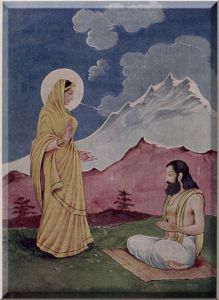
Gayatri appears before Visvamitra

7.1. The sixty-second Sukta (RV_3,062), commencing with the rik : imā u vām bhṛmayo manyamānā yuvāvate na tujyā abhūvan,  is the last in the third mandala of Rig-Veda. This Sukta has eighteen mantra-s; and, the entire Sukta is ascribed to Rishi Visvamitra.

The first three mantras of this Sukta are in Trishtup-chhandas; while the rest are in Gayatri chhandas.

Of the eighteen mantras, those numbering ten to twelve are dedicated to Savitr; while the other mantras have Indra- Varuna, Brhaspathi, Pushan, Soma and Maitra-varuna as the Devata-s.

7.2. It is the tenth mantra of this Sukta (RV_3,062.10) – tat savitur vareṇyam bhargo devasya dhīmahi |dhiyo yo naḥ pracodayāt || – that has come to be celebrated as Gayatri mantra. As said earlier; it is in Gayatri Chhandas; its Devata is Savitr; and its Rishi is Visvamitra.

8.1. Visvamitra is a celebrated name in the Indian traditions. There have been sages in the Vedic literature, in Puranas and in Epics who carry the name of Visvamitra. It is surmised; all those sages may not refer to one and the same person. They could be the descendants of an ancient Rishi renowned as Visvamitra.

8.2. Visvamitra mentioned in Rig-Veda is a great Rishi. As many as forty-six Suktas and a number of other mantras in Rig-Veda Samhita are ascribed to Rishi Visvamitra. He is the contemporary of another great sage Vashista, to whom about one hundred – and – four Suktas are ascribed.

8.3. Visvamitra of Rig-Veda is named in the Sarva-Anukramani (a sort of Index providing basic information about each hymn of Rig-Veda) as ‘Gathino-Visvamitrah’– the descendant of Gathi (the King of Kanyakubja?). Visvamitra – earlier known as Visvaratha – it is said, was the son of King Kaushika-Ushiratha (meaning, Ushiratha the son or the descendant of Kushika) who was valorous as the thousand-eyed Indra himself (sahasraksha-dyuti).

8.4. The Visvamitra and his sons mentioned in several other passages of the Rig-Veda are also described as Kausika-s, the descendants of Kushika. This Kushika is a mythical figure. And the term Kushika is also an epithet for Indra. The decedents of Kushika – Kaushika – were a family of traditional purohita-s, the family priests of Kings; and, were the followers of sage Angirasa, especially devoted to worship of Indra.

8.5. Yaska-charya recognizes Visvamitra as the purohita of King Sudasa (viśvāmitra.ṛṣiḥ.sudāsaḥ.paijavanasya.purohito.babhūba– Nirukta: 2.24).

It is said; Visvamitra also helped Bharatas in crossing the rivers Vipasa (Beas) and Satadru (Sutlej) that were in full flow .The Bharatas, apparently engaged in a raid, found it difficult to cross the rivers in high flood. But, Visvamitra, by prayers, induced the waters to subside (RV: 3.121) – viśvāmitrebhir idhyate ajasraḥ.

8.6. Among the many sons of Visvamitra, Madhuchandas Vaiśvāmitra is well known. The first mantra of Rig-Veda (Agni mele purohitam…) is ascribed to Madhuchandas. He is the Rishi of the first hundred-and-two mantras of Rig-Veda; and, hence he earned the title ‘Satarchina’.

8.7. But the most debated of Visvamitra’s decedents is surely Sunahsepa. A story narrated in Aitareya Brahmana (7.13-18) brings together Visvamitra and the lad Sunahsepa Ajigarti (son of the poor and greedy Ajigarta Sauyavasi). It is said; Visvamitra adopted Sunahsepa Ajigarti as his son; or rather, the boy gave up his family and selected Visvamitra as his father. The later text Vasishta Dharma- sutra (17.33-35) cites this as an example of a case where a boy gives himself in adoption.

svayam upāgatas caturthas //śunaḥśepas vai yūpe niyuktas devatās tuṣṭāva(stu-) / tasya iha devatās pāśam vimumucus(vi-muc-) tam ṛtvijasūcus(vac-) mama eva ayam putras astu(as-) iti tān ha na saṃpede(sam-pad-) / te saṃpādayāmāsus(sam-pad-)  eṣas eva yam kāmayet(kam-) tasya putras astu(as-) iti / tasya ha viśvāmitras hotā āsīt(as-) tasya putra-tvam iyāya(i-) – Va.17.34-35 

Another text, Bahudayana Dharma-Sutra (mātā.pitṛ.vihīno yaḥ svayam ātmānaṃ (dadyāt sa svayaṃ.dattaḥ – 2.2.3.28) classifies such an adopted-son as one among twelve types of sons; but, places him below the biological (aurasa) sons’

(aurasaṃ putrikā.putraṃ kṣetrajaṃ datta.kṛtrimau / gūḍhajaṃ ca apaviddhaṃ ca riktha.bhājaḥ (pracakṣate / kānīnaṃ ca sahoḍhaṃ ca krītaṃ paunarbhavaṃ tathā / svayaṃ.dattaṃ niṣādaṃ ca gotra.bhājaḥ pracakṣate2.2.3.31-32).

Hence, the boy Sunahsepa came to be known as kritrima –vaisvamitro – devaratah, the god-given non-natural son of Visvamitra.

Sunahsepa grew into a great Rishi. The hymns 24-30 in the first mandala and the third hymn of the ninth mandala of Rig-Veda are ascribed to him. The later Rishis, the Kapileya-s and the Babhrava-s are mentioned in the Aitareya Brahmana (7.17) as descendants of Sunahsepa Devarata Vaisvamitra.

Chhandas
9.1. It is said; one cannot truly comprehend a Vedic mantra without a good understanding of its Chhandas, the metrical form. Chhandas is the very basis of the structure and of the import of Vedic hymns (chandah paadau tu vedasya– Paniniya Shiksha – 41). The term Chhandas is a word derived from the root (dhatu) चदि , giving rise to ahlade (आह्लादे, joy or delight).

The term Chanda (Sanskrit: छन्द) , therefore, indicates that which is ‘pleasing, alluring, lovely, delightful or charming’. And, Chhandas is the joy in structuring the syllables and words of the mantra (chhandayati ahlada-dayani chhandas – Amara Kosha 3.20). It also sets the rhythm for chanting of the mantra. Chhandas enlivens and articulates the meaning of the mantra. And, one has to unravel, untie the covering of Chhandas (chandaamsi chhadanaath – Nirukta – 8.3.11) in order to fathom the true intent of the mantra. (11,5: candraś. candateḥ. kānti. karmaṇah / candanam. ity .apy. asya. bhavati)

Since the purity in transmission of the Vedas is highly dependent on the sound or the way they are uttered, Chhandas is very important for their accurate utterance.

The Rig-Veda and Sama-veda mantras are entirely composed of Riks , following certain  Chhandas. But, the Yajur-veda has both prose and verse (shloka) forms of mantras; and, its shlokas are composed in appropriate Chhandas.

Vaidika Chhandas, the meter of the Vedic mantras, is different from Chhandas and meters of poems in classical Sanskrit. Vaidika Chhandas is Akshara pradhana (अक्षरप्रधानम्). Here, the number of letters is significant . But,  in classical Sanskrit, the number of syllables as well as their rhythm and  pitch-quality (Laghu and Guru) are taken into account 

10.1. Gayatri, in fact, is the name of one of the metrical forms (Chhandas) adopted in Rig-Veda. The Gayatri Chhandas is referred to in Rig-Veda (1.12.11) as ‘Gayatra’ or ‘Gayatram’. It is said; that out of 10,552 mantras in Rig-Veda Samhita as many as 2,456 are in Gayatri Chhandas. But, the largest numbers of mantras (4,251) in Rig-Veda are in Trishtup Chhandas. And, the rest (1,346) are in Jagati Chhandas.

10.2. Gayatri Chhandas is associated with Agni (aṣṭākṣarā vai gāyatrī gāyatram agneś-chando – Sp.Br.5.2.1.5). Agni is the first and the foremost of the Vedic deities without whom no ritual is possible. Trishtup Chhandas is associated with Indra; and, Jagati Chhandas with Visvedeva-s.

10.3. Among the fourteen* types of  Chhandas used in the Vedic texts, Gayatri is the shortest (with twenty-four matras). It is regarded the first (head: atah shirah) and the basic metrical form. And, it is the best. Taittiriya – Aranyaka (10.34) regards Gayatri as the Mother of all the Chhandas (gayatrim chhandasaam mata); born of Brahman (Brahma –yoini); and, as one that signifies Brahman in three letters (tri-akshare Brahma-vaadini). Almost all the Samhitas (excepting Krishna-yajurveda) begin in Gayatri Chhandas.

[* The fourteen types of Chhandas employed in Vedic texts are listed as : Gayatri; Ushnik; Anushtup; Brhati; Pankthi; Trishtup ; Jagati ; Ati- Jagati ; Shaktari ; Ati – Shaktari ; Ashti ; Ati- Ashti ; Dhruthi ; and , Ati – Dhruthi .

Gayatri Chhandas has twenty-four syllables; and, the six other Chhandas that follow thereafter has each four syllables more than it’s preceding one (e.g. Jagati the seventh chhandas has 4×12 = 48 syllables).

Incidentally, the seven horses yoked to Sun-god’s chariot are named: Gayatri, Brhati, Ushnik, Jagati, Trishtup, Anushtup and Pankthi (SB: 5.21.16.)]

Among such fourteen types of Chhandas, the following seven are said to be of importance  in the Vedic texts :
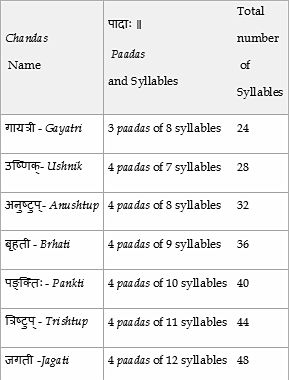
chhandas

Further,  according to other classifications made in texts dealing with Chhandas (छन्दस्सूत्रम्):  Ashti (अष्टिः – 64), Prakrti (प्रकृतिः – 84), Vikrti (विकृतिः- 92), Abhikrti (अभिकृतिः – 100), Utkrti (उत्कृतिः- 104) are mentioned as a few other Vedic Chhandas. Some other texts dealing with Chhandas, include Rkpratishakhya, Shankhayana Shrauta sutras and Nidana Sutra of Samaveda.  The devotional hymns etc., are usually constructed in other meters; which are mostly different from the Vedic Chhandas 

10.4. As said earlier, Gayatri Chhandas is associated with Agni, the first and the foremost of the Vedic deities. The Rigveda commences with Agni Sukta, composed in Gayatri Chhandas. Because of that, Gayatri Chhandas is invested with great sanctity; and, all the other mantras in this Chhandas are of special significance. The Satapatha Brahmana (6.1.3.19) declares the mantra in Gayatri Chhandas is Agni himself (Gayatri va Agnihi; and Agnir vai Gayatri). And, that Agni, indeed, is the face (mouth) of Gayatri (tasya Agni-reva mukham). That is the reason, it is explained, the opening mantras of all the Yajna-s are in Gayatri Chhandas.

The Gayatri Chhandas is adorned with eight letters – Astakshara Gayatri / Gayatri Brahma-varchasam – (Tai.Brh. 2.7.3.9) . The Satapatha Brahmana (4.3.2.7) also says – Tato astakhshara Gayatrya bhavat.

It is also said; the line of Gayatri Chhandas having eight letters* in association with Pranava (Aum) as the ninth letter (navakshara vai), by itself forms the first half of the Yajna (purvardha vai yajnasya Gayatri-SB : 3.4.1.15) – navākṣarā vai gāyatryaṣṭau tāni yānyanvāha praṇavo navamaḥ pūrvārdho vai yajñasya gāyatrī

[* Some say; this refers to the eight letters of the subtle and mystical fourth-line (Turiya paada) of Gayatri : paro  (2) , rajas  (2) ,  ya (1), pra– tapa iti (3).]

10.5. The root of the term Gayatri is ‘gai’ (sabde) which denotes the sense of sound or speech or singing. That is the reason, it is said, the rik-s in Gayatri Chhandas lend themselves to singing rather easily (gana-anukula-rik).

A Sukta in Rig Veda (1.10.01) commences with the words ‘gāyanti tvā gāyatriṇo‘. Yaska-charya (Nirukta: 7.12.5)  expands on that and says that rik-s in Gayatri-Chhandas are ideal for singing the praises of deities (gāyatrī.gāyateḥ.stuti. karmaṇas). The rik-s in Sama-Veda are therefore mostly in Gayatra-chhandas.

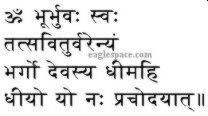
11.1. As regards the Gayatri mantra, in accordance with the characteristics of the Gayatri Chhandas  (metrical form) in which it is composed,  it is required to be made of twenty-four letters, akshara or matra (Gayatri chaturvimsatyakshara); arranged in three lines (tripaada); each paada having eight letters (ashta-aksharatmaka-paada). And, the mantra is made of nine words.

Please listen to the excellent presentation of the Samhita-pata;Pada-patha; Krama-patha; Jata-patha; and , Ghana-patha of the Gayatri Mantra by Pandit Sri Suresh . Please click here]

om

11.2. But, the first line of the mantra (tat-sa- vi –tur -vr-re-nyam) has only seven matra-s. The requirement of the chhandas is satisfied in either of two ways: 

One; the Pranava, that is, Om (ॐ) is added at the commencement of the first paada to make it eight-lettered (adi-omkara- sahita astakshara). The Pranava, thus, indeed becomes an integral part of Gayatri-mantra. Then, the first paada would read: ॐ तत्स॑वितुर्वरे॑ण्यम्।

And, the alternate way is to split last matranyam’ into two: ‘ni’ and’ yam’, in order to render the line in eight matra-s.

For similar reasons, the last matra of the third line ‘yat’ is taken to be one matra.

Tri-rupa Gayatri

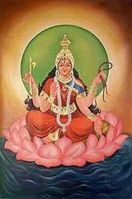
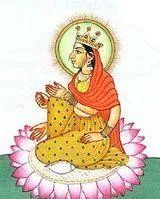
12.1. Gayatri is at once the name of the mantra, the name of the Chhandas; and is also the name of the Goddess Gayatri Mata. Gayatri is trinity; and is hailed as Tri-rupa Gayatri. Gayatri is most usually explained or interpreted in terms of triads. Gayatri is also hailed tri-akshare Brahma-vaadini, the one who signifies Brahman in three letters.

Gayatri as mantra
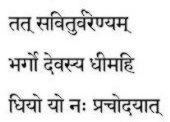
13.1. To start with, Taittiriya-Aranyaka (10.35) describes, Gayatri as a mantra structured in three lines (tri-paada). And, a paada (foot), etymologically, is that which moves, activates and enlivens (padyase).

13.2. Each of the three paada-s is identified with a Veda: Rg, Yajus and Sama. Following that, Gayatri is celebrated as the mother of all Vedas – Veda Mata (AV: 19.71.1); and, she is requested to bless  the  devotee with wisdom, material prosperity , proginee,  long life and ultimate liberation.

stutā mayā varadā vedamātā pra codayantāṃ pāvamānī dvijānām |  āyuḥ prāṇaṃ prajāṃ paśuṃ kīrtiṃ draviṇaṃ brahma varcasam |  mahyaṃ dattvā vrajata brahmalokam ||(AVŚ_19,71.1)||

13.3. Further; each paada of the mantra is also identified with each of the three matra-s (syllable) of the Pranava Aum; and with each of the three Vedas. And again, each paada of the mantra is identified with each aspect of Gayatri – Gayatri, Savitri and Sarasvathi.

:- The first paada of the Gayatri mantra is identified with the first matra of Pranava ’ Aa’ (a-kaara) , which in turn is identified with Rig-Veda. The word ‘Savitr’ in the first paada of the mantra (tat Savitr varenyam) is of essence here; and, it signifies creation and inspiration (stute).The first paada of the Gayatri mantra is associated with Savitri who represents dawn.

: – The second paada of the mantra is identified with the second matra of Pranava ‘U’ (u-kaara), which in turn corresponds to Sama-Veda. The verb ‘dhimahi’ in the second paada of the mantra (bhargo devasya dhimahi) is of importance here; and, it signifies precise articulation (gaana-kriya).The second paada of the Gayatri mantra is associated with Gayatri as Vac, clear speech (gai-sabde).

: – The third paada of the mantra is identified with the third matra of Pranava ‘M’ (ma-kaara), which in turn is identified with Yajur-veda. The key word here is ‘dhiyah’ in the third paada of the mantra (dhi yo nah prachodayat) signifying ritual-actions (karma). The third paada of the Gayatri mantra is associated with Sarasvathi (uninterrupted rituals).

There also other interpretations.

14.1. The Shandilya Upanishad (1. 17) identifies the first matra of Pranava with Gayatri; the second matra with Savitri; and the third with Sarasvathi.

prāṇāpānasamāyogaḥ prāṇāyāmo bhavati ।
recakapūrakakumbhakabhedena sa trividhaḥ ।
te varṇātmakāḥ । tasmātpraṇava eva prāṇāyāmaḥ
padmādyāsanasthaḥ pumānnāsāgre
śaśabhṛdbimbajyotsnājālavitānitākāramūrtī raktāṅgī
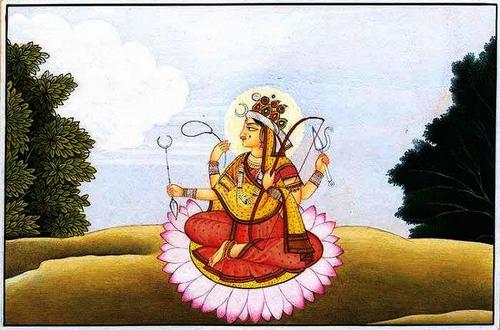
haṃsavāhinī daṇḍahastā bālā gāyatrī bhavati । ukāramūrtiḥ
śvetāṅgī tārkṣyavāhinī yuvatī cakrahastā sāvitrī bhavati
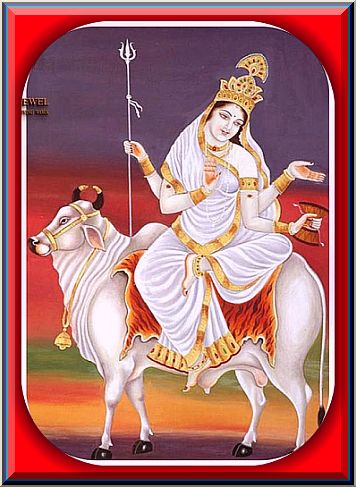
makāramūrtiḥ kṛṣṇāṅgī vṛṣabhavāhinī vṛddhā
triśūladhāriṇī sarasvatī bhavati

14.2. Gayatri is revered as the very foundation (adhistana) of all beings and objects. Gayatri represents earth (prithvi), as all existence is established on earth. The prithvi, in turn, stands for human body on which are settled all the vital-currents (sarve-pranah) and sense- functions (indriya kriya).

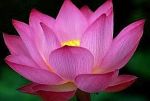
In these traditional texts, when human body is referred to as the foundation (aadhara), it is the heart (hrudaya), the very core of the being, that is actually meant. For, all the vital currents (hrudi praane) and sense-functions are established (prathistitha) in the heart. Gayatri, therefore, represents the heart-lotus (hrudaya pundarika), the life-centre of all existence. (Ch.Up.3.12.3)

14.3. The Chandogya Upanishad (3.12.1) says that Gayatri signifies all beings: past, present and future. It is vac, representing the vital currents (prana); it is vac (speech) in the sense of mantra (gaayati) the recitation of  which protects one who recites (traayate) ; it is vac representing all the elements – (Vac va Gayatri; vac va idam sarva-bhutam , Gaayati cha, traayate cha); and,   it is as vac Gayatri is all pervasive (Gayatri vac vai gayatriti) .

gāyatrī vā idaṃ sarvaṃ bhūtaṃ yad idam kiñca | vāg vai gāyatrī |vāg vā idaṃ sarvaṃ bhūtaṃ gāyati ca trāyate ca || ChUp_3,12.1 ||

14.4. Yaska-charya mentions that mantras have three layers of meaning (traye artha).The essential power of the mantras are to transport us to the world of ideas beyond the ordinary and to experience the sublime ideals that its Rishi envisioned. Accordingly, Gayatri mantra too is interpreted, with special reference to its Devata Savitr, in terms of: Adhi-YajnaAdhi-Daivata; and, Adhyatma. (We shall come to this a little later).

15.1. Ultimately, apart from the conditioned aspects of knowledge, vital current etc there is an un-conditioned, absolute aspect to the mantra; and, hence is called a-pada. Gayatri is not mere aggregate of letters; Brahman is its essence. And, this is Savitr in its true nature, un-conditioned and beyond relative existence. Savitr has to be realized in the space within (antar-akasha), in the depths of one’s heart-lotus (daharam pundarikam).

Gayatri as Devata

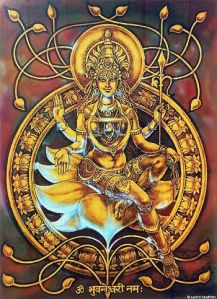
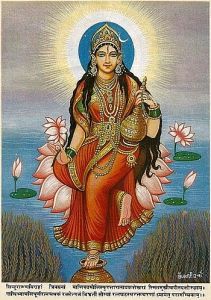
16.1. Gayatri – the mantra and the Chhandas – are personified as the Goddess. The Mother as nirguna is the form-less vachya-shakthi; and as saguna, she is the presiding deity of the Gayatri mantra. The mantra itself is Devatha. The worshipper awakens and enlivens the potent Goddess residing in his heart-cave, by her/his devotion and earnestness.

[According to some, it was the Tantra ideology that turned a mantra dedicated to the solar deity Savitar into a meditation on the Mother Goddess. It also brought in mystic syllables known as Vyahritis which are similar to the Bija-aksharas of Tantric meditation. It’s Dhyana-slokas portrayed Gayatri as a goddess with symbolic iconographic features. The repetition (japa) of Gayatri mantra is preceded by purification rituals of Tantric nature, such as achamanapranayama etc.

In turn, the Vedic tradition too accepted and revered the personified form of Savitri mantra; as Mother Goddess (asya maata Savitri: Manu.2.170) – Gayantam trayate. And, Chandogya Upanishad (3.12) glorified Gayatri as being that which exists right here, that which sings (gayati) and saves (trayati) all things in their Reality – vāg vā idaṃ sarvaṃ bhūtaṃ gāyati ca trāyate ca || ChUp_3,12.1 ||.  ]
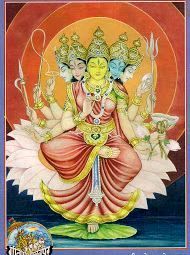
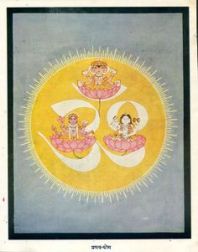
Gayatri scan0001

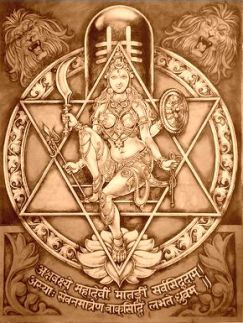
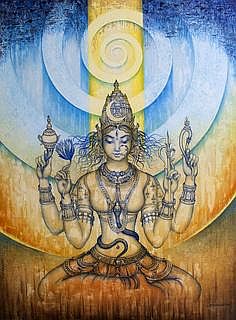
16.2. In the composite Dhyana-sloka submitted to Gayatri, the mantra and the goddess unite. The hymn addressed to Gayatri (Gayatryah), she is celebrated both as the mantra and as also the goddess.

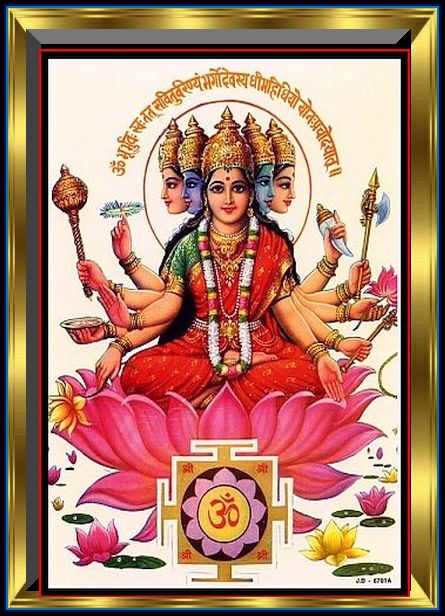
:- As mantra, Gayatri (Gayatryah) is described as being in the form of Gayatri chhandas (Gayatri-Chhandah), having Viswamitra as Rishi (Vishwamitra Rishih) and Savitr  as Devata (Savitaa Devata). Gayatri is composed of three lines (Tripadaa), having twenty-four syllables (Chaturvimsaty-aksharaa.  Her mantra is of six kinds (Shatkukshih) embodying the principles of : Vak (speech) ; bhuta (beings) ;  prithvi (earth); sarira (body) ; hrudaya (heart) ; and, prana (vital currents).

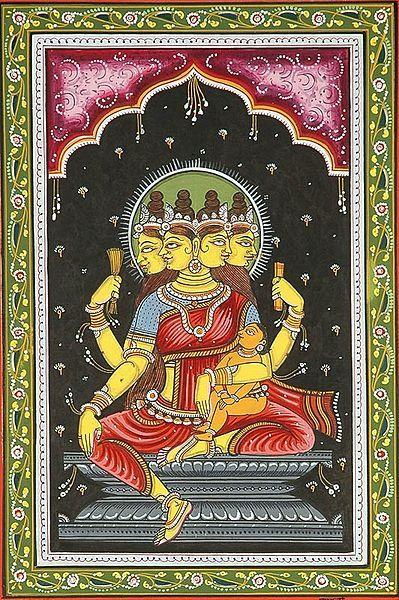
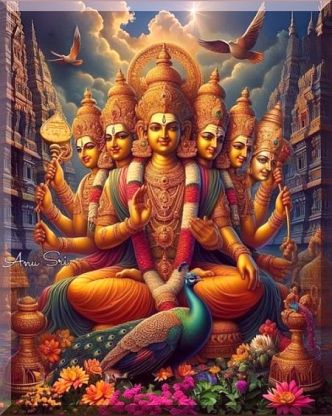
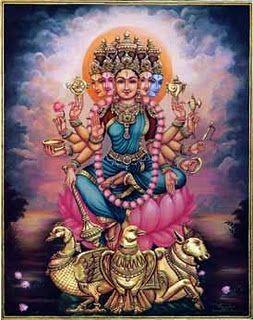
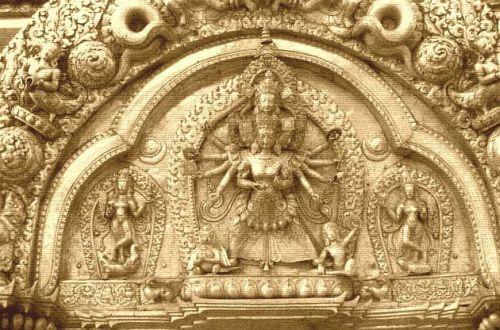
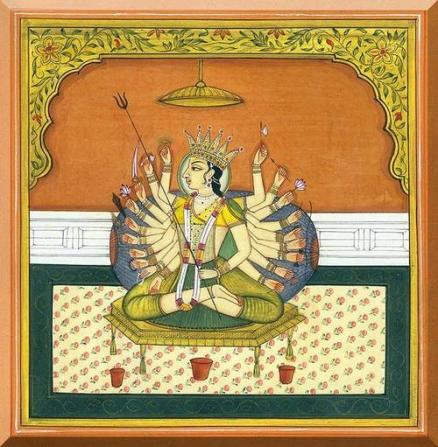
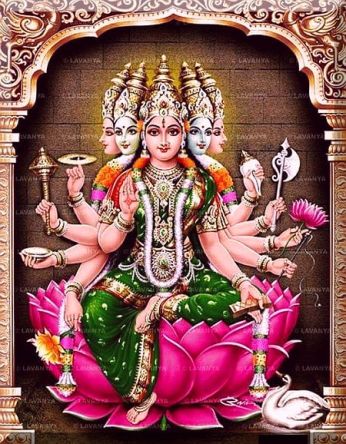
: – As Goddess , the fair and bright (swetha varnaGayatri descends from the Gotra of Rishi Samkhyayana (saamkhyaayana sa gotra). She is endowed with five heads (Panchaseersh) .  She represents the five vital currents (Praana, Apana, Vyana, Udana and Samaana). Agni glows in her face (Agnirmukham), Brahma is in her head (Brahma Shiro), Vishnu resides in her heart (Vishnur hridayam)Rudra is her tuft (Radrah Sikhaah ) and the earth is her generator (Prithivi Yonih)She presides over   Upanayana  (upanayaney viniyogah ).

[Gayatryah Gayatree Chhandah Vishwamitra Rishih, Savitaa Devataa, Agnirmukham, Brahma Shiro,Vishnur hridayam, Radrah Sikhaah, Prithivi Yonih, Praanaa paana vyaanodaana samaanaa sa praanaa sweta varnaa saamkhyaayana sa gotra Gayatree Chaturvimsatyaksharaa Tripadaa Shatkukshih, Panchaseershopanayaney viniyoga ]
bf45cc1e45ec33851d6c3b920aa72ab8

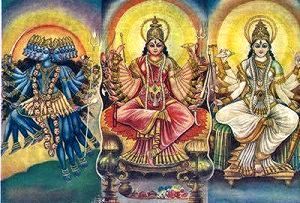
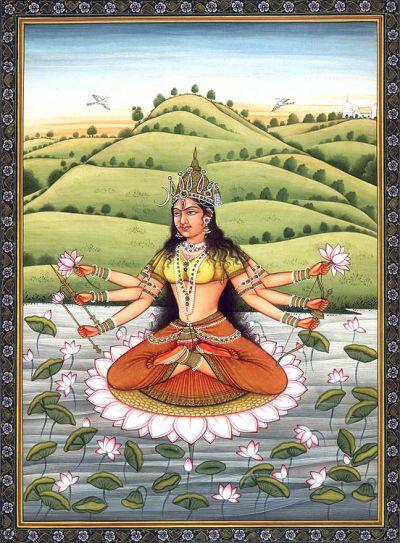
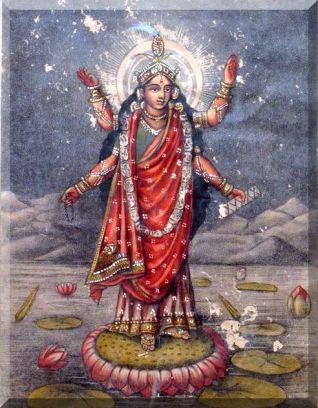
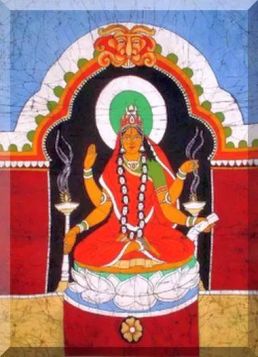
17.1. Gayatri as Devata, the Goddess , is hailed as Tri-rupa –Gayatri, also because she combines in herself the three goddesses : Gayatri, Savitri and Sarasvathi. Gayatri is the protector of life principles; Savitri of Satya (Truth and integrity of all Life); and, Sarasvathi of the wisdom and virtues of life.

17.2. Gayatri is associated with three ‘savana-s’ (morning, midday and evening). She is said to manifest in three forms as : Gayatri in the morning (pratah-savana); Savitri in the midday (madyanha savana);  and , as Sarasvathi in the evening (saayam savana) – [Aitareya Brahmana-13.25].

Gāyatrī

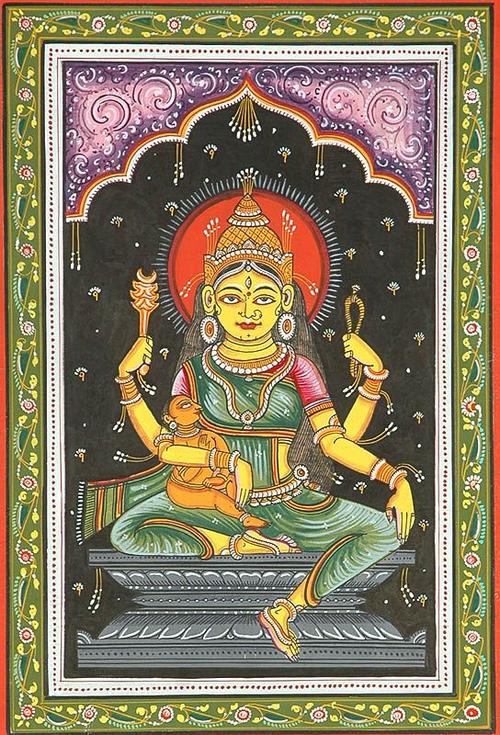
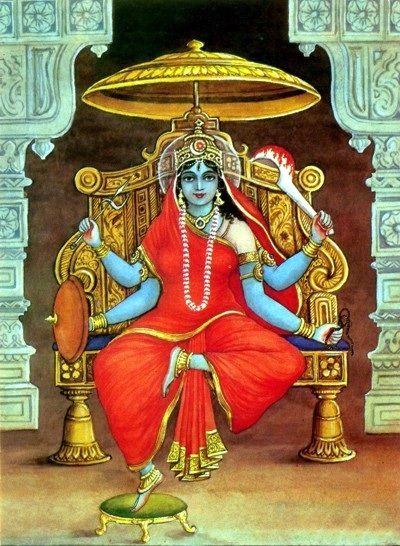
pūrvāhṇakālikā sandhyā, kumārī, raktavarṇā, rakta-gandha-mālyānu-lepinī, pāśā-aṅkuśā-akṣa-mālā kamaṇḍalu-varahastā, haṃsārūḍhā, brahma-daivatyā, ṛgveda-sahitā, āditya-patha-gāminī, bhūmaṇḍala-vāsinī |

Sāvitrī

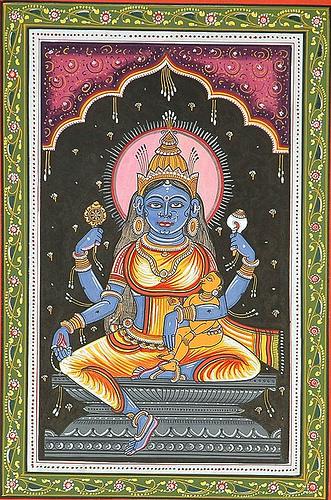
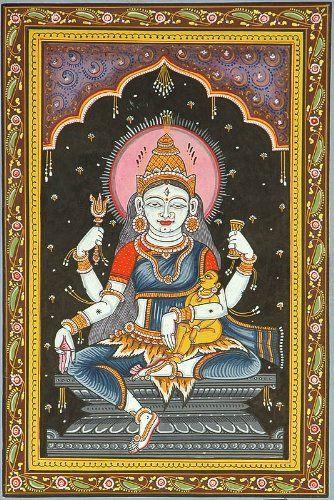
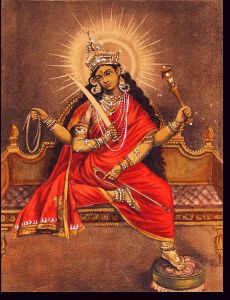
madhyāhṇakālikā sandhyā, yuvatī, śvetavarṇā, śveta-gandha-mālyānu-lepinī, triśūla-ḍamaru-hastā, vṛṣabhā-rūḍhā, rudra-daivatyā, yajurveda-sahitā, āditya-patha-gāminī, bhuvoloke vyavasthitā |

Sarasvatī                                    

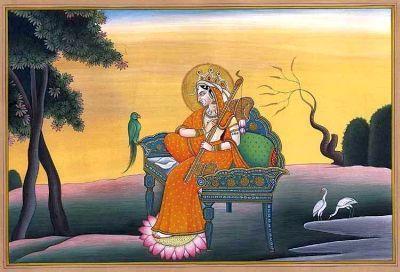
sāyaṃsandhyā, vṛddhā, kṛṣṇāṅgī, kṛṣṇa-gandha-mālyānu-lepinī, śaṅkha-cakra-gadā-bhayahastā, garuḍā-rūḍhā, viṣṇu-daivatyā, sāmaveda-sahitā, āditya-pathagāminī, svarga-loka-vyavasthitā ||

But, it is also said; Gayatri herself represents all three savana-s (Gayatri vai sarvani savanani).

17.3. She is Trinity herself.  As Gayatri in the morning she is Bramha svarupini; as Savitri in the mid-day she is Rudra svarupini; and as Sarasvathi in the evening she is Vishnu svarupini.

17.4. Mahanirvana Tantra regards the Matrka–Trinity of Brahmi, Vaishnavi and Maheshwari as three aspects of Goddess Gayatri. She is Brahmi in the morning; Vaishnavi in the midday; and, Maheshwari in the evening.

17.5. Goddess Gayatri is revered as the sum or the aggregate (samasti svarupini) of all that is divine (Sarvadevata Svarupini; Sarvamantra Svarupini) – Gayatri vai idam sarvam.
Devi Pancha mukhi

The Devata

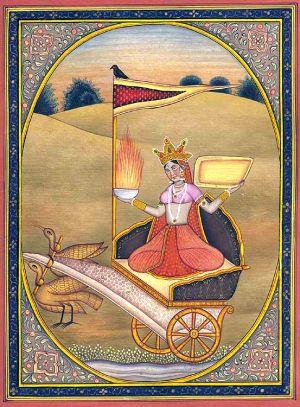
rathasaptami _c

18.1. The Gayatri mantra is addressed to Savitr; and, he is the Devata of the mantra. The Rig-Vedic god Savitr is understood and interpreted in varieties of ways. These explanations and interpretations are spread over a wide spectrum; ranging over the ritualistic, philosophical and esoteric understanding of the term Savitr.

: – Savitr is an ancient Vedic deity. He is an independent god in his own right. But, Savitr is sometimes taken as Surya; also, at times, not as Surya. At one level, Savitr is conceived as the power to dispel darkness. Savitr, here, is the aspect of Sun before daylight; and, after daybreak he is Surya*.Savitr, in this sense, is the one who inspires or gives rise to Sun. Savitr is also the motive power, the symbol of light that invokes radiance in hearts of beings. He is the awakening that impels men and creature to action. His mantra says: “We contemplate on the adorable brilliance of god Savitr, may he inspire our intellect”.

 [*The scholars tend to view Savitr more as a splendid concept than as a natural phenomenon.]

: – At other places in the Samhitas, Savitr is variously identified with Agni, Soma, Prajapathi, Visvedeva and Surya; or with their aspects. At another level, Savitr is identified with one’s mind, consciousness and with one’s own self (antaryamin).   Savitr, here, is the inner-light that illumines, enlivens, prompts and inspires (su-preraka) all our thoughts, speech and deeds.

: – Savitr the luminous one (divyati prakashata iti) is also the Purusha who resides in the heart –lotus of the devotees (hrudayaravinde); and is perceived in meditation (dyatatvat).

: – And again, Savitr residing in the solar orb is the symbol of Brahman (asaavaadityo Brahma).

It is said; for a beginner, Savitr might appear a functional deity; but to the seer, Savitr is a representation of Paramatman free from attributes. Following that, the first syllable of the mantra ‘tat’ could be taken either as a  neuter pronoun meaning ‘that’, or understood in silence  as ‘that One’ the Supreme principal Brahman.

: – Ultimately, it is said, Savitr is verily the Absolute Parabrahman.

Let’s look at some of these aspects.

Savitr as Vedic god

19.1. Savitr is an ancient (Asura) Vedic god of the upper regions (dyu-sthana). He is celebrated in eleven entire Suktas and in many separate stanzas as well. Everything about him is beautiful and brilliant.

He is pictured, pre-eminently, as a golden deity adorned with golden-eyes; golden – arms and golden-hands; and having a golden-tongue. His chariot and its shaft, made of gold (ratham hiranya pra-ugam vahantah –RV: 1.35.4-5), are drawn by two or more brown, white-footed horses adorned with pearls (krsnavant).

The yellow-haired (haridra kesi) Savitr rises up from the east, following the emergence of Ushas the goddess of dawn; and illumines the sky. He moves across the sky seated in his bright golden chariot (shubrabhyam yajato haribhyam), filling all directions with his boundless golden lustre (hiranyim amitam) seeing all creatures, dispelling darkness and sorrows.

He rises aloft his strong golden arms extending to ends of earth (hiranya divo antha anustam: RV: 7.45.2) and blesses all beings (sakala shreyamsi dhatrunam). The other gods follow him.

19.2. His countenance of golden splendor is pleasing; and his speech is clear and sweet. On his ancient path, he protects his worshippers; and conveys the departed ancestors (pitris) to where the righteous dwell. Savitr governs the cosmic order Rta. And, all the elements and gods are subject to his law.

19.3. He protects the universe (vishvam bhuvanam dharayistathi: RV: 4.54.4).Prayers are submitted to this glowing, venerable god to inspire, to stimulate and to illumine ones heart and mind (RV: 3.62.10).

Savitr according to Yaska-charya

20.1. Yaska-charya, the great grammarian and etymologist of very ancient India, classifies Savitr both among the Devatha-s of the mid-region (madhyama – sthana) as also among the Devatha-s of the upper-realms (dyus -sthana). Savitr as the Devata of the mid-region, settled beyond interference (aturte), establishes (sthiram akarat) the earth (prihvim) firmly, easily and happily. He is associated with the clouds, the rains, the earth and the mind; and, he holds afloat the sky (akashbhane) without visible support (aalambanam tad-rahite).

20.2. The earth fully established by Savitr (RV: 10.149.1) symbolizes matter. And, the heaven which he holds afloat, without any support, is the consciousness. And, between the two is the mid-region where Savitr has settled Soma (aturte baddham Savita). Soma, here, symbolizes the alert mind which is guided by Savitr along the right path (Savitr is therefore called ‘Sunita’, ‘sushtu neta’). Savitr, in association with Soma is variously described as ‘Asura’ the giver of life (prana-daata), Vi-suparna (possessed of splendid forms).

20.3. Savitr in the upper-realms (dyus-sthana), symbolized by solar orb, is the Devata par excellence. He illumines the earth as well as the atmosphere and the highest realms (nrchaksha yeva devo madhya aastha aa prapivaan rodhasi anthariksham – RV: 10.130.2). He is the very soul of all that moves and all that stays in the world. He is the sight of the human beings who can see (nrchaksha), abiding in the midst of the heart-space (hrudayakasha).

20.4. Yaska-charya (Nirukta: 10.33) cites a mantra from Rig-Veda comparing Savitr with another Vedic god Tvashtr.

hiranyastūpaḥ.savitary.athā.tv.āṅgiraso.juhve.vāje.asmin/evā.tvārcann.avase.vandamānaḥ.somasyevāṃśum.prati.jāgarāham/

The Rishi of this mantra is Prajapathi, described as the son of Visvamitra. The skilful Tvashtr provides form to objects (Tvashta rupani pimsatu: 10.184); and   projects the earth and sky alike, just as Savitr does (RV: 10.110.9).

ya ime dyāvāpṛthivī janitrī rūpair apiṃśad bhuvanāni viśvā | tam adya hotar iṣito yajīyān devaṃ tvaṣṭāram iha yakṣi vidvān

21.1. As a solar god Savitr is related to Truth and to the cosmic order Rta. In that context, Yaska-charya, again, explains the term Savitr as the progenitor, the one who gives birth to all things (Savitr sarvasya prasavita: Nirukta– 10.3). Savitr is hailed as the most real (satya), the source of all order and the true-principles (satya-dharma) that govern all existence.  

And, in that sense, Savitr is one with Varuna who represents Satya the Absolute Truth; and, Rta the cosmic order conditioned by space, time and circumstances.

Satya is the Truth of Being: and, Rta is the truth of becoming. Savitr Devata is related to both. It is also said; Savitr is Satya, for it is the essence of all things – living and nonliving; with form and without form.  The humans must follow the course of Savitr (satya) and accomplish their tasks (devasya Savithuhu karma kurvanthu manavaha – AV: 6.23.3)

22.1. Yaska-charya calls Savitr as Kavi; as the one who knows all the past, present and future. He is the seer of the beyond, the omniscient. He is the one who draws out sublime thoughts from the womb of mystery; and brings them to light for the benefit of all. Savitr is the most adorable – ‘varenyam’. He inspires all  (Savita sarvasya preraka) to move upwards towards the heavens viz. the higher reaches of consciousness.

22.2. According to Yaska-charya, Savitr is the inner-light, the inner controller (antaryamin). He releases (prasuta) actions from their un-manifest states. And, prompts (su-preraka), inspires and guides all to engage in good thoughts and right actions; and to tread on the right path.

Savitr and Agni

23.1. Savitr, the solar deity is at times identified with Surya as also with Agni who is a Devata of Prithvi-sthana, the earth – region (agnir jyotih, jyotis surya svaaha). Savitr also is Apam-napath, the child of waters; the favourite epithet of Agni.

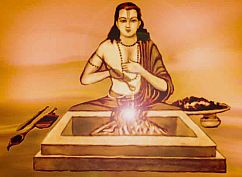
23.2. When Savitr is associated with Agni, he is described as the ascending flames of Agni (urdhvam keturn). Savitr as Agni is the purifier of all things (pavaka) ; as also of the minds and hearts of humans. Along with Agni, Savitr   becomes a part of the Yajna. Savitr is invoked at the commencement of the Yajna with prayers for the successful completion of a Yajna (Savitr yajnam pranayeti).

23.3. In the context of Yajna, Savitr is also conceived as the visible representation of the year of twelve months (kapala) – (dwadasa –kapalah savitro bhavati; dwadasa vai masah samvathsarasya). The presence of Savitr is symbolized by a circle drawn in the yajna-vedi; and it is surrounded by an altar made of fifteen bricks (ishtaka) symbolizing fifteen days of the first half of the month (purva-paksha); or of the latter half of the month (apara-paksha) .

23.4. At another level, during the Yajna, Savitr becomes the inner-being (antaryamin) and the inspirer (preraka) that dwells in the heart of the performing priest (adhvaryu).
yajna

Savitr and Soma

24.1. Savitr the Devata of Gayatri mantra is closely associated with Soma. In every Sukta addressed to Savitr there are mantras which praise Soma. Prayers are submitted to Soma to provide food that is free from contamination and that is free from danger (anamiva ishaskrath) to humans (dvi-paade) and to the animals (chatush-paade). Soma is requested to prolong our lives (ayur-vardaya)   by driving away threats and dangers.

25.1. Soma in the Vedic context has many references: as plant (adh-bhautika), the drink (adhi-yajna), the moon (adhi-daivata) and the mind (adhyatma). Its esoteric meaning is taken as that which provides reality or substance to the un-manifest (satyvataraya agnau suyate tasmat-somah).  Soma as the gentle devoured substance is the partner of Agni the fiery devouring spirit (annada). Soma the substance of the universe is ‘food (anna)’.  Food is the principle of all, for, truly, the beings are born from food, when born they live by food; and when they are dead they themselves become food “(Taittereya Upanishad 3.2)

25.2. Just as with Savitr, Soma is closely associated with Surya too. Soma is often described as bright (aruna bhabru), fascinating (sona) and luminous (hari); and he shines along with the sun (Soma Suryena rochate -RV : 9.2.6). If Surya is the eye of the gods (asau vaa aditya devaanam chakshasu), Soma is the eye of the manes,  pitris (Chandrama vai pitrnam chakshuh). If Surya is the symbol of eyes (chaksho Surya) , Soma is the symbol of mind (Chandrama manaso).

Thus, if one is the sight, the other is the insight.

25.3. Following that, Soma is symbolized as the parent of all mind-process (pita matinaam), the leader of thoughts (neta matinaam) , the protector of wisdom (patir dhiyah) and the master of mind (manasas patih). He is the true (dhira)   knower of all things ( manishi, medhira , vipra) here and beyond (visvavid), hidden (kratu-vid) and revealed (kavi kratu). The secrets of all the senses are laid bare by the shining Soma (devo devaanam guhyani nama-avishkrnoti –RV: 9.95.2). He is the lord of all speech (somo raja vaksah). He is the Lord of the Yajna ; and one who assigns to each Deva his share in the Yajna  (bhagam devabhyo vidadhatyayan ).

25.4. Soma is called here Samudra meaning not only vast but also ever – active mind, the mind which operates creatively and ceaselessly. He is projected in the image of a powerful, unruly and impetus horse (asvam ivadhukshat dhunim).

25.5. In all these references, Soma represents the evolved, well ordered, efficient and far-reaching mind (daksho devanaam asi –RV: 9.85.2) ; the mind that helps us to reach Savitr. Soma is presented as the very soul of sense-function (atmendriyasya bhavasi dhasir uttamah). He is the true source of inspiration to reach Savitr.

26.1. Incidentally, I may mention that there is in the Rig-Veda a hymn (149 of the tenth mandala) associated with Savitr (Savitr pratipaadaka Hiranya –stupa mantra) . The Rishi of this mantra is Archan, the son of Hiranya-stupa who in turn was the son of the most celebrated Rishi Angirasa. Because of his devotion to Savitr,  Archan earned the epithet of Savitarchan.

26.2. Both the father and the son in their hymns addressed to Savitr also praise  Soma – pavamana, the purifier. Hiranya-stupa (father of Archan) adores Soma variously as light (jtothi), bliss (svar), strength or ability (daksha), wisdom (kratu) and protection (uti) – (RV: 9.4.1-3).   Hiranya-stupa prays to Soma to lead him to Savitr or Surya (tvam Surye na aa bhaje – RV: 9.4.5).

26.3. As regards the son Archan; he describes Soma as ‘the other principle’ (anyad abhavat) which came into being after (paschath) Savitr. In his adoration of Savitr (Somasyevamsum prati- jagaraham), Archan invokes the lustrous (amsu) Soma, the one who bestows the wealth of the earth as also that of the heaven (dvi-barhasam rayim).And , prays to Soma to lead him to Savitr.

26.4. Following the family tradition, Archan’s son Syavasva Archanasa also composed hymns devoted to Savitr. His rik appearing in the fifth mandala of Rig-Veda Samhita (5.82.1) gained fame as ‘the other Savitri’ (ity uktatvat savitram).

[Please see Note to paragraph 5.4 above]

Savitr and Surya

27.1. Savitr just as the other Devatha-s of the upper realm (dyus sthana) is a solar deity; he was one of the Adityas. Their several aspects and functions are described variedly as: Pushan the one who nourishes ; Vishnu the one who pervades ; Keshi the one who provides light (pra-kasam) ; Vaisvanara the one who assumes varied forms ; and, Vrshakapi the one becomes red and ascends the sky like a bull.  The Vedic mantras adore the Devatha-s of the upper realm (dyus sthana) by these and other names; for, they all, in essence, are of solar-spirit.

27.2. Savitr, as a solar deity, dispels darkness and makes way for dawn, illumining the entire world. In other words, Savitr is the one that brings forth Surya who causes the day.

27.3. Savitr, here, is conceived as an aspect of Sun before daylight (udayat purvabhavi); and, after daybreak the Sun is called Surya (Surya iti). Thus, Surya is the later form of Savitr. Some say, Savitr is Surya when present below the horizon, but not quite visible.  Savitr is also called Bhaga (Savita Bhagaha: RV 5.82.3)  in a sense of the ‘early (proto)’ Surya.

27.4. Savitr, thus, comes after night (tamas) and before light (jyothi):  (tamasya kirna rashmir bhavathi). It is also said; the night comes at his command sending all beings to rest. Savitr is the bridge between night and light. Night is un-manifest; and light is manifest. Savitr in this sense is both un-manifest (A-vyakta) and manifest (Vyatka).
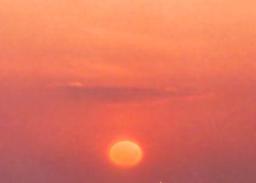
28.1. Sri Sayana-charya also describes Savitr as the deity who presides during the time between dawn and the emergence of Sun*. Savitr is the emerging rays of light (urdhva bhanum savita devo asred). Savitr, here, is visualized as the power to dispel darkness and enliven all existence (Brhad –devata: 2.61-62).

28.2. Sri Sayana, therefore, regards Savitr as the inspiration, the illumining power of Surya. He expands: “the all-knowing Aditya (Surya), the protector of all beings (gopah) who moves in the mid-region permeating all the three worlds with his rays derives his inspiration (tasya prasave) from Savitr”.

[*Sri Aurobindo interprets night as ignorance. And, once the senses are controlled and the mind is stabilized, Ushas the dawn of consciousness arises. Following her, comes Savitr the awakening, the grace and the inspiration to seek Satya, the Truth, personified by the Surya. “His coming is the advent of God’s hour, awakes the asleep and ennobles the vilest things”.]

28.3. Sri Sayana explains that the expressions Surya and Savitr imply the power to protect, to inspires and flash forth (pra-sauti). He also says Savita is that which enlivens and inspires all beings (Savita sarvasya prerako devah). And, Savitr, like Surya, pervades spreads and holds together different thingsSavitr just as Surya represents light, energy, inspiration, intellect and consciousness.

28.4. Svetasvatara Upanishad (2.7) describes Savitr as a Deva, a luminous god, who shines in the sky with dazzling brilliance (divyati prakashata iti). He is adored by all the gods (sthuyate sarva-devathaihi). The Deva illumines the world and makes all life possible. It is Savitr alone (ekah) that has the power to propel, inspire and flash forth.

29.1. Savitr, here, is the radiance that illumines and enlivens all existence. He provides the inspiration and the impetus to life. He resides in the heart-lotus of the devotees (hrudayaravinde); he is to be meditated upon (upasate); and perceived in meditation (dyatatvat).

29.2. Savitr is truly one’s own self, vivifying the body, the sense-functions and the mind, providing wealth for the total welfare. He lightens up all our thoughts, our resolves and our aspirations.

Savitr and Purusha

30.1. It is said; Savitr is Purusha. The Purusha Sukta of Rig-Veda (10.90.2) describes with awe and wonder the majesty of Purusha. It says; all that exists as the world we know (sarva bhutani) is only one-fourth of the Purusha; and three – fourths of him are in the upper realms beyond our perception (tri paadasyam amrutam divi).

30.2. The Gayatri mantra is said to be four-footed (chatuspaada) when Pranava (Om) accompanies it. However, when Pranava is omitted it is only three-footed (Chatuspaada Gayatri pranavena saha; pranavam vina tripaada). It is said; the fourth paada (turiya paada) is hidden or un-manifest. It represents the Purusha abiding in the solar orb (Surya mandala-antargata-purusha),  beyond intellect.

30.3. It is said; the Turiya paada is the unconditioned and the most subtle aspect of the mantra.  And, it And hence, it is named A-paada. This is Savitr in its true nature – un-conditioned by aught and beyond relative existence. It is most worthy of worship (varenyam) and contemplation (dhyayema).

The Turiya paada is said to represent Purusha ; for . it completes to perfection  the three Padas of the Gayatri (Purushah sarva purnath). The Turiya Pada resides in the heart of the devotee , without explicitly revealing itself (puri sayanat).

31.1. Savitr or Purusha is cosmic in nature. He fills and enlivens the entire universe; yet, he also dwells hidden in heart-cave of each being as its essence (guru guha), consciousness and strength. He is the antaryamin, the very life of life. Savitr resides in the heart-lotus (hrudaya-aravinda) of the devotee; and there he becomes visible. Hence Savitr is called ‘darsata’, that which is seen. The essentials of our existence are all settled in Savitr, like the spokes of the wheel in its hub.

31.2. This Savitr or Purusha is verily the Brahman (jagat prerakasys Brahma- rupasya Savituh), the supreme consciousness, beyond the three gunas (paro rajasa) and illuminating the three worlds (tapati), ruling over them (adipathya bhavena).

savitrā prasavena juṣeta brahma pūrvyam / tatra yoniṃ kṛṇavase nahi te pūrtam akṣipat // SvetUp_2.7 //

Let’s talk about the components of the Mantra and its import in the next part.
big-dark-pink-lotus

 
15 Comments

Posted by on October 7, 2012 in Devi, Gayatri


Tags: , , , , ,

Saptamatrka – Part Four

Continued from Part Three

Radiant Goddesses

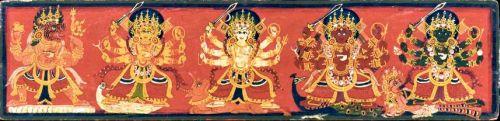
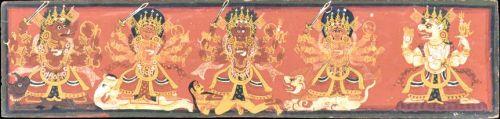
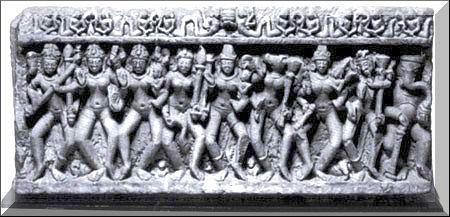
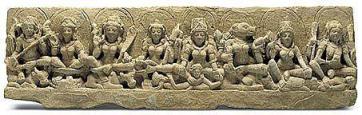
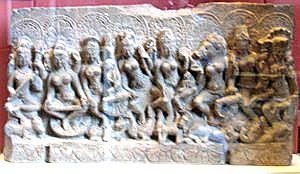
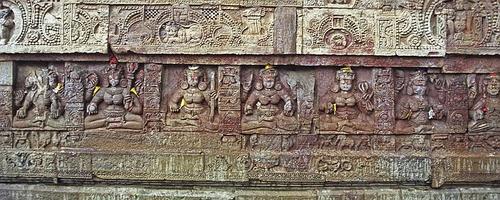
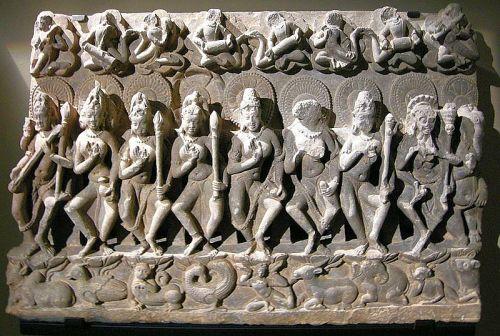
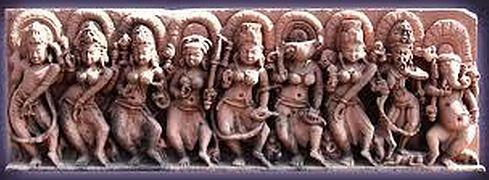
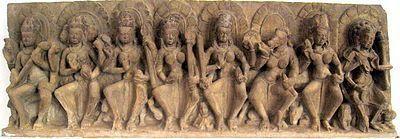
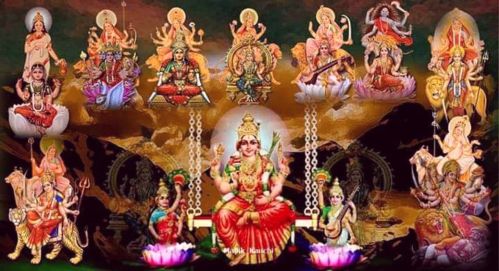
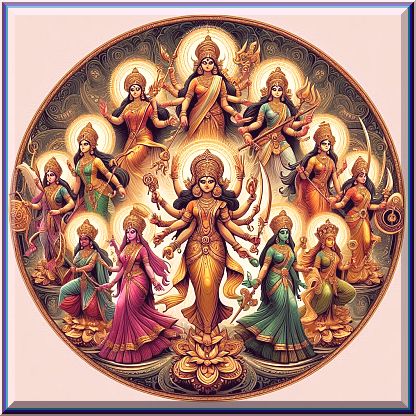
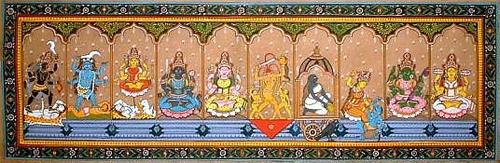
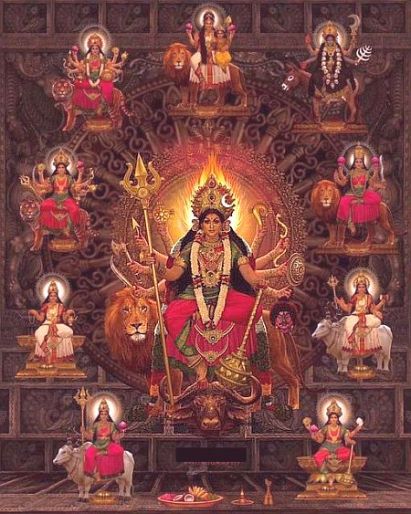
41.1. The group of seven mother-like goddesses, Matrikas, as commonly accepted, consist Brahmi, Vaishnavi, Maheshwari, Kaumari, Varahi, Indrani and Chamunda.

ब्राह्मी माहेश्वरी चैव कौमारी वैष्णवी तथा । वाराही च तथेन्द्राणी चामुण्डा सप्तमातरः ॥

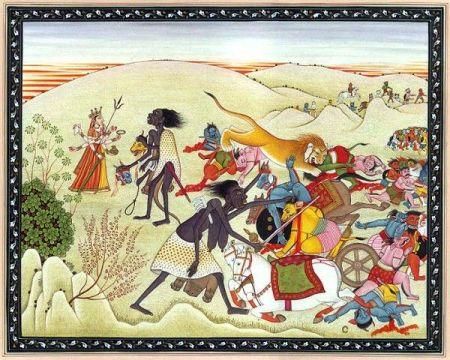
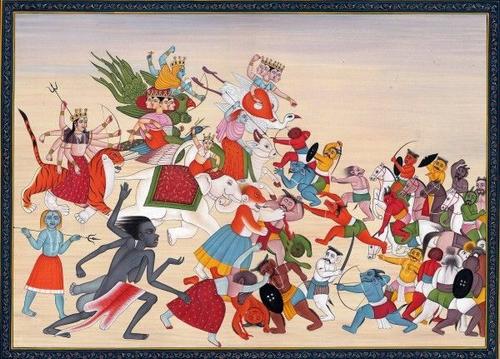
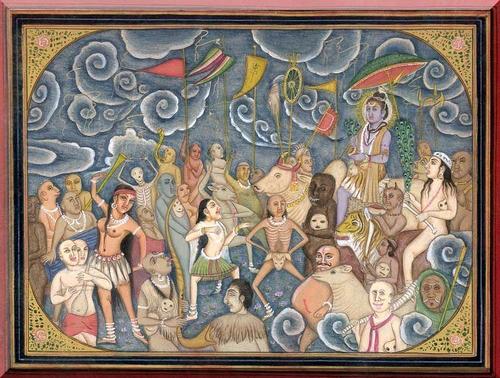
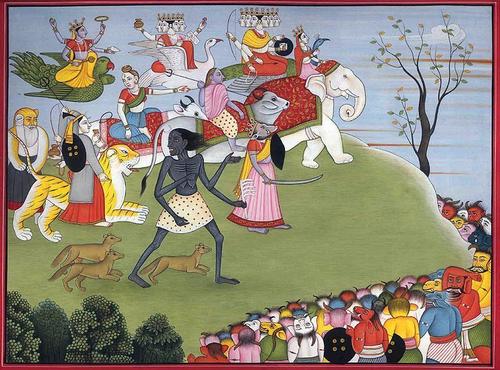
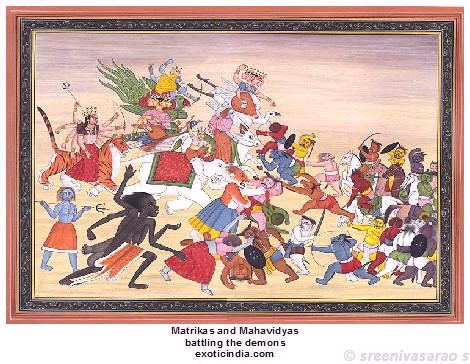
According to a version of their origin, as narrated in Devi Mahatmya, it is said, the Matrka goddesses were created by male Gods in order to aid Mahadevi in her battle against the demons Shumba and Nishumba.

The Matrkas emerge as Shakthis from out of the bodies of the gods: Brahmi form Brahma; Vaishnavi from Vishnu; Maheshwari from Shiva; Kaumari from Skanda; Varahi from Varaha; and Indrani from Indra. They are armed with the same weapons, wear the same ornaments and ride the same vahanas and also carry the same banners as their corresponding male Gods do.

Saptamatrkas as a group indicate transformation of the male identities of gods into goddesses.

These seven mother goddesses, celebrated as a group, are an embodiment of the female principle of prakrti, the counterpart of purusha.

Group composition

41.2. The Saptamatrka group is, thus, composed of: two Vaishnava Shakthis (Vaishnavi and Varahi); two Shaiva Shakthis (Maheshwari and Kaumari); one Brahmi Shakthi, in addition to Indrani (Aindri) and Chamunda. It is a group of six Deva Shakthis and one Devi Shakthi, making it into an integrated unit of seven.

42.1. Many have attempted to explain the rationale in the composition of Saptamatrka group.

One explanation mentions that the group of seven goddesses was derived from the gods that were considered important during the Gupta period. By then, the major gods – Shiva and Vishnu – had already attained independent – super status within the Vedic pantheon. Brahma was in any case one among the trinity, though a less impressive one. And, Skanda had risen into prominence since the time of Kushanas when he was absorbed into Shiva pantheon; and he developed further during the Gupta era. Varahi the counterpart of Varaha was more popular during the Gupta period than any other avatar of Vishnu. Aindri is the only counterpart of the Vedic gods who by then had lost their importance. Chamunda, of course, represents the principal feminine force.

The omission of the counter part of Surya who was a major god, acceptable to all sects, during the Gupta period is rather surprising. Similarly, of Ganapathi who was just beginning to rise to prominence.

42.2. The Saptamatrkas were earlier connected with Skanda (Kumara), but in later times were absorbed into the sect of Shiva himself. Aptly, the Saptamatrka panel begins with Ganesha, the son of Shiva; and ends with an aspect of Shiva such as Bhirava or Virabhadra. Sometimes, Natesha or Vinadhara – Dakshinamurthy represents Shiva. 

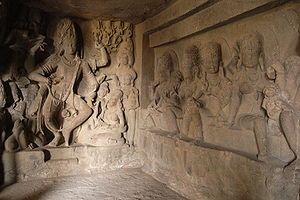
The presence of Ganesha at the beginning of the panel, it is explained, is prompted by the faith that Ganesha as the Lord of the Ganas would remove obstacles; help the devotee in his pursuit; and guide him along   his endeavour. From the sixth century onwards inclusion of Ganesha in the format became a standard practice. Thereafter, depiction of Ganesha and Shiva, and sometimes along with Skanda, became quite common. For instance, In the Matrka panels at Aihole and Elephanta caves Ganesha and Skanda are shown as child gods along with Shiva.

Thus, in association with Chamunda, the Saptamatrka panel was rendered into a composite unity.

43.1. As regards the presence of Ganesha and Virabhadra at either ends of the Saptamatrka   panel, Shri DSampath observes, elsewhere: The Saptamatrikas symbolically represent the seven different aggressive tendencies of the female part of a human being. When unleashed; they tend to destroy the wellness that comes out of a fostering mother. Children below the adolescent age are likely to be influenced by such harmful energies. Those adverse influences breed in kids a sort of ’non- motherly’ destructive attitude. And, these aggressive tendencies (energies) are meant to be contained and held in check by the two male energies: of Vinayaka who was ‘mother- born’ and who regarded all women as mothers; and of Virbhadra who could invoke motherly virtues in any woman. Between the manifestation of rational Vinayaka and the fiery Virabhadra these female energies were to be harnessed.

43.2. The other significant aspect about the Saptamatrka group formation is the order in which they appear in the traditional texts. The order symbolizes the cycle of creation and its cessation; and presents it as the functions of female power-Shakthi.

The order of the Saptamatrka usually begins with Brahmi symbolizing creation. It is often represented by the all-comprehensive primordial Nada Om (pranava).Then, Vaishnavi provides the created world with symmetry, beauty and order. Maheshwari, who resides in the hearts of all beings, breaths in life and individuality. Kaumari, Guru-guha, the intimate guide in the cave of one’s heart, inspires aspirations to develop and evolve.  Varahi is the power and aggressive intent to go after enjoyment. Indrani is the sovereignty intolerant of opposition and disorder . Chamunda is the destroyer of delusions and evil tendencies, paving way for spiritual awakening.

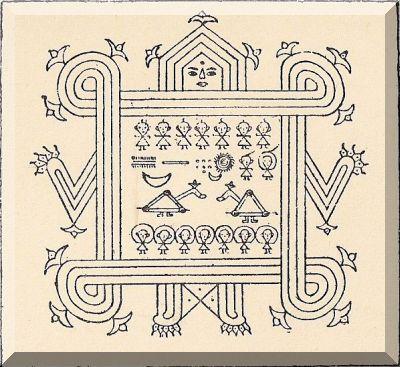
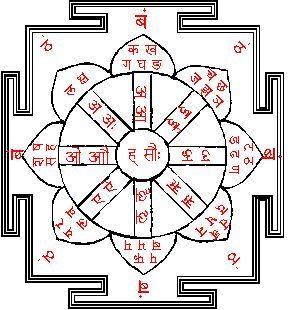
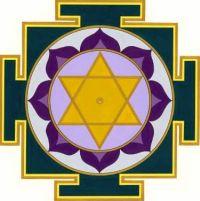
Matrika yantra

[ The number seven was found significant in understanding the composition of human body, which is made of seven types of bodily substances (Saptha-Dhatu).

Ayurveda has the concept of Dhatu-s i.e., Dhatu Siddhantha (theory of tissues formation and differentiation).

Ayurveda classifies the human body into seven constituents, or Saptha-dhatu. These are the elements in the human body that nourish, enable growth and support the body and mind. The seven dhatus are:

    1. Rasa/Twaca-Dhatu: (Plasma/lymph fluid/skin) – covers the body, circulates nutrients, hormones and proteins throughout the body;
    2. Raktha-Dhatu (Blood); preserves human life by transporting oxygen and nutrients throughout the body
    3. Mamsa-Dhatu (Muscles); it is the tissue that covers all organs and is related to strength and stability
    4. Medha-Dhatu (Fat); It is the storage site for excess fat in the body.
    5. Asthi Dhatu (Bones); it gives a structure and makes the human body strong
    6. Majja-Dhatu (Bone marrow); it is associated with the nervous system; govern metabolic process in the brain and the spinal cord.
    7. Shukra-Dhatu (Reproductive fluid or Semen); it is responsible for life, vitality and energy.

**

The seven types of bodily tissues (Saptha-Dhatus) are said to be symbolically associated the Saptha-Matrkas.

Each of the seven Dhatus is said to be ruled by a Matrka:

    1.  Brahmi (Rasa/Twaca-skin);
    2. Maheshvari: (Raktha-blood);
    3. Kaumari (Mamsa-muscle);
    4. Vaishnavi (Medha-fat);
    5. Varahi (Asthi-bone) ;
    6. Aindri (Majja- bone marrow) and,
    7. Chamunda (Shukra-semen, vitality and energy)

The Matrka-Vaishnavi (akin to Lakshmi), who rules over Medha-Dhatu (fat) and abundance ; and one who  assures wealth and prosperity is traditionally placed at the center of the Matrka panel.]

*

43.3. The most important significance of Saptamatrka symbolism is the implication of the cyclical universal time and its cessation. In the standard versions, Brahmi symbolizes creation; Vaishnavi the preserver occupies the central position flanked by three goddesses on each side. The cycle of periodic time ends with dissolution symbolized by Chamunda. She is the only Devi Shakthi among the Matrkas. She is at times depicted as one who exists beyond death and time. Kalabhairava, who usually appears at the end of the Saptamatrka panel, symbolizes liberation from cycle of birth and death. Thus, it is said, Saptamatrkas epitomize the process of creation, preservation and death; and, the final liberation that takes one beyond time. This is in tune with the Shaktha theology which rationalizes creation, preservation and destruction of the world as the functions of female power-the Shakthi.

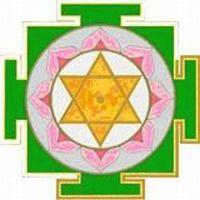
sri chakra

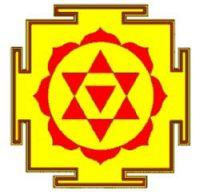
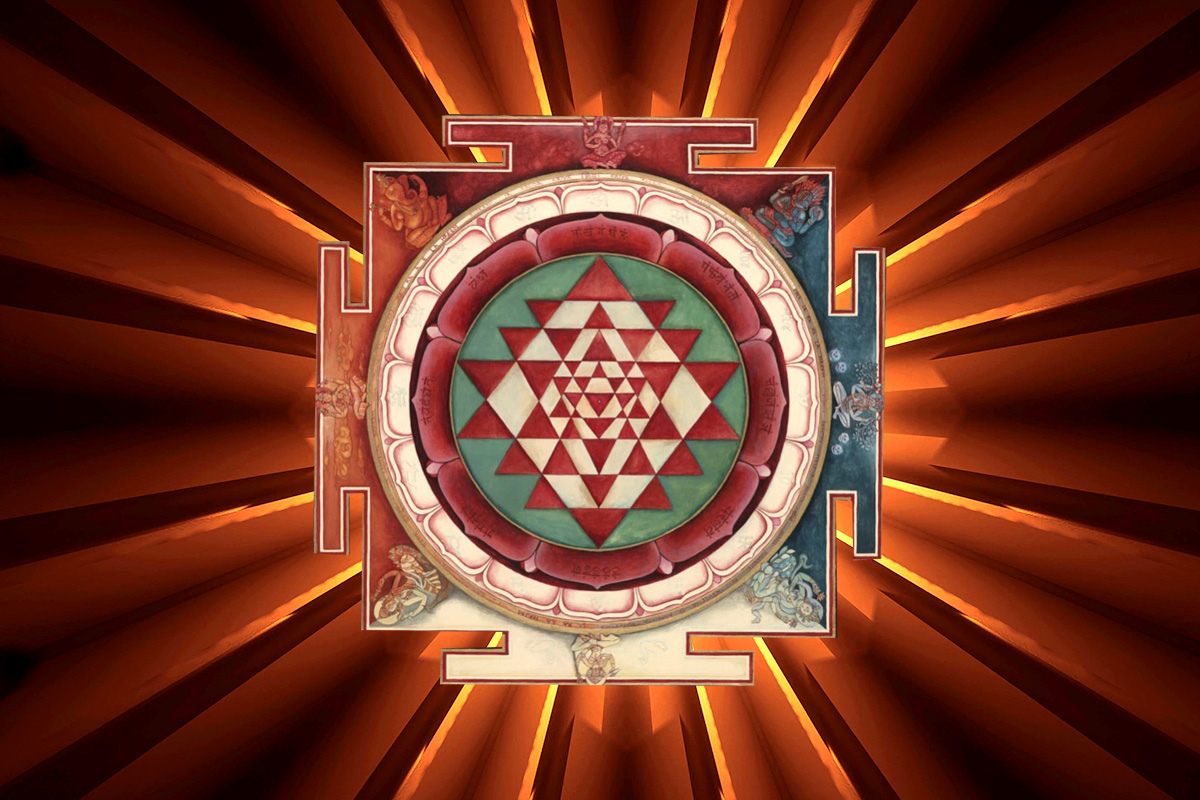
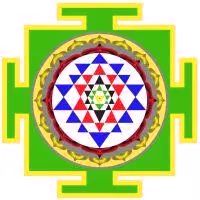
In Sri Chakra

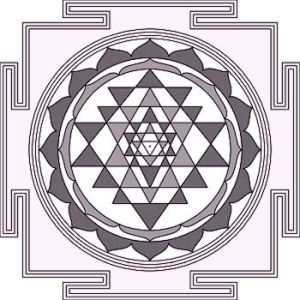
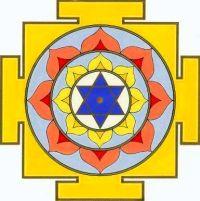
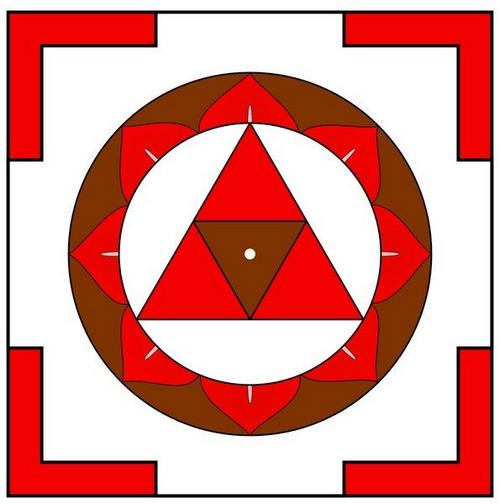
44.1. In the Sri Chakra, Chatushra the outermost four-sided square field (bhupura – the earth stretch) known as Trailokya-mohana-chakra is composed of three lines which make way for four doors (dwara) on four directions.  These sets of lines are also described as the layers of the enclosure wall which surround the city of the Devi (Tripura). The three lines are understood to represent three planes of existence: attainments, obstructions and powers. The three planes are related to the body-mind complex and its experiences with the world around. The associated goddesses are worshiped by the aspirant seeking protection and guidance as he/she enters into Sri Chakra.

44.2. Along the outer line the ten Siddhis (attainment-divinities) reside; along the middle line reside eight Matraka  the Mother-like powers; and, and along the inner line are the ten Mudra-devatas (goddess who empower).

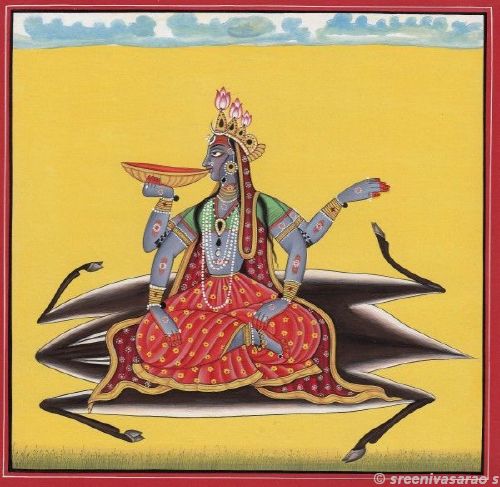
44.3. As said; the middle wall (line) is guarded by the Matrkas. The wall is red in colour; the red of the rising sun, signifying the  Rajo guna of the Matrkas who are said to represent eight types of passions. The Matrkas, according to Bhavanopanishad of Bhaskararaya Makhin, are said to be dark blue in color; wearing red garments; carrying a red lotus and a bowl filled with nectar.

44. 4. The Bhavanopanishad (9) recognizes Matrkas as eight types of un-favorable dispositions, such as: desire, anger, greed, delusion, pride, jealousy, demerit and merit. 

Tantra-raja-tantra (36; 15-16) expands on that and  identifies :

  • Brahmi with desire (Kama);
  • Maheshwari with the tendency to degenerate and dissipate (krodha);
  • Kaumari with youthful longings to enjoy (lobha);
  • Vaishnavi with power to fascinate and delude (moha);
  • Varahi with pride and arrogance (mada);
  • Indrani with jealousy and envy (matsarya);
  • Chamunda with urge to sin (papa) and hurt (abhichara); and ,
  • Mahalakshmi with doing good (punya) with other than altruistic reasons.

Matrkas who rule over such un-favourable dispositions are worshipped by the Sadhaka with prayers to suppress and overcome the evil tendencies that obstruct his progress.

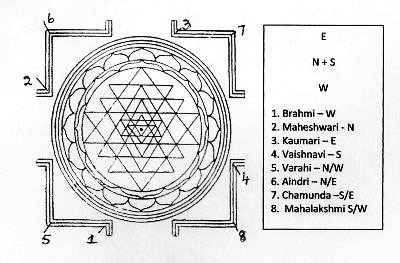
44.5. According to Khadgamala (vamachara) tradition of Sri Vidya, the eight Matrkas are located along the wall (four at the doors and four at the corners) guarding the city (Tripura) on all eight directions:

  • Brahmi on the West;
  • Maheshwari on the North;
  • Kaumari on the East;
  • Vaishnavi on the South;
  • Varahi on North-west;
  • Aindri on the North-east;
  • Chamunda on the South-east; and,
  • Mahalakshmi on the South-west.

Please see the figure below.

44.6. As you may notice, the Matrkas of Rajo–guna who govern over human passions are on the outer layer of the Sri Yantra. This signifies that the Sadhaka should get past passions and prejudices before he enters into the city of the Devi.

Matrka

Brahmi

Hamsarudha prakarrtavaya sukastraka-mandala
Sutram cha pusthakam ghate urdhva-hastha advaye shubhe (Rupamandana)


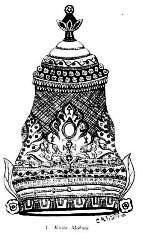
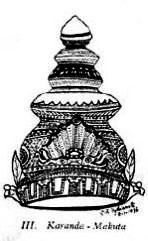
45.1. Brahmi or Brahmani the first Matrka is the shakthi of Brahma. She is depicted in bright golden complexion, having four faces and four hands. In her back- right hand, she carries a kamandalu and in the back- left hand an Akshamala. The front- right hand gestures Abhaya and the front- left hand bestows Varada. She is seated under a Palasha tree,   upon a red lotus. She is adorned in a mellow bright garment (Pitambara) and various ornaments; and, has on her head karanda-makuta. Her vahana and her emblem is the swan (Hamsa): (Amsumadbhedagama and Purva-karanagama).

45.2. The Vishnudharmottara describes Brahmi as having six hands. Of the three hands on the left, the lowest one gestures Abhaya; while the other two hold Pustaka (book) and kamandalu. On her right, the lowest hand gestures Varada; while the other two hold Sutra and Sruva (a ladle for pouring oblations of ghee into fire). It also mentions deer-skin as a part of her attire.

Aum Dhevee Brahmani Vidmahe

Maha-shakthiyai Cha Dhimahee
Thanno Dhevee Prachodayath

Vaishnavi

Vaishnavi Vishnu saddasi Garudapasi samsthitha

Chaturbhuja varada shankha chakra gadadhara (Rupamandana)
*
*

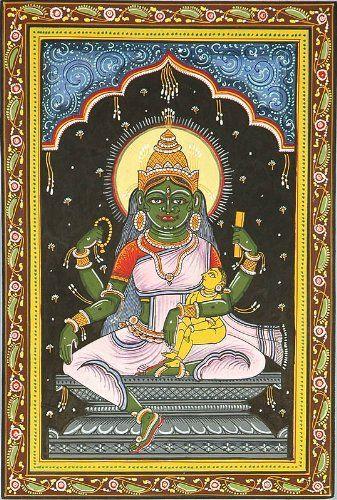
46.1. Vaishnavi is the Shakthi of Vishnu. She is seated upon a lotus, under a Raja – vriksha, the great tree. She is dark in complexion. She has a lovely face, pretty eyes and wears a bright yellow garment. Her head is adorned with kirita-makuta. She is richly decorated with ornaments generally worn by Vishnu. She wears the Vanamala, the characteristic garland of Vishnu. The emblem on her banner as well as her vahana is the Garuda. When depicted with four arms, she carries in one of her hands the chakra and in the corresponding left hand the shankha; her two other hands are held in the Abhaya and the Varada mudra. (Devi-Purana and Purvakaranagama)

46.2. The Vishnudharmottara states that like Brahmani, Vaishnavi also has six hands; the right hands are characterized by the Gada, Padma and Abhaya and the left ones by Shankha, Chakra and Varada.

Aum Thaarksh Yathwajaaya Vidmahe

Chakra Hasthaya Dhimahee

Thanno Vaishnavi Prachodayath

Maheshwari

Maheshwari prakarrtavaya Vrishabasana samasthitha

Kapala shula khatvanga varada cha chaturbhuja  (Rupamandana)

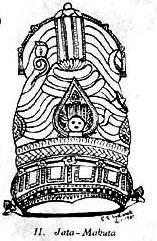
47.1. Maheshwari also known as   Raudri, Rudrani and Maheshi is the Shakthi of Shiva. She is white in complexion; and has   three eyes. She is depicted with four arms; two of which are in the Varada and the Abhaya mudra, while the other two hands hold the Trishula and Akshamala .Sometimes, she is also shown holding Panapatra (drinking vessel) or axe or an antelope or a kapala (skull-bowl) or a serpent. Her banner as well as the vahana is Nandi (bull). She wears snake-bracelets; and   Jata -makuta on her head.

47.2. The Vishnudharmottara mentions that Goddess Maheshwari should be depicted with five faces, each possessing three eyes and each adorned with jata-makuta crown and crescent moon. Her complexion is white. She is depicted with six arms. In four of the hands she carries the Sutra, Damaru, Shula and Ghanta. The other two hands gesture Abhaya and Varada mudra. Her banner also has the Bull for its emblem.

Aum Vrushath-vajaaya Vidmahe

Miruga Hasthaya Dhimahee

Thanno Maheshwari Prachodayath

Aindri

Indrani Indra-sadrishi vajra-shlu-gada dhara

Gajasngata Devi lochanirvasu bhivrta (Rupamandana)


48.1. Aindri, also known as Indrani, Mahendri, Shakri and Vajri, is the shakthi of Indra; her complexion is dark- red. She is seated under the Kalpaka tree. She is depicted as having two or three or a thousand eyes, like Indra. The Indrani is depicted with four arms. In two of her hands she carries the Vajra (thunderbolt) and the shakthi; while the other   two gesture Varada and Abhaya mudra. Sometimes, she is shown holding Ankusha (goad) and lotus. She is richly ornamented; and adorned with Kirita Makuta. Her vahana as well as the emblem on her banner is the charging elephant. (Devi-purana and Purvakaranagama)

48.2. According to the Vishnudharmottara, Indrani should be depicted with thousand eyes; and she should be of golden colour. She should have six arms, four of the hands carrying the sutra, Vajra, Kalasa (a pot) and Patra (a drinking cup) and the remaining hands being held in Abhaya and Varada mudra.

Aum Gajath-vajaayai Vidmahe

Vajra Hasthaya Dhimahee

Thanno Indrani Prachodayath

Varahi

Varahim tu pravakshyami mahiso rismsthtam
Varaha-sadrisham ghantanada chamara-dharini
Ghanta chakra gada-dhara padma danvendra vighatini
Lokanamcha hitarthaya sarvavyadhi vinasini (Rupamandana)


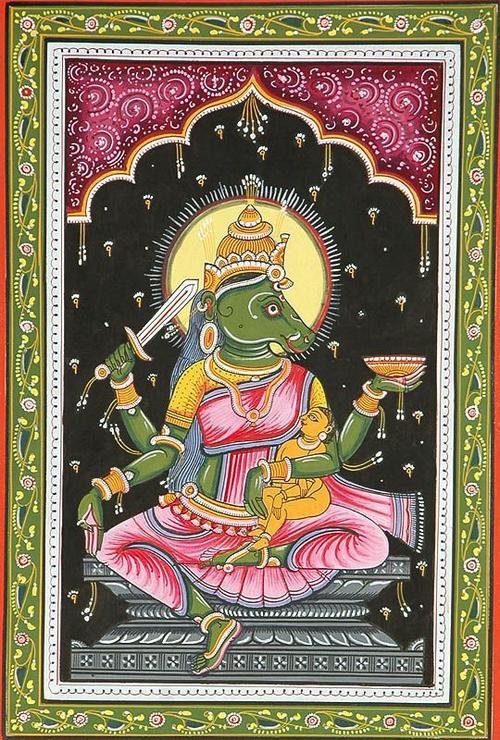
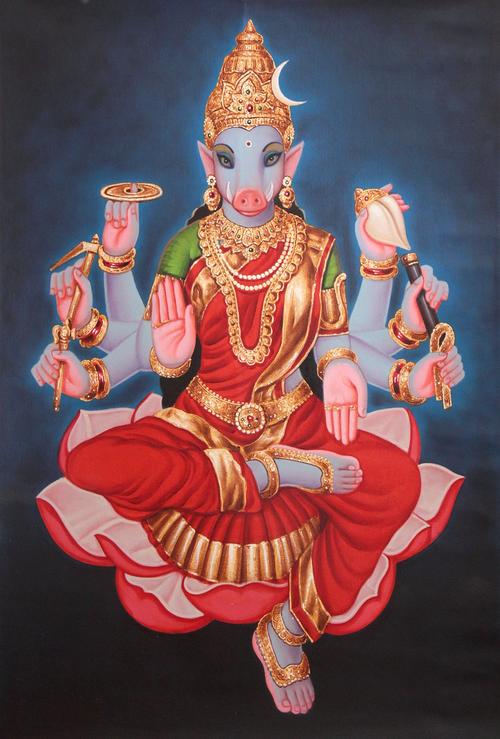
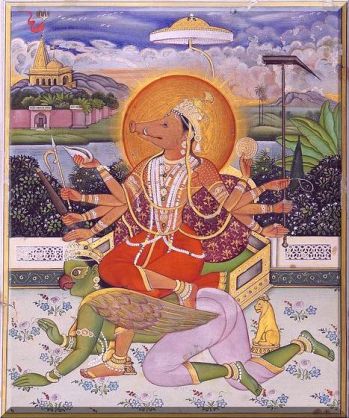
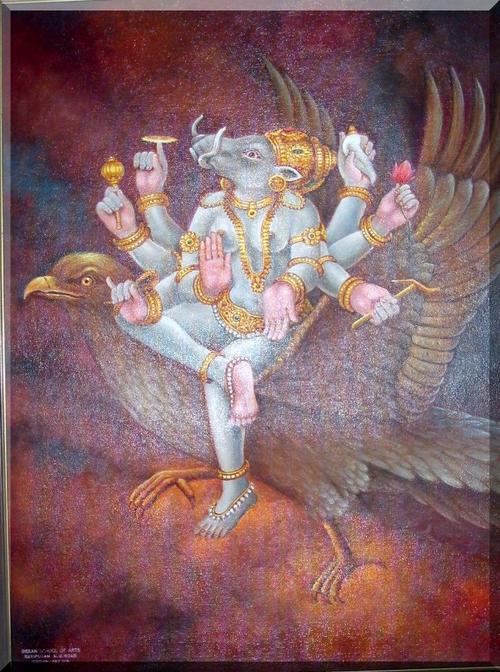
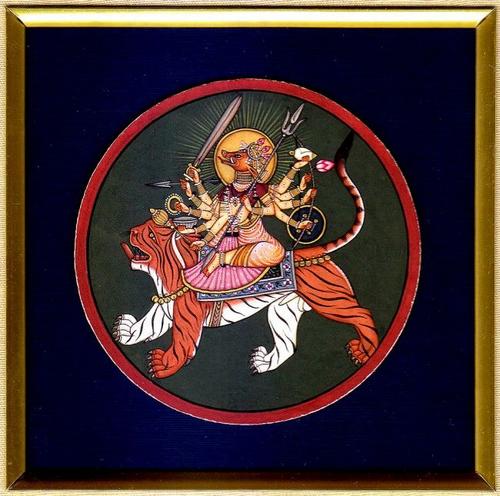
49.1. Varahi is the Shakthi of Varaha, an incarnation of Vishnu. The Markendeya Purana praises Varahi as a granter of boons and the regent of the northern direction.  Varahi is shown with the face of a boar and having dark complexion resembling the storm cloud. She is sometimes called Dhruma Varahi (dark Varahi) and Dhumavati (goddess of darkness). Varahi is seated under Kalpaka tree. And, her Vahana as well as the emblem on her banner is an elephant. She wears on her head a Karanda Makuta and is adorned with ornaments made of corals. She wears on her legs Nupura-anklets. She wields the hala and the shakthi and is seated under a Kalpaka tree. The PurvaKaranayama says that she carries Sarnga-Dhanush (bow), the hala (plough) and musula (pestle) as her weapons.

49.2. In other descriptions, Varahi is identified as the Yami, the shakthi of Yama. Varahi is described holding a Danda (rod of punishment) or plough, goad, a Vajra or a sword, and a Panapatra. Sometimes, she is said to carry a bell, chakra, chamara (bunch of yak’s hair  used as flywhisk) and a bow; and riding a buffalo.

49.3. In the Raktabija episode of Devi Purana, Varahi is described as having a boar form, fighting demons with her tusks while seated on a preta (ghoul).

49.4. To this description the Vishnudharmottara adds that Varahi has a big belly and six hands, in four of which she carries the Danda (staff of punishment), khetaka (shield), khadga (sword), and pasha (noose); while the two other hands gesture Abhaya and Varada mudra-s.

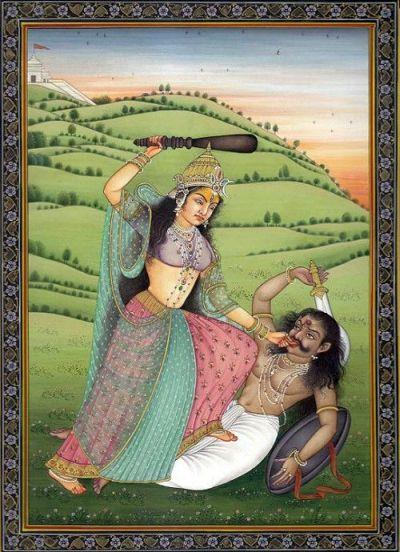
Varahi

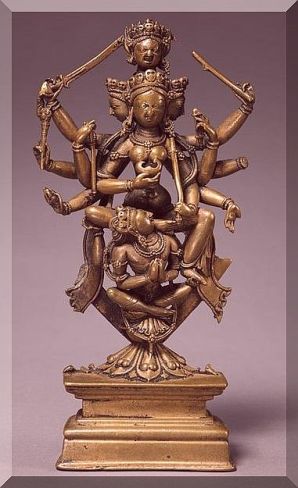
49.5. When depicted as part of the Sapta-Matrika group, Varahi who is called Panchami (the Fivefold One) is always in the fifth position in the row of Matrikas. It is explained; Varahi summarizes fivefold elements: water, fire, earth, air and ether. Each of these elements is related to lion, tiger, elephant, horse and Garuda (bird-human) which serve as vehicles of Vishnu. Varahi as the shakthi of Vishnu is depicted with head of a boar having three eyes and eight arms holding in her six hands a discus, conch-shell, mace, lotus, noose and plough; while the other two hands gesture Abhaya and Varada mudra-s. She is depicted as riding, alternatively, a Garuda, a tiger, a lion, an elephant or a horse.


49.6. In the Sri Vidya tradition, Varahi occupies a special position as Para-Vidya (superior power) .She is described as Dandanayika or Dandanatha – the commander-general of goddess Tripurasundari’s army. She is also the chief- counsellor (maha-mantrini) to the Devi. Varahi is also said to stand in a ‘father’ position to the Devi, while Kurukulla is the ‘mother’.

49.7. Varahi has presence in the Buddhist Tantric lore, also. There, she is described as the fierce Vajra-varahi or Vajra-yogini.

Aum Varaaha-muhi Vidmahe

Aanthra-shani Dhimahee

Thanno Yamuna Prachodayath

Kaumari

Kumaara rupa Kaumari mayura bar vahana
Raktha vastra dhara padma-shula-shakthi-gandhara eti Kaumari (Rupamandana)

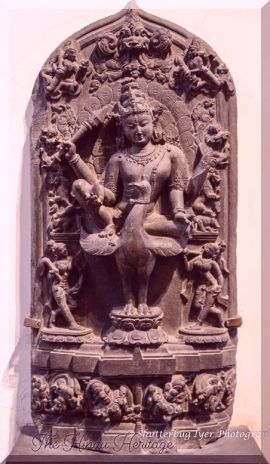
50.1. Kaumari also known as Kumari, Karttikeyani and Ambika is the power of Kumara or Skanda; the war – god .Her depictions resemble that of Kumara. She is ever youthful, representing aspirations in life. Kaumari is also regarded as Guru-Guha the intimate guide who resides in the cave of one’s heart. She is shown seated under a fig tree (Oudumbara) riding a peacock, which is also her emblem.  Her complexion is golden yellow; and is dressed in red garments. She wears garland of red flowers. Kaumari has four hands; and carries Shakthi and Kukkuta (cockerel) or Ankusha (goad). The other two hands gesture Abhaya and Varada mudras. She is adorned with a makuta said to be bound with Vasika or Vachika. She embodies ideas of valour and courage. (Purvakaranagama and Devi Purana).

50.2. According to the Vishnudharmottara, Kaumari should be shown with six faces and twelve arms; two of her hands gesturing Abhaya and Varada mudras.  In her other hands she carries the Shakthi, Dhvaja, Danda, Dhanus, Bana, Ghanta, Padma, Patra and Parasu. Each of her heads has three eyes; and is adorned with karanda-makuta.

Aum Sikid-vajaaya Vidmahe

Vajra Hasthaya Dhimahee

Thanno Kowmari Prachodayath

Chamunda

Dastrala kshindeha chagatrakarshana bhimrudani

Dig-bahuksham kushisa musalan chakra marganaum//
Ankusha bibharti khadgam daksnesvatah
Khetaasa dhanurdandam kutharam chalti bibarti//
Chamunda pretaga raktha bikratasyahi bhusanath
Dvibhuja prakatray kartika karyamnuintra //


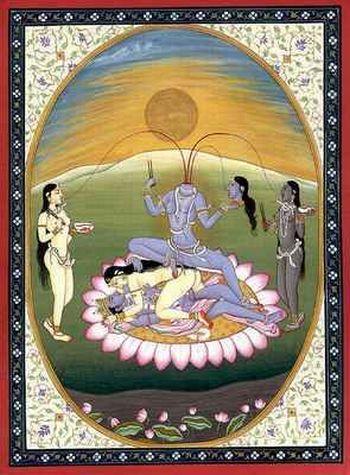
51.1. Chamunda also known as Chamundi; and, Charchika is the Shakthi of Devi (Chandi). She is the destructive form of Devi; and is similar in appearance and habits to Kali.  Devi Mahatmya recounts that in the course of her fight with demons Chanda and Munda, Devi created from her forehead the terrible form of Chamunda.

There are , however,  alternate explanations.

According to the text of the Devi Mahatmya, Kali is celebrated as Chamunda after she overpowers and beheads Chanda and Munda.

śiraścaṇḍasya kālī ca ghītvā muṇḍameva ca  prāha pracaṇḍā aṭṭahāsa miśra mabhyetya caṇḍikām  7.23॥

The Devi, then, declares that since Kali presented her with the heads of these two demons, she would henceforth be renowned in the world as Chamunda – cāmuṇḍeti tato loke khyātā Devī bhaviyasi .Thereafter in the text, Kali and Chamunda become synonyms.

Yasmāc-Caṇḍa ca Muṇḍa ca ghītvā tvamupāgatā  Cāmuṇḍeti tato loke khyātā Devī bhaviyasi  7.27

Bhaskararaya Makhin, however, interprets the term Chamunda, differently, as: ‘chamum, ‘army’ and lati, ‘eats’; meaning that Chamunda is literally ‘she who eats armies’—a reference to Kali as Chamunda who drinks the blood of the army of the demon Raktabija.

jaghāna raktabīja ta cāmuṇḍā apītaśoitam  sa papāta mahīpṛṣṭhe śastra saghasam āhata  8.61

He regards the Mahadevi Chamunda, in her integrated form (Samasti), as of the nature of the Brahman- Brahma-svarupini. She combines in herself her other diversified (Vyasti) forms of Mahalakshmi (Aim); Mahasarasvathi (Hrim); and, Mahakali (Kilm). 

51.2. Coming back to Chamunda as as a Matrika, unlike other Matrikas, Chamunda is an independent goddess. She is also praised as the fertility goddess of Vindhya Mountains She is also associated with Yama.

The descriptions of Chamunda are varied.

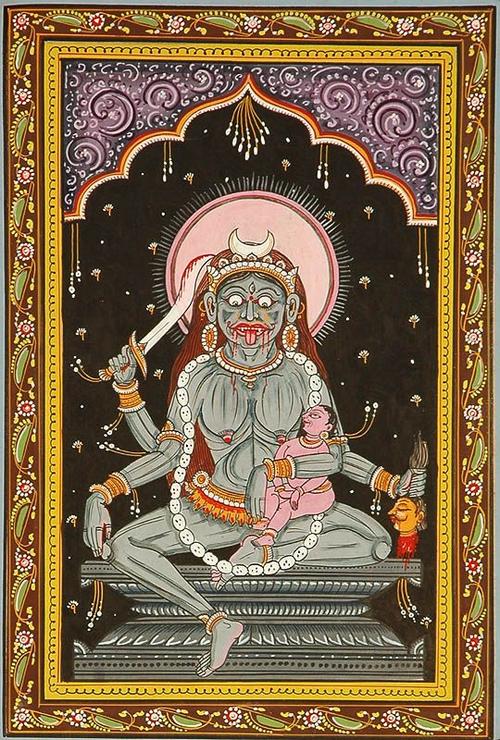
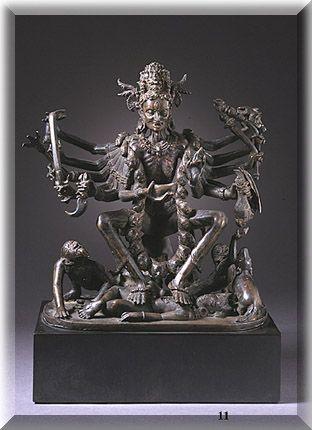
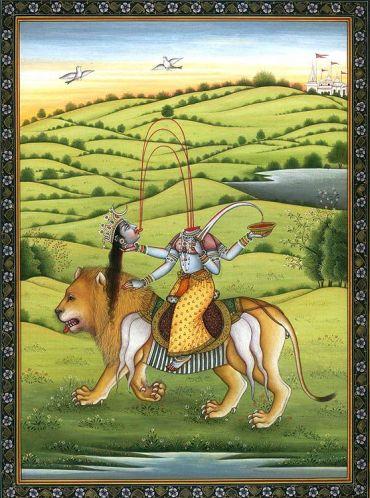
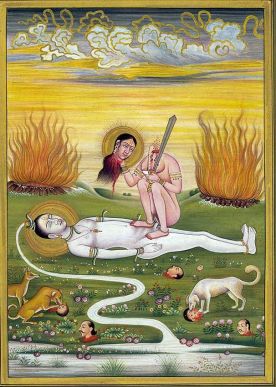
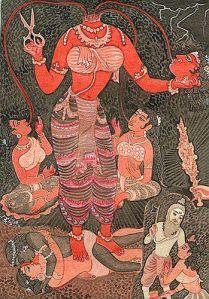
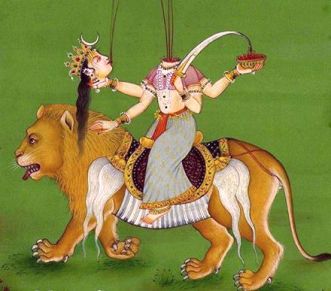
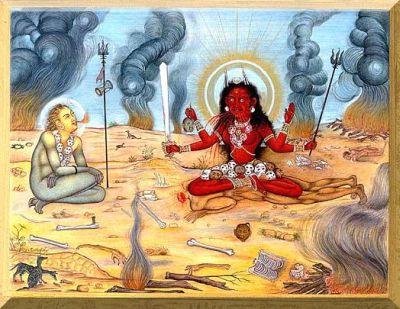
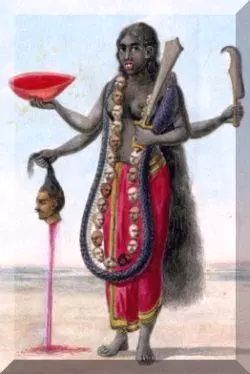
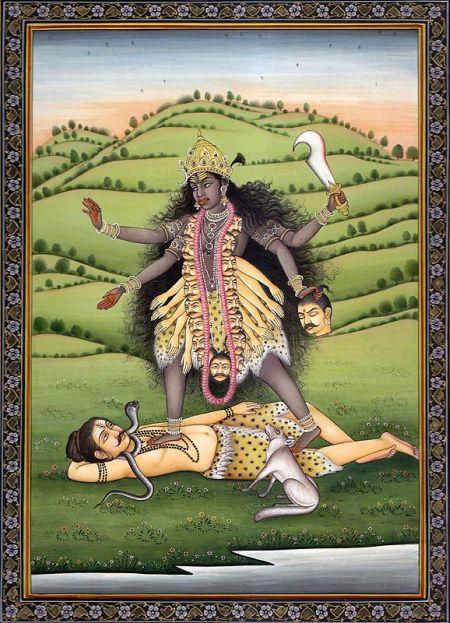
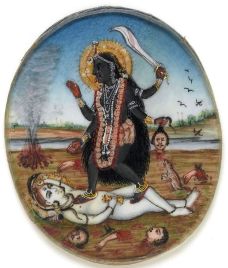
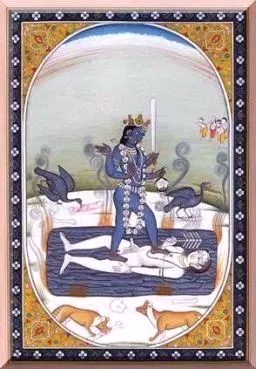
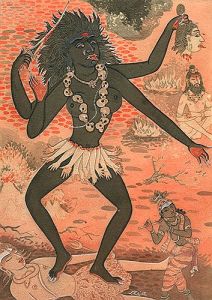
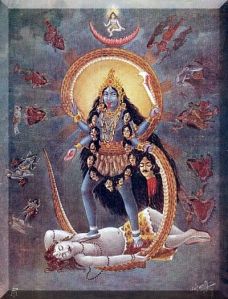
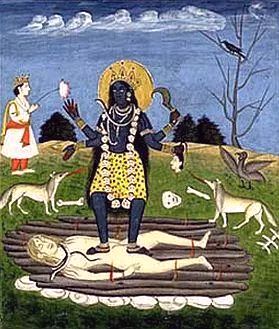
One of the descriptions of Chamunda mention of her as a goddess of terrible countenance, black and scowling, with drawn sword and lasso, holding a Khatvanga, wearing a garland of severed heads  (munda-mala) suspended by their hair. Chamunda is clad in a tiger skin, hungry and emaciated, mouth hideously distorted and the tongue protruding out. She sits upon a seat made of three skulls; and has a cadaver for footrest. She plucked off the heads of Chanda and Munda and presented both heads to Kausiki.

51.3. In other descriptions, a bear’s skin is tied over Chamunda’s clinging skirt, with its head and legs dangling on her back. She wears the skin of an elephant as a cape and grasps two of the animal’s feet in her uppermost hands. In her other hands she brandishes an array of weapons and awe-inspiring objects.

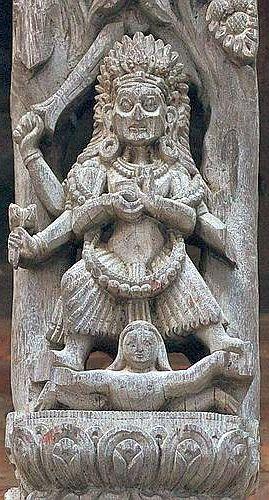
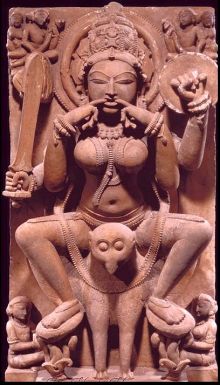
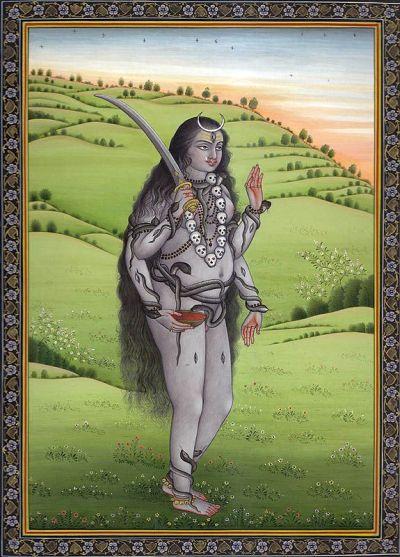
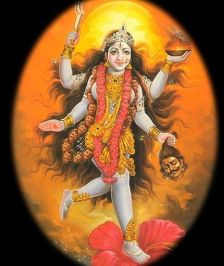
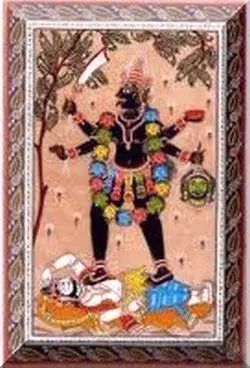
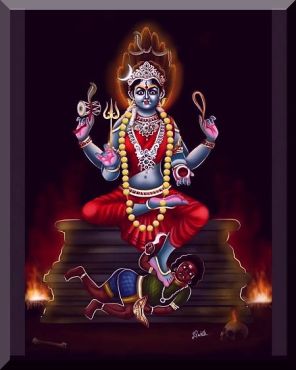
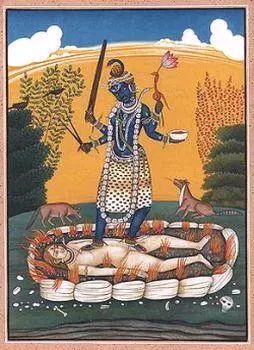
51.4. Chamunda is often depicted as dark in colour with very emaciated body, having three eyes, sunken belly and a terrifying face with a wide grin. Her hair is abundant and thick and bristles upwards. Her abode is under fig (oudumbara) tree. On her sunken chest, swings garland of skulls (mundamala) in the manner of a Yajnopavita. She wears a very heavy jata-makuta formed of piled, matted hair tied with snakes or skull ornaments. Sometimes, a crescent moon is seen on her head. Her garment is the tiger skin. Chamunda is depicted adorned by ornaments of bones, skulls, serpents and scorpions, symbols of disease and death. And in her four hands she holds damaru (drum), trishula (trident), khadga (sword) and panapatra (drink-vessel). She is riding a Jackal; or is seated in Padmasana or is standing on a corpse of a male (shava or preta).She is accompanied by fiends and goblins. She is surrounded by skeletons or ghosts and beasts like jackals, who eat the flesh of the corpse that the goddess sits or stands on. The jackals and her fearsome companions are sometimes depicted as drinking blood from the skull-cup or blood dripping from the severed head.

51.5. Purva-karanagama mentions that Chamunda, red in colour, should be depicted with wide open mouth set in a terrifying face having three eyes. Her socket eyes are described as burning like flames. She has a sunken belly; and, wears on her head the digit of the moon as Siva does. She has four arms. The black or red coloured Chamunda is described as having four, eight, ten or twelve arms, holding a Damaru (drum), trishula (trident), sword, a snake, skull-mace (khatvanga), thunderbolt, a severed head and panapatra (drinking vessel, wine cup) or skull-bowl (kapala), filled with blood, an urn of fire. She wears in her ears Kundla-s made of Conch shell (Sankha Patra). Her Vahana is an Owl; and the emblem of her banner an Eagle.

yogini riding an owl

51.6. Vishnudharmottara describes Chamunda as having a terrific face with powerful tusks and seated upon a male corpse. She has a very emaciated body and sunken eyes and ten hands. The belly of this goddess is thin and apparently empty. She carries in her ten hands: Musala, Kavacha, Bana, Ankusha, Khadga, Khetaka, Dhanus, Danda and Parasu.

Aum Pisaasath-vajaaya Vidmahe

Soola Hasthaya Dhimahee

Thanno Kali Prachodayath

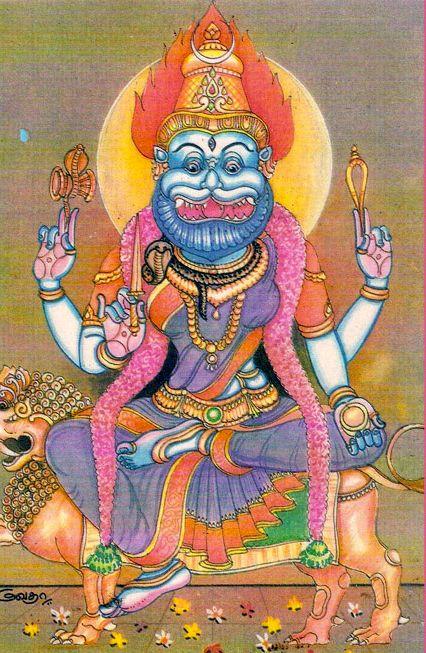
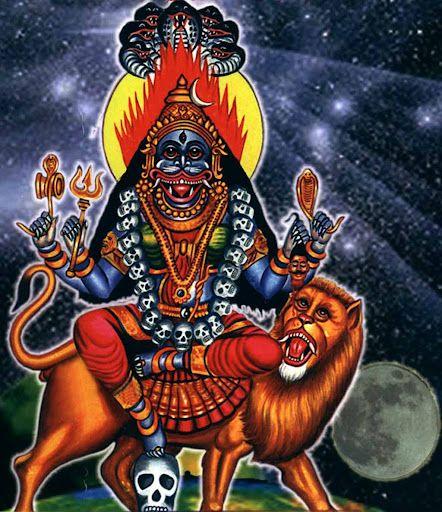
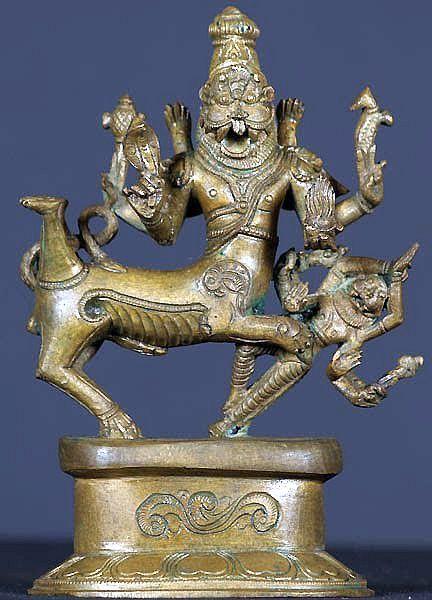
Narasimhi

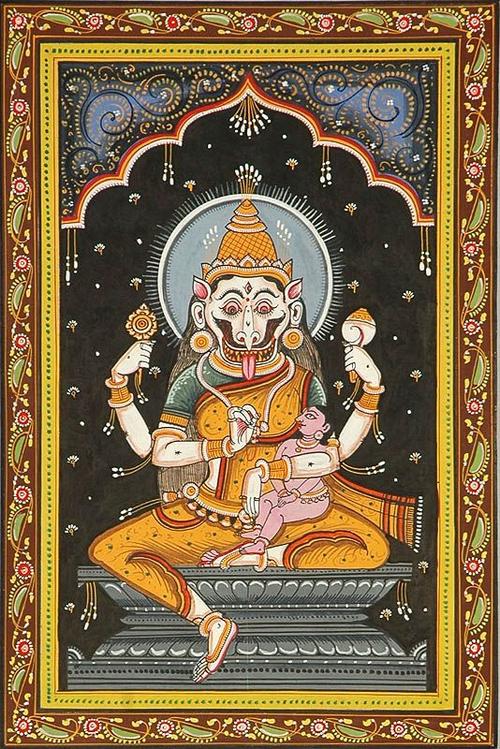
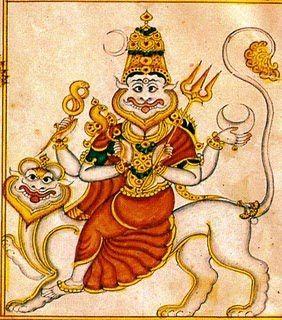
52.1. In the Devi Mahatmya, the Saptamatrkas (the seven Matrkas) mentioned are: Brahmi, Maheshwari, Kaumari, Vaishnavi, Varahi, Indrani and Chamunda. At times, Narasimhi is mentioned in place of Chamunda. In some versions, the Martkas are counted as eight (Ashta-Matara) by including Narasimhi. There is also a tradition of Ashtamatrikas, eight Matrkas, which is prevalent in Nepal region. In Nepal, the eighth Matrka is Maha-Lakshmi (she is different from Vaishnavi). Narasimhi does not figure in the lists of Devi Purana and in Nepal.

52.2. Narasimhi or Narasimhini or Narasimhika with the face of a lion, fierce claws and four arms is the shakthi of Narasimha. She is said to have came out from the heart of the Devi. As Matrka, Narasimhi is regarded as an independent deity; and not as a female counterpart of Narasimha. In The Vaishnava School, she is believed to be an aspect of Lakshmi who pacified the ferocious Narasimha.

52.3. In Devi Mahatmya, Narasimhi accompanies Devi in the fight against demons Shumbha and Nishumba. There Narasimhi is described as a ferocious warrior: Narasimhi arrived there, assuming a body like that of a Narasimha throwing the stars into disarray, bringing down the constellations by the toss of her mane (DM: 20) . And, Narasimhi, filling all the quarters and the sky with her roars, roamed about in the battle, devouring other great asuras torn by her claws (DM: 37).

52.4. Narasimhi is sometimes identified with Pratyangira who is endowed with four arms and a face as terrible as that of a lion. Her head is that of a male lion and her body is that of a human-female. Her hair stands erect on her head. In her hands she holds a skull, trident, Damaru and the noose (nagapasa).  She is seated on a lion and by her power destroys all enemies.

52.5. In Tantric worship, Pratyangira is shown with a dark complexion, ferocious in aspect, having a lion’s face with reddened eyes and riding a lion wearing black garments, she wears a garland of human skulls; her hair strands on end, and she holds a trident, a serpent in the form of a noose, a hand-drum and a skull in her four hands. She is also associated with Bhairava, as Atharvana-Bhadra-Kali.

Sri Pratyangira Devi is also associated with Sri Chakra. She protects the devotees and guides him/her along the right path.

52.6. The Shaiva School suggests that Pratyangira sprung from the wings of Lord Sharabesha, the bird-lion-human form that Shiva assumed to pacify (subdue) the ferocious Narasimha.

[According to Kalikagama, the body of Sharabha should be that of a bird of golden hue, having two red eyes; and it should have two up-lifted wings and eight limbs. Sharabha, which is said to be mightier than an elephant, should have the fierce face of a lion grinning widely, having tusks and   wearing kirita makuta. The torso of Sharabha resembles that of human male having four hands .The lower part of its body should resemble that of a lion having four legs, sharp claws and a tail. Sharabha should be shown carrying the figure of Narasimha in his human form with upraised folded hands, anjali mudra. ]

Mahalakshmi

53.1. Mahalakshmi is counted as the eighth Matrika in the Asta-matrika tradition followed in the Nepal region. Mahalakshmi, as Matrka, is not derived from Devi Mahatmya, although she is described as “Universal Mother’ in other contexts. As Matrka, Mahalakshmi is regarded as an aspect of Durga; not as Lakshmi the consort of Vishnu. Mahalakshmi here represents her subtle aspect as Mind, specially her Sovereignty.

53.2. In the Shaktha tradition, Mahalakshmi is an independent Supreme Divinity manifesting herself as Maha-Sarasvathi (Sattva), Mahalakshmi (Rajas) and as Maha-Kali (Tamas).

Devi Mahatmya explains Mahalakshmi as Devi in her universal form as Shakthi. She is the primordial energy and was the first to appear before everything (sarva-sadhya); she is both devoid of form (nirakara) and filled with forms (sakara);   she is both manifest and un-manifest; She is the essence of all things (sarva sattva mayi). She creates and governs all existence (Isvari), and is known by various names (nana-abhidana-brut). She is the ultimate goal of yoga.  Mahalakshmi is the creator of the Trinity: Brahma, Vishnu and Rudra.

53.3. Mahalakshmi is the presiding Goddess of the Middle episode (Chapters 2-4) of Devi Mahatmya. In her manifestation as Mahalakshmi, the Devi destroys the demon Mahishasura. The Goddess fought the demon for nine days starting from prathipath (the first day of the brighter halfof the month of Ashvayuja; and killed the demon on the tenth day Vijaya-Dashami ending his reign of evil and terror. Her victory symbolizes the victory of good over evil.

53.4. Mahalakshmi described as having been created by the effulgence of all the gods is depicted as Ashtadasha Bhuja Mahalakshmi, with eighteen arms.

Skanda Purana (Sahyadri khanda) describes Mahalakshmi as: “She who springs from the body of all gods has a thousand or indeed countless arms, although her image is shown with eighteen hands. Her face is white made from the light streaming from the face of Shiva. Her arms are made of substance of Vishnu are deep blue; her round breasts made of Soma are white. Her waist is Indra and is red. Her feet sprung from Brahma are also red; while her calves’ and thigh sprung from Varuna are blue. She wears a gaily coloured lower garment, brilliant garlands and a veil. In her eighteen arms, starting from the lower left, she holds in her hands : a rosary, a lotus, an arrow, a sword, a hatchet, a club, a discus, an ax, a trident, a conch, a bell, , a noose, a sphere, a stick, a hide, a bow, a chalice and a water pot.”

The Chandi Kalpa adds that Mahalakshmi should be seated upon a lotus (saroja sthitha) and her complexion must be that of coral (pravala prabha).

54.4. When she is shown with four hands, Mahalakshmi is depicted as seated on a lotus throne, holding padma, shankha, a kalasha and a fruit (bilva or maatulunga). Her four hands signify her power to grant the four types (chatur vidha) of human attainments (purushartha): dharma, artha, Kama and moksha.

54.5. The Shilpa text Rupa-mandana suggests Mahalakshmi with four arms (chatur-bhuja) should be depicted in the colour of molten-gold (taptha-kanchana-sannibha) and decorated with golden ornaments (kanchana bhushana). She is also described as having complexion of coral; and seated on a lotus. Her four hands carry matulunga fruit, mace, shield and bowl of liquor. Her head must be adorned with snake-hood and a linga.

[Note: 1.

The head-gears mentioned for the Matrkas are commonly the Kirita -makutaKaranda-makuta and Jata-makutaMansara, the ancient text of Shilpa shastra, classifies these types of head-gears under the term makuta or mouli (MansaraMauli-lakshanam: 49; 1-232). For all makuta-s, the width commencing from the bottom should be gradually made lesser and lesser towards the top.

Among these, the Kirita-makuta is an elaborate crown that adorns major gods such as Vishnu and his forms (Narayana) and also emperors (Sarvabhouma).It has the appearance of Taranga-s (waves) and its middle is made into the shape of flowers and adorned with precious stones. The base of the Kirita-makuta should be curved like a crescent (ardha-chandra) just above the forehead. The height of the Kirita-makuta should be two or three times the length of the wearer’s face.

The Karanda-makuta is prescribed for lesser gods and for goddesses when depicted along with their spouse. It is simpler and shallower as compared to Kirita-makuta. The Karanda-makuta is a small conical cornet receding in tier. It is   shaped like an inverted flowerpot, tapering from the bottom upwards and ending in a bud. The width of a Karanda-makuta at the top should, however, be only one-half or one-third less than that at its base.

The jata- makuta is suitable according to Mansara for Brahma and Rudra, as also for consorts of Shiva. Jata-makuta, is made up of jata or matted locks, which are twisted into encircling braids of spiral curls and tied into a knot looped at the top. It is held in place by a patta (band); and is adorned with forest flowers and by a number of ornamental discs like the makara-kutapatra-kuta, and the ratna-kuta. In the case of Shiva, the jata-makuta is adorned with a crescent of the moon, a cobra and the Ganga.

In the case of Matrkas:  Vaishnavi and Aindri are adorned with kirita-makuta; Brahmi, Varahi and Kaumari with karanda-makuta; while Maheshwari and Chamunda are adorned with jata-makuta.

devi 9

Note: 2.

Among the Ayudhas carried by the Matrka deities the following are commonly mentioned:

    1. Khadga (Sword) ;
    2. Trishula (Trident) ;
    3. Chakra  (Thunder – disc)
    4. Gada or Khitaka (Mace) ;
    5.  Dhanush (Bow) ; 
    6. Bana (Arrow);
    7. Bharji  (Javelin) ; 
    8. Parashu (Battle- Axe) ; 
    9. Musula (pestle) ;
    10. Danda (staff);
    11. khatvanga (skull-mace),
    12. khetaka or Sipar (shield);
    13.  Ankusha (Goad) ;
    14.  Sutra or Pasha(Noose or lasso);
    15. Damaru (drum); 
    16. Panapatra (drinking cup);
    17.  Ghanta (Bell) ; 
    18. Akshamala (rosary) ; 
    19. Pustaka (book) ;
    20. kamandalu (water pot) ; and
    21. Vanamala (garland of forest-flowers 

lakshmi

devi paduka

References and Sources

The iconography of the saptamatrikas: by Katherine Anne Harper: Edwin Mellen press ltd (1989-10)

Saptamatrka Worship and Sculptures by Shivaji K Panikkar; DK Print World (1997).

The Roots of Tantra by Katherine Anne Harper (2002)

Hindu Goddesses: Vision of the Divine Feminine in the Hindu Religious Traditions by David Kinsley; (1987)

Tribal Roots of Hinduism by SK Tiwari; Sarup and Sons (2002)

The Portrait of the Goddess in the Devī-māhātmya by David Kinsley

The Little Goddesses (Matrikas) by Aryan, K.C; Rekha Prakashan (1980)

Goddesses in Ancient India by P K Agrawala; Abhinav Publications (1984)

The Tantra of Sri Chakra by Prof. SK Ramachandra Rao ; Sharada Prakashana (1983)

Matrikas

http://en.wikipedia.org/wiki/Matrikas

Sapta Matrikas and Matrikas

http://shaktisadhana.50megs.com/Newhomepage/Frames/forumframebodyindex.html

The mother goddess in Indian sculpture By Cyril Veliath

http://www.info.sophia.ac.jp/fs/staff/kiyo/kiyo37/veliath.pdf

Some discussions on the Skanda – Tantra and Balagrahas

http://manasataramgini.wordpress.com/2008/09/03/some-discursion-on-skanda-tantra-s-and-balagraha-s/

The Mahabharata of Krishna –Dwaipayana Vyasa (Book 3, Part 2) Section 229

http://www.bookrags.com/ebooks/12333/180.html

Devis of the first enclosure

http://shaktisadhana.50megs.com/Newhomepage/Frames/gallery/Khadgamala/1stenclosureB.html

All pictures are from Internet

 
19 Comments

Posted by on October 7, 2012 in Devi, Saptamatrka


Tags: , , , ,

Saptamatrka – Part Three

Continued from Part Two

saptamatrika 3

Saptamatrka in texts

In the early references to Matrkas they are mentioned as groups of goddesses. Their numbers vary from text to text and from episode to episode. Their natures and dispositions too are varied.   They function as a group; and all references to them are as a group. They are generally characterized as inauspicious and dangerous.

Mahabharata

26. There is no mention of Matrkas in Ramayana. The earliest references to a group of Matrkas goddesses known as Matraha or Matragana appear in Mahabharata. Its Sections in Vanaparva and Shalyaparva – narrate various versions carrying copious descriptions of Matrka in the context of the conception, birth, abhishekha* and marriage of Skanda. Of the two sets of references, the one in Vanaparva is considered older and more helpful in understanding the concept of Balagraha. These narrations, in general, portray Matrkas as dangerous and fearsome goddesses.

[*The varied versions of Skanda’s origins seem to be shrouded in a range of tribal legends of martial nature. Skanda, it appears, established his superiority over many other gods by his sheer power; and was eventually accepted as their commander – in – chief, replacing Indra. To celebrate the occasion a formal Abhishekha was held.]

Vana parva

26.1. Vana-parva mentions a group of goddesses called Lokamata, Mothers – of – the world (Mbh: VP: 215.216). All the Lokamata, numbering about sixteenare said to be of inauspicious qualities and loathsome habits. Two of these goddesses are described. One of them (Vinata) is born of anger and carries a spike. The other (Lohitayani) – a daughter of sea, red in complexion and of bad temper – is said to live on blood. It is likely that the others in the group were also of inauspicious nature. They were sent by Indra to kill the newborn Skanda. When they approached the infant, their maternal instincts raise, their breasts ooze milk and they cannot bring themselves to kill Skanda, as commanded by Indra. They then request Skanda to adopt them as his mothers (215.18).

26.2. In the other accounts narrated in Mahabharata surrounding Skanda’s birth, a host of goddesses emerge from Skanda, when Indra strikes him with his thunderbolt (vajra). Skanda adopts all of them as his mothers and divides them into Shiva and a-Shiva, groups of good and evil spirits. The auspicious Matrkas – Devasena –   are said to be: Sasti, Laksmi, Asa, Sukhaprada, Sadvrtti, Aparajita, Sinivali and Khuhu. The eight ferocious and terrifying   goddesses of malicious nature given to stealing children (asiva-matrka) are: Kaki, Halima, Malini, Brhali, Arya, Brahmata, Palala and Vaimitra.

26.3. The dangerous nature of the Matrkas is elaborated in another version of the episode that is also related to the birth of Kartikeya or Skanda. It   says that the six wives of sages (among the wives of Sapta-rishis; excepting Arundhati) were alleged to be the biological mothers of Skanda; hence banished by their husbands on suspicion of being adulterous. The forlorn wives approach Skanda and beg him to adopt them as his mothers. He agrees to their request. The six ask Skanda to grant them two boons. One, to be recognized and worshipped by all as Maha-matrkas , Great Mothers; and two , to be allowed to pester and harm children , since they have been banished unjustly and have no further chance of bearing children.

Skanda accepts to the first; but is reluctant to grant the second request as it pains him to see the children hurt. He asks Matrkas to protect children instead of harming them. They agree. But in the closing lines of that episode, Skanda allows the Matrkas to afflict children until their age of   sixteen: “In your various forms, you may torment children until they are sixteen. Thereafter you have to protect them“. Further, he grants them his terrible form Skanda-Apasmara (identified with Vishakaha) who torments (graha) children. They continue to have their violent nature. 

These six Rishi-patnis who turned into Matrkas are identified or associated with Krittika; the constellation of fiery nature [Pleiades (star cluster)] presided over by Agni. Skanda comes to be known also as Kartikeya or Krittikaputra or Krittikasuta.

Kartikeya

[The classical literature mentions Krittikas as six. The earlier tradition counted them as seven. It was said: “The Krittikas are six. But when they ascended into heaven they became seven stars (Saptasirasabham)”.They are also known as many (bahula) emphasizing their plurality; and hence Skanda is celebrated as Bahuleya. The seven stars as named in Taittareya Brahmana (TB: 3.1.4.1) are: Amba; Dula; Nitatni; Abhrayanti; Meghayanti; Varshayanti; and Chupunika.]

26.4. Another list of ten female sprits is mentioned in the subsequent episode of the story. All of them serve inauspicious purposes; and have hideous forms. They are described as given to eating flesh, drinking strong intoxicants, prowling about in the confinement chamber where birth takes place. They torment pregnant women, and are also a threat to the newborn’s life, especially,   during its first ten days. They torment children until they are sixteen years of age in various ways; but later, they act as positive influences.

The ten are named as: Vinata, Kadru, Putana, Shita Putana, Revathi, Diti, Surabhi, Sarama, Lohitayani and Arya. Elsewhere they are listed as: Sakuni, Revathi, Mukhamadika, Vinata, Putana, Sitaputana, Lohitayani and Sarama. 

They all are classified as grahas (seizers) or Rakkasi (demons) or Pisachas (ghouls). All but two of these (Vinata and Lohitayani) are blood thirsty. But, all harm pregnant women and attack children by surprise. Apart from these ten spirits, eighteen other grahas are mentioned, without naming them specifically.

26.5. Notable among the female spirits is Putana Rakshashi who appears in Bhagvata Purana as the stalker in the night and as one who kills children by poisoning them. She tried to kill the infant Krishna by suckling him with poisoned breast milk. But, she was eventually destroyed by Krishna. Another evil goddess Jara is mentioned in Sabha Parva (Mahabharata: 16.40-17.45).She joins together (sandhi) two pieces of a newborn and makes it into a whole baby-boy. He is named Jarasandha (the one who is put together by Jara); and he later becomes the powerful king of Magadha.

26.6. Among the other grahas, it is said, Sakuni harms children and Kadru assumes subtle forms to enter into pregnant women. The mothers of the afflicted children, praying for relief, are recommended to worship Karanjeya tree. Lohitayani, the daughter of Red sea, who nursed Skanda, is to be worshipped under Kadamba tree. Arya is to be worshipped for fulfilment of desires. All these goddesses that are harmful to children till they are sixteen are classified as the grahas of Kumara (Skanda).They are to be worshipped along with Skanda.

[Many have wondered about Matrka’s obsession to attack children. Some say; these beliefs originated in the fear that women who die childless or in childbirth might linger on as evil spirits envious of other women and their children. Matrkas are therefore feared. And that fear continues to haunt even today. The mothers are chary of talking too much about the charm and attraction of their   pretty looking little ones. It is not considered safe for children to attract the attention of the evil ‘eyes’ of the goddesses. And, sometimes; the mothers mark their well adorned children with a spot of collyrium or other dark substance on their cheeks to hide their beauty. These practices mixed with hope and fears are meant to safeguard the children .The mothers fondly hope to prevent spiteful goddesses from noticing their good-looking children, lest the jealous might harm the dear little children.]

The myth of the genesis of Skanda in the Vana parva of Mahabharata establishes the emergence of Skanda cult in association with the heterogeneous Matrkas. The same theme appears in the later Puranas. If read together, they outline the evolution and the widening of Skanda cult.

Shalya Parva

Muruga

27.1. The Chapter 46 of Shalya Parva of Mahabharata narrates the elevation of Kartikeya as the Supreme Commander of the godly forces (Deva-senapathi). There is a long list of 213 Matrkas (the text says there are many more female beings whose names are not mentioned) or warriors who fight under the command of Kartikeya in his battles against the demons. Please click here for the list.

As a group, this host of female warriors is described in different ways. Mahabharata gives a graphic description of their appearances: Some of them are lovely to look at, with fair skin, cheerful and youthful; while the others are of inauspicious qualities and have long nails, broad teethe, red eyes and protruding lips, inspiring fear. They all fight valiantly like Indra in the battle.

27.2. It said; “These and many others Matrkas numbering by thousands… of diverse forms become the followers of Kartikeya. 

Their nails are long; their teeth are broad and their lips protruding.

Of straight forms and sweet nature all of them endowed with youth, were decked in ornaments.

Possessed of ascetic merit, they were capable of assuming any form at will.

Not having much flesh on their limbs, they were dark and looked like clouds in hue and some were of the color of smoke.

The braids of some were tied upwards; and the eyes of some were tawny; and some had girdles that were very long.

Some had long stomachs, some had long ears; and some had long breasts. Some had coppery eyes and coppery complexion; and the eyes of some were green.

They all have their abode in inaccessible places away from human settlements, on trees and open spots and crossings of roads. They also live in caves and crematoriums, mountains and springs. They of hideous appearance are adorned with weird ornaments, they wear diverse kinds of attires and speak different strange languages. These and many other tribes of mothers are all capable of inspiring foes with dread, followed by high souled Kartikeya the chief commander of the celestials.” (Book 9: Shalya Parva: Section 46).

And some others were endued with the splendour of the morning sun and were highly blessed. Possessed of long tresses, they were clad in robes of white. Of invincible power and might their prowess was also invincible. Capable of granting boons and of travelling at will; they always were cheerful. Possessed of great strength, some amongst them partook of the nature of Yama, some of Rudra, some of Soma, some of Kubera, some of Varuna, some of Indra, and some of Agni. And some partook of the nature of Vayu, some of Kumara, some of Brahma, and some of Vishnu and some of Surya, and some of Varaha.

Of charming and delightful features, they were beautiful like the asuras. In voice they resembled the kokila and in prosperity they resembled the Lord of Treasures. In battle, their energy resembled that of Shakra (Indra). In splendor they resembled fire. In battle they always struck their foes with terror. Capable of assuming any form at will, in fleetness they resembled the very wind. Of inconceivable might and energy, their prowess also was inconceivable.

27.3. Most other references in Mahabharata depict the Matrkas as inauspicious, fearful looking and dangerous to children. Though they eventually serve Kartikeya as his mother, their initial task was to kill him.

Devi Mahatmya

28.1. The first literary version of the group is mentioned in Devi Mahatmya. Here again, there are various versions about the origin of the Matrkas.

28.2. According to a latter episode of Devi Mahatmya and the one in Vamana Purana, Durga created Matrkas from herself; and with their help slaughtered the demon army.

28.3. In another important chapter of Devi Mahatmya, it is said, the Matrka goddesses were created by male Gods in order to aid Mahadevi in the battle against the demons Shumbha and Nishumbha. The Matrkas emerge as Shakthis from out of the bodies of the gods: Brahma, Shiva, Skanda, Vishnu and Indra. The texts describe their appearances and the destruction of the demons:

“Shakthis having sprung from the bodies of Brahma, Shiva, Skanda, Vishnu, and Indra; and having the form of each approached Chandika. Whatever, form, ornament and mount a particular god possessed, with that very form did his Shakthi go forth to fight the Asuras.

  • In a heavenly conveyance drawn by swans with rosary and water pot came forth the Shakthi of Brahma: she is known as Brahmi.
  • Maheshwari sallied forth, mounted on a bull, bearing the best of the tridents, with serpents for bracelets, adorned with the crescent of the moon.
  • Ambika having the form of Guha (Skanda) as Kaumari went forth to fight the demons, with spear in hand, having the best of peacocks as her mount.
  • Then Shakthi known as Vaishnavi went forth, mounted on Garuda, with conch, discus, club, bow and sword in her hand.
  • The Shakthi of Hari who has the matchless form of a sacrificial Boar then came forth bearing the body of a sow. Narasimhi having the form like the man-lion then came forth with many a constellation cast down by the tossing of her mane.
  • Then, Aindri with thunderbolt in her hand, mounted upon the lord of elephants went forth; she had thousand eyes just like Indra.

Then Shiva surrounded by the Shakthis of the gods said to Chandika: “may the demons quickly be slained by you in order to please me”.

Then from the body of the Goddess came forth the frightening power of the Shakthi of Chandika herself, gruesome, yelping like thousand jackals. And she the invincible one spoke to Shiva of smoky matted locks:” You yourself become messenger to Shumbha and Nishumbha”.

[Because the Devi appointed Shiva himself as the messenger she gained renown as Shiva-duti.]

Durga Devi

The Narayani Stuti, narrated in chapter 11 of the Devi Mahatmya, is sung with great gusto charged with intense devotion and a blessed sense of fulfilment. The verses 13 to 21 of Narayani Stuti are dedicated to Matrkas – Brahmi, Maheshwari, Kaumari, Vaishnavi, Varahi, Narasimhi, Indri, Shivaduti, and Chamnda. In salutations to the Matrkas, the verses describe, in brief, the splendor, virtues, powers and vahanas of these deities which are but the aspects of the Maha Devi, the Great Mother Goddess.

Salutations to you Oh Narayani who assumes the form of :

  •  Brahmi riding celestial Chariot Yoked with Swans;
  • Maheshwari adorned with the moon , riding the Great Bull and holding the trident;
  • Kaumari of great virtue holding the powerful spear, surrounded by peacocks , cocks and bears;
  • Vaishnavi the most excellent holding shankha , chakra , gadha and the dhanus;
  • Varahi appearing as a ferocious Boar sporting awesome tusks , rescuing Mother Earth from her distress;
  • Narasimhi as lioness in fearsome rage , destroying the enemies and protecting the three worlds;
  • Indri the glorious queen of thousand eyes , destroyer of the Demon Vritra , in all her splendour decorated with a diadem and holding a blazing thunderbolt;
  • Shivaduti roaring loudly  who sent Shiva himself as messenger and destroyed the Demons; and,
  • Chamuda the most ferocious and invincible  with dreadful face and sharp protruding fangs , adorned with garland of severed heads, the destroyer of Demons Chanda and Munda.
  • .

Hamsa yukta Vimaansthey brahmaani rupa dharini!
Kau shaambhaha ksharikey devi narayani namosthu they!!

Trishula chandraahidhare mahaa vrisha bhavaahini !
Maaheswari swarupena narayani namosthu they!!

Mayura kukkuta vrithey mahaashakti dhare naghe!
Kaumaree rupa samsthaane narayani namosthu they!!

Shankachakra gadhaa shaangaha griheetha paramaayudhey !
Praseeda vaishnavi rupey narayani namosthu they!!

Griheetho gramaha chakra damshtro dhritha vasundarey!
Varaaha rupinee shive narayani namosthu they!!

Nara simha rupenogrena hanthu daithyaan krithodhyamey !
Triylokyathraana sahithey narayani namosthu they!!

Kireetini mahaavajrey sahasna nayanojwale !
Vrithapraana hare chaindri narayani namosthu they!!

Shiva dhoothee swarupena hathadaithya mahabale!
Ghorarupey mahaaraave narayani namosthu they!!

Damshtraa karaala vadaney shiromaalaa vibhooshaney!
Chamundey munda mathaney narayani namosthu they
!!

29.1. Following this episode, the later texts largely adopted the standard group of seven Matrkas consisting: Brahmi, Maheshwari, Kaumari, Vaishnavi, Varahi, Indrani and Chamunda.

At times, Narasimhi is mentioned in place of Chamunda.

The Varaha Purana names Yami-the Shakthi of Yama, the power of regulation and withdrawal as the seventh; and Yogishwari as the eighth Matrka, created by flames emerging from Shiva’s mouth.

The Devi-Purana mentions nine Matrkas, by including Gana-nayika or Vinayaki – the Shakthi of Ganesha, and Mahabhairavi to the standard set of seven.

29.2. There is also a tradition of Ashtamatrikas, eight Matrkas, which is prevalent in Nepal region. In Nepal, the eighth Matrka is called Maha-Lakshmi (she is different from Vaishnavi). Narasimhi does not figure in the lists of Devi Purana and Nepal.

29.3. By about the seventh century Matrka’s and names and number– seven or eight- gradually began to get standardized. They took on the characteristic of their corresponding male gods; and came to be worshipped as Shakthis or energies of gods.

30.1. But, when you look across the various versions of the origins, evolution and development of the Matrkas you find that their names, numbers and attributes had been highly inconsistent. Most of the relevant texts that speak of the early stages of their development referred to Matrkas primarily as a group of goddesses, unspecified in number, inimical in nature and dangerous to children. None of the Matrka was significant in herself. The group was largely viewed and feared as hordes of malicious spirits harming pregnant women and children. In the later texts they were projected as troops of female warriors of ferocious nature assisting gods and goddesses in their battles against the demons. It was under the auspicious of the Tantra and Shaktha theology that the Matrkas were thoroughly reformed and rendered into worship-worthy benevolent mother-like goddesses of great spiritual merit.

30.2. Nevertheless, it would be interesting to put together, in one place, their names and numbers as they appear in various texts spread over the centuries.

Inconsistent names and numbers

Mahabharata

31.1. In Vana Parva of Mahabharata the Matrkas referred to as Lokamata of inauspicious qualities and habits are said to be a group of about sixteen.

31.2. In another episode narrated in Vana Parva when Indra strikes Skanda with his thunderbolt many Matrkas emerge from Skanda’s body. Skanda groups them into Shiva and a-Shiva, good and evil Matrkas.

31.3. The auspicious Matrkas – Devasenas – are said to be eight: Sasti, Laksmi, Asa, Sukhaprada, Sadvrtti, Aparajita, Sinivali and Khuhu.

31.4. Another version of the episode mentions the eight auspicious Matrkas as: Sinivali, Anumati, Raka, Gungu, Sarasvathi (Dhata), Indrani, Varunani and Khuhu.

Among these, Raka (subhaga) the rich and bountiful granter of offspring and Sinivali the sister of gods (devanam svasa) are prominent, while Gungu is rather an obscure name; and some say, Gungu could be another name for Khuhu. All these goddesses are related with fertility, as also with different phases of the moon.

Of these, Anumati personifies the night before the full-moon night; Raka the full–moon night; Sinivali the night before new-moon night; and Khuhu the new-moon night. And, later these goddesses also come to be identified with metres (Chhandus): Anumati with Gayatri; Raka with Trishtubh; Sinivali with Jagati; and Khuhu with Anushtubh.

31.5. The inauspicious Matrkas of malicious nature (asiva-matrka) are also said to be eight: Kaki, Halima, Malini, Brhali, Arya, Brahmata, Palala and Vaimitra. In some versions the names of Raudra and Rshabha are added.

31.6. From among the groups of goddesses who came to be associated with the birth of Skanda the most important are the Krittikas. Another legend in Vana Parva of Mahabharata says that the six who were the wives of sages (among the Sapta-rishis) were accepted by Skanda as his mothers. And they prayed to Skanda to be named as  Maha-matrkas, Great Mothers.

These six goddesses are identified or associated with the constellation Krittika, presided over by Agni. It is said; The Krittikas are six. But when they ascended into heaven they became seven stars (Saptasirasabham): [Amba; Dula; Nitatni; Abhrayanti; Meghayanti; Varshayanti; and Chupunika.].

31.7. Yet another list of ten Matrkas, inauspicious grahas (seizers) having hideous forms are mentioned in Vana Parva of Mahabharata. They are named as: Vinata, Kadru, Putana, Shita Putana, Revathi, Diti, Surabhi, Sarama, Lohitayani and Arya.

Another version lists them as seven: Revathi, Mukhamadika, Vinata, Putana, Sitaputana, Lohitayani and Sarama. Apart from these, eighteen other grahas are mentioned, without naming them specifically.

31.8. Shalya Parva of Mahabharata provides a long list of 213 Matrkas associated with Skanda (the text says there are many more that are not mentioned).These Matrkas are troops of female warriors who fight under the command of Skanda (Deva-senapathi).

Puranas

32.1. In the Devi Mahatmya the Saptamatrkas (seven Matrkas) mentioned are: Brahmi, Maheshvari, Kaumari, Vaishnavi, Varahi, Indrani and Chamunda. At times, Narasimhi is mentioned in place of Chamunda.

32.2. In some versions the, Martkas are counted as eight (Ashta-Matara) by including Narasimhi.

32.3. Nepal follows the tradition of eight Matrkas (Ashta Matara) but it counts Maha-Lakshmi as the eighth Matrka and omits Narasimhi.

32.4. Devi Bhagavata Purana (Book five; Chapter 28) while describing the battles fought by the Devi names ten Matrkas; and mentions that the Shakthis of the other gods (the wives of Kubera, Varuna, and other Devas) also came there with proper forms and joined the battle. The ten Matrkas mentioned are: Brahmi; Vaishnavi; Maheshwari; Kaumari; Indrani; Varahi; Narasimhi; Kalika; Shiva-duti; and Chandika.

32.5. Devi Bhagavata mentions that when Parvati approached to bless Skanda, she was accompanied by six Matrkas: Gauri, Vidya, Gandhari, Kesini, Mitra and Savitri.

32.6. Devi-Purana mentions nine Matrkas, by including Gana-nayika or Vinayaki – the Shakthi of Ganesha; and Mahabhairavi – Shakthi of Bhairava, to the standard list of Saptamatrkas.

32.7. Devi Purana also describes a pentad of Matrkas (Matra-panchaka), who help Ganesha in killing the demons. The five mothers named are: Kaumari, Rudrani, Chamunda, Brahmi and Vaishnavi.

32.8. The Varaha Purana names Yami – the Shakti of Yama, as the seventh; and Yogishwari created by flames emerging from Shiva’s mouth, as the eighth Matrka. These two replace Indrani and Narasimhi.

32.9. Vamana Purana (57; 27-29) gives a long list of 49 Matrkas accompanying Skanda.

32.10. Agni Purana (299.4950) mentions 38 female divinities. Of these, the Balagraha that affect the children day-wise are called Putana; and those that affect children year-wise are called Sukumarika.

Tantra

33.1. The Tantra counts nine Matrkas by including Chandika and Mahalakshmi to the standard list of Saptamatrkas (Brahmi, Maheshvari, Kaumari, Vaishnavi, Varahi, Indrani and Chamunda).The Yoginis, who are the attendants of the Goddess Devi, are regarded as daughters of the Matrkas. Each Matrka is said to have nine daughters, thus bringing up a total of eighty-one Yoginis.

Yogini yantra

However, the tradition following the cluster of eight Matrkas (Kaula Tantra) counts sixty-four Yoginis (Chaushatti Jogini); each Matrka having eight daughters. And, each of the 64 yoginis is also associated with currents or ‘winds’ in human astral body.

[In certain traditions, each Matrika is also a yogini. The Tribal roots of Hinduism by Shri Shiv Kumar Tiwari (page 129-130) mentions that Mother goddesses are categorized in two ways. In one, as given in Kalika-purana, Matrkas and yoginis are listed together; they are of same family (kula). And, the other list (as given in Agni-purana) excludes Matrkas. The former list assigns high position to yoginis, while the other list relegates yoginis to lower positions. The list of 64 yoginis (which excludes Matrkas) belongs to the latter category. ]

[Incidentally, in the Tantra–tradition, the eight Matrkas represent the eight tattvas, the eight powers of the manifested universe. At the micro level, the eight Matrkas are said to manifest (prakata)  in their gross form (stula-rupa) as  eight body-constituents :

      • skin (Brahmi);
      • blood (Maheshwari);
      • muscle (Kaumari);
      • fat-tissue (Vaishnavi);
      • bone (Varahi);
      • bone-marrow (Indrani);
      • semen (Chamunda);and
      • vitality (Mahalakshmi) .

Another text Sethu-bandha (8 – 123) mentions that the eight are located in the human body  :

      • at the meet of the eyebrows (Brahmi);
      • breasts (Maheshwari);
      • navel (Kaumari);
      • heart (Vaishnavi);
      • face (Varahi);
      • nose (Indrani);
      • neck((Chamunda) and
      • forehead (Mahalakshmi).

Even otherwise the number eight has a special significance in the Tantra.  It is associated with: the eight directions with four cardinal and four intermediate points (digbandahs); the eight types of yogic  powers  or attainments (siddhis); the eight primary mystic symbols (mudras) ; the eight limbs  of Yoga (astanga) ; and of course eight forms of the Divine Mother (Matrkas) .Further , the 64 (8×8) celled square Manduka/ Chandita Mandala is regarded as the Mandala of the Siddhas where in its 64 chambers (kalas) Shiva and Shakthi reside (Thirumandiram V. 1418).]

33.2. The Uttara Tantra Shastra (Chapter 27) names eight graha-s (seizers) as: Skanda-apasmara (Vishakaha), Shakuni, Revathi, Putana, Andhaputana, Shitaputana, Ukhamandika, and Naigamesha.

33.3. The Shakthi – sangama – Tantra (Upatti-khanda) gives a list of fifty Matrika kalas :

Nivritti Pratishtita Vidya Shanthi Indhika
Dipika Mochika Para Sukshma Sukshmamrita
Jnanamrita Apyayani Vyapini Vyomarupa Ananta
Srishti Riddhi Smriti Medha Kanti
Lakshmi Dyuthi Sthira Sthithi Siddhi
Jada Palini Shanthi Aishvarya Rati
Kamika Varada Ahladini Prithi Dirgha
Tikshna Raudri Bhaya Nidra Tadra
Kshudha Krodini Kriya Utkari Mrityurupa
Pita Sheveta Asita and Ananta.  

Other references

34.1. Utpala (ninth century) commentator of Varahamihira‘s (fifth – sixth century) Brihat Samhita refers to Matrganah, the group of eleven Matrkas as Brahmi, Vaishavi, Raudri, Kaumari, Aindri, Yami, Varuni, Kuberi, Narasimhi , Varahi and Vinayaki.

34.2. The Devi Puja vidhi (a religious text of the middle centuries) mentions sixteen Matrkas (Shodash Matrika) and names the sixteen as : Gauri; Padma; Sachi ; Medha; Savitri ; Vijaya; Jaya ; Devasena; Svaha;   Svadha ; Matru : lokamatru; Dhriti; Pusti; Tushti; Kuladevi.

[The Shodash Matrika along with Ganapathy are invariably worshipped at the commencement of the marriage rituals.]

34.3. There are two other lists of the Shodash Matrkas:

: Savitri; Gayatri; Sarasvathi; Jaya; Thristi; Megha; Puasti ; Tushti ; Dhriti; Vijaya; Devasena; Svadha; Svaha ; Matara; Lokamatara; Kuladevi.

: SavitriI; Kaumari; Rudrani ; Brahmani ; Gayatri; Tridhi ; Dhiriti; Vijaya; Jaya; Chandravigraha; Bhima; Chamunda; Varahi; Indrani; Narayani; and Narasimhi.

34.4. The Puja Vidhi also mentions seven home deities Grihamatrikas: Lakshmi; Shree; Dhriti; Medha; Pragya; Svaha; Sarasvathi.

saptamatrika 4

35.1. Thus, the numbers, names and the order of the Matrkas have been highly inconsistent throughout. These are spread across the centuries covering their varied appearances, such as: the Balagraha, the female warriors, Krittikas, the mothers related to Skanda legend, Purana-deities, Tantra–shakthis, ritual-goddesses, the Vedic heptads etc. But, their numbers were eventually restricted to seven; and a set of Saptamatrkas was accepted as the standard. Such crystallization of the Saptamatrka possibly occurred in the late fourth century or early fifth century.

saptamatrikas

Why Seven?

36.1. Some argue that the restriction of the number of Matrkas to seven is somewhat arbitrary. But, there also are many explanations which try to rationalize the formation of the close knit group of seven. These elucidations are essentially based in the Vedic belief in heptads.

36.2. It is said; the idea of Matrka as group of seven goddesses is linked fundamentally to the Vedic preference for number seven; and to the symbolisms associated with heptads. The other ancient cultures such as Babylonians, Greeks and Hebrew seemed to have similar fixations with the number seven.

In the Vedic context, seven was conceptually rendered into a single unit. It represented the sense of completeness. To go beyond number seven was to be born into a new sphere of existence; either to enter into a new cycle or to enter into a higher order of existence. Seven was employed as a notional unit to count, to gauge and to map out the material world as also the components of life. Structuring the world into units of seven seemed to be an attempt to impose order on the seemingly chaotic.

36.3. The Vedic people therefore viewed the world around them as composed of units of seven. For instance, the Universe was understood as having seven layers , each with seven Adityas (Suns) ; and the Sun’s rays having seven colours (sapta varna).

Similarly ,the planet earth was seen as made of: seven islands (sapta-dweepa-Vasundhara); seven regions (sapta loka); seven communities (sapta kula); seven seas (sapta samudra); seven mountains (sapta parvatha); seven deserts (sapta arania); seven cities (sapta pura); and seven holy trees (sapta vriksha) and so on.

36.4. The number seven was found significant in understanding the composition of human body , which is made of seven types of substances (sapta dhatu); seven senses (sapta indriya); seven energy centres including the final Sahasrara chakra (sapta chakra); seven phases of existence or seven states of consciousness (Bhu; Bhuvaha ; Suvaha; Mahaha; Janaha; Tapaha and Satyam)  and so on.

36.5. The Vedic poets composed verses in seven meters (sapta-chandasmi) having seven syllables (saptaream bhavathi) and sang in seven notes (sapta swara).Their most highly respected sages were seven (sapta rishi) . In certain yajnas seven altars were constructed (sapta-chitikagni) and altars had seven layers of bricks. Agni has seven tongues of flames.

36.6. The most important aspect of Vedic life was its perennial river systems. The seven rivers Sapta Sindhu (Iravathi, Chandrabhaga, Vitasta, Vipasa, Satadru, Sindhu and Sarasvathi) were venerated as the life giving Mothers; and, Sarasvathi was the best of the mothers. It was from the depths of these waters that life arose; and the sun emerged and ascended the sky. Those waters   were not mere physical features of their land; but were the very source of their life, of their divinities and of the meaning to their life. All their songs, myths and legends surround these seven rivers, the seven mothers (sapta matarah).

37.1. It was not therefore surprising that in the later ages when attempting to bring in a sense order into the chaotic world of Matrkas the ancient unit of seven was employed. It signified authenticity and ‘completeness’. It also, perhaps, suggested belief in the auspiciousness of odd numbers. And, by refining their natures, attributes and appearances; and by linking them to the older Vedic concept of the heptads, the Matrkas were invested with an aura of sacredness and spiritual authority.

37.2. Just as the seven mother-like rivers (sapta matarah) of Rig Veda, the Saptamatrkas, the mother-like goddesses, came to be characterized by their maternal nature and movement. The concept of Saptamatrka, the seven mothers, is thus an extension of the idea of visualizing the seven rivers as mothers. The Krittika constellation, incidentally, marked the beginning of a new yearly time cycle. Krittikas the Mothers of Skanda are, thus, also the mothers of time and of regeneration; and are initiators of the next epoch.

Iconography

38.1. The iconography of Saptamatrkas presents a very interesting study. Normally, an icon or image of a god or a goddess is visualized and presented in a standard form following the descriptions of its attributes, dispositions, postures and features as narrated in the related texts. And, the salient aspects of the icon–to be-sculpted are, usually, epitomized into pithy Dhyana Slokas, for the guidance of the Shilpi.

38.2. But in the case of the Matrkas, their concepts, appearances and nature change rapidly from period to period, from text to text and from tradition to tradition. Their individual portrayals too vary from their group presentations. When portrayed individually they are depicted as benevolent and graceful mother-like goddesses. But, in group they appear as warriors; and their names and numbers also differ. Further, there are the regional variations in their depictions. These again are guided by the then current theological interpretations, the sculptural styles of the period and the ingenuity of the sculptors. 

Thus, when you look across their evolution and development spread over the centuries you find there is no single standardized universally recognizable form of the Matrkas. Each period, each region and each tradition developed its own iconographic interpretations.

38.3. Another interesting feature of Matrka- iconography is that their sculptural depictions are in no way linked to their descriptions narrated in the Puranas and other literary sources. The icons are hardly related to the narrative content. The Matrkas of the Puranas are invariably gruesome warrior females fighting the Demons. The ferocious, blood-drinking Matrkas are not referred to as mothers; nor is there a reference to their ‘motherly-qualities’. The early Balagraha deities called as Matrkas in the Kushana period were dangerous to children .Even the Matrkas associated with Skanda were inimical to children up to their age of five or sixteen. Thus, there is an obvious mismatch between the Matrkas described in the Puranas and the sculptural depictions of ‘mother-goddesses’ of the later periods.

38.4. It is only in the post-Gupta period and the medieval centuries the numbers, names and natures of the Matrkas started getting standardized .That was mainly due to the influence of the Tantra and Shaktha cults. In the depictions that followed thereafter, Matrkas were portrayed as goddesses, radiant, graceful, benevolent and caring mothers. Each Matrka came to be associated with a particular divine or mystic aspect in Tantra or Yoga. In sculptures, their motherliness was often emphasized by their playful attitude towards the children they carried on their laps. But, they held on to the weapons of war. And, yet their associated symbolisms were retained; harmony in their overall structure and countenance were ensured. The later Sculptures of mother goddesses exhibit aesthetic maturity and divine charm

39.1. The coexistence of male and female principles in the Saptamatrka depictions is yet another instance of dichotomy. Sometimes; Matrkas are described as feminine forces that derive their names and attributes from male gods. Hence, they are taken to imply the coexistence of male and female principles. Yet the female is dominant. In fact, the male is completely replaced. It is the feminization of the male personalities. Shaktha tradition achieves this through transformation of the already existing male gods into independent goddesses, female principles, Shakthis; thus, reinventing an absolutely new conception of a Goddess.

39.2. Speaking of the later times, the general descriptions of the Matrkas are given in various other  texts. The vast body of references includes Purana, Agama, Tantra and Shilpa texts. The various texts of Shipa shastra:

Aparajitaprccha, Rupamandana and Manasollasa provide iconography – details of Matrka sculptures. There is, of course, the authoritative  Vishudharmottara.

Further, Agamas like Amsumadbhedagama, Surabhedagama  and Ruruvarnagama also contain instructions  for making Matrka images.  

In addition, several Tantra texts such as Svachhanda  Tantra and Yogini Hridaya contain detailed  descriptions of the Saptamatrkas.

39.3. Brihat-samhita (sixth century) says that the Matrka images are to be made with the emblems, banners, ayudhasvahanas and ornaments that are associated with the male gods after whom they are named.

Brahmi should be sculpted like Brahma; Maheshwari like Maheshwara; Vaishnavi like Vishnu; Varahi with boar-face like Varaha; Indrani (Aindri) like Indra; and Kaumari like Skanda. But, Chamunda is herself, a terrifying war goddess with dishevelled hair and fearsome countenance.

40.1. The following is a brief summary of the Matrka descriptions as given, mainly, in Rupamandana, in Aparajitapuccha of Bhuvanadeva and in Vishudharmottara:

When the Matrkas are sculpted on a panel or arranged in a row they should be placed between Gananatha and a form of Shiva such as Vinadhara or the fierce Bhairava or Virabhadra at the other end.

All the Matrkas are to be seated (asana) in comfortable lalithasana with the right leg stretched down (lambaka padam) and the left leg bent and kept on the seat (sayanam padakam); or in ardhaparyankasana with the right leg folded and the left bent perched on the edge of the seat; or in the formal padmasana . All are shown seated on their respective vahanas.

Sometimes, the child-motif is etched on the pedestal or a child is placed on their laps [In many south Indian sculptured panels of later times the child or the child-motif is not depicted].

Two of their hands gesture protection (abhaya) and blessing (varada) while their other hands hold weapons and emblems associated with their male counterparts.

They are well adorned with ornaments like a suitable simple crest (makuta or mouli) or a wreath of flowers around jatamakuta, flower garlands (vanamala), necklaces (haara), circular ear-rings (rathna kundala), simple armlets (ekavali), bracelets, anklets, jewelled waist-bands (kati–mekhala or kati-bandha) etc.

“Matrikas should be endowed with beautiful breasts, a slender waist and full hips so that female beauty may be celebrated.”

40.2. In the row of seated Matrkas:

  • Brahmi is depicted as bright as gold, four faced riding swan (hamsa) holding akshamalapusthaka and kamandalu.
  • Maheshwari fair in complexion, her hair (jatamakuta) adorned with crescent moon rides a bull holding in her six hands akshamalashula, khadgakhatvanga and maatulinga fruit (a kind of sweet lime with seeds inside).
  • Vaishnavi of dark complexion with a lovely face, adorned with ornaments and garlands of flowers (vanamala) rides Garuda , holds shankha, chakra, gadha, and padma; and in her two other hands gestures abhaya and varada.
  • The six faced Kaumari rides a peacock and holds in her ten hands shakthi, dwaja, danda, dhanus, bana, akshamala, kukkuda and kamandalu; and in her other two hands gestures varada and abhaya.
  • Varahi of the complexion of storm-cloud, boar-faced rides a buffalo holding danda, khadga, khetaka and pasha.
  • Aindri of red complexion is seated on an elephant holding sutra, vajra, kalasha and paatra.
  •  Chamunda of dark red complexion, deep-set eyes, fierce looks, dishevelled hair bristling upwards, emaciated body, bright tusk-like teeth; wearing garland of skulls , rides a preta ghoul holding a trishula, kapala, khatvanga and fire.

40.3. The descriptions summarized above are rather the classic features as narrated in texts. But, in most cases when Matrkas are etched in a row over temple walls or in small niches, they all are made to look alike with a single face each. They are distinguished from each other by the ayudhas they carry or the emblems (lanchanas) etched below the figures on countersunk panels. In some cases, each Matrka might be provided with a child; either in the lap or made to stand by the side. The group usually is flanked by Vinayaka and Virabhadra.

Let’s look at the Matrkas, individually, in the next part.
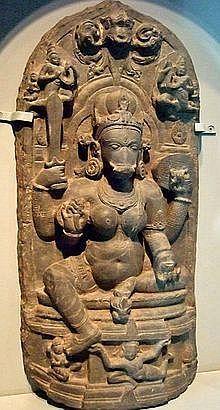
Continued in Part Four

References and Sources

The iconography of the saptamatrikas: by Katherine Anne HarperEdwin Mellen press ltd (1989-10)

Saptamatrka Worship and Sculptures by Shivaji K Panikkar; DK Print World (1997).

The Roots of Tantra by Katherine Anne Harper (2002)

Hindu Goddesses: Vision of the Divine Feminine in the Hindu Religious Traditions by David Kinsley; (1987)

Tribal Roots of Hinduism by SK Tiwari; Sarup and Sons (2002)

The Portrait of the Goddess in the Devī-māhātmya by David Kinsley

The Little Goddesses (Matrikas) by Aryan, K.C; Rekha Prakashan (1980)

Goddesses in Ancient India by P K Agrawala; Abhinav Publications (1984)

The Tantra of Sri Chakra by Prof. SK Ramachandra Rao; Sharada Prakashana (1983)

Matrikas:

http://en.wikipedia.org/wiki/Matrikas

Sapta Matrikas and Matrikas

http://shaktisadhana.50megs.com/Newhomepage/Frames/forumframebodyindex.html

The mother goddess in Indian sculpture By Cyril Veliath

http://www.info.sophia.ac.jp/fs/staff/kiyo/kiyo37/veliath.pdf

Some discussions on the Skanda – Tantra and Balagrahas

http://manasataramgini.wordpress.com/2008/09/03/some-discursion-on-skanda-tantra-s-and-balagraha-s/

The Mahabharata of Krishna –Dwaipayana Vyasa (Book 3, Part 2) Section 229

http://www.bookrags.com/ebooks/12333/180.html

Devis of the first enclosure

http://shaktisadhana.50megs.com/Newhomepage/Frames/gallery/Khadgamala/1stenclosureB.html

 All pictures are from Internet

 
11 Comments

Posted by on October 7, 2012 in Devi, Saptamatrka


Tags: , , ,

Saptamatrka – Part Two

Continued from Part One

Origins and the Overview

10.1. The Saptamatrkas briefly referred to, earlier, in Part One in the context of Devi’s battle with the Asuras have indeed a very long history. They have their origins in various myths, legends as also in the beliefs and practices of the distant tribal mores. The Matrkas, perhaps, originated in the tribal traditions and folk cultures. They were the local goddesses who protected the village boundaries and fertility; took care of child growth, diseases, etc. They come in myriad names, forms and attributes.

10.2. The cult of the mother-goddess is woven into the fabric of our social, cultural and religious history. The Mother-goddesses have universal acceptance as well as a local relevance. They find more spontaneous expressions in rural communities. The faith in the mothers or spirits which afflict people, especially the children, is an ancient one; but, its epic forms came later. There are many different myths about the origins of the Matrkas in the Puranas and in the Tantra lore. Different versions of their origins are narrated in Mahabharata, Devi Mahatmya, Linga-purana, Matsya – purana, Bhagavata purana and Visnudharmottara purana.

Mohenjo-Daro seal

10.3. There are also attempts to trace back the origin of the Saptamatrkas to hymns of Rig-Veda and to the Indus seals. At several places in Rig Veda there are references to groups of goddesses or maids, in sets of three, seven or ten. But, they have no independent identity and have no distinct functions or names. For instance, there is a mention of Ten young unwed daughters of Tvashta, who together hold the babe, the new-born infant (RV: 3.29.13).There are references to seven red-sisters associated with Agni as his mothers or sisters. But, they are generally interpreted as seven tongues or flames of Agni. And again, there is the group of female deities referred to as mothers who supervise the preparation of Soma (RV: 10.102.4).

There is also another set of seven sisters, singing in chorus, who are invoked in charm against poison or snakebite; and who ‘carry away the venom, as far away, as the girls bear the water in their jars’ (RV: 1.164.3). Some have tried identifying these sets of Mothers or sisters as Saptamatrkas. Similarly, the seven female figures on the four seals of the Indus valley are also taken to represent Saptamatrkas.

I, however, reckon that all such readings are mere conjectures. And, both the sets of questions are rather vexed. At the most, the female figures on Indus seals might point to the then prevailing belief system and practices involving worship of female deities.

[The study of Indian religious traditions has to be approached today with some sensitivity and care. Today’s Hindus, Buddhists and Jains have their own traditions of scholarship and study, and their own ways of understanding themselves and their religions. At the same time, Western societies   have developed their own modes of understanding Asian religions, both popular and academic, and these undoubtedly have their own flaws and limitations.

It is therefore important to approach this subject-matter, rather cautiously , as if stepping into an unknown large and complex area, At the same time we also need to be unbiased; and, recognize the limits of our knowledge and insight into the very ancient bygone practices of the forgotten periods of pre-history. That problem is exacerbated by the horribly mixed up chronological conjectures based on scanty unreliable evidences. .

Therefore, no single point of view- textual, anthropological, internal or external – can be taken as absolute or primary. All or each of these may have some truth-content. It would, perhaps, be better to take a reasonably balanced view, integrating diverse perspectives. Such an approach, which tries to harmonize the key points of varied perspectives might, hopefully, lead us to broader understanding of the issue.]

10.4. The scholars, generally, are inclined towards the view that the Matrkas perhaps originated in the tribal traditions, as extension of the Mother-Goddess cult dating back to the time-less past. Matrkas, it is said, were originally, the village deities who came from non-Aryan beliefs and practices where they were looked upon as guardians of the house and village, presiding over childbirth and taking care of the children and preventing diseases. And, the village deities were later absorbed into the higher traditions and rendered as goddesses in the orthodox texts.

[The term ‘non-Aryan’ should not be construed to mean aboriginal or savage. We should bear in mind whatever is non-Vedic is not necessarily non-Aryan; and that the Vedic beliefs may not represent the whole of the old Aryan communities. Now, look at it in the other way:  idol-worship may not be Aryan; but, it is definitely a part of what is now known as Hinduism. And, Hinduism is enriched by countless tribal cultures and elements that are ’non-Aryan’.]

To explain: What is now called Hinduism was not made; but, it has grown over the centuries by absorbing, transforming and reforming various cult and tribal beliefs and practices, many of which were vague and amorphous. The Hindu culture, philosophy and rituals are greatly enriched by countless tribal cultures. But, all the while it did retain the ancient concept of an all-pervading, Universal entity from which everything emanates and into which everything eventually returns. Some describe Hinduism as an inverted tree or a jungle; but not a strictly planned structural building.

The Hinduism of today is perhaps closer to the religion that existed during the Mahabharata times. But, it is far removed from the esoteric religion of the Rig Veda or the strict Vedic concept propagated by Swami Dayananada Sarasvathi.]

10.5. The Matrkas could be the synthesis of various Vedic and non-Vedic deities having relevance in their regional contexts, worshipped over a long period of time.

Balagraha

Balagraha

11.1. Among the diverse sources of the Matrka cult, the old belief in Balagraha (Baala = child; graha = seizers) is an important one. They are basically a group of nameless fearsome seizers who ‘possess’ or afflict children until their age of five (or sixteen, as per some beliefs). They are seen as threats to wellbeing of children; even having a tendency to steal children (Harti).

[Interestingly, Harati the child-snatcher also figures in Buddhist tales. According to the Buddhist legends, the childless victims of Hariti beg the Buddha to save them from her cruelty. The Buddha then, it is said, arranges to hide away Harati’s child in a secret place. After having lost her child, Harati in desperation,  searches all over the earth – in the cities, villages, forests, mountains, rivers  and islands etc. She even searches in the kingdoms of gods and Demons. At the end, after exhausting all other options, she appeals to the Buddha for help in retrieving her lost child. He points out that her suffering is insignificant compared to the combined suffering of all the mothers whose children she  killed. She agrees, though reluctantly, to give up her nasty habit of snatching away the children; and also promises to protect children, henceforth. At that, the Buddha returns her child, safe and sound.  Thereafter, Hariti becomes a disciple of the Buddha and joins the Sangha. Harati in Buddhism becomes a spirit (Yakshi) of fertility, childbirth, motherhood, and the protector of children ;and also  a Yakshi of healing.

harti-yakshi]

These tutelary deities or spirits, including Nagas, Pisachas and Yakshas, are derived from Lower Tradition. These are also addressed as goddesses, because, interestingly, the concept of Deva or god embraces all supernatural beings. It is said; all beings right from Brahma down to Pisachas are ‘gods’ (Brahmadayah Pisachanta yam hi deva upasate).

11.2. The Balagraha spirits are said to dwell in cross-roads, in cemeteries, on mountains, in caves, and on trees (vrikshi). Adorned with diverse kinds of ornaments, strange attire and speaking verities of languages they strike terror in the hearts of foes. They are feared because they are believed to endanger foetuses or infants; to hinder as also to aid conception, birth, ailments and protection of children. These deities perhaps symbolized the mixture of exhilaration, anxiety and fears of the risks associated with pregnancy; the innocence and joy of childhood; the horror of infant mortality; and the bewildering mystery in which these joys and fears are shrouded.

At another level, they personified the faith in tremendous powers of the folk deities to nurture or to destroy. The Balagraha were, naturally, feared and respected. And, the worship practices, prayers and offerings submitted to these spirits during formal rituals were motivated, mainly, by the anxiety and preoccupation with progeny; the propitiation of fertility and warding away of forces inimical to children.

[The ancient medical practitioners such as Charaka and Shushruta (Ca. 400 – 200 BCE) as also Vagbhata (Astanga-samgraha) deal with the diseases that afflict the children [K (a) umAratantra]. Some of the kumAra ailments are inherited while the others that cause disturbance of mind, depression and other psychic conditions are acquired from apparently unknown causes which defy explanations. The Uttara Tantra of a latter period (chapters 27 to 29)   prescribes medicines (oshadhi) to combat the kumAra afflictions, in addition to mantra-s (mantra prayoga) and ritual oblations, to appease the offending Bala graha-s (bhuta vidya).]

Kushana period

12.1. The Balagraha tradition seemed to prevail even during the Kushana period. But, The Kushana period (1st to 3rd century) was also the age of assimilation of various beliefs, concepts and practices surrounding the diverse types of deities. In this process, the Balagraha deities from Lower Tradition got entwined with the many legends surrounding the birth of Skanda or Kumara or Kartikeya. The Balagraha beliefs played a pivotal role in the formation of motif of mother and child.

The Kushanas as also Yahudeya warriors who brought down Kushana Empire were worshippers of Skanda. And, the tutelary deities Lokamatas associated with Skanda gained upward mobility from folk traditions.

12.2. The Kushana period sculptures depict groups of female deities in varying numbers having animal or human faces and carrying children .These figures came to be recognized as Matrka images. Their sculptures combined in themselves mutually opposing features: the maternal protection and the destructive wrath. These divergent aspects were symbolized by the child in their lap and by the weapons of war they carried. But, one of the major problems with the Kushana sculptures is in relating them to the goddesses portrayed in the texts.

Gupta period

13.1. The Gupta kings(400-600 AD)had a special affinity towards Skanda the Commander of the godly forces (Deva-senapati). The Gupta warriors adopted Skanda, the war god, as their mascot. Some of their kings took the names of Skanda. It was during the reign of Skanda Gupta (455- 467 AD) and Kumara Gupta (473-476 AD) that along with Skanda, the Devi and other goddesses associated with him gained prominence. A full-fledged goddess pantheon was brought forth.

shanmukha

Various folk and tribal goddesses, each with a distinct nature and form, were absorbed into the ambit of the Devi lore; and, they all converged to project one Great Mother Goddess Mahadevi. In another manner, various powerful and personified individual goddesses came to be regarded as her emanations.

13.2. During the Gupta period, a link was forged between Skanda, Kartikeya or Kumara and the Matrkas as his foster mothers. In the process, the Matrkas as also the other folk and tribal goddesses were elevated into the Higher Tradition. The Matrkas were raised to the nobility of court goddesses. And, their myths and legends were rendered into Sanskrit texts. Their iconic forms were standardized and developed into sculptural /iconographic depictions. Powerful and innovative images of the seven mothers started appearing   in various sculptures. Saptamatrkas, as a group, were depicted as beneficent goddesses but yet associated with fearsome aspects. In their individual portrayals only their benevolent aspects were projected.

It is said; one Mayuraksha, a minister of Visvavarman (contemporary of Kumara Gupta (473-476 AD), built a temple in honour of the seven divine Mothers. The repeated appearances of Saptamatrkas in the Gupta period emphasize their importance in the religious life of its common people.

13.3. The continued acceptance of the Matrkas as worship worthy deities   over long periods is also evidenced by their mention in Dramas and other texts of even the earlier periods. For instance, in poet Bhasa’s (second century BC to second century AD) unfinished play Daridra-Charudatta (Charudatta in poverty) and in its elaboration Mṛcchakaṭika (The Little Clay Cart) scripted by Sudraka (second century BC) there are scenes depicting worship of Matrkas. And, Natyasastra of Bharata, also around second century BC, recommends worship of Matrka, Natya-mata, as a part of consecration of the stage and the play-house (natya-griha).

And in much later times, it is said, the early Kadambas of Banavasi (345–525 AD) and their subordinates the early Chalukyas (543–753 AD) worshipped Matrkas. Later, Banabhatta’s monumental poem Kadambari (606–647 AD) also refers to Matrka worship by the forest dwelling tribes Shabaras. And, mentions that their chieftain was an ardent believer of mother goddess Katyayani. Incidentally, the Shabara tribe played an important role in the political history of ancient India. They aided the foundation of Maurya Empire (see Visakhadatta’s Mudra-rakshasa).

14.1. When you look back, you find that during the Kushana period along with the acceptance of Skanda and different mothers into the Vedic fold it also led to taming of the dangerous Balagrahas through the infant. The Kushana figures were inspired by the mother and child motif of the Balagraha traditions. The Gupta period improved upon the Kushana figures and rendered them into classy sculptures naming them as Saptamatrkas. The Ayudha-purusha the arm-bearing guards of the Kushana figures were replaced during the Gupta period by Ganesha and Veerabhadra.

The concept of Saptamatrka was however derived from Devi Mahatmya and Puranas, where the Saptamatrkas are basically ferocious looking female warriors. They are fundamentally different from the Balagraha deities that hinder the child. Yet, the Saptamatrka sculptures were patterned after the Balagraha depictions. Conceptually, the Saptamatrka of the later traditions have nothing or very little to do with Balagraha. Amidst these contradictions, it is the child that links the three traditions.

Puranas

15. It is in the Puranas that the Matrkas find their definite forms and acquire distinct personalities. Most of the Puranas, it is believed, came to be written by about 250 AD, though exact periods are not known. During the Gupta period (400-600 AD), hailed as the Golden Age, innovations were made in art and literature. In the words of Ananda Coomaraswamy “it was indeed the classic phase of Indian art, at once serene, energetic and voluptuous”. It was an age of revivalism. This was also the period when Puranas were expanded or reinterpreted. This literarily production was ground breaking; bringing the lore of gods and goddesses closer to common people.

The battles

15. 1. The one myth that is of great importance in the conception of Saptamatrka is the recurring battles between the Devas and Demons. The conflict is so fundamental that the theme persists as a central motif throughout the evolution of the orthodox religion and particularly that of the Shaktha sect. The conflict finds its reflection in a variety of shades of interpretations. It also provides legends explaining the origin of various groups of deities such as: Dasha Mahavidya; Navadurga; Matrkas and others.

The appearance of the Saptamatrkas to assist Devi in her battle with the Asuras, as detailed in Devi Mahatmya (a portion of Markandeya purana), is one among the many versions of their origins associated with battles against the Demons.

Here, Matrkas arise from different parts of Devi; and are described as militant, ferocious, goddesses of the battlefield having sinister as well as propitious characteristics. After the battle, the Matrkas dance drunk with their victim’s blood.

15.2. According to another version, during the battle against demons Shumba and Nishumba, the Matrkas emerge from the bodies of gods- Brahma, Vishnu Shiva, Skanda and Indra.

15.3. As per the narration in Matsya Purana, Shiva created the seven Matrkas to assist him in his combat against the demon Andhaka. After the battle, the Matrkas go on a rampage destroying the beings of the world. The destructive Matrkas are eventually pacified by the benign goddesses created by Lord Narasimha.

15.4. In the Suprabhedagama it is said these seven Matrkas were created by Brahma the purpose of killing the Demon Nirrita.

15. 5. Varaha Purana carries an interesting sidelight. It mentions that the Matrkas were created from the distracted mind of goddess Vaishnavi while she was trying hard to meditate. These Matrkas are described as lovely looking attendants assisting the goddess on the battlefield.

15.6. Similarly, in the battles carried out by Skanda –Kartikeya as the Supreme commander of the Army of Devas, replacing Indra, Mahabharata (Book 9; Shalya parva; Section 46) mentions that as many as ninety-two or more female warriors assist him (Please click here for the list); and fight the demons along with him. Among the unwieldy group of female warriors were a cluster of goddesses – Matrkas. Some of these Matrkas are described as having youthful lovely form, cheerful demeanour and fair skin; while the others were having long nails, large teeth and protruding lips, striking terror. They all were valiant like Indra in battle.

Other accounts

16.1. Apart from such wide-ranging narrations which are related with battles, there are other accounts connecting Matrkas with Skanda. In one of the legends associated with Skanda detailed in the Vana-parva (215.16) of Mahabharata, the Matrkas known as Lokamatas are a host of ferocious and terrifying beings sent by Indra to kill the infant Skanda, shortly after his birth. They function as a group and all references to them are as a group. They are inauspicious beings with loathsome qualities and untidy habits.

16.2. The subsequent episode related with Skanda (in the same text) mentions that the Matrkas emanated from the sides of Skanda when struck by Indra’s thunderbolt. Skanda divides the host of fierce goddess into Shiva (auspicious) and A-Shiva (inauspicious) groups. Yet all were said to be of rather malicious nature.

16.3. Yet another version mentions them as Krittikas, the desolate wives of six sages (Rishi) driven out by their husbands; and then adopted by Kartikeya as his foster mothers. They come to be known as Maha -matrkas.

Malevolent nature of early Matrkas

17.1. Most references in Mahabharata state that the Matrkas are inauspicious; and are dangerous to children. Though they eventually serve Kartikeya as his mother, their initial task was to kill him.

17.2. The malevolent nature of the Matrkas is also seen in several passages of Bhagavata Purana, where they are listed under Ugras, Rakshasas, Pisachas, Bhutas and other dangerous kind of beings (BP: 2.10.37-39). Elsewhere in Bhagavata Purana they are mentioned along with Bhutas, Dakinis, Vetala , Pretas and Pisachas and other terrible beings as parts of Shiva’s  entourage (BP:10.83.6.ff). They are commonly understood as dangerous groups of female spirits or goddesses.

17.3. In the same vein, another list of ten female sprits is mentioned. All of them serve inauspicious purposes and have hideous forms tormenting children until they are sixteen years of age.

Unfolding of the Matrka cult

18.1. The various accounts of the Puranas if taken together suggest an evolution, assimilation and the gradual unfolding of the Matrka worship. Their association with Skanda enabled the upper mobility of the tutelary goddesses. And, as Skanda began to assume an independent godhead status in the neo-Vedic pantheon, the Matrkas came to be increasingly associated with Ambika or Durga whose cult was gaining ascendency during the ideological consolidation that was taking place during the Gupta period.

During the process of assimilation, over a period, the groups of untamed destructive female forces were reformed and brought into the broad theological view cantered upon the concept of Shakthi. The Vedic preoccupation with number seven (the concept of heptads) crept in, and the Matrkas were crystallized into Saptamatrka, a group of seven goddesses.

Thus, the innumerable tutelary mother goddesses who were accepted into the family of Skanda were supplanted by the new standard seven mothers. The names of the previous mother goddesses gradually faded into background and finally disappeared. The Saptamatrkas are thus the systematized and refined forms of the earlier Matrkas

Tantra

19.1. The Krittikas and others were not regarded as worship worthy goddesses. The Puranas also do not specifically recognize them as powers though they assert that all feminine principles are aspects of Devi.

19.2. Therefore, the concept of Saptamatrka as Shakthi was not derived from these Puranas. It came up through another source, which is the Tantra ideology. The study of the development of Shakthi cult might enable us to locate the origins of the Matrka concept in that tradition. Here, the embodiment of potent feminine forces (shakthi) are generally named matr or matri; and in group as matrgana. They are called Matrka (mata iva), meaning mother (matr)-like (ka).

The term Matrkas, therefore, generally refers to groups of mother-like deities. They are the personified energies of the gods (Deva Shakthi) and are described as universal mothers (vishvasya mataraha).

9.3. In Tantra, Matra also refers to the letters of the alphabets that are regarded as the perceptible forms or the aspects of the Mother; and hence are termed as Matrkas, the mother-like who attend on the Great Mother and approximate her to some extent. It is believed that the fifty-two alphabets of the Sanskrit language emanated from the Mother (matrka-mayi); and she takes the name in every one of them*.

During the ritual worship of the Mother, her presence is invoked in the body of the Sadhaka through a procedure known as anga-nyasa or consecration of the different parts of the body. The invoking of the Mother – Matrika Nyasa – along with the five elements is a significant ritual. It is meant to emphasize   that you belong to the Mother; and you are sanctified by her presence in you.

[* For the purpose of daily recitations, each of the fifty-one alphabetic letters (Matrika) is extended , in the given order,  into a name of the Devi: .]

Amrita Aakarshini Indrani Iishani
Uma Urdhva-keshini Ekapadini Aishvari
Omkarini Aishadhantika Ambika Aksharatmika
Kalaratri Khatita Gayatri Ghantadharini
Narnatmika Chanda Chaya Jaya
Jhankarini Jnanarupa Thankahasta Thamkarini
Damri Dhamkarini Namini Tamasi
Thamini Dakshayani Dhatri Nanda
Parvati Phatkarini Bandhini Bhadrakali
Mahakaya Yashasvini Rakta Lambobosti
Varada Shashini Sarasvathi Hamsavathi
and Kshamavathi

.

Another explanation is also based in the structure of the Devanagari alphabet. First is the (a) group (varga) which contains the vowels, then the (ka), (cha), (ta), (ta), (pa), (ya) and (ksha) groups. It is believed; the seven mother goddesses (Saptamatrka) correspond to the seven consonant groups (Vargas); and, when the vocalic (a) group is added, the eight mother goddesses (ashtamatrkas) are obtained.

In this grouping;

  • Brahmi is associated with ka-varga,
  • Maheshwari with Cha-varga,
  • Kaumari with Ta-varga,
  • Vaishnavi with Tta –varga,
  • Varahi with Pa-varga,
  • Indrani with Ya-varga and
  • Chamunda with Ksha-varga.

It is said, the eighth Matrika, Mahalakshmi is the presiding deity of A-varga.

19.5. Kashmir Shaivism (around eleventh century) explains Matrka as the binding energy that makes it possible to understand words or symbols strung together as language. Its text Siva Sutra defines Matrika as ‘the ground of all knowledge ’(jñānādhisthāna mātrikā- Shiva Sutra:1-4).Matrika is the subtle force behind thought and speech.

19.6. One of the fundamental concepts of Kashmir Shaivism is that our mind, in the form of words, concepts, and ideas, is the source of bondage and suffering. And, as long as we do not understand the true nature of matrika, we are bound by worldly actions and feelings ­, without ever really understanding the source of their power over us.

19.7. Another Tantra-text Lakshmi Tantra declares “Matrika is the source of all mantras, the origin of all sciences and the soil from which all the principles, all the sages and all knowledge are born.” Matrika Shakthi is the power of sound that is the matrix of the cosmos; and manifests as the letters in the alphabet.

Tantra Shastra says that Devata and Mantra composed of letters (Matrika), are indeed one. Matrika is Shakthi and Shakthi is Shiva.

19.8. In Tantra, Matrika chakra formed by the group of letters is based on the understanding of the essential power of the word; and by regarding the word as god. Each letter, Matrika, is a power in its own right. Each is a microcosm that holds within it the macrocosm. That is the reason; the whole of Matrika chakra is looked upon by some as the primal alphabet, the essence of all alphabets. And, from this alphabet, according to this tradition, the whole universe arises.

It is also said; in the Matrika Chakra, the sixteen vowels from ‘a’ to ‘ah’ represent the energies of Shiva. And their unity with Matrika ‘m’ creates the universal mantra of Shiva ‘aham’.

19.9. And in Shaktha traditions, Matrkas, the sounds, their vibrations and the combination of vibrations interacting with one another is regarded as   Matrika Shakthi the creative energies that manifest. All things are forms of creative energy, the Shakthi, which is never separate from Shiva, the Absolute.

As regards the Saptamatrkas, in particular, it is said; they represent the seven seed (bija) sounds, comprising five pure-vowels (a, i, u, r, lr) and two compound vowels (e and o).

19.10. Durga the great goddess and the Saptamatrka share certain common features; and also have certain differences. Both were created by the Will of the Gods; and both are the feminine aspects of the energies (tejas) of the Gods. However, in Durga the diverse energies converge to form a unified powerhouse; while in the case of Saptamatrkas various energies remain independent though bound into a group. The seven goddesses are not consorts of male gods, but are the independent aspects of Devi.

20.1. Thus, it is the Shaktha and Tantra ideology, its magical rites and esoteric exercises that provide a distinct significance and life to the cult of Matrkas. In the Tantra, Matrkas emphasize the primacy of the female over the male principle. Usually, they are known as a group; and, are visualized primarily as Shakthi’s potent power of male gods. Their numbers are often indeterminate; although some texts mention them as five, seven, eight, eleven or sixteen. 

They have common attributes and forms associated with the auspicious and, often, with the inauspicious. The various references and epithets of goddesses in the later Vedic and Tantra texts belong either to the sphere of militant goddesses or to the benevolent motherly, fertility deities.

Symbolisms

Matrika

21.1. The Saptamatrka symbolisms were rationalized in the Tantra and Yoga theories. The infant who nestles in the lap of each Matrika is indeed the Sadhaka in care of the Mother. He is reborn at each stage of his pursuit. The weapons held by the goddesses are symbolic of the wars waged on ego and ignorance, as the Sadhaka strives to overcome them.

The Sadhakas such as Ramaprasad and Sri Ramakrishna described themselves as children in the lap of their mother. Even while the mother is angry the child clings to her for love, warmth and protection. In the words of Ramaprasad; you can never separate the bond between a child and a mother. Though she beats it, the child clings to its mother crying, “mother, oh mother”.

21.2. The infant was also seen as a symbol of the benign energy needed to counteract and balance between the negative and the positives forces

21.3. Varaha Purana interpreted the Matrkas as symbols of Atma Vidya or spiritual wisdom that fought against the dark forces of ignorance embodied by the Demon Andhakasura.

21.4. The Tantra-text Tantra-raja-tantra (27; 56 ) relates Matrkas to eight types of vices or inauspicious emotions like envy, pride, anger etc: 

  • Brahmi of pride (mada);
  • Maheswari of anger (krodha);
  • Vaishnavi of greed (lobha);
  • Varahi of envy (asuya);
  • Kaumari of attachment (moha);
  • Aindri of jealousy (matsarya); 
  • Chamunda of depravity (paisunya); and
  • the eighth Yogeshwari represents lust (kama).

Vishnudharmottara Purana and Varaha Purana (17.33-37) also carry similar narrations.

But, Tantra-raja-tantra (36; 15-16) at another place identifies :

  • Brahmi with the primordial desire to create (Kama);
  • Maheshwari with the tendency to degenerate and dissipate (krodha);
  • Kaumari with the youthful longings to be and to enjoy (lobha);
  • Vaishnavi with power to fascinate and delude (moha);
  • Varahi with pride and arrogance (mada);
  • Indrani with jealousy and envy (matsarya);
  • Chamunda with urge to sin (papa) and hurt (abhichara); and ,
  • Mahalakshmi with doing good (punya) for selfish reasons.

21.5. In Tantra and Yoga rituals the Matrkas are worshipped with prayers to suppress and overcome the evil tendencies that obstruct the progress of the devotee .Thus, Matrkas and Yoginis perform vital roles in the Diksha rituals of the adepts.

21.6. In the Sri Vidya tradition, the Matrkas are regarded as the guardians   and are seen as residing in the second line of Bhupura of Sri Chakra, in each direction. They are the guides, protectors and removers of obstructions .The the Sadhaka worships and prays to them as she/he enters into Sri Chakra on her / his way seeking identity with the Great Goddess.

21.7. Mahanirvana Tantra however regards the Matrika –Trinity of Brahmi, Vaishnavi and Maheshwari in an entirely different light. They are worshipped as three aspects of Goddess Gayatri. It asks the Sadhaka :

“In the morning meditate upon Her ( Devi Gayatri)  in Her Brahmi form, as a Maiden of ruddy hue, with a pure smile, with two hands, holding a gourd full of holy water, garlanded with crystal beads, clad in the skin of a black antelope, seated on a Swan (56).

At midday meditate upon Her in Her Vaishnavi form, of the colour of pure gold, youthful, with full and rising breasts, situated in the Solar disc, with four hands holding the conch-shell, discus, mace, and lotus, seated on Garuda, garlanded with wild-flowers (57-58).

In the evening meditate upon Her Maheshwari as of a white colour, clad in white raiment, old and long past her youth, with three eyes, beneficent, propitious, seated on a Bull, holding in Her lotus-like hands a noose, a trident, a lance, and a skull (59-60).  

[Mahanirvana Tantra -Translated by Arthur Avalon (Sir John Woodroffe)-1913]

22.1. In Yoga, the seven mothers are the symbols of progress as the Sadhaka aims to refine his consciousness.

 Each Matrkas is identified with a level of existence, a state of consciousness and Chakra, the energy centres in the subtle body.

And, each associated with an alphabet (Matra) is a Matrika Shakthi. They are viewed as parallels of Sat-chakras raising the consciousness to the seventh point- the Sahasrara.

The seven padmas (lotus) along the shusumna are visualized as the seven seats of feminine power (shakthi) – the Kundalini.

To pass from one Matrika to the next is to be born afresh. To reach and surpass the seventh mother is his final birth, that of non-birth which is the release (moksha).

[The Tantric Buddhism also adopted Saptamatrikas in its practices. The powers, attributes and functions of the Buddhist Matrikas are in line with those of their Vedic counterparts. The composite figures of seven-mothers appear in Nalanda. And, the Buddhist goddesses Vajravarahi and Marichi are believed to have their origins in Varahi the Matrika.

Similarly, the Jain mother-goddesses having names of Chakreshvari, Ambika, Padmavathi and Sidhayika are similar, in nature, to Matrikas.]

Conflicts and resolutions

23.1. Taken together, over a long period, one can see that the Matrkas are dichotomous personalities. There are layers and layers of their identities. They are complex deities who bring together the opposing concepts of death and fertility; autonomous female warriors and consorts; protective mothers and those who endanger children. And, later they are transformed into spiritual guides and protectors.

23.2. Sometimes, they are described feminine forces who derive their names and attributes from male gods; hence, they are taken to imply the coexistence of male and female principles. Yet the female is dominant. Matrkas, unlike the consorts of male gods, are relatively independent goddesses. When portrayed individually they are depicted as benevolent and graceful mother-like goddesses. But, in group they appear as warriors.

23.3. Among the sets of contradictions that are bundled together within the Matrkas is the manner they are depicted in sculptures. There is an obvious mismatch between their descriptions in the Puranas and their depictions in sculptures. The icons are hardly related to the narrative content. The Matrkas of the Puranas are basically militant, ferocious, blood-drinking warriors on the battle field, assisting Devi, Shiva or Skanda in their battles against the Demons. They are not referred to as mothers; nor is there a reference to their ‘motherly-qualities’.

Yet, in their sculptural portrayals they are depicted as benevolent, caring mothers. Their motherliness is often emphasized by the playful attitude towards the children they carry on their laps. These Mothers are radiant and graceful and expressive, conveying a refined simplicity. At the same time, the Ayudhas they hold imply quite a different kind of attributes.

There is basic conflict in their projection right from their earliest stages. And, yet their associated symbolisms are retained; and there is harmony in their overall structure and countenance.

23.4. Thus, over the ages, in the course of their long and protracted stages of evolution, the Matrka deities acquired a wide range of ideological, literary, visual and ritual representations. They have become an integral part of the religious and historical process of the Indian society. Initially they were feared as being inauspicious or sometimes even as dangerous spirits; but later, they were the guardians or benefactors, the mothers who watch over children with care and concern.

They also came to be worshipped as guiding divinities on the way to ones spiritual attainments.

That became possible, perhaps, because they managed to harmonize several sets of contradictions; and internalized varied conflicts at each stage of their development. Their character and nature too modulated to be in tune with the context of different periods.

23.5. Conflicts and resolutions mark the story of their evolution from tribal –folk deities to the guardian Shakthis of Tantra and Sri Vidya. They epitomize the coexistence of disparate elements and stages of religion from primitive to the sophisticated.

Overview

24.1. The formative stages of the Saptamatrka cult unfold at the beginning of Kushana period and during the Gupta period. The Matrkas gained importance in the Higher Tradition during times of Kushanas (1st to 3rd century). And, during the reign of Guptas (3rd to 6th century) the Matrkas were elevated as foster-mothers of Skanda; and upgraded to court goddesses. They are brought into orthodox fold through various Puranas. They are grouped into the auspicious number of seven (Saptamatrkas) and rendered into worship worthy goddesses.

24.2. In the medieval periods the numbers and names become standardized. In this period, they take on the names and characteristics of the male gods. Despite their names and associations with the male gods they are not treated as consorts of male gods; but are regarded as extensions of Devi herself.    

Their appearances and dispositions too get modified. Matrkas are, now, no longer warrior deities or those spirits that harm children; but are goddesses and benign guardians who act as guides in Tantric Sadhana. They are recognized as inherent powers residing in the major Devas (Deva Shakthis); and, are worshipped for spiritual uplift (Mukthi) as also for earthly comforts (Bhukthi).

24.3. They as an auspicious group of seven (Saptamatrkas) are depicted on temple walls. The Pallava temples (7th – 8th century) like Sri Kailasanatha carry panels of Sapta Matrkas. The later Chola temples continued on the tradition by depicting them in rows or in panels either standing or dancing, flanked by Ganapathi on one side and Veerabhadra or Shiva on the other.

25.1. The evolution from the Balagraha deities to the conceptions of varied Matrkas of Kushana period; then to the court goddess of the Gupta era; and then on to the Saptamatrka divinities of the medieval times is viewed as a natural process. It is a process of shift from Lower Tradition towards the worship of Shakthi as the embodiment of energies inherent in the gods and in all nature. The Saptamatrka worship further evolved within the Shaktha sect through its theologies of Higher Tradition. The developments within the Tantra and Yoga ideologies accorded greater importance to Saptamatrkas.

25.2. The Matrkas, however, lost much of their significance and position in the popular religious practices during the middle centuries. But, they continued to appear in temple panels and niches. Today, they linger on the fringes of the Hindu pantheon.

In the next part let’s take a look at the textual sources and references to Matrikas.

Continued in Part Three

References and Sources

The iconography of the saptamatrikas: by Katherine Anne HarperEdwin Mellen press ltd (1989-10)

Saptamatrka Worship and Sculptures by Shivaji K Panikkar; DK Print World (1997).

The Roots of Tantra by Katherine Anne Harper (2002)

Hindu Goddesses: Vision of the Divine Feminine in the Hindu Religious Traditions by David Kinsley; (1987)

Tribal Roots of Hinduism by SK Tiwari; Sarup and Sons (2002)

The Portrait of the Goddess in the Devī-māhātmya by David Kinsley

The Little Goddesses (Matrikas) by Aryan, K.C; Rekha Prakashan (1980)

Goddesses in Ancient India by P K Agrawala; Abhinav Publications (1984)

The Tantra of Sri Chakra by Prof. SK Ramachandra Rao; Sharada Prakashana (1983)

Matrikas:

http://en.wikipedia.org/wiki/Matrikas

Sapta Matrikas and Matrikas

http://shaktisadhana.50megs.com/Newhomepage/Frames/forumframebodyindex.html

The mother goddess in Indian sculpture By Cyril Veliath

http://www.info.sophia.ac.jp/fs/staff/kiyo/kiyo37/veliath.pdf

Some discussions on the Skanda – Tantra and Balagrahas

http://manasataramgini.wordpress.com/2008/09/03/some-discursion-on-skanda-tantra-s-and-balagraha-s/

The Mahabharata of Krishna –Dwaipayana Vyasa (Book 3, Part 2) Section 229

http://www.bookrags.com/ebooks/12333/180.html

Devis of the first enclosure

http://shaktisadhana.50megs.com/Newhomepage/Frames/gallery/Khadgamala/1stenclosureB.html

 All pictures are from Internet

 
5 Comments

Posted by on October 6, 2012 in Devi, Saptamatrka


Tags: , ,

Saptamatrka – Part One – Devi

This article is primarily about the Matrkas –  the mother-like deities. But, I cannot resist talking about Devi,  the Great Goddess. Let’s dwell on Devi for a while before we proceed to the Matrkas.

goddess_maha_shakti_hi49 (1)

Mother

1.1. The concept and worship of God as Mother dates back to the hoary past. And, it continues to represent a very important but intricate aspect of the Indian philosophies, religions, arts and literatures. The faith in Mother Goddess permeates the consciousness of Indian people at all levels. And, it has influenced all segments, emotional aspects and intellectual ideologies of Indian life. Even the Indian landmass is idealized and pictured as Bharat-Mata, as a tall beautiful woman with long flowing hair, dressed in a sari, wearing a crown upon her head and holding a trishul in her hand.

Bharath Mata.2 jpg

The vision of nation as Mother that charged the hearts of the 19th and early 20th century patriots and freedom fighters is epitomized by the immortal anthem ’Vande Mataram’. And, indeed the whole of the earth is looked upon as Dharti-mata.

1.2. But, in essence, the archetype Mother-images don’t really refer to any concrete or physical Mother existing in space and time. But, it truly is a yearning towards an inward image of Mother in our collective psyche. It’s symbolic expressions abound in myths, legends, rites and arts of various types spread over the ages across the regions, sects and sub sects that make what we now call India. They also pervade our private worlds of dreams, fantasies and emotional outbursts, finding their expressions in myriad forms of creative art – the sublime as also the sick. They exist/existed in all classes of societies, matriarchic or patriarchic or otherwise.

Devi Mahatmya

Manuscript of the Devimahatmya

[While you read, you might like to listen to Mahalaya rendered by Shri Birendra Krishna Bhadra. Please RIGHT click here:

https://www.youtube.com/watch?v=JXDnhN-hPT4]

2.1. Most of the Puranas, it is believed, were rendered into written form by about 250 AD, though the exact periods are not known. The Gupta period (400-600 AD) hailed as the Golden Age witnessed innovations in art and literature. It was the age of revivalism. This was also the period when Puranas were expanded or reinterpreted. This literarily production was ground breaking. It brought the lore of gods and goddesses closer to common people. Each Purana was dedicated to the glorification of a particular god such as Vishnu or Shiva. However, some Puranas devoted exclusive chapters to narrate the legends of the Great Goddess Devi. One such Maha-purana was Markandeya-purana (Ca.250-400 CE). In its Section of thirteen chapters – Devi Mahatmya- it celebrated the glory of Devi as the Great Mother the Supreme Deity.

[ Please do read the detailed analysis of the Devi Mahatmya : The Glory of the Goddess-Devi Mahatmyam by Dr. Satya Prakash Choudhary

Please check here for Sri Durga Saptashati in translation; and , check here for an analysis of the structure of Sri Durga Saptashati ; both prepared by the researcher Mr. Ranjan , Mukesh]

2.2. Of all the Indian texts, the Devi Mahatmya, in particular, has been instrumental in establishing the all comprehensive nature of the Mother as the Supreme God, Mahadevi – the Great Goddess. Some believe, the text is the starting point for investigating into the nature of feminine transcendence. She is the Power – spiritual, moral, mental, biological, and psychological as well as physical. It is believed that Devi Mahatmya brings together various ancient traditions of female deities and their worship.

Devi777

The Devi Mahatmya celebrates, in particular, the glory of the Mother and her martial deeds. It adulates Devi as the greatest warrior; and rejoices Devi as Chandi the destroyer of evil and its tendencies. She is the protector of the world from demons; and she does so from time to time by assuming various forms. She is also Ambika the mother who protects; and also Durga the goddess who saves us from all sorts of miseries and difficulties. And, it is She who, just as a boat, takes the devotees across oceans of existence (Bhava-Tarini). Her splendor and beauty is sung   and exalted by countless other names and forms.

The text is the celebration of the limitless powers and the splendor of the Mother Goddess. It affirms its faith that   the ultimate power (Shakthi) and authority in the Universe reside in Devi. She encompasses and overrides everything in the Universe. She is the ultimate reality.    Devi Mahatmya asserts its faith that her Ultimate reality is really the ultimate; and it is not merely feminine.

2.3. The Devi Mahatmya dated somewhere around the fourth- fifth century , also renowned as Durga SaptasatiDurgapathaChandi, Chandipatha or Chandi Saptashati, is composed as a long poem of seven hundred verses (Saptashathi) ** arranged over thirteen   chapters which are grouped into three sections: Prathama Charitra, Madhyama Charitra and the Uttama Charitra. It is accompanied by glorious   hymns in praise of the Mother Goddess and her Shaktihis who descend upon earth from time to time to rid the world of demons and evil-doers.

The Devi Mahatmya centered on Devi (as mentioned earlier) is originally a section (chapters 81-93) of the Markandeya Purana. The importance of Devi Mahatmya is so huge and its uniqueness so significant that it has come to be recognized as independent of its parent text. Over the centuries, the Devi Mahatmya has acquired a number of subsidiary texts (anga) that are mainly concerned with the ritual worship of the Devi.

The thirteen chapters of the Devi Mahatmya, the Chandi, are grouped into three sections comprising of three major episodes (caritras), each one describing the glory of one of the three different aspects of the Supreme Goddess; the three Goddesses identified as Maha-Kali, Mahālakṣhmī and Maha-Sarasvathi. The three forms of the Devi correspond to three Gunas: Maha-Sarasvathi (Sattva), Mahālakṣhmī (Rajas) and Maha-Kali (Tamas). Although they are represented as three distinct images, they are virtually one; and, this is true not only for the three Goddesses, but also for all other forms of the  Maha Devi , the Supreme Goddess.

[**There are 537 Sloka mantras (full Slokas); 38 Ardha-sloka mantras (half Slokas); 66 khanda mantras (part of a Sloka); 57 Uvacha mantras; and, 2 Punarukta mantras, totalling 700 altogether. The number 700 is thus not related to the number of verses, but indicates the total number of mantras in the Devi Mahatmya. Though the details of the breakup of the mantras is not important for simple recitation, these details are important for Chandi Homa, Japa and Archana.]

Navaratri

The unique feature of Devi Mahatmya is its oral tradition and the intense devotional fervor of its hymns. And, therefore the entire text is revered as a Mantra*.   Its popularity is immense. It is recited for averting calamities   in life; and at dire times when the country is under threat of attack; as also for overcoming impurities: Mala, Vikshepa and Avarana. And, as the text itself says, it bestows not only temporal prosperity but also illumination by destroying the darkness of Avidya.  The recitation of Devi Mahatmya is an integral part of the Devi-worship celebrations performed during Sharad Navaratri and Chandi Yajna; as also of Tantric Sadhana involving   Sat-chakra – behda.  The Dura-puja festivities commence with the recitation of Devi Mahatmya on the night of the last day of pitri-paksha (the fortnight of the Pitris).

[* Sri Swami Krishnananda explains “The Devi Mahatmya is treated as if it were a Mantra   . Each of its episodes (charita) is associated with a Rishi (the sage who visualised it) , a chandas (its meter), a presiding deity ( pradhna-devata), and viniyoga (for japa).He further says that every sloka of the Devi-Mahatmya is a Mantra by itself. For instance, the opening sloka of Devi Mahatmya: “Savarnih suryatanayo yo manuh Kathyate-shtamah” is ordinarily taken to mean “Listen to the story of the king who is the eighth Manu” .But, it is in fact a mantra, he says; and its Tantric interpretation is: “Now, I shall describe to you the glory of Hreem“. The Swami explains; Ha is the eighth letter from among: Ya, Ra, La, Va, Sya, Sha, Sa, and Ha. And add to that ‘Ram’ the Bija of Agni and one hook to make ‘Hreem’. Here, Hreem is the Bija-mantra of Devi; and, is equivalent to Pranava mantra Om. ]

The text of the Devi Mahatmya also celebrates the glory and splendour of the auspicious Devi in four sublime hymns. Bhaskararaya Makhin (18th century) regards these hymns as Sruti-s (revealed wisdom), the exalted revealed (Drsta) knowledge, equalling the Vedas, than as made, the Krta.

Devi

The four hymns are:

:- Brahma-stuti (DM. 1.73-87) starting with tvaṃ svāhā tvaṃ svadhā tvaṃ hi vaṣaṭkāraḥ svarātmikā;

:- the Sakaradi-stuti (DM.4.2-27) starting with śakrādayaḥ suragaṇā nihate’tivīrye;

:- the Aparajita –stuti (DM.5.9-82) starting with namo devyai mahādevyai śivāyai satataṃ nama ; and,

:- the Narayani-stuti (DM.11. 3-35) starting with devi prapannārtihare prasīda.

These hymns describe the nature and character of the Goddess in spiritual terms:

The Brahma-stuti (DM.1.73-87) also known as the Tantrika Ratri Suktam, establishes the Divine Mother’s ultimate transcendence and her identity  as the creator and sustainer and the dissolver of the Universe. She is all compassing source of the good and the evil, alike; both radiant splendour and terrifying darkness. And yet, she ultimately is the ineffable bliss beyond all duality.

In the longest and most eloquent of the Devi Mahatmya’s four hymns, richly detailed Sakaradi-stuti (DM.4.3-27) Indra and other gods praise Durga’s supremacy and transcendence. Her purpose is to preserve the moral order, and to that end she appears as ’good fortune in the dwelling of the virtuous; and, misfortune in the house of the wicked’, granting abundant blessings and subduing misconduct (DM.4.5). ‘Every intent on benevolence towards all’ (sarvo-upakāra-karaṇāya sadārdracittā DM.4.17), she reveals even her vast destructive power as ultimately compassionate, for in slaying those enemies of the world who ‘may have committed enough evil to keep them long in torment’ (kurvantu nāma narakāya cirāya pāpam – DM.4.18) , she redeems them with the purifying touch of her weapons so that they ‘may attain the higher worlds’ (lokānprayāntu ripavo’pi hi śastrapūtā/ itthaṃ matirbhavati teṣvahiteṣusādhvī –DM.4.19).

The Devas , distressed that the Asuras have re-grouped and once again overturned the world-order , invoke the Devi in a magnificent hymn , the Aparajita-stuti or Tantrika Devi Suktam, the twenty slokas beginning with ‘ya devi sarva bhuteshu , praise to the invincible Goddess , which celebrates her immanent presence in the Universe as the consciousness that manifests in all beings (yā devī sarvabhūteṣu cetanetyabhidhīyate) . Thereupon the Devi appears on the banks of the Ganga. Her radiant manifestation emerging from the body of Parvathi embodies the Guna of Sattva, the pure energy of light and peace. Later, She takes on multiple and varied forms in the course of the battle with the Asuras.

The final hymn, the Narayani-stuti (DM.11.3-35) lauds the Devi in her universal, omnipresent aspect and also in the diverse expressions of her powers .Thereupon, the Devi  assures to protect all existence and to intervene whenever evil arises.

Durga Puja

2.4. Devi Mahatmya is not a Tantric text; but is the basic text for the Shaktha cult. The Shaktha theology was derived from the triad of: the primacy of Prakrti as in Samkhya; the monistic Brahman as in Advaita; and, the ritualism of Tantra. It staunchly believes in the supremacy of the female principle. And, it idealizes Devi the Mother Goddess in most abstract philosophical terms as Shakthi the primal energy of all (sarvamayi) that is manifest (jadathmika) and un-manifest (Arupa). She is beyond all forms and gunas, but assumes them to create and operate the world.

At another level, the Shaktas  worship the Devi Durga , who is beyond, as an independent Supreme Divinity. She is the primordial energy and was the first to appear before everything (sarva-sadhya); She is both devoid of form (nirakara) and filled with forms (sakara);   She is both manifest and unmanifest; She is the essence of all things (sarva sattva mayi). She creates and governs all existence (Isvari), and is known by various names (nana-abhidhana-brut). She is the Mother of the worlds (Jagadamba) and sustainer of the worlds (Jagad-dhatri).  Everything in the universe is a minute expression her inscrutable power (Yoga Maya). She is the ultimate goal of yoga.  She is the creator of the Trinity: Brahma, Vishnu and Rudra.

Devi by BKS Verma

Devi by BKS Varma

The Rishi submits to the Supreme Goddess  Chaṇḍikā : Oh Devi of incomparable greatness and power ; who cannot be described even by Brahma, Vishnu and Shiva , protect all the beings in  the entire world and  destroy the fear of evil (DM.4.4)

yasyāḥ prabhāva matulaṃ bhagavān ananto / brahmā haraśca na hi vaktumalaṃ balaṃ ca।  sā caṇḍikā akhila jagat paripālanāya / nāśāya cāśubha bhayasya matiṃ karotu ॥ 4.4

shiva-shakthi

For the limited purpose of understanding, the forms of the Mother are said to be three: Para the supreme form which is beyond senses and intellect; Sukshma the subtle formless mantras; and Sthula the physical form. She is also the illusion (Maya) and the redeemer of it.

In Shaktha cult, Devi as Vac presiding over speech is the motivating power of every effort in the world. She is the concept of power inherent in gods, humans, animals, vegetation and everything else (bhumarupa).She is seen as one and as many, as it were, but one moon reflected in countless waters.

Devi with Skanda

2.5. The Shakthas therefore adore the Mother Goddess, in love and reverence, as the ultimate reality, as Shakthi the supremely powerful goddess; as the primal cause, the sustenance and the withdrawal of the universe. She , indeed,  is Brahman. It said; just as a spider weaves its web out of its own body, the Mother Goddess Devi brings forth the entire universe out of her own body; and, she constitutes every created object (kshetra-swarupa). At the time of the dissolution, she withdraws the whole of the creation back into her womb (vishvagarbha); and there it rests as the seed of the next creation, when it will grow and blossom forth again. With that, the vision of God as Mother became the focus of devotion as also of its philosophical and mystical renderings.

Devi

3.1. The middle episode of the Devi Mahatmya describes how, in a long drawn battle, the gods having failed to overcome the powerful demon Mahisasura,   realized their inadequacies. Thereafter, the great gods willed into existence the blazing power in the form of the magnificent Great Goddess Durga by uniting their vital energies (tejas).In Durga, the diverse energies of the gods converged to form a single totality, a resplendent goddess in her own right.

3.2. Devi Mahatmya (DM: 2; 9-17) narrates, with awe and wonder, how a supremely powerful goddess was created from the combined anger of the gods: from the face of Vishnu filled with intense indignation as well as from that of Brahma and Shiva sprang forth fierce heat. From the bodies of Devas headed by Indra issued forth a resplendent lustre. All this brilliant light unified into one blazing pile of light like a glowing mountain throwing out flames in all directions, filling the whole space and beyond. Then that matchless splendour of light transformed itself into the Great Goddess, enveloping the three worlds by her brilliance (DM: 2.9-12).

Her face was produced from the light of Shiva; her hair from that of Yama; her arms from the lustre of Vishnu; her breasts from that of the Moon; her bust from that of Indra; her thighs and legs from that of Varuna. The three eyed goddess adorned with the crescent moon, jewels, ornaments, garments, garlands and rosaries of gems and beads, all offered by various Devas was resplendent in her majestic grandeur. She held auspicious weapons and emblems in her multiple arms.

Devi Dwarapalas

 The Devi Mahathmya, with awe and wonder; and  with an overwhelming feeling of reverence, admiration, fear, describes  the grand, sublime and extremely powerful spectacle of the Devi in her manifestation as Mahalakshmi destroying  the demon Mahishasura. In a narration filled with divine longing and fascination, Devi Mahathmya describes   the terrible battle.  The Great Goddess fought the demon Mahishasura for nine days starting from prathipath (the first day of the brighter halfof the month of Ashvayuja; and killed the demon on the tenth day Vijaya-Dashami ending his reign of evil and terror. Her victory symbolizes the victory of good over evil.

Her golden body blazing with the brilliance of a thousand suns, seated on her lion, Chandi  as Mahalakshmi the most spectacular personification of lethal divine anger and of all cosmic energies sets forth to battle the Demon Mahisha the King of Asuras who was himself a combined power of demons; and who   had taken control of the minor gods. Riding a lion into battle, Durga the great warrior goddess slew the buffalo by cutting off its head and then she destroyed the spirit of the demon Mahisha as he emerged from the buffalo’s severed neck – Mahisha Mardini. It is through this mighty act that order was established in the world.

4.1. In the Third episode of the Devi Mahatmya, according to one version (DM: 10; 2-5), Durga brought forth from herself multiple groups of female warriors displaying various facets of her ferocious nature. Among the groups mentioned, the Sapta Matrkas and the Nava Durgas are prominent.

Navadurga 4

 Devi Mahatmya also refers to a group of goddesses having resemblance with Mahavidyas, though the text does not name them as such. A fiery burst of energy emerging from Devi’s third eye takes the dark skeletal form of goddess Kali. With her huge mouth and enormous tongue she ferociously laps up Raktabija’s blood, thus preventing the uprising of further demons. In this version, Kali is described as Matrka. And, after she overpowers and beheads Chanda and Munda, Kali is celebrated as Chamunda.The Devi declares that since Kali presented her with the heads of these two demons, she would henceforth be renowned in the world as Chamunda.Thereafter in the text, Kali and Chamunda become synonyms. Kali and the group of Matrkas destroy the forces of the demons Shumba and Nishumba.

Yasmāc-caṇḍaṃ ca muṇḍaṃ ca gṛhītvā tvamupāgatā । cāmuṇḍeti tato loke khyātā devī bhaviṣyasi7.27

[ Bhaskararaya Makhin  in his commentary interprets Chamunda as : ‘chamum, ‘army’ and lati, ‘eats’; meaning  that Chamunda is literally ‘she who eats armies’—a  reference to Kali as Chamunda who drinks the blood-army of the demon Raktabija.]

4.2. The Asura Shumba taunts the Goddess for winning a battle with the help of these other goddesses: “O Durga, you are puffed up with the pride of strength. Do not be haughty; you are exceedingly proud but you are indeed fighting with the strength of others”.

The Devi retorts and declares: “I am all alone in the world here. What other is there besides me, O you vile one? See that these goddesses are my own powers entering into myself.”

ekaivāhaṃ jagatyatra dvitīyā kā mamāparā । paśyaitā duṣṭa mayyeva viśantyo madvibhūtayaḥ ॥ 5॥ 

4.3. In the final battle against Shumba, Devi absorbs into herself Kali, the Matrkas as also the countless others, and stands supremely alone . The Devi affirms: “Through my power I stood here in many forms; all that has been withdrawn by me (into myself) and now I stand alone.” (DM: 10; 5-6)

tataḥ samastāstā devyo brahmāṇīpramukhā layam । tasyā devyāstanau jagmurekaivāsīttadāmbikā ॥ 6॥

ahaṃ vibhūtyā bahubhiriha rūpairyadāsthitā । tatsaṃhṛtaṃ mayaikaiva tiṣṭhāmyājau sthiro bhava ॥ 8॥

4.4. It is said; the assertion made by the Devi in the Devi Mahatmya was inspired by the powerful hymn Devi Sukta or Vac Sukta or Vac-Ambhrni-Sukta, which occurs in the tenth Mandala of the Rig-Veda (RV.10. 10.125) , regarded by most as the origin or the catalyst of worship of God as Mother. The highly charged hymn is, in fact, an ecstatic exclamation by Vach or Rishika Vagambhrina (the daughter of the sage Ambhrina) who identifies herself with Devi. This hymn is the most magnificent chant singing the almighty glory of the feminine principle, Devi the Supreme all-pervading Divinity. The Devi proclaims with great authority:

” I am the sovereign Queen, the bestower of all wealth, the most thoughtful, the first of those who merit worship, and the foremost of those to whom the sacrificial homage are submitted. The gods in all places worship me. I enter many homes; take numerous forms and permeate everything. Whoever eats, breaths, sees, speaks or hears does it only through me. They know it not, but yet they all dwell in me. Listen, I make the man I love exceeding mighty; make him a sage, a Rsi and a genius. I wage the war to protect the good. I blow like the breath of life creating all the worlds. I give birth to infinite expanse overspreading the earth. I transcend the heaven and yonder, the earth below and all the worlds. I, in my mighty grandeur, hold together all existence”.

Vac Suktha

[  Please click here for the rendering of Devi Sukta]

durga on lion

5.1. The Great Goddess combines in herself the multiple powers, energies (tejas) that flowed from of all other gods. And, She, the warrior fighting   for the defence of the divine order, is described as “filling the three worlds with her splendour, bending low the earth with the force of her strides, scratching the sky with her pointed diadem, shaking the nether worlds with the twang of her bowstring and standing there filling the ten directions of space with her thousand arms” (DM: 2:37-38).

5.2. Mahadevi in all her mystical embodiment of power in all its myriad forms is ferociously magnificent (Rudra-manohara) Chandika the ‘violent and impetuous one’. After the battle, Chandika the mother of all the worlds quaffed a divine drink again and again, and laughed, her eyes becoming red (DM: 3.34).

tataḥ kruddhā jaganmātā caṇḍikā pānamuttamam । papau punaḥ punaś caiva jahās āruṇa locanā ॥ 3.34

6.1. In some battles, Chandika, in her full might, fights as herself; but, in some other battles, she creates her own forces of female warriors such as Kali of most terrifying aspect as also Matrkas and others. And in some others, all her diverse forms combine back into her.

6.2. The Devi Mahatmya, generally, adores and addresses this full form of Devi which is the totality of all the diverse energies as Chandika the ferocious. And occasionally calls her out by various other names and titles, such as Ambika, the nurturing mother; as Durga the saviour; and, as Mahadevi the Great Goddess. In the Devi-kavacha attached to the Chandi, the Devi as Nava Durga is described as Shailaputri, Brahmacharini, Chandraghanta, Kushmanda, Mahagauri, Skandamata, Katyayani, Kalaratri, and Siddidhatri.

navadurga

Devi Durga is also worshiped as Nava Durga in her nine other  splendorous forms as

 Nilakanthi (bestower  of wealth and happiness );

Kshemankari (bestower of health and wellbeing);

Harasiddhi (one who confers attainment of desires) ;

Rudramsha –Durga (the counterpart of Rudra riding a lion);

Vana Durga (the goddess of bountiful nature);

Agni Durga ( bright and glowing like fire);

Jaya Durga (resplendent goddess of victory and bestower of Siddhis );

Vindya Vasini Durga (the goddess who resides atop the green mountains of the Vindhya region with her ride lion standing beside her);

Ripu-mari –Durga (fierce destroyer of enemies and their followers) and

Mahishasura mardhini (Destroyer of Mahisha demon).

Nava Durga

She also shares some appellations with the creator goddess such as Sri, Prakrti and Mahamaya. There are a host of other names of varied descriptions. Devi is the confluence of all opposites; and she encompasses all the ambiguities inherent in nature.

7.1. One of the most amazing facets of Devi, as narrated in Devi Mahatmya, is her independence and sovereignty. After the battle is won, the great warrior goddess does not return to the gods. She remains a supreme goddess in her own right. She is entirely separate from the gods and is able to produce further powers of her own. She as Shakthi also differs from the Vedic or the other the puranic goddesses. The Devi is not depicted as a consort. In fact she bears no special relationship with anyone other than with her devotees. She does not depend on male support for carrying out her ventures; but manages her male role herself. Nor does she lend her power to a male god. But, she rather assumes his powers to perform her own heroic deeds. The gods gave up their inner strength, fire and heat to create her; and in doing so they gave up their potency to her. At the end, the gods submitted to Devi (namaste sharanyey Shive) praying to her to protect and establish Peace and order in the world. (DM- chapter 11; Narayani-stuti).
Devi Victorious

devi 99

The Narayani Stuti, narrated in chapter 11 of the Devi Mahatmya, is sung with great gusto charged with intense devotion and a blessed sense of fulfilment. The verses 13 to 21 of Narayani Stuti are dedicated to Matrkas – Brahmi, Maheshwari, Kaumari, Vaishnavi, Varahi, Narasimhi, Indri, Shivaduti, and Chamnda. In salutations to the Matrkas, the verses describe, in brief, the splendour, virtues, powers and vahanas of these deities which are but the aspects of the Maha Devi, the Great Mother Goddess.
Salutations to you Oh Narayani who assumes the form of :  Brahmi riding celestial Chariot Yoked with Swans; Maheshwari adorned with the moon , riding the Great Bull and holding the trident; Kaumari of great virtue holding the powerful spear, surrounded by peacocks , cocks and bears; Vaishnavi the most excellent holding shankha , chakra , gadha and the dhanus; Varahi appearing as a ferocious Boar sporting awesome tusks , rescuing Mother Earth from her distress; Narasimhi as lioness in fearsome rage , destroying the enemies and protecting the three worlds; Indri the glorious queen of thousand eyes , destroyer of the Demon Vritra , in all her splendour decorated with a diadem and holding a blazing thunderbolt; Shivaduti roaring loudly  who sent Shiva himself as messenger and destroyed the Demons; and, Chamunda the most ferocious and invincible  with dreadful face and sharp protruding fangs , adorned with garland of severed heads, the destroyer of Demons Chanda and Munda.

7.2. The Devi Mahatmya, at another level, glorifies the Goddess as the ultimate creative force of the Universe. She no longer is a goddess created by the united energies of other gods, but is the supreme power having the Universe as her form; she is the supreme consciousness, the supreme knowledge, the supreme memory, the great delusion as also the one who grants liberation from delusion. She is the consciousness, the principle of knowledge and perception through which all of the existence, real or apparent becomes known. She is the Shakthi, the womb (Hiranyagarbha) the source of everything   , the origin of the phenomenal world; and one who gives manifest forms to other divine energies Brahma, Vishnu and Shiva. Without her, the gods are inactive, and nonexistent. She is the supporter of the world, the cause of its maintenance and its dissolution.

Another text, the Devi Bhagavata Purana, declares she is present everywhere, right up from the creator god Brahma, down to a blade of grass (DBP: 1.9.31-32). She proclaims to Vishnu that she is everything that is seen (DBP: 1.15.52).

7.3. The Yoga believes that the Great Mother is manifest in two polar extremities. One: on physical plane, where she seems shrouded by her own created matter, coiled and asleep. The other is: the fully awakened state, the highest state of bliss and illumination, which is one and the same as Shiva the Supreme consciousness. She is Kundalini-shakthi. She is realized in the microcosm as the ultimate goal of yoga.

7.4. Thus, in the Devi Mahatmya , the Devi is depicted in varieties of ways : as the creation of the gods , brought forth by uniting their energies – as an independent goddess who produces further powers of her own – as the culmination of all the feminine powers of the past , present and future – as the Great Mother Goddess who gives manifest forms to all the gods including Brahma, Vishnu and Shiva – as the Supreme Goddess , the ultimate creative force of the Universe – as   the supporter of the world, the cause of its maintenance and its dissolution – and , She is verily the Brahman.

Devi334

7.5. Devadatta Kāli who has translated the Devi Mahatmya’ with dignity and eloquence befitting a sacred text  ‘, writes :  even Sixteen centuries after its composition, the Devi Mahatmya still shines as a beacon from a primordial age when men and women , enchanted by nature’s beauty and abundance , yet terrified by its fierce , destructive power , honoured the source of creation as the Great Mother….Even today, the great hymn of praise that is the Devi Mahatmya reveals to us an all-embracing vision of harmony between the Mahadevi’s abiding earthly presence and transcendental unity proclaimed by the seers of the ancient India.

Symbolisms

8.1. The Chandipata is recited by the devotees with great fervour and reverence in glory of Devi and her all- pervasive power and majesty. It is an act of intense love and devotion; and indeed is regarded as the very fulfilment of one’s existence. Apart from that, there are various symbolisms associated with the exploits of the Devi.

8.2. The Chandi depicts conflicts between the Devi on one side and the prominent Asuras on the other .It seems like an allegorical representation of the continual battles between the divine and the demonic in the human. Her adversaries represent the all-too-human impulses arising from the pursuit of power, possessions and pleasure; and from delusions of self-importance. They are, in particular, described in the traditional texts as eight evil dispositions which corrupt human nature and prevent entry of pure light.

8.3. The Devi’s battle field is indeed the human consciousness. Therein, every dominant passion or instinct produces its special array. The deep rooted passions and prejudices within us often seem indestructible. When one is killed the other one rises up instantly – just as Rakthabija whose every drop of blood regenerates host of similar demons. Our passions and instincts whenever they find they are in danger of being eradicated or suppressed change their form, appearance, colour and sublimate, trying to disguise and escape , or even try to justify their existence.

The Devi, the supreme Goddess, in all her kindness and love, confronts the demons of ego and dispels our mistaken idea of who we are. Paradoxically –it is she who creates the delusion in the first place; and it is she alone who awakens us to our true being. It is the awakening of the Mother-consciousness within that makes us strong enough to overcome the evil.

Devadatta Kali in his commentary and translation of the Devi Mahatmya (In Praise of the Goddess and the Veiling Brilliancevisualizes the Great battle that the Devi fought as the very reflection of the various facets our inner consciousness.  Devi, of course, is the Supreme Self; the gods being the positive aspects such as mind, consciousness; and, the Demons are indeed the obstacles, frustrations and failures that we strive to overcome.

According to him, the battle is about regaining nature of one’s true self; and overcoming the sense of loss, limitation and dispossession. The main characters that figure in the narration are all afflicted by dispossession; the king is disposed of his realm by his scheming rivals; the merchant is dispossessed of his wealth by his greedy relatives; and, the gods are driven out of the heaven by the Demons.  We the readers, also face in our lives defeat and dispossession.  It is the grace of the Devi that helps us all to overcome the obstacles and regain our true nature.

The Devi Mahatmya, he says, is about understanding the process of the working of our mind; and, the very nature of our lives. One thought succeeds the other in an endless sequence; we are ever distracted, restless and forget out true self.  The text is about being aware of the working of our mind; conquering the restless process of our mind ;and , attaining  equanimity and peace.

It is the celebration of the sense of divine, beauty, wonder and joy that ultimately pervades the Devi Mahatmya.

Please also read ‘In Praise of the GoddessThe Devi Mahatmya And Its Meaning– a translation with Commentary by Devadatta Kali ] 
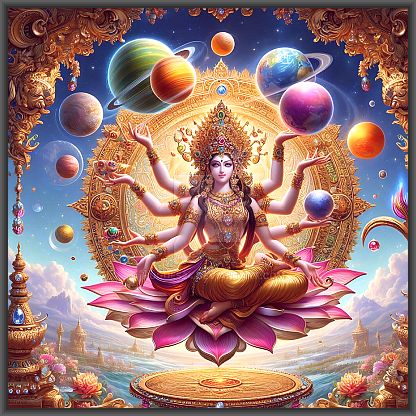
Devi Mahatmya

[ Dr. Satya Prakash Choudhary explains:

At one level the Devi Mahatmya chronicles the battle between the Devi and the Asuras. At another level it deals with the battle of life. At yet another level it deals with the inner battle between the divine and the demoniac forces within the human psyche, between the positive and negative.

The battlegrounds represent our own human consciousness, and its events symbolize our own experiences. The demons are symbolic of the psychic forces within the shadow. They represent all the evils in the external world that have been internalized. Whatever has been internalised in turn again manifests externally in our life.

The Divine Mother is our own true being, our inherent divinity and wholeness. Her clashes with the demons symbolize the outward and inward struggles we face daily. The Devi, personified simultaneously as the one supreme Goddess and also the many goddesses, confronts the demons of ahamkara or ego (our mistaken notion of who we are or what we identify ourselves with), of excessive tamas and rajas, that in turn give birth to other demons of excessive craving, greed, anger and pride, and of incessant citta vrttis (compulsive inner thought processes springing from past karmic residue).

In the ultimate sense, the dichotomy between the bad and the good is also a false one. There is no duality. Both are part of one single paradoxical reality. The text drives home this truth so beautifully.]

8.4. Since we are talking here about the Matrkas the mother-like deities lets also briefly look at their symbolisms associated with the Mother.

In Tantra, the letters of the alphabets are the perceptible forms or the aspects of the Mother; and hence are termed as Matrkas, the mother-like who attend on the Great Mother and approximate her to some extent. It believed that the fifty-two alphabets of the Sanskrit language emanated from the Mother; and she takes the name in every one of them. During the ritual worship of the Mother, her presence is invoked in the body of the Sadhaka through a procedure known as anga-nyasa or consecration of the different parts of the body. It is meant to emphasize   that you belong to the Mother; and you are sanctified by her presence in you.

9.1. The goal and the summit of the Tantric-sadhana is the identity with the Mother divine. It is to feel and to experience you are no longer separate but truly a child and a part of her consciousness. She is always in you; and you in her. It is a stage as Sri Ramakrishna Paramahamsa explained:

A simple, natural and constant experience that all your thoughts, seeing and actions, and your very breathing and existence comes from her and are hers. You realize , see and feel that you are a person formed by her power out of herself, put out from her for play and yet always safe in her .You are indeed a being of her being, consciousness of her consciousness , force of her force and Ananda of her Ananda. And that is the true significance and essence of Mother-worship.

In the next part let’s take a broad look at the Origins, history and development of the Matrkas.

Mahadevi

devi charana

Continued in Part Two

References and Sources

The iconography of the saptamatrikas: by Katherine Anne HarperEdwin Mellen press ltd (1989-10)

Saptamatrka Worship and Sculptures by Shivaji K Panikkar; DK Print World (1997).

The Roots of Tantra by Katherine Anne Harper (2002)

Hindu Goddesses: Vision of the Divine Feminine in the Hindu Religious Traditions by David Kinsley; (1987)

Tribal Roots of Hinduism by SK Tiwari; Sarup and Sons (2002)

The Portrait of the Goddess in the Devī-māhātmya by David Kinsley

The Little Goddesses (Matrikas) by Aryan, K.C; Rekha Prakashan (1980)

Goddesses in Ancient India by P K Agrawala; Abhinav Publications (1984)

The Tantra of Sri Chakra by Prof. SK Ramachandra Rao; Sharada Prakashana (1983)

Matrikas:

http://en.wikipedia.org/wiki/Matrikas

Sapta Matrikas and Matrikas

http://shaktisadhana.50megs.com/Newhomepage/Frames/forumframebodyindex.html

The mother goddess in Indian sculpture By Cyril Veliath

http://www.info.sophia.ac.jp/fs/staff/kiyo/kiyo37/veliath.pdf

Some discussions on the Skanda – Tantra and Balagrahas

http://manasataramgini.wordpress.com/2008/09/03/some-discursion-on-skanda-tantra-s-and-balagraha-s/

The Mahabharata of Krishna –Dwaipayana Vyasa (Book 3, Part 2) Section 229

http://www.bookrags.com/ebooks/12333/180.html

Devis of the first enclosure

http://shaktisadhana.50megs.com/Newhomepage/Frames/gallery/Khadgamala/1stenclosureB.html

 All pictures are from Internet

 
17 Comments

Posted by on October 6, 2012 in Devi, Saptamatrka


Tags: , , , ,

Mahalakshmi


Sharan Navaratri is one of most important festivals when the Mother Goddess is worshipped as Maha- Kali, Mahalakshmi and Maha-Sarasvathi.

1.1. Mahalakshimi is generally regarded and worshipped as consort of Vishnu and the bestower of fortunes. However in the Shaktha tradition, Mahalakshmi is an independent Supreme Divinity manifesting herself as Maha-Sarasvathi (Sattva), Mahalakshmi (Rajas) and as Maha-Kali (Tamas). Here, She is not the Vishnu Patni ; but, is the Devi the Supreme Mother Goddess. She is the culmination of all Divine Forces. 

Lakshmi Sarasvathi Kali

1.2. Durga-Saptha-Shathi, explains Mahalakshmi as Devi in her universal form as Shakthi. She is the primordial energy and was the first to appear before everything (sarva-sadhya) ; She is both devoid of form (nirakara) and filled with forms (sakara) ;   She is both manifest and un-manifest; She is the essence of all things (sarva sattva mayi). She creates and governs all existence (Isvari), and is known by various names (nana-abhidana-brut) . She is the ultimate goal of yoga.  Mahalakshmi is the creator of the Trinity: Brahma, Vishnu and Rudra.

Supreme Divinity as a Mother

2.1. The concept of the Supreme Divinity as a woman, a mother or a womb does not seem to have a place in the Vedas. But the traces of pre -Vedic cults of the Mother Goddess can be found , latent and  ready to spring forth. The notion of Shakthi as the Supreme power seems to appear fully in the Svetasvatara Upanishad. Generally, Shakthi is another name for the manifesting power, the creative power. The Devi Suktha of Rig Veda (RV 10.125) describes her as the Supreme all-pervading Divinity.  She takes the place of Brahma and the Cosmic Embryo (Hiranyagharbha) . In the later Puranas, the Goddess is celebrated by hundreds of names. She represents the Supreme, yet within the reach of the worshipper.

Mahalakshmi

2.2. Among the Shakthas who worship Mother Goddess, the source of existence is female. God is woman; the principle representation of Divinity. The Goddess is the source of all; she is the creator of Universe (Vishwa Matha).  Being the creative power through which creation arises, through which the gods are born and procreate, Shakthi is pictured as female. The notion of her divinity rests upon this power, as it explains the appearance of the perceptible universe from out of an inaccessible, motionless substratum.

2.3. The texts also mention that Shakthi the all pervading Energy is the law that governs the nature; and, to see this Energy as male or a female depends merely upon the inclination of the worshipper.

Mahalakshmi Yantra

Goddess as three aspects of existence

3.1. The Goddess is the power of manifestation of three tendencies (Guna); and She appears as three aspects of existence as Sat Chit Ananda the reality, consciousness and experience. Creation arises from this triple form of power.

3.2. As Sat, she is the power of coordination (sandhini). She is Vama, the left aspect, who is the power of action (kriya) that is causation. She is Lakshmi goddess of plenty, the goddess of fortune, consort of Vishnu.

3.3. As Chit she is the power of understanding (samvit). She is the power of will, and of the flow knowledge. She is Sarasvathi, the goddess of learning, the consort of Brahma.

3.4. As Ananda, she is the power of delight (ahladini shakthi). She is the fierce (Raudri). She is the power of cognition, of realization, of transcendent knowledge, the destroyer of the world of illusions, the consort of Shiva. She is also Durga, the one beyond reach.

Cult of Mahalakshmi

4.1. The cult of Mahalakshmi is essentially Shaktha in orientation and Tantric in practice. According to Tantra lore, Mahalakshmi looked at the void (shunya) and assumed the Tamas form as Maha-Kali (Maha Maya) the power of time. Then, Mahalakshmi assumed the Sattvic form of Maha-Sarasvathi, the power of knowledge.  “She is the power of the Self; She it is who creates appearances’.

Maha 1maha2maha3

4.2. Durga Saptha Shathi (17-23) describes, Mahalakshmi then directed Maha-Kali and Maha –Sarasvathi to create pairs according to their Gunas; and she herself created the pair – one male and the other female – of Brahma and Lakshmi. Maha- Kali created Shiva and Sarasvathi. And, Maha-Sarasvathi created Vishnu and Gauri.

“Sat, the power of Mahalakshmi enthroned on the pure lotus of knowledge took the bi-form of male and female: Brahma, Dhaata (the supporter or the giver). The female forms are Lakshmi (beauty), Sri (fortune), Kamala, Padma (her associations with the lotus).

“The Maha- Kali, the power of delight became bi-born. The male has a blue throat, red arms, fair thighs and moon as his diadem. The woman was beautiful and fair. The Male had names as Rudra, Shankara (giver of happiness), Sthanu (immobile), Kapardini (one with matted hair), and Tri-Lochana (three eyed). The female names were: Trayi Vidya (triple knowledge), Kamadhenu, Basha (speech), Akshara (letter), Swara (syllable).

“As the pair that sprang from Maha-Sarasvathi, the male was Vishnu the pervader, Krishna (dark one), Hrishikesha (Lord of the senses), Vasudeva (Indweller), and Janardhana (giver of rewards). The female names were Uma (power of night), Gauri (fair one), Sati (the faithful), Chandi (the wrathful), Sundari (the beautiful), Subhaga (the all auspicious), Shiva (of sleep).”

sprang

4.3. Durga Saptha Shathi says, Mahalakshmi thereupon gave Sarasvathi as consort to Brahma; Gauri as consort to Rudra (Shiva) and Lakshmi to Vishnu (Vasudeva). Brahma with help from Sarasvathi created the primordial egg (anda); and Shiva with help from Gauri broke it open. Then the entire universe came out of it. Vishnu with the help of Lakshmi nourished it and protected it. Shiva with the help of Gauri undertook to dissolve it at the end.

4.4. In the Mahalakshmi Ashtaka, Indra hails the Supreme Mother as the one without a beginning or an end, the primeval energy, the greatest ruler, born of Yoga. She is gross and subtle, most terrible, the embodiment of great power and prosperity and the remover of all sins. She is the ultimate goal of yoga.

lakshmi_on_garuda_mewar_circa_1820_a_goddess_on_a_tiger_marwar_circa_1_d5360652h

(Thanks to Sri Vaisrama)

Aadyantarahite Devi Aadya Shakte Maheshvari
Yogaje Yogasambhoote Mahaalakshmi Namostu Te.

Sthoola Sookshmah Mahaa Raudre Mahaa Sakthe Mahodaye
Mahaa Paapa Harey Devi Mahaalakshmi Namostu Te.
*

4.5. Thus, Mahalakshmi is the primordial energy manifesting as Maha-Sarasvathi (Sattva) , Mahalakshmi (Rajas) and Maha-Kali (Tamas) from whom the trinity Brahma, Vishnu and Rudra took shape to create , preserve and dissolve the universe.

Killing the demon Mahisha

5.1. Mahalakshmi is the presiding Goddess of the Middle episode (Chapters 2-4) of Devi Mahathmyam.   In her manifestation as Mahalakshmi, the Devi destroys the demon Mahishasura. The Goddess fought the demon for nine days starting from prathipath (the first day of the brighter half) of the month of Ashvayuja; and killed the demon on the tenth day Vijaya-Dashami ending his reign of evil and terror. Her victory symbolizes the victory of good over evil.

5.2. Mahalakshmi is described as having been created by the effulgence of all the gods. The Goddess wearing string of beads and killing the demon is depicted as Ashta Dasa Bhuja Mahalakshmi, with eighteen arms, holding battle axe, maze, arrow, thunderbolt, lotus, bow, water-pot, cudgel, lance, sword, shield, conch, bell, wine-cup, trident, noose and the discus sudarsana.

Mahalakshmi 2

Mahalakshmi at Kolhapur

6.1. Vishvakarma sastra, a shilpa text, asserts that the shrine at Kolhapur (Karavira-kshetra) – Maharashtra- is one of the few celebrated centres, a Shakthi peetha, where the goddess of power Mahalakshmi is worshipped as the Supreme Divine principle; whereas in most other temples she is worshipped only as Lakshmi the consort of Vishnu.

6.2. In the temple at Kolhapur, the shrine of Mahalakshmi the presiding deity is located to the East (the idol facing West); the shrine of Maha-Kali is in the North; and the shrine of Maha-Sarasvathi is in the South. It is said, in the earlier times there was a shrine of Kankala Bhirava (as Kshetrapala) located to the West.

6.3. Those that have seen closely the image of Mahalakshmi in the sanctum of the temple at Kolhapur, say that the iconographic forms of the image do not suggest Lakshmi; they would suggest the form of Durga or Mahishamardhini. The image of about three feet height in standing posture (sthanaka) is carved out of black stone, with a crouching lion at the back showing its head to the left to the goddess. The idol has four hands; with her normal right hand holding the sacred maatulunga (a citrus) fruit (Sri Phalam adha-kare); the normal left hand carrying a bowl (vama- adhah kare paatram); the upper right hand holding a heavy mace with its head touching the ground (urdhve kaumodakim); and, the upper left hand holding a shield (vama-urdhve- khetakam).Her crown is adorned by the hood of a serpent.

Amba Devi Kolhapur

Iconography

7.1. The Durga Saptha Shathi and Skanda Purana (Sahyadri khanda) provide iconographic details of Mahalakshmi to be depicted with eighteen hands.

“She who springs from the body of all gods has a thousand or indeed countless arms, although her image is shown with eighteen hands. Her face is white made from the light streaming from the face of Shiva. Her arms are made of substance of Vishnu are deep blue; her round breasts made of Soma are white. Her waist is Indra and is red. Her feet sprung from Brahma are also red; while her calves’ and thigh sprung from Varuna are blue. She wears a gaily coloured lower garment, brilliant garlands and a veil. Starting from the lower left: she holds in her hands a rosary, a lotus, an arrow, a sword, a hatchet, a club, a discus, an axe, a trident, a conch, a bell, , a noose, a sphere, a stick, a hide, a bow, a chalice and a water pot.”

Chandi Kalpa provides the almost the same details but adds that Mahalakshmi should be seated upon a lotus (saroja sthitha) and her complexion must be that of coral (pravala prabha).

maha2

7.2. The Shilpa text Rupa-mandana suggests the details for Mahalakshmi with four arms. According to that text, Mahalakshmi should be depicted in the colour of molten-gold (taptha-kanchana-sannibha) and decorated with golden ornaments (kanchana bhushana).

Mahalakshmi3

She is also described as having complexion of coral; and seated on a lotus. Her four hands carry matulunga fruit, mace, shield and bowl of liquor. Her head must be adorned with snake-hood and a linga.

“I am the Queen, the gatherer-up of treasures, most thoughtful, first of those who merit worship. Gods have established me … I breathe a strong breath like the wind and tempest.

I hold together all existence. Beyond this wide earth and beyond the heavens I have become so mighty in my grandeur.” The Devi Suktha – Rig Veda (RV 10.125

Mahalakshmi7

 ahaṃ rudrebhir vasubhiś carāmy aham ādityair uta viśvadevaiḥ |
aham mitrāvaruṇobhā bibharmy aham indrāgnī aham aśvinobhā ||
ahaṃ somam āhanasam bibharmy ahaṃ tvaṣṭāram uta pūṣaṇam bhagam ahaṃ dadhāmi draviṇaṃ haviṣmate suprāvye yajamānāya sunvate ||

sri yantra mahalakshmi

deepa

References:

Vishnu Kosha by Prof SK Ramachandra Rao

The Myths and Gods of India by Alain Danielou

http://www.sacred-texts.com/hin/rigveda/rv10125.htm

http://www.shreekarveernivasini.com/

http://en.wikipedia.org/wiki/Mahalakshmi_Temple_ (Kolhapur)

http://www.shivavishnutemple.org/templhal/mahalx8.htm

The pictures are taken from internet

 
9 Comments

Posted by on October 6, 2012 in Devi


Tags: , , , ,

Dasha Mahavidya – Part Four

Continued from Part Three – Bhuvanesvari, Chinnamasta and Bhairavi 

Please also read the introduction to Mahavidyas

Dhumavati, Bagalamukhi, Matangi and Kamala

VII. Dhumavati

42.1. Dhumavati , whose nature is smoke, is again a Mahavidya who is not known outside the Mahavidya cult. There are no references to her in the earlier mythologies. She , unlike most other Mahavidya, is old, ugly and sulking. She is the only Mahavidya without a consort. She is a widow associated with strife, loneliness, unfulfilled desires and inauspicious things of life.

Dhumavati shares some of her characteristics with three other ancient goddesses – Nirriti, Jyeshta and Alakshmi – who personified disorder, decay, poverty, misfortune, dissension, sickness, and the whole range of life’s ills, culminating in death.

Nirriti in Rig Veda is the opposite of Rta the order, harmony and well-being in nature. Nirriti in contrast to Rta stands for anger, disorder, death, decay and destruction.

Jyeshta, the elder, is dark and ugly.  She indulges in quarrels and is intolerant of anything that is auspicious. . She is instinctively drawn to households in which there is strife—where family members quarrel or where the adults feed themselves and disregard the hunger of their children.

Alakshmi is the dark – reverse image of Lakshmi. She is everything that Lakshmi is not. Alakshmi symbolizes bad temper, hunger, thirst, need, poverty and all the misfortunes of life.

42.2. While there are similarities between Dhumavati and the above three goddesses, there are also some differences. Unlike those goddesses, Dhumavati is a widow; she is ugly and old. Dhumavati is also said to be fierce, frightening and fond of blood. She has, however, certain positive characteristics such as: guiding the devotee along the spiritual path to help him/her attain liberation; granting Siddihis and rescuing her devotees from troubles.

Dhumavathi

43.1. The Dhumavati Tantra describes her as an old and ugly widow. She is thin, tall, unhealthy, and has a pale complexion. She is described as restless and wicked. Unadorned with any jewel, she wears old, dirty clothes and has disheveled hair. Her eyes are fearsome, her nose long and crooked, and some of her long fang-like teeth have fallen out, leaving her smile with gaps. Her ears are ugly and rough; her breasts hang down. In one of her trembling hands, she holds a winnowing basket, while the other makes a boon-conferring gesture (varada-mudra) or knowledge-giving gesture (chinmudra). She rides in a horseless chariot bearing an emblem of a crow as her banner. She is astute and crafty. Always hungry and thirsty, Dhumavati initiates quarrels and invokes fear.

Dhumavati - Mahavidhya

43.3. The symbolisms associated with Dhumavati explain that she points out to the negative aspects of life, asking us to develop a sense of detachment . The bowl of fire she holds burns ignorance and also indicates that all things are eventually destroyed. The winnowing basket is viveka the power of discrimination that separates the grain (real) from the chaff (unreal). On an outer level ,  she seems like poverty, destitution, and suffering, the great misfortunes that we all fear in life. But in truth, she directs us to look beyond the small ambitions.

Dhumavathi2

43.2. In the Prapanca-sara-sara-samgraha, Dhumavati is described as having a black complexion and wearing ornaments made of snakes. Her dress is made of rags taken from cremation grounds. She holds a spear and a skull-cup (kapala) in her two hands. The spear is sometimes replaced by a sword. Another description in the same text says Dhumavati is aged with a wrinkled, angry face and cloud-like complexion. Her nose, eyes, and throat resemble that of a crow’s. She holds a broom, a winnowing fan, a torch, and a club. She is cruel and frowning. Her hair appears dishevelled and she wears the simple clothes of a beggar. Her breasts are dry. Her hair is grey, her teeth crooked and missing, and her clothes old and worn.

43.4. There are also unusual descriptions of Dhumavati where she is shown as a good-looking young woman full of life with attractive features. She is not a widow. She is holding a winnowing basket while riding a huge crow. She is adorned with ornaments, bracelets, arm-bands, necklaces, and pendants. She is elegantly dressed. Her appearance here is in total contrast to the descriptions of her as ugly and old wearing soiled rags.

43.5. Dhumavati is worshipped by the Tantrics for attainment of Siddhis (magical powers). Though Dhumavati’s worship is considered ideal for bachelors, widows, Sanyasins and   Tantrics, the householder too flock to her seeking blessings and fulfilment of their desires.

44.1. If Sodasi and Bhuvanesvari represent the sparkling vivacious stage in woman’s life, Dhumavati projects the end and the miserable part of woman’s life. She is an old and a sulking widow who has nowhere to go. She is lonely, a social outcast; but, free from its obligations and constraints. She lives in a cremation ground surrounded by burning funeral pyres. She is often hungry and thirsty; and, is rankled by unsatisfied desires and the memory of many things she missed in her life.  The crow which is her emblem and on which she is shown riding is a scavenger bird feeding on half-burnt corpse; it is a symbol of death and inauspiciousness.

44.2. Smoke billowing out of a quenched fire is her nature .Dhumavati’s youth and freshness are burnt out; and what remains is the smoke of her spent life. And like smoke she is restless and wandering. Her nature is not brightness.  The smoke usually is dark, polluting and concealing.

Another interpretation is that Dhumavati is a good teacher. By obscuring or covering all that is known, Dhumavati reveals the depth of the unknown. Dhumavati obscures what is evident in order to reveal the hidden and the profound.

44.3. She favors the unmarried, the single and the widowed. She instils a desire to be alone and an aversion to worldly things. She encourages a certain kind of aloofness and independence; and sets one on the spiritual path.

Dhumavati represents a typical old widow of the orthodox society. Although a widow was considered unfortunate or inauspicious, she was free to undertake spiritual pursuits such as pilgrimages and vratas that were not easily possible in her younger days while she had to shoulder family responsibilities. For some of those women who found their married life oppressive, widowhood might come as a sort of relief. Like the traditional sanyasin, a pious widow is outside the society free from its constraints and obligations.

44.4. Dhumavati symbolically portrays the disappointments, frustrations, humiliation, defeat, loss, sorrow and loneliness that a woman endures.  She is the knowledge that comes through hard experiences, after the youthful desires and fantasies are put behind. Dhumavati thus represents a stage of woman’s life that is beyond worldly desires, beyond the conventional taboos of what is polluting or inauspicious. She desires to be free and at the same time she likes to be useful to the family and to the society.

44.5. In her temples near Varanasi, Dhumavati despite her aloofness is regarded as a guardian deity who looks after the village folk and blesses with worldly happiness. She is no longer the inauspicious and dangerous goddess approached only by the Tantrics.

Devim-Koteshwarim- Suddham-papaghnim- Kamaroopinim

Namami Mukti-kamaya Dehi Muktim Harapriye

Dhum Dhum Dhumavati Swaha

VIII. Bagalamukhi

45.1. Just as Dhumavati, Bagalamukhi or Bagala is not well known outside the Mahavidya cult. She however is mentioned in myths associated with Shiva and Vishnu. These myths belong to recent centuries. The exact origins of her name are not certain. Some say; ’Bagala’ is derived from the Sanskrit term Valga meaning ‘to control’; and she was originally known as Valgamukhi.  That was meant to signify that she had that power in her face which could capture or control or even paralyze her opponents. It is also said that Bagalamukhi means the goddess with the ‘face of a crane (Baka)’. The crane with its ability to stand still attracts its prey, lures it into a false sense of safety and then snaps it up quickly. Bagalamukhi’s strength is said to be her magical attraction, to immobilize and strike the enemy.

But, none of her iconographic descriptions makes a mention her having a crane head. Bagalamukhi is portrayed as a woman of immense beauty who can transfix anyone. Perhaps her assumed association with crane was merely to highlight her ‘deceitful’ trait. It is explained; a secret desire to kill resides in hearts of all beings. That concealed desire might many times influence our actions. Bagalamukhi, like the gentle faced crane – the most deceitful of all- personifies that hidden desire to kill.

Elsewhere it is said, she has the head of a duck and the nose of a parrot, signifying her ability to grant vak-siddhi, the power to make everything one utters come true.

Bhagalmukhi

46.1. Bagalamukhi is often called Pitambari or Pitambari Devi, the one who wears yellow clothes. Her Dhyana – sloka graphically portrays her preference to yellow colour. Her complexion, clothing, ornaments and garlands are in varying shades of yellow. Her devotees are dressed in yellow, wear mala strings of turmeric (haldi) and offer her yellow things.  Even her temples are painted yellow. Bright yellow is usually associated with sun and gold. But, in the context of Bagalamukhi the significance of her preference for yellow has not been explained. Further, in her pictorial representations, Bagalamukhi is usually shown wearing red or orange; and not much of yellow.

46.2. The one other name of Bagalamukhi is Brahmastra Roopini meaning that she exercises her magical powers of delusion (bhrama) as a weapon (astra) to confuse and confound. With that she makes everything look like it’s opposite. She turns speech into silence, knowledge into ignorance, power into impotence, and defeat into victory. It is explained; she represents the knowledge whereby each thing must in time become its opposite. To see the failure hidden in success, the death hidden in life or the joy hidden in sorrow is the way of understanding her reality. Bagalamukhi is the secret presence of the opposites wherein each thing is dissolved back into its un-manifest state.

Bagalamukhi is also said to bestow the power of attracting others and infuse in them sexual desire.

46.3. More than any other Mahavidya, Bagalamukhi is associated with magical powers. , which sometimes are termed Siddhi or attainments. A particular Siddhi of Bagalamukhi is her magical power of Stambhana the power to transfix, immobilize or paralyze a person into silence. An explanation based in yoga interprets Stambhana as the control over the vital-breaths (prana); and states that Bagalamukhi exercises control over the vital breaths; she enables one to conquer the tongue, which means self-control over greed, speech and taste.

Thus, Bagalamukhi, just as the other Mahavidyas, displays both negative and positive virtues.

47.1. The Bagalamukhi – iconography presents her as goddess with a golden complexion dressed in yellow. She sits in a golden throne in the midst of an ocean of nectar full of lotuses. A crescent moon adorns her head. She is decked with gems and Champaka blossoms.

Bagalamuki - Mahavidya

47.2. The Dwi-Bhuja (with two arms) depiction is  Soumya or milder. Her complexion is golden. She is elegantly attired and bejewelled. She holds a club in her right hand with which she beats a demon, while pulling his tongue out with her left hand. This image is sometimes interpreted as an exhibition of stambhana, the power to stun or paralyse an enemy into silence. This is one of the boons for which Bagalamukhi’s devotees worship her.

47.3. In her Chaturbhuja (four armed) form, according to the Sri Tatwanidhi, she sits upon a golden throne. She is of yellow complexion and is three-eyed. In her four hands she holds a trident, a cup, a mace and the tongue of the demon. With her right hand she strikes him on his head. She has the features of a beautiful woman. She is adorned with garlands and ornaments. Bagala symbolizes cessation of all dualities or dwandas, at the realization of which pure consciousness emerges.

47.4. Another depiction presents Bagalamukhi as sitting upon a supine corpse laid out on her throne. She wears a diadem, a nose ring, and a garland;  she rests her right foot on a lotus flower, and her bent left foot ankle on her right lower thigh; pulls the tongue of the male by her left hand and holds aloft a club by the raised right hand ready to strike.

48.1. Bagalamukhi is related to Mahavidya Tara, as both are goddesses of speech. Bagalamukhi represents the power of speech that stuns others and leaves them gasping for words. Therefore she is invoked for granting success in debates and bargains.

48.2. Bagalamukhi wrenching the tongue of the demon is symbolic of removing the impurities associated with speech and tongue. The tongue is the organ of speech and taste. And, often it is involved in telling lies or concealing the truth. The tongue therefore could unwittingly get caught up with mischief, vanity and deceit. The pulling of the tongue is a symbolic act of  punishing the demon and cleansing his impurities.

48.3. Bagalamukhi sitting upon a corpse while pulling the tongue of the ‘enemy’ is interpreted in many ways. The corpse stands for inert or static matter, as also for ignorance. The death of the flesh also means liberation of the spirit. A corpse is therefore a symbol of death and a new beginning for the spirit. Shiva as Shava (corpse) under the feet of Kali is a inert potent life that is just about to wake up to new life. The other Mahavidyas – Kali and Tara- also sit or stand upon corpse. Chinnamasta and Dhumavati too are associated with corpse and cremation grounds.

48.4. The image of Bagalamukhi sitting upon a corpse is also said to be associated with the extreme tantric ritual of Shava-sadhana. It is a ritual where the adept (sadhaka) sits upon the chest of a fresh corpse at the dead of the night in middle of cremation ground and tries to overcome or control the dead person’s preta (spirit).Through that he hopes to gain magical powers.The esoteric view of this tantric ritual is that it transforms the aspirant, awakening in him or her to an expanded consciousness; and grants him a new identity.

Shivasysa Dayitam Shuddham Kamakhyam Kamaroopi

Om Hleem Sarva Dusthaanaam Vaacham Mukham Paadam s

tambhaya jihvyamkilaya

buddhim vinaashaya Hleem Om Swaha


IX. Matangi

49.1. The myths and legends associated with Matangi suggest that her origins are in the tribal traditions. Though there are various versions of her myths, in the Hindu and the Buddhist lore, they together contribute to form the picture of Matangi. She appears to have been the daughter of Matanga who according to some was a chieftain of tribal elephant hunters (Maatanga –raja). He belonged to the low caste of Chandalas. Thus, Matangi, right from her early stage, became closely associated with birds, forests, wilderness, elephant hunting culture and Chandala way of living; as also with casting magic-spells.

[Matangi also appears in a Buddhist Jataka, where she is the daughter of elephant hunter king Matanga, a tribal (Chandala) chieftain. Rabindranath Tagore reworked her legend into his play Chandalika, who falls in love with Ananda, the chief disciple of the Buddha.]
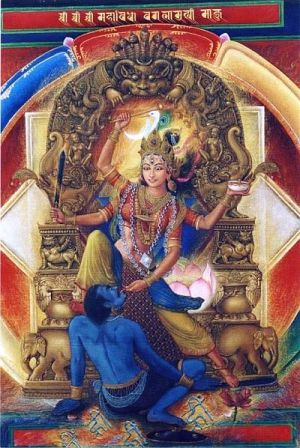
49.2. Matangi’s origins are also associated with the tribal goddess Savaresvari (Savara = Svara ; the goddess of Svara, musical notes) who is described as sixteen, smiling and short in stature .She is dressed in leaves wearing creepers as earrings and  a garland made of gunja seeds. She collects in her basket fruits while singing to herself.

And, Savari who enjoys dwelling in the forests and loves singing is one of the many names of Matangi. Further, Raja-Matangi is said to listen to the chattering of green parrots, to play on veena, to wears flowers and garlands and to have conch- shell earrings.

All these elements of various stories characterize the nature of Matangi Mahavidya. They affirm her tribal origins and her identity with tribal culture which is different from the tradition bound way of living.

At another level , she is also associated with music , poetry and fine arts.The Lalithopakhyana  calls Matangi by a variety of names . She is :

Sangeeta yogini ; shyama; shyamala ; mantra nayika;
mantrini;  sachiveshani;  pradhaneshi;  shukapriya;
vina vati vainiki cha mudrini ; priyakapriya;
nipapriya ; kadambeshi ; kadamba vanavasini’

sadamada ; cha namani shodashaitaini;  kumbhaja.

50.1. The Mahavidya Matangi, the erotically powerful intoxicated with passion like a female elephant in heat (masth) is described as a sixteen-year – young girl in the flush of her youth seated on an altar. She has full breasts and a very slim waist. Her complexion is greenish. She is impassioned.  Her eyes are intoxicated while a gentle smile plays upon her lips. She is perspiring slightly around her face, which makes her all the more exiting and desirable. Below her navel are three horizontal folds of skin and a thin vertical line of fine hair.  Her hair on the head is long and wild, and the disc of the moon adorns her forehead. She favors red; her dress and ornaments are in various shades of red. She wears a girdle of jewelled ornaments, as well as bracelets, armlets, and earrings. She is adorned with garlands of wild Kadamba flowers. She holds in her hands a skull and a chopping blade dripping blood. With the other hand, she holds an ornate musical string instrument, veena.  She is flanked by two parrots. She represents sixty-four arts.

50.2. Matangi is also Raja-Shyamala, dark with blue as the cloud filled with water. She is seated on the gem-studded throne, listens to the sweet utterances of the parrot, is aglow with youth, has one foot on the lotus, has her forehead bedecked with the crescent moon, plays on the veena, has a garland of jasmine flowers,  wears red garments,  has a conch-vessel.  Matangi, lustrous like sapphires in her self-glory plays the ruby-bejewelled veena.

50 .3 She is also Rajamatangi adorned with a crescent moon on her crown which is tied with a garland of blue lilies, a bright vermilion mark on her forehead and she is richly ornamented. The goddess of dark or blue complexion, listening to a parrot talking to her, is seated upon a throne set with rubies, with one of her feet placed upon a lotus while holding a veena. Such is the majesty of Raja-matangi the queen of all.

According to the Shyamaladandakam, Matangi plays a ruby-studded veena and speaks sweetly. The Dhyana Mantra describes her to be four-armed, with a dark emerald complexion, full breasts anointed with red kumkum powder, and a crescent moon on her forehead. She carries a noose, a goad, a sugar-cane bow and flower arrows, which the goddess Tripura Sundari is often described to hold. She is also described to love the parrot and is embodied in the nectar of song.

Sri Raja Mathangi travels in Gaya chakra, a chariot which when moves, the atmosphere will be vibrating with sweet music. She is the embodiment of Nada (Sound). She stands for the propagation of Jnana (Knowledge), art, education, music and so on.

In Sri Vidya, Raja Matangi is known as Manthrini. She also presides over all the mantra svaras or the articulation of mantras. Matangi is emerald green in colour. She plays the Veena that represents the Nada or Primordial Sound in the form of Vibration. She is said to have Parrot in her Hands. Raja Matangi is the Deity of Thought. This Thought is the Source of Word or Speech. Hence, she is called Jnana Shakthi of Tripurasundari. As Manthrini, Sri Raja Mathangi is the symbol of knowledge. She is also an amsa of Sri Meenakshi of Madurai and Sri Saraswathi.

Maathangi

50.4. Another description says: Matangi is blue in color and dressed in red. Her waist is slim and her breasts well-developed. The crescent moon adorns her forehead. She has three eyes and a smiling face. She is bejewelled and is seated on a lotus throne. In her four arms, she carries a skull, a sword, and a veena. She is Modini the goddess who grants worldly pleasures.

50.5. There is also an extreme tantric form of Matangi. It describes Matangi as a highly impassioned girl of sixteen with fully developed breasts. She sits on a corpse wearing a bright red garment. She wears red jewellery and a garland made of gunja berries (a small forest seed) .She holds in her hands  a skull-bowl, a sword or scissors . She prefers offerings of leftovers (ucchista) and polluted things such as pieces of cloths stained with blots of menstrual discharge.  Such is the fierce form of Ucchishta-Matangini.

50.6. In sharp contrast to her tantric form there is a classy description of her benign form. Matangi, here, is described as seated, in all her glory and charm, on a gem-studded throne, listening to the sweet utterances of parrots. She is stunningly beautiful, glowing in her emerald complexion. Her limbs are delicate and soft; lustrous like sapphires.  She is aglow with youth. As the evening is lit up with golden yellow, she having just had a drink of honey- sweet wine places one foot on the lotus and delicately holds in her hands a ruby-red bejewelled veena, leisurely; and sings in her sweet voice songs of great charm and melody. There is a dreamy expression in Matangi’s eyes (madhura madhu madaam). Two lotus flowers tied to the upper part of the veena swing rhythmically as she plays on it. She is dressed in delicate clothes of mild red; has a fitting bodice covering her delicate breasts. She is decked with garland of fragment jasmine flowers. On her head is a diadem with crescent moon; and blow that is bright vermillion mark adding lustre to her glowing countenance. The conch shell she holds and the birds surrounding her are in white. The sweet-charming glory of Matangi the daughter of sage Matanga is truly matchless.

51.1. The last mentioned is the benign and pleasing aspect of Matangi. But, that is not the form in which Matangi is depicted as a Mahavidya. Let me mention that there are several representations of Matangi depending upon the class of Tantra that is talked about. For instance, in the Sri Vidya tradition, Matangi is the Mantrini the minister or counsellor of the Supreme Queen (Para bhattarika) Sri Rajarajeswari.  Matangi is also identified with Devi Meenakshi of Madurai.

Bhuvaneshwari2

And, Matangi is also called Tantric-Sarasvati and Tantric Ganesha .Her complexion too varies from white, black, brown, blue or to green depending on the context, says as Ucchista Matangini, Ucchista-Chandalini, Raja Matangini, Sumukhi Matangini, Vasya Matangini or Karna Matangini.

51.2. But, Matangi as Mahavidya is a Siddha Vidya, the Tantra personified. She brings focus, rather very disturbingly, on the notions of distinctions between purity-impurity; clean-polluted; auspicious-inauspicious; puritanical notions- unrestrained sex; high caste-low caste; and civilized society- hunting tribes of forests.

She is depicted as a domineering, fearful tantric deity, who is outside the pale of the traditional society; who wields magical powers; who is pleased with the offering of leftovers and polluted things; and who enjoys sex.

52.1. The myths associated with Matangi project her as a Chandalika (daughter of a Chandala) who loves leftover or partially-eaten food (Ucchishta- Chandalini) and polluted things. Her preference for pollution, it is said, extends over many things, such as: food, sex, dress, dwelling and habits etc. The Nepali tradition mentions that Matangi lives among the low caste, near garbage dumps, prefers Ucchishta offered by devotees who are unkempt and unwashed; and she admires them for not rinsing the mouth and washing the hands after eating.

52.2. The central message of this myth is to set free the Tantric devotee from the strangling obsession with ‘purity’ which can be dangerous and destructive. Ucchishta Matangini as the embodiment of all that is impure and polluted is the goddess who helps in coming to terms with, and transcends the   apparent dualities in the existence. She, in her own manner, emphasizes the importance of inner purity over external cleanliness.  Matangi is therefore a great teacher; and powerful and liberating goddess.

53.1. Mahavidya Bagalamukhi and Matangi are worshipped to gain magical or psychic powers. Matangi is associated, in particular, with magical powers that exercise control over enemies.

53.2. Matangi is considered by some as the Tantric form of Sarasvati the goddess of speech (vak) and learning. Both the goddesses are associated with music and speech. They, however, differ in certain aspects. Sarasvati is sattvic in nature and represents the Vedic learning. Matangi is tamasic and is related to magical powers. While Sarasvati is the power or the awareness that generates speech, Matangi is the articulated speech (vaikhari vak), while Mahavidya Tara is the un-manifest speech that resides in breath (madhyama-vak) .Matangi is posited in the throat centre (visuddhi). The parrot which she holds (keera kara) signifies the ability to talk.

53.3. Matangi and Ganesha are both related to elephants. The terms – matanga, maatanga and matanga raja – all refer to the elephant.  Matangi had her origin amidst the elephant huntress and she holds a hook (ankusha) that controls an elephant. Ganesha as para-vak the un-manifest word is at muladhara, while Matangi as vaikhari –vak is at visuddhi. The tantric sadhana regards Matangi as the female counterpart of Ucchishta Ganapathi.

The Ucchishta Ganapathi is a tantric form of Ganesha .He is depicted as red in colour, naked and intoxicated. In some forms he is shown amorously playing with his consort seated on his left lap (nari-yoni-rasasvada lolupam, Kama mohitam).Like Matangi, the Ucchishta-Ganapati too is associated with unclean things.

Matangi Bengal hand coloured lithograph 1880

54.1. But, basically, Matangi as Mahavidya severs attachment to the limited understanding of the world in terms of ‘pure’ or ‘impure’. She challenges the normally accepted concepts and values in an established social order. She brings into question the very notions of beauty, goodness, honour, respect, decency, cleanliness and physical comfort etc. She instils in the heart of the Sadhaka the faith that all existence is pervaded by the goddess and there is nothing that is outside the goddess; She pervades all; and within her there are no distinctions of ‘pure’ or ‘impure’. She guides the Sadhaka to transcend the artificial – manmade’ demarcations of beauty-ugliness, cleanliness – polluted or pure -profane etc. Her message forms the very core of the Tantra ideology.

Matangi333

Saraswatyaya Namo Nityam Bhadrakalyaya Namo Namah

Vedavedantavedanga Vidyasthanebhya Eva Cha

Ucchisthachandali Sri Matangeswari

Sarvagyanavashamkari Swaha

X. Kamala

55.1. Kamala or Kamalatmika is reckoned as the tenth or the last of the Mahavidyas, while Kali is the first and the foremost Mahavidya. It is often asserted that there are no distinctions of superiority/inferiority among the Mahavidya, yet Kamala is not as important as kali in the Mahavidya tradition. While Kali represents the highest state of consciousness, Kamala is related to material wellbeing and worldly comforts. She represents the mundane state of consciousness that the Sadhaka seeks to restrain and finally overcome. Kali is transcendental experience, while Kamala is what is ‘here –and-now’. Kamala Mahavidya is one who binds to the world; and is not seen as a liberator. The Kali is the liberator (mukti dayani); and the Kali-consciousness is the ultimate.

56.1. Some wonder how Kamala who is derived from auspicious aspects of Lakshmi the bestower of wealth and good luck could be included in the group of tantric goddesses. However, the Mahavidya texts explain that Kamala as Mahavidya is not the same as Shri or Lakshmi. She differs from them in many aspects; and she indeed is a Mahavidya in her own right. Kamala Mahavidya is not the spouse or the beloved of Vishnu. She is an independent goddess and does not play the role of a spouse. Kamala is associated with the Shiva-cult just as the other Mahavidyas. She is, at times, addressed as Raudri, Sati, Kapali and Gauri. Although benign and auspicious qualities are prominent in her character, there are many fearsome and dangerous aspects to her nature. Kamala is a destroyer of demons. Similar to some other Mahavidya: Kamala wears garlands of skulls (runda-mala); her form is awful (ghora), terrible (bhima) and of a negative nature (tamasi). One of her many names refers to her as Kalaratri, a fearsome aspect of kali. Kamala is also said to share some of the characteristics of Matangi, Dhumavati, and Bhairavi who are noted for their scary aspects.

55.2. Kamala as Mahavidya is said to be a reflection of Shri the Vedic deity as also of Lakshmi the goddess of wealth and beauty. Mahalakshmi is celebrated in the Devi Mahatmya as the Supreme Goddess manifesting herself as Maha-Sarasvathi (Sattva), Mahalakshmi (Rajas) and as Maha-Kali (Tamas);    and as one who presides over every aspect of the Universe. And, Kamala in the Sri Vidya tradition represents the Supreme Mother herself. Sri Muthuswami Dikshitar in his most magnificent set of Kamalamba Navavarana kritis celebrated the glory of Sri Kamalamba.

All these deities are widely worshipped. But, Mahavidya Kamala is different from all of them. Kamala here is not endowed with the powers of Mahalakshmi; she enjoys neither the prestige of Mahalakshmi in the Tantra tradition, nor the wide acceptance of Lakshmi in the orthodox tradition. Kamala as Mahavidya is a tantric deity who is invoked mainly in rituals seeking wealth, power and   hidden treasures.

Kamala by Basudha Nandy

Kamala by Basudha Nandy

56.2. The formulators of the Mahavidya cult, it appears, modified or downplayed the essential benign aspects of Shri and Lakshmi in order to render Kamala more suitable to be included in the Mahavidya group. They stressed her independence (svatantrya), minimized her role as a spouse and gave her terrible forms that are associated with the deities of the Shiva cult. Thus, Kamala retains the character of Lakshmi; and definitely is linked to Lakshmi; yet, she is different from Lakshmi. Kamala‘s portrait has been drawn selectively. Kamala, the Tantric form of Lakshmi, combines in herself many auspicious virtues and attributes along with a few terrible aspects. Like Kali, the Tantric Kamala embraces the light and the darkness, for she is the totality. She can be propitiated both for worldly goals and for spiritual attainments.

57.1. The iconographies of Mahavidya Kamala  (she of the lotus ) describe her as   strikingly beautiful  glowing in her golden complexion , as  a powerful goddess in her own might sitting alone (not accompanied by the spouse) on a lotus amidst a pond.

Adilakshmi

And, sometimes she is flanked by two or four elephants showering water or nectar over her from bejewelled pots held in their upraised trunks. She holds two lotuses in her two upper hands; wears a crown sparkling with gems. Kamala gestures mudras bestowing boons (varada) and fearlessness (abhaya). Kamala is presented as the goddess who destroys poverty, and as one who grants wellbeing, prosperity and fertility.

Gajalakshmi2Kamala

57.2 Kamala indeed resembles Gaja-Lakshmi. The lotus on which she is seated denotes fertility and life. It also suggests spirituality, power and authority. The elephants stand for royal authority, wealth and magnificence. They are also related to clouds, rain and fertility.

“She has a beautiful golden complexion. She is being bathed by four large elephants who pour jars of nectar over her.  In her four hands she holds two lotuses and makes the signs of granting boons and giving assurance.  She wears a resplendent crown and a silken dress. I pay obeisance to Her who is seated on a lotus in a lotus posture.”

58.1. Kamala is the beginning and the end of our worship of the Great Goddess. We initially approach the Mother seeking help in achieving human needs and desires like health, prosperity, and a happy family. We complete our understanding of the Mother by seeing her presence even in the ordinary things and experiences of life; and in realizing there is nothing that is outside her. She is in everything and she transcends everything.

Sadachara Priye Devi Shuklapushpamvarapriye

Gomayadishuchiprite Mahalakshmi Namostu Te

Hasauh Jagatprayutai Swaha

Sources and references

1. Tantric Visions and Divine Feminine by David Kinsley.

2. Ten Mahavidyas: Manifestations of cosmic female energy by Dr. PC Jain and Dr. Daljit

3. The Dasa (ten) Mahavidyas

4. Dus Mahavidyas: the ten forms of the Devi by Saipriya Viswanathan.

5. The ten Mahavidyas by Hancock-Jaime

6. The Tantric way- Art, Science and Ritual by Ajit Mookerji and Madhu Khanna

7. Mahavidyas by Veeraswamy Krishnaraj

8. The Mahavidya: the powers of consciousness conceptualized by Devadatta kali

9. Wisdom Goddesses: Mahavidyas and the Assertion of Femininity in Indian Thought

10. Dus Mahavidya

The pictures are taken from internet

 
13 Comments

Posted by on October 6, 2012 in Mahavidya


Tags: , , ,

Dasha Mahavidya – Part Three

Continued from Part Two – Kali, Tara and Tripura Sundari

Please also read the introduction to Mahavidyas

Bhuvanesvari, Chinnamasta and Bhairavi 

IV. Bhuvanesvari

29.1. Bhuvanesvari the sovereign Queen is the fourth Mahavidya; she is fondly called Bhuvaneshi. Unlike the Adi Mahavidyas (Kali, Tara and Tripura Sundari), it seems, Bhuvanesvari was not well known before she was included into the Mahavidya group.  As Mahavidya, her realm Bhuvana includes not merely the earth but also the atmosphere and the heaven that surround the earth.  But, she is more related to the dynamics of the visible word that we experience.  And indeed the world is her extension. It is said; the universe is her body (Visvarupa) and the world is the flowering of her nature (Sarvarupa). She embodies all the liveliness and attributes of the living nature. She represents forces of the material world. The whole of existence is the field of her joyful play; she is Sarveshi the ruler of all. She is also Mahamaya the great enchantress.

29.2. In her association with the physical world, the earth, Bhuvanesvari is identified with Prithvi who was rescued by Vishnu in his Varaha Avatar. As the manifest world is the field of her joyful play, it is said, Bhuvanesvari is closely associated with the five elements (Maha-bhuta): space, air, fire, water and earth principles. She pervades all space – the inner and the outer- with that she confers awareness and all other knowledge of life. It is explained; the inner space is the space within Hridaya (heart) the centre of awareness or consciousness. Her Bija-mantra Hrim relates to Hridaya; and it is called Devi-pranava which in Tantra is equivalent to Om.

Bhuvaneshwari - Mahavidya

29.3. Bhuvanesvari is also identified with Prakrti, the energy underlying creation. She is therefore is also called as Pradhana and Prapancesvari the one who rules over the five-fold world.  The world is said to emerge from her just as a web emerges from the spider or as the sparks crackle out of fire.

30.1. In her appearance and nature Bhuvanesvari resembles Tripura Sundari. She shares some of her attributes, such as beauty, grace and wisdom. Bhuvanesvari also relates to Kali. As space, Bhuvanesvari coordinates with the dimension of time represented by Kali. And as earth, Bhuvanesvari provides Kali the stage to enact her dance of life and death. It is said; Kali creates events in time; Bhuvanesvari creates objects in space. Bhuvanesvari is also linked to the sound which arises from space and thus to the sound of the speech (vak). And therefore, she corresponds to Sarasvati,    Vagesvari the goddess of speech.

30.2. She, just as Sodasi, is depicted as a beautiful young girl of sixteen sitting on a lotus throne. Her iconography descriptions (Dhyana-sloka) presents her as having a radiant vermilion complexion, glowing like the rising sun; with a smiling face framed with flowing hair the colour of black bees; her eyes are broad, her lips full and red; her nose delicate;  and her full breasts are smeared with sandal paste and saffron. She is adorned with the moon as her diadem; and she is richly bejewelled. She is depicted with six hands holding an ornate cup filled with gems, a lotus, a goad, a noose, dispelling fears(abhaya -mudra) and bestowing boons (varada-mudra). She with her three eyes takes in the knowledge of the past, present and future; nothing escapes her attention

.

30.3. There also the other descriptions of Bhuvanesvari where she is depicted in three forms, similar in appearance, but in three colours: gold (Hemangi), red (Soubhagya-Bhuvanesvari) and bluish (Maya Bhuvanesvari). These correspond to three gunas that are the fabric of the material world. Here, she sits naked on a red lotus in a pond full of lotus flowers; sports three eyes; wears pearls of many hues; and holds a snake, noose and goad. Bhuvanesvari is the world but she also transcends the world.

Bhuvanesvari

31.1. As regards the symbolisms associated with her iconography: The lotus throne she sits upon indicates her association with creation; and the lotuses in her hands the vitality and beauty of life; the crescent moon adorning her head symbolizes growth and vitality. Her full breasts symbolize her nurturing, maternal nature; she is Jagad-dhatri one who nourishes the world. With her noose she controls. And with her goad she nudges us to overcome the obstacles of passions and delusions and reach beyond the limitations of mind.

Bhuvaneshvari Yantra

Hrim, the Bija mantra, a sound-symbol, an example of  the united male/female principle, is associated with the Goddess Bhuvaneshvari

Bhuvaneshwari 2

Sri Ramakrishna Paramahamsa used to say : it is Mother who binds and Mother who sets free; the noose and a goad , she holds,  illustrate her captivating and liberating powers. 

Bhuvanesvari like Kamala is consistently associated with the here and now. She helps us to go beyond all identities.

Bhuvaneshwari3

Bhuvanesheem Mahamayaam Sooryamandalaroopineem

Namami Varadaam Suddhaam Kamakhyaroopineem Shivam

Om Hreem Bhubaneswaraye Hreem Namah

V. Chinnamasta

32.1. Chinnamasta or Chinnamastika or Prachanda Chandika or Chandika   the goddess with a severed head is perhaps the most ghastly and disturbing depiction of a Mahavidya. Chinnamasta, standing naked having chopped off her own head with her own sword, holds her decapitated head in one of her hands. Three jets of blood spurt out of her bleeding neck, and one streams into the mouth of her severed head, while two others streams fall into the mouths of her two female associates. Yet Chinnamasta’s face is happy and smiling.

32.2. The origin of Chinnamasta is lost in antiquity. There are many myths associated with her, but are mostly disputed. Whatever be the myths, she came into prominence mainly as Mahavidya with a gory iconography, and      as one of the ferocious and frightening aspects of Kali. She has no significant presence outside the Mahavidya cult. However, the Tantric Buddhism has a corresponding deity named Vajrayoni   (the power of thunderbolt) a form of Tara, closely related to the goddess with a severed – head Chinna-munda.

The Tibetan Tantric Buddhism believes that severing ones head, not being dead   and walking around holding afloat that head in hand is a magical and spiritual ability. According to the Buddhist interpreters, chopping off the head is symbolic and not actual. It signifies discarding the ego and all identities on the way to spiritual awakening, preliminary to attaining Nirvana. It is variously described as symbolic of enlightenment, rising of Kundalini Shakthi. The philosophical aspect of Vajrayoni is Prajna parimita.

33.1. Chinnamasta refers to ridding ourselves of false notions and the limitations in which we are bound. Her depiction also helps to overcome self-pity, fear, and pain of death. She stands for essential freedom. This idea of freedom is expressed by her nudity.

Chinnamasta by Basudha Nandy

Chinnamasta by Basudha Nandy

Chinnamasta is depicted as a girl of sixteen years adorned with garland of skulls and necklaces of bones. She wears on her naked body a serpent as the sacred thread (yajnopavita) and she has full breasts covered by lotus flowers and strings of beads. But the most gruesome aspect of her is that she has cut-off her own head with a sword; and holds in her hands the severed head as also the sword. The blood gushing out of her decapitated head sprouts in three jets. The central jet streams into the mouth of her own head , usually held in her left hand , while the other two jets fall into the mouths of her two companions – Dakini and Varnini – standing on her either side.

chinnamasta1 chinnamasta2

33.2. She stands against the backdrop of thunder and lightning with her head in hand. She is not dead; but is said to be in a state of amanaska, free from human follies, distractions and sensations of pain etc. The beheaded –head of Chinnamasta is shown ecstatically drinking the central stream of blood flowing out of her headless trunk. It displays three eyes wide open in joy; and a lovely face lit up with a beatific smile. The hair on the head is disheveled and adorned with fragrant flowers. The head is decorated with a well crafted diadem, as also ear and nose rings. The more amazing sight is that headless naked trunk of Chinnamasta is standing upon a handsome couple engaged in sex in the viparita-maithuna posture (the female on top of her male partner) stretched over a lotus flower. The scene of the activity is a cremation ground set against the background of hills, river, flowers amidst thunder and lightning. The loving couple in each other’s arms, engrossed in sex and   blissfully unaware of anything outside their act, are identified Kama or Manamatha the god of desire (like Eros) and his companion Rati the very act of sex. A couple of jackals watch the scene with little interest. There are also depictions where Chinnamasta is riding over a supine Shiva.

chinnamasta3

33.3. Chinnamasta is described as a goddess red as hibiscus flower, bright as the rising sun. She is usually pictured in red and sometimes in blue. . There are also depictions of her with four arms and without the couple engaged in sex.  She is shown riding a lion holding her severed head.

33.4. It is said; Chinnamasta in her classic form is depicted nude (Digambari) as she is unfettered by illusions and other limitations. Her hibiscus blood red complexion symbolizes life in its incessant flow. She wears a garland of severed human heads symbolizing wisdom and power. One of the three jets of blood that spurt from her neck streams back into the mouth of her own severed head, and other two, into those of the yoginis – Dakini and Varnini, suggesting that death nourishes life and thus the process of recycle continues. The copulating couple under the feet of the goddess personifies sexual desire and its experience. The lotus on which the couple lies symbolizes creation and life. Chinnamasta self-destructs to sustain and promote life – in its various forms: the life that the lovemaking couple represents, the death which reveals in decapitating herself and the nourishment which manifests in feeding the flanking yoginis are all integral aspects of life.

chinmasta

34.1. Chinnamasta, in a single frame, makes a stunning presentation of varying and conflicting aspects of life and death; of self destruction while nourishing others; of death by violence and enjoyable sex; of gory violence spilling blood and smiling blissful face; death and destruction placed next to creation; of the joy of transcending the body and not the pain of losing it; and of giving up the ego to attain wisdom. It combines in itself the elements of heroism (vira), terror (bhayanaka) and eroticism (srungara) and portrays, in its own manner, a composite picture of life where all life-events become intrinsic parts of a unified scheme. It enfolds the entire multiplicity of life. Chinnamasta in her energetic form shows the power of transformation in action.

Chinnamasta - Mahavidya

Worship

35.1. Chinnamasta belongs to Kali-kula the family of Kali. She is visualized as residing in a red sun orb (Surya Mandala) in all her glory. Given her fierce form , her worship rituals follow the tantric Vama-marga  the left-handed path involving pancha-makaaras  [the five Ms of madya (liquor), mamasa (meat) , matsya  (fish) , mudra  (hallucinating substance)  and maithuna  (sex) ]. The worship is carried out in the dead of the night in the cremation grounds. Because of her ferocious nature and the dangers following improper worship, it is said, only the brave ones (vira) should dare venture her worship through vama-marga. Tantrics aspiring for Siddhis (magical powers); or victory over rivals by casting spells or by causing harm usually take up these extreme rituals. It is said, in the olden times the soldiers were initiated into the Chinnamasta cult to enable them gain self-control and to imbibe in them the spirit of self-sacrifice and the courage to face death without fear. Chinnamasta in this context is invoked as Ranjaitri (victorious in war) and celebrated as for her prowess in battles.

35.2. As regards the householders, they are cautioned and advised to contemplate on Chinnamasta only in her abstract esoteric form without being distracted by her fierce iconography. Her worship through softer methods is said to yield: health; wealth; freedom from fear; ability to influence family, friends, women, enemies, and rulers; and liberation.

35.3. Because of her fierce nature and the dangers involved in her worship, it is said; very few temples are dedicated to Chinnamasta. One such few is in the temple-complex of Durga at Ramnagar near Varanasi.

Chinnamastha

Symbolisms and explanations

36.1. The explanations of the symbolisms associated with the horrific image of Chinnamasta abound; there are too many to be countered here. Most of the explanations regard Chinnamasta as the classic imagery of the tantric symbolism. It is said; symbols do not speak directly; and they are not what they appear to be at the outset. Their inner meaning eludes the eye; and is beyond what is ordinarily seen. Tantric imagery cannot be understood by analyzing its art-style, composition etc. However enigmatic they might appear, they bridge mundane and the transcendent. Their real significance lies in their total perception and its association with ones consciousness and Intuitional experience.

36.2. Some say; Chinnamasta’s act of parting with her head – her identity- is one of extreme sacrifice for the good of all, so that the others might live and thrive. If the act of her decapitation is viewed as an act of self-sacrifice, then that selfless acts will not hurt us. Chinnamasta too does not feel the pain; she does not die; and she lives on. Chinnamasta is beyond pain as her decapitated head smiles blissfully.

36.3. The Tantra outlook is based on dualism. It presents alternate phases of creation and destruction; giving and taking of life. Chinnamasta represents both the aspects in her own shocking way. She takes life and vigor from the copulating pair and then gives it by cutting off her own head to feed her followers.

Chinnamasta, in her creative and destructive aspects, signifies apparent dissolution and return to the elements.

She also represents the integral nature of life where living, nourishing; sex, violence, death and regeneration are all essential aspects and are intertwined.

37.1. Chinnamasta is the thunder goddess. With a flash of lightning and thunder she destroys ignorance, severs identity with the physical body. She is about direct perception and regaining freedom.

37.2. She is also seen as symbol of self-control, fearlessness and embodiment of sexual energy. While another explanation mentions : as she steps on and stands on top of the couple in the act of sex she  overcomes sexual desire and untamed nature. Chinnamasta is in control of the creative urge. If she wishes to give expression to that she does spontaneously; else she could suppress all urges. She is the Supreme Yogi.

37.3. Another explanation based in yoga says that the tantric tradition uses body in ritual exercises. The figure of Chinnamasta suggest that the practitioner must remove his or her analytical head, give away the concerns with physical life, and divert his energy to move up from muladhara to a higher state . Chinnamasta is a representation of the awakening of the kundalini.

The chopped-off head may also represent non-mind (unmana) or the state freed from limitations of mind. Chinnamasta awakens consciousness.

Guptadurge Mahabhage Guptapaapapranashini

Saptajanmaarjitat Paapaat Traahi Maam Saranagatam

Om Shrim Hreem Hreem Aim Vajra Vairochaniye Shrim Hreem Hreem Phat Svaha

VI. Mahavidya – Tripura Bhairavi

38.1. Tripura Bhairavi Mahavidya is regarded the terrible and wrathful aspect of Sodasi Mahavidya. Her other two forms being Tripura Bala the young virgin and Tripura Sundari the most beautiful in all the three worlds. Tripura Bhairavi is generally identified with Bhairavi a fierce goddess and consort of Bhairava the ferocious aspect of Shiva. But as Mahavidya, Bhairavi is an independent goddess; and her ‘consort’ aspect is not stressed. She is very close to Kali; and resembles her in many ways.

Bhairavi Maha

38.2. Though Bhairavi stands for terror, decay and destruction, it is explained, she is a complete goddess not associated with destruction alone. She is also the goddess of creation and maintenance. Her name Bhairavi, it is said, is derived from Bharana (to create), Ramana (to protect) and Vamana (to eject). Her last mentioned aspect – Vamana– is related to the tantric imagery of the rhythmic breathing of the Devi – inhaling and exhaling. Her outward breath signifies creation and emanation, while her inward breath is withdrawal   and destruction. She represents the nature of ultimate reality which throbs in the alternate modes of creation and destruction.

39.1. Bhairavi is said to have twelve separate forms each having its own mantra and Yantra. Her forms include both benign and terrible aspects. Taken together Bhairavi is a multifaceted goddess who is not restricted to destruction alone.

For instance, her benign forms include: Sampath-pradha Bhairavi ( giver of all riches); Sakala-siddhi – Bhairavi (one who grants all attainments); Bhaya-vidvamsini (destroyer of fear); Chaitanya-Bhairavi (one who awakens consciousness) ; Bhuvaneshvari-Bhairavi (one who sustains the world); Kameshwari-Bhairavi (one who kindles desire and grants gratification); Shubmkari (one who causes good ); and Annapurneshwari-Bhairavi (one who grants food ).

She is also addressed by many other names: Sristi-samhara-kaarini; Jagad-dhatri, Parameshwari; and, Jaganmata. She is also the other-half of Ardhanarishwara.

Bhairavi

39.2. She is Kundalini. Bhairavi is also the name given to a Yogini (female yogi) adept in Kundalini –tantra. Bhairavi represents the power of speech. She is also described as Tejas the radiance that enlivens the elements (tanmatra). She is the power over the senses and elements. Bhairavi is Tapas the heat of penance that transforms the adept by burning down the base desires and attachments. She is also Chidagni the flame of consciousness.

[Bhairavi is also a title for a female adept in Kundalini Tantra. A Yogini is a student of Tantra, or an aspirant. A Bhairavi is one who has succeeded and  is one who  is beyond the fear of death.]

Veda matha

40.1. But, it is her force that tends towards dissolution that is highlighted in the Mahavidya cult. On account of her power over the events of life and death, Bhairavi denotes Terror. She is called Ghora Tara, Kalaratri, and Chandi. She dwells in cremation grounds (smasana vasini) and has corpse as her seat.   Bhairavi is the destructive force in nature .She represents the decay, weakness, aging and finally death that occur everywhere, in everyone and in everything. None can escape her wrath.

40.2. Bhairavi is Nitya-pralaya the silent but ever active process of aging, decay and death that takes place at every moment and in every aspect of life. She is also evident in every self-destructive habits and attitudes; say as in wrong eating, over indulgence, ignorance, anger, jealousy, hatred and selfishness etc. Bhairavi is Apara-dakini the virtual demoness who with her soft hands, gradually and voluptuously strangles all to death. Bhairavi is also described as the wrath of a mother towards her children who indulge in wrong or impure ways of living and thinking.

40.3. And, she is also Maha-pralaya the great dissolution at the end of the cycle when all things are consumed by fire and dissolved in the formless waters of pre-creation out of which a new universe emerges. Thus, destruction has a purpose. It is a part of the overall scheme of creation and re-generation. Even at the micro level, at every moment each living cell dies and reinvents itself; life and death walk hand in hand.

40.4. Bhairavi, the awe-inspiring, is also Kala- ratri the destructive power of time. And all things are subject to decay and death in the course of time, Bhairavi is present everywhere and at all times. As Kala-ratri the dark night, she is destructive aspect of Kali the goddess of time. Pray to her for fearlessness in the face of death.

40.5.All forms dissolve into the dark night of Bhairavi as Kala-ratri. Bhairavi is thus formless and void; and at the same time contains within her the infinite forms. When she revels she takes myriad forms. She is the matrix on which the universe ages, dissolves and re-generates itself. The Tantric texts describe Kala-Bhairavi as the goddess who presides over the transformation of the world- from birth to death and from death to birth.

41.1. The iconographies of Bhairavi are many and varied. They depict her terrible form as also her benign form.

41.2. Bhairavi as the destructive force is   red in color with her breasts smeared with blood. She is draped in red silk. She is bright as the rising sun. She has three lotus-like eyes. She wears a garland of severed heads, moon on her head, and many jewels. In her depiction with ten hands she carries an assortment of weapons and accoutrement: bow and arrows, noose and goad, sword and club, drum and trident, and book and rosary. She is seated on a corpse (Savāsana).

41.3. As Kalaratri she is black as night and naked; only covered with skulls of her devotees which form a garland across her chest and wild long black hair flowing with the wind. She has her tongue out, dripping with blood. She haunts everywhere, but she is more easily seen where death and ashes exist in abundance.

kalaratri1 kalaratri2

41.4. In her benign form, Bhairavi is glowing like thousand rising suns. She wears a moon on her head. She has three large eyes. Her beautiful lotus face is lit with a gentle smile. She is dressed in red –silk garments.   She wears a jewelled crown with the crest of the moon. She is adorned with white gems. She wears garlands of wild flowers. She holds a pot of milk, a book, rosary, gestures mudras dispelling fear and bestowing boons.

Bhairavi2Tripurasundari2

Mahapadmavanantasthe Paramanandavigrahe

Shabdabrahmamaye Svacche Vande Tripurabhairaveem

Om Bhairavi Saham

Continued in Part Four –

Dhumavati, Bagalamukhi, Matangi and Kamala

Sources and references

1. Tantric Visions and Divine Feminine by David Kinsley.

2. Ten Mahavidyas: Manifestations of cosmic female energy by Dr. PC Jain and Dr. Daljit

3. The Dasa (ten) Mahavidyas

4. Dus Mahavidyas: the ten forms of the Devi by Saipriya Viswanathan.

5. The ten Mahavidyas by Hancock-Jaime

6. The Tantric way- Art, Science and Ritual by Ajit Mookerji and Madhu Khanna

7. Mahavidyas by Veeraswamy Krishnaraj

8. The Mahavidya: the powers of consciousness conceptualized by Devadatta kali

9. Wisdom Goddesses: Mahavidyas and the Assertion of Femininity in Indian Thought

10. Dus Mahavidya

The pictures are taken from internet

 
11 Comments

Posted by on October 6, 2012 in Mahavidya


Tags: , , ,

Dasha Mahavidya – Part Two

Continued from Part One -Introduction to Mahavidyas

Kali, Tara and Tripura Sundari

I. Mahavidya Kali

20.1. Kali is Adi Mahavidya, the primary Mahavidya. She is the first and the foremost among the Mahavidyas. Even before the Mahavidya cult came into being, she was a major goddess with a large following of devotees immersed in her mythologies, hymns and songs. She is not only the first but is  also the most important of the Mahavidyas. She is often addressed as Bhagavathi and Aarya. It is said; the Mahavidya tradition is centered on Kali and her attributes. Kali is the epitome of the Mahavidyas. The rest of the Mahavidyas emanate from Kali; and, share her virtues and powers in varying shades and degrees.

Among the Mahavidyas derived from the older deities, Kali is the foremost. Though Kali makes her specific appearance in the Devi-Mahatmya as an emanation of Durga, she combines in herself the virtues and powers of many Vedic deitiesThe Saktisamgama-tantra says, “All the Mahavidyas, the Siddhi-vidyas, the Vidyas, and the Upa-vidyas, are different forms that Kali assumes ”. She is the exemplary Mahavidya; she alone symbolizes the fully awakened consciousness; and,  she alone reveals the ultimate truth.

20.2  It is believed; the name kali first appears in the Mundakopanishad (kālī karālīMU.1.2.4) where Kali along with Karali is one of the seven flaming tongues (lelayamana sapta jihva) of Agni. In a way, Kali is the Shakti of Agni, which has the power to transform matter into energy , symbol of life (as heat and light). Kali, the destroyer, like Agni, dissolves the material world back into undifferentiated energy, the Shakthi. And the same verse in the Mundakopanishad, names another tongue of Agni as Karali (formidable, terrible).

Bhadra-Kali, as an auspicious goddess, first appears in the Kathaka Grihya-sutra, an Agama text of the late Vedic period (followed by kathaka shakha of krishna yajur veda), where She is invoked – along with Agni, Soma, Indra, Skanda, Rudra and Shasti – with offerings of perfumes (sugandha) during the marriage ceremony.

Kali also appears towards the end of Mahabharata , when Asvatthama’s brutal assault on the fast asleep children of the Pandavas  is seen as the work of kali ‘of bloody mouth and eyes, smeared with blood and adorned with garlands .. holding a noose in her hand ‘. She is kala-ratri , the night of death .

The name Kali, appears in Devi Mahatmya fourteen times, all of that in the third episode.  The first of these is when the Goddess, seeing that Chanda and Munda had returned to engage her in a battle, She bristling with anger, her face becoming black as the ink (masi-varnam) , emits from her furrowed brows the Kali of terrible countenance wielding sword and a snare in hand.

kali5

The exceedingly frightening appearance of kali is described as having : wide open mouth ; terrifying lolling tongue; dried-out skin; sunken reddish eyes ; hideously roaring; carrying many-coloured skull-topped staff, wearing a garland of skulls;  adorned with a garment of tiger-skin etc.

tataḥ kopaṃ cakāroccair-ambikā tānarīnprati । kopena cāsyā vadanaṃ maṣīvarṇam-abhūttadā ॥ 7.5॥

bhru-kuṭī-kuṭilā-ttasyā lalāṭa-phalakā-ddrutam । kālī karāla-vadanā viniṣ-krāntā-sipāśinī ॥ 7. 6॥

The next episode follows after Kali beheaded Chanda and Munda. The Devi, then declares that since Kali presented her with the heads of these two demons, she would henceforth be renowned in the world as Chamunda (cāmuṇḍeti tato loke khyātā ).  Thereafter in the text, Kali and Chamunda become synonyms.

Yasmāc-caṇḍaṃ ca muṇḍaṃ ca gṛhītvā tvamupāgatā । cāmuṇḍeti tato loke khyātā devī bhaviṣyasi 7.27

The name Karali appears twice in the  final hymn to describe Kali’s terrifying mouth with protruding teeth (daṃṣṭrā- karāla vadane – 11.21) and Bhadrakali’s flaming trident (jvālā-karālam-atyugra-maśeṣ-āsura-sūdanam – 11.26).

Kali By Richard B. Godfrey 1770 Kali Raksha Kali

Later, during the 17th and 18th centuries, the Tantric devotee-poets of Bengal, such as Ramaprasad and kamalakantha, envisioned Kali as the beautiful, loving Universal Mother, a most enchanting representation of the Supreme Reality.  It was, of course, Sri Ramakrishna Paramahamsa that fully realized the Guna and Nirguna forms of the Great Mother. 

kali mother

20.3. Mahavidyas are symbols of female independence; and, Kali demonstrates that freedom with great abandon. She is never depicted as a submissive consort luring with charm. She is always dominant, striding on the male with a destructive frenzy. She challenges and demolishes the conventional notions about looks, manners and the limited ways of understanding things.

21.1. It is explained that Kali manifests in countless ways. But, some aspects of her are more common than others. There are therefore varied descriptions of Kali. Each Tantric and Shakta tradition pictures her in its own light. But all sources tend to agree on her prominent characteristics. 

Who is this terrible Woman, dark as the sky at midnight?
Who is this Woman dancing over the field of battle,
Like a blue lotus that floats on a crimson sea of blood?
Who is She, clad alone in the Infinite for a garment,
Rolling Her three great eyes in frenzy and savage fury?
Under the weight of Her tread the earth itself is trembling!
Shiva, Her mighty Husband, who wields the fearful trident,
Lies like a lifeless corpse beneath Her conquering feet

Kali is almost always regarded as being dark like the starlit night, with a dreadful appearance, having four arms, holding a bloodied cleaver and a severed head in her left hands, while her right hands gesture blessings (varadamudra) and reassurance (abhayamudra).   She is depicted with three eyes, white teeth, garland of fifty human skulls and a girdle of seven severed human hands. Her limbs are adorned with various ornaments. Her tongue hangs out. Her laughter is most fearful. Kali who dwells in funeral pyres stands upon the corpse of a male. She is the auspicious divinity truly worthy of meditation.

O Kali, you are fond of cremation grounds
So I have turned my heart into one
You love to dance in the light of burning pyres
At the dead of the night
Mother, come and dance unceasingly
In the cremation ground of my heart
Where all my earthly desires burning to ashes
Prasada waits with his eyes closed.
 
Kali, greatly terrifying, laughing loudly,
Elokeshi sporting disheveled hair flying in all directions
With fearful fangs, four arms holding a cleaver, a skull,
And gesturing mudras bestowing boons and dispelling fear,
Wearing a garland of skulls,  tongue rolling wildly,
Digambari garbed in space in her nakedness,
Free from covering of all illusions
Thus I meditate on Kali My Mother,
Dwelling in the cremation ground of my heart
My Mother dances joyfully
Prasada watches with great delight
 
… Ramprasad Sen (1718-75)
**

21.2. Tantric text Brahma Yamala describes three forms of Kali – Dakshina (Sattva), Vama (Tamas ), and Madhyama (Rajas). Dakshina – Kali is characterized by  Sattva and is pure and pristine, while the Madhyama is mixed (Rajas) and Vama is impure (Tamas).

As Dakshinakali, Kali is portrayed in her benign form as young and beautiful; gently smiling; standing with her right foot on the supine, ash-besmeared body of Siva, who looks up at her adoringly.

Dakshinakalkali dance photo

Kali in her merciful form is protective, benevolent and a loving Mother who liberates her children. Daksinakali is the most popular form of Kali.

Sri Ramakrishna Paramahamsa envisioned Kali, his chosen deity, as the love that exists at the very heart of life; and , that which endures through both life and death. Kali, he said, appears fearful only when approached through relative forms of existence and through worldly attachments. But, when one lets his identities dissolve in the submission to her out of absolute faith and love, she appears as the very fountain of joy.

Who is there that can understand what Mother Kali is?
Even the six Darsanas are powerless to reveal Her.
It is She, the scriptures say, that is the Inner Self
Of the yogi, who in Self discovers all his joy;
She that, of Her own sweet will, inhabits every living thing

21.3. Kali is the Supreme Goddess resolving and harmonizing the contrasting attributes of creation and dissolution . She is the very essence of every existence.All the dualities of life, the light and the dark, the beautiful and the fearsome, are united and reconciled in Kali.

Kali is the symbol of eternal time (Kaala) she presides over all stages of the life. Kali is consciousness in motion—the overflowing joy that projects, sustains, and withdraws the universe. And her destruction has a dual aspect; she gives birth to new life as the old one fades away in the darkness of death.

Iconography and symbolism

kali kali2

22.1. Kali is portrayed mostly in two forms: the popular four-armed form and the ten-armed Mahakali form .She is being described as being black or deep blue. The iconography of Kali is rich in symbolisms. It is said,   Kali ‘picture is filled with awe-inspiring symbols, but they are not what they appear to be; and their real meaning is in their esoteric significance.

22.2. She is dark like mountains of collyrium. Her Black does not mean absence of color; but the absorption of all colours. It also suggests her immense power of attraction which draws the entire existence into itself. All colors reside in her. In Kali all colors dissolve. All shapes return to shapelessness, dissolved in the all pervading darkness of the eternal night. Her dark color is the ultimate reality in which all distinctions disappear.

Is my Mother, Shyama , dark?
The world says Kali is dark; but my mind says
No, she is not dark.
The black form is her sky-clad appearance illuminating the lotus of my heart,
Sometimes she is pure white, sometimes golden, sometimes blue or red;
I have never known such a Mother before; my life passes in her contemplation
Sometimes she is Purusha, sometimes she is Prakriti, sometimes she is Formlessness itself;
Reflecting on these many moods of Mother, Kamalakanta simply loses his mind.

— Kamalakanta Bhattacharya (c. 1769–1821)

22.3. Naked, clad by space, the Digambari is resplendent in her nakedness. She is unrestrained and boundlessness; free from all limitations and all illusions. She is beyond name (nama) and form (rupa) and all conditional existence. Kali’s nakedness signifies her absolute (nirguna) nature.

22.4. Her three eyes govern the three forces of creation, preservation and destruction. They are also said to represent the sun, moon, and fire; the three modes of time (kaala): past, present and future which she governs.

Kali - Mahavidya kali karali

22.5. Her garland of fifty human heads is said to represent the fifty letters of the Sanskrit alphabet (varnamala), as also the power of her mantra, symbolizing her as the repository of power and all knowledge. The girdle of the seven severed human arms that circles her waist is said to represent the versatility and the freedom of choice inherent in all beings.

22.6. Her laughter is the expression of her absolute domination over all existence. It mocks at those who in folly of their vanity try to oppose her.

devi 3333

22.7. Kali’s four arms represent the complete circle of creation and destruction, which is contained within her.  Her two right hands dispel fear (abhaya) and bestow boons (varada); assuring salvation. She holds out the promise of transformation. With her sword she cuts the knots of doubts (samshaya) and eight types of delusions and negative traits (hatred, doubt, fear, shame, back-biting, conformity, arrogance and status consciousness  Kularnava Tantra). It is also the sword of wisdom and discrimination (viveka) that cuts through ignorance and destroys falsehood. The freshly severed head of a demon dangling from her left hand is the small ego, the false identities, the crippling limitations that bind human thinking.

kali3Kali4

23.1. In the hierarchy of manifestations, Kali stands at the highest, the most abstract aspect of divinity. All the dualities of life, the light and the dark, the beautiful and the fearsome, are united and reconciled in Kali. To reach her one has to abandon all prejudices, inhibitions; and discard all attachments, even the attachments to ideas and concepts.

Kali Kali Mahakali Kalike Papanasini

Khadgahaste Mundahaste Kali Kali Namostu Te
Kali chakra

Kreem Kreem Kreem Hum Hum Hreem Hreem Dakshine Kaalika

Kreem Kreem Kreem Hum Hum Hreem Hreem Swaha


II. Mahavidya –Tara

24.1. In the group of the Mahavidyas, Tara comes next to Kali. Tara closely resembles Kali in appearance. And just as Kali, Tara too displays gentle (saumya) or fierce (ugra) aspects. She was a prominent goddess well before the Mahavidya cult came into being. Tara has a much wider presence outside the Mahavidya periphery, especially in the Tantric traditions of both Hinduism and Tibetan Buddhism. The Tantra regards Tara as potent as Kali. Tara also figures in Jainism. In the Vaishnava lore Tara was one of the goddess who fought along with Durga to defeat the thousand-headed Ravana.

24.2. In all the three traditions, Tara the blue goddess is a guide and a protector; and helps to tide over the stormy sea of troubles and turmoil of life (Samsara-tarini). She is Tarini, deliverer or saviour; one who saves guides and transports to salvation. Tara is the deity of accomplishments and is often propitiated by business persons for success.

24.3. Tara is associated with the speaking prowess. And, some texts equate Tara to Sarasvathi the goddess of learning; and call her Neela (blue) Sarasvathi seated on a lotus. As she is the goddess of speech, she is related to breathe that manifests sound. Breath is the primal sound of life. Breath in which the sound originates is the carrier (transporter –Tarini) of knowledge conveyed through the sound of speech. Tara is the un-manifest speech that resides in breath and consciousness.

Tara

lotus blue

24.4. In the Buddhist tradition, Tara is the common name applied to a large number of feminine deities of its pantheon, who embody many adorable virtues of the feminine principle.  It is said; those benign deities are named Tara (Tarini) because they rescue (trayate) us  from the eight outer fears  (i.e. the fears of lions, elephants, fire, snakes, thieves, water, bondage, and evil spirits) ;  as also  from the eight inner fears (i.e. he fears of pride, ignorance, anger, jealousy, wrong views, attachment, miserliness, and deluded doubts).

Hence, Tara, in Tibetan branch of Vajrayana Buddhism, is worshiped as the Mother of Mercy and Compassion. Tara, here, is understood as reflecting certain aspects and metaphors of Buddhist virtues symbolized by Bodhisattva.

The Sadhanamala,  a highly specialized Buddhist tantric text, is a collection of Dhyana slokas (composed perhaps between the 5th and the 11th century), which  deals with the Vajrayana Buddhist Tantric meditative practices; and , it provides detailed instructions on how the images  of 312  Buddhist deities are to be visualized  and invoked; each with  its appropriate Mantra . The descriptions are meant to aid meditation; and, also to serve as a practical guide to the sculptors and painters. It enables the practitioner to visualize the nature, disposition, virtues and detailed iconographic features of a deity.

Green Tara is one of the most beloved figures in Tibetan Buddhism. As a Bodhisattva, she has sympathy for all beings, as a mother does for her children.  She helps people pass beyond the troubles of earthly existence and move toward enlightenment. She also protects people from numerous worldly dangers.

The Sadhanamala describes ten different types of Green Taras. Each Tara is distinguished from the other , based of her  symbolism, appearance, Mudra, and iconography.

Khadiravani Tara; Mahasri Tara; Vasya Tara; Arya Tara ; Mahattari Tara; Varada Tara; Durgottarini Tara ; Dhanada Tara;  Jahguli Tara; and , Parnasaban Tara

[For more on Green Tara, please check here]

*

In the Buddhist traditions of Nepal, apart from Green Tara ( Harita Tara) , the White Tara (Sweta Tara) is also a very revered deity.

Tara sweta Tara

Khadiravani Tara is commonly described as Shyama Tara, because of her dark green complexion. She is of the nature of green light. Her face is very peaceful; lighted with a slight smile. Her eyes, very loving and compassionate, are not opened wide; but, are fine and a little rounded. Tara’s eyes express compassion, loving kindness that a mother gives her beloved only child.  Her hair is very dark, half tied up and half loose, and decorated with an Utpala (dark blue lotus) flower at the crown. Tara is adorned with various kinds of ornaments; such as:  necklaces, bracelets, armlets, anklets, and so on.

Khadiravam Tara

Khadiravani Tara, through her right hand gestures Varada Mudra, granting sublime realization. Her left hand holds the stem of another utpala flower, with three fingers standing upright to signify refuge in Buddha, Dharma, and Sangha.

Mahasri Tara is represented as seated on a golden throne, over the seat of moon, covered with many kinds of flowers (such as: Asoka, Champaka, Nagesvara and Parijata), displaying the Vyakhyana Mudra, imparting instructions. She is decked with ornaments and crown bearing the insignia of Amoghasiddhi.

Mahasri Tara

lotus green

24.5. In contrast to the Buddhist Tara who is described as a benevolent, compassionate, gentle and spirited young woman, eager to help and to protect,   Tara as Mahavidya is a rather fearsome goddess striking terror. She is also moody and harmful. But at times, Tara-Mahavidya can also be benevolent and compassionate.

Tara2Tara3

25.1. Tara is described as seated in the pratyalidha asana on the chest of a corpse stretched on a white lotus; she is supreme and laughing horribly; holding cleaver, blue lotus, dagger and bowl; uttering the mantra Hum. She is of deep blue colour; her hair is braided with serpents, she is the Ugra-Tara. Her tongue is always moving. Her forehead is decorated with ornaments made of bones. She bestows magical powers. A noticeable feature of Tara’s iconography is the halo of light that surrounds her head. And, rising above her head is the ten headed serpent Akshobhya (the unperturbed or unshakable) symbolizing her yogic powers.

Tara - Mahavidya

25.2. Between Kali and Tara there are some similarities as also some differences. As said earlier, Tara’s physical appearance resembles that of Kali. Like Kali, she has three bright red eyes; has four hands holding sword or head chopper, a scissors, a severed head and a lotus; wears the garland of skulls; is richly is bejeweled and has snakes for ornaments; dances on a corpse. Both Kali and Tara are strongly associated with death and dissolution; both stand upon inert male figure. And, both are associated with Shiva. Brahad-dharma purana mentions Tara as representing time, just as does Kali. Whereas Kali is the power of time (kala) that inexorably causes all created things to perish, Tara is associated with fire, and particularly the fires of the cremation ground.

25.3. There are also differences in the depiction of the two goddesses. Tara’s complexion is blue whereas Kali’s can be black or deep blue. Tara holds a bowl made from a scull in one hand, a pair of scissors in another, a blue lotus in the third hand and an axe in the fourth. The scissors and sword in the hands of Tara are tools to remove the ego, the sense of mistaken identity that defines, limits, and binds. They are not weapons of death and destruction.  Tara is draped in tiger skin around her waist; and is not naked unlike Kali who symbolizes absolute freedom. Unlike Kali, whose hair flows loose and wild, Tara’s hair of tawny color is carefully bunched into a topknot (jata). Whereas Kali’s hair represents absolute freedom from constraint, Tara’s is a symbol of yogic asceticism and restraint. Kali represents the highest form of wisdom or liberating knowledge; and Tara is related to the discipline of yogic practices.

Pratyalidhapade Ghore Mundalamala Pasovite

Kharve Lambodari Bhime Ughratara Namostu Te

Tara chakra

Om Hreem Streem Hum Phat

III. Mahavidya –Tripura Sundari

26.1. Tripura Sundari (she who is most beautiful in all the three worlds) also known as Sodasi (the girl of sixteen) is usually listed as the third Mahavidya following Kali and Tara .Tripura Sundari is one of the Adi (primary)Mahavidyas .She was a well known Tantric deity even before she was grouped with the Mahavidyas. The goddess is depicted in three forms: Tripura Bala (the young virgin; Tripura Sundari (the beautiful) and Tripura Bhairavi (the terrible).The last mentioned aspect – Tripura Bhairavi –   is emphasized in the Mahavidya cult. While, her other two aspects are central to the Sri Vidya   tradition rooted in the worship of Sri Chakra.

In Sri Vidya, Tripura Sundari is celebrated as Lalitha, Rajarajeshwari, Kameshwari and Mahatripura Sundari the most magnificent transcendental beauty without a comparison in three worlds, the conqueror of three levels of existence. Each of these forms emphasizes a particular quality or function. In Sri Vidya, the Goddess is worshiped in her benign (saumya) and beautiful (soundarya) aspects, following the Sri Kula (family of Sri) tradition (sampradaya). Sri Vidya is still flourishing, particularly in South India.

Tripurasundari 4

26.2. It is said; Sundari as Sodasi of sixteen years is at a delightful stage of a woman’s life. Her nature is to play, to seek new experiences, and to charm others to her. Her innocence attracts all towards her .The other explanations mention: she is called Sodasi because the mantra of her Vidya is composed of sixteen seed syllables (bija-aksharaka e i la hrim; ha sa ka ha la hrim; sa ka la hrim; and srim). Another explanation sates that the number sixteen is also associated with sixteen her individualized aspects, kalas or sixteen phases of moon (Shodasha kalaa). And, therefore this Vidya is also known as Chandra-kala- vidya, the wisdom of the lunar digits. The Bija-aksharas are invoked as forms of the Mother goddess. But, in the Mahavidya cult, Sodasi is also seen as the embodiment of sixteen modification of desire.

Tripurasundari

26.3. As regards Tripura Sundari, three is her dominant number. Her name is taken to mean: “she who is beautiful in the three worlds” or “she whose beauty transcends the three worlds”. She is Trividha Shakthi : Baala, Sundari and Bhairavi. The three cities (tri-pura) symbolize body, mind and consciousness. The triangle is the main motif of Tripura Sundari carrying various symbolisms: three fold process of creation, preservation and destruction; the three syllables of her mantra; three gunas and three colours; three states of awareness   etc

27.1. It is explained that Mahavidyas as a group belong to the Kali-kula (family of Kali) as Kali is the most prominent Mahavidya. Kali-kula generally is opposed to the conservative Brahmanical tradition, which ‘denies the experience of the Goddess’Kali –kula is aligned to Shakta mode of worship. Further, some aspects and dispositions of Kali, the Adi Mahavidya, are shared by all the other Mahavidyas. For these reasons, Tripura Sundari, though she basically belongs to Sri-kula, as Mahavidya (Tripura Bhairavi), displays traces of aggression (ugra) and horror (ghora). The Mahavidya Tripura Sundari (Bhairavi) is described as timeless youth, beautiful but frowning rather angrily. The Mahavidya text Sodasi- tantra –shastra describes her, at places, as ‘frightening, wild and perhaps dangerous’. The most unusual depiction of Tripura Sundari appears in the Vamakeshwara-tantrawhere she is smeared with ashes, wears tiger skin, ties her hair in a knot over the top of her head as a jata, carries a skull; and holds a snake, a trident and a drum. She has a large bull as her vehicle.

Tripura Sundari Yantra: Bring to Gain Happiness & Power! - InstaAstro

27.2. Tripura Sundari as Mahavidya combines in herself the determination of Kali, the knowledge of Tara; and her own beauty and grace. And, following the core ideology of the Mahavidyas, Tripura Sundari, like Kali and Tara, exercises her domination over the male. She sits on the chest of Shiva, while the four major gods support her throne as its legs.

Though Tripura Sundari is an Adi (primordial) Mahavidya, she is not regarded as representing the highest state or absolute of reality (as Kali does). But, she represents a relative state of consciousness characterized by “I am this” (aham idam).She is related to yoga and heightened awareness (consciousness).

Tripura 1Tripura 2

28.1. Tripura Sundari is glowing like rising sun spreading delights of joy, compassion and knowledge. She is depicted as a beautiful young girl of sixteen, of red and golden complexion, having four arms holding a noose, a goad, a sugarcane bow, and five flower arrows. She is richly adorned with ornaments. She is sometimes shown seated on a lotus emerging out of the navel of Shiva, who is reclining below her. At other times she is seated on the chest of reclining Shiva or sitting on the lap of Shiva (Kameshwara). They are on a pedestal supported by the gods Brahma, Vishnu, Rudra, and Indra. An aura of royalty distinguishes her demeanour and her attributes.

Tripurasundari2

28.2. As regards the symbolisms associated with the ayudhas she holds: the noose symbolizes attachment, the goad signifies repulsion, the sugarcane bow is like the mind and the arrows are the five sense objects .The other explanation says: the noose indicates the captivating power of beauty ;goad , the ability to dissociate from attachments; the bow , the mind (manas);and the five flower arrows, represent the five senses (jnanendriyas).The reclining  Shiva represents dormant consciousness Sadashiva tattva (the ever auspicious but inert principle of consciousness) ; and Tripura Sundari is Shakthi.

Devadatta Kali explains : The four legs of Tripurasundari’s  throne are the gods Brahma, Visnu, Rudra, and Mahesvara. Brahma is the power of creation or cosmic emanation (srishti); Visnu, of cosmic maintenance (sthiti); Rudra, of destruction, dissolution, or withdrawal (samhara). In a distinctively Tantric addition to this threefold activity, Mahesvara symbolizes the divine power of concealment (nigraha). When the nondual reality makes manifest the finite many, the infinite One becomes hidden from our awareness. Conversely, Siva, in the form of Sadasiva, is the power of self-revelation (anugraha), also known as divine grace. When we go beyond the appearances and division of name and form, we again experience the ineffable divine unity that is our true being. These five deities—Brahma, Visnu, Rudra, Mahesvara, and Sadasiva—represent Tripurasundari’s five divine activities (pancakritya).

In the Sakta Tantra, it is Mother who is supreme, and the gods are her instruments of expression. Through them she presides over the creation, maintenance, and dissolution of the universe, as well as over the self-concealment and self-revelation that lie behind those three activities. Self-concealment is the precondition as well as the result of cosmic manifestation, and self-revelation causes the manifest universe to dissolve, disclosing the essential unity.

Om Aim Hreem Shreem Sri Lalita Tripurasundari Padukam Poojayami Namah

tripura chakra

Om Aim Hreem Shreem Sri Lalita Tripurasundari Padukam Poojayami Namah

Next – Part Three

Bhuvanesvari, Chinnamasta and Bhairavi

Sources and references

1. Tantric Visions and Divine Feminine by David Kinsley.

2. Ten Mahavidyas: Manifestations of cosmic female energy by Dr. PC Jain and Dr. Daljit

3. The Dasa (ten) Mahavidyas

4. Dus Mahavidyas: the ten forms of the Devi by Saipriya Viswanathan.

5. The ten Mahavidyas by Hancock-Jaime

6. The Tantric way- Art, Science and Ritual by Ajit Mookerji and Madhu Khanna

7. Mahavidyas by Veeraswamy Krishnaraj

8. The Mahavidya: the powers of consciousness conceptualized by Devadatta kali

9.Wisdom Goddesses: Mahavidyas and the Assertion of Femininity in Indian Thought

10. Dus Mahavidya

The pictures are taken from internet

 
19 Comments

Posted by on October 6, 2012 in Mahavidya


Tags: , , , ,

Dasha Mahavidya – Part One – Introduction

The Beginnings

1.1. There is a deep archetypal need in the human psyche for a mother. It is said; the Goddess was humankind’s earliest conception of divinity. Among the Shakthas who worship Mother Goddess, the source of all existence is female. God is woman. She is the principle representation of Divinity. She is that power which resides in all life as consciousness, mind, matter, energy, silence, joy as also disturbance and violence. She is the vibrant energy that makes everything alive, fascinating and wonderful. She is inherent in everything and at the same time transcends everything.

1.2. Her true nature is beyond mind and matter; she is not bound by any limitation. She is Arupa. When she is represented in a form, her intense representation is a Bindu the dimension-less point, abounding with limitless potential, about to expand immensely. The Bindu symbolizes her most subtle micro form as the universal Mother, womb, yoni, creator, retainer as also the receiver of the universe-

1.3. The Goddess in Tantra- as Bindu – denotes what is hidden; the secret, the subtle and the most sensitive. She represents the source of all that is to be known, to be searched and to be attained with dedication and effort; she is Durga. The seeker is drawn by a fascination to know her.   She is the mystery and allure of all knowledge.  She is at once the inner guiding power, the knowledge and its comprehension. She is Vidya.

2.1. Ordinarily, Vidya stands for knowledge, learning, discipline and a system of thought. But, in the context of Tantra it has an extended meaning. Here, it variously refers to a female deity, to the personification of her consciousness; or to the manifestation of her wide variety of powers in specific forms at different times for different purposes. Her varied forms-dynamic and static-   are interpreted as explicit instances of her absolute nature. Devi Durga is described as the Vidya in all beings; as the contrasting kinds of energies that pervade existence (Ya Devi sarvabhutheshu, Vidya rupena samsthita). And each of her Vidya is an illustration of her primordial energy as Adi prakrithi or Adi parashakthi.

2.2. The Devi, in the Tantra represents consciousness functioning at different levels of the universe -inward and outward. She also is the source of diverse principles, energies and faculties which make the manifest and un-manifest universe. When the countless diversity that occurs in nature, in humans and in all existence, is personified they are visualized by the Tantric through idioms that are familiar to him. He views each of that as a specific manifestation of the Devi. He recognizes each expression of her as a Vidya. Those symbolic Tantric visualizations are named Mahavidya, in awe and reverence.

3.1. Though Her Vidya is infinite, for the purpose of Tantric Sadhana, they are usually classified as being ten: Dasha Mahavidya. Each tradition of Tantra has its own set of Dasha Mahavidyas.  Generally, the ten important Mahavidyas enumerated in the shaktha upa-puranas – Maha Bhagavata Purana and Brahaddharma Purana- are taken as standard forms

(Kali, Tara, Tripura Sundari (Sodashi), Bhuvaneshvari, Bhairavi,   Chinnamasta, Dhumavati, Bhagalamukhi , Matangi and Kamala ) .

They are described as the ten great gupta ( secret ) Mahavidyas : 

[Kali Tara mahavidya Sodashi Bhuvaneswari / Bhairavi Chhinnamasta cha vidya Dhumavti tatha / Bagala siddha vidya cha Matangi Kamalatmika / Etaaha dasa-maha-vidyaaha gupta vidyaaha prakeertitaaha ].

Further, each of the ten has within itself many layers; each carries many names; and, each form has its own sub-variations.

3.2. Some of the other Devi-related texts count more than ten forms of Mahavidyas. For instance, Narada Panchatantra says there are at least seventy Mahavidyas; the Nirutta Tantra counts eighteen Mahavidyas; and the Devi Bhagavata specifies thirteen forms of Mahavidyas (Kalika, Tarini, Tripura, Bhairavi, Kamala, Bagala, Matangi, Tripura-Sundari, Kamakhya, Tulja-devi, Jambhini, Mohini, and Chinnamasta).

Another Tantric text Mundamaala –tantra names a slightly different set of thirteen Mahavidyas (Kali, Tara, Tripura-Sundari, Bhairavi, Bhuvaneshvari, Chinnamasta, Bagala, Dhumavathi, Annapurna, Durga, Kamala, Matangi and Padmavati).

In certain other lists, some obscure goddesses: Vasali, Bala and Pratyangira are included.

Thus, the numbers, names and their position in the sequence vary from text to text.

3.3. But, all   the texts agree that Mahavidyas, whatever is their numbers, names, order of appearance or their diverse forms, all represent the natures of one and the same reality. Kali is included in all the enumerations and she is regarded the Adi (primary) Mahavidya. Each of the other Mahavidya shares some of her characteristics.

For the limited purpose of the discussion here let’s follow the standard enumeration of Ten Mahavidyas as in Maha Bhagavata Purana. But, let me also mention it is not explained why this particular set of ten Mahavidyas has come to be accepted over the other lists. There seems to be an element of randomness in the group formation.

The origin

4.1. The origin of Mahavidyas as a group is unclear. There are various explanations based in mythologies of the Mahadevi the Great Goddess and in the Tantra texts. But all explanations seem to suggest that  the Mahavidyas, as a group of ten, is of comparatively recent origin; say between twelfth and fourteenth centuries: “a medieval iconographic and mythological expression of an aspect of Mahadevi theology”.

That does not mean all the ten goddesses in the group emerged rather late. The Mahavidyas is a combination three well established deities –Kali, Tara and Kamala; couple of deities that already had marginal presence; and other deities, perhaps of local origin, who figure exclusively in the Tantric Mahavidya cult.

Kala one who consumes all

4.2. Among the Mahavidyas derived from the older deities, Kali is the foremost. Though Kali makes her specific appearance in the Devi-Mahatmya as an emanation of Durga, she combines in herself the virtues and powers of many Vedic deities.

She inherits the: all – pervasive sovereign power and splendor of Devi (RV.10.125); the mystery and darkness of Rathri (RV.10.127.1-8), dark as the bright starlit night who is Mayobhu (delighting), Kanya (virgin), Yosha yuvathi (youthful) , Revathi (opulent), Bhadra Shiva(auspicious)  and pashahasta (holding a noose); the mercy of Durga who transports her devotee over all the difficulties (no adya paarayati durgani visvaha – Nirukta :9.29); the occult power and delusion of Viraj  the Maha-Maya , the goddess of heaven (divi maayeva devata) and the Dhirgajihvi (long tongued) ; the death, destruction and dissolution of Nirrti; and the timelessness of Kala. Kali is also one of the seven tongues of Agni (Kali, Karali, Manojava, Sulohita, Sudhumravarna, Suphulingini and Visvaruchi: Manduka Upanishad).

Kali is thus associated with darkness, night, time, mystery, fire, and immense power of attraction. She is also the source and the residue of all energies.

4.3. Tara the saviour (Taarini) is as potent as Kali. She is said to be the form that Mahadevi took in order to destroy the thousand-headed –Ravana. Tara has strong presence in the Buddhism (especially the Tibetan Buddhism) and in Jain pantheons also. Among the Mahavidyas, Tara is next only to Kali; and she resembles Kali in appearance more than any other Mahavidya. Tara as Mahavidya is not entirely benign; she could be fierce and horrifying.

4.4. Among the other Mahavidyas, Kamala is the best known and adored even outside the cult. Kamala of the Mahavidya is a reflection of Shri for whom a Suktha of fifteen riks is devoted in the khilani (appendixes) attached to the fifth Mandala of Rig Veda. As Lakshmi she figures not only in the Puranas but also in the Buddhist texts of second and third centuries BCE. The Devi Mahatmya which is a part of the Markandeya Purana celebrates Mahalakshmi as the immense potential (sarva-sadhya) and the mighty Shakthi of Devi, the destroyer of Mahisha. However, as Mahavidya, Kamala is not endowed with all those powers nor does she enjoy the same prestige as Mahalakshmi in Tantra or Lakshmi in the orthodox tradition. Kamala is invoked mainly in rituals seeking wealth, power and hidden treasures. Kamala in her Mahavidya form is associated with Shiva and not with Vishnu.

[In fact, all the Mahavidyas, whatever might be their origins and individual dispositions, are associated with the Shiva cult. As a rule, they are depicted as dominating over Shiva, the male.]

4.5. Sodashi as Mahavidya is also referred to as Tripura Sundari the most beauteous in all the three worlds. She along with Kali and Tara is reckoned as Adi (primordial) Mahavidya. She is associated with sixteen phases of the moon or sixteen modifications of desire. Sodashi as Tripura Sundari, Lalita and Rajarajeshwari are the important goddess in the Sri Vidya tradition. But, as Mahavidya her belligerent aspect as Tripura Bhairavi is stressed.

4.6. Though better known as the goddess of the Mahavidya group, Bhuvaneshwari is related to Prithvi (the Mother Earth) of the Rig Veda (RV: 1.168.33). In the Puranas she is associated especially with Varaha Avatar of Vishnu. Broadly, Bhuvaneshwari, whose extension is the world, represents substantial forces of the material world.

The other Mahavidyas: Chinnamasta, Bagalamukhi, Dhumavati and Matangi are rarely mentioned except as Mahavidyas. These along with Bhiravi are primarily tantric deities of funeral pyres and grave yards.

**

4.7. The Mahavidya texts emphasize that though some of the Mahavidyas might bear names resembling other goddesses, they are not the same. Mahavidyas are exclusive powers of distinct Tantric character, are of severely independent nature (not viewed as spouses) and they should be worshipped only in the manner prescribed by the Tantric texts.

5.1. Attempts were made to bring Mahavidyas into the main stream of Shaktha legends through the Devi Mahatmya. The third Canto of the Devi Mahatmya mentions that Mahadevi, the united force of all the gods, in her battle against the demons Shumbha and Nishumbha created multiple groups of female warriors displaying various facets of her ferocious nature. Among the groups mentioned, the Saptha Matrikas and the Nava Durgas are prominent. Devi Mahatmya also refers to a group of goddesses having resemblance with Mahavidyas, though the text does not name them as such.

[But, in the Sahasranama –stotra (garland of thousand names) of the Mahavidyas as given in Sakta-pramoda the names of the Saptha Matrikas and the Mahavidyas have got terribly mixed up.]

There was also a suggestion, elsewhere, that the Mahavidyas emanated from the Nava Durgas.

5.2. The Devi Bhagavata and other Devi related puranas, in general, elaborate on the glory and splendour of Mahadevi the Great Goddess as the upholder of the cosmic order and the destroyer of the demons. But, the Mahavidya tradition is concerned, in particular, with the nature of the many diverse forms of Devi that pervade all aspects of reality.

Appearance and Attributes

6.1. Kali is Adi-Mahavidya, the primary Mahavidya. She is the first and the foremost among the Mahavidyas. She is not only the first; but is also the most important of the Mahavidyas. It is said, the Mahavidya tradition is centered on Kali and her attributes. Kali is the epitome of the Mahavidyas. The rest of the Mahavidyas emanate from Kali and share her virtues and powers in varying shades.

6.2. The Mahavidyas, as a group, form a most wonderful assimilation of contrasting elements and principles in nature. They all are intensely feminine, asserting the supremacy of the female. One could say they are the ‘anti-model’ of traditional docile housewife. They totally reject every authority and any type of dominance. They aggressively put down and overpower male ego and its arrogance. Their agitation often transforms into dreadful wrath. And that truly underlines the nature of the Mahavidyas.

6.3. Though the Mahavidyas are female they are not depicted as a wife. In the hymns devoted to some Mahavidyas their male spouses are mentioned. But, that minor detail is never stressed, as that is a weak and an insignificant aspect of their individuality. Mahavidyas are also not associated with Motherhood or fertility.

Devi six faces on Shiva

They defy traditional concepts about women. Mahavidyas are symbols of female independence; symbols of the ‘other’ ways of being feminine; the way that threatens the male. They are highly independent, rebellious, and stubborn; and over-domineering as if possessed of ferocious obsession to pulverize and grind the male ego into abject submission. Their wrath burns down every type of male arrogance. Incidentally, it is said, each Mahavidya is so independent and exclusive that she relates only to just a few that are close to her, but not to all the Mahavidyas  in the group.

It could also be said; the Mahavidyas epitomize the empowerment of women. They seem to demonstrate how much power women can wield ; how they can work independently; and,  how they can fight and overcome  the challenges of life on their own.

Durga 92

7.1. By all accounts, the Mahavidyas as a group and as individual deities are the most bizarre set of goddesses in any religion or in any culture.

The Mahavidyas have fierce forms; terrifying demeanour; agitating minds; strange and exotic characters   ; untidy habits; shocking behaviours; and destruction-loving nature. They enjoy strong association with death, violence and pollution. Some of the Mahavidyas are ghoul like deities of cremation grounds and corpses, sporting wild dishevelled hair, hideous features, dancing naked and sometimes copulating with an inert male stretched flat under them. In most cases they preside over strange tantric-magical rituals. It is their outrageous aspects that set them apart from the other deities.

7.2. Mahavidyas are thus a distinctive group of deities. They are far different from the deities worshiped in the polite society. The Mahavidyas giving way to violent emotional expressions are shown as performing loathsome, socially despicable roles, indulging in all that is forbidden in a normal society. And in fact, they challenge the normally accepted concepts and values in an established social order. They bring into question the very notions of beauty, goodness, honor, respect, decency, cleanliness and physical comfort etc.

8.1. There is another way of looking at their forms that are often disturbing and difficult to bear. This perhaps was the way they were intended to look.

 Mahavidyas are not meant to be pleasant or comforting. Their ambiguous, enigmatic, contradictory and paradoxical nature and behaviors are intended to shock, jolt and challenge our conceited way of looking at the world that keep us in bondage. They kick hard to awaken us; and point out that the world is really much different from what it appears to be; and it surely is not designed to satisfy our comforting fantasies.

Mahavidyas are ‘anti-models’, provocative energies urging us to shed our inhibitions, to discard our superficial understanding of beauty, cleanliness, goodness or the ’proper’ way of doing things. They, in their own weird ways, challenge us to look beyond; and to look deeper and experience what lies beneath the façade of the ordinary world.

Some scholars have therefore commented: “The key to the understanding or appreciation of the Mahavidyas lies precisely in their radical or outrageous aspects”.

Thus, in sharp contrast to the tranquil renderings of their abstract forms, the iconographic images of Mahavidyas   portray their terrifying aspects and aggressive expressions.

8.2. From an aesthetic point of view Mahavidyas   suggest a flight from reality and take you to a totally different world, which is poignant, restless and aggressive. The interesting aspect of the Mahavidyas is that the images seem to have sprung from intuition or from a non-rational source, and yet they bring home the realities of life. Pointing out to reality is in the nature of Tantra outlook. Tantra takes man and the world as they are and not as they should be.

It is said; the images should be viewed in the light of the meanings which underlie and generate the image. In case, the image and its meaning are disassociated, it then becomes a mere repulsive picture.

Blend of contradictions

Kamala Bhairavi

9.1. The Mahavidyas in general are a strange amalgam of contradictions: death and sex; destruction and creation. In her creative aspect, Mahavidya is an enchantress – ‘the fairest of the three worlds’, radiating her   benign powers. In her negative aspect her intensely fierce nature is made explicit by her terrifying features.

But at the same time, every Mahavidya is neither totally negative nor totally positive. Each is a combination of many awe inspiring virtues and magical powers. From the gross descriptions of ferocious deities Kali and Dhumavati it might appear they are devoid of pleasing, benevolent and such other positive virtues. But, their namavalis (strings of one thousand and eight names) sing and praise them as oceans of mercy. In contrast, Kamala, given her association with Shri, surprisingly, carries within her demeanour a few fierce or terrible aspects. The Mahavidyas cannot easily be classified as those that are strictly of fierce (raudra) or benign (saumya) nature.

9.2. A couple of the Mahavidyas are pictured as beauteous, amorous and benevolent. But in the ambience of death and destruction in which they are placed and in the overall context of the Mahavidya tradition, they are meant to be fearsome, demanding submission of the male. For instance, the beautiful goddess Tripura Sundari’s terrible form as Tripura Bhairavi is taken as her authentic Mahavidya aspect. The Mahavidyas, when pleased, might bless an adept; but that is   often by destroying or harming or suppressing the adept’s enemies or opponents. Thus destruction is at times the Mahavidyas’ mode of blessing.

The Individual and the group

10.1. The ten Mahavidyas as a group are powerful. But, individually only a few can assert themselves on their own might. The characteristics of certain individual Mahavidya does not coordinate well with the group-characteristics though all the Mahavidyas are said to be emanations from Kali. Further, the texts do not also explain the inter-relation between the Mahavidyas or whether each in some way is connected or related with the others in the group.

The Mahavidya texts, however, hastens to explain that Mahavidyas are indeed a group; and, they all are emanations of the Devi. It is said; each of her Vidyas is great in its own right. The notions of superiority and inferiority among them should never be allowed to step in. All are to be respected alike. The differences among them are only in their appearances and dispositions. And yet they all reflect various aspects of the Devi. The might of Kali; the sound-force (sabda) of Tara; the beauty and bliss of Sundari; the vast vision of Buvaneshwari; the effulgent charm of Bhiravi; the striking force of Chinnamasta; the silent inertness of Dhumavathi; the paralyzing power of Bhagalmukhi; the expressive play of Matangi; and the concord and harmony of Kamalatmika are various characteristics, the distinct manifestations of the Supreme consciousness of the Devi that pervades the Universe.

[The tantric text Mundamala-tantra, however, makes a sub –classification in three levels.  (1) Maha-vidya, the extraordinary Vidyas, consisting Kali and Tara; (2) Vidya, the normal Vidyas consist deities Shodashi (or Tripura), Bhuvaneshwari, Bhiravi, Chinnamasta and Dhumavathi; and (3) Siddha Vidya, the Vidya for adepts refers to Kamala, Matangi and Bhagalamukhi. The text does not explain the significance of the three-way classification made or the differences it implies.]

10.2. It is also said that Mahavidyas are indeed various expressions of the Mother: Kali is Time; Bhuvaneshwari is space; the piercing word is Tara; the flaming word is Bhiravi; and expressed word is Matangi. Chinnamasta combines light and sound in her thunderclap; Bhagalmukhi stuns and stifles the free flow of things. The luminous desire is Sundari; and the delightful beauty is Kamala.

It is said; the Sadhaka prays to Kali to grant him virtues of : the generosity of Chinnamasta; the valour in battle of Bagalamukhi; the wrath of Dhumavati; the majestic stature of Tripura Sundari; the forbearance of Bhuvanesvari; and control over enemies like Matangi.

10.3. There are other explanations which came up much later. Kali is said to represent unfettered absolute reality; Tara an expanded state but yet bound by the physical; Bhagalamukhi the fierce concentration; Kamala and Bhairavi with satisfaction of physical well-being and worldly wealth; while the other Mahavidyas symbolize  the worldly needs and desires that eventually draws into Kali.

11.1. Some of the Vidyas have common characteristics. For instance:

Kali, Chinnamasta, Bhagalmukhi and Dhumavathi are characterized by their power and force – active and dormant.

Tara has certain characteristics of Kali and certain others of Sundari. And she is also related to Bhiravi, Bhagalmukhi and Matangi in aspects of sound-force (sabda) express or implied.

Sundari, Bhuvaneshwari, Bhairavi, Matangi and Kamalatmika have qualities of light, delight, and beauty.

The Tantra speaks of Kali as dark, Tara as the white; and Sundari as red.

11.2. But, the explanations offered, in most cases, contradict the others. The Mahavidyas and their natures cannot easily be categorized into well defined types. There is no convincing unified view of the Mahavidyas as a group. And there is no theory that satisfactorily binds together the all the ten Mahavidyas (we shall talk a little more of that later in the post).

We shall talk about each one of the ten Mahavidyas, separately, in fair detail, later in the subsequent parts of this post.

Rangoli222

[Dr. Sabareswar Satpathy, in his Dasa Mahavidya and Tantra Shastra (Punthi Pustak, Calcutta, 1992) , attempts to rationalize the composition and the sequence of the Ten Mahavidyas.

According to Dr. Satpathy, the Dasa Mahavidyas represent the different stages in the creation, evolution, sustenance and progression of one’s life in this world.

He explains ; the Devi as Mahavidya is both Vidya and A-Vidya. She encompasses all the Gunas in their entirety. She is both Sat and A-sat; She is the power that manifests in Jada as also in Chetana forms of existence. There is nothing beyond the Devi; everything in the Universe resides within Her.

For instance; Maha-Kali or Adi-shakthi the primordial power represents Iccha-shakthi, the power of the intense will or resolve, which prompts and initiates action. She is Chit-shakthi-swarupini; the very embodiment of resolute willpower.  She is Maha-Maya that binds the determination and action together. She is boundless; and is beyond the limitations of time and space. The Khadga (sword) in her hands represents the power of action. She is also immensely merciful; and, grants Bhukthi and Mukthi – the good here and hereafter – to those who surrender to her completely with guileless love and devotion.

Tara, who follows, symbolizes the power of action (Kriya-shakthi) , prompted by the will of the Maha-Kali. Tara is all about action; and, she presides over all actions as also on the fruits of action in this world. If a person performs her or his actions without a selfish motive and without craving for its fruits, Tara severs the bonds that tie the action (Karma) and its fruits (Phala). The sharp Katri (scissors) in her hands symbolises the means to grant freedom from attachment to earthly desires.

But, any sort of action needs to be guided by knowledge (Jnana). And, Mahavidya Sodashi represents that power of knowledge (Jana-shakthi). The Pasha (noose) and the Ankusa (goad) in her hands symbolize worldly fetters and human compulsions. And, the bow and arrow she holds indicate that when true knowledge dawns on a person, she or he is freed forever from the bondages of limited existence; and, attains liberation.

She sits over and controls the five Pretas (ghouls) who represent the sequence of evolution, creation, sustenance, dissolution and involution; the whole gamut of A-Vidya that binds all this existence. It is only the Sodasi Maha-Vidya that has the power to grant liberation from the limitations of earthly existence.

What follows creation is its sustenance; and, that is taken care under the aegis of Mahavidya Bhuvaneshvari. While she holds a goad and a noose in two of her hands, she gestures Varada (grace) and Abhaya (assurance) through her two other hands. She is Leela-mayi, who is actively involved with the conduct, maintenance and protection of the world and this existence.

The Mahavidya Tripura Bhairavi is the guardian deity of the three levels of existence, the three worlds (Tripura): Bhu (the physical plane), Bhuvar ( the intermediate space) ,and Suvah (the upper regions). She holds a rosary and a book in her two hands – representing spiritual knowledge. And, in her two other hands she confers boons (Varada) ; and protection (Abhaya) and warns against  falling prey to the  false and  misleading ways.

The Mahavidya Chinnamasta , holding her own severed head and drinking blood gushing out from her severed throat, symbolizes supreme detachment from the world and total disregard to what is dear and near to one. She is of the world; but, is not involved with it in any manner.  She preaches the individual (Jiva) to steadily move towards liberation; away from worldly existence and its bonds. It is said; her iconography suggests that pure consciousness is attained only when one discard the bodily awareness.

The  Mahavidya Dhumavathi, pictured as an old widow, dressed in unclean robes, riding a rickety chariot pulled by a crow,  is said to represent the negative and the ugly, but all the same the inevitable aspects of life. She is described as Vivarna, Chanchala and Rusta (pale, restless and coarse). She is the smoke that covers knowledge. It is through her help one passes from ignorance towards knowledge.

The Mahavidya Bhagalamukhi represents the valiant spirit the confronts and fights the enmity that that one comes faces as she or he attempts to acquire position or power in life. Therefore, one needs to propitiate the Mahavidya Bhagalamukhi; and seek blessings and support to protect oneself from the evils (Sarva Dustanam) that one confronts in life.

The Mahavidya Matangi represents the worldly power that dominates over the rest. She, therefore, is addressed as Raja Matangi or Matangini. She is the guardian deity of the Kings; and protects the kings and the kingdoms.

The Mahavidya Kamalatmika represents the rich and auspicious aspects of life. She bestows riches and affluence on one, who is devoted to her.]

Rangoli222

Worship

12.1. As said, The Mahavidyas are not goddesses in the normal sense of the term. The worship of Mahavidyas – as a group- is generally not temple-oriented; and, there is no pilgrim center (Tirtha) associated with the Dasha Mahavidyas – as a group. They are also not associated with prominent geographical features such as hills, rivers, river-banks or trees.  Except for a Mahavidya temple in the funeral Ghats of Cossipore near Calcutta there are, perhaps, no temples dedicated exclusively to the worship of Mahavidyas as a group.

However, the pictures of Mahavidyas are painted on the walls of Devi temples. They are also depicted as decorative figures surrounding the centrally located figure of Devi – Mahishasura-mardini -Durga, sculpted for worship during Navaratri.  

 There are temples dedicated to the prominent Vidyas such as Kali, Kamakhya and Tara, as in the case of other Hindu or Buddhist goddesses; and their temple-towns are well known Tirthas.

As for the other Mahavidyas who are not well known outside the group (Dhumavati, Bagalamukhi and Chinnamasta) there are just a few temples dedicated specially to them.

As regards Kamala and Sundari, the temples (especially in south India) are dedicated only to their benign, most beautiful and magnificent aspects as Lakshmi; or Tripura Sundari or Sri Rajarajeshwari who is the presiding deity of the Sri Vidya tradition.

In northeast, in Bengal the cult of Kali is supreme. In far north and northwest in Tibet and Kashmir regions the cult of Tara is popular. In the South the Vidya of Sundari, Sri Vidya is vogue. Lakshmi is commonly worshiped. Thus, the whole of India is soaked in the adoration of the Mother: the might of the kali, the wisdom of Tara, the beauty of Sundari and the grace of Kamala.

12.2. The worship of one Mahavidya might differ from that of the others. The Tantra texts (say, SaktisamagamaTantra) specify which path should be taken in worshipping a particular Mahavidya. 

For instance, the worship of Kali, Kamakhya , Tara, Bhairavi, Chinnamasta, Matangi and Bagala involve  strongly individualized left-handed tantric rituals, rooted in their specific Mantras and Yantras, conducted in secrecy. The worship of these divinities requires great rigor, austerity, devotion, persistence and a sort of ruthless detachment. The left-handed worship- practice of Mahavidya is very difficult and is filled with risks and dangers. Its practice is not considered either safe or suitable for common householders, as it involves rituals that cannot be practiced normally.

The text mentions that Shodasi, Kamala and Bhuvaneshwari prefer right-handed worship practices.

The text , at the same time, clarifies that both the paths are appropriate .And Mahavidya could be worshipped in either manner depending upon the inclination and the nature of the worshipper.

Dasha Mahavidya Yantra

13.1. Though some of the Mahavidyas are worshiped in their temples, the private places marked out in the cremation grounds seem to be favoured places for tantric rituals, especially in the case of Kali, Tara, Bagalamukhi, Chinnamasta and Dhumavati. In the extreme forms of this class of worship (vamachara) the deities, the Sadhakas and the ritual practices are associated with blood and corpses. Their worship is characterized by the pancha tattva or pancha makaara (five ‘Ms’) –rituals performed employing five forbidden or highly polluting elements: madya (liquor), mamasa (meat), matsysa (fish), mudraa (ritual gestures or parched grains causing hallucinations) and maithuna ( sex).

By partaking the polluted and forbidden things the Sadhaka affirms his faith that there is nothing in this world that is outside the goddess; she pervades all; and within her there are no distinctions of ‘pure’ or ‘impure’. He attempts to erase ‘the artificial – manmade’ distinctions and be one with his goddess.

Todala Tantra, a tantric text, interprets the nature of the five elements (pancha tattva) in various ways. It explains that Devi can be worshiped at different ‘levels’. As per the text, these five elements carry various esoteric interpretations according to the nature of worship undertaken: tamasika (pashvachara), rajasika (vichara), or divya (sattvika sadhana).

[Sri Ramakrishna however emphasized and demonstrated that madya, maithuna and intoxicating substances are indeed not necessary in tantric-sadhana.]

Mahavidyas

Explanations

14.1. The Mahavidya texts – such as Tantrasara, Sakta-pramoda and Shakthisamgama-tantra – elaborately narrate the various mythical origins and the legends of the Mahavidyas. They provide exhaustive iconographic details of each of the Mahavidyas. They also speak of the worship details, yantras, mantras and astrological (jothishya) as also yogic significances of the Mahavidyas.

But, sadly, they do not spend much time in explaining the principles, the logic and the conceptual aspects which lie beneath the bizarre appearances of the Mahavidyas, or their metaphysical significance and meanings, or their symbolism. It therefore becomes rather difficult to explain the outrageous appearances and habits of these goddesses: why one goddess adorns herself with garland of skulls, another dress herself with severed body parts, and why the third delights in cutting off her head letting the sprouting streams of blood fall into the mouth of her own severed head. There are also the ones who seated on a corpse pluck out a demon’s tongue, another who straddles an inert male stretched on a funeral pyre, and yet another who loves to be worshiped with rotten and polluted things. Why would anyone care to worship a sulking old widow riding a crow?

Unless we are willing to look deeper we are likely to be trapped in the maze of hideous appearances and repulsive behaviours.

I have tried to put together a few explanations I know and some others I came across. I am sure there are many more. What I say here is as I understood it; and that could be inadequate or wrong. But, before we get into Mahavidyas per se we need to talk of few other things.

15.1. The Mahavidya faith, some say, originated as a rebellious cult intolerant of the Brahmanical puritan notions of ‘pure-impure’,  ‘good-bad’, ‘right-wrong ’and ‘beautiful-ugly’ etc. It attempted to erase the distinctions between the sublime and the profane; between ‘ the noblest and most precious’ and the ‘basest and most common ‘. It was, however, not a religious movement. In fact, it arose out of a strong desire to break free and be independent of all abstruse metaphysical speculations and religious faiths.It is based upon human experience and in the very act of living.  The Mahavidya cult defies religion and tradition. It is neither Hindu nor Buddhist in its origin, though it later influenced the Tantric traditions of both the regions. 

In the words of Sir John Woodroffe: (It) is neither religion nor mysticism but an empirical-experiential method. It is practical, it lights the torch and shows the way. Its approach to life is anti ascetic, anti-speculative and entirely without conventional perfectionist clichés.

Mahavidya cult originated outside the establishment; and in due course it was absorbed into tradition. But, it managed to retain its own independent outlook.

15.2. The Mahavidya cult primarily signified the return to the indigenous tribal faiths and beliefs in magic formulas, initiation rites, scarifies and above all to the worship and glorification of the female principle. It was the way to ‘rediscover the mystery of woman’. The early set of deities was perhaps formed by bringing together tribal goddesses; some of them well-known while most others were minor and obscure. In the life of the  women of the tribes clouded by death, suffering and neglect, these tribal deities represented their aspirations of life, the timeless youth, the body – energy and the desire to be free of male domination and yet to produce, for which sex was essential.

It was basically a tribal cult, the followers of which came from lower strata of the society. The leaders of the cult were invariably women; and the Gurus who initiated the adept into the cult were often Sudra women. They played an active role and acted as intermediaries between the adept and the goddess. The women coming from lower strata of society were considered ideal for engaging in its ritual worships, as they were not conditioned by social or ethical taboos; and they enjoyed certain freedom and detachment.

Thus, its cult practices cut across the class and social boundaries. Because of its non-sectarian spirit, concept of God as woman, acceptance of Sudras in all rites, assigning a position of honor to women and recognizing them as Gurus, and its strong faith in local customs and rituals,  Mahavidya cult  gained wide acceptable ; and it spread even into orthodox traditions.

16.1. As the Mahavidyas gained popularity it was absorbed into Shakta Tantric tradition. Its theme was expanded, elaborated in upa (subsidiary) puranas by linking them to legends of the Devi and Shiva. The Puranas asserted that the ten Mahavidyas are indeed the manifestations of ‘ten great mantras’, for a ‘mantra’ and ‘vidya’ are the same. The Sanskritized texts formalized the worship practices by structuring it in three levels: pasu (animal), vira (heroic) and divya (divine).Attempts were also made to provide these goddesses with mythological backgrounds, theological status, metaphysical meanings, and symbolic representations. But, their numbers differed according to the disposition and preferences of each text. It varied from ten to seventy; but, finally settled down at ten. How or why those ten goddess were chosen to form the group of Mahavidyas was not explained.

It is perhaps because of the random nature of the group, it has now become difficult to offer rational explanation/s that satisfactorily explain and bind all the ten Mahavidyas into a cohesive unit.

Dasha Mahavidya 2

17.1. The Mahavidya cult found strong resonance in the Shakta Tantric School which reveres the Goddess as the Supreme. The Mahavidyas could readily fit into its scheme. The central theme of the Shakta Sadhana is identification with his goddess. Simply put; the aim of the Shaktha Tantric is to become one with the goddess. According to its logic, if one is able to become the goddess, one can obtain that which she possesses, be it knowledge or wealth or magical power or the power to annihilate ones enemies. But, if one has to become the goddess one has necessarily to be rid of all sorts of inhibitions, conceits and prejudices that imprison his mind. That is to say; kill the ego and become nothing but the feminine goddess.

17.2. Tantra identifies the power of Shakthi with the Absolute or the One. The female principle is all important because it offers the key to creative life and salvation. A woman is seen as the reflection of female principles; and she, therefore, becomes an object of worship and veneration in the Tantra-Shakta -Sadhana. In the rituals – Kumari Puja or Shakthi Upasana- the woman is treated as an image of the goddess; she no longer is an ordinary woman. That is to say; the woman is symbolically transformed into a goddess through rituals. In his attempt to be one with the goddess, in spirit, the male aspirant will also have to awaken and realize the female principles latent in him. He learns to sublimate his lower-nature and attune it to that of the goddess.  Only by becoming a woman in spirit and consciousness can a Shakta hope to attain his goal. In the last stage of the Shaktha-sadhana the worshiper and the worshiped become one.

17.3. Towards this end he employs physical, mental, ritualistic and occult techniques. But, in its extreme stages the technical and esoteric aspects of the rituals prescribed by the class of Shakta practices we are now discussing become grotesque and socially not-acceptable. Because, as a way of asserting his  faith that all existence is pervaded by the goddess and there are no distinctions of ‘pure’ or ‘impure’ within her, the Shakta erases the ‘the artificial – man-made’ demarcations of beauty-ugliness, cleanliness –polluted, or goodness-profane etc . In fact, he overstates his intentions by resorting to whatever that is repulsive or that which is looked down by the ‘gentle society’. In the process, an intense Shakta adept overrides moral judgments and social customs; and discards attachment to accepted notions and ethics.

Thus, the left-hand Shakta Sadhana of the Mahavidyas which does not respect the social morality or the conventional standard of ethics is , by its very nature, rebellious. It defies society, religion and their authoritative patriarchal system designed by the orthodox Bramhanical traditions.

17.4. The Shakta texts explain that such breaking away from approved social norms, roles and expectations is the primary way to stretch ones consciousness beyond the relative world of contradictions. It is here the bizarre ‘outsider’ goddesses, the Mahavidya, have their relevance. By accepting what is forbidden or marginalized as one of the realities of life the adept may gain a new perspective to life and existence. It might liberate him  from the inherited, imposed and narrow prejudices, and transform him into a liberated person. The Mahavidyas are thus states of awakening.

Dasha Mahavidya Yantra 2

There is no single unified theory

18.1. As said earlier; many explanations are offered to interpret the nature of the Mahavidyas and to bind them into a definite scheme. In each case, the explanations offered hold good for three or four Mahavidyas but not for all the ten as a group. There is no consistent unified theory that explains the group of ten. Let’s briefly look at some of those explanations.

18.2. The Mahavidyas in general are said to possess terrifying forms. But, the two Mahavidyas Sodasi and Kamala are not pictured in frightening forms.  There is also a method of grouping of the Mahavidyas as falling under the category of either fierce (raudra) or benign (saumya) forms. But, that explanation too is found wanting as the Mahavidyas combine in themselves both types of dispositions. Similarly, Mahavidyas are said to exercise magical powers and create conflicts among people. But, it is only Bagalamukhi who is strongly associated with such disturbing magical powers; the other Mahavidyas are not known to posses exclusive magical powers; and such delusions are not associated with Kamala.

18.3. There are also explanations attempting to classify the  Mahavidyas as those falling  under the three Gunas (sattva, rajas and tamas) or three colours (white, red and black) or three dispositions (amorous, angry and benevolent) . But, these classifications also do not satisfactorily explain the natures of all the ten Mahavidyas.

18.4. Another way of classifying the Mahavidyas is to treat them as dynamic or static principles in nature. The Mahavidya shown as standing or striding over or dominating a male figure is identified as dynamic aspects (Kali, Tara, Bagala, Bhairavi, Tripura-Sundari, and sometimes Chinnamasta) ;  while the others are identified as static aspects (Dhumavati, Matangi, Kamala and Bhuvaneshvari). This classification is primarily based on how the Mahavidya is depicted in icons or in pictures; and it seems to have come about at a much later stage when iconographic features of the individual goddesses were developed. It may, perhaps, also be an idea imposed by the Shakta theology on the Mahavidyas. But, many of the Mahavidyas are dynamic and static depending upon their disposition at different times (e.g. Sundari, Tara, and even Kali).

18.5. One other explanation mentions that Mahavidyas represent stages in a woman’s life. While Sodasi, Bhuvaneshvari and Matangi are the sixteen year young girls; Dhumavati the old widow is at the other end of life; and the rest fall in between. But there is little or no mention of Motherhood of the Mahavidyas.

18.6. Another explanation interprets Mahavidyas as stages or hierarchical states of consciousness associated with the seven chakras of the Kundalini yoga. But the problem with this interpretation is that the chakras are seven and the Mahavidyas are ten; and there is no clear gradation among the Mahavidyas to rank them in a particular order.

18.7. Some Tantric texts (Guhyatiguhya tantra, Mundamala tantra and Todala tantra) identify the ten Mahavidyas with the ten Avatars of Vishnu: Kali with Krishna; Tara with Rama; Bhuvanesvari with Varaha; Chinnamasta with Narasimha and so on .But , each text carries its own matching-list . In any case, the idea seems overstretched and is not convincing.

Dasha Mahavidya

18.8. Alain Danielou in his ‘Myths and Gods of India’ calls the Mahavidyas as ‘the objects of transcendental knowledge’. He explains the Mahavidyas by corresponding them to the ten hours of the night. But he divides the ten hours of night as five aspects of Shiva and five aspects of the Goddess: “The whole cycle of existence, like that of our day-night can be divided into ten main parts…  Five aspects of Shiva and the five aspects of the Goddess united as day and night”. His explanation too relies on ‘ten numbers ‘which, of course, is not very significant in the Mahavidya-theme. The other is that Shiva is marginalized in the Mahavidya cult. Shiva represents the male who is suppressed. Alain Danielou’s explanation does not therefore seem very convincing.

18.9. I agree with David Kinsley when he says: “We seem to have no entirely satisfactory key to understanding the connection among the Mahavidyas. Perhaps the best we can hope for is to combine all the possibilities we have or some sub sections of them , in our efforts to discern the coherence of the group, to understand how such curious mix of goddesses have come together to form the ten Mahavidyas”(Tantric visions and Divine Feminine).

19.1. The Mahavidyas, in any case, are powerful goddesses that provide a totally different but realistic perspective of life .Though it asserts the female superiority, it opens a vista and a field of experience for all. By subverting or rejecting the conventional social norms and morality it seeks to expand the awareness of the adept and liberate her or him from narrow prejudices and inhibitions that imprison the human mind. By becoming one with the goddess she or he is set free; and is rid of attachment to all identities that carry names, forms and attributes.

In the installments to follow let’s briefly talk of each Mahavidya, separately. In the next, let’s start with the three prominent Mahavidyas: Kali, Tara and Tripura Sundari.

Next:Part Two

– Kali, Tara and Tripura Sundari

Sources and references

1. Tantric Visions and Divine Feminine by David Kinsley.

2. Ten Mahavidyas: Manifestations of cosmic female energy by Dr. PC Jain and Dr. Daljit

3. The Dasa (ten) Mahavidyas

4. Dus Mahavidyas: the ten forms of the Devi by Saipriya Viswanathan.

5. The ten Mahavidyas by Hancock-Jaime

6. The Tantric way- Art, Science and Ritual by Ajit Mookerji and Madhu Khanna

7. Mahavidyas by Veeraswamy Krishnaraj

8. The Mahavidya: the powers of consciousness conceptualized by Devadatta kali

9. Wisdom Goddesses: Mahavidyas and the Assertion of Femininity in Indian Thought

10 .Dus Mahavidya

The picture are taken from internet

 
16 Comments

Posted by on October 5, 2012 in Mahavidya


Tags: , , ,