RSS

Category Archives: Indian Philosophy

Ashtavakra Gita

ashtavakra gita 2

The day of full moon, Purnima, in the month of Ashadha is traditionally celebrated as Guru Purnima also as Vyas Purnima. Today, 29 July, 2007 ; Sunday is the Guru Purnima. Think of the Guru.

Guru (Gu- ignorance/darkness, Ru-destroyer)is one, who removes the darkness and delusion. Purnima is the effulgent full moon. The true Guru is in our heart. Purify the heart to let the Divinity dwell in it. Guru Purnima is an occasion for cleaning the mind to make it absolutely pure.

In what better way can we do that than by talking of Guru Ashtavakra?

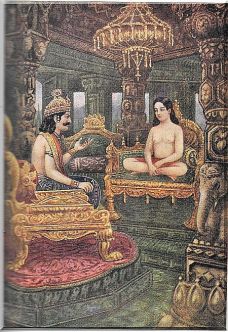
One of my favorite readings is Ashtavakra Gita also called Ashtavakra Samhita. It is in the form of a dialogue between King Janaka and a brilliant but physically deformed boy genius, Ashtavakra. It comprises 298 verses in 20 chapters of varied length. It glorifies the state of Self-realization. The story of Ashtavakra appears in the Vana Parva of the Mahabharata.

The story of Ashtavakra is narrated in a simple form here

Sri Ramana Mahrishi’s rendering of the tale is here

John Richards’s translation of Ashtavakra Gita is simple, lucid and popular.

The translation of Bart Marshall is  brilliant.

Those interested may also see the notes made by Swami Shraddhananda, a sannyasin of Sri Ramakrishna order.

AshtavakraGitaCh-4Of20Slideshow

Ashtavakra Gita is an Advaita text of the highest order, addressed to advanced learners. We do not know who wrote this classic. The estimate of its date varies from third or fourth century BC to post  Sri Shankara period. The author, whoever he was, employed the King Janaka- Ashtavakra episode with great imagination and wove around it a sublime philosophical work , in simple, lucid, classic Sanskrit. The text deals with bondage and liberation, the nature of the Self, means of realizing the Self (atmanu-bhuti) , state of mystic experience  in the embodied state. This is Advaita in its distilled form, devoid of stories, examples, arguments.

Janaka, here, unlike Arjuna , is not a confused person. He is not seeking refuge from despair or delusion. Janaka is mature and knowledgeable; an earnest seeker. The Guru did not have to go through the preliminary exercise of convincing the disciple of the futility of pursuing after objects.

Sage Ashtavakra says that the Self alone exists and all else within the mind-senses vortex is unreal. He draws his disciple’s attention to his restlessness, despite being a model king. This, Ashtavakra recognizes as Janaka’s yearning for truth.

Ashtavakra maintains that all prayers, mantras, rituals, meditation, actions, devotion, breathing practices, etc are secondary. These distract the aspirant from self-knowledge. Knowledge/awareness is all that is required. Ignorance does not exist in itself; it is just the absence of knowledge or awareness. The light of knowledge or consciousness will dispel ignorance revealing the Self. The Self is merely forgotten, not lost, not to be attained. This is not a belief system or a school of thought. This is simply ‘What Is’ and the recognition of ‘What is’.

Admittedly this stringent approach is not suitable for all. A  sharp , discriminating and inward-looking mind is required for understanding Asthavakra’s  teaching. Perhaps due to its  rigor , the text has not been popular

It starts with the King Janaka asking the sage Ashtavakra how he can attain knowledge, detachment and liberation. It quickly becomes a guru-disciple dialogue; however, after Janaka realizes his true Self, they get into an Advaitic discussion of the highest caliber.
white lotus

The sage instructs:

1.2

To be free, Shun the experiences of the senses Like  poison / Turn your attention to/ Forgiveness, sincerity, kindness, simplicity, truth.

muktiṃ icchasi cettāta viṣayān viṣavattyaja । kṣamārjavadayātoṣasatyaṃ pīyūṣavad bhaja ॥ 1-2॥

1.11

It is true what they say: “You are what you think.”/ If you think you are bound you are bound./ If you think you are free you are free.

muktābhimānī mukto hi baddho baddhābhimānyapi । kiṃvadantīha satyeyaṃ yā matiḥ sā gatirbhavet ॥ 1-11॥

1.15

You are now and forever/ Free, luminous, transparent, still./ The practice of meditation/ Keeps one in bondage.

niḥsaṃgo niṣkriyo’si tvaṃ svaprakāśo niraṃjanaḥ । ayameva hi te bandhaḥ samādhi manutiṣṭhati ॥ 1-15॥

1.16

You are pure Consciousness/ The substance of the universe./ The universe exists within you.’ Don’t be small-minded.

tvayā vyāptamidaṃ viśvaṃ tvayi protaṃ yathārthataḥ śuddha buddha svarūpastvaṃ mā gamaḥ kṣudracittatām ॥ 1-16॥

1.17

You are unconditioned, changeless, formless./ You are solid, unfathomable, cool./ Desire nothing./ You are Consciousness.

nirapekṣo nirvikāro nirbharaḥ śītalāśayaḥ । agādha buddhi rakṣubdho bhava cinmātra vāsanaḥ ॥ 1-17॥

The technique of Jnana used here is that of Vichara usually translated as self-enquiry but it signifies examination, reflection, or looking within.Sri Ramana Maharishi was the greatest exponent of this method in recent times. In other types of spiritual practices, the mind is assumed to be an independent entity and therefore efforts are made to control it, purify it and channel it towards the Godhead. Ashtavakra preaches that mind has no existence of its own. It is a bundle of thoughts, he says, take the direct path and plunge into consciousness. A conscious bliss ensues when one abides in Self. Sri Ramana Mahrshi echos these thoughts in his Upadesha Saram (verses 17-21 and 28).

Ashtavakra suggests that there is in reality only the Self and that it is all- pervasive. Just as waves, bubbles or foam have no existence without the sea, so too everything in experience is a phenomenal manifestation of the one great spiritual reality. Ashtavakra speaks of the rising of the winds of the mind and says the worlds are produced, as waves on the sea. He suggests it is the mental activity that gives rise to our experience of the world.

2.23

In the limitless ocean of Myself / The winds of the mind/ Roll the myriad waves of the world

aho bhuvanakallolairvicitrairdrāk samutthitam । mayyanaṃtamahāmbhodhau cittavāte samudyate ॥ 2-23

Upon hearing the Guru, Janaka is enlightened. He bursts into joy and wonder of his new-found state. Ashtavakra is pleased but notices inconsistencies in Janaka’s approach and lets out a series of confrontational verses about attachment to objects. He questions at the end:

3.13

Why should a person of steady mind,/ Who sees the nothingness of objects,/ Prefer one thing to another ? 

svabhāvād eva jānāno dṛśyametanna kiṃcana । idaṃ grāhyamidaṃ tyājyaṃ sa kiṃ paśyati dhīradhīḥ ॥ 3-13॥

Janaka defends by saying

4.1

Surely one who knows Self,/ Though he plays the game of life,/Differs greatly from the world’s/ Bewildered burdened beasts.

hantātmajñānasya dhīrasya khelato bhogalīlayā । na hi saṃsāra vāhīkair mūḍhaiḥ saha samānatā ॥ 4-1॥

4.6

Rare is he who knows himself / As One with no other—The Lord of the Universe./ He acts as he knows/ And is never afraid.

ātmānamadvayaṃ kaścijjānāti jagadīśvaram । yad vetti tatsa kurute na bhayaṃ tasya kutracit ॥ 4-6॥

**

Ashtavakra does not disagree; but in a terse four verses points to the next step—dissolution

5.1

You are immaculate,/ Touched by nothing./ What is there to renounce?/ The mind is complex—let it go./ Know the peace of dissolution.

na te saṃgo’sti kenāpi kiṃ śuddha styaktumicchasi । saṃghātavilayaṃ kurvannevameva layaṃ vraja ॥ 5-1॥

5.2

The universe arises from you/ Like foam from the sea./ Know yourself as One./ Enter the peace of dissolution.

udeti bhavato viśvaṃ vāridheriva budbudaḥ । iti jñātvaikamātmānaṃ evameva layaṃ vraja ॥ 5-2॥

5.3

Like an imagined snake in a rope/ The universe appears to exist/ In the immaculate Self / But does not./ Seeing this you know: “There is nothing to dissolve.”

pratyakṣamapyavastutvād viśvaṃ nāstyamale tvayi । rajju sarpa iva vyaktaṃ evameva layaṃ vraja ॥ 5-3॥

5.4

You are perfect, changeless,/ Through misery and happiness,/ Hope and despair,/ Life and death./ This is the state of dissolution.

sama duḥkha sukhaḥ pūrṇa āśānairāśyayoḥ samaḥ । sama jīvita mṛtyuḥ sannevameva layaṃ vraja ॥ 5-4॥

Ashtavakra makes a remarkable statement; the world however turbulent it may appear is within the infinite being and that it cannot alter the fundamental nature of the Self. He says, it is in the infinite ocean of myself that the mind-creation called the world takes place. I am supremely peaceful and formless and I remain as such.

7.3

In me, the shoreless ocean,/ The universe is imagined./ I am still and formless./ In this alone I abide.

mayya naṃta mahāmbhodhau viśvaṃ nāma vikalpanā । atiśāṃto nirākāra etad evā aham āsthitaḥ ॥ 7-3॥

**

Janaka says “I know that already,” matching him in style and number of verses Janaka goes on to further describes his enlightened state.Still hearing too much “I” in Janaka’s language, Ashtavakra instructs him in the subtleties of attachment and bondage.

Ashtavakra said:

Bondage is when the mind longs for something, grieves about something, rejects something, holds on to something, is pleased about something or displeased about something. 8.1

tadā bandho yadā cittaṃ kiñcid vāñchati śocati । kiṃcin muṃcati gṛṇhāti kiṃcid dṛṣyati kupyati ॥ 8-1॥

Liberation is when the mind does not long for anything, grieve about anything, reject anything, or hold on to anything, and is not pleased about anything or displeased about anything. 8.2

tadā muktiryadā cittaṃ na vāñchati na śocati । na muṃcati na gṛṇhāti na hṛṣyati na kupyati ॥ 8-2॥

Bondage is when the mind is tangled in one of the senses, and liberation is when the mind is not tangled in any of the senses. 8.3

tadā bandho yadā cittaṃ saktaṃ kāśvapi dṛṣṭiṣu । tadā mokṣo yadā cittamasaktaṃ sarvadṛṣṭiṣu ॥ 8-3॥

When there is no “me,” that is liberation, and when there is “me” there is bondage. Consider this carefully, and neither holds on to anything nor rejects anything. 8.4

yadā nāhaṃ tadā mokṣo yadāhaṃ bandhanaṃ tadā । matveti helayā kiṃcinmā gṛhāṇa vimuṃca mā ॥ 8-4॥

**

Ashtavakra goes on to annihilate the false sense of identification of the Self with the mind, saying that “it is bondage when the mind desires or grieves at anything, rejects or accepts anything, feels happy or angry at anything..” In a movingly simple verse, he sums up a free and fearless soul as one who has renounced desire, for “the renunciation of desire alone is renunciation of the world”.

Ashtavakra continues to describe the way of true detachment and stresses the folly of desire—no matter how elevated or subtle. Ashtavakra further describes the state of desireless-ness to which he points

11.6

“I am not the body, nor is the body my possession—I am Awareness itself.”/ One who realizes this for certain/ Has no memory of things done or left undone./ There is only the Absolute.

nāhaṃ deho na me deho bodho’hamiti niścayī । kaivalyaṃ iva samprāpto na smaratyakṛtaṃ kṛtam ॥ 11-6॥

Janaka says he understands what Ashtavakra is saying and summarizes his exalted state with calm indifference. Ashtavakra is impressed but tells the disciple he is not there yet.

15.5

Attachment and aversion/ Are attributes of the mind./ You are not the mind. You are Consciousness itself–Changeless, undivided, free./ Go in happiness

rāgadveṣau manodharmau na manaste kadācana । nirvikalpo’si bodhātmā nirvikāraḥ sukhaṃ cara ॥ 15-5॥

15.16

Leave behind such distinctions/ As “I am He, the Self,”/ And “I am not this.”/ Consider everything Self. / Be desire-less. / Be happy

sarvabhūteṣu cātmānaṃ sarvabhūtāni cātmani । vijñāya nirahaṅkāro nirmamastvaṃ sukhī bhava ॥ 15-6॥

**

Ashtavakra then attacks the futility of effort and knowing.

Being pure consciousness, do not disturb your mind with thoughts of for and against. Be at peace and remain happily in yourself, the essence of joy. 15.19

Give up meditation completely but don’t let the mind hold on to anything. You are free by nature, so what will you achieve by forcing the mind? 15.20

16.1

You can recite and discuss scripture / All you want,/ But until you drop everything / You will never know Truth.

ācakṣva śṛṇu vā tāta nānā śāstrā aṇyanekaśaḥ । tathāpi na tava svāsthyaṃ sarva vismaraṇād ṛte ॥ 16-1॥

**

Ashtavakra does not pay much heed to book learning or to the importance given to mind and its control. You are already free, what will you gain by deliberating or pondering. In other words, remain unattached at all times from all things (including the mind). He advocates direct approach. Teachings of Sri Ramona are remarkably similar to that of Ashtavakra.

Ashtavakra then goes on to describe the nature of a wise person or yogi (chapters 17 and 18) .The characteristics of the true knower as outlined by Ashtavakra are very similar to that of a sthitha_prajna described in Bhagavad-Gita Gita.

17.15

The sage sees no difference/ Between happiness and misery,/ Man and woman, / Adversity and success./ Everything is seen to be the same.

sukhe duḥkhe nare nāryāṃ sampatsu ca vipatsu ca । viśeṣo naiva dhīrasya sarvatra samadarśinaḥ ॥ 17-15॥

17.16

In the sage there is neither/ Violence nor mercy,/ Arrogance nor humility,/ Anxiety nor wonder./ His worldly life is exhausted./ He has transcended his role as a person.

na hiṃsā naiva kāruṇyaṃ nauddhatyaṃ na ca dīnatā । nāścaryaṃ naiva ca kṣobhaḥ kṣīṇasaṃsaraṇe nare ॥ 17-16॥

17.18

The sage is not conflicted/ By states of stillness and thought./ His mind is empty./ His home is the Absolute.

samādhāna samādhāna hitāhita vikalpanāḥ । śūnyacitto na jānāti kaivalyamiva saṃsthitaḥ ॥ 17-18॥

18.9

Knowing for certain that all is Self,/ The sage has no trace of thoughts/ Such as “I am this” or “I am not that.”

ayaṃ so’hamayaṃ nāhaṃ iti kṣīṇā vikalpanā । sarvamātmeti niścitya tūṣṇīmbhūtasya yoginaḥ ॥ 18-9॥

18.10

The yogi who finds stillness/ is neither distracted nor focused./ He knows neither pleasure nor pain./ Ignorance dispelled,/ He is free of knowing.

na vikṣepo na caikāgryaṃ nātibodho na mūḍhatā । na sukhaṃ na ca vā duḥkhaṃ upaśāntasya yoginaḥ ॥ 18-10॥

**

In a final flurry of questions pointing only at their own meaninglessness, Janaka bursts forth into inspired poetry and burns off the last vestiges of personhood and enters dissolution (chapters 19 and 20). He ends with: “No more can be said.” Ashtavakra smiles, nods approvingly, and says no more

Using the tweezers of the knowledge of the truth I have managed to extract the painful thorn of endless opinions from the recesses of my heart. 19.1

20.11

Where is illusion? Where is existence? Where is attachment or non-attachment? Where is person? Where is God?

I am Awareness./ Where are principles and scriptures? Where is the disciple or teacher? Where is the reason for life? I am boundless, Absolute.

kva māyā kva ca saṃsāraḥ kva prītirviratiḥ kva vā । kva jīvaḥ kva ca tadbrahma sarvadā vimalasya me ॥ 20-11॥

kva pravṛttirnirvṛttirvā kva muktiḥ kva ca bandhanam । kūṭasthanirvibhāgasya svasthasya mama sarvadā ॥ 20-12॥

20.14

Where is existence or non-existence? Where is Unity or duality? / Nothing emanates from me. / No more can be said.

kva cāsti kva ca vā nāsti kvāsti caikaṃ kva ca dvayam । bahunātra kimuktena kiṃcinnottiṣṭhate mama ॥ 20-14॥

॥ Om̃ tatsat ॥
 guru charana

white lotus

The approach and treatment of   Ashtavakra are logical and precise like mathematical equations.Yet, the Ashtaavakra Gita may not be read at a streatch , in one straight reading. It is preferable the verses are read few at a time , on a daily basis, and reflected upon .

One rarely comes across a Guru-disciple association as that of Sri Ashtavakra and King Janaka, a mature disciple. To such Sri Guru, who is the Para Brahman, I offer my salutations, on this Guru Purnima !
header

https://sanskritdocuments.org/doc_giitaa/ashtgita.html?lang=iast


Tags: ,

Adhyasa Bhashya of Sri Sankara

sri sankara

1. The magnificent prelude that Sri Sankara wrote to his commentary on the Vedanta Sutras is celebrated as The Adhyasa Bashya. It is in fact not a Bhashya; it is not a commentary. It is an independent piece of writing, which served as a prologue to his main work.

2. The Adhyasa Bashya is remarkable in many ways. It is not a lengthy work; it is less than fifty lines divided into five sections. It is a free flowing writing. Sri Sankara lucidly puts forth his views. While doing so, he does not cite any traditional text or authority in support of his views. He does not denounce or attack any school of thought (vada). He is not propagating a new school of thought or a new argument. He assures that the significance of the initial discussion will be realized in the main commentary, which seeks to restore the true interpretation of the. Vedanta tradition as contained in the Vedanta Sutra. Adhyasa Bashya is a rare gem in the field of philosophical texts.

3. Attaining ones aspirations and expectations by resort to rituals had caught the imagination of the common people, though the Vedanta tradition advocated wisdom as the sole means for attaining ones goals in life. However, some thinkers diluted the rigorous position by combing Upanishad teachings with rituals to make it appealing to the common people. This they called ‘jnana_karma_samucchaya”– a two- in- one of wisdom and ritual.

3.1. Sri Sankara viewed this as a distortion of the Upanishad ideals. In order to play down the prominence given to rituals by the Mimamsakas, Sri Sankara relied on the idea of avidya He bracketed the ritualistic approach with avidya and called it an “error”.

4. Avidya is a word that occurs in Upanishads, though not often. The word Vidya is used to denote effective discrimination and avidya is the absence of it. Sri Sankara states wisdom (vidya) can eliminate ignorance (avidya); but the ignorance it eliminates is not real, because it has no existence of its own. Once the error is removed the Universe (Brahman) will reveal of its own accord.

4.1. Sri Sankara explains, darkness and light are distinct from each other in their nature and in their functions. Darkness has no existence of its own; it is merely the absence of light. Whereas, the light is positive and helps vision. Darkness and light can neither coexist nor share their functions or nature. Darkness is an error that can be removed.

5. Sri Sankara states in his prologue , the main purpose of the Upanishads is to provide the Knowledge(vidya) that will eliminate darkness , ignorance(avidya) , which is in the nature of “reality transfer” (adhyasa). He thereafter goes on to explain the concept adhyasa.

5.1.Adhyasa, according to Sri Sankara, is not an intellectual construct (kalpana_viseha) but a matter of experience (anubhava). Sri  Sankara says we do it all the time. Adhyasa consists in mistaking one thing and its attributes for another; superimposing one level of reality over other. This we do every day. 

For instance; we measure the duration of the day with reference to sunrise ; and , reckon our existence in terms of days/weeks/months / years which again are related to motion of the Sun. But, in the absolute view, the Sun neither raises nor sets; but , it is the earth that rotates . For our day-today  existence we accept and go by the relative -reality of the diurnal motion of the Sun,  and also ignore the fact of earth’s rotation. Both these positions are real in their own sphere ; but,  one is a ‘relative reality’ and the other is the ‘Absolute reality’. We , in our living , impose the relative reality over the Absolute; and accept the relative as the Real . 

Thus, an individual experiences the world through his senses, mind and other ways of perception. His experience of the world may be tainted by the defect in his senses or other constraints, internal or external. Nevertheless, that person creates his own set of norms, impressions and experiences and he accepts those subjective experiences as real.

5.2. A special feature of Sri Sankara’s thought is that he regards personal and intuitive experience (anubhava) as independent and convincing evidence. Sri Sankara says that individual’s experience cannot be disputed, because the experience he went through was real to him; though that may not be real from the absolute point of view. Sankara makes a distinction between the absolute view and the relative view of things.

6. In short, what the person does is, he imposes his transactional experience (relative or dual) over the transcendental (absolute) and accepts the former as real. That subjective experience need not be proved or disproved . However, the confusion it created can be removed by wisdom (vidya). According to Sri Sankara the world we experience is not absolutely real but it is not false either. The real is that which cannot be negated and that which is beyond  contradiction.

6.1. Sri Sankara explains that vyavaharika (relative) and para_marthika (absolute) both are real. However, the relative reality is “limited” in the sense it is biologically or mechanically determined and it is not beyond contradictions. The absolute on the other hand is infinite (everlasting and unitary (meaning utter lack of plurality)). 

Sri  Sankara is careful to point out that the two dimensions – Vyavaharika and Paramarthika – are two levels of experiential variations. It does not mean they are two orders of reality. They are only two perspectives. Whatever that is there is REAL and is not affected by our views

6.2. The Self in the vyavaharika context is saririka (embodied self); it encounters the world. However, the Self in reality is not saririka; it is absolute, asaririka and is infinite. The infinite Self, perceived as the limited self (jiva) is what Sri Sankara calls as Adhyasa.

7. The dichotomy between being an individual-in-the-world (jiva) and being originally a pure, transcendental consciousness (atman) is taken by Sri  Sankara as merely superficial.According to Sri  Sankara, it is due to avidya that the individual fails to see the nexus between Being and the world. That nexus indicates the oneness underlying the subject-object, inner-outer, Man-Nature distinctions. All that is required is to remove the error and the universe will shine on its own accord.

8. The analogy given in the text is that of a pond that is clear and undisturbed .One can see the bottom of the pond through its still water. When, however, pebbles are thrown into the pond, the water in it is disturbed and the bottom of the pond becomes no longer visible. That bottom however is there all the time and it remains unchanged, no matter whether the surface water is disturbed or not. The water in the pond is the transactional world. The bottom of the pond is the transcendental reality. The disturbance created is avidya

[It is difficult to find an exact English word for adhyasa. It may, among other things, mean “superimposition”,” projection” etc. adhyasa is more comprehensive than that. Sri Sankara, in my view, recognizes three levels ofexistence, the Absolute, the relative and the illusory. Adhyasa consists in superimposing one level of existence (relative/illusory) over the other (The Absolute) and accepting the former as true while it may actually be untrue.The absolute (atman) appearing as the limited (jiva) is what Sri  Sankara calls adhyasa.

(For more on this please see Adhyasa ]

9.Extending the concept of Adhyasa, Sri  Sankara says, we superimpose the body, the sense organs and the mind on the Self(infinite) and we use expressions like: ‘I am fat’, ‘I am thin’, ‘I am white’, ‘I am black’, ‘I stand’, ‘I go’, ‘I am dumb’, ‘I am deaf’, ‘I think’, ‘I am not going to fight’, ‘I shall renounce’ and so on. In this way, we superimpose our mind on the Atman, which is the eternal witness. We do it the other way also by superimposing self on the mind, the non-Self. According to Sankara, the relation between mind and self involves mutual superimposition (itaretara-adhyasa). This relation is false since there cannot be any real relation between the self and the non-self. This confusion or adhyasa is innate to us, and is a matter of common experience.

10. Sri  Sankara says, the purpose of Upanishads is to remove adhyasa or avidya; and once it is removed, Brahman will shine of its accord, for it is the only reality. This doctrine of Sri  Sankara became the nucleus for the development of the Advaita school of thought.

11. As regards the rituals, Sri  Sankara says, the person who performs rituals and aspires for rewards will view himself in terms of the caste into which he is born, his age, the stage of his life, his standing in society etc. In addition, he is required to perform rituals all through his life. However, the Self has none of those attributes or tags. Hence, the person who superimposes all those attributes on the changeless, eternal Self and identifies Self with the body is confusing one for the other; and is therefore an ignorant person. The scriptures dealing with rituals, rewards etc. are therefore addressed to an ignorant person.

11.1This ignorance (mistaking the body for Self) brings in its wake a desire for the well being of the body ,aversion for its disease or discomfort, fear of its destruction and thus a host of miseries(anartha). This anartha is caused by projecting karthvya (“doer” sense) and bhokthavya (object) on the Atman. Sri Sankara calls this adhyasa. The scriptures dealing with rituals, rewards etc. are therefore, he says, addressed to an ignorant person.

11.2.In short, person who engages in rituals with the notion “I am an agent, doer, thinker”, according to Sri Sankara, is ignorant, as his behavior implies a distinct, separate doer/agent/knower ; and an object that is to be done/achieved/known. That duality is avidya, an error that can be removed by vidya.

11.3. Sri Sankara elsewhere explains that, when such acts are performed by a person without desire for the fruits of his actions, by recognizing the reality that there is neither a “doer” nor an “object”, then that instills in him the desire for Brahma-vidya, which takes him closer to vidya.

12. Sri Sankara affirming his belief in one eternal unchanging reality (Brahman) and the illusion of plurality, drives home the point that Upanishads deal not with rituals but with the knowledge of the Absolute (Brahma vidya) and the Upanishads give us an insight into the essential nature of the Self which is identical with the Absolute, the Brahman.

[https://sanskritdocuments.org/sites/snsastri/adhyasabhashya.pdf ]

https://www.gitasupersite.iitk.ac.in/brahmasutra_content?language=dv&field_chapter_value=1&field_quarter_value=1&field_nsutra_value=0

white lotus

Sri Sankara

1. Sri Sankara was an original thinker. He was a leader.Hewas not a dreaming idealist but a practical visionary.Scripture and reason were the two aids in his arguments. He was a great logician, who based his arguments entirely on the principles of logic but without contradicting the intuitional revelations of the Vedas and the Upanishads. Sri Sankara’s thought gave a new dimension to Indian philosophy. It restored the position of Upanishads as the pristine source of knowledge. It established Vidya, wisdom as the true source of light. It put reason and discretion at the center stage and pushed the rituals out of contention.

2. He ushered in a new way of looking at our world, at our experience in/with it, by introducing the relative and absolute view of the Universe. When he talked about the infinite and time less nature of the Universe, it was not in the sense of endless duration, but in the sense of completeness, requiring neither a before nor an after. When he referred to Unity of self he was not talking of putting two things together, but he used the term to mean utter absence of all plurality in the real Self. The western world had to wait until the beginning of twentieth century to arrive at those concepts.

3. He gave credence to an individual’s subjective experience. He placed personal experience and intuition above all the other means of cognition. He said a person’s experience could not be disputed. He declared, “Intuition is not opposed to intellect. Reality is experience. Realizing the Supreme Being is within ones experience.”

4. He recognized the underlying oneness and the infinite nature of the universe. He asserted, “I am not the mind or the intellect not the ego. I am the blissful form of the Brahman.” He redefined the relation between the Man, World and the Universe. He said they were One. Duality, he said, was an error in perception.

5. His is not a system opposed to other systems, but a method of interpretation of values. His is a voice of reason and sanity. Sri  Sankara is therefore relevant even today. He values reason, encourages spirit of inquiry, gives credence to subjective experience and therefore to freedom of ones thought and expression. He suggests intellect is not opposed to intuition. He asks us to take the small ego out of the equation in our day-to-day activities of life. He implores us to recognize the essential unity of all beings and their oneness with the infinite space-time continuum. He explained, the Universe is the manifestation of the Supreme Being.

6. Vedanta of Sri Sankara comes as a remedy to the conflict and violence ridden ways of our life.

7. Swami Vivekananda aptly described Sri Sankara’s Advaita as the fairest flower of philosophy that any country in any age has produced

3742705698141cd

******
Please also read

Sankara – a genius, misunderstood

Deeply indebted to
Prof.SKR Rao

 
8 Comments

Posted by on September 1, 2012 in Indian Philosophy, Sri Sankara, Vedanta


Tags: , ,

Sri Sankara – a genius misunderstood

Sri Sankara, the Adi Sankara-charya is one of the greatest thinkers of all times.

This country owes him a deep debt of gratitude. He not only consolidated the classical values of life but also reorganized what we now call Hinduism. He brought together diverse strands of philosophical speculations and religious disciplines.

Unfortunately, few philosophers in the world are as misunderstood and misinterpreted as Sri Sankara. Ironically, most of the harm came from his admirers and followers.

A. Admirers

1. It became a trend in the middle ages among the lesser authors to float their work in the name of celebrated authors to ensure its acceptance by the scholars of the day. Following this custom, many of Sri Sankara’s admirers hoisted their works on him .In some other cases, brilliant works were submitted by their authors in his name. This was an act of devotion.

As a result, we have today, more than 250 works ascribed to Sankara. These include philosophical treatise (bhashyas), advices to aspirants (updaesha), minor dissertations (prakaranas), hymns addressed to various divinities, poems etc.

The quality of these works is not consistent. Some of them undoubtedly have merit. It is however, obvious not all of them could be works of one author. The ideas expressed in them are not only various but often inconsistent. In a few cases, the works contradict each other. ( E.g. Two commentaries on Kena Upanishad, both ascribed to Sankara have conflicting views) .The ideas contained in a few others came into existence much after Sankara’s time.

2. Sri Sankara during his lifetime decried and fought against Tantric practices. However, Tantric texts like Prapancha_sara, Lalitha_trisati_bashya and others are in circulation under his name. The other famous tantric work ascribed to Sri Sankara is Sandarya_lahari. The scholarly opinion is that it is not Sankara’s work, though it is an excellent composition.

3. Among the minor dissertations (prakaranas):  Sarva-vedanta-siddanta-sara_sangraha; probodha-sudhakara; Advaitanu-bhutiYoga-rathavali; Anatma-vigrahanaprakarana etc. are definitely not Sankara’s works.

4. A commentary on Vishnu_sahasra_nama is ascribed to him. It is decidedly a recent work. It is inconsistent too. It is not Sri Sankara’s commentary.

Similarly,  Jayamangala  or Samkhya- saptati-tika  (likely before 9th-century), describes itself as a commentary (Tika) on Isvarakrishna’s  Samkhya-spatasati , authored  by Sri Sankaracharya ; but , that seems highly  doubtful. 

ti śrīmat-paramahaṃsa-parivrājakācārya- śrī govinda- bhagava-pūjya- pāda- śiṣyeṇa śrī śaṅkara-bhagavatā kṛtā sāṃkhya- saptatiṭīkā samāptā //

It is likely that some one might have hoisted his work upon Sri Sankara, perhaps to ensure its  acceptability among the contemporary scholars  – Further, it is pointed out that Sri Sankara could not have described himself as, śrīmat-parama-haṃsa-parivrājakā-cārya-Sri-Sankara-bhagavata . And, the opening   benediction    lokottara-vādinaṃ praṇamya munim ,  is a typical Buddhist expression

5. A number of hymns, of inconsistent quality, in praise of various deities are known as his compositions. (E.g. Stotras on Subrahmanya, Ganapathi, Shiva, Vishnu, Devi etc.)

6. One of Sri Sankara’s missions was to wean people away from ritualistic approach advocated by Mimamsakas and to project wisdom (jnana) as the means of liberation in the light of Upanishad teachings. He criticized severely the ritualistic attitude and those who advocated such practices. However, the texts that combined rituals with wisdom (jnana_karma_samucchaya) more in favor of the Mimamsaka position came onto vogue, projecting Sankara as the rallying force of the doctrine. His followers might have found Sankara’s mission a hard task and therefore compromised the liberating wisdom with the performance of rituals.

7. Whatever be the popular opinion, the scholarly tradition recognizes only three texts as authentic works of Sri Sankara. These are his commentaries on the Upanishads, the Gita and on Vedanta Sutras; grouped under the name prasthana_thraya.

Vedanta Sutras 

1. A word about Vedanta Sutra before we proceed: Vedanta Sutras also called Brahma Sutras deal with the essential import of Upanishads. They are rendered in the form of Sutra (aphorism), terse and crisp. They are therefore open to interpretations. The work is ascribed to Badarayana, who is often identified with Krisha_dvaipayana_vyasa; the author of Mahabhatarha. Sri Sankara is however is silent on this issue.

2. Sri Sankara’s commentary on this Sutra, called the Vedanta Sutra Bhashya (VSB) is a highly celebrated text. Sri  Sankara’s purpose in writing his commentary was to explain the traditional view. He said, the primary meaning of the word Upanishad  was knowledge, while the secondary meaning was the text itself. He isolated the Upanishad lore from the rest of the Vedic body and narrowed it down to ten or twelve Upanishads. Even here, he did not include the ritualistic portion of the Vedas. This was in contrast to the classification followed by the later Acharyas.

3. We may assume that there were other points of view in circulation in those days and they did not entirely represent the traditional view. (No commentary on the Vedanta-sutras survives from the period before Sri Sankara.) This motivated Sri Sankara to come up with his precious commentary. Sri Sankara explained that wisdom (jnana), according to the real import of Upanishads, was the true means of liberation. Sri Sankara’s interpretation of the Upanishads marked the beginning of a new line of thought. The then existing Vedanta terms (like Brahman, maya, avidya, adhyasa, jnana, mukthi etc.) acquired in his work a deeper significance, wider context and a greater relevance.

[  Sri Sankara seems to take Brahma sutra more as an exposition of the Upanishads than as an original text. For him, therefore, the Brahma sutras derive their authority from the Upanishads; and, the sutras must therefore conform to the meaning and the spirit of the Upanishads. The Brahma sutras will have to be interpreted in the light of the Upanishads.

The sutras of Badarayana have one single purpose, that of stringing together the flowers of Vedanta akyas (Vedanta vakya- kusuma –grathanatavat sutram – BB.1.1.2)

Sri Sankara undertakes to interpret Badarayana’s Brahma Sutra in order to expound through what he understood as the philosophy of Upanishads taken as a harmonious and systematic whole. The fact that he had written commentaries on the principal Upanishads, presumably, before his commentaries on Brahma sutra and the Bhagavad-Gita goes to show that he had grasped the keynote and the essence of the Upanishads. These became central in his interpretation of Brahma sutra as also of Vedanta philosophy.

Sri Ramanuja , in turn , interprets   the Brahma sutra through the Vrtti of Bodhayana and the glosses on the Vrtti by the other purva-acharyas, the old-masters.

Sri Sankara , basically,  regards himself as the votary of Upanishads (Aupanishada).He even calls his way of thinking or the doctrine as Aupanishadam Darshanam, the Upanishad System. He defines the Upanishads as the texts that lead the aspirants close to the highest reality. He insists Upanishads constitute the final purpose and the import of the Vedic lore; and that is the reason he chose to write commentaries on the Upanishads and on the other two texts that depend almost entirely on the Upanishads – Badarayana’s Brahma Sutra and the Bhagavad Gita. It is therefore not surprising that Sri Shankara relied heavily on Upanishad texts to interpret and comment on Brahma Sutra.]

B. Followers 

1. The history of Advaita is replete with interpretation and reinterpretation of Sri Sankara’s Vedanta Sutra Bhashya (VSB). The generation of Advaita followers that succeeded Sri wrote a number of commentaries on Sri Sankara’s VSB. Each commentator claimed that he grasped the essence and true intent of Sri and went on to write according to his own understanding. In that process, he wove into the commentaries, his personal views and hoisted them on Sri Sankara. This kind of adulation gave rise to several versions of Advaita. The numerous glosses written by his followers tried to blend ritualistic attitude with the monistic inclination of the Master. The result was the distortion of Sri Sankara’s position.

1.1. The so-called orthodox interpretation of Sri Sankara flows in two distinct channels; the one based on Bhamathi and the other on Pancha_padica.

2. Vachaspathi Misra (c.840AD) was a well-known scholar and a commentator of his times. He wrote a number of glosses and commentaries on several schools of thought. His commentary on Sri Sankara’s VSB was titled Bhamathi.

2.1. Bhamathi revels in dialectic and relies on Mimamsa (ritualistic approach) which Sri Sankara did not approve. Further, Vachaspathi brought together, in Bhamathi, the views of Sri Sankara with the ritualistic views of Mandana (a Vedanta scholar, author of Brahma siddhi); whose views were severely criticized by Sureshvara, a direct disciple of Sri Sankara. Though Sri Sankara and Mandana belonged to the same Vedanta branch they differed on ritualistic aspects of Vedas. Yet, while interpreting Sankara, Vachaspathi introduced ideas borrowed from Mandana and hoisted them on Sankara. Many ideas that appear as Sri Sankara’s in Bhamathi  were in fact not his.

[ Mandana Misra is a seminal figure in the history of Advaita He was a contemporary of Sri Sankara and the Great Mimamsaka Gaudapada.  His work Brahma-siddhi and Gaudapada’s Karika on Mundaka Upanishad   are in fact only two  surviving works of the pre Sankara period that have come down to us. Mandana’s citations from or comments and remarks on previous other authors, either refuting or endorsing their opinions, make him one of the credible resources on the state of Advaita prior to the time of Sri Sankara.

His comments on some of the disputed concepts of Vedanta such as : Vivarta (unreal appearance) , Anirvachaniyatva (inexplicable state) or Maya-vada (doctrine of the seemingly real or unreal) have always attracted the later scholars and students of Vedanta .He is perhaps the first to attempt to establish the Advaita doctrine through means of cognition Pratyaksha , direct perception. He argued that Pratyakshya cannot prove the reality or otherwise of an object because the direct perception is incapable of truly appending the distinction between the Real and the unreal (or seemingly real).

Though Mandana may have been influenced by Sri Sankara’s Advaita Vedanta, he did retain some of his own position on certain matters. Certain features of his doctrine are, in fact, not found among the principles laid out by Sri Sankara.  Just to mention a few of his own elaborations the following could be cited: the inexplicable nature of Avidya (ignorance);   making out a distinction between two sorts of Avidya; importance he placed on Sat (Being) and Bliss (Ananda) as the more significant attributes of Brahma etc.

Interestingly, Vachaspathi Misra, in his commentary (titled Bhamathi) on Sri Sankara’s Brahma-Sutra-Bhashya tended to follow, on certain issues and explanations, the lead of Mandana Misra rather than that of Sri Sankara.

Vachaspathi Misra’s commentary (Bhamathi) juxtaposed with another commentary of Padmapada (one of the direct disciples of Sri Sankara) on the Brahma Sutras caused a major split or schism in the Advaita School. From then on, two rival streams of Advaita School – one called the Bhamathi School based on Vachaspathi Misra’s interpretation of , and the other Vivarana School based on the explanations provided Padmapada in his Pancha-padika-vivarana, came into being.

Amazingly, both the Schools of Advaita had drifted away from the basic tenets postulated Sri Sankara. And yet; both Schools have their followers and both are studied by the students of Advaita philosophy, in general.]

[It seems that for several centuries following Sri Sankara and Mandana, it was Mandana who was viewed by other schools as the major figure in Advaita. Vachaspathi Misra is said to have continued Mandana’s brand of Advaita in his commentary on Brahmasiddhi  (now lost), and in his Bhamathi a commentary on Sri Sankara’s Brahma sutra Bhashya. Mandana differed from Sri Sankara on some issues.

For instance, Mandana accepts and advocates the doctrine of Sphota a grammatical theory put forward by Bhartruhari, while Sri Sankara rejects Sphota theory and opts for Varna vada.

Again, Mandana on the question of false judgement tries to assimilate the views of Bhatta Mimamsaka, whereas Sri Sankara is ambivalent of the view and his disciple Suresvara criticizes Bhatta’s view on error severely.

Mandana also appears to lean towards the Mimamsa view of the relevance of meditation in achieving liberation and his tendency to accommodate the combined view (jnana-karma-samucchaya-vada). These tendencies are not surprising, since Mandana, a student of Mimamsaka Kumarila Bhatta, was a well recognized scholar in the Grammar – philosophy as the author of Sphotasiddhi and also as the author of other Mimamsa texts. ]

2.2. Regardless of this position, a branch of Advaita literature grew thereafter with Bhamathi as the official version of Sri Sankara’s view. Further, Bhaskara’s views were fused or confused with Sri Sankara’s views. The interpretations and arguments of that branch were lined up accordingly. Akandanandaa’s Rju-prakasika, Anandagiri’s Saririka_nyaya_nirnaya and Govindananda’s Bashya_rathna_prabha were some of the texts produced in this school. These texts do not reflect original Sri  Sankara.

2.3. Today, the study of Sri Sankara, in orthodox circles, is based, mostly, on the Bhamathi and the annotations on it by Amalananda (Vedanta_kalpataru c.1250) together with notes of Shri Appaiah Ditkshita (c.1550). These three together with Vedanta Sutra and Sri Sankara’s commentary on it constitute the basic Advaita literature (pancha granthi). This is despite the fact the views of Sri Sankara and Vachaspathi are divergent on issues relating to rituals and scriptural authority.

3.Pancha_padica is a running annotation on the first four aphorisms of Sri Sankara’s VSB. It is an incomplete work. It is ascribed to Padmapada; a direct disciple of Sri Sankara. That again, is disputed. However, a distinct school of Advaita grew with Pancha_padica as its nucleus. A major work in this tradition was Prakasathman’s Vivarana, a treatise. Later Akhanada_ananda_muni (c.1350 AD) wrote a gloss on the Vivarana

The most celebrated work in this school was, undoubtedly, the Pancha_dashi written by Vidyaranya, who also abridged the Vivarana (Vivarana prameya sangraha).

3.1. A large number of glosses, annotations, notes, and digests followed Bhamathi and Pancha_ padica. Vimuktatman’s Ishtasiddhi, Chitsukha’s Bhava_dyotankia and other works contradicted Sri Sankara. Besides these, there were independent texts that stayed clear of the recognized schools. In the post-Sankara period, many terms and concepts like-moola_avidya, vivarta, six fold pramana, avidya_lesha; became a part of Advaita vocabulary. Some of those concepts might have looked unfamiliar to Sri Sankara.

For instance, Sri Sankara treated ignorance (avidya) as an error, the removal of which led to wisdom (vidya).He left it at that. His followers however, wrote tomes speculating the causes for ignorance, nature of ignorance, different forms of ignorance etc. Had the Master watched his disciples at work he might have wondered whether they were studying about Brahman or about ignorance

3.2. The texts such as Pancha_padica, Advaita_siddhi and Pancha_dasi are brilliant works and have great merit. They are landmarks in the development of Indian thought. However, they do not correctly represent Sri Sankara’s thought; they cloud the original  Sri Sankara. The question is, no matter how brilliant the ideas, imagery and arguments introduced by the later scholars be, were the authors justified in hoisting their views on Sri Sankara?

4. If the body of Advaita literature were to be taken together, Sri Sankara would be contradicting himself. He would at once be a nihilist, a ritualist, an obscurantist and an idealist too. It is difficult to cull out the original Sankara from the mass of accretion that collected over the centuries. The best introduction to Sri Sankara’s thought is his prelude to the VSB viz. the Adhyasa_Bashya.

5. Some of the areas where  Sri Sankara differed with the Mimamsakas were briefly as under:

5.1. Mimamsakas held the view that the real purport of the scriptures was to provide injunctions and prohibitions. The scriptural injunctions were mandatory and the texts that relate to wisdom were spillover (sesha).

The real purpose of the scriptures, Sri Sankara said, was to describe the reality as it is. Sri Sankara rejected the Mimamsa view and argued that scripture were not mandatory in character, at least where it concerned pursuit of wisdom. Upanishads, he remarked, dealt with Brahman and that Brahman could not be a subject matter of injunction and prohibitions.

5.2. Sri Sankara strongly advocated study of Upanishads, and at the same time cautioned that study of Upanishad alone would not lead to moksha.. In matters of such as spiritual attainment ones own experience was the sole authority and it cannot be disputed

He also said study of Upanishad was neither indispensable nor a necessary pre requisite for attaining the human goal, the moksha. He pointed out; even those who were outside the Upanishad fold were as eligible to moksha as those within the fold were. He declared that all beings are Brahman, and therefore the question of discrimination did not arise. All that one was required to do was to get rid of Avidya (duality).

He pointed out that rituals could in no way bring about wisdom, much less moksha.. He asserted, while the rewards of the rituals were not matter of direct experience, wisdom which is the fruit of Vedanta is based on immediate and personal experience; one need not have to wait for the reward nor one be in doubt whether the reward would or would not come.

This was in sharp contrast to the position taken by Mimamsakas who asserted that rituals alone would lead one to higher levels of attainment. Further, the deities would reward only those entitled to perform the rituals alone. The entitlement involved the caste, creed and other parameters.

6. Most of the ideas that Sri Sankara rejected came back to the Advaita fold and the Mimamsa position with regard to the scriptural authority and value of rituals became a part of the Advaita posture. The wisdom –oriented teachings of Sri Sankara became as much a face of Advaita as the rituals, worships and other practices. There was therefore an obvious disparity between what Sri Sankara idealized and what his followers, even the elite, practiced.

7. By about tenth century, the Advaita scene was littered with a confusing array of texts that did not outline a well-defined doctrine. The rise of the sects and sectarian prejudices did not also help matters.8. The “rival” Vedanta doctrines when they came on stage, naturally, reacted to the Advaita texts in circulation at the time. It was that form of Advaita, which they encountered, that gave cause for dissatisfaction and annoyance. While criticizing Sri Sankara they relied on the later exponents than on Sri Sankara’s own views. The result was the distortion of Sri Sankara’s position. He was criticized for what was hoisted on him than on what he said.

For instance, by the time Sri Ramanuja (1017-1132) emerged as an exponent of orthodox Vedanta tradition, Ishta_siddhi written by Vimuktananda was the standard advaita text of the day.Ramanuja’s criticism of Sri Sankara was based mainly on this work. Interestingly, Madhva (1197-1276) another Acharya also criticized Sri Sankara based on the views presented in Ishta_siddi. It is said that Sri Madhva pointed more than thirty errors of argument in that text.

9. The “rival” schools of Vedanta thoughts like Vishistadvaita and Dvaita took Advaita as the common point of departure. By then the Advaita schools were in a confused state and reacted with emotion; though much of the conflict that ensued was academic. It is fair to say, the new trends emerged in fulfillment of the needs of the time.

C.  Some popular misconceptions about Sri Sankara 

A number of popular misconceptions are in circulation about Sankara .The following are a few of them:

1. Advaita: 

1.1. The popular belief is that Sri Sankara “found” Advaita system of Vedanta, promoted and popularized it. This is a misconception.

1.2. Sri Sankara clearly said he was not putting forth a new theory or a school of thought. He did not expound or defend any argument (vaada) either in his VSB or in his commentaries on Upanishads and Gita. His mission was to present the true interpretation of the Vedanta tradition. His school of thought (asmadeye darshane), according to him, was the Upanishad system (aupanishadam darshanam) or the doctrine of emancipation (moksha vada). Sri Sankara was the upholder of tradition (Evam sampradaya vido vadanti).

1.3. Sri Sankara did not claim he found Advaita school of thought or that he was an Advaitin. He used the expression “Advaita” in VSB only two times and on both occasions, he was quoting: once from Gaudapada’s karika; and, the other time from Brihadaranyaka Upanishad. Gaudapada, in his karika, employed the term as a descriptive expression for Brahman (or Atman). Sri Sankara followed the lead of his guru_naam_guruhu (teacher’s teacher).

1.4. At that stage,” Advaita” was yet to emerge as a Vedanta doctrine and as a separate school of thought.. The term “Advaita” does not appear in Bhamathi , written about a hundred years after Sri Sankara . Bhamathi calls Sri Sankara’s exposition as investigation into Brahman(Brahma mimamsa), a logical procedure(tarka) and treats it as such.

1.5. The Advaita argument (Advaita_avada), as a school of thought was a post Sri Sankara development; though the essence of the doctrine was in his VSB and in Adhyasa Bhashya.

2. Attack on Dvaita:

2.1.  Sri Sankara did not attack dualists (dvaitinaha), as alleged

2.2. The logical elucidation of “oneness” of Atman in Sri Sankara’s VSB appealed to his followers. They turned that into a school of thought (Advaita_vaada), in order to distinguish it from the dualistic thought (Dvaita) that emerged after Sri Sankara.

2.3. A school of dualistic thought was not in existence at the time of Sankara. The question of his attacking them did not therefore arise. The only dualists he mentioned were Samkhya and Yoga systems.

3. World an illusion:

3.1. Among the misconceptions that have grown around Sri Sankara, the persistent and the most erroneous one is that he regarded world as an illusion. It is a gross misrepresentation of Sri Sankara.

3.2. The concept of phenomenal projection Adhyasa, which is basic to Sri Sankara’s thought is seriously misunderstood. The acceptance of twofold perspective, transcendental (absolute) and transactional (relative) is at the root of his Adhyasa concept.

3.3. Sri  Sankara neither takes the world we experience as absolutely real nor does he denies its reality altogether. He brings in the concept of the Absolute and the relative view of things.

Failure to understand the concept of Adhyasa resulted in such confusion.

4. Buddhism:

4.1. Sri  Sankara did not drive Buddhism out of India.

He came nearly 1200 years after the Buddha. By Sri Sankara’s time (c. eighth century), Buddhism had lost its vigor a couple of centuries earlier and had moved into the neighboring countries.

4.2. Sri Sankara’s dispute with the Buddhist schools (Madhyamika and Vaibashika) was purely metaphysical and not religious. By this time, Buddhism (Mahayana) had moved closer to Upanishads and the chasm between Vedanta and Buddhism had narrowed a great deal.

4.3. Gaudapada who was the teacher of  Sri Sankara’s teacher, and whom Sri Sankara addressed as the “knower of the tradition” (sampradaya vit) employed terms that were commonly in use by Mahayana Buddhism and the orthodox Schools. Gaudapada was not a Buddhist, he was a vedantin.

Shri T.M.P.Mahadevan an authority on Gaudapada confirmas this position; and,  says  Sri Sankara was wrongly handed down the  epithet of “Buddhist in disguise’(pracchanna-bauddha).

flower-design

When one studies Sri Sankara, no matter one agrees with him or not one “is in contact with a mind of a very fine penetration and profound spirituality.”

-as Dr. Radhakrishnan said.

Please read next

Adhyasa Bashya of Sankara

Deeply indebted to

Prof.SKR Rao

Shri S Rajam

 
12 Comments

Posted by on September 1, 2012 in Indian Philosophy, Sri Sankara, Vedanta


Tags: , ,

Concept of rna in Indian tradition

Concept of rna in Indian tradition

The concept of rna, the human indebtedness or the primary obligation, is unique to Indian tradition. It is in fact the source of dharma, because it weans one away from desire-gratification and leads towards duty-fulfillment.

Rna, according to Panini the great grammarian, signifies a want or a deficiency.

Taittiriya Samhita (TS) speaks about three kinds of basic indebtedness every human being carries with him or her. They are the debt one owes – (a) to his ancestors (pitr), (b) to the sages/seers (rishi) and(c) to the Gods (deva).

The Shathapatha Brahmana (SB) adds one more .The fourth one is the debt one owes to his fellow beings.

These texts suggest the ways of liquidating the debts or fulfilling the obligations one is born with. These are briefly, as under.

Pitr :   by bringing up a family, by getting and raising children in a proper manner.

Rishi : by study and by understanding the cultural context into which one is born.

Deva : by honoring , worshipping the elemental and natural (environmental) forces like sky,air,water,earth,rivers, mountains , plants etc.(Rig Veda refers to these Devas as “luminous ones”.) and

Fellow beings: by cultivating compassion, fellow- feeling (saha bhava) and by showing hospitality.

 SB further says that the fulfilment of these obligations should be the preliminary aim of human beings and it would add value to their life. The Atharva remarks, pursuit of the four purusharthas would be meaningful when one fulfils ones primary obligations or is in the process of doing so.

 Chandogya Upanishad (2.23) describes the duties in three stages of life as “off shoots or branches of Dharma” (trayo dharma_skandha). This mentions the obligations and privileges of a householder, hermit and a student. Rna is at the core of this trayo dharma

The Emperor Ashoka (272 to 132 BC) in his edicts highlights a person’s indebtedness (rna) to parents and elders and calls upon the people to live in accordance with the dharma and not interfere with the natural order (rta). In one of the edicts, he points out that practice of dharma is not possible for a person devoid of good conduct. In another edict he proclaims that if a person practices great liberty but does not possess self-control (sayama_bhava), purity of thought (sudhi) gratitude (kitaranta) and firm devotion (dridhabhatita), it is of no avail.

In Indian tradition, the practice of art, be it music, dance, literature or other forms art, is an act of worship. The traditional artist through his creation pays homage to his ancestors (pitrs) and rishis (his teachers). He views the public services he creates (temples, dams, tanks, buildings etc.) as fulfillment of his obligation to his fellow beings. Even poets, philosophers and writers conclude their work with a prayer seeking welfare of all beings.

The fulfilment of three purposes of life (dharma, artha and Kama) acquires meaning only in the context of felt obligations. Rig Veda (8.1.6) gives a call, “Man, you must reach upward, not go down below”.

In the present context, the concept of Rna could perhaps be better appreciated as commitment to certain obligations, causes and ideals including those discussed above.

****

 Note: In the Edict of Ashoka referred to above there is a brief mention of rta. This rta is again a concept in the Indian tradition. It signifies natural order or cosmic order or an orderly occurrence of things.

Indebted to

SKR Rao

 
1 Comment

Posted by on September 1, 2012 in Indian Philosophy


Tags: , , ,

The Rig Veda and the Gathas-revisited

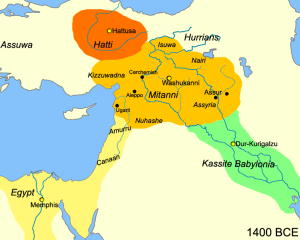
Near_East_1400_BCE
 

On 22 Apr, 2007, I posted a write- up  discussing the close relation between the Rig-Veda and the Gathas concerning the language, the locale, the names of the principal characters etc. I mentioned there in, the language of the Gathas (the older scriptures), known as Avesthan was remarkably similar to that of the Vedic Sanskrit of the Rig Veda. Further, in the Rig Veda the devas are worshipped as gods and the asuras are put down as demons, while in Zoroastrianism the treatment of these deities is reversed.   (Topic: Rig Veda and the Gathas )

As regards the similarities between the two languages:

One could find a Sanskrit equivalent for almost any Avestan word. For instance: The Avesthan : aevo pantao yo ashahe, vispe anyaesham apantam (Yasna 72.11); could be rendered in Sanskrit as : abade pantha he ashae, visha anyaesham apantham (translation: The one path is that of Asha, all others are not-paths).

Another example (left) of Avestan text from Yasna 10.6 is rendered word for word in Sanskrit on the right. Translated it means: `Mithra that strong mighty angel, most beneficent to all creatures, I will worship with libations’

The Cambridge History of India observes, “The coincidence between the Avesta and the Rig-Veda is so striking that the two languages cannot have been long separated before they arrived at their present condition.” The linguist, Professor T. Burrow of Oxford University also argued for strong similarities between language of Avesta and Vedic Sanskrit.   And, HD Griswold (in his The Religion of the Rig Veda) went  so far as to point out that each can be said to be “a commentary on the other … No scholar of the Avesta worth the designation can do without a thorough grounding in Vedic Sanskrit”.

****

The issues raised in the post of 22 Apr, briefly, were – when and why the terms deva/asura came to acquire different meanings in the two texts. Was this because of a conflict between the two sects? If so, when and where the” conflict “ took place?

Following that post there were a few comments and discussions in the Forum. I also looked around a few sites and read a few books on the subject because I was not totally convinced that there was a “conflict” per se. In the mean time, a friend on the Forum recommended an article entitled “Vedic Elements in the Ancient Iranian Religion of Zarathushtra “ written by Mr. Subhash Kak, a scholar from Jammu & Kashmir. The article was well written and it helped me to take a view on some, though not on all the issues raised in the post of22 Apr 2007. These efforts yielded additional information on the ancient kingdoms of Kassite s, Mittanis and Hattusa that existed sometime during 18th century B. C to 16th century B. C. in the Mesopotamian and North –West Syria regions. Based on the additional information I prepared a fresh article on the subject and hence this post.

Now, shall we resume our little talk about the Rig Veda and the Gathas?

1. I have veered to the view that the “conflict” was mostly surmised. There is no evidence pointing to any such “conflict”. I agree we may safely discard that hypothesis, at least for the present.

2. the Vedic religion, in some form, was present in the Mesopotamian region during the times of the Mitanni ,the Hittite, the Kassites (c 1750 BC) who worshiped Surya.

3. The Hurrian (1500 B C to 1270 B C) was located in the present-day western Syria , in the mountainous regions of Upper Euphrates and Tigris. The name Mitanni or Maitani first appears in the “memoirs” of a military officier who lived at the time of Amenhotep (1525 – 1504 BC). These memoirs were in connection with the Syrian wars (ca. 1480).

3.1 The ethnicity of the people of Mitanni is difficult to ascertain.The names of some Mitanni kings reveal Indo Aryan influence. They appeared to follow the Vedic religion. The ruling aristocracy was maryanni , meaning “young warrior” a derivative of the Sanskrit marya. The Mitanni warriors were called Marya, the term for warrior in Sanskrit as well.

3.2 Washukanni, or Waššukanni (also spelled Washshukanni, Wassuganni, Vasukhani, or a combination of these variants) was the capital of the kingdom of Mitanni from 1500 B C. The name is similar to the Sanskrit phrase for “a mine of wealth.” Washukanni flourished as a capital city for two centuries.

3.3 The names of the kings also point to the Indo-Aryan influence. The founder of the Kirta (1500 B c to 1490 B C). His name is also mentioned as “Krta” or with its element such as Krtadeva, Krtadhaja, and Krtadharman etc.

The names of the other Mitanni kings are also of Indo Aryan origin. For instance: Tushrata (Dasharatha–possessing ten chariots), Baratarna ( Paratarna-great sun); Biridaswa (Brihadashwa- possessing great horses); Artatama (Rtumna-devoted to the divine law, Rta); Rta-smara ( rooted in the Rta);  Sattura (Satvar – warrior); Saustatar ( Saukshatra-son of Sukshatra, the good ruler); Saumathi (Son of Sumathi); Sattawaza (he who has won seven prizes);Shuttarna (Sutarna – good sun); Sumaala ( having beautiful wreaths); Parsatatar(Parashukshatra-ruler with axe); and, Mattiwaza ( Mativaja -whose wealth is prayer) – are the Mitannian names of the kings and other males of the time.

220px-Royal_seal_of_Šauštatar_of_Mitanni.svg

Royal seal of Saustatar

Šattiwaza (c.1325-1280) before his accession to the throne carried a Hurrian name Kili-Teššup, like that of several of his predecessors. In his treaties, he invokes, among the many Hurrian and Mesopotamian deities, the Indo-Aryan deities Mitra, Varuna, Indra, and the Nasatyas.

http://www.hittites.info/history.aspx?text=history%2FEarly+Late+Empire.htm

3.4 A famous treaty entered between the Hittite ruler Suppiluliuma and the Mitanni king, Mattiwaza,(Mattiraja) in about 1380 BC, at Boghazkoy, invokes not only the Babylonian gods to witness the treaty but also the deities of Vedic origin such as Mitra, Varuna, Indra and Nasatya (Ashwins). The names of these deities are in the forms that appear in the Rig-Veda (S. Konow: Aryan gods of the Mitani people, 1921).

They occur in the treaty as ila_ni Mi-it-ra-as-si-il, ila_ni A-ru-na-as-si-il In-da-ra, ila_niNa-sa-at-ti-ya-an-na. Since the form for Na_satya is quite different in the Avestan language (Naonhaithya), it is likely that the Mitannian did not speak Iranian but Indo-Aryan (E.Meyer: Sitzungsberichte der K. Preuss. Akad. Der Wissen, 1908). Of these gods, only Mitra (Mithra) is invoked in the Avesta (Indra and Nanhaithya appear in the Avesta as demons and Varuna may have survived as Ahura Mazda – Asura Mahat).This indicates that the religion of the royalty was Vedic and the Iranian influence was yet to spread to the Mitanni region.

The differences that appeared in the Rig-Vedic and Avestan terminologies must have therefore materialized at a much later stage .Some of the important changes that took place on the Iranian side, might have come about just prior to or at the time of the Zarathrustra.

3.5 As regards the language of the Hurrian kingdom, the common language Hurrian was neither Indo Aryan nor Semitic but was closer to Urartian. The Hurrians adopted the Akkadian cuneiform script for their language in about 2000 BC . It appears there were different groups and sub groups who spoke different dialects and followed different sets of deities. The royal family of Mitanni was speaking Hurrian as well.

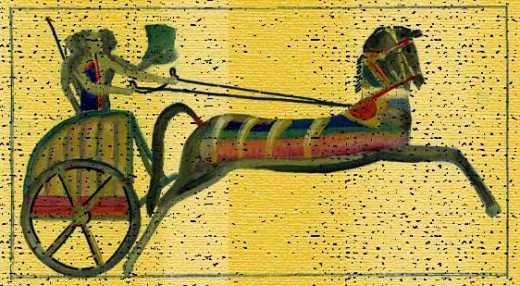
the horse drawn chariot

3.6 Kikkuli, a master horse trainer (assussanni, the Sanskrit form of which is aśva-sana) of Mittani, was the author of a chariot – horse training manual written in the Hittite language (an extinct language of Indo European family). The text (dated c1499 B. C) is notable for the information it provides about the development of Indo European language and for its content as well. Kikkuli’s horse training text includes numerical terms such as aika (eka, one), tuwa (dwe , two), tera (tri, three), panza (pancha, five), satta (sapta, seven), Na (nava, nine), vartana (vartana, round).The terms used to denote the horses of different ages or stages of training are – saudist– “foal” or “untrained”; yuga– “young horse”; dāyuga to mean “horse in its second year of training” etc. The text employs terms such as babru (babhru, brown), parita (palita, grey), and pinkara (pingala, red) to denote colors. These terms are of Sanskrit origin.

Further, Kikkuli’s text, though in Hittite, has a few loanwords from Luwian and Hurrian languages. Whenever Kikkuli found it difficult to put across the Mitanni concepts inthe Hittite language, he switched to his own language (Hurrian) and switched back to Hittite.
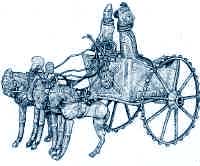
Mitanni Chariot with spokes
 

http://en.wikipedia.org/wiki/Kikkuli#column-one

3.7 Hence, the Indo-Aryan element of the Mitanni could be placed 1500 BCE , if not earlier.

4. Hittites is the conventional English name for an ancient people who spoke an Indo European language and who established the kingdom of Hattusa in the North Western region of Syria in 14th century B C. Hittite is the earliest attested Indo European language. The Hittites referred to their language as Nesili (or in one case, Kanesili), meaning “in the manner of (Ka) nesa.” Jay Friedman, University of California,in his paper Verbs in the Rig-Veda and Old Hittite confirms the Indo European nature of the Hittite language.
 
 
*
4.1 A cognate appears in a Hittite text found at Bogazköy in the name Ak/gniš, a god of devastation and annihilation. This term refers to AGNI (Sanskrit), the god of fire in ancient and traditional . In the Gathas of Zarathustra, the term atar is used to denote the concept of fire. The term atar does not appear in Rig-Veda. This points to presence of Vedic type of religion in the region .

www.bookrags.com/Agni

5. kassites are the ancient people of the Middle East who established a dynasty that ruled for about 450 years, starting around 1600 BCE. Their capital was Dar Kurizgalu; about 150 km north of Babylon.The kassite spoke a language that was similar to Sumerian.

5.1 The names of some Kassite kings were of Vedic origin (for example: Shuriash = Surya, Maruttash = Marut, Inda-Bugash = Indra-Bhaga),

http://www.imninalu.net/myths-Huns.htm

5.2 The fifth king among the Kassite dynasty took the name Abirattas’ (abhi-ratha ‘facing chariots (in battle)’. (T. Burrow, The Sanskrit Language , London, Faber and Faber, 1955).

5.3 The tenth king of the Kassite dynasty Agum (II) (c.1595-1545) took the throne-name Kakrime derived from Sanskrit term KAK meaning “ to enable , to help”(Sanskrit – saknoti, he is able, he is strong: Shakti,)( The American Heritage Dictionary of the English LanguageIndo-European Roots)  

http://www.domainofman.com/book/chap-10.html

6. What is interesting in the case of Mitannis and Kassites is, the language of the common people was not Indo Aryan, the religion of the people did not appear to be Vedic. Yet, for some unknown reason many of the kings assumed Sanskrit – throne-names. It appears there were traces of Indo Aryan influence in the region.

The Indo-Aryans names do not appear in texts till 15th century BCE. The Mesopotamian texts of the 18th and 17th centuries BCE do not show evidence of this trend (of assuming Sanskrit-throne names). This trend, therefore, was comparatively recent.

What is not clear is, how these “traces of Indo Aryan influence“ came into being? When and why they faded away?

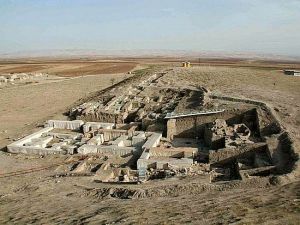
Ruins of Mittani palace

7. Mr. Kak in his paper makes a number of points:
(http://www.ece.lsu.edu/kak/zoro.pdf )

a) Following the collapse of the Sarasvati – river based economy around1900 BC, groups of Indians might have moved West and that might explain the presence of the Indic Kassites and the Mitanni in West Asia .

b) The old Vedic religion survived for a fairly long time in corners of Iran. The evidence of its survival comes from the daiva-inscription of Khshayarshan (Xerxes) (486-465 BC).

c) The ruling groups-Kassite and Mitanni – represented a minority in a population that spoke deferent languages. They, however, remained connected to their Vedic traditions. They were neighbors to the pre-Zoroastrian Vedic Iran . In addition, there were other Vedic religion groups in the intermediate region ofIran which itself consisted of several ethnic groups.

d) As per the Mitanni documents , the pre-Zorastrian religon in Iran included Varuna. Since Mitra and Varuna are partners in the Vedas, the omission of Varuna from the Zoroastrian lists indicates that Zarathushtra might be from the borderlands of the Vedic world where the Vedic system was not fully in place.

e) The pre-Zoroastrian religion of is clearly Vedic. Zarathushtra’s innovation lay in his emphasis on the dichotomy of good and bad The Zoroastrian innovations did not change the basic Vedic character of the culture in Iran. The worship ritual remained unchanged, as was the case with basic conceptions related to divinity and the place of man.

I also believe that Zarathushtra did not try to overthrow belief in the older Iranian religion, he did however, place Ahura Mazda at the centre of a kingdom of justice that promised immortality and bliss. He attempted to reform ancient Iranian religion on the basis of the then existing social and economic values

8. Now, let us come to the question of why the same set of deities came to be viewed differently and why there was division. This concerns mainly the asuras/ahuras versus the devas/daevas debate.

In the older texts, that is, in the Rig Veda and the Avesta, these differences are not quitesharp.In the Rig Veda, the asuras were the “older Gods”, a class of deities without negative connotations,who presided over the moral and social phenomena of the primeval universe; while devas the “younger gods” presided over nature and the environment. In the Vedic account of creation, some of the “older gods”(asuras) went over to join the ranks of the “younger gods” (devas). The remaining asuras were exiled to the nether world. While this distinction between asuras and asuras-who-became-devas is preserved in the texts of the Rig Veda, the later texts employ the term asura to represent allnon-devas or those opposed to devas.

In Zoroaster’s Gathas, where the battle between good and evil is a distinguishing characteristic of the religion ,the daevas are the “wrong gods”, the followers of whom need to be brought back to the path of the ‘good religion’

9. It is not clear what led to the rivalry between two groups and how rival groups perceived the same set of deities differently.It is possible that at some common point of time, the ancestors of both branches worshiped the same set of deities. Later, it is possible; each group supported its chosen set of deities, leading to rivalry between the two groups. The differences that appeared in the Rig-Vedic and Avestan terminologies must have materialized a long time after the demise of the Mittani and other kingdoms. Some of the important changes that took place on the Iranian side, might have come about just prior to or at the time of the Zarathrustra.

It is likely that the rivalry had its roots in the division of theIndic and Iranian branches of Proto-Indo-Iranian culture. However,the differences persist even today; while their causes have disappeared long ago, and even have been forgotten.

10. Mr. Kak states that the Vedic and the Zarathushtrian systems are much less deferent than is generally believed. He mentions the Kashmiri system which recognizes a three-way division consisting devas, asuras, and daevas. He also brings in the argument of three gunas –Satva, Rajas and Tamas- of Indian thought. I am familiar with the “Gunas” concept; But not as well as to comment on Mr. Kak’s argument.

11. I do believe that the Rig Veda and the Gathas have to be studied together to gain a fuller understanding of either of the texts. Parallel research on the Gathas and on the Vedic, religion prior to Zarathushtra will therefore be useful for better appreciation of the Zoroastrian and the Vedic texts.

mitannikingdom14

H.G. Rawlinson in his Book Intercourse between India and the Western World from the Earliest Times to the fall of Rome(Cambridge University Press, Cambridge – 1926) writes :

From prehistoric times, three great trade-routes have connected India with the West. The easiest, and probably the oldest of these, was the Persian Gulf route, running from the mouth of the Indus to the Euphrates, and up the Euphrates to where the road branches off to Antioch and the Levantine ports. Then there was the overland route, from the Indian passes to Balkh, and from Balkh either by river, down the Oxus to the Caspian, and from the Caspian to the Euxine, or entirely by land, by the caravan road which skirts the Karmanian Desert to the north, passes through the Caspian Gates, and reaches Antioch by way of Hekatompylos and Ktesiphon.

Lastly, there is the  circuitous sea route, down the Persian and Arabian coasts to Aden, up the Red Sea to Suez,  and from Suez to Egypt on the one hand and Tyre and Sidon on the other. It must not be supposed, of course, that merchandise travelled from India to Europe direct. It changed hands at great emporia like Balkli, Aden or Palmyra, and was often, no doubt, bartered many times on the way. This accounts for the vagueness and inaccuracy of the accounts of India which filtered through to the West in early times. A story is always vastly changed in passing through many hands.


Trade between the Indus valley and the Euphrates is, no doubt, very ancient. The earliest trace of this intercourse is probably to be found in the cuneiform inscriptions of the Llittite kings of Mitanni in Kappadokia, belonging to the fourteenth or fifteenth century B.C. These kings bore Aryan names, and worshiped the Vedic gods, Indra, Mitra, Varuna, and the Asvins, whom they call by their Vedic title Nasatya . They were evidently closely connected, though we cannot yet precisely determine how, with the Aryans of the Vedic Age, who were at that time dwelling in the Punjab.

It has been claimed that the word ‘Sindhu’, found in the library of Assurbanipal (668-626 B.C.), is used in the sense of ” Indian cotton,” and the word is said to be much older, belonging in reality to the Akkadian tongue, where it is expressed by ideographs meaning “vegetable cloth ’’ Assurbanipal is known to have been a great cultivator, and to have sent for Indian plants, including the “wool-bearing trees” of India.

At any rate, we know that the cotton trade of western India is of great antiquity The Indians, when the Greeks first came into contact with them, were dressed in “wool grown on trees” In the Rig Veda, Night and Dawn are compared to ” two female weavers.”

We may perhaps trace to this source the Greek, the Arabic ‘satin’ (a covering), and the Hebrew ‘sadin’. Similarly the Hebrew ‘karpas’ and the Greek Kap-aaos are identical with the Sanskrit ‘karpasa’. Logs of Indian teak have been found in the temple of the Moon at Mugheir (the “Ur of the Chaldees”) and inthe palace of Nebuchadnezzar, both belonging to the sixth century B c , and we know that the trade in teak, ebony, sandalwood and black wood, between Barygaza and the Euphrates, was still flourishing in the second century AD 6 In the swampy country at the mouth of the Euphrates, nothing but the cypress grows well.

please also check A Kassite / Mitanni Kudurru Boundary Stone

Mitanni - World History Encyclopedia

Source :  https://www.worldhistory.org/Mitanni/

All images are from Internet

 
12 Comments

Posted by on August 31, 2012 in History, Indian Philosophy


Tags: , , , ,

Aadhyasa

Aadhyasa is a concept introduced by Sri Shankara. It is difficult to find an exact English word for Aaadhyasa. It may, among other things, mean “superimposition”,”projection” etc. Aadhyasa is more comprehensive than that. 

2. He also recognized three levels of existence. The Absolute, the relative and the illusory. 

3. Adhyasa consists in superimposing one level of existence (relative/illusory) over the other (The Absolute) and accepting the former as true while it may actually be untrue. (Untrue does not mean false. It is a neutral term that lies between the Truth and falsehood.) 

There is nothing strange or startling about this. We experience it every day in our life. 

4. Let us take an example. We have accepted a “day” as a working unit of time. We have divided / sub- divided it into hours, minutes, seconds etc. We measure our work and life in terms of these units. A “day” itself is reckoned with reference to sunset and sunrise. We may call this a relative view. 

Further, what you call, let us say, 08.00 AM is not 08.00 AM to people living in other time zones. It will be a different time in their day/night. A single point in “time” signifies different “time” to different people. Each sets his “time” by his sunrise.  

However, all  of us know  that sun neither sets nor rises. From the Absolute point of view, there is no day or night. In other words, there is no “time”. It is a time- less universe (because “time” as we understand it, is measured with reference to an event.) 

We, thus, in our daily life impose a relative concept (day) over the Absolute (time less ness).This we do, because we are living in a relative world and not because we are ignorant of the sun’s status. Otherwise, how else can we live in a relative world? 

5. Let us see another example. One may mistake a stump of wood at night for a thief and get alarmed. Another may mistake a coiled rope, in semi darkness, for a snake and get panicky. In both cases, when some one  else throws light, after the event, they may learn the identity of the objects they “saw”. They may then say to themselves, with a sigh of relief,” Gosh! It was just a piece of wood/rope”. 

In these instances, the persons involved imposed an illusory existence over the real one. They realized the identity of the objects only after someone threw light on the objects. 

Here the interesting thing is while the perception may be illusory the alarm/panic  experienced was real. 

That again leads to another story.

 
7 Comments

Posted by on August 31, 2012 in Indian Philosophy, Sri Sankara, Vedanta


Tags: ,

The concept of rna

The concept of rna

(Inspired by Giridhar Gopal’s blog My wishes on Friendship Day and his responses)


You know that living this life to the fullest, is its own secret.
You be assured that if you do so, your life would be worth living.
You do so, without doubts, without fears and without regretting.

–      Giridhar Gopal –

The concept of rna, the human indebtedness or the primary obligation that every being carries with him or her, is rather unique to Indian tradition. They are the debt one owes – to his ancestors (pitr); to the sages/teachers (rishi); and to the Gods (deva).  The Shathapatha Brahmana adds one more; the debt one owes to his fellow beings.
 
The Shathapatha Brahmana further says that the fulfillment of these obligations, which add value to ones life, should be the preliminary aim of a human being.
 
The Atharva remarks, pursuit of the four purusharthas would be meaningful only when one fulfils one’s primary obligations or is in the process of doing so.
 
Chandogya Upanishad (2.23) describes the duties in three stages of life- student, householder and retired – as “off shoots or branches of Dharma” (trayo dharma_skandha). Rna is at the core of this trayo dharma.
 
Rna is, thus, the sense of commitment to your family, your teachers, your fellow beings and your environment. The concept emphasizes that whatever be your goals and priorities in your life, you cannot overlook your basic commitments.
 
Sri Shankara, though a sanyasin, came back to be with his mother in her last days/moments. It was an expression of natural love and affection; and also fulfillment of his basic commitment (pitr rna), whatever might have been the other calls in his life.


The Rishis of the ancient times were householders who enjoyed and celebrated life amidst their family and disciples. The rigors of asceticism came at a much later age. The Buddha too did not find merit in such heartless living.
 
The Vaikhanasa which claims to be the more orthodox of the two Agamas hails the life of the householder as the best among the four stages of life. Because, it is the householder that supports, sustains and carries forward the life and existence of the society. It does not pay much prominence to a Yati or a Sanyasi. It deprecates a person seeking salvation for himself without discharging his duties, responsibilities and debts to his family, to his guru and to his society.
 
The Emperor Asoka (272 to 132 BC) in his edicts highlights a person’s indebtedness (rna) to parents and elders and calls upon the people to live in accordance with the dharma and not interfere with the natural order (rta).
The rna , the sense of commitment , was emphasized in the larger interests of the society. Without such commitments a society would cease to be a healthily place.
.
 

There is, therefore, a certain glorification of what we call the ordinary life, in the ancient texts.

For some reason, it seems easier to brave the elements or starve for weeks or force the body to endure pain. It might be possible; but, it is pointless.
 
It is far more difficult to pay attention to your spouse and kids; to be generous with one’s friends; be patient with a child when you least feel like it; and go about your daily chores, with equanimity, even while placed in dire circumstances. The ability to work silently, without malice, for years, for a lifetime; with no demands or expectations for reward or recognition, is truly heroic.
 
It is said, the real heroism is not under the limelight, but is where the less noticeable tasks had to be done. It is in the corners, in the shadows the true results of your efforts appear. One’s true test is in one’s daily life; and in one’s reliability and integrity as a human being.
 
God does not dwell in some day-glow heaven realm of seeker’s fantasy; but, right here, right now, in the day-to-day challenges and tasks of our everyday life.
 
Therefore , any sort of experience, no matter how ecstatic, if it does not transform you in to someone who knows how to be with children, how to be with your family, how to be with your mates in a loving, deeply caring way and how to be with all of life – is not worth hankering after. 
 
The divine is not meant to be discovered in heaven; if it were to be so, we would all be there and not here. The natural and honest living is the crucible of life. That is what all the texts try to say.
***
What seems to grow fairer to me as life goes by is the love and the grace and tenderness of it; not its wit and cleverness and grandeur of knowledge – grand as knowledge is – but just the laughter of children, and the friendship of friends, and sight of flowers, and the sound of music

–Anon


Tags: , ,