RSS

Category Archives: Indian Philosophy

Temple worship and rituals (1 of 5)

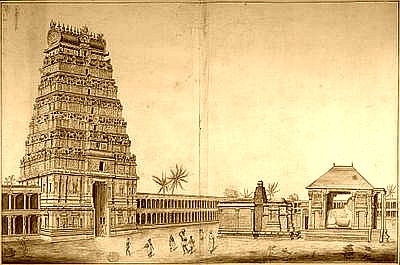
Pagoda_of_Chelimbaram,_c._1762

This is the first of the five articles on certain aspects of temple worship and its related rituals

***

The Hindu temples are complex institutions. They represent the culmination of social and religious aspirations of a society. Temple is the focal point in the life of a community and often represents its pride, identity and unity. It is also the index of the community’s wellbeing. It draws into its fold people from its various segments and denominations; and binds them together. In smaller communities the temple apart from being a source of spiritual or religious comfort, also serves as center for education and recreation.

A temple is also a treasure house of art and architecture, designed according to the principle of Vaastu Shastra, characterized by their majesty, serenity and beauty of intricate sculpture and designs. A temple evokes in the visitor a sense of beauty in art and in life as well. It lifts up his spirit, elevates him to a higher plane dissolving his little ego. At the same time, it awakens him to his insignificance in the grand design of the Creator.

The most significant aspect of the temple worship is its collective character. Peoples’ participation is both the purpose and the means of a temple. The community is either actually or symbolically involved in temple worship. The rituals that dominate temple worship are therefore socio- religious in character.

The worship in a temple has to satisfy the needs of individuals as also of the community. The worships that take place in the sanctum and within the temple premises are important; so are the festivals and occasional processions that involve direct participation of the entire community. They complement each other. While the worship of the deity  in the sanctum might be an individual’s  spiritual or religious need ; the festival s are the expression of a community’s joy , exuberance , devotion , pride and are also an idiom of a community’s cohesiveness .

The appointed priests carry out the worship in the temple on behalf of other devotees. It is hence parartha, a service conducted for the sake of others. Priests, generally, trained in ritual procedures, pursue the service at the temple as a profession. As someone remarked, “other people may view their work as worship, but for the priests worship is work.” They are trained in the branch of the Agama of a particular persuasion. The texts employed in this regard describe the procedural details of temple worship, elaborately and precisely.

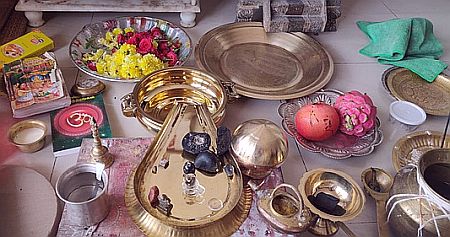
Puja items. 2 jpg

The term Agama primarily means tradition. Agama Shastras are not part of the Vedas. The Agamas do not derive their authority directly from the Vedas. They are Vedic in spirit and character and make use of Vedic mantras while performing the service. That is the reason they are regarded as authoritative.

One often hears Agama and Nigama mentioned in one breath as if one follows the other or are closely related; whereas Nigama stands for Vedas and Agama is identified with Tantra..The two traditions- Veda and Tantra – hold divergent views on matters such as God; relationship between man and God; the ways of worship; and path to salvation etc.The Vedic concept of God is omniscient, omnipotent, a formless absolute entity manifesting itself in phenomenal world of names and forms. The Agama which is a part of Tantra regards God as a personal deity with recognizable forms and attributes.

Vedic worship is centered on the fire- (the Yajna), certain religious and domestic rituals, (shrauta sutraas and griyha sutraas), and the sacraments, (samskaara). In this tradition the gods and their descriptions are, mostly, symbolic. The hymns of the Rig Veda are inspired outpourings of joy through sublime poetry. The Yajur and Sama Vedas do contain suggestions of sacrifices; but they too carry certain esoteric symbolic meaning.  Very few of these rituals are in common practice today.\The most widespread rituals of worship today are of the Aagamic variety. The Agama methods are worship of images of God through rituals (Tantra), symbolic charts (Yantra) and verbal symbols (Mantra).Agama regards devotion and complete submission to deity as fundamental to pursuit of it aim; and wisdom, enlightenment (jnana) as that which follows eventually by the grace of the worshipped deity. The approach of Agama is basically dualistic, seeking grace, mercy and love of the Supreme God represented by the personal deity, for liberation from earthly attachments (moksha).

As compared to Vedic rituals (Yajnas) which were collective in form, where a number of priests specialized in each disciple of the sacrificial aspects participated; the Tantra or Agamic worship is individualistic in character. It views the rituals as a sort of direct communication between the worshipper and his or her personal deity. The Yajnas always take place in public places and are of congregational nature, where a large number participate with gaiety and enthusiasm. The Tantra rituals, on the other hand, are always carried out in quiet privacy; self discipline and intensity is its hallmark not exuberance or enthusiasm.

The culmination of these two dissimilar streams of worship is the temple worship. Though one concedes that representation of Godhead is theoretically impossible; yet one has to recognize that an image helps contemplation, visualization and concretization of ideas and aspirations. Here, at the temple , both the Vedic and the Tantric worships take place; but each in its sphere. A temple in Hindu tradition is a public place of worship; several sequences of worship are conducted in full view of the worshipping devotee; and yet another set of rituals are conducted by the priests in the privacy of the sanctum away from public gaze.

The temple worship is guided by its related Agama texts which invariably borrow the mantras from the Vedic traditions and ritualistic details from Tantric traditions.  This had the advantage of claiming impressive validity from Nigama, the Vedas; and at the same time carrying out popular methods of worship. For instance, Vedic mantras are chanted in traditional manner while performing services such as ceremonial bath, adoring the deity with flowers, or waving lights.

In addition, the worship routine was rendered more colorful and attractive by incorporating a number of ceremonial services (upacharas) and also presentations of music, dance, drama and other performing arts. These also ensured larger participation of the enthusiastic devotees.

In due course the Agama came to be accepted as a subsidiary culture (Vedanga) within the Vedic framework.

Kanigale flower

Agamas are a set of ancient texts and are the guardians of tradition .They broadly deal with jnana (knowledge), Yoga (meditation), Kriya (rituals) and Charya (ways of worship).The third segment Kriya (rituals) articulate with precision the principles and practices of deity worship – the mantras, mandalas, madras etc.; the mental disciplines required for the worship; the rules for constructing temples and sculpting the images. They also specify the conduct of other worship services, rites, rituals and festivals. The fourth one, Charya, deals with priestly conduct and other related aspects.

[ incidentally , the Buddhist and the Jaina traditions too follow this four-fold classification.]

They hold the view that Japa, homa, dhyana and Archa are the four methods of worshipping the divine; and of these, the Archa (worship) is the most comprehensive method. This is the faith on which the Agama shastra is based. The Agama shastra is basically concerned with the attitudes, procedure and rituals of deity worship in the temples. But it gets related to icons and temple structures rather circuitously. It says if an image has to be worshipped it has to be worship worthy. The rituals and sequences of worship are relevant only in the context of an icon worthy of worship; and such icon has to be contained in a shrine. And an icon is meaningful only in the context of a shrine that is worthy to house it. That is how the Agama literature makes its presence felt in the Silpa-Sastra. The icon and its form; the temple and its structure;   and the rituals and their details, are all thus interrelated.

I think  , the most present Hindu rituals of worship seem to have developed after the establishment of the six orthodox schools of Hindu philosophy (darshanas). The changes in religious rituals from the Vedic to the Aagaamic seem consonant with the themes prevalent in the six orthodox systems. A very significant change is the integration of Yoga methodology into the rituals. Four of these eight stages are an integral part of all ‘worship’ – namely, posture, (aasana), breath (life force)-control, (praanaayaama), placing or fixation, (nyaasa or dhaaranaa), and deep concentration & contemplation (dhyaana). . The temple architecture too follows the structure of the human body and the six chakras’ as in yoga.

Surely the Agama tradition  began to flourish after the 10th or the 11th century with the advent of the Bhakthi School.

design

There are three main divisions in Agama shastra, the Shaiva, the Shaktha and Vaishnava. The Shaiva branch of the Agama deals with the worship of the deity in the form of Shiva. This branch in turn has given rise to Shaiva Siddantha of the South and the Prathyabijnana School of Kashmir Shaivisim. The Shaktha Agama prescribes the rules and tantric rituals for worship of Shakthi, Devi the divine mother. The third one, Vaishanava Agama adores God as Vishnu the protector. This branch has two major divisions Vaikhanasa and Pancharatra. The latter in turn has a sub branch called Tantra Sara followed mainly by the Dvaita sect (Madhwas).

Agama is essentially a tradition and Tantra is a technique; but both share the same ideology.But, Agama is wider in its scope; and contains aspects oh theory, discussion and speculation.

The term Agama is used usually for the Shaiva and Vasishnava traditions and the Shaktha cult is termed as Tantric. But, there is an element of Tantra in Agama worship too, particularly in Pancharatra.

***

As regards Vaikhanasa, after the emergence of temple _culture, Vaikhanasa appear to have been the first set of professional priests and they chose to affiliate to the Vedic tradition. That may perhaps be the reason they are referred to also as Vaidikagama or Sruthagama. Yet, there is no definite explanation for the term Vaikhanasa. Some say it ascribed to Sage Vaikhanasa; while some others say it is related to vanaprastha, a community of forest-dwellers.

As regards their doctrine, Vaikhanasas claim to be a surviving school of Vedic ritual propagated by the sage Vaikhanasa. Most of Vaikhanasa is almost completely concerned with ritual, prescribing the rituals and their rules of performance of yaga, yajnas etc. To the Vaikhanasas, their temple worship is a continuation of Vedic fire sacrifice. The Vaikhanasa doctrine states that moksha is release into Vaikunta determined by the nature of a man’s devotion and faith experienced mainly through archana, service to the deity.

The Vaikhanasa is regarded orthodox for yet another reason; they consider the life of the householder as the best among the four stages of life. Because, it is the householder that supports, sustains and carries forward the life in the society. They treat the worship at home as more important than worship at the temple. A Vaikhanasa has therefore to worship the deities at his home before he leaves for his   duty as a priest at the temple. There is not much prominence for a Yati or a Sanyasi in their scheme of things.

The Agama texts make a clear distinction between the worship carried out at his home (atmartha) and the worship carried out as priest at a temple(parartha ) for which he gets paid. A person who receives remuneration for worshipping a deity is not held in high esteem. This perhaps led to a sort of social prejudices and discriminations among the priestly class. But, with the change of times, with the social and economic pressures and with a dire need to earn a living, a distinct class of temple-priests , naturally , crystallysized into a close knit in-group with its own ethos and attitudes.

From the end of the tenth century Vaikhanasa are prominently mentioned in South Indian inscriptions. Vaikhanasas were the priests of Vaishnava temples and were also the admistrators.  However with the advent of Sri Ramanuja, who was also the first organizer of temple administration at Srirangam Temple, the Vaikhanasa system of worship lost its prominence and gave place to the more liberal Pancharatra system .Sri Ramanuja permitted participation of lower castes and ascetics , the Sanyasis ( who were not placed highly in the Vaikhanasa scheme)  in temple services. He also expanded the people participation in other areas too. This change spread to other Vaishnava temples particularly in Tamil Nadu. Vaikhanasas, however, continued to be important mainly in Andhra Pradesh, Karnataka and some temples in Tamil Nadu.

As regards Pancharatra, it appears to have been a later form of worship that gained prominence with the advent of Sri Ramanuja .Pancharathra claims its origin from Sriman Narayana himself.

Here Vishnu is worshipped as the Supreme Being conceived in five ways:

Para, or transcendent form;

Vyuha or the categorized form as Vasudeva, Sankarshana, Pradyumna, and Aniruddha, who are brought together in worship and adoration as a complete body of divine power;

Vibhava, or the several incarnation of God;

Archa, or the form of God worshipped in an image or an idol symbolizing the Universal entity;

And, Antaryamin, or the indwelling immanent form of God as present throughout in creation.

The peak of Vaishnava devotion is recorded in Dashamaskanda, the Tenth Book of the Bhagavata Purana, and in Nalayira Prabhandam the four thousand Tamil verses of the Vaishnava saints the Alvars, and especially in the thousand songs known as Tiruvaimozhi of Nammalvar. The ecstasy of the Gopi-type of God – intoxicated-love is exhilarating and gives raise to divine intoxication in Nammalvar’s poetic compositions.

Therefore the Tamils verses and songs are prominent in Pancharatra worship. This method also employs more Tantras, Mandalas and Uthsavas which makes room for a large number of devotees of all segments of the society to participate. There are here more Jaanapada (popular) methods of worship than mere Vedic performance of Yajnas. Even here, each prominent temple follows its favorite text. That is the reason there are some minor differences even among the Pancharatra temples.

Among the differences between Vaikhanasa and Pancharatra, the latter say they gain eligibility to worship (Diksha) after the ceremonial Chkrankana, which is imprinting the symbols of Vishnu imprinted on their body. Vaikhanasa see no need for such a ritual. The pregnant mother is given a cup of Payasam with the Vishnu seal in the cup. They recognize as worthy only such Garbha_Vaishnavas.

Vaikhanasa follow the lunar calendar while the Pancharatra follow the solar calendar.

Vaikhanasa consider Vishnu-Vaikhanasa-Brighu as the guru_parampara; while Pancharatra consider Vishnu_Vishvaksena_Satagopa_Nathamuni_Yamuna_Ramanuja as the guru -parampara.

Vaikhanasa think it is enough if the daily worship is performed once in a day or if needed it could be stretched to six times in a day (shat kala puja). Pancharatra do not place any limit. If needed the service could be even 12 times a day, they say.

The other differences are that Vaikhanasa worship is considered more Vedic, the mantras being Sanskrit based and there is a greater emphasis on details of worship rituals and yajnas. Even here, the householders and celibates get priority in worshipping the deity. They consider Griha_archana the worship at home as more important than the congregational worship. The Sanyasis or ascetics have no place in this system.

Whereas in Pancharatra, more Tamil hymns are recited and there is greater scope for festivals and processions where all sections of the society including ascetics can participate

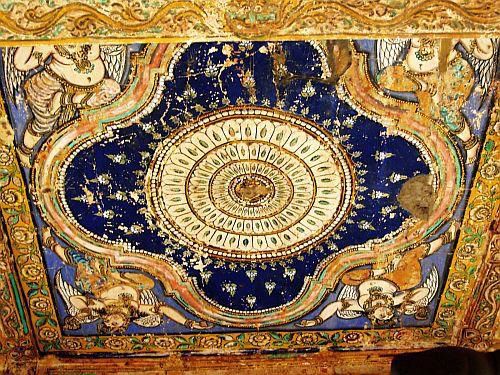
brihadishwara appendix 6

What is more important than the rituals is the symbolism that acts as the guiding spirit for conduct of rituals. At a certain level, symbolism takes precedence over procedures.

I think ultimately there is not much difference between Pancharatra and Vaikhanasa traditions. Both are equally well accepted. The differences, whatever they might be, are not significant to a devotee who visits the temple just to worship the deity and to submit himself to the divine grace.

More of that in the next segment.

pattern118

*****

Read Next:

Symbolism in temple worship

 
4 Comments

Posted by on September 6, 2012 in Indian Philosophy, Temple worship


Tags: , ,

Bhakthi Sutras of Narada

The concept of Bhakthi has its origins in the Rig Veda, which preaches strong faith and devotion in God. It calls upon the devotees to establish a relationship with  each Deva-Agni , Indra, Varuna and others , as one would do with a son , friend, father, mother etc. There is a faith that the Devas would in turn communicate with the men and women and fulfill their desires.  “Instill in us a wholesome happy mind with goodwill and understanding. Then we shall ever delight in your friendship like cows who gladly rejoice in the meadows green.”

Rig Veda primarily follows Saguno _pasana. The Supreme Being in Rig Veda is the abode of all auspicious qualities. The Ultimate Supreme Reality is described (though He is beyond description) as Sat_Chit_Ananda. He is the one who created the world and sustained it. He is the Omniscient and the original cause of the world(tasyedu viva bhuvanadhi mrudani).He manifests himself as the world (visvarupaha).He is omniscient, compassionate and easily accessible to devotees (Niyanta sunrutanam). Rig Veda firmly believes in grace of God and preaches that a virtuous life in this world and the progression to Amrutatva , immortality, is possible only with complete surrender to God and with the grace of God. The seeds of the Bhakthi movement and the attitude of complete surrender to the Divine Will are in Rig Veda

The Vedic approach to worship led in due course to the path of devotion which revolved round the loving adoration of the Divine as the Supreme Person (Uttama Purusha) the infinitely superior Lord (Isha, Ishvara). Bhakthi here signified both devotion and most elevated pure love for God. The term Bhakthi, some say, is derived from its root Bhaj, meaning to participate or to partake. Bhakthi is essentially participation with the Divine.

lotus red2

BHAKTHI YOGA

Bhakthi Yoga, as a clearly delineated path, did not seem to flourish until the time of Svethashvatara Upanishad (c. older to sixth century BCE) which mentions Bhakthi and Sharanagathi (surrender) as modes of worship of the Ultimate in the form of Shiva (6.23 and 6.280). In Svethasvatara Upanishad,  man is called upon to have Bhakthi in the divine, to resort to him who is the shelter to all.

Later, the Bhagavad Gita accorded prominent position to the path of Bhakthi. Here Bhakthi Yoga emerged as a formal spiritual path and declared Bhakthi as the ultimate form of religious expression. Sri Krishna declares in the Gita(6.47) : he who loves Me with faith and whose inner self is absorbed in Me , worshiping Me  with love –  him I deem  to be united with Me in Yoga and is the highest of all.

yoginām api sarveṣāṃ mad-gatenāntar-ātmanā | śraddhāvān bhajate yo māṃ sa me yuktatamo mataḥ ||BG. 47||

The concept of Bhakthi fully matures and is given full exposition in Srimad Bhagavatha.  Here, Bhakthi is termed as trayi-vidya the wisdom of the three Vedas; the highest good of man

Mere hearing, remembering, thinking, and meditating on the Lord were not therefore considered adequate. It called for an unquestioning faith, devotion and absolute surrender to God with love. Bhagavan Ramanuja says in his commentary on the Sutras in Athatho Brahma Jignyasa, Lord himself helps those who are constantly attached to Him, worship Him with love and surrender to him in devotion, He draws them to Him because such devotees are very dear to Him.

Bhakthi is seen as a series of   earnest efforts beginning with worship and ending in a supreme intensity of love for the Ishwara.”one great advantage of Bhakthi is that it is the easiest and most natural way to reach the Divine; its greatest disadvantage is that its lower forms oftentimes degenerate into hideous fanaticism”  Says Swami Vivekananda ”But the danger exists only in the lower stages of Bhakthi which is the preparatory (Gauni). When Bhakthi ripens and passes into the Supreme (Para) there is no more fear of these hideous manifestations of fanaticism. The soul overpowered by Bhakthi is too near to the Love of God to be affected by diffusion of hatred”.

Swami Maharaj says, there is not much difference between Bhakthi and Jnana (knowledge); and in the end they converge. The great preceptors Bhakthi Sri Ramanuja and Sri Yamunacharya amply demonstrated that the path of devotion need not be mindless and that Jnana and Bhakthi complement each other, fully.

Narada

[ BHAKTHI RASA

While talking about Rasa, we may take a look at the discussions on Bhakthi Rasa, as in Sanskrit Kavya.

Natyashastra mentions eight Rasas (not nine). These Rasas were basically related to dramatic performance; and Bhakthi was not one of those. Thereafter, Udbhata (9th century) introduced Shantha Rasa. After prolonged debates spread over several texts across two centuries Shantha was accepted as an addition to the original eight.

But, it was Abhinavagupta (11th century) who established Shantha Rasa as the Sthayi-bhava the basic and the abiding or the enduring Rasa form which all Rasas emerge and into which they all recede. His stand was: one cannot be perpetually angry or ferocious or sad or exited or erotic, at all the time. These eight other Rasas are the passing waves of emotions, the colors of life. But, Shantha, tranquility, is the essential nature of man; and it is its disturbance or its variations that give rise to shades of other emotions. And, when each of that passes over, it again subsides in the Shantha Rasa that ever prevails.

During the times of by Abhinavagupta and Dhanajaya, Bhakthi and Priti were referred to as Bhavas (dispositions or attitudes); but, not as Rasas. Even the later scholars like Dandin, Bhanudatta and Jagannatha Pandita continued to treat Bhakthi as a Bhava.

[Later, each system of Philosophy or of Poetics (Kavya-shastra) applied its own norms to interpret the Rasa-doctrine (Rasa Siddantha) ; and in due course several Rasa theories came up. Many other sentiments, such as Sneha, Vatsalya; or states of mind (say even Karpanya – wretchedness) were reckoned as Rasa. With that, Rasas were as many as you one could identify or craft (not just nine).]

It was however the Gaudiya School of Vaishnavas that treated Bhakthi as a Rasa. Rupa Goswami in his Bhakthi-Rasa-amrita–Sindhu; and the Advatin Madhusudana Sarasvathi in his Bhagavad-Bhakthi Rasayana asserted that Bhakthi is indeed the very fundamental Rasa. Just as Abhinavagupta treated Shantha as the Sthayi Rasa, the Vaishnava Scholars treated Bhakthi as the Sthayi, the most important and the abiding Rasa.

Their texts described twelve forms of Bhakthi Rasas – nine of the original and three new ones. Instead of calling each Rasa by its original name, they inserted Bhakthi element into each, such as: Shantha-Bhakthi-Rasa, Vira-Bhakthi-Rasa, Karuna-Bhakthi-Rasa and so on. They tried to establish that Bhakthi was not one among the many Rasas; but, it was the fundamental Rasa, the other Rasa being only the varied forms of it. The devotee may assume any attitude of devotion like a child, mother, master, Guru or even an intimate fiend. It was said “Bhakthi encompasses all the Nava-rasas”.

Bhakthi, they said, is the Sthayi (abiding) Rasa; and it is the original form of Parama-Prema (highest form of Love) as described in Narada Bhakthi Sutra. What constitutes this Love is its essence of Maduhrya (sweetness) and Ujjvalata (radiance).

Although, an element of individualized love is involved in Bhakthi, it is not confined to worship of a chosen deity (ista Devatha). The Vedanta Schools treat Bhakthi as a companion of Jnana in pursuit of the Brahman. They hold that Bhakthi guides both the Nirguna and the Saguna traditions. Just as Ananda is the ultimate bliss transcending the subject-object limitation, Bhakthi in its pristine form is free from the limitations of ‘ego centric predicament’ of mind. And, both are not to be treated as mere Rasas.

Bhakthi is that total pure unconditional love, accepting everything in absolute faith (Prapatthi).

Now, all Schools generally agree that Bhakthi should not be confined to theistic pursuits alone; it pervades and motivates all aspects human persuasions including studies, arts and literature. In the field of art, it would be better if the plethora of Rasa-theories is set aside; because, the purpose of Art, the practice of Bhakthi and the goal of Moksha are intertwined.

Therefore, it is said, it is not appropriate (an-auchitya) to narrow down Bhakthi to a mere Rasa which is only a partial aspect. Bhakthi is much larger; and it is prime mover of all meaningful pursuits in life.]

narada vishnu

BHAKTHI MOVEMENT

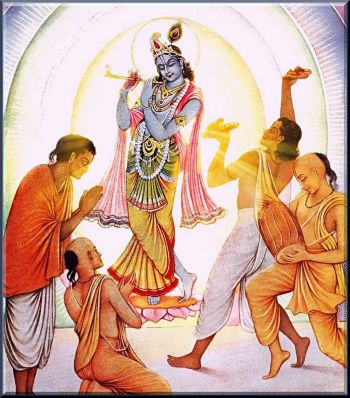
The ideal of devotion and establishing a close and a dear relationship with the God became the theme of a whole cultural movement and came to be known as Bhakthi Marga the path of devotion. Bhakthi became one of the constant themes of our sages. This movement flourished in the period 800 to 1100 AD.It advocated surrender to the will of God, dedication, worship, service and absorption in God. It was clearly the way of the heart and not much of the intellect.

Two aphoristic works in Sanskrit codifying the features and recommendations of the Bhakthi Marga viz. Bhakthi Sutra of Narada and the Bhakthi Sutra of Shandilya were among the significant products of these times.

lotus red

NARADA’s BHAKTHI SUTRAS

Narad_-_Vintage_Print

Narada is a name that occurs very often in the ancient texts. Down the several centuries, there have been many scholars who went by the name of Narada.

:- To start with, the SarvapAnukramika (a sort of Index of Vedic personalities) said to have been  compiled by Katyayana describes Narada as a Rishi who was the descendent of sage Kanva and as the author of several Riks in Rig-Veda. It is said; the mantra sukhaya nividata was revealed to Narada and to another Rishi Parvata. He was the founder of a long line of distinguished scholars, all of whom adopted the name Narada.

:-There is a mention of a Narada Atharva Veda too (5.19.9:12.4.16).

The Chandogya Upanishad (7.1.2) mentions that Narada was well versed in Vako-vakya (Logic or Nyaya?) .

The Chandogya Upanishad, under Bhumavidya, refers to Narada as a disciple of the sublime quartet of Sanath kumaras.

:- Narada and Sama Veda have a close relationship. Naradiya Shiksha, a treatise on Music, which deals mainly with the musical notes and the pronunciation of the words in the Vedic language, is ascribed to a Narada. Some believe that Naradiya Shiksha might pre-date Bharatha’s Natyashastra (second century BCE) by several centuries. Naradiya Shiksha is a work of seminal importance in Indian Music. It redefined the concepts and terms of the Sama Gana; recast the descending order of the Sama scales as it did not offer much scope for flexibility and elaboration  in music; and , restructured the music notes (Svara)  into the natural ascending order as we know today. We all owe a debt of deep gratitude to this Narada.

:- In the Sabha-parva of Mahabharata, a sage named Narada appears as an expert in Nyaya Shastra. He was said to be skillful in distinguishing unity and plurality; conjunction and co-existence; genus and species etc. He had mastered the art and science of deciding questions through evidence (Pramana)

:- Nārada-smti (100 BC – 400 CE), a text of the Nyaya-shastra, ascribed to a Narada, is hailed as  the “juridical text par excellence”.  It is the only Dharma-śāstra text which deals solely with juridical matters. This Narada is also credited with another text: Narada Pancha ratra.

:- Another well-known text on Music, Sangita Makaranda (7th -9th century) is ascribed to Narada. It is an interesting work which brings in philosophical, Tantric and religious interpretations into Desi Music. It also introduces the concept of associating sets of Music notes (Grama) with seasons (Rtu) in the year ; as also with the hour of the day. For instance; Sangita Makaranda associates Hemanta (winter) with Shadja Grama; Grishma (summer) with Madhyama Grama; and, Varsha (rains) with Gandharva Grama. As regards the time of the day for rendering the Gramas, Narada allots forenoon to Shadja; midday to Madhyama; and afternoon to Gandharva Grama.

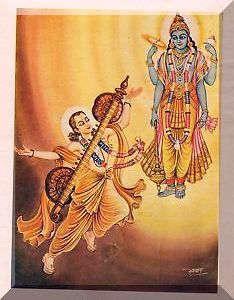
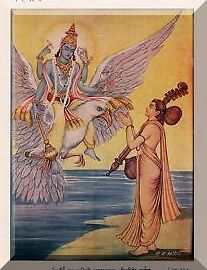
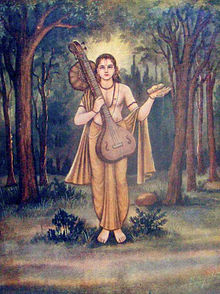
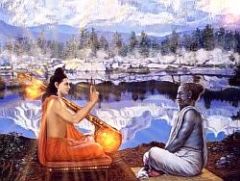
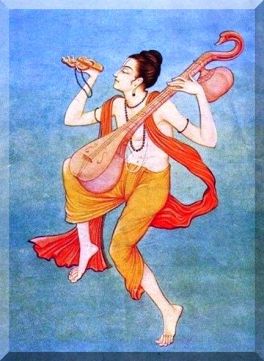
:- In several Puranas, Narada is a very popular and an endearing character , though a bit too clever and ever busy in igniting disputes. He is described as the Manasa-putra (born out of the will) of Brahma. He is well versed in traditional learning and in Music (Samgita shastra). He is depicted invariably carrying a Veena and singing the praise of Lord Hari, Vishnu. He is revered as the propagator of Bhakthi-marga , the path of devotion.

:- Narada in the Puranas is the guide and mentor of young devotees like Dhruva and Prahlada.

:- Srimad Bhagavatha narrates the life of Narada in detail (1.5, 23-31; 1.6.5-36).

 :- The Matsya Purana (dated around second century AD) reckons Narada as one among the eighteen ancient Master architects (vastu-shatropadeshkaha) : Brighu, Atri, Vashista, Vishwakarma, Brahma, Maya, Narada, Nagnajit, Visalaksa, Purandara, Kumara, Nanditha, Shaunaka, Garga, Vasudeva, Aniruddha, Shuka and Brihaspathi.

:- There is also a Narada Purana said to have been recited by Narada himself. It deals with a vast range of subjects such as, origin of the universe, , training of the mantras, worship rituals and tales related to various incarnations of Lord Vishnu.

:- :- In Ramayana , it was sage Narada who inspired , urged and guided the poet Valmiki to compose the story of Rama , the scion of the distinguished  Ikshvaku dynasty.

He also inspired the Rishi Vyasa to write Mahabharata.

Narada muni instructing Vyasa

:- In Ramayana , again, there is a mention of another Narada . It is said; the Apsaras danced to the songs of Gandharvas, such as Narada the king of Gandharvas (Gandharva-rajanah), Tumbura, Gopa, Gargya, Sudhama, Parvata, and Suryamandala (R.VI .92.10). Tumbura sang in divine Taana (divya-taaneshu).

: and, again , in Mahabharata , the sage Narada imparts instructions, delivers discourses to Yuddhishtra, the eldest of the five Pandavas

*

It is obvious that all these Narada-s do not refer to a single individual. There might have been many  more persons , over the centuries, all  sharing the name of Narada,.

The Narada, to whom the text Bhakthi Sutras of Narada is ascribed, could not have been anyone of the above Naradas. The text belongs to around 11th century. An ardent devotee or an admirer of the venerable sage might have published his work under the name of Narada, as an act of devotion and submission.

Narada

Narada Bhakthi Sutra is a brief work of 84 Sutras. Its language is simple, beautiful and direct . It claims to be a collection of the sayings of the sage Narada. The main subject of the text is the practice of pure devotion. Narada Bhakthi Sutra predates Shandilyas Bhakthi Sutras, another treatise on the subject of Bhakthi which appeared around the same time. While talking of Bhakthi Sutras it is customary to mention both the texts and compare their treatment of the subject

Narada’s is a simple and a direct presentation addressed to the practitioners; while Shandilya’s work is in the nature of philosophical treatise and is addressed to the scholarly. It is in terse language, containing arguments and counter arguments. Shandilya’s approach is intellectual; Narada approach is through the heart and humility of a devotee. Shandilya is more into philosophy and metaphysics of devotion.

Narada ignores all those philosophical arguments and plunges straight into the practical aspects. Apart from defining devotion and describing its forms, he classifies various types of Bhakthi, the stages of development and the process required to achieve the state of pure devotion. He also quotes from Vedas in support.   He gives various suggestions and hints useful for practice. He warns against things to be avoided while practicing. Finally, he explains the different forms of adoration (attachment) to the Supreme Person, the nature of selfless love, and the ideal state of a liberated one living in the presence of God

The following are broadly the subjects dealt in the Narada Bhakthi Sutras and its views thereon. They are presented in summarized form:

lotus red2

ISVARA:

The objective of human life is God realization. God exists in everyone’s heart as the innermost self (su .2sā tvasmin para-premarūpā 2 – 1.02

He dislikes egotism and hypocrisy. He appreciates love and humility (su.27) īśvarasyā-apya-abhimānad-veitvāt dainya priyatvāt ca 27 – 2.03

When devotees sincerely love God and adore Him, He receives the adulation with grace and blesses them. He is full of love (Su.37, 38, 40, 80). The true nature of pure love of God is beyond description. But this does not restrict God from revealing it to those who are qualified. When once you realize God; it is the fulfillment of your existence and being.

loke’pi bhagavad-gua-śravaa-kīrtanāt 37-3.04 mukhyatastu mahat kpayaiva  bhagavat kpāleśād vā 38 – 3.05 mahat sagastu durlabho ‘gamyo ‘moghaśca 39 – 3.06 labhyate ‘pi tatkpayaiva 40 – 3.07

sakīrtyamāna śīghra mevā avirbhavatya nubhāvayati bhaktān 80 – 5.14

lotus red2

BHAKTHI:

The easiest (su.58) and the best instrument of God realization is Bhakthi (Su. 25, 26, 30, 59, 60). It is superior to Jnana (knowledge), Yoga (meditation), Karma (rituals) and other spiritual practices. In fact, Bhakthi is the summation of all such practices. Bhakthi is the embodiment of peace and supreme ecstasy.

sā tu karma-jñāna-yogebhyo’pyadhikatarā 25 – 2.01 phala-rūpattvāt 26

svaya phala-rūpateti brahma-kumāra 30 – 2.06

pramāāntarasyānapekatvāt svaya pramāatvāt 59 – 4.09 śāntirūpāt paramān-andarūpācca 60 – 4.10

Bhakthi is complete in itself. It is not dependent on anyone or anything for nourishment. Bhakthi is independent of the paths of knowledge and other modes. Bhakthi is its own fruit (su.30). Bhakthi is the most precious of all possessions.

Once pure love is obtained, the person looks only at lord, hears only about Him, speaks only of Him and thinks only of Him.

Bhakthi is classified into Para_bhakthi and Apara Bhakthi. The latter is sub-classified as Gauni_bhakthi and Mukhya-bhakthi. These are seen as stepping stones to Para_bhakthi (Su.57).

uttara smāduttarasmāt pūrva pūrvā śreyāya bhavati 57 – 4.07

Para_bhakthi is the aim while Apara_bhakthi is the means to it.


APARA_BHAKTHI:

It has two stages, Gauni and Mukhya (Prema).

Gauni_bhakthi:

This is at a lower stage and is easier. This can be practiced according to GunasSattva, Rajas and Tamas (su.56).It arouses the natural love that resides in ones heart and directs it towards the Lord. It needs to be practiced and honed regularly (su.58-60).It gradually leads to peace and Mukhya_bhakthi.

gauī tridhā guabhedād ārtādibhedād vā 56 – 4.06

anya māt saulabha bhaktau 58 – 4.08 pramāṇ-āntarasyā-anapekatvāt svaya pramāatvāt 59 – 4.09 śāntirūpāt paramā-ananda-rūpācca 60 – 4.10

Mukhya_bhakthi:

This is also called Prema_bhakthi or Ekantha_bhakthi. This is a step away from Para_bhakthi. The devotee here is experiencing joy but unable to express it; like a dumb person eating a tasty dish (su.51-52).

anirvacanīya prema-svarūpam 51 – 4.01 mūkā-asvādanavat 52 – 4.02।

It finds expression only in advanced practitioners (su.53). The emotions, thoughts, words and actions of this fortunate person are beyond description in words. His experience is beyond the three Gunas. Devoid of desires and attachments, he exudes love (su. 54, 56).

prakāśate kvāpi pātre 53- 4.03 guarahita kāmanā-rahita pratikaa-vardhamāna avicchinna sūkmatara anubhava-rūpam 54 – 4.04 tat-prāpya tadevā-avalokati tadeva śṛṇoti tadeva bhāayati tadeva cintayati 55 – 4.05 gauī tridhā gua-bhedād ārtādibhedād vā 56 – 4.06

lotus red2

SADHANA:

This is an important part of Narada’s Bhakthi Sutras. Various instructions, suggestions and hints on the practice of devotion are given in the text.

The Sutra suggests that practitioners must pay greater attention to devotional scriptures, study them and reflect on them. One should not needlessly get into argument with others over devotional texts (Su.74-76).

vādo nāvalambya 74 – 5.08 bāhulyā-avakāśatvād aniyatattvācca 75 -5.09bhakti-śāstrāi mananīyāni tad udbodha-karmāi karaīyāni 76 – 5.19।

Give up activities that come in the way of Sadhana; and perform the rest as a service to the Lord (su. 8-11).

nirodhastu loka-veda-vyāpāranyāsa 8- 1.08 tasmin-nananyatā tad-virodh-iūdāsīnatā ca 9- 1.09 anyā-aśrayāā tyāgonanyatā 10 – 1.10 lokavedeu tad anukūlā-acaraa tad virodh-iūdāsīnatā 11 – 1.11

Give up social customs and religious rituals that come in the way of Sadhana and focus purely on service to God with exclusive dedication (su.9).

tasmin-nananyatā tad virodhi-ūdāsīnatā ca 9 – 1.09

Body is the instrument of your Sadhana; protect it, take good care of it without undue attachment (su.14).

loko’pi tāvadeva bhojanādi vyāpāra-stvā śarīra dhāraā avadhi 14 – 1.14

Cultivate company of good persons. Strive; strive only for the association of pure devotees.  Be regular in your prayers and remembrance of God (su.35-42).

tattu viayatyāgāt sagatyāgāt ca 35 – 3.02 avyāvttabhajanāt 36 – 3.03 loke’pi bhagavad-guaśravaa kīrtanāt 37 – 3.04 mukhyatastu mahat -kpayaiva Bhagavat kpāleśād vā 38 – 3.05 mahat sagastu  durlabho’ agamyo’ amoghaśca 39 – 3.06 labhyate’pi tat kpayaiva 40 – 3.07 tasmin stajjane bhedābhāvāt 41 – 3.08 tadeva sādhyatā tadeva sādhyatām 42 – 3.09

Inculcate habits of: praying in solitude; detachment; surrendering the fruits of action to God etc. (su. 46-50).

kastarati kastarati māyām ya saga tyajati yo mahā-anubhāva sevate nirmamo bhavati 46 – 3.13 yo viviktasthāna sevate yo loka-bandham unmūlayati nistraiguyo bhavati yoga-kema tyajati 47 – 3.14 ya karmaphala tyajati karmāi sanyass-yati tato nir-dvandvo bhavati 48 – 3.15 yo vedānapi sanyasyati kevalam avicchinnā anurāga labhate 49 – 3.16 sa tarati sa tarati sa lokā astārayati 50 – 3.17

Keep away from wickedness and vulgar (su. 43-45, 63).

dus-saga sarvathaiva tyājya 43 – 3.10 kāma krodha moha smti bhraśa buddhi nāśa kāraatvāt 44 – 3.11 taragāyitā apīme sagāt samudrā -yante 45 – 3.12

Practice truth, non violence and such other virtues (su.77-79).

sukha-dukhe-cchālā-bhādityakte kāle pratī kyamāe kaā-ardhamapi vyartha na neyam 77 – 5.11 ahisā-asatya-śaucadayāstik-yādi caritrāi paripālanīyāni 78 – 5.12 sarvadā sarva-bhāvena niścintair-bhagavāneva bhajanīya 79 – 5.13

Bhakthi consists in offering ones every act to God and feeling extreme distress in forgetting Him.

Cultivate attachments in relation to God: attachment to the Lord’s qualities , attachment to His beauty, attachment to worshiping Him, attachment to remembering Him, attachment to serving Him, attachment to dealing with Him as a friend, attachment to surrendering one’s self completely to Him,   attachment to being absorbed in thoughts of Him,

Redirect your emotions like desire, anger, cravings and such towards God; just as the Gopis did and got rid of baser emotions . Else, you would be destroyed (su.64).

abhimāna-adambha-ādika tyājyam 64 – 4.14

Keep a watch on the constant conflict going on in your heart and mind. Do not get involved. Pray to god while you watch the internal play.

Never lose faith in God. Never let go your practice. Practice devotion without anxiety or expectation. Be always in the blissful presence of God, internally. Live as if he is with you at your every breath. Live for Him.

lotus red2

PARABHAKTHI:

ignites desire to listen to and praise the Lords name and His glory; to surrender the fruits of all work at the feet of the Lord; to experience a longing to be near Him (Su.16, 19).

pūjādi-vanurāga iti pārāśarya 16 – 1.1

nāradastu tad arpitākhil-ācāratā tad-vismaraṇe parama-vyākulateti । 19 – 1.19

Mercy of great souls or a small drop of the Lord’s mercy is important for progressing in this devotion (Su.38).

mukhyatastu mahat-kpayaiva Bhagavat-kpāleśād vā 38 – 3.05

Bhathi is intense love for God. When a devotee gets it, he hates none, loves all.

It is the manifestation the great bliss and joy that result from God realization. It is full of grace, joy and fulfillment. It is the sweetest and the noblest experience. Those who obtain it attain immortality and liberation (su.2, 3). It is the end of all desires (su.7).

sā tvasmin para-prema-rūpā 2 – 1.02 amta-svarūpā ca 3 – 1.03

sā na kāmayamānā nirodha-rūpatvāt 7 – 1.07

lotus red2

 CHARACTERISTICS of the LIBERATED:

He who attains Para_bhakthi, the liberated person, is ever in the presence of God and blissful. He is free from cravings and attachments. He is not affected by dualities of loss or gain. He is content for ever. He is full of love and free from hatred.

When he is awake he loves to listens to the words about God, he thinks of God and meets others devoted to God, shedding tears of joy (su.68).

kaṇṭhā-avarodharom-añcāśrubhi paraspara alapamānā pāvayanti kulāni pthivī ca 68 – 5.02

When he is engaged in worldly or religious activities to help, guide others; he does it with detachment as a service to God and is never away from presence of God (su.4-6, 55, 61, 32, 68).

yallabdhvā pumān siddho bhavati amto bhavati tpto bhavati 4 – 1.04 yatprāpya na kiñcid vāñchati na śocati na dveṣṭi na ramate notsāhī bhavati 5 – 1.05 yajjñātvā matto bhavati stabdho bhavati ātmārāmo bhavati 6 – 1.06

tatprāpya tadevāvalokati tadeva śṛṇoti tadeva bhāayati tadeva cintayati 55 – 4.05

lokahānau cintā na kāryā niveditā-atmaloka-vedatvāt 61 – 4.11

na tena rājā paritoa kucchāntirvā 32 – 2.08

kaṇṭhā-avarodharom-añcāśrubhi paraspara lapamānā pāvayanti kulāni pthivī ca 68 – 5.02

He is beyond the pale of the society and its restrictions. He does not differentiate his fellow beings on the basis of caste or wealth or high and low. He sees the presence of God in all beings (su.72).

nāsti teu jāti-vidyā-rūpa-kula-dhana-kriyādi bheda 72 – 5.06

The place he resides is holy. Gods dance with joy when he is happy (su.69-71).

tīrthī-kurvanti tīrthāni sukarmī kurvanti karmāi sacchāstrī-kurvanti śāstrāi 69 – 5.03 tanmayā 70 – 5.04 modante pitaro ntyanti devatā sanāthā ceya bhūrbhavati 71 – 5.05

The last verse (su.84) of the text gives the message that:

“Anyone who trusts these instructions spoken by Narada and is convinced by them will be blessed with devotion and attain the dearest Lord. Yes, he will attain the dearest Lord, the highest and the most sublime good.”

ya ida nāradaprokta śivānuśāsana viśvasiti śraddhate sa bhaktimān / bhavati sa preṣṭa labhate sa preṣṭa labhate 84 – 5.18

offering Diya

References:

Narads Bhakthi sutras by Swami Harshananda

http://en.wikipedia.org/wiki/Narada_Bhakti_Sutra#_note-10

http://www.yoga.net.au/bhakti_yoga

Narada’s Aphorisms on Bhakti. Y. Subramanya Sharma

ALL IMAGES ARE FROM INTERNET

 
Leave a comment

Posted by on September 4, 2012 in Indian Philosophy


Tags: , , , , ,

The texts that Sri Shankara relied upon

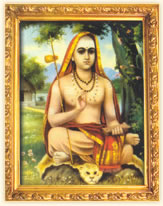
Sri Shankara

Sri Shankara described himself as a Bashyakara, one who commented on certain texts of great acclaim. Yet, his monumental work, Vedanta Sutra Bashya, a commentary on Badarayana’s Brahma Sutra is remarkable for its creative thinking, originality in approach and high literary merit. He was an original thinker. Sri Shankara’s erudition is very impressive. Though steeped in tradition he displays a disarmingly candid approach even while discussing unorthodox issues. His critics too do not accuse him of dogmatism.

He was a great logician who based his arguments on principles of logic but without contradicting intuitional revelations of the Upanishads. Scripture and reason were his two aids in his arguments. His criticism is dignified, his language restrained yet forceful and his style clear like the waters of the Ganga, as Vachaspathi Mishra describes it.

Sri Shankara’s thoughts gave a new direction to Indian philosophy. It restored the position of Upanishads as the pristine source of knowledge.

***

It was Badarayana the compiler of the Brahma Sutras who initially strived to uphold the authority of the Upanishads and to place God in the center of the scheme of things. He treated the Upanishads as the most meaningful portions of the Vedas, declared them as the highest authority and the most valid means of knowing. They are Shruthis, the Revelations, the supersensory intuitional perceptions of the ancient Rishis, he stressed. Badarayana’s efforts and anxieties were driven by an urgent need to rescue knowledge and freethinking from the encircling swamp of ritualistic texts and practices; as also from the ascending atheistic tendencies. His work represents a vigorous response to the challenges and demands of his times; and Brahma Sutra achieves that task amply well.

What, in effect , Badarayana was trying to accomplish was to drive away the strangling influence of rituals, dogma and atheism from the Indian spiritual scenes; and to bring back the Upanishad spirit of enquiry , intuition, knowledge, reason , open-mindedness and its values of life. It was for that good–tradition, Sampradaya, Badarayana was yearning. Brahma Sutra was an instrument to achieve those cherished objectives. Badarayana and his efforts represent the most important phase in the evolution of the Indian philosophy.

Badarayana set in motion the process of recovering the tradition of the ancients, Sampradaya, as also of cleansing of the spiritual environment; but had wait for over 1,200 years for Sri Shankara to arrive and carry the process forward.


Amazingly, when Sri Shankara arrived on the spiritual scene, Dharma of the ancients was beset with similar or even worse threats than in the time of Badarayana. Dogmatism, ritualism, corrupt and abominable practices of worship had taken a strong hold on the religious life of the people. There was no credible authority to dispense Dharma and the conditions were chaotic. In addition, there were the looming shadows cast across the ancient religion by other religions and atheists.

Both Badarayana and Sri Shankara were responding to the exigencies, demands and challenges of their times, which, as the fate would hate have it, were astonishingly similar, if not identical. They set to themselves similar tasks and priorities; and nurtured similar dreams and aspirations. Sri Shankara made a common cause with Badarayana, his forerunner, separated by history by over 1,200 years. That is the reason many consider Sri Shankara the logical successor to Badarayana.

Sri Shankara set himself the priorities : to bring back sanity, reason and quest for knowledge into the scriptures; to lend the right perspectives of relative and Absolute existence; to set lofty goals and aspirations to human existence; And, at the same time to wipeout ignorance , to wean people away from meaningless rituals and abominable practices of worship as also from Atheism. Badarayana addressed similar issues through his Brahma Sutra. Sri Shankara followed his lead and in turn wrote a powerful commentary on Brahma Sutra. Both the sages realized, the right way to go about their task was to treat Upanishads as the crest jewels of ancient wisdom; to bring back its authority into the center of human life; and to highlight the idealism, the spirit of enquiry, emphasis on virtues of knowledge and the process of self discovery and self realization, which the Upanishads valued as the summum bonunm of human existence.

The reason that Sri Shankara held Gauda-Pada, his Parama_Guru (the teacher of his teacher) in such high esteem was because he revived the Upanishads when they had fallen on bad days. Sri Shankara regarded Gauda-Pada as the true representative of the correct tradition of Vedanta.

Sri Shankara’s commentary on Brahma Sutra, titled Vedanta Sutra Bashya (VSB) is a highly celebrated text. Shankar’s purpose in writing his commentary was to explain the traditional view. He said, the primary meaning of the word Upanishad was knowledge, while the secondary meaning was the text itself. Sri Shankara said, the purpose of Upanishads is to remove adhyasa or avidya; and once it is removed, Brahman will shine of its accord, for it is the only reality.

He regards himself as the votary of Upanishads (Aupanishada).He even calls his way of thinking or the doctrine as Aupanishadam Darshanam, the Upanishad System. He defines the Upanishads as the texts that lead the aspirants close to the highest reality. He insists Upanishads constitute the final purpose and the import of the Vedic lore; and that is the reason he chose to write commentaries on the Upanishads and on the other two texts that depend almost entirely on the Upanishads – Badarayana’s Brahma Sutra and the Bhagavad Gita. It is therefore not surprising that Sri Shankara relied heavily on Upanishad texts to interpret and comment on Brahma Sutra.

adisankarar_image

Let us take a look at the texts he referred to in his Vedanta Sutra Bashya.

Upanishads:

He isolated the Upanishad lore from the rest of the Vedic body and narrowed it down to ten or twelve Upanishads. Even here, he did not include the ritualistic portion of the Vedas. This was in contrast to the classification followed by the later Acharyas.

Paul Deuessen the German Indologist in his work” The Systems of the Vedanta”, diligently counted the number of references made to Upanishad texts in Sri Shankara’s Vedanta Sutra Bashya. He found, Sri Shankara, in his Bashya, quoted Upanishad texts as many as 2,000 times. The Upanishads from which he quoted frequently and the number of quotes were: Chandogya (810), Brihadaranyaka (567), Taitereya (142), Manduka (129), Katha (103), Kaushitaki (88) and Svethavatara (53).

The other Upanishads he referred to were: Prashna (39), Aithereya (22), Jabaala (13), Ishavasya (8) and kena (5).

Besides he quoted from “Agni Rahasya” (Shathapatha Brahmana), Narayaniyam (Taitteriya Aranyaka) and “Pingani Rahasya Brahmana” as if to suggest they carried as much authority as the Upanishads.

Vedas:

As regards the Vedas, he referred to the Samhitha portions of the Rig Veda, Atharva Veda, the “Taitteriya” and “Yajasaneya” segments of the krshna and Shukla Yajur Vedas, respectively. But, his reliance on them is less frequent and lees pronounced.

Brahmanas:

Among the Brahmana texts, he cites the kausitaki and Aitereya portions of Rig Veda; the Shathapatha and Taitereya portions of the YajurVeda; Chandogya, Pancha Vimsa, Shad Vimsa and Tandya texts of the Sama Veda.

Aranyakas:

Only two Aranyakas are cited: Aitareya from Rig Veda and Taittereya from Yajur Veda.

Puranas:

His reliance on Puranas is meager. He cites a few from Markandeya, Shiva, Vishnu and Vayu Puranas.

Dharma shastras:

He has high regard for Dharma Shastras. He quotes from a number of these texts: Manu Smriti, Ashvalayana, Kathyayana_srauta_sutra, Apasthamba Dharma sutra and Parasara_Grihya_sutra.

Darshanas:

He is intimately acquainted with Nyaya, vaisheshika, Samkhya (of Isvara Krishna) and Yoga systems and quotes from their related Sutras.

Mimamsa:

As regards Mimamsa texts, his knowledge is extensive. He cites from Sabara’s Bashya on Jaimini, Prabhakara’s Byati and from Kumarila’s works.

Buddhist texts:

He has considerable knowledge of Buddhist texts. Dharma Kirthi was his main source. He mentions Dignaga also.

Having mentioned the sources of his references, I must add that Sri Shankara above all the scriptures , relied on experience, common as well as extraordinary to build his theory of Brahman. He gave credence to an individual’s subjective experience. He placed personal experience and intuition above all the other means of cognition. He said a person’s experience could not be disputed. He declared, “Intuition is not opposed to intellect. Reality is experience. Realizing the Supreme Being is within ones experience”.

dakshinamurti2


Reference:

Sri Shankara and Adhyasa Bashya

By

Prof.SKR Rao

 
12 Comments

Posted by on September 4, 2012 in Indian Philosophy, Sri Sankara, Vedanta


Tags: , ,

Who was Gauda-Paada ?

Sri Shankara speaks of Gauda-Paada, his Parama_Guru (the teacher of his teacher) with enormous reverence. He regards him as Pujyabhi_pujya; the most adored among the most adored. Sri Shankara looks upon Gauda-Paada as the true representative of the correct tradition of Vedanta and describes him as Sampradaya vit, one who knows the right tradition. He accords Gauda-Paada’s work the status of a Smrti and calls it the epitome of the essential teachings of the Upanishads. The other reason that Sri Shankara holds Gauda-Paada in such high esteem is that, he revived the Upanishads when they had fallen on lean days.

Gauda-Paada was a celebrity of his period, which is estimated to be between 620 and 720 A.D. And that date (as it always happens in these cases) is tentative.  Going by the traditional faith that Gaudapada was the teacher of Sri Sankara’s teacher, one would place him not prior to about a hundred or little more years prior to Sri Sankara. And, Sri Sankara, according to many scholars, is dated around 788 to 820 AD. Following that, Gaudapada and his Karika could be placed, say, at the beginning of the seventh century. But, on the other hand, a Buddhist scholar Bhavaviveka refers to several stanzas of the Karika and even quotes some. Bhavaviveka is placed prior to 630 AD, based on the Chinese translation of his work dated around that period. Thus, Gaudapada, it seems, must date not later than seventh century. In which case, the date of Sri Sankara who is the disciple of Gaudapada’s disciple must be dated prior to his generally accepted period (c. 788).

And not much that is of historical value is known about him; and , what little that is known,  is disputed . According to Anandagiri , a well known commentator of Shankara’s works, he hailed from Gauda Desha (Eastern India) , did penance in the Nara_Narayana hermitage in the Badari region of Himalayas and obtained enlightenment. Another scholar Balakrishnananda Sarasvathi mentions the banks of the river Hiravathi in Kurukshetra region as Gauda-Paada’s birth place. He explains that “Gauda” was the name of the community to which he belonged and that he did penance for such a longtime that people forgot his name and called him by his tribe name. There is also a suggestion that “Gauda” refers to a school of Advaita that was prevalent in Northern region of Gauda country.

Many scholars surmise Gauda_Paada might actually have been a Buddhist. There is much debate around this issue. His works do reveal traces of Yogachara, Madhyamika and Vijnanavada Bhuddist influences.  Dr. TMP Mahadevan an authority on Gauda-Paada and exponent of Vedanta mentions that Gauda-Paada’s Karika and Nagarjuna’s Mula_Madhyamika_Karika use similar terminologies. But, he explains, they were the terminologies of the day that were commonly used by scholars of all segments.

Gauda-Paada was not a Buddhist, he was a Vedantin. He is credited with reviving the Upanishads. Further, his major work, Karika (commentary) on Mandukya Upanishad (also called Agama Shastra), which is in the nature of rediscovery of the essential teachings of the Upanishads, amply demonstrates his status.

A few other works of commentaries are ascribed to Gauda-Paada, among them are, a commentary on Ishvara_krishna’s Samkhya_karika; one on Uttara_Gita; and another on Nrusimha_tapaniya_upanishad. But, his Karika on Mandukya is the most famous and the most celebrated of them all.

Cygnus

Mandukya Upanishad is a very short text having just twelve stanzas; but is a very profound Upanishad. Gauda_Paada’s Karika expands on that Upanishad amazingly well. His Karika is made up of four independent treatises (Prakarana Chatustayam) each dealing with a separate issue. The four treaties were at a later time put together and made into a text under the title “Agama Shastra”.

Sri Shankara is said to have written with a commentary on Gauda_Paada’s Karika. It may not actually be Shankara’s work but ascribed to him by its real author, as an act of devotion. In fact, Sri Shankara differs from the views of Gauda-Paada on a couple of issues. For instance, Gauda-Paada in his Karika states that the objects in waking state are as unreal as the dream objects; Sri Shankara does not accept this extreme position and points out the experiential variations in the waking state and the dream state.

[There is also a view that the four chapters (prakaranas) of Agamashastra are not the works of a single author; but , the  works of different authors  put together. Each chapter is of a different character. Further, the second chapter (Vaithatya prakarana) states the objects of our waking state are no more real than the dream-objects ; and claims that it  is based in Upanishads (Vedanta vinischaya; Vedanteshu vichakshana)  and  handed down by ‘tradition’ (smarta).  But, it does not quote its authority. Sri Sankara differs from the view presented in the second Prakarana; and, he also does not quote or refer to Mandukya Upanishad in his Brahma Sutra Bhashya. It is very unlikely he wrote a Bhashya on this Upanishad. ]

As mentioned, the Karika is in four chapters. The first chapter, a commentary on the Mandukya Upanishad, establishes that Advaita is supported by Shruthi and reason. The other three chapters – Vaithathya (unreality), Advaita (Unity) and Alaata-Shanthi (extinguishing the fire brand) – are independent treatises.

The first chapter points out that revelation (intuition) is the only true means of understanding the Self.

The second chapter explains the illusory nature of the phenomenal world by employing reasons.

The third chapter propounds the view that what is non-dual (Advaita) is not illusory.

And, the fourth chapter Alaata-Shanthi-Prakarana, quite distinct from the other three, defends Advaita refuting criticisms made against it. In addition, through its Mahayana Buddhist style of dialectics, explains our phenomenal experiences and establishes the Atman as the sole reality.

[There is an interesting question about the relation of the Karika to Mandukya Upanishad.  The first twenty-nine lines of the Karika, which form its First Book, provide explanations and commentary on the twelve lines of Mandukya Upanishad.   The reminder of the Karika – the other three Books – is not specifically a commentary on that Upanishad, though, in some way , related to the subject. The later scholars, therefore, tend to accept only those first twenty-nine lines alone as Sruti , the scripture.

Despite these questions, one can safely say that the Karika – particularly its second and third Books – form the earliest Advaita treatise, in some fair detail. ]

The Gauda-Paada Karika comes up with some exceedingly significant concepts that were adopted by later scholars of various Schools.

:- Gauda-Paada introduces the concepts of Relative and Absolute existence. The former refers to the common transactional day-to-day experiences that are subjective. The other dimension of existence is the one beyond the relative, beyond conflicts and duality. It is the Absolute existence.

:- The often quoted and discussed error of perception –Rajju Sarpa buddhi – of imposing the notion of a snake on a coil of rope, has its origin in Gauda-Paada’s Karika. According to him, one could see a snake while it is not there; one could impose the relative over the Absolute and mistake unreal for the Real; and one could mistake the Anatma for the Atman. All because of ignorance or wrong perception.

:- Gauda-Paada introduces the concept of Maya as a dialectic devise to explain the experiential variation of the One Reality as transactional (relative) and as transcendental (Absolute).

:- The other highly interesting concept is that of Ajati_Vada or the doctrine of no-origination, which states that from an absolute point of view, the idea of birth of universe is impossibility. Gauda-Paada rejects various theories of creation which assert creation as Sport of God or as His will or as expansion of God or process of time etc. He says creation is the very nature of God; it is his inherent nature; it flows from him. Even this, he emphasizes, is mere appearance and the Truth is, there is no creation at all. Gauda Paada agrees that Buddhists might hold similar views on the subject of creation; and that does not in any manner  change the Truth.

:- Another is Asparsha Yoga or pure knowledge, which is the way to realize the Absolute, which manifests itself in three forms: As Vishva in Jagrat or waking state where it has the consciousness of the outside world and enjoys the gross. As Taijasa in Swapna or dream state where it has the consciousness of the mental state and enjoys the subtle. And, as Prajna in Shushupti or deep sleep where it enjoys the bliss of deep sleep without dreams or desires. The Absolute state is that which transcends all the three states; it is the Turiya (same as Chathrtha or the fourth_one, of the Upanishads).

Deep sleep, Prajna, is a state where there is no object; it knows nothing, neither itself nor anything else; it might be non-dual but has seeds of ignorance in it. Turiya, however, is beyond waking, dreaming or sleeping; it is self luminous consciousness, bliss; it is Ishana – all pervading and non dual. It is beyond attributes. It is the Ultimate, Brahman.

The non dual Atman is realized when the individual self (jiva) is awakened from its ignorance. Atman is unborn, dreamless, sleepless, and motionless; and is beyond duality. It is cognition at its purest. It is Brahman- Ayam Atma Brahma, this Atma is that Brahma; Thus epitomizing the core of Upanishad teachings.

:- Gauda-Paada expands further on these states of consciousness. The Self is AUM. It represents manifest and un-manifest aspects of Brahman. It is the single syllable that symbolizes and embodies Brahman, the Absolute Reality. It is the Pranava that which pervades all existence and is our very life breath.

Vaisvanara in waking state is A the first part of AUM, One, who realizes this, attains his desires.

Teijasa in dream state is U the second part of AUM. One, who realizes this, attains knowledge.

Prajna in deep sleep is M the third part of AUM, concluding the sounds of the earlier two parts. One, who realizes this, attains comprehensive  understanding of all.

The Syllable AUM in its entirety stands for the fourth state, Turiya the one beyond the phenomenal existence, supremely blissful and non-dual.

AUM in its integral whole stands for the fourth state which is transcendental, devoid of phenomenal existence; and is the source of all existence. AUM represents Ultimate Reality. AUM is thus verily the Self itself. One who realizes this merges into that Self. Meditate on AUM as the Self.

***

It is not difficult to see why Sri Shankara had enormous regard for Gauda-Paada. Sri Shankara’s philosophical position had its base in Gauda-Paada’s thoughts. The doctrine of the Absolute Brahman, the identity of the Absolute Self with the individual self, the concept of Maya, the dual aspects of Advaita methodology-(Adhyaropa –Apavada), the relative and Absolute levels of existence, and the notion of transformation (vivarta) as against evolution (parinama); all these are present in Gauda-Paada ,  in a nutshell. Sri Shankara integrates Gauda-Paada’s views with those of Badarayana and constructs an elaborate and consistent edifice on these foundations.

Sri Shankara aptly regards Gauda-Paada as Pujyabhi_Pujya, the most adored among the most adored.

lotus

References:

http://www.cassiopedia.org/wiki/index.php?title=Gaudapada

Consciousness in Advaita by Prof.SKR Rao.

 
7 Comments

Posted by on September 4, 2012 in Indian Philosophy, Sri Sankara, Vedanta


Tags: ,

Brahma Sutra

Continued from

Who was Badarayana?

Please read on…

Sutra literally means a thread but technically it meant in the ancient Indian context, an aphoristic style of condensing the spectrum of thoughts of a doctrine into terse, crisp, pithy pellets of compressed information that could be easily committed to memory. They are analogous to synoptic notes on a lecture; and by tapping on a note, one hopes to recall the relevant expanded form of the lecture. Perhaps the Sutras were meant to serve  a  similar purpose. A Sutra is therefore not merely an aphorism but a key to an entire discourse on a subject. Traditionally, each Sutra is regarded as a discourse rather than a statement.

Sri Madhwacharya defined Sutra as Pithy, unambiguous, laying out all the essential aspects of each topic, and dealing with all aspects of the question, free of repetitiveness and flaw.

The concept of Sutra was often carried to its extremes. It is said a Sutrakara would rather give up a child than expend a word. The Sutras often became so terse as to be inscrutable. And, one could read into it any meaning one wanted to. It was said, each according to his merit finds his rewards.

Nevertheless, reducing the main tenets of a school of thought into Sutra form by compiling it from its many acknowledged texts was a well accepted mode for rote learning and study. Each school of thought carried its Sutra compiled by a learned Sutrakara. For instance, the Nyaya School had its Sutra by Gautama; Vaisheshika School by Kanada; Yoga School by Patanjali; Mimamsa School by Jaimini and Vedanta School by Badarayana. Besides, there are a number of Sutras on various other subjects. Badarayana’s Sutra is of course the most celebrated of them all.

[ Of all the Schools , the Samkhya did not seem to have a Sutra of its own. ]

The style of presentation adopted by Badarayana set  a model for Sutras that followed. It involved these steps :  the statement of an objection or prima facie view (Purva_paksha); an answer or a rebuttal of that stand (Uttara_paksha); and conclusion (Siddantha).Accordingly, a topic for discussion (Adhikarana) is discussed in five steps or limbs: The formulation of the problem; a reasonable doubt about it; the prima facie view; the answer; and conclusion.

The method adopted by a Sutrakara was to refer to a specific passage in a text, say an Upanishad, by a key word, context or a hint to the topic for discussion. The Sutrakara would follow it by Purva_paksha, Uttara_paksha and his conclusion. He would also hint in a word or two , his reasoning. The genius of the commentator, the Bashyakara was to pinpoint Vishesha Vakya the exact statement in the Vedic text referred to by the sutra; to maintain consistency in treatment – in the context and spirit of the original text; to bring out the true intent and meaning of the Sutrakara’s reasoning and conclusions.

Brahma Sutra investigates the Upanishad teachings about God, the world, the individual soul and its deliverance. It attempts to remove the apparent contradictions that existed in its earlier texts and to bind the doctrine coherently. This, it aims to accomplish in almost 564 individual Sutras. The number of topics discussed (Adhikaranas) and the Sutras accepted by the different commentators vary. For instance, Shankara, Ramanuja and Madhva have each commented on 192; 156 and 222 Adhikaranas out of 555; 545 and 564 Sutras accepted by them, respectively. The differences might be due to splitting certain Sutras or combing certain others.

The topics discussed (Adhikaranas) are classified under four Chapters (Adhyayas) . Each Adhyaya has under it four parts (Paadas).

Chapter One, Samanvaya (establishing harmony) clarifies that the basic purpose of all Upanishads is to reveal Brahman and that all the Vedanta texts talk of Brahman , which is the ultimate reality. Realizing Brahman is the goal of life. It includes an account of the nature of Brahman and its relation to world and individual soul.

Chapter Two , Avirodha (non conflict) discusses and refutes possible objections against Vedanta raised by other schools of thought like Samkhya, Yoga , Vaisheshika, Buddha, Jaina and some atheist schools; and establishes Vedanta’s views. It also gives an account of the nature of dependence of the world on God; and natural evolution from and re-absorption into God. This is followed by discussion on nature of soul, its attributes, its relation to God, body and its own deeds.

Chapter Three, Sadhana (the means) describes the process by which ultimate emancipation could be achieved. A strong yearning for attaining Brahman and distancing from worldly involvements are considered essential. It declares that with right knowledge (Brahma Vidya),  Moksha can be attained here and now.

Chapter Four, Phala (fruits or benefits) talks of the fruits or the benefits of Brahma Vidya. It discusses the state that is achieved in the final emancipation. While a Saguna upasaka goes to other realms of experience, the person of true knowledge realizes his true nature right here and fulfills his life.

Badarayana commences his work with the most repeated and most discussed statement “Athaatho Brahma Jignasaha”  (अथातो ब्रह्मजिज्ञासा) perhaps to say ”Then, therefore let us examine the subject of Brahman”. Tomes have been written discussing the possible intent and meaning of the ordinary looking two words – then, therefore; and setting out to postulate on Badarayana’s intent in commencing his work with these specific words; refuting explanations put forth  by other commentators ; and explaining the basis for his own reasoning. A great extents of the commentaries are , therefore, taken up, both  by the explanations on what is explicit in the Sutra, and  by elaborations on what is implied and unsaid in the Sutra.

What is remarkable about Brahma Sutra is that each commentator came up with his version of the intent and meaning of the Sutra; and differed from the views of the rest of the commentators. Each one  declared his interpretation was the truest interpretation of them all.

Apart from issues such as the status of the phenomenal world; and the nature and means to the liberation of the individual, the moot point of disagreement among the commentators was the status and relation between the individual soul (jiva) and Brahman. The possibilities were that Brahman and jiva could be:

(a) Identical; (b) Identical but qualified; (c) Not Identical and (d) Identical and yet Non Identical.

Each of these lines of possibilities (but declared by its profounder  as the only certainty ) gave rise to a school of Vedanta. Such schools sprang up and have since flourished.  This phase of development  is termed as the Scholastic Phase of Vedanta, which commenced in about Eighth century A.D. Each of these schools gave raise to  its sub classifications.

In other words, the schools of Vedanta prevalent today are of a comparatively recent origin. They started springing up about 1,200 years after Badarayana compiled his Brahma Sutra. Each school found its justification in the Brahma Sutra and yet each differed from the other interpretations.

The intervening period, from 5th or 4th centuries BCE to about 8th century AD does not appear to have witnessed such scholastic developments. It all started with Shankara and his celebrated Vedanta Sutra Bashya, a commentary on the Brahma Sutra. Most of the other schools often  appeared  to be  just reacting  to Shankara’s position on the Brahma Sutra.

The following is a very brief indication of some main schools of Vedanta, in a concise form.

Shankara: Advaita

(Identity) Brahman alone is real- One without a second- transcends all attributes. Brahman and the individual soul are essentially identical. The difference is only apparent, caused by Avidya, ignorance .World is not an illusion. It is relatively real. Brahman is absolutely real. Liberation involves in realizing one’s identity with Brahman, through elimination of ignorance. Purpose of life is to realize Brahman.

Ramanuja: Vishistadvaita

(Qualified Identity) It is oneness of God with attributes or Vishesha. Brahman is the Supreme Person Narayana endowed with all auspicious attributes. He alone exists, everything is his manifestation or attributes. Individual soul is part of Brahman and hence similar but not identical. Brahman, matter and individual souls are distinct but mutually inseparable entities. Loving devotion and surrender to Narayana is the only path to Moksha, liberation and is possible with the grace of God. Moksha consists in jiva remaining in undisturbed bliss in presence of Narayana in Vaikunta. Jiva lives in fellowship with the Lord. Moksha does not involve destruction of the individual self.

Madhavacharya ; Dvaita

(non Identity) Brahman is identified with Vishnu, the all important and Supreme One endowed with all auspicious attributes. He is not impersonal. Bedha or difference is the cornerstone of the doctrine. It is unqualified dualism. There are infinite numbers of jivas, which are point-like and each jiva is separate from the other; and jivas are separate from God and depend on God for being and becoming. Reality is described as a fivefold distinction-between God and jiva; God and matter; jiva and jiva; jiva and matter; and matter and phenomena. The cause of bondage is the Will of the Supreme and ignorance of jiva. Liberation is release from cycle of births and deaths; and is possible with devotion to Vishnu and comes through the mediation of Vayu. Liberated jiva does not lose its identity. It is entitled to serve the Lord.

Nimbaraka charya: Bedhabheda

( identity in difference, dualistic monism) Brahman is the supreme reality, one without a second, the infinite reality. The world and jiva are only partial manifestations of His power. Jiva and world are different from God because they are endowed with qualities and are limited; at the same time they are not different from God because God is omnipresent and all beings exist in God. Souls and God are closely related as waves within water or coils of rope within the rope. They are both distinct and not distinct from Brahman. Salvation is attained by real knowledge and devotion. Salvation consists in the soul realizing its true nature. It attains the state of Brahman but has NO powers of creation, preservation and dissolution of the world.

Vallabhacharya: Shuddadvaita

( Pure monism) It is Pure monism because it does not admit Maya (illusion). Brahman is personal. Krishna, Purushottama, in his Sacchidananda form is Brahman. He is ever playing sport (Leela) from Gokula which is even beyond Vaikunta. World and jiva are one with Brahman in essence and are a subtle form of God. Jiva in Reality is non-dual and it is pure. The embodied jiva is defiled and impure and it must strive towards the pure state through Bhakthi, devotion, love and grace (pusti). It calls for complete surrender to Krishna, Atma nivedana (giving up oneself). The liberated souls are of different kinds. Some dwell in the city of the Lord, while some others develop perfect love for God and become His associates.


References:

http://www.bharatadesam.com/spiritual/brahma_sutra/brahma_sutra_sankara_index.php

http://www.geocities.com/advaitavedant/brahmasutras2.htm

http://en.wikipedia.org/wiki/Vedanta

http://www.hinduism.co.za/schools.htm

flower design

 
6 Comments

Posted by on September 4, 2012 in Indian Philosophy, Vedanta


Tags: ,

Who was Badarayana?

vyas

Badarayana is a very celebrated name in the world of Indian scriptures. His name is mentioned any number of times; yet, hardly anything is known about him.

Badarayana is recognized as the compiler, Sutrakara, of the Brahma Sutras (an exposition on Brahman) also called Vedanta Sutra, Sariraka Mimamsa Sutra and Uttara Mimamsa Sutra.

Tradition identifies him with Veda Vyasa, the compiler of the Vedas; and, he is addressed as Vyasa-parasarya, though there is no adequate proof to support that.

According to some, since Vyasa was born on an island amidst Badara (Indian jujube) trees, he acquired the name of Badarayana as one of his many names.

However the Acharyas – Sri Shankara , Ramanuja, Bhaskara and Yamuna – address him as Badarayana;  and, do not seem to associate him with Vyasa. They refer to his work as Sariraka Mimamsa or Vedanta Mimamsa. Sri Shankara  holds Badarayana in very high regard and addresses him as Bhagavan.

Badarayana, it is suggested, might have lived anytime during 500 to 200 BCE. Prof. SN Dasguta opines he lived around 200 BCE.

Brahma Sutra is the most authoritative exposition of the Vedanta. But it was not the first. Badarayana cites the views of the earlier scholars such as Audulomi, Kaskrtsna, Badrai and Asmarthya.

But Badarayana, undoubtedly, is the most respected exponent of Vedanta. He is the final authority on the subject; though he is interpreted variously. Each commentator interpreted according to his understanding of the text.

Badarayana’s Brahma Sutra (Nyaya-Prasthana) along with Upanishads (Sruti-Prasthana) and Bhagavad-Gita (Smrithi-Prasthana) constitutes the Prasthana Trayi or the three cannons of Vedanta. These three texts are the pristine springs of Vedanta philosophy. No study of Vedanta is complete without the study of the Prasthana treya. Brahma Sutras should be studied after completing the study of Upanishads under the guidance of a teacher.

There is also a view that Upavarsha could be another name for Badarayana. This view is not well supported. It looks highly unlikely.

In any case, let us talk a bit about Upavarsha.

Again, Upavarsha comes through the mists of ancient Indian traditions and not much is known of him. We come to know him through references to his views by Sri Shankara  and others. He was an intellectual giant of his times. He is credited with being the first to divide the Vedic lore into Karma-kanda (ritualistic section) and Jnana-kanda (knowledge section).He advocated the six means of knowledge (cognition) adopted later by the Advaita school. He began the discussion on self-validation (svathah-pramanya) that became a part of the Vedanta terminology. He also pioneered the method of logic called Adhyaropa-Apavada which consists in initially assuming a position and later withdrawing the assumption, after a discussion. Upavarsha is also known as the author of a commentary on Brahma Sutra titled “Sariraka Mimamsa-Vritti”, now lost.

Sri Sri Shankara  has great reverence for Upavarsha; and, addresses him as Bhagavan, as he does Badarayana; while he addresses Jaimini and Sabara, the other Mimasakas, only as Teachers (Acharya). Upavarsha’s time is surmised to be prior to that of Panini, the great Grammarian, around 200 BCE.

Mimamsa was regarded a unified body of doctrine, consisting twenty sections; the first sixteen of which named Purva-Mimamsa (first part of Mimamsa), ascribed to Jaimini; and, the last four sections regarded as Uttara-Mimamsa (later Mimamsa), credited to Badarayana. Both the compilers, most likely, were contemporaries.

There is however a sharp contrast in the emphasis, treatment and views of the two sages.

Badarayana crystallizes the Upanishad thought; and, provides a framework for enquiry into the nature of the Absolute (Brahman).

Jaimini , on the other hand, inquires into the ritualistic aspects of the Vedas; and, emphasizes that worldly well-being and heavenly rewards are the objectives of a householder; and, that the rituals alone lead to the attainment of that highest objective.

Badarayana, in contrast, does not stress on rituals; and ,holds the final liberation (mukthi) as the goal of the seeker.

Jaimini hardly involves God (Isvara) into his scheme of things. He clings to the prescriptive and liturgical aspects of Vedas, setting aside their esoteric message. He generally ignores the Upanishads. His follower , Sabara described the non-human origin of the Vedas in terms of the anonymity or inability to remember the authors of the Vedas. There was therefore a fear; the ascendency of the Mimamsa might encourage atheism.

Badarayana, on the other hand, relied primarily on the Upanishads as the most meaningful portions of the Vedas. He assigned them the status of highest authority and the most valid means of knowing. They are Shruthis, the Revelations, the super-sensory  intuitional perceptions of the ancient Rishis, he stressed.

It was Badarayana who initially recognized Upanishads as the crowning glory of Vedic thought;  strove to uphold the authority of the Upanishads; and, to place God in the center of the scheme of things. Badarayana’s efforts and anxieties were driven by an urgent need to rescue knowledge and freethinking from the encircling swamp of ritualistic texts and practices; as also from the ascending atheistic tendencies. His work represents a vigorous response to the challenges and demands of his times; and , Brahma Sutra achieves that task amply well.

What in effect Badarayana was trying to accomplish was to drive away the strangling influences of rituals, dogma and atheism from Indian spiritual scene; and, to bring back the Upanishad spirit of inquiry , intuition, knowledge, reason , open-mindedness and its values of life. It was for that good–tradition, Sampradaya, Badarayana was yearning. Brahma Sutra was an instrument to achieve those cherished objectives. Badarayana and his efforts represent the most important phase in the evolution of the Indian philosophy.

Both Badarayana and Sri Shankara  were responding to the exigencies, demands and challenges of their times, which, as the fate would hate have it, were astonishingly similar, if not identical. They set to themselves similar tasks and priorities; and, nurtured similar dreams and aspirations. Sri Shankara  made a common cause with Badarayana, his forerunner, separated by history by over 1,200 years. That is the reason many consider Sri Shankara  the logical successor to Badarayana.

If Badarayana, whoever he was, set in motion the process of recovery of the tradition of the ancients, Sampradaya; it was Sri Shankara  who carried it forward. Sri Shankara , greatly influenced by Badarayana, recognized Upanishads as the summit of Vedic thought. The importance attached to Brahmanas appeared to him rather misplaced. Sri Shankara , then set himself the goal to recover the correct tradition, the Sampradaya.

Sri Shankara  aptly referred to Badarayana, each time, with enormous reverence and addressed him as Bhagavan, Sampradaya_vit, (the knower of good tradition) and Vedanta-Sapradaya-vit, one who truly understood the traditional import of the Upanishads

aum-1-


Reference:

History of Indian Philosophy –vol.1

By Prof.S N Dasgupta .

********

Continued, please read next :  Brahma Sutra 

 
4 Comments

Posted by on September 4, 2012 in Indian Philosophy, Sri Sankara, Vedanta


Tags: ,

Rishis of the Rig Veda and oral traditions of the Vedas

This post is in response to comments and queries from Kaveriyamma. Those related to the Rishis of the Rig Veda, their linage, the female Rishis and the oral tradition.

RISHI

A Rishi in Rig Veda is an author of a Rik, a mantra.  It is not a product of his reasoning or intellect; but , of an intuitive perception. He envisioned the entities beyond the range of human senses; conceived the self evident knowledge (svatah pramana) ; and , realized the Truth by direct intuition. Vamadeva , a Rishi in one of his hymns (RV 4.3.16) describes himself as the illumined one , expressing the Truth reveled to him (ninya vachasmi).

The term Rishi is defined as “rishati jnānena samsāra-pāram” – meaning one who goes beyond the mundane world by means of knowledge. Further, some scholars think the root ‘drish‘ (sight) might have given rise to root ‘rish‘ meaning ‘to see’ .

Rishi is therefore a wise seer, a drastara, one who visualizes a mantra – ṛsīnām mantra dṛṣṭayo bhavanti – 7,3 . He is also the one who hears. The seers were the “hearers of the Truth” (kavayaha sathya srutah) . Sri Aurobindo described Shruthi as “divine recordings of cosmic sounds of truth” heard by the Rishis. The Vedas are thus Shruthis , revealed scriptures. That is the reason , the Vedas are Apaurusheya , not authored by any agency.

Amarakosha, the Sanskrit lexicon, gives the synonym for the term Rishi as :  ṛṣayaḥ satyavacasaḥ (2.6.900), the one who speaks truth. A Rishi in the Rig Veda is a sage who realized the truth. However all sages are not Rishis; just as not all Rishis are Kavis.

(For more on Kavis, please see Kavi, Rishi and the Poet ).

Yasca_charya makes a significant  classification even among the Rishis. He draws a clear distinction between a Sakshath_krutha_Rishi , the seer who has the direct intuitional perception; and , the Srutha_rishi , the one heard it from the seers and remembered what he heard

–  sākṣāt.kṛta.dharmāṇa.ṛṣayo.babhūvuḥ – 1,20

The Srutha_rishi is like the mirror or the moon that basks in the glory of the sun . The moon and the mirror both take in the glory of the sun and put forth the shine to the world in their own way. Similarly, the Srutha_rishi obtained the knowledge by listening to the Sakshath_ Krutha_ Rishi, and more importantly by remembering what he heard. The bifurcation of the Vedas/Upanishads on one hand (as Shruthi, as heard) ; and the Vedangas, Shastras, Puranas, Ithihasa etc. on the other (as smriti, as remembered) , stems from the above concept.  Smriti, in general, is secondary in authority to Shruti .

Rig Veda mentions about four hundred Rishis; and, about thirty of them were women. Before going into their names and other details, let us, briefly, talk about the mantras.

*

In another manner, the Rishis were classified into three divisions.(1) Satarcinah – the Rishis of the first mandala, where  each of whom, seems to have contributed a hundred or more Riks; (2) Madhyamah – the Rishis in  Mandalas two to seven; and.(3) Ksudrasuktah and Mahasuktah – the other Rishis of shorter and longer hymn.

In the Rig Veda, two to seven mandalas are homogeneous in character as they present a collection of hymns belonging to a particular family. These mandalas are , therefore, known as Kulamandalas

MANTRA

Poetry raised to its sublime heights is mantra to which a Rishi gives utterance. The Rishi visualizes a magnificent idea, through intuitive perception, crystallizes it and gives it an expression. . One cannot be a sublime poet unless one is a Rishi (naan rishir kuruthe kavyam).  Badarayana Sutra (244:36) says Rishi not only lives the mantra but also is the essence of it.

A mantra is usually prefaced by a segment made of three components, mentioning the Rishi who visualized the mantra, the Deva or the Devatha who inspired the mantra or to whom the mantra is addressed; and the metrical form of the mantra. Every time, one meditates on the deity uttering its mantra with devotion; one recalls its Rishi with reverence and gratitude.

For instance, the most celebrated Gayatri   mantra which appears in Rig Veda at RV_3,062.10a is prefaced by a short description, Vishvamitra risihi; Savitha devatha; Gayatri chandaha, which says that the mantra was revealed to Rishi Vishwamitra; the illuminating spirit behind the mantra was Savitha Devatha from whom everything comes into being ; and it was conveyed to the Rishi in Gayatri chhandas (a metrical form having three lines of 8 syllables each, a total of 24 syllables). Before one meditates on goddess Gayatri uttering her mantra, one submits salutations to its Rishi, Vishwamitra.

Yaska_charya also mentions that mantras have three layers of meaning (traye artha)

– yadi mantra artha  pratyayāya anarthakam bhavati- 1,15

The essential power of the mantras are to transport us to the world of ideas beyond the ordinary and to experience the vision that the Rishi had.

VEDAS

It is said; Kṛṣṇa – dvaipāyana or Vedavyāsa divided the extant material  of the Vedas  into four groups; and taught them to his four chief disciples : Paila; Vaiśampāyana; Jaimini and , Sumantu . The disciples of each of these further rearranged their portions of the Vedic text.And, such modified forms came to be known as Shakhas or branches.

As regards Rig Veda , it is said to have had 21 such Shakhas. Out of these only five Shakhas have survived : Śākala; Bāskala; Āśvalāyana; Sāñhhāycma; and,  Māridukeyct.

BOOKS of Rig Veda

The Rig Veda Samhita is a collection of 1,028 Suktas (hymns); divided into ten Mandalas (books).  These 1,028 Suktas include eleven Valakhilya Suktas. The number of mantras in a Suktas varies from just one (1-99) to 58 (IX-97). The total number of mantras is 10,462. Thus , the average number of mantras per hymn is ten. These hymns are as envisioned by various seers

There are , in fact, two methods of classifying the Rigveda Samhita. The one is the Mandala system ; and the other is the Astaka method .

In the former,  the entire Rig Veda text is divided into Ten Books (Mandalas). This classification is based upon  its authors (Rishis) and also on its subject.  But, the size of each Mandala  is not the same; because, the number of  Suktas and the number of  Mantras  in each Mandala varies. Yet;  the Mandala – Sukta method is more popular.

Mandala Method

Maṇdalas Anuvākas Suktas Mantras
1 24 191 2006
2 4 43 429
3 5 62 617
4 5 58 589
5 6 87 727
6 6 75 765
7 6 104 841
8 10 103 1716
9 7 114 1108
10 12 191 1754
Total 85 1028 10,552

The other method is that of the Ashtaka – where the entire text of the Rigveda is divided into eight segments- Ashtaka ; and , each Ashtaka is made up of eight sections (Adhyaya). And, each Adhyaya has almost the equal number of Vargas (sub-sections); each having almost the equal number of Mantras.  The Ashtaka classification is intended, mainly, for the use of the student .  Its designed to help the learner to memorize the text, by apportioning more or less equal number of mantras under  each section .

In either of the schemes , the total number of Mantras is the same, viz., 10, 552.

Aṣtaka Method

Astakas Adhyāyas Vargas Mantras
1 8 265 1370
2 8 221 1147
3 8 225 1209
4 8 250 1289
5 8 238 1263
6 8 331 1730
7 8 248 1263
8 8 246 1281
Total 64 2024 10,552

( Source : http://www.hindupedia.com/en/%E1%B9%9Agveda#Organization_of_.E1.B9.9Agveda_Samhit.C4.81)

***

As mentioned earlier, The Mandalas are of uneven size. These mantras are authored by about 400 Rishis of whom about 30 are women. Each Rishi is identified by two names – his/her personal name and the name of his/her father or teacher or lineage. For instance, the first Sukta of Rig Veda was revealed to Madhuchhanda Vishwamitra meaning that he was the son or the disciple of Vishwamitra; the Gayatri mantra was revealed to Vishwamitra Gathin meaning Vishwamitra was the son of Gatha. It also indicates whether the Rishi was a man or a woman; for instance, Ghosha Kakshivali (RV 10.39-40) was the wife of kakshivan another Rishi.

A   Rishi could be a man or a woman, could be a celibate or a householder or unmarried.

As mentioned, each hymn of the Rig Veda is attributed to a Rishi.

Of the ten Mandalas (Books) six Mandalas, numbering from 2 to 7 are homogeneous in character and are considered the oldest parts of the Rig Veda. Each of these six books was composed by a Rishi and by members of his family / disciples and of his Gotra. These Mandalas (2-7) are therefore often called Family Books.

On the other hand, the books 1, 8 and 10 were not each composed by a distinct family of Rishis but by different individual Rishis. The Books #1 and 8 are almost Family Books as a majority of their hymns are composed by the family of Kanvas and many hymns are found in both the Books.  

The Book # 9 is different from the rest; all the hymns therein are addressed to Soma (while not a single hymn is addressed to Soma in the Family Books) and by groups of Rishis.

The tenth Book is a collection of various earlier and later hymns.Book # 10 appears to be of a later origin and of a supplementary character.

The Books # 1 and 10 are the latest and the longest Books together accounting for about 40 percent of the bulk of the Rig Veda.

The following chart indicates the number of Suktas , Mantras, in each Mandala,  ascribed to a Rishi or his family  or his disciples

( http://www.voiceofdharma.com/books/rig/ch2.htm )

http://vedicheritage.gov.in/samhitas/rigveda/

***

RISHI-linage

There are certain texts called Anukramani (also called Anukramanika) which serve as Index to the Rig Veda and provide basic information about each hymn of the Rig Veda. The most well-known of the Aukramani is Katyayana’s sarvanukramani and is dated around the second century. The entries in the texts mention about each hymn specifying, the name of the Rishi who   authored the hymn; the Devatha who inspired or to whom the hymn is addressed; and the Chandas or the metre of the hymn. They are extremely useful in historical analysis of the Rig Veda.For more on Anukramanis, please see

http://www.bharatvani.org/books/rig/ch1.htm .

For more on the Rishis, their  Gotra lineage , please check the pdf  document

The following table indicates the number of hymns in the rig Veda, attributed to some main families.

Family No. of


Hymns

Angirasa 3,619
Kanva 1,315
Vasistha 1,267
VIshwamitra 0,983
Atri 0,885
Brighu 0,473
Kashyapa 0,415
Grtsamanda 0,401
Agasthya 0,316
Bharata 0,170

( http://en.wikipedia.org/wiki/Rigveda )

As regards female Rishis (Rishikas), about 30 of them are named in the Rig Veda. To name some of them: : Ghosha Kakshivati , Dakshina Prajapathya ,Vishvavara Atreyi,  Godha, Apala Atreyi, Yami Vivasvathi, Lopamudra, Romasha Svanya, Aditi Dakshayeni, Ratri Bharadwaja , Vasukra Pathni , Surya Savitri, Indrani, Sarma Devasuni ,   Urvashi, Shashwati Angirasi, Sri Laksha and others .

Lopamudra , a great Rishika in her own right , was the wife of Rishi Agasthya and Ghosha Kakashivati was the wife of another Rishi kakashivan . Daughters of the Rishis Bharadwaja , Angirasa and Atri were also Rishikas.Vishvavara, Romasha and Vach Ambrini stood out as other Rishikas of merit.

Please check this link for more on Rishikas 

Please click here for “The Female Rishis and Philosophers in the Veda

ORAL TRADITIONS

Tradition accepts that Rishi Veda_Vyasa categorized and compiled four Vedas by splitting the primordial single Veda and rendered the Vedas more amenable to study and to memorize. The task of preserving and perpetuating each  branch of the Veda, in its entirety and purity , was assigned to a specified Shakha (meaning branch).The followers of each Shakha ,  identified as Shakins  of that particular Vedic school, were responsible for preserving their assigned part of the Veda. Followers of each Shakha would learn and preserve one the four Veda Samhitas along with their associated Brahmana, Aranyaka, Upanishads and the Sutras such as Grhyasutra and Shrautasutra. Only a small number of these Shakhas have survived; the prominent among them are Sakala and Baskala. For more on Shakas, please see:

http://en.wikipedia.org/wiki/Shakha

It is astounding that large bodies of Vedic texts have been preserved in oral traditions for over thousands of years, safeguarding their purity and entirety. How our ancients could successfully achieve such an unbelievable task, is truly remarkable.

In order to achieve this difficult task, an elaborate and a meticulous systems of recitations were devised. These systems of discipline with their  checks and balances , ensured the correctness of a text including the correct sequence of its words; purity of the language; exact pronunciation of the words; precise stress on syllables ; measured pause between syllables; appropriate tone, accent, modulation  and pitch of recitation; proper breath control etc. Shiksha one of the six Vedangas (limbs of Veda) that dealt with phonetics and phonology of Sanskrit, laid down rules for correct pronunciation of Vedic hymns and mantras.

http://en.wikipedia.org/wiki/Shiksha

Along with this, several patterns of Vedic chants were devised to ensure complete and perfect memorization of the text and its pronunciation including the Vedic pitch accent. These patterns called Pathaas ensured correct recital of the Veda mantra by weaving the mantras into various patterns and complex combinations of patterns. There are eleven acknowledged patterns or Patahaas Viz. Samhitha or vakhyaa, padaa, krama, jataa, maala, Sikhaa, rekhaa, dhvajaa, dandaa, rathaa and Ghana.

( http://en.wikipedia.org/wiki/Samhitapatha )

The salient features of a few main Paathas are as under:

Vakhya Pathaa or Samhitaa Pathaa: To recite the mantras in a straight sentence.

Pada Paathaa: to recite the mantras, word by word, instead of joining the words; to acquaint the student with the words in the text.

Krama Paathaa: the first word of the mantra is added to the second, the second to the third, the third to the fourth and so on, until the whole sentence of the mantras is completed. The order of words will be 1-2; 2-3; 3-4; 4-5 and so on. This helps to fix the words in their proper position and sequence. It also helps the students to understand changes occurring in swara in such a combination. The person who is well versed in reciting the Krama Paathaa is known as “Krama Vit.”.

Jata Paathaa: the first two words are recited together and then the words are recited in a reverse order and then again in the original order. Jata Paathaa is a play by twisting the Krama Paatha:   Krama + Inverse of Krama + Krama = jataa. The order will be 1-2-2-1-1-2, 2-3-3-2-2-3, 3-4-4-3-3-4, 4-5-5-4-4-5 and so on

Ghana Paathaa: This is one of the most popular form of recitations and requires years of learning and practice. A scholar proficient in recitation in this format is honored as Ghana_ paathi. In Ghana Paathaa the combination will be: 1-2-2-1-1-2-3-3-2-1-1-2-3  2-3-3-2-2-3-4-4-3-2-2-3-4, 3-4-4-3-3-4-5-5-4-3-3-4-5 and so on till last pada ends in that sentence. This is a complex combination of Jata Paatha and Pada Paatha in the following order:   jataa + 3rd Padaa + Inverse of 3 Padaas + 3 Padaas in Straightway = Ghana Paathaa.

The Samhita Paathaa and Pada Paathaa are called Prakrithi (or natural) Paathaas, as the words of the mantras occur in normal sequence. The rest are called Vikrithi (or artificial and not natural) Paathaas. Recently mathematical series have been devised to work out the Krama, Jata and Ghana Paatha patterns. For more on this and for greater details on Paathas please visit

http://pvkalathur.blogspot.com/2007/08/v-e-d-s.html

By applying these stringent methods  of learning and complicated patterns of recital, each generation committed to memory long passages of its assigned texts through incessant practice spread over a number of  years, retained the form and content of the texts in their pristine condition and transmitted, orally, to the next generation. This was how the Vedic texts were retained in oral form, uncorrupted, over the centuries.

[ please view this video where Vidwan Shri Suresh  explains and demonstrates  the various Paatha recitations. with particular illustration of the Gayatri Mantra]

Pipal


Tags: , , ,

Rig Veda – Position of women (2/2)

The following is the second part of the article Rig Veda – Position of women (1/2)posted on Oct, 09 2007. The first part dealt comprehensively with the position of women in the Rig Vedic period; and , also discussed a comment posted on an earlier post. It was considered, that instead of imposing a later day’s priorities and prejudices on a society of a bygone era, it would be apt to take a holistic and an independent look and examine from the angles of (a) fair and equitable treatment of women ; and , (b) empowerment of women in the Vedic society.

Part one concluded that the social life portrayed in Rig Veda reveals a tolerant and moderately unbiased society characterized by the sanctity of the institution of marriage; domestic purity; patriarchal system;  equitable position in the society for men and women and high honor for women. The women did receive a fair and an equitable treatment ; and, they were empowered to deal with issues that mattered in the life around them.

The second part discusses the views of the Rig Veda on certain specific issues such as the status of the girl child; her education; her marriage;  married life’ her right to property; widowhood ; and, remarriage.

Read on..
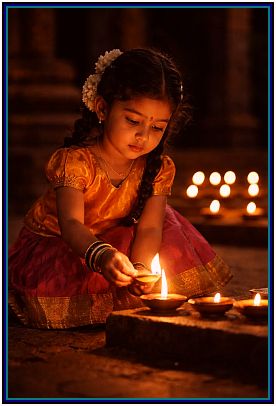
Girl child

Many hymns in Rig Veda do  express the desire to beget heroic sons. There are no similar prayers wishing for a girl child. This perhaps reflected the anxiety of a society that needed a larger number of male warriors to ensure its survival. Sons were preferred to daughters; yet, once a daughter was born, she was raised with tender care, affection and love.

For instance; Ushas’s mother decorated her daughter with much love and care; made her look Radiant like a little bride; before she took the girl out on a stroll.

su-sakāśā | mātmṛṣṭāiva | yoā | āvi | tanvam | kṛṇue | dśe | kam | bhadrā | tvam | Ua | vi-taram | vi | uccha | na | tat | te | anyā | Uasa | naśanta  / RV.1.123.11/

In the Rig-Veda, there is no instance where the birth of a girl was considered inauspicious. The celebrations and others samskaras were conducted with enthusiasm. In a particular case, the twin daughters were compared to heaven and earth. The daughters were not unpopular. They were allowed Vedic studies; and , were entitled to offer sacrifice to gods. The son was not absolutely necessary for this purpose.

There is a reference to the birth of an only daughter, who was assigned the legal position of a son; she could perform funeral rites of her father; and, she could also inherit the property. It indicates that the position of a girl in Rig Vedic times was not as low as it was to become in medieval times. (Shakuntala Rao Shastri, Women in the Vedic Age– : Bharatiya Vidya Bhavan, 1954).

Kerry Brown in her book ‘Essential Teachings of Hinduism’ explains: “In ancient India a woman was  looked after not because she is inferior or incapable; but, on the contrary, because she is treasured. She is the pride and power of the society.  Just as the crown jewels should not be left unguarded, neither should a woman be left unprotected.  If there are costly jewels, we do not throw them here and there like brass vessels. Costly material is protected”.

Education
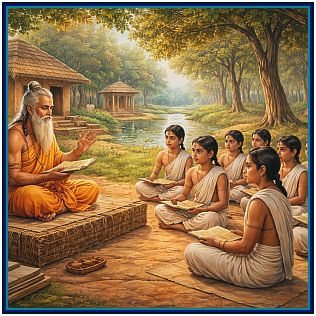
Education was an important feature in the upbringing of a girl child. Education was considered essential for girls and was therefore customary for girls to receive education. The girls with education were regarded highly.

The Vedic literature praises a scholarly daughter and says: “A girl also should be brought up and educated with great effort and care” (Mahanirvana Tantra). The importance of a girl’s education is stressed in the Atharva Veda which states,” The success of woman in her married life depends upon her proper training during the BrahmaCharya  (student period)”

The Rigvedic Society recognized the power of knowledge; and, prepared their women to face the life in most of its aspects. They taught them Music, Dancing and art of self-defense, apart from the traditional learning.
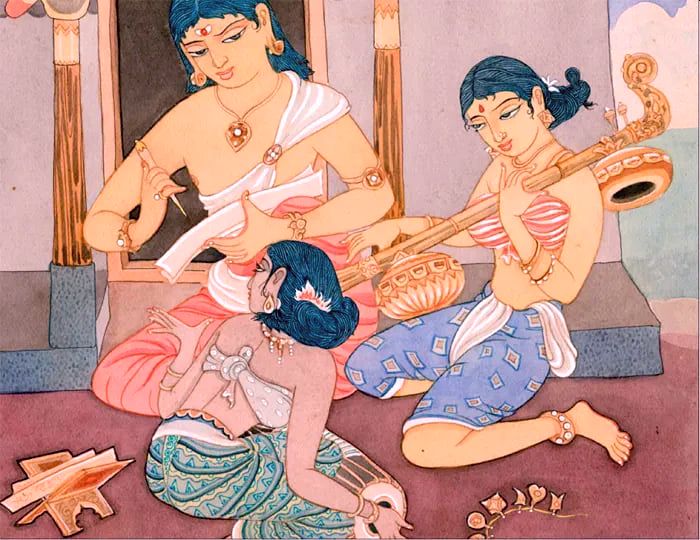
Family by S Rajam

Family by Sri S Rajam

According to Prof. A.S. Altekar (Education in Ancient India; Published by Nand Kishor & Brothers, Benaras – 1944), since the Upanayana ceremony was linked to the  commencement of education, the Upanayana of girls was as common as that of boys. The girls were entitled to Upanayana (to receive sacred thread); and, to the privilege   of studying Vedas, just as the boys.

The Atharvaveda (XI. 5. 18) expressly refers to maidens undergoing the Brahmacharya discipline; and, the Sutra works of the 5th century B. C. supply interesting details in its connection. Even Manu includes Upanayana among the sanskaras (rituals) obligatory for girls (II. 66).

brahmacaryeṇa kanyā yuvānaṃ vindate patim | anaḍvān brahmacaryeṇāśvo ghāsaṃ jigīṣati ||AVŚ_11,5[7].18||

amantrikā tu kāryeyaṃ strīṇām āvṛd aśeṣataḥ / saṃskārārthaṃ śarīrasya yathākālaṃ yathākramam // Mn_2.66 //

Women performed religious rites after completing their education under a Guru. They were entitled to offer sacrifices to gods. The son was not absolutely necessary for this purpose.

There is ample and convincing evidence to show that women were regarded as perfectly eligible for the privilege of studying the Vedic literature and performing the sacrifices enjoined in it. The Rigveda contains hymns composed by twenty different poetesses, such as:  Visvavara, Sikata Nivavarl, Ghosha, Romasa, Lopamudra, Apala and Urvasi.

For instance; Ghosa (Rv. 1-117; X-39-40); Lopamudra (Rv.1.179); Mamata (Rv. VI-10-2); Apala (Rv. VIII-91); Surya (RV.X-85); Indrani (Rv. X-86); Saci (Rv. X-24), Sarparajni (Rv. X-88) and Visvavara (Rv.V-28)

The woman seer Visvavara not only composed mantras, but also performed the functions  of a Rtvik (priest) at a sacrifice. Another seer Apala composed a hymn in honor of Indra, and offered to him Soma-juice herself.
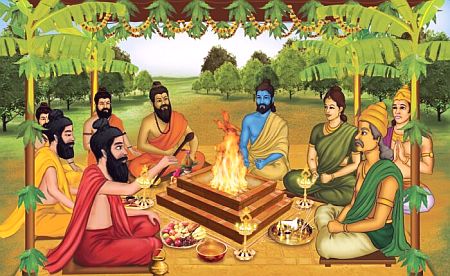
women rigveda

Even later in her life, a man could perform the Vedic sacrifices only if he had his wife by his side. According to Shrauta and Grihya Sutras, women chanted mantras along with their husbands while performing rituals.  And, the housewife was expected to offer oblations in the household (grihya) fire unaided by the husband, normally in the evening and sometimes in the morning also. In the Srattararohana ritual of the Agrahayaga ceremony, the wife used to recite a number of Vedic hymns ; and , the harvest sacrifices could be performed by women alone, ‘because such was the long-standing custom’.

Women sometimes used to accompany their husbands in the battles against their rivals. the warrior queen Vispala, the wife of the king Khela, had lost her leg in a war; and in which place an iron (ayasi) one was implanted by the  Asvins. And, thereafter , she continued to fight on.

yu̱vaṁ dhe̱nuṁ śa̱yave̍ nādhi̱tāyāpi̍nvatam aśvinā pū̱rvyāya̍ |
amu̍ñcata̱ṁ varti̍kā̱m aṁha̍so̱ niḥ prati̱ jaṅghā̍ṁ vi̱śpalā̍yā adhattam || RV_1,118.08

Mudgalani or Indrasena, wife of the sage Mudgala helped her  husband in the pursuit of robbers who had stolen their cows; drove the chariot for her husband when he was put in a tight corner. Further, Nalyani Indrasena taking up husband’s bow and arrow, fought the robbers; defeated them;  recovered and brought home her herd of cows.

ut sma vāto vahati vāso ‘syā adhirathaṃ yad ajayat sahasram | rathīr abhūn Mudgalānī gaviṣṭau bhare kṛtaṃ vy aced Indrasenā ||R.V.10.102.2||

There were eminent women in the field of learning and scholarship. These highly intelligent and greatly learned women, who chose the path of Vedic studies and, lived the ideal life of spirituality were called Brahmavadinis. And the women who opted out of education for married life were called ‘Sadyovadhus’. Co-education seems to have existed in this period; and,  both the sexes got equal attention from the teacher.

As many as about thirty Brahmavadins of great intellect and spiritual attainment are immortalized in the Rig Veda and are credited with hymns. They participated in philosophical debates with men and were highly respected. To name a few of those  significant women rishis   (rishikā)  who figure in the Rig Veda Samhitā:  Goshā Kakshivati, Lopamudra, Romasha, Sarama Devasuni , Yami Vaivasvathi , Rathir Bharadwaja , Apala, Paulomi and others. Needless to say, they were held in high esteem  for their work to be included in the important religious text of the era. 
[ Dr. Rukmani Trichur (Distinguished Emeritus Professor, Concordia University)  in her paper Empowerment of Women Based on Sanskrit Texts’, while on the subject of Brahmavadini-s writes:

 Gargi, as a learned woman, could have remained content as a composer of hymns like the 27 Risikas mentioned as composers of hymns. But, Gargi is not content with the ordinary, and is looking for answers to fundamental questions. Gargi can be called an extraordinary Brahmavadinī.  

The term Brahmavadinī   looks as though it was applied to both the composer of hymns, as one can surmise from the Brhad-devata, classifying Risikas like Lopamudra, Romasa and so on as Brahmavadinī s, as also to those who chose to remain unmarried, pursuing a life of learning, to which category Gargi would belong.

Harti-Smrti (ca 6thBCE) classifies women as being of two kinds i.e., Brahmavadinī and Sadyovadhū. It is generally understood that the term Brahmavadini implies a Kumari, who is unmarried. And, even in case a Brahmavadini was married, she could yet choose to continue to lead a life devoted to study; and, that would again indicate her exercising her own choice. Similarly, when Maitreyi opts for being educated in the Upanishad lore, she is exercising her choice; and, there is no indication whatsoever that Yajñavalkya tried to dissuade her from her decision.

Thus, Brahmavadinī is a woman of learning; whether within or outside of marriage. She is one who can make up her mind and can speak with confidence in an assembly of scholars; just as Gargi questioned even the learned Yajñavalkya.

The image of the Brahmavadinī was a powerful one, which exerted perpetual influence; and, it never faded away from the cultural memory. Thus, even when male offspring are prized, the Brhadarayaka Upanishad does not forget to remind us that there is a mantra , which can ensure the birth of a pandita or learned daughter (6.4.17).

In the Grhya-sūtras of Asvalayana and Sankyayana, three Brahmavadini-s:  Gargi Vachaknavi; Vadava Pratitheyi; and, Sulabha Maitreyi are celebrated.

It is generally acknowledged that the Vedic period was not unfair to women; and, therefore,  the achievements of the Risikas and Brahmavadini-s need not surprise us.

The subsequent period of subjugation of women and her low educational status would naturally lead to her lack of agency. But again, that is not entirely true, for women continued to exercise their choice in adopting a life of learning, in times that were not so favorable

Panini’s Astadhyayi and the subsequent grammatical literature provide evidence of women who were Acharyaa-s and Upadhyayi-s. Bhattoji Dikshita in his Varittika on Panini’s Astadhyayi explains these terms as referring to those ladies who themselves were teachers (yatu svayameva upadhyayika).

While Panini refers to women belonging to Vedic Shakas, cites the instance of Kathi as being a student of Katha-shakha (PA 4.1.53). The Amara-kosha, the Sanskrit Dictionary, also makes a distinction between the female -teachers and the wives of male -teachers.]

Incidentally, let me mention that, later, the Shatapatha Brahmana lists some 52 generations of teachers, of which some 42 are remembered through their mothers. The teachers were males. This list acts like a bridge between the end of the Rig-Veda time and the Shatapatha Braahmana time. It is remarkable that a patriarchal society should remember its teachers through their mothers. The preference over the names of their fathers indicates the important position of women as mothers in Vedic society. Their mothers were considered that valuable, as their sons were recognized through their names.

 http://www.surichat.nl/forum/index.php?topic=14696.65;wap2
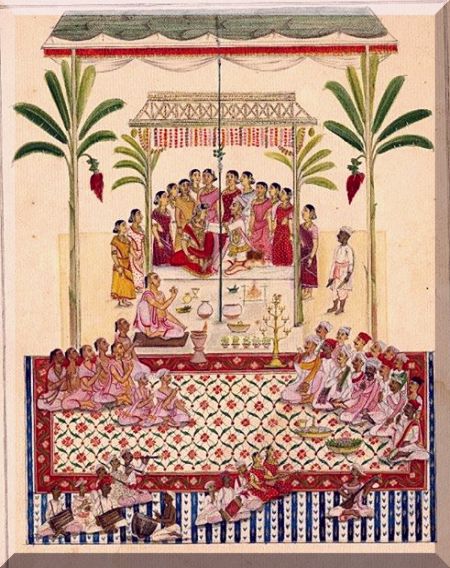
wedding

Marriage

There is very little evidence of child (or infant) marriage in the Rig Veda. A girl was married at 16 or more years of age, when her physical development was complete. Marriage was solemnized soon after wedding ceremony. The Vedic rituals presuppose that the married pair was grown up enough to be lovers, man and wife, and parents of children (marriage hymn). These go to show that a girl was married after she attained puberty. Surya, the daughter of Surya (the Sun), was married to Soma (the Moon), only when she became youthful and yearned for a husband.

[ Prof. A L Basham , in his ‘The Wonder That was India” , writes :

The marriage of boys, whether before or just after puberty, is no¬ where suggested, but the idea) of a rigorous period of studentship before marriage is always maintained. The child-marriage of both parties, which became common in later times among well-to-do families, has no basis at all in sacred literature, and it is very doubtful whether the child-marriage of girls was at all common until the late medieval period. The heroines of poetry and fiction are apparently full grown when they marry, and the numerous inscriptions which throw much light on the customs of the time give little or no indication  of child-marriage. Ancient Indian medical authorities state that the best children are produced from mothers over sixteen, and apparently recognize the practice of child-marriage as occasionally occurring, but disapprove of it.]

The Rig-Veda (5, 7, 9) refers to young maidens completing their education as Brahmacharinis and then gaining husbands. The Vedas say that an educated girl should be married to an equally educated man  “An unmarried young learned daughter should be married to a bridegroom who like her is learned. Never think of giving in marriage a daughter of very young age’”

ā dhenavo dhunayantām aśiśvīḥ sabardughāḥ śaśayā apradugdhāḥ  (RV 3.55.16).

Young women of the time could exercise their choice in the matter of their marriage. “The woman who is of gentle birth and of graceful form,” so runs a verse in the Rig Veda, “selects among many of her loved one as her husband. The term for the bridegroom was vara, the chosen one. ”The happy and beautiful bride chooses (vanute) by herself (svayam) her own husband” – (bhadrā vadhūr bhavati yat supeśāḥ svayaṃ sā mitraṃ vanute jane cit – RV 10. 27.12). The swayamvaram of the princesses are of course well documented.

kiyatī yoṣā maryato vadhūyoḥ pariprītā panyasā Vāryeṇa | bhadrā Vadhūr-bhavati yatsupeśāḥ svayaṁ sā mitraṁ vanute jane cit || RV.10.027.12 ||

Many marriages, as in the later day Hindu society today, involved the intercession of the families on either side, but a maiden was consulted and her wishes taken into account when the matrimonial alliance was discussed. The marriage hymns 139 in the Rig-Veda and the Atharvaveda indicate that the parties to marriage were generally grown up persons competent to woo and be wooed, qualified to give consent and make choice.

Young girls had the freedom to go out to attend fairs, festivals and assemblies’; the seclusion of women was not practiced. There is a reference to certain occasional festivals or gatherings called Samanas organized to help young boys and girls to get together. Rig Veda described Samana as where:

Wives and maidens attire themselves in gay robes and set forth to the joyous feast; youths and maidens hasten to the meadow when forest and field are clothed in fresh verdure to take part in dance. Cymbals sound and seizing each other lads and damsels whirl a about until the ground vibrates and clouds of dust envelop the gaily moving throng.

A girl often chose one of the suitors whom she met in these Samanas as her husband.

*

Dr. Bhagwat Saran Upadhya in his extensive work ‘Women In Rgveda‘ (Published by Nand Kishore and Brothers, Benares – 1941) writes :
daughter in Rigveda

**

Dr. Rukmani Trichur writes :

Vedic society was one which valued marriage very highly. If then, in a society that prized marriage as very high, a woman decided not to go through marriage, that would be a decision expressing not only her choice but also indicating her resolve to stand up to the  pressure of society to go against its norms. That involves agency and power to take an independent decision. In Vedic society, we do find such women like Gargi. 

Even in the Epics Ramayana and Mahabharata one finds women (like Damayanti, Savitri and Rukmini) who had the freedom to choose their spouse. And, Kuni-Garga (Shalya-parva- 52.3-25) refused to get married because she did not meet anyone suitable and up to her expectations. Similarly, Sulabha (mentioned in the Ashvalayana Grihya Sutra) refused marriage; for none of her suitors could match her in learning. She is celebrated in Mahabharata (Shanthi-parva-320) as a learned recluse who defeated King Janaka, in his own court.

** 

The older texts talk of the seven steps  around the Agni ; and , the vows taken based on mutual respect, taken during marriage

Sakaa -Sapthapadha -bhava Sakaayov -Saptha padhaa -Bhaboova
Sakyam -the’ -Ghame’yam Sakyaath -the’ Maayosham -Sakyan me’
Maayosta -Samayaava -Samayaava Sangalpaavahai -Sampriyov
Rosishnu -Sumanasyamanov Ishamoorjam – abhi -Savasaanov
Managhumsi -Samvrathaas smu Chiththaani -Aakaram -Sathvamasi
Amooham -Amoohamasmi saa -Thvam -dhyowraham
Pruthivee thvam -Retho’ aham -retho’ Bhruthvam -Manohamasmi
-vak thvam -Saamaa ham asmi -Rukthvam -Saamaam
Anuvradhaa -bhava Pumse’ Pumse’ -Puthraaya -Veththavai
Sriyai -Puthraaya -Veththavai ehi -Soonrurute’||

By these seven steps that you have taken with me, you have become my best friend. I will never move out of this relationship. God has united us in this bondage. We shall perform all activities together with love and affection and with good feelings. Let us be friendly in our thoughts. Let us observe our duties and rituals together. If you are the lyrics, I am the music. If you are the music I am the lyrics. If I am the heavenly body you are the earthly world. While I am the life source and you are the carrier of the same. I am the thoughts and you are the speech. When you are like the words, you work with me who is like the meaning of it. With your sweet words, come with me to lead a prosperous life begetting our progeny with children.

(Source: Taittiriya Ekagnikanda, I iii, 14. ; Sastri, 1918.)

It  appears that the bride was given by her parents gold, cattle, horses, valuables , articles etc. which she carried to her new home .She had a right to deal with it as she pleased. No doubt the dowry a girl brought with her did render her more attractive. “How much a maiden is pleasing to the suitor who would marry for her splendid riches? If the girl be both good and fair of feature, she finds, herself, a friend among the people. “(Rig-Veda X .27.12)

kiyatī yoṣā maryato vadhūyoḥ pariprītā panyasā vāryeṇa |bhadrā vadhūr bhavati yat supeśāḥ svayaṃ sā mitraṃ vanute jane cit ||

There were also the woes of a father,” When a man’s daughter hath been ever eyeless, who, knowing, will be wroth with her for blindness? Which of the two will lose on him his anger-the man who leads her home or he who woos her?” (RV 10.27.11)

yasyānakṣā duhitā jātv āsa kas tāṃ vidvāṃ abhi manyāte andhām |kataro menim prati tam mucāte ya īṃ vahāte ya īṃ vā vareyāt ||

Marriage was an established institution in the Vedic Age. It was regarded as a social and religious duty; and not a contract. The husband-wife stood on equal footing and prayed for long lasting love and friendship. At the wedding, the bride addressed the assembly in which the sages too were present. [Rig Veda (10.85.26-27)]

pūṣā tveto nayatu hastagṛhyāśvinā tvā pra vahatāṃ rathena |gṛhān gaccha gṛhapatnī yathāso vaśinī tvaṃ vidatham ā vadāsi ||iha priyam prajayā te sam ṛdhyatām asmin gṛhe gārhapatyāya jāgṛhi |enā patyā tanvaṃ saṃ sṛjasvādhā jivrī vidatham ā vadāthaḥ ||

[The term Kanya-daan or the concept of the father gifting away his daughter does not appear in Rig-Veda. She is treated with much dignity , honor and Love]

Marriage was not compulsory for a woman; an unmarried who stayed back in the house of her parents was called Amajur, a girl who grew old at her father’s house. An unmarried person was however not eligible to participate in Vedic sacrifices.

A woman, if she chose, could marry even after the child bearing age. For instance Ghosa a well known female sage married at a late stage in her life (her husband being another well known scholar of that time Kaksivan) , as she had earlier suffered from some skin ailment. And, late in her life (vadhramatya), with the blessings of the Asvins, Ghosa gave birth to a son , who was named as Hiranyahastha.

yuvam ǀ narā ǀ stuvate ǀ kṛṣṇiyāya ǀ viṣṇāpvam ǀ dadathu ǀ viśvakāya ǀ Ghoāyai ǀ cit ǀ pit-sade ǀ duroe ǀ patim ǀ jūryantyai ǀ aśvinau ǀ adattam ǁ 1.117.07 ǁ

ajohavīt ǀ nāsatyā ǀ karā ǀ vām ǀ mahe ǀ yāman ǀ puru-bhujā ǀ puram-dhi ǀ śrutam ǀ tat ǀ śāsu-iva ǀ vadhri-matyā ǀ hiraya-hastam ǀ aśvinau ǀ adattam ǁ1.117.24 ǁ

**

Monogamy normally prevailed but polygamy was also in vogue . Some scholars say that polyandry and divorce were also common. There are no direct references to that. I am not therefore sure of that.

[Polygamy, in ordinary circumstances, was not encouraged by the earlier legal literature. One Dharma Sutra  definitely forbids a man to take a second wife if his first is of good character and has borne him sons. Another later source states that a polygamist is unfit to testify in a court of law.  The Arthasastra  lays down various rules which discourage wanton polygamy, including the payment of compensation to the first wife. The ideal models of Hindu marriage are the hero Rama and his faithful wife Slta, whose mutual love was never broken by the rivalry of a co-wife. However, polygamous marriages are so frequently mentioned that wc may assume that they were fairly common among all sections of the community who could afford them .

 Polyandry, was not wholly unknown, though it was impossible for ordinary people of respectable class in most parts of India – Prof. A L Basham]

[ Prof. A L Basham (The Wonder That Was India) mentions :

Though the religious law books leave no room for divorce, the Arthasastra shows that it was possible in early times, at least in marriages not solemnized by religious rites. In this case divorce was allowed by mutual consent on grounds of incompatibility ; and one party might obtain divorce without the consent of the other if apprehensive of actual physical danger from his or her partner. The Arthasastra would allow divorce even after religious marriage to a wife who has been deserted by her husband, and lays down waiting periods of from one to twelve years, which vary according to circumstances and class. These provisions, however, do not appear in later law books, and were probably forgotten by Gupta times, when divorce became virtually impossible for people of the higher classes.]

Widows were allowed to remarry if they so desired, particularly when they were childless; and , faced no condemnation and ostracization socially.
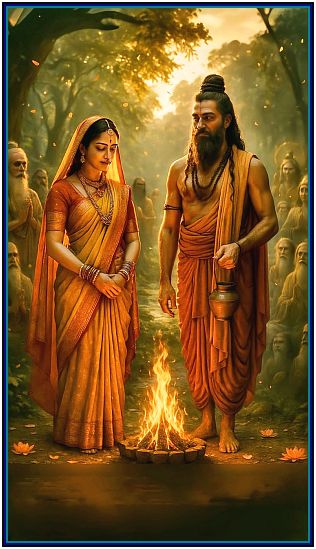
Married life

A girl when she marries moves into another household where she becomes part of it. Her gotra changes from that of her father into that of her husband. She participates in performances of yagnas for devas and pitrs of her husband’s family. The bride takes charge of her new family that includes her husband, his parents, brothers and sisters; and others who lived there for some reason.

The Rig Veda hymn (10, 85.27) , the wedding prayer , indicates the rights of a woman as wife. It is addressed to the bride sitting next to bridegroom. It touches upon few other issues as well.

“Happy be you (as wife) in future and prosper with your children here (in the house): be vigilant to rule your household in this home (i.e. exercise your authority as the main figure in your home). Closely unite (be an active participant) in marriage with this man, your husband. So shall you, full of years (for a very long life), address your company (i.e. others in the house listen to you, and obey and care about what you have to say).” (Rig Veda: 10, 85.27)

iha priyam prajayā te sam ṛdhyatām asmin gṛhe gārhapatyāya jāgṛhi |enā patyā tanvaṃ saṃ sṛjasvādhā jivrī vidatham ā vadāthaḥ ||

The famous marriage hymn (10.85.46 ) calls upon members of the husband’s family to treat the daughter in law (invited into the family ‘as a river enters the sea’) as the queen samrajni.

samrājñī śvaśure bhava samrājñī śvaśrvām bhava I nanāndari samrājñī bhava samrājñī adhi devṛṣu ||

She is welcomed in many ways:

” Come, O desired of the gods, beautiful one with tender heart, with the charming look, good towards your husband, kind towards animals, destined to bring forth heroes. May you bring happiness for both our quadrupeds and bipeds.” (Rig Veda 10.85.44)

aghoracakṣur apatighny edhi śivā paśubhyaḥ sumanāḥ suvarcāḥ | vīrasūr devakāmā syonā śaṃ no bhava dvipade śaṃ catuṣpade ||                                                                       

Over thy husband’s father and thy husband’s mother bear full sway. Over the sister of thy lord , over his brothers rule supreme”(Rig Veda 10.85.46)

samrājñī śvaśure bhava samrājñī śvaśrvām bhava |nanāndari samrājñī bhava samrājñī adhi devṛṣu ||

“Happy be thou and prosper with thy children here; be vigilant to rule thy household, in this home ‘. (Rig-Veda 10.85.27)

iha priyam prajayā te sam ṛdhyatām asmin gṛhe gārhapatyāya jāgṛhi |enā patyā tanvaṃ saṃ sṛjasvādhā jivrī vidatham ā vadāthaḥ ||

The idea of equality is expressed in the Rig Veda: “The home has, verily, its foundation in the wife”,” The wife and husband, being the equal halves of one substance, are equal in every respect; therefore both should join and take equal parts in all work, religious and secular.” (RV 5, 61. 8)

uta ghā nemo astutaḥ pumāṃ iti bruve paṇiḥ |sa vairadeya it samaḥ |

She was Pathni (the one who leads the husband through life), Dharmapathni (the one who guides the husband in dharma) and Sahadharmacharini (one who moves with the husband on the path of dharma).

To sum up, one can say that the bride in the Vedic ideal of a household was far from unimportant and weak. She did have an important position in the family and yielded considerable influence.

http://groups.msn.com/hindu-history/rawarchives.msnw?action=get_message&mview=0&ID_Message=181
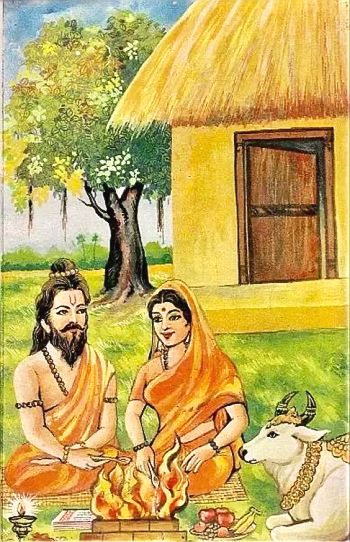
           

Property –rights

The third chapter of Rig-Veda , considered its oldest part (3.31.1) commands that a son-less father accepts son of his daughter as his own son i.e. all properties of a son-less father shall be inherited by son of his daughter.

śāsad vahnir duhitur naptyaṃ gād vidvāṃ ṛtasya dīdhitiṃ saparyan |pitā yatra duhituḥ sekam ṛñjan saṃ śagmyena manasā dadhanve ||

 Rik (3.31.2) commands that if parents have both son and daughter, son performs pindadaan (after death of father) and daughter be enriched with gifts.

na jāmaye tānvo riktham āraik cakāra garbhaṃ sanitur nidhānam |yadī mātaro janayanta vahnim anyaḥ kartā sukṛtor anya ṛndhan ||

 Rik (2.17.7) also attests share of a daughter in property of her father .

amājūr iva pitroḥ sacā satī samānād ā sadasas tvām iye bhagam |kṛdhi praketam upa māsy ā bhara daddhi bhāgaṃ tanvo yena māmahaḥ ||

Married women inherited and shared properties. A Widow too was entitled to a share in the properties of the dead husband.

Widowhood and Remarriage:

Rig-Veda does not mention anywhere about the practice of the burning or burial of widows with their dead husbands. Rig Veda commands the window to return to her house, to live with her children and grand children; and confers on her the right to properties of her deceased husband. Rig Veda clearly approves marriage of the widow. Such women faced no condemnation or isolation in the household or society. They had the right to property inherited from the dead husbands. There are riks blessing the woman and her new husband, with progeny and happiness. Rig-Veda praises Ashwin gods for protecting widows.(X.40.8)

yuvaṃ ha kṛśaṃ yuvam aśvinā śayuṃ yuvaṃ vidhantaṃ vidhavām uruṣyathaḥ | yuvaṃ sanibhya stanayantam aśvināpa vrajam ūrṇuthaḥ saptāsyam ||

Ambassador O P Gupta, IFS has made an excellent presentation of the status of widows in Rig Vedic times

 (http://sify.com/news/othernews/fullstory.php?id=13170729 )

According to him:

None of the Riks in Rig Veda calls for the burning or burial of widow with body of her dead husband.

A set of 14 Riks in 18th Mandala of the 10th book deal with treatment of widows.

Rik (X.18.8) is recited by the dead man’s brothers and others, requesting the widow to release her husband’s body for cremation. The Rik also commands the widow to return to the world of living beings, return to her home and to her children and grand children, “Rise, woman, (and go) to the world of living beings; come, this man near whom you sleep is lifeless; you have enjoyed this state of being the wife of your husband, the suitor who took you by the hand.”

ud īrṣva nāry abhi jīvalokaṃ gatāsum etam upa śeṣa ehi |hastagrābhasya didhiṣos tavedam patyur janitvam abhi sam babhūtha ||

This rik also, confers upon her full right on house and properties of her deceased husband. [It was only in the year 1995 the Supreme Court of India interpreted Section 14(1) of the Hindu Succession Act to allow Hindu widow full ownership rights over properties she inherits from her deceased husband]

Rig-Veda not only sanctions survival of a widow and her right to property; but also approves her marriage with the brother of her dead husband; and to live with full dignity and honor in the family. Rig Veda therefore expressly sanctions widow-marriage. Some scholars say the widow could marry any person, not necessarily the brother of the deceased husband or a relative.

Rik (x.18.8) blesses a woman at her second marriage, with progeny and prosperity in this life time:: Go up, O woman, to the world of living; you stand by this one who is deceased; come! to him who grasps your hand, your second spouse (didhisu) ,you have now entered into the relation of wife to husband.

In rik (X.18.9) the new husband while taking the widow as his wife says to her: let us launch a new life of valor and strength begetting male children overcoming all enemies who may assail us.

dhanur hastād ādadāno mṛtasyāsme kṣatrāya varcase balāya | atraiva tvam iha vayaṃ suvīrā viśvā spṛdho abhimātīr jayema ||

AV(XVIII.3.4) blesses the widow to have a happy life with present husband ::O ye inviolable one ! (the widow) tread the path of wise in front of thee and choose this man (another suitor) as thy husband. Joyfully receive him and may the two of you mount the world of happiness.

prajānaty aghnye jīvalokaṃ devānāṃ panthām anusaṃcarantī |ayaṃ te gopatis taṃ juṣasva svargaṃ lokam adhi rohayainam ||4||

**

[Prof. A S Altekar  in his celebrated work ‘The Position of women in Hindu civilization’ , mentions under the Chapter –  Position of the widow Part II ; Section II (Widow remarriage – Page 177) mentions :

https://archive.org/details/in.ernet.dli.2015.56806/page/n195/mode/1up

 The widow re-marriage prevailed in Vedic Society. The suggestion that the proposal for a re-marriage was made to the at the funeral of her husband is preposterous. It is based upon a wrong interpretation of a Vedic stanza –RV.5.10.18.8

udīrva nāryabhi jīvaloka gatāsumetamupa śea ehi | hastagrābhasya didhiostaveda patyurjanitvamabhi sa babhūtha || 10.018.08 //

The Verse in question merely seeks to dissuade the widow from taking extreme steps. It aims to encourage the widow to come back to the living society and lead a purposeful life.

 The Verse, in fact reads: ‘Oh Lady, get up; come back to the world of the living.  As far as your wife-hood to your husband I, who had seized your hand in marriage, is concerned you have lived it out completely’.

*

At another place ,  Atharva Veda , referring to a woman marrying a second time, prescribes a ritual to secure the union of the new couple in heaven.

yā pūrva pati vittvā ‘thānya vindate ‘param | pañcaudana   ca tāv aja dadāto na vi yoata ||AV.9.5.27// samānaloko bhavati punarbhuvāpara pati |  yo ‘ja pañcaudanam dakiājyotia dadāti |AV.9.5. 28//

*

The Widow-re marriage, was however going out of practice by about the first century of the common era. Nevertheless, the opponents of the widow remarriage were not against the remarriage of the child-widows. But, by about 600 AD, the prejudice against widow remarriage began to get deeper and harder.]

******

During the post-Vedic period, woman lost the high status she once enjoyed in society. She lost some of her independence. She became a subject of protection.

The period after 300 B.C witnessed a succession of invasions and influx of foreigners such as the Greeks, the Scythians, the Parthian, the Kushans and others. The political misfortunes, the war atrocities followed by long spells of anarchy and lawlessness had a disastrous effect on the society. Fear and insecurity haunted the common people and householders. Sons were valued higher than the daughters because of the need for more fighting males, in order to survive the waves of onslaughts. It was also imperative to protect women from abductors. It therefore became necessary to curtail women’s freedom and movements’ . Early marriage was perhaps employed as a part of those defensive measures. The education of the girl child was no longer a priority. Sastras too compromised by accepting marriage as a substitute for Upanayana and education.

After about the beginning of the Christian era, the Upanayana for girls went out of vogue. The discontinuance of Upanayana was disastrous to the educational and religious status of women. The mischief caused by the discontinuance of Upanayana was further enhanced by the lowering of the marriageable age. In the Vedic period girls were married at about the age of 16 or 17; but by Ca. 500 B. C. the custom arose of marrying them soon after the attainment of puberty. Later writers like Yajnavalkya (200 A. D.), Samvarta and Yama, vehemently condemned the guardian who failed to get his daughter married before she attained puberty. Therefore, the Smritis written by 11th century began to glorify the merits of a girl’s marriage at the age of 7, 8, or 9, when it was regarded as an ideal thing to celebrate a girl’s marriage (Ashta varsheth bhaveth Kanya) . It is not surprising that with marriage at such a tender age, female education could hardly take off or  prosper.

The neglect of education, early marriage ,  imposing seclusion and insecurity that gripped their lives, had disastrous consequences upon the esteem and status of women . The society in turn sank into depravity.

The social conditions deteriorated rapidly during the medieval period.

For nearly 2000 years from 300 B.C. to A.D. 1800, truly the dark ages of India, the development of woman steadily stuttered though she was affectionately nurtured by the parents, loved by the husband and cared by her children.

Now, it is the time of reawakening. Women of India are beginning to get opportunities to establish their identity and be recognized for their potential, talent and capabilities. That is a good rebeginning. The process must improve both in terms of its spread and quality. The ancient principles of equal opportunities for learning and development, equitable position in place of work and right to seek out her destiny, with honor; that guided the Vedic society must soon find a place in all segments of the society. It may sound like asking for the moon. But, that is the only option India has if it has to survive as a nation.
img_lotus

References

 
24 Comments

Posted by on September 4, 2012 in Indian Philosophy, Rigveda


Tags: ,

Rig Veda – Position of women (1/2)

I had not planned a segment exclusively on the position of women in Rig Veda. I assumed I covered it briefly and adequately under Rig Veda – its society (1/7). However, after reading a comment posted by Amused666, which said, among other things, that “the condition of women was no less different in rig Vedic times to the times to the modern time. Female are weak and preferred to accept male dominance and males accepted and treated them as such” I thought I should say a little more on the subject and clarify the position.

As azygos in his comment addressed to Amused666 pointed out,” extrapolating the present to the past, so very often leads to spurious exegesis. The historian is not a moral eunuch but he cannot absolutely rationalize the past, based on understanding of the present. Whenever, we come across verses like 9.32, they are to be interpreted in the positive sense and context.”

I thank azygos for his response and agree with him. I am incapable of putting it across as picturesquely and as strongly as azygos did; yet let me try to explain. The events in an ancient text have to be interpreted in the context of its times and in the light of its ethos. What Amused666 did, instead, was to impose his views on the prejudice of gender bias on a generation that had an unbiased world view and a unique self perception.

There is a field of study called Hermeneutics that deals with cultivating the ability to understand a text by placing it in context of its times and the society in which it was located; and to appreciate the cultural and social forces that might have influenced its outlook. The spirit of Hermeneutics is essential to understand and appreciate an ancient text. Sadly, a lot of times comments are ejected either without reading a text or quoting it out of context or just driven by a whim, whatever. I presume the comment of Amused666 is somewhere in this region.

The verse “Yea, many a woman is more firm and better than the man who turns away from Gods, and offers not.” (Rig-Veda, 5.61.6) that Amused 666 referred to, actually means: a woman who is devoted to God is more highly regarded than a man who has no such devotion.

 uta tvā strī śaśīyasī puṃso bhavati vasyasī |  adevatrād arādhasaḥ ||5.61.6||

And, it does not mean what Amused 666 chose to deduce.

The basic idea seems to be that a pious woman is highly regarded than a male who does not respect gods and who is miserly. Stephen Knapp calls this verse, a kind of equality that is rarely found in any other religious scripture. It is also an indication that in matter of dharma, in the days of Vedic culture, women stood as a decisive force in spirituality and the foundation of moral development. 

In the Rig Veda, the idea of the family as the hub of religious worship is found. In this context, women were at the heart of the family structure, as wives and mothers who brought worship into the center of the household activities. Even in the current era, women in the house are in charge of the family rituals and prayers.

.[For more on Hermeneutics you may visit riverine’s blog

http://riverine.sulekha.com/blog/post/2007/08/hermeneutics.htm ]

It might perhaps be more appropriate to take an objective and a holistic view rather than impose present day’s priorities and prejudices on a society of a bygone era. Accordingly, it is better we examine the women’s position in Vedic period, independently, from angles of (a) fair and equitable treatment of women and (b) empowerment of women.

*****

To come back to the subject, I propose to state the position in an abstract and then briefly cite views of Rig Veda on certain issues concerning women of its society.

Abstract

There are numerous hymns in the Rig-Veda indicating, women were assigned a high place in the Vedic society. In many aspects the present-day Indian woman had to wait a long time to regain some of the rights the Vedic women enjoyed. Further, they enjoyed a kind of liberty that actually had societal sanctions, on certain issues, which are not available to today’s Indian women.

The Vedic times were free from many of the social evils that harmed the Indian society in the later eras. Child marriage and a harsh dowry did not then exist. Widows were free to marry. They inherited rights to the dead husbands’ properties. Seclusion of women or Sati was not practiced; nor was untouchability. No man or woman was locked into a trade by birth. Members of the same family took to different crafts and trades. The Rig Veda (IX, 112) says: “A bard I am, my father a leech / And my mother is a grinder of corn / Diverse in means, but all wishing wealth/ Equally we strive for cattle.”

Women were generally not discriminated against merely on grounds of gender. Men and women had equal status in matters of education, marriage, Re-marriage, in managing the household, right to property, intellectual pursuit, participation in public debate and some women even participated in battles along with their men folk. There is a mention of a certain warrior Queen Vishpla who lost her leg in battle and was fitted with a metallic prosthesis; she returned to battle and continued to fight.

Women shared an equal standing with their men. There were women teachers, scholars, Brahmavadins and highly respected rishis. There were women warriors with bows. There were also the prostitutes who made a living and followed certain regulations.

They inherited and possessed property; they took share in scarifies and religious ceremonies; they attended the assemblies and state occasions; they also distinguished themselves as intellectual companions of their husbands, as friends and partners in their religious duties

No male was considered complete without his spouse, she was his ardangini. No auspicious ritual could be conducted or a submission made to family deities without accompanied by the wife. Why! The dead body of the husband could not be taken out for cremation without the permission of wife .

Let me also say, Rig Vedic society was not a perfect society. I wonder if there ever was a perfect society. Even Plato’s idealized Utopia was not perfect. Rig Vedic society too suffered from poverty, destitution; slavery and exploitation of the weak. There are references in Rig Veda to women rendered poor and destitute by their husbands’ addiction to gambling and liquor. There are poems sung by luckless gamblers in their drunken stupor lamenting the fate of their helpless wives and aged parents. The drunken gambler, poor and ever thirsty sinks deeper into debt as a stone into a ditch. The destitute wife of the gambler is distressed and so too is the mother of a son, not knowing where her wayward son had gone. There are scenes of roguish creditor pestering the wife of an insolvent gambler. The debtor in meanwhile with trepidation sneaks around a house under cover of darkness dreading his creditor. Does it not sound very modern?!

Other men make free with the wife of a man

Whose money and goods the eager dice have stolen.

His father and mother and brothers all say,

“He is nothing to us. Bind him, put him in jail!”

Abandoned, the wife of the gambler grieves.

Grieved too, is his mother as he wanders to nowhere.

Afraid and in debt, ever greedy for money,

He steals in the night to the home of another.


The sorrows and suffering that women endure in their day to day living do not subjugate and suppress women into weakness or male domination. They have an inherent strength. The inequalities the women of that age were subjected to were not directed against them for mere reason they were women. What you read just now was about depravity, social evil and injustice you find in any society, modern or otherwise. These do exist in all societies; just as the strong, affluent, educated, enlightened, independent and liberated women do .It would be wrong to generalize that all Vedic female were weak and preferred to accept male domination. It would be equally wrong to deduce that men treated them with equal disdain. The Vedic society was as good as any other society.

Nonetheless, the social life portrayed in Rig Veda reveals a tolerant and moderately unbiased society characterized by sanctity of the institution of marriage, domestic purity, a patriarchal system, an equitable position in the society for men and women and high honor for women. The women did receive a fair and an equitable treatment and they were empowered to deal with issues that mattered in the life around them.

Women enjoyed far greater freedom in the Vedic period than in later India. She had more to say in the choice of her mate than the forms of marriage might suggest. She appeared freely at feasts and dances, and joined with men in religious sacrifice. She could study, and like Gargi, engage in philosophical disputation. If she was left a widow there was no restrictions upon her remarriage.” Will Durant – Story of Civilization: Our Oriental Heritage

“Among the many societies that can be found in the world, we have seen that some of the most venerating regard for women has been found in Vedic culture. The Vedic tradition has held a high regard for the qualities of women, and has retained the greatest respect within its tradition “-Stephen Knapp- Women in Vedic Culture.

“Women were held in higher respect in India than in other ancient countries, and the Epics and old literature of India assign a higher position to them than the epics and literature of ancient Greece. Hindu women enjoyed some rights of property from the Vedic Age, took a share in social and religious rites, and were sometimes distinguished by their learning. The absolute seclusion of women in India was unknown in ancient times.” R. C. Dutt – The Civilization of India

Continued

In

Part Two

***

References

http://www.stephen-knapp.com/women_in_vedic_culture.htm

http://www.vedah.com/org/literature/essence/women&Rishikas.asp

http://www.geocities.com/nemhasekka/statusofindianwomen.htm

 
7 Comments

Posted by on September 4, 2012 in Indian Philosophy, Rigveda


Tags: ,

Rig Veda -The gods that faded away(7/7)

Some of the major Rig Vedic gods have virtually disappeared today. They are no longer worshipped as  gods  in the sense that there are no temples built or services conducted  or worship offered to them regularly.  Let us talk about a few of such gods.

1. Bŗihaspathi, Brahmaņaspathi and Brahma

In the Rig-Veda, Brihaspathi, Brahmaņaspathi and Brahma are the three gods to whom the rishi Vāmadeva addresses his mystic hymn of praise.

Brahmanaspati/Bŗihaspati  is a God of a very high order in Rig Veda. The two deities are closely connected to each other. Their names alternate. They are names “of a deity in whom the action of the worshipper upon the gods is personified”. There are over one hundred riks in praise of these two deities, giving a picture of their powers and personalities.  However, the statuses of these Gods undergo a huge change in the Puranas.

Brahmanaspati is the lord of all sacred prayers and lord of Satya mantra. He is the destroyer of enemies; and no sacrifice is complete without invoking him. Brahnanaspathi is a partner with Brahma in creation. Brahmaņaspathi was the middle term that once linked the Vedic Brahma and Brihaspathi’ he was as also the forerunner of Ganapathi.  But, he has now virtually has disappeared from prayers and rituals; and is altogether forgotten.

 Brihaspathi is the personification of peity, purity and knowledge. He is called `the father of the gods,’ and a widely extended creative power is ascribed to him. He is also `the shining’, `the gold-colored,’ and `having the thunder for his voice.” Other epithets of Brihaspati are Jiva- the living, Didivis -the bright, Dhishana – the intelligent, and  for his eloquence, Gishpati- the lord of speech.

He intercedes with gods on behalf of men and protects humankind from the wicked influences. .

His position in Puranas gets rather complicated. Tara his wife is seduced by Soma (moon) and a son Budha is born to them. Tara accepts and announces that Soma is the father of Budha.

Brihaspathi is also mentioned as the father of Bharadwaja. He is the designated “Vyasa of the fourth Dwapara” age.

The Vedic Brihaspathi is reduced in the Puranas to become the preceptor of Devas and guardian of the planet Jupiter (Guru). In the present day, worship is offered to Brihaspathi because he is one among the nine planets and he is a benevolent planet.

Brahma: Brahma later became rather important in Brahmanas. Satapatha Brahmana says: “He (Brahma,) created the gods. Having created the gods, he placed them in these worlds: in this world Agni, Vayu in the atmosphere, and Surya in the sky.”

In puranas Brahma becomes the Creator, and one of the Trinity. But he is not prominent as the other two; he is rather in the shades. He is also denied worship. There are no temples built in his honor, except perhaps in Pushkar and one another place.

**

2. Indra : Indra is the most important Rig Vedic god, the first among the gods , described as “Yo jata eva prathamo manasvan; “ he who, from his very birth, is the first (of the deities)’, the lord of the universe etc.

As deity of the atmosphere, he governs the weather and dispenses the rain; he sends forth his lightning and thunder and he is continually at war with Vritra the demon of drought or inclement weather, whom he overcomes with his thunderbolts and compels to pour down the rain. Indra protects humans from evil forces.

He is frequently represented as destroying the “stone-built cities” of the Asuras or atmospheric demons. In his warfare he is sometimes represented as escorted by troops or Maruts, and attended by his younger brother Vishnu. More hymns are addressed to Indra than to any other deity in the Rig Veda, with the exception of Agni .For; he was revered for his beneficent character, as the bestower of rain and the cause of fertility. He was feared as the awful ruler of the storm and wielder of lightning and thunder.

Later, in Puranas all the virtues, attributes and power of Indra are  transferred to Vishnu.

Indra is demoted in Puranas to the level of a satrap. He is always in danger of losing his throne and is ever busy devising schemes to survive fresh attacks from asuras. He is scared of not only the villainous but also the most virtuous as he fears they might usurp his throne. It is a steep fall.

**

3.Mitra: Mitra, a friend invoked very often in the Rig-Veda along with Varuna has a separate identity.

He is one of the six Major Sovereign Principles, or the 12 Adityas – offspring of Aditi, the mother of the gods. Mitra is the divinity of contracts, of pledges. He represents Friendship and Solidarity.  He is comforting, benevolent, protecting.  He is opposed to quarreling, violence and encourages right action.  

His main influence is to make men abide by their promises and associate together. Mitra is the complement of Varuna, the favor of the gods.  Mitra and Varuna work together to rule the earth and sky.  They both encourage virtue and piety. Mitra-Varuna is basically the cosmic law, relation of man with man and man with gods.

He is the counter part of the Avestan Mithra.

Mitra today is virtually forgotten in Hinduism.

**

4.Agni: Agni is one of the most ancient and most sacred gods of the Rig Veda and great numbers of the hymns are addressed to him, more indeed than to any other god. He is one of the three great deities: Agni, Vayu (or Indra) and Surya who respectively preside over earth, air, and sky, and are all equal in dignity. Agni appears in three phases: in heavens as the sun, in mid-air as lightning, on earth as fire.

Agni is the Outer Expression of the Cosmic Whole, the bahiscara—the outer impulse.  Devouring and being devoured is the transformation of life, the very essence of the universe.  The entire universe is made of fire (Agni) and offering (soma).  He is the enjoyer, the digester, the consumer: sun, heat, stomach, lust, and passion.  The nature of Agni is to spread, to take over and rule.

He is also the mediator between men and gods, as protector of men and their homes, and as witness of their actions; hence his invocation at all solemn occasions, at the nuptial ceremony, etc.

Today, Agni has ceased to be an object of worship, but is honored during sacrifices.

**

5.Varuna : Varuna  one of the oldest deities in Rig Veda , was a major celestial Deva considered equal in status to Indra and was the guardian of the cosmic order (rta). Hence, the hymns addressed to Varuna are more devout and ethical in tone.

Varuna, in Rig Veda, is personification of the all-investing sky, the maker and upholder of heaven and earth. As such he is king of the universe, king of gods and men, possessor of illimitable knowledge, the supreme deity to whom special honor is due. He is also the chief among the Adityas.

By his laws the moon shines and the stars appear in the night sky, only to disappear mysteriously the next day.  Nothing happens without his knowledge; no creature can move without him.  He observes truth and duplicity in human beings.  He has unlimited control over the fate of human beings, knows the answer to everything, and is merciful even to sinners.  He is a wise guard of immortality.  The characteristics and functions that are ascribed to Varuna raise him far above all other Vedic gods.

In Rig Veda, Varuna is not specially connected with water, but there are passages in which he is associated with the element of water both in the atmosphere and on the earth. He is associated with Mitra. Varuna is also addressed as Asura and has his counterpart in Ahur Mazda the supreme god in the Avestha.

Today, Varuna is reduced to the guardian of water element. Varuna is no longer worshiped but is sometimes propitiated before voyages.

**

6.Vayu : The Rig Veda calls the presiding deity of the wind as Vata  or Vayu. The god conceived as the element (vata) moves wherever he wants, at his pleasure. Describing him as the soul and indweller of other gods, a sukta in the tenth mandala says: ‘the soul of the gods, the germ of the world, this divinity moves according to his pleasure; his voices are heard, his form is not (seen); let us worship that Vata with oblations.’ The wind god, Vayu, is ‘the messenger of gods’.

In Rig Veda , Vayu is  often associated with Indra, and rides in the same chariot  with him, Indra being the charioteer. According to the Nirukta, there are three gods specially connected with each other. “Agni, whose place is on earth; Vayu or Indra, whose place is in the air; and Surya whose place is in the heaven.” In the hymn Purushasukta, Vayu springs from the breath of Purusha. He is regent of the north-west quarter, where he dwells.

The Vayu later becomes a mere element in the Puranas. The Dwaita sect however elevated Vayu to a higher-level and Hanuman became mukhya_prana.

**

7.Visvedevas: They are referred often in Rig Veda (Rig Veda 1.3. 7-9).They are a group of Devas that include Agni , Varuna , Vayu,Surya , Mitra et al. They are the nature’s bounties. They represent intellectual and spiritual aspects in the universe. They are offered Soma in the Yagnas “O Visvedavas! The benevolent, eternal and omniscient gods, bears of riches accept our offerings” (RV 1.3.9)

Visvedeas were major gods and were worshipped for many boons. They do not now figure directly in daily prayers.

**

8.Parjanya: Parjanya, one of the Adityas, is the god of rains and rain clouds was an important deity in Rig Veda. He is also associated with Varuna and an overseer of rta , the cosmic order. Riks 5.63 and 7.101 are dedicated to him. He is  described as thunderstorm and torrential rain ; as a gift from heavens, feeding plant and animal life, and “liberating the streams. He is represented in Rig Veda as a Bull and sometimes as Indra.

Sing forth and laud Parjanya, son of Heaven,

Who sends the gift of rain
May he provide our pasturage.

 Parjanya is the God, who forms in kine,

in mares, in plants of earth,
And womankind, the germ of life.

 Offer and pour into his mouth oblation rich in savory juice:
May he forever give us food.

Parjanya, today, is sometimes worshipped; but only during severe droughts.

**

 9.Savitir: Savitir one of the Adityas, is a younger member of the Vedic pantheon; the most handsome of the Vedic gods with raised arms that were golden (hiranya hasta) is the embodiment of gold. Savitir is the great inspirer. He dispels darkness. The Sun just before he arises is Savitir, according to Sayana. The most celebrated Gayathri mantra (Rig Veda 3.62.10) belongs to him

tat Savitur varenyam bhargo devasya dhimahi dhi_yoyonah prachodayath

**

10. Pushan: Pushan (one who nourishes) is a solar deity who is the keeper of herds and one who brings prosperity. Yaska says that when Sun appears with his rays he is Pushan. He has a charming appearance. He has immense wealth and has always at his command a chariot ready to ride. He is the greatest of the charioteers. Pushan wards off calamities that might occur on the road; so pray to him.

Pushan is the lord of marriages, journeys and roads. Hymns in Rig Veda, appeal to him to guard livestock and to find lost livestock. He is a supportive guide, a good god, leading his adherents towards rich pastures and wealth.

This celebrated rik is addressed to Pushan: ‘By the lid of the golden orb is your face hidden. Please remove it, O nourisher of the world, so that I may see you, I who am devoted to Truth.’

Hiranmayena patrena satyasyapihitam mukham
Tat tvam pusan apavrnu satya sharmaya drstaye

**

11.Asvins :   twin sons of the sun and Ushas.. They are ever young and handsome, bright and of golden brilliance, agile, swift as falcons, and possessed of many forms; and they ride in a golden chariot drawn by horses or birds, as harbingers of Ushas, their mother, the dawn. “They are the harbinger s of light in the morning sky, who in their chariot hasten onwards before the dawn and prepare the way for her.”

Rig Veda praises the Asvins for protecting the widows.

They are horsemen. They are the doctors of gods and are the Devas of Ayurvedic medicine. Their attributes are numerous, and relate mostly to youth and beauty, light and speed, duality, the curative power, and active benevolence. The number of hymns addressed to them testifies to the enthusiastic worship they received. They were called Das and Nasatyas, Gadagadau and Swarvaidyau; or one was Dasra and the other Nastya.

According to Yaska_charya, the Asvins represent the transition from darkness to light, when the intermingling of both produces that inseparable duality expressed by the twin nature of these deities.. It agrees with the epithets by which they are invoked, and with the relationship in which they are placed. They are young, yet also ancient, beautiful, bright, swift, etc.; and their negative character, the result of the alliance of light with darkness, is expressed by dasra, the destroyer, and also by the two negatives in the compound nasatya (na + satya) ; though their positive character is again redeemed by the ellipsis of ‘enemies, or diseases’ to dasra, and by the sense of nasatya, not untrue, i.e., truthful.

References

http://www.mythfolklore.net/india/

http://www.karma2grace.org/encyclopedia/index.html

 
1 Comment

Posted by on September 4, 2012 in Indian Philosophy, Rigveda


Tags: , ,