RSS

Category Archives: Art

The Legacy of Chitrasutra – Thirteen – The Murals of Kerala (Mattancherry and Padmanabhapuram Palaces)

[This Twelfth article in the series; and , it  follows the one on the murals of Kerala which talked, in general,  about some of the main features of the traditional mural art of Kerala, which has a unique style of drawing and depiction; and colour schemes.

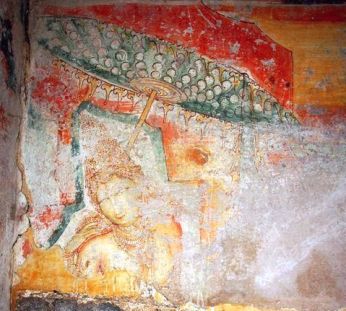
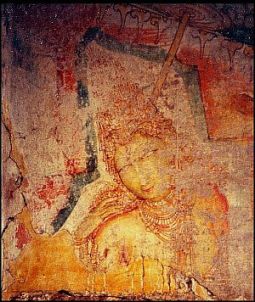
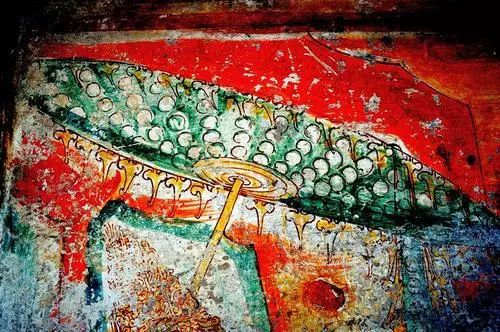
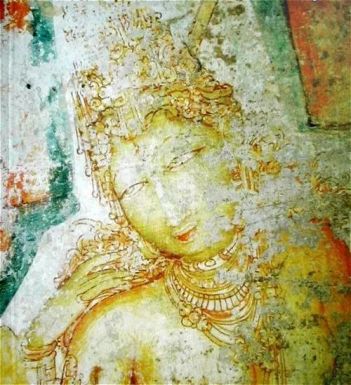
The present article looks at the murals at Mattanchery and Padmanabhapuram Palaces, as particular instances of traditional Kerala mural art..

This article and its companion posts may be treated as an extension of the series I posted on the Art of Painting in Ancient India ..

In the next article we shall move on to the 20th and 21st century   and admire the sublime paintings of Shri S Rajam, perhaps the sole votary of Chitrasutra tradition in the modern times. ]

Continued from the Legacy of Chitrasutra- Eleven- The Murals of Kerala

A. Mattancherry Palace
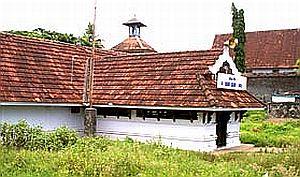

49.1. Mattancherry , in Cochin, had been the former capital of the erstwhile rulers of Kochi. It was a bustling sea port to where the Portuguese and the Dutch traders were drawn by the lure of the legendary spices of the East, especially the black pepper. They established business houses and built large warehouses, at Kochi.

49.2. It is said; the Portuguese traders, in order to seek favours, beguile or appease the then king of Kochi, Veera Kerala Varma Thampuran (1537-61), built for his use (in 1552/1555) a palace at Mattanchery and also gifted him a golden crown. The Dutch, who later arrived on the scene by 1663, promptly displaced the Portuguese and took over the spice trade. The Dutch,   for reasons similar to the ones that prompted the Portuguese, refurbished the king’s palace at Mattanchery. Since then, the Mattanchery palace has come to be known as the Dutch Palace. It had been the residence of the Kochi royal family for about two centuries.

49.2. There is a certain medieval charm and simplicity about the Mattancherry Palace .The palace is a blend of Portuguese architecture and Kerala style of construction,; a ‘Nettukettu’ (four buildings) with a shrine of Pazhayannur Bhagavathy, deity of the royal family, in the central courtyard. Its   interiors are made beautiful with rich wood work and exquisite flooring that looks like polished black granite; but it is actually made of a mixture of charcoal, burnt coconut shells, lime, plant juices and egg whites. The palace has within it two other temples, dedicated to Krishna and Shiva.

The Mattancherry Palace is  included in the ‘Tentative list of nominations‘  in India , under the World Heritage List of the UNESCO.

50. The Murals

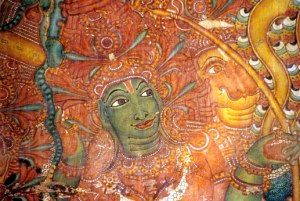
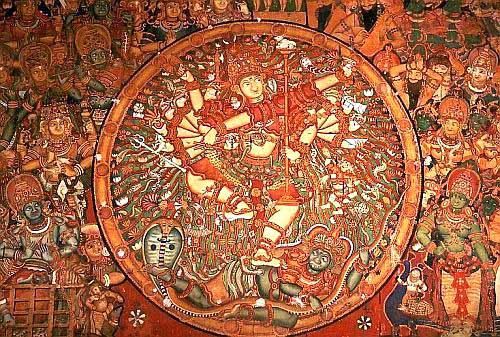
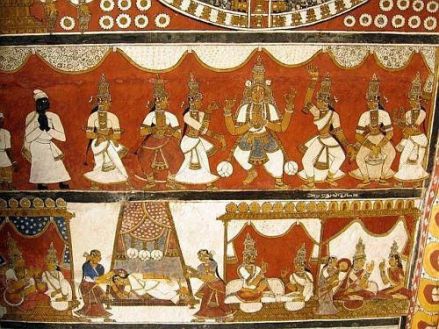
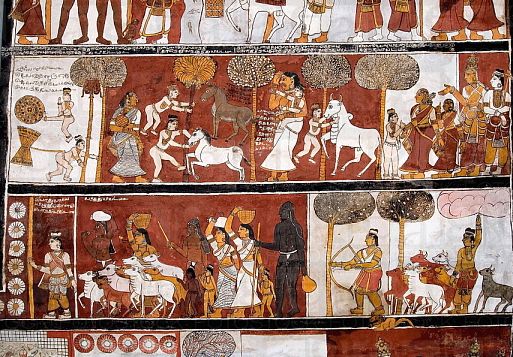
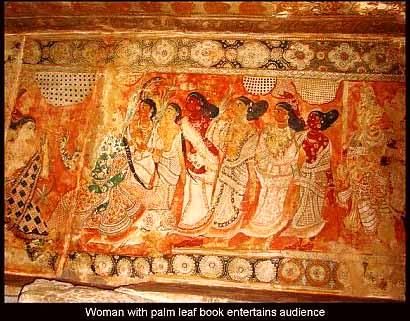
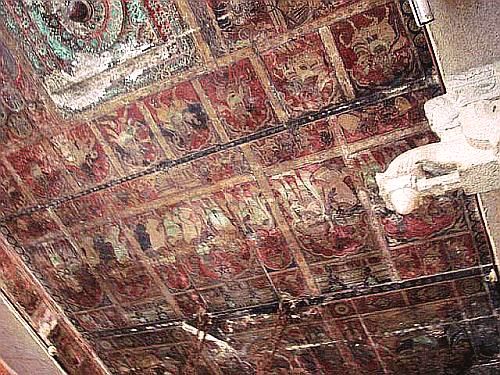
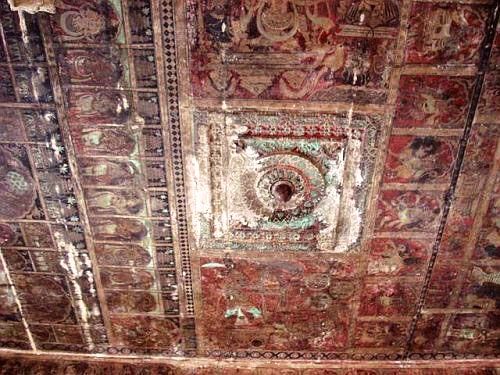
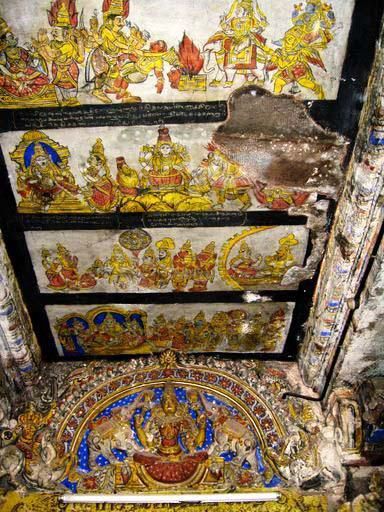
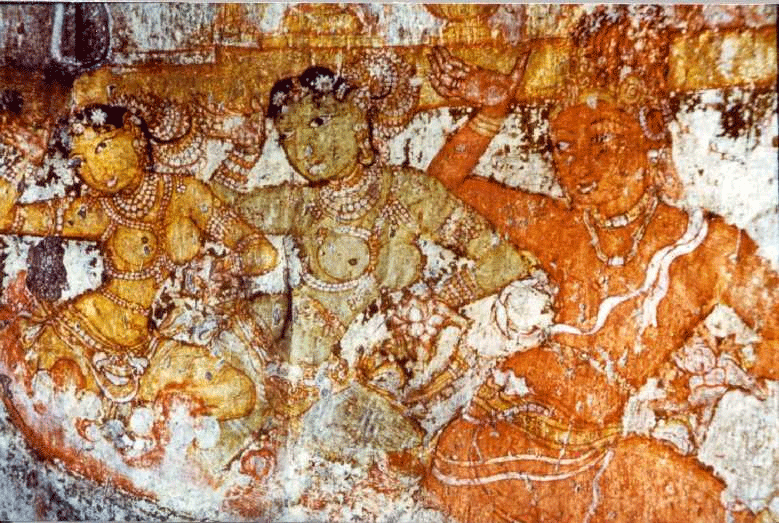
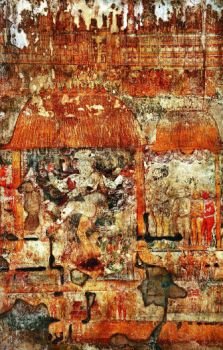
50.1. During the 16th and 17th centuries, the walls in some rooms of the palace were painted with scenes from Ramayana, Mahabharata and other epic poems. Most of the murals are adorned with decorative textile design borders filled with figures of the flowers, creepers, birds, animals etc.

The paintings are massive and are spread over a total area of almost 1000 sq. ft.

50.2. The palace is a treasury of the 16th-17th century Kerala art. It is an artist’s delight. It is said; the late Amrita Sher Gill, the well known painter who visited the palace in 1937 was fascinated by these ‘perfectly marvellous old paintings’. In a letter to her sister, she said she was surprised by the technique and the amazing knowledge of form and the power of observation of the painters. According to her, the Mattanchery paintings were more powerful than the Ajanta frescoes; but the latter were superior from the painting and artistic aspects.

50.3. The earliest paintings of the 16th century are on the theme of Venugopala (Krishna as the divine flute player). These panels were, in later years, interspersed with paintings depicting episodes from the epic-poem the Ramayana. Some say that the Mattanchery palace Ramayana murals are the visual interpretations of the Adhyatma Ramayana of Ezhuthachan, the great Malayalam poet of the 15th century.


50.4. The Ramayana murals

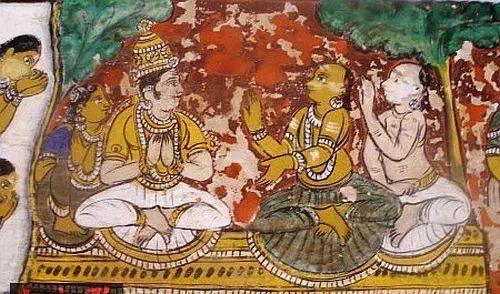
The Ramayana murals of Mattanchery palace depict the story of Rama, commencing from Dasharatha offering a yajna praying to gods to grant him sons; and it concludes with Rama returning, triumphantly , to Ayodhya , along with his beloved Sita and brother Lakshmana. The Rama-story is rendered in about 48 paintings covering nearly 300 sq ft (28 m2) of wall surface. Rama’s nobility, unsullied character and composure even while placed in adverse situations, comes through serenely.
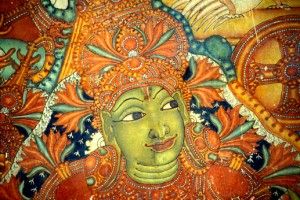
The narration of the episodes flow smoothly, each panel theme lucidly leading to the next. The themes are separated from one another by decorative borders, unique to the Kerala mural tradition. Besides giving a subtle form of relief to the pictures, they seem to convey a sense of motion.

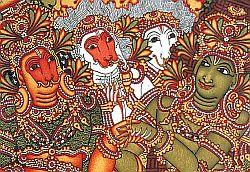
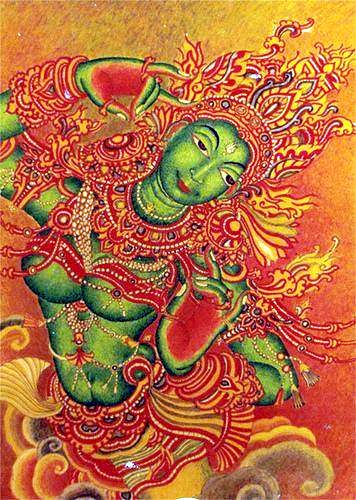
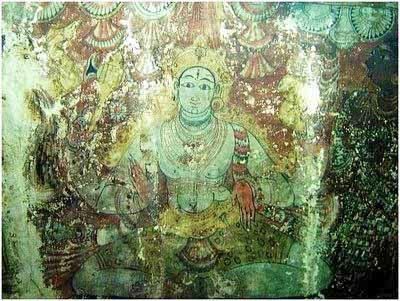
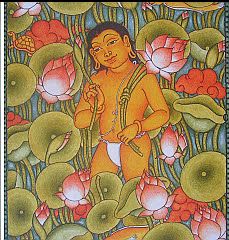
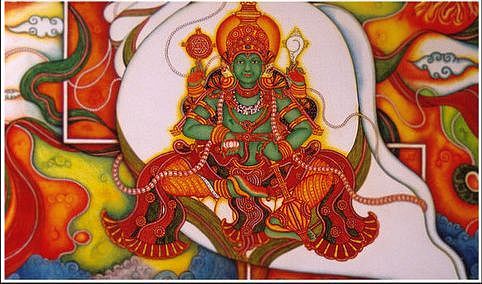
50.5. Besides the Ramayana paintings there are portrayals of Krishna holding aloft Govardhana hill, another of a flute-playing Krishna (Venugopala) in jewel-like green.
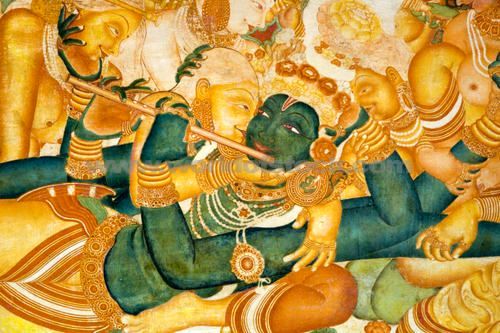
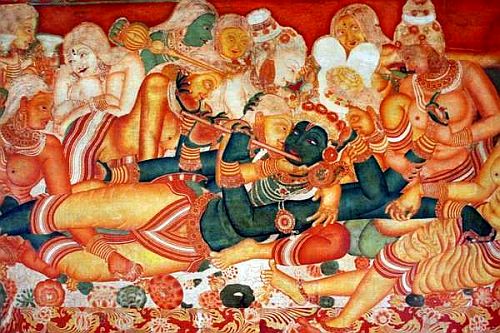
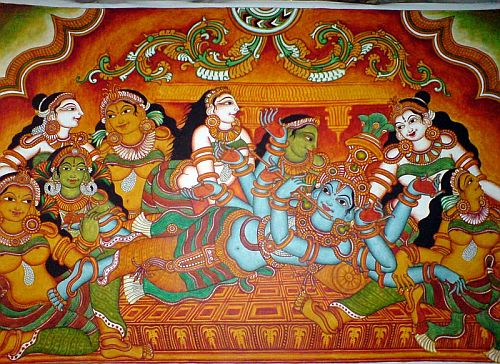
There is also a mural of Krishna in reclining posture, surrounded by gopis,. His languid pose belies the activity of his six hands and two feet, caressing his adoring admirers. Apparently, these panels were later additions.
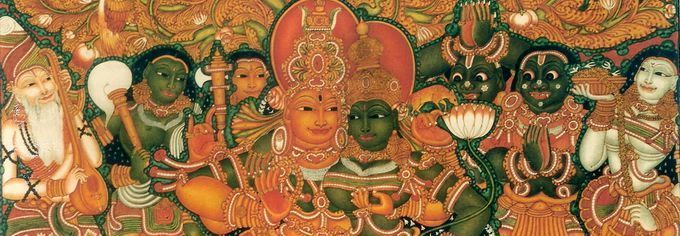
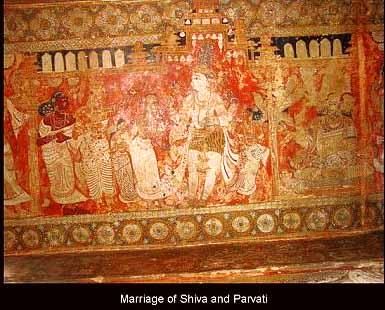
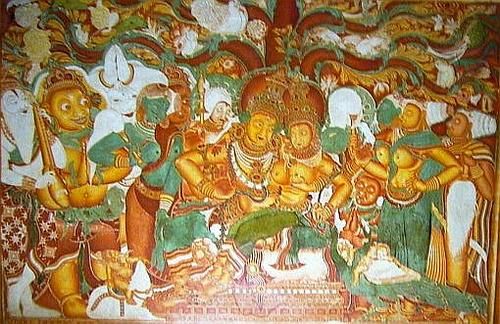
50.6. The themes from the epic poem Kumara-sambhavam of the poet Kalidasa depict Shiva and Uma in their snow abode atop the Mount Kailas.

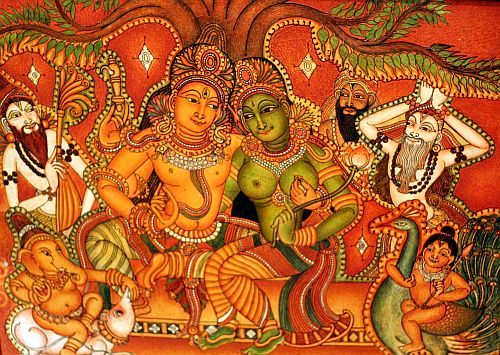
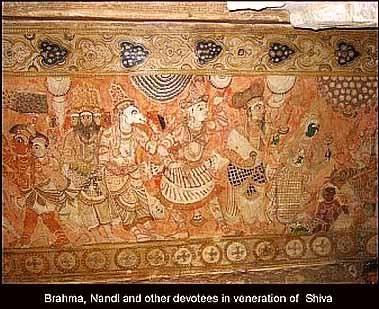
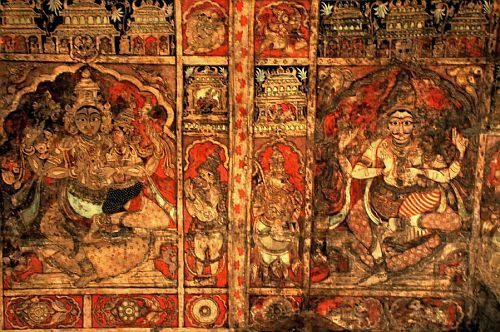
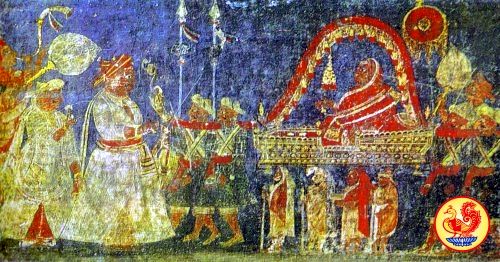
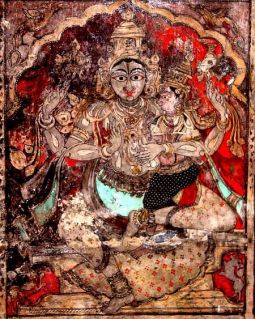
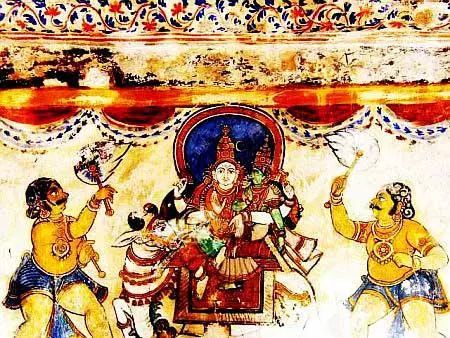
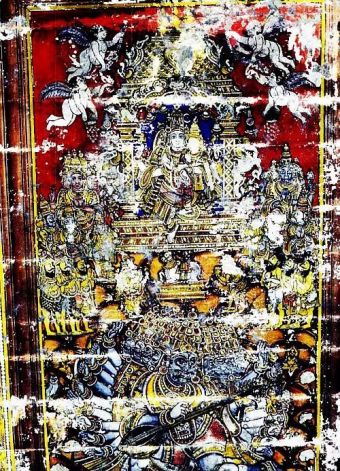
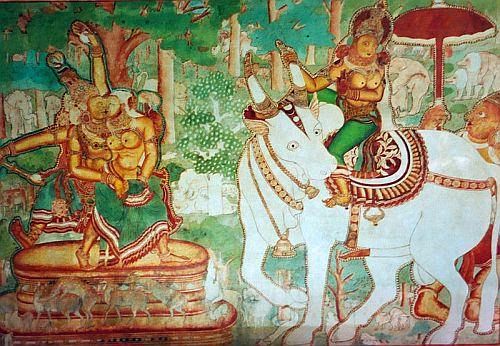
A painting on the walls of the Raja’s bedroom depicts Shiva and his consort Parvathi in embrace. They are surrounded by their son Ganapathi and other admirers. Interestingly, a guard wearing a Portuguese helmet and wielding a halberd, slaves and sages stand nearby. These paintings belong to a much later period than the Ramayana scenes; some of them to the beginning of the 18th and 19th centuries.
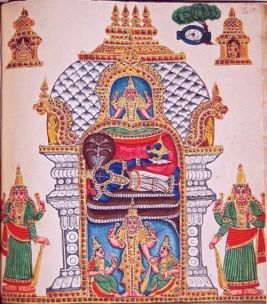
50.7. Among the depiction of Vishnu, his portrayal as Vaikuntanatha and Ananthasayanamurti are well known.

The seated Vishnu (Vaikuntanatha) under the canopy of five-hooded Anantha-naga is a rare depiction of Vishnu. It is said to be a replica of the deity at the Sree Poornathrayeesa Temple at Tripunithura, the family deity of the erstwhile Kochi dynasty. The Vishnu image at Tripunithura was, in turn, perhaps inspired by the Vishnu sculpture at the 6th century rock – cut temple of Badami.
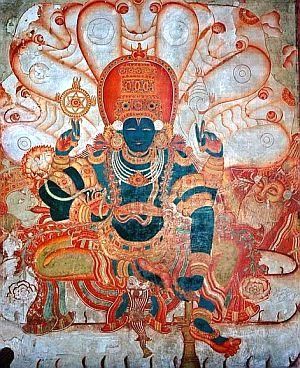
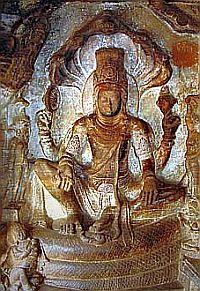
 

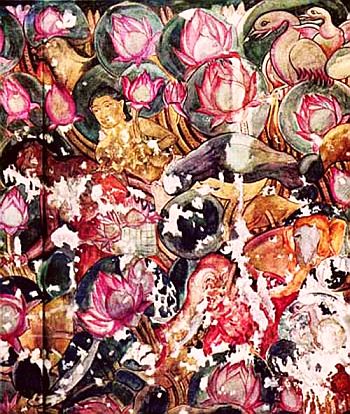
There is also a composition of Lakshmi seated on a lotus. These are among the latest works in the palace.

50.8. According to the website of the Corporation of Cochin, many of these murals were painted in the traditional style by one Shri Govindan Embranthiri of Narayana- mangalam. No details are given.

51. True to the Kerala tradition

51.1. The beautiful and extensive murals of Mattanchery palace are fine examples of traditional Kerala mural art. Some of them are hailed for their style of depiction.

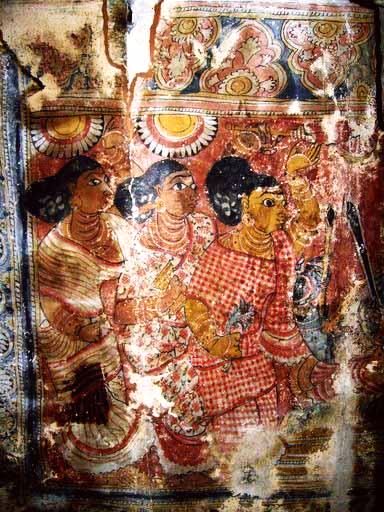
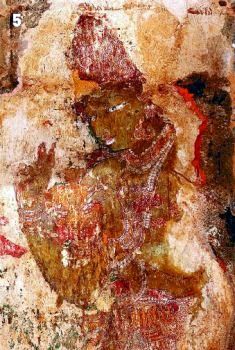
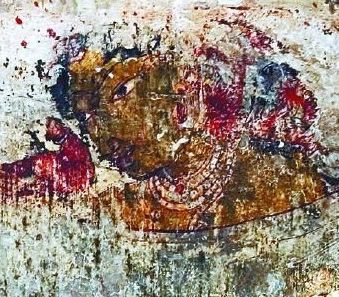
51.2. The murals are packed with details in gloriously rich colours; the style is never strictly true-to-life; the treatment of facial features is trimmed down to the simplest of lines for the mouths, and aquiline noses.

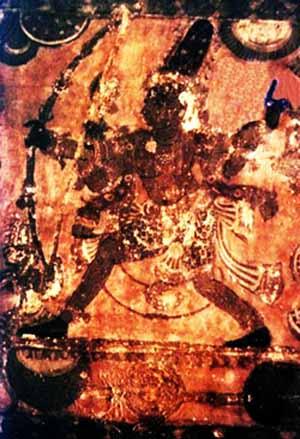
51.3. True to the Kerala tradition, the murals at Mattanchery are characterized by   the warmth and grandeur of rich colours, elaborate ornamentation, sumptuousness of the outline, depiction of volume through subtle shading, a crowding of space by divine or heroic figures;   a strong sense of design and well defined picturization.

******

B. Padmanabhapuram Palace

54. The palace
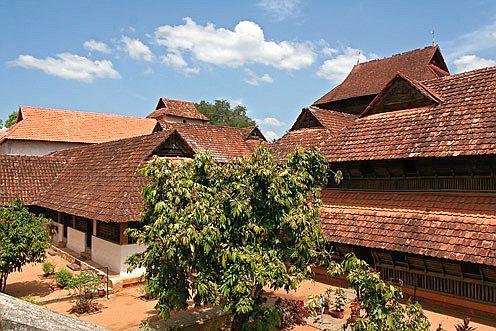
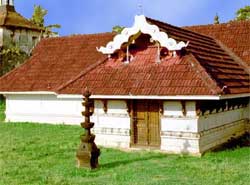
54.1. Padmanabhapuram palace, the exquisite wooden palace was constructed in the early years of the seventeenth century (say, around 1602) during the reign of by Iravipillai Iravivarma Kulasekhara Perumal who ruled Travancore State between 1592 and 1609 A.D. It is said to have been built upon an earlier mud palace in the Nalukettu style of architecture, constructed during the 14th Century.

The Padmanabhapuram palace is a splendid illustration of the traditional Kerala architectural style. it is unlike any other palace in India. Replete with intricate wood carvings and ornate murals, the Palace is an exceptional example of indigenous building techniques and craftsmanship in wood; a style unparalleled in the world and based on historic building system, Taccusastra (the science of carpentry) unique to this region.

The 6.5 acres of the Padmanabhapuram Palace complex is set within a fort of 185 acres located strategically at the foot hills of Veli hills, Western Ghats. The palace complex, which includes fourteen function specific independent buildings surrounded by a 4 km-long stone fort, is located virtually at the land’s-end. The fourteen denoted structures include Kottarams (Palaces); Pura (House or structure); Malikas (Mansions); Vilasams (Mansions) and Mandapams (large Halls).

The Palace structure is constructed out of wood with laterite (locally available building stone) used very minimally for plinths and for a few select walls. The roof structure is constructed out of timber, covered with clay tiles.

54.2. The Palace served as the secure official residence to the Travancore Kings for about two hundred years from 1550 to 1750.

 It is said, the reign of the King Marthanda Varma (1729-1758), was a glorious period in the history of Padmanabhapuram palace. He provided a serene and secure ambiance to the palace; and gave it its present name – Padmanabhapuram palace (c.1744) in honour of the State’s patron deity. Its earlier name was Kalkulam.

The Padmanabhapuram palace was the centre of political power during the years 1600 to 1790, that is till the time the state capital was shifted to Thiruvananthapuram (also known as Trivandrum).

[ There is an interesting sidelight concerning Martanda Varma and the Dutch.

On February 4, 1741, the Dutch forces launched an assault hoping to unseat Marthanda Varma. In response, Marthanda Varma’s army surrounded the attackers; and, laid a siege , cutting down their supply lines. The siege ended on August 5, 1741, with an unconditional surrender  of all the Dutch forces.
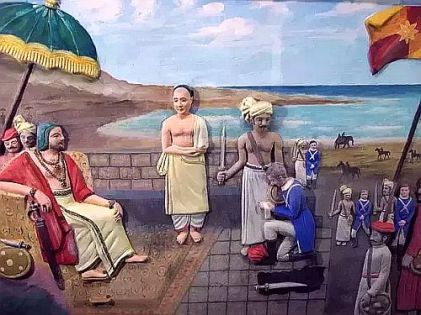
Dutch surrender to Martanda verma Aug 5 1741

The Dutch East India Company commander and his lieutenant were captured; and, were later employed to train; to modernize the Army of Travancore ; and, to  build forts. The Dutch signed the treaty of Mavellikara, formalizing their defeat.

The Dutch trained Travancore Army was later absorbed into the Indian Army ; and, formed the 9th Battalion of the Madras Regiment. The battalion still celebrates July 31 every year as Colachel Day . ]

In 1993, a Museum building was set up in the Southwest corner of this Palace complex, and houses numerous invaluable stone inscriptions and copper plate inscriptions, sculptures in wood and stone, armoury, coins, paintings, and household objects pertaining to the history and heritage of the region.

Padmanabhapuram Palace is the oldest, largest and well preserved surviving example representative of the traditional wooden architecture in India. It is an testimony to the traditional architectural knowledge and skill of Kerala. It is , therefore, included in the ‘Tentative list of nominations‘  in India , under the World Heritage List of the UNESCO.

55. The Murals

55.1.One of the structures in the Palace is an outstanding example of the Mural art form. 

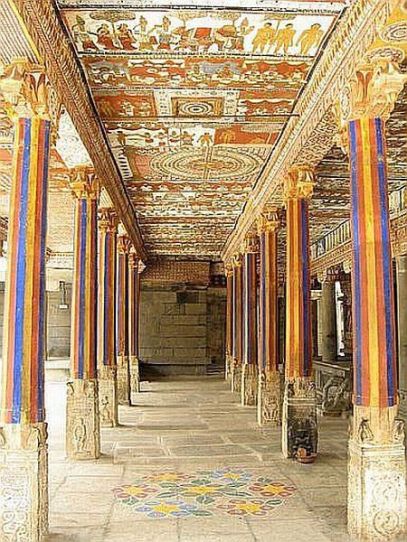
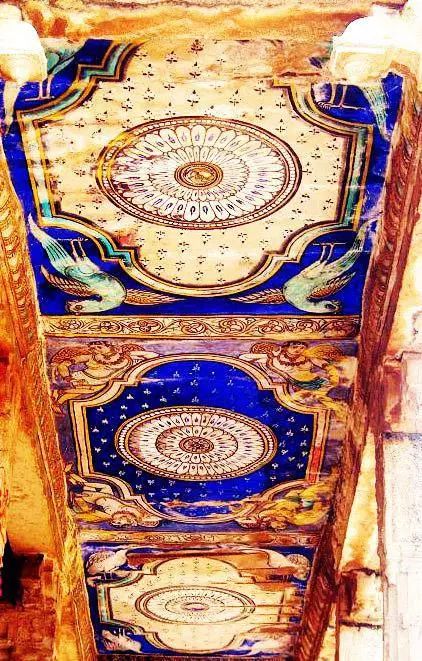
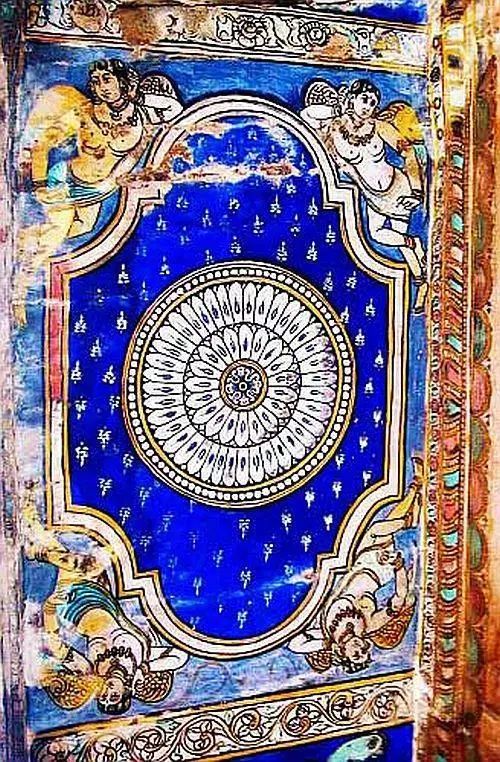
The splendid antique interiors are adorned with intricate rosewood carvings and sculptured décor; and the elegance of the palace is enhanced by some beautiful 17th and18th century murals

.
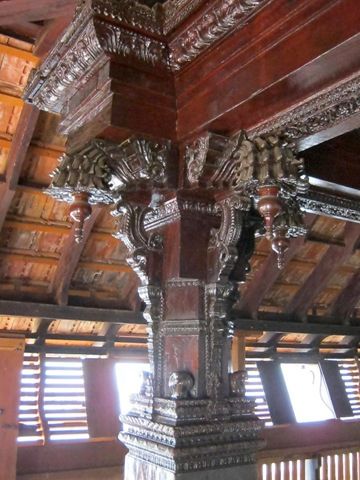
55.2. The murals at Padmanabhapuram are exceptional. Besides the depiction of scenes and characters from Hindu mythologies, there are murals also on secular themes which reflect the socio political conditions, fashions and customs of the times.

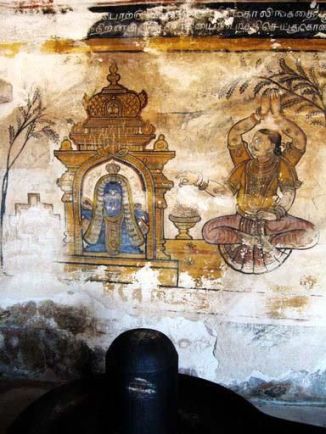
The UppirikaMalika or the four-storeyed building, constructed in 1750 CE, includes the treasury chamber on the first floor, Maharaja’s resting room on the second floor, and the revered prayer room on the third floor the walls of which are replete with traditional Kerala mural art work.

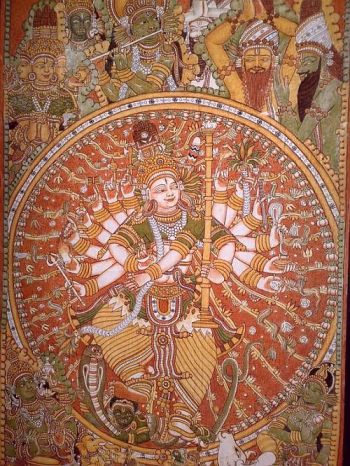
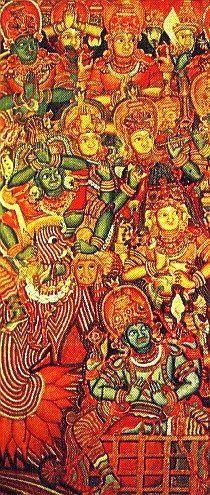
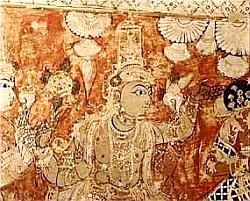
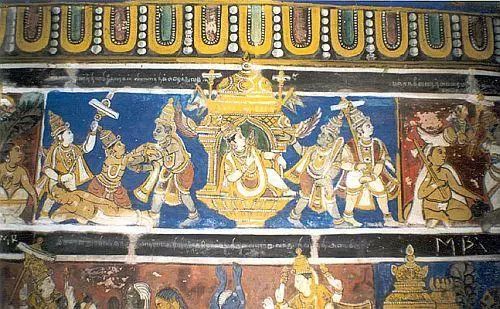
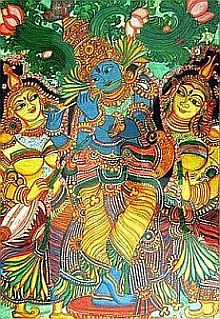
The walls of the chamber in the topmost floor (Upparika malika) of the palace are covered with beautiful murals painted in the traditional Kerala style; and, they resemble the paintings at the Sri Padmanabha Swami Temple of Thiruvananthapuram. About forty-five of those murals occupy almost 900 sq ft of wall surface, depicting Vaishnava themes, such as: Anantasayanan, Lakshminarayana, Krishna with Gopis, Sastha etc.

The murals at the Padmanabhapuram palace – executed in the traditional style invoking rich and vivid realism and infusing grace and beauty of the figures – are the best preserved in the State .

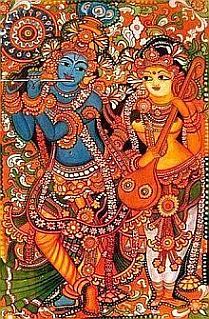
The depiction of the Krishna theme (Krishna – leela) is inspired by Sri Krishna Karnamrutham, a collection of divine verses charged with intense love of Krishna, attributed to Biva-mangala (c.1220-1300 AD).
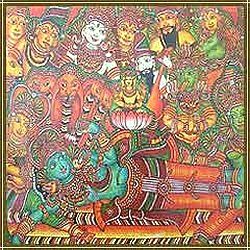
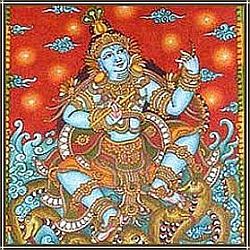
 

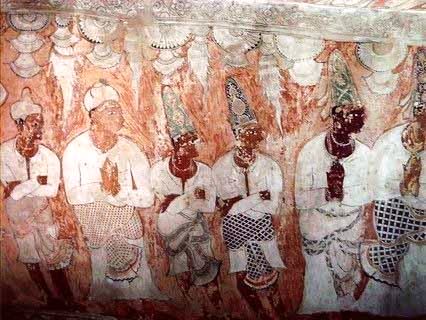
55.3. Shri Benoy K Behl, the scholar and art historian, remarks,” Unlike the Mattanchery paintings, the gods (in the murals at Padmanabhapuram palace) are presented in their iconic forms and not in narrative situations. The paintings again reveal the close relationship between the styles of art in diverse regions of India. The beautiful textiles as well as some of the forms recall the paintings of Alchi in Ladakh.”
 

Next

We shall move on to the 20th and 21st century   and admire the sublime paintings of Shri S Rajam, perhaps the sole votary of Chitrasutra tradition in the modern times.


References and sources

http://www.cochin-ernakulam.com/travelinformation/mattancherrypalace.htm

http://www.indiamonuments.org/Mattancheri_Palace.htm

http://en.wikipedia.org/wiki/Murals_of_Kerala

http://www.bharatonline.com/kerala/travel/cochin/mattancherry-palace.html

http://www.indianetzone.com/9/dravidian_mural_painting.htm

http://www.hinduonnet.com/fline/fl2121/stories/20041022000406400.htm

http://www.muralpaintingtraditionsinindia.com/krishnakumar.htm

http://sadanandan.com/keralamurals.html

http://www.thrikodithanam.org/mural.htm

http://tourism.webindia123.com/tourism/monuments/palaces/dutchpalace/index1.htm

http://www.keralamurals.in/2008/12/02/mattancheri-murals/

http://www.corporationofcochin.org/pages/Maintemp.asp?id=6&val=3

Murals of Kerala by M G Shashibhooshan, Dept. Of Public Relations, Kerala State.

http://www.keralamurals.in/2007/09/18/padmanabhapuram-murals/

http://travel.paintedstork.com/blog/2008/09/photo-essay-padmanabhapuram-palace.html

http://hubmagazine.mayyam.com/jan07/?t=8929

http://www.kerala.gov.in/dept_archaeology/index.htm#p

 All pictures are from Internet

 
4 Comments

Posted by on September 26, 2012 in Art, Indian Painting, Legacy of Chitrasutra


Tags: , , ,

The Legacy of Chitrasutra – Twelve – The Murals of Kerala

[This is the Eleventh article in the series.

This article and its companion posts may be treated as an extension of the series I posted on the Art of Painting in Ancient India .

The traditional mural arts of Kerala are unique in their style of drawing and depiction; and in their colour schemes.

They are among the finest in India; and have unique idioms of depiction. These glorious paintings are easily recognizable with their characteristic warmth and grandeur of rich colours, elaborate ornamentation, sumptuousness of the outline, depiction of volume through subtle shading, a crowding of space by divine or heroic figures;   a strong sense of design and well defined picturing

In the next article we shall see as specific illustration of this art in the murals at the Mattanchery and Padmanabhapuram Palaces.] 

Continued from: The Legacy of Chitrasutra – Eleven – Jaina Kanchi

45. The Tradition

45.1. Kerala has a rich and a long tradition in mural arts; and, it dates back to the seventh and eighth century AD. Kerala is the depository of the largest number of traditional murals in India, next only to Rajasthan. Its Temples, palaces, churches are adorned with profusion of very colourful mural paintings.

45.2. The oldest murals in the Kerala tradition are found in the rock cut cave temple of Thrunanadikkara (assigned to the period between 9th and 12th century AD),  which now is in the Kanya Kumari district of Tamil Nadu.  Among its oldest extant temple murals, the well-known are the 13th-14th century temple murals at Kanthaloor, Pisharikavu, Pardhivapuram, and Trivikramapuram in Tiruvananthapuram. These early murals were greatly influenced by the Pallava art, just as the Kerala architecture was influenced by the Pallava architecture.

45.3. The period between 14th-16th centuries was the golden-age of the traditional mural paintings in Kerala. It was a prolific period. But, more importantly, it produced the best in the Kerala mural art tradition. The Ramayana and Girija-kalyanam panels of Mattanchery Palace; and the paintings in the temples such as Vadakkumnatha, Thrissur; Siva temple, Chemmanthitta; Kudamaloor and at Thodeekkalam are regarded as the best illustrations   of the art of this period. The Kerala murals are largely known by these murals.

45.4. They were, at a later period, followed by the wall paintings at Panayannar Kavu, Thrichakrapuram, and   Kottakkal. Those in Padmanabhapuram palace (the Ananthashayi painting) and Krishnapuram palace (the Gajendramoksham panel) are considered the best of this period.

The 14th -17th century murals of Kerala represent the final phase in the history of development traditional mural paintings of India.

45.5. The traditional texts followed by the practitioners of Kerala mural art are the Tantra-samucchaya, the 15th Century treatise on temple architecture and art written by Narayana; and the Shilparatna, the 16th Century text by Sreekumara. The later is also a standard text on temple architecture; and it lays down, among other things, the tenets of painting including the proper colour schemes the skilful management of which provides stylized balance and rhythm to the painting. Shilparatna is the principal text in Dravida, particularly the Kerala, mural art.

46. The Characteristics

46.1. The Kerala murals blend harmoniously with their surrounding architecture, wood carvings and decorative art. Each art-form inspires the other.

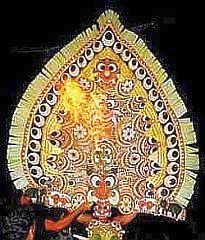
The strong and voluminous figures of Kerala murals with their elaborate head dresses have a close association with the characters from the dance dramas of Kerala, such as Koodiyattam and Mohiniyattam; and the ancient dance ritual Theyyam. The Kerala mural art is also strongly related to the drawing of various mandalas (ritual designs) in vibrant colours and decorating them by sprinkling powders of different hues and shades, filling the spaces within the mandala.

46.2. Unlike the wall-paintings in the temples of Tamil Nadu which are exclusively either Shiva or Vishnu oriented, the Kerala murals present a more balanced treatment of its subjects. The Kerala temple-murals depict the legends of Shiva and Vishnu rather evenly. There are paintings of Shiva worshipping Vishnu; and Vishnu offering worship to Shiva. Further, Kerala adores the unique fusion of Shiva and Vishnu in the form of Hari-Hara; and in the form of the most popular deity Sastha.

46.3. As in the case of traditional murals in other parts of India, the murals of Kerala too are inspired by the legends, the episodes and characters from the Puranas, epics and folklore. But, generally, the depiction of the themes in the Kerala murals, in each case, is related to a classical text or an epic poem. The series of narrative panels on the walls of a temple or a palace, in a manner of speaking, could be viewed as illustrations of a particular classic text. For instance, it is said, the Ramayana panels of the Mattanchery palace follow the narration of the epic- story according to Ezhuthachan (c.15th -16th century) who is revered as the father of Malayalam literary tradition.  Similarly, the depiction of Girija-kalyanam (Shiva’s wedding with Girija) is based on the epic poem Kumara-sambhavam rendered by the great poet Kalidasa (c.4th century).

(From Shakuntalam of Kalidasa)

The scenes from the legend of Krishna – such as, Gajenda-moksha; Poothana-moksha; Kaliya-mardhanam, and Cheera-haranam etc—painted on the walls of Padmanabhapuram palace and Krishnapuram Palace are illustrations of episodes from Srimad Bhagavatham.

The iconic representation of gods and goddesses at the Padmanabhapuram palace are based on Dhyana-shlokas, which are not mere prayers or hymns. They are the word-pictures or verbal images of a deity. A Dhyana-shloka relating to a deity describes precisely, its form, its aspects, its countenance, the details of its physiognomy, its facial and bodily expressions; its posture, details of the number of arms, heads and eyes; and details of its ornaments, ayudhas (objects it holds in its hands) etc. It is said that there are more than 2,000 such Dhyana- shlokas, culled out from various sources like Puranas, Shilpa texts etc. These verses help the artist to visualize the form of the deity that he is about to paint.

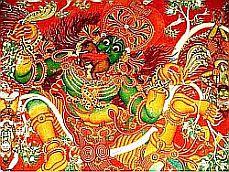
46.4. The human and the godly figures depicted in Kerala murals are strong and voluminous, drawn in running, smooth curves and subtle darkening of colours. The exquisite shading depicts the fullness and roundness of their form; resembling the paintings of Ajanta.

46.5. The figures in Kerala murals are highly stylized and rendered with elongated eyes, painted lips, exaggerated eye brows; and, explicit body and hand gestures (mudras). The figures are decorated with elaborate head dresses, exuberant and overflowing ornaments. The expression of the emotions too comes out rather strongly. As compared to these figures, the animals, the birds and the plants drawn in the pictures appear closer to life.

46.6. The wild and erotic scenes also are overtly shown without much reservation. The gods, humans and animals are shown in combat and lovemaking. The murals take a holistic approach to all existence; and almost obliterate the thin dividing line between the sublime and the mundane; and between religion and art .The Kerala murals is another instance in Indian tradition where the sacred and the profane are treated with equanimity in its arts.

46.7. The Kerala murals often look rather over-crowded with too many gods and celestial beings hovering around and filling up the painted surface. The paintings hardly have plain and clear spaces; as if the artist was keen to maximize the space -utilization. The paintings sometimes appear to be lacking in depth.

46.8. A unique feature of the Kerala murals is the deployment of a system for decorating the borders with relief- figures of animals, birds, flowers, creepers etc. It is called the Pancha-mala (five schemes or garlands), a system of five decorative reliefs. They are the Bhootha-mala (of goblins and dwarfs), Mruga-mala (of animals such as elephants, deer etc), Pakshi-mala (of rows of parrot like birds), Vana-mala (of floral motifs) and Chithra-mala (of decorative, artistic designs).

47. The Colours

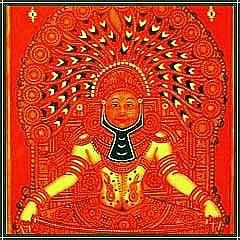
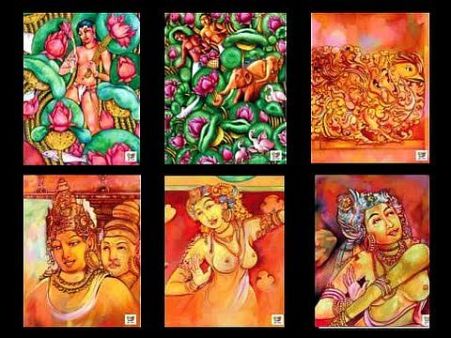
47.1. Another noticeable feature of the Kerala murals is their rich, warm and loud colours. A traditional Kerala mural follows the Pancha-varna (five colours) colour scheme. The five colours employed in traditional Kerala mural paintings are; red, yellow, green, black and white.

The White, yellow, black, and red are the pure colours, according to Shilparatna. The Ochre yellow, Ochre red, white, bluish green and pure green are the more important colours in Kerala Murals.

The pigments are derived from natural materials, such as minerals and stones extracted from earth, oils, juices, roots, herbs etc.

Kerala murals

47.2. There are varying versions regarding the materials used for preparing the pigments. One source mentions that the white is obtained from lime; the black is derived from soot of oil-lamps; red from vermilion (mercuric sulphide); deep red from lac and red lead ( it is also said; Red is derived from red laterite; yellow is derived from yellow laterite) ; yellow from realgar (arsenic sulphide); blue from plants like Neela Amari or Neelachedi  (Indigo ferra); and green from a local mineral called Eravikkara.

The quality of mural-colours depends upon on the preparation of pigments and the meticulous balancing of its various components.

The final treatment to a finished mural consists in applying a fine coating of resin on the painted surface, in order to give it a glossy look.

[For instance; please click here for a description of the stages in the painting of Sriman Narayana] 

(For more on these subjects, please check: http://www.scribd.com/doc/88883438/Chitra-Sutra )

47.3. Wooden utensils are used for mixing the colours and the binding media is derived from a tender-coconut-water and extracts from the Neem tree (Azadiracta indica).

The painting brushes used were  of three types – flat, medium and fine. Flat brushes were made from the hair found on the ears of calves, medium from the hair on the goats belly and the fine brushes were made from delicate blades of grass.

The  type of grass  that  was used for the purpose of making brushes was  called Eyyam Pullu, in the shape of an arrow, which grows in the riverbanks, . The fully matured grass is boiled with paddy. Then the chaff or the weaker part is removed and fastened together. This brush is tied to a small bamboo stick. The thickness of the brush is adjusted according to needs.

The wall-surface- preparation too was a laborious and a time consuming process. Murals were painted over only after they were completely dry. Lemon juice was used to mellow the alkalinity of surface. The outlines of the murals were sketched by using sharpened bamboo pieces or charcoal or dung crayons (called Kittalekhini prepared by grinding a black stone and mixing it with cow dung).

47.3. The colour symbolisms are related to Trigunas – the natural attributes or disposition – of the characters.  For instance, green is employed for depicting the Sattva (balanced, pure or divine) characters (for instance, the jewel-like green colours of the flute playing Krishna); red or a mixture of red and yellow  for Rajas ( active , irascible); and white for Tamasa (inert or base).

[The Natyashastra also mentions the colours associated with each of the Rasas. According to that : Srungara with light green; Hasya with white; Karuna with grey; Raudra with red ; Vira with yellowish pale ; Bhayanaka with black; Bibhatsa with dark blue; and Adbhuta with yellow.

śyāmo bhavati śṛṅgāra sito hāsya prakīrtita kapota karuaścaiva rakto raudra prakīrtita 6.42

gauro vīrastu vijñeya kṛṣṇaścaiva bhayānaka nīlavarastu bībhatsa pītaścaivā-adbhuta smta ॥6. 43]

Ganesha Kerala

Kerala Shiva

48. Among the finest in India

48.1. The mural paintings of Kerala are among the finest in India; and have unique idioms of depiction. These glorious paintings are easily recognizable with their characteristic warmth and grandeur of rich colours, elaborate ornamentation, sumptuousness of the outline, depiction of volume through subtle shading, a crowding of space by divine or heroic figures;   a strong sense of design and well defined picturization.

48.2. The traditional murals of Kerala represent the last flourish of the graceful and vibrant tradition of Chitrasutra. Please click here for a list of Mural Paintings in Kerala temples.

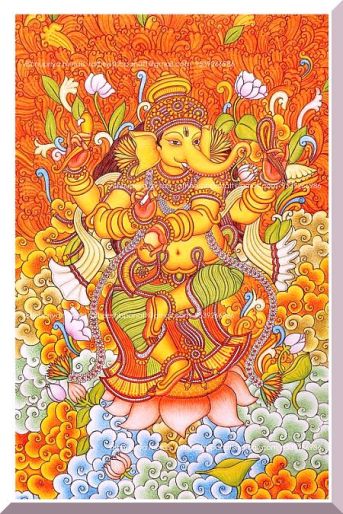
[While  in the olden days the murals were drawn on walls , today any surface like paper, canvas, cardboard, plywood and terracotta  is used for reproducing / simulating the traditional style of  Kerala paintings . These innovations are to be understood as the necessities of the times in order to keep alive and to sustain   the interest in the ancient art form. ]

With this brief introduction let’s look at the mural paintings at the Mattanchery and Padmanabhapuram palaces, the Mural Pagodas of Kerala, in the next article.

Next

The mural paintings at Mattanchery and Padmanabhapuram Palaces

 References and Sources

http://www.indiamonuments.org/Mattancheri_Palace.htm

http://en.wikipedia.org/wiki/Murals_of_Kerala

http://www.bharatonline.com/kerala/travel/cochin/mattancherry-palace.html

http://www.indianetzone.com/9/dravidian_mural_painting.htm

https://archive.org/details/TantraSaraSamuccayaOfNarayanaIIKA.MahadevSastry_201709/page/n3/mode/1up

Click to access 254.pdf

 All pictures are from Internet


7 Comments

Posted by on September 25, 2012 in Art, Legacy of Chitrasutra


Tags: ,

The Legacy of Chitrasutra – Eleven – Jaina Kanchi

 [This is the Tenth article in the series.

This article and its companion posts may be treated as an extension of the series I posted on the Art of Painting in Ancient India .

The present article looks at the not-so-well-known Jain temple of Trailokya-natha-swami (Vardhamana) at Jaina Kanchi. It is one of the few surviving ancient Jain temples in Tamil Nadu.

This article presents the case of an overzealous and yet a wrong way of conserving the ancient murals. The Department of Archaeology of the State Government, in their wisdom, laid a fresh coat of paint over the sixteenth century murals drawn in Vijayanagar style, in order to keep the paintings fresh and bright. The art experts and art historians were shocked and angry; and described the action of the Government Department as thoughtless; and a disaster.

There surely must be a sensible way that falls somewhere between total neglect and overzealous reaction, which either way harms the ancient art-objects.

In the next article we shall look at the traditional mural paintings of Kerala. These 16th-17th century murals painted over the walls in temples and palaces have a unique style of depiction and colour schemes. ]

Continued from the Legacy of Chitrasutra – Ten – Lepakshi

40. Jainism in Tamil Nadu 


40.1.  It is believed that Jainism entered Southern India in around fourth century BC, when Acharya Bhadrabahuswamin, the last Shrutakevalin (433 BC- 357 BC), along with a body of twelve thousand disciples, started on a grand exodus towards the South; migrated to the Sravanabelagola region, in Karnataka, as he feared a period of twelve years of severe drought was about to hit the North India. The Mauryan emperor, Chandragupta, abdicating his throne in favor of his son Simhasena (according to Jain work Rajavali-Kathe) took Diksha and joined Bhadrabahuswamin on his exodus. As foretold by Bhadrabahuswamin, a terrible famine  did brake out in the Northern country.

[ Please also read Studies in South Indian Jainism by Ramaswami Ayyangar, M. SSeshagiri Rao, B , 1922 ]

Some time after reaching Shravanabelagola, Bhadrabahuswamin felt that his end was approaching; and, he then initiated Visakhamuni into a higher order. The Sruta Kevalin Bhadrabahuswamin , thereafter, entrusted the rest of the disciples to the care of  Visakhamuni; and, instructed them all to move further South.

And, soon thereafter, the monk Visakhacharya, at the behest of Acharya Bhadrabahuswamin, moved over to the Chola and Pandya countries along with a group of Sramanas (Jain monks), in order to propagate the faith of the Thirthankaras.

It is said; Visakhamuni, in the course of his wanderings in the Chola and the Pandya countries, worshiped in the Jain Chaityas and preached to the Jains settled in those places. This would suggest that the Jains had already colonized the extreme south even before the Sallekhana of Bhadrabahuswamin, i.e., before 357 B.C.

40.2. Some scholars argue that a sizable number of Sravakas (Jain householders) were already present in the Madurai, Tirunelveli and Pudukottai regions; and , they lent support and care to the emigrant monks.

However, the exact origins of Jainism in Tamil Nadu are unclear.

Some scholars claim that Jain philosophy must have entered South India some time in the sixth century BCE; and, that Jains flourished in Tamil Nadu at least as early as the Sangam period.  

According to other scholars, Jainism must have existed in South India, at least,  well before the visit of Bhadrabhuswamin and Chandragupta. There are plenty of caves as old as the fourth century found with Jain inscriptions and Jain deities around Madurai, Tiruchirāppaḷḷi, Kanyakumari and Thanjavur.

The ancient Tamil history , culture and literature depict  a rich legacy of the Jains

[Some scholars believe that Tholkappiar the author of the celebrated earliest Tamil Grammar Tholkappiam (estimated to be written between the 3rd century BCE and the 5th century CE) was a Jain.

And, Saint-poet, Thiruvalluvar, the author of  the celebrated Tirukkurral (dated variously from 300 BCE to 7th century CE), one of the finest collections of couplets on ethics, political and worldly-wisdom, and love, was also a Jain.

Apart from these, the three other major works in Tamil of the ancient times – Silapaddikaram, Civaka Cintamani and Valayapathi – were written by Jain authors.

It is said, that in these texts, in the ancient Tamil regions, the Jain Thirthankaras   were addressed as Aruga or Nikkanthan.  And, the religion of Jains was called: Arugatha or Samanam.  The senior Jain monks were called as ‘Kuruvattikal‘ (Guru), Atikal (Yati), Periyar or ‘Patarar‘ (Tamil form of Bhattara) .

The place where Jain monks lived was called as Aranthaanam and Aravor (Manimekalai. 3:86-112, 5:23); and, as Nikkanthak Kottam (Silappatikaram.9:63). The generous land donations made to the Jain monasteries  (Palli)  were  called Palliccantam ( however, the exact meaning of the term Cantam , is much debated). 

The more important cities where the Jains flourished in sizable numbers were said to be: Kaveripoompattinam (also known as Poompuhar or Puhar), Uraiyur, Madurai, Vanchi (also known as Karur or Karuvur) and  Kanchi (Kanchipuram).

They all had monasteries  (Vihara) which also functioned as schools (Samana palli) run by the Jain monks (the bigger Pallis were called Perumpalli) . Silappatikaram (11:1-9) mentions a Kanthan school and temple at Uraiyur as also in Madurai, the capital of Pandya kingdom.

Even though Manimekalai was a Buddhist, she went to Jain monks at Vengi, the Chera capital; and, learnt about the Jain concepts of morality (Manimekalai 27:167-201).  And, Vengi was also the city where lived the celebrated Jain monk Ilango Adigal – the brother of King Cheran Chenguttuvan and the author of Silappatikaram, which is one of the five Epics of Tamil literature.

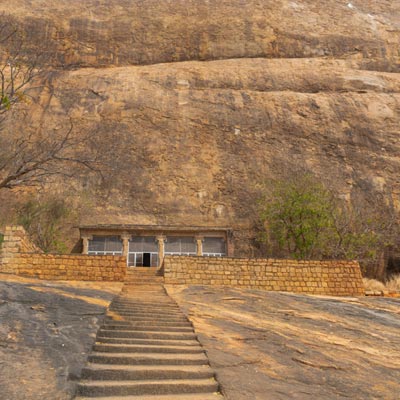
Sittanavasal Cave (Sit-tan-na-va-yil) – the abode of great saints – is a second -century  complex of caves in Pudukottai District of Tamil Nadu. It is a rock-cut monastery that was created by Jain monks. Its name indicates that it was the abode of the Siddha (the monk or monks).  It is also called Arivar Koil – the temple of the Arihants.  

The first century Tamil-Brahmi inscription, found therein,  names the place as ‘Chiru-posil’.  It records that Chirupochil Ilayar made the Atitnam (Adhittana, abode or a dwelling place) for Kavuti Itan who was born at Kumuthur in Eorumi-nadu.

[A fairly large number of stone-inscriptions, etched in Tamil-Brahmi , are found in several caves in Tamil Nadu. And, most of such inscriptions are around Madurai , the capital of the Pandyas.  The noted scholars like Iravatham Mahadevan and Ramachandran Nagaswamy, have made extensive studies of the early inscriptions. It is explained; the script of the inscriptions are named as ‘Tamil-Brahmi ‘, because it is , basically, Brahmi, but with slight modification to facilitate insertion of Tamil terms. For instance; in these inscriptions, the Prakrit term ‘Gani’ ( leader of a Gana , a group) becomes “Kani’; ‘Acharya’ becomes  ‘Acirikar’; names like ‘Nanti’ become ‘Nattai or Nattu’;  sacred images Prathima (Patima) be comes ‘tirumenai’; and,’Sranana’  ( a Jain monk) becomes ‘Amanan’.]

Monuments - Tamilnadu Tourism Travels

The Sittannavasal cave temple belonged to a period when Jainism flourished in Southern India. And, it  served as a shelter for Jain monks till about 8th century when Jainism began to fade away in the Tamil region.

Sittannavasal has the distinction of being the only monument where one can find, in one place, Tamil inscriptions dating back from 1st century BC to the 10th century AD. It is virtually a stone library in time  Sittanavasal is also renowned for remnants of its rare Jaina mural paintings

It appears there were Jain Nunneries too. Silappatikaram (10:34-45 ) mentions that when Kovalan and Kannagi went to Madurai,  on their  way, they secured the  blessings from Gownthiyadigal  , situated close to  Kaveripoompattinam, on the northern bank of the  river Kaveri.  It is said; Gownthiyadigal was a sort of Jain Nunnery. The Jain nuns, it appears, were variously called as Gownthi; Aariyanganai; Eyakkiyar; or Gurathiyar, the female Guru. It is also said , the Sanskrit term ‘Guru‘ and its plural form ‘ Guruvah‘  became in Tamil ‘kuru‘ and ‘Kuruvar‘.  Its polite form was Kuruttiyar or Kuruttikal ]

Some scholars believe that Jainism became dominant in Tamil Nadu in the fifth and sixth century CE, during a period known as the Kalabhra interregnum. And, after the fifth century A.D, Jainism became so very influential and powerful as to even become the state-creed of some of the Pandyan kings.

[ I think , it needs to be mentioned that religious affiliations , say during the fifth century, were rather fluid. For instance, in the Silappadikaram , you find  , sometimes, each member of a family followed her/his own favorite religion : Kovalan’s  father Masattuvan became a Buddhist; and,  Kannagi’s father Manyakan became an Ajivaka. And, while Appar , in the early part of his life, was attracted to Jainism and became a Jain monk  , his sister continued to be a staunch devotee of Shiva. Manimekhalai, the daughter of Madhavi, a dancer by profession (Parathiyar),  becomes a  Buddhist nun. And, Kovalan  and kannagi continued , till end, as Nagarathars – the merchant  community.

Even as late as in the Eleventh – Twelfth Century, the wife of the Brahmin Chandramouli – a minister in the court of the Court of the Hoysala King Veera Ballala II – Achala Devi (also called Achiyakka) was a devout Jain. She caused the construction of a Jain temple (Basadi), at Shravanabelagola, in 1181 A.D, devoted to the twenty-third Jain Tirthankaras Parshwanath.

sravana belagola

It was only when the Bhakthi movement took hold , large numbers of families finally became Vaishnavas or Shaivas. Those that continued to adhere to Jainism were reduced into  small and a minor community of Jain laymen – Samaṇar, Nayiṉār (around 0.13% of the population of Tamil Nadu. ]

However, Jainism began to decline around the 8th century A.D., with many Tamil kings embracing Hindu religions, especially Shaivism. 

Thus, during the middle half of the seventh and the beginning of the eighth centuries A.D., the Jains sustained a series of reverses both in the Pallava and the Pandya country. The Chola kings did not encourage during this period the Jain religion, as they were devoted to the worship of Shiva

In any case, there is evidence to indicate that Jainism came into existence in Tamil Nadu, at least, by about fourth century BC. Thereafter it took roots in Tamil Nadu and flourished till about sixteenth century when it went into decline, due a combination of reasons. It is estimated there are now about 50,000 Tamil – Jains or Samanar who have a legacy that is more than 2,000 years old; and that most of them are engaged in farming in the North Arcot (Thondai-mandalam) region.

40.3. As regards Kanchipuram, the capital city of the Pallavas and a renowned centre of learning, the Jainism flourished there because of the recognition, acceptance and encouragement it gained from the ruling class, as also from common people. It is said; the Pallava King Mahendra-varman I (600 – 630 CE), in the early part of his life, caused the construction of two temples dedicated to Thirthankaras Vrishabdeva and Vardhamana.

40.4. The Jain scholar-monks such as Acharyas Sumantha-bhadra, Akalanka, Vamana-charya Pushpa-danta, Kunda- kunda and others, were highly regarded for their piety and scholarship. Under their guidance a number of Jain temples and educational institutions (samana-palli) were established in the Tamil country, especially in its Northern regions.

[Palli is a Prakrit term, which by extension came to mean, in the Tamil – Brahmi inscriptions, a Jaina monastery or a temple or a rock shelter where the Jaina monks stayed and studied  . Some say that the Tamil term for a school –“palli”- has its origin in the ancient samana-palli of the Jains].

40.5.The recognition accorded to Jainism is evidenced by the fact that a sector of Kanchipuram, along the banks of the Vegavathi , a  tributary of the Palar River, was named as Jaina Kanchi. It is now a hamlet (Thiruparuthikundram) on the southwest outskirt of the present-day – Kanchi, a little away from the Pillaiyaar Palayam suburb. Jaina Kanchi does not ordinarily attract many tourists.

40.6. Jaina Kanchi is now of interest mainly because of its two temples:  one dedicated to Chandra-prabha the eighth Thirthankara; and the other dedicated to Vardhamana the twenty-fourth Thirthankara who is also addressed as Trailokya-natha-swami. And, the other reason of interest is the ancient paintings in the Vardhamana temple.

The Chandra-prabha temple is the earlier and the smaller of the two. It was constructed during the reign of Parameswaravarman II, the Pallava king who came to throne in 728 AD.

chandraprabha

According to Dr. T. N. Ramachandran, the Trailokya-natha-swami temple was built perhaps during the end of the Pallava period; that is, in the eighth-ninth century.

41. Trailokya-natha-swami (Vardhamana)

trilokyanatha

41.1.  The Trailokya-natha-swami temple enjoyed the patronage of Pallava kings as also of Chola emperors Raja-raja chola II (reign ,c.1146–1173) ; Rajendra II (reign , c.1163 – c. 1178 CE) ; Kulottunga I (reign , 1178–1218 CE);  and Raja-raja III (reign , c.1216–1246 CE) during whose periods some improvements were made and a front pavilion (mukha mantapa) was added to the sanctum. The Vijayanagar kings too supported this Jain temple.

During the year 1387, Irugappa, a disciple of Jaina-muni Pushpasena; and a   minister of Vijayanagar King Harihara Raya II (1377-1404), expanded the temple by adding a larger pavilion- the Sangeetha mantapa.

Later additions were made by Bukka Raya II (in 1387-88) and Krishna Deva Raya (in 1518). It is also said; Krishna Deva Raya made a “land-grant” to the temple.

41.2.  The Trailokya-natha, thus, developed into a complex of three shrines: One for Vardhamana and Pushpadanta; the other for Padmaprabha and Vasupujya; and the third for Parshvanatha and Dharma Devi. Each shrine has its own sanctum, ardha-mantapa and mukha-mantapa. The temple is also a repository of a large number of icons.

trilokyanatha 2

During the 14th and 16th centuries, the ceiling of the sangeetha – mantapa were decorated with beautiful paintings, in Vijayanagar style.

It appears Jainism was active in the Kanchipuram region at least till around the 16th century.

42. The Paintings

Sri Sridhar, T. S.- Former Commissioner of Archaeology and Museums, Government of Tamil Nadu , writes :

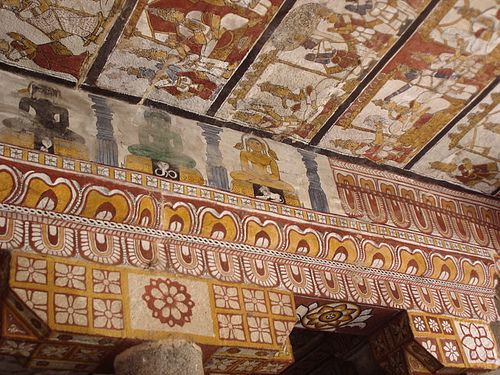
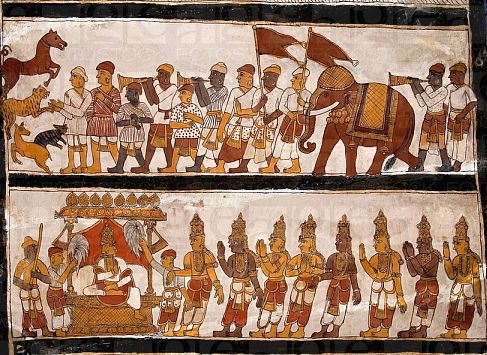
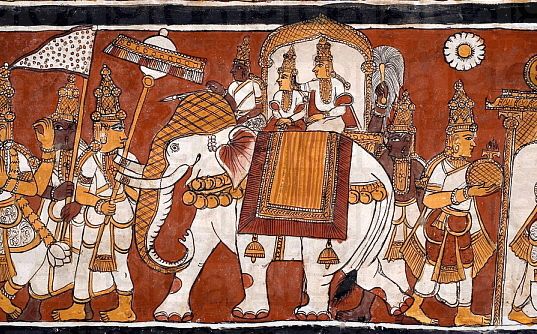
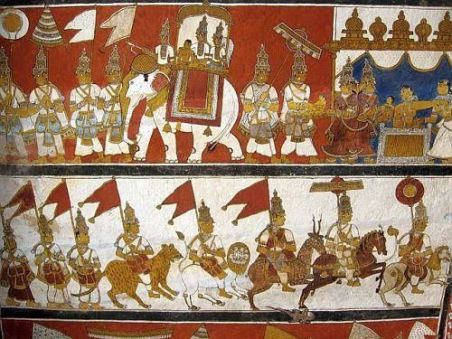
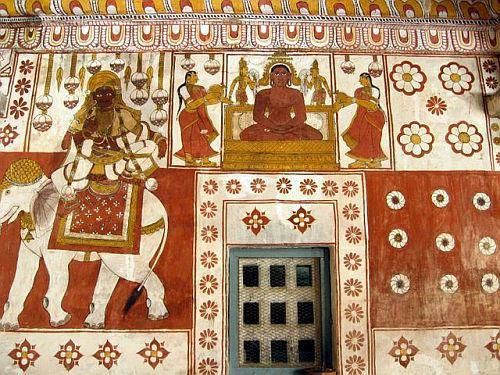
The ceiling of the Mukha-Mantapa and the Sangeetha-Mantapa in the Trilokyanatha temple bears a series of colorful paintings which illustrates the life stories of three out of the twenty-four Tirthankaras- Rishabadeva, the first, Neminatha, the twenty second along with his cousin Krishna, and Vardhamana, the twenty fourth. The paintings date back to the 15th century CE. 

They are arranged in convenient groups, two running from north to south and two from east to west on the ceiling of the Sangeetha-Mantapa, and one group running from north to south on the ceiling of the Mukha-Mantapa. They are in rows of panels with a narrow band between every two rows for labels in Tamil Grantham explaining the incidents.

 The paintings contain the life stories of Rishabadeva, the first Tirthankara, Neminatha, the 22nd Tirthankara, his cousin Krishna and Vardhamana or Mahavira who is the 24th Tirthankara. They depict different facets of the Tirthankaras life from birth to coronation, celebration of monkhood to renunciation and attainment of World Teacher status. The celebrated procession of Vardhamana and his return to the city and anointing ; the rows of animals with the elephant Airavata leading the procession, are beautifully depicted in vivid detail

jaina paintings

42.1. The paintings drawn on the ceiling of the Sangeetha-mantapa during the period 14th and 16th centuries were in Vijayanagar style of painting; and they depicted the legends of the Thirthankaras, particularly those of Rishabha Deva and Vardhamana.

42.2. A narrative panel relates the story of Dharmendra, the serpent king, who offered his kingdom to the relatives of Rishabha Deva in exchange for their consent not to disturb the meditation of Rishabha Deva.

jaina paintings 2

42.3. Such narratives were alternated with scenes depicting processions of elephants, horses, soldiers, standard bearers and musicians.

jaina paintings 3

jaina paintings 4

42.4. The sequence of the narratives and the court scenes was broken by depiction of Sama-vasarana the adorable heavenly pavilion where the eligible souls gather to receive divine discourse.

The term Sama-vasarana (Sama avasarana) means an assembly which provides equal opportunities for all who gather there. Samavasarana, in Jain literature denotes an assembly of Thirthankara.  At this assembly different beings – humans, animals and gods – are also present to behold the Thirthankara and hear his discourses. The common assembly, at which different beings are gathered for one purpose, treats all alike overriding the differences that might exist among them. A  Sama-vasarana is thus, a tirth, a revered place.

The Sama- vasarana is pictured in a very interesting fashion. Each panel is depicted with eight concentric rings having miniature figures, trees and shrines painted along their periphery. A Thirthankara is enshrined at the core of the Samava-sarana theme.

42.5. There are a few panels that resemble   the Krishna- Leela, the legends of Krishna. But, they in fact, depict life events of Neminatha, the twenty-second Jain Tirthankara. According to Jaina lore, Neminatha was the cousin of Krishna of Srimad Bhagavatha; and he is Krishna’s counterpart in the Jain tradition.

jaina paintings 5

[Please also see ‘ The Paintings of Vijayanagar Empire’ by Dr.Rekha Pande]

43. The other side of bad maintenance

43.1. The pictures posted above are not as they were painted by the artists of the 14th and 16th centuries.

A few years back, the State Archaeological Department of Tamil Nadu repainted the 14th-16th century murals on the ceilings of the Trailokya-natha-swami temple. A fresh coat of  paint was laid over the old murals. The repainting was done allegedly by untrained artists, who were not familiar with the techniques of conservation or restoration of ancient murals. As a result, the murals now dazzle in bright colors.

Sri Sridhar, T. S – Former Commissioner of Archaeology and Museums, Government of Tamil Nadu , writes in his article Conservation of Murals in Thirupparuttikundram temples of Jina Kanchi   

Before proceeding with conservation of paintings in Trilokyanatha temple, we studied carefully the base on which they were etched. The granite roof had a thin layer of lime plaster on which the paintings were done, depicting the life stories of the three Tirthankaras. After studying the history of the paintings, which date to the15th Century, we also looked at the condition of the paintings.  At the time of taking up conservation we found that the murals were intact in some places, but most of them were in a state of considerable damage. The colours had changed, the lime mortar had peeled off in many places, the plaster had fallen off and the labels were unclear in parts.

Overall, the condition of the murals was such that they required extensive conservation work. Accordingly, experts were consulted and it was finally decided to bring in a team from Karnataka. Since there are not many who are trained in Mural conservation it was found necessary to get the expert team from a neighboring state.

Next, we looked at the materials used for the paintings. Lime mortar was the base material; the colours were provided by the use of varied materials matching with the original paintings. For example, herbs like ‘Shank Pushpam’, ‘Neela Amary’ and green leaves to produce green; ‘Manja Kadambai’ for yellow; ‘Red Sandstone’ and ‘Lacquor Bee’ and ‘Wax’ for red; and, black color from burnt lamp waste etc., were used to derive different colours. A mixture of these ingredients was also applied to derive different shades of the above colours.

On studying the condition of the murals, and after detailed discussion with experts, we identified the several areas for restoration. The outside of the paintings was checked for cracks or lack of adhesion due to water accumulation or formation of bird nests. These were arrested and the conservation began. Cracks and fissures in the painted plaster was fixed to the support base by adhesives like Plaster of Paris, Fevicol or PVA solution mixed in Toluene. Wherever there was a bulge, a hole was made in the bulging plaster, and adhesive solution injected into the hole and kept pressed for some time. Later, the holes were filled with plaster of Paris mixed with suitable colors to match the base paintings

The entire mural conservation effort took nearly six months to complete; but it was well worth the trouble. The finished paintings looked stunningly beautiful and added considerably to the footfalls in subsequent months. On the whole, it was a very challenging, yet, satisfying experience.

****

The pictures you just saw were those of the “re-painted” art works.

jaina paintings 6

43.2. The art experts and art historians were aghast, pained and angry at the thoughtless action, in violation of conservation norms, by the very Department that was entrusted with the task of protecting and maintaining the ancient murals.

Dr. David Schulman, an Indologist, (currently the Professor, Department of Indian, Iranian, and Armenian Studies, Hebrew University, Jerusalem) who has studied mural paintings of Tamil Nadu and Andhra Pradesh, said “The paintings of the Trilokyanatha temple at Tiruparuttikunram have been ruined by over- painting. This is quite a common thing in Tamil Nadu. If you repaint it instead of conserving it, the subtlety will be lost; the old colors will be lost. This is disaster. These paintings have to be preserved as they were at their height. The way people do it in Europe.”

The other experts too remarked that repainted murals resemble neither the Vijayanagar style nor the present style.

K.T. Gandhirajan, who has studied murals in 35 temples in Tamil Nadu over a period of six years, said “Only experts can do that. The State government should give up repainting the faded murals because there are not enough trained artists to do the work. Instead, it can use the resources to conserve them.”

43.3. At an international seminar titled “Painting Narratives: Mural Painting Traditions in the 13th-19th centuries”, held near Chennai during Jan, 2008, the participating experts expressed their shock and disappointment at the state of conservation of ancient art in India.

According to the experts, the ancient paintings in India are threatened with destruction through negligence and desecration both by the public and, unfortunately, by the very persons entrusted with the task of preserving them. To cite an example , in a major “renovation “ exercise at the Meenakshi temple of Madurai an important series of Nayak murals from the 16th century were covered with cement paint. The ancient paintings are lost forever.

The mural paintings  of Tamil Nadu have a long, rich and continuous tradition, ranging from the Pallava period to the Nayaka period. It was during the Vijayanagar and Nayaka periods that the art of painting in temples in Tamil Nadu flourished. Most of the murals in the State belong to the Vijayanagar and Nayaka periods. A few belong to the Maratha period of the 18th century.

Even in the temples where a few murals have survived, they have been whitewashed. In some cases, ignorance led to the neglect of the works of art. In many other cases, soot from oil lamps settled over the murals; electrical cables and switchboards were installed over them; or nothing was done to prevent cracked ceilings and sunlight endangering the murals.

44. And, now…

44.1.   I have tried to present in this post the other side of the bad conservation. There are countless cases where the ancient art works are ruined because of neglect or wilful harm. There are also cases, as in Jaina Kanchi, where either by ignorance or by over enthusiasm, the authenticity of the ancient works is degraded. Between these extremes, somewhere, there surely must be a sensible way of taking care of our heritage. As Dr. Schulman remarked, “These paintings have to be preserved as they were at their height. The way people do it in Europe”.

44.2. These mural paintings are not mere bunch of drawings; they are the repositories of our art, culture, history and heritage; they are a part of our very being. It is essential that the general public in India and also the trustees of our art works are educated of the value of our heritage and their historical importance.

44.3. Doubtless, there are problems in taking care of our ancient wall paintings, for want of proper conservation facilities; dearth of trained and qualified conservators; paucity of resources etc.  But what is more worrying is the absence of a  plan or  policy  in place; and lack of a  perspective  vision to conserve even those wall paintings that are under the  care and custody of the governments.

44.4. It is a task, which the government alone cannot handle well; several institutions, Universities as also traditional artists need to take part in this endeavour. I wish we had a sort of National Project for Conservation of Wall Paintings, which would comprehensively address the issues of research, training, creating special curriculums in art-schools, and mobilization of various sorts of resources; and above all an effective management and monitoring system.

Jain tablet from Mathura

Next

The traditional mural paintings of Kerala

References and sources

Tiruparuttikunram and its Temples.–By T. N. Ramachandran, M.A

Bulletin of the Madras Government Museum,

Printed by the Superintendent, Government Press, Madras.

http://www.ias.ac.in/jarch/currsci/3/00000187.pdf

http://spicyflavours.net/index.php?autocom=blog&blogid=5&showentry=95

http://www.india9.com/i9show/Tirupparuttikunram-25644.htm

http://www.tnarch.gov.in/cons/temple/temple5.htm

http://www.geocities.com/tamiljain/spread.html

Seminar proceedings

http://www.muralpaintingtraditionsinindia.com/Seminar%20proceedings.htm

Jainism in south India by  T. K. Tukol

www.ibiblio.org/jainism/database/ARTICLE/south.doc

Recent discoveries of Jaina cave inscriptions in Tamilnadu by Iravatham Mahadevan

http://jainsamaj.org/literature/recent-171104.htm

Ravaged murals

http://www.hinduonnet.com/fline/fl2516/stories/20080815251606400.htm

Conservation problems of mural paintings in living temples by S. Subbaraman

http://www.muralpaintingtraditionsinindia.com/S%20Subbaraman.htm

Overview of the conservation status of   mural paintings in India

http://www.muralpaintingtraditionsinindia.com/op%20agarwal.htm

All pictures are from Internet
 
11 Comments

Posted by on September 24, 2012 in Art, Indian Painting, Legacy of Chitrasutra


Tags: , , ,

The Legacy of Chitrasutra – Ten – Lepakshi

 [This is the Ninth article in the series.

This article and its companion posts may be treated as an extension of the series I posted on the   Art of Painting in Ancient India  .

The present article looks at the paintings on the ceilings of the Veerabhadra temple in Lepakshi (AP).They represent some of the best of Vijayanagara art. This temple is one of the earliest constructed not by the Kings but by two brothers who were philanthropic noblemen.

The textile and fashion designs depicted in the Lepakshi paintings have influenced handicrafts, sari designs etc.

In the next article we shall look at the Paintings at another specimen of Vijayanagara art. It is the not-so-well-known Jain temple at Jaina Kanchi.]

Continued from The Legacy of Chitrasutra –Sri Pampa Virupaksha temple, Hampi

Lepakshi

2.1. Lepakshi , in Anantapur district, on the Andhra Pradesh – Karnataka border, near the Pennar River, is a group of temples built in the 16th century, on a single granite outcrop that is curved like the back of a tortoise.  And, the hill was aptly called Kurma-shila.

32.2. Lepakshi is an excellent display of the Vijayanagar School of architecture, sculpture and painting. It brings together magnificent sculptures carved with intricate designs; and a whole set of beautiful, narrative and innovative paintings on its ceilings. The temple is hailed as a delightful synthesis of architecture, sculpture and painting.

32.3. Lepakshi is regarded very important for its historical, archaeological and aesthetic value.  It houses some of the finest sculpture of the period; it has the earliest preserved cycle of mural paintings in the Vijayanagar style; and it also has inscriptions in old-Kannada dating back to many centuries. The Lepakshi temple is a source-material for the study of architecture, painting, iconography and the mythological presentations of the Vijayanagar period. It also offers a few lessons to the art historians and those interested in the preservation and restoration of traditional arts.

33. The Temple

33.1. The construction of the temples at Lepakshi is attributed to the initiative and enterprise of two brothers: Veeranna and Virupanna, noblemen and wealthy merchants of their time. It is said; Virupanna was the officer in charge of the state treasury of the local government with its seat in the Fort of Penukonda, administered by a governor appointed by Achyuta Deva Raya (1529-1547) the Vijayanagar King of   Tuluva dynasty.

33.2. Penukonda (meaning The Big Hill and mentioned as Ghana-giri in the inscriptions) was an important and an affluent province of the Vijayanagar Empire; and the rulers of Vijayanagar and Penukonda were also related by marriages. After the fall of Vijayanagar (1565), Penukonda served as its temporary capital providing a safe house to its vanquished rulers.

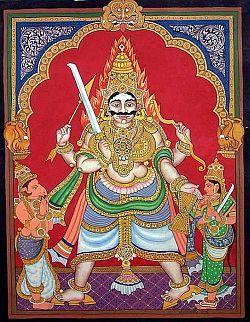
33.3. An ancient temple of Lord Veerabhadra – the ferocious and formidable aspect of Shiva- stood on the tortoise-hill (Kurma-shila). The Veerabhadra cult was quite popular during the Vijayanagar period and a number of temples were dedicated to that fearsome lord; the most prominent being the Uddane Veerabhadra, a larger than-life idol with four arms and armoured with sword, mace, axe, shield and bow ready to launch an attack on the enemy. Veerabhadra was the mascot, the war- cry and the inspiration of the armies and fighting forces of Vijayanagar. 

33.4. One of the brothers, Veeranna, was named after the warring deity. The brothers, perhaps, had a special affinity towards Lord Veerabhadra.

The brothers took upon themselves, as an act of devotion, to renovate and enlarge the ancient temple and to expand it into a temple complex. By around the year 1538, they did succeed in erecting exquisite temples of Veerabhadra, Shiva and Vishnu, between two asymmetrical enclosures, containing a central pavilion (mukha-mantapa), an intermediate hall (ardha-mantapa) and a pavilion for dance performances (ranga-mantapa).

34. Sculptures


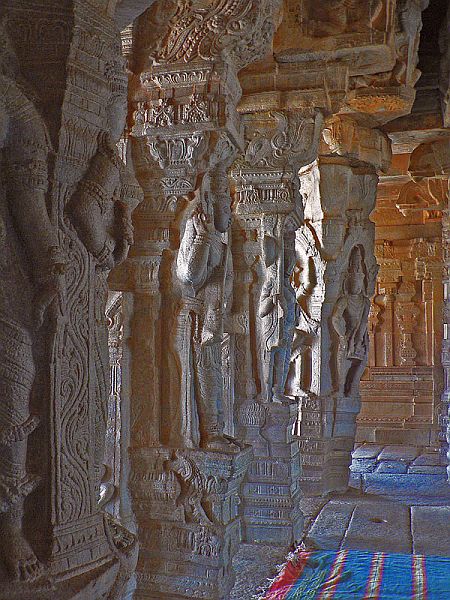
34.1. The Lepakshi temple complex is a wonderful example of Vijayanagar architectural style. It is an exquisite shrine; rich with profusion of gopuras, vimanas, apsaras, half-relief carvings, sprawling structures with wide spaces and courtyards. The ranga-mantapa and the ardha-mantapa are adorned with splendid architecture. The sculptures here depict images of dancers, musicians; as also themes from puranas, like those of Anantha-shayana, Dattatreya, Bramha, Tumburu, Narada and Rambha etc.

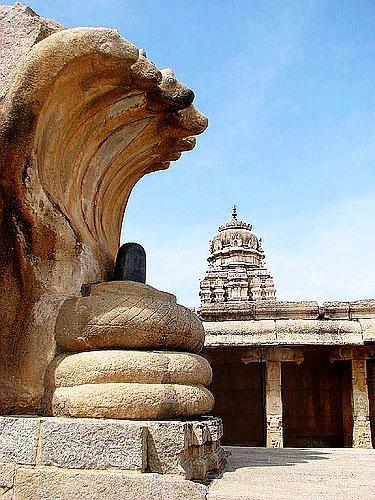
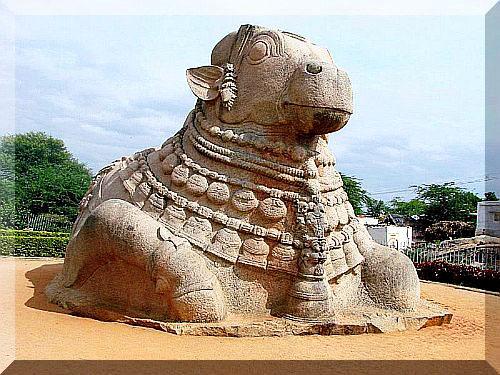
34.2. A monolithic Naga-linga, a Shiva linga with a multi hooded Naga serpent over it; the huge and majestic looking Nandi Bull carved out of single granite; and an imposing Ganesha, are some of the other splendid architectural features.

34.3. Even with all that, the temple is incomplete. The sprawling kalyana-mantapa, meant as a sacred space for celebrating the wedding of Shiva with his beloved Girija, has splendid and richly carved massive pillars; but there is no roof over them. It looks like an unfinished saga in stone. The stories and legends that narrate how and why the builders’ dreams were aborted; and how the place acquired the name Lepakshi, abound. Yet, the unfinished kalyana-mantapa has about it a sort of haunted look.

35. The Paintings

35.1 The Lepakshi temple is also celebrated for its paintings; though some have vanished and the others are weathering with time. But, at one-time the paintings were covered under thick layer of soot. Thanks to the efforts of the Archaeological Survey of India (ASI), a number of panels on the ceilings of the ranga-mantapa and the natya mantapa have been restored. Shri S. Subbaraman, who retired as Superintending Archaeological Chemist from the ASI says that he was thrilled when “A ten-handed, highly ornamented figure of Veerabhadra, 16 feet in length, all but invisible under the thick layer of soot, made a spectacular reappearance in all its details and bright colour”.

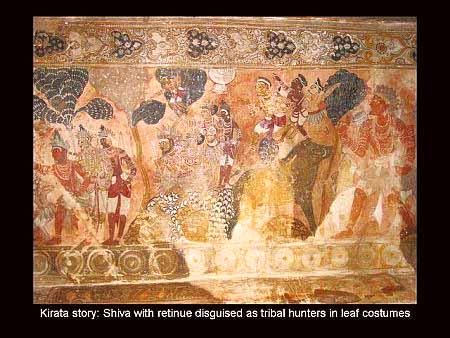
35.2. The ceiling of the natya-mantapa have eight panels depicting themes from mythology , such as the manifestations of Shiva- Shiva as Kiratha ( boar hunter), Dakshinamurthy and scenes from Shiva’s wedding with Girija; the scenes from Krishna’s childhood; and the legend of the compassionate King Manu-neethi-cholan who dispensed justice even to animals.

Girija kalyana theme


       Sages at the wedding

Women at the wedding

The Kiratha theme

35.3. The ardha-mantapa ceiling has bout fourteen panels again depicting the legends and manifestations of Shiva (Dakshinamurti, Chandesa Anugraha murthy, Bhikshatana, Harihara, Ardhanareeswara, Kalyanasundara, Tripurantaka, Nataraja, Gowriprasadaka, Lingodbhava, and Andaka- asuras-amhaara etc.)

35.4. In one corner, the brothers Viranna and Virupanna are shown worshipping Shiva and Parvathi in the company of other courtiers.

35.5. The paintings that have survived are some of the most outstanding murals in India. They are also the best among the Vijayanagara style of pictorial art.  The drawings are eloquent, natural and full of vitality. The sense of liveliness is enhanced by the depiction of the protruding eye, the angular features and by the peaked corners of clothes. The beauty of line and form; grace and movement too are delightful.

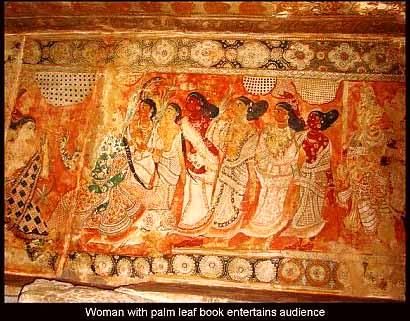
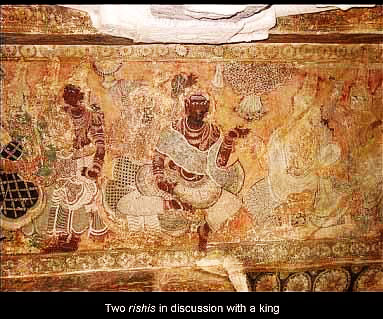
35.6. The narrative panels are framed and structured by bands and beams with textile patterns. They depict not merely the themes from the epics but also from the contemporary life, bringing to life a variety of costumes, textile patterns, jewellery, headgears etc..

35.7. The Lepakshi paintings have continued to influence generation of artists. It is practiced, even today, as a craft. The birds, beasts and foliage depicted in its paintings and sculptures have spawned a style that decorates the block-printed Indian textiles and rugs; popularly referred to as the Lepakshi motifs.

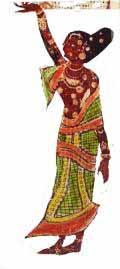
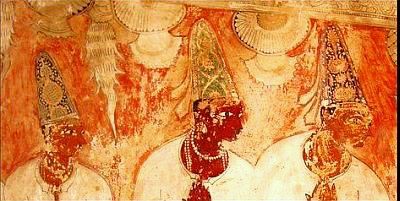
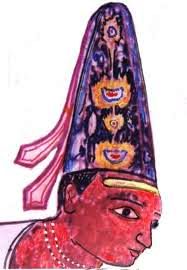
35.8. The paintings provide a glimpse of   the richness and colour of a cosmopolitan society; its styles and fashions. The costumes of men and women, colour and embroidered sarees, jewellery, hair styles , tall headwear (kulavi) etc. now  serve as a resource for the textile and fashion designers,  as they provide details of costumes etc of a distant past .

Men wearing Kulavis

[The conical –headgear of those times named Kulavi has an interesting sidelight. A lot has been written about Kulavis by the scholars in Indian history. For instance, there is a theory that the Pallavas who first established their kingdoms in the upper regions of the Krishna river during the third century and extended it up to Kanchipuram, further down south, by around fourth century  ; and ruled over large parts of south India till about ninth century , were immigrants from north.

It further puts forward the view: “the Pallavas of kañcipuram must have come originally from Persia, though the interval of time which must have elapsed since they left Persia must be several centuries. As the Persians are generally known to Indian poets under the name Parasika, the term Pahlavi or Pahlava or Pallava must denote the Arsacidan Parathions, as stated by Professor Weber”: venkayya, pp219–220

One of the arguments in support of that theory is the tall conical headgear worn by the early Pallava kings, which resembles the typical cylindrical Iranian head-dress.

Until the British took root (by 1857), the idiom of administration in India was Persian. The elite conversed and recited poetry in Persian; they dressed in Persian style; and the official language of the kings’ offices, courts etc. was Persian. A number of terms in present-day India’s revenue administration are derived from Persian.

The wealthy traders and   the officials of the king’s court during the vijayanagar times (16th century) too perhaps dressed in Persian style, as depicted in the Lepakshi murals.

Another interesting observation about the conical cap is that the most famous idol of Balaji (Sri Venkateshwara) atop  the  shrine at Tirumala – Tirupathi hills is adorned with an eighteen inch tall cylindrical crown . And, it is never taken out; the head-priest alone is authorized to change it and that too in strict privacy.

The crown of the Tirumala Balaji is unique; and no other ancient temple idol or a divinity in India has such a crown. It is said; the tall cylindrical crown is meant to cover the hair coiled into crown – shape (ushnisha –jata) atop the idols head. The tall crown, surely, was not chiselled into the stone image. It is not clearly known why or when or at what period the tall crown came to be regarded as an inseparable part of the idol. All these fuelled the debate on the nature of the Tirupathi idol.]

39. Fashion and Textile designs

39.1. Brigitte Khan Majlis, Cologne; has done a wonderful study of “Lepakshi: Architecture, Sculpture and Painting”. Please also see the paintings in Vijayanagar Empire by Rekha Pande; and, the Lepakshi Paintings.

39.2. Brigitte Khan Majlis says, “The costumes worn by the figures in the paintings demonstrate that distinct costume pieces and headgear were worn according to gender and status. The textiles show a wide spectrum of patterns. Some of them bear a close similarity to extant cotton textiles, produced along the Coromandel Coast for export to Indonesia in the 17th and 18th century”.

Further, while researching into the textile fashion designs depicted in the Lepakshi paintings, Brigitte Khan Majlis says she was overwhelmed by the abundantly decorated textiles gracing the figures of the narrative panels. And,  was impressed by their display a wealth of garments, jewellery and accessories of fashion. She remarks that the textile patterns in the pictures seem to be sufficiently detailed to take them as examples of real textiles; and connect them with possible textile techniques.

Please take a look at a few of her presentations.

39.3. The women’s upper body is bare except for jewellery or in one case a breast band worn by Parvathi. Sometimes the upper part of the fabric is draped in such a way, that it conceals the bosom. The lower end of the fabric is pleated and tucked in at the waist. Like this it fans out in a “fishtail” manner and in fact this appearance has given this kind of sari wrap its name.

Most of the sari fabrics appear to be white with stripes or chequers as ornamentation or a band of blossoms along the borders. Some of the material is very fine displaying the outlines of the legs.

39.4. Even today, the chequers and stripes are a choice ornamentation of saris and other textiles in South India.

39.5. Male attire: The paintings reveal quite accurately how the pleated part of dhoti was pulled between the legs and tucked in at the back. The dhotis are usually rather plain, white with stripes, tiny dots or of a chequered material.


 A second more ornate hip cloth was worn atop of the dhoti, encircling the hips at least twice, with the ends flowing gracefully in the air or one part tucked in under one arm in a big loop.

A third cloth could be wrapped diagonally across the upper body or around the neck.

A third cloth could be wrapped diagonally across the upper body or around the neck.

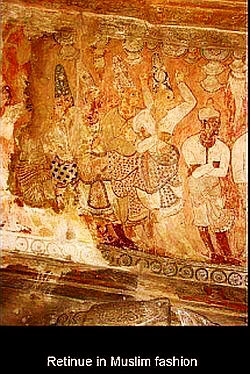
39.6. However there are some personages among the paintings which represent actual people of political status.

Retinue in Muslim fashion

[Please also see ‘ The Paintings of Vijayanagar Empire’ by Dr.Rekha Pande]


Next

We shall look at another set of paintings of the Vijayanagar School:

 Jain temple at Jaina Kanchi


Sources and references

http://www.muralpaintingtraditionsinindia.com/Brigitte.htm

http://picasaweb.google.com/mcfindia/BrigitteMAjlisKhan?authkey=pQV3MjR3lkM#

http://www.muralpaintingtraditionsinindia.com/index.html

http://www.kaladarshana.com/sites/lepakshi/index.html

http://www.hinduonnet.com/fline/fl2021/stories/20031024000107000.htm

http://www.muralpaintingtraditionsinindia.com/theodore%20bhaskaran.htm

http://en.wikipedia.org/wiki/Veerabhadra_temple_(Lepakshi)

http://www.kamat.com/kalranga/andhra/lepaxi.htm

http://www.hinduonnet.com/businessline/2000/11/27/stories/102772a4.htm

All pictures are from Internet

 
5 Comments

Posted by on September 24, 2012 in Art, Legacy of Chitrasutra


Tags: , , ,

The Legacy of Chitrasutra – Nine –Sri Pampa Virupaksha temple at Hampi

[This is the Eighth article in the series.

This article and its companion posts may be treated as an extension of the series I posted on the   Art of Painting in Ancient India .

The present article is about the murals painted on the high ceiling of the ranga-mantapa (the hall) at the Sri Pampa Virupaksha temple, Hampi (Karnataka).The 15-16th century art and architecture in Hampi represents the flowering of the Vijayanagara School.

In the next article we shall look at another set of Paintings at Lepakshi (AP), which represent a much advanced stage of the Vijayanagara art.]

Continued from the Legacy of Chitrasutra – Seven – Brihadeeshwara

28. Pampa-Hampe-Hampi

hampi

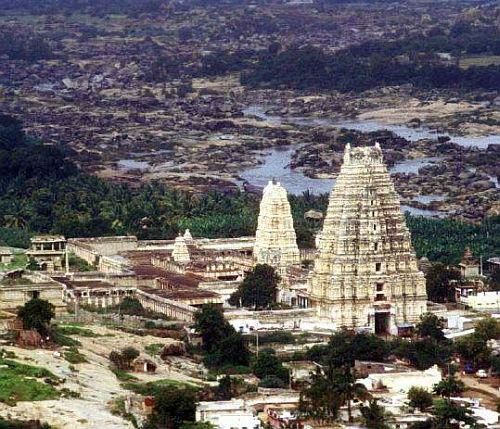
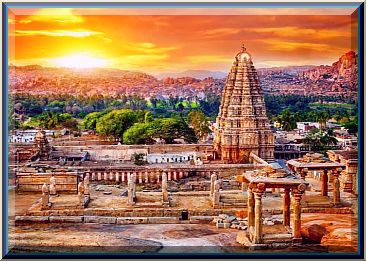
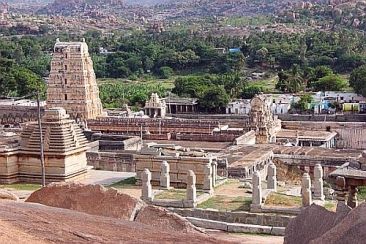
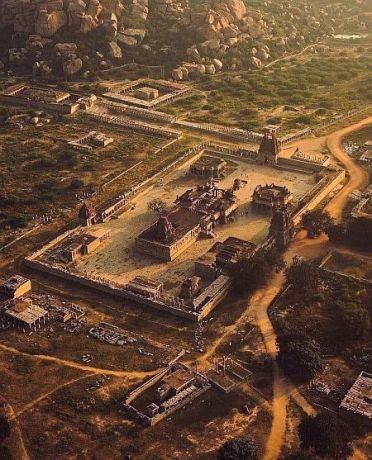
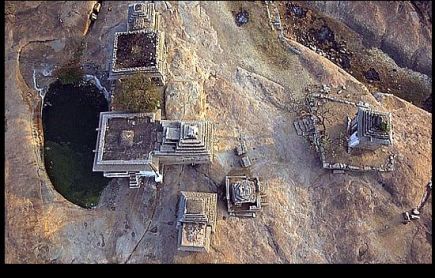
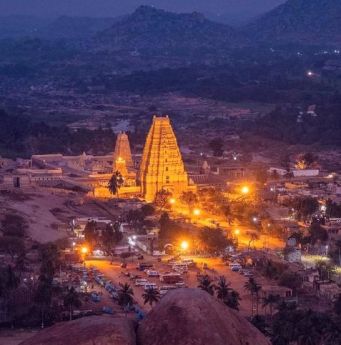
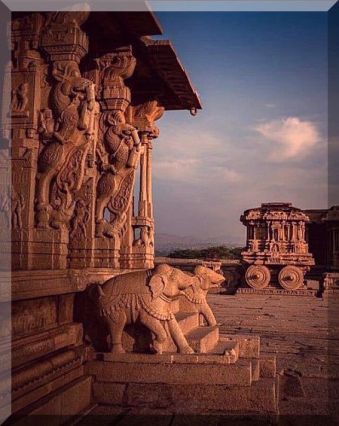
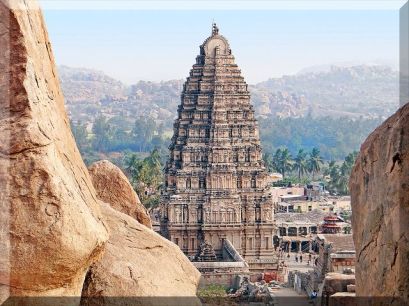
28.1. The temple of Sri Virupaksha at the foot of the Hemakuta hills, along the southern bank of the Tungabhadra, is the oldest shrine in Hampi; and it is still in active worship. It is a shrine dedicated to Lord Shiva who is addressed and worshiped here as Pampapathi and Virupaksha. Its  towering Gopura stands tall and alone amidst the ruins of Vijayanagar, the forgotten empire (1336-1565).

Hampi

Hampi7

Hampi layout

hampi aerial view 2

hampi arieal view

Hampi temple

Hampi Virupaksha temple

Hampi Chariot2

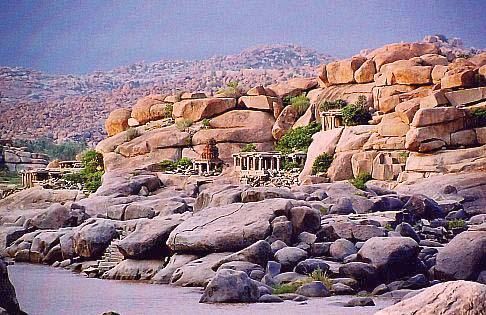
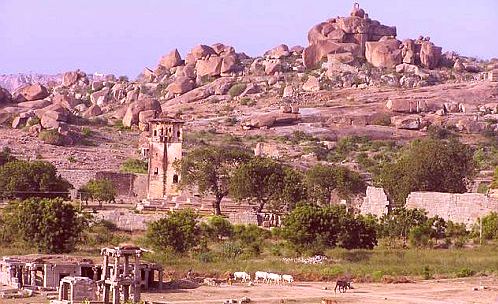
28.2. The earlier name of the river Tungabhadra that meanders through the rocky terrain of the ancient ruined city was the Pampa. And, the lake nearby was Pampa–sarovara; and the area surrounding the river was called Pampa-kshetra (the region of Pampa). The Lord of this kshetra, the sacred space, is Pampapathi. The Pampa is also identified with Parvathi. Thus,   Shiva, in either case, is Pampapathi the Lord of Pampa.

The area around the Pampa, surrounded by amazingly rugged massive boulders and craggy hills of Malyavantha, Matanga and Hemakuta, is identified as the Kishkindha, the capital of the Vanaras, of the Ramayana era. As if to justify its claim to that distinction, the hills are menacingly populated with ferocious long -tailed, dark- faced langur monkeys.

14250876721_d025ca0f64_z

Hampi virupasha

Hampi chariot

Hampi Narasimha

28.3. With the establishment of a Kingdom (c.1336) by the Sangama brothers – Harihara Raya (Hakka) and Bukka Raya (Bukka) – the rocky wilderness came to be known as Vijayanagar or Virupaksha-pura (after its presiding deity Lord Virupaksha, one of the many names of Shiva).

28. 4. Hampa is the archaic Kannada name for the Sanskrit term Pampa; and its later Kannada form is Hampe, which    eventually got anglicized into Hampi. But today, Hampi, in effect, is the Ruins of Hampi, a UNESCO protected world heritage site .

Hampi Ruins

Encased within the amphitheater of tough and defiant rocky landscape, the imposing 160-foot spire of the Sri Pampa-Virupaksha shrine stands tall overlooking the ruins strewn around it; a magnificent -mute-witness to history, glory and the  ruin.

Vijayanagara, earliest example of imperial city

29. Sri Pampa Virupaksha

29.1. The Pampa-Virupaksha shrine predates the foundation of the empire over which it came to preside. It is said; the sanctum per se belongs to about seventh century. The inscriptions of 9th-10th centuries suggest that some additions were made to that structure during the late Chalukya and Hoysala periods. The Sangamas rulers (1336-1485) too effected other improvements to the temple. It was particularly during the reign of Deva Raya II (r. 1425–1446 CE)the greatest of the Sangama dynasty rulers that huge temple was built under the supervision of  the Nayaka or the chieftain Lakkana Dandesha.

It was, however,   during the reign of the Tuluva dynasty (1491 -1570:  a dynasty founded by the Tulu speaking Bunts hailing from coastal region of Karnataka) , the modest sized shrine was greatly extended and transformed into a sprawling major temple complex with many sub shrines, pillared halls, flag posts, lamp posts and towered gateways. A narrow channel of the Tungabhadra River   was diverted to flow along the temple’s terrace and then led into the temple-kitchen; and finally exited through the outer court.

29.2. The major improvements to the temple, such as the 50 m tall towering eastern gateway (Gopura) and the Ranga-mantapa were added around the year 1510, during the reign of Krishna Devaraya (1509-1529) the most celebrated of the Tuluva dynasty and of the entire line of the Vijayanagar rulers. Inscriptions on a stone plaque installed next to the pillared hall (mantapa) record his contributions to the temple.It is recorded that Krishna Devaraya commissioned this hall in 1510 AD to mark his accession. The Mantapa is in the Vijayanagara Style of architecture, with its exterior walls decorated with many bas-reliefs and with multi-petalled lotus motif.

The Kings of Vijayanagar promulgated State orders in the name of Lord Sri Virupaksha ; and , affixed signature to the documents as ‘Sri Virupaksha ‘.

30. Paintings on the high-ceiling

30.1. The high ceiling of the Rang-mantapa as also its supporting beams were, at onetime ( early 16th century)  , decorated with painted panels depicting themes from the epics as also from events of contemporary life. The Vijayanagara style of painting, as it came to be known later, was a combination of the Chalukya, Chola and Pandya styles. The characteristic features of the Vijayanagara art were the simplicity and vigour in their depiction. There was an attempt to capture the sense of movement and energy in the painted figures. They marked the flowering of Deccan art and culture.

30.2. The murals were arranged on the high-ceiling of the Ranga-matapa, within rectangular panels having richly decorated borders.  Sadly much of the painted panels have faded away or were destroyed. Only the panels on the central portion of the Ranga-mantapa are now visible; and they are the only few remains of the Vijayanagara mural art.

30.3. The story of the Vijayanagar Empire and its early kings is intertwined with stories of the Indian epic heroes. Both shared a deep religious belief and an ambition to establish a new and a just world order. The prime impulse for establishing and building Vijaynagara kingdom too was born out of a deep-rooted aspiration to protect and perpetuate the Hindu way of life and its values, the Dharma. The inspiration for that bold initiative was provided by the founders’ preceptor Guru Sage Sri Vidyaranya. He was the 12th Jagadguru who presided over Sri Sharada Peetham at Sringeri (Karnataka) from 1380 to 1386 A.D.

30.4. The glory, the virtues, the valour and the deeds of the gods and the epic heroes, naturally, formed the subject of Vijayanagar art. Those themes were depicted with pride, devotion and great skill in all Vijayanagara sculptures and paintings.

30 .5. The themes depicted in the paintings were mainly from the puranas and the epics. They include several of Shiva’s manifestations (Kamadahana-murti and Tripurari); Girija-kalyana (Girija’s wedding with Shiva); the ten incarnations (Dashavataras) of Vishnu; the figures of the Dikpalas (the protectors of all directions/regions); as also the classic scene of Arjuna shooting the fish device (matsya yantra) to win Draupadi’s hand in marriage.

hampi6

30.6. Along with the epic themes, there is also a scene depicting Sri Vidyaranya the spiritual founder of Vijayanagar being taken in procession. Some scholars say, the founders of the Vijayanagara submitted the new- kingdom to their Guru, Sri Vidyaranya, of the monastery at Sringeri, as an act of intense devotion and gratitude. Sri Vidyaranya was thus the de-jure king ; and the State, in its early stages, was administered in his name. It is because of that tradition, it is said, the Gurus  of Sringeri are entitled to the royal prerogatives of a throne, sceptre and crown.It is in practice, even to this day.

30.7. The Sri Vidyaranya panel is one among few in traditional Indian art, which depict scenes from contemporary history. The panel extant on the temple ceiling has, sadly, become old and hazy. It depicts the scene of Sri Vidyaranya seated in a palanquin and taken in a procession. The sage is seated in a decorated palanquin with a backrest carried by four bearers ; followed by several men on foot  weaving chowries (fly-whisks) or carrying long knotted staves. The long procession is led and followed by decorated elephants. The tilt of the palanquin hinted movements negotiating the uneven ground-surface.

The portrayal is one of grace and rhythm; and there is an air of calm and respectful silence in reverence to the Guru.

There is another painting (dated around 15th century) which depicts Sri Vidyaranya seated in a palanquin (adda-pallaki) and carried in procession , with the Kings of Vijayanagar attending on their Guru.

 Please also see the images of Kubera and Sri Lakshminarayana

Hampi Kubera Hampi Lakshminarayana

[ Please do visit the website of the “ Vijayanagara and post Vijayanagara Murals: A digital heritage project Centre for Cultural Heritage and Tourism Studies, IIACD; Supported by Department of Science and Technology, Government of India for a collection of the reproduction of the Vijayanagara Murals; and the lucid explanations provided by Ms. Vijayashree  C S ]

31. The Technique

31.1. As regards the technique adopted, it was seeco technique where a surface was prepared with three or four layer of plasters and finally with a crystal soft lime plaster or the paste of the conch shells. Then, sketches were made on the smooth surface of dried plaster. This method of preparation of the surface was much different from the one adopted by the artists of Ajanta, which was more elaborate and spread over a much longer stages of preparation.

31.2. The sketches were made in red ochre; and the colours of the paints used were delicate and sometimes soft and smoky. Only three or four colours were used; and they were mostly earthen and sometimes mixed with glue or any other vegetable binders. The background was usually in red and the figures were in lighter tones are blue.

Please also read The History of Vijayanagar – The Never to be Forgotten Empire by  Bangalore Suryanarain Row ; Addison & Co., Madras – 1905

Hampi 4

[ The British Council has since taken up The Vijayanagara Research Project, which  aims to examine both the Visual Arts collection of material (prints, drawings and photographs) related to Hampi , Vijayanagara.

Please click here for the details :  ]

[Please also see ‘ The Paintings of Vijayanagar Empire’ by Dr.Rekha Pande]

Next

We shall look at the paintings at Lepakshi (Andhra Pradesh) which represent a much advanced stage of the Vijayanagara School of art.

References & Sources

http://en.wikipedia.org/wiki/Vijayanagara

http://www.hinduonnet.com/fline/fl2021/stories/20031024000107000.htm

http://amitkulkarni.info/pics/hampi/

http://picasaweb.google.com/yoguchelli/AJourneyIntoTheForgottenEmpire#

http://www.hampionline.com/attractions/virupakshatemple.php

http://www.museum.upenn.edu/new/research/Exp_Rese_Disc/Asia/vrp/HTML/Virupaksha.shtml

http://www.vijayanagaracoins.com/htm/finearts.htm

http://www.thepaintingsofindia.com/hampi.htm

http://www.indiastudychannel.com/resources/7006-POST-VIJAYANAGAR-PAINTINGS-OF-KARNATAKA.aspx

Pictures are courtesy of internet


Tags: , , ,

The Legacy of Chitrasutra – Appendix to Seven – Brihadishvara – Part 8

 The Maratha Nayak paintings in Brihadishvara temple

The following is an appendix to Part seven.

1. During the reign of King Vijaya Raghava Nayak (1645-1673), the restoration and improvement works were undertaken in the Brihadishvara temple. Due to constant exposure to smoke and soot from the lamps and burning of camphor in the sanctum over a period of centuries, certain parts of the Chola paintings on the circumambulatory passage walls had been badly damaged. The artists of the Nayak period tried to set it right, as they thought it fit; and decided to replace the old paintings with paintings of their own. They went on to paint their pictures over the thousand year old Chola murals; covering the old murals completely.

The modern day scholars could not help remark that the artists of the Nayaks’ rather ham-handed and overdid their task.

2. The Department of Archaeology, during the 1980s, did a remarkable conservation of the 11th century Chola paintings, by scientific cleaning. And, they at the same time achieved to retain intact the upper layer on which the Nayak paintings were drawn.

3.  The Maratha Nayak paintings (18-19th century) can be seen on the ceiling of the adjoining great-hall (maha-mantapa); on the west and north walls of another pavilion (tiruchchurru-maaligai); as also on the walls of the mantapa in front of the Subramanian shrine.

4. Since the pictures of these beautiful paintings, looking fresh, could not be posted along with the Chola paintings, I am posting a few of them here as an Appendix to the main post. Please look at them.

brihadishwara appendix 1

brihadishwara appendix 2

brihadishwara appendix 3

brihadishwara appendix 4

brihadishwara appendix 5

brihadishwara appendix 6

brihadishwara appendix 7
All pictures are courtesy of internet.

Continued in Part Nine

Paintings on the ceilings of the Sri Pampa Virupaksha temple, Hampi (Vijayanagar )


Tags: , ,

The Legacy of Chitrasutra – Seven – Brihadishvara

[This is the Seventh article in the series.

This article and its companion posts may be treated as an extension of the series I posted on the  Art of Painting in Ancient India .

The present article looks at the surviving Chola murals (earlyeleventh -century) at the magnificenttemple of Brihadishvara, Thanjavur (Tamil Nadu.)  This temple is a jewel among the Indian temples; and is the best of the Chola temples.

A brief mention is also made of the paintings of the Nayak period (17th century)

In the next article we shall look at the Paintings at the historic temple of Pampa Virupaksha at Hampi (Karnataka) , which belongs to the Vijayanagara School of art. ]

Continued from the Legacy of Chitrasutra – Six – Sri Kailasanatha of Kanchipuram

23. The Big Temple

The greatest of Chola emperors Rajaraja-I (985 A.D – 1012 A.D) the son of Sundara Chola (Parantaka-II) and Vanavanmaha  Devi, built a magnificent temple dedicated to Lord Shiva at Rajarajeshwaram near the head of the Cauvery Delta; and called their Lord as Rajarajesvara udaiya Paramasami (The Great God who resides at Rajarajeshwaram).

Thanjavur Brihadishwara3

Rajaraja also affectionately addressed his god as Peruvudaiyar (the great lord or the great master); and, his temple as Peruvudaiyar-kovil. The epigraphic evidences suggest that Rajaraja commenced his temple building project in the 19th year of his reign and completed it successfully on the 257th day in the 25th year of his reign (c.1010 AD). 

Tanjore temple by Capt. Trapaud - 1788.

Watercolour of the Brihadishvara temple at Thanjavur with a tank in the foreground, by  Col. Elisha Trapaud (1750-1828), c.1785.

Thanjavur pagoda

Pagoda at Thanjavur,  – 1797 Coloured etching by William Hodges

Thanjavur pagoda.3 jpg

 Thomas and William Daniell’s ‘Oriental Scenery’-1798

Thanjavur pagoda.2 jpg

Pagoda at Tanjore – 1809- from Salt’s ‘Twenty Four Views ‘

In the early eighth century, the Rājasiheśvara (Kailāsanātha) temple at Kancipuram was probably the largest structural temple complex; with the highest Vimāna thus far built anywhere in India. It was successfully completed in just a matter of six years;  a remarkable feat; especially when you consider that   the hard granite stones that went into the construction of the huge temple were not found anywhere nears the project site.

Tanjore temple William Daniell 1798

by William Daniel -1798

The central temple located in the western part of a large rectangular Prākāra (walled enclosure), which is encircled by more than 50 Devakulikās (subsidiary shrines).The surface of these sub shrines as well as the spaces between them are carved with hundreds of sculptures, all related to Śhaiva iconography, thus assembling the largest pantheon of Śhivamūrtis perhaps ever created in India. Also the temple’s main body (Vimāna) with originally at least seven Parivāra shrines built against its outer walls is carved all over with different forms of Shiva.

The layout of the temple follows a very precise and well-planned concept.  The outer walls of the two-storied vimāna, Ardhamatapa and Mukhamatapa are embellished with niches all containing Shiva-mūrtis; whereas the niches of the first storey show different forms of Shiva, with a Tripurāntaka placed in the northern niche inside the Ardhamatapa facing east. All the 32 niches of the second storey are exclusively filled with images of Tripurāntaka. Thus, there are, in all, 33 life-size standing stone sculptures of Tripurāntaka, the largest number of a single Mūrti   ever installed as niche figures on the walls of a single temple.

The whole central temple (Vimāna-chariot of the gods”) at Tanjavur with its overwhelming presence of Tripurāntaka images could be regarded as symbolically depicting Lord Tripurāntaka’s chariot.

23.2. The inscriptions at the temple indicate that Rajarajesvaram was exclusively a royal temple conceived, designed, and managed by the Emperor himself. The Big – Temple was, in a way, an expression of the devotion as well as the power and grandeur of Rajaraja Chola. It also became a benchmark in the south Indian architecture, highlighting the maturity and technical excellence achieved by the Chola architects and sculptures.

Tanjore temple

23.3. The crowning glory of the temple is the staggering cupola of the Vimana comprising two huge, sculpted, granite blocks weighing 40 tons each. The engineering skills and the expertise that mounted these huge stones atop the fourteen-story high tower structure, standing over 216 feet tall organized by pilasters that break up the façade of the base creating spaces for niches and windows in between, must have been way ahead of their times. The entire structure is built employing the interlock method; where no cement, plaster or adhesive was used between the stones.

It is said, over 130,000 tons of granite was used to build the Temple. Legend says that the stone was brought from Sarapallam (scaffold-hollow), transported by 3000 elephants over a distance of four miles north-east of the city.  The monolithic stone Kumbham, weighing over 80 tons, was placed atop the 200+ feet Vimana, using a specially designed ramp. 

Brihadeeswarara Vimana . jpg

The basement of the structure which supports the tower is 96 feet square. It is said that nearly 100 underground passages existed below the temple-structure; most of which were sealed off centuries ago. The architects and engineers attribute the stability of the massive temple to its pyramidal structure, more robust than the complex curvilinear profiles of other styles .

brihadisvaraornate-gopuram-tower-of-the-main-entrance

23.4. In course of time (17th to 19th centuries) the territory came under the rule of the Maratha Nayak rulers .They added various shrines and Gopuras within the temple complex. During their time, the temple came to be known as Brihadisvaram; and its presiding deity as Brihadisvara. The temple-city came to be known as Thanjavur. In Tamil, the temple is the Thanjai Periya- kovil (the Big-temple of Thanjavur).

brihadeshwara dwaja

24. The Paintings

Brihadeshvara painting

24.1. During the reign of King Vijaya Raghava Nayak (1645-1673), the restoration and improvement works were undertaken in the temple. Due to constant exposure to smoke and soot from the lamps and burning of camphor in the sanctum over a period of centuries, certain parts of the Chola paintings on the circumbulatory passage walls had been badly damaged. The artists of the Nayak period tried to set it right, as they thought it fit; and decided to replace the old paintings with paintings of their own. They went on to paint their pictures over the thousand year old Chola murals; covering the old murals completely. The modern day scholars could not help remark that the artists of the Nayaks’ rather overdid their task.

Brihadeshvara. 3 jpg

24.2. How the underlying Chola   murals again saw the light of the day after incarceration of about four hundred years, is an interesting story. It is said that, during the year 1930, while late Professor S.K. Govindasamy of Annamalai University was inspecting the walls of the six-foot wide dim lit  ambulatory (pradakshina patha) around the sanctum of the Brihadisvara, he noticed that the painted surfaces on the walls on either side of the ambulatory had,  at places, crumbled exposing some exquisite ancient paintings. He examined it further; and was thrilled when he discovered that the paintings hidden underneath the Nayak paintings were the thousand-year-old murals of the time of Rajaraja Chola. Professor S.K. Govindasamy published his findings in the Journal of the Annamalai University, Vol. II, 1933.

Researchers have discovered the technique used in these frescoes.  A smooth batter of lime stone mixture is applied over the stones, which took two to three days to set. Within that short span, such large paintings were painted with natural organic pigments.

During the Nayak period, the Chola paintings were painted over. The Chola frescos lying underneath have an ardent spirit of Shaivism is expressed in them. They probably synchronized with the completion of the temple by Rajaraja Chola.

Thereafter, attempts were made  by the Researchers to bring to light the Chola murals; and at the same time to preserve the paintings of the Nayak period.


       The passage

24.3. The Department of Archaeology has done a remarkable conservation of scientifically cleaning the exposed portions revealing the excellence of the Chola paintings and at the same time retaining intact the upper layer on which the Nayak paintings are drawn. It is said that during the 1980s, the chemical branch of the ASI came out with a unique `de-stucco’ process to remove the upper layer of Nayak paintings and display the same on fiberglass boards. For a report on that, please check:

http://www.hinduonnet.com/thehindu/fr/2003/02/28/stories/2003022801300600.htm
http://www.hinduonnet.com/fline/fl2410/stories/20070601000106500.htm

[ Incidentally, etched on the  Gopuram  of the Brihadeshvara temple , there is a figure of a man wearing a hat and a coat. There is no clear explanation about who this person was; and, how he came to be illustrated on the temple Gopuram. ]

Brihadesvara Tanjore man with a hat

25. The Chola panels

25.1. The magnificent temple of Brihadisvara at Thanjavur is a splendorous jewel of Indian temple art and architecture.

The original Chola paintings, so far brought to surface, are mainly in the corridors of the ambulatory around the sanctum. They are on the South, North and Western walls of the sanctum.

The Maratha Nayak paintings (18-19th century) are on the ceiling of the adjoining great-hall (maha-mantapa); on the west and north walls of another pavilion (tiruchchurru-maaligai); and on the walls of the mantapa in front of the Subramanian shrine.

( For the paintings of the Nayaks’ period : please see the Appendix posted as Part 8 )

25.2. The themes depicted in the panels so far exposed (1,200 sq ft) are : Shiva as Dakshinamurthy; the story of Sundarar; Rajaraja and his three queens worshipping Nataraja at Chidambaram; Tripurantaka; the marriage of Shiva and Parvathi; Rajaraja worshipping the Linga to be enshrined in the temple; and Ravana at Kailasa mountain.

Sadly, none of these is panels is complete. The figures too are not very clear; and it is difficult to make out the details. But for the efforts of ASI these ancient wall-paintings would have been totally lost.

Let’s take a brief look at some those panels.

25.3. The Dakshinamurthy panel

The Dakshinamurthi panel is rather huge and occupies almost the entire  space  on the southern wall. It is often cited as an example for lucidity and display of imagination in Chola paintings. It depicts Shiva as Dakshinamurthi under a banyan tree.

However, the figure of Dakshinamurthy is barely visible. The panel is very rich in details; it is populated with sages, Bhirava as dog, playful monkeys and birds such as peacocks, swans and owls.

There is a stillness of body and reverence on the face of the sages worshipping Dakshinamurthi, in contrast to the vivacious animals. Flying apsaras and gandharvas (celestial beings)complete the scene .But as a cobra enters the picture; there is a sudden change in the scenery. A monkey rushes away while another stares at the new entrant. Another, on a faraway branch, is not yet aware of the danger. A few sensitive swans flutter their wings in fear. The owls do not react as the whole thing happens in daylight. A peacock bends his long neck to watch. A squirrel, unmindful of all this, happily bites into a nut. Below the tree is a herd of elephants; one ferociously breaks a branch and another runs uphill with its trunk coiled around the branch. Another one calmly enjoys the peaceful surroundings.

The other panels are fragmentary but they, too, contain some marvellously drawn figures, bearing testimony to the skilful brushwork of the Chola artists.

25.4. There are also the graceful pictures of the Apsaras.

25.5. Saint Sundaramurti Nayanar

The panel on the west wall depicts the episodes in the life of Saint Sundaramurti Nayanar. In this panel the scenes of Sundara’s wedding are depicted in detail. These include scenes of Lord Shiva appearing in the guise of an old man clutching a document proving his claim over the bridegroom Sundara, an angry Sundara in a white coat , examination of the document by the villagers assembled there, and Sundara appealing to the mercy of Shiva etc.

sundaramurti sundaramurti.j2 pg

25.6. The scene of Indra (the king of gods)   worshipping the Linga is on the opposite wall.

sundaramurti.j3 pg

25.7. The next panel in northwest corner is the scene of four disciples who are now

identified as disciples (Kuravars: Sanka, Sananda, Sanathana, and Sanathkumara) of Sri Dakshinamurthy. Two figures among them were earlier assumed to be that of Rajaraja standing behind his Guru, Karuvurdevar, portraying a sense of humility. Now, the scholars seem to doubt that plausible explanation.

king guru

25.8. Tripuranthaka theme of Shiva raiding a chariot like a warrior, going into a war fully armed and wielding a bow, followed by an army of his supporters was a favourite of the Cholas. The Brihadisvara too has a panel dedicated to Tripurantaka. It must have once been a magnificent and awe inspiring painting, bringing to life the power, glory and the grandeur of the imperial Cholas and their Lord. It is said that Shiva in the mural had a twin expression: the ferociousness in the eye and the sweet smile on the lips. The daemons too have been depicted in detail. The panel, sadly, has not survived in its entirety.

tripurantaka

The demon with his consort on the Tripurantaka panel.

25.9. There is a picture of Ravana at Kailasa the snow-abode of Shiva; labouring hard to destabilize mountain peak.

tripurantaka.j 2 pg

26.Prof. C. Sivaramamurthy , a scholar and art historian of great distinction, described the Chola frescoes of the Thanjavur Big Temple as a masterpiece of Chola art, distinguished by power, grandeur, rhythm and composition, and unparalleled by any other contemporary painting. What is significant about the Chola paintings of Thanjavur is that there is great emotion in all the faces, whether it is the compassion of the guru counselling Rajaraja, or a contemplative rishi, a devout queen, an animated dancer or an angry Shiva.

26.1. Those who have examined the Chola paintings closely have observed that even while depicting a sombre theme of devotion, the artist does not neglect the mundane aspects. The bedecked royal ladies continue to chatter among themselves, in spite of their being in a holy place. In contrast, the common ladies and elders seem absorbed in the performance.


26.2. According to Prof. C. Sivaramamurthy, “If expression has to be taken as the criterion, by which a great art has to be judged, it is here in abundance in these Chola paintings. The sentiment of heroism – vira rasa– is clearly seen in Tripurantaka’s face and form; the figures and attitude of the Rakshasas (demons) … wailing tear-stained faces of their women… suggest an emotion of pity – karuna– and terror – raudra; Siva as Dakshinamurthy… is the mirror of peace – shanta; the hands… of the dancer suggests the spirit of wonder – adbhuta… the ganas (Shiva’s followers) in comic attitude represent hasya. The commingling of emotions is complete in this which is a jumble ofvira, raudraand karuna” (Paintings of South India).

rakshasas 

27. The Chola artists of the Brihadisvara murals were the inheritors of the hoary tradition of Chitrasutra. They preserved and practiced the concepts and the techniques of the Chitrasutra. The delineation of lines, use of colours and shades, arrangement of the figures on the canvass and treatment of the subject strongly resemble the murals of Ajanta. Its figures are alive with rhythm and movement.


The saints, kings and queens are celebrated in their idealized forms; the emphasis was on the ideal person behind the human lineaments rather than on their physical likeness. They figures of humans, animals, birds and vegetation always seem to suggest to something beyond the obvious. Its gods and goddesses too are full of virtue, vitality and grace; and have a universal appeal. They not merely stimulate the senses but also ignite the imagination of the viewer and set the viewer free from the confines of place, time and ego (self).The Chola murals of Brihadisvara have that magical quality, which brings out the essence of life and the grace that permeate the whole of existence.

[ I gratefully acknowledge the corrections and improvements suggested by Shri Vijay Kumar the creator of the delightfully articulate website on Shilpa and other related subjects :  http://www.poetryinstone.in ] 

For the paintings of the Nayaks’ period : please see the Appendix posted as Part 8

And
Next

The Vijayanagar period paintings on the ceilings of the Sri Pampa Virupaksha temple, Hampi (Karnataka)


References and Sources:

The Big Temple

http://www.thanjavur.com/bragathe.htm

http://www.thebigtemple.com/emperor_rajaraja.html

http://en.wikipedia.org/wiki/Chola_art

The Great God of Rajarajeshwaram

http://www.whatisindia.com/opinion/2006/03/wis20060331_the_great_god_of_rajeshwaram.html

Restoration of Chola paintings by ASI

http://www.hinduonnet.com/thehindu/fr/2003/02/28/stories/2003022801300600.htm

http://www.hinduonnet.com/fline/fl2410/stories/20070601000106500.htm

http://www.thebigtemple.com/frescos.html

http://www.hindu.com/2005/12/24/stories/2005122406380400.htm

A.A.S.A.I: Paintings Preservation

http://conserveheritage.org/paintingpreservation.html

Legends across panels by Nandtha Krishna

http://www.hinduonnet.com/thehindu/thscrip/print.pl?file=2004061300370200.htm&date=2004/06/13/&prd=mag&

The Swami as photographer

http://www.hinduonnet.com/thehindu/mp/2005/06/20/stories/2005062000400500.htm

Tanjavur Paintings in Koviloor, Sittannavasal, Panamalai, Tanjavur Early Chola Paintings;

Photographed  by C. Nachiappan (Koviloor Swamy), Kalakshetra Publications.

http://saigan.com/heritage/articles/cholamrl.html 

https://www.academia.edu/27054217/2016__Three_Royal_Temple_Foundations_in_South_India_Tripurantaka_Imagery_as_a_Statement_of_Political_Power email_work_card=view-paper

ALL IMAGES ARE FROM INTERNET


Tags: , ,

The Legacy of Chitrasutra – Six – Sri Kailasanatha of Kanchipuram

[This is the Sixth article in the series.

This article and its companion posts may be treated as an extension of the series I posted on Art of Painting in Ancient India 

The present article looks at the surviving mural (early-eleventh-century) at another Pallava temple viz. the Kailasanatha temple at Kanchipuram (Tamil Nadu) . This temple is one of the earliest constructed by the Pallava kings; and, it served as a model for the other bigger temples.

In the next article we shall look at the Paintings at the magnificent Chola temple of Brihadeeshwara at Thanjavur.]

Continued from

The Legacy of Chitrasutra –  Five  –Panamalai

 Sri Kailasanatha of Kanchipuram

kailasanatha

Kanchipuram

19.1. Kanchipuram located along the banks of the Palar has a glorious history. In the ancient times it was reckoned among the seven primer Sacred cities (Saptapuri) that granted liberation (moksadayikah):  Ayodhya, Mathura, Maya (Haridwar), Kashi (Varanasi), Kanchi, Avanthika (Ujjain), Puri, and Dvaravathi (Dwaraka) .

Ayodhya Mathura Maya Kashi Kanchi Avantika | Puri Dvaravati chaiva saptaita moksadayikah ||

And the great poet Kalidasa (4th century CE) lauded Kanchi as the best among those cities (Nagareshu Kanchi).

Kanchipuram was the holy city not only for the various sects of the Vedic religion but also for the Jains and the Buddhists. The city was earlier known as Pancha-Kanchi (Five Kanchipuram-s); being the abode of five religious faiths of : Jaina, Buddha, Shiva, Vishnu and Brahma. Of these , the divisions of Jaina-kanchi, Shiva-kanchi and Vishnu-kanchi still survive.

19.2. Even much prior to that, Kanchi located in the region referred to as Tondaimandalam in ancient Sangam literature, was described as the city of Kachchi surrounded by forests, lovely like the many-petalled lotus.

Manimekalai, a Buddhist epic from the later Sangam age, recounts Kanchi as the graceful city where the most beautiful, golden-hearted dancer Manimekalai, causes to build a delightful garden in honor of the Buddha; places the Amuda Surabhi at  the lotus seat of the Buddha  ; and,  welcomes all living beings, including the lonely, the neglected, the hungry, the defeated, and the maimed to gather and partake food offered by her and bless her. The beloved Manimekalai enters the Sangha under the guidance of her teacher Aravana Adikal; and dedicates the rest of her life to Dharma.

Manimekhalai

Kanchi developed into a center of Buddhism in South India, from where the Dharma spread to other regions in India and also to Far-East and China. It was the home of many eminent Buddhist scholars, such as: Buddhaghosha (fifth century CE) and Aniruddha (author of Abhi-dhamma-ttha-sangaha); and of revered monks such as: Venudasa, Vajrabodhi, Sariputra, Sumati and Jotipala.

Among the Buddhists of Kanchi was the renowned scholar Dignaga (c. 480 – c. 540 CE), one of the founders of the system of Logic (Hetu Vidya) which developed into the deductive logic in India ; and,  as the cornerstone of Buddhist system of Logic and Epistemology (Pramana).

Dignaga

Kanchi was also the home-town of the remarkable and matchless Bodhidharma (470-543 CE), a Pallava prince, the third son of Simhavarman II; and a contemporary of Skandavarman IV and Nandivarman I. He came under the influence of the admirable Buddhist teacher Prajnatara who trained him in the techniques of meditation. Later,  as per the wish of his teacher, Bodhidharma left for China to spread Dharma in that land. He arrived at the port city of Kwan-tan (Canton), along the southern coast of China, during the year 520. He was honoured by the Chinese emperor Wu-li in whose court was the great translator Paramartha. Soon thereafter, Bodhidharma headed north, crossed the Yangtze River and reached the Ho Nan Province.  There at a temple, Bodhidharma meditated for nine years facing a wall, not uttering a sound for the entire time.

Bodhidharma in China

Bodhidharma is revered as the Adi – Guru, the first patriarch, of the Chinese Cha’n (Skt. Dhyana) School, which later developed into the system of Zen meditation – a way to awakening through self-enquiry.  In order to ensure that his disciple –monks are physically strong enough to withstand both their isolated lifestyle and his demanding training methods, Bodhidharma trained the monks in the ancient Indian style of armless combat, called Vajramusti (diamond-fist).  That later  gave rise to the now famous  martial art , the Shoaling style of fist fighting ch’uan-fa (literally ‘way of the fist’).

*

Another remarkable Buddhist monk-scholar, the master of Vajrayana, who helped transmit Buddhism to China, was Vajrabodhi (671–741). He also lived in the city of Kanchipuram. Vajrabodhi, it is said, at the request of Pallava King, set sail to China via Java. Vajrabodhi accompanied by his disciple Amoghavajra arrived in China in 720. Here, they settled down at the Jianfu Temple at the Chinese capital, Chang’an (present-day Xian).

Vajrabodhi

Vajrabodhi, aided by his disciple Amoghavajra, produced two abridged translations of the Sarva-tathagata-tattva-samgraha (Symposium of Truth of All the Buddhas), also known as the  Tattvasamgraha. This work and the Mahāvairocana Sūtra became the two basic Chen-yen texts.

[For a detailed account of the Life of Vajrabodhi, please check here.]

*

It is also believed that Bodhisena, who was invited by the Emperor of Japan to inaugurate the 8th century temple of Todaiji in Nara, was also from Kanchipuram.

Jaina Kanchi

19.3. Kanchi was, in a similar manner, a prominent center of Jainism. It is believed that Jainism entered Southern India in around fourth century BC, when the monk Visakhacharya, at the behest of Acharya Bhadrabahu, moved over to the Chola and Pandya countries along with a group of sramanas (Jain monks), in order to propagate the faith of the Thirthankaras.

The Jain scholar-monks such as Acharyas Sumantha-bhadra, Akalanka, Vamana-charya Pushpa-danta, Kunda-kunda and others, were highly regarded for their piety and scholarship. Under their guidance a number of Jain temples and educational institutions (samana-palli) were established in the Tamil country, especially in its Northern regions.

The recognition accorded to Jainism is evidenced by the fact that a sector of Kanchipuram is known as Jaina Kanchi.  It is said; the Pallava King Mahendra-varman I (600 – 630 CE), in the early part of his life, caused , in that sector , construction of two temples :  one dedicated to Chandra-prabha the eighth Thirthankara; and the other dedicated to Vardhamana the twenty-fourth Thirthankara who is also addressed as Trailokya-natha-swami. The ancient paintings in the Vardhamana temple are renowned for their artistic qualities.

vaikunta perumal

19.4 . Kanchi is also a sacred center for the Vaishnava faith. It is the home of the Pallava temple of Sri Vaikunthaperumal, built by Nandivarman II in the late 8th century CE, dedicated to Vishnu. It is one of the latest surviving temples built by the Pallavas . It, again, is  dominated by a huge tower. The temple is also exceptional for its triple shrine, one on each story ; and,  each containing an image of a form of Vishnu.

Vaikuntha Perumal Temple layout

mantapa with eight columns leads to the sacred shrines within where there are two ambulatory passages on the first floor. The interior walls of the temple are decorated with relief sculpture depicting scenes from the history of the Pallava dynasty.  

Kanchi was also the home of the Saint philosopher Sri Ramanuja (11th to 12th century CE).

ramanuja2

19.5. Even today, Kanchi is an important religious center.  The town has over 120 temples, including several smaller Pallava shrines of which the Muktesvara and Matangesvara are the biggest. The small Cokkisvara temple dates to the 12th century CE. Finally, the Varadaraja temple , built in the early 17th century CE has a massive gopura and outstanding sculpture on its exterior, notably the rearing lions of its mantapa columns. Besides the abundant sculpture adorning the various monuments of the city several excellent figures of yoginis have survived, typically in green-stone and dating to the 9th and 10th centuries CE.  

*

19.6. It is said; the history of Kanchipuram is lost in obscurity almost from the days of Karikala (Ca.190 CE), recognized as the greatest of the Early Chola kings who ruled in Southern India during the Sangam period, to its occupation by the Pallava kings under Sivaskandavarman (perhaps the beginning of the fourth century). It is probable that during this period  the city of Kanchi was in the hands of the Chola princes, some of whom are mentioned in the Manimekhalai to have built Buddhist temples.

Kanchi was the imperial capital of the Pallavas for over five hundred years from 4th to 9th centuries. Though Kanchipuram was taken over by to King Pulakesin II (r. 610-642 CE) in the 7th century CE; and, later again by the Calukya ruler Vikramaditya II (r. 733-746 CE) , the city regained its glory rather quickly.

The Pallava power and the city of Kanchipuram were at the zenith of their glory during the 7th and 9th centuries, when the Pallavas had established supremacy over their southern rivals and ruled over the territory extending from the Krishna in the north to Cauvery in the south. During this period the Pallava kingdom enjoyed a long period of peace and prosperity; and, during which literature, art and architecture flourished. The Pallavas fortified the city with ramparts, moats, etc., with wide and well-laid out roads and fine temples. 

Kanchi was also the home of the famous 6th century CE poet Bharavi who wrote the Kiratarjuniya . Hsuan Tsang, the Chinese-Buddhist monk, scholar, traveler and translator who visited Kanchi during the 7th century, wrote glowingly about the splendor of the city and its intellectual wealth. He records that there were as many as one hundred monasteries with ten thousand Buddhist monks in Kanchipuram.

Further, they were a great maritime power with their chief Port at Mamallapuram .The might of the Pallavas was such that they had established diplomatic and trade relations with China, Siam, and Fiji etc.

chola_map_new.svg_

The religious enthusiasm and devotion during the Pallava rule were manifested in the magnitude of the temples and the highly sculpted temple forms. The Pallava kings were keenly aware that the intersection of these two aspects, the religious and the commercial, made their capital a highly desirable destination, and they used stone temple architecture to cultivate Kanchi’s multifaceted reputation. The fame of Kanchi’s temples spread through long-distance networks connecting India with Southeast Asia and China. Ekambaranatha is among Kanchipuram’s oldest temples; but, the city itself has a much longer history.

Four distinct periods of Pallava history are recognized, the earliest covering roughly two centuries, the 3rd and 4th century CE, the second period covering the 5th and 6th century CE, the third and fourth periods together, extending from the latter part of the 6th century CE down to almost the end of the 9th century CE In the latter half of the 9th century the kingdom fell to the Cholas who ruled Kanchipuram till the end of 10th century CE .

The late period consists of two phases. In the first phase, structural temples were built of sandstone.  These monuments are situated in Kanchipuram town and are the first structural temples of South India, with great refinement in architectural style and intricate features. In the second phase of the late period, the temples were made of composite materials. The lower portions of the temples are built of sandstone and the upper portion i.e., the tower of the temple is built of brick with lime plaster.

After the collapse of the Pallava kingdom around 900 CE, temples were built by their successors – the Chola kings in Kanchipuram. The construction of these temples was slowly shifted from sandstone to granite during the early Chola period, the reason probably being the durability of granite. Monuments built after the early Chola period is made of granite or brick with lime plaster .

Out of the six temples under the ASI, those of Kailasanatha, Iravathaneswara, and Piravathaneswara were built by Narasimha Varman I between 700 – 728 CE Mukteswara, Matangeswara, and Vaikuntha-Perumal temples were built by Nandivarman II from 732 – 796 CE Of these temples the Kailasanatha and Vaikuntha Perumal temples are on a larger scale.

All monuments are of the typical Pallava style-externally, a lofty tower built over the central shrine rising, in tiers, diminishing in size as they approach the summit; in front of this shrine is a large pillared hall or Mantapa approached through a small porch. The Piravathaneswara temple is an exception in that it has a pyramidal tower over a central shrine without a porch or a pillared hall. A characteristic feature of these Pallava temples is the typical pillar found in them. The base of the pillar is carved in the shape of a conventional lion sitting in an erect position and carrying the shaft of the column on top of its head . A granite slab was introduced at the plinth level of the monuments to act as a structural tie as well as to prevent water seepage into the super structure. This structural detail is typical for all sandstone monuments –royal temples and community temples – built during the Pallava reign .

[ Source : Nagareshu KanchiMagnificent Cultural Urban Center in South India by  Vellore Ramabrahmam, Raghu, Y. & J. Narayana ]

Muktheshvar Temple Kanchipuram

19.7. Thereafter, the city came under the rule of Cholas from 10th to 13th century; and of the Vijayanagar kings from 14th to 17th century. By then the city had lost its primer status and was steadily on the downward slope.  Kanchi’s decline was accelerated by the drying up of the Palar River. 

Under the Company rule, Kanchipuram turned into a battlefront for the British East India Company in the Carnatic Wars against the French East India Company; and , also in the Anglo-Mysore Wars fought with the Sultan Mysore. Thereafter, during the Second Anglo-Mysore War of 1794, the territory came under the direct control of the East India Company.

Kanchipuram

Kanchipuram is one of those sad cases where a thriving urban populace forced by neglect and paucity of resources rapidly reverts to rural life styles. The city could no longer sustain itself, particularly after the near-demise of the Palar. Kanchi is now a little more than a weavers’ town.

The other instance of that nature that quickly comes to my mind is the city of palaces and mansions located on the Ganga that once was the seat of a mighty imperial power, the Pataliputra which now has degenerated into squalor and dirt ridden dust-bowel called Patna .

[Please check here for papers presented at a seminar devoted to The Pristine Glory of Kanchipuram]

20. Sri Kailasanatha

kailasanatha 2

20.1. The Kailasanatha (or Rajasimhesvara) is one of the largest and most ornate ancient temples in the whole of India. And, Kailasanatha , the oldest among the ancient temples in Kanchipuram is  dedicated to Lord Shiva. It was earlier known as Raja-simheshwaram. The temple is credited to the initiative and enterprise of the Pallava ruler Narasimhavarman II or Rajasimha (also known as Ajiranakanta, Ranadhira and Kshatriya Simheshvara) who reigned between 690 to 728 AD. His Queen Rangapataka is said to have actively collaborated i9n the construction of Sri Kailasanatha. A foundation inscription states that he erected this great house of Shiva “to reflect his own glory and the laughter of the Lord.” 

In the early eighth century, the Rājasiheśvara (Kailāsanātha) temple at Kancipuram was probably the largest structural temple complex thus far built anywhere in India. The central temple located in the western part of a large rectangular Prākāra (walled enclosure), which is encircled by more than 50 Devakulikās (subsidiary shrines).The surface of these sub shrines as well as the spaces between them are carved with hundreds of sculptures, all related to Śhaiva iconography, thus assembling the largest pantheon of Śhivamūrtis perhaps ever created in India. Also the temple’s main body (Vimāna) with originally at least seven Parivāra shrines built against its outer walls is carved all over with different forms of Shiva.

Kailasanatha Kanchipuram original ground plan

said to be original ground plan of Kailasanatha temple

kailasanatha-temple drawing-

Sri kailasanathaswamy temple drawing by Sri B Sathish

The Kailasanatha temple is the finest structural project of the Pallavas. It looks as if a chariot from heaven has descended on earth. The exterior of the temple is more piercingly and vividly carved in comparison to the interiors. The niches have some of the most splendid sculptures/forms of Shiva and his family. 

The sandstone structure is enclosed within a highly decorative wall which has interior niches forming fifty-eight separate shrines containing figures of Shiva, Parvati, and Skanda. The sanctum enshrines a shodasakona (sixteen-cornered) lingam of black colour. The vimana rises over the sanctum like a pyramid.

Shiva in Linga

” The main temple has three main components: the outer corridor with the enclosure wall running around; the main shrine with the sanctum tower; and , the pillared Mantapa in front. The walls of the Vimana and the attached shrines are a house of absolute riches of Śaivite iconographic forms. This can be called as the richest of all Pallava shrines in terms of figurative decoration. Sculptures occur not only in the main niches but also on their flanks. The sculptures are found carved not only inside the attached cardinal and corner shrines but also are on each shrine’s outer walls. In the wall facing south has Uma-Mahesvara, Lingodbhava with Varaha below in the main niche.

kailasanatha Lingodbhava

The west wall has Sandhya-nrtta-murtti and Urdhva-Tandava-murti with dancing Ganas below. The wall facing north has Tripurantaka and Durga in the main niche. Apart from the more prominent forms of Shiva which are carved in the main niches, the flanks show Harihara, Ganeśha, Durga, Skanda and Vishnu.

In front of the main Vimana is Rajasimha’s Mantapa. It is flat topped with corner piers and paired pillars on the main openings. While the façade pillars are of sandstone, the inner pillars have shafts of granite. Dvarapalakas appear in niches with makara-toranas on the east, Lakśhmi and Saraswathi on the south and Durga and Jyeśtha on the north.”

Kailasanatha

The noted filmmaker, art-historian and photographer Benoy K Behl says

The entire complex of this royal temple is grand and lavishly sculpted. The rampant lions and a  royal symbol of the Pallavas are made everywhere. They display the vigor and courage of the spirit within us, to fight the demons of our ignorance. They also display the glory of the Pallava king, who made the temple. It has many images of Durga as Mahishasur Mardini. It is one of the most expressive images of Indian art. Durga personifies the energy and power within us to face and to destroy the demon of our ignorance,”.. ”  The panel of Ganas, only thirty inches in height, running along the base of the temple, depict the joyous spirit of the worship of the Lord. These display the high quality of carving everywhere in the temple.

arunachaleshwara

Sri Kailasanathar

20.2. The Somaskanda panel, depicting Shiva and Parvathi with their son Karthikeya is the main iconographic motif of the temples built by Rajasimha in particular and the Pallavas in general. The term Somaskanda (Sa-Uma-Skanda) literally means (Shiva) “with Uma and Skanda”. The rear wall of the sanctum in Kailasanatha is adorned with the Somaskanda panel. The Pallavas seemed to be very fond of the theme of Shiva’s family. In endless varieties of depictions they celebrate Shiva as regal and yet a loving family man with a beautiful wife and a playful child.

somaskanda.2 jpg

The Pallava depictions of the Somaskanda are usually large sized. Shiva is three eyed; four armed, splendidly ornamented; and his complexion resembles the rising sun (udaya bhanu nibha) or the coral (mani vidrumabha).His matted hair is done up as a crown adorned with crescent moon and Ganga. He wears a patra-kundala in his left ear; and makara kundala in his right ear. His upper hands carry tanka or cane (vetra), and an antelope; and his lower two hand gesture benediction and assurance. He sits with his one leg bent and kept on the seat (sayanam padakam); and his other leg stretched down (lambaka padam).

Parvathi sits to his left. She has two hands; and holds a blue lotus in one of her hands. She too sits with her one leg bent; and the other stretched.

Both have a pleasant countenance; and sit in a relaxed posture (sukhasana).The playful child Skanda is between the loving couple. The child Skanda, in these depictions, has one face, two hands; and holds a flower in each of his hands. His complexion is blue

kailasanatha-temple-

20.3. The Kailasanatha has one of the largest and most complex Vimana . The stories  (Vimanas) are decorated with architectural designs . The Kailasanatha is a four-storied structure containing two walls providing an ambulatory  passage (pradakshina-patha).The three exterior walls of the garbhagriha have seven lesser shrines placed around them and each contains an image of Shiva.

Kailasanatha Kanchipuram

The whole of the exterior of the temple is covered in a mass of relief sculpture, notably of rearing lions (yalis), Nandis, attendants of Shiva (ganas), Shiva, and other deities.

The temple built almost entirely of sandstone is integrated into a coherent complex. The modest scale of the temple, and the closeness of its enclosing wall, lends a sense of intimacy to the surroundings.

20.4. The Kailasanatha temple is perhaps the biggest sandstone temple structure in the world. Among the ancient temples in Kanchi, the Kailasanatha is the only temple whose structure has not been meddled with or re-constructed. It still retains its pristine form and structure. It’s another unique feature is the 58 devakulikas (mini-shrines) that run round the main temple. They had murals that portrayed scenes from the Shiva- Lila, the legends of Shiva. Sadly, most of those paintings are no longer visible.

20 .5.  The Gopuras were not an essential feature of the early temples. At the Kailasanatha there is just a suggestion of a Gopura- dwara. It was only by about 11th century that tall, colossal and overwhelming Gopura emerged as a unique feature of the South Indian temple architecture.

20.6. The Kailasanatha appears to be the earliest structured temple constructed by the Pallavas. It surely served as a forerunner and a model for the later temple structures including some Chalukya temples. Some scholars opine that Rajaraja –Chola I was inspired by Kailasanatha to build Raja-Rajeeshwaran temple at Tanjore. Kailasanatha contains in embryo many features of the emerging South Indian style, such as: gopuras, pilastered walls with ornamental columns, a pyramidal shikhara, and a perimeter wall enclosing the complex. Many of the ornaments depicted in the Chola and Vijayanagar sculptures and paintings owe their origin to the Pallava period.

20.7. Perhaps the greatest tribute paid to the graceful magnificence of Sri Kailasanatha temple was by the victor and conqueror of Kanchipuram. Vikramaditya II (reigned 733 – 744 AD) son of King Vijayaditya of the Badami Chalukya in his military career conquered the Pallava kingdom on three separate occasions. Vikramaditya ‘s third campaign against the Pallava kingdom ( around  735 AD) was to support the cause of a young Pallava prince Chitramaya against the Pallava king Nandivarman II Pallavamalla . Besides, by defeating Nandivarman II, Vikramaditya avenged the defeat his ancestor Pulikeshin II suffered (during 642 AD) at the hands of the Pallava king  Narasimhavarman I.

Vikramaditya II was very gracious in his victory. Unlike many conquering kings, he ensured that the city and its residents were not harmed in any manner .Even amidst battle violence he did not lose his sensitivity and love of art. As a connoisseur of art and architecture, he was captivated by the beauty of the Kailasanatha temple then known as Rajasimheshwaram. Vikramaditya II not only returned the war-booty but also liberally donated considerable gold and jewels to the temple. He also gifted in charity to city’s Brahmins and to its weak and forlorn. His acts of benevolence are inscribed, in archaic Kannada, on a pillar erected in front of the pavilion (mantapam) at Sri Kailasanatha temple.

 [Prof. R. Gopalan in his History of the Pallavas of Kanchi (Published under the Madras University Historical Series III; 1928) beneath the head – The Chalukyan Invasion of Kanchi. – pages 121-122  & page 189 – writes:

The Kendur plates of Vikramaditya II describe an actual invasion into the Pallava dominions (Tundakarashira) and the capture of the city in somewhat graphic terms: –

Being resolved to uproot completely his natural enemy (prakrti-amitra) Vikramaditya II (A.D. 733 to 746) reached Tundaka-Vishaya, ‘beat and put to flight, at the opening of the campaign, the opposing Pallava king named Nandipotavarman, took possession of particular musical instruments called Katumukhavaditra, the Samudraghosha, the khatvankladvaja, many excellent and well-knon  intoxicated elephants (matta-varana)  and a heap of rubies which dispelled darkness by the brilliancy of the multitude of their rays. . . entered without destroying the city of Kanchi, which was as it were a girdle adorning yonder lady, the region of the south … rejoiced the Brahmanas, and poor and helpless people by his uninterrupted liberality … acquired high merit by restoring heaps of gold to the stone temple of Rajasimhesvara, and other gods which have been caused to be built by Narasimhapotavarman … distressed by the Pandya, ChoJa, KeraJa, Kalabhra and other kings

The above extract from the Kendur plates distinctly makes it clear that Vikramaditya II actually captured the city of Kanchi from the Pallava king Nandipotavarman, that is, Nandivarman Pallavamalla, and occupied it for a period of time during which he endowed some of its temples with grants. This occupation of the Pallava capital by Vikramaditya is further confirmed by the discovery of a Kanarese inscniption of Vikramaditya engraved on one of the pillars of the mantapa in front of the Rajasimhesvara shrine.

This inscription (said to have been inscribed by the engraver Niravadya Srimad Anivarita Punyavallabaha – aka Anivarita Achari), which has been published by Dr. Hultzsch records the fact that Vikramaditya Satyasraya, after his conquest of Kanchi, did not confiscate the property of Rajasimhesvara temple, but granted large sums to the same, and ends with an imprecation that those who destroy the letters of the record and the stability of the king’s charity, shall incur the sin of those who killed the men of the assembly of the city (Ghatikaiyar) – (as mentioned in Appendix A .p 189)

The Chalukyan attack on Kanchi was therefore apparently different in character from the raid of the Pllava king Narasimhavarman I on Vatapi which involved much destruction if the Periyapuranam account is to be believed. ]

The inscription reads:

Vikramaditya IIHail Vikramaditya –sathyashraya, the favourite of Fortune and of earth, Maha-rajadhiraja Parameshwara Bhattara having captured Kanchi and after having inspected the riches of the temple, submitted them again to god of Rajasimheshwaram.

It is also said that Vikramaditya II took along with him, to his imperial city Vatapi (Badami), the temple architects (sthapathy or sutradhari) Sarvasiddhi Acharya and Anivaratha Acharya ; and as desired by his queens Lokamaha Devi and Trailokyamaha Devi, caused construction of two temples, in Dravida style , dedicated to Shiva as Lokeshwara (now known as Virupaksha temple)  and Trailokeshwara (now known as Mallikarjuna temple).In addition, the queens caused construction of two other temples, at Pattadakal,  in Rekha-Nagara style, dedicated to Papanatha (Shiva) and Durga Devi. These temples were in celebration of King Vikramaditya’s victories over the Pallavas. The sthapathys were generously remunerated and honored with gifts and titles Perjarepu, the great architects; and sent back to Kanchi.

Of these, Lokeshwara temple (now known as Virupaksha temple) at Pattadakal is said to have been modelled after Sri Kailasanatha (Rajasimheshwaram) temple of Kanchipuram. That was Vikramaditya’s expression of appreciation and his tribute to the graceful Rajasimheshwaram.

Pattadakal

 Sri Virupaksha temple at Pattadakal

20.8. It is remarkable; while the cave temples of Badami influenced the carved structures of Mahabalipuram, about a century later the Pallava temples influenced the style, structure and depiction of the Chalukya temples. Over a period the two rival schools enriched each other giving place to composite styles of sculpture and architecture.

21. Paintings

paintings

21.1. Though the sculptures of the Rajasimha are fairly well preserved, its paintings have almost vanished. It is said that the walls of the pradakshina -patha of the Kailasanatha temple were once covered with paintings of brilliant colours. But most of that has turned into faint traces .None of the surviving paintings at Kailasanatha is complete; only fragments have remained.

fragments

21.2. The problem of aging was exacerbated by the coat of white wash applied by the temple authorities on the ancient murals. The conservation work, to rescue the underlying paintings,  was taken up during 1936-40 by Shri S.Paramasivan, an archaeological chemist, who was a curator at the Madras museum. And; he encountered a number of serious problems in restoring the paintings in the cells of the Kailasanatha temple. He remarked said, “Since mechanical removal is the only possible means of removing the whitewash, it had to be done with great patience, not just skill”. Thanks to the efforts of Shri Paramasivan a few fragments of paintings at Chittannavasal, Thanjavur and Kailasanatha, Kanchipuram, have survived.

fragments.j2 pg

21.3. The fragments at Kailasanatha along with the remnants at Talagishwara temple at Panamalai are however quite significant. Because, these are the only two surviving examples of the Pallava mural paintings. Further, they represent an important stage in the history of development of South Indian paintings. Sadly, there has not been much discussion about these paintings.

fragments3 pg

21.4. Benoy K. Behl, the scholar and art historian remarked, “The fragments at Kailasanatha reveal the tenderness and grace that come from the tradition of Ajanta; as well as the glory of great kings. The theme of the family of Siva is also, at another plane, a representation of the royal family. There is an impressive quality in the crowns and in the painted figures, which are not seen in the earlier gentle beings of Ajanta. The idiom, which begins to develop here, is seen to blossom later into a grand imperial style of painting under the Cholas. The ancient Indian murals were also the foundation of the later manuscript paintings and Indian miniatures.

Here we see the high quality of painting of the classical Indian style, with a beautiful rendering of form and volume.”

22. Technique

22.1. While explaining the technique of Pallava murals, Shri Theodore Baskaran says the painting surface consists two layers of plaster. The first layer was a rough layer of lime and sand.  Over this a thin lime plaster was applied and this stuck on to the first layer firmly. Then the plaster ground was given a gentle polish with a trowel or stone.

22.2. He also mentions that the Pallava plaster – fresco –technique was superior. “The plaster from Kanchipuram was 2 to 3 mm in thickness and the two layers of plasters adhered to each other firmly. Because of the high degree of purity in the lime used, gypsum content was negligible and there was no efflorescence on the surface of the paintings”.

fragments4

Next

We shall look at the remains of the early 11th century Chola murals on the corridors around the sanctum of Sri Brihadeshwara at Thanjavur.

Resources

http://www.thehinduretailplus.com/thehindu/mp/2006/01/19/stories/2006011900100300.htm

http://en.wikipedia.org/wiki/Kanchipuram

http://www.hinduonnet.com/fline/fl2001/stories/20030117000409200.htm

http://www.cmi.ac.in/gift/Archeaology/arch_thondai.htm

http://www.tamilnation.org/culture/architecture/kanchipuram.htm

http://www.hinduonnet.com/fline/fl2516/stories/20080815251606400.htm

http://www.muralpaintingtraditionsinindia.com/theodore%20bhaskaran.htm

https://www.academia.edu/2559588/Architectural_Brilliance_Kaila%C5%9Banatha_Kanchipuram?auto=download

All pictures are from Internet
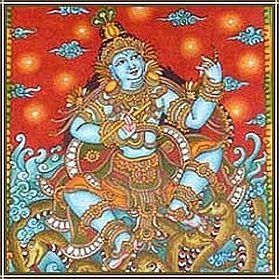
 

Tags: , , ,

The Legacy of Chitrasutra – Five –Panamalai

[This is the fifth article in the series.

This article and its companion posts may be treated as an extension of the series I posted on Art of Painting in Ancient India 

The present article is about the surviving mural (ninth-century) at the Talagirishwara temple in Tamil Nadu. This temple is one of the earliest constructed by the Pallava kings; and it served as a model for the other bigger Pallava temples.

In the next article we shall look at  the  Paintings at another Pallava temple –  Sri Kailasanathar of Kancipuram]

Continued from

The Legacy of Chitrasutra – Four – Sittannavasal

 Panamalai


Panamalai situated about 7km to the south of the famous heritage fort at Gingee ( Tamil Nadu) is renowned for the ancient temple dedicated to Shiva as  Talagirishwara , the Lord of the Talagiri. (It is his earth abode here). The exquisite temple still has a few remnants of beautiful paintings.

talagisvara16.1. The Talagirishwara temple on top of the rock-hill overlooking a placid lake is dated around seventh – eighth century, based on the inscriptions found in the temple. The temple is attributed to the creative genius and enterprise of the great Pallava king Narasimhavarman II aka Rajasimha (son of Parameshwaravarman I), who ruled for more than three decades from c.690 to 728 AD. By the time Narasimhavarman II ascended to the throne, the Pallavas had gained supremacy over their rivals – Chola and Pandyas; and were established as the dominant power in Southern India. The Pallavas had even established trade and diplomatic relations with China. The long reign of Narasimhavarman II was free from conflicts with the neighbouring states; and was blessed with a fairly long spell of peace of prosperity during which literature and arts flourished.

Narasimhavarman II, the Pallava King

16.2. It is said, Narasimhavarman, in particular, was a great patron of art and literature. Dandin, the great scholar was his court – poet. Narasimhavarman himself was an accomplished playwright and poet; and had to his credit many works in Sanskrit and Tamil. Though most of his works are now not extant, his plays on Ramayana and Mahabharata themes continue to influence the traditional theatre. For instance, his plays kailasodharanam and kamsavadham, in Sanskrit, are still a part of the repertory of Kutiyattam, the ancient School of drama in Kerala.

keralakerala2

16.3. Pallavas were the pioneers of south Indian architecture; and, laid the foundations of the Dravidian school which blossomed during the Cholas, the Pandyas, the Vijayanagar kings and the Nayaks. Among the later Pallavas, the contribution of Narasimhavarman was phenomenal. During his reign he caused as many as fourteen major temples to be constructed. The prominent among those were: the Kailasanatha and the Airavatesvara temples of Kanchipuram; the shore temple of Mamallapuram; the Atiranacanda temple of Saluvankuppam; and, the Talagirisvara temple of Panamalai. He is also credited with the construction of the Buddhist Vihara commonly known as ‘China-pagoda’ at Nagapatam, for benefit of Chinese merchants, mariners and visiting monks. Marco Polo who visited the monastery in 1292 AD wrote about it.

  mahabalipuram-771x462

shore temple at Mahabalipuram datable to late 7th century

Tiger Cave complex in 2005 led to the excavation of a Sangam Period

   Saluvankuppam Yali Cave, façade 

16.4. The architecture of his time was versatile and innovative. While the Mamallapuram temple was located on seashore, the kanchi temple was in the plains and the Panamalai was atop a rocky hill. Architecturally, each temple was distinct in its style and in its depiction of the details.

While the sanctum of the Kanchipuram temple was decorated with sculpture, the one at Panamalai was painted with the Somaskanda murals. It is also said, Narasimhavarman’s shilpis (sculptors) displayed a great deal of imagination and artistic liberty; and, did not strictly adhere to the prescription of the Agamas.

shiva talagisvara

Shiva at Talagirishwara 

Panamalai temple

Panamali_temple_viewITNTG004general view

( It is believed that the modest sized graceful looking Vimana of Talagirishwara temple, with its sharply recessed corners leading up to the stupi (top point)   served as a prototype for the more intricate vimanas of the later Pallava temples.)

17.1. The temple at Panamalai is smaller in size; its inner and outer walls are plain unlike that of the other Pallava temples of its time. The inner walls of its cells and the sanctum were, at one time, covered with paintings of exquisite beauty. Interestingly, it is said, the Panamalai murals resembled closely with the sculptural details on the inner walls of the Kailasanatha temple at Kanchipuram.

somaskanda

Somaskanda panel at Kailasanatha-Kanchi

17.2. The Somaskanda murals on the sanctum walls and other paintings in the pavilion front of the sanctum have all but vanished, leaving behind few traces of paintings.

shivalinga

The lone painting

umbrellaPanamalai Parvathi

18.1. The only identifiable figure now visible on the temple walls is that of a beautiful looking, well adorned graceful young lady standing beneath a royal parasol, wearing a tall bejewelled kirita (tiara)and jewellery, typical of the Pallava period. The skilful shading has endowed the figure a three dimensional appearance. It is regarded one of the most beautiful paintings of ancient India. 

umbrella2

Detail of the parasol

18.2. She, with the parasol, resembles Parvathi of the Kailasanatha temple, Kanchipuram, and the Vakataka women of Ajanta. She is identified by some as Parvathi, the consort of Shiva; but she could be any beautiful woman of refinement and elegance. In any case, the influence of Ajanta is unmistakable. The enraptured gaze and the tender grace are inherited from the Chitrasutra and Ajanta tradition.

ajanta tradition

18.3. The idiom of Pallava painting, which began here, later blossomed into a grand imperial style of painting under the Cholas.

Next

The Pallava temple – Sri Kailasanatha of Kanchipuram.

arunachaleshwara

Atiranacandesvarar 

References:

http://www.archive.org/stream/epigrahiaindicav014768mbp/epigrahiaindicav014768mbp_djvu.txt

http://www.whatisindia.com/inscriptions/south_indian_inscriptions/volume_12/introduction.html

http://conserveheritage.org/paintingpreservation.html

http://tamilartsacademy.com/books/mamallai/new-light.xmlhttp://reachhistory.blogspot.com/2008/10/gingee-fort-dalavanur-mandagapattu.ht

All Pictures are from Internet


Tags: , ,

The Legacy of Chitrasutra – Four -Sittannavasal

[This is the fourth article in the series.

This article and its companion posts may be treated as an extension of the series I posted on Art of Painting in Ancient India 

The present article is about the Jain murals (ninth-century) at Sittanvaasal caves in Tamil Nadu. These are perhaps the earliest surviving Jain murals

In the sections to follow we shall look at   Paintings at Panamalai and Kailasanathar of Kancipuram]

Continued from  : The Legacy of Chitrasutra – Three – Badami

Sittanavasal

12. 1. As Benoy. K. Behl  (the well known art-historian, filmmaker and photographer who has written extensively on Ajanta ) remarked “If Badami and Ajanta represent the earliest surviving Hindu and Buddhist murals, Sittannavasal caves are the earliest surviving Jain murals”.

12.2. Sittanavasal, near Pudukkottai in Tamilnadu is renowned primarily for its rock-cut cave temple with its rare Jaina mural paintings. The name indicates abode of the Siddha (the monk or monks).The first century Tamil-Brahmi inscription names the place as ‘ChiRu-posil’.  It records that Chirupochil Ilayar made the Atitnam (Adhittana, abode or a dwelling place) for Kavuti Itan who was born at Kumuthur in Eorumi-nadu. The territorial division of Eorumi-nadu is   identified with the present-day Mysore region.

The cave floor, in fact, provides slightly elevated beds and pillows carved out of rock, for use of the monks.  There are about seventeen beds, rectangular even-spaces; each with a sort of stone pillow. It is likely that on these rock beds the Jain ascetics performed austerities such as kayotsarga and sallekhana (voluntary starvation leading to death).

An inscription of 7th century AD,written in Tamil Brahmi, in 7 lines, mentions some names (perhaps of Jain monk residents):

Kadavulan Tirunilan of Tolakkunram, Tiruppuranan, Tittaichchanan, Tiruchchattan, Sripurnachandiran, Niyatakaran Pattakkali and Kadavulan.

[There is mention of another inscription written in vattelettu script dated 5th – 6th centuries AD, found in another natural cavern in the same hill.]

[Sittannavasal has the distinction of being the only monument where one can find, in one place, Tamil inscriptions dating back from 1st century BC to the 10th century AD. It is virtually a stone library in time].

It is likely that the Sittannavasal cave temple dated around first or second  century (based on the Tamil-Brahmi inscription found on the cave floor) belonged to a period when Jainism flourished in Southern India. And, it  served as a shelter for Jain monks till about 8th century when Jainism began to fade away in the Tamil region.

12.3. Sittannavasal, a natural cave, located on top of a modest granite hill, called Eladipattam, served in the ancient times, as residence for the Jain monks. The cave temple is quite spacious and has a low roof. But, Sittannavasal is rather small in size in comparison to Ajanta with which its paintings are often compared.

13.1. The importance accorded to Sittanavasal is not because of its size or grandeur, but because of its significance in the history of development of Indian art and also because of its exquisite style of depiction, as evidenced by the fragments of its remnant murals. The Sittanavasal paintings are regarded as a surviving link between the Ajanta paintings (c.6th century) and the Chola paintings of Thanjavur (11th century). They are also classified with the Sigiriya (Srigiri) frescoes of Sri Lanka (fifth century) and the Bagh frescoes in Madhya Pradesh (sixth and seventh centuries).

Sigiriya-Sri Lanka                Bagh caves- Madhya Pradesh

13.2. Sittanavasal is the earliest example of Jaina paintings. These paintings gathered attention of western world after an inscription was published during the year 1904.Though the cave and its interior carvings are dated to around 2nd century, the surviving remnants of the beautiful paintings on the ceiling of the sanctum and the ardha-mantapa (front pavilion) are dated around seventh century, as they appear to be based in the classical Ajanta style. Some scholars say, the pillars and cave paintings belong to the period of the  Pallava king Mahendra-varmanI (580-630 CE).

13.3. Another reason for dating the Sittannavasal murals around 6th -7th century is that they exhibit some Pallava features. Further, the temple in its architectural style resembles the cave temples built by the Pallava king, Mahendra-varman.

As regards the wall-surface and its preparation, they closely resemble that of Ajanta. The base of Sittannavasal paintings is well consolidated, firm yet thin with lime plaster used as binding agent. The painted plaster is made up of three layers: rough plaster, fine plaster and a covering layer of paint, as in Ajanta.

The paintings 

14.1. The paintings that were on the temple walls have almost completely perished. Only the fragments of the paintings that were on the   ceilings, the beams and the upper regions of the pillars have partially survived.

I understand, these remnants too are eroding fast clouded by the fine granite dust emanating from the nearby quarries. And, this ongoing disaster might eventually emaciate the rock-hill, weaken the ancient temple structure and bring the whole of it crumbling down.

14.2. Of the remaining fragments of paintings, those on the pillars and the lotus pool scene on the ceiling of the ardha-mandapa (pavilion) and the carpet canopy on the ceiling of the inner shrine are the most important.

sittanvasal ceiling design

Design on the ceiling

14.3. Among the pictures painted on the pillars, the figures of the dancers adorned with ornaments and distinctive hair styles; and displaying graceful dance postures are very attractive. They closely resemble the Apsaras (celestial maidens) of the Ajanta. 

Sittanavasal-Paintings

There are two dancers painted on western face of the two pillars, greeting those who enter the cave. However, the images are much weathered now; and, only upper the portions of the dancers remain. Apsara’s hair is tied together and is adorned with varieties of flowers. She wears necklaces around her neck. Her upper body is bare (as in the classical style of depicting the aristocracy) . It is likely that the full figure was depicted   with elaborate clothes below her waist.

14.4. A painting on the southern pillar of perhaps the king and his queen has somehow survived. The benign looking male figure is adorned with an elaborate crown, ear-rings set in gems (patra-kundala and makara kundala). The female figure behind him is rather simple.

14.5. Canopies of vivid patterns are painted on the ceiling over the images of Thirthankara Parshvanatha a Jain Acharya (preceptor) employing the lotus motif.

15.1. The most important mural of Sittannavasal is the exquisite composition depicting the delightful Jain heaven. The painting depicts Sama-vasaranathe adorable heavenly pavilion with theBhvyas, the eligible souls fortunate to receive divine discourse in the Samava-sarana.

The termSamavasarana (Sama avasarana) means an assembly which provides equal opportunities for all who gather there. Samavasarana, in Jain literature denotes an assembly of Thirthankara.  At this assembly different beings – humans, animals and gods – are also present to behold the Thirthankara and hear his discourses. The common assembly, at which different beings are gathered for one purpose, treats all alike overriding the differences that might exist among them. A  Samavasarana is thus, a tirth, a revered place.

According to Jaina faith, the Bhavyas have to pass through seven bhumis or regions before they gain eligibility to listen to the divine discourse. Among these bhumis, the second bhumi is the khatika-bhumi (region-of-the-tank).

The Sittannavasal mural depicts the joyous scenes at this divine lotus tank.  It pictures bhavyas amusing themselves in the delightful lotus tank full of lotus flowers, fishes, birds and animals.

It is a picture of sublime happiness, where the Bhavyas happily gather, with tender care, lotus flowers larger than themselves, while elephants appear to smile; and the bulls, birds and fishes are in playful mood. The figure of the bhavya is made with a lilting grace, like the stalks of the lotuses he gathers. It is a gracious world.

Line drawing

the detail

15.2. The lotus with their stalks and leaves, and the birds, fishes, bulls and elephants are utterly simple and beautiful in their natural charm. Some art critiques have remarked, this might be one of the most beautiful depictions of flowers in ancient Indian art.

These flowers attract viewer’s attention due to their sheer size and bright colours. This bright colour fades gradually towards inside of flower. These flowers are depicted in various stages of development, from a bud to a well blown flower. The bright red lotus with green leaves and thin stem presents a very pleasant sight.

There are three buffalos in this lake, one totally submerged and two in state of getting out of the lake as men approach. There are three men in the lake who are shown collecting flowers. Elephants are shown carrying lotus stems and in process of handing those to nearby men. One of them is holding a basket to place flowers into it. These men probably represent Jaina monks who are getting flowers for offerings to their teachers. Smile on their faces suggest that they are happy and content.

15.2. The unique features of the Indian art are seen here, where humans share the joy of life with the animals, birds and plants. It is a celebration of life, even in after-life. It echoes the spirit of life immortalized in an inscription at Ajanta: “The joy of giving filled him so much that it left no space for the feeling of pain.”

It seemed to convey “Every leaf, every flower, every ant, deer, elephant and human form is filled with the same joyous spirit that flows through and connects all that there is in the world”.

Please see reproductions of some of the ancient paintings of Sittanvasal

sittanvasal

lotus_sasi

Next

The Panamalai temple of the Pallava times

Resources and References

http://www.pudukkottai.org/places/sittannavasal/03sittannavasal.html

http://indian-heritage.org/swaminathan/sittannavasal/Sittannavasal%20-%20a%20booklet.pdf

http://indian-heritage.org/swaminathan/sittannavasal/arivar.html

http://narajin.net/g2data/main.php?g2_itemId=1602

http://indian-heritage.org/swaminathan/sittannavasal/arivar.html

http://puratattva.in/2011/05/02/sittanavasal-the-legacy-of-chitrasutra-13.html

All pictures are from Internet


Tags: , , , , , ,