RSS

Author Archives: sreenivasaraos

The Legacy of Chitrasutra – Four -Sittannavasal

[This is the fourth article in the series.

This article and its companion posts may be treated as an extension of the series I posted on Art of Painting in Ancient India 

The present article is about the Jain murals (ninth-century) at Sittanvaasal caves in Tamil Nadu. These are perhaps the earliest surviving Jain murals

In the sections to follow we shall look at   Paintings at Panamalai and Kailasanathar of Kancipuram]

Continued from  : The Legacy of Chitrasutra – Three – Badami

Sittanavasal

12. 1. As Benoy. K. Behl  (the well known art-historian, filmmaker and photographer who has written extensively on Ajanta ) remarked “If Badami and Ajanta represent the earliest surviving Hindu and Buddhist murals, Sittannavasal caves are the earliest surviving Jain murals”.

12.2. Sittanavasal, near Pudukkottai in Tamilnadu is renowned primarily for its rock-cut cave temple with its rare Jaina mural paintings. The name indicates abode of the Siddha (the monk or monks).The first century Tamil-Brahmi inscription names the place as ‘ChiRu-posil’.  It records that Chirupochil Ilayar made the Atitnam (Adhittana, abode or a dwelling place) for Kavuti Itan who was born at Kumuthur in Eorumi-nadu. The territorial division of Eorumi-nadu is   identified with the present-day Mysore region.

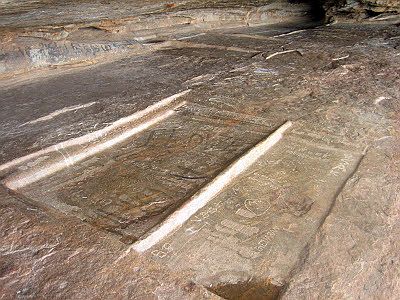
The cave floor, in fact, provides slightly elevated beds and pillows carved out of rock, for use of the monks.  There are about seventeen beds, rectangular even-spaces; each with a sort of stone pillow. It is likely that on these rock beds the Jain ascetics performed austerities such as kayotsarga and sallekhana (voluntary starvation leading to death).

An inscription of 7th century AD,written in Tamil Brahmi, in 7 lines, mentions some names (perhaps of Jain monk residents):

Kadavulan Tirunilan of Tolakkunram, Tiruppuranan, Tittaichchanan, Tiruchchattan, Sripurnachandiran, Niyatakaran Pattakkali and Kadavulan.

[There is mention of another inscription written in vattelettu script dated 5th – 6th centuries AD, found in another natural cavern in the same hill.]

[Sittannavasal has the distinction of being the only monument where one can find, in one place, Tamil inscriptions dating back from 1st century BC to the 10th century AD. It is virtually a stone library in time].

It is likely that the Sittannavasal cave temple dated around first or second  century (based on the Tamil-Brahmi inscription found on the cave floor) belonged to a period when Jainism flourished in Southern India. And, it  served as a shelter for Jain monks till about 8th century when Jainism began to fade away in the Tamil region.

12.3. Sittannavasal, a natural cave, located on top of a modest granite hill, called Eladipattam, served in the ancient times, as residence for the Jain monks. The cave temple is quite spacious and has a low roof. But, Sittannavasal is rather small in size in comparison to Ajanta with which its paintings are often compared.

13.1. The importance accorded to Sittanavasal is not because of its size or grandeur, but because of its significance in the history of development of Indian art and also because of its exquisite style of depiction, as evidenced by the fragments of its remnant murals. The Sittanavasal paintings are regarded as a surviving link between the Ajanta paintings (c.6th century) and the Chola paintings of Thanjavur (11th century). They are also classified with the Sigiriya (Srigiri) frescoes of Sri Lanka (fifth century) and the Bagh frescoes in Madhya Pradesh (sixth and seventh centuries).

Sigiriya-Sri Lanka                Bagh caves- Madhya Pradesh

13.2. Sittanavasal is the earliest example of Jaina paintings. These paintings gathered attention of western world after an inscription was published during the year 1904.Though the cave and its interior carvings are dated to around 2nd century, the surviving remnants of the beautiful paintings on the ceiling of the sanctum and the ardha-mantapa (front pavilion) are dated around seventh century, as they appear to be based in the classical Ajanta style. Some scholars say, the pillars and cave paintings belong to the period of the  Pallava king Mahendra-varmanI (580-630 CE).

13.3. Another reason for dating the Sittannavasal murals around 6th -7th century is that they exhibit some Pallava features. Further, the temple in its architectural style resembles the cave temples built by the Pallava king, Mahendra-varman.

As regards the wall-surface and its preparation, they closely resemble that of Ajanta. The base of Sittannavasal paintings is well consolidated, firm yet thin with lime plaster used as binding agent. The painted plaster is made up of three layers: rough plaster, fine plaster and a covering layer of paint, as in Ajanta.

The paintings 

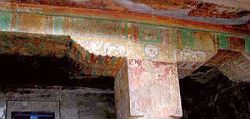
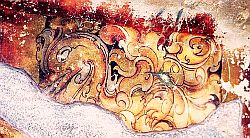
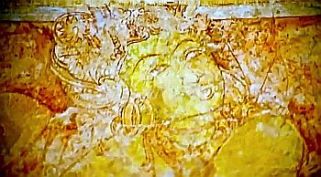
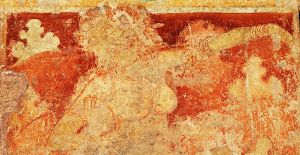
14.1. The paintings that were on the temple walls have almost completely perished. Only the fragments of the paintings that were on the   ceilings, the beams and the upper regions of the pillars have partially survived.

I understand, these remnants too are eroding fast clouded by the fine granite dust emanating from the nearby quarries. And, this ongoing disaster might eventually emaciate the rock-hill, weaken the ancient temple structure and bring the whole of it crumbling down.

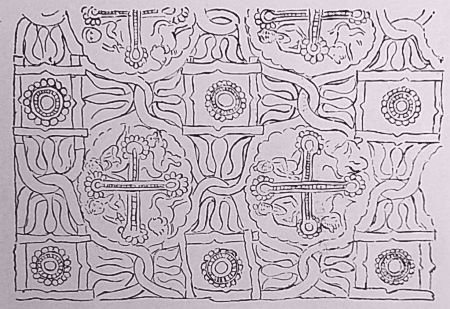
14.2. Of the remaining fragments of paintings, those on the pillars and the lotus pool scene on the ceiling of the ardha-mandapa (pavilion) and the carpet canopy on the ceiling of the inner shrine are the most important.

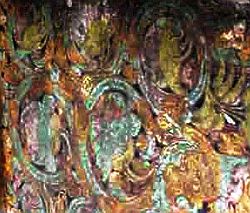
sittanvasal ceiling design

Design on the ceiling

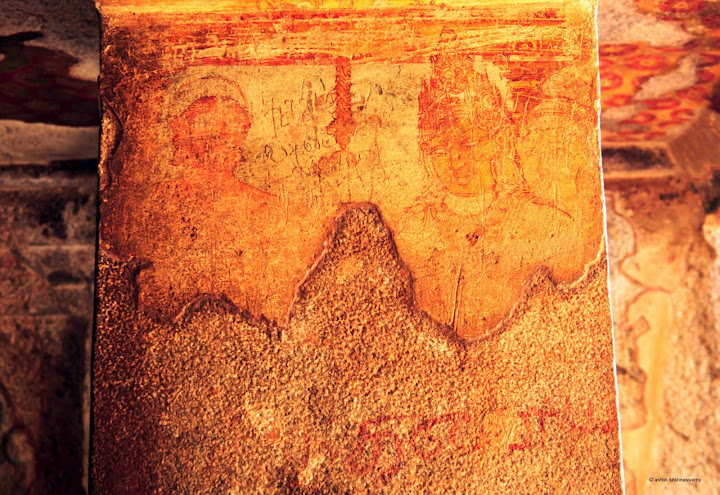
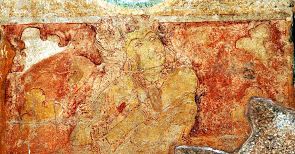
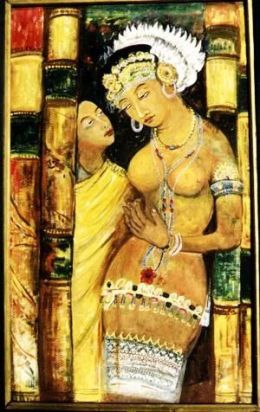
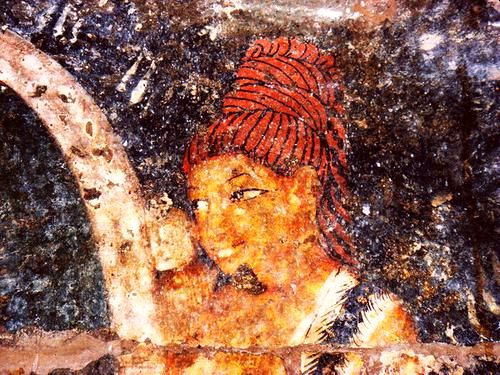
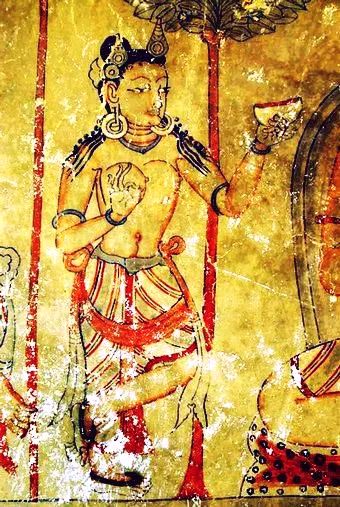
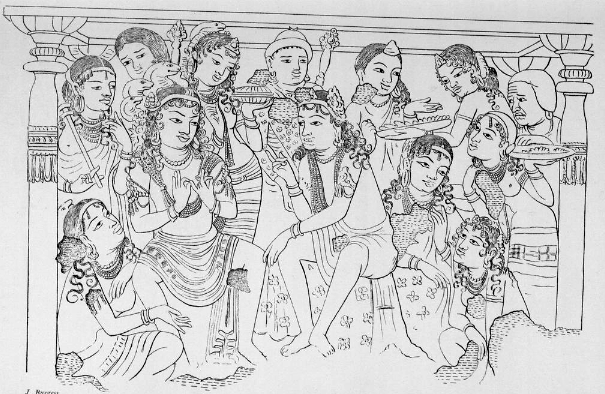
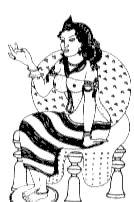
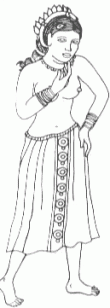
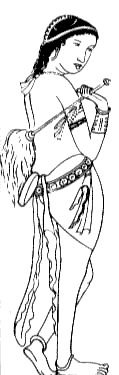
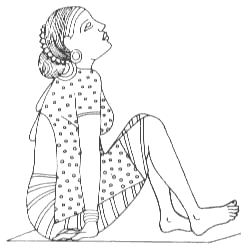
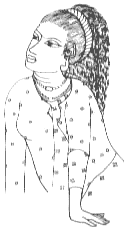
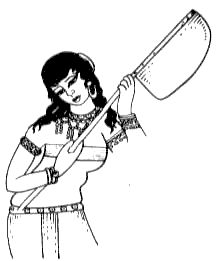
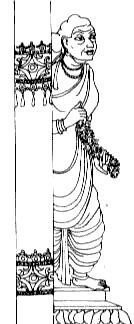
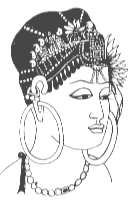
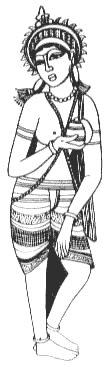
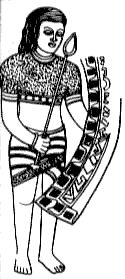
14.3. Among the pictures painted on the pillars, the figures of the dancers adorned with ornaments and distinctive hair styles; and displaying graceful dance postures are very attractive. They closely resemble the Apsaras (celestial maidens) of the Ajanta. 

Sittanavasal-Paintings

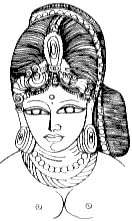
There are two dancers painted on western face of the two pillars, greeting those who enter the cave. However, the images are much weathered now; and, only upper the portions of the dancers remain. Apsara’s hair is tied together and is adorned with varieties of flowers. She wears necklaces around her neck. Her upper body is bare (as in the classical style of depicting the aristocracy) . It is likely that the full figure was depicted   with elaborate clothes below her waist.

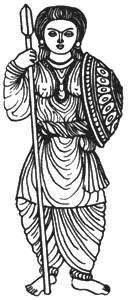
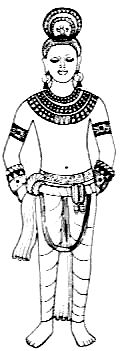
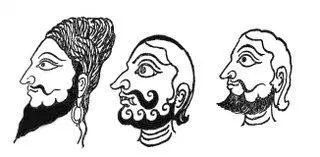
14.4. A painting on the southern pillar of perhaps the king and his queen has somehow survived. The benign looking male figure is adorned with an elaborate crown, ear-rings set in gems (patra-kundala and makara kundala). The female figure behind him is rather simple.

14.5. Canopies of vivid patterns are painted on the ceiling over the images of Thirthankara Parshvanatha a Jain Acharya (preceptor) employing the lotus motif.

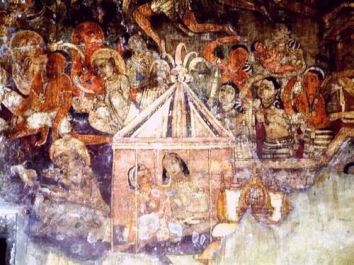
15.1. The most important mural of Sittannavasal is the exquisite composition depicting the delightful Jain heaven. The painting depicts Sama-vasaranathe adorable heavenly pavilion with theBhvyas, the eligible souls fortunate to receive divine discourse in the Samava-sarana.

The termSamavasarana (Sama avasarana) means an assembly which provides equal opportunities for all who gather there. Samavasarana, in Jain literature denotes an assembly of Thirthankara.  At this assembly different beings – humans, animals and gods – are also present to behold the Thirthankara and hear his discourses. The common assembly, at which different beings are gathered for one purpose, treats all alike overriding the differences that might exist among them. A  Samavasarana is thus, a tirth, a revered place.

According to Jaina faith, the Bhavyas have to pass through seven bhumis or regions before they gain eligibility to listen to the divine discourse. Among these bhumis, the second bhumi is the khatika-bhumi (region-of-the-tank).

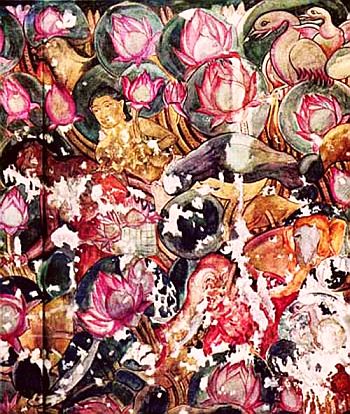
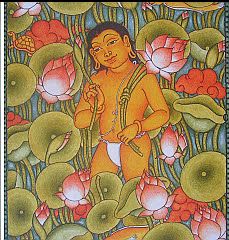
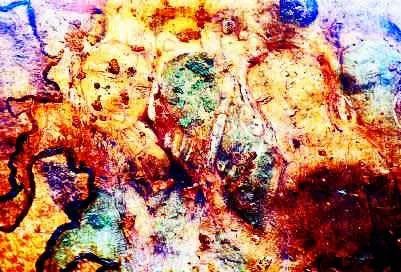
The Sittannavasal mural depicts the joyous scenes at this divine lotus tank.  It pictures bhavyas amusing themselves in the delightful lotus tank full of lotus flowers, fishes, birds and animals.

It is a picture of sublime happiness, where the Bhavyas happily gather, with tender care, lotus flowers larger than themselves, while elephants appear to smile; and the bulls, birds and fishes are in playful mood. The figure of the bhavya is made with a lilting grace, like the stalks of the lotuses he gathers. It is a gracious world.

Line drawing

the detail

15.2. The lotus with their stalks and leaves, and the birds, fishes, bulls and elephants are utterly simple and beautiful in their natural charm. Some art critiques have remarked, this might be one of the most beautiful depictions of flowers in ancient Indian art.

These flowers attract viewer’s attention due to their sheer size and bright colours. This bright colour fades gradually towards inside of flower. These flowers are depicted in various stages of development, from a bud to a well blown flower. The bright red lotus with green leaves and thin stem presents a very pleasant sight.

There are three buffalos in this lake, one totally submerged and two in state of getting out of the lake as men approach. There are three men in the lake who are shown collecting flowers. Elephants are shown carrying lotus stems and in process of handing those to nearby men. One of them is holding a basket to place flowers into it. These men probably represent Jaina monks who are getting flowers for offerings to their teachers. Smile on their faces suggest that they are happy and content.

15.2. The unique features of the Indian art are seen here, where humans share the joy of life with the animals, birds and plants. It is a celebration of life, even in after-life. It echoes the spirit of life immortalized in an inscription at Ajanta: “The joy of giving filled him so much that it left no space for the feeling of pain.”

It seemed to convey “Every leaf, every flower, every ant, deer, elephant and human form is filled with the same joyous spirit that flows through and connects all that there is in the world”.

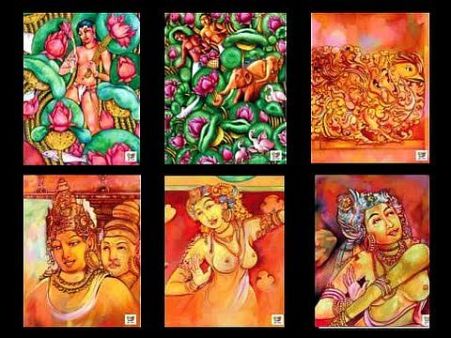
Please see reproductions of some of the ancient paintings of Sittanvasal

sittanvasal

lotus_sasi

Next

The Panamalai temple of the Pallava times

Resources and References

http://www.pudukkottai.org/places/sittannavasal/03sittannavasal.html

http://indian-heritage.org/swaminathan/sittannavasal/Sittannavasal%20-%20a%20booklet.pdf

http://indian-heritage.org/swaminathan/sittannavasal/arivar.html

http://narajin.net/g2data/main.php?g2_itemId=1602

http://indian-heritage.org/swaminathan/sittannavasal/arivar.html

http://puratattva.in/2011/05/02/sittanavasal-the-legacy-of-chitrasutra-13.html

All pictures are from Internet


Tags: , , , , , ,

The Legacy of Chitrasutra- Three – Badami

[This is the third article in the series.

This article and its companion posts may be treated as an extension of the series I posted on the Art of Painting in Ancient India .In the present set of articles , I propose to talk , briefly, about the influence of Chitrasutra – its outlook, its theories and its recommended practices – on the Indian mural paintings. In this process I propose to cover some , not all , of the main mural paints of India that succeeded Ajanta , such as : Pitalkhora (c.6th century), Badami (c, 6th century), Sittannavaasal (c.7th century), Pannamalai (7thcentury), Kailasanatha – Kanchipuram (8th century),Brihadeshwara – Tanjore (11thcentury), Lepakshi (16th century), Mattancheri (c.17th century) and Padmanabhapuram palace (18th century).I propose to round it up the discussion with a note on the sublime paintings of Shri S Rajam , who kept alive the tradition of Chitrasutra in the modern times.

The first article was meant to serve a brief introduction to the subject outlining the characteristics of the Chitrasutra tradition.

The present article attempts to give an account of the murals at Badami.]

Continued from the Legacy of Chitrasutra- Two-Pitalkhora

Badami

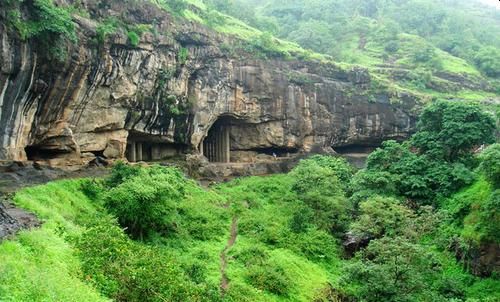
Badami caves, Karnataka

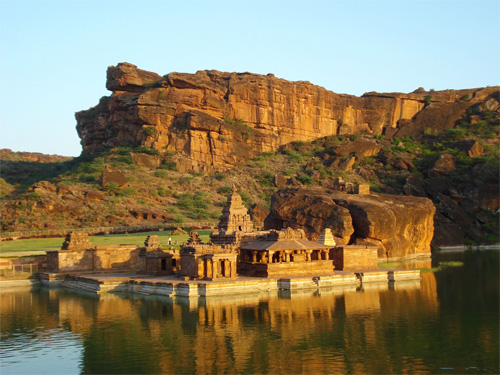
8.1. Badami, along with Aihole, Pattadakal and some other sites in and around the valley of the River Malaprabha in Bagalkot District of Karnataka, contain some of the earliest temples built in stone in the regions of Southern India.  Badami known as Vatapi in the earlier times, founded in 540 AD by Pulikeshin I was the capital of the early Badami Chalukyas from 540 to 757 AD.

Badami 2

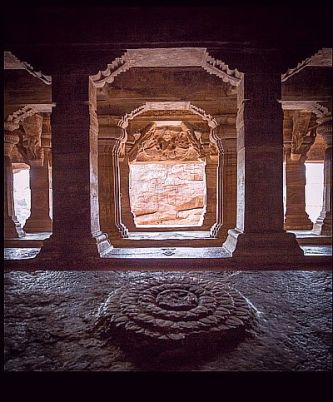
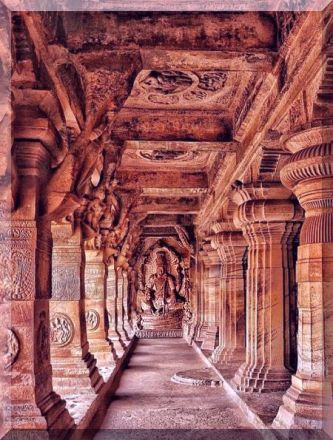
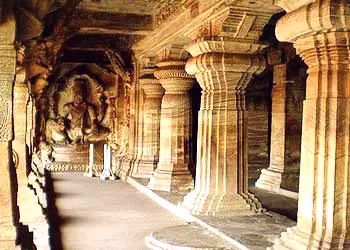
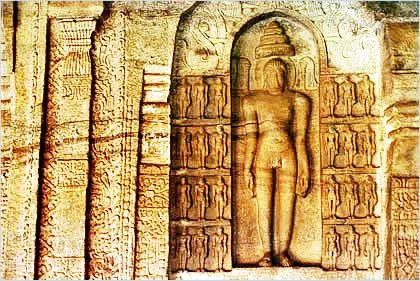
The rock-cut cave temples of Badami located in a ravine at the foot of rugged sandstone rock formation were carved and sculpted mostly during the 6th and 8th centuries. However, the history of construction of monuments in stone go back much farther in time, as evidenced by the large number of megalithic monuments that are distributed at several sites in the Malaprabha Valley.

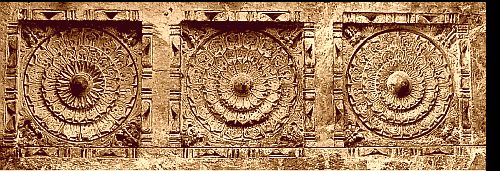
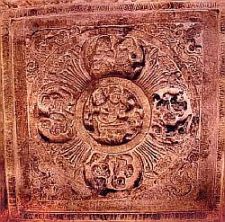
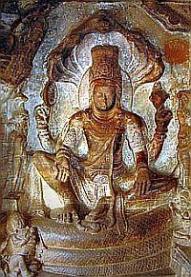
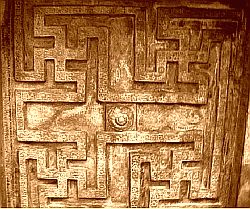
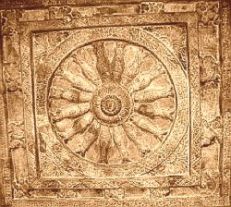
The ceiling designs in the Badami temples are highly intricate; and, are decorated  with  stylized padma-vitāna, lotus-ceiling involving radial symmetry, and concentric borders enclosing lotus motifs.

Badami ceiling designs 2

The four cave temples depict the art of Hindu, Buddhist and Jain religious inclinations, evidencing the secular outlook and religious tolerance of the ancient Kings of Badami. The rock cut temples at Pattadakal (UNESCO world heritage monument), Badami and Aihole are among the most celebrated monuments of ancient India.


8.2. It is said; the cave temples of Badami influenced the development of the rock-cut structures of Mahabalipuram. Rev H Heras SJ in his ‘Studies in Pallava History’ (SG Paul and Co, 1933) discusses in fair detail the similarities between the two groups of sculptures and traces certain features of  the statues and sculptures at Mahabalipuram to the caves of Badami. According to Rev Heras, soon after his accession to the throne the Pallava king Mahamalla Narasimhavarman I (ruled 630-668 AD), in retaliation, successfully attacked Vatapi (Badami) the capital of the Chalukyas. While at Vatapi, Mahamalla was greatly impressed by its extraordinarily well executed cave-temples; and particularly by cave No.3 the largest and most ornamented of all the Badami caves.

Badami ceiling motiff

Narasimhavarman was struck with admiration at the beauty in the architectural concept and the perfection of its execution in those elaborate cave-temples. Rev Heras asserts it is beyond doubt that the Pallava king studied the Chalukya style of cave building took designs of some of the architectural elements and motifs of ornamentation. He also broadened his views on stone carving and fostered in his mind new ambitious projects to emulate the artistic achievements of his enemies. And he did succeed.

badami

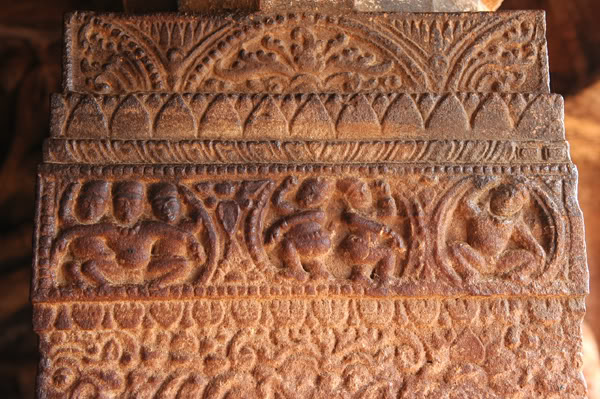
8.3 .Rev Heras points out striking similarities between the pillars the Varaha Mantapa of Mahabalipuram and the pillars in the veranda of Cave No.1 of Badami:” The same prismatic appearance; the same bulbous lotus-like development of the capital; the same interruption of the fluting by a band of filigree work; the same rosary-like garlands “. He also points out that Mahamalla adopted the Badami style of decoratively covering the side-walls with large sculptural panels displaying elaborate figures that resemble the Badami depictions. For instance Varaha, Vamana, Gaja-Lakshmi and Durga in Cave No. 2 and Cave No. 3 of Mahabalipuram closely follow in their depiction the figures of the Badami caves. Rev Heras remarks; the statues and sculptures of Mahabalipuram are plainer than those of Badami; there is neither profusion of ornamentation nor richness of details. But the figures of Mahabalipuram seem richer with their’ naturalness s and freshness of the poses ‘that is   not found in the more conventional panels of Badami.

badami.jpillars pgvishnu badami d1613

8.4. It is remarkable; while the cave temples of Badami influenced the carved structures of Mahabalipuram, about a century later the Pallava temples influenced the style, structure and depiction of the Chalukya temples. Over a period the two rival schools enriched each other giving place to composite styles of sculpture and architecture.  

Badami swasthika Badami chakra

Paintings

9. Though its exquisite carvings and sculptures are fairly well preserved, the murals in the Badami caves have all but vanished. Only a few fragments of the paintings tucked away in the concave surfaces of the vaulted cornice of the 3rd and 4tn cave have survived. They are perhaps the earliest surviving specimens of the Hindu wall paintings.

578 CE Mangalesha Kannada inscription in Cave temple 3 at Badami

Badami inscription of Mangalesha

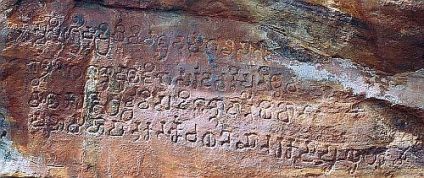
An inscription dated 578 AD records, in Kannada language; the caves were completed during the reign of King Mangalishwara (aka Mangalesha) son of Pulikeshin I. The wall paintings might therefore have been executed during that period. Some other paintings in cave 4 might belong to a later period (6-7th century) as they appear related to paintings in Cave 1 of Ajanta, depicting the visit of a Persian emissary to the court of Pulakshin in 625 AD.

pulakesin

10. It is likely that the caves were earlier painted and fully decorated. The fragment remains of the Badami murals still evoke the images of splendour and magi of the bygone eras. The remains of the Shiva and Parvathi murals, and of other characters from the Puranas ( in cave 3) strongly resemble the figures painted in Ajanta .

resemble

The mural in cave 4, dedicated to Adinatha Thirthankara, depicts Jain saints relinquishing the world for attainment of knowledge   , is truly uplifting.

adinatha

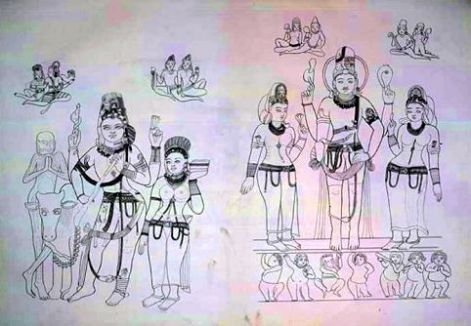
Pen-and-ink drawing of two sculptures from Cave I, Badami, depicting Harihara and Ardhanarishvara, by an  unknown Indian draftsman, dated 1853.

badami sketch

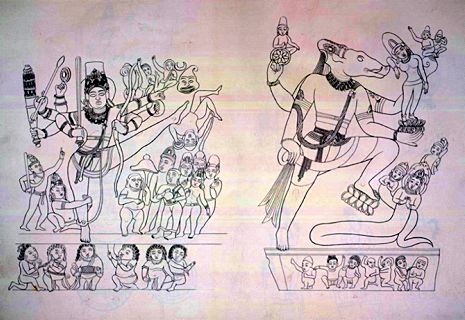
Pen-and-ink and wash drawing of two sculptures of Vishnu as Trivikrama and Varaha from Cave II, Badami

badami sketch 2

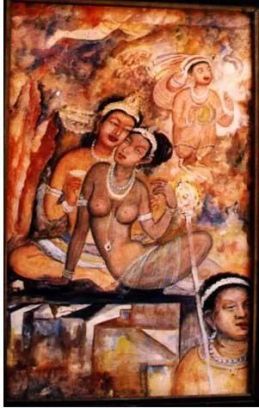
11.  The secular paintings too closely resemble the Ajanta paintings, thus carrying forward the tradition of the Chitrasutra. Shri SM Sunkad an artist from Hubli (Karnataka) has attempted reproducing a mural each from Ajanta and Badami and illustrating how closely they resemble in style.

sunkadsunkad2

http://gallery.passion4art.com/members/sunkad/picture.html

This was the commencement of Chalukya style of architecture and a consolidation of South Indian style.

chalukya

Next

— Sittanvaasal->

 References:

http://en.wikipedia.org/wiki/Badami_Cave_Temples

http://gallery.passion4art.com/members/sunkad/picture.html

http://www.indiamonuments.org/

http://indiabackpacker.blogspot.com/2008_11_01_archive.html

All pictures are from Internet


Tags: , , , ,

The Legacy Of Chitrasutra- Two-Pitalkhora

[This article and its companion posts may be treated as an extension of the series I posted on the Art of Painting in Ancient India .In the present set of articles , I propose to talk , briefly, about the influence of Chitrasutra – its outlook, its theories and its recommended practices – on the Indian mural paintings. In this process I propose to cover some , not all , of the main mural paints of India that succeeded Ajanta , such as : Pitalkhora (c.6th century), Badami (c, 6th century), Sittannavaasal (c.7th century), Pannamalai (7thcentury), Kailasanatha –Kanchipuram (8th century),Brihadeshwara – Tanjore (11thcentury), Lepakshi (16th century), Mattancheri (c.17th century) and Padmanabhapuram palace (18th century).I propose to round it up the discussion with a note on the sublime paintings of Shri S Rajam , who kept alive the tradition of Chitrasutra in the modern times.

The first article was meant to serve a brief introduction to the subject outlining the characteristics of the Chitrasutra tradition.

The present article attempts to give an account of the murals at Pitalkhora.]

Continued from the Legacy of Chitrasutra- One

The previous post viz. The Legacy of Chitrasutra- One  tried to present, as a backdrop, an outline of the general principles of the Chitrasutra tradition: its outlook, its concepts and theories; and its recommended practices. As mentioned, the school of Chitrasutra wielded enormous influence on the artists of the sub-continent, over about fifteen centuries. We shall now look at some celebrated murals of ancient India, which either belonged to the period of Ajanta or to sometime thereafter.

Pitalkhora

6. The caves

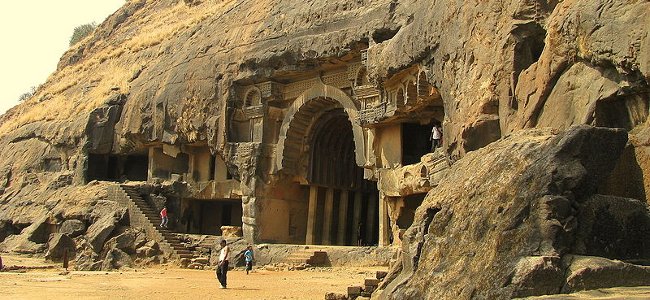
6.1. The Buddhist caves at Pitalkhora are the closest to Ajanta; both in terms of space and time. They too are situated in the Aurangabad region of Maharashtra; about 40km west of the famous rock- cut temples at Ellora. The Pitalkhora caves are cut into the side of a secluded ravineand are located deep inside a valley with a gentle stream running through it.

6.2. The set of fourteen caves of early- Buddhist period are similar to Ajanta; and are dated around second or third century BCE. Some scholars identify Pitalkhora with ‘Petrigala’ mentioned in Ptolemy’s history and with ‘Pitangalya ‘mentioned   in a Buddhist tantric text Mahamayuri of 3-4th century AD. The inscriptions found here (c. second century) indicate that ‘Pitangalya ‘had close connections with Pratishtana (modern Paithan), the capital of the Imperial Shatavahanas. Pitangalya was also an important trade centre along the caravan -route from Surparaka (Sapora) to Nasik, further north.

A unique feature of Pitalkhora is its ingenious arrangement to drain out the seepage that found its way into the cave through cracks in the rocks. Long tunnel like openings were bored into the ceilings and the water was channelled underneath the cave floor, in concealed drains, leading to outside cave entrance.

Pitalkhora caves occupy a significant place among the ancient Buddhist monuments of 2 C B.C. But, sadly the caves are in a poor state of preservation.


6.3.  Pitalkhora consisting of 14 Buddhist Caves forms one of the earliest centres of the rock-cut architecture; and are said to belong to about 2nd C BCE. The architectural and sculptural representations are similar to that of the Sanchi stupa; and are approximately of the same period. The sculptural remains at Pitalkhora include some   unusual sculptures; such as those of the wonderful animal motifs, miniature Chaitya windows, the elephants, yaksha (semi divine beings), dwarapala  (door-keepers) and mithuna (twin ) figures.

7. The paintings

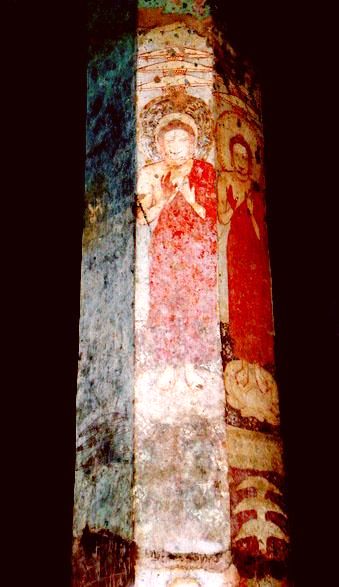
7.1. As regards the paintings, only a few fragments of the murals dated around 5-6thcentury AD (of the time of Ajanta murals) can be seen in the Chaitya and Monastery Caves. The best paintings are in Cave 3. These appear on the pillars and side walls. They bear a strong resemblance to Ajanta style of painting; carrying forward the tradition of the Chitrasutra.

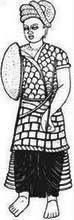
7.2. This is evident from the gentle expression and typical soulful eyes (characteristic of the Ajanta) depicted in the figure of a worshipper in a Pitalkhora fragment. The hair- do and colour scheme of the Pitalkhora fragment resembles greatly the Ajanta figures.

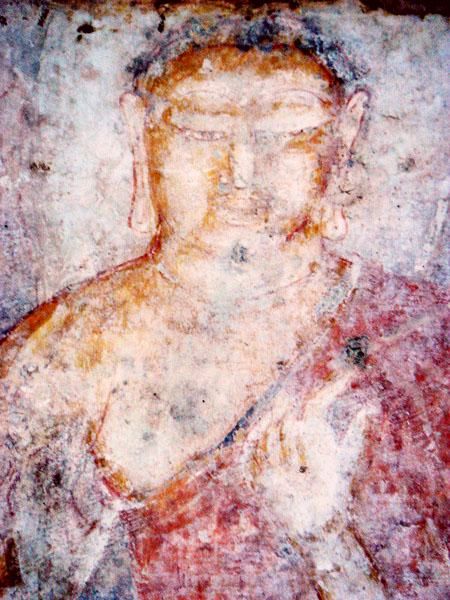
7.3. The Buddha figure to with its benign countenance and soulful eyes does resemble the Ajanta.

****

Next

The rock-cut cave temples of Badami, in North Karnataka, carved and sculpted mostly during the 6th and 8th centuries, depicting the art of Hindu, Buddhist and Jain religious traditions.


References:

http://www.devi.org/pitalkhora.html

http://lavanya-indology.org/pitalkhora.html

http://asi.nic.in/asi_monu_whs_ellora_pitalkhora.asp

http://www.indiamonuments.org/Pitalkhora.htm

All pictures are from Internet


Tags: , , ,

The Legacy of Chitrasutra – One- Introduction

[This article and its companion posts may be treated as an extension of the series I posted on the Art of Painting in Ancient India. In the present set of articles, I propose to talk, briefly, about the influence of Chitrasutra – its outlook, its theories and its recommended practices – on the Indian mural paintings.

In this process I propose to cover some , not all , of the main mural paints of India that succeeded Ajanta , such as :  Pitalkhora (c.6th century) , Badami (c, 6th century), Sittannavaasal (c.7th century), Pannamalai (7th century), Kailasanatha-Kanchipuram (8th century), Brihadeshwara -Tanjore (11th century) , Lepakshi (16th century), Mattancheri (c.17th century) and Padmanabhapuram palace (18th century). I propose to round it up the discussion with a note on the sublime creations of Shri S Rajam, the classical painter who kept alive the tradition of Chitrasutra in the modern times.

The present post is a brief introduction to the subject outlining the characteristics of the Chitrasutra tradition. This will be followed by an account of the murals at Pitalkhora and Badami in the next section.]

newari

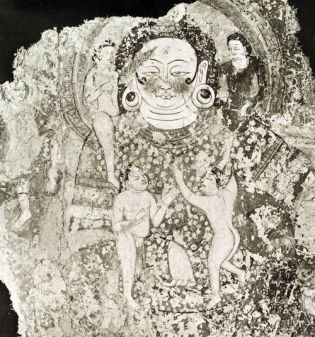
From  the caves of Newari region on the borders of Nepal and China(8-9th  cent)

1. Indian murals

1.1. Murals in India date back to times beyond the pages of history. India has a rich tradition of mural wealth. The treatises such as Vishnudharmottara, Silpashastra, Manasollasa, Shilparatna, Narada-shilpa-shastra and Kashyapa-shilpa, discuss at length all aspects of painting, including murals. The murals are perhaps the only surviving examples of ancient Indian painting.

1.2. The Chitrasutra of Vishnudharmottara describes itself as a “legacy of the collective wisdom of the finest minds”. That legacy inherited by the Chitrasutra was, in turn, carried forward by the scores of artists, spread across the centuries, who produced priceless works of art. Those were acts of intense devotion and dedication. The earliest surviving of those works of art are the murals at Ajanta, which we have already discussed. The decorative motifs, richly populated compositions, well defined figures, appropriate costumes and adorations are some of the notable features of the Ajanta mural paintings. The tradition of Chitrasutra and Ajanta was nurtured, practiced and kept alive in other parts of the country, during the next fifteen centuries. The widespread acceptance and a sustained propagation of the principles of Chitrasutra in a country of diverse cultures and religions, is one of the marvels of ancient India. Some residuals of those ancient murals have somehow survived to this day.

sigriyasri lanka

Sigiriya-Sri Lanka

1.3. The Chitrasutra tradition, in a way of speaking, was the unobtrusive soft silken bond that tied the country together in a common cultural web, by providing idioms of art expressions that all could share and regard it as their own. It put into the hands of the artists a well structured grammar of painting. Chitrasutra was an inclusive and a unified tradition of painting. One of the main characteristic of this tradition was its remarkable unity and consistency. Though there were regional variations and individual styles, the works produced in diverse geographical and cultural regions shared certain common values, concepts and techniques. And, all those varied   manifestations were inspired by the general principles of Chitrasutra. The regional idioms, nevertheless, contributed to the richness of Indian art, and their mutual influences gave birth to multi-faceted development of Indian art.

2. Outlook

2.1. Chitrasutra tradition was at once Hindu, Buddhist and Jain; for its style was a function of time and region; and, not of the religion. It is not, therefore, strictly correct to speak of Hindu or Buddhist art; but, rather of Indian art that happened to render Hindu or Buddhist themes. For example, an image of Vishnu and an image of Buddha of the same period are stylistically the same; the religion having little to do with the mode of artistic expression. Apart from that, the Indian art that rendered the religious themes shared a common pool of symbols, gestures (mudras) and a common set of values that avoided imitation of the physical and ephemeral world of the senses.

Let me try to illustrate this aspect. In all  the Hindu , Jain and Buddhist themes , alike, the Chakra – the revolving wheel of time symbolizes the cyclical rhythms of all existence;  the Padma – or the lotus embodies creation – that springs from the bosom of the earth; the Ananta (represented as a snake) symbolizes  water – the most important life-giving force from which all life emerges, evolves  and then resolves; the Swastika – represents  the four-fold aspects of creation ,motion and a sense of stability ; the Purnakalasha the over -flowing pot symbolized creativity and prosperity; the Kalpalata and Kalpavriksha –  the wish-fulfilling creeper symbolize  imagination and creativity; and Mriga or deer – symbolizes  desire and  fleeting beauty.

mriga

Similarly, the gestures (mudra) by positioning of fingers, hands, limbs etc. , making explicit the virtues such as wisdom, strength, generosity, kindness and caring etc. are employed and interpreted commonly by all the persuasions.

3. Concepts

3.1. There is a marked absence of portraitures in the ancient murals. One rarely comes across the physical representations of the monarchs or the patrons who caused the paintings to be done. This could be viewed as one of the strength of Indian art. It strived to move away from the ephemeral towards the long lasting; and from particular to universal. It also meant that the ancient Indian kings were not vain enough to assume their portraits would override the art.

3.2. Even in cases where the figures of kings and queens were depicted, the emphasis was on the ideal person behind the human lineaments rather than on their physical likeness. Most of those kings and queens were celebrated in their idealized forms. Their representations were therefore visualized or abstract rather than “photo-like”.

3.3. That approach seems to have sprung from the concern of the artist not to just reproduce the forms but to look beyond the tangible world of appearances. The Chitrasutra suggested, the artist should try to look beyond the beauty of the form that meets the eye; to lift the veil and look within. It asked him to look beyond “The phenomenal world of separated beings and objects that blind the reality beyond”.

makara

3.4. The art expression was, therefore, not about how the world appears to one and all, but how the artist would experience and visualize it. In other words, the Chitrasutra tradition emphasized that art was more than photographic reproduction of visible objects. It was about the experience of a person and his expression of it through art; and about his unique creative genius, imagination, enterprise and individuality as an artist. Its purpose was to present that which is within us; and to evoke an emotional response (the rasa) in the viewer’s heart.

ambika

3.5. The Indian murals are rich in expressive realism. For instance, the Paintings at Ajanta, Bagh and Sittanvasal testify to a love of naturalism – both in the depiction of the human form and in the depiction of nature.  Yet, they always seem to suggest to something beyond the obvious.  They not merely stimulate the senses but also ignite the imagination of the viewer. That experience, according to Chitrasutra, sets the individual free from the confines of place, time and ego (self).

3.6. That aspect brought into the fore the concept of the abstract; and with it a whole set of symbols and symbolisms.  Further, the objects in nature were visualized or personified endowing each with a distinct personality. That enabled rendering the absolute and the undefined, into tangible visual forms. It, in turn, gave rise to a tendency to draw abstractions from nature in a manner that was both aesthetically pleasing and very effective as decorative embellishment.  Painting also developed into a medium for expressing visual fantasies. The elements of natures like rivers, sun, moon etc   were personified bringing out their virtues and powers through eloquent symbolisms.  Birds and flowers, trees and creepers too were depicted with a loving grace and tenderness. In certain cases, idyllic nature scenes were created just to convey a sense of joy and wonder.

joy and wonder

3.7. The virtues and powers of the gods and demons too were made explicit by employing varieties of forms, symbols and abstract visualizations. The ancient Indian artist thus enjoyed far greater artistic liberty, freedom and felicity of expression as compared to his peers in the western world. That was made possible mainly because the Chitrasutra encouraged innovation and display of imagination. The text said, “Rules do not make the painting; it is the artist with a soul and vision who creates the art expressions”.

sarpa shiva

The Indian murals indicate that its artists took full benefit of the license granted by Chitrasutra. Its artists did not strictly adhere to the prescriptions of the texts, but improved upon them and instilled a life, rhythm and vigour of their own in the murals.

kuruk

3.8. Chitrasutra while discussing the depiction of deities says, those qualities that we admire in a divine being are within us. When we respond to those images brought to us in art, we awaken those finer aspects that are latent in us. When we are filled by that grace, there is no space left for base desires and pain: we have become that deity.

The murals of India have that magical quality, which brings out the essence of life and the grace that permeate the whole of existence

4. Techniques

technique

4.1. Traditional Indian texts have a three-fold classification: bhumikabhitti and prastara — floor, wall and ceiling respectively. Murals in South India, for that matter in India, are not the fresco type of paintings. In the present-day context the wall paintings are usually called murals (derived from the Latin root murus, meaning wall).The other term used to describe wall paintings is fresco , which generally refers to buon fresco, or ‘true fresco’ where colours mixed with water is painted directly on wet plaster. There is also fresco secco, or ‘dry fresco’ where the painting is made on dry surface. Most of the Indian murals, including the Ajanta murals, are painted on dry plaster.

4.2. One of the noticeable features of the Chitrasutra tradition is the deployment of its lines; delineating beautiful figures and their delicate inner feelings through graceful, steady, smooth and free flowing lines that capture the essence of a picture, in least number of lines. Its line-drawings are full of grace and vitality. The delicate touches and intimate details added   enliven the paintings.   The Simplicity of expressions symbolized the maturity of the artists.  Chitrasutra did not favour straight or harsh or angular or uneven lines.

4.3 . There is a natural quality and grace in the ancient murals; they almost seem effortless. The vigour, the strength and the power of a heroic figure are brought to life by the vitality of its lines; not by his fat muscles or his sheer size. Even the demons in the murals are never depicted as muscular or excessively fat. . The outlines are strong and very sure and there is an easy and natural depiction of volume, evidencing a good understanding of the rhythm and the structure of the human body.

Ajanta.2 jpg

4.4. The figures were never rigid and static. Their stances were always suggestive of flowing movements of languid grace and charming rhythm. Their display of the sense of balance is lovely. The painted figures of the “heroes” present a profound sense of peace and joy even while placed amidst activities and contradictions of life.

heroes

4.5. The Chitrasutra tradition regarded the eyes as the windows to the soul. And, it said, it is through their expressive eyes the figures in the painting open up their heart and speak eloquently to the viewer. It therefore accorded enormous importance to the delicate painting of the soulful and expressive eyes that pour out the essence of the subject. The lively sets of lustrous pools of eyes continue to influence generations of Indian artists; those eyes are, in fact, a hall mark of Indian art works.

eyes

Benoy K Behl  the scholar and art-historian remarks, ”This stylization, increasing linearity and the protrusion of the farther eye, which extends beyond the line of the face, are significant changes that take place in the paintings of Ellora. In later years, these are reflected in paintings over the whole of India”.

4.6. The other was use of proper colours:  soft and subdued, the lines firm and sinuous and the expressions true to life. The colours, at times contrasting and at times matching were artistically employed to create magical effects. That effect was enhanced by the skilful shading of the body-parts,  giving them a three dimensional appearance; and providing depth to the picture.

Next

5.  After this brief introduction let us now turn to some of the celebrated murals of ancient India, which display the characteristics and influences of the Chitrasutra tradition that we so far discussed . To begin with let’s look at the ancient murals at Pitalkhora (Maharashtra –c. 6th century) and Badami (Karnataka –c.6th century) in the next section.

References:

Legacy of Ajanta: by Benoy. K. Behl

http://www.hinduonnet.com/fline/fl2021/stories/20031024000107000.htm

Developments in Indian Art and Architecture: http://jigyasa0.tripod.com/art.html

All pictures are from Internet


Tags: ,

Ritu Varnana and Barahmasa

From: Venetiaansell 

Dear Dr Rao, I read your post on sharad rtu with great interest.  I am a student of Sanskrit and currently doing some research on the description of each rtu and in particular the flowers associated with each and would be interested to know more. Can you recommend any good books or articles about rtuvarnana in Sanskrit literature? I look forward to hearing from you. Best, Venetia

Ritu

Creation of the Artist Kailash Raj

A. Ritu- varnana in Sanskrit Literature

1.1. Dear Venetiaansell , Greetings. The phenomena of the seasons, day and night, birds and beasts and flowers, are often employed  in Sanskrit poetry to frame human emotions, or are personified as counterparts of the human subjects of the poet. And, throughout the literature, a deep love of nature is implicit, especially in  the poems of  Kalidasa; who, for this reason , among others, is regarded very highly.

Kalidasa’s Meghadutam, a work of little over 100 verses, has always been one of the most popular of Sanskrit poems. Its theme has been imitated in one form or another by several later poets both in Sanskrit and in the vernaculars. As compared to similar other  Indian poems of that nature, this work has unity and balance; and, gives a sense of wholeness that is rarely found elsewhere. In its small compass, Kalidasa has crowded so many lovely images and word-pictures that the poem seems to contain the quintessence of the  whole of Indian natural scenery.

As regards the ritu- varnana in its proper natural sequence, the most renowned, of course, is again  that by the Great Kalidasa in his various poetic works, and especially in the Ritu-samharam, the melody of the seasons or the garland of the seasons, running into six cantos describing the six seasons of the year; and how with each change in the season, the mood and behaviour of a young lover too would alter. In his other work, the Meghdootam, the intensity of the lovelorn Yaksha is far deeper. However, he weaves his yearning around the clouds; and thus, the description is confined to the rainy season.

In Kalidasa’s romantic poetry; graceful sensuality, colours and the music of love resonate with the world of blossoms and birds. The urges and pains of his nayaka and nayika are shared by the deer, birds, trees and the sky. It is a world where trees long for the touch of a lovely woman as much as a man longs for her embrace.  There is an unspoken bond between the song of the peacock and the lament of the separated lover. The messages of love are conveyed through clouds; and , the changing seasons mirror the changing colours of love.

Kalidasa’s nayika adorns herself with blossoms and sprouts of the forest as ornaments ; and decorates her lotus-like feet with the red dye from the forest flowers and herbs . She is decked in various fragrant flowers; a padma in her hands; kunda blossoms in her hair; the pollen of lodhra flowers on her face; the fresh kurbaka flowers in her braid ; the lovely sirisha flowers on her ears (Karna-avatamsam) ; and, the nipa flowers that bloom in the parting of her hair .

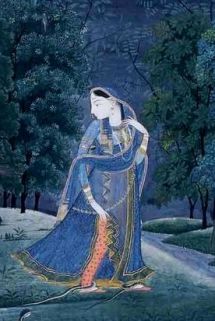
The nocturnal path of the lovelorn abhisarika nayika is traced   at dawn by the mandara flowers that have fallen from her hair and the golden lotuses that have slipped off her ears (Ritusamharam 2.11-12). Kalidasa’s nayika is not a mere mortal but a yakshi, the very life and spirit of a tree; and the trees mirror her exuberant ardour.’ 

Abhisarika

Kalidasa’s virahini-nayika of the Meghadutam, separated from her lover; like a lotus deprived of the sun ; like a solitary Chakravaka bird isolated from her mate ; and, crestfallen like a lotus withered by winter, is a chaste lovelorn woman, pining for her lover.

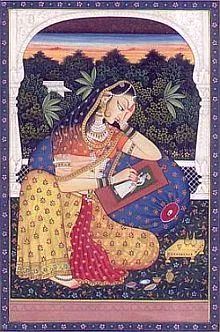
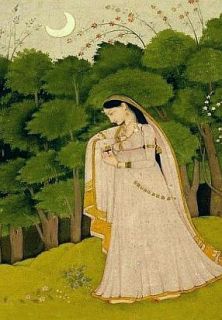
She sits with her face resting in the cup of her palms, her locks covering her face as clouds cover the moon. She spends her time alone in  her bed with her ornaments cast off;   counting the days of her separation  by placing flowers on the threshold ; by painting the likeness of her beloved , singing songs reminiscent of her lover  and talking to the Sarika bird (Meghadutam 2.20-2.33).

virahini

The Virahini Nayika sends messages to Krishna through her maid .

Krishna message

There is a certain dignity in her poignancy; a  grace in her sorrow. The colors of her pathos resemble that of the wilted flowers and the movements of her eyes and limbs speak of her pain even when her words do not.

If Kalidasa’s Meghadutam is the epitome of the virahini in early Sanskrit poetry, his Ritusamharam is the poetic testimony of how intimately the loves, pathos and lives of the human are tied with the colours and sounds of the seasons. Of all the seasons’, vasanta or spring is especially important to those in love, for the blossoms of spring are like the arrows of Kama. Red is the colour of the spring season everywhere and it is when:

The mango tree bent with clusters of red sprouts kindle ardent desire in women’s hearts

The ashoka tree that bears blossoms red like coral makes the hearts of women sorrowful

The atimukta creepers whose blossoms are sucked by intoxicated bees excite the lovers

The kurabaka tree whose blossoms are lovely as the faces of women pain the hearts of sensitive men

The kimsuka grove bent with blossoms, waved by winds, appears like a bride with red garments.   — Ritusamhara (15–20)

sugandhikālāgurudhūpitāni dhatte janaḥ kāmamadālasāṅgaḥ // KalRs_6.15 //
puṃskokilaś cūtarasāsavena mattaḥ priyāṃ cumbati rāgahṛṣṭaḥ /
kūjaddvirephāpyayam ambujasthaḥ priyaṃ priyāyāḥ prakaroti cāṭu // KalRs_6.16 //
tāmrapravālastabakāvanamrāś cūtadrumāḥ puṣpitacāruśākhāḥ /
kurvanti kāmaṃ pavanāvadhūtāḥ paryutsukaṃ mānasamaṅganānām // KalRs_6.17 //
āmūlato vidrumarāgatāmraṃ sapallavāḥ puṣpacayaṃ dadhānāḥ /
kurvantyaśokā hṛdayaṃ saśokaṃ nirīkṣyamāṇā navayauvanānām // KalRs_6.18 //
mattadvirephaparicumbitacārupuṣpā mandānilākulitanamramṛdupravālāḥ /
kurvanti kāmimanasāṃ sahasotsukatvaṃ bālātimuktalatikāḥ samavekṣyamāṇāḥ // KalRs_6.19 //
kāntāmukhadyutijuṣāmacirodgatānāṃ śobhāṃ parāṃ kurabakadrumamañjarīṇām /
dṛṣṭvā priye sahṛdayasya bhavenna kasya kandarpabāṇapatanavyathitaṃ hi cetaḥ // KalRs_6.20 //

Vasanta is also the season when cuckoos sing in indistinct notes; the bees hum intoxicating sweet sounds; and, the travelers separated from their lovers lament. Kama the god of love who wages a war, as it were, on those in love,  fashions his arrows from the mango blossom; his bow from the kimsuka flower; the bowstring from a row of bees. His parasol is the moon; and, he wafts the gentle breeze from the Malaya mountain whose bards are the cuckoos (Ritusamharam 28).

Krishna Radha2

1.2. Another poet and playwright , Rajashekhara (Ca.9th century) in his Kavyamimamsha , a treatise on poetry summarized , for the benefit of the aspiring poets essaying to portray seasons in their works , how the seasons were portrayed in the poetic works prior to his time. In addition, he collated the standards as authorized by the texts. Rajashekhara came up with comprehensive season- descriptions, outlining each season’s basic characteristic features, months-wise divisions, individuality of each month, and the imagery that a poet should preferably employ for representing a season. He also deduced the natural human responses to a given season.

1.3. The great poet Dandin (Ca.6-7th century) renowned for his colorful Sanskrit prose, too, in his Kavyadarsha (‘Mirror of Poetry’) the handbook of classical Sanskrit poetics, mandated that a classic work of poetry (maha-kavya) should essentially include eighteen (ahsta-dasha varnana) types of descriptions including that of the

  • city (nagara);
  • ocean (saagara);
  • mountains (shaila) ;
  •  seasons (vasantadi ritu);
  • the moon;
  • the sun rise and sunset (chandra-surya udaya –asthamana);
  • parks (udyana);
  • strolling in the gardens (vana vihara);
  • water-sports (jala krida) ;
  • pleasures of wine and love making (madyapana surata);
  • wedding (vivaha);
  • discussions with the wise (vipralamba) ;
  • pangs of separation (viraha); 
  • birth of sons (putrodaya);
  • state-craft (raja-mantra);
  • gambling or sending messengers (dyuta);
  • wars (yuddha);
  •  campaigns (jaitra-yatra);  and,
  • accomplishments of the hero (nayaka abyudaya).

1.4. The description of seasons thus became an integral part of classic poetry . Apart from Kalidasa’s poetry, there are some beautiful heart-warming descriptions of the seasons in the poetic works of other notable poets too; for instance, as in: Bhattikavya by Bhatti; Kiratarjuniya by Bharavi; Shishupala-vadha by Magha; Naishadhacharita by Shriharsha among others.

2.1. The Natya-shashtra too had earlier directed how seasons should be represented in a drama, especially on the stage through an actor’s performance – acts, gestures, facial demeanours and other expressions.

2.2. The Puranas also evinced interest in season-description. The Matsya Purana has a whole chapter dedicated only to the month of spring; while the Samba Purana alludes to different colours of the sun in the six ritus. The Chitra-sutra in the Vishnudharmottarpurana (c.6th century) prescribes certain general rules for the depiction of each of the four seasons.

3.1. According to Chitrasutra of the Vishnudharmottarpurana, the depiction of each of the four seasons could be symbolically represented in the paintings by employing certain idioms of expression, such as:

Summer: languorous men seeking shade under trees, from the harsh summer sun; buffaloes wallowing in the mire of muddy waters; birds hiding under a thick abundance of leaves; and, lions and tigers seeking cool caves to retire in.

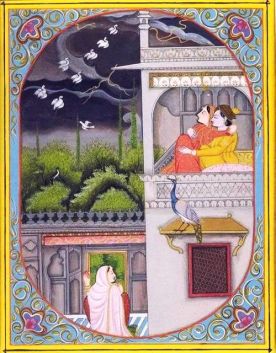
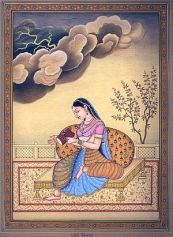
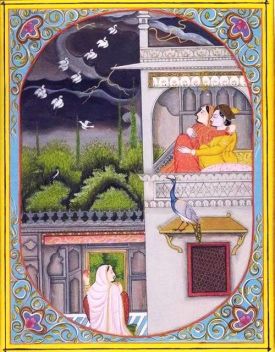
Rain: An overcast sky, with heavy rain filled clouds weighed down with their aquatic excess; flashes of lightning and the beautiful rainbow; animals like tigers and lions taking shelter in caves; and, sarus (cranes) birds flying in a row.

Autumn: Trees laden with ripe fruit; the entire expanse of the earth filled with ripened corn ready for harvest; lakes filled with beautiful aquatic birds like geese; the pleasant sight of blooming and blossoming lotus flowers; and, the moon brightening up the sky with a milky white lustre.

Winter: the earth wet with dew; the sky filled with fog; men shivering from the cold, but crows and elephants seem euphoric.

[A collection of learned essays by the great scholar Dr. V Raghavan ‘Rtu in Sanskrit Literature’ (1972) published by Shri Lal Bahadur Shastri Kendriya Sanskrit Vidyapeetha , Delhi, comprehensively deals with all aspects of Rtu varnana  in Sanskrit texts including Rig Veda and , epics and puranas.]

B. the Barahmasa tradition

baramasaBaramasa2

4.1. With the decline of classic Sanskrit poetry, the ritu-varnana found abundant expression in the Barahmasa tradition. Barahmasa meaning twelve months are based on the lunar calendar comprising months of Chaitra, Vaishakha, Jyestha, Ashadha, Shravana, Bhadrapada, Ashvina, Karttika, Agrahayana, Paushya, Magha and Phalguna. Each two of them are respectively the ritus or seasons of Vasanta, Grishma, Varsha, Sharada, Hemanta and Shishira.

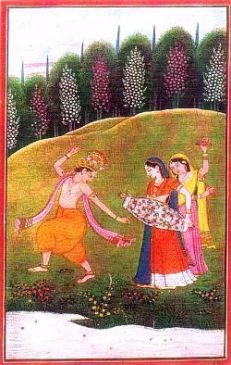
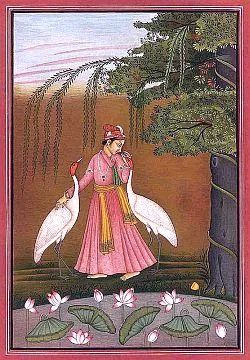
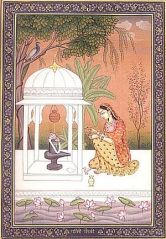
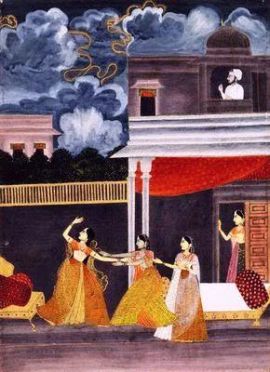
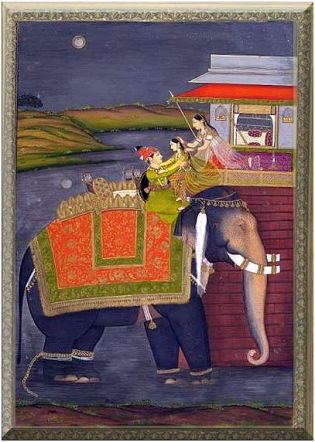
4.2. The glory and characteristic beauty of each season came to be celebrated in a specialized form of poetry, music and art (paintings) as Barahmasa, describing the splendour, aura and magic of nature as it emerges with the change of each season. The expressions of the ritu– theme were rendered highly eloquent with the emotive songs and music; as also by the exquisite miniature paintings depicting the glory and poignant character of each season woven into stories of tender love, separation and reunion.

4.3. The essential theme of the Barahmasa is the passionate yearning of lovelorn hearts, the pangs of separation that each change of season stimulates. Each month bringing a special message to the beloved, every season a special reminder of the joys of love and longing. The nature participates in the world of human emotions and mirrors the lovers’ or singer’s experience of tenderness and pain of love.

love lornlove lorn.j2 pg

4.4. The transformations in nature such as the gentle unfolding of a bud’s petals; or melting of a winter night into dew-drops; or the dark dreadful clouds rending with their roar the sky and the earth and frightening the lovely nayika into the arms of her beloved Nayaka and bursting forth into torrential rains – all become symbolic expressions of the seasons and the state of love of the ardent lovers. The Barahmasa depictions of poetry, music and painting, bind the two confronting worlds, the worlds of man and of nature into one thread.

Barahmasa Poetry

5.1. The Barahmasa Poets over the centuries have used the imagery of the Ritu Varnana or changing seasons to depict different facets of human emotions and moods, varying states of romantic love as they respond and change in accordance with seasons. The songs of the seasons resonate with the heart of the lover and the beloved. Nature as always forms the very companion of the yearning lovers.

5.2.In expressing her lament and relating it to the colours and moods of the seasons , nayika the heroine likens the throbbing of her heart to the pulsating sap of the trees; the trembling longing within her to the drifting movement of the clouds ; and , the agony of her forlorn state to the pain of lonely birds. She is not alone in her anguish; her piquant cry is heard by the deer, the birds and the blossoms that surround her; they too empathize and share her pain. In Barahmasa poetry there is a strong and sympathetic resonance between the heart of the nayika and the world of nature around her, it is a world that shares her romantic urges and longings.

Nayikanayika2

6.1.Let me add; the theme of Barahmasa occurs not merely in regional representations but in classical poetry too. Let’s, for instance, take the case of Kumarasambhava and the Ramayana. Both are epics; but, while the Kumarasambhava is a chaste classic observing all the mandated norms of poetics and other conventions,the Ramayana represents an amalgam of various folk traditions. In Ramayana, the poet attempts exploring the turmoil in the lovelorn heart of Rama the prince of Ayodhya in exile ,after separation from his beloved Sita , by placing his distress in contrast to the glowing beauty of the season; and picturing    how it affects Rama.

The poetry here truly transforms into a viraha song.  Rama describes to his brother Lakshmana the sublime beauty of nature that surrounds them; and gives vent to his grief of separation aggravated by the beauty that envelops him. Rama narrates the onset of monsoon in a rather intuitional manner describing the gathering of clouds ; and how they remind him of his brother Bharata and his friend Sugriva are with their wives and in their kingdoms while he is lonely and sad deprived of both.

Thus the vein of ritu-varnana in the Ramayana is closer to the Barahmasa convention. In contrast, the descriptions of nature in Kumarasambhava, in the context of Parvathi’s penance, lack such subjective responses.

Pampa sarovara

Oh! Soumitri, Pampa Lake is magnificent , glowing with her emerald green  like waters (vaiduurya vimala udaka ); adorned with  fully bloomed lotuses (phulla padma utpalavatī);  surrounded by many trees , Pampa looks truly delightful (śobhate pampā).

saumitre śobhate pampā vaidūrya vimala udakā | phulla padma utpalavatī śobhitā vividhaiḥ drumaiḥ || 4-1-3||

This auspicious Pampa is pleasant  with its delightful forests overspread with many diverse flowers, cool waters, though I am sad 

śokārtasya api me pampā śobhate citra kānanā | vyavakīrṇā bahu vidhaiḥ puṣpaiḥ śītodakā śivā || 4-1-6|| 

The green pasture lands have turned into  colorful pastures covered with  variety of  laden trees… and with flower-fall  covering it like  shining flowery carpet  of varied colors  of red, blue , yellow etc.,

adhikam pravibhāti etat nīla pītam tu śādvalam | drumāṇām vividhaiḥ puṣpaiḥ paristomaiḥ iva arpitam || 4-1-8||

Breeze coming out from those mountain caves along with the high callings of lusty black cuckoos are making the trees to dance, and the air itself is as though singing as an accompaniment to that dancing

matta kokila sannādaiḥ nartayan iva pādapān | śaila kandara niṣkrāntaḥ pragīta iva ca anilaḥ || 4-1-15 ||

At the shore of this Lake Pampa rejoicing are these birds in groups, and these trees loaded with the mating sounds of  birds; and the callings of the male black cuckoos, are  inspiring love in me.

asyāḥ kūle pramuditāḥ sanghaśaḥ śakunāstviha | dātyūharati vikrandaiḥ puṃskokila rutaiḥ api | 4-1-28  | svananti pādapāḥ ca ime mām anaṅga pradīpakāḥ |

***

Radha

7.1. But, the most eloquent and lovely expressions of Barahmasa are through songs and poetry of viraha, music full of pathos of a young woman Nayika deeply engrossed in love. These representations brimming with the finest imagery and most tender emotions, intense longing, lyrical felicity, rhythmic vibrancy and dramatic conflict of the worlds of man and nature, besides their mystic connotations, form the themes of Barahmasa.

virahaviraha2

7.2. The Barahmasa poetry has gifted the Indian literature with some of its best lyrics forming the heart-touching love-lore inspired by the folk traditions. Pictorially very rich and emotionally most fervent, the Barahmasa poetry, which subsequently had its transforms in art, is a genre of the Indian countryside. These forms of poetry, music and art are uniquely Indian. Its riches , distinctively Indian, are woven into the cyclic changes in nature and into the lives, loves, and woes of the Indian people in a manner that is not known in other literature and art traditions of the world. They are incomparable.

7.3. The Barahmasa themes are mostly entwined with the celestial love of Sri Radha and Krishna. Alberuni (ca.1030) observed that Vasudeva Krishna had a special place in the hearts of the common people who loved to call him by many names. He says; people called out Krishna, out of sheer love, by different names in each of the twelve months; such as: in Margasirsha:  Keshava; Paushya:  Narayana; Magha:  Madhava; Phalguna:  Govinda; Chaitra:  Vishnu; Vaisakha:  Madhusudana; Jyestha:  Trivikrama; Ashadha:  Vamana; Shravana:   Sridhara; Bhadrapada:  Hrishikesa; Ashvayuja:  Padmanabha; and in Karttika:  Damodara.

madhavamadhava 2

8.1. The Barahmasa poetry has two basic forms, one, literary, and the other, oral. The oral Barahmasa of the regional dialects later became an important ingredient of the literary poetic tradition. The literary traditions were inspired by the simple songs of the village women pining for the husband or the lover away from her, giving vent to “torments of separation, of estrangement, and feverish waits” ; sung either in the rainy four months from Ashadha to Ashvin or through the twelve months. Literary, Barahmasasare a part of the written literature and are endowed with poetic merit and compositional excellence. Barahmasa, oral or written, as a genre, has five broad types, namely, religious, farming-related, narrative, viraha, and the Barahmasa of chaste woman’s trial.

chastechaste2

8.2. Viraha Barahmasa or the seasonal poetry of longing is the most evocative in this genre of romantic poetry. This group of the Barahmasa compositions is inspired by the romantic lore of Sri Radha and Krishna and their beautiful idealized love. The poets charged with Krishna-Radha intoxication recreated the celestial Vrindavana of the Braj country through a class of poetry called ritikavya. Of the many poets in this genre those that stand out are: Bidyapati (1352–1448), Keshavadasa (1555–1617), Bihari (16th century) and Ghanananda (1673–1760).

8.3. Bidyapati the Maithili poet glorifies the sublime love of Sri Radha-Krishna; and charmingly describes the essence of seasons and , in particular , of the lord of the seasons the Basanta the spring : ‘ the rays of the sun in their youthful prime; the golden kesara flower; the fragrant kanchan and Jasmine flower garland; the pollen of flowers floating in the air like a canopy over the patala, tula, kinsuka and clove-vine tendrils;   the koil singing its sweetest note ; tribes of honey-bees arrayed their ranks; the water-lily that has just found life with its new leaves ; and the refreshing and  shining in Brindaban’.

brindabanbrindaban.2 jpg

9.1. But, the archetype Barahmasa poetry and the inspiration for all forms of Barahmasa expressions are Keshavadasa’s sublime verses scripted in Brij-basha. The poet Keshavadasa (1555–1617) in his Rasikapriya (a comprehensive compendium of nayakas and nayikas, their moods, meetings and messengers, considered a lakshana grantha, foundational work, in riti kavya tradition), he vividly describes the essential features of the twelve lunar months of the year; and the pain each month evokes in the heart of the nayika at the impending separation from her beloved.

9.2. Starting with the month of Chaitra, Keshavadasa portrays the heroine urging her beloved not to leave her in that month; describing to him the beauty and tenderness of that month. She cajoles him to stay with her; and to enjoy along with her the thrill and ecstasy of living and loving in the paradise on earth created especially for their enjoyment. She convinces him that it is a blessing to be alive amidst that beauty. Such loving requests follow in each of the other months too; as every month has something special that makes separation painful and unbearable.

The following are briefly the suggestive descriptions of Barahmasa according to Rasikapriya.

Chaitra: charming creepers and young trees have blossomed and parrots, sarikas and nightingales make sweet sounds.

charmingcharming 2

Baisakha: the earth and the atmosphere are filled with fragrance and all around there is fragrant beauty, but this fragrance is blinding for the bee and painful for the lover who is away from home.

Jyestha: the sun is scorching and the rivers have run dry and mighty animals like the elephant and the lion do not stir out.

jestaAshada

Ashadha: strong winds are blowing, birds do not leave their nest and even the sadhus make only one round.

Shravana: rivers run to the sea, creepers have clung to trees, lightning meets the clouds, and peacocks make happy sounds announcing the meeting of the earth and the sky.

shravanabhadrapada

Bhadrapada: dark clouds have gathered, strong winds blow fiercely, there is thunder as rain pours in torrents, tigers and lions roar and elephants break trees.

Ashvina: the sky is clear and lotuses are in bloom, nights are brightly illuminated by the moon, people celebrate the Durga festivities and it is time for paying respects to ones ancestors.

ashvinakartika

Kartika: woods and gardens, the earth and the sky are clear and bright lights illuminate homes, courtyards are full of colourful paintings, and the universe seems to be pervaded by a celestial light.

Margashirsha: rivers and ponds are full of flowers and joyous notes of hamsas fill the air, this is the month of happiness and salvation of the soul.

margashirapausha

Pausha: the earth and the sky are cold. It is the season when people prefer oil, cotton, betel, fire and sun shine.

Magha : forests and gardens echo with the sweet notes of peacocks, pigeons and koel and bees hum as if they have lost their way, all ten directions are scented with musk, camphor and sandal, sounds of mridanga are heard through the night.

maghaphalguna

Phalguna: the fragrance of scented powders fills the air and young women and men in every home play holi with great abandon.

9.3.The Barahmasa poetry reflects the moods of the lovers in the brilliant spring, sad autumn or monotonous winter; but none is so evocative as of the splendour and awe inspiring beauty of the Indian monsoon. It is uniquely Indian. Further, the Indian attitude to the monsoons is fundamentally different from that of the west. To a common Indian villager, monsoons are a symbol of hope and life; while a westerner might view rain and snow as a sign of gloom and despair.

When the rains come down like blessings from heaven, suddenly the world looks beautiful; the earth smells lovely, and the heart smiles! The bond that India has to rains is much like the colder nations of the North have towards spring. A lot of our happiness and physical well being is associated to raining, raining well and raining in time.

rainsrains2

Monsoon poetry

10.1. Whether we are talking about music – classical, folk as well as devotional – dance, painting or sculpture, the rains and their incessant music are a recurring theme in India’s many-splendored art treasure. The diverse dialects of India’s far flung villages are replete with songs welcoming the life giving rains flowing down from heavens like blessings; and their message of bounty. And, they allude that just as all rain water falling from the skies flows to merge with the ocean, all living beings flow finally into the shining pool of divinity.  The divine object of their single-minded devotion is Krishna – the Ghanashyam, dark like the monsoon clouds, the one born on a rain-stormy night in the monsoon month of Shravana. And Krishna the dark one is the icon of the monsoon season and the songs dedicated to him are composed in the soul-soothing monsoon Raga Megh Malhar. The romance of Radha and Krishna, the eternal lovers, is the theme of rain songs. The constant longing of any beloved waiting for her lover to return home is envisioned as an epitome as of Sri Radha.

meghamegha2

10.2. As the Krishna-Sri Radha celestial love permeated into folk music and dance as well as into the celebration of festivals, the songs about their love created a treasure-house of KajrisShravan jhoolaschaitis, thumris and other light classical music compositions with an edgy eroticism.

10.3. These soulful songs celebrate various seasons and sometimes the festivals occurring during such seasons, such as Holi in the month of Phalguna. In most cases Sri Radha is the lonely Nayikaconstantly longing and waiting for her beloved Krishna the eternal lover. In other cases it is a Nayikaseparated from her loved one, usually a warrior, in whose context the cycle of the changing seasons is depicted.

Barahmasa Music

11.1. The raga melodies of classical Indian music are in harmony not only with the time of the day or night but also with the seasons of the year. Each raga is personified by a colour, the overall mood bhava, the nature surrounding the hero and heroine (nayaka and nayika).   The raga elucidation as envisioned in Indian music is a delightful amalgam of art, colour, poetry and music.

11. 2. As regards the seasons and the ragas, most of the ragas in the classical music are set in accordance to various seasons. Generally:

Basant (chaitra – vaishakha): the ragas Hindol and Raga Bahar sung early in the dawn are  associated with the festive and invigorating season of spring Basant (chaitra –vaishakha) when kimshuka trees are full with lustrous red flowers; mango trees laden like bejewelled women; pond waters filled with lotuses; breezes loaded with their fragrances blowing pleasantly; the eventides and daytimes enjoyable with the fragrant breezes; air ringing with the passionate cries of male koil birds; and, women brimming with desire sporting in swimming pools like she elephants in heat; and bashful ladies playfully dressed in light silks of reddish hue of kusumbha flowers. The women decked in pearl pendants and in just unfolded whitish flowers of jasmine (mallika) and karnikara; and in red Ashoka flowers.

basantvasishakha

Grishma (jeshta –ashadha):  raga Deepak sung during the evening of the Grishma (jeshta –ashadha) season of blazing summer light and the grief of separation when men are away from home on work or trade or war. And, the women decked in white pearly ornaments, jasmine garlands, cool silks and dabbed in pure sandalwood paste liquefied with coolant scents like yellow camphor, kastuuri etc laze on rooftops in moonlit nights savoring portions , enjoying music , lustfully   awaiting their   husbands or lovers. Just blossomed bright and fiery safflower kusumabha embrace the tree trunks with tongues of fire. Fragrant lotuses and patala (trumpet flowers) are overlaid on cool waters of the pond,

Varsha (shravana-bhadrapada : Raga Megha or Megh- Malhar or Desh and their derivatives sung during the midday of the rainy season of the Varsha (shravana-bhadrapada); the most romantic of all seasons ; the season of dark clouds rumbling like beats of war drums   , the thunder and  flashes of lightning ,the gentle patter of raindrops and the pageant of rainbows ;  the season that delights the thirsty chataka birds, the lustily cheering peacocks brilliant with fanlike expansive colourful plumage; the season that captures the joy and relief from dry heat, the season that brings life and hope to all existence. The breeze is ruffling the wet treetops of Kadamba, SarjaArjuna and ketaki trees; and the fragrance of their flowers is wafting through the windswept woodlands. The intoxicated women decked in vakula, malalthiKadambaKesara and ketaki flowers and with bunch of Kakuba flowers adorning their ears, are hasting into the bed cambers and into the arms of waiting lovers.

sharadbhairav

Sharada (ashviyuja-karthika): the serene Raga Bhirav sung in tranquil mornings of the season of bright sun, lustrous moon; glowing blue sky; gentle flowing rivers with clear waters; lakes with abundance of white and blue lotuses and lazy swans floating just after a long flight from Lake Manasa in the Himalayas; trees pleasantly laden, swaging under the weight of flowers and fruits; the transitional phase between rains and winter is blessed with bounty of natureThe green earth is decked with red golden colourful trees; the grand flowers of KadambaSarjaKatuja, Arjunaand Nippa; and of the Shyama creepers as also   flaming red Banduka flowers. The fragrance of those flowers is intoxicating. The joyous women with long, thick, black hair unfurled wearing pendants of pearl and gold   are adorned in white jasmine and colourful lotuses

Hemanta (margashira-pushya) – The season is associated with the lofty raga Shree sung during late autumn twilights.  Winter with the earth wet with dew; the sky filled with fog; men shivering from the cold, but crows and elephants seem euphoric. The lusty women retain body-heat by smearing their bosoms red with Kashmir kumkum and fragrant wood-turmeric (kalliyaka) skincare. And their hair is fumigated with vapours of kaala agaru ( aloe vera resin).

hemantashishira

Shishira (magha –phalguna): the transitory season of cool days; the diminishing phase of winter; the season of cool comfort gladdening the hearts of lusty women with Malkoaunsa Raga sung in the chill and silent nights of winter.

11.3. It is said; the Seasonal Ragas can be sung and played any time of the day and night during the season with which they are associated despite the usual rule.

Miniature paintings

12.1. A vast number of schools of miniature paintings such as Bundi, Krishnagarh, Jaipur, Mewar and Marwar giving expression to the Barahmasa concepts and idioms flourished during the mid centuries under the patronage of Pala Kings of Bengal , the Mughals and the Rajputs of Rajasthan. The hill states and even smaller states from Central India too nurtured the paintings of Barahmasa tradition. Datia, one of the schools of painting in Central India, painted a timeless series of Ashtayama, another form of Barahmasa. . These sublime works of art, which gained fame as iconic representations of the seasons and as metaphors for emotions, have inspired generations of artists, poets and lovers. Over the generations, the artists of the diverse schools of miniature paintings have strained to retain the aesthetic values and technical excellence achieved by their pioneers.

radha krishnaradha krishna2

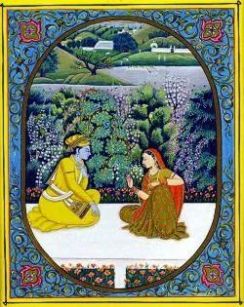
2.2. In most of these depictions Krishna is the central figure of love and the embodiment of the magic of the seasons and the melodies specially associated with the season.  Its scenery epitomizes the landscape of the imagination, in Indian painting. The Barahmasa schools lovingly capture the delights, the emotions and the enjoyment of the lovers in each of the six seasons. These pictures do tell a tale; each one narrates an event that illustrates the beauty, love and togetherness in the lives of the lovers. That story is entwined on the splendour of nature that surrounds them, in each season.

C. Ragamala

13.1. During the later periods, say by about the fourteenth century, the music- literature developed a series of short verses, in Sanskrit, called Dhyana slokas meaning verses for contemplation , outlining in brief the characteristics (swaroopa) of the raga expressions (raga –bhava) , treating a raga as a human person (nayaka –nayika) , divine (devatha) or semi-human being (gandharva). It also provided for descriptions of Raga wives, (ragini), their numerous sons (ragaputra) and daughters (ragaputri). This poetry often amorous, illustrates the love of a maiden and her lover.

ragamala5ragamala6ragamala7

13.2. This led to the creation of Ragamala (garland of Ragas) School of painting which attempted translating the emotional appeal of a raga into visual representations. Each raga personified by a colour, mood, the nature surrounding the hero and heroine (nayaka and nayika).  It also elucidated the season and the time of day and night in which a particular raga is to be sung. The colours, substance and the mood of the Ragamala personified the overall bhava and context of the Raga. It is a delightful amalgam of art, colour, poetry and music.

ragamala8ragamala9

The Barahmasa and the Ragamala – series of paintings are the evidence that the native genius in painting had survived the vicissitudes of political history since the days of Ajanta.

13.3. The development of the Ragamala School, however, got rather stunted as its theme lost relevance in the context of the present-day music. Further, the school did not seem to have the flexibility to accommodate and to describe newer raga innovations. The wonderful school therefore has virtually now faded away, sadly

14.1. Yet, the raga-ragini classification is still useful from the historical, academic, artistic and philosophical perspectives; and, could perhaps even help in understanding and performing music.

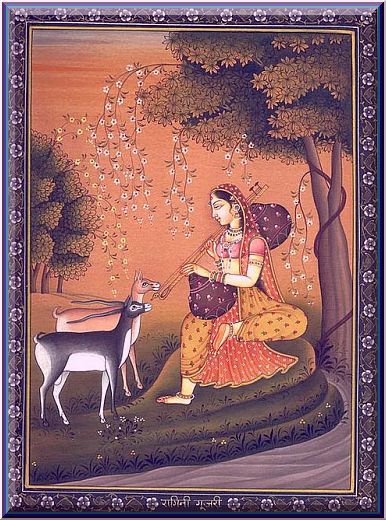
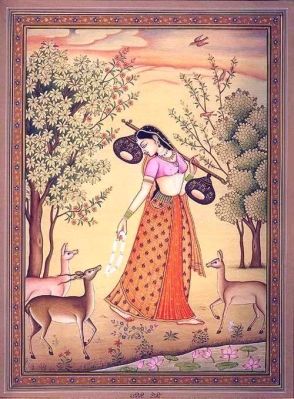
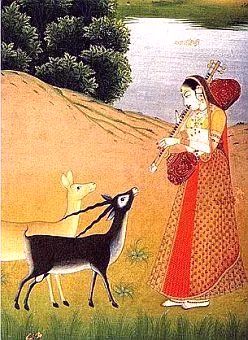
Ragini BhairaviRagini MeghaRagini Gurjari

[ Dr. Anjan Chakraverty who did his post-graduation in Landscapes in Indian Miniature Painting from the Faculty of Visual Arts, Banaras Hindu University, Varanasi, explains:

http://vmis.in/upload/Assets/Exhibition/23/ragmala/part2.html

Every raga has its special sequence of ascending notes (aroha) and descending notes (avaroha) that determine its structure or that (lit. an array or setting). A raga experience would change from dawn to dusk, from a sunny afternoon to a moonlit night, from spring to autumn, so on and so forth. On the basis of this, ragas and raginis were associated with particular moods and regions, with particular seasons and, categorically, to the explicit hours of the day and night.

For example Dipaka raga was associated with fire and scorching heat while the recital of Megha raga, in contrast, was ideal for the season of clouds and rains, its flawless rendition promising downpour. Similarly, Vasanta raga is meant to express the joy of life in spring and Nata raga, the heroic martial spirit of the man. Bhairavi ragini is the plaintive melody of the morning and raga Yaman is meant to evoke the somber, explicitly devotional mood in the early hours of the evening. However, a raga is not a song or tune, on the other hand numberless songs can be composed in a certain raga-mould.

With a view to emphasize the divine qualities of music, each raga and ragini was attributed with a particular rupa or psychic form. The psychic form was further divided into the invisible sound form or the nadamaya rupa and tangible or image form referred to as devatamaya rupa. It was required on the part of a performer (kalavanta) to imbibe the presiding spirit or ethos of a melody and please the deified form. Raga-dhyanas or contemplative prayer-formulas were devised for the purpose, passed on from the master (acharya) to the student.

Ragini SehutiRagimi TodikaRagini Bhujanga

In Narada’s Sangita Makaranda, datable between 7th and 11th century C.E., do we come across for the first time a classification system of six ragas as male and six raginis, attached to each raga, as females forming six cohesive families, raga-parivara. However, this system was not followed by the painters.

 It is in the Sangita Makaranda that we find for the first time a classification of ragas according to the proper hour for rendition. Mesakarna or Kshema Karna, a sixteenth-century rhetorician from Rewa (central India), in his treatise Ragamala compiled the elaborate system of six ragas, each with five raginis and eight ragaputras.]

sangita makaranda

List of books and other references.

Rtu in Sanskrit Literature by Dr. V Raghavan; Shri Lal Bahadur Shastri Kendriya Sanskrit Vidyapeetha, Delhi (1972)

Kavyamimamsa of Rajasekhara: Original Text in Sanskrit and Translation with Explanatory Notes by Sadhana Parashar, D K Print world, (2000)

Vishnudharmottarapurana: English translation by Priyabala Shah, Baroda (1961)
The Seasons in Mahakavya Literature, by Danielle Feller : (1995 )

Barahmasa in Indian Literature, Charlotte Vaudeville; Triloki N. Madan (1986)

Barshmasa (Agam55) by V. P. Dwivedi

Baramasa: The Painted Romance of Indian Seasons (Portfolio) by Daljeet, National Museum, (2009)

The Flute and the Lotus: Romantic Moments in Indian Poetry and Painting by Harsha Dehejia, (2002)

The Loves of Krishna in Indian painting and poetry by WG Archer

Flora and Plant Kingdom in Sanskrit Literature by Shri Jyotsnamoy Chatterjee; Eastern Book Linkers, (2003)

 Ritusamharam: http://www.giirvaani.net/giirvaani/rs/rs_intro.htm

Monsoon Ragas by Vimla Patil : http://www.esamskriti.com/essay-chapters/Monsoon-Ragas-1.aspxBarahmasa:

Songs of Twelve Months by Prof P. C. Jain and Dr. Daljeet http://groups.google.com/group/mintamil/browse_thread/thread/9b6cabddd8d32161?pli=1

Romantic Moments in Poetry : http://http-server.carleton.ca/~hdehejia/content/RMinPoetry.pdf

Bidyapati’s Description of spring: http://www.indiadivine.org/articles/382/1/Bidyapatis-Description-of-Spring/Page1.html

History of Flowers and Gardening in India By Dr. Jyoti Prakash  :  http://www.cityfarmer.org/indiagarden.html

  All pictures are from internet


Tags: , , , , ,

Sharad Ritu – season of tender beauty, grace and celebrations

sharat ritu

Traditionally, Indian seasons– Ritus – are six, each of about two month’s duration. In the part of the country where I now live, in Southern Karnataka, there are virtually five seasons: a short spring, summer, monsoon, post monsoon and winter,  where Hemanta and Shishira run into each other. Each of the seasons, – Ritus – has a beauty and splendor of its own. Sadly, we have lost the links with nature; as also with the songs and the Ragas inspired by nature.

Ritu is a division of the year , reflecting the change of seasons. The concept of Rtu occurs in Rig Veda also, where only three Ritus are mentioned: Varsha , Grishma and Sharad. Later, the year was further divided; and, two more Rtus were added. A hymn in Taittareya Brahmana has a beautiful graphic presentation of the Ritus in the image of a bird: Vasantha is the head of the bird called Samvathsara (year); Grishma its right wing; Sharad its left wing; Varsha its tail; and , Hemanta its middle part.

Tasya re Vasantha shirahah/Grishmo Dakshina pakshahah/ Sharad uttara-pakshhah/Varshap pucchyam/ Hemanto Madhyama. (TBrh: 1.10.4.1)

It was during the epic period that the seasons were counted as six: Vasantha – spring; Grishma – summer; Varsha – rainy season; Sharad – autumn; Hemanta – winter; and, Shishira – cool season preceding the spring.

The Puranas (say, the Brahmanda Purana) mention six seasons. The Matsya Purana has a whole chapter dedicated only to the month of spring; and, the Samba Purana gives a reference to the different colors of the sun in the Six Ritu’s : Kapila (tawny or yellowish-brown) in Vasantha Rtu ; Tapta-kanchana (furnace  gold)  in Greeshma ; Sweta (white) in Varsha Rtu; Pandu (pale) in Sharad Rtu; Pingala (coppery or reddish brown) in Hemanta Rtu; and , Raktha (reddish) in Sishira Rtu.

The Chitrasutra of the Vishnudharmottara-purana (5th– 6th century), however , mentions four Ritus; and,  outlines their general features.

Summer : Under trees, languorous men seek shade from the harsh summer sun, buffaloes wallowing in the mire of muddy waters, birds hiding under a thick abundance of leaves, and lions and tigers seeking cool caves to retire in.

Rain: An overcast sky, with heavy rain filled clouds weighed down with their aquatic excess, flashes of lightning and the beautiful rainbow, animals like tigers and lions taking shelter in caves, sarus (cranes) birds flying in a row.

Autumn: Trees laden with ripe fruit, the entire expanse of the earth filled with ripened corn ready for harvest, lakes filled with beautiful aquatic birds like geese, the pleasant sight of blooming and blossoming lotus flowers, the moon brightening up the sky with a milky white luster.

Winter : the earth wet with dew, the sky filled with fog, men shivering from the cold, but crows and elephants seem euphoric.

harmony

Two sets of calendars – solar and lunar – for the  twelve  months  of the year were developed over a period. And, the names of the months of the solar year , at one time , carried different  sets of names. 

The names of  the  months , according to solar calendar (Sauramana) , in each of the six seasons (Ritus)  are: Vasantha  (Madhu and Madhava) the sweetness of spring; Grishma: (Sukra and Suci)  the blazing light of summer; Varsha: (Nabha and Nabhasya ) the monsoon rain bearing clouds; Sharada : (Urya and Isa) the fertility and mellow of autumn; Hemanta: (Saha and Shahya ) the cold and winter; Sisira:  (Tapa and Tapsya )  the beginning of the hot season.

It is also said; these were the names used in the ancient days. For instance; the Maitrayani-Samhita of Krishna Yajur Veda   enumerates  the  very set of  names of the months . 

madhuś ca mādhavaś ca vāsantikā tū agner antaśleo ‘si // śukraś ca śuciś ca graitū;  nabhaś ca nabhasyaś ca vārikā tū;  iaś urjaś ca śāradā tū ; sahaś ca sahasyaś ca haimantikā tū; tapaś ca tapasyaś ca śaiśirā tū agner antaśleo ‘si   //MS_2,8.11//

*

The names of the months of the lunar calendar (Chandramana) in the respective seasons are: Vasantha (Chaitra and Vishakha); Grishma (Jestha and Ashada); Varsha (Shravana and Bhadrapada); Sharada (Ashvina and Kartika); Hemanta (Margashira and Pushya); and, Sisira (Magha and Phalguna).

solar months 2

*

Srimad Bhagavatha -Purana(Skanda-4; Chapter-2) lists the Adityas, Rishis, Yakshas, Rakshas, Nagas, Gandharvas and Apsaras , associated with each month of the year .But, here, the names of the months , their sequence and the related Adityas slightly differ.

Bhagavatha Purana Table

***

It is said, in the ancient days; the month of Margasirsha also known as Agrahayana was at the head of the twelve-month period; which is to say, it marked the commencement of the year from the vernal equinox. But, in the later periods the sequence of the months was changed to what we are familiar with now. And, similarly, the Nakshatras were reckoned from Krittka; and, not from Ashvini, as of now. The scholars opine that during the period when the sun was near Orion at the time of the vernal equinox, i.e. around 3000 years ago or more, the year was reckoned as commencing from the month of Margasirsha (Agrahayana).

And, Margasirsha was the best , most auspicious and the most enjoyable of all the months of the year ; neither too hot nor too cold, neither too wet nor dry; when the udders of the cows are full of milk. And, it was also the harvesting season when the long months of hard work fructified. There is a sense of peace and joy enveloping all existence.

The Mahabharata war is believed to have commenced on the eleventh day of the bright fortnight of Margasirsha (Agrahayana) – Margashirsha Shukla Ekadasi, when the star Krittika was in ascendancy. And, it was on the First Day of the Great War that Lord Krishna delivered the celestial Bhagavad-Gita.

In the Bhagavad-Gita, Krishna says that among the months, he is the MargashirshaMasanam Margashirsha nam- Bhagavad-Gita. 10.35

design star

[Alberuni c.1030 observed that Vasudeva Krishna had a special place in the hearts of the common people who loved to call him by many names. He says , people called out Krishna , out of sheer love , by different names in each of the twelve months; such as : in Margasirsha:  Keshava; Paushya:  Narayana;  Magha:  Madhava;  Phalguna:  Govinda;  Chaitra:  Vishnu;  Vaisakha:  Madhusudana; Jyestha:  Trivikrama;  Ashadha:  Vamana;  Shravana:   Sridhara;  Bhadrapada:  Hrishikesa; Ashvayuja:  Padmanabha;  and , Karttika:  Damodara .]

[The earliest inscriptional reference to Indian seasons and months appears on the Edicts of Emperor Asoka (c.272 B.C.) found at Dhauli and Jaugada. It mentions Tisya Naksatra (Tisya or Pausa) and Chaturmasi (full moon in all seasons). The casket inscription from the time of Meander (c. 115-90 B.C.) at Shinkot is the earliest known inscription to mention a month. It refers in Prakrit, to two months – Karttika and Vaisakha in connection with the relics of the Buddha.]

*

The Solar year (Sauramana) was based on ‘solar division’ – the diurnal motion of the Sun ; and,  the Lunar year (Chandramana) was based on the ‘lunar division’- the phases of the moon .

The solar year is approximately 365 days and the months are calculated by the sun’s entrance into a particular Rasi or Zodiac sign. These are divided into twelve, Mesha (Aries), Vrsabha (Taurus), Mithuna (Gemini), Kartaka (Cancer), Simha (Leo), Kanya (Virgo), Tula (Libra), Vrscika (Scorpio), Dhanus (Sagittarius), Makara (Capricorn), Kumbha (Aquarius), and Mina (Pisces).

Astrological signs

The Lunar calendar is roughly around 354 days; ten less than the solar year(*) and its months are named after Nakshatras or constellations in which their full moons are placed. The lunar months lasts from one new moon to the next but it is named after the Indian solar month in which it begins. As mentioned earlier, the lunar month are Chaitra and Vaishakha for spring (Vasantha) ; Jyestha and Asadha for summer (Grishma); Sravana and Bhadrapada for the monsoon (Varsha); Asvin and Karttika for the autumn (Sharad); Agrahayana and Pausha for winter (Hemantha) ; and. Magha and Phaguna for  later cool season (Shishira).

The poets have sung of the glory of each season either individually or as a garland of seasons. The Great Kalidasa’s Rtu Samhara is of course the most celebrated of all such romances of the six seasons.

[*  It is said; a Solar year actually measures 365.2422 days; while a Lunar year is shorter having only 354.372 days ; the difference between the two reckoning being 10.8702 days , each year. In order to reconcile the difference between the two calendars, an additional month is added to the Lunar calendar once in three years. Such additional month is termed as Adhika –masa. And, the year in which such Adhika-masa is added would thus have 13 months, as compared to 12 months in other years. In the cycle of 36 months, the Adhika-masa would be the 33rd month; and, would commence from the close of the 32nd month – that is , from next day of full moon and up to end of Amavasya. The Adhika-masa would actually measure 32.6106 days.]

design star

It is the post monsoon season – Sharad Ritu, which is dearer to me. It is a season of festivals marked by benevolence, grace and beauty. As per the lunar calendar, Sharad Ritu follows the Varsha (monsoon) and precedes Hemantha (early winter). It comprises months of Ashvina and Karthika, which is September to November months in the Gregorian calendar. In the year 2007 , Sharad Ritu commenced from Oct 12, Sharad Ritu corresponds to early autumn in the West but it is not the same.

The nature is at its benevolent best in Sharad Ritu. The oppressive heat of the summer is a distant memory and the chill of the winter is still on its way. The annoying downpour of the monsoon has just ended. The weather is mild, pleasant and refreshing. Sharad is a season of moderation, comfort and peace. It is the season of the middle path.  It is a soothing delight, as its designated Raga Malkauns a pentatonic haunting melody. The rivers are neither dry as in summer nor flooded, muddy brown, twirling with orphaned twigs and overflowing menacingly as in monsoon. In Sharad Ritu, the rivers are moderately full, transparently clear; rippling down the gentle slopes in peals of temple bells.

Sharad Ritu brings a blush to the countryside. The nature is bedecked as a bride with light green, decorated with profusion of colorful flowers and bountiful laden fruit trees with chirping birds. There is peace, joy and fulfillment abounding in the air.

The days are sunny, yet pleasantly cool and comfortable. The skies are clear blue with white cotton clouds floating lazily. The nights mildly intoxicating are slightly chill, clear and cloudless.

Srimad Bhagavatam describes the resplendent beauty of Sharad Rtu in Venu Gitam (Canto 10):

ittham sharad svaccha jalam padmakara sugandhina /nyavishad vayunavatam sa gogopala kochyutaha / kusumita vanaraji sushmibhrunga dvijakula gushta sarah sarIn mahidram / madhupatir avagahya charayangAha saha pashupAla balahaschukUja veNum //

It says; the water is pure, fresh and playing host to the beautiful lotuses waiting to bloom. In the autumn, the monsoon clouds too have disappeared, making way for clear sunshine; the lotuses bloom and spread their fragrance everywhere –padmakara sugandhina.

Flower buds, that had hitherto been soaked and ruined by incessant monsoon rains, now bloom joyfully–kusumita vanaraji – adorning the trees with colour. The aroma and nectar of these flowers attract the buzzing honey bees (sushmi bhrunga). With fragrance, color and cheer all around, can the cuckoos and peacocks help themselves but sing and dance to their hearts content – dvija kula gushTa sarah sarin mahIdram.

In Sharad Ritu, the cows graze happily and produce abundant milk, bringing prosperity all around.

In certain regions of India, the bright, soothing and joyful Sharad Purnima, is celebrated as a harvest festival; and, is known by other names such as : Kumаrа Рurnimа, Kоjаgiri Рurnimа, Nаvаnnа Рurnimа, Аshwin Рurnimа оr Kаumudi Рurnimа.

It is believed that on the Sharad Purnima, the moon glows with all its sixteen phases (kalas). On this night, the sky is clear; and, the moon is at its largest, brightest; shining without a blemish.

On this auspicious day, many divine pairs like RadhaKrishna, Shiva Parvati, and Lakshmi Narayan are worshipped ; and, are offered flowers and kheer (sweet dish made of rice and milk).

sharat Moon

The splendid cloudless full moon night of Sharad Ritu is an idiom of glory, peace and joy in the Indian poetics. It is the delight of eager young lovers that long to be with their beloved. The ecstatic beauty of Sharad Purnima is etched in Indian psyche. Its glory, tenderness and joy are celebrated in songs, legends and poems of love. Our classical poets and epics sing lovingly the beauty and joy of the delightful moonlit nights of Sharad Ritu.

Full Moon

Soundarya-lahari, meaning waves of beauty, a tantric work in poetic form   dedicated to the Mother, in devotional ecstasy,   calls her Saratchandra Vadana, one with a face as    radiant and blissful as the moon in Sharad Ritu. And, Goddess Sarasvathi is described as Sharad-indu Sundara Vadane  – having a blissful radiant face as beautiful as the moon of the Sharad Rtu. 

atriversedge

The tradition of Rtu-Varnana, describing the seasons, became frequent when such descriptions came to be recognized as a mandatory feature (ashta-dasha –varnana, eighteen types of descriptions) of a Maha-kavyas the major epic like poems

The classical Indian poetry abounds with expressions like Sharadendu vilasam (the glory of the moon lit nights of Sharad), Sharath-chandrika – dhavala-prakasham (glorious brightness of Sharad) etc. The food – loving court jester encouraged by bright cool comfort and a feeling of luxury compares Sharad night, gleefully, to curd rice and ghee (Gritha-supa-samanvayam).

Maharas

It was under the resplendent full moon of Shard Ritu, amidst the mango and Kadamba groves along the banks of the gentle flowing Yamuna that Sri Krishna and Gopis enacted their celestial dance Rasa Leela. It was the night; the haunting melody of Krishna’s flute enraptured the hearts of Gopis. Srimamad Bhagavatham sings the glory and joy of Rasa Leela with love and divine ecstasy. Every region and every language in India cherishes at its heart in lyrical rapture the love, graceful beauty and bliss of that Sharad Purnima. Year after year the devotees throng at the Vraj-bhumi on the Sharad Purnima  under the heavenly glow of the scar- less full moon , to re enact Rasa Leela with longing and elation as an act of devotion  and humble tribute to the love of Krishna and the Gopis.

The Great Poet Valmiki in his Epic Ramayana (4.29.27) talks of ‘The Mountains washed spotless by great clouds and their glittering peaks now shine as if bathed in moonbeams’.

abhivṛṣṭā mahāmeghair nirmalāś citra-sānavaanuliptā iva ābhānti girayaś candra-raśmibhiḥ ||

Kalidasa the great poet of ancient India in his Ritu-Samhara (song of the seasons) sings of the “golden plenitudes” of Sharad Ritu in passages of high lyrical imagery. (RS.3.21- 3.28) Sharad is the season of slenderness and grace; cool as the sandalwood (candanaṃ candra-marīci-śītalaṃ); of clear moon (śarad-indu-nirmalam); of radiant moon (vimala kiraṇa candraṃ); and of light, floating, soft colored silks. Kalidasa fondly talks of cheerful women dressed in light-hearted elegance of “silks dyed scarlet with mallow juice, delicate silks saffron dyed and shining pale gold veils”- anupama mukha rāgā rātrimadhye vinodaṃ śaradi taruṇa kāntāḥ sūcayanti pramodān –  KalRs_3.24 .

He compares Shard Ritu to a bride; decked in white as the moon and the swan, adorned with jewels and flowers; moving with gentle grace like the rivers in Shard Ritu. The sky scattered lightly with thin clouds is as a king fanned with a white fly-whisk. The women adorn their hair with jasmine and ears with blue lotus; pine for the beloved. The travelers see in the lotuses the dark lustrous eyes of their beloveds; in the infatuated swans, they hear the tinkle of the beloveds’ golden girdle; and in Bhandu-jiva, flowers look for the gleam of their coral lips. Travelers sigh and pine for their beloveds –  bandhujīve priyāṇāṃ pathika jana idānīṃ roditi bhrānta-cittaḥ- KalRs_3.26.

Autumn

Viśākhadatta in his Mudrārākāsa (3.8) sings the tender grace of the Sharad :  The tumult of the rains gradually gives way to the stillness of Sharad.  The sky is free of clouds, water grows clear at the rise of the star of Agastya (not surprisingly says one poet – they heard he swallowed the ocean in one mouthful and are scared stiff) and the torrents of the monsoon become gently meandering rivers once again.  The sound and light special effects – flashes of lightning, drumbeats of thunder – are replaced by a finer beauty, characterized by the superfluity of white, in the bright moon, the swans, the lotuses and the tall kāśa grass.  The world is freshly washed and now sparkles in the sun:

Apām uddhtānā nijam upadiśantyā sthitipadaṃ Dadhatyā śālīnām avanatim udāre sati phale |

Mayūrānām ugra viam iva harantyā madam aho I Kta ktsnasy’ āya vinaya iva lokasya śaradā ||

And, Bhāravi, in his Kiratarjuniya, describes a river whose sandbanks white cows are gradually leaving as if her white silk robe was slipping down. 

**

This tradition of Rtu-Varnana occasionally spilled into Dramas. For instance, in the Bhana plays of the Gupta Era (4th-6th centuries) the tradition set by Bhasa and Kalidasa was continued by including songs singing the glory of one or the other season.

Let me say a few words about Bhana plays (a type of Rupaka) because not many of the Bhana plays have survived. . The Bhana plays are essentially short dramatic presentations (Prahasana) or burlesque one-act plays which , flippantly, satirized the respectful figures in the society . They are different from elegant Sanskrit court-plays. They deal with the common place and the trivial. They expose the seamy side of urban life and of the court officials, in particular ; and,  debunk the hypocrites  moving under the guise of the virtuous.

These short plays were , usually in monologue, featuring a single actor who assumes the role of a Vita (paramour) or a Dhurta (rouge, swindler, gambler or cheat) . He is described as : a clever and shrewd parasite who  describes roguish exploits (on subjects invented by himself) through imaginary conversations  engaged with himself or with  some one else or  with imaginary persons  (akasa-bhasita).

Generally the eloquent Style is employed ; the subject, which is invented by the author, is treated in a single Act. The Bhana has two Junctures, the opening (mukha) and the conclusion (nirvahana), with their subdivisions.

bhanas tu dhurtacaritam svanubhutam parena va / yatropayarnayed eko nipunah pandito vitah / sambodhano -ukti-pratyukti kuryad akasabhasitaih / sucayed vlra-srngarau saurya-saubhagya-samstavaih/ bhuyasa bharati vrttir ekankam vastu kalpitam / mukha-nirvahane sange lasyangani dasapi ca.

Singing and music, from background , precede and close the performance; and in between also  give musical effects to the imaginary conversations that the single actor  carries on. 

.

Usually, the narrator is a Vita who loiters in the locality of the courtesans where he is a familiar figure and picks up conversation with whoever passes his way. He also calls on any courtesan at his sweet will.

Vita is a very interesting character in the plays of this genre. He narrates dramatically, a variety of occurrences as happening either to himself or others. He is generally a cultured, shrewd; but a deprived person; but, very familiar with the ways of the courtesans (vaisika sastra). He is quick-witted and knows how to manipulate courtesans through flattery and sweet-talk . He is truly the man of the world; gifted with jab of the tongue, wit and humor; and has familiarity with arts, poetry etc. He has also a strong sense of friendship and ever ready to help the needy. But his special interest is in enjoyment of worldly pleasures, and the sensuous company of the cheerful, fun-loving courtesans.

On the flip-side; a Vita would usually be one who was once wealthy; but squandered it all through misplaced trust or sheer gullibility or in gambling . Quite often, his family would have disowned him tired of his reckless and irresponsible ways. He is also disappointed in love.

In other words: basically , he is good at heart; but, a looser, incompetent or unable to succeed. He is described as a gallant parasite (Vita) who preys on courtesans and their paramours.

The Dhurta- vita-samvada presents the picture of one such  seemingly clever , experienced, but worn-out Vita, who  finding the rainy season too depressing, comes out seeking some amusement. He has no money either for a game of dice or for a drink — even his clothes are reduced to one garment. He , then  , wends his way towards the street where courtesans live, transacting with  their clients  of various kinds . He , sadly, cannot afford a courtesan, either.  At the end, dragging his feet, he reaches the house of the roguish couple Visvalaka and Sunanda, who were then busily engaged in a  discussion on certain awkward problems of sex-act. He gleefully joins the discussion.

Vatsayana in his Kama -sutra has immortalized the Vita characters.

The three playwrights of this period scripted  Bhana plays to highlight the features of certain seasons: Padma-prabhrur-takam (by Shudraka) and Ubhaya-abhisarika   (by Vararuchi) described Vasantha the spring, while Dhurta-vita-samvada (by Isvaradattadescribed Varsha the rainy season. The last mentioned also carried brief descriptions of Sharad, Grishma, and Vasantha Rtus, as in Kalidasa’s epic poem.

Here is a simplified and abridged version of Sharad as in the Dhurta-vita-samvada:

In the Shard Rtu the veil of the clouds vanishes; moon shines up in the blue night sky; breeze is gentle and pleasant; and whole of delightful existence is filled with intoxicating fragrance of flowers withering gently from the Aasan trees; the lover swims in the scented lotus pond  with his beloved who as the Chakravaka bird is well versed in the secrets of love; the air around is scintillated with the music of Saras birds and the peels of girdle bells and anklets of cheerful beauties playing around the pool whose forehead is adorned with the Bindi bright as the Bandhuka flower .

OLYMPUS DIGITAL CAMERA

Dakshinayana is the Ayana (half year) of the Devi, the Mother Goddess. Dakshina is also understood as the grace; the feminine principle; and, as the Mother who creates, unfolds and brings forth manifestation. Dakshinayana is the life giving season in which all creatures and vegetation thrive. Dakshinayana is the time of receptivity and is the feminine phase of the Earth. It is the season of re-generation, in which all creatures and vegetation come to life and thrive. The thirsty plants and animals fanatically drink and soak in the elixir of life, and regain their vitality.  

It is also the season of festivity.  All the major festivals from Krishna Janmashtami, through Gauri, Ganesh, and Nava-Ratri, on to Deepavali are celebrated during Dakshinayana.  Sharad Ritu, in particular, is the Rtu dedicated to  the Devi.

In the ancient and medieval times, Dakshinayana was also the season of reunion; when men travelling on business hurried back home before the rain bearing clouds broke out in torrents; and, when the separated lovers ran into each other arms.

Even for the ascetics, the recluse and the Parivrajakas (wandering monks) the monsoon was a period of retreat. During the four months (Chatur-masa) of Dakshinayana when travel used to be difficult and hazardous the monks in the olden days used to assemble at a place far away from towns for exchange of views and experiences. It was essentially a period of study, reflection and contemplation. The period of retreat commenced from the end of Ashada (June–July) and through the months of Shravana, Bhadrapada, Asvina and ending in the Kartika, the day after Deepavali (November) marking the beginning of  winter 

The Dakshinayana begins with pouring monsoon rains beating down the heat and ushering in cool relief, And, as the Aayana ends, the mild winter steps in as a  prelude to spring

[ In contrast; the Uttarayana (Jan – July) is a long period of dry heat, blazing summers and swirl dusty winds. During this uncomfortable season of heat, dust and winds the life withers and dies.  The heat takes away moisture from all living things. It is also the season of ‘hot’ diseases and epidemics. The village minor goddesses such as Sitala (small pox) are ‘cooled’ or appeased (shanthi).

At the same time; Uttarayana is also the invigorating   , new good healthy wealthy beginning.  It is the time of harvest, gathering the fruits of your efforts.  Uttarayana is also the northward noble path (Deva Yana) that leads the virtuous to gods; and, is therefore called Uttarayana Punyakaala. The old warrior Bhishma of Mahabharata lay in wait on the bed of arrows for the arrival of Uttarayana. On the dawn of Uttarayana the Grand-old Bhishma chose to give up his life.

Uttarayana is the time of fulfilment, while Dakshinayana is the season of growing up.

Many of the festivals in Uttarayana are in celebration of male gods.  Maha Shivaratri heralds the true beginning of hot summers. It is followed by   Holi  the festival of colours marking  the burning down of Kama .

The season of six months from January to July is regarded   masculine in nature, while Dakshinayana is the feminine phase of the Earth.]

sarasvathi tanjoresarasvathi

Sharad Ritu is aptly named after Sharada the goddess of speech (vac), learning and fine arts. She is the presiding deity of the Ritu. Sharad Ritu personifies the mild- glowing beauty, serenity, grace and compassion of mother Sharada. The ten days following the new- moon in the month of Ashwina in Sharad Ritu are celebrated as Navarathri (Sharan navarathri) in devote reverence and in worship of the mother. Display of learning, performance of arts and honouring the learned and the virtuous during Navarathri are all in humble submission to the mother. Bengal has a tradition of commencing the Durga Puja with Saraswathi Puja. Saraswathi is regarded as daughter of mother goddess Durga.

Navaratri

The tenth day of Navarathri in Sharad Ritu, Vijaya- Dashami is one among the three most auspicious days in our calendar. It is the most sought-after day for launching ones hopes and ventures. Vijaya-Dashami signifies rescue of Dharma from the creeping shadows of the unjust, instating the virtuous to their rightful position and the victory of good over evil.

On this day, the Pandavas ended long years of their humiliating exile and incognito; the friendless brothers found an ally in Virata and celebrated it with the bonding of young Abhimanyu and Uttara. 

Abhimanyu

On this day, Sri Rama with his consort , on return from years of exile and vanquishing the demon king Ravana ,was enthroned in Ayodhya

Rama pushpaka RAMA PATTABHISHEKA

It was on this day the Goddess Durga mata destroyed horde of evil forces, restored light and hope in the hearts of the virtuous. It is a day of victory and rejoices.

durga 9

The later month of Sharad Ritu is Karthika, the month of the infant commander of the divine forces, Karthekeya the vanquisher of evil and darkness. Karthika is the month of lights. Numerous Little lamps are lit in homes and temples to dispel darkness and ignorance.

diyas full

Karthik-ki-chauth (Karwa chauth) the fourth day after new moon in Karthika is the day when women in the North and Western parts of India fast and pray in loving devotion for the longevity and prosperity of their husbands.

Sharad Ritu, which commences on a pious note of devotion and fulfilment peaks into a burst of sparkling and spectacular lights and lavish celebrations. Deepavali or Diwali certainly is the most popular and the noisiest of Hindu festivals.  Deepavali (array of lights) is a festival of four days, which literally illumines our hearts, homes and streets; dazzles with sparklers and firecrackers; and draws friends and neighbors together in a net of goodwill. It also signifies victory of good over evil, delivering from darkness and leading towards light. It is a festival in celebration of life, its goodness and fulfillment.

As Sharad Ritu nears its end, the leaves on the trees turn from green to yellow to red and to dusty brown. The trees let go the aged leaves, that once clothed, fed and sheltered them; with grace and gratitude. They gently place the departed friends, with reverence, on the floor.

If the spring signifies the exuberance of youth; and the sizzling heat of summer, downpour of the monsoon represent the rigors, vicissitudes and uncertainties of life; Sharad Ritu is the mellow maturity and fulfillment of life before it slides into its evening. It inspires a sense of amazement, grace and reverence towards life. It is the golden mean, away from extremes of burning passions and debilitating regrets. It is the summation of the quality life.

Our seers visualized a life worth- living as spans of Sharad Ritu; not merely, because it is the most enjoyable season but also because it suggests an interpretation and a sense of balance that life should have. That perhaps was the reason our ancients measured meaningful life spans as representations of Sharad Ritu. A young person on threshold of life greets his beloved at the time of wedding “Oh! The auspicious one, the cause of my life, may we live to see a hundred Sharad seasons (subhage, tvamjeeva sharadahshhatam)”.

The Vedic aspirations of living a long, rich and purposeful life are expressed as enjoyment of life as in Sharad Ritu.

Paśyema śarada śata| jīvema śarada śata| budhyema śarada śata| rohema śarada śata | pūema śarada śata| bhavema śarada śatam | bhūsema śarada śata| bhūyasī śarada śatam | (AVŚ_19,67.1-8)

May we see a hundred Sharad Ritus. May we live a hundred Sharad Ritus. May we be wakeful in a hundred Sharad Ritus. May we ascend through a hundred Sharad Ritus. May we enjoy prosperous hundred Sharad Ritus. May we adorn a hundred Sharad Ritus .May we live more than a hundred invincible Sharad Ritus.

All pictures are taken from Internet.

Please do read

Shishira Ritu

 
21 Comments

Posted by on September 20, 2012 in General Interest, Sanskrit, Sharad Ritu


Tags: , ,

The Art of Painting in Ancient India – Chitrasutra (6)

[This is the fifth in the series of articles I would be posting on the art of painting in ancient India with particular reference to the Chitrasutra of Vhishnudharmottara purana

The previous (the fourth) article was about colors; the concepts, classifications and application of colors. It also briefly mentions about shading and how to go about drawing.

The current article covers the concepts about depiction of things seen and unseen in the world around us, or rather how the objects in nature could be visualized and personified as if each aspect of it is a living person with a character and attribute of its own.]

shiva devi

20. The abstract and the realistic depiction

20.1. The Chitrasutra, at several places, discusses how the persons and objects that we see in our day to day life, as also the nature that surrounds us could be depicted in art. It adopts a two-pronged approach. It instructs; while the representations of the objects and persons,   as drawn on the canvas should bear a credible resemblance to their original, the artist , at the same time, should not restrict himself to just  faithful  reproduction of   forms and appearances, but should try to go beyond “the phenomenal world of separated beings and objects that blind the reality beyond”.

20.2. In other words, it was emphasizing that art was more than photographic reproduction of visible objects. It was about the experience of a person and his expression of it through art; and about his unique creative genius, imagination, enterprise and individuality as an artist .It was not about how the world appears to one and all, but how the artist experiences and visualizes it. Its object is to elicit an emotional response, the viewer’s experience, the rasa.

20.3. These two approaches are not mutually exclusive; they exist side by side on a canvas and complement each other. The abstract and the realistic depiction are thus the two sides of Indian art. The latter is outward looking, and derived through observation; while the other is inspired by emotive perception and visualization of its essence. The two together enrich the aesthetic experience provided by an art work.

vrindavan

21. Realistic depiction of objects

21.1. As regards the realistic depiction of the objects, the text considers it essential to lend credibility to their depictions. The text, therefore, reckons   rupa-bheda and sadrushya, among the six essential elements of a painting. Rupa-bheda consists in the knowledge of special characteristics of things – natural or manmade; say, the differences in appearances among many types of men, women or natural objects or other subjects of the painting; while Sadrushya aims to depict, in painting, those distinctions and resemblances.

21.2. The Chitrasutra instructs the resemblances should not merely be general but should extend to details as well. Every part of the object represented should agree with the general treatment of the whole object. It also says that the persons should be painted according to their country; their region, their colour, dress, and general appearances as observed. Having well ascertained the person’s country, region, occupation, age and his status in life; the text says ,  his other details such as his seat, bed, costume, conveyance, stance, and his gestures should be drawn.

Bhudya rupam yatha-vesham varnam cha manujo-utthama / Deshe-Deshe naraha karyaha yatha-vath samudbhavah /3.42.49/

Desham niyogaha sthanam karma bhudhya cha yatna-thaha / Aasanam-Shayanam-Yanam -Vesham-Karyam Naradhipa /3.42.50/

[The Chitrasutra explores this subject in great depth, detailing the characteristics of persons hailing from various regions and occupations. The text also describes the characteristics of different tribes and castes as distinguished by their complexion; noticeable physical features, costumes and habits. Since it is rather detailed, I have posted it separately. Please check Part four]

vrindavan.2jpg

22. Drista & Adrista

22.1. The representation of objects as they are seen or observed normally in life, is termed in the text as Drista, meaning in the way the things appear or as they are visible. In contrast to that, the text speaks of Adrista, meaning objects as visualized or personified by the artist, though they might not actually appear as such.

Having made this distinction, the text suggests that the two should together be employed to harmoniously blend the subject and its illustration; the subject and its effect; and the reality and its symbol, in order to provide the painting an expressive language. For instance, while faithfully depicting the details of the subject (say, the hours of day or night, or the seasons), its effect on the nature around and on the persons are also to be symbolically pictured. These help enhancing the quality of depiction of the subject and the artistic eloquence of the painting.

22.2. Hours of day and  darkness

night

The time of the day, morning noon and evening with its approaching darkness are suggested by appropriated indicators.

The daybreak is suggested by the opening of the lotus petals in the pond and the bees swarming around; the farmer with his plow proceeding to his fields

Midday is suggested by the Muni-kumaras clasping their hands in yama-pasa-mudra peeping at the sun through the aperture created by the joining of the fingers.

Evening is suggested by the approaching darkness, lighting of the lamps and return-home of the cows at go-dhuli.

The twilight is also suggested by the roaming on highstreets of courtesans and paramour vita-s, cheta-s and raja-vallabhas.

The Chitrasutra suggest that night may be indicated by the moon, the stars and sparse human movement as also by the lurking or prowling of the thieves in the shadows and of men asleep

Sachandragraha-nakshatram tatha darsita-laukikam / asannaatas-taskarm  ratrim darshayet supta-manavam // 3.42.68

In this context, the text, by way of illustrations, enumerates the following suggestions for showing the subject –the hours of darkness:

Evening – by the red glow in the sky, cows and calves retuning home raising a small clouds of dust, Brahmins engaged in their prayers;

Setting in of darkness – by men hurrying back to their homes, the birds flying back to their nest, lamps just beginning to glow;

The first part of the night – by young and eager love struck women walking hurriedly with side glances to meet their lovers;

The night – with moon , planets and stars, thieves lurking in the shadows, men fast asleep; couples amorously engaged;

Moon shine – by kumuda flowers (the type of lotus that bloom at night)  in full bloom while many petals of lotus are closed;

Early dawn ending the darkness – by rising sun, street -lamps looking dim and crowing cocks.

dawn dawn 2

[There is an interesting argument going on, alongside, in the text. It argues that the art of sculpting is far more difficult than painting. It says; it is almost not possible to depict, directly,   in a sculptural panel the time of the day or  night –  darkness, evening , twilight  or bright light etc.. That difficulty also applies to depiction of colours (colour, in fact , is not a medium directly compatible  with sculpting).

And, it is also not easy to bring out the differences between a dead body and a sleeping person, particularly if the two are placed side by side.  The sculptor – artist (shilpi) will have to resort to some other clever suggestions to bring out the differences. That depends on the ingenuity of the artist.  ]

22.3. The seasons

Similarly, the text describes the characteristics of each of the six seasons as are gathered through keen observation of nature. It says that in general, the seasons should be shown according to their character. It also instructs , the  explicit depiction of the  nature of each season could be complimented    by  suggestions  and  effects  of the season on the state, the form  and appearance of the trees, flowers, fruits, birds, animals etc looking delighted or otherwise ; as also on the moods and lives of persons.

It is amazing how sincere was the detailed observation; and how close was the author’s involvement with nature. The text suggests showing the ways of depicting in the painting the six seasons (ritu) of the year . Such descriptions also abound in the classic Kavyas .

springspring.2 jpg

:- The advent of  Spring season (Vasantha ritu) is announced by profusion of flowers, fresh shoots, hum of the bees and the notes of the cuckoos. The fresh blossoms of the Asoka trees excite the amorous lovers with budding sprouts decorating their ears.

And, by merry men and women, vernal trees in bloom, bees swarming about and cuckoos perched on tree branches.

Kusumanjanma tata nava-pallava tadanu  shad-pad-kokila-kujitam  iti yatha-kraman avirbhun-madhura druma-vatin avatirya vasanthalim (Raghuvamsha 9.26)

Kusumam eva na kevalam artavam navam Asokataros samaradhipam / Kisalayaprasavo pi vilasam madayita dayitasravanarpitah/ ( Raghuvamsha .9.31)

Meghair medhuram ambaram ( Gitagovinda)

:- Summer season (Grishma ritu) – by dried pools, languid men, deer seeking tree shades and buffaloes burrowing in the mud and wallowing in shallow ponds;, diminished water level in the lotus ponds; the moss exposing the length of lotus stalks; the water level in the ponds reaching up only to the hips of the bathing damsels

The fun-loving young women play in the water (jala-krida) – with the decorations on their faces in disarray; the braid unbound; musk painted patterns on their arms washed away; the pearl earrings loosened, the wet silken garments stuck on the hips, with pearl-white waistlines appearing like stars dimmed by moonlight. – Raghuvamsa 16.67.65

The ladies smear their breasts with sandal paste, stroll along the garden in the shade of thick leafy trees among the waterfowls in the cool water channels

Sarpatsarini varistalate vinyasta-pushpa-potkare nirandhre kadalivane guru-dala-achchhayapahatar –katvishi / karpura-guru-panka-pichchhila-ghana-uttunga stanalingibhih kantakelir-ratrair aho sukritibhir madhya-nadinam niyate (Subhashita-ratna-bhandagara)

shravan

:- Rainy season (Varsha ritu) – by flashes of lightening, heavily laden clouds, lions and tigers sheltered in caves;

The rainy season with its dark clouds, lightening streaks, long rows of  white storks in their picturesque splendor flying low against the backdrop of rain bearing dark clouds is lovingly immortalized in several of Indian poetic works.

The Rainbow on dark clouds stimulate mirth of the peacocks with spread colorful tails dancing as if to celebrate the arrival of cool showers, add luster and grace to beauty of the picture.

In the paintings, the gentle rain is shown by slight vertical dots in white, like scattered pearls, against the darkened sky.

Ghana eva tarala-balike tatid iva pite (Gitagovinda)

Garajabhis satadid-balakas-balair meghais sasalyam manah (Mricchkatika.6.1)

Garbha-dhanakshana-parichayan nunam abaddhamalas sevishyante nayana-subhagam khe bhavantam balakah (Meghaduta .1.10)

Srenibhutah parigananaya nirdisanto balakah (Meghaduta.1.22)

Navambhumattas sikhino nadanit meghame kunda-samana-danti Ghatakarpara/ sukla-apangis sajalanayanais svagataikritya kekah pratyudyatah katham api bhavan gantum asu vyavasayet (Meghaduta.1.23)

:- Autumn (Sharad ritu) – by trees laden with fruits and flowers, earth covered with ripe cornfields, tanks full of water with swans and lotuses;

akampayan phala bhara aanata shaali jaalaan  aanartayan taru varaan kusuma avanamraan utphulla pa.nkaja vanaam naliniim vidhunvan  yuunaa manaH calayati prasabham nabhasvaan (Ritusamhara.3.10)

:- Dewy season (Hemanta ritu) – by frost on horizon and earth covered by dewdrops; and

nava pravaala udgama sasya ramyaH praphulla lodhraH pari pakva shaaliH  viliina padmaH prapatat tuSaaraH hemanta kaalaH samupaagato ayam (Ritusamhara.4.1)

:- Winter season (Shishira ritu) – by horizon shrouded in hoar-frost, shivering men and delighted crows and elephants.

The winter with its blast of cold winds forces one to seek the warmth of the indoors, covering oneself with heavy wraps and enjoying the cheerful company of  youthful damsels  in front of the crackling fire .

Niruddha-vatatayanam-mandirodare hutasano bhanumato gabhastyah , guruni vasamsyabala sayau-vanah prayanti kaletra janasya sevyatam (Ritusamhara.5.2)

cloudsclouds.j2 pg

There are classic depictions of other figures as well :

Abhisarika, the beautiful girl, going out, in moonlit night  (jyotsni or Shukla), to meet her lover should be in serene white and flowing garments ; and , should be decked in pearls (mukta-abarana-bhushitam) .

Abhisarika nayikaAbhisarika-nayika2

And,  on  other dark nights  (Tamasi)  she  wears blue garments (nilamsu parigraho).  And, in either case, she covers her head ; and, she  does not wear bangles and anklets to avoid twinkling sounds. 

There is even a case of an impetuous young girl , aided by her chamber-maid, eloping with her Lover, riding an elephant (of all the escape vehicles…!!) under the cover of night. She looks anxious and rather scared.

elephant ride

The lovelorn (viraha vyasthaya), lonely maiden in search of lover is to be drawn as pale (vyanjayanti) and emaciated (krisyam) ; her hair in a single braid (eka-veni) is twisted and unkempt .

virahalover seperationpregnancy

The Proshita-bhartrka whose lover is in distant lands , on war or business,  is pining for him. She , in sorrow, has given up applying cosmetics or wearing ornaments and colourful dresses. She has grown lean and pale ; her eyes are constantly searching for her separated lover.

Pregnancy is suggested by pallor in the face, slimness of the body, sparce ornaments and a natural languor.

*

In contrast , Svadhina-bhartrka who enjoys the company of her lover , and loves to dominate him; and, the Vasaka -sajja who  is busy tidying up her room in anticipation of meeting her lover  , are  to be pictured as happy, radiant, light hearted and  sportive , wearing their best and joyous dresses .

svadhina-patika vasaka-sajja

*

The bridal sarees (vadhu dukulam), generally, have a swan design (kalahamsa lakshanam) on their border. It was a popular design. 

Hamsa1Hamsa7Hamsa2

*

The heroic warrior facing his opponent is depicted in the challenging stance of Alidha  is a representation (bhava-chitra) of Vira -rasa. His torso is somewhat thrust out, the hair tied up, the front knee is bent back and retracted; and he is ready to attack.

AlidhaPratyalidha

Pratyalidha is used in relation to Alidha-sthana. The  strung bow with the arrow in position is pulled back up to the ear; the arrow is about to be discharged; and , he is looking heroic and magnificent.

*

The amalgam of subject and its symbols   renders a work of art at once particular and universal. That is the reason the Indian figurative art is not mere portraiture of the specific; but it is a symbol pointing to a larger principle, akin to the finger pointing to the moon.

22.4. Barahmasa

Inspired by the vivid word-pictures portrayed in the Chitrasutra, a school of painting known as Barahmasa (meaning, the twelve-months), flourished during the later periods. Its scenery epitomizes the landscape of the imagination, in Indian painting. This school lovingly captures the delights, the emotions and the enjoyment of the lovers in each of the six seasons. These sublime works of art, which gained fame as iconic representations of the seasons and as metaphors for emotions, have inspired generations of artists, poets and lovers.

The essential theme of the Barahmasa is the passionate yearning of lovelorn hearts, the pangs of separation that each change of season stimulates. Each month bringing a special message to the beloved, every season a special reminder of the joys of love and longing. The nature participates in the world of human emotions and mirrors the lovers’ or singer’s experience of tenderness and pain of love.

This may contain: many white and red roses are in the foreground, with mountains in the background

The transformations in nature , such as the gentle unfolding of a bud’s petals; or melting of a winter night into dew-drops; or the dark dreadful clouds rending with their roar the sky and the earth and frightening the lovely nayika into the arms of her beloved Nayaka and bursting forth into torrential rains – all become symbolic expressions of the seasons and the state of love of the ardent lovers. The Barahmasa depictions of poetry, music and painting, bind the two confronting worlds, the worlds of man and of nature into one thread.

  This may contain: the sky is filled with dark clouds over an open field This may contain: an image of rain coming down on the ground with blue lights in the dark background   This may contain: a tree in the middle of a field with lightning coming from it's branches

The Barahmasa pictures do tell a tale; each one narrates an event that illustrates the beauty, love and togetherness in the lives of the lovers. That story is entwined on the splendour of nature that surrounds them, in each season.

Let’s take a quick look at a couple of such picture. The painting associated with rainy season (varsha ritu) ‘the Bhadon’ (Bhardapada masa: August-September) captures the characteristic features and symbols of an evening in Indian monsoon.  The lovers relax in the balcony of a beautiful garden-house, enjoying the company of each other, watching the graceful flight of cranes against the background of dark monsoon clouds. And,  as the peacock dances and jumps on to a window in the courtyard, there is a sudden roll of thunder and flashes of lightening across the dark clouds. The lady-love is frightened and she clings to her lover in delicate embrace. Yet, she cannot take her eyes away from the spectacular and amazing drama of thunder and lightning being enacted in the skies.

baramasa

The month of Chaitra (March-April) , in spring (vasanta ritu) is depicted by clear blue sky, water-filled streams and lakes, the bushes adorned with flowers just sprouting and singing birds perched on tree branches. The lady love, dressed in her best, is exhorting her lover to stay at home and enjoy with her the intoxicating delights of Chaitra.

chaitra

The painting that illustrates the month of Agahana (Agrahayana or Margashira: Nov-Dec), in Hemantha ritu, the early winter, depicts clear skies, the swans migrating from the cold mountains and the lovers standing on the terrace overlooking the river with water-birds floating lazily. The day is neither cold nor warm; it is just comfortable. The lovers are wrapped in light-warm clothing.   Peace and tranquillity abounds in nature. The lovers are saying to each other how fortunate we are to be alive and to be together in this lovely evening.

evening

22.5. Ragamala

During the later times, another school , the Ragamala  School of paintings too used the descriptions provided in Chitrasutra , of nature, men, women, birds, animals and plants, in each season and blended them with the musical  mood of the Raga or its queen the Ragini ; as also with the time of day in which the raga is sung  and  with the emotional response associated with that time . All these produced a series of most enchanting pictures. Those paintings are a delightful combination of art, music, poetry and a studied, controlled sophistication.

ragamala3ragamala 4

The Ragamala (garland of Ragas) School of painting attempted to translate the emotional appeal of a raga into visual representations. Each raga personified by a colour, mood, the nature surrounding the hero and heroine (nayaka and nayika).  It also elucidated the season and the time of day and night in which a particular raga is to be sung. The colours, substance and the mood of the Ragamala personified the overall bhava and context of the Raga. It is a delightful amalgam of art, colour, poetry and music. 

One of such pictures is Todi Ragini, a painting associated with Raga Malkauns, as its Ragini. Here, a young woman plays veena as she waits for her lover. But he’s been so long that she gets bored, distracted and a bit apprehensive. As she stops playing the veena and paces restlessly, clutching a flower garland, the deer in the park surround her as if expecting her to continue playing the melody.   She’s growing sad, and fears he might not keep his date this evening.

todi ragini

22.6. Landscapes

Continuing on the Drista, the text explains how the subjects associated with landscape paintings; such as: the sky, the hills, dales, trees, etc could be depicted in a painting. Here again the faithful depiction of the subject is to be juxtaposed with   its suggestions   and its effects, enhancing the artistic expression of the subject.  Its scenery epitomizes the landscape of the imagination.

For instance, along with the bright sun, one could depict the images of creatures suffering from heat; and of the flowers and creepers wilting under the hot sun. The shower of rain could be suggested by a person well covered; or running for shelter under a tree. Similarly, along with the full moon the kumuda flower in full bloom could also to be shown. Such artistic suggestions, symbols and effects add to the depth of a painting.

Some of the pictures lovingly capture the delights, the emotions and the enjoyment of the lovers in each of the six seasons.  The sense of belonging, togetherness and identity with each other is suggested in a rare and a beautiful painting that shows Radha (highly idealized lady love)   and Krishna having exchanged their clothes. It is as if each has entered the other’s soul.

togetherness

She wears his peacock feather,
He dons her lovely, delicate crown;
She sports his yellow garment,
He wraps himself in her beautiful sari
How charming the very sight of it. . .
The daughter of Vrsabhanu turns Nanda’s son,
And Nanda’s son, Vrsabhanu’s girl.

(Srivasta Goswami, Trans. The Divine Consort, 87)
 

Elaborating on how the nature in a landscape painting could be depicted, the text suggests:

The sky should be shown without any special colours and full of birds;

A hill – by a cluster of rocks, peaks, trees, creepers, waterfalls;

A forest – by various sorts of trees, birds and beasts;

Water – by fish, tortoise, lotuses and other water plants.

While on the subject of water, King Vajra interjects querying “I cannot wait to ask. Please tell me more about representation of water. What are its true and untrue colors?”

The sage explains “The untrue color of water resembles that of lapis lazuli; that is because of the blue sky reflected in a pool of water. But, the natural color of water is seen in the cascades of a water-fall; its colour resembles moonlight.” 

22.7. Cities and village scenes

cities

The text also explains the ways for depicting the atmosphere of a locale.

It suggests showing:

A city by beautiful temples, palaces, shops and royal roads;

Markets- by a variety of merchandise and people busy trading;

Drinking and gambling dens – by men rolling in intoxication; and gamblers without their upper garments-the winners making merry and the losers crestfallen;

Richly caparisoned chariots or carts , be decked  in colorful decorative coverings

bullock cart 1815

And, A village by its hedges and sparse gardens; and , its women folk

village well

VILLAGE SCENE

23. Visualization and personification of deities and objects

lakshminarayana on garuda  vishnu lakshmi on elephant 2

23.1. While Elaborating on Adrista, the text says the objects in nature could also be visualized or personified by the artist, endowing its objects with distinct personality. In this respect, the art of painting, the chitra, enjoys a distinct advantage, and a far greater artistic liberty and freedom of expression, as compared to sculpture, the shilpa. A painting can comfortably handle things that are virtually impossible to be shown in sculpture; those things include the color, space or the darkness of the night etc. Painting enjoys the virtue and facility of rendering the absolute in tangible and visual forms.

23.2. In the traditional Indian painting, the ambiguity of color and appearance in its descriptive and suggestive forms was clearly kept apart. Each form of depiction had a purpose and a place of its own; but they often combined to produce a magical effect, bestowing on the Indian art a unique character and vision.

23.3. We therefore see in the work of the ancient painters, subtle nuances as also the representations of the tangible world, the beauty of its forms, its volume and weight; and yet there is always a suggestion of something which is more and beyond.

23.4. The visualization and personification of objects in nature, as envisaged in the Chitrasutra, employs whole sets of symbolism. For instance, the sky when painted in its natural and descriptive context should be painted almost without any color. But, when sky is personified, it should be depicted as noble person, blue-lotus in color, wearing a garment of that color; and carrying sun and moon in his hands.

This may contain: the sun shines brightly on a dark background with bright rays in the center and behind it

23.5. The sun in its natural depiction should be bright and shining, lightening up the canvas. But, when personifying the sun, it should be shown as a person with four hands , very lustrous , in the color of vermilion, with all auspicious marks;, with glowing garments; adorned by flower garlands and rich ornaments. His left and right hands should be shown projecting sunbeams, resembling reins of a chariot.

surya333

Varaha Mihira, in his masterly encyclopedic work Brhat Samhita (Ca. Sixth Century CE), under the Chapter 58 – Prathima Lakshana Adhyaya– specifies that:

    1. In the image of the Sun, the nose, the forehead, the shanks, the thighs, the cheeks and the breast shall Be large. In adorning the image, the method followed in the northern countries shall be followed. From breast to the feet shall appear covered.
    2. The Sun shall be represented as holding a lotus in each hand, as wearing a crown and pendants, with garlands hanging from his neck and as surrounded by Devas.
    3. The face shall be bright as the lotus. The body shall be covered with stitched coats / the countenance shall be cheerful and the luster of the gems shall add beauty to the image. He who fixes in a temple an image of the Sun of the above description will enjoy prosperity.
    4. An image of only a cubit high is good; one of 2 cubits long will bring on wealth; and if the height be 3 or 4 cubits there will be plenty and prosperity

Surya

***

The personified Moon should be made with a white body (as composed of water), in white garments, lustrous, with all ornamental and four hands. In his two hands he should be shown holding two kumuda (night-lotuses) flowers in full bloom .He should be endowed with luster and beauty.

chandra2

While visualizing and personifying the rivers, they are to be represented as persons having their own character and personality. They have to be given a human shape, and they should be astride their vahana (mount) on bent knees, and holding in their hands a pitcher.

Each river it is said has a distinct personality and character. For instance, the Ganga turbulent and milky in color gushes down the mountain slopes. The Yamuna, in contrast, is of dark hue, placid and wide.

ganga on crocodile

Another name for water in Sanskrit is Apah. The term Apah is invested with varieties of meanings. Apah, the waters are called the mothers (apah asmin matarah) : ‘The waters are our mother (ambayah), womb of the universe’ (RV.1.23.10).Water is  the nourishing mother who gives birth to the manifest world. She is the Mother of all creation; and, denotes freedom from bondage. Apah, as rivers is the creative energy which is active and moving Since Apah suggests movement (gati), the life-giving (jiva-nadi) , flowing rivers and streams are deemed feminine (Prakrti) ; while the stagnant Samudra the ocean into which all beings go and from which all beings emerge acquired a masculine identity (Purusha).

This may contain: a river flowing through a lush green forest filled with trees and mountains in the background  This contains: Transient wave photography capturing the ephemeral beauty of the sea.

Samudra (the Sea) is described as the gatherer of waters; the goal of all rivers; and, the eldest of the rivers (samudra jyestha), The sea is personified as the King of Oceans (Samudra –raja); and, is represented by a noble looking Lord holding afloat in his hands jewel-vessel. The halo around his head should be drawn resembling water.

samudra

The person of a mountain symbolized as Parvatha –raja (king of mountains) –  the lordly mountain, a sublime shelter for sages, the greatest treasure trove of minerals , giving birth to and sheltering great rivers,  cascades, cataracts, and caves is usually shown as a semi human mountain peak with a halo around his head.

Kama the amorphous desire (cupidity) that drives us and resides in each one of us, too, is personified. The text (Part Three; chapter: 73; verses 1-15) mentions that Kama as one of unrivalled beauty. He should be riding a parrot; and should be carrying a bow and arrow with five arrow-heads. His eyes half closed as if intoxicated and curled smile on his lips. His beautiful four wives Rathi, Priti, Sakhi and Madasakthi   should be done extraordinarily charming and bewitching.

madana

24. Rasa

24.1. The artistic creation though not real can arouse in the mind of the viewer, the experience of the original object. The objects in art are virtual and not physical. The artistic experience is, therefore, inferential and indirect; rather than direct perception.

A real work of art, in addition to possessing emotive charge carries a strong sense of suggestion and the potential to produce various meanings. It can communicate through suggestions and evoke layers of meanings and emotion.

Rasa is that experience which the viewer derives from an art expression.

Sage Markandeya said (43- 1-39): The Rasa-s, (emotions) represented in painting are said to be nine, viz., :

    1. Srngara (erotic),
    2. Hasya (humor, cheer),
    3. Karuna (pathos),
    4. Vira (heroic),
    5. Raudra (ferocious),
    6. Bhayanaka (horror, frightful),
    7. Bibhatsa (loathsome),
    8. Adbhuta (wonder, exotic and supernatural) and
    9. Shanta (tranquil, peaceful).

Pictures to embellish homes should depict Srngara, Hasya and Shanta rasas. The rest of the Rasas should never be used in the house of anyone where women and children dwell; including the residential quarters of the ruler. But, in the assembly halls of kings, palace of a ruler and in the temple of a god all the sentiments may be represented

krishna srngara

24.2. The text says, “Anything be it beautiful or ugly, dignified or despicable, dreadful or of a pleasing appearance, deep or deformed, object or non-object, whatever it be, could be transformed in to rasa by an artist’s imagination and skill”

24.3. The great scholar Abhinavagupta (10th-11th century), remarked, a creation in art is the expression of a feeling that is freed from localized distinctions; it is the generalization of a particular feeling. It comes into being through the creative genius (prathibha) of the artist. And, it finds its fulfilment in the heart of the viewer, who derives ananda the joy of aesthetic experience. He is, therefore, central to that art -experience. That pleasure must not, however, bind the viewer but must liberate him from his limited confines.

24.4. A true aesthetic object, Abhinavagupta declares, not merely stimulates the senses but also ignites the imagination of the viewer. That experience sets the individual free from the confines of place, time and ego (self). Thus, art is not mundane; it is alaukika, beyond the ordinary.

It is that magical quality which the Chitrasutra too was talking about.

While on the subject of Rasa, let me mention that The Vishnudharmottara is the earliest text that seeks to elaborate the theory of Rasa in the context of visual arts such as painting.

The Vishnudharmottara and another text the Samarangana-Sutradhara recognise the role of the Natya-Shastra from which they derive and modify their own theories.

At the same time there are also certain differences between the two texts. While the Natya-Shastra mentions only eight Rasas, the Vishnudharmottara accepts and introduces Shantha as the ninth Rasa.

Another main difference is that the Vishnudharmottara considers the “separation from the beloved (Viraha)” as a state that produces Karuna-rasa; whereas the Natya-Shastra clearly states that the Vipra-lambha involves the condition of sticking to hopeful expectation of reunion with the beloved out of yearning and anxiety, and is therefore a case of Srngara -rasa.

As regards the depiction of the Rasas in a painting, the Vishnudharmottara suggests:

For the erotic sentiment (Srngara), the figures should be depicted clad in sophisticated dress and ornaments; and their amorous beauty should be expressed by the exquisite beauty of the lines.

To bring about laughter in the representation of comic sentiment (Hasya), one should portray the hunch-backed; the dwarfs; the things which look somewhat distorted;  and , such gestures such as the unnecessary clenching of the fists and so on.

In the case of the tragic sentiment (Karuna), one should paint situations that evoke sympathy such as begging, separation from the beloved, renunciation, ailment and calamity.

 To express the wrathful sentiment (Raudra) in a painting, one should depict harshness, agitation, anger, hostility; and, the destruction of property and food. Its effect should be enhanced by  display of glinting weapons and armour.

 In a painting expressing the heroic sentiment (Vira), there should be a display of nobleness in form of oath taking and pride; the hero should be depicted with a frown and an arrogant expression.

In a painting expressing the terrible sentiment (Bhayanaka), the subject of portrayal should be vile, frightful to look at, fading away in decay and looking contemptible and murderous.

 The painting that represents the sentiment of disgust (Bhibhatsa), should disturb the mind of the viewer, because of its terrifying subject matter such as the funeral grounds and the acts of reprehensible violence.

The marvelous sensation (Adbhuta) is conveyed by depicting someone having a wide-eyed look, an expectant face and beads of perspiration.

The representation of the tranquil sentiment (Shanta) consists mainly of ascetics in meditative postures with a band clasping their legs and of any other subject that expresses calmness

**

The element of Rasa is essentially not different from the other constituents of painting. As in other concepts, its exposition involves an expressive technical sophistication that lends scope to introduce the viewer or practitioner into a profound understanding of the meaning of a painting through the appreciation of its depictions; and, thereby, to experience the sentiments expressed in it.

Rasa, therefore, should not be considered as a separate entity from other technical constituents like measurement and proportion, stances and colors. A good painting should be performed with a working knowledge of all of these factors. Without knowing the theory of Rasa our understanding of painting would remain fragmentary and superficial.

Hanuman on lotus

25.1 . The Sukraniti Sara remarks: These laws that the Shastras lay down; these fine analysis of what an image should be, are only of limited extent. But, verily, endless are the forms..! No Shastra can ever define, appraise or enumerate all the perfect (Sarvangai sarva-ramyo) works of art.

And , in a similar manner, At the end of Chitrasutra – the treatise  dealing with the Rules of Painting, the Sage Markandeya observes :

Oh King…! In this treatise only suggestions are given; for, this subject can never be described in detail even in as many as hundred years. Whatever has not been said here, should be inferred from the rules of dancing (Nrtya), Oh lord of the earth;

Painting is the best of all arts, conducive to Dharma, and emancipation-Kalanaam pravaram-chitram; Dharma-Artha-Kama-Mokshadam.

It is very auspicious (mangaly-parmam-hetu) when placed in a house (griha-prathistitham). As Sumeru is the best of mountains; Garuda is the chief of birds; and, a lord of the earth is  the most exalted amongst men, so is painting the best of all arts- Kshitisatha kalanaamiha pravaram chitra-kalpaha .

palace

Sources and References:

I gratefully acknowledge Shri S Rajam’s sublime paintings

And the other paintings from internet

Citrasutra of the Visnudharmottara Purana by Parul Dave Mukherji

Stella Kramrisch: The Vishnudharmottara Part III:  A Treatise on Indian Painting and Image-Making; Second Revised and Enlarged Edition; (Calcutta University Press: 1928)

The Painter in Ancient India by  Dr. C. Sivaramamurti

Technique of painting prescribed in ancient Indian Texts

http://curiosity-the-key-to-knowledge.blogspot.com/2006/12/technique-of-painting-prescribed-in.html

The “Sarvatobhadra” temple of the Vishnu-dharmottara-purana

https://openaccess.leidenuniv.nl/dspace/bitstream/1887/2668/1/299_022.pdf

http://www.artknowledgenews.com/British_Museum_Masterpieces_Of_Indian.htmlhttp://www.ethnicindiacrafts.com/Indian_paintings/kangra/the_month_of_bhadon_miniature.html

All illustrations are from Internet


Tags: , , , ,

The Art of Painting in Ancient India – Chitrasutra (5)

[This is the fourth in the series of articles I would be posting on the art of painting in ancient India with particular reference to the Chitrasutra of Vhishnudharmottara purana

The previous (third) article dealt with the physical features of various classes and types of images, proportions, projections, foreshortening etc. covered certain concepts and general aspects discussed in Chitrasutra.

The current article is about colours; the concepts, classifications and application of colours. It also briefly mentions about shading and how to go about drawing.]

shiva nilakanta

I. COLOUR

13. Colours

13.1. Chitrasutra in one of its passages observes that delineation, shading, ornamentation and colouring are the decorative aspects of a painting; suggesting that rekha the lines that articulate the forms are the real substance of a painting.

At another place, the text remarks, “The masters praise the rekhas –lines (delineation and articulation of form), the connoisseurs praise the display of light and shade, women like the display of ornaments,; and , the richness of colours appeals  to common folks.”

Rekham prasamsaniya -acharya; vartanam apare jaguh / striyo Bhushanam ichchhanti; varnadhyam itare janah // 3.41.11

13.2. Yet, the colors are very important and significant aspects of a painting; they enliven a depiction. The text says , ”  when a learned and skilled artist paints with golden( radiant)  color, with articulate and yet very soft lines with distinct and well arranged garments; and graced with beauty, proportion , rhythm and inspiration, then the painting would truly be beautiful.”

13.3. The six limbs (anga) of painting enumerated in the text include Varnika-bhanga, which represents the artistic manner of improvising colour combinations, tones and shades. It provides for infusion of emotion, creation of lustre and irradiance. That involves, among other things, delicate and skilful use of brushes and other aids. It represents the maturity of the artist’s techniques and fruitfulness of his experience

Colour, therefore, is a major medium in painting; the emotions and moods are expressed through manipulating colours, their density, tones, lines, light, shades etc. The ingenuity, imagination and skill of the artist discover their limitations here.

13.3  While the Sutra-pata-rekha is the first line of the outline, the subha-varti-rekha is the finished sketch, ready for taking the colors. Now is the time for mandala – karya, drawing of curves, characterized as manorama (charming) and askhalita (un -erring) is the final stage of subha-varti-rekha. In this stage, the initially blocked rough contours are carefully rounded off at their edges; and, a new grace is added to the figures by more definitive work.

The initial coat of color is to be light (virala vilepana) and only the later depths are suggested by Vartana.

13.4 . The term Varna-krama indicates the general arrangement of color-scheme in a painting, the balancing of the tints to achieve a color-harmony. That term is also said to indicate the laying of tints like green, yellow and the rest (varnakramo harita, pita adi  varna-vinyasah). Another term, varna-sthiti –  is meant to indicate the color laid in its proper place in the picture. Such placement of just the right color in just the right place on the canvas is considered very essential, at least in the preliminary stages of coloring, when the effect of one color over the other, their contrast, the balance, the tone and such other details are to be determined.

The refinements of touching and blending etc. might come in later at proper time and place.

14. Colour – symbolism and suggestions

14.1. The colors in a painting have a descriptive and also a suggestive significance. Colours bestow a personality to a figure and speak eloquently of its character and mood. Colours also carry rich symbolism; they might depict the gunas such as the satva, rajas or tamas; and make explicit the essential character and attributes of an image.

In certain  Vasishnava traditions  , Radha   the personification of love and beauty, is adorned in the colour dearest to her,  the enchanting blue of Krishna, while he  is clad in pitambara  the lustrous golden hue of his beloved Radha, signifying sanidhya ,  the sense of being ever together.

radhye shyam

There was, in addition, a class of pictures called rasa-chitra, the pictures of emotions, also called varna-lekhya meaning interpretations through colour. These were different from realistic paintings and sought deliberately to represent various emotions through distinct colours. In this school, idioms of colour visualized a range of emotions; and, each rasa had to be portrayed in its uniquely expressive colour.  For instance:

    • Srinagar (erotic) was of shyama hue(light sky blue) ;
    • hasya (that which evokes laughter) in white;
    • karuna (pathos) in gray;
    • raudra , (the furious) in red;
    • vira (the heroic) in yellowish-white;
    • bhayanaka (the fearsome) in black;
    • adbhuta (supernatural and amazing) in yellow ; and
    • bhibathsa (the repulsive ) in blue colour.
      • krishnam vande

14.2. The colours of our mythological figures represent, symbolize and convey their attributes. For instance, the highest divinities with supreme attributes (gunas) are sky blue signifying their true infinite nature; Shiva, the ascetic the supreme yogi is Gauranga; he is colourless and almost transparent, he is without any attributes; Hanuman and Ganesh are red like the blood;   full of energy, vitality and life; and Kali’s black does not signify absence of colour but is the sum and culmination of all colours and energies in the universe. Her black is endowed with limitless powers of attraction that draws into her the entire existence.

maha kali

14.3. During the later periods, the Ragamala School of painting attempted translating the emotional appeal of a Raga into visual representations. Each raga was personified by a colour, mood, the nature surrounding the hero and heroine (nayaka and nayika).  It also elucidated the season and the time of day and night in which a particular raga is to be sung. The colours, substance and the mood of the Ragamala personified the overall bhava and context of the Raga. It is a delightful amalgam of art, colour, poetry and music.

ragamala ragamala2

II. Colour in Chitrasutra

15. Primary colours and their derivatives

15.1.Talking of colors; Chitrasutra mentions basic colors as five, while the others only four (red, yellow, blue and white); though both agree on white as a primary color.

Chitrasutra, in chapter 27, mentions five primary colours (mulavarna) : white (svetha), yellow (pitha)  , black (krshna), green (harita) and red (raktha).  

Mula-rangaha smruthaha pancha, Shewtaha Pitha vilomathaha / Krishno Nilash cha Rajendra shatha shontaraha Smurtha /

raktas tatha pitah krishno harita eva cha, mulavarnas samakhyatah panha parthivasattama, ekadvitrisamayagat bhavakalpanaya tatha, sankhyaivantaravarnanam loke kartum na sakyate.

The idea of four colors with yellow composed of gorochana; white sandal, crimson saffron; and dark musk in the varied hues of gems like turquoise, diamond, ruby and amethyst.

Pita vadata arunanilabhasam deho padehotkiranair maninam / gorochana-chandana-kumkumai-nana-abhivilepanam punruktayantim / /

At another place (ch.40) it mentions white, yellow, black, blue (shyama) and the colour of myrobalan (the dried fruit of a bush that resembles a plum) as the five principal colors.

15.2. The text says , it would be impossible to enumerate the mixed colors in the world created by the dexterous mixing of various colors and their derivatives;  the combinations are limited only by ones imagination and logic. The mixing of two or three colors, in various shades and tones,  and their manipulation is a mark of artist’s ingenuity. There is no limit to the numerous finer varieties of tints that can be produced by the imagination of the artist. Coloring should , however, be natural.

It appears, the range of colors employed by the ancient artists was wide enough to render with subtlety the local colors of the objects.

The mixing of these colors is left to the of the ingenuity of the artist. He may coat them with lac and resin. Coloring substances are : gold, silver, copper, mica, deep coloured brass, red lead, vermilion, tin, yellow orpiment, yellow myrobalan, lac, indigo and some kind of iron oxide.

[Prof. Beni Madhav Barua points to a passage in the Samyutta-Nikaya (Part III, p. 152) , where the Buddha ,incidentally, mentions the following vegetable substances used by the dyers or painters for preparing dyes or colours ; (1) resin (rajana); lac (lakha); turmeric (balidda); indigo (nili);and, madder (manjetthi).]

15.3. Chitrasutra classifies the application of colours into four categories: as those that are employed to depict  :

    • (i) the faithful representations of nature;
    • (ii) the true proportions but largely exaggerated size of the object;
    • (iii) artificial qualities and perspectives of objects; and,
    • (iv) an admixture of the three.

15.4. The text mentions five kinds of whites of light shade (gaura); and twelve kinds of whites of dark shades (shyama). The light -whites are the :

    • gold like white (rukma) ;
    • ivory like white (danta-gauri);
    • white like the split sandal(sphuta-candana-gauri);
    • autumn cloud like white( sharada- ghana) ; and 
    • autumn moon like white (sharad -candraka-gauri).


Some other texts, which followed Chitrasutra give a slightly varied versions of the light -whites as: milk, pearl, silver, star or a conch-shell (Kasyapasilpa); Foam-white, champaka and karnikara flowers (Bana); and lime (Manasollasa).

15.5. The twelve types of dark (shyama) shades of white which are derived by the mixtures and manipulations of white with other colors and shades, as mentioned in the text are:

  • the mixtures with dark red (raktha-shyama);
  • with brownish red like the mudga pulse (mudga-shyama);
  • with dark green like durva grass (durvankura-shyama);
  • with pale green (pandu-shyama);
  • with greenish like topaz (harita -shyama);
  • with yellow (pitha-shyama);
  • with brown like priyangu creeper (priyangu- shyama);
  • with reddish brown like monkey’s face (kapi -shyama);
  • with blue like blue lotus (nilothpala -shyama);
  • with slight blue like casa bird (casa- shyama);
  • with purple- lotus – red (raktotpala-shyama) ;
  • and , with grey- dark like a dark cloud (ghana-shyama).

The objects gain a character (vishesha) and a dimension with judicious inter-mixture of colors.

15.6. The text then goes to describe the forms of a few other colours.

Blue
colour is said to be of three kinds: with white predominating, with very little white; or with both in equal parts.

When blue is transformed a great deal it becomes green; and, it could be pure green or an admixture of white; and green with blue predominating. Blue with black and red becomes metallic blue (nila-lohitha). Blue is transformed variously while   in association with anything applied as an astringent.

Blue tinged with yellow and white gives rise to a variety of colours and shades; and to Blue- lotus colour when shaded dark.

Thus beautiful paintings should be made greenish like durva sprout; Yellowish like wood-apple; and dark like mudga.”

The kinds of red mentioned in Manasollasa and Kasyapasilpa are   :

    • red lead (darada),
    • crimson (sona),
    • juice of lac (alaktarasa),
    • blood red (raktha),
    • soft red (mridu-raktha), and
    • red ochre (lohita).

 “A painting in red and dark like the red-lotus (rakthothpala)
becomes beautiful when combined with white lac, covered by a coating of lac and resin
.”

Four kinds of yellow are mentioned in Kasyapasilpa:

    • golden (svarna),
    • yellow (pita),
    • turmeric (haridra) and
    • like pollen of lotus (pisanga ).

As regards black,  Kasyapasilpa mentions four shades:

    • of clouds (nila),
    • of forest crow (shyam),
    • of a peacock (kala) , and
    • of wing of a black-bee (krshna)

To that list Bana adds :

    • light black like that of a buffalo;
    • darker black like the face of a golangula monkey;
    • black of the pitch dark night.

By proper selection and distribution of colours a painting becomes beautiful.”

A painting should be then very beautiful, when a learned artist paints it with golden colours, with articulate and yet very soft lines, with distinct and well arranged garments ; and blessed with beauty of proportions and rhythm.”

16. Colour pigments

The colour pigments were made from mineral and vegetable colouring substances (Rangadravyas) or dyes.

16.1. The text mentions some colouring articles :

    • gold (kanakam ) ,
    • silver (rajata),
    • copper (tamra),
    • mica (abrakam ),
    • lapis lazuli’s (rajavarta),
    • red lead (sindhura),
    • lead (tavara),
    • yellow orpiment (haritala- a bright yellow arsenic sulphide mineral),
    • lime (suddhe),
    • lac (lakshya),
    • vermillion (hingulakam) and
    • indigo (nila).

Rangadravyani kanakam rajatam tamram eva cha abhrakam rajavartam cha sinduram trapur eva cha, haritalam sudha laksha tatha hingulakam nripa, nilam cha manujasreshtha tathanye santyanekasah, dese dese mahaaja karyas te stambhanayutah, lohanam patravinyasam bhaved vapi rasakriya- 3. 40. 25-27

It is said; in case of all colors the liquid of sindhura tree is desirable.

[The seeds found within the fruits of the Sindhura tree are harnessed to create red dye and processed into vermilion (Kumkum) in powder or liquid forms. ]

***

16.2. The text further says:

“In every country, there are many such substances. They should be manufactured with an astringent (stambhanayutah). The irons or metals should be either thinned into leaves (patravinyasa) or they should be made liquid (rasakriya) – by chemical treatment. A mica defile placed in iron should serve as a distiller. In this way, iron becomes suitable for painting”

[There is also a reference to dying the cloth with varied figures. Not only were paintings made of cloth but the cloth itself was dyed so as to be decorated with figures. It is a technique for which, later ,  was made famous by the weavers of coastal Andhra Pradesh.]

16.3. The Gold sheet and powder was used to make the background or details in painting. Gold is of the most malleable and softest of metals. Therefore, it can be made in to a very thin sheet and cover wide surfaces. There were various methods for the preparation of powdered gold.

There is an interesting description of the process of turning gold into gold-paint. The text says:

“Pure gold, which is costly, should be slowly ground on a stone slab with an instrument (tunda) having at its tip the virana grass.

The gold-powder thus prepared should be placed in a bronze vessel and melted over again. Thereafter water should be poured into it and then be stirred up time and again. Now water of the vessel should be so carefully shifted that the stone-dusts remain for their solidarity. In this manner, pure golden pigments, showing the hue of the luster of a newly risen sun, would be prepared.

Thereafter, this gold-pulp should be mixed with a small quantity of vajralepa, should be placed at the tip of the brush and all ornaments, imagined as of gold, should be gilded therewith. When the gold applied in painting becomes dry, it should be slowly rubbed with a boar-tusk as long as necessary to attain a brightness of lightning.”

Sri rama durbar

A painting should be then very beautiful, when a learned artist paints it with golden colors, with articulate and yet very soft lines, with distinct and well arranged garments; and blessed with beauty of proportions and rhythm.”

The Shilparatna (1.46.124-132) mentions two systems for application of gold on to the painting: one, with gold powder mixed with vajralepa; and, the other with gold leaves.

The first method requires that before grinding gold, it should be turned into thin and soft leaves; and, those leaves should be very minutely fragmented and mixed up with small quantity of sand and clean water. And, thereafter, it should be mixed with water and poured into a pot, which should then be well shaken, so that the sand will rise above the gold, which is heavier. After removal of dirt and sand, the gold would shine very bright. And, that gold should be pasted along with proportionate glue (vajralepa) ; and , skillfully applied with a suitable brush. When dried up, it should be slowly rubbed with the tip of boar-tusk till the gold glitters.

As per the second method, the spots on the painting meant for gliding should be smeared with glue; and, extremely thin gold leaves should be laid thereon very steadfastly. Again, the gold-spots should be brightened by rubbing.

17. Shading.

17.1. Methods of producing effects of light and shade were considered very important for projecting three dimensional presentation of the image.* Weakness or thickness of delineation, want of articulation, improper juxtaposition of colors are said to be defects of painting.”

One of the endearing features of Ajanta art is shading the different parts of the body to produce three dimensional effects in the images. The other was use of proper colors at times contrasting and at times matching to create magical effects. These were precisely the principles that Chitrasutra emphasized.

The Shilparatna (1.46.113-117) explains that a skilled painter should fill in colors slowly and spotlessly with a flat brush in order to achieve the three-dimensional special effects of depressions and protrusions. Everything should be made to appear pleasing by differentiation of darkness and brightness; and, of hardness and softness. In application of individual colors, the effect of thickness is dark; and, that of thinness is bright. This effect is also achieved by using different colors. Where yellow stands for bright; red would be dark. The borderline should be carefully drawn in lampblack (kajjala-varna) with a fine brush.

17.2. The text mentions three methods of Vartana-krama or delineation of depth on a flat surface by the suggestion of light and shade. Such effects are sought to be achieved by one or more of the techniques: Patraja (cross hatching); Binduja (stipping) and Rekhika (fine lineation).

Tisrascha Vartanah proktah patra-rekhika-bindujah ( 3.41.5)

The first method of shading (Vartana) is called (Patraja) on account of lines being in the shape of leaves. The Binduja method is restrained (i.e., not flowing) handling of the brush while planting dots patiently. And, the Rekhika method is said to be very fine line-shading

17.3. While stressing the importance of proper shading of an image the text mentions that a painting in which an object is devoid of shading (varttana) is of average class (madhyama). A picture which in some parts are shaded and the rest is un-shaded is below average or is bad (adhama). And, a picture shaded skilfully all over is best (uttama).

A painting in which everything is drawn in an acceptable form in its proper position , in its proper time and age becomes excellent, while in the opposite case it becomes quite different.” 

“A painting drawn with care, pleasing to the eye, thought out with supreme intelligence and remarkable by its execution, beauty, charm, taste and such other qualities, yields desired pleasure.”

Shuiyue Guanyin' (Avalokiteṣvara), the mural in the Fahai monastary Bejing

[The murals at Ajanta, which were rooted in the principles of the Chitrasutra, are said to have influenced the Chinese painting techniques, particularly with regard to  the style of depiction  and shading;  giving a three-dimensional effect to the details in the painting .

“The Indian Painting Technique introduced from India is also called the concave and convex method. The concave and convex method is one of the traditional painting techniques of India. The concave and convex method was widely used in the murals of the Ajanta Caves in India. This method in Indian traditional paintings was also introduced in China across central Asia, which is called “Indian Technique” in Chinese painting history.

The Chinese scholar Xiang Da said, “Both Indian and Chinese paintings give priority to the lines. But Indian painting adds the concave and convex method in the lines to present a three dimensional sense in a flat surface. For the figures painted, such as the arms, contour lines are clean and lively, deep colours are added along the lines, which change gradually to soft and light internally, forming a round shape. This is what is called the concave and convex method. The Ajanta and Sigiriya Caves in Ceylon (now Sri Lanka) all used this method to show light and shade. The Indian painting was introduced in China; the most notable and worth praising part of it is also this concave and convex method, going in the same channel of western painting introduced in China in Ming and Qing Dynasties.”

Source: (Civilization of Chang’an and the Western Regions in the Tang Dynasty).]

Dunhuang murals during the northern Wei Period in China. It is preserved in cave number 254 of Mogao caves

18. Brushes and crayons

The text mentions the tools required for drawing and sketching. Vartika was a general term used to denote both a brush and a crayon or a pastel for drawing. The Chitrasutra suggests that brushes could made of hairs collected from the ear of a calf; from the belly of a goat; from the tail of muskrat; or from tips of grasses.

It appears Tindu was a crayon too, of carefully burnt ebony twig; while kitta was black carbon prepared as a roll for sketching.  Tulika was brush prepared, perhaps, out of animal hair like sable, squirrel and hog; and , of bird feathers. It is said; a painter used at least nine brushes for every color.

The text says, “A painting firmly drawn with a tulika , a magnificent hairy brush , on a canvas dipped in juice of the best Durva grass cannot be destroyed ; and it remains intact for many years , though washed by water.”

Eberhard Fischer in his paper The Technique of Indian Painters A short note observes :

It may also be of interest to mention that the fine brushes used by the Indian masters for precise lines are made from squirrel hair. The tied-together hair bushel cut from the tail is pulled through a bird’s feather quill and fixed to a bamboo handle. For each color, a separate brush is usually used. The finest brushes for outlining do not end in a straight tip but are considered best when the hair possesses a natural sickle-like curve ending in a tip. With this peculiar brush, a master can draw a circle with an utmost uniform thin line! One should also not forget that Indian painters traditionally sit on the floor when working and keep the tablet with the picture on their left thigh. (When a low table is used its top is generally slanted at an angle.) The painter’s hand with the brush touches or even rests on the picture, which is covered at that point with a small piece of paper. The regular viewing distance is thus given by the length of the arm. The traditional miniaturist has his pigments mixed with gum Arabic (from the babul or acacia tree) and sometimes with catechu sap or with shellac for an even flow. Mixed pigments are usually stored in small river-mussel shells placed to the right of the painter on the ground.

19. How to go about the task?

The first requisite for a painting , of course, is bhu-labha or bhu-lambha the preparation of a proper, smooth, white surface to paint. It could be a canvas (pata), board (phalaka) or a wall (bhitti).

In the process of preparing the ground and then in fastening colors on that ground, the binding medium plays a very significant role in painting.

In fact, in the characterization of technique of a painting the nature of the medium is always taken into consideration; and accordingly, the universally accepted classification, such as, oil, water, tempera, fresco, etc. is generally formulated on the basis of the medium.

preparation of Bhumi: – preparation of board phalaka or canvas, pata, or ghattana –  phalaka ghattinchi: is the preparation of the board with canvas applied to it; and, – Merungidi is ‘giving brilliance’.

In the case of canvas on a board, Sri Vidyaranya describes that process in his Panchadasi,

yatha dhauto ghattitascha lanchhito ranjitah patah “-

‘like the canvas whitened, prepared, marked i.e. sketched out and colored….’

-As regards the preparation of wall: Bhitti- samakara , it is said : The preparation of loam to be applied to the plaster on the wall to make a proper base for painting is as follows: a mixture of powdered brick, gum resin, bees wax, molasses, oil, burnt lime plaster, in definite proportions, pulp of bilva, bark or pinhchhila, sand and lime all to be soaked for a month in water. The surface of the wall to painted on has to be prepared by the application of this loam, the coat neither too thick nor too thin, making it meticulously even in its surface and glossy, smoothened with clayey liquid, juice of sarja and oil and rubbed by repeated sprinkling of milk, so that when it is dry it could last a century.

[ For a detailed note  on the subject of Paint grounds and binders according to ancient Sutras, please refer to the latter half of Part Four of this series.]

**

Sutra-pata-rekha are the very first lines of an outline of a preliminary sketch. The outline sketch is usually drawn a stump of a sort pencil called Vartika.

–  purvam tinduka-lekhyam syad yad va vartikaya budhaih / aakara -matrikam rekham vina likhet punah // 

 This rough sketch seems to be called as varnaka or hastalekha.

*

The outline, no doubt, is a quickly drawn rough sketch. Yet, it is a well thought-out , meaningful , studied drawing.

While the Sutra-pata-rekha is the first line of the outline, the subha-varti-rekha is the finished sketch, ready for taking the colors. Now is the time for mandala – karya, drawing of curves, characterized as manorama (charming) and askhalita (un -erring) is the final stage of subha-varti-rekha.

In this stage, the initially blocked rough contours are carefully rounded off at their edges; and, a new grace is added to the figures by more definitive work.

The initial coat of color is to be light (virala vilepana) and only the later depths are suggested by Vartana.

**

The text briefly mentions how a painter should go about his task. The outlines ought to be drawn in yellow and red as a rule.

“The painter should think of the proportionate size of the thing to be painted, and think of it as having been put on a wall. Then calculating its size in his mind , he should draw the outline marking the limbs. It should be bright in prominent places and dark in depressed places . It may be drawn in a single color , where comparative distinction is required. If depressed places are required to be bright , jet black should be used . “

At another place, the text mentions that outlines should be drawn with un-oozing black and white brushes in due order fix them on the duly measured ground.

Outline has to be filled with the first colour-wash which could either white or green. And, it can later be filled with colour in appropriate places.

Chitrasutra cautions that an inconvenient painting stance or a bad seat or thirst or absentmindedness or sloppiness or bad temper could spoil the picture.

Dur-asanam, dura-nitam pipasa cha anya-chittaha / yete chitra-vinyasasya hetavaha pari-kirtitaha /3.41.13/

Sva anuliptva akasha nideshanam madhuka Shubha / su-prasanna abhi gupta cha bhumihi sat-Chitra-karmani /3.41.14/

Su-snigdha vispusta Suvarna -rekham vidvan anyata desha vishesha vesham / Pramana  Shobha-birahiyamanam krutam bhaveth Chitram ativa chitram/3.41.15/

**

The text, Samarangana-sutradhara, mentions eight-limbs’ (asta-angani) of painting to which an artist should adhere for achieving success as a painter:

Bhumibandhana (preparation of surface) ; Vartika (crayon work) ; rekha-karma ( outline work ); laksana (features of face) ; varna-karma ( colorings ); vartana-karma (relief by shading ); lekha-karma (correction) and dvika-karma ( final outline)

Eberhard Fischer in his The Technique of Indian Painters A short note explains that  Painting a picture is generally done in eight stages after the paper is burnished to make it compact, smooth and less absorbent:

1 The rough outline of the composition is sketched with charcoal.

2 The first drawing – often in sanguine – is done with the brush.

3 A first thin white wash is applied above this drawing.

4 The drawing is repeated, now in a thin but precise black line.

5 The white priming is laid over the drawing in such a thickness that its black lines remain feebly visible.

6 Before now filling in colors, excess pigments are erased with a sharp knife-blade, and the surface is burnished.

7 The pigments are laid – one by one – in thin layers, the first ones being a rather liquid wash and usually somewhat lighter than the final color. The picture is burnished from the back when dry, followed by a second round of applying pigments and burnishing.

8 When all colors are placed and dried, the outlines are traced,  details incorporated  and shading or volume indications done.  Some wash with yellow or light brown may be given, gold can finally be applied on yellow undercoating, and white drops may be made for pearls from powdered conch shells or zinc oxide mixed with chalk. The gold (or tin for an silver effect) can be powdered foil and applied like other mineral pigments, but also gold leaf could be glued on the picture. In both cases its surface was often pierced with a blunt needle after burnishing it to enhance the glittering effect.

march_of_elephants_wj35

Next:

 Chitrasutra continued

Sources and References:


I gratefully acknowledge Shri S Rajam’s sublime paintings

And other paintings from internet

Chitrasutra of the Visnudharmottara Purana by Parul Dave Mukherji

Stella Kramrisch: The Vishnudharmottara Part III: A Treatise on Indian Painting and Image-Making;

Second Revised and Enlarged Edition; (Calcutta University Press: 1928)

Technique of painting prescribed in ancient Indian Texts

http://curiosity-the-key-to-knowledge.blogspot.com/2006/12/technique-of-painting-prescribed-in.html

The “Sarvatobhadra” temple of the Vishnu-dharmottara-purana

https://openaccess.leidenuniv.nl/dspace/bitstream/1887/2668/1/299_022.pdf


Tags: , , , ,

The Art of Painting in Ancient India – Chitrasutra (4)

The Art of Painting in Ancient India – Chitrasutra (Annexure to three)

wallpainting in cave 1 Ajanta

This segment is in the nature of a supplement to The Art of Painting in Ancient IndiaChitrasutra (3) . I mentioned therein: “The Chitrasutra explores in great depth the characteristics of persons hailing from various regions and occupations. Since it is rather too detailed, I would be posting a summary of that, along with few other issues, in a separate article”. Hence, this post.

The Chitrasutra, at several places, discusses the appearances  of  persons and objects that we meet/see in our day to day life. It instructs, the representations of the objects and persons,   as drawn on the canvas should bear a credible resemblance to their original.

The text, therefore, reckons   Rupa-bheda and Sadrushya, among the six essential elements of a painting. Rupa-bheda consists in the knowledge of special characteristics of things – natural or man-made; say, the differences in appearances among many types of men, women or natural objects or other subjects of the painting; while Sadrushya aims to depict, in painting, those distinctions and resemblances.

Things that usually are visible to all should be well represented,  resembling what is  commonly seen in nature.”

Shilpa-ratna, another ancient text, also refers to painting as that which bears resemblance to, and looks like a reflection  in   mirror.

figures in Ajanta cave 10

The Chitrasutra instructs that the resemblances should not merely be in general but should extend to details as well. Every part of the object represented should agree with the general treatment of the whole object. It also says that the persons should be painted according to their country; their region, their colour, dress, and general appearances as observed. Having well ascertained the person’s country, region, occupation, age and his status in life; the text says ,  his other details such as his seat, bed, costume, conveyance, stance, and his gestures should be drawn.

The Chitrasutra explores this subject in great depth, detailing the characteristics of persons hailing from various regions and occupations; the nobility, widows, courtesans, artisans, wrestlers, soldiers etc.  It presents a virtual catalogue.

I am posting some of them, in a summarized form along with some illustrations (wherever available) from the sketches of the figures depicted in paintings of Gupta period.

[ Please also see HISTORICAL ANALYSIS OF THE COSTUME IN INDIAN ART, for a scholarly discussion on costumes in ancient art.]

[Bharata in the Chapter Twenty-one of the Natyashastra also gives indications of the costumes to be worn by characters of different class and types. Briefly, according to him:

Such men and women as are devoted to religious practices; and kings , gods as also beings such as Yakshas, Gandharvas, Nagas and Rakshasas ; the maids in the queen’s quarters (Kanchuki), tradesmen, ministers and priests should be dressed in white robes  with, of course, each with their distinctive styles, qualities and richness , depending upon their nature and station in life.

In the case of the Nagarikas, their garments should be of fine texture. The garments of the damsels should be sprinkled with perfumes like musk (Kasturi), saffron (kumkuma) etc; and, cosmetics like laksha, alaktika, gorochana and chandana.

The rouges, the Vita and the vicious ones, intoxicated, should be in dark, gaudy costumes.

Those playing the roles of ascetics, monks and nuns should wear robes in vermilion or yellow or any other colour in keeping with each ones tradition.

As regards the hermits and their celibate disciples, they should be decked in garments made of the bark of the birch tree.

The warriors and soldiers of various class and ranks should be attired in the appropriate military uniforms and turbans, sporting various medals, arms. The Commander-in-chief s should be adorned with coronets and crests.

Gods, divine beings and kings should be presented with crowns, diadems decorated with gems and other precious stones.

brāhmaṇāḥ kṣatriyāścaiva gaurāḥ kāryāstathaiva hi ।
vaiśyāḥ śūdrāstathā caiva śyāmāḥ kāryāstu varṇataḥ ॥ 113॥

evaṃ kṛtvā yathānyāyaṃ mukhāṅgopāṅgavartanām ।
śmaśrukarma prayuñjīta deśakālavayo'nugam ॥114॥

śuddhaṃ vicitraṃ śyāmaṃ ca tathā romaśameva ca ।
bhaveccaturvidhaṃ śmaśru nānāvasthāntarātmakam ॥ 115॥

śuddhaṃ tu liṅgināṃ kāryaṃ tathāmātyapurodhasām ।
madhyasthā ye ca puruṣā ye ca dīkṣāṃ samāśritāḥ ॥ 116॥

divyā ye puruṣāḥ kecitsiddhavidyādharādayaḥ ।
pārthivāśca kumārāśca ye ca rājopajīvinaḥ ॥ 117॥

śṛṅgāriṇaśca ye martyā yauvanonmādinaśca ye ।
teṣāṃ vicitraṃ kartavyaṃ śmaśru nāṭyaprayoktṛbhiḥ ॥ 118॥

anistīrṇapratijñānāṃ duḥkhitānāṃ tapasvinām ।
vyasanābhihatānāṃ ca śyāmaṃ śmaśru  prayojayet ॥ 119॥

ṛṣīṇāṃ tāpasānāṃ ca ye ca dīrghavratā narāḥ ।
tathā ca cīra baddhānāṃ romaśaṃ śmaśru kīrtitam ॥ 120॥ ]

floral design2

1. A king should be drawn as if he were a god

king

The handsome looking King wears a brown striped silk garment. He is offering flowers to the gods , placed  on a tray painted with designs.

He wears a tiara of floral motif from which hand string of pearls and sapphire. He has on his wrists bracelets of different kinds.

2. Prince

gupta_dynasty_prince

The tender looking Prince wears a classy, decorative crown, twisted like turban in stripes; and, bound, at intervals, with braid. The crown is studded with large gems and is encrusted with   brooches at the sides;  and,  has a central ornament on the top.

He wears a simple earrings (Kuntala) ; a single string of pearls (Muktavali).

His flowing hair comes down to his shoulders; is loosely knotted at the nape; and, bound at the back with ribbons.  On his young forehead, play the stylized curls.  

3. Queen

Women of good-families should be made bashful, wearing ornaments and not showy dress.

queen

The beautiful looking queen seated on a decorated chair is dressed in antariya, a sort of lehenga tied to body at her waist. She has an uttariya (duppatta) the upper garment made of fine material.

She is adorned with several pearl neck-laces (mukthavali), ornamental pearl -bracelets on wrists (valaya), on upper arm (keyura).She wear rings (angulya) on her fingers, and anklets (nupura) round her ankles.

Her hairstyle is elaborate and made into a bun at the nape. Her hair is adorned with flowers, jewels and a tiara.

[Note: BTW, the bodice or blouse is a late entry into the Indian notion of dress. The aristocracy, the ladies of position, and queens of vey ancient India did not usually use a bodice or blouse (as you can see from ancient fresco at Ajanta etc). The women in orthodox families,   engaged in religious duties too did not use one such. But , somehow the chambermaids , the  female attendants on the king and the queen,  were required to wear a bodice –  Kanchuka , a  long narrow scarf, which did not require much tailoring. The chambermaids were therefore, generally, designated Kanchuki (कंचुकी) – as in the old Sanskrit dramas of 2nd century BCE.

The Buddhist nuns were, usually, allowed to use three pieces of cloth: samghati (for lower part), antarvasaka (for the upper part) and uttarasanga (covering garment, in cold season). Kanchuka or bodice was allowed to young nuns.

Some say that wearing a blouse or jacket came into vogue after the entry of Scythians, Kushanas and such others who hailed from cold regions. And, it became fashionable during the Muslim period. The northern influences took some time to percolate down to  the orthodox Deep South.

ravi varma

For instance ; even during the 18th and19th centuries , the ladies of the Kerala royalty , portrayed  in their traditional costume,  did not wear ‘blouse’.  ]

4. Chamber maid

courtlady (1)

While her upper body is left uncovered, she wears a skirt (Ghagri )  stretching up to the knees ; there is a draw-string (nada) at the waist ; the border of the woven silk material is  vertically down the center.

She wears graded ivory or conch-shell bangles (Valaya); and a bead necklace (Hara)

Her hair is parted at the center , with chignon on nape decorated with ribbons; a wreath of leaves is worn around the head.

5. Queens’s maids

queens maid

The queen had several maids, and each had her function. Their dresses, styles and ornaments too varied accordingly.

Court lady or a sort of superintend over queen’s quarters

She is a rather stern looking lady with her hair neatly done and decorated with a tiara (makuta).She has wheel-like large ear–rings (kundala), a strand of pearls across her neck (haravsti) and a twisted wire necklace.

6. Maid servant

maid servant

She carries a fly-whisk (chauri). She wears a short lower garment tucked in under her belt (mekhala) and perhaps a choli too. She is modestly adorned with a strand of pearls round her neck (haravsti), an armlet (keyura) and a bracelet (valaya).She has simple ear-rings. Her hair is drawn back into one plait with few curls on her fore head.

maidservent_3

7. Another maid  is dressed in a lehnga –type , of striped cloth(Anatriya); and, choli-type blouse (Cholaka) with an apron front and V-neck made of pulakabandha-tie and dye cloth.

On her ears, she has rings (Kundala); and, wears simple bangles (Valaya).

 Her hair is made into a simple bun with flower wreath (mala)

maidservent_4

8. This maid appears to be from the West.

Her hairstyle is simple and is not ornamented.  Her curly hair is held back by a fillet

 For dress, she wears a double jacket (Cholaka), of bandhni (tie-dye cloth) the upper one with shorter sleeves in the angarkha style; the lower one with longer sleeves. The angarkha is shown open;, the left edge of the neckline fastening is curved to fit the inside right edge probably with ties .

She wears two necklaces (Hara), both of beads with the central bead of different shape

maid from west

9.Another maid servant has a simple skirt with a draw-string (nada) and a breast-band (prathidhi). She has an armlet (valaya) , large ear-rings (kndala) . Her hair is worn loose and long. She carries a palm-leaf fan.

maid simple

10. There was an Ayah (nanny) type of maid too. She wore a long sleeved tunic and covered her head. She had large ear-ring (kundala) and a simple chain (hara).

Nanny

11.This Nanny was, perhaps, from the North-West region. She is dressed in a tunic (Angarkha) reaching up to her knees; with long sleeves; and, bordered all around the edges. She wears a heavily gathered skirt (Ghagri) tied at the hips with a nada. Her head is covered with a scarf –like long cloth (Uttariya) having a decorative border; and hanging behind the shoulders.

As for her ornaments, she has a tiara-like headgear (Mukuta); a flat, heavy short necklace (Kantha); and, bangle on left wrist (Valaya)

As regards her hair; it is shaped into a thick twisted roll, with a padding fixed at the center parting and held in place by tiny plaits of hair. Her head is covered the head with the veil , which is possibly of Parthian /Scythian origin ,and is seldom seen at Ajanta.

12. Dancing girl

dancing girl

The dancer who entertains the queen has an apron-front dress with long sleeves. Her lehanga (antariya) is short with patterned stripes. She perhaps has a choli too. She is well decorated with strands of pearls (muthavali), bangles and brace-lets (valaya), elaborate ear-rings (kanchana kundala) and a tiara (makuta).

For hair-style, she wears a large bun on her nape; she is adorned with flowers, several strands of pearls and chains, held in position by broaches.

hair style

13. Another dancer is clad in a sari-like garment and a full sleeved upper garment. She has a simple twisted sash round her waist. She is adorned with a necklace (hara),a row of bangles (valaya)on her left wrist, ear rings (kundala)and a set of heavy rings(nupura)  round her ankles. Her hair style is a chaplet of leaves.

14. Widows

Widows are to be shown with grey hair, wearing white clothes.

widows

She wears a sari –like garment fully covering. Her ornaments are modest; with a string around her neck, simple brace-let and ear-rings. Her gray hair is drawn back in a knot.

15. Female Guard

female gaurd

The female security guard  in queen’s quarters  was well covered with a knee-length tunic having long sleeves. Below that she wore another garment reaching up to her ankles.

Her hair was drawn back tightly. She wore a simple neck-lace (hara) bracelet (valaya) and a heavy –twisted sash round her waist. She wore heavy anklets (nupura).

She carried along sphere and an embossed shield.. She appeared to be a mixture of indigenous and foreign styles.

16. Musicians

Musicians, dancers and those in their party entertaining the royal couple should wear gorgeous dresses.

musicians

The dancer, usually, has a long garment from his waist down to ankles. He is heavily ornamented with rows of neck-laces and jewelry around his arms, wrists and around the waist. He has an ornamented head gear too.

dancerdancer2

17. Heralds

Heralds should be drawn tawny and squint-eyed, carrying staffs in their hands.

herald

A Herald is often shown in calf-length tunic with pointed ends; and with trousers narrow and clinging to legs. He also had a sash round his waist. He is not shown with jewellery; but holds a staff.

18.Attendant

attendent

He has an ankle length tunic and a long sleeved upper garment. A round cap with border and a plume sits on his head .

19. Bards

bards

Bards should have a resplendent dress. Their look should be directed upward and the veins on their neck should be shown.

20. The doorkeeper

Door-keepers should be shown with a sword hanging by his side. He holds a staff in his hand; he should not look mild. His dress should not be too conspicuous.

door keeper

He has a coat made in kachcha (Gujarat) style; and turban with twisted clothing. He holds in his hands a sphere and a shield. There is perhaps a sword hanging by hid waist-band.

21. Sage

sages

Sages, emaciated yet full of splendor should be represented with long stresses of hair clustered on top of their head, with a black antelope –skin as upper garment.

22. Minister

minister

He wears a simple tunic-like garment (Kancuka) with a round neck and long sleeves. It is open at the front. On top of that tunic,  he is wrapped with a long garment  (Uttariya) coming around his waist , and thrown over his left shoulder  like a  upavita ; with  the final end resting on his left arm.

He does not wear many ornaments, except for an earring (Bali), with a pearl suspended. Round his neck, he wears a simple necklace (Haravsti) of large pearls .

His long hair is combed back , smoothly.

23. Priest

Priests should be represented with white garments, and emitting splendor.

priest

A priest was shown wearing a dothi type of garment and an upper garment (uttariya) thrown across his left shoulder. He had a simple string round his neck. His hair was tied in a top-knot.

24. Female worshiper ( or priestess)

female_votary

She perhaps was a counterpart of the priest. She wears an elaborate tiara-like ornament around the head (Ratnajali); and, there is a central ornament at the forehead from which are suspended the strands of pearls.

 She is decorated with garland (Mala) of flowers. And, large flower rests on  top of one of her ears like an ornament (karnavathamsa).And, on the ears she wears a large-sized ring  (Kundala). Further, higher up on her ears are suspended small earrings of pearls (Bali).  On her chest she wears a string of pure pearls (Suddha Ekavali), with a gem hanging from its centre.

Her hair is worn in a large pompadour style on the crown of the head with tiny curls neatly arranged along the forehead. And, strands of pearls form a net over the hair-style.

25. Another pristess

votary_figure

She carries an offering. She wears two long strings of pearls crossed at the chest (Vaikaksha); and , a string of pearls (Muktavali ) round her neck. On her ears , she has large disc-type earrings (Kundala). On her upper arms , she wears  armbands (Keyura); and, bracelet, one on each wrist (Valaya). One her legs, she has anklets (Nupura).

As regards her dress, she wears a short blouse (Choli); and, over that, an upper garment (Uttariya) worn over the left shoulder. She is dressed in a striped drawer- a short strip of cloth worn around the waist with an attached strip from the centre of the waist which is drawn up between the legs and tucked in at the back.

 For the head, she has a striped scarf tied around the head and knotted at the back, tassels are visible behind the right shoulder; further back on the head is a decoration of leaves with a central motif probably tied around a chignon-type hairstyle.

26. Commander

commander

The commander of an army should be represented as strong , proud and tall, with big head, powerful chest; fleshy shoulders , hand and neck; firm hips,; prominent nose , broad chin with eyes raised upward towards sky.

27. Soldiers

Soldiers should generally be painted with frowns on their faces. Foot soldiers should be represented with short and showy uniforms, carrying weapons. They should have arrogant looks.

soldiers

A foot-soldier wore a short jacket (cholaka) with half-sleeves, covering the chest. The lower garment (antariya) was short above the knee –level and had decorative stripes. He wore long hair and no headgear. He often wore domed caps with bands.  He carried a sphere and a shield.

foot soldier

Another soldier carrying a sword and shield is dressed in a calf-length tunic and a girdle at the waist. He has a disc type ear-ring (kundala). His hair is drawn in large top-knot bun.

28. Archer

Good archers are to be shown with bear legs. Their dress should not be very short and they should wear shoes.

archer

He has a tunic with short sleeves and up to the mid-thigh. He has a wide wrap round his waist (kavabandh); an elaborate turban with top-knot; and, has earrings.

29. Elephant riders

Elephant raiders should have swarthy complexion. Their hair should be tied in a knot. They should wear ornaments as well.

elephant rider

It is said the foot soldiers and elephant-riders in the Gupta army wore a similar uniform. They wore sometimes more resplendent in gold-striped antariya and skull caps or fillets on their heads.

30. Horsemen

Horsemen were shown dressed in coat having pointed collar and floating ribbon ties; baggy trousers up to ankles and wearing dome-cap.

horseman

31. Wrestlers

Wrestlers should be drawn with broad shoulders, fleshy neck and lips; with closely cropped hair; and with arrogant and impetuous looks.

wrestlers

32. Elders

The elders and respected people of town and country -side should be painted looking calm, with almost grey hair, adorned with ornaments suitable to their status, wearing white garments; and stooping slightly forward, ready to help.

elders

An elderly gentleman’s hair is arranged in a large top-knot and with turban in a twisted style. He is decorated with elaborate ear-rings , necklaces and bracelets.

33. Merchants

Merchants should be shown with their heads covered on all sides by turban.

merchants

A merchant is usually shown in a calf-length tunic (kanchuka) gathered at the neck, with long sleeves. He has a heavy looking and a long cloth (uttariya) thrown across his chest and shoulders. He has waist band too (kavabandh).His turban has a fan shaped frill. He carries a baton like stick.

34.  Buddhist Monk (Bhikshu)

buddhist monk

He wears a long lower-garment (Antaravasa) , folded into layers around the body. At the waist the garment is was secured by a girdle or tucked into the nada (drawstring). He has the upper garments (Uttarasanga) thrown over the shoulder in a loop.

He is clean shaven’; and is usually shown carrying a bowl.

Resources:

Stella Kramrisch: The Vishnudharmottara Part III:  A Treatise on Indian Painting and Image-Making; Second Revised and Enlarged Edition (Calcutta University Press: 1928)

Gupta period [Early Fourth to Mid-Eighth Century AD] –Ancient Indian costume

http://www.4to40.com/discoverIndia/index.asp?article=discoverindia_guptas

http://www.4to40.com/history/print.asp?p=gupta_period_early_fourth_to_mid-eighth_centuary_a.d.

 dancer.3jpg

Sml. Attr Nainsukh, A Troupe of Trumpeters

The following is also by way of  an appendix.

This is about the details provided in Chitrasutra for preparing the wall-surface for  the purpose of painting a mural.

A word of caution ; the instructions detailed here are rather too technical me. And ,  I do not pretend I understand all that is said in the text . That is the reason,  I am posting those details in the form of an appendix.

Preparation of the wall- surface for painting a mural

The text details two methods. It assures that if its recommendations are followed “it (the wall-surface) does not go to ruins even at the end of hundred years.”

*****

A. The wall has to receive a thick coating  of bricks , burnt conches and the like , powdered and mixed with sand; the watery preparation of molasses and drops of the decantation of mudga(phaseolus munga –mung pulse) amounting to a fourth part of the mortar powder.

In to that, smashed ripe banana fruits have to be added, also a fourth part of the amount of the mortar.

After three months, when the mixture is dried, it shall be ground again.

Then it must be mixed once more with molasses-water, until it gets a touch of fresh butter.

In this stage, buffalo-hide has to to be boiled in water, until it becomes soft like butter. The water then has to evaporate and sticks have to be made of the paste and dried in the sunshine.

This hard plaster is called Vajra-lepa (diamond like –paste). If, then boiled in mud vessel with water, it will make any colour fast with which it is mixed. If mixed with white mud, it has to be used as coating for the wall, in three layers, each layer being allowed to dry before the application of the next.

The wall having been cleansed with coconut fibres and having been sprinkled for some time with molasses- water, on this the painting may be applied.

This is the two-fold process by which the wall is made ready for the drawing and application of colours.

*****

B. Brick powder of three kinds has to be mixed with clay, one third part (in amount of the brick powder). Having mixed saffron with oil, one should mix it with gum resin, bees’ wax, liquorices, molasses and mudga preparation in equal parts. One-third part of burnt yellow-inyrobalan should be added therein.

Finally , the astringent made of Bel-tree (Feronica-elephantum) destructive (of all injurious agents) mixed in proportion of two to one should be added and also a portion of sand , proportionate to the amount of the whole.

Then the artist should drench the mixture with moist split pulse dissolved in water. The whole of the moist preparation has to be kept in a safe place for one month. After the moisture has evaporated within a month, one should put this dried, yet still damp, plaster on the wall, having carefully considered everything.

It should be plain, even, well distributed, without ridges or holes, neither too thick nor too thin. Should it look ill-done after having become quite dry , due to shrinkage , then it ought to be carefully smoothened by coatings of plaster made of that clay (as mentioned before) mixed with resin of the sala-tree (shorea-robnsta) and with oil.

It is further made smooth by repeated anointing, constant sprinkling with water and by careful polish. When this wall has promptly dried, it does not go to ruins anywhere even at the end of hundred years.

By this same means various jeweled floors can be made of variegated mixture in two-fold colors.

flower

For a detailed discussion on the subject of Paint grounds and binders according to ancient sutras, please refer to : M. Singh and B.R. Arbad who conducted technological studies on Ajanta painted mortars, write in their in their research paper Ancient Indian painting recipes and mural art technique at Ajanta

 (A) Vishnudharmottara Purana

 For the preparation of paint ground this text prescribes three types of brick dust and three parts of mud mortar to which Guggula (gum or resin), madhu-cchlliioa (bee wax) are added in equal quantity. According to the text all these must be mixed with one third of powdered burnt lime, pulp from bilva (Aegle marmelos) in two to one ratio along with necessary quantity of salt free sand. The text recommends storing this mixture in water mixed with the bark of picchila (a legume, probably Dalbergia sisoo, Bombax heptaphyllum) for one month. An experienced artist removes this mixture from the container and applies it to the wall and allows drying. Particular care has to be observed that this layer is smooth and uniform and neither too thin nor too thick. If the wall that is starting to dry does appear not properly done, then it must be carefully polished to make it uniform with a layer of intonacco (lepna) made up of earth mixed with a juice of oarja (Shorea robusta). The surface is also polished with a fine lamp black (anjana) and repeatedly spread with milk. The text confirms that the wall mortar treated in this way will not deteriorate even after one hundred years. It also says that the same procedures must be followed to prepare various paint grounds.

For the binder, the Vishnudharmottara prescribes the use of decoction of skins (Carmakvatha) which corresponds to famous Vajralepa glue, used in the mixture to cover the surface that act as protective coat. The text provides five different recipes for the preparation of Vajralepa. One of the recipes lists ox or buffalo horns among the ingredients, a buffalo or cow or goat skin mixed with juice of bimbo (Momordica monadelpha) and kapittha (Feronia elephantum).

In Vishnudharmottara the use of binders with vegetable origin is also prescribed. One such recipe is the juice of bakula (Minusops elengi) and sindura (Grislea tomentosa) which are mixed with Carmakvatha.

For protective agent or fixative, the text recommends application of juice of Cynodon dactylon (durva grass) to the finished paintings with the help of cloth soaked in it.

(B) Samaragao Sutradhra

The Samaragao Sutradhara describes very clearly to Vishnudharmottara between the first preparatory layer known as bhumi-bandhana and intonaco, known as Lepkarma. It recommends that juice from various plants, such as Snuhivastuka (Euphoria anti quorum), kuimaoa (a cucurbit, Beninacasa cerifera), kuddali (Bouhina variegata), Opamarga (Achyrantes aspera) and Ikika (Sugarcane sp.) are let to rest for a week and them mixed with the juice of Siaoapa (Dalbergia sisso), Ashoka tree, Nimba (Azadirachta Indica), Triphala (Myrobalan sp.), kuooja (Wrightia antidysenterica) and kaiayaka (Acacia catechu) together with sea salts (about 2%). This mixture is sprayed in previously leveled wall where the painting work has to be undertaken. The juices of these plants are used to wash the wall surface that also probably works as insecticides.

Some of the fine earth is mixed with double quantity of sand, to which juice of kakubha (Terminlia arjuna), Maia (seeds of beans or other legumes), oalmali (Salmalia malabarica) and oriphala (Aegle marmelos, bilva or bel tree) in variable proportions are added. The mortar thus prepared by mixing the ingredients are applied to the wall in sufficient quantity to get what has been described as thickness of elephant skin. When the wall is dry it must be washed with care. Whitish lime stone fine powder is mixed with boiled rice and starch in correct proportions and applied three times to the prepared wall.

After the application of first preparatory layer (bhumi-bandhana), neutral colored, red or brown clay collected from different places (such as bank of lotus pond, side of the wall under the roof of tree or along the bank of the river etc.) is applied on the wall. For the third layer, the text says that earth from anthill (free from stone grains) should be added to the juice of Oalmali (Salmalia malabarica), kakubha (Ferninalia arjuna), triphala (myrobalan), chopped betel nuts (Areca catechu, kramukha), bilva pulp (Aegle marmelos, bel tree), horse hair, ox hair, coconut fiber, a certain quantity of rice husk, and double quantity of mud and sand in one to two ratio in respect to mud is applied on the already prepared wall. A further mixture of mud slip and marble dust, gypsum or sugar dust is applied to the mortared ground with a brush. Finally, the mixture of lime putty and wax is applied.

(C) Shilpratna

Silpratna is the southern Indian traditions of preparing paint ground with lime based materials. The text prescribes that the mixture of first layer is prepared with lime obtained from conch-shells burnt in wood fire and grounded into powder, mixed with a quarter part of mudga juice (Phaseolus mungo), a quarter parts of sand and molasses and a quarter part of paste of banana burnt in fire. After proper mixing, these are stored for three months, after which it is grounded in the form of a mortar with molasses until it has the consistency of fresh butter. In the meantime, the wall is first leveled and polished with coconut coir brush. It is then tampered with molasses water to keep it wet for at least a day. The lime mortar prepared as above slowly applied layer by layer to the wall so that the surface becomes smooth and uniform. While intanaco application is under progress water must be sprayed on to the surface using coconut coir brush. For the preparation of upper preparatory layer, powdered shells or white earth fine powder mixed with kapittha (Feronia elephantum) and nimba (Azardirachta Indica) is applied to the wall. This compound must be applied using the bark of ookooa (Trophis aspera) tree or with a brush made up with the stem of ketaki plant (Pundunus odoratissimus) plant until the wall becomes smooth and polished. The same powdered lime having been moistened with the milk of a tender coconut is again grounded and diluted with hot water and applied again to the intonaco as described above.

***

The authors conclude:

Although ancient Indian painting text were written after Ajanta, it is worthwhile to explore where what is written in the text are in consonance with the technique employed at Ajanta

Analysis of mud mortars and its composition reveals that there are no changes either in composition or technology of preparation of mud mortar and execution technique of murals at Ajanta supporting the short chronology. The investigation showed that the organic binder has invariably been used in the preparation of mud mortar of Ajanta in accordance with ancient text which might have now transformed into calcium oxalate, observed through FTIR images. The mortar is also found mixed with organic additives such as rice husk, plant fibers and seeds for re-enforcement. With minor variations, almost similar technology was used for the preparation of mud mortar and pigment layers were also found mixed with organic binder and sometimes with kaolin as per ancient text. With minor modification, the technique of painting at Ajanta remained almost identical and the pigments used are always natural mineral colors. All the pigments are of local origin except lapis lazuli which was probably imported from Persian countries through trade on silk route. The studies are of great importance in planning future conservation measures of Ajanta murals and understanding of execution technique.

pattern118

References and sources

Chitrasutra of the Vishnudharmottara Purana by Parul Dave Mukherji

Stella Kramrisch: The Vishnudharmottara Part III:  A Treatise on Indian Painting and Image-Making; Second Revised and Enlarged Edition; (Calcutta University Press: 1928)

M. Singh and B.R. Arbad who conducted technological studies on Ajanta painted mortars,  in their research paper Ancient Indian painting recipes and mural art technique at Ajanta


Tags: , , , , ,

The Art of Painting in Ancient India – Chitrasutra (3)

[This is the third in the series of articles I would be posting on the art of painting in ancient India with particular reference to the Chitrasutra of Vhishnudharmottara purana. The previous (second) article covered certain concepts and general aspects discussed in Chitrasutra.

The current article deals with the physical features of various classes and types of images, proportions, projections, foreshortening etc.

The next article discusses colours and representation of things seen and unseen; and briefly talks about certain symbolisms mentioned in the text.]
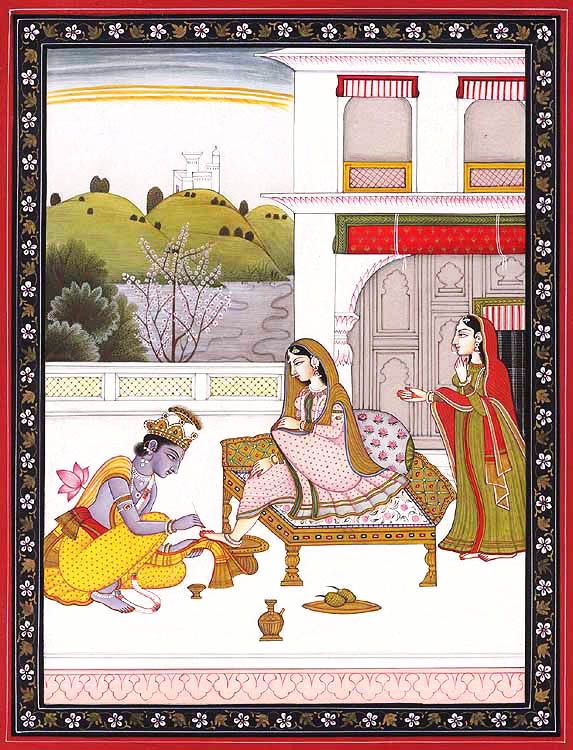
Krishna Tends to Radha's Feet

8. Tala-mana

8.1. The Indian artist never took in the world at a sweeping glance. He had an eye for details. In the canons of Indian art there is a definite and prescribed proportion of the limbs and their ratio to one another. The Indian artist paid more attention to ratio than to the actual standard of measurement of the different limbs. The ratio being the same, the figures may be pygmy or colossal. A standard measurement, however, was in vogue.

The absolute and relative systems of measurement

 It is said; the Indian Vastu and Shilpa shastras recognize two standards of measurement: the absolute and the relative systems.

 In the absolute standard, the smallest unit of measurement is the almost microscopic particle of dust observable in the solar rays or atom. This measurement is named in different ways according to the texts, like for example Trasarenu, Paramanu or Chayanu (shadow of an atom).

Other measurements of the absolute system are the particle of dust called raja or renu, the tip of hair called Balagra, Valagra or Keshagra, the nit called Liksha or Likhya, the louse or yuka, the barley com or yava and the highest unit of this system is the digit or angula which corresponds to the width of the middle finger. They have a relation of one to eight as follows:

  • 8 paramanus make 1 renu
  • 8 renus make 1 balagra
  • 8 balagras make 1 liksha
  • 8 likshas make 1 yuka
  • 8 yitkas make 1 yava
  • 8 yavas make 1 angula
  • 12 angulas make 1 Tala

Manangula is a linear measure; a determined by the length of the middle finger of the artisan or of the patron’s right hand and is employed for the construction of images. This measurement is a fixed unit.

Dehangula is the angula that is in relation to the image itself; and, is derived from the total height of the image to be fashioned. The Dehangula is essentially a relative unit, to indicate the height of an image.

**

According to the Citra-sutras, there are six types of measurement (mana) to be taken along the body of an image. These kinds of measurements constitute the six kinds of iconometric measurement as applied to standing, seated and reclining images.

Mana or measurement of the length of the body or its units (dhirgha); such as the distance from the hair-limit to the eye-line; from that point to the tip of the nose; the length of the arms and of the legs; and so on.

Pramana is the horizontal measurement or breadth (vistara), such as the distance between the two shoulders, the width of the body at the chest level, the width of the belly or the width of the arm or of the thigh

Unmana is the measurement of the elevation or thickness, such as the height of the breasts or of the nose

Parimana is for instance the girth of the arm or of the thigh.

 Upamana is the measurement of the interspaces, i.e., the width of the navel, the interval between the two thighs or the two big toes.

Lambamana are measurements taken along the plumb-lines or sutras.

***

The Chitrasutra gives an elaborate classification of different types of men and women. They are classified into one of the five standard types (Pancha-purusha) called: Hamsa, Bhadra, Malavya, Ruchaka and sasaka.

Hamso Bhadrao tatha Malavyo Ruchaka Sasaka tatha/Vigneyaha Purushaha panch tesham vakshami lakshanam /3.35.8/

Their respective measures are given in terms of angula. The measurement of each of the types would be relative to their respective angulas, such as 108, 106, 104, 100, and 90 angulas.

In the context of mana or proportion, the division of the limbs in terms of tala measurement is elaborately discussed in the Vishnudharmottara. Tala is said to be made of 12 Angulas : dvadasa-angula-vistaras tala ityabhidhiyate (3,35,11) . And,  one tala,  was taken as  the length of the palm from the edge of the wrist to the tip of the middle figure. Usually, the face of the image would measure a length of one tala, which, in other words, would be one-ninth of the body length of a Hamsa category image. The proportions of the various parts of the image –body would be in terms of the tala and its denomination (the angula). Hamsa is the standard measurement of body -length of an image; and the proportions of the other categories of images (Bhadra etc.) are to be worked out by taking Hamsa as bench mark.
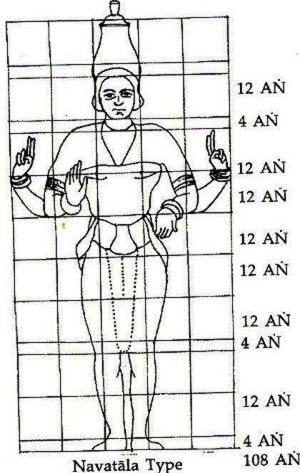
[A similar tala-mana system of proportions and measures governs the shilpa iconography. Its iconometry prescribes the proportion of the limbs and other parts of its body in relation to its face -length. The Indian artists are governed by proportions than by actual measurements. Thus a figure might look pygmy or colossal while the principles that govern the proportions would be the same.

These rules specify the various standards to be adopted for ensuring a harmonious creation endowed with well proportioned height, length, width and girth. These rules also govern the relative proportions of various physical features – of each class and each type of images.

In shilpa-sastra, the madhyama navatala(standard height of nine-face lengths) is normally used for images of celestial beings such as Yakshas, Apsaras and Vidhyadharas. Here, the height of the image would be nine talas (with each tala divided in to 12 angulas) or a total height of 108 angulas.The angula (literally ‘finger’) is a finger’s width and measures one quarter of the width of the shilpi’s fist. The value of the angula so derived becomes a fixed length (manangulam), for all practical purposes, for that image. All other measurements of the image are in terms of that unit.

The face – length of the image i.e., from its chin up to the root of its hair on the forehead – would be 12 angulas or one tala. The length from throat to navel would be two tala; from navel to top of knee would be three tala; from the lower knee to ankle would be two tala making a total of eight tala. One tala is distributed equally between the heights of foot, knee, the neck and topknot. The nava tala thus will have a total of nine tala units, in height (108 angulas).

Hamsa of Chitrasutra corresponds to Nava-tala of the Shilpa sastra.

*

Sthana or stance for the figures grouped in a painting is very important; for, it is vital to indicate the action or repose in the picture, apart from highlighting its central theme.

“In composition the central figure is given importance  over  the other figures. And , that leads to the heightening of the fundamental emotions or fuller expression of the central figure for which alone the others exist.”
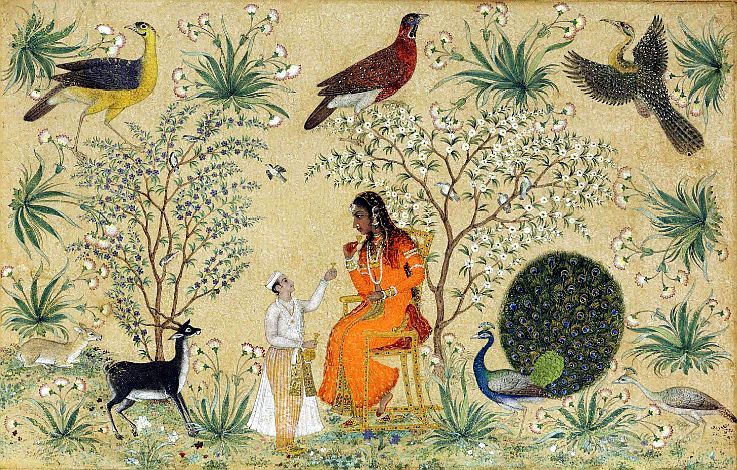
Portrait of a Nobelwoman, Mughal c.1740

8.2.The text describes the characteristic features of the five categories of men.

(i). Hamsa (108 angulas) should be strong, with arms resembling the king of serpents (Sesha) , with moon-white complexion, having sweet eyes, having the color of honey, set in a good-looking face; and with lion-like waist and swan-like majestic gait. The deities are depicted in Hamsa category of style.

(ii).Bhadra (106 angulas) is learned, is of the color of lotus; with full grown tapering round arms, a hairy cheeks and   elephant like step. The rishis, gandharvas, vidhyadharas, ministers and family priests are depicted under this category.

(iii). Malavya (104 angulas) is dark like a mudga –pulse (kidney bean?), good looking ; with a slender waist, arms reaching up to the knees, thick shoulders, broad jawas and a prominent nose like that of an elephant. The kinnaras, nagas, rakshasas and domestic women are depicted under Malavya category.
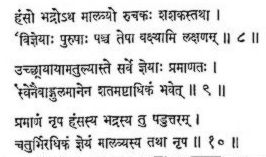
Hamsa Bhadra

(iv). Ruchaka (100 angulas) is high souled, truthful and clever, of good taste. He is of autumn-white complexion and strong with a conch-like neck. Yakshas, vaishyas and prostitutes are depicted under this category. And,

(v). Sasaka (90 angulas) is clever reddish dark and of a slightly spotted colour; with full cheeks and sweet eyes. The tribal chiefs and sudras are depicted as Sasaka.
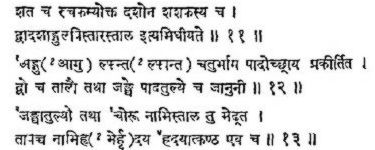
Ruchaka

Measurement of Hamsa is the standard measurement given, in relation to which the measurements of the other types are to be worked out;  keeping in mind the characteristics of that particular type.

8.3. As regards the female figures, there is a discussion about the body types of women; but , it has not been specified .However,  the discussion does state that they too fall under each of the above five categories of males, according to the measurements of the limbs and parts. Therefore, there would be  five  kinds of female bodies. The figures  corresponding to various categories (say Hamsa, Bhadra etc.) too should be depicted in proportions that are applicable to that male-category. 
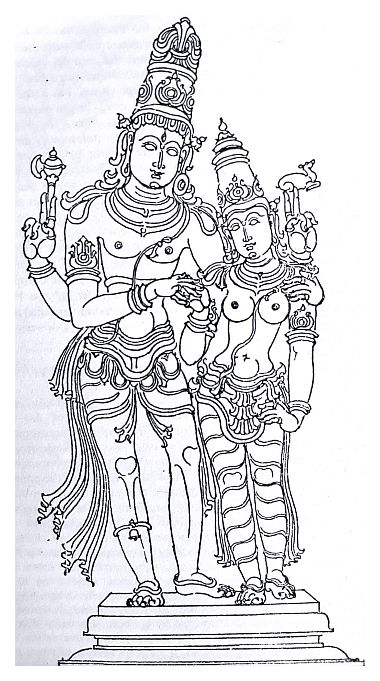
shiva with consoet

But the size of the female figures should be smaller than of the male figures appearing on the same canvass or surface. Her height should be made to reach the shoulder of the man placed near her, in proportion. Her waist should be two angulas thinner than that of a man. On the other hand, her hips should be made wider by four angulas. The breasts should be rendered soft, charming and proportionate to her chest.

Purushasya sameepastha kartavya Yoshi-Isvara /Nara-skanda pramanena karyeka sa yatha -mithi  / 3.37.2/

Angulau dva Nara-vaksham Striyo madhyam vidiyate / adhika cha katih karya tathaiva chatur-angulam /3.37.3 /

Uruh pramanataha karyai sthanau nrupa manoharau / Nrupascha sarve karthaya Maha-purusha lakshanaha /3.37.4/
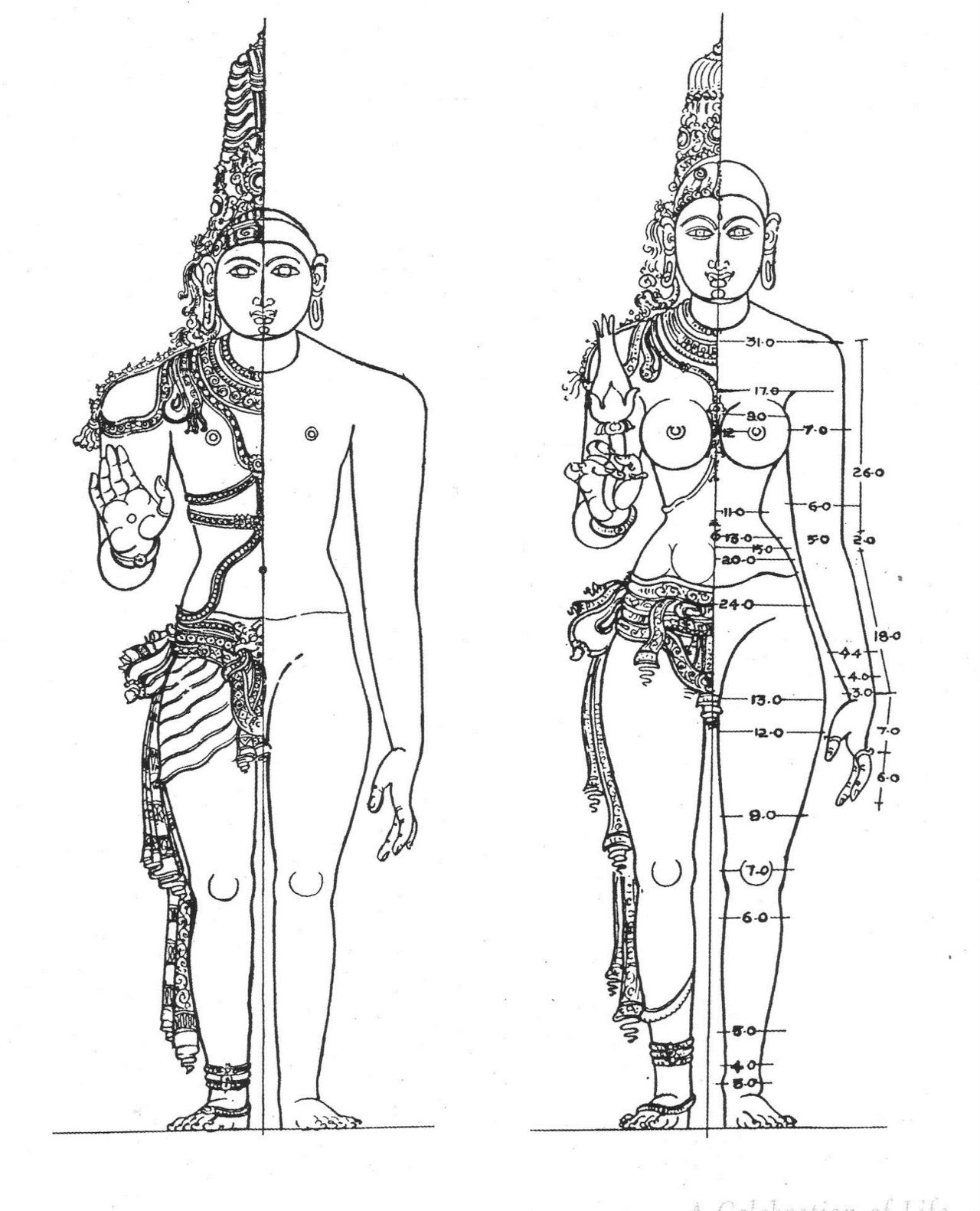
tumblr_m

Talking about women, the text mentions elsewhere, “a female figure should be drawn with one foot calmly advanced, and with the part about the hips and loins broad and flurried on account of amorous dalliance”.
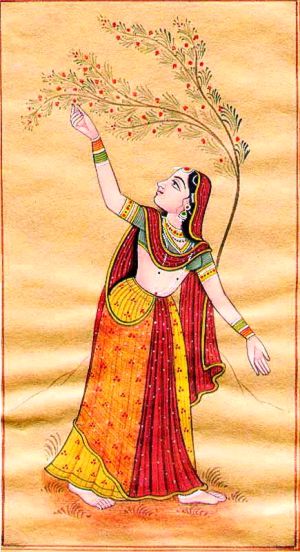
Leela-vilasa-vibrantham-vishala-jhagana-sthalam/sthira-eka-paada-vinyasam-stri-rupam-vilekhe-adbudhaha/ 3.39.50//

The women of good-family should be made bashful, wearing modest ornaments and not-showy dresses; and, with a slender waist, depicted under Malavya characteristics.

– Malavya maana-thaha karya lajja-vathyaha Kula-striyaha ; Na atyunnatena veshena sa-alamkara thathiva cha / 3.42.25/
mugdhaMugdha2

Her expressions of love are Sukumara (gentle, delicate and graceful). When she is in love, her eyes clearly show her feelings. Her eyes are, at the same time, tearfully smiling, slightly closed; while her eyelids droop. When she looks at her lover with half closed eyes, she appears beautiful, graceful and inviting. And, when she blushes, there are drops of sweat on her cheeks; and, there is a discreet thrill, stiffening her body. It is mainly through her smiling eyes that she expresses love. Her quivering lips, sometimes, show her agitation.
The courtesans on the other hand should be painted with vermilion or emerald color, moon-like complexion or dark like the petals of blue-lotus. Her dress should be unrestrained, designed to excite and evoke erotic feelings. She should be painted as a Ruchaka character.

Ruchakasya tu maanena Veshyaha karya tatha striyaha / Veshyanam uddatham vesham karyam srungara sammatam / 3.42.24 / 

The courtesan expresses her desire through alluring side glances; by touching her ornaments; by scratching her ears, while her big toe draws designs on the ground; and, generally by attractive body-gestures. She is also shown as  exposing her navel, and partially, her breasts; polishing her nails; lifting up her arms ; and, tying  her hair.
courtesancourtesan2

9. Drista – those things visible

9.1. The text then goes to describe in great detail the characteristic appearances of country folk, the nobility, widows, courtesans, merchants, artisans, soldiers, archers, door-keepers, wrestlers, monks , mendicants , bards , musicians , dancers and others. Vivid descriptions of their dresses, movements, habits, and features peculiar to their class are given in Chitrasutra. They make a very interesting reading.

9.2. The text also describes the characteristics of different tribes and castes as distinguished by their complexion; noticeable physical features, costumes and habits.

9.3. The Chitrasutra instructs things that are usually visible should be well represented; resembling what is ordinarily seen in life. The aim of painting is to produce a credible resemblance; but not to merely copy. Persons should be painted according to their country; their colour, dress, and general appearance as observed in day-to-day life . Having well ascertained the person’s country, region, occupation, age and his status in life; his other details such as his seat, bed, costume, conveyance, stance, and his gestures should be drawn.

[The Chitrasutra explores this subject in great depth detailing characteristics of persons hailing from various regions and occupations. It is rather too detailed to be posted here. I have posted a summary of that, along with few other issues,  separately, in the next  article.]
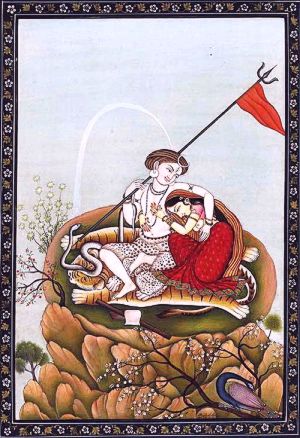
10. Features of the Chitra

10.1. General

There is a detailed enumeration of the features of the images of deities, kings and other class. The Chitrasutra also makes some general remarks of such paintings; and says:

A painting drawn with care pleasing to the eye, thought out with great intelligence and ingenuity and remarkable by its execution beauty and charm and refined taste and such other qualities yield great joy and delight.

A painting without proper position, devoid of appropriate rasa, of blank look, hazy with darkness and devoid of life movements or energy (chetana) is considered inauspicious.

A painting cleanses and curbs anxiety, augments future good, causes unequalled and pure delight; banishes the evils of bad dreams and pleases the household deity. The place decorated by a picture never looks dull or empty.
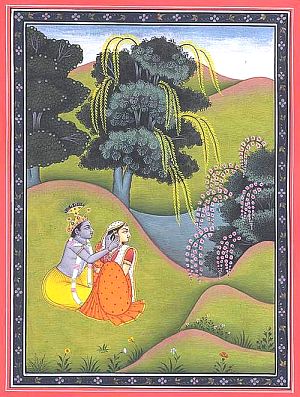
10.1. a. Deities

While discussing the image of the deities to be painted, the text says, the painted image should have a pleasing body, a well finished and well proportioned limbs, delicately painted effects of shade and light, facing the viewer. It should be pure and charming adorned by manifold lines and embellishments.

The front view, face, chest and abdomen should remain undiminished; but, it should grow narrow towards the waist from thighs and also from the shoulders. Its shoulders should be broad.  The abdomen should neither be shrunk nor bloated.
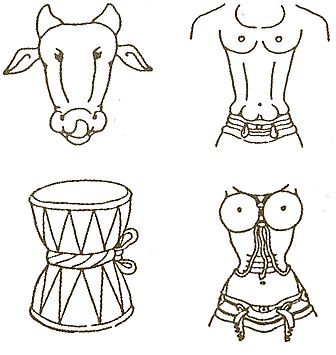
torso

The deities should be drawn wearing strings of garlands and ornamented by crowns, earrings, necklaces, bracelets, ornaments of the upper arms, long girdles reaching up to the ornaments on their feet, and sacred threads with ornaments for the head.
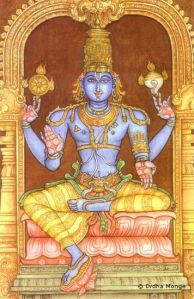
The text says, in general, an image possessed of all auspicious and beautiful marks is excellent from every point of view. Its mudras (gestures of hand and fingers) should be benevolent blessing people with welfare, peace and prosperity. Such an image would add to the wealth, crops, fame and the longevity of life of the worshipers. ”  Blessed is the work of art that is endowed with auspicious marks as it is a harbinger of fortune, fame to the country, to the king and to the maker.”
 1_abaya_hasta2_varad_hasta3_katak_hasta4_vyakyana_hasta5_susi_hasta

As regards the depiction of great men such as kings and noble persons, the text recommends their images should possess the auspicious lakshanas associated with greatness.

The height of the head should be 12 angulas and its girth 32 angulas. The structure of the face should be divided into three parts:  forehead (lalata) – 4 angulas high and 8 angulas wide; nose (nasika)- 4 angulas high, 2 angulas deep and  3 angulas wide; the nostrils being 1 angula broad and 2 angulas wide and, chin (hanu or chibaku) – 4 angulas high.

The Chitrasutra lists typical features of the Hamsa – including that of Urna (tuft of hair on the forehead, between the eyebrows) – ½ angula; and, Usnisa ( a sort of protrusion of the skull) – 4 angula high and 6 angula wide. (Yuva is 1/8 of an angula). 

The hair on the head should be made thin, wavy, shiny, with natural glossiness and like the dark blue sapphire. They should be properly ornamented.

As regards the ears, they should be 2 angulas wide and 4 angulas high; the opening auricle being half (1/2) angula wide and 1 angula high.

As for the mouth, the Chitrasutra (36.12-14) mentions that the space between the nose and the lip should be half (1/2) angula. The size of the upper lip is 1 angula; and, the thickness of  the lower lip is half (1/2) angula. The mouth is 4 angula wide.

In chapter (36.25-27) the Chitrasutra mentions some bodily measures, as: the nape is 10 angulas high and 21 angula girth. The distance between the nipples is 16 angulas. The space between the chest and the clavicle is 10 angula. And again, in the same chapter (lines 37-42) it mentions: the abdomen measurement is 42 angulas. The navel is 1 angula. The hip is 42 angulas wide. The penis being 6 angula in size.

Chitrasutra (35.13) mentions the distance between the penis and navel as 1 Tala; and the same measure from navel to heart; and from heart to throat.

Apart from that, it also mentions that their hands should reach up to their knees (aa-janu bahu). The hands and feet of a chakravartin should be webbed (jala). The auspicious mark of small circle of hair (urna or tuft of hair) should be shown between their eyebrows. On the hands near the wrist three delicate auspicious lines slender curving should be drawn; as if scratched by a hare.

Shoulder to elbow 17 angulas long and 18 angulas in girth; and  Elbow to wrist: 17 angulas long and 12 angulas in girth

As per Chitrasutra (36.30-34) : Palm is 6 angula long and 5 angula wide. The middle finger has a measure of 5 angula. The forefinger is half the size of a part less. The fourth finger has the same proportion. The little finger is the smallest among them.

The thumb should be divided into two parts: 4 angulas and 3 angulas. The space between the fingers should be webbed (jaala-anguli)

As regards legs and feet; the Chitrasutra (35.12-13) indicates: the height of the foot up to the end of the ankle should be ¼ tala (3 angulas). The legs- from ankle to the knee- are 2 talas (24 angulas); and, the same are from knees to thighs. Heels -3 angula wide and 4 angula high. Foot 12 angula long and 6 angula wide.

As regards the toes; the big-toe is 3 angula; the next toe is as long as the big-toe; and the other toes are 1/8 shorter than those.
Flower of Rafflesia Arnoldi , Painted and Engraved by Waddell

The text also warns, when an image is devoid of these auspicious marks (lakshanas) it would cause destruction of wealth and crops. And, it instructs that such an image should therefore be made with great care, dedication and devotion.
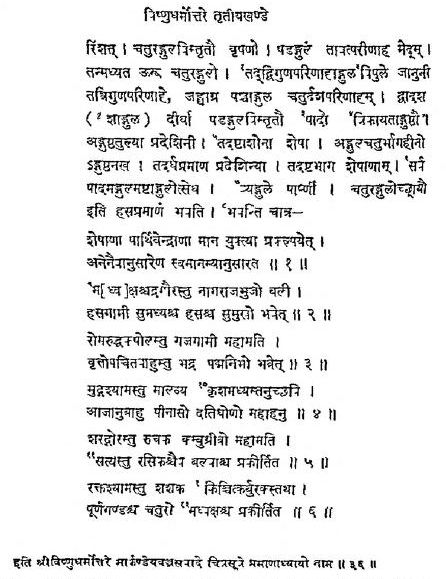
chitrasutra ch 36

chitrasutra ch 36 - 2

[ The Sukraniti-sara says:

Where the image  is intended for worship and  is approached in the spirit of a devotee submitting to his deity, or of a servant appearing before his master, the image must be made to adhere, scrupulously, to the forms and characters prescribed by the Shastras. All other images, which are not meant for worship, can be made according to the artist’s own individual preferences.

Sevaya-sevaka-bhabeshu pratima- -lakshanani smritam. ]

As regards the images of the deities, Prof, S K R Rao writes (The Encyclopedia of Indian Iconography) :
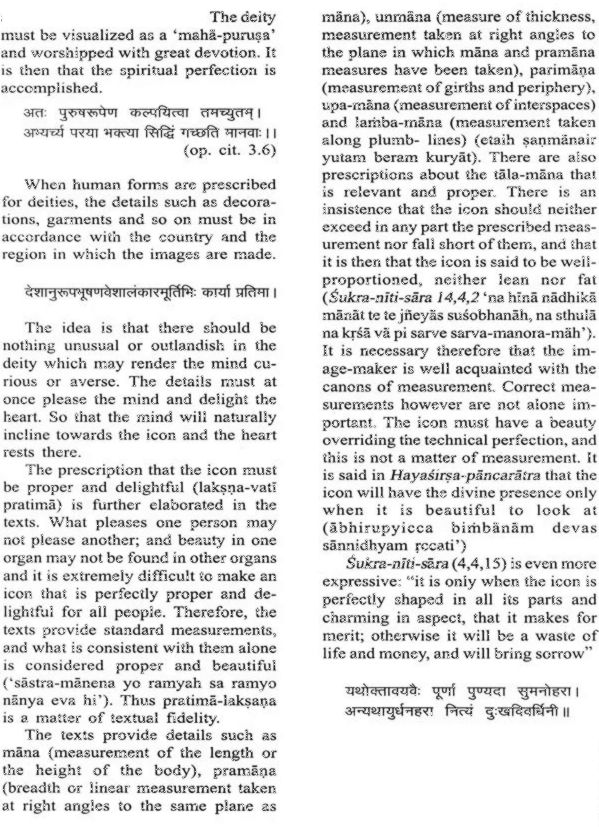
Dhyana sloka extract 5

10.1. b. Others

Vidhyadharas should be shown with garlands and ornaments; and accompanied by their wives on either side. They should be shown either on land or in air, with swords in their hands.

10.2. Face:

10.2. a. Deities

The gods should be represented according to Hamsa measure. The face beautiful should be well developed, well finished, and benign marked with all the auspicious lakshanas. The face should be youthful radiating peace and joy. The face should not be triangular or crooked; nor should it be oval or round. The face should never look angry, sad or blank and lifeless . If such expressions creep in, the image should be discarded.

All organs of senses like eyes, nose, mouth and ears should be made visible.
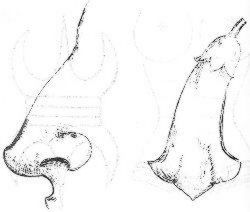
Gods and gandharvas should be represented without crowns but with crests.

10.2. b. Others

All kings should be endowed with auspicious marks. They should be ornamented suitably.

Daityas and danavas (demons) should be made to have frightened mouths, frowning   faces  round eyes and gaudy garments but without crowns.

10.3. Eyes:

The text pays enormous importance to the depiction of eyes of a painted figure.

The text informs that the eyes are the windows to the soul; and it is through their eyes the figures in the painting open up their heart and speak eloquently to the viewer. 

The section related to the eyes is quite detailed. It gives the measure of each part, as also the descriptions of different types of expressions. The Chitrasutra emphasizes the fact that the fundamental element for a painting to be auspicious is the way that the figure glances – neither upward nor downward; neither too strong nor weak; and, neither angry nor fierce.

Unmilana, ‘opening of the eyes’ , infusing life into the picture by opening the eyes of the figure was the final stage of painter’s work. The importance given to  Unmilana is  stressed by Vishnudharmottara: Sajiva iva drisyate, sasvasa iva yachchitram tachchitram subhalakshanam (3.43. 21-22) – ‘that is an auspicious painting in which the figures appear to be alive and almost breathe and move’

As regards the measure of the eyes, Chitrasutra (36. 19-22) mentions: ‘the eyes are 1 angula high and 3 angula wide; the black orb (Krishna-mandala) – perhaps the iris-  is the third part of the eye. The pupils are the fifth part. The eyebrows are half (1/2) angula thick and 3 angulas long.

The text describes   some positions of the eyes : looking straight; half of eyes , nose and forehead are seen ;one eye is seen in full and half of the eyebrow is suppressed; one eye, one eyebrow, one temple , one ear , half of chin are seen etc.

In each case it describes how the eyes and eyebrows should be foreshortened, that is delicately reduced in size or suppressed by artistic means such as gentle lines, delicate shading or by dots.

The text describes five basic types of eyes. And, it says the eye could be in the form of a bow (chapakara); or like the abdomen of a fish (matsyodara); or like the petal of blue lotus (utpalaptrabha); or like a white lotus (padmapatranibha) or like a conch (sankhakriti).

Chapakara – 3 yava measure; Matsyodara– 4 yava; Utpalapatrabha – 6 yavas; Padmapatranibha – 9 yavas; and Sankakriti – 10 yavas ( 8 yuvas make 1 angula)
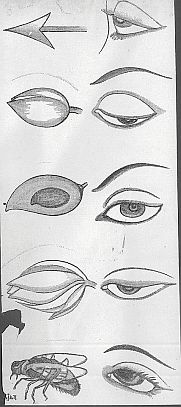
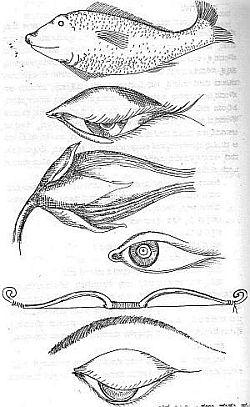
similie Eyes- Vishnudharmottara  Eyes two- Vishnudharmottara

It is explained that   the eye assumes the shape of a bow when looking at the ground in meditation or when lost in a thought.

The eye in the shape of fish should be painted in the case of women and lovers.

The eye in the shape of blue lotus is said to be ever calm and look charming with red at the corners and with black pupils, smiling, gentle and ending in long eye lashes sloping at its end.

The eye in the shape of white lotus petal befits a damsel frightened and crying.

A  conch like eye suggests angry and woe stricken state.

10.3. a. Deities

The eyes of gods  ( of Padma-patra type) should be wide with black pupils, enhancing the beauty of the divine face, beautiful to look at, charming the mind, smiling and with slight reddish tint at its ends like those of blue-lotus petals, with eyelashes bent at the ends, of equal size, gentle; and fluid and pure like cow’s milk. Such gentle serene eyes and pools of tranquility  expressing love and compassion bless the viewers with happiness.

The images with white-lotus petal eyes bring wealth and prosperity. Its eyes should also be even, wide, serene and pleasant to look at. It should have eye-lash sloping at the end and black pupil. Its look should be placid,

Unmilana ‘opening of the eyes’ of the figure is described as the final act; a painting would be complete only with that; and after that, ” an auspicious painting in which the figures  will appear to be alive and almost breathe and move’ . Drawing of eyes with delicate lines and giving an expression to the image infuses life into it.

The artist is cautioned to be careful and not to give an upward or downward or sideward look to the deity. An image of god with too small or too wide eyes; or looking depressed, angry or harsh should be discarded.  In case such mistakes happen, the deity should be discarded.

The text warns of the ill effects of making a painting of a deity with bad proportions or unacceptable dispositions.

[ In a similar manner, the Shukraniti-sara also warns : An emaciated image always causes famine ; a stout image spells sickness for all ; while the one that is well proportioned, without displaying any bones, muscles or veins, will ever enhance one’s prosperity.

Krisa durbhikshada nityam; sthula rogaprada sada, Gudhasandhi  asthi-dhamani  sarvada  saukha vardhini ]

An image of god should  , therefore, be properly made with great care and devotion; and with all the auspicious marks

10.3. b. Others

Daityas and danavas should be given round eyes wide open in fright. Their mouths should also be open as if about to scream. They should be given gaudy ornaments, but no crown.

Representation of human figures with too thick lips, too big eyes and testicles and unrestrained movement are the defects.

10.4. Hair

Hair is an important aspect of the image. It provides it with individuality and it also symbolizes its character.

The text specifies six types of hairstyles: Kuntala (loose) hair; Dakshinavarta (curled towards the right); Taranga (wavy); Simha kesara (lion’s –mane); vardhara (parted) and jatatasara (matted).

10.4. a. Deities

Hair should be represented auspicious, fine resembling deep blue sapphire, adorned by its own greasiness and with endearing curls.

In case of gods, the halo should be drawn around their heads, proportionate to the measurement of the head and colour of the hair. The colour of the halo circle should enhance the glow of the deity. Their body should be devoid of hair.  On their faces, they should have hair only on their eyelashes and eye brows.

Gods and gandharvas should be represented without crowns but with crests.

10.4. b .Others

Sages emaciated yet full of splendour should be represented with long stresses of hair clustered on top of their head, with a black antelope skin as upper garment.

The manes of the sages, ancestors and gods should be made to glow like gold and with ornaments consistent with their own colour, outshining all others.

In the case of kings a circle of hair should be drawn auspiciously between their eyebrows. The hair on a king’s body should be drawn one by one.

The respectable people of country and town should be painted with almost grey hair, adorned with ornaments suitable to their status.

Merchants should be represented with their head covered on all sides by turbans.

Wrestlers should be represented with cropped hair, looking arrogant and impetuous.

Widows are to be shown with grey hair , wearing white dress and devoid of ornaments.

The artist should use his skill and imagination in providing appropriate hair-styles to the figures.

10.5. Arms and hands

In case of gods and kings, arms reaching up to the knees should be strong and tapering resembling the king of serpents or the trunk of an elephant; and should reach up to the knees. Hands should be delicate. The images of the kings should be shown with webbed hands. (I do not know the “why” of this requirement). All kings should be endowed with auspicious marks.
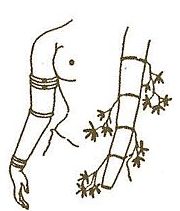
Indian_murti_(statue)arms

The hands of deities should be delicate and expressive. Their mudras, the gestures by hands and fingers, should be auspicious in benediction.
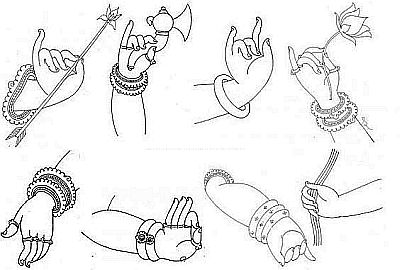
hands

10.6. Feet

There is an elaborate discussion on the feet-positions, which enhance the mood and message of the image. The positions described include, standing straight in traditional position (sampada); standing with a spans apart (vaisakha) ; half straight with left knee advanced and right knee retracted- suggesting movement (pratyalidha); its counterpart that is right knee advanced (alidha) legs in circular motion (mandala).

The knee-bent positions are related to an archer or a javelin thrower or a swords person etc. (as in pratyalidha or alidha). These positions are improvised to show a fat man running or a pitcher- carrier. The bent knees and feet apart positions are also used to depict the broad hips, flurried loins of the amorous dalliance of a woman.

Accordingly, the gods should always be made beautiful, having gaits like: a lion, bull, elephant or a swan.
Nineplanets Navagraha 2

[ The Sukranitisara, another text, recognizes five different classes of images: — Nara (human); Krura (terrible); Asura (demoniac); Bala (infantile); and, Kumara (juvenile).  Each of these five classes or sets of images (murtis) is assigned a particular scale/proportion (Tala-mana):

Nara murti = ten Talas; Krura murti = twelve Talas; Asura murti = sixteen Talas; Bala murti = five Talas; and, Kumara murti = six Talas.

Here, a Tala is defined as: a quarter of the width of the artist’s own fist is called an Angula or finger’s width. And, twelve such Angulas make one Tala.

It says; besides these given measures there is another measure current in Indian iconography which is known as the Uttama Nava-tala. In this type of images, the whole figure is divided into nine equal parts which are called Talas. A quarter of a Tala is called an Amsa or Unit. Thus, there being four Amsas to each Tala, the length of the whole figure from tip to toe is 9 Talas or 36 Amsas.

The Sukraniti-sara and Brihatsamhita describe the  details  of the various features of a Nava-tala image. 

According to Sukraniti-sara :

Head : 

The face of the figure is divided into three equal portions:  middle of forehead to middle of pupils; pupils to tip of the nose; and, from tip of the nose to chin.

The Forehead should resemble  the form of a bow. The space between the eye-brows and the fringe of hair in front should show the arched crescent form of a slightly drawn bow.

The Eyebrows are to be  like the leaves of a Neem tree or like a bow. The various emotions, of pleasure or fear or anger etc., are to be shown by raising, lowering, contracting or otherwise modifying the eye-brow like a leaf disturbed by the wind or a bow under different degrees of tension.

The Eyes are usually described as ‘fish-shaped’.  But all similes   used to describe the eyes are inadequate; as  the range of emotions and thoughts that can be expressed through them are truly endless .

The nose should have the shape of the sesame flower ; and the nostrils are to be  like the seed of the long bean. Noses shaped like the sesame flower are to be seen chiefly in the images of goddesses and in paintings of women. In this form, the nose extends in one simple line from between the eyebrows downwards, while the nostrils are slightly inflated and convex like a flower petal.

Parrot-noses are chiefly for  the images of gods and  male figures. In this type ; the nose, starting from between the eyebrows rapidly gains in height and extends in one sweeping curve towards the tip, which is pointed, while the nostrils are drawn up towards the corners of the eyes. Parrot-noses are invariably associated with heroes and great men, while, among female figures, they are to be seen only in the images of Devi .

Lips, being smooth, moist and red in color, are to resemble the Bimba fruit. The  red and luscious Bandhuka flower should  admirably be adapted to express the formation of the lower and upper lips.

The Chin should have the form of the mango-stone. As compared to  the eyebrows, the nostrils, the eyes or the lips, the chin is more or less inert; being scarcely affected by the various changes of emotion which are so vividly reflected in the other features. It has therefore appropriate to  compare the chin to the inert stone of a fruit, while the others to the living  objects like flowers, leaves, fish, etc.

The ear is also a comparatively inert portion of human  face, and, its shape is compared  to the letter ला ( La in Sanskrit ) .

Neck:

The Neck is supposed to exhibit the form of a conch, the spiral turns at the top of a conch being often well simulated by the folds of the neck. Besides, as the throat is the seat of the voice the analogy of the conch is well suited to express the function, as well as the form of the neck.

Trunk

The Trunk, from just below the neck to the abdomen, is to be formed like the head of the cow;  suggesting the strength of the chest and the comparative slimness of the waist as well as the loose and folded character of the skin folding near the abdomen.

The middle of the body should resemble in shape a Damaru (Hour-glass formation); and,  the lion’s waist (Simha kati).

Arms and hands

The, arms are to resemble Elephant’s trunk; strong and supple. 

The Forearms, from the elbows to the base of the palms,  are to be modeled like the trunk of a young plantain tree; emphasizing the supple symmetry as well as the firmness of the arms.

The Fingers are to resemble the  formation of young Champaka flower-buds.

Lower Limbs

The human thigh, in male as well as in female figures, is to be like the trunk of the plantain tree, simulating its smoothness, strength and firmness of build.

The knee-cap should compare to the shell of a crab

The Shins are to be  shaped like fish full of roe.

And, generally, the Hands and Feet  should have a  resemblance to the lotus or the young leaves of plants .

***

As regards the measures and proportions of various features of a Nava-tala image, the Sukraniti-sara and Brihat-samhita   prescribe :

From the crown of the head to the lower fringe of hair = 3 Angulas in width; forehead = 4 Angulas ;  nose =  4 Angulas ; from tip of nose to chin = 4 Angulas; and , neck = 4 Angulas  in height;  eye-brows =  4 Angulas  long and half an Angula  in width; eyes = 3 Angulas  in length and two in width ; pupils = one third the size of the eyes ; ears =  4 Angulas in height and 3 in width.  Thus, the height of the ears is made equal to the length of the eye-brows.

Palms = 7 Angulas long’ the middle finger = 6 Angulas; the thumb = 3 Angulas, extending to the first phalanx of the index finger.

The thumb has two joints or sections only-, while the other fingers have three each. The ring finger is smaller than the middle finger by half a section; and, the little finger smaller than the ring finger by one section, while the index finger is one section short of the middle.

The feet should be 14 Angulas long; the big toe= 2 Angulas; the first toe = 2 ½ or 2 Angulas; the middle toe = 1 1/2 Angula; the third toe = l ½  Angula ; and , the little toe = l ½  Angula.

Female figures are usually’ made about one Amsa shorter than males.

The proportions of child-figures should be as follows:—the trunk, from the collar-bones below, should be 4 ½ times the size of the head. Thus the portion of the body, between the neck and the thighs is twice and the rest 2 1/2 times the size of the head. The length of the hands should be twice that of the face or the feet.

***

Prof. Ordhendra Coomar Gangoly (1881-1974), popularly known as O.C. Ganguly, one of the foremost authorities on Indian Art, remarks:

The Talas given here (Sukranitisara and Brihat-Samhita) do not exhaust the various measures current in Indian sculpture.  In the 4th chapter of the Sukrnniti Sara as also in the chapter on Pratima lakshana of the Brihat Samhita measurements are given for the average human body according to which the average male figure is stated to be eight times the face which is represented by one Tala.

Any height for a human ‘male, which is less than the eighth measure is conceived in the Sukranitisara as dwarfish or below the average.

The average human female figure is given as of the seventh measure (Sapta-Tala).

The average infant figure is laid down as of the fifth measure (Pancha-tala).

The measures higher than the Asta Tala are reserved for the images of gods ;, demons, Rakhsas and other super-human beings.

 Thus the image of the goddess according to the Sukranitisara is always in the ninth measure (Nava Tala smrita Devi).That of the Rakshasas   is the tenth measure.

The South Indian manuscripts however differ a little from the Sukranitisara and other works in respect of the rules for the measure of the deities.

But; except in the case of the image of Ganesha and Krishna, all the measures given for the images of the deities are higher than the Asta-tala , the average human measure, the higher measurements suggesting a relatively ‘heroic’ type.

 In the South Indian manuscripts each measure is again divided into three different classes e.g. the Uttama (best) Madhyamā [medium) and the Adhama (lowest). Thus the Uttama Dasa-tala is represented by 124 Angulas or parts; the Madhyamā-dasa-tala by 120 parts; and, the Adhama-dasa -tala by 116 parts.  Special injunctions are laid down for constructing particular images in a measure specially reserved for them. ]
Shiva Parvathi22

11. Postures and perspectives

Abhanga etc

Chitrasutra mentions that an image could be presented in any number of positions; but categorizes nine positions as the leading attitudes.

[For more on  postures (Sthanas) please click here; and,  for more on  measures and proportions (Tala-mana)  please click here]

11.1. The nine postures, mentioned under, can perhaps be understood as stylized views, as they are the same figure viewed from different angles. That causes portraying the same figure, with altered body- proportions, because some parts are hidden from view while some others are prominent. The ratio of the head with the other limbs of the body has to be altered in accordance with the different postures and view positions (perspectives). Yet, the image should not look disproportionate. That has to be done by manipulating density of light and shades. These indicate that the Chitrasutra had a sound understanding of the spatial perspective of things.

11.2. The various positions and perspectives are achieved by what the Chitrasutra calls – kshaya and vridhi, decrease and increase, which is the art and skill of foreshortening. The positions are:

(i)*. front view (rivagata);

(ii)*.back view (anrju);

(iii)*.bent position – in profile view (sat-chikrat-sarira);

(Iv)*.face in profile and body in three quarter profile (ardha-vilochana);

(v)*.side view proper (paravagata);

(vi)*.with head and shoulder-belt turned backwards (paravritta);

(vii)*.back view with upper part of the body partly visible in profile (prastagata);

(viii)*.with body turned back from the waist upwards (parivrtta);

And

(ix)*.the back view in squatting position with head bent (samanata).

*

11. 3. Then, the Sage goes on to describe the nature of these positions; and how to draw them (39. 1-32)

(1)  The front view (rivagata) is, of course, the pre-eminent position amongst those enumerated earlier. It presents a beautiful static posture (rju) of a well-proportioned pleasing body  , expertly  shaded with artistic display of light and shade . The pure, charming figure, adorned by manifold lines and embellishments, faces the viewer, in full. The front view, face, chest and abdomen should also remain undiminished. The figures grow narrower towards the waist from the thighs, as well as from the shoulders. Their nose-wings and lips appear foreshortened by a fourth part of their width; and their limbs are foreshortened by a third part of their breadth.

(2).  For the back view (anrju), the portions on the back should be without foreshortening (lit. diminished limbs)

(3) . The profile view in a bent position (sat-chikrat-sarira) could be very alluring. The bent posture (tiryak), well rounded, but slender and tender limbs all contribute to enhance the charm of the posture.  In this profile; only one of the eyes and a portion of the forehead and also of the nose are shown. The one eye that is shown, in the profile, is foreshortened by artistic means; and, the eyebrow is also artistically suppressed (i.e., foreshortened); and is painted with gentle lines. The face is neither straight nor serious; neither black nor shady.

(4)  The next position is called ardha-vilochana ‘ – with one eye – face in profile and body in three quarter profile. Here, the one eye in the face of the figure is shown in full; and, half of the eyebrows is suppressed (i.e., one eyebrow is not to be seen). The forehead (the curve of the forehead in half its usual size); and, the curve of one eyebrow are visible. The other visible part is half of the cheek from one side only; while the other half is invisible (lit. suppressed). Half of the usual length (lit. measure) of the lines on the throat and a yava only of the chin are shown. The navel, one angula less than the opening of the mouth, and three quarters (lit. half and half of that half) of the waist and other (parts) should be shown.

(5)  The side view proper (paravagata) or Parsvagata is as if it is emerging out of the side or the wall (bhittika) or out of the shade (chhayagata). Only its one side is seen – either the right or the left. Only its one eye, one eyebrow, one temple, one ear; and, half of the chin and the hair should be shown. The figure which is well proportioned should exude grace and sweetness.

(6) . The position with the head and shoulder-belt turned backwards (paravritta) is   said to be ” turned back by the cheek” (ganda-paravrtta) whose limbs are not very sharply delineated.  It has appropriate measurement in proper places; looking tender; and, artistically foreshortened, kshaya with dark shades in forehead, cheek and arm and also in the throat, (i.e., the parts that are vaguely discernible, as they are lying in the shade) .

(7) Usually, the wall paintings presenting a back view with upper part of the body, partly visible in profile, are tradition-ally called (prastagata)- ‘derived from the back ‘.  Such pictures reveal the attractive back frame of the body, showing muscles and joints. In such depictions, only one side is seen; the chest, (one) cheek and the outer corner of the eye are only faintly visible.  Such well-proportioned profiles possess qualities like sweetness (madhurya) and grace (Lavanya) .

(8) The Parivrtta is a figure whose upper part of the body is turned back from the waist upwards; and, only a half of it is seen on account of its reversed position.  The upper and lower portions of the body, towards the front, are somewhat lost in shade. Its face is tainted with envy; and, the lower half of the body is like that of a rustic; and, its middle is properly foreshortened and made agreeable to the eye.

(9) The back view in squatting position, with the head ;  with the buttocks in full view; with the soles of the feet joined; with half of the body faintly seen from above; with the part about the entire waist shown; with the two entire soles shown;  with foreshortened lower part of the toes, beautiful all round, well finished, not terrible-looking, with arms visible ; with head and trunk well joined and  bent down towards the legs is known  by the name of Samanata – methodically bending .

The text cautions; these positions should be drawn with care, accompanied by qualities like mana (proportionate measurement, etc.). And then , it adds; if these nine positions are depicted thoroughly , as prescribed,  ‘there is none besides and superior to these’- ( 39. 34-51 )

12. Foreshortening

The concept of foreshortening i.e. the lengthening or the shrinking of the limbs is called Kshaya-vriddhi. It is explained with the help of nine postures (as mentioned above)  when viewed from different angles.

The techniques of foreshortening –  Kshya (decrease); Vrrddhi (increase) and Pramana (proportionate measurement) – are vital to the art of drawing. These techniques are said to be of two kinds – Chitra (simple) and Vichitra (multicolored). the latter, again is graded into three sorts, according to the quality of the results obtained by proportionate measures:  Uttama (full), Madhyama (middling) and Adhama (small).

Further, the techniques of Kshya and Vrddhi are said to be of thirteen varieties, depending upon the nine positions or postures to be depicted in the painting, as mentioned above. The foreshortening will also have to take into account the various positions of the feet and the series of their movements like alidha (the right knee advanced and the left leg retracted); pratyalidha (i.e., with the left knee advanced and the right knee retracted); and, vaisakha (i.e., with feet a span; apart)- as described above.

*

In describing the various kinds of postures, the Chitrasutra advises the display of various kinds of light and shade in and through which the exact position of the postures could be expressed. According to diversity in posture there is a diversity of relation of the different parts of the body which disturbs the normal relation that the head bears to the different limbs. Twelve such postures are described in the Chitrasutra

Foreshortening is achieved, as the text says, by manipulating light and shadows with the aid of coloring, shading with delicate cross lines, stumping and dots; and at the same time maintain the proper proportion (pramana) of the figure and its aspects.

“Weakness or thickness of delineation, want of articulation, improper juxtaposition of colors are said to be defects of painting.”

Daur-balyam sthula-rekhatvam avibhakta tvameva cha / varnanam samkaracha tre chitra-doshaha prakirthitaha / 3.43.18/

*A painting without proper position, devoid of appropriate rasa, blank look, hazy with darkness and devoid of life movements or energy (chetana) is inauspicious.

Sthana -hinam gata-rasam shunya-dristi malimasam /Hina-angam malinam shunyam bhaddam vyadi bhayakulaihi /3.43.22/

“Proper position, proportion and spacing; gracefulness and articulation; resemblances; increasing or decreasing (foreshortening) are the eight good qualities of a painting.”

Sthana Pramanam Bhu-lambo Madhuratvam vibhaktata /Sadushyam Kshaya-vruddi cha gunah astaka idam smrutham /3.43.19 /

Lasativa Bhu-lambo bhibyati iva tatha Nrupa / Hasativa cha Madhuryam Sa-jiva iva drushyate /Sa-svasa iva chitram tat-chitram Shubha-lakshanam /3.43.1-21-22/

The paintings created by the competent artists well-versed in the Shastras, ushers in prosperity; drives away poverty and wretchedness. A painting properly and well positioned, is viewed with wonder and admiration. It ensures a pleasing ambiance, charged with love and happiness. It drives away nightmares; and pleases the Deities resident in the homes. The home indeed looks complete with all the auspicious aspects.

Shastragnaihi su-krutam dakshai Chitram hi Manujaadipa/ Sriya -mavahati kshipram A-lakshmim chapakarshati /3.43.24/

Nirner-jayathi  cha utkantam nirudhya-gatam shubhum / shuddam prathayati -pritim janyatya -tulamapi /3.43.25/

Dus-swapna-darshanam hanthi  preenathi Griha Daivatham /3.43.26 /
Vishnudharmorrata. 3 jpg

hl66

Next:

Chitrasutra continued

Sources and References:

I gratefully acknowledge  Shri S Rajam’s sublime paintings;  And the other paintings from internet.

Line drawings from Dr. G Gnanananda’s Brahmiya Chitrakarma Sastram

Citrasutra of the Visnudharmottara Purana by Parul Dave Mukherji

Stella Kramrisch: The Vishnudharmottara Part III: A Treatise on Indian Painting and Image-Making.  Second Revised and Enlarged Edition ; (Calcutta University Press: 1928)

Technique of painting prescribed in ancient Indian Texts

http://curiosity-the-key-to-knowledge.blogspot.com/2006/12/technique-of-painting-prescribed-in.html

The “Sarvatobhadra” temple of the Vishnu-dharmottara-purana

https://openaccess.leidenuniv.nl/dspace/bitstream/1887/2668/1/299

_022.pdf

Problems of Iconometry: Comparing the Citrasūtra with the Citralakaa by Matteo Martelli

I gratefully acknowledge the illustrations from the works of Shri S Rajam

All other pictures are from internet
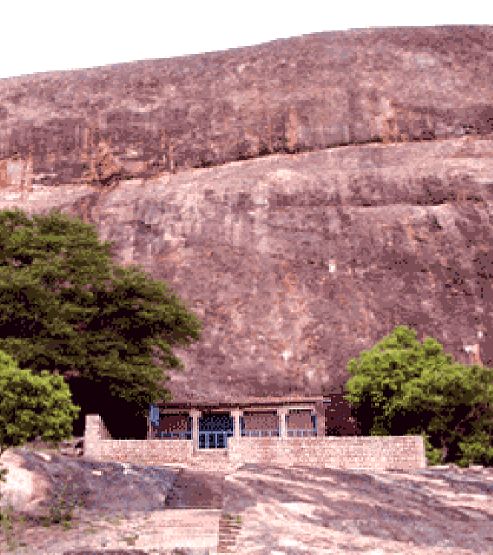
 
15 Comments

Posted by on September 18, 2012 in Art, Chitrasutra, Natya, Vishnudharmottara


Tags: , , , ,