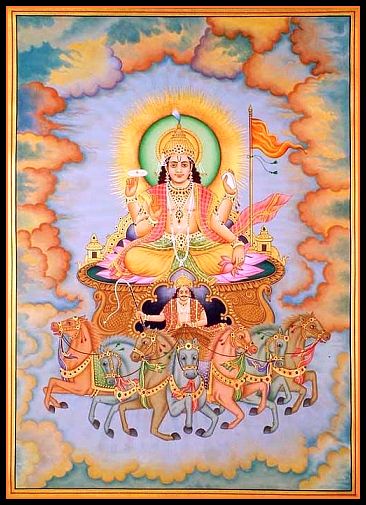
It is said; the Verses 11 to 15 give a mystic description of the Year and the Seasons. Let us commence with verse 11
Verse 11
द्वादशअरम् । नहि । तत् । जराय । वर्वर्ति । चक्रम् । परि । द्याम् । ऋतस्य । आ । पुत्राः । अग्ने । मिथुनासः । अत्र । सप्त । शतानि । विंशतिः । च । तस्थुः॥१.१६४.११ ॥
dvādaśa-aram | nahi | tat | jarāya | varvarti | cakram | pari | dyām | ṛtasya | ā | putrāḥ | agne | mithunāsaḥ | atra | sapta | śatāni | viṃśatiḥ | ca | tasthuḥ II 11 II
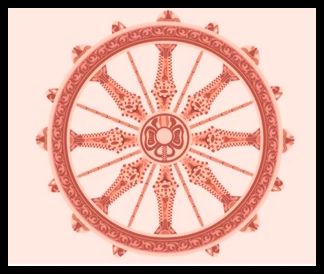
The wheel of Law, with twelve spokes goes round and round the heaven; it is not indeed to be decayed Here stand, O Agni, the seven hundred and twenty sons in pairs.
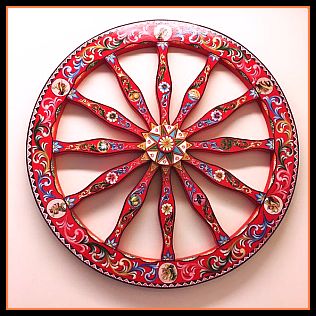
The theme of Aditya and the Time-element, as in verses 8 to 10, is continued here. And, the imagery of Wheel, in particular, is much repeated and described in many verses; such as: Verses of the poem: 2,3,12,13, 14 and 48.
It emphasizes the unchanging, age-less (नहि-तत् -जराय – Nahi-tat-jarāya), decay-less nature of the revolving wheel of time (वर्वर्ति–चक्रम्- varvarti-chakram); moving endlessly on its own, without friction.
The twelve-spoked wheel (द्वादशअरम्–चक्रम् dvadasaram-chakram) of Truth (ऋत) goes round the heaven; and never tends to wear out. It might be seen as though moving on the manifest plane; but, it, indeed, derives its momentum and dynamic energy from the unmanifest Eternal Universal Principle (Rta).
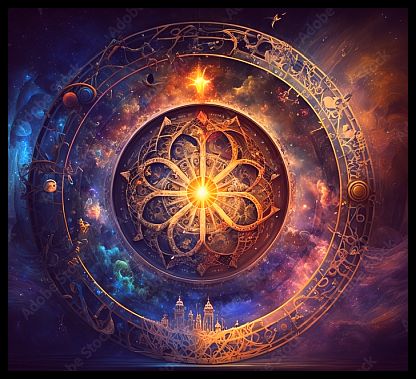
The rhythmic or the cyclic motion of all entities in the space is governed by the Time-Wheel principle.
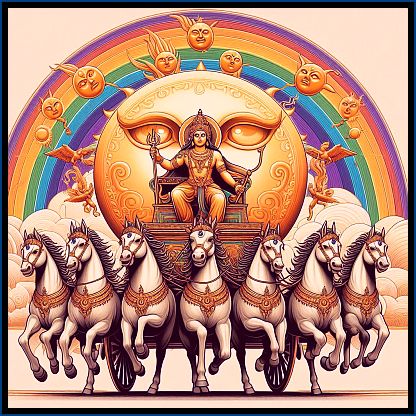
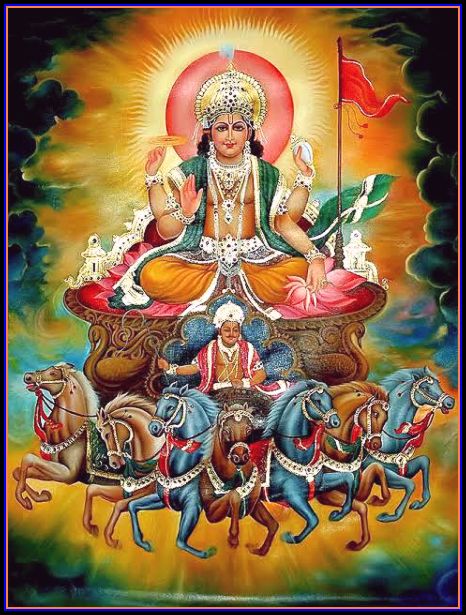
This Time-Wheel is said to symbolize Aditya: Surya, the Sun.
The Sun is at the center of the well-regulated Cosmic system.
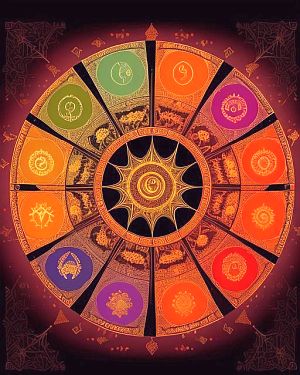
The twelve-spoked Aditya-mandala is compared to a wheel; having twelve spokes, which in turn, represent twelve months in a year (Samvathsara).
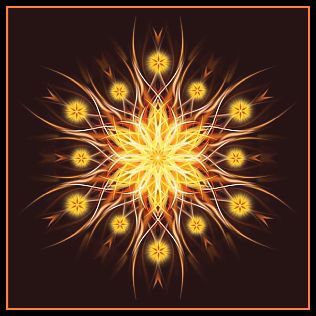
It is said; Seven-hundred and twenty (सप्त । शतानि । विंशतिः –sapta-satani-vimsati) sons in pairs (मिथुनासः mithunasah), abide in it. These sons are said to represent the two halves (day and night) of the three hundred and sixty days of the year.
A day and a night form a pair मिथुनासः -. The wheel with the twelve spokes is the year divided into twelve months. This goes on rotating for ever; and there is no deterioration for this wheel.
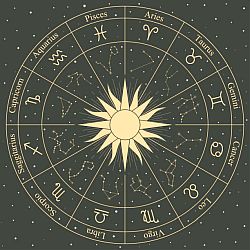
[ Some suggest; the term Twelve-spoked-wheel might possibly mean the twelve signs of the zodiac.]
Here, Rta is the Eternal Moral Law of the world, represented by the Sun , who is addressed as Agni, who in turn is identified with Fire, Vayu and Aditya, who constantly moves about
(Dr. Raja remarks: I am not sure why this is addressed to Agni, the Fire . Perhaps , Agni here stands for Aditya.)
Another explanation says:
Agni is Aditya; he is Prajapathi – the Lord; and, he in his dual nature of heat and cold (Grishma-Hima) – the Day and Night (अहोरात्र–Ahoratra)- manifests in succession. It is like the going up and coming down movement of the wheel (Udgarbha-Nigarbha). One could even say: it is an epitome or a representation in miniature of the Cosmic Cycle.
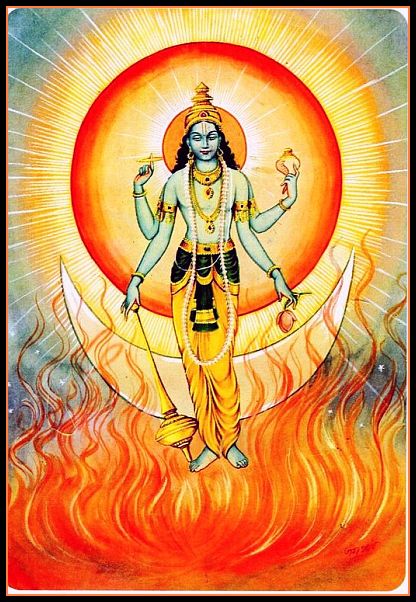
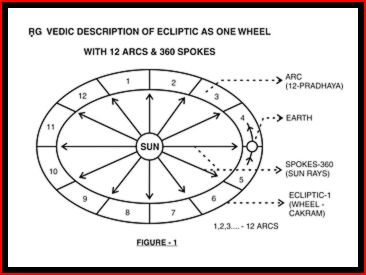
Dr. M .L. Raja interprets the verse 11 , reading as under to suggest it actually represents a Zodiac wheel
The arcs are twelve, the wheel is one and three are the axles. Who indeed knows it? Within it are collected three hundred and sixty spokes, which are as it were movable and immovable
Verse 12
पञ्चपादम् । पितरम् । द्वादशआकृतिम् । दिवः । आहुः । परे । अर्धे । पुरीषिणम् । अथ । इमे । अन्ये । उपरे विचक्षणम् । सप्तचक्रे । षट्अरे । आहुः । अर्पितम् ॥ १.१६४.१२ ॥
pañca-pādam | pitaram | dvādaśa-ākṛtim | divaḥ | āhuḥ | pare | ardhe | purīṣiṇam atha | ime | anye | upare | vi-cakṣaṇam | sapta-cakre | ṣaṭ-are | āhuḥ | arpitam II 1.164.12 II
Father with five feet and twelve forms, they say, dwells in higher half of the heaven full of waters. Others say, he is the clear-seeing one who dwells below in the sevenfold wheel that has six spokes.
**
They call him the father, having five feet, having twelve forms, full of water, in the far side of heaven.
Then, there are others who call him as the all-seeing one, riding high in his chariot, which is having seven wheels and six spokes.
Sri Sayanacharya explains: the poet speaks of two alternative views.
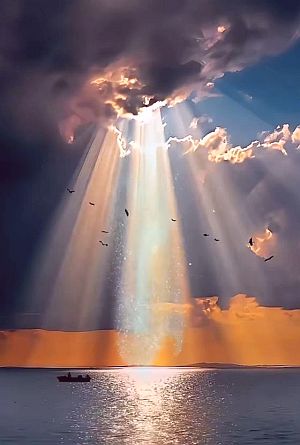
One is that: Aditya, the primary cause (Purisa), when he is in the far side (Para-Ardha) of the sky (दिवः –Dyu-Loka), is termed as –पञ्चपादम् । पितरम् । द्वादशआकृतिम् –the five-footed, twelve-faced parent, Puriṣin – rich in water (the sun, as the source of rain). He is the God, placed high on the chariot, clearly seeing the world.
The five feet are the five seasons in a year (the dewy and cold seasons treated as one); the twelve forms are the twelve months, or the twelve Adityas (suns)-meaning the climatic appearances witnessed from month to month during the course of a year.

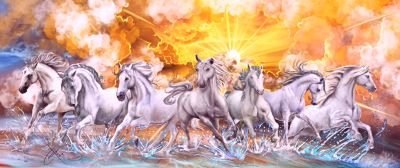
While, some others have termed him as अर्-पिता–Arpita, when he is in the hither or nearer part of the sky (Apara-Ardha) riding in his seven-wheeled chariot (सप्तचक्रे), each wheel having six spokes (षट्अरे), clearly viewing the whole world.
Here the term Arpita–adhīnam or parāyattam– is understood as one who is dependent upon; or is influenced by the course of the year; or by the recurrence of the solstices; moving quick or slow according to his southern or northern declination.
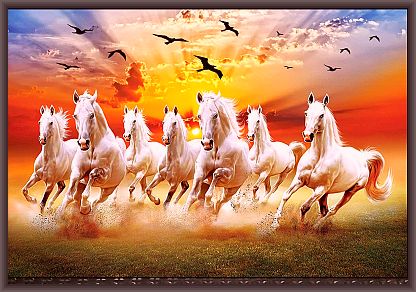
Father is the year (Samvathsara), with five seasons, each of seventy-two days, regulating his movement. And, the seven wheels are the seven rays, or the seven days of the week; the six spokes are the six seasons.
These are two conflicting views.
- In one, Aditya, in his divine form, is the Lord of all the three worlds. This is his higher form.
- In the other, he is under the control of Time; and is seen by the world as being subject to the rotation of seasons. This is his lower form.
**
The distinguished scholar David Frawley comments:
The five feet of the Father or the Sun are the five planets or five elements that these often refer to (which the Vedic thought associates five sense organs and five motor organs in human body).
His twelve forms are the twelve zodiac signs.
The sun in the higher half of the heaven with water is the signs of Leo with Cancer (ruled by the moon), with other five planets being the five feet, each ruling two signs. In Vedic thought, Sun is the abode of waters, which we can see in the Zodiac with the Proximity of Cancer and Leo.
The sevenfold wheel is the Zodiac moved by seven planets. The six spokes are the six double signs through which the planets travel

Verse 13
पञ्चअरे । चक्रे । परिवर्तमाने । तस्मिन् । आ । तस्थुः । भुवनानि । विश्वा । तस्य । न । अक्षः । तप्यते । भूरिभारः । सनात् । एव । न । शीर्यते । सनाभिः ॥ 1.164.13 ॥
pañca-are | chakre | pari-vartamāne | tasmin | ā | tasthuḥ | bhuvanāni | viśvā | Tasya na | akṣaḥ | tapyate | bhūri-bhāraḥ | sanāt | eva | na | śīryate | sa-nābhiḥ ॥ 1.164.13
In that wheel having five spokes, which rolls on, all the beings stand out. Its axle, bearing immense load, does not get heated. Having its navel, it does not break, from the beginning itself.

The imagery of the Chariot (रथ), Time-wheel (चक्र), axel (अक्षः), nave (नाभिः) etc. is continued in this verse.
In the previous verse, the father had five feet and the chariot had seven wheels and six spokes. Here the wheel has five spokes. The beautiful poetic fancy of a chariot not breaking down even with immense load and not decaying in course of time is continued here.
In the man-made chariot, the nave and the axel cannot bear over weights; and, might even break down.
But, the eternal Time-chariot is beyond such limitations.
All the beings of the worlds rest in this five-spoked revolving wheel (पञ्चअरे– चक्रे– परिवर्तमाने – pañca-are -chakre- pari-vartamāne). The axel of the wheel though overburdened (भूरिभारः), with the heavy load of the cosmos, is never heated hot because of friction; it does not suffer any strain. Its lone compact nave, though ancient, does not wear out (न–शीर्यते)- (tasthuḥ– Bhuvan ani -Visva -Tasya na- akṣaḥ – tapyate)
The nave does not go through any alterations; nor does the axel. Only its limbs; such as year – (सम्वत्सर, परिवत्सर) etc. revolve; and appear again and again.
**
Dr. David Frawley says: The five-spoked wheel is again the Zodiac ruled by five planets and the five elements and their various internal and external correspondences.
Verse 14
सनेमि । चक्रम् । अजरम् । वि । ववृते । उत्तानायाम् । दश । युक्ताः । वहन्ति । सूर्यस्य । चक्षिः । रजसा । एति । आवृतम् । तस्मिन् । आर्पिता । भुवनानि । विश्वा ॥ ॥1.164.14 ॥
sa-nemi | cakram | ajaram | vi | vavṛte | uttānāyām | daśa | yuktāḥ | vahanti | sūryasya | cakṣiḥ | rajasā | eti | āvṛtam | tasmin | ārpitā | bhuvanāni | viśvā ॥1.164.14 ॥
The wheel with the felly rolls on without decaying. The ten, yoked, draw it on the upward region. Like the Sun’s eye, it goes along, covered with the space. In it are all beings placed
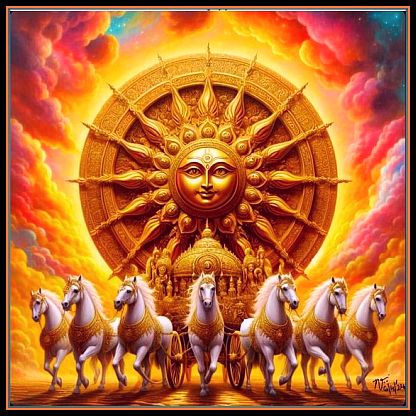
This verse carries on with the symbolism of the revolving (विववृते–Vivarta) Cosmic Wheel, described as that which never decays (अजरम्–Ajara)
The wheel (circle), with its circumference, revolves without any deterioration – सनेमि –चक्रम् –अजरम्–वि–ववृते.
The ten yoked to the upper extension draw it. The eye of the sun moves along, laden with water; and, in it all beings reside.
The world rests on the Wheel of Time. Sun is the embodiment of all knowledge.
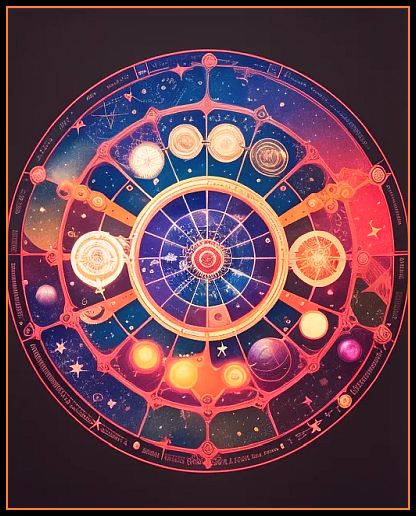
Sri Sayana explains:
The Ten, here, stands for ten organs of sense. Else, it might refer to five Lokapalas (Guardians of the world) together with five classes of human beings.
The upper extension may refer to the upper surface of the earth (uttānāyām) or the earth spread above (uparī vistṛta bh-myām) the Pole.
The orb or the eye of the Sun (sūryasya cakṣus) may suggest either the display of the nature or radiance of the sun, or his orb. The Solar orb is the eye of all of us – sarvasya cakṣuḥ sthānīyam vā maṇḍalam. It is through this we see everything.
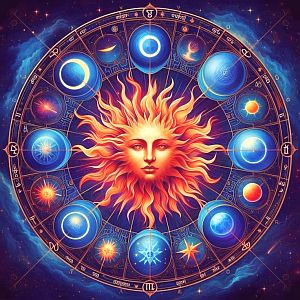
Swami Amritananda observes:
The imagery of the chariot, wheel, axel, nave etc. is commonly used in the Upanishads in the context of the discussions on the Time-principle. Here also, neither the nave nor the axel undergoes any change.
Only the limbs, such as संवत्सर (Samvathsara -year), परिवत्सर (Parivatsara-seasons) revolve; and appear again and again.
**
Dr. David Frawley suggests:
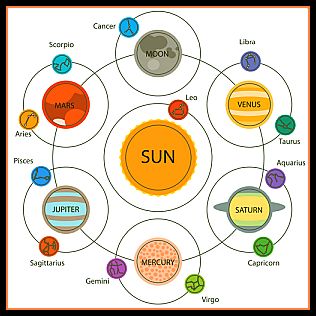
This may again refer to the ten zodiac signs ruled by five planets, with each planet ruling two signs.
The eye of the Sun may be the sign Leo through which the solar influence pervades the Zodiac or just the Sun itself. The upward extension may be the polar region.
In astrology, the five personal planets are the Sun, Moon, Mercury, Venus, and Mars. Here are some zodiac signs that are ruled by more than one planet:
-
- Taurus and Libra: Both signs are ruled by Venus
- Gemini and Virgo: Both signs are ruled by Mercury
- Scorpio: In traditional astrology, Mars rules Scorpio, but in modern astrology, Pluto rules it
- Aquarius: In traditional astrology, Saturn rules Aquarius, but in modern astrology, Uranus rules it
- Pisces: In traditional astrology, Jupiter rules Pisces, but in modern astrology, Neptune rules it
Verse 15
साकम्जानाम् । सप्तथम् । आहुः । एकजम् । षट् । इत् । यमाः । ऋषयः । देवजाः । इति । तेषाम् । इष्टानि । विहितानि । धामशः स्थात्रे । रेजन्ते । विकृतानि । रूपशः ॥ 1.164.15 ॥
sākam-jānām | saptatham | āhuḥ | eka-jam | ṣaṭ | it | yamāḥ | ṛṣayaḥ | deva-jāḥ | iti | teṣām | iṣṭāni | vi-hitāni | dhāma-śaḥ sthātre | rejante | vi-kṛtāni | rūpa-śaḥ ॥ ॥ 1.164.15 ॥
They say of the seventh among what are born together, that he is born as one, that the six verily are twins, the wise, born of gods. What are coveted by them, placed according to (their proper) position, move, changing in form, for the sake of him who stands by.
**
This verse is about seasons in a year.
Of the seven seasons, six are born together; the seventh is born singly. The other six, each of two-month duration, are twins (यमल–Yamala). They are sages born of gods. These Divine born Rishis are capable of movement. They are placed in their proper positions; and are endowed with desirable virtues, each according to its nature. Particularly made for their creator, they move in different forms. They revolve for the benefit of that which is stationary.
Sri Sayana explains:
Six are twins: six seasons, made of two months each. The seventh is the extra month; the thirteenth month in an अधिक–मास (Adhika-masa). It is not born out of the Sun (Aditya) or any other gods.
It is the seventh season.; born alone (एकजम्), as compared to other six seasons, which form a cluster.
The sets of these six seasons are differentiated by their class, character, temperature, produce etc (स्थात्रे–रेजन्ते) .
It is these six seasons, which appear and disappear, giving place to the next; and which are having varied forms (विहितानि–विकृतानि–रूपशः) , benefitting the world that are truly desired by all (इष्टानि). – चलन्ति जगत व्यवहाराय पुनः पुनरावर्तन्ते
According to Dr. David Frawley:
The Six born together are twins. These are the twelve signs; the two of which are ruled by one planet (considering sun and moon as a single planetary influence). The seven that is singly born is the single light that illumines all the planets. Elsewhere, Rig-Veda (10.64.3) speaks of Sun and Moon as twins (Yama) in heaven.
The planets are often associated with Rishis in Vedic thought, particularly Rishi Brihaspathi (Jupiter), Shukra (Venus) and Kashyapa (Sun) which became common names for the planets. The ordainer or the stabilizer may be the Polar star (polar point).
The 7 verses (16 to 22) speak of very obscure concepts, rather not possible to understand easily. These could be interpreted in any number of ways.
Here a new topic starts. There is some glorification of wisdom, enabling one to see and to know. One is not sure what they are. Though they are women, they are declared to be men.
Dhirgatamas poses the questions through dramatic doubts. He plays the drama of doubt through conflicting terms. He poses questions not because he does not know the answers. But, he does it just to dramatize his answers; by constructing riddles; spurring the reader to arrive at his own answers, which he might come to believe to be true.
In asking enigmatic questions, Dhirgatamas seems not to expect a simple or direct answer. Rather, he wants to make a point: that all the phenomena in the world are bound together by the pervasive relationship where each one is related to many.
Dhirgatamas did not present easy and ready answers to his riddle-like queries. He, instead, presented another enigma:
Even when Dhirgatamas supplies an answer to his questions, his answer could be interpreted in any number of ways.
Let us try.
Verse 16
स्त्रियः । सतीः । तान् । ऊँ इति । मे । पुंसः । आआहुः । पश्यत् । अक्षण्वान् । न । वि । चेतत् । अन्धः । कविः । यः । पुत्रः । सः । ईम् । आ । चिकेत । यः । ता । विजानात् । सः । पितुः । पिता । असत् ॥ 1.164.16 ॥
striyaḥ | satīḥ | tān | oṃ iti | me | puṃsaḥ | āāhuḥ | paśyat | akṣaṇ-vān | na | vi | cetat | andhaḥ | kaviḥ | yaḥ | putraḥ | saḥ | īm | ā | ciketa | yaḥ | tā | vi-jānāt | saḥ | pituḥ | pitā | asat ॥ 1.164.16 ॥
Them, being -women, they verily declare to me as men. One with eyes sees; the blind knows not. The son who is a poet, he knows this well. He who knows them well, they became the father of father.
**
They told me these were males; though they truly are virtuous females. He who has the eyes can see this.; the blind however cannot.
The son who is a sage can comprehend this truth. He, in wisdom, is indeed the father of his father; he discriminates and understands it all very well.
The verse brings up a very complicated and an interesting concept of Androgyny. It basically says, there exists in every individual the male as also the female characteristics. A person is truly an interplay of these two principles, which cohabit within everyone harmoniously.
The Vedic texts speak of another such interactive relation; as that between Agni and Soma. It is said; the nature of the Agni is that of existence, as well as that of its source and symbol. It is said; Agni is not merely Agni; he is also Soma. So also, is Soma. There is a constant interplay between Agni and Soma. In a way, both are two forms of Agni.
Agni is the warm outward breath; Soma is the cool inward breath. Agni (fire) is life, Soma is activity; Agni is the enjoyer, Soma is that which is enjoyed.
At times Agni becomes its own Soma, just as the Sun burns itself to radiate energy. When a substance has spread to its maximum size, it has to contract. Hence, Agni becomes Soma at each stage of its contraction. Soma falling into Agni itself is transformed into Agni.
The alternation of Agni and Soma provides the impetus for growth; for all beings which procreate, grow and perish in the yajna, the ritual of life. Soma and Agni together sustain and carry forward the life.
*
Rigveda also speaks about the One appearing as many; and the single egg splitting into Bhuta and Prana.
‘He, who is described as male, is as much the female; and the penetrating eye does not fail to see it’.
The male is only so much male as much he is female; and the female is only as much female as much she is male. The maleness and femaleness are the attributes contained within one frame.
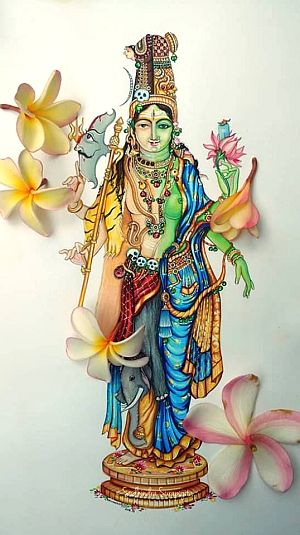
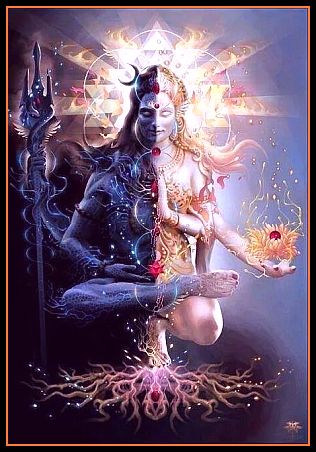
Ardhanarishvara “the Lord Whose Half Is Woman” represents a transgendered being created by the union of Shiva (male) and Shakti (female). The Ardhanari form illustrates how the female principle of God-Shakti is inseparable from the male principle of God – Shiva. The Ardhanarishvara, above all, represents the totality that lies beyond duality.
Ms. Ellen Goldberg observes: The image of Ardhanarishvara does not merely present a synthesis of masculine and feminine gender traits, but rather attempts to portray a fundamental belief in the possibility of personal transcendence, usually understood as the attainment of non dual consciousness
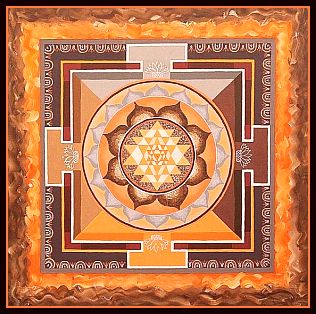
The followers of Sri Vidya who worship the Sri Cakra too envision the deity as Mother Goddess.
It is explained the Sri Chakra is itself androgynous by its very nature . Bindu is Kameshwara, the ground of the universe; the Trikona is Kameshwari the mother of the universe. The union of the two is Sri Chakra, which in its androgynous form symbolizes the underlying unitary principle in all existence.
The Samayin school of Sri Vidya regards Shiva and Shakthi as one; Shiva becomes Kameshwara and Kameshwari becomes Shiva. The identity of Shiva and Shakthi is the foundation of phenomenal manifestation in order to create (srusti), preserve (sthithi) and withdraw (samhara).
In both the Shakta and Shaiva traditions of Tantra school, the Ultimate Reality is conceived as the Unity of Shakti and Shiva They are regarded as one.
Central to Tantra-faith is the concept of duality that culminates in unity; as being essentially non-dual (abheda). The one cannot be differentiated from the other. The Tantra ideology explains that Shiva-Shakthi are essentially two aspects of One principle. In reality, the whole of existence, the range of manifold experiences in the world are but the expressions of Shiva-Shakthi combine.
Following that principle , the Tantra believes that at the relative plane no one is just male; and, no one is just female. The elements of both sexes are present in each of us.
The Ardha-narishvara, in a way, represents this concept. Now, modern psychology, depth psychology particularly, also says that man is both man and woman.
*
Similar ideas appear in other cultures and other religions too. According to Zohar, considered the most important work of kabbalah or Jewish mysticism, the oneness of God is perceived in androgynous terms as the pairing of male and female; the former characterized as the capacity to overflow and the latter as the potential to receive.
The principle of Animus and Anima (half-male and half-female) is at the root of biological manifestation.
This phenomenon is now as widely accepted by modern scientists and Psychologists.
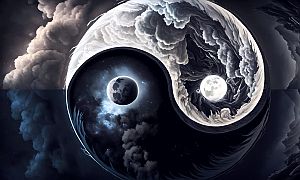
In order to illustrate this androgynous concept, Dhirgatamas employs the metaphors of the Sun and the Sun rays.
Many scholars have offered comments on the androgynous principle suggested in this verse.
*
Dhirgatamas noted that people whose vision lacked clarity had described some deities as masculine when they were actually feminine.
- Truly they are feminine; but people say to me that they are male.
- He who has eyes can see this; the blind one does not understand.
- The son who is a skillful poet has understood this.
- He who truly comprehends would be his father’s father.
The Sun (Aditya), considered as the father, gives birth to all this existence. He is the father of rays which emit light and also cause rains. The Sun rays pervade all life with their essence; generate, protect and sustain life.
The rays of the Sun have the male nature of impregnating life; and the female nature of nourishing life.
Beauty is associated with female; and strength with male. The sun rays are brilliant and beautiful; and they are also powerful.
Sun delights with rains in the season. He is the life and light. He is the father and the mother of all creation.
The Supreme Divine is neither female nor male; rather, it encompasses and transcends all gender distinctions.
One cannot see with the physical eyes. One needs to introspect and visualize this Truth through the discerning eyes.

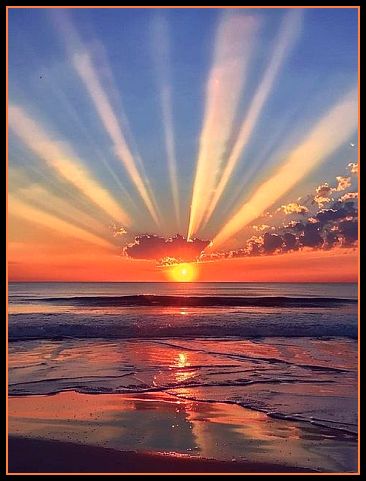
Some might call the rays of the Sun (स्त्रियः– सतीः– Rashmi) as a male; though they are in fact females (स्त्रियः– सतीः). Having said that, it also true that they could be both male and female at the same time.
The verse says: those who are called males are, in fact, females too. This is true the other way also
As females, they carry water in their womb. And, as males (पुंसः), they impregnate the earth with water.
The Sun gives birth to his rays; which, in turn, fathers the life on earth. The sun, therefore, is the father of the father.


The poet speaks of the contrast between those who know and those who do not know the principles that govern our universe.
One who know those transcendental principle is wise. The one who doesn’t know is blind. He who knows is greater than anyone. He is the father of his father, meaning, he is wiser than his father.
स्त्रियः । सतीः । तान् । ऊँ इति । मे । पुंसः । आआहुः । पश्यत् । अक्षण्वान् । न । वि । चेतत् । अन्धः । कविः । यः । पुत्रः । सः । ईम् । आ । चिकेत । यः । ता । विजानात् । सः । पितुः । पिता । असत् ॥
Verse 17
अवः । परेण । परः । एना । अवरेण । पदा । वत्सम् । बिभ्रती । गौः । उत् । अस्थात् । सा । कद्रीची । कम् । स्वित् । अर्धम् । परा । अगात् । क्व । स्वित् । सूते । नहि । यूथे । अन्तरिति ॥1.164.17 ॥
avaḥ | pareṇa | paraḥ | enā | avareṇa | padā | vatsam | bibhratī | gauḥ | ut | asthāt | sā | kadrīcī | kam | svit | ardham | parā | agāt | kva | svit | sūte | nahi | yūthe | antari ti ॥1.164.17 ॥
Beneath of what is above, above of this that is beneath, the cow has stood up, bearing the calf with the foot. In which direction and to which half of the sky has she gone away? Where did she give birth? Not within the herd.
**
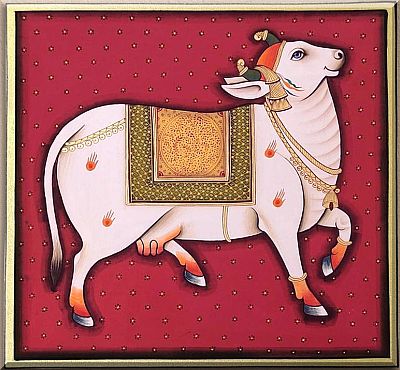
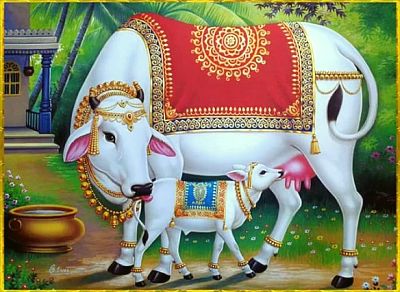
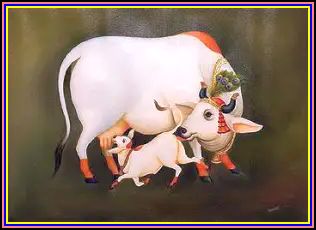
The cow, holding her calf underneath with her fore-feet, and then above with her hind-feet, has risen up; whither is she gone; to whom has she turned back when half-way; where does she bear young; it is not amidst the herd .
*
Some scholars opine that the intent of the verse is about the dawning of wisdom concerning the mysteries of the universe, its creation and progression. It is expressed through the allegories of Cow, Calf. Milk etc.
It could also be interpreted in any number of other ways.
*
The dawn is the cow, between sky (above) and earth (below). Cow has her calf at her heels as she kicks him away; she is alone because she has abandoned him.
*
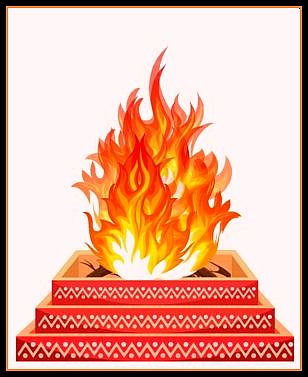
The cow is the offering at the Yajna (हविस्); Calf is the Agni, beneath her fore-feet.
Sri Sayanacharya explains:
This verse could be interpreted in two ways:
-
- Cow (गौः) is the offering (हविस् / हवन) made into the Yajna-vedi (sacrificial-altar). Or
- Cow here represents the Sun-rays (सूर्य–रश्मी).
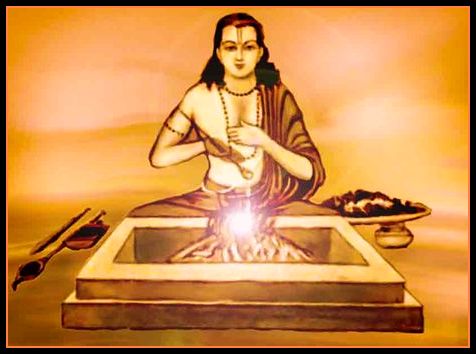
When the cow (गौः) means the offerings submitted into the sacrificial-fire (अग्नि-Agni), the performer of the Yajna (यजमान) is the calf (वत्सम्– child).
When the burnt offerings reach the Sun, they are transformed into his rays.
It might also mean the fruits of the Yajna that the performer gets (क्व–स्वित्–सूते).
*
And, if the Cow is identified with the Sun’s rays, then, the Agni ( अग्नि) is the calf. That is because, he is nourished by the offerings made into the sacrificial fire, just as a calf is fed by its mother – the cow.
It might also mean here that the performer of the Yajna –यजमान– is the calf; because, he is the one who reaps the benefits of the Yajna – क्व–स्वित्–सूते; and, by the virtue of which he attains the higher worlds.
Verse 18
अवः । परेण । पितरम् । यः । अस्य । अनुवेद । परः । एना । अवरेण । कवियमानः । कः । इह । प्र । वोचत् । देवम् । मनः । कुतः । अधि । प्रजातम् ॥1.164.18॥
avaḥ | pareṇa | pitaram | yaḥ | asya | anu-veda | paraḥ | enā | avareṇa | kavi-yamānaḥ | kaḥ | iha | pra | vocat | devam | manaḥ | kutaḥ | adhi | pra-jātam ॥1.164.18 ॥
One who knows the protector of this world (Agni), who is below; as being associated with the Sun, who is above, is indeed a sage. But, who in this world can expound it ? Where is such fortunate mind that can contemplate on God and realize the Truth ? !
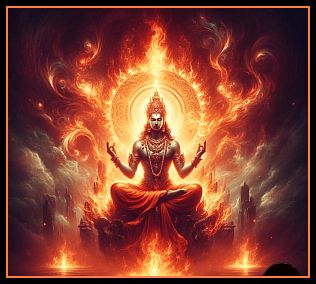
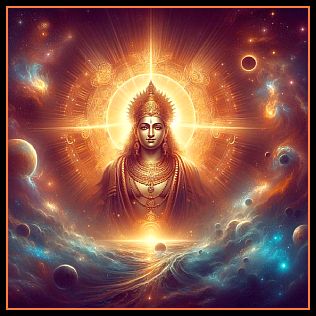
This verse describes the ongoing relation between Agni, who is with us on the Earth (अवः – below) and Aditya, the Sun, the father, shining brilliantly in the Sky (परः-above), protecting the world (परेण–पितरम्).
Agni might glow at the night, while the Sun shines during the day.
Though they are located in different positions (above and below), they indeed are the two aspects of the same principle. They share between them the functions of protecting and sustaining the Universe.
It is, of course, not easy to understand(अनुवेद) this Truth. Only a fortunate, enlightened seer (कवियमानः) can realize and experience this inspirational Truth, in all earnestness.
But, where in this world can one find such a fortunate mind that can contemplate on God and realize the Truth ?!
– कः । इह । प्र । वोचत् । देवम् । मनः । कुतः । अधि । प्रजातम्
Verse 19
ये । अर्वाञ्चः । तान् । ऊँ इति । पराचः । आहुः । ये । पराञ्चः । तान् । ऊँ इति । अर्वाचः । आहुः । इन्द्रः । च । या । चक्रथुः । सोम । तानि । धुरा । न । युक्ताः । रजसः । वहन्ति ॥1.164.19 ॥
ye | arvāñcaḥ | tān | oṃ iti | parācaḥ | āhuḥ | ye | parāñcaḥ | tān | oṃ iti | arvācaḥ | āhuḥ | indraḥ | ca | yā | cakrathuḥ | soma | tāni | dhurā | na | yuktāḥ | rajasaḥ | vahanti ॥1.164.19 ॥
They who are recent, them they call ancient; they who are ancient, them they call recent. O Soma, them which Indra and thou have done, them carry they that look like being yoked to the pole of space.
**
He who knows the protector of this world as the inferior associated with the superior, and the superior associated with the inferior, he is, as it were, a sage; but who in this world can expound it; whence is the divine mind in its supremacy engendered
*
Who recognizes the father as beneath of what is above, as above of that is beneath — who, behaving like a poet, has explained this here? Whence has sprung up the god-mind?
*
Those who know, the sages, termed the descending (sun rays) as ascending. They also called the ascending as descending.
You, Soma and Indra together created the revolving planets. Those orbits go around the world like two horses yoked (धुरा) to a cart.
Indra or Aditya is the symbol of Father-principle; and also, of the heaven. Soma is like the Mother-principle, relating to Earth. They move together (वहन्ति) like two oxen drawing a wagon– । धुरा । न । युक्ताः । रजसः । वहन्ति.

The planets, rotating in their orbits, do change their relative positions. In time, what was above does come down; and; similarly, what was below comes up above. They are revolving round like a wheel.
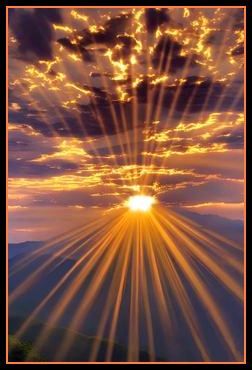
So also do the Sun rays. They spread upwards (पराञ्चः); and, again they spread downwards (अर्वाचः). Thus, the rays of light change their relative position when they revolve as in a wheel (चक्रथुः).
This is the Law which regulates the rhythmic movement of the Time-Wheel; as also that of the individual life-cycles. It could also be compared to the mythical tree with its roots above [and the branches hanging down below.
It is important to recognize moving in opposite direction does not necessarily mean moving backwards; but, onwards on its own way, in accordance with their assigned routes and positions.
Dr. Raja remarks:
This verse is in continuation of the riddles (as in verses 15,17 and 18).
In this verse to there is a reference to some mystery.
What exactly the poet had in his mind when he speaks of ancients and modern and of above and beneath, we do not know.
This has to be related to the reference to father and son, sometimes the son being wiser than the father (verse 16). In this verse also the mention of Indra and Soma indicate the close connection of this philosophical hymn with ritualism.

Verse 20
द्वा । सुपर्णा । सयुजा । सखाया । समनम् । वृक्षम् । परि । सस्वजाते इति । तयोः । अन्यः । पिप्पलम् । स्वादु । अत्ति । अनश्नन् । अन्यः । अभि । चाकशीति ॥1.164.20॥
dvā | su-parṇā | sa-yujā | sakhāyā | samanam | vṛkṣam | pari | sasvajāteiti | tayoḥ | anyaḥ | pippalam | svādu | atti | anaśnan | anyaḥ | abhi | cākaśīti ॥1.164.20॥
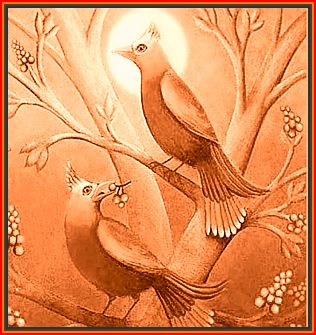
Two birds – of graceful flights, looking alike and united to each other by close friendship – take refuge in the same tree. Of the two, one eats the tasty berry; the other, without eating, merely looks on.
**
This verse brings up again the well-known doctrine of Suparna-Vidya, which is picturesquely described in Rigveda as also in the Upanishads and the Samkhya texts.
Two inseparable-companion-birds (द्वा सुपर्णा) rest on the branch of the same tree(सयुजा–सखाया–समनम्); They look alike (समानरव्यनौ) and are always together (सहैव–सर्वदा–युकतौ); and can fly gracefully. Of the two, one enjoys eating the tasty berry; the other, without eating, merely looks on (अभि– चाकशीति).
*
The same verse and the same metaphor appear in Mundaka Upanishad (3:1:1) and the Svetashvatara Upanishad (4:6). They also present the metaphor of two birds (Dva Suparna) perched on the same tree; one active and enjoying the fruits; the other bird merely looking on and doing nothing.
- द्वा सुपर्णा सयुजा सखाया समानं वृक्षं परिषस्वजाते। तयोरन्य: पिप्पलं स्वाद्वत्त्यनश्नन्नन्यो अभिचाकशीति॥
- समाने वृक्षे पुरुषों निमग्नोऽनाशया शोचति मुह्यमान:।जुष्टं यदा पश्यत्यन्यमीशमस्य महिमानमिति वीतशोक:॥
- यदा पश्य: पश्यते रुक्मवर्णं कर्तारमीशं पुरुषं ब्रह्मयोनिम्।तदा विद्वान्पुण्यपापे विधूय निरंजन: परमं साम्यमुपैति॥
- – Mundaka Upanishad
In the Upanishads, the active bird represents a self-involved and identified with the world; the inactive bird represents that other mode of being human that neither claims nor rejects the world, remaining ever aloof and hence always free.
In the Brihadaranyaka Upanishad (3:7:23) Uddalaka Aruni calls the on -looking bird as:
The unseen Seer, the unheard Hearer, the un-thought Thinker, the un-understood Understander…the Self (atman), the Inner Controller (Antaryamin), the Immortal (Amrta)
yaḥ pṛthivyāṃ tiṣṭhan pṛthivyā antaro yaṃ pṛthivī na veda yasya pṛthivī śarīraṃ yaḥ pṛthivīm antaro yamayaty eṣa ta ātmāntaryāmy amṛtaḥ || BrhUp_3,7.3 ||
**
Each School of Indian thought has interpreted the metaphor of two such birds, each according to its inclinations. For instance, the Bhagavad Gita (13: S) identifies the bird that eats and enjoys as the field (kshetra) and the other as the filed-knower, the foundation (kshetrajna).
The relation between the unseen seer (kshetrajna) and the field (kshetra) forms an important issue in the Samkhya Darshana, the Samkhya way of seeing.
*
Sri Sayanacharya coments:
The tree is the Tree of Existence. The two inseparable-companion-birds bound together (समानयोग) by friendship (सयुजा–सखाया) represent the supreme spirit-परमात्म Paramāthmā, and the vital spirit- जीवात्म– Jivāthmā.
These principal entities are graphically picturised using the metaphor of the two friendly birds resting on the branch of the same tree (समनम्–वृक्षम्).
Both Jivathma and Paramathma dwell in the same body. The former enjoys the fruits-rewards of action; while the other is a mere passive spectator. The Jiva, which is attached to the world (Samsara) is subject to delusion (मोह); while the Soul (आत्मन्) flies freely, without any attachment.
The bird represented as the vital-spirit eats the sweet fig (पिप्पलम्–स्वादु–अत्ति pippalam-svādu-atti), enjoying the rewards of acts- dvau-pratiṣṭhitau-sukṛtau dharmakartārau.
The other merely looks on, passively, without eating (अभि– चाकशीति).
Dr. Raja explains:
This verse is accepted as the foundation of the Vedanta Philosophy dealing with the nature of the Soul, both individual and supreme and their relation mutually. The individual souls eat (enjoy and suffer) while the supreme soul just shines. But this is not supported by the general trend of thought in the Rigveda. There is no hint of a Supreme Self in contrast to the individual souls, in the Rigveda.
Geldner says that the reference is to the two kinds of seekers after knowledge, some enjoying wisdom while others simply look on without knowing. In Vedanta, the tree is the Universe. But Geldner takes it to mean Wisdom. The meaning would then be,
“Two sets of people resort to wisdom; one of them realise it and enjoys it, while the other, does not realize it and simply stares.”
I accept the contrast between two sets of people in this Universe, those who know and those who do not know. Those who know enjoy, while the others who do not know, simply look on in amazement.
But the tree can be only the Universe. The contrast between those who know and those who do not, is found elsewhere in this poem; see verses 5,6 and 16 above. The point is found in verse 22 below, also.
***
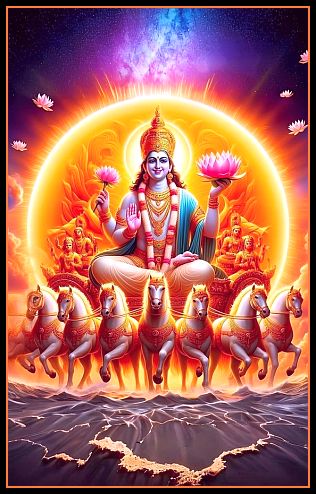
The term Suparna literally means -one who has strong wings.; and, flies gracefully. It could be a strong-winged bird like Garuda; or it may also mean Surya, who moves rhythmically across the sky.
CONTINUED
IN THE
NEXT PART
References
- A History Of Pre-Buddhistic Indian Philosophy: Benimadhab Barua : Free Download, Borrow, and Streaming : Internet Archive
- A History of Pre-Buddhistic Indian Philosophy: Benimadhab Barua : Free Download, Borrow, and Streaming : Internet Archive
- https://aseemamag.com/vedic-origins-of-the-zodiac-hymns-of-dirghatamas-in-the-rig-veda/
- https://www.researchgate.net/publication/359710805_Description_of_Twelve_Zodiac_Signs_in_Ancient_Indian_Texts
- ALL IMAGES ARE FROM INTERNET






 sreenivasarao's blogs