RSS

Tag Archives: Religion

Who Was Dhirgatamas – PART NINE

Who Was Dhirgatamas – PART NINE
Continued from Part Eight

Verse 43

शकमयम् । धूमम् । आरात् । अपश्यम् । विषुवता । परः । एना । अवरेण । उक्षाणम् । पृश्निम् । अपचन्त । वीराः । तानि । धर्माणि । प्रथमानि । आसन् ॥ R.V. 1.164.43 ॥

śaka-mayam  dhūmam|ārāt|apaśyam|viu-vatā|para|enā | avarea | ukāam| pśnim | apacanta | vīrā | tāni | dharmāi | prathamāni | āsan R.V. 1.164.43

I beheld near (me) the smoke of burning cow-dung; and by that tall-pervading mean (effect, discovered the cause (fire); the priests have the Soma ox, for such are their first duties

**

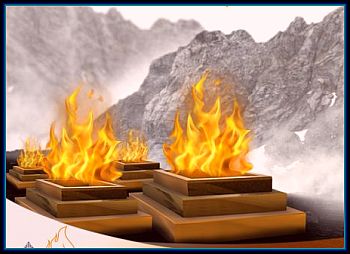
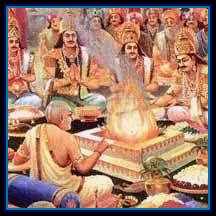
I see (विषुवता) near (आरात्) me the smoke of cow-dung burnt (शकमयम् धूमम्) that is spreading (अवरेण). I know this smoke is caused by the fire. the priests (वीराः -Ritviks) have the white (पृश्निम्) Soma ox, for such are their rituals (तानिधर्माणि).

*

This verse is said to be about the ritual. One of the explanations is that the white Soma-bull (पृश्निम्) confers on the devotees the desired fruits of action (उक्षाणम्फलस्य सेक्त्तIरं). The Ritviks who are good in carrying out the rituals (वीराः विविधेरण् कुशलाह) move about and chant loudly. The covering of the smoke spreads wide (विषुवताव्यप्तिमता) like a cloud (शक).

**

It is also said; the term पृश्निम्pśnim – though some take it to mean Soma, it normally refers to Surya. Then, the Verse would be about the Sun, a kind of Agni, Apam Napatu, (अपांनपातु) the raging fire, emerging out of the ocean-waters.

**

Dr. Raja has an alternate explanation:

The meaning of the second half is that the heroic ancestors prepared Soma for drink at the Rituals, and this became the earliest Dharma or religious practice.

 I am not sure what is meant by the cow-dung and smoke.

**

Verse 44

त्रयः। केशिनः।ऋतुथा ।वि ।चक्षते।सव्ँम्वत्सरे । वपते।एकः। एषाम् ।विश्वम्। एकः। अभिI चष्टे । शचीभिः। ध्राजिः।एकस्य।ददृशे । न । रूपम् R.V. 1.164.44

traya | keśina | tu-thā | vi | cakate | savatsare | vapate | eka | eām | viśvam | eka | abhi | caṣṭe | śacībhi | dhrāji | ekasya | dadśe | na | rūpam R.V. 1.164.44

The three, with beautiful tresses, look down in their several seasons upon the earth; one of them, when the year is ended, shears (the ground); one, by his acts, overlooks the universe; the course of one is visible, though not his form

**

Three (त्रयः) deities with long beautiful stresses, long matted locks (केशिनःKeshin), appear according to seasons (ऋतुथा). One of them (एषाम्) when the year (सव्ँम्वत्सरे) is ended sheers (वपते) the earth. Of the other one (एकस्य​), the course (ध्राजिः) of his sweep is seen; but not his form (रूपम्) . One of them has a vision of the universe (विश्वम्) and oversees (विचक्षते) with his powers (अभिI चष्टे).

*

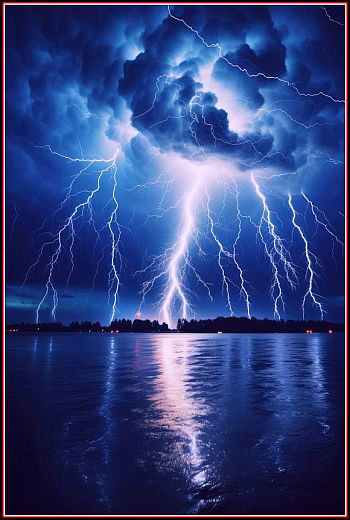
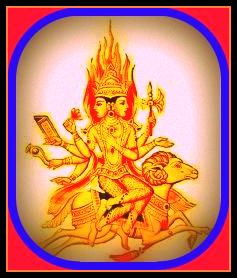
Agni, on earth, has flame-like tresses (केशिनः-Keshin) . Vayu, who occupies the mid-regions (अन्तरिक्ष्-Antariksha) has flashes of lightning as his curls. Adiya, the Lord of the Dyu-Loka (skies) shines with his brilliant rays. These – the flames; the flashes of lightning; and the rays- enhance their glory. Therefore, they are the Keshins (केशिनः).
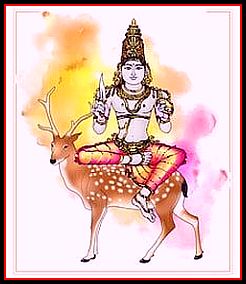
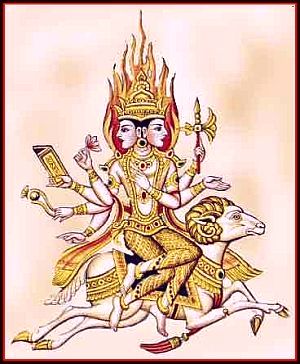
   

Here, the three forms of the Supreme are mentioned. Each has its own functions. Yet, they are not independent; they are aspects of One Absolute Being.

The three deities referred to in this Verse are Agni, Vayu and Surya.

Sri Sayana explains the three are the three forms of Agni, who burns up the earth; the Sun, who revives it by his light and by the rain which he sends down; and Vayu, the wind, who contributes to the showers of rain.

Yaskacharya had also earlier explained that there is indeed only One Deity; and, that Deity manifests in the three worlds as Surya (Sun) in heaven (Dyu-Loka); Indra or Vayu (wind) in the middle region (Antariksha); and, Fire on the earth (Bhu-Loka). They are the basic foundations of our existence.

In the opening Verse of Asya Vamasya Sukta, similar ideas were expressed. There, the three luminaries in three regions were called as three brothers; who indeed are the three forms of Fire: Agni, Vayu (Air) and Aditya (Sun).

अस्य । वामस्य । पलितस्य । होतुस्तस्य । भ्राता । मध्यमो । अस्त्यश्नः। तृतीयो । भ्राता । घृतपृष्ठो । अस्यात्रापश्यं । विश्पतिं सप्तपुत्रम् ॥ १.१६४.०१ ॥

The three brothers or the three aspects of Agni (Agni-traya)- The Sun, the Lightning and the Fire – form the Tripod of Life.  They exist and function together.; and, are the basic factors of our existence

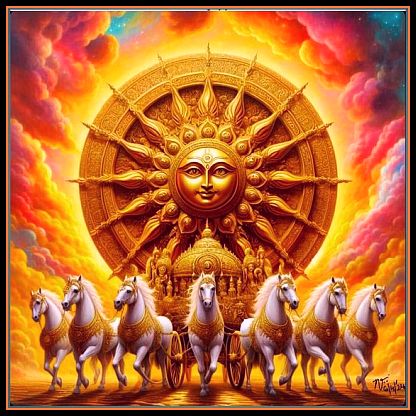
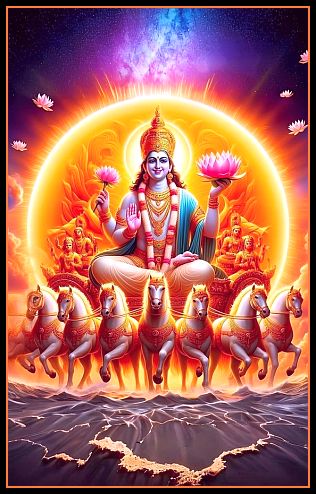
Of these three brothers; Aditya (Sun) shining in the upper regions – parastat, the protector (पलितस्य) of the Universe, who is worshipped by all (वामस्य), is the Supreme.

There, Dhirgatamas had said that the Sun, blazing with dazzling radiance and warmth, is the oldest of the three; and is the first cause. This Sun, held up and propelled by its inherent force (स्वध Svadha), clad in its own splendor, travels in all the worlds, without stoppage.

अनत् शये तुरगातु जीवम् एजत् ध्रुवम् मध्ये पस्त्यानाम् जीवः। मृतस्य। चरति स्वधाभिः अमर्त्यः मर्त्येन सयोनिः .१६४.३० 

In the hymns of the Rigveda, Sun (Surya) is celebrated as the Soul (Atman) of all that moves or is immoveable; enlivening the heaven, the earth, and all the surrounding space –

अप्राः द्यावापृथिवी इति अन्तरिक्षम् सूर्यः आत्मा जगतःतस्थुषः  – Rig Veda 1.115.1 .

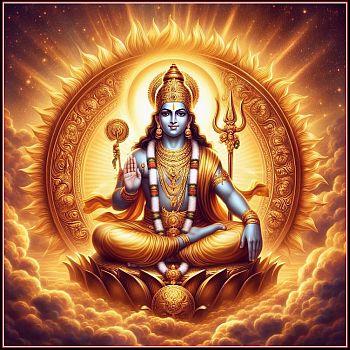
He is the Divine power in the heavens; the Lightening in the atmosphere; and the Fire on Earth. These are the three main manifestations of light in our visible world.

Sun moves in its orbit, which itself is moving. Earth and other bodies move around sun due to the force of attraction (आकर्षण) 
**

Verse 45

चत्वारि वाक् परिमिता पदानि तानि विदुः ब्राह्मणाः ये मनीषिणः गुहा त्रीणि निहिता इङ्गयन्ति तुरीयम् वाचः मनुष्याः वदन्ति R.V. 1.164.45

catvāri | vāk | pari-mitā | padāni | tāni | vidu | brāhmaā | ye | manīia | guhā | trīi | ni-hitā | na | igayanti | turīyam | vāca | manuyā | vadanti |

Four are the definite grades of speech; those who are wise know them; three, deposited in secret, indicate no meaning; men speak the fourth grade of speech

**

Speech (वाक्) is graded (पदानि) as four regulated levels (चत्वारि परिमिता) ; the seers or the poets who have intuition know (विदुः) them. Three of them (त्रीणि), not clearly known (निहिता इङ्गयन्ति), concealed in the cave (गुहा), do not move; the fourth of the speech (वाचः तुरीयम्), men speak (मनुष्याः वदन्ति).

**

This theory of the four-fold division of speech or the four stages in the development of sounds – three being internal and the fourth one external uttered sound – is much discussed by a number of scholars of various Schools of though. Each scholar, according to his inclination, has offered his own explanation.

**

One of the explanations is that While the Grammarians, generally, speak about three levels of speech, the philosophers identify four levels or stages of speech (Vac): Para, Pashyanti, Madhyama and Vaikhari. 

Of these four forms of Vac, Para and Pashyanti are the subtle forms of Vac; while Madhyama and Vaikhari are its gross forms.

While Para Vac is pure consciousness; the three other forms are its transformations. The three lower forms of speech viz. Pashyanti, Madhyama and Vaikhari which correspond to intention, formulation and expression are said to represent its powers, such as:

 Iccha Shakthi (power of intent or the will), Jnana-Shakthi (power of knowledge) and the power of becoming (bhuti-shakthi) or the power of action (Kriya-Shakthi). 

Thus, out of the transcendent Para, the three phases of its power (Shakthi) emanate.

**

The notion that there are four quarters or four levels of existence; and of which, only one quarter is within the experience of mortals also appears in the Purusha-sukta (Rig-Veda 10.90.3) ascribed to Rishi Narayana – Paadosya Vishva Bhutaani Tri-Paada-Asya-Amrtam Divi.

There are similar notions with regard to Pranava-Om where the three syllables A, Vu, and Ma (मा) are normally visible. But it is its fourth element the Anusvara (Brahma-Bindu) that leads from being to non-being; and, from the word to the silence beyond it.

svarena samdhayed yogam asvaram bhävayet param asvarena hi bhävena bhävo näbhäva  isyate Brahma Bindu Upanishad

The Maitrayaniya (Maitri) Upanishad (1, 11.5), of Krishna-Yajur-Veda, mentions the four quarters of speech as those belonging:  to the upper region – the heavens (Divi); to the intermediate space (Antariksha); and, to the region of earth (Prithvi) as spoken by the humans (Manusi); and, to the animals (Pashu)

– vāk sṛṣṭā caturdhā vyabhavad eu lokeu trīi turīyāi paśuu turīya yā pthivyā sāgnau sā rathantare yāntarike.

The Atma-vadins (mainly those belonging to Nyaya and Vaisesika Schools) say: the four-fold speech can be found in the animals; in musical instruments (such a flute); in the beasts; and, in the individuals (Atmani)

–  pasusu tunavesu mrgesu atmani ca iti atmavadinah

The Shatapatha Brahmana (1.3.16) categorizes the speech into four kinds: as that of the humans; of animals and birds (vayamsi); of reptiles (snakes); and, of small creeping things (kshudram sarisrpam)

– varā vā ia iti hi varā io yadida kudra sarīspa 1.5.3.11

Similarly, those who believe in myths and legends say that – the serpents; birds; evil creatures; as also the humans in their dealings with the rest of the world – all use speech of their own.

Sarpanam vagvayasam ksudrasarispasya ca caturthi vyavaharika-ityaitihasikah

The Jaiminiya-Upanishad-Brahmana (1.40.1)  deals with the four levels of speech in a little more detail.

In a verse that is almost identical to the one appearing in Rig-Veda Samhita – 1.164.45, it mentions that the discriminating wise know of four quarters of speech.  Three of these remain hidden; while the fourth is what people ordinarily speak.

Chatvaari vaak parimitaa padaani / taani vidur braahmaanaa ye manishinaah. Guhaa trini nihita nengayanti / turiyam vaacho manushyaa vadanti //

Then, the text goes on to explain that of the four quarters of speech: mind is a quarter, sight is another quarter, hearing is the third quarter; and, speech itself is the fourth quarter. 

 tasya etasyai vaco manah padas caksuh padas srotram pado vag eca caturtah padah

Further, it says: what he thinks with the mind, that he speaks with speech; what he sees with the sight, that he speaks with the speech; and, what he hears with hearing, that he speaks with speech.

 tad yad vai manasa dyayanti tad vaco vadati; yac caksus pasyati tad vaca vadati; yac srotrena srunoti tad vaco vadati /

Thus, finally, all activities of senses unite (Sam) into speech. Therefore, speech is the Saman.

Nagesh Bhatta (Ca. 1670 to 1750), in his commentary on Patanjali’s Mahabhashya, accepts the four forms of Vac; and, explains the expression ‘Catvari padjatani namakhyato-upasargani-patah ‘as referring to Para, Pashyanti, Madhyama and Vaikhari:

 Bhashya padajatani Para-Pashyanti-Madhyama- Vaikhari rupani / ata evagre nipatah  ceti cakarah sangacchate 

**

Sri Sayana in his Rig-Bhashya   deals with the subject of four levels of speech in a greater detail.

The various ancient texts speak of the levels of speech, which, generally, are taken to be four. Each School – Grammarians, Mimamsa, Upanishads, Tantra, Yoga, mythology etc – offers its own understanding and explanation of the four levels of speech.

These levels are variously explained as the varieties of speech that are said to be spoken either in four regions of the universe; or spoken by divine beings and humans; or as speech of the humans, animals, birds and creatures. 

 These four are even explained as four levels of consciousness.

He says, people use speech in a variety of ways to fulfil their roles and responsibilities in life. And, similarly, the animals, birds, creatures and objects in nature do use their own sort of speech to serve their needs.  

**

च॒त्वारि॒वाक्परि॑मिता प॒दानि॑ Catvāri vākparimitā padāni: –

The four types relate to the language of the Vedic mantras; the Kalpas; the Brahmana texts; and laukika, or current day-to-day speech (Taittirīya Samhita 1.31.2).

मन्त्र कल्पो ब्राह्मणं चतुर्था व्य्वहरिकीति यग्निक

Here, मन्त्र कल्पो ब्राह्मणं are Vedic speech. The fourth one is used by humans in worldly transactions – तुरीयं वाचो मनुष्य वदन्ति

*

Only those Yogis, mystics or the wise who are acquainted with the Shabda-Brahma, the ultimate Vac, know the fourth level of speech. It is only such realized wise seers speak both languages, that of the gods and that of men-

तस्माद् ब्राह्मणं उभयो वाचम् वदन्ति वा देवानामं वा मनुस्यनाम् –  tasmād brāhmaā ubharyo vācam vadanti yā ca devānām yā ca manuyāam (Nirukta 13.9)

Vac: speech, was created fourfold, three kinds of which are in the three regions, the fourth amongst the mortals.

  • The form on earth, associated with Agni is in the Rathantara;
  • the form in the firmament, associated with Vayu, is in the Vāmadevya mantras;
  • that which is in heaven, with Aditya, is Bhatī, or in the thunder (stanayitnau);
  • whatever else was placed amongst the humans and animal-life

*

He then, while explaining these four levels or quarters of speech (ani tani catwari itya atra bahavah), remarks that each School offers explanations (bahudha varnayanti) according to its own tenets (sva- sva-mantanu-rodhena).

  Next, he briefly mentions what those explanations are:

: – According to Vedantins, the four levels of speech could be the Pranava (Aum) – which is the sum and substance of all the Vedic terms (sarva-vaidika-vag-jalasaya), followed by three Vyahritis (Bhu-Bhuh -Suvah). Thus, the Pranava along with three Vyahritis form the four quarters of speech.

: – According to Nirukta (Etymology), the language of the three Vedas (Rik, Yajus and  Saman ) and the speech commonly used  for dealings in the world , together make the four quarters of speech – (Rg-yajuh-samani-caturdhi vyavharikiti nairuktah – 13,8 )

: – The four levels of speech could also be related to four regions representing four deities: on the Earth as Agni (yo prthivyam sa-agnau); in the mid-air as Vayu (Ya-antarikshe sa vayau); and, in the upper regions as Aditya (Ya divi saditye). And, whatever that remains and transcends the other three is in Brahman (Tasya-mad-brahmana).

: – The speech, though it is truly indivisible, is measured out or analyzed in the Grammar as of four kinds or four parts-of-speech (akhandayah krtsnaya vacah caturvidha vyakrtattvat).  Accordingly, the four divisions of speech are named by the followers of the various Schools of Grammar (vyakarana-matanus-arino) as: Naaman (Nouns), Akhyata (Verbs), Upasarga (prepositions or prefixesand Nipata (particles)

: – According to the wise who are capable of exercising control over their mind; the Yogis who have realized Sabdabrahman; and, others of the Mantra (Tantra) School, these four levels of speech (Evam catvari vacah padani parimitani)  are classified as : Para, Pashyanti, Madhyama and Vaikhari.

Manisinah manasah svaminah svadhinamanaska brahmana vacyasya sabdabrahmani dhigantaro yoginah paradicatvari padani viduh jananti 

Apare-mantrkah-parkarantarena-pratipadanti-Para-Pasyanthi-Madhyama-Vaikari Chatvari
**

 Verse 46

इन्द्रम् मित्रम् वरुणम् अग्निम् आहुः अथो इति दिव्यः सः सुपर्णः गरुत्मान् एकम् सत् विप्राः बहुधा वदन्ति अग्निम् यमम् मातरिश्वानम् आहुः R.V. 1.164.46

indram | mitram | varuam | agnim | āhu | atho iti | divya | sa | su-para |garutmān| ekam | sat | viprā | bahu-dhā | vadanti | agnim | yamam | mātariśvānam | āhu |

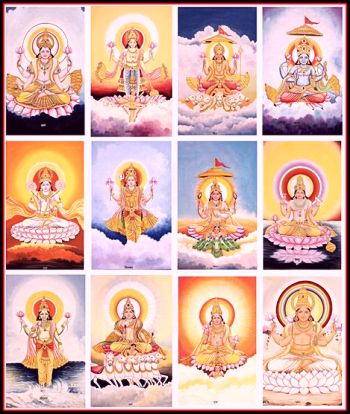
Truly there is only One. They may call Him by any names.  They call him, as Indra, Mitra, Varuna, and he is the celestial, winged-bird (Sun); names as they speak of Agni, Yama, Mātariśvan. The learned priests call the One and the only one by many names

**

The One Aditya (आहुः) is called by various names as: Indra, Mitra, Varuna and Agni (इन्द्रम् मित्रम् वरुणम् अग्निम्). And, again (अथो इति), he is also the beautiful-winged celestial bird Garutman (गरुत्मान्), Garuda (सुपर्णः Suparna) of graceful flight.  The wise ones (विप्राः) speak of in many ways (बहुधा वदन्ति); call (आहुः) the One (Supreme Being (एकम् सत्) in many names as Agni, Yama, Matarisvan. (अग्निम् यमम् मातरिश्वानम्)

This verse is a thread that ties together the Deva-Vidya with Brahma-Vidya. It celebrates the essential unity of celestial beings (Devas) as various manifestations of One and the Only One Supreme Principle (Parama-tattva). All the gods are different forms of the same Paramatman. The worship offer ed to different gods is indeed the worship of That One.

Sri Sayana identifies that supreme Being as Surya; while, earlier, Yaska had described him as Agni.

But, again, it also said the Agni and Aditya are indeed one.

In any case, all the divinities are the manifestations of One and Only One Supreme Principle (Parama-tattva)
**

Verse 47

कृष्णम् नियानम् हरयः सुपर्णाः अपः वसानाः दिवम् उत् पतन्ति ते अववृत्रन् सदनात् ऋतस्य आत् इत् घृतेन पृथिवी वि उद्यते R.V. 1.164.47

kṛṣṇam | ni-yānam | haraya | su-parā | apa | vasānā | divam | ut | patanti | te | ā | avavtran | sadanāt | tasya | āt | it | ghtena | pthivī | vi | udyate |

The smooth-gliding waters (of the rain, the solar rays), clothing the waters with a dark cloud, ascend to heaven; they come down again from the dwelling of the rain, and immediately the earth is moistened with water.

**

The smooth gliding rays (सुपर्णाः) carry water(हरयः). They cover(वसानाः) the dark clouds (कृष्णम्) moving steadily(नियानम्) carrying water (अपः). They spread upward (उत् पतन्ति) towards the heaven (दिवम्). They return from the Sun ( अववृत्रन्), the home of all waters (सदनात् ऋतस्य). Immediately (आत्इत्) the Earth(पृथिवी) is awash with water (घृतेन उद्यते).

**

According to Sri Sayana  : Rigveda Sayana Bhashya

The Aditya has two courses: उत्तरायण (Uttara Yana) and दक्षिणायन (Dakshina Yana) . The former is also called शुक्ल (Shukla); and, the latter as कृष्णं (Krishna).

The night of the gods is दक्षिणायन. And, when the Sun follows the उत्तरायण course , his rays spread over the universe absorb water from all sources; and reach back Aditya by night – that is – by दक्षिणायन. This is the rainy season for the earth. There will be plenty of rains during this season.

यद्वा कृष्णं नियाम नियमनम्‌ रात्रिः  / देवानां हि रात्रिहि दक्षिणायनम् / तत्प्र  तस्मिं वर्षकाले इयर्थः

ऋतस्य सदनात् – उदकस्य स्थानदादि आदित्य मण्डलात्
    

Yaska-charya in his Nirukta chose to relate tis verse to Agni.  

He said Agni ascends to the sky in the form of smoke; it becomes a cloud; pours down the rain, while returning from the solar region, in the form of rays

Either facing up or moving downward, he rays are indeed called Suparna  (सुपर्णाः), moving with grace.

vavtrant.sadanād.tasya.āt.it.ghtena.pthivī.vyudyate 7,24:   ”

ksnam.nirayanam.rātrir.ādityasya,.haraya.suparā.haranā.āditya.raśmayah,.te.yadā.amuto.arvāñca.paryāvartante.saha.sthānād.udakasya.ādityād,.atha.ghtena.udakena.pthivī.vyudyate/[820]

 yatra.suparā.supatanā.āditya.raśmaya.amtasya.bhāgam.udakasya.animisantas.vedanena.abhisvaranti.iti.vā.abhiprayanti.iti. vā

vayo.ver.bahuvacanam.suparā.supatanā.āditya.raśmi1.upasedur.indram.yācamānāh
Verse 48

द्वादश । प्रधयः। चक्रम् । एकम् । त्रीणि । नभ्यानि । कः । ऊँ इति । तत् । चिकेत । तस्मिन्। साकम् । त्रिशताः । न । शङ्कवः । अर्पिताः । षष्टिः । न । चलाचलासः R.V. 1.164.48

dvādaśa | pra-dhayaḥ | cakram | ekam | trīṇi | nabhyāni | kaḥ | oṃ | iti | tat | ciketa | tasmin | sākam | tri-śatāḥ | na | śaṅkavaḥ | arpitāḥ | ṣaṣṭiḥ | na | calācalāsaḥ

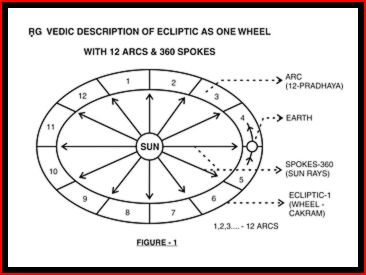
The fellies are twelve; the wheel is one; three are the axles; but who knows it? within it are collected 360 (spokes), which are, as it were, moveable and immoveable
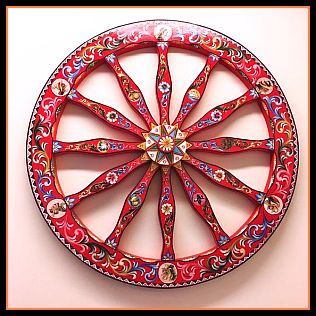
The spokes (प्रधयः) are twelve (द्वादश); the wheel (चक्रम्) is one(एकम्); three are the axles (त्रीणिनभ्यानि); but who indeed has known this? (तत्चिकेत)? within it (तस्मिन्) are revolving (चलाचलासः) 360 (त्रिशताः षष्टिः spokes), which are, as it were, moveable and immoveable; not in the least shaking joined together (साकम् अर्पिताः).
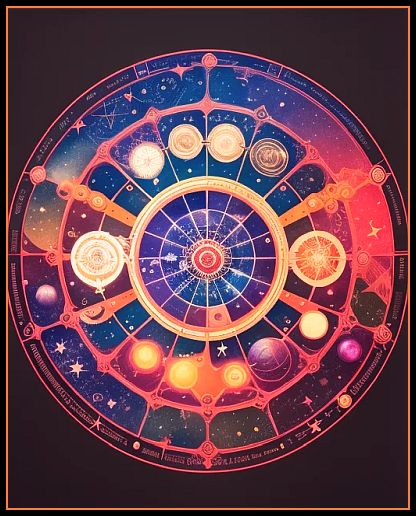
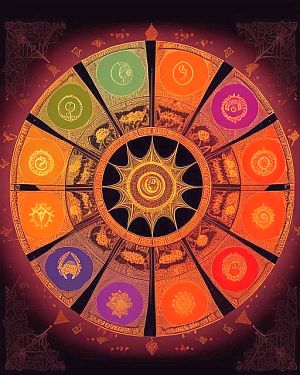
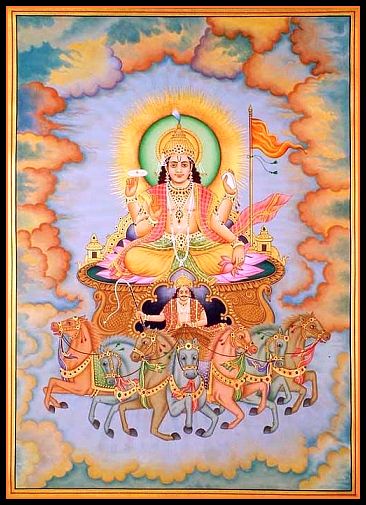
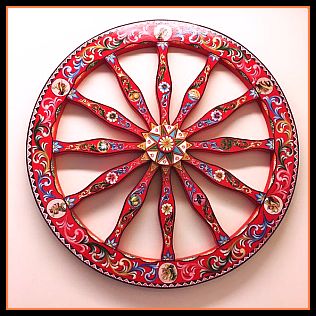
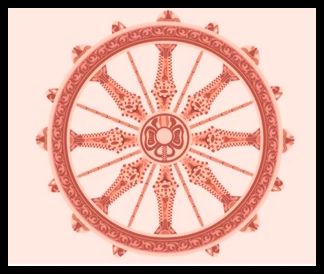
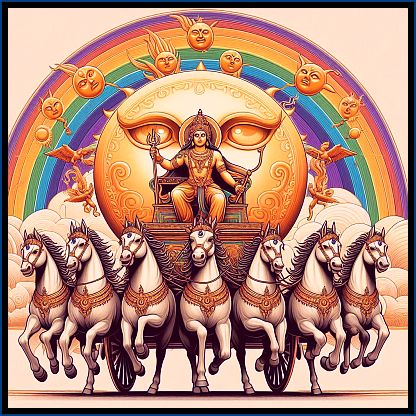
This verse , again, describes Aditya picturized as a Time-wheel (Samvathsara Chakra) , whose one revolution makes a year. . It has twelve spokes, three axels, hold together 360 spokes joined to them

-द्वादश । प्रधयः परिधय तत् स्थानीया द्वादश मासाह

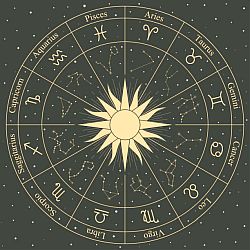
The twelve spokes represent twelve months in a year or the twelve Rashis (Zodiac signs). , with 360 pairs of day and night.-

त्रीणि- नभ्यानि – नभ्याश्रयIणी फलकानि तत् स्थानियानि ग्रीष्म वर्षा हेमन्त ख्यायश्रितानि

The three Nabhis indicate here , the three seasons (Ritus)  -summer , rains and winter (ग्रीष्म वर्षा हेमन्त ).

Or, it might be the three junctions (सन्ध्याहः) in time – past, present and future tenses 

Well, who is there to that  truly knows the secretकः तत्  चिकेत कोपि महान जानति ?  !!

Sri Sāyaa in his  gveda-bhāya says that 360 moves on and on ; revolves; repeats itself – चलI चलIसह

**

Verse 49

यः ते स्तनः शशयः यः मयःभूः येन विश्वा पुष्यसि वार्याणि यः रत्नधाः वसुवित् यः सुदत्रः सरस्वति तम् इह धातवे करिति कः R.V. 1.164.49

ya | te | stana śaśaya | ya | maya-bhū | yena | viśvā | puyasi | vāryāi | ya | ratna-dhā | vasu-vit | ya | su-datra | sarasvati | tam | iha | dhātave | karitika  |

Sarasvati, that retiring breast, which is the source of delight, with which you bestow all good things, which is the container of wealth, the distributor of riches, the giver of good (fortune); that (boon) do you lay open at this season for our nourishment

**

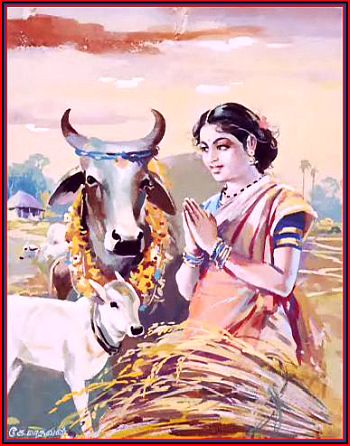
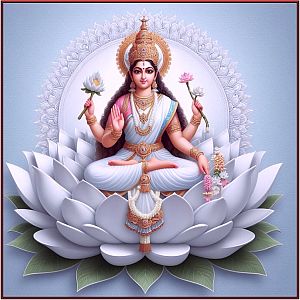
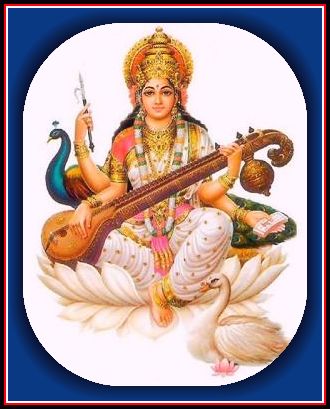
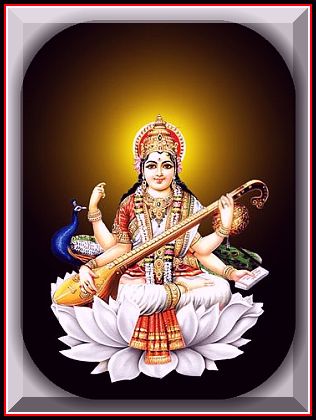
The Deity here is Sarasvati. Here, Goddess Sarasvathi is described as a mother. We had some reference to mother and child in previous verses (5, 7, 8, 9, 0, 11, 26, 27, 28). Mother, cow, water and many ideas refer more or less to the same thing.
**

There are four kinds of references to Vac in Rig Veda:

  • Vac is speech in general;
  • Vac also symbolizes cows that provide nourishment;
  • Vac is also primal waters prior to creation; and,
  • Vac is personified as the goddess revealing the word.

Commencing with the Brahmana-texts, Vac gets identified with Sarasvathi the life-giving river; the goddess of learning and wisdom; as also with Vac.

**

The name Saraswati (सरस्वती) indicates one who is associated water (सरस्) or that which is fluid Salila (सलील). When the term is taken as a composite word of Sarasu-ati (सरसु+अति) it also means one with plenty of water (उदकम्).

In the Nighantu (1.12), Sarah is one of the synonyms for water. That list of synonyms for water, in the Nighantu, comes immediately next to that of the synonyms for speech (Vac).

Yaska also confirms that the term Sarasvathi primarily denotes the river (Sarasvathi Sarah iti- udakanama sartes tad vati –Nirukta.9.26). Thus, the word Sarasvathi derived from the word Sarah stands for Vagvathi (Sabdavathi) and also for Udakavathi

*

Vac is sometimes identified with waters, the primeval principle for the creation of the Universe.

In the Vak Suktha or Devi Suktha  of Rig Veda (RV.10. 10.125), Apah, the waters, is conceived as the birth place of Vac. And, Vac who springs forth from waters touches all the worlds with her flowering body and gives birth to all existence. She indeed is Prakrti.  Vac is the creator, sustainer and destroyer. In an intense and highly charged superb piece of inspired poetry Vac declares “I sprang from waters there from I permeate the infinite expanse with a flowering body. I move with Rudras and Vasus. I walk with the Sun and other Gods. It is I who blows like the wind creating all the worlds”.

*
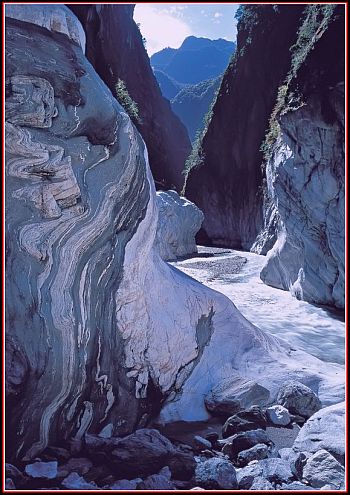
In initial passages of the Rigveda, the word Sarasvati refers to the river “Best of mothers, the best of rivers, best of goddesses” (अम्बितमे नदीतमे देवितमे सरस्वतिRigveda 2.41.16)

In the Rig-Veda, Sarasvathi is the name of the celestial river par excellence (deviyā́m), as also its personification as a goddess (Devi) Sarasvathi, filled with love and bliss (bhadram, mayas).

And Sarasvathi is not only one among the seven sister-rivers (saptásvasā), but also is the dearest among the gods (priyā́ deveu).

Again, it is said, the Sarasvathi as the divine stream, has filled the earthly regions as also the wide realm of the mid-world (antárikam)

  • āpaprúī pā́rthivāni urú rájo antárikam | sárasvatī nidás pātu |  RV_6,061.11)

Invoked in three full hymns (R V.6.6.61; 7.95; and 7.96) and numerous other passages, the Sarasvathi, no doubt, is the most celebrated among the rivers.

*

In the Aitareya Brahmana (3.37) Vac is directly identified with the life-giving Sarasvathi (vag vai Sarasvathi).

The Vac-Sarasvathi in the form of river (Sarasvathi-nadi-rupe) is the generous (samrudhika) loving and life-giving auspicious (subhage) splendid Mother (Mataram sriyah), the purifying (pavaka) source of great delight (aahladakari) and happiness (sukhasya bhavayitri) which causes all the good things of life to flourish.
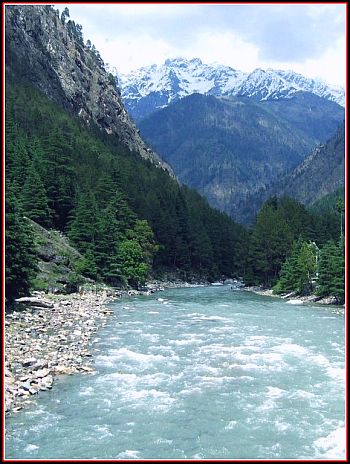
There are abundant hymns in the Rig-Veda, singing the glory and the majesty of the magnificent Sarasvathi that surpasses all other waters in greatness, with her mighty (mahimnā́mahó mahī́) waves (ūrmíbhir) tearing away the heights of the mountains as she roars along her way towards the ocean (ā́ samudrā́t). She is the swiftest among the speediest- vegavatinam vegavattama .

Sarasvathi is loud and powerful flood who roars like a bull and can­not be controlled.

She is the one bursting the ridges of the hills (paravataghni) with mighty waves – yásyā anantó áhrutas tveáś cariṣṇúr aravá | ámaś cárati róruvat | (RV_6,061.08

 Pra-ya-mahimna-mahinasu-cekite-dyumnebhiranya-apasamapastama – the one whose powerful limitless (yásyā anantó) , unbroken (áhrutas) swiftly flowing (cariṣṇúr aravá) impetuous  resounding current and  roaring (róruvat) floods,  moving with rapid force , like a chariot (rathíyeva yāti), rushes  onward towards the ocean (samudrā́t)  with tempestuous roar; ..  and so on.

Rishi Gtsamada adores Sarasvathi as the divine (Nadinam-asurya), the best of the mothers, the mightiest of the rivers and the supreme among the goddesses (ambitame nadltame devitame Sarasvati).   And, he prays to her:  Oh, Mother Saraswati, even though we are not worthy, please grant us merit.

Ámbitame nádītame dévitame sárasvati apraśastā ivasmasi praśastim amba naskdhi – (RV_2,041.16)

Sarasvathi is the most sacred and purest among rivers (nadinam shuci). Prayers are submitted to the dearest (Priya tame) seeking refuge (śárman) in her – as under a sheltering tree (śaraá vr̥kám). She is our best defence; she supports us (dharuam); and, protects us like a fort of iron (ā́yasī pū́). She is most liberal to her friends (Uttara sakhibhyah).

The Sarasvathi, the river that outshines all other waters in greatness and majesty is celebrated with love and reverence; and, is repeatedly lauded with choicest epithets, in countless ways:

The Sarasvathi, most beloved among the beloved (priyā́ priyā́ su) is the ever-flowing bountiful (subhaga; vā́jebhir vājínīvatī) energetic (balavati) stream of abounding beauty and grace (citragamana citranna va) which purifies and brings fruitfulness to earth, yielding rich harvest and prosperity (Sumrdlka). She is the source of Vigor and strength.

Her waters which are sweet (madhurah payah) have the life-extending (ayur-vardhaka) healing (roga-nashaka) medicinal (bhesajam) powers – (aps-vantarapsu bhesaja-mapamuta prasastaye – RV_1,023.19).

She is indeed the life (Jivita) and also the nectar (amrtam) that grants immortalitySarasvathi, our mother (Amba! yo yanthu) the life giving maternal divinity, is dearly loved as the benevolent (Dhiyavasuh) protector of the Yajna – Pavaka nah Sarasvathi yagnam vashtu dhiyavasuh (RV_3,003.02).

She personifies purity (Pavaka). Sarasvathi is depicted as a purifier (pavaka nah sarasvathi) – internal and external. She purifies the body, heart and mind of men and women- viśva hi ripra pravahanti devi-rudi-dābhya śucirāpūta emi | (10.17.20); and inspires in them pure, noble and pious thoughts (1.10.12). Sarasvathi also cleanses poison from men, from their environment and from all nature –

  uta kitibhyo, avanīr avindo viam ebhyo asravo vājinīvati (RV_6,061.03).

Prayers are submitted to Mother Sarasvathi, beseeching her:  please cleanse me and remove whatever sin or evil that has entered into me. Pardon me for whatever evils I might have committed, the lies I have uttered, and the false oaths I might have sworn.

Idamapah pravahata yat kimca duritam mayi, yad vaaham abhi dudroha, yad va sepe utanrtam (RV.1.23.22)

The beauty of Sarasvathi is praised through several attributes, such as: Shubra (clean and pure); Suyanam, Supesha, Surupa (all terms suggesting a sense of beauty and elegance); Su-vigraha (endowed with a beauteous form) and Saumya (pleasant and easily accessible). Sri Sayana describes the beauteous form of Sarasvathi: “yamyate niyamytata iti   yamo vigrahah, suvigraha…”

Sarasvathi is described by a term that is not often used: ’ Vais’ambhalya’ , the one who brings up, nurtures and protects the whole of human existence – visvam prajanam bharanam, poshanam – with abundant patience and infinite love.

 Sri Sayana, in his Bhashya (on Taittiriya-Brahmana, 2. 5.4.6) explains the term as: Vlsvam prajanam bharanam poshanam Vais’ambham tatkartum kshama vaisambhalya tidrsi.

Thus, the term Vais’ambhalya, pithily captures the nature of the nourishing, honey-like sweet (madhu madharyam) waters of the divine Sarasvathi who sustains life (vijinivathi); enriching the soil ; providing abundant food (anna-samrddhi-yukte; annavathi)  and nourishment (pusti) to all beings; causing overfull milk in cows (kshiram samicinam); as  Vajinivathi enhancing vigour  and strength  in horses ( vahana-samarthyam)  ; and , blessing all of existence with happiness  (sarvena me sukham ) – (Sri Sayana’s  Bhashya on  Taittiriya-Brahmana).
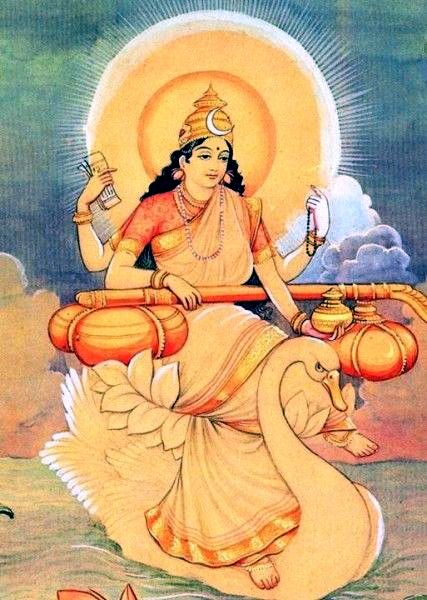
Yaska mentions that Sarasvathi is worshipped both as the river (Nadi) and as the goddess (Devata) –

vāc.kasmād, vaceh / tatra. sarasvatī. ity. etasya. nadīvad. devatāvat . ca . nigamā. bhavanti. tad. yad. devatāvad. uparistāt. tad .vyākhyāsyāmah / atha . etat. nadīvat/ /– Nirukta.2.23 

Thus, Sarasvati is a river at first; and, later conceived as a goddess

Sarasvathi, the best of the goddesses (Devi-tame) and the dearest among the gods (priyā́ deveu) is associated with Prtri-s (departed forefathers svadhā́ bhir Devi pitŕ̥bhir; sárasvatī yā́m pitáro hávante) as also with many other deities and with the Yajna.

She is frequently invited to take seat in the Yajnas along with other goddesses such as: Ila, Bharathi, Mahi, Hotra, Varutri, Dishana Sinivali, Indrani etc.

She is also part of the trinity (Tridevi) of Sarasvathi, Lakshmi and Parvati.

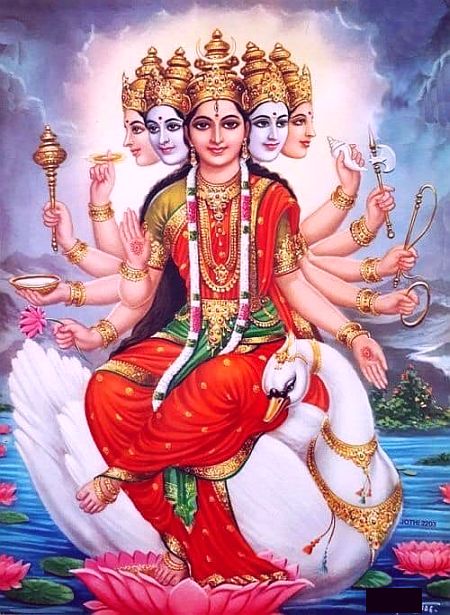
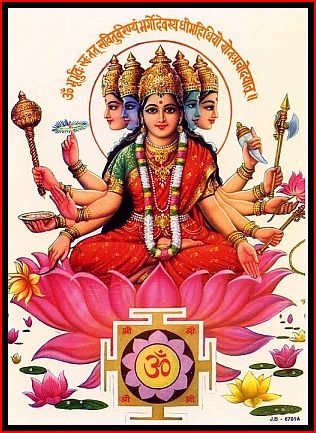
Sarasavathi as Devata, the Goddess is also said to be one of the three aspects of Gayatri (Tri-Rupa-Gayatri): Gayatri, Savitri and Sarasvathi.

Here, while Gayatri is the protector of life principles; Savitri of Satya (Truth and integrity of all Life); Sarasvathi is the guardian of the wisdom and virtues of life.

Among these Tisro Devih, Sarasvathi, the mighty, illumines with her brilliance and brightness, inspires all pious thoughts – cetantī sumatīnām (RV.1.3.12 ;).

Her aspects of wisdom and eloquence, which enlighten all this world (dhiyo viśvā vi rājati), are praised, sung in several hymns. She evokes pleasant songs, brings to mind gracious thoughts; and she is requested to accept our offerings (RV.1.3.11)

codayitrī sūntānā cetantī sumatīnām | yajña dadhe sarasvatī ||maho ara sarasvatī pra cetayati ketunā  | dhiyo viśvā vi rājati ||RV.1.3.11-12 

Story pin image

According to Sri Sayana, Sarasvathi – Vac is depicted as a goddess of learning (gadya-padya rupena–prasaranmasyamtiti–Sarasvathi- Vagdevata).

Sarasvathi as Vac is adored as the power of truth, free from blemishes; inspiring and illuminating noble thoughts (chetanti sumatim).

 In the Taittariya Brahmana, the auspicious (subhage), the rich and plentiful (vajinivati) Vac is identified with Sarasvathi adored as the truth speech ‘Satya-vac’.

 Sarasvathi subhage vajinlvati satyavachase bhare matim. idam te havyam ghrtavat sarasvati. Satyavachase prabharema havimsi- TB. II. 5.4.

The Vac-Sarasvathi, the power of speech, is hailed as the mother of Vedas – Veda Mata. She is the abode of all knowledge; the vast flood of truth (Maho arnah); the power of truth (Satya vacs); the guardian of sublime thoughts (dhinam avitri); the inspirer of good acts and thoughts; the mother of sweet but truthful words; the awakener of consciousness (chodayitri sunrtanam, chetanti sumatinam); the purifier (Pavaka); the bountiful blessing with vast riches (vajebhir vajinivati); and the protector of the Yajna (yajnam dadhe)

Vac- Sarasvathi is regarded the very personification of pure (pavaka) thoughts, rich in knowledge or intelligence (Prajna or Dhi) – (vag vai dhiyavasuh)

Pavaka nah sarasvatl yajnam vastu dhiyavasur iti vag vai dhiyavasuh – AB. 1.14.

In the Shata-patha-Brahmana (5. 2.2.13-14) , Vac as Sarasvathi is first taken to be her  controlling power, the mind (manas), the abode of all thoughts and knowledge,  before they are expressed through speech.

sarasvatyai vāco yanturyantriye dadhāmīti vāgvai  sarasvatī tadena vāca eva yanturyantriye dadhāti – 5. 2.2.13

Again, the Shata-patha-Brahmana (I.4.4.1; 3.2.4.11) mentions the inter-relations among mind (manas), breath (prana) and Speech (Vac). The speech is evolved from mind; and put out through the help of breath. The speech (Vac) is called jlhva Sarasvati i.e., tongue, spoken word. Vac-Sarasvathi is also addressed as Gira, one who is capable to assume a human voice.

Taittirlya Brahmana refers to Sarasvathi as speech manifested through the help of the vital breath Prana; and, indeed even superior to Prana

  • (vag vai sarasvatl tasmat prananam vag uttamam – Talttirlya Brahmana, 1.3.4.5).

The Tandya Brahmana identifies Sarasvathi with Vac, the speech in the form of sound (sabda or dhvani).  Here, Sarasvathi is taken to be sabdatmika Vac, displaying the various form of speech (rupam) as also the object denoted by speech (vairupam): vag vai sarasvati, vag vairupam eva’smai taya yunakti – TB. 16. 5.16.

By the time of the later Vedic texts, the identity of Vac with Sarasvathi becomes very well established. The terms such as ‘Sarasvathi –Vacham’, ‘Vac- Sarasvathi’ etc come into use in the Atharva-Veda. Even the ordinary speech was elevated to the status of Vac

Story pin image

**

Verse 50

यज्ञेन यज्ञम् अयजन्त देवाः तानि धर्माणि प्रथमानि आसन् ते नाकम् महिमानः सचन्त यत्र पूर्वे साध्याः सन्ति देवाः R.V.1.164.50

yajñena | yajñam | ayajanta | devā | tāni | dharmāi | prathamāni | āsan | te | ha | nākam | mahimāna | sacanta | yatra | pūrve | sādhyā | santi | devā

The gods performed a sacrifice for such are their first duties; those mighty ones assemble in heaven, where the divinities who are to be propitiated (by sacred rites) abide

**

The gods(देवाः) performed(अयजन्त) a sacrifice(यज्ञम्) ; with that  they became greater (महिमानः); the first of  the Dharmas (तानि धर्माणि प्रथमानि). Lo, these greatness’s resorted to the heaven, where the ancient Sadhyas, the gods, are (yatra-pūrve -sādhyā– santi -devā).

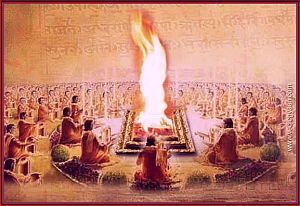
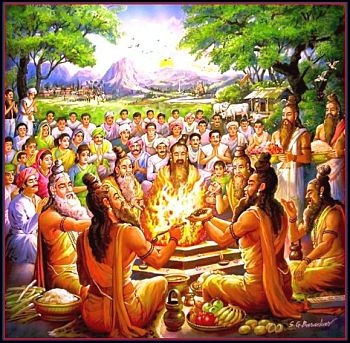
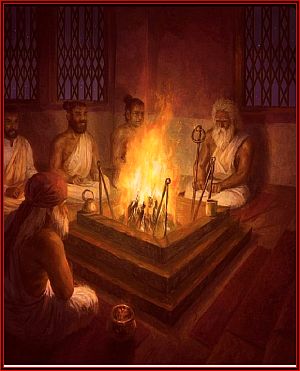
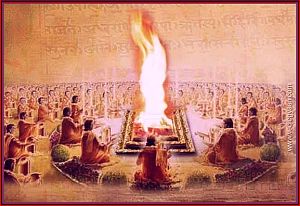
Yajnas bring gods and humans together to achieve their common goals and participate in God’s eternal duties as active participants in the sacrifice of creation. The source of Yajna is God himself.

This verse is in praise of the Yajna (यज्ञ). A great Yajna rewards immensely in the heavens ( ते नाकम् महिमानः सचन्त). There is no place for grief there.

*

Commentary by Sāyaa: gveda-bhāya

Where the divinities: yatra pūrve sādhyā santi devā: sādhyā = karma-deva, divinities presiding over or giving effect to religious acts, yajñādi sādhanavanta; or, the term may mean those who have obtained the portion, or the condition of gods, by the former worship of Agni, or the sādhyās = ādityas, or the agirasas, or deities presiding over the metres, chando abhimānina; sādhyās are named among the minor divinities in Amarakośa
Verse 51

समानम् । एतत् । उदकम् । उत् । च । एति । अव । च । अहभिः । भूमिम् । पर्जन्याः । जिन्वन्ति । दिवम् । जिन्वन्ति । अग्नयः ॥ R.V.1.164.51 I

samānam | etat | udakam | ut | ca | eti | ava | ca | aha-bhi | bhūmim | parjanyā| j invanti | divam | jinvanti | agnaya |

This water comes up and down alike day by day. The Parjanyas enliven the earth; the Fires enliven the heaven.

**

The same water goes upward and downward in course of days. The clouds give joy to the earth. The Fire pleases the gods in the Dyu-Loka, the upper worlds.

Dr. Raja explains:

The first half of the verse states that the water goes up and down day by day alike, without any difference. The similarity is in its going up and down. This is explained in the second half. Water here is only some kind of transcendental joy, which migrates from earth, from men to the gods in heaven and from heaven, from the gods, to men on earth. Both the courses are alike. This has close resemblance with the idea found in the Bhagavad-Gita that men must propitiate the gods with sacrifices and that the gods will make men happy in return (ग).

Here also we   find the harmony between the ritual mentioned in this verse and the value of knowledge that is the main topic in the poem.

The Deity here is Surya, Parjanya or Agni.
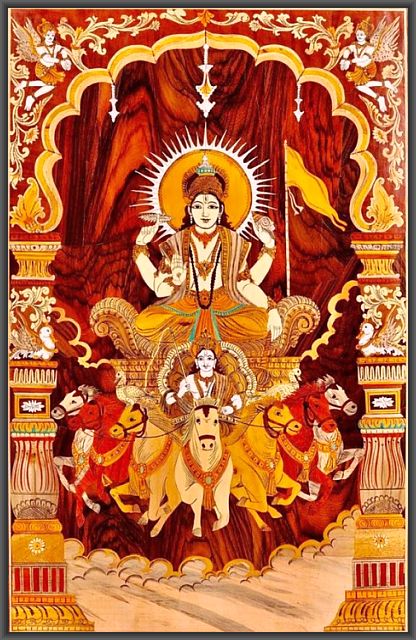
**

The same form (समानम्) of water (एतत् -उदकम्) during certain days (summer अहभिः ) ascend upward to the sky (उच्चैति ). And, goes downward during rainy season (अव-च ). The clouds (पर्जन्याः), whose nature is to please (जिन्वन्ति )the earth  (भूमिम्) come down. The Fires (अग्नयः – आहवनीया) please the upper worlds ( दिवम् द्द्युल्लोके जिन्वन्ति ) .

The clouds make the people of the earth happy by helping them to grow rich food  crops  .

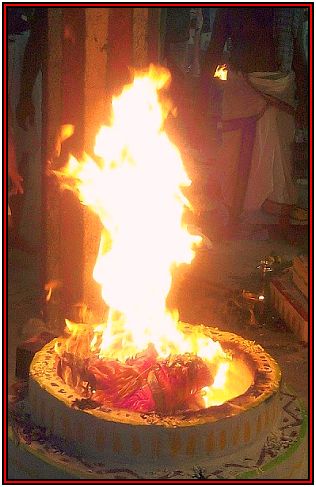
The fires of the Yajnas carry the oblations to the gods in Dyu-Loka ; and make them happy.
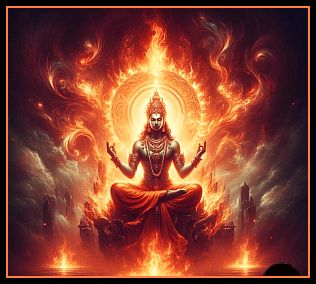
Therefore, Parjanya and Agni together take care of the welfare of the people on earth and in the upper regions. These two are interdependent. They also bring together, the humans on earth and gods in the heavens. It is by virtue of their mutual cooperation, the universe progresses safely and  happily.

Verse 52

दिव्यम् । सुपर्णम् । वायसम् । बृहन्तम् । अपाम् । गर्भम् । दर्शतम् । ओषधीनाम् । अभीपतः। वृष्टिभिः । तर्पयन्तम् । सरस्वन्तम् । अवसे । जोहवीमि R.V.1.164.52 II

divyam | su-param | vāyasam | bhantam | apām | garbham | darśatam | oadhīnām | abhīpata | vṛṣṭi-bhi | tarpayantam | sarasvantam | avase | johavīm i

I invoke for our protection the celestial, well-winged, swift-moving, majestic (Sun); who is the germ of the waters; the displayer of herbs; the cherisher of lakes replenishing the ponds with rain

***

The divine bird, the great bird, the child of waters, of herbs, worthy to be seen, who brings satisfaction with rains in the rainy season, that Sarasvat I invoke again and again for protection.

*

Again and again, I invoke for our protection, the celestial beautiful-winged, swift moving, majestic, graceful, Lord, who is the protector of waters. He is the guardian of herbs, filled with water. It is he who protects and enlivens the world by sending down timely rains.

*

 Born in the Dyu-Loka (दिव्यम्‌), Suparna (सुपर्णम्) of graceful flights, always moving (वायसम्), covered with glory and majesty (बृहन्तम्‌), produces waters (अपाम् गर्भम्), of herbs (ओषधीनाम्), reveller (दर्शतम्) , favorable with rains (वृष्टिभिः) ,pleases the worlds (तर्पयन्तम्), full of waters (सरस्वन्तम्), for protection (अवसे ) , I invoke again and again (जोहवीमि)
The Sun may not have waters in him, but, he moves in celestial waters.; and he produces waters. Therefore, he is Sarasvan. This Rik can be interpreted both with reference to the Sun and Sarasvan..

*

The poet Dhirgatamas starts with the mention of “a beloved invoker grown grey, with his two brothers, who is the Lord, and father of seven children” (verse 1).

अस्य वामस्य पृषतस्य होतुः तस्य॑ भ्राता मध्यमः अस्ति अशनः | ततीयः श्रातं धृतऽपुष्ठः अस्य॒ अत्रं अपर्यम्‌ विदपतिम्‌ स्तऽपुत्रम्‌

Of this beloved invoker, grown grey — of him there is the middle brother, the all-pervading; his third brother is the one who bears ghee on his back. In them I saw the Lord of the People with seven sons.

The poem concludes with a prayer to “the swift-moving divine bird, the majestic bird (Sun), producer of water, which gives life to the herbs; he who brings happiness with timely rains,” for protection, (verse 52).

दिव्यम्‌ सुऽपर्णम्‌ वाय॒सम्‌ बृहन्तम्‌ अपाम्‌ ग्मम्‌ ददतम्‌ ओष॑धीनाम्‌ अभीपतः वृष्टिऽभिः त॒पै्यन्तम्‌ सरसन्तम्‌ अवसे | जोहवीमि  १.१६४.५२

The divine bird, the great bird, the child of waters, of herbs, worthy to be seen, who brings satisfaction with rams in the rainy season, that Sarasvati I invoke again and again for protection.

The first Mantra pictures the symbolism of the three brothers, the three luminaries in the regions; the three forms of fire: Agni, Vayu (Air) and Aditya (Sun).

Yaskacharya explains that there is indeed only One Deity; and, that Deity manifests in the three worlds as Surya (Sun) in heaven (Dyu-Loka); Indra or Vayu (wind) in the middle region (Antariksha); and, fire on the earth (Bhu-Loka). They are the basic foundations of our existence.

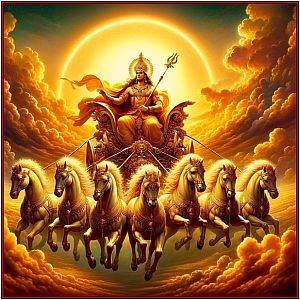
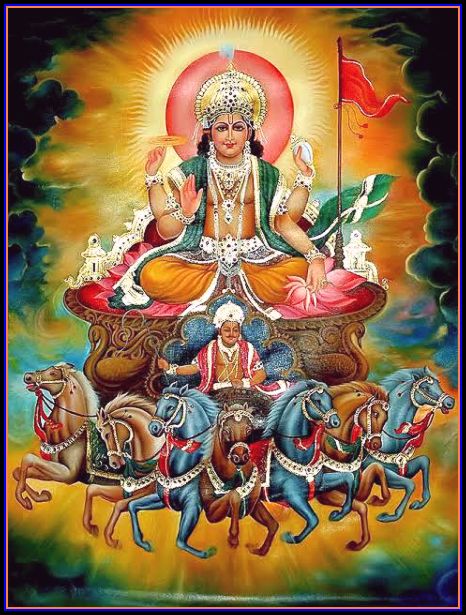
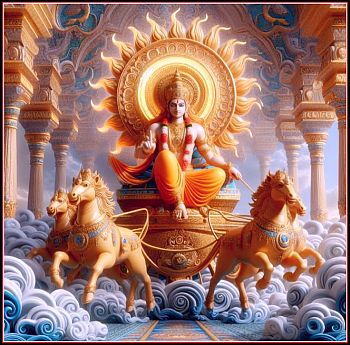
Of these three brothers; Aditya (Sun) shining in the sky, the protector (पलितस्य) of the Universe, who is worshipped by all (वामस्य), is the Supreme.

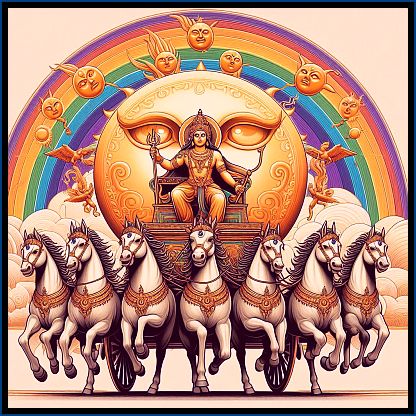
He is accompanied by seven sons (सप्तपुत्रम्), who are not different from himself (his seven rays of seven colours).

The three brothers or the three aspects of Agni (Agni-traya) form the Tripod of Life.  They exist and function together.; and, are the basic factors of our existence.
REFERENCES

  1. History of Pre-Buddhist Indian Philosophy by Dr. Beni-madhab Barua -Motilal Banarsidas-1921
  2. Tagore Law Lectures 1930 – The History Of Hindu Law by Prof Radha Binod Pal; University of Calcutta – 1958
  3. Vision in long darkness by Prof. Vasudeva Agrawala
  4. https://who.rocq.inria.fr/Ramakrishna.Upadrasta/Veda/Asya_Vamiya/AVMS/AVMS_1-100.pdf
  5. https://www.youtube.com/watch?v=r86l_TF9XWc
  6. https://archive.org/details/in.ernet.dli.2015.226346
  7. https://istore.chennaimath.org/products/rig-vedic-suktas-asya-vamiya-suktam/1309294000102324374
  8. pdf (archive.org)
  9. https://religion.fandom.com/wiki/Dirghatamas
  10. ऋग्वेदः सूक्तं .१६४ – विकिस्रोतः (org)
  11. org/mirrors/rigveda/sanskrit03/RV0310noaccent.html
  12. ALL IMAGES ARE FROM INTERNET
 
Leave a comment

Posted by on August 20, 2024 in Dhirgatamas, Rigveda


Tags: , , , , , , , , , , , , , , , , , , , , , , , , , , , , , , , , , , , , , , ,

Who Was Dhirgatamas – Part Eight

Continued from Part Seven

Verse 40

सुयवसअत् भगवती हि भूयाः अथो इति वयम् भगवन्तः स्याम अद्धि तृणम् अघ्न्ये विश्वदानीम् पिब शुद्धम् उदकम् आचरन्ती R.V.1.164.40

suyavasa-at | bhaga-vatī | hi | bhūyā | atho iti | vayam | bhaga-vanta | syāma | addhi| tṛṇam | aghnye | viśva-dānīm | piba | śuddham | udakam | ācarantī

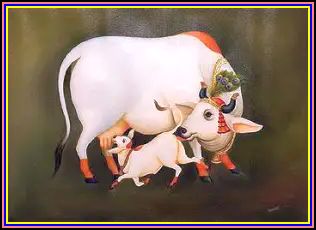
Cow (अघ्न्ये) you will not be hurt. May you be rich in milk through abundant fodder; that we also may be rich (in abundance); eat grass at all seasons, and, roaming (at will), drink pure water.

*

O Cow (अघ्न्ये) may you be (भूयाः) happy (भगवती) always (विश्वदानीम्) eating good grass. You will be rich in milk (भगवती). After that (अथो इति) we also (वयम्) live in abundance (भगवन्तः). O Cow, you shall not be hurt (सुयवसअत्); always eat (अद्धि) grass (तृणम्), drink (पिब) clear water (उदकम्), wander about (आचरन्ती) happily (भगवती).

*

This Rik is usually sung while milking the Cow for the Agnihotra and other rituals

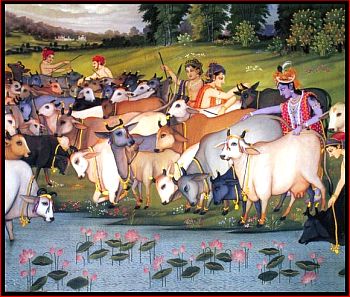
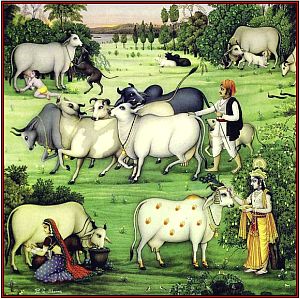
When the cow, the symbol of Motherhood, is happy, we too will be happy. The cow will be happy when there is plenty of nourishing grass, good fodder (Suvyasa) and clear water. The grass would grow; and there will be water in plenty, when the sun rays and water-bearing clouds send down sufficient timely rains in proper seasons. With good milk, plenty of water and rich crops we too will always be happy.

Dr. Raja adds:

After the glorification of wisdom, the illumination of a poet, and after drawing the distinction between one who knows and one who knows not, here is an address to a Cow.

Word or speech is always conceived of as a Cow, and the word Gau, meaning a cow, has also the meaning of speech.

**

The term गौ is also used to denote Madhyamika Vac

It is said; this verse is about the doctrine of Vak, put in terms of the Cow.

***

The ancient philosophers identified four levels or stages of speech (Vac): Para, Pashyanti, Madhyama and Vaikhari

Of these four forms of Vac, Para and Pashyanti are the subtle forms of Vac; while Madhyama and Vaikhari are its gross forms.

The process of manifestation of speech is compared to the evolution of the Universe. And, that process is said to take place in four stages.

First, in the undifferentiated substratum of thought, an intention appears. This first impulse, the self-radiant consciousness is Para-vac (the voice beyond).

This latent, un-spoken, un-manifest, silent thought (Para) unfolds itself in the next three stages as Pashanti (thought-visualized), Madhyama  (intermediate); and as Vaikhari (explicit audible speech).

The Madhyama Vak, a sequenced but a pre-vocal thought – described as the voice of silence; perhaps is best understood as internal speaking. Here, there is no perceptible sound (Nada). The Madhyama Vak is in an inaudible wave or vibratory (spandana) form.

And, the Madhyama, when it is put out explicitly through uttered words and sentences; and, when it comes out of the speaker’s mouth in sequenced and verbalized speech-form, it is called Vaikhari Vak. For the purpose of putting out the Vaikhari Vac, the speaker employs a sentence comprising words uttered in a sequence. The word itself comprises letters or syllables (varnas) that follow one after the other in space and time.


Here, this verse is said to be addressed as a prayer to the Goddess of the mid-region- Sarasvathi (Madhyama Vac)- for sending down rains by bursting clouds.

Following Yaska, Sri Sayana also regarded Sarasvathi as a divinity of the mid-region- ‘madhyama-sthana hi Vak Sarasvathi’; and as a personification of the sound of thunder.

Sarasvathi is regarded as a deity of the atmosphere, associated with clouds, thunder, lightning, rains and water.

***

Verse 41

गौरीः मिमाय सलिलानि तक्षती एकपदी द्विपदी सा चतुःपदी ष्टापदी नवपदी बभूवुषी सहस्रअक्षरा परमे विओमन् R.V.1.164.41

gaurī | mimāya | salilāni | takatī | eka-padī | dvi-padī | sā | catu-padī | aṣṭāpadī | nava-padī | babhūvuī | sahasra-akarā | parame | vi-oman

The sound (of the clouds) has been uttered, fabricating the waters, and being one-footed, two-footed, four-footed, eight-footed, nine-footed, or infinite in the highest heaven.

***

The Verses 40 and 41 are about Vac.

Before going specifically into verse 41, let’s talk briefly about Vac as in the ancient texts.

There are elaborate discussions on the subject of Vac in the Vedas and the related texts spread over long periods.

As regards Rigveda, broadly, there are five kinds of references to Vac:

  • Vac is speech in general;
  • Vac also symbolize Mothers represented by cows that provide nourishment;
  • Vac is also primal waters prior to creation;
  • Vac is represented by rain-bearing clouds; and,
  • Vac is personified as the goddess revealing the word.

And, at a later stage, commencing with the Brahmanas, Vac gets identified with Sarasvathi the life-giving river, as also with the goddess of learning and wisdom.

According to Sri Sayana, Sarasvathi – Vac is depicted as a goddess of learning (gadya-padya rupena–prasaranmasyamtiti–Sarasvathi- Vagdevata).

Yaska categorizes Sarasvathi as the goddess of mid-region – Madhya-sthana striyah.

Following Yaska, Sri Sayana also regarded Sarasvathi as a divinity of the mid-region- ‘madhyama-sthana hi Vak Sarasvathi’; and as a personification of the sound of thunder.

Thus, Sarasvathi, a deity of the atmosphere is associated with clouds, thunder, lightning, rains and water.  As Sri Aurobindo said; the radiant one has expressed herself in the forming of the flowing Waters. 

The concept of Vac was extended to cover oral and aural forms such as: expressions, sayings, phrases, utterances, sentences, and also the languages of all sorts including gesture (ingita).

Yaska says that all kinds of creatures and objects created by God speak a language of their own, either articulate or in-articulate

  • (devastam sarvarupah pasavo vadanti, vyakta vac-ascha- avyakta- vacacha – Nir. 11.29).

Even the rumbling of the clouds, the thunder of the lightening and the rippling sounds of the streams are said to be the forms of Vac

(praite vadantu pravayam vadama gravabhyo vacam vadata vadadbhyah – RV. 10.94.1)

It was said; the extant of Vac is as wide as the earth and fire. Vac is even extolled as having penetrated earth and heaven, holding together all existence. As Yaska remarks: Vac is omnipresent and eterna1 (vyaptimattvat tu Sabdasya – Nir.I.2)

Vac belongs to both the worlds – the created and un-created.  It is both the subject of speech and the object of speech.

And, Vac goes beyond speech. Vac is indeed both speech and consciousness (Chetana), as all actions and powers are grounded in Vac. It is the primordial energy out of which all existence originates and subsists. Vac is also the expression of truth.

Yajnavalkya in the   Brhadaranyaka Upanishad explaining the relation between Vac and consciousness says that Vac (speech) is a form of expression of consciousness. And, he argues, there could be no speech without consciousness. However, Consciousness does not directly act upon the principle of speech; but it operates through intermediary organs and breath to deliver speech.

Sri Sayana says that the Vac as Shabda-Brahmatmika-Vac resides in the inner space; and manifests itself with various names and forms.

Rishi Dhirgatamas goes far beyond; and, exclaims: Vac is at the peak of the Universe (Agre paramam); She is the Supreme Reality (Ekam Sat; Tad Ekam); She resides on the top of the yonder sky; She knows all; but, does not enter all.

  • Mantrayante divo amuya pṛṣṭhe viśvavida vācam aviśvaminvām – RV.1.164.10)

Vac, he says, is the ruler of the creative syllable Ra (Akshara); it is with the Akshara , the chaotic material world is organized meaningfully; “what will he, who does not know Ra will accomplish anything.! “. 

co akare parame vyoman yasmin devā adhi viśve niedu | yas tan na veda kim cā kariyati ya it tad vidus ta ime sam āsate |RV.1.164.39|

That is because, Dhirgatamas explains, the whole of existence depends on Akshara which flowed forth from the Supreme Mother principle Vac – 

  • tata karaty akara tad viśvam upa jīvati |RV.1.164.42 |

According to Dhirgatamas: “When I partake a portion of this Vac, I get the first part of truth, immediately- 

  • (maagan-prathamaja-bhagam-aadith-asya-Vac)”-(RV. I.164.37.)

But he also says: “Vac has four quarters; only the wise that are well trained, endowed with intelligence and understanding know them all. For the rest; the three levels remain concealed and motionless. Mortals speak only with the fourth (RV. 1.164.45).”

Chatvaari vaak parimitaa padaani / taani vidur braahmaanaa ye manishinaah. Guhaa trini nihitaa neaengayanti / turiyam vaacho manushyaa vadanti. (Rigveda Samhita – 1.164.45)

Yaska also mentions about the the four groups of parts of speech (Catvari padajatani) such as:  Noun (Naman), Verb (Akhyata), Preposition (Upasarga), and Particle (Nipata)Of these, the first two are established by definition; and, the remaining two by enumeration.

Catvāri pada jātāni nāma ākhyāte ca upasarga nipātāś ca tāni imāni bhavanti ...Nir .l.l iti imāni catvāri pada jātāni anukrāntāni  nāma ākhyāte ca upasarga nipātāś ca tatra nāmāny ākhyātajāni iti śākaāyano nairukta samayaś ca – Nir. 1, 12/

Dhirgatamas, states that the ultimate abode of language (Vak) is Brahman. It is at the core and apex of the Universe. Three quarters of the language remains hidden in the cave, while the fourth part is visible in the created world (Rig Veda: 1.164 – 10, 41, and 45).

This may contain: the sun shining through clouds in the sky  This may contain: a river flowing through a lush green forest filled with lots of plants and rocks at night

The verse 41 is again about Vac- the speech principle (Vac tattva).

Two meanings are said to be assigned to the term Vac in this verse.

  • One as the Madhyamika Vac of the mid-region; and
  • the other as the Shabda-Brahman (Shabda-Brahmathmika-Vac) the ultimate principle and the source of all inarticulate sounds as also of articulate speech.

**

Now, if the term Gauri (गौरीः) is understood as Madhyamika Vac, then it would read:

The Madhyamika Vac in the sky makes bellowing sounds producing waters. She is One-footed; Two-footed; Four-footed; Eight-footed; Nine-footed; or is the infinite in the highest heaven.

This may contain: lightning strikes in the sky over a street   This may contain: the night sky is filled with stars and bright lights, as if they were falling down

 The Nirukta of Yascacharya also says:

Gauri (गौरी), the subtle sound behind the thundering clouds in the sky, is indeed the Madhyamika-Vacगौरी गरणाशीला माध्यमिक वाक – making sounds and producing rain-waters.

गोरी रोचते ज्वेलति कर्मणो अयम पीतरो गोरों वर्ण एतस्मादेव प्रशस्यो भवाति तस्या एपा भवाति ॥३९

gaurī.rocater.jvalati.karmaah/ayam.api.itaro.gauro.vara.etasmād.eva/praśasyo. Bhavati / Tasya. eā. bhavati / (Nirukta – 11,39)

*

The ancient philosopher Prajapati Paramesthin (परमेष्ठिन्)  asserted that Water (Salila) is the fundamental Principle. It is from Water, all things are formed; and, Water is the original substance of all that exists.  It was the unfathomable depth of water (gahanam gambhiram). And, there was nothing but water. Water is the elementary matter or abiding original ground of things. Water is the original substance of all that exists.

This may contain: the ocean is blue and clear with some clouds  This may contain: the water is very blue and there are no waves

Then the verse goes on to speak in terms of numbers of Padas (feet or motions), which again are symbolic 

Here Dr. Raja remarks:

The cow is the speech conceived of as a cow in the previous verses and in many places elsewhere. The waters are some kinds of transcendental happiness; it is that happiness that was prayed for in the previous verse. In the world, that speech appeared as having one foot etc. But in the supreme heaven, which is its natural position, it has a thousand syllables. The pada is certainly the quarters of a verse. Why verses of these quarters are mentioned, we cannot say. There are found in the Rigveda, verses even up to eight quarters; but there is no meter with nine quarters. Gayatri has three quarters; but such a verse is not mentioned here. Nor is there a mention of verses with seven quarters. In the ultimate state, in the supreme heaven, it appears only as having infinite syllables. In this verse, the metre is Jagati, four lines of twelve syllables. Up to this, the Deity is All gods, gods in general, without any Deity in particular:

**

This contains an image of:   This may contain: a large cloud filled with lightning in the sky above trees and water on a cloudy day

According to Sri Sayanacharya, the interpretation of the verse by ascribing the meaning of cloud or the thunder in the mid-region, to the term Gauri (गौरी Madhyamika Vac) is as under:

One-footed-एकपदी – The Madhyamika Vac is one footed. It stays in the clouds and moves with the winds. It refers to the principle of rest or Statis (Sthithi)

Two footed – द्विपदी – When it stays with the clouds and with Aditya, the Sky-God

Four-footed – चतुष्पदी – When she moves about in four cardinal directions.

Eight-footed – अष्टापदी -When it resides in four cardinal directions as also in the four intermediate directions – (दिक् विदिक्)

Nine-footed – नवपदी – When it she stays in eight places as above and also with the Sun

**

Yaskacharya also interprets in a similar manner

गोरोामिमाय सलिकानि (तक्षत्येकपदी छिपदी सा चतुष्पदी अष्टापदी नवपदी बम्ूडपी सहस्ा-. क्षरा परमे व्योमन्‌ /गौ रीरनोमिमाय सलिलानिं तक्षती कवेत्येकपदी मध्यमेन, छिपदी मध्यमन चादित्पेन ,चतुष्पदी दिग्मिरष्टापदी दिग्मिश्वावान्तरादिग्मिश्व,नवपदी दिग्मिश्रावान्तरादिग्मिश्रादित्येन , सहसाक्षरा बहुदका परमे व्यवने तस्था एपा परा भंवातेि ४0

**

Then the poet Dhirgatamas exclaims: What is the use of just counting numbers?  … !

The Madhyamika-Vac Goddess (Vac Devatha) is of infinite nature, spreading everywhere in every direction. She occupies the highest sky, which is source of celestial waters. And, she pours down plenty of water over vast areas over all the regions. She shines in the sky in all directions, making the worlds happy.

But then, all elements are enveloped within the sky (Akasha)

Sky is the greatest protector spreading over and uniting all regions.

In the Brihadaranyaka Upanishad (Verse 3.6.1) Gargi-Vachaknavi, a scholarly Brahmavadini – a person with knowledge of Brahma-Vidya– questions the Sage  Yajnavalkya – if all this is pervaded by water, by what is water pervaded?

कस्मिन्नु खल्वाप ओताश्च प्रोताश्चेति; वायौ गार्गीति; कस्मिन्नु खलु वायुरोतश्च प्रोतश्चेति; अन्तरिक्शलोकेषु गार्गीति;

kasminnu khalvāpa otāśca protāśceti; vāyau gārgīti; kasminnu khalu vāyurotaśca protaśceti; antarikśalokeu gārgīti;

The Sage replies: All the worlds exist in water – as warp and woof of creation- water in air- and air in the Sky.

This may contain: the sun shines brightly through some clouds  This may contain: an airplane is flying through the blue sky with white clouds in the backround

Sri Sayana mentions when the term Gauri (गौरी – Madhyamika Vac) is taken to mean speech (Vac) then:

One-footed: Gauri, as articulate speech, is a single term

Two-footed: The term has two forms – as declension and conjugation

Four-footed: four parts of speech as: Naaman (Nouns), Akhyata (Verbs), Upasarga (prepositions or prefixesand Nipata (particles)

Eight-footed: eight cases including the vocative case

Nine-footed: eight as above with the addition of exceptions (Apavada- visesha) to a rule; and which are more powerful that the General-rules (Samanya- Lakshana / Utsarga)

**

When the term Gauri is assigned the meaning of Shabda-Brahmatmika-Vac:

 [Before going into this interpretation, let us briefly talk about Shabda-Brahmatmika-Vac.

The Shabda-Brahmatmika vac is at times called as Para -the one that is beyond.

As mentioned earlier, the traditional texts enumerate four levels of speech (Chatvari-Pada Jatani} as Para, Pashyanti, Madhyama and Vaikharii

It is said, there are three stages in the manifestation of Vac: Para (highest); Sukshma (subtle- Pashyanti and Madhyama); and (gross Vaikhari).

Of these four, Para is the highest level of Vac.  Para and Pashyanti are inaudible; they are beyond the range of the physical ear; and so is Madhyama which is an internal dialogue. And, Vaikhari is the audible uttered speech.

Para-Vani or Para Vac, the Supreme Word, which is non-dual (Abheda) and identified with Supreme consciousness, often referred to as Shabda-Brahma, is present in all the subsequent stages; in all the states of experiences and expressions as Pashyanti, Madhyama and Vaikhari.

The four forms of Vac (Para-Pashyanti-Madhyama-Vaikhari) as per Yoga, are said to be arising from  Muladhara; Nabi (navel); Hridaya (heart-region) and Kanta (throat)

Paravac

Para, the transcendent sound, is beyond the perception of the senses; and, it is all pervading and all encompassing. Para is pure and un-manifest. It resides within all of us, in our innermost core (Hrudaya-akasha).

**

Bhartrhari (c. 5th century CE), at the commencement (Granta-aaramba or Grantha-mukha) of Brahmakanda, the first chapter of his renowned work the Vakyapadiya, asserts the identity of the Shabda tattva (the Word principle) with the Absolute Reality, the Brahman (Vāg Vai Brahmeti) which is without a beginning (Anadi), without an end (Nidana) and is imperishable (Aksharam). 

That Brahman, he avers, is One (Ekam-eva) and is the essence of Shabda from which the whole of existence is derived. And, it transforms (Vivartate) itself into speech; as words, their meanings (Artha) and also the universe (jagato yataha).

 (Anadi-nidhanam Brahma sabda-tattvam yad-aksharam/ vivartate artha-bhavena prakriya jagato yatah – VP. 1.1)

The first four karikas in the First Khanda (Brahmakanda) of Vakyapadiya sum up Bhartrhari’s philosophy of language. It asserts the identification of Shabda-brahman with the Brahman, the Absolute.

1.1 anādinidhana Brahma śabdatattva yad akaram/ vivartate+arthabhāvena prakriyā jagato yata

1.2.ekam-eva-yad-āmnāta-bhinnaśaktivyapāśrayāt/ apthaktve+api-śaktibhya pthaktveneva   vartate

1.3 adhyāhitakalā yasya kālaśaktim upāśritā/ janmādayo vikārā a bhāvabhedasya yonaya

1.4 ekasya sarvabījasya yasya ceyam anekadhā/ bhoktbhoktavyarūpea bhogarūpea ca sthiti

[The ultimate reality, Brahman, is the imperishable principle of language, without beginning and end, and the evolution of the entire world occurs from this language-reality in the form of its meaning.

 Though this language-reality is, ultimately, only one and indivisible, it seems as if it is differentiated through its manifold powers 

The indestructible powers of which functioning through the powers of Time become the six transformations, namely, birth and the rest — the sources of all (these) manifold objects,

 Through these powers, this single language reality becomes the seed for all multiplicity and exists in the form of the one who experiences, the experienced and the experience.

 – Translation of Dr. Madhav M. Deshpande]

*

Thus, according to Bhartrhari, Shabda Brahman is the ultimate ground of all existence; and, the Shabda tattva is the first principle of the universe.

For Bhartrhari, Vac or speech is the means to all knowledge and is the essence of consciousness. He regards speech as the verbal expression of a thought that arises in a person’s consciousness. If there is no consciousness, he argues, there would be no speech. Speech (Vac) is indeed an outward form (Vargupta) of consciousness (Chetana or Samjna).

Thus, Vac is the word principle that gives expression to the latent or un-manifest thoughts, feelings and impulses. And at the same time, for Bhartrhari, all forms of awareness imply the presence of words. That is to say; language is an integral part of our consciousness.

**

Later, Abhinavagupta (c. 950 – 1016 CE)  describes Parā-vāk as a luminous vibration (sphurattā) of pure consciousness in an undifferentiated (Abheda), unrestricted (Swatrantya) state – (paramam vyomam). 

According to him, The Devi, as Parā-Vāc, the vital energy (Prana-Shakthi) that vibrates (Spanda) is the foundation of all languages, thoughts, feelings, and perceptions; and, is, therefore, the seat of consciousness (Chit, Samvid).]

This may contain: there is a woman with many arms in the air surrounded by other women and flowers

Gauri – गौरी गरणाशीला शब्दब्रह्मत्मिक वाक् – the most sublime is indeed the subtlest sound – शब्दब्रह्मन्. It is unmanifest as also manifest. This Vac creates (तक्षती) and gives names to countless objects in this world. All things and persons are identified by their names.

*

When this Vac is unmanifest it is One (एकपदी) – all by itself.

It is two-footed (द्विपदी) in its division as Names (नाम​) and Verbs (आख्यात​​)

It is four-footed (चतुःपदी) in its four forms of parts-of-speech as: Nouns (Namaनाम​पद); Verbs (Akyathaआख्यात​​); prepositions (Upasargaउपसर्ग​) and particles (Nipathaनिपात)

This Vac could be said to eight-footed (अष्टापदी) when you count eight cases (विभक्ति Vibhathi) including the vocative case (सम्बोधन विभक्ति).

  • प्रथमा Nominative ; द्वितीयाAccusative ; तृतीयाInstrumental ;चतुर्थी Dative ; पंचमीAblative; षष्ठीPossessive; सप्तमीLocative  ; and, सम्बोधन् vocative case

It would be nine-footed (नवपदी) when the above mentioned eight forms of speech are combined with the अव्यय (Avyaya– words that do not change form based on gender, number, or case)

Sri Sayana relates the term नवपदी to Gauri (गौरीः) to the nine parts of the human body.  He says Vac is produced from nine places in the body, such as:  navel, chest, throat etc.; and then it spreads to Sahasrakshara Vac (सहस्र्राक्शरा वक्) – the infinite.

The highest heaven is Hdaya akasha or Daharakasha, the ethereal space in the heart, is the bae of Shabda Brahman.

Sri Sayana concludes by saying, this Shabda-Brahmatmika Vac resides in Hdaya akasha;

Verse 42

तस्याः समुद्राः अधि वि क्षरन्ति तेन जीवन्ति प्रदिशः चतस्रः ततः क्षरति अक्षरम् तत् विश्वम् उप जीवति R.V.1.164.42  

tasyā | samudrā | adhi | vi | karanti | tena | jīvanti | pra-diśa | catasra | tata | karati | akaram | tat | viśvam | upa | jīvati

From her, the clouds shed abundant rain, and thence the people of the four quarters live. Then the moisture spreads to the crops. And the entire world live upon that.

**

The theme of the Madhyamika Vac is continued in this Verse. It is she in the form of clouds showers rains on this planet and feeds it’s all forms of life.

From Her (तस्याः) that Madhyamika Vac, the clouds (समुद्राः) shed rain (विक्षरन्ति) in abundance (अधि). From those rains (तेन) the people of all the regions in four (चतस्रः) directions (प्रदिशः) live (जीवन्ति). Then (ततः) the waters (अक्षरम्) spread to the crops (क्षरति). It is by the support of those crops (तत्) the entire world (विश्वम्) lives and survives (उपजीवति).

 Yaska in his Nirukta , interprets the term समुद्राः as clouds (भेधा) that send down the rains in abundance.तस्याः ससुद्रा आधिविक्षरन्ति वर्षम्ति भेधास्तेन जीवन्ति.

And, again, the term अक्षरम् is interpreted to mean Waters that never disappears or decays- अक्षरमुदकं.

And, that which flows ceaselessly is water- क्षरतिसंचलने स्रवणेच च​. Thus, अक्षरम् is water.

This may contain: an image of the hindu goddess in blue and white with her hands on her chest

Another interpretation is that अक्षर here indicates the supreme Madhyamika Vac as Gauri, who stands in the midst of the depthless (गहनम् गभीरम्आसीत्) ocean.

She is the Mother-principle who nurtures and protects all her children, spread in all the directions.

This contains an image of: Luân xa

Dr. Raja, however, offers a different explanation:

The doctrine that poetry is the life, that poetry is the real light, has continued in the history of literary criticism in India. From that ultimate speech, the syllables have first appeared as oceans and from that ocean appear the syllables that we hear. The ocean is perhaps the language that we speak, the total vocabulary.

In this verse, the Deity is Samudra, the ocean. ‘That means the ocean of poetic knowledge, or the ocean of the vocabulary of language.

CONTINUED

IN

THE NEXT PART

REFERENCES

  1. History of Pre-Buddhist Indian Philosophy by Dr. Beni-madhab Barua -Motilal Banarsidas-1921
  2. Tagore Law Lectures 1930 – The History Of Hindu Law by Prof Radha Binod Pal; University of Calcutta – 1958
  3. Vision in long darkness by Prof. Vasudeva Agrawala
  4. https://who.rocq.inria.fr/Ramakrishna.Upadrasta/Veda/Asya_Vamiya/AVMS/AVMS_1-100.pdf
  5. https://www.youtube.com/watch?v=r86l_TF9XWc
  6. https://archive.org/details/in.ernet.dli.2015.226346
  7. https://istore.chennaimath.org/products/rig-vedic-suktas-asya-vamiya-suktam/1309294000102324374
  8. pdf (archive.org)
  9. https://religion.fandom.com/wiki/Dirghatamas
  10. ऋग्वेदः सूक्तं .१६४ – विकिस्रोतः (org)
  11. org/mirrors/rigveda/sanskrit03/RV0310noaccent.html
  12. ALL IMAGES ARE FROM INTERNET
 
Leave a comment

Posted by on August 9, 2024 in Dhirgatamas, Rigveda


Tags: , , , , , , , , , , , , , , , , , , , , , , , , , , , , , , , , , , , , , , ,

Who Was Dhirgatamas – Part Seven

Continued from Part Six

Of the 52 verses of the Asya Vamasya Sukta, we have so far covered 33 verses.

The initial ten verses speculated on the structure and the nature of the cosmos by relating it to the powers, splendours and virtues mainly of Aditya, the celestial winged-bird Suparna (Surya -Sun), who is said to be at the centre of a well-organized Cosmic System

And, the Sun is related to other ancient Vedic deities   such as: Agni (Mātariśvan), Vayu, Varuna, Indra, Soma (Moon), Mitra and Vac (speech).  And, yet, the verses here are not addressed to any particular god.

Unlike in the other Vedic texts, there are not many prayers addressed to gods in Asya Vamasya Sukta. It is mainly concerned with raising of doubts, questions; suggesting answers; apart from glorification of knowledge and the Ultimate. Truth (Sat).

Dhirgatamas adopted the phenomena of physical Nature as figurative reflections (symbolisms) of the   functioning of Man’s inner life.  He employed several categories and objects, which stand out as eloquent epithets in the expressions of Nature: -such as – the Ocean, Sky, Earth (Prithvi), Air, Water, Sun, Moon, Mountains, Rivers, Forests, Trees, Animals, Rains, Clouds, Cow, Calf, Milk etc.

He tries to build a harmonious relation between the objects and elements of Nature.

He also brings in many objects and terms having symbolic connotations: Chariot (Ratha); Chariot with single wheel (Eka-chakra) and having three naves (Tri-Nabhi); the seven who yoke it; Seven-horses, a Horse with seven names, Father, Mother, Child etc.

In the process of his inspired response to the wonders of Nature and of Human Life and of Cosmos beyond, the poet has brought together a number of Vedic Doctrines about the Universe, its creation and its progression.

*

This is followed by the mystic descriptions of the Time-principle (Kaala), which is eternal and indivisible. Everything is born and dies in Time. Aditya, on the summit of the sky, the Lord of all the three worlds, Master of the Time-element, which, is perpetual and inseparable. It is absolute. All the events in a person’s life such as: birth, growth and death are measured in the sub-elements of the year (Samvathsara).

What follows thereafter , verses (16 to 22) , is a series of  very obscure concepts, rather not possible  to understand easily. These could be interpreted in any number of ways.

Dhirgatamas poses the questions through dramatic doubts. He plays the drama of doubt through conflicting terms. He poses questions not because he does not know the answers. But, he does it just to dramatize his answers; by constructing riddles; spurring the reader to arrive at his own answers, which he might come to believe to be true.

Dhirgatamas did not present easy and ready answers to his riddle-like queries. He, instead, presented another enigma:

Even when Dhirgatamas supplies an answer to his questions, his answer could be interpreted in any number of ways.

Here a new topic starts. There is some glorification of wisdom, enabling one to see and to know. One is not sure who or what they are. Though they are women, they are declared to be men.

The verses bring up a very complicated and an interesting concept of Androgyny. It basically says, there exists in every individual the male as also the female characteristics. A person is truly an interplay of these two principles, which cohabit within everyone harmoniously.

The Supreme Divine too is neither female nor male; it encompasses and transcends all gender distinctions.

**

The dawning of wisdom concerning the mysteries of the universe, its creation and progression, is expressed through the allegories of Cow, Calf. Milk etc

While glorifying wisdom, the poet brings in (through a series of metaphors of tree, fruits, birds) a clear distinction between those who know the Truth and those who know only the outside, the external world, without enjoying the fruits of wisdom.

**

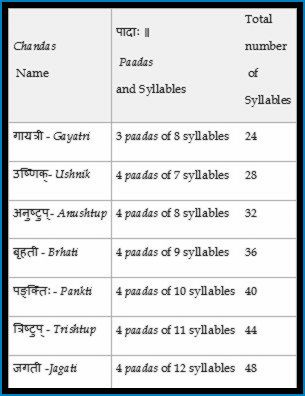
Following upon this, there is a glorification of poetry in three Verses -from 23 to 25. These verses specifically relate to the Sanskrit prosody or Chhandas (छन्दस्); the metre meant to maintain the rhythm of a well-constructed verse.

*

The four verses thereafter (26 to 29) employ the symbol of the cow which gives plenty of nourishing milk; and compares it with the clouds that shower life-giving rains.

Aditya, the one who with his bright rays creates the rain, is compared to the Milk-man

But, the following four verses – 30 to 33- are again obscure, suggesting the mystery of the embryo in mother’s womb, birth and the embodiment of the Self. The greatest mystery of Nature is the creation of the embryo and the Motherhood.

Verses 30 and 31 together put forward the ancient doctrine known as Amrita-Mritya-Vada, according to which, both the mortal body (मर्त्येन-Martya) and Amartya (अमर्त्यः) the Self or the Jiva, life principle (जीव) which is immortal, are united like brothers; and have a common origin.

*

Now, let’s come to Verses 34 and 35, which pose four questions in one and the corresponding answers in the next.

Verse 34

पृच्छाe 34मि त्वा परम् अन्तम् पृथिव्याः पृच्छामि यत्र भुवनस्य नाभिः पृच्छामि त्वा वृष्णः अश्वस्य रेतः पृच्छामि वाचः परमम् विओम R.V.1.164.34

pcchāmi tvā param antam pthivyā pcchāmi yatra bhuvanasya nābhi | pcchāmi tvā vṛṣṇo aśvasya reta pcchāmi vāca parama vyoma

I ask you about the farthest limit of the earth, I ask you where is the centre of the universe. I ask thee of the semen of the stallion, I ask of the ultimate abode of speech -Vak.

Verse 35

इयम्वेदिःपरः  अन्तः पृथिव्याःअयम्यज्ञःभुवनस्यनाभिःअयम्सोमःवृष्णःअश्वस्यरेतःब्रह्माअयम्वाचःपरमम्विओम R.V.1.164.35

iya vedi paro anta pthivyā aya yajño bhuvanasya nābhi | aya somo vṛṣṇo aśvasya reto brahmāya vāca parama vyoma

The altar is the ultimate limit of the earth. This sacrifice is the navel of the world. This Soma is the semen of the strong horse. This Brahman is the ultimate abode of speech.

In these verses there is a sudden change of subject-matter.

In the poems 34 and 35, the intellectual side is indeed very strong. Yet here we see the prominence given to the ritual’s aspects of worship.

In these two verses there is a glorification of the Soma-Yaga. And, the speech (Vac) here is not the ordinary language that is heard in everyday life; it is rather the inaudible basic Truth, known only to the great poets or seers.

Yajnavalkya in the   Brhadaranyaka Upanishad explaining the relation between Vac and consciousness says that Vac (speech) is a form of expression of consciousness.

Vac is the word principle that gives expression to the latent or un-manifest thoughts, feelings and impulses.

And, Vac is indeed both speech and consciousness (Chetana), as all actions and powers are grounded in Vac. It is the primordial energy out of which all existence originates and subsists. Vac is also the expression of truth.

Dhirgatamas goes far beyond; and, exclaims: Vac is at the peak of the Universe (Agre paramam); She is the Supreme Reality (Ekam Sat; Tad Ekam); She resides on the top of the yonder sky; She knows all; but, does not enter all”- 

मन्त्रयन्ते दिवः अमुष्य पृष्ठे विश्वविदम् वाचम् अविश्वमिन्वाम्  ( RV.1.164.10)

 mantrayante|diva|amuya|pṛṣṭhe|viśva-vidam|vācam|aviśva-minvām

**

The verses 34 and 35 are composed in the question-answer mode, concerning the nature of Brahman (ब्रह्मोद्यःBrahmodya). It expounds the ideology of Yagna, which aims to bring about the unity of the universe; and of all creation.

These two verses are chanted, just as a discourse or dialogue, during an Ashva-Medha-Yaga.

Four questions are posed and answers are sought (पृच्छामित्वा) in verse 34; to which answers are provided in Verse 35.

  • Which is the farthest end (परम्अन्तम्) of the earth (पृथिव्याः)?
  • Ans: The यज्ञ वेदिYajna-Vedi – the altar of the Yajna (इयम्‌ वेदिःपरःअन्तः पृथिव्या)
  • Which is the center – नाभि Nabhi -of the Universe (यत्र भुवनस्यनाभिः)?
  • Ans: The Yajna – the sacrificial ritual (अयम्‌य्न: भुवनस्यनाभिः)
  • What is the seed (रेतः)of the stallion (वृष्णःअश्वस्यरेतः)?
  • Ans:  The Soma is the seed (सोमः वृष्णः अश्वस्यरेत॑ः)
  • Which is the highest or sublime abode of speech -Vak (वाचः परमम् विओम)?
  • Ans: Brahma is the source of Vedic –Vak (ब्रह्मा अयम् वाचः परमम् विओम).

According to Sri Sayanagveda-bhāya:

एतावती वे प्रथिवी यावती वेदिःetāvatī vai pthivī yāvātī vedi . This altar (वेदिः -Vedi) is indeed the earth – This altar is the essence of the whole of Prthvi, including Antariksha (Mid-region) and other Lokas (worlds). There is no Prithvi other than the Vedi — हि बेधतिरिक्ता भूमिरस्ति.

अयम्यज्ञोभुवनस्यनाभिः what is it that unites all creatures on the earth, in a bond of relationship? The navel of the world: नाभिः संनष्टनम्‌ Nābhi-sannahana is the binding together of man with the means of subsistence or the crops that spring from the rain, which falls as the consequence of sacrifice or of oblations- यज्ञो. Its Vedi is the centre of the Earth – (bhuvanasya Nabhi)

This may contain: a large field with grass and flowers in the foreground, lightning is coming behind it

अयम् सोमो वृष्णो अश्वस्यरेतः।Soma (सोमश्सः) is the seed of all creation – सोमोः रसासम्का:, Soma is at the centre of Aditya; and, Agni is at the centre of Soma. The Soma juice offered as oblation in the Yagna reaches Adiya; and returns to earth in the form of rains. सोमश्सः आदित्य प्राप्य वृस्त्यादिफलम् .

ब्रह्मायम् वाचम् परमम् व्योमः –  the speech of the  Vedic texts, of which Brahma, or the priest, is the author, he is the expounder.

[This Hymn describes the Universe as a Deva-yajna. The Hotar is offering oblations into the Yajna.

The all-knowing priest who presides over, and directs the course and conduct of the Soma sacrifice is designated as Brahma; while the three other sets of priests who chant the mantras are named as Hotar, Adhvaryu, and Udgatru.

Here, Brahman  the definitive voice (final-word), is taken to be Vac. Brahma (word) and Vac (speech) are said to be partners working closely towards the good (Shreya) and fulfilment of the aspirations (kamya) of all.  And, Brahma, the one who presides and   controls the course of the Yajna, is accorded a higher position over the chanters of the mantras. Vac (chanting) extends so far as the Brahma allows (yaávad brahma  taávatii vaák– RV_10,114.08) – यावत् ब्रह्म विस्थितम्तावती वाक् .

It is also said; Vac in the form of Mantras resides Prajapathi (Brahman). He is the source as also the culmination of Vac— ब्रह्मा प्रजापतिरेव वाचः मन्त्रादिरुपाय: – ]

**

According to Dr. Raja:

The questions refer to the created world. There is a clear ritualistic bias in this context and it is a glorification of the ritual of Soma Sacrifice with its pavement which is spoken of as the farthest limit of the earth, the pivotal point of the world being the Sacrifice, the Soma being the seed for the procreation of humanity and Brahman being the scat of speech.

Verse 36

सप्त अर्धगर्भाः भुवनस्य रेतः विष्णोः तिष्ठन्ति प्रदिशा विधर्मणि ते धीतिभिः मनसा ते विपःचितः परिभुवः परि भवन्ति विश्वतः R.V.1.164.36

sapta | ardha-garbhā | bhuvanasya | reta | viṣṇo | tiṣṭhanti | pra-diśā | vi-dharmai | te | dhīti-bhi | manasā | te | vipa-cita | pari-bhuva | pari | bhavanti | viśvata

The seven (sustaining), the embryo (rain) for half a year, the fecundating (element) of the world, abide, by appointment, in the various functions of Visnu. By their intelligence they pervade in thought all around (them), for they are intelligent and diffusive.

*

Many commentators, in exasperation, have remarked that the Verse 36 here, is one of the most unintelligible verses in the Vedas. The main point here is rather obscure.

Dr. Raja comments:

In the following verse (36) there is mentioned a seven-fold seed for the creation of the world; and this may be compared to the seventh of those who were born together, stated in verse 15 above. These seeds are spoken of as wise and encompassing the world.

We do not know the exact significance of the seven-fold scheme in the origins of the world and in some of the hidden facts in this universe.

****

Swami Amritananda has translated the verse as:

The seven (सप्त) rays of the Sun, in the mid-region of the universe contain water, in the form of embryo (अर्धगर्भाः). They indeed are the essence of the world (भुवनस्य रेतः). They abide in their respective positions (तिष्ठन्ति प्रदिशा) to help the Sun (विष्णोः), who pervades the world, in his function of sustaining all the regions (विधर्मणि). Those rays (ते) are intelligent (धीतिभिः) and diffusive (सप्त). They, by their intelligence and a sense of duty (मनसा), pervade (परिभुवः) all around. (परि-भवन्ति-विश्वतः).

The rays of the Sun bear water in their womb during the rainy season (middle of the year) The seasons appear at their assigned periods; and follow the command of their master, the Sun, and, help in his task to sustain the world.

**

Sri Sayana explains:

The seven: the solar rays, saptārdhagarbhā; either retaining the rains for half a year, i.e. during the dry months, or abiding in a part or half of space, or in the mid-heaven or firmament.

The rays of the Sun are a form of rain -water, as they are responsible for shedding rain. They themselves could be called as rain.

Vishnu- the supreme Lord अधिदैवत​ is the pervading sun; vyāpakasya Ādityasya, in whose various duties of cherishing the world, the solar rays are, by direction, pradiśā, especially employed.

Verse 37

वि जानामि यत्इव इदम् अस्मि निण्यः सम्नद्धः मनसा चरामि यदा मा अगन् प्रथमजाः ऋतस्य आत् इत् वाचः अश्नुवे भागम् अस्याः R.V.1.164.37

na | vi | jānāmi | yat-iva | idam | asmi | niya | sam-naddha | manasā | carāmi | yadā | mā | ā | agan | prathama-jā | tasya | āt | it | vāca | aśnuve | bhāgam | asyā

I do not understand this, what am I. And, I roam about in hiding, enwrapped in thought, perplexed. When there came to me the first born off-springs of the Rta (insight of what is True), then, immediately after that I enjoyed a portion (the meaning) of that sacred word

*

I have not inquired nor have I realized ( वि जानामि) what I am or all of this (यत्इव इदम् अस्मि). I am wrapped in ignorance (निण्यः); bound by sense-objects (सम्नद्धः); perplexed and wandering in mind (मनसाचरामि).  When I do realize(प्रथमजाः) the real Truth(ऋतस्य) behind all this existence, then I will truly understand the meaning of the Upanishad statements. (आत् इत् वाचः)

A similar experience of one having realized the Truth is described in the Mundaka Upanishad .

Having attained Him (not by any external means), free from faults of desire, etc., the seers gratified with their knowledge; having accomplished their purpose with full composure, realize the Truth that The Brahman itself, The One without a second, is their own Atman.

संप्राप्यैनमृषयो ज्ञानतृप्ताः कृतात्मानो वीतरागाः प्रशान्ताः ते सर्वगं सर्वतः प्राप्यधीरा युक्तात्मानः सर्वमेवाविशन्ति III.2.5

saprāpyainamṛṣayo jñānatptā ktātmāno vītarāgā praśāntā | te sarvaga sarvata prāpyadhīrā yuktātmāna sarvamevāviśanti || 3.2. 5 ||

*

[The two verses (37 and 38) refer to the condition in which the poet finds himself in the world after he has attained the poetic vision. ]

Dr. Raja remarks

The poet is not able to see anything in the world of which he could feel — “I am like this”. This sort of a feeling of solitariness is quite natural to a poet. He is shrouded in his own thoughts and he moves about in loneliness. When there was the light of the mystery of the beginnings of this world of creation, he was in possession of the true significance of speech that has been mentioned in various places as concealed. Here also there is the contrast between one who has known and one who has not yet known the truth.

*

Commentary by Sayana: Ṛgveda-bhāṣya

The philosophical implication here is that the individual is seeking identity with the universal spirit.

The eagerness to secure knowledge; and to realize the Truth; and sadness caused when the efforts are not successful, are described in this Rik.

The verse is an expression of anguish, desperation and regret of a person who earnestly seeks knowledge in order to erase ignorance (अविद्या).

He moans: I am bound by ignorance, desire and attachments. I do not have the clarity of mind for introspection. I am an outward-bound; and I suffer.

I shall truly be liberated when I grasp true knowledge and experience the Truth.

All this is Brahman, is the True knowledge.

अविद्याकामकमेभिः सम्यग्बद्धो वेष्टितः अत एव भ्मनसा युक्तो मावनासहिष्णुना विमुखेन विक्षिप्तेन चेतसा युक्तः संचरामि संसारे  – इन्द्रियपरवशः एव सन्‌ संसारे दु:खमनुभवामि / सार्वासम्यं जानामीति परिदेवते

Verse 38

अपाङ् प्राङ् एति स्वधया गृभीतः अमर्त्यः मर्त्येन सयोनिः ता शश्वन्ता विषूचीना वियन्ता नि अन्यम् चिक्युः नि चिक्युः अन्यम् R.V.1.164.38

apā | prā | eti | svadhayā | gbhīta | amartya | martyena | sa-yoni | tā | śaśvantā | viūcīnā | vi-yantā | ni | anyam | cikyu | na | ni | cikyu | anyam

The immortal shares a common womb with the mortal. And, affected by desire for enjoyment, goes forward and backward. The two, moving around ceaselessly, go in different directions .. They see the one; and the other is unseen.

*

The immortal Atman (अमर्त्यः) is associated (सयोनिः)with the mortal body (मर्त्ये). He is entrapped (गृभीतः) blinded by the desire for enjoyment; and, goes (एति) downward (अपाङ्) and upward (प्राङ्). The two -body and Atman- always (शश्वन्ता) move together in this world (विषूचीना) and the other world(वियन्ता). Of these, the body is seen (निचिक्युः); and the other, the Atman, is not seen ( निचिक्युः).

in this verse, three actions are mentioned about the two opposite entities- mortal and immortal.

  • they move (वियन्ता Viyanta) ;
  • they move in opposite directions (विषूचीना Vishuchina); and
  • the movement is ceaseless (शश्वन्ता Sasvanta)

 There are four facts stated here:

  • The immortal (अमर्त्यः) is associated with the mortal (मर्त्ये)
  • अमर्त्यः undergoes the cycle of repeated births and rebirths
  • One can be seen; while
  • The other cannot be seen, though the two are together

This again brings to the fore the relationship that binds together the immortal and the mortal- the Atman and the physical body. Svadha is the mysterious inherent energy that infuses life into the matter. It is the inherent power Svadha that brings the immortal Prana into contact with the body (Sarira or Bhuta). These two, moving around, go in different directions. They see the one; they do not see the other.

Jiva and Sarira have same origin; and, are bonded together for a time. Of these, the body can be seen, while the other is unseen. The body can look at the outside world; but cannot see the Jiva within it. While the body is perishable, the Jiva moves from body to body, up and down. As it moves from birth to birth, the Jiva carries with it the desires, fruits of action and burdens of its gross bodies across its journey. Its future path is influenced by the cumulative effects of its past desires and acts.

Dr. Raja remarks:

In this verse also, there is the contrast between the one who has seen the truth and who has not seen the truth. One who knows becomes really immortal, though he was one among the mortals till then. They go in different directions; one goes forwards for ever and the other goes round and round without proceeding. People understand only the common man; they cannot understand the one who has had the vision of truth.

Sri Sayana explains:

Affected by the desire for enjoyment by its body, the Jiva is born in various bodies depending upon the Karma-Phala it has gathered. Good and desirable actions lead one to higher worlds; while, bad and undesirable actions lead to lower world.

प्राडं ऐतिअप्राडं ऐति । प्राडं ऐति उर्ध्व स्वर्गदिलोकं प्र्रापनोति । अप्राडं ऐति अशुलक्लकर्म क्रुत्व अदोगच्छति

Verse 39

ऋचः अक्षरे परमे विओमन् यस्मिन् देवाः अधि विश्वे निसेदुः यः त् वेद किम् ऋचा। करिष्यति ये इत् तत् विदुः ते इमे सम् आसते R.V.1.164.39

ca | akare | parame | vi-oman | yasmin | devā | adhi | viśve | ni-sedu | ya | tat| na | veda | kim | cā | kariyati | ye | it | tat | vidu | te | ime | sam | āsate

All the gods have taken their seats upon this supreme heaven, the imperishable (text) of  the Veda; what will he, who knows not this, do with the Veda? but they who do know it, they are perfect.

**

All the gods reside in Him (यस्मिन् विश्वे देवाः अधि निसेदुः) who is immortal (अक्षरे परमे); and who is the Supreme protector (परमे विओमन्).  The purpose of study of all the Vedas (ऋचः) and other scriptures is only to know Him (तत्). For One who does not understand this ( वेद तत्), what use is any study? What can anyone gain by mere reading (किम् करिष्यति), without understanding?

And, whoever knows this Truth attains True knowledge (ये इयत् तत् विदुः ते इमे सम् आसते)

Dr. Raja explains:

Here also there is the contrast between those who know the truth and those who do not know the truth.

There are the syllables and their bare meanings; then there are the secret meanings of the syllables, the nature of the gods.

All the gods really have their abode in these syllables. But all the people do not know this. To those who can know, there is the real fruit in so far as they can sit along with the gods. They are in real communion with the gods.

Much has been said by renowned scholars like Bhartrhari, Yaskacharya and others about the texts and their study. For instance:

The celebrated philosopher Bhartrhari (11th century) lauds the study of the traditional texts; and deems it essential for an earnest seeker of Truth.

He draws attention to the fact that perception, at times, could be erroneous because of weakness or improper functioning of sensory organs. As regards inference, he points out that inference, by itself, is an inadequate of source reliable of knowledge (Pramana). He argues that inference alone, without the steadying influence of the scriptures is an improper Pramana

In his scholarly work Vakyapadiya (1.34), Bhartrhari remarks: ‘whatever is inferred with great effort through clever reasoning can easily be put aside by a much cleverer reasoning or argument (kuśalair anamorphic)’-यत्नेनानुमितोऽप्यथः कुशलैरनुमातृभिः ॥३४॥

And he then asserts, the traditional knowledge (Agama) which consists of the revealed (Sruti) or remembered (Smrti) scriptures cannot be set aside by inference, since they are more dependable than inference.

According to Bhartrhari, it is not justifiable to replace scriptures (Shabda) with inference, particularly in non- empirical matters. He also says that philosophical views (Vada) cannot be independent of the scriptures.

*

Yaskacharya , the renowned Etymologist (Niruktakara) of ancient times (Ca.5th century B C E), in work, the Nirukta, praised the study of the Vedas; and , at the same time he added a word of caution.

Yaskacharya believed that every Vedic word has an expressive power to denote a certain sense. And, as a signifier (vacaka), every word is eternal (vyaptimattvat tu sabdasya – Nir.I.2); and, it performs a critical function in helping to arrive at an unerring, definitive meaning of a statement

Yaska, therefore, remarks that it is essential that one should realize this truth.  And, in the absence of such realization, a person, who merely recites the Vedas, without comprehending its meaning, would be like a pillar (sthaanu) or a mere load-bearer (bhara-haara).

And, it is only he, who fully grasps and appreciates the meaning of what he is reciting (arthajña), that will attain the good – both here and hereafter (sakalam bhadram-aśnute-nākam); having been purged of all impurities by the power of knowledge (jñāna vidhūta pāpmā

स्थात्णुर् अयम् भार​-हारः किल अभूद् अधीत्य वेदम् विजानाति यो अर्थम् यो अर्थज्ञ इत् सकलम् भद्रम् अशनुते नाकम् एति ज्ञान विधूतपाप्मा Nir.1. 18)

sthāur ayam bhāra-hāra kila abhūd adhītya vedam na vijānāti yo artham / yo arthajña it sakalam bhadram aśnute nākam eti jñāna vidhūta pāpmā (Nir.1. 18)

*

Sri Sayana shares the views of Yaskacharya; and cautions against mere routine reading of the Vedic texts.

Here Sri Syana offers four meanings to the term ऋक्: 1. The Vedas, starting with the Rigveda; 2.the Solar orb; 3. The Jiva; and, Pranava – .

As regards the study of the Vedas (ऋक् or अपराविद्या) Sri Sayana instructs that the only means to attain realization of Brahman, the Eternal One, is through the Vedas.

And, he also advises that mere study of these texts alone does not lead to the immortal principle (अक्षर– Brahman). It only leads to the means to understand the Truth.

The space –Akasha आकाशः– is unbound, formless and eternal; and is of the nature of Brahman. It envelops the whole of the universe.

ऋक् अक्षरे परमे व्योमणि इव्युत् लक्षणे ब्रह्मणि Rik akare parame vyomani ithyuth lakshane Brahmani.

येनक्षरं पुरुषं वेद सत्यम् -yenākaram puruam veda satyam (Muṇḍaka Upaniṣad 1.2.13)

It is under the rule of this अक्षर that the Sun, Moon, Stars, Day, Night and all the phenomena are governed and regulated.

All the Jivas are established in Paramatman– the अक्षर. It is only when one realizes this highest Truth that one can attain liberation.

अक्षरे परमे व्योमन्‌ यस्मिन्‌ परमात्मणि सरवे देवा गमनवन्तो  वा इन्द्रियसंज्नक​ विश्वे सर्वोपि अधिनिषैदु:

**

As regards Pranava , Sri Sayana regards it as the symbol of Nirguna-Brahman; and no Mantra is greater than . All the Devas reside in .

In the present verse (39), Sri Sayana opines that the terms ऋक्: / अक्षर should be taken to mean Pranava , as the path and also the goal .

CONTINUED

IN 

THE NEXT PART

REFERENCES

  1. History of Pre-Buddhist Indian Philosophy by Dr. Beni-madhab Barua -Motilal Banarsidas-1921
  2. Tagore Law Lectures 1930 – The History Of Hindu Law by Prof Radha Binod Pal; University of Calcutta – 1958
  3. Vision in long darkness by Prof. Vasudeva Agrawala
  4. https://who.rocq.inria.fr/Ramakrishna.Upadrasta/Veda/Asya_Vamiya/AVMS/AVMS_1-100.pdf
  5. https://www.youtube.com/watch?v=r86l_TF9XWc
  6. https://archive.org/details/in.ernet.dli.2015.226346
  7. https://istore.chennaimath.org/products/rig-vedic-suktas-asya-vamiya-suktam/1309294000102324374
  8. pdf (archive.org)
  9. https://religion.fandom.com/wiki/Dirghatamas
  10. ऋग्वेदः सूक्तं .१६४ – विकिस्रोतः (org)
  11. org/mirrors/rigveda/sanskrit03/RV0310noaccent.html
  12. ALL IMAGES ARE FROM INTERNET

 
Leave a comment

Posted by on August 5, 2024 in Dhirgatamas, Rigveda


Tags: , , , , , , , , , , , , , , , , , , , , , , , , , , , , , , , , , , , , , , ,

Who Was Dhirgatamas – Part SIX

Continued from Part Five


The following four verses (26 to 29) employ the symbol of the cow which gives plenty of nourishing milk ; and  compares it  with the clouds that shower life-giving rains.

Verse 26

उपह्वये सुदुघाम्धेनुम् एताम्सुहस्तःगोधुक् उतदोहत्एनाम्श्रेष्ठम्सवम् सवितासाविषत्नःअभिइद्धःघर्मःतत्ऊँ इतिसुप्रवोचम् 1.164.26

upa | hvaye | su-dughām | dhenum | etām | su-hasta | go–dhuk | uta | dohat | enām | śreṣṭham | savam | savitā | sāviat | na | abhi-iddha | gharma | tat | o iti | su | pra | vocam

I invoke the cow that is easily milked, that the handy milker may milk her; may Savitr accept this our excellent libation, that his heat may (thereby) increase; it is for this, verily, that I earnestly invoke him.

*

Here, in these verses, the symbol of cow (धेनुम्) is projected in many ways; as:

  • The Mother-nature, an icon of Motherhood.
  • The cow yielding plenty of milk (सुदुघाम् धेनुम्)
  • The clouds that send down the rains on to the earth.

The symbolisms with regard to Milk-man here are:

  • The Milk-man (गोधुक्) who milks (दोहत्) the cow
  • The Adhvaryu, the officiating priest in a Soma-Yaga (श्रेष्ठम्सवम्)
  • Aditya, सविता the inspirer, the sun god, the one with bright rays (deft hands – सुहस्तः) who sends down the rains.

All the devotees are earnestly invoking (उप ह्वये) the blessings of such a cow for securing the best in Life – both in Mind and Body.

The symbolisms adopted here, and their mutual relations, in short, are:

As mentioned earlier, the term धेनुम् stands for Cow as also for the clouds.

The Cow, as Mother-Nature, shining with divine splendor, sustains with her milk, all of mankind. She is truly the Vishva-Matha.

The rains make the world happy just as the milch cow makes its master happy by giving plenty of milk.

Milk-man (गोधुक्) with deft hands (सुहस्तः) is the Adhvaryu, the officiating priest in a Soma Yaga (श्रेष्ठम् सवम्), the one who lights up (अभिइद्धः) Pravarga, as a part of Soma Yaga.

This and the next verse employ the symbol of the cow for milking in a Yaga.

Milk-man is Aditya, the one who with his bright rays creates the rains.

Each one on this earth who is benefitted by the cow, which equates to the rains and to the gods, earnestly prays (सु प्र वोचम्) for the blessings of such a cow; for securing the best of Manas (Mind), Prana (Life) and Vak or Prakrti (physical body) .

[I invoke this milch cow which gives plenty of milk when the milk-man milks her with his deft hands. I earnestly pray, May Savitar grant us this excellent milk for our Soma Yaga when Pravarga-Agni is lighted.]

Sri Sayanacharya explains:

The poet welcomes wisdom conceived as cow.

The oven is used for heating the milk; and. here it is for preparing the wisdom for one’s enlightenment.

*

Other explanations are:

The cow is the cloud, the milk is the rain. Vayu or wind, is the milker.

The metaphor is continued in the following three hymns, where the calf is the world or mankind anxious for the rain, as the cause of abundance.

Again, the milk of the cow is the food which produces the energy for living.

And, Savitri and Sarasvathi are one among the many names of the Universal Cow (Viraj).

As regards Savitar; in the Samhitas, Savitr is variously identified with Agni, Soma, Prajapati, Visvedevas and Surya; or with their aspects.

Savitar is associated with the clouds, the rains, the earth and the mind; and, he holds afloat the sky (akashbhane) without visible support (aalambanam tad-rahite).

At another level, Savitr is identified with one’s mind, consciousness and with one’s own self (Antaryamian).  

[Savitar, in Rigveda, is conceived as an aspect of Sun before daylight (udayat purvabhavi); and, after daybreak the Sun is called Surya (Surya-iti). Thus, Surya is the later form of Savitr.

Some say, Savitr is Surya when present below the horizon, but not quite visible.  Savitr is also called Bhaga (Savita Bhagaha: RV 5.82.3) in a sense of the ‘early (proto)’ Surya.

Savitr, thus, comes after night (tamas) and before light (Jyothi): (tamasya kirna rashmir bhavathi). It is also said; the night comes at his command sending all beings to rest. Savitr is the bridge between night and light. Night is un-manifest; and light is manifest. Savitr in this sense is both un-manifest (A-vyakta) and manifest (Vyatka) ]

According to Yaska-charya, Savitr prompts (su-preraka), inspires and guides all to engage in good thoughts and right actions; and to tread on the right path

Savitr, here, is the inner-light that illumines, enlivens, prompts and inspires all our thoughts, speech and deeds.

With the sight of Savitr, the Sun-God, one begins to attain the wisdom referred to here.

Such wisdom is symbolized by Cow in this verse.

Verse 27

हिङ्कृण्वतीवसुपत्नी वसूनाम्वत्सम् इच्छन्तीमनसाअभिअगात्दुहाम् अश्विभ्याम्पयःअघ्न्याइयम्सावर्धताम्महतेसौभगाय 1.164.27

hi-kṛṇvatī | vasu-patnī | vasūnām | vatsam | icchantī | manasā | abhi | ā | agāt |duhām |aśvi-bhyām | paya | aghnyā | iyam | sā | vardhatām | mahate | saubhagāya

Making a bellowing sound she has come hither, the Mistress of wealth and plenty, yearning for her calf in heart; may this cow (what shall not be hurt) yield milk for the Ashvins, may she prosper for the sake of immense happiness.

**

 [ It is said; the nature speaks through its created objects. It is its own language; the language of symbols (Nidana-vidya). The language of symbols is elastic; suggesting multiple interpretations. We all strive to retrieve their meaning closeted at the core of such symbols, shrouded in mystery (Bhuteshu -Bhuteshu vichitya dhirah – KU.2.5).

Our ancients, recognized the infinite tolerance and the loving quality of the Motherhood in the Earth, which supports and sustains the whole of this existence. They again related the generative potency of the Mother Nature to the Cow, which feeds and nurtures all of us, with patience. The Cow, in turn, was seen as the symbol of the language, giving forth to limitless forms, sounds, words and meanings (Dhenur Vac asman upa sushtutaitu – RV. 8.100.11).

The Universal-Cow-principle (Gauh-tattva) was,thus, seen as a symbol of the Thousand-syllabled speech (Vag va idam Nidanena yat sahasri gauh; tasya-etat sahasram vachah prajatam – SB.4.5.8.4).

Similarly, the fleeting quality of the Gayatri Meter (Chhandas) was said to reflect the flaming glow of Agni, the fire-principle (Yo va atragnir Gayatri sa nidanena – SB.1.8.2.15).

And, even here, the words are mere symbols of the ideas; trying to manifest the un-manifest subtle thoughts and feelings. The words belong to the physical world; but they radiate from a much deeper transcendental, inspirational source that is ever innovative (Pratibha).

*

Following the concept of Nidana-vidya, in the early texts, the cow is compared to Earth as an exemplary symbol of Motherhood. She is the life-giving, nourishing Mother par excellence, who cares for all beings and nature with selfless love and boundless patience. The Mother goddesses such as Aditi, Prithvi, Prsni (mother of Maruts), Vac, Ushas and Ila all are represented by the cow-symbolism.

Further, the nourishing and life-supporting rivers too are compared to cows (e.g. RV. 7.95.2; 8.21.18). For instance; the Vipasa and the Sutudri the two gentle flowing rivers are said to be  like two loving mothers who slowly lick their young-lings with care and love (RV . 3,033.01)  – gāveva śubhre mātarā rihāe vipā chutudrī payasā javete 

The cow in her universal aspect is lauded in RV.1.164.17 and RV. 1.164.27-29. She manifests herself together with her calf; she is sacrosanct (aghanya), radiant, the guardian mother of Vasus.  She created the whole of existence by her will.

Sri Aurobindo explains: in many of these hymns, milk (literally, that which nourishes) represents the pure white light of knowledge and clarified butter the resultant state of a clear mind or luminous perception, with bliss, symbolized by the honey (or Soma), as the essence of both. ]

**

She comes bellowing (हिङ्कृण्वती), abounding in wealth (वसूनाम्), loving her calf (वत्सम्) in her mind (इच्छन्ती मनसा). May this cow (अघ्न्या) grant her milk (पयः/अगात्दुहाम्) to the Aśvins. May she prosper (सौभगाय). May she grow (वर्धताम्) for the long wellbeing of all of us (महतेसौभगाय).

The picture of the mother cow and the calf is really beautiful here.

There is a poetic allusion to the cow and the calf.

  • Cow is the protector or the mother of Vasus
  • Her heart is full of love for her calf
  • She produces milk for two Ashvins
  • She enhances prosperity for all who come to her.

*

The milk-drawn for the sake of the Ashvins must be sweet in so far as the Ashvins are fond of Madhu (honey). Certainly, he himself is the calf in this context.

Swami Amritananda explains:

In this verse the term अघ्न्येयं can have two meanings – one as the Cow; and the other as the Clouds. 

The cow bellows, loves and protects its child (वत्सम्); and, gives the nourishing milk to all.

While the cloud thunders during the rainy seasons; sends down the  rain-water;  protects and nourishes  the crops, cows and humans (वसूनाम्[-वसुपत्नी) as if they were all her calves (वत्सम्).

**

The other interpretation could be that of the Ashvin – twin deities (अश्विभ्याम्), one has the water; while the other has light. They together pervade the universe.

  • aśvinau.yad.vyaśnuvāte.sarvam.rasena.anyas.jyotiā.anyah (Nirukta .12.1 )

The Ashvin twins can also be understood as the pair of two vital breaths Prana and Apana, – in-breath and out-breath – which sustain the body functions, including assimilation of food, which provides energy to physical, mental and vital activities and their well-being.

Verse 28

गौःअमीमेत्अनुवत्सम्मिषन्तम्मूर्धानम्हिङ्अकृणोत्मातवैऊँ इतिसृक्वाणम्घर्मम्अभिवावशानामिमातिमायुम्पयतेपयःभिः 1.164.28

gau | amīmet | anu | vatsam | miantam | mūrdhānam | hi | akṛṇot | mātavai | o iti | skvaaam | gharmam | abhi | vāvaśānā | mimāti | māyum | payate | paya-bhi

The cow bellows for her calf, (who stands) with winking eyes, and lows as (she proceeds to lick his forehead; she utters a cry, as, anxious, she sees the moisture in the corners of his mouth, and nourishes him with her milk

**

There is the beautiful imagery of the cow with the calf, making a bellowing sound, licking the calf; and yielding milk.

The cow (गौः) bellows (हिङ्कृण्वती) for her calf (वत्सम्), which stands close to her and looks at her mother with blinking eyes (मिषन्तम्). The mother cow, full of love for her child, moves forward (अनु वत्सम्) to lick (मातवै) its forehead (मूर्धानम्) She yells out of affection (अमीमेत्),on seeing foam (घर्मम्) collected at the corners of the calf’s mouth (सृक्वाणम्). She then lovingly (वावशाना) nourishes the calf with her milk (पयतेपयःभिः).

Swami Amritananda says:

This Rik, verse, is chanted at the time of milking the cow during the Pravargya (also known as ‘Ashvina-pravaya’, an introductory or preliminary ceremony to the Soma Yajna.)

*

Here also, the term गौःcould be interpreted either as a Cow or as the Cloud.

In case it is taken to mean Clouds, then the term (मिषन्तवत्सम् – seeing the calf) could imply that on seeing the parched earth (as if it were a starved calf), the clouds would thunder (cry out in anguish); fondle the earth; and send down the life-giving rains, to quench its thirst and hunger.

*

As regards blinking by the calf, it is symbolic of the rhythmic cycles in life-swinging both ways.

Verse 29

अयम्सःशिङ्क्तेयेनगौःअभिवृतामिमातिमायुम्ध्वसनौअधिश्रितासाचित्तिभिःनिहिचकारमर्त्यम् विद्युत्भवन्तीप्रतिवव्रिम्औहत1.164.29

ayam | sa | śikte | yena | gau | abhi-vṛṭā | mimāti | māyum | dhvasanau | adhi | śritā | sā | citti-bhi | ni | hi | cakāra | martyam | vi-dyut | bhavantī | prati | vavrim | auhata

He, too, bellows, and the cow utters inarticulate sounds, as, comprehended by him, she repairs to her stall; (influenced) by her instrumental acts, she acts like a human being, and, radiant, manifests her nature.

**

The calf makes an inarticulate sound (शिङ्क्ते) on seeing its mother, indicating its joy. The cow (गौः) is covered by the calf. She goes back to her shed (ध्वसनौ); and, makes bellowing sound. The mother cow by expressing her natural love and affection towards her child. In comparison the human affection looks very small (चकार मर्त्यम्).  

Shining brilliantly (विद्युत् भवन्ती), the mother cow revealed her true form (प्रति वव्रिम् औहत).

*

Dr. Raja explains:

The general idea is that though the calf waxed and overtook the mother cow, the mother stood on the heights; and she along with the calf made a bellowing sound. She remained above the mortals; and becoming the lightning, she threw back the garment of darkness.

*

This verse extols the natural motherly love of a cow towards its calf. It reveals the brighter side of a cow’s nature (वव्रिमौहत् रुपं प्रकाशयत्).

*

It is said; the three Riks 26,27and 28 of Asya Vaasa Sukta are chanted during the Pravargya (प्रवर्ग) – a ceremony preliminary to the Soma-Yaga, at which fresh milk is poured into a heated vessel called, mahā-varri or gharma.

But, this Pravargya is a preliminary or an introductory ritual or an application in Soma-Yaga; and, is not an independent one.  Yet, it is given much importance in the कर्मकांड Sruti.

*

Dr. Venkata Chaganti, President, Vedas World Inc., Atlanta, USA, explains: Pravargya as a Thermodynamic process that boosts immunity and reduces pollution:

Pravargya is another Vedic and scientific process usually takes place along with the yajna. In Pravargya, a combination of fresh cow and goat milk is poured into the boiling cow ghee pot, the water part (about 87%) vaporizes instantly due to high heat quantity. The change from liquid to vapor expands water present in the milk to several hundred times and pushes the fire produced by the combustion of ghee in all directions that spontaneously produces the fireball. The fatty acids from the cow ghee, organic compounds and minerals present in cow and goat milk are responsible for high heat and emission spectra with different colors.

The process creates vapors of many particles that have great kinetic energies. These vapors are capable of rapidly increasing immunity in the human beings, reduce organic particulate pollution, air pollution and water pollution in and around the vicinity.

The verse 29 gives raise to many questions which have no clear answers.  There is some difficulty in clearly understanding the intent of the poet. This has led to several endless arguments concerning issues such as:

  • What is that which has encompassed the cow?
  • Is it the light of wisdom? Does the idea relate to the Sun born of the Dawn?
  • What is the significance of the shrilling cries or sneezing of the cow?
  • Why should humans be considered inferior to a Cow? Which is such a cow?
  • What is the meaning of throwing back the garments?
  • What is the idea of the Cow transforming into lightening (Vidyut)?
  • Does Vidyut merely mean ‘shining or brilliance’

*

Dr. Raja also remarks:

There is some difficulty in interpreting verse 29. What is this which has encompassed the cow. Is it the light of wisdom? Does the idea relate to the Sun born of the Dawn? The picture is not quite clear.

The inner meaning is the dawning of wisdom; but there is some difficulty in understanding how this encompasses the cow.

Verse 30

अनत्शयेतुरगातुजीवम्एजत्ध्रुवम्मध्येपस्त्यानाम्जीवःमृतस्यचरतिस्वधाभिःअमर्त्यःमर्त्येनसयोनिः1.164.30

anat | śaye | tura-gātu | jīvam | ejat | dhruvam | madhye | ā | pastyānām | jīva | mtasya | carati | svadhābhi | amartya | martyena | sa-yoni

The life, breathing, moving fast, is at rest; rushing, it is firm in the middle of habitations. The immortal Self of the Dead, having the same birth-place with the mortal, wander? about at his own will.

**

Jiva (जीवम्) with Pranas, breathing (अनत्) going about briskly (तुरगातु) for carrying out his external functions remains still in the midst of residences in the form of bodies(पस्त्यानाम्). Jiva moves in the world associated with the mortal body (मृतस्य चरति), born with mortal frame from the same source (मर्त्येनसयोनिः). Himself (अमर्त्यः) being immortal and sustained by offerings made by his sons (स्वधाभिः)Svadhābhi Putra ktaiḥ (ष्व्अध्आभ्इः पुत्रा क्रुताह्).

[Dr. Raja surmises: The first half refers to the contrast between the condition of embodiment and the condition when the Self is separated from the body.

The second half also may refer to the same condition, enjoying free movement in heaven.]

**

The three signs of a living organism are said to be:  Prana/Jiva (Life); Manas /Buddhi (Mind); Deha (Body).

The terms Prana (प्राण) and Jiva (जीव) are very proximate. They are at times used alternatively. For instance; in the ancient tests the term for indicating the soul or the living principle (Appa, Jiva) bears almost the same sense as Mahidasa’s term Prana or Uddalaka’s term Jivatma.

*

At the same time, there are other explanations as well.

Prana literally means “life-force.” It is a subtle, pervasive energy that powers various aspects of our being.  Prana is essential for our vital activities like breathing, talking, moving, thinking, digesting, breathing, and so on. Hence, we call it vital life-force energy

Jiva -individual soul – coordinates the various powers and faculties of the mortal body (Sarira); and moves by its Pranic and paranormal powers.

*

Prana -Living principle, is what is really existent in the universe. The functions of the mind die out with the body. Mind is joined to life, and that sleep results from the absorption of the mind into Prana. Mind is linked to Prana which is its abode (ayatana) or resting place (upasraya), i.e., substratum. While a person sleeps, his mind subsides in and is tied to the Prana, just as a string-bound bird finding no other shelter, stays put at last knotted to the chain itself.

Jiva- Jjlvatma (Life) endowed with breath and eager to discharge its functions, stays within a body for a limited time. It then flies away.  Jiva is with reference to an individual being.

The three verses – from 23 to 25 – dealt with Chhandas, the metrical structures of poetic verses. And, the next four verses – 26 to 29 – were in celebration of wisdom.

But, the following four verses – 30 to 33- are again obscure, suggesting the mystery of the embryo in mother’s womb, birth and the embodiment of the Self.

*

Verses 30 and 31 together put forward the ancient doctrine known as Amrita-Mritya-Vada, according to which the immortal and mortal exist together at every level.

Similarly, the Svadha (स्वधा) principle also links the immortal and mortal. The immortal and the mortal are kins from the same source. And, the immortal Jiva moves with the mortal body, by virtue of its intrinsic power (स्वधाभिहिSvadhabhih). Life-principle is said to established firmly in mortal bodies, in which Agni has also a seat.

That is to say:  both the mortal body (मर्त्येन-Martya) and Amartya (अमर्त्यः) the Self or the Jiva, life principle (जीव) which is immortal, are united like brothers; and have a common origin.

*

A living body is a organised mechanism; and, has the vital principle (Prana) to energize its capabilities in order to function methodically. A living body (शरीरSarira) must be clearly distinguished from a lifeless body or corpse (म्रुतदेह​), which for all purposes is dead.

A body that is alive and functioning, is a self- working natural system; a physical entity, which is composed of several members skillfully joined together or united into a complete whole; and functioning as a living organism.

**

This Rik (30) states that the Jiva (Life-principle) has this body only in this life. Body is impermanent, while the Jiva is eternal.

Jiva though housed in a body, it is separate and has its own independent characteristics. Body is alive so long as the Jiva resides in it. The moment it leaves the body is dead.

Jiva moves about when it is residing and associated with the body. But, when it is not so associated with body elements, it stays motionless. It is said; Jiva by its very nature is still.

So long as the Jiva, in the form of Prana, is located in the body, the sense organs perform their respective functions.

The Jiva, after it leaves the body, can travel either by the path of Pitris (ancestors) or that of gods

When it follows the path of the Pitris it is supported by Shraddhas – the offerings made by its decedents or sons- Svadhābhi Putra ktai (ष्व्अध्आभ्इः पुत्रा क्रुताह्).

Verse 31

अपश्यम् गोपाम् अनिपद्यमानम् परा पथिभिः चरन्तम् सः सध्रीचीः सः विषूचीः वसानः वरीवर्ति भुवनेषु अन्तरिति R.V. 1.164.31 ॥

apaśyam | gopām | ani-padyamānam | ā | ca | parā | ca | pathi-bhi | carantam | sa | sadhrīcī | sa | viūcī | vasāna | ā | varīvarti | bhuvaneu | antariti

I have seen the protector of the universe, who never falters in his steps nor get tired, who wanders hither and away; , travelling upwards and  downwards by various paths; going all around; invested with brilliant and diffusive radiance revolves in the midst of the regions of the world.

*

In case the term गोपाम् is understood as the Sun:

I have seen (अपश्यम्) the protector of the universe (गोपाम् Sun), who never falters in his steps nor gets tired (अनिपद्यमानम्); who travels (चरन्तम्) along various paths (पथिभिः) in the sky. Up to noon approaching the world (परा); then going away from it in the afternoon.  He, the sun, with rays collected(सध्रीचीः) at the centre, and radiating (वसानः) towards worlds, enlivening them with light and life. He thus, rising and setting, revolves amidst all the regions of the world (भुवनेषु अन्तरिति).

In case the term गोपाम् is taken to mean cowherd, then the verse will project a beautiful poetic imagery of a cow-herd. He is ever steady; never falters in his steps. He goes along this path and that path. He, with the herd of cows, goes around all the pastures.

The Cowherd moves out with his cows in the morning; returns home by evening (Godhuli-lagna); and, retires in the night.

There is another question. Who indeed is He (Isa Vai- ईषा वै), the Cowherd (protector- गोपा) Is he .. ?:

  • Surya, the Gopa, who rules and protects all the worlds
  • Isa Vai Gopa ya Suryatapati – ईषा वै गोपा या ईषा सूर्यस्तपति
  • Agni, the master, indeed is the divine Cowherd
  • Agni Vai Devanam Gopaha – अग्नि वै देवानम् गोपा
  • Indra the ruler, indeed is the excellent protector of all the Devas
  • Indra Vai Gopaha; इन्द्रा वै गोपह​
  • Prana truly is the eternal Life-principle the one who protects
  • Prano Vai Gopaha प्राणो वै गोपह​

Verse 32

यः । ईम् । चकार । न । सः । अस्य । वेद । यः । ईम् । ददर्श । हिरुक् । इत् । नु । तस्मात् । सः । मातुः । योना । परिवीतः । अन्तः । बहुप्रजाः । निःऋतिम् । आ । विवेश ॥ R.V.1.164.32

ya | īm | cakāra | na | sa | asya | veda | ya | īm | dadarśa | hiruk | it | nu | tasmāt | sa | mātu | yonā | pari-vīta | anta | bahu-prajā | nitim | ā | viveśa

He who created this, does not know this; from him who saw this, verily this is indeed hidden. He is shrouded within the womb of the mother; he who has many off-springs enters suffering.

**

The following verses focus on the rather elusive themes such as mysterious seed of life, the embryo in the womb, which has gone through many births (बहुप्रजाः bahu-prajā); Mother-principle; Father-principle etc. The poet employs a number of imageries, which again could be in number of ways.

The poet makes a rather brazen   statement wherein he asserts that the Creator who brought into existence all the worlds may himself not know what he has created.

When such is the case, what to speak of mere mortals who just witnesses, as in a puppet-show. They suffer much because many things are hidden from them (हिरुक्); and they do not know what they are doing.

The greatest mystery is how in a mother’s womb a life is created by cells to form a living and active foetus (योना), which takes form and grows. The wonder is that the mother (मातुः) who creates (चकार), nurtures and brings forth her offspring, surely does not know ( सः अस्य वेद) from where the life growing within her entered (विवेश); and what is within her (अन्तः); not knowing ( ददर्श) what is surrounding her (परिवीतः).

And, embryo enveloped in mother’s womb also does not know how and where it came from. It may also be not aware that it has taken many births (बहुप्रजाः).

This is greatest mystery of Motherhood.

*

Similarly, the father who deposits his germ into a female, may not know how he carries within him the potency to create life.

The metaphors of Mother and Father principles as extended to Earth are dealt in the next verse.

**

Verse 33

द्यौः मे पिता जनिता नाभिः अत्र बन्धुः मे माता पृथिवी मही इयम् उत्तानयोः चम्वोः योनिः अन्तः अत्र पिता दुहितुः गर्भम् अधात् R.V. 1.164.33

dyau | me | pitā | janitā | nābhi | atra | bandhu | me | mātā | pthivī | mahī | iyam | uttānayo | camvo | yoni | anta | atra | pitā | duhitu | garbham | ā | adhāt

The heaven is my parent and progenitor; the navel (of the earth) is my kinsman; the spacious earth is my mother. The womb (of all beings) lies between the two uplifted ladles, and in it the parent has deposited the germ (of the fruitfulness) of the daughter.

The heaven (Sky) above is my father (द्यौः मे पिता), the ancestor(जनितृ). This vast earth (पृथिवी- मही) is my mother (माता). And, in between, the navel (नाभिः॑) of the earth is my relative (बन्धुः॑ मे॒), my friend. The womb (of all beings) lies between the two vessels held upside (उत्तानयोः).  It is my place of birth. Here the father has deposited the germ of fruitfulness into the daughter of Indra (योनिः अन्तः अत्र पिता दुहितुः गर्भम् आ अधात्

**

Mata (मातुः),the mother in this verse, can also be taken to mean the Mother-Earth (Mahi-Mata-Prithvi).

The poet says:

To me the heaven is the protector. He is the one who creates the sap of the earth.

This vast earth is my mother. Between the father above and the mother below are the source of all life. Aditya, the Sun, sends down rains, light and energy to the earth and enables her to create, nourish and sustain various forms of life, including vegetation. Prithvi indeed is the mother of all that exists in this world.

Sri Sayanacharya explains:

Here, the term – नाभिःअत्र बन्धुः nābhir atra bandhu– stands for ‘my-parent’.

And, Nabhi is related to me (पिता जनिता Pitā-Janita) i.e. the moisture of the earth, as derived from the rain sent down by the sun (Aditya). It is by the help of that sap, corns and various other food crops are grown abundantly. That food keeps a person alive, strong; and produces seminal fluid.  It is from that fluid again another person is born. Thus, eventually, it is the Aditya who is the parent and progenitor of man.

The term बन्धुः (Bandhu/ Bandhikā) binding or supporting; this world is an epithet of पृथिवी (Prithivi) the earth. The two uplifted ladles – उत्तानयोः चम्वोः योनिः अन्तः: – (uttānayos’ camvor yonir antar) are heaven and earth.

And, the womb of all beings between them is the space, the region of the rain, which the parent has deposited. The father, the heaven, may be regarded as identical with either Aditya or Indra. The daughter is the earth, whose fertility depends upon the rain deposited as a germ in the firmament.

CONTINUED

IN

THE NEXT PART

REFERENCES

  1. History of Pre-Buddhist Indian Philosophy by Dr. Beni-madhab Barua -Motilal Banarsidas-1921
  2. Tagore Law Lectures 1930 – The History Of Hindu Law by Prof Radha Binod Pal; University of Calcutta – 1958
  3. Vision in long darkness by Prof. Vasudeva Agrawala
  4. https://who.rocq.inria.fr/Ramakrishna.Upadrasta/Veda/Asya_Vamiya/AVMS/AVMS_1-100.pdf
  5. https://www.youtube.com/watch?v=r86l_TF9XWc
  6. https://archive.org/details/in.ernet.dli.2015.226346
  7. https://istore.chennaimath.org/products/rig-vedic-suktas-asya-vamiya-suktam/1309294000102324374
  8. pdf (archive.org)
  9. https://religion.fandom.com/wiki/Dirghatamas
  10. ऋग्वेदः सूक्तं १.१६४ – विकिस्रोतः (org)
  11. org/mirrors/rigveda/sanskrit03/RV0310noaccent.html
  12. ALL IMAGES ARE FROM INTERNET
 
Leave a comment

Posted by on July 27, 2024 in Dhirgatamas, Rigveda


Tags: , , , , , , , , , , , , , , , , , , , , , , , , , , , , , , , , , , , , , , , , , ,

Who Was Dhirgatamas – Part Five

Verses 21 and 22, here-under, are in continuation of the rather complicated obscure concepts encased in riddles. There is also glorification of wisdom; lauding one who can clearly see and understand what lies beneath seemingly obvious elements in the nature surrounding us.

Verse 21

यत्र सुपर्णा अमृतस्य भागम् अनिमेषम् विदथा अभिस्वरन्ति इनः विश्वस्य भुवनस्य गोपाः सः मा धीरः पाकम् अत्र विवेश 1.164.21

yatra | su-parā | amtasya | bhāgam | animeam | vidathā | abhi-svaranti | ina | viśvasya | bhuvanasya | gopā | sa | mā | dhīra | pākam | atra | ā | viveśa

Where the birds ceaselessly sing forth about their virtue of immortality, before their learned assembly, there the lord of all, the protector of the world, allowed me to enter, though I am immature.

Here, two birds are depicted as resting on a tree, in evening as also in morning; and chirping away pleasantly. The tree, into which sun rays enter during daytime, is amidst waters; and, bears sweetest fruits (Svadu), sweeter than any other fruit.

The birds ceaselessly sing before the learned assembly about glory of  immortality.

The birds are compared to learned men of wisdom, participating in an assembly of the scholars, eloquently expressing their views; and glorifying the virtues of that Immortal One.

In the assembly of the learned, where the wise people sing of that Immortality, there I had the vision of the  magnificence of the Father

Those who doesn’t know the virtues and the glory of the Protector who confers immortality, will not realize their identity with Him.

Sri Sayanacharya explains: 

Here, the birds can also be understood as Suparna (the smooth gliding, beautiful and graceful rays of the Sun) , the Aditya – सुपतानह शोबना गमन रश्म्याह  supatana śobhana gamana raśmaya.

They absorb water; and send it to the Sun. And, in turn, the Sun, the lord and steadfast protector of all beings, sends it back to the earth as rains. Ultimately, the sun and water are one.

*

The birds, here, are projected as metaphors for wise and realized-souls (विदथाVidatha), reciting hymns in chorus, in an assembly, praising the Great Lord Aditya, the protector of the Universe (विश्वस्य भुवनस्य गोपाः). They pray for immortality (अमृतस्य).

Those who don’t diligently study (उपासना); and fail to realize this Truth about the Protector of all, will not get the fruits of wisdom leading to the Eternal One.

Thus, there is a clear distinction between those who know the Truth and those who know only the outside, the external world, without enjoying the fruits of wisdom.

Sri Sayana offers another explanation, according to which, the Suparna, the birds, represent the human senses (इन्द्रिया). Each of them efficiently grasps its own sense object. They are like birds gliding smoothly in their territory. They aim to get their own feed; their nectar. Until they come out of their limited, restraining area they will not realize the beauty and grandeur of the wide-world.

**

Verse 22

यस्मिन् वृक्षे मधुअदः सुपर्णाः निविशन्ते सुवते अधि विश्वे तस्य इत् आहुः पिप्पलम् स्वादु अग्रे तत् उत् नशत् यः पितरम् वेद   1.164.22

yasmin | vke | madhu-ada | su-parā | ni-viśante | suvate | ca | adhi | viśve | tasya | it | āhu | pippalam | svādu | agre | tat | na | ut | naśat | ya | pitaram | na | veda

Upon which tree, honey-drinkers, the birds rest in peace, and all inspire (themselves) ; on the top of it, they say, is verily the sweet berry. One does not reach up to it, who does not know the father.

**

This verse carries forward the theme of glorifying wisdom.

In verse 20 above, it was said that there are two birds resting on the same tree (two classes of men in similar ambiance) .

The reference here is about that class of birds that suck the honey (मधुअदः) in the tree (sweet berries). And, it could be extended to persons also.

They find repose there; but it is not a rest of inaction; it is the calm of those who have reached.

The sweet-fruit is on the top of that tree, which the two classes of people desire. And, the wise people eat the sweet berry (पिप्पलम् Pippalam).

However, all cannot get the sweet berry; only those who are wise can get that sweet berry.

Dr. Raja explains:

The tree is the Tree of Universe, bearing sweet berries of wisdom on its top. The wise people eat the sweet berries of wisdom; and they find tranquillity and also inspiration in this Universe. Only those who know the father (Aditya, protecter of the Universe) can get these sweet berries.

**

Swami Amritananda comments:

One should realize that Aditya (Father) is the protector of the Universe. The rays take refuge in him during night. And, at day-break, they emerge out of him; and spread his light over the whole world.

*

When one takes Aditya as Paramatma; and equates the sun-rays (honey-suckers) with the senses (इन्द्रिया), the verse could be interpreted in another manner.

Paramathma is the Tree. During the times when one is awake and alert, the senses (Suparna) go out and gather the knowledge of the surrounding objects.

But, during sleep they withdraw themselves from the objects; and, merge in Him. And, during waking state, they again get attached to the objects.

Realisation of the Paramathma is the sweetest fruit that one could aspire for.

But, for one who does not know Him, this fruit is not available.

**

There is also an alternate explanation, according to which:

If Aditya is taken as the Tree, those who take recourse to it, do get the fruits of the tree, which are the best of the fruits – very sweet, tasty. But, for enjoying such elevating experience, one has to necessarily appreciate and respect the Great protector, Aditya.

The others, who do not understand or realize the glory and greatness of the Father , will not get such fruits.


Verse 23

यत् गायत्रे अधि गायत्रम् आहितम् त्रैस्तुभात् वा त्रैस्तुभम् निःअतक्षत यत् वा जगत् जगति आहितम् पदम् ये इत् तत् विदुः ते अमृतत्वम् आनशुः 1.164.23

yat | gāyatre | adhi | gāyatram | āhitam | traistubhāt | vā | traistubham | ni-atakata | yat | vā | jagat | jagati | āhitam | padam | ye | it | tat | vidu | te | amta-tvam | ānaśu

They who know the place of Agni upon the earth; the place of Vayu that was created in the firmament; and that place of the Sun in heavens attain immortality.

*

The set of Seven Verses from 16 to 22 dealt with various shades of Wisdom. And, as usual, in the manner that is characteristic to Dhirgatamas, they were worded in rather obscure and flexible terms projecting varied imageries that could be interpreted in more than one way.

In the previous verses Dhirgatamas described two Suparnas (Dua-Suparna) – the beautiful-winged birds. Here, he switches over to Tri-Suparna doctrine, in which three form of Chhandas – Gayatri, Trishtup and Jagati – are picturized as three birds, whose flight leads to immortality.

Following upon this, there is a glorification of poetry in three Verses -from 23 to 25. These verses specifically relate to the Sanskrit prosody or Chandas (छन्दस्); the metre meant to maintain the rhythm of a well-constructed verse.

The exaltation and glorification of poetry are celebrated in three verses (23 to25).

Before we get into these three verses of Asya Vamasya Sukta, let us, for a short while, talk about Chandas.

There is a classic collection of six essential disciplines, which must be studied in order to properly understand the Vedic verses. These six disciplines together are known as Vedangas.

The Six branches of the Vedanga are:

Shiksha: Phonetics and phonology, which establish the rules of pronunciation and syllable sounds to fix the parameters of Vedic words

Chhanda: Metrics, which help appreciate the composition of Vedic hymns by studying their poetic structures

Vyakarana: Grammar

Nirukta: Exposition of words and etymology

Jyotisha: Astronomy, which helps determine auspicious times for rituals and ceremonies

Kalpa: Social thought, which focuses on the procedures and ceremonies associated with Vedic ritual practice 

As regards Chandas (छन्दस्), which is one among the six branches of Vedanga, it is said; one cannot truly comprehend a Vedic mantra without a good understanding of its Chhandas, its metrical form. Chhandas is the very basis of the structure and of the import of Vedic hymns (Chandah paadau tu vedasya– Paniniya Shiksha – 41).

 The knowledge  of Chhandas is very necessary  in order to  compose or to study any  of the metrical structures of other compositions, apart from the Vedas.

A proper understanding  of  Chhandas becomes  essential , particularly when one attempts to construct a classic verse in Sanskrit.  

It is said; Chhanda-Shastra, the science of meters, was refined and improved upon  by Pingalacharya, a brilliant mathematician ; and the younger brother the Great Grammarian Panini (@ 750 BC)

**

The term Chanda (छन्द चैदः/चैदस्, चैदाआसि) derived from the root (dhatu) चदि, giving rise to Ahlade (आह्लादे,) joy or delight – indicates that which is pleasing, alluring, graceful, lovely, delightful or charming; and, that which nourishes, pleases or celebrates the joy of poetry.

And, Chhandas (छन्दस्) is also the delight in organizing the syllables and words of the mantra (chhandayati ahlada-dayani chhandas – Amara Kosha 3.20).

It also sets the rhythm for chanting of the mantra.  Chhandas ; enlivens and articulates the meaning of the mantra.

And, one has to unravel, untie the covering of Chhandas (chandaamsi chhadanaath – Nirukta – 8.3.11) in order to fathom the true intent of the mantra. (11,5candraś. candate. kānti. karmaah / candanam. ity .apy. asya. bhavati)

In studying the Rigveda, the ancients prescribed it as a preliminary necessity that one should know the Rishi who composed the mantra;  the Devata (the deity to which it is submitted) ; and the Chandas (the metre).

*

Chhandas deals with the analysis of the types of meters used in the construction of various Vedic hymns. The unit of a mantra is called as ‘Pāda’ (one line; lit. foot). Each Pāda has a specific number of syllables. Sanskrit meters are based on a fixed number of syllables (akharas) per Pāda. The measurement is made in terms of the number of syllables used; or by a number of syllabic measures (mātrās)

*

According to Chando-Vidya; there are 26 types of Chandas, or poetic meters, in Sanskrit that are identified by the number of syllables in each line of a poem .

Of these, the fourteen types of Chhandas employed in Vedic texts are listed as:

Among the above said fourteen types of Chhandas, the following are particularly prominent in constructing Vedic verses; and are known as classic meters.

1.गायत्री (Gayatri); 2. उष्णिक् (Ushni); 3. अनुष्टुभ्, (Anustup) ; 4. बृहती (Brhati); 5. पंक्ति (Pankthi); 6.  त्रिष्टुभ् (Trishtup); and 7. जगति (Jagati)

These seven main Chandas, as developed and organized by the Vedic schools, are particularly prominent in Vedic uses, and are also known as classic meters. Each of these has its own rhythm, movements and aesthetics.

Of the seven types of Chhandas, mentioned above; according to the tradition in Vedic prosody, Gayatri (8-syllable), Tristubh (11-syllable) and Jagati (12 syllables) are the most commonly used meters in  poetic compositions.

Dhirgatamas, in his poem, talks with reference to these three types of Chhandas in order to illustrate his concepts concerning the structure of the Universe.

The shortest and the most sacred of Vedic meters is the Gayatri Chhandas. It consists of three lines/feet-(pada), each with eight syllables (3×8), with a total of 24 syllables.

Trishtubh meter (four padas of eleven syllables each) with a total of 44 syllables, is the most prevalent meter of the Rigveda, accounting for roughly 40 percent of its verses.

Jagati meter consists of four padas, each of twelve syllables; with a total of 48 syllables.

As can be seen, Gayatri Chhandas has twenty-four syllables; and, the six other Chhandas that follow thereafter has each four syllables more than it’s preceding one (e.g. Jagati the seventh Chhandas has 4×12 = 48 syllables)

*

The Gayatri Chhandas is referred to in Rig-Veda (1.12.11) as ‘Gayatra’ or ‘Gayatram’. 

It is said; that out of 10,552 mantras in Rig-Veda Samhita as many as 2,456 are in Gayatri Chhandas.

But, the largest numbers of mantras (4,251) in Rig-Veda are in Trishtubh Chhandas. And, the rest (1,346) are in Jagati Chhandas.

Among the fourteen types of Chhandas used in the Vedic texts, Gayatri is the shortest (with twenty-four matras). It is regarded the first (head: atah shirah) and the basic metrical form. And, it is the best. 

Taittiriya-Aranyaka (10.34) regards Gayatri as the Mother of all the Chhandas (gayatrimchhandasaam mata); born of Brahman (Brahma-yoini); and, as one that signifies Brahman in three letters (tri-akshare Brahma-vaadini).

Almost all the Samhitas (excepting Krishna Yajurveda) begin in Gayatri Chandas.

[Most of the notable scriptures follow some specific Chhandas. For instance, in the Bhagavad Gita, the majority of the verses are set in the Anuṣṭup-Chhandas, which is essentially a Chhandas of eight syllables in each quarter of the verse. The remaining verses are presented in the Trihup-Chhandas, which has eleven syllables in each line. These metrics make it a musical text and hence the name Gītā.]

Gayatri- Agni

It is said; Gayatri is the prana; and, in prana reside all the Devata-s, the energies and activating faculties. And thus; all knowledge, action and the consequences thereof become united in Gayatri. Being prana, Gayatri is the very self of all existence (jagatah atman)

Gayatri is that which protects the one who recites it mindfully (gayantam trayate yasmad gayatri smarata budhaih) .

Gayatri Chhandas , adorned with eight letters, is associated with Agni (aṣṭākarā vai gayatri gāyatram agneś-chando – Sp.Br.5.2.1.5). Agni is the first and the foremost of the Vedic deities without whom no ritual is possible. 

Rigveda commences with Agni Sukta, composed in Gayatri Chhandas. Because of that, Gayatri Chhandas is invested with great sanctity; and, all the other mantras in this Chhandas are of special significance.

The Satapatha Brahmana (6.1.3.19) declares the mantra in Gayatri Chhandas is Agni himself (Gayatri va Agnihi; and Agnir vai Gayatri). And, that Agni, indeed, is the face (mouth) of Gayatri (tasya Agni-reva mukham).

That is the reason, it is explained, the opening mantras of all the Yajna-s are in Gayatri Chhandas.

It is explained that the term Gayatri is derived from the root ‘traing’ (paalana) which means ‘to protect’. Expanding on that explanation, Chandogya Upanishad says: ‘This mantra called Gayatri in Gayatri-chhandas protects one who chants it. That is why it is called Gayatri’ (Gayatri trayate cha– Ch. Up.) 

It is also said; the line of Gayatri Chhandas having eight letters in association with Pranava (Aum) as the ninth letter (navakshara vai), by itself forms the first half of the Yajna (purvardha vai yajnasya Gayatri-SB : 3.4.1.15)

– navākarā vai gāyatryaṣṭau tāni yānyanvāha praavo navama pūrvārdho vai yajñasya gayatri

Trishtubh Chhandas is associated with Indra; and, Jagati Chhandas with Visvedevas.

Incidentally, the seven horses yoked to Sun-god’s chariot are named as: 

  • Gayatri, Brhati, Ushnik, Jagati, Trishtup, Anushtupand Pankthi (SB: 5.21.16.)

*

Verse 23 is translated by Dr. Raja as;

Those who know, say that the Gayatra is placed upon the Gayatra, or that one has constructed what is in Trishtup from what is in Trishtup, or that the Jagat quarter is placed in the Jagat. They verily who have known this, attain immortality.

*

There is mention of three metres named Gayatra (Gayatri), Trishtubh and Jagati. They are also the names of the lines (Padas) of which the verses are composed.

Here, a Gayatra {Gayatri) quarter is placed in a Gayatra {Gayatri) verse.

Trishtup verse (relating to Trishtup) is constructed from a Trishtup quarter (relating to Trishtup); a Jagat (Jagati) quarter is placed in a Jagat Jagati) verse.

The word Paada (quarter of a verse) must be taken to mean the first and second lines also, though it is found only in the third line. One who knows this becomes immortal.

[Dr. Raja observes:

From this verse, there is something said by the poet about poetry. To know that a Gayatri verse is made up of Gayatri quarters is a simple affair. There must be something more in this than what appears outside in the actual words.

These names do not seem to mean the metres in the Rigveda, known by the names in later times.

According to the tradition in Vedic prosody, the metres in the Veda can be classified under three headings, those with lines of 8, 11 and 12 syllables.

And it is these three types, according to latter day nomenclature, that are given here. That indicates some relation between the verse and the three metres with these names.]

*

Sri Sayana explains:

  • On the immortal Gayatra is placed the mortal Gayatra.
  •  From the immortal Trishtup crafted the mortal Trishtup.
  • The mortal Jagati is based upon the immortal Jagati.
  • Those who know this truth enjoy immortal life.

Here, Gayatra is derived from Gayatri, the base or the station of Agni – the Earth. Trishtup is to be taken to mean firmament, the place of Vayu. And, Jagat is identified with the sun, in the solar region (Taittirīya Samhita 2.2.9.5-6).

All beings are on Earth, which is the place of Agni. And, Gayatri and Agni are identical.

Vayu who roams in the space (Akasha) – above, below and sideways – is closely related with Akasha, the realm of Aditya.

And, Aditya is Jagat, as he keeps moving constantly. He is the source of heat, water and energy.

In this verse, the first Gayatra refers to the manifest world (matter); and the second Gayatra  to the unmanifest Prana, that which brings manifest into existence.

Similarly, Trishtup, is the Vayu that enlivens the world (Trishtup-prana)

And, Jagati is entity that enlivens mind (Manas)


Verse 24

गायत्रेण प्रति मिमीते अर्कम् अर्केण साम त्रैस्तुभेन वाकम् वाकेन वाकम् द्विपदा चतुःपदा अक्षरेण मिमते सप्त वाणीः ॥1.164.24

gāyatrea | prati | mimīte | arkam | arkea | sāma | traistubhena | vākam | vākena | vākam | dvi-padā | catu-padā | akarea | mimate | sapta | vāī

He constructs the prayer with the Gayatri metre; with the prayer (he constructs) the Soma; and with the Trishtup metre the couplet (or triplet); with the couplet (or triplet) he constructs the hymn with (verses of) two or four lines of verse; and with the syllable they construct the seven metres.

With Gayatra he composes Arka; with Ark the Soma; and, with Trishtup he makes Vak.

Mantra is explained as mananat trayate mantrah; the contemplation of which liberates. It is the harmonious and powerful union of mind (Manas) and word (Vac). It is the living sound, transcending beyond the mental plane.

Sri Sayanacharya explains:

They compose mantras for praise (अर्कArka), one-by-one, for worship (प्रतिमिमीते) with Gayatri Chhandas (गायत्रेण);

With prayers / mantras for worship they compose Sama (अर्केणसाम);

With the mantras in Trishtup Chhandas they compose Sukta portions having two (Dvi-pada) or four lines (Chatush-pada) of poetry;

With those lines they construct a hymn of two or four lines (वाकम् वाकेन वाकम्द्विपदाचतुःपदा); and,

With the power of Vak (Speech/words-अक्षरेण) they construct all the seven speeches / Chhandas – सप्त वाणीः

Thus, the letters (अक्षरेण) are at the base of sentences (वाकम्), as also of meters (छन्दस्); of Rks, Vargas, Suktas and Anuvaks.

This verse is in appreciation and celebration of syllables / letters (अक्षरप्रशंसा)

Dr. Raja adds:

In verse 24, there is a reference to seven speeches (speech forms) and in verse 3, the seven names of the cow are concealed therein, in the chariot. One cannot miss some close relation among the position of the gods, the  Gayatri and other song forms, the cow and the chariot. There is the beautiful imagery of the cow with the calf, making a bellowing sound, licking the calf, yielding milk and so on (verses 26 to 29, and40 and 41). Along with the mention of the concealed position of the bird, there is a reference to the cow and the calf (verse 7)

Verse 25

जगता सिन्धुम् दिवि अस्तभायत् रथम्तरे सूर्यम् परि अपश्यत् गायत्रस्य सम्इधः तिस्रः आहुः ततः मह्रा प्र रिरिचे महित्वा 1.164.25

jagatā | sindhum | divi | astabhāyat | ratham-tare | sūryam | pari | apaśyat | gāyatrasya | sam-idha | tisra | āhu | tata | mahrā | pra | ririce | mahi-tvā

With the hymns in the Jagati metre, he fixed the rain in heaven, and surveyed the Sun in the Rathantara. They have declared three divisions of the Gayatri metre, whence it surpasses (all the rest) in force and majesty.

*

This is a very complex verse, the intent or the meaning of which cannot be clearly understood.

Dr. Raja candidly states:

The meaning of many of the words used there, like the names of metres and the kinds of poems, are unknown to us. We do not know what they exactly mean. There is the composition of particular kinds of songs with particular metres and there is also the reference to the “establishment of the river in the heaven and the vision of the sun.” (verse 25).

The river established in the heaven must be the Saptha-sindhu or the seven rivers, very familiar in the Rigveda. We do not know what the three kinds of fuel, of the Gayatra are. It is on account of them that it excels the others. What excels must be the Gayatra, and perhaps it is over the other kinds of metres mentioned here and in the previous verses.

**

The Jagat-Sama or Jagat is called Rk-Sama (stanzas in Jagati meter), which is related to rainy season.

*

It is said; according to Sama-Vidya; Surya is the Father-principle; while Prithvi (Earth) is the Mother.  

Surya and Prithvi each have their own Saman-chant. The one of Surya is called Brihat (ब्रिहत्); while that of Prithvi is called Rathantara(रथन्तर्).

[Different methods of singing are followed. The Bruhathi Saman is sung with force, rather loudly; in contrast to Rathantara Saman.]

Brihat-Sama of Surya moves (अपश्यत्) towards the Earth (दि॒वि). And, the Rathnatara-Sama of Prithvi goes out to meet the solar radiation (सूर्य॑म् परि॑).

That is to say that the two versions of Sama- Brihat and Rathnatara – are brought closer to each other. 

And, there is an accord and unison between the two entities.

[The Samhita of Samaveda is an anthology taken from the Rigveda-Samhita. The difference is in the refinement and application of arts such as melody, meters of music, and literary composition.

Thus, the root hymn that later became the Rathantara (Excellent Chariot) mantra chant is found in both Rigveda and Samaveda-Samhitas.

The purpose of arranging the Sama verses in Gayatri and Jagati formats is to render the chanting more melodious ]

*

Aitereya Brahmana at several places speaks about Rathantara and Brihat-Samans; and extols the close relation between the two:

At the beginning, there were Brihat and Rathantara; through them there were Speech and Mind. Rathantara is Speech, Brihat is Mind.

In the form of the Rathantara Saman, this earth is wedded to heaven; and , in the form of the Brihat Saman, heaven is wedded to the earth. (A.B. 5,30)

The night belongs to the Rathantara, the day to the Brihat. Agni is the Rathantara; and, Aditya is the Brihat

*

The relation between Sun and Earth is extended through other symbolisms too.

The Sun in the sky is the protector, who gives light, warmth to the Earth. He also takes away moisture from the earth; and, later sends it back to earth as rains.

Thus, there is a mutual coordination between the Sun (Father) and Earth (Mother).

The ocean (सिन्धुम्) mentioned in the verse is said to represent the Un-manifest source of creation.

The Brihat-Sama of Surya is compared to waves of the ocean; and, Rathnatara -Sama of Earth (सिन्धुम् दिवि), moving like a chariot, meets the Sun. They are ever in harmony.

[At the same time, it also said that Rathantara – Saman helps to visualize the glory of Surya. – रथन्तरे सूर्य​​ पर्यपश्यत्. They are identical. ]

**

However, some commentators try to explain; and say: This verse describes the mutual relation that Gyatri and Jagati Chandas have.

Three divisions of Sama (सम्इधः तिस्रः) are composed in Gayatri chhandas (गायत्रस्य). Other Chhandas used in Sama are derived from Gayatri.

Gayatri chhandas here has three forms: 8 lettered Gayatri; 11 lettered Trishtup; and, the 12 lettered Jagati.

It is indeed Gayatri that  excels in glory and power over all other forms.

CONTINUED

IN THE

NEXT PART

References


Leave a comment

Posted by on July 21, 2024 in Dhirgatamas, Rigveda


Tags: , , , , , , , , , , , , , , , , , , , , , , , , , , , , , , , , , ,

Who Was Dhirgatamas – Part Four

Continued From Part Three

 It is said; the Verses 11 to 15 give a mystic description of the Year and the Seasons. Let us commence with verse 11

Verse 11

द्वादशअरम् । नहि । तत् । जराय । वर्वर्ति । चक्रम् । परि । द्याम् । ऋतस्य । आ । पुत्राः । अग्ने । मिथुनासः । अत्र । सप्त । शतानि । विंशतिः । च । तस्थुः॥.१६४.११

 dvādaśa-aram | nahi | tat | jarāya | varvarti | cakram | pari | dyām | ṛtasya | ā | putrāḥ | agne | mithunāsaḥ | atra | sapta | śatāni | viṃśatiḥ | ca | tasthuḥ II 11 II

The wheel of Law, with twelve spokes goes round and round the heaven; it is not indeed to be decayed Here stand, O Agni, the seven hundred and twenty sons in pairs.

The theme of Aditya and the Time-element, as in verses 8 to 10, is continued here. And, the imagery of Wheel, in particular, is much repeated and described in many verses; such as: Verses of the poem: 2,3,12,13, 14 and 48.

It emphasizes the unchanging, age-less (नहि-तत् -जराय – Nahi-tat-jarāya), decay-less nature of the revolving wheel of time (वर्वर्तिचक्रम्- varvarti-chakram); moving endlessly on its own, without friction.

The twelve-spoked wheel (द्वादशअरम्चक्रम् dvadasaram-chakram) of Truth (ऋत) goes round the heaven; and never tends to wear out. It might be seen as though moving on the manifest plane; but, it, indeed, derives its momentum and dynamic energy from the unmanifest Eternal Universal Principle (Rta).

The rhythmic or the cyclic motion of all entities in the space is governed by the Time-Wheel principle.

This Time-Wheel is said to symbolize Aditya: Surya, the Sun.

The Sun is at the center of the well-regulated Cosmic system.

The twelve-spoked Aditya-mandala is compared to a wheel; having twelve spokes, which in turn, represent twelve months in a year (Samvathsara).

It is said; Seven-hundred and twenty (सप्त शतानि विंशतिः sapta-satani-vimsati) sons in pairs (मिथुनासः mithunasah), abide in it. These sons are said to represent the two halves (day and night) of the three hundred and sixty days of the year.

A day and a night form a pair मिथुनासः -. The wheel with the twelve spokes is the year divided into twelve months. This goes on rotating for ever; and there is no deterioration for this wheel.

[ Some suggest; the term Twelve-spoked-wheel might possibly mean the twelve signs of the zodiac.]

Here, Rta is the Eternal Moral Law of the world, represented by  the Sun , who is addressed as Agni, who in turn is identified with Fire, Vayu and Aditya, who constantly moves about

(Dr. Raja remarks:  I am not sure why this is addressed to Agni, the Fire . Perhaps , Agni here stands for Aditya.)

Another explanation says:

Agni is Aditya; he is Prajapathi – the Lord; and, he in his dual nature of heat and cold (Grishma-Hima) – the Day and Night (अहोरात्रAhoratra)- manifests in succession. It is like the going up and coming down movement of the wheel (Udgarbha-Nigarbha). One could even say: it is an epitome or a representation in miniature of the Cosmic Cycle.

Dr. M .L. Raja interprets the verse 11 , reading as under to suggest it actually represents a Zodiac wheel

The arcs are twelve, the wheel is one and three are the axles. Who indeed knows it?  Within it are collected three hundred and sixty spokes, which are as it were movable and immovable

Verse 12

पञ्चपादम् पितरम् द्वादशआकृतिम् दिवः आहुः परे अर्धे पुरीषिणम् अथ इमे अन्ये उपरे विचक्षणम् सप्तचक्रे षट्अरे आहुः अर्पितम् १.१६४.१२

pañca-pādam | pitaram | dvādaśa-ākṛtim | divaḥ | āhuḥ | pare | ardhe | purīṣiṇam  atha | ime | anye | upare | vi-cakṣaṇam | sapta-cakre | ṣaṭ-are | āhuḥ | arpitam II 1.164.12 II

Father with five feet and twelve forms, they say, dwells in higher half of the heaven full of waters. Others say, he is the clear-seeing one who dwells below in the sevenfold wheel that has six spokes.

**

They call him the father, having five feet, having twelve forms, full of water, in the far side of heaven.

Then, there are others who call him as the all-seeing one, riding high in his chariot, which is having seven wheels and six spokes.

Sri Sayanacharya explains: the poet speaks of two alternative views.

One is that:  Aditya, the primary cause (Purisa), when he is in the far side (Para-Ardha) of the sky (दिवः Dyu-Loka), is termed as –पञ्चपादम्पितरम्द्वादशआकृतिम् the five-footed, twelve-faced parent, Puriin – rich in water (the sun, as the source of rain). He is the God, placed high on the chariot, clearly seeing the world.

The five feet are the five seasons in a year (the dewy and cold seasons treated as one); the twelve forms are the twelve months, or the twelve Adityas (suns)-meaning the climatic appearances witnessed from month to month during the course of a year.

While, some others have termed him as अर्-पिताArpita, when he is in the hither or nearer part of the sky (Apara-Ardha) riding in his seven-wheeled chariot (सप्तचक्रे), each wheel having six spokes (षट्अरे), clearly viewing the whole world.

Here the term Arpitaadhīnam or parāyattam– is understood as one who is dependent upon; or is influenced by the course of the year; or by the recurrence of the solstices; moving quick or slow according to his southern or northern declination.  

Father is the year (Samvathsara), with five seasons, each of seventy-two days, regulating his movement.  And, the seven wheels are the seven rays, or the seven days of the week; the six spokes are the six seasons.

These are two conflicting views.

  1. In one, Aditya, in his divine form, is the Lord of all the three worlds. This is his higher form.
  2. In the other, he is under the control of Time; and is seen by the world as being subject to the rotation of seasons. This is his lower form.

**

The distinguished scholar David Frawley comments:

The five feet of the Father or the Sun are the five planets or five elements that these often refer to (which the Vedic thought associates five sense organs and five motor organs in human body).

His twelve forms are the twelve zodiac signs.

The sun in the higher half of the heaven with water is the signs of Leo with Cancer (ruled by the moon), with other five planets being the five feet, each ruling two signs. In Vedic thought, Sun is the abode of waters, which we can see in the Zodiac with the Proximity of Cancer and Leo.

The sevenfold wheel is the Zodiac moved by seven planets. The six spokes are the six double signs through which the planets travel

Verse 13

पञ्चअरे चक्रे परिवर्तमाने तस्मिन् तस्थुः भुवनानि विश्वा तस्य अक्षः तप्यते भूरिभारः सनात् एव शीर्यते सनाभिः 1.164.13

pañca-are | chakre | pari-vartamāne | tasmin | ā | tasthuḥ | bhuvanāni | viśvā | Tasya na | akṣaḥ | tapyate | bhūri-bhāraḥ | sanāt | eva | na | śīryate | sa-nābhiḥ 1.164.13

In that wheel having five spokes, which rolls on, all the beings stand out. Its axle, bearing immense load, does not get heated. Having its navel, it does not break, from the beginning itself.

The imagery of the Chariot (रथ​), Time-wheel (चक्र​), axel (अक्षः), nave (नाभिः) etc.  is continued in this verse.

In the previous verse, the father had five feet and the chariot had seven wheels and six spokes. Here the wheel has five spokes. The beautiful poetic fancy of a chariot not breaking down even with immense load and not decaying in course of time is continued here.

In the man-made chariot, the nave and the axel cannot bear over weights; and, might even break down.

But, the eternal Time-chariot is beyond such limitations.

All the beings of the worlds rest in this five-spoked revolving wheel (पञ्चअरे चक्रे परिवर्तमाने pañca-are -chakre- pari-vartamāne). The axel of the wheel though overburdened (भूरिभारः), with the heavy load of the cosmos, is never heated hot because of friction; it does not suffer any strain. Its lone compact nave, though ancient, does not wear out (शीर्यते)- (tasthu– Bhuvan ani -Visva -Tasya na- aka – tapyate)

The nave does not go through any alterations; nor does the axel. Only its limbs; such as year – (सम्वत्सर​, परिवत्सर​) etc. revolve; and appear again and again.

**

Dr. David Frawley says: The five-spoked wheel is again the Zodiac ruled by five planets and the five elements and their various internal and external correspondences.

Verse 14

सनेमि । चक्रम् । अजरम् । वि । ववृते । उत्तानायाम् । दश । युक्ताः । वहन्ति । सूर्यस्य । चक्षिः । रजसा । एति । आवृतम् । तस्मिन् । आर्पिता । भुवनानि । विश्वा ॥ ॥1.164.14

sa-nemi | cakram | ajaram | vi | vavṛte | uttānāyām | daśa | yuktāḥ | vahanti | sūryasya | cakṣiḥ | rajasā | eti | āvṛtam | tasmin | ārpitā | bhuvanāni | viśvā 1.164.14

The wheel with the felly rolls on without decaying. The ten, yoked, draw it on the upward region. Like the Sun’s eye, it goes along, covered with the space. In it are all beings placed

This verse carries on with the symbolism of the revolving (विववृतेVivarta) Cosmic Wheel, described as that which never decays (अजरम्Ajara)

The wheel (circle), with its circumference, revolves without any deterioration – सनेमि चक्रम् अजरम्विववृते.

The ten yoked to the upper extension draw it. The eye of the sun moves along, laden with water; and, in it all beings reside.

The world rests on the Wheel of Time. Sun is the embodiment of all knowledge.

Sri Sayana explains:

The Ten, here, stands for ten organs of sense. Else, it might refer to five Lokapalas (Guardians of the world) together with five classes of human beings.

The upper extension may refer to the upper surface of the earth (uttānāyām) or the earth spread above (uparī vistta bh-myām) the Pole.

The orb or the eye of the Sun (sūryasya cakus) may suggest either the display of the nature or radiance of the sun, or his orb. The Solar orb is the eye of all of us – sarvasya caku sthānīyam vā maṇḍalam. It is through this we see everything.

Swami Amritananda observes:

The imagery of the chariot, wheel, axel, nave etc. is commonly used in the Upanishads in the context of the discussions on the Time-principle. Here also, neither the nave nor the axel undergoes any change.

Only the limbs, such as संवत्सर (Samvathsara -year), परिवत्सर​ (Parivatsara-seasons) revolve; and appear again and again.

**

Dr. David Frawley suggests:

This may again refer to the ten zodiac signs ruled by five planets, with each planet ruling two signs.

The eye of the Sun may be the sign Leo through which the solar influence pervades the Zodiac or just the Sun itself. The upward extension may be the polar region.

In astrology, the five personal planets are the Sun, Moon, Mercury, Venus, and Mars. Here are some zodiac signs that are ruled by more than one planet:

    • Taurus and Libra: Both signs are ruled by Venus
    • Gemini and Virgo: Both signs are ruled by Mercury
    • Scorpio: In traditional astrology, Mars rules Scorpio, but in modern astrology, Pluto rules it
    • Aquarius: In traditional astrology, Saturn rules Aquarius, but in modern astrology, Uranus rules it
    • Pisces: In traditional astrology, Jupiter rules Pisces, but in modern astrology, Neptune rules it 

Verse 15

साकम्जानाम् । सप्तथम् । आहुः । एकजम् । षट् । इत् । यमाः । ऋषयः । देवजाः । इति । तेषाम् । इष्टानि । विहितानि । धामशः स्थात्रे । रेजन्ते । विकृतानि । रूपशः ॥ 1.164.15

sākam-jānām | saptatham | āhuḥ | eka-jam | ṣaṭ | it | yamāḥ | ṛṣayaḥ | deva-jāḥ | iti | teṣām | iṣṭāni | vi-hitāni | dhāma-śaḥ sthātre | rejante | vi-kṛtāni | rūpa-śaḥ 1.164.15

They say of the seventh among what are born together, that he is born as one, that the six verily are twins, the wise, born of gods. What are coveted by them, placed according to (their proper) position, move, changing in form, for the sake of him who stands by.

**

This verse is about seasons in a year.

Of the seven seasons, six are born together; the seventh is born singly. The other six, each of two-month duration, are twins (यमलYamala). They are sages born of gods. These Divine born Rishis are capable of movement. They are placed in their proper positions; and are endowed with desirable virtues, each according to its nature. Particularly made for their creator, they move in different forms. They revolve for the benefit of that which is stationary.

Sri Sayana explains:

Six are twins: six seasons, made of two months each.  The seventh is the extra month; the thirteenth month in an अधिकमास​ (Adhika-masa).  It is not born out of the Sun (Aditya) or any other gods.

It is the seventh season.; born alone (एकजम्), as compared to other six seasons, which form a cluster.

The sets of these six seasons are differentiated by their class, character, temperature, produce etc (स्थात्रेरेजन्ते) .

It is these six seasons, which appear and disappear, giving place to the next; and which are having varied forms (विहितानिविकृतानिरूपशः) , benefitting the world that are truly desired by all (इष्टानि). चलन्ति जगत व्यवहाराय पुनः पुनरावर्तन्ते

According to Dr. David Frawley:

The Six born together are twins. These are the twelve signs; the two of which are ruled by one planet (considering sun and moon as a single planetary influence). The seven that is singly born is the single light that illumines all the planets. Elsewhere, Rig-Veda (10.64.3) speaks of Sun and Moon as twins (Yama) in heaven.

The planets are often associated with Rishis in Vedic thought, particularly Rishi Brihaspathi (Jupiter), Shukra (Venus) and Kashyapa (Sun) which became common names for the planets. The ordainer or the stabilizer may be the Polar star (polar point).

The 7 verses (16 to 22) speak of  very obscure concepts, rather not possible  to understand easily. These could be interpreted in any number of ways.

Here a new topic starts. There is some glorification of wisdom, enabling one to see and to know. One is not sure what they are. Though they are women, they are declared to be men.

Dhirgatamas poses the questions through dramatic doubts. He plays the drama of doubt through conflicting terms. He poses questions not because he does not know the answers. But, he does it just to dramatize his answers; by constructing riddles; spurring the reader to arrive at his own answers, which he might come to believe to be true.

In asking enigmatic questions, Dhirgatamas seems not to expect a simple or direct answer. Rather, he wants to make a point: that all the phenomena in the world are bound together by the pervasive relationship where each one is related to many.

Dhirgatamas did not present easy and ready answers to his riddle-like queries. He, instead, presented another enigma:

Even when Dhirgatamas supplies an answer to his questions, his answer could be interpreted in any number of ways.

Let us try.

Verse 16

स्त्रियः सतीः तान् ऊँ इति मे पुंसः आआहुः पश्यत् अक्षण्वान् वि चेतत् अन्धः कविः यः पुत्रः सः ईम् चिकेत यः ता विजानात् सः पितुः पिता असत् 1.164.16

striyaḥ | satīḥ | tān | oṃ iti | me | puṃsaḥ | āāhuḥ | paśyat | akṣaṇ-vān | na | vi | cetat | andhaḥ | kaviḥ | yaḥ | putraḥ | saḥ | īm | ā | ciketa | yaḥ | tā | vi-jānāt | saḥ | pituḥ | pitā | asat 1.164.16

Them, being -women, they verily declare to me as men. One with eyes sees; the blind knows not. The son who is a poet, he knows this well. He who knows them well, they became the father of father.

**

They told me these were males; though they truly are virtuous females. He who has the eyes can see this.; the blind however cannot.

The son who is a sage can comprehend this truth. He, in wisdom, is indeed the father of his father; he discriminates and understands it all very well.

The verse brings up a very complicated and an interesting concept of Androgyny. It basically says, there exists in every individual the male as also the female characteristics. A person is truly an interplay of these two principles, which cohabit within everyone harmoniously.

The Vedic texts speak of another such interactive relation; as that between Agni and Soma.  It is said; the nature of the Agni is that of existence, as well as that of its source and symbol. It is said; Agni is not merely Agni; he is also Soma. So also, is Soma.  There is a constant interplay between Agni and Soma. In a way, both are two forms of Agni.

Agni is the warm outward breath; Soma is the cool inward breath. Agni (fire) is life, Soma is activity; Agni is the enjoyer, Soma is that which is enjoyed.

At times Agni becomes its own Soma, just as the Sun burns itself to radiate energy. When a substance has spread to its maximum size, it has to contract. Hence, Agni becomes Soma at each stage of its contraction. Soma falling into Agni itself is transformed into Agni.

The alternation of Agni and Soma provides the impetus for growth; for all beings which procreate, grow and perish in the yajna, the ritual of life. Soma and Agni together sustain and carry forward the life.

*

Rigveda also speaks about the One appearing as many; and the single egg splitting into Bhuta and Prana.

 ‘He, who is described as male, is as much the female; and the penetrating eye does not fail to see it’.

The male is only so much male as much he is female; and the female is only as much female as much she is male. The maleness and femaleness are the attributes contained within one frame.

ardhanari

Ardhanarishvara “the Lord Whose Half Is Woman” represents a transgendered being created by the union of Shiva (male) and Shakti (female). The Ardhanari form illustrates how the female principle of God-Shakti is inseparable from the male principle of God – Shiva. The Ardhanarishvara, above all, represents the totality that lies beyond duality.

Ms. Ellen Goldberg observes: The image of Ardhanarishvara does not merely present a synthesis of masculine and feminine gender traits, but rather attempts to portray a fundamental belief in the possibility of personal transcendence, usually understood as the attainment of non dual consciousness

The followers of Sri Vidya who worship the Sri Cakra too envision the deity as Mother Goddess.

It is explained the Sri Chakra is itself androgynous by its very nature . Bindu is Kameshwara, the ground of the universe; the Trikona is Kameshwari the mother of the universe. The union of the two is Sri Chakra, which in its androgynous form symbolizes the underlying unitary principle in all existence.

The Samayin school of Sri Vidya regards Shiva and Shakthi as one; Shiva becomes Kameshwara and Kameshwari becomes Shiva. The identity of Shiva and Shakthi is the foundation of phenomenal manifestation in order to create (srusti), preserve (sthithi) and withdraw (samhara).

In both the Shakta and Shaiva traditions of Tantra school, the Ultimate Reality is conceived as the Unity of Shakti and Shiva They are regarded as one.

Central to Tantra-faith is the concept of duality that culminates in unity; as being essentially non-dual (abheda). The one cannot be differentiated from the other. The Tantra ideology explains that Shiva-Shakthi are essentially two aspects of One principle. In reality, the whole of existence, the range of manifold experiences in the world are but the expressions of Shiva-Shakthi combine. 

 Following that principle , the Tantra  believes that at the relative plane no one is just male; and, no one is just female. The elements of both sexes are present in each of us.

The Ardha-narishvara, in a way, represents this concept. Now, modern psychology, depth psychology particularly, also says that man is both man and woman.

*

Similar ideas appear in other cultures and other religions too. According to Zohar, considered the most important work of kabbalah or Jewish mysticism, the oneness of God is perceived in androgynous terms as the pairing of male and female; the former characterized as the capacity to overflow and the latter as the potential to receive.

The principle of Animus and Anima (half-male and half-female) is at the root of biological manifestation.

This phenomenon is now as widely accepted by modern scientists and Psychologists.

In order to illustrate this androgynous concept, Dhirgatamas employs the metaphors of the Sun and the Sun rays.

Many scholars have offered comments on the androgynous principle suggested in this verse.

*

Dhirgatamas noted that people whose vision lacked clarity had described some deities as masculine when they were actually feminine.

  • Truly they are feminine; but people say to me that they are male.
  • He who has eyes can see this; the blind one does not understand.
  • The son who is a skillful poet has understood this.
  • He who truly comprehends would be his father’s father.

The Sun (Aditya), considered as the father, gives birth to all this existence. He is the father of rays which emit light and also cause rains. The Sun rays pervade all life with their essence; generate, protect and sustain life.

The rays of the Sun have the male nature of impregnating life; and the female nature of nourishing life.

Beauty is associated with female; and strength with male. The sun rays are brilliant and beautiful; and they are also powerful.

Sun delights with rains in the season. He is the life and light. He is the father and the mother of all creation.

The Supreme Divine is neither female nor male; rather, it encompasses and transcends all gender distinctions.

One cannot see with the physical eyes. One needs to introspect and visualize this Truth through the discerning eyes.

Some might call the rays of the Sun (स्त्रियः सतीः Rashmi) as a male; though they are in fact females (स्त्रियः सतीः). Having said that, it also true that they could be both male and female at the same time.

The verse says: those who are called males are, in fact, females too. This is true the other way also

As females, they carry water in their womb. And, as males (पुंसः), they impregnate the earth with water.

The Sun gives birth to his rays; which, in turn, fathers the life on earth. The sun, therefore, is the father of the father.

The poet speaks of the contrast between those who know and those who do not know the principles that govern our universe.

One who know those transcendental principle is wise. The one who doesn’t know is blind. He who knows is greater than anyone. He is the father of his father, meaning, he is wiser than his father.

स्त्रियःसतीःतान्ऊँ इतिमेपुंसःआआहुःपश्यत्अक्षण्वान्विचेतत्अन्धःकविःयःपुत्रःसःईम्चिकेतयःताविजानात्सःपितुःपिताअसत्

Verse 17

वः । परेण । परः । एना । अवरेण । पदा । वत्सम् । बिभ्रती । गौः । उत् । अस्थात् । सा । कद्रीची । कम् । स्वित् । अर्धम् । परा । अगात् । क्व । स्वित् । सूते । नहि । यूथे । अन्तरिति ॥1.164.17

avaḥ | pareṇa | paraḥ | enā | avareṇa | padā | vatsam | bibhratī | gauḥ | ut | asthāt | sā | kadrīcī | kam | svit | ardham | parā | agāt | kva | svit | sūte | nahi | yūthe | antari ti 1.164.17

Beneath of what is above, above of this that is beneath, the cow has stood up, bearing the calf with the foot.  In which direction and to which half of the sky has she gone away? Where did she give birth? Not within the herd.

**

The cow, holding her calf underneath with her fore-feet, and then above with her hind-feet, has risen up; whither is she gone; to whom has she turned back when half-way; where does she bear young; it is not amidst the herd .

*

Some scholars opine that the intent of the verse is about the dawning of wisdom concerning the mysteries of the universe, its creation and progression. It is expressed through the allegories of Cow, Calf. Milk etc.

It could also be interpreted in any number of other ways.

*

The dawn is the cow, between sky (above) and earth (below). Cow has her calf at her heels as she kicks him away; she is alone because she has abandoned him.

*

The cow is the offering at the Yajna (हविस्); Calf is the Agni, beneath her fore-feet.

Sri Sayanacharya explains:

This verse could be interpreted in two ways:

    1. Cow (गौः) is the offering (हविस् / हवन) made into the Yajna-vedi (sacrificial-altar). Or
    2. Cow here represents the Sun-rays (सूर्यरश्मी).

When the cow (गौः) means the offerings submitted into the sacrificial-fire (अग्नि-Agni), the performer of the Yajna (यजमान) is the calf (वत्सम् child).

When the burnt offerings reach the Sun, they are transformed into his rays.

It might also mean the fruits of the Yajna that the performer gets (क्वस्वित्सूते).

*

And, if the Cow is identified with the Sun’s rays, then, the Agni ( अग्नि) is the calf. That is because, he is nourished by the offerings made into the sacrificial fire, just as a calf is fed by its mother – the cow.

It might also mean here that the performer of the Yajna –यजमान is the calf; because, he is the one who reaps the benefits of the Yajna – क्वस्वित्सूते; and, by the virtue of which he attains the higher worlds.

Verse 18

अवः परेण पितरम् यः अस्य अनुवेद परः एना अवरेण कवियमानः कः इह प्र वोचत् देवम् मनः कुतः अधि प्रजातम् 1.164.18

avaḥ | pareṇa | pitaram | yaḥ | asya | anu-veda | paraḥ | enā | avareṇa | kavi-yamānaḥ | kaḥ | iha | pra | vocat | devam | manaḥ | kutaḥ | adhi | pra-jātam 1.164.18

One who knows the protector of this world (Agni), who is below; as being associated with the Sun, who is above, is indeed a sage. But, who in this world can expound it ? Where is such fortunate mind that can contemplate on God and realize the Truth ? !

This verse describes the ongoing relation between Agni, who is with us on the Earth (अवः – below) and Aditya, the Sun, the father, shining brilliantly in the Sky (परः-above), protecting the world (परेणपितरम्).

Agni might glow at the night, while the Sun shines during the day.

Though they are located in different positions (above and below), they indeed are the two aspects of the same principle. They share between them the functions of protecting and sustaining the Universe.

It is, of course, not easy to understand(अनुवेद) this Truth. Only a fortunate, enlightened seer (कवियमानः) can realize and experience this inspirational Truth, in all earnestness.

But, where in this world can one find such a fortunate mind that can contemplate on God and realize the Truth  ?!

–  कः इह प्र वोचत् देवम् मनः कुतः अधि प्रजातम्

Verse 19

ये अर्वाञ्चः तान् ऊँ इति पराचः आहुः ये पराञ्चः तान् ऊँ इति अर्वाचः आहुः इन्द्रः या चक्रथुः सोम तानि धुरा युक्ताः रजसः वहन्ति 1.164.19

ye | arvāñcaḥ | tān | oṃ iti | parācaḥ | āhuḥ | ye | parāñcaḥ | tān | oṃ iti | arvācaḥ | āhuḥ | indraḥ | ca | yā | cakrathuḥ | soma | tāni | dhurā | na | yuktāḥ | rajasaḥ | vahanti 1.164.19

They who are recent, them they call ancient; they who are ancient, them they call recent. O Soma, them which Indra and thou have done, them carry they that look like being yoked to the pole of space.

**

He who knows the protector of this world as the inferior associated with the superior, and the superior associated with the inferior, he is, as it were, a sage; but who in this world can expound it; whence is the divine mind in its supremacy engendered 

*

Who recognizes the father as beneath of what is above, as above of that is beneath — who, behaving like a poet, has explained this here? Whence has sprung up the god-mind?

*

Those who know, the sages, termed the descending (sun rays) as ascending. They also called the ascending as descending.

You, Soma and Indra together created the revolving planets. Those orbits go around the world like two horses yoked (धुरा) to a cart.

Indra or Aditya is the symbol of Father-principle; and also, of the heaven. Soma is like the Mother-principle, relating to Earth. They move together (वहन्ति) like two oxen drawing a wagon– धुरायुक्ताःरजसःवहन्ति.

The planets, rotating in their orbits, do change their relative positions. In time, what was above does come down; and; similarly, what was below comes up above. They are revolving round like a wheel.

So also do the Sun rays. They spread upwards (पराञ्चः); and, again they spread downwards (अर्वाचः). Thus, the rays of light change their relative position when they revolve as in a wheel (चक्रथुः).

This is the Law which regulates the rhythmic movement of the Time-Wheel; as also that of the individual life-cycles.  It could also be compared to the mythical tree with its roots above [and the branches hanging down below.

It is important to recognize moving in opposite direction does not necessarily mean moving backwards; but, onwards on its own way, in accordance with their assigned routes and positions.

Dr. Raja remarks:

This verse is in continuation of the riddles (as in verses 15,17 and 18).

In this verse to there is a reference to some mystery.

What exactly the poet had in his mind when he speaks of ancients and modern and of above and beneath, we do not know.

This has to be related to the reference to father and son, sometimes the son being wiser than the father (verse 16). In this verse also the mention of Indra and Soma indicate the close connection of this philosophical hymn with ritualism.

Verse 20

द्वा सुपर्णा सयुजा सखाया समनम् वृक्षम् परि सस्वजाते इति तयोः अन्यः पिप्पलम् स्वादु अत्ति अनश्नन् अन्यः अभि चाकशीति 1.164.20

dvā | su-parṇā | sa-yujā | sakhāyā | samanam | vṛkṣam | pari | sasvajāteiti | tayoḥ | anyaḥ | pippalam | svādu | atti | anaśnan | anyaḥ | abhi | cākaśīti 1.164.20

Two birds – of graceful flights, looking alike and united to each other by close friendship – take refuge in the same tree. Of the two, one eats the tasty berry; the other, without eating, merely looks on.

**

This verse brings up again the well-known doctrine of Suparna-Vidya, which is picturesquely described in Rigveda as also in the Upanishads and the Samkhya texts.

Two inseparable-companion-birds (द्वा सुपर्णा) rest on the branch of the same tree(सयुजासखायासमनम्); They look alike (समानरव्यनौ) and are always together (सहैवसर्वदायुकतौ); and can fly gracefully. Of the two, one enjoys eating the tasty berry; the other, without eating, merely looks on (अभि चाकशीति).

*

The same verse and the same metaphor appear in Mundaka Upanishad (3:1:1) and the Svetashvatara Upanishad (4:6). They also present the metaphor of two birds (Dva Suparna) perched on the same tree; one active and enjoying the fruits; the other bird merely looking on and doing nothing.

  • द्वा सुपर्णा सयुजा सखाया समानं वृक्षं परिषस्वजाते। तयोरन्य: पिप्पलं स्वाद्वत्त्यनश्नन्नन्यो अभिचाकशीति॥
  • समाने वृक्षे पुरुषों निमग्नोऽनाशया शोचति मुह्यमान:।जुष्टं यदा पश्यत्यन्यमीशमस्य महिमानमिति वीतशोक:॥
  • यदा पश्य: पश्यते रुक्मवर्णं कर्तारमीशं पुरुषं ब्रह्मयोनिम्।तदा विद्वान्पुण्यपापे विधूय निरंजन: परमं साम्यमुपैति॥
  • Mundaka Upanishad

In the Upanishads, the active bird represents a self-involved and identified with the world; the inactive bird represents that other mode of being human that neither claims nor rejects the world, remaining ever aloof and hence always free.

In the Brihadaranyaka Upanishad (3:7:23) Uddalaka Aruni calls the on -looking bird as:

The unseen Seer, the unheard Hearer, the un-thought Thinker, the un-understood Understander…the Self (atman), the Inner Controller (Antaryamin), the Immortal (Amrta)

ya pthivyā tiṣṭhan pthivyā antaro ya pthivī na veda yasya pthivī śarīra ya pthivīm antaro yamayaty ea ta ātmāntaryāmy amta || BrhUp_3,7.3 ||

**

Each School of Indian thought has interpreted the metaphor of two such birds, each according to its inclinations. For instance, the Bhagavad Gita (13: S) identifies the bird that eats and enjoys as the field (kshetra) and the other as the filed-knower, the foundation (kshetrajna).

The relation between the unseen seer (kshetrajna) and the field (kshetra) forms an important issue in the Samkhya Darshana, the Samkhya way of seeing. 

*

Sri Sayanacharya coments:

The tree is the Tree of Existence. The two inseparable-companion-birds bound together (समानयोग​) by friendship (सयुजासखाया) represent the supreme spirit-परमात्म​ Paramāthmā, and the vital spirit- जीवात्म​ Jivāthmā.

These principal entities are graphically picturised using the metaphor of the two friendly birds resting on the branch of the same tree (समनम्वृक्षम्).

Both Jivathma and Paramathma dwell in the same body. The former enjoys the fruits-rewards of action; while the other is a mere passive spectator. The Jiva, which is attached to the world (Samsara) is subject to delusion (मोह​); while the Soul (आत्मन्) flies freely, without any attachment.

The bird represented as the vital-spirit eats the sweet fig (पिप्पलम्स्वादुअत्ति pippalam-svādu-atti), enjoying the rewards of acts- dvau-pratiṣṭhitau-suktau dharmakartārau.

The other merely looks on, passively, without eating (अभि चाकशीति).

Dr. Raja explains:

This verse is accepted as the foundation of the Vedanta Philosophy dealing with the nature of the Soul, both individual and supreme and their relation mutually. The individual souls eat (enjoy and suffer) while the supreme soul just shines. But this is not supported by the general trend of thought in the Rigveda. There is no hint of a Supreme Self in contrast to the individual souls, in the Rigveda.

Geldner says that the reference is to the two kinds of seekers after knowledge, some enjoying wisdom while others simply look on without knowing. In Vedanta, the tree is the Universe. But Geldner takes it to mean Wisdom. The meaning would then be,

 “Two sets of people resort to wisdom; one of them realise it and enjoys it, while the other, does not realize it and simply stares.”

I accept the contrast between two sets of people in this Universe, those who know and those who do not know. Those who know enjoy, while the others who do not know, simply look on in amazement.

But the tree can be only the Universe. The contrast between those who know and those who do not, is found elsewhere in this poem; see verses 5,6 and 16 above. The point is found in verse 22 below, also.

***

The term Suparna literally means -one who has strong wings.; and, flies gracefully. It could be a strong-winged bird like Garuda; or it may also mean Surya, who moves rhythmically across the sky.

CONTINUED

IN THE

NEXT PART

References

 
Leave a comment

Posted by on July 13, 2024 in Dhirgatamas, Rigveda


Tags: , , , , , , , , , , , , , , , , , , , , , , , , , , , , , , , , , , ,

Who Was Dhirgatamas – Part Three

Continued From Part Two

Asya Vamasya sukta forms section 164 in Book 1 of Rig Veda, and, it consists 52 hymns. It is dedicated to several deities; and is composed in different meters.

The author’s name is Dhirgatamas-Auchatya (दीर्घतमस् उचथ्य) *; so, says the text at the beginning of this section as codified by Sri Sayanacharya, who lived in the 15th century as a minister in the Vijayanagar kingdom. His compilation and interpretation are the definitive and authoritative text-sources for most of the later translations. Even the recent translation and commentary by Swami Amritananda is based upon Sri Sayana’s Bashya.  *[At times, he is also called Dhirgatamas-Mamateya-ढीर्गतमस् ममतेय ]

Dr. Kunhan Raja’s translation is based upon these two commentaries.

The Text is assigned its title using its commencing words

अस्यवामस्यपलितस्यहोतुस्तस्यभ्रातामध्यमोअस्त्यश्नःतृतीयोभ्राता घृतपृष्ठो अस्यात्रापश्यं विश्पतिं सप्तपुत्रम्  

asya vamasya palitasya hotus tasya bhrata madhyamo asty asnah trtiyo bhrata ghrtaprsAo asyatrapasyam vispatim saptaputram

Asya Yamasya Hymn: Dr C Kunhan Raja: Free Download, Borrow, and Streaming: Internet Archive

Dr. Kunhan Raja explains:

On the whole, Dhirgatamas and his real inspired vision had a very great role in shaping Indian philosophy. His commendable knowledge in spirituality, and his extreme talent in poetry; and his inspired gift of vision stand unparalleled even to this day. No doubt that is why he is confident that none other than a wise poet can even hope to interpret his poems. To date, none has been able to fully decode his poems; at least the Asya vaamasya poem (RV 1.164).

Even his Ashvamedha poem is one of a kind; – perhaps a pun (स्लेशSlesha), a satire of a ritual. His poems on Ribhus (ऋभु,) are another masterpiece. Even his metaphor poem on the horse-sun is much exquisite and unparalleled in its beauty.

[ Ribhu (ऋभु) in Sanskrit, broadly means Skilful, clever, prudent (as an epithet of Indra, Agni, Aditya) ऋभुमृभुक्षणो रयिम् (bhum bhukao rayim) Rigveda 4.37. In early stages of the Vedic literature, it referred to Sun- deity.]

Now; let us commence with the famous hymns presented in the text Asya Vamasya Sukta. Please also refer to its translation and commentary by Dr. Kunhan Raja.

Verse 1

The poet starts with the mention of “a beloved invoker grown grey, with his two brothers, who is the Lord, and father of seven children” (verse 1).

अस्य । वामस्य । पृषतस्य । होतुः । तस्य॑ । भ्राता । मध्यमः । अस्ति । अशनः | ततीयः । श्रातं । धृतऽपुष्ठः । अस्य॒ । अत्रं । अपर्यम्‌ । विदपतिम्‌ । स्तऽपुत्रम्‌ ॥

Of this beloved invoker, grown grey — of him there is the middle brother, the all-pervading; his third brother is the one who bears ghee on his back. In them I saw the Lord of the People with seven sons.

The poem concludes with a prayer to “the swift-moving divine bird, the majestic bird (Sun), producer of water, which gives life to the herbs; he who brings happiness with timely rains,” for protection, (verse 52).

दिव्यम्‌ । सुऽपर्णम्‌ । वाय॒सम्‌ । बृहन्तम्‌ । अपाम्‌ । ग्मम्‌ । ददतम्‌ । ओष॑धीनाम्‌ । अभीपतः । वृष्टिऽभिः । त॒पै्यन्तम्‌ । सरसन्तम्‌ । अवसे | जोहवीमि ॥ .१६४.५२

The divine bird, the great bird, the child of waters, of herbs, worthy to be seen, who brings satisfaction with rams in the rainy season, that Sarasvati I invoke again and again for protection.

Dr. Raja remarks:

The one supports the six regions; the one stands upright and supports three mothers and three fathers: those who have eyes can see this underlying truth.

I do not find in this philosophical hymn merely some anticipations of philosophy. These are not loose ends of broken threads.

One can trace a continuous stream of thoughts. I see a beginning and a conclusion in the poem, consistent with each other, and with a continuity in the current of thought. The poet has presented a full picture of things that are hidden from the understanding of the ordinary people.

**

The first Mantra pictures the symbolism of the three brothers, the three luminaries in the regions; the three forms of fire : Agni, Vayu (Air) and Aditya (Sun).

Yaskacharya explains that there is indeed only One Deity; and, that Deity manifests in the three worlds as Surya (Sun) in heaven (Dyu-Loka); Indra or Vayu (wind) in the middle region (Antariksha); and, fire on the earth (Bhu-Loka). They are the basic foundations of our existence.

Of these three brothers; Aditya (Sun) shining in the sky, the protector (पलितस्य) of the Universe, who is worshipped by all (वामस्य), is the Supreme.  He is accompanied by seven sons (सप्तपुत्रम्), who are not different from himself (his seven rays of seven colours).

The three brothers or the three aspects of Agni (Agni-traya) form the Tripod of Life.  They exist and function together.; and, are the basic factors of our existence.

Verses 2 and 3

Immediately after referring  to the “beloved invoker grown grey” in verse 1, the imagery of a chariot has been presented; perhaps suggesting movement or the progression of the world emerging out of the first cause.

It brings in many terms having symbolic connotations: Chariot (Ratha); Chariot with single wheel (Eka-chakra) and having three naves (Tri-Nabhi); the seven who yoke it; and, a Horse with seven names.

These metaphoric imageries have been discussed by many scholars and interpreted in various ways; each according to the ideologies of the School of thought to which he is affiliated.

**

सप्त । युञ्जन्ति । रथम् । एकचक्रम् । एकः । अश्वः । वहति । सप्तनामा । त्रिनाभि । चक्रम् । अजरम् । अनर्वम् । यत्र । इमा । विश्वा । भुवना । अधि । तस्थुः॥ १.१६४.०२ II

sapta | yuñjanti | ratham | eka-cakram | eka | aśva | vahati | sapta-nāmā | tr i-nābhi | cakram | ajaram | anarvam | yatra | imā | viśvā | bhuvanā | adhi | tasthu  II 2 II

The seven yoke the one-wheeled chariot; one horse having seven names draws it. The wheel has three navels, never gets old, is never overcome, in which have been remaining all these beings

 इमम् । रथम् । अधि । ये । सप्त । तस्थुः । सप्तचक्रम् । सप्त । वहन्ति । अश्वाः। सप्त । स्वसारः । अभि । सम् । नवन्ते । यत्र । गवाम् । निहिता । सप्त । नाम ॥॥ १.१६४.०३ II

imam | ratham | adhi | ye | sapta | tasthu | sapta-cakram | sapta | vahanti | aśvā | sapta | svasāra | abhi | sam | navante | yatra | gavām | ni-hitā | sapta| nāma

Which seven have been remaining on this chariot with seven wheels, those seven horses draw it. The seven sisters utter forth songs together, where are concealed the seven names of the cows.

**

They yoke (युञ्जन्ति) seven horses to the one-wheeled chariot (रथमेकचक्रमेको); and, one horse having seven names (सप्तनामा) draws it along. The wheel has three naves, never gets old, is never overcome. And, in it all the beings and regions of the universe abide.

The chariot is said to represent the cosmos, wherein all the worlds reside; as also the human body, which is conceived as a moving chariot.

Again, it is also said; the chariot represents the universe and its creative process, symbolized by its movement. Its wheel is the symbol of its mobility (Gati). The one horse with seven names is the Time (Kaalo Ashvo vahathi sapta-rasmihi – AV.19.53.1). Its passage provides movement to the creative process.

The sun is compared to a chariot wheel; so is the sky. And, elsewhere the body is compared to a chariot, with the mind as the rein; the sense-organs as the horses; and, the Self as the charioteer.

The single-wheel of the chariot is said to symbolize the basic unity that is essential for propelling along the diverse creative processes of the universe.

[Yaskacharya compares the wheel to the Year (Samvathsara), which rotates endlessly. It may have three distinct periods of Time; Past(भुत​)-Present(वर्तमान)-Future (भविस्यत्). Thus, the Time shines in a threefold manner-Trida Nabhati.]

Seven horses, having seven names, are yoked to the chariot. These seven horses are really the same, the difference being only in their names.

Seven sisters ride in it. These seven sisters could either be the seven solar rays , which move in unison like sisters; or the seven portions of a year: Ayana (solstice season), month, fortnight, day, night, hour; seven horses. It might even refer to seven types of speech.

Or, if the term Gavām (गवां) is used in the sense of water, it might mean the seven divine rivers (sapta-sinddhuva) of the Vedic region.

The seven horses could also be compared to the seven rays of the Sun. It may also mean Seven seasons in a year [as per Sri Sayana -six regular seasons and one extra month in the year (अधिक मासAdhika-masa)].

There is no beginning and there is no end; but there surely is a constant change or transformation that can be felt. Each season has distinctive patterns of weather changes; plant and animal activities; each period with its own special purpose.

The seven rays of the Sun are indeed its seven limbs. And, the seven seasons of the year are the imagined divisions of the invisible Time. The Sun and the seasons are in fact One.

The Sun regulates the time, in which all its movements are encased.

Dhirgatamas uses the extended metaphor of human life span in terms of wheel imagery. This illustration is repeated in the later texts.

The hymn is composed as a riddle (Brahmodya)* with the answer phrased in pun (Slesha-alankara). It describes the ageless cosmic wheel of order, Rta, revolving continuously across the firmament. It is also harmonized with time, involving three naves (three seasons- summer, rainy and winter- through which cycle –Samvatsara-Chakra– the years rotate) and twelve spokes (months).

[ * Brahmodya class of poetry is speculation clothed in riddles and allegories about the wonder of nature, human life, time, language and their interplay. Here, Brahman refers to the statement of truth concerning the symbolic (hidden) connection of things; and the homogeneous net-works established by Yajna.]

The speculative attribute of this wheel is that though it revolves ceaselessly since the times unknown, it is not destined to age, break up or decay (Ajara). Thus, it is faultless (Anarva), devoid of destruction and end.  Its aspect is that of subtle unmanifest principle, which is eternal (Sukshma-deham-ashtriyokam).

The world mounted on the cosmic wheel is also subject to rotations. But it is conditioned by aging and decay. Its relation to death and disease is expressed through its mortal aspect – mruthu-bandhu – bound to death- (Sthula-deham-ashritya).

Prof. Wendy Doniger, in her book The Rig Veda An Anthology (Penguin Books) explains:

Working with the implicit and explicit patterns woven into the hymn, it might be possible to decode the hymn.

The sun is often identified with Agni, who is mentioned in the hymn at several points: he is explicitly identified with the One (46); he appears in three forms (1); and he has names that are like long hair (44).

Agni lurks behind other images: he is, like the sun, the first-born child of Order (11, 37, 47) or Truth (cf. 10.5.7) ; and is born of the waters (52).

The interaction of the sun and the waters makes sense of a number of obscure references to a Vedic theory of the rain cycle: the rays of the sun (cows) drink up earthly waters with the lowest point of the ray (the foot) and then give back rain (milk) from their top (head) after they carry the moisture back up to the sun (7, 47, 51, 52). The sun is thus clothed in the waters (7, 31).

The relationship between the sun and the sacrifice (through the concept of the yearly solar renewal and yearly sacrifice) is present in the number symbolism linking the chariot (of the sun) with the sacrifice (as in the extended metaphor of 10.135, the opening verse of which is echoed in verse 22 of the present hymn).

The seven horses or sons or embryos are seven priests or offerings, the three or six or have naves or spokes are seasons (variously enumerated in different sacrificial reckonings), the twelve are the months, the 360 the days of the years (the 720 the days and nights in pairs), and so forth.

Verse 4

In the first three Riks (verses) the Sun and the Time-element are described as being responsible for the sustenance of all the worlds. The next verse goes back to the period before the creation. It poses a series of questions.

This verse is in the Brahmodaya format, posing questions; and, encouraging the student to introspect, to explore and to arrive at credible answers.

कः । ददर्श । प्रथमम् । जायमानम् । अस्थन्वन्तम् । यत् । अनस्था । बिभर्ति । भूम्याः । असुः । असृक् । आत्मा । क्व । स्वित् । कः । विद्वांसम् । उप । गात् । प्रष्टुम् । एतत् ॥ ॥ १.१६४.०४ II

ka | dadarśa | prathamam | jāyamānam | asthan-vantam | yat | anasthā | bibharti | bhūmyā | asu | ask | ātmā | kva | svit | ka | vidvāsam | upa | gāt | praṣṭum | etat II 4 II

Who has been seeing the first-born possessing bones, which what has no bones has been bearing? Where then is the life, the blood, the self of the Earth? Who went near the wise to ask this?Who has seen him at the time of his being born (को ददर्श प्रथमं)?

    • Who was there even before creation?
    • Who has seen the first formation of all that exists around us?
    • Where then is the life, the blood, the self of the Earth?
    • Who went near the wise to ask this?
    • Has any inquisitive person, desirous of knowing the origin of the world, approached a true -knower of the cause of all this existence?

*

The latter part of the verses concerns the three fundamental elements of living:  Blood (असृक् Ask); Life (असुः Asu); and Spirit (आत्माAtmā).

The verse also talks about that which is endowed with substance; that which having bones, having a form (body); and, about that which is bone-less, form-less (sprit) – asthanvantam yad anasthā bibharti.

The question is about the source of these subtle and gross bodies, which are related with the Earth Bhumi), a symbol of Motherhood, which supports us.

The breath and blood may be from the Earth. But, where does the soul come from?

Who seeks and answer to these questions?

Where is the teacher who knows; whom one may approach, ask him questions?

कः । विद्वांसम् । उप । गात् । प्रष्टुम् । एतत्

Verse 5

पाकः । पृच्छामि । मनसा । अविजानन् । देवानाम् । एना । निहिता । पदानि । वत्से । बष्कये । अधि । सप्त । तन्तून् । वि । तत्निरे । कवयः । ओतवै । ऊँ इति ॥ १.१६४.०५ II

pāka | pcchāmi | manasā | avi-jānan | devānām | enā | ni-hitā | padāni | vatse | bakaye | adhi | sapta | tantūn | vi | tatnire | kavaya | otavai | o iti

I the unripe, without knowing by my mind, ask about these positions of the gods that are concealed. Over this young calf the poets have spread the seven threads, aye to weave

**

Immature (पाकः) as I am, I ask (पृच्छामि) questions to one who knows the Truth (अत्र॑क॒वीन् पृ॒च्छा॒मि॒ वि॒द्मने॑) about things that are hidden even from the gods. what are the seven threads (सप्त तन्तू), which the sages have spread to envelop the sun, in whom all abide?”

  • Here, Surya is called a calf.
  • The sages spread seven threads woven upon the young calf.
  • Which is this calf?
  • What are the seven threads?

It is suggested that these threads might refer to seven forms of the soma sacrifice, or the seven metres  (chhandas) of the Vedas.

*

The Sun is said to be at the center of a well-arranged Cosmic System; and the whole world is a garment that envelops the center. This is conceived a as a cloth woven with Seven-threads.

The purpose of the poet is to bring together,  in a compact set of verses, a number of Vedic Doctrines concerning the Universe, Cosmology and the Time-principle.

The Universe and the individual are interrelated.

It is also said: As per the ancient practice, a cloth of seven threads is woven year after year. And, each year a new Calf is brought altar for worship. This practice may have roots in the mythical tales, where the sun is rejuvenated each year.

Why is Surya called a calf? Dr. Agrawala explains:   Surya is the son of Viraj, the universal Mother Cow; and , when the Cow comes to mortals , she always brings the Calf with her (RV.1.164.17).

But Sri Sayana says:  the cow may typify the solar rays collectively and the calf the worshipper.

*

Dhirgatamas cries out:  I earnestly desire to know the Truth (पृच्छामि विद्मने.) I seek a teacher who can unveil the Truth.

Verse 6

अचिकित्वान् । चिकितुषः । चित् । अत्र । कवीन् । पृच्छामि । विद्मने । न । विद्वान् । वि । यः । तस्तम्भ । षट् । इमा । रजांसि । अजस्य । रूपे । किम् । अपि । स्वित् । एकम् ॥ १.१६४.०६॥

acikitvān | cikitua | cit | atra | kavīn | pcchāmi | vidmane | na | vidvān | vi | ya | tastambha | a | imā | rajāsi | ajasya | rūpe | kim | api | svit | ekam II 6 II

Not having seen, I ask the poets who have seen, for the sake of knowing, not having known. Who has held apart firm these six regions, what then is that One, in the form of the unborn?

*

This is in continuation of the questions raised in verse 5, where the poet speaks about the beginnings of the formation of the six regions of the physical world from the unborn ultimate reality. He employed the imagery of seven threads that hold the young calf.

They all refer to the emergence and formation of the physical world from out of the unmanifest ultimate reality.

Not having seen, not having known; and, for the sake of knowing, I ask the sages (Kavis) who know the Truth and who have seen:  Who is this mysterious unborn one; the One that   has established and held firm these six regions.  What then is it?

[Sri Sayanacharya explains: The tradition counts seven regions (Lokas); the seventh being the Sathya-Loka, which is beyond the uninitiated, tied to the mundane world of rituals. The other six Lokas (shad-rajamsi) which are said to be created by the movement of the Rajo-Guna are: Bhu (Earth); Bhuvaha (Mide-region); Followed by Four types of Heavens: Suvaha (Heaven); Mahaha; Janaha; and Tapaha.]

As regards the phrase अ॒जस्य॑ । रू॒पे । किम् । अपि॑ । स्वि॒त् । एक॑म्, Sri Sayana says term Ajasya (Aja- the unborn) refer to Aditya, the eternal one, who has created seasons according to the period of the year

*

This and the previous Mantras wonder about the formation of the existence from out of the unborn, non-existent, ultimate reality.

Verse 7

इह । ब्रवीतु । यः । ईम् । अङ्ग । वेद । अस्य । वामस्य । निहितम् । पदम् । वेरिति वेः । शीर्ष्णः । क्षीरम् । दुह्रते । गावः । अस्य । वव्रिम् । वसानाः । उदकम् । पदा । अपुः॥१.१६४.०७॥

iha | bravītu | ya | īm | aga | veda | asya | vāmasya | ni-hitam | padam | veri tive | śīrṣṇa | kīram | duhrate | gāva | asya | vavrim | vasānā | udakam | padā | apu II 7 II

Let him declare here who surely knows this—the con[1]cealed position- of this lovable bird. From his head the cows draw milk; they have been drinking the water with their foot, wearing the vesture

**

Let him, who surely knows the Truth, declare here (इह ब्रवीतु)— the concealed position of this lovable bird (वेदा॒स्यवामस्य). From his head the cows draw milk; they have been drinking the water with their foot, wearing the vesture.

The Sun, Aditya, who is constantly moving has an attractive luminous form.   His rays emanating from his shining abode, concealed (निहितं) in the high skies (शी॒र्ष्णः), pour rains on to the earth. And, the same rays (गावः॑) absorb back those waters (उदकं) through the very path (पदा) they poured the rains.

[ Dhirgatamas employs here the imagery of cow (गावो) and milk (क्षीरं) to suggest sun-rays and rains that sustain life on this planet.  The rays of the Sun (cows) absorb fluids from all sources, including vegetation; and, convert them into life-giving milky substance (rains) that generates and protects life.

Similarly, the ordinary cow too drinks water; and converts it into the precious life-nurturing milk.

The Earth too is also a sort of Mother Cow. It absorbs rains and gives life to vegetation, which sustains our lives.

Similar is the sun-rays, they shine, give light and heat; take away moisture from the Earth; and then send back life through rains.

This analogy is extended to the relation between the senses and human body. The physical body consumes food, which nourishes the mind (brain); which again controls the body mechanism

Thus, the metaphors of cow-water-milk seems to hold good in a number of cases.]

**

The Universal-Cow-principle (Gauh-tattva) was seen as a symbol of the Thousand-syllabled speech

Vag va idam Nidanena yat sahasri gauh; tasya-etat sahasram vachah prajatam –4.5.8.4.

Vac (speech) is depicted as a milch-cow that provides nourishment; and one which is accompanied by her calf. She constantly cuddles her calf with great love, and lows with affection for her infant

In the traditional texts, Vac, which expresses the wonders and mysteries of the Universe, was compared to the wish-fulfilling divine cow

dhenur vagasman, upasustutaitu –RV. 8.100.11.

Thus, Gauh-Vac is symbolically portrayed as cow.  It is hailed in the Rig-Veda (8.101.15) as the mother principle, the source of nourishment (pusti) of all existence; and bestowing immortality (amrutatva).

[ Commenting upon verses 4-7, Dr. Kunhan Raja explains:

These four verses form a unit. Who has seen this mystery of the first formation of the universe? Who can go and ask about this? And where is the location of that mystery? This is the general idea in verse 4, after describing the chariot and the wheel and the various things concealed in the chariot or its wheel (in verses 2 and 3). The same question is repeated in the next verse.

The poet changes over to the first person. He asks about the concealed position of the gods. The poets have woven some mystery (verse 5). Poets know who gave form to the universe (verse 6). The milk drawn from the head, and the drinking of water with the foot are also puzzles in verse 7.

 Here there is a mention of the concealed position of “this lovable” bird. The same words, used as in verse 1, show that there is some relation between that of which there are the brothers (verse 1) and the bird whose position is concealed (verse 7).

The close relation of ideas must also be noted as: where all these beings stood (verse 2), the incorporeal bears the corporeal (verse 4), and who has held firm the six regions in the form of the unborn (verse 6).

 Then there are the parallels like: one horse with seven names draws the chariot (verse 2), where the seven names of the cows are concealed (verse 3), and these concealed names of the gods (verse 6).

There is also the antithesis of the poet who is the author and who does not know and the poets who know, mentioned in verse 5 and verse 6. Certainly, the poet had been thinking of some mystery of the universe, its origin and the distinction between the formed and the formless. The cows draw milk from its head (verse 7), the secret names of the cows (verse 3); in the young calf (verse 5). Here also there are indications of some common idea about cows.]

Verse 8

माता । पितरम् । ऋते । आ । बभाज । धीती । अग्रे । मनसा । सम् । हि । जग्मे । सा । बीभत्सुः । गर्भरसा । निविद्धा । नमस्वन्तः । इत् । उपवाकम् । ईयुः॥ .१६४.०८

mātā | pitaram | te | ā | babhāja | dhītī | agre | manasā | sam | hi | jagme | sā |bībhatsu | garbha-rasā | ni-viddhā | namasvanta |it| upa-vākam | īyu II 8 II

The mother has been giving the father the share in the Rta indeed, she has been coming together with thought and with mind, in the beginning. She is timid, having the juice within, being hit into. There they came bearing adorations, to address nearby.

*

The mother, (माता -earth), worships (बभाज) the father, (पितरम् -Sun), with holy rites (Yajnas), for the sake of water; but he, in his mind, has anticipated (her wants); whereupon desirous of progeny, she is penetrated by the dews of impregnation (गर्भरसा), and, (all) expectant of abundance, exchange words (of congratulation).”

The earth is usually the mother; and the heaven is the father. The term Dhiti (धीती) is Dhyana– intense contemplation. Manas (मनसा) is thought. The mother went close to the father. She was shy (बीभत्सुः) and full of joy.

The earth is drenched (उपवाकम्) by the rain-waters, enabling it to produce crops and also to generate and sustain life.

[Sri Sayana opines that in this verse, a conjugal relation between the Earth and the Sun is imagined. Mother Earth desires water for production; approaches the Sun, who satisfies her with heat, light and rains. These elements unite the Earth  (उपवाक)with the Sun.]

Verse 9

युक्ता । माता । आसीत् । धुरि । दक्षिणायाः । अतिष्ठत् । गर्भः । वृजनीषु । अन्तरिति । अमीमेत् । वत्सः । अनु । गाम् । अपश्यत् । विश्वरूप्यम् । त्रिषु । योजनेषु .१६४.०९

yuktā | mātā | āsīt | dhuri | dakiāyā | atiṣṭhat | garbha | vjanīu | antariti |amīmet | vatsa | anu | gām | apaśyat | viśva-rūpyam | triu | yojaneu II 9 II

The mother was tied on to the yoke of the right side; the womb has been remaining within the water-cloud. The calf lowed, looked towards the cow having all forms, in the three expanses of space.

The Dyu-Loka, the mother of all creations, (sky), was engaged in her duty of sustaining and protecting the earth, which fulfils all her desires (युक्तामाताआसीत्). The embryo (water) rested within the womb of the clouds. And, as soon as it was delivered, the calf (water) bellowed (made sounds while raining), and beheld the cow (earth) with its forms (अनुअपश्यत्), in its three combinations (त्रिषु योजनेषु) of the clouds, the   wind and the Sun-rays.

Dr. Raja writes: The idea of a union of the mother (माता) and the formation of a Garbha (गर्भः – womb or pregnancy), is clear in the first half. In the second half, there is mention of the calf (वत्सः) that bellowed (अमीमेत्) and looked (अपश्यत्) at the Great Mother Cow (दक्षिणाया), which had countless manifestations (विश्वरूप्यम्). There upon the clouds thundered.

It may perhaps mean: the rains (calf) met the Mother- Earth in its various forms, textures and colors; producing countless varieties of crops and vegetations, with the help of the clouds, the wind, and the rays of the sun.

[Sri Sayana comments: The calf bellowed; the cloud thundered; the all-protecting cow: viśvarūpyam gām triu yojaneu = the earth diversified by various crops in consequence of the co-operation of the cloud, the wind, and the rays of the sun.

in the early texts, the cow is compared to Earth as an exemplary symbol of Motherhood. She is the life-giving, nourishing Mother par excellence, who cares for all beings and nature with selfless love and boundless patience.

Further, the nourishing and life-supporting rivers too are compared to cows (e.g. RV. 7.95.2; 8.21.18). For instance; the Vipasa and the Sutudri the two gentle flowing rivers are said to be  like two loving mothers , who slowly lick their young-lings with care and love (RV . 3,033.01

– gāveva śubhre mātarā rihāe vipā chutudrī payasā javete ]

*

[ The symbolisms associated with Father and Mother; Cow and the calf; keep changing.

The terms are context-sensitive. And, it is not easy to decode. To say the least; it is often confusing too.

 For instance, in the previous verse: Father (पितरम्) stood for the sky; while the Earth meant the mother (माता). And, in the verse 9, the Sky (Dyu-Loka) is referred to as the mother of all creations.

Here, the clouds are the mother; and, water is its calf. It says, the calf, which was in the womb (गर्भः), as soon as it was delivered, bellowed; looked at (अपश्यत्) and met the Great Mother Cow (Earth), in her varied forms. All were happy.]

Verse 10

तिस्रः । मातॄः । त्रीन् । पितॄन् । बिभ्रत् । एकः । ऊर्ध्वः । तस्थौ । न । ईम् । अव । ग्लपयन्ति । मन्त्रयन्ते । दिवः । अमुष्य । पृष्ठे । विश्वविदम् । वाचम् । अविश्वमिन्वाम् .१६४.१०

tisra | mātṝḥ | trīn | pitn | bibhrat | eka | ūrdhva | tasthau | na | īm | ava | glapayanti | mantrayante | diva | amuya | pṛṣṭhe | viśva-vidam | vācam | aviśva-minvām II 10 II

Bearing the three mothers, the three fathers. One has been standing upright; they do not fatigue him down. Behind of that heaven they utter in a low voice the word that com[1]prehends all, that does not move all –aviśva-minvām

**

The three verses (8 to 10) form a group. They speak about the father and the mother; and of the womb and the calf. It is explained that the Three mothers( तिस्रः मातॄः ) and three fathers  (त्रीन् पितॄन् ) refer to the three worlds, Earth, Sky, Heaven; and to the three deities presiding over them (ऊर्ध्वः तस्थौ ) :  Agni, Vayu, Surya, who are the protectors of the three worlds.

The gods (दिवः) chant (ग्लपयन्ति मन्त्रयन्ते) the glories of Aditya (Sun), Aja, the one who stands above all (ऊर्ध्वः-तस्थौ), in a language that can be understood by all (viśvavidam vācam aviśvaminvām); and also, in a language that many may not even know (a-sarvavyāpinīm).

*

It is explained: Aditya, on the summit of the sky, alludes here to the Time-element, which is eternal and indivisible. Everything is born and dies in Time.

Aditya, the Time, is perpetual and inseparable. It is absolute. The year (Samvathsara) is a unit of Time. The events such as: birth, growth and death are measured in the sub-elements of the year, such as: the months, weeks, days, Mahurtha, Kshna (seconds) , and Lava ( sub-units of a second).

Perhaps the main idea is continued in the following verses also.

The first ten verses are said to deal with zodiac- astrophysical – questions and the related speculations.

Many scholars have surmised that, in a way, these verses have cosmological implications. And the numbers – 3,5,7 and 12- mentioned there in; as also the references to horses, chariots, wheels and yokes are symbolic references to planetary positions and movements. 

They also serve as code-symbols of metaphysical principles at several levels of this universe.

The meaning or the intent underlying these are elastic, amenable to be interpreted in any number of ways.

The celebrated scholar David Frawley, in his article on the Vedic origins of the zodiac hymns of Dhirgatamas explains: (the following are a few extracts)

The hymns of Dhirgatamas speak clearly of a zodiac of 360 degrees, divided in various ways, including by three, six and twelve, as well as related numbers of five and seven.

In regard to the planetary rulership of the twelve signs, Dhirgatamas shows the mathematical basis of such harmonic divisions of a zodiac of 360 degrees.

If we examine the verse, we see that a heavenly circle of 360 degrees and 12 signs is known, along with 7 planets. It also has a threefold division of the signs which can be identified with that of fire, wind and Sun (Aries, Sagittarius and Leo)  ; and a sixfold division that can be identified with planets each ruling two signs of the Zodiac. This provides the basis for the Zodiac and the signs we have known historically. We have all the main factors for the traditional signs of the Zodiac, except for the names and symbols of each individual sign.

The number 3 (in verse 1) is said to refer to the Triad of three brothers – Agni on Earth; the wind (Vayu) in the mid region; and Sun (Surya), the symbol of Supreme Light, in the heavens. 

The heavenly space has 7 astronomical bodies: the sun, moon and five planets.

The twelve signs of Zodiac are also divided in a similar manner. Aries or Mars ruled by the principle of Fire; then Sun or Leo; and Sagittarius the atmospheric wind ruled by Jupiter the god of rains.

The Vedic horse (Ashva) is the symbol of energy or propulsive force.

*

There is a mention to The Father with five feet and twelve forms. He dwells in the higher half of heaven full of waters.

It is surmised that it refers to Sun (father) and the five planets or the five elements. And, his twelve forms are the twelve Zodiac signs.

The Sun in the higher half of heaven is with the other five planets – being his five feet, each ruling two signs.

In Vedic thought, the Sun is the abode of the waters, which we can see in the zodiac by the proximity of the signs Cancer and Leo.

*

There is another reference to number 5. The poem says: Revolving on the five-spoked wheel all beings stand. Though it carries a heavy load, its axle does not over heat or break.

 The five-spoked wheel is again the zodiac ruled by five planets and five elements and their various internal and external correspondences.

*

There are many places where the number seven occurs, alone and in combination.

The poem say that the seven yokes of the chariot have a single wheel (Eka-chakra). One horse that has seven names caries it. The wheel has three naves. It is un-decaying and never overcome, where all these beings are placed.

The Zodiac is the single wheeled chariot or circle yoked by seven planets which are all forms of sun or sunlight. It is the wheel of time on.

*

The sevenfold wheel is the zodiac moved by the seven planets. The six spokes are the six double signs through which the planets travel.

According to Dhirgatamas, the sun has ‘seven heroes’ for sons, and he rides ‘seven yoked chariot, one wheeled’,

The verse 14 says: The un-decaying wheel (circle) together with its felly (circumference), ten yoked to the upward extension carry it. The eye of the Sun moves encompassing the region. In it are placed all beings.

This may again refer to the ten signs ruled by the five planets, with each planet ruling two signs. The eye of the Sun may be the sign Leo through which the solar influence pervades the zodiac or just the Sun itself. The upward extension may be the polar region.

*

Verse 48 mentions a wheel having three naves. They are held together by 360 spokes, moving and non-moving

This perhaps refers to the zodiac of twelve signs and three hundred and sixty degrees.

 The circle of the zodiac has twelve signs. It has 720 half degrees or twins, making 360 total.

The 360 spokes are the 360 degrees which revolve in the sky but remain in the same place in the zodiac. This may mean the 360 subdivisions within the 720:360 octave matrix.

The wheel is the year; the twelve spokes are the twelve months; the seven hundred and twenty children of Agni are 360 days and 360 nights of solar year.

The twelve spokes are twelve tones of an octave tonal-zodiac. The three naves may the three prime numbers ,2,3, and 5, each rotating in the sense of its own speed, correlated with the terminating number which includes all three along its factors.

In the subsequent instalments of this series,

let us briefly go through the remaining Verses of

Asya-Vamiya-Sukta 

CONTINUED

IN THE

NEXT PART

References


Leave a comment

Posted by on July 6, 2024 in Dhirgatamas, Rigveda


Tags: , , , , , , , , , , , , , , , , , , , , , , , , , , , , , , , , , ,

Who Was Dhirgatamas – Part Two

Continued From PART ONE

Rishi Dhirgatamas (दीर्घतमस्) was an ancient sage, well known for his philosophical verses Suktas (hymns) 140 to 164 in the First Mandala (section) of the Rigveda.

He was said to be the son of Ucathya (उचथ्य) and Mamata (ममता)Dhirgatamas Aucathya Mamateya. He is often called by the name of his mother as – Mamateya (दीर्घतमाः मामतेयः)

Dhirgatamas was one of the Angirasa Rishis, the oldest of the Rishi families; and, was said to be the brother of Rishi Bharadwaja, who is the seer of the Sixth Mandala of the Rig Veda.

The Angirasa Rishis – Brihaspati, Dhirgatamas and Bharadwaja- were said to be the central figures during the period of the Pururava Kings Dushyanta and Bharatha,

It is believed that Dhirgatamas was the purohit or the Chief-priest of King Bharata, one among the earliest kings of the land.

The Athreya Brahmana says that Dhirgatamas consecrated Bharata, the son of the famous Paurava king Dusyanta, with the Maha-abhiseka. After this great anointing, King Bharata went round the earth, conquering on every direction; and, thereafter performed Ashva-Medha-Yagna.

Etena ha vā aindrea mahābhiekea Dīrghatamā-Māmateyo Bharata-Dauḥṣantim abhiieca.   tasmād u Bharato-Dauḥṣanti samanta sarvata pr̥thivī   jayan parīyāyāśvair u ca medhyair īje – (Aitareya Brahmana VIII.23),

Dhirgatamas was also the foremost predecessor of the Gautama family of Rishis that included such scholarly Rishis as Kak-Shivan, Gautam Maharishi, and Vamadeva (seer of the Fourth Mandala of the Rigveda) – who along with Dhirgatamas account for almost 150 of the 1000 hymns of the Rigveda.

Rishi Kak-Shivan is said to be one of the sons of Dhirgatamas. And, this Kak-Shivan is the author of many poems found in the First Mandala (116 to 126). Dhirgatamas and his son Kak-Shivan were  among the reputed  poets who lived during the times of Dushyanta and Bharata

The language of Dhirgatamas

Dhirgatamas, the great poet of the Vedic period, is celebrated as one of the most impressive personalities among the Rishis of the Rigveda.

The poet theorizes the origin of the world; it’s tacit secrets; and , of the nature of language, through in his poetic vision.

Karl Friedrich Geldner, the distinguished German Scholar, in the notes to his translation of the Rigveda, lauds the hymn of Dhirgatamas as containing the wonders of Nature and of Man’s life; speculations about time and about human existence; especially his poetic language. They are all clothed in varied allegories and riddles; and their solution is rather difficult.

Geldner regards the hymn as belonging to the class of Brahmodaya Suktas, depicting the Mystic poet’s inspired response to the wonders of Nature and of  Human Life; speculations about Cosmos beyond. In the process, he has brought together a number of Vedic Doctrines about the Universe, its creation and its progression.

The enigmatic language, symbolisms, mystic-representations etc. that he has employed are all relevant in the context of his effort to project a consistent thought-provoking  illustration  of the world around us.

It brings together three great themes, which are Agni [Fire], the Sun, and the Sacrifice (Yajna), all closely related.  The treatment of them is augmented by statements about Vac [Speech] as the Absolute.

Though the poem might look like a series of riddles, one can see in it a certain coherence, bringing forth the doctrine of unity in all this existence.

Truly there is only One. They may call Him by any names.  They call him, as Indra, Mitra, Varuṇa, Agni; and he is the celestial, winged-bird (Sun). The learned priests call the One and the only one by many names

इन्द्रम् मित्रम् वरुणम् अग्निम् आहुः अथो इति दिव्यः सः सुपर्णः गरुत्मान् एकम् सत् विप्राः बहुधा वदन्ति अग्निम् यमम् मातरिश्वानम् आहुः Rig Veda 1.164.46

*

The language of the poem may not be exact; its tenets might be vague. And yet, one has to accept that the Rishi enlightens ; sheds light on the dark depths of human thought. There is much to be learnt from the philosopher ’s speculations of the Truth.

*

While commenting on the first verse of Asya-Vamasya-Sukta, Sri Sayaņacharya recognized and appreciated the spiritual (Adhyatmika) content of some of its Mantras. He said: It is all in praise of wisdom, liberation and God – Jnāna-mokşa-āksāra-prašamsāज्नानमोक्षा अक्षर​प्र्शंसा

एवमुत्तरत्रापि अध्यात्मपरतया योजयित शक्यम्‌। तथापि स्वरसस्वामा वात्‌ मरन्थविस्तरभयाच न ख्यते । यत्र !द्रा सुपर्णा › इत्याद स्फुटम्‌ आध्यात्मिको र ह्यर्थः > प्रतीयते तत्र तत्र प्रतिपादयामः । अयं मन्त्रो यास्केन व्याख्यातः I

Evam-uttratrapi adhyatmaparatayā yojayitum śakyam. Tathāpi svar- astvā bhāvāt granthavistarabhayat ca na vikhyate. Yatra ‘dvāsuparna ityādau sphutam adhyatmikah ayam pratiyate tatra tatra pratipādaya- mah, Ayam mantro Yasken vyakhyātah

*

Unlike in the other Vedic texts, there are not many prayers addressed  to gods in Asya Vamasya Sukta. It is mainly concerned with raising of doubts, questions; suggesting answers; and glorification of knowledge and the Ultimate. Truth.

Dhirgatamas contributed much to the hypothesis concerning creation and sustenance of the universe. He put forth his concepts about a single absolute and self-subsistent principle, which is an infinite, inexhaustible source of power.

In his opinion, all finite things are products of the self-evolution of interrelated factors, enveloped within a single universal system; and, all of this existence, therefore, is a monogamous unit. 

But the major problem with his writing is his most elusive enigmatic, puzzling and at times inscrutable language, terms and symbols that he employed to enunciate his metaphysical concepts.

His verses can be interpreted in varied, diverse manners; each conflicting with the other.

Dr. Kunhan Raja observes:

Dhirgatamas just as the other Vedic poets – Yama , Manu , Brihaspati and others – is unique in his own manner; individual creative genius that contributes to the continuity of Indian though that keeps re-inventing all the while.

The Vedic thinkers seemed to believe that no single perspective is conclusive or over rides all other views. It is a liberal attitude which, essentially, was based on a principle that encouraged acceptance of multiple or plural views (Anekanta-vada), on a given issue as being manifold dimensions of one and the same object. Today , some might call it  ‘radical skepticism’.

When we read the poems of Dhirgatamas , we find ourselves in the presence of a great poet.

His Visual symbols are essentially the language of metaphysics; just as the words are of philosophy. But, shorn of their veneer, they are eloquent expressions, the meaning of which is familiar to all mankind.

When we enter the very mysterious region visualized in this poem, we find that the poet has presented a recognizable representation of things that are hidden from the understanding of the ordinary people.

With the symbolisms lost to us; and with the background obliterated, we are not able to see the significance of the whole picture

The meaning of many of the words used here, like the names of the meters etc., are unknown to us. We do not know what they exactly mean. And, there is the complex combination of songs set in meters of varied structures.

The contents of the poem turn out to be a riddle to us because we have lost the clue to the correct interpretation of the poem. We do not know many of the symbols and many of the conventions current in those days. Various notions and symbols current in those days are now lost to us, and so we do not have the necessary apparatus to work up the full and precise meaning of the lines in this poem.

The problem has been studied with the aid of grammar, language and vocabulary; the structure of the meter; and the general content of the hymns etc.

There are many terms and expressions, many modes of presentation  that we cannot understand. We do not know to what the various numbers like three and seven refer to; the simile of the cow with the calf ; the imagery of the father and mother ; and other figures are also obscure.

Thus, we find ourselves having to handle a puzzle; we are faced with a mystery.

It is not possible for me to give a clear analysis of the whole poem. I am myself able only to find some general directions and not at all the positions of the various details. To give a complete analysis of the poem and an attempt at a fuller discussion of the problem is not within the scope of such an Introduction. That has to be taken up as an independent study.

**

Yet, we need not lose all hope of deciphering something out of the poem. There are some pointers which might help us to interpret, unravel the mystery.

But, one thing is certain; this is not a haphazard jumble of many verses crammed into a single hymn. There is a unity and there is a continuity of thought also, within the whole poem. Not only this, the entire collection of the fifty-two  hymns composed by Dhirgatamas has a plan; and , it   must have been set in this order as per the traditions of his time.

The seemingly paradoxical language of Dhirgatamas is clustered with symbolisms (समाधि भाषा Samadhi-bhasha). And, it is not easy to follow. In his rendering, each created object, both natural and human, or an activity, or a thought, or a number, becomes a typical symbol pregnant with meaning. It is said; the language of Dhirgatamas, verily, is that of the Nature itself, in the form of the created objects, each of which conceals the Great Mystery at the core of its being.

Some have tried to explain why the Vedic thinkers selected the style of symbolism, which does seem rather ambiguous, today.

It is said; it was a deliberate ploy employed in order to explain the elements surrounding the creation of the Cosmos and of the primeval entities, of which it is constituted, viz. Mind, Life and Matter. It is said; words are mere symbols of the ideas; just as the manifest is the outer expression of the dormant unmanifest.

The language of the symbols is elastic; amenable to interpretation in varied manners. This is an advantage over the ordinary language.

The Rishis adopted the phenomena of physical Nature as figurative reflections of the   functioning of Man’s inner life. They might have otherwise found it difficult to give expression to subtle ideas in the commonplace language of everyday life.

Here, the Vedic thinkers seized upon the working of the Cosmos itself, as displayed in several categories and objects in Nature – Such as: The Ocean, Sky, Earth, Air, Water, Sun, Moon, Mountains, Rivers, Forests, Trees, Animals, Rains, Clouds. And, each one of these objects stand out as an eloquent epithet in the language of Nature.

For instance; the Chariot of the Sun, Ratha, is used to symbolize the physical Universe. And, his horses are the powers or the dynamic energies, which by their sheer drive propel and provide progression to the events in the Cosmos.

As said: the wise ones were in awe of nature. They marveled at the systematic and dependable rising and setting of the sun, cycles of season – particularly the rainy one – so essential for agriculture; appearance and disappearance of the moon; the starry sky and the milky way. They wondered how all of these came about.

Dhirgatamas was a thinker of the Vedic age; and, naturally his outbursts are cast in the thought-moulds of his time. He was a mystic and a poet.  And.as said earlier; he is famous for his paradoxical apothegms that are enigmatic.

 Prof. Wendy Doniger, a noted Sanskrit Scholar, in her book The Rig Veda An Anthology (Penguin Books) comments:

This long and complex hymn has inspired many elaborate, detailed glosses and still remains largely obscure. The language, however, is not particularly difficult; and certain major themes emerge with sufficient clarity to encourage the translator to present the hymn in a relatively raw state of exegesis, rather than burden the reader with a critical apparatus out of proportion to the poem itself.

One reason for the great scholarly attention paid to this hymn is that it is traditionally regarded as a riddle – a tradition of Vedic exegetes. And there are solid grounds for this tradition, for many questions are asked outright in the hymn; and others are hidden in a symbolism that seems deliberately labyrinthine. Yet it seems that the poet thought he knew the answers to some of his questions and posed others merely rhetorically, as questions no one would dream of trying to answer. The reader is thus encouraged to solve those that can be solved and to leave the others unanswered.

The hymn demonstrates a unity on two distinct but intersecting levels, explicit and implicit. That is, certain tropes emerge repeatedly to express different ideas, and certain ideas emerge repeatedly to be expressed by different tropes.

The scholars who have analyzed the work of Dhirgatamas credit the sage-philosopher-poet with a distinctive style of his own.

The Suktha employs many of the traditional   Vedic imagery to weave a maze of explicit and implicit riddles.  In a series of simple but obscure verses complex meanings are piled up to create an elaborate vision.

For example, the hymn mentions cows and birds in several verses; the cow may stand for the Dawn (who is not explicitly named) or the goddess of Speech (who is), and the birds for the sun or the mortal (both explicitly named), while the Dawn may also be represented in verses ostensibly about a woman, and the sun in verses about a horse.

On one level, it is clear that the hymn is about the things it is talking about – about riddles and numbers and wisdom and immortality and birds and chariots and horses and cows and speech and the sacrifice, all of which are described in vividly naturalistic detail.

But they are also described in terms that make no sense on a naturalistic level (what chariot could have a single wheel, or have spokes at the same time as seven spokes?), and it appears that these distortions arise through the identification of several of the images with abstract ideas, particularly the chariot and birds identified with the sun or year or yearly sacrifice or immortal soul, and the cow or the mother identified with Dawn or Speech.

Many particular obscurities remain, of course, and many verses mean several things at once, but when viewed in this overarching framework the hymn reveals a number of consistent questions and answers expressed through a careful network of highly charged symbols.

Dhirgatamas- His theory of creation

The. single, absolute, self-subsistent principle, according to Dhirgatamas is Fire  (Agni – the sun in the upper regions – parastat).  He recognizes three forms of Fire:  The Sun, the Lightning and the Fire

अस्य । वामस्य । पलितस्य । होतुस्तस्य । भ्राता । मध्यमो । अस्त्यश्नः। तृतीयो । भ्राता । घृतपृष्ठो । अस्यात्रापश्यं । विश्पतिं सप्तपुत्रम् ॥१॥ .१६४.०१

And, he is of opinion that the Sun, blazing with dazzling radiance and warmth, is the oldest of the three; and is the first cause. This Sun, held up and propelled by its inherent force (स्वध Svadha), clad in its own splendor , travels in all the worlds , without stoppage.

अनत् । शये । तुरगातु । जीवम् । एजत् । ध्रुवम् । मध्ये । आ । पस्त्यानाम् । जीवः। मृतस्य। चरति । स्वधाभिः । अमर्त्यः । मर्त्येन । सयोनिः.१६४.३०

 [ In the hymns of the Rigveda, Sun (Surya) is celebrated as the Soul (Atman) of all that moves or is immoveable; enlivening the heaven, the earth, and all the surrounding space –

अप्राः । द्यावापृथिवी इति । अन्तरिक्षम् । सूर्यः । आत्मा । जगतःतस्थुषः । च ॥ Rig Veda 1.115.1 .

He is the Divine power in the heavens; the Lightening in the atmosphere; and the Fire on Earth. These are the three main manifestations of light in our visible world.

Sun moves in its orbit, which itself is moving. Earth and other bodies move around sun due to the force of attraction (आकर्षण) .

All beings abide in this five-spoked revolving wheel; the heavily-loaded axle is never heated; its eternal compact nave is never worn away.

पञ्चअरे । चक्रे । परिवर्तमाने । तस्मिन् । आ । तस्थुः । भुवनानि । विश्वा । तस्य । न । अक्षः । तप्यते । भूरिभारः । सनात् । एव । न । शीर्यते । सनाभिः Rig Veda 1.164.13

Surya is Vipra, the radiant one. He is the Master of Truth. He enlightens and enlivens. It is he who liberates the human mind from the restrictive confines of the physical world.]

Dhirgatamas maintained that all living beings rest and depend ultimately on the Sun. And, Sun is the eternal source of Life in all this existence. Sun is the protector of the world – पलितस्य; as without him there would be no life on this planet.

He compared the Sun to a chariot, fitted with one wheel, which revolves with its axle that is heavy-laden, but not heated; and with its nave unbroken from time immemorial. The wheel, as he says, has twelve spokes, representing the twelve months. A year with twelve months consists of seven- hundred and twenty days and nights together, and the additional days and nights go to form the intercalary month. The year is divided into a certain number of seasons.

सप्त युञ्जन्ति रथम् एकचक्रम् एकः अश्वः वहति सप्तनामा त्रिनाभि चक्रम् अजरम् अनर्वम् यत्र इमा विश्वा भुवना अधि तस्थुः Rigveda 1.164.2

द्वादश प्रधयः चक्रम् एकम् त्रीणि नभ्यानि कः ऊँ इति तत् चिकेत तस्मिन् साकम् त्रिशताः शङ्कवः अर्पिताः षष्टिः चलाचलासः Rigveda 1.164.48

He said: the Sun delights men with rains in the season. The tempest clouds (Parjanya) infuse Life into the Earth in the form of rain and various other kinds of energies. The clouds are formed by the water raising up in a uniform manner; and, falling back in due course. And, it is from this water the life derives its sustenance.

Dhirgatamas suggested that Sun is the un-born, un-changing cause of the ever-fleeting splendor of created things. The world as a whole is guided on towards a path of progress by two principles — active and passive, compared to two birds roosting on the same world-tree. One of them eats fruits, while the other does not eat, but silently reflects only.

द्वा सुपर्णा सयुजा सखाया समानं वृक्षं परिषस्वजाते तयोरन्यः  पिप्पलं स्वाद्वत्त्यनश्नन्नन्यो अभिचाकशीति // Mundu.Up  //

It is thus; the whole of nature is moving along the road towards an end. Its governing principles are however emanations from its own inherent, energizing force. These are inseparable companions.

As Dr. Beni-madhab Barua puts it:  

All physical phenomena, states and processes can be accounted for by the principles of mechanics and physics, while the final question of their origin and interaction remains ever insoluble.

There is nevertheless to be felt behind all these, the presence of an unseen hand at work; the play of a deep mystery that ever eludes man’s grasp.

The nature of ultimate reality, according to Dhirgatamas, is however unknown, and probably unknowable. The world of experience is conceived as a systematic unity, the whole of nature being a sort of Divine machine evolving and working itself to an end by some fixed and uniform laws of motion, interaction, and so forth.

The trend of his thought is towards the idea of a single absolute and self-subsistent principle, which is infinite – in the sense of being an inexhaustible power; and, towards the view that all finite things are products of the self-evolution of correlated factors of one universal system and plan; and that the world therefore is a unity. (Dr. Henry Stephen)

Thus, the attitude of Dhirgatamas towards the deepest problem of philosophy seems to border on agnosticism. But; he persistently tends to derive the many from the one single, ordaining, sustaining, coordinating self-existent principle, of which all known forces, laws and movements are its varied manifestations.

Although the mysterious is always the mysterious, Dhirgatamas advanced far enough to suggest that it is the un-born, un-changing cause of the ever-fleeting show of created things, and that whatever its real nature is, it seems to partake more of the material and less of the spiritual.

The world, as a whole, surges along a path of progress, guided by two principles — active and passive – compared to two birds roosting on the same world-tree. One of them eats fruits, while the other does not eat, but only reflects, silently.

द्वा सुपर्णा सयुजा सखाया समनम् वृक्षम् परि सस्वजाते इति तयोः अन्यः पिप्पलम् स्वादु अत्ति अनश्नन् अन्यः अभि चाकशीति [Rigveda 1.164.20]

It is how the whole of nature is moving along the road, towards an end. Its guiding principles are however emanations from the same unborn, energizing force. These are inseparable companions.

Asya Vamasya Suktam

Dhirgatamas is the author of twenty-five poems in the First Mandala of the Rigveda (140 to 164). The set of hymns under Sukta 164, titled by its opening lines: Asya Va­masya (Rigveda 1.164) , gained great fame.

This is one of the sage’s most famous poems. The hymns of Dhirgatamas are indeed ancient. His grammar, vocabulary etc., as also his presentation of gods, nature are clustered with symbolisms that are not easy to understand or decode.

*

In the words of the erudite scholar Dr. Kunhan Raja

His paradoxical apothegms; to date, none has been able to fully decode. His poetry is known for its exceedingly complex symbolism.

And, he writes in his First Mandala, 140th Sukta, 12th mantra, that our whole life is not a journey in a single boat, we go in one boat, we finish the task, then take another boat, and do another task, then third boat, and so on. These are the voyages of the spirit.

रथाय नावम् उत नः गृहाय नित्यअरित्राम् पत्वतीम् रासि अग्ने अस्माकम् वीरान् उत नः मघोनः जनान् या पारयात् शर्म या 1.140.12. II

*

He who knows the father below by what is above, and he who knows the father who is above by what is below is called the poet (कवियमानः)

अवः परेण पितरम् यः अस्य अनुवेद परः एना अवरेण कवियमानः कः इह प्र वोचत् देवम् मनः कुतः अधि प्रजातम् 1.164.18

*

If a person knows who he is; then he attains the true goal of life – (Bhuteshu-Bhuteshu Vichitya dhirah -KU.2.5)

इह चेदवेदीदथ सत्यमस्ति चेदिहावेदीन्महती विनष्टिःभूतेषु भूतेषु विचित्य धीराः प्रेत्यास्माल्लोकादमृता भवन्ति KU.2.5 II

Dhirgatamas and his truly inspired vision had a great role in shaping Indian Philosophy. His commendable knowledge in spirituality; his versatile talent in poetry; and, his inspired gift of vision stands unparalleled even this day.

This is one of the most interesting and important hymns in the whole range of the Vedic literature. It is without a parallel in the Vedas. It is highly philosophical. It is full of mysticism. It is obscure. It is mainly in the form of a riddle; it was originally meant as a riddle and it has become a more insoluble riddle for us than for the people of those ancient days.

He envelops the past in the present . And, encloses the future in what has happened at the bottom of the sea.

Dhirgatamas asks questions not because he does not know the answers. He dramatizes his doubt through questions. He constructs the riddles to heighten the dramatic effect of what he believes to be the truth. He plays the drama of doubts in dialectical language.

Dhirgatamas was confident that no one else other than a wise poet can even hope to truly understand his poems. Even to this day, none has been able to fully decode his poems; at least the Asya Vaamasya Sukta (RV 1.164).

Structure of the Texts assigned to Dhirgatamas

The poet had composed 25 poems about various gods; and this group is followed by a long poem of 52 verses  about the realization of poetic vision. The poem seems to have been recited at a Sacrifice where learned people had assembled. The poet describes the world and its origin and of the nature of language and the secrets of the language, as deduced by him through his poetic vision.

***

As regards Dhirgatamas, Dr. Beni-madhab Barua, in his A History Of Pre-Buddhistic Indian Philosophy has dealt with the subject on the following lines :

  • his conception of the Sun,
  • the cause of the motion of the Sun,
  • the contrast between the phases of the Sun and the Moon,
  • the component element of the Sun:
  • Sun’s relation to fire and lightning
  • the primitive substance or whatever it may be is one,
  • the Sun’s part in the life process of the world
  • the fire roots of things
  • his agnosticism

As mentioned earlier; Dhirgatamas is the author of twenty-five poems in the First Mandala of the Rigveda (140 to 163).

 Of the 25 verses – the first 41 verses form a unit dedicated to-various gods, in general; and, the remaining 11 verses are assigned certain specific deities. Yet, there is a unity and a continuity of thought, binding the whole poem.

The first two (140 , 141 and 143 ) are addressed to Agni; the next (142) is an Apri Sukta hymn  (the invocation hymns recited just prior to offering the oblations into Agni);  with the last verse  (163) addressed to Indra.

वेदिसदे । प्रियधामाय । सुद्युते । धासिम्इव । प्र । भर । योनिम् । अग्नये । वस्त्रेणइव । वासय । मन्मना । शुचिम् । ज्योतिःरथम् । शुक्रवर्णम् । तमःहनम् ॥ १.१४०.०१ ॥

अभि । द्विजन्मा । त्रिवृत् । अन्नम् । ऋज्यते । सव्ँम्वत्सरे । ववृधे । जग्धम् । ईम् इति । पुनरिति । अन्यस्य । आसा । जिह्वया । जेन्यः । वृषा । नि । अन्येन । वनिनः । मृष्ट । वारणः ॥ १.१४०.०२ ॥

कृष्णप्रुतौ । वेविजे इति । अस्य । सक्षितौ । उभा । तरेते इति । अभि । मातरा । शिशुम् । प्राचाजिह्वम् । ध्वसयन्तम् । तृषुच्युतम् । आ । साच्यम् । कुपयम् । वर्धनम् । पितुः ॥ १.१४०.०३ ॥

Again, there are seven hymns devoted to Agni (144 to 150).

This is followed by a set of three hymns addressed to Mitra-Varuna. (151 to 153). Of these, the first is addressed to Mitra singly.

There are three hymns addressed to Vishnu (154 to 156). with the first three verses in the second of these hymns addressed jointly to Vishnu and Indra.

 Then there are two hymns addressed to the Ashvins. (159 and 160).

the next is addressed to the Ribhus (161); and the next two are in praise of the Horse (162 and 163).

That section is followed by a unit of 52 verses – (Sukta 164) –  celebrated as Asya Vamasya Suktam

 The scholar Hermann Grassmann divided the hymn into several sections:

  • The first section of 10 verses he calls Cosmological questions and fancies;
  • Verses 11 to 15 give a mystic description of the Year and the seasons;
  • In the following 7 verses (16 to 22) he speaks of as very obscure and impossible to understand;
  • The three verses (23 to 25) deal with the common meters, and
  • The four verses following (26 to 29) deal with the cow which is the cloud that gives rain;
  • The four verses (30 to 33) are again obscure
  • Verses 34 to 42 and 45 are a glorification of the Sacred Speech;
  • In the remaining section, omitting verse 48, we find many gods in the Sacrifices and he prefers to bring the verse 48 in the group of verses 11 to 15.

In  the subsequent instalments of this series ,

let us briefly  go through the Verses of

 Asya-Vamiya-Sukta 

CONTINUED

IN THE

NEXT PART

REFERENCES

  1. History of Pre-Buddhist Indian Philosophy by Dr. Beni-madhab Barua -Motilal Banarsidas-1921
  2. Tagore Law Lectures 1930 – The History Of Hindu Law by Prof Radha Binod Pal; University of Calcutta – 1958
  3. Vision in long darkness by Prof. Vasudeva Agrawala
  4. https://who.rocq.inria.fr/Ramakrishna.Upadrasta/Veda/Asya_Vamiya/AVMS/AVMS_1-100.pdf
  5. https://www.youtube.com/watch?v=r86l_TF9XWc
  6. https://archive.org/details/in.ernet.dli.2015.226346
  7. https://istore.chennaimath.org/products/rig-vedic-suktas-asya-vamiya-suktam/1309294000102324374
  8. pdf (archive.org)
  9. https://religion.fandom.com/wiki/Dirghatamas
  10. ऋग्वेदः सूक्तं .१६४ – विकिस्रोतः (org)
  11. org/mirrors/rigveda/sanskrit03/RV0310noaccent.html
  12. ALL IMAGES ARE FROM INTERNET
 
Leave a comment

Posted by on June 28, 2024 in Dhirgatamas, Rigveda


Tags: , , , , , , , , , , , , , , , , , , , , , , , , , , , , , , , , , ,

The Question of Hindu, Hinduism et cetera – Part Two

Continued From Part One

For my learned friend Prof. Dr. DMR Sekhar

As observed by the Supreme Court of India while dealing with the case of  ‘Bramchari Sidheswar Shai and others Versus State of West Bengal’ (1995) the word ‘Hindu’ derived from the name of the river Sindhu originally referred to the region along the river Sindhu (now called the Indus) as also the people residing in the Sindhu region.

It is explained that Persia, in the ancient times, was the vital link between India and the Greeks of Asia Minor. In the Avesta of Zoroaster, what we today call as India is named as Hapta Hendu,   the Avesthan for the Vedic Sapta Sindhavah – the Land of Seven Rivers, that is, the five rivers of the Punjab along with the Sarasvati (a river which has since disappeared) and the Indus. The word ‘Sindhu’ not only referred to the river system but to the adjoining areas as well.

And again, by about 516 B.C.E, Darius son of Hystaspes annexed the Indus valley and formed the twentieth satrapy of the Persian Empire. The twentieth Satrapy was the richest and the most populous Satrapy of the Persian Empire. The inscription at Nakshi–e-Rustam (486.BCE) refers to the tributes paid to Darius by Hidush and other vassals; such as Ionians, Spartans, Bactrians, Parthians, and Medes. 

The name of Sindhu reached the Greeks in its Persian form Hindu (because of the Persian etymology wherein every initial ‘S’ is represented by ‘Ha’).The Persian term Hindu became the Greek Indos / (plural indoi) since the Greeks could not pronounce ‘Ha’ and had no proper ’U’. The Indos, in due course, acquired its Latin form – India. Had the Sanskrit word Sindhu reached the Greeks directly, they might perhaps have pronounced it as Sindus or Sindia.

All this was to explain that the word ‘Hindu’ originally referred to the river system; and to the adjoining areas; as also to the people residing in that region. The term was employed to denote regional and cultural affiliation; but, not a religious identity.

**

In the ancient times the concept of a distinct ‘religion’ as opposed to other ‘religions’ did not seem to exist. The Rig-Veda or the Upanishads or even the Buddha do not refer to a ‘religion’ or speak in ‘religious terms’. Even the later texts such as the Arthashatra of Kautilya or the Indica Megasthanese  do not mention a religion per se that existed in India of their times.

[ It is said; in the whole of Sanskrit lexicon there is no term equivalent to what we now call as ‘religion’]

Even otherwise, what has now come to be categorized as ‘Hinduism ‘does not satisfy or fall within the accepted definition of a ‘religion’?

For instance; it has no Prophet or a Originator; its origin cannot be pinpointed to a time or place;  it has no single source-text or the Holy Book; it is not identified with a particular symbol or an emblem; it does not prescribe (injunctions or list of Do-s – thou shalt) or proscribe (prohibitions or list of don’t-s- Thou shalt not) a set of beliefs or rules of conduct;  it does not lay down a particular system of faith , dogma or worship ;  there is no single Authority to issue mandates or edicts (Fatwa)  for regulating or governing religious faith  of its people; one cannot be excommunicated from its fold ; and by the same token one cannot m strictly speaking , converted to its faith; in fact it has no global ambition, intending to conquer the world;  those within it have the absolute freedom to accept/reject/ abuse any or   all of the gods ;  any or all of the texts; one can accept or reject a superhuman controlling power according ones will;  one can observe the time-honoured accepted customs , ceremonies and rituals or reject any or all of it with impunity and still profess to be a ‘Hindu’; and so on…

Further; what is now called Hinduism was not made; but, it has grown over the centuries. And during its long and circuitous route, in its metamorphosis,   it has imbibed within it several tribal cultures  by absorbing, transforming and reforming various cult and tribal beliefs and practices, many of which were vague and amorphous,  ranging from sublime to grotesque . The Hinduism, as practiced today, is a continuing amalgam of hundreds of tribal cultures.  The Hindu culture, philosophy and rituals are greatly enriched by such countless tribal cultures. But, all the while it did retain the ancient concept of an all-pervading, Universal entity from which everything emanates and into which everything eventually returns. Some describe Hinduism as an inverted tree or a jungle; but not a strictly planned structural building.

Thus what has come to be regarded as Hinduism is a peculiar, open-ended system that rejects all sorts of restrictions and defies a specific definition. That perhaps is the reason why the Supreme Court observed:  ‘Hindu religion not being tied-down to any definite set of philosophic concepts, as such’.

The ‘Hindu’ view of life accepts – rather celebrates the pluralistic nature Truth or Reality, which cannot be , dogmatically, restricted or diminished to a particular single position. The ‘Hindu’ traditions have always tried to adopt the concept of Anekāntavāda which, essentially, is a principle that encourages acceptance of multiple or plural views on a given subject. It believes that merely judging the issue from individual (separate) stand points of view would lead to wrong conclusions; and, it would be prudent to approach each issue from more than one point of view (aneka-amsika). It also marks the tendency to harmonize opposing views as distinct parts of a larger whole whose fullness lies well beyond the reach of mere perception or reason.

Then the Question is: how did such an open concept that vaguely meant a geographical or a cultural association was brought down and restricted to mean a particular religious group as distinct from other such rival groups or sects.


***

Catherine A. Robinson, a Professor on the Study of Religions at the Bath Spa University in the introduction to her celebrated Book Interpretations of the Bhagavad-Gita and images of the Hindu tradition investigates and  discusses , in fair detail , the course of  ‘the changing meaning of ‘Hindu’ whereby an original ethnic and cultural meaning was much later superseded by a religious meaning’. Much of what follows hereunder is based on her work.

The very notion of religion (dian definiri religio), commonly translated as ‘a feeling of absolute dependence’,’ to tie or bind’, is primarily a Western concern. It is the product of the dominant Western religious mode; the theistic inheritance from Judaism, Christianity, and Islam. The basic structure of such theism is essentially a distinction between a transcendent deity and all else; between the creator and his creation; between God and man.

 [On October 25, 2016, a Seven-judge Constitution Bench of the Supreme Court of India  headed by Chief Justice T S Thakur which had taken  up   a review of the judgement handed down by its Three-judge Bench  in 1995, among other things , observed:
“It is difficult to define religion. There will be no end to this”. ]

***

According to Ms. Robinson: ‘Hindu’ did not, originally, designate religious significance or affiliation; nor did it distinguish among affiliations to what are now regarded as different ‘religions’. ‘Hinduism’, she says, is to be understood as a modern Western concept adopted and adapted by ‘Hindus’. And,  it is , therefore, important to differentiate between ‘Hinduism’ as a contemporary phenomenon with ideological power and practical implications and the historical process that produced it, imbuing it with an appropriate past and aura of antiquity.

The change in the meaning of ‘Hindu’ from the ethnic and cultural to the religious occurred in two important phases during which ‘Hindu’ was defined negatively through the exclusion of Muslims ; and,  then  during the Western period , positively through the association of those identified as ‘Hindu’ with a single unified ‘religion’.

In the medieval period, in Islamic usage, ‘Hindu’ tended to denote an Indian who was not a Muslim. It was a negative criterion – non-adherence to Islam; as also a demarcation of the indigenous inhabitants from the foreign or invading populace in terms of ethnic, cultural or even religious distinctions. And later, a ’Hindu’ came to mean one who was not affiliated to any of the identifiable cults, beliefs and practices prevalent among the indigenous population.

In the modern period, as per the Western usage, initially, and in general, ‘Hindu’ signified   an ethnic and cultural identity associated with the indigenous civilization of India. Later,   ‘Hindu’, in particular, tended to denote an Indian who was neither a Muslim nor a member of another sect recognized as a ‘religion’

Let’s look at these phases in a little more detail.

***

Dr. Dileep Karanth, in his article ‘The Unity of India’ (Journal of the Indian History and Culture Society; 2006-7) explains:

According to Dr. D.P. Singhal (India and World Civilization, Rupa & Co., 1993), the earliest mention of India in Chinese chronicles occurs in the report of an envoy from the Chinese court to Bactriana. Here, India was referred to as Shen-tu.  Dr. Singhal explains that the term Shen-tu can be philologically related to the word Sindhu (Indus).’

He says; the old Chinese name for India Shên-tu had been replaced by Yin-tu by the time Yuan-Chwang (602-664 CE), a Chinese Buddhist monk and traveler who traveled across India for 17 years,  was visiting; and, it has remained that ever since.

In Chinese , ‘Hs’ pronounced ‘sh’, often represent foreign H. That is, the word ‘Shen-tu’ in Chinese may just be ‘Hindu’ transcribed.

And when Yuan-Chwang came looking for ‘Shen-tu’, he heard a word ‘Indu/Yin-tu’, which had become current in the borderlands of India; and, he began to make a note of it. Yuan-Chwang proposed an etymology for the name ‘Yin-tu’. India, he said, is named ‘Yin-tu, because, like the moon, its wise and holy men shed light even after the sun of the Buddha had set. (Incidentally, Indu, in Sanskrit means moon; and that might be reason why the Chinese chronicles explicitly use the pictogram for the moon to represent India.)

It is interesting to note that ‘Indu’ in Sanskrit could well be changed to ‘Hindu’ in Old Persian. The term ‘Hindu’ has been current among Greeks, Persians, and Chinese quite independently of the Arabs or the Muslims. It is widely believed that the term itself is the creation of foreign peoples (even if the idea is not).

*

Yuan-Chwang used the term Yin-tu to apply to the whole of the Indian subcontinent, inclusive of the Indo-Gangetic plain, Magadha or Kashmir and the southern peninsula. Yuan-Chwang also spoke of ‘Indian’ lands which were then under Persian rule. That is, Yuan Chwang could tell that a province was ‘Indian’ even if it happened to be under foreign rule. Yin-tu did not mean a religion.

The idea of an India has existed since classical times – since time immemorial, some would say. It has been celebrated in the classical literature of India, even though the name ‘India’ was not used. The civilizations that came in contact with classical India did perceive the very diverse peoples of the land as somehow ‘One’. And the term Hindu was not used to signify a religion.

The notion of an India thus has deep roots; and yet, its expressions at the surface may have changed with the times. The concept of India and Indian subcontinent is now broad enough to embrace all peoples whose homelands are contiguous to India, and who choose to celebrate the notion of an India.

***

Al-Biruni (973-1048) a Muslim scholar of Iranian descent is regarded as one of the greatest scholars of the medieval Islamic era, who distinguished himself as a historian and versatile linguist,.  He arrived in India during 1017; and spent here number of years learning the local history, culture and languages. He also collected books on Indian philosophies, mathematics, medicine, astronomy and art, as practiced in 11th century India. During his stay, it is said, he learnt Sanskrit, befriended number of Indian scholars, and had discussions on verities of subjects.

Al-Biruni in his book Tarikh Al-Hind (History of India) , wrote about his impressions on almost every aspect of life in the India of his times (early 11th -century) as also about its history, geography, geology, science, and mathematics.

He observed: ‘the Hindus entirely differ from us in every respect’ they totally differ from us in religion; alongside in general cultural practices, language and custom’. The Hindu, in his work, generally denoted non-Muslims. And his description of the ‘Hindu’ was not particularly in terms of ‘religion’. It was meant to highlight the differences in the culture; rather than in religious beliefs and practices.

And within the hierarchy of ‘religions,  as derived  from the criteria that were close to Islam, those religious groups without a revealed book or fixed laws were  ranked  lowest.

The later medieval Muslim scholars adopted a similar approach. They too referred to the whole of the non-Muslim population as the Hindu; and, they did not seem to be aware of the diverse sects and cults within it or outside of it.

Accordingly, the medieval Islamic view of ‘Hindu’ was primarily to designate indigenous non-Muslim population and their way of life.

**

Medieval Church

 It is said; according to medieval Christian belief, the entire population of the world was classified into four major religious groups: ‘lexchristiana, lexiudaica, lexmahometana and lexgentilium’; that is, Christians, Jews, Muslims and the rest ‘Heathens’. The ‘idolaters’- of any sort -, who were said to form roughly nearly two-thirds of the world’s population, were also grouped under ‘heathens’ (gentilium). It is explained; the concept of ‘heathen’ was derived from such Christian-world view; and its fourfold classification.

By about the sixteenth century, the native population of India (other than Jews and Muslims) were categorized by the Church and by the Europeans, in general, under lexgentilium- heathens and idolaters. And, till about the Eighteenth Century, the term Gentile, Gentio or heathen was applied to identify the Hindus and to distinguish them from the Moors (Muslims) of India.

Gentoo

The Portuguese (who perhaps were the earliest to colonize India) after they landed on the West coast found that the native inhabitants of India also included Jews and the Moors (Muslims). They did not quite know what those other indigenous pagan religious groups were called. But, the Portuguese named them as Gentoos – the native heathens. It is said; the Portuguese word ‘Gentoo’ is a corruption of the Gentio, meaning a gentile, a heathen, or native. 

gentoo

Thus, as early as in the sixteenth century, Gentoo was a term commonly employed, basically, to distinguish local religious groups in India from the Indian Jews and Muslims. The Oxford English Dictionary defines Gentoo as ‘a pagan inhabitant of Hindustan, a heathen, as distinguished from Mohammedan’.

East India House London painted by Thomas Malton in c.1800

[ Please also see India under British rule from the foundation of the East India Company by By James Talboys Wheeler (1824-1897),Published by Macmillan and Co., London – 1886

The administration of the East India Company – A history of Indian progress– by Sir John William Kaye (1814-1876) -Published by Richard Bentley, London – 1853

The Good Old Days of Honorable John Company- Being curious reminiscences during the rule of the East India Company from 1600-1858, complied from newspapers and other publications –  by W.H.Carey -1882 ]

calcutta writers building 1882

East India Company and the Code of the Gentoos Law

The English East India Company was founded in 1600 as a private joint-stock corporation under a royal charter granted by Queen Elizabeth I 31.12.1600. And, that gave the Company a monopoly over trade with India, Southeast Asia, and East Asia.

 It was originally known as Governor And Company of Merchants of London Trading into the East Indies .The first Governor was Thomas Smith; and, the  Groups were known as ”Merchant Adventurers.

Hawkins was given 400 Manasabs by the Mughal Emperor Jahangir. In 1615, James I sent his Ambassador Sir Thomas Roe to the Court of Jahangir.

Sir Thomas Roe in the Court of Jahangir

Initially , they started factory at Surat; in 1633 at Musulipattam . Later, they got Madras in 1639 from Raja of Chandragiri ;  Fort St George was constructed in 1640 ; and, a factory was opened at Bangalore in 1642.

madras Fort St George

In 1661, the port region of Bombay was received as royal dowry from Portuguese for marrying their Princess Catherine Braganza with Charles II. The Company got it from the King in 1668 for an annual rent of 10 pounds.

In 1715, three villages Sutanati, Kalikota and Govindpur got by Hamilton gained firman in 1717, called magna-carta of the company

Bombay Municipal corporation 1890

The company was governed in London by 24 directors, elected by its shareholders (known collectively as the Court of Proprietors). Profits from its trade were distributed in an annual dividend that varied during 1711–55 at between 8 and 10 percent.

The company’s trading business was carried on overseas by its covenanted “servants,” young boys nominated by the directors usually at the age of 15. Servant salaries were low (in the mid-18th century a company writer made £5 per year), and it was understood they would support themselves by private trade.

Between 1773 and 1833 a series of charter revisions increased parliamentary supervision over company affairs and weakened the company’s monopoly over Asian trade. In the Act of 1833 the East India Company lost its monopoly over trade entirely, ceasing to exist as a commercial agent and remaining only as an administrative shell through which Parliament governed Indian territories.

[Source : Modern India history modern India history at a glance general studies for prelims advent of the Europeans by Kritarth Srivatsava.]

East India company 1700

The Coat of Arms of the British East India Company, with their slogan “Auspicio Regis Et Senatus Anglia,” Latin for “By the authority of the King and Parliament of England.”

In 1785 the East India Company directors sent Charles Cornwallis(1738–1805) to India as governor-general, an appointment Cornwallis held until 1793. Lord Cornwallis, who had just returned from America, where he presided over the surrender of British forces at Yorktown (1781), had a reputation for uncompromising rectitude. He was sent to India to reform the company’s India operations. His wide-ranging reforms were later collected into the Code of Forty-eight Regulations (the Cornwallis Code).

Cornwallis barred Indian civilians from company employment at the higher ranks . And, he also restricted the Sepoys (Indian soldiers) from rising to commissioned status in the British army. He replaced regional Indian judges with provincial courts run by British judges. Beginning with Cornwallis, the “Collector” became the company official in charge of revenue assessments, tax collection, and (after 1817) judicial functions at the district level. 

Cornwallis’s most dramatic reform, however, was the “permanent settlement” of Bengal, which gave landownership to Bengali zamindars in perpetuity—or for as long as they were able to pay the company (later the Crown) the yearly taxes due on their estates. The settlement’s disadvantages became clear almost immediately, as several years of bad crops forced new zamindars to transfer their rights to Calcutta moneylenders. The Bengal model was abandoned in most 19th-century land settlements, in part because by then the government’s greater dependence on land revenues made officials unwilling to fix them in perpetuity. (Source)

calcutta old government house

Old Government House

Richard Colley Wellesley (1760–1842) , sent to India in 1798, ensured uncontested British dominance in India; and, augmented the imperial grandeur of Company rule by building, at great cost, a new Government House in Calcutta. He is reported to have remarked: “I wish India to be ruled from a palace, not from a counting house; with the ideas of a Prince, not with those of a retail-dealer in muslins and indigo”

Calcutta Government House from the Eastward 1819. Engraved by R Havell Jr

[The East India Company directors in London only learned about the building (and its enormous cost), only in 1804. The building’s architect was Charles Wyatt (1759–1819); and, the design was modelled on a Derbyshire English manor, Kedleston Hall, built in the 1760s.

This drawing – a view of Government House, from the Eastward-  is by James Baillie Fraser, ca. 1819. (courtesy of Judith E. Walsh)]

*

With the rapid spread of the British colonial environment and the rise of the East India Company, the British courts in India had to adjudicate on increasing number of legal disputes among the locals. The Court of Directors of the East India  Company decided  to take over the administration of civil justice ; and, felt that it would help its business interests if it could involve in what they termed as ‘Hindu learning’ to decide on civil matters.

warren hastings Accordingly, Warren Hastings who was appointed as Governor General of Bengal in April, 1772 was asked to execute the Company’s decision; and, interalia come up with a ‘Judicial Plan’. His immediate object thereafter was to devise an arrangement to dispense law/justice to the Indian litigants in ways that are as close as possible to their own customs, in matters of person and property; and, particularly, on matters considered as religious. But, the dispensation of justice had to be according to the British norms and by British Judges; and it was made   explicitly clear that employing the Indian scholars or pundits as judges was totally out of question.

By August 1772, Warren Hastings submitted his ‘Judicial Plan of 1772’. It  declared that ‘in all suits regarding inheritance, marriage, caste, and other religious usages, or institutions, the laws…of the Shaster with respect to Gentoos shall be invariably adhered to’.

[Pitt’s India Act 1784 or the East India Company Act 1784 was passed in the British Parliament to rectify the defects of the Regulating Act 1773. It resulted in dual control or joint government in India by Crown in Great Britain and the British East India Company, with crown having ultimate authority. The relationship between company and crown established by this act kept changing with time until the Government of India Act 1858 provided for liquidation of the British East India Company; and the transference of its functions to the British Crown.

Sir John R. Seeley, the 19th-century British historian, famously remarked that “the British Empire was acquired in a fit of absence of mind.”

The greatest single force in the expansion of that empire was the East India Company. Although in theory dedicated to trading by sea, the company gradually acquired vast areas of territory in Asia and found itself the ruler of a sixth of humanity.

After its somewhat inglorious demise following the Indian Mutiny, the Company was abolished in 1858. Its grandiose headquarters at East India House in the City of London were  later demolished in 1863

The formal ceremony of  handing over the British Crown from the East India Company to Her Majesty Queen Victoria was held at Calcutta 

handing over british crown

On November 1, 1858, at a grand Durbar  held at Allahabad, Lord Canning released the royal proclamation which announced that the Queen had assumed the governance of India.

When, by the blessing of Providence, internal tranquillity shall be restored, it is our earnest desire to stimulate the peaceful industry of India, to promote works of public utility and improvement, and to administer its government for the benefit of all our subjects resident therein. In their prosperity will be our strength, in their contentment our security, and in their gratitude our best reward – Proclamation of Queen Victoria of Great Britain, 1858

Under the provisions of the  Royal Titles Act 1876 , Queen  Victoria assumed  the title “Empress of India” , effective from 1 May 1876.. The new title was proclaimed at the Delhi Durbar of 1 January 1877 ]

queen-empress-of-india-1878

Till about the eighteenth century, the native population of India (other than Jews and Muslims) were labelled by the British as Gentoos. That is the reason why the first digest of the Indian legislation drafted by the British in 1776 for the purpose of administering justice and to adjudicate over civil disputes among the people of India belonging to local religious groups was titled as A Code of Gentoo Law.

[The Gentoo Code is a legal code or a digest of Hindu law on contracts and successions, compiled by a set of  by Brahmin scholars headed by Pandit  Jagannath Tarkapanchanan . In its Sanskrit version , it was titled as Vivādāravasetu.   It was first translated into Persian, which was official language of that time. And, later it was translated from Persian into English by Nathaniel Brassey Halhed, a British grammarian working for the East India Company, for the use in courts of the East India Company as ‘A code of Gentoo laws’.  

The translation was funded and encouraged by Warren Hastings as a method of increasing colonial hold over the Indies. It was printed privately by the East India Company in London in 1776 under the title A Code of Gentoo Laws, or, Ordinations of the Pundits. Copies were not put on sale; but, the Company did distribute them. In 1777 a pirate  edition was printed; and, in 1781 a second edition appeared. Translations into French and German were published in 1778.]

gentoos code

The English version A Code of Gentoo Laws or Ordinations of the Pundit was published in 1776 to serve as a source for ’legal accomplishment of a new system of government in Bengal, where, it was said :  ‘the British laws might , in some degree, be softened and tempered by a moderate attention to the peculiar and national prejudices of the Hindoo ; some of whose Institutes, however fanciful and injudicious, may perhaps be preferable to any which could be substituted in their room’.

In the introduction to the Code of the Gentoo Laws(pages xxi-xxii) it was explained that the terms ‘Hindustan’ and ‘Hindoo’ are not the terms by which the inhabitants originally called themselves or their religion. In fact, in very distant past when their books were created, the religious distinctions as we know did not yet exist. And, their land was originally called as Bharatha-khanda or Jamboodweepa, in Sanskrit. Hindustan is a Persian word unknown to the original inhabitants of the land.   It was only since the era of Tartars (Muslims) the name Hindoos came into use to distinguish them from the Mussalman conquerors. Thus, the term ‘Hindoo’ was employed mainly to demarcate some class of natives from some other class of natives. The translators, therefore, decided to reject the term Hindoo; but to retain Gentoos which term was then in common use among the Europeans.

It was only later when the British realized that the Indian Gentoos had numerous religious groups and sub-groups among them, the term ‘Hindoo’ came to be used in place of the Gentoo. Accordingly, in the British official records, ‘the religion of the Hindoos’ gradually displaced ‘the religion of the Gentoos’. The word Gentoo later became archaic and obsolete,

Until then, what is now called as Hinduism was officially referred to by the Europeans as the religion of the Gentoos. In the early years after that change, which is till end of    early nineteenth century, the word ‘Hinduism’ was in common currency; and, it largely meant ‘the primal and ancient religion of the subcontinent’.  But in the later years, the scope of the term Hindu as a religion was restricted to cover non-Muslims and non-Christians.

It was only later that ‘Hinduism’ came to acquire specific religious connotations and characteristics; and, having an assortment of beliefs.

**

Administration of Temples and religious institutions

The intervention and supervision by the British over the implementation of the Hindu Personal Law led to their gaining direct and indirect control over administration of religious institutions, deciding on religious matters ; as also to officially categorize  issues and classify them as ‘religious’ or secular.

[With the advent of the British and their judicial system, an increasing number of litigations were brought before the Courts on all sorts of secular and religious matters, including petty ones. The better known among the religious issue, though a petty one, was Vadakalai Vs Thenkalai namam dispute of 1776 concerning the shape of the namam to be placed on the elephant at the Kanchipuram temple; and, the appeal filed thereafter in 1795. Baron Robert Hobart, 4th Earl of Buckinghamshire, who was then the Governor of Madras (1794- 1798), advised the warring Sivaishnavas:

“The Board of Directors of the Company do not think it is advisable to interfere in the religious disputes of the natives, lest by giving a decision on grounds of which they are not certain, it might become the cause of dissentions serious in their consequences to the peace of the inhabitants”.

Despite Governor Hobart’s sensible advice, disputes on the namam issues continued to be brought before the Courts. (Source: Madras, Chennai: A 400-year Record of the First City of Modern India, Volume 1; edited by S. Muthiah; pages 100 – 101)]


As the British began defeating the local Kings and gaining control over their territories, they naturally stepped into the shoes of the erstwhile rulers; and inherited the special privileges they were entitled to. 

In the olden days, the King as the ruler of the state exercised authority and also assumed responsibility of protecting temples. He was accorded special regard and honors at the temples. The East India Company, as the rulers, too had to maintain such relations with the temples.  In the process, the British gained control over the management and administration of the temples.

But some modifications in the relations between the ruler and the temple became inevitable under the Company rule.

In that context, the Madras Endowments and Escheats* Act of 1817 (particularly Regulation VII) came into force. Under this Regulation, the Madras government enabled itself to administer all the religious institutions in the Presidency. Apart from overseeing the temple administration, maintenance of its buildings and management of its finances, the British also had a say in ritual and worship activities.

[*Escheats – Where a person dies intestate , without leaving a will, and without leaving legal heirs, all his property shall be escheat ; and, shall belong to the Government.]

The involvement of the East India Company in temple activities was viewed by the   British public opinion, back at Home,   as supporting native heathen religion. The Anti-Idolatry Connection League (AICL) protested against such anti-Christian activities.  East Indian Company came under heavy criticism for adopting and supporting a non-Christian creed.

The connections between of the Company with religious institutions in India also became a matter of dispute between  politicians  and the high officials of the Company in England on the one side;  and administrators of the East India Company in India on the other side.  Whereas the latter justified the support of the religious institutions like the temples with pragmatic political arguments…the former strongly opposed these links with moral and Christian missionary arguments and condemned it as state sanction of idolatry. 

On August 8, 1838, the Court of Directors transmitted the following instruction:

We more particularly desire that the management of all temples and other places of religious resort, together with the revenues derived therefrom, be resigned into the hands of the natives; and that the interference of the public authorities in the religious ceremonies of the people be regulated by the instructions conveyed in the 62nd paragraph of our dispatch of 20th February, 1833.

The Board of Control, Sir John Hobhouse had to give an undertaking to the House of Commons, in early August 1838, that the Government would take urgent action. 

The new policy statement also included a declaration of “withdrawal” from the management of Hindu religious institutions:

In all matters relating to their temples, their worship, their festivals, their religious practices, their ceremonial observances, our native subjects [shall] be left entirely to themselves.

Thereafter, in 1843`, the Madras Government of the East India Company finally bowed to the pressure from the British at home ; and ended its participation in the ritual activities of the temples , while retaining its control of the religious endowments. And, again in 1863, the power over endowments was also given up.

[The case on the point was that of the celebrated temple atop the Tirumala Hills.

Prof. S. K. Ramachandra Rao in his very well researched work The Hill Shrine Of Tirupati (Surama Prakashana – 2011) while chronicling the history and traditions of the Tirupathi-Tirumala Temple , spread over long centuries, makes a mention of the involvement of the East India Company in its management and administration.

The East India Company was in direct control of the Tirumala temple , its management, administration and its finances for about forty long years, from 1801 to 1841.

After the defeat of Tippu Sultan (1799) almost the entire South India came under British control. As regards the Arcot region which fell within the Madras presidency, the British gained control over the territory in a rather contrived manner.

After the death Chand Sahib, the then Nawab of Arcot, the British installed Md. Ali Khan Wallajah (1717 –1795) as the next Nawab of Arcot, during 1760. But, they demanded a price: Wallajah and his successors should serve the British as vassals; and that British would be paid certain amount of money for their efforts- ( for services earned with blood and presence, and that at the risk of losing our trade on the Coromandel coast).

Later, again, in 1780, the Nawab had to seek help from the British in defending his territory from attacks carried out by Hyder Ali of Mysore. The British East India Company agreed to provide the Nawab, for his safety, ten battalions of its Army stationed at Madras. For its services and also as the Royalty, the Company demanded, as its price, 400,000 pagodas (about £160,000) per annum.

Since Nawab Wallajah was unable to come up with the money demanded, he ran into enormous debts to the British. The Nawab had to borrow very heavily from the East India Company as also from financiers in England

Thereafter, an arrangement was devised through which the British would be able to recover their dues. Under that arrangement, Nawabs of Arcot assigned to the East India Company the revenues of the temples in their territory, including that of the temple at Tirupathi, to enable the Company to recoup the expenditure it incurred in safeguarding the territory of the Nawabs of Arcot, and also to recover the amounts that were promised to them, earlier, by Md. Ali Khan Wallajah for installing him as the Nawab.

The first Collector of Chengalpattu, Lionel Place, noted in his Report of 1799 that, soon after he became the Collector, he took over the ‘management of the funds of all the celebrated pagodas’ into his own hands and allotted the expanses of the temples for their festivals and maintenance.

And, by 1801, the British East India Company deposed the Nawabs of Arcot and annexed their territory. Thus, in 1801, the East India Company stepped into the shoes of the Nawab of Arcot as the De Jure ruler of the territory; and took direct control of the Tirupathi-Tirumala temple for the sake of garnering income of the temple. The object of the Company in taking over Tirupati temples was to generate fixed revenue, by organising its working, through systematic administration, and by preventing misappropriation and pilferage of temple funds.

In 1803, the then Collector of the Chittoor Mr. Sutton, sent a report to the Board of Revenues of the Company detailing the full account of the Temple, together with the schedules, pujas, expenses, and extent of lands held by the temple etc., This report came to be known as Statton’s Report on the Tirupati Pagoda; and, formed the basis on which the Company controlled the temple till 1821.

(According to the Report , the temple owned 187 villages of which 40 belonged to the various temple functionaries and 124 were under the management of palayakkarars )

***

In the meantime:

The East India Company , soon after its conquest of the Mysore region had appointed two experienced and well reputed Surveyors: Francis Buchanan  for the Mysore region; and, Colin Mackenzie for the Southern India. They worked together briefly during the survey of Mysore in the early 1800s. Both men were recognized and highly well regarded for their  professional approach, prolific and authentic output.

Colin Mackenzie, who arrived in India in 1783, began his career in the Madras Engineers;  and by 1816, he was appointed India’s First Surveyor General. As soon as he took charge of the Southern India, he began collecting , collating data from major survey investigations and also the related drawings. He led the Mysore survey between 1799 and 1810 ; and , one of the aims was to establish the boundaries of the state as well as the territories ceded by the Nizam . Even to this day; The Survey of India is regarded as the the OLDEST SCIENTIFIC DEPARTMENT OF THE GOVT. OF INDIA.
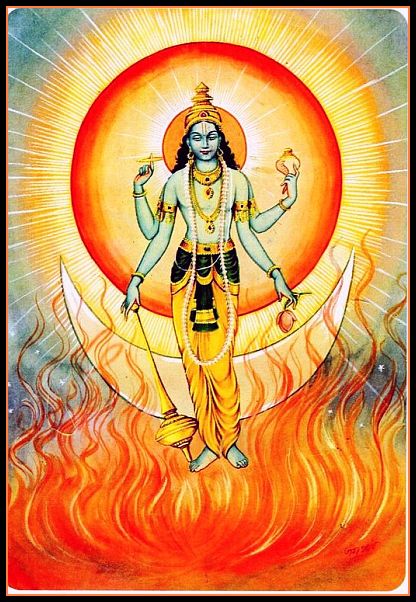
The earliest Mackenzie drawings were by himself. and, a majority of the other drawings created during his four-decade career were by trained military surveyors,  who were mostly European. However, Mackenzie also collected paintings by Indian artists.

Mackenzie’s survey work also extended into areas that were not under East India Company control, but were considered potentially valuable to the Company. One such area was Tirupati. Company’s interest was prompted by a report compiled , during 1803, by the British Collector Mr. Sutton at Chittoor, on the Sri Ventakeshvara Temple, a heavily endowed pilgrimage site , with a considerable amount of revenue.

Since Tirupati was a Brahmin controlled area, Mackenzie thought it prudent not to visit the area or to send a survey team. He, therefore, asked one of his Brahmin assistants, Subha Rao, to visit the Sri Venkatesvara Temple in 1804; and, to produce a report, along with accounts of the hills, roads and buildings at the site etc.

Perhaps to supplement this account, Mackenzie collected a drawing of the Sri Venkatesvara Temple, and the surrounding area, as made by a local Tamil or Telugu artist.

The picture that was  produced , in 1804, is in a typical South Indian, Company School style, showing the artist’s use of multiple point perspective, so that all the important factors of the temple and its surrounding landscape, as they would be viewed by a pilgrim visiting the site, were taken into account, including the steep stairs that the pilgrims traveled along, and the forests surrounding the site, teeming with wild animals.

Tirupathi drawing 1804

This picture, it is said, might have been the closest Mackenzie could get to survey the site. Mackenzie presented the Tirupati drawings, in around 1815, to his colleague,  Sir Thomas Strange, the Chief Justice at Madras from 1801 to 1817. It is now housed in the British Library , London. 

[ I acknowledge with thanks , the source : Indian ‘Company School’ Art from 1780 to 1820: Collecting Versus Documenting’ by  Jennifer Howes ]

***

Between 1805-16, many instances of misappropriation and misuse of temple-funds were brought to the notice of the Company. Thereafter, the British East India Company passed the Regulation VII of 1817 to check such abuses. That paved way for the Company to interfere in almost every aspect of the Temple administration.

And again during 1821, Col. Bruce the then Commissioner of the Chittoor District came up with a code of rules for  guidance and conduct in the management and administration of the Tirumala Temple. His code which came to known as Bruce Code  , was said to be in use till   the Tirumala-Tirupati Devasthanams Act of 1932 came into force.

The Bruce’s Code of 1821, formed in terms of regulation seven of the Madras Regulation Act 1817, was essentially a set of rules for the management and administration of temples at Tirupathi and Tirumala.  These were  well-defined rules formulated as a code having Forty-two provisions to guide the administration of temples of Tirumala and Tirupati on the basis of customs and previous usages , (including payment of salaries to staff ) without , however, interfering in its  day-to-day affairs. It also prescribed a Questioner (Saval-Javab- Patti) and time-table and regimen for conduct worship and other services for each day of the year.

Under the recommendations of the Bruce Code, a District level official working under the Revenue Board of the Company was appointed to look after the income, expenditure, administration and management of the temple on behalf of the Company.  He was assisted by a Tahsildar, Siristedar and four clerks. It is said; the annual income from the Tirumala temple  which in 1749 was Rs.2.50 lakhs  was increased to more than Rs.3.50 lakhs in 1822; and the  the expenses in 1822 amounted to  about Rs.0.30 lakhs.

The protocol for the entry of the pilgrims as also for collection of offerings and accounting was also laid down :

Passing through the Bagalu vakili or silver porch the pilgrims are admitted into a rather confined part and are introduced to the God in front of whom are two vessels, one called the Gangalam or vase, the other Kopra or large cup and into these things the votaries drop their respective offerings and making their obeisance pass through another door. At the close of the day, the guards, both peons and sepoys round these vessels are searched. Without examination of any sort offerings are thrown into bags and are sealed…after which the bag is sent down to the cutcherry below the hill Govindarauz pettai. At the end of the month, these bags are transmitted to our cutcherry… and there they are opened, sorted, valued and finally sold at auction. However during the Brahmotsavam either the collector or a subordinate must be on the spot due to the value of the offerings…

The East India Company was in direct charge of the Tirumala Temple until 1841, when its Court of Directors in England strongly resented “the participation of the Company’s officers and men in the idolatry conducted in Hindu temples by reason of its management of these religious institutions and ordered its relinquishment of their administration of religious endowments”.

Thereafter, in 1843, the East India Company decided to move away from direct involvement in temple administration; but, to ‘outsource’ the Temple –administration by introducing the system of appointing a Mahant. Under that system, the Mahant would administer the Temple on behalf of the Company; and would remit to the Company a certain specified amount, regularly each year.

The first of such Agent appointed in 1843 was a Mutt named Hathiramjee Mutt, belonging to the   Vaishnava Ghosai tradition of North India. The first Mahant so appointed by Hathiramjee Mutt was Seva Das (1839-1860). He was succeeded by Mahant Dharma Das (1860-1870). During their tenure, many temples atop the Hill affiliated to the main temple of Tirumala were renovated; and the restoration and improvement of the temple-tank was also undertaken (1846).

The Mahant system was in existence until the Tirumala-Tirupati Devasthanams Act of 1932 was enacted. That Act was replaced by the Hindu Religious and Charitable Endowments Act of 1951.]

But, withdrawal of the Company from the direct involvement in the administration of the temples did not seem to matter much, because by 1863 all the ‘Hindu’ religious institutions had been brought under the control of the East India Company. And the Government had to continue to be involved in litigations concerning the temple properties, which by- the-way, produced body of case laws based. And, the Government had to bring into force additional legislative provisions to govern the temples more effectively.

Such legislative measures were intended to take care of varieties of issues and problems not only in the day-to-day administration but also on matters impinging upon the control and ownership of the temples. For instance; the rules specified the conditions under which the Government could take control over the temple; the extent of such control; measures to combat pressure-groups that posed threats to the temple; as also the tactics of the vested interests to influence the direction of the Government policy etc.

It was during the course of such measures and steps taken by the British in the administration of ‘Hindu religious institutions’, the concept and identity of ‘Hinduism’ as a legal entity and a public cause took concrete shape.  Thus, ‘Hinduism’ which till then was rather amorphous, began to gain a structure as litigation after litigation  were brought before the courts.  The events that followed advanced the process.

***

The Census of 1871

But, it was the Census of the 1871 that formally, officially and legally categorized Hinduism as a religion.

The 1871 census, the first comprehensive   census to be conducted on All-India basis, set out to gather data on religion in order to analyze and interpret data categorized under various heads. Apart from supplying factual information to the government, the Census helped in objectifying   the concepts used to compile the data collected. As a result, these concepts – one of which was the religion – acquired a new reality and relevance beyond the census figures and bureaucratic reports.

Not only did the Census reports accord increasing importance to ‘religion’ both as a subject in its own right and in relation to other subjects, but also as a conceptualization of ‘religion’ in terms of community, membership of which could be established by reference to certain criteria , and conduct ; and , hence compared with membership of such other communities .

The inclusion of religion and the role assigned to it posed a problem to the enumerators and analysts when it came to identifying ‘Hindus’ and hence ‘Hinduism’. In order to avoid complicated tabulations, the enumerators adopted a short method or a thumb rule. They went by the rule that anyone who was unable to identify himself with a known sect was to be classified as a ‘Hindu’. This was also the method adopted for tabulating most of the tribal people, nomads and low caste

And that brought focus on the contentious question of determining who was a ‘Hindu. It also went into exercise of classifying religious movements as “Hindu’ or; non-Hindu’.

While enumerating ‘Hindus’ , the Census made judgements about the limits of ‘Hinduism’ that in turn became focus of controversy , thereby establishing how official use of certain categories to classify ‘religion’ promoted the reification of ‘Hinduism’, which is rendering the complex idea of Hinduism into something recognizable and easier to identify.

Thus, the British imperialism played a key role in the concretisation of ‘Hinduism’ as an identifiable religion. This led to transformation of an abstract idea into a practical ‘religion’ distinct from other religions.

**

Divide and Rule

At times, the cultural and linguistic differences among the local populations were exploited by the British to accentuate the ‘Hindu’ divide.

For instance; the United Provinces of Agra and Oudh was a large and heterogeneous territorial unit of British India. The rural areas, in general, were dominated by Hindu folk traditions. The fairly large Muslim minority of the United Provinces (about 17 per cent of the population) was mostly settled in the towns (about 44 per cent of the urban population).

The differences between the two were reflected in their language and literature: Urdu, the lingua franca of the Mughal empire, was associated with urban Muslim culture; while, Hindi and its many dialects was the idiom of the rural Hindus.

Movements such as that for the recognition of Hindi in Devanagari script (i.e. the Sanskrit alphabet) as an official language in the Urdu-dominated courts of law (where proceedings were recorded in Persian characters), as well as campaigns for the protection of the sacred cow from the Muslim butcher, merged into a general stream of Hindu nationalism in the late nineteenth century.

The British decision to replace the use of Persian in 1842 for government employment and as the language of Courts of Law caused deep anxiety among Muslims of the sub-continent. This development greatly alarmed the Muslims and gave rise to communal conflicts.

The British had certainly not created these conflicts, but they took advantage of them in line with the old maxim ‘divide and rule’. The British seemed to favour the minority Muslims who looked to them for the protection of its interests against the Hindu majority.

The British established a Muslim college at Aligarh, near Agra, which was designed to impart Western education to Muslims while at the same time emphasising their Islamic identity. This college, later called Aligarh Muslim University, became an ideological centre whose influence radiated far beyond the province in which it was established.

Challenged by the foundation of a Muslim university, the Hindus soon made a move to start a Hindu university which was eventually established at Benares (Varanasi) and became a major center of Western education.

The establishment of two sectarian universities in the United Provinces was characteristic of the political and cultural situation in that part of India, also clearly demarcated the ‘Hindu’ from the rest.

 [There is an interesting side-light , which is often cited. Some claim it is true; and, others deny it.

Pundit Madan Mohan Malaviya, in his efforts to set up the Benares Hindu University at Varanasi, went around many parts of the country, collecting funds to finance its building-constructions.

During the year 1911, as a part of his roundabout  roving around  the country, a sort of tour de France or a big loop,  Malaviya called upon the Nizam of Hyderabad (then reputedly the richest man in the world), soliciting funds for setting up a Hindu University. To say the least, the Nizam was not amused; and, is said to have hurled one of his shoes at the visitor.

Malaviya, it is said, picked up the shoe; and went directly to the market place for auctioning it.  As it was Nizam’s footwear, many, naturally, came forward to buy it. The bids kept going up.

Malaviya auctioning Nizam's shoe 1911

When Nizam learnt of this unseemly incident at the market place, causing needless disturbance and much amusement among the crowds, he was annoyed; and, asked his officials to put an end to what he deemed as a charade or mockery. One of his attendants was instructed to ‘Buy back that footwear, no matter whatever its price be!’

Nizam

Needless to say, the shoe fetched considerable amount, given the context of its times. . The money, it is said, was used to build a teacher’s colony in BHU called Hyderabad colony.

madan-mohan-malaviya

In any case, it could be said that Malaviya either convinced or persuaded the Nizam to support his cause.]

***

Role of the Missionaries

If the British imperialism played a leading role in the construction of ‘Hinduism’, the role of the Christian Missionaries was no less important.

Because of the effort of the group of Evangelicals led by William Wilberforce, the British Parliament resolved that Christianisation of India was the solemn duty of the British Government. This led to the unrestricted ‘opening’ up of India to missionaries with full freedom to condemn and malign Hindu religious practices and institutions. It also led to the setting up of the Ecclesiastic Department as a part of the Government of India.

The Christian Missionaries, thereafter , enjoyed a special and a privileged relationship with the British Government. Britain was seen the ‘Mother Country’ of Empire whose official religion was Christianity. The British rulers in India viewed themselves as the servants and protectors of the Mother country as also of its religion. The Missionaries could preach and propagate Christianity under the protective canopy of the British Raj.

The Missionary activity earnestly picked up strength since 1813 under the aegis of the East India Company. Even later under the protective canopy of the British Raj, the Missionaries could preach and propagate Christianity as the ‘true religion’; and denounce Hinduism as a ‘compound of error, c corruption and exaggeration’ and as a false religion.

With such propaganda, a clear line was drawn between Hindu and non-Hindu religions.

Oxford

Oriental Scholars of the West

The oriental scholars were also influenced by the British government and by the Church.

There were the Oriental scholars, funded by wealthy private patrons, who carried forward the Missionary agenda. Lt. Col. Boden of the Bombay Native Infantry endowed a Chair in the Oxford University for propagating Christianity in India through Sanskrit.

In 1832, Horace Hayman Wilson became the first to be appointed  to the newly founded Boden chair of Sanskrit.  His  view was that Christianity should replace the Vedic culture. And, he believed that full knowledge of Indian traditions would help effect that conversion. Aware that the Indians would be reluctant to give up their culture and religion, Wilson made the following remark:

A learned Brahman trusts solely to his learning; he never ventures upon independent thought; he appeals to memory; he quotes texts without measure and in unquestioning trust. It will be difficult to persuade him that the Vedas are human and very ordinary writings,  that the Puranas are modern and unauthentic, or even that the Tantras are not entitled to respect. As long as he opposes authority to reason, and stifles the workings of conviction by the dicta of a reputed sage, little impression can be made upon his understanding. Certain it is, therefore, that he will have recourse to his authorities, and it is therefore important to show that his authorities are worthless.”

With the death of Horace Hayman Wilson in 1860, the Boden Chair fell vacant. Monier Williams was the hot contender to the Chair; competing against Max Muller, who was known for his philosophical speculations based on his reading of Vedic literature. Monier Williams, in contrast, was seen as a less brilliant scholar;  but , he had the advantage of being familiar  with the  religious practices in modern Hinduism.

As a part of his submission to the members of Convocation of the University of Oxford, 1860, Monier Williams had assured:

Having commenced my career as a Scholar on the foundation of Colonel Boden, I owe a deep debt of gratitude to the munificent benefactor, who provided for the perpetual study of Sanskrit in the University of Oxford; and, if I am elected to the Boden Professorship, my utmost energies shall be devoted to the one object which its Founder had in view; namely “The promotion of a more general and critical knowledge of the Sanskrit language, as a means of enabling Englishmen to proceed in the conversion of the natives of India to the Christian religion”.

Sir Monier Williams  did  succeed in becoming the second-Boden Professor of Sanskrit at Oxford University, England. He studied, documented and taught Asian languages, especially Sanskrit, Persian and Hindustani.

He made it clear that his interest in preparing dictionaries was primarily to translate the Bible into other languages. He said that he would initially fulfill the wish of Col. Boden to translate the Bible into Sanskrit ‘in order to enable his countrymen to proceed in the conversion of the natives of India to the Christian religion’. Monier Williams, eventually, compiled a Sanskrit-English dictionary based on the earlier Peters-burg Sanskrit Dictionary which was published in 1872. A later revised edition was published in 1899 with collaboration by Ernst Leumann and Carl Cappel.

In his writings on Hinduism, Monier Williams argued that Hinduism is a complex ‘huge polygon or irregular multilateral figure’ that was unified by Sanskrit literature. He stated that ‘no description of Hinduism can be exhaustive which does not touch on almost every religious and philosophical idea that the world has ever known’.

Monier Williams taught Asian languages, at the East India Company College from 1844 until 1858, when the rule of the East India Company in India ended, after the 1857 rebellion. He came to national prominence during the 1860 election campaign for the Boden Chair of Sanskrit at Oxford University, in which he stood against Max Müller.

After his appointment to the professorship, Williams had declared, from the outset, that the conversion of India to the Christian religion should be one of the aims of all types of orientalist scholarship.

*

Max Müller (1823 –1900) considered that Hinduism which was characterized by superstition and idolatry needed to be reformed just in the manner of Christian Reformation.  In his letters to the Dean of St. Paul’s (Dr. Milman) of February 26, 1867, Max Muller wrote: I have myself the strongest belief in the growth of Christianity in India. There is no country so ripe for Christianity as India, and yet the difficulties seem enormous.

In a letter to his wife, Max Muller wrote: “It (The Rig-Veda) is the root of their religion and to show them what the root is, I feel sure, is the only way of uprooting all that has sprung from it during the last three thousand years.”

In one of the letters, he says, “Ah! We have found the key to Christianize India.” And the key, according to him, was the Brahmo Samaj, in which the missionaries reposed great hope as the intermediate station for the Hindus of Bengal to become Christians. They had their hopes, in particular, on Keshav Chandra Sen, who was heading the Brahmo Samaj then.

 Later he also wrote to the Duke of Argyle, the then acting Secretary of State for India: “The ancient religion of India is doomed. And if Christianity does not take its place, whose fault will it be?”

In his 60s through 70s, Max Müller gave a series of lectures, which depicted his view of Hinduism. That somehow was followed by others of his time.

*

Many have argued:   “The term ‘ism’ refers to an ideology that is to be propagated and by any method imposed on others for e.g. Marxism, socialism, communism, imperialism and capitalism but the Hindus have no such ‘ism’. Hindus follow the continuum process of evolution; for the Hindus do not have any unidirectional ideology, therefore, in Hindu Dharma there is no place for any ‘ism’.


They point out that ‘Hinduism’ that the western world perceived was essentially the construction of the British imperialism, the nineteenth century western scholars and the Missionaries. Such constructions were made to suit their own agenda.

***


 ‘Hindus’ and ‘Hinduism’

As we saw, the concept of Hindu and Hinduism that emerged during the Nineteenth century was mainly in terms of the notions imposed by imperialism, missionary impulse and western scholarship.

Many educated Indians of the nineteenth century, therefore, mounted a counter attack on the Christian Missionary propaganda against Hinduism, adopting their own (missionary) methods and style.

There were also those who sought to remedy the flaws through which others tried to expose and exploit Hinduism, by revaluing the ancient texts, by reforming the Hindu practices and such other radical explanations.

In addition, there were the Indian elite who somehow seemed to be apologetic about Hindu beliefs and practices; and brought in social and cultural reforms. A Bengali Renaissance tried to usher in a new type of philosophical Hinduism tinged with a romantic nostalgia for some of the nobler forms of Vedic traditions.

At the same time, many cast doubts upon the conclusions of the oriental scholars, pointing out the flaws in their sectarian stance and arguments and dogmatic approach .

There was another set of Indians trying to make use of the religious enactments passed by the Government and take control of the religious institutions; while at the same time protesting against threats and encroachment on Hindu interests.

The construction of Hinduism thus arose out of encounter and interaction with the West. And it owed much to the Indian elite.

Such assortment of   ’ Hinduism’, thus, was mostly the creation of the nineteenth century Indians as a response to or in confrontation with the Western interpretations. Their reaction also to an extent contributed to the shaping of Western perception of ‘Hinduism’.

 Brahmo Samaj on Cornwallis Street

Some of the influences that shaped and re-shaped the concept of ‘Hinduism’, during the nineteenth century, were obviously religious; and, in addition there were also social, cultural and political organizations that projected their concept of ‘Hinduism’.

Raja Ram Mohun Roy and Brahmo Samaj looked down upon the current practices as corrupt and degenerate. The Brahmo Samaj harked back to the ancient and pure ways of the Upanishads, formulating an enlightened creed of ‘Hinduism’.

Swami Dayananda Saraswathi also aspired to bring back the principles and practices of the Vedic times. He called upon all Indians to study Vedas.

Sri Ramakrishna Paramahamsa, a mystic seer, through his own experiences declared the oneness of all religious   paths ‘and took a ‘universal’ view of all religions and varied paths leading to same goal.

Jatiya Mela and Jatiya Sabha  of Bengal came together, (renamed as Hindu Mela, in 1867), in order to promote a distinct identity of the ‘Hindu’ and a sense of pride in being a ’Hindu’


There were also movements of emerging popular ‘Hinduism’ floating their own pet brand of ‘Hinduism’.

*

In the political terms, the concepts of ‘Hindu’ and ‘Hinduism’ got entwined with nationalistic ambitions of several organizations.

Some of those nationalists portrayed the land Hindustan as the holy Motherland of the people of India.  For instance; Bankim Chandra Chattopadhyay (Chatterjee) (1838-1894) raised Nationalism to the level of religion by identifying the Motherland with the Mother-Goddess. The tremendous impact and thrilling upsurge that Anandamath and Vandemataram  had on the Indian National Movement is indeed legendary.  He came to believe that there was “No serious hope of progress in India except in Hinduism-reformed, regenerated and purified”. With that in view, Bankim Chandra tried to reinterpret ancient Indian religious ideals by cleansing them of the accumulated floss of myths and legends.

Aurobindo Ghosh and other revolutionaries acknowledged Bankim Chandra as their political Guru and followed his ideals of India and ‘Hinduism’.

The Hindu Mahasabha founded in 1909 by Vinayak Damodar Savarkar was based in the idea of Hindutva. It called upon Hindus to fight for the freedom of Motherland and to consolidate the Hindu nation.

That movement fell into decline rather soon. And, its place was taken by Rastriya Svayamsevak Sangh (RSS) inspired by the ideals of the Anushilan Samiti , was established by Dr.  Hedgewar (1889 –1940)  in 1925 with the ideal to ‘unite and rejuvenate our nation on the sound foundation of Dharma’.

Bharatiya Jana Sangh (BJS) the political offshoot of RSS carried a similar ideal.

The Vishwa Hindu Parishad (VHP) a cultural organization with undertone of Hindu religion vowed to protect Hindu religion from encroachment by other religions.

These movements also contributed towards identification and demarcation of ‘Hinduism’ where “Hinduism’ was broadly associated with nationhood.

**

Hinduism variously conceived

Variously conceived, ‘Hinduism’ was generally regarded as the ‘essential religion of India’. And yet; the views on the quintessence of Hinduism varied greatly. The question got complicated by the presence and practices of immense varieties of beliefs and plurality of perspectives. But, yet there have also been efforts to equate ‘Hinduism’ with a particular version of it. There are also those who wish to treat Hinduism as a group of ‘religions’ or a socio-cultural unit or civilization which consist a plurality of distinct religions

There are also different versions of ‘Hinduism’. Sri Sankara’s non-dualistic Advaita philosophy takes a broad view and reconciles the apparently conflicting beliefs within the ‘Hinduism’ as a system. Then there is the Vaishnava theology centred on devotion on a personified God. There are also affiliate home-grown religions such as Jainism, Buddhism and Sikh-religion. There is also the juxtaposition of foreign faiths such as Zoroastrianism, Christianity and Islam.

*

The acceptance of the Vedas and their authority has been cited by the Supreme Court as one of the characteristics of Hinduism.

It is no doubt that Vedas are the roots of Indian ethos, thought and philosophy. They are of high authority, greatly revered and very often invoked. But, their roots are lost in the distant antiquity. The language or the clear intent of those texts is not easily understood; its gods and its rites are almost relics of the past. They no longer form active part of our day-to-day living experiences. The worship practices followed by the common Indians of the present day differ vastly from the rites prescribed in the Vedic texts. The gods worshipped by the present generations too vary greatly from the Vedic gods .  In today’s world, it is the popular gods, modes of worship as in the duality of   Tantra that has greater impact on socio religious cultural practices than the Vedas. The living religion of ‘Hindus’, as practiced today, is almost entirely in the nature or the version of what appeals to each sect,  or  to each individual .  

[Most of the Western Scholars consistently draw a distinction between the Vedic tradition and the ‘Hinduism’.]

*

There is also a claim to adhere to Sanatana Dharma (eternal law), an equivalent of perennial philosophy of the West, where all ‘religions’ are unified. This is despite the fact that the meaning and scope of the term Dharma is far wider than ‘religion’; and is not restricted to religion or sect.

[ The term Sanatana is , often , explained thus : ‘Puratana‘ is that which belongs to the past; ‘Nutana‘ is that which has come into existence now ; and “Sanatana‘ is that which has been in the past, existing in present, and continuing in the future. It is present at all times. It is eternal.] 

But, the term Sanatana Dharma is perhaps used to signify orthodoxy as opposed to reformed ‘Hinduism’. That is based in the belief that ‘Sanatana Dharma’ though of great antiquity is indeed an ongoing process that changes while retaining continuity. Yet, it is rooted the aspiration of attaining liberation (Mukti) from all sorts of confines and limitation.  It is all-inclusive in nature and not shutting out new ideas and concepts; it is also not regimented by fixed set of rules or commandments.

The proponents of  Sanatana Dharma concept assert that ’Hinduism’ is a recent construct, which was  introduced into the English language in the 19th century to denote the religious, philosophical, and cultural traditions native to India. Despite that rather newly coined epithet, they point out, it essentially refers to a rich cumulative tradition of texts and practices that date back to a very distant past. And, they quote The Supreme Court which said that Hindu does not signify a religion but a way of life; and represents the culture of India, and of all people of India, whether Hindus, Muslims, Sikhs, Christians, etc.

 .

***

At the End

Thus, though the word Hindu (not originally Indian) might have, in the past, referred to a geographical region (Hindu-stan), a cultural association, or language (Hindu-stani) or to a common religion of the land etc, yet, it has, over a period, come to acquire specific religious connotations and characteristics. Consequently, the concept of the ‘Hindu religion’, that is ‘an Indian religion with a coherent system of beliefs and practices that could be compared with other religious systems’ got established.

Now, generally, one is understood to be a Hindu by being born into a Hindu family and practicing the faith, or by declaring oneself a Hindu. It has been used as a geographical, cultural, or religious identifier for people indigenous to South Asia. In any case, Hinduism is now a nomenclature for the religious tradition of India and the suffix ism is hardly noticed. Not many have qualms in accepting ‘Hinduism’ or being a ‘Hindu’.

***

A Hindu is a Hindu not because he wanted to be distinct and created a room and put a door around him. But, because others started constructing walls everywhere, and at some point of time, the Hindu found that the walls other constructed somehow became his boundaries as well.

– Julia Roberts

lotus offering


Sources and References

  1. Interpretations of the Bhagavad-Gita and images of the Hindu tradition by Catherine A. Robinson
  2. A History of India by Hermann Kulke and Dietmar Rothermund ; Fourth Edition; Routledge ; 2004
  3. The Hill Shrine Of Tirupati by Prof. S. K. Ramachandra Rao (Surama Prakashana – 2011)
  4. https://selfstudyhistory.com/2015/09/30/al-birunis-india/
  5. https://en.wikipedia.org/wiki/Bruce%27s_Code
  6. https://en.wikipedia.org/wiki/Census_of_India_prior_to_independence
  7. https://tamilbrahmins.wordpress.com/2015/09/13/temples-and-the-state-in-india-a-historical-overview/


Tags: , , , , , , , , , ,