RSS

Category Archives: Indian Philosophy

PARADIGM IN VEDANTA

Paradigm, as I understand, is a framework within which explanations as well as understanding of facts related to a subject could be neatly fitted. It not only outlines  an accepted and permissible inquiry, formulating the scope of inquiry; but, it also provides a model for organizing the information obtained during the inquiry.

The paradigm , as set out , needs to be accepted by all members of the scholastic  community. This would facilitate coordinating a joint exploration into a commonly  accepted and well outlined field of inquiry

A paradigm is, thus, a pattern or an exemplar. In a sense it serves as a road-map for  the enquirer.

The explanation I offered above is based on the concept  popularized  by Thomas S . Kuhn (1922–96), a philosopher and historian of science in his The  Structure of Scientific Revolutions . 

*

The Vedanta has developed its own paradigm or ground-rules. A Vedanta theory first  tries to define the parameters ; and, then it determines and defines the relations between  them . It , finally , constructs a workable model in order to understand and accomplish  its goals. 

The paradigm in Advaita Vedanta is a scheme , a method or a system of logic (nyaya) called Adyaropa-Apavada, which consists in initially adopting an assumption and subsequently  withdrawing or rejecting that assumption .

However , it is not clear who initiated this  popular method of inquiry. Sri Shankara, in his commentary on the Bhagavad-Gita calls  this a traditional method. His Parama-Guru Gaudapada used this method rather  extensively.

The most famous example of this paradigm is of course the illustration  of the snake and the rope (rajju-sarpa) . It was Gaudapada who first came up with the  illustration of a piece of rope in darkness being mistaken for a snake . The mistaken  perception , according to Gaudapada , was an erroneous personal construction  Vikalpa negatived when light was thrown on the object.

The method had its origin in the Upanishads. Later the Buddhists and Vedanta  scholars employed it. The earliest traceable reference to this method is in  Saddharma Pundarika Sutra , popularly called the Lotus Sutra , a text of the  Vijnanavada Buddhism. The Text mentions the method by name (2,25,135);but , substitutes Samaroha for Adhyaropa. The import of the method, however, remained  unchanged. Sri Shankara inherited it from Gaudapada , who attempted a  synthesis of the Buddhist and Vedanta view points. Later on , the method came into  wide use.

The expression Adhyaropa , generally , stands for superimposition , wrong  assumption, attribution of a wrong nature or a feature . It is essentially a projection that is constructed by our sense-organs and mind ; but , it does not exist in reality.

The other term Apavada stands for negation or withdrawal or elimination of what was  imputed or assumed or attributed or superimposed. This comes about because of  superior knowledge or the knowledge of things as-they-are. Apavada means  elimination of wrong knowledge through right knowledge.

Adhyaropa consists in assuming or projecting a snake in a rope that , in reality , is not a snake . The snake-like appearance of the rope was merely a transformation (Vivarta) untrue and short lived;  but, it vanished when light (knowledge) was brought in. The  phenomenal world , similarly , is a transformation of the Brahman-substance into an  extended world of objects in space and time , with the experiencing ego as the  vortex.  Apavada is annulling or dissolving this appearance and letting the true substance reveal , as itself. It is in effect , the falsification of the false appearance.

The right knowledge cannot bring us any non-existent thing;  nor can it annihilate already an existing one. The right knowledge can only remove false attribution; and  , let the real shine forth.

When the false notion is eliminated, no special effort is required to realize the truth.

In order to educate the mind to interpret the reality as it is, the Vedanta employed  Adhyaropa-Apavada of deliberate provisional ascription and its later withdrawal. For  the convenience of teaching, you accept a thing or an attribute that is actually not there and later negate that once the student is mature enough to realize the  actual position.

For example , we teach the child about sun-rise , sun-set and  about East-West and other directions. But, as the child advances in age and in  learning the earlier teaching is negated ; and, the child realizes that the sun neither  rises nor sets ; and the what we call directions are , after all , notional.

This method is justified because, it can effectively illustrate the distinction between  appearance and reality. An excellent application of this method can be found in the Upanishad treatment of the three states of life , viz. waking , dreaming and sleeping. Gaudapada’s karika on the Mandukya-Upanishad takes this up as the main theme ;  and , shows how the method is employed to arrive at the fourth state , the Turiya by  sublimating the other three . By the residual reasoning , Turiya alone is proved real  while the others are mere assumptions or constructions (Vikalpa).

In Vedanta too, the same methodology is adopted to teach Brahma-tattva. Initially it  accepts origination/ creation of jagat world etc. and later it negates these false attributions by saying neti , neti.

The other illustrations are also based in the Upanishads and are elaborated by  Sri Shankara who also explains the methodological involvement .The examples are:

(I) The initial assumption is that the Absolute is the Lord ; and saying it is not  subordinate. The later formulation is that Absolute is everything and there is nothing  else. This dismisses the Lord and subordinate duality and the assumption.

(ii)The assumption is that the Absolute is the cause of the phenomenal world . The  later claim is that the effect is illusory ; thus denying the casual role of the Absolute.

(iii) The assumption is that Self is the only knowable (jneya) ; thus excluding all the  other knowable .The later formulation is that the Self is really the knower (jnatr).

(iv) The assumption is that Self is the knower. This is denied by saying that Self is  mere witness (Sakshi).

(v) Then sublimation of this position is by denying the validity of duality , which obtains  only at the phenomenal level.

(vi) The assumption is that the Absolute can be understood only with the aid of  scriptures ; thereby denying other normal methods like observation and reason. The formulation states that it is impossible to ascertain the Absolute by verbal or Mental procedures.

It is the tendency of all beings to project an assumptive world and get involved in  it. While in its fold, all the other related erroneous assumptions gain ground and  cause distress. This assumption is known in Advaita as Avidya, ignorance . Its synonym are : Adhyasa (superimposition); Adhyaropa (assumption); Branthi (delusion);  Anyatha (wrong);Tamas (darkness); Moha (infatuation); and,  mithya-prathyaya  (mistaken  conception)  etc.

The aim of Vedanta is to undo the distress by loosening the grip of assumptive world. Vedanta prescribes Adhyaropa-Apavada method to theoretically distinguish between  the that “tat”, the assumptive world and thou “tvam” the conscious substance after  elimination of all assumptions. This is a necessary prelude to practical Sadhana.

Please click here for the Companion post: Nyaya 

lotus 888

Indebted to Prof.SKR Rao

 
2 Comments

Posted by on September 6, 2012 in Indian Philosophy, Nyaya


Tags:

Anugita (Part 2 of 2)


Continued from  Anugita(Part 1 of 2)

Anugita is meant as a follow up of the Bhagavad-Gita. While the Bhagavad-Gita is a very well known text having a huge following, the appeal of the Anugita is confined to scholars. This might be because the Bhagavad-Gita enjoys several advantages that the Anugita does not have. Those broadly relate to the context, content and the style of narration.

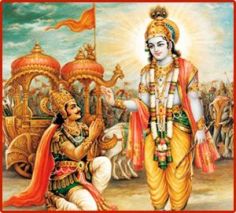
The context and setting of the Bhagavad-Gita is very dramatic and highly charged. On the first day of the great battle while the two armies are positioned face- to- face ready to take on each other, Arjuna is seized by a moral dilemma and an extreme despondency. His inaction or retreat then would have brought horrendous consequences to the Pandavas and their

supporters .Krishna through his teaching, clears the doubts and delusions of Arjuna; instills in him the commitment to his duty ; and inspires him to fight on.

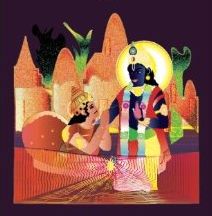
The Anugita, in contrast is set in a rather lackadaisical situation. The war is won, the kingdom is regained and the Panadavas are at last settling down to enjoy their new – found affluence and authority . As Arjuna is relaxing in his palace , he admits that whatever Krishna lectured to him on Kurukshetra has gone out of his mind. He therefore requests Krishna to repeat his instructions. Krishna obviously is displeased with his disciple; nonetheless agrees to impart instructions that are similar, though not identical to his earlier teaching. The atmosphere is rather laidback and not stimulating.

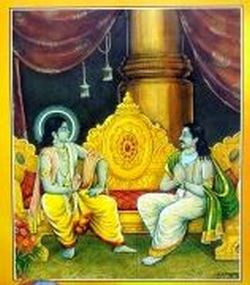
eknathi-bhagwat-mool

The treatment and extent of Bhagavad-Gita covers vast areas of knowledge, devotion and life. The spread of the Anugita, comparatively, is rather restricted.

As regards the style of narration, the language of Bhagavad-Gita is smooth and lucid with suggestive imagery, which Anugita does not have.

Bhagavad-Gita is presented as a teaching direct from the Lord of the universe. It is in the form of messages or instructions handed down by the divine authority. Krishna then reveals his most magnificent all encompassing” Universe- form”. Anugita in contrast follows the old Upanishad method of elucidation; where eminent men and women engage in discussion and analysis to explore the dimensions of a subject. There is no divine intervention here.

Both Bhagavad-Gita and Anugita stress the need to gain control over the senses and both uphold the virtues of detachment and renunciation. However, Anugita does not preach devotion to a god and his powers to grant salvation; but emphasizes on human initiative and endeavor in realizing ones true nature and working out ones salvation.

Perhaps because these three elements (images, context, devotion) were not so well represented in Anigita and its dramatization was not so impressive, must have affected its popularity.

*****

Anugita. Nevertheless, contains valuable discussions, unique points of view; and has some beautiful and expressive passages. The fact that it lays emphasis on human enterprise and effort rather on divine help, to attain salvation, I believe, is one of its strengths.

Yajna (sacrifices), Tapasya (penance) and Yoga .

The text, in its own way, discusses the merits of Yajna (sacrifices), Tapasya (penance ) and Yoga.

Anugita views yajna at different levels. It does not have high regard for sacrifice in its physical or ritualistic sense. It says the sacrifices at best lead to the short-lived pleasures of celestial abode (swarga) and are therefore not the right means for attaining the ultimate human aspiration, the liberation .

Anugita, on the other hand, lays greater emphasis on the esoteric meaning of the Yajna, the internal Yajna. The Anugita, like the Upanishads, makes use of a metaphorical system or device of establishing identities (for example, the eye is the sacrificer,  the seen object is the sacrificial oblation, the eyesight is the fire that burns the offering), It extends the metaphor by symbolizing the sacrificial fire as the soul within.

Anugita explains that by restraining the senses and the mind; and by offering the objects of those senses and the mind as libations into the sacred fire of the Soul within the body, one performs the true Yajna. The internal yajna takes place in the subtle body. It says

This Yajna is going on daily in this body and it is going on everywhere in the world, outside and inside”.

The text also talks about penance; where one deprives himself of food; one takes refuge alone in a forest or a mountain, for years if needed, and so on. Anugita, however, places the inner disciples of detachment and renunciation at a higher plane than the physical austerities and torments. It asks the seeker:

Expelling all impressions and restraining the self in the Self, he understands that holy Brahman, than which nothing greater exists. …One who is alike to all beings; who is without attachment; who is without expectations, and who looks alike on everything can reach this goal. I have now declared everything to you. Act thus forthwith; then you will acquire perfection .”

It is however, the Yoga that Anugita values most. Yoga is beyond asceticism and sacrifice; yet, it does not exclude them, For the Yogin starts from asceticism that aims at mastering body, mind; and then offers in sacrifice the elements and the organs of senses into the fire of the soul .that leads him on the way to attain perfection or final emancipation.

Thus, Yoga not only directs asceticism and sacrifices towards a higher aims but also expands their horizons .Yoga helps bind them together and enhances their spiritual qualities.

Anugita deals with these aspects much better than Bhagavad-Gita does. It also describes well the progression from a stage to another stage.

“I will teach you the wonders of yoga:

ataḥ paraṃ pravakṣyāmi yogaśāstram anuttamam । yajjñātvā siddha mātmānaṃ loke paśyanti yoginaḥ ॥ 14॥

He who goes through its doors perceives the universal soul that resides inside him…

nainaṃ śastrāṇi vidhyante na mṛtyuścāsya vidyate । nātaḥ sukhataraṃ kiṃ cilloke kva cana vidyate ॥ 28

Disciplined, always concentrated, keeping himself and his senses as well under control, he who reaches perfect meditation, sees by himself the universal soul…

samyagyuktvā yadā atmānam ātmayeva prapaśyati । tadaiva na spṛhayate sākṣādapi śatakratoḥ ॥ 29॥

Mastering meditation, he bends the very divinity of the gods to his will…

nirvedastu na gantavyo yuñjānena kathaṃ cana । yogam ekānta śīlastu yathā yuñjīta tacchṛṇu ॥ 30॥

Let him think of the region he knows from a long time, then let his mind turn to  the inside of the town he lives in, forgetting the outside.

dṛṣṭapūrvā diśaṃ cintya yasmin saṃnivaset pure । purasyā abhyantare tasya manaścāyaṃ na bāhyataḥ ॥ 31॥

Inside the town, let him concentrate his mind on the house he lives in, its outside and its inside.

purasyā bahya antare tiṣṭha anyasminnāvasathe vaset । tasmin nāvasathe dhāryaṃ sa bāhyābhy antaraṃ manaḥ ॥ 32॥

Having mastered his house in his mind, let him meditate on the body he lives in, neglecting the outside.

pracintyāvasathaṃ kṛtsnaṃ yasminkāye’vatiṣṭhate । tasminkāye manaścāryaṃ na kathaṃ cana bāhyataḥ ॥ 33॥

Having mastered all his senses in this silent and lonely retreat, let him meditate on the inside of his body, dealing only with that.

saṃniyamye indriya  grāmaṃ nirghoṣe nirjane vane । kāyamabhyantaraṃ kṛtsnam ekāgraḥ paricintayet ॥ 34॥

Let him focus his mind on his teeth, his palate, his tongue, his throat, his neck, his heart, and even on his heart’s veins … 

dantā aṃstālu ca jihvāṃ ca galaṃ grīvāṃ tathaiva ca । hṛdayaṃ cintayeccāpi tathā hṛdayabandhanam ॥ 35॥»

(Anugita-XIV, 19, 14)

The Gunas

Anugita discusses in detail the scheme of the three Gunas-Satva (the very fact of being -goodness), Rajas (the dust- passion) and Tamas (the darkness). It drives home the point that Satva-guna that is associated with the values of, goodness kindness, light, purity and happiness, might be the noblest virtue; But, it cannot exist on its own. It needs the support of the lesser two gunas in order to exist and to survive.

The gunas cannot be explained altogether distinctly from one another. Rajas, Satva, and Tamas are mixed up with one another. They are attached to one another, serve one another, they feed on one another. They all depend on one another, and likewise follow one another. They act, unperceived, by turns in the several places in several ways. Everything in the world is made of these three gunas. The creation of the gunas is eternal.

As long as there is goodness so long, darkness exists. And, as long as goodness and darkness exist, so long the passion exists. They perform their journey together, in union, and moving about collectively.

The Anugita takes a holistic and a neutral approach to the existence. Whatever there is in the world all that is made of these three gunas.

The light of the sun- it is the Virtue (Satva), its heat the desire (Rajas), its eclipses the darkness (Tamas): in such a way, the three tendencies spread in all the stars.”

“The nature of the day is triple, triple the one of the night …

The nature of the giving is triple, triple the one of the sacrifice, and triple the worlds, triple the gods, triple the sciences and the ways to emancipation. The past, the present, the future … the ascending, descending and upward breaths, all are provided with the three tendencies

( XIV, 39, 18-20).

The three tendencies are in us and weave our life. To remove one of them is impossible. He, who strives to move towards perfection, has to be fully aware of this position, in order” to reach the opposite bank “,

(XIV, 49, 28).

Treatment and presentation

The treatment and presentation of a subject is as in Upanishads. For instance, the message that all things are not comparable and some are unique; is presented in the following manner :

The mind and speech went to Brahma the Creator, and asked him:

“Take a doubt away from us: Which one of us is the first? “

The Lord answers that the mind is the first, but they are surprised:

“When speech did not yet exist, how could the goddess of speech, Sarasvatî, express herself? “

Then, the Lord mentions that speech is born into the body and is mobile, while mind is immobile. Thus, both, mind and speech are not comparable.

There is another passage where Brahma resolves the dispute among the mind, the senses and the organs. They all desire to know which of them is the greatest. Brahma replies through a beautifully worded passage which, could very well apply to any pluralistic situation, even in the modern day.

You are all greatest, and not greatest.
You are all possessed of one another’s qualities.
All are the greatest in their own spheres,
and all support one another.

Being friendly with one another,
and pleasing one another, go away happily.
Welfare be to you! Support one another.


The following metaphor compares the movement of time to the movement of a chariot. It also weaves in the movement of life with its misfortunes, feelings and groans .It beautifully binds together in one metaphor, the circular movements of time and of the life and teach us that they are comparable.

The wheel of the time has for hub the intelligence,

For axle tree the mind and for

Spokes the senses


It has for metallic rim the five elements,

And for hoop the instants.

It rolls with old age and sorrows,

And  makes its way through adversity and illness.


It goes all over time and space,

And has for squeaking tiredness and grief…

It has for axle the words with their stress,

it turns at mind’s speed

There are many other passages of merit in Anugita.

Conclusion:

Anugita is an intelligent part of the Mahabharata. It is a very valuable text as it presents a unique perspective of the ancient Indian philosophical themes.

It drives home the point that goodness though a coveted virtue, cannot exist on its own; it needs the support of the two lesser gunas. Anugita takes a rational view that the best a person can do while still in the loop of the world is to maximize the Satva and to keep under check the Rajas and Tama gunas.

Further, the interpretation it provides for the Yajna through the internal processes in the subtle body is truly marvelous . Bhagavad-Gita too does not treat the subject better.

There is also an exploration about the ideas of creation based on Samkhya philosophy. It beautifully integrates the three disciplines of penance, sacrifice and yoga; and demonstrates how Yoga elevates the other two disciplines to a higher spiritual plane and how they find their fulfillment in Yoga, which spearheads towards self-realization.

Anugita encourages humans to think, analyze and workout their salvation rather than depend on external help or hope for divine intervention.

Presently there are only two acclaimed ancient commentaries on Anugita; and, two translations into English (both in 19th century); and a recent one into French by Guy Vincent in collaboration with Gilles Scharffenberger. No full-length studies or commentaries on Anugita appear to have been written.

Anugita deserves serious study by more scholars and greater attention by the general readers.

Lotus

References:

http://www.phx-ult-lodge.org/anugita.htm

http://mahabharata-resources.org/anugita.02.pdf

 
Leave a comment

Posted by on September 6, 2012 in Anugita, Indian Philosophy


Tags:

Anugita (Part 1 of 2)

Anu gita

Anugita (that which follows the Gita), appears in the Ashvamedha Parva of the Mahabharata, as a sequel to the Bhagavad-Gita. It again is a conversation between Krishna and Arjuna. It takes place at the Pandavas’ palace in Indraprastha, as Krishna was on his way back to Dwaraka after helping to restore the kingdom of Hastinapura to the Pandavas following their victory in the war at Kurukshetra.

kṛṣṇena sahitaḥ pārthaḥ svarājyaṃ prāpya kevalam । tasyāṃ sabhāyāṃ ramyāyāṃ vijahāra mudā yutaḥ ॥ 2॥

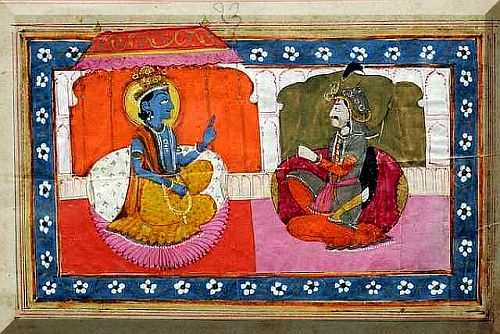
Arjuna requests Krishna to recapitulate the teachings he imparted on the battlefield at Kurukshetra as most of that had “gone out of his mind “.

yattu tadbhavatā proktaṃ tadā keśava sauhṛdāt । tatsarvaṃ puruṣavyāghra naṣṭaṃ me naṣṭa cetasaḥ ॥ 6॥

Krishna obviously is not pleased with his disciple, nevertheless agrees to impart the instructions. Krishna mentions, “It is now virtually impossible for me to repeat my earlier instructions verbatim”. In lieu of that, he says, he would try to teach similar instructions through certain ancient stories (Purathana Ithihaasa). Krishna’s rendering, which then followed is “Anugita” (anu = after or later).

paraṃ hi brahma kathitaṃ yogayuktena tanmayā । itihāsaṃ tu vakṣyāmi tasminnarthe purātanam ॥ 12॥

**

Anugita is spread over 34 chapters (from 16th to 50th) of the Ashvamedha Parva. It comprises three sections. The subject matter of the text pertains to transmigration of souls, means of attaining liberation, and discussions about gunas, ashramas (stages of life), Tapas (penance), Yoga and Dharma.

  • The first section of the text is a discussion between a Siddha (the one who has attained) and a descendent of Kashyapa.
  • The second is a discussion between a Brahmana and his wife; and
  • the last one is a discussion between a Guru and his disciple.

All the three discussions are narrated by Krishna.

Anugita is not a well-known work despite its considerable antiquity and its somewhat different presentation of the later Upanishad thought. Though Sankara quoted from it a couple of times, its general appeal is rather limited and the text is not often discussed.

It looks certain that Anugita is a later insertion into Mahabharata. Rishi Veda Vyasa was therefore not its author. Its authorship is unknown. The question whether its three sections are the work of one author or whether the writings of different authors were put together to form the text, is also a matter of debate.

The renowned scholar Kashinath T Telang, who first translated the text into English during 1880, after much discussion concluded, “Upon the whole, therefore, we here conclude, though not without doubt, that the whole of the Anugîtâ is the work of one author.”

The age of the text is uncertain. All scholars agree that Anugita is an ancient text, but argue about its age. Kashinath T Telang after a lengthy and an interesting analysis plots the age of Anugita as under:

*Anugita belongs to a period far removed from the later Upanishads.

*Mahabharata and Bhagavad-Gita preceded Anugita by several centuries.

*Anugita just preceded Jainism, Buddhism and Yoga philosophy.

*Anugita is much older than Apastamba’s Dharma Sutras.

*Bhagavad-Gita, Anugita and Dharma Sutras of Apasthamba belong to different stages of ancient Indian society. The stage to which Bhagavad-Gita belonged is the earliest and the stage to which Apasthamba belonged to was the latest.

*Anugita is several centuries earlier to Puranas. The theology of Anugita is closer to that of the Vedas, as Mitra, Varuna, Agni and Prajapathi are the major deities in Anugita.

*It would therefore seem that Anugita belongs to a period prior to the sixth century B.C.

(http://www.sacred-texts.com/hin/sbe08/sbe0827.htm)

The language and style of Anugita are not quite smooth, as compared to Bhagavad-Gita. Anugita is a rather difficult text. Lucidity and clarity are not among its strengths. It is riddled with ambiguity, at several places. Its commentaries by Arguna Mishra and Nilakantha too suffer from similar defects. Added to that, its translations into English by KT Telang and KM Ganguli are also not easy to read either, peppered with numerous footnotes and explanations. It is not surprising the text is not very popular among the general readers.

Nonetheless, Anugita is a valuable ancient text, which provides a unique perspective to Indian philosophical themes following the Upanishad style of exposition. It deals certain subjects more comprehensively than Bhagavad Gita does. It encourages human enterprise and endeavor; and asks one to think for oneself, analyze and find ones way to liberation rather than depend on external aid or look for divine intervention. Certain of its passages are beautifully written. I wish more people pay attention to this ancient text. It deserves serious study .
512APo+udnL._SY344_BO1,204,203,200_ (1)

The first section of the text is a discussion between Kashyapa a learned Brahmana and a Siddha that is a Spiritual Master. It commences with Kashyapa requesting for instructions about rebirth and the way to attain liberation from cycle of births. The Siddha at the outset points out that the sacrifices at best lead to the short-lived pleasures of celestial abode (swarga).They are not the right means for escape from the cycle of births.

Kashyapa then desires to know how the soul departs from the body; and then how the body is produed.The Master in reply comments on the irregular living habits of the humans. Thanks to merits inherited from previous births, a person is blessed with health, fortune and fame; but soon he throws away those benefits by his irregular living.

He eats sometime to excess, sometimes nothing. He eats highly spiced meal and sleeps all daylong. He catches lethal diseases. An unhealthy heat generated in his body, kindled by irregular heavy breathing, hinders the body functions and blocks the vital forces (winds).As the compact association of the five elements is broken up, the life, tormented, leaves the body.”

rasāti yuktamannaṃ vā divā svapnaṃ niṣevate । apakvānāgate kāle svayaṃ doṣānprakopayan ॥ 12॥ sva doṣa kopanādrogaṃ labhate maraṇāntikam ।
atha codbandhanādīni parītāni vyavasyati ॥ 13॥

The Siddha continues his lesson on the future of the soul which either goes up to heaven or goes down to hell, until it becomes an embryo: “Just as melting iron takes the shape of the mould, the soul slips into the embryo. Just as a lit lamp lights a room, the conscience lights the body “.

yathā hi lohaniṣyando niṣikto bimbavigraham । upaiti tadvajjānīhi garbhe jīva praveśanam ॥ 8॥ lohapiṇḍaṃ yathā vahniḥ praviśatyabhitāpayan । tathā tvamapi jānīhi garbhe jīvopa pādanam ॥ 9॥ yathā ca dīpaḥ śaraṇaṃ dīpyamānaḥ prakāśayet । evameva śarīrāṇi prakāśayati cetanā ॥ 10॥ yadyacca kurute karma śubhaṃ vā yadi vāśubham । pūrva deha kṛtaṃ sarvam avaśyam upabhujyate ॥ 11॥

One has to break that chain by cultivating a discipline of renunciation from attachment to senses, to objects, to opposites and to excesses. One should look upon this universe as transient, like an Aswath tree, always full of birth, death, and old age. Restraining the senses, one should fix the mind, as a lamp, on the Spiritual Principle (mahat).

“The jiva sees the self come out from the body; and abandoning his body, he perceives the Self, — holding it to be the immaculate Brahman,—with, as it were, a mental smile. Then depending upon it thus, he attains final emancipation in me. “

sukhaduḥkhe sadā samyaganitye yaḥ prapaśyati । kāyaṃ cāmedhya saṅghātaṃ vināśaṃ karma saṃhitam ॥ 30॥ yacca kiṃ citsukhaṃ tacca sarvaṃ duḥkhamiti smaran ।saṃsāra sāgaraṃ ghoraṃ tariṣyati sudustaram ॥ 31॥jātī maraṇarogaiśca samāviṣṭaḥ pradhānavit । cetanāvatsu caitanyaṃ samaṃ bhūteṣu paśyati ॥ 32॥nirvidyate tataḥ kṛtsnaṃ mārgamāṇaḥ paraṃ padam । tasyopadeśaṃ vakṣyāmi yāthātathyena sattama ॥ 33॥

**

The second section is a discussion between a learned Brahmana and his wife. She is rather anxious about her afterlife. “What sort of Salvation awaits me?” The husband reminds her of the Absolute in every being. He tells her,

The temple is inside me. The temple cannot be smelled by the nose, nor tasted by the tongue, nor felt by the touch. Its access is through the mind.”

It is from which the whole expanse of universe proceeds and on which it rests. It is from here the five breaths (vayus) Prana, Apaana, Samana, Vyana and Udana proceed and into it, they enter.

vairāgya buddhiḥ satataṃ tāpadoṣavyapekṣakaḥ । ātmabandhavinirmokṣaṃ sa karotyacirā diva ॥ 9॥agandha rasamasparśamaśabdamaparigraham । arūpa mana abhijñeyaṃ dṛṣṭvātmānaṃ vimucyate ॥ 10॥ pañca bhūtaguṇairhīnamamūrti mada lepakam । aguṇaṃ guṇa bhoktāraṃ yaḥ paśyati sa mucyate ॥ 11॥

In the midst of those life-winds, which move about in the body and swallow up one another, the Vaishvanara fire blazes seven-fold. The nose, tongue, ears, eyes, skin, mind and the understanding are the seven tongues of the Vaishvanara. The objects of smell, taste, sound, color and touch as also that which is to be thought and that which is to be understood are the seven kinds of fuel (offerings). The sensations of smell, sound, sight etc are the seven officiating priests. These seven pour seven offerings into seven fires (meaning that he, who smells, tastes, hears and so on, and pours into his organs of perception the perceived information.). By restraining the senses and the mind and by pouring (offering) the objects of those senses and the mind as libations into the sacred fire of the Soul within the body, one performs the Yajna. The commentators clarify, here, that it is the senses that enjoy; and not the Soul.

Brahmana then explains the principle of Chaturhotra, the four-sacrifices.The nose, and the tongue, and the eye, and the skin, and the ear; and the mind and the understanding, these seven, acquire the knowledge about the qualities of the objects. Smell, taste, color, sound, and touch as the fifth, the object of the mental operation and the understanding, these seven, lead to action. He, who smells, eats, and sees, and so on is the agent. It is from these seven the Self is to be emancipated. The instrument, the action, the agent, and emancipation are the four Hotris by whom this universe is enveloped. (The commentators remark the intention of the author has not come out here clearly).

The ten organs (The ear, the skin, the two eyes, the tongue, the nose, the two feet, the two hands, speech, the genital organ, and the anus) are the makers of the offering. They are the ten priests at the Yajna. The Sound, touch, color, and taste, smell, words, action, motion, and the discharge of semen, urine, and excrement are the ten oblations (offerings). Thus, the ten organs are the offers; the ten objects of senses are the offerings. They are offered into ten fires. The mind is the ladle; and the benefit is the pure highest knowledge.

The  ego (self) within the body the upholder of the frame,  is the Gârhapatya fire; and into this the offering is thrown.

The ego (self) asks for everything knowable in the universe as its offering. This is the internal Yajna. This Yajna is going on daily in this body and it is going on everywhere in the world, outside and inside.

There are often conflicts between the mind and the organs of senses. The senses point out that without their functioning, mind would not apprehend anything. The five Vayus argue among themselves, which among the five is the most important. The mind in turn points out that in its absence, the senses have no purpose and cannot function. Brahma, the creator resolves the dispute,

You are all greatest, and not greatest. You are all possessed of one another’s qualities. All are greatest in their own spheres, and all support one another. There is one unmoving vital. The others are moving about in the body. Being friendly with one another, and pleasing one another, go away happily. Welfare be to you. Support one another.”

The discussion then shifts to which of the five Vayus came first and how do they move about in the body. Brahmana explains that the combination of Udana and the mind produces the sensations and the desire. Vyana and Samana produce blood and semen. The combination of semen and ovaries produce Prana, which is followed by Apana.The pair-Prana and Apana- move upward and downward in the body. The other pair of Samana and Vyana move transversely. Samana’s function is the digestion of food, while Vyana distributes the essence of the digested food to all parts of the body through the Nadis. Prana and Apana controls Samana and Vyana. The former two-Prana and Apana- are in turn controlled by Udana, which thus controls all the rest life-winds. Into that Udana, all the other life-winds merge. Udana in turn is controlled by penance (Tapasya). Penance and Yoga then destroy the round of rebirths and leads to absorption into Brahman.

The fire in these passages stands for Self. One has to get rid of all notions of conflicts and dualities of existence and non –existence, by offering them into the fire of Self. That is the yajna leading to the final emancipation.

There is then a discussion about the difficulties in understanding within the forest of knowledge. For instance, the syllable Om might not mean the same to all. The snakes may take it to mean, “to bite”, the demons “to deceive”, the gods “to give” and the sages “for self-control” etc.

This is followed by a discussion that upholds the virtues of non-violence.

The second section concludes with the thought that there is no single way to final emancipation but there are many. One has to choose the apt way for him.

The Brahmana’s wife attains her emancipation.

Krishna ends the second section with a remark that the Brahmana in the discussion represented Manas (intuition) while his wife represented Buddhi (intellect).All truths are not understandable by the intelligence alone.

***

The third section comprises a discussion between an enlightened Guru and his disciple. The discussion commences with the disciple submitting a comprehensive plea “which is the highest truth? What are called the qualities by the good? And what paths are happy? What is pleasure and what sin?”

The Guru launches into an elaborate explanation of the scheme of the three Gunas-Satva (the very fact of being -goodness), Rajas (the dust- passion) and Tamas (darkness).

The word sattva is derived from “sat”, which conveys the meaning of being or existing. It also has the sense of real or true. Sat also means good or virtuous. Thus sattva literally means “existing-ness” or goodness.

The word rajas is derived from the verbal root “raïj-” meaning of which ranges from “being colored”, to “being affected or attracted”. The word is used to denote things which color or partially darken the sky, such as mist, clouds and dust. In a more abstract sense it refers to emotion and powerful and controlling feelings.

Tamas is darkness. It is opposed to sattva in being heavy (guru) and in causing ignorance (ajïäna), by obscuring knowledge (jïänam ävåtya) and the ability to know. It also resists rajo-guëa as it restrains the motion of things and produces the state of apathy and indifference. The predominance of tamo-guëa thus results in indolence, sleep and confusion

Tamas the Darkness is associated with obscurity, delusion, depravity, ignorance, apathy, error and sinful actions.

Rajas the Passion is associated with activity, desire, impurity, passion, feelings and misfortune. When it prevails, it causes more actions, production and restlessness.

Satva the goodness is marked by light, lightness and faith. It is associated with the values of Virtue, kindness, purity and happiness; indicating that that existing is not contemptible or regrettable.

The gunas cannot be explained altogether distinctly from one another. Rajas, Satva, and Tamas are mixed up with one another. They are attached to one another, serve one another, they feed on one another. They all depend on one another, and likewise follow one another. They act, unperceived, by turns in the several places in several ways. Everything in the world is made of these three gunas. The creation of the gunas is eternal.

As long as there is goodness so long, darkness exists. And, as long as goodness and darkness exist, so long the passion exists. They perform their journey together, in union, and moving about collectively.

Where Tamas is dominant in the lower entities, there the Rajas is present to a little extent, and the Satva to a lesser extent. Where Rajas is dominant, there Tamas is present to an extent and Satva to some extent. And, where Satva is developed, there the Tamas is in a little extent and Rajas to some extent. The shortcoming of one of the gunas leads in every case to the excess of the others.

Where Tamas is restrained, Rajas prevails there. Where Rajas is restrained, Satva prevails there .Whatever there is in this world, all that is made of these three qualities

The light of the sun- it is the Virtue (Satva), its heat the desire (Rajas), its eclipses the darkness (Tamas): in such a way, the three tendencies spread in all the stars.”

Those who adhere to the ways of Satva go up; the Rajas remain in the middle; the men of the quality of Tamas, being connected with the lowest quality, go down.

He who understands correctly the unperceived, and the gunas, and its pure operations, he, freed from the body, understanding the truth about (all) distinctions, and being free from all misery, is released from all gunas.”

The discussion then continues, taking up typical notions of samkhya, explaining how the world is built from the Unmanifested (avyakta) to the Great Soul (mahat), then to the self-awareness (ahamkara), then to the material and subtle elements. The Samkhya is a dualistic system, separating the mind from the matter: the matter spreads in order that, at the end, the mind does no more need it, and discovers its profound independence.

That is illustrated by the image of a dancer bewitching her spectator until the latter discovers the illusion represented by this dance. Besides, the discussion puts the emphasis on the impermanence of this world, on the necessity to end ones life as a hermit:

who brings from all sides his senses back into himself as a tortoise its limbs to obtain the Sacred (Brahman). He, who, at the time of his death, withdraws into himself not becoming confused; he, who masters his breathing by means of respiratory exercises, obtains immortality.”

Finally, the discussion ends by an invitation to meditate.

“Expelling all impressions and restraining the self in the Self, he understands that holy Brahman, than which nothing greater exists. …One who is alike to all beings; who is without attachment; who is without expectations, and who looks alike on everything can reach this goal. I have now declared everything to you. Act thus forthwith; then you will acquire perfection.”

Arjuna finally questions Krishna, who was the Guru and who was the disciple.

Krishna replies,” I am the preceptor, the mind is the pupil.” The commentator Arguna Mishra explains it;” The meaning of this is that anybody who has not acquired knowledge is treated here as a pupil; there is no other special pupil intended.”

You are all greatest, and not greatest.
You are all possessed of one another’s qualities.
All are the greatest in their own spheres,
and all support one another.

Being friendly with one another,
and pleasing one another, go away happily.
Welfare be to you! Support one another.
6a00d8341c73fe53ef00e550bc80098833-640wi

CONTINUED IN PART TWO


References:

http://www.phx-ult-lodge.org/anugita.htm

http://www.sacred-texts.com/hin/sbe08/sbe0827.htm

Introduction to Anugita     https://www.sacred-texts.com/hin/sbe08/sbe0827.htm

Next:

Anugita (2 of 2)-
 
9 Comments

Posted by on September 6, 2012 in Anugita, Indian Philosophy


Tags:

Evolution of Dharma (3 0f 3)

Dharma in Mimamsa and Vaisheshika systems

Dharma in the Purva Mimamsa is used in a rather restricted sense;”Codana-lakshnortho dharmaha”. Dharma is the desired goal as per scriptures. Purva Mimamsa (1.1.2) speaks of Dharma as Vedic rituals leading to happiness and heaven; and saves one from degradation and suffering. It also talks in terms of Apurva, which means the subtle effect of actions performed in accordance with the scriptures.

Jaimini defines Dharma as that which is enjoined by the Vedas and which does not lead to suffering.

Kanaada in his Vaisheshika Sutra (1.2) defines Dharma as” Yato bhyudayanih- sreyasa siddhih sa dharmah“, that which leads to the attainment of prosperity (in this life) and eternal bliss (beyond life).Dharma here mean actions approved by the scriptures, religious practices and rituals, unseen results of such actions or the very fabric of ones life.

Compare this with what Krishna tells Arjuna in the Gita: Sacrifices will not lead to heaven if the desire for heaven is the sole motive of such rituals. Sacrifices are effective only when conducted with a sense of duty.

Dharma in Dharma Shastras

Dharma Shastras are made up of a vast number of texts produced over the centuries. There are literally hundreds of Dharma Shastra texts and a far greater number of related commentaries and digests. The principle Dharma Shastra texts include four Dharma Sutras of Aapasthamba, Gautama, Bahudayana and Vashista. Four important Smritis of Manu, Yajnavalkhya, Shanka and Parashara follow them. There are of course innumerable commentaries and digests on these texts. The modern Hindu Law relies on treatment of certain subjects by these texts; of course with suitable modifications and necessary revisions.

Dharma Shastras claim they derive their authority from the Vedas, but hardly any of their contents can be linked to Veda texts. They do, however, accept the authority of the Vedas and stress that moksha, liberation, is the ultimate goal of human life. They also recognize the need for reflective morality. ”The Vedas, Smritis, usages of good men , what is agreeable to one’s self and desire born of deliberation-these are traditionally recognized as the source of Dharma”(Yajnavalkya Smriti-1.7). However, the Vedas enunciated abstract principles and contained little concrete discussions on duties. The smritis were mainly digests of the prevailing practices. Therefore, for all practical purposes custom defined as “what is in vogue and is long standing” was the dominant source of the Dharma.

Dharma Shastras categorized under Smritis, the secondary texts, are commonly described as Law Books. They are however not in the form of the law books that we know. They are not codified substantive laws or legal norms. They are more in the nature of a body jurisprudence, a collection of numerous treaties produced by sages on various subjects such as daily rituals to be observed in each of the four stages life; duties of four varnas, customs, rights and obligations; rules and procedures for resolving doubts and disputes on issues of Dharma; and rules for punishment and penances for violations of the rules of Dharma etc..

Dharma Shastras made extensive use of Mimasa methods to reconcile conflicting texts of equal authority by applying its various rules for interpretation of words, phrases and sentenses.It adopted the Mimamsa style of argumentation. The other disciplines, on which Dharma Shastras relied heavily, were the grammar (Vyakarana) and logic (Nyaya).

Dharma Shastras are an impulsive mix of religion, morality and points of law. It is not easy to separate the one from the other. These texts derived their importance as the sources of religious law describing the life of an ideal householder; and as summations of knowledge about religion, law, ethics etc. It is perhaps because of their heavy religious content and reliance on religion, these texts came to be known as Dharma Shastras.

There is a world of difference between the Dharma of the Rig Veda, Upanishads and the epics on one hand, and the Dharma of the Shastras on the other. Dharma of the Shastras is not the Atman or the sublime cosmic order that governs the universe and sustains our existence, as the Rig Vedic Rishis envisioned. It is also not the universal principle of law, order and harmony as envisaged in the Upanishads. Nor is it the ordained duties or the Sathya, the pristine Truth as in Ramayana. Dharma here is not the one that which upholds the world, as in Mahabharata. Dharma here does not refer to the duties as ordained by the scriptures or even to Atma jnana as propounded in the Bhagavad-Gita.

Bhagavad-Gita viewed moral and spiritual merits as duties of the Brahmanas. The Dharma Shastras construed them as a means of livelihood for the Brahmanas. The old spiritual interpretations of those merits were smudged into dogmatic rules . Imparting instructions , officiating at the sacrifices , receiving gifts , became the special occupation of the Brahmanas.The distinction between spiritual obligations to the society and an occupation for earning a living was lost.

The Dharma these Shastra speak about is not universal. It is not applicable to entire creation or to all human beings. It is not even applicable to all segments and classes that compose the society. Its prescriptions are not valid for all times to come, either. The Dharma of these Shastras has very limited jurisdiction and authority. Their application is very specific and circumscribed by the limitations of Desha (region), Kaala (times) and Achara (valid practices of a region or of a class of people).

The texts viewed the society not as a collection of individuals but as a community of communities. It was articulated into specific castes, each with its economic functions and a place in the social hierarchy. An individuals Dharma was derived from the caste of his birth. One of the purposes of the texts seemed to be to keep the members of the society within their assigned roles.

Dharma Shastras are principally concerned with the rights and privileges of upper castes, consecratory rights (samskaras), stages of life, rules of eating, duties of the kings, legal procedures, eighteen titles of law, categories of sin, expiations and penances, funeray and ancestral rites(antyesti and shraddha) and atonement rites(Prayaschitta) etc. They are thus mainly occupied with the religious rites of a certain class of people and to an extent with the personal laws of marriage, inheritance etc; and they generally aim to induce ‘appropriate behavior’ of human beings.

Let me quote from Patrick Olivelle ‘ book on Dharmasastra :.

Dharma includes all aspects of proper individual and social behavior as demanded by one’s role in society and in keeping with one’s social identity according to age, gender, caste, marital status, and order of life. The term dharma may be translated as “Law” if we dp not limit ourselves to its narrow modern definition as civil and criminal statutes but take it to include all the rules of behavior, including moral and religious behavior, that a community recognizes as binding on its members.

In short, these unique documents give us a glimpse if not into how people actually lived their lives in ancient India, at least into how people, especially Brahmin males, were ideally expected to live their lives within an ordered and hierarchically arranged society.”

The subject-matter of the Dharmasutras, therefore, includes education of the young and their rites of passage; ritual procedures and religious ceremonies; marriage and marital rights and obligations; dietary restrictions and food transactions; the right professions for, and the proper interaction between, different social groups; sins and their expiations; institutions for the pursuit of holiness; king and the administration of justice; crimes and punishments; death and ancestral rites.

Many concepts of the Dharma Shastras might look, today, rather grotesque and outdated; and are therefore not acceptable in their entirety. That is not surprising at all; since those texts were addressed to a people of a particular time who lived their life in the context of their times. Those laws were also not meant to cater to the needs of all people at all times. The texts themselves emphasized the need to revise their prescriptions to keep in tune with the changing needs and demands of the individuals and the society. It is to the credit of the self-balancing genius of Hinduism that it has discarded the inconsistencies and anachronisms of the Dharma Shastras, in a dignified way and tried to retain the best the texts have to offer; while at the same time assimilating new currents of thought and transforming itself into an evolving and an expanding religious tradition.

Dharma Shastras are not of much practical significance today, as its secular aspects dealing with marriage, right to property, inheritance etc. have since walked into the modern Hindu Law, through an indirect route. How that happened is rather interesting. The early British in India tried to dispense law according to local customs.The process was hastened with the establishment of Supreme Court in 1774. For the benifit of the English Judges ignorant of Sanskrit , ancient Sutras relating to civil matters of person and property( Vyvahara) were translated into English. The one text that received greater attention in that context was Jagannatha Pandita’s Nibhanda on Vyvahara. Its translation was completed during 1794. Thereafter the English scholars attempted to codify the Shastras and to establish the chronological sequence of the texts in order to trace the authority to a single original source. Their attempts were not successful and an agreed – on authoritative chronology could not be established. However, by 1864, the long years of these exercises yielded a peculiar kind of case law in the form of a chain of interpretations by the English judges based on what they thought were the authoritative portions of the Hindu texts. This completely transformed the “Hindu Law” into a form of case law. What we have today is a forest of citations referring to previous judges decisions- as in Anglo Saxon – derived legal systems; and it is left to the skills of the judges and lawyers to find the precedent and to make the law. Those precedents are again those that were set up by the English judges. What started as a search for the “ancient Indian Constitution” ended up with English law for India and Indians -just what Indians would have wanted to avoid.

Further , the case-law was compiled without understanding the basic fact that in the Sutra the ‘secular’ and ‘religious’ aspects of Hindu -life are not strictly seperate; but, they are closely interwoven in the Hindu motives and actions. In the ancient Indian criminal-law too the  religious and secular punishments were intermixed. An offence was treated both as a sin and as a crime.

In addition , by the time the British took to applying the ancient Dharmasastras to the Hindus of the 18-19th century , the Indian society had moved much further away from the society of the Sutras. For instance, the Sutras viewd human life as one continuous span stretching from the womb to death and even beyond to the next birth. There was much emphasis laid on purification cermonies  (shuddhi) and on sacraments (samskaras). But , by the time the British took to administering  civil and criminal laws , the Indian socity had passed through Muslim rule. Many of the old beleifs and rituals had vanished and a certian amout seceptisim and ‘irreligious’ attitudes had crept in. The ancient Sutra injunctions were no longer relevant in most cases.

These limitations and lack of proper understandin of the Indian context  have led to narrow and restrictive interpretations of codified statues, especially in matters relating to family law and law relating to religious endowments. The rulings at times fail to serve the cause of Dharma or of justice. Therefore, the Hindu law, as we have today cries out for a re- look. However, unfortunately in the present socio-political environment in India, reform of religious law is a contentious swamp that legislators generally try to avoid. Further, the study of Hindu law is neglected due to the combination of declining knowledge of its classical foundations; and the pressures of modern political correctness. Studying Hindu law is often looked down as a regressive activity, threatening the minorities in particular, and the women.

In any case, in the present context, the secular functions of the Dharma Shastras have to find their survival in the personal law and civil law books. There is no other way.

Coming back to the connotation of the term, Dharma in the Dharma Shastras broadly meant ‘appropriate behavior’ of human beings in a given context. The term also had religious and caste overtones. With the metamorphosis of Dharma Shastras into Hindu Law, the elements of caste and gender have largely disappeared. In order to ensure fair and equitable dispensation of justice,Dharma now needs to be interpreted in terms of universal non-hierarchical norms for right conduct.

A question that is often asked is, whether Dharma is relevant today. The answer is; yes, it is.

Because man is free to select his options, he needs to think and understand that any human activity, including inaction, has the potential to cause a chain of consequences. It is therefore important to choose an appropriate path. One has to therefore look within oneself, judge the situation and act in the best interests of the self and of the fellow beings. That which guides us along the right path and elevates us is, in reality, the Dharma.

One of the strengths of Dharma is that it is preventive rather than punitive. It prevents us from going down the path of degradation and decay. It safeguards the values of life, the quality of living and the wellbeing of us and of our coming generations. Dharma is therefore relevant at all times.

The Rig Vedic concept of Dharma as Atman or as an all-pervading cosmic order is sublime; but is ethereal and beyond the ken of a common person. Similar is the Upanishad view of Dharma as a universal principle of law and harmony. That is also not easy to grasp. If one has to appreciate a concept, one necessarily has to relate it to ones experiences in life. One can relate to the trials, tribulations and dilemmas faced by the men and women of Ramayana and Mahabharata .That is the reason for the immense popularity and adulation for the heroes of those epics. Generations of Indians in their quest for right answers to their problems , moral dilemmas and to a meaning for their life, have sought guidance and inspiration from the illustrations of Dharma as demonstrated in Ramayana and Mahabharata. They have grown up in amazement, reverence and appreciation for the equanimity, fair dealing and dignity, displayed by the epic heroes in their hours of distress. It also helped to strengthen their faith that right means will eventually lead to the right end.

The Dharma of Ramayana teaches honouring ones ordained duty, in the context; and adherence to Truth amidst temptations. That is relevant today too.

The Dharma of Mahabharata asks you to see through the evil and devise appropriate approach and action to safeguard the larger interests of Dharma and to perpetuate a living Dharma, at any cost. That is still relevant. Its call to put Dharma into practice and to experience it in life is also relevant.

The message of the Bhagavad-Gita to discover you true potential, to explore it with skill and diligence; and to live an authentic life, is relevant forever .Its emphasis on commitment to work, ethics and detachment is very relevant in today’s world.

Dharma Shastras’ concern for an orderly, peaceful and harmonious living of a person with his family, his society and the world, is relevant today too. Its statement that Dharma as a source of law and consciousness should influences the functioning of the State in its day-to-day governance is also relevant.

Dharma is not a stagnant concept; but it is a living experience. It is evolving itself all the time, constantly interacting with the challenges, demands and needs of the times. At each stage of its unfolding, it acquired a newer interpretation in the context of the life and events of that period while retaining all its other interpretations accumulated over the ages. What was amazing was that each one of its interpretations was as valid as the rest of them. Dharma is a many splendored thing. It is ever fresh and inventing itself all the time. That is because, Dharma is fundamentally related to life and its essence is in living it, practicing it and experiencing it. Dharma, in whatever form, will be relevant at all times.


**********

 
1 Comment

Posted by on September 6, 2012 in Dharma, Indian Philosophy


Tags: ,

Evolution of Dharma (2 of 3)

Dharma in Mahabharata

Ramayana, basically, is a story of chaste love between a husband and wife; and their unwavering adherence to Dharma throughout their trials and tribulations. The main characters in the story are not many in number; and the story covers a period of about fifty years. The evil was easily identifiable with its grotesque exterior and it had its base in far off lands. Ramayana demonstrated that a person of steadfast faith established in Dharma would eventually vanquish evil and ignorance. Fundamental to the defense of that Dharma was the sanctity of a Sati, a pure woman. Indeed the entire nature, its elements and animal world made common cause with Rama in re-establishing the Dharma. What characterizes the Dharma in Ramayana is its innocence, purity and nobility.

The canvass of the Mahabharata on the other hand, is much wider; the subject matter is rather sullied and its characters are too many in number, spread over several generations. They have a very complicated mental makeup too. The evil is neither easily identifiable nor is it far away. The evil in fact had entered the hearts and minds of almost all of its men and women, who came from the common heritage. The most brazen act of evil by the Kauravas was threatening a woman’s chastity; and with that, the Kauravas sank to the lowest level of adharma. The conflict that eventually took place was not between the absolute right and the wrong; but between two groups of cousins and their supporters; with a sprinkling of the noble among the crowds of not- so- noble. Pandavas themselves were not perfect, either. The stepping in of Krishna alone rescued the epic from degenerating into internecine family feud; and elevated it into a conflict of great significance to uphold Dharma. He taught the world that the ultimate conflict was not about land, riches or power but about the human spirit , the Dharma.

Vyasa says the purpose of writing Mahabharata was to ” engrave Dharma on the hearts of men”. Mahabharata , among other things, makes some great statements on Dharma ; such as :

”Our bodies are short lived, wealth does not last long, death is constantly knocking at the door; therefore accumulate Dharma”

(anityani sarirani vaibhavo naiva sahvataha, nityam sannito mrtyuh kartavyo dharma-sangrahah)

“It is Dharma since it upholds. Dharma is that which upholds the people of the world.”

(Dharanath dharmam ityahuh dharmo dharayate prajaah)

“Dharma, cultivated, preserves; Dharma, violated, destroys.”

(Dharma eva hato hanti, dharmo rakshati rakshitaha);

“Where there is Dharma, there victory also is”

(Yato darmah thatho jayaha);

Yet, the Dharma pictured in Mahabharata is ambiguous, uncertain and often disputed. For instance, Draupadi after the dice game, demands to know whether Yudhishtira had a right to stake her in the game after he had staked and lost himself. It was so difficult a question that even Bhishma, the recognized authority on Dharma, when pointedly challenged by Draupadi, confessed his inability to decide the issue.

“What a strong man says often becomes the only dharma. A weak man may have dharma on his side, but who listens to him? To tell you the truth, I do not know what to say” (Sabha Parva. 69.15-161).

”I am unable to answer your question because Dharma is subtle”, he says

(na dharmasaukshmyat subhage vivektutm shaknomi te prasnam imam yatthaavat).

Dharma is subtle (sukshmam) because its essence is concealed in a dark cavern

(dharmasya tattvam nihitath guhaayaam).

On another occasion, Draupadi wonders why they have to suffer so, if they were the righteous ones. If everything happened by the will of god, why then do the virtuous suffer? She exclaims, it seems only the powerful escape harm, not the righteous. Yudhishthira tries to explain: “None should ever perform virtue with a desire to gain its fruits.. … Do not doubt virtue because you do not see its results. Without doubt, the fruits of virtue will be manifest in time, as will the fruits of sin. The fruits of true virtue are eternal and indestructible”.

Years later, Yudhishthira has similar doubts. Soon after the war, he was overwhelmed by a sense of horror and melancholy; and was much troubled by the death and destruction caused by the war. His grief was inconsolable. Bhishma lying on his deathbed consoles him by teaching Dharma and the duties of a king, which includes rightful violence without greed. He also talks about Dharma in abnormal circumstances; and the absolute perspective that transcends the duality of good versus bad, right versus wrong, pleasant versus unpleasant. Yet Yudhishthira is unconvinced and decides to perform Rajasuyaga as penitence for the acknowledged wrongs of the war.

Mahabharata introduces the concept of Apad_Dharma, a sort of safety valve in an emergency when every other normal measure seems to have failed. It relates to stressful times of extreme distress or calamities, which threaten to endanger Dharma. In such circumstances, it might become necessary for Dharma to abandon its usual course, for self-protection. Apad_Dharma is that deviation from the normal. What is Adharma in normal circumstances might be deemed Dharma in Apad_Dharma. That is in the larger interests of the Dharma and for the benefit of others (loka) but not for personal gain. The logic behind this principle is, the ultimate Dharma (larger picture) has to be protected at any cost. That is why Dharma is profound and subtle. It is context sensitive.

Krishna guided the Pandavas to victory on the battlefield of Kurukshetra, often by miraculous intervention, avenged Draupadi and restored Dharma. Unlike Rama, Krishna did not adhere to conventional exterior of the Dharma. Rather, he judged the gravity and significance of each situation; and devised innovative methods to preserve and protect the essence of the Dharma. This often put him on a collision course with the conventional adherents of Dharma. Nevertheless, he justified his actions by insisting that the intense desire to protect the larger interests of the Dharma was at the core.

Pandavas, under his guidance, eventually broke each rule of the war: Arjuna shoots Bhishma when he lays down his arms before Sikhandin; Arjuna kills Jayadratha at “night” when Krishna simulates darkens; Arjuna shoots Karna when unarmed and Bhima crushes Duryodhana’s thigh (hitting below the waist).

On one occasion,  Krishna tells Yudhishthira: “Sometimes one protects dharma by forgetting it.”

Duryodhana accuses Krishna of unfair conduct; Krishna responds with two defenses: that it was his own deceit at dice that began this conflict, and the apparent unfair conduct was meant to defeat a greater evil: “The gods destroyed demons in the past in this way to protect Dharma”

Duryodhana bitterly replies that the Pandavas could never have won without cheating, to which Krishna agrees; right does not always triumph by ideal and unsullied means. “There are limits to the extent an individual can be moral in an immoral society”.

Karna laments as death nears him; his righteousness did not make him victorious: “Knower’s of dharma have always said, ‘Dharma protects those devoted to dharma.’ But since my wheel sank today, I think dharma does not always protect.”

Krishna taunts Karna, asking him whether he was referring to the same Dharma that prevented him from rising above his sense of obligation to Duryodhana, despite being aware of his evil designs; terming Draupadi a harlot and ordering her to be stripped in public.

That is precisely what the epic is about: the replacement of the dharma of a lower understanding by one of a higher level. It was that outdated, severely limited view of Dharma that Krishna was trying to root out and replace with a pragmatic Dharma. He emphasized, as he did in Gita that Dharma was in living and experiencing it; and not just in talking about it.

It is a validation of this fact we find in Bhishma who from his bed-of-arrows advises Yudhishthira on the duties, responsibilities of a king and the need to protect Dharma. Bhishma in fact had not practiced what he preached. He remained a mute witness to the aggression of Adharma. His inaction illustrated that Kshatriya’s “witness” stance brings about the destruction of the kingdom and of the Dharma. The Kshatriya must fight to protect the weak, for that is his dharma, the truth of his nature. Not being true to his Dharma because of inaction, brought destruction and misery to not only himself but also the society of which he was a pillar. Had Bishma acted in the true spirit of his Dharma, Mahabharata would have been a different epic.

[There is an interesting comparison between Bhishma of Mahabharata and Vibhishana (younger brother of Ravana) of Ramayana.  In either case, the person who occupied the throne they served tried to violate the chastity of a pure and a virtuous woman. Both those kings (Ravana and Duryodhana) had sunk to the lowest level of adharma. Both Vibhishana and Bhishma strongly disagreed with the acts of their respective kings. But, it was Vibhishana who had the courageous detachment to disassociate himself from the immoral regime of his king, his brother, and to join the forces of Dharma which his brother opposed. Vibhishana‘s unpopular decision was open to controversies and even to ridicule. Yet, Vibhishana was steadfast; he stood by his decision which according to him was the right one, by all counts.

In contrast, Bhishma the old-guard needlessly chose to cling to what he did not approve, because of his misplaced sense of loyalty. And, he eventually brought grief on to himself and unto others around him by his indecision and inactivity.His life too ends in a sort of irony with his past haunting to wound him mortally and thereafter prompting him to render lengthy discourses, from his death bed, on the things that he did not practice in life .His listener, too tired, too listless and disillusioned scarcely had time or opportunity to put into use what he learnt from the savant on a death bed of arrows.

Bhishma, it is said, was gifted with a boon to choose the time of his death. The death dare not approach him till he accorded it his permission. Yet, I sometimes wonder why he chose to live so long. It is sad to see a self-sacrificing , almost a god getting bogged in the mire of this world , meddling with everyone’s life and finally living on and on , unwanted and uncared when he could have chosen to end the agony. Bhishma endured so much pain in life and in battle that even the bed of arrows did not hurt him anymore. It was sad for one who didn’t even want to be born.

There is perhaps a lesson here , too much attachment and involvement in where it is not needed is not merely unrewarding but is dangerous too ; while at the same time sheer inactivity renders one irrelevant. Our texts have always talked about a sense of balance that life should have.]

Worse is the case of Drona who abandoned his swadharma and mortgaged his self-respect in exchange for royal patronage. Bhima taunts Drona, pointing out his selfishness and failure in life.

Yudhishthira exclaims, it is extremely difficult to ascertain who the good are and whose conduct could be taken as the standard of righteousness. Bhishma explains that the concept of Dharma is difficult, subtle and defies easy grasp. Bhishma, after explaining the difficulties in defining it, goes on to say, Dharma was ordained for the advancement and growth of all creatures; therefore, that which leads to advancement and growth is Dharma. Dharma was ordained for restricting creatures from injuring one another; therefore, that which prevents injury to creatures is Dharma. It is called Dharma because it upholds all creatures. Dharma is that which is capable of upholding all creatures. That which elevates is Dharma.

That which is called the conduct of the good may at times be stained by some errors. Fools, led by this, give up righteousness itself. On the other hand, wise men, avoiding those errors, take what is good and save themselves.

Bhishma tells Yudhishthira that in the Kali Yuga that had just stepped in, “dharma becomes adharma and adharma, dharma.” Somewhat paradoxically, he continues, “If one fights with trickery, one could oppose him with trickery. But, if one fights lawfully, one should check him with dharma … One should conquer evil with good. Death by dharma is better than victory by evil deeds.”

There is a touch of desperation in the voice of Vyasa as he comes towards the end of the epic. In Swargarohana parva he cries out with anguish, “With raised hands, I shout at the top of my voice; but alas, no one hears my words which can give them Supreme Peace, Joy and Eternal Bliss. One can attain wealth and all objects of desire through Dharma. Why do not people practice Dharma? One should not abandon Dharma at any cost, even at the risk of his life. One should not relinquish Dharma out of passion or fear or covetousness or for the sake of preserving one’s life”

The treatment of Dharma in Mahabharata is remarkable for its erudition, complexity and clarity of thought. The deeper you go into the epic the more you are impressed with its concern for the values of life, quality of living and for the wellbeing of the individual in harmony with the society. It touches almost every facet of human life. Its anxiety to safeguard the virtues and wellbeing of the coming generations is explicit in its every debate. The principle characters such as Krishna, Yudhistira are ever concerned how their actions might be perceived by the future generations; and are cautious not to set wrong precedents. The accent on healthy growth of Dharma and its perpetuation is primary to the unfolding of Mahabharata. This concern stems out of the strong faith that Dharma, the essence of right thinking and right living, is the law of being and is the basis of our existence. Our wellbeing and that of our future generations depends on that Dharma. It has therefore to be protected and perpetuated in the right way for the benefit of all, at any cost.

Because man is free to select his options, he needs to think and understand that any human activity, including in action, has the potential to cause a chain of consequences. It is therefore important to choose an appropriate path. If he had no options or if he was not free to choose, that is another matter. Mahabharata seeks to awaken the essence of Dharma within us, to learn to distinguish Dharma from its opposite. One has to look within oneself, grasp the true intent and spirit of Dharma in order to judge a situation and act in the best interests of the self and of the fellow beings. One may not always find ready answers to the problems at hand, in the external forms of Dharma; one may necessarily have to innovate the appropriate approach and action to safeguard the larger interests of Sathya and Dharma. That was the genius of  Krishna, who was far ahead of his times. It was he who stressed that the essence of Dharma was in living, practicing, experiencing it.

Shrinking from ones moral duty, refusal to act when it is difficult to act,attachment to objects and confusion- these weaknesses hinder the development individual and the society.

Introspection and innovation in order to experience, to protect and perpetuate a living Dharma, at all costs, is the message of Mahabharata and Krishna.

Dharma in Bhagavad-Gita

In Bhagavad-Gita, we find Dharma in a crystalline form. The term is employed in a more definite and clear sense. Dharma here is righteousness; the basis of all purusharthas (18.34).It is ones duty in the context of ones stage and calling in life. By performing his Dharma with diligence and skill, a person attains Abhyudaya, the well-being in this world and Nissreyasa, the highest good (4.8, 18.31, 1.40, 7.11 etc.).Dharma is also a synonym for Atma-jnana, Self-knowledge (9.30 and Karma yoga (2.40).

The Lord proclaims whenever Dharma is in decline and Adharma is on rise, I manifest myself (4.7).Here, Dharma connotes righteousness and the cherished values in life.

Bhagavad-Gita introduces an interesting concept of Swa_dharma, which broadly suggests : inherent aptitude or talent or interest or ability; authenticity or individuality; or that which comes naturally to you or your calling in life. It is the question of being and becoming. It asks you to realize your strengths, interests, aptitudes and call in life; and to develop your potential instead of wasting your time and energy on- things that are unnatural to you; or in imitating others or borrowing someone else’s ideas and goals. That could potentially lead to “fear inside”.

Swadharma underlines the importance of ones individuality, creative ability and authenticity in life; letting your potential to flower into something truly wonderful (Gita 3.33, 3.35).It is a commitment to yourself, to your potential and to your purpose in life. It is the art of living.

One of the ways to perceive your Swadharma is to engage in Swadhyaya, self-analysis, as suggested in Patanjali’s Yoga Sutra. The Self-analysis is both intellectual and intuitive, with the intuition leading the intellect. The accent is on realizing for oneself, for the sake of ones welfare.

Krishna asks Arjuna the warrior to perform his Swadharma and to fight on. How does a warrior perform his duty without doing wrong, not polluting himself with the blood of his fellow beings? The answer is detachment: do your duty without concern for the personal consequences. “Victory and defeat, pleasure and pain are all the same. Act, but do not reflect on fruits of the act. Forget desire, seek detachment.”

Apart from the way of undivided loving devotion, with mind fixed on the person of the Lord, with supreme faith and surrender, the Gita says there are two paths to liberation : renunciation and performing ones duty without desire. Since most cannot renounce all actions and intents in life, it is better to work without attachment (nishkama-karma). Gita emphasizes pravritti (engagement); and puts work , sense of duty and detachment in the hub of life.

Bhagavad-Gita thus highlights and develops a concept of work, ethics and detachment, as had not been elaborated in the earlier texts. It lays enormous stress on work, on practicing what you truly believe, on authenticity in life and on experiencing that in your life. That is the Dharma. It has scant respect for mere talk and not putting your belief into practice.

 img-t2

Read Next:

Dharma in Dharma Shastras And  After.

 
9 Comments

Posted by on September 6, 2012 in Dharma, Indian Philosophy, Mahabharata


Tags: , ,

Evolution of Dharma( 1 of 3)

Mr. Rajan in his blog What if Krishna became the Charioteer of Rama?, referred to the issue of the Yuga Dharma and obliquely to the dynamic character of Dharma. The idea of Dharma unfolding itself and acquiring newer interpretations at different stages and in different contexts, as it rolled on over the ages, fascinated me much.

Dharma is not a stagnant concept but a living experience; it is evolving itself all the time, constantly interacting with the challenges, demands and needs of the times. Dharma once visualized as the cosmic order, the eternal principle governing and sustaining the Universe; gradually metamorphosed into duties and responsibilities prescribed for varieties of beings in varied contexts and at different stages in the life of the society and the individual.

Along the way, it acquired an array of meanings and interpretations. At each stage, whatever was its form; Dharma was a point of reference to human existence; and a protection from confusions, delusions and upheavals. It always set an acceptable norm for a life well lived. Its underlying principle had always been the welfare of the society and the individual, leading to progress and harmony.

While talking of Dharma, one has to acknowledge the realities of life. The existence of evil in the individual and in the society is inevitable. It just cannot be wished away. At the same time, it is imperative to secure victory over that evil and injustice.

Victory in this context means: a progression towards the greatest good of all, leading to peace and development of all beings; harmony of the individual with himself, with the society and with the universe; establishment of the right values in life; and helping humans to attain their ultimate goal.

Dharma does not necessarily win the battle each time in that ongoing conflict. Dharma nonetheless relentlessly pushes on, striving to restore and maintain a sense of balance, fair dealing and harmony in life. Evil will always be there and will never be completely eradicated. But it is essential that Dharma assert itself over the evil now and hereafter.

***

Let us take a brief look at some definitions of Dharma and its evolution over the ages.

Dharma is a richly connotative term that stands for a universal principle that is not easy to define but not impossible to outline. Dharma is ultimately the basis for our existence, prosperity and fair dealing in this world. All the other principles and values in life flow from the fountain of Dharma.

Dharma has variously been explained as: the principle or the law that governs the universe; individual conduct in conformity with that principle; that which is established or firm or steadfast; what holds together; the essential function or nature of a thing; codes regulating individual and of social conduct; a body of teachings; a sect or a religion, a way of life; righteousness; justice; duty etc. Every form of life, every group of people has its Dharma, which is the principle or law of its being. The failure to observe Dharma would put the individual and the society in peril.

At another plane of consciousness, Dharma is a synonym for Truth, Atman and God.

The essence of Dharma, in any case, consists in living and experiencing it.

Dharma can mean any one, more, or all of those explanations, depending upon the context in which it is referred. That is because; the term was employed in a variety of ways down the ages in different contexts; and the connotation and the scope of the term underwent huge changes over the period. It would therefore be worthwhile to glance at its evolution.

Dharma in Rig Veda

Rig Veda adopts a multifaceted approach to Dharma. At one level, Dharma is the sublime cosmic order that governs the universe and sustains human existence. At another level, it guides the individual towards harmony with the universe.

Rig Veda does not engage in a systematic exposition Dharma. The seeds of Dharma are carried in the concepts of rta and sathya that Rig Veda refers to frequently. Rta is the natural or universal order and integrity of all forms of life and ecological systems. It recognizes our oneness with our environment and our unity with all life on earth. It is an inviolable cosmic order and Truth. Those were not imposed or created by God; but, in a sense, they are the God.

Rta is also used in the sense of consciousness of Truth; and when expressed through words and deeds it is Sathya. Rta in relation to an individual denotes his right conduct based on truth, the Dharma. Thus, the three terms Rta, Sathya and Dharma almost band together.

Dharma thus is not just harmony; it is pure Reality; it is also the law or right conduct based in Truth, which itself is also Dharma.

The term Dharma occurs in Rig Veda about fifty-six times (e.g.5.63.7, 5.72.2, 9.7.1, 9.25.2, 10.88.1, 10.170.2). In almost all the instances, it is used in the sense of duty or action, which contributes to the support or sustenance of the world. Atharva Veda too describes dharma symbolically: Prithivim dharmana dhritam, that is, “this world is upheld by dharma”.

viśvasvaṃ mātaram oṣadhīnāṃ dhruvāṃ bhūmiṃ pṛthivīṃ dharmaṇā dhṛtām |AVŚ_12,1.17a|

*

Dharma in Upanishads

The Upanishads continue the two-pronged approach to Dharma.

The Upanishads at one level see Dharma as the universal principle of law, order, harmony and the supreme Truth, Brahman. It is the law of being, without which one cannot exist- “anur esha dharmaha”- (Katha Upanishad 1.21). Dharma denotes Atman. It is Sat, the truth that Rig Veda proclaims in “Ekam Sat” (Truth Is One). It is also the Sat in Satchidananda (Truth-Consciousness-Bliss), the grand imagery of that Brahman.

The Brihadaranyaka Upanishad speaks of the identity of truth and Dharma:

yo vai sa dharmaḥ satyaṃ vai tat | tasmāt satyaṃ vadantam āhur dharmaṃ vadatīti | dharmaṃ vā vadantaṃ satyaṃ vadatīti |

Verily, that which is Dharma is truth.

Therefore, they say of a man who speaks truth,
‘He speaks the Dharma,’

Or of a man who speaks the Dharma,
‘He speaks the Truth.’

Verily, both these things are the same

 (Brh. Upanishad, 1.4.14)

Upanishads also speak of Dharma in the sense of duty or course of conduct, which contributes, to the sustenance of the society and its members. Mahanarayana Upanishad (1.4.14) calls it “Dharmo vishvasya jagathah prathista” – that which sustains the world.

Chandogya Upanishad (2.23.1) speaks of “trio dharma skandaha …” the duties in three stages of life as the offshoots or the braches of the Dharma. This refers to the obligations and privileges of a student, a householder and a hermit.

trayo dharmaskandhāḥ | yajño ‘dhyayanaṃ dānam iti prathamaḥ | tapa eva dvitīyaḥ |
brahmacāryācāryakulavāsī tṛtīyo ‘tyantam ātmānam ācāryakule ‘vasādayan | sarva ete puṇyalokā bhavanti | brahmasaṃstho ‘mṛtatvam eti || ChUp_2,23.1 ||

The Acharyaopadesha in Taitteriya Upanishad (1.11.1) instructs “Dharmam chara”- perform your ordained duties.

vedamanūcyācāryontevāsinamanuśāsti / satyaṃ vada / dharmaṃ cara / svādhyāyānmā pramadaḥ / ācāryāya priyaṃ dhanamāhṛtya prajātantuṃ mā vyavacchetsīḥ / satyānna pramaditavyam / dharmānna pramaditavyam / kuśalānna pramaditavyam / bhūtyaina pramaditavyam / svādhyāyapravacanābhyāṃ na pramaditavyam // (TaittU_1,11.1)

Here, in these cases, Dharma stands for righteous behavior based on truth, in accordance with the right conduct prescribed as per law in the context of ones stage and/or calling in life. It is in the best interests of the society and the individual. It shapes and sustains ones existence as an individual and as a member of the society. All other meanings, interpretations and derivations from the term Dharma, in the later texts are corollaries of this central idea.

Dharma as Purushartha

The Rig Veda talks of another concept, that of rna which underlines the responsibility of man to his family, his community, his environment and to himself as a human being. Rna aims to set values in a normal day-to-day life. The fulfillment of three purposes of life (dharma, artha and Kama) acquires meaning only in the context of felt obligations (rnas). It is essential the pursuit of Artha (wealth or power) and Kama (desire or pleasure) is guided and restrained by Dharma. It is the violation of this requirement that sets apart the not-so-virtuous from the virtuous. Rig Veda (8.1.6) gives a call, “Man, you must reach upward, not go down below”.

If moksha is the goal, then participate fully in the affairs of society, raise a family, enjoy the good life, and serve the community … all within the framework of Dharma.

Dharma in this context is characterized by human values like truth, compassion, self-restraint, non-enmity, forgiveness etc. It sets proper priorities for human achievements, lends a sense of direction to human aspirations and rationalizes the relationship of the individual with the society and the world at large. It also provides ample scope for individual conscience and to exercise options.

We see here a logical progression from Rta a cosmic order to a code of conduct prescribed for the individual in the light of righteousness, commitment and a sense of balance in life.

Dharma in Ramayana

Valmiki presents his view of ideal conduct through Rama and his approach to life. Valmiki portrays Rama not as a supernatural being but as a rational human who in his life encounters several moral dilemmas and deals with each of them in accordance with the Dharma that was relevant in the context of the event and with reference to the stage of life he was then placed.

Valmiki says, ” Honour the duties of one’s stage in life”. To him Dharma is neither stagnant nor an abstract concept but a dynamic living experience. “Whichever Dharma you follow with steadfastness and according to the principles, may that Dharma protect you.”

Valmiki demonstrates the dynamic nature of the Dharma through the stressful events in the life of Rama, and by depicting how Rama reacted to those events in accordance with the Dharma then appropriate.

For instance, when the question of his exile came up, Rama was not a king, yet. At that stage in his life, the relation between him and the people of Ayodhya was not that of a king and his subjects. His station in life, then, was of a dutiful son. His primary duty, then, was to his parents and to his family. He rightly respected his father’s wish, obeyed him and saved him from the danger of breaking his solemn promise. By accepting the exile without hesitation or any ill feeling, Rama protected his Dharma, that of his father and that of his nation too. He acted with great sense of responsibility and set an ideal for the coming generations to follow. That is the reason Rama is regarded the upholder of the right conduct and as the epitome of virtue.

At a later stage in his life, after return from exile and crowned as the king, his Dharma as the king took precedence over all other concerns in his life. He placed the interests of the kingdom over that of himself and of his family.

As if to demonstrate the contrast, Valmiki also brings out in relief the ill effects of pride, greed, lust, jealousy, distrust, deceit etc. to highlight the virtues of Dharma, and to show how they could lead to degradation and destruction.

Another aspect of Dharma that Valmiki highlights is its equation with Sathya, truthfulness. To him, Sathya is Dharma and it is established in Dharma. Accordingly, Rama is entirely committed to truth; he is true to himself in spirit, word and deed. He not only follows the path of truth but also helps others to be truthful and to follow their Dharma.

Ramayana delineates the Dharma of a father, son, a brother, a king, a wife, a friend and a follower with illustrative examples. Valmiki in this context presents three contrasting sets of brothers.

Rama and his brothers idealize the brotherly love, affection and regard.

The relationship of Vaali and Sugreeva, in contrast, is a case where communication between the brothers has broken down. Whatever brotherly affection was there has since vanished. Each does not hesitate to kill the other or usurp the woman and kingdom.

The relationship among the brothers Ravana is of a different kind. Kumbhakarna is aware that his elder brother Ravana clearly trespassed Dharma and he tries to dissuade Ravana from pursuing the wrong path. After he fails in his attempts, Kumbhakarna decides to go along with Ravana, regardless; because of brotherly affection, allegiance, loyalty and respect for his elder brother.

Vibhishana on the other hand is clear in his mind that lending support to the righteous takes priority over loyalty to the family and to the brother. Vibhishana was perhaps the earliest instance of a whistle-blower. Dharma in these cases was a question of choosing the right priorities.

It is also a picture of three types of societies, each with its own set of values, mores and structure. One is the kingdom of man; the other is of the Vanaras while the third is of the Rakshasas. They are also pictures of Sattva, Rajas and Tamas gunas.

In all the three cases, the elder brother is denied the throne; each for a different reason. Eventually the Sattvics come to throne, but again in three different ways. It is virtually a demonstration of Dharma in action.

The principle characters – Rama, Sita, Lakshmana, Dasharatha , Kumbhakarna , Vibhishana et al – each exercises his/her judgment and acts in accordance with what he/she considers is the right or righteous in the context of the then society, his/her Dharma in the circumstance. Ramayana thus sets in motion a context sensitive dynamic interpretation of Dharma, evolving itself all the time. It means that the broad principles of Dharma are translated into applications for use in specific situations; just as in the relation between science and technology.

This context sensitive theme, innovative treatment, and dynamic interpretation of Dharma gains greater significance in Mahabharata.

Read Next:

Dharma in Mahabharata

 
5 Comments

Posted by on September 6, 2012 in Dharma, Indian Philosophy


Tags: , ,

Temple worship and rituals ( 5 of 5 ) – Uthsavas or festivals

suryaprabha vahanam12

Uthsavas or festivals 

Festivals – Uthsavas are an important and an integral part of temple worship. The most significant aspect of the temple worship is its collective character. Peoples’ participation is both the purpose and the means of a temple. Festivals are all about people’s participation.  They are the occasions when all the devotees, irrespective of their status in the community, join and participate willingly with enthusiasm. Festivals help in binding the community together. The pomp, spectacle and splendor of festival s are the expressions of a community’s joy, exuberance, devotion, pride and are the idiom of a community’s cohesiveness.

The term Uthsava (festival) has various shades of meaning; all suggesting an occasion of celebration and exuberance. The prefix “ut” suggests rising, excitement. Uthsava is an event that generates happiness and excitement (utsuthe harsham).The synonyms of the term in Amara Kosha, are Kshana (great moment), Uddharsha (excitement) and Mahah (auspicious occasion).

The Agama texts carry a bouquet of interpretations for the term Uthsava. According to Uttara_karanagama (4.1) “Ut “stands for wisdom and “sava” is what ushers in wellbeing (savah kalyana kaaranam). Purushottama Samhita (32.20) says “Ut “is what is excellent (uthkrishta _vacha_nam) and “sava’ is  yajnya (sacrifice).However , Naradiya Samhita (18) and Isvara_ samhita (10.3) carry a different set of meanings. According to them, “ut” means obstacle or impediment (vighnah) and “sava” is their elimination (udgatha).Thus, Uthsava is that which eliminates obstacles. Two other texts viz. Aniruddha_ Samhita (20.1) and Padma _Samhita (2.10) explain, “sava” is misery and “ut” is the act of tiding over that. Uthsava therefore takes one across sorrows. By all accounts, Uthsava is an occasion to rejoice. They are greatly meritorious too.

Uthasavas are celebrated for a variety of reasons. Nevertheless, all have at their heart a wish and a prayer for the wellbeing, peace and prosperity of the people, the ruler and the state (prajanam api rastrasya sarva _abyudaya_ sadhakam; Purushottama_samhita 23.6); and to be rid of calamities, famine and terrible omens (durbiksha _durnimittadi_ ghoraanam_ shantidam— ibid).Uthsavas also renew the sanctity of the deities worshipped.

Temple-Car-Chamundi-Hil-in-mysore

 Classification of Uthsavas

Agama texts accord elaborate treatment to the subject of the Uthsavas. They classify the events in a variety of ways and analyze the ritual procedures in detail. Obviously, the Agama Shastras considered Uthsavas as events of great significance and importance. Uthsavas are classified according to the nature of the Utsava, the rituals involved, the mode of commencement, day of commencement, day of termination and the duration of the Uthsava.

A. Classification according to their nature:

Satvika : Services rendered as ordained duty with no desires or expectations are Satvic in nature. These are essentially the Nitya sevas and regular festivities. These include, the festivals conducted on certain specified auspicious days as per a pre-determined schedule   or those conducted at regular intervals, say, fortnight or month.

Rajasa : These are Naimittika (occasional) Uthsavas conducted as purification measures because of an earth quake ;or eclipse ;or appearance of comet ;or damage to the temple tower by lightening or fire or other reason; famine; floods ;disturbance  or damage  caused to the image in the sanctum ;or occurrence of death within the temple premises ;or defilement  caused to the temple in any other manner etc.

Misra: These are of mixed merit. Kamyakas (Uthsavas arranged with a desire at the heart).The festivals arranged by the wealthy or influential donors for their own reason; or by others, for a payment, seeking fulfillment of their cherished desire; or the festivals to commemorate the temple building or for fulfillment of any desire.

B.Classification according to the rituals involved:

Karnagama text (24,424-5) classifies Uthsavas according to the rituals involved. According to this classification, there are four kinds.

Sakalya: It is a complete form, involving all the rituals; hardly any ritual is ignored.

Pavana: It is conducted for purifying the idol or the temple premises. This involves all the rituals except hoisting the temple flag (pathaka).

Shanta: It is for ushering in peace; and involves–Homa in the morning, Bali(food offering) at noon, Uthsava (procession) in evening.

Mangala: They are Auspicious rituals- as desired by the donor (yajamana).

C.Classification based on the rituals that inaugurate the Uthsava   festivals:

Agama texts Parameshwara Samhita (16, 28-29) and Naradiya Samhita (18, 7-8) make a threefold classification according to the rituals that commence the festivals (utsava_arambha).

1. Ankurarpana: to commence by offering the sprout , seeking happiness and prosperity (Sarva sampath samruddhidam).Seeds of nine or ten grains[ rice,gingelly,millet,tail-pepper,black-gram,mustard,bean called mudga , a legume called samba , kaulatta (dolichos uniflorus)] are sown in twelve earthen pots filled with mud ceremonially collected and placed on a certain specified mandala. Offerings are scattered in eight directions invoking their presiding deities to protect the sprouts. This ceremony is carried out during night, as moon is regarded the lord of plants.

2. Bheri_tadana: to commence by drum beating, for the delight of the Devas (Devanam priya vaham). Usually, One_day Uthsavas begin with drum beating, signifying invitation to the celestial beings to participate in the festival.

3. Dwajarohana: to commence by flag hoisting, that brings happiness to all beings (Sarva prani sukha_ vaham).

Nadaswaram

All the three modes of commencements aim to bring about liberation of all beings (sarvesham mokshadam) and wellbeing of the ruler and the state (raja rastra sukha).

Usually, the Uthsavas that last for five days or more commence with flag hoisting. Festivals conducted seeking wealth (Dhanada) and fulfillment of desires (Kamada) must commence with flag hoisting. It is optional for festivals seeking victory (Vijaya). Flag hoisting is not approved for commencement of Uthsavas seeking pacification (Shantika) and nourishment (Paustika).

In case of Uthsavas lasting for more than five days ,the flag hoisting is done twenty-one days prior to the day appointed for the ceremonial bath (tirtha yatra) which comes towards the end of the Uthsava –Naradiya Samhita (18,17).

The flag usually carries the figure of Indra, the chief of Devas; or of Garuda the carrier of Vishnu; or of Nandi Bull the vehicle of Shiva; or that of a god. The figures are painted ritualistically and the flag is hoisted in front of the temple, to signal the commencement of the Uthsava. The practices  in the olden  days required that once the flag was hoisted , no domestic rituals or functions like marriage be conducted in the village , till the flag is taken down on the day of Thirtha Yatra (ceremonial bath)—Padma_sancharya(10,42). The intention perhaps, was, to indicate that celebrations in honor of gods take precedence over that of humans.

D.Classification by counting down from the day of Thirtha Snana:

Thirtha Snana or Avabrhrta Snana, the ceremonial bath of the icons in the river or pond, marking the conclusion of the festival is a significant event in the festival. Often, the day of Thirtha Snana is first determined and the date of commencement of the Uthsava is then worked out (Purushottama Samhita, 23; Purva-karanagama, 141).

It is best (satvika) if the Thirtha snana takes place on ninth day from the commencement of the Uthsava.  It is middling (rajasa) if the Thirtha Snana is on the seventh day. It is inferior (tamasa ) if the Thirtha snana is on the fifth day.

E.Classification according to the duration:

Agama texts such as Raurava kriya (18-8-9); Chandra jnana (21); Ajitagama (27, 2-7); Diptagama (83) and Purva_karana-agama (141, 2-3) classify the Uthsavas according to their duration. The Uthsavas are conducted for different purposes to please different set of gods; and each such Uthsava has a name.

Seeking prosperity (vriddhi)-  to please Brahma

One day: One day Uthsava is Sambhava.

Three days: Three day Uthsava is Muktha – to please Shiva

Seeking success (Vijaya) – to please Lakshmi

Five days: A five-day Uthsava is Brahma \

Seven days: A seven-day Uthsava is Arsha;

For happiness (Saukhya)–to please Vishnu

Nine days: A nine-day Uthsava is Sakta

Twelve days: A twelve-day Uthsava is Saura or Paitrka

Thirteen days: A thirteen-day Uthsava is Kaumara

Fourteen days: A fourteen- day Uthsava is Savitrya; and

Fifteen days: A fifteen-day Uthsava is Chandra.

Diptagama text considers the last three (from 13 to 15 days) as uttama (superior); the middle three (from 7 to 12 days) as madhyama “middling in merit” and the first three (from 1 to 5 days) as” kanyaasa “inferior.

Some Vaishnava texts (e.g. Hayasirsha_Samhita-36, 4) however, do not, approve of Uthsavas that stretch beyond twelve days.

In the case of the fifteen-day-Uthsavas, the proceedings begin with Ankurarpana (sprout offering).The other events that follow in a sequence, on other days, as indicated in Vishvaksena Samhita (27, 12-16) are:

Dwajarohana (flag hoisting);

Shudda Snana (purifying bath) or Bheri – tadana (drum beating);

Sthapana (installation of idols);

Homa (fire obligations);

Bali_pradana (food offerings);

Churnothsava or mahothsava or Rathayatra (procession of the idol in a decorated chariot);

Tirtha snana or Avabhrta Snana (carrying the idols in procession for a ceremonial bath, to a tank or pond or river);

Pushpayaga (flower offerings);

Dakshina Sampradana (offering of gifts and money to the officiating priests and officials and others); and finally

Dwaja avarohana  (taking down the flag ceremonially and concludes the Utsava).

procession grand

Brahmothsava

The most important Uthsava in a temple is of course the Brahmothsava. It is believed Brahma himself conducts the Uthsava in honor of the presiding deity of the temple. Brahmothsava is usually a grand occasion. It is spectacular, colorful, and full of gaiety; and draws huge enthusiastic crowds. Brahmothsavas also carry social, economical and political significance. The scale and splendor of the Brahmothsava is often an index of a temples affluence, popularity and prestige.

Agama texts mention five kinds of Brahmothsava.

1. A one-day Brahmothsava (Brahma) intended to enhance the spiritual power of the temple (Brahma tejo vriddhi).

2. A three-day Brahmothsava (Saiva) to eradicate obstacles that bother the devotees (Vighna nashana).

3. A five-day Brahmothsava (Aindra) to prevent occurrence of famine and drought (durbiksha nashana).

4. A four- day Brahmothsava (Arsha or manusha) to secure prosperity for the people, ruler and the state (Rajya_vardhaka, lakshmi priti_kara).This is sometimes stretched to seven days. And,

5. A nine -day Brahmothsava (Daivika) praying for protection and happiness of the people (Sarva rakshithartha.Praja sukhavaha).

Brhmothsava of nine days is the best (satvika) followed by Uthsavas of seven days (Rajasa) and five days (mishra).

The most impressive and spectacular event of the Brahmothsava is of course the procession of the icon of the presiding deity in an elaborately decorated chariot (Ratha) to the accompaniment of music , dance , chanting , cheers from the crowds of devotees  and the fireworks. This procession marks the climax of the series of Brahmothsava rituals.

Rathotsavam

During these processions, the temple icon is each day mounted on a different model of birds and animals (Vahanas).The Agama texts prescribe the Vahanas (vehicles) to be used on each day of the festival. Garuda Samhita prescribes the Vahanas for a fifteen day Brahmothsava  a s follows: flower pavilion, solar orb, lunarorb,peacock, Garuda, Hanuman, horse,swan,swing,Kalpatharu(wish-fulfilling tree) and flower chariot(Pushpaka ).

Another aspect of these Utsavas is that the Utsavas and the daily worship that goes on in the sanctum are mutually independent. The daily worship to the main idol goes on serenely, unaffected despite all the excitement and feverish activities that go around the temple. The mula_sthana, dhruva_bheru that is the main idol in the sanctum is not associated with the Uthsavas. It is the movable idol, the chala _bheru also called Uthsava_bheru (usually made of metal) that is pressed into the Uthsava rituals, processions and other celebrations.

procession of Jambunatha Trichinopoly, ca.1850

Uthsavas are excellent examples of teamwork. All sections of the community do participate for its success. Apart from devoted volunteers ,  Uthsavas call upon the services of experts in Tantra and  Rituals , Astrologers, carpenters , smiths, flower decorators , musicians, cooks, craftsmen, and in addition  to effective managers ,  leaders as also masters of ceremonies and others. It is an occasion when the entire community comes together, works as a team, and shares its burden, responsibility and success. 

background1sepia

Reference:

Agama Kosha by  Prof.SKR rao.

 
5 Comments

Posted by on September 6, 2012 in Indian Philosophy, Temple worship


Tags: ,

Temple worship and Rituals (4 of 5) — Flowers- their importance in temple worship

Madurai Temple Graden

Flowers- their importance in temple worship

The word puja meaning worship signifies fulfillment of the prescribed rituals (puryante sarva karmani) and realization of the divine (jayate jnanam atmani). Puja is described in several ways in the Sanskrit lexicon Amara kosha. It says puja is synonymous with saparya, archa, varivasya, parichaya and upasana. All the terms meaning worship. The methods of worship involve certain rituals called Upacharas or services. Offering flowers to the deity during the upachara is an integral and an important part of worship. It signifies submission of self to the Lord.

There is also an opinion that suggests , Puja representing  submission of flowers to the deity with devotion and reverence is mainly a practice derived from Southern India. According to them, the term puja is derived from Pu meaning flower in southern languages.

Flowers constitute an important article of worship. The image in the sanctum is decorated with garlands flowers and with unstrung flowers. The flowers are offered to the deity at several stages in worship. Flowers gladden the heart and mind; and confer prosperity. Flowers offered with devotion gratify the Lord. The devotees who visit the temple also offer flowers as token of love and devotion.

Mahabharata (Anushasana parva- Section-xcviii) describes the flowers fit for offering to deities:” Flowers are of diverse kinds. Some are wild; some grow in the midst of humans and even among them, some do not grow well unless nurtured with great care. Some flowers are from plants grown on mountains; some are from trees that are not prickly; and some from trees that are prickly. Fragrance, beauty of form and taste are also the reasons for their classification. The scent that flowers yield is of two kinds, agreeable and not agreeable. The flowers that emit agreeable scent should be offered to deities. Flowers of plants that are not prickly are generally white in color. Such flowers are acceptable to deities. One desirous of wisdom should offer garlands of aquatic flowers like lotus.

[ Please click here for the text in Sanskrit ; and , go to Chapter 98]

Flowers of plants born on mountains and in vales and of sweet scent and aspect sprinkled with sandal paste should be duly offered to Gods. Such offerings gratify the Gods.

The flowers of the following nature are not fit for worship of deities: Flowers of disagreeable scent and aspect; blood -red or black flowers; flowers painful to touch; flowers grown on plants full of thorns; and flowers grown on plants of burial and cremation grounds “

Agama texts classify flowers fit for worship according to their colour, fragrance, shape and origin. They prescribe the type of flowers that may be used in worship. They also mention about flowers that may not be used in worship. In general, flowers that carry a strong odor or that are odorless; flowers un-blossomed or too old; flowers bitten by insects or otherwise mutilated; and flowers picked and kept unused for a day or more are to be avoided. Flowers grown in a garden ( aarama) are considered best; flowers collected from forest (vana) rank next; and flowers bought (vikrita) are inferior.

navamallika

Flowers are also classified according to the gunas they represent. For instance the sattvika (superior) type of flowers have mild colors and mild and sweet fragrance. These include svetarka (white calotropis), nandyavartha, and drona (leucas linifolia), sveta-padma (white lotus), jati (jasmine), mandaara (coral tree, erythrina Indica), maalathi (jasminum grandiflorum), punnaga (rottleria tinctoria), kurava , sara-patrika   ( anethum sowa , a kind of rose), etc.

The rajasa-(middling) flowers are of slightly stronger color and fragrance. These include flowers such as brhati (solanum), dhattura (white thorn apple, datura Alba), raktotpala (red lotus), palasa (butea frondosa), patala (trumpet flowers) etc.

The tamasa (inferior) variety of flowers may not be used in daily worship (varjita) in temple but may be used on festival occasions say for decorating the temple car or the image carried in procession in public. This class of flowers include blossoms of the cotton plant (karpasa), ketaki (pandanua odoratissimus), kasa grass (saccharum spontaneum), japa (China rose), sripran (a variety of lotus, gmelina arborea), vibhuthika (terminalia bellerica) and bandhuka (phoeniciea) etc.

Along with the flowers, certain leaves such as tulasi (basil), bilva (bel) and the dhruva grass are used in daily worship.

While decorating the image , one part of it must be covered with flowers, one part with cotton or silk apparel , one part with ornaments and jewels and one part must be left clear for worship (puja_bhaga).The colorful garlands are hung around the neck of the deity , reaching ankles. Unstrung flowers are placed at the feet of the deity; the ritual being called pushpa_nyasa.

Puja items

Read Next:

Uthsavas-Festivals

  Reference:  Agama kosha by Prof. SKR Rao

 
2 Comments

Posted by on September 6, 2012 in Indian Philosophy, Temple worship


Tags: ,

Temple worship and rituals (3 of 5) -Water-its importance in TempleRituals

_Pagoda_at_Chillambaran,_India,_c_1870


Water-its importance in Temple Rituals

Water has a variety of applications in temple ritual and is highly essential. One cannot think of worship and ritual in a temple without use of water in some form or other.

The Agama texts prescribe that water for use in worship is collected from a running stream, a spring, a natural lake or a well exposed to sunlight and fresh air. A temple therefore is necessarily built on a site that is well served by supply of fresh water. Even those temples situated away from a stream do have in their premises a natural or an artificial pond usually calledPushkarini, which serves exclusively as a source of water required fortemple rituals. It also serves as an arena for sporting the occasional Jala kelior the Teppam float festival.

Temple cleaning

Water used in the sanctum has to be ritualistically pure; and can be collected only by the priest when he is ready to commence the day’ service. While other people can bring in the other articles required for worship such as flowers, fruits etc., the priest alone should bring in water required for the temple rituals. All articles used in worship and brought into the sanctum are sanctified by sprinkling water brought in by priest.

temple tank

Water has several applications in temple worship apart from cleaning the sanctum.

Concerning the main image in the sanctum, water has four principle applications. The water designated for each purpose is stored in a separate vessel. Those vessels, five in number, are arranged in a specified order on a circular plate, on a tripod stand placed in front of the image within the sanctum. These waters are sanctified by recitation of appropriate mantras. The other articles used in worship and the platform on which the worship is conducted are purified by sprinkling the sanctified water.

It is customary in the temples to keep a set of five large vessels (Pancha-patra) , placed on a circular tripod. The water meant for oblations (Arghya) is placed on the South-East corner ; the water meant for washing the feet (Padya) is placed on the South-West ; the water meant for sipping (Achamana) is on the North-West; and , the water meant for bath (Snana) is on the North-East.

At the center of the tripod is placed the fifth vessel containing water for general use (Sarvatra-toya).

The four main applications of water, during the worship, are:

(1)  PaadyaPaadya is Water for washing the feet of the lord. The vessel containing water meant for this purpose is placed in the South-West corner of the circular plate. Paadya is mixed with four substances viz. khus khus (usira), Sandal wood paste (chandana), blades of durvaa grass and white mustard (siddha). This act of devotion and reverence is accompanied by recitation of hymns such as Purusha Suktha , Rudra Paata or other hymn as is appropriate.

(2)  Aachamana: Water offered to the image for sipping or rinsing the mouth is Aachamana. During this process, water is also offered to clean teeth (danta dhavana) and to wash the tongue (jihva sodhana).The vessel containing water for Aachamana is placed on the North-West corner of the circular plate. Aachamana water is mixed with six substances viz. Cardamom (ela), cloves (lavanga), camphor (karpura), jambu fruit, jasmine flower (jati) and fruit called priyangu

(3) Arghya: Water offered to cleanse hands is Arghya. The Arghya-water vessel is placed on the South East corner of the circular plate. Arghya water is a mixture of eight substances viz. gingerly (tila) ,rice (vrihi), tips of kusha grass, milk, wheat, winnowed grains (tandula), mustard ( sarshapa) and water from the conch(shanka)

(4) Snana: The ritual bath is known as snana, abhishekha, or marjana.Abhisheka is an act  od love,reverence and submission. It purifies the worshipper’s mind and fills with devotion.The water meant for ceremonial bath is placed on the North-East corner of the circular plate. Snana water is elaborately prepared with use of herbs, spices, flowers and creams/lotions.

The herbal bath is made up of herbal decoction (kashaya) of the barks of seven types of trees: palasha, oudumbara, ashvattha, madhuka, plaksha, patala, and jambu.

It is customary to use water sprinkled with sweet milk for the second round of bathing; after which the image is covered with turmeric paste and again washed with clean water (shuddodhaka)

Panchamrita is an amalgam of fruits such as banana, mango etc.mixwed with five substances : milk,curds,ghee,honey and sugar. This Snana follows a sequence.The bath in milk (dugdha) is followed by bath in curds(dadhi), in ghee(gritha), in honey(madhu) and in sugar(sharkara). This is followed by bath in tender coconot water(narikela).

With each of the five articles, a form of Vishnu is invoked; Govinda with milk, Vamana with curd, Vishnu with ghee, Madhusudana with honey and Achyuta with sugar. The snana is accompanied with recital of appropriate hymns.

Sometimes a shower bath with a silver plate having a thousand holes (sahasra dhara) is given to the idol.

Finally, another bath in fresh water is administered again before the deity is offered Vastra (clothing) and alankara (ornaments)

***

The fifth vessel placed at the center of the circular plate holds water meant for general purpose (sarvathra toya); and is mixed with Tulasi leaves, flowers, gingelly seeds and sandal paste.

Madura - The Sacred Tank - 1868

An occasional purification bath is conducted on astrologically significant days such as ayana or vishva or on solar or lunar eclipses or on certain auspicious days. For purpose of purification, five products of cow (pancha-gavya) ghee)-ghrita (representing Rudra and regarded most adorable), curds-dadhi (representing Soma a symbol of progeny), milk-kshira(representing Sukra helpful in eliminating enemy), cow’s urine – go_ mutra(representing Nata and indicative of prosperity) and cow dung-go_maya (representing arka or sun, beneficial in warding off diseases. There is a standard method for preparing this concoction he cow dung is mixed with cow’s urine; and then this mixture is put into ghee which in turn is mixed with curds; and finally the whole mixture is put into milk.

Water is used at every stage of worship- before, during and after the worship. Apart from this, the priest performs certain rituals preliminary to worship and at the conclusion of the worship, for which sanctified water is essential.

The devotees , with reverence and devotion , in fulfillment of their worship, receive Thirtha or  Charanmrit , a residue from the Snana offered to the idol .Prasad and Thirtha are most sacred and purifying. They are most sought after and one who receives them considers himself fortunate and blessed.

Read Next : 

Flowers – their importance in temple worship

pattern9

Reference:

Agama kosha by Prof. SK R Rao

 
Leave a comment

Posted by on September 6, 2012 in Indian Philosophy, Temple worship


Tags: ,

Temple worship and rituals (2 of 5) – Symbolism of Rituals in Temple Worship

Symbolism of the temple

 Symbolism of Rituals in Temple Worship

The Agama texts mention that divinity may be worshipped in one of the four ways:

(1) Japa, recitation of the holy name as initiated by the Guru ;

( 2) Homa, oblations offered in Agni accompanied by appropriate hymns ;

(3) Archana, actual worship (of nine types); and

(4) Dhyana, meditation on transcendental and empirical aspects of divinity.

The first approach is through a pattern of sounds (nada/shabda) while the second is through the medium of Agni. Meditation is independent of concrete representations. All these three are individual approaches.

It is the Archa, the worship of a deity individually and in communion with fellow devotees that is easiest. Further, the Archa includes in itself the essentials of the other three approaches as well. Archana in temples is an integrated mosaic of individual and congregational worship; and is the most popular approach.

The formal worship of deities in Hindu traditions broadly follows the Vedic, Tantric or the mixed (Misra) procedures. The Vedic traditions are centered on Agni (fire) the visible representation of divinity and a medium to approach other gods in celestial realm. Oblations offered into Agni accompanied by recitation of appropriate hymns constitute Vedic worship. The Vedic traditions do not generally provide for worship of icons.

Tantric ideology views the divinity in terms of human or semi human forms (murti) and as represented by diagrams (mandala) and incantations of great merit (mantra).

The temple and iconic worship may appear like tantric. However, in practice the worship at temples involves both homa and archa rituals. The rituals here are a combination of concepts, procedures and symbolism. The symbolism behind this method of worship is that God pervades the universe and that the entire creation is his manifestation. The human mind with its limitations cannot easily comprehend God in absolute; but tries to comprehend divine spirit and bestow a form to the formless. (Na cha rupam vina devo dyatum kenapi sakyate, Vishnu samhita 29, 51).

The worship helps the devotee to visualize the incomprehensible divinity in chosen form and attributes so that he may dwell on it and engage himself in a certain service; else, the mind of an ordinary person might lapse into drowsiness or wither away. The texts suggest that human form of God’s image helps the devotee better to meditate on the divine attributes ; and to relate to the spirit of god with love, affection, friendliness, devotion, reverence etc. The temples generally house images of god in human form except in Shiva temples where the image will be in lingam form (even here the processional image will be in human form).

The worshipper is aware all the while that the forms (murti), sounds (mantras) and diagrams (mandalas) employed in worship are human approximations and are inadequate representations of God (prathima svalpa buddhinaam). Yet, he tries to find through them an approach to the Supreme. It is not very important whether it is archa or the Agni you choose, but it is the devotion and sincerity of purpose that matters. Here, concepts are more significant than precepts; procedures more significant than concepts and symbolism more relevant than procedures.

The temple worship ritual has two distinct aspects; symbolic and actual. The former is the inner worship (manasa puja or antar yajna) and the latter is the procedural aspect, the service (Upachara). In manasa puja, God is the worshipper’s innermost spirit; while in Upachara the personified god is treated and revered as the most venerated guest. The services are rendered with gratitude, love  and devotion.

shodoshopachara

The Aagama texts, Tantra Sara and Siddha yamala list as many as sixty-four upacharas. However, in practice, about sixteen upacharas are conducted; hence the expression Shodashopachara puja. They are , in sequence:

  • (1) seating ( aasana),
  • (2) welcoming (swagatha),
  • (3) offering water to wash feet (padya),
  • (4) offering water to wash hands (arghya),
  • (5) offering water to sip and rinse mouth (aachamana),
  • (6) providing a bath (snana),
  • (7) offering fresh clothes and decorations (vastra- abhushana),
  • (8) offering fresh sacred thread ( yajno_pavitha),
  • (9) offering aromatic substances like sandal paste (gandha),
  • (10) offering flowers (pushpa),
  • (11) burning incense (dhupa),
  • (12) waving lights ( deepa),
  • (13) offering four kinds of food (naivedya),
  • (14) offering tambula (betel leaves with areca nut, camphor and spices),
  • (15) prostrations (namaskara) and
  • (16) send off(visarjana).

The offerings during the worship are meant to please different aspects of the divine. For instance, Arghya is offered to please celestial deities (deva priyartha), sandal paste is a favorite of the Brahma; flowers favor prosperity; dhupa is dear to Agni (vaishvanara priya); aarathi signifies victory (jaya prada); and offering food– naivedya or havis is for abundance (samruddhi).

Each of the five senses contributes to our joy in life. The five fold offering (Panchopachara) – of Gandha (sandal paste), Pushpa (flowers), Dhupa (fragrance), Deepa (lights) and Naivedya (food) – are submission to the Lord with a request to direct our five sensestowards the goodand the God.  

  • Abhishekha (pouring water over the deity) is an act of love and submission. It purifies the worshippers’ mind and fills with devotion.
  • Flowers confer prosperity, gladden the mind   and hence are Sumanas.Dhupas just as the flowers, gratify the deities immediately.
  • Lights represent energy, fame and upward motion. Lights dispel darkness and ignorance.
  • Satvic food(Naivedya)  of  agreeable scent and appearance mixed with milk  along with flowers and fruits , offered with reverence and devotion gratify the deities .
  • These offerings submitted with devote  bows ,  prostrations and absolute surrender do please the Lord.
  • Prasad and Charanmrit (the residue of the offerings made to the Lord) is most precious, sacred and purifying. It is most the sought after and one who receives it considers himself most fortunate and blessed.

Deepa2

These Upacharas are submitted to the deity only after conducting ceremonial purification of various kinds, infusing life force into the deity and establishing a proper communication with the divinity residing in the icon.

The entire ritual of daily worship  is broadly classified into five stages of worship:

  • (1) Aasana, welcoming the divinity to partake the worship;
  • (2) Sthapana, seating and invoking life force into the deity;
  • (3) Sannidhi_karana, establishing proper communication with the deity;
  • (4) Archana main worship; and
  • (5) Visarjana bidding farewell or literally dismissing.

Incidentally, in Mahabharata (Anushasana parva), Bhishma describes , among other things , the virtues of worship; and , talks about the  significance of offering flowers , fruits , lights and food to the deity .

(KM Ganguli’s translation http://www.sacred-texts.com/hin/m13/m13b063.htm )

All the sixteen (shodasha) upacharas like tendering invitation, offering seat; offering water for the feet and to sip and to rinse the mouth and also for bath; presentation of dry and fresh garments,; serving food etc. are performed with devotion and reverence. The personified God is also the Lord of the Lords who oversees the universe (lokadyaksha).Therefore the honors that are due to a king are offered to the icon as Rajo-pachara. These include white umbrella, flywhisk, music, dance, vehicles of various sorts, flower pavilions, swings, chariots etc.

All the while the worshipper and the devotees are aware that the external worship characterized by splendor and spectacle is an overflow of religious devotion and is secondary to the main worship, the inner worship manasa puja of the antaryamin (the inner being) residing in ones heart.

The inner worship that takes place in the privacy of the sanctum is more significant than the external worship. These are in a sequence such as :

  • Shudhi (purification of elements),
  • Mudras (assumption of appropriate and effective gestures),
  • Pranayama (regulation of breath to enable contemplation of the divinity),
  • Dhyana (contemplation),
  • Soham_bhava (identity of the worshipper with the worshipped),
  • Mantra (words to help realize the deity in worshipper’s heart) and
  • Mandala (diagrams representing aspects of divinity).

Shuddhi is not merely the purification of the sanctum and its ambiance as the worshipper purifies the earth (bhu shuddhi) and the elements but is also the symbolic transformation and accommodation of all the elements that constitute worshippers body and world around him.

Dhyana is an important sequence in internal worship. It is not a prayer in the sense, it is not recited in praise of the deity nor is the worshipper seeking through it fulfillment of his desires. It is essentially to attune the inherent divine nature of the worshipper with the divinity of the deity. The worshipper visualizes and contemplates on the resplendent form of the deity as abiding in his own heart.

Mantras that seek to evoke the power of the deity and the mystical designs (yantras or mandalas) that serve as fit abodes for the deity are also important.

The next step is very significant. According to Tantra ideology, the worshipper regards his body as a Yantra where the deity resides. As a prelude to worship per se, the worshipper literally breathes life into the deity during prana_prathista sequence. The idol is transformed to divinity itself. The worshipper does this by extracting the power or the luster (tejas) of the divinity residing in his heart by means of inhalations and exhalations (ucchvasa and nishvasa), and investing it upon the deity. At the same time, the worshipper draws the presence of the Highest Spiritual being (paramatma) into his own individual being (jiva).This process symbolizes invoking the divine residing in ones heart, extracting it (bahir agatya) and transferring it with ease (sukham thistathu) in to the deity in front (asmin bimbe).The transferred Tejas stays in the deity until the worship is formally concluded.

The placement (nyasa) of divine presence in the structure of the icon as also in the worshipper is an essential ritual sequence before the actual service (upacharas) commences. Through these nyasas collectively called bhagavad_aaradhana adhikara_yogyata-siddhi, the worshipper secures competence to worship the deity. He invokes divine presence in himself. This takes three forms.

(1) Matrka-nyasa: placement of fifty seed-sounds (beeja mantra) in several psychic centers (chakras) on different parts of the body.

(2) Devata-nyasa: placement of different aspects of divinity on limbs and different parts of body; and

(3) Tattva-nyasa: Endowments of twenty-four basic factors (as per Samkhya) to the deity in order to individualize it.

The first two forms of nyasa are Tantric in character and are intended to transform the abstract form of divinity residing within the worshipper into a concrete form of divine as invested in the icon.

The second form of nyasa is designed to suit a specific type of deity .The Vaishnavas adopt Keshavadi nyasa; the Shaivas adopt Srikantadi nyasa while Shakthas adopt kala nyasa.

The third nyasa is largely Vedic with traces of Tantra. It sometimes provides a structure for abstract form of worship.

***

It is only after the deity is thus properly invoked (Avahita), established (stapitha), close at hand (sanhita), positioned right in front of the worshipper (sammukha), confined in a place of honor (sanniruddha) and well concealed under a canopy  (avaguntitha), the worship (upachara) commences and acquires a significance. Unless the worshipper establishes his identity with the worshipped, the rituals have no meaning. The Agama texts prescribe, “God is not to be worshipped by one who has himself not become God” (nadevo bhutva devam pujayet).

After the formal worship is completed, the deity is dismissed (visarjana). This ritual signifies withdrawal of the divine presence (temporarily lodged in the icon) and taking it back into worshipper’s heart (which is its permanent residence). The mantras recited in this context say “ Come ,oh God residing in the icon come back into my heart-lotus” (Ehi ehi, prathima sthitha purushottama , mama hrutkamale); “Reside in my heart , O Lord of the worlds , along with your glory” (hrudaya kuru samvasam sriya saha jagatpate).

vishnu with sridevi bhudevi

The foregoing is the broad pattern of ritual worship and its symbolism.

However, certain temples where the deity is Self-manifest (Swayambhu) or installed by celestial beings (Deva prathistaha) say, as in Tirumala, follow a slightly different procedure. Here, the deity is the repository of divine powers ; and the priest need not go through the prana-prathista ritual. The Upacharas (services) are rendered not to the main deity but to a smaller image of the Lord (Kauthuka beru).It is the kauthuka beru that is infused with prana at the time of upachara worship. The priest evokes Tejas from the main deity , not from his own heart , and transfers it to kauthuka beru.

Read Next :

Importance of water in temple rituals

pattern2

Reference:

Agama kosha By Prof. SK R Rao


Tags: ,