RSS

Author Archives: sreenivasaraos

On Arya , Aryan , Sarasvathi and other issues

This was initially written in response to comments from Mr. Kushwaha concerning a number of issues arising out of Bharatha_Varsha and Bharathas.

I am posting this at the suggestion of Riverine , to invite further comments from others on the Forum.

I suggest, read Bharatha_Varsha and Bharathas  before proceeding with this post.

Please read on..

1. Aryan 

The question of race, particularly the Aryan race is a messy one. It is one of those famous “False problems”. Let us start from the other end and clear the deck.

Aryan is an English word derived from the Vedic Sanskrit and Iranian Avestan terms Ari-, Arya-, Ariya-, and it’s another form Aryana. The Sanskrit and Old Persian languages both pronounced the word as Arya. The term came widely into use (misuse) early in 19th century. How it came to be developed and later how the British and others hijacked it is an interesting story.

Aryan theory was, initially, developed by Danish and German scholars of the romanticism era, like R. Rask and F. Bopp (1816) . The German linguists such as the Leipzig Junggrammatiker school members further developed it. The theory of an immigration into or invasion of South Asia by speakers of Indo Aryan language based on the familiar concept of the Hunnic and Germanic invasions of the Roman empire, emerged late in the 19th century.

The British latched on to the theory of an invasion by superior Indo Aryan speaking Āryas (‘‘Aryan invasion theory’’) as a means to justify British policy and their own intrusion into India and their subsequent colonial rule. In both cases (Hunnic/Germanic and British), a ‘white race’ was subduing the local darker-colored population. In a single stroke  AIT  negated the legacy and traditions of entire subcontinent; and  told them they lived on borrowed glory.

Further, the British also employed it, as a tool of their “divide and rule” policy, to drive a wedge between the various groups in the Indian people, by propagating that the Aryan invaders from Central Asia destroyed the native civilization and enslaved the native population. The strategy was to set one class / region against another and let them fight it out. The then Viceroy of India Lord Curzon called this policy “furniture of the Empire.” Sir Winston Churchill opposed any policy tending towards decolonization on the ground: “We have as much right to be in India as anyone there, except perhaps for the Depressed Classes who are the native stock”. The British trick/strategy did work and many groups within India supported the British on both the counts and stated quarreling among themselves. Since then the debate on the racial character of the term “Aryan” gathered pace and chugged along.

During the early thirties, the “Aryan” found unexpected supporters in the form of Nazis who employed it as a racial term designating the purest segment of the White race. Nazis put the theory into a highly destructive operation . The holocaust that followed is rather too well known to be recounted here.

The Nazis pointed out to the British that Nazis were doing exactly the thing they (British) themselves were doing in India, subjugating an inferior race. Nazi schoolbooks included lessons on British rule in India . This caught the British on wrong foot. British were embarrassed to find themselves bracketed with Nazis. The British spin-doctors then came up with an explanation that that the Indians were “brown Aryans” and there was no subjugation of Indian people. The British thereafter soft peddled the Aryan theory and slowly receded from it.

In the mean time, things came to a full circle in Persia. An off shoot of this debate was that Persia woke up to its history and decided in March 1935 to call itself Iran , derived from “Arya“, “Aariyā“. We may recall that Darius the Great, King of Persia (521-486 BC), had  proclaimed:

2. (8-15.) I am Darius the Great King, King of Kings, King of countries containing all kinds of men, King in this great earth far and wide, son of Hystaspes, an Achaemenian, a Persian, son of a Persian, an Aryan, having Aryan lineage.”

Having re- discovered his roots the then Shah warmed up to his newfound brethren, the other Aryans, the Nazis. The British were not amused with this blossoming camaraderie; and, promptly snubbed Iran. Later in 1959, Iran came up with a statement that names Iran and Persia could be used interchangeably. However, since the Iranian Revolution of 1979, the official name of the country is “Islamic Republic of Iran.”

Because of its association with Nazi propaganda and the stigma that stuck to it, the word “Aryan” is no longer in technical use. Presently, white people go under the label Caucasian. Even in Linguistics, “Indo-European” replaces Aryan.

Now, the infamous AIT – the Aryan Invasion theory stands largely discarded.

Let us leave it at that.

2. Race

The term Arya, either in Sanskrit or Avesthan, has always meant “noble”. Amara_Kosha (2.6.812), the Sanskrit lexicon, explains the term as “sabhya” “sajjana” and “Sadhu“– meaning a gentleman (sabhya-sajjana-sādhavaḥ). Arya is a term used by Hindus, Buddhists, Jains and Parsis, to mean noble or spiritual. The Vedic Aryans called themselves Arya in the Rig-Veda. Besides Iran, the Éire, the Irish name of Ireland; and Ehre (German for “honor”) are related to the term Arya. The Afghan airline is Aryana; named after the original name of that country. Many children in Iran are named Iran-dokht, Aryan pour etc. based on the term Arya. Similarly, the South Indian names like, Ponna_iah, Subba_iah or Ayya_sami etc. carry its cognate iah to assign respect to the name. The term, obviously, is employed in the context of culture than race

In all these cases, the people of those countries, belonging to various ethnic groups , preferred to associate with the term Arya to signify that they were a noble and a respected people . There were no racial tags attached to it.

Some say Rig-Veda too does not employ the term in a racial sense. According to Shrikant Talageri, among the tribes mentioned, most of whom of same race; Rig Veda refers to Purus and especially to Bharathas as Aryans. It is, therefore, a matter of regard and respect than of race.

I learn that in Manu Smrithi even Chinese were called Aryans. The South Indian Kings called themselves Aryans and those of whom that established kingdoms in South East Asia also called themselves Aryans.(to check with azygos)

Sri Aurobindo did not like the use of the term race in this context. He said, “I prefer not to use the term race, for race is a thing much more difficult to determine than is usually imagined.”

According to Michel Wetzel, designation of a particular race to people speaking a language is an aberration of the 19th and 20th century

Eva Nthoki Mwanika while commenting on the race of the Egyptian people said, ”The Egyptians did not recognize “race” with in the same context or definition in which modern society recognizes it and that, the division of humankind into races as understood in the modern sense is a recent phenomenon.” She went on to say, we are trying to impose a modern term “race” on an ancient people who had a non-racial self-perception and a different worldview.

I presume we can safely echo the views of Ms. Mwanika in the Aryan context as well.

As regards the Buddha,  he used the term Ariya any number of times. Sometimes he used the term to imply, “one who strives upward”, and that is to say the noble ones. He used the term Anariya to mean ignoble or vulgarFor instance he called extreme indulgence or extreme austerity as anariya and anatta samhita (futile). Most other times the term “ariya” was used to mean “noble”. For instance ariya sacchani (noble truths) and ariya patha (eightfold aryan path or the noble path).

In the later forms of Buddhism, the path to enlightenment is graduated into four stages. The arahat (the fourth stage of realization) is a fully enlightened being, having extinguished all defilements. The sotapanna (first stage of realization, also sotapatti-magga-nana) has uprooted wrong view but still has other defilement. The sakadagami and anagami are at the second and third stage of realization, respectively. All four are called ariyas, that is, noble.

There is a section in the pali cannon (tipitaka) in which the Buddha talks about himself. That section is titled ariya_pariyesana sutta. Similarly, in the Buddhist traditions of Burma and Sri Lanka , the future Buddha is generally referred to as ariya metteyya, the noble metteyya.

In the context I mentioned above, both the terms arya and aryan were  exclusively psychological terms or adjectives  denoting  noble or virtuous , and having very little to do with birth, race, or nationality.

3. Sarasvathi

As you mentioned, itis generally accepted that the SarasvatI represents the geographical heartland of the Vedic Aryan civilization. You are echoing the often-repeated statementthat while Rig Veda mentions the Ganga only once, it lauds the great Sarasvati fifty times. Yes, I agree, it is so.

As I mentioned in my post, the Rig Veda has a certain geographical horizon. It projects a land of seven great rivers bounded by ocean and many mountains. This mainly represents the geographical sphere of the Bharatas and their neighbors. Rig Veda is not talking about entire Bharatha Varsha. The geographical horizon of Rig Veda is confined to the Sarasvathi valley, the heartland of Puru/Bharatha country.

Further, the Purus and especially the Bharathas are the protagonists of Rig Veda. It extols their relations, their rituals, their Gods, their battles and their victories etc. The geography of the of the Rig Veda is therefore limited to the Sapta Sindhu region, the land of thePurus \ Bharathas ,who are the real Aryans of the Rig Veda.

In short;  Rig Veda is mainly the story of Purus/Bharathas. Naturally, Rig Veda speaks all the while about their land, their rivers, their mountains etc. It does not mean that the other parts of Bharatha Varsha (as you mentioned, the Ganga and others) did not exist. Those regions just did not figure in the Puru/Bharatha story. In fact, some of the Purus of Rig Veda hailed from what is now the U.P. region (e.g. Sudyumna).Rig Veda frequently refers to the Puru clan as children of Nahusha. This Nahusha was the father of Yayathi and ruled the in the Gangetic region.

(Interestingly, Nahash in old Hebrew means serpent. I am not suggesting any connection).

That is the reason, why there are not many references to the Ganga in Rig Veda. The position as explained, I presume, answers your question.

The range of the Puranas, on the other hand, is much wider .They speak of other regions of Jambu_dvipa/Bharatha Varsha, other Kings, their histories, as well. The Puranas are part history and part epic. The style of their narration is more relaxed and elaborate.

****
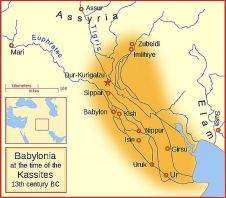
kassette mittani

Earlier we spoke of migration from North West into the Punjab region. Now, let us look at the, migration that might probably have taken place in the other direction.

The slow death and eventual disappearance of the mighty Sarasvathi also signified the end of the civilization associated with the Sarasvathi valley. The geo physical surveys and other studies suggest that around 1600 BC a massive drought struck the Sarasvathi region. That, and possible shift in the land lead to disappearance of the Sarasvathi. It was perhaps a part of a wider phenomenon that swept the other regions too. The people of the Sarasvathi valley, naturally, migrated to other regions. From a throbbing account of living generations, Rig Veda turned into memories of a lost heartland. A Camelot lost.

The disappearance of Sarasvathi valley civilization is a very important landmark in the history of Bharatha Varsha.

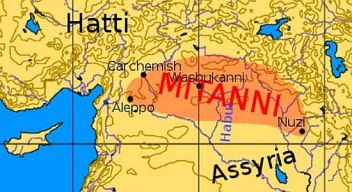
The presence of the Indo -Aryan kings of the Mittani and the Kassite dynasties, who worshiped Vedic deities, in the Babylonian region , during 1600 to 1300 BC , points to the possibility of migration of Vedic people from the plains of Punjab, following the collapse of the Sarasvathi valley civilization.

It is evident from the names of some of the Miittani and Kassite Kings and Generals (Kart-ashura,Biry-ashura,Sim-ashura,Kalm-ashura etc.) that they belonged to the early Rig Vedic times when the Asuras were the older set of gods; and when the sharp distinction between Asurasand Devas had not yet come into being ; and when the Asuraswere not yet a denigrated lot in the Vedic texts.

It is also evident that the Indo –Aryan kings were a minority among a population who spoke a different language.

It is remarkable how in the distant past , the Vedic people migrated from Punjab to the regions of Mesopotamia and Egypt .

(There is theory that suggests , Nefertiti (c.1400 BC) married to Egyptian Pharaoh Amenhotep IV was a Mittani princess , daughter of an Indo Aryan King)

(For more on Mittani and Kassite kingdoms and Rig Veda , Gathas ; please view-

“Rig Veda and Gathas re visited” @

https://sreenivasaraos.com/2012/08/31/the-rig-veda-and-the-gathas-revisited )

4. Bharatha_Varsha / Arya_Vartha

I think you got into knots over the Bharatha_Varsha and Arya_Vartha . Let me clarify.

As discussed in the post the name Bharatha_Varsha came into vogue at the time of the Emperor Bharatha who was fifth or sixth in line from Swayabhuva Manu, the first Manu. The various Purans and texts have described the extent of Bharatha _Varsha as extending from the ocean in the South to the snowy mountains.

As regards Arya_vartha, the term might have come into use, at best, in Vedic times, in the manvantara of Vaivaswata Manu, the seventh Manu. There is, therefore, a huge time gap between the two occurrences. I do not even hazard a guess to measure the gap.

At times, it is used to refer to the Rig Vedic geography and at other times to the Ganga Valley. Sometimes, it amorphously referred to what we call India.

Bharatha Varsha, even in the times of Mauryas was larger in area than the present India . Kautila called it Chakravarthi Kshetra. It was before Asoka’s time.

Bharatha _Varsha has always been a nation even from the epic times overwhelming the political subdivisions.
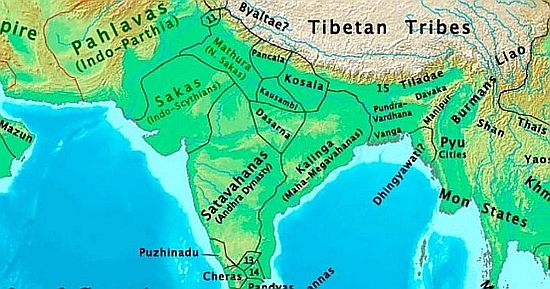
bharathavarsa

Thank you

Regards

Sources:

http://koenraadelst.bharatvani.org/downloads/books/aid.htm

http://voiceofdharma.org/books/rig/ch5.htm

(http://en.wikipedia.org/wiki/Maurya_Empire)
 
15 Comments

Posted by on September 1, 2012 in General Interest, History


Tags: , , ,

Bharatha Varsha and Bharathas

Jambudwipa

Traditionally the Indians, while in India, in their daily prayers, identify themselves as those residing in Bharatha_Varsha (the land of Bharatha), located to the South of MountMeru in the Jambu_Dvipa. Then, they go on to specify their location within the subcontinent.

What does this mean?

A.Jambu_Dvipa

1. Cosmology

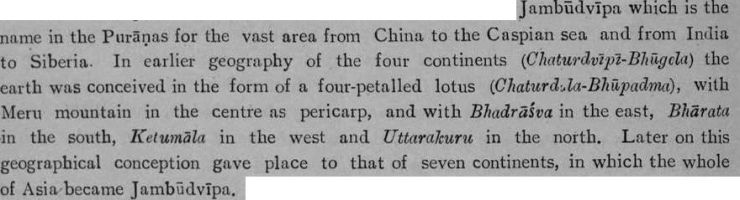
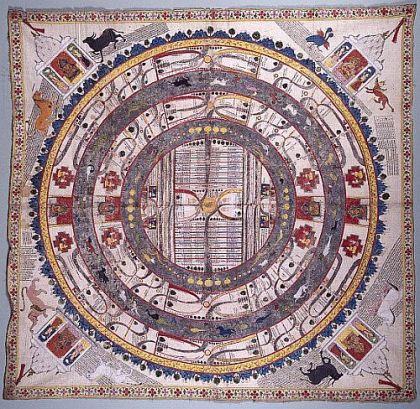
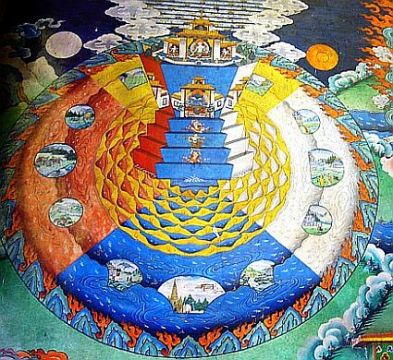
According to the cosmology projected in the books of Hindus, Buddhists and Jains, the planet Earth consists seven islands (Saptha Dweepa vasundhara). One of those islands is Jambu_Dvipa (RoseAppleIsland) also known as Sudarshanadvipa.

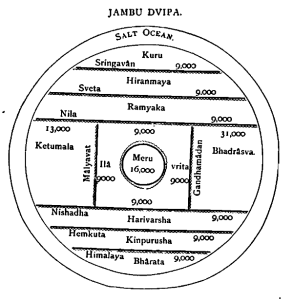
Markandeya Purana says, Jambu_Dvipa is depressed on its south and north; elevated and broad in the middle. The elevated region forms the Ila-vrta or Meruvarsa. At the center of Ila-vrta lies the MountMeru.

bwqpPJa

The noted scholar Dr. Vasudeva S Agarawala, mentions in his work– Indian Art (A History of Indian Art from the earliest times up to the third century A.D) :

Jambudvipa

2. Location

Some attempts have been made , though not satisfactorily , to identify the zones(varshas) and the extent of the Jambu_Dvipa, by taking a clue from the details of mountain ranges, valleys and river systems and other geographical features of Jambu_Dvipa provided in Bhishmaparva of the Mahabharata and in other Puranas.

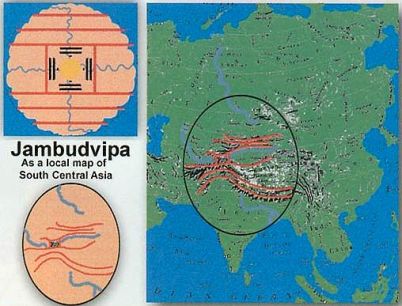
According to one of those interpretations , Jambu_ Dvipa is a huge land mass of South Asia comprising the present day Indian Subcontinent, Tibet , Egypt , Mesopotamia , Syria and Corinth( near main land Greece).

Sanjaya said:  ‘Stretching from east to west, are these six mountains that are equal and that extend from the eastern to the western ocean.

 They are Himavat, Hemakuta, the best of mountains called Nishadha, Nila abounding with stones of lapis lazuli, Sweta white as the moon, and the mountains called Sringavat composed of all kinds of metals.  These are the six mountains, O king, which are always the resorts of Siddhas and Charanas. The space lying between each of these measures a thousand Yojanas, and thereon are many delightful kingdoms. And these divisions are called Varshas, O Bharata.

This (the land where we are) is in the Varsha that is called after Bharata.. Next to it (northwards) is the Varsha called after Himavat. The land that is beyond Hemakuta is called Harivarsha, South of the Nila range and on the north of the Nishadha is a mountain, O king, called Malyavat that stretches from east to west.
Beyond Malyavat northwards is the mountain called Gandhamadana.  Between these two (viz., Malyavat and Gandhamadana) is a globular mountain called Meru made of gold. Effulgent as the morning sun, it is like fire without smoke.   It is eighty-four thousand Yojanas high, and, O king, its depth also is eighty-four Yojanas. It standeth bearing the worlds above, below and transversely.

Besides Meru are situated, O lord, these four islands, viz., Bhadraswa, and Ketumala, and Jamvudwipa otherwise called Bharata, and Uttar-Kuru which is the abode of persons who have achieved the merit of righteousness. Bhishma Parva – Section vi

11 tasya pārśve tv ime dvīpāś catvāraḥ saṃsthitāḥ prabho/    bhadrāśvaḥ ketumālaś ca / jambūdvīpaś ca bhārata /  uttarāś caiva kuravaḥ kṛtapuṇyapratiśrayāḥ – The Mahabharata in Sanskrit-Book  6-Chapter 7

It is surmised that Ila varsha and Meruvarsha, refer to the mountainous regions around the Pamirs and parts of north-east Afghanistan. MountMeru (or Sumeru) is identified with the vast Nagard Sarovar in the center of the modern Pamirs in Central Asia.

indian cosmology2

The concept of Jambu_Dvipa is present not merely in Hindu Puranas but also in Indian literature, history and in edicts.

3.Buddhist tradition

The Buddhist tradition also accepts the geographical concept of Jambu_Dvipa and places it south of Sumeru. It believes Jambu_Dvīpa is shaped like a triangle with a blunted point facing south.

The Buddha once remarked that the people of Jambu_Dvípa excel those of both Uttarakuru and Tavatimsain in three respects – courage, mindfulness and religious life. The Uttarakuru referred to by the Buddha might be the Kuru region mentioned in the Rig-Veda, It might even be the region to the north of Pamirs. There are a number of views on the probable location of Uttarakuru. As regards Tavatimsain, very little is known about it and there are not many guesses either.

In the later Buddhist texts, the connotation of the term Jambu_ Dvipa became more restricted. It came to mean only the Indian subcontinent and did not include even Sri Lanka. The Síhaladípa or Tambapannidípa (alternate names for Sri Lanka in Pali) were mentioned separately from Jambu_dípa.

Further, the Emperor Ashoka introduced himself to the people of Sri Lanka as Devanam Priya (Beloved of Gods) hailing from Jambu_Dvipa, referring to main land India. Incidentally, the modern Sinhalese word for India is Dhambadiva, perhaps related to the Pali name for India, Jambudiipa. One of the other names for India in Buddhist literature is Indravardhana.

The Buddhists divided Jambu_Dvípa into three circuits or mandalas, for the guidance of their itinerant monks. The first circuit Mahámandala (greater circuit) extended over nine hundred leagues and the Majjhima (middle circuit) extended over six hundred leagues. The perambulation of both circuits was expected to be completed, each , in nine months time; while that of the Antima (final circuit) of over three hundred leagues was to be completed in seven months time.

theuniverse12


B. Bharatha _Varsha

1.Location and Extent

According to Hindu, Buddhist and Jain texts, the Bharata Varsha, the land of Bharatha, located in Jambu_Dvipa, lies to the South of Sumeru. However, the extent of Bharatha Varsha varies from text to text and from tradition to tradition.

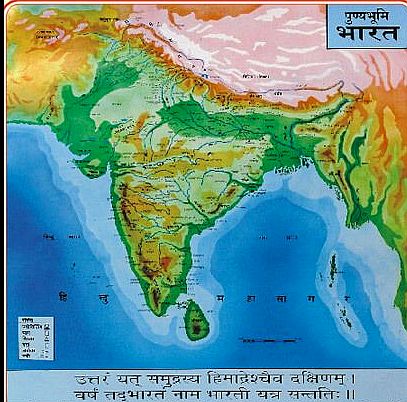
Markandeya Purana describes Bharatha Varsha as the land that stretches from Kailasa to kanyakumari; while Vishnu Purana mentions Bharatha Varsha as The country (var ṣam) that lies north of the ocean and south of the snowy mountains, where the descendants of Bharata dwell.

uttaraṃ yat samudrasya himādreścaiva dakṣiṇam  varṣaṃ tadbhārataṃ nāma bhāratī yatra santatiḥ

Further, it extols the virtues of Bharatha Varsha and says, “Bharata is the most excellent division of Jambudvipa, for this is the land of action, while the others are places of enjoyment.” Bharata Varsha is designated karmabhumi.

Bharath

Manu gives a beautiful and a lyrical description of Bharaha Varsha and mentions its various divisions. This is how Manu describes, “The land between the rivers Sarasvati and the Drishadvati, is called Brahmavarta. Beyond it, the land of the five rivers up to the Mathura region is called Brahmarshi Desha. The land between Vinashana (the place of disappearance of the Sarasvati River in the desert) and Prayaga and Vindhya, is Madhya Desha (Central Land). Finally, the land bounded by the mountain of Reva (Narmada), the Eastern Sea ( Bay of Bengal ) and the Western Sea is Arya Desha. This is the land where the black-skinned deer roam freely.”

sarasvatī-dṛśadvatyor devanadyor yad antaram /
taṃ devanirmitaṃ deśaṃ brahmāvartaṃ pracakṣate // Mn_2.17 //
tasmin deśe ya ācāraḥ pāramparyakramāgataḥ /
varṇānāṃ sāntarālānāṃ sa sadācāra ucyate // Mn_2.18 //
kurukṣetraṃ ca matsyāś ca pañcālāḥ śūrasenakāḥ /
eṣa brahmarṣideśo vai brahmāvartād anantaraḥ // Mn_2.19 //
etad deśaprasūtasya sakāśād agrajanmanaḥ /
svaṃ svaṃ caritraṃ śikṣeran pṛthivyāṃ sarvamānavāḥ // Mn_2.20 //
himavadvindhyayor madhyaṃ yat prāg vinaśanād api /
pratyag eva prayāgāc ca madhyadeśaḥ prakīrtitaḥ // Mn_2.21 //
ā samudrāt tu vai pūrvād ā samudrāc ca paścimāt /
tayor evāntaraṃ giryor āryāvartaṃ vidur budhāḥ // Mn_2.22 //
kṛṣṇasāras tu carati mṛgo yatra svabhāvataḥ /
sa jñeyo yajñiyo deśo mlecchadeśas tv ataḥ paraḥ // Mn_2.23 //

Kautilya, the author of Artha Shastra, mentions Bharatha Varsha as the land that stretches from Himalayas to Kanyakumari; and, he also called it Chakravarthi Khsetra, the land of the Emperor.

An epigraph of Kharavela (209 – 179 B. C?) who ruled over the region of the present day Orissa, found in Hathigumpha (near Bhubaneshwar in Orissa) uses the nomenclature of Bharatha Varsha.

The Hindu and Buddhist texts (vinaya) of later ages, described Bharatha Varsha as composed of five zones, namely the Madhya Desha ( the Middle Country), Purva Desha (the Eastern region), Dakshinapatha (the South), Aparanta or Praticya (the Western region) and Uttarapatha or Udicya (the Northern region). This zonal system was in vogue even in the Maurya period (322 BC to 125 BC).The maurya Empire was the largest and most powerful Empire of ancient India. It stretched from Assam to Khandahar; and from Himalayas to Tamil Nadu.

A similar Zonal system is now in India today too. (For more on Zonal systems consult a national cricket selector!.)

2.Shape

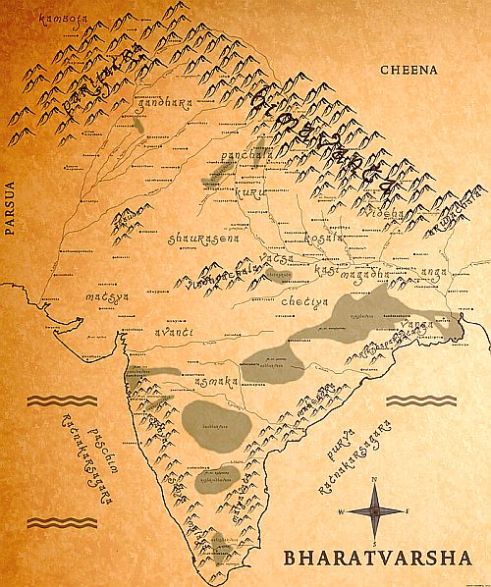
ancient bharatha

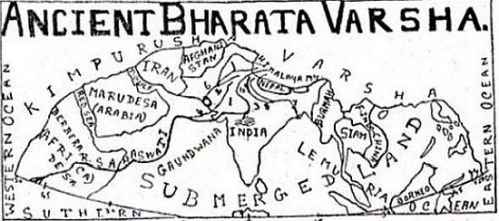
The different stages of Bharatha _Varsha as given in ancient literature represent various stages in the process of extension of the occupied or known areas of the country, during its history. Its shape is described variously at various stages. The changes represent the dynamics of the times.

A famous passage in Bhisma Parva of Mahabharata describes the shape of Bharatha Varsha. It views Bharatha as an equilateral triangle, divided into four smaller equal triangles, the apex of which is Kanya_ kumari and the base formed by the line of the Himalaya Mountains.

The famous historian Radha Kumud Mookerji remarked,” the shape corresponds very well with the general form of the country, if we extend the limits of India to Ghazni on the north-west and fix the other two points of the triangle at Cape Comorin and Sadiya in Assam.”

The Markandeya Purana is quite specific about the shape of the country. Its configuration is that of a bow in which the Himalaya is like the stretched string of the bow with the quill of the arrow at the peninsular area of the south. It is said to extend into a triangle with its transverse base in the north.

According to Buddhist tradition, Jambudvīpa (subcontinent) is shaped like a triangle with a blunted point facing south.

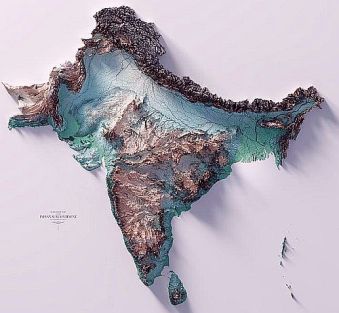
[ It is said; the subcontinent may be imagined to be in the shape of a Diamond; with its top (Northern end) being slightly broad and blunt; and, tapering to a point at its Southern end, jutting into the Indian Ocean.

The Northern borders of India dominated by Himalayan Mountain Ranges and the Hindu Kush, adjoin the rest of Asian continent.

From these magnificent Mountain Ranges down flow an array of streams feeding the mighty Indus and Gangetic Rivers. These River Systems, as also the range of mountains at the middle of the sub-continent, mark the separation of the Indo-Gangetic plain from the large Deccan (Southern) plateau of the Peninsular India.]

India Map

3.The name

The Sanskrit word Bhāratha is a derivation of bharata. The root of the term is bhr-, “to bear / to carry”, with a literal meaning of “to be maintained”. The root bhr is cognate with the English verb to bear and Latin ferō.

Interestingly, the term Dharma, which is the core concept of Indian values, is derived from the root dhr, meaning – to uphold or to nourish. Both the terms Bharatha and Dharma, eventually signify that which supports universal order or the orderly existence of the individual in life.

The first Article of the Constitution of the Republic of India states, “India, that is Bharat, shall be a union of states.” Thus, India and Bharat are equally official short names for the Republic of India. The name Hindustan was used in historical contexts, especially in British times.

Bharatha Varsha was not always called by that name. Its earlier name was Aja_nabha_Varsha. Before that, it was Himavath Pradesha. Why did it become Bharatha Varsha? Who was this Bharatha?

To know that, we have to go back to Swayambhu Manu, the progenitor. His son was Priyavarta, a great monarch. His son was Agni_dhara. His son was Ajanabha also called Nabhi. Ajanabha was a very virtuous and a noble king. During his reign, the land came to be known as Ajanabha_Varsha. Ajanabha’s son was the great Rsabhadeva. . He was a saintly king. Rsabha renounced the kingdom in favor of his son Bharata and became an ascetic. Bharatha was one of the most pious and noblest of Monarchs of his line. He nourished and nurtured his subjects righteously. During his time, the land that was until then called Aja_nabha_Varsha came to be known, as Bharatha Varsha – ततश्च भारतं वर्षमेतल्लोकेषुगीयते. It has been so since then. Ajanabha (Nabhi), Rsabha and Bharatha figure prominently in the Jain tradition.

What we call Bhatatha Varsha or Bharatha is named after a very virtuous and noble king Bharatha. The best we (who are born and who reside in his land) can do is to be worthy of his name.

Obviously, in the olden days being born in Bharath was a matter of pride. In the Gita, Krishna often refers to Arjuna as Bharatha, the noble one.(For more on the name of India please visit

https://sreenivasaraos.com/2012/09/01/sindhu-hindu-india/

***
Over the centuries the name of Bharatha Varsha, its shape and its extent have changed many times. Whatever is its present name, either borrowed or assigned; whatever the extent of its boundaries is; the concept of India that is Bharath has survived as a many dimensional splendor; even amidst the encircling chaos. It has always been a nation. India has held on to its pluralism, its democratic way of life and its basic values; despite strife, contradictions and endless diversities. This is no mean achievement. It is for these reasons we call it, the Miracle that is India.

Bharatavarsha

**
C.Bharathas

1.Location

Rig Veda mentions the tribe of Bharathas several times.

The Rig Veda has a certain geographical horizon. It projects a land of seven great rivers bounded by several oceans and many mountains. It mainly shows the geographical sphere of the Bharatas and their neighbors. Accordingly, Rig Veda mentions that Bharathas ruled the land that spread over the banks of the rivers Parushni ( Ravi ) and Vipasa ( Beas ).

The Purus and in particular the Bharatas among them, are the main Vedic Aryans of the Rig Veda.

2. Battle of Ten Kings (dāśarājñá)

The seventh Mandala of Rig-Veda treats “The Battle of Ten Kings”, fought between the Puru clan and the Turvasha/Drihyu/Anu clans, rather elaborately. There is a view that it was a battle between Aryans and non-Aryans. I however, do not, subscribe to that view. All of those kings involved in the battle –Puru, Turvasha, Druhyu and Anu were the sons of Yayathi who in turn was the son of Nahusha. It was a intra clan fighting.

3.Bharatha son of Dushyanta

Bharathas were a clan among the Purus. The Purus prospered in the North and strengthened the Chandra vamsha (Moon Dynasty). Many generations later into this, clan was born Bharatha son of Dushyanta. The great poet Kalidasa in his epic Abhignana Shakuntalam immortalized the love of Dushyanta and Shakuntala.

Bharatha son of Dushyanta is NOT the Emperor Bharatha whom we discussed earlier and after whom Bharatha _Varsha is named. As per the chronology listed in Vishnu Purana, Bharatha son of Dushyanta appears thousands of years after Emperor Bharatha son of Rshabha. Pandavas and Kauravas are decedents of Dushyanta/Bharatha but are several generations removed from them.

Thus, the Bharatha Tribe of dāśarājñá is far removed from Emperor Bharatha son of Rshabha.

****

PLEASE DO NOT FAIL TO READ ABOUT HINDU _HINDUTVA 

*****

Please read On Arya , Aryan , Sarasvathi and other issues that complement the above post.

Jambu-dweep of Love

Sources:

http://www.gita-society.com/?html=hindu_puran10&vs=04

http://www.svabhinava.org/HinduCivilization/DileepKaranth/UnityofIndia-frame.php

http://en.wikipedia.org/wiki/Etymology_of_India

 
15 Comments

Posted by on September 1, 2012 in General Interest, History, Rigveda


Tags: , , , ,

Concept of rna in Indian tradition

Concept of rna in Indian tradition

The concept of rna, the human indebtedness or the primary obligation, is unique to Indian tradition. It is in fact the source of dharma, because it weans one away from desire-gratification and leads towards duty-fulfillment.

Rna, according to Panini the great grammarian, signifies a want or a deficiency.

Taittiriya Samhita (TS) speaks about three kinds of basic indebtedness every human being carries with him or her. They are the debt one owes – (a) to his ancestors (pitr), (b) to the sages/seers (rishi) and(c) to the Gods (deva).

The Shathapatha Brahmana (SB) adds one more .The fourth one is the debt one owes to his fellow beings.

These texts suggest the ways of liquidating the debts or fulfilling the obligations one is born with. These are briefly, as under.

Pitr :   by bringing up a family, by getting and raising children in a proper manner.

Rishi : by study and by understanding the cultural context into which one is born.

Deva : by honoring , worshipping the elemental and natural (environmental) forces like sky,air,water,earth,rivers, mountains , plants etc.(Rig Veda refers to these Devas as “luminous ones”.) and

Fellow beings: by cultivating compassion, fellow- feeling (saha bhava) and by showing hospitality.

 SB further says that the fulfilment of these obligations should be the preliminary aim of human beings and it would add value to their life. The Atharva remarks, pursuit of the four purusharthas would be meaningful when one fulfils ones primary obligations or is in the process of doing so.

 Chandogya Upanishad (2.23) describes the duties in three stages of life as “off shoots or branches of Dharma” (trayo dharma_skandha). This mentions the obligations and privileges of a householder, hermit and a student. Rna is at the core of this trayo dharma

The Emperor Ashoka (272 to 132 BC) in his edicts highlights a person’s indebtedness (rna) to parents and elders and calls upon the people to live in accordance with the dharma and not interfere with the natural order (rta). In one of the edicts, he points out that practice of dharma is not possible for a person devoid of good conduct. In another edict he proclaims that if a person practices great liberty but does not possess self-control (sayama_bhava), purity of thought (sudhi) gratitude (kitaranta) and firm devotion (dridhabhatita), it is of no avail.

In Indian tradition, the practice of art, be it music, dance, literature or other forms art, is an act of worship. The traditional artist through his creation pays homage to his ancestors (pitrs) and rishis (his teachers). He views the public services he creates (temples, dams, tanks, buildings etc.) as fulfillment of his obligation to his fellow beings. Even poets, philosophers and writers conclude their work with a prayer seeking welfare of all beings.

The fulfilment of three purposes of life (dharma, artha and Kama) acquires meaning only in the context of felt obligations. Rig Veda (8.1.6) gives a call, “Man, you must reach upward, not go down below”.

In the present context, the concept of Rna could perhaps be better appreciated as commitment to certain obligations, causes and ideals including those discussed above.

****

 Note: In the Edict of Ashoka referred to above there is a brief mention of rta. This rta is again a concept in the Indian tradition. It signifies natural order or cosmic order or an orderly occurrence of things.

Indebted to

SKR Rao

 
1 Comment

Posted by on September 1, 2012 in Indian Philosophy


Tags: , , ,

More on Ancient Egypt and India

More on Ancient Egypt and India

 The article “Ancient Egypt and India ” I posted on Sulekha, enjoyed a good response, and was even “featured”. Among the comments I received there were a couple remarking that I appeared to relay more on older sources and wondered whether were no recent archaeological information to strengthen the view that ancient Egypt and India did develop cultural and trade relations.

I consider that a fair comment .I have since come across some information on the subject; hence this post.

To my knowledge there are two recent Archaeological Projects concerning India and Egypt. They are significant particularly because they are taken up at either end of the India –Egypt trade. The India Project is in progress in the Malabar Coast of Southern India , while the other was taken up in Berenike, a long-abandoned Egyptian port on the Red Sea near the border with Sudan .

A. The excavations in India are ongoing at Pattanam in Kerala, believed to be the place where the ancient port of Miziris was located. . Dr. Shajan and V. Selvakumar are the archeologists. The Archeological Survey of India (ASI) has issued license to The Kerala Council for Historical Research (KCHR) to carry on further excavations.

Please see my post, “A note On Muziris” for more details on Muziris

1. Muziris, as the ancient Greeks called it, was an important port on the Malabar Coast in Southern India. The ancient Greeks, Egyptians and Romans frequented it.   Eudoxus of Cyzicus sailed into Muziris during his two voyages undertaken between 118 and 116 BC. Muzris, is mentioned in the Periplous of the Erythraean Sea and in Ptolemy’s Geography and is prominent on the Peutinger Table. Pliny referred to it several times in his Naturalis Historia . Pliny called this port primum emporium Indiae.

2. There is no doubt Muziris was a major port and was an Emporium, as Pliny called it. Roman imports from India were precious gems, aromatics , spices – specially the pepper , besides cotton. As regards Gems, Muzris acted as the collecting and clearing point. The garnets and quartz came from Arikamedu region (on the East coast of south India), the pearls were from Gulf of Mannar , while lapis lazuli beads were from Kodumanal in the neighboring region. The other stones included diamonds, agate, beryls, citrines etc.

3. An indication of the importance of Muziris as a place for finalizing business deals by Roman traders was brought to light by L. Casson, a scholar, in his paper” New light on marine loans” .He mentioned about a papyrus (called P. Vindob. G 40822 -for identification purposes ), discovered during the year 1985 in  Vienna , which sets out the details of a maritime loan agreement between a ship owner – possibly of the Hermapollon mentioned on the verso of the papyrus and a merchant using the ship as security. The document suggests that the loan arrangement was agreed to while the parties were in Muziris (though possibly signed on arrival at the Red Sea), indicating a rather active Roman merchant colony on the Kerala coast

(http://www.uni-koeln.de/phil-fak/ifa/zpe/downloads/1990/084pdf/084195.pdf

4. However, Muziris suddenly disappeared in around sixth century and no one has a clue to it. Moreover, by about the same time the trade between Rome/Egypt and India went into decline. I am NOT suggesting the two occurrences were related.

5. Excavations on the site stared around 2004/05 and reported in local and foreign press. Please check

http://news.bbc.co.uk/2/hi/south_asia/4970452.stm

http://nasrani.net/2007/03/24/muziris-pattanam-significant-evidences-boat-follow-up-on-ex cavations-iii/

6. The artefacts recovered from the excavation site include amphora (holding vessels) of Roman make and Yemenis, Mesopotamian, and West Asian ones too, indicating that Pattanam had trade not only with Rome but also with places in the Persian Gulf. The other artifacts recovered include pottery shards, beads, Roman copper coins and ancient wine bottles . In addition, a boat believed to be about 2000(?) years old, Glass and precious stones, roman pottery, bricks and a structure to keep the boat with five wooden structures to tie down the boat.

7. Roberta Tomber of British Museum who is involved in similar other projects visited the site. She remarked, several factors go to strengthen the belief that the objects found on site are remnants of first century Roman trade and similar objects were found during excavations in Egypt.

Excavations on the Pattanam site are in progress. The present findings are not conclusive enough.

8. I believe the Greek/Egyptian and the Roman trade ( that followed later) , with India, came as culmination of relations that existed between India and the West even centuries earlier to Christian era.

B. The other project was at Berenike, a long-abandoned Egyptian port on the Red Sea . The Archaeologists were from UCLA and the University of Delaware USA . The Berenike project was funded by the Netherlands Foundation for Scientific Research, the National Geographic Foundation, National Endowment for the Humanities, Utopa Foundation, Gratama Foundation and the Kress Foundation, and some private donors. Please check the following links for the Project details and findings.

http://www.archbase.com/berenike/

http://mailman.geo.uu.nl/pipermail/maphist/2002-July/000840.html

http://www.dickran.net/history/india_egypt_trade_route.html

http://www.hindu.com/2006/03/01/stories/2006030102540200.htm

1. In early Roman times, Myos Hormos was the most frequented of the Red Sea ports. However, Berenice began to rise in importance during the first century B.C. and became dominant in the first century A.D… Eventually Berenice replaced Myos Hormos as the most prominent port, because it had one great advantage over Myos Hormos: it was situated some 230 nautical miles further south and therefore spared the homebound vessels days of beating against the northerly winds.

http://www.ling.upenn.edu/~jason2/papers/bnikeppr.htm

2. Berenike (Berenice Troglodytica) a Graeco-Roman harbor is located on the Red Sea Coast in the far south of the Egyptian Eastern Desert . It is mentioned in the Periplous of the Erythraean Sea and in Ptolemy’s Geography . Pliny referred to it several times in his Naturalis Historia . Eduxous set sail to India from Berenice in 118-116 BC. From here, ships sailed to India and to the East by taking advantage of the monsoon (Hippalus) winds in search of spices, precious stones and other exotic goods. The place where the port was located is now buried under desert. The Archeological teams say, they found here extensive remains of the ancient world’s sea trade between East and West.

3. Some of the finds of excavation at Myos Hormos and Berenike concerning links with India are briefly as under:

Among the buried ruins of buildings that date back to Roman rule, the team discovered vast quantities of teak, a wood indigenous to India and today’s Myanmar , but not capable of growing in Egypt , Africa or Europe .

The archaeologists were especially intrigued by the large amounts of teak, a hardwood native to India , found in the ruins. The presence of so much teak also suggested to the researchers that many of ships were built in India , one of the indications of a major Indian role in the trade.

Dr. Casson, a specialist in ancient maritime history , mentions that historical records refer to ships in the India trade being among the largest of the time. According to Dr. Casson, they could have been as long as 180 feet and capable of carrying 1,000 tons of cargo. Such ships had stout hulls and caught the wind with a huge square sail on a stubby mainmast.

In addition to this evidence of seafaring activities between India and Egypt , the archaeologists uncovered the largest array of ancient Indian goods ever found along the Red Sea , including the largest single cache of black pepper from antiquity – 16 pounds – ever excavated in the former Roman Empire . The team dates these peppercorns, grown only in South India during antiquity, to the first century. Peppercorns of the same vintage excavated as far away as Germany, indicating Egyptian export of Indian goods to West.

In a dump that dates back to Roman times, the team also found Indian coconuts and batik cloth from the first century, as well as an array of exotic gems, including sapphires and glass beads that appear to come from Sri Lanka and carnelian beads that appear to come from India. The excavations also yielded coins — one of King Rudrasena the third, that has been dated to the fourth century and pots with Tamil-Brahmi inscriptions. (I am not clear about Rudrasena the third. There is however a reference to rudrasenaII (380 to 385) and to Rudrasena (350 to 355) of Saka dynasty, in Malwa region)

As developed by Greeks and Egyptians, then expanded by the Romans, the Red Sea ports served as transfer points for cargoes to and from India and other places in Africa and Arabia

The co-directors of excavations at Berenike Dr. Steven E. Sidebotham, a historian at the University of Delaware , and Dr. Willeke Wendrich, an archaeologist at the University of California at Los Angeles, said the research showed that the maritime trade route between India and Egypt in antiquity appeared to be even more productive and lasted longer than scholars had thought.

In addition, it was not an overwhelmingly Roman enterprise, as had been generally assumed. The researchers said artifacts at the site indicated that the ships might have been built in India and were probably crewed by Indians.

4. Dr. Casson gives a summary of some of the trade goods mentioned in the Periplus. According to which the goods imported from / through India were: native spices and drugs and aromatics (costus, bdellium, lykion, nard, malabathron, pepper), gems (turquoise, lapis lazuli, onyx, diamonds, sapphires, “transparent gems”), textiles (cotton cloth and garments as well as silk products from China), ivory, pearls, and tortoise shell.

5. Commenting on the findings of the Berenike Project  Dr.Lionel Casson said,”It’s nice to have archaeologists find concrete evidence for what is attested in the texts.”

6. As in the case of Miziris, sometime before the mid-sixth century the Berenike harbor too silted over, vanished beneath theencroaching desert and was finally abandoned for good. The reasons  are unknown.

Around the same period (sixth century) shipping activities declined, mysteriously both at Miziris and Berenike. I am not suggesting the occurrences were related, in any manner.

****

7. Egypt and India , both , are ancient countries and it is not surprising if they did develop cultural and trade relations in the antiquity before what we call “recorded history” came into vogue. I believe the Greek/Egypt trade with India and the Roman one that followed thereafter came as a culmination of the relations that existed between India and the West even centuries earlier to Christian era. Incidentally, the Hindi news bulletins carried over the Indian TV and Radio channels still refer to Egypt as Misr (from Mitsrayim in Hebrew?), perhaps reminiscent of those bygone eras.( The name Mizrain appearing in the List of Nations appearing in the Tenth chapter of the Book of Genesis is identified with Egypt.)

Both the countries had a rather rollercoaster type of histories .Their fortunes and affiliations have not been either consistent or uniform. They had their glorious days; they fell on bad days and had plenty of indifferent and forgettable periods. They drifted apart for long periods. Each had been open to foreign influences, in varying degrees, reshaping their appearances and destinies. However, they did influence each other in some ways; and amidst the then existing network, they did succeed in developing close trade and cultural relations.

Why they drifted apart again in sixth century, is another story.

 
6 Comments

Posted by on September 1, 2012 in History


Tags:

Vrikshayurveda


vrk2

A Medicinal system for the benefit of plants

All of us know very well about the health systems that work for the benefit of humans and animals. Many may also be familiar with the ancient Indian (Auyur-Veda), Chinese (Zhōngyī xué) and Tibetan (gSoba Rig-pa) health systems for the humans. However, not many may be aware of an ancient medicinal system devised to ensure healthy growth of plants, trees and preservation of environment; and that too an Indian one! Well, is there really such a system? Yes, there is one. It is Vrikshayurveda (Sanskrit term to mean the Plant Life Science or the Science of Plant Life) – (Vriksha = tree + Ayur- Veda = science of life).

2. Vrikshayurveda

2.1 It is interesting that ancient India not only had a medical science for the humans (Auyur-Veda) but also a one for the plants, called Vrikshayurveda. The earliest references to such a science are in the Rig-Veda and Atharvaveda. The other books that provide valuable information are Kautilya’s Artha-sastra, Amarsimha’s Amarkosha, Patanjali’s Mahabhasya, Krishi-Parashara, and Varahmihira’s Brhat Samhita etc. But, no   independent texts seem to have been written on the subject. The oral tradition   however regarded Surapala’s Vrikshayurveda as a credible compendium. Sadly, the actual text of Surapala was not available.
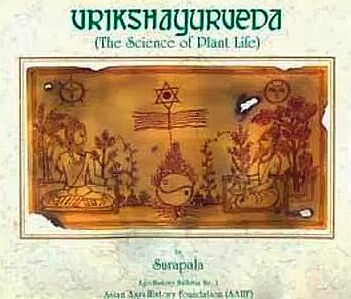
2.2 It was only in the   year 1996 i.e. after Dr. Y. L.  Nene (Asian Agri-History Foundation , India ) procured the manuscript from the Bodleian Library, Oxford , UK and Dr. Nalini Sadhale translated it into English; Surapala’s work became known to the modern world.

[ Shri keshavapuri , however mentions :

the book Vrikshayurveda was published in English translation long back in 1935 from kolkata. it is still available over internet. Vrikshayruveda has been published in Kannada in 1950, 1972,, 1990 etc/. the reprint of 1935 edition was published in 1994 from Bengaluru. No one of the so called modern minded people took cognizance of the subject.]

3. The manuscript written in a form of Sanskrit since extinct runs into 60 pages containing 325 well-knit verses , describing, among other things, characteristics of 170 plants. Surapala’s work puts forth authoritative opinions on several issues concerning plant life such as procuring, preserving, treating of seeds before planting; preparing pits for planting saplings; selection of soil; method of watering; nourishments and fertilizers; plant diseases and plant protection from internal and external diseases , remedies there to; layout of a garden; agricultural and horticultural wonders; groundwater resources; etc.    It is a comprehensive and a systematic compendium on all issues of plant life and environment.

vrikshayurveda_large

4. Surapala

4.1 A word about Surapala before we get to know  his work; no definite facts are available about him or his time (as it usually happens in Indian history). Historians approximate his time as 10th century A.D. He was a renowned and a highly respected physician in the court of the King Bhima Pala. Judging by the soil types, plants, and environments discussed in the work, historians surmise Surapala lived in the Gangetic plain i.e. the present day U.P / Bihar region.

4.2 Surapala calls his work a compendium of Auyur-Veda as applied to plants. He expresses indebtedness to the earlier scholars but declares that in writing the present text his own reasoning was his guide.

4.3 What were the Ayur–Vedic principles applied ?

5. Auyur-Veda grafted on plants

5.1 As per Ayur – Veda   all substances ,all physical  and mental constitutions , all ailments and all curative processes are pancha –bhautika in character , meaning they are related to the ambiance created by the composition of five elements viz. earth , water , fire , air and space. Further, it assumes that a person’s constitution, health and disease are a result of the balance/imbalance of three different biological systems – vata, pitta and kapha. While Vata controls all the movements in the body, pitta takes care of chemical reactions and biosynthesis of various compounds within the body. Kapha, on the other hand, deals with balanced growth, development and functioning of the body. If the functions of these three humors were well balanced, then the individual would be in a healthy condition. An imbalance within or between them, would lead to various kinds of ailments. This is the tri-dosha-siddhanta. The primary purpose of Ayur – Veda   is to restore/ maintain proper balance of vata, pitta and kapha. In Surapala’s work, these concepts are grafted on to the plants as well. According to him, the plant condition, health –sickness, cause –remedies etc. all are to be viewed through the prism of Ayur-Veda.

5.2 Interestingly, the ideological structure of Ayur – Veda itself is in the image of a tree. It employs terms such as root, trunk, branches, leaves etc. while describing the disease cause, its symptoms, diagnosis, remedy etc.

5.3 Surapala advocates a holistic crop management system. He stresses the use of suitable cultivars, use of good seeds, pre-sowing treatment of seeds, use of suitable soils, growing intercrops, having optimum plant population, balanced nutrition, optimum use of water, timely weeding, protection from disorders by use of herbal products or dead animal wastes, harvest at the right stage, and seed drying and storage

6. A word of caution    Surapala also comes up with a number of impractical suggestions, untested methods, fanciful ideas that do not make sense. Therefore, caution, discretion, further study and research should go along with the enthusiasm to accept  the book.

[ Shri keshavapuri does not agree with this view. He points out:

Such caution is  meaningless. this opinion is formed without any practical knowledge of the subject. All these methods in Vrikshayruveda have been tried on large scale which is still unknown to the many, practical implementation of Vrikshayruveda can solve many problems of the modern day world like pollution of all types, which is yet unknown to many.]

The text is a very helpful compendium in deed.

***

7.  Continuing on  Vrikshayurveda, the science of the treatment of plants in other ancient texts, Prof. Girija Prasanna Majumdar writes in his Vanaspati: plants and plant-life as in Indian treatises and traditions (Published by the University of Calcutta 1927, pages: 46-49) refers to passages in Agni Purana, Brihat-samhita of Varahamihira, and other texts dealing with maintenance and treatment of plants:

Just as the human body is subject to jaundice, dropsy,  emaciation and defects (dwarfness) of finger, nose, etc., etc., so also plants suffer from similar diseases such as inception of disease, displacement or dislocation of flower, fruit, leaves, bark.

And just as by the application of the appropriate remedies unnatural growth, deterioration, wounds, fractures, etc., can be cured, so also in plants by application of proper drugs as prescribed in Vrikshayurveda.

Varahamihira gives the following signs of the diseased condition of plants:   Cold climate (low temperature), wind (dryness) and sun (high temperature) are the causes of disease. When the plant is diseased, the leaves become yellow (etiolated), buds (pravalanam) do not develop or their growth arrested, branches become dry and the sap (rasa} exudes.

Kasyapa says: those plants that have yellow leaves (pandurii patreshu), that are fruitless and denuded of leaves arid those caused by coldness, excessive heat, too much rain, dry wind and by the intermingling of roots of different plants are to be known as diseased, and are to be treated accordingly

Treatment

Remedies that are prescribed are both preventive and curative.

As a general prophylactic, Varahamihira says:   As a sort of general prophylactic, mud kneaded with ghee and Vidanga (Embelica glandulifera) should be applied to the roots; and, after which milk diluted with water should be poured.

Agni Purana also recommends similar remedies: Vidanga mixed with rice, fish and flesh all these mixed together constitute a remedy invigorating to the plants and curative of their diseases.

As regards the curatives:

A cure is prescribed for that most incurable of diseases barrenness. Varahamihira prescribes: as a remedy against barrenness, a hot decoction should be made of Kulattha (Dolichos biflorus), Masha (Phaseolus mungo var Roxburghii), Mudga (Ph. radiatus), Tila (Sesamum indicum) and Yava (Barley) which when cooled should be poured round the roots.

Almost an identical recipe occurs in the Agni Purana: Vidanga and ghee kneaded with mud and sprinkled with cold water together with Kulattha, Masha, Mungo, Yava and Tila should be used in a case of barrenness (phala-nashi).

**

8. Further Reading :

1). Sadhale, Nalini (Tr.). 1996.   Surapala’s Vrikshayurveda (The Science of Plant Life by Surapala). Agri- History Bulletin No.1. Asian Agri-History Foundation, Secunderabad – 500 009,   India .

THE PRINTED BOOK IS HARD TO GET. BUT, YOU MAY GET TO READ THE TEXT ON THE NET  ( the original manuscript in Sanskrit, with English commentary) AT

YOU MAY ALSO DOWNLOAD THE PDF VERSION

2) PLEASE ALSO READ ONLINE ANOTHER RARE BOOK

VANASPATI PLANTS AND PLANT-LIFE AS IN INDIAN TREATISES AND TRADITIONS

BY PROF.GIRIJA PRASANNA MAJUMDAR AT

http://www.rarebooksocietyofindia.org/book_archive/196174216674_10151216246831675.pdf

3) Also  Click to follow the links::

http://www.infinityfoundation.com/mandala/t_es/t_es_goyal_crop_frameset.htm http://www.infinityfoundation.com/mandala/t_es/t_es_agraw_surapala_frameset.htm

4 https://www.researchgate.net/publication/224898698_VRIKSHAYURVEDA_Arboreal_Medicine_in_Ancient_India

tree of life

 
17 Comments

Posted by on September 1, 2012 in Uncategorized


Tags: , ,

A Note on Muziris

A. Yesterday

1. Muziris, as the ancient Greeks called it, was an important port on the Malabar Coast in Southern India . It was frequented by the ancient Greeks, Egyptians and Romans.  Eudoxus of Cyzicus sailed into Muziris during his two voyages undertaken between 118 and 116 BC.

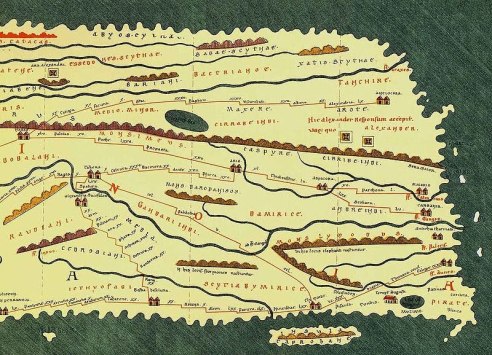
Muzris,  is mentioned in the Periplous of the Erythraean Sea and in Ptolemy’s Geography and is prominent on the Peutinger Table. Pliny referred to it several times in his Naturalis Historia. Pliny called this port primum emporium Indiae.

Periplus of the Erythraean Sea - Wikipedia

*

The Periplus of the Erythraean Sea, which was written by an anonymous Greek merchant in the second half of the first century AD, mentions of  a great increase in Roman trade with India.

The author of the Periplus, who probably visited India personally, described in detail the Roman trade with the ports of the Malabar Coast.

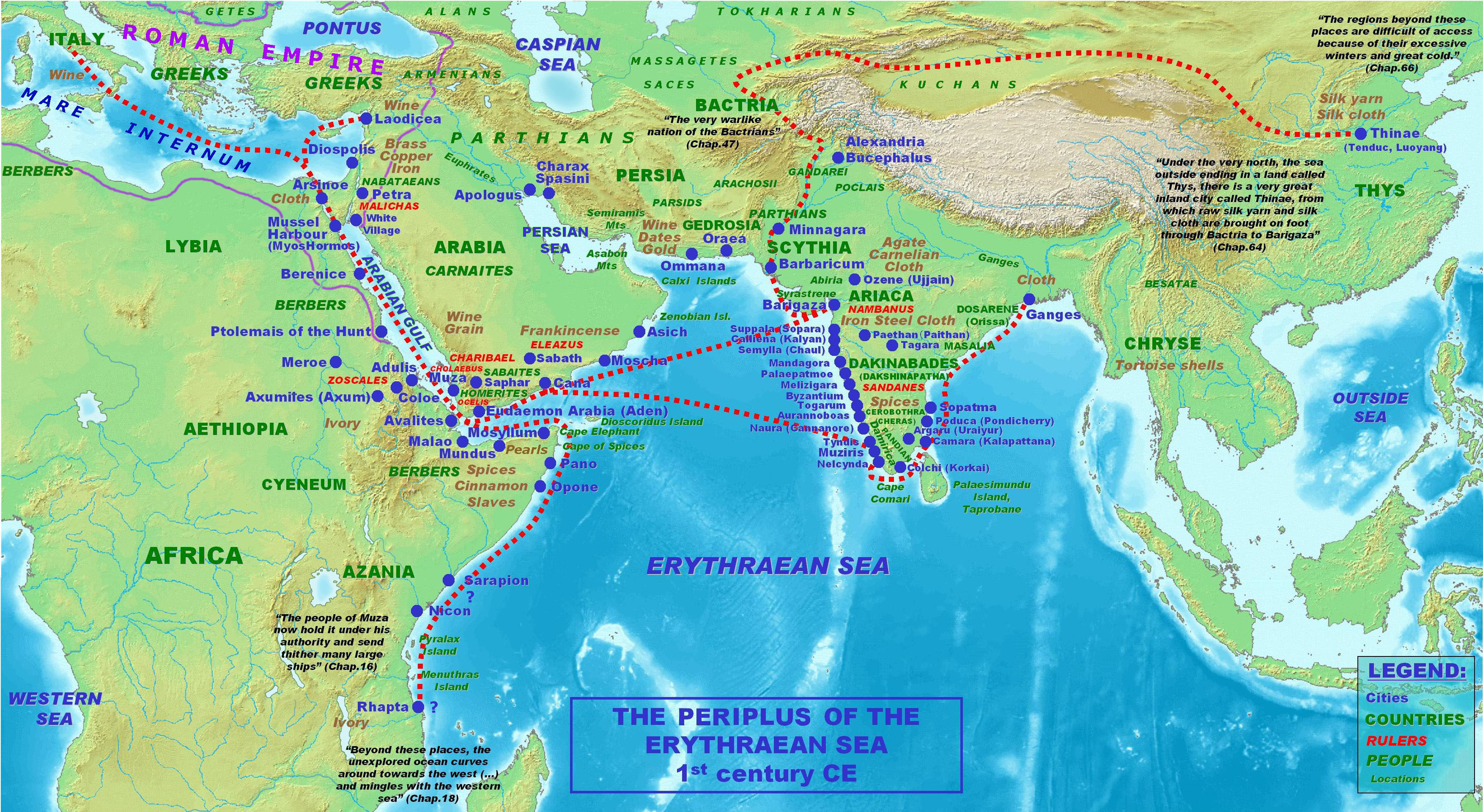
The most important port of the Malabar Coast was Muziris (Cranganore near Cochin) in the kingdom of Cerobothra (Cheraputra), which ‘abounds in ships sent there with cargoes from Arabia and by the Greeks’.

According to the Periplus, numerous Greek seamen managed an intense trade with Muziris:[29]

“Muziris and Nelcynda, which are now of leading importance (…) Muziris, of the same kingdom, abounds in ships sent there with cargoes from Arabia, and by the Greeks; it is located on a river, distant from Tyndis by river and sea five hundred stadia, and up the river from the shore twenty stadia.” – Paul Halsall. The Periplus of the Erythraean Sea, 53-54

They send large ships to the market-towns on account of the great quantity and bulk of pepper and malabathrum [cinnamon]. There are imported here, in the first place, a great quantity of coin; topaz, thin clothing, not much; figured linens, antimony, coral, crude glass, copper, tin, lead, wine, not much, but as much as at Barygaza [Broach]; realgar and orpiment; and wheat enough for the sailors, for this is not dealt in by the merchants there. There is exported pepper, which is produced in quantity in only one region near these markets, a district called Cottonora [North Malabar?]. Besides this there are exported great quantities of fine pearls, ivory, silk cloth, spikenard from the Ganges, malabathrum from the places in the interior, transparent stones of all kinds, diamonds and sapphires, and tortoise shell; that from Chryse Island, and that taken among the islands along the coast of Damirica [Tamil Nadu]. They make the voyage to this place in favorable season that set out from Egypt about the month of July, which is Epiphi.

This provides evidence for a great volume of trade in both directions. The Periplus reported the influx of coins; and, the largest number of Roman gold hoards has been found in the hinterland of Muziris;   most from the period of the Roman emperors Augustus (r. 27 B.C.E.–14 C.E.) and Tiberius (r. 14–37 C.E.).

Black pepper was a major item of trade with the West along both the western and eastern coasts. This rich trade continued on the Malabar Coast through the medieval period. Other items traded were spices, semiprecious stones, ivory, and textiles. Western products coming into India included wine, olive oil, and Roman coins—and in later centuries horses.

A text of the Sangam era highlights this, too: ‘The beautifully built ships of the Yavanas came with gold and returned with pepper, and Muziris resounded with the noise’

There is no doubt Muziris was a major port in its time and was an Emporium, as Pliny called it.

[Strabo was more interested in northern India and in the ports between the mouth of the Indus and present Bombay and he reported next to nothing about South India, Sri Lanka and the east coast of India.]

When Ptolemy wrote his geography around AD 150 Roman knowledge of India had increased even more. He wrote about the east coast of India and also had a vague idea of Southeast Asia, especially about ‘Chryse’, the ‘Golden Country’ (Suvarna-bhumi) as the countries of Southeast Asia had been known to the Indians since the first centuries AD. However, recent research has shown that this so-called Roman trade was integrated into an already flourishing Asian network of coastal and maritime trade.

Pliny the Elder also commented on the qualities of Muziris, although in unfavorable terms:[30]

“If the wind, called Hippalus, happens to be blowing, it is possible to arrive in forty days at the nearest market of India, called Muziris. This, however, is not a particularly desirable place to disembark, on account of the pirates which frequent its vicinity, where they occupy a place called Nitrias; nor, in fact, is it very rich in products. Besides, the road-stead for shipping is a considerable distance from the shore, and the cargoes have to be conveyed in boats, either for loading or discharging.” – Pliny the Elder, Historia Naturae 6.26

sea route

Regarding Muziris , Maddy in his webpage  writes:

Muchiri pattanam, a location close to today’s Kodungallur, was not really a sea port as some believed. It was a city on the banks of the Periyar somewhat inland and accessed through the maze of canals. Roman Ships anchored out in the sea and transported their goods in small boats guided by local pilots through the canals to Pattanam. From centuries in the past until the 14th, the city was well known to the Arab and especially the Roman sailors who conducted trade with Malabar. Sometimes the ships went to Barygaza or Baruch, sometimes to Nelycinda (will be covered in a separate blog) other times, they landed up in Muziris. They came in with Western luxury goods and gold and took away spices and Eastern goods. Sometimes the ships went around the Cape Comorin and docked at Kaveri Poompattinam close to Pondicherry.

The Romans had expatriate settlements or colonies in both places as I mentioned before and much information about them can be found in Sangam Era writings like the Silappadhikaram and Manimekhalai. The Peutinger table shows Muziris on the Roman map and even alludes to an Agustus temple (later studies assume it was an Agasthya temple) in Muziris. Writers like Ptolemy, Pliny and so on had written much about the trade, so also the Tamil poets. So let us conclude that robust trade took place, until the floods of the Periyar wherein the riverbed got silted in the 13th Century. Since that event and due to other issues at the Roman and Arab areas, the trade petered off and veered off to other places like the Cochin and Calicut. But by then the Arab traders had a stronghold on the route and they staved off any competition until the next aggressive bunch – the Portuguese came in – followed by the Dutch and finally the English who eventually settled down and colonized the lands they came to trade with. But we will not talk about all the events that took place in the process, we will instead focus on the Muziris papyrus, something that you do not see often mentioned in mainstream media. And so we go to the rather active Roman Colony or river port called Pattanam well before the advent of Christ

Tabula PeutingerianaIndo-Scythia.jpg

Image taken from De Tabula Peutingeriana de kaart, Museumstukken II (edited by A.M. Gerhartl-Witteveen and P. Stuart) 1993 Museum Kam, Nijmegan, the Netherlands

2. In what is called a third century map (perhaps a copy of an earlier map) Muziris is shown  prominently by drawing a circle round it. (Taprobane , indicated at the bottom of the map refers to Sri Lanka ). Pliny in his Natural History(6.26) mentioned that if one followed the wind Hippalus , one would reach Muziris in about forty days ( he was referring to the South West monsoon) . He also mentioned that the roadstead for shipping was at a considerable distance from the shore and that the cargoes are to be conveyed in boats, for either loading or discharging. He was indicating that Muziris was not along the coast but situated inland , reachable by a creek or a river. This was confirmed by the later Roman sources according to which “Muziris is located on a river, distant from Tindis – by river and sea, 500 stadia; and by river from the shore, 20 stadia”. Incidentally , Pliny did not recommended alighting at Muziris, as it was infested by pirates .

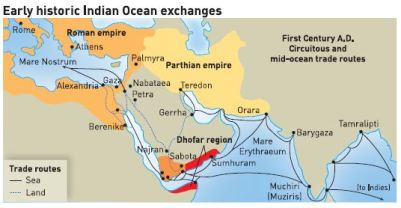
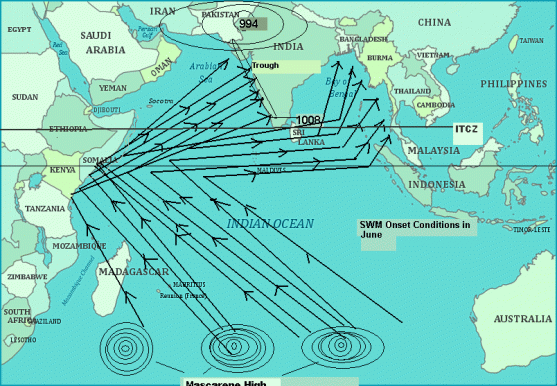
3. Since the days of Eudoxus, the Greeks and Egyptians established a flourishing trade with Southern India by taking advantage of what they called the Hippalus wind , meaning the South West monsoon winds. (Please see my post” Other Ancient Greeks in India ” for further details).The commodities the Greeks/Egyptians and Romans imported from India were precious gems, aromatics , spices – specially the pepper , besides cotton.

roman trade

4. According to Prof AL Basham (The Wonder That Was India) :

The main requirements of the West were spices, perfumes,jewels and fine textiles, but lesser luxuries, such as sugar, rice and ghee were also exported, as well as ivory, both raw and worked. A finely carved ivory statuette of a goddess oryaksi has been found in the ruins of Herculancum . Indian iron was much esteemed for its purity and hardness, and dye stuffs such as lac and indigo were also in demand. Another requirement was live animals and birds; elephants, lions, tigers and buffaloes were exported from India in appreciable numbers for the wild beast shows of Roman emperors and provincial governors, though these larger beasts went mainly overland through the desert trading city of Palmyra; smaller animals and birds, such as monkeys, parrots and peacocks, found their way to Rome in even larger quantities as pets of wealthy Roman ladies. The Emperor Claudius even succeeded in obtaining from India a specimen of the fabulous phoenix, probably a golden pheasant, one of the loveliest of India’s birds.

In return for her exports India wanted little but gold. Pottery and glassware from the West found their way to India, and many shreds of Arretine and other wares, mass-produced in Western factories, have been found in the remains of a trading station at Arikamedu, near Pondicherry.

As regards the Gemstones , Muzris acted as the collecting and clearing point . The garnets and quartz came from Arikamedu region (on the East coast of south India), the pearls were from Gulf of Mannar , while lapis lazuli beads were from Kodumanal in the neighboring region. The other stones included diamonds, agate, beryls, citrines etc. Please check the following links that carry abundant details on the Gem trade:          http://www.thebeadsite.com/abm-rio.html

There was some demand for wine, and the Western traders also brought tin, lead, coral and slave-girls. But the balance of trade was very unfavorable to the West, and resulted in a serious drain of gold from the Roman Empire. This was recognized by Pliny, who, inveighing against the degenerate habits of his day, computed the annual drain to the East as  lOO million sesterces, “so dearly do we pay for our luxury and our women”.

The drain of gold to the East was an important cause of the financial difficulties in the Roman Empire from the reign of Nero on wards.

Pliny complained that the Indian luxury trade was depleting the Roman treasury to the extent of 50 million sesterces annually. The Roman Senate even contemplated banning the use of Indian cotton in the clothing Toga that Roman citizens wore, because it was too expensive to import. Evidently, the trade with India was flourishing

Not only gold, but coinage of all types was exported to India; Roman coinage has been found in such quantities in many parts of the Peninsula and Ceylon that it must have circulated there as a regular currency.

[Indian traders were active at both the Indian and the foreign ends of this maritime trade. Archaeological sites on the Red Sea have turned up potsherds with the names of Indians written in Tamil  and in Prakrit. In India, archaeologists have identified the port of Arikamedu  as the site of an ancient southeast Indian port mentioned in The Periplus of the Erythraean Sea.

Excavations there revealed Roman pottery, beads, and evidence of wines imported from southern Italy and Greece. Arikamedu seems to have traded with the eastern Mediterranean region from as early as the first century B.C.E.]

There is good evidence that subjects of the Roman Empire, if not actual Romans, settled in India. There is mention of a temple of the Emperor Augustus at Muziris. Early Tamil literature contains several references to the Yavanas, who were employed as bodyguards by Tamil kings, or as engineers, valued for their knowledge of siege craft and the construction of war-engines. While the term Yavana was often used very vaguely, and, from its original meaning of “a Greek”, came to be applied to any Westerner, it is by no means impossible that the Yavanas of South India included fugitives from the Roman legions in their number.

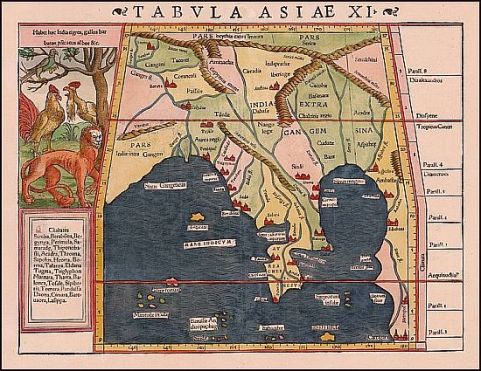
Ptolemy's Geography

Ptolemy’s geography of Asia

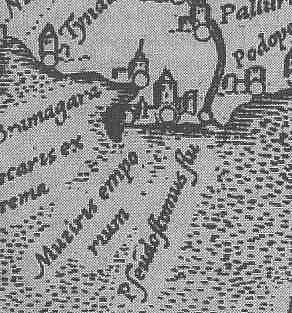
Ptolomy's Geographia. Muziris empo-rium

A section of the map of India drawn after Ptolomy’s Geographia, showing Muziris emporium

5. An indication of the importance of Muziris as a place for finalizing business deals by Roman traders was brought to light by L. Casson , a scholar, in his paper” New light on marine loans” .He mentioned about a papyrus (called P. Vindob. G 40822 -for identification purposes ), discovered during the year 1985 in  Vienna , which sets out the details of a maritime loan agreement between a ship owner – possibly of the Hermapollon mentioned on the verso of the papyrus and a merchant using the ship as security. The document  suggests that the loan arrangement was agreed to while the parties were in Muziris (though possibly signed on arrival at the Red Sea), indicating a rather active Roman merchant colony on the Kerala coast

(http://www.uni-koeln.de/phil-fak/ifa/zpe/downloads/1990/084pdf/084195.pdf).

6. The heightened trade between Greece/Egypt and India came as a culmination of the trade relations that existed between India and the West even centuries earlier to Christian era.

7. Historians say Muziris, might be of significance in another way too. They say Christianity may have been introduced to the sub-continent through Muziris.

8. The successful run of the Greek/Egyptian trade with India suffered a temporary setback due to the rise of a new Parthian Empire that formed a sort of barrier between the Greeks and the Indians. However, when Rome  started to absorb the remnants of the Empire of Alexander, Egypt came under the control of Romans. Egypt became a Roman province in 30 B.C. Thereafter, Augustus settled down and took charge of Egypt , as his personal property.

Interestingly , According to Pliny , writing in about 51 AD , the use of monsoon winds to shorten the passage to /from India was made known to the Romans only in the days of Claudius .( Pliny, N. H., 8, 101, 86). This development, therefore, must have come around 51 AD.  There was, therefore, a long period of lull in the Egypt-India trade after 34BC.

9. The Roman trade with India, through Egypt, began in earnestness in the first century AD. Muziris then became an important Romans’ trading centre. The Rome/Egypt/India trade lasted famously until about sixth century.

10. Then suddenly and mysteriously, Muziris went off the radar. It was not mentioned again for a very long time. Dr  Roberta Tomber of British Museum said.

“What is interesting is that in the 6th Century, a Greek writer, writing about the Indian Ocean , wrote that the Malabar coast was still a thriving centre for the export of pepper – but he doesn’t mention Muziris”.

No one has  a clue how Muziris disappeared so completely.

[ Please read Indo-Roman trade by Ajoy Kumar Singh, Janaki Prakashan, 1988]

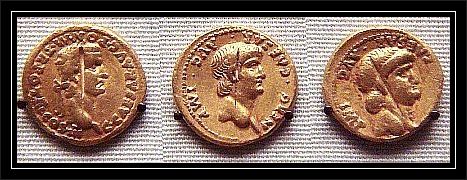
Roman coins

Regarding the trade in South India, Prof. Hermann Kulke and Prof. Dietmar Rothermund in their A History of India (Rutledge, London, Third Edition 1998-) write:

In the area around Coimbatore, through which the trade route from the Malabar Coast led into the interior of South India and on to the east coast, eleven rich hoards of gold and silver Roman coins of the first century AD were found. Perhaps they were the savings of pepper planters and merchants or the loot of highwaymen who may have made this important trade route their special target.

It also indicates that the South Indian ports served as entrepôts for silk from China, oil from the Gangetic plains which were brought by Indian traders all the way to the tip of South India, and also for precious stones from Southeast Asia. But, as far as the Eastern trade was concerned, the Coromandel Coast to the south of present Madras soon eclipsed the Malabar Coast. To the north of Cape Comorin (Kanya Kumari) there was the kingdom of the Pandyas where prisoners were made to dive for precious pearls in the ocean. Still further north there was a region called Argaru which was perhaps the early Chola kingdom with its capital, Uraiyur. The important ports of this coast were Kamara (Karikal), Poduka (Pondichery) and Sopatma (Supatama) (see Map 5). Many centuries later European trading factories were put up near these places: the Danes established Tranquebar near Karikal, the French Pondicherry, and the British opted for Madras which was close to Supatama

B.Today

1.BBC News in its edition of 11 June 2006 , reported an archaeological investigation by two archaeologists – KP Shajan and V Selvakumar – has placed the ancient port as having existed where the small town of Pattanam now stands, on India’s south-west Malabar coast. The team believes Pattanam as the place where Muziris once stood. Until recently, the best guesses for the location of Muziris centred on the mouth of the Periyar  River , at a place called Kodungallor – but now the evidence suggests that Pattanam is the real location of Muziris.

http://news.bbc.co.uk/2/hi/south_asia/4970452.stm

2. Pattanam is a small town some 12 km south of the Periyar river mouth (present day Kodungallur) , in Kerala state. The artefacts recovered from the excavation site include amphora (holding vessels) of Roman make and Yemenis, Mesopotamian, and West Asian ones too, indicating that Pattanam had trade not only with Rome but also with places in the Persian Gulf . The other artefacts recovered include pottery shards, beads, Roman copper coins and ancient wine bottles.

http://www.hindu.com/lf/2004/03/28/stories/2004032800080200.htm

3.There is no doubt that Pattanam was a major port and was important to the Indo-Roman trade But more collaborative evidence is needed to support the view that Pattanam was indeed Muziris.

http://www.hindu.com/2006/03/01/stories/2006030102540200.htm

4. The remote sensing data revealed that a river close to Pattanam had changed its course .The port may have been buried due to earthquakes or floods. This may perhaps explain the disappearance of the Muziris port. However, there are no definite answers yet.

http://news.bbc.co.uk/2/hi/south_asia/4970452.stm

5. Interestingly, while the excavations at Muziris are on, another set of archaeologists from UCLA and University of Delaware have excavated Berenike, a long-abandoned Egyptian port on the Red Sea near the border with Sudan . The team has uncovered the largest array of ancient Indian goods ever found along the Red Sea , including the largest single cache of black pepper from antiquity – 16 pounds – ever excavated in the former Roman Empire .

Dr. Willeke Wendrich, an archaeologist at the University of California at Los Angeles, said the research showed that themaritime trade route between India and Egypt in antiquity appeared to be even more productive and lasted longer than scholars had thought.

In addition, it was not an overwhelmingly Roman enterprise, as had been generally assumed. The researchers said artefacts at the site indicated that the ships might have been built in India and were probably crewed by Indians.

These again confirm the trade relations that existed between ancient Egypt and India

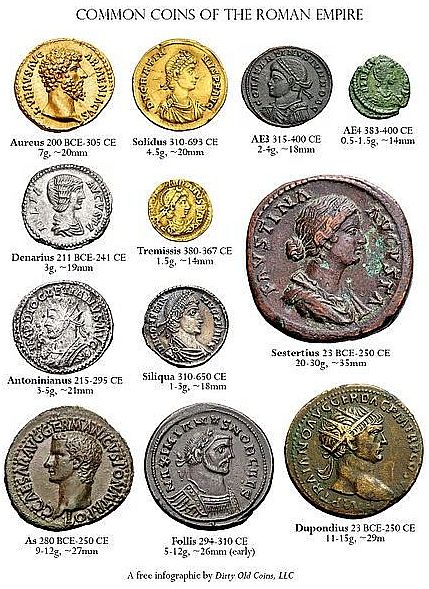
coins of Roman empire

http://mailman.geo.uu.nl/pipermail/maphist/2002-July/000840.html

http://historicalleys.blogspot.in/search?updated-max=2010-07-10T08:03:00-04:00&max-results=1&start=80&by-date=false

https://www.google.co.in/books/edition/The_Periplus_of_the_Erythraean_Sea/vpoN9PDYKC4C?hl=en&gbpv=1&pg=PR3&printsec=frontcover

https://en.wikisource.org/wiki/Periplus_of_the_Erythraean_Sea

https://www.worldhistory.org/Periplus_of_the_Erythraean_Sea/

 
11 Comments

Posted by on September 1, 2012 in History


Tags: , ,

Should there be morality in International Affairs?

Should there be morality in International Affairs?

One of the valuable lessons we can learn from Confucius is that the study of politics, including international politics, must involve morality as well as power.  Politics is not just about acquiring and holding on to power; it is how we use power, and to what ends, we use power, and what example we set for others.

Sometimes it looks as if there is no morality in today’s international affairs.  There is hardly any debate on the issue in the media. Perhaps this is because the subject embarrasses us.  When some states try to discuss morality in foreign policy, they usually do so indirectly and with some awkwardness. 

Confucius teaches us, morality is a serious subject that should be studied intensively.  In this respect, Confucius was both an idealist and a realist.  He combined the two schools we tend to separate.

Today power and politics appear to have come together in a wrong manner; it is now “power politics”.

A former diplomat once remarked, “Power and morality are two good things. Mixing them will spoil both”.

**

This leads to another question. Are there different standards of morality set for the individuals and the State?

There is a view that even when the concerns or interests of the individual and the State are same, each tends to view the events surrounding them differently. They may even be divergent. I am not sure how valid this line of thinking is; yet look at it for arguments sake. To keep it short, let us look at few areas of concern.

:- At micro (family/individual) level, it is good to be cautious; to not over spend but to put away a good portion of ones income in savings.

The State on the other hand would be interested in larger volume of public spending. Because a higher volume of spending accelerates the wheels of production which leads to creation of more jobs which in turn generates another spiral of spending which again leads to more production and more jobs ;   and so on. It is necessary to be charge and recharge the economy to keep it chugging on. This is particularly true in case of an open economy where the State intervention is minimal. You may perhaps recall, in the aftermath of 9/11 when the US economy froze a bit, the US President called upon his people to go out and spend more.

:- It is not good for an individual to appear aggressive and threatening, all the while, to his neighbors. It is not a welcome sign.

The state on the other hand strains to look aggressive and menacing to keep at bay even a harmless intruder or its neighbors let alone its enemies. It is a legitimate “make up” of the State too.

:- For a State, an individual is dispensable; whereas for a family each one of its member is indispensable.

:- It is wrong for an individual to kill another (even an intruder). He would be hauled up by the Law and punished. The reason for this, perhaps, is that the Society’s foremost concern is its self-preservation. If it allows its constituents to kill each other freely there would no society left in the end.

The State on the other hand prides it self over its ability to throw out or kill the intruders. The men who do this job and sacrifice them selves while doing so are the heroes of the State and its people, very rightly so.

The State even expends enormous amounts of money and other resources to gain the ability to kill as many as possible in a single assault . And, such killing efficiency is said to mark the strength of a Nation.

**

One concern that is of primary interest; and, is common to the individual and to the State , is Self-preservation and Self-perpetuation. These interests often override the concerns about morality; this is particularly true in the case of the State.

Was the diplomat wrong when he quipped, “Power and morality are two good things. Mixing them would spoil both”?

I do not know.

What do you think of these?

 
Leave a comment

Posted by on September 1, 2012 in General Interest


Tags:

Sindhu- Hindu- India

Sindhu-Hindu-India

In paragraph, two of my post “Greece and India before Alexander” I mentioned about the origin of the word India. Please click here.

2. Persia, in the ancient times, was the vital link between India and the Greeks of Asia Minor. In the Avesta of Zoroaster, what we today call as India is named as Hapta Hendu,   the Avesthan for the Vedic Sapta Sindhavah – the Land of Seven Rivers, that is, the five rivers of the Punjab along with the Sarasvati ( a river which has since disappeared) and the Indus. The word “Sindhu” not only referred to the river system but to the adjoining areas as well.

The name of Sindhu reached the Greeks in its Persian form Hindu (because of the Persian etymology wherein every initial s is represented by h).The Persian term Hindu became the Greek Indos/(plural indoi) since the Greeks could not pronounce “h” and had no proper “u”. The Indos in due course acquired its Latin form – India . . Had the Sanskrit word Sindhu reached the Greeks directly, they might perhaps have pronounced it as Sindus or Sindia .

With reference to the above, I received a message, from someone who read the post, saying that the word is a corruption of a corruption and India owes much to outsiders.

I have thought about the remark and this is what I have to say.

It is a fact that the word ” India ” is of foreign origin but this does not mean ,the very idea of an Indian nation is a contribution by outsiders.

There are many countries, as I know, bearing names of foreign origin. This is because of historical reasons. This does not in any way take away the identity of those nations or the nationalities of their people. These nations continue to bear the names given to them, with pride, and function as the honoured members of the International community. Let me cite a few examples.

  • France: The French are descendants of the ancient Gaulish people, who spoke languages that belonged to the Celtic family. The Gauls were conquered by Rome; and when Rome itself was taken over by Germanic people, the Gaul came under the influence of the Germanic Franks. The Franks gave their name to the country and called it France. Now, France has a language that had its origin in Latin and the people of France, largely, are of Celtic race. However, no one can sanely argue that French nation   owes its existence to Germany.
  • Germany: The word Germany   is of Latin origin and the Germans call their nation “Deutschland”. Hardly any non-Germans use this name. Germany is also known as Allemagne (after the name of a Germanic tribe). The Arabs and Iranians use this word.
  • Great Britain: Bulk of the British population speaks English, a Germanic language. However, the name “Britannia” celebrated in songs and legend by English poets is a Celtic name.
  • Basques: The French popularized the term ‘Basque’, but the Basques call themselves Euskera.
  • Similarly, America is named after an Italian. Spain takes its name from a Carthaginian word for “rabbit”.
  • I think Finland and a few East European countries like Armenia , Georgia also have their names derived from languages foreign to them. (I am not very certain about the exact details in these cases).

There may be number of other countries, that I may not be aware of, bearing names that either were derived from a foreign language or were given to them by outsiders.

The substance of my argument is, a nation’s identity does not depend merely on the name by which it is called. What matters is whether that single term can adequately capture its  ‘identity’. The term itself can be native or foreign.

Similarly, in the case of India too the terms ‘India/Hindu/Indus’ may not be of Indian origin. That alone does not mean, India has no culture of its own or the notion of India does not exist or that India owes its existence to outsiders etc.

No matter how the name India originated, India is a well-defined nation having a history, culture and identity of its own, like any other nation in the International community.

*****

After posting the blog I came across a wonderful web site that says most countries of the world have different names in different languages and that some countries have also undergone name changes for political or other reasons.

This web page gives all known alternative names for all nations, countries and sovereign states. Try this link .It is really good.

http://en.wikipedia.org/wiki/List_of_country_names_in_various_languages

*****

Persia, in the ancient times, was the vital link between India and the Greeks of Asia Minor . In the Avesta of Zoroaster, what we today call as India is named as Hapta Hendu,   the Avesthan for the Vedic Sapta Sindhavah – the Land of Seven Rivers, that is, the five rivers of the Punjab along with the Sarasvati ( a river which has since disappeared) and the Indus. The word “Sindhu” not only referred to the river system but to the adjoining areas as well.

The name of Sindhu reached the Greeks in its Persian form Hindu (because of the Persian etymology wherein every initial s is represented by h).The Persian termHindu became the Greek Indos/ (plural indoi) since the Greeks could not pronounce “h” and had no proper “u”. The Indos in due course acquired its Latin form – India . . Had the Sanskrit word Sindhu reached the Greeks directly, they might perhaps have pronounced it as Sindus or Sindia.

This view is supported by the observations made by the Supreme Court of India .

The Supreme Court of India while dealing with the case  “Bramchari Sidheswar Shai and others Versus State of West Bengal” in the matter of the Ramakrishna Mission’s petition to be declared a non-Hindu, minority religion under the Indian constitution, discussed the term Hindu and also identified Seven Defining Characteristics of Hinduism. The petition was denied. The court determined that the RK Mission is Hindu and there is no religion of “Ramakrishnaism” as claimed by them.

(For full text of the ruling please see http://www.hinduismtoday.com/in-depth_issues/RKMission.html )

Hindu

Generally, one is understood to be a Hindu by being born into a Hindu family and practicing the faith, or by declaring oneself a Hindu.


There is also a judicial definition of Hinduism.

The following are the observations of the Supreme Court of India while dealing with the term Hindu:


(27). Who are Hindus and what are the broad features of Hindu religion, that must be the first part of our inquiry in dealing with the present controversy between the parties. The historical and etymological genesis of `the word `Hindu’ has given rise to a controversy amongst indo-logists; but the view generally accepted by scholars appears to be that the word “Hindu” is derived form the river Sindhu otherwise known as Indus which flows from the Punjab. `That part of the great Aryan race”, says Monier Williams, which immigrated from Central Asia , through the mountain passes into India , settled first in the districts near the river Sindhu (now called theIndus ). The Persian pronounced this word Hindu and named their Aryan brother Hindus. The Greeks, who probably gained their first ideas of India Persians, dropped the hard aspirate, and called the Hindus `Indoi’.

 (28). The Encyclopedia of Religion and Ethics, Vol. VI, has described `Hinduism’ as the title applied to that form of religion which prevails among the vast majority of the present population of the Indian Empire (p.686). As Dr. Radhakrishan has observed: `The Hindu civilization is so called, since it original founders or earliest followers occupied the territory drained by the Sindhu (the Indus ) river system corresponding to the North-West Frontier Province and the Punjab . This is recorded in the Rig Veda, the oldest of the Vedas, the Hindu scriptures which give their name to this period of the Indian history. The people on the Indian side of the Sindhu were called Hindu by the Persian and the later western invaders [The Hindu View of Life by Dr. Radhakrishnan, p.12]. That is the genesis of the word `Hindu’.

Hinduism

The Supreme Court of India discussed in detail the nature of Hinduism, citing several references and authorities. While laying down the characteristics of Hinduism, This is what the Hon. Court observed:

Features of Hindu religion recognized by this Court in Shastri Yaganapurushdasji (supra) as coming within its broad sweep are these:

(i) Acceptance of the Vedas with reverence as the highest authority in religious and philosophic matters and acceptance with reverence of Vedas by Hindu thinkers and philosophers as the sole foundation of Hindu philosophy.

(ii) Spirit of tolerance and willingness to understand and appreciate the opponent’s point of view based on the realization that truth was many-sided.

(iii) Acceptance of great world rhythm, vast period of creation, maintenance and dissolution follow each other in endless succession, by all six systems of Hindu philosophy.

(iv) Acceptance by all systems of Hindu philosophy the belief in rebirth and pre-existence.

(v) Recognition of the fact that the means or ways to salvation are many.

(vi) Realization of the truth that Gods to be worshipped may be large, yet there being Hindus who do not believe in the worshipping of idols.

(vii) Unlike other religions or religious creeds Hindu religion not being tied-down to any definite set of philosophic concepts, as such.


 **************

 Hinduism is a way of life.Some consider Sanatana Dharma (The Eternal Way) to be a better nomenclature as it represents those spiritual principles that are eternally true; in this sense it represents the science of consciouness. Hinduism is unique among religions in neither being polytheistic or monotheistic, but one with a universal vision.Dr. Radhakrishnan calls Hinduism a movement not a position; a process not a result; a growing tradition not a fixed relevation . There is therefore always a possibility of further development.The indian way is a process of balanced growth.It is a balance between tradition and change.

This does not mean that Hinduism has neither form nor certainty. Far from that; it is a vibrent, dynamic , living faith which has an ethos of its own.

Hinduism is neither fanatical nor undefined , as J commented.

I agree with V V Raman that those who “contrive spurious history to add even greater glory to their past” be they Western or Indian deserve to be condemned.

*****

As regards ITS, the book has served a purpose. It has given a wake up call.

It is an important step but only the first step.

They have left it to the enterprise of individuals, families and social groups to devise appropriate methods to preserve and propagate true versions of our history, culture and religion. We therefore have a task on our hands. The least we can do is to have wider public debate in all the forms of media, social groups and academia. If there is no wider debate on the major concerns of the book then its aspiration remains largely unfulfilled.

There is a mistaken belief that anyone who speaks of Hinduism is a fundamentalist. The apathy of the “secular minded” to join the debate is on the belief that it relates to religion. But the fact is the debate aroused by ITS touches the more fundamental aspects of our being such as our identity, valuing our culture and its preservation and above all, it about self esteem. Discussions and arguments are critically important to carry forward the agenda of the ITS.

I find no mention, reference let alone debate about the book in the print or electronic media in India .The reach of its appeal is presently limited to a few blog sites; and within those sites confined to a couple of small groups. Even here, I cannot help feeling that the discussions have been rather patchy.  They are highly repetitive, highlighting often repeated quotes from the book. Hardly any thought was expressed about what we need to do next? How do we carry forward the agenda? In addition, we have the points made out by Mr. Raman. The discussions did not also take into account the “Purva Paksha”.

The writings by some westerns cited in ITS is a symptom. The malady goes much deeper and has its roots in India ; in its schools, textbooks, Research organizations, Universities and in the “safe” set of historians patronized by the Govt.

It therefore  takes  a much greater effort and dedication to effectively deal with the issue in a holistic fashion and to find credible answers to questions gnawing at the root of our cultural identity,” What do we tell and how we tell our children, who we are?”. A well thought out long term strategy involving various segments of the academia, the Research Organizations, the Government and intellectuals looks inevitable. There are no quick fixes here. We have to have a road map or a vision.

The efforts at home to preserve the culture need to be supplemented supported and nurtured by organized exercises at schools, Universities, Research organizations and social groups. It would be a blessing if the best of our young minds take up and pursue studies in our History and culture. Because it is here our perceptions of History, culture and religion get defined, acquire a broader appeal and get propagated. It is here that myth and “nonsense” as Raman said, gets weeded out .The important break through, if any, should logically appear in the organized sector. The families can protect and nurture the values. But they need a space to grow in the outer world. Else, our young ones will live in a zone of confusing and conflicting identities.

While on the subject of Hinduism in Universities, I wish to reproduce a passage from Mark Tully’s book India’s unending journey, which makes a significant observation on  teaching of Hinduism in western universities :”( Hinduism) is not usually taught in the departments of philosophy , but in the departments of religion-which invariably gives the impression that it is indeed irrational- or in the departments concerned with studying India as an area , which gives the impression it is peculiarly Indian and so irrelevant to western thinking…. Indian philosophers haven’t helped to improve matters, as many of them spend their time trying to identify the points at which their philosophy meets western philosophy rather than promoting an understanding on its own terms.”


Such being the case, how do we spur the young bright minds to pursue studies in History and culture?

Addressing these questions, sanely, is not an easy task. The debate is likely to generate more heat than light. We have the “secular “experts who equate everything Indian with Hindu and shoot it down. We have also the exhilarated ones who over adulate everything Hindu and ancient. While the Establishment will predictably be cautious and timid. Can we strike a Golden Mean? How do we project our History in the best light in a balanced manner?

Any further debate on ITS would be purposeful only in case it addresses issues concerning : carrying forward the agenda; re structuring the way Indian History, culture and religion is written , taught and studied at the advanced levels; and how the cultural values are preserved and nurtured in our homes.

In any case, the least we can do is to initiate spread of awareness, broaden the debate and carry it forward in  forums like these , in social/informal groups and toenlarge the debate over a broader community.

Please also see the Comments received from Mr. Raman and Mr. de Nicolas

Message received from VV Ramanvvrsps@rit.edu

Dear Dr. Rao:

Thank you for your insightful comments.

Here are some thoughts on some of them.

1. Hindu’s wouldn’t really care to just “follow” some “vision” laid out by the Book team.

Well said. However, having recognized and exposed in detail a problem, it does not hurt to suggest some positive solutions.

Fair enough, that was not the intent of the book. So, now perhaps it is time to discuss these.

Then again, it is important to discuss two quite different, though in some ways interrelated questions:

(a) How do we change the negative perceptions and portrayals (intended or not) of Hinduism in the Western world?

(b) How do we enrich, enhance, and create more positive understandings and more enlightened practices of Hinduism within the Hindu world, both in India and beyond?

2. Absolutely. You may recall what I said in my reflections on the book: “Unfortunately, those who speak for the tradition are sometimes caricatured as mindless fundamentalists wearing trousers instead of saffron robes, and skeptical non-traditionalists are sometimes looked upon as unwitting agents of the colonizers, pathetic victims of Thomas Babington Macaulay, by their respective ideological adversaries. Mutual name-calling only hurts the larger cause.”

3This is an extremely important point, and needs to be fully analyzed. It is a fact, for the good or for the bad, that Hindu culture – like the Islamic – is still intricately intertwined with religion, as used to be the case in the West also. The decoupling of culture and religion began in the West only in the 18th century, with some very positive and some very negative consequences.

4. But, the fact is the debate aroused by ITS touches the more fundamental aspects of our being such as our identity, valuing our culture and its preservation and above all, it about self esteem.>

Very good point. But it is important to realize that the whole book is  in the context of Hinduism as written about by a handful of Western scholars, which is very relevant and important no doubt. But the book can also serve to provoke greater self-examination among thoughtful Hindus, ignoring Western perceptions of what we may or may not be.

5Excellent point. Just what I said above.

6. As to Mark Tully’s observation, “( Hinduism) is not usually taught in the departments of philosophy , but in the departments of religion-which invariably gives the impression that it is indeed irrational-…”

Hinduism IS a religion, so there is nothing wrong in this. But it need not give the impression of being Any religion CAN be taught without making it seem irrational.

7. < Such being the case, how do we spur the young bright minds to pursue studies in Indian philosophy, History and culture?>

 It seems to me that in the modern world (i.e. if the young are subjected to courses on science and mathematics, history and literature), this can only be done if and when culture, history, and philosophy are secularized, i.e. decoupled from religion. This is not to say that we should neglect or abandon our religion. But religion (as most Hindu sages knew) is an experiential aspect of being fully human. It is not for analytical inquiry and rational dissection. Meditation is different from metaphysics. Reciting the Gita is different from analyzing it. Engrossed in divine music (bhajans) is different from taking the puranas literally.

Unless we study the Vedas as poetry, the Upanishads as philosophy, and grand epics as literature, we cannot make them relevant, meaningful, and enriching to modern minds.

This is the challenge.

V. V. Raman

July 21, 2007

From

DIOTIMA245@aol.com

Great remark.at the end of your comment. It is a  shame philosophy
departments do not hold Hindu texts…I was one of the few able and
willing to teach in the Philosophy Department at Stony Brook and my
many books are philosophical. Very different from what is offered in
Religious studies. Prof, Raman, bring the discourse through
philosophical search.
Best.
Antonio de Nicolas

July 20, 2007

Dear Sir,

Thank you for your response .As you mentioned, tagging or assigning a name to this religion or the way of life is an elusive exercise. The name Hinduism coined as an operative term points at a much larger entity but does not exactly stand for it. The earlier names “Brahmanism” or “Vedic religion” might have served a similar purpose. Megastenese though mentions Brahmins and Sramanas does not mention the name of any religion.

I sometimes wonder whether even in the distant past it ever had a specific name or  did it needed one, perhaps because of the absence of a rival .It is also plausible that “Vedic religion” was a branch of a “ mother religion” , if there was one.

Buddha does not name, refer to or attack the religion of the day though he criticizes the Brahmanic attitude, the rituals and discourages ungainly speculations.

He sometimes refers to his disciples by their sect as Brahmins or Kshatrias. He addresses some of them by their Gotra like Vaccha (Vatsa), Kaashyapa, and Maudgalya etc. Some of the disciples address the Buddha by his Gotra-Gautama.

Buddhism did not start as a religion. The Buddha intended to offer true interpretations of the Dharma. (That perhaps was how the religion of the day was named.) It started as a free-thinkers- moment that attracted the seekers and the lay intellectuals, in much the same way as the Ramakrishna moment did at a much later time. During the Buddha’s time it was not a religion yet; the rituals related to births, deaths and weddings were presided over by the Brahmin priests. The Buddhist rituals and practices (vinaya) were collated from the teachings and the incidents in the Buddha’s life at a much later time, after his death.

What set apart the Buddhism and other school of thought (like Charukavas et al) from the main stream of the day was their stand on the relevance and on the authority of the Vedas.

It was this factor, again, that largely guided the Supreme Court of India in listing some criteria for Hinduism while handing down the ruling in Brahmachari Siddheshwar Shai v. State of West Bengal case, which I reffered to in my earlier mail.While drawing up the criteria for indetifyong Hinduism the Court relied heavily on the views of Swami Vivekananda and Dr. Radhakrishnan that stressed tolerance, universality and a search for a fundamental unity as the virtues of Hinduism. It also reliedon B.G. Tilak’s view: “Acceptance of the Vedas with reverence; recognition of the fact that the means to salvation are diverse; and realization of the truth that the number of gods to be worshipped is large, that indeed is the distinguishing feature of Hindu religion.”Even in the earlier case (Yagnapurushdasji)the “acceptance of the Vedas” was a key element in the court’s decision.

Incidentally the Seventh in the list pf criteria leaves me a little perplexed. It reads ”Unlike other religions or religious creeds Hindu religion not being tied-down to any definite set of philosophic concepts, as such”. This in a way sums up the position but at the same time appears to knock down the earlier six criteria.

Perhaps it is because of this view ( of not being tied down to any definite set of concepts)  that many say “The term ‘ism’ refers to an ideology that is to be propagated and by any method imposed on others for e.g. Marxism, socialism, communism, imperialism and capitalism but the Hindus have no such ‘ism’. Hindus follow the continuum process of evolution; for the Hindus do not have any unidirectional ideology, therefore, in Hindu Dharma there is no place for any ‘ism’”


In any case Hinduism is now a nomenclature for the religious tradition of Indiaand the suffix is hardly noticed. Not many have qualms in accepting “Hinduism”.

The criteria drawn up in the Brahmachari Siddheshwar Shai v. State of West Bengalcase is a working rule evolved for a limited purpose. It cannot be construed as thedefinetion of Hinduism . Because Hinduism is described on variious occations depending on the context.Each time a “ context- sensitive” interpretation  has been put forth. For instance:

In the Indian Constitution, Explanation II appended to Article 25 says that the “reference to Hindus shall be construed as including a reference to persons professing the Sikh, Jain or Buddhist religion”

The Hindu Code Bill (which comprises four different Acts), too, takes an undifferentiated view of Hinduism: it includes anyone who is not a Muslim, Christian, Parsi or Jew under ‘Hindu’ as a legal category.

Any reform movements, including Buddhism, Jainism and Sikhism, were seen as merely different sects within Hinduism.


There are legal pronouncements that Hindus are Indian citizens belonging to a religion born in India. This means Buddhists, Sikhs or Parsis, even those who did not recognize themselves as Hindus, are to be considered Hindus.

 The Supreme Court of Indiadealt with the meaning of the word ‘Hindutva’ or ‘Hinduism’ when used in election propaganda. The court came to the conclusion that the words ‘Hinduism’ or ‘Hindutva’ are not necessarily to be understood and construed narrowly, confined only to the strict Hindu religious practices unrelated to the culture and ethos of the People of India depicting the way of life of the Indian people. Unless the context of a speech indicates a contrary meaning or use, in the abstract, these terms are indicative more of a way of life of the Indian people. Unless the context of a speech indicates a contrary meaning or use, in the abstract, these terms are indicative more of a way of life of the Indian people and are not confined merely to describe persons practicing the Hindu religion as a faith. This clearly means that, by itself, the word ‘Hinduism’ or ‘Hindutva’ indicates the culture of the people of Indiaas a whole, irrespective of whether they are Hindus, Muslims, Christians, and Jews etc.”
 

Here, the term somehow traveled a full circle and came back to Radhakrishnan’s view” ‘Hindu’ had originally a territorial and not creedal significance. It implies residence in a well-defined geographical area.”

All definitions so far have been “context -sensitive” (Ramanujan).

Coming back to the Buddha and Sri Ramakrishna, before I end, there is a remarkable similarity between the two greatest of men. Both spoke from experience. Both placed ones experience above scriptural authority and other modes of cognition. Both had a remarkably sane and expansive view of the religious experience. Both interpreted the existing Dharma in its true light and both did not intend to start a new religion or an Order. In both cases the disciples came to them in search of enlightenment and it was at their initiative the Sangha or the Missioncame into being. The life and teachings of both were recorded and propagated by their disciples in a remarkably similar manner. Neither master authored a book or a treatise.

 The reason Buddhism gained a wider reach and appeal was because of the Royal patronage it received in its formative years and the manner it spread among the populace. The disciples of Sri Ramakrishna largely came from the urban educated middle class. Their Missions were located in cities and the Master’s message was conveyed mainly through books addressed to the educated. The Ramakrishna Mission somehow came to be associated with the elite, at least out side of Bengal, though Sri Ramakrishna was a simple, lovable person accessible to all and came from a rural background. It took a while for the Sri Ramakrishna to become known in the rural parts out side Bengal.


 Buddha directed his disciples to teach “for the welfare of the many, out of compassion for the world,” and this his disciples did. Early Buddhist evangelism usually consisted of a pair of monks entering a village, going from house to house with their begging bowls until they had enough for the one meal they ate for the day. The monks would then return to the outskirts of the town, where they would often be followed by those who had been impressed by their demeanor and wished to talk with them. The monks would share what they knew, then move on to the next village. Most of the monks hailed from far flung rural areas. The rapid growth of Buddhism probably had much to do with the way the monks closely lived with the people and tended to their spiritual needs.

It is a privilege conversing with you.

Thank you for the response

Regards

 
3 Comments

Posted by on September 1, 2012 in General Interest, Hindu-Hindutva, History


Tags: , ,

Some Other Ancient Greeks in India


The exploits of Alexander the Great in India and the deeds of the other famous Greeks that followed him are well known. Among those famous Greeks who traveled to India , there were Kings, Generals, Diplomats, Philosophers, Historians and a whole tribe of soldiers. Many of whom have written about India and their life in India .
 
   
1.1 Apart from these, some other ancient Greeks traveled to India either as individuals or in small groups. They were mostly sailors and explorers. Some of them took the land route while many others sailed to India . The principal interest of their travel was not conquest but trade. Only a small number of these explorers have left behind a record of their travels detailing, among other things, the sea route they took, ports they sailed into, the commodities they traded and their impression of the strange country, its strange people, their customs etc. However, in most other cases the details have come down to us indirectly, through the writings of historians who gathered tales from sailors, merchants etc. who might have accompanied the voyages; or from other sources that are not now extant. The life and work of, what we may call, these other ancient Greeks is not common knowledge, except in History circles. Let us look at a few of them.
 
  
2. Before going into that, a mention has to be made of two other ancient Greeks-Skylax of Karyanda in Karia and Pyrrhon the Skeptic- both of whom do not fall in the above category.
 
  
2.1 Skylax :
 
 
Skylax, the first Greek to set foot in India, lived before Herodotus, who tells that the Persian Emperor Darius Hystargus (512–486) led a naval expedition to prove the feasibility of a sea passage from the mouth of Indus to Persia . Under the command of Skylax, a fleet sailed from Punjab in the Gandhara country to the Ocean. Continuing, Skylax followed the coast and explored the gulf of Oman and the south-eastern side of the Arabic Peninsula . In thirty months, he circumnavigated  Saudi Arabia and reached  Mediterranean through the channels of Nile and Isthmus of Suez . Skylax later wrote a book of geography titled Indika apparently a report of his expedition that set out to follow the Indus from its headwaters to its mouth.
 
(Source: J.W.Sedler – India and Greek world)


2.2 . Pyrrhon of Elis (365-275 B. C.)

Pyrrhon is one of the earliest Greek philosophers likely to have had a direct contact with India . According to Diogenes Laertios (second cent. A. D.) , the ancient historian of philosophy, Pyrrhon was at first a painter and his works were seen in the gymnasium at Elis . Later Pyrrho took to philosophy influenced by the works of Democritus(c.400BC). He studied philosophy with a teacher of the school of Megara (Magerian dialectics) and then with Anaxarchus (340BC), the pupil of Democritus.

2.2.1. Pyrrhon was one of the philosophers who traveled with Alexander the Great on his expedition to India . He apparently met some Indian philosophers during his stay in India . His experiences in India may have had some effect on him because on his return to India he preferred to live in solitude and in poverty. Yet, he was highly honoured by the Elians and the Athenians, who conferred upon him the rights of citizenship. He did not put his ideas into writing. His ideas have survived only through fragmentary citations in later authors and mainly through the writings of his pupil Timon of Philus. Timon admired his teacher for his modesty and his tranquil way of life.

 
Pyrrhon is regarded the first skeptic philosopher and the inspiration for a school of thought known as Pyrrhonism founded by Aenesidemus(of third skeptic school) in first century B.C.
 
(Source: Encyclopedia Britannica, Eleventh Edition)


3.Patrokles:

The 3rd century B. C. has been rather kind to historians. A good number of reports of Greeks who traveled to India during this period have come down to us, as compared to the later periods. During this period, the rulers of Persia and Greece sent their emissaries to India . It is said, an officer named Petrokles (c.280 BC) visited India and returned with some useful geographic information. However, nothing much is known about Petrokles.

3.1. Pliny, the historian, in his Naturalis Historia VI 36 mentions Patrokles. He attributes the statement, that the Caspian Sea is as long as the Black sea to Patrokles. He also mentions that Aristobulus [who accompanied Alexander the Great] stated that the Oxus is easy to navigate and that large quantities of Indian merchandise are conveyed by it to the Hyrcanian [Caspian] Sea and then transferred into Albania by the Cyrus and through the adjoining countries to the Euxine [Black Sea]. Pliny, then, adds a remark to the effect that Aristobulus and Eratosthenes -(276-194BC- the Greek mathematician known to have calculated the Earth’s circumference and to have drawn the map of the world) – borrowed this idea from Patrokles. This is Eratosthenes’s map. India is on your right hand side.
 
3.2. Patrokles’s name appears four times in the fragments of Megasthenes’s Indika. On all those occasions, it was in connection with measuring the size of India , the length (breadth?) of India and distance of places in India from the south sea. Patrokles, on each occasion differs from the measurements calculated by Megasthenes, Eratosthenes and by Deimachos (envoy to the court of king Bindusara).  Hipparchos (the Greek astronomer who drew up the first catalog of the stars) remarks that two competent authorities’ viz. Deimachos and Megasthenes opposed Patrokles; and that even Eratosthenes discredited the calculations of Patrokles.
 
 
3.3. Evidently, Patrokles along with Eratosthenes and Hipparchos visited India and he had some knowledge of India . All these were highly eminent persons. Obviously, the Greeks, in those times, valued their relation with India .

(Source :

http://projectsouthasia.sdstate.edu/docs/history/primarydocs/Foreign_Views/GreekRoman/Megasthenes-Indika.htm

http://en.wikipedia.org/wiki/Eratosthenes

***
***
**

4.Eudoxos of Kyzikos (Eudoxus of Cyzicus ) :

The later half of the first century and the period thereafter in the second century BC did not witness frequent contacts between India and the Greek world because the land route was blocked by the Parthian empire (successor to the Seleukids). As regards the sea route via the Red Sea and the Indian Ocean , the sea captains had not yet learned to utilize the monsoon trade winds and had forgotten the route found by Skylax. There was, however, some improvement in the traffic following the movement of the Bacterian kings into the Indus valley. This rendered the land route less dangerous.

4.1. The beginning of the second century saw an upsurge in the sea travel between Egypt and India . This continued until the third century. It all began with the voyage undertaken by one Eudoxos of Kyzikos

4.2. By all accounts, Eudoxos of Kyzikos was a remarkable person. He was a highly cultured sea captain who was described as a geographer, fighter, diplomat and intrepid trader and one who explored uncharted lands beyond the Mediterranean . He left behind the story of his expedition from Egypt to India . He is the hero of popular novels and films.

4.3. Eudoxus (c.130BC) was born in Cyzicus an ancient town of Mysia in Asia Minor , situated on the shore side of the present peninsula of Kapu-Dagh (Arctonnesus). Nothing much is known about Eudoxus’early life. There are some references to his unhappy married life and to a series of voyages across the Indian Ocean seeking wealth for his family shipping concerns.

4.4. According to Strabo (64BC to 24 AD -a Greek historian), quoting Posidonius (135BC to 51 BC -a Greek philosopher and historian), while Eudoxus was in Alexandria , he met a nearly dead shipwrecked Indian rescued from the Red Sea shore. After the seaman recovered and learnt a smattering of Greek, he informed that he was the sole survivor of a ship that sailed from India . Eudoxus was exited with this piece of news and thereafter convinced the Egyptian king Ptolemy VIII (Physkon) to sponsor an expedition to India , with the rescued Indian seaman as the guide. Eudoxus set sail in 118 BC from Berenice Harbor with the Indian as the guide. The voyage after having reached Muzuris in South India , Kerala , located below Calicut , returned to Egypt after 70 days. Eudoxus returned with a rich cargo of precious stones and aromatics. Ptolemy VIII promptly confiscated the cargo. Ptolemy VIII, not long after, died in 116BC; bequeathing Kyrenaika to his illegitimate son Ptolemy Apion and Egypt to Kleopatra III’s son with herself acting as the regent.

4.5. Posidonius recounts that the second voyage of Eudoxus to India came about in 116 BC at the command of Kleopatra III because she was desirous of procuring more precious gems and perfumes from India . The second voyage was, however, not as smooth as the first one. On his return voyage, Eudoxus was blown off-course and stranded on a shore below Ethiopia (perhaps below Cape Guardafui , Somalia ). After a series of misadventures, Eudoxus finally returned, with his precious cargo, to Egypt in around 114 BC. By which time Ptolemy IX had become the pharaoh. Yet again Eudoxus met with the same fate when the Pharoah Ptolemy IX confiscated the cargo just as his father did earlier.

4.6. What followed thereafter was a most wonderful adventure story. Eudoxus intending to embark on a third voyage to India by circumnavigating Africa ( Alexandria ) built a big ship. As a true showman, he gave wide publicity to the voyage, put music girls on board along with physicians and artisans, and set sail to India in great style. Because of a number of mishaps on the way, Eudoxus abandoned the voyage to India and eventually landed in Cadiz in what is now Spain . Strabo remarks that Eudoxus was always attended by good fortune.

4.7. Long after Eudoxus voyage Ptolemy XII (80 to 51 BC) created a special post titledCommander of the Red and Indian Seas to organize and encourage trade with India . The best-known occupant of this office was Callimachus the epistrategos, who was the Commander between 78 BC and 51 BC.

 
4.8. Pliny complained that the Indian luxury trade was depleting the Roman treasury to the extent of 50 million sesterces annually. The Roman Senate even contemplated banning the use of Indian cotton in the clothing Toga that Roman citizens wore, because it was too expensive to import. Evidently, the trade with India was flourishing.


Incidentally, the captain of Eudoxus of Cyzicus’ship that sailed to India , according to some, was Hippalus. Who was this Hippalus?Was he real?

(Sources: http://penelope.uchicago.edu/Thayer/E/Roman/Texts/Strabo/2C*.html#3.4

http://en.wikipedia.org/wiki/Indian_maritime_history )

**

5. Hippalus : 

The contents of the book titled Periplous of the Erythraean Sea (“Circumnavigation of the Erythrean i.e., Red Sea”), written in around 75 to 90 AD by an unknown author presumed to be a Greek merchant sailor, indicates, the author had access to first-hand information about the ports in western India .The book mentions a series of ports along the Indian coast, including Muziris (Pattanam?), Colchi (Kochi?), Poduca, and Sopatma.  The book is narrated on a navigation itinerary basis, stopping at every point (a ‘port of call’) to enumerate merchandises, details about the local routes of trade, information about the natural environment, the political establishment, and the cultural and religious affairs and/or traits of the port in question. According to M.S. Megalommatis, a scholar, judging by the language of the text one could say Greek was not the mother tongue of the author. Most probably, he was an Alexandrian Egyptian captain and merchant who voyaged these seas and had intimate knowledge of the areas mentioned in the text.

5.1.The book also records the accomplishment of a certain Hippalus who, it says, understood the patterns of the Indian monsoons and discovered a sea-route from the Red Sea to Southern India . The book also makes a special references the port of Kodanganallur (anglicised to Cranganore, and also known as Muziris or Shinkli), in present day Kerala on India ‘s West coast. Pliny refers to this port as primum emporium Indiae.

5.2. There are two issues concerning Hippalus that are debated (a) the Sea route from the Red Sea to the Indian ports were  already known to the earlier Greeks. Hippalus did not discover them; and (b) Hippalus was not a real person and that the term was coined to represent a system of trade winds or to the sea/sea route.

5.3.As regards the first issue, we know that Skylax as far back as in fifth century BC traced a sea route to and out of the Red Sea . Further, as recorded in Arrian’s Indica ( 21, 1)Nearchus, a Macedonian General and a friend of Alexander, commanded a fleet to carry the men back from India to Persia and Mesopotamia . It is said, he was the first to realize the importance of the monsoon winds for sailing in that region, he, therefore waited for the commencement of the northeast monsoon to begin the voyage from India .After his conquest, Alexander sent out voyages of exploration to Arabia and the Caspian Sea but he died soon thereafter. (Apart from this ,the Arabians and Indians must, of course, have known and made use of the monsoon winds for centuries.)

Perhaps, because these events were too far back in time, they were either forgotten or lost in antiquity.

*

5.4. The other issue, which questions the existence of Hippalus, is a little more debatable. To start with, Pliny (79AD) does not mention him ; and in Ptolemy (c.168AD), Hippalus is the name of a sea. The French historian Andre Tchernia explains that Pliniy’s contention was because in the earlier times, the name of the wind was written as Hypalus and it was only in the Roman times the spelling Hippalus came into use . Some historians, therefore, wonder if Hippalus were to be a real person, then it is strange that his exploits were hardly known to the succeeding generations

*
5.5. Regardless of the view one might take on the above issue, the fact is that after the first century there was an upsurge in the sea traffic between Greece/Egypt and India . This was mainly on account of the drastic reduction in the time and the risks involved in sailing to India .The sailors setting out of Egypt ,now, went from the Red Sea to India over open sea , instead of hugging to the African coast as had been the practice till then. This made it possible to sail confidently for days without sight of land. The new route was shorter and free from the Arabian pirates. The Greek sailors also introduced a new shipping calendar and planned their voyages accordingly. These practices soon turned the Egypt-India sector into a major sea route and the Greek merchants sailed further crossing the Bay of Bengal on to the Southeast Asia region. Naturally, the trade between Egypt and Southern India flourished during this period. “Previously, not twenty vessels … dared to peep outside the straits…but now, great fleets are sent as far as India and the extremities of Aethiopia, from which the most valuable cargoes are brought to Egypt and thence sent forth again to other regions.’ ; so runs Strobes oft-quoted remark (Strabo, 17.1.13. [798]). Emperor Tiberius (42BC to 16AD), was however concerned over Rome ‘s increasingly adverse balance of payments. He complained, “The ladies and their baubles are transferring our money to foreigners”.
*
5.6. The key to this success story was the Greeks’ coming to understand the phenomenon of monsoon, the Indian monsoon. What is this monsoon? Let us see.
*
Monsoon is an anglicized form of Mausum, an Arabic/Hindi term meaning weather or season. It is specially refers to the heavy rainy season that commences in June, dies away in September, each year, and is very vital to the climate, the economy and to the life on Indian subcontinent.
*
The south-west monsoon is born off the Madagascar coast to Somalia due to a high-pressure area .The wind direction at this point is south easterly. The moisture-laden winds from this high-pressure area around Madagascar travel northwards to Somalia . As soon as they cross the equator, south-easterlies turn right to assume a south-westerly direction.
*
It is in Somalia that south-west monsoon assumes its true character. It becomes a jet stream by May. That jet drives the south-west monsoon from Somalia to India . The Jet streams are relatively strong winds concentrated within a narrow stream in the atmosphere. The Somali jet-stream helps the south-west monsoon gain force and hence it hits the Indian subcontinent with great force
*
5.6.1. The two key ingredients needed to create a successful monsoon in India are a hot land mass and a cooler ocean. In India , for instance, the landmass of the Great Thar Desert , the adjoining areas of north and central India , in addition to the Deccan plateau absorb much heat from the sun during the summer months; while the temperatures over the Indian Occasion remain comparatively lower.
*
[Prof. A L Basham , in his “The Wonder That was India ” gives a graphic description of Indian Monsoon:
*
The most important feature of the Indian climate is the monsoon, or “the Rains Except along the west coast and in parts of Ceylon rain rarely falls from October to May, when cultivation can only be carried on by carefully husbanding the water of rivers and streams, and raising a winter crop by irrigation. By the end of April growth has practically ceased. The temperature of the plains rises as high as 1lO° F. or over, and an intensely hot wind blows. Trees shed their leaves, grass is almost completely parched, wild animals often die in large numbers for want of water. Work is reduced to a minimum, and the world seems asleep.
*
Then clouds appear, high in the sky; in a few days they grow more numerous and darker, rolling up in banks from the sea. At last, in June, the rains come in great down pouring torrents, with much thunder and lightning. The temperature quickly drops, and within a few days the world is green and smiling again. Beasts, birds and insects reappear, the trees put on new leaves, and the earth is covered with fresh grass. The torrential rains, which fall at intervals for a couple of months and then gradually die away, make travel and all outdoor activity difficult,and often bring epidemics in their wake; but, despite these hardships, to the Indian mind the coming of the monsoon corresponds to the coming of spring in Europe. For this reason thunder and lightning, in Europe generally looked on as inauspicious, have no terrors for the Indian, but are welcome signs of the goodness of heaven]
*

Since the Indian Ocean is bound on the north by a large land mass, the effects of “differential heating” are intense. The air mass over the subcontinent, consequently, heats up, expands, and rises up in to the air. This causes a low-pressure area over the northern and central Indian subcontinent. To fill up this void, the cooler, heavier and moisture-laden winds from the Indian Ocean rush on to the subcontinent. The damp, chilly layer that hangs Over India will be as thick as three miles.

As the cool air arrives, the winds also shift. During the dry season, the winds blow offshore – from land to sea. Then, as the monsoon begins, the winds blow onshore – from sea to land. This phenomenon perhaps explains why the early Arabs named the monsoon “Mausin,” or “the season of winds.” The southwest Monsoon generally begins around the middle of June and lasts until September.

(Sources: http://www.pbs.org/wnet/nature/monsoon/html/body_make.htm

http://en.wikipedia.org/wiki/Monsoon

**

5.7. The real impotence of this phenomenon to the Greek/Egyptian sailors was that in the Indian winters the winds blow from the Sea on to the subcontinent; While in the Indian dry season, the winds reverse and blow from land to the sea. The Greeks could, therefore, sail into India during the Indian winter and sail back to Egypt during the Indian summer; thus taking advantage of favorable winds  on both occasions .This rendered the sea crossing a lot easier and faster than before. It is said, Hippalus set out in August sailing into the wide Arabian Sea directly towards the Malabar Coast . Further, Dr. Lionel Casson in his recent translation and commentary on “The Periplus Maris Erythraei,” says the ships left Egypt in July to take advantage of strong winds out of the north in the Red Sea and while returning, the ships usually departed in December or January to catch a favorable shift in winds.

The Periplus of the Erythraean Sea primarily focuses on two trade routes originating at Egyptian ports: one, on the East African coast as far as Tanzania, and the other via the Arabian peninsula and Persian Gulf to western India. The author writes in detail of numerous cities, ports and harbours on these routes but India’s western coast, from Karachi down to Kanyakumari on the southernmost tip, accounts for nearly half the narrative.

(http://nefertiti.iwebland.com/timelines/topics/means_of_transportation.htm#rem13

Kanyakumari
*
5.8. Dr Lionel Casson says , a round trip to India covered about 3,500 miles. Dr. Casson, in his another book Rome’s Trade with the East: the Sea voyage to Africa and India, says that in those times the ships could make between four to six knots with fair wind. Accordingly, the mariners of those days could do about 100 miles per day, if they sailed through the night. That means to say the voyage from Egypt to Malabar might have taken about three weeks or a little less. According to Pliny, Eudoxus voyage to India and back took seventy days. In one-step, voyages were reduced from months to weeks, and profits soared.
 
 
5.9.One of the fallouts of Greeks’ increased trade with Southern India was, the perspective they gained of India ’s geography. The Greek geographers till then thought the Indian coast stretched from West to East. Now they could recognize the North _ South direction of India ’s West coast and its projection into the Indian Ocean .
*
5.10. Finally, Hippalus, real or otherwise, continues to hog the limelight. A crater on the moon is named after him .He is also a prominent character in Sprague de camp’s bestseller The Golden Wind.
 
 6. Pantainos (c.180 to 200AD) :
**
*
Very little information is available about Pantainos’s early life. It is said, to start with, he was a stoic philosopher. He later became a Christian. He established, in 180 AD, the famous Catechetical School in Alexandria (which later became the first Christian University ) to teach the beliefs and the philosophy of the new religion. He is regarded as the teacher of Clement of Alexandria , the first member of the Church of Alexandria . Clement called him “Sicilian bee” while Pantainos called himself “teacher of gentiles”. He is believed to be the author of the well-known Letter to Diognetus or atleast of its conclusion.
 
 6.1. Because of his zeal and learning, Pantainos was sent as a missionary to Malabar Coast, in South India, to preach Christianity. The Church in Kerala believes that Pantainos while in India came across Matthew’s Gospel in Aramaic.
(Source: J.W.Sedler – India and Greek world)
 
 
7.Frumentios of Tyros:
**
*
Frumentios in his childhood accompanied his uncle to India on what seems to have been a tourists’ trip, but remained there for many years as  the household superintendent under an Indian king. On his return to Alexandria , he was appointed Bishop of India in the year 336, and presumably returned to India to spread the Christian gospel.
 
 
7.1. Interestingly, the Ethiopian Christian tradition states that a certain Frumentios of Tyros was in Ethiopia in around 360 AD. While on a visit to India , he along with his brother Aidesios of the Äthiopiern was imprisoned but was later released and appointed as teacher to the prince. He preached Christianity while in India . On return to Alexandria , he was appointed Bishop of Ethiopia and was called “Apostel Abessiniens”.
 

Were they both talking about the same person?

( http://translate.google.com/translate?hl=en&sl=de&u=http://www.bautz.de/bbkl/f/frumentios_a_ae.shtml&sa=X&oi=translate&resnum=3&ct=result&prev=/search%3Fq%3DFrumentios%2Bof%2BTyros%26hl%3Den%26sa%3DG)

**

8.Theophilos:

*

According to Philostorgios (c.368 to 433AD)who is described as lateantique church historian, the Roman Emperor  Constantine (fourth century AD) dispatched a certain Theophilos to India to preach Christianity and that while in India he found some Christian followers of the Apostle Bartholomew. There is also a tradition that says Theophilos visited India and Maldives in AD 354, Mar. However, the details of his life are unknown and what little is known is disputed.
 
 
8.1.It is believed he came from one of the islands near Somalia . There is also an opinion that his travels were in connection with to trade and politics and were not related to religion.


Philip Mayerson in his essay A Confusion of Indias: Asian india and African India in the Byzantine Sources , says that after the fourth century the term India came to be applied rather loosely to refer to the subcontinent India , Axum/Ethopia or even to South Arabia and this has lead to much confusion. Mr. Mayerson says, Theophilos was not sent to India but was sent to perform missionary work among Homerites in Arabia Felix.

**

9. Kosmas Indikopleustes (Indian voyager):

He was a Greek traveler and Geographer who lived in Alexandria during the first half of the sixth century. He was a contemporary of Emperor Justinian I .He came from a family of traders and in his early years was trained to become a merchant. His business took him to various regions around Egypt . He voyaged in the Mediterranean , the Red Sea , and the Persian Gulf . The farthest he traveled was to the Cape Guardafui . He gathered information about these and other surrounding regions. It is not certain that he actually visited India .
 
 
9.1. The sub title “Indicopleustes” meaning “Indian voyager” stuck to him perhaps because in those days the entire region of Arabian Sea , the Red Sea and its sublets fell under the broad name Indian Ocean .
 
 
9.2. In his later years (ca. 540), he became a monk and entered the monastery of Raithu on the peninsula Sinai. In around 550AD, he wrote a richly illustrated twelve volume monumental work titled Christine Topography. One copy of the manuscript is in the Vatican Library while the other is in the Laurentian Library of Florence . A feature of the book is the cosmology the author projects. According to that, the earth is flat and heavens are in the shape of box with a curved lid. Cosmos aimed to disprove the pre-Christian geographers who asserted the earth was spherical in shape.
 
  9.3. If the cosmology is set aside, the book is an interesting and reliable guide to the world that has since disappeared.


In the words of Philip Meyerson , Christian Topography is the work of an anonymous Alexandrian merchant and an aspiring theologist who centuries later was given the name Cosmos and soubriquet of Indicopleustes although he never visited India .

(Sources: http://en.wikipedia.org/wiki/Cosmas_Indicopleustes

****

It is sad that the Greek/Egypt trade with India collapsed after third century AD. The fall of the Roman Empire , and the succeeding dark ages brought instability to Western Europe and caused a near collapse of the trade network leading to a massive contraction of interregional trade. The Greek/Egypt and India trade was one of its early causalities.

 
4 Comments

Posted by on August 31, 2012 in History


Tags: ,

Greeks in India Before Alexander

Greece and India Before Alexander

In his speech at a banquet hosted in his honor by Greece President Karolos Papoulias and in his address at the Hellenic Foundation for European and Foreign Policy, on 26 April 2007, the President of the Indian Republic. Shri A. P. J. Abdul Kalam referred to exchanges between India and Greece that began well before Alexander’s march into India in 326 BC. Let us take a look at what these exchanges were.

Pre-historic era
 
Were there Greeks in India before the advent of Alexander the Great? Was Alexander the first Greek to conquer India?
 
The ancient Greek historians Pliny (VI..xxi.4-5), Solinus (52-5) and Arrian (Indica, I. ix) all assert that Alexander was not the first Greek to invade and conquer India.  Their accounts are a mixture of myths and history; and it is not easy to separate the one form the other.
 
According those historians, with some variations, Dionysus was the first Greek King to invade India. And, an incredibly long period of 6451 years and 3 months separates Dionysus from Alexander’s conquest of India. During that interval about 153 0r 154 kings reined.
*
Diodorus Siculus (60 – 30 BCE) another historian mentions that there were three kings bearing the name Dionysus separated by long periods of time.  According to Diodorus, it was the first Dionysus, the eldest – Dionysus of India (Indos) who conquered India. And, after his conquest he reigned over India for 52 years and died of old age,  thereafter his sons ruled in unbroken succession.
*
Arrian (Indica, I. vii), drawing from the book of the Greek Ambassador Magasthenes,  writes : “Dionysus founded cities and gave laws to those cities and introduced the use of wine among the Indians as he had done among the Greeks, and taught them to sow land, himself supplying the seeds….It is also said Dionysus first yoked oxen to the plough and furnished them with implements of agriculture, and also made husbandmen of the Indians .”
He also mentions lot of other things introduced by Dionysus.
 
Dr. Nagendra Singh, in his monumental Encyclopedia of Hinduism (pages 1712-15), after a lengthy discussion,  surmises that Dionysus the eldest, the Indos, is the nearest equivalent to Prithu Vainya – Prithu the son of Vena in Indian mythology.
Prithu is celebrated as Adiraja,  the first anointed monarch;  and , the starter of royal dynasties. He is also the earliest among the monarchs to be hailed as Chakravarthin, who ‘at the head of his army marched to every part of the world’. It was figuratively described that Prithu chased and conquered the earth which was fleeing from him like a cow. He was ‘Raja daivyena sahasa’ – King with God-force.  It was after his name that the earth we live came to be known as Prithvi.
The Atharva Veda (8.10.24) credits Prithu with introducing the art of ploughing; leveling the whole arable earth; encouraging cultivation, cattle-breeding, commerce; building of cities and villages. Prithu is also said to have released the rapture of wine (Soma) from the earth for the delight of the gods.
Prithu_-_Crop
Prthu
Prithu2

It appears that  Prithu, the Indian monarch , runs parallel to the Greek Dionysus the Indos. I, however , hesitate to suggest that both refer to one and the same person.

In case the the claim of the Greek historians that Dionysus marched in to India about 6451 years before the time of Alexander is taken seriously , it then throws the whole chronology of the Indian history as it is now accepted into a vortex.

[There are several other versions of the Dionysus legend. In one of the versions (Diodorus Library of History, Book III, 62-74) Dionysus is described as :

“ The most ancient Dionysus was an Indian, and since his country, because of the excellent climate, produced the vine in abundance without cultivation, he was the first to press out the clusters of grapes and to devise the use of wine as a natural product, likewise to give the proper care to the figs and other fruits which grow upon trees, and, speaking generally, to devise whatever pertains to the harvesting and storing of these fruits. The same Dionysus is, furthermore, said to have worn a long beard, the reason for the report being that it is the custom among the Indians to give great care, until their death, to the raising of a beard. ….Furthermore, there are pointed out among the Indians even to this day the place where it came to pass that the god was born, as well as cities which bear his name in the language of the natives; and many other notable testimonials to his birth among the Indians still survive, but it would be a long task to write of them.”

dionysus-mosaic-1
 
Another version of the legend mentions that Dionysus did not die in India. It says: “ Then he made a campaign into India, whence he returned to Boeotia in the third year bringing with him a notable quantity of booty, and he was the first man ever to celebrate a triumph seated on an Indian elephant..And the Boeotian and other Greeks and the Thracians, in memory of the campaign in India, have established sacrifices every other year to Dionysus
Triumph_of_Dionysus
 triumph-of-dionysos
***

Let us now turn to recorded history

***

alexander in india

From the Introduction to On Alexander’s Track to the Indus by Sir Aurel Stein; Published by Macmillan & Co., London – 1929

A. Sindhu – Hindu – India

Persia, in the ancient times, was the vital link between India and the Greeks of Asia Minor . In the Avesta of Zoroaster, what we today  call as India is named as  Hapta Hendu,   the Avesthan for the Vedic Sapta Sindhavah– the Land of Seven Rivers, that is, the five rivers of the Punjab along  with the Sarasvati ( a river which has since disappeared) and the Indus. The word “Sindhu” not only referred to the river system but to the adjoining areas as well. 

The name of Sindhu reached the Greeks in its Persian form Hindu (because of the Persian etymology wherein every initial s is represented by h).The Persian term Hindu became the Greek Indos/(plural indoi) since the Greeks could not pronounce “h” and  had no proper “u”. The Indos in due course acquired its Latin form – India . . Had the Sanskrit word Sindhu reached the Greeks directly, they might perhaps have pronounced it as Sindus or Sindia.

**

B. The Great Persian Empire

3. King Cyrus, the founder of Persian Empire and of the Achaemenid dynasty (559-530 B.C.), added to his territories the region of Gandhara, located mainly in the vale of Peshawar . By about 516 B.C., Darius son of Hystaspes annexed the Indus valley and formed the twentieth satrapy of the Persian Empire . The annexed areas included parts of Punjab . This became the twentieth satrapy, the richest and most populous Satrapy of the Persian Empire . In the inscription at Nakshi–e-Rustam(486.BCE) a reference is made to the  tributes paid  to Darius by Hidush and others vassal such as Ionians, Spartans, Bactrians, Parthians, and Medes. 

4. Thus, the Indus region became the easternmost boundary of the vast Persian Empire, which sprawled across all of western Asia to include, after 546 B.C., most of the Greek cities on the coast of Asia Minor. The skills and labor of all of Persia ‘s subjects, Greeks included, were employed in imperial building projects. Many Greeks served as officials or mercenaries in the various Achaemenid provinces. Indian troops formed a contingent of the Persian army that invaded Greece in 480 B.C. Indian troopers were also a part of the army that faced Alexander at Gaugamela in 331 B.C. 

The Greeks and Indians were together thrown into the vast Persian machinery. The requirements of war, administration and commerce in the far-flung Persian Empire provided numerous occasions for the Indians and Greeks to work together. Most of such interactions may have been inconsequential; but it is likely some genuine exchanges of ideas might have taken place. 

***

C. Scholars and Historians

  • Hekataios and Herodotus

5. The term Indos(India) first appeared in Greek literature in about 5th century B.C. in the works of Hekataios of Miletos (B.C. 549–486) and Herodotus of Halikarnassos (484-425 B. C.), The word  Inder or India,  in Greek and in Persian, originally referred only to the Indus region, which then   was under the Persian Empire. Herodotus, however, used the term in a wider sense to denote the whole country and classical Greek usage followed his example.

6. Long before Alexander’s march into India, Greek writers, such as Hekataeos and Herodotus, possessed some information about India . This information however was not gained directly by visit to India or by study of its texts. Most of what the Greeks knew of India came to them by word of mouth, percolated through Persia , from its soldiers, merchants and officials in the Persian Empire . That perhaps explains why the early Greek writings of India look like a strange concoction of facts and fantasy. Hekataeos mentions the river Indus, Herodotus speaks of the Gandarioi race, perhaps inhabitants of the Peshawar valley, whose town was Kaspapyros( Peshawar ?). Herodotus mentions the name of one of the deities, worshipped in common by the Vedic Indians and the Persian Zoroastrians, namely Mitra; but he takes Mitra for a female deity. The knowledge so gained through Persia was also the source for those few Indian names that appear in the surviving remnants of Hekataio’s Geography (ca. 500 B.C.) Unfortunately, his work is now in fragments and it is nearly impossible to tell precisely what Hekataios did know about India . Like his predecessor, Herodotus also did not visit India , but he was a tireless collector of anecdotes from many sources

  • – Ktesias (405-397 B.C.)
7. The last of those Greeks, before Alexander, who wrote about India, was Ktesias of Knidos. He had a better access to information on India than his predecessors did.  Ktesias was a medical doctor by profession; he served for eight years (405-397 B.C.) as the personal physician to the Persian king Artaxerxes Mnemon (404–358 B.C.), son and successor of Darius II. . He did not claim he visited India . He may have had occasions to meet Indians or Persian officials who served in the empire’s Indian territories. Even from the vantage point of the Persian court at Susa , India still seemed  a strange and virtually unknown country. Upon his return to Greece , Ktesias wrote a book called Persika, covering the entire history of the Near East from its beginnings down to his own time, as well as a much smaller work called Indika, about India . With respect to India , the information Ktesias has to offer is occasionally accurate, though more often exaggerated. He did take care, nonetheless, to distinguish between things he had himself seen and the information he acquired by hearsay.
 

Both his works have disappeared; but there are a number of citations, together with extensive excerpts made by the Byzantine Photios – Patriarch of Constantinople in the 9th century. 

8. What the early Greeks knew about India did not amount to much and it was not accurate either. Nevertheless, the writings of Hekataios, Herodotus and Ktesias did not only evoke some awareness of India ‘s existence among the educated Greek but also added a very important chapter to cultural history of India and Greece . Presumably, these histories  had some effect on the Greek intellectual life. Herodotus explained in his works how foreign contacts might produce a relativistic point of view.

****

 D.  Explorers and travelers.

9. The first Greeks to set foot in India were probably servants of the Persian Achaemenid Empire (550-330 B.C.) – that vast polity which touched upon Greek city-states at its western extremity and India on the east. Most of the persons who made the trip to India are unknown to us. They are the anonymous seamen, merchants and hangers-on who followed the sea-lanes from the Red Sea to the Malabar Coast (?).However, despite these rather extensive contacts, Hellenistic literature provides incredibly few accounts of such travels. 

10. The first Greek who is supposed to have actually visited India and to have written an account of it was Skylax of Karyanda in Karia. He lived before Herodotus, who tells that Darius Hystargus (512–486) led a naval expedition to prove the feasibility of a sea passage from the mouth of Indus to Persia . Under the command of Skylax, a fleet sailed from Punjab in the Gandhara country to the Ocean. 

Skylax later wrote a book of geography titled Indika apparently a report of his expedition that set out to follow the Indus from its headwaters to its mouth.

Herodotus did not appear to have a high opinion of Skylax as a historian.

alexander

11. Alexander’s expedition to India was a landmark in the History of the region and it vastly increased the Greeks’ knowledge of India . A number of his associates – Callisthenes, Onesikritos, Aristobulos, Nearchos, Ptolemaios – wrote about India ; their works remained standard sources on the country for centuries afterward. The picture of India that Alexander’s companions and successors presented to the Greek world, helped historians to reconstruct events in ancient India , though partially. Greek’s association with India has left a indelible mark on India ’s cultural, artistic and political history. 

12. In comparison to Greek sources, the Indian sources are very scanty. There is hardly any writing concerning the events of those times. While Alexander’s invasion of India opened the way to further Indo-Greek relations, Indians do not appeared to have entered the Greek world until nearly the Christian era. There is also no evidence of Indian Ambassadors being in the courts of Egypt or Roman Empires, except in the Ashoka’s edits where the emissaries to Syria , Egypt , Macedonia and Libya are mentioned .

Alexander empire

Source: 

India and the Greek World; 
A study in the transmission of culture 
Sedlar, Jean W. 
New Jersey, 1980

 Encyclopaedia of Hinduism (pages 1712-15) By Dr.Nagendra Singh

 Please also read : Some other Greeks in India
 
7 Comments

Posted by on August 31, 2012 in History


Tags: ,