RSS

Author Archives: sreenivasaraos

Oh History! My History!

A .1.The other day I was reading azygos’s very well written article

The Marxization of the Upanishads wherein he discusses the skewed attitude of one of our showcased historians Romila Thapar on ancient Indian history and heritage. I agree with azygos, entirely. I wonder what prompted a trained historian to take a lopsided view of things. I also share Melody Queen’s anxiety about the contents of Indian History curriculum in school; as also the issue of young Indian intellectuals’ cold shouldering history, as an academic pursuit.

2. In a way of speaking, the issues are related. The way in which history is written, the manner in which it is taught in the schools and the light in which history is understood   are largely responsible for keeping the bright minds away from history. I am not suggesting there are no good histories.

3. There is plenty of good History along with some bad ones, as it happens anywhere else, even in science. Good history can be recognized by the honest use of its sources, by transparent methods, open-minded interpretations and a balanced presentation. In fact, understanding history is a part of what is good history. There is a difference between writing History and recording the past, which is the task of an administrator. History is the study and analysis of the past.

4. Now, the writing of History is based on the subjectivity inherent within whatever academic is writing that history. Our experiences and view of life also matter. Our attitudes are shaped within the contemporary environment. It is not possible to bring in cold objective standards to measure a work of history. Further, a good history of one generation may become the bad history for the next generation. Thus, there are difficulties in identifying good history.

5.  As someone said to me the other day, human eye and human mind have much in common. The eye cannot see things that are too close to it – you need someone else (or a mirror) to look at the speck of dust fallen into your eye. The eye cannot see very distant objects either. Similarly, human mind cannot look at itself and cannot foresee too far. They both operate in a limited range. Both can be mislead.

5.1. History does the work of a mirror in addition to providing long-term perspectives. If there is a limitation to History, it is the human mind that works at it and that looks at it. So long as our minds are cluttered with cobwebs of bias or motives, History would remain tainted. This was my main concern, along with the helpless anxiety watching History abused by some self-proclaimed rationalists who decry anything of value in Indian history or in the Vedic past. They do not realize that History is not merely a process of discovery; it could be a process of liberation too. Then, how does one liberate ones mind?

*****

B. Writing of History

1. History has always been a contentious subject. Some say, History is what the victor writes and that historians are condemned to repeat themselves. Some others call History a comedy to those who think and a tragedy to those who feel.

2. The reason such epithets are hurled at History is mainly because any one event will have many versions of the truth and it is difficult to judge objectively which version   of that “truth” is the truth. In the process, History is often misinterpreted and misunderstood. It would therefore be useful to look into such factors as:who wrote the history, about whom? Why they wrote it? How they wrote? Etc

3. Who? And About Whom?

3.1 What we call “history” of the ancient times are invariably the writings of the “civilized” societies about the ‘‘others”. Such writing were usually triggered either by curiosity about the “other” or by revulsion against them. Even the celebrated historians of the bygone ages loved to write about strangers’ .And, those writings were not history per se, as we understand the term today.

3.2. What was significant in those histories was their dominant theme: “they’” are different from “Us “, they are less than “Us”.

3.3 The “Us” versus “Them” syndrome has always prevailed in History. It continues to operate. For instance, the histories, as recognized, of USA-native Indians, Spaniards- Latin and Central American kingdoms, Australia-native Aboriginals, New Zealand- Maoris etc. are so heavily lopsided it leaves one gasping for a breath of sanity.

3.4. The political and economic domination of one nation over the other also led to distortions in the histories of vanquished nations. During the times of the British Empire , the English wrote the histories of the East and India . It was quite common in those histories to deprecate or mock at anything East or Indian. For instance, let us take James Mill’s the History of British India , which was a standard reading of the Imperial cadres about to embark on a voyage to the land of “deceit and perfidy”. The author of the “bible for the British Indian officers” never once visited India nor was he familiar with any Indian language. Nevertheless, Lord Macaulay described the book “the greatest historical work which has appeared in our language since that of Gibbon”. The theme of Mill’s history was to brand India as a land of “inferior civilization”, to deprecate India ’s achievements in science, medicine, art or philosophy, to attribute anything of value in India to the largess of the Europeans. The message to the “boys” was: the Indians are lesser humans, they are unlike “us” treat them as such and be weary of the “deceit and perfidy”.

In Thapar’s case too, she identifies herself with an ideology and looks at “them”; and they are not “us”.  The result is a distorted view of ancient Indian history.

4. Why?

4.1. Histories have been written or rewritten for a whole set of wrong reasons.

Histories were written, rewritten not to reveal the past but to obliterate or erase the past; to impose a pet political or religious ideology and to prop up new heroes and to condemn old heroes. Added to that, was the abuse of history to support whatever a group or a political leader wanted to show. Histories have been written to teach children hate a particular group or a country.  Therefore, if anyone claims a monopoly on a particular piece of history, it is then heavily tinged with an ulterior motive.

4.2.Take for instance the case of Romila Thapar’s views on Upanishads .Here, the effort to thrust an ideology or the anxiety to project herself as a  rationalist hence  be acceptable to  those that matter; appear to be dominant. The commitment to an ideology overshadows the historian. The understanding of the ethos of the Upanishads and the interpretation of the events in the context of its times, sadly get lost in the din. Certain of her observations leave you speechless:

– Upanishads were not the outcome of philosophic-spiritual enquiries but a ploy by Kshatriyas to discourage the Brahmaical wastage of wealth in rituals, so that the surplus money could be used for maintaining powerful states.

-Upanishads have relegated the Vedas and the old doctrines to an inferior position.

-Those of uncertain social origin such as Satyakama and women such as Maitreyi, the wife of Yajvavalkya were included perhaps to make a point.

4.3. It is amazing how anyone could come up with such notions and worse still call it an interpretation of history. She grossly misunderstood the Upanishads and the essence of its times. I fail to understand what she meant when she said that by recognizing women and a few others the Rishis were trying to make a point. What point? To whom? What were they trying to prove?

Is she suggesting that the Rishis were anxious to seek justification and approval from Marxists who might appear thousands of years later? She is obviously imposing her prejudice of gender bias on a past generation that had an unbiased worldview and a unique self-perception. Whereas a good History interprets the events in the context of its times and in the light of its ethos.

Her comment that Upanishads did not come about as a philosophical development but as a ploy hatched by Kshatrias to cut costs on Yagnas (sacrifices) is a gross misinterpretation of our intellectual heritage. To start with, the Kshatrias who performed them as a means for attaining their aspirations never viewed Yagnas as an economic activity. She imposed her views on a generation who were totally unconcerned with such ideologies. The Marxists/Socialists have long discarded the so-called Marxist idea she imposed. They no longer view all human activities as economic activities; else, how does one explain the acts of a Gandhi, a King, and a Mother Theresa or even of a suicide bomber. She took an out dated and a myopic view of human aspirations. Understanding History is a part of good History. You do not find that understanding here .

A paper titled “A socialist analysis of the materialist conception of History” produced by the Socialist Party of Great Britain states, “A short acquaintance with Marx’s writings would show how absurd it was to attribute such a superficial view to him.” The same holds good for Thapar’s interpretation of Upanishads.

  ( http://www.worldsocialism.org/spgb/pdf/hm.pdf )

Perhaps there are few other social sciences as badly abused as history.

[That brings to my mind one of the characters in a much-discussed Kannada novel Aavarana written by SL Bhyrappa. The book is centered round the way in which Indian History is written and interpreted.  For more on it please read Aavarana by SLB

Please also check a copy of his article: What would be the fate of TRUTH if a Historian turn’s to be a Fiction author?]

5. How?

5.1 History along with Economics and Government falls Under “Social Sciences”. Many, however, wonder whether history is a science or an art. Jared Diamond in his essay why did Human History Unfold Differently on Different Continents for the Last 13,000 Years says, even historians themselves do not consider history to be a science. Historians , he says , don’t get trained in the scientific methods; they don’t get trained in statistics; they don’t get trained in the experimental method or problems of doing experiments on historical subjects. Further, though each branch of History demands individual skills and insight, not much is done to fine-tune the objective tools to suit the specialized requirements.

5.1.1. Contrary to the popular notion, history never repeats itself – similar things happen but they are never the same. The study of history has so far not yielded any sort of model of human society that can predict events with any sort of precision, it never will. It is not a science. If history is art, then so is a jigsaw puzzle. History probably has more in common with philosophy or maybe even law, in that it is about finding truths about a thing.

[Jared Diamond says, some may be justified in saying History is closer to art than science. I, however, feel History is independent of those classifications. The reason those labels were created was, perhaps, to form different administrative departments at universities. For instance, in England it is an Art; in USA it is a Social Science; and in Germany it is a Science.

[I am not aware of the status of History and its place in Indian Universities, today. I request those well informed on the issue kindly to post their views.]

5.2 Another school argues History is science. The word science, they point out, is derived from its Latin root “scientia” meaning “producing knowledge or science” and therefore it allows them to seek knowledge by whatever methodologies that are available and that are appropriate. They say, there are many fields where replicated experiments (as in physics or Chemistry) would be immoral, illegal, or impossible. History is one of such fields and historians are justified in adopting methods that are appropriate to their field.

5.3. There is a view that states History is an audit. This view is based on the premise that both history and auditing are “evidence-based” practices. Sources, in both cases, provide evidence to support judgments and opinions. It says if Historical methods are carried out properly, it will help “maximize the chance of arriving at the truth”.

5.3.1. There is a counter argument to this view. It points out that truth needs to be tempered by fairness and understanding in the context of its times: mere correctness is not enough. Moreover, judgments of fairness cannot so easily be reduced to matters of practice and method. The accounting/auditing methods do not provide options/choices. Where no single viewpoint emerges as the “best explanation”, then it would be unethical for the historian to present a single position as the only position. Further the audit repots usually say,”this financial statement gives a true and fair view, not the true and fair view. Hence the motives of the preparers of financial statements need to be critiqued, not just the statements themselves. The analogy between history and auditing is brittle and should not be pressed hard . (http://findarticles.com/p/articles/mi_qa3657/is_200212/ai_n9155073)

5.4 There are those who say, it is neither science or art nor commerce, History is memory. History is not the story of strangers. It our story had we been born a little earlier. History is memory; we have to remember what it was like to be a Roman, or a Jacobite or an Asoka or even – if we dare, and we should dare – a Nazi. History is not abstraction; it is the enemy of abstraction.

5.5. They argue that if you cannot feel what our ancestors felt, then all you can do is judge them and condemn them, or praise them and over-adulate them.  According to this school, you have to feel and think like your ancestor.

******

I think it is not one or the other approach. The basic question is how to write a good, credible and a balanced history. It is the judicious combination of the three; the scholarship, the objective methods and an understanding of the ethos of the times that helps the historian to gain a better insight into the past humans and their ways of living, based on evidence and several perspectives.

*****

It is needless to point out what was lacking in Thapar’s approach; there was not a speck of understanding of what she was dealing with. I share azygos’s conclusions.

*****

C. History in Schools

1.  Undue importance is placed on memorizing dates, names, battles, regions etc. It would kill a child’s interest in history if the child were to be forced to learn without understanding.

1.2. Dates have a limited role in the learning of history. They provide a point of reference. The important things are: the causes and consequences, continuity and discontinuity, changes, innovations, response to a challenge etc. Time in History is a kind of relationship. The present is the result of the choices people in past made while the future will be the coming together of several events developing today .The understanding of processes is more important than learning facts by heart.

1.3. Unless History catches the imagination of the child there is little possibility of him/her pursuing it later in life. The teaching methods in middle and high school levels are crucial.

2. the basic question is; How do we present India in the best light, in a balanced manner.

2.1. Melody Queen makes very valid observations on the difficulties and the risks involved in teaching Indian History to Indian children in foreign lands. She feels,” the situation isn’t going to change much unless independent, unbiased research is encouraged.” Then, pursuing a study history in the academia is a trade off -cost vs. benefit. University, education is an expensive proposition. In addition, peer pressure and social stigma in Indian circles are attached to study of History.

(http://azygos.sulekha.com/blog/post/2007/06/the-marxization-of-the-upanishads/comments.htm.)

2.2. The study of history is not rewarding. Job opportunities are few. They are not well paid. The career prospects are dismal. Not many young and bright opt for History in the Universities. These are realities of life.

2.3. The issues mentioned by Melody Queen  relate not merely to academia but to the community as a whole. They go beyond the issue of teaching History; they involve the question of the identity of a community and of valuing cultural conservation.

Suhag A Shukla, legal counsel for the Hindu American Foundation states that Hindus are just beginning to join the civic process in the US, the description of Hinduism that reflects the practice of Hinduism should be expounded upon; for that, inputs from the community are essential.

(http://in.rediff.com/news/2005/dec/29inter1.htm)

It is good that the community has some say in what should go into the textbooks. That however brings in its wake the responsibility to arrive at a clear and balanced view of our religion and culture. That again underlines the need for professional study and research.

2.4. The problems cited by melody Queen are not confined to USA; they are relevant in today’s India too. In fact, the position in India is worse. The History-situation in India is pathetic.

2.4.1. The Indian History Congress (IHC) held its 66th annual session at Visva-Bharati, Santiniketan, West Bengal , 28-30 January 2006. In its Resolution (Two) expressing its anxiety about the History textbooks prepared for schools, it states, “The IHC does not agree with the reduction of space set aside to History in school teaching and the proposed trivialization of the substance of History, in the name of reducing ‘information burden’ or making facts ‘interesting’. The IHC also feels that there were no adequate reasons for doing away with the pre-saffronization History text books, which had been widely acclaimed.”

(http://members.tripod.com/historycongress3/coress.htm)

Not only that the history input is diminished, but also its quality is uncertain. We are not sure how we present the Indian History to our children.

Please read an article written Shri S L Bhyrappa about how the History text books come to be written in India   What would be the fate of TRUTH if a Historian turn’s to be a Fiction author?

2.4.2. As regards research and other studies in Indian History, there is no mention or anxiety expressed about their status in either the 66th or the 67th Annual sessions of IHC.

The resolutions passed at the Indian History Congress held its 67th annual session in Kerala, on March 10-12, 2007 do not go beyond expressing anxiety over           Government intervention in the administration of the Archaeological Survey of India (ASI) and the National Archives of India (NAI).

(http://pd.cpim.org/2007/0415/04152007_ihc%20resolution.htm)

3. Melody Queen mentions that a significant number of those who write on Indian History are not Historians per se. (I am not sure about that.)Yet, those young persons write about History out of love for the subject. However, I wonder whether, what they write about History is regarded as History in the academic circles. The reason is they are not a part of the trained, professional academia; and it takes a certain discipline and training to be a Historian. For instance, Professor Michael Wetzel remarks what the non-specialist academics write on issues outside their areas of expertise is not scholarly but is of a religious-political nature promoted by Hindutva.

(http://www.rediff.com/news/2005/dec/30inter1.htm)

I am aware what I have just stated is debatable. I wish it provoked some sane debate.

3.1. Regarding Wetzel’s last comment, I fail to understand why it should be dubbed Hindutva if one writes, with reason, that about 2000 years or earlier the ancient Indians made great strides in philosophy, mathematics, medicine and literature; and they had universal vision and perspective of life. Those are facts. If they are presented cogently why should it offend the “secular minded” gentries?

3.2.Amartya Sen , the noted economist , in his book Identity and Violence said, “One of the oddities in the post colonial world is the way non-western people tend to think of themselves as quintessentially “the others”…they are led to define their identity primarily in terms of being different from western people. Something of this “otherness” can be seen….even in the contribution this reactive view makes to fundamentalism”.

In effect what Sen is saying is that even though the ex-colonies got rid of the colonial yoke, they live perpetually trying to convince themselves that the yoke no longer burdens them. With due respect to the Nobel Laureate, I beg to differ. If he were talking of India , I would call it an oversimplified cliché. If one tries to find ones roots and ones identity, it is a process of self-discovery and it certainly cannot be construed as an endless stream of reactions to a bygone relation. It is the beginning of a process” when the soul of a nation, long suppressed, finds utterance”, as Nehru put it. But , as V.S. Naipaul said every awakening has its fringe groups. We need to say we have a point of view; and say it with restraint.

3.3. At the same time, it is essential to maintain a sense of balance in projecting our past and to avoid over adulation. Mark Tully says a sense of balance is the hallmark of Indian tradition. He writes in his India ’s unending journey, “ India ….believes in perpetual search for balance. So , the answer to any question can never be final, no theory should be closed to questioning, and no policy should be taken so far that it creates imbalance.” I hope that balance and sanity will prevail and guard against over adulation.

D. Understanding of History

1. I wish to emphasize again, all History is not bad History. There is truth in History. There are facts in History that one cannot deny, things did happen. History is -an ever-changing and fascinating puzzle with both personal and cultural significance. A good student of History will always look for the other point of view, knowing that our understanding of History changes over time. I have always looked upon that as a process of learning, a self-discovery.

1.1.The discussion under paragraph B was to put on guard saying , there is always going to be fundamental flaws in History, just as in any Academic field and be fore – warned of that and learn to spot the bad apples. That was NOT a general view on History.

2. The bad History will always be there. Nevertheless, our historians can evoke awareness and educate our ordinary men and women and especially our children about good history. If they can project a vision for History, what should History be in future and what human spirit should aspire for, then they would have rendered a great service to the country and its future generations This is not a day’s work, they need to keep chipping at it every day .

3. My impression is, the writing of history and reading of it has improved, thanks largely to the enthusiasm of the younger generation. As the walls crumbled, as the ideologies vanished and as the world shrunk, the views have broadened. Access to history and historic materials has vastly improved. The very fact we lay our hands on a variety of texts, writings etc. and discuss history openly on this Forum is a tribute to spirit of history. I hope that we will eventually arrive at a convincing method for explaining patterns of human life and human history.

That will , however, remain a distant dream unless : our Government and Universities honestly address the basic issues relating to teaching Indian History, pay greater attention and importance to History in the Universities, lend greater support to  the Research organizations, make study of History a rewarding career ; and  our Historians do not tend to work towards approvals and justifications.

4.  How I wish more members joined the debate on the issues brought out in azygos article, Melody Queen’s comments and this note..!!  It concerns all of us.

Please visit  Where do we go from here? for more discussion on “Invading the sacred and other issues”.
 
29 Comments

Posted by on September 1, 2012 in History


Tags: , ,

Jivaka, the physician

Jivaka, the Buddha_s physician. British Library

Jivaka, the Buddha’s physician. British Library

There is a natural association between Buddhism and medicine. The Buddhist doctrine recognizes the phenomenon of suffering; unravels its causes; understands the state of elimination of suffering; and , prescribes the right method for elimination of suffering seen and heard.

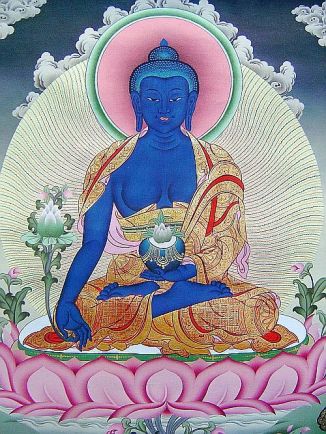
The Pali texts describe the Buddha as the physician (bhishak) and as the skilled surgeon (sallakatta).Ashvagosha the poet (80-150 BCE) called Buddha Maha –Bhishak (the great physician). At a later stage in Buddhism, the Buddha worship in the Bhaishajya Guru (The Guru of all physicians) form came into practice.

Interestingly, the life of one of the celebrated physicians and surgeons of the ancient India was closely associated with that of the Buddha. Jivaka came to the Buddha as a young man in the prime of his youth and stayed faithful to the Buddha until the later years of the Master, as his disciple, friend and as his physician.

He gained a great reputation as a surgeon who successfully conducted operations like craniotomy ( surgical incision into the skull) and laparotomy (surgical incision into the abdominal wall). He was known for curing jaundice, fistula and other ailments. Jivaka’s fame as a healer and as a child specialist was widely known; and, tales about his life and medical feats are found in almost all versions of Buddhist scriptures.

The Jivaka’s story is elaborated in four versions – the Pali; the Sanskrit; the Chinese; and, the Tibetan.

Here, we will follow the Pali version; because, some important discourses addressed to Jivaka are scripted in that version.

The Buddha-Jivaka story is a very human story. Their relationship was not cast in the usual mold that one comes across in religious texts. In a way, it de-mystifies the Buddha imagery. The Buddha you meet here is not the ethereal philosopher with his head in the clouds ; nor is he The God himself. You will find, he not always resembled the serene, ever smiling young Apollo – Greco Roman God like images that sit on our coffee tables or that decorate our bookcases.

The Buddha, you meet here, is a real person, a wise, compassionate, mellow, independent and a mature person who walked and lived on this land. He did encounter many problems; but, more importantly, he got over them with reason and dignity. He suffered from injuries, illness, constipation, diarroehea and other ailments related to old age. Whenever he needed help, he did ask for help. But, you never see him losing his composure. Here you see him put forth some unusual but rational views on the day-to-day concerns of the monks and the lay. That brings us closer to the Buddha.

design333

Once when Prince Abhaya,  son of Bimbisara the king of Rajagriha, was riding through the city, he noticed a flock of crows circling and cawing round a winnowing basket, thrown on a rubbish heap. As he got closer to the basket, he saw, to his amazement, a lovely looking baby boy wrapped in clothes placed in the basket. He took the baby home and decided to raise him as his son. The baby was given the name Jivaka, the live one, since he survived his abandonment on the rubbish heap. Because the prince raised him, he also acquired the pet name Kumarabhacca (nourished by prince).

Jivaka enjoyed a happy princely childhood. As his birth-situation later dawned on him, Jivaka reasoned that it was unfair and dishonorable to be dependent on the generosity of the prince, forever. He determined to earn his livelihood by pursuing a career, independently. He aspired to be a physician. He then left home, without informing the prince, and traveled all the way to Taxasila, in the distant West; to study medicine under the well-known teacher Disapamok Achariya. There, he studied medicine diligently for seven years.

Towards the end of his seven-year study, he took a practical examination that tested his medical skills and his knowledge of medical herbs. He passed the test with merit. With a little financial help and blessings of his mentor, Jivaka set out into the world in search of a carrier, fame and fortune.

On his way back home to Rajagriha, he stopped at Saketha where he came to know that the wife of the richest merchant (setthi) in the town was suffering from a chronic head ache for the past seven years; and , the local physicians were unable to find a cure for her ailment.

Jivaka succeed in convincing the rich lady that though young as he was, he would surely rid her of the ailment. He procured some herbs and cooked them in pure ghee obtained from the lady’s household. He made the patient lie on her back on a couch and injected the medicine, he had prepared, through her nose.

When the injected medicine was flowing out of her mouth, the patient gestured to her servant to mop up that fluid (ghee/medicine) with a piece of cotton and store it a vessel. The bemused physician Jivaka wondered, “That ghee ought to be thrown away, but this stingy woman ordered it to be saved by swapping it  with  cotton. I do not know whether I will get my fee. This thrift is rather too much”.

After she recovered, the Settani watching the puzzled expression on Jivaka’s face smiled ; and,  explained, “That is a good ghee mixed with medicine and can be used for rubbing on sore feet. Don’t be alarmed. I am not so stingy . I will pay you your fee.”

She was highly pleased with the miracle cure ; and, paid the young physician four thousand kappanas (silver coins). Her son added an equal amount to his purse.

On his return to Rajagriha, flushed with success and money , Jivaka set up his own establishment. He had a great start to his medical career. He performed the operation of trepanning (to pierce with a surgical crown saw) on a setthi of Rājagaha ; and, followed it up with an operation on the son of the setthi of Varanasi , who suffered from chronic intestinal trouble due to its misplacement.

A son of a merchant while playing at somersaults suffered a twist in the bowels (an entanglement of his intestines). He could not digest properly whatever he ate and drank; and looked discolored with the veins standing out upon his skin. Jivaka cut the skin of the stomach, drew out the twisted bowel, and sewed the skin of the stomach. On applying an ointment given by Jivaka, the boy in due course became well.

Jivaka was also a well-known pediatrician. His name Kaumarabhtya (in Sanskrit) was some times interpreted to mean ‘expert in children’s diseases’. A part of the Bower MSS discovered during 1880 in Kuchar of Chinese Turkistan quotes Jivaka’s formulae as the “Navan_taka” (meaning ‘butter’).

This medical compilation of the 4th century AD attributes two formulae dealing with children’s disease to Jivaka, saying ‘Iti hovaca Jivakah” i.e. thus spoke Jivaka.

One formula is: Bhargi, long pepper, Paha, payasya, together with honey, may be used against emeses ( act of vomiting ) due to deranged phlegm. Some of the cures attributed to Jivaka may be exaggerations; but, they indicate the importance attached to accurate observation and deduction in ancient times.

(http://www.vigyanprasar.gov.in/dream/may2000/article1.htm)

[His teachings traveled to Thailand along with Buddhism, around the 2nd and 3rd century BC. Learners and practitioners of the traditional Thai massage art respect his methods, even today.

http://www.thaimassagebrighton.com/thai_tradition.html]

design333

As his fame spread, the king’s men invited Jivaka to cure the king Bimbisara of his fistula. The successful physician was paid a huge fee; and, was appointed as the physician to the king.

***

Jivaka, the successful young physician, enjoying fame and fortune went to meet his benefactor and adopted father Prince Abhaya and laid at his feet all the wealth he earned. Jivaka thanked the Prince for his love, compassion and caring.

Prince Abhaya appreciated the gesture; and, said that the gifts were undoubtedly very valuable indeed; but it was not the gift he was waiting for, he said. ”You verily are my true gift” he exclaimed.

Prince Abhaya explained that during Jivaka’s absence he enquired into the circumstances of his birth. His mother, Salawathi, was the most sought-after courtesan of the kings and nobility. Wanting to retain her freedom, she discarded her baby, who , she feared , might burden her. Prince Abhaya had unknowingly adopted his own child.

Prince Abhaya built a palace to serve as his son Jivaka’s residence ; and, provided him with riches and many servants

design2

The turning point in Jivaka’s life happened  when Ananda came to fetch him to treat the Buddha who suffered from “blocked intestines” (constipation?). When Jivaka saw the condition of the patient, it occurred to him he might not survive a strong purgative. He then had fat rubbed into the Buddha’s body; and, gave him a handful of lotuses to inhale the essence emanating from the flowers.

Jīvaka was away when the mild purgative was later administered to the patient, and he suddenly remembered that he had omitted to ask him to bathe in warm water to complete the cure process. The Buddha, it is said, read his thoughts and bathed as required.( Vin.i.279f; DhA. ii.164f).

On another occasion when the Buddha’s was injured in his foot by a splinter from a rock hurled by Devadutta (Buddha’s cousin), the Buddha had to be carried from Maddakucchi (a park near Rajagriha) to Jīvaka’s Ambavana residence. There, Jīvaka applied an astringent; and , having bandaged the wound, he  left the city expecting to return in time to remove it.

However, by the time he did return, the city gates were shut. He was greatly worried because if the bandage remained on all night the Buddha would suffer intense pain. The Buddha, it is said, read his thoughts and had  the bandage  removed. (J.v.333.).

****

There is a mention of a meal hosted by Jīvaka, wherein the Buddha refused to be served until one Cūla-panthaka (denied entry by the host Jivaka) was served food. Cula_panthaka was the son of a rich merchant’s daughter who eloped with her slave. She, in dire circumstances, gave birth to a baby boy on the roadside. That baby was promptly named Panthaka, who later turned out to be a dullard. He was however , very fond of listening to Buddha; and, spent most of his time in the Vihara, though he was driven out each time. He later gained knowledge ; and, became an Arhant, by the grace of the Buddha’s compassion.

 design333

 Jivaka became an ardent admirer and disciple of the Buddha. He tried to meet the Buddha at least two times a day. Since the Veluvana, where the Buddha stayed at that time, was far away, he built a monastery with all its adjuncts in his own Ambavana in Rājagaha; and,  dedicated it to the Buddha and his monks (DA.i.133; MA.ii.590).

With foresight, love and compassion , Jivaka took care of the physical health of the Buddha and His Sangha. The Buddha, at the suggestion of Jivaka , introduced a number of measures to regulate the day-to-day activities of the monks. Those included the following:

-. When Jīvaka went to Vesali (capital of Licchavi) on business, he noticed the monks there had gone pale and were unhealthy looking (Vin.ii.119). At Jīvaka’s request, the Buddha instructed the monks to exercise regularly.

-. As an extension of this routine, the Buddha instructed the monks to sweep the compound of the monastery and attend to other duties in order to exercise their bodies, to ensure good health ; and at the same time , to keep the premises clean.

-. Those monks who were ill were advised to use medicines and whenever needed to apply ointment to their sore feet.

-. The monks were in the habit of walking bare foot; and, many of them had sustained injuries and suffered from sore feet. The Buddha advised them to wear foot coverings.

-. The Buddha advised the monks to use modest clothing and not wander about naked.  He also asked them not to indulge in excessive austerities.

-. A discipline was introduced , which required the monks to take care of each other. The famous advice of the Buddha to the monks, in this context, was,

“Ye, O Bhikkhus, have no mother and father to wait upon you. If you wait not one upon the other, who is there, indeed, who will wait upon you? Whosoever, O Bhikkhus, would wait upon me, he should wait upon the sick.”

-. With the introduction of better health care measures in the Sangha , more and more lay persons entered the Order. Many people, afflicted with disease and unable to pay for treatment, joined the Order in order to avail free medical facilities.

This influx naturally rendered Jivaka’s task more difficult. He was unable to cope with the increased workload. Further, he thought, the Order was being misused. At his suggestion, the Buddha laid down a rule that men afflicted with certain diseases be refused entry into the Order. The diseases prevalent in Maghada of those times included: leprosy, boils, dry leprosy, consumption, and fits (Vin.i.71ff).

Later cripples and homosexual were also kept out of the order. (Vinaya, Vol. 4, pp. 141-142.). 

design333

Once Jivaka offered to the Buddha, an exquisite shawl , which was earlier presented to him (Jivaka) by a king. The Buddha accepted the celestial shawl, as requested by Jivaka.

The Buddha, however, felt that keeping such a valuable shawl in the monastery would attract thieves and endanger His monks. He, therefore, asked Ananda to cut the shawl into strips and sew it again, so that it would be of little value to thieves or for resale . In addition, it would inculcate in the monks a sense of non-attachment to objects. This was how the custom of wearing patched garments came into practice in the Sangha.

The Blessed One accepted the suit,
and after having delivered a religious discourse,
he addressed the bhikkhus thus:

“Henceforth ye shall be at liberty to wear either cast-off rags or lay robes.
Whether ye are pleased with the one or with the other, I will approve of it.”

When the people at Rajagraha heard :“The Blessed One has allowed the bhikkhus to wear lay robes” .

Jivaka gained fame as the first layman to offer  robes to the monks. Thereafter, others who were willing to bestow gifts became glad.  The term kathina denotes a cotton cloth offered by lay people to bhikkhus (monks) annually, after the end of the vassa rainy retreat, for the purpose of making robes. And on that one day, many thousands of robes were presented at Rajagaha to the bhikkhus. Since then , the practice of offering robes to the monks and to the nuns in the Sangha came to be regarded as one of the meritorious deeds .

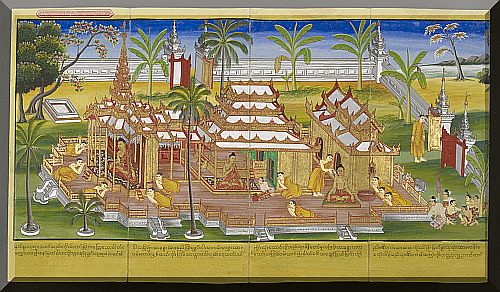
 The Buddha is sitting at the centre, surrounded by monks and lay people

***

Education

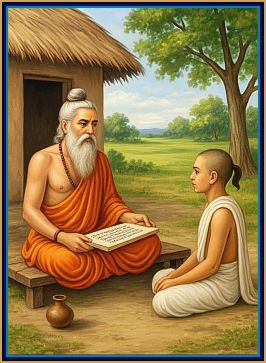
Another very interesting feature of the Vinaya Pitaka, as elaborated in its Chapters such as the Mahavagga, Chullavagga, Pachittiya etc., is the importance accorded to ones education; the system of education recommended for the young student-monks in the Sangha; the teaching methods; and, the relationship that should ideally exist between the teacher (Upajjhaya- Snkt. Upadhyaya) and the disciple (Antevasi – the resident student).

The Buddha insisted that his teaching should be spread in the language that is commonly spoken by the ordinary people of the towns and villages; and, not in Sanskrit , the language of the scholars. He was keen that the education –spiritual, ritual or otherwise- should be open to all classes of the Society.

At the outset; the Buddha guides the aspirant on the path that leads to right-understanding; and, asks the student to work it out by himself, following a free and fair reasoning. As regards the attitude or the approach that the students should ideally adopt; the Buddha while answering a question asked by Kalamas of Kesaputta, counselled the young learners thus (the kalama Sutta appearing in Aguttara Nikaya (III.653) :

Come, O Kālāmas, Do not accept anything thinking that thus have we heard it from a long time (anussava). Do not accept anything thinking that it has thus been handed down through many generations (paramparā). Do not accept anything on account of rumours (itikirā). Do not accept anything just because it accords with your scriptures (piaka-sampadāna). Do not accept anything by mere surmise (takka-hetu); or upon an axiom (naya-hetu). Do not accept anything by mere inference (ākāra-parivitakka). Do not accept anything by merely upon a bias towards a notion that has been pondered over (diṭṭhi-nijjhān-akkh-antiyā). Do not accept anything by coming under another’s seems ability (bhabba-rūpatāya). Do not accept anything merely because the monk-teacher says so (samao no garū). Do not accept anything thinking that the ascetic is respected by us (and therefore it is right to accept his word.)

“Kalamas, when you know for yourselves —these things are immoral, these things are blameworthy, these things are censured by the wise, these things when performed and undertaken, conduce to ruin and sorrow – then indeed you do have to  reject them.

“But Kalamas, when you know for yourselves – these things are good; these things are blameless, these things are praised by the wise; these things when undertaken and observed, lead to well-being and happiness- enter upon and abide in them.’

*

Vinaya Pitaka describes the qualities (Guna) of a good student as:

(1) having a keen desire to learn;

(2) accomplish the task assigned by the teacher;

(3) watch ones conduct in word, deed and mind; repent ones mistakes, and ensure such mistakes do not occur again;

(4) practice concentration and meditation; and,

(5) honor and respect your teacher, develop a loving attitude towards her/him.

The Vinaya Pitaka asks the student to :

(1) properly receive the knowledge that is imparted  (Suggahitani );

(2) be attentive while listening (Samansiktani);

(3)  absorb and retain what is taught (Supdharitani ); and,

(4)  render what he/she has learnt in a clear voice , using a simple land meaningful words that are easily understood by the listeners (Kalyaniyasi).

The Vinaya Pitaka encourages the student to rationally and logically analyse the words of the teacher; to politely ask pertinent questions; to clear his doubts; and, to seek the answers himself.

As regards the responsibilities of the Pupils; each was charged with the task and responsibility of maintaining the monastery, in which they all live and study, cleanly and properly. Apart from cleaning and putting things in place, the resident-students were expected to look after their Master, with love and devotion.

Normally, a student-monk would be attached to a teacher till the end of the study-course. But, a student could go to another teacher, in case the present teacher:

(1) goes on a long pilgrimage or tour;

(2) is transferred to another monastery;

(3) changes his philosophy and ideology;

(4) voluntarily allows the student to seek instructions from another teacher;

(4) is unwell or sick; or

(5) dies.

An errant student runs the risk of being expelled from the monastery, in case he/she is held guilty of gross indiscipline, despite the repeated counselling.

*

As regards the desired virtues (Guna) of a worthy teacher (Upadhyaya) , the Chullavagga mentions that he/she should primarily be well disciplined; gain control of his/her senses ; set an example by his/her conduct; and , practice  in good-faith what he/she teaches. The teacher should ensure that his/her teachings are proper; and, unerringly guide the learner along the virtuous path.

The other merits of a good teacher (Sadguru) were said to be that he/she is: well educated, respected and posses a high moral conduct; has the necessary skill, aptitude and the tolerance to teach; spreads the knowledge without fear, favour or prejudice; well intentioned, having the well-being of the student; and, above all, should be well versed in the tenets and the disciplines enumerated in the Vinaya Pitaka (Vinayadhar), and, brings them into practices.

*

In regard to the teacher-student relationship, the Chullavagga desires that an ‘Upajjhaya’ should ever bear in his heart and mind a fatherly attitude towards his pupils.

And, in a similar manner, the pupils should respect and regard the teacher as they would to their own father; and, take care of their teacher with love and devotion.

And, the teacher, on his part, should look after and take care of his pupils with diligence. At the time of pupil’s illness, teacher has to look after him; arrange for proper medication; and ,nurse him back to good health.

The Buddha, in that regard, set an example to all other teachers.

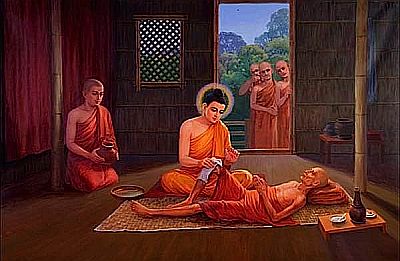
Recalling the Buddha’s attitude, Bhadant Upali, a disciple of the Buddha, narrated that once, while in Sravasti, the Buddha came upon an ailing monk in a very sick and dirty condition. The Buddha at once asked his cousin and close disciple Ananda, to fetch a bowl of fresh water and clean the ‘Chivara’ (monastic robe) of the sick and old monk. The Buddha, thereupon, himself washed the body of that monk and changed his attire. Thus, by attending to the sick monk himself, the Master set a shining example to others about the responsibilities that a teacher must bear towards his pupils and followers.

Buddha sick monk

 The above instance illustrates the process in which the rules governing the conduct of the monks evolved in the early Buddhism. This was in sharp contrast to the practices in a few other religions, where the Rule was initially pronounced or written down and later imposed on the followers. The Buddhist practices, especially those concerning the conduct of the monks, emerged out of the incidents in the Buddha’s life or out of his discourses. It was a gradual process; and a Rule developed in response to a challenge or to fulfill the needs of the growing Order.

This tradition, incidentally, helped the Buddhist teaching methods in explaining the significance or the concept behind a certain conduct or a practice recommended for the monks. It helped the learner to appreciate how the rule fitted into a coherent whole.

design333

Dr. Ananat Sadashiv Altekar (1898-1960) – who was the Professor and Head of the Department of Ancient Indian History and Culture at Banaras Hindu University –  (in his Education in Ancient India, 1934)  talks about  Buddhism and the system of ancient Indian education. The following is an extract:

Buddhism and ancient Indian educationChapter X – Section A- pages 225 to 233

Ordination Ceremony:

The wise injunction of the Buddha, that every novice should be properly trained in the discipline and doctrine of the religion, was primarily responsible for the educational developments in and activities of Buddhist monasteries. Two ceremonies were laid down for those who desired to enter the Order, the Pabbajja and the Upwampada.

The Pabbajja marked the beginning of the noviciate period and could be given when a person was less than eight years old. The permission of the guardian was necessary.

The Upammpada was given after the end of the noviciate period, and the recipient had to be not less than twenty years old.

(If he was a debtor, an invalid or a government servant, he was refused admission.)

 The ordination could take place only with the consent of the whole Chapter. There were no caste restrictions for admission.

The novice had to affirm his faith in the Buddha, his Dharma and the Sangha (the Order); and select a learned person as his preceptor. He was to follow strictly the rules and discipline of the Order.

Like the Hindu Brahmachari (student), he was expected to beg his daily food; but he was also permitted to accept invitations for meals from laymen. He was to do all manual and menial work connected with the monastic life, e. g. cleansing its floor and utensils, bringing water, supervising its stores, etc.

(If he was guilty of any serious breach of discipline, he could be expelled by a meeting of the chapter.)

The Relation between the Novice and his Teacher

The Relations between the Novice and his Teacher were filial in character; they were united together by mutual reverence, confidence and affection. Like the Hindu Brahmacharin, the Buddhist novice was to help his teacher by doing a variety of manual work for him ; he was to carry his seat and robes, supply him water and tooth stick, cleanse his begging bowl and utensils and accompany him as an attendant when he proceeded to the town or village for begging or preaching.

The teacher was to teach the student the rules of etiquette and discipline, draw his and abstinence from pleasures and help him in his intellectual and spiritual progress by suitable discourses and lessons* in the morning and afternoon. He was also to help him in getting food and robes, and even to nurse him if he was sick.

 The teacher ‘s own life was to be exemplary ; and, the novice was permitted to act as a check on him if he was wavering in his faith or about to commit a breach of monastic discipline. The needs ol the teacher were to be the minimum; the famous teachers at Nalanda used to receive an allowance only three times larger than the amount given to an ordinary student.

This would give a very clear idea as to how Buddhist teachers led a very simple life and cost next to nothing to society. They were lifelong students of their different subjects; for marriage did not intervene to put an end to or an obstacle in their studies.

The Education of the Laity

 As observed already, in the beginning Buddhist education was purely monastic and was intended only for those who entered, or intended to enter, the Order. This was but natural.

 Buddhism held that the worldly life was full of sorrow and that the salvation could be possible only by renouncing it. It could therefore naturally evince no interest in the education of those who intended to follow secular life and pursuits. In the course of time however it was realised that it was necessary to win public sympathy and support for the spread of the gospel ; this could be more successfully done if the Buddhist monk could help the cause of education .as was done by his theological opponent, the Brahman priest.

 It was also realised that the best way to spread the gospel was to undertake the education of the rising generation. This was  calculated to enable the Order to mould and influence the minds of the younger section of the society, when they were very pliable. There was thus a better chance of both recruiting proper types of persons for the Order and of getting a larger number of lay sympathisers, if the educational effort was not confined to novices but was also extended to the whole community.

Buddhism therefore threw itself heart and soul into the cause of the general education of the whole community from about the beginning of the Christian era. It may be pointed out that lay students were admitted in ‘external’ monastic schools of Christianity, ‘internal’ schools being reserved for those who intended to join the order. Jesuits also used to admit lay pupils, when space permitted the step.

Female Education

Buddhist nunneries went out of vogue from about the 4th century A. D. ; so at  the time when Buddhist monasteries had developed into colleges of international reputation, women were not receiving any advantages of the education imparted in them. Their marriages were at that time taking place very early.

In the early history of Buddhism however, the permission given to women to enter the Order gave a fairly good impetus to the cause of female education, especially in aristocratic and commercial sections of society. A large number of ladies from these circles joined the Order and became life-long students of religion and philosophy. Their example must have given an indirect encouragement to the spread of education among lay women as well

Conclusion:

 It will thus be seen that Buddhism may well be proud of its contribution to the cause of  education in ancient In dial Its colleges threw their doors open to all, irrespective of  any considerations of  caste or country: The rise of organized public educational institutions may be justly attributed to the Buddhist influence.

 It raised the international status of India by the efficiency of its higher education, which attracted students from distant countries like Korea, China, Tibet and Java.  The cultural sympathy which the countries in Eastern Asia feel for India even today is entirely due to the work of the famous Buddhist colleges of ancient India. If some of the important lost texts can be reconstructed with the help of their Chinese translations, the credit must be given to Buddhist colleges, which enabled Chinese students to  get their copies.

The Buddhist education also helped in the development of Hindu logic and philosophy by initiating and encouraging comparative study. In the period of its early history, it championed the cause of education through the mother tongue; later on however it could not resist the charm and influence of Sanskrit and began to impart education through that language.

lotus blue

Vegetarianism in Buddhism :

Once while he visited the Buddha ,who was then staying in his Mango grove, Jīvaka asked, if it was true that animals were slain expressly for the Buddha’s use. The Buddha replied— he forbids the eating of meat only when there is evidence of one’s eyes or ears as grounds for suspicion that the animal was slain for one’s express use. Anyone who slays an animal for the use of a monk and gives it to him commits a great evil”. Jīvaka was pleased with the reply and declared himself a follower of the Buddha. (Jīvaka Sutta – M.i.368f.)

 Jivaka sutta :

This is the much-discussed Jivaka Sutta that puts forth the Buddhist views on meat eating and vegetarianism. The sutra and the discussions that follow are elaborate. Some of that can be explored by following the links at the bottom of this paragraph.

In summary:

– a monk or nun should accept, without any discrimination, whatever food is offered in alms , offered with good will; this could include meat. However, the Buddha declared the meat trade as wrong livelihood. (Vanijja Sutta, AN 5:177)

Taking life, beating, cutting, binding, stealing, lying, fraud, deceit, pretence at knowledge, adultery; this is un-cleanliness and not the eating of meat.

– When men are rough and harsh, backbiting, treacherous, without compassion, haughty, ungenerous and do not give anything to anybody; this is un-cleanliness and not the eating of meat.

– Anger, pride, obstinacy, antagonism, hypocrisy, envy, ostentation, pride of opinion, interacting with the unrighteous; this is un-cleanliness and not the eating of meat.

– When men are of bad morals, refuse to pay their debts, are slanderers, deceitful in their dealings, pretenders, when the vilest of men commit foul deeds; this is un-cleanliness and not the eating of meat.

– When men attack living beings because of either greed or hostility and are always bent upon evil, they go to darkness after death and fall headlong into hell; this is un-cleanliness and not the eating of meat.

-. Abstaining from fish and meat, nakedness, shaving of the head, matted hair, smearing ashes, wearing rough deerskins, attending the sacrificial fire; none of the various penances in the world performed for unhealthy ends, neither incantations, oblations, sacrifices nor seasonal observances, purify a person who has not overcome his doubts.

-. He who lives with his senses guarded, conquered, and is established in the Dhamma delights in uprightness and gentleness; who has gone beyond attachments and has overcome all sorrows; that wise man does not cling to what is seen and heard.(Amagandha Sutta)

 – meat should not be eaten under three circumstances: when it is seen or heard or suspected to have been killed on purpose for a monk. (When a living being is purposely slaughtered for the eater).

 – meat can be eaten in three circumstances: when it is not seen, heard, or suspected (when a living being is not purposely slaughtered for the eater). (Jivaka Sutta, MN 55)

He permitted His monks to be vegetarians if they so wished; He did not prescribe that as a rule (to avoid hardship to His monks).

The Buddha declared that kamma is intention. One should not therefore condemn a person merely because he is eating meat to sustain himself. This sets him apart from one who eats meat out of greed for meat or for enjoyment in killing.

None should discourage those who opt not to eat meat. A balanced diet could be achieved without meat, if one so desires. Many Buddhists have opted to become vegetarians because it helps them to practice “loving-kindness”.

design333

The Buddha’s last message to his disciples was:

Behold now, Bhikkhus, I exhort you: All compounded things are subject to vanish. Strive with earnestness”

“My years are now full ripe; the life span left is short.
Departing, I go hence from you, relying on myself alone.
Be earnest, then, O bhikkhus, be mindful and of
virtue pure!

With firm resolve, guard your own mind,
Whoso untiringly pursues the Dhamma and the Discipline
Shall go beyond the round of births and make an end of suffering
.”

(DN 16 Maha-parinibbana Sutta)

Jivaka’s story is fascinating by itself; in addition, it provides an insight into evolution of values and attitudes in the early Sangha.

 Buddha myroblalan

Sources and References

http://www.mahindarama.com/e-tipitaka/Majjhima-Nikaya/mn-55.htm

http://aimwell.org/assets/Amagandha%20Sutta.pdf (Amagandha Sutta)

http://web.ukonline.co.uk/buddhism/jivaka.htm

http://www.dhammaweb.net/Tipitaka/read.php?id=89

http://www.savage-comedy.com/_Vegetarianism_in_Buddhism

http://en.wikipedia.org/wiki/Vegetarianism_in_Buddhism

http://www.dharmaweb.org/index.php/Vegetarianism_by_Venerable_K._Sri_Dhammananda

https://blogs.bl.uk/asian-and-african/2019/10/the-buddhist-kathina-festival.html?utm_source=feedburner&utm_medium=email&utm_campaign=Feed%3A+asian-and-african+%28Asia+and+Africa%29

Transformations in Indian History

ALL IMAGES ARE FROM INTERNET

 
6 Comments

Posted by on September 1, 2012 in Buddhism


Tags: , , , ,

Aside

Pubbarama (purva_rama) was a Buddhist monastery situated in the neighborhood of Savasthi, to the Northeast of Jeta_vana, which was one of the Buddha’s viharas The Buddha spent nine rainy seasons in Pubbarama. During his stay there, the Buddha dispensed many discourses, guided and helped a large number of persons. Pubbarama monastery, therefore, is often mentioned in the Buddhist texts. How the Pubbarama monastery came into being, is a very interesting story. It is narrated in the Dhamma_pada Commentary (Vol. I, 384-420).

***

Visakha, bright and beautiful, was the daughter of Dhananjaya and Sumanadevi who resided in the city of Kosala. Dhanajaya was a wealthy merchant and lived a comfortable life. Visakha grew up playing around the Vihara of the Buddha, in Kosala.She was an active, inquisitive and a lively child; she was always questioning about the things around her and about Dhamma. The Buddha was fond of the little girl.

Meanwhile in the city of Savasti a rich merchant, Migara was looking for a suitable bride for his son Punnavaddhana. The boy Punnavaddhana, however, was averse to marriage .It was not easy to convince him either. After much persuasion, he agreed to the marriage but stipulated some tough conditions. He insisted the bride should be “an exquisite beauty who possessed the five maidenly attributes: beauty of hair, teeth, skin, youth and form. Her hair had to be glossy and thick, reaching down to her ankles. Her teeth had to be white and even like a row of pearls. Her skin had to be of golden hue, soft and flawless. She had to be in the peak of youth, about sixteen. She had to have a beautiful, feminine figure, not too fat and not too thin”.

Migara sent a couple of well-fed Brahmins to scout for a girl who answered the specifications laid down by his son They roamed the Magadha and Kosala countries in search of a suitable girl who would make Punnavaddhana happy. They, however, could not spot the precious one. Having given up their search, and when they were loitering in Kosala, cooking up a ruse to appease the” angry-old- bull “- Migara, they were caught in an unexpected storm. While they were running for a shelter, they noticed, to their amazement, a young and a beautiful girl walking calmly and gracefully through the storm to the nearby shelter, just as her friends ran in all directions. The Brahmins , quite impressed by the pretty girl’s composure went up to her and questioned why she did not run to the shelter, as her friends did, to avoid getting wet. The fair maiden replied in her unhurried and measured voice, “It is not appropriate for a maiden in her fine clothes to run, just as it is not appropriate for a king in royal attire, a royal elephant dressed for the parade, or a serene monk in robes, to run.” Pleased with her reply, her composure and her exquisite beauty, the Brahmins went back and reported to Migara about their discovery of the most suitable bride for Punnavaddhana.

Thereafter Visakha and Punnavardhana were married; and lived happily in Migara’s house at Savasthi. Migara though wealthy was not a generous person. One afternoon, while Migara was taking his lunch in a golden bowl, a Buddhist monk came to his door seeking alms. Migara noticed the monk but ignored him and continued with his lunch. Visakha who was watching the proceedings went up to the monk and requested him to leave by saying, “Pass on, Venerable Sir, my father-in-law eats stale food.”

Migara who overheard the remark was furious and demanded an explanation. Visakha, in her usual calm and measured voice, explained that he was eating the benefits of his past good deeds and he did nothing to ensure his continued prosperity. She told him, “you are eating stale fare”.

Migara duly chastened, changed his ways, invited the Buddha and his retinue of monks for their meal and arranged for rich food.

After that event, Visakha continued her acts of generosity to the Buddhist monks and to the Sangha. One day, while on a visit to Jetavana, the monastery in which the Buddha resided, she forgot to bring back home her priceless jeweled headdress and other jewels. She did not notice their absence for a couple of days and later gave them up as lost.

Then one fine morning a couple of clean shaven Buddhist monks presented themselves at her door steps carrying a basketful of jewels and enquired whether they belonged to her. She recognized the jewels as hers and was happy to see them. She, however, refused to take them back, remarking it was not proper to take back an item left in the monastery. She asked the monks to retain the jewels with them. The monks, bemused, said the jewels were of no value to them and walked back to the monetary, empty handed, singing songs praising virtues of renunciation.

Thereafter, Visakha offered the jewels for sale, with the intention of donating the sale proceeds to the Sangha or using it for building a new monastery. She did not succeed in finding a buyer, as none could afford the exquisite jeweled headdress (it was her wedding gift from her parents and reached all the way down her long hair to her ankles.)

Visakha then decided to buy it herself. She thereafter went on to build a new monastery to house to the Buddha and His retinue of monks and nuns. It was a magnificent two-storied structure built of wood and stone. Besides the prayer and conference halls, it had a number of rooms. That monastery came to be known as pubbarama (Purva_rama) because it was facing to the East.

On the day, Visakha dedicated the monastery to the Buddha she was overjoyed. She sang and danced with immense joy. She ran like child, with her children around the monastery, many times. Her joy was infectious; even the Buddha was touched.

The ex-miser Migara too was touched. He requested his daughter-in-law to accept him as her son. He called her Migara_ mata (Mother of Migara).From that day the Pubbarama monastery also came to be known as Migara_matu_pasada (the mansion of Migara’s mother). That was how the Pubbarama came into being.

***

Soon after its completion, Visakha took charge of the nun’s section of the Pubbarama. One evening, while on her rounds, she was horrified to see the nuns’ fully drunk, dancing and singing crazy songs. When she asked the nuns to stop what they were doing, they did not listen to her. Instead, they asked her to raise a toast to the Buddha, get drunk and join the party.

The next day Visakha sought the Buddha’s counsel. Visakha bowed to him and asked, “Venerable sir, what is the origin of this custom of drinking an intoxicant, which destroys a person’s modesty and sense of shame?” The Buddha in response to her request dispensed the Kumbha Jataka, where a man found fermented fruit and water in the crevice of a tree and started to consume the fermented liquid to obtain a false feeling of well-being. It is here:

(http://www.dharmaweb.org/index.php/Jataka_Tales_of_the_Buddha,_Part_III )

***

On one occasion, she sought the Buddha’s solace, as she was annoyed and angry with the tax collectors, who were obviously, over charging on her goods. The king too did not heed to her plea. The Buddha calmed her mind by singing:

Painful is all subjection,
Blissful is complete control.
People are troubled by common concerns,
Hard to escape are the bonds.

It is written, those words of the Buddha comforted Visakha.

***

On another occasion, Visakha asked the Buddha, what qualities in a woman would enable her to conquer this world and the next. The Buddha replied:

“She conquers this world by industry, care for her servants, love for her husband and by guarding his property. She conquers the other world by confidence, virtue, generosity and wisdom.”

***

In appreciation of her wisdom, her generosity to the Dhamma, and the Sangha, the Buddha declared that Visakha be His chief female lay benefactor. In addition to serving the Buddha and the Sangha, Visakha was authorized to arbitrate issues and disputes that arose among the nuns. She was a well-respected person in the Sangha.

She led a long and healthy life and lived for over a hundred years.

Visakha, it is written, retained her youthful charm and her sharp and inquisitive mind even in her later years. A great girl indeed.

Visakha, the fair maiden

 
Leave a comment

Posted by on September 1, 2012 in Buddhism


Tags: , , , ,

A theory of Creation

There are various theories of creation, ranging from absurd to the sublime.

 There is a classical theory in Hinduism that keeps coming back to me. It may have no scientific validity. Nonetheless, it appeals to my imagination. It springs from the following mantra:

This innocuous looking verse occurs towards the end of the Shukla Yajur Veda Samhita in the form of shanti mantra for the Ishavasya Upanishad.

“Pri” the root of Purna means, “to fill” .This verse has acquired a number of interpretations, including a one with a play of pun on the word purna. Many other layers of interpretations have sprung up by ascribing the meaning of “full”, “whole”, “complete” etc. In addition, mathematical interpretations are derived by assigning numerical values such as ∞ or zero and one, to the term purna. A number of debates center on these interpretations. Even the mathematical interpretation has its critics, who say infinity cannot be added/deducted to/from infinity. If we are talking of two infinities, then they just cannot be infinity because each, obviously, limits the other. Similarly, assigning other numerical values does not also appear to make sense.

Others say the verse talks about the sum total of the energy in the universe. (I was referring to this, at the outset).According to them, the verse states the Universe is infinite. The sum total of energy in the Universe is infinite (a constant). That energy can never be enhanced or diminished. The universe is in a continuous state of flux. All things are in a state of constant flux where energy and information are forever flowing. The matter and energy keep changing forms. Matter and energy are not distinct. Matter is in essence trapped energy. The energy can convert to matter; the Matter in turn can convert into energy. In other words, matter and energy are inter changeable. The energy in the universe can neither be created nor destroyed; it keeps changing its form, from one state to another.

This implies neither was there a creation nor will there be a total destruction. The Universe was not created and it will not be destroyed. It is forever. It always did exist. It has no boundaries either. It is limitless. To signify this endless time and space continuum, the Universe is termed in the texts as Anaadi (without a beginning) and Anantha (without an end). Timeless not in the sense of endless duration, but in the sense of completeness, requiring neither a before nor an after.

It is this continuous state of flux where the matter and energy keep changing their state that we recognize as creation or destruction, as birth or death. . From the absolute point of view, there is neither birth nor death. It is a process in the ever-changing state of matter / energy.

This concept of indestructibility of the Universe with its infinite combinations, its continuous state of flux; keep coming up in various manners. The expressions like, “It” (tat) remains or Brahman (tat) (Universe) rolls with in itself; all things come from tat and resolve into tat etc. capture the essence of the concept.                            

Manduka Upanishad says, “That supreme Brahman is infinite and this conditioned Brahman is infinite. The infinite proceeds from infinite. Then through knowledge, realizing the infinitude of the infinite, it remains as infinite alone”. Sankara in his Brahma Sutra commentary said Brahman is immanent in the Universe.

The body is one continuous stream of matter. The body is viewed as a vessel. It is energy encased in matter. That matter, again, is trapped energy, as mentioned earlier. That trapped inner energy is not different from the total energy surrounding it and is the same as that (tat). Vedanta calls it embodied self (jiva or vijnanaatma).The Adhyasa or Avidya (ignorance) consists in treating jiva as independent and having an existence of its own.

This concept of indestructibility of energy and matter and their interchangeability, strangely, seems to feed the belief in rebirth. On death, the physical body (matter) decomposes and returns to the elements and takes another form. The inner energy (call it life, jiva, soul, spirit, vital force or whatever) is not destroyed. In fact, the “death” occurs when/ after the energy is separate from the shell, (body).That energy is not, therefore, present in the corpse when it is destroyed. That energy may have returned to the total or may have changed into another form of energy or into matter of some form.

The texts say, “Just as the bubble becomes one with the ocean when it bursts, just as the pot-space becomes one with the universal space when the pot is broken, so also the Jiva or the empirical self becomes one with Brahman.”

Thus, energy thrives on energy. Life thrives on life .jeevo_jeevasya_jeevanam.

 
3 Comments

Posted by on September 1, 2012 in Speculation


Tags: , ,

Sri Sadashiva Brahmendra

The Southern India recognizes and adores Sadashiva Brahmendra as the celebrated composer of divine kirthanas; but not many may be aware he, in his later years , was an Avadhutha, a jeevan_muktha who lonely wandered the hills and dales; ran along the river banks, naked or semi naked, in a state of divine bliss. He , unmindful of the scorching sun, pouring rain, blowing chill winds roamed in wilderness without ever uttering a word; slept under starry sky; shunned all human contact ; and, was ever in a supreme intoxicated state.

Today he is revered not merely for his musical compositions; but also for his sublime Advaita text “Atma Vidya Vilasa”,  the most favorite spiritual text of Sri Chandrasekhara Bharathi Swami the 34th Jagadguru of Sringeri Peetha. The swami , himself an Avadhuta, a week before his passing away, parted with all his meager passions; but retained, on second thought, a copy of Atma Vidya Vilasa till the day prior to his departure.

Not many facts are known about his life. It is believed Sadashiva Brahmendra lived in the time of Sharabhoji, ruler of Tanjore (1712 -1728). This is based on the oral tradition that Sadashiva Brahmendra presented a copy of his work Atma Vidya Vilasa to King Sharbhoji, when the king called on the Avadhuta to pay his respects.

His childhood name was Shivarama_krishna . He was the son of Somasundaram Avadhani, a Vedic scholar of Telugu Niyogi origin, who lived in Madurai in Tamil Nadu. It is said Shivarama’s family name was ‘Moksham’; and his mother was Parvathy. He was born in Nerur, situated by the quiet flowing Cauvery, near Karuru. He had his early education in traditional subjects under Ramabhadra Dikshitar who lived in Tiruvisai_nallur a.k.a. Shahajipuram. There the young Shivarama came under the influence of what were renowned as the triumvirate of Bhajana tradition viz.  Sridhar Venkatesha Iyer, Sri Bhodendra Sarasathi and Bashyam Gopala_krishna Sastry.

On his return, Shivarama still in his early teens was promptly married. He however, soon thereafter ran away from home never to return. He went to Tiruvisai_nallur ; and, while wandering aimlessly in the woods nearby, he met his Guru Sri Paramashivendra Sarasvati, who initiated Shivarama into sanyasa; and named him as Sadashiva_Brahmendra.

The identity of Sri Paramashivendra Saraswati is a matter of debate. Some say he may have been an Acharya of the Kanchi-peetham , guided by the suffix ”Indra Saraswathi” to his name. But; an Acharya  of that name appears in the annals  of the Kanchi tradition as the 45th Jagadguru  who presided over the Mutt for 27 years from 1061 AD , that is about seven hundred years before the time of Sadashiva Brahmendra.  The 57th(?) Jagadguru Sri Paramasivendra Saraswathi II, recognized as the author of the treatise Dahara Vidya* Prakashika , presided over the mutt from 1539 to 1586; that is about a hundred years before Sadashiva Brahmendra.

[Dahara Vidya is an ancient form of meditation on Self dwelling in the small ethereal space within the heart-Chandogya Upanishad –VIII. Sri Ramana Maharshi was a great exponent of this method.]

(http://www.tamilnation.org/sathyam/east/ramana/self_enquiry.pdf)

In any case ; Sadashiva Brahmendra considered Sri Paramashivendra Saraswati as his Guru , named him as such in all his works and composed poetic works Navamani mala , Guru_rathna_maalika and Dakshina_murthi_dhyana in tribute to the Guru.

Sadashiva was an active young man , talkative and always chirping away. On one occasion his incessant talk so annoyed his Guru  that he in despair  called out “Sadashiva..! When will you learn to be quiet?”. The disciple promptly replied, “Right now, Master”. He fell into silence and never talked again the rest of his life. He gradually withdrew from the world, introspected and plunged into intense penance. He discarded all norms of accepted behavior, wandered naked aimlessly in the hills and along the Cauvery. He looked wild and insane. When some one reported to Sri Paramashivendra that his disciple had gone insane, the Guru was delighted and exclaimed “Will I ever be so fortunate!” He realized that his disciple was now  an Avadhuta.

Sadashiva Brahmendra remained in that state; beyond body consciousness, not bound by ordinary social conventions and worldly concerns for a long period. A number of stories and myths grew around his mystical powers.

On one occasion , when he met his past associate Sridhar Venkatesha Iyer;  the later remarked that it was laudable to be a mauni in worldly matters; and, questioned what prevented him from singing the praise of the Almighty. Then, Sadashiva Brahmendra saw reason in the argument.

He thereafter created a series of musical compositions in praise of :

Sri Rama:

  • Pibare Rama rasam,
  • Khelathi mama hridaye,
  • Bhajare Raghuveeram,
  • Cheta Sriramam,
  • Prathi varam varam manasa etc.

Sri Krishna 

  • Smara nandakumaram ,
  • Gayathi vanamali,
  • Bhajare Gopalam maanasa ,
  • Bhajare Yadu natham maanasa ,
  • Kridathi vanamali ,
  • Bruhi mukundethi etc.

and of Brahman

  • Sarvam Brahma maya re ,
  • Khelathi Brahmande Bhagavan ,
  • Manasa sanchara re ,
  • Tadvad jeevanam Brahmani etc.

His poetic signature was “parama_hamsa” . About twenty-two of his compositions have been recovered.

Plese check here for a collection of compositions of Sri Sadasiva Brahmendra. and  their  MP3 links 

And, for the list of known compositions of Sri Sadashiva Brahmendra– compiled by Sri P.R. Ramachander, some with translation into English

He also wrote a number of philosophical works of high quality such as Brahma sutra Vrithi, Yoga_sudhakara, Kaivalya_amrutha _bindu (based on Upanishads); Siddantha_kalpa_valli (a poetic treatise on Appaiah Dikshitar’s work), Advaita rasa manjari, Brahma tattva prakaashikaa and Mano_niyamana. His Navamani_mala, Guru_rathna_malika and Dakshina_murthi_dhyana are in praise of the Guru.

But his Atma_vidya_vilasa a true classic is the best known.

[Please check here for the text and the  translation of Atma Vidya Vilasa by Shri SN Sastri]

Atma_vidya_vilasa is a poetic work running into 62 verses in simple, lucid Sanskrit. Its subject is renunciation. It describes the ways of the Avadhuta, one who is beyond the pale of social norms , beyond Dharma , beyond good and evil; one who has discarded scriptures, shastras , rituals or even the disciplines prescribed for sanyasins; one who has gone beyond the bodily awareness , one who realized the Self and one immersed in the bliss of self-realization. He is absolutely free and liberated in every sense – one who “passed away from” or “shaken off” all worldly attachments and cares, and realized his identity with God. The text describes the characteristics of an Avadhuta, his state of mind, his attitude and behavior. The text undoubtedly is a product of Sadashiva Brahmendra’s experience. It is a highly revered book among the Yogis and Sadhakas.

Sadashiva Brahmendra lived in that exalted state on the banks of the Cauvery until he discarded his mortal body at its age of one hundred years or a little more, some time between 1750 and 1753. His Samadhi in Nerur, Karur district is now a shrine to a large number of devotees. His Aaradhana is celebrated annually on the tenth day of dark half of the month of Jeshta (some time during May each year).

Sringeri Jagadgurus  and Atma_vidya_vilasa

Sadashiva Brahmendra and his classic work Atma_vidya _vilasa wielded an enormous influence on the life and Sadhana of the Sringeri Jagadgurus.

It was the 32nd Jagadguru of Sringeri Sharada Peetam, Sri Nrusimha Bharathi VIII (1817-1879) that first recognized the greatness of Sadashiva Brahmendra and arranged for the upkeep and maintenance of his Samadhi.

His successor Sri Sacchidananda Shivabhinava Nrsimha Bharathi (1879-1912) made a seminal visit to the samadhi of the saint at Nerur. He became an ardent admirer and devotee of Sadashiva Brahmendra in whose praise he composed two poetic works (Sadashivendra Stava  and Sadashivendra Panchrathna stotram) .

Please visit the following link for the text  of Sadashivendra Panchrathna stotram

[The Adhyatma Prakashana Karyalaya, Holenarasipur, Hasan District, Karnataka, has published in Kannada the texts and translation along with explanatory notes of Atmavidya Vilasa and Sadashivendra Stuthi]

Sacchidananda Shivabhinava Nrisimha Bharati

He considered Sadashiva Brahmendra his ideal, tried to emulate his principles. He modeled his attitude, his ideals and his way of living in the light of Atma_vidya_vilasa. He gradually withdrew from the active administration of the Mutt starting from the year 1901and devoted increasingly to spiritual practices. Listening to Atma_vidya_vilasa and contemplating on it became a part of his daily spiritual exercise. He in his last days lived like an Avadhuta. He instructed his disciples that in the last moments of his life while he would be drawing his last breaths they should recite aloud the verses from the Atma_vidya_vilasa. He wished to die with those verses ringing in his ears. Such was his devotion to that text.

Chandrasekhara Bharti swamigal

But the one who really emulated Sadashiva Brahmendra and evolved into an Avadhuta was the 34th Jagadguru  Sri Chandrasekhar Bharathi Swami. He studied Atma_vidya_vilasa intensely, imbibed its principles and truly lived according to that in word and deed .Unmindful of the external world he roamed wildly the hills of Srngeri like a child , an intoxicated , an insane and as one possessed singing aloud the verses from Atma_vidya_vilasa:

Discard the bondages of karma. Wander in the hills immersed in the bliss of the Self -unmindful of the world like a deaf and a blind (AVV-15)

avadhūtakarmajālo jaḍabadhirāndhopamaḥ ko’pi ।
ātmārāmo yatirāḍaṭavīkoṇeśvaṭannāste ॥ 15॥

      Rooted in the Brahman absorbed in the bliss within, he for a while meditates,            for a while sings and dances in ecstasy. (AVV-21)

tiṣṭhanparatra dhāmni svīyasukhāsvādaparavaśaḥ kaścit ।
kvāpi dhyāyati kuhacidgāyati kutrāpi nṛtyati svaram ॥ 21॥

He sees nothing, hears nothing, and says nothing. He is immersed in Brahman and in that intoxication is motionless.(AVV-44)

paśyati kimapi na rūpaṃ na vadati na śṛṇoti kiñcidapi vacanam ।
tiṣṭhati nirupamabhūmani niṣṭhāmavalambya kāṣṭhavadyogī ॥ 44॥

Sri Chandrasekhar Bharathi was the living epitome of the Atma_vidya_vilasa.  He was an Avadhuta – a liberated soul, one who “passed away from” or “shaken off” all worldly attachments and cares, and has realized his identity with Self. He was an enlightened being who lived in a state beyond body-consciousness.

Avadhuta – a brief remark

Avadhuta (he who has shed everything) is a radical type of renouncer of an unconventional type. Avadhuta is one who has risen above bodily consciousness, duality and worldly concerns. He has no use for social etiquette. He is not bound by sanyasi dharma either. He roams the earth freely like a child, like an intoxicated or like one possessed. He is pure consciousness embodied.

Avadhuta Gita describes him

The Avadhuta alone, pure in evenness of feeling, Abides happy in an empty dwelling place,

Having renounced all, he moves about naked .He perceives the Absolute, the All, within himself.

 The Avadhuta never knows any mantra in Vedic metre or any Tantra.

This is the supreme utterance of the Avadhuta, purified by meditation

And merged in the sameness of the Supreme Being.

 Ashtavakra Gita describes him in a similar manner:

17.15
The sage sees no difference / Between happiness and misery,/ Man and woman,/ Adversity and success. / Everything is seen to be the same.

bubhukṣuriha saṃsāre mumukṣurapi dṛśyate । bhogamokṣanirākāṃkṣī viralo hi mahāśayaḥ ॥ 17-5॥

17.16
In the sage there is neither / Violence nor mercy, /Arrogance nor humility, / Anxiety nor wonder. /  His worldly life is exhausted. / He has transcended his role as a person 

dharmārthakāmamokṣeṣu jīvite maraṇe tathā । kasyāpyudāracittasya heyopādeyatā na hi ॥ 17-6॥

17.18
The sage is not conflicted /  By states of stillness and thought. /  His mind is empty. / His home is the Absolute. 

kṛtārtho’nena jñānenetyevaṃ galitadhīḥ kṛtī । paśyan śṛṇvan spṛśan jighrann aśnannāste  yathā sukham ॥ 17-8॥

18.9
  Knowing for certain that all is Self, /   The sage has no trace of thoughts /  Such as “I am this” or “I am not that.” 

ayaṃ so’hamayaṃ nāhaṃ iti kṣīṇā vikalpanā । sarvamātmeti niścitya tūṣṇīmbhūtasya yoginaḥ ॥ 18-9॥

18.10
  The yogi who finds stillness /   is neither distracted nor focused. /   He knows neither pleasure nor pain. /   Ignorance dispelled, / He is free of knowing. 

na vikṣepo na caikāgryaṃ nātibodho na mūḍhatā । na sukhaṃ na ca vā duḥkhaṃ upaśāntasya yoginaḥ ॥ 18-10॥

Not all Sanyasis are Avadhutas and not all Avadhutas are Sanyasis. Of the four types of Avadhutas, Shaiv-avadhuta and Brahma-avadhuta need not be sanyasis they could even be householders. The Dashanami_avadhutas (those that bear names such as Vana, Aranya, Giri, Thirtha, Bharathi etc.) and Bhaktha_vadutas are the other two.

Of these, the Shaivadhutas and the Brahmavadutas indulge in Tantric practices.

The Bhaktavadutas form the prominent group. It consists Paramahamsa (fully realized) and Parivrajaka (incomplete, wandering) classes. The former is considered incarnation of Shiva. He could be a sanyasi or a householder; he could wear clothes or could be naked. He is not bound by any restrictions. He has no fixed place of stay. Practices like meditation, rituals, worship etc. are irrelevant to him. He is beyond conflicts of pain and pleasure, gain or loss, joy or sorrow. He is ever immersed in bliss of Self-realization.

Dattatreya

Dattatreya is the supreme Avadhuta. There is a belief that Dattatreya composed the Avadhuta Gita, which describes the characteristics of an Avadhuta.

Nath Sampradaya is a sect of Avadhutas that places great importance on the Guru and on Yoga.Avadhuta Gita is its text and Sri Ghorakhnath is its prime Avadhutha.

The worship of  Datta is more prevalent in Maharashtra and North Karnataka. The Datta kshetras such as Ganagapur, Agadi and Baba Budan Giri in Karnataka are prominent centers of Datta worship.

Resource

Sahradapeetada Manikya by Prof SKR Rao

003Dakshinamurthi.jpg

 
8 Comments

Posted by on September 1, 2012 in Indian Philosophy, Vedanta


Tags: , ,

Kavi, Rishi and the Poet

1. Kavi the Sanskrit term, generally, means poet, the one who creates poetry.

If the meaning of the term were to be derived from the root “kru_varne”, it means “one who describes”. In which case, it refers, particularly, to those creations that spring from intuition (prathibha) rather from logic. The poetic genius (prathibha) has two aspects; Bhavaitri, the inner experience (also called darshana); and, karayitri the skill, virtuosity in expression (vivrana). What shines forth into the outer world is Kavitva, poetry.

2. According to Yaska, the term Kavi denotes, comprehensively, all those who express themselves through their intuitional (artistic) creations . The creative expression could be through words, color, sculpture, sound, or any other form, so long it flows out of intuition (prathibha) and manifests in an enjoyable form, to the benefit of all beings. Kavitva (poetry) thus encompasses in itself all forms of art expressions.

3.The Rig Veda mentions the term Kavi, any number of times. Yaska_charya in his glossary derives the meaning of the word from the root “kram” and interprets kavi as one who can see the unseen (kavihi_krantha_darshano_bhavathi) . Here again it is  the intuition that inspires the kavi to expand his consciousness and express himself spontaneously. Yaska suggests a close empathy, unison  between the creator and his creation, and that each tends to become a part of the other.

4. The Rig Veda further enlarges this concept and addresses the Creator as the Supreme Poet (kavir manishi paribhu swayambhuh) who conceives the grand design and expresses himself spontaneously through his creation. He is the seer, the thinker who expands his consciousness to encompass the entire Universe (Vishwa_rupaani_prathimancha_kavihi). The creator, the kavi, through his all-pervasive consciousness becomes one with his creation. That undoubtedly is the most sublime concept of a poet.

5. Poetry raised to its sublime heights is mantra to which the Rishi gives utterance. It is said; the Rishi not only knows the mantra but also is the essence of it.

Kavi is the forerunner of Rishi in the Rig Veda. He is the wise seer. One cannot be a Kavi unless one is a Rishi (naan rishir kuruthe kavyam). However, not all Rishis are kavis. A Kavi is a class by himself.

6. Yasca_charya makes a very significant classification of the Rishis.He draws a clear distinction between a Sakshath_ Krutha_ Rishi, the seer who has the direct intuitional vision; and the Srutha_Rishi, the one who heard it from the seers and remembered what he heard.

6.1. The Kavi, the seer is the Sun (savitr, Agni) who shines by himself (swayabhu), who spreads light and life to benefit all beings. He is the great  inspirer (sarvasya prasavita). The Kavis (mantra drastarah) envisioned the entities beyond the range of human senses and realized the Truth by direct intuition. They were the ones who had the direct intuitional perception and who conceived the self-evident knowledge (svatah pramana). The Kavis, the seers were “the hearers of the Truth” (kavayah satya_srurtah).

Sri Aurobindo described Shruti as “divine recordings of the cosmic sounds of truth” heard by the Rishis. The Vedas are thus Sruthis, revealed scriptures. That is the reason; the Vedas are Apaurusheya, not authored by any agency.

6.1.1. It is preciously because of those reasons, Sri Aurobindo emphasized that Vedas have a deeper, esoteric meaning apart from their superficial meaning.

6.1.2. Vamadeva, an unusual Rishi, in one of his hymns (RV 4.3.16) describes himself as illumined; expressing the Truth reveled to him (ninya vachasmi).

Rig Veda mentions about four hundred Rishis and about twenty-five of them were women.

6.2. The Srutha_rishi, in comparison, is like the mirror or the moon that basks in the glory of the sun (kavi). The moon and the mirror both take in the glory of the sun and put forth the shine to the world in their own way. The Srutha_rishi obtained the knowledge by listening to the Kavi and more importantly by remembering what he heard.

6.3. The bifurcation of the Vedas/Upanishads on one hand (as Shruthi, as heard) and the Vedangas, Sastras, Puranas, Ithihasa etc. on the other (as smriti, as remembered) stems from the above concept. Smriti, in general, is secondary in authority to Shruti.

***

7. A brief explanation about prathibha, before we proceed further.

7.1. Well, bha meaning light is at the root of prathibha; prati is a proactive term. Prathibha is generally understood as light that flashes within; perceived without the intervention of senses or the mind (logic).It is a direct perception.

7.2.That kind of perception (intuition) is not uncommon. Ordinary people in their day-to-day life experience it at times. However, it has neither intensity nor a sense of direction. In the case of Rishis or yogis, it is said, this natural gift is cultivated over years of sustained practice. It is therefore a more comprehensive, intense and direct understanding.

7.3. As it usually happens, there is no single term in English that brings out all shades of the meaning of prathibha. Perhaps one could use terms like genius, poetic genius, creative imagination, invention, inventive flash or intuition; or all of them. I preferred to use intuition, as I thought it was nearer to the Sanskrit term, and it was shorter.

7.4. A considerable bulk of literature has grown around the attempts to define prathibha (intuition or whatever term), its source, its relation to reality, its fulfillment etc.

This is particularly true in the Indian context. It is debated widely, not merely in Vedic literature but also in poetics, yoga (sadhana). Sri Aurobindo makes frequent references to this intuitional (super-sensory) force.

7.5. Bharatha, the author of the natya_shastra, while discussing about Rasa, its embodiment, its fulfillment etc.talks of the importance of prathibha.

7.6. The vedangas, nyaya, yoga and shaiva siddanthas, shaktha siddantha also employ the concept; but each has its own interpretation about the source, the role of prathibha.

***

8. Continuing the discussion on the dichotomy of intuition (prathibha) and memory (Smrithi or call back), centuries later the Indian scholars Ananda Vardhana (Kashmir c.860 AD) and Abhnava Gupta (Kashmir c.960AD) emphasized that intuition, inner experience was the lifeblood of good poetry.

They declared, creativity (karaka) was the hallmark of poetry as it brings into the world a new art experience. They said the poetic genius reinvents itself all the time (nava navonvesha shalini prathibha). Poetry need not aim to remind (jnapaka) what is already present; that they said was the function of sastras. A poet need not seek justification or approval of scriptural authority. He is the lord of his domain. He is the creator. They recommend, the poet need not allow himself to be bound by logic, propriety and such other restrictions.

9. There is, in fact, such type of poetry that disregards all restrictions. For instance, Bhanudatta, a scholar of poetics (c.15 century AD) describes three “out of world” (alaukika) types of poetry that totally disregard the mundane realities of the world.

Snapika, is a dream like creation beyond space, time or reason. There is utter disregard for reality. The poet creates a world of his own.

The second is Manorathika. It is a fantasy ride; the object is to realize unfulfilled wishes. Unlike in the first one the poet is not completely cut off from the reality. His wishes have some relation to the real world.

The third is Aupanayika, where poet describes the world as he sees or as it pleases him; and not merely the actual world.

9.1. According to Bhanudatta, the third (Aupanayika) is a more credible form of poetry. It offers scope for grafting the poet’s views on the reality without rejecting or condemning the world. It could be a fine blend of expressions that evoke sense of beauty, idealism (chamath_kruthi) and harsh reality (pratheethi).The poet could whisper into ears of the reader as his beloved does (kantha_samhitha). That, Bhanudatta says, is a subtle and a persuasive way of communicating with the reader.

9.2. He says certain things shine in contrast. For instance, a flash of kindness in a cruel heart; a pair of beautiful eyes in an otherwise ordinary face; smile breaking through the teary face of a little girl.

He was trying to say the world is not one-dimensional (eka_mukha). The world is full of opposites (dwandwa). The way you look at it and the choices you make; that is what matters.

10. Our poetic scholars described that the word and its meaning (vak, Artha) as the body of the poetry; the essentials such as rasa, dhwani (tone), merit as internal organs of poetry. Intuition (prathibha), they said, was the vital driving force. Without intuition (prathibha), they said, a poem would read like a “toll collector’s   manual”.

11. Abhinava Gupta adds one more dimension to the issue in his”Dwanya_loka_lochana”.

He says prathibha may be a flash of enlightenment; but what sustains that vision is the “unmeelana_shakthi”. He refers to something that charges the mind, opens up or awakens the potent faculties.

Abhinava Gupta clarifies that prathibha is inspirational in nature and it does not transform itself, automatically, into a work of art or poetry. It needs a medium to express it self. And , that medium has to be cultivated, honed and refined diligently over a period to produce a work of class.

11.1. In this context, Abhinava Gupta mentions three essentials that a poet has to keep in view. They are Rasa (rasa_vesha), Vaishadya and Saundarya.

The Rasa  concept is well known and I do not wish to elaborate it here.

The second one refers to clarity in thought, lucidity in expression and comfortable communication with the reader.

The third is the sense of poetic beauty about which the Alankarikas have produced delectable works. A good poetry can manifest, according to him, only when the delightful combination of these three essentials are charged or supported by prathibha.

He cites Valmiki and kalidasa as classic examples and states it is the wonderful combination of those poetic virtues and prathibha that sets them apart from the rest of the tribe.

12.. The fulfillment of poetry is Ananda, joy. It therefore needs a good reader (Sah_hrudaya) who can understand, appreciate, empathize and enjoy the beauty of the poetry. He is an integral part of poetic experience. Magha, the poet, said, a good poetry draws the reader towards it repeatedly and each time he finds in it a new source of enjoyment. He remarked the diction, ornamentation, structure and other virtues of poetry could shine only when poetic genius, the intuition, Prathibha, charges them.


Tags: , , ,

Ashtavakra Gita

ashtavakra gita 2

The day of full moon, Purnima, in the month of Ashadha is traditionally celebrated as Guru Purnima also as Vyas Purnima. Today, 29 July, 2007 ; Sunday is the Guru Purnima. Think of the Guru.

Guru (Gu- ignorance/darkness, Ru-destroyer)is one, who removes the darkness and delusion. Purnima is the effulgent full moon. The true Guru is in our heart. Purify the heart to let the Divinity dwell in it. Guru Purnima is an occasion for cleaning the mind to make it absolutely pure.

In what better way can we do that than by talking of Guru Ashtavakra?

One of my favorite readings is Ashtavakra Gita also called Ashtavakra Samhita. It is in the form of a dialogue between King Janaka and a brilliant but physically deformed boy genius, Ashtavakra. It comprises 298 verses in 20 chapters of varied length. It glorifies the state of Self-realization. The story of Ashtavakra appears in the Vana Parva of the Mahabharata.

The story of Ashtavakra is narrated in a simple form here

Sri Ramana Mahrishi’s rendering of the tale is here

John Richards’s translation of Ashtavakra Gita is simple, lucid and popular.

The translation of Bart Marshall is  brilliant.

Those interested may also see the notes made by Swami Shraddhananda, a sannyasin of Sri Ramakrishna order.

AshtavakraGitaCh-4Of20Slideshow

Ashtavakra Gita is an Advaita text of the highest order, addressed to advanced learners. We do not know who wrote this classic. The estimate of its date varies from third or fourth century BC to post  Sri Shankara period. The author, whoever he was, employed the King Janaka- Ashtavakra episode with great imagination and wove around it a sublime philosophical work , in simple, lucid, classic Sanskrit. The text deals with bondage and liberation, the nature of the Self, means of realizing the Self (atmanu-bhuti) , state of mystic experience  in the embodied state. This is Advaita in its distilled form, devoid of stories, examples, arguments.

Janaka, here, unlike Arjuna , is not a confused person. He is not seeking refuge from despair or delusion. Janaka is mature and knowledgeable; an earnest seeker. The Guru did not have to go through the preliminary exercise of convincing the disciple of the futility of pursuing after objects.

Sage Ashtavakra says that the Self alone exists and all else within the mind-senses vortex is unreal. He draws his disciple’s attention to his restlessness, despite being a model king. This, Ashtavakra recognizes as Janaka’s yearning for truth.

Ashtavakra maintains that all prayers, mantras, rituals, meditation, actions, devotion, breathing practices, etc are secondary. These distract the aspirant from self-knowledge. Knowledge/awareness is all that is required. Ignorance does not exist in itself; it is just the absence of knowledge or awareness. The light of knowledge or consciousness will dispel ignorance revealing the Self. The Self is merely forgotten, not lost, not to be attained. This is not a belief system or a school of thought. This is simply ‘What Is’ and the recognition of ‘What is’.

Admittedly this stringent approach is not suitable for all. A  sharp , discriminating and inward-looking mind is required for understanding Asthavakra’s  teaching. Perhaps due to its  rigor , the text has not been popular

It starts with the King Janaka asking the sage Ashtavakra how he can attain knowledge, detachment and liberation. It quickly becomes a guru-disciple dialogue; however, after Janaka realizes his true Self, they get into an Advaitic discussion of the highest caliber.

white lotus

The sage instructs:

1.2

To be free, Shun the experiences of the senses Like  poison / Turn your attention to/ Forgiveness, sincerity, kindness, simplicity, truth.

muktiṃ icchasi cettāta viṣayān viṣavattyaja । kṣamārjavadayātoṣasatyaṃ pīyūṣavad bhaja ॥ 1-2॥

1.11

It is true what they say: “You are what you think.”/ If you think you are bound you are bound./ If you think you are free you are free.

muktābhimānī mukto hi baddho baddhābhimānyapi । kiṃvadantīha satyeyaṃ yā matiḥ sā gatirbhavet ॥ 1-11॥

1.15

You are now and forever/ Free, luminous, transparent, still./ The practice of meditation/ Keeps one in bondage.

niḥsaṃgo niṣkriyo’si tvaṃ svaprakāśo niraṃjanaḥ । ayameva hi te bandhaḥ samādhi manutiṣṭhati ॥ 1-15॥

1.16

You are pure Consciousness/ The substance of the universe./ The universe exists within you.’ Don’t be small-minded.

tvayā vyāptamidaṃ viśvaṃ tvayi protaṃ yathārthataḥ śuddha buddha svarūpastvaṃ mā gamaḥ kṣudracittatām ॥ 1-16॥

1.17

You are unconditioned, changeless, formless./ You are solid, unfathomable, cool./ Desire nothing./ You are Consciousness.

nirapekṣo nirvikāro nirbharaḥ śītalāśayaḥ । agādha buddhi rakṣubdho bhava cinmātra vāsanaḥ ॥ 1-17॥

The technique of Jnana used here is that of Vichara usually translated as self-enquiry but it signifies examination, reflection, or looking within.Sri Ramana Maharishi was the greatest exponent of this method in recent times. In other types of spiritual practices, the mind is assumed to be an independent entity and therefore efforts are made to control it, purify it and channel it towards the Godhead. Ashtavakra preaches that mind has no existence of its own. It is a bundle of thoughts, he says, take the direct path and plunge into consciousness. A conscious bliss ensues when one abides in Self. Sri Ramana Mahrshi echos these thoughts in his Upadesha Saram (verses 17-21 and 28).

Ashtavakra suggests that there is in reality only the Self and that it is all- pervasive. Just as waves, bubbles or foam have no existence without the sea, so too everything in experience is a phenomenal manifestation of the one great spiritual reality. Ashtavakra speaks of the rising of the winds of the mind and says the worlds are produced, as waves on the sea. He suggests it is the mental activity that gives rise to our experience of the world.

2.23

In the limitless ocean of Myself / The winds of the mind/ Roll the myriad waves of the world

aho bhuvanakallolairvicitrairdrāk samutthitam । mayyanaṃtamahāmbhodhau cittavāte samudyate ॥ 2-23

Upon hearing the Guru, Janaka is enlightened. He bursts into joy and wonder of his new-found state. Ashtavakra is pleased but notices inconsistencies in Janaka’s approach and lets out a series of confrontational verses about attachment to objects. He questions at the end:

3.13

Why should a person of steady mind,/ Who sees the nothingness of objects,/ Prefer one thing to another ? 

svabhāvād eva jānāno dṛśyametanna kiṃcana । idaṃ grāhyamidaṃ tyājyaṃ sa kiṃ paśyati dhīradhīḥ ॥ 3-13॥

Janaka defends by saying

4.1

Surely one who knows Self,/ Though he plays the game of life,/Differs greatly from the world’s/ Bewildered burdened beasts.

hantātmajñānasya dhīrasya khelato bhogalīlayā । na hi saṃsāra vāhīkair mūḍhaiḥ saha samānatā ॥ 4-1॥

4.6

Rare is he who knows himself / As One with no other—The Lord of the Universe./ He acts as he knows/ And is never afraid.

ātmānamadvayaṃ kaścijjānāti jagadīśvaram । yad vetti tatsa kurute na bhayaṃ tasya kutracit ॥ 4-6॥

**

Ashtavakra does not disagree; but in a terse four verses points to the next step—dissolution

5.1

You are immaculate,/ Touched by nothing./ What is there to renounce?/ The mind is complex—let it go./ Know the peace of dissolution.

na te saṃgo’sti kenāpi kiṃ śuddha styaktumicchasi । saṃghātavilayaṃ kurvannevameva layaṃ vraja ॥ 5-1॥

5.2

The universe arises from you/ Like foam from the sea./ Know yourself as One./ Enter the peace of dissolution.

udeti bhavato viśvaṃ vāridheriva budbudaḥ । iti jñātvaikamātmānaṃ evameva layaṃ vraja ॥ 5-2॥

5.3

Like an imagined snake in a rope/ The universe appears to exist/ In the immaculate Self / But does not./ Seeing this you know: “There is nothing to dissolve.”

pratyakṣamapyavastutvād viśvaṃ nāstyamale tvayi । rajju sarpa iva vyaktaṃ evameva layaṃ vraja ॥ 5-3॥

5.4

You are perfect, changeless,/ Through misery and happiness,/ Hope and despair,/ Life and death./ This is the state of dissolution.

sama duḥkha sukhaḥ pūrṇa āśānairāśyayoḥ samaḥ । sama jīvita mṛtyuḥ sannevameva layaṃ vraja ॥ 5-4॥

Ashtavakra makes a remarkable statement; the world however turbulent it may appear is within the infinite being and that it cannot alter the fundamental nature of the Self. He says, it is in the infinite ocean of myself that the mind-creation called the world takes place. I am supremely peaceful and formless and I remain as such.

7.3

In me, the shoreless ocean,/ The universe is imagined./ I am still and formless./ In this alone I abide.

mayya naṃta mahāmbhodhau viśvaṃ nāma vikalpanā । atiśāṃto nirākāra etad evā aham āsthitaḥ ॥ 7-3॥

**

Janaka says “I know that already,” matching him in style and number of verses Janaka goes on to further describes his enlightened state.Still hearing too much “I” in Janaka’s language, Ashtavakra instructs him in the subtleties of attachment and bondage.

Ashtavakra said:

Bondage is when the mind longs for something, grieves about something, rejects something, holds on to something, is pleased about something or displeased about something. 8.1

tadā bandho yadā cittaṃ kiñcid vāñchati śocati । kiṃcin muṃcati gṛṇhāti kiṃcid dṛṣyati kupyati ॥ 8-1॥

Liberation is when the mind does not long for anything, grieve about anything, reject anything, or hold on to anything, and is not pleased about anything or displeased about anything. 8.2

tadā muktiryadā cittaṃ na vāñchati na śocati । na muṃcati na gṛṇhāti na hṛṣyati na kupyati ॥ 8-2॥

Bondage is when the mind is tangled in one of the senses, and liberation is when the mind is not tangled in any of the senses. 8.3

tadā bandho yadā cittaṃ saktaṃ kāśvapi dṛṣṭiṣu । tadā mokṣo yadā cittamasaktaṃ sarvadṛṣṭiṣu ॥ 8-3॥

When there is no “me,” that is liberation, and when there is “me” there is bondage. Consider this carefully, and neither holds on to anything nor rejects anything. 8.4

yadā nāhaṃ tadā mokṣo yadāhaṃ bandhanaṃ tadā । matveti helayā kiṃcinmā gṛhāṇa vimuṃca mā ॥ 8-4॥

**

Ashtavakra goes on to annihilate the false sense of identification of the Self with the mind, saying that “it is bondage when the mind desires or grieves at anything, rejects or accepts anything, feels happy or angry at anything..” In a movingly simple verse, he sums up a free and fearless soul as one who has renounced desire, for “the renunciation of desire alone is renunciation of the world”.

Ashtavakra continues to describe the way of true detachment and stresses the folly of desire—no matter how elevated or subtle. Ashtavakra further describes the state of desireless-ness to which he points

11.6

“I am not the body, nor is the body my possession—I am Awareness itself.”/ One who realizes this for certain/ Has no memory of things done or left undone./ There is only the Absolute.

nāhaṃ deho na me deho bodho’hamiti niścayī । kaivalyaṃ iva samprāpto na smaratyakṛtaṃ kṛtam ॥ 11-6॥

Janaka says he understands what Ashtavakra is saying and summarizes his exalted state with calm indifference. Ashtavakra is impressed but tells the disciple he is not there yet.

15.5

Attachment and aversion/ Are attributes of the mind./ You are not the mind. You are Consciousness itself–Changeless, undivided, free./ Go in happiness

rāgadveṣau manodharmau na manaste kadācana । nirvikalpo’si bodhātmā nirvikāraḥ sukhaṃ cara ॥ 15-5॥

15.16

Leave behind such distinctions/ As “I am He, the Self,”/ And “I am not this.”/ Consider everything Self. / Be desire-less. / Be happy

sarvabhūteṣu cātmānaṃ sarvabhūtāni cātmani । vijñāya nirahaṅkāro nirmamastvaṃ sukhī bhava ॥ 15-6॥

**

Ashtavakra then attacks the futility of effort and knowing.

Being pure consciousness, do not disturb your mind with thoughts of for and against. Be at peace and remain happily in yourself, the essence of joy. 15.19

Give up meditation completely but don’t let the mind hold on to anything. You are free by nature, so what will you achieve by forcing the mind? 15.20

16.1

You can recite and discuss scripture / All you want,/ But until you drop everything / You will never know Truth.

ācakṣva śṛṇu vā tāta nānā śāstrā aṇyanekaśaḥ । tathāpi na tava svāsthyaṃ sarva vismaraṇād ṛte ॥ 16-1॥

**

Ashtavakra does not pay much heed to book learning or to the importance given to mind and its control. You are already free, what will you gain by deliberating or pondering. In other words, remain unattached at all times from all things (including the mind). He advocates direct approach. Teachings of Sri Ramona are remarkably similar to that of Ashtavakra.

Ashtavakra then goes on to describe the nature of a wise person or yogi (chapters 17 and 18) .The characteristics of the true knower as outlined by Ashtavakra are very similar to that of a sthitha_prajna described in Bhagavad-Gita Gita.

17.15

The sage sees no difference/ Between happiness and misery,/ Man and woman, / Adversity and success./ Everything is seen to be the same.

sukhe duḥkhe nare nāryāṃ sampatsu ca vipatsu ca । viśeṣo naiva dhīrasya sarvatra samadarśinaḥ ॥ 17-15॥

17.16

In the sage there is neither/ Violence nor mercy,/ Arrogance nor humility,/ Anxiety nor wonder./ His worldly life is exhausted./ He has transcended his role as a person.

na hiṃsā naiva kāruṇyaṃ nauddhatyaṃ na ca dīnatā । nāścaryaṃ naiva ca kṣobhaḥ kṣīṇasaṃsaraṇe nare ॥ 17-16॥

17.18

The sage is not conflicted/ By states of stillness and thought./ His mind is empty./ His home is the Absolute.

samādhāna samādhāna hitāhita vikalpanāḥ । śūnyacitto na jānāti kaivalyamiva saṃsthitaḥ ॥ 17-18॥

18.9

Knowing for certain that all is Self,/ The sage has no trace of thoughts/ Such as “I am this” or “I am not that.”

ayaṃ so’hamayaṃ nāhaṃ iti kṣīṇā vikalpanā । sarvamātmeti niścitya tūṣṇīmbhūtasya yoginaḥ ॥ 18-9॥

18.10

The yogi who finds stillness/ is neither distracted nor focused./ He knows neither pleasure nor pain./ Ignorance dispelled,/ He is free of knowing.

na vikṣepo na caikāgryaṃ nātibodho na mūḍhatā । na sukhaṃ na ca vā duḥkhaṃ upaśāntasya yoginaḥ ॥ 18-10॥

**

In a final flurry of questions pointing only at their own meaninglessness, Janaka bursts forth into inspired poetry and burns off the last vestiges of personhood and enters dissolution (chapters 19 and 20). He ends with: “No more can be said.” Ashtavakra smiles, nods approvingly, and says no more

Using the tweezers of the knowledge of the truth I have managed to extract the painful thorn of endless opinions from the recesses of my heart. 19.1

20.11

Where is illusion? Where is existence? Where is attachment or non-attachment? Where is person? Where is God?

I am Awareness./ Where are principles and scriptures? Where is the disciple or teacher? Where is the reason for life? I am boundless, Absolute.

kva māyā kva ca saṃsāraḥ kva prītirviratiḥ kva vā । kva jīvaḥ kva ca tadbrahma sarvadā vimalasya me ॥ 20-11॥

kva pravṛttirnirvṛttirvā kva muktiḥ kva ca bandhanam । kūṭasthanirvibhāgasya svasthasya mama sarvadā ॥ 20-12॥

20.14

Where is existence or non-existence? Where is Unity or duality? / Nothing emanates from me. / No more can be said.

kva cāsti kva ca vā nāsti kvāsti caikaṃ kva ca dvayam । bahunātra kimuktena kiṃcinnottiṣṭhate mama ॥ 20-14॥

॥ Om̃ tatsat ॥

 guru charana

white lotus

The approach and treatment of   Ashtavakra are logical and precise like mathematical equations.Yet, the Ashtaavakra Gita may not be read at a streatch , in one straight reading. It is preferable the verses are read few at a time , on a daily basis, and reflected upon .

One rarely comes across a Guru-disciple association as that of Sri Ashtavakra and King Janaka, a mature disciple. To such Sri Guru, who is the Para Brahman, I offer my salutations, on this Guru Purnima !

header

https://sanskritdocuments.org/doc_giitaa/ashtgita.html?lang=iast


Tags: ,

Adhyasa Bhashya of Sri Sankara

sri sankara

1. The magnificent prelude that Sri Sankara wrote to his commentary on the Vedanta Sutras is celebrated as The Adhyasa Bashya. It is in fact not a Bhashya; it is not a commentary. It is an independent piece of writing, which served as a prologue to his main work.

2. The Adhyasa Bashya is remarkable in many ways. It is not a lengthy work; it is less than fifty lines divided into five sections. It is a free flowing writing. Sri Sankara lucidly puts forth his views. While doing so, he does not cite any traditional text or authority in support of his views. He does not denounce or attack any school of thought (vada). He is not propagating a new school of thought or a new argument. He assures that the significance of the initial discussion will be realized in the main commentary, which seeks to restore the true interpretation of the. Vedanta tradition as contained in the Vedanta Sutra. Adhyasa Bashya is a rare gem in the field of philosophical texts.

3. Attaining ones aspirations and expectations by resort to rituals had caught the imagination of the common people, though the Vedanta tradition advocated wisdom as the sole means for attaining ones goals in life. However, some thinkers diluted the rigorous position by combing Upanishad teachings with rituals to make it appealing to the common people. This they called ‘jnana_karma_samucchaya”– a two- in- one of wisdom and ritual.

3.1. Sri Sankara viewed this as a distortion of the Upanishad ideals. In order to play down the prominence given to rituals by the Mimamsakas, Sri Sankara relied on the idea of avidya He bracketed the ritualistic approach with avidya and called it an “error”.

4. Avidya is a word that occurs in Upanishads, though not often. The word Vidya is used to denote effective discrimination and avidya is the absence of it. Sri Sankara states wisdom (vidya) can eliminate ignorance (avidya); but the ignorance it eliminates is not real, because it has no existence of its own. Once the error is removed the Universe (Brahman) will reveal of its own accord.

4.1. Sri Sankara explains, darkness and light are distinct from each other in their nature and in their functions. Darkness has no existence of its own; it is merely the absence of light. Whereas, the light is positive and helps vision. Darkness and light can neither coexist nor share their functions or nature. Darkness is an error that can be removed.

5. Sri Sankara states in his prologue , the main purpose of the Upanishads is to provide the Knowledge(vidya) that will eliminate darkness , ignorance(avidya) , which is in the nature of “reality transfer” (adhyasa). He thereafter goes on to explain the concept adhyasa.

5.1.Adhyasa, according to Sri Sankara, is not an intellectual construct (kalpana_viseha) but a matter of experience (anubhava). Sri  Sankara says we do it all the time. Adhyasa consists in mistaking one thing and its attributes for another; superimposing one level of reality over other. This we do every day. 

For instance; we measure the duration of the day with reference to sunrise ; and , reckon our existence in terms of days/weeks/months / years which again are related to motion of the Sun. But, in the absolute view, the Sun neither raises nor sets; but , it is the earth that rotates . For our day-today  existence we accept and go by the relative -reality of the diurnal motion of the Sun,  and also ignore the fact of earth’s rotation. Both these positions are real in their own sphere ; but,  one is a ‘relative reality’ and the other is the ‘Absolute reality’. We , in our living , impose the relative reality over the Absolute; and accept the relative as the Real . 

Thus, an individual experiences the world through his senses, mind and other ways of perception. His experience of the world may be tainted by the defect in his senses or other constraints, internal or external. Nevertheless, that person creates his own set of norms, impressions and experiences and he accepts those subjective experiences as real.

5.2. A special feature of Sri Sankara’s thought is that he regards personal and intuitive experience (anubhava) as independent and convincing evidence. Sri Sankara says that individual’s experience cannot be disputed, because the experience he went through was real to him; though that may not be real from the absolute point of view. Sankara makes a distinction between the absolute view and the relative view of things.

6. In short, what the person does is, he imposes his transactional experience (relative or dual) over the transcendental (absolute) and accepts the former as real. That subjective experience need not be proved or disproved . However, the confusion it created can be removed by wisdom (vidya). According to Sri Sankara the world we experience is not absolutely real but it is not false either. The real is that which cannot be negated and that which is beyond  contradiction.

6.1. Sri Sankara explains that vyavaharika (relative) and para_marthika (absolute) both are real. However, the relative reality is “limited” in the sense it is biologically or mechanically determined and it is not beyond contradictions. The absolute on the other hand is infinite (everlasting and unitary (meaning utter lack of plurality)). 

Sri  Sankara is careful to point out that the two dimensions – Vyavaharika and Paramarthika – are two levels of experiential variations. It does not mean they are two orders of reality. They are only two perspectives. Whatever that is there is REAL and is not affected by our views

6.2. The Self in the vyavaharika context is saririka (embodied self); it encounters the world. However, the Self in reality is not saririka; it is absolute, asaririka and is infinite. The infinite Self, perceived as the limited self (jiva) is what Sri Sankara calls as Adhyasa.

7. The dichotomy between being an individual-in-the-world (jiva) and being originally a pure, transcendental consciousness (atman) is taken by Sri  Sankara as merely superficial.According to Sri  Sankara, it is due to avidya that the individual fails to see the nexus between Being and the world. That nexus indicates the oneness underlying the subject-object, inner-outer, Man-Nature distinctions. All that is required is to remove the error and the universe will shine on its own accord.

8. The analogy given in the text is that of a pond that is clear and undisturbed .One can see the bottom of the pond through its still water. When, however, pebbles are thrown into the pond, the water in it is disturbed and the bottom of the pond becomes no longer visible. That bottom however is there all the time and it remains unchanged, no matter whether the surface water is disturbed or not. The water in the pond is the transactional world. The bottom of the pond is the transcendental reality. The disturbance created is avidya

[It is difficult to find an exact English word for adhyasa. It may, among other things, mean “superimposition”,” projection” etc. adhyasa is more comprehensive than that. Sri Sankara, in my view, recognizes three levels ofexistence, the Absolute, the relative and the illusory. Adhyasa consists in superimposing one level of existence (relative/illusory) over the other (The Absolute) and accepting the former as true while it may actually be untrue.The absolute (atman) appearing as the limited (jiva) is what Sri  Sankara calls adhyasa.

(For more on this please see Adhyasa ]

9.Extending the concept of Adhyasa, Sri  Sankara says, we superimpose the body, the sense organs and the mind on the Self(infinite) and we use expressions like: ‘I am fat’, ‘I am thin’, ‘I am white’, ‘I am black’, ‘I stand’, ‘I go’, ‘I am dumb’, ‘I am deaf’, ‘I think’, ‘I am not going to fight’, ‘I shall renounce’ and so on. In this way, we superimpose our mind on the Atman, which is the eternal witness. We do it the other way also by superimposing self on the mind, the non-Self. According to Sankara, the relation between mind and self involves mutual superimposition (itaretara-adhyasa). This relation is false since there cannot be any real relation between the self and the non-self. This confusion or adhyasa is innate to us, and is a matter of common experience.

10. Sri  Sankara says, the purpose of Upanishads is to remove adhyasa or avidya; and once it is removed, Brahman will shine of its accord, for it is the only reality. This doctrine of Sri  Sankara became the nucleus for the development of the Advaita school of thought.

11. As regards the rituals, Sri  Sankara says, the person who performs rituals and aspires for rewards will view himself in terms of the caste into which he is born, his age, the stage of his life, his standing in society etc. In addition, he is required to perform rituals all through his life. However, the Self has none of those attributes or tags. Hence, the person who superimposes all those attributes on the changeless, eternal Self and identifies Self with the body is confusing one for the other; and is therefore an ignorant person. The scriptures dealing with rituals, rewards etc. are therefore addressed to an ignorant person.

11.1This ignorance (mistaking the body for Self) brings in its wake a desire for the well being of the body ,aversion for its disease or discomfort, fear of its destruction and thus a host of miseries(anartha). This anartha is caused by projecting karthvya (“doer” sense) and bhokthavya (object) on the Atman. Sri Sankara calls this adhyasa. The scriptures dealing with rituals, rewards etc. are therefore, he says, addressed to an ignorant person.

11.2.In short, person who engages in rituals with the notion “I am an agent, doer, thinker”, according to Sri Sankara, is ignorant, as his behavior implies a distinct, separate doer/agent/knower ; and an object that is to be done/achieved/known. That duality is avidya, an error that can be removed by vidya.

11.3. Sri Sankara elsewhere explains that, when such acts are performed by a person without desire for the fruits of his actions, by recognizing the reality that there is neither a “doer” nor an “object”, then that instills in him the desire for Brahma-vidya, which takes him closer to vidya.

12. Sri Sankara affirming his belief in one eternal unchanging reality (Brahman) and the illusion of plurality, drives home the point that Upanishads deal not with rituals but with the knowledge of the Absolute (Brahma vidya) and the Upanishads give us an insight into the essential nature of the Self which is identical with the Absolute, the Brahman.

[https://sanskritdocuments.org/sites/snsastri/adhyasabhashya.pdf ]

https://www.gitasupersite.iitk.ac.in/brahmasutra_content?language=dv&field_chapter_value=1&field_quarter_value=1&field_nsutra_value=0

white lotus

Sri Sankara

1. Sri Sankara was an original thinker. He was a leader.Hewas not a dreaming idealist but a practical visionary.Scripture and reason were the two aids in his arguments. He was a great logician, who based his arguments entirely on the principles of logic but without contradicting the intuitional revelations of the Vedas and the Upanishads. Sri Sankara’s thought gave a new dimension to Indian philosophy. It restored the position of Upanishads as the pristine source of knowledge. It established Vidya, wisdom as the true source of light. It put reason and discretion at the center stage and pushed the rituals out of contention.

2. He ushered in a new way of looking at our world, at our experience in/with it, by introducing the relative and absolute view of the Universe. When he talked about the infinite and time less nature of the Universe, it was not in the sense of endless duration, but in the sense of completeness, requiring neither a before nor an after. When he referred to Unity of self he was not talking of putting two things together, but he used the term to mean utter absence of all plurality in the real Self. The western world had to wait until the beginning of twentieth century to arrive at those concepts.

3. He gave credence to an individual’s subjective experience. He placed personal experience and intuition above all the other means of cognition. He said a person’s experience could not be disputed. He declared, “Intuition is not opposed to intellect. Reality is experience. Realizing the Supreme Being is within ones experience.”

4. He recognized the underlying oneness and the infinite nature of the universe. He asserted, “I am not the mind or the intellect not the ego. I am the blissful form of the Brahman.” He redefined the relation between the Man, World and the Universe. He said they were One. Duality, he said, was an error in perception.

5. His is not a system opposed to other systems, but a method of interpretation of values. His is a voice of reason and sanity. Sri  Sankara is therefore relevant even today. He values reason, encourages spirit of inquiry, gives credence to subjective experience and therefore to freedom of ones thought and expression. He suggests intellect is not opposed to intuition. He asks us to take the small ego out of the equation in our day-to-day activities of life. He implores us to recognize the essential unity of all beings and their oneness with the infinite space-time continuum. He explained, the Universe is the manifestation of the Supreme Being.

6. Vedanta of Sri Sankara comes as a remedy to the conflict and violence ridden ways of our life.

7. Swami Vivekananda aptly described Sri Sankara’s Advaita as the fairest flower of philosophy that any country in any age has produced

3742705698141cd

******
Please also read

Sankara – a genius, misunderstood

Deeply indebted to
Prof.SKR Rao

 
8 Comments

Posted by on September 1, 2012 in Indian Philosophy, Sri Sankara, Vedanta


Tags: , ,

Sri Sankara – a genius misunderstood

Sri Sankara, the Adi Sankara-charya is one of the greatest thinkers of all times.

This country owes him a deep debt of gratitude. He not only consolidated the classical values of life but also reorganized what we now call Hinduism. He brought together diverse strands of philosophical speculations and religious disciplines.

Unfortunately, few philosophers in the world are as misunderstood and misinterpreted as Sri Sankara. Ironically, most of the harm came from his admirers and followers.

A. Admirers

1. It became a trend in the middle ages among the lesser authors to float their work in the name of celebrated authors to ensure its acceptance by the scholars of the day. Following this custom, many of Sri Sankara’s admirers hoisted their works on him .In some other cases, brilliant works were submitted by their authors in his name. This was an act of devotion.

As a result, we have today, more than 250 works ascribed to Sankara. These include philosophical treatise (bhashyas), advices to aspirants (updaesha), minor dissertations (prakaranas), hymns addressed to various divinities, poems etc.

The quality of these works is not consistent. Some of them undoubtedly have merit. It is however, obvious not all of them could be works of one author. The ideas expressed in them are not only various but often inconsistent. In a few cases, the works contradict each other. ( E.g. Two commentaries on Kena Upanishad, both ascribed to Sankara have conflicting views) .The ideas contained in a few others came into existence much after Sankara’s time.

2. Sri Sankara during his lifetime decried and fought against Tantric practices. However, Tantric texts like Prapancha_sara, Lalitha_trisati_bashya and others are in circulation under his name. The other famous tantric work ascribed to Sri Sankara is Sandarya_lahari. The scholarly opinion is that it is not Sankara’s work, though it is an excellent composition.

3. Among the minor dissertations (prakaranas):  Sarva-vedanta-siddanta-sara_sangraha; probodha-sudhakara; Advaitanu-bhutiYoga-rathavali; Anatma-vigrahanaprakarana etc. are definitely not Sankara’s works.

4. A commentary on Vishnu_sahasra_nama is ascribed to him. It is decidedly a recent work. It is inconsistent too. It is not Sri Sankara’s commentary.

Similarly,  Jayamangala  or Samkhya- saptati-tika  (likely before 9th-century), describes itself as a commentary (Tika) on Isvarakrishna’s  Samkhya-spatasati , authored  by Sri Sankaracharya ; but , that seems highly  doubtful. 

ti śrīmat-paramahaṃsa-parivrājakācārya- śrī govinda- bhagava-pūjya- pāda- śiṣyeṇa śrī śaṅkara-bhagavatā kṛtā sāṃkhya- saptatiṭīkā samāptā //

It is likely that some one might have hoisted his work upon Sri Sankara, perhaps to ensure its  acceptability among the contemporary scholars  – Further, it is pointed out that Sri Sankara could not have described himself as, śrīmat-parama-haṃsa-parivrājakā-cārya-Sri-Sankara-bhagavata . And, the opening   benediction    lokottara-vādinaṃ praṇamya munim ,  is a typical Buddhist expression

5. A number of hymns, of inconsistent quality, in praise of various deities are known as his compositions. (E.g. Stotras on Subrahmanya, Ganapathi, Shiva, Vishnu, Devi etc.)

6. One of Sri Sankara’s missions was to wean people away from ritualistic approach advocated by Mimamsakas and to project wisdom (jnana) as the means of liberation in the light of Upanishad teachings. He criticized severely the ritualistic attitude and those who advocated such practices. However, the texts that combined rituals with wisdom (jnana_karma_samucchaya) more in favor of the Mimamsaka position came onto vogue, projecting Sankara as the rallying force of the doctrine. His followers might have found Sankara’s mission a hard task and therefore compromised the liberating wisdom with the performance of rituals.

7. Whatever be the popular opinion, the scholarly tradition recognizes only three texts as authentic works of Sri Sankara. These are his commentaries on the Upanishads, the Gita and on Vedanta Sutras; grouped under the name prasthana_thraya.

Vedanta Sutras 

1. A word about Vedanta Sutra before we proceed: Vedanta Sutras also called Brahma Sutras deal with the essential import of Upanishads. They are rendered in the form of Sutra (aphorism), terse and crisp. They are therefore open to interpretations. The work is ascribed to Badarayana, who is often identified with Krisha_dvaipayana_vyasa; the author of Mahabhatarha. Sri Sankara is however is silent on this issue.

2. Sri Sankara’s commentary on this Sutra, called the Vedanta Sutra Bhashya (VSB) is a highly celebrated text. Sri  Sankara’s purpose in writing his commentary was to explain the traditional view. He said, the primary meaning of the word Upanishad  was knowledge, while the secondary meaning was the text itself. He isolated the Upanishad lore from the rest of the Vedic body and narrowed it down to ten or twelve Upanishads. Even here, he did not include the ritualistic portion of the Vedas. This was in contrast to the classification followed by the later Acharyas.

3. We may assume that there were other points of view in circulation in those days and they did not entirely represent the traditional view. (No commentary on the Vedanta-sutras survives from the period before Sri Sankara.) This motivated Sri Sankara to come up with his precious commentary. Sri Sankara explained that wisdom (jnana), according to the real import of Upanishads, was the true means of liberation. Sri Sankara’s interpretation of the Upanishads marked the beginning of a new line of thought. The then existing Vedanta terms (like Brahman, maya, avidya, adhyasa, jnana, mukthi etc.) acquired in his work a deeper significance, wider context and a greater relevance.

[  Sri Sankara seems to take Brahma sutra more as an exposition of the Upanishads than as an original text. For him, therefore, the Brahma sutras derive their authority from the Upanishads; and, the sutras must therefore conform to the meaning and the spirit of the Upanishads. The Brahma sutras will have to be interpreted in the light of the Upanishads.

The sutras of Badarayana have one single purpose, that of stringing together the flowers of Vedanta akyas (Vedanta vakya- kusuma –grathanatavat sutram – BB.1.1.2)

Sri Sankara undertakes to interpret Badarayana’s Brahma Sutra in order to expound through what he understood as the philosophy of Upanishads taken as a harmonious and systematic whole. The fact that he had written commentaries on the principal Upanishads, presumably, before his commentaries on Brahma sutra and the Bhagavad-Gita goes to show that he had grasped the keynote and the essence of the Upanishads. These became central in his interpretation of Brahma sutra as also of Vedanta philosophy.

Sri Ramanuja , in turn , interprets   the Brahma sutra through the Vrtti of Bodhayana and the glosses on the Vrtti by the other purva-acharyas, the old-masters.

Sri Sankara , basically,  regards himself as the votary of Upanishads (Aupanishada).He even calls his way of thinking or the doctrine as Aupanishadam Darshanam, the Upanishad System. He defines the Upanishads as the texts that lead the aspirants close to the highest reality. He insists Upanishads constitute the final purpose and the import of the Vedic lore; and that is the reason he chose to write commentaries on the Upanishads and on the other two texts that depend almost entirely on the Upanishads – Badarayana’s Brahma Sutra and the Bhagavad Gita. It is therefore not surprising that Sri Shankara relied heavily on Upanishad texts to interpret and comment on Brahma Sutra.]

B. Followers 

1. The history of Advaita is replete with interpretation and reinterpretation of Sri Sankara’s Vedanta Sutra Bhashya (VSB). The generation of Advaita followers that succeeded Sri wrote a number of commentaries on Sri Sankara’s VSB. Each commentator claimed that he grasped the essence and true intent of Sri and went on to write according to his own understanding. In that process, he wove into the commentaries, his personal views and hoisted them on Sri Sankara. This kind of adulation gave rise to several versions of Advaita. The numerous glosses written by his followers tried to blend ritualistic attitude with the monistic inclination of the Master. The result was the distortion of Sri Sankara’s position.

1.1. The so-called orthodox interpretation of Sri Sankara flows in two distinct channels; the one based on Bhamathi and the other on Pancha_padica.

2. Vachaspathi Misra (c.840AD) was a well-known scholar and a commentator of his times. He wrote a number of glosses and commentaries on several schools of thought. His commentary on Sri Sankara’s VSB was titled Bhamathi.

2.1. Bhamathi revels in dialectic and relies on Mimamsa (ritualistic approach) which Sri Sankara did not approve. Further, Vachaspathi brought together, in Bhamathi, the views of Sri Sankara with the ritualistic views of Mandana (a Vedanta scholar, author of Brahma siddhi); whose views were severely criticized by Sureshvara, a direct disciple of Sri Sankara. Though Sri Sankara and Mandana belonged to the same Vedanta branch they differed on ritualistic aspects of Vedas. Yet, while interpreting Sankara, Vachaspathi introduced ideas borrowed from Mandana and hoisted them on Sankara. Many ideas that appear as Sri Sankara’s in Bhamathi  were in fact not his.

[ Mandana Misra is a seminal figure in the history of Advaita He was a contemporary of Sri Sankara and the Great Mimamsaka Gaudapada.  His work Brahma-siddhi and Gaudapada’s Karika on Mundaka Upanishad   are in fact only two  surviving works of the pre Sankara period that have come down to us. Mandana’s citations from or comments and remarks on previous other authors, either refuting or endorsing their opinions, make him one of the credible resources on the state of Advaita prior to the time of Sri Sankara.

His comments on some of the disputed concepts of Vedanta such as : Vivarta (unreal appearance) , Anirvachaniyatva (inexplicable state) or Maya-vada (doctrine of the seemingly real or unreal) have always attracted the later scholars and students of Vedanta .He is perhaps the first to attempt to establish the Advaita doctrine through means of cognition Pratyaksha , direct perception. He argued that Pratyakshya cannot prove the reality or otherwise of an object because the direct perception is incapable of truly appending the distinction between the Real and the unreal (or seemingly real).

Though Mandana may have been influenced by Sri Sankara’s Advaita Vedanta, he did retain some of his own position on certain matters. Certain features of his doctrine are, in fact, not found among the principles laid out by Sri Sankara.  Just to mention a few of his own elaborations the following could be cited: the inexplicable nature of Avidya (ignorance);   making out a distinction between two sorts of Avidya; importance he placed on Sat (Being) and Bliss (Ananda) as the more significant attributes of Brahma etc.

Interestingly, Vachaspathi Misra, in his commentary (titled Bhamathi) on Sri Sankara’s Brahma-Sutra-Bhashya tended to follow, on certain issues and explanations, the lead of Mandana Misra rather than that of Sri Sankara.

Vachaspathi Misra’s commentary (Bhamathi) juxtaposed with another commentary of Padmapada (one of the direct disciples of Sri Sankara) on the Brahma Sutras caused a major split or schism in the Advaita School. From then on, two rival streams of Advaita School – one called the Bhamathi School based on Vachaspathi Misra’s interpretation of , and the other Vivarana School based on the explanations provided Padmapada in his Pancha-padika-vivarana, came into being.

Amazingly, both the Schools of Advaita had drifted away from the basic tenets postulated Sri Sankara. And yet; both Schools have their followers and both are studied by the students of Advaita philosophy, in general.]

[It seems that for several centuries following Sri Sankara and Mandana, it was Mandana who was viewed by other schools as the major figure in Advaita. Vachaspathi Misra is said to have continued Mandana’s brand of Advaita in his commentary on Brahmasiddhi  (now lost), and in his Bhamathi a commentary on Sri Sankara’s Brahma sutra Bhashya. Mandana differed from Sri Sankara on some issues.

For instance, Mandana accepts and advocates the doctrine of Sphota a grammatical theory put forward by Bhartruhari, while Sri Sankara rejects Sphota theory and opts for Varna vada.

Again, Mandana on the question of false judgement tries to assimilate the views of Bhatta Mimamsaka, whereas Sri Sankara is ambivalent of the view and his disciple Suresvara criticizes Bhatta’s view on error severely.

Mandana also appears to lean towards the Mimamsa view of the relevance of meditation in achieving liberation and his tendency to accommodate the combined view (jnana-karma-samucchaya-vada). These tendencies are not surprising, since Mandana, a student of Mimamsaka Kumarila Bhatta, was a well recognized scholar in the Grammar – philosophy as the author of Sphotasiddhi and also as the author of other Mimamsa texts. ]

2.2. Regardless of this position, a branch of Advaita literature grew thereafter with Bhamathi as the official version of Sri Sankara’s view. Further, Bhaskara’s views were fused or confused with Sri Sankara’s views. The interpretations and arguments of that branch were lined up accordingly. Akandanandaa’s Rju-prakasika, Anandagiri’s Saririka_nyaya_nirnaya and Govindananda’s Bashya_rathna_prabha were some of the texts produced in this school. These texts do not reflect original Sri  Sankara.

2.3. Today, the study of Sri Sankara, in orthodox circles, is based, mostly, on the Bhamathi and the annotations on it by Amalananda (Vedanta_kalpataru c.1250) together with notes of Shri Appaiah Ditkshita (c.1550). These three together with Vedanta Sutra and Sri Sankara’s commentary on it constitute the basic Advaita literature (pancha granthi). This is despite the fact the views of Sri Sankara and Vachaspathi are divergent on issues relating to rituals and scriptural authority.

3.Pancha_padica is a running annotation on the first four aphorisms of Sri Sankara’s VSB. It is an incomplete work. It is ascribed to Padmapada; a direct disciple of Sri Sankara. That again, is disputed. However, a distinct school of Advaita grew with Pancha_padica as its nucleus. A major work in this tradition was Prakasathman’s Vivarana, a treatise. Later Akhanada_ananda_muni (c.1350 AD) wrote a gloss on the Vivarana

The most celebrated work in this school was, undoubtedly, the Pancha_dashi written by Vidyaranya, who also abridged the Vivarana (Vivarana prameya sangraha).

3.1. A large number of glosses, annotations, notes, and digests followed Bhamathi and Pancha_ padica. Vimuktatman’s Ishtasiddhi, Chitsukha’s Bhava_dyotankia and other works contradicted Sri Sankara. Besides these, there were independent texts that stayed clear of the recognized schools. In the post-Sankara period, many terms and concepts like-moola_avidya, vivarta, six fold pramana, avidya_lesha; became a part of Advaita vocabulary. Some of those concepts might have looked unfamiliar to Sri Sankara.

For instance, Sri Sankara treated ignorance (avidya) as an error, the removal of which led to wisdom (vidya).He left it at that. His followers however, wrote tomes speculating the causes for ignorance, nature of ignorance, different forms of ignorance etc. Had the Master watched his disciples at work he might have wondered whether they were studying about Brahman or about ignorance

3.2. The texts such as Pancha_padica, Advaita_siddhi and Pancha_dasi are brilliant works and have great merit. They are landmarks in the development of Indian thought. However, they do not correctly represent Sri Sankara’s thought; they cloud the original  Sri Sankara. The question is, no matter how brilliant the ideas, imagery and arguments introduced by the later scholars be, were the authors justified in hoisting their views on Sri Sankara?

4. If the body of Advaita literature were to be taken together, Sri Sankara would be contradicting himself. He would at once be a nihilist, a ritualist, an obscurantist and an idealist too. It is difficult to cull out the original Sankara from the mass of accretion that collected over the centuries. The best introduction to Sri Sankara’s thought is his prelude to the VSB viz. the Adhyasa_Bashya.

5. Some of the areas where  Sri Sankara differed with the Mimamsakas were briefly as under:

5.1. Mimamsakas held the view that the real purport of the scriptures was to provide injunctions and prohibitions. The scriptural injunctions were mandatory and the texts that relate to wisdom were spillover (sesha).

The real purpose of the scriptures, Sri Sankara said, was to describe the reality as it is. Sri Sankara rejected the Mimamsa view and argued that scripture were not mandatory in character, at least where it concerned pursuit of wisdom. Upanishads, he remarked, dealt with Brahman and that Brahman could not be a subject matter of injunction and prohibitions.

5.2. Sri Sankara strongly advocated study of Upanishads, and at the same time cautioned that study of Upanishad alone would not lead to moksha.. In matters of such as spiritual attainment ones own experience was the sole authority and it cannot be disputed

He also said study of Upanishad was neither indispensable nor a necessary pre requisite for attaining the human goal, the moksha. He pointed out; even those who were outside the Upanishad fold were as eligible to moksha as those within the fold were. He declared that all beings are Brahman, and therefore the question of discrimination did not arise. All that one was required to do was to get rid of Avidya (duality).

He pointed out that rituals could in no way bring about wisdom, much less moksha.. He asserted, while the rewards of the rituals were not matter of direct experience, wisdom which is the fruit of Vedanta is based on immediate and personal experience; one need not have to wait for the reward nor one be in doubt whether the reward would or would not come.

This was in sharp contrast to the position taken by Mimamsakas who asserted that rituals alone would lead one to higher levels of attainment. Further, the deities would reward only those entitled to perform the rituals alone. The entitlement involved the caste, creed and other parameters.

6. Most of the ideas that Sri Sankara rejected came back to the Advaita fold and the Mimamsa position with regard to the scriptural authority and value of rituals became a part of the Advaita posture. The wisdom –oriented teachings of Sri Sankara became as much a face of Advaita as the rituals, worships and other practices. There was therefore an obvious disparity between what Sri Sankara idealized and what his followers, even the elite, practiced.

7. By about tenth century, the Advaita scene was littered with a confusing array of texts that did not outline a well-defined doctrine. The rise of the sects and sectarian prejudices did not also help matters.8. The “rival” Vedanta doctrines when they came on stage, naturally, reacted to the Advaita texts in circulation at the time. It was that form of Advaita, which they encountered, that gave cause for dissatisfaction and annoyance. While criticizing Sri Sankara they relied on the later exponents than on Sri Sankara’s own views. The result was the distortion of Sri Sankara’s position. He was criticized for what was hoisted on him than on what he said.

For instance, by the time Sri Ramanuja (1017-1132) emerged as an exponent of orthodox Vedanta tradition, Ishta_siddhi written by Vimuktananda was the standard advaita text of the day.Ramanuja’s criticism of Sri Sankara was based mainly on this work. Interestingly, Madhva (1197-1276) another Acharya also criticized Sri Sankara based on the views presented in Ishta_siddi. It is said that Sri Madhva pointed more than thirty errors of argument in that text.

9. The “rival” schools of Vedanta thoughts like Vishistadvaita and Dvaita took Advaita as the common point of departure. By then the Advaita schools were in a confused state and reacted with emotion; though much of the conflict that ensued was academic. It is fair to say, the new trends emerged in fulfillment of the needs of the time.

C.  Some popular misconceptions about Sri Sankara 

A number of popular misconceptions are in circulation about Sankara .The following are a few of them:

1. Advaita: 

1.1. The popular belief is that Sri Sankara “found” Advaita system of Vedanta, promoted and popularized it. This is a misconception.

1.2. Sri Sankara clearly said he was not putting forth a new theory or a school of thought. He did not expound or defend any argument (vaada) either in his VSB or in his commentaries on Upanishads and Gita. His mission was to present the true interpretation of the Vedanta tradition. His school of thought (asmadeye darshane), according to him, was the Upanishad system (aupanishadam darshanam) or the doctrine of emancipation (moksha vada). Sri Sankara was the upholder of tradition (Evam sampradaya vido vadanti).

1.3. Sri Sankara did not claim he found Advaita school of thought or that he was an Advaitin. He used the expression “Advaita” in VSB only two times and on both occasions, he was quoting: once from Gaudapada’s karika; and, the other time from Brihadaranyaka Upanishad. Gaudapada, in his karika, employed the term as a descriptive expression for Brahman (or Atman). Sri Sankara followed the lead of his guru_naam_guruhu (teacher’s teacher).

1.4. At that stage,” Advaita” was yet to emerge as a Vedanta doctrine and as a separate school of thought.. The term “Advaita” does not appear in Bhamathi , written about a hundred years after Sri Sankara . Bhamathi calls Sri Sankara’s exposition as investigation into Brahman(Brahma mimamsa), a logical procedure(tarka) and treats it as such.

1.5. The Advaita argument (Advaita_avada), as a school of thought was a post Sri Sankara development; though the essence of the doctrine was in his VSB and in Adhyasa Bhashya.

2. Attack on Dvaita:

2.1.  Sri Sankara did not attack dualists (dvaitinaha), as alleged

2.2. The logical elucidation of “oneness” of Atman in Sri Sankara’s VSB appealed to his followers. They turned that into a school of thought (Advaita_vaada), in order to distinguish it from the dualistic thought (Dvaita) that emerged after Sri Sankara.

2.3. A school of dualistic thought was not in existence at the time of Sankara. The question of his attacking them did not therefore arise. The only dualists he mentioned were Samkhya and Yoga systems.

3. World an illusion:

3.1. Among the misconceptions that have grown around Sri Sankara, the persistent and the most erroneous one is that he regarded world as an illusion. It is a gross misrepresentation of Sri Sankara.

3.2. The concept of phenomenal projection Adhyasa, which is basic to Sri Sankara’s thought is seriously misunderstood. The acceptance of twofold perspective, transcendental (absolute) and transactional (relative) is at the root of his Adhyasa concept.

3.3. Sri  Sankara neither takes the world we experience as absolutely real nor does he denies its reality altogether. He brings in the concept of the Absolute and the relative view of things.

Failure to understand the concept of Adhyasa resulted in such confusion.

4. Buddhism:

4.1. Sri  Sankara did not drive Buddhism out of India.

He came nearly 1200 years after the Buddha. By Sri Sankara’s time (c. eighth century), Buddhism had lost its vigor a couple of centuries earlier and had moved into the neighboring countries.

4.2. Sri Sankara’s dispute with the Buddhist schools (Madhyamika and Vaibashika) was purely metaphysical and not religious. By this time, Buddhism (Mahayana) had moved closer to Upanishads and the chasm between Vedanta and Buddhism had narrowed a great deal.

4.3. Gaudapada who was the teacher of  Sri Sankara’s teacher, and whom Sri Sankara addressed as the “knower of the tradition” (sampradaya vit) employed terms that were commonly in use by Mahayana Buddhism and the orthodox Schools. Gaudapada was not a Buddhist, he was a vedantin.

Shri T.M.P.Mahadevan an authority on Gaudapada confirmas this position; and,  says  Sri Sankara was wrongly handed down the  epithet of “Buddhist in disguise’(pracchanna-bauddha).

flower-design

When one studies Sri Sankara, no matter one agrees with him or not one “is in contact with a mind of a very fine penetration and profound spirituality.”

-as Dr. Radhakrishnan said.

Please read next

Adhyasa Bashya of Sankara

Deeply indebted to

Prof.SKR Rao

Shri S Rajam

 
12 Comments

Posted by on September 1, 2012 in Indian Philosophy, Sri Sankara, Vedanta


Tags: , ,

Enduring Values in Indian Society

Enduring Values in Indian Society

The Indian society of today largely derives its attitude to life and the world at large, from the broad cultural framework suggested in the old texts. The guidance provided by the Rig Veda and the texts that followed it, including the Buddhist and Jain texts, was never rigid. The framework was suggestive and flexible. The two principles of quality of life and the individual freedom were at the heart of their message. These were addressed to the society at large including its subcultures.

The framework was woven around three concepts viz. rta, rna and purusharthas. As I mentioned earlier, rta recognizes our oneness with our environment and our unity with all life on earth; while rna underlines the responsibility of man to his family, his community, his environment and to himself as a human being. It signifies natural or universal order and integrity of all forms of life and ecological systems,

An outflow from the above two is the notion that aims to set values in a normal day-to-day life. These related to the acquisition of wealth (artha), pursuit of pleasure (kama) guided and governed by Dharma. They form a group of three (tri-varga), as called by Gautama and Manu (2,224).This is common to all segments of the society.

[The fourth one, seeking liberation from phenomenal ills (moksha) is optional and is outside the set of three (apa _varga). It is not considered an ordinary human aspiration. Those who pursue this option are beyond the pale of the society and its disciplines.]

It is essential that pursuit of wealth and pleasure is guided and restrained by Dharma. It is the violation of this requirement that sets apart the not _so_ virtuous from the virtuous in the epic stories

Dharma in this context is characterized by human values like truth, compassion, self-restraint, non-enmity, forgiveness etc. It provides ample scope for individual conscience and liberty.

**
Upanishads or its earlier texts did not at any time lay claim for discovering the ultimate truth nor did they prevent anyone from questioning their opinions. On the other hand, they encouraged the seekers to think, contemplate, question and find their own solutions.

The Buddha articulated the fundamental sprit of the Upanishads. He discouraged his disciples from borrowing ideas. Through his famous saying, “Live as a light unto yourself” Buddha encouraged his disciples to be mature, and independent.

Ashoka (d.483BC) who followed the Buddha brought focus on human dignity, purposeful life and human values.

Shankara valued personal experience (anubhava) over other means of knowledge. He used in this context a peculiar expression and said, “Be guided by what is “presented to one’s own heart (sva-hrudaya-pratyayam).”

Thus, the fundamental Indian outlook developed and nurtured by the ancients has set the tenor and tone of Indian cultural history. The freedom of the individual to choose his way of life, to follow his conviction and to pursue interests close to his heart is a distinctive feature of the Indian ethos.

If India’s culture tended to become tolerant, accommodating, open minded, opposed to organized regimentation, spiritual but not fanatic; it is largely due to the pervasive but unobtrusive influence of the seers, thinkers, and ordinary people of this country, down the ages.

There has never been a central agency or an organization in India to monitor or diffuse cultural values among its people. The spread of cultural values has always been, at the grass root level, by countless iterant, unassuming bards, fakirs, saints many of them outlandish and exotic. They came from all segments, all divisions of the society. They came from different regions, different religions, different sects and sub sects. They roamed about the countryside without any expectation or reward .They preached and lived what they believed. Those nameless, non-conforming selfless savants have been the guardians of Indian culture.

***

Over the centuries, India has absorbed the various influxes that flowed into the country. It has tempered the cross currents that blew across it .These have collectively rendered the Indian culture not only colorful but also complex. Yet, the country and its people have retained the essential Indian ethos and plurality of its values.

This is reflected in our increasing assimilation with the global community, which I view as a sign of healthy growth. This present generation of Indians is comfortable both at home and abroad. They are not afflicted by the pretensions of the colonial era nor or they timidly self-conscious as in the “Hindu growth rate” years. For instance, when I lived in London for a short while (that was a very long time ago), those of us on the fringe nicknamed the inner circle of Indians as “the coconuts”- brown out side and white inside. They were Indians in appearance but more English than the English in their behavior and thinking. Now, looking back, I realize it was a defensive mechanism necessary to survive in an unfriendly society. The present day Indians there, I learn, are Chikkoos – brown outside and slightly less brown inside. That is ok..They are comfortably integrated into those societies they live and yet retain their identity.

Gandhi summed it up for all of us when he said, “I want all the cultures of all lands to be blown about my house as freely as possible. But I refuse to be blown off my feet by any.”

Today, the young Indian is trying to internalize various influences and to chosen a path of his own. He is striving to become “mature and independent” as the Buddha asked of his disciples. It is however essential that, in this process, he does not loose his identity and he retains his core spirituality. It is only then we can say, with confidence, the ancient framework woven around sturdy commonsense, which was suggestive and flexible, is still in operation.

***
I append the following which I posted in response to comments from the members. This complements the main article.

***

I do not hold a dim view of the present generation.

When I compare the present day youths to the youths of my generation, I find them better informed ,more aware of the world/s around them and better equipped to choose their options and take decisions relating to their education , carrier and to life in general..

Growing up is dynamic process. We are the children of environment. Civilization creates the environment in which it operates. This blends Man’s mind with the social and economic surroundings and brings about a uniquely dimensioned continuum. This is relevant in all periods, over riding the changes in administration or economic distribution.

Denigration in a society is marked by the absence of acknowledged excellence in the field of academics, literary output, and expression in art, economic activities, social organizations and political administration.

Let us see how we are faring, today, in those areas.

I readily agree we fall far short of excellence in political administration and social organizations. Good governance is still not in sight. The administration in many ways is tied up with avoidable layers of bureaucracy and nepotism. We still have a long way to go. Nevertheless, even in these fields, one has to acknowledge that the public awareness is on increase and some accountability is nudging into the public domain, though haltingly.

The most frightening aspect of the present India is the alarming vivisection of its society into castes and sub castes and the internecine pitched battles to gain the tag of “backward class”. The Supreme Court of India observed “Nowhere else in the world do castes, classes or communities queue up for gaining backward status….No where else in the world is there a competition to assert backwardness and then to claim we are more backward than you.” It is this Frankenstein that is India ’s real nightmare. All other ills flow from this malady. I am not going into the genesis or the pros/cons of it. I hope and pray sanity will prevail and “this too will pass.”

As regards technology, economic growth and global awareness India has made rapid strides mainly due to the initiative, hard work and excellence of its young persons. The literary output has grown rapidly especially when you take into account the richness of the literary works of various forms in the regional language.

There is now a growing awareness of art and art expressions. A more number of young persons are pursuing various art forms than ever before.

Ancient India ’s strength was in the fields of mathematics, logic and philosophy. India was the premier civilization in these fields. There is an anxiety; understandably, the best of our young minds are not entering into these fields. I am confident things will improve.

The young persons we are talking about are first generation that brought affluence in to the Indian middleclass families. There was, therefore, a natural initial urge and anxiety to take off and climb up the economic ladder. The technological base as it gets wider, in due course , is bound to throw up a felt-need for advancement in pure sciences. Many more bright minds will eventually take up to pure sciences. The increase in the number of scholars entering into the Indian Institute of Sciences and other research organizations is a witness to this healthy trend. The next generation of educated young Indians having emerged out of the shadows, hopefully, will have a broader perspective. Even in USA , the pure sciences did not take root until after the end of the first war and most of it was grafted from Europe . (This is no consolation to India .It is just a way of saying it is never too late.)

The excellence in pure sciences, as in art, is related to the general well being, stability and affluence of its society.

A reference is made to aping the western style of living. With the moving of the Indian communities to the West and before that, with the advent of West into India , the “Indian ness” in day-to-day living is definitely diluted. In fact, no nation today is free from the “Western” influence. I think we have to make, here, a distinction between the idiom of day-to-day living; and ones core faith and identity. The urban India has certainly become western in its orientation. I doubt if India has become “western” in spirit.

In case this Forum is taken as a micro sample of young Indians, you will be amazed to find here the interest shown in Indian texts, thought, traditions etc. As I mentioned elsewhere, some of the articles written on these subjects are remarkably good and would make any scholar proud. It enhances the merit of the writings when you consider the authors were not trained or professional historians or Indologists. These persons have other calls in life; but they devote a precious segment of their life to studying, writing and discussing ancient Indian texts, history, thought and way of life for the sheer joy of doing so.

As regards pursuit of Artha, the pursuit by itself was never decried, even in ancient texts. The only requirement was that the process of acquiring wealth should not breach the limits of tolerance set by the Dharma. I presume even our Civil Laws carry the same prescription. There is nothing wrong in trying to earn more or to be competitive so long as you respect the ground rules.

There was a mention about young Indians going away from India . Let me elaborate this a bit. Until about 70s, most of us went to Bombay in search of jobs, careers, dreams and fortunes. This was motivated not merely by a need to earn a living but also by an urge to extricate oneself from the limited confines and to move on to a broader arena that provided scope and opportunities to discover and to realize ones potential or dreams.

I presume the westward movement by the younger generation was driven by similar urge. It may sometimes be important where you are placed. That certainly is not as important as who you are and what you aspire to become.

In matters of technology, economy, global presence and academics, India has done well thanks mainly to the enterprise and hard work of its young Indians. It is also remarkable it has held on to democratic values amidst encircling chaos. The administration and governance have to improve. However, the social and economic disparities are the cause for worry.

Let us hope, as Mr. Micawber said,”something will turn up”

*****

I am not suggesting the task is done and we are there. We are far from that.

The fact there is dissatisfaction about our growth is by itself a good sign. It signifies hunger for better growth

The challenges ahead of young persons of today are many, beginning with the one of finding their own identity. That includes reorienting their way of living, balancing their priorities and lending a sense of direction to their life. This does not come easy. It calls for compromises, sound common sense coupled with flexibility in approach and a willingness to abide by a set of ground rules that safe guards the interests of the society, the family and the individual. It is in this context a look at the evolution of values in the Indian society becomes relevant. India has survived several strifes and torments that threatened to disrupt its social fabric. It has survived those challenges and managed to retain something of its own. This was mainly because India always appreciated the plurality of the identity of its people and their affiliations. This was an out flow from the ancient framework, I mentioned earlier.

There are a number of other contentious issues that have their roots in the social and economic disparities among sections of its society. These have direct impact on the opportunities available to young persons for their growth and development. They are, therefore, serious issues and have the potential to harm the social harmony, if not handled carefully. A sane, suggestive and a flexible approach that appeal to the reasoning of the sections of the society may alone show the way.

*******

For Vijaya
Dear Sir
Thank you for the comments. Excuse me for the delay in posting the response.

You have made a number of points. Some of them are beyond my ken. I will therefore sum up my position.

I was trying to say about the role of cultural freedom in social living and in the human development, particularly of the young persons. I confined the view to the Indian context. I tried to trace its evolution from the ancient texts to the present day.

When I talked about the cultural freedom, I had the following at the back of mind
— The freedom of human decisions is important.
— Our ability to understand the choices ahead of us, to consider alternative options and to decide what we have reason to want is also important.
— Education is also about helping the children develop this ability; and to help them take decisions any grown up person may have to take.
— The freedom to question the automatic endorsement of past traditions when young people see a reason to improve upon them is essential for the growth of a society. And
— valuing cultural conservation is as important as cultural freedom.

The instances you cited where the children were discouraged from asking questions, and where they were ordered to lock up their minds and obey implicitly ; I agree, are definitely not the signs of our “enduring values”. These aberrations wormed into our society during the periods its decadence. Some of it is still with us. The instances you cited were from an earlier generation. Those tendencies have not disappeared yet, but surely, they are on decline. The youngsters of today, I believe, have a better awareness of the world around them and they cannot so easily be cowed down, as in the past. I am happy about that.

Aithareya Brahmana says the purpose of education (called in the text, as “addha_vidya”) is to transform a child into one who is useful to society and to himself

As regards respect shown to Gurus etc. let me say that respecting your teacher/guru is one thing but not questioning him at all is quite another. This tradition of questioning the teacher has always been there with us and I hope it will continue to be there. If your view were to be accepted, our Acharyas in the past would have merely followed their Gurus and would not have taken the courage to think on their own and come out with their own new messages.

Whenever the tradition kept the common man wrapped in assailing doubts and gnawing indecisions, an Acharyas or a leader arose as in fulfillment of the needs of times. The first step in his quest was to question his teacher.

When we talk of cultural freedom, it also involves the question of valuing cultural conservation. This is where the enduring nature of our values comes into being. You mentioned about the arranged marriages, I do not see it as a cause for embarrassment, so long as the boy, the girl and families are comfortable with the arrangement and all of them are happily united in the decision-making. In addition, you have to view it in the context of the family system that is still working in India. In Love a boy and a girl alone matter. Whereas in a marriage in the Indian society, the families do get involved rather closely and are there forever. The trends of life in the present society are throwing up more justifications/need to keep the system going. Another way of looking at the issue, you mentioned, is that it signifies the regard the young persons have for their parents , especially the mother, and do not like to see their marriage turn into a source of pain to the families. After all, leaving the town in a hurry, catching the next available flight or train is not the only way to/out of your wedding venue.

As regards the matrimonial column, you are right. It is an embarrassment.

The problem of old parents left to fend for themselves is a growing problem.. More often, the necessity of earning a living at a far-off place is at the root of these problems. Most of us are its victims. But, I do not see this as a deliberate neglect. There are no quick fixes here

I do not take a dim view of our literary and art put. They are doing well than in the past.

As regards Dalits and others, the social equations are changing, they are aware of it. They learnt to assert their rights. Things have definitely improved and will.
Arnold Toynbee defined civilization as a pattern woven by the interaction between challenges and responses. Those challenges may come from many quarters including social and cultural stresses. The response will always have to be creative, individually satisfying and socially relevant, if the society were to have a healthy growth.

Growth is a dynamic process, there will always be challenges and, eventually, we have to come up with right answers willy-nilly. Nevertheless, at the end there will always be a few unanswered questions. That is what Sharath _Chandra, the great novelist, called Sesha _ Prashna. He said that was another name for life.

 
3 Comments

Posted by on September 1, 2012 in General Interest, Speculation


Tags: