RSS

Author Archives: sreenivasaraos

Mahayana Buddhism in India

Buddhism as it is practiced today has three principal branches viz. Theravada (the school of the elders), Mahayana (the greater Vehicle) and Vajrayana (the diamond vehicle).Of the three the Mahayana is spread over a wider geographical area. It covers the vast populace of  China, Mongolia, Korea and Japan. It is also more diverse in its content as it encompasses a variety of Buddhist schools .It is more emotional, warmer, and more personal in devotion, more ornate in art, literature and ritual. It also has a record of striving to invent or include doctrines agreeable to the masses of the region. It is even seen as being closer to Hinduism as far as the rituals and practices are concerned

It is in this context that, recently, someone on the Forum asked me a question concerning the proximity of Mahayana Buddhism to Hinduism .The question specifically asked was:

IS it not true that Mahayana is essentially the way that Buddhism tried to come to terms with Hinduism the main religion of the day? I see Mahayana as the way Buddhism tried to survive in India

Let me at the outset say that I do not quite agree with the tenor of the question. I also do not agree with its drift or content. Let me explain why I think so.

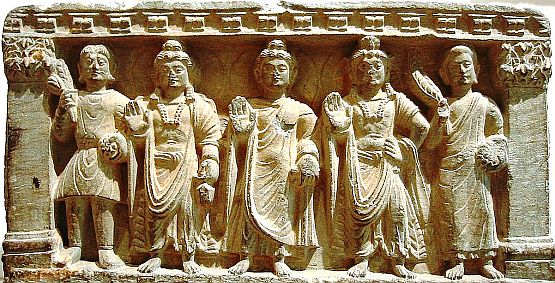
Gandhara_Buddha_(tnm)cropped

A. Birth of the Mahayana

1. The concept of Mahayana came about because of the churning of ideas within the Buddhist community at the beginning of the Christian era. A large section of the community strongly felt there was a need for a more emotional, warmer, personal religion adequately disposed to evolution and development. The general tradition connects this evolution to the initiatives of King Kanishka (c 120 A. D) and scholars of the time such as Ashvaghosha (c 120 A. D)  and Nagarjuna (c 150 A D).

3. Though the concept of Mahayana was launched, officially, at the fourth religious council held at Kashmir in first century A.D, the germ- idea was in circulation even a hundred years earlier to that, more as a matter of speculation and argument than as a precise statement.

The evolution of the Mahayana concept came about as a gradual unfolding rather than as a sudden development.

4. At the time when the Mahayana doctrine came up for debate in the fourth religious council, nearly years 500 after the historical Buddha attained nirvana, Buddhism had well taken roots in India. It was popular among the masses. It also enjoyed the patronage of kings and Emperors.

 It was therefore, at that time, not in desperate need of a ruse for survival. The Mahayana did not take birth as a reaction to Hinduism.

B. Mahayana is not a departure from teachings of Buddha 

5. The Mahayana is not a departure from the doctrines enunciated by the historical Buddha. Both the schools – Theravada and Mahayana- accept the fundamental teaching of Buddha implicitly without any questions. Both the schools argue that the basic tenets of their school emanate directly from the teachings of the Buddha. Followers of Mahayana insist they have not deviated from the teachings of the Buddha instead, they claim to have rediscovered the Buddha’s lost teachings. Many scholars say that Nagarjuna grasped the Buddha’s “seed- idea” of void Sunyata and developed it into a system of thought in his book Madhyamika Karika.

C. Theravada – Mahayana

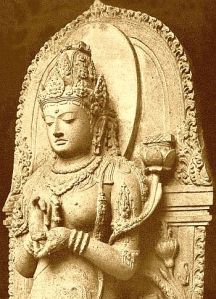
Prajnaparamita_Java

6. An obvious difference between the two schools is the Bodhisattva ideal. Both schools accept the three Yanas or Bodhis but consider the Bodhisattva ideal as the highest. The Mahayana accepts many mystical Bodhisattvas while the Theravada considers Bodhisattva as a human amongst humankind and as one who devotes his life for the attainment of perfection and who ultimately becomes a fully Enlightened Buddha for the welfare and happiness of the world. The Mahayana transfers the emphasis from personal salvation to universal salvation, from the ideal of Arhant to that of the Bodhisattva. It said, a monk should not be a lamp unto himself, while there is darkness every where

Perhaps, at some point of time, it was thought that the way of the Arhant meant complete detachment from the world. It was considered desirable that one should remain in the world out of compassion for the benefit of all beings striving to attain enlightenment (Bodhichitta), to become a Buddha. Let me add, the status of the Buddha was regarded an ideal. The Buddha was never looked upon as unique: there had been many others in the past ages. The Buddha is the supreme ideal. Anyone could strive to reach there. The conduct through which Gautama had become the Buddha was described in ancient texts. Therefore, every ardent seeker motivated by compassion for all beings (as did the Gautama) is a Bodhisattva, the Buddha in making.  The progress was partly through practices, and partly through right-understanding (prajna); the latter being more important. After some early Mahayana Sutras furthered the concept of Bodhisattva many more Sutras elaborated on the theme.

7. During the initial times, the difference between the two schools was not that apparent. As the Chinese traveler I- Ching (635-713 A.D.) put it, “Those who worship Bodhisattvas and read Mahayana Sutras are called Mahayanists, while those who do not do this are called Hinayanists”. It was that simple.

8. However the differences became explicit over a period when (a) each schools adopted its chosen texts –Pali texts by Theravada and Sanskrit texts by Mahayana; and;(b)when the two schools moved away to distinct geographical areas like Sri Lanka ,Burma , Far East on one hand and Tibet , China and Japan on the other.

1024px-BuddhistTriad

D. Reforms within Mahayana

9. The challenges that Mahayana Buddhism faced in distant lands and diverse cultures called upon it to innovate. Buddhism that took root in those countries was not the same as the one practiced in India at the time. For instance, in order to be acceptable to the populace of Tibet it was necessary  that Buddhism evolve itself into a new form by letting in Bon practices and ideas while firmly retaining its basic Buddhist tenets. In the process, Buddhism took in materials and attitudes native to the soil, lent them a new sense of direction and grafted them with the Mahayana doctrines. It allowed many Bon attitudes, ideas, tribal gods, goddesses, and the associated rituals and instilled in them the spirit of Karuna. Thus, while the form was traditional to the soil, the soul was Buddhist.  Bon at the same time also adopted numerous Buddhist practices, attitudes and ideas.

A similar process took place in China and Japan where Buddhism imbibed the rituals, practices, attitudes and even deities of the native religions (Tao and Shinto) while retaining the essential Buddhist doctrines at heart. Those religions intern also modified themselves. It was/is a dynamic process.

10 Thus, Mahayana Buddhism became an umbrella concept for a great variety of sects, from the Tantric Sects found in Tibet and Nepal (secret Yoga teachings), to the Pure Land Sects found in China, Korea and Japan (reliance on simple faith- Bhakthi). The Mahayana also gave birth to an inward-looking Chan Buddhism (China), which then crossed the straights to Japan and flowered as Japanese Zen. For Chan and Zen followers, the path to enlightenment is meditation.

In fact, some scholars go further and say the Mahayana is not a single vehicle but rather a train comprising many carriages of different classes.

11 . Despite this proliferation in beliefs, Mahayana Buddhism tapers down to two general branches — the Madhyamika and the Yogacara.  While Madhyamika represents the middle view, the middle road, a path of relativity over extremes (e.g., extremes like existence vs. nonexistence, self vs. non-self); The  Yogachara  school emphasizes yoga — the practice of meditation. In either case, the path to enlightenment is long and arduous, requiring followers to build up merit in this life to be reborn in the next life with better karma.

E. Mahayana-Hinduism

12. Now, before coming to issue of Hindu influence we can digress a bit. While discussing the similarities among various Indian languages Prof. Emeneau, a well-known American scholar, in his classic paper, “India as a Linguistic Area”, came up with the concept of linguistic area for explaining the underlying Indian-ness of apparently divergent cultural and linguistic patterns. The resemblances between two or more languages (whether typological or in vocabulary), he said, can be due to genetic relation (descent from a common ancestor language), or due to borrowing at some time in the past between languages. He also said, essentially different but geographically and physically proximate languages often exhibit shared linguistic features.

We can perhaps extend this view to cover various religions that took birth or that took root in India. Amanda Coomaraswamy , the great scholar, once said “The more superficially one studies Buddhism, the more it seems to differ from Brahmanism in which it originated; the more profound our study, the more difficult it becomes to distinguish Buddhism from Brahmanism, or to say in what respects, if any, Buddhism is really unorthodox.”. The Buddha did not fight the religion of India of his time .He had a benevolent view towards it and its scholars. He however objected to the ritualistic aspect of that religion. Buddhist Rahula Vipola wrote,” the Buddha was trying to shed the true meaning of the Vedas. Buddha is a knower of the Veda (vedajña) or of the Vedanta (vedântajña) [(Sa.myutta, i. 168) and (Sutta Nipâta, 463)].” Hindus scholars have also accepted the Buddha and Buddhism as a fulfillment of Sanatana Dharma.

Swami Ranganathananada in his article Bhagavan Buddha and Our Heritage (published separately as booklet by Advaita Ashrama) explains that it is essential to understand Upanishads in order to fully understand the Buddha and his teachings. He regards the Buddha as continuing the Upanishad tradition of enquiry. Gautama assimilated whatever his teachers could give ; and asked for more. But, when that did not satisfy his aspirations Gautama resolved to leave his teachers and to seek the Truth on his own. Swami points out that Yoga and the Buddha both emphasize the Middle Path: “Yoga the discipline for the destruction of sorrow is for him who is moderate in eating, and recreation; moderate in work work and sleep and waking (BG-16.17).The additional charm of the Buddha’s teaching is that it arose out of his own experience. The Buddha’s second discourse at Saranath on the subject of Anatta is acceptable to Vedanta, entirely; and can be understood better in the light of the Upanishads. The attainment of Nirvana, the Swami explains, agrees essentially with the realization of the form-less Brahman of the Upanishads. The Buddha’s teaching is not only complete in itself but is also an essential part of the Indian Philosophy. The Buddha is the most wonderful flowering of the combined legacy. Swami Raganathananda concludes: “The self-transcending ethics of the Buddha united to the transcendent Self of Sri Sankara is the most stimulating essence of the Indian thouht”.

13. Hinduism and Buddhism influenced each other in many ways. The Buddhist notion of non-injury and compassion toward all living beings took deep roots in the Indian ethos, while Mahayana Buddhism took cue from the traditional Indian methods of devotional worship. Buddhism influenced the growth and development of Indian art and architecture and contributed richly to the practice of breathing and meditation in attaining mindfulness and higher states of consciousness. The Hindu Tantra influenced the origin and evolution of Vajrayana Buddhism that flowered in Tibet.   The systems of Buddhism and Hinduism are not either contradictory to one another or completely self contained.

14. We may say that in the first few centuries following the nirvana of the Buddha, Buddhism was an integral and significant part of that complex religious character of the Indian subcontinent, which the outsiders called as Hinduism. However over a period thereafter Buddhism crossed the boundaries of the Indian subcontinent and went on to play a much greater role in the whole of Asia. In the process, it developed a very complex sectarian, theological and geographical diversity and a tradition of its own – a unique blend of local customs and Buddhist faith- to become one of the most significant and influential religions of the world. Many people who are not familiar with the history of the Indian subcontinent fail to understand the deep connection that existed between Hinduism and Buddhism in the earlier days and the significant ways in which they enriched each other. 

F. Conclusion

15. The birth of Mahayana was not as a reaction to Hinduism .It was a concept that emerged out of churning of ideas within the Buddhist community. Perhaps it was the need of the time. The Mahayana did not deviate from the doctrines enunciated by the historical Buddha .The various forms that Mahayana assumed in different geographical and cultural contexts were a part of the dynamics of its growth.  The Mahayana in any country has to be viewed against the broad canvas of that region’s cultural and religious uniqueness. This is true in the Indian context too. Further, the systems of Buddhism and Hinduism are not either contradictory to one another or completely self contained.

16. What happened to Buddhism after eighth century and Muslim invasion is another story.

buddha-wallpapers

References:

Hinduism and Buddhism – A historical sketch By Sir Charles Eliot

Timeline, history-Three   Main Buddhist schools

 
5 Comments

Posted by on September 3, 2012 in Buddhism


Tags: ,

Buddhism of Tibet

1. Early Days

1.1. India and Tibet (known to Tibetans themselves as Bod and to Indians as Bhota Desha) have had a long and a continuous cultural contact. The links between the old neighbors intensified when in 620 AD the emperor Sorang – sGam-Po (569 – 650 AD) sent his emissary to Kashmir to evolve a suitable script for the Tibetan language and to invite Buddhist scholars to Tibet. Interestingly this move was at the wish of two women one from Nepal and the other from China who were married to the monarch .The two queens were pious Buddhists .It does not however mean Buddhism was not known in Tibet until then. It appears that at least a hundred years earlier when LHa- THo- THo ruled the land a number of Buddhist texts were available in Tibet but not many could read the script. The initiative taken by the monarch not only brought in a gentler religion, a mellowed way of life but also a new “religious speech” (CHos – sKad) enriched by Sanskrit. Since then Tibet has regarded India as its sacred land and India in turn looks upon Tibet as its religious frontier. The mutual regard and respect has continued to this day.

2. Buddhism Enters

2.1. The introduction of Buddhist influence into Tibet was neither sudden nor violent. It was a gradual and a gentle process. This was a remarkable feat considering that the Tibetans and their religion at the time were “wild“ and that the Monarch did not resort to violence or repression to usher in Buddhism. The Tibetans were mostly nomadic in nature, Spartan in their ways of life and fiercely warlike. The religion native to Tibet called Bon –pronounced Pon – meaning “to mutter magic spells”, often described as shamanism, fetishism filled with rituals, spells, dances etc. had a strong influence on its followers. Yet the transformation brought about following the introduction of Buddhism is astounding. Today there is no gentler race than the Tibetans. No other people have preserved the high ideals of Buddhism as the Tibetans have even in the face of persistent trials, tribulations, displacements of immense proportions forced on them. How did this come about?

3. Synthesis

3.1. The religion that Indian monks planted in Tibet was not the one practiced in India at the time. In order to become acceptable to the populace of Tibet it was necessary that Buddhism evolve itself into a new form by letting in Bon practices and ideas while firmly retaining its basic Buddhist tenets. In the process, Buddhism took in materials and attitudes native to the soil, lent them a new sense of direction and grafted them with the Mahayana doctrines. It allowed many Bon attitudes, ideas, tribal gods, goddesses, and the associated rituals and instilled in them the spirit of Karuna. Thus While the form was traditional to the soil, the soul was Buddhist. Bon at the same time also adopted numerous Buddhist practices, attitudes and ideas.

3.2. It is important to remember that the Indian monks who brought in Buddhism were not missionaries in the usual sense of the term. They were not interested in conversions.

3.3. Some call the Tibetan religion as Vajrayana. It may perhaps be more appropriate to recognize it as Bon- CHos (Buddhism grafted on Bon). Because, what we have here is a harmonious synthesis of two religious practices and ideas rather than domination of one over the other. Tibet manifests a truly unique CHos (Dharma) with its own scheme of values.

4. Vajrayana

4.1. The form of Buddhism that took root in Tibet belongs to Vajrayana (the path of the thunderbolt) an offshoot of the Yogachara branch of the Mahayana. Vajrayana had its origin in South India, blossomed in the universities of Nalanda, Vikramashila and Odantapura in North India .It later took root in Tibet and Mongolia. Its characteristics are involvement in Tantric rituals, incantations (Mantras) and visualization of deities. At the same time the adaptable integration of the body (Kaya – Snkt,), speech (Vacha – Sanskt) and mind (manas – Sanskt.) is also a main plank of the Vajra (Diamond) path.

4.2. The Yoga – Tantra ideology (known to Tibetans as Grub –Thob) developed during the early part Christian era by a class of Indian seers called Siddhas became the driving force of the Vajrayana. Siddhas brought in the concept of Bhodhi –chitta.

4.3. As per the concept, Bhodhi-Chitta resides in all of us in its twin aspect: (1) as ordinary consciousness soiled by actions and agitated by thoughts, and (2) as a hidden pool of tranquility, unaffected, “ever washed bright”, beyond the phenomenal involvements. The former aspect is mind (Manas -Sanskrit) (Yid – Tibetan) and the latter is consciousness (Chitta – Sanskrit) (Sems – Tibetan). The object of the Tantra is to transform the former (characterized by Stress – Klesha) into the latter (experienced as Bliss – Sukha).

4.4. To illustrate the Bhodhi – Chitta, the mind is like a pool of water. The agitated water should become still before what lies beneath (consciousness) becomes visible. Beating or stirring the water does not help. The pool should be left undisturbed .The art of letting the mind alone (“let go”, “open hand”) to allow it to settle naturally into silence and tranquility is at the core of the disciplines advocated by the Siddhas. The instruction is “cast aside all clinging and essence will at once emerge”.

This concept gives rise to another one viz. Vipasyana meaning clear vision, which comes about because of stilling the constitutional mind.

4.5. These concepts entail a process that lays stress on utilizing the mind to reach a state of “no mind”, refinement and sharpening of the mind, purifying it and making it “like a cloud less sky”, “like a wave less occasion”,” like a bright lamp in a windless night” etc. In short, the object is to attain a clear, bright and a stable state. This process is also called as emptying the mind. The Tantra here not only suggests a path from a cruder form of thought and emotions to a higher level of functioning but also prescribes practices that transform and elevate the human being.

5. The Masters

5.1 From the 8th century onwards, the scholars at Nalanda began to play an active part in the propagation of Buddhist religion and culture in Tibet. It is likely Tibetan was taught at the institution. Chandragomin, at Nalanda, was the pioneer in the field.

Chandragomin (7th century CE) was a Buddhist scholar at Nalanda; and, he always dressed in the white robes of the Yogic tradition. It is said; Chandragomin challenged Chandrakirti (c.600 – c.650) another Buddhist scholar at Nalanda and a commentator on the works of Nagarjuna (c.150–c. 250 CE) to a debate held in Nalanda Mahavihara. Chandrakirti would immediately reply to any statements made by Chandragomin. But, Chandragomin, on the other hand, would take his time to answer – sometimes he would wait until the next day. His answers, nevertheless, were very precise and clear. The debate, it appears, lasted for many years.

Chandragomin’s work on Sanskrit grammar became popular in Tibet. And, scores of his works were translated into Tibetan; many scholars were in fact engaged in translation work.

5.2. The credit for evolving a wonderful synthesis of the two religious practices goes to the Tibetan monks and their Indian Gurus the prominent among whom, in the early stages, were Padmasambhava and Santarakshita.

Santarakshita, another Nalanda monk and scholar, was invited to Tibet by its king Khri-sron-deu-tsan in 74 (J A.D. for the purpose of preaching Buddhism. He was given a royal reception and the first Buddhist monastery in Tibet was built under his instructions. He became its chief abbot and vigorously helped the spread of Buddhism till his death in 762 A.D.

He received very valuable cooperation in this work from Padmasambhava, a Kashmirian monk educated at Nalanda ‘. Intellectual and literary activity of Nalanda must have continued in subsequent centuries also, for several manuscripts have been, preserved to this time, which were copied at Nalanda during the 10th, 11th  and 12th centuries A.D.-

Padmasambhava built the first Buddhist monastery in Tibet (bSam Yas) around 749 AD modeled on the Odantapura monastery while combining three styles of India, Tibet and China. He persuaded the great scholar Santharakshita of Nalanda to preside over the monastery.

Both were men of great learning. While Padmasambhava had his roots in Tantra, Santarakshita was a quiet ascetic in the traditional mold. The Padmasambhava – Santarakshita team was a curious combination of dissimilar capabilities .One complimented the other. One would argue thunder and coerce while the other could explain, expound, teach and convince. One had a mass appeal; the other had the quiet regard of the elite. One emphasized magic, rituals and success; the other highlighted the value of virtues, contemplation and wisdom. Padmasambhava stood for powerful action; Santarakshita symbolized gentle being. The two great men together molded the attitudes and approach of later day Tibetans. If the Tibetans have successfully accommodated the thunderbolt (Vajra) with the abiding peace of vacuity (Shunya) then a large share of the credit must go to these Masters each working in his own way for the betterment of humanity.

5.3. If the Padmasambhava – Santarakshita team introduced the Buddhist excellence the other team of Dipankara and Brom firmly established Buddhist influence in Tibet Dipankara, a prince from Bengal earlier in his life, presided over the VikramsilaUniversity. He was a great Mahayana scholar in the mould of Santharakshita. He was 60 when he arrived in Tibet where he lived for 13 years until his death in 1054 AD. He was fortunate in securing a very capable and devoted Tibetan disciple in Brom. The two together strived to clean up the cobwebs since settled in the Tibetan Buddhism and to restore the traditional values and virtues.

5.4. Another revered name in the annals of Tibetan Buddhism is TSong –Kha – Pa (1357 – 1419 AD), a scholar of great renown and author of the celebrated Lam – Rin CHen Mo. He is worshipped even today as a living presence, next only to Buddha. The Chinese emperor honored TSong –Kha – Pa’s nephew as a Bhodhi Sattva. Later in 1650, the Mongolian emperor conferred the all-powerful status of Dalai Lama on a descendent of TSong –Kha – Pa. Since then the successive abbots have been the religious and secular heads of Tibet.

TSong –Kha – Pa brought large scale and enduring reforms in the Buddhist monastic organizations in Tibet. The achievements of TSong –Kha _Pa and his contribution to Tibetan Buddhism in particular and to Dharma in general are too numerous to recount here.

6. India’s Debt to Tibet


6.1. India owes a debt of deep gratitude to Tibet for preserving Yoga-Tantra tradition and keeping it alive even though it has become extinct in the land of its origin.

6.2. Further, because of the large-scale destruction of Buddhist and Hindu texts stored in Nalanda when Muslim forces attacked it during the middle periods, many ancient texts are no longer available in India. The only credible source for such ancient texts is the body of Tibetan translations carried out centuries earlier by Tibetan monks.

6.3. More importantly, the extraordinary sprit of tolerance, non-violence and resilience displayed by the large population of ordinary men and women displaced from their homeland is a true tribute to Buddha and his ideals.

References:
1. Tibetan Tantric Traditions
– Prof. S K Ramachandra Rao
2. The Buddhist Tantras
– Alex Wayman

 
5 Comments

Posted by on September 3, 2012 in Buddhism


Tags: ,

Life of the Buddha- the Pali tradition

The life and teachings of the Buddha have come down to us in two main streams: The Pali Canon-the older tradition prevalent in Sri Lanka and Burma; and the Sanskrit tradition followed in Tibetan and Chinese Buddhism.

It is said; three months after the Buddha’s parinibbana – his death and final entry into Nibbana – five  hundred of his Arhats and disciples, led by Maha_Kassapa, met in a council at Saptaparni cave (Pali : Sattapa.n.ni-guhaa or Seven leave-cave)  near Rajagriha ( Rajagaha), during a rainy season. That council held under the patronage of the King of Magadha, Ajatashatru (Ajatasattu – ruled 491 to 461 BCE) later came to be known as the First Council. 

With the Teacher no longer among them, the monks addressed themselves to the task of preserving the teachings of the Master and handing them down to the subsequent generations, as purely and as faithfully as possible. The First Council arrived at a consensus on what the Buddha’s teachings actually were after deliberations lasting for about seven months. It is said; Upaali a leading disciple of the Master compiled and edited the Vinaya portions of the Canon, dealing with rules of right conduct. The doctrinal, Dhamma, portions were similarly rendered by Ananda a close disciple and a cousin of the Master. Maha_Kassapa who presided over the council directed the compilation and editing tasks.

The fact that the followers of the Buddha could put together his teachings in such a highly developed form is a miracle. Having no written texts to rely on, they, as their forebears did earlier, prepared their discourses “for recitation”. The basic themes were rendered into verses arranged in cyclic order, with variations, in order to implant them firmly in memory of the monk – reciters (bhanaka) and the listeners as well. They were then committed to memory and passed down orally from generation to generation. The Pali Canon could survive the rigors of centuries, in oral form, because the followers of the Dhamma regarded the Master’s message as a priceless jewel that had to be preserved in its entirety and purity. It was an act of intense devotion. An amazing feat.

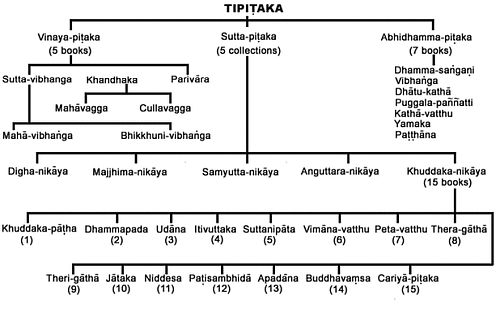
It was not until the first century BCE that the Pali canon was rendered into writing. According to the Sinhalese sources, the canon was written down at the instance of the King Vattagamini (29-17 B.C.E) of Sri Lanka at the fourth Buddhist Council. The Pali Canon falls into three general categories, called pitaka (basket). Because of this, the Canon is traditionally known as the Tipitaka (three baskets). The term ‘basket’ might have been used figuratively to indicate a collection or a carrier of an oral tradition.

The Pali Canon or Tipitaka is made up of three separate sections: the regulations governing monastic life (Vinaya), the sermons of the Buddha (Sutta), and Buddhist philosophy (Abhidhamma).

The three-fold pitaka division replaced a simpler, two-part division into Sutta (prose) and Vinaya (disciplinary rules).

Tipitaka

The Buddhist tradition claims that the Tipitaka is composed in the language the Buddha spoke. The dialect of Kosala, of which the Buddha’s birth-kingdom Maghada was a part, was Magadhi also known as Magadhanirutti and Magadhikabhasa. The Buddha must have spoken to his listeners in Magadhi the popular language of the region in which he took birth and where he lived for most part of his life. For this reason, Magadhi is called Mulabhasa, the language in which the words of the Buddha emerged. The language of the Buddhavacana (words of the Buddha) is thus Magadhi and sometimes called Suddha-Magadhi, in order to distinguish it from Ardha Magadhi, the language of Jaina Canons. The   Buddha’s teachings were transmitted orally through this language for more than three centuries until they were written down.

The term Pali originally did not refer to a language. Pali was defined as that which preserves or protects (pa paleti, rakkhati ‘ ti Pali). Since the text Tipitaka preserved the Buddhavacana, it was initially called Pali. The word Pali thus signified “text” “sacred text”. With the passage of time, the language of the Tipitakas acquired the name Pali .

The well known scholar Bimal Churn Law in his History of Pali Literature states that the earliest use of the term Pali as the name of a language can be traced Buddhaghosa (3rd or 4th century BCE) and not to any earlier text. Dr. Law states that until then Pali was used to signify the original Canon as distinguished from the commentaries. And, after Buddhaghosa, the transition from Pali the text to Pali the language came about by popular usage.

The Buddha encouraged his disciples to preach in the language of the people so that they could understand the message. The Buddha preferred the natural language to the classical Sanskrit. He rejected proposals from his senior disciples to translate his teachings into Sanskrit verses. The Buddha discouraged spreading his teachings in any language other than the languages that people ordinarily spoke such as Magadhi and other local languages and dialects.

However, after the Buddha’s death, the forms considered more ‘learned’ and apt for philosophical exposition gradually took to Sanskrit, despite the fact that it gave a less faithful rendition   of the Buddha’s speech. Slowly the effort to represent the Master’s teachings in the spoken language of the people gave way to another effort, the expression through learned phraseology. By about 300 AD, classical Sanskrit became language of Buddhist texts.

***

[ As mentioned earlier; after his death, a council of 500 Buddhist monks was convened at Rajagriha in order to edit the corpus of his sermons so that his authentic teachings could be preserved.

A second council was convened at Vaishali, approximately one hundred years after the Buddha’s Parinirvāa.

The Second Council resulted in a schism in the Sangha: the ‘old ones’ (Theravadins) insisted on the ascetic ideal of the community of monks (Sangha), whereas a new movement stood for a greater accommodation of the lay members and a broadening of the concept of the Sangha to include followers other than monks. In keeping with this aim, the new trend was called Maha-sanghika.

This was the origin of the ‘Great Vehicle’ (Mahayana) as the new movement liked to call itself while looking down upon the ‘Small Vehicle’ (Hinayana) of the orthodox monks. This schism was undoubtedly of great importance for the later development of Buddhist and Hindu philosophy; but, it also predetermined the decline of Buddhism in India itself.]

 ***

The authenticity of the Pali Canon is firmly established. The original gospel that survived in oral form and that served as the nucleus for the Canon must have been a collection of the words as spoken by the Teacher(suttno _pavachanam), as heard , grasped and remembered by his immediate disciples. The earliest accounts, which we may take as historical, must have been extremely plain accounts. They must have consisted of long series of discourses in direct speech of the Teacher, each with brief contextual information.

However, over a period, additional passages were written into to the Canon. These introduced the wonder and mystery of supernatural, elements of exaltation, religious romance and divine fervor. The plain accounts of the original gospel now strangely coexist with miracles and wonder.

There is a method to separate the original Canon from the injected passages. This method is more or less reliable. It is guided by the fact the original gospels follow a certain narrative pattern. Usually each recitation is prefaced with the words “Evam me sutam” (thus have I heard).This is followed by a couple of sentences indicating where the Teacher was when he gave the discourse and to whom it was addressed. Then the recitation is presented in direct speech in the Buddha’s own words (Buddha vachana). At the end of the recitation occurs another short sentence “idam avocha bhagava” (Thus spake the Blessed One) to mark the conclusion of the recitation.

The passages that fall outside this format are taken to be later additions. In order to obtain the message of the Canon we have to relay on the Buddha’s own words, ignoring the additions.

During these discourses, the Buddha gives glimpses of his life. These obviously are not long autobiographical narrations but they do contain revealing bits of information clothed in the Buddha’s own words. The information gleaned from the Canon presents a very interesting and a demystified view of the Buddha’s life events.

The Buddha (the Awaken) was certainly not the personal name of the Teacher and there is no evidence to suggest that our Teacher assumed that name at any stage in his life. He was not addressed as the Buddha  during his lifetime; nor did the Canon referred to him as the Buddha. A Buddha is anyone who is enlightened. A number of persons both before and after our Teacher were known by that title. For instance the sage Kashyapa, the progenitor, was often addressed the Adi-Buddha.

In the Canon, his acquaintances call him Samana Gotama (the ascetic Gotama) or simply Gotama. It may have been his Gotra or family name. In the later works, Siddhartha is his personal name. In the Canon, the Teacher is sometimes referred to by his clan name: “Sakya muni”, “Sakya putta”, or “Sakya kulamaha pabbajito”. To his disciples, he is Bhagava (The Blessed One). 

The Pitakas at several places describe our teacher as Angirasa, meaning that he belonged to the linage of the sage Angirasa.  (e.g. Vin.i.25; D.iii.196; S.i.196; A.iii.239; Thag.v.536; J.i.116). For instance Vinaya Pitaka while describing Gautama after he attained awakening , says “The Angirasa passes the night in tapas, his body radiating lustrous light.”He is at times addressed as Angirasa Kumara.

 Vinaya Pitaka names Suddhodana as the father of the Buddha. He is a Sakyan who resides in a Bhavana (a residential house). In the Pabbajja Sutta , the Buddha informs Bimbasara the king of Magadha,   that Sakiyas were a republican community, strong and prosperous, belonging to Kosala Kingdom at the foot of the Himalayan ranges.Suddhodana might have been a Sakyan Chieftain.  As per The Mahapadana Sutta, Maya is the Buddha’s mother. 

As regards the circumstances surrounding the birth of the Buddha, the Canon is entirely silent. The dream of Maya, entrance of the Bodhisattva into her womb, delivery at the Lumbini garden and the attendant miracles look like later additions.

In the later legends the messengers of gods enact scenes of old age, disease and death to remind the Bodhisattva of his great mission. However, the cause for his disillusionment with Samsara comes out in a subdued form in the Buddha’s own words. In the 38th Sutta of Anguttara- Nikaya the Buddha recounts :

” (living in excessive luxury) it occurred to me : an ordinary , uninstructed man , himself subject to old age , to disease , to death and not having passed beyond them , when he sees an old man , a diseased man and a dead man , is alarmed , abashed and repelled , being alarmed for himself…As I thought thus , all intoxication with life utterly left me.”

The Buddha uses the term “mayhem etad ahosi” meaning “it occurred to me” indicating that he reflected upon the problems of old age, disease and death . These were his thoughts.

The great renunciation mahabhi_nikkhamana is a subject of many literary compositions and artistic creations. In the Ariya-pariyesana Sutta of Majjahima Nikaya, the Buddha in a reminiscent mood recalls leaving his home and becoming a homeless. He explains the events in exceedingly simple words.

While still young , with glossy black hair , in vigorous youth and in prime , though my mother and father were unwilling and tears poured from their eyes, I caused my hair and beard to be cut off, and donned the ochre robe, and went forth from home to homelessness , and having thus renounced , pursuing the highest good , seeking the supreme path of peace , I came to Alara Kalama.”

His young wife, infant son, favorite horse Kanthaka , the devoted charioteer Channa, the still of the night , the river Anoma and sympathetic gods were perhaps brought into the later texts to heighten the dramatic effect of the great event.

Another account in the pubbajja – sutta of sutta-nipata, mentions that  king Bimbisara attempted  to dissuade Gotama from the path of renunciation, saying Gotama was too young to go along that path. The Ariya-pariyesana Sutta too suggests the great departure was a deliberate and well considered move with the knowledge of all. It was not a slip out in the dead of the night.

Mara is personification of desire, the force that circumscribes the man as ego and subjects him to the wretchedness of samsara. In the Mahavagga of Vinaya Pitaka there is only a single reference to Mara:  “He the strenuous, meditative sage, Gotama stands and scatters the army of Mara, even as the sun lighting the heavens.” It signifies the Buddha’s victory over temptations. The elaborate Mara legend and the fight is absent in the Canon.

The ancient accounts of his enlightenment are charmingly simple, plain, lucid and shorn of supernatural. In Ariya_pari_yesana Sutta, the Buddha recounts those momentous events:

Being myself subjected to earthly existence, I perceived the wretchedness of what is subject to earthly existence and seeking the supreme peace of Nibbana , which is not affected by earthly existence , I attained the supreme peace of Nibbana not affected by earthly existence.. and the insight now as the thing seen arose in me. My emancipation is won, this is my last birth and there is no more becoming for me.”

The Buddha further says “Lived is the holy living, done is what was to be done, there is nothing beyond this.”(Katam karaniyam, na param itthattaya)

 We then have the celebrated Dhamma_parivattana_Sutta the first discourse of the Buddha at the deer park in Isipatna near Varanasi. This Sutta perhaps carries the very words the Buddha uttered.

From this point onwards until his death, there is general agreement among all the versions on the various accounts in the life of the Buddha.

The Buddha, according to Madhurattha_vilasini, was a wandering monk, continuously on move from place to place (paribbajaka) for twenty years starting from his enlightenment. He then settled down at Savasthi living on alms, for about twenty years. He left Savasthi in his 79th year and spent rainy season (vassa) at Rajagraha from where he moved northward. While on move, at the age of 80, he passed away quietly at Kusinara in Malla country.

The Lakkana Sutta of Dhiga Nikaya gives description of the Buddha’s physical appearance. The Buddha was perhaps one of the few good-looking spiritual teachers. He was at least six feet tall. His hair was fine, dark with soft long curls. He had an elongated face, protruding and well-formed nose. He had military training in his upbringing. He had a strong body and was once invited by a king to join his army, as a general.

His death is the theme of a long SuttaMaha_pari_nibbana Sutta, included in Dhiga Nikaya. His last words: “I beseech you, mendicants, all composite things are liable to decay; strive with diligence” appear in all the versions. Some versions carry the Buddha’s conversation with gods, the earthquakes and other marvels attending his death.

A verse attributed to Anurudda that gives a remarkably intimate eyewitness account of the Master’s death.

His mind was settled; there was no hard breathing in or out. The sage died without a quiver; his goal was tranquility. He endured the pain with bold mind; even as a flame goes out; his conscious was freed.”

*****

The Buddha is the precious jewel of humanity. No matter how you look at him, he must have been a wonderful person of majesty, tenderness, compassion and one who was free from prejudices. He always carried himself with dignity. You cannot fail to wonder at the brilliance, greatness, compassion and the nobility of the person and his teachings. Though twenty-five centuries have gone since the passing away of the Buddha, his message of love and wisdom continue to influence and guide us.

 ****************

Please see The First Discourse Of The Buddha

for Dhammacakkappavattana Sutta,

 
Leave a comment

Posted by on September 3, 2012 in Buddha


Tags: , ,

The First Discourse of the Buddha

The First Discourse of the Buddha

(http://www.accesstoinsight.org/tipitaka/sn/sn56/sn56.011.than.html)

buddha first serrmon2

It was almost seven years since young Gotama cut his glossy black hair and beard; donned the ochre robes; set forth from home to homelessness in search of the supreme path of peace. Samana Gotama, as he was now called, wandered in the forests; lived a life of austerities; went from teacher to teacher and mastered their techniques of meditation. Yet, he was dissatisfied and his goal unreached. He set out again leaving behind the teachers and their teachings. He retired into the forests of Uruvala in Maghada country and earnestly engaged himself in extreme austerities and self-mortification. His body emaciated, grew weaker and his mind appeared to wander. He realized the futility of such  methods. He understood that the mind , in order to function properly, has to be supported by a strong and a healthy body. He abandoned self-mortification and resumed taking food. His fellow Samanas disillusioned, left Gotama to his methods and walked away.

It was on the full moon night in the month of Vesaka –  the sixth month; it was one of those nights he spent under the Bodhi tree; he understood the sorrows of earthly existence and the supreme peace unaffected by earthly existence. He said to himself “My emancipation is won…Done what is to be done. There is nothing beyond this (katam karniyam, naa param itthattaya).”

For several days, he wandered in peace and tranquility, among the woods. He enjoyed his quiet serene days and lonely walks in the forest. He wished the idyllic life would last forever. He pondered whether he should share his newfound wisdom with others. Yet, He wondered whether anyone would be interested or appreciate his findings, which helps in seeing things clearly, as they are; and in attaining knowledge, higher wisdom, peace, and enlightenment or nirvana.

He debated, there might still be those not entirely blinded by the worldly dirt. He thought of his teachers Alara Kalama and Uddaka son of Rama both “wise, intelligent and learned; and of nature scarcely tainted “; and, said to himself they would quickly comprehend the knowledge he had just gained. Then he sadly realized that Uddaka son of Rama had just passed away; and Alara Kalama died about seven days ago. Then the thought came to him of his erstwhile fellow Samanas, those who left him to pursue their ways. He decided to talk to his fellow seekers and share with them the new wisdom. (Majjhima Nikaya; Sutta 26)

He journeyed from place to place from Gaya ; and at length reached the holy city of Varanasi after nearly seven weeks, covering a distance of about 144 miles . On his way , a monk named Upaka enquired Gautama where he was headed to, “To set in to motion the wheel of Dhamma (Dhamma Chakkam pavattetum)” he replied  ” I proceed to Varanasi ”.

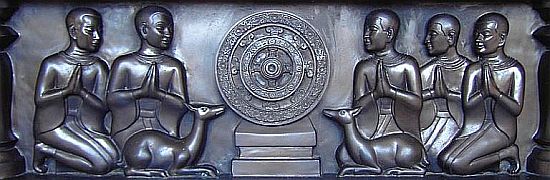
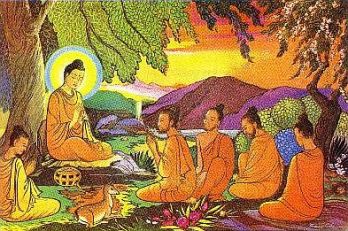
There at Varanasi ; he learnt the five ascetics (Kondanna, vappa, Mahanama, Assaji, and Bhadda) whom he knew before were at Isipatana (Rishipattana – where the sages live, now called Saranath), nearby. He found them in the garden Migadaaya (Deer park) at Isipatana. They were surprised to see him ; but , were impressed by his majestic, pure and serene demeanor. They wondered whether he had achieved uttari_manusa_dhamma, the super human achievement.

He told them he had done what had to be done. He had attained it. He asked them to listen to his findings. He told them: “I teach about suffering and the way to end it”.

They listened to him in all earnestness. What he spoke to those five ascetics later gained renown as one of the greatest and most important discourses in religious history. At the end of his talk, the Buddha emerged as the Teacher. He came to be revered as Bhagava (the Blessed One).

The talk was “The first teaching” (Pathama desana).It later came to be celebrated as Dhammacakkappavattana Sutta, the discourse that set in motion the wheels of Dhamma.

Buddha sadhanamala

The Buddha spoke to the five ascetics at the garden of Migadaaya where the deer roamed unmolested and in peace, located in Isipatana near the holy city of Varanasi, in the evening of the full moon day in the month of Asalhi – the eighth month (Ashada-July). He spoke in simple Magadhi the language his listeners understood well. The discourse was brief, with short, simple and precise statements. There were no definitions and no explanations. It was a direct sincere talk.

It was a simple and a straight narration of how Samana Gotama transformed into the Buddha. He spoke from his experience; narrated his findings; and explained the four truths and the three aspects of each; and the middle path.

He opened the discourse by exhorting the five monks who believed in strict asceticism to avoid the extremes of self-indulgence and self-mortification, as both do not lead to perfect Peace and Enlightenment. “These two extremes should not be resorted to by a recluse who has renounced the world”.

He advised them to follow the Middle Way (majjhiama patipada)

He went on to explain four noble truths (cattari ariya sacchani): Sorrow (dukkha) in life is a fact; it has a cause; that cause can be eliminated; and there is a method by which it is eliminated.

Briefly, he said:

*clinging to existence is sorrow (dukkham ariya saccham);

*thirst or craving (tanha) for pleasure (kama tanha), thirst for existence (bhava tanha), thirst for heavenly existence (vibhava tanha) is the cause;

*suffering ceases with the complete cessation of this thirst, and

*the Path (dukkha – nirodha-gamini patipada ariya saccham) that leads to the cessation of sorrow is the Eightfold Path, that is: Right Belief, Right Aspiration, Right Speech, Right Conduct, Right Means of Livelihood, Right Endeavor, Right Memory and Right Meditation. .

When a person develops properly the Noble Eight Fold Path (ariyo atthangiko maggo),  he can eradicate craving which is cause of suffering. When he eradicates craving, he can stop completely the continuous cycle of suffering. When this craving and this suffering are removed completely (vimutti), one can realize Nibbana.

The samanas listed to the Buddha in rapt attention delighted in his words and convinced of the excellence of his message. Samana Kondanna understood. Thus, the Dhamma-chakka was set in motion

Five_disciples_at_Sarnath

Based on these postulates the Buddha set out to teach his methods for the benefit of humanity. The rest of Buddha’s teachings are within the ambit of these principles. The later scholars hailed, “There is no teaching of the Master outside the scope of this sermon”.

Illustrating the Buddha’s design the second century scholar Upatissa (Vimutti Magga) wrote:

Just as a skilled physician first sees the symptoms of a disease , then examines the cause of it , and then prescribes a suitable remedy ; so the four truths may be known as coming in the same order.

The Buddha is the Beshaja_guru, Mahabeshaja (the great physician).

The first three (understanding, diagnosis, and prescription) are of theoretical import while the fourth is essentially a practical measure. The discourse explains this as the method (naya), the road (magga) and the steps to be taken (pati pada) to eliminate sorrow and to obtain emancipation.

The second and the fourth postulates (origination of sorrow and the methods of eliminating sorrow) represent Buddha’s original contribution to Indian culture; the former being his philosophical stand point and the latter his religious system.

Of the eight factors of the Noble Eightfold Path; the, first two relate to Wisdom; the second three to Morality; and the last three are about Concentration. Sila-Morality (right speech, right action, right livelihood), Samadhi-Concentration (right effort, right mindfulness, right concentration), and Panna-Wisdom (right attitude, right understanding) are the three stages of the Noble Path. These factors denote the stages and attitudes of the aspirant.

To cease from evil,
To do what is good.
To cleanse one’s mind:
This is the advice of all the Buddha


The concept of path as it relates to the pilgrim and his progress , occurs in Upanishads too. Yajnavalkya mentions it as pantha. The Buddha extends it to a series of steps pati pada (step by step) leading to the goal (vaddanaka pati pada).The Buddha is thus the path finder of Aryan path(ariya pada or ariya atthangika magga ).He preferred to describe it as majjima pati pada, the middle path.

The Indian tradition describes the Buddha as the master of the analytical method (vibhajya vadin). His very first discourse is an excellent example of his consummate analytical skill.

The discourse is logically well structured. It puts forth certain postulates derived from observation and experience and seeks to construct a logical structure explaining relationship among the postulates.

The Buddha did not stop at the intellectual edification. He was moved by compassion for his fellow beings and tried to show a method for eradication of sorrow. Dhamma preached here is both a theory and a practical procedure.  His postulates have therefore an operational aspect. The methods he suggested were drawn from his life and his experiences. His methods lead to a definite end (niyyana). It is like “putting down the burden” or to “cure the disease”. That is what Dharma really means.

buddha hindu iconography

The First Noble Truth deals with Dukkha, which, for want of a better English term, is inappropriately rendered as suffering or sorrow. As a feeling, Dukkha means that which is difficult to endure. Suffering or the removal of suffering is the leit motif of the Buddha’s message.

What is sorrow? It is a phenomenon, which is universal (sabba-satta-sadharana); and is readily identifiable (suvinneya) by the troubles (badhana) it causes. It is like the ”burning heat” (santhapana).

The first discourse of the Buddha illustrates sorrow by citing: the process of being born; getting old and worn-out; decay and death; association with the undesirables; disassociation from the desired; failure to obtain the aspired object etc.

Elimination (nirodha) of suffering has the character of quiet (santi). Nirodha is explained as absence of rodha (flood) of suffering. It is cessation (attagama), detachment (virago) and freedom from craving (mutti).

In this ancient axiomatic, happiness (sukha) is not mentioned as an opposite of sorrow (dukkha) or as an ideal state for aspiration. In the Buddha’s scheme of things, nothing phenomenal could appear to be sukha, happiness is not a reality. Suffering is a reality; and when it is removed, we find quiet, wisdom and freedom as positive gains- and not happiness.

buddha first serrmon

The importance of the sermon is stressed by the fact that it occurs, in almost identical form, at as many as five times in the Pali cannon. : In the Samyuktha Nikaya of Sutta Pitaka, as an independent discourse (Sutta 11, Saccasamyuktta) ; in the Vinaya Pitaka as a part of the Mahavagga section ; in Dhigga Nikaya as an annotated passage; in Majjima Nikaya ; and in Anuguttata Nikaya. Besides, there are two versions in Sanskrit and five versions in Tibetan. There is also a Chinese version of considerable antiquity. .

As per the practice followed in the Pali cannon, the Pathama desana too commences with the words Evam me sutam. The speaker here is monk Ananda, the most intimate disciple of the Teacher. The occasion on which he recounts the discourse was the First Council (Samgiti) convened at Rajagaha soon after the Master’s death.

Ananda was the Master’s cousin. He was the son of Amrtodanda who was the brother of Shuddodhana the Master’s father. He was said to be of the same age as the Master, but lived for decades after the Master’s death. Ananda might have lived for a hundred years or a little more. He became the Master’s disciple, personal attendant and secretary when both were about fifty-six years of age. He served the Master devotedly for abut twenty-five years until the Master’s death at the age of eighty. Ananda participated in the First Council and helped editing the Master’s discourses concerning doctrinal aspects.

As regards the Pathama desana, Ananda was not present when it was uttered by the Teacher. His association with the Master started years later. He heard it from the five mendicants to whom  the discourse was addressed by the Teacher. The version occurring in the Pali Cannon obviously represents what Ananda recalled from his memory, using the exact words of the Master’s speech.

As regards the First Council, it was convened at Rajagaha   soon after the Master’s death, with the object of recording the teachings of the Master as uttered by the Master. The First Council was presided over by Maha_Kassapa, acting as the leader of seven thousand disciples.  The Vinaya and Sutta Pitaka came in to being as the result of the First Council. About five hundred monks were engaged for seven months in its compilation.

About a century later the Second Council was convened to eliminate heresies that might have crept in to the Vinaya, the text dealing with the conduct of the monks. The schism of the Dhamma was also formalized at this council.

The Third Council was convened at the instance of the Emperor Asoka to edit and cleanse the texts.

It was not until the first century BCE that the Pali canon was rendered into writing. According to the Sinhalese sources, the canon was written down at the instance of the King Vattagamini _Abhaya (29-17 B.C.E) of Sri Lanka at the fourth Buddhist Council.

*****

The First Discourse (pathama desana) is of unique importance in the Buddhist history. It was from here the incomparable wheel of Dhamma was set in motion by the Blessed One. The full moon of Asalha is celebrated as Dhamma Day and it marks the beginning of the annual retreat period in the monasteries for the monsoon (Vassa or chatur_masya).

The First Discourse (pathama desana) introduces the Buddhist teachings and its philosophy. Many think, it contains the essence of the literary output of the Master;” There is no teaching of the Master outside the scope of this sermon.” It also marks a watershed in the Buddha’s life. From here, the Buddha emerged as The Revered Teacher (Bhagava), as the Blessed One (Araha) and as the perfectly enlightened One (Sammaa _Sambuddha).

****

The best of paths is the Eightfold Path.
The best of truths are the Four Noble Truths.
The best of states is non-attachment.
The best of bipeds is the Seeing One
.”

(Dhammapada)

http://halfsmile.org/buddhadust/www.buddhadust.org/sutta/sn/mv/suttas/intro_narada.htm

http://www.mettanet.org/tipitaka/2Sutta-Pitaka/3Samyutta-Nikaya/Samyutta5/55-Sacca-Samyutta/02-Dhammacakkappavattanavaggo-p.html

 The evening was like a lovely maiden; the stars were the pearls upon her neck; the dark clouds her braided hair; the deepening space her flowing robe. As a crown she had the heavens where the angels dwell; these three worlds were as her body; her eyes were the white lotus flowers which open to the rising moon; and her voice was as it were the humming of the bees. To do homage to the Buddha, and to hear the first preaching of his word, this lovely maiden came.

 Please read: Life of the Buddha- the Pali tradition

 
3 Comments

Posted by on September 2, 2012 in Buddha


Tags: ,

Rig Veda, its worldview

A. Attitude

1. Rig Veda, ancient as it is, has a disarmingly fresh view of life and the world at large. There is no trace of pessimism in Rig Veda. It is optimistic and uncomplicated. It does not get into debate whether the world is an illusion, a reality, a substance, or a shadow. It accepts the world as it is.

Rig Veda does not subscribe to the view that life is a misery that could be ended with the eradication of desire or vasana, the cause for the recurring cycle of births and deaths. It takes a direct approach to life.

2. There is a healthy desire to enjoy the world, in full. There is no extortion to give up desires. There are a number of prayers addressed to Devas seeking worldly happiness, the cattle, wealth, children, family, heroic sons and longevity. The worship of nature and its powers is sincere and utilitarian. They do not view family life as a hindrance to achieving spiritual excellence. The Vedic seers pray for fullness of life.  

  “May we see the sun rise a hundred autumns. May we live a hundred autumns, hear (through) a hundred autumns, speak (through) a hundred autumns, and be happy and contented a hundred autumns, nay, even beyond these years.”

Paśyema śarada śata| jīvema śarada śata| budhyema śarada śata| rohema śarada śata | pūema śarada śata| bhavema śarada śatam | bhūsema śarada śata|  bhūyasī śarada  śatam | (AVŚ_19,67.1-8)

3. There is a strong faith in God. It preaches that one should have a pure mind to realize God. It calls upon the devotee to establish a relationship with each Deva, Agni, Indra and others as one would do with a son, a friend, a father, a mother etc.

There is faith that the Devas would in turn communicate with the men and women and fulfill their desires. 

“Instill in us a wholesome, happy mind, with goodwill and understanding. Then shall we ever delight in your friendship like cows who gladly rejoice in meadows green.”

bhadram ǀ naḥ ǀ api ǀ vātaya ǀ manaḥ ǀ dakṣam ǀ uta ǀ kratum ǀ adha ǀ te ǀ sakhye ǀ andhasaḥ ǀ vi ǀ vaḥ ǀ made ǀ raṇan ǀ gāvaḥ ǀ na ǀ yavase ǀ vivakṣase ǁ10.025.01 ǁ 

4. An ideal person in Rig Veda is Āptakāma (आप्तकाम) , the one whose desires have been satisfied; the one who has renounced all worldly desires and attachments (yenākramantyṛṣayo hyāprakāmāḥ) .

One should not cringe and humiliate oneself before others and one should lead an independent life.

Our day-to-day activities should be pure and we should make our companions and fellow beings happy.

It addresses the humans as the children of immortal bliss (Amruthasya putrah). Swami Vivekananda was very fond of this phrase.

yuje vā brahma pūrvya namobhir vi śloka etu pathyeva sūre / śṛṇvanti viśve amtasya putrā ā ye dhāmāni diviyāni tasthu // 2.5 //

The Vedic mind is a progression from prayers for long and happy life (pashyema sharadah shatam jivema sharadah shatam) to lofty idealism .There is a harmonious blend of nivritti and pravritti margas.

5.They talk of a Amruta_loka (sadanam-rtasya).The devote aspire for the abode of truth (sadanam-rtasya) that is not haunted by fear of death (Amruta-loka). They pray to Varun to guide them along the path of truth (Rtasya-panthah), to lead them from mortality (mruthah) to immortality (Amruthah); and from untruth (Anrtahah) to truth (rtahah) — (Sampraptam Rtam Amrutam).

Rig Veda says the righteous ones go by the Deva_marga and the others go by Pitri_marga. The Upanishads later enlarged this idea as Deva_yana and Pirti_yana.

6. Rig Veda does not condemn those who do not believe in Devas or in their existence. There is no direct reference to sin or hell; there is thus no question of thrusting the unbelievers into hell. It only says the unrighteous go to the world of andha_tamas, land where there is no light.

(Incidentally, the Buddha also mentions andha_tamas as the world for sinners. He also does not use terms like hell or heaven).

They pray that when the body breaks up, may its elements join their source.

7. Rig Veda speaks of Satya and Rta . While Satya is the principle of integration in the cosmic order; Rta is its operating rule.

Rta  signifies the natural order and integrity of all forms of life and ecological systems. The concept of Rta asserts that the order in nature is self-regulated; and operates by its own laws (svabhava); and, not necessarily by the will of gods. Ensuring the perpetuation of the order and harmony in nature is as sacred and as important as it is in conduct of one’s life.

That is because; Rta emphasizes the integrity of all forms of life and ecological systems. The principle of Rta recognizes our oneness with our environment and our unity with all life on earth. It is the framework that binds together man, nature and god.

 Rta is thus the Dharma – the order – that pervades and protects all life. It asserts the principle that the physical order of the universe is also the moral order of the universe; Rta is both.

In the world of natural phenomena, Rta is described as the firm, fundamental and inherent law of nature (RV. 4.24.8-9). It is the controlling and the sustaining power in nature. Rta ordains the laws of the physical world; regulates the laws of birth, growth and decay in nature (RV 2.28.4); controls and balances all natural forces in environment. Through Rta the nature moves in an orderly manner.

pra ǀ sīm ǀ āditya ǀ asjat ǀ vi-dhartā ǀ tam ǀ sindhava ǀ varuasya ǀ yanti ǀ na ǀ śrāmyanti ǀ na ǀ vi ǀ mucanti ǀ ete ǀ vaya ǀ na ǀ paptu ǀ raghu-yā ǀ pari-jman ǁ 02.028.04 ǁ

May we be in thy keeping, O thou Leader wide-ruling Varua, Lord of many heroes. O sons of Aditi, for ever faithful, pardon us, Gods, admit us to your friendship. (Griffith’s Translation)

There is a faith that the world is sustained by a just and an eternal law decreed by God for the well-being of all. Rig Veda advocates conformity with the aim and purpose of these processes.

But, when the order and harmony is ruptured, the disruptive elements of disorder, chaos and falsehood (An-rta) step in, bringing in their wake ugliness, dishonesty, falsehood  and, decay into life

Therefore, conformity with this law tends to material and spiritual progress and advancement paving way to higher forms of integration in life; while its violation is punished with banishment to andha_tamas.

8. Though there are many philosophical aspects in Rig Veda, they do not involve a systematic exposition of a particular School of thought , unlike in the later texts.

There are no references to individual soul and universal soul ; and their Oneness or otherwise.

The word Atman does not appear in Rig Veda directly, though there is a reference to a certain Chetana (a universal spirit) that is higher than the mortals are.

A belief is present that the decaying body does not signify the end of atman.

B.Society

1. What we know of the Rig Vedic society is not from archaeological evidence but through oral traditions.

They were primarily a pastoral society that practiced agriculture and animal husbandry. They do not appear to have been a city building society. They waged battles. They excelled in military field in which light horse chariots played a prominent part. They loved outdoor activities like racing and hunting. The warrior class and the priests were the elite of the society. They were devoted to their gods. Sang in praise of various deities. They danced in marriages, funerals, harvests, sacrifices and communal gatherings.

2. Rig Veda repeatedly refers to the composite character of its society and to its pluralistic population. It mentions the presence of several sects and languages; and calls upon all persons to strive to become noble parts of that pluralistic society.

(There appears to be no particular term to denote what we call as religion.)

3. The plasticity of the Rig Vedic mind is evident in the use of language or in literary virtuosity as well as in the way in which they adapted to changes in life. Rig Vedic intellectuals were highly dexterous users of the words. Their superb ability to grasp multiple dimensions of human life, ideals and aspirations and to express them in pristine poetry was truly remarkable. However, we sadly know nothing about their ability to write.

However, Rig Veda (1-164-39) states, “In the letters (akshara) of the verses of the Veda…”

ca ǀ akare ǀ parame ǀ vi-oman ǀ yasmin ǀ devā ǀ adhi ǀ viśve ǀ ni-sedu ǀ ya ǀ tat ǀ na ǀ veda ǀ kim ǀ cā ǀ kariyati ǀ ye ǀ it ǀ tat ǀ vidu ǀ te ǀ ime ǀ sam ǀ āsate ǁ 01.164.39 ǁ

 Upon what syllable of holy praise-song, as it were their highest heaven, the Gods repose them, — Who knows not this, what will he do with praise-song? But they who know it well sit here assembled. (Griffith’s Translation)

Further, there are references to compositional Chandas (metres), lines in a metre and to specific number of words in a line of a text. Such exercises could not have been possible unless some form of writing was in existence. They might perhaps have employed a script that is now totally extant

 It is said; there are a number of references in the Rig Veda which allude to the art of writing. That the seers ‘inscribed, engraved’ words (on some material) itself points that they knew how to write. There are a number of compositional Chhandas (metres), lines in a metre; and, specific number of words in a line available from the Rig Vedic text.

(http://www.crystalinks.com/indiawriting.html )

3.1. Similarly, we know very little about their art or architecture; though we know of their love for music, singing and dancing.

4. Rig Veda accepts that divine truths are reveled to sages. It does not make a distinction between male and female seers. There are more than thirty-five female sages in Rig Veda with specific hymns ascribed to them. Women did enjoy a right to learn and recite Vedas. The restrictions in this regard came at a later stage.

A mantra addressed to the bride, during her wedding, while she is sitting next to the groom, greets her; and, wishes her to be happy and prosperous with her children. And, asks her to rule her household vigilantly.  It says; Live closely with this man, your husband, for long years; and, do take care of his family.

iha ǀ priyam ǀ pra-jayā ǀ te ǀ sam ǀ dhyatām ǀ asmin ǀ ghe ǀ gārha-patyāya ǀ jāghi ǀ enā ǀ patyā ǀ tanvam ǀ sam ǀ sjasva ǀ adha ǀ jivrī iti ǀ vidatham ǀ ā ǀ vadātha ǁ 10.085.27 ǁ

The famous marriage hymn (10.85) calls upon members of the husband’s family to treat the daughter in law (invited into the family ‘as a river enters the sea’) as the queen samrajni.

sam-rājñī ǀ śvaśure ǀ bhava ǀ sam-rājñī ǀ śvaśrvām ǀ bhava ǀ nanāndari ǀ sam-rājñī ǀ bhava ǀ sam-rājñī ǀ adhi ǀ devṛṣu ǁ 10.085.46 ǁ

Over thy husband’s father and thy husband’s mother bear full sway. Over the sister of thy lord, over his brothers rule supreme. (Griffith’s Translation)

*

The idea of equality is expressed in the Rig Veda:

“The home has, verily, its foundation in the wife” ,”The wife and husband, being the equal halves of one substance, are equal in every respect; therefore both should join and take equal parts in all work, religious and secular.”

utá ǀ gha ǀ néma ǀ ástuta ǀ púmāǀ íti ǀ bruve ǀ paí ǀ sá ǀ váira-deye ǀ íǀ samá ǁ 05.061.08 ǁ

And she, the young, the joyous-spirited, divulged the path to Śyāva, yea, to me. Two red steeds carried me to Purumīlha’s side, that sage of far-extended fame (Griffith’s Translation)

4.1. The seclusion of women was not practiced. Young women of the time had a voice in their marriage. “The woman who is of gentle birth and of graceful form,” so runs a verse in the Rig Veda, “selects among many of her loved one as her husband.”

The term for  such a chosen one (the bridegroom) was Vara . And, the term used for the bride is Vadhu – the happy and beautiful bride.  It was said; if the girl is beautiful and fair of features, she will soon, herself , find a friend.

kiyatī yoṣā maryato vadhūyoḥ pariprītā panyasā Vāryeṇa | bhadrā Vadhūr-bhavati yatsupeśāḥ svayaṁ sā mitraṁ vanute jane cit || RV.10.027.12 ||

5. It is not as if the Rig Vedic society was free of all vices. There are a number of references to gambling (dices), drinking, prostitution, indebtedness, destitute families of heavily indebted gamblers and drunkards. There were social inequalities, poverty, slavery and destitution too.

6. Nonetheless, the worldview of the Rig Veda is refreshing; its ideals are relevant to the modern age. The social life portrayed in Rig Veda reveals certain interesting features. Sanctity of the institution of marriage, domestic purity, a patriarchal system, a just and equitable law of sacrifice, and high honor for women , pluralistic view ,as also tolerance towards unpopular views and those that err ; were some of the noteworthy features of the social life during the Vedic period.

C. Symbolism

1. Rig-Veda is not a textbook or a manual. It is a collection of hymns, in a free-flowing language that is universal and that requires no elaboration. To make a connection with that ancient culture, we have to live the same inner experience.

2. Rig Veda is often criticized as being a book of rituals. However, not a single hymn in Rig Veda out of its 1017 hymns gives a description of a ritual or a rite.

For instance, Agni translated as fire in the altar, is mentioned in several hundred verses, there is however no mention of a priest lighting a fire. Agni is used symbolically to signify the subtle energy in all beings. Sometimes, the fire principle is the same as the sun, which illumines the universe; the same Reality underlies Ushas that makes everything effulgent.

3. Creation, preservation and destruction are not distinct occurrences. In reality, the process of birth, growth and decay is ever present, ongoing and twined into one another. There is no death in the universe. It is transformation from one state to another.

When we loose a desire, we mistakenly think it is destroyed. No, it is now transformed into a larger vision – the aspiration. Agni ignites aspiration.

Agni is the fire of life, the subtle energy in all beings and the fire of inner awakening. He is the symbol of life, wisdom, knowledge, compassion and lordship.  Agni is the symbol of Paramatman and all the other gods are different aspects or manifestations of Agni. He is the Vedic symbol of the Supreme.

The cosmic god Agni is the one who transforms little desires into great aspirations. Agni is the fire of inner awakening. It illumines and elevates our consciousness. The aspiration to attain super consciousness is the theme of the Rig Veda.

4. The elements of the outer sacrifice are symbolic of the inner sacrifice and are representations of self-surrender. Behind these rituals and hymns runs the thread of gradual evolution of the concept of spiritual life. Our sacrifice is a journey towards super consciousness with Agni, the inner flame, as the pathfinder. The sacrifice is an act of self-surrender to God. That sacrifice is perpetual. That concept of life as a Yajna was later enlarged in the Gita.

D. Nature of God.

1. In its earlier stages, Rig Veda mentions various gods and goddesses. Mitra the Sun; Varuna the god of night and of the blue sky; Dyu and Prithivi the Sky and the Earth; Agni or fire god and the friend of all; Savitri the refulgent; Indra the master of the universe; Vishnu the measurer of the three worlds and Aditi the mother of all other gods (the Adityas) are some of them.

Gradually, a tendency to extol a God as the greatest and controlling all other divine entities comes into play. This marks the progress of man’s concept of God or the ultimate Reality from polytheism to monotheism, ultimately leading to monism.

2. The seeds of Advaita are found in Rig Veda. Some of the most beautiful verses that Shankara interprets occur in the Samhita portion of the Rig Veda.

For example, the following mantra traditionally associated with the Mundaka Upanishad (3.1.1) is found in the Rig Veda as well “Two birds that are ever associated and have similar names cling to the same tree. Of these, one eats the fruits of divergent tastes and the other looks on without eating”.

dvaa suparnaa sayujaa sakhaayaa samaanam vriksham parishasvajaate | tayoranyah pippalam svaadvattyanashnannanyo abhichaakasheeti ||

3. The Purusha-Sukta (Rig Veda.10.90) proclaims that this Universe is God. The Supreme Person the Purusha with an infinite number of heads, eyes, hands and feet envelops the whole of his creation in His Cosmic Body. He is the cause of the world. He encompasses the whole cosmos and transcends it to infinity. He is the supreme and the solitary divinity.

sahasra-śīrṣā ǀ puruṣaḥ ǀ sahasra-akṣaḥ ǀ sahasra-pāt ǀ saḥ ǀ bhūmim ǀ viśvataḥ ǀ vṛtvā ǀ ati ǀ atiṣṭhat ǀ daśa-aṅgulam ǁ 10.090.01 ǁ

And, then there is the Nasadiya Suktha – also known as the Hymn of Creation. It is the 129th hymn of the 10th mandala of the Rigveda (10:129). It is concerned with cosmology . And , is interpreted variously. 

The tenth book of the Rig-Veda regards the highest conception of God as both the Impersonal and the Personal: The Nasadiya Sukta states that the Supreme Being is the Unmanifest and the Manifest, Existence as well as Non existence. He is the Jagat_pati, the Lord of the Universe, of all beings. He is the sustainer and the protector.

ná ǀ ásat ǀ āsīt ǀ nó íti ǀ sát ǀ āsīt ǀ tadā́nīm ǀ ná ǀ āsīt ǀ rájaḥ ǀ nó íti ǀ ví-oma ǀ paráḥ ǀ yát ǀ kím ǀ ā́ ǀ avarīvaríti ǀ kúha ǀ kásya ǀ śárman ǀ ámbhaḥ ǀ kím ǀ āsīt ǀ gáhanam ǀ gabhīrám ǁ 10.129.01  ǁ

Nasadiya Suktha -translation of Prof. Juan Mascaro.

(In the beginning…)

There was neither existence nor non-existence.

There was not then what is not, what is not.

There was neither sky nor any heaven beyond the sky.

What power was there? Where

Who was that power?

Was there an abyss of fathomless water?

There was neither death nor immortality then

No signs were there of night or day.

The One was breathing with its own power,

in deep space.

Only the One was:

And there was nothing beyond.

The darkness was hidden in darkness.

And all was fluid and formless.

Therein, in the void,

By the fire of fervor arose One.

And in the One arose love.

Love the first seed of the soul.

The truth of this the sages found in their hearts:

Seeking in their hearts with wisdom,

The sages found that bond of union

Between being and non-being

Between the manifest and the unmanifest

Who knows this truth?

Who can tell, when and how arose this universe?

The gods came after its creation.

Whether this universe was created or uncreated

Only the God who sees in the highest heaven:

He only knows, when came this universe

And, whether it was created or uncreated

He only knows or perhaps He knows not?

 **

4. The word Brahman or Brāhmaņa occurs more than a hundred times in the Rig-Veda. In only one place, the purusha sūkta occurring in the tenth mandala, a relatively late composition, it uses the term Brāhmaņa to signify a caste.  In all other places, Brāhmaņa has nothing to do with caste.

Again, Brahman of the Rig-Veda is not the Brahman, Para Brahman of the Upanishads, the highest principle of Existence.

Rig-Veda uses the words “tad-ekam”, “That one,”which is the source of all that exists .. “That One” energy which makes creation possible. “That One” power which controls, sustains, destroys, and recreates all that is seen and unseen.

“Tad-ekam” is Paramam (the-one-beyond), Ekam-sat (one-reality). It is the source of  the concept of  the Para-Brahman or “The one without a second”, as it came to be elaborated later in  the Upanishads.

5. Brahman is used in the Rig Veda as a term for a high divinity or as another name for Agni. “ He has come, chosen bearer, and is seated in man’s home, Brahman, Agni, the Supporter, He whom both Heaven and Earth exalt and strengthen whom, Giver of all boons, the Hotar worships”.

( http://oaks.nvg.org/rv7.html ).

The term Brahman is also used to represent the spoken word. It is said, “The development of Brahman into a word which designates formulated speech more than it does an independent power is the most significant change from the Family Books to the later Rig Veda.

( http://www.vedavid.org/diss/dissnew5.html#246 ).

Brahman acquires the meaning of unchanging, infinite, immanent and transcendent reality, at a later stage in the Upanishads.

**

6. Rig Veda primarily follows Saguno_pasana. The Supreme Being in Rig Veda is the abode of all auspicious qualities. The Ultimate supreme Reality is described (though it is beyond description or definition) as sat-chit-ananda. He is the one who created the world and sustained it. He is the omniscient and the original cause of the world.– (tasyedu visva bhuvanadhi murdhani).

He manifests himself as the world (Visvarupah).

Rig Veda pursues a strategy later expounded by Bhakthi yoga, the path of devotion. It calls upon the devotee to establish a relation ship with each Deva as one would do with a son, a friend, a father, a mother etc. He is omniscient, compassionate and easily accessible to devotees (Niyanta sunrutanam).

It firmly believes in grace of God and preaches that a virtuous life in this world and the progression to Amrutatva, immortality is possible only with complete surrender to God and with the grace of God.

E.Gods

1. A question commonly asked is whether Rig Veda speaks of one God or many gods. The Rig Veda does mention a number of gods such as Indra, Agni, Mitra, Varuna and others.

The Vedas speak of thirty-three different deities.

According to the Shatapatha Brahmana, these thirty-three deities include eight Vasus, eleven Rudras, twelve Adityas, Dyaus, and Prithvi.

Yajnavalkya at one stage says, ‘The eight Vasus, eleven Rudras, twelve Adityas, Indra and Prajapati are the thirty-three gods”.

According to Yaska, the original thirty-three gods (eight Vasus, eleven Rudras, twelve Adityas and two Asvinis) are divided equally in three different planes of existence namely the celestial plane (dyuloka) the intermediate region (antarikshaloka) and the terrestrial plane (bhurloka) each plane having eleven gods.

The dyuloka (celestial plane) is presided over by Savitri or Surya; while antarikshaloka (intermediary space) is presided over by Indra or Vayu; and the bhurloka (terrestrial plane) is presided over by Agni.

2. Agni has a special position among the Vedic gods. Agni is the symbol of Paramatman and all the other gods are different aspects or manifestations of Agni. According to many scholars, the appropriate Vedic symbol of the Supreme is Agni. Agni is the fire principle that shines in the sun and is the one who carries our offerings to other gods. Agni is the fire of inner awakening. He is the friend of man and mediates on our behalf. He is the symbol of wisdom, knowledge, compassion and lordship.

3. It would be safer to make a distinction between The God the Supreme principle the substratum of all existence; and the gods who represent different aspects, powers and glory of the God. While the God is One, the gods are many. All the gods lead to One God. And, one should make a distinction between a path and the goal .The goal is consciousness of the Supreme in all its manifestations.

4. All gods mentioned in the Rig-Veda have human features such as the face, limbs etc, their forms are shadowy but they have a distinct power and personality.

For instance; Indra is endowed with strength and vigor; Pushan with ability to protect;  so is Vishnu. The sun stands for many forms of brilliance; while Rudra represents the anger.

The physical features represent a specific form of nature.

For example;  the tongue of the fire god represents the tongue of the flames. The names Visvedeva, Visvakarma, Prajapathi etc., are used to describe the indescribable form.

5. Yaska’s Nirukta discusses the question whether Devatas have form; whether they are different gods; or whether they are manifestations of the same God.

Yaska_charya defines a Deva as one who gives gifts (devo danat), who is effulgent (devo dipanat), who illumines (devo dyotanat), and who resides in  the celestial world (dyusthane bhavati iti).

devo.dānād.vā.pīpanād.vā.dyotanād.vā.dyu.sthāno.bhavati.iti – Nir.7,15

After discussing the three different views (namely, they have form; they do not have form; and, a combination of these two views, the Nirukta concludes that, in reality, there is only one Devata who can be addressed in various ways, depending upon the temperament of the aspirant.

Yaska_charya confirms by saying Eka atma Bahudha Stuyate meaning there is only One God and many praise by different names.

Again, he emphasizes that the Sat Vastu includes in itself different deities.

ekam.sad.viprā.bahudhā.vadanty.agnim.yamam.mātariśvānam.āhuh/”(RV.1,164,46) 

imam.eva.agnim.mahāntam.ātmānam.ekam.ātmānam.bahudhā.medhāvino.vadanti/ Nir.7.18 /

He further says ; the many forms of gods are manifestation of the Atman, One Reality –

– Ekasya atmanah anye devah pratyangani bhavanti .

He emphasizes that the Sat-Vastu  includes in itself different deities. 

māhābhāgyād.devatāyā.eka.ātmā.bahudhā.stūyate,.ekasya.ātmano.anye.devāḥ.pratyaṅgāni.bhavanti- Nir.7.4

Sri Sayanacharya in his Rig_bashya_bhumika  says praise of any god  leads to the same tat (entity)

– Tasmat sarvairapi parameshvara eve huyate

5.1. The Real is but One, bearing a multiplicity of names and forms. The origin of all deities is One; the nature of all deities is One ; and , the goal of all of them is One. The differences perceived in the deities are due to their functions and personalities; but they are different aspects of the same reality.

6. Rig Veda accepts the plurality of views and approach to the Supreme knowledge .The acquisition of knowledge by an individual is unique. No two paths are alike. We cannot envision all the grandeurs of the nature in one-step. When we are at an elevation, we get a better view of the road that lies ahead than when we were at the base of the hill .We have to go from one peak to another. The knowledge is infinite like a vast mountain, in which each peak corresponds to a level of knowledge

[There is a view that it may not be quite correct to translate the term Deva as God. The term ‘Deva’, according to them, means ‘Those that shine’ derived from the root ‘div’ (to shine, illuminate). The twelve Adityas refer to the seasons, while the seven Adityas refer to the seven Planets or Grahas (excluding Rahu and Ketu, which are the head and tale of Vritrasura, or Svarbhanu). Thus forming the basis for naming the seven days of the week, nine planets and twelve months. The Adityas are children from Maya or Aditi (hence all representing Kala, or Time). Hence, the basis of Vedic Astrology and Astronomy.

http://varahamihira.blogspot.com/2004/07/33-devas-pt-sanjay-rath.html ]

F. The gods that faded away

The period around the first Century CE witnessed a most remarkable phenomenon that swept across the world of Vedic mythology in the distant past. That process, spread over long centuries, totally convulsed the sedate world of Vedic gods. It was akin to churning the ocean. It disturbed the old order; threw out the old set of gods; created and magnified a set of new gods; and, restructured the entire Indian pantheon.

Under this process of reorganizing the world of Indian mythology… those Vedic gods who had been ‘minor’ in the Rig Veda; but who held great potential and offered rich scope for enlargement and glorification were re-modelled into much greater gods.

Later, those gods came to represent larger segments of life and experiences; and to mobilize greater strength and significance. The virtues and powers of numerous other gods merged into those select gods. They are today the Super Gods in the Indian pantheon.

At the same time, those gods whose characters, functions and achievements had been too vividly described in Rig Veda; and, those who held out little scope for further enlargement were steadily reduced in their status and rank And those gods whose profile was too dim; and, had very little potential for growth were allowed to fade out quietly.

In this scheme or the process of restructure, the gods that adopted best to the changing needs of times survived and thrived. One way that was done was by underplaying their Vedic characteristics   which were rather sketchy and unsuitable. And, another was by aligning them along with tutelary gods that were already being worshiped.

In this period of transition, popular sectarian gods were gradually replacing the older Vedic gods. This new approach to the gods redefined the status, character and attributes of the older gods.

This was also a process of absorption of several gods into One; and, it culminated in the emergence of the triad, of which the two: Vishnu and Shiva inherited all the rich, adorable and living traits of all the other gods that preceded them. They were also endowed with infinite potential and capacity to imbibe the traits of all the gods yet to come.

The sequence of gods changing – growing or diminishing in significance – indicates the continual influx of new ideas and a creative conflict within the existing system of thoughts. This complex and dynamic interplay of light and shadow is a distinctive feature of the Indian pantheon

Following that stunning phenomenon, some of the major Rig Vedic gods have virtually disappeared today. They are no longer worshipped as “gods” in the sense that there are no temples built or services conducted for them.

The following are a few such that faded away.

**

1. Varuna

Varuna was a major celestial Deva considered equal in status to Indra and was the guardian of the cosmic order (rta). Hence, the hymns addressed to Varuna are more devout and ethical in tone. Varuna also addressed as Asura has his counterpart in Ahur Mazda the supreme god in the Avestha. Today, Varuna is reduced to the guardian of water element.


2. Indra

Indra the most important Rig Vedic god described as ‘Yo jata eva prathamo manasvan; he who, from his very birth, is the first (of the deities)’, the lord of the universe etc. is demoted in Puranas to the level of a satrap. He is always in danger of loosing his throne and is ever busy deving schemes to survive fresh attacks from asuras. He is scared of not only the villainous but also the most virtuous as he fears they might usurp his throne. It is a steep fall.


3. Vayu

The Rig Veda calls the presiding deity of the wind as Vata or Vayu. The god conceived as the element (vata) moves wherever he wants, at his pleasure. Describing him as the soul and indweller of other gods, a Sukta in the tenth mandala says: ‘the soul of the gods, the germ of the world, this divinity moves according to his pleasure; his voices are heard, his form is not (seen); let us worship that Vata with oblations.’ The wind god, Vayu, is ‘the messenger of gods’; The Vayu later becomes a mere element in the Puranas. The Dwaita sect however elevated Vayu to a higher-level and Hanuman became Mukhya_prana.


4. Mitra

Mitra , a friend invoked very often in the Rig-Veda along with Varuna had a separate identity. He is the counter part of the Avestan Mithra. Some believe that Mitra and Varuna together represent the Indo-European duality of Fire and water; of earth and spiritual power.

In the Avesta , they are termed as Mithra-Ahura (Ahura-Mithra) . They together became the guardians of the world (RV. 2.27.4). And it is said; the great sky shines by their ordinance (RV.10.65.5). They discharge the rains (RV 1.151.9). Their godhead is beyond the ken of the skies or of the rivers (RV 1.151.9). They are awful deities; haters and dispellers of falsehood (RV .1.152.1); they are the gods of the oath. 

Mitra together with Varuna becomes the keeper of Rta and Dharman (RV 8.25). They are described as righteous Rtavan and promoters righteous rites Rtavardha, and lords of truth and light (Rtasya jotisaapathi – RV. 1.2.8; 1.23.5; 1.136.4; 2.27.4; 5.63.1). Varuna becomes Agni in the evening, and rising in the morning he becomes Mitra (AV .2.28.2). It is also said ; while Mitra is the Hotar , the invoker; Varuna is the Agni (Jataveda) – Mitra hota, Varuna jathavedah (RV.3.5.4)

It is explained; though the attributes and the functions of the two are different, dissimilar and contrasting, they complement each other well. The two ever exist and work in harmony. They present a well knit unity; the oneness of two contrasting factors: Being and Non-Being; day and night; light and darkness. Mitra and Varuna are indeed the two aspects of the same reality.

5.Savitir

Savitr a younger member of the Vedic pantheon; the most handsome of the Vedic gods with raised arms that were golden (hiranya hasta) is the embodiment of gold. Savitir is the great inspirer .Savitr is also the motive power, the symbol of light that invokes radiance in hearts of beings. He is the awakening that impels men and creature to action.

Savitr, here, is the aspect of Sun before daylight; and, after daybreak he is Surya. He dispels darkness

According to Sri Sayana, the Sun just before he arises is Savitir.

The most celebrated Gayathri mantra belongs to him (tat Savitur varenyam bhargo devasya dhimahi dhi_yoyonah prachodayat).His mantra says: “We contemplate on the adorable brilliance of god Savitr, may he inspire our intellect”.

 6.Pushan

Pushan (one who nourishes) is a solar deity who is the keeper of herds and one who brings prosperity. Yaska says that when Sun appears with his rays he is Pushan. He is the husband of Ushas. He has a charming appearance. He has immense wealth and has always at his command a chariot ready to ride. He is the greatest of the charioteers. Pushan wards off calamities that might occur on the road; so pray to him. This celebrated Rik is addressed to Pushan:

 ‘By the lid of the golden orb is your face hidden. Please remove it, O nourisher of the world, so that I may see you, I who am devoted to Truth.’

hiramayena pātrea satyasyā-pihita mukham | tat tvaanna-pāvṛṇu satya-dharmāya dṛṣṭaye || Isopanishad ||

***

G. Gods in Rig Veda and Puranas

1. A word about the connection between the Vedic gods and purāņic gods is appropriate here. In Rig Veda a god is neither less nor more than the other is. In the Veda, all the Gods are pure and harmonious with no rivalry, jealousy and such other flaws. All of them are equal, bereft of impurities, endowed with auspicious qualities and all represent Truth.

Each Vedic god has a distinct power and personality, but he or she also carries the presence of the Supreme, “That one.” All the Vedic gods harmoniously work together in providing the divine inspiration to the individual .The Rig Vedic gods are kind and compassionate. They fulfill the desires and aspirations of the devotees.


2. At a much later period, the Purāņās tried to convey the esoteric truths of the Veda in a popular form. However, in that attempt the qualities of the Vedic gods were partially humanized and endowed with human virtues/flaws. Thus in the Purāņās, the various Gods work together sometimes, but also quarrel with one another. They are bitten by jealousy, envy, greed, arrogance, etc.


3.Many of the Puranic gods are transformations of the Vedic Devas . The now major Puranic Gods Brahma, Vishnu and Shiva were not prominent Devas in the Vedas; at the same time the prominent Vedic Devas do get diminished in stature  in the Puranas..


4. For instance, Bŗhaspati, Brahmaņaspati, Brahma are the three gods to whom the Rişhi Vāmadeva addresses his mystic hymn of praise. However, the statuses of these Gods undergo a huge change in the Puranas.


The concept of Brahma as the creator in the Purāņa is derived from the Brahmaņaspati/Bŗhaspati of the Vedas where they are the creators through the power of the Word.

The elephant-faced Tāntrik God Gaņapathi captures some aspects of the Vedic god Brahmaņaspati. Gaņapati is invoked by a Vedic rik associated with the Brahmaņaspati.

Gaṇānāṃ tvā gaṇapatiṃ havāmahe kaviṃ kavīnām upamaśravastamam |  jyeṣṭharājam Brahmaṇām Brahmaṇas-pata ā naḥ śṛṇvann ūtibhiḥ sīda sādanam ||RV_2,023.01||

The word Gaņapati means the lord of Gaņas or hosts. In the Purāņa, the hosts (Gaņas) are the beings of the vital world.

However, in the Rig-Veda, the Gaņās or hosts of Bŗhaspati/Brahmaņaspati are the chants, the Riks and the stomas, the words of praise (RV. 4.50).

sa suṣṭubhā sa ṛkvatā gaṇena valaṃ ruroja phaligaṃ raveṇa | bṛhaspatir usriyā havyasūdaḥ kanikradad vāvaśatīr ud ājat ||RV_4,050.05 ||

In the Rig-Veda, Brahmaņaspati/Bŗhaspati is a God of a very high plane and has little to do with the lower vital levels. The two deities are closely connected to each other. There are over one hundred riks in praise of these two deities, giving a picture of their powers and personalities.

In the Rig Veda, Brahmanaspati is the lord of all sacred prayers and lord of Satya mantra. He is the destroyer of enemies; and no sacrifice is complete without invoking him. Brahnanaspati was a partner with Brahma in creation. Brahmaņaspathi was also the middle term that once linked the Vedic Brahma and Brihaspathi’. They are the names “of a deity in whom the action of the worshipper upon the gods is personified”.

Brihaspathi is the personification of piety, purity and knowledge. He is called `the father of the gods,’ and a widely extended creative power is ascribed to him. He is also `the shining’, `the gold-colored,’ and `having the thunder for his voice.” Other epithets of Brihaspati are Jiva – the living, Didivis – the bright, Dhishana – the intelligent, and  for his eloquence, Gishpati– the lord of speech.

There are over one hundred riks in praise of these two deities, giving a picture of their powers and personalities.

 4.1. Brahma

The puranic Brahma and Ganapathi are derived from Vedic Brahmanaspathi. However, the Vedic Brihaspathi is reduced in the Puranas to become the preceptor of Devas and guardian of the planet Jupiter. Brahma becomes the Creator, one of the Purāņic Trinity. He is however denied worship. Brahmaņaspati, the middle term that once linked the Vedic Brahma and Brihaspathi has disappeared altogether.


5. Indra

Indra is one of the important Rig Vedic gods and is described as ‘Yo jata eva prathamo manasvan‘; He who, from his very birth, is the first (of the deities). Indra is the lord of the universe. The idea of an omniscient and omnipresent Godhead is also applied to Indra when he is addressed as ‘ashrutkarna; whose ears hear all things. Indra in one verse is “Svayambhuva” meaning ‘Self-existent’ or ‘Self manifested’ The Vedic Indra is transformed into Puranic Vishnu; while the Puranic Indra is a demigod much reduced in status and flawed by envy, greed and other human failings.

5.1. The Bhagavata Purana states that Yajna (Indra) took incarnation as Svayambhuva Manu. Indra thus becomes Vishnu (as Svayambhuva). Vishnu in turn becomes Dhanvantri the divine healer, Prithu the King and the Rishis such as Kapila. His later Avatars are celebrated in various Puranas. He is the preserver in the Trinity. He is the Narayana the supreme deity.

6. Vishnu

Vishnu (the pervader) initially had a lower position to that of Indra. He is the younger brother of Indra

Vishnu in the early Rig Veda is one of the thirty-three Devas; and, is classified among gods of celestial region (dyu-sthana devatha) along with Varuna, Savitar and Pushan. Just about five or six suktas are devoted to him. He is ranked among the lesser- gods but is associated with the major god Indra. 

In the Rig-Veda Vishnu is described as living and wandering on the mountains. He is one of the celestial gods and one of the Adithyas. He resembles Surya and has rays in his appearance. He later evolves into the most significant God and Godhead.

The six riks forming the first portion of the Vishnu Sukta (RV 1.154) are most significant in the evolution; and the ever expanding glory and splendor of Vishnu. The significance of this Sukta is enormous. The Sukta not only sets up the identity of Vishnu with Surya the sun but also goes beyond to state that Vishnu is the very source of all gods and the savior of all existence.

The ‘Vishnu Sukta’ of the Rig Veda (1.154) mentions the famous three strides of Vishnu. It said that the first and second of Vishnu’s strides (those encompassing the earth and air) were visible and the third was in the heights of heaven (sky). The second mantra of the ‘Vishnu Sukta’ says that within the three vast strides of Vishnu all the various regions of the universe live in peace.

The Sukta   describes with awe and wonder the most celebrated three strides (Tri – vikramana) of Vishnu (idam vishnum vichakrame). It said that the first and second of Vishnu’s strides (those encompassing the earth and air) were visible and the third was in the heights of heaven (space) (RV 1.155.1).This last stride is described as Vishnu’s supreme abode (paramam padam), which only the enlightened (Suri) behold in their hearts, like the brilliantly shining sky. With those three great strides Vishnu came to be addressed as Tri-vikrama and as Uru-krama.

6.1. Yaskacharya, in his Nirukta, defines Vishnu as ‘Vishnu vishateh; one who enters everywhere’, and ‘yad vishito bhavati tad vishnurbhavati; that which is free from fetters and bondages is Vishnu.’ Vishnu is also characterized, as ‘veveshti vyapnoti vishvam yah; the one who covers the whole universe, or is omnipresent. In other words, Vishnu became the omnipresent dimension of the supreme Lord. 

7. Rudra

The earliest mentions of Rudra occur in the Rig Veda; where four hymns (RV.1.43; 1.114; 2.33; and 7.46) comprising 39 verses dedicated to the Rudra. It is said that there are as many as seventy-five references to Rudra in the Rig-Veda Samhita. Most of those occur in the First and the Second Books.

Apart from the 39 verses dedicated to Rudra in the Rig-Veda Samhita, the highly celebrated Rudra-Adhyaya (the chapter on the Rudra) or the Shata-rudriya (the hundred names of Rudra), or the famous Namaka hymn of Rudra Prashna also appears in the Vajasaneya Samhita of Shukla Yajurveda; and as also in the Taittiriya Samhita of Krishna Yajurveda.

The Rig Veda sings the glory and splendor of the Rudra. In Rig Veda, Rudra is one of the intermediate level gods (Antariksha-devata). He is a divinity of the subtle world, the sphere of space, the mid sphere between the spheres of earth and the Sun (Rig Veda 5.3).

Yaska also classifies Rudra along with Marutas as the deities of the mid-region (Madhyama-sthana-devatah)

tata.āgacchati.madhyama.sthānā.devatā.rudraś.ca.marutaś.ca / – Nir. 7,23

Rudra is the intermediary between physical elements and the intellect.

Rudra is thus, a deity of the intermediate stage. He presides over the second ritual of sacrifice, the mid-day offering, the second period of man’s life.

Rudra in the Rig-Veda Samhita is a highly complex divine character with contradictory qualities; and yet harmonizing within himself all contradictions.

Rishi Grisamada adores Rudra as the blissful god of all created beings, the mightiest of the mighty who rests in his own glory. In him, the sovereign (Isana) of this world; the power of divinity (Asurya) is inherent; and, from him that power never departs. The hymns beseech Rudra to ‘transport us over miseries to well-being’. He prays to Rudra: ‘As one who finds shade in blazing sun, may I, unharmed, win the grace of Rudra ‘ (RV.2.33.6)

ghrnī̍va cchā̱yāma̍ra̱pā a̍śī̱yā vi̍vāseya ru̱drasya̍ su̱mnam II 2.33.06 II

Rudra is described as fierce, armed with bow and arrows. He is endowed with strong arms, lustrous body and flowing golden hair. He is not purely benefic like other Rig Vedic gods; but he is not malevolent either. He punishes and at the same time rescues his devotees from trouble. He is the Shiva the auspicious one.

Rudra is all pervading and present in every aspect of creatio- moving and non-moving; conscient or sub-conscient. Rudra bestows upon us the magnificence of his nature.

By the time of the Puranas, the aspect of Rudra had merged with Shiva, one of the Grand Trinity; and, Rudra represented Shiva’s terrific aspect as the destroyer

Thus, Rudra is also Shiva the auspicious one who is easily pleased (Ashutosha) with simple adulation. He is also Prachetasa (exceedingly wise); Midustama (the highest of all); and Ishana (the overlord).  Rudra is also Svayambhu (self-generated) – RV.7.84.4 – and Trayambaka (three eyed like the Sun or as having three mothers) – RV.7.59.19. 

He is the Lord of the universe, the cosmic dancer, the Supreme yogi; and, master of all yogis.

Vedic Rishi Vamadeva merges into to become one of five faces of Lord Shiva and the aspect of Vama or “preserver” associated with the element of water.

The Rudras are talked in terms of sets of eleven – Ekadasa Rudra; inasmuch as , the term Rudra has virtually come to represent ‘the number eleven

But, The Rudras, indeed, are said to be truly infinite (shatam anantam bhavati, asankhyakam). They are present everywhere, manifest in millions of forms in as many abodes; and influence every aspect of creation (sahasrani sahasrasho ye Rudra adhi bhumyam…); and they are there even in the food we eat and drink we consume (ye anneshu vividhyanti prateshu pibato janan…).

H.Female deities in Rig Veda

The Rig Veda mentions many goddesses but none of them is central to the text. Although Ushas is celebrated in the Vedas, she is not offered Soma in the sacrifices. In addition to Ushas, Aditi, Prithvi and Vac are the other female deities mentioned in the Vedas.

1. Ushas

Ushas is identified with the dawn in the Rig Veda, praised for driving away the darkness. She rouses life and sets things in motion. Ushas is compared to a graceful dancer. She also gives strength and fame; and like Prthivi is called mother. She is referred to as ‘she who sees all’ and invoked to drive away or punish enemies .She is a skilled hunter who “wastes away people’s lives”. Perhaps in Ushas there is a hint of the goddess, as both nurturing and fierce.

2. Aditi

Aditi is the mother principle. Her name means the unbound one. In the Rig Veda, she is the mother of all the gods, the mother of all creation. She is invoked for protection and wealth. She is mentioned nearly eighty times in the Rig-Veda yet at no time she appears as a consort to any of the gods. Sri Aurobindo addresses Aditi as the Goddess of infinity and the infinite consciousness.

3. Prthivi

Prithvi the earth principle is the mother while sky is as a father. The earth and sky principles are together referred as Dyava_prithivi. She is the basis for all beings animate or otherwise. She protects, she feeds and without her we have no existence. She is addressed as mother and regarded as warm, nurturing and a provider of sustenance. Prithvi is seen as stable, fertile and benign, forgiving all our tressspasses.She is sarvam_saha and Vasundhara.

4. Vac

Vac is the goddess associated with speech, which is a concept of central importance to the Vedas.

Vac is the inexplicable creative power of speech, which gives form to the formless; gives birth to existence ; and, lends identity to objects by naming them. Vac, the word or the exchange of knowledge, is the mother of all communications that give intelligence to those who love her. It is the faculty which gives expression to ideas; calms the agitated minds; and, enables one to hear, see, grasp, and then describe in words or by other means the true nature of things. She is the prompter of and vehicle of expression for visionary perception, and as such she is intimately associated with the rishis and the rituals that express or capture the truths of their visions. Vac, the navel of energy, the mysterious presence in nature, was, therefore, held in great reverence. 

4.1. In a passage of the Rig Veda, Vac is praised as a divine being. Vac is omnipotent, moves amongst divine beings, and carries the great gods, Mitra, Varuna, Indra and Agni, within itself. “All gods live from Vac, also all demigods, animals and people. Vac is the eternal being; it is the first-born of the eternal law, mother of the Vedas and navel of immortality.” The reason, the Vedic rishis paid such glowing tributes to Vac was perhaps that they attached great importance to the word and to its purity.

Yaska (Ca. 5th-6th BCE), the great Etymologist of the ancient India, describes speech (Vac) as the divine gift to humans to clearly express their thoughts (devim vacam ajanayanta- Nir. 11.29); and, calls the purified articulate speech as Paviravi – sharp as the resonance (tanyatu) of the thunderbolt which originates from an invisible power.

(Tad devata vak paviravi. paviravi cha divya Vac tanyatus tanitri vaco’nyasyah – Nir. 12.30).

4.2. In the later parts of the Rig Veda, Brahman (one of the three distinct voices in the Soma sacrifices) is associated with speech and comes to be recognized as the verbal forms of Vac. They are seen as partners working for the fulfillment of the devotees aspirations. If Vac is regarded the weapons, it is Brahman that sharpens them. In Rig Veda the Vac-Brahman relation is a “growing partnership” (RV 10.120.5, and 9.97.34)

http://www.vedavid.org/diss/dissnew5.html#246

Vac is also Vac Devi the divinity personified. Vac is called the supreme goddess established in Brahman Iyam ya paramesthini Vac Devi Brahma-samsthita (Rig-Veda.19.9.3).

She gives intelligence to those who love her. She is elegant, golden hued and embellished in gold (Hiranya prakara). She is the mother, who gave birth to things by naming them. She is the power of the Rishis. She enters into the inspired poets and visionaries, gives expression and vitality to those she blesses; and, enables them to turn precious knowledge into words. She is also said to have entered into the sap (Rasa) of plants and trees, pervading and enlivening all vegetation (Satapatha-brahmana 4.6.9.16).

vāk-tasyā eṣa raso yadoṣadhayo yad vanaspataya-stametena sāmnāpnuvanti sa enānāpto ‘bhyāvartate tasmād asyām ūrdhvā oṣadhayo jāyanta ūrdhvā vanaspatayaḥ

4.3.Sarasvathi

In the Rig-Veda, Sarasvathi is the name of the celestial river par excellence (deviyā́m), as also its personification as a goddess (Devi) Sarasvathi, filled with love and bliss (bhadram, mayas).

And Sarasvathi is not only one among the seven sister-rivers (saptásvasā), but also is the dearest among the gods (priyā́ deveu).

Again, it is said, the Sarasvathi as the divine stream has filled the earthly regions as also the wide realm of the mid-world (antárikam) –

āpaprúī pā́ rthivāni urú rájo antárikam | sárasvatī nidás pātu |  RV_6,061.11)

In the Rig Veda, Sarasvathi is the river vital to their life and existence. Sarasvathi is described as ‘nadinam shuci; sacred and pure among rivers. It was, however, in Krishna Yajurveda, that Vac (speech personified, the vehicle of knowledge) for the first time comes to be known as Sarasvathi. The Aitreya Aranyaka calls her mother of Vedas. From here on the association of vac with Sarasvathi gets thicker.

There are abundant hymns in the Rig-Veda, singing the glory and the majesty  of the magnificent Sarasvathi that surpasses all other waters in greatness , with her mighty (mahimnā́mahó mahī́ ) waves (ūrmíbhir)  tearing away the heights of the mountains as she roars along her  way towards the ocean (ā́ samudrā́t).

Rihi Gtsamada adores Sarasvathi as the divine (Nadinam-asurya), the best of the mothers, the mightiest of the rivers and the supreme among the goddesses (ambitame nadltame devitame Sarasvati).   And, he prays to her:  Oh Mother Saraswati, even though we are not worthy, please grant us merit.

Ámbitame nádītame dévitame sárasvati apraśastā ivasmasi praśastim amba naskdhi – (RV_2,041.16)

The mighty Sarasvathi , the ever flowing river,  is also adored as Sindhu-mata, which term is explained by Sri Sayana as ‘apam matrubhuta’ the mother-principle of all waters; and also   as ‘Sindhunam Jalam va mata’ – the Mother of the rivers , a perennial source of number of other rivers .

Sarasvathi is the most sacred and purest among rivers (nadinam shuci). Prayers are submitted to the most dear (priyatame) seeking refuge (śárman) in her – as under a sheltering tree (śaraá vr̥kám). She is our best defense; she supports us (dharuam); and, protects us like a fort of iron (ā́yasī pū́).

4.4. In the Rig Veda, Sarasvati is often invoked with Ida and Bharati. The three, Ida, Bharathi and Sarasvathi are manifestation of the Agni (Yajnuagni) and are tri_Sarasvathi. The goddess Sarasvathi is also the destroyer of Vrta and other demons that stand for darkness (Utasya nah Sarasvati ghora Hiranyavartanih / Vrtraghni vasti sustuition).

With the passage of time Sarasvathi’s association with the river gradually diminishes. The virtues of Vac and Sarasvathi (the river) merge into one divinity the Sarasvathi; and get recognized and worshipped as goddess of purity, speech, learning, wisdom, culture and intellect.

The Rig Vedic goddess Vac thus emerges and shines gloriously as Vac-devi, Vedamatha, Vani, Sharada, Pusti, Vagishvari, Veenapani , Bharathi and Sarasvathi.

(http://orissagov.nic.in/emagazine/Orissareview/febmar2005/englishpdf/saraswati.pdf )

The association of the intellect and purity (Vac, Sarasvathi) with the spoken word (Brahma) acquires a physical representation in the Puranas.

  ****

The high idealism of the Rig Veda poetry represents the soaring human aspirations. It is the intense desire to grow out of the limited physical confines and to reach out to the super consciousness that inspired the Vedic rishis.

Sri Aurobindo believed that the human being is at the crest, on the threshold of evolving into super consciousness. He asserted that Rig Veda encases that esoteric message and attainment of that super consciousness was the vision  of the Rig Veda.

References:

The Human Aspiration:

http://www.mountainman.com.au/auro_0.html

The concept of gods in Vedas:

http://www.eng.vedanta.ru/library/prabuddha_bharata/May2005_the_concept_of_God_in_the_Vedas.php

http://www.eng.vedanta.ru/library/prabuddha_bharata/June2005_the_concept_of_god_in_the_vedas.php
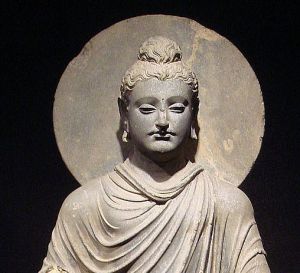
 
3 Comments

Posted by on September 2, 2012 in Indian Philosophy, Rigveda


Tags: ,

Indian History by a Schoolboy !!!

You have read many scholarly, educative and enlightening articles on HISTORY on this site. You have grown wiser reading the articles posted by Subash Kak, Rajeev Malhotra, azygos and Riverine and of the ilk.

None of that holds a candle to the one you are about to read. It is educative and entertaining. It takes the cake. It is written by a schoolboy! It is not surprising; the Indian kids are the brightest in the world. (What they turnout to be when they grow up is a different matter.)

This is a delight.

Indian History by a Schoolboy !!!

The original inhabitants of ancient India were called Adidases, who lived in two cities called Hariappa and Mujhe-na-Daro. These cities had the best drain system in the world and so there was no brain drain from them.

Ancient India was full of myths which have been handed down from son to father. A myth is a female moth. A collection of myths is called mythology, which means stories with female caricatures. One myth says that people in olden times worshipped monkeys because they were our incestors.

In olden times, there were two big families in India . One was called the Pandava and the other was called the Karova. They fought amongst themselves in a battle called Mahabharat, after which India came to be known as Mera Bharat Mahan.

In midevil times, India was ruled by the Slave Dienasty. So named because they all died a nasty death. Then came the Tughlaqs who shifted their capital from Delhi because of its pollution.

They were followed by the Mowglis. The greatest Mowgli was Akbar because he extinguished himself on the battlefield of Panipat which is in Hurryana. But his son Jehangir was peace loving; he married one Hindu wife and kept 300 porcupines. Then came Shahajahan who had 14 sons. Family planning had not been invented at that time. He also built the Taj Mahal  Palace Hotel for his wife , who now sleeps there.

Bombay Taj Palace Hotel

The king sent all his sons away to distant parts of India because they started quarrelling. Dara Seiko was sent to UP, Shaikh Bhakhtiyar was sent to J & K, while Aurangzeb came to Bombay to fight Shivaji. However, after that they changed its name to Mumbai because Shivaji’s sena did not like it. They also do not like New Delhi , so they are calling it Door Darshan.

After the Mowglis came Vasco the Gama. He was an exploder who was circumcising India with a 100 foot clipper. Then came the British. They brought with them many inventions such as cricket, tramtarts and steamed railways. They were followed by the French who brought in French fries, pizzazz and laundry. But Robert Clive drove them out when he deafened Duplex who was out-membered since the British had the queen on their side.

Eventually, the British came to overrule India because there was too much diversity in our unity. The British overruled India for a long period. They were great expotents and impotents. They started expoting salt from India and impoting cloth. This was not liked by Mahatma Gandhi who wanted to produce his own salt. This was called the Swedish moment. During this moment, many people burnt their lion cloths in the street and refused to wear anything else. The British became very angry at this and stopped the production of Indian testiles.

In 1920, Mahatma Gandhi was married to one wife. Soon after he became the father of the nation. In 1942, he started the Quiet India moment, so named because the British were quietly lootoing our country. In 1947, India became free and its people became freely loving. This increased our population. Its government became a limited mockery, which means people are allowed to take the law in their own hands with the help of the police.

Our constipation is the best in the world because it says that no man can be hanged twice for the same crime. It also says you cannot be put in prison if you have not paid your taxis. Another important thing about our constipation is that it can be changed. This is not possible with the British constipation because it is not written on paper.

The Indian parlemint consists of two houses which are called lower and higher. This is because one Mr. Honest Abe said that two houses divided against itself cannot withstand. So Pandit Nehru asked the British for freedom at midnight since the British were afraid of the dark. At midnight , on August 15, there was a tryst in parlemint in which many participated by wearing khaki and hosting the flag.

Recently in India , there have been a large number of scams and a plaque, it can be dangerous because many people died of this plaque in Surat . Scams are all over India . One of these was in Bihar where holy cows were not given anything to eat by their elected leader. The other scam was in Bofor which is a small town in Switzerland . In this, a lot of Indian money was given to buy a gun which can shoot a coot.

Presently, India has a coalishun government made up of many parties, left, right and centre. It has started to library the economy. This means that there is now no need for a licence as the economy will be driven by itself.

India is also trying to become an Asian tiger because its own tigers are being poached. Another important event this year was the Shark Meeting at Malas Dive. At this place, shark leaders agreed to share their poverty, pollution and population.

 
2 Comments

Posted by on September 2, 2012 in Uncategorized


Tags: ,

What is a Black Swan

black swan

A.  What is a Black Swan?

Medieval Europeans had seen only white swans. In fact, any impossible event was in those days termed a ‘black swan’. Therefore, when the first settlers reached Australia , they were shocked to find flocks of black swans all over the place! The sighting of the first black swan might have been an interesting surprise for ornithologists and others concerned with the color of birds, but that is not where the significance of the story lies. It exposes the severe limitation of the empirical learning methods and therefore the fragility of our knowledge based on instances rather on generalities.

The term Black Swan, was employed by generations of Europeans as a metaphor to signify an absurdity or to denote something that did not exist. It however took one unexpected sighting of a Black Swan to invalidate the belief of the generations that all swans in the world were white and that a Black Swan was an absurdity.

David Hume (1711-1776), the English philosopher, said: the observation of even a million white swans does not justify the statement “all swans are white.” There is no way to know that somewhere out there a black swan is not hiding, disproving the rule and nullifying our “knowledge” of swans. John Stuart Mill (1806-1873), another English philosopher, used the black swan as an example to illustrate the problem of induction in the philosophy of science according to which no amount of empirical evidence in support of a proposition can ever prove conclusively that it is true.

Later , Karl Popper (1902-1994), Austrian and English philosopher used the black swan narrative to discuss falsification and said “No matter how many times the results of experiments agree with some theory, you can never be sure that the next time the result will not contradict the theory “. Bertrand Russell (1872-1970) and Stephen Hawkins the celebrated English thinkers both believed “the general principles of science . . . are believed because mankind has found innumerable instances of their truth and no instances of their falsehood. But this affords no evidence for their truth in the future, unless the inductive principle is assumed”. In other words, one single observation can invalidate a general statement derived from millennia of confirmatory sightings of millions of white swans. All you need is one single (ugly) black bird.

A “Black Swan” is therefore anything that seems to us, based on our limited experience, to be impossible The Black principle thus implied:

a) Absence of proof does not necessarily mean proof of absence ;
b) A perceived impossibility can actually occur.;
c) Do not confuse improbability with impossibility. and
d) Expect an unexpected to happen.

*********

[

Nassim Nicholas Taleb’s The Black Swan is part of his bestselling Incerto series. It argues that rare, unpredictable events shape history and our lives far more than the regular occurrences we spend time analyzing and planning for. He contends that humans are blind to randomness, particularly to large deviations, despite living in a world increasingly driven by these extreme events.

Taleb begins with the metaphor that gives the book its title: before Australia’s discovery, Europeans believed all swans were white based on millions of observations. The sighting of a single black swan invalidated centuries of accumulated evidence. This illustrates how no amount of past data can prove what’s impossible in the future. A Black Swan event has three characteristics: it’s unpredictable, it carries massive impact, and after it occurs, people construct explanations making it seem predictable in retrospect.

The book challenges the human tendency to create neat narratives from chaotic reality. Taleb describes this as the “narrative fallacy”—our need to fit random events into coherent stories. He illustrates this with his experience on September 11, 2001, watching from his home as the Twin Towers fell. Within hours, pundits were confidently explaining why the attacks were inevitable, even though none had predicted them. This retroactive sense-making creates dangerous illusions of understanding and predictability.

Taleb introduces the distinction between “Mediocristan” and “Extremistan.” Mediocristan describes domains where individual observations don’t significantly affect totals—like human height, where even the tallest person doesn’t dramatically change the average. Extremistan encompasses areas where single observations can dwarf all others—like wealth distribution, where one Bill Gates can outweigh the combined net worth of thousands of people. Most consequential aspects of modern life, from book sales to market crashes, exist in Extremistan, yet people apply Mediocristan logic to them.

Taleb shares his own investment strategy, which he calls the “barbell approach”—putting 85-90% of assets in extremely safe instruments while investing the remainder in highly speculative bets that could yield enormous returns if Black Swans occur. This strategy protects against catastrophic losses while positioning for positive Black Swans. He contrasts this with typical investment advice recommending “moderate” risk, which he considers the worst possible approach.

The book explores how expertise can increase blindness to Black Swans. Taleb argues that experts become prisoners of their specialized knowledge, unable to imagine scenarios outside their frameworks. He recounts a meeting with several prominent economists before the 2008 financial crisis, none of whom considered a major market collapse possible despite historical precedents. Their sophisticated models and deep expertise actually reduced their ability to see what was coming.

Taleb addresses the problem of “silent evidence”—the invisible information from events that didn’t happen or people who didn’t survive. He illustrates this with the story of ancient philosopher Diagoras, shown a painting of worshippers who prayed and survived a shipwreck as proof that prayer works. Diagoras asked, “Where are the pictures of those who prayed and drowned?” This survivorship bias pervades success literature, business analysis, and historical interpretation.

The author emphasizes the asymmetry of knowledge: what we know is usually less important than what we don’t know. He describes how the turkey being fattened for Thanksgiving gains confidence each day that humans care for its welfare—right until the day before Thanksgiving when its world model catastrophically fails. Similarly, calm markets and stable systems often breed complacency that leaves participants vulnerable to sudden disruptions.

Taleb concludes with practical advice for living in a Black Swan-dominated world. He advocates for positive exposure to serendipity by maximizing opportunities for lucky breaks while minimizing catastrophic risks. This means pursuing careers with unlimited upside potential rather than fixed salaries, living in places with vibrant social networks that create chance encounters, and generally positioning oneself where positive Black Swans can occur.

The Black Swan ultimately argues that acknowledging ignorance is wiser than false confidence in predictions. Rather than trying to forecast specific events, people should build robust systems that can withstand shocks and even benefit from volatility—what Taleb would later term “antifragility.”]

B.  Impact of the highly improbable

Nassim Nicholas Taleb, in his recent book The Black Swan: The Impact of the Highly Improbable (Penguin/Allen Lane-2007) expands on the idea of Black Swan and spins a web of ideas around randomness, uncertainty, our understanding of history, financial markets, illusion of “expert advice”, precaution- fire fighting, our perception of “heroes” and a number of other issues. The central idea of this book concerns our blindness to randomness, particularly the large deviations. It talks about skepticism, wild randomness and the power of stories. It is about how not to be a sucker to the unexpected and the unknown. It is in essence a Book of Ideas.

Nassim Nicholas Taleb has a more specific definition of the Black Swan event —for him, a “black swan” is an event that meets three conditions:

a) It was unpredictable;
b) It carried an extreme impact; and
c) After the event, we made it appear more predictable than it actually was, by concocting explanations.

A “Black Swan” is therefore anything that seems to us, based on our limited experience, to be impossible and which are only retrospectively predictable. Black swans can be positive or negative, a blockbuster book or a stock market crash. He cites the instances of 9/11, WW I and other events and explores how “black swans” throughout history have influenced civilizations, religions, and governments.

For instance, the astonishing success of Google was a black swan; so was the Harry Potter.

Black swans may occur almost anywhere, say from the rise of religions to events in our own personal lives. In short, black swans are some of the most important and influential events in the history of the human race. It started accelerating during the industrial revolution, as the world started getting more complicated, while ordinary events, the ones we study, discuss, and try to predict from reading the newspapers, have become increasingly inconsequential.

Life is the cumulative effect of a handful of significant shocks. A small number of Black Swans explain almost everything in our world, from the success of ideas and religions, to the dynamics of historical events, to elements of our own personal lives. Go through the following exercise.

Look into your own existence. Count the significant events, the technological changes and the inventions that have taken place in our environment since you were born; and compare them to what was there before their advent. How many of them came on a schedule? Look into your own personal life, to your choice of profession, say, or meeting your mate, the betrayals you faced, your sudden enrichment or impoverishment. How often did these things occur according to plan?

Extending this logic, many of the discoveries that have had tremendous impact on our living were accidents in the sense that they were discovered while searching for something else. Because of hindsight bias, histories of scientific discoveries are written with straightforward story lines telling that someone set out to do something and succeeded and that it was all about intention and design. However, in truth, “most of what people were looking for, they did not find. Most of what they found they were not looking for.” For instance, Viagra was devised to treat heart disease and high blood pressure. ; Lasers at first had no application but were useful as a form of radar; and the Internet was conceived as a military network

What makes the black swans particularly dangerous is that most of the times they are unexpected. He explains this by saying: “Consider the turkey that is fed every day. Every single feeding will firm up the bird’s belief that it is the general rule of life to be fed every day by friendly members of the human race “looking out for its best interests”. On the afternoon of the Wednesday before Thanksgiving, something unexpected will happen to the turkey. It will incur a revision of belief.”

C. Why Black Swans happen?

Why do Black Swans happen? It is because, Taleb says, we do tend to confuse improbability with impossibility. This inbuilt tendency makes us over-confident about predicting the future; and over-confidence can lead to disaster. Further, we fool ourselves into thinking we know more than we actually do. We restrict our thinking to the irrelevant and inconsequential, while large events continue to surprise us and shape our world.

The problem of induction tells us that we cannot really learn from our experiences. It makes knowledge very problematic, if not impossible. Yet, we have too much faith that past events will repeat and we can take care of them. We therefore concentrate on things we already know and repeatedly fail to take into consideration what we do not know. Black Swan logic makes what you do not know far more relevant than what you do know. Unfortunately, we do not know how much we do not know.

Largely, says Taleb, human beings are blind to the impact of randomness and fail to appreciate the asymmetry in our perception of events. In addition, we confidently predict the future in any number of ways. Unfortunately, we are nearly always wrong, though later, when things have happened, we tend to remember only the times when we were right. We attribute our successes to our skills, and our failures to external events outside our control, namely to randomness

Comforting simplifications make us over-confident. Uncertainty makes us curious and cautious. We often hear only what we love to hear. For example, when a doctor says, “there is no evidence of cancer” we often misinterpret that as “there is evidence of no cancer”; obviously, there is a huge difference between the two, but the latter is impossible to state with 100% certainty.

Another related human impediment is that we tend to learn the precise, not the general. “We’re suckers for a narrative,” he says.” When a story is attached to an event, it seems more probable than it actually is, causing us to err on the conservative side for negative events and on the risky side for positive ones.”

Not all Black Swans are negative, and not all are sudden. From one perspective, all modern history is one huge, slowly unfolding Black Swan. This is reflected in the ever-changing stories we live in. Stories of the earlier generations used to be more stable, their children saw the same world they did. Now the stories are as short-lived as a summer blockbuster. Still we believe in them, in the next as sincerely as in the last.

Most of the really big events in our world are rare and unpredictable, and thus trying to extract generalizable stories to explain them may be emotionally satisfying, but it is practically useless. It results in what Taleb calls the “retrospective distortion”. September 11th is one such example and stock market crashes are another. As he puts it, “History does not crawl, it jumps.”

Taleb insists that our brain is “the wrong user’s manual” for the complex unpredictability of the world we are now living in. He says, “human nature is not programmed for black swans”; “our inferential machinery is not made for a complicated environment”; our “statistical intuitions have not evolved” for our current habitat; we are “not well adapted to the present, post-alphabet, intensely informational, and statistically complex environment.”

I am not convinced of this, if Taleb were to be entirely correct how could the humankind survive and multiply successfully all these ages. In addition, I think Taleb’s argument does not give due credit to the human ingenuity and unconscious, which can handle multiplicity just well.

D. Experts and “Empty Suits”

Taleb is harsh on Experts dispensing advice and handing down oracle like predictions. He is particularly harsh on Economists when it comes to prediction of market events; and on Historians for the manner of their explaining the past events.

As in the good old medieval days, “experts” are many times empty heads with empty (and expensive) suits. Certain professionals, while believing they are experts, are in fact not. Based on their empirical record, they do not know more about their subject matter than the general population, but they are much better at narrating — or, worse, at smoking you with complicated mathematical models. They are also more likely to wear a tie.

Taleb tends to regard economists as not just the blind leading the blind, but leading them perilously close to the cliff’s edge. “Our cumulative prediction errors for political and economic events are so monstrous,” says Taleb, ‘that every time I look at the empirical record I have to pinch myself to verify that I am not dreaming”.

For instance, he states, in 1970, the US government’s official view was that, by 1980, the price of foreign crude oil might well decline, and, in any case, would not show a substantial increase. In fact, oil prices went up tenfold by 1980.The inability to predict outliers implies the inability to predict the course of history, given the share of these events in the dynamics of the economics .

Today our paid experts wear knowledge on their sleeve while they sleepwalk into the future of unpredictability. Today, all knowledge is available to us, or so it seems. We even teach our kids to go to Google or Wikipedia, but, unlike a library, the browser hides the trillions of bits of information we can never know. The blogosphere is, at its worst, a Tower of Babel . Our confidence grows, but the complexity of our environment has expanded exponentially.

Later in that same chapter, Taleb writes : It is often said, “Wise is he who can see things coming.” Perhaps the wise one is the one who knows that he cannot see things far away.

As regards History and its lessons, Taleb writes eloquently .

What did people learn from the 9/11 episode? Did they learn that some events, owing to their dynamics, stand largely outside the realm of the predictable? No. Did they learn the built-in defect of conventional wisdom? No. What did they figure out? They learned precise rules for avoiding Islamic proto -terrorists and tall buildings.

Taleb writes, and I agree, that USA took the wrong lessons from the September 11 terrorist attacks. It learned how to avoid another 9/11 like attack. It learned to fear the specific causes of that attack. What USA should have learned was to trust the stories less but to pay heed to the causes that prompted the attack. We all learned that 20th century history culminated in Osama bin Laden. What we should have learned was that history does not march, it jumps.

Good historians know that, but the bad ones tell better stories; and their good sounding false stories provide a canvas for the news media productions. In the hands of journalists, pundits and media experts, history becomes a mythology – a collection of moral lessons for our time. In reality, history is wildly random. While it happens, it is shocking, insane and painful. The stories come later, to heal the trauma, and make-believe a sane world.

Taleb writes, “as I formulated my ideas on the perception of random events, I developed the governing impression that our minds are wonderful explanation machines, capable of making sense out of almost anything, capable of mounting explanations for all manner of phenomena, and generally incapable of accepting the idea of unpredictability. These events were unexplainable, but intelligent people thought they were capable of providing convincing explanations for them – after the fact. Further, the more intelligent the person, the better sounding the explanation .”

To summarize: the extreme, the unknown, and the very improbable (improbable according our current knowledge) dominate our world and all the while, we spend our time engaged in small talk, focusing on the known, and the repeated. This implies the need to use the extreme event as a starting point and not treat it as an exception to be pushed under the rug. Further, in spite of our progress and the growth in knowledge, or perhaps because of such progress and growth, the future will be increasingly less predictable, while both human nature and social science seem to conspire to hide the idea from us.

E. How do we deal with Black Swan

You cannot predict a Black Swan. If you did succeed in doing so, it is then no longer a Black swan. Black Swans being unpredictable, we need to adjust to their existence (rather than naïvely try to predict them). There are ways to manage that uncertainty to our advantage, but it requires an understanding of basic psychology and to look for generalities. We can do so many things if we focus on anti knowledge, or what we do not know.

Taleb admits that the Black Swan too is a story. It is, however, a better story. We can only understand the world through stories, there is no way to change that. What we need are good stories to fight the bad ones. Stories that prepare us for the unpredictable encourage us to doubt what we know. As Taleb writes, you cannot avoid crossing the street, but you can try not to do it blindfolded. You can try not to be a sucker .

Taleb’s book is also full of advice about how to benefit from the unpredictable nature of the world: “focus makes you a sucker; it translates into prediction problems”; learn to “avoid ‘tunneling'” (“the neglect of sources of uncertainty outside the plan itself”); “train yourself to spot the difference between the sensational and the empirical”; and remember that “we are not natural skeptics,” that “not believing” requires an “expenditure of mental effort.”

At the same time, there is a generous dose of skepticism in Taleb’s work. . It is the view of one who tries to keep his mind in a state of suspended judgment, neither agreeing nor disagreeing, staying open to contrary facts and viewpoints. A Skeptic believes in reality, but not in human reasoning. A Skeptic laughs at certainty and feels most comfortable as a Devil’s Advocate. The true Skeptic is, however, an unattainable ideal. Therefore, we must do our best with what we have. Taleb’s advice is to pick your battles. Skepticism is hard work, so reserve it for the beliefs and choices that really matter. Be practical.

Taleb seems to suggest:

*Since we cannot control unpredictable events we should accept uncertainty and seek to maximize our exposure to Serendipity, as by putting ourselves in the way of new ideas.

*Since there is such danger in accepting conclusions based on too little information simply because they confirm our beliefs, we should try to remain aware in the present of what we are doing, paying attention to what actually happens and refraining as far as possible from imposing theories on our experience.

*We should recognize our poor record as a species in predicting the future, that we are much better at doing than knowing. Some things are more predictable than others are; we are safe enough in expecting tomorrow’s sunrise to plan on breakfast. We can start noticing which situations are most susceptible to black swans, and when we encounter them, remember how little we truly know so our ignorance does not lead us around by the nose

F. New terms coined by Taleb

Taleb has coined a few terms which I suspect may gain currency just as the hybrid terms E-mail, blog etc. I picked up a couple of them:

Extremistan : A province where a single event can have a huge impact. This is where chaos reigns, the wholly unexpected happens, power laws and fractal geometry apply and the events here are beyond the range of predictability.

Mediocristan : A province where a single observation does not affect the aggregate. A place ruled by mild forms of randomness .This falls within the area where the events are predictable to a certain extent.

We assume the entire world is “Mediocristan”, whereas in reality large bands of it are “Extremistan”. The problem is there is no clear demarcation of the areas of Extremistan and Mediocristan.

One can never tell whether one is in the relatively safe territory of Mediocristan or if one has wandered into the lawless regions of Extremistan. This means the events in either case are not predictable.

Taleb’s hypothesis is that as a result of globalization and the speed of electronic communications, the world is becoming more like Extremistan and less like Mediocristan.

Platonicity: This stands for our tendency to mistake the map for the country, the finger for the moon. It makes us think that we understand more than we actually do.

The other terms are the “lucid fallacy” or “uncertainty of the nerd” (basing studies of chance on games and dice); and GIF (the “Great Intellectual Fraud” that is the bell curve- where the data falls between the mean and standard deviation).

G .Prevention and cure

The wisdom of the ages preaches that prevention is better than cure; but rarely do we treat it as a better option.

“Everybody knows that you need more prevention than treatment, but few reward acts of prevention. We glorify those who left their names in history books at the expense of those contributors about whom our books are silent. We are not just a superficial race (this may be curable to some extent); we are a very unfair one

In other words, we glorify the heart surgeon who performs a bypass surgery but scarcely take notice of the dietician or a physiotherapist who strives to keep his charge healthy and fit. We make a hero of a general who wins war but neglect a diplomat who strives to maintain peace and prevent a war.

H. Flaws in the book

The book suffers from a few flaws, unfortunately. I wish Taleb used the services and skills of a professional editor. Some ideas and phrases are highly repetitive. It gets too technical at places.

Taleb carries on a personal battle with certain economists and the French in general through repeated jabs and diatribes. It looks rather unsavory. I wish he avoided bringing in his personal prejudices into a work of this nature.

There is a lot of needless sarcasm and bad humor directed against certain trades or professions like Dentists, bakers etc. that he labels as boring and non-scalable careers.

He carries the unpredictability principle to the extreme, saying that we can predict almost nothing about the future.

Many of Taleb’s ideas accord with those that are repeatedly explored, often advocated, on Serendip: “doubt everything,” “fight against dogma,” “shed the idea of full predictability,” and know that “you can benefit from it.” Most strikingly: “maximize the serendipity around you.”

http://serendip.brynmawr.edu/index.html

I am not convinced of Taleb’s argument about our brain being “the wrong user’s manual” etc. He does not give credit to the human ingenuity and the unconscious, which can handle multiplicity very well.

If you accept Taleb’s position, we are left with an uncomfortable question: How do we function in a world where accurate prediction is rarely possible, where history is not a reliable guide to the future and where the most important events cannot be anticipated?

Taleb suggest some answers. I am not convinced by most of them

***********

Despite the flaws, the main ideas of the book are important and merit reading and great consideration. It is not surprising The Black Swan: The Impact of the Highly Improbable, is it self a Black Swan.

black swan2

Source:

http://www.fooledbyrandomness.com/

http://arlenegoldbard.com/2007/05/09/my-new-crush/

 
7 Comments

Posted by on September 2, 2012 in Books


Tags: ,

What is happening to News?

A. Newspapers in India

1. One of the happier features of today’s India is its print media. There are roughly 62,000 newspapers in India. According to the National Readership Study 2006, the print media is enjoying a robust growth. The number of papers sold daily in India rose 33 percent during 2001 to 2006. The circulation of the dailies grew by 12.6 million during the year and reached 203.6 million by the end of year 2006. India is one of the few countries in the world where newspaper readership is soaring.

2. The 2006 National Readership Survey findings show the largest growth rate was in the local language newspapers. The circulation figures for Dainik Jagaran stood at 21.2 million while that of Dainik Bhasker was 21.0 million, both published in Hindi. The Times of India the most widely read English newspaper (7.9 million) was followed by The Hindu (4.05 million) and Hindustan times (3.85 million). The upsurge in India’s newspaper market is due in part to the government’s change of policy in 2002 and to a growth in advertising business. This boom corresponds with more supplements, travel and lifestyle magazines being produced to meet the demands of a more prosperous and inquisitive society. In addition, there are currently 300 television channels and their number could increase by 30% next year, say up to 400.

It is estimated there is still a significant scope for growth of print media, as there are 359 million people who can read and understand the language but do not read any publication. Of this 359 million, 68 per cent read Hindi.

3. All this exuberance is a heart-warming sight for newspaper publishers in India. In most countries, sales and profits of dailies have been declining for years, a slide hastened by a surge of fresh competition from the Internet and TV. That is the reason , as the  newspaper boom rages in India, investors and media executives across the world are looking for a way to penetrate what is probably the world’s last great newspaper market. A growth in the readership is supported by India’s other strengths viz. a vital economy and a democratic culture to make it a serious rival to China for the attention of global media investors.

4.“The growth prospects of India’s newspaper publishing industry are phenomenal, especially when one considers the rising trend in disposable incomes and the direct bearing that will have on readership ” said Naresh Kumar Garg, who manages $49 million, including shares of Jagran Prakashan, at Sahara Asset Management Co. in Mumbai. “Higher disposable incomes mean more advertising.” Relaxed foreign media ownership laws in newspapers in particular have led to more investment from overseas.  Advertising revenues have grown significantly and they cross subsidize the low sale prices of Indian newspapers. Newspapers grabbed 46% of the $2.6 billion spent on advertising in all Indian media last year.

5. An American media person remarked, “Watching the Indian newspaper scene is like taking a trip in a time machine to early 20th century America, when newspapers ruled life and politics. Sales of most Indian newspapers are increasing, and advertising is soaring.” Which in other words mean that down the next decade or so the Indian newspapers may have to grapple with a set of problems that US print media is now trying to come to terms with.

It is better India be aware of the snares that lie ahead, because eventually it will have to contend with those problems. Those are related to the growth in technology and change in financial structures.

Well, what is the state of Newspapers in US today?

******

B. Newspapers in US today

1. Warren Buffett, the US billionaire remarked,” The newspaper business is bad and getting worse.” While the Newspaper stocks overseas rose 25 percent on average in the past year, according to data compiled by Bloomberg, U.S. newspaper shares, by contrast, fell an average of 9.9 percent because   of readers’ shift to the Internet cut into circulation.

2. Daily circulation for newspapers in the U.S. fell 30 percent to 43.7 million in September 2006 from 62.3 million in 1985, according to the Audit Bureau of Circulations, a U.S. industry group. The Russell 3000 Publishing Newspapers Index, which tracks 11 companies, slid 37 percent since its peak in 2004.  The average international newspaper stock fetches 35 times earnings, while the Russell index of U.S. newspaper companies has a price- earnings ratio of 20.7.

3. “Almost all newspaper owners realize that they are constantly losing ground in the battle for eyeballs,” Buffett, Berkshire Hathaway’s Chairman, wrote in his annual letter to shareholders published March 1. “If cable and satellite broadcasting, as well as the Internet, had come along first, newspapers as we know them probably would never have existed.”

4. “The U.S. is a much more saturated market in terms of the media industry,” said Zhao Zifeng, who oversees the equivalent of $1.1 billion at China International Fund Management Co. in Shanghai . “But in China , we have much more room for development .” The firm owned 2.6 million shares of Chengdu B-Ray Media as of Dec. 31. Investors seeking growth have to look outside the U.S.

5. The newspaper growth rate is in turn related to the growth rate of the economy. As per  the International Monetary Fund forecast, India’s economy will expand 8.4 percent this year, while China will grow at 9.9 percent. In the U.S., growth will amount to 2.4 percent.

In the U.S., newspaper companies will attract investors if they can develop compelling Web sites that ensures they capture readers who give up print editions, said Rogers.  That model has already worked for Schibsted in Norway, said Shrager. The company’s shares have risen 51 percent in the past year, while Independent News is up 41 percent.  “If you get stuck into one mode without reacting, then things are going to turn against you,” said Shrager

********

PBS, headquartered in Arlington, Virginia, a non–profit media enterprise owned and operated by the nation’s 354 public television stations, telecast a set of four programs during Feb 2007 tracing the History of American journalism. The program was telecast in India during the last week of June 2007 by Australia network .I found the Part Three of News war (What is happening to the news?) , most interesting.

Please check the following link to view online the full series. Please also read the highly interesting discussions that follow.

http://www.pbs.org/wgbh/pages/frontline/newswar/ .

*****

C. News War

The following in brief are some of the points made out by the program:

1.Change in the ownership pattern

* In the earlier years, eminent families owned the major newspapers like LA Times, NY Times and Washington Post. They while enjoying the prestige of owning a major Newspaper were satisfied with moderate profits. In recent years, family newspapers in cities such as Los Angeles and St Louis have been sold to out-of-state owners. Now the ownership of the papers has moved into the public domain, which in turn means that the stock markets own the newspapers.

** The newspapers in USA usually show a net profit of slightly over 20 percent that is double the rate returned by a Fortune 500 company. It is a very good rate of return. For instance, LA Times grossed about US$ one billion and made a net of US$200 million. Showing a decent profit on an annual basis was not, therefore, the major problem. However, to keep chasing the profit graphs quarter after quarter and post higher and higher profits each quarter to satisfy the stock traders was becoming a nerve-racking task. In short, present is not a problem but the future surely is a threat. In order to keep happy their faceless masters the newspapers cut costs by economizing on the production, marketing and even in the news rooms by downsizing the staff strength. In the process, the reporter on the street who investigated, verified, gathered, and reported the news was served the layoff notice.

2.Fall in advertising revenues

More than 70 percent of a newspaper’s revenue comes from advertising. With the internet spreading into all aspects of life those hunting for houses, used cars, jobs, antiques etc. increasingly resort to internet to search for those items than to run through the classifieds. There is therefore a serious loss in the revenue from the classifieds.

3. News over internet

Internet sites like Google, Yahoo etc. collate news items from newspapers and post them on their web pages. They are not gathering news from the field but are recycling news gathered by the newspaper reporters. The web sites make use of the news gathered by the newspapers.
One interesting question that keeps coming up repeatedly is “Who is going to pay for the news”.

4. International News Vs. Local News

The content of the newspaper is a huge issue. Why does an ordinary person buy newspaper? Is it to find out what is happening in Iraq or to learn what is happening in his neighbourhood or town?

It is not that the internet is “stealing” the readers, or that people are not interested in these issues, it is that these issues are not covered or are covered poorly by the newspapers. Cutting staff will not solve the problem it will only make it worse

There is an argument that newspapers attempt to cater to all needs of all readers. In an attempt to be everything to everybody, there is much more in there than the average reader needs. As a result, the average reader looks only at a proportion of the paper, with the rest being tossed unread. Some buy it just for the news, and toss the rest. Others buy it for the sports, and toss the rest. And so on.

Where do we draw the line? Should we have newspapers, with different “flavors”, each with a different price point? Let us say: 1. a short stripped down version containing only need to know news; 2. a longer, news/op-ed version, focusing on news and analysis; 3. a longer lifestyle version, light on news, heavy on all the other features and departments.; and 4. The traditional version for those who still want it all and are willing to pay for it.

Will it help matters if , say, three newspapers function as international newspapers and the rest concentrate only on local news (hyper localization).

5. Bloggers as journalists.

Anyone who reports a happening is a journalist. Anyone who posts an event on his blog page is a citizen journalist. With the phenomenal increase in Bloggers, there is an explosion of journalists. Do we need specialists who report to newspapers and pursue that as a career?

How far can the bloggers go in this direction? Anyone with a camera, a phone and a laptop may be able to record, but do they have the background knowledge and history to make a proper assessment. Does that person even know whether or not something is new or news? What happens if that person makes a mistake in their reporting? Are there fact checkers? What happens when students, researching papers relies on this news-lite? How do we deal with sensitive issues such as libel and slander? What separates the professional journalists from Joe American the blogger who slanders people online and puts erroneous information on the Web without bothering to check and see if it is accurate?

*******

D. What is happening to the news?

Those were some of the issues that emanated from the presentation and the discussions that followed.

Before you view the on-line videos please read the summary of the part three of News War entitled “what is happening to the news?” given below.

***

In part three of “News War,” entitled “What’s Happening to the News, ” FRONTLINE examines the mounting pressure for profits faced by America’s network news divisions and daily newspapers, as well as growing challenges from cable television and the Internet. Bergman talks to network executives, newspaper editors and publishers, bloggers, Wall Street analysts and key players at Google and Yahoo! about the battle for market dominance in a rapidly changing world.

Bergman examines one of the biggest challenges facing the traditional news media: As their core audience grows older, the number of viewers and readers who want their news in a conventional format is shrinking. According to a study by New YorkUniversity, a majority of Americans under age 25 get their news online or from programs like Comedy Central’s The Daily Show. “To the extent that people look to us as a source of news,” says David Javerbaum, The Daily Show‘s executive producer, “that is 100 percent indicative of other people’s failure and not our success.” While the broadcast news networks still command the largest share of the market, they are losing viewers and advertising revenue to cable.

To stop this slide in ratings, network executives are making changes that have rankled some top news anchors. When ABC executives proposed bringing in Late Show with David Letterman from CBS to replace Nightline on ABC, host Ted Koppel decided not to renew his contract. “To the extent that we are now judging journalism by the same standards that we apply to entertainment,” says Koppel, “that may prove to be one of the greatest tragedies in the history of American journalism.”

“What’s Happening to the News” also goes inside the embattled newsroom of the Los Angeles Times, one of the few U.S. newspapers still covering major national stories. After his newsroom had already lost hundreds of jobs, managing editor Dean Baquet was told to lay off more reporters by the paper’s owner, the Tribune Company. He refused and was fired. “The people who own newspapers … are beholden to shareholders,” Baquet tells FRONTLINE. “They want for the paper to be highly profitable, and sometimes that view of what a newspaper is supposed to be and my view, which is that a newspaper is a public trust, sometimes they come into conflict.” Charles Bobrinskoy, vice chairman at top Tribune investor Ariel Capital Management in Chicago, says the L.A. Times needs to rethink its mission. “There is a role for probably three national newspapers: The Wall Street Journal, The New York Times and USA Today. Each has its own niche; all three are national newspapers. We don’t think there’s any demand for a fourth.”

An even greater challenge to both newspapers and broadcast networks is the growing power of the Internet as a news distribution platform, pulling consumers and advertisers away from more traditional media. Jeff Fager, executive producer of 60 Minutes, talks about CBS’s partnership with Yahoo! News. “We haven’t seen the model for how broadcast journalism is going to end up on the Internet,” he says. “But … it has to go there. I mean, you don’t see anybody between 20 and 30 getting their news from the evening news; you see them getting it online.”

But Internet news aggregators like Yahoo! and Google say that they are not in the business of creating content, relying instead on traditional news-gathering organizations. “We’re in fact critically dependent upon the success of these newspapers,” says Google CEO Eric Schmidt, referring to the Los Angeles Times and others. “We don’t write the content. We’re not in the content business. So anything that screws up their economics, that causes them to get rid of reporters, is a really bad thing.”

If not newspapers, who will create content for the Internet news aggregators? Markos Moulitsas writes Daily Kos, one of the country’s most popular blogs, which reportedly receives 3 to 5 million visitors per week. “People want to be part of the media,” Moulitsas tells FRONTLINE. “They don’t want to sit there and listen anymore. They’re too educated. They’re taught … to be go-getters and not to sit back and be passive consumers. And the traditional media is still predicated on the passive consumer model — you sit there and watch.”

But is this journalism? Former Los Angeles Times editor John Carroll worries that without the investigative skills of newspaper reporters, an important element of newsgathering may be lost. “I estimate … that 85 percent of the original reporting that’s done in the United States is done by newspapers. They’re the people who are going out and knocking on doors and rummaging through records and covering events and so on. And most of the other media that provide news to people are really recycling news that’s gathered by newspapers.”

The fourth hour of “News War” is called ” Stories from a Small Planet” and is produced by FRONTLINE/World. It looks at media around the globe to reveal the international forces that influence journalism and politics in the United States. The lead story investigates the new Arab media and its role in both mitigating and exacerbating the clash between the West and Islam. Focusing on Al Jazeera and its impact on the parochial and tightly controlled Arab media, this report explores the network’s growing influence, from Muslim communities in Europe to the pending launch of a new English-language broadcast in the United States.

home  + introduction + watch online + interview
http://www.time.com/time/magazine/article/0,9171,1106460,00.html 

 
Leave a comment

Posted by on September 2, 2012 in General Interest


Tags: ,

Where do we go from here?

 My post Oh History! My History! (http://ssubbanna.sulekha.com/blog/post/2007/06/oh-history-my-history.htm )

was about writing and understanding History in general. It also highlighted the problems in interpreting Indian history, the way in which it is taught in schools. The comments that followed discussed the problems involved in teaching Indian History and culture to Indian children in USA .

(http://ssubbanna.sulekha.com/blog/post/2007/06/oh-history-my-history/…)

 The debate is still on. In the mean while a book titled “Invading the Sacred” edited by Ramaswamy, Antonio de Nicolas, a professor, and Aditi Banerjee appeared on the scene. , the book brings together essays by well-known scholars and seeks to facilitate a debate to challenge the systematic misrepresentation of Indian culture and philosophy by certain American academicians. The book is product of an intensive multi-year research project that uncovers shoddy and biased scholarship driven by certain power cartels.. The book narrates the Indian Diaspora’s challenges to such scholarship, and documents how those who dare to speak up have been branded as `dangerous’.  http://invadingthesacred.com/

  Further, an article written by Aditi Banerjee one of the authors of the book appeared in the Outlook magazine

(http://outlookindia.com/full.asp?fodname=20070629&fname=aditibannerjee&sid=1)

 Following the debate thereon I wrote to the Discussion Forum of the book saying that we were having a lively and a very concerned debate in progress about the Indian History in general, and the way in which India and Hindu religion is taught at the schools in USA , in particular. Further I said

 “Our anxiety is that the abuse of India does not merely start with the books you mentioned .They are just symptoms. This issue has a deeper root and a sinister history of its own. It has its roots in the content of Indian History in our school books; patronage of a certain brand of Historians by the Government; the anxiety of “Historians” to please those that matter, neglect of research and higher studies in Indian History in our Universities and Research Organizations and disillusionment of our bright young minds who are scared (with reason) to take up study of History as an academic career.

 The question is, where do we go from here? How do we tackle the menace that confuse and disillusion our younger generation about our History, our Culture and our Religion? The question is not merely about books written by some westerns without an iota of understanding; it concerns the identity of our communities and valuing conservation of our culture

 You have a wider canvass and larger area of work and influence than many of us have. Could you please let us have your views on the issues we are grappling with? Where do we go from here? “

There are other discussions in progress on  similar issues . Please follow those interesting  debates too.

 Invading The Sacred-The Foreword . 

 Invading The Sacred-A Review

 Challenging Western Scholarship on Hinduism

 Invading The Sacred : An Analysis of Hinduism Studies in America

 *****************

Riverine suggests that measures to project our history, our culture and our religion in the right perspective and to present it to our younger ones should start from our homes and our schools. Re asserts the truth that mothers are the protectors and nourishes of our identity and Dharma. She also suggests involvement in this task of women disposed to social service/activities.

Melody Queen says,”would be a good way to start with ( to st right all the distortions). Requires  rallying of all the like minded people;success shouldn’t t be be elusive if we display the tremendous amount of unity ,patience, and perseverance that is required for a cause of this kind.”

On that optimistic note please read on.

 Kindly post your comments

Regards
**********
Message received from the Editors of Invading the sacred

 From: ITS Team <invadingthesac…@gmail.com>
Date: Jul 12, 2:58 am
Subject: Where do we go from here?
To: discuss-invadingthesacred

Dear Srinivasarao

Thanks for your presence & adding to the discussion. Also, thank you
for keeping the discussion alive on outlets like Sulekha.

 http://groups.google.com/group/discuss-invadingthesacred/browse_thread/thread/819d8f15f8f38642?hl=en

 My response to the Editors’ reply

 Dear Sir, Madam

 Thank you for the reply and the appreciation.

 We were aware of the problem and were trying to spread the awareness about that with our very limited resources and a restricted reach. Your book has accomplished the task of awakening, on a larger scale, in a more scholarly, professional manner acceptable to academia and in a   much more effective way. None of us had the capability to do what you have just done. It has made a great difference. We all thank you for the task you just finished.

 The question we were wondering at: “Where do we go from here?” remains largely un answered in all the discussions that followed. Most of the comments posted are the reactions to the contents of book with hardly any thought expressed on what we need to do now or in future. Where do we go from here?

 We have just identified a problem and reacted to it. However, it takes much greater effort and dedication to effectively deal with the issue in a holistic fashion and to find credible answers to questions gnawing at the root of our cultural identity,” What do we tell and how we tell our children, who we are?” .We feel that a long term and a well thought out strategy involving various segments of the academia, the govts and intellectuals is essential. There are no quick fixes here. Have you envisioned a strategy or a road map in that direction? Can you kindly share it with us now or later?

 Thank you again for a difficult just accomplished.

 Looking forward to your response.

 Regards

 Sreenivasarao s

 *******

This was the reply received from the Editors

  TS Team <invadingthesacred@gmail.com>   hide details 2:54 am (4 hours ago) reply-to discuss-invadingthesacred@googlegroups.com to discuss-invadingthesacred <discuss-invadingthesacred@googlegroups.com> dateJul 13, 2007 2:54 AM subject[discuss-invadingthesacred:34] Re: Where do we go from here? mailed-bygooglegroups.com

Dear sreenivasarao s
Thanks for your perceptive comments, & your obvious concerns about the
big picture. What you have, in the form of this book, is a tool for
firstly absorbing a deeper understanding of the problem, and then
fashioning an intellectual & intelligent response to it.
At the bare minimum, the book calls for an awakening of the people
concerned to the problem, & and an acknowledgement that it exists.
After that, it is up to the person(s) to think how to go ahead in
contributing to a remedy. It could be as simple as alerting oneself &
friends & family about the issues faced when one’s cultural heritage
is unfairly targeted, or bigger things like getting together to form
organizations that actively participate in academic forums to have the
“insider” voices of the traditions heard.
It all starts with healthy discussions like this one.
Thanks for the comments, & please continue sharing your thoughts. They
are important

http://groups.google.com/group/discuss-invadingthesacred/browse_thread/thread/819d8f15f8f38642?hl=en

***

There have been discussions in Group. You can read the detailed discussions at( http://groups.google.com/group/discussinvadingthesacred/topics?start=0&hl=en&sa=N)

 The following are excerpts from the comments made by some members of the Group

Krishen Kak <krishenkak@gmail.com> 

 15 July , 2007


This is being sent at RM’s request.

 It is about a personal experience of “reversing the gaze” that resonates strongly with the theme of the book.  It also resonates with subsequent personal experience in Delhi where, as guest faculty, I teach occasionally at a well-known b-school (and elsewhere).  There are all these bright young MBA aspirants, supposedly of our country’s intellectual “creamy layer”, who uncritically accept “the Western knowledge of India … as God’s own truth”.  But it’s not their fault.  We have a macaulayan educational system firmly in place producing macaulayan parents who go on to produce macaulayan children who go into the macaulayan education system.  Of course, this is a generalization but, I think, a valid one – witness, for one, your book itself!  

 As a small but another characteristic example, some Punjabi families were celebrating “lori” and I asked this teenager (private school, mission college, but of pukka Punjabi parentage – language, food, head-covered women, etc., etc.) what “lori” is about.  She said she didn’t know, and added brightly, “But I can tell you about Christmas”.

 At the b-school and elsewhere, more and more I find that our English-medium educated youngsters are ignorant of even the Mahabharata – but unthinkingly subscribe to a tangle of confused beliefs that all religions are equal and about love, and that “Hinduism” is mythology and not truthful and therefore inferior to the religions that are the Truth and so if I have any Hindu beliefs I should keep these superstitions to myself and not talk about them in “secular” society because that will make me a Hindu fundamentalist and I will be looked down upon by Westerners and the West-educated.         


Krishen Kak

June 25, 2004

This one starts on a personal experience, but I hope it has a larger lesson that is topical.  Not so very long ago, I negotiated a Ph.D. from Princeton University .   Shri Ashok Chowgule has for some time been pressing me to share that experience with the larger world, and “prevailing ideology” in David Brooks, “Lonely Campus Voices”, The New York Times, Sept 27, 2003 that Shri Chowgule circulated, plus certain behaviour, essentially unchanged since it was televised to the world on May 18, 2004, prompts me now to do so.

 I won a Parvin Fellowship for 1983-84 to Princeton University and during that one year fulfilled nearly all the requirements of a major in anthropology (i.e., the honours course requirements for a BA in cultural anthropology).  Sat for the GRE and, armed with my course grades and my GRE, and with strong encouragement from Prof James Fernandez (who later shifted to Chicago ), applied for regular graduate admission.

 Joined as a graduate student in 1985 and had 5 years in which to complete (an MA and) the Ph.D. before being obligated to return to sarkari naukri back home (the average time taken by an indigenous student exceeded 7 years). 

 I must say those 5 years were a most educative experience – the pluses of the American educational system are well-known and I won’t repeat them here.  Mainly, these are the opportunities and facilities the system makes available to any one who wants seriously to study. 

  This is about what I didn’t know then – and I have no reason to believe it has changed in its basics.

  First, my teachers as a Delhi Univ undergraduate in the early 60s were as good or better than the ones I had at Princeton in the 80s.  Whatever the drawbacks of the Indian system, ours has a discipline and a rigour that enables those trained in it to do very well there. 

  Secondly, for all the academic freedom proclaimed, there are high walls you cross at your risk.  The playing field is a large one, but its boundary is then sharply demarcated.

Thirdly, racism is subtle but sharp.  I was encouraged by Prof Fernandez and, after he left, by my advisor Prof Hildred Geertz, to reverse the well-entrenched hierarchy of enquiry (in which Western/White/West-based anthropology studies others, preferably dark-skinned, non-Englishspeaking, Third World natives) and bring to bear my non-western eyes and non-western perspective to any aspect of American culture that interested me.  As I told an indigenous student (of Tamil-Irish parentage!) who asked, “But aren’t you supposed to study someone exotic?”, “What makes you think that to me you Americans aren’t exotic?”  “Oh!”  

 But life in America is expensive, and while my Department had always been understanding and generous, no funding agency was prepared to give me a grant to do my fieldwork on mainstream Americans.  I read some of the feedback.  Essentially, it was a question of authority: who is he to study us?  Politely and carefully-worded, but the subtext was clear – student, Indian, Brown, Third World, inferior, the ruled, the periphery, etc. to study the No.1, White, First World, superior, the rulers, the centre, etc.? Nah!

 This “who is he to study us?” played like a signature tune to the very end.  Up to the qualifiers (the MA), I played by their rules, did their coursework, met all their academic requirements to their pronounced satisfaction.  I was apparently successfully co-opted and could be a fine example of their system (senior administrator from world’s largest democracy, fluent in English, Westernized, much older than the average indigenous student, and dutifully kneeling at their altar to Athena, not mine to Saraswati).    

 Then came the fieldwork, of studying Americans as “them”.   My area of ethnographic enquiry was the Western social paradigm in its American expression, but in its “bhayanaka”, not “adbhuta”, side; and to express it I introduced “rasasvadana” (from Indian aesthetics) as an ethnographic method. 

 Suffice it to say that, as I began to share my experiences and critical understanding in the Department, I was soon disabused of the notion that, as a Brown foreigner, I had interpretative authority.  For example, some interpretation I shared with Prof Laurence Rosen was “wrong”.  So I began to use the words of the indigenes instead of my own; I used American quotations to say to White Americans what obviously they were not prepared to hear – let alone accept – from a Dark Brown Indian who was forgetting his place in their larger scheme of life!

 The procedure required the submission and clearance of the draft dissertation by the main advisor, its approval by a second reader, then it was to be seen by two more readers who’d have it for a fortnight each, and then, all going well, the date for the student’s final public oral exam (FPO) would be notified – and the whole world and their nears and dears could attend!    

  Right on schedule, I handed in my final draft to Prof Geertz.  Her initial response – “marvellous”.  Three days later she said she couldn’t accept it – it wasn’t “science”.  I pointed out I was critiquing “Western science”. She wanted this change and that, and changes that I felt I could make without compromising my integrity and that of my thesis, I made.  At one change, I drew the line.  I said that if I made it, it would no longer be my dissertation; it would become hers. She was asking me to convert from my faith (as an academic credo) to hers, and I wasn’t prepared to convert. She said that then she couldn’t accept my dissertation.  I said, fine, I’d go back without the Ph.D.

  Impasse.  Sensation.  After all, here I was.  A brown sahib there, and not just any chhota-mota brown sahib. I had been a Parvin Fellow at the same university.  I had a certain official status in my own country.  My academic results had been to their entire satisfaction.  How would they explain not awarding me a Ph.D?            

  Friendly American students advised me to write as my guide wanted; when subsequently I published I could rewrite as I wanted.  I was horrified to discover this well-meant advice was a very common one.  The important point was to get the degree, not how you got it?  And I then realized the American doctorate is not awarded, it is negotiated.

  The negotiations began.  No, no, I sat tight – in my dharma, that piece of paper would not go up (or down!) with me when my  time finally came.  As my wife will certify, I was quite prepared to return home without that degree.  I was certainly not going to “sell” myself for White / Western recognition.  What to me was important was what I’d studied and learned and understood, and that they couldn’t take away from me.

 My second reader was Prof Gananath Obeyesekere (of Sri Lankan origin) and to him Prof Geertz referred me and my draft.  Prof O, apart from being a fascinating teacher, is one smart cookie, and he brought to bear his Asian chutzpah in dealing with the American system (and, believe me, first-generation clued-up Asians who smartly want to play the American system to their own advantage – as I did – can certainly do so).  So we negotiated certain portions of my draft without compromising on its integrity and he sent me back to Prof G.  She declined to look at the draft, saying that if O had okayed it, it was okay by her.

 It then went to big-name professors Jorge Klor de Alva and James Boon, with a covering note that I would be happy to explain any point they wished.  Complete silence from them both for their fortnights, and the date of the FPO was announced. 

  Now, I’d sat through the FPOs of a number of my seniors – small friendly affairs, just other students of the Department (and perhaps some friends) and a supportive faculty that’d known the student for six years or more.  Professional, yes, but very friendly, and I’d seen how once they gently led a sweating student out of his sudden and total mental block.  Nothing to worry about, except that in my case I was warned “they” were out to get me!   So, strategy became necessary, and some close, concerned American friends and I went into a huddle.  The student has about half-an-hour to “present” the dissertation and then the questioning starts.  We decided that I would raise no substantive issue in my presentation (let the questioners do that) and I wasn’t, absolutely was not, no matter how much the provocation, to lose my temper!   

 The entire faculty were seated around a long table, I was at one end, and the hall was overflowing with students from my and related departments. Word had certainly got around – martyr to the lions!!  And, oh yes, instead of my usual jeans, I wore a kurta and a churidar pajama. 

 For 25 minutes I spoke, and carefully said nothing at all.  Then, questions from the faculty.  Appropriate ones, including one from Prof Laurence Rosen about the application generally of my anthropological method, except for Profs Klor de Alva and Boon who were clearly seething with anger (Boon was literally red in the face) and who took over and dominated the table.

 Prof K de A: “Who are you to write this about us?  Can this be written about your country too?”

Prof B: “Your behaviour is uncharacteristic of Hindu behavior”

 Across the table it went, around those two statements of theirs I’ve never forgotten.  Cutting, insulting, snubbing.  K de A saying that all that was needed was to replace the title page with one saying ” India “, and what’s the difference.  Boon’s statement suggesting that Hindu (not Indian, mind you, but Hindu) behaviour is characteristically one of humility, of abject and grateful servility (yes, the kind leading “Hindu” members of our country’s Parliament happily displayed in the CPP meeting on May 18 – V’mala 59).

 And not a word from Prof Geertz or anyone else to restrain or divert them (as not a word at that CPP meeting from La Duce Suprema while her Hindus behaved in the way she obviously considers characteristic of us). 

 No, I did not lose my temper.  But Prof G didn’t allow any questioning from the audience; she ended the FPO immediately after the faculty had done with me.  There was a moment’s silence, then the students gave me a standing ovation, and student feedback later was that faculty behaviour had been “obnoxious”. 

 I had successfully negotiated my degree.  But I declined the invitation to dinner with the faculty that the new Ph.D has, as having become their peer.  A few days later, the five years soon to be getting over, I left.

 (And please do not compare my negotiating my Ph.D. to caro Raul’s obvious negotiation of his M.Phil. – V’mala 62.  I had sat for and passed the proper prerequisite examinations!)   

 Poor Prof Geertz was clearly very embarrassed that her potential White swan had metamorphosed into this ugly Brown duck!   No, no, the Department and she – and this I make emphatically clear – had been very supportive, and my qualms about “namak-harami” were brushed away by her and by Prof Rena Lederman.  I value indeed the opportunity I had to study the Western system from within it.  But my concern is with the hegemonic paradigm so well-illustrated in the uninhibited typecasting of Hindus by Profs Klor de Alva and Boon (see Part 1 of Krishen Kak, “Enucleated Universes: An Ethnography of the Other America and of Americans as the Other”, Princeton University, Ph.D. dissertation, June 1990, available in America on an inter-library loan through your academic or friendly neighbourhood public library.  On “namak-harami”, see its fn 5, Part 1.III).  

 Now, it is easy to point out worse attitudes in the Brown system but we, by our own general consensus (by “the people’s mandate”, if you prefer!), are a people inferior to the White.

 Call it the “fair and lovely” syndrome.  If you’re fair, you’re by definition lovely.  And the White is by definition fair and, therefore, lovely. 

 The White West universities by general consensus (that includes themselves and elite English-speaking Indians) are the best in the world, and the White Western educational system is the best, and the White West is the best……..

 Sure it is, if you’re willing to be co-opted by their system, to gratify them by praising theirs and running down our own, to becoming faux White.  Okay, okay, the full reasoning is in that dissertation which first q.v., so “flames” will be promptly extinguished if you’re responding angrily only to its findings as repeated here.  Don’t forget I defended in extended, publicly and successfully these findings there! 

 Apart from my experience as a grad and, this offering illustrates two points: how mainstream America / the Western social paradigm / mainstream White culture really perceive us “Hindus” and, much more significantly for us, how we continue to reinforce that perception. 

 And the larger point of that research that, in analysing the Western social paradigm, implicitly warns against blindly seeking a White solution to Brown social problems.  The remedy is worse than the disease, and we seek it at our peril.  

*****

Gautam sen

Jul 7, 1:29

The main issue is how to stop their ‘normal’ prevalence being used to attack the entire fabric of the Hindu order, its society and the Indian State , or what  remains of it.

Without political power and control over the Indian State all endeavours to defend Hinduism will remain painfully difficult. India will soon be ruled directly from Brussels, headquarters of NATO .mark my words.

 ******

Lalitha vaidyanathan

 July 02, 2007

 Indian academics should rise to the occasion and do a better job of critiquing and debating  Western scholarship on India , the authors said.

 “Enough funds should be made available for scholars so that such detailed work can be carried out in India to counter such misrepresentations,” says Rajiv Malhotra, a US-based Diasporas  intellectual who first exposed many of these biases.

  ******

Tavleen Singh   

July 01, 2007

Indian students who want to learn about their religion and civilization have to go to foreign universities where they are taught that Hinduism has no philosophy or higher idea, only a pantheon of badly behaved gods and priests. Until Indian scholars work actively to rectify this scandalous distortion, it will prevail. But where are the scholars going to come from if our own universities do not produce them?

 ****

Sanjeev Nayyar

June 28, 2007

 India has not actively funded and managed the American academic representation of her cultural identity. Therefore, on one hand American Business Schools view India as a place of opportunity and problem-solving creativity, on the other, the large civilizational achievements of India in science and technology or its contributions to American lifestyles through yoga, vegetarianism, non-violent political protest are made invisible.

 Today, Sanatan Dharma in U.S. universities is taught more by Christians, than Hindus themselves. There is a very powerful trend in the American establishment that views Indian culture and Sanatan Dharam in particular, as being oppressive, psychologically destructive and the cause of India ’s problems like poverty.  This view is very strongly held in many top American schools like the University of Chicago , among influential “secular” professors of the humanities.  From these colleges, where America ’s elite are trained, a very biased view of India emanates, and can undermine the ‘ India brand’ built by I.T.  and automotive component cos.

 Why does this book concern Resident Indians? Given the neglect of rigorous academic documentation of our history and culture, there is an almost blanket use of foreign textbooks, academic material and research in teaching, learning and authentically defining Indian history and culture. The views of European Indologists or American Sanskrit scholars loom massively as “truth” in the psyche of the student, teacher and intelligentsia.

While this book is in the first instance about reclaiming the space for unbiased and non-defamatory academic research and study of Indian culture in the U.S. academia, its import goes well beyond that.  No nation can surrender sovereignty over the authentic documentation of its culture -or of its problems and solutions- to others.  It is not only a matter of academic debate, or of traumatized Indian-American children and adults; it is also a strategic imperative in the projection of soft power as the Indian nation rises to its rightful place at the world’s high table

  *****
Smita Deshmukh

June 30, 2007

The scholars also express the need for India to have a home team to debate about its religion and culture, the way China and Islamic nations have many scholars in the West writing from a sympathetic Islamic centric view point . The idea is to hear all voices- not to silence the western voices, but ensure that bias is exposed . The standard portrayal of Hinduism, often a caricature, is far from the truth.

 *******

 V. Balachandran

Former Special Secretary, Cabinet Secretariat

7 July 2007

 “Indians themselves have contributed to the problem in significant ways.”While American  universities have major programmes for studying world religions, their Indian counterparts do not offer any comparable courses resulting in scholarship being confined to “Ashrams, Mattas, Jain Apasaras and Gurudwaras.” Those who want to seriously study Indian religions have to go to American, British or Australian universities.

 Indian Americans who are merely content with building temples “while their cultural portrayal in the educational system and in the media has been abandoned to the tender mercies ofthe dominant western traditions.”

 Is there a way to tackle this imbroglio? A recent California experience has shown that it is possible to reverse the trend with hard work. In 2005, Christian, Hindu, Jewish and Muslim groups complained to the California State Board of Education (SBE) that their
religions were negatively portrayed in some textbooks. The board was in the mood to make the changes proposed by the Hindu groups, but reversed the stand on the motivated intervention of Prof. Witzel, a Harvard Sanskrit professor. As a result, the changes made by the SBE did not satisfy the Hindu groups who chose court action. Their suit that the textbooks tended to demean and stereotype Hindu beliefs and practices, opening itself to ridicule was decided partly in their favour in 2006. The court held that fair and open process was not followed in adopting textbooks to Standard VI students and ordered SBE to pay part of the costs to the litigants. However, their demand to scrap the textbooks was not allowed, although during this year advance consultations on the textbooks had begun from March onwards.

Financially strong Indian associations should emulate this example. It will not be irrelevant to mention here that the American Jewish groups have been able to wrest fair treatment for their community only by aggressive ground action through their Anti-Defamation League.

  ****

Dr. V. V. Raman
Emeritus Professor of Physics and Humanities
Rochester Institute of Technology
July 7, 2007

 Possible impacts

This book could have three kinds of impact: From now on, many scholars, Hindu and non-Hindu, may become extremely cautious about what they publish on traditional Hindu themes. This could be viewed as a damper on freedom of expression, but also as an antidote to irresponsible commentaries. Another effect of the book could be that in the future there may be a decreasing number of non-Hindus who choose to pursue Hindu studies as a life-long commitment, because they may see this to be a rather risky profession. This may or may not be a loss for Hindu scholarship. Or thirdly, the whole field may be influenced in positive ways if outsiders take seriously the insights and perspectives that insiders provide.

 Given that throughout the book there is little of anything positive in Western scholarship and attitudes, I am somewhat concerned that those unfamiliar with the openness of Western societies and the positive contributions of Western science and enlightenment, and are legitimately ill-disposed towards America at the present time for various other reasons might get the impression that every American harbors Hinduphobia, and that all American scholars are working in cahoots to denigrate Hinduism and Hindu culture. I am not persuaded that this is the case.

 As a Hindu American I am as much concerned about the demonization of all Americans as of all Hindus. There is potential for such an impression despite the fact that the book explicitly limits itself to criticize one hermeneutics only, namely, Freudian psychoanalysis. However, while the book rightly exposes many intolerable aspects of Hindu studies in the U.S. , it does not explicitly mention that there are also scholars in the United States who have genuine regard and respect for Hindu culture, religion, and civilization. In fact, some of them have contributed to this book. Others have embraced Hinduism themselves. Yet others are secular scholars who speak and write just as harshly about Christ and the Virgin Mary. It is also true that a Hindu woman was recently elected as President of the American Academy of Religion, Hindu scholars teach Hindu philosophy in American universities, one of them is Head of the Department of Religion in a Christian College in America, American universities host conferences on Hindu philosophy and Vedanta. The Metanexus Institute on Science and Religion elected a Hindu as their Senior Scholar prior to giving that honor in succeeding years to a Catholic theologian and a Jewish scholar. Many schools in America invite local Hindus to come and speak to their students about Hinduism, its worldviews, festivals, etc. There is a growing number of Interfaith Forums in the country where Hindus play important roles. Recently Hindu prayers were introduced in the American Senate.

 There is no question but that courses on Hinduism taught in the United States could and should be vastly improved. This book is certain to contribute to that need. But it is also a fact that there are not many good textbooks for such courses written by competent Hindu scholars.

 Concluding thoughts

It would be good if Indian scholars who may disagree with the contents or perspectives of the book also engage in healthy discussions on its basic thesis. This publication may be taken as an opportunity to enter into mutually respectful and productive dialogues and debates, which can only serve the greater cause of Hindu culture at this important juncture in our history.

All parties will be losers if the current state of inimical tension is allowed to fester and persist for long, and the diverging perspectives between insiders and outsiders are looked upon by both groups as classic conflicts between devas and asuras. The book diagnoses a serious problem, but now we must take the next step, which would be to explore effective ways to enhance the understanding of Hinduism, and elevate the quality of Hindu scholarship and the West and in India

 http://groups.google.com/group/discuss-invadingthesacred/topics?start=0&hl=en&sa=N

 
7 Comments

Posted by on September 2, 2012 in Books, History


Tags: , ,

What would be the fate of TRUTH if a Historian turns to be a Fiction author?

What would be the fate of TRUTH if a Historian turns to be a Fiction author?

[A copy of an article written by Shri S L Bhyrappa in Vijaya Karnataka, 27th September, 2006).]

During 1969-70, the Central Government under Smt. Indira Gandhi, with a mission to integrate the nation through education had established a committee under the Chairmanship of G .Parthasarathy, a diplomat whowas close to Nehru-Gandhi family. At that time I was a reader in Educational Philosophy at NCERT and I was selected as one of the fivemembers of the committee. In the first meeting Mr. Parthasarathy, theChairman of the committee had explained the purpose of the committee in his diplomatic polite language: “it is our duty not to sow the seeds of thorns in the minds of the growing children which will shapeup as barriers for the national integration. Such thorns are mostly seen in the history lessons. Even we can find them occasionally in the language and social science lessons. We have to weed out such thorns. We have to include only such thoughts which will inculcate the concept of national integration in the minds of the children.This committee has this great responsibility on it.”

Other four members were nodding their heads respectfully. I said:
“Sir, I am not able to understand your words. Will you please explain with some illustrations? “

“Gazni Mohammed had looted Somnath Temple, Aurangzeb built the mosques by demolishing the temples in Kashi and Mathura, he collected jizya – is it helpful to build a strong India under the present circumstances by conveying such useless facts, other than generating the hatred in the minds?”

“But are not they the historical truths?”

“Plenty of truths are there. To use these truths discriminately is the wisdom of the history”

The remaining four members simply nodded their heads by saying “yes, yes”.

“You gave examples of Kashi and Mathura. Even today every year lakhs of people go to these places from all nooks and corners of the country as pilgrims. They can see very clearly the huge mosques built using the same walls, pillars and columns of the demolished temples ,they can also see a recently built cow shed like structure in a corner, behind the mosque, representing their temple. All the pilgrims are distressed to witness such awful structures. They describe the plight of their temples to their relatives after they return home. Whether this can create national integration? One can hide the history in the school texts. But can we hide such facts when these children go on excursions? The researchers have listed more than thirty thousand such ruined temples in India. Can we hide them all? . . . . .”

Mr. Parthasarthy interrupted me by asking “you are a professor of Philosophy. Please tell us what the purpose of history is?”

“No body can define the purpose of history. We do not know how thethings shape up because of the development of science and technology in the future. Some western thinkers might have called it the philosophy of history. But such thoughts are futile. Our discussion here should be, what is the purpose of teaching history? History is seeking the truth about our past events, learning about the ancient human lives by studying the inscriptions, records, literary works, relics, artifacts etc. We should not commit the same blunders that our predecessors committed, we have to imbibe the noble qualities that they have adopted, historical truths help us to learn all these things.. . . .”

“Can we hurt the feelings of the minority? Can we divide the society? Can we sow the seeds of poison . . . .”

He stopped me with these questions.

“Sir, the categorization on the lines of majority and minority would itself result in the division of the society or that would be a strategy to divide the society. This idea of ‘seeds of poison’ is prejudiced. Why should the minority think that Gazni Mohammed, Aurangzeb are their own people? Mughal kingdom was destroyed by the religious bigotry of Aurangzeb. Mughal kingdom was at its pinnacle because of Akbar’s rules for religious harmony; can’t we teach such lessons to the children without offending the historical truths? Before teaching the lessons to be learnt from the history, should we not explain the historical truths? These ideals of hiding history are influenced by the politics. This trend will not last long. Whether they are minority or majority, if the education does not impart the intellectual power to face the truth and the resultant emotional maturity then such education is meaningless and also dangerous.” I said.

Parthasarathy agreed. He appreciated my scholarship and ability to think. During lunch break he called me separately, indicated his closeness to me by touching my shoulders, enquired about my native place.

He asked me to write a Kannada word, and spoke two sentences in Tamil thus emphasized the fact that we are from neighboring states, speaking the sister languages.

Afterwards he said with a winning smile, “your thoughts are correct academically. You write an article about this. But when the government formulates a policy governing the entire nation, it has to combine the interests of all the people. Puritan principles do not serve any purpose.”
Next day when we met, I struck to my stand strongly. I argued that history that is not based on truth is futile and dangerous too.

Parthasarathy showed his irritation on his face. I did not budge. The morning session closed without arriving at any conclusion.

Parthasarathy did not speak to me again.

After a fortnight again we met. The committee was re-structured, my name was not there, in my place a lecturer in history by name Arjun dev with leftist ideas was included in the committee. The revised text books of science and social studies published by NCERT and the new lessons that were introduced in these texts were written under his guidance. These are the books which were prescribed as texts in the congress and communist ruled states or they guided the text book writers in these States.

****

(I am quoting this instance taken from my presidential speech at Alwas Nudisiri, second conference held on October 21, 22, 23-2005).

NCERT books for XI standard, Ancient India is written by a Marxist historian R.S. Sharma and Medieval India written by another Marxist historian Satish Chandra, when reviewed, one can observe that how members belonging to this group had a scheme to invade the minds of growing children.

According to them Asoka preached to respect even (stress is mine) Brahmins by advocating the quality of tolerance. He had banned the ritual of sacrificing the animals and birds, performance of yagnas were stopped due to this ban, Brahmins lost their share of dakshina (cash gifts) and their livelihood was affected. After Asoka, Maurya kingdom was disintegrated and many parts of this kingdom came underthe rule of Brahmins. How childish it is, to say that a highly influential religion, which had spread all over India and even crossed the borders to reach foreign shores declined because of dissatisfied Brahmins who were deprived of their dakshina (cash gifts).

Muslims demolished the temples to loot the riches and wealth accumulated in these temples — this explanation softens their actions. In some other context they may even say the looting may be  according to the laws of Shariat which again paints the events as insignificant.

Dr. Ambedkar in the section, the decline and fall of Buddhism (Writings and Speeches volume III, Government of Maharashtra 1987 pp 229-38) after explaining the events like Muslim invaders destroying the universities of Nalanda, Vikramasheela, Jagaddala, Odanthapura etc., brutal killings of the Buddhist monks, escape of Buddhist monks to Nepal, Tibet to save their lives says, “the roots of Buddhism were axed. Islam killed the Buddhism by killing priestly class of Buddhism. This is the worst catastrophe suffered by the Buddhism in India.”

These Marxists who quote Dr. Ambedkar whenever it is convenient for them to denigrate Hinduism, ignore nicely these words ‘the decline of Buddhism in India is due to terrifying actions of Muslims ‘of Dr. Ambedkar, who fought against the caste system in Hinduism throughout his life and at the end embraced Buddhism; this may be it is one of the important philosophies of Indian Marxists. R.S. Sharma the author of NCERT text Ancient India,  New Delhi, 1992 p 112 writes, “Buddha viharas attracted Turkish invaders because of their wealth. They were the special greedy targets for the invaders. Turks killed many Buddhist monks. Despite these killings, many monks escaped to Nepal and Tibet.”

Here the clever Marxists have hidden the fact that Muslims destroyed these religious places as dictated by Shariat by calling Muslims of Turkey with a tribal name Turkish. At the same time they write that Buddhism declined during Asoka’s reign because of Brahmins who were deprived of their dakshina (monetary gifts). One should appreciate their cleverness to hide a truth by creating an untruth.

***

The English scholars who started writing Indian histories on the lines of European history have introduced a cunning idea behind their scholarship. First they established that Indian culture is Vedic culture. The creators of this culture are Aryans who were outsiders. Aryans established themselves by destroying the local civilization. All the invaders who came later were outsiders. Muslims came. After them we (English) came. Therefore if we are not natives of this country, you are also not natives of this land. English strengthened this argument in the universities, media and also in the minds of the English educated people.

Rig-Veda the so called religious text of Aryans was written when they were outside India. That means the basic religion of Indians was originated from a foreign land. This argument severed the spiritual relationship between India and Indians. English educated Indians were struggling with this alien feeling for about 100 years. This argument sowed and enraged the feelings of hatred and racial hostility between Aryans who were outsiders and the Dravidians the natives of this land. It is easy to create the feelings of hatred and hostility. But the people who know the human psychology can understand that it is very difficult to come out of such feelings even after knowing that the reasons quoted in support of these arguments were proved wrong.

Although the research conducted in the later periods discovered many facts which disapproved the Aryan Invasion theory, nobody has written a complete history of India from the Indian point of view.  Under such circumstances, freedom fighter, follower of Gandhi, famous advocate, the member of Constitution Drafting Committee, a great scholar, founder of Bharatiya Vidya Bhavan, Kanhiahlal Munshi had planned to write a complete Indian history.

He invited an eminent scholar and researcher R.C. Majumdar to be the editor of this book. Both of them entered into a contract. As per the terms of the contract Munshi should supply all the equipment and finance that is required by Majumdar. But he should never interfere in the matters of choosing the historians to write various sections, and also in the ensuing discussions. Munshi was committed to this agreement.

Majumdar and his team of scholars published 11 volumes of a complete, objective and scholarly book, ‘THE HISTORY AND THE CULTURE OF THE INDIAN PEOPLE’. In the last 15 years nobody has written a book like this singly or jointly.

National Book Trust had proposed to translate all these volumes in all the Indian languages. The proposal was sent to ICHR (Indian Council for Historical Research) The ICHR committee comprised of Communist leaning people like S.Gopal, Tapan Roy Choudhary, Satish Chandra, Romilla Thapar etc. They had recommended that these volumes from Bharatiya Vidya Bhavan are not suitable for translation and hence the proposal should be rejected.

This ICHR committee e suggested alternative books for the translation into Indian languages, which were written by either these members of the committee or by their other Marxist comrades. Their list included five books of ICHR president R.S. Sharma; 3 books of S. Gopal (the son of scholar philosopher S. Radhakrishnan); 3 books of Romilla Thapar; 2 books of Bipin Chandra; 2 books of Irfan Habib; 2 books of his father Mohammed Habib; one book of Satish Chandra, books of E.M.S. Namboodripad, then senior leader of Communist Party of India; and the book of British Rajni Pamdatta (who was controlling Indian communists during the decade of 1940s)

But there was not even a single book of Lokamanya Tilak, Jadunath Sarkar or R.C. Majumdar!

***

(One has to refer Arun Shourie’s EMINENT HISTORIANS: Their Technology.  Various groups hate Arun Shourie for various reasons.

Shourie is special, in the sense that he will investigate thoroughly until he reaches the roots of any subject which he intends to write. In the book Eminent Historians, Sri Shourie has investigated about these writers and has unearthed the details of who had recommended the books for translation and who has received what remuneration how much fees and in what form.)

***

The influence of Gandhian thoughts had declined in the Congress Party in the last days of Gandhiji. Nehru never followed Gandhian thoughts. Though he had great admiration for the democracy of England, in his heart he had love for the communism of Russia. After he came to power he gradually sidelined other congress leaders. The death of Patel was a boon to him. Rajendra Prasad as a President was only a formal head. Rajaji, Krupalani though they formed their own parties, were not influential enough. Nehru was not innocent though he was under the control of a radical communist like Krishna Menon. He was well known in the international circles because he was one of the leading figures who followed the global non-alignment policy but yet he was disliked by western countries like America as the non alignment policy had the strong support of communist Russia. As a result India suffered a loss.

India’s loss was not Nehru’s loss. He was so much devoted and had a strong faith in communism that his government and the entire Indian Media was chanting the mantra, Hindi-Chini Bhai Bhai as a daily ritual till China forcibly kicked us out of our own land. In the meantime communists (Marxists) had occupied the Indian intellectual world. Nehru had a scheme to divide Hindus and to please the Muslims for his political survival. Nehru adopted the same strategy that British used to continue their regime in this country.

Secularism means a word of contempt used to address only Hindus. Secularism means our duty towards Muslims and Christians. Nehru spread the message that minority will never be secular. M.C. (Mohammed Karim) Chagla in his autobiography, ‘Roses in December’ writes, he was born and brought up in Mumbai. He was a lawyer in the same city, earned a great name as an honest person. Later he retired as the Chief Justice of Mumbai High Court. He wanted to contest for Loksabha. He wrote a letter to Nehru asking for a ticket for one of the constituencies of Mumbai. He was given a ticket from Aurangabad constituency through a letter from Congress high command. He had written a letter in reply to the high command letter, “I was born and I grew up in Mumbai, I am familiar with the people of Mumbai by serving them. Why did you give me ticket for the unfamiliar Aurangabad?” Nehru’s high command answer for this letter was,

“Aurangabad is a Muslim majority constituency. You are also a Muslim. So you can contest from that constituency. “

***

Indira Gandhi had one and only aim of retaining the power, so she needed the support of communists to crush the Jansangh and the old guards of Congress like Morarji Desai, Nijalingappa, Neelam Sanjeeva Reddy, Kamraj and others. Communists knew pretty well that they cannot occupy the seat of power directly, so they devised a plan so that at least their theories would capture the seat of power.

Therefore Indira Gandhi helped them to enter and occupy the posts in the universities, media, ICHR, NCERT etc. Communist Russia also pressurized to follow this path.

Nehru and his daughter had become so close to Russia that they were not in a position to oppose her strongly. Communists somehow learnt the tactics from the dictatorial administration models of Russia and China to take the reins in their hands completely after occupying the vital places in the intellectual life of the country. This still continues even the lifeline of UPA government of Sonia Gandhi is in the hands of communists.

Media pretended silence when leftists occupied the education and history commissions, the departments of history, social science, literature and other subjects of the universities in our country. Leftists raised their voices when Murali Manohar Joshi from NDA government tried to bring the changes like Indianising the education, directing to mention the contributions of the ancient India to science while teaching science, advising to begin the day in the schools with Saraswathi Vandana. Even media projected them as great calamities. Congress members and the proponents of equality started a movement because they could visualize the rising storms in the country due to these changes. Nobody from these groups are objecting when Arjun Singh is resurrecting the leftist agenda in its extreme form. Media, specially the English media, in fact is encouraging this trend.

The only aim of Congress is to retain the power and it lacks the original thinking. It is sleeping blissfully in the thought of borrowing it from the communists. But it is following the liberal policies, thinking that the economic policies of the previous government had damaged the economy. Communists have accepted these policies in their hearts and are unable to come out of the clutches of Marxism, the very basis of their identity.

The methods adopted by the leftists to spread their roots are not different from the bane of caste politics in India. They systematically execute the tasks of appointing people who are loyal to their theories in the universities, presenting their own theories through newspapers, television and other media, getting appreciative criticisms for the books written by their favorite writers, devising plans to banish the writers from the opposite group, spreading their messages by organizing seminars frequently to attract the growing minds, getting awards and titles for their own men from the government. They have started a system of literary criticism for evaluating the books in the light of the standards defined in their theories. They think that they have reduced to the dust the traditional concepts of criticism like pure literature, aesthetics, imagery, context etc.

Even the truth in case of communists would be the stand taken by their party, similarly other values like art, morals etc. I need not explain these things to the people who have read the books written about these topics published by the communist Russia and sold at cheaper rates in India and in other countries.

****

I am always interested in the sociology, psychology history and other branches of humanities. I have studied all these subjects to some extent. Philosophy is my professional subject. Soundarya Meemse is my research field. But I am interested in the literature, I started writing novels. Truth and beauty, specially the relationship between the truth and the literature is haunting my mind. How much liberty an author has while creating the historical characters which are clearly defined by the inscriptions, records, relics, excavations and other evidences? I am haunted by this query- what is the nature of this liberty?

The statements made by the author of ‘The Real Tipu ‘(Kannada translation “Tipu – nija swaroopa” by Pradhan Gurudatta, Sahithi Sindhu Prakashana, Nrupathunga Road, Bangalore 1) H.D. Sharma in his preface in the matter has stimulated my thoughts:  “Tipu sultan has recently leaped from the history books on to the small screen. This has created a special interest about him and his period. This has raised a serious debate. Because many people – specially the people from Kerala – feel that Tipu was not like he was shown in the TV serial. (The serial is based on the novel ‘The Sword of Tipusultan’ by Bhagwan S. Gidwani is full of lies and has twisted the facts.) TV serial has contributed the untruths in its own way. This raging debate motivated me to make a detailed study about Tipu. When I learnt the facts I was shocked.” (This is the English translation of Pradhan Gurudat’s Kannada translation quoted by Mr. Bhyrappa in the article.)

Of course, one should not think about the Indian, specially the Bollywood people who are experts in selling their thrilling, colorful entertainments. Even the people who write ballads are fromthe village fairs and dramas. But why people who write serious literature create thrilling, entertaining scenes of different type?

Why do not they be loyal to the historical facts? Why do not they release themselves from the clutches of the historians of their ideology and try to interpret the historical evidences thinking independently? The historian S. Shettar (ICHR president) who supported Girish Karnad says, “Girish Karnad while writing a drama on Tippu sultan was searching for his good qualities only with the purpose of writing a drama. Dramatists and historians and creative writers will have their own ideals.”

(Vijaya Karnataka, 27th September, 2006).

*****

Please read  Oh History! My History!


2 Comments

Posted by on September 2, 2012 in History


Tags: