RSS

Author Archives: sreenivasaraos

Temple Architecture – Devalaya Vastu – Part Six (6 of 9)

Symbolism of the temple
Symbolism of the temple

A Temple is a huge symbolism; it involves a multiple sets of ideas and imagery.

The temple is seen as a link between man and god; and between the actual and the ideal. As such it has got to be symbolic. A temple usually called Devalaya, the abode of God, is also referred to as Prasada meaning a palace with very pleasing aspects. Vimana is another term that denotes temple in general and the Sanctum and its dome, in particular. Thirtha, a place of pilgrimage is it’s another name.

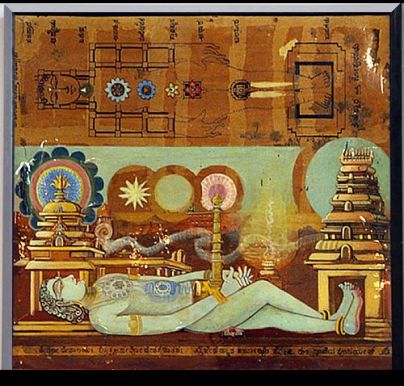
The symbolisms of the temple are conceived in several layers. One; the temple complex, at large, is compared to the human body in which the god resides. And, the other is the symbolisms associated with Vimana the temple per se, which also is looked upon as the body of the deity. And the other is its comparison to Sri Chakra.
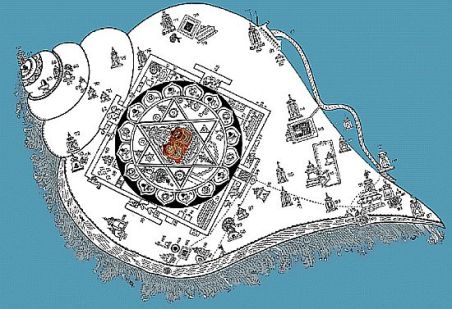
shanka-kshetra-Copyright 2005-2010-HareKrsna-com

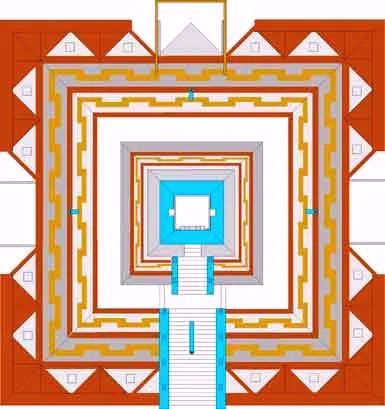
Let’s start with the temple complex being looked upon as a representation of Sri Chakra.

The shrine is itself an object of reverence. The icon at  the center of the temple is the image of divinity and its purity that generations after generations have revered and venerated. That image residing at the heart of the temple is its life; and is its reason. One can think of an icon without a temple; but it is impossible to think of a temple without an icon of the divinity. The very purpose of a temple is its icon. And, therefore is the most important structure of the temple is the Garbagriha where the icon resides.

There are also views that assert saying that the temple has a sanctity of its own , independent of the icon; and, the icon’s sanctity is related to that of the temple . This view is based on the premise that even before the icon is placed within it, the temple-structure , is indeed sacred as its womb (Grha-garbha); and, the sanctum becomes the Gabha-griha  (womb-house) only after the icon is installed within it. The temple  (ayatana , the abode) and the image of the divinity placed within it are, thus, mutually complimentary.

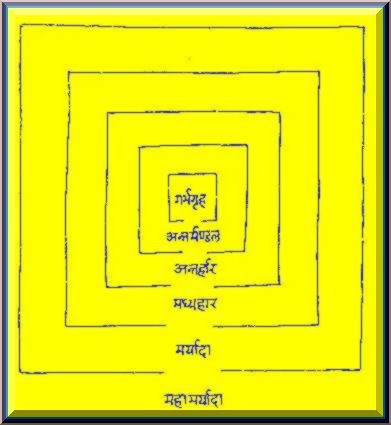
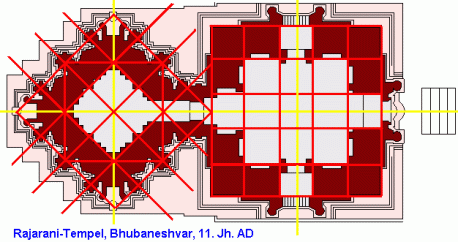
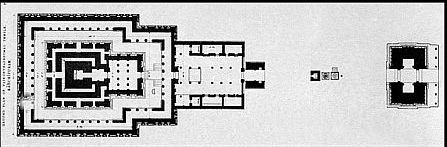
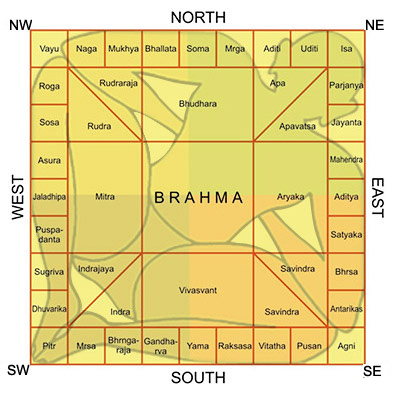
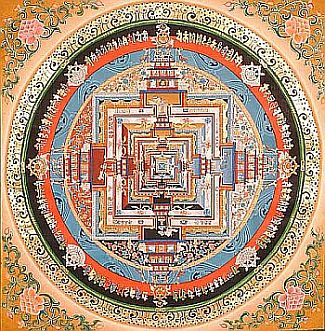
In fact, the entire temple is conceived as the manifestation or the outgrowth of the icon. And, very often, the ground-plan of a temple is a mandala. Just as the Sri Chakra is the unfolding of the Bindu at its centre, the temple is the outpouring or the expansion of the deity residing in Brahmasthana at the centre.

The temple as also the Sri Chakra employs the imagery of an all – enveloping space and time continuum issuing out of the womb. In the case of Sri Chakra the Bindu is the dimension-less and therefore imperceptible source of energy. The idol, the Vigraha, in the Garbagriha represents the manifestation of that imperceptible energy or principle; and it radiates that energy.

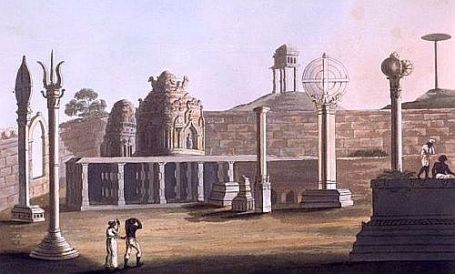
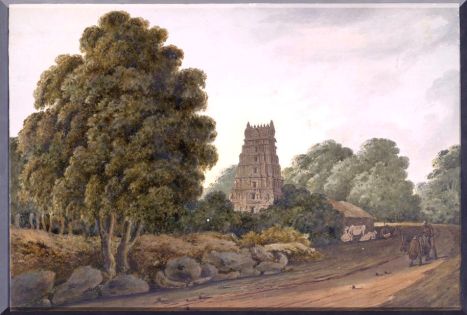
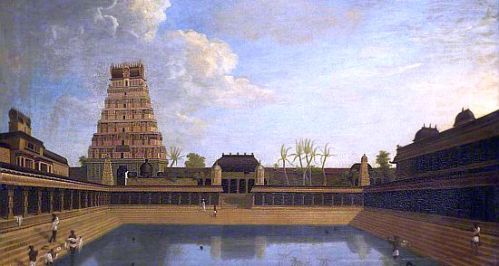
The devotee- both at the temple and in Sri Chakra- moves from the gross to the subtle. In the temple, the devotee proceeds   from the outer structures towards the deity in the inner sanctum, which compares to the Bindu in the Chakra. The Sri Chakra upasaka too proceeds from the outer Avarana (enclosure) pass through circuitous routes and successive stages to reach the Bindu at the centre of the Chakr, representing the sole creative principle. Similarly the devotee who enters the temple through the gateway below the Gopura (feet of the Lord) passes through several gates, courtyards and prakaras, and submits himself to the Lord residing in the serenity of garbhagrha, the very hearts of the temple, the very  representation of One cosmic Principle.
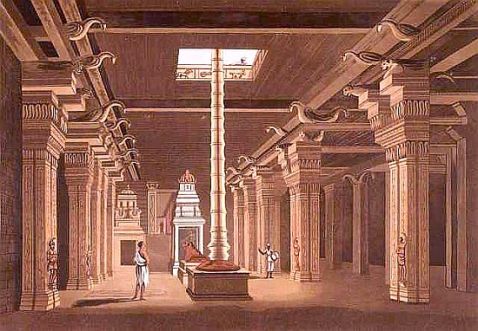
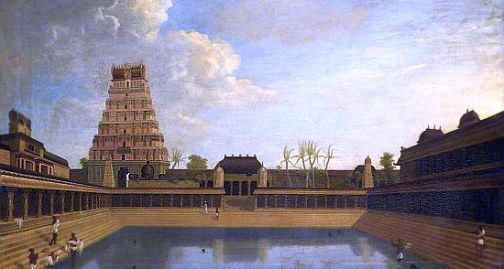
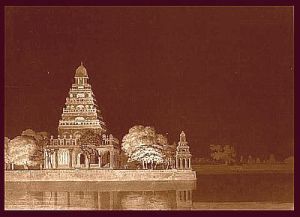
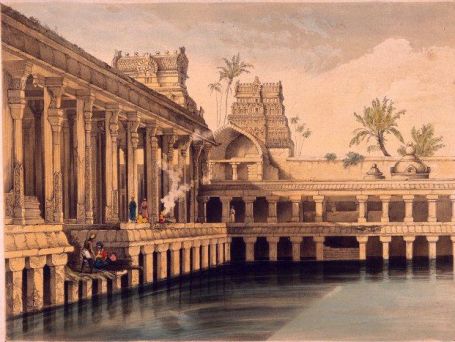
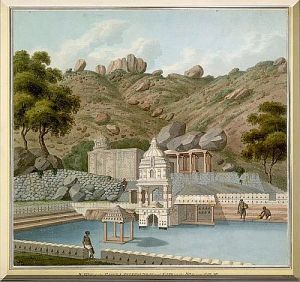
temple courtyard - Daniell, Thomas

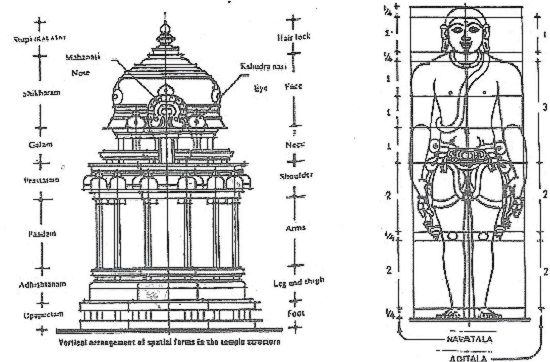
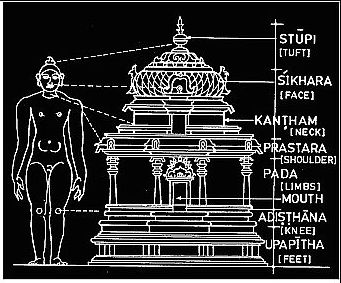
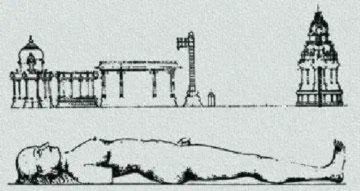
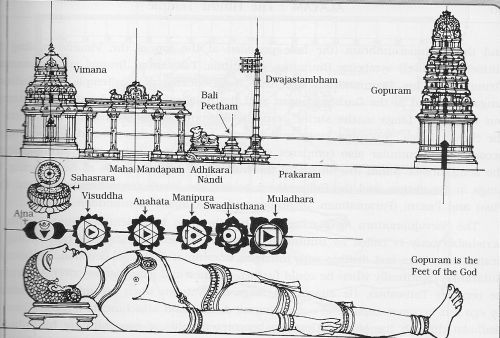
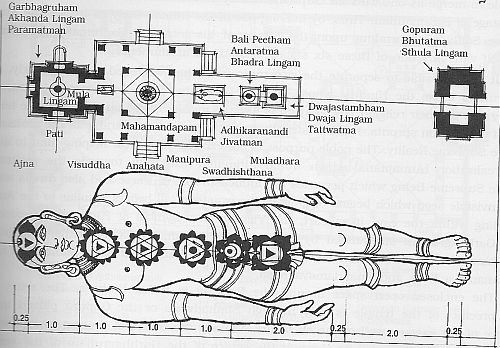
The other symbolism is that the human body is a temple in which the antaryamin resides. The analogy is extended to explain the various parts of the body as being representations of the aspects of a temple. In this process, the forehead is said to represent the sanctum; and the top of the head, the tower. The space between the eyebrows, the ajna chakra, is the seat of the divinity. The finial of the tower is the unseen the sahasrara located above the head.
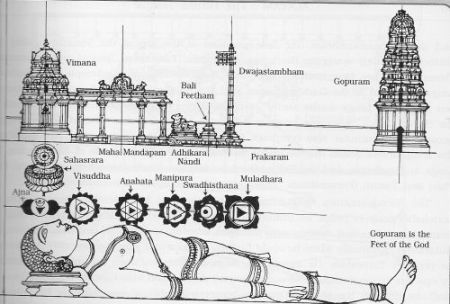
Accordingly, the sanctum is viewed as the head; and Right on top of that head is the passage through which the currents of life ascend to the tower through that stone slab Brahma-randra_shila. Around the four corners of this slab are placed the images of the vehicles or emblems that characterize the icon inside the sanctum.
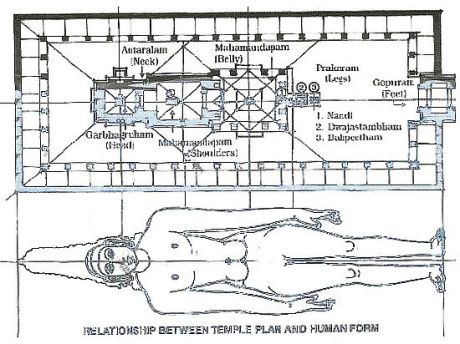
devalaya symbolism

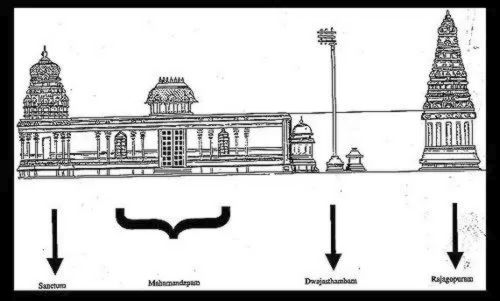
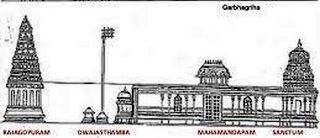
Garba Gruha Sirahapoktam; antaraalam Galamthatha;  Ardha Mandapam Hridaya-sthanam Kuchisthanam; Mandapomahan Medhra-sthaneshu; Dwajasthambam Praakaram Janjuangeecha Gopuram Paadayosketha Paadasya Angula Pokthaha Gopuram Sthupasthatha Yevam Devaalayam angam uchyathe”  – Viswakarmyam Vastu Shastra

***

Another interesting aspect is that the temple concept is a curious mixture of Vedic, Tantric and Agama principles. The Tantra regards the human body as a Mandala; and it is mobile (chara or jangama) Mandala. The Agama shastras regard a temple too as Mandala; and here it is an immobile (achala or sthavara) Mandala. The analogy of the temple with the human body finds closer relationships.

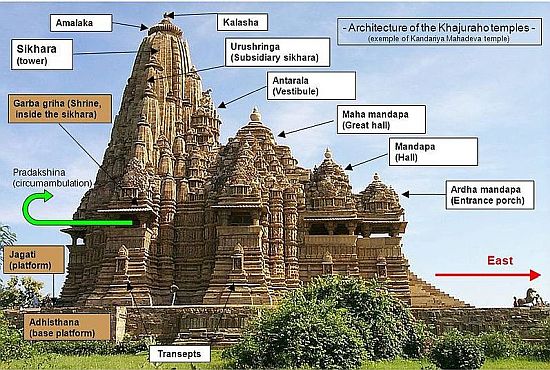
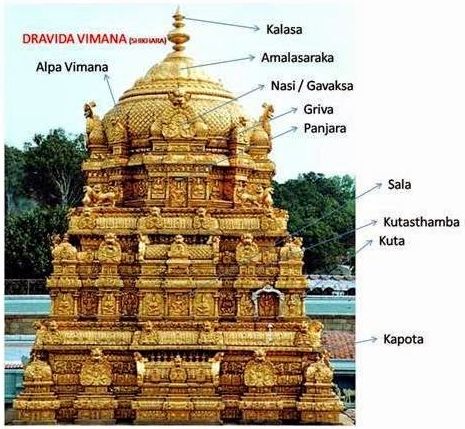
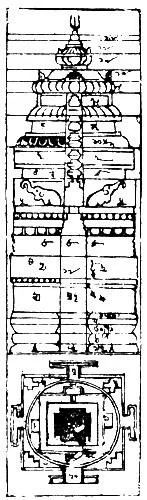
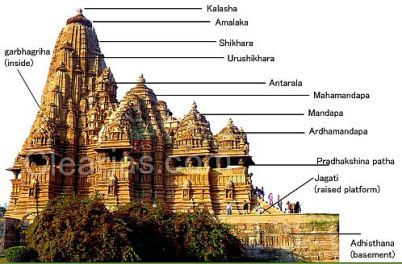
The symbolism extends to the conception of Vimana or the central part of the temple as the physical form of god. For instance, the sukanasi or ardhamantapa (the small enclosure in front of the garbhagrha) is the nose; the antarala is the neck; the various mantapas are the body; the prakaras are the hands and so on. Vertically, the garbhagrha represents the neck, the shikhara (superstructure over the garbhagrha) the head, the kalasha (finial) the tuft of hair (shikha) and so on.
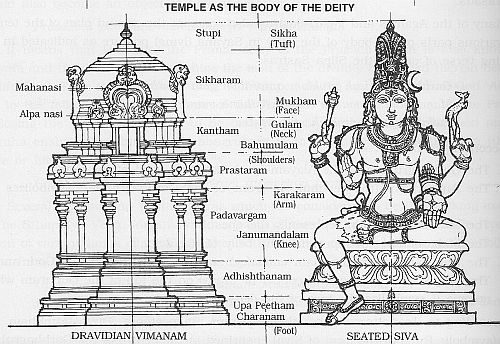
The names assigned to various parts of the Vimana seem to go along with this symbolism. For instance, Pada (foot) is the column; jangha (trunk) is parts of the superstructure over the base; Gala or griva (neck) is the part between moulding which resembles the neck; Nasika (nose) is any nose shaped architectural part and so on. The garbhagrha represents the heart and the image the antrayamin (the indwelling Lord).  These symbolisms also suggest seeking the divinity within our heart.

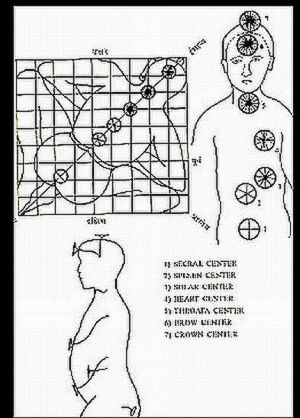
The temple is also seen as a representation of the subtle body with the seven psychic centres or chakras. In the structure of the temple, the Brahma randra is represented in the structure erected on top of the sanctum. The flat-roof (kapota) of the sanctum is overlaid by a single square stone slab known in the texts as Brahma-ranhra-sila (the stone denoting the upper passage of life). The sanctum is viewed as the head; and right on top of the head is the passage through which the currents of life ascend to the tower through this stone slab.
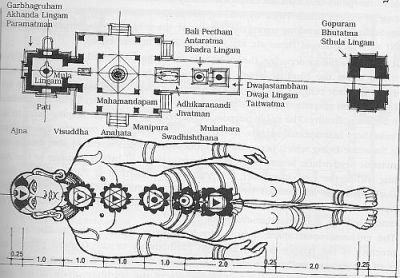
Interestingly, the Kalasha placed on top of the Vimana is not imbedded into the structure by  packing it with mortar or cement. It is, in fact, placed in position by a hollow rod that juts out of the centre of the tower and runs through the vase, the Kalasha. It is through this tube that the   lanchana ‘tokens’ (cereals and precious stones) are introduced. One of the explanations is the hallow tube represents the central channel of energy the Shushumna that connects to the Sahasra, the seat of consciousness, through the Brahma randra.

The other symbolisms associated with the Sanctum and the tower above it are, that sanctum is the water (aapa) principle and the tower over it is Fire (tejas); the finial of the tower (Vimana) stands for air (vayu) and above the Vimana is the formless space (akasha). The sanctum is thus a constellation of the five elements that are basic to the universe. And fire being the active element that fuses the others, the tower becomes an important limb in the structure of a temple.
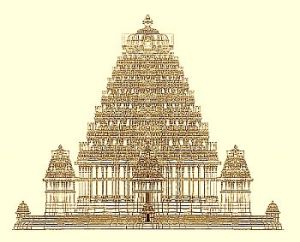
vimana

Symbolism of The Sri Vaikunta Perumal Temple at Kanchipuram 

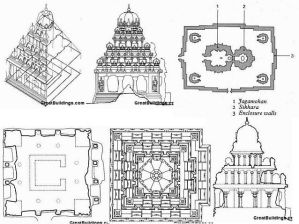
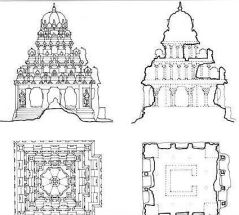
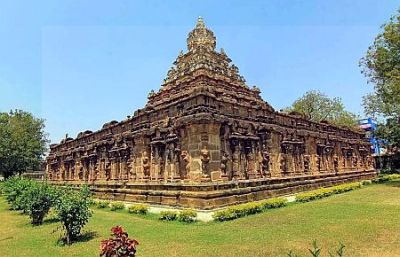
Dr D Dennis Hudson (1938-2006) who was the Emeritus Professor of World Religions at Smith College, Northampton, Massachusetts; and one who spent a lifetime in the study of Hinduism, particularly the Bhagavata tradition, in his book The Sri Vaikunta Perumal Temple at Kanchipuram, presents the interpretation of the symbolism that the temple structured as a three-dimensional Mandala.

His interpretation is based on Tirumangai Azhwar’s poetry and the theology of the Bhagavata Purana, which illumine layers of symbolism embodied in the architecture and sculpture of this temple.
vaikunta perumal 3

According to Prof. Hudson, on the Sri Vaikunta Perumal Temple built in 770 C.E. by Nandivarman II Pallavamalla (731-796 C.E.) was , initially, given the name Parameshwara at the time of his coronation . And, it came to be known as Parameshwara-Vinnagaram (the abode of Vishnu), as sung by the Vaishnava saint, Tirumangai Azhwar.
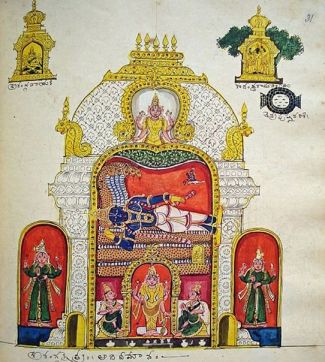
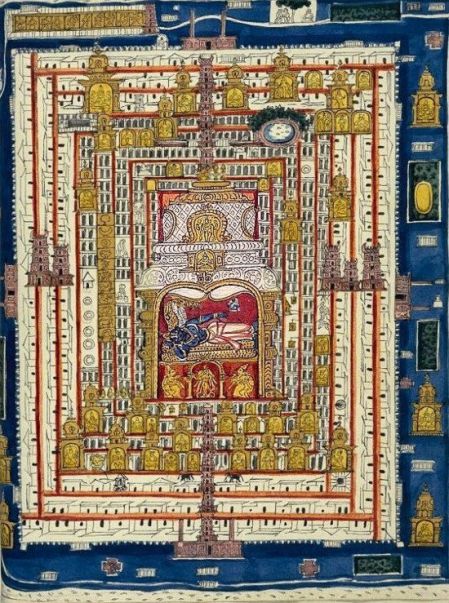
srirangam temple

The architecture of the Sri Vaikunta Perumal Temple is unique; with three sanctums placed one over the other, on the three floors; and, a concealed staircase leading to the upper floors.

The three sanctums enshrine Vishnu in three postures – seated, reclining and standing. The walls are adorned with more than fifty sculptures, besides the panels depicting the history of the Pallavas, leading to the coronation of Nandivarman.

According to Prof. Hudson, the temple reveals a visual theology, the `four formations (chatur-vyuha) as per the doctrine of Pancharatra Agama. The Vimana is structured as a three-dimensional Mandala.
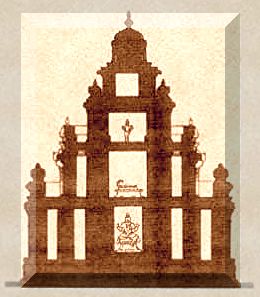
vaikunta perumal2 jpg

 He identifies the central figure in the sanctum of the ground floor as Vasudeva facing west, i.e. the Earth; Sankarshana facing north, the realm of human life; Pradyumna facing east towards heaven; and, Aniruddha facing south, the realm of ancestors.

The sculptural scheme matches the Pancharatra concept, representing the six `glorious excellences’ and the twelve murthis (dwadasa-namas). The six excellences are: the omniscient knowledge (jnana), power (bala), sovereignty (aishwarya), action (virya), brilliance (tejas) and potency (sakthi).

The Murti on the middle floor has the Vishnu is in lying pose known as Sheshashayee Vishnu, as he sleeps in the Kshirasagara. This Murti rests in a rather smaller room with plain walls. Here, the King serves Vishnu, as a disciple would serve his Guru.

The sanctum of the third floor represents the realm of space-time, depicting Vasudeva as he appeared in the human form of Krishna. The temple per se signifies the `body of God.

The staircase from behind the ground floor sanctum opens up a huge sculpture of Vishnu in sitting posture.
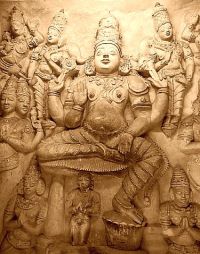
Vaikunta perumal vishnu staircase

***

Iconography

Before we deal with iconography per se , let’s briefly go-over some its general principles associated with it .

The Agama shastras are based in the belief that the divinity can be approached in two ways. It can be viewed as nishkala, formless – absolute; or as sakala having specific aspects.

Nishkala is all-pervasive and is neither explicit nor is it visible. It is analogues, as the Agama texts explain, to the oil in the sesame-seed, fire in the fuel, butter in milk, and scent in flower. It is in human as antaryamin, the inner guide. It has no form and is not apprehended by sense organs, which includes mind.

Sakala, on the other hand, is explicit energy like the fire that has emerged out of the fuel, oil extracted out of the seed, butter that floated to the surface after churning milk or like the fragrance that spreads and delights all. That energy can manifest itself in different forms and humans can approach those forms through appropriate means. The Agamas recognize that means as the archa, the worship methods unique to each form of energy-manifestation or divinity.

The idea of multiple forms of divinity was in the Vedas. Rig Veda at many places talks in terms of saguna, the supreme divinity with attributes. The aspects of the thirty-three divinities were later condensed to three viz. Agni, the aspect of fire, energy and life on earth; Vayu, the aspect of space, movement and air in the mid-region; and Surya the universal energy and life that sustains and governs all existence, in the heavenly region, the space. This provided the basis for the evolution of the classic Indian trinity, the Brahma, Shiva and Vishnu.

[Let me digress here for a while  …

The study of Buddhist branch of Indian Iconography is one of the most interesting and fascinating subjects. In the present period, the study of the Buddhist Iconography is carried out mostly with reference to the available sculptures, bronzes, metal and miniatures sourced from various monuments.

As is well known, the earlier phase of Buddhism was free from a pantheon and representations of any gods and goddesses. The sculptural depictions found in the ancient monuments such as – Sanchi, Amaravathi and Bharhut etc., – relate to scenes of the Buddha’s life;  and, to incidents picked up from the Jataka tales. The early representations of the Buddha were through symbols such as: the Bodhi-tree; the wheel of Dharma; the throne of exposition; sacred foot-prints; and so on.

The Buddha’s representation as a perfect human being came about much later, in the Gandhara School, perhaps through the influence of the Greek. The first image of the Buddha was fashioned in the Gandhara School, replicating the Greek Art.

The sculptures at Amaravathi are perhaps very near, in time, to the Gandhara School. That was followed by the Mathura School. Then come the sculptures of Saranath, Magadha, Bengal, Orissa, Java and Nepal (particularly in the Tantric context).

In the early Buddhism of the Pali tradition (Hinayana) , there was a marked absence of pantheon; and ritualistic worship of the idols of the Buddha or of any other deity.

But , with the birth and growth of the Mahayana ; and, particularly with the influx of  the Vajrayana (which was a direct outcome of the Yogachara School) , the theories , principles and practices of the Buddhist iconography were thoroughly transformed  into a totally different class.

The Tantric Vajrayana introduced many innovations of a revolutionary character that were alien and hitherto unknown to the Buddhist traditions.

For instance; it brought in the concept of five Dhyani Buddhas as embodiment of five Skandas or cosmic elements; and, formulated the theory of Kulas or families of the five Dhyani Buddhas, from which emerged numerous deities according to the disposition and the need of the practitioner.

Further, Vajrayana introduced the practice of worshiping the Prajna or Shakthi and a host of other gods and goddesses. It also elaborately composed articulate Sadhanas (Dhyana slokas) to enable the practitioner to visualize one’s chosen deity; and, to invoke the deity through its appropriate Mantras, Mudras, Mandalas and Yantras.

In order to heighten its psychic and emotional appeal, the Vajrayana introduced every conceivable tenet, dogma and ritual, calculated to enthuse its adherents of all classes – cultured, rustic, pious or aggressive etc. Many of those theories, worship-practices and deities were adopted from Hinduism as also from the folk traditions of Nepal and China.

As the Buddhism traveled far and beyond the Himalayas into Tibet, China and Mongolia; and, spread eastward right up to Korea and Japan, it imbibed and brought within its fold several characteristics, features and practices that were unique to each region. It is needless to say; Vajrayana, in due course, attained great fame and popularity.

Now, virtually, it is no longer possible to isolate the Buddhist iconography of India from its later Avatars in the new worlds, although they, initially, were influenced by the Buddhist Tantras of India. And, that is further complicated by the free and frequent interchange of deities and concepts among the three prominent religious systems – Hindu , Jaina and Buddhist.

I gratefully acknowledge the source , particularly the  scholarly introduction to the Second Edition of  The Indian Buddhist Iconography – mainly based on Sadhanamala by Prof. Benoytosh Bhattacharya ; Published by Firma K L Mukhopadhyay , Calcutta , 1958.]
lotus blue

The pantheon and the concept of polytheism gave tremendous impetus to all branches of Indian arts, literature and iconography. The polytheism is, in fact, the lifeblood of iconography; for it is only through a divinity with aspects one can represent and worship ones ideal with  love, adoration and earnestness. Making an image involves an understanding of its attributes, virtues, powers, characteristics, symbols and its disposition. An image is the visual and concrete form of idealism; the idioms of beauty grace and power nurtured and honed by generations after generations. It is a representation of a community’s collective aspirations.

Iconographic representations of gods and goddesses are the idioms aiming to give expression to their attributes, powers, virtues and disposition. Multiplicity of heads denotes presence of their concurrent abilities; and multiplicity of hands denotes their versatile abilities. For instance, three heads of a divinity indicates trio guna (Guna-triad: Sattva, Rajas and Tamas) or shakthi traya [iccha (will), Jnana (consciousness) and kriya (action) shakthis or powers] . Four heads represent compreneshion  or enveloping four Vedas ; or overseeing four directions . Five heads stand for five principles or elements  (pancha-bhuthas) or five divine attributes or five stages of the evolutionary process

[shristi (creation), shthithi (expansion), samhara (withdrawal),  triodhana (concealing) and anugraha (preserving  till the commencement of the next cycle  of evolution)]

Not all divine representations are made through icons. Shiva is represented usually by a conic linga or an un-carved rock ; Vishnu and Narasimha are worshipped at homes as Saligrama (a special types of smooth dark stones found on bed of the Gandaki river); Ganapathi is best worshipped in the roots of the arka plant, and he is also represented by red stones (sona shila) or turmeric cones or pieces (haridra churna). The Devi in Kamakhya temple is worshipped in a natural fissure of a rock. Yet all these divinities have specified well defined iconographic forms.
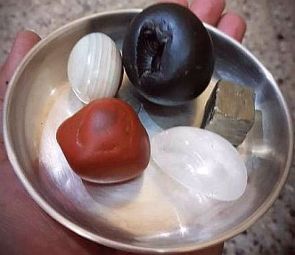
Panchayatana

According to the Agamas, icons can be constructed of stone; Kadira wood; metal; clay; precious stones; or painted on cloth. And, those made in metal are usually sculptured in wax form and then cast in metal.

 ktvā pratinidhi samyag dāru loha śilādibhi | tat sthāpayitvā mā sthāne śāstra dṛṣena vartmanā || Padma Samhita Kriya Pada 1;5


Since the very purpose of the temple structure is the image residing in it; and the temple is regarded the virtual expansion of the image, let us talk for a while about temple iconography.

Iconography, in general terms, is the study and interpretation of images in art. But, in the context of this discussion it could be restricted to the study of icons meant for worship and the images used in temple architecture. The temple iconography is more concerned with the concept, interpretation and validity of the icon in terms of the themes detailed in the scriptures or the mythological texts; and with the prescriptions of the Shilpa Shastra. There is not much discussion on the styles of architecture or the art forms, per se.

Iconology could be understood as the study of the symbolism projected by the images. Here, the symbolism is the expression of reality through aesthetically presented suggestions; it is where two realms meet:  the formless Absolute (Nikala) and the form with attributes (Sakala).

A symbol could be natural or conventional or otherwise. When we perceive a direct relationship between one orders of things with another a natural symbol develops.

[A short explanation about the term iconography. We are using it for want of a better term in English. The word icon is derived from Greek eikon; and it stands for a sign or that which resembles the god it represents.

In the Indian tradition what is worshiped is Bimba, the reflection or Prathima, the image of god, but not the god itself. Bimba means reflection, like the reflection of moon in a tranquil pool. That reflection is not the moon but an image (prathima) of the moon. In other words, what is worshiped in a temple is an idea, a conception or the mental image of god, translated to a form in stone or metal or wood; but, it is not the god itself. The principal Indian term for Iconography is therefore Prathima –lakshana, the study of images.

Various terms are used while referring to icons; such as:

  • Bera : image;
  • Mūrtī : an image with definite shape and physical features;
  • Bimba: reflection of the original or model after which it is made (the Original Being of course is God);
  • Vigraha : extension, expansion, form;
  • Pratima :  resemblance or representation;
  • Pratīka : symbol;  
  • Rūpa : form; and ,
  • Arca : object of adoration and worship.]

Apart from the Agamas, there are several texts that detail the processes involved in practicing the art; and specify the rules governing iconography and iconometry. The Brihat Samhita of Varahamihira (6th century AD) is an ancient text that provides descriptions of certain images. It refers to one Nagnajit, as the author of a contemporary work on Silpasastra – but not much is known about him or his work. Shukranithisara is another treatise which discusses aspects such as the proportions and the measurements recommended for the images of various classes and attributes. The subject he dealt with has since developed into Iconometry. Someshwara’s (a 1th century western Chalukya king) Abhilashitartha Chintamini contains interesting iconographical details of many important deities.  And, Hemadri (13th century AD) who hailed from Dakshina Kannada region authored Caturvarga_chintamini, which deals with temple architecture and construction. He is credited with introducing a method of construction that did not use lime.

In addition, there are the major and authoritative texts that deal comprehensively with all aspects of Devalaya Vastu. These include Kashyapa shilpa samhitha, Mayamata, Manasara, Shilpa rathna, Kumaratantra, Lakshana_samuchayya, Rupamanada; and the Tantrasara of Ananda Tirtha (Sri Madhwacharya) , which contains sections dealing with the study of images (iconography and iconometry).

Among the puranas, the Agnipurana details the Prathima_lakshanam (the characteristics of images), Prathimavidhi (the mode of making images), and Devagraha nirmana (the construction of places of worship).

Similarly, the Matsya Purana (dated around second century AD) has eighteen comprehensive chapters on  architecture and sculpture. This purana mentions as many as eighteen ancient architects (vastu_shatropadeshkaha): Brighu, Atri, Vashista, Vishwakarma, Brahma, Maya, Narada, Nagnajit, Visalaksa, Purandara, Kumara, Nanditha, Shaunaka, Garga, Vasudeva, Aniruddha, Shuka and Brihaspathi.

Many of these names appear to come from mythology; but quite a few of them could be historical. Sadly, the works of most of these savants are now lost. The Mathsya purana says that the best aspect of karma yoga is the building temples and installing deities; and therefore devotes several chapters to the subject of temple construction and image making.

The Vishnu purana (dated about 3rd century AD) too contains several chapters on the subjects of architecture and sculpture. Further, it includes the Vishnu_dharmotthara_purana (perhaps an insertion into the Vishnupurana at a later period), which is a masterly treatise on temple architecture, iconography and painting. This work which is in the form of a conversation between the sage Markandeya and the King Vajra is spread over 42 chapters. In part three of the text there is virtually a catalouge of the various deities with  descriptions of their features, stance and gestures (mudras) apart from their disposition and attributes.

In addition to  the Sanskrit texts, the Tamil works – Mandalapurusha’s Chintamini Nigandu and Sendanar’s Divakara nigandu, are well known and widely accepted. Besides, there is an ancient work by an unknown author, Silpam (perhaps a translation of an ancient Sanskrit text), which is popular among the shilpis.

A special mention needs to be made about iconography ‘s (prathima lakshana) relation with Natyasastra.

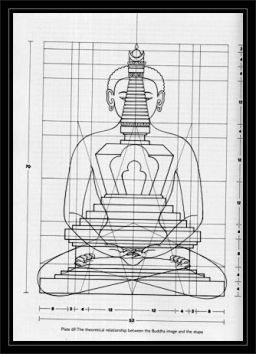
The Shilpa and Chitra (painting) are closely related to Natyasastra (ca. second century BCE). The rules of the iconography (prathima lakshana), in particular, appear to have been derived from the Natyasastra. The Indian sculptures are often the frozen versions or representations of the gestures and poses of dance (caaris and karanas) described in Natyasastra. The Shilpa (just as the Natya) is based on a system of medians (sutras), measures (maanas), postures of symmetry (bhangas)   and asymmetry (abhanga, dvibhanga and tribhanga); and on the  sthanas (positions of standing, sitting, and reclining). The concept of perfect symmetry is present in Shilpa as in Nrittya; and that is indicated by the term Sama.

The Natya and Shilpa sastras developed a remarkable approach to the structure of the human body; and delineated the relation between its central point (navel), verticals and horizontals. It then coordinated them, first with the positions and movements of the principal joints of neck, pelvis, knees and ankles; and then with the emotive states, the expressions. Based on these principles, Natyasastra enumerated many standing and sitting positions. These, demonstrate the principles of stasis, balance, repose and perfect symmetry; And, they are of fundamental importance in Indian arts, say, dance, drama, painting or sculpture.

The demonstrations of those principles of alignment could be seen in the sama-bhanga of Vishnu, Shiva, abhanga of Kodanda-Rama and tribhanga of Nataraja; and in the vibrant movements of dance captured in the motifs carved on the walls of the Indian temples depicting gandharvas, kinnaras, vidyadharas and other gods and demigods. If the saala bhanjikas (bracket figures) recreate the caaris(primary movements) , the flying figures recreate the karanas (larger movements).The representations of about one hundred and eight of the karanas described in the Natyasastra find expression on the walls of temples spread across the country.

It is as if the rich and overpowering passages of Natyasastra are translated in to stone and published on temple walls.

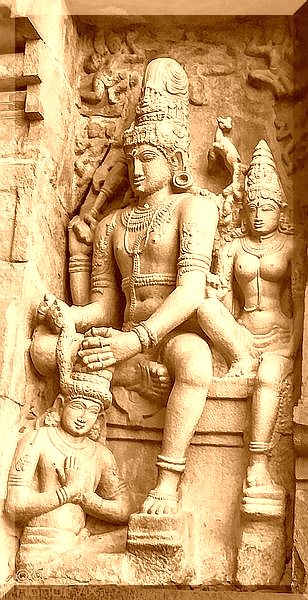
For the purpose of creating an image , initially, a square grid is divided into sixteen equal squares . These squares are grouped into six  segments : Brahma -bhaga ( the central four squares) ; Deva -kesha or Deva shiro-alankara -bhaga ( two squares on top of Brahma-bhaga for depicting the crown or elaborate hair arrangement) ;Vahana-bhaga or peeta-bhaga ( space for pedestal – two bottom squares , below the Brahma-bhaga);Bhaktha -bhaga ( two bottom sqares on either side of Peeta -bhaga for locating images of the worshipping devotees); Devi-bhaga ( two squares each on either side of Brahma-bhaga for the accompanying female deities) ; and Gandharva-bhagha (two squares in the top on either side of Shiro-bhaga for depicting the Gandarvas).

The image of the main deity along with that of the consorts and subsidiary figures are located within the square grid. The central part of the main deity is accomodated in the Brahma-bhaga; its head or crown or hair-do is figured in the Deva-shiro-bhaga, while the f eet of the deity, the pedastal and the mount (vahana) are in the lower vahana-bhaga.

The  vertical and horizontal axis of the square as also its diagonal axis of the square pass through what is known as the Brahma-bindu right at the centre of the Brahma-bhaga. It is at the Brahma-bindu the navel (nabhi) of the deity would be located. All other image parts are co-related to the Brahma-bindu.
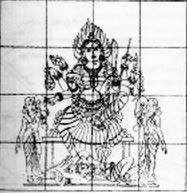
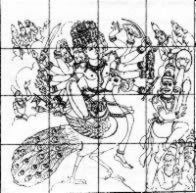
Dhyana shlokas

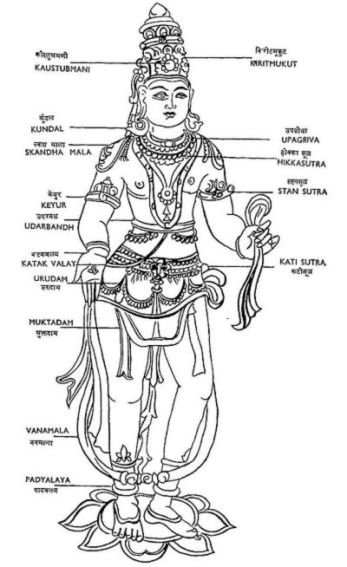
Shilpa ornaments

One of the main resources for a practicing shilpi is the collection of Dhyana shlokas.

Before a shilpi starts on a project to sculpt an image, he needs to be clear in his mind on its form, its aspects, its countenance, the details of its physiognomy, its facial and bodily expressions; its posture, details of the number of arms, heads and eyes; and details of its ornaments, ayudhas (objects it holds in its hands) etc. For this purpose, the Shilpis generally refer to a wonderful collection of most amazingly articulate verses called Dhyana Shlokas, the verses in contemplation.

Prof S K Ramachandra Rao , in his The Encyclopedia of Indian Iconography , writes :
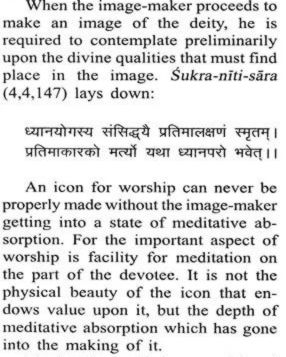
Dhyana sloka extract

Dhyana sloka extract 2

These verses culled from various texts of Shipa Shastra, the Agamas and the Puranas; and also from Buddhist and Jain texts, describe, precisely, the postures (dynamic or static, seated or standing), the Bhangas (flexions – slight, triple, or extreme bends), Mudras (hand gestures), the attitudes, the nature, the consorts and other vital details of each aspect that provides the deity with power and grace. it is said that there are about 32 aspects or forms of Ganapathi, 16 of Skanda, 5 of Brahma, 64 of yoginis, and innumerable forms of Vishnu, Shiva and Devi .Each one of those forms has a Dhyana shloka illustrating  its aspects and attributes.

[ As regards Vajrayana Buddhism, the Sadhanamala,  a highly specialized  Buddhist Tantric text, is a collection of Dhyana slokas (composed perhaps between the 5th and the 11th century), which  deals with the Vajrayana Buddhist Tantric meditative practices; and , it provides detailed instructions on how the images  of 312  Buddhist deities are to be visualized  and invoked; each with  its appropriate Mantra . The descriptions are meant to aid meditation; and, also to serve as a practical guide to the sculptors and painters. It enables the practitioner to visualize the nature, disposition, virtues and detailed iconographic features of a deity.]

Dhyana shlokas are more than prayers or hymns; they are the word-pictures or verbal images of a three-dimensional image. They help the Shilpi to visualize the deity and to come up with a line drawing of the image. It is said that there are more than 2,000 such Dhyana shlokas. How this collection came to be built up over the centuries is truly amazing. These verses have their origin in Sanskrit texts; and the scholars who could read those texts knew next to nothing about sculpture. The Shilpis who actually carved the images had no knowledge of Sanskrit and could not therefore read the texts or interpret the shlokas. This dichotomy was bridged by the generations of Shilpis who maintained their own set of personal notes, explanations and norms; as also references to shlokas; and passed them on to their succeeding generations and to their disciples.

 [ Ram Raz (Rama Raja) (1790–1830) in his remarkable  Essay on the Architecture of the Hindús  also observed that only a few Brahmins could assist him in interpreting the Shilpa Shastras but they had no idea what so ever of architecture. The active rural craftsmen he approached were ignorant of Sanskrit and were unable to read the texts, their extensive practical knowledge having been learnt through pupillary succession. There seemed to be no interdependence between theoretical treatise and practical process.]

Thus, among the many traditions (parampara) inherited in India, the tradition of Vishwakarma is unique. The  mode of transmission of knowledge of this community is both oral and practical. The rigor and discipline required to create objects that defy time and persist beyond generations of artists, has imbued this tradition with tremendous sense of purpose, and zeal to maintain purity and sensitivity of its traditions; and to carry it forward. This has enabled them to protect and carry forward the knowledge, the art and skills without falling prey to the market and its dynamics.

With the emergence of the various academies of sculpture and organized efforts to collate and publish the old texts with detailed explanations, there is now a greater awareness among the shilpis of the present day. Yet, the neglect of Sanskrit and inability to read the texts in Sanskrit is still an impediment that badly needs to be got over.

Please look at the summary of a few Dhyana shlokas.

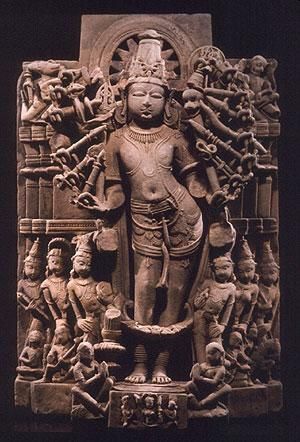
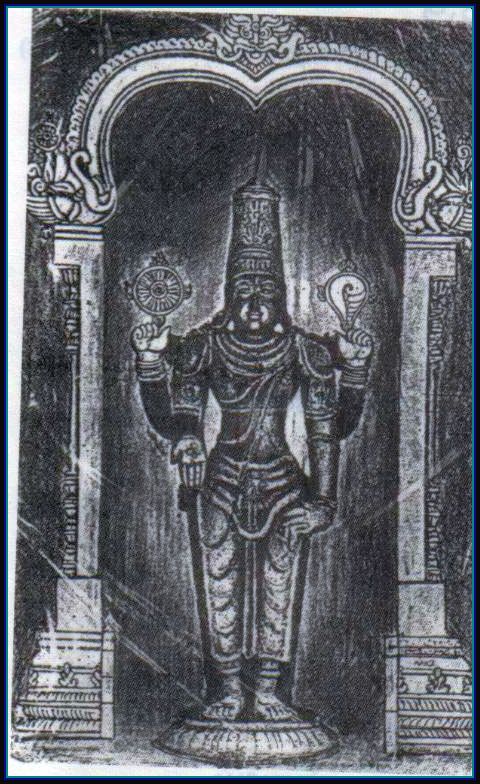
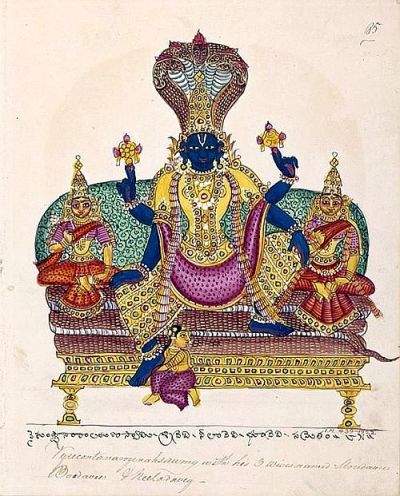
The image of Lord Narayana must be made with ten , eight, four or two arms. His head should be in the form of an umbrella, his neck should be like counch, his ears like sukthi, he should have high nose, strong thighs and arms. His breast must bear the Srivatsa mark and be adorned with the Kaustubha gem. He should be made as dark as the Atasi (Linum usitatissimum), clad in yellow robes, having a serene and gracious countenance. He should be wearing a diadem and ear-rings. Of the eight hands the four on the right side must have the sword(nandaka), mace(kaumodaki), arrow and abhaya _hastha, mudra of assurance and protection (the fingers raised and the palm facing the devotees), and the four on the left side, the bow(saranga), buckler, discus (sudarshana) and conch (panchjanya).

South Indian, late 19th c, Vishnu

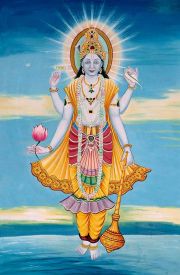
In case the image is to have only four arms, the two hands on the right side will display the abhaya mudra or lotus; and discus respectively. And, in his hands in the left, he holds the conch and mace. 

vishnu_narayana_wj94

And, in case he is made with only two arms, then the right hand bestows peace and hope (shanthi-kara-dakshina hastha) and the left holds the conch. This is how the image of the Lord Vishnu is to be made for prosperity. 

Vasudeva Perumal stands in samabhanga

When Vishnu is two armed and carries discus and mace, he is known as Loka-paala-Vishnu.

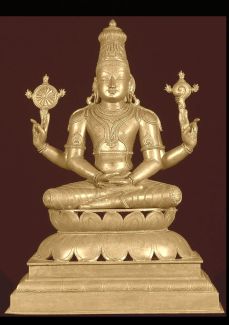
Yogasana_ murthi (yoga Narayana) is Vishnu seated in yogic posture on a white lotus, with half-closed eyes. His complexion is mellow –bright like that of conch, milk or jasmine. He has four hands with lower two hands resting on his lap on yogic posture (yoga mudra). ; And the upper two hands holding conch and discus. He is dressed in white or mild red clothes. He wears modest but pleasant ornaments. He wears an ornate head dress or a coiled mop of hair. [Yogesvara is sometimes shown with four faces and twelve hands.]

vishnu seated2

Surya, the Sun-God should be represented with elevated nose, forehead, shanks, thighs, cheeks and breast; he should be dressed in robes covering the body from breast to foot. His body is covered with armor. He holds two lotuses in both of his hands, he wears an elaborate crown. His face is beautified with ear-rings. He has a long pearl necklace and a girdle round the waist. His face is as lustrous as the interior of the lotus, lit up with a pleasant smile; and has a halo of bright luster of gems (or, a halo that is made very resplendent by gems on the crown). His chariot drawn by seven horses has one wheel and one charioteer .Such an image of the Sun will be beneficial to the maker (and to the worshipper).

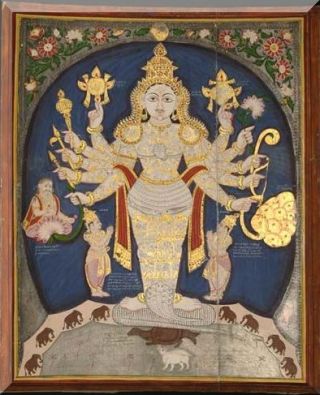
The dhyana shloka preceding the middle episode of Devi Mahatmya gives the iconographic details of the Devi. The Goddess is described as  having eighteen arms,  bearing string of beads, battle axe, mace, arrow, thunderbolt, lotus, bow, water-pot, cudgel, lance, sword, shield, conch, bell, wine-cup, trident, noose and the discuss sudarsana. She has a complexion of coral and is seated on a lotus.

The Mahakali is “Wielding in her hand the sword, discuss, mace, arrow, bow, iron club, trident, sling, human head, and conch, she has three eyes and ornaments decked on all her limbs. She shines like a blue stone and has ten faces and ten feet. That Mahakali I worship, whom the lotus born Brahma lauded in order to slay Madhu and Kaitaba when Hari was asleep”.

Pancha bera

The images in the Hindu temples can be classified into three broad groups: Shaiva, Shakta and Vaishnava, representing the three cults of Shiva, Shakti and Vishnu, respectively. The images in the temple could be achala (immovable) Dhruva-bimba or dhruva-bera; and chala(movable). The chala bera, usually made of pancha loha (alloy of five metals), are meant for other forms of worship and ceremonial services.

The dhruva-bera is the immovable image of the presiding deity of the temple and resides in the sanctum and to which main worship is offered (archa-murti). It is usually made of stone. In a temple following the Vaikhanasa tradition, the immovable (dhruva-bera) represents the primary aspect of the deity known as Vishnu (Vishnu-tattva). The other images in the temple that are worshiped each day during the   ritual sequences are but the variations of the original icon (adi-murti). These other forms are emanations of the main idol, in successive stages. And, within the temple complex, each form is accorded a specific location; successively away from the Dhruva bera.

A major temple, apart from the Dhruva bera, would usually have four or five representations of the principal deity (pancha bera).They are:

Dhruvam tu grāma rakārtham; arcan artham tu Kautukam | snānārtham Snapanam proktam; balyartham Bali-berakam | Utsava cotsavartham ca Paca-Bera prakalpitā ||

:- Kautuka –bera is a mini replica of the main idol (usually madeof gems, stone, copper, silver, gold or wood and about 1/3 to 5/9 the size of the Dhruva-bera), and  is placed in the sanctum near the main idol and is connected to it by a metal string or silk thread. It receives all the daily worship(nitya-archana) including those of tantric nature.

:- The next is the Snapana-bera (usually made of metal and smaller than Kautuka) which receives ceremonial bath (abhisheka) and the occasional ritual- worship sequences(naimitta-archana).

:- The third is the shayana-bera, to which the services of putting the Lord to sleep are offered.

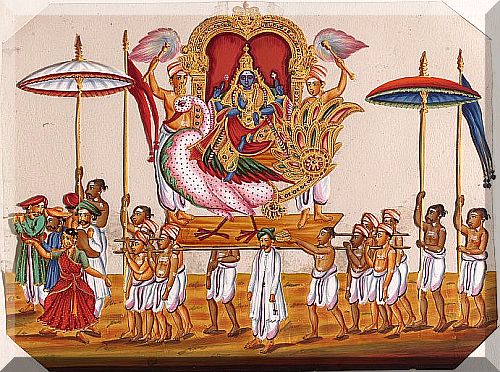
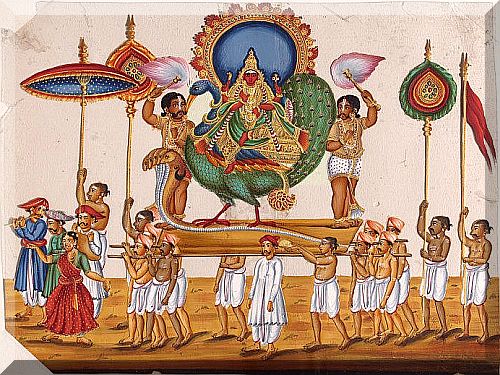
:- The fourth is the Uthsava (always made of metal); is meant for taking the idol out of the temple premises on ceremonial processions.

:- The fifth idol is Bali – bera ( always made of shiny metal) taken out , daily ,  around the central shrine when  food offerings are made to Indra and other devas, as well as to  Jaya and Vijaya the doorkeepers of the Lord ; and to all the elements.

To this, sometimes another icon is added for daily worship, special rituals, and processions and for food-offering, it is known as Bhoga-bera.

These five forms together make Pancha bera or Pancha murti.  But, these different icons are not viewed as separate or independent deities; but are understood as emanations from the original icon, Dhruva–bimba.

[There is also a mention of A Karma- bimba, which , in effect, is a proxy image of the main Icon; and , it  is used for a variety of practical purposes. The life force (Prana) from the main Icon is transferred into the karma bimba for a short duration for serving the particular purpose. Thereafter it is transferred back into the main Icon. These karma-bimbas have to correspond, in every way, to the iconic forms of the Mula-bimba or  the Dhruva-bera. These relate to the disposition, attributes, postures and other iconographic features of the Dhruva-bera.

karmārcā sarvathā kāryā mūla-bimba anusāriī | Viśvaksena Samhita 17; 11.

But, in terms of their size: the karma-bimbas should be either a quarter, a third or half of the height of the Mula-bimba.

Mūla-bimba samucchrāyā dvidhā vāpi tridhāpi va | caturdhā vā savibhajya eka bhāgena kalpayet || utsavārcā tad ucchrāyā dvidhā vāpi tridhāpi vā | caturdhā vā vibhajya eka bhāgena parikalpayet || īśvara Samhita 17; 242, 243 || ]

[One of the few cases (that I am aware of) where the principal deity is taken out of the sanctum for procession, is that of Lord Jagannath of Puri. Such images are regarded chala-achala (both movable and immovable)]

According to Vyuha -siddantha of the Agamas, the dhruva bera which is immovable represents Vishnu (Vishnu-tattva); and it symbolizes Para, the transcendent one (Vishnu). The kouthuka is bhoga (worship idol) representing purusha (personification of the Supreme), Dharma and Vasudeva. The snapana is ugra (fearsome aspect) represented by Pradyumna or Achutha. The uthsava bera is vaibhava (the resplendent) representing Jnana (knowledge), truth (Sathya) and Sankarshana. And, the Bali bera is antaryamin (one who resides within) representing Vairagya (spirit of renunciation) and Aniruddha.

And again it is said, Purusha symbolized by Kautuka-bera is an emanation of the Dhruva-bera. Satya symbolized by Utsava-bera emanates from Kautuka-bera. Achyuta symbolized by Snapana-bera emanates from Utsava-bera. And, Aniruddhda symbolized by Bali-bera emanates from Bali-bera.

The symbolisms associated with the four murtis (chatur-murti) are many; and are interesting. The four are said to compare with the strides taken by Vishnu/Trivikrama.  The main icon represents Vishnu who is all-pervasive, but, does not move about. When the worship sequences are conducted, the spirit (tejas) of the main idol moves into the Kautuka,-bera, which rests on the worship pedestal (archa-pitha). This is the first stride of Vishnu.Again, at the time of offering ritual bath, the tejas of the main idol moves into the Snapana-bera which is placed in the bathing-enclosure (snapana –mantapa). This is the second stride taken by Vishnu. And, the third stride is that when the Utsava-bera is taken out in processions. This is when the tejas of the Main idol reaches out to all.

In Marichi’s Vimana-archa-kalpa the five forms, five types of icons, the pancha-murti (when Vishnu is also counted along with the other four forms) are compared to five types of Vedic sacred fires (pancha-agni): garhapatya; ahavaniya; dakshinAgni; anvaharya; and sabhya. These in turn are compared to the primary elements (earth, water, fire, air, and space). And, the comparison is extended to five vital currents (prana, apana, vyana, udana and samana).

Further it is explained; the Vaikhanasa worship-tradition retained the concept of Pancha-Agni, but transformed them into five representations of Vishnu (pancha –murthi): Vishnu, Purusha, Satya, Achyuta and Aniruddha. And, that again was rendered into five types of temple deities as pancha-bera: Dhruva, Kautuka, Snapana, Utsava and Bali.

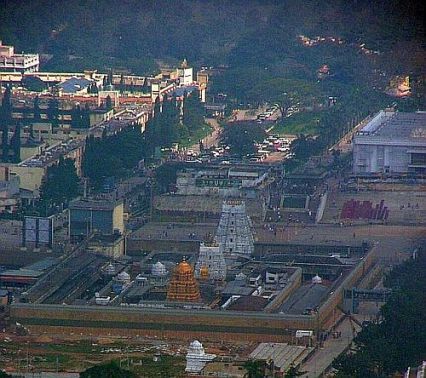
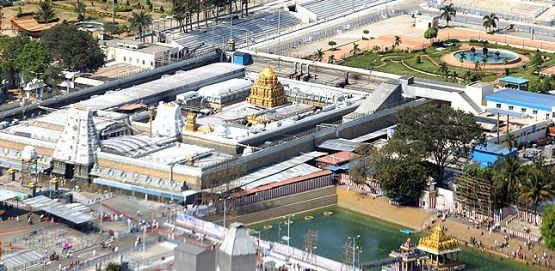
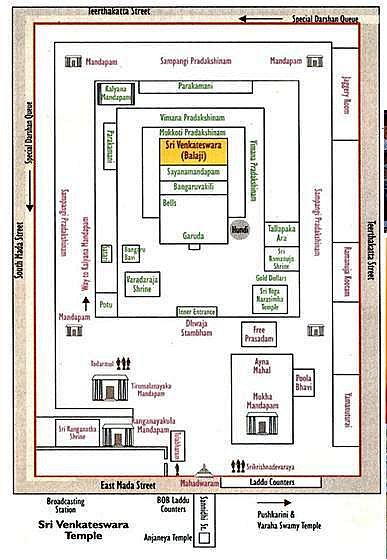
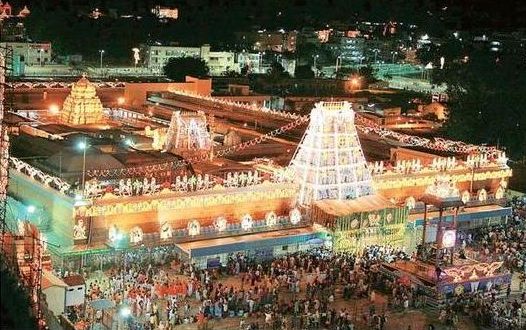
venkateswara

Let us, for instance, take the case of the idols in the shrine on the hills of Tirumala. The practices at the Tirumala temple are slightly at variance with the standard procedures, perhaps because the temple predates most of the other temples in South India and that it has a tradition of its own.

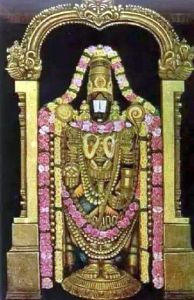
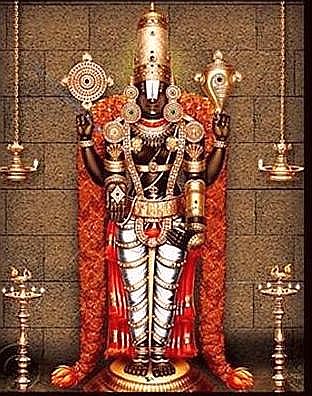
The dhruva bera at the Tirumala shrine is of course the magnificent and most adorable image of the Lord made of hard-black-stone; and has a recorded history of about two thousand years. He is addressed as Sri Venkateswara, Sri Srinivasa and by host of other names. (Let’s talk more about the dhruva bera, towards the end of this post).

It is said that around the year 614 AD, the Pallava Queen, Devi Samavai (also known as Kadavan-Perundevi), donated an almost (but not exact- as it holds the Sanka and Chakra ) replica of the dhruva bera, made of silver. In terms of the Agama texts, this image is called kouthuka bera; but in the Tirumala shrine it is called Bhoga Srinivasa., In Tirumala , the kauthuka   serves as snapana bera too  (that is, the one to which ceremonial bath service is rendered). This image has come to be  known as Bhoga srinivasa; perhaps because the other services such as the daily ceremonial bath and Ekantha seva that are due to the dhruva _bera are rendered to it. There is a six cornered Vaishnava chakra (mandala)- in the shape of two inter placed equilateral triangles –  placed at the foot of the kauthuka, representing the six virtues of knowledge (jnana), abundance (Aishvarya), power (shakthi), strength (bala), resplendence (tejas) and valor or virility (veeerya). The kauthuka is placed right in front of the Lord’s foot stool (paada pitha) and is linked to the dhruva_bera through a string with strands of gold, silver and silk. It is ever linked to the dhruva bera and is never brought out of the antarala (bangaru vakili). For that reason it is also addressed as sambhandha-sutra-kauthuka-murthy. 

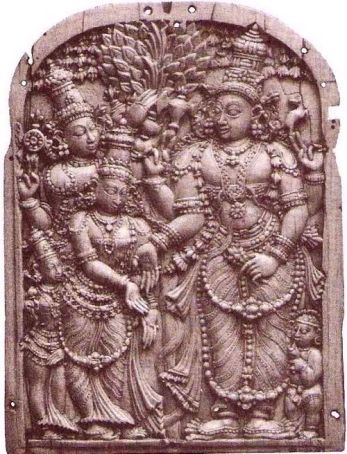
The Uthsava_bera at Tirumala shrine is named Malayappan, the earliest reference to which is found in an inscription dated 1369 AD. This idol might have entered into the temple regimen with the rise of the Pancharathra School of worship. Malayappan is a very skillfully crafted, beautiful image, made of panchloha, standing three feet tall on a pedestal of fourteen inches. It does not greatly resemble the dhruva_bera. Yet, it has a very pleasing disposition and is modestly ornamented. His consorts Sridevi and Bhudevi (of about twenty-nine inches height) are on his either side. All services, processions and celebrations conducted outside the sanctum are rendered to Malayappan.

The Bali bera in Tirumala shrine is addressed as Koluvu srinivasa. After the rendering the ceremonial food service to the dhruva_bera, offerings are made to the bali_bera who accepts it on behalf of the basic elements in nature , the host of spirits guarding the temple and other minor deities. A unique feature of the bali_bera in Tirumala shrine is that, it seated on a golden throne placed in Snapana Mandapam,  presides over the formal court summoned at the commencement of the day, where the day’s almanac is read out, and where the accounts of the previous day’s collections at the Srivari hundi are submitted. This is done is Snapana Mandapam before the dusk ;and, in Ghanta Mandapam after dawn. The traditional distribution of the daily remuneration, in the form of food grains and provisions, to the temple priests and attendant staff takes place in the presence of koluvu_srinivasa. It is not clear how this practice came into being at Tirumala.

The other bera in the Tirumala temple is the Ugra Srinivasa, which apart from the dhruva bera is perhaps the oldest idol in Tirumala shrine. But, it has a rather sad history. The earliest reference to this idol is in an inscription dated 10th century. Ugra Srinivasa was used as the Uthsava murthy till about 1330 A.D, when a fire broke out in the temple; and thereafter it was replaced by Malayappan. The Ugra Srinivasa no longer serves as the uthsava bera and it is never bought out of the temple after sunrise; except on a single occasion in a year (utthana dwadasi in karthika month-Kaisika Dwadasi ) that too well before the sunrise. It is feared that if the sunrays touch the idol, it would spark fire in the temple premises.

The iconography of Sri Venkateshwara in the Tirumala temple:

There are no known descriptions or specifications of the iconography of the Sri Venkateshwara idol in any texts of the Shilpa shastra. Till about the Vijayanagar period there were no temples of Sri Venkateshwara, outside Tirumala, Tirupathi and Mangapura regions. The idol does not also fall within the interpretations of any of the known schools of architecture such as Pallava, Chalukya, and Chola etc. That might be because the image of Sri Venkateshwara predates all such schools.

The sanctum at Tirumala is eka murthy griha a sanctum housing a single deity; Sri Vekateshwara is standing alone, not accompanied by his consorts. The icon is made of hard- black – polished stone (often described as saligrama shila) .Though the precise measurements of the image of the deity cannot be ascertained, it is said,  it stands  more than  six feet in height,  with the Kirita , the crown,  measuring about twenty  inches high; and  the idol is mounted  on a pedestal of about eighteen inches. The pedestal with lotus motif is almost at the ground level. The total height of idol is estimated to be a little more than eight feet (A person of normal height with arms raised just falls short of reaching the top of the idol’s crown) .

The idol, crafted with great skill, is wonderfully well proportioned and is very pleasing to look at. It has four arms though its two upper hands are always kept covered (for whatever reason). Of the other two hands, the right hand is in Varada mudra, in a posture of benediction, blessing the devotees. The left hand is almost near the left knee in Katyavalambita mudrawith the thumb almost parallel to the waist, as if to assure that the mire of the samsara , the mundane existence , is only knee deep for those who submit to him and seek salvation.

Let’s discuss  some  specific forms of iconography in the next segment.

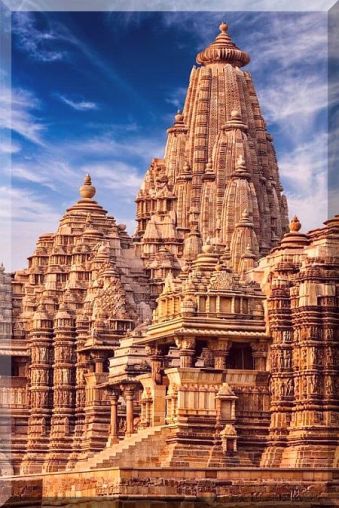
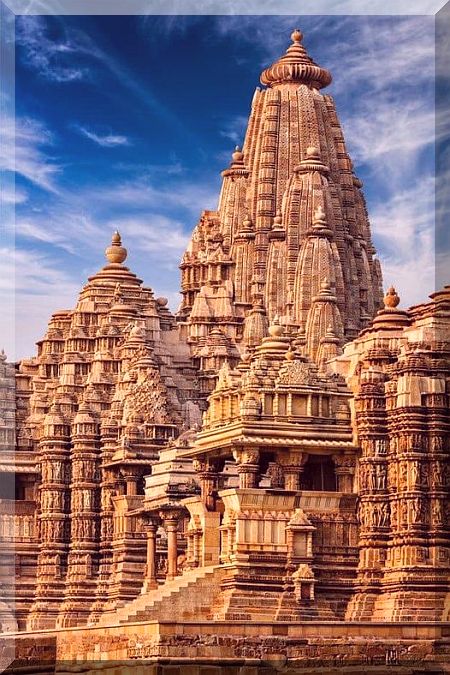
Khajuraho tempie

Iconography continued in the next part…>

References:

Shilpa Soundarya by KT Pankajaksha

The Lord of Seven Hills by Prof. SKR Rao

Line drawings of kirita and ornaments

By the renowned Shilpi and Yogi Sri Siddalinga Swamy of Mysore

Other Line drawings are from Shilpa Soundarya

Other pictures are  from internet

 
45 Comments

Posted by on September 9, 2012 in Natya, Temple Architecture


Tags: ,

Temple Architecture – Devalaya Vastu – Part Five (5 of 9)

Measures and proportions

The structural harmony, the rhythm and a fine sense of proportion is the hall mark of Indian temple architecture. It not merely resolves the contradictions but also expresses harmony by encompassing all contradictions, transforming into pure and uncompromised details of structure. The aim of a proportional system, meaning not merely symmetry, is to manifest a sense of coherence and harmony among the elements of the temple and it’s whole. The proportional harmonization of design, therefore, is of utmost importance in the construction of a temple. It is believed that the power and purity of the structure radiates from its exact proportions and measures as specified in the texts. It is also believed that a meticulously well constructed temple radiates peace and joy; and ensures the welfare of the world and its people.

Without harmony, symmetry and proportion there can be no principles in the design of any temple. This is analogues to the precise relation between the features and organs of a well proportioned, good-looking person.

The ancient texts, therefore, insist on a high degree of precision in their measurements. The standard text Mayamata  mentions “Only if the temple is constructed correctly according to a mathematical system can it be expected to function in harmony with the universe. Only if the measurement of the temple is in every way perfect, there will be perfection in the universe as well.”

The Hindu temple is a feast of a variety of visual aspects, and wherever one engages one of them, entering a doorway, circumambulating or approaching the inner sanctuary or worshipping there– one is accessing an aspect of the whole.

The rules of Vastu-shastra render beauty, structural stability and quality of spaces by virtue of light, sound and volume management. They also evoke in the devotee an attuning of his person to its structure and ambience.

The lighting of spaces inside a temple is orchestrated such that the mukha mantapa (i.e. entrance porch) is semi-open with maximum light. If the directions and measurements are followed correctly the sun rays should fall into the mantapa for at least six hours (from 9.00am to 3.00pm, if the sun rise is at 6.00am). The Sabha Mantapa (for worshippers) has moderate light with few openings.   Garbhagirha with a single opening in front of deity allows light only on deity; and, is illumined by natural oil lamps, placed on either side of the deity. The net effect of this arrangement is that it projects the images against the dark wall. Further, the surroundings of the Garbhagriha are modest in sculptural details. These help the worshippers to keep away the distractions and to focus their attention on the deity.

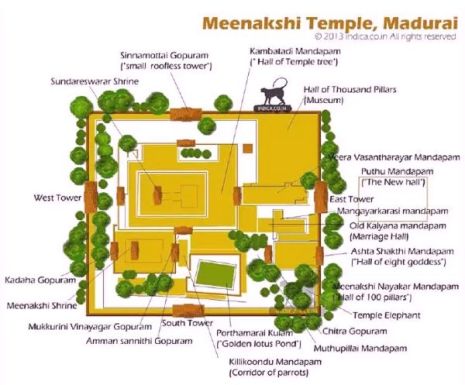
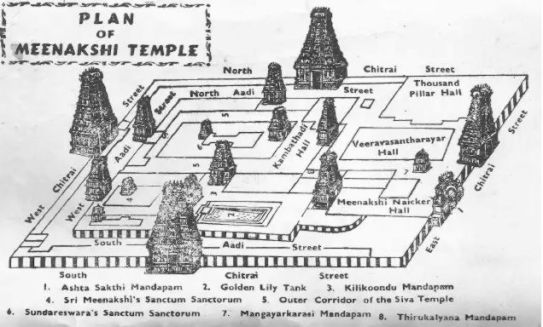
Echoes are avoided by a clever manipulation of open spaces, elevations and designs in the structured areas. Absolute quiet is ensured in the Sanctum vicinity. The Shilpis, in some cases (Meenkshi temple, Madurai; Sundareshwara temple Tirchendur; and the Vijaya Vittala temple of Hampi- Vijayanagar) displayed remarkable ingenuity in sculpting “musical” pillars, which when struck at precise parts, produce the seven swaras (octaves).

As regards the volumes, every part of the temple is rigorously controlled by a precise proportional system of interrelated measurements, maintaining the fundamental unity of the architecture and sculpture.

The ancient shilpis used a great degree of precision in their measurements. Much of this system is followed by the present shilpis too. An interesting feature of these systems is the standard unit of measurement; the smallest unit mentioned is the anu or the particle, which is hardly perceptible. The anu measure was employed for extremely delicate or intricate or the most vital aspects of a sculpture; for instance, the eyes and facial features of the image of presiding deity; or in the amaziningly  delicate and minute carvings of the Hoyasla images. The norms and measures specified in the Southern texts, it is said, are still in use. These measures are in two categories; one for delicate and intricate work and the other for normal structures.

Look at the table of measurements for minute and delicate carvings.

Eight anus (particles) = one nulu (breadth of a fine cotton or silk fiber),

Eight nulu = one hair (breadth of horse hair),

Eight hairs = one grain of sand,

Eight grains of sand = one mustard seed,

Eight mustard-seeds = one bamboo seed,

Eight bamboo-seeds = one angula.

The angula (1.875 cms) and the hasta (cubit, 45 cms) are the units that are normally used for deriving the dimensions, proportions, the height and other details of a sculpture. The Danda (four cubits) used for measuring less-delicate or lengthier structure is equivalent to 180 cms.

One Hastha = one cubit= 45 cms;

Four Hasthas = one Danda= 96 angulas = 180 cms.

One Hastha =24 angulas = 45 cms.

Thus one angula = 1.875 cms.

The old Sanskrit texts too mention a set of measurements. According to them Anu or paramanu, the particle, was the smallest measure.

8 anus = one ratha renu (grain of dust);

8 ratha renu = one valagrasa (hair end);

8 valagrasa =One grain of yava;

4 yavas = one angula;

12 angulas = one vitasta or Tala (span)

2 Vitasta or Tala = Hastha (cubit) = 24 angulas

26 angulas= Dhanurbhagha (handle of a bow).

4 hatas = One Danda;
8 Dandas = One Rajju (rope)
1000 Rajju = One Yojana

**

The  Brhat-Samhita of  Varaha Mihira (Ca. Sixth Century CE), under the Chapter 58 – Prathima Lakshana Adhyaya  gives another version of the Iconometric  measurements :

1.The fine particles moving in the rays of the sun coming into a room through the window opening are known as atoms.

2. Eight atoms make a hair’s end; eight hair’s ends make a nit; eight nits make a louse; eight lice make a barley seed; eight barley seeds make an inch, which is known as a unit of measure

8 atoms=1 dust particle ; 8 dust particles=1 tip of hair; 8 tips of hair=1 nit; 8 nits=1 louse; 8 lice = 1 barley grain;8 barley grains =1 digit

****

The proportions of the head-trunk-arms-legs of images; and also their finer specifications like nose, nail, ears and their shapes are specified in the texts. Generally: it is dasatala (ten talas) for the height of image of male deity, navatala (nine talas) for his consort and astatala (eight talas) for bhakta. These are not absolute measurements; but are meant as guidelines to maintain proper proportions.(We shall discuss more about these aspects in the part dealing with Temple Iconography.)

Further, the Vastu believes that every unit of time vibration produces a corresponding unit of space measure; and derives that the time is equal to space. This rhythm of time and space vibrations is quantified in terms of eight and as multiples of eight.  According to the Vastu, at the subtle level the human form is a structure of eight spatial units apart from elements  like the hair, kneecap and toe nails, each of which measures one-quarter of the basic measure of the body and, when added on to the body’s eight units, increases the height of the total form to nine units. Traditionally, these nine units are applied in making sculptures of gods.

Similarly, the lengths, the breadths the heights of various elements of the temple too are related to each other by certain ratios. These lend esthetic appeal and stability to the temple structure. For instance, it is said, by restricting the height of the tower, Shikhara, to twice its width at the base, the weight of the tower is contained within itself. Further, as the size of the pada (bay, distance between two pillars) increases, the cross section of pillars also increases in size and width of beam has to be exactly same as that of the pillar.

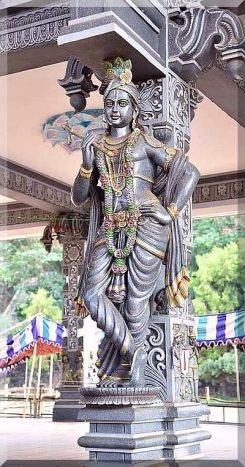
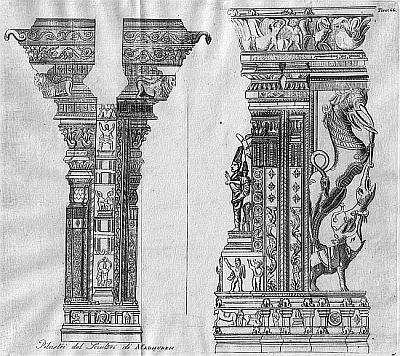
Krishna Pillar

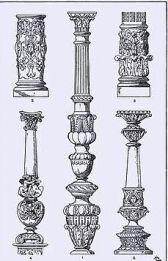
Rám Ráz in his Essay on the Architecture of the Hindús describes seven kinds of Pillars (Sthamba) in relation to the thickness of the walls, the strength and breadth of the base, and the number of floors in the building. According to Rám Ráz :

When the base is taken as a reference point for the length of a pillar, than it may be 1¼, 1½, 1¾ or 2 times the height of the base. In total there are 12 varieties of the height of a pillar. For the pilaster (in other words a wall-pillar) it is 3, 4, 5 or 6 angulas. The diameter of a pillar is 2, 3 or 4 times the width of the pilaster.

The pillar has a constructive character. It must be able to withstand the forces in the building. When the amount of floors in a building is taken as a reference points for determining the height of the pillars, then the ground floor pillars of a twelve storey building are 8½ cubits in height. By subtracting one span for each storey a height of 3 cubits is obtained for the pillars of the top storey. The diameter of the ground floor pillars of a twelve storey building is 28 digits. By subtracting two digits for each storey 6 digits are obtained for the diameter of the pillars of the top-storey.

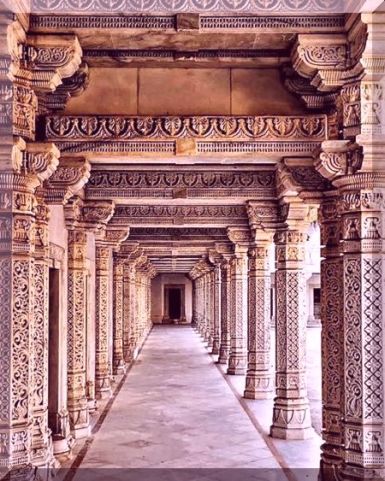
Pillarrs 2

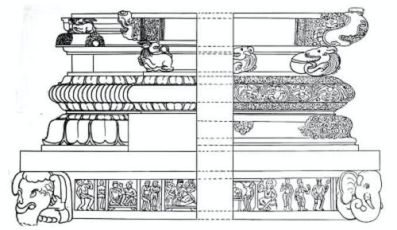
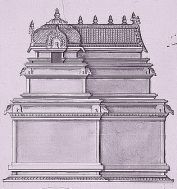
The proportions of the Adhisthána or base must be related to those of the building. In response to that, the rest of the pillar relates to the base of the pillar. (The Mánasára uses the base to define the pillars. The Mayamatam uses the amount of floors in a building to define the height of the pillars.)

As regards the form or shape of the pillars, Rám Ráz states :

There are 6 forms of pillars, namely: square, pentagonal (5 sides), hexagonal (6 sides), octagonal (8 sides), 16 sided and circular. These shapes are uniform from bottom to top, but the base and top may be square.

The top of a pillar consists of 7 elements : The bracket capital, the dye (featuring a human figure), the abacus, the bell capital, the support, the lotus and the band ornamented with garlands.

Intercolumniation

It is the distance between two pillars. For the intercolumniation, two different approaches can be used.

The first one is relative to the rest of the building: “The intercolumniation may be either two, three, four, or five diameters; it is measured in three ways, first from the inner extremity of the base of the pillar to that of another; secondly from the center of the two pillars, and, thirdly from the outer extremities of the pillars including the two bases.”

 The second approach to intercolumniation is not relative to the building. In this approach the intercolumniation consists of 9 different possibilities. These are defined by 2 or 4 cubits, where each time 6 digits can be added. The architect can chose all of the 9 possibilities. Here it doesn’t matter what its type is, but the disposition of the pillars has to be regular, because otherwise it is believed to bring destruction upon the building and upon its site.

ferrario2

The size of the structure will also determine the various kinds of building materials to be used at different stages of the construction. They also help to control the proportions of the dimensions of the temple. These norms carry shades of religious intentions too; the set of six formulae or Ayadivarga viz., the Aaya, Vyaya, Yoni, Tithi, Vaara and Nakshatra are applied by the Acharya to derive the proper orientation and dimensions of the structure. (More of Ayadivarga in the final part.)

devalaya0004

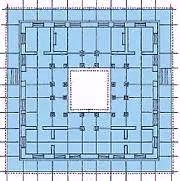
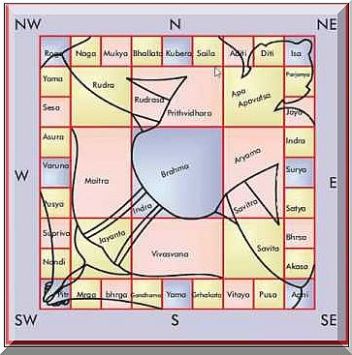
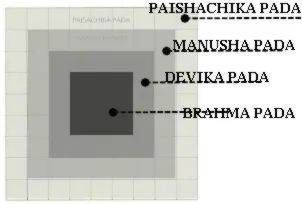
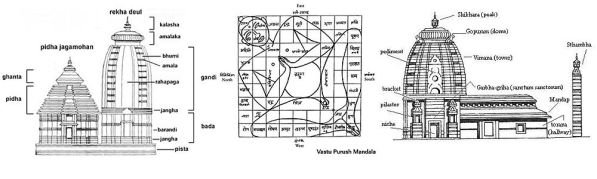
The Vastu Purusha Mandala of the temple projects the temple in two main sections: the ground plan and the vertical alignment. The square, the rectangle, the octagon and the pentagon patterns drawn in the Mandala relate to the horizontal section or the ground plan. The subdivisions of the ground plan detail the Brahmasthana (the main shrine and smaller shrines) and the Mantapas (pavilions). The vertical alignment consisting the pyramid, the circle and the curve are meant for designing the Gopura (entrance ways), the Vimana (the structure above the main shrine) and the prakara (the walls).

How these designs of certain measurements and proportions are translated into three dimensional constructions, is really interesting.

Hindu temple construction is strictly based on a complex system of measurements and proportions. These proportions control every aspect of a temple’s design, from its width and height to the size of its doorways and moldings.  There are a number of prescribed methods. Let us look at just two of them.

A. This relates to the construction of the Garbhagriha (sanctum) and the Vimana or Prasada on top of it.

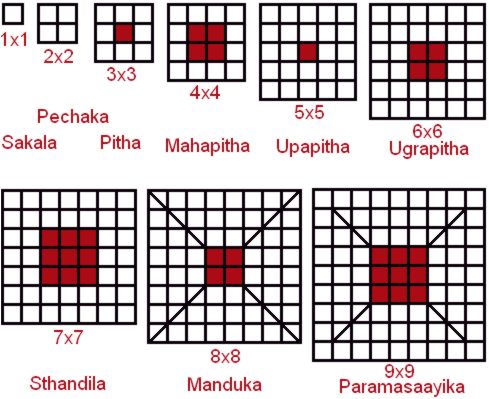
In this method, the square of 4 (16) and the square of 8(64) are considered auspicious. All the main horizontal as well as vertical proportions are with reference to either of these numbers (mulasutra).The area of the Vimana (the prasada or the tower above the sanctum) is divided into 16 squares (maha-pitha) or 64 squares (manduka), as the case may be; in which case the width would be 4 or 8 units.

If the width of the Vimana is 4, then the width of the sanctum would be 2 units; the height of the Vimana would also be 4; and the base of the Vimana would be a cube. The Sikhara on top this cube would be twice its height (that is, 4×2).The cube and the Sikhara would together rise to a height of 12 units. This proportion builds a relationship between the vertical and horizontal extents of the other parts of the temple.

In case the width of the sanctum is 8 units, The total height of the sanctum with Sikhara would be three times the width of the sanctum(8×3), of which the height of the Sikhara would be 2/3 the total height.

B. In this method, the size of the sanctum and the Dwajasthamba is determined by the height of the image of main deity in the sanctum. The size of a temple is always a fixed multiple of the height of image of main deity.

The normal height of a man is taken as six feet; and the sanctum would be in the shape of a square of its inner length and width, of six feet. The width of the sanctum walls would be two feet. The outer measurement of the sanctum would be 10 feet on each side.

A mantapa, in front of the sanctum, would have certain special features. The inner length and breadth of a mantapa should be twice that of the sanctum. For instance, in this case, the outer side of the sanctum is ten feet; and therefore the inner side of the Mantapa should be 20 feet, in width. This is achieved by extending the face (door) side of the sanctum on either side to form the inner dimension (20’) of the Mantapa.

If the directions and measurements are correctly followed the sun rays should fall into the mantapa for six hours (from 9.00am to 3.00pm, if the sun rise is at 6.00am).

For a sanctum of this size, the idol, in standing position, should be six feet tall. If the idol is less than six feet tall, its pedestal should be raised to obtain the required height. The idol should be installed exactly at the mid-point of the chosen direction (usually facing east).

The Dwaja –sthamba should be perpendicular and placed directly opposite to the idol.

A line drawn at an angle of 22 ½ degrees from the mid-point between the brows of the idol should cut the top of the Dwajasthamba. The height of the Dwajasthamba thus is related to the to the height of the image. Some scholars say, this perhaps is relates to the axis of the earth which makes an angle of 22 ½ degrees with the sun.

Sometimes, a hole is made in the roof of the mantapa, at the point where the imaginary line drawn from the idol emerges out of the roof of the mantapa, on its way to reach the top of the Dwajasthamba. Thus, it is ensured that the mid point between the brows of the idol, the hole in the roof and the top of Dwaja sthamba are all aligned along one straight line.

The line when extended further from the top of the Dwaja sthamba should touch the Kalasha on top of the Gopura.

Thus, the distance and the height of the Gopuram get related to the height of the idol and the Dwajasthamba.

***

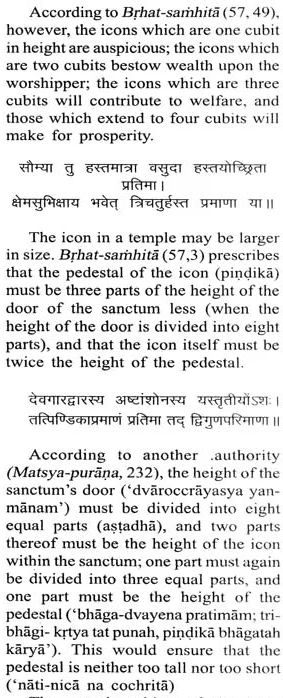
Mention is also made of other methods for determining the size of the Dhruva-bhera (the main idol) and its position/placement in the Garbhagriha . According to this method, the icon is considered to be made of three parts.; the con proper being two parts ; and, the pedestal making up the third part.

The whole length of the Icon including pedestal should be 7/ 8th s of the height of the doorway. (i.e. height + 7 x 8 = doorway). If the Icon is made 2 meters in height then the following measurements are calculated;

doorway = 2 .28 mtrs high x 1.14 mtrs in width.
Sanctum = 4.57 mtrs square
Vimana = 9.14 mtrs high
Mandapa = 9.14 mtrs wide
Plinth = 3 mtrs high

***

Prof. S K Ramachandra Rao , in his The Encyclopedia of Indian Iconography , writes :
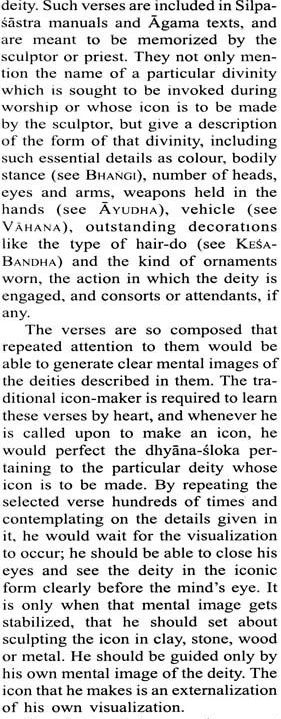
Dhyana sloka extract 3

***

As regards the position of the Dhruva-bhera within the Garbhagriha :

The Garbhagriha  is divided into two  halves. One  half should again be sub-divided into 10 parts.

garbhalaya

The following is generally followed for positioning of the deity :

Shiva Linga in the 10th part i.e. center
Brahma is placed in the 9th part.
Vishnu is placed in the 8th part.
Shanmuga is placed in the 7th part.
Sarasvati in the 6th.
Surya in the 5th.
Ganesha in the 4th.
Bhairava in the 3rd
Shakti in the 2nd place from the rear wall.

[ The Bruhat-samhita of Varaha Mihira (Ca.6th century) mentions :

53. The height of the Linga shall be equal to the length of the circumference; the lower one-third of the Linga shall be four-sided, the central third shall be eight-sided; and the upper third shall be round.

54. The lower part of the Linga shall be planted into the ground; the middle part shall be made to fit the hole in the pedestal. The breadth of the pedestal all-round the hole shall be of the length of the portion of the Linga above]

Temple as Purusha negetive

The actual construction process of a temple can be divided into three steps. The first is the planning of the temple by architect, second is the carving of different parts and the third is assembling the parts.

In the first stage, the architect prepares a list of all the parts that go into the details of the temple; like the figures, pillars, beams, and brackets etc. These parts are usually composed of several elements. For example, a pillar is made of at least five parts, while the dome is made of several units. This is one of the reasons, it is said, why the temples do not normally collapse in case of earthquakes or cyclones; as its parts are not joined rigidly (say by materials like cement) but can vibrate within the surrounding structured space.

In the second stage, the teams of assistants of the Shilpi carve the parts and segments according to the temple Acharya’s and Shilpi’s drawings, designs, specifications and guidelines.  The parts thus got ready are transported to the site. And, at times the transportation to the site, itself, becomes a huge task. For instance, it is said that a four km long ramp was constructed to transport and place in position the dome of the Brihadishwara temple in Tanjore.

The stability of the temple structure is attributed to its principles of unity, harmony, balance and distribution of weight. It is said, if one member of this family breaks, the unity, peace and stability of the family is sure to crumble. . Hence, no member moves from its place, and holds the structure together even in the face of destruction all around. These aspects are ensured during the third stage.

The third stage is the assembling of the readied parts i.e. the actual construction of temple. The various elements and parts of temples are interlocked to hold in position. All the parts have mortise and tenon joint for ensuring strength; and a hole or slot is cut into each piece of readied part, for a projecting part tenon of the adjacent part to be inserted into the next. These mortise and tenons not only hold the parts their positions securely but also allow space for the stones to expand in heat or even to vibrate modestly.

The third stage and the second stage have to be well coordinated in order to take care of precise alignments and possible corrections. Though this stage, inevitably, means the slowing down of the construction pace, it is said, the Sthaphti or Sthalapahi, the one who supervises the actual construction process on site, takes extra care to ensure precise positioning and alignment of each part and segment; and to meticulously follow the overall proportion, stability and visual appeal, as specified and envisaged in the Vastu mandala and the construction plans.

The size and the nature of the structure will determine the various kinds of building materials to be employed at different stages of its construction. Generally the use of iron, considered the crudest of metals, is strictly avoided within the temple structure, as iron tends to get rusty and endangers the stability and the life of the structure. The stone which has a far longer life and is less corrosive, is the major building material employed in temple construction. (There are elaborate methods for testing and grading the stones; and more about that in the final part) The main structure and the dome are invariably constructed of tested stone.

The Building materials like stone, brick, mortar, wood, etc., are selected for the main body of the temple, whereas elements like gold and silver are be used for final ornamentation. Marble is not used in Southern structures. Materials like simulated marble, plastic and asbestos, strictly, are not acceptable building materials. Only organic materials are used in temple architecture. The traditional Indian temples of stone, it is said, are designed to last for 800 years unlike RCC structures which are guaranteed for 80 years. Incidentally, the Ayadi aspects are worked out to ensure longevity of the temple.

Indian architecture is a logical and an intellectual approach to how the vision of the architect, governed by the prescriptions of the texts, should be realised. It has clear rules on how a building should be constructed. It starts with defining the cardinal directions of North, East, South and West. These directions form the basis for designing the building; as also in erecting the walls of the temple.

The temple is based on the faith that it is a reflection of the Universe, which follows cyclic processes of creations and destructions. Therefore, the temple has also to project that cyclical notion. For that reason, its design grows from unity to multiplicity; simultaneously, tending back to unity through a process of dissolution and fusion. In this way, a temple is to be rendered cyclical, in its nature. These cycles can occur at different times, at different rates, and in different parts of a temple. In order to achieve such effects, several architectural tools are employed.

Some of the tools that could help the Indian architect to design a temple; and, for achieving the pattern of its growth and of movement, as detailed by Adam Hardy in his Indian Temple Architecture: Form and Transformation (page 26) , include :

– Increasing aedicularity (principle of articulating the temple exterior as a matrix of inter connected shrines)

 – Aedicular density, meaning to move shrine images to get closer together

– Proliferation and fragmentation, meaning the repetition of a given type of designs and patterns culminating in a grand architectural composition. And , fragmentation is the breaking up the whole into minor  individual designs.

– Central emphasis: the cardinal axes of the Vimana as also those of the Mantapa become increasingly dominant, at various levels

– Using an increased sense of movement through various patterns which convey a sense of emergence and expansion

 – Staggering, where the forms become progressively more staggered creating certain visual architectural effects; say, from Vimana or Mantapa as a whole, through pillars to the moulding of the pilasters.

 – Continuity and alignment. This ensures horizontal continuity with the vertical structure; say, with each Tala (or the phase or the level) of the Vimana rising one over the other

 – Abstraction. Here the shrine-imagery, particularly in the shapes of moulding, develops away from the depiction of timber and thatch construction. The temple-structure is transported from the non-essentials towards  its idealized form.

– Assimilation.  The elements or details, which, are at first  scattered are systematically composed and assimilated with each other  into a framework that  finally defines the temple architecture

Thus, the temple-construction, which generally follows an evolutionary process combines in itself the stages of differentiation and fusion; creation and dissolution; and, emergence and mergence or blending . Although such dynamic processes are at once conflicting and complimentary, they all are harmonized in a meaningful composition to achieve the final and the idealized image of the temple.  The process is also analogous to the emergence from the unity of the the seed to the diversity of the tree with many branches.  

dravidian-architecture-with-exampleshist-teamwork-23-638

Some essential aspects of Temple Structure

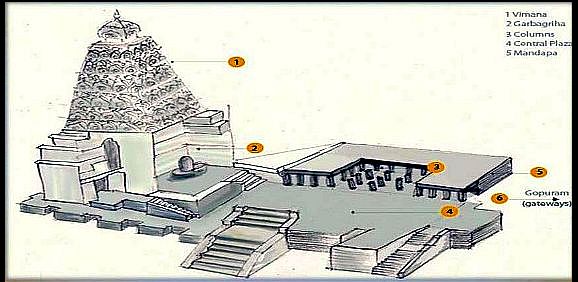
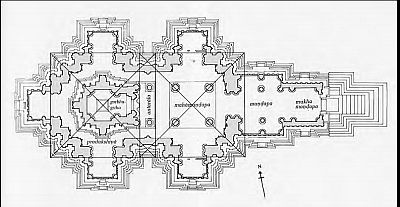
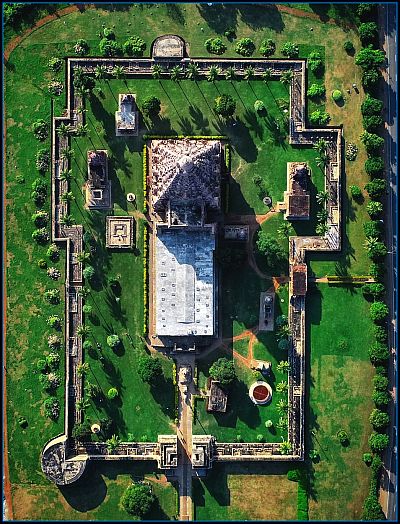
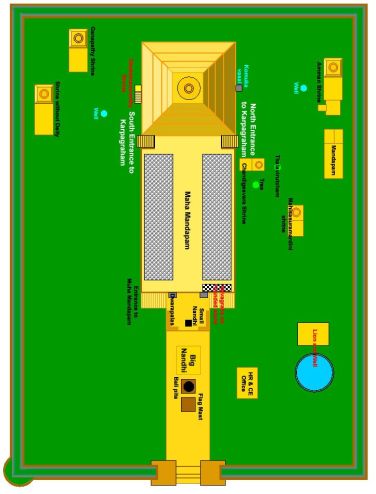
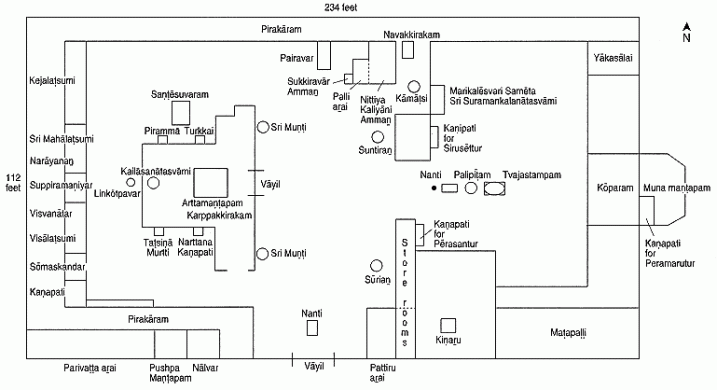
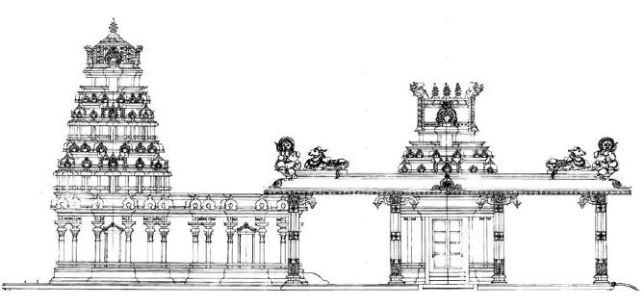
A typical South Indian temple has a certain fairly well defined features and a generally accepted layout. The most important structure of a temple is the garbhagriha or sanctum sanctorum which houses the idol of the presiding deity.

The Garbagriha is followed by four types of mantapas or pavilions. Mantapa means any roofed, open or enclosed pavilion (hall) resting on pillars, standing independently or connected to the sanctum of the temple.

Screen Shot 2013

The first of the mantapas is the antarala (sometimes called sukanas or sukanasi or ardhamantapa), a narrow pavilion connecting the gharbhagriha and the navaranga.  It usually will have niches in the north and south walls, occupied by a deity, with attendant divinities in secondary niches flanking the central niche.  In a few temples the antarala serves as the navaranga too.

The next mantapa is nrttamantapa or navaranga, is a big hall used for congregational services like singing, dancing, recitation of mythological texts, religious discourses and so on. The navaranga will usually be on a raised platform and will have nine anganas (openings) and sixteen pillars.

This is followed by Sanapana mantapa, a hall used for ceremonial purposes. This leads to mukha mantapa the opening pavilion.

mantapas

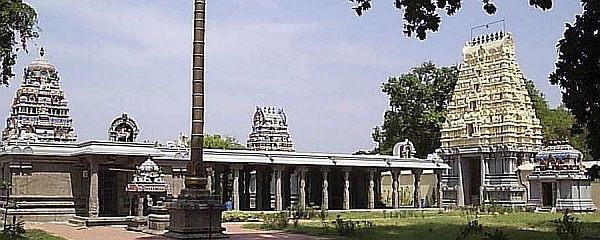
The Dwajasthamba (flag post) in front of either the garbhagrha or antarala or the mantapa is another common feature. It represents the flag post of the ‘King of kings’. The lanchana (insignia) made of copper or brass fixed like a flag to the top of the post varies according to the deity in the temple and his/her nature.

The Balipitha (pedestal of sacrificial offerings) with a lotus or the footprints of the deity is fixed near the Dwajasthamba, but nearer to the deity. Red-colored offerings like rice mixed with vermillion powder, are kept on this at appropriate stages of rituals for feeding the parivara_devatas and panchabhuthas or the elements.

A Dipastambha (lamp post) is situated either in front of the Balipitha or outside the main gate. The top of this post has a bud shaped chamber to receive the lamp.

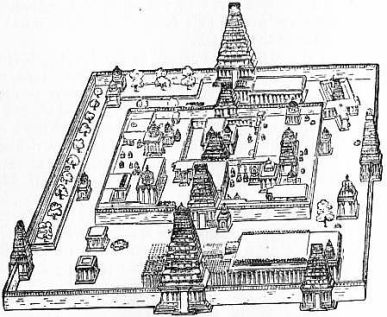
The whole temple is surrounded by a high wall (prakara) with one main and three subsidiary gates, opening in the cardinal directions. A gopura (high tower,) adorns these gateways.

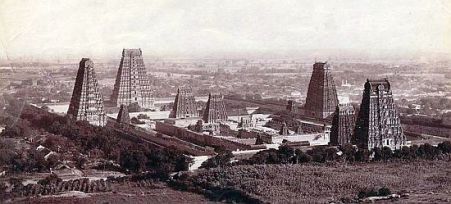
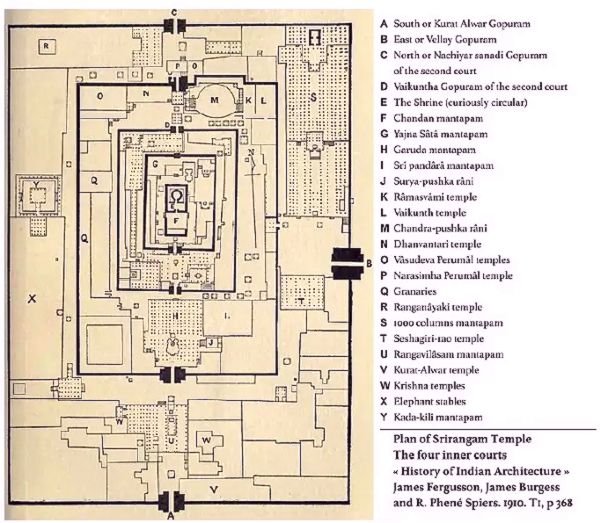
These were of course later developments; and in due course became characteristic features of South Indian temple architecture. It is said, the Agama texts provide for as many as 32 prakaras, the concentric – enclosing walls. But, they recommend five to seven as advisable, in case more than one enclosure is needed.  In many cases, the main area of the temple, plus the halls, tanks, and gardens are surrounded by a single wall (prakara) or enclosure. But many major temples  do have a series of enclosures.  As mentioned earlier the Sri Rangam temple has seven enclosing walls, enveloping the whole township.

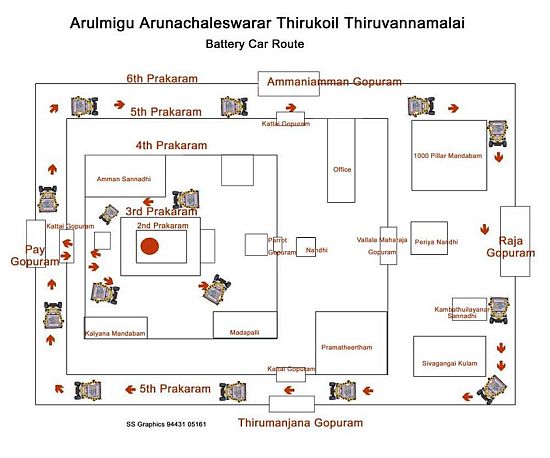
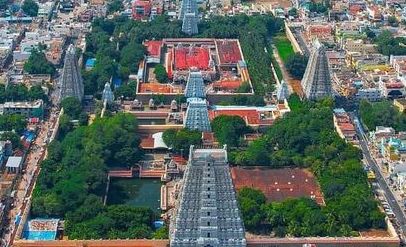
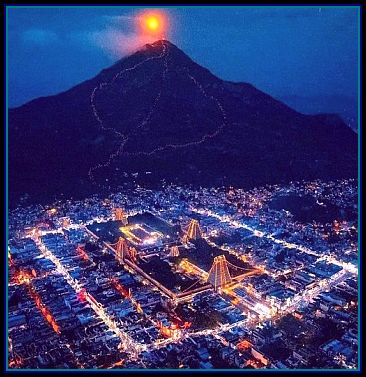
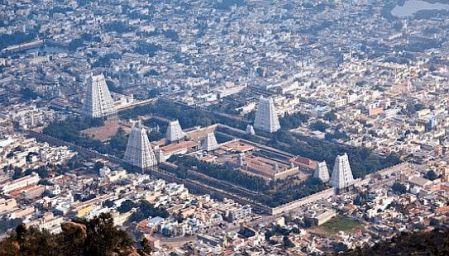
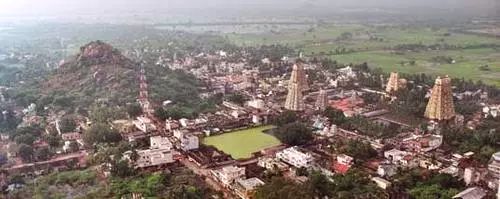
The Agama texts prescribe that each enclosure must have door-ways in all four directions. But, very few temples followed this rule, perhaps with the exception of the great temple at Tiruvannamalai. In most cases, the doorways lead from one courtyard to the next, finally  leading to the sanctum. And, it became customary, since 10th century, to erect towers (gopuras) over such gateways, though a gopura was not an essential feature of the temple per se. It is needless to mention that the prakara contributes to the security and beauty of the temple

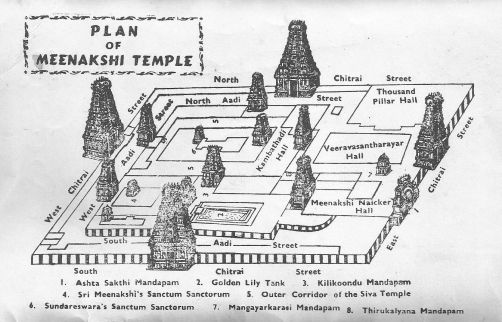
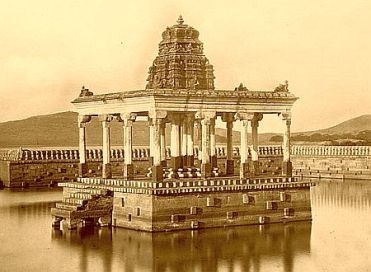
With the growth and development of the temples , their structures and details became increasingly complicated .The  structural arrangements of the major temples  became   more elaborate. The prakara in its many layers provides for a number of minor temples or shrines for the deities, connected with the presiding deity of the temple. Apart from these, the temple precincts include a yagasala, (a hall for occasional yajna or yagas), kalyana-mantapa, marriage or a general purpose hall; asthana-mantapa, where the processional deity holds court; Vahana mantapa , to store the various “vehicles” used to mount the processional deity during festivals and processions; alankara-mantapa, where the processional deity is dressed before being taken on procession; vasanta-mantapa, a hall in the middle of the temple tank used for festivals; and utsava mantapa, hall used on festive occasions. Temples will also usually have a treasury, a kitchen (paka-sala), a store room (ugrana), and a dining hall. A well or a puskarini (tank), flower garden and Ratha (the temple chariot) and its shed are the other essentials associated the temple.

The garbha-griha is encircled by the first prakara, called antara-mandala. This is a passageway, often narrow, permitting the devotees to circumambulate the sanctum in a customary act of devotion. The flight of stairs that connects the first prakara with the sanctum sanctorum is called the sopana. In front of the sopana is the main mantapa.

Around the main mantapa and antara-mandala is the second prakara (antahara). This forms a broad verandah with doorways on all four sides. The antahara leads out into an enclosure containing the main bali-pitha.

The next enclosure is called madhya­hara. Beyond this and just outside the main bali-pitha is the flagstaff (dhvaja-stambha).

The fourth enclosure is called bhayahara. The fifth prakara (enclosure) is the maryada (limit), or last wall.

*****

Let us briefly go over the broad features of some of the essential aspects of the temple.

Sanctum

The most important part  of a temple, its very heart as it were, is the garbhagrha or  the sanctum sanctorum,  the cave-like cube-shaped “womb room,” located within the Brahmasthana of the Vastu Purusha Mandala, directly above the gold box, placed earlier in the earth during the garbhadhana ceremony. Here on the altar, the deity in the Dhruva Bheru (immovable) form is installed.

According to the nature and placement of the Duruva Bheru, the presiding deity, the entrance will be determined either to North or to East of Garbagriha. The placement of other deities will also be determined accordingly.

Garbhagriha usually is a cube with a low roof and with no doors or windows except for the front opening. The image of the deity is stationed in the geometrical centre, facing the midpoint of the chosen direction. The whole place completely dark, except for the light that comes through the front opening. The name garbhagriha perhaps has reference to the devotee finding his way to this secret inner place and being reborn from it, emerging later, transformed, by grace.

***

The sixth century text, Vishnu dharmottama purna, indicates certain specifications of the sanctum. It says the idol should preferably face east; and the placement of the other deities in the temple should be in relation to the main idol.

“It is commendable to place the central door of the temple in one of the cardinal points. The height of the door should be made double its width, o king. [One should make] the image together with the pedestal on 1/8 lower than the height of the door. The image [should be] two parts [of the whole] and the pedestal a third part. It is commendable to make the width of the door equal to 1/4 of [the width of] the shrine

“The height of the door should be [that of] the deities increased by 1/8. One should make the height of the door double [its] width”.

To illustrate, if the total height of the idol is 6’.0”; the pedestal would then be 2’.0” high and the image would be 4’.0” high. The height of the sanctum door would be 6’.9”; and its width, would be 3.’4 ½ “. The width of the sanctum would be (four times the width of the door) 13’.6”. The sanctum would be in the shape of a square.

As regards the thickness of the sanctum walls (bhitti), the text seems to suggests that the walls should be 1/8 the width of the sanctum. Applying this norm to our illustration   , the walls of the sanctum would be about three feet thick. (It is a bit confusing, here. I am not sure, if the portion relating to the sanctum walls sounds reasonable.)

Next, the text seems to suggest that the width of the sanctum should be 8/15 of the length of the enclosure surrounding it. If we apply this to our illustration, it seems to suggest that the passage around the sanctum would be about 3 ½ feet in width. (I am not certain.)

***

The sculpture and carvings at the doors and the vicinity of the Garbagriha are modest and not so exuberant as to distract the attention of the devotee. Absolute quiet is ensured in the vicinity of the sanctum. Further, the only light entering into that part of the temple falls on the deity. The oil lamps that illumine the deity enhance the ambiance of serenity and peace.

Garbagriha is the very purpose of the temple. Its enclosures are supplementary in nature.

Some texts therefore argue that that the temple, per se, comprises only the sanctum and the tower on the top of it; and these two are the only essential parts of a shrine.

devalaya22Temple Vimana pushkar

Some texts say that the shrine extends up to the front porch leading to the Balipeeta, the ‘dispensing pedastal’ ; and , no further.

In some temples, a pradaksinapatha (a circumambulatory passage) is provided just round the garbhagrha, to enable the devotees to go round the deity. The vesara temples do not have this passage.

The walls of the sanctum raise above a series of moldings, constituting the socle (adhisthana), a base that sticks out from under the bottom wall. The adistana should be strong and massive, as it carries the entire weight of the Garbha griha, the mantapa and the path for circumblation pradakshina; and also of the weight of the super structures, such as the Vimana and its details.

The adhisthana consists of several mouldings (from bottom up); Upana or upatala (the base), Padma (a layer of lotus motif), Jagathi (straight and mnodestly decorated), Kumuda (round and ribbed), Kanta (neck) and Kapolapalika (double layer of lotus petals)

In the Hoysala or the Vesara architecture, particularly from the late 10th century onward, this arrangement of the superstructure is loaded with decoration.

While on the subject, the sanctum of the most celebrated temple in India that of Sri Venkateshwara in Tirumala is a square of twelve feet and nine inches. The sanctum is considered so holy that it is addressed as Koil Alwar meaning the divinity in the form of temple. The three sides of the sanctum (other than the one with the opening to view the deity) are enclosed by another set of wall/s. The total thickness of the walls surrounding the sanctum is about seven feet and two inches. Perhaps this is the most secure sanctum wall one can find. The pleasing Ananda Nilaya Vimana stands on these sets of walls. It is surmised that the outer wall might have been erected sometime around 1260AD.
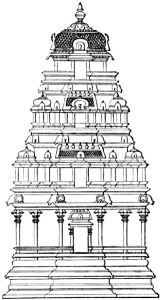
Vimana

The term Vimana has acquired various interpretations. Sometimes the term Vimana stands for the temple. Often, Vimana means the tower shikara, raised to its final height above the sanctum .

Vimana from Manasara

But, some say that the term Vimana should, strictly, refer to the rotund structure above the series of elevations (tala) which stand on kapota (the flat roof over the sanctum).

In other words, the term vimana, it is said, should refer to the structure between the final Tala and the stupi, the end. The Vimana rests or is surrounded by the Kanta (neck).

Another interpretation is that Sikhara meaning mountain peak, refers to the rising tower of a temple constructed as per the architecture of North India; and is it’s most prominent and visible feature. While the Northern texts identify the Sikhara as Prasada; the Southern texts call them Vimana. The Vimana is pyramid like; and Prasada is curvilinear in its outline. We may for the present go with the last mentioned interpretation.

Among the several styles of Sikharas that obtain in temple architecture, the three most common ones are: the Dravida prevalent in south India; the Nagara   the most common style; and the third born from the synthesis of the other two called the Vesara, seen mostly in Hoysala and later Chalukya temples of Karnataka.

The Dravida style is highly ornate; the Nagara style is simpler and consists of a curvilinear dome. In the Vesara style, the dome is highly ornate and emerges from the Sukanasi or from the richly carved outer walls of the temple. In every style of Sikhara/Vimanam, the structure culminates with a Kalashaat its peak.

The early vimanas, in south, were circular until they ended in a point of the finial (stupi); like  the vimanam of Kadambar koil.

In some cases , the flat-roof (kapota) of the sanctum on which the tower rest and rises is overlaid by a single square stone slab known in the text as “the stone denoting the upper passage of life” (brahma-ranhra-sila). In certain structures, slab after slab is placed in a diminishing order with the final slab crowned by a perforated stone ring (amalaka) giving the structure a pyramid shape.

During the later times, the body of the Vimana tended to be more complex and multi layered rising up in several stages (tala). Each stage of the sikhara contained within itself several layers of mouldings depicting traditional motifs. The layers in a Tala are called Varga; and the sadvarga (six modules) is regarded the classic version. The southern texts describe the temples as sadvarga Devalaya. The sadvargas of a Vimana are Adistana, Pada, Prastara, Kanta, Sikhara and stupi. The vertical expansion of the sadvarga developed into Vimanas of Dvitala (in two stages) and tritala (in three stages) structures.

Tirumalatemple

The most celebrated Dvitala Vimana is the Ananda Nilaya Vimana  atop the sanctum of the Sri Venkateshwara shrine on the hills of Tirumala. It is not clear when it was constructed and who caused it to be constructed. The earliest reference to the Ananda Nilaya Vimana was in the inscription of Virasinga Deva Yadava who ruled the Tondamandala region, around 1250 AD. It is said; he performed Tula-bhara and donated gold, equitant of his weight, for covering the Vimana. The Vimana was renovated in the year 1417 by the Kings of Chandragiri. The most famous patron, in the later years, was, of course, Krishnadeva Raya of Vijayanagar Empire, who, in the year 1517, donated 30,000 pieces of gold for covering the Ananda Nilaya Vimana with gold polish.(please also see para below)

nanjanagudu

Before we go further we may talk a little more about Vimana.

The Vimana in the South Indian temple history had an interesting career. For instance, the most magnificent Vimana of the Raja-rajeshwara temple at Tanjavur (1009 AD) rises to an imposing height of 58 meters.

Another temple of the same period at Gangaikonda-chola-puram (1025 AD) rises to a height of 48 meters.

Gangaikonda cholapuram 2

Thereafter, in the subsequent periods, the Vimanas tended to grow shorter. But the Gopuras, the towers that stand over the gate-ways (dwara-gopura) became increasingly ornate, complicated and huge.

The sanctity of Vimanas was not in any manner affected by its diminished size. While the sculptures on the outer Gopuras could house secular and even erotic themes, the Vimana had to be austere and carry only the prescribed divinities associated with the mula-bhera in the sanctum. The Vimana is verily the representation or the outer visible form of the murthi that resides within it; and is revered as such. It represents the glory (vaibhava) of the deity the antaryamin who resides within it. The Gopura on the other hand does not usually command an equal status.

[ While on the subject of the relation between the Vimana and the Gopura , please see the following extract from the response I  posted to the comment made by Dr.Ratti:

Valabhi_Temple_in_North_India_1The ‘Barrel-vault’ also known as a tunnel vault or a wagon vault is an architectural design looking like an oblong wagon-top or a vault or resembling a boat placed up-side down, is rather an old feature of the Indian temple architecture. Its curvy shape lends the structure a semi-cylindrical appearance. Such a design is assigned with many names, depending on the architectural school that it was involved with. The various parts of the temple are given different names in different parts of India.
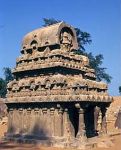
For instance, in the Nagara tradition, which was practiced in the Northern, Western and Eastern parts of India, a barrel vaulted, rectangular superstructure that runs at right-angle to the entrance of the Gargha-griha is termed as Valabhi Prasada. The Valabhi turret is an ornamental structure on a flat roof. Usually, the sloping Valabhi resting on a flat roof is capped with multiple amlakas and finales, Shikhara.

I am given to understand that there are two explanations for derivation of the term Valabhi. The first one says; Valabhi is derived from the root Vala (enclosure) suggesting a turret or an upper room or a curved rafter. And, it might mean a kind of enclosure that would support a tunnel or barrel roof. And, therefore, Valabhi indicates a ‘mono-pitched roof.’

The other explanation suggests that the term Valabhi could relate to the name of an ancient city located in the Saurashtra region of Western India. It was the seat of the Maitraka dynasty who ruled the peninsula and parts of southern Rajasthan (from fifth to the eighth century). The City of Valabhi was also a celebrated centre of learning, with numerous Buddhist monasteries. It might be that such architectural type was the main characteristic of the Valabhi region, where there were numbers of Buddhist Chityas.

In the earlier periods, the temples and Stupas, which were successors to the huts, were constructed out of brick and timber. These were generally either elliptical (Kuta) or rectangular huts with gable roofs (Sala) made of bamboos. Therefore, the early temples, having vaulted domical and gabled (Sala) roof, resembled, in shape, a Chaitya hall (which itself was a successor to the Vedic stupa). It is also said; the palace architecture was developed form the Sala concept or design. And, since the palace was called Prasada, the God’s Palace (Devalaya) also came to be known as Prasada.

The Valabhi Prasada, generally, follows a rectangular plan; its length being thrice its width (ayata); with a barrel roofed superstructure running at right angle (tiryak) to the direction of entry to the Garbha-griha. Its slopes are either on all its four sides (hipped roof) or only on two sides. On its ridge, are placed three Amalasarkas. And, Dormer windows (Chandrasala) that projects vertically from a sloping roof are located on either side of the ridge.

In case the entrance to the shrine is located under the broader side of the ridge, such a Valabhi Prasada is classified as Bhadra; and, where the entrance is on the narrow, it is known as Dvarapala.

Because of its barrel vault roof, perhaps inspired by the early Chaitya architecture, the Valabhi is much wider than the Prasāda that you normally find in the Nagara temples. I believe, there are such ancient temples in Rajasthan, Maharashtra, and Uttarakhand (Nava-Devi temple in Yagesvar, Almora District) regions, too. Most of the Valabhi temples are dedicated to Devi, the Supreme Goddess.

Teli ka Mandir at Gwalior Vaital Deul Temple, Bhubaneswa Nakul & Sahadev Varahi Deula

As is well known, the earliest surviving example of Valabhi-Prasada is that of the Teli-ka-mandir (Ca.750 CE) of Gwalior, dedicated to Vishnu. And, though the temple stands on a Nagara base, its Valabhi Prasada resembles the Southern Gopura at the entrance of the temple complex. The later Jain temples of Western India (e.g., the fifteenth-century temple of Adinatha at Ranakpur) adopted similar designs, with slight modifications.

In Orissa, the same Valabhi mode is known as Khakhara (wagon roof or a bottle). The instances of such temples in Orissa are many. For example: the Baitala or Vaital Deul (8th-century) at Bhubaneswar; the Durga temple at Rameswar; the Varahi temple at Chaurasi, the Gopali and Savitri temple both in Bhuvanesvar and so on.

The Devi temple in Sibsagar (Assam); Terracotta temple at Vishnupur; and Siddheshvara Mahadeva temple in Barakar (Bengal) are also some of the many such Valabhi temples in Eastern India.

And, in the Southern tradition, a shrine of oblong plan with barrel vaulted roof or hut roof, topped by a series of stupi is named as Sala Vimana or Kosta or Sabha Vimana. It resembles a boat placed upside over a rectangular structure. A slightly modified Vimana of the Sala type where the hind part of the barrel-shaped roof is rounded, resembling the back of an elephant is called Gaja or Hasti prishta. This variety of Shikharas is also termed as Panjara or Nidha.

There are many instances of barrel vaulted Eka-tala Gaja-prishta Vimanas, in South India, principally at Aihole (Durga temple) and at Pattadakal.

Bhima Ratha, MahabalipuramAnd, there is the Bhima-ratha, one of the five Rathas or architectural models, at Mahabalipuram. Like the other four Rathas, the Bhima–ratha is also a stone-version or a model of a wooden structure. It is said to replicate the Chaiyta-model. The Bhima-ratha is an Ektala or single tiered oblong structure, with a barrel-vaulted roof (Sala Vimana) like a tilted boat, and ornate columns.
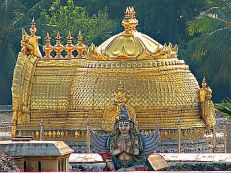
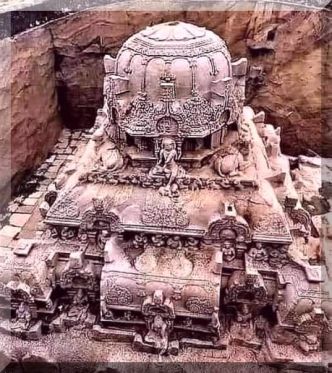
These were the forerunners of the architecture that flourished in the later centuries. For instance: Sri Kapoteswara Temple, Chejerla (AP) which dates back to third or fourth century A.D; Mahadeva swami Cave Temple, Malaiyadikurichi; Mukkoodal Appan Venkatesa Perumal Temple ; and so on . The Vimana atop the famed shrine in Srirangam (earlier to sixth century) has a curvy or a rotund shape at one end.

Amvar_Chejerla_Kapoteswara_temple_in_guntur_districtsrirangam temple rare picture

But, in the later periods, in the architectural designs of the temples, in North and East, the vaulted- roof Valabhi gave place to Prasadas having a large circular wheel shaped capstone block in the shape of a ribbed Amlaka ( myrobelan) . And in the South, the Vimanas rising in tiers (Tala), successively diminishing in circumference and ending in a point (stupi) over the cupola came into being, increasingly. This, over a period, gave rise to pyramidal or curvilinear form that we are familiar with.

[Before we move on to Vimanas of the South, lets briefly talk about the symbolism of the vaulted- roof Valabhi that you mentioned, as also of the Vimanas. At the outset, let me mention, there are countless symbolisms associated with the Vimana and the temple.

The temple, ideally, is regarded as an image (Bimba) of the Universe. It appears as though the inverted bowl of space under the wide Valabhi Prasada was imagined to be the vault of heaven, the starry region alive with the presence of dynamic light-deities (Adityas) and celestial beings such as the sun and moon, stars and such other sky gods.

The insides of the earlier vaulted roofs were, thus, imagined to be Akasha. The foundation of the temple is said to represent Earth (Prithvi); the walls of the sanctum, the Water (Apah); the tower over it, the Fire (Agni); the finale of the tower, the Air (Vayu); and, above it is the formless Space (Akasha). The sanctum is thus a constellation of the five elements that are basic to the Universe.

ellora 2

In the case of the Vimana, rising above the sanctum, it is said to symbolize the inverted tree with its roots above in the air; and, the branches spreading downwards (urdva mula; adah shakam).

The inverted tree, again, symbolizes the phenomenal world of matter and also the spirit having its roots the utmost subtle Absolute. The Man’s roots and energies are hidden in the abstract ‘thousand petalled lotus ‘(Sahasra), the invisible point just above the head, outside of the physical frame. That is his essence.

The Yoga texts speak of different psychic centres in the body, pictured as lotuses with their petals bent downward. The Yogi attempts to activate the vital currents within him to give the petals an upward stand.

While the Stupi, the point at the apex of the Vimana is considered as the root, the main mass of the Vimana represents the spreading branches.

Starting from the pointed copula, the Vimana is sculptured as an inverted lotus, with its petals spreading out and drooping down (Kumuda-vari). The Lotus is a symbol of life and consciousness.

Kailash Temple at Ellora vimanaShiv_temple_Tanjore

The petals of the lotus turn up when the sun shines on it. The divine grace is the sun (Aditya). That analogy is carried into the temple concept also.

The pointed finial of the Vimana symbolizes the dual act of gathering the essence from the from-less cosmos and letting it flown into the mass of the main tower. That essence descends into the icon placed at the centre of the sanctum, from where the divine grace flows into the Man. His effort is the ascent towards the spirit.

The shrine, thus, demonstrates the culmination of the human and the divine energies. The matter moves up evolving into higher state of consciousness; and, the grace, blessings flow down. ]

*
In the south, the earlier temples had taller Vimanas (say, as in Brihadisvara of Tanjore-58 meters; Gangaikonda-chola-puram – 48 meters). But the in the temples of later centuries, the Vimana tended to grow comparatively shorter. Over a period, the Vimanas assumed pyramidal or curvilinear form that we are familiar with. But the Gopura at the entrance (dvara) grew increasingly ornate, complicated, huge and monumental in size.

Gangaikonda Cholapuram 3

Thus, the Vimanas over the sanctum grew shorter or modest; and , in the process , lost their wide vaulted- roof- the Valabhi. In contrast to that, by about the twelfth century, the Gopura (gate-house) at the entrance grew amazingly massive, towering in pyramidal structures, as tall as up to sixteen stories, elaborately adorned and covered with brightly coloured plethora of sculpture of and guardian deities; and, capped at the top by an apsidal, eight-sided, or oblong, barrel vault shaped Sala (roof) pinnacle by a series of Stupi, the temple Kalashas.

Gopura Vimana

Thus, the ‘Barrel-vault’, the Valabhi, did not entirely disappear. It transformed, moved up and sat on the top of a magnificent Gopura.]

***

While the temple complex is designed as a Mandala with the sanctum at its heart (Brahma –sthana); the sanctum along with the Vimana atop is itself regarded a Mandala. The image is located in the mid-point of the sanctum which is designed as a square; that is, where its diagonals intersect each other. This point is elevated, in a three dimensional projection, and rendered as the sthupi or the central point of the Vimana. The Kalasha is installed at this point.

In order to appreciate the Mandala configuration of the Vimana, one could take its top-elevation; that is, take an aerial view from directly above the Vimana. The entire structure of the Vimana resting on a square base, projecting into the air in successive diminishing tiers and concluding into a needle (bindu) is a Mandala resembling the Chakra. The sanctum with its Vimana, thus, represents the worshipful (archa) form of the divinity. The different deities associated with the mula-bhera are aligned along the four sides of the Vimana (Mandala), according to their importance, starting with the grosser ones on the outer periphery of the Vimana (outermost layer of the Mandala).The sthupi , the central point , the needle of the Vimana being  the  bindu of its Mandala configuration.

anandanilaya

Ananda Nilaya Vimana is of Vesara architecture; and the Vimana is in Dvitala, meaning that structure above the Kapotha slab has risen in two stages; and on the top of the second tala is the Vimana, per se, in a rotund shape. Its total height from its base to the top of the Kalasha is 32’08” .Both the Talas are square in shape. The lower Tala depicts, in its four sides, the icons of the Vaikhanasa School: Purusha, Sathya, Achtuta and Aniruddha. The upper tala depicts about fifty-nine images including those of Hanuman, Garuda and several Rishis. The most famous Sri Vimana Venkateshwara is on the North face of the upper Tala.

The Kanta (neck), at the end of each Tala , is circular in shape. The rotund Vimana, atop the second Tala and enclosed by the circular Kanta (neck) is adorned with lotus motif.

In the later stages of South Indian architecture, the Vimanas grew more complex and muti-sided. The six-sided and eight-sided Vimans became quite common. It is said there are a few temples with their Vimana having as many as sixteen sides. The temple in Madurai is reputed to have as many as 65 sides!.

The basic shape of the Vimana is pyramid like. The imagery associated with its shape is that of an inverted tree with its branches spreading downwards. This has reference to the ancient imagery of the universe.

Sri Vaikuntha Perumal temple at Kanchipuram i (mid-8th century) has a unique and an interesting arrangement of three sanctums, one above the other, encased within the body of the superstructure.

Some of the best examples of the Vimans come from the massive temples erected by the Chola kings. The Brhadisvara or Rajarajesvara, temple, built at the Chola capital of Thanjavur is a fine example of the grandeur and majesty of the temples of this period. The temple construction begun around 1003 and was completed about seven years later. The main walls are raised in two stories, above which the superstructure rises to a height of 190 feet. It has 16 stories, each of which consists of a wall with a parapet of shrines carved in relatively low relief.

The crowning glory of the Brihadeeswara temple is the staggering cupola of the Vimana comprising two huge, sculpted, granite blocks weighing 40 tonnes each. The engineering skills and the expertise that made the mounting of these huge stones atop a structure that is nearly 200 feet high must have been way ahead of their times. Legend says that the stone was brought from Sarapallam (scaffold-hollow), four miles north-east of the city, using a specially designed ramp.

Vertically the vimana is organized by pilasters that break up the facade of the base, creating spaces for niches and windows in between.  However, the temple departs from southern Indian convention in one significant way: the vimana is taller than the gopura (gateways) of the temple’s walls.  Normally the gopuras are taller than the vimana.

The Vimana rises to a height of abut 216 feet, a tower of fourteen storeys. The basement of the structure which supports the tower is 96 feet square. The gilded Kalasa over it is 12.5 feet high. It is believed the sikhara and the stupi does not throw on the ground. The dome rests on a single block of granite, 25.5 feet square.

The architects and engineers attribute the stability of the massive temple to its pyramidal structure. They say it is more robust than its counterparts from north India with their complex curvilinear profiles.

Brihadishvara ground plan

Brihadeeswarara

***

Another fine example of the Chola temple architecture is the temple in Gangaikondacholapuram, which succeeded Tanjore as the capital of the Chola Empire. The Vimanam of this temple, in contrast to the rigid pyramidal structure of the Brihadeeswara temple, rises up in a concave manner with fluid lines. (For more information, please visit http://www.thanjavur.com/bragathe.htm)

Gangaikonda cholapuram 1

The tallest Sikhara of a Hindu temple, it is said, is under construction at Mayapur in west Bengal. The temple when completed (say by 2014) will be 35 stories tall and almost as high as the great pyramid in Giza.

Kalasha

The crowning glory of the Vimana is its Kalasha, the vase. Some say it is reminiscent of the life giving Amrita-kalasha that emerged out of the milky ocean when it was churned. Kalash symbolizes blessings and well-being.

In the development of the Indian temple this feature appears to have arrived rather late.  The early kalashas were perhaps made of stone blocks, round or ribbed. They might have been in the nature of cap-stones that structurally held   the tall and tapering vimana,    as in the North Indian temples. The copper and brass vases seem to have been the later innovations; and the agama books favor use of copper vases.

Kalasha  has several members, such as “the foot-hold” (padagrahi) which is its foothold, the egg (anda) or the belly, the neck (griva), the lotus-band (padma-pashika), the rim (karnika) and the bud  (bija-pura). The shape of this unit could resemble the bell, the flower bud, the lump, coconut, alter or pot. all these shapes symbolize the potential and the possibilities  of life.

Interestingly, the Kalasa placed on top of the Vimana, it is said, is not imbedded into the structure by packing it with mortar or cement. It is, in fact, placed in position by a hollow rod that juts out of the centre of the tower and runs through the vase, the Kalasha. It is through this tube that the   lanchana‘tokens’ (cereals and precious stones) are introduced. One of the explanations is the hallow tube represents the central channel of energy the Shushumna that connects to the Sahasra, the seat of consciousness, through the Brahma randra. This is completes the analogy of the temple to the purusha ot to the human form.

I have heard of inserting a “golden person “inside the Kalasha; but have not come across much discussion about it. It appears, the Kalasha, the pot, has an important hidden component, the golden person (suvarna purusha) who is regarded the personification of the temple-spirit. The belly of the Kalasha contains a tiny cot made of silver, copper or sandal; over which is laid a soft feather mattress. A tiny golden icon holding a lotus flower and a triple flag rests on that cot. Four tiny pots made of gold, silver or copper containing consecrated water are placed on the four sides of the cot. There is also a tiny pot of ghee near the cot. This entire procedure of introducing the “golden-person “into the Kalasha is known as hrudaya-varnaka-vidhi.

Another kalasha is deposited under the sanctum. And, like the one on top of the Vimana, this Kalasha also contain tokens of growth and prosperity, viz., cereals with subtle seeds (such as millet) and nine types of precious stones. The womb, the icon and the sthupi the finial run along the same axis.

Kalsha

There are a few other symbolisms associated with the Kalasha. The structure of the Kalasha resembles an inverted tree; and is almost a replica of the “womb” buried under the sanctum. Both are described as roots. The one at the bottom urges upward growth; while the one atop is the root of the inverted tree.

Mantapas

[ Before we get into specifics, lets look at the general features of Mantapa, an important architectural component of the South Indian temples. 

A Mantapa, in its simplest form, is a free-standing four-pillared structure. It could either have a flat roof, with stone slabs laid horizontally, spanning from one supporting beam or wall to another; or, it could also have a structured ceiling, with an arrangement of one stone course over laying the other to produce designs of diminishing squares.

Mantapa design 2 Mantapa design 3 Mantapa design 1 Mantapa inside view

A Mantapa could be extended to any size or pattern with increasing number of pillars (say, 4, 16, 32, 64 and even up to 1000 as in the Srirangam Sri Ranganathaswamy Temple). Its member-stone may be connected to each other through a tenon-mortise joint, with or without lime mortar at the interface. In South Indian architecture, the stone members merely rest against each other with no interlocking mechanism. The roof of the Mantapa is made up of stone slabs spanning between beams, packed with lime mortar. Typical pillar spacing varies from 2 m to 3 m, with the height of each pillar being 3 m and 7 m in height.

Rameshvaram corridor 1840 Drawn by Lieuts Jenkins and Whelpdale and Ravanat Naig.

Rameshwaram Temple-1840-Drawn by Lieuts Jenkins and Whelpdale and Ravanat Naig

 Important temples usually have a number of Mantapas, each intended for a different function, such as conduct of rituals, performing arts, resting spot for devotees, etc.  The types of the Mantapas could be:

: – Antarala / Ardha-mantapa – narrow pavilion between the temple exterior and the Garbagriha (sanctum) or connecting to  other Mantapa within  the main temple; ;

: – Navaranga / Nritta-mantapa / Ranga- Mantapa – spacious hall for singing and dancing etc;

: – Sanapana mantapa – hall for ceremonial purpose;

: – Kalyana Mantapa – dedicated to ritual marriage celebration of the presiding Lord with the Goddess;

: – Maha Mantapa / Asthana Mantapa – a big assembly hall for conducting religious discourses;

: – Nandi Mantapa– in Shiva temples  for housing the image of the sacred Bull , the Nandi; And,  

: – Mukha- mantapa – opening pavilion, a porch-like structure.]

The Pillars of the Mantapa of the Hoysala and Vijayanagar period tended to be highly ornate.]

Vittala temple Vijayanagar (Hampi)

***

In the temples of South India, the Garbagriha , generally, is  followed by four types of Mantapas or pavilions. Mantapa means any roofed, open or enclosed pavilion (hall) resting on pillars, standing independently or connected to the sanctum of the temple.

The first of the Mantapas is the Antarala (sometimes called sukanas or sukanasi or Ardha-mantapa), a narrow pavilion connecting the Garbha-griha and the Navaranga. It usually will have niches in the north and south walls, occupied by a deity, with attendant divinities in secondary niches flanking the central niche.  In a few temples the Antarala serves as the navaranga too.

The next Mantapa is Nrtta-mantapa or Navaranga, which  is a big hall used for congregational services like singing, dancing, recitation of mythological texts, religious discourses and so on. The Navaranga will usually be on a raised platform and will have nine anganas (openings) and sixteen pillars.

This is followed by Sanapana mantapa, a hall used for ceremonial purposes. This leads to Mukha mantapa the opening pavilion.

Nandi Mandapam

Bali pitha

Bali_pitha is an indispensable associate of the sanctum. It is an altar or the dispensing seat of the deity. It is a small but stylized stone seat that is installed directly in front of the icon and very near the sanctum. It is the seat on which offerings to deity are placed.

The chief (pradhana) Bali_pitha will be directly in front of the icon and often near the Dwajasthamba. It is usually made of hard granite and will be highly stylized, ornate, and majestic, with several limbs such as the base, cornices, wall-surface with door-lets or niches. Most texts suggest that the size of the altar should be 1/8, 1/7 or 1/5 of the dimension of the sanctum. Depending on their sizes and shapes, the altars are classified into several types such as Sri-bandha, Sri-bhadra, and Sarvato-bhadra and so on.

The Pradhana Bali-pitha will often be covered metal sheets .The more affluent temples as the one at Tirumala, give the Pradana Bali-pitha a metal covering with gold polish.

It is on this Bali_pitha that the food offerings, in the form of vermilion colored rice, and rice mixed with pepper are offered to the attendant divinities and the guardian goblins. These offerings are placed only after the main food offering to the presiding deity, in the sanctum, is completed.

 While the main (pradhana), Bali_pitha will be directly in front of the icon; there will be several such other altars, located in the prakara, positioned in eight directions, around the sanctum. Their positions are determined in accordance with the prescriptions of the canonical texts that the temple follows.

Some suggest that the yupastambha (Sacrificial post) and the balipitha (sacrificial pedestal) of the Vedic age have metamorphosed into the dhvajastambha and the balipitha of the present day.

A dipastambha (lamp post) is situated either in front of the balipitha. The top of this post has a bud shaped chamber to receive the lamp

Flag staff

The dhvajastambha (flag post) in front of either the garbhagrha or antarala or the mantapa is another common feature of the temples. It should be perpendicular and directly opposite to the idol. It will be located very close to the Bali pitha; and the Bali pitha will be between the sanctum and the Dwajasthamba. It represents the flag post of the ‘King of kings’. The lanchana (insignia) made of copper or brass fixed like a flag to the top of the post varies according to the deity in the temple. The figure on the lanchana is invariably that of the vahana (carrier vehicle) of the deity. For instance, in Siva temples it contains Nandi. In Devi temples it is the lion that finds its place. In Vishnu temples the Garuda gets that honour.

The practice of erecting tall columns of fifty to eighty feet in height appears to be of recent origin. In the early stages, these flag posts were perhaps meant to indicate the position of the sanctum. Even today, the temples in North India fly long flowing banners and flags from the tower atop the sanctum.

The old texts favoured wooden or bamboo poles, with odd- number of joints, up to twenty-five.  And, the flag-staff was not intended to be a permanent structure.  The ceremony of flying the temple flag marked the inauguration of a major Uthsava at the temple. The flag also served as signal to indicate to the people of the town and the visitors that a Uthsava is on. The old customs required that no major domestic auspicious functions be held in the village while the temple flag is hoisted. This was perhaps to suggest that the celebrations at the temple took precedence over those at homes; and that everyone in the village should participate in the temple celebrations.

In course of time the permanently fixed flag-staff became a common feature in temple architecture. The older temples had flagstaffs made of stone. That gave place to the practice of erecting a stone pillar or wooden pole covered with copper, brass, or even silver plates gilded and installed on a raised stone platform, often square in shape,located in front of the sanctum. The top portion of this tall mast will have three horizontal perches (symbolizing righteousness, reputation and prosperity, or the three divinities Brahma the Creator, Vishnu the Preserver and Siva the destroyer), pointing towards the sanctum.

The pedestal or the seat of the flag-staff as well as the mast with perches became highly stylized in South India during the days of the Chola and Pallaya rulers, for the flag-staff was uniquely a royal insignia.

Gopura

In the case of major temples, the entire temple area is surrounded by a series of conectric protective walls, the prakaras. The lofty towers erected over the entrance gateways of these walls are the Gopuras. These rectangular, pyramidal towers, often fifty metres high dominate the city skyline. And, adorned with intricate and brightly painted sculptures of gods, demons, humans, and animals, have become the hallmark of southern architecture; though, strictly, they are not the essential aspect of a temple layout or its structure.  The Gopura emphasizes the importance of the temple within the city.
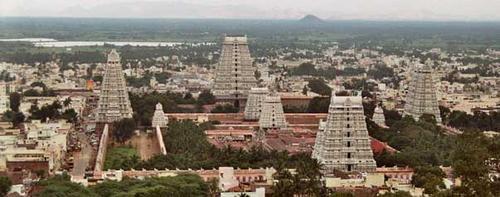
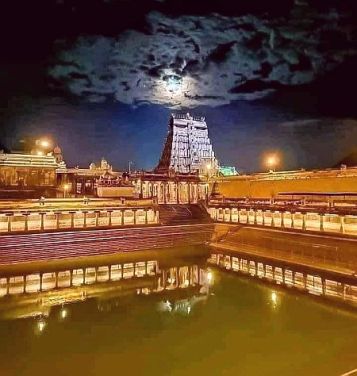
The Gopura is a unique feature of the Dravidian architecture. It had its origin and development in South; and the other schools of architecture do not have equivalent features.

It is said in the older texts that the concept of Gopura  originated from extensive cow-stalls (Go-griha) which was  virtually a gate-house at the doorways of a huge building , monastery , temple or even a town (Pura-dvaram tu gopuram I Dvara-matre tu gopuram I ). The Gopura, therefore, technically, denoted gate-houses of palaces, cities and residential buildings of various descriptions; and that they did not necessarily belong to temples alone.

The advent of Gopura in Dravidian architecture was rather late. The practice of erecting a Gopura at the entrance gateway to the temple seems to have come into being during the mid-12th century. And, with the decline of the mighty Cholas and with the increasing threat from invading armies, the temple cities (prominently Madurai and Sri Rangam) found it expedient to erect a series of protective walls to safeguard and defend their temples, palaces and cities. The Gopuras constructed on the gateways leading from one enclosure to the next, initially, served as watch and defensive towers.

By about the tenth century, the temples in South India, generally, came to be surrounded (perhaps as a defence-measure) with high walls (Prakara) with one main and three subsidiary gates, opening in the cardinal directions. A Gopura (high tower,) adorned these gateways. And in due course the Gopura became a characteristic feature of South Indian temple architecture. Many major temples   have a series of enclosures (Prakara).  For instance; the Sri Rangam temple has seven enclosing walls, enveloping the whole township; and, the entrance to each Prakara is adorned with a Gopura.

The later Agama texts mention that each enclosure must have door-ways in all four directions. But, very few temples followed this rule, perhaps with the exception of the great temple at Tiruvannamalai.

Tiruvannamalai3

In most cases, the doorways lead from one courtyard to the next, finally leading to the sanctum. And, it became customary, since 10th century, to erect towers (Gopuras) over such gateways, though a Gopura was not an essential feature of the temple per se. It is needless to mention that the Prakara contributes to the security and beauty of the temple.

The whole temple is surrounded by a high wall (prakara) with one main and three subsidiary gates, opening in the cardinal directions. A Gopura (high tower,) adorns these gateways.

These were of course later developments; and in due course became characteristic features of South Indian temple architecture. It is said, the later Agama texts provide for as many as 32 prakaras, the concentric – enclosing walls. But, they recommend five to seven as advisable, in case more than one enclosure is needed.  In many cases, the main area of the temple, plus the halls, tanks, and gardens are surrounded by a single wall (prakara) or enclosure. But many major temples do have a series of enclosures.  As mentioned earlier the Sri Rangam temple has seven enclosing walls, enveloping the whole township.

With the growth and development of the temples, the structures and details of the Prakara-s and Gopura became increasingly elaborate and complicated. The main entrance, somehow, popularly came to be known as Raja-Gopura.

There is mention of Gopura-s with sixteen storey’s, divided into ten classes. These ten classes were made having in view the number of its architectural members designated as Shikara (cupola), Stupika (dome), Gala-kuta (side-tower or neck portion) and Kshudra-nasi (minor vestibules or nose). A Gopura is thus, technically, a Shiro-bagha (caput or head) having a Shikha (tuft or spire) resembling a Shala (arrow-head) . The Gopuara usually has a circular surrounding dome and is furnished with a side-tower, four small vestibules and eight large vestibules.

The fifteen kinds of Gopuras are mentioned having one to sixteen or seventeen storeys. But the details of only five storeys are given; the others being left to the discretion of the architects. These give the descriptions of the ornaments and moldings of each storey; the central or main hall as well as all other rooms, together with different parts such as pillars, entablatures, walls, roofs, floors, and windows, etc.

[ But, the traditional view according to ancient texts on Shilpa-shastra , the most important part  of a temple, it’s very heart as it were, is the Garbhagrha or  the sanctum sanctorum,  the cave-like cube-shaped “womb room,” located within the Brahmasthana  of the Vastu Purusha Mandala. Sometimes the Garbagriha with its Vimana alone is defined as temple per se. But, generally, its extended by an Ardh-Mandapa, a Mandapa or a large hall up to the Bali-pita.

All that is to suggest the Raja-Gopura is not an essential part of the temple; and its structure is left to the discretion of the architect.]

What started as a defensive structure rapidly developed into a prominent and an architectural extravaganza with great visual appeal. The Gopuras grew in size from the mid-12th century and came to be greatly emphasized, until the colossal ones rose to dominate the temple complex, surpassing the main sanctum .Some of them are extremely large and elaborately decorated with sculpture,; and quite dominating the architectural ensemble.

Among the finest examples are the Sundara Pandya Gopura (13th century) of the Jambukesvara temple at Tiruchchirappalli and the Gopuras of the great Siva temple at Chidambaram, built largely in the 12th–13th century.

Chidambaram temple

The Gopuras of the Meenakshi temple at Madurai are of course the most magnificent array of temple towers.There are twelve impressive Gopuras soaring over the three tier Prakara walls. The outer four towers dominating the city landscape are truly huge in size and magnificence.

Madurai4

The nine -storied towers came up between 13-16th centuries during the reign of Madurai Nayaks. The edifice of the Gopuras measure 174 ft. from north to south, and 107 ft. in depth.The gateway is 21 ft. 9 in. wide; and the gatepost is 6o ft high, made of blocks of granite, carved with the most exquisite scroll patterns of elaborate foliage. The heights of the Gopuras range from 161 feet to 170 feet.

Chidambaram Temple by Fransis Ward 1772

Chidambaram temple by Francis S Ward 1772

The Gopuras appear to have influenced revision in the temple design and layout. Such was the emphasis placed on the eminence of Gopuras that as time went by; the Southern temples came to be designed as a series of courtyards, as if to justify the Gopuras.

Chidambaram

The spaces around the shrine became hierarchical; the further the space was from the main shrine, the lesser was its eminence.

A particularly interesting example of this is the Sri Ranganatha temple at Sri Rangam, which has seven enclosure walls and as many as twenty-one Gopuras, halls, other temples and township constructed over several centuries. The seventh, the outer most, enclosure is 3072 feet in length and 2521 feet in breadth; enclosing an area of about six hundred acres.

The outermost ring had buildings of a more utilitarian or a secular nature – shops, dormitories, sheds, workshops etc., thus transforming the temple from a purely place of worship to the hub of a vibrant living city.

The grand Meenakshi temple in Madurai is another great illustration of this development which was initiated by the Pandya kings. It was during this period that the building of a temple became the nucleus of a town-planning exercise, which we discussed in the earlier parts of this article. 

map-Meenakshi-Amman-Temple-karta

Though the evolution of the Dravidian temple architecture stalled briefly after the demise of the Pandyan Empire, the architectural expression scaled new heights during the reign of the Vijayanagara kings (15th and 16th centuries). Although the later temples were not huge in size, they often were of very fine workmanship. For instance, the Subrahmanya temple of the 17th century, built in the

Brhadisvara temple complex at Thanjavur, indicates the vitality of architectural traditions even at that late date.

The Raja-Gopuram of Sri Rangam temple, completed during the year 1987, is perhaps the tallest in South India. The Gopura with 13 stories is 243 feet high; and with twelve Kalashas adorning its peak.

In the meantime a 249 feet tall gopura, said to be the tallest gopura in Asia, has come up in the Shiva temple at Murudeshwar in the coastal district Uttara Kannada, in Karnataka. The twenty-one story high gopura measures 249 feet high and is taller than the 243 Raja Gopura at Sri Rangam and 239 feet tall gopura of Brihadeshwara. The gopura is fitted with elevator services and the temple plans to have museums and art galleries on all the 21 floors of the gopura.


A Gopura is generally constructed with a massive stone base and a superstructure of brick and pilaster. It is rectangular in plan and topped by a barrel-vault roof crowned with a row of finials.  It differs from the Vimanam in that it need not necessarily be square-based. Above that rectangular base a pyramidal structure covered with brightly coloured plethora of sculpture is raised to a great height. A Gopura has to be towering and massive.

In the ancient times, the cities all over South India could be discerned from afar by the distinctive shape of their Gopuras dominating the skyline.

When viewed from top, the Gopura too resembles a Mandala; With the Goblins, Yalis, mythical animals and other beings located in the outer enclosure, as if supporting the weight of the mandala. The humans and the divine beings are in the inner enclosures. The peak of the Gopura, the Kalasha is at the centre of the Mandala

Symbolically, the Gopura and the entrance to the temple represent the feet of the deity. A devotes bows at the at the entrance, the feet of the Lord, as he steps into the temple and proceeds towards the sanctum, leaving behind the world of contradictions.

In the Sri Rangam temple the seven concentric prakara walls are said to represent the seven layers of matter-earth, water, fire, air, either, mind and intelligence-that envelop the consciousness of the living entities in the material world. The gopuras, or gateways through the prakaras, are symbolic of being liberated from the bondage of matter as one enters the temple and proceeds toward the central shrine.

*****

*****

CONTINUED in the next part->

Sources:

A. Maps of Madurai and Sri Rangam

By courtesy of Kultur in Indien

B.Other pictures from Internet.

C. Devalaya Vastu by Prof. SKR Rao

D. Vastu – Astrology and Architecture

E. Stella Kramrisch, The Hindu Temple,

Others:
http://www.sanathanadharma.com/temple/essential.htm

http://www.orientalarchitecture.com/

Encyclopaedia Britannica

http://www.britannica.com/dday/print?articleId=109585&fullArticle=true&tocId=65333

https://openaccess.leidenuniv.nl/dspace/bitstream/1887/2668/1/299_022.pdf

ALL PICTURE ARE FROM INTERNET

Tirumala Anandanilaya

 
42 Comments

Posted by on September 9, 2012 in Temple Architecture


Tags: , , , ,

Temple Architecture- Devalaya Vastu – Part Four (4 of 9)

Temple Layout

south-elevation-of-kailash-temple-fergusson

South elevation plan of Kailash temple is Plate LXXX11 from the book “Cave temples of India” by Ferguson, James and James Burgess (Thanks to Dr.JB Ratti)

The Shilpa text Shiva-prakasha in its chapter titled vastu-bhumi-bedha, describes sixteen (Shodasha) types of temple layouts:

    1.  the Square (Chandura);
    2. Rectangle (Agatra);
    3. Trapezium (with uneven sides – like a cart – shakata);
    4. Circle (Vritta);
    5. Elliptical (kritta vritta);
    6. triangular  (dwaja);
    7.  diamond or rhombus (vajra) ;
    8. Arrow (shara);
    9. umbrella (chatra) ; f
    10. ish (meena);
    11. back of a tortoise (kurma);
    12. conch (shanka);
    13. crescent (ardha-chandra);
    14. pot (kumbha);
    15. sword (khadga); and
    16. lotus (kamala).


These layouts have specific applications; and are not to be used generally. For instance:

the back of a tortoise (kurma), pot (kumbha), conch (shanka) and lotus (kamala) are recommended only for Vishnu and Shiva temples.

Similarly the Square (Chandura), Rectangle (Agatra), fish (meena), diamond or rhombus (vajra) and sword (khadga) are recommended for Devi temples.

The rest of the lay outs are for other (lesser) deities.

But all texts generally agree that the square or the  rectangular shape of layout are the best and most auspicious. Varaha-samhita calls such layouts as Siddha-bhumi, the best of all. In case the layout is rectangular ,the North South dimension should be greater than East-west dimension. It is also said , it would be better if the elevation on the west or the South is slightly higher.

For the limited purpose of this discussion let us stick to the square or rectangular layout, ignoring the rest.  Else, I fear, it might get too complicated.

The drawing of the court yard of the  Shiva temple at Thiruvālangādu,  by the famous artist Silpi.

thiruvannamalai temple top view

Having determined the suitability of the land for constructing a temple, and having drawn up the Vastu Mandala of the town and identified the temple location ; the next stage is to draw up a construction plan .This specifies the location, the size and the orientation of the  various temples to come up in the proposed complex. This again involves preparation of another Vastu Mandala.

***

Pada Vinyasa

Belur-Chennakeshava-2Halebid-Hoysaleshvara

The land considered suitable for the purpose of constructing the temple (vastu bhumi) and   placed at the center (Brahma Sthana) of the Vastu mandala of the township must be in the shape of a rectangle or a square. The ratio between the breadth and the length of the area may be 4:8; 4:7; 4:6; or 4:5. (The square would be 4:4). Shapes of sites to be avoided are: circular (vritta), triangular (trikona), rod shaped (dandakriti), bow shaped (dhanur akara) and other irregular shapes. And, in case it becomes necessary to construct a temple on a land of such “un approved” shape, the area meant for the temple should be demarcated and rendered a square or a rectangle in shape.

Borobudur Temple ,Magelang

The 9th-century Temple at Borobudur , Central Java,  Indonesia is built upon  six square platforms topped by three circular platforms , resembling the Sri Yantra.  Even the ancient temple of Sri Vishwanatha of Kashi that was later destroyed by Aurangzeb , during 1669 CE, was in form a square , with the sanctum at the heart  of it.

Borobudur templeplan_of_the_ancient_temple_of_vishveshvur_by_james_prinsep_1832 (1)

Plan of the Ancient Temple of Vishveshvur, by James Prinsep

Incidentally, the Buddhist and Jain temples too follow the same principles. Even the Sri Harmandir Sahib, the Golden Temple at Amritsar is structured in a square shape; with the Sanctum placed in the Brahma sthana. The Buddhist temple at Neak Pean at Angkor, Cambodia was also designed by aligning squares around the central square.

Golden Temple, Amritsar, Punjabi Miniature, c 1840 Neak Pean Cambodia ground plan

The following is the layout of a Jain temple.

This is the layout of the Aksharadhama temple at New Delhi

Akshardham Temple 2 , New Delhi

Ankor Wat Layout

Ankor Wat Layout

In case of a rectangular site, it must have north – south orientation. The depth of the site (Aaya-profit) should be more than its breadth (vyaya-loss). That is the reason we find our temple walls (prakara) on north-south shorter than the walls on east-west.

The slope of the land surrounding the temple in the east and the north direction should be in the northeast corner.

Fountains or lotus ponds of the temple should be in the northeast direction.

kusuma-sarovartemple view negetive

In the open space surrounding the temple, Tulsi ( Basil) plants with raised bed should be in the east; the Jasmine, white Champak, Star Coral plants etc. should be in the northwest corner or the east. Four approach roads are much recommended.

Madurai Temple Graden

The preliminaries for construction of a shrine include preparations of a plan, Vastu Purusha Mandala, a Yantra, with unit cells (pada) of 64, 81 or 256 in number. The entire process is rich in symbolism.

The square shape of the Mandala is symbolic of earth, signifying the four directions which bind and define it; and the Vastu is the extent of existence in its ordered site; Purusha being the source of existence.

The ground plan, again, is symbolic and is the representation of cosmos in miniature. The Vastu Purusha represents terrestrial world with constant movements. The grid made up of squares and equilateral triangles is imbued with religious significance; with each cell belonging to a deity. The position of the deity is in accordance to the importance assigned to him .The central portion of the square (Brahma Sthana) is occupied by the presiding deity of the temple ; while the outer cells house deities of lower order.

131-385021c0e2

Another important aspect of the design of the ground plan is that it is intended to lead from the temporal world to the eternal. The principal shrine should face the rising sun and so should have its entrance to the east. Movement towards the sanctuary, along the east-west axis and through a series of increasingly sacred spaces is of great importance and is reflected in the architecture.

This process of drawing the Mandala , known as Pada-vinyasa or Vastu mandala Vinyasa is essential not only for construction of the main temple but also for deciding upon the location, the orientation and the size of the sanctum; and for placement of retinue-divinities.

Let us look at the following example of an 81 cell parama-saayika layout.

The site-plan is to be regarded as the body of the Vastu-purusha whose height extends from Pitrah (in the bottom left corner) to Agni (top right corner).

The Vastu purusha mandala is in some ways a development of the four pointed or cornered earth mandala having astronomical reference points. The mandala of 81 squares has 32 squares around the border representing the four cardinal points and the lunar constellations. It is the representation of all cyclical time; lunar and solar. Brahma is the God at the centre.

The Manduka Mandala (8×8) the whole square would be divided by the two  axes that go North-south and East-west.

In the case of Parama Saayika Mandala (9×9) , the entire square would be unevenly divided.

Vastu Shastra purusha

The center of the mandala consisting nine cells is dedicated to Brahma, the first of beings and the engineer of universal order. The Three cells to its east are for Aryaman, three cells to its west are for Mitra and three cells to its north are for Prihvidhara. In this site plan 32 spirits reside in the outer ring. There are 8 spirits in four corners. There are four spirits surrounding Brahma. Thus there are in all 45 spirits (including Brahma).

Dikpalas or guardian deities of different quarters, who assist in the affairs of universal management, are an important part of the Vastu. Indra, Agni, Yama, Niritti, Varuna;, Vayu , Kubera and Isana; reside in the East , South-East , South, South-West, West, North-West, North and North-East respectively. All except Kubera are principal Vedic deities. This provides a method that determines the requirements of architecture in relation to its directions.

Establishing Vastu Mandala on the site

hore temple at Mahabalipuram datable to late 7th centurySouthern Temple Style - Dravidian

The vastu-purusha-mandala, forming a sort of map or diagram of astrological influences that constitute the order of the universe, is now complete. When placed on the building site the vastu-purusha-mandala determines the positions and orientations of the temples and the time for commencing the construction. Only by the combination of the vastu-purusha-mandala and the astrological calculations can this factor be ascertained.

verticle dimentionsFrom the diagram of the vastu-purusha-mandala the architect next proceeds to develop the vertical and horizontal dimensions of the temple. The square, the rectangle, the octagon and the pentagon are fundamental patterns in the horizontal or ground plan. In the vertical alignment the pyramid, the circle and the curve are more prominent. The subdivisions of the ground plan include thebrahmasthana (the main shrine and smaller chapels) and the mantapa(balconies, assembly halls and auditoriums). The vertical plan consists of drawings for the gopura (entrance ways), the vimana (the structure above the main shrine or chapel) and the prakara (the walls).

The construction of the temple follows in three dimensional forms, in exactly the patterns laid out by the mandala. The relationship between the underlying symbolic order and the actual physical appearance of the temple can best be understood by viewing it from above (top elevation).

In order to establish the vastu-purusha-mandala on the construction site, it is first drafted on planning sheets and later drawn upon the earth at the actual building site. The  ground for civil construction is demarcated by dividing the site into 81 cells, by drawing 10 lines from East to West and 10 lines from North to South in which Vastu Mandala deities are installed. In addition the deities of the Sarvathobhadra-mandala are also established after performing Vastu Homa.

The drawing of the mandala upon the earth at the commencement of construction is a sacred rite in itself. The cells sustain the temple in their own sphere of effectiveness, in the manner that the actual foundation supports its weight.

Garbhadhana,

 Shilanyasa is the ceremony for laying foundation stone. It is the laying of the first stone (square in shape) or a brick signifying the start of construction. It is laid in the north-western corner of the building plan, drawn on the ground. After this, the construction of the foundation is taken up. The foundation is built and the ground filled up, up to the plinth level, except in the middle portion of the garbhagraha area, which is filled up three-fourths.

The sanctum is technically known as Garba-Griha. This part of the temple is usually constructed first. The ceremony related to it is known as Garba-dana or Garba-nasya; and, it involves letting in to the earth a ceremonial copper pot, containing nine types of precious stones, several metals, minerals, herbs and soils symbolizing creation and prosperity. The following is a little more detail about it.

The Brahmasthana , the principal location in a temple where the Garbagraha will eventually come up, is the nucleus of the Vastu Purusha Yantra. At thebrahmasthana, as drawn on the grounda ritual is performed calledgarbhadhana, inviting the soul of the temple (Vastu Purusha) to enter within the buildings confines. In this ritual, a golden box is imbedded in the earth. The interior of the box is divided into smaller units exactly resembling thevastu-purusha-mandala. All the units of the gold box are first partially filled with earth. In the thirty-two units representing the nakshatras (lunar mansions), the units of Brahma and the twelve sons of Aditi, the priest places an appropriate mantra in written form to invoke the presence of the corresponding divinity .An Image of Ananta , the hooded serpent , is also placed in the box. Ananta, meaning eternal or timeless, also represents theenergy that supports the universe. The box also contains nine precious stones – diamonds, emeralds, rubies, pearls, yellow sapphire, and blue sapphire, red coral, cats-eye and jade – to appease the nine planets.

A stone slab (adhara-shila) is thereafter placed over the spot the copper pot is buried.And, over this slab will rise the foundation for installing the Mula-bhera. The copper pot signifies the womb; and icon the life arising out of it. The sanctum constructed around it is the body.

sanctum

That  pot represents the roots of the “temple-tree”; and the icon its sap.  The four walls around the icon represent the branches spreading around. The structure of the Vimana rises above it in a series of tiers. The roof resting over the walls is called Kapotha, meaning where the doves rest. The imagery suggested is that of a tree with birds perched on its branches. The sanctum is thus a model of a growing tree.

Another set of symbolism is that the foundation of the temple represents the Earth (prithvi); the walls of the sanctum the water (apaha); and the tower over it the fire (tejas). The final tier of the Vimana is air (vayu) and above it is the form-less space (akasha).The sanctum is thus a constellation of five elements that are basic building blocks of all existence.

Once the garbhadhana and agni-hotra ceremonies are complete the actual construction of the temple commences according to the plan. When the foundation is finished the vertical structure is raised. The external features of the temple are brought to life through finely sculpted figures and paintings. The art and sculpture frequently portray the forms of divine entities and the different stages of consciousness in the gradual evolution of life throughout the universe.

It is believed that the Vastu Purusha sleeps during Bhadrapada, Ashviyuja and Karhika months facing east. During Margashira, Pushya and Magha months he sleeps facing south; In phalguna, Chaitra and Vaishaka, he sleeps facing west. And, in Jeysta Ashada and Shravana, he sleeps facing north. The doors facing towards those directions   are fixed in the respective months.

****

Temple Layout and its symbolism

Bhubaneshvar-Rajarani-3

The Agama Shastras say that the Temple structure is a mini cosmos. The Temple entrance should face east – the direction of the Rising Sun. The ideal Temple should have at least one entrance, an Ardh-Mandapa, a Mandapa or a large hall, a Garba-Griha and a Shikara directly above the Garbha-Griha. The design comprises:

slider1

temple layout

 1. A Towering structure called the Rajagopuram (pyramid in pattern) on the Eastern side at the entrance to the Temple.

2. A Dwajasthamba (pillar) in line with the main shrine immediately after the Rajagopuram.

3. Near the Dwajasthamba is a lotus shaped pedestal for offerings, called the Balipeeta.

4. A large Mandapa or hall for assembly of devotees.

5. The passage through the Mandapa leads to the “Garba-Griha” (womb chamber) where the Main Deity is installed.

6. Ardha Mandapa adjacent to the main Mandapa and before the “Garba-Griha”.

7. The Main Deity faces East word inside and the Garba-Griha is located inside a structure or sanctuary called the “Vimana”.

8. The pyramidal or tapering roof over the Deity is called “Shikara” or “Gopuram” which is a dome.

9. There is a circumnutating passage or “Pradakshira Patha” around the Garba Griha and Mandapa.

The above design applies both to the “Shiva” and “Vaishnava” Temples with small variations. Architecture is otherwise called “Shilpa” and the one who constructs the Temple is called a “Sthapathi”. The “Sthapathi” is an expert in Temple architecture and idol creation. The procedure of worship in the Temple is known as “Agama Vidhi”.

Madura Meenakshi temple.

konark_conjectural_restoration_2

The Temple is not only a home of God but his representation in the structure of temple which resembles human form.

[The Indian temple-concepts were the earliest to relate the human figure as the basis of a system of proportion. It was later, centuries after, that Leonardo da Vinci and Le Corbusier demonstrated it as a Modular system of measurement.]

The symbolism of the temple plan and elevation suggests that the Garbhagrha represents the head and the gopuram the feet of the deity. Other parts of the building complex are identified with other parts of the body.

For instance, the Sukhanasi or Ardha-mantapa (the small enclosure in front of the Garbhagrha) is the nose; the Antarala (the passage next to the previous one, leading to passage next to the previous one, leading to the main Mantapa called Nrtta-mantapa) is the neck; the various Mantapas are the body; the Prkaras (surrounding walls) are the hands and so on. Vertically, the Garbhagrha represents the neck, the Shikara (superstructure over the Garbhagrha) the head, the Kalasha (finial) the tuft of hair (Shikha) and so on.

temple layout.2 jpg

Another interesting symbolism is that when a devotee enters the temple, he is virtually entering into a mandala and therefore participating in a power-field. His progress through the pavilions to reach the sanctum is also symbolic. It represents the phases of progress in a man’s journey towards divine. In accordance with this scheme, the architectural and sculptural details vary from phase to phase ; gradually leading him to the experience, which awaits him  as he stands in front of the deity in the in the sanctum. This is explained in the following way.

On reaching the main gateway, a worshipper first bends down and touches the threshold before crossing it. This marks the transition from the way of the world to the world of God. Entering the gateway, he is greeted by a host of secular figures on the outer walls; representing the outward and diverse concerns of man.

As he proceeds, the familiar mythological themes, carved on the inner walls attune his attitude. The immediate pavilion and vestibule near the sanctum are restrained in sculptural details and decorations; these simpler motifs and the prevailing semi darkness help the worshipper to put aside distractions and try focusing his attention on the sanctum. Finally the shrine, devoid of any ornamentation, and with its plainly adorned entrance, leads the devotee further to tranquility, to fulfilment and to the presence of God.

The garbhagriha is usually surrounded by a circumambulatory path, around which the devotee walks in a clockwise direction. In Hindu and Buddhist thought, this represents an encircling of the universe itself.

garbagriha

Positions and orientations of the temples

The following plan indicates the position of gods and goddesses in an 81 celled temple-site. This plan relates to construction of a Vishnu temple.

 
 place for vishnu
Atri Samhita ( 2.38.42) prescribes that the central Brahma bagha must be divided into four  equal parts and the main shrine facing east must be located on the North-western side thereof. The shrine must have five sanctums, to house five forms of Vishnu; and the shrine should have three stories.
*
The icon of Vishnu , the principal object of worship, may be represented in the shrine  in one of his many forms . It could be single ( eka-murti-vidana) or many ( aneka-murti-vidana).  The aneka forms might be : 5 (pancha murti); 6 ( shan murti); or 9 ( nava murti). 
*
The opening of the sanctum on the Eastern side is preferred , specially in a shrine dedicated to Vishnu. The shrine must never have a door in the intermediate direction (Vidik)- Atri Samhita (2.32-33)
*
And, generally, the doorway to the East is the best , most auspicious (utta-mottamam) ;to the West is next best (uttama); to the South is middling (madhyama); and, to the North is not desirable ( adhama) – Vimanarchana kalpa (patala 3)
*
Vishnu as Vaikuntha-natha
 *
The seventh-eighth century Pallava temple Viz. Sri Vaikunta Perumal temple of Kanchipuram (which follows the Pancharatra Agama) is an excellent illustration of the fulfillment of these requirements. Its architecture is unique, with three sanctums on the three floors one over the other and a concealed staircase leading to the upper floors. The three sanctums enshrine Vishnu in three postures – seated, reclining and standing. The Vimana is represented as a three dimensional Mandala.
vaikunta perumal2 jpg
The central figure in the sanctum of the ground floor is Vasudeva facing west, i.e. the Earth; Sankarshana facing north, the realm of human life; Pradyumna facing east towards heaven; and Aniruddha facing south, the realm of ancestors. The sculptural scheme matches the Pancharatra concept, representing the six `glorious excellences’: omniscient knowledge (jnana), power (bala), sovereignty (aishwarya), action (virya), brilliance (tejas) and potency (sakthi). The sanctum of the third floor represents the realm of space-time, depicting Vasudeva as he appeared in the human form of Krishna (manusha Vasudeva). The temple per se signifies the `body of God.’
Vaikuntha Perumal Temple layout
*

***

vimana pradakshinaComing back to the issue of placing the sanctum slightly to the North-West; this feature occurs in the temple of Sri Venkateshwara at Tirumala too. The enclosure immediately surrounding the sanctum called Mukkoti Pradkshina is rather skewed.  The width of the enclosure is uneven; and the enclosure is open on only three sides.

The path in the south (on the right side of the deity) is seven feet wide and twenty feet long; while the path on the other side (towards the left of the deity) is seventeen feet wide and ninety-two and half feet long. This skewed position of the sanctum, slightly to the North West; within the Brahma bagha was perhaps to satisfy the requirements of the temple vastu norms.

shiva temple

Gangaikondacholapuram Shiva kumara

The Shiva temples too have their own configuration. In a Siva temple, the Shivaliga would be placed at the Brahma sthana, the shrines are dedicated to Parvathi, Ganapati, Subramanya , Veerabhadra  and Candesvara would placed in the surrounding cells of the temples Vastu Purusha Mandala; as illustrated in the following typical layout of the famous Shiva temple at Gangaikondacholapuram(mid 11th century).

Gangaikondacholapuram plan1

Similarly in the Sri Kailasanathaswamy and Nithyakalyani Amman Temple, Ilayathakudi ( near karaikudi), Shiva shrine is at the Brahmastana, opposite to Shiva is lined Nandi, Bali pita and Dwajasthamba. The shrine of Nitya_kalyani Amman is located independently in the North. In the Mantapa adjoining the Sanctum are Ganapathi, Durga and Skanda. The Saptha Mathrikas, the seven female divinities, have their shrine in the Prakara behind the shrine.

Please also see the Floor plan of Ilayathakudi Temple), based on a drawing by Sri  V. Thennappan, Devakottai,

Floor plan of Ilayathakudi Temple.

Please also see the layout of the temple at Tiruvannamalai

Tiruvannamalai

The Shakthi temples have their layout with shrines for other manifestations of the Mother Lakshmi , Saraswathi , Durgi , Chamundi  and related goddesses.

Temple Layout Drawing

Sources:

A. Maps of Madurai and Sri Rangam

By courtesy of Kultur in Indien

B.Other pictures from Internet.

C. Devalaya Vastu By Prof. SKR Rao

D.Kashyapa Shilpa Sastram by Prof.G Gnanananda

 
22 Comments

Posted by on September 8, 2012 in Temple Architecture


Tags: , ,

Temple Architecture-Devalaya Vastu – Part Three ( 3 Of 9)

Vastu Purusha Mandala

Before we proceed further, let us briefly discuss the concept of the Vastu Purusha Mandala.

The Vaastu Purusha Mandala is an indispensable part of Vaastu shastra; and, it constitutes the mathematical and diagrammatic basis for generating designs. It is the metaphysical plan of a building that incorporates the course of the heavenly bodies and supernatural forces. The goal of a temple’s design is to bring about the descent or manifestation of the un-manifest and unseen. The architect or Sthapati   begins by drafting a square, considered to be a fundamental form. It presupposes the circle and results from it. Expanding energy shapes the circle from the center; it is established in the shape of the square. The circle and curve belong to life in its growth and movement. The square is the mark of order, the finality to the expanding life, life’s form and the perfection beyond life and death. From the square all requisite forms can be derived: the triangle, hexagon, octagon, circle etc. The architect calls this square the Vaastu- purusha-mandala-Vaastu, the manifest, Purusha, the Cosmic Being in the form of a Mandala

*

The faith that Earth is a living organism, throbbing with life and energy; is fundamental to the Vastu Shastra. That living energy is symbolized as a person; he is the Vastu Purusha. The site for the proposed construction is his field, the Vastu Purusha Mandala. In fact , the Vastu Purusha Mandala, the site plan, is his body; and , it is treated as such. His height (or spread) extends from the South West corner (pitrah) to the North East corner (Isana). The Vastu Purusha Mandala also depicts the origin of the effects on the human body. All symbolism flow from these visualizations.

Purusha means ‘person’ literally; and, it  refers to Universal Man. Purusha is the body of god incarnated in the ground of existence, divided within the myriad forms. He is also that fragmented body simultaneously sacrificed for the restoration of unity.

The underlying principle appears to be that all things in this existence are interrelated. The devotee who enters a temple  is welcomed through mathematically structured spaces, a network of art, pillars with carvings and statues that display and celebrate the four important and necessary principles of human life – the pursuit of Artha (prosperity, wealth), the pursuit of Kama (desire), the pursuit of Dharma (virtues, ethical life) and the pursuit of Moksha (release, self-Knowledge) in progressive stages

*

Vaastu purusha mandala can be explained as the diagram of the universe in miniature; as a cosmic diagram that possesses radial symmetry. The term Purusha can be understood as a Cosmic man, an embodiment of pure consciousness.  He is also represented as a masculine divine, contained in a square grid showing his union with the feminine divine or the Earth Mother. Thus, Vaastu Purusha Mandala can be explained as a harmonious unification of the masculine divine and the feminine divine or the cosmic energy and the earth energy respectively.

*

Vastu Purusha is associated with the Earth ; and, its movable and immovable basic elements of nature, such as the earth, water, fire, air and space, just as a human being does. The Vastu Purusha mandala is , in some ways,  a development of the four pointed or cornered earth mandala having astronomical reference points. Further, the Vastu Purusha Mandala is also the cosmos in miniature; and , the texts believe “what obtains in a microcosm, obtains in macrocosm too (yatha pinde thatha brahmande).”

Similarly, it believes that,”Everything is governed by one law. A human being is a microcosmos, i.e. the laws prevailing in the cosmos also operate in the minutest space of the human being.” In the end, the nature, the man and his creations are all one.

“The vastu-purusha-mandala represents the manifest form of the Cosmic Being; upon which the temple is built and in whom the temple rests. The temple is situated in Him, comes from Him, and is a manifestation of Him. The vastu-purusha-mandala is both the body of the Cosmic Being and a bodily device by which those who have the requisite knowledge attain the best results in temple building.”  (Stella Kramrisch,; The Hindu Temple, Vol. I)

The terms Vasu (wealth)  , Vastu  (substance) and Vaastu (residence, dwelling , site)  are derived from Vas – to reside , to exist etc. Vasundara (one in whom the wealth – Vasu – abides) is one of the many names of Mother Earth.

Vaastu, whose body is vastu (existence); Vastupa (protector of vastu); Vastopathi (Lord of Vaastu); and, Vastupurusha (personification of Vaastu) are all synonyms or variations of the name given to Existence rendered secure and steady; and, laid out in order.

Vastopathi is also a form of Rudra; and, he is the protector of the Yajna; and, is  the lord or in-charge of the Yajna-vedi (Yajna-vastu-swamin). Vastopathi is also the protector of the home. He is also Agni, the Grihasvamin or Grihapathi, the giver and protector of homes (Grihapathi, Vaasaka), who presides over the rituals at home. And, the radiant (vasu)  Agni is a god of the terrestrial region (Earth). Along with Agni, Indra , Prajapathi , Soma and other gods are  givers of dwellings; as such, they all are Vasus-s. They all reside in Vastumadala.

Vastopathi assumes many forms; he is Rudra, Agni, as also Asura. Vastupurusha, as personified, is an Asura; and his overlord is Brahma (Vastavadhipathi).

vastu pueusha

Whatever name by which Vastupurusha is known, his representation , on earth, is a diagram (Yantra) in the form of a square – Vastumandala. It is considered as his body (sarira) and as the  device (sarira-yantra) of the Vastu-purusha, who, indeed, is an aspect of Brahma (Vastubrahma) .

The symbolism of Vastu-mandala was , earlier,  associated with Yajna-vedi (the altar). The Brahma, the presiding priest of the yajna, draws the Mandala. The Vastupurusha, here, is indeed Agni.  His head lies in the East (prachi), in the square of 64 squares, with his legs in the opposite; while his body and limbs fill the Mandala. The 360 bricks (corresponding to the number of days in a year – samvathsara) are so arranged as to connect the limbs, joints and the vital parts (naadi) of the subtle body of the Vastu-purusha, without hurting them*. These act as his nerves or the channels of energy. The spine (vamsa) of the vastu-purusha of 64 or 81 squares lies, with his face down (prottana), hands folded in Anjali-mudra,  diagonally along the altar, with his head to the North or  North-East .

[*This is based on the faith that the body of the Vastupurusha has a number of sensitive points called marmas. The well-being of the Vastupurusha assures the well-being of the building and, by implication, its owner. An important criterion for any building, therefore, is to avoid injury to such sensitive marmas. As a precaution, the texts prohibit constructions directly upon the marma-sthanas said to be located at the intersections of major diagonals, regarded as the veins (siras or naadis) of the Purusha.]

Apart from that, in a broader view, Vastu-mandala is based on the principle that Man and Universe are analogous in their structure and spirit. Vastu-purusha-mandala is thus a Yantra or an image of the Universe. It is also called as Puri (city) of the Purusha (Puri-sadah); or ,  as the ground (Bhumi) on which the Purusha rests. It is said; Vishvakarma, the divine architect was the first to make use of the square-like Vastumandala, to create things.

vishvakarma

What is more important here is the symbolism, the symmetry and proportion of the diagram, than the actual figure of Man caught in it.

geometry of the temple

Vastu-purusha-mandala is not necessarily an actual picture of Man, encased in numerous cells or squares.  As the scholar Stella Kramrisch explains: It is a diagrammatic representation, through symbols,   of the field of co-ordinates, inter-sections, currents, flow of energies in the subtle body of a human being. The Purusha, in these diagrams, is a term of reference. It serves as a means to locate several parts, within the whole. The body here is but a sphere of coordinated activities; and, each part being associated with a particular function.

Whatever be the number of Padas (square or the position) in the structure of the Vastu-purusha-mandala, the Brahma is at heart of the Mandala; it is its vital aspect. The center of the Vastu-purusha-mandala is the seat of Brahma (Brahmasthana), around it are grouped 44 Devatas, in various positions. Of these, 12 Devatas form the inner rim, bordering the Brahmasthana; and 32 Pada-devata or Prakara-devata are placed, in the positions assigned to them, on the outer rows  and columns enclosing the Vastu-mandala.

Thus, in all , 45 Devatas (1 + 12 +32) occupy the body of the Vastu-purusha, covering his head, body, limbs and vital parts.  Whether the Mandala is composed of 64 squares or of 81 squares, in either case,  the Brahma always resides  at the center (Brahmasthana) ; and,  the other forty-four are accorded places , according to their nature and importance in the Mandala. The position and the size of their Padas (cells) are variable. Therefore, the position of the 32 Prakara Devatas also varies from one type of Vastu-purusha-mandala to the other.  Their positions are  also regulated by space and time, as by the movement of the Nakshatras (stars).

Stella Kramrisch

As Stella Kramrisch explains (The Hindu Temple- Vol One) :  “ the number 32 (= 4 x 8) is a function of 4; the binomial polarity, as seen in sunrise and sunset; east and west.  In these 4×8 fields or units, the 4×7 regents of the lunar stations (Nakshatras) are accommodated.  The numbers of 32 Divinities, plus the 12 Devatas in the inner rim, together with Bramha at the center form the body (yajna-tanu) of the Vastupurusha.

In the diagram, the right and left refer to the body of the Vastupurusha fallen with his head down. The divinities of the East and South are on the right ; and, those of the West and North on the left. Their positions  are distributed on his intrinsic form, which is the square (chatur-akrti) ; and, not on the allusions to the figure of Man , which merely acts as a place of reference. The divinities are stationed  at definite places of the square form; and, as a result , the same divinity is at times placed on the head ; at other times on his chest and so on , according to the position of the Vastupurusha , who faces East or North –East . Thus, the Devathas reside on the square form of the Vastupurusha only  by mere implication .”

The Brahma-sthana, the nucleus, of the Mandala, generally, covers four squares in Manduka (64 squares) ;and, nine squares in Paramasayika (81 squares) designs. From Brahma, the regent of the Brahma-sthana emanates light and energy towards the other padas (squares) marked by their positions and time. The forms of the Sun (Aditya) surrounding the Brahma-sthana are 12 (dwadasha-adityas), as the inner divinities. They are placed in their positions according to the days/months/ year with which they are associated with the courses of the Sun and the Moon.

Vastu

[In a Hindu temple’s structure of symmetry and concentric squares, each concentric layer has significance.

The outermost layers, Paisachika-padas, signify aspects of Asuras and evil; the next inner concentric layer is Manusha-padas signifying human life; while Devika-padas signify aspects of Devas and good. The Manusha-padas typically houses the ambulatory. The devotees, as they walk around in clockwise fashion through this ambulatory to complete Parikrama (or Pradakshina), walk between good on inner side and evil on the outer side.

In smaller temples, the Paisachika-pada is not part of the temple superstructure but may be on the boundary of the temple or just represented. The Paisachika-padas, Manusha-padas and Devika padas surround Brahma-padas, which signifies creative energy and serves as the location for temple’s primary idol for Darshana.

Finally, at the very centre of Brahma padas is Garbhagriha (Garbha– Centre; griha – house; literally the centre of the house) (Purusha-Space), signifying Universal Principle present in everything and everyone.

The spire of a Hindu temple, called Shikhara in north India and Vimana in south India, is perfectly aligned above the Brahma pada (s). A Hindu temple has a Shikhara (Vimana or Spire) that rises symmetrically above the central core of the temple. These spires come in many designs and shapes, but they all have mathematical precision and geometric symbolism.

One of the common principles found in Hindu temple spires is circles and turning-squares theme (left), and a concentric layering design (right) that flows from one to the other as it rises towards the sky. Beneath the mandala’s central square(s) is the space for the formless shapeless all pervasive all connecting Universal Spirit, the Purusha. This space is sometimes referred to as Garbhagriha – a small, perfect square, windowless, enclosed space without ornamentation that represents universal essence.]

aaaaaaa

Lets take for instance the Manduka (64 squares) Yantra

vastu2

Brahma is at the center is assigned four squares (Padas). And, of these 12 Adityas, the four – Aryaman, Vivasvan, Mitra and Mahidhara (or Pritvidhara or Bhudhara) – are assigned larger plots (padas) on the four sides of the Brahma-sthana, beginning from the East.

And,  as regards the other eight Adityas, they are placed  in four  pairs , as : Savitr-Savitra (South-East); Indra-Indraja (South-West); Rudra-Rudraja (North-West) ; and, Apa-Apavatsa ( North-East) . Such pairs are located at the corner squares or their halves, starting from the South-East corner.

The Devatas on the outer rim (visakambha ) are associated with the positions of the Nakshatras ; and, are led by the four regents of the space (Lokapala) – Indra ( Mahendra) or Aditya (Sun)  in the East; Yama in the South;  Varuna in the West ; and, Soma ( or Kubera)  in the North.

The four Lokapalas are positioned in the middle of each side.  The corners are given to the regents of the eight intermediate directions (Asta-dik). These Asta-dik-palas,  placed, beginning from the East, are: Isana (North – East); Agni (South-East); Nirtti (or Pitr) – (South-West); and; Vayu (Marut) – (North-West).

Of these, Isana is regarded as a form of sun with its rays; and, therefore is  regarded as the lord of all quarters.   His position (North-East) is considered the most auspicious of the intermediate regions.

Along the East–side  of the Vastu-purusha-mandala,  on its outer rim : between Isana ( North-East) and Agni (South- East ) are placed : Parjanya ( adjacent to Isana) ; and , adjacent to him are Jayanta and Indra (Mahendra) , next to whom is Aditya or Surya  the Sun-god , the Lord of all planets. The other remaining gods on the East are some of the Vasus who guard the Dharma (rta) of the world. Next to Aditya is Sathya (truth); next to him is Vrisha; and, under him is Antariksha. The south East Corner ends with Agni.

South is the region of ancestors (Pitris); and is associated with death. The entrance to their region is on the South-East.  The gods in the South are led by Yama, the Lokapala, the destructive aspect of Agni, the death, at the centre of the row. Yama is flanked by the gods associated with Pitr-s as also by the divinities of evil potent.  Nearest to the South-East corner is Pushan, the Asura, the guardian of road-saftey. At the South-West corner reside the Pitrs (ancestors) or Nritti who symbolises the exit from life. Between Pushan and Pitrs, Yama, at the centre, is flanked by Vithatha, symbol of A-dharma, and his son Bhringaraja. The other lesser gods on the South are Grhakasta (who is Budha or mercury) and Gandharva, a messanger who creates discord  between gods and men. And, Bhrigu or Mrga (Capricorn) is adjacent to Nritti in the south-east corner. He turns the path (pradakshina) towards West, the quarter of serpants.

Varuna (Jaladhipa), the son of Aditi, is the guardian of the West. As compared to his counterpart Mitra (aspect of sun), Varuna symbolizes darkness. Between Pitris (Nritti) and Varuna is Sugriva, the son of Vivasvan Martanda and the brother of Yama. And, Sugriva is flanked by Dauvarika the gatekeeper (Dwarapala) and Pushpadanta, the flower-tusked.  Further, between Varuna and Vayu (on the north-west) is Sosana (Shani) symbolozing emaciation or withering away. And, Sosana is flanked by Papayaksaman, the consumption, Roga disease or affliction; and Asura, symbolozed by Rahu. It is said; Rahu (ardha –vastu) is the extension and Rahu, his brother, is his duration.

Soma- Kubera rules the North. Soma the Moon is the regent (Lokapala) of the North; as also the Lord of Nakshatras. And. Kubera is the Lord of wealth.  This is the region of Yaksas, mortals and serpants. Betweem Soma in the center and Vayu in the Noth-West, is Mukhya, the Visvakarman, the maker of all forms. Mukhya is flanked by Naga, the serpant Vasuki; and, by Bhallata, the aspect of Soma with his rays.  Between Soma and Isana is Aditi the mother of gods, And, Aditi is flanked by Diti the mother of Daityas (both being the wives of sage Kashyapa); and by Mrga (Argala) who is Bhujanga, having cast off his skin. These deities on the North   in their Pradkashina connect the regions of death and life; West and East.]

vidyashankara sringeri2

The Manduka Vastu-mandala with sixty-four (8×8) Padas is considered particularly auspicious for construction of the temples. A number of famous ancient temples, including the temples at Kajuraho and the Sri Vidyashankara temple at Sringeri were designed by adopting the floor-plan structure as per the Manduka Yantra.

The Sri Vidyashankara at Sringeri was built in honour and memory of the Tenth Jagadguru of the Sringeri Mutt, Sri Vidyashankara or Sri Vidyathirtha, who presided over the Sringeri Peetam for a period of nearly 104  years from 1229 t0 1333. He is revered as one of the Greatest Gurus of the Sringeri Samsthanam.  Even to this day, the official seal of the Sringeri Peetha bears the name of its most  eminent Guru  Sri Vidyashankara.

The temple which combines the Dravida and Hoysala architectural features; and, resembling a chariot is hailed as ‘poetry in stone. It said to have been built around the year 1388. It came about at the instance of Sri Vidyaranya (who later became the twelfth Jagadguru of Sringeri – 1380 – 1386).

vidyashankara sringeri 3

The Shiva Linga, which is addressed as Sri Vidyashankara Linga, is installed at the Brahma-sthana; and, it is positioned over the Samadhi of  the Parama-Guru , Sri Vidyashankara immersed in a Lambika Yoga  – लम्बिकायोगनिरतं अम्बिकापतिरूपिणम् विद्याप्रदं नमामीशं विद्यातीर्थ महेश्वरम्

Vidyatirtha Mahaswam

Idol of Sri Vidyatirtha at Simhagiri in Sringeri; flanked by the images of his
two foremost disciples – Sri Bharati Tirtha and Sri Vidyaranya; Picture courtesy Sringeri.net

Sri Vidyaranya, the jewel among the Jagadgurus, was the head of the Sringeri Mutt for only a short span of six years (1380 – 1386). But his association with the Sringeri Peetha and with his predecessors Sri Vidya Tirtha (1229 – 1333 ) and Sri Bharati Tirtha (1333 – 1380) , who was his Purva-ashrama brother, was spread over a  long period of almost sixty years.  The era of the three Gurus – Sri Vidya Tirtha, Sri Bharati Tirtha and Sri Vidyaranya – stretching over a period of 157 years, from 1229 to 1386, is regarded as the Golden Epoch (Svarna-yuga) in the history of the  Sri Sharada Peetham, elevating it to position of great eminence.

Sringeri top view

Sringeri temple

It is said; the temple , a dedication to the Greatest of the Gurus, was indeed the fruit (Phala) of the harmonious combination of genius of two sages – Sri Bharathi Krishna Tirtha and Sri Vidyaranya –   along with the matchless skill of the architect (Stapathi), Jakkana. The plan of the Vidyashankara Temple is said to be a synthesis of various concepts of the ancient architectural traditions of the Shilpa Shastra.

vidyashankara sringeri

The temple structure is erected on a richly sculpted plinth (upapitha), on top of which there is another platform (adhisthana) , on which are located six doorways. The layout of the temple ,which is structured to resemble a chariot, is more or less a rectangle, with apsidal East-West ends; the front door facing the East; and the Garba-griha on the West.  The entrance to the Garba-griha is flanked by the shrines of Vidya Ganapati on one side and of the Durga on the other side. On the other three sides of the Garba-griha are the shrines dedicated to Brahma, Vishnu and Maheshwara, with their consorts. The Vimana over the Garba-griha rises with an exquisitely well designed shikhara, mahapadma and stupi.

In the eastern half of the structure (mukha-mantapa) there is the magnificent Navaranga, decorated with intricately sculptured twelve pillars (chitra-kambha) , carrying  large animal sculptures, which are huge monolith projections jutting out to support the structures above them. Each of those pillars is topped by a Yali, with a rolling stone ball in its mouth. The central ceiling is a specimen of exquisite of workmanship with lotus and pecking parrots.

As regards its basement, it is elaborately sculpted with the figures of animals; representations from mythologies (Purana); the images of several deities such as Shiva, Vishnu in his various forms, Kali, Shanmukha and so on.

A special feature of the Sri Vidyashankara temple is the ingenious alignment of the twelve pillars marked by the twelve signs of the zodiac (Raasi sthamba) in their regular order. It is said; during each of the twelve months of the solar year (each named after the Rasis or house, which the Sun is said to occupy in the course of the year – the Rasi-chakra),  the rays of the early morning sun , entering through one of the three openings,   fall upon its corresponding  Rasi pillar.

Vidyashankara temple from East

Courtesy : Sri N K Rao and Smt Priya Thakur 

The direct sunlight comes mainly through the eastern doorway, but also partly through the southern and northern doorways. There are also a few small gaps in the outer wall which allow the sunlight to enter.

The floor of the Navaranga Mantapa is marked with converging lines in accordance with the Sun’s movement round the twelve Rasi pillars, to indicate the path of the sunlight or the direction of the shadows that sun-rays cast. That was, possibly, meant to serve as a device to indicate the month of the year.

vidyashankara sringeri Floor plan with sunlight rays

*

Several studies have been undertaken by a number of well qualified researcher to ascertain the Astronomical significance of the alignment of the twelve Rasi pillars and the marking of the sunlight , during each month of the year, on the designated Pillar.

As far as I know, the following studies are indeed very significant:

Aspects of Observational Astronomy in India: The Vidyasankara Temple at Sringeri
Authors: Rao, N. K. & Thakur, P.

The Zodiacal Pillars of Sringeri by Smt. B S Shylaja , Bangalore Association for Science Education, JN Planetarium

Sringeri VidyAshankara Temple in the Light of Yoga  by Viswa N Sharma, San Ramon, California

The studies, in a way, are rather in-conclusive. The study undertaken by N. Kameswara Rao and Priya Thakur of Indian Institute of Astrophysics, Bangalore, makes an interesting observation:

The recent monitoring of morning sunlight on the Rasi pillars in the Navaranga of the Vidyashankara Temple revealed that they do not indicate the position of the Sun in the zodiacal constellations of the present epoch ; but , rather they match the zodiacal sky of 2000 ± 300 B.C.

Although the temple was supposedly built around A.D. 1350, it is suggested that the Rasi pillar arrangement might have been adopted from an earlier 2000 B.C. sacred calendar -device (or of a Vedic altar)

sringeri

By the way, there is another astronomical wonder. It is the Sri Gavi Gangadhareshwara temple, Bangalore, believed to have been constructed during the time of  Nadaprabhu Hiriya Kempe Gowda (16th century), renowned for his social reforms and contribution to building temples and water reservoirs in Bengaluru.

This temple was formed by the natural boulders of hillocks; and faces the south-west direction. The courtyard is wide and has large-sized monolithic sculptures placed in certain alignments. Shiva’s symbols – the Trishula and the Damaru – are placed on the southern edge of the courtyard.

Since these two large circular discs (each with a diameter of 2 Mt), placed parallel to each other face East and West, they  are identified as symbols of the Sun and the Moon; and,  are, therefore,  known as Suryapana and Chandrapana.

This cave temple is famous because, at the time of Makara Sankranti (14th  January), the early morning sun’s rays pass through the window and touch the Shivalinga installed in the Garba-griha.

Gavi Gangadaresvara

Plate nineteen in ‘Picturesque Scenery in the Kingdom of Mysore’ by James Hunter, 1804

As regards the astronomical significance of the Gavi Gangadhareshwara temple, please refer to the research paper produced by Jayanth Vyasanakere, K. Sudeesh and B.S. Shylaja. In summary , it is said :

The passage of the setting sun through the cave of Gavi Gangadhareshwara temple on 14th January is well-known. The recurrence of this event on yet another date is established from our observations supported by simple astronomical calculations. Observations extended to other seasons have shown that the two large discs in the courtyard are probably aligned to the summer solstice. The shadow of the bronze pillar coincides with the vertical marking on the disc, a fact which has gone unnoticed all these years. Thus it is a unique temple where marking of both solstices are incorporated. A detailed inspection of an old painting dated 1792 shows that the passage of the sunlight into the cave also was probably intended for marking winter solstice. Subsequent constructions and renovations perhaps have modified it for 14 January (and 30 November). The summer solstice event is now totally forgotten.

Gavi gangadhareshwara sketch

**

The Gopuram of the Sri Padmanabha Swamy temple (6th century) in Thiruvananthapuram is another astronomical- architectural wonder. The temple is aligned precisely along the East-West line (Prachee). The imposing Gopuram structure is exactly at right angles to the East – West line, a feat requiring precision engineering.

Sri Padmanabha Swamy

The Gopuram, pyramidal in structure, made of granite and brick, rises 100 feet above the ground; and, has seven floors, with a pair of window-like openings along the center, on either side of six of these floors. The opening on the lowest floor serves as the Grand doorway (Mukhya-Dwara) to enter the temple. 

The window openings on the five floors are aligned vertically from the bottom to the top of the Gopuram.

On the days of equinox, which correspond to the two days of each year on 20th or 21st March and 22nd or 23rd September, when the day and the night are of equal duration, the rays of the setting Sun pass exactly through all the five window openings in the Gopuram, in succession, in roughly five-minute intervals.

Sri Padmanabha sequence 1 Sri Padmanabha sequence 5

***

For the first time since the Ram Lalla idol’s installation in January 2024, the Surya Tilak ritual was  performed on the auspicious Rama-Navami celebration on 17 April 2024 . This ceremony  used advanced technology to focus sunlight onto the idol’s forehead at precisely noon. The ritual, symbolizing the Sun God’s blessings, lasted approximately five minutes between 12 to 12:30 pm.  Since there is no way for direct sunlight to enter the temple’s “garbha griha” or sanctum sanctorum where the idol is placed, the optomechanical equipment was installed to throw sunrays on the idol’s forehead through mirrors and lenses. 

The Bangalore based Indian Institute of Astrophysics (IIA) carried out calculations of the Sun’s position, designed and optimized the optical system, and performed the integration and alignment of the site . Using cutting-edge scientific expertise, a 5.8 centimeter beam of light hit the deity’s forehead. To achieve this remarkable phenomenon, a specialized instrument was designed.

 Dr Pradeep Kumar Ramacharla, Scientist and Director at the Central Building Research Institute (CBRI), Roorkee, explained

The opto-mechanical system consists of four mirrors and four lenses fitted inside the tilt mechanism and piping systems. The complete cover with an aperture for the tilt mechanism is placed at the top floor to divert the sun rays through mirrors and lenses to the Garbha Girha,” Dr Ramacharla said. 

“The final lens and mirror focus the sun rays on the forehead of Shree Ram facing east. The tilt mechanism is used to adjust the first mirror’s tilt, sending the sun rays towards the north direction to the 2nd mirror to make the Surya Tilak on every year’s Shree Ram Navami. All the piping and other parts are manufactured using brass material. The mirrors and lenses are of very high quality and durable to sustain a long period. The inner surfaces of pipes, elbows, and enclosures are black powder-coated to avoid scattering of sunlight. Also, at the top aperture, an infrared filter glass is used to restrict the Sun’s heat waves from falling on the idol’s forehead,” he added.

surya tilak

design

Now, reverting to the main subject ...

The Vastu Purusha is visualized as lying with his face and stomach touching the ground; to suggest as if he is carrying the weight of the structure. His head is at North East (ishanya) and his legs are at the South West corner (nairutya).

There are many symbolisms associated with the position of the elements of the Vastupurusha

The South West corner (nairutya) where the Vastu Purusha has his legs corresponds to the Muladhara chakra ; and, denotes the earth principle. Just as the legs support the weight of the body, the base (adhistana) for the Muladhara should be stable and strong.  Accordingly, the South West portion of the building is the load bearing area; and , should be strong enough to support heavy weights. Just as the feet are warm, the South West cell represents warmth and heat; even according to the atmospheric cycles , the South West region receives comparatively more heat.

Svadhistana chakra is in the lower stomach region near the kidneys. It is related to water principle (apa). On the Vastu Purusha Mandala, it is to the South and to the West . Therefore, the wet areas like bathroom etc are recommended in the south or in the west portions of the building. It is for sewerage (utsarjana).

Manipura Chakra is at the navel; and,  relates to energy or fire or tejas. While in the womb of the mother, the fetus is fed with the essence of food ; and, the energy  is passed on to it through the umbilical chord connected with its navel. The Vastu Purusha Mandala shows Brahma at the navel of the Vastu Purusha. Further, the lotus is the base (Adhistana) of Brahma. Thus , navel connects Brahman with Jiva or spanda or life. It is left open and unoccupied. The central portion of the building is to be kept open. It is believed that Vastu Purusha breaths through this open area.

Anahata chakra is near the heart. It is related to Vayu, air regulated by lungs. The lung region of the Vastu Purusha should be airy.

Vishuddaha chakra is near the throat from where the sounds come out and reverberate in space. This region represents Space (Akasha). The sound OM emerges out  through throat. The echo of that sound vibrates in the hallow of the bone-box of the head , and in the space in brain. The head of Vastu Purusha is in the North East corner (Ishanya). The Ajna chakra is between the eyebrows. This direction is related to open spaces (akasha). Atmospherically, North East is cooler; and, so should be ones head. The Puja room, Devagraha, is recommended in the North East portion of the house.

The limbs of Vastu Purusha, other than the above, are also related to the construction of the building. Liver (yakrt) is towards South East. The cooking area is recommended in South East, because it is related to Agni. The rays of sun reach here first and cleanse the atmosphere.

The North West, vayuvya, is presided over by air Vayu. The Organs like spleen, rectum of the Vastu Purusha fall in this portion. The store room is recommended here; perhaps because the spleen in the body does the work of storing and restoring blood.

Astrological signs

[There is a belief that the vastu purusha is awake during eight months of the year and is asleep in the other four months (eight months of wakefulness: mesha, vrishabha, kataka, simha, tula, vrichika, makara and kumbha; and the four months of sleep : dhanur, mina, mithuna and kanya).

Some others say    that the vaastu purusha sleeps in vaastu chakra  on the left side and rotates clockwise during twelve months with his head towards:

Jan:  west-south-west; Feb: west; Mar : west-north-west ;Apr :  north-north-west; May : north ; June : north-north-east ; July : east-north-east ; Aug : east ; Sept : east-south-east ; Oct : south-south-east; Nov : south ; and Dec : south-south-west.

While taking up construction of a structure, digging in the sector where Vastu-purusha’s head lies is not recommended. The schedule for erecting the doors is also based on this concept.

For instance:

If Leo is ascending, set up the south door; if Taurus set up the west door; if Kubera set up the north door;

If the moon is passing the meridian, set up the east door.

When Leo is ascending is the proper time for placing a door in a temple of Vishnu. When Taurus is ascending is the proper time for placing a door in a temple of Mahadeva. When Kubera is ascending is the proper time for setting a door in Ganesa’s temple. When the moon is passing the meridian, a door may be set up for any one.

I think, this concept of purusha sleeping may have only astrological significance; and therefore , varies from person to person and from site to site. They cannot be generally applied. Even otherwise, now, hardly anyone goes by this schedule, as it is impractical.

Perhaps the four months of non-activity as recommended, might have something to do with the onset of monsoon , winter and such seasonal constraints.]

Vastu and directions

These areas are also related to various planets and their positions.The vastu purusha mandala, like the horoscope is another way of illustrating the intersection where the sky and earth meet at the horizon, at the equinox points; and the zenith and nadir

Nineplanets Navagraha 2

The Vastu Purusha lies with his back up, perhaps to suggest that he carries the burden on his back. Pillars are not recommended on sensitive parts of Vastu Purusha; they are the inlets and outlets.

The general guidelines are:  the South West should be heavier and North East where gods dwell should not be so . The base should be heavy and the apex be lighter; just as in the case of a hill or a tree. The sensitive organs like brain, eyes, ears tongue are in the head; and the head should be lighter and secure. The head of the Vastu Purusha is in the North East and it should be kept free of pillars. Activities like worship, study are recommended in and towards east and adjoining directions.-North east and South East.

Sun is at the center of the solar system; the earth and others rotate around it. The Vastu follows the same principle. The middle house , the dining hall and work space represent the sun aspect. After sun set the South West and North West are warmer; bedrooms and store house are recommended here.

It is said that, although water is everywhere that which cleanses the body is water; and that which purifies mind is Thirtha. A brick and stone construct is house. A Vastu is temple.

Bangla Sahib Delhi

“The Hindu temple typically involves a multiple set of ideas. Perhaps Hindu traditional architecture has more symbolic meanings than other cultures. It is highly articulated. The temple is oriented to face east, the auspicious direction where the sun rises to dispel darkness. The temple design includes the archetypal image of a Cosmic Person spread out yogi-like, symmetrically filling the gridded space of the floor plan, his navel in the center, and it includes the archetype of the cosmic mountain, between earth and heaven, of fertility, planets, city of the gods, deities, etc.). One encounters these simultaneous archetypal themes and meanings conveyed (and hidden) in the semi-abstract forms in many Hindu temples. There are rules of shape and proportion in the authoritative texts of Hindu tradition (shastras and agamas) which give birth to a variety of complex temple designs. The Brihat Samhita text (4th century CE) says the temple should reflect cormic order. To understand the uses of recursive geometrical forms involving self-similarity on different scales (fractals) in the Hindu temple complex we will need to explore some of these deep images and their uses.

” The structure of a temple rests on its Vastu-purusha-mandala, the ground-plan and its logic (chhandas). The ground-floor (adahschanda) is placed with the Garbha-griha (sanctum) at the center, corresponding to Brahma-sthana, the center of the Vastu-purusha-mandala. It is surrounded by thick walls, on which rest the high super-structures. These structures are in alignment with the gods who surround the Brahma-sthana. The various kinds of projections, the zone of 32 Pada-devatas form the perimeter of the temple. The well proportioned Vimana rising from above the garba-griha.

Thus , the form of the temple, all that it is and signifies, stands upon the diagram of the vastupurusha. It is a ‘forecast’ of the temple and is drawn on the leveled ground; it is the fundamental from which the building arises. Whatever its actual surroundings… the place where the temple is built is occupied by the vastupurusha in his diagram, the Vastupurusha mandala…. It is the place for the meeting and marriage of heaven and earth, where the whole world is present in terms of measure, and is accessible to man.”(25) The cosmic person became the universe, and to recreate this origin is to construct a cosmos which offers a return to the transcendent oneness.

The vastupurusha mandala is a microcosm with some fractal qualities. As shown in the illustration, there are self-similar squares within squares within squares. The geometric configuration “of central squares with others surrounding it is taken to be a microscopic image of the universe with its concentrically organized structure.” Thus the grid at the spatial base and temporal beginning of the temple represents the universe, with its heavenly bodies. It is also more– it simultaneously symbolizes the pantheon of Vedic gods– “each square [is] a seat of particular deity.” The gods altogether make up the composite body of the Purusha.

The Purusha is related not merely to the site and the ground plan; even the elevation of the temple is likened to the the body of the Purusha. And, different parts of the temple are named after the the limbs of the body; the soul being  consecrated in the image of the deity in the sanctum. The temple is , thus, an image of the Cosmic-man.

If the temple symbolizes the body of god on the macro-cosmic plane, it equally symbolises the body of man on the microcosmic plane. The names of the various parts of the temple are the very names used to denote the various parts of human body! Look at the following technical names: paduka, pada, carana, anghri, jangha, uru, gala, griva, kantha, sira. Sirsa, karna, nasika, sikha. Pada (foot) is the column, jangha (shank) is parts of the superstructure over the base. Gala or griva (neck) is the part between moulding which resembles the neck. Nasika (nose) is any nose shaped architectural part and so on. The garbhagriha represents the head and the image, the antaryamin (the indwelling Lord). This symbology tries to impress upon us the need to seek the Lord within our heart and not outside.

Devalaya Vastu

(Source: http://www.dsource.in/resource/shilpa-kala-shala/devalaya-vinyasa)

The temple also represents the subtle body with the seven psychic centres or cakras. The garbhagrha represents the anahata cakra (the fourth psychic centre in the region of the heart) and the topmost part of the kalasa point to the sahasrara (seventh and the last centre situated at the top of the head). The first three centres (muladhara, svadhisthana and mainpura situated respectively near the anus, sex-organ and navel0 are below the ground level. The fifth and the sixth (visuddha and ajna cakaras, situated at the root of the throat and in between the eyebrows) are on the sikhara area.”

(Stella Kramrisch, The Hindu Temple, Vol. I)

buddha stupa

Sahasra chakra is regarded the seat of consciousness. An aperture on top of the head, called brahma randra, leads to it.In the structure of the temple, the brahma randra is represented in the structure erected on top of the sanctum. The flat-roof (kapota) of the sanctum is overlaid by a single square stone slab known in the texts as brahma-ranhra-shila (the stone denoting the upper passage of life).  The sanctum is viewed as the head; and right on top of the head is the passage through which the currents of life ascend to the tower through this stone slab.

Interestingly, the kalasha placed on top of the vimana  is not imbedded into the structure by any packing it with mortar or cement. it is, in fact, placed in position by a hollow rod that juts out of the centre of the tower and runs through the vase, the kalasha. it is through this tube that the   lanchana ‘tokens’ (cereals and precious stones) are introduced. one of the explanations is the hallow tube represents the central channel of energy the shushumna that connects to the Sahasra, the seat of consciousness, through the Brahma randra.

The expressions Mandala, Chakra and Yantra are synonymous. Mandala is explained as that which gathers the essential detail (mandam laati).The Chakra and Yantra too perform similar functions. Like Chakra, the Mandala too denotes visualization, an act of bringing together all significant details; those details might pertain to the world or the body or the structure of the building or whatever. It also brings together the outer and the inner faculties or energies.

Though all the three mean the same, they have somehow seemed to have acquired distinct forms. For instance, Chakra suggests a circular form, while the Mandala might be a figure of any shape, but commonly a square. While both Chakra and Mandala are lenier representations, Yantra is a three-dimensional projection.

In the Vastu Purusha Mandala too, the ground plan and the vertical plan are cast in two dimensions and in three dimensional representations of the structure.

Whether you call it Chakra or Mandala or Yantra; it represents a sphere of influence and brings together and energizes all its components.

In a way of speaking the Vastu Purusha and the Chakreshwari of the Sri Chakra represent the same principles. They embody and preside over all the aspects of their domain, which is universal. They not merely resolve the internal and external contradictions, but also usher in complete harmony of existence.

Just as the Sri Chakra is the unfolding of the Bindu at its centre, the temple is the outpouring or the expansion of the deity residing in Brahmasthana at the centre.

Both the forms employ the imagery of an all – enveloping space and time continuum issuing out of the womb. In the case of Sri Chakra the Bibdu is dimension-less and is the imperceptible source of energy. The idol, the Vigraha, in the Garbagriha at the Brahmasthana represents the manifestation of that imperceptible energy or the principle; and it radiates that energy.

[There is an theory that suggests that the board of chess was inspired by the 64 celled Vastu Purusha Mandala. It states

chess

“The form of the chess-board corresponds to the ‘classical’ type of Vastu-mandala, the diagram which also constitutes the basic lay-out of a temple or a city. It has been pointed out that this diagram symbolizes existence as a ‘field of action’ of the divine powers. The combat which takes place in the game of chess thus represents, in its most universal meaning, the combat of the devas with the asuras, of the ‘gods’ with the ‘titans’, or of the ‘angels’ with the ‘demons’, all other meanings of the game deriving from this one.”  (Please check:

[ http://phaneus.blogspot.in/2007/07/symbolism-of-chess.html]

temple_architecture

References;

The Hindu Temple, by Stella Kramrisch,.

Devalaya Vastu by Prof.SKR Rao

Vastu -, Astrology and Architecture     : A collection of essays by various authors

Pictures are from internet.

 
26 Comments

Posted by on September 8, 2012 in Temple Architecture


Tags: , , , , ,

Temple Architecture-Devalaya Vastu – Part Two (2 Of 9)

Temple and Township

Madurai

The Indian temple is not a building; it is an image, a conception of divinity. While it is both natural and necessary for the image to be projected into a spatial arrangement and concretized by a structural movement, the image does not depend upon such activities for its continuance. The temple is an enclosure to the icon, and centres round the icon. A temple must be built for the icon, and not an icon got ready for the temples, for a temple is really an outgrowth of the icon, an image of the icon. One cannot think of a temple without an idol.

The temple construction process involves several steps. The procedure is cryptically expressed as “Karshanadi Pratisthantam“, meaning beginning with “Karshana” and ending with “Pratistha“. The details of the steps involved vary from one school of Agama to another; but broadly these are the steps in temple construction:

Bhu pariksha: Examining and choosing location and soil for temple and town. The land should be fertile and soil suitable.

Sila pariksha: Examining and choosing material for image

Karshana: Corn or some other crop is grown in the place first and is fed to cows. Then the location is fit for town/temple construction.

Vastu puja: Ritual to propitiate vastu devata.

Salyodhara: Undesired things like bones are dug out and removed.

Adyestaka: Laying down the first stone

Nirmana: Then foundation is laid and land is purified by sprinkling water. A pit is dug, water mixed withnavaratnas, navadhanyas, navakhanijas is then put in and pit is filled. Then the temple is constructed.

Murdhestaka sthapana: Placing the top stone over the prakara, gopura etc. This again involves creating cavities filled with gems minerals seeds etc. and then the pinnacles are placed.

Garbhanyasa: A pot made of five metals (pancaloha kalasa sthapana) is installed at the place of main deity.

Sthapana: Then the main deity is installed.

Pratistha: The main deity is then charged with life/god-ness.

Let us now try to briefly go over some significant stages commonly involved in temple construction, in a summary form.

Sthala (temple site)

Temple tirtha

The temple construction project begins with the appointment of a team of experts headed by a qualified and an experienced Sthapati, the Acharya, the director for the temple construction project and the Shilpi (sculptor). They are the key figures in the construction of a temple. 

The Samarāgana-sūtradhāra an encyclopedic work, attributed to the Paramara King, Raja  Bhoja of Dhara (1000–1055 AD),  spread over 83 Chapters (having more than 7500 Slokas)  covers a wide range  of subjects like Vastu Vidya ; town planning;  residential architecture;  temple architecture; sculpture; art of painting ; and mechanical contrivances, the  Yantras ,  such as Vimanas, the flying machines etc.

[For more on the text, please read

Samaràngana: a work on architecture, town- planning, and engineering, by king Bhoja of Dhara (11th century): edited by Mahamahopadhyaya Dr. T.  Ganapati Shastri, Ph.D Illustrated. 2 vols. 1924-1925 10-0

The Samarangana Sutradhara, a study, by Mattia Salvini , Mahidol University, Thailand

Drāviḍa Temples in the Samarāṅgaṇasūtradhāra by Adam Hardy]

The Samaràngana-sutradhàra, in its Chapter 44, titled Stapathi-lakshana– enumerates the desire qualities of Sthapati, an architect,

–  Sthapati, the architect, should be well-versed in the sciences involving the significance of objects to be created and their specifications. He should know the theory and the practice; he should have the insight and the skill accompanied with procedure.

– That person is said to be an expert in workmanship who knows how to sketch the ground plan, draftsman ship, the horizontal and vertical measurements, the details of ground work of the plot, the 14 kinds of sketch lines, the cutting of the logs and stones etc., and seven kinds of circular sections; well finished joints of the joints and proper demarcation of upper, lower and outer lines.

– A Sthapati should know eight-fold workmanship, the draftsman ship and sketches of various kinds, and variety of carpentry, stone-masonry and gold-smithy. The engineer equipped with these merits invokes respect. One who knows the fourfold engineering with its eight constituents and who is pure in his mind gets status in the assembly of engineers, and is endowed with a long life.

–  An architect who has only the book knowledge; but has neglected to apply that knowledge to any construction will faint when called upon to demonstrate his knowledge, `like a cowardly warrior on a battlefield.’

On the other hand, one who is proficient as a builder but has not studied the Shastra will prove to be a blind guide who leads his followers into a whirlpool.

Madurai 2 Teppakulam 1772-3 by Fransis Ward

Teppakolam , Madurai by Fransis S Ward 1772

The first step in the construction of a temple is, of course, to look for a proper site. This involves examination of all aspects relating to the location, the extent, the quality of Soil, the water source, the environment and astrological suitability of the site. This elongated process goes by the name: Bhupariksha.

The Temple construction, in the past, often began as the nucleus of a new village or a township which went by names such as grama, kheta, kharvata, durga, pura, nagara etc. Mansara explains that the proposed site for setting up a township should be determined by its smell, taste, shape and direction, sound and touch. The preferred sites for such townships should be along the banks of a river or near a tank or the seashore. Else, the water table had to be at about eight feet (height of a person standing with raised arms).

Thiruchendur

Manasara, an ancient text of Shilpa sahstra, recommends that if a town has to be located along a river bank it should then be at a height sloping towards the east or north (praganuthamuttara natham samam va bhumi)  ; and, it should be situated on the convex side of the river bend. The text mentions Varanasi situated along the convex side of the river Ganga;  and,  presenting  a semi-lunar phase as a classic example that satisfies this norm. 

varanasi map1

And , similar is the case of the ancient city of Madurai  located along the convex side the Vaigai.

Madurai Tank by Marianne North, 1877-79

The tank at Madurai by Marianne North, 1877-79

It is said; the ancient city of Madurai was re-designed by the King of Madurai , Vishwanatha Nayak (1159–64 CE), in accordance with the principles of Shilpa Shastra. The city was built with the temple dedicated to the Goddess  Sri Meenakshi at its heart. The city was square in its shape, aligned with the four quarters of the compass. The area between the temple at the center and the outer rim of the city was divided into series of concentric squares. And, each enclosure was provided with four gateways, with Gopura atop each entrance. The perennial river Vaigai curved its way along the edge of the city.

565cd-ma28city-map_1380140g madurai sepia

study-of-city-evolution-temple-town-madurai-11-638

Maurai temple view

Tiruvannamalai temple

The temperatures had to be modest in summers and winters (sukha – samsparsa). The sites with inclination (slope) towards its Eastern or the Northern side, to receive sunlight, were preferred; or the site had to have equal elevation on all the sides’. The sites located to the west of a hill were avoided.

The Village boundaries should always be marked by rivers, hills, bulbous planes, caves, artificial buildings, or trees such as milky trees. Etc.

tiruchira

Mansara , the celebrated text of the Shilpa-shastra- instructs :  First test the earth (site); and, only thereafter  plan the construction – (Purvarn bhumirn parikseta pascat vastu prakalpayet )

The ground (Desha) is classified into three categories on the basis of sixteen criteria of physical features of the land (desha-bhumi). The three broad categories are: the barren land where warm winds blow is Jangala; the second is Anupa, beautiful countryside with moderate climate and water sources; and, the third Sadharana is of the average quality consisting vast stretches of unused land areas. The best land is Anupa, which abounds in lotus and lilies (supadma); and , which inclines towards east or north.

It is said : One should dig the ground till water is seen there, (Yavattatra jalarn drstarn khanettavattu bhutale)

Madura - The Sacred Tank - 1868

Temple pond

As regards the colors of the soil, the colors could be white, yellow, red or black. A land which abounds in any one of these colors is preferable; a combination of colors, mixed colors are to be avoided. Sandy soils with assured supply of water are preferable.

However, some texts mention that soils of white color with ghee-like smell ; and, soils of  red with blood-like smell are preferred. Soils, yellow in color, smelling like sesame oil is middle.  And soils , black in color, smelling like rotten  fish are to be avoided.

The soil should have pleasant odor as of flowers, of grains; of ghee, of cow urine etc. The soils with obnoxious odor as of excreta, dead bones, of corpse, of fermented liquor etc should be avoided.

The taste of the soil too should be acceptable. The taste of sweet is said to be best. The others in order are astringent (kashaya), bitter and pungent. The soils tasting sour, salty should be avoided.

As regards the sound tested by pounding the soil , the soils giving out sounds of musical instruments like drums (mridanga), neighing of horse, or like  waves of the sea are considered best. The next in order is the soils that sound like birds, animals like sheep , goats etc. And, the soils that sound like donkey, drainage, broken pot etc are to,be avoided.

The soil should be pleasant to touch; warm in winter, cool in summer and one should generally evoke a happy feeling.

The sites which were earlier graveyards or the land bloated like the belly of sick animal, broken up with dead roots, bones, ash, or rotten material ;and with anthills, skeletons, full of pits and craters  should be avoided. (Valmikena samayukta bhumi rasthiganaistu ya I Randhranvita ca bhurvarjya gatighesca samanvita II )

There also other tests for determining the strength of the soil by digging test pits, filling them with water or driving pegs at various points are discussed in various texts.

One of the methods for testing the strength of soil was to dig a pit; and, refill it with excavated earth. If a lot of earth was left out, over pouring the pit , then the soil was said to be compact having a good load-bearing capacityThis testing procedure mentioned in the ancient text is in vogue even to this day

The text says :  The soil  should be tested by digging a pit of one arm length and refilling it with the same soil. If soil is more, one will beget prosperity; if short, one will beget loss; if equal, it is normal

(Ratnirnatramadhe garte pariksya khatapurane I Adhike sriyamapnoti nyune hanirn  samam  )

lord-siva-temple-kaliaperumal-bharathi

The appropriate site for a temple is a harmonious space near water and gardens, where lotus and flowers bloom, birds are heard, where animals rest without fear of injury or harm. While major Hindu Mandirs are recommended at Sangams (confluence of rivers), riverbanks, lakes and seashore,

Temple tank

Brhat Samhita and Puranas suggest temples may also be built where a natural source of water is not present. Here too, they recommend that a pond be built preferably in front or to the left of the temple with Water gardens. If water is neither present naturally nor by design, water is symbolically present at the consecration of temple or the deity.

Mahabalipuram 2

Temples may also be built, as per Visnudharmottara, in Part III of Chapter 93 , inside caves and carved stones, on hill tops affording peaceful views; and on  mountain slopes overlooking beautiful valleys.

Kedarnath moon

As also inside forests and hermitages, next to gardens, or at the head of a town street.

Trivagherry, near Pondicherry - 1806 by Elisha Trapaud

The site should have in their surroundings milky trees (four variety of trees having milky sap: nigrodhaoudumbaraashvatta  and  madhuka) , trees bearing fruit and flowers; and also plenty of anti- malarial Neem (nimba) trees. The site should be suitable for growing Tulasi, Kusha, Dharba, Vishnukrantha, Hibiscus and Dhruva grasses and flowers.

The site should be large and should evoke pleasant feelings (manorama) and should generally be acceptable to all.

srirangam-temple-garden

The text states : after examining the color, smell, taste, shape, sound and touch (of the soil) buy the best material as found suitable (Varna-gandha-rasa-akaradi-sabda-sparsa-anairapi I Pariksyaiva yatha-yogyam grhniyad dravyam-uttamam II)

Martin_Madurai_1860

[ Before we go further , lets in a nutshell state the stages in temple construction

Temple Design and construction Team:

The temple Design Team involves the Acharya, the Stapaka  (Yajamana) and the Stapathi  in the main, along with the Silpin ( chief sculpture-artist)

Acharya is the learned preceptor who gives the yajamana (one who sponsors the temple project) the necessary advice and guidance in selecting the proper site, in consultation with  the Stapathi and the Silpins.

The construction Team who work under the guidance of the Stapathi and Silpin include: ; Sutragrahin ; Takshaka;  Vardhakin ; and Workmen .

The Sutragrahin is the supervisor;  and is said to be normally the Sthapati’s son or disciple. He is also well-qualified in the Vedas and Sastras. He is an expert draftsman or Rekhagna, who directs the rest of the work force. His job is to see that all building parts are aligned correctly. He should be able to give instructions to the other craftsmen.

Taksaka is the craftsman who cuts and shapes the building elements. The Takshaka is also the master carpenter who is responsible for all the intricate wood work including doors, windows, pillars etc.

The Vardhaki is the painter and has made a special study of it. He is also well-versed in the Vedas. Vardhaki joins together the building elements shaped by Taksaka.

On deciding upon a suitable site after going through the due process of selection, the following series of actions would take place.

Temple architecture 3

Construction Process

    1. Planning of the temple

The architect prepares list of all parts that go into details of temple -figures, beams, brackets etc.

    1. Preparation of the stones

This is a very elaborate and laborious task involving many stages of work

2.1. Quarrying of Stone:

– Cut a series of pockets along the surface of the stone

– Filling them with wood,

– Watering the woods regularly

–  Wood swells and makes a crack along the holes

2.2. Transportation to the construction site where the actual carving work takes place

The carving of different parts of each stone involves four phases

(I). Team of stone masons will cut stone blocks to appropriate size.

(ii). Team of carvers will give basic shape to stone

 (Iii) Sculptors give them final form along with joinery details

 (iV). During assembling time, these details are made fine and correct to make a proper joint

    1. Drawings of Stone: –

–  Drawings on stone are made by sharpened coal piece and bamboo shoot dipped in any colouring agents like lime, ink, and red oxide etc.

– Long straight lines are marked by soaking the thread in colouring agent and then stretching from one end to other and snapped.

 – After every phase of carving, more lines are made for the canvas to detail the stones

    1. Polishing the stone: –

– Final phase, takes 12 -20 days to complete – done using stone bars slowly and patience

– Fine chiselled surface is levelled using different categories of stone bars

– washed

cleaned to remove stains and dirt

Carving and assembling

1.The Silpin and his team carve the parts and segments as per drawings, designs, specifications and guidelines; and Transport the finished parts to the construction site

2.Assembling the parts

 At the construction site, the various  parts are assembled with joints -mortise and tenon joint, lap joint etc.

 While doing so care is taken to ensure that the mortise and tenon joint allow space for stones to expand in heat or even vibrate modestly without moving from its position

pillar designs

Elements of the Temple – Upapitha-Adistana-Garbagriha-Shikara

(The pillars and Mantapas follow the size and the type of the Adistana)

Upapitha / Jagati , Adisthana / Pitha

– These are usually the high plinth to give respect to the temple

–  made using layers of stones of good quality

Uthpita with two variations of Prathibanda Adistana

Construction: –

– The plinth stones are placed above foundation stone and it act as retaining wall for the rubble compacted earth within plinth area of structure.

 -Above this compacted rubble are laid stone slabs of thickness 20-30 cm, for flooring.

 – Stones are placed one above the other and made stable with the self weight (3-10 layers) -top most course has grooves for pillar bases

*

Mandovara / Pada:

These are the wall that connects base to the Shikhara; and , is divided into 44 parts with moldings

Construction: –

– Structural stone masonry, with interlocking of stones with mortice and tenon joint

-‘Through stone’ is provided for extra stability

 -Stone slabs are cut, dressed and carved and used as facing stones.

 -Stone thickness varies from 30 -450cm and wall thickness 80-120cm

– As regards its proportion;   generally, width: height = 1:1  

– And in relation to the size of the Garba-griha ; the grid considered is 4X4 or 8X8 -(Vastu Purusha Mandala) , considered auspicious for both horizontal and vertical proportions

vimana cropped

Shikhara / Vimana:

The Shikhara is the most distinctive part of Hindu temple . It is usually structured  in  stepped, curvilinear / conical / Pyramid shape ; and,  is  built over the Garbha-griha (the sanctum)

Temple architecture

–  Construction: –

– The horizontal courses one above the other are stepped inwards and progressive forward to cover the space.

-The Shikhara is usually hollow from inside or in some cases filled with rubble.

-The apex of the superstructure is mounted by a single piece of stone

–  The relation between Garbha-griha and Shikhara : the area of Shikhara is divided into 16 (4X4) units if width of sanctum is 2, then width and height of Shikhara would  4 and 2/3rd of total height

Temple arch plans

Process of Temple Building

  1. Pada Vinyasa

– The land selected for temple construction should be a square (4:4) or rectangle (4:5, 4:6, 4:7, 4:8) ratio for breadth to length

–  It is first drafted and s designed on planning sheets and later drawn upon the earth (site)

– The ground divided into 81 cells, by drawing 10 lines from east to west and 10 from both to south (if square layout and (9X9) is selected)

  1. Garbhadhana

– Foundation pit is dig with not less than 2m depth

Adyestaka: laying of first foundation stone in the NW corner

– Stones are fully packed (one above the other) below the sanctum

-portion below Garbha-griha is filled 3/4th ]

(Source : https://edoc.pub/temple-construction-pdf-pdf-free.html)

Chidambaram Temple by Fransis Ward 1772

Chidambaram temple by Francis S Ward 1772

Township Layout

The Shilpa text Shiva-prakasha in its chapter titled vastu-bhumi-bedha, describes sixteen (Shodasha) types of temple layouts:  the Square (Chandura); Rectangle (Agatra);Trapezium ( with uneven sides – like a cart – shakata); Circle (Vritta); Elliptical (kritta vritta); triangular  (dwaja);  diamond or rhombus (vajra) ; Arrow (shara);umbrella (chatra) ; fish (meena);back of a tortoise (kurma);conch (shanka); crescent (ardha-chandra); pot (kumbha);sword (khadga); and lotus (kamala).

township layout1 township layout2

These layouts have specific applications; and are not to be used generally. For instance: the back of a tortoise (kurma), pot (kumbha), conch (shanka) and lotus (kamala) are recommended only for Vishnu and Shiva temples. Similarly the Square (Chandura), Rectangle (Agatra), fish (meena), diamond or rhombus (vajra) and sword (khadga) are recommended for Devi temples. The rest of the lay outs are for other (lesser) deities.

But, all the texts , generally, agree that the square or the  rectangular shape of layout are the best and most auspicious. Varaha-samhita calls such layouts as Siddha-bhumi, the best of all. In case the layout is rectangular, the North South dimension should be greater than East-west dimension. It is also said, it would be better if the elevation on the west or the South is slightly higher.

Generally , the Vastu Shastra recommends five types of town/temple -shapes:

  1. Square (Chandura, Kuta or Chatusra);
  2. Rectangle (Agatra, Shala or Ayatasra);
  3. Circle (Gola or vritta );
  4. Elliptical (kritta-vritta ,vrittayata, or gaja- prishta or elephant backed); and,
  5. Octagonal or ashtasra .

A diamond or a rhombus shape is not recommended.

A bow shaped town is considered powerful.

The square shape is considered secure and amenable to progress.

Temple layout

The plan for the village or the township commences with placing the temple right at the center and expanding the layout in layers and layers of streets, and entrances, in accordance with the appropriate Vastu Mandala. The entire township is laid out in the form of a square. If a square shape is not possible then the city could be laid out in a rectangular shape.The following are a few of the general recommended features of a city.

sarvathobhadra0011 croppedNandyavarta0024 cropped

1. The city should appear as a big square or a rectangle comprising of so many small squares, separated by the roads that run north-south and east-west.

2. Fortifying walls should be built round the city.

3. The city would be divided into four parts by two broad royal   roads (Raja marga) that run north-south and east-west. Their width would be about 10 to 12 meters.

4. To go round the city, on the interior side of the fortifying wall, a broad road would be built. .

5. The dwelling places of the people of various castes and professions are identified.

6. The markets would be in North East and prisons would be in South West.

7. Places like the royal palaces should be in the East.

8. And in case of temple cities , say as in the case of Srirangam and Madurai, the principle temple would be at centre of the city, in the Brahma Sthana..  And, there would be fortifying walls built round it; and in which the temples of other deities are accommodated..  And the place beyond that fortified wall  would belong to the  humans and other beings.

Srirangam 1830

Srirangam 1830

Srirangam (Sri + Arangam) the sacred island that is encircled by the river Kaveri on one side,  and its tributary Kollidam (coleron) on the other. The history of Srirangam town dates back to the ancient period of the Tamil Sangam.  The Srirangam temple has a hoary history

The Srirangam temple is the largest temple compound in India and one of the largest religious complexes in the world. Some of these structures have been renovated, expanded and rebuilt over the centuries as a living temple. The latest addition is the outer tower that is 67 metres (220 ft) tall, completed in 1987. Srirangam temple is often listed as one of the largest functioning Hindu temples in the world, the still larger Angkor Wat being the largest existing temple. The temple occupies an area of 155 acres (63 ha) with 81 shrines, 21 towers, 39 pavilions, and many water tanks integrated into the complex making it the world’s largest functioning Hindu temple.

The temple site is on a large island bounded by the Kaveri River and Kollidam River. It is vast and planned as a temple town with Sapta-Prakaram design where the sanctum, gopuram, services and living area are co-located in seven concentric enclosures. Rampart walls were added after medieval centuries that saw its invasion and destruction. The temple monuments are located inside the inner five enclosures of the complex, surrounded by living area and infrastructure in outer two enclosures. Numerous gopurams connect the Sapta-Prakaram enclosures allowing the pilgrims and visitors to reach the sanctum from many directions. The site includes two major temples, one for Vishnu as Ranganatha, and other to Shiva as Jambukeshvara. The island has some cave temples, older than both

srirangam layout

*****

The best example of such a formation is the ancient city of Madurai. Please check this site (Madurai, the architecture of a city by Julian S Smithfor the layout map of the old city.

Madurai Meenakshi temple

The shrines of Meenakshi temple are embedded inside three walled enclosures and each of these have four gateways, the outer tower growing larger and reaching higher to the corresponding inner one.

The temple has four main towering gateways (gopurams) that look identical to each other. Apart from the four ‘gopurams,’ the temple also houses many other ‘gopurams’ that serve as gateways to a number of shrines. The temple has a total of 14 towering gateways. Each one of them is a multistorey structure and displays thousands of mythological stories and several other sculptures.

The temple also has numerous pillared halls called ‘Mandapams.’ These halls were built by various kings and emperors and they serve as resting places for pilgrims and devotees.

The temple has 14 gopurams, the tallest of which is southern tower, rises to over 170 ft (52 m) and was rebuilt in the late 16th century. The oldest gopuram is the eastern one (Each gopuram is a multistoried structure, covered with sculpture painted in bright hues. The outer gopurams are high pyramidal tower serving as a landmark sign for arriving pilgrims, while the inner gopuram are smaller and serve as the entrance gateways to various shrines. The temple has a total of 14 towering gateways. Each one of them is a multistorey structure and displays thousands of mythological stories and several other sculptures. 

Madurai Layout

Please do read “Hindu temples of India, Cambodia and Indonesia by Dr. Uday Dokras

***

Another example of a well laid out Temple Town is that of the Tirumala Tirupati . The holy deity of the temple has a history dating back to about two thousand. The temple structures around it, developed in stages, spread over several centuries. The temple is on top of a hill series, at about 3200 ft above sea level. But, the temple, per se, is located in a depression surrounded by raising hills on its three sides; leaving open an approach from the North-East. The temple  is enclosed in a box-like formation, with bulging mounds of about fifteen feet, rising in all four directions. Some parts of these mounds now been leveled to make room for “developments”.

Tirumala_overview

The outer walls of the temple, enclosing an area of more than two acres, measure 414feet (E-W) and 263(N-S), in length. The temple complex is in a rectangular shape, with the depth (Aaya) being more than the breadth (Vyaya). .The streets (maadas) running around the outer walls of temple are of uneven length. The North-South streets running by the side of the outer walls measure 800 feet, in length. The west side street (behind the temple) measures 900 feet in length; while the East side street (in front of the temple) measures 750 feet, including the swami-pushkarini area. The main temple  occupies only one-fourth area of the total area; and ,  its Eastern and Northern side are open areas.

Tirumala arielview

The temple is facing east. The Garbhagriha is situated slightly  to the South-West. The Swami Pushkarini (water element)  is located to the northeast of the temple. A waterfall is also in the northern direction ; and, the water from it is used for the holy bath of the main deity every day. The Kitchen is in Southeast (Agni), while the temple store houses  for storing grains and other items required in the kitchen are in the North-West and North side.

Tirumala devasthana

tirupati (1)

The outer walls of the temple, enclosing an area of more than two acres, measure 414 feet (E-W) and 263(N-S), in length. The temple complex is in a rectangular shape, with the depth (Aaya) being more than the breadth (Vyaya). .The streets (maadas) running around the outer walls of temple are of uneven length. The North-South streets running by the side of the outer walls measure 800 feet, in length. The west side street (behind the temple) measures 900 feet in length; while the East side street (in front of the temple) measures 750 feet, including the swami-pushkarani area.

The temple faces east and has only one entrance, about 11 feet wide. There are three enclosures or Pradakshina-pathas, for circumbulating the temple.The main entrance leads into Sampangi Pradkshina, of about 120 feet in depth.There are are a number of pavilions within this enclosure,; such as Prtathima mantapa, Ranga mantapa, Tirumalaraya mantapa and others. The Dwajasthamba is in front of the Tirumalaraya mantapa. Presently , this enclosure is closed to pilgrims.

The Second enclosure is the Vimana Pradakshina, measuring about 250 feet(E-W) and 160feet(N-S).This enclosure contains shrines to house Varadaraja, and narasimha .The Kalyana mantapa (80 x 36) and kitchen are also here.

vimana pradakshina

The third enclosure is the Mukkoti Pradkshina, which encloses the sanctum. Presently, it is rather difficult to identify it as an enclosure. The width of the enclosure is uneven; and the enclosure is open on only three sides. The path in the south (on the right side of the deity) is seven feet wide and twenty feet long; while the path on the other side(towards the left of the deity) is seventeen feet wide and ninety-two and half feet long. This skewed position of the sanctum within the Brahma bagha was perhaps to satisfy the requirements of the temple vastu norms.

In the case of Sri Rangam an entire township was placed within the well laid out rectangular temple complex.

The prakaras or walls that fortify the temple may vary in size and number according to the dimensions of the temple. Larger temples, like the one in Sri Rangam, are sometimes surrounded by up to seven concentric walls , said to represent the seven layers of matter-earth, water, fire, air, either, mind and intelligence-that cover the original consciousness of the living entities in the material world.

**

The walled city of Jaipur is one of the oldest cities planned according to Vaastu Shastra principles.  It stands as a very important illustration to understand its approach to a planned-urban-layout. The city was designed by the Chief Royal architect Vidyadhar Bhattacharya (1693-1751), appointed by Maharaja Sawai Jai Singh II , during 1727. Considerable amount of research has been conducted to trace the history of the walled city of Jaipur. It is said that the City of Jaipur differs from the other and older Rajput capitals , which were typically set amongst the hills. But, the Jaipur city was located on the plains; and, was designed according to the principles of Vaastu Shastra.

Jaipur was  was laid out, according to Vastu Shastra, with the Palace and temple at the center; and roads with East-west and North South orientation. Roads running in Eastern axis ensure purification by sun rays; and the roads running North South ensure circulation of air and cooler atmosphere.

Jaipur plan

jaipur

***

In the recent times , Chandigarh is said to be designed on the Vastu principles

214-1502f09fbb

[ Source : Indian Architectural Theory: Contemporary Uses of Vastu Vidya  by Vibhuti Chakrabarti ] 

Vastu Purusha Mandala for the township

To start with the Vastu mandala of the entire village needs to be drawn and the location of the temples to gods, Vishnu and others  be fixed. Here, the layout of town, its size, breadth of different levels of streets, locations and sizes of facilities like water tanks are determined based on the size of town.Then the location of temple (Brahma sthana) in the town is decided. Temple is usually in the center of village. The entire arrangement is called grama vinyasa. The thumb rule is , the area demarcated for the temple at the centre should at least be 1/9th of the total area of the proposed township.

Prambanan temple

There are, different types of Vastu Purusha Mandalas depending upon their applications such as residential buildings, palaces, auditoriums, temples etc. About 32 types of Vastu Purusha mandalas are enumerated, the simplest among them is with one square. But the most common ones are those with 64 squares (padas), 81 padas and 256 padas. They are called Mandukaparama-saayika andtriyuta, respectively. As for Manduka Mandala (8 x 8), the whole square would be divided by the two axes that go North-south and East-west.  In the case of Parama Saayika Mandala (9 x 9), the entire squire would be unevenly divided.

mandalas

Among these, the different texts such as Marichi, Maya-mata and Vastu-Vidya have their slight variations. To summarize their position on the question of locating the  Vishnu temple within the town; a shrine may be constructed in the centre of the township or on the western side; but always facing the town. When it is in the centre, the site – plan should provide for locating the shrine at the North-western direction within the Brahma bagha.The Vishnu icon may be in any posture: standing, sitting or recumbent. Vishnu may be single or accompanied by the two Devis. The sanctum may house only the Dhruva and Kautuka Bheru (immobile) idols. It is best if the temple complex has nine, six or five forms of Vishnu installed, if one can afford; else, a single icon of Vishnu would suffice.

Orientation of the temples in existing towns

existing temples

As regards constructing temples and their orientation in already existing village or towns three principles are generally followed: First, the temple should face the rising Sun in the east. Second, the temple should face the centre of the town or village. Third, the deity in a peaceful (shanta) aspect should be located in, and facing towards the place where people live, and wrathful (urga) aspect should be situated outside and facing away from where people live.

evolution-of-hindu-temple-architecture-23-638

In certain exceptional cases a temple may face south, provided it faces a natural formation say a hill or a water body .

temple view

The temples and images to be turned away include Narasimha and Rudra. Siva should be turned away except when situated in the east or west. The proper place for Siva temples is in forests and mountain tops , according to one text.

kedarnath. 2 jpg Kedarnath reflection

The direction of a temple is according to this triple orientation – towards the Sun, towards the center, towards man. The majority of the preserved temples do face the east, but it is not necessary that they physically must. The other directions can be described as \being east. To the tantrics who have some obscure symbolism about Sunrise in the east, south, west and north relative to ones spiritual evolution; any direction may represent east.

Most temples face east, west is next best, even south is permissible but they definitely should not face the north.

The Vimanarcha Kalpa says that the doorway of the sanctum facing east is best (uttamottama-most auspicious); west is next best (uttama); even south is permissible (madhyama); and, to the north it is inferior (adhamam), not desirable. (Vimanarchana – kalpa patala 3)

Where it is impossible, for some reason, for the temple to face the town, this is remedied by painting an exact likeness of the sacred image in the Garbha-griha upon the wall of the temple facing the desired way towards the village.

Mahadev Temple-Itagi,Koppal

To Sum up

The construction of temple is an art, a science and a complicated creative endeavour with a blend of religion, social sciences, Vaastu, and astrology; mathematics; logic; geography; geology; ecology; art; sculpting; management of light and sound effects etc.,  all of which combining harmoniously within the ambit of the tradition, guided by immense faith and dedication. 

The construction technology employed in building a temple; the processes involved during its construction, the human skills required and methods utilized by architects and their team, all of this together bring out the art, science and philosophy behind the construction of the temple.

These cover the aspects relating to the site;  its selection; examination of a site; determining the orientation of the temple; taking measurements ; laying out the temple plan on the site; selection of material; carving of the stones; use of the tool and equipment; and , the final assembly of the temple-segments.

The North and the South Indian temple construction methods follow almost the same procedures, leading up to the successful erection of the temple.  The slight differences that might occur are due to different grades of materials used for construction; the climate; availability of human resources, its expertise; or the social structure of a particular period. 

The temple groups at Aihole and Pattadakal in North Karnataka date back to about 5th century; and seem to represent early attempts to experiment with several styles; and, to evolve an acceptable and a standard regional format. Here, temples of the Northern and the Southern styles are found next to each other. 

The tradition of temple construction is carried out by various organized groups of architects, artisans and workmen who were employed in the various aspects of temple construction.  Even to this day, the construction of the temples follows the time-honored tradition.

The construction of temple is a long process; spread over a long period, perhaps over a couple of decades.  On taking an overall view, one could say that the building of the temple, can broadly be divided into three stages.

The first stage, of course, is the planning of the temple; which, includes the selection and examination of the site; orientation of the temple; drawing up the layouts; determining the measurements; listing out and selection of materials; and, allocation of the tasks among the members of the team. 

Here, the Sthapati, with the assistance of the Sthapaka and other team members of the team, supervises the planning and determines the overall architectural conception and design of the temple. The Sutragrahin follows the instruction of the Sthapati; and, controls all segments of the work on the site; and, ensures the proper execution as per the approved layout of the temple.

The second stage is the carving of the different parts of the temple by the sculptors and Shilpis, under the guidance of the Takshaka. This stage includes carving and cutting of the stone; construction with brick, stone and timber; carving different parts of the sculptures according to the approved drawings, specifications and strategies.

The third and the final stage is bringing to reality the vision  or  the architect’s dream, down to its minutest detail. This stage is, what one might call, the actual construction of the temple, which involves assembling the varied parts of the temple, as already made , according to the prescribed design. 

Srirangam

Sources:

A. Maps of Madurai and Sri Rangam

By courtesy of Kultur in Indien

Madurai , India architecture of a city by Julian S Smith
http://dspace.mit.edu/bitstream/1721.1/34289/1/02639082.pdf

B. Other pictures from Internet.

C. Devalaya Vastu By Prof. SKR Rao

 
40 Comments

Posted by on September 8, 2012 in Temple Architecture


Tags: , ,

Temple Architecture-Devalaya Vastu –Part One (1 of 9)

Agama and Temple architecture

Hindu temple

The Agama literature includes the Shilpa- Shastra, which covers architecture and iconography. The aspects of temple construction are dealt in Devalaya Vastu; and,  Prathima deals with the iconography. Sometimes, the term Shipa is also used to denote the art of sculpting; but , here Shipa refers to the practice of the technique; while Shastra refers to its principles.

The worship dealt with in the Agama texts necessarily involves worship-worthy images. The rituals and sequences elaborated in the Agama texts are in the context of such worship-worthy image, which necessarily has to be contained in a shrine. The basic idea is that a temple must be built for the icon,and not an icon got ready for the temples; for, a temple is  only an outgrowth of the icon; an expanded image of the icon. And an icon is meaningful only in the context of a shrine that is worthy to house it. That is how the Agama literature makes its presence felt in the Shilpa-Sastra, Architecture. The icon and its form; the temple and its structure; and, the rituals and their details, thus get interrelated . Further, the Indian temples should be viewed in the general framework of temple culture; which include not only religious and philosophical aspects but also the social, aesthetic and economic aspects .

Elaborate rules are laid out in the Agamas for Shilpa ; describing the quality requirements of the places where temples are to be built; the kind of images to be installed; the materials from which they are to be made; their dimensions, proportions; air circulation; lighting in the temple complex etc. The Manasara and Shilpasara are some of the works dealing with these rules. The rituals followed in worship services each day at the temple also follow rules laid out in the Agamas.

While describing the  essential requirements for a place of  pilgrimage ,  Shilpa Shatras of the Agamas elaborate on  the  requirements of the temple site; building materials; dimensions, directions and orientations of the temple structures; the image and its specifications. The principal elements that are involved are the Sthala (temple site); Teertha (Temple tank); and, Murthi (the idol). A temple could  also be associated with a tree, called the Sthala Vriksham.

Temple at Tiruvallur, near Tanjore

The Gupta Age marked the advent of a vibrant period of building and sculpting activities. The texts of this period such as the Arthashastra of Kautilya and Matsya Purana included chapters on the architecture of the way of summary. By the end of the period, the art and craft flourished; and branched into different schools of architectural thought; but, all were based on common underlying principles. These principles are now part of Vastushastra, the science of architectural design and construction. . It is explained that the term Vastu is derived from Vasu meaning the Earth principle (prithvi). This planet is Vastu; and, whatever that is created is Vastu;  and , all objects of earth and those surrounding it are Vastu.

During the medieval period, vast body of Sanskrit references, independent architectural manuals were written, without reservation or uniformity; and were scattered across the country. Apparently, later, some attempts were made to classify and evaluate their contents in a systematic way.

Of the many such attempts that tried to bring about order and coherence  in  the  various theories and principles of temple construction, the most well known compilations are Manasara and Mayamata. They are the standard texts on Vastu Shastra; and , they codify the theoretical aspects of all types of constructions; but specifically of temple construction. These texts deal with the whole range of architectural science including topics such as soil testing techniques, orientation, measures and proportion, divination, astrology and ceremonies associated with the construction of buildings.

Manasara is a comprehensive treaty on architecture and iconography. It represents the universality of Vastu tradition; and includes the iconography of Jain and Buddhist images. The work is treated as a source book and consulted by all.

The Mayamata too occupies an important position. It is a general treatise on Vastu shastra; and, is a text of Southern India. It is regarded a part of Shaiva literature ; and, it might belong to the Chola period when temple architecture reached its peak. It is the best known work on Vastu. The work is coherent and well structured. It defines Vastu as the arrangement of space, anywhere, wherein the immortals and mortals live.

These subjects are intertwined with Astrology. The Vastu Texts believe that Vigraha (icon or image of the deity) is closely related to Graha (planets).The term Graha literally means that which attracts or receives; and, Vigraha is that which transmits. It is believed that the idols receive power from the planets; and transmit the power so received. It not merely is a symbolism; but, it is also the one that provides logic for placement of various deities in their respective quarters and directions within the temple complex.

The texts that are collectively called Vastu Shastra have their origin in the Sutras, Puranas and Agamas; besides the Tantric literature and the Brhat-Samhita of Varahamihira (52 vāstuvidyā).

The Vastu texts classify the temple into three basic structures: Nagara, Dravida and Vesara. They employ, respectively, the square, octagon and the apse or circle in their plan. These three styles do not pertain strictly to three different regions ; but,  are three schools of temple architecture that might be employed commonly. The Vesara, for instance, which prevailed mostly in western Deccan and south Karnataka, was a derivation from the apsidal chapels of the early Buddhist period which the Brahmanical faith adopted and vastly improved.

    temple-architecture-styles1

These three  schools have given rise to about forty-five basic varieties of temples types. They too have their many variations ; and, thus the styles of temple architecture in India are quite diverse  and virtually unlimited .

Nagara style temples

southern temple

Northern style temples

Among the many traditions inherited (parampara) in India, the tradition of Vishwakarma is unique. The  mode of transmission of knowledge of this community is both oral and practical; and, its theories envisage a holistic universe of thought and understanding. The rigor and discipline required to create objects that defy time and persist beyond generations of artists, has imbued this tradition with tremendous sense of purpose, and  zeal to maintain  the  purity and sensitivity of its traditions; and, to carry it forward . This has enabled them to protect the purity of the art and skills without falling prey to the market and its dynamics.

jagannath puri

Khajraho

It is virtually impossible to state when the custom of building stylized temples took hold in our country.

The Rig Veda is centered on home and worship at home. There is not much emphasis on temple worship. The term employed in Grihya-sutras (Ashvalayana – 1.12.1; and Parashara – 3.11.10 ) to denote a temple was Chaithya , which  literally means, piling up ; as piling up of the fire alter , agni-chiti  from bricks (as in agni-chayana) where a Yajna was conducted – (Caitya yajñe prāk sviṣṭakṛtaś caityāya balim haret ; and ,caityavṛkṣaś citir yūpaś caṇḍālaḥ somavikray).

This perhaps suggests that Chaitya implied piling up bricks to form a shrine. This is consistent with the view that the earliest temples were relatively simple piled brick structures.

The use of the term Chaithya to denote a place of worship appears to have been in vogue  for quite a long period after the Vedic age . In Mahabharata, the Rishi Lomaharsha mentions to Yudhistira that the tirtha on the Archika hill is a place where there are chaityas for the 33 gods (MBh 3.125).

ārcīka-parvataś caiva nivāso vai manīṣiṇām /sadāphalaḥ sadāsroto marutāṃ sthānam  uttamam / caityāś  caite bahuśatās tridaśānāṃ yudhiṣṭhira (MB. 03,125.013

He also advises Pandavas to visit the Chaityas on the banks of the Narmada (MBh 3.121) –vaiḍūryaparvataṃ dṛṣṭvā narmadām avatīrya ca (MB.03.121.018)

[ Tirtha refers to any holy place, such as the river, the sea, or a site where a famous Yajna was conducted. It appears, in the ancient period, such Tirthas were, indeed, the pilgrim places; that is, before the emergence of temples per se. Even today, the rivers at Varanasi and Haridwar; the confluence of rivers at Prayag; the sea at Rameshwaram; the Nara-Narayana peaks at Badrinath; and the Mount Kailas are the primary worship centres to where the pilgrims depart devotedly. The temples in these places are either incidental or came up at a later time. ]

Mahabharata often refers to Chaithyas as being close to Yupas (chaithyupa nikata bhumi); Yupa being the spot where a major Yajna was performed. It is possible that small shrines were erected on the Yupa site to commemorate the Yajna.

Ramayana too mentions that Meghanada, the son of Ravana, tried to perform a Yajna in a temple located in the Nikhumba grove.

Zarathustra demands from Ahur Mazda “Tell me, can I uproot the idol from this assembly that set up by the angras and the karpanas?”. At another time, the Emperor Xerxes, a follower of Zarathustra declares “I destroyed this temple of daevas”.

The Buddhist and Jain texts mention of a certain Chaithya of Devi Shasti, consort of Kumara, at Vishala. Jain texts, in particular, mention the Chaithyas of Skanda in Savasthi; of Shulapani (Rudra) and of Yakshini Purnabhadra.

Therefore,  by about six hundred BC, the Chiathyas were quite common. They were perhaps small-sized constructions (usually of brick), surrounded by groves of ashvattha or audumbara trees.

The Maurya period described in the Artha-shastra, had Chaithyas for a number of Devis and Devas, such as Indra, kumara, Rudra, and Aparajita etc. A description of the Chaitya of goddess Kaumari suggests that it had multiple Avaranas, one enclosing the other ; and, the outer Avarana having a circular arch.  By the time of the Mauryas, the Chaithyas appeared to have steadily gained importance; and , become an integral aspect of city life. However, there is nothing to suggest that they were large structures like the classical Hindu temples that were to follow later.

The Buddhism, in its initial stages, rejected the of the Vedic practices; however,  in due course, it came to adopt some features of the old religion. For instance; the ‘piling’ (Chayana) of the Vedic fire-altar was transformed into a Buddhist Chaitya. It is likely that the Buddhist Chaitya was initially meant to be a funeral pyre. But, in the later periods, it became a prime symbol of the Buddhist architecture. And, similarly, much later, Homa (offering oblation into the fire) became an accepted practice in the Mahayana Buddhism.

By about first century BC , the Buddhist places of congregation either as caves carved into rocks or as free standing structures, came to be known as Chaithya_grihas. These were patterned after the shrines of Vishnu, with the form of the fire altar being placed on the raised platform in the apse of the Chaithya hall. The term Chaithya later came to increasingly associated with the Buddhist Stupas or places of worship.

sanci stupa monastries

[ For more on the architecture of the Buddhist Stupas , please do read Stūpa to Maṇḍala: Tracing a Buddhist Architectural Development..  by Prof. Swati Chemburkar , Jnana-pravaha , Mumbai.]

It was perhaps during the period of the Imperial Guptas that a Hindu temple came to be regularly addressed as Devalaya, the abode of Gods. The oldest of the surviving structural shrines date back to the third or even fourth century A.D .They are made of bricks.

Some of the them might perhaps have been temporary structures, erected on occasions of community-worship. The canonical concept of pavilion (Mantapa) suggests that they might have been pavilions to accommodate those who gathered to participate in the worship ritual. It is only later that such structures tended to be permanent and bigger.

The earliest temples in North and Central India which have survived the vagaries of time belong to the Gupta period, 320-650 A. D. ; such as the temples at Sanchi, Tigawa (near Jabalpur in Madhya Pradesh), Bhumara (in Madhya Pradesh), Nachna (Rajasthan) and Deogarh (near Jhansi, Uttar Pradesh). They consist of a square, dark sanctum with a small, pillared porch in front; both covered with flat roofs.

Sanchi.late Sunga Dynasty. c. 300 B.C.E.–100 C.E.

The  brick temple at Bhitargaon ; and the Vishnu temple at Deogarh, built entirely of stone, both,have a square sanctum; but,  instead of a flat roof there is a pyramidal superstructure (sikhara).

The rock-cut temple and monastery tradition also continued in this period, notably in Western India, where the excavations – especially at Ajanta acquired extreme richness and magnificence.

The temple groups at Aihole and Pattadakal in North Karnataka date back to about 5th century, and seem to represent early attempts to experiment with several styles; and, to evolve an acceptable and a standard regional format. Here, temples of the Northern and the Southern styles are found next to each other.  Besides, Badami, the capital of the Early Chalukyas, who ruled much of Karnataka in the 6th to 8th centuries, is known for its ancient cave temples carved out of the sandstone hills above it.

The school of architecture in South India seems to have evolved from the earliest Buddhist shrines which were both rock-cut and structural. The later rock-cut temples which belong to 5th or 6th century A.D. were mostly Brahmanical or Jain, patronized by three great ruling dynasties of the South, namely the Pallavas of Kanchi in the East; the Calukyas of Badami;  and  the Rastrakutas of Malkhed – all of whom made great contributions to the development of South Indian temple architecture. The Kailasanatha temple at Ellora also belongs to this period.

South Indian Temple

ellora2

Vettuvan Koil

The next thousand years (from 600 to 1600 A.D.) witnessed a phenomenal growth in temple architecture. The first in the series of Southern or Dravidian architecture was initiated by the Pallavas (600-900A.D.) The rock-cut temples  (of the Ratha type) and the structural temples like those at the shore temple at Mahabalipuram;  and the Kailasanatha and Vaikuntha Perumal temples in Kanchipuram (700-800 A.D.) are the best representations of the Pallava style.

Mahabalipuram temple

The Kailasanatha (dating a little later than the Shore Temple), with its stately superstructure and subsidiary shrines attached to the walls is a great contraction. Another splendid temple at Kanchipuram is the Vaikuntha Perumal (mid-8th century), which has an interesting arrangement of three sanctums, one above the other, encased within the body of the superstructure.

vaikunta perumal temple kanchipuram

***

Please do read the scholarly paper “Regionalism: Art and Architecture of the Decaan and South India” by Dr. Niharika K Sankrityayan

Politically by the eighth century CE the Deccan and southern India were experiencing changes in political environment. From the middle of the sixth century to the thirteenth century, the Deccan region of peninsular India came under the sway of a line of rulers.

 An important dynasty was the Chalukyas of Badami ruling from their capital at Badami or Vatapi . The Early Chalukyas achieved political unification of much of the Deccan for almost 200 years, even though during this period portions of their territories were temporarily lost to the Pallavas from the Tamil country in southern India.

Just after 750 CE the Chalukyas of Badami succumbed to the Rashtrakuta invasion from Maharashtra in the northern Deccan. From 757 CE for about two centuries, the Rashtrakutas ruled over the Deccan.

In 973 CE, the Rashtrakutas were ousted by Taila II, a scion of the Chalukya family, who established his capital at Kalyani/Kalyana.

The decedents of Taila ruled from there until 1161 CE, when the region was temporarily occupied by the Kalachuris with their capital at Annigeri and was afterwards shifted to Kalyani.

The Chalukyas of Kalyani regained power and ruled until 1189 CE.

 Due to the declining strength, the southern part of their territory was occupied by the Hoysalas and the northern by the Yadavas of Devagiri.

The Yadavas ruled from 1187-1310 CE.

The Kakatiyas who were vassals of the Chalukyas of Kalyani became independent after the defeat of the Chalukyas by the Kalachuris.

The Kakatiyas rose to power and ruled over a large part of the Deccan for nearly three centuries.

The Eastern Chalukyas established themselves in Vengi by the second half of the eighth century and ruled till late tenth century, when they defeated by the Cholas .

The Pallavas of Kanchi continued to rule till the ninth century coming constantly in conflict with the Chalukyas, Pandyas and Rashtrakutas, their power slowly dwindling replaced by the Cholas.

The Cholas came to power at Tanjore under Vijayalaya, who defeated the Muttaraiyar chiefs. In the beginning of their rule the Cholas accepted Pallavas as their overlords, but by the end of the ninth century, beginning of tenth the Cholas under the leadership of Aditya I(871-907 CE) had become one of the strongest dynasty ruling from south India.

By mid-twelfth century under the rule of the later Chola kings the empire began to dwindle loosing territory to the western Chalukyas  and the emerging Hoysalas,  who ruled Karnataka from the  tenth to the fourteenth century.

 Each of the political dynasties that ruled south India and Deccan created some of the exquisite examples of art, both in terms of temple architecture and sculpture.

kailasanatha

The Kailāsanātha temple of Kanchipuram is one of the masterpieces of Pallava architects. It is attributed to the time of Rājasiha Pallava (700-728 CE), also known as Nsihavarma II. His Queen Rangapataka is said to have associated herself actively in the construction of the Kailāsanātha temple.

The noted scholar Gerd J.R. Mevissen writes: Three large temple complexes in South India, all of them royal foundations and innovative in their layout, have one feature in common: They are the only temples in which occur multiple images of Tripurāntakamūrti, the cosmic warrior form of Śhiva.

The three temples are:

the Rājasiheśvara (now known as Kailāsanātha), built by the Pallavaruler Narasihavarman II Rājasiha at his capital Kanchipuram in the early eighth century;

the Rājarājeśvara (now known as Bhadīśvara), constructed by Rājarāja Chola I at his capital Tanjavur in the early 11th century; and,

 the Rājarājeśvara (now known as Airāvateśvara), erected by Rājarāja Chola II at his temporary capital Darasuram in the mid-12th century

As regards Kanchipuram: In the early eighth century, the Rājasiheśvara (Kailāsanātha) temple at Kanchipuram was probably the largest structural Hindu temple complex thus far built anywhere in India. The central temple is located in the western part of a large rectangular prākāra (walled enclosure), which is encircled by more than 50 Devakulikā-s (subsidiary shrines). The surface of these sub shrines as well as the spaces between them are carved with hundreds of sculptures, all related to Shaiva iconography, thus assembling the largest pantheon of Śhivamūrti -s perhaps ever created in India. Also the temple’s main body (Vimāna) with originally at least seven Parivara shrines built against its outer walls is carved all over with different forms of Shiva.

[Rājasiha is also credited with the construction of Rājasiheśvara or the Shore temple at Māmallapauram; Talagirīśvara at Paamalai; and, other temples for Shiva in Kāñci such as the Mukteśvara and Matangesvara.]

Kailasanatha3

The architecture and iconography of the Kailāsanātha of Kāñci has been examined in recent times by many scholars from different points of view. some say it was a base of the Yogini cult, coexisting with Shivaism; having detailed the iconographic designs of the male or female syncretistic forms, such as: Somāskanda, Ardhanārīśvara, Harihara and so on. However, this is a much-debated subject; and the presence of the cult of Yoginis at Kailasanatha in inconclusive.

There is also a view that the temple Iconography, though the ideology is rooted in the Linga and Somāskanda, follows the Trimurthi concept, with the presence of Shiva in the crest; and Brahma and Vishnu in secondary and tertiary chambers.

Kailasanatha 2

About twenty- five images of Devī are in the Kailāsanātha of Kāñci. The location of these images is: Four on the Mukha-maṇtapa sections; four in southern Deva-kulikās; three on southern Deva-koṣṭhas; and, nine on the northern Deva-kulikās and so on.

The Kailasanatha temple is unique in plan; unlike in other Pallava temples.

Oblong and east-facing, the first to be built within the four walls is called Rājasiheśvara that occupies the western part of the complex.

The eastern half was fitted with another temple for Śiva, called Mahendra-varmeśvara added by his short-lived son, Mahendravarma III.

Both the temples in the Garbha-gha accommodate the Śiva- Linga superimposed on the back wall by the anthropomorphic Somāskanda.

The entire temple is fenced by a wall, which is fitted with miniature chapels, called devakulikā s. This is a distinctive pattern that we do not come across in other temples of South India.

Kailasanatha ground plan

The Kailāsanātha during the early eighth century was erected with sandstone, plastered and painted. What we find in the present temple is that the original plaster and paintings have fallen or disappeared in most cases. The fallen plaster seems to have been re-plastered sometime in the nineteenth or early twentieth century. Several Pallava temples have undergone renovation in Kāñci, nearby Kurram, and the Pallava feudatory Muttaraiyar cave temple at Malaiyaippaṭṭi in the Pudukkottai region, especially for Ranganatha (and Pandya caves at Kuṉṉakkui. Therefore, Dr. R.K.K. Rajarajan , in his research paper The Iconography of the Kailāsanātha Temple , advises that  when a scholar studies the Pallava iconographical features in the temples of Kāñci, he has to be very careful in differentiating the original Pallava with later re-plastered images.

***

Tirupparankunram 

Located about 10 kilometres to the southwest of Madurai is the suburban town of Thirupparankundram (also spelled Tiruparankundram) with a massive monolithic rock. It is called Skandamalai locally. It consists of several layers of construction; the earliest is dated to the 8th-century early Pandya period, and the last to the 13th-century.

The Tirupparankunram south cave consists basically of three cellars; two on the lateral; and, the main, dedicated to Mahisāsura-mardinī, on the back wall. The lateral shrines are dedicated to Linga-Somāskanda (east-facing) and Visnu­Vaikunthamūrti (west facing).

In the Trikūta pattern, having a triangle structure at the summits, which are occupied by the  sculptures of Trimūrtis (Brahma, Vishnu and Maheshvara). But, in the later times (by about the 8th Century), in the North group of the caves at Thirupparankundram, the Brahma figures were etched out; and, were replaced by the figures of the Devi.  

Tirupparankunram 2

According to Dr. Rajarajan, during the reign of Varaguna Pāndya (AD 767-815) some alterations and additions were made to the original rock-cut temple in the Kali year 3,874 (AD 773-4), to create cells for the images of the Devi. He also suggests that within the Pyramidal set-up of the North Cave of the Tirupparankunram temples, the images of the Devi were accommodated as per the Sri-Chakra structure (isometric).

Tirupparankuṉṟam temples

***

The Talapurisvara temple at Panamalai is another excellent example. The Pallavas laid the foundations of the Dravidian school which blossomed during the Cholas, the Pandyas, the Vijayanagar kings and the Nayaks.

Talagirisvara Temple

Most important of a large number of unpretentious and beautiful shrines that dot the Tamil countryside are the Vijayalaya Colisvara temple at Narttamalai (mid-9th century), with its circular sanctum, spherical cupola, and massive, plain walls; the twin shrines called Agastyisvara and Colisvara, at Kilaiyur (late 9th century); and the splendid group of two temples (originally three) known as the Muvarkovil, at Kodumbalur (c. 875).

Vijayalaya Colisvara temple at Narttamalai

The Vijayalaya Colisvara temple, with its first and second thala (base) of the Vimanam square in shape, the third in circular (vasara) and the griva and Shikhira also in circular shape; is a forerunner of the magnificent temple at Gangai-konda-chola-puram built by Rajendra Chola. Its  Vimana is a fine mixture of Nagara and Vesara styles.

These simple beginnings led rapidly (in about a century) to grandeur and style. The temples, now built of stone, were huge, more complex and ornate with sculptures.

Dravidian architecture reached its glory during the Chola period (900-1200 A.D.). Among the most magnificent of the Chola temples is the Brhadishvara temple at Tanjore with its 66 meter high Vimana, the tallest of its kind. The later Pandyans who succeeded the Cholas improved on the Cholas by introducing elaborate ornamentation and huge sculptural images, many-pillared halls, new annexes to the shrine and towers (gopurams) on the gateways. The mighty temple complexes of Madurai and Srirangam set a pattern for the Vijayanagar builders (1350-1565 A.D.) who followed the Dravidian tradition. The Pampapati Virupaksha and Vitthala temples in Hampi are standing examples of this period. The Nayaks of Madurai who succeeded the Vijayanagar kings (1600-1750 A.D.) made the Dravidian temple complex even more elaborate by making the Gopurams very tall and ornate and adding pillared corridors within the temple long compound.

Thiruvannamalai 1890

The Hoysalas (1100-1300A.D.), who ruled the Kannada country, improved on the Chalukyan style by building extremely ornate, finely chiseled, intricately sculptured temples mounted on star shaped pedestals.

Hoysala king court

Chennakesava temple at Belur

The Hoysala temples are noted for the delicately carved sculptures in the walls, depressed ceilings, lathe-turned pillars in a variety of fanciful shapes ; and fully sculptured vimanas. The exterior is almost totally covered with sculpture, the walls decorated with several bands of ornamental motifs and a narrative relief.

Hoysala2

Among the more famous of these temples, which are classified under the Vesara style, arethe twin Hoysalesvara temple at Halebid, the Chenna Kesava temple at Belur (1117), the Amrtesvara temple at Amritpur (1196), and the Kesava (trikuta) temple at Somnathpur (1268).

somnathpura

In the North, the major developments in Hindu temple architecture were in Orissa (750-1250 A.D.) and Central India (950-1050 A.D.) as also Rajasthan (10th and 11th Century A.D.) and Gujarat (11th-13thCentur

y A.D.).

Saas-Bahu temple Udaipur

Saas-bahu temple, Udaipur

Rani ki vav 2

Rani ki vav , Gujarat

The temples of Lingaraja (Bhubaneswar), Jagannatha (Puri) and Surya (Konarak) represent the Kalinga-Nagara style. The greatest center of this school is the ancient city of Bhubaneswar, which has almost 100 examples of the style, both great and small, ranging from the 7th to the 13th century. The most magnificent structure, however, is the great Lingaraja temple (11th century), an achievement of Kalinga architecture in full flower.

The most famous of all Kalinga temples, however, is the colossal building at Konarak, built by the Chandellas, dedicated to Surya, the sun god. The temple and its accompanying hall are conceived in the form of a great chariot drawn by horses.

surya temple

The Surya temple at Modhera (Gujarat) and other temple at Mt. Abu built by the Solankis have their own distinct features in Central Indian architecture. Bengal with its temples built in bricks and terracotta tiles and Kerala with its temples having unique roof structure suited to the heavy rainfall of the region developed their own special styles.

The Sri Ramanathaswami temple (12th century) has the longest corridor among all temples in India; and, is elaborately decorated 

Ramanathaswami temple

Hindu temples were built outside India too. The earliest of such temples are found in Java; for instance the Shiva temples at Dieng and Idong Songo built by the kings of Sailendra dynasty ( 6th -9thcentury). The group of temples of Lara Jonggrang at Paranbanam (9th to 10th century) is a magnificent example of Hindu temple architecture.

Borobudur Temple

[ Please do read “Hindu temple of India, Cambodia and Indonesia” by Dr. Uday Dokras ]

Candi Prambanan temple Java created by Peter Jordaan

Candi Prambanan in Java- Image created by Peter Jordaan

Other major temples are: the temple complex at Panataran (Java) built by the kings of Majapahit dynasty (14th century); the rock-cut temple facades at Tampaksiring of Bali (11th century); the Mother temple at Beshakh of Bali (14th century); the Chen La temples at Sambor Prei Kuk in Cambodia (7th – 6th century); the temples of Banteay Srei at Angkor (10th century) and the celebrated Angkor Vat temple complex (12th century) built by Surya Varman II.

ankor vat

Sources:

Pictures from Internet

Devalaya Vastu By Prof. SKR Rao

Encyclopaedia Britannica

http://www.britannica.com/dday/print?articleId=109585&fullArticle=true&tocId=65333

cambodia

To follow :

Vastu Purusha Mandala

Temple Layout

Parts of the Temple

Iconography

Norms and Measurements

 
33 Comments

Posted by on September 7, 2012 in Temple Architecture


Tags: , ,

Agama Shastra And Temple Worship

The Hindu temples are complex institutions. They represent the culmination of social and religious aspirations of a society. Temple is the focal point in the life of a community; and, often represents its pride, identity and unity. It is also the index of the community’s well-being. It draws into its fold people from its various segments and denominations; and binds them together. It often serves as the weekly- village market-place.

In smaller communities the temple apart from being a source of spiritual or religious comfort, also serves as center for education and recreation.

Faith Groups and Monuments

A temple is also a treasure house of art and architecture, designed according to the principle of Vaastu Shastra, characterized by their majesty, serenity and beauty of intricate sculpture and designs. A temple evokes in the visitor a sense of beauty in art and in life as well. It lifts up his spirit, elevates him to a higher plane dissolving his little ego. At the same time, it awakens him to his insignificance in the grand design of the Creator.

domestic scenedomestic scene.2 jpg

The most significant aspect of the temple worship is its collective character. Peoples’ participation is both the purpose and the means of a temple. The community is either actually or symbolically involved in temple worship. The rituals that dominate temple worship are therefore socio- religious in character.

Temple worship marks a clear shift from the Vedic way of submitting prayers to the gods.

The Yagas and Yajnas of the Vedic age were performed at various convenient sites or at the premises of their sponsor (Yajamana). They were not tied to a particular place or to a site. No idols were involved in such Vedic rituals. The oblations were submitted to various gods through the median of the formless Agni, the fire.

Temple design

A temple, in contrast, is a permanent structure established on a site that was well chosen and considered most proper after examining and verifying its suitability from various aspects.

The life and the principal focus of a temple is the idol of the deity in the Garbhagriha, presiding over the entire temple complex.

The worship practices also differ from the Vedic rituals. Here , a series of services (Upacharas) are submitted to the deity; flowers, water, incense and other adornments are submitted with great devotion to the image (Prathima), revered as the living representation of  the deity ; and, mantras, hymns and prayer verses are recited  throughout the duration of the worship.

Puja items

Unlike in an Yajna, where it is performed for the benefit of a particular sponsor, the worship of the temple is conducted on behalf of   the village-community as a whole ; and particularly for all those who attend and pray at the temple; it is both congregational and individual, at once.  

The worship in a temple has to satisfy the needs of individuals as also of the community. The worships that take place in the sanctum and within the temple premises are important; so are the festivals and occasional processions that involve direct participation of the entire community. They complement each other. While the worship of the deity  in the sanctum might be an individual’s  spiritual or religious need ; the festival s are the expression of a community’s joy , exuberance , devotion , pride and are also an idiom of a community’s cohesiveness .

The appointed priests carry out the worship in the temple on behalf of other devotees. It is hence parartha, a service conducted for the sake of others. Priests, generally, trained in ritual procedures, pursue the service at the temple as a profession. As someone remarked, “other people may view their work as worship, but for the priests worship is work.” They are trained in the branch of the Agama of a particular persuasion. The texts employed in this regard describe the procedural details of temple worship, elaborately and precisely.

Agama

The term Agama primarily means tradition;  Agama represents the previously ordained practices generally held in regard (Agama loka-dharmanaam maryada purva-nirmita -Mbh 8.145.61). Agama is also that which helps to understand things correctly and comprehensively. Agama Shastras are not part of the Vedas. The Agamas do not derive their authority directly from the Vedas. They are Vedic in spirit and character and make use of Vedic mantras while performing the service.

The Agama shastras are based in the belief that the divinity can be approached in two ways. It can be viewed as nishkala, formless – absolute; or as sakala having specific aspects.

Nishkala is all-pervasive and is neither explicit nor is it visible. It is analogues, as the Agama texts explain, to the oil in the sesame-seed, fire in the fuel, butter in milk, and scent in flower. It is in human as antaryamin, the inner guide. It has no form and is not apprehended by sense organs, which includes mind.

Sakala, on the other hand, is explicit energy like the fire that has emerged out of the fuel, oil extracted out of the seed, butter that floated to the surface after churning milk or like the fragrance that spreads and delights all. That energy can manifest itself in different forms and humans can approach those forms through appropriate means. The Agamas recognize that means as the archa, the worship methods unique to each form of energy-manifestation or divinity.

The Vedas do not discuss about venerating the icons; though the icons (prathima or prathika) were known to be in use. Their preoccupation was more with the nature, abstract divinities and not with their physical representations. The Vedas did however employ a number of symbols, such as the wheel, umbrella, spear, noose, foot-prints, lotus, goad and vehicles etc. These symbols, in the later ages, became a part of the vocabulary of the iconography.

The idea of multiple forms of divinity was in the Vedas .They spoke about thirty-three divinities classified into those of the earth, heaven and intermediate regions. Those comprised twelve Adityas, aspects of energy and life; eleven Rudras, aspects ferocious nature; eight Vasus, the directional forces; in addition to the earth and the space.

The aspects of the thirty-three divinities were later condensed to three viz. Agni, the aspect of fire, energy and life on earth; Vayu, the aspect of space, movement and air in the mid-region; and Surya the universal energy and life that sustains and governs all existence, in the heavenly region, the space. This provided the basis for the evolution of the classic Indian trinity, the Brahma, Shiva and Vishnu.

Rig Veda at many places talks in terms of Saguna, the supreme divinity with attributes. The Vedanta ideals of the absolute, attribute- less and limit-less universal consciousness evolved as refinements of those Vedic concepts. The Upanishads are the pinnacles of idealism that oversee all horizons. But, in practice common people worshipped variety of gods in variety of ways for variety of reasons. They are relevant in the context of each ones idea of needs and aspirations; fears and hopes; safety and prosperity; and, the pleasures and pains.

One often hears Agama and Nigama mentioned in one breath as if one follows the other or that both are closely related.  However, Nigama stands for Vedas and Agama is identified with Tantra. The two traditions- Veda and Tantra – hold divergent views on matters such as God; relationship between man and God; the ways of worship; and path to salvation etc.The Vedic concept of God is omniscient, omnipotent, a formless absolute entity manifesting itself in phenomenal world of names and forms. The Agama which is a part of Tantra regards God as a personal deity with recognizable forms and attributes.

Vedic worship is centered on the fire (the Yajna), certain religious and domestic rituals, (shrauta sutraas and griyha sutraas), and the sacraments, (samskaara). In this tradition, the gods and their descriptions are, mostly, symbolic. The hymns of the Rig Veda are the inspired outpourings of joy and revelations through sublime poetry. The Yajur and Sama Vedas do contain suggestions of sacrifices; but they too carry certain esoteric symbolic meaning. Very few of these rituals are in common practice today.

Puja samagri 2

The most widespread rituals of worship today are of the Aagamic variety. The Agama methods are worship of images of God through rituals (Tantra), symbolic charts (Yantra) and verbal symbols (Mantra). Agama regards devotion and complete submission to the deity as fundamental to pursuit of its aim; and hopes that wisdom, enlightenment (jnana) would follow, eventually, by the grace of the worshiped deity. The Agama is basically dualistic, seeking grace, mercy and love of the Supreme God represented by the personal deity, for liberation from earthly attachments (moksha).

As compared to Vedic rituals (Yajnas) which are collective in form, where a number of priests specialized in each disciple of the Sacrificial aspects participate; the Tantra or Agamic worship is individualistic in character. It views the rituals as a sort of direct communication between the worshiper and his or her personal deity. The Yajnas always take place in public places and are of congregational nature; and in which large numbers participate with gaiety and enthusiasm. A Tantra ritual, on the other hand, is always carried out in quiet privacy; self discipline and intensity is its hallmark, not exuberance or enthusiasm.

The temple worship is the culmination of dissimilar modes  or streams of worship. Here, at the temple, both the Agama worship-sequences and the symbolic Tantric rituals take place; but each in its sphere. A temple in Hindu tradition is a public place of worship; several sequences of worship are conducted in full view of the worshiping devotees; and another set of Tantric rituals are conducted by the priests in the privacy of the sanctum away from public gaze. The worship or service to the Deity is respectfully submitted to the accompaniment of chanting of passages and mantras taken from Vedas.

procession of Jambunatha Trichinopoly, ca.1850

There are also plenty of celebrations where all segments of the community joyously participate (janapada) with great enthusiasm and devotion; such as the periodic Utsavas, processions, singing, dancing, playacting, colorful lighting, spectacular fireworks , offerings of various kinds etc.; as also various forms of physical austerities accompanied by sincere prayers.

procession Palini

It could be argued that a representation of the Supreme Godhead is theoretically impossible; yet one has also to concede that an image helps in contemplation, visualization and concretization of ideas and aspirations.  Towards that end, the worship in a temple takes the aid several streams ideologies and practices.

Temple 8

The temple worship , per se,  is guided by its related Agama texts which invariably borrow the mantras from the Vedic traditions and the ritualistic details from Tantric traditions.  This has the advantage of claiming impressive validity from Nigama, the Vedas; and at the same time, carrying out popular methods of worship.

For instance, the Bodhayana shesha sutra and Vishhnu-pratishtha kalpa outline certain rite for the installation of an image of Vishnu and  for conducting other services. The Agama texts combined the rules of the Grihya sutras with the Tantric practices and formed their own set of rules.

While installing the image of the deity, the Grihya Sutras do not envisage Prana-prathistapana ritual (transferring life into the idol by breathing life into it); but the Agamas borrowed this practice from the Tantra school and combined it with the Vedic ceremony of “opening the eyes of the deity with a needle”.

While rendering worship to the deity the Agamas discarded the Tantric mantras; and instead adopted Vedic mantras even  for services such as offering ceremonial bath , waving lights etc. though such practices were not a part of the Vedic mode of worship. The Agamas, predominantly, adopted the Vedic style Homas and Yajnas, which were conducted in open and in which a large number of people participated. But,  the Agamas did not reject the Tantric rituals altogether; and some of them were conducted within the sanctum away from common view..

The Vaikhanasa Vasishnava archana vidhi, which perhaps was the earliest text of its kind, codified the of worship practices by judicious combination of Vedic and Tantric procedures. In addition, the worship routine was rendered more colorful and attractive by incorporating a number of ceremonial services (upacharas) and also presentations of music, dance, drama and other performing arts. It also  brought in the Janapada, the popular celebrations like Uthsavas etc, These  ensured larger participation of the enthusiastic devotees.

The Agamas tended to  create their own texts. That  gave rise to a new class of texts and rituals; and coincided with the emergence of the large temples. It is not therefore surprising that town-planning, civil constructions and the arts occupy the interest of early Agamas.

In due course the Agama came to be accepted as a subsidiary culture (Vedanga) within the Vedic framework.

Shiva sadashiva

Agamas are a set of ancient texts and are the guardians of tradition . They broadly deal with jnana(knowledge), Yoga (meditation), Kriya (rituals) and Charya (ways of worship).The third segment Kriya(rituals) articulate with precision the principles and practices of deity worship – the mantras, mandalas, mudras etc.; the mental disciplines required for the worship; the rules for constructing temples and sculpting the images. They also specify the conduct of other worship services, rites, rituals and festivals. The fourth one, Charya, deals with priestly conduct and other related aspects. [Incidentally, the Buddhist and the Jaina traditions too follow this four-fold classification; and with similar details].

The Texts hold the view that Japa, homa, dhyana and Archa are the four methods of approaching the divine; and of these, the Archa (worship) is the most comprehensive method. This is the faith on which the Agama shastra is based. The Agama shastra is basically concerned with the attitudes, procedure and rituals of deity worship in the temples. But it gets related to icons and temple structures rather circuitously. It says, if an image has to be worshiped, it has to be worship- worthy. The rituals and sequences of worship are relevant only in the context of an icon worthy of worship; and such icon has to be contained in a shrine. And an icon is meaningful only in the context of a shrine that is worthy to house it. That is how the Agama literature makes its presence felt in the Shilpa-Sastra, Architecture. The icon and its form; the temple and its structure;   and the rituals and their details, thus get interrelated. The basic idea is that a temple must be built for the icon, and not an icon got ready for the temples, for a temple is really only an outgrowth of the icon, an expanded image of the icon.

Temple worship temple worship3

The Shipa Shatras of the Agamas describe the requirements of the temple site; building materials; dimensions, directions and orientations of the temple structures; the image and its specifications. The principal elements are Sthala (temple site); Teertha (Temple tank) and Murthy (the idol).

temple at kolar

I am not sure about the historical development of the Agamas. However, I think, the most of the present-day Hindu rituals of worship seem to have developed after the establishment of the six orthodox schools of Hindu philosophy (darshanas). The changes in religious rituals from the Vedic to the Agamic seem consonant with the themes prevalent in the six orthodox systems. A very significant change is the integration of Yoga methodology into the rituals. Four of these eight stages are an integral part of all worship , namely, posture, (aasana), breath (life force)-control, (praanaayaama), placing or fixation, (nyaasa or dhaaranaa), and deep concentration and contemplation (dhyaana). . The temple architecture too follows the structure of the human body and the six chakras’ as in yoga.

Surely the Agama tradition began to flourish after the 10th or the 11th century with the advent of the Bhakthi School.

**

Temple worship2

There are three main divisions in Agama shastra, the Shaiva, the Shaktha and Vaishnava. The Shaiva branch of the Agama deals with the worship of the deity in the form of Shiva. This branch in turn has given rise to Shaiva Siddantha of the South and the Prathyabijnana School of Kashmir Shaivisim. The Shaktha Agama prescribes the rules and tantric rituals for worship of Shakthi, Devi the divine mother. The third one, Vaishanava Agama adores God as Vishnu the protector. This branch has two major divisions Vaikhanasa and Pancharatra. The latter in turn has a sub branch called Tantra Sara followed mainly by the Dvaita sect (Madhwas).

Each Agama consists of four parts. The first part includes the philosophical and spiritual knowledge. The second part covers the yoga and the mental discipline. The third part specifies rules for the construction of temples and for sculpting and carving the figures of deities for worship in the temples. The fourth part of the Agamas includes rules pertaining to the observances of religious rites, rituals, and festivals.

Agama is essentially a tradition and Tantra is a technique; but both share the same ideology.But, Agama is wider in its scope; and contains aspects oh theory, discussion and speculation.

The term Agama is used usually for the Shaiva and Vasishnava traditions and the Shaktha cult is termed as Tantric. But, there is an element of Tantra in Agama worship too, particularly in Pancharatra.

vishnu with sridevi bhudevi

Vaikhanasa Agamas

As regards Vaikhanasa, after the emergence of temple – culture, Vaikhanasa appear to have been the first set of professional priests and they chose to affiliate to the Vedic tradition. That may perhaps be the reason they are referred to also as Vaidikagama or Sruthagama. Yet, there is no definite explanation for the term Vaikhanasa. Some say it ascribed to Sage Vaikhanasa whowho taught his four disciples: Atri, Bhrighu, Kasyapa, and Marichi; while some others say it is related to vanaprastha, a community of forest-dwellers.

Vaikhanasa claim to be a surviving school of Vedic ritual propagated by the sage Vaikhanasa.  The Vaikhanasa tradition  asserts that it is the most ancient; traces its origin to Vedas and steadfastly holds on to the Vedic image of Vishnu. For the Vaikhanasa, Vishnu alone is the object of worship; and that too the pristine Vishnu in his Vedic context and not as Vasudeva or Narayana. Though it admits that Vasudeva or Narayana could be synonyms for Vishnu, it prefers to address the Godhead as Vishnu, the Supreme.

tirumala

Vaikhanasa worship is, therefore, essentially Vishnu oriented. And, it assures that when Vishnu is invoked and worshiped, it means the presence of all other gods and their worship too (Vishnor archa sarva devarcha bhavathi).Hence, according to Vaikhanasa, worship of Vishnu means worship of all gods.

Agama Grihya sutras explain: the Godhead is formless –nishkala; filled with luster tejomaya; beyond comprehension achintya; and is of the nature of pure existence, consciousness and bliss sat-chit-ananda; and abides in the heart-lotus –hridaya-kamala– of the devotee.

But because of the limitations of the human mind the worship of Brahman –with form, sakala, is deemed essential for all of us who live ordinary lives. The human mind finds it easier to deal with forms, shapes and attributes than with the formless absolute.A sense of devotion envelops the mind and heart when the icon that is properly installed and consecrated is worshiped with love and reverence.By constant attention to the icon, by seeing it again and again and by offering it various services of devotional worship, the icon is invested with divine presence and its worship ensures our good here (aihika) and also our ultimate good or emancipation (amusmika).That is the reason the texts advise that icon worship must be resorted to by all, especially by those involved in the transactional world.  In the Agama texts, the Nishkala aspect continues to be projected as the ultimate, even as they emphasize the relevance and importance of the sakala aspect. The devotee must progressively move from gross sthula to the subtle sukshma.

The worship of gods is of two modes: iconic (sa-murta) and non-iconic (a-murta).The Yajna, the worship of the divine through fire, is a-murta; while the worship offered to an icon is sa-murta. According to Vaikhanasas, though yajna might be more awe-inspiring, Archa (worship or puja) the direct communion with your chosen deity is more appealing to ones heart, is more colorful and is aesthetically more satisfying.

puja vishnupuja shiv puja

The Vaikhanasas were greatly in favor of iconic worship of Vishnu; but they did take care to retain their affiliation to the Vedic tradition. Not only that; the Vaikhanasa redefined the context and emphasis of the Yajna. The Yajna, normally, is ritual dominant, with Vishnu in the backdrop. But, the Vaikhanasa interpreted Yajna as worship of Vishnu; and, Yajna as Vishnu himself (yajno vai Vishnuhu).

The religious scene shifted from the Yajna mantapa to temple enclosures. Vedic rituals were gradually subordinated to worship of Vishnu. But, the Vedic rituals were not given up entirely.Employment of Vedic passages and mantras during the rites lent an air of purity and merit to the rituals.The Vedic rites too were incorporated into the worship sequences in the temple. Along with the rituals, it stressed on devotion to Vishnu and his worship. The Vaikhanasa thus crystallized the Vishnu cult and lent it a sense of direction.

The very act of worship (archa) is deemed dear to Vishnu. The major thrust of Vaikhanasa texts is to provide clear, comprehensive and detailed guidelines for Vishnu worship. The Vaikhanasa texts are characterized by their attention to details of worship-sequences. It is not therefore surprising that Vaikhanasas do not employ the term’ Agama’ to describe their text .They know their text as ‘Bhagava archa-shastra’.

Padmavathi Puja 2

The characteristic Vaikhanasa view point is that the pathway to salvation is not devotion alone; but it is icon-worship (samurtha-archana) with devotion (bhakthi). ‘The archa with devotion is the best form of worship, because the icon that is beautiful will engage the mind and delight the heart of the worshipper’.   That would easily evoke feeling of loving devotion (bhakthi) in the heart of the worshipper. The icon is no longer just a symbol; the icon is a true divine manifestation enliven by loving worship, devotion, and absolute surrender (parathion). And, Vishnu is best approached by this means.

The Agamas combine two types of scriptures: one providing the visualization of the icon form; and the other giving details of preparation of icon for worship. This is supplemented by prescriptions for worship of the image and the philosophy that underlies it.

The Agamas also deal with building a shrine to Vishnu (karayathi mandiram); making a worship-worthy beautiful idol (pratima lakshana vatincha kritim); and worshipping everyday (ahanyahani yogena yajato yan maha-phalam). The Agamas primarily refer to ordering one’s life in the light of values of icon worship (Bhagavadarcha). It ushers in a sense of duty, commitment and responsibility.

For worship, Godhead is visualized as in solar orb (arka-mandala) or in sanctified water-jala kumbha; or in an icon (archa-bera).

When Godhead is visualized as a worship-worthy icon, a human form with distinguishable features (sakala) is attributed to him. Vishnu’s form for contemplation (dhyana) and worship (archa) is four armed, carrying shanka, chakra, gadha and padma. His countenance is beatific radiating peace and joy (saumya), delight to behold soumya-priya-darshana, his complexion is rosy pink wearing golden lustrous garment (pitambara). A beautiful image of Vishnu with a delightful smiling countenance and graceful looks must be meditated upon.

As regards its philosophy, Srinivasa –makhin (c.1059 AD), a Vaikhanasa Acharya, terms it asLakshmi-Visitad-vaita.Though the term Visistadvaita has been employed, the philosophical and religious positions taken by Srinivasa –makhin vary significantly from that of Sri Ramanuja in his Sri Bhashya.

Srinivasa –makhin in his Tatparya chintamani (dasa vidha hetu nirupa) explains that Brahman (paramatman) is nishkala (devoid of forms and attributes) as also sakala (with forms and attributes).They truly are one; not separate. The sakala aspect is distinguished by its association with Lakshmi (Prakrti). For the purpose of devotion and worship the sakala aspect is excellent. The Vaikhanasa therefore views its ideology as Lakshmi-visitadaita (the advaita, non-duality, refers to Vishnu associated with Lakshmi) Lakshmi is inseparable from Vishnu like moon and moonlight. Isvara associated with Lakshmi (Lakshmi visita isvara tattvam) is Vishnu. Those devoted to him as Vaishnavas.If Vishnu (purusha) grants release from the phenomenal fetters (Mukthi), Lakshmi (Prakrti) presides over bhukthi the fulfillment of normal aspirations in one’s life. The two must be worshipped together.

Srinivasa –makhin explains that in the Pranava (Om-kara), O-kara represents Vishnu; U—Kara: Lakshmi and Ma-kara, the devotee. The Om-kara binds the three together.

According to Vaikhanasa ideology, the four aspects of Vishnu Purusha, SatyaAchyuta and Aniruddha are identified with  Dharma (virtue), Jnana (wisdom) , Aishvarya  (sovereignty) and vairagya (dispassion) .

Of the four faces of Vishnu, the Purusha is to the East; Satya to the South; Achyuta to the west; and  Aniruddha to the North.  The four virtues or planes Vishnu are regarded the four quarters (pada) of Brahman:  aamoda,  pramodasammoda and vaikuntaloka (sayujya) the highest abode  –parama pada.

[The individual jiva that frees itself from the fetters of the transactional world enters into the sphere of Vishnu vishnuloka through four successive stages; each stage being designated a plane of Vishnu-experience Vaishnava-ananda. The first stage is aamoda where the jiva experiences the pleasure of residing in the same plane as the Godhead is Vishnu (saalokya)- associated with Aniruddha. The next stage is pramoda where the jiva experiences the great delight of residing in proximity to with the Godhead Maha-vishnu (saamipya)-associated with Achyuta. The stage higher than that is saamodawhere the jiva experiences the joy of obtaining the same form as the Godhead sadaa-Vishnu (sa-rupya) –associated with Satya. The highest plane is vaikunta loka where the individual jiva experiences the supreme joy of union with the Godhead Vyapi-narayana (sayujya)- associated with Purusha.]

In the context of the temple worship and layout, the four forms represent the four iconic variants of the main image in the sanctum (dhruva bhera) which represents Vishnu. And, within the temple complex, each form is accorded a specific location; successively away from the dhruva bhera.  Purusha symbolized by Kautuka-bera is placed in the sanctum very close to dhruva bhera; Satya symbolized by Utsava-bera (processional deity) is placed in the next pavilion outside the sanctum; Achyuta symbolized by snapana-bera (oblation) too is placed outside the sanctum; and Aniruddhda symbolized by Bali bera (to which food offerings are submitted) is farthest from the dhruva-bhera in the sanctum.

As regards its differences with the other Vaishava –Agama the Pancharatra, the Texts such as prakina-adhikara (kriya-pada, ch 30 -5 to 11) mention that Vaikhanasa mode of worship is more in accordance with Vedic tradition (which does not recognize initiation rites such as branding);Vaikhanasa worshiper being deemed garba-vaishnava-janmanam; he is Vaishnava by his very birth, not needing any initiatory rites (diksha) or branding.The Vaikhanasa are distinguished by acceptance of Vishnu in his Vedic context. Vishnu is supreme; and Vishnu alone is the object of worship. Though they are now a recognized sect of Sri Vaishnavas, their allegiance to Sri Ramanuja as the Guru or to the Alvars or to the Visistadvaita philosophy is rather formal. They also do not recite passages from the Tamil Prabandham. The worship is conducted mainly through verses selected from Rig Veda and Yajur Veda; and performance of the yajna as prescribed in Krishna-yajur Veda. There is also not much use of the Tantra elements of worship such as uttering Beeja-mantras etc, except   for the sequence of projecting the deity from ones heart into the icon; that is, the assumed identification of the devotee with the deity during the worship . The Vaikhanasa worshiper, in privacy behind the screen, recites the ‘atma-sukta’ aiming to enter into a state of meditative absorption with Vishnu. That is followed by the symbolic ritual placements (nyasas). The icon attains divinity after invocation (avahana) of life force; while divinity always abides in the worshiper.

The Vaikhanasa is regarded orthodox for yet another reason; they consider the life of the householder as the best among the four stages of life. Because, it is the householder that supports, sustains and carries forward the life and existence of the society. They treat the worship at home as more important than worship at the temple. A Vaikhanasa is therefore required to worship the deities at his home even in case he is employed as a priest at the temple. There is not much prominence for a Yati or a Sanyasi in this scheme of things. They decry a person seeking salvation for himself without discharging his duties, responsibilities and debts to his family, to his guru and to his society.

The Agama texts make a clear distinction between the worship carried out at his home (atmartha) and the worship carried out as priest at a temple (parartha ) for which he gets paid. This distinction must have come into being with the proliferation of temples and with the advent of temple-worship-culture. It appears to have been a departure from the practice of worship at home, an act of devotion and duty. Rig Vedic culture was centered on home and worship at home.

The worship at home is regarded as motivated by desire for attainments and for spiritual benefits (Sakshepa). In the temple worship, on the other hand, the priest does not seek spiritual benefits in discharge of his duties (nirakshepa). He worships mainly for the fulfillment of the desires of those who pray at the temple. That, perhaps, appears to be the reason for insisting that a priest should worship at his home before taking up his temple duties.

Traditionally, a person who receives remuneration for worshiping a deity is not held in high esteem. The old texts sneer at a person “displaying icons to eke out a living.” That perhaps led to a sort of social prejudices and discrimination among the priestly class. But, with the change of times, with the social and economic pressures and with a dire need to earn a living, a distinct class of temple-priests, naturally, crystallysized into a close knit in-group with its own ethos and attitudes. Whatever might be the past, one should recognize that temples are public places of worship; the priests are professionals trained and specialized in their discipline; and they constitute an important and a legitimate dimension of the temple-culture. There is absolutely no justification in looking down upon their profession. Similarly, the Agamas , whatever is their persuasion, are now primarily concerned with worship in temples. And, their relevance or their preoccupation, in the past, with worship at home, has largely faded away.

Ramanuja 4

Pancharatra Agama

srirangam temple rare picture

From the end of the tenth century Vaikhanasa are prominently mentioned in South Indian inscriptions. Vaikhanasas were the priests of Vaishnava temples and were also the admistrators.  However with the advent of Sri Ramanuja, who was also the first organizer of temple administration at Srirangam Temple, the Vaikhanasa system of worship lost its prominence and gave place to the more liberal Pancharatra system .Sri Ramanuja permitted participation of lower castes and ascetics , the Sanyasis (who were not placed highly in the Vaikhanasa scheme)  in temple services. He also expanded the people participation in other areas too with the introduction of Uthsavas, celebrations, festivals, Prayers etc. This change spread to other Vaishnava temples particularly in Tamil Nadu. Vaikhanasas, however, continues to be important in Andhra Pradesh, Karnataka and in some temples of Tamil Nadu. It was explained that while the srauta and smarta rituals of the Vedas were intended for the intellectuals, the Pancharatra was given to ordinary people who longed to worship with heart full of devotion and absolute surrender to the will of God.

Ramanuja 3

As regards Pancharatra, it appears to have been a later form of worship that gained prominence with the advent of Sri Ramanuja. Pancharathra claims its origin from Sriman Narayana himself.

Here Vishnu is worshiped as the Supreme Godhead. Pancharatra described as ‘Bhagavata shastra’ or ‘Vasudeva –matha’ is centered on worship of Vishnu the Godhead (Bhagavan) as Narayana identified with Vasudeva of the Vrishni clan. He is  regarded as Bhagavan as He is the manifestation of six divine attributes: jnana (omniscience), shakthi (omnipotence), bala (unhindered-energy), aishvarya (sovereignty) , virya (matchless valor) and tejas (great splendor).

Pancharatra as a system of thought prescribes that worldly involvement must be minimized (nivrtti) in order to engage oneself exclusively in devotion to Bhagavan (ekanta bhakthi). The Pancharatra doctrine is associated with the Samkhya ideologies.

The Pancharatra philosophy is characterized by its conception of the Supreme assuming five modes of being (prakara). They are in brief:

Para, or transcendent form;

Vyuha or the categorized form as Vasudeva, Sankarshana, Pradyumna, and Aniruddha, who are brought together in worship and adoration as a complete body of divine power;

Vaibhava, or the several incarnation of God;

Archa, or the form of God worshiped in an image or an idol symbolizing the Universal entity;

And,   

Antaryamin, or the indwelling immanent form of God as present throughout in creation.

The recognition of three modes of the Deity (para, vyuha and vibhava) assumes great importance in the context of Pancharatra ideology and practice of icon-worship (archa).

The peak of Vaishnava devotion is in Dashama-skanda, the Tenth Book of the Bhagavata Purana, and in Nalayira Prabhandam the four thousand Tamil verses of the Vaishnava saints, the Alvars; and especially in the thousand songs known as Tiruvaimozhi of Nammalvar. The ecstasy of the Gopi-type of God – intoxicated-love is exhilarating and gives raise to divine intoxication in Nammalvar’s poetic compositions.

Therefore, the Tamils verses and songs are prominent in Pancharatra worship. This method also employs more Tantras, Mandalas and Uthsavas which makes room for a large number of devotees of all segments of the society to participate. There are more Jaanapada (popular) methods of worship than mere Vedic performance of Yajnas. Even here, each prominent temple follows its favorite text. That is the reason there are some minor differences even among the Pancharatra temples.

vellore temple

The differences between the two systems

As regards the differences between the two systems, one of the major differences is their view of the Supreme Godhead Vishnu. The Vaikhanasas view Vishnu in the Vedic context ; as the all-pervading supreme deity as Purusha, the principle of life; Sathya, the static aspect of deity; Atchuta, the immutable aspect; and Aniruddha, the irreducible aspect.  Here the worshiper contemplates on the absolute form (nishkala) of Vishnu in the universe and as present in the worshippers body; and transfers that spirit into the immovable idol (Dhruva Bheru) and requests the Vishnu to accept worship. Vishnu is then worshiped as the most honored guest. Lakshmi , Shri is important as nature, prakriti, and as the power, Shakti, of Vishnu.

The smaller movable images represent Vishnu’s Sakala that is the manifest, divisible and emanated  forms. The large immovable image representing Vishnu’s niskala form, ritually placed in a sanctuary and elaborately consecrated; and the smaller movable images representing Vishnu’s sakala form are treated differently.

The Pancharatra  regards  Narayana and Vasudeva too as forms of  Vishnu the Supreme Principle (Para). In his manifest form (Vyuha) he is regarded as Vasudeva, Sankarshana, Pradyumna, and Aniruddha,representing Krishna, his elder brother, his son and his grandson, respectively, who are brought together in worship and adoration as a complete body of divine power.

It is explained that Vasudeva, the Supreme Brahman, out of compassion, voluntary assumed the bodily forms so that the devotees may have easy access to his subtle form. The approach to the divine is again graded. The devotee worships the Vibhava form; or the incarnation of God, on several occasions such as Rama , etc and moves on to worship the Vyuha forms. And , from Vyuha form he progresses to worship the subtle forms of Vasudeva.

Among the other differences between Vaikhanasa and Pancharatra, the latter say, they gain eligibility to worship (Diksha) after the ceremonial Chkrankana, which is imprinting the symbols of Vishnu on their body. Vaikhanasa see no need for such a ritual. The pregnant mother is given a cup of Payasamwith the Vishnu seal in the cup. They recognize as worthy only such Garbha_Vaishnavas.

Vaikhanasa follow the lunar calendar while the Pancharatra follow the solar calendar.

Vaikhanasa consider Vishnu_Vishvaksena_Brighu as the guru_parampara; while Pancharatra consider  Vishnu_Vishvaksena_Satagopa_Nathamuni_Yamuna _ Ramanuja  as the  guru -parampara.

Vaikhanasa think it is enough if the daily worship is performed once in a day or, if needed be, stretched to six times in a day (shat kala puja). Pancharatra do not place any limit. If needed the service could be even 12 times a day, they say.

The  Vaikhanasa worship is considered more Vedic, the mantras being Sanskrit based and there is a greater emphasis on details of worship rituals and yajnas. Even here, the householders and celibates get priority in worshipping the deity. They consider Griha_archana the worship at home as more important than the congregational worship. The Sanyasis or ascetics have no place in this system.

Whereas in Pancharatra, the emphasis is almost entirely on devotional idol worship than on yajnas; and more Tamil hymns are recited and there is greater scope for festivals , celebrations and processions where all sections of the society including ascetics can participate.

processionon water

What surely is more important than the rituals is the symbolism that acts as the guiding spirit for conduct of rituals. At a certain level, symbolism takes precedence over procedures.

I think, ultimately, there is not much difference between Pancharatra and Vaikhanasa traditions. Both are equally well accepted. The differences, whatever might be, are not significant to a devotee who visits the temple just to worship the deity and to submit himself to the divine grace.
****


The Shaiva Agama worship is less formal than the Vaishnava, less restrained and less accustomed to social forms of regulations. Siva is the Supreme God of the Shaiva system, who is Pati, or Lord over all creatures, the latter being Pashu, meaning animal or of beastly nature. The Jiva or the individual is caught in the snare of world-existence and attachment to objects. The grace of God, alone, is the means of liberation for the individual.

The worship in  Shaiva is graded in steps: Charya, or the external service rendered by the devotee, such as collecting flowers for worship in the temple, ringing the bell, cleaning the premises of the shrine, and the like; Kriya, or the internal service, such as actual worship as well as its preparations;Yoga, or seeking identity with Shiva; and Jnana, or wisdom, in which the Shiva and the seeker are one. In Southern Shaivism the great Shaiva saints Appar, Sundarar, Jnanasambandar and Manikyavachagar, are said to represent, respectively, these four approaches to Shiva.

Kashmir Shaivism is a world by itself. Similar is the Shakta Agama, the Tantra worship of Shakti, the Divine Mother. These subjects deserve to be discussed separately.

***

Sources and References:


I
 gratefully acknowledge

Soulful paintings of Shri S Rajam

And

Agama Kosha by Prof. SKR Rao

All images are from Internet

 
23 Comments

Posted by on September 7, 2012 in Agama, Temple worship


Tags: , ,

Why Is The Year Of Alexander’s Death Important To Indian History?

The major problem with the events in ancient Indian History is not so much as their historicity but as their chronology. That is the reason that the dates of the Mahabharata war, the date of Nirvana of the Buddha or of Mahavira or even of Sankara are still matters of debate, study and research.

Although the ancient Indians were great calculators of time, they, somehow, did not standardize the dates of important events in a uniform manner. That might have been because  the ancient India, except for the two relatively brief imperial periods of the Mauryas and the Guptas, 321 BCE  to 185 BCE  and 320 AD to 467 AD , for  rest of the period  was largely politically and culturally fragmented into regional segments. There were  also numerous ancient Indian calendars, each with its own commencement year, which were used by different dynasties or religious communities or regions.

The chronology, which we now refer to, was put in place during the later years of the 18th century (around the year 1793) largely due to the efforts of Sir William Jones. It was built around two factors: One, the date of the death of the Alexander the Great; and two, the identification of Sandrocottus mentioned in the Greek accounts with Chandragupta Maurya.

Of the two, the former, that is, the date of the death of Alexander the Great is verifiable from other sources. However, it is the identity of Sandrocottus with Chandragupta Maurya that is still a matter of debate.

Thus the chronology of Indian History, as we now follow, is supported on one leg by a fact and on the other by an assumption.

**

This was, broadly, how the chronology was worked out.

The first fixed point in this chronology was the year 326 BCE, when according to the Greek writers Plutarch and Justin a young Indian prince Sandrocottus met Alexander then camping at Taxila. After the death of Alexander in 323 BCE, his empire broke up and Sandrocottus of Palibothra established himself and ruled over a large region.

Now, the Indian scholars of 18th century identified Sandrocottus with Chandragupta Maurya and Palibothra with Pataliputra (in the region of present day Patna), because of the phonetic similarities.

That was how the death of Alexander and equating Sandrocottus with Chandragupta Maurya became the sheet anchor of the ancient Indian chronology.

The working of the dates of the Buddha, Asoka and others was attempted along the following lines.

1. Alexander the Great died in the year 323 BCE (taken as an undisputed date).

2. Sandrocottus equated with Chandra Gupta Maurya began his reign in the year of Alexander’s death (323 BC).

3. According to the list of Kings given in the Puranas, Chandragupta Maurya ruled for 24 years, so did his successor Bindusara (323 -24-24 =275 BCE)

4. Asoka came to the throne some years after the death of his father Bindusara because of the succession wars (275 -6 = 269 BCE), Asoka ruled for 36 years (269-36 = 233 BCE).

5. According to the Sinhalese chronicles, Asoka’s coronation took place 218 years after the death of the Buddha. Therefore, the Buddha’s Nirvana might have taken place in the year 487 BCE (269 + 218).

6. The Buddha lived for about 80 years. He therefore might have been born around 567 BCE. His date might therefore be between 487 BCE and 567 BCE.

**

Another method was also employed. The king Bimbisara (Vidhisara) was a contemporary of the Buddha. Bimbisara sent his personal physician Jivaka to attend on the Buddha. His son Ajathashatru of the Sisunaga dynasty of Magadha succeeded Bimbisara. When Ajathashatru came to the throne, the Buddha was 72 years of age. The Buddha died 8 years later. All generally accept these events.

According to these events and with reference to the Puranic records the time of Bimbisara is reckoned as 580 – 552 BCE and that of Ajathashatru as 552 – 527 BCE.

Since the Buddha died 8 years after Ajathashatru came to throne, the year of the Buddha’s death is taken as 544 BCE. And, the life of the Buddha is therefore taken as between 644 and 544 BCE.

***

The dates of the Buddha’s birth and death are still uncertain .The most commonly used dates are between 644 BCE to 544 BCE. Yet, all dates within 20 years of either side are also acceptable.

In any case, the Buddha’s period is in the sixth century BCE.

***

Identifying Sandrocottus with Chandragupta Maurya, though looks rather convenient, has given rise to a number of unanswered questions. It sometimes looks as though Sandracottus might not have been Chandragupta Maurya afterall.

1. According to the Greek accounts, Sandrokottus deposed Xandrammes and Sandrocyptus was the son of Sandrokottus. In the case of Chandragupta Maurya, he had opposed Dhanananda of the Nanda dynasty and the name of his son was Bindusara. Both these names, Dhanananda and Bindusara, have no phonetic similarity with the names Xandrammes and Sandrocyptus of the Greek accounts.

1. a. Some scholars surmise that Sandracuttos mentioned by the Greek writers might actually refer to Chandragupta of the Gupta dynasty. The kings before and after Chandragupta Gupta were Chandramas and Samudragupta. The phonetic similarity is quite apparent for Chandragupta Gupta and not Maurya.

Chandragupta of Guptas is now placed in fourth century AD. In case he is indentified with Sandracottos, then the entire chronology will shift back by about eight hundred years .Then the Buddha might as well have been in the 14th century BCE.

2. The Greek accounts cover the period from 4th century BC to 2nd century AD. None of them has mentioned the names of Kautilya or Asoka. It was with Kautilya’s assistance that Chandragupta had come to the throne. Asoka’s empire was bigger than that of Chandragupta and he had sent missionaries to the Yavana countries. However, both of them are not mentioned. The Greek writers did not say anything about the Buddhist Bhikkus though that was the flourishing religion of that time with the royal patronage of Asoka. The Indian scholars wonder why the Greek accounts are silent on Asoka and Buddhism.
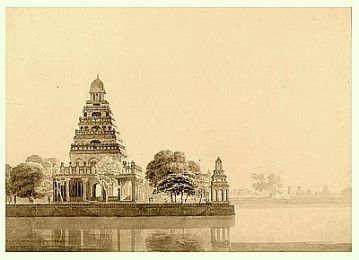
The ancestry of Chandragupta is still shrouded in mystery and not known for certain. There are divergent views regarding the origin, and each view has its own set of adherents. Please check the following site for further discussions on the issue. Please also visit Talk: Ancestry of Chandragupta Maurya

http://en.wikipedia.org/wiki/Ancestry_of_Chandragupta_Maurya

Please check the following for the other side of the issue:

http://www.salagram.net/aryaninvasion-page#12. Chandragupta, the Sandrocottus

**

The another reference point that is often relied upon is the work of the famous astronomer Aryabhatta who wrote his definitive mathematical work in 499 AD. Aryabhatta through his astronomical calculations,  claimed that the year of completion of his work (499 AD) also marked 3,600 years of the Kali Yuga. It , indirectly,  meant, that Kali Yuga commenced in or around 3101 BC.

The other method was calculating the dates from the start-year of the Islamic lunar calendar (622 AD). According to that reckoning, Mahmud of Ghazni attacked India in 1000 AD.

But again, the modern European system of dating is not entirely accurate either.  That is because,   Christ was born at least four years before what we consider to be its start-year of 1 AD , supposedly the year of his birth. Apart from that ,  there have also been both slippages of days and days added artificially by the Church  at different times in European history.

Nevertheless, the present dating system is commonly accepted; and, is compared with many Indian calendars.  Of course, one needs to be constantly reminded that all dates of ancient Indian history are somewhat fluid; and,  in the dating of some events one has to accommodate  a certain ‘give and take’ of a few decades or even a couple of centuries , at times .

***

Talking of chronology in Indian History, Shri Niraj Mohanka (not a professional historian) has produced a remarkable set of spreadsheets – 23 columns wide, 350 rows deep and over 8,000 cells in MS Excel – basically on the chronology of Indian history. The like of which I had not come across. As the chronology in Indian History is always a matter of debate, one may quarrel a bit with the dates indicated by Shri Mohanka, this way or that. But that does not, in any manner, take away the sheen from the dedication and the amount of scholarship and work that has gone into producing the document.

Please check : http://www.newdharma.org/royal_chron.htm

In the webpage, the following link opens up a Microsoft Excel file that contains four spreadsheets (see the four lower Tabs when you open up the Excel file):

1) Royal Chronology of India (Columns K through P on the right-hand side describe other civilizations – Egypt, Israel, Iraq, Iran and China).  On Page 21 of this file is a Population Chart of India from 8000 B.C.E. to 2200 C.E.  On Page 42 is a list of assumptions and sources used to build the timeline.

2) The History of World Religion- major religions [Eastern AND Western] have roots in the Vedas

3) Comparison of All Religions

4) Festivals of India

In the webpage please click on the above picture

 
13 Comments

Posted by on September 7, 2012 in General Interest, History


Tags: , ,

The Three Women In Mahabharata (3 Of 3) -Draupadi

The men play dice and wage wars in Mahabharata , as anywhere else ; but it is the women who wield power and influence. It is the women who take decisions , direct the course of events and decide the fate of men and their generations to follow. The women are the true leaders of the Epic The three women in particular who wielded power in more than one form were Sathyavathi the dusky fragrant fisher girl who became the queen , Pritha the fair maiden who reluctantly became the mother of five sons and Krishnaa , daughter of the fire , Druapadi. The Epic is interwoven with their remarkable sagacity in exercise of their power and leadership. Some say the Epic , in a way , is a study in use and abuse of power.

These women displayed that the truly powerful do not cling to power. They knew when and how to wield it but also, even more important, to when not to use it

blue lotus

 Draupadi

She was called Parshati (सूतस्येति वचः श्रुत्वा पार्षती दुःखिताऽवदत् sūtasyeti vacaḥ śrutvā pārṣatī duḥkhitā’vadat) ; Panchali , Draupadi; Shri ; Yajnaseni … but she was Krishnaa the dusky princess evoking fragrance of the blue lotus (nīlotpala-sugandhinī) . She sprang out of the sacrificial fire, resplendent and glowing as a tower of blaze, full grown and in the bloom of her youth ; not requiring the matrix of human womb.

Draupadi -birth

She was to be a kritya, an avenging fury to wreck vengeance on the foes of her father Yagnasena Drupada – the king of the Somaka-s, one of the five tribes of the Panchala-s ; though he had not asked for her. Fire was her nature. She was fearless, endowed with a single-minded determination as a piercing jet of flame . She lived with a fire burning in her soul , all her life.

Shyama padma palashakshi ; Neela kunchita murdhaja; Manysama vigraham kritva ; Saksath  amara varnini;  Nilotpala samoghandho ; Yasaha proshat pravayati; Ya bibharti param rupam;  Yasyah nastyo pama bhuvi 

The tales of  flame like beauty of the enchanting princess of Panchala blessed with every auspicious feature (sarva-lakṣaṇa-saṃpannā) glowing like a brilliant diamond (vaiḍūrya-maṇi-saṃnibhā); of her rivetingly lovely dark looks (nilotpala-dala-shyamam), of her captivating blue lotus fragrance (nīlotpala-sugandhinī) spread like forest fire far and wide. It set aflame the hearts of countless princes (puruṣendrāṇāṃ cittapramathinī). Even Vyasa , a sage , went into a rapture describing her extraordinary beauty. It was the only time he described his heroine in such detail.

“Eye-ravishing Panchali, black-and-smiling-eyed… Shining coppery carved nails, Soft eye-lashes, Swelling breasts Shapely thighs… Neither short nor tall, neither dark nor pale, with wavy dark-blue hair, eyes like autumn-lotus leaves (padmāyatākṣī), fragrant like the lotus…extraordinarily accomplished, soft-spoken and gentle… Her sweat-bathed (sasvedaṃ) face is lovely, like the blue-lotus (ābhāti padmavat vaktraṃ), like the jasmine (Mallika) ; slim-waisted like the middle of the sacred Vedi (vedimadhyād aninditā), long-haired(dīrghakeśī), pink-lipped (tāmrākṣī), and smooth-skinned. In her presence, the tree leaves stilled for a moment; and, the fires flared but silently . She indeed is a dream incarnated of gods and men alike.”

Drupadasya kule kanyā vedi-madhyād aninditā,nātihrasvā na mahatī-nīlotpala-sugandhinī, padmā-yatākī suśroī asitāyata-mūrdhaj, sarva-lakaa-sapannā vaiūrya-mai-sanibhā, pañcānā puruendrā-ā citta pramathinī raha

ābhāti padmavat vaktraṃ sasvedaṃ mallika ca, vedīmadhyā dīrghakeśī tāmrākṣī nātiromaśā, 

(Adi Parva 1.61.95-97 ;   Sabha Parva : 2.58.36

And among the princes who thirsted her lustily, were the Kuru princes of Hastinapur . She was unwilling to give herself easily even to a worthy one. She insisted on being declared a Veerya-Shulka , a bride to be won by the worthiest and the best in a contest of strength , valor and dexterity in archery which combined in itself skill , grace and strength of mind.

draupadi bride

That was the reason she rejected Karna of low birth even while he was trying to enter the contest at the Swayamvara . That pain and humiliation burned deep into his soul searing his self esteem.  It was like a raw wound that never would heal. Karna later in his life did not let go a slightest opportunity to hurt and humiliate Draupadi. It was her impulsive decision on that fateful day that sowed the seeds for revenge and outrage mounted on her by the Kaurava clan at their court years later.

The outrage of her modesty and the humiliation meted out to her proved to be the nemesis of the Kauravas . Avenging the grievous injury to her honor became a major premise for the war that ended in death and destruction of millions. Yajnaseni , the one born from out of fire, offered her entire being as a flaming sacrifice in that holocaust presided by Krishna . No wonder Draupadi is worshiped even to this day in South India as a personification of Shakthi.

As she ‘ advanced gently and bashfully with a white floral garland in her lovely hands and a sweet smile on her coral-bright lips ‘ she instantly fell in love with that adorable youth of proud bearing , looking fearless and handsome as he emerged out of the crowd of Brahmanas squatted in the far corner of the hall. She was delighted when as he shot down the target with remarkable skill , grace and accuracy.

When it came to light that he was none other than Arjuna, the Pandava prince , she was bemused and she smiled within herself in slight amusement at the irony of fate. She , until then, was on look out for a youth strong and courageous enough to defeat Arjuna who humbled her father just to please his teacher. Now , she just had fallen in love with one that she loved to hate. The fire that just entered into her snubbed out the old fire that was fading away.

The Epic does not discuss Draupadi’s state of mind when asked to be locked in a polyandrous marriage with five brothers. She would perhaps have objected had she so desired. She chose to be silent for whatever reason.

“Then one by one they glanced at Draupadi. Lovely Krsna looked at them. They looked at each other.”

“…So full of respect and affection, the Pandavas all cast their eyes upon the princess of Panchala. And the princess of Panchala also looked at them all. And casting their glances on the illustrious Krishna, those princes looked at one another. And , taking their seats, they began to think of Draupadi alone.

Indeed, after those princes of immeasurable energy had looked at Draupadi, the God of Desire invaded their hearts and continued to crush all their senses. As the lavishing beauty of Panchali who had been modeled by the Creator himself, was superior to that of all other women on earth, it could captivate the heart of every creature.

And Yudhishthira, the son of Kunti, beholding his younger brothers, understood what was passing in their minds. And that bull among men immediately recollected the words of Krishna-Dwaipayana. And the king, then, from fear of a division amongst the brothers, addressing all of them, said, ‘The auspicious Draupadi shall be the common wife of us all.’

The sons of Pandu, then, hearing those words of their eldest brother, began to revolve them in their minds in great cheerfulness”. 

[ Much has been written and discussed about Draupadi’s marriage to five husbands. As said; the Epic does not  explicitly disclose Draupadi’s state of mind and her views on the question  when asked to be locked in a polyandrous marriage with five brothers. She would perhaps have objected had she so desired. She , however, chose to be silent for whatever reason.

Draupadi’s polyandry wedding/s was definitely a strange and a startling feature of the then Mahabharata society. In the long list of the Pandava- ancestors there was no instance of polyandry. Draupadi’s marriage with five brothers did not, therefore, take place in accordance with the then prevailing custom or its old tradition. But, it came about as an extraordinary and an exceptional event.  Later in the Epic, her adversaries miss no opportunity to taunt, ridicule and humiliate her for being the wife of many men.

Yudhisthira’s proposal asking for Draupadi as the wife of all the five brothers came as rude shock to Drupada, Draupadi’s father; and it almost felled him.  He cried out it in anguish:  it is such an unheard of adharma   and is totally against the normal the codes of behaviour (lokadharma viruddham). Yet, Yudhisthira attempts to clear Drupada’s bewilderment by lamely citing Vedic instances of Marisha-Varkshi (vārkī hy eā varā kanyā: a girl raised by the trees) mother of Daksha married to the ten Prachetas brothers; and of Jatila (nee Gautami) the spouse of seven sages. Drupada is now more confused because those instances were ancient and not many had heard of those. Then, sage Vyasa the   biological father of Pandu (who was the de jure father of the Pandavas) steps in and convinces Drupada. Vyasa   succeeds in his attempt, not by reason or logic, but by narrating events from Draupadi’s previous birth/s. Drupada nonplussed, gives in,  helplessly.

*

In the same episode, Sage Vyasa, in an attempt to convince the beleaguered Drupada, narrates the story of the most beautiful and virtuous Bhaumāśvī, the daughter of King Sibi of great fame and immense valor. Bhaumāśvī, the best and most auspicious among women, gifted with a sweet voice, melodious as the notes of the Veena. At her Svayamvara, the five valorous sons of the great King Nitantu (Salveya, Srutasena, Surasena, Tindusara and Atisara), bulls among kings, endowed with all good qualities and famous wielders of the bow, all fell desperately in love with the most enchanting Bhaumāśvi.

Ultimately, the five brothers married her, And, Bhaumāśvi as their common wife bore five most heroic sons. And, their descendants gained fame as: Salveyaas, Surasenas, Srutasenas, Tindusaras and Atisaras

In this manner, listen Oh Great King, Bhaumasvi, celebrated on earth as the most virtuous woman   became the common wife for five of Kings.

In the same manner,  your daughter of divine form, the blameless Parshati, Krishnaa is destined to be the wife of five Pandavas.

 etān naitantavān pañca śaibyā cātra svayaṃvare
avāpa sā patīn vīrān bhaumāśvī manujādhipān
vīṇeva madhurārāvā gāndhārasvaramūrcchitā
uttamā sarvanārīṇāṃ bhaumāśvī hy abhavat tadā
Vyasyā naitantavāḥ pañca patayaḥ kṣatriyarṣabhāḥ
babhūvuḥ pṛthivīpālāḥ sarvaiḥ samuditā guṇaiḥ

01,189.049d@101_0008-13

As per Unabridged Southern Editions Of Mahabharata...Kumbakonam Edition

*

As regards Kunti, it surely does not seem to have been a slip-of tongue when she asked  her sons to share whatever they brought home. Was Kunti really not aware her son won a bride? Was she merely talking of alms her sons brought home? I am not sure Kunti was so gullible.

As mentioned in the post on Kunti, it was a part of her strategy to keep the brothers united and not torn asunder by envy and lust.

Adi Parva (190.29) mentions that Yudhisthira along with the twins slipped out of the Swayamvara as melee set-in when Arjuna , in disguise , won Draupadi. They were already back home by the time the other two brothers along with the newly-won bride Draupadi presented themselves at the door steps. Yudhisthira, by then, would surely have reported to Kunti what transpired at the Swayamvara. While he and the twins were reporting to her , she would have noticed the sparkle and desire in their eyes too. Was that the reason of her charade, asking the brothers to share whatever they had bought home? Though Yudhisthira lamely explains to Drupada that they were honouring the wish of their mother and they were following the custom of their ancestors; Vyasa comments “each had her in his heart”(Adi Parva 193.12)

Kunti showed no signs of regret of her “slip-of-tongue”. She urged Drupada “I fear my words will become as pointless as lies. And if that happens, will I not be tainted with untruth?” What that decision of Kunti did to the Brothers and how that bonded the six together becomes explicit later in the Epic.]

Draupadi biblico de nationale de Francois

(At the Bibliothèque Nationale de France , in Paris, France)

Draupadi  did accomplish that astonishing task of being happily married to five men , remarkably well. Her success was so complete that even Satyabhama, intrigued, desired to share the secret of her success . After performing her duty of presenting each of her husbands with a son , it is said , Draupadi distanced herself from her husbands; and each of them took other wives. That in a way signifies Draupadi and her blue lotus like attitude. She lived amidst sensuality that surrounded her ; but was not contaminated by it. That is the reason Draupadi having five husbands is considered a paragon of chastity , a Kanya.

Draupadi and Satyabhama

That does not mean she grew disinterested in the family affairs. No, she continued to be a very trusted and a vital member of the extended family; and functioned as a sort of effective manager interested in its welfare but not obsessed with its possession. . Draupadi while advising Satyabhāmā  on the ways of managing the household mentions that the complete account of income and expenditure of her husbands was in her grasp and she alone knew the extent of their wealth; she kept track of what each of the many maids attending on Yudhishthira was doing; and she took particular care to discuss with her husbands the decisions they took on various important issues. She took care of their, food,dress and ornaments. She even mentions that Kunti and herself (Draupadi) were consulted on most issues (MBh. 3.222. 38 – 41).

nityam āryām aha kuntī vīrasū satyavādinīm / svaya paricarāmy ekā snānā-acchādana-bhojanaiḥ/ naitām atiśaye jātu vastra-bhūaa-bhojanaiḥ/nāpi parivade cāha pthā pthivī-samām/aṣṭāv agre brāhmaānā sahasrāi sma nityadā / bhuñjate rukmapātrīu yudhiṣṭhira-niveśane / aṣṭāśītisahasrāi snātakā ghamedhinaḥ / triśaddāsīka ekaiko yān bibharti yudhiṣṭhira

It is rather sad that there is not much discussion in the Epic about the motherhood of Draupadi . Her husbands could neither offer the respect and honor that a woman should have as a wife and as a mother; nor could they protect her as a wife should be. All that they succeeded was in making her into a queen.

ps59

Draupadi was a victim of her extraordinary beauty that inflamed the desire in the hearts of men. She seemed to attract violence; and, she  wrecked vengeance thereafter. On each of such occasions, she fought the outrage with matchless courage , assurance , skill and presence of mind. She was veritably a goddess of war.

After the second dice game , instead of meekly obeying Yudhistira’s summons , she had the sagacity to send back a query that challenged the very concept of Dharma and the basis of their conduct towards her.  Draupadi threw a question at Duryodhana:

‘Have you won yourself? Or myself? How do you presume that one husband is authorized to stake the wife while she has four other husbands? Moreover, according to Sastras , the deeds of a king who is in a miserable state due to over  indulgence in hunting , drinking , gambling  and hankering after women are  not lawfully  binding . Hence how could the Kauravas  own Panchali ? I am a free woman by all means. ”

Draupadi lashed out at the Kuru clan. She demanded to know – how could Yudhishthira, having lost himself, stake her at all? It was question that none of the elders learned in Dharma who sat there “with lowered eyes like dead men with life-breaths gone” could dare answer.

It was so difficult a question that even Bhishma, the recognized authority on Dharma, when pointedly challenged by Draupadi, confessed his inability to decide the issue –

” What a strong man says often becomes the only dharma. A weak man may have Dharma on his side, but who listens to him? To tell you the truth, I do not know what to say” (Sabha Parva. 69.15-161).

”I am unable to answer your question because Dharma is subtle”, he says :

-na dharma-saukshmyat subhage vivektum śaknomi te prasnam imam yathavat

Dharma is subtle (sukshmam) because its essence is concealed in a dark cavern

dharmasya tattvam nihitath guhaayaam

And , the end of that sordidly disgraceful episode , Draupadi had the courage , the presence of mind and the wit to plant a parting kick at those assembled . In words dipped in sarcasm and indignity she departed punning on “duty ”:

“ One duty remains, which I must now do. Dragged by this mighty hero, I nearly forgot, I was so confused. Sirs, I bow to all of you, all my elders and superiors. Forgive me for not doing so earlier. It was not all my fault, gentlemen of the Sabha.” (Sabha Parva: 02,060.043)

āhūya-rājā-kuśalaiḥ-sabhāyāṃ;-duṣṭātmabhir-naikṛtikair-anāryaiḥ-dyūtapriyair-nātikṛta-prayatnaḥ;

” It is sad; in this  vast assembly here , there are no elders in the true sense (na sā sabhā yatra na santi vṛddhā) . The so called elders are unable say what is Dharma (* na te vṛddhā ye na vadanti dharmam). There is neither Dharma nor Truth here (nāsau dharmo yatra na satyam asti). And, whatever that is here is just blind, dumb and lame (na tat satyaṃ yac chalenānuviddham) – Sbh Parva : 02.060.045

tiṣṭhanti ceme kuravaḥ sabhāyām / īśāḥ sutānāṃ ca tathā snuṣāṇām /samīkṣya sarve mama cāpi vākyaṃ / vibrūta me praśnam imaṃ yathāvat / jitāsmi kiṃ vā na jitāsmy anena /na sā sabhā yatra na santi vṛddhā /na te vṛddhā ye na vadanti dharmam /nāsau dharmo yatra na satyam asti /na tat satyaṃ yac chalenānu viddham

As she rescued her hapless husbands from slavery , even the embittered Karna could not help exclaiming in admiration that none of the world’s renowned beautiful women had accomplished such a feat (yā naḥ śrutā manuṣyeṣu striyo rūpeṇa saṃmatāḥ): like a boat she has rescued her husbands who were drowning in a sea of sorrows

pāñcālī pāṇḍuputrāṇāṃ naur eṣā pāragābhavat (Sabha Parva: 2.64.3).

During the years of exile , Jayadratha an ally of the Kauravas , was devoured by lust as he came across Draupadi in Kamyaka Vana “Leaning against a kadamba tree, holding on to a branch with an upraised hand, her upper garment displaced, she flashes like lightning against clouds or like the flame of a lamp quivering in the night-breeze.” As he grabbed at her , she did not helplessly shriek , lament and cringe as a damsel in distress; instead she kicked the aggressor hard sending him reeling to the ground. She took control of Jayadratha’s chariot and calmly asked a nearby priest to report the incident to her husbands.

Kichaka tormented and kicked her in the court of Virata in presence of Yudhistira who advised her not to create a scene and to quietly go away. She realized that it was only Bhima who could rescue her and avenge her. Vyasa describes in a playful loving narration how she warmed up to Bhima , aroused his love for her and set him up for a fight with Kichaka, who was infatuated with her (sairandhryā kīcakaḥ kāmamohitaḥ) .

bhima draupadi

She finds Bhima at night in his cook’s quarters , twines herself round him as a creeper entwines a massive Shala tree on the banks of the Gomati; as the bride of the sleeping king of beasts clasps him in a dense forest; as an elephant-cow embraces a huge tusker. And as Bhima awakes in Panchali’s arms, she sings into his ears, in a Veena like tone pitched at the Gandhara note, the third in the octave –vīṇeva madhurābhāṣā gāndhāraṃ sādhu mūrcchitā.

veeneva madhuraa-bhaashaa gaandhaaram saadhu moorchchhitaa | abhya-bhaashata paanchaalee bheemasenam-aninditaa || 4. 16 .8 ||

She narrates her misfortunes and her torments. She wails to Bhima “Any woman married to Yudhishthira would be afflicted with many griefs….What does Yudhishthira do? He plays dice…Look at Arjuna… A hero with earrings!” You indeed are my true hero , she coos, I will consume poison and die in your arms , Bhima. She covers his face with her palms chapped and scarred in queen’s service. Mighty Bhima melts like early morning dew at the first light.

“Wolf-waisted foe-crushing Bhima covered his face with the delicate, chapped hands of his wife, And , he burst into tears.”

tatastasyaah’ karau shoonau kinabaddhau vri’kodarah’ | mukham-aaneeya vepantyaa ruroda para veerahaa || 4.19.29 ||

And , That settled the fate of Kichaka.

saa keertayantee duh’khaani bheemasenasya bhaaminee |ruroda shanakaih’ kri’shnaa bheemasenamudeekshatee ||4.19.26||

saa baashpakalayaa vaachaa nih’shvasantee punah’ punah’ |hri’dayam bheemasenasya ghat’t’ayanteedamabraveet ||4.19.27||

naalpam kri’tam mayaa bheema devaanaam kilbisham puraa |abhaagyaa yattu jeevaami martavye sati paand’ava ||4.19.28||

tatastasyaah’ karau shoonau kinabaddhau vri’kodarah’ |mukhamaaneeya vepantyaa ruroda paraveerahaa ||4.19.29||

tau gri’heetvaa cha kaunteyo baashpamutsri’jya veeryavaan |tatah’ paramaduh’khaarta idam vachanamabraveet ||4.19.30||

kichak_bheem

Throughout the thirteen years of exile, Draupadi did not let her husbands forget how she was outraged and how they were deceitfully deprived of their kingdom. After the years of exile and the year of incognito , when she learnt that her husbands were suing for peace, she was angry and smoldering with rage like a volcano about to erupt. She thundered that she shall tie her loose hair only when bathed in the blood the villain who dared to pull it.

When Krishna visited her , she poured out her heart to him , holding up her serpent-like thick glossy hair and with tearful eyes urged Krishna to recall those tresses when he negotiated for peace with the kauravas. She exhorted that he was bound fourfold to protect her:

“For four reasons, Krishna, you are bound to protect me ever: I’m related, I’m renowned, I’m your sakhi and you rule over all.” (Vana Parva 10.127).

In case even he did not care to help her, she declared that her five sons led by Abhimanyu and her old father and brothers would avenge her .

Krishna could scarcely say no to her. He promised to annihilate her tormentors “Consider those you disfavor As already dead!… The Himavant hills may move, the Earth shatter In a hundred pieces, heaven collapse; My promise stands (satyam te pratijaanaami kri’shne)… You will see your enemies killed.” (Udyoga Parva: 80.46-49)

The mighty-armed Kesava then spoke, comforting her in these words, ‘Soon wilt thou, O Krishna, behold the ladies of Bharata’s race weep as thou dost. Even they, O timid one, will weep like thee, their kinsmen and friends being slain. They with whom, O lady, thou art angry, have their kinsmen and warriors already slain. With Bhima and Arjuna and the twins, at Yudhishthira’s command, and agreeably to fate, and what hath been ordained by the Ordainer, I will accomplish all this. Their hour having arrived, the sons of Dhritarashtra, if they do not listen to my words, will surely lie down on the earth turned as morsels of dogs and jackals. The mountains of Himavat might shift their site, the Earth herself might spilt into a hundred fragments, the firmament itself with its myriads of stars might fall down, still my words can never be futile. Stop thy tears, I swear to thee, O Krishna, soon wilt thou see thy husbands, with their enemies slain, and with prosperity crowning them.'”

aham cha tat karishyaami Bheema-arjuna-yamaih-saha |yudhisht’hira-niyogena daivaachcha vidhinirmitaat ||5.80.46||

dhaartaraasht’raah’ kaalapakvaa na che chchhri’nvanti me vachah’ | sheshyante nihataa bhoomau shvashri’gaalaadaneekri’taah’ ||5.80.47||

chaleddhi himavaan jshailo medinee shatadhaa bhavet | dyauh’ patechcha sanakshatraa na me mogham vacho bhavet ||5.80.48||

satyam te pratijaanaami kri’shne baashpo-nigri’hyataam | hataamitraan-jshriyaa yuktaan-achiraad-drakshyase pateen ||5.80.49||

 ***

Death danced its naked Tandava as never before. Hundreds of thousands perished every day in the eighteen-day war. Brothers killed brothers, fathers killed sons, uncles butchered nephews and nephews slew uncles, masters and disciples did away with each other. And strangers massacred strangers. The wails of mothers, daughters, sisters, wives and children rent the skies. Jackals and vultures tore apart the slain men and carcass of animals. Ghouls and cannibals danced in devilish delight and feasted on the slaughtered.

The worst was yet to come, Ashvatthama heinously slaughtered Draupadi’s sons and brothers while they were asleep. Even at that most agonizing and heartbreaking moment Draupadi had not lost the sense of life , humanity and compassion. When Ashvatthama was brought before her , bound in ropes as an animal , and all were thirsting for his blood , Draupadi had the nobility of heart to ask her husbands to let him go . she said :

“I know how much it hurts to loose sons . I cannot bear to see that vriddha matha , the aged mother of Ashvatthama , endure the agony and grief of loosing her only son in her old age. Let him go for the sake of his old mother. Let her not cry as I do now.”

****

Draupadi is often referred to as Nathavathi_Anathavat, perhaps to express the agony of Draupadi having five husbands but with none to protect her. She was married to five yet she was all alone , unprotected , uncared and unloved. She always had about her a certain loneliness . She once poured her heart to Krishna :

And wiping her eyes and sighing frequently she said these words angrily and in a choked voice, ‘Husbands, or sons, or friends, or brothers, or father, have I none! Nor have I thee, O Madhusudana, for ye all, beholding me treated so cruelly by inferior foes, sit still unmoved!

My grief at Karna’s ridicule is incapable of being assuaged! On these grounds I deserve to be ever protected by thee, O Keshava, viz., our relationship, thy respect for me, our friendship, and thy lordship over me.

“No husband have I, nor son, nor brother nor father. So much so, O Madhusudana, that even you are not mine”

 naiva me patayah’ santi n putraa Madhusoodana | na bhraataro na cha pitaa naiva tvam na cha baandhavaah’ ||4.12.112||

ye maam viprakri’taam kshudrairupekshadhvam vishokavat | na hi me shaamyate duh’kham karno yatpraahasattadaa ||4.12.113||

As Shri Pradip Bhattacharya said

“ Yudhishthira pledges her like chattel at dice. .. Draupadi finds her five husbands discarding her repeatedly. Each of them takes other wives . . Draupadi stands quite apart from her five husbands not one of them not even Sahadeva of whom she took care with maternal solicitude, nor her favorite Arjuna tarries by her side when she falls and lies dying on the Himalayan slopes.. Yajnaseni leaves the world all by herself, nathavati anathavat.”

lotus blue

There was much that was common among the three women – Sathyavathi , Kunti and Draupadi. All the three were described as dark or dusky emanating a captivating body odor .All three were also described as amorous lovers .They were the celebration of women as “sexually powerful magical beings” in the words of Naomi Wolf . They were all women of substance and leaders of men.

All the three had a will of their own, they wielded power and influence ; but each in her own manner. Sathyavathi , the Yojanaghandha was sensuous and manipulative. Kunthi treated with much respect in the Epic , was a heroic mother who did not seek anything for herself. Draupadi too did not seek anything for herself. She had to live with five men ; while Kunthi had only to endure momentary involvements . Draupadi as a wife tended to and inspired her men though in return got little or nothing . Yajnaseni the one born out of fire , offered herself as a sacrifice in the fire of life.

Kunti and her daughter-in-law Draupadi, in a strange way, endured similar pain and had more in common . Pandu among all the assembled royalty was Kunti’s chosen heart – desire (mano- kaamana). Yet, soon thereafter she had to share nay lose her husband to her co-wife, younger and  bashful. Draupadi could not  be Arjuna’s sole love. Not only that she had to be the wife of four others but also that Arjuna and his brothers each took many wives. The marriages of Kunti and Draupadi, to say the least, were over crowded. Finally, If Draupadi was born in fire Kunti dies in fire.

It is said , Sathyavati with the aid of Vyasa brought into being a dynasty the one branch of which was nurtured and carried forward by Kunthi while its other branch was annihilated because of Draupadi. But how fair is it blame Draupadi for the ruin that the Kauravas brought upon themselves?

lotus blue 2

There is a well-known Sanskrit stanza which exhorts the virtues of a set of five Kanyas , virgins. It says , contemplation on the virtues of these five destroys the greatest sins:

Ahalya Draupadi Kunti Tara Mandodari tatha  /  panchakanya smare-nityam mahapataka nashakam.

Included among the five virgins are Kunti and Draupadi. Strangely , both knew more than one man and were mothers too. Why then did our ancients address them as Kanyas? And why were they so highly regarded?

They were perhaps not referring to their bodies but to the state of their being. They did what they did , not out of desire or out of attachment . It was perhaps to suggest they were psychologically pure and untainted. They learnt to sublimate their ego to reach a higher self. They were independent women enjoying an identity of their own. The status of Kanya perhaps also referred to the way they asserted their independence.

M. Esther Harding  mentions in Woman’s Mysteries [Rider, 1971, p. 125- 126] “the woman who is psychologically virgin is what she is … (she is) one-in-herself (and) does what she does not because of any desire to please, not to be liked or to be approved even by herself but because what she does is true. Her actions may, indeed, be unconventional “.

M. Esther Harding again  makes a telling observation : “ He does not know the difference before love and after love, before motherhood and after motherhood…Only a woman can know that and speak of that. … She must always be as her nature is. She must always be maiden and always be mother. Before every love she is a maiden, after every love she is a mother.”

[Please check a detailed report posted by Smt. Saroj Thakur on the discussion about Panchkanyas of Indian epics.]

lotus-blue

Indebted to

Shri Pradip Bhattacharya

And

Prof. P Lal for his translations of  Mahabharata

 
15 Comments

Posted by on September 7, 2012 in Mahabharata


Tags: , ,

The Three Women In Mahabharata (2 Of 3) – Kunti

The men play dice and wage wars in Mahabharata , as anywhere else ; but it is the women who wield power and influence. It is the women who take decisions , direct the course of events and decide the fate of men and their generations to follow. The women are the true leaders of the Epic The three women in particular who wielded power in more than one form were Sathyavathi the dusky fragrant fisher girl who became the queen , Pritha the fair maiden who reluctantly became the mother of five sons and Krishnaa , daughter of the fire , Druapadi. The Epic is interwoven with their remarkable sagacity in exercise of their power and leadership. Some say the Epic , in a way , is a study in use and abuse of power.

These women displayed that the truly powerful do not cling to power. They knew when and how to wield it but also, even more important, to when not to use it


 Kunti

Pritha, wide eyed and  beautiful , the firstborn of Devameedha Shurasena of the Vrishni Yadavas who ruled over Mathura , had a rather unusual childhood. Her father had given her away even before she was born . He gifted her  to his good friend and childless cousin Kunthibhoja , a Bhoja Yadava of the Kunti Kingdom. Soon after Pritha was born, she was adopted by Kunthibhoja ; and, since then she came to be known as Kunti.

After her arrival at his palace, Kunthibhoja was blessed with children. He considered Kunti his lucky charm; and, doted on her . In the meantime, Shurasena had a son; and, he named him Vasudeva, who years later married Devaki of Mathura ; and , had a son by her, named Krishna Vasudeva.

Pritha was a happy child; and , yet yearned for a mother in Knthibhoja’s sprawling mansion. She found none to confide her fears , hopes and anxieties. That feeling of being left adrift , unguided and unwanted rankled deep within her for long years.

Kunthibhoja placed the nubile girl Pritha at the disposal of the eccentric sage Durvasa ; and, exhorted her not to neglect any service either out of pride in her good-looks or in her status . He cautioned her against displeasing the quick-tempered sage , lest she bring dishonor to her clan and to herself . That fear of bringing disgrace to her clan haunted her until late in her life. That fear was to become a premise for the tragedy of her life and of the Epic.

The irascible Durvasa , for once , was pleased . He gifted Pritha with a mantra that would summon , at her will , any god . The girl , a short time thereafter , out of sheer child-like curiosity tested whether the mantra would really work .To her amazement it did work. Lo and behold .. ! the resplendent Sun presented himself ; but he refused to go away unsatisfied . He cajoled the virgin princess Pritha to consent for sex. It was then that she took her first real decision . Pritha asked the Sun to assure that her virginity remained unimpaired even after childbirth ; and,  that her son would resemble his father in glory.

kunti by Giampaolo Tomassetti

It was her clan’s honor that came in the way of Kunti owning her firstborn. Kunti was a princess and a queen to be. In contrast , Satyavathi a fisher-woman was not inhibited by qualms of clan honor etc. ; and,  she was not scared or ashamed of being known as an unwed -mother.

Kunti then took that most accursed decision of her life – to set adrift her son , her firstborn down the river Ashva , so that King Kunthibhoja , her adopted father and his clan would not have to hang their head in shame. But she regretted abandoning her child , in silent grief and guilt .When she spoke of that years later , it was rather too late; and, the die of death had been cast; her words sounded hollow bereft of authenticity of mother’s love.

Kunti, for a short while broke the sequence of Bharata – brides forced into unwilling marriages ; but sadly , she could not break the sequence of Bharata Kulavadhus forced to beget sons out of wedlock.

Her joy in marriage was short-lived. She was sad and hurt for a number of reasons. Soon after her marriage , the more attractive Madri was brought in as the second wife of Pandu , her husband. Pandu thereafter not merely distanced himself from kunti ; but also because of his disability forced kunti to beget sons out of the wedlock , by soliciting a worthy stranger. The tragedy of Pandu was that he was consumed by lust; but, was incapable of quenching that raging fire  .”Addiction to lust killed my mother’s husband, though the virtuous Shantanu gave him birth. And though truth-speaking Vyasa is my father, lust consumes me too .”

The only solace for Kunti in that unsatisfying triangular relation was Madri, a woman who came into her life as a rival ; but , soon became her younger sister and a loving friend. Kunti , later in in her life, recounted the three blessings in her life : her friend Madri ; her sons of matchless valor ; and, the most endearing of all , her nephew Krishna.

pandu_orderd_kunti_to_bear_a_son

When Pandu forced her to beget children for him by soliciting a worthy person, she recoiled in horror and flatly refused saying : “Not even in touch will I be embraced by another “. She was scared of her past and wanted desperately to move away from that shame.

Pandu however cajoled and reasoned with her that she would merely be following a sanctioned custom of the Northern Kurus (Uttara-kuru) – uttareṣu ca rambhoru kuruṣv adyāpi vartate. And, he even cited the examples of his mother and her sister.

He went on to explain :

“Now will I make known to thee the true essence of dharma , listen unto me, the beautiful eyed one (cārulocane), the ancient dharma perceived by the lofty-minded knowers of it. In former times, as is well known, women were left unhindered (anāvṛtāḥ kila purā striya āsan varānane); O thou of the lovely face, going the way of their desires, in freedom they followed their own inclinations. (kāmacāra vihāriṇyaḥ svatantrāś ); O sweet-smiling one, neither man nor woman knew jealousy (Irshya nasti narl-nara-naam); and, were free from fear, love  and anger (kāma-dveṣa-vivarjitāḥ). When they, from the years of maidenhood on, did trick their husbands; that was not seen as wrong. But,  that was the right thing in former times

taṃ caiva dharmaṃ paurāṇaṃ .

This was the moral order laid down by the rule of conduct; it was honored by the great Rishis through observance, and to-day is still honored among the Uttarakurus.  For, this is the eternal law that shows favor to women

purāṇam ṛṣibhir dṛṣṭaṃ dharmavidbhir mahātmabhiḥ.

But, sadly, the barrier of to-day was set up in our world short while ago .  Learn this now, O lotus eyed (kamala-patrākṣi),brightly-smiling one, from me “.   

He then narrates the bizarre story of Svethakethu son of the Rishi Uddalaka; and, the circumstance that prompted Svethakethu to bring into effect the new moral order of conduct for woman and man, replacing the ancient law under which the women were unhindered (anavrita).

“Until  then , women were not restricted to the house, they were not  dependent on family members; they moved about freely, they enjoyed themselves freely. Until then they  were free; they could sleep with any men they liked from the age of puberty; they could be  unfaithful to their husbands, and yet were not viewed  sinful… the greatest rishis have praised the ancient  tradition-based custom;… the northern Kurus still practice it…the new custom is very recent.” Adi Parva (113.3-20)

3 atha tv imaṃ pravakṣyāmi dharmaṃ tv etaṃ nibodha me
      purāṇam ṛṣibhir dṛṣṭaṃ dharmavidbhir mahātmabhiḥ
  4 anāvṛtāḥ kila purā striya āsan varānane
      kāmacāra vihāriṇyaḥ svatantrāś cārulocane
  5 tāsāṃ vyuccaramāṇānāṃ kaumārāt subhage patīn
      nādharmo ‘bhūd varārohe sa hi dharmaḥ purābhavat
  6 taṃ caiva dharmaṃ paurāṇaṃ tiryag-yonigatāḥ prajāḥ
      adyāpy anuvidhīyante kāma-dveṣa-vivarjitāḥ
      purāṇadṛṣṭo dharmo ‘yaṃ pūjyate ca maharṣibhiḥ
  7 uttareṣu ca rambhoru kuruṣv adyāpi vartate
      strīṇām anugraha karaḥ sa hi dharmaḥ sanātanaḥ
  8 asmiṃs tu loke nacirān maryādeyaṃ śucismite
      sthāpitā yena yasmāc ca tan me vistarataḥ śṛṇu
  9 babhūvoddālako nāma maharṣir iti naḥ śrutam
      śvetaketur iti khyātaḥ putras tasyābhavan muniḥ
  10 maryādeyaṃ kṛtā tena mānuṣeṣv iti naḥ śrutam
     kopāt kamalapatrākṣi yadarthaṃ tan nibodha me
 11 śvetaketoḥ kila purā samakṣaṃ mātaraṃ pituḥ
     jagrāha brāhmaṇaḥ pāṇau gacchāva iti cābravīt

He begged her “Sweet lady, I fold my palms joining the tips of my lotus-leaf rosy fingers and I implore you listen to me , the auspicious one (śhubhe).”

tathā raktāṅguli talaḥ padmapatra nibhaḥ śubhe /  prasādārthaṃ mayā te ‘yaṃ śirasy abhyudyato añjaliḥ (MBh.1.113.29)

She could not let him know that she already had a son ; she could also not refuse his request altogether. She tactfully and tacitly gave in “Best of Bharatas ! Great adharma it is for a husband to ask repeatedly a favor; shouldn’t a wife anticipate his wishes”.

After she bore three sons and when the greedy husband urged Kunti to have more sons, she refused to abuse that rare power for sake of self-indulgence . At his request she passed on one mantra to his favorite Madri. Again , when he asked for more mantras for use by Madri , Kunti angrily retorted “ Don’t come to me again, my lord, saying give her the mantra .”

Kunti yearned for a true love ; but, was hurt and disappointed .She envied Madri as she ascended the funeral pyre with Pandu’s corpse; and cried out , ” Princess of Bahlika ! You are fortunate indeed , I never had the chance to see his face radiant in intercourse.” She begged Madri a favor “Could I bring up your children as mine” Madri the true friend she was cried out to Kunti “You are blessed. There is none like you; you are my light, my guide, most respect-worthy. Greater in status, purer in virtue.” How true this description was of Kunti !

The years that followed Pandu’s death were truly of great distress . Poverty , insecurity and shame haunted her and her sons . Unaided by the Vrishnis or the Bhojas , Kunti alone protected and guided her sons from the treacheries plotted by the sons of Gandhari .Her lone trustworthy contact in Hastinapura was Vidura the son of Ambika’s maid.  He too offered help covertly, in fear of Kurus. It was with his help that Kunti managed to rescue her sons and herself from the arson  at Varanavruta.

[A question that usually comes up is: why kunti could not get (seek) assistance from the Vrishnis or the Bhojas (both being Yadavas – Kunti’s maternal clan). This question has not been answered clearly.  I do not know the exact reason that forced Kunti to fight it out alone. However, I surmise the following context of those times could provide some clues to why Kunti had to brave her troubles alone. I could be wrong. Yet;..

At that time the entire north India as also the Yadava country was in turmoil. They were under repeated attacks  by Jarasandha of Magadha (Bihar) who formed a confederation consisting Dantavakra of Karusha and Sishupala of Chedi in central India, Bhishmaka of Vidarbha in the south-west, Kalayavana  beyond the western borders, the ruler of Kashi (Benares), Paundraka Vasudeva of Pundra (Bengal) in the east, Naraka of Pragjyotishapura (Assam) in the north east. Jarasandha thus established a tyrannical supremacy over the other regions.

For fear of Jarasandha and his hordes, the king of the Salwayana tribe with their brethren and followers such as the southern Panchalas and the eastern Kosalas all fled to the country of the Kuntis. Similarly, the Matsyas (Rajasthan area) and the Sannyastapadas, overcome with fear, fled into the southern country. And so did the others, alarmed at the power of jarasandha, left their kingdoms and fled in all directions.

Jarasandha was particularly angry with the establishment at Mathura and the Yadavas in general, because his son-in-law Kamsa had been slain by Yadava-Krishna. Jarasandha, in rage and retaliation, attacked  and  imprisoned   as many as eighty-six princes, it is said.

Krishna , in order to save the Yadavas from being enslaved , persuaded his clan leaders to abandon Mathura; and, to re-establish themselves in the fortified city of Dwaraka , on the western seashore. It is said; the eighteen tribes of Yadavas , including  the Bhojas,  with the Surasenas, the Bhadrakas, the Yodhas, the Salwas, the Patachchavas, the Susthalas, the Mukuttas, and the Kulindas, along with the Kuntis, all fled towards the west , for  fear of jarasandha.

Dwaraka

Meanwhile, Bhishma who then was the regent of the Kingdom of Hasthinapura found it wiser and safer to appease; and, to make truce with Jarasandha. Srimad Bhagavatha Purana even mentions that some troops of Hasthinapura assisted Jarasandha and accompanied the Magadha army’s onslaught on Mathura.

It , therefore , appears that during the time in question, Hasthinapura region was comparatively safe. Further, all the Yadavas clans had abandoned Mathura and fled to Dwaraka in the far west.  Therefore none of Kunti’s maternal-clans was near her nor was in a position to help her.   It is also likely that Kunti might have reasoned that the fate and future of her sons was tied to Hasthinapura, over which they had to assert their right. And, Kunti and her sons, therefore , had to be in Hasthinapura region. Being closer to the  Yadava clans or their support, in any case, was not of great consequence.]

When Bhima was about to drive away the infatuated Hidamba , Kunti had the presence of mind and foresight to spot an opportunity that came her way for forging a new alliance;  and , she grasped it by advising Bhima to marry the love thirsty girl –

” I can see no way of taking fit revenge for the terrible injustices that Duryodhana has done us. A grave problem faces us. You know Hidimba loves you…Have a son by her. I wish it. He will work for our welfare. My son, I do not want a no from you. I want your promise now, in front of both of us.”

Hidamba

She realized that her friendless , shelter-less and impoverished sons badly needed supporters and allies if they had to survive , fight back their tormentors ; and regain the  lost kingdom and honor.

Thanks to Kunti’s foresight , that union of Bhima and Hidamba not merely gained for the Pandavas the support of the Rakshasas during their exile ; but also saved the life of Arjuna later in the Kurukshetra war. It was again Kunti who instructed her first grandchild to fight for Pandavas “You are one of the Kurus . To me , you are like Bhima himself. You are the eldest son of the Pandavas. Therefore, you should help them .” Ghatotkacha, son of Hidamba, saved Arjuna from Karna’s infallible weapon in the war, at the cost of his own life.

Earlier , Bhima, at the instance of Kunti, befriended Naga Aryaka , her father’s maternal grand father. Later during the years of exile, Arjuna as advised by his mother forged alliance with Nagas , Manipuris and Yadavas of Dwaraka (through Subhadra). Kunti had the foresight to build alliances that would someday come in handy .

She had the wisdom to educate her sons in proper use of power. At Ekachakranagara, when Yudhisthira opposed sending Bhima to fight Bakasura the monstrous eater , Kunti retorted rather sternly “ I am not foolish; don’t think me ignorant; I am not being selfish. I know exactly what I am doing. This is an act of dharma. Yudhishthira, two benefits will follow from this act ; one, we will repay a Brahmin and two, we will gain moral merit. It is a king’s duty to protect. It is his dharma.” That was the only other occasion that Yudhisthira opposed his mother .

After the Baka episode , Kunti and her sons shifted from the Brahmin’s house to a potter’s house in the country of Panchala ; that was farther down in social hierarchy. That perhaps was a part of her way of bringing up her sons; to expose them to experiences at all levels of living. Kunti’s maturity, the ability to observe life , to learn from experience and arrive at a swift decision, sets her apart from other characters in the Epic , save Krishna.

The move to Panchala at the instance of Vyasa was to win Drupada’s daughter and to form an alliance with the Panchalas. That , again , was a part of her long-term strategy to win back the lost kingdom. She had the foresight and sagacity to calculate that a fight with the Kauravas would at sometime be inevitable , while no others foresaw the battle even as a possibility. She tried to build alliances around that possibility .

Much has been written about Kunti asking her sons to share whatever they brought home and which led to the five brothers marrying one woman , Draupadi. Was Kunti really not aware her son won a bride ?Was she merely talking of alms her sons brought home? I am not sure Kunti was so gullible.

Adi Parva (190.29) mentions that Yudhisthira along with the twins slipped out of the Swayamvara as melee set-in when Arjuna , in disguise , won Draupadi. They were already back home by the time the other two brothers along with the newly-won bride Draupadi presented themselves at the door steps. Yudhisthira , by then, would surely have reported to Kunti what transpired at the Swayamvara. While he and the twins were reporting to her , she would have noticed the sparkle and desire in their eyes too. Was that the reason of her charade , asking the brothers to share whatever they had bought home? Though Yudhisthira lamely explains to Drupada that they were honoring the wish of their mother and they were following the custom of their ancestors ; Vyasa comments “each had her in his heart”(Adi Parva 193,12)

– drupadasyā atmajā rājaṃs te bhindyantāṃ tataḥ paraiḥ

Kunti showed no signs of regret of her “slip-of-tongue”. She urged Drupada “I fear my words will become as pointless as lies. And if that happens, will I not be tainted with untruth?”. What that decision of Kunti did to the Brothers and how that bonded the six together becomes explicit later in the Epic.

Kunti Draupadi by Giampaolo Tomassetti

[Giampaolo Tomassetti, the famous Italian artist, studied  the Mahabharata  Epic for over a period of five years. The gifted artist took about 12  years to  illustrate the epic ]

The respect and implicit obedience her sons displayed was a tribute to Kunti and her motherhood. It was something that Gandhari could not achieve. Truly, Kunti is a remarkable picture of maternal heroism created by Vyasa.

[ Please read : Gandhari the lonely Queen ]

Indeed, the only occasion when her sons did not consult her was before playing the second dice game. They did not even meet their mother before leaving Indraprastha, let alone seek her advice. And , what a disaster that turned out to be !!

Game of Dice by Giampaolo Tomassetti

The Draupadi Swayamvara marks a watershed in the Epic . With that , Kunti gracefully recedes to background and Draupadi takes over the care of Kunti’s sons. It also marks the entry of Krishna in to the Epic and into the lives of the Pandavas . 

kunti22

Krishna was another of those who wielded enormous influence ; but never occupied a seat of power. It is only the presence of Krishna that elevates Mahabharata into an Epic of great significance; else it would merely have petered out into a listless tale of internecine fratricide.

*

Finally , Kunti in order to ensure safety of her sons , humiliated herself and revealed the “misdeed” of her youth. She begged Karna to join his brothers. Though Karna rejected her , he fell into an abyss of indecision.

Some commentators have sought to justify Kunti’s prolonged silence by saying that Kunti had long realized the futility of letting know Karna his birth-secret; and she rightly deduced that doing so would  cause more humiliation , suffering  and harm to Pandavas. Because, Kunti by then knew very well of Karna’s intense loyalty and submission to Duryodhana; and,  she calculated  if   Yudishthira promptly hands over the throne to his new-found elder brother Karna the latter would undoubtedly surrender it to his master Duryodhana.  That would not in any manner help Pandavas in regaining their heritage; instead it would worsen their position. Kunti, therefore, made the heroic choice of keeping the secret as long as it was possible although it caused her much anguish and agony.

Shri Pradip Bhattacharya adds:’ Karna’s grossly limited dharma is one of blind adherence to his benefactor regardless of the ethics of Duryodhana’s actions….She (Kunti), in contrast, deliberately chose the greater good, that of establishing a new kingdom founded on dharma under her nephew Krishna’s leadership by the Pandavas. Her   acknowledging Karna as her son in haste would only have strengthened the forces of adharma. To describe Kunti’s choice as ‘blotting her record as a mother’ is surely unjustified’.

****
Kunti all her life acted alone , unaided and unguided; except perhaps with tacit support of Vidura .Whatever decisions she took , they were on her own. She guided and protected her sons in every way she could and guarded them amid all the venal politics of the Kuru court .

When her sons went into exile Kunti stayed back in Hastinapura perhaps to remind the blind king of his guilt. She had not given up the fight. When Krishna came to Hastinapura on a peace mission she was terribly upset and angry . She chided Krishna and asked him to urge Yudhisthira to fight for his rights as a Kshatriya must. She asked Yudhisthira through Krishna “ Can anything be more humiliating than that your mother, friendless and alone, should have to eat others food ? Strong-armed one, recover the ancestral paternal kingdom by use of gentleness, dissension, gifts, force or negotiation. Follow the dharma of the kings, redeem your family honor. Do not, with your brothers, watch your merits waste away.”

She chided and motivated her sons. She delivered the final punch kick “The princess of Panchala followed all dharmas, yet in your presence they mocked her , how can you ever forgive this insult? The kingdom lost did not hurt me, the defeat at dice did not hurt me; the exile of my sons did not hurt me so much as the humiliation of Draupadi weeping in the sabha as they mocked her. Nothing more painful than that insult”

Flare up, even if briefly, like tinduka-wood. Do not smolder away in billowing fire -less smoke. (Udyoga Parva, 05,131.013

alātaṃ tindukasyeva muhūrtam api vijvala

After the war she decided to retreat into the forest along with the blind king Dritharastra , his blindfolded queen Gandhari and Vidura. When Bhima , in anguish cried out , why she urged them to fight and wade through the rivers of blood and guts of their relatives, if she had to go away leaving them behind after everything was done.

Kunti consoles Bhima the strongest of her sons by saying that she inspired them to fight not because she desired for a kingdom or for a palace;  but, because she desired an honorable life for her sons and that they should not live forever   in shame as slaves.

In many ways, Kunti’s life is remarkable . Gifted away by her father even before she was born, callously placed by her foster father at the mercy of an eccentric sage she fell a victim of a god’s lust,. An impotent husband forced her to beget children from others thrice over. She yearned for love but received none . In her days of utter misery neither her father nor her foster-father cared to help her. She guided and protected her sons virtually alone . The only friends she had were Madri who died too young and Vidura the helpless bystander. Her true confidant was her nephew Krishna.

Kunti comes across as a brave and a wise woman grievously hurt and disappointed in love. She was not a woman cast in the conventional mold . She was rather lonely , fighting to protect her sons amidst the encircling treachery and hatred. She had the wisdom to educate her sons in proper use of power. She guided them along the path of Dharma . She not merely anticipated a war but willed it to happen in order to regain honor and the lost kingdom for her sons . Towards that end she built and sustained political alliances with foresight and sagacity . She had the wisdom to recede from active scene when it was prudent to do so .When her mission was accomplished she had the detachment and strength of mind to renounce the fruits of her efforts and to walk away into forest and into fire… Truly, Kunti is a remarkable picture of maternal heroism created by Vyasa.

draft_lens19135557module156995806photo_1329348026aa-aa-a-

 ..Next …Draupadi

 
22 Comments

Posted by on September 7, 2012 in Mahabharata


Tags: , ,