RSS

Yearly Archives: 2016

Bhagavad-Gita Multiple interpretations- Part One

bhagavad-gita-nishkama-karma

Bhagavad-Gita, by all accounts, is rather an unusual text.

Bhagavad-Gita, is revered as one among the exalted triad of the fundamental philosophical texts (Prasthana-traya) of the Sanatana Dharma; the other two being the principal Upanishads (Upadesha prasthana, Śruti-prasthāna) and the Brahma Sutra (Sutra-prasthana or Nyaya-prasthana) , which is the condensed essence of Upanishads . The Gita is accorded the position of Sadhana-Prasthana (practical text); and, is regarded as the starting point of remembered tradition the Smriti-Prasthāna.

[Sruti is the directly perceived truth, hence more authoritative. Smriti is the heard or meditated upon tradition that follows the Sruti.]

: – And yet; the Bhagavad-Gita is located within the Mahabharata, an Epic which is classified as Ithihasa, a narration of the past events. The Gita is conceived and developed as a solution to the climax of a Dharmic dilemma that emerges during the course of the Epic. As Van Buitenen said; it was not an independent text that somehow wandered into the epic.

Mahabharata as Ithihasa is classified as Smriti, while the Bhagavad-Gita embedded within it is assigned a superior and an exclusive position of a Sruti, though it deviates, in some respects, from the traditional Sruti format.

[However, the famous philosopher Dr. Surendranath Dasgupta in his monumental History of Indian philosophy makes an interesting observation. In the Rig Veda, he observes, Vishnu is called as Gopa, Sipivishta, Urukrama, etc., but not as Narayana. Then he goes on to say, similarly, Bhagavad Gita does not use the term Narayana; but, the Mahabharata identifies Narayana with Vishnu. This, according to him, could show that Bhagavad Gita was composed much before Mahabharata tale was reduced to writing. He opines, Bhagavad Gita was composed at a time  when Narayana was yet to be equated with Vishnu.

In contrast to that, Eknath Easwaran asserts that the Gita was composed much later under the realities of a new age. It ‘is not an integral part of the Mahabharata. It is essentially an Upanishad, and my conjecture is that it was set down by an inspired seer and inserted into the epic (later).’]

: Regarding the plausible ‘Date’ of the Bhagavad-Gita , Justice Kashinath Triambak Telang, in his introduction to Bhagavad-Gita  (Oxford, New  Clarendon Press, 1875/ 1882) , conducts a detailed discussion covering various aspects , such as ; the language; the philosophical outlook; its treatment of the Vedas ; and its proximity to the Upanishad-like-ideas etc.

The language of the Gita differs from that of the Sanskrit of the classical age. Its style is naturally simple, direct and uncomplicated;. It is neither too terse like the Sutras; nor is it heavily adorned with the tropes (Alamkaras); and yet, it is not devoid of aesthetic appeal and beauty.

Further, its attitude to the Vedas is very interesting. It does hold the Vedas in high esteem. But,  it says that one who has acquired certain level of devotion and exerts himself for further progress , rises above the Vedas (Gita-Ch.6-verse 44). The Upanishads also  put forth similar views rejecting the validity of the rituals.

पूर्वाभ्यासेन तेनैव ह्रियते ह्यवशोऽपि : जिज्ञासुरपि योगस्य शब्दब्रह्मातिवर्तते ४४

pūrvābhyāsena tenaiva/ hriyate hy avaśo ’pi saḥ/ jijñāsur api yogasya/ śabda-brahmātivartate

Most of the references to the Vedas in the Gita pertain to its connection with the rituals (Karma-kanda). This is similar to the approach adopted by the Upanishads towards the Vedas. Further, some stanzas in the Gita resemble some in the Upanishads.

Further, the Gita (Ch.9, verse 17) refers to only three of the Vedas (Trayi)- Rig, Saman and Yajus; but, not  to the Atharvana Veda.

पिताहमस्य जगतो माता धाता पितामह: वेद्यं पवित्रम् ॐकार ऋक् साम यजुरेव १७

 pitāham asya jagato /mātā dhātā pitāmahaḥ/vedya pavitram o-kāra/ k sāma yajur eva ca

Another interesting point is that which relates to the castes and their divisions. The Gita states that such divisions are based in the differences in the qualities (Guna) and duties (Karma); and, that the various duties are performed according to the difference in ones qualities. The Gita does not equate caste with ones birth or heredity. This is markedly distinct from the prescriptions of the later Dharma-shastras like that of the Apastamba.

The view of the Gita appears to represent the practice that was prevalent in an earlier age, before the time of the Sutras of Apastamba (prior to Third Century BCE).

The Gita does not anywhere proclaim the superiority of the Brahmans. (Ch.10). The holy Brahmans and the Royal Sages (Raja-Rishi) are bracketed together, as a class. And, the Kshatriyas, in particular, are said be to the links between the Deities and the mankind. They are declared as being the highest among men (Narottama).This is very close to the happenings in the Upanishads

All these again point out that Gita is definitely prior to the Age of the classical literature; and, might be nearer or contemporary to the Age of the Upanishads or of the Aranyakas.

Justice Telang concludes: the various and independent lines of investigation, which we have pursued, converge to the point,  that the Gita , on numerous and essential topics , ranges itself as a member of the Upanishad group, so to say, in Sanskrit literature. Its philosophy; its mode of treating its subject; its style; its language; its versification; and, its opinions on assorted subjects of the highest importance; all point towards that  one conclusion.

The latest date at which the Gita can have been composed must be earlier than the Third Century BCE; though how much earlier to that cannot be stated precisely.
*

: – Though Bhagavad-Gita appears as a part of the Mahabharata, it is studied and commented upon as an independent text, complete in itself. All the Acharyas who wrote Bhashya-s (commentary) on the Gita regarded it as a Sruti; and a source text of valid knowledge.  It was even considered as the fifth Veda (Panchama Veda); and, cited as a Pramana (a text of undisputed authority) on a range of questions.

: – The conversation (Samvada) that takes place in the Gita is not very lengthy, not exceeding 700 verses; and yet, it caused thousands of commentaries over the centuries.

[ The Bhishma Parva (the Sixth Parva in Mahabharata) is spread over 124 Adhyayas (chapters), in 4 sub (upa) Parvas (sections) ; and, having in all 5,381 shlokas (verses). Within that massive Parva, the Bhagavad-gita  is just about 700 shlokas, contained in 18 Adhyayas (starting from the 25th and ending after 42nd chapter of the Bhishma Parva), which appear under the third Sub-Prava (Bhagavat-Gita Parva). Thus, Bhagavad-gita forms a very small portion of the Bhishma Parva; but, its value and significance is immensely huge – ‘A little shrine within a vast temple’.]

:-  Gita regards the Absolute Reality  as Brahman to which nothing can be attributed ; as well as Saguna Brahman , a divinity with most adorable qualities; and, also as an ideal human being in the form of Krishna, the manifest Brahman. Gita refers to all the three forms without contradictions. They all are viewed as the different aspects of the One or THAT which is beyond –Tat Param

[Gita does not mention the term Avatar at all. Perhaps the concept of Avatar was then yet to be evolved. But, the seeds of an idea of a God who descends and takes forms on earth are present- sambhavami  yuge-yuge.]

: – As a philosophical text, Bhagavad-Gita is a part of the basic source-book of the Vedanta which speaks in terms of Brahman, the Absolute, infinite and eternal. But as a religious Book, it could even be reckoned as a Vaishnava text, since it regards Vishnu (Krishna) as the Supreme Lord of the Universe. And, it is closely associated with the Srimad-Bhagavata and related traditions of Vaishnava doctrine. Thus, Bhagavad-Gita is not only the revelation by Krishna, but also the revelation of Krishna as the Supreme Being.

[However , the scholars of the Kashmir Shaiva School, such as Rajanak Ramkanth (Sarvatobhadra – 850 AD); Bhatta Bhaskara (Bhagavad-Gita Tika – 900 AD); and, Abhinavgupta (Bhagavadgitarth Samgraha – 950 to 1050AD) interpreted Bhagavad-Gita from the Shaiva point of view and regard it as the one among the Shaiva-Agama class of texts.]

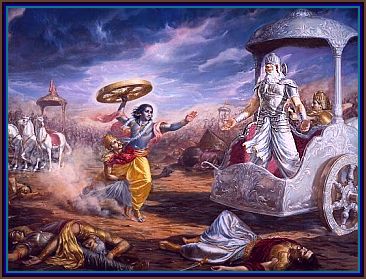
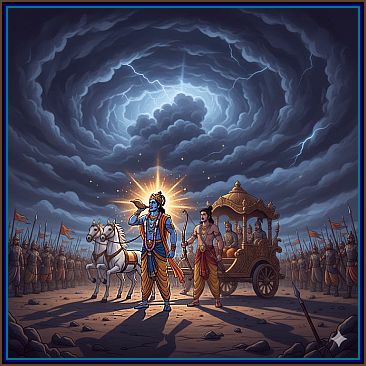
: – At another level, the Gita could even be seen as a personal god in conversation with a human being. The involvement of a divine being (as an inspiring leader) on an earthly battlefield and asking the warrior to carry on the fight is truly interesting. It, somehow, seems to mark the limits of the human; and , to point to the nature of war, prompted by god, as an avoidable necessity for restoration of moral order (Dharma) on the earth.

This view, needless to say, is highly debatable.

[The Samkhya concept of the Purusha and Parakrti; the passive and the active; the   inspirer and the doer, runs throughout the Indian texts in one form or the other.  The Nara-Narayana is the classic model of this concept. Here too, Krishna (Narayana) does not fight; but, motivates Arjuna (Nara) the warrior to carry on the fight. Krishna is the awakener (the Sun).]

:-  The  religion , which for whatever reasons is now  known as ‘Hinduism’ , does not have a Book  per se;   but , therein , the Gita has come to be recognized as a Holy Book upon which one swears to ’tell the truth , the whole truth and nothing but truth’.

: – Further, while the other ancient Indian texts are gradually fading out of the discussions among the common people, the Bhagavad-Gita and its ‘message’ is still being debated, with some fervor . And, no other Sanskrit work approaches the Bhagavad-Gita in the influence it has exerted in the West as the chief philosophical statement of Hinduism.

: – The narrative structure of the Gita is rather peculiar, as the scholar Devdutt Pattanaik points out in his My Gita:
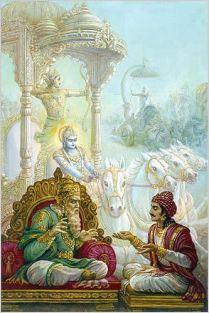
dritharastra-sanjayaWe never actually hear what Krishna told Arjuna. We simply overhear what Sanjaya transmitted faithfully to the blind king Dhritarashtra in the comforts of the palace, having witnessed all that occurred on the distant battlefield, thanks to his telepathic sight.

The Gita we overhear is essentially that which is narrated by a man with no authority but with a distant sight (Sanjaya) to a man with no sight but with full authority (Dhritarashtra). This peculiar structure of the narrative draws attention to the vast gap between what is told and what is heard.

Krishna and Sanjaya may speak exactly the same words, but while Krishna knows what he is talking about, Sanjaya does not. Krishna is the source, while Sanjaya is merely a transmitter.

Likewise, what Sanjaya hears is different from what Arjuna hears and what Dhritarashtra hears.

Sanjaya hears the words, but does not bother with the meaning. Arjuna is a seeker; and so , he de-codes what he hears in order to find a solution to his problem. Arjuna, during the ‘conversation’, asks many questions and clarifications’, to ensure that he properly understands the purport of the ‘discourse’.

In contrast, Dhritarashtra remains silent throughout. In fact, Dhritarashtra is not interested in what Krishna has to say; but, is rather fearful of what Krishna might do to his children, the Kauravas.

: – As regards the treatment of its subjects, the Bhagavad-Gita describes itself as the essence of all the Upanishads. The Upanishads by their very nature are philosophical speculations transcending the physical world. The Gita ,on the other hand , teaches about living a worthwhile, meaningful life in the world among fellow beings – Jivana- Dharma – Yoga.

:- Further, the Upanishads which aspire to understand the essential nature of all things in the Universe and in the individual, as also the relation between the two , emphasize the superiority of knowledge (Jnana) over action (karma).

In the Gita, Krishna , on the other hand, asks Arjuna to follow the path of action and to act decisively.

The confused Arjuna, helplessly, queries Krishna for a clear direction: ’Oh, Janardhana, if you consider Knowledge (Jnana) to be superior to action, why then do you instruct me to perform this terrible act?- janārdana tat  kiṃ karmaṇi ghore māṃ niyojayasi keśava’ –  (BG.  3. 1 – 2).

The Gita does not seem to favor renunciation or total withdrawal from the world resulting in inactivity, nivritti. Instead the Gita teaches the sort of Jnana that endorses renunciation of desires, of fruits of action. It advocates activity pravritti with the renunciation of the fruits of action. Gita terms it as ‘inaction in action and action in inaction’ akarmaṇi ca karma … karmaṇy akarma (4.18). That is, performing acts according to ones calling, with equanimity; and, relinquishing attachment to the fruits of one’s actions.

anaashrita karma phalam kaaryam karma karoti yah / sa sannyaasi ca yogi ca na niragnir na ca akriyaha

One who does not depend on the fruits of action but does the work which is his duty. He is a sanyaasi and also a yogi, not the one who has renounced fire (rituals) and not one who (merely) does nothing (Bg. 6.1)

yoga yukto vishuddhaatmaa vijitaatmaa jitenriyaha/ sarva bhutaatma bhutaatmaa kurvan api na lipyate

He who  by following Yoga, has purified the mind; has controlled the mind;  has controlled the senses; sees his own Self in all beings; and, does not get tainted even if he does work (Bg. 5.7)

[Krishna, of course, succeeds in reconciling the deep chasm between the two paths or approaches (Jnana and karma) by introducing the unique concept of internal renunciation, as opposed to external renunciation.

By reconciling otherwise two contradictory ideas, Krishna offers a realistic system which intertwines performance of one’s responsibilities in life without getting too attached to it. It cautions that an un-restrained desire for the fruits of one’s action, more often than not, leads to major blunders in decision making, both in personal and social life.

In this way, the Bhagavad-Gita adheres to both the ideals. It supports involvement in the performance of one’s social and moral responsibilities according to ones Dharma in life; and, at the same time it endorses the Upanishad ideal of self-realization which leads to liberation from confines of relative existence.  ]
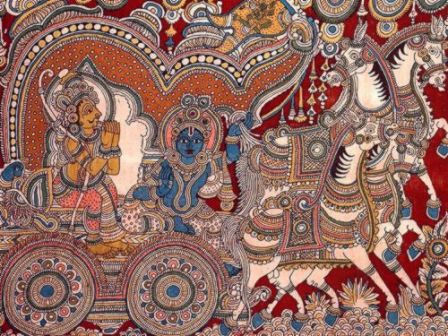
Bhagavadgita Kalamkari

Manifold paths

The Gita begins with a response to Arjuna entering a state of despondency just at the time when he was required to perform. This is the initial problem of the Gita. Krishna’s teaching will, in later stages, cover several other paths or approaches to life; but, the initial focus is on the problem of action, with Karma Yoga as the solution. It is self-less performance with equanimity; equal acceptance of pleasure and pain; and, renouncing fruits of one’s action.

*

The Gita suggests that though we all are one in spirit, each one is different in her/his intellectual and psychological makeup; and, each has a role to play in this world, in her/his own manner. Each should choose her/his path in the most essential mission of all – the discovery of one’s true Self.  The Gita, broadly, lays down these paths as four – Jnana, Bhakti, Karma and Yoga. These paths are neither mutually exclusive, nor do they contradict each other. They are meant to be guide posts that direct us along the paths that best suit our nature and attitudes.

Jnana Yoga is the  intellectual path demanding that one apply reason and rationale in order to realize her/his essential core; and,  understand her/his relation with the world and god. It is a lonely path of self- discovery.  It is the discipline of knowledge of Self. It also means knowing clearly; realizing one’s own divinity; and, also seeing the divine in human and the earthly.

Since we do have to  exist , act and participate in this world , in a meaningful manner, understanding the true connotation  of  the path of Karma is essential. Karma is the way we conduct our lives , performing activities , fulfilling our roles and responsibilities towards self , family and the society at large; following a path of righteousness directed towards improving ourselves. While one should act diligently, one should not be overly attached or obsessed with the fruits of one’s actions.  The detached attitude towards the results, might, initially, appear to be a counter-intuitive or contrary to common-sense ; but , on reflection , one would realize that  it is the most efficient and clear-headed way to stay focused on the task at hand. The ability to maintain equanimity at good and bad times , even otherwise, marks a balanced approach to life.

The first-half of the Gita essentially teaches a combination of Karma-yoga and Jnana-yoga- to act selflessly with true knowledge of the reality. Here, Equanimity serves as a foundation standing upon which one can look beyond and reach for a reality that is totally different, the Absolute.

Though the wise one fights battles, he does it with composure , devoid of enmity or hate , rancor or self-interest. The enemy, after all, is as much a manifestation of God as the warrior is.

The Bhakti-yoga is the path of love, immersing oneself  in the boundless Love of God and, submitting to Him in artless faith and absolute devotion . It aims to experience the splendor of the divine in all its manifestations (Lila), and immerse in its delight (Ananda).

The Dhyana–yoga or Raja-yoga, the Royal way, is the discipline of meditation, withdrawing the senses, calming the mind and clearing it of confusions and other delusions. The path of Yoga is a method for controlling the waves of thoughts, and the senses; refining the mental and the physical energy. It seems to be based in the eight-fold (Astanga) Yoga system of the Sage Patanjali, though there are no explicit references to  it; and, there are also no separate verses or chapters devoted to this discipline

*

Arjuna begins in bewilderment and depression; and at the end, stands up to fight his cousins with composure.

[One of the commentators observes: assuming that the Gita was an insertion into the Epic; and, given the fact that the great battle did eventually take place, the outcome of the Gita could not have been different. Arjuna had to fight, in any case.]

lotus-design

Synthesis

It appears that the Bhagavad-Gita was composed during a vibrant period when growing verities of options for attaining liberation (Moksha) from confines of human limitations were hotly debated and ardently explored.

Bhagavad-Gita frequently refers to the fundamental philosophical concepts of Samkhya and Yoga Darshana-s. It is also based in many Upanishads providing verities of solutions to human predicaments, as also suggesting pointers to the understanding of the Universe, the individual and the relation that  exists between the two. The Bhagavad-Gita, in that process, draws upon many sources.

In that progression, the Bhagavad-Gita elaborates on the varied disciplines and paths of Jnana (knowledge), Karma (action), and Bhakti (devotion) as also Yoga for attainment of the highest good. The text calls itself Yoga-shastra – the science and knowledge of Yoga.   

The term Yoga is used in Gita in a variety of senses. And, Yoga here also stands for Marga, the path; be it the path of knowledge (Jnana-yoga), devotion (Bhakthi-yoga) or the path of action (Karma-yoga). In all these paths, the essential message of renouncing the fruits of action is stressed.

The Gita does not explicitly support one Yoga over the other. It rather extols one Yoga then another or a combination of Yogas. It is to be understood as a many-sided system with various elements juxtaposed.

*

Justice Kashinath Triambak Telang, in his introduction to Bhagavad-Gita  (Oxford, New  Clarendon Press, 1875/ 1882) ,writes :

The Gita offers a set of practical disciplines, without, however, attempting, to arrange or classify them in a systematic order. In other words, what we have in the Gita is the germ of the ideas or of the systems; but not a ready-made system as such.

There are also certain passages in the Gita, which do not easily reconcile with one another. And, the Gita makes no attempt to harmonize them.

For instance; Krishna classifies the devotees into four classes; and, says that he considers the Jnanis (the persons of knowledge) as his own (Gita – Ch .7-verse 16). This might give an impression that he places the Jnanis at the top of hierarchy. But, again he remarks elsewhere that the devotee (Bhaktha) is superior not only to those who merely perform penance; but , also to the men of knowledge (Gita-Ch.6-verse 46). And, in another passage, it is said that concentration is preferred to knowledge (Gita-Ch.12-verse 12).

All these indicate the Gita, as do the Upanishads, is a remarkably free, open-ended un-systematized work.

Does not seem to favor a particular path

The discourse on those subjects, however, is not arranged in a systematic manner. The Gita gathers and combines different trains of ideas just as it finds them in traditionally accepted Schools, without much effort to harmonize them. The text does not seem to hold up a single discipline or path as its ‘true message’. And, such ambiguity in its ‘message’ or the adaptability of ‘its message’  to different Schools of Philosophy and to the circumstances in life  has led to plethora of interpretations, each claiming that it has certainly grasped the ‘true message ‘of the Bhagavad-Gita.

One can even say that the scope for deriving varied types of  interpretations becomes possible mainly because of the unique virtue of the Gita which allows each reader  to discover its essence, in his or her own manner, at his or her own pace and terms.

Deciphering its meaning and its ‘true’ philosophical intent is neither easy nor simple. Some of the greatest minds have grappled with the philosophical problems present in it.

lotus-design

The ways of reading the Gita

There are several ways of reading Bhagavad-Gita. It can be read as a literary work or poetry of merit with allegorical imagery; it can be read as a part of Oriental studies; and, it can also be read as a philosophical work.

As a work of literature, its literary or poetical aspects would be discussed and the allegories would be highlighted. As a work of Indology, its historical background and linguistic aspects would be examined. Such a scrutiny would focus on the date of its composition; on speculations about its plausible author or author/s; or on the question of its relation to the context of the Mahabharata-events. 

But, it is the study and explanations of Gita’s philosophical outlook, its conceptual structure and speculations about its ‘true message’ that has given rise to diverse stand points and multiple interpretations. Such interpretations over the centuries have been so diverse and   so complicated, that it makes one wonder whether they all were referring to one and the same text.

The Gita’s adaptability to different kinds of philosophical interpretation is partly caused by the effort of its composer/s to bind within it the tenets of several philosophical schools (Darshana-s) including Samkhya, Yoga and the devotional aspects of the then emerging Bhakthi traditions. That, to an extent, injected ambiguities and incompatibilities in reading and interpreting the text.

The phenomenon of multiple interpretations of the Gita has continued over the long centuries. At different times or phases in the history, fresh interpretations of the ‘true message ‘of the Gita sprang up, each in the context of its own times, environment and preferred attitudes. Each successive interpretation of the Gita was at variance with its previous one.  And yet, what is most amazing is that each of those varied interpretations is valid in its own context.

That is to say; each commentator has diligently gone about in putting forth his honest understanding of the ‘true message’ of the Gita. Each commentary of the Gita is thus a subjective view of the text. The ‘message of the Gita’ might indeed be all of those assorted interpretations; and, even be more.

The quest for objective truth or the real truth of the Gita is still very much on, even thousands of years after it was uttered on a distant battle field, amidst two huge armies raring to go at each other.

lotus-design

Quest for objective truth

The quest for objective truth – (what did Krishna say, exactly?) – is another cause for emergence of multiple interpretations and countless number of commentaries. In the zeal to uphold his own interpretation as the objective truth of the Bhagavad-Gita, each commentator, somehow, seemed to get intolerant of the ones that differed from his own. That, in a way, is rather uncharacteristic of the Indian tradition which accommodates within itself and harmonizes various seemingly contrary positions.

All the branches of Indian traditions, notably the Jain, have always tried to adopt the concept of Anekāntavāda which, essentially, is a principle that encourages acceptance of multiple or plural views on a given subject. The Buddha too said that merely judging the issue from individual (separate) stand points of view would lead to wrong conclusions; it would be prudent to approach each issue from more than one point of view (aneka-amsika).

[Devadatta Kali (David Nelson) in the introduction to his very well written work Svetasvataropanisad: the Knowledge That Liberates writes:

Although the Indian thinkers are not immune to disputation , by and large , their culture has valued the principle of accommodation and acceptance…Throughout the centuries of Indian philosophical traditions , the differing views have often been seen as just that – as differing views of a single reality that lies beyond human power of articulation. The tendency has often been to harmonize opposing views as distinct parts of a larger whole whose fullness lies well beyond the reach of mere perception or reason. It needs to be stressed that the primary purpose of sacred literature is to impart spiritual knowledge, not to fuel intellectual or sectarian debate – or to create confusion.]

The basic idea here, is that the reality could be perceived differently from diverse points of view; and, that no single point of view should be taken to be the complete truth, to the exclusion of all others. The varied views could either be taken together to comprise the complete truth or as different dimensions of a single reality.

Bhagavad-Gita is a multi-layered text with many avenues for exploration. I , therefore, reckon that an Anekāntavāda approach would be more appropriate in understanding its manifold message, rather than steam- pressing it into a particular mold.

[Please listen to Dr. Karan Singh speak about Bhagavad-Gita : Click here

You may then opt for the Mini-view ]

lotus-design

Is there a need to seek for the ‘objective-truth?’

That again begs the question: is there a need to seek for the ‘objective-truth’ of the Gita? Because, there is a danger that such monolithic one’s own ‘objective–truth’ might shut out the options of myriad other plausible meanings. Thus, a purely objective view, despite its merit, seems to limit itself to a particular slot.

There is, therefore, surely some merit in subjective approach to the study and understanding of the Gita. In fact, some have suggested that each could try to compose his own Gita according to her/his own understanding and inclination.

As Shri Devdutt Pattanaik observes: The quest for subjective truth (how does The Gita make sense to me?) allows each (after listening to the various Gita-s around him/her) to discover one’s own Gita at his or her own pace, on his or her own terms.

The Gita itself seems to advocate subjectivity. Bhagavad-Gita in its structure and narration adopts the idea of free-will.   At the conclusion of his discourse, Krishna counsels Arjuna to reflect on what has been said, and then do as he rightly feels.

For instance; Krishna says that his teaching can be perceived directly (Pratyaksha-avagamam) according to one’s understanding (BG.9.2)

राजविद्या राजगुह्यं पवित्रमिदमुत्तमम् । प्रत्यक्षावगमं धर्म्यं सुसुखं कर्तुमव्ययम् ॥ २ ॥

rājaguhyaṃ pavitram idam uttamam / pratyakṣā-avagamaṃ dharmyaṃ / susukhaṃ kartum avyayam 9.2

And again, in Chapter 12 of the Gita, Krishna counsels:

Fix your mind on me alone, and absorb your consciousness in me; thus you shall surely abide in me. If you cannot fix your consciousness steadily upon me, then aspire to reach me through repeated yoga practice. O Dhananjaya, if you are incapable of even that, embrace the path of action, for which I am the highest goal, since by acting for me you shall attain perfection. But if you are unable to follow even that path of refuge in me through acts devoted to me, then give up the fruits of all your actions, thus restraining yourself. Knowledge is superior to practice; meditation is superior to knowledge; and, relinquishing the fruits of action is higher than meditation, as tranquility soon follows such relinquishment.

What really is the true vision or Darshana of this ancient, sacred and marvelous treatise named Bhagavad-Gita, the song celestial?

lotus-design

Pluralism of the Gita

How does the text permit such a range of interpretations? What is common to them? How is it possible for so many to provide their own interpretations while still claiming to be reading “the Gita”? Why did this one text in particular exercise such fascination on so many generations of Indian and non-Indian thinkers? How could Bhagavad-Gita lend credibility or even moral authority to political movements in modernity? And , did they all use the text in their own  way, in  order to somehow secure Krishna’s divine authority ? ! 

Heinrich Von Stietencron  , addressing such an array of bewildering questions, writes:

The analytic thinking of Western interpreters who were schooled in historico-philological methods stands in contrast to the traditional Indian commentators, who not only harmonized and freely covered over all breaks in the text of the Bhagavad-Gita, , but, above all, sought to read their own philosophical-theological concepts out of individual textual passages, in order to secure Kṛṣṇa’s divine authority for them.

In this manner, several philosophical schools developed their own Gita -interpretation — a spectrum that has, since the beginning of India’s independence movement been further supplemented by politically motivated interpretations in modernity.

chakra

The multiple interpretations or pluralisms of approaches in understanding the Bhagavad-Gita have an extensive and illustrious history. During that long period, different aspects of the Gita came into the fore; new meanings were read into its passages; and attempts were made to adopt its ‘message’ to suit new or emerging situations.

The history of the interpretations of the Gita can broadly be considered under the following heads:

: – The Acharyas

The medieval period starting with Sri Sankara (8th century)  followed by  the  Bhashyas of Sri Ramanuja , Sri Madhwa and other Acharyas as also  that of Abhinavagupta analyzed and commented upon the Gita in terms of the traditional Vedanta concepts of Advaita, Visistadavaita and Davaita;   and assigned primacy either to Jnana (knowledge) or to  Bhakti (devotion) or to Karma (action) . Each scholar went  according to the  principal philosophical precept of his School of thought , while sidelining the other plausible interpretations .

Santa Jnanesvar or Jnanadeva (1274-1297) of Maharashtra in his celebrated rendition of the Bhagavad-Gita – Jnaneshwari (Bhavarth Deepika) – taught  the path of loving and guileless devotion (Akritrim Bhakthi) and self-less action as the true way. He said that everyone should perform his/her duty lovingly as a Yajna and offer his or her actions as flowers at the feet of the Lord. According to Jnanadeva; it is through such Bhakthi and Bhakthi alone that the Supreme Reality can be realized
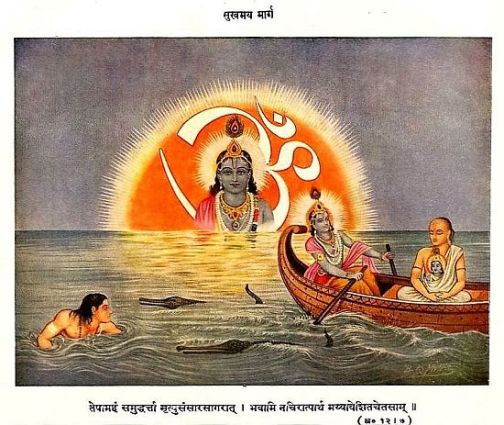
krishna-sukhmai-marg

: – The Colonial period

The period starting with the middle of the 18th Century when the English, German and French translations of the Bhagavad-Gita , captured the attention of the intellectuals as also that of the general-readers, widened the range of its readership as also the scope for its varied interpretations.

: – Initially, Bhagavad-Gita gained publicity mainly as a rare cultural object retrieved from the unknown past of the distant East; and , in particular , as ‘a curious specimen of mythology and an authentic standard of the faith and religious opinions of the Hindoos’.

: – That was followed by study of the Gita as a literary work. It proved to be a major influence on Romantic literature in Europe and Britain.

: – And, to the intellectuals and philosophers in the West, the Gita provided a perceptive view of the Hindu philosophy.  Among the scholars, the linguistic study of the Sanskrit text of the Gita; the historicity of the Mahabharata event; the questions of its authenticity and its date; the enquiry into its plausible author /authors and so on were widely discussed.

:-  The Gita evoked a different sort of reaction among the Christian Missionaries , They saw in it a possibility ’ to encourage a form of monotheist ‘Unitarianism’ ; to draw Hindus away from the polytheism of the Vedas’;  and,  to pave  way to spread Christianity in India.

:-  As the English and French translations of the Gita began to gather attention from among the educated class of the Colonial India of the 19th Century , it led to review and re-assessment of the principles of the Hindu philosophy and the practices of its faiths . The Western educated intellectuals and social reformers such as Raja Ram Mohun Roy regarded it as the essence of all Shastrus; and. interpreted Gita as a message for self-less action.

Though the Brahmo Samaj did not seem to have got the Gita translated , Debendranath Tagore tried interpreting Gita , in the Biblical mode,  as a sort of allegory depicting  the final battle (Armageddon) between the forces of ‘good’ and ‘evil’.

: – The Western scholars

Following its translations into European languages, the Gita gained a sort of territorial transcendence, spreading its influence beyond Asia. The Gita came to be regarded by the western scholars as a universally acclaimed text.

Among the Western scholars, the Bhagavad-Gita came to be looked upon as the authentic essence of Hinduism. And, and it became the most influential work on Indian thought. The German philosopher William Von Humboldt called Gita: the most beautiful, perhaps the only true philosophical song existing in any known language –the deepest and most elevated text the world has ever seen.  He was fascinated by its concept of Dharma delineated in various layers.

Similarly , TH Griffith saw Yoga taught in the Gita as the discipline of life, giving a deep insight into the ebb and flow of human desires and aspirations.

And, the German Indologist JW Huer described Gita as a ‘work of imperishable significance’ calling upon people to ‘master the riddle of life’.

Max Muller too believed ‘that textual authority of Gita should have pride of place in official knowledge about India’; but, he placed Gita next to Vedas in its authority and importance.
[Prof. Hephzibah Israel of the University of Edinburgh, in her paper  The Politics of the Gita in English Translation: Translating the Sacred, colonial constructions and postcolonial perspectives, writes

The Bhagavad-Gita was first translated into English by Charles Wilkins in 1785; and, into the German, either in part or in full , by Friedrich Majer, Johann Gottfried Herder (1792), and Friedrich  Schlegel (1808); and in full into Latin by August Wilhelm Schlegel (1823). And, it continued to be the object of translators’ attention throughout the nineteenth century.

German scholarly attention to the philological apprehension of Indian sources is linked to Indology, and to comparative linguistics and the study of religion. In fact, as a result of this early German philosophical engagement with the Bhagavad-Gita,

The text not only continued to be translated by both British and Indian scholars but was also accorded a Bible-like status; although Hindu Indians had not , hitherto, perceived it as such. The Orientalist desire for textual representations of the East can be “intimately connected to the desire among Hindu scholars to have scriptures, like Christianity and Islam” 

Significantly, the Bhagavad-Gita was ascribed high status in Britain and Germany by being treated as a self-contained philosophical text, rather than as an integral part of the much longer Mahabharata, one of the two Hindu epics that in popular Hindu formulations are considered foundational texts representing the “Indian nation” and its “culture.”

This is clear in the number of translations of the Bhagavad-Gita alone, singled out for attention with only brief reference to the larger text that it is embedded within. Unable to come to terms with a Hinduism that did not claim a single authoritative scriptural text, Orientalist scholarship reconfigured the existing sets of sacred texts through translation to bring forth a “central text” that could be identified as a higher foundational document. Examining para textual evidence such as titles, translator’s notes, prefaces, and introductions gives us a good indication of the purpose of a translation and how it was meant to function.. ]

**

 : – The Theosophists

The Theosophists recognized the Bhagavad-Gita as one of the major spiritual texts of the world.  Among the Theosophists, the allegorical approach with its esoteric and philosophical interpretations gained more importance. The historical and mythological context was kept in the background just to explain the context of the Gita.

According to them, Krishna in the Gita represented Logos the objective expression of the Absolute; while Arjuna represented the Monad, Nara, the whole of mankind rather than as a single person.

They explained life as an evolutionary process in which an individual evolves from lower to higher, from grosser physical forms to subtle spiritual forms of beings. The Gita, according to Theosophists  , is a framework for such a progression.

Theosophists interpreted the concept of one’s duty in terms of the Sva-dharma. They presented the world as a conditioned reality similar   to a huge game in which each piece must move in accordance with the rules governing its movements in order to keep the game going.

: – Swami Vivekananda
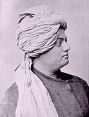
vivekananada

Swami Vivekananda , while in the West, compared Krishna’s teachings to that of Jesus. And, while at Home ,  he spoke about the inner battles in human heart and mind. And , he also described Krishna and Arjuna as men of action who could provide inspiration to reform and rejuvenate the Indian society that was fast degenerating into chaos and confusion. He  called for resistance against British oppression.

While laying more importance on the Gita’s larger allegorical meaning, Swami Vivekananda acknowledged the validity of historical research. But, he also said that mere discussion on   the historical aspects of the Gita cannot help one in acquisition of Dharma, or moral righteousness’.

The idea is: the Bhagavad-Gita is not merely a historically specific conversation; but, it is an ongoing teaching that has universal relevance. It is a process taking place all the times in each ones heart.

 He remarked:

 “One thing should be especially remembered here, that there is no connection between these historical researches and our real aim, which is the knowledge that leads to the acquirement of Dharma. Even if the historicity of the whole thing is proved to be absolutely false today, it will not in the least be any loss to us. Then what is the use of so much historical research, you may ask. It has its use, because we have to get at the truth; it will not do for us to remain bound by wrong ideas born of ignorance.”

:- Sister Nivedita
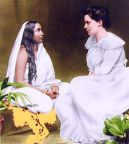
sister nivedita

Sister Nivedita (Margaret E. Noble , 1867-1911) considered not the withdrawal from the world; but, performing ones duty , while in it, diligently and selflessly, without attachment to consequences –  as the message of the Gita.  

In her very well written book ‘The Web of Indian Life’, under the Chapter: The Gospel of the Blessed one (page 217) , wrote:

*

The book is nowhere a call to leave the world; but, everywhere an interpretation of common life as the path to that which lies beyond…

That the man who throws away his weapons ; and, permits himself to be slain , un-resisting in the battle , is not the hero , but a sluggard and a coward; that the true seer is he who carries his vision into action , regardless of the consequences to himself. This is the doctrine of the Gita repeated again and again

‘Holding gain and loss as one, prepare for the battle’. That indifference to results is the condition of efficient action is the first point in its philosophy… It is the supreme imperative. Play thy whole part in the drama of time, devoting every energy, concentrating the whole force. “As the ignorant act from selfish motive, so should the wise act unselfishly.”

[Eminent Orientalists: Indian, European and American. pages 268-269]

: – The Nationalists in the Freedom movement

While the Theosophists tried to provide allegorical and esoteric interpretations of Gita as spiritual struggles, the Nationalists in the Colonial India of the 19th and early 20th century mainly from Bengal and Maharashtra saw it in quite another manner.

The freedom movement gave a great impetus to the study of Gita. Many saw it as a national symbol that held within its bosom answers to the burning questions of colonial India. The Key word from the Gita taken by the nationalists was Loka-sangraha – welfare or involvement in the world. That phrase occurs only two times in the Gita (3.20, 25).

कर्मणैव हि संसिद्धिमास्थिता जनकादयः । लोकसङ्ग्रहमेवापि सम्पश्यन्कर्तुमर्हसि ॥ २० ॥

सक्ताः कर्मण्यविद्वांसो यथा कुर्वन्ति भारत । कुर्याद्विद्वांस्तथासक्तश्चिकीर्षुर्लोकसङ्‍‍ग्रहम् ॥ २५ ॥

Then,  there also came into use an  expression that is not found in the Gita . It gained much currency in the 20th century – Nish-Kama-karma, self-less action.

Linking of these concepts with national movement for Independence and social reforms did much to bring forth Gita into popular debates. The nationalists promoted Gita as a central work of a rising Indian national ethos.

It is indeed remarkable that so many of India’s political and intellectual leaders of the last century and a half wrote detailed and extensive commentaries on the Gita. There were two broad categories of interpretations.

One; as a sort of romantic allegorical  visions of the battle against forces of lower tendencies such as greed, ego, selfishness etc; and, the other, as an authentic source of state craft that prompted to reconsider the nature of politics itself .

The latter, led to gathering support for reform efforts and for justifying a fight against the British rule for attaining independence.
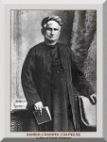
bankim-chandra-chatterjee

Among the former category, Bamkim Chandra Chattopadyaya (1836-1894) provided great inspiration for the National movement, giving impetus to the concept of Motherland as the Goddess India, Mother India. He also depicted Krishna as the ideal person who exemplifies human virtues – a god-like person who was earthly wise and sublimely spiritual in his core. He projected Gita as an answer to West’s technological domination; and as India’s stand asserting  the merits of  ancient wisdom in the face of colonial oppression.

*
AurobindoSri Aurobindo, who followed Bamkim Chandra, regarded Gita as an absolutely splendid revelation holding forth a Universal message.  He advised that Gita should be approached by forgetting all the religious and academic arguments that highlight or decry one Yoga (paths) or the other. The integrated vision of the Gita, he said, transcends all such limited interpretations.  He envisioned  Gita as a divine action, where the battle field (Krukshetra) is in the heart and soul of every human being. Each one of us, potentially brave, fights in his or her own way with the confronting doubts, desperation, fears and frustrations. Krishna is the one, hidden behind the veils of our psyche and mind, who reveals the mysteries of life. Sri Aurobindo stressed that in the present age it was necessary to understand the Dharma, Karma and Yogas in contemporary sense.

*

The more militant among the Indian nationalists projected India as the Motherland and Krishna as Avatar who rescued the nation from jaws of A-dharma and to establish Dharma. They accepted the call of the Gita for righteous struggle for national independence, even if it might require violence.  The new battlefield, according to them, was the British Raj; and , they found in Gita a strong support for engaged social and political action, the karma yoga.
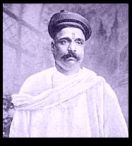
Tilak2

Lokamanya Bal Gangaadhar Tilak, who at that time was imprisoned in Burma, presented Gita as an allegory for fighting a just war (Dharma-yuddha) that historical circumstances had forced upon Indian nation and Indian people. In Tilak’s view, interpretation of a religious work like the Gita must be historically situated. He vehemently argued for an activist or “energist” reading of Krishna’s teachings, against the older “escapist” Vedanta interpretations. And, in the present age , he asserted, the Gita must be interpreted in accordance with its needs.  Like Aurobindo, Tilak accepts that this action might include violence, provided it is carried out without hatred and without any desire to reap the fruit of the violent deeds. He also admits : But herein lies a quandary of dharma.

It needs to be mentioned ; even  while calling for a just war (Dharma-yuddha), these commentaries  did maintain a sense of composure and detachment. Just as Arjuna did not regard his warring cousins as foes, the British were also  not targeted as the ‘enemy’; not because of fear, but in the interest of generating a broad theoretical principle for establishing a basis  for their political ideology and its strategy. Such an approach allowed Indian leaders to outline a political framework that would serve them well even beyond and after imperialism.

At the same time, at the ground level, there were also groups, organized or otherwise, that believed in disruptive violence as the effective means for overthrowing the alien imperialist power. 

In either case, the Gita provided a stable point of conceptual references, even while there was a range of multiple interpretations on the related issues.

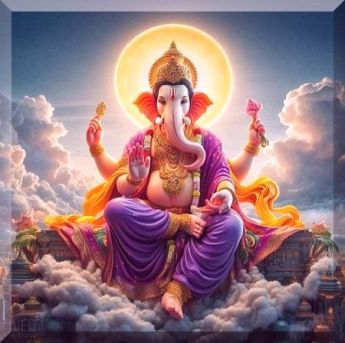
[The practical question for Tilak and other activist leaders was how to mobilize larger masses on behalf of the struggle for an independent Indian nation. Throughout his career, Tilak experimented with ways to enlist the Indian population in this effort. In the 1890s, he transformed a local Maharashtrian festival for the god Ganesha into a large public celebration; and , he established a new festival to honor Shivaji.

Similar methods were adopted in Bengal by transforming  Durga-Puja into a national festival. And, in Punjab , Baishaki was turned into a celebration for all.]
ganesha18

[ Prof. Hephzibah Israel concludes:

Both European and Indian translators, by choosing to translate the Bhagavad-Gita, established it as the quintessential “Hindu” text and as a representative of a highly complex quasi-philosophical and quasi-mystical text which conferred on Hinduism status as a “world religion.”

While for Orientalist scholars, the translated Bhagavad-Gita was proof of an ancient and glorious “civilization,”.

For missionary translators, the Bhagavad-Gita was a philosophical text ; and not necessarily a sacred   “scripture.”

However, for the Indian translators, also mostly practicing Hindus, translating the Bhagavad-Gita was simultaneously an appropriate gesture and an opportunity to compete in the world hierarchy of “religions”: having for centuries preserved the Bhagavad-Gita in the exclusive Sanskrit. The Indian scholar-translators were embracing the opportunity to translate the text mostly into English rather than into other Indian languages.

While some translators, argue that they translate to educate fellow-Indians, to spread the “truths” of Hinduism to Indians, ,, their energies seem directed equally at non-Indian readers.

The appropriation of translation as a strategy to re-present Hinduism was a response to the Universal idea of religions that has often been played out through assumptions about their translatability. This deployment of translation has been an important factor in the formulation of resistant alternative colonial discourses.]

***

: – Gandhi

gandhi2

Though all the nationalist leaders agreed that purposeful action was needed to attain independence, the form that such action should take, however, remained a point of heated contention. This is where the faith and the views of Mohandas Gandhi become very significant.

Gandhi often referred to the Bhagavad-Gita as his “spiritual reference book” ; “dictionary of daily reference”; “book of home remedies”; “wish-granting cow”;  and, as “mother”. He returned to it over and over again throughout his life for clarification and nurture. He spoke and wrote widely on it throughout his career.

Gandhi, in contrast to other major nationalist leaders, held no commitment more important than to his principle of non-violence. But, he ran into a serious interpretive problem because in the course of the Gita Krishna persuades the reluctant warrior Arjuna to take part in an internecine disastrous battle.

Gandhi believed that the message of the Mahabharata itself was the virtues of non-violence; and, the Gita which was but a small segment of it carried a similar message. He wrote:

the author of the Mahabharata has not established the necessity of physical warfare; on the contrary he has proved its futility. He made the victors shed tears of sorrow and repentance; and has left them nothing but legacy of misery.

The question whether the true teaching of the Gita favors violence or non-violence became vitally important to Gandhi. He needed a clear , firm and an honest answer to anchor his faith in his struggle for India’s freedom ; to provide a principled public resistance; and, above all to ensure the authenticity of his inner spiritual life. The Gita, as he understood and practiced, was the foundation of his struggle without hatred, without passion (Nish-Kama-karma) with the attitude ‘mine is but to fight for my meaning, no matter whether I win or lose.’

And, that led Gandhi to offer a particularly distinct interpretation of the Bhagavad-Gita, where Krishna instead of asking Arjuna to fight the war, instructs him to ‘fight the battle within the self; to battle passion and selfishness’.

According to Gandhi, Gita demonstrates the futility of violence; and, its true message is non-violence and peace. At the end of the Mahabharata, nearly everyone on both sides is killed

Gandhi said, it was fought “not to show the necessity or inevitability of war, but to demonstrate the futility of war and violence.” This becomes evident in Shanti Parva, where “at the end, the victor is shown lamenting, and repenting, not only the outcome, but the very idea of causing so much pain, such horribly enormous  devastation and violence”.

Supporting  Gandhi’s view, ‘The Epic’, writes Amartya Sen, ‘ends largely as a tragedy, with a lamentation about death and carnage; and , there is anguish and grief … It is hard not to see in this, something of a vindication of Arjuna’s profound doubts.’

The battlefield, Gandhi argued, must be taken as an interior one, where the forces of good and evil are locked in never-ending struggle.  The Bhagavad-Gita, he said, is not about the battle that is waged on the field of dirt soaked in blood; but, it is about the ever going conflict within the human heart between the forces of good and evil.

Gandhi said; when Krishna asked Arjuna to fight, he meant fighting ones lower impulses; not to cling to its rewards; to overcome any self-interested inclinations; and,  to carry out his own righteous duty. One must be equally disposed to ones enemy as to oneself.

Gandhi based his own authority as an interpreter of the Gita on his personal endeavor “to enforce the meaning in my own conduct for an unbroken period of forty years.” Gandhi also claimed that the Gita was not a Hindu work, but rather one of “pure ethics,” which a person of any faith might read and follow.

Gandhi firmly believed that complete renunciation is not possible without total observance of Ahimsa (non-violence) in every form and shape.

Gandhi said that if one has to fight, one should fight non-violently.  Thus, Violence and denial of violence became major issues for debate and action.

Gandhi’s faith in Ahimsa as the core of the Gita gave rise to Satyagraha , as an effective means to express one’s protest and to offer resistance without indulging in violence. According to him, a Satyagrahi should be willing to die like a soldier (Kshatriya) for the cause of India’s independence. Satyagraha was Gandhi’s unique contribution to fight against oppression and injustice.

This was in sharp contrast to the interpretation offered by the leaders of India’s nationalist movement such as Sri Aurobindo and others to fight a just war for liberating the Motherland. In fact, during Second War Sri Aurobindo called on Indian people to support the British in its war efforts and fight along with the British against fascist Germany.

: – Aldous Huxley

Aldous Huxley

Similarly, in Aldous Huxley’s famous introduction to the translation of the Gita by Swami Prabhavananda and Christopher Isherwood (The Song of God: Bhagavad-Gita, Hollywood: M. Rodd Co., 1944) which was published just after the end of World War II, the questions of war, violence gained special significance. Writing in the midst of a war of destruction and violence on an unprecedented scale, Huxley re-read and re-imagined the Gita in a mode which rejected the utter need to kill. He, like Gandhi, emphasized that the true message of the Gita is not violence; but, on the contrary, the futility and uselessness of violence, self-destruction; and, the harm it can bring upon whole generations.

lotus-design

Robert OppenheimeOn July 16, 1945, at the dawning of the atomic age, J. Robert Oppenheimer watched the first human-controlled atomic explosion at Los Alamos, New Mexico, from a bunker twenty miles away. As director of the Manhattan Project, Oppenheimer was responsible for overseeing the creation of the bomb, which the project called “Trinity.” He was a brilliant professional physicist, and also a gifted amateur student of Sanskrit. As he observed the awesome detonation of Trinity, Oppenheimer later recalled that passages from the Bhagavad Gita sprang to his mind.

If the radiance of a thousand suns / Were to burst at once into the sky / That would be like the splendor / Of the Mighty One … / I am become Death / The shatterer of worlds

दिवि सूर्यसहस्रस्य भवेद्युगपदुत्थिता ।यदि भा: सदृशी सा स्याद्भ‍ासस्तस्य महात्मन: ॥ १२ ॥

Divi surya sahastrasya bhaved yugapad utthita / Yadi bhah sadrashi sa syat bhasastasya mahatmanah (BG.11.12)

कालोऽस्मि लोकक्षयकृत्प्रवृद्धो लोकान्समाहर्तुमिह प्रवृत्त: । ‍ऋतेऽपि त्वां न भविष्यन्ति सर्वे/येऽवस्थिता: प्रत्यनीकेषु योधा: ॥ ३२॥

’kālo ’smi loka-kṣaya-kṛt pravṛddho/ lokān samāhartum iha pravṛttaḥ / ṛte ’pi tvāṁ na bhaviṣyanti sarve/ye ’vasthitāḥ praty-anīkeṣu yodhāḥ ॥

lotus-design

: – Allegorical Interpretations

Since the early periods the allegorical interpretations of the Bhagavad-Gita have been in vogue, by looking upon Kurukshetra as not a mere geographical region or historic battle.

Abhinavagupta, in his Gitartha-sangraha, a commentary on Bhagavad-Gita, refers to a tradition of interpreting Kurushetra as zone of war that takes place between the righteous and un-righteous tendencies within the human body.  According to him, Kurushetra is something more than a geographical venue where a battle took place among the cousins and their supporters.

Similar allegorical interpretations of the Gita became quite a regular feature by the turn of the nineteenth century; and it has been carried forward ever since. Such interpretations fall in to two broad categories: One, to battle against forces of lower tendencies such as greed, ego, selfishness etc; and, the other, to gather support for reform efforts and for justifying a fight against the British rule for attaining independence.

For Sri Aurobindo, ‘the physical fact of war is only an outward manifestation of a general principle of life. The war symbolizes all aspects of struggle that takes place all the time, both in our inner and outer living.. Life is a battle and a field of death; this is Kurukshetra’.

For Bal Gangadhar Tilak, Kurushetra signified Dharmakshetra, a just war against oppressive foreign rule.

Edwin Arnold too referred to Kurukshetra as human body, the field where Life disports.

Gandhi followed Arnold’s interpretation that Kurukshetra is where an eternal struggle is taking place within us.

lotus-design

The present-day

In the present day, the discussions about Bhagavad-Gita in terms of Advaita – Dvaita; or Jnana-Karma-Bhakti have become very rare. The focus is now more on Gita’s stand on the question of violence; whether it advocates or shuns violence; the efficacy or the moral justification for resorting to violence as a vehicle for expressing one’s protest against the establishment.

There are a notable few who adopted the Gandhian method of Ahimsa to fight against oppression. The celebrated ones among such votaries of non-violence are: the HH the Dalai Lama the spiritual leader of the displaced Tibetans who firmly believes that the all-embracing ‘concept’ of Ahimsa is the proper solution for any human conflict; Dr. Martin Lather King who led the civil disobedience movement against racial discrimination; and, Aung San Suu Kyi the Burmese nationalist leader who influenced by the philosophy of non-violence of the Buddha and of Gandhi chose non-violence as an expedient political tool in her struggle for democracy and human rights.

In India, we have the dauntless lady, Irom Sharmila from Manipur who during August 2016 quit  her 16 long years of fast demanding repealing of the Armed Forces Special Powers Act.  We also have Anna Hazare who largely adopted non-violent protests and hunger strikes (a la Gandhi) in his struggles to promote rural development, to increase government transparency, and to investigate and punish corruption in public life etc.  And, there is Medha Patkar, the resolute social activist and social reformer, ever engaged in various protests.  These and such other well-meaning protesters, sadly, have not met with much success.

Apart from these and few others there is hardly any who has earnestly adopted Ahimhsa in her/his struggle against injustice. The Gandhian way seems to be losing its ground in India. This seems to reflect the state of our being; the times we live in; and, the values we cherish.

Let’s take, for instance, the Indian situation.

The India of the present-day is no longer under foreign rule. It is now governed by the political parties elected by the Indian citizens. The question is:  whether one is entitled or justified for expressing dissent in a violent manner. The question was answered by a resounding YES by the Naxalite and such other militant groups. They sought to find moral justification for taking up arms by quoting Bhagavad-Gita.

A similar justification is made out by the Jihadist terrorist groups who, strangely, also quote the Gita for carrying out their violent attacks.

Even the protests involving inter state river-water disputes, social injustice etc is marked by violence and vandalism destroying public property.

: – There are also those who denounce the ‘message of the Gita’ for various reasons.

For instance:

Mahatma Jotiba Phule (1827-1890) who was a pioneer in raising awareness of the rights of the Shudras and Ati-shudras (OBC and SC, as classified now) regarded Manu Smruti and the Gita as signs of slavery (Gulamgiri).

Dr. Bhimrao Ramji Ambedkar, in his writings on the Gita, insisted that it be seen as a historical work, composed at a certain time, and he criticized those who sought to give it a universal significance. He argued, the Bhagavad Gita was a counter revolutionary. In his essay, Krishna and His Gita, Dr. Ambedkar wrote, ‘The philosophic defense offered by the Bhagavad Gita of the Kshatriya’s duty to kill is, to say the least, puerile.’

The infamous Wendy Doniger has said: “The Bhagavad-Gita is not as nice a book as some Americans think. Throughout the Mahabharata, Krishna goads human beings into all sorts of murderous and self-destructive behaviors such as war. The Gita is a dishonest book.”

And, Meghnad Desai, economist and politician, in his Who wrote Bhagavad-Gita, declared the Gita as ‘unsuitable to modern India’ whose Constitution commits it to ‘a world of social equity and democratic freedoms. The Kurukshetra war was fought over land dispute and Krishna’s sermon to Arjuna to fulfill his caste obligation. The message of the Gita is casteist and misogynist and as such profoundly in opposition to the spirit of modern India.’

lotus-design

: – The other views

There have, therefore, been many intellectuals who condemn what is presumed to be ‘the message of the Gita’.

They question:  how can a spiritual being command one to wage a war knowing well the disaster that a war would bring upon the society at large and on the women and children in particular?

As regards the question of Nishkama karma (selfless action), as the scholar Easwaran writes:

the Gita’s focus is relentlessly on the doer’s attitude while he dispenses his Dharmic duty, not on what he actually does to others and its human impact. Krishna is thus able to ask Arjuna to perform ‘all actions for my sake, completely absorbed in the Self, and without expectations, fight!’

As VR Narla put it, ‘while action without seeking some personal gain can be noble, action without any care for its evil consequences to other men [is] reprehensible, even diabolical.

In The Idea of Justice, Amartya Sen too finds this problematic: ‘Krishna argues that Arjuna must do his duty, come what may, and in this case he has a duty to fight, no matter what results from it … Why should we want only to “fare forward” and not also “fare well”?

Many wonder, how could the essential teaching of the great scripture be as simple and blatant as to favor war and violence? These wise scholars sought to encourage the readers/listeners to look beyond the obvious; to delve deep; and , to un-fathom its metaphorical allegorical message.

Such bewilderment stems essentially from anxiety, dilemma and loss of direction; but not necessarily from fear or cowardice.

*

Apart from the questions of violence and war, the Gita is of much  significance to the present-day world – a reflective person cannot act confidently without a thorough knowledge of the rightness of the motive and effect. Action and knowledge are very efficacious when combined with love or devotion.       

 [Abhinavagupta in his Bhagavadgitarth Samgraha asserts that Jana and karma are not two things.]

lotus-design                                       

The Dynamic way

Whichever way you look at it, the Gita is admirably amenable to multiple interpretations.   Its ‘real meaning’ (whatever be it) need not be restricted to either Jnana or Karma or Bhakti or even to violence or non-violence. The Gita could very well be read without imposing upon it one’s own interpretations. One needs:  to be aware of; to recognize; and, to acknowledge its various other plausible interpretations.

Laurie L .Patton in her essay: The failure of the Allegory – Notes on Textual Violence in Bhagavad Gita ( see under section titled  Beyond Allegory: Toward a Dynamic Interpretation of the Exhortation to Fight) included in the book Fighting Words: Religion, Violence, and the Interpretation of Sacred Texts edited by John Renard , speaks about a ‘dynamic way of reading ’ where one would be constantly aware of the other plausible interpretations  as one chooses a particular interpretation. She concludes her very scholarly discussion on varied interpretations of the Gita with the words:

Read in this way, one can engage many possible meanings of the Gita within the clear boundaries of the verse. However, a reader would not be obsessed with the “real” meaning, nor would she be trapped by the literal meaning or the spiritual meaning, or any other possible meaning in between.

***

As Erenow questions :

What is the best way to read   the Bhagavad Gita? That will of course depend on the reader. In the Gita, Krishna commends all those who share his teachings with others. Yet we see how this sharing of the Gita can take myriad forms. Just as different translators bring different backgrounds and agendas to their task of rendering Krishna’s message, so readers will themselves bring their own differing aims to the work. Among the great plurality of translations and commentaries, embodying diverse approaches to the Gita, the reader also is called on to select a path. If Krishna is correct, all those various translational paths will indeed lead the reader to him and his words.

lotus-design

The Bhagavad-Gita is not an abstract theological  story, but is a valuable discourse through which are woven many insights, allegories and directions, which provide a broader and a meaningful vision of life. It is particularly relevant when one is placed in the very cauldron of life; facing conflicting situations; and, when one is confronted with multiple choices.

When a society enters chaos, it does not usually return to its earlier status; but, will re-invent itself; and, ushers in a new society with its own moral, cultural and social references.

In the next segment of this article, let us discus in fair detail each of the above streams of the interpretations of the Bhagavad-Gita.
Lotus blossoms

Continued in Part Two

References and sources

  1. Interpretations of the Bhagavad-Gita and Images of the Hindu Tradition: by Catherine A. Robinson
  2. The Bhagavad Gita and the West: The Esoteric Significance of the Bhagavad-Gita by Rudolf Steiner
  3. Exploring the Bhagavad Gitā: Philosophy, Structure, and Meaning by Ithamar Theodor
  4. The Bhagavad Gita: A Text and Commentary for Students by Jeaneane D. Fowler
  5. Fighting Words: Religion, Violence, and the Interpretation of Sacred Texts by John Renard
  6. The Failure of Allegory: Notes on Textual Violence and the Bhagavad Gita by Laurie L. Patton
  7. A Comparative Study of the Commentaries on The Bhagavadgītā by T. G. Mainkar
  8. Bhagavad-Gita in Mahabharata Translated and Edited by J. A. B. van Buitenen
  9. My Gitaby Devdutt Pattanaik
  10. The Bhagavad-Gita and modern thought introduction by Shruti Kapila and Faisal Devji
  11. The quest for objective truth – Modern Indian Interpreters of the Bhagavad Gita Edited by Robert Neil Minor
  12. Who Wrote Bhagavad-Gita by Meghnad Desai
  13. Da’ud ibn Tamam ibn Ibrahim al-Shawn – The Bhagavad Gita interpreted – Edited by Daud Shawni
  14. A History of Indian Philosophy, Volume 2 by Dr. Surendranath Dasgupta
  15. PICTURES ARE TAKEN FROM INTERNET

 
12 Comments

Posted by on October 14, 2016 in Bhagavad-Gita, General Interest


Tags: , , , , , , , , , , , , , , , , , , , , , , , , , , , ,

Discussions, Debates and Arguments: Ancient India – Part Two

 Continued from Part One

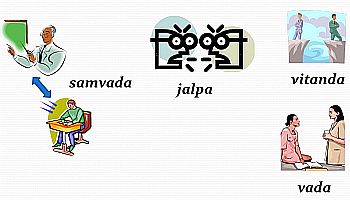
 Vaada, Jalpa and Vitanda

Vaada

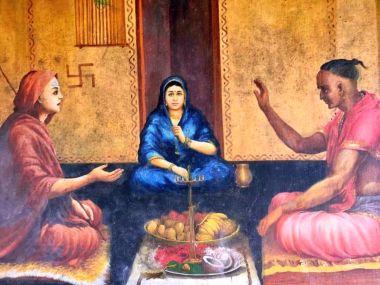
Vaada is a debate between two persons of equal standing. The term Vaada by itself means a theory, doctrine or thesis. In the debate, the proponent who puts forward arguments in support of his doctrine (Vaada) is termed as Vadin. The opponent who refutes that theory through his counter-arguments is termed as Prati-vadin. Unlike in Samvada, there is no teacher-taught relationship here; nor is it a discourse. 

Ideally, both the parties to the Vaada should have mutual regard, respecting each other’s learning and status; and should participate with an open mind in order to explore various dimensions of the subject on hand; to examine it thoroughly by applying the accepted norms of logic and reasoning (Tarka), supported by passages from  texts of undisputed authority (Sabda Pramana). The principal aim of a wholesome Vaada is to resolve the conflict; and, to establish ‘what is true’. The proceedings of the Vaada should be characterized by politeness, courtesy and fair means of presenting the arguments. You might call it a healthy discussion. 

Vatsayana in his commentary Nyāya Bhāya, says that congenial debate (Anuloma Sambasha) takes place when the opponent is not wrathful or malicious; but, is learned , wise, eloquent and patient  ; is well versed in the art of persuasion ; and, is gifted with sweet speech. 

As regards the benefits (Sambasha prashamsa or prayojana)  of such peaceful and congenial debates  : If a learned person debates with another scholar, both versed in the same subject, it would increase the depth of their knowledge, clear misapprehensions, if any, and lead them to  find certain minor details which hitherto might have escaped their attention . It was said: Vade Vade jayate tattvabodhah – Truth emerges out of debates – Besides, it would heighten their zeal to study further; and bring happiness to both.   

But, in cases where two scholars hold contrary views, the Vadin and Prati-vadin will each try very hard to establish the doctrine which he believes is true; and to convince the other to accept its veracity through fair and effective presentation and arguments. At the same time, each is willing to understand and appreciate the arguments of the other; and accept any merit they might find in it. In case, one is in doubt or unable to respond  satisfactorily , one can take a break to re-group his position or to re-examine the issue to see whether he can refute the opponent’s argument more effectively or put up a sounder defense.

And, if one is convinced that the doctrine and the argument presented by the opponent is valid, he adopts it with grace.   And, at the end, one of the two might be proven wrong; or both could be right.  In any case, they accept the outcome of the debate, whatever be it; and, part their ways without rancor. 

***

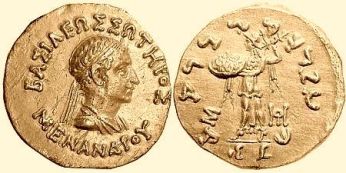
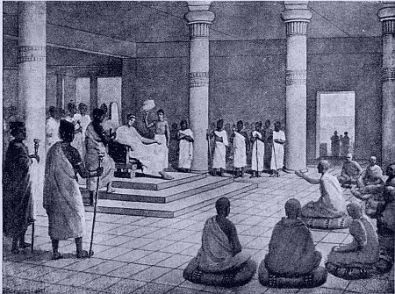
The Buddhist text Milinda Panha (The Questions of King Milinda) dated between second and first century BCE is said to be a record of the conversations that took place between the Indo-Greek king Menander I Soter  (who is said to have ruled over the regions of Kabul and Punjab) and the Buddhist monk Nagasena. 

[Menander (Milinda), originally a general of Demetrius, is probably the most successful Indo-Greek king, and the conqueror of a vast territory. The finds of his coins are the most numerous and the most widespread of all the Indo-Greek kings. From at least the 1st century AD, the “Menander Mons“, or “Mountains of Menander”, came to designate the mountain chain at the extreme east of the Indian subcontinent, today’s Naga Hills and Arakan, as indicated in the Ptolemy world map of the 1st century.  

Minander had expanded his kingdom into Gangetic plains, where Buddhism was flourishing. He is reputed to have been a secular King , who protected the beliefs of his Greek and Buddhist subjects.

Menander is remembered in Buddhist literature (the Milinda Panha) for his conversations with the Buddhist elder Monk Nagasena. According to Milinda –panha, the King Milinda carefully listens to Nagasena’s teachings; and, at the end of each discourse exclaims ‘Very good, Bhante* Nagasena’.

[*Bhante (Sanskrit: Bhavanta) is a respectful title used to address elder Buddhist monks in the Theravada tradition. The term literally means “Venerable Sir’.]

Sagala , the city in which King Milinda met the Bhikku Nagasena is identified with Sialkot . The Jatakas  mention : There is , in the country of the Yonakas , a great center of trade , a city that is called Sagala, situated in a delightful country, abounding in parks , groves , lakes and tanks ; a paradise of rivers, woods and mountains.

Wise architects have laid out the Sâgala city; and its people know of no oppression, since all their enemies and adversaries have been put down. Brave is its defense, with many and various strong towers and ramparts, with superb gates and entrance archways; and with the royal citadel in its midst, white walled and deeply moated. Well laid out are its streets, squares, cross roads, and market places. Well displayed are the innumerable sorts of costly merchandise with which its shops are filled. It is richly adorned with hundreds of alms-halls of various kinds; and splendid with hundreds of thousands of magnificent mansions, which rise aloft like the mountain peaks of the Himalayas. Its streets are filled with elephants, horses, carriages, and foot-passengers, frequented by groups of handsome men and beautiful women, and crowded by men of all sorts and conditions, Brahmans, nobles, artificers, and servants. They resound with cries of welcome to the teachers of every creed, and the city is the resort of the leading men of each of the differing sects. So full is the city of money, and of gold and silver ware, of copper and stone ware, that it is a very mine of dazzling treasures. And there is laid up there much store of property and corn and things of value in warehouses-foods and drinks of every sort, syrups and sweetmeats of every kind. In wealth it rivals Uttara-kuru, and in glory it is as Âlakamandâ, the city of the gods. (The Questions of King Milinda, translated by T. W.Rhys Davids, 1890)

Source : Greeks and Buddhism: Historical Contacts in the Development of a Universal Religion by Demetrios Th. Vassiliades ]

Milinda panha

At the outset, Nagasena remarks that the debate they would be having would be one between two wise men; and it would not be a debate for the King.

Then, King Menander enquirers as to the distinction between the two. 

Monk Nagasena explains:   

When scholars debate, your Majesty, there is summing up and unraveling of a theory, convincing and conceding; there is also defeat, and yet the scholars do not get angry at all.   

When the Kings debate, your Majesty, they state their thesis, and if anyone differs from them, they order him punished, saying ‘Inflict punishment upon him’. 

Thus, in a good debate there could be defeat or censure or clincher (Nigraha-sthana) but no animosity.

[This debate is justly praised for the incisive questions asked by Menander; and, it is regarded by the Buddhists as equal in value to their canonical scriptures.

It is not certain whether Menander was  converted to Buddhism; but, he seemed to have taken a deep interest in it. Some of his coins show a wheel, similar to the Buddhist Chakra. Plutarch reports that after Menander’s death his ashes were distributed to all cities of his kingdom where monuments were then constructed to contain them—a kind of commemoration which was in tune with Buddhist practice.]

milinda nagasena

 [Dr. Sangeetha Menon, in her scholarly article, though she writes about Savāda, she is actually referring to Vada:

(Sa)vāda, is meant to lead to transforming experiences, in the process of which attempts are made jointly to (i) ascertain what is true knowledge, (ii) to understand new ideas, and,  (iii) to understand the nature of the inquirer herself/himself.

(Sa) vāda plays a central role in understanding Indian philosophy as well as Indian psychology. It has references not only to logical and epistemological methods but also to states of mind which are important in the discussion about the primal nature of self. Hence, the discussions on metaphysical and ontological issues are always interrelated to understanding ethical, axiological, aesthetic and spiritual issues. There is a constant attempt to reconcile and integrate different experiences, and the existence of contradictions so as to generate worldviews based on an understanding of life with answers for fundamental questions about self-identity, nature of world, creation, purpose of life, nature of knowledge, value systems etc.

Apart from the content of the dialogue, the process of dialogue plays an important role in contributing to the well-being of the partners involved. It gives total and one-time attention to how world views are formed, how mental and physical discipline are significant to conceive an idea, how way of living is connected with the self-identity of the inquirer.

Being and Wellbeing In Upanishadic Literature  by Dr. Sangeetha Menon ]


 *** 

Nyaya Sutra in its First Book enumerates the steps or the categories (padartha) of the methods (Vadopaya) for structuring the argument and for presentation of the subject under debate, while the rest of the four Books expand on these steps. The Vada-marga (the stages in the course of a debate) is classified under sixteen steps: 

  • 1) Pramana (the means of knowledge);
  • 2) Prameya (the object of right knowledge);
  • 3)  Samsaya (creating doubt or misjudgment );
  • 4) Prayojana (purpose);
  • 5) Drshtanta  (familiar example);
  • 6) Sidhanta (established  tenet or principle);
  • 7) Avayava (an element of syllogism);
  • 8) Tarka ( reasoned argument);
  • 9) Niranaya (deduction or determination of the question); 
  • 10) Vada (discussion to defend or to arrive at the truth);
  • 11) Jalpa (wrangling or dispute to secure a win );
  • 12) Vitanda (quibble or mere attack);
  • 13) Hetvabhasa (fallacy, erratic  contrary , ill-timed challenges);
  • 14) Chala (misleading or willfully misinterpreting the words);
  • 15) Jati (futile objections founded on similarities or otherwise) ;and
  • 16) Nigrahaslhana (disagreement in principle or  no purpose in arguing further or the point nearing  defeat). 

*

These sixteen steps are meant to ascertain and establish ‘what is true’ (yathartha).The first four steps deal, mainly, with logic; while the latter seven perform the function of preventing and eliminating the errors. Among the first fou; Pramana with its four reliable means of obtaining knowledge is of cardinal importance [Pratyaksha (perception), Anumana (inference), Upamana (comparison) and Sabda (reliable verbal testimony)].

As said earlier, these sixteen categories are discussed in detail in four sections of the Nyaya Sutra.  The Nyāya Sūtra (verse 1.1.2) declares that its goal is to study and describe the attainment of liberation from wrong knowledge, faults and sorrow, through the application of above sixteen categories of perfecting knowledge.

duḥkha-janma-pravṛttidoṣa-mithyājñānānām uttarottarāpāye tadanantarā pāyāt apavargaḥ (1.1.2: )

**

Nyaya Sutra (1.2.1) – (vāda-lakṣaṇam) states that Vaada, the good or honest debate, is constituted by the following characteristics:

 1. Establishment of the thesis and refutation of the counter thesis should be based upon adequate evidence or means of knowledge (pramana) as well as upon proper reasoning (tarka). Pramana, the valid knowledge, is defined as the cognition of the objects as they actually are, free from misapprehension (tatha bhuta rtha jnanam hi pramanam uchyate); and, anything other than that is invalid A-pramana or Bhrama – the cognition of objects as they are not (atha bhuta rtha jnanam hi apramanam). Pramana stands both for the valid -knowledge, and for the instrument or the means by which such valid knowledge is obtained.

2. The conclusion should not entail contradiction with analytical or ‘accepted doctrine’; 

3.  Each side should use the well-known five steps (syllogism) of the demonstration (Sthapana) explicitly.

4.  They should clearly recognize a thesis to be defended and a counter thesis to be refuted.

(pramāṇa-tarka-sādhanopālambhaḥ siddhāntāviruddhaḥ pañcāvayavopapannaḥ pakṣapratipakṣaparigrahaḥ vādaḥ 1.21 )

 *** 

Nyaya Sutra (1.1.32- avayava-uddeśasūtram; and 1.1.39- nigamana-lakṣaṇam) lays down a five-part syllogism for proper presentation of the elements of the arguments (Vaada).  It states that any valid argument must include the following five factors, as they help to establish the object of right knowledge. These five steps also combine in themselves the four means of cognition: viz., Pratyaksha (perception), Anumana (inference), Upamana (comparison) and Sabda (reliable verbal testimony):

1. Pratijna – the proposition or the enunciation of the object – that needs to be proved in the light of the approved texts (Sabda)

2. Hetu – the reason or evidence through the vehicle of inference (Anumana); it furnishes a means to prove the proposition;

3. Udaharana – the citation of examples (well recognized, universally acceptable and independently verifiable) that illustrates (Pratyaksha) the  common principle underlying the subject in question and the example  . It provides the supporting reason or evidence;

4. Upanaya – the application (validity of the example cited- Upamana) evidencing that present thesis is essentially similar to example cited.

And

5. Niranaya – the conclusion eliminates all plausible contrary conclusions against the proposition; and re-states the proposition or the thesis as proved and established beyond doubt – derived by bringing together all the four means of right knowledge (proposition, reason, example and application)

 ( pratijñā-hetū-udāharaṇa-upanaya-nigaman āni avayavāḥ -1.1.32)

 ( hetvapadeśāt pratijñāyāḥ punarvacanam nigamanam- 1.1.39)

Pratijna is enunciation of the thesis that is sought to be proved – (e.g. Purusha is eternal).

Sthapana is establishing the thesis through a process employing reason (hetu), example (drstantha) , application of the example( upanaya)  and conclusion (nigamana) — (e.g. the statement – Purusha is eternal- has to be supported by valid reasoning (hetu)- because he is uncreated; by examples (drstantha) – just as the sky (Akasha ) is uncreated and it is eternal ;  by showing similarity between the subject of the example and the subject of the thesis (Upanaya) – just as Akasha is uncreated a , so the Purusha is uncreated and eternal : finally establishing the thesis (Nigamana) – therefore Purusha is eternal.

Prativada is refuting the proposition or thesis put forth by the proponent. Thus when the proposition of the thesis Sthapana is Purusha is eternal, the   Prati-stapana, the counter proposition, would be Purusha is non-eternal; because it is perceivable by senses and the jug which is perceivable by senses is non-eternal; Purusha is like the jug; therefore Purusha is non-eternal

***

At the commencement of the Vaada, the Judge or the arbiter (Madhyastha) lays down rules of the Vaada. The disputants are required to honor those norms and regulations. They are also required to adhere to permissible devices; and not to breach certain agreed limits (Vada maryada).

For instance; in the case of debates where the Vadin and Prati-vadin both belong to Vedic tradition it was not permissible to question the validity of the Vedas or the existence of  God and the Soul. And, any position taken during the course of Vaada should not contradict the Vedic injunctions.

In the case of the Vada where one belongs to Vedic tradition and the other to Non-Vedic traditions (say, Jaina or Bauddha) they had to abide by the rules and discipline specifically laid down by the Madyastha.

As mentioned earlier, according to Nyaya Sutra (1.2.1) Vaada comprises defense and attack (Sadhana and Upalambha). One’s own thesis is defended by means of genuine criteria of knowledge (Pramana) and the antithesis (opponent’s theory) is refuted by negative dialectics of Tarka (logic). But, when defense or attack is employed excessively, merely for the sake of scoring a win, then there is the risk of the debate degenerating into Jalpa.

It is said; Vaada and Jalpa are contrasting counterparts. In Vaada, the thesis is established by Pramana-s; and the anti-thesis is disproved by Tarka or different set of Pramana-s. Whereas in Jalpa, the main function is negation; the Pramana-s do not have much use here.  Jalpa tries to win the argument by resorting to quibbling, such as Chala, Jati and Nigrahasthana. None of these can establish the thesis directly, because their function is negation. But, indirectly , they help to disprove anti-thesis. Thus, Jalpa in general is the dialectical aid for Vada (Nyaya Sutra: 4.2.50-51

[It is said; at times, the Madhyastha might allow or overlook ‘Jalpa-like’ tactics ‘for safeguarding the interests of truth, ‘just as a fence of thorny hedges is used to protect the farms’.]

It is at this stage in the Vaada that the Madyastha might  intervene  to ensure that the participants, especially the one who is at the verge of defeat (Nigraha-sthana) do not resort to tricks such as quibbling (Chala) , false rejoinder (Jati)  etc. 

The Madyastha may even call off the Vada; and award to the candidate who in his view performed better. 

The Vada could be also treated as inconclusive (savyabhicara) and  brought to an end if there is no possibility of reaching a fair decision; or the very subject to be discussed is disputed (Viruddha); or when arguments stray away from the subject that is slated for discussion (prakarana-atita) ; or when the debate prolongs beyond a reasonable (Kalatita).

In this context, it is said the debate could be treated as concluded and one side declared defeated: a) When a proponent misunderstands his own premises and their implications; b) when the opponent cannot understand the proponent’s argument; c) when either party is confused and becomes helpless; d) when either is guilty of faulty reasoning or pseudo-reasoning (hetva-bhasa); because, no one should be allowed to win using a pseudo-reason; or e) when one cannot reply within a reasonable time. 

When one party is silenced in the process, the thesis stays as proven.  Hence, in Vaada, there is no explicit ‘defeat’ as such. The sense of defeat (Nigraha-sthana) becomes apparent when there are contradictions in logical reasoning (hetvabhasa); and the debate falls silent.

And, at the end, one of the two might be proven wrong; or both could be right.  In any case, when one is convinced that the doctrine and the argument presented by the opponent are valid, he adopts it with grace. Ideally, whatever might be the outcome of a Vaada, it should be accepted; and, both – Vadin and Prati-vadin  should part their ways without rancor.

Shankara Mandana Misra 2

[The most celebrated Vaada is said to be the one that took place between the young monk Sri Sankara and the distinguished Mimamsa scholar, householder, Mandana Misra.  Considering the young age of the opponent, Mandana Misra generously offered Sri Sankara the option to select the Madyastha (Judge) for the ensuing debate. Sri Sankara, who had great respect for the righteousness of Mandana Misra, chose his wife Bharathi Devi, a wise and learned person.  

During the course of the lengthy debate when Mandana Misra seemed to be nearing Nigrahasthana (clincher) Bharathi Devi raised questions about marital obligations.  Sri Sankara being a monk had, of course, no knowledge in such matters. He requested for and obtained a ‘break’ to study and to understand the issue. It is said; he returned after some time equipped with the newly acquired knowledge, renewed the Vaada and won it. Thereafter, Mandana Misra and Bharathi Devi accepted Sri Sankara as their teacher, with grace and respect.] 

divider1

[Please click here for a writing about Vada-vidhi (method of argumentation), a treatise about the methods to mould flawless logic, ascribed to the celebrated Buddhist scholar Vasubandhu (4th to 5th century CE). Vāda-vidhi is the only work of Vasubandhu on logic which has survived. Vasubandhu contributed to Buddhist logic and is held to have been the origin of formal logic in the Indian tradition. His text paved the way for the later Buddhist scholars like Dignaga and Dharmakirti, in the field of logic.

Vasubandhu’s methods for distinguishing fallacious arguments from valid ones rely heavily on his theory of cognition.

He describes a number of logical fallacies, which he classifies into three types: reversed, incorrect or unreal, and contradictory. He then moves on from the trivial examples to complex ones. Vasubandhu’s formal system of argumentation is simple and practical, and especially well-suited for the quick back-and-forth of the verbal debates that were very much in vogue in Vasubandhu’s day. He had a reputation for being an experienced, ferocious debater, with a sharp mind.

His ideas on cognition are quite interesting. The underlying principle in Vasubandhu’s treatise on logic is an unstated premise seemed to be that the objects in the argument structure have no independent existence. Instead, they only come into existence provisionally, when cognized. He further breaks down our process of cognition into direct perception, such as perceptions of pleasure, pain, sound, or sight, and inferred perception, such as the perception of a mountain as fire-possessing when it is observed to be smoke-possessing.

According to him : Knowledge through inference can be specified as an observation coming when the means-of-evidence is directly observed, and the invariable concomitance between it and what can be inferred is remembered. One does not occur unless something else is directly known. Otherwise there is no inference.

Vasubandhu points out, we can never be absolutely certain about anything, because we can only make inferences based upon our perceptions, which can be misleading, and memory, which is unreliable. He goes on to give examples of problems with cognition, such as a false cognition-of-silver arising from looking at mother-of-pearl, and cognition of objects that do not exist, such as a luminous circle that is perceived when a torch is hurled in an arc.

This method makes the example and counter-example so vital to the argument. Any thesis can be disproved by showing that the proposed invariable concomitance is not, in fact, invariable.

 The last part of Vāda-vidhi is devoted to methods that can be used to distinguish logical fallacies from valid arguments.

For more , please read, ]

jupiterfig5

Jalpa

As per the classification made by Akshapada Gautama in his Nyaya Sutra (1.2.2- jalpa-lakṣaṇam), while Vaada is a ‘good’  or congenial debate (anuloma sambasha or Sandhya sambasha), Jalpa along with Vitanda is treated as ‘bad’ or hostile  argument (Vigrahya sambasha).

Jalpa is described as debate between two rivals who are desperate to win, by fair or foul means. It is characterized as clever or tricky disputation and a quarrelsome verbal fight that is often noisy.

Unlike Vaada which is an honest debate aiming to ascertain ‘what is true’, Jalpa is an argument where each strives to impose his thesis on the other. The question of ascertaining the ‘truth’ does not arise here. Each party to the Jalap is already convinced that his thesis is true and perfect; while that of the opponent is false and totally wrong. Each is not prepared to understand and appreciate the rival argument; but, is over anxious to ensure the opponent is ‘defeated’ and is made to accept his thesis. Even while it   becomes apparent  that one might be on the verge of defeat , he will not accept the position;  instead , he will  try to  devise a strategy or  will take a ‘break’  to gather  some material or to  concoct  a fallacious argument  to evade defeat and , if possible, to prove the other wrong.

Both the Vadin and the Prati-vadin work hard to establish their thesis through direct and indirect proofs. In Jalpa, the Pramana-s, the means of valid knowledge do not have much role to play. The arguments in Jalpa relay more on negation or negative tactics, such as: discrediting the rival argument, misleading the opponent or willfully misinterpreting rival’s explanations. The main thrust of the arguments in Jalpa is not so much as to establish the thesis directly, as to disprove or refute the rival’s thesis, through circumvention.

The reason why Jalpa is labeled as tricky is that apart from traditional means of proving one’s thesis and for refuting the opponent’s thesis, the debater can use elusive and distracting devices such as: quibbling or hair-splitting (Chala); inappropriate rejoinders (Jati), and any kind of ruse that tries to outwit and disqualify the opponent (nigrahasthana),    circumvention, false generalization and showing the unfitness of the opponent to argue; without, however, establishing his own thesis.

 (yathoktopapannaḥ chala-jāti-nigrahasthāna-sādhanopālambhaḥ jalpaḥ -1.2.2)

Nyaya Sutra gives a fairly detailed treatment to the negative tactics of Jalpa. Nyaya Sutra (1.2.11-14; 5.1.1- 39; and 5.2.1-25) enumerates three kinds of quibbling (Chala); twenty-four kinds of inappropriate rejoinders (Jati); and twenty-two kinds of clinchers or censure-situations (Nigrahasthana).

 (jāti-lakṣaṇam —  sādharmyavaidharmyābhyām pratyavasthānaṃ jātiḥ -1.2.18)

(nigrahasthāna-lakṣaṇamn – vipratipattiḥ apratipattiḥ ca nigrahasthānam-1.2.19)

 (nigrahasthānabahutva-sūtram — tadvikalpāt jātinigrahasthānabahutvam-1.2.20)

It is said; such measures or tricks to outwit the opponent are allowed in Jalpa arguments, since the aim of the debate is to score a victory. However, those maneuvers are like double-edged swords; they cut both ways. Over-indulgence with such tactics is, therefore, rather dangerous.    One runs the risk of being censured, decaled unfit and treated as defeated, if the opponent catches him at his own game.

**

Quibbling (Chala) is basically an attempt to misinterpret the meaning of an expression (Vak-chala); or, improperly generalize its meaning (samanya-chala); or by conflation of an ordinary use of a word with its metaphorical use (upacara-chala), with a view to derange the argument.

(chala-lakṣaṇam —  vacana-vighātaḥ artha-vikalpopapattyā chalam – 1.2.10)

(chala-bheda-uddeśa-sūtram – – tat trividham – vākchalam sāmānyacchalam upacāracchalam ca iti- 1.2.11)

For instance; when one says: the boy has a nava kambala (= new) blanket; the other would look horrified and exclaim:  why would a little boy need nava (=nine) blankets !

And, when one says: he is a hungry man (= purusha) , the other would generalize Man – Purusha as ‘ humans’ , and ask why are all the human beings hungry? and, all at the same time?

Similarly, term ‘mancha’ ordinarily means a cot; but, its metaphorical meaning could be platform or dais or the people sitting on it. The opponent would wonder ‘why on earth , would the couple choose to sleep on a public platform , while many persons are already seated on it ?’.

There are many other similar words, such as:  Mantapa which normally is understood as an open-hall; but, its etymological meaning could be ‘one who drinks scum of boiled rice (Ganji)’. And, the term Kushala is generally used to denote an expert or a highly skilled person (pravina); but, its etymology analysis would lead to one who is ‘good at cutting grass (kush). And, similarly, Ashva-gandha is literally ‘smell of the horse; but in common usage it refers to a medicinal herb.

A mischievous quibbler would deliberately twist the meaning of such words; take them out of the context; and, try to distract and confuse the his rival 

Improper rejoinder or futile rejoinder (Jati) is generally through falsifying the analogy given; and ridiculing it.

For instance; when one says: sound is impermanent because it is a product, such as a pot; the other would ignore the ‘impermanent’ property of the analogy (pot), but would pick up a totally un-related property of the analogy (say, the hollow space or emptiness in the pot) and say that a pot is filled with space (akasha) which is eternal, then how could you say that a pot is impermanent? And, further pot is not audible either.

Censures or the point at which the Jalpa could be force-closed (Nigrahasthana)  by pointing out that the opponent is arguing against his own thesis  ; or , that he is willfully abstracting the debate; or to his inappropriate ways. 

***

There are also some statements that defend the Jalpa-way of arguments.

One reason adduced for allowing in the debate the diverse interpretations of the terms is said to be the flexibility that the Sanskrit language has, where compound-words can be split in ways to suit one’s argument; where words carry multiple meanings; and, where varieties of contextual meanings can be read into with change in structure of phrases, sentences and context of topics.   

And, the other is that the ancient texts in Sutra format – terse, rigid and ambiguous – can be read and interpreted in any number of ways. Each interpretation can be supported by one or the other authoritative text. There is therefore, plenty of scope for legitimate disputation.

It is said; that Jalpa way of arguments is at times useful as a defensive measure to safeguard the real debate (Vada),just as the thorns and branches are used for the protection of the (tender) sprout of the seed’.

The other reason is that it would be in the interest of an aspiring debater to be familiar with divisive tactics; and, also the ways and means of deflecting them.

It is also said that Jalpa-tactics might come in handy to a novice or an inexperienced debater, as a ploy . If such a person, without adequate skills,   enters into a debate, he might not be able to come up with proper rejoinder at the right time to safeguard his thesis. In such a crisis, he may get away with such tricky debate. In any case, if the opponent is not quick witted, the (novice) debater may gain some time to think of the proper reason. Thus, he may even win the debate and the sprout of his knowledge would be protected.

However, this justification was not altogether acceptable.

**

The next question would be why would a debater resort to such tactics as quibbling and dishonest rejoinder?  Or why would anyone waste his time and effort in learning those tactics?

Bimal Krishna Matilal in his The Character of Logic in India explains:

‘ Uddyotakara, in the beginning of his commentary on chapter five of the Nyaya Sutra explains that it is always useful to learn about these bad tricks, for at least one should try to avoid them in one’s own debate and identify them in the opponent’s presentation in order to defeat him. Besides, when faced with sure defeat, one may use a trick, and if the opponent by chance is confused by the trick, the debater will at least have the satisfaction of creating a doubt instead of courting sure defeat.

This last point was, however, a very weak defense; and not convincing at all , as the Buddhist scholar Dharmakirti (c. 600-660) elaborately pointed out in his book on debate, Vada-nyaya.’

***

The crucial difference between Vada and Jalpa  appears to be that in the case of Vada the ‘truth’ is established by positive evidence; and, the invalid knowledge (A-pramana) masquerading as a good reason (that is, a hetvabhasa) is detected and eliminated. No one is really defeated and the truth is established.

In the case of Jalpa, it mainly depends on negation (which is non-committal) and on effective refutation of the proponent’s argument. There is no earnest effort to build positive irrefutable proof. And, the fear of defeat overhangs the whole proceedings.

 The scholarly opinion is that the rejection or refutation of a position may not always amount to the assertion of a counter-position. And, determination and establishment of truth depends upon positive evidence; and not merely on refutation.

   discussions


Vitanda

In Akshapada’s Nyaya-Sutra (1.2.3), Vitanda is classified as a ’bad’ or hostile argument (Vigrahya sambasha) or wrangling, which does not allow the opponent to establish his  argument . In terms of merit; it is the worst; it is rated inferior to Jalpa, which also employs such trickery as quibbling and illegitimate rejoinder. While Jalpa tries to argue for the success of its thesis by whatever means, Vitanda does not seriously attempt to put up any counter-thesis. That is because, its debater has no thesis of his own to put forward.

In other words, the debater here tries to ensure his victory simply by refuting or demolishing the thesis put forward by the other side, by browbeating or misleading or ridiculing the opponent. The whole purpose of its exercise seems to be to prove the opponent wrong and incompetent; and to confuse and humiliate him.  Vitanda is therefore termed as a destructive debate.

(vitaṇḍā-lakṣaṇam — saḥ pratipakṣa-sthāpanā-hīnaḥ vitaṇḍā- 1.2.3 )

Vitanda is a ruthless debate, the major part of which is spent in denying the opponent’s views, in discrediting him or in quarrelling. Vaitandika, the one who adopts Vitanda style of argument, might at times pick up the opponent’s thesis (though he himself might not believe in it) and argue in its favor just to demonstrate that the opponent is not doing a ‘good job’; and rebuke him saying that his thesis might not be after all so bad, but he made it look worse by making a terrible mess of it.

Vaitandika makes it a point to disagree with the other, no matter what the other says. It is a way of saying: you are wrong, not because your statement by itself is wrong; but, it is wrong because you said it. He tries to effectively undermine the credibility of the opponent; and demonstrate to him that he is neither competent nor qualified to discuss the subtleties of the logic. Then he would shout:” go back and study for one more year at the feet of your teacher; you have done enough for today”.

What the Vaitandika says might be irrational or illogical; but, he tries to effectively silence the opponent. In such type of debates either ‘valid knowledge’ or ‘truth’ has no place.

[ please also read about : How to Win Arguments with Stupid, Stubborn People]

**

Nilakanta Dikshita (16th-17th century), minister, poet and theologian of Nayaka-period, known for his incisive satirical wit , in his work, the Kala-vidambana (A Travesty of Time), avers:

If you want to triumph, do not be afraid; do not pay attention; do not listen to the opponent’s arguments— just immediately contradict him.  Unflappability; shamelessness; contempt for the adversary; derision, and, praise of the king – these are the five grounds of victory … If the opponent  is not learned, you win by shouting at him. If he is a taught one, then you have only to insinuate bias, such as: greed for money; thirst for fame; anxiety to be in the good-books of the King; or advance oneself in the society. You have to unsettle and insult the opponent. Such is the correct and effective syllogistic procedure.

**

In a Vitanda, where both the parties employ similar tactics, the debate would invariably get noisy and ugly. The Madhyastha or the Judge plays a crucial role in regulating a Vitanda. He has the hard and unenviable task of not merely controlling the two warring debaters and their noisy supporters, but also to rule on what is ‘Sadhu’ (permissible) or ‘A-sadhu’ (not permissible) and what is true (Sat) what is just a bluff (A-sat). And, when one debater repeatedly oversteps and breaches the accepted code of conduct, the Madyastha might have to disqualify him and award the debate to the other; or, he may even disqualify both the parties and scrap the event declaring it  null and void.

**

Vatsayana, the commentator of the Nyaya Sutra finds the Vitanda debate irrational and rather pointless. He observes that it is unfair that a debater is simply allowed to get away with irresponsible statements, particularly when he is neither putting forward a thesis nor is defending one. In fact, most of the times, he has no position of his own, but attacks rabidly whatever the other debater utters. This is a travesty and abuse of the platform.

According to Vatsayana, the format of Vitanda is totally wrong. Vatsayana insists, whatever might be the tactics adopted by Vaitandika, he must be forced to specify his stand. And, when the opponent states his thesis, the Vaitandika must be asked either to accept it or oppose it.  If he concedes, the debate is virtually over. And, if he argues against the thesis, he must argue logically, in which case he gives up his status of Vaitandika (refuter). And, if he does not choose either of the options then, his rationale should be questioned; or, the debate be brought to an end, if need be, by disqualifying him.

Vatsayana’s observations and recommendations are sound and healthy. But, sadly, they were hardly acted upon.

6a00d8341c73fe53ef00e550bc80098833-640wi

Sources and References:

A History of Indian Logic: Ancient, Mediaeval, and Modern Schools

By Mahamahopadyaya Satis Chandra Vidyabhusana

The Character of Logic in India Edited  by Bimal Krishna Matilal, Jonardon Ganeri, Heeraman Tiwari

The Nyâya Sûtras of Gotama by Nandalal Sinha

Hindu Philosophy  by Theos Bernard

Categories of Cognition and Proof – Shodhganga

A History of Indian Philosophy, Volume 1 By Surendranath Dasgupta

The Birth of Meaning in Hindu Thought  by  David B. Zilberman

History of Indian philosophy: The philosophy of the Veda and of …, Volume 1 By Erich Frauwallner


Tags: , , , , , , , , , , , , , , , , ,

Discussions, Debates and Arguments: Ancient India- Part One

Discussions, Debates    and Arguments:  Samvada – Vaada – Jalpa and Vitanda

 Part One

In the Indian traditions, including the Buddhist and Jain traditions, four formats of discussions, debates and arguments are described. These are named as:  Samvada, Vaada, Jalpa and Vitanda.

The merit and esteem of each of these types of discussions is graded in terms of the honesty of their purpose, the quality of debate, the decorum and the mutual regard of the participants.

Of these four forms of discussions, Samvada is regarded the noblest type of dialogue that takes place, in all earnestness, between an ardent seeker of truth and an enlightened teacher. Most of the ancient Indian texts are in this format.

While Samvada is a discourse or imparting of teaching, the other three – Vaada, Jalpa and Vitanda – are clever and structured (Tantrayukthi) debates and arguments between rivals.  

Let’s talk of  Nyaya (well-organized logical ways of ascertaining the true nature of the objects and subjects of human knowledge) and Samvada on one part; and, the debates/arguments on the other. 

***

Nyaya Sutra

As is well known, there was a long and a time-honored tradition in ancient India where philosophers and thinkers met to discuss metaphysical issues over which there were multiple views. There are detailed narrations of such discussions, debates and dialogues recorded in Chandogya-Upanishad, Brihadaranyaka Upanishad and Prashna-Upanishad.

The other early texts such as Aitareya Brahmana , Kathopanishad  and others  use terms  like : tarka (reasoning); Vada (debate); Yukti (sustained arguments), Prameya (object of knowledge); Pramana (proof); Nirnaya (ascertainment)  etc. which later became the principal terminologies of the Nyaya School. It is also said that the idioms of inquiry (Anveshiki) dealing with the theory of reasons (Hetu-vidya or Hetu-shastra) were mentioned in Manu-samhita and Panini’s Astadhyayi.

Although the intellectual debates were quite common during the Upanishad-times, and even later, there was perhaps no well laid out theory or an approved structure for conduct of various types of debates.   It is said; it was during the Sramana and the Buddhist period that debates became really very serious.

As Bimal Krishna Matilal observes (in The Character of Logic in India):

.. The intellectual climate in India was bristling with controversy and criticism. At the center of controversy were certain dominant religious and ethical issues. Nothing was too sacred for criticism. Such questions as: “Is there a soul different from body?”; “Is the world (loka) eternal?”; ”What is the meaning, goal, or purpose of life?”; and, “Is renunciation preferable to enjoyment?” etc. were of major concern. 

While teachers and thinkers argued about such matters, there arose a gradual awareness of the characteristics or patterns of correct, acceptable and sound reasoning. There were    also concerns to evolve the norms to distinguish sound reasoning from pseudo-reasoning (hetvabhasa) which is unacceptable. 

According to Dr. Benimadhab Barua, even among the Sramanas, the wandering monks, there were famed debaters who were “clever, subtle, and experienced in projecting controversies; hair-splitters who ruthlessly splintered into pieces the arguments of their adversaries”.

The debates tended to get more passionate, animated and even noisy.  Gradually, the notions of ‘good’ and acceptable debates took shape as distinct from wrong and ugly arguments. That gave rise to the development of a branch of study dealing with theories of reasoning and logic (Hetu-vidya or Hetu shastra). It was perhaps around the fifth century BCE that manuals came to be written for conduct of proper and successful debates (Tarka vidya or Vada vidya).

Such manuals included instructions and learning methods for the guidance of aspiring debaters. The earliest known text of that genre was Tantra-yukti (structured argument) compiled perhaps in the sixth-fifth century BCE to systematize debates conducted in learned councils (Parishad). 

Debates and arguments then came to be recognized both as art of logical reasoning (Tarka-vidya) and science of causes (Hetu-shastra) following the path of a well-disciplined method of inquiry (ânvikŝiki) testing scriptural knowledge by further scrutiny. 

The monks and priests belonging to various Schools and sects were imparted training in Tarka–vidya: the art and skills of conducting impressive successful debates and disputations (Sambasha or Vada vidhi) in learned assemblies (parishad).

Apart from  methods of presenting arguments as per a logically structured format, the training modules included ways to stoutly defend ones thesis  by means of genuine criteria of knowledge (Pramana) and to attack the opponent’s thesis by means of indirect arguments (Tarka); estimating the strengths and weaknesses of arguments of either side; establishing one’s own points while setting aside those of the opponent.

They were also trained for handling different types of challenges, such as: how to vanquish a person of blazing fame; how to behave with a senior opponent; how to handle an aggressive and troublesome opponent; and,  how to conduct oneself in prestigious Parishads, to influence the flow of debate and to impress the judges and the onlookers  etc.

These types of debates and arguments broadly came under the purview of Nyaya or Nyaya Shastra.

[The Charaka Samhita , a principal Ayurveda Text (dated around the second century), in its  third part, called Vimanasthana, along with other topics like training of a physician, ethics of medical practice, pathology, diet and nourishment, taste of medicines, etc.,  also  contains a discussion on the principles of debate

The related doctrines are treated in Caraka-samhita under three heads, namely:

    • 1) Karyabhinirvrtti, the aggregate of resources for the accomplishment of an action
    • (2) Pariksa, the standard of examination, and
    • (3) Sambhasha-vidhi, or vada-vidhi, the method of debate.

 This is followed by detailed discussions on these three topics. For example, there is a discussion on the various resources that are to be examined to accomplish an action.

These resources include Karana (the actor, or agent who accomplishes an action), Karya (the action), Karya-phala (the effect), Desha (the place of the action), Kala (the time of the action), Pravrtti (the activity or exertion put forth for achieving the action), etc. The second head, Pariksa, deals with the standard of examination.

These standards are: aptopadesa (reliable assertion); Pratyaksa (perception); anumana (inference); yukti (reasoning). The discussion under the third head is much more elaborate.[

The examination of vada-vidhi begins by dividing debates into two classes, namely, anuloma sambhasha (peaceful debate) and vigrihya sambhasha (hostile debate).

The respondents are then classified as superior, equal and inferior. Also, the assembly witnessing the debate is classified as learned and ignorant. Each of these is then further classified as friendly, indifferent or hostile. There are suggestions as to how to handle the debate depending on the nature of the respondents and of the assembly. The treatise then goes on to give a list of 44 items a thorough knowledge of which is essential for the successful conduct of a debate.]

Nyaya, as a system,  is one among the six Darshanas (systems of Indian philosophy). It deals with well-organized logical ways of ascertaining the true nature of the objects and subjects of human knowledge (Pramana-Sastra).  Nyaya is also called Tarka-vidya (logic) and Vada-vidya or Vada’rtha (reasoned argument); and, is included among the fourteen principal branches of learning. 

Nyaya is founded on the belief that knowledge is not self-revealing; man must make effort to gain correct knowledge ; and, to abandon incorrect knowledge, through a systematic process. It asserts that the analytical way of Nyaya is the greatest protection to a young person whose intellect is still in the process of growth and is yet to attain equanimity. And, it is only by thorough examination of the modes and sources of correct knowledge that a thinking person can gain a clearer perspective of life. It asks each one to think for himself; and, not to tacitly accept beliefs handed down by the older generation. And, therefore, it instructs, the teachings that have come down to us through traditions must be critically examined before accepting them.

Vatsayana in his Nyāya Bhāya , Commentary on Nyaya Sutra (1.1.1) , asserts that the analytical investigation and examination (Anveshiki) of issues which bring clarity into the intellectual aspects of man’s life help him to attain freedom (moksha) from delusions and confusions in life. Nyaya which enables us to discern the true from the false is therefore regarded as Moksha-Sadhana the way to absolute freedom or liberation.

nirdeśe yathāvacanaṃ vigrahaḥ|
cārthe dvandvaḥ samāsaḥ|
pramāṇādīnāṃ tatvamiti śaiṣikī ṣaṣṭhī|
tatvasya jñānaṃ niḥśreyasasyādhigama iti ca karmaṇi ṣaṣṭhyau|
ta etāvanto vidyamānārthāḥ|
eṣāmaviparītajñānārthamihopadeśaḥ|
so ‘yamanavayavena tantrārtha uddiṣṭo veditavyaḥ/ NyS_1,1.1 /

*

Nyaya, in particular, also denotes a method or a scheme of logic employed to prove or to disprove a proposition through proper evidence (pramana). The employment of a Nyaya would become necessary when the subject discussed was either vague or was disputed; and when the other methods of reasoning were ineffective.

The Nyaya School was essentially logistic in its orientation. It tried to examine the sources and contents of valid knowledge. It built a logical link between the subject, the knower (pramata); the means or method of obtaining knowledge (pramana) ; and the object , the knowable (prameya) . In addition, it put forth analogy (Upama) as the fourth method.

Analogy (Upama), it is said, comprehensively includes in itself the other three methods. However, the main purpose of Upama is to illustrate. This  models attempts to represent something that which cannot be perceived. However, this Nyaya is like the finger; and, it is not the moon. Therefore , Analogy, the Upama has its own limitations; it could be brittle at times; and , if pressed too hard it might even crumble .

In its working method; Upama employs something that is already familiar , in order to explain certain concepts that are at once abstract and real. But, an analogy cannot be perfect; as there cannot be complete identity between the  subject and the object.  Therefore, there  cannot be a perfect analogy; and, mere  argument is not evidence.

Which is to say; while the analogy or illustration is important, the more important than that is the validity of the argument, its  precision and its import. Therefore, there is always an element of inadequacy in the Upama . One has to strive to extract from the model what is called “a positive analogy”; or Samanya-guna a relevant factor that is common to both the subject and the object . The notion of transformation (Vivarta) is thus what one could call a logical construction.

Nonetheless, the value of these Nyayas consists in that they facilitate a passage from the observable to the actual ; and,  from the factual to the theoretical .

[ Prof. Surendranath Dasgupta explains in A History of Indian Philosophy, Volume 1 (p.406):

Pramana in Sanskrit signifies the means and movement by which valid knowledge is acquired;  Pramata means the subject or the knower who cognizes; Prama – the result of pramana i.e., right knowledge, knowledge of reality or valid cognition; prameya – the object of knowledge ; and pramanya – the validity of knowledge acquired. 

The verbal root ma of these terms derived with the prefix pra, means also to measure (apart from meaning to cognize) . Thus, what is to be measured is the prameya; and, that by which to measure is pramana.]

[In Sanskrit, the term Jnana stands for all kinds of knowledge – whether be it of truth or of falsehood. The term Prama, however, is used to designate only a true cognition (yatartha-jnana) as distinct from a false one (mithya-jnana). A Pramana is an active and a unique cause of Prama or knowledge. Pramā means ‘knowing an object as it is’: tadvati tat prakārā-anubhavaḥ  pramā.  The term  pramāṇis also  understood as the actual experience is pramā. 

pramāyāḥ karaṇam, pramāṇam. Alternatively, yathārthā-anubhavah pramā –

To see a rope as rope is pramā. If we see a snake instead of the rope, it is apramā-ayathārtha-anubhavaḥ apramā.

The Samkhya and Yoga Schools of Indian philosophy accept three means of cognition, Pramanas: 

Pratyaksha : direct perception generated through sense organs – indriyārtha – sannikarṣajanya . That is,   when there is a contact between the senses and the object – jñānamakam pratyakṣam. Gautama defines Pratyakṣa as meaning – ‘knowledge born of sensory perception, such as eyes is pratyakṣa

– akṣam akṣam pratityutpadyate iti pratyakṣam 

And. Pratyaksha is regarded as the basic (Mula) Pramana; because, the other pramānas such as Anumāna, Arthāpatti, Upamāna and śabda are dependent on it.

Anumana (inference) literally means knowledge gained  afterwards ; i.e. knowledge that ‘follows other knowledge’ –  jñāna-kāraka-jñānam.). In Anumāna, first the liṅga (minor primise) is seen, then by liṅga or hetu, the sādhya-sambandha-jñāna  or vyāpti-jñāna (invariable concomitant) takes place. This Sādhya (major primise) is known as anumiti. Thus, since this knowledge takes place after liṅga-darśana, this is known as Anumāna

And Sabda is verbal testimony , through scriptures. Bhartrhari asserts, the traditional knowledge (Agamawhich consists of the revealed (Sruti) or remembered (Smrti) scriptures cannot be set aside by inference, since they are more dependable than inference.

*

The Mimamsa School accepts six types of Pramanas: Pratyaksha, Anumana, Sabda, Upamana (analogy), Arthapatti (presumption) and Abhava (non-apprehension). 

The same set of six Pramanas is also stated by Vedanta. There are, of course, variations among these Schools regarding the specific understang of each of the Pramans.

*

Within Vyakarana, Bhartrhari in his Maha-bhashya-tika accepts three Pramanas: Pratyaksha (perception), Anumana (inference) and Agama or Sabda (scriptures). He argues that perception, at times, could be erroneous because of weakness or improper functioning of sensory organs. Some even think, he says, that inference is superior to perception. But he asserts that Agama or Sabda which consists of the revealed (Sruti) or remembered (Smrti) scriptures is a strong Pramana; and, it is more dependable than inference.

According to Bhartrhari, it is not justifiable to replace scriptures (Sabda) with inference particularly in non-empirical matters. He also says that philosophical views (Vada) cannot be independent of the scriptures. He argues that inference alone, without the steadying influence of the scriptures is an inadequate means of valid knowledge. In his Vakyapadiya (1.34), it is said: ‘whatever is inferred with great effort through clever reasoning can easily be put aside  by a much more clever reasoning or argument’.

yatnenānumito+apy arthaḥ kuśalair anumātṛbhiḥ / abhiyuktatarair anyair anyathaivopapādyate -VP.1.34

The words of the Rishis convey super-sensory knowledge that cannot be set aside by inference. Thus, Bhartrhari asserts that Dharma or right conduct cannot be determined by reasoning alone, without the guidance of the scriptural traditions. Even the knowledge which the sages possess has the scriptures for its reference (Vakyapadiya: 1.30). Thus, tor true knowledge, the support of the scriptures (Sabda) is essential.

na jāgamād ṛte dharmas tarkeṇa vyavatiṣṭhate /  ṛṣīṇām api yaj jñānaṃ tad apy āgamapūrvakam – VP.1.30

In this context, Bharthari says that the role of Vyakarana (Grammar) is very important,  as it helps  to safeguard the correct  transmission of the scriptural knowledge , and to assist the aspirant in realizing the the truth of the  revealed knowledge of  Sabda.]

**

The Sutra text attached to Nyaya School is the Nyaya Sutra ascribed to Akapāda Gautama (variously estimated between 6th-century BCE and 2nd-century CE). Nyaya Sutra treats mainly five subjects: Pramana (instruments or means of right knowledge); Prameya (the object of right knowledge); Vaada (debate or discussion); Avayava (the elements or steps of syllogism); and, Anya-matha-pariksha (review or examination of the doctrines of other Schools).

[Please click here for The Nyaya Sutras of Gotama; Translated by Mahamahopadhyaya Satish Chandra Vidyabhushan; Published by The Panini Office, Bhuvaneshvari Ashram, Bahadurganj, Allahabad – 1913 ]

**

While discussing Vaada, Nyaya Sutra talks about sixteen padarthas  (topics or categories ) involved in the development of the debate (Vada marga);  the four reliable means of obtaining valid knowledge (pramāa) viz.:

    • Pratyaksha (perception),
    • Anumana (inference),
    • Upamana (comparison) and
    • Sabda (reliable testimony);

the five-part syllogism (Nyaya):

    • the structure (vada vidhi);
    • the ways of developing sound evidence (pramana);
    • the logical reasoning (tarka) to support ones thesis which needs to be proved (Pratijna) and its object (nirnaya);
    • the disciplined (anusasana) mode of presentation (vadopaya); and
    • the exceptions (prthaka-prasthana), as also the limits or the ‘dos and don’ts’ (vada-maryada) of three formats of such debates.

(vāda-lakṣaṇam : pramāṇa-tarka-sādhanopālambhaḥ siddhāntā-viruddhaḥ pañcā-vayavopapannaḥ pakṣa-pratipakṣa-parigrahaḥ vādaḥNyS_1,2.1)

Gautama’s text was followed by commentaries; the first of which being Nyāya Bhāya by Vātsyāyana (c. 450–500 CE). The commentary by Vatsayana was followed the ones by the Nyāya-vārttika of Uddyotakāra (c. 6th–7th century); Tātparya-tīkā by Vācaspati Miśra (9th century); Tātparya-pariśuddhi by Udayana (10th century); Nyāya-mañjarī by Jayanta (10th century); Nyaya-sara by Bhasarvajna (10th century); and Tatva-chintamani by Gangesa (12th  century). These commentaries further developed the Nyaya Sutra expanding upon Gautama’s work.

As per these texts, the debates and arguments are grouped under a broad head titled ‘Katha’. In Sanskrit, the term ‘Katha’, in general, translates as ‘to inform’, ‘to narrate’, ‘to address or to refer to somebody’. In the context of Nyaya Shatra, which provides the knowledge (Vako-Vakya or Vada-vidya) about the methods for presenting arguments as also the rules governing the debates, the term ‘Katha’ implies formal conversation (Sambasha) as in a debate. The conversation here is not in the casual manner as in day-to-day life. But, it is articulate, precise and well thought out utterances.

The Katha is described as ‘polemical conversation’, meaning that it is passionate and strongly worded , but a well balanced  argument against or in favor of somebody or something. That is why; the discussions (Vaada) are never simple. A Katha, in essence, is a reasoned and a well-structured philosophical discussion.

Vatsayana at the beginning of his commentary on Nyaya Sutra (1.2.1) mentions that Katha is classified into two kinds of debates (Dvi-vidha sambasha):  Vaada (the good-Sandhya sambasha) on one hand; and Jalpa and Vitanda (the bad- Vigrahya sambasha) on the other.

Uddyotakara in his Nyāya Vārttika further explains that this threefold classification is according to the nature of the debate and  the status of the persons taking part in the debate.

(padārtha-uddeśa-sūtram:pramāṇa-prameya-saṃśaya-prayojana-dṛṣṭānta-siddhāntāvayava-tarka-nirṇaya-vāda-jalpa-vitaṇḍāhetvābhāsa-cchala-jāti-nigrahasthānānāmtattvajñānāt niḥśreyasādhigamaḥ- NyS_1,1.1 )

The first variety ,  Vaada is an honest , peaceful  and congenial (sandhaya) debate that takes place between two persons of equal merit or standing, trying to explore the various dimensions of a subject with a view to ascertain and establish ‘what is true’.  The Vaada, at its best, is a candid friendly discussion (anuloma sambasha or sandhya sambasha) or debate in the spirit of: ’let’s sit-down and talk’.

The other two are hostile arguments (vigrhya sambasha) between rivals who desperately want to win. Thus, by implication, while the goal of a Vaada is establishment of truth or an accepted doctrine; and that of the other two hostile debates (Jalpa and Vitanda) is seeking victory.

Of the two types of hostile debates, Jalpa is described (in Nyaya Sutra 1.2.2) as a disputation or wrangling or a ’tricky’ debate between two rivals , where each is thoroughly convinced that he is absolutely right and the other (termed as the opponent – Prativadin) is hopelessly wrong. The first party to the debate is dogmatically committed to his own thesis, while the other party takes a rigid contrary position (Prati-paksha) on a given subject; and, sometimes at the cost of truth. Each is prepared to employ various deceptive or sophistic devices, such as quibbling (Chala); unreasonable (A-hetu) responses; shifting the reason or the topics (Hetvantara or Arthantara); irrelevant rejoinders provoking the opponent to lose focus , to get perturbed and yet continue with the dispute (Jati) somehow; and , such other devices to outwit the opponent.

(jalpa-lakṣaṇam :  yathoktopapannaḥ chalajātinigrahasthānasādhanopālambhaḥ jalpaḥ-NyS_1,2.2)

Unlike in Vaada, the purpose of Jalpa is not so much as to ascertain the truth, as to establish one’s own position or thesis, and to prove the opponent wrong; and, make him accept defeat. What is at stake here is the ‘prestige and honor’ of one’s School (Matha). And, therefore, each will try to win the debate by fair or foul means.   And, when one senses that he might be losing the argument (nigrahasthāna), he will try to invent every sort of face-saving device or ruse to wriggle out of a bad situation that is quickly turning worse , like being trapped on quicksand sinking down each moment . Jalpa, predictably, could therefore be noisy , unpleasant and even be desperate.

And, Vitanda is the worst type of argument or squabbling descending to the level of quarrel and trickery. It is  described as a destructive type of argument; the sole aim of each party being not only to inflict defeat on the opponent but also to demolish and humiliate him .

The Vaitandika , the debater who employs Vitanda, is basically a refuter; he relentlessly goes on refuting whatever  the proponent says. He has no thesis of his  own – either to put forward or to defend.  Sometimes he might pick up a thesis  just for argument’s sake, even though he may have no faith in the truth of his own argument. The aggressive Vaitandika goes on picking holes in the rival’s arguments  and destabilizes his position , without any attempt to offer an alternate thesis.

Both the participants in a Vitanda are prepared to resort to mean tactics in order to mislead, browbeat the opponent by fallacies (hetv-abhasa); by attacking the opponents statement by willful misrepresentation (Chala) ; ill-timed rejoinders (Atita-kala) and, make the opponent ‘bite the dust’. It is virtually akin to a ‘no-holds-barred’ sort of street fight. The ethereal values such as: truth, honesty, mutual respect and such others are conspicuously absent here.

(vitaṇḍā-lakṣaṇam : saḥ pratipakṣa-sthāpanā-hīnaḥ vitaṇḍā –NyS_1,2.3)

It is said; in the case of Jalpa the contending parties have a position of their own, fight hard to defend it, and aim to make the rival accept it, by whatever means.  However, in the Vitanda, the disputant has neither a position of his own nor is he trying to defend any specific thesis.  He is merely trying to derange and humiliate the other party to the debate. Vatsayana in his Nyaya-sutra Bhashya calls one who resorts to Vitanda (Vaitandika) as self-destructive.

Even in the case of Jalpa and Vitanda, the disputants had to agree, beforehand, to certain rules, norms and devices, so that the defeat could be forced by the judge (Madyastha) on one or the other party.

A debate with the mere aim of win or humiliation of the other is looked down. Therefore, Jalpa and Vitanda are deemed contrary to the overall aim of the Nyaya Shastra which is oriented towards determination of the true nature of objects.

[The skills in waging debates and arguments (Vada-vidya) of the Jalpa and Vitanda might have been relevant during the medieval times when the inter–religious or intra-religious debates (Shastrartha) were held among the rival traditions (Sampradaya) or sects, each trying hard to prove the superiority of its Matha (thesis or sect) over the others. In the present context, such beliefs and arguments have become obsolete in India, though their techniques are very well preserved and practiced in Tibetan Buddhist debates.

Having said that , Prof. A L Basham remarks : ” Modern logicians might make short work of these rather pedantic systems of ontological and epistemological relativity, but they have a fundamental quality of breadth and realism, implying a full realization that the world is more complex and subtle than we think it, and that what is true of a thing in one of its aspects may at the same time be false in another.”

Further . the syllogism, logical structure and methods of presenting reasoned arguments as described in the ancient texts  are still of great interest. Its methodology based on a system of logic is the same for us today in our lecture halls and programming desks as it was for the medieval scholars.]

vada samvada

 Let’s look at each of these types of discussions and arguments in a little more detail. 

lotus design

 Samvada

Guru-Gita

Samvada is a dialogue that takes between the teacher and the taught in all earnestness.  The one who approaches the teacher could be a disciple; student; friend (as in Krishna-Arjuna or Krishna-Uddhava) ; son (as in Shiva-Skanda or Uddalaka-Swetaketu); or spouse (as in Shiva-Prvathi or Yajnavalkya-Maitreyi);  or parent (as Sage Kapila teaching his mother Devahuthi);  or anyone else seeking knowledge (as in Nachiketa -Yama or the six persons who approach Sage Pippalada in Prashna Upanishad).

What characterizes the Samvada in such cases is the sincerity and eagerness of the learner; the humility in his/her approach; and the absolute trust in the teacher.  The wise teacher , in turn , with full of grace , imparts instructions out of enormous love for the ardent seeker of truth.

kapila teaching his motherUhdava  Krishna.JPGUddalaka Swetaketu -samvadaSatyakama

(siddhānta-sūtra : jñāna-grahaṇā-abhyāsas tad-vidyaiśca saha saṃvādaḥ- 4.2.47vidhya-artha-vādā-anuvāda-vacanaviniyogāt;vidhiḥ-vidhāyakaḥ;stutiḥ-nindā-parakṛtiḥ-purākalpaḥ itiarthavādaḥ; na-anuvādapunaruktayoḥ-viśeṣaḥ,-śabdābhyāsopapatteḥ ; śīghra-tara-gamanopa-deśavat abhyāsāt na aviśeṣaḥ; mantrā-yurveda-prāmāṇyavat ca tatprāmāṇyam, āpta-prāmāṇyāt (2.1.63-69)

shiva skanda

Another remarkable text of this genre is The Vijñāna Bhairava Tantra (a component of Rudrayamala Tantra), a principal text of the Trika school of Pratyabhijna (KashmiraShaiva Siddantha). It is composed as a discourse (Samvada) between the Lord Bhairava and his consort Bhairavi.  Here, Bhairava imparts instructions to the Devi; teaching her as many as 112 Tantric meditation methods or centering techniques (Dharana or types of Yoga). The Vijñāna Bhairava utilizes all the traditional techniques of Yoga (such as Mudra, Pranaskthi, mantra-japa, awakening of Kundalini, bhakthi, jnana etc.). These include several variants of breathawareness, concentration on various centers in the body, non-dualawareness, mantrachanting, imagination and visualization and contemplation through each of the senses. These techniques are said to help / guide the aspirant along the path to realize her/his identity with the highest reality – recognized here as Bhairava, the Absolute.

The Devi listens to the Lord with rapt attention : Shrutam deva maya sarvam rudrayamala  sambhavam.

shiva-parvati-jpg

Similarly, the Svacchanda-bhairava-tantra, belonging to the Śāktāgama (or Śākta-tantra) division of the Āgama tradition, is rendered as a Devī-Deva-saṃvāda, where Lord Bhairava is drawn forward to teach the Goddess Bhairavi. The Devi implores ,  O Parameśvara, you taught the  Svacchanda Tantra  a profound Tantra  (mahā-tantraṃ) having  four parts (catuṣpīṭhaṃ ) and leading to the four types of attainments (catuṣṭaya-phalodayam)

mudita Bhairava dṛṣṭvā Devī vacanam abravīt || yat tvayā kathitaṃ mahyaṃ svacchandaṃ Parameśvara || śata-koṭi-pravistīrṇaṃ bhedā-anantyavisarpitam | catuṣpīṭhaṃ mahā-tantraṃ catuṣṭaya-phalodayam ||

Then the Devi requests : Teach me, O Maheśvara, how this Tantra will be successful now that the Kali Age is upon us (kalim āsādya siddhyanti tathā brūhi maheśvara). |

The Lord responds : That was really good, O blessed Goddess. Now I will teach what you have requested in order to bestow grace upon mortal beings.

sādhu sādhu Mahābhāge yat tvayā parichoditam || anugrahāya martyānāṃ sāmprataṃ kathayāmi te

Svacchanda Bhairava

Another well known text , in the form of a Samvada, is the  Siddha Kunjika Stotra , a Tanric stotra, which occurs in the Gauri Tantra (section) of Rudra-yamala Tantra. Here, Lord Shiva, the Adi Guru, imparts instructions to his consort Parvathi; and, extols the virtues of the Kunjika Stotra.

It is said; the  Kunjika is the Key ,which  unlocks the powers of the Chandi Paatha. And, its prefix ‘Siddha’ implies that the stotra leads to the attainment of the  ideal state. 

It is also said; Kunjika, here, is in form of the Devi Chamunda, the Supreme Goddess; and, there is nothing beyond Her (Anuttara).

While invoking the Devi Chamunda, the Kunjika Stotra  explains the meaning  of the syllables (Bija mantras) in the Navarna Mantra – Om̃ ai hrī klī cāmuṇḍāyai  viccey.

kunjika

A Samvada is thus a discourse or a dialogue that teaches, imparts instructions or passes on knowledge to a sincere seeker of Truth. 

The bulk of the Upanishad teachings have come down to us in the form of Samvada, which took place in varieties of contexts. Apart from intimate sessions where an illumined teacher imparts instructions to an aspirant , there are instances of varied kind, say, as when : a wife is curious  to learn from her husband  the secrets of immortality; a teenage boy approaches Death itself to learn the truth of life and death; a king seeks instruction from an recluse sage who speaks from his experience ; Brahmans advanced in age and wisdom sit at the feet of a Kshatriya prince seeking instructions as also inspiration ; and , when sometimes the sages are women who are approached by kings .There are other sorts of dialogues , say, when Jabala is taught by bulls and birds (Ch. Up 4.4-9) , Upakosala by the sacred fires (Ch. Up. 4.10-15), and Baka is by a dog (Ch. Up 1.12). 

Nothing in the Upanishads is more vital than the relationship between a student and his guide. The teacher talks, out his experience, about his ideas of the nature of the world, of truth etc. or about particular array of phenomena visualized through mental images that stay etched in memory. 

An Upanishad-teacher ignites in the heart of the boy a spark that sets ablaze his desire to learn and to know the central principles which make sense of the world we live in. The guide inflames the sense of challenge, the urge to reach beyond the boy’s grasp and to know the unknown. The Brihadaranyaka Upanishad calls upon :

‘You are what your deep, driving desire is; as your desire is, so is your will (sa yathā-kāmo bhavati tat-kratur-bhavati); as your will is, so is your deed (yat-kratur-bhavati tat-karma kurute) ; as your deed is, so is your destiny (yat-karma kurute tad-abhi-sapadyate”- (Brhu. Up. 4.4.5).

sa yathākāmo bhavati tat-kratur bhavati | yat-kratur bhavati tat karma kurute | yat karma kurute tad abhi-saṃpadyate || BrhUp_4,4.5 |

In the end, all achievement is fueled by burning desire. 

The Bhagavad-Gita suggests that an ardent seeker of truth should approach a learned teacher in humility and seek instructions from him; question him repeatedly: 

Tad viddhi pranipatena pariprasnena sevaya I Upadeksyanti te jnanam jnaninas tattva-darsinah II (B G.; Ch.4; verse 34) 

The student questions the teacher not because he doubts (samshaya) the wisdom or the understanding of the teacher; nor is he / she questioning the authenticity of the teaching . The questions are asked with open mind and guileless heart; and, are meant to clear doubts, and to gain a flawless understanding of the teaching.

The teacher is neither annoyed nor does he discourage the student from asking questions.  On the other hand, he encourages the learner to examine, enquire and test the teaching handed down to him.  A true teacher, in a Samvada does not prescribe or proscribe. He lets the student the freedom to think, to ponder over and to find out for himself the answers to his questions. A student needs humility, persistence, and honesty of purpose to go further and to arrive at his own understanding. 

lotus design

Yaska  tenders sage-like counsel. Yaska instructs (Nir.1.18): what is taken from teacher’s mouth, but not understood and, is merely repeated, never flares up. It is like dry firewood flung on something that is not fire.

  • Don’t memorize,
  • seek the meaning
  • What has been taken from the teacher’s mouth  but not understood,
  • Is uttered by mere memory  recitation,
  • It never flares up, like dry firewood without fire.
  • Many a one, although seeing, do not see Speech,
  • Many a one, although hearing, do not hear her,
  • And many a one, she spreads out Her body, like a wife desiring her husband.
  • The meaning of Speech is its fruit and flower.

yad ghītam avijñāta nigadena eva śabdyate/  anagnāv iva śuka edho na taj jvalatikarhicit/  sthāus tiṣṭhater artho arter araastho vā / Nir. 1.18 /

lotus design

Sakyamuni

The Buddha, the best of the teachers, also adopted a similar approach. He insisted that his followers should not try borrowing ideas or experiences from him; but they should arrive at their own.  In the first sermon he delivered (Dhammacakkappavattana Sutta) in the Deer-park (Miga-daya) at Isipatana (Saranath), soon after attaining enlightenment, he asked his listeners:

O monks and wise men, do not accept my Dharma merely out of respect for me, but analyze and test it the way a goldsmith examines a pieces of gold by  burning , cutting and rubbing it on a touchstone.(please  see the note below)

A teaching would not be true, valid or trustworthy merely because it was uttered by an eminent person of great renown. It would be so only in case it is thoroughly tested, clearly understood and truthfully brought into one’s own experience.  

The Buddha guides the aspirant on the path that leads to right-understanding. But he disclaims any personal authority; and asks the follower to work it out himself. The follower when he succeeds in attaining the enlightenment will not become a second Buddha or a replica of the Buddha. In the final analysis, both the Buddha and his follower free themselves from the bonds of samsara; yet, each retains his individuality.

Note

[This often quoted analogy of testing a piece of gold  appears in many texts ; such as :  Jnanasara-samuccaya (31) a Sanskrit text of a later period (perhaps a translation of the Tibetan text – sTug-po bkod-pa’i-mdo); in  Nyāya-bindu-pūrvapakṣa-saṃkṣipti, a commentary on Dharmakīrti’s,  Nyāyabindu  (1.18–1.21) and also  in Śāntarakṣita’s Tattva-saṁgraha (verse 3588) .

It reads in Sanskrit as :

Tāpāc chedāc ca nikasat svarnam iva panditaih / Parikshya blikshavo grāhyam madvaco na tu gauravāt

However, the kalama Sutta  (or Kesamutti Suta) – delivered to the Kālāmas of Kesamutti – appearing in Aṅguttara Nikaya (III.653), which is a part of Tipitaka, merely lays down the principle of taking an objective view after a thorough examination (charter of free inquiry); but, it does not specifically mention the instance of ” jewel-testing” :

“Come, O Kālāmas,

    • Do not accept anything thinking that thus have we heard it from a long time (anussava).
    • Do not accept anything thinking that it has thus been handed down through many generations (paramparā).
    • Do not accept anything on account of rumours (itikirā).
    • Do not accept anything just because it accords with your scriptures (piṭaka-sampadāna).
    • Do not accept anything by mere surmise (takka-hetu); nor upon an axiom (naya-hetu).
    • Do not accept anything by mere inference (ākāra-parivitakka).
    • Do not accept anything by merely upon a bias towards a notion that has been pondered over (diṭṭhi-nijjhān-akkh-antiyā). 
    • Do not accept anything by coming under another’s seems ability (bhabba-rūpatāya).
    • Do not accept anything merely because the monk-teacher says so (samaṇo no garū). 
    • Do not accept anything thinking that the ascetic is respected by us (and therefore it is right to accept his word.)

“Kalamas, when you know for yourselves —these things are immoral, these things are blameworthy, these things are censured by the wise, these things when performed and undertaken, conduce to ruin and sorrow – then indeed you do  reject them.

“But Kalamas, when you know for yourselves 

    • these things are good;
    • things are blameless,
    • these things are praised by the wise;
    • these things when undertaken and observed, lead to well-being and happiness

– enter upon and abide in them. ]

 2878588935_c832125782_m


Continued in Part Two

.. Vada, Jalpa and Vitanda

Sources and References:

A History of Indian Logic: Ancient, Mediaeval, and Modern Schools By Mahamahopadyaya  Satis Chandra Vidyabhusana

The Character of Logic in India Edited by Bimal Krishna Matilal, Jonardon Ganeri, Heeraman Tiwari

The Nyâya Sûtras of Gotama by Nandalal Sinha

Hindu Philosophy by Theos Bernard

Categories of Cognition and Proof – Shodhganga

A History of Indian Philosophy, Volume 1 By  Prof. Surendranath Dasgupta

The Birth of Meaning in Hindu Thought by David B. Zilberman

History of Indian philosophy: The philosophy of the Veda and of …, Volume 1 by Erich Frauwallner

All images are taken from Internet


Tags: , , , , , , , , , , , , , , , , , , , , , ,

MN Roy: brief outline of life-events and thoughts – Part 23

Continued from Part 22


Differences with Marxism

Roy embraced Marxism as a philosophy of life that would change the world for better. He studied it deeply and tried hard to imbibe its principles into his faith, his working principles and as a guide to his many theses.  During the later stages of his career in Comintern, after Stalin took control of the Communist Party and the USSSR, it dawned on him that Marxism in practice was altogether a different proposition from the Marxism in theory. The years of his incarceration in the Indian prisons allowed him time and opportunity to reflect upon various sorts of political philosophies that had been advocated and practiced over the centuries.

In the process, he also astutely examined the merits and de-merits of the Parliamentary system of Democracy and  the practices of the Communist regimes – the “discrepancy between the ideal and the reality of the socialist order”. Roy then came up with his own theory of governance or a political, economic and social philosophy which he named it as Radical Democracy that we discussed in the earlier parts of this series.

Roy had a great admiration for Marx as a scholar and a theoretician who was very capable in drawing up strategies by translating objective statistics into subjective human experiences. Roy considered Marx as a humanist and a lover of freedom. Yet; Roy did not quite concur with some of the theoretical principles adopted by Marx as also with some assumptions that Marx made.  Yet; Roy’s criticism is neither total rejection of Marxism; nor it ‘anti-Marxism’. Roy  criticized the dogmatic and superficial application of Marxism. He tried to modify or keep aside  some of its assumptions.  

Though Roy examined Marx’s views on philosophy, history, sociology and materialism, he did not go into the technical details or the mechanics of Marx’s economic theories.

**

Roy’s basic objection of Marxism was that it retards the growth of free man; and that its “economic interpretation of history is deduced from a wrong interpretation of materialism”.  The main elements here are human freedom and materialism.

Human freedom

As regards freedom, Roy held the view, as Ramendra Nath explains:  freedom does not necessarily follow from the capture of political power in the name of the oppressed and the exploited….. A political system and an economic experiment which subordinates the man of flesh and blood to an imaginary collective ego, be it the nation or class, cannot possibly be the suitable means for the attainment of the goal of freedom. And therefore, Roy rejects “Dictatorship of any form, however plausible may be the pretext for it”; and, excluded it from the Radical-Humanist perspective of social revolution.

In his Introduction to Scientific Politics, Roy wrote: Those who regard Marxism as a closed system of thought cannot pretend to subscribe to principles of radicalism which knows  no dogma and respects no authority”.

The central point of Roy’s critique of Marxism, as it was practiced, was that it ignored the dynamics of ideas; and disregarded the moral problems. According to Roy, there is a reciprocal interaction between the dynamism of ideas and the progres­sion of social process.

Roy argued that  the principle shortcoming of Marxism was its denial of individual liberty. The complete regimentation of Marxism left no room for individual freedom.

Marx had rejected the liberal concept of individualism after coming under the influence of Hegel’s theory of moral-positivism. And, that led to marginalization of the individual and his role. By rejecting or neglecting the concept of individual freedom Marx turned his back on the humanism of the earlier philosophers.

Roy, on the other hand, believed that Man was essentially a freedom loving being. He had always been struggling for freedom. And, his forming and joining the civil society and state was only on the hope and condition that his freedom would be protected. And if at any stage his freedom was threatened he rebelled against the oppressor in an attempt to guard his freedom.

[ Even in the judicial system , the harshest punishment that is usually handed down to a condemned criminal is to take away her/his freedom ; and, incarcerate her/him for life]

Materialism

According to Roy, Marx under the influence of Hegelian dialectics rejected the materialism of Feuerbach (which envisioned the coming dominance of politics and the natural sciences, displacing philosophy); and remarked ‘it was quite unfortunate of Marx’.

Roy believed that materialism pure, and simple, can stand on its own legs; and, therefore, he tried to de-link dialectics from materialism.

Roy considered the Hegelian heritage a weak spot of Marxism.  Roy could not agree with Marx theory of Dialectical materialism. Roy observed that the Dialectical process of Marx does not leave any room for the greatest of the revolutionary aims: to change the world for better. Marx’s theory of dialectical materialism is in direct conflict with revolutionary ideals.

Roy revised and restated materialism in the light of twentieth century scientific developments. He envisaged a very close relationship between philosophy and science in bringing about intellectual revolution.

According to Roy, philosophy begins when man’s spiritual needs are no longer satisfied by primitive natural religion. And, no philosophical advancement is possible unless we get rid of orthodox religious and theological dogmas.  The term ‘religion’ here also includes Marxism, Fascism, Nationalism and such other ’isms’.

The function of philosophy, as per Roy, is to know things as they are, and to find common origin of the diverse phenomena of nature, in nature itself. Thus, philosophy and science always go together. Thus, philosophy is the theory of life; a system of thought that endeavours to explain the world rationally and to serve as a reliable guide for life.  It is also a way of thinking, which ensures a logical coordination of all the branches of positive knowledge.

Roy was opposed to speculative philosophy, which ‘ends in denying the existence of the only reality and declaring it to be a figment of man’s imagination’.

 In sum, the task of philosophy, according to Roy,  is not merely “to know things as they are, and to find the common origin of the diverse phenomena of nature, and, nature itself; to understand Man and his Universe…To explain existence as a whole”; but, more importantly, it is its power or force to change the world we live in, for better.

History and its interpretations

Roy also did not agree with the historical interpretations put forth by Marx.  Roy strongly believed that Marx’s interpretation of history is defective, because it allowed no role  for the mental activity in the social process – “History can never be interpreted solely with reference to materialistic objectivism”.

Marx’s history did not also seek to explain and analyze the primitive history of human species, wherein Man found satisfaction without pursuing economic factors. Thus, according to Roy, the philosophical materialism and Marx’s economic interpretation of history were disjointed.

Roy was not convinced with the Marxism notion of “history of ail hitherto existing societies is history of class struggle”. Rather, he believed that conflict and cooperation is part of social life.

Roy was highly critical of Marx’s vision of the ‘dictatorship of the proletariat’.  On the contrary, we believed that the real “conflict was between totalitarianism and democracy, between all-devouring collective ego-nation or class and the individual struggling for freedom”.

Roy strongly put faith in education.  He believed that revolution through education was the most suitable method for changing the world for better.

Roy advocated a humanist interpretation of history in which the human will have importance as a determining factor in history. He argued that human will cannot be directly related to the laws of physical universe. Ideas, too, have an objective existence, and are governed by their own laws. The economic interpretation of history is deduced from a wrong interpretation of materialism.

Roy was also not happy with Marx’s economic interpretation of history. Roy held the view that biological development of Man in the early stages of his evolution was more dominant than his economic activities. The early activities and struggles of human beings, he said, revolved not around economics; but around finding means to subsistence.

Roy did not also agree with Marxism theory of surplus value. He, on the other hand, believed that surplus provided one of the bases for society’s progress.


Human nature

Marx had said that the Man in the process of his evolution and struggles with nature, changes his own nature; human nature, basically, is thus highly unstable.

Roy, on the other hand, argued that there is something in human nature that is enduring, and it is the basis of his obligations and rights. Roy tried to explain  human nature with reference to anthropology, biology, and psychology.  He accepted the possibilities of unlimited changes in human nature within the ambit of biological laws. According to Roy ‘to change is human nature’. The greatest significance of human being in nature is due to his rationality, the liberty of judgement.

Ethics

Roy pointed out to the woefully weak ethical foundation of Marxism. According to Roy, Marx neglected ethics.  Roy pointed out that Marxian materialism wrongly disowns the humanist tradition and thereby divorces materialism from ethics. The contention of Marx that “from the scientific point of view this appeal to morality and justice does not help us an inch farther” was based, according to Roy, upon a false notion of science.

Roy was against the stand taken by Marx which makes the survival of the fittest as the basis of ethics. According to Marx there is no ultimate standard of ethics, since ethics is relative to class.

Roy pointed out that the subordination of Man to the forces of production did neutralize his autonomy and creativity. But, morality and ethics was not a product of the economic forces. Roy, here, presented the humanist ethics which values the sovereignty of the individual and his urge for freedom and justice. Roy saw these as enduring virtues of human existence.

He advocated that social organization should strive for the moral development of each individual – ´ the good individuals may form a good society; rational individuals constitute a rational society; but,  free individuals alone can build a free society”.  The only purpose of the society and the state is to provide maximum liberty to the individual.

Roy forged a relation between the means and ends. He said “It is very doubtful if a moral object can ever be attained by immoral means”.


The predictions

The prediction made by Marx that the contemporary society would get divided into anti-sectors did not come true.

Marx was totally off the mark when he predicted disappearance of middle-class in the society.  Instead, the middle-class emerged as the powerful and forceful factor that holds the society together and influences the political, economical and social policies and programs of any sort of regime. The middle-class has grown stronger both in its numbers and in its influence.

divider1

Relevance of MN Roy

Roy’s political philosophies are often criticized for being utopian and unrealistic. And , yet,  even his critics concede that many of the political principles that Roy enunciates are relevant today.

His critics point out : Some of the ideas put forth by Roy are rather too idealistic or ethereal, even from the Humanist perspective. And some of the terms he employs are amorphous and imprecise. For instance; Roy talks of “spiritual needs” and “spiritual childhood” of human beings when he is arguing in favor of materialism. And, at the same time, as a materialist, he was opposed to the vain glorification of the so-called “spiritual” heritage of India.

His ideal of a party-less democracy also seems impractical. Further , the Freedom of association is one of cardinal  virtues a democracy. Citizens with similar political ideas and programs are very likely  to come together and cooperate with one another by forming political parties along with  other non-party organizations. Therefore, the ideal of “party-less democracy” seems to be self-contradictory, impractical and unrealizable.

**

MN Roy was perhaps among the earliest few to realize the dangers of Marxism on one side and the inadequacies of Parliamentary Democracy, on the other. He recognized the need for a new kind of political structure based in a socio-economic philosophy that guarantees freedom of the individual. The People’ s  Plan  for  Economic  Development  of  India and the Draft  Constitution  of  Free  India prepared by Roy and his associates during 1944 and 1945 hold out some solutions to India’s  current economic and political problems. His ideas in these regard are very relevant, today.

The cardinal principle of Roy’s scheme of things to come in Free India was the individual and his liberty. He envisaged a system of governance in which the individual citizen would exercise effective control over the people‘s representatives controlling the machinery of the state.

After rejecting both Communism and capitalism, Roy put forth a philosophy of decentralized Radical Democracy as an alternative to Parliamentary Democracy. He also rejected both the state ownership as well as unbridled capitalism as being destructive to democracy.

Roy,  as early as in 1947,  had foreseen the political degradation, corruption and the rot that would set in and erode democratic values of India.  In his lecture on January 30, 1947, at Calcutta, Roy had said: “When political power is concentrated in the hands of a small community, you may have a façade of parliamentary democracy, but for all political purposes it will be a dictatorship, even if it may be paternal and benevolent.”

In his another lecture to the University Institute in Calcutta on February 5, 1950, Roy warned that the Parliamentary form of Democracy in India would breed corruption.

“The future of Indian democracy is not very bright, and that is not due to the evil intentions on the part of politicians, but rather the system of party politics. Perhaps in another Ten years, demagogy will vitiate political practice. The scramble for power will continue, breeding corruption, casteism and inefficiency. People engaged in politics cannot take a long view. Laying foundations is a long process for them; they want a short-cut. The short-cut to power is always to make greater promises than others, to promise things without the competence or even the intention to implement them.”

At the same time , he was cautious and conceded that  it was too early for the Indian common men to understand the meaning and value of participatory democracy propagated by him  because they were  ’seeped in the feudal tradition of monarchic hierarchy as well as in the customs of a religious patriarchal society’

And, despite even after about sixty-seven years of democratic rule in India, Roy’s fears have not gone away. On the contrary, his prediction of doom has sadly turned out to be very true.

The system of Democracy that Roy advocated is more relevant today than ever. Although it is rather very late , his ideals of a working-democracy are worth consideration.

**

Roy had observed:

“the defects of a parliamentary democracy result from uncontrolled delegation of power. To make the democracy effective and functional , the real power must always vest in the people ; and there must be ways and means for the people to wield their power not once in a five years or periodically but on a day to basis” (New Humanism p.55)

He strongly believed that the greatest good of the greatest number can be attained only when members of the government are accountable in the first place to their respective constituencies He had built in safety measures like specifying their time-bound tasks in each constituency; fixing accountability on the elected representatives in fulfilling the tasks and promises ; and  giving the citizens  the power to re-call the erring elected members.

These issues are still debated today.

***

In the Draft Constitution that Roy proposed, the Indian State was to be organized on the basis of country-wide network of Peoples’ Committees having wide powers such as initiating legislations, expressing opinions on pending Bills, recalling representatives and referendum on important national issues.

Roy advanced the idea of a new social order based on direct participation of the people through People’s Committees and Gram Sabhas. Its culture would be based in minimum control and maximum scope for scientific and creative activities. The new society of India that Roy envisioned was a democratic, political, economic, as well as cultural, entity with the freedom of the individual as its core.

He believed that economic democracy would be suffocated if there is no political democracy. The truly democratic economic order , he believed, can be built around the principle of co-operation where there is also the participation of workers as co-owners

Roy, thus, envisaged formation of people’s local cooperative organizations as the nuclei of a new system of economy.

Jayaprakash Narayan did try to bring into practice some of the ideas of Roy regarding the de-centralized form of Democracy; and, ‘going back to the roots’. He of course got no opportunity. And, death was also premature. The Congress Government brought in half-hearted measures such as Panchayathi Raj; and, they lacked credibility and honesty of purpose. [Now, I believe, AAP is talking about of governance with Mohalla Samithi-s as basic units.]

Dr Rekha Saraswat, Editor of The Radical Humanist, (a magazine founded by Roy) writes eloquently:

We live in an age where production is sumptuous but distribution is partial; where science has conquered irrationality but religion is propagating myths and superstitions where technology has brought humanity closer but nationalism is instigating wars and terrorism. Philosophers and thinkers have contributed to the refinement of human knowledge; science and technology have given facilities of comfort and ease to human existence but frauds and deceptions have tried to spoil true human progress in all areas of the world’s living humanity.

In such a situation Roy’s principle of ethical-politics and rational-social morality appears to be the only solution for the salvation of human strife.

divider1

Writings of M N Roy

Roy was a prolific writer. He wrote many books edited, and contributed to several journals. He wrote books on a vast variety of subjects :  Communism; politics; political philosophy; philosophy; Humanism; Radical Democracy; Religion; history; Sociology; economies; science  besides Autobiographical notes. During his long career Roy edited numerous journals and regularly wrote articles on current and political affairs.

During the jail days, M.N. Roy produced extensively political, philosophical and social criticism.  His systematic study of ‘the philosophical consequences of modern science’, in a way, was a re-examination and re-formulation of Marxism to which he had been committed since 1919.

The reflections, which Roy wrote down in jail, grew over a period of five years into nine thick volumes (approximately over 3000 lined foolscap-size pages).  

Selected portions from the manuscript were published as separate books in the 1930s and the 1940s. The published books based on Roy’s Prison handwritten notebooks include Materialism(1934); Science and Superstition (1940); Heresies of the 20th century (1939); Fascism (1938);Historical Role of Islam (1939); Ideal of Indian womanhood (1941) ; Science and Philosophy(1947) and India’s Message (1950) . His monumental work tentatively entitled “The Philosophical consequences of Modern Science” is an outstanding contribution to the fields of philosophy and science. It is about his re-examination and re-formulation of Marxism to which he subscribed since 1919.

Four volumes of Selected Works of M. N. Roy, edited by Sibnarayan Ray, have been published by the Oxford University Press.  Many of the writings of M. N. Roy such as Revolution and Counter-Revolution in China ;  Beyond Communism; New Humanism – A Manifesto and Reason; Romanticism and Revolution.  his books Scientific Politics (1942) along with New Orientation (1946) and Beyond Communism (1947) constitute the history of the development of radical humanism. His final ideas are, of course, contained in New Humanism.

For a list of MN Roy’s published writings please click here – Index on M N Roy

Please also check: M. N. Roy Books List

  It is said; Roy’s ‘Prison Manuscripts’ have not so far been published in full; and are currently preserved in the Nehru Memorial Museum and Library Archives in New Delhi.

7tt1.tif

7tt1.tif

Sources and References

Manabendra Nath Roy (1887—1954) by Ramendra Nath

M.N Roy’s Disagreements with the Marxism By Puja Mondal

  1. N. Roy and Marxism by A.P.S. Chouhan and Dinesh Kumar Singh

Indian Political Thinkers: Modern Indian Political Thought b y N. Jayapalan

Relevance of MN Roy – Dr Rekha Saraswat

  1. N. Roy Books List

Index on M N Roy

 
2 Comments

Posted by on February 1, 2016 in M N Roy


Tags: , , ,

MN Roy: brief outline of life-events and thoughts – Part 22

Continued from Part 21

Radical Democracy and Radical Humanism

After the break with Congress , the League of Radical Congressmen (LRC) – which till then a group within the Congress Party –  was converted into the Radical Democratic Party (RDP) . The inaugural conference of RDP  was held at Bombay in Dec 1940. Roy’s intention was to build it up as People’s Party, which would give a new orientation to party politics in India. He tried to bring in ideas of rationalism, democracy and a scientific approach to politics.

The War was the greatest event of the early 1940s. The fate of the world depended on its outcome. It was imperative that Fascist Axis should not win the war . Roy therefore insisted on supporting British war efforts , while the Congress caught in the web of its internal politics  could not foresee the dangers that its stand might bring upon the world and on India.

At that time, the general feeling in the Congress was that the war was neither its making nor did it concern India. But, the initial reaction of Gandhi and Nehru was to lend support to England in her war against Nazi Germany. Later, after a series of discussions and much circumspection, the Congress revised its initial move. It resisted Viceroy’s efforts to involve India in the War against Fascism.

Roy reiterated that the fight against fascism must be the immediate objective of every person and fighter, for the sake of  freedom and democracy of the future generations . He , therefore, felt it was his duty, in the interests of the world and India, to caution Congress and criticize its stand on the War.  Roy advised the Congress to rise above national prejudices; and, to work for the success of the forces ranged against Fascism.

Roy’s  argument was  clearly different from that of the majority in the Congress.  Yes; it did make him very unpopular ; and , he became the target of many abusive and malicious attacks; but, he chose to ignore  such personal attacks.

Nehru, though he shared the anxieties of Roy over the future of democracy the world over and in India, could not break away from the majority in Congress. Had he done so, that would have split the Congress and weakened the nationalist movement.  Roy on the other hand was free to take his own decisions and strike his own path. His contention was that winning the war must temporarily take precedence over party-politics and even over winning India’s freedom; because,  India can win freedom only in a free world. And, if fascism wins, the world will descend into barbarism, and India would never be free.

By June 1941, Germany, as Roy had foreseen, attacked Russia. Early in 1942 , the War reached India, as Japan after taking over Singapore attacked Burma. The Hill- regions in Burma bordering India fell to Japanese on 7 March 1942; and, India’s position became alarmingly insecure. The Cripps Commission arrived in India seeking India’s participation and support to British war-efforts. The Mission failed; and, the Congress, thereafter , launched the Quit India movement in 1942.

Roy opposed the Congress‘s ill-timed Quit India Movement. Roy argued that the defense of the country was the duty and responsibility of its citizens.  He argued ” We as citizens of the country have to fight invader; and fight alongside with the British-Indian forces to safeguard our land and its people”. Roy remarked that the Congress’s callous stand smacked of criminal neglect of nation’s defense. Roy was abused for his ‘unpatriotic ‘stand.

**

[ Prof. Sugata Bose and Prof. Ayesha Jalal in their Modern South Asia – History, Culture, Political Economy (First published in 1998 by Rutledge) , write :

Viceroy Linlithgow’s declaration of India as a belligerent in the war against Germany, which he made without bothering to consult Congress or the provincial ministries, left Congress leaders deeply embarrassed.

Upon failing to extract a satisfactory definition of war aims from the British, Congress resigned office in the provinces. The Muslim League declared it a day of deliverance.

As Gandhi inched his way towards the face-saving device of an individual Satyagraha campaign, the more militant among Indian nationalists prepared to take full advantage of the international war crisis to strike for Indian independence

From the Indian nationalist point of view the world war was a conflict between old and new imperialist powers. That Britain was fighting for freedom and democracy was simply not credible to its colonial subjects unless they too were given a taste of these values

It was in the context of a deepening economic crisis that the major political confrontations between nationalists and the British colonial state occurred.

Radicals and socialists had always wanted to take advantage of the international war situation to advance the cause of Indian independence. It was in pursuit of this strategy that Subhas Bose had escaped from India in January 1941, having determined to subvert the loyalty of the Indian element within the British Indian army. The German invasion of the Soviet Union in June 1941 not only upset his plans of an armed invasion from the north-west, but led Indian communists to redefine what had been an ‘imperialist war’ to a ‘people’s war’ — in which they went to the extent of lending support to the British against the nationalists.

This decision of the Indian communists led to a serious rift between them and the socialists within the anti-colonial movement; the latter saw Britain’s difficulty as India’s opportunity.

Communists, as well as the followers of M.N. Roy, were subsequently to find it extremely difficult to live down what came to be widely viewed as their betrayal of the anti-colonial  nationalist   movement at a critical moment during World War II. 

Japan’s defeat of Britain in South East Asia in early 1942, especially the fall of Singapore in February that year, emboldened even the Gandhian Congress to make more strident demands. It was to prevent the Indian nationalists from allying with the enemies of Britain that Churchill reluctantly agreed to send an emissary to hold talks with Indian political leaders

It is now clear from British documents of this period that both Churchill and Linlithgow, acting under pressure from Labour Party constituents of the National Government and President Roosevelt of the United States, wanted to see the Cripps Mission fail. 

And it did fail because Stafford Cripps was unable to meet the minimum Congress demand for immediate control of the defense portfolio at the center. Gandhi reportedly dubbed the Cripps offer a post-dated cheque on a crashing bank.

The Cripps offer as it related to provinces and  communities, particularly Muslims, is also of great interest (it is discussed in the following chapter). Gandhi drafted a resolution in April 1942 calling upon the British to quit India. He indicated in interviews that he would be ‘prepared to take the risk of violence’ to end ‘the great calamity of slavery’.

The ‘ordered anarchy’ that he saw around him, he felt, was ‘worse than real anarchy’. Gandhi believed in his own ability to negotiate with the Japanese, who would have no reason to invade India if the British left.

In any event, he was prepared to tell the British to leave India to anarchy or to God. A somewhat watered-down version of Gandhi’s ‘quit India’ resolution was eventually moved by Jawaharlal Nehru and adopted by Congress on 8 August 1942.]

**

By end of 1942, it became almost clear that the Fascist would lose the war. Roy then stated that it is just a matter of time that India would become free through a peaceful process. He said: ‘Out of the melting pot of the War, a new world will emerge.  India will be a part of that free world. It will rise and shine in a free democratic world’.

When in 1942, he saw visions of India attaining freedom, Roy began to plan for the economic and political developments in post-Independent India. He wrote a series of articles, in his journal Independent India, outlining his ideas on economic planning in future India.

Following Roy’s ideas, three of his colleagues and followers – G D Parikh, V M Tarkunde and Benoyendra Nath Banerjea – prepared a Ten Year Plan for reconstruction of Indian economy with an outlay of about Rs. 15,000 Crores. The Plan which was completed in 1944 , came to be known as People’s Plan for Economic Development of India ; and, it was unveiled in Bombay.

The basic feature of the People’s Plan was the emphasis on agriculture and social services; and, its self-financing character.  As Tarkunde remarked: “ the People’s Plan  contained Roy’s original contributions to the solution of country’s economic and political problems”.

It is very sad that when the new Government of India in 1951, began drawing up plans for the country, it totally neglected the Peoples Plan prepared earlier by the Roy Group.

Again during 1945, Roy and his associates began preparing their Draft Constitution of Free India, which was meant to serve as a blueprint for the political, social and economic progress of Free India. It was coordinated with the Peoples Plan which was essentially an economic program. The Draft Constitution was based, mainly, on the eighteen principles that Roy’s Radical Democratic Party had accepted as most relevant. The Draft Constitution was released in 1945, inviting public debate and discussion.

The main features of the Draft Constitution were : a Democratic State based in certain social and political principles. It provided for ‘disappearance of the feudatory States and their incorporation with the neighboring provinces according to the principles of linguistic and cultural homogeneity’.

The Draft visualized – organized Democracy as the source of all Constitutional Authority – the instrument as exercise of popular sovereignty. The organized democracy, according to Roy, would eliminate difficulties of holding elections in a vast country. It sought to combine legislative and executive functions of the State possible in a coordinated manner.

The Roy Group strongly believed that the greatest good of the greatest number can be attained only when members of the government are accountable, in the first place, to their respective conscience; and to their constituencies.

According to the Draft Constitution, the Indian state was to be organized on the basis of countrywide network of People’s Committees having wide powers , such as  : initiating legislation; expressing opinion on pending bills; recalling of erring representatives;  and , holding referendum on important national issues. It provided for direct elections for the post of State Governors.\\

According to Sibnarayan Ray, another prominent associate of Roy, “the Plan and the Constitution anticipated several of the principles which were to be formulated and developed as Radical Humanism in 1949 and the subsequent years”. 

Roy advocated  and strongly urged  that  the  elections to the forthcoming, proposed  Constituent Assembly be held on non-party basis  , so that  it could  frame the constitution of Independent India , without allegiance to political parties and  keeping in view  Federal structure of the New Nation .  He had also built in safety measures like fixing accountability on the elected representatives; and, the power to re-call the erring elected members. But, his Draft Constitution for Free India was conveniently assigned to the dustbin.

**

008678-1

The talks for transfer of power began in June-July 1945 , with Simla Conference, which ended inconclusively. The talks resumed later ; and , ended with acceptance of partition of India into two dominions, along communal lines. Roy had little to do with these talks.

The transfer of power along with partition was accepted rather hurriedly, though reluctantly. The Congress was in no mood to wait any longer. As Jawaharlal Nehru recalled:’ the truth is that we were tired men and getting on in years too . Few of us could stand the prospect of going to prison again; and, if we had stood out for a United India, as we wished it, the prison obviously awaited us.’

By about the same time, serious talks were going on about the transfer of power. Roy was anxious that the power should be transferred to people and not to the political parties claiming to represent them. He did not succeed in persuading the British Government to see his point of view. He did not also succeed in building up the necessary organization of the people.

In the following spring of 1946, the Provincial Assemblies elected the Constituent Assembly. But , it was far different from what Roy had envisaged in his thesis of 1927 where Roy had envisioned that Congress as an United Front would transform itself into a Constituent Assembly , directly elected on the basis of universal franchise.

The Constituent Assembly in March 1946 was, actually, formed by indirect elections from among the legislators who drew their mandate from a limited franchise of only the thirteen percent of India’s adult population, on the basis of Hindu and Muslim electorates.

*

Roy was anxious to settle down in Dehra Dun and retire from politics; and devote himself completely to reading and writing. But, he could not leave politics, entirely. In March 1946, the Radical Democratic Party (RDP) contested elections to the Provincial Assemblies. And, Roy, as the leader of the Party, had to play a major role in organizing and guiding the election campaign.  In any case, all radical candidates were defeated in elections.

Roy’s political activity came to an end soon after the defeat of his party in 1946. (The Radical Democratic Party was later dissolved in 1948) . Towards the end of  1946 , Roy decaled his retirement from active politics , saying : ‘ I am not quite satisfied any longer with political activities . I can  now do other work  according to my inclinations’.

In September 1946, Roy founded the Indian Renaissance Institute at Dehra Dun. The Institute was meant to be “a cultural-educational organization founded with the object of re-educating the educators and young intellectuals of India in spirit and with the ideas of radical (or Integral) Humanism.”

In an India that was bitterly charged with communal hatred, Roy was almost entirely isolated from mainstream politics. Roy spent more time in writing two volumes of Reason, Romanticism and  Revolution.  The first volume was published in 1953 and the second in 1955, a year after Roy’s death. It holds the summary of Roy’s thoughts ; and, provides a theoretical basis for the philosophy of Radical Humanism.

While working on Reason, Romanticism and Revolution, Roy had established contacts with several humanist groups in Europe and America, which held views similar to his own. That gradually led these groups to come together ; and, to  form an international association with commonly shared aims and principles. It was named as the International Humanist and Ethical Union (IHEU) with  its headquarters at Amsterdam. The inaugural congress of the IHEU was planned to be organized in Amsterdam in 1952; and, Roys were expected to play an influential role in the congress and in the development of the IHEU.

***

As he predicted, in August 1947,  the British transferred power to the Indians in an orderly way. But, the transfer and India’s freedom did not come about in the manner that Roy had anticipated. India was trisected; and, the occasion which should have been a great joyous celebration turned into a virtual blood bath and mayhem with millions of families across the borders being turned into refugees and thousands slaughtered on the streets. That deeply pained and hurt Roy . He was , at this time , full of appreciation for Gandhi’s valiant efforts for  bringing calm and peace into Naukhali in remote Bengal. He respected Gandhi’s courage and honest intentions.

After the attainment of Independence in August 1947 , and the dissolution of the RDP in December 1948 , it was time for Roy to turn away from politics. But, even then he could not break away from politics completely. He had to state his position, from time to time, on several issues that came up for debate. He wrote extensively on national and international problems in his Journal re-named as Radical Humanism .His articles won high recognition in India and abroad.

There were two issues, in general, that he wrote with great intensity.

: – One was his insistence on a party-less politics. Roy pointed out that Political Parties cannot help but engage in a scramble for power; and that would turn into their total obsession. Capture of power will be the paramount objective of a political party; because, without political power they would lose their relevance. Therefore, a party would descend to any level; and,  resort to any means  just to attain its objective of gaining and retaining power. In the process, the entire system and the whole range of political process could be abused leading to corruption and moral degeneration. The power within the party would naturally get concentrated in the hands of a few with a coterie around them.

He said ‘as long as the purpose of politics remains the capture of power, we cannot seem to do without parties. But, if we do not want parties, we can try practicing politics without its party-ills. Along with the party, the concentration of power in a handful of self-centers  would , hopefully, disappear. The chances of having a more homogeneous political process and a more open society are higher. That would also ensure freedom of the individual who would then be not a mere pawn in the hands of the politicians. The welfare in the society could also be evenly spread out and distributed.

: – The other issue that Roy was writing about was: ‘the revolution by consent or by persuasion’. Revolution, he said, was necessary; but, it was not the resolution by insurgence. The revolution, he was talking about, was the process in which the people as a whole voluntarily get involved in building up from the base level of self-governing groups or communities that would have a say even in framing and guiding  the national policies.  He put his ideas in this regard in a book titled New Orientation.

**

The events that took place in India during the partition-years and later in the post-Independent India totally unsettled Roy and his convictions. It forced him to re-examine many of the beliefs he held earlier over the long years. For instance; he had accepted Communism as a philosophy that could change the world for better. But, to his dismay, he found that the success of the revolution in Russia had turned Communism, in practice, into a régime of tyranny and an instrument of subjecting the masses into slavery.

Roy then began to look into the roots of the ‘misdeeds’ of Stalin and his communist lackeys. He found in them an utter disregard and contempt for Man. The Human in their despotic working had been reduced to a helpless and insignificant  pawn that could be moved and discarded at will, to serve ones power-play and self-centered blind economic interests. A similar unfortunate phenomenon happened in Capitalism as well. And the two systems together had thrown the world and the human being into a deep abyss of insignificance and slavery.

Roy had seen from close quarters the working of Stalin’s rule in Russia ; and, he had also witnessed the parliamentary democracy  and its laissez-faire  in the West.

The remedies provided and the working of the Communist Dictatorship and the Parliamentary Democracies were both defective, in Roy’s view. Instead of liberating Man, they had succeeded in turning him into a slave of the State. Roy thereafter reflected that one has to , by necessity, go beyond the oppressive confines of communism and the indifferent self-serving mechanisms of Parliamentary Democracy, as it was practiced.  

After rejecting both Communism and Capitalism, Roy began to look for an institution that would guarantee Human Freedom and development of Man at large (not merely as a member of a class or nation). He then put forth a philosophy of decentralized Radical Democracy as an alternative to Parliamentary Democracy. He also rejected both the state ownership as well as unbridled capitalism as being destructive to democracy. He believed that economic democracy would be suffocated if there is no political democracy. The truly democratic economic order can be built , he believed , around the principle of co-operation where there is also the participation of workers as co-owners

He said: “the defects of a parliamentary democracy result from uncontrolled delegation of power. To make the democracy effective and functional , the real power must always vest in the People ; and, there must be ways and means for the People to wield their power, not once in a five years or periodically but on a day to basis” (New Humanism p.55)

Roy had said: “When political power is concentrated in the hands of a small community, you may have a façade of parliamentary democracy; but, for all political purposes it will be a dictatorship, even if it may be paternal and benevolent.”

“To make democracy effective , the power must always remain invested in the People — not periodically, but from day to day. Atomised individuals are powerless for all practical purposes”

At the same time , he was cautious and conceded that  it was too early for the Indian common men to understand the meaning and value of participatory democracy propagated by him , because they were  ’ seeped in the feudal tradition of monarchic hierarchy as well as in the customs of a religious patriarchal society’.

Roy advanced the idea of a new social order based on direct participation of the people through People’s Committees and Gram Sabhas. Its culture would be based in minimum control and maximum scope for scientific and creative activities. The new society of India that Roy envisioned was a democratic, political, economic, as well as cultural, entity with the freedom of the individual as its core. Roy, thus, envisaged formation of People’s local Cooperative Organizations as the nuclei of a new system of economy. He was convinced of the innate goodness and dignity of Man.

He attached greater importance to individual and his liberty. He envisaged a system of governance in which the individual citizen would exercise effective control over the people‘s representatives controlling the machinery of the state.

Roy surmised that such organized Democracy and Cooperative economy , which values individual freedom and participation, could be the philosophical foundation  for a new and better order of Society that would not be dragged towards war and destruction.

He named such philosophy as Radical Humanism; it is Radical because it rejected many of the traditional political and philosophical assumptions; and , its ‘Humanism’ is because of its focus entirely on the needs and situation of human beings.

**

The later years of his life brought about his transition from Marxism to Radical Democracy which he put forth as the guiding philosophy of decentralized ‘radical democracy’ that could serve as an alternative to parliamentary democracy, after rejecting both communism and capitalism . The Radical Democracy as conceived by Roy is a highly de-centralized system of democracy based on net-work of groups of people through which citizens wield an effective democratic control over the State. And then came his New Humanism or Radical Humanism.

The principles of Radical Humanism began evolving in Roy’s writings since 1944. And towards the end of 1946 , Roy wrote his Twenty-two Thesis which outlined, in the form of categorical statements, laying the foundations for philosophy of Radical Humanism.

The Radical Humanism or the ‘integral scientific humanism’ which is neither materialism, nor idealism, but a scientific philosophy, insisting upon the freedom of the individual brought in a new dimension to political philosophy.

The Radical Democratic Party discussed Roy’s Thesis at a conference held at Bombay during December 1946. And again at Calcutta , the  Draft Thesis was discussed , following which the last three paragraphs of the manifesto were modified / edited to delete all references to Radical Democratic Party. Thus, the revised versions of the 22 Theses and the manifesto were reduced, essentially, to Roy’s theories of New Humanism And, in 1947 the Thesis was published as a Manifesto titled New Humanism – A Manifesto.

Roy in the preface to New Humanism, acknowledges the help and valuable suggestions he  derived  from Philip Spratt, Sikander Choudhary and V. M. Tarkunde in improving his draft. The ideas expressed in the Manifesto were, according to Roy, “developed over a period of number of years by a group of critical Marxists and former Communists.”

The basic idea of the first three theses of Roy is individualism. According to Roy, the central idea of the Twenty-Two Theses is that political philosophy must start from the basic idea that the individual is prior to society; and, freedom can be enjoyed only by individuals.

In his humanist interpretation of history, presented in theses  numbered four, five and six, Roy gives an important position to human will as a determining factor; and, he emphasizes the role of ideas in the process of social evolution. Formation of ideas , according to Roy, is a physiological process; but , once formed, the ideas exist by themselves and are governed by their own laws. The dynamics of ideas runs parallel to the process of social evolution and both of them influence each other. Cultural patterns and ethical values are not mere super structures of established economic relations. They have a history and logic of their own .

The main theme of Roy’s Humanism is individual freedom, the supreme value through which all the other values in human life are derived and evaluated. Roy explained his concept of freedom as :

‘ The function of life is to live. The basic incentive of organic becoming is the struggle for life and survival. This struggle goes on throughout the long process of biological evolution, through every phase of human development, until, in Man, it becomes the conscious urge for freedom – the supreme human value. ..Man is finite; while his Universe is infinite. In the final analysis, the Universe is his environment. The innate urge for freedom in Man drives him to conquer his environment by knowing it , well and fully.’

Radical Humanism, as a philosophy of life, extends to the whole range of human interests and activities – stretched even over social, economic and political fields.

As Kanta Kataria explains in M N Roy’s conception of New Humanism:

Humanism is derived from the Latin word Humanus, meaning a system of thought concerned with human affairs in general. Humanism is an attitude which attaches primary importance to Man and his faculties, affairs and aspirations. Humanism had to pass through a process of development and change, but its main idea was that Man must remain the Supreme Being. Humanism means respect for man as Man and not only because of his individual achievements. The essence of Humanism is the importance placed on human being , the individual as the centre of all aspirations of  human activities .And, there should no dogmatic authority over life and thought.

Humanism must be an ethical philosophy. It must insist that Man alone is responsible for what he is. Human values in the last analysis must be human; and must keep pace with the growth of Man , his knowledge about nature and  himself .

The critics of Humanism maintain that it is a kind of Utopia. But, Roy insists it is not an abstract philosophy or theory;  but,  is a set of principles which are relevant to all aspects of human life including the social existence. It is not a closed system; but it grows and evolves with development of human knowledge and with Man’s experiences in life.

[There is a vast body of literature discussing Radical Humanism and related subjects. You may refer to the following for a comprehensive discussion:

  1. N. Roy’s conception of new humanism by Kanta Kataria; Manbendra Nath Roy (1887—1954) by Ramendra Nath 3; N. Roy From Wikipedia;4.The Political Thought of M N Roy by K S Bharathi
  2. In each case you my also check the sources and references]

***

Radical Humanism brought Roy nearer to Gandhi’s thoughts. There were similarities as also differences between the thoughts of the two. Both accepted the individual as the centre of all social movements. And, both advocated decentralization of political and economic process; and, both wished for a party-less politics. Roy was however a materialist while Gandhi was guided by spiritualism.

M.N. Roy was a strong supporter of materialist philosophy. In his book Materialism, Roy says: 

Strictly speaking, philosophy is materialism, and materialism is the only possible philosophy. For, it represents the knowledge of nature as it really exists; knowledge acquired through the contemplation; observation and investigation of the phenomena of nature itself. 

***

M.N. Roy with Tarkateerth Laxman Shastri Joshi (advisor to Roy on Indian Philosophy

Roy had very interesting ideas about Materialism; Philosophy; Philosophy and its relation to religion; Philosophy and Science; History and numerous other subjects.

The following few paragraphs are extracts from Manbendra Nath Roy (1887—1954) by Ramendra Nath. They are reproduced here. It presents Roy’s thoughts on these and many other subjects. I gratefully acknowledge his contributions.

According to Roy, materialism is not the monstrosity it is generally supposed to be. It is not the cult of “eat, drink and be merry”, as it has been depicted by its ignorant or malicious adversaries. It simply maintains that “the origin of everything that really exits is matter, that there does not exist anything but matter, all other appearances being transformation of matter, and these transformations are governed necessarily by laws inherent in nature.”

Thus, broadly speaking, Roy’s philosophy is in the tradition of materialism. However, there are some important differences between Roy’s materialism and traditional materialism.  In fact, Roy’s “materialism” is a restatement of traditional materialism in the light of then contemporary scientific knowledge.

As Roy says: 

The substratum of the Universe is not matter as traditionally conceived: but it is physical as against mental or spiritual. It is a measurable entity. Therefore, to obviate prejudiced criticism, the philosophy hitherto called materialism may be renamed Physical Realism.  

*

Roy has discussed the nature of Philosophy and its relationship with religion and science in his books Materialism and Science and Philosophy.

“Philosophy”, says Roy, quoting Pythagoras, in his book Materialism, is “contemplation, study and knowledge of the nature”. Its function is “to know things as they are, and to find the common origin of the diverse phenomena of nature, in nature itself”.

“Philosophy”, according to Roy, “begins when man’s spiritual needs are no longer satisfied by primitive natural religion which imagines and worships a variety of gods as personification of the diverse phenomena of nature. The grown-up man discredits the nursery-tales, with which he was impressed in his spiritual childhood … Intellectual growth impels and emboldens him to seek in nature itself the causes of all natural phenomena; to find in nature a unity behind its diversity.” 

In his book Science and Philosophy, Roy defines philosophy as “the theory of life”. The function of philosophy, in words of Roy, “is to solve the riddle of the Universe”.

Elaborating on his definition of philosophy, Roy says: 

Philosophy is the theory of life, because it was born of the efforts of man to explain nature and to understand his own being in relation to its surroundings; to solve the actual problems of life in the light of past experiences, so that the solution will give him an encouraging glimpse into the future.

 *

Roy is opposed not only to speculative philosophy but also to the identification of philosophy with theology and religion. As he says in Science and Philosophy

For the average educated man, the term philosophy has a very vague meaning, but sweeping application; it stands not only for speculative thought, but also for poetic fancy. In India, particularly, this vague, all-embracing sense is generally prevalent. Philosophy is not distinguished from religion and theology. Indeed, what is believed to be the distinctive feature of Indian philosophy is that it has not broken away from the medieval tradition, as modern western philosophy did in the seventeenth century. 

According to Roy, “Faith in the supernatural does not permit the search for the causes of natural phenomena in nature itself. Therefore, rejection of orthodox religious ideas and theological dogmas is the condition for philosophy.” (emphasis mine)

“With the assumption that the phenomena of nature are determined by the will of some supernatural being or beings,” says Roy, “philosophy must make room for faith.” What is supernatural, points out Roy, must be always beyond the understanding of man, who is himself a product of nature, and is, therefore, limited by the laws of nature. In this way, according to Roy, “as soon as the cause of the phenomenal world is thus placed beyond the realm of human knowledge, the world itself becomes incomprehensible.”

Roy is of the view that, “religion is bound to be liquidated by science, because scientific knowledge enables mankind to answer questions, confronted by which in its childhood, it was compelled to assume super-natural forces or agencies.”

Therefore, according to Roy, in order to perform its function, “philosophy must break away from religion” and start from the reality of the physical universe. 

*

On the one hand, Roy regards rejection of orthodox religious ideas and theological dogmas as the essential condition of philosophy, and on the other, he envisages a very intimate relationship between philosophy and science. In fact, according to Roy, the philosophical significance of modern scientific theory is to “render the old division of labor between science and philosophy untenable.” Science is,  says Roy, “stepping over the old boundary line. Digging deeper and deeper into the secrets of nature, science has come up against problems the solution of which was previously left to philosophy. Scientific inquiry has pushed into what is traditionally regarded as the ‘metaphysical’ realm.”

The problems of philosophy cosmological, ontological and epistemological can all be progressively solved, according to Roy, in the light of scientific knowledge. The function of philosophy is, points out Roy, to explain existence as a whole. An explanation of existence requires knowledge of existence, knowledge about the different phases of existence is gathered by the various branches of science. Therefore, in words of Roy:

The function of philosophy is to coordinate the entire body of scientific knowledge into a comprehensive theory of nature and life. 

Even in his Scientific Politics, which is more in the nature of a popular lecture than a philosophical treatise, Roy says, “having thus yielded position to science, philosophy can now exist only as the science of sciences a systematic coordination, a synthesis of all positive knowledge, continuously readjusting itself to progressive enlargement of the store of human knowledge.” Such a philosophy, according to Roy, has “nothing in common with what is traditionally known, particularly in this country, as philosophy. A mystic metaphysical conception of the world is no longer to be accorded the distinction of philosophy.”

In Reason, Romanticism and Revolution, too, Roy repeats his conception of philosophy as a logical coordination of all the branches of positive knowledge in a system of thought to explain the world rationally and to serve as a reliable guide for life.

Thus, Roy has given a secular and modern definition of philosophy. We have noted in the preface that in twentieth century the academic Indian philosophy, as taught and studied in Indian universities, has been dominated by Hindu religion, particularly advaita vedanta, in one way or another. This has been largely owing to the pervasive influence of S. Radhakrishnan. At least in twenty-first century, Indian “philosophy” must make a clean break from religion, and stop projecting “religion” as “philosophy”. Otherwise, the future of “Indian philosophy”  will remain bleak. Roy needs to be commended for making a clear distinction

*

Roy gives an important place to human will as a determining factor in history, and emphasizes the role of ideas in the process of social evolution. Formation of ideas is, according to Roy, a physiological process but once formed, ideas exist by themselves and are governed by their own laws.

*

Roy has given a very important place to ethics in his philosophy. According to Roy, “the greatest defect of classical materialism was that its cosmology did not seem to have any connection with ethics”. Roy strongly asserts that if it is not shown that materialist philosophy can accommodate ethics, then, human spirit, thirsting for freedom, will spurn materialism. In Roy’ view materialist ethics is not only possible but materialist morality is the noblest form of morality. Roy links morality with human being’s innate rationality. Man is moral, according to Roy, because he is rational. In Roy’s ethics freedom, which he links with the struggle of existence is the highest value. Search for truth is a corollary to the quest for freedom.

**

Roy was busily engaged in writing as also in guiding Radical Humanist movement. In June 1952, Roy along with Ellen went to Mussoorie for rest and recuperation. While returning from a long morning-walk along the hill track , Roy stumbled and fell down about fifty feet below. He sustained grave injuries and had to be confined to bed for several weeks. Ellen dutifully and lovingly nursed him back to health.

On 25 August, he suffered an attack of cerebral thrombosis resulting in a partial paralysis of the right side. The accident prevented the Roys from attending the inaugural congress of the IHEU, which was held in August 1952 at Amsterdam. The congress, however, elected M.N. Roy, in absentia, as one of its vice-presidents and made the Indian Radical Humanist Movement one of the founder-members of the IHEU.

Roy went back to Dehra Dun to resume his work on Radical Humanist. By May 1953, he was feeling much better; and began to plan a visit to the United States for medical treatment, along with a lecture tour.

But, on 15 August 1953, Roy suffered another attack of cerebral thrombosis. His condition deteriorated; and, the left side of his body was paralyzed.  Roy’s last article dictated to Ellen Roy for the Radical Humanist was about the nature and organization of the Radical Humanist Movement. This article was published in the Radical Humanist on 24 January 1954.

On 25 January 1954, Roy suffered another heart attack. And, M.N. Roy eventually passed away on the night of 25 January 1954, just before the annual Republic Day. He was nearly 67 at that time.

Jayaprakash Narayan wrote: Roy was perhaps never more needed than just when he died.

The Amrita Bazaar Patrika in its obituary described him as the ‘lonely lion who roamed about the wilderness called the world’

lonelyman

We shall round up the series, in the next part,  with slight discussions on Roy’s differences with Marxism; Roy’s relevance to the present-day world; the body of his works  and such others .

M. N. Roy Stamp

draft_lens19135557module156995806photo_1329348026aa-aa-a-


Continued

In

Next Part


Sources and References

1 M N. Roy by V B Karnik

  1. M N Roy – A political Biography by Samaren Roy
  2. M. N. Roy’s conception of new humanism by Kanta Kataria
  3. Manbendra Nath Roy (1887—1954) by Ramendra Nath
  4. M. N. Roy From Wikipedia
  5. The Political Thought of M N Roy by K S Bharathi

Pictures are from Internet

 
2 Comments

Posted by on January 25, 2016 in M N Roy


Tags: , , , , , , , , , , , , , , ,

MN Roy: brief outline of life-events and thoughts – Part 21

Continued from Part 20

Out of  Congress

 Nehru Faizpur session of Congress Dec 1936

The Fiftieth (50th) Session of the Indian National Congress was held on 27 and 28 December 1936 at Faizpur, a village on the outskirts of Yawal Taluka of Jalgaon District of Bombay Presidency (Maharashtra). It was, here, for the first time that Congress held its Annual Session in a backward rural setting. A large number of peasants participated in the session. The Faizpur Session was important for the Congress which had been raising demands for the welfare of the peasants and struggled for them.  The Faizpur Session was also important because it was presided over by Jawaharlal Nehru who was at his peak of influence in the Congress.

December 1936  Nehru, president of the Indian National Congres

Jawaharlal Nehru’s Presidential address delivered on December 26th, 1936 began with greetings to the Comrades in prison:To our comrades in prison or in detention we send greetings. Their travail continues and it grows, and only recently we have heard with horror of the suicide of three detenues who found life intolerable for them in the fair province of Bengal whose young men and women in such large numbers live in internment without end. We have an analogy elsewhere, in Nazi Germany, where concentration camps flourish and suicides are not uncommon.”

Then welcoming M N Roy into the Congress Party, greeted him as ‘Comrade Roy ‘as one of the bravest and ablest sons of the present generation’: … one who, though young, is an old and well-tried soldier in India’s fight for freedom. Comrade M.N. Roy has just come to us after a long and most distressing period in prison, but though shaken up in body, he comes with a fresh mind and heart, eager to take part in that old struggle that knows no end till it ends in success.

Roy in response called upon all sections and segments of the political  forces including Communists , trade unions, Kisan Sabhas and youth organizations to join Congress and build it up into a strong United Front against imperialism and for attaining India’s independence.  He also spoke about his idea of a Constituent Assembly of India , with a view to capture of power, ultimately.

***

A new period in Roy’s political life began with his joining the Indian National Congress in 1936. It was during this period that he directly tried to radicalize the Congress. He set aside his earlier idea of infiltration through proxy groups. He also was against the separatist tendencies of the CSP, the Kisan Sabhas, Labour Unions and Student Organizations. He wanted all those to come under the banner of Congress, sharing a common platform and presenting an United Front.

But, Roy wanted  the Congress not to be completely swayed away by the influence of Gandhi and of the bourgeois . The Congress, according to him, was a mass nationalist movement. It was not the party of any particular class.

He resisted attempts of the Left-forces to create an organization of the working class and revolutionary elements independent of the Congress. It would have weakened the Congress and gone against the ideology of an United Front.

Roy also opposed the formation of the Socialist Party within the Congress, because that would prevent the Socialist Party from accepting alternatives and would have to necessarily toe Gandhi’s rightist national policies. By remaining within the Congress he argued the Socialist would lose their independence; and also would cease to be effective. And, in case they attempt to oppose Gandhi rather too strongly, they would be thrown out of Congress. That would bring about a divide between the Congress and supporters Socialism, and eventually weaken Congress.

But, Roy’s attempts to unify and to radicalise the Congress did not succeed much because of the disunity among the radical elements. In addition, Gandhi wielded a very strong influence over the majority in congress; and Nehru despite his socialist leaning would always, eventually, abide by Gandhi. Roy could never achieve a break through. The right-wing followers of Gandhi did not relish Roy’s remarks about Gandhi’s leadership; and continued to distrust and looked at him with suspicion.

**

Nehru  Lu cknow session Congress April 1936

During the period of four years in Congress, Roy looked forward to Nehru for stepping up the process of radicalization in the Congress. Roy had to initiate and carry out his programs through Nehru. Roy and Nehru were perhaps two prominent political leaders who imbibed western values. And, Roy therefore was more comfortable in communicating with Nehru.

Nehru had certain advantages which Roy did not have. Nehru had charismatic personality and had a charming way of dealing with people. He was the top and up-coming leader of the Party. And, it was common knowledge that he was very close to Gandhi and enjoyed his confidence. And, Nehru was gifted with political sense, acumen and pragmatism.

Gandhi, Nehru and Jayaprakash Narayan and other leaders because of their popularity among the masses were able to capture the imagination of the people.

**

Unlike Nehru, Roy was not a thoroughbred politician. Roy usually went by logic and stated his conclusions to which the arguments led him, without mincing words. Philip Spratt said: Roy undoubtedly was a very astute political thinker; even his opponents recognized that merit of his. However, Spratt felt that Roy wrote for a limited circle which understood his style of thought and his background of ideas, and did not seem concerned about communicating more widely.

For instance; Roy looked at India and more particularly the Indian economy in the context of the world situation. The Right-wing Congress believed that anything Indian is unique ; and, that foreign and western ideas do not apply to India. Roy had been saying even as early as in 1924, after the effects of the First War became evident, when the British exports to India had fallen to zero level, that in due course a peaceful transfer of political power to Indian hands would take place—not through the magic of ‘soul force’, nor out of the democratic convictions of the British ruling class, but by virtue of a shift of economic power.

He saw a similar situation emerging before and during the Second World War when Churchill became Prime Minister. Roy therefore advised that it would be in India’s interest to adopt a ‘responsible attitude towards War’. Roy felt that the Congress opposition to the war was not principled opposition but was a sort of ‘hedging’, trying to be safe in the event of Nazi victory. Roy argued that fascism was most dangerous; and it would be in India’s interest to support British in its war-efforts.

Roy exhorted his colleagues to prepare for the economic and political reconstruction of independent India. He brought out two documents: ‘People’s plan for reconstruction of independent India’, and ‘A draft Constitution for free India’. Then he predicted that in spite of the pact between Hitler and Soviet Russia, the latter would be drawn into the war. And, it will have its consequences in India.

These and such other ideas of Roy were not palatable to majority in Congress, who looked at him with mistrust.

Dislike of Roy in Congress was also rooted in factors other than ideas.

There was a general belief that there was no future for him in the Congress since he disagreed with Gandhi on certain fundamental issues. And, the rumour that Gandhi had asked the right-wing members to ignore Roy politically was going round as a part of the Party gossip. The majority in Congress loved to believe that Gandhi could never make a mistake; and that Roy could never be correct in his criticism of Gandhi and Gandhism. Perhaps, the truth was  somewhere in between.

Further, Roy was alienated not only by the Congress leaders but also by the Left wing Socialist group of CSP and by the followers of Bose. As regards the communists, they were openly hostile to Roy. And, therefore, Roy in Congress was rather lonely.

During his later years, Roy’s isolation in Congress became more acute. Roy somehow always seemed to be championing unpopular and rather ‘heretic’ causes. He came to be branded as a dissenter from established ‘Congress principles’. Roy because of his views that ran counter to the current popular opinions had to face endless humiliation. Identified with British War efforts, Roy’s anti-Fascism was seen as a treachery by the national leaders and also by the middle –class educated who had strong anti-British feelings. Subhas Bose became a Hero when he led the Indian National Army (INA). But, Roy had to eventually leave Congress, in disillusionment.

Subash Bose INA

Even otherwise, Roy did not have much support from the Congress Organization as such. For Instance:

Anxious to resume political activities and to re-organize his followers, Roy decided to bring out a weekly journal called The Independent India,  which was to be an organ of the ‘radical democratic national thought’. In his eagerness to promote the cause of national freedom, Roy felt the urgency of ‘democratizing the Congress’ in order to broaden and deepen the social basis of the Congress as a national organization. The key note of his ideal was national freedom which could be attained ‘only through a democratic revolution’

This, of course, could not be a popular idea with the majority right-wing members of Congress.

To make it worse for right-wing, Roy added the idea that Cultural Revolution should precede a political revolution. Thus, his political program included an element which was designed to teach the people that essence of freedom was transformation of the Indian society which would quicken the ‘play of economic and cultural forces and thereby mark the renaissance of India’.

Roy wrote to several Congress leaders seeking financial help for his weekly journal. Gandhi, who obviously was against the ideal of Roy’s proposed journal, refused help. Instead, advised Roy not to take up such an activity for the present. He asked Roy to go around the country and to study it for some time; the reason being that Roy had still much to learn. Roy didn’t quite like the suggestion. But, Nehru too lent a similar advice asking Roy not to dig himself into any particular region, but to remain as an All-India figure. But Roy had decided to concentrate on United Provinces as his field of intensive work.

In April 1937, his weekly Independent India finally appeared and was welcomed by progressive leaders like Bose and Nehru. But, Gandhi, of course, didn’t like it at all.  And, the Indian Communists accused Roy of deviation.

**

Bose With Mr. & Mrs. M.N. Roy, 1938

Around this time, Ellen Gottschalk the devoted friend and lover of Roy joined Roy in India; and, soon thereafter they were married.  Roy and Ellen settled down in their house at No 13, Mohini Road, Dehra Dun. Ellen lived in that house even after the passing away of Roy (1954) till her last days in 1960. She also became a member of the Indian National Congress.

Roy and Ellen in Congress Party0004

With her arrival and with her support, Roy renewed his efforts to establish direct contact with the trade unions; and, to motivate the student groups to develop  a rational scientific outlook. Roy was one among the few, in those days, to stress upon the need for philosophical revolution. During this period, he published number of books , including his Fascism; Historical Role of Islam; Our Problems ; and, Letters to CSP.

***

Despite his disadvantaged position, Roy did try to put through his ideas, mainly through Nehru.

: – Nehru, under the influence of Roy, opposed collective affiliation of the workers and peasants organizations as proposed by the socialists. This was in line with Roy’s argument that there was no need for class organizations inside the Congress and the leftists should enter the Congress party only as individual members.

: – At the Faizpur Session of the Congress (1936) Roy suggested through Nehru, a large number of resolutions for the welfare of peasants. These included demands for: fifty-percent reduction in land revenue; deferment of recovery of agricultural loans; fixing of adequate minimum wages for agricultural labor; and no new taxes in agriculture.

:- Roy tried to introduce a new method of turning Congress into a Constituent Assembly, following the pattern of French Revolution , and ultimately developing the Congress as a state within a state in order to capture power. After the Faizapur Congress (1936) where Roy had elaborated the idea, it gradually percolated to the ranks of the Congress to a limited extent. The Congress launched the Election Campaign; and, in its manifesto the top item was “A demand for the Constituent Assembly“. It is believed that the idea gained ground during the August Movement when the Congress leaders were in Jail. But it lost all reality when the communal riots broke out.

Eventually, the demand for Constituent Assembly was accepted by the British in August 1940. On 8 August 1940, a statement was made by Viceroy Lord Linlithgow about the expansion of the Governor-General’s Executive Council and the establishment of a War Advisory Council. This offer, known as the August Offer, included provisions for giving full weight to minority opinions and for allowing Indians to draft their own constitution. 

[ In due course, the Constituent Assembly came into being in 1946. Its members,  who were elected by the provincial assemblies, took up the task of drafting India’s new Constitution. By then, Roy was out of active politics. Yet; he sent to the Indian Constituent Assembly his views favoring decentralization, a federal basis to state power, direct election of the state Governors and the recognition of the rights of the minority communities and the regions.]

******

The parting of ways came when the Second World War broke out.  The Working Committee of the Congress, in September 1939, stated its policy on the Second World War. The Congress declared a policy of opposing imperialism, Nazism and Fascism. It also declared that India would not take part in the war from the side of England. It emphasized that England had denied freedom to her Indian possession in contradiction to her claim that it was fighting for the freedom of the democratic nations. Therefore, the Congress announced that it would not fight for England

With the clouds of War hanging around heavily, Roy understood the great danger of fascism and warned India against it. He even warned the Comintern. However, the Communists in Russia failed to recognize this danger and made a temporary pact with Hitler in August 1939. Roy opposed it. Then he predicted that despite its pact with Hitler, the Soviet Russia would eventually be sucked into the war.

The dreaded War eventually broke out, with Great Britain declaring war against Germany on 03 September 1939. Initially, it was a war among the imperialist powers – Nazi Germany and Fascist Italy on one side, and the imperialist England and France on the other. The complexion of the War changed altogether with Germany attacking Russia in June 1941. With that, the Communists in India , who till then were crying hoarse for mounting pressure on England, now started rooting in support of England.

***

With the declaration of War – close to Sri Aurobindo’s position** – Roy, in his statement of 06 September 1939, condemned the rising totalitarian Germany and Italy; he supported England and France in their fight against fascism. At that time, Roy’s view was that the war against the Axis powers temporarily took priority over the independence struggle. According to Roy, a victory for Germany and the Axis powers would result in the end of democracy worldwide and India would never be independent. He predicted that after the war the Britishers would leave the country. In his view India could win her freedom only in a free world.

At that time, the general feeling in the Congress that the war was neither its making nor did it concern India. But, the initial reaction of Gandhi and Nehru was to lend support to England in her war against Nazi Germany. Later, after a series of discussions and much circumspection, the Congress revised its initial move. It resisted Viceroy’s action of involving India in the War without consulting the Central Legislative Assembly. Ignoring Roy’s plea, the Congress began withdrawing from the Provinces, allowing walk-over to Muslim League, which at that time was an insignificant force.  By the middle of November 1939, all the Congress ministers had resigned. The Muslim League lost no time to fill in the vacuum, just as the Government, pressed by the exigencies of the War, was looking for popular support.

[  ** Both Gandhi and Sri Aurobindo regarded the Bhagavad-Gita as a fundamental text; and, studied it diligently . But, on the question of lending support to the British in the war against the Nazis, their interpretations of the Gita differed vastly and led them to opposite positions.  Gandhi opposed the invitation from the British Government to the leaders of the Indian National Movement to fight for the Allies in exchange for Indian Independence after the War.  Among other things, he cited his principle of non-violence as the reason for not agreeing to go for a War. Further, in a highly controversial letter addressed to Martin Buber during the gruesome period of the holocaust of the Jews, he advised that it would be better in the long term if the Jews practiced non-violence in response to their exterminators.

In contrast, Sri Aurobindo viewed Nazis as agents of ’negative spiritual forces’ in the world working against the evolution of humanity towards freedom and dignity. He called upon Indian people to support the war efforts of the British in their just fight against the Nazis.

I am not sure which of these two positions – of Gandhi or of Sri Aurobindo- is nearer to the true teaching of the Bhagavad-Gita..! ]

Roy advised the Congress to rise above national prejudices and to work for the success of the forces ranged against Fascism. But his cry was in vain. When the Congress decided not to continue the ministerial offices  in protest against the British War policy , it was Roy who alone insisted on retaining the office on the plea of wielding the strategic position within the State machinery.

Roy’s line was clearly different from that of the mainstream of the national liberation movement; and, he became highly unpopular with the nationalists. In order to convince his critics, including his own associates, Roy prepared a thesis explaining how it was not a war among imperialists; but was a war to defeat Fascism – the most dangerous and destructive.

During May 1940, Roy organized a study–camp for  his group- League for Radical Congressmen-  at his residence in Dehra Dun , clarifying his views on the war  from various perspectives ; and outlining the approach to be taken by the League at the Congress sessions and meetings.

*

In the mean time, during March 1940, Roy contested for the post of the President of the Indian National Congress. He was aware his chances of winning the election were next to nothing. Yet, he did so in order to assert the right of the dissidents to contest for the highest post in the Party; and, to press for the change in the leadership. The campaign, he thought, would also provide him a platform to publicize his views on war and such other issues. The majority of the left-groups too didn’t support Roy. He managed to pool about ten-percent of the votes cast. But, by then he had drifted away from the main stream of Congress.

*

As the war entered into its second year, Roy was deeply distressed by the prospect of Europe descending into barbarism with the Nazi invasion. Roy during this period wrote poignant articles bemoaning the fate that had befallen Europe and France in particular. Those articles were later put together in his book Whither Europe?

Deeply distressed by attack on France, Roy suggested to Congress to observe 14 July, the French Revolution Day, to demonstrate India’s sympathy and solidarity with France under attack from the Nazis.  The suggestion was rejected as inappropriate. Thereafter, when AICC met in Poona, Roy submitted a resolution calling for active participation in the struggle against Fascism. And, that resolution was also turned down.

It was at this AICC session on 27-28 July 1940 ,  in Poona,  presided over by Maulana Azad that Congress made what came to be known as ‘Poona Offer’  , offering conditional support for the British war efforts, provided the British Government promised to give freedom to India after the War. The object of Congress was to put pressure on British and devise ways of negotiations with its Governments in India and in England. The principle of no-violence and its ethics did not figure much at Poona session.

The ‘Poona Offer’ of the Congress was countered by the ‘August Offer’ 8 August 1940 of the Viceroy Lord Linlithgow, which stated two conditions: the British obligations must be fulfilled; and the minority opinions must not be overrun. The Congress was unable to decide.

**

The League of Radical Congressmen – (which Roy had started in 1939 following expulsion of Bose from Congress) – decided to organize anti-fascist demonstration on 1 September 1940 as the anniversary of the declaration of war. The Congress prohibited the demonstration; and, ordered Roy and his followers to stop any further move in that direction.  Despite the UP Congress directive, the League of Radical Congressmen went ahead with its demonstration, as programmed. The UP Congress charged all demonstrators on grounds of   indiscipline   for violating party –order. Then, disciplinary action was instituted against the demonstrators by suspending them. The UP Congress Committee expelled their leader Roy. The expulsion was later withdrawn; and Roy was allowed to resign from the Congress.  Roy resigned from Congress in October 1940. That brought to an end the association of Roy and the Radical group with the Indian National Congress.

After coming  out of the Indian National Congress , Roy  converted   his group – the League of Radical Congressmen  into  his own new  party,  the Radical Democratic Party (RDP) , in December 1940.

**

By the end of 1941, the World War had extended to the East.  Japanese had reached up to the Eastern borders of India after conquering Singapore. Burma fell to Japanese on 7 March 1942. India’s position became alarmingly vulnerable.

Roy argued that the defense of the country was the duty and responsibility of its citizens. The foreign government might or might not fight the aggressor or it might abandon and just go away. But, the citizens and their leaders cannot be so callous. We have to fight invaders; and fight alongside with the British-Indian forces.

At this juncture, the President of USA, Franklin D. Roosevelt asked England to enlist the support of Indians in it’s the war efforts. With the threat of the Japanese looming large and with Roosevelt’s pressure, England tried to solicit the support of the Indians in her war efforts.  Thereafter, the British Wartime Prime Minister Winston Churchill, at the War Cabinet, on 11 March 1942, agreed to send Sir Stafford Cripps to India with a ‘reasonable and practical’ plan.

Sir Stafford Cripps (a senior left-wing politician and government minister in the War Cabinet of Prime Minister  Churchill)  arrived in India in late March 1942 with a promise to give dominion status after the war,  as well as elections to be held after the war, in exchange for Indian cooperation and support for British efforts in World War. He discussed his proposal with the majority Nationalist leaders as also with the minority Muslims led by M A Jinnah. Cripps’s proposal, it is said, was too radical for the British Government; and too conservative for the Indians. No middle was found. Both the parties in India rejected Cripps proposal. Gandhi had called Cripps’s proposal as “post dated cheque on a crumbling bank”.

After the failure of the Cripps’s Mission, Congress launched the Quit India Movement on 09 August 1942, refusing to cooperate in the war effort and demanding an end to British Rule of India. There was an anticipation that the failure of the Cripps mission coming coupled with  the Japanese intrusion would render the British vulnerable to pressure  of the Quit India  movement , and they might succumb to it.

The British responded by imprisoning practically the entire Congress leadership for the duration of the war. Jinnah was pleased to see that the right to opt out of a future Union was included in the negotiations. He exploited it later.  The British had the support of the Viceroy’s Council (which had a majority of Indians), of the All India Muslim League, the Communist Party, the princely states, the Indian Imperial Police, the British Indian Army and the Indian Civil Service. Many Indian businessmen profiting from heavy wartime spending did not support Quit India.

The only outside support came from the Americans, as President Franklin D. Roosevelt pressured Prime Minister Winston Churchill to give in to some of the Indian demands. The Quit India campaign was effectively crushed. The British refused to grant immediate independence, saying it could happen only after the war against the Axis powers had ended.

**

Roy, of course, approved neither the Congress stand nor the call for Quit India Movement.

Early in December 1942, Roy made a forecast the ‘end of the war is in sight’. As per his analysis, as a consequence of the war the imperialism as a system exploiting the backward countries would cease; and , political power would be transferred to Indians soon after the war was over.

Sensing India’s freedom to be a post-War reality following the defeat of the Axis powers and the weakening of British Imperialism, Roy wrote a series of articles in Independent India on the economic and political structures of new India. He drafted a concrete Ten-Year Plan, a People’s Plan of Economic Development (1943) in which primacy was given to employment generation through improvement in agriculture and developments of small-scale industry. He also presented a Draft Constitution of Free India (1944), a road-map for decentralized and participatory democracy.

**

India had always prominently figured in Roy’s programs, right from his early revolutionary years, and while he was in Comintern and even after he was out of it.  While he was in Comintern, Roy built, and monitored from distance the Communist Party of India ; set up and guided groups of Workers and Peasants. And, as regards the Congress, he was regularly sending his economic programs to the Annual Sessions of the Indian National Congress. Soon after was expelled from Comintern, Roy took the risk of coming to India, fully aware of the dangers it involved. His direct influence on Congress policies was visible in the Karachi session of 1931 which carried out the resolution on Fundamental Rights and Economic Policy, though his original draft-resolution was somewhat compromised

His efforts to organize Peoples Party in India failed; and he finally abandoned the plan when he saw several positive radical changes taking place within the Congress leadership from 1929 onwards. Thereafter, he sought to strengthen the hands of the radical elements in order to indirectly capture the leadership of the Congress. To him, the Congress, at that time, appeared to be platform of all classes, but dominated by upper middle class bourgeois. Hence, he tried to build an ‘alternative leadership’, by himself entering the Congress in 1936.

As a member of the Congress, Roy  did work very hard , despite the odds and hostilities he had to face, to radicalize Congress  programs and to develop the Congress into an United Front for all parties, segments and groups to come together to fight for Indian independence and to ensure economic freedom for its masses. Roy, sadly, did not succeed in any of those ventures. When he was eventually turned out of Congress, Roy was disillusioned with the whole political process. 

The period leading up to the end of war was one of disintegration, in Indian politics.

Within the Congress party there were several groups such as the right-wing Gandhi followers; the left oriented admirers of Jawaharlal Nehru; the followers of Subash Bose who tried to make a synthesis of Socialism, Fascism and Nationalism; the bemused Congress Socialist Party led by Jayaprakash Narayan; the Communists of various shades; the trade unions some owing allegiance to Congress and some to Communist party; and there was Roy’s own group called League of Radical Congressmen. By the end of the War, the majority right-wing followers of Gandhi systematically expelled all other groups professing various shades of other ideologies. Eventually, Congress turned into a right-wing bourgeois organization under the hegemony an all-powerful high command.

It was everything that Roy dreaded.

Outside of the Congress also, the Left wing parties could not unite. The Left–wing was in total disarray during the Second World War, and hopelessly failed to influence the Indian politics.  The Communists, the Left-wing parties and Socialists all further broke into splinter groups. The Socialists Parties created their own wilderness. And, the Communist Party suffered from excessive external controls and conflicting policy directions from Comintern. The question of nationalism was never really resolved. The Communist in India broke into sects each hating the other.

And, Roy who pioneered communist movement in India and who was intimately involved in building communist groups and guiding their policies and methods, was sidelined by communists, the socialists and the congress alike. Roy was not a successful person in the ordinary sense of the term, as Samaren Roy writes, by the time he died in January 1954, he was a forgotten man.

Roy is said to have remarked: I am not quite satisfied any longer with political activities. I can now do other work according to my inclinations…I feel my leaving the party will be good for me and to the party.

M N Roy the person who always looked ahead did not fail to foresee his own bleak future. He had admitted long before that he was practically doomed to fail, because he was ‘politically’ isolated in India. ’He had, however, the conviction that his isolation was indeed the isolation of pioneers, which might not be pleasant but ‘historically necessary’. Roy exhorted his followers to have ‘the courage of pioneering’. Like Sri Aurobindo who was an extremist in politics and later chose to be a philosopher; Roy too seemed to have lost interest in traditional politics; and with the dawn of Independence he emerged wholly as a political philosopher.

Let’s talk of Roy’s thoughts on political philosophy and other subjects such as Radical Humanism, in the next part.

M N Roy Bengal Provential congress 1938

Regarding Netaji Bose and the Indian National Army (INA),  Sugata Bose and Ayesha Jalal write in their Modern South Asia – History, Culture, Political Economy :

An organized armed struggle under the leadership of Netaji Subhas Chandra Bose was launched against the British from across India’s north-eastern frontiers. Bose had traveled by submarine from Europe to Asia in early 1943 to lead the Azad Hind Fauj (Indian National Army).

Some 40,000 of the 45,000 Indian soldiers of the British Indian Army who had surrendered at Singapore had volunteered to join an army of liberation. To the professional core of the ex-prisoners of war were added civilian recruits from among Indian plantation laborers in Malaya, retail-traders in Burma, and shopkeepers in Thailand. Punjabi Muslim, Sikh and Pathan professional soldiers mingled with Tamil and Malayalam workers in a national army led by a Bengali. An overwhelming majority of nearly two million Indian expatriates in South East Asia responded with great emotional fervor to Bose’s call for ‘total mobilization’, his battle-cry ‘Chalo  Delhi’ ,  and his national greeting  ‘Jai Hind’

INA

A few significant features of this movement of resistance deserve emphasis.

First, it attacked the kernel of British imperial power, namely the British Indian army, which was the ultimate instrument of colonial control, and sought to replace the loyalty of Indian soldiers to the crown with loyalty to the nationalist cause.

Second, unlike the Quit India Movement in which Muslim participation was minimal, the Azad Hind movement was not only characterized by harmony and unity among various religious and linguistic communities but had a very large, and indeed disproportionate, representation of Muslims and Sikhs within its leadership and ranks.

Third, this movement saw widespread participation by women and included a small but significant women’s regiment named after the Rani of Jhansi, the legendary leader of the 1857 rebellion.

The promised march to Delhi was halted at Impala in 1944. Although the Indian National Army was militarily defeated in the battles in North-Eastern India and Burma, it underwent a dramatic political resurrection in the winter of 1945–6. 

The Congress, Muslim League and other political groups lauded the heroism of the INA and its leader, who had said: ‘We shall not repent even if the advance of our revolutionary army to attain independence of our homeland is completely defeated . . . Even if the whole army becomes only spirit we will not stop advancing towards our homeland.’ ‘The roads to Delhi are many,’ he had told his followers, ‘and Delhi still remains our goal.’

When the British made the grave error of putting on public trial at the Red Fort of Old Delhi three officers of the INA-a Hindu, a Muslim, and a Sikh – for waging  war against the King-Emperor, the Congress put together a high-powered legal team for their defense, led by Bhulabhai Desai; and included Jawaharlal Nehru. 

Having shrewdly assessed the public mood, Congress made the release of INA prisoners the main issue in their election campaigns. Although the court martial sentenced the Red Fort three to deportation for life, the commander-in-chief, Claude Auchinleck, was compelled under tremendous pressure to release them forthwith.]

Netaji Lakshmi Sehgal

subash bose ina3

INA insignia

Jai Hind

secret telegram

provisonal govt

Azad Hind

News paper

what a leader

Continued

In

Next Part

Sources and References

M N Roy by V B Karnik

M.N. Roy: A Political Biography by Samaren Roy

Leftism in India Ch.9-11 by S M Ganguli

http://dspace.wbpublibnet.gov.in:8080/jspui/bitstream/10689/12677/10/Chapter9-11_209-288p.pdf

http://dspace.wbpublibnet.gov.in:8080/jspui/bitstream/10689/12677/10/Chapter9-11_209-288p.pdf

Socialism of Jawaharlal Nehru by Rabindra Chandra Dutt

Elites in south Asia Indian Political Thought: Themes and Thinkers  Edited by Mahendra Prasad Singh, Himanshu Roy

Sources of Indian Tradition: Modern India, Pakistan, and Bangladesh  by Rachel Fell McDermott

The Mahatma and the Ism  by E. M. S. Namboodiripad

Elections after Government of India Act 1935

http://www.gktoday.in/elections-after-government-of-india-act-1935/

https://www.marxists.org/history/international/comintern/sections/britain/periodicals/labour_monthly/1937/02/x01.htm

M.N. Roy – Marxism and Colonial Cosmopolitanism: by Kris Manjapra

 Pictures are from Internet

 
9 Comments

Posted by on January 20, 2016 in M N Roy


Tags: , , , , , , , , , ,

MN Roy: brief outline of life-events and thoughts – Part 20

 Continued from Part 19

Into the Congress

M N Roy joined Congress after release

On the evening of 20 November 1936 (the day of his release from prison) Roy formally joined the Indian National Congress at Dehra Dun. While speaking to the local Press on that occasion, Roy urged Indian Communists to join Indian National Congress to radicalize it; and, said: ‘the Anglo-Indian Press might project my joining the Indian National Congress as evidence of the Congress going Red. No, the Congress is not going Red; the Communists as determined fighters for the freedom of India, on the other hand, are joining the ranks of Congress. I personally have also been persistently defending Congress, though I could not always agree with some details of its policy and found it necessary to express my disagreement in critical terms…..

I am determined to show to the people of India that Communists are not alien elements within the body-politics of India, but are the sons of soil fighting at the vanguard of the army of national freedom under the banner of Indian National Congress, which is our common platform….

My message to the fellow-victims of imperialism is to rally in millions under the flag of the Indian National Congress as a determined army fighting for democratic freedom….. And so on”

**

Roy left for Lucknow the next day and thereafter reached Allahabad for rest and recuperation at Nehru’s home.  He stayed with Nehru for about a week. From there, Roy went to Bombay where a reception was accorded to him by his followers and the socialists. At that reception, Roy mentioned that he proposed to place before the Congress at its Faizpur session   to be held a month later  (27 and 28 December 1936) a new scheme to consolidate the leftist forces and radicalize the congress organization. Here, he also dwelt on his concept of Constituent Assembly, of which he had been talking about since 1927.

According to Roy, the Congress should transform itself into a Constituent Assembly, following the pattern of French Revolution; and should function as a state within the state. And thereby, it should strive to replace the alien Government by forming the Indian peoples’ Government; and , ultimately capture power.

KK Sinha in his Ideology and politics in India (1973 writes that Roy, while at Bombay, was closeted – for more than about two hours – by three  senior right wing leaders of the Congress Party : Sardar Patel , Babu Rajendra Prasad  and Bhulabhai Desai  They placed before Roy a bizarre offer. They promised Roy that his financial needs for his weekly would be taken care of ;  he would be accorded the position of pre-eminent Leftist leader in the Congress; and , he would also be made a member of the  Congress Working Committee (CWC)  provided he accepted Gandhi as his sole leader and that he would act in opposing or as a counterweight to Nehru who was going ‘far too left’ to the discomfiture of the majority in the Party . If things go well, they even promised to make Roy the President of INC in place of Nehru, if Gandhi approved.

Roy of course refused to accept the bait and declined the offer. He thereafter conveyed (through a special messenger)  to Nehru  who  was the President-Elect of the Faizpur Session, the substance of the conversation he had and the offer made to him by the senior right wing leaders. Roy also assured Nehru that he had no intention of opposing him; and that he had come to India and into the Congress, mainly, to work with him.

And, true to his word, during his period of about four years in Congress (October 1936-November 1940), Roy worked along with Nehru and looked forward to Nehru for stepping up the process of radicalization in the Congress. Roy and Nehru were perhaps the only two prominent political leaders in Congress who imbibed western values.

**

On the eve of the Faizpur session, Roy had his first meeting with Gandhi. They had a lengthy conversation for over ninety minutes. During their prolonged discussion each tried to convince and persuade the other to   appreciate his point of view. Gandhi explained his plan to rejuvenate the dying village industries to rouse mass consciousness and to invoke the zeal for freedom. Roy, on the other hand, tried to convince Gandhi of his ideas about how to bring the Congress into a closer contact with the masses through political education. He said, raising such issues would side track the main object, the creation of an united anti-imperialist front for the achievement of Independence. Towards the end of their discussion, Roy promised Gandhi to reduce to writing his thoughts on the ways to strengthen  the Congress, so that Gandhi might persuade the CWC to adopt a resolution based upon his script.

Gandhi clearly pointed out that while the achievement of Independence was the objective of both, they differed on methods. At the end of their talks the two agreed to disagree on certain fundamental questions.

At the conclusion of their talk, Gandhi invited Roy to his evening-prayer meeting; and explained to him the need for the prayer , the power and virtues of prayer and what it meant to him .Roy politely declined to join the prayer meet.

KK Sinha in his Ideology and politics in India (1973; page 253) writes “After Faizapur Congress, when pressed by his disciples of the Sabarmati Ashram to tell his reaction to the conversation he had with Roy, Gandhi advised them to completely ignore Roy as if he did not exist politically; for Roy appeared to him too dangerous a man even to be criticized.  “He strikes at my very roots” concluded Gandhi.

***

[Before we move further, we may briefly talk about the relations that existed between Gandhi and Roy during the years that Roy was in Congress.

Roy had enormous respect to Gandhi – as a person. But , differed with Gandhi on many issues.

While Roy was in Congress, he could not get on well with Gandhi.  The dislike was mutual.

Gandhi advised his followers to completely ignore Roy as if he did not exist politically; for Roy appeared to him too dangerous a man even to be criticized. And, when Roy tried to push through his radical ideas, Gandhi bitingly advised him, through his letter dated 27 July 1937,  to stay out of Indian politics, and just “render mute service “

Dear Friend, I entirely agree with you that every Congressman should fearlessly express the opinion he holds after due deliberation. You ask me how you can best serve the Congress. Since you are new to the organization, I should say you would serve it best by mute service. Segaon, Wardha. The 27th July 1937.

On another occasion, when Roy wrote to several leaders seeking financial help for his weekly journal, Gandhi advised Roy not to take up such an activity for the present. He instead advised Roy to go around the country and to study it for some time. Roy didn’t quite like the suggestion. During the whole time that Roy was in Congress, Gandhi never once consulted Roy on any issue.

As regards Roy, even as early 1920-21, he had maintained that Gandhi was religious revivalist; and he was bound to be a reactionary, however revolutionary he might appear politically. In contrast, Lenin regarded  Gandhi as an inspirer ; a leader of the mass movement ; and, as  a revolutionary. The role and place of Gandhi in anti-imperialism was crucial to the difference between Roy and Lenin.

Roy also could not appreciate Gandhi’s views on celibacy (Brahmacharya), shunning alcohol, and advocating total non-violence.  Gandhi’s stand on un-touchability, according to Roy, was also suspect (this was also the view of Dr. Ambedkar). Roy remarked that sermons might have some propaganda value; but beyond that they hardy were of any use. Roy pointed out that Gandhi’s programs of similar nature were, basically, verbal, couched in sentiments rather than effective programs involving masses and appealing to their immediate interests. As regards untouchability, what was required, he said, was ‘constant campaign coupled with modes and changes in personal relationships by challenging unhealthy prejudices’.

He was also against Gandhi’s insistence of compulsory Charka (home-spun) movement. Roy pointed out that ‘sentiments can keep a movement going for a certain limited length of time, but it cannot last longer unless fed with more substantial factors’. Gandhi’s Charka movement, Roy observed, was based on hollow economic logic; it was not economically viable; and therefore Charka’s fate was sealed. Roy reminded how during the Ahmadabad Session of the Congress (December 1921), Pandit Motilal Nehru and Deshbandhu C. R. Das had also rejected Gandhi’s resolution for compulsory spinning; and how Motilal Nehru had thundered:’ We decline to make a fetish of the spinning wheel or to subscribe to the doctrine that only through that wheel can we obtain ‘swaraj…Discipline is desirable, but it is not discipline for the majority to expel the minority. We are unable to forget our manhood and our self-respect and to say that we are willing to submit to Gandhi’s orders. The Congress is as much ours as of our opponents.’

Roy also did not agree with Gandhi’s theory of ‘Trusteeship’; he said, it was neither realistic nor practical. Capitalism, he said, will not collapse because of the sentiments; but will fall because of its own contradictions.

Gandhi with Jawaharlal Nehru and Sardar Vallabhbhai Patel

However, Roy’s main critique of Gandhi , as a leader of Congress , was that he and his inner circle imposed their tactics from above on the rank and file; and that they had turned Congress Working Committee of Gandhi’s handpicked followers into  an “authoritarian dictatorial” High-Command. He found it akin to the inner working coterie of the Comintern. Roy kept asking: Why is it that Gandhi did not like to consult people outside his circle, even when intellectuals including his friends advised him to do so?  Why did Gandhi summarily reject such advice?

 Later, when Roy said: “When political power is concentrated in the hands of a small community, you may have a façade of parliamentary democracy, but for all political purposes it will be a dictatorship, even if it may be paternal and benevolent”, he perhaps also had Gandhi in his mind.

Roy wanted  the Congress not to be completely swayed away by the influence of Gandhi and of the bourgeois .The Congress, according to him , was a mass nationalist movement , a symbol of united national front. . It was not the party of any particular class or group.

[But, at the same time, both Roy and Nehru recognized that Gandhi was central to the unity and the very existence of Congress; and, without Gandhi the Congress would lose its mass appeal. Nehru, despite his differences with Gandhi, stayed on with Gandhi in the larger interests of the Party and the National movement. Roy, however, a restless new comer to the Party moved along his own convictions.]

***

 gandhi-bose2

Roy was particularly irked by the shabby treatment he meted out to Subhash Chandra Bose.

Subhash Bose was unanimously elected as the President of the Congress at Haripura session in 1938.

Sardar Vallabhbhai Patel had selected Haripura, near Kadod town, around 13 kilometres north east of Bardoli, in the Surat district of Gujarat, for the 51st convention of the Indian National Congress to be held at Vitthal Nagar, between February 19 to 22, 1938. And, 51 Bullocks- chariots were decorated for this occasion.

Nandalal Bose

Gandhi placed the noted painter, Nandalal Bose as in-charge for creating a unique environment infused with rural art and craft, for the annual session at Haripura. As a significant component of this huge public art campaign, Nandalal created set of seven posters, which were later to become famous as ‘Haripura posters’, celebrating the Indian rural life and culture, in vibrant earthy colors and bold, energetic lines. These depicted rural subjects like Hunters, Musicians, Bull Handlers, Carpenter, Smiths, Spinner, Husking women and modest scenes of rural life including animal rearing, child-nursing and cooking.

Bull Handler - Haripura PosterHunter

dhaki (1) cooking

It is said; the film director, JBH Wadia, of Wadia Movietone Studio, made a full feature length documentary of the Haripura Congress.

Haripura Congress 1938

From left to right, Seth Jamnalal Bajaj, Darbar Gopoldas Dasai, Mahatma Gandhi and Subhas Chandra Bose. (Photo by Keystone/Getty Images)

By 1938, Jawahar Lal Nehru and Subhash Chandra Bose had emerged as candid spokespersons of the Congress. By the same time, Congress had divided among two groups based upon the conservative and radical ideologies. Subash Chandra Bose was quite critical of  the  conservative ideology of compromise advocated by  Gandhi.

Bose was keen on developing the power of resistance among the people of India, in order to force the British Government to abandon imposing the federal scheme on Indians.

During the 1938 Haripura session differences arose between Gandhi and Bose on the question of attitude to be adopted towards the Great Britain. Subhash Chandra Bose was against the plan of the British to drag India into the Second World War. He was aware of the political instability of Britain and wanted to take advantage of it, rather than wait for the British to grant independence, which is evident from his statement: Britain’s Peril is India’s Opportunity.

In the Haripura session, at the instance of Subash Bose, a resolution was passed, where under, an ultimatum of six months was given to the British to quit, failing which there would be a revolt.

This meant that Subhash did not endorse the nonviolence and Satyagraha tactics of Gandhi to throw the British away. And, this was something Gandhi could not digest.

Subhash Chandra Bose Haripura congress

Subhash Chandra Bose, in his presidential address outlined his policy ; and, stressed the revolutionary potential of the Congress Ministries formed in seven Provinces.:

 “My term of office as the Congress President will be devoted to resist the unwanted federal scheme; will all the peaceful and legitimate powers, including non-violence and non-cooperation if necessary and to strengthen the country’s determination to resist this scheme”.

The resolution caused a great divide between Gandhi and Bose. And, Nehru naturally followed Gandhi; and, distanced himself from Bose. The differences grew further when Subhash Chandra Bose organized a National Planning Committee. The idea was to draw a comprehensive plan for economic development of India on the basis of Industrialization. It was against the Charkha policy of Gandhi.

[ For more on Haripura congress session, please check the following links :

https://ia800607.us.archive.org/14/items/HaripuraCongressBose1938/BoseTalk.pdf

https://archive.org/stream/HaripuraCongressBose1938/BoseTalk#page/n7/mode/1up ]

 Bose NehruBose president in 1938

In 1939, Subhash Chandra Bose decided to contest again – this time as the spokesperson of militant politics and radical groups representing the ‘new ideas, ideologies, problems and programs’.

The election for the post of the President of the Indian National Congress was announced in January 1939. Subhash Bose contested the election against Gandhi’s chosen nominee. The result of the election was announced on 29 January 1939. And, Subhash Bose had won the election by polling 1580 votes as against his opponent’s 1377 votes. Gandhi was very annoyed and took his nominee’s defeat as his personal defeat. Gandhi and his disciples brought a charge of indiscipline against Bose. Roy wondered: what act of indiscipline Bose had committed, except that he contested the poll against Gandhi’s candidate?!

The re-election of Bose as the President irked both the Right and Left wings of the Congress. While the Right Wing viewed with alarm the election of Bose and the consolidation of Left forces around him as being a challenge to their leadership; the Left wing which was obsessed with ‘seizure of power’ found Bose not entirely to their liking.  Had the Left wing succeeded in its attempt it would have meant ‘a minority leadership’; and that would have split the Congress

The constitution of Congress did not provide for the removal of the President and the delegates vote was something which could not be reversed. The Congress Working committee was still controlled by the followers of Gandhi. Thus, Subhash might reign but could not rule. Gandhi, it is said, planned his moves against Subhash with utmost care.

Gandhi saw to it that Bose did not function effectively as the Congress President.  Soon after the election, most of the members of the Congress Working Committee resigned, en mass, creating an artificial crisis in the Congress working. Twelve of the fifteen members of the Working Committee resigned, in order, as they explained, to leave a free field for Bose; and also on the grounds that they felt that in his election campaign he had cast aspersions on their bona fides. Jawaharlal Nehru also resigned from the Working Committee, though with a separate statement explaining his special viewpoint (which he  said will fully explain in a booklet titled “Where Are We?”)

The Annual Session of the  Congress for 1939, which opened on 10 March 1939 in Tripuri, a small village in the Jabalpur District of Central Province (now Madhya Pradesh), was presided over by Subhash Chandra Bose. He was at that time seriously ill, running a temperature of 104* F . Yet, he insisted on attending the session, saying ‘I would rather die here in Narmada than be shifted to a hospital in Jabalpur’. He was brought to the Session by ambulance with his niece Ila Bose as nurse, and attended by Dr. and Mrs. Sunil Bose and his mother, from his Elgin Road house to Howrah station.

Howrah station 1944

Gandhi’s followers insisted that Subash Bose should be certified as being truly ill and made sure that ‘he was not hiding onions under his arm pits’. Only after Dr .Gilder, the Health Minister in Bombay Cabinet confirmed and certified that Bose was running a high fever, they were silenced.

Bose Addressing the A.I.C.C. session, 1939

Subhash Chandra Bose presided over the Subject Committee Session reclining on a mattress spread over the dais. At the session, the followers of Gandhi were a formidable group, while Bose’s supporters were soft and not well organized. Gandhi did not attend the Session at Tripuri ,citing the  activities in the princely state of Rajkot as being important than the Congress session. But his followers were determined not to allow Bose to function effectively as the Congress President

Govind Ballab Pant, a veteran Congressman moved a resolution (believed to have been drafted by Gandhi himself) asserting complete faith in Gandhi’s leadership and vesting in him the powers not only to nominate but also to overrule the decisions of the Congress Working Committee. The Pant resolution said: “ In view of the critical situation that may develop ….Gandhi alone can lead the Congress and the country in victory during such a crisis , the Congress regards  it as imperative that the Congress executive should command his implicit confidence and requests the president to nominate the Working Committee in accordance with the wishes of Gandhiji”. 

When the proposal was presented to the Session, the Congress Socialist Party (CSP) led by Jayaprakash Narayan (who usually supported Bose) chose to remain silent and neutral , though the CPI group within the CSP wanted to vote against the resolution. The CS deserted Bose right when he most needed their support. The Pant resolution was passed; and Bose’s fate in Congress was sealed.

R.M. Pal in his Gandhi, Democracy, and Days of Struggle: Political Scientists Views on M N Roy discusses: “Why did Bose allow Pant resolution to be raised knowing that it was unconstitutional and undemocratic? Bose later explained to Gandhi in a letter written on 25 March 1939 that he could have vetoed this proposal but did not do so because his democratic outlook had the priority over the issue of constitutional validity. He also wrote, “I felt it would be unmanly to take shelter behind the constitution at a time when I felt that there was the possibility of an adverse vote”.

Lying on the sick-bed in the Camp, Subash Bose wrote his Presidential address, the briefest in Congress history. He warned that an imperialist war would break out in Europe within six months. He demanded that the Congress should deliver a six – month ultimatum to Britain; and, in the event of its rejection a country-wide struggle for ‘Poorna Swaraj’ should be launched.

Bose announcing his resignation

His warning and advice went unheeded, and what was worse, his powers as President were sought to be curtailed. He therefore resigned from his President’s post in April 1939; and in May 1939, announced the formation of the Forward Bloc within the Congress.

[ As per Modern South Asia – History, Culture, Political Economy by Sugata Bose and Ayesha Jalal :

The late 1930s witnessed growing competition and conflict between the radical left-wing within and at the edges of Congress on the one hand; and the cautious, conservative and compromising Gandhian right-wing on the other.

The broad left-wing tendency within the Congress was represented by Jawaharlal Nehru and Subhas Chandra Bose.

A more closely organized pressure group within the organization, the Congress Socialist Party, had been active since 1934. Two smaller groups — the Communist Party of India, active since the early 1920s;  but, using the National Front label in the late 1930s, and the Radical Humanists led by M.N. Roy — were also part of the leftist camp.

Nehru believed that the solution to the problems of the world lay in ‘socialism’, both as a scientific economic doctrine and as a philosophy of life. He saw as Congress President in 1936 the ‘great and fascinating unfolding of a new order and a new civilization’ in the Soviet Union as ‘the most promising features of our dismal age.’

But he added: ‘Much as I wish for the advancement of socialism in this country, I have no desire to force the issue on the Congress and thereby create difficulties in the way of our struggle for independence

Subhas Chandra Bose not only stood for a more radical social and economic programme based on a form of socialism adapted to Indian conditions; but also a more militant nationalism which would brook no compromise on issues such as federation.

 In 1938, Bose set up a National Planning Committee with Nehru as chairman to draw up a blueprint of the socialist reconstruction of India, once freedom had been won.

Bose managed to defeat Gandhi’s candidate in a fiercely contested election for the Congress presidency in 1939. But the Gandhian old guard refused to accept the democratic verdict, intriguing and maneuvering successfully to get Bose to resign.

Bose then formed a Forward Bloc within Congress and tried to consolidate leftist forces on a radical, socialist and democratic platform. The Gandhian leadership saw this as indiscipline and barred him and his elder brother Sarat from holding elective office within the Congress organization for six years.]

*

In August 1939, Bose was removed from the Presidency of the Bengal Provincial Congress Committee, and further debarred from holding any elective office in the Congress for a period of three years (some believe that Gandhi himself drafted this resolution) . In September 1939, war broke out in Europe; and, Bose’s prophecy at Tripuri came true almost to the very day.

Gandhi, however, claimed that he loved Subhash as a son, but his love which was as soft as a rose could also be harder than flint. But for the act of Gandhi and his followers in throwing out Bose from the Congress, things might have been different, in that Gandhi might not have remained the absolute leader for a long time.

 With the expulsion of Subhash Bose the ingredients, the complexion and nature of Congress also changed. The party till then was an umbrella organization, sheltering radical socialists, traditionalists, and Hindu and Muslim conservatives.  But , between 1939-42  , along with Subhas Chandra Bose , the socialist groups  including the Congress Socialist Party (CSP) , Krishak Praja Party, and Swarajya Party, were all expelled from Congress . It is believed this was done at the instance of Gandhi. It was now almost entirely a right-wing organization. 

This was totally opposite to Roy’s vision of Congress as the vanguard of the army of national freedom, a common platform and the United Front for those striving for India’s freedom and social restructuring.

With the sidelining of Subhash Bose, the Right-wing Gandhian asserted its complete control over the Congress. That prompted Roy to get together his followers within the Congress; and, to bunch them into a group called League For Radical Congressmen, on May Day 1939, at Calcutta.  Its inaugural session was held in Poona in June 1939. Though its program was basically that of Congress, it demanded more energetic action for realizing its aims; and, in the process advocated change in the leadership at the top. That truly angered the majority in Congress.

[ Prof. Sunil Khilani in his The Idea of India  (Penguin , 2013) writes :

For the duration of Gandhi’s dominance, from 1920 until the early 1940s, policy within Congress was determined by the Working Committee, known as the High Command: this small group included powerful leaders from the provinces. Typically, except for a brief period in the early 1920s,  Gandhi preferred not to be a formal member of the Working Committee, yet he used it repeatedly to push through decisions that contradicted the wishes of party members.

 Most conspicuous was his removal of Subhas Chandra Bose from the elected office of party president in1939.

Gandhi did establish a culture of dialogue and publicity with Congress; but, his fierce disciplinary regimes – fasts, silences, penances – gave him a grip on the party that relied at once on coercion and seduction. These were the immensely effective techniques of an eccentric parent, but they were not designed to nourish commitment to democratic institutions.

By the 1930s and 1940s , Congress nationalism was divided between opinions that had little interest in liberal democracy.]

Subash Bose 2

Roy was also unhappy with Gandhi’s opposition to the Allied War effort. And, at the same time Roy broke definitively with the Bengal politicians with his opposition to Subhas Bose’s involvement with Hitler’s Nazis. Roy warned “that the evil of fascism knows no boundaries”.

Subash Bose with Hitler

Roy was thus isolated from the right-wing Gandhi followers, the supporters of Subhas Bose and even from the CSP of JP Narayan.

Philip Spratt, a renowned Communist in his days and a journalist, noted that Roy’s approach to Gandhism “seems that of an outsider, an unsympathetic foreigner”. He had failed to make his criticism intelligible to the Indian reader. “He has never tried to get under the skin of the Mahatma or his admirers, to see where that extraordinary power comes from,” Spratt said.

In 1937, while in Congress, Roy was perhaps closer to Marx than to Gandhi. He contended that political independence alone does not amount to freedom, since it lacks the economic rights and opportunities for the masses. In the first issue of his weekly The Independent India, Roy wrote under the heading National Freedom that ‘political freedom is not the end, it is the means to an end, which is the radical transformation of the Indian society… The required changes in the social structure of our country will be brought about primarily through transfer of ownership of the land to the cultivator’. ‘And once this is attained ‘ he said’ the transformation will be complete by the rapid growth of modern mechanized industry , guarantee  to the cultivator of the entire product of his labor; abolition of all privileges; and wide distribution of the newly created wealth’. Roy thus conceived freedom in terms of sweeping economic reforms.

Gandhi claimed to recognize the importance of economic reform; but the emphasized the ‘moral’ aspect of freedom. Gandhi thus preferred to use the term ‘Swaraj’ which for him combined in itself not only Self-rule but also Self-control. This view of freedom dominated Indian national tradition. Earlier,  Sri Aurobindo had also distinguished the internal (moral) and external (political and economic) freedom. Swami Vivekananda had summed it by saying: one may gain political freedom and social independence; but, if one is a slave to his passions and desires, one cannot feel the pure joy of real freedom’.

Interestingly, Roy in his later years revised his view of Freedom. He now believed that the motives of freedom, fraternity and order along with moral motive characterized true social revolution and Freedom. The moral motive, he said, was essential to build a strong and durable order as it ensures honesty and transparency in working of the system. In his “New Humanism” or the new philosophy of revolution, Roy went on to elaborate the idea. According to Roy, freedom does not necessarily follow from the capture of political power in the name of the oppressed and the exploited classes and abolition of private property in the means of production. For creating a new world of freedom, says Roy, revolution must go beyond an economic reorganization of society. A political system and an economic experiment which subordinate the man of flesh and blood to an imaginary collective ego, be it the nation or class, cannot possibly be, in Roy’s view, the suitable means for the attainment of the goal of freedom .

Years later, Roy was highly impressed by Gandhi moving away from power-zone immediately after India attained Independence. He appreciated Gandhi’s one-man peace mission to Bengal to douse the flames of communal riots, while celebrations were going on in Delhi. Roy respected Gandhi’s moral power. The news of Gandhi’s assassination reached Roy while he was delivering a talk at Calcutta. He was deeply shocked, thoroughly disturbed and could not continue with his talk; and ended the meeting with tributes to Gandhi. In his article published in Independent India, Roy paid glowing tributes to Gandhi, stressing on Gandhi’s message that the end does not justify means.

The scholar Shri RM Pal , in his article written as apart of his ‘Research project on Gandhi and MN  Roy‘ published in The Mainstream Weekly of 10 July 2010 wrote :

On the face of it, Gandhi and Roy would seem to represent two entirely opposite trends and points of view in modern history, especially in modern Indian politics…….. However, a closer view of these two very outstanding Indians suggests that contrariness notwithstanding, they may also have significant affinities which may provide clues not only to their respective personalities and careers but also to the historical context in which they lived and worked. They were both unambiguously committed to their respective ideals and brought into politics a moral dimension, which is hard to find in India today. Towards the end of his life Roy recognized in Gandhi the presence of certain rare qualities of spirit which characterized his own personality and which rarely survived the stresses and strains of a political career. Certain affinities between Gandhi and Roy in his last phase have been noted by political analysts ]

Bose stamp

currency

Continued

In

Next Part

Sources and References

M N Roy by V B Karnik

M.N. Roy: A Political Biography by Samaren Roy

Leftism in India Ch.9-11 by S M Ganguli

http://dspace.wbpublibnet.gov.in:8080/jspui/bitstream/10689/12677/10/Chapter9-11_209-288p.pdf

http://dspace.wbpublibnet.gov.in:8080/jspui/bitstream/10689/12677/10/Chapter9-11_209-288p.pdf

Socialism of Jawaharlal Nehru by Rabindra Chandra Dutt

Elites in south Asia Indian Political Thought: Themes and Thinkers  Edited by Mahendra Prasad Singh, Himanshu Roy

Sources of Indian Tradition: Modern India, Pakistan, and Bangladesh by Rachel Fell McDermott

The Mahatma and the Ism  by E. M. S. Namboodiripad

Elections after Government of India Act 1935

http://www.gktoday.in/elections-after-government-of-india-act-1935/

https://www.marxists.org/history/international/comintern/sections/britain/periodicals/labour_monthly/1937/02/x01.htm

M.N. Roy – Marxism and Colonial Cosmopolitanism: by Kris Manjapra

Pictures are from Internet

 
2 Comments

Posted by on January 20, 2016 in M N Roy


Tags: , , , , , , , ,

MN Roy: brief outline of life-events and thoughts – Part 19

Continued from Part 18

The Prison Years

The Statesman of Bombay in its edition of Wednesday 22 July 1931 reported that the Indian revolutionary and communist M N Roy was arrested at Bombay at about 5.00 A M, early in the morning, on   21 July 1931. It was reported that at the time the police rushed in with pistols in hand, Roy was asleep in a  third-floor of a Chawl in a working-class neighborhood; and he was awakened from sleep; and asked if he was M N Roy.  And when he replied in positive, he was arrested. Roy did not resist and calmly went with the police.

Mn Roy after release from Jail 19360002

Roy was arrested for the charges that were framed against him seven years ago, in absentia, in the Cawnpore – Bolshevik Conspiracy Case of 1924. Roy was charged under Section 121-A of the Indian Penal Code, “conspiring to deprive the King Emperor of his sovereignty in India.”

Justice R A Jahagirdar (Retd) in his article The Trial of M. N. Roy  explains that the relevant section the Indian Penal Code is widely worded. Section 121 as it then ( in 1930)  stood was as follows:  “Whoever wages war against the Government of India or attempts to wage such war or abets the waging such war shall be punished with death or imprisonment for life and shall also be liable to fine” .

But the charges filed against Roy citing his alleged crimes said to he have been committed during 1924. But, during that time, Roy was not resident in India. He was, therefore, booked under Section 124-A of the Indian Penal Code.

Section 124-A…..read  “Whoever by words, either spoken or intended to be read—-attempts to excite feelings of disaffection to the Government established by law in British India shall be punished with……”.

[Here, Justice R A Jahagirdar remarks: Some observations are in order. The offence Sedition did not mean that the person be made punishable for mere use of words but when the words used are tantamount to disorder or disaffection. Section 124-A, even as it then stood, punished when the words used the character of action. The Section has been amended several times and has been the subject matter of decisions of the Privy Council and the Supreme Court of India.]

**

On his arrest, Roy was detained in custody for more than eleven days, during which a large number of arrests were made all over the country on charges of harboring Roy. Those arrested on such charges, included workers of the Indian National Congress; the Trade Union leaders ; members of the executive committee of the Bombay Nawjuwan Bharath Sabha ( a youth organization);  and , Ms. Louise Geissler of Germany, a close friend of Roy from his Comintern days.  (She had arrived in Bombay sometime in May. The police who knew of her departure from Europe were following her movements  closely.)

While Roy was held in custody, no one, not even his lawyers (including Jawaharlal Nehru) was allowed to meet or communicate with him. No newspapers and journals were allowed. Telegrams, Letters addressed by Roy and his supporters to Ramsay MacDonald (the British Prime Minister) , the  members of the British Parliament and other eminent persons  were withheld. The contention of the British Government was that Roy was plotting to use his trial ‘for seditious and revolutionary purposes harmful to the State’; and therefore has to be contained.

Thousand of persons gathered in front of the police station and demonstrated demanding immediate release of Roy.

Roy was then secretly taken to Cawnpore to stand trial there. The shrewd British authorities had selected Cawnpore as the venue of the trial, because the jury system was not prevalent there (unlike in Metropolitan Presidency cities like Bombay and Calcutta). The trial was not held, as per usual practice, in the open Court.  But, his trial was conducted within the jail premises, behind the walls of jail where Roy had been lodged. That was because, the Government was anxious to avoid publicity and public demonstrations. Roy was also not allowed to make an oral defense statement in the Court. The Prosecution evidence also consisted entirely of letters said to have been written by Roy which were intercepted or obtained otherwise from the recipients. Copies or photographed letters which were intercepted and reposted; and pamphlets and other publications which accompanied the letters also formed part of the evidence. And, Roy was also not allowed to produce any defense witnesses.

Mr. Rose-Alston was the Chief Counsel for the prosecution.  Roy’s trial was called the Cawnpore Conspiracy trial because the charges in the original trial in which Dange and some others were convicted could not be held against Roy since he was outside India at that time. His trial was separated and was held after he was arrested in 1931.

While he was in Cawnpore jail, Roy was deliberately kept away from his associates who were facing trial under the Meerut Conspiracy Case (1929-1933). Roy was also excluded from the Meerut Trial, though he could very well have been charged along with the thirty-three communists including many from what was known as the Roy Group. The prosecution Counsel in the Meerut Trial was said to have mentioned that the ‘British authorities did not want the Meerut prisoners to have any contact with Roy’. Another reason for keeping Roy away from the Meerut Trial could be that the charges under the Meerut case were filed based on a letter purported to have been written by M N Roy during December 1927. But, the letter, as the prosecution knew very well, was indeed a forgery.

Meerut_prisoners_outside_the_jail

In the mean time, Roy had been insisting that he did not write any such letter to anyone in India. Roy’s statement was published in the Free Press Journal of Bombay on 15 September 1928.The WPP (Workers and Peasants Party) had also issued a statement comparing the alleged ‘Roy letter’ to the ‘Zinoviev letter’, a forgery , used by the Conservative Party of Britain to  successfully bring down the Labor Party in 1924.

The British did not like to complicate matters by implicating Roy in the Meerut trial. Strangely, the Communist group of accused in the Meerut Conspiracy Case when tendering a revised list of witnesses withdrew Roy’s name from their list.

**

Roy challenged his arrest on several grounds, some of which were as follows: (a) The trial was without justification; (b) The trial should be held in the regular open court; (c) There should be trial by jury; and (d) the charges leveled against him pertained to offence said to have been committed by him during the year 1924 , at which time he was thousands of miles away from India ; and therefore there are no grounds whatsoever for charging him with offences in India during that period. 

The challenges made by Roy were rejected. Instead of the Jury, a bench of four Assessors was appointed.

There was a long list of charges made against Roy; but , basically the main  charge  was that Roy had by communications from abroad instigated the people of India to deprive the King Emperor of his sovereignty of British India. In his written statement Roy rebutted that charge; and, argued that the British King had no sovereignty over India.  But, Roys’ statement was not allowed to be read, nor was it taken on record.

Ultimately the Session Case opened on 3rd November 1931, and concluded on 9 January 1932. Two of the four Assessors found Roy “not guilty”.  The Sessions Judge, however, proceeded to hold him guilty; and, to accord a sentence of twelve years of rigorous imprisonment (on 9 January 1932).

Roy was taken immediately under armed guard to Bareilly Central Jail for completion of his sentence. Roy, however, managed to smuggle out his defence statement which he was not allowed to present in court. This disallowed declaration was published in full by Roy’s supporters in India as ‘My Defence,’ and in abridged form in New York as I Accuse. (please click)

Roy was unapologetic for his advocacy of the use of armed struggle against British colonialism, in his own defence declaring. His stand was:

“The oppressed people and exploited classes are not obliged to respect the moral philosophy of the ruling power…. A despotic power is always overthrown by force. The force employed in this process is not criminal. On the contrary, precisely the guns carried by the army of the British government in India are instruments of crime. They become instruments of virtue when they are turned against the imperialist state.  

In the meantime, Roy’s friend and follower Ellen Gottschalk, who at that time was in France, launched a campaign in Europe gathering support for release of Roy.  Her dedication and determination to save Roy was truly amazing. Although her resources were meager, Ellen travelled in Europe and to England; and was also involved with arranging mass protests in Hamburg (Germany) , Paris and even in some cities in  America  . Ellen Gottschalk also organized an international letter- writing campaign demanding the early release of M N Roy. Some of the eminent persons who responded to Gottschalk’s call; and, who sent letters of concern to British authorities, included Jawaharlal Nehru, Albert Einstein, Roger Baldwin and Fenner Brockway. Her saga of self-less love and single-minded determination to save her lover, has rarely been equalled.

In India, protests demanding Roy’s unconditional release were organized on big scale by Trade Unions, Youth Organizations and Farmer Groups. The Legal Defence teams were formed.

An appeal was preferred; and, it was heard by Justice Thomas of the Allahabad High Court. The appellant’s advocate was young and able Kailas Nath Katju, (who, years later became a prominent Congress leader and a member of India’s Union Cabinet). Katju argued :  the Court had no jurisdiction;  the charges were not properly framed; the accused had not been properly committed to the Court of Session;  and, inadmissible evidence was relied upon, etc.

Katju argued on merits of the evidence that the accused should not be punished for what the Court regarded as extreme views; and, that the accused did not instigate revolt. He also argued that law by itself does not prohibit a person from having extreme views and academically discussing them. In short, the accused might have had acute views; but, he had not acted in pursuance of those views. The accused had committed no crime.

The Appellate Judge dismissed the appeal; but, mercifully it reduced the sentence to six years. The appeal was decided on 2 May 1933. The Judge in his judgment held that :

“With the knowledge that the appellant considered that he could morally resort to force, it is impossible to put an innocent interpretation on his actions and to hold that he was engaged between the years 1921 and 1929 in peaceful, legitimate political propaganda”.

A further appeal to the Privy Council was available; but , it was not pursued for the fear that an  unfavorable verdict of the Privy Council would not only cause more harm in the case,  but would  also set an adverse precedent in England.

In the confusion that followed, the Case papers, including the certified copy of the High Court judgment were lost; and, no appeal was filed. Six years’ imprisonment became permanent. That also brought to end the chapter which had started with the arrest and trial of Dange and others.

Although Roy was sentenced to Six years by the court, he ultimately served Five years and four months (till November 1936), sitting in five different jails. As an under-trial Roy was held as an A –class prisoner; but , after conviction , he was imprisoned with B-class status. Appeals made by his friends within India as also form those outside India to treat Roy as an A-class prisoner, did not succeed.

Jawaharlal Nehru has said in his Autobiography:

 “I was attracted to him because of his remarkable intellectual capacity. I was attracted to him because he seemed such a lonely figure, deserted by everybody. The British Government was naturally after him; nationalist India was not interested in him; and those who were called communists in India, condemned him as a traitor to the cause.”

**

Within about a weeks’ time in Bareli Jail, Roy managed to establish contacts with the outside world, ostensibly with the aid of sympathetic Jail warders and other Jail staff. ( The contact though broken often with the shifting  of warders and transfer of Roy from one prison to another , somehow , continued). Roy, generally, was a well behaved prisoner. He obeyed the prison rules; and did his allotted work diligently. But, one prison rule that he persistently broke was the one that prohibited any outside contact.

 Roy used his contacts with Jail Wards to smuggle out letters, manifestos, articles for newspaper and even manuscript of his book China in Revolt which was published, in 1935, under his assumed name S K Vidyarthi. The book was re-published in 1941 under his name (M N Roy) as My Experiences in China. Similarly, Roy drafted and smuggled out the manuscript of his Our Task in India, a manifesto or a guideline for the Roy Groups.

 As regards the letters; the prison rules allowed him to send out one letter per month; its length was prescribed; and, the letters were regularly censored and blotched. And yet; Roy was also able to smuggle out letters to prominent persons, including Jawaharlal Nehru. His Letter to the Congress Socialist Party was , in a similar manner, sent from jail.

Roy managed to keep himself remarkably well informed about the political situation in India and abroad. He thought and wrote about many changes that were taking place; and also about the ups and downs of the Communist movement. The articles which he wrote about current affairs while he was in prison found their way to newspapers such as The Advocate of Bombay and Mahratta of Poona.

**

As regards the letters Roy sent out from prison , a special mention need to be made of  the ones he wrote to his friend and follower  Ellen Gottschalk, during the period from 11 August 1931 to November 1936. Gottschalk later published those letters in book-form, as Letters from Jail (1943).

The letters to Ellen throw light on the non-political and human side of Roy; and also provide a glimpse of his varied interests in life. Apart from his love towards Ellen, the letters reveal his emotional state, his reflections on life, and his ways of thinking and understanding the philosophy behind cultural, social and political aspects of human existence.

In his letters to Ellen, Roy wrote about the clothes he wore, the books  he read, and the work he did.  He deflected Ellen’s concerns about his physical and mental well-being.  The letters reveal the emotional strains of lonesome suffering. They express his longing for the beloved, ‘I have a feeling of distress while writing these letters. I send them off in the void, never knowing whether they will reach the destination’; ‘I anxiously wait for your monthly letters’. Later, again he wrote, ‘I am really homesick, and am eagerly looking out for the day when we shall celebrate a grand reunion’.  At the same time, Roy tells Ellen not to lose heart:  ‘we must take things as they come, and hope for better days’. But, towards the end of the six years, just before his release, the darkest tones appear in his letters to Ellen: ‘I am tired of this world. It appears to be doomed to destruction or a possible rebirth after a protracted period of torture and torment’

Roy also expressed fondness for his friends.  He enquired repeatedly about their common acquaintances, especially the German communist leaders, Heinz Brandler and August Thalheimer.  ‘I am   glad to know that our family [the International Organization of Opposition Communists] remains so firm and optimistic. I eagerly look out for the day when I shall again have the pleasure of being with those good old friends, maybe in this country.

**

While Roy was in prison, Ellen Gottschalk and Roy’s friends in Germany, kept providing him with books and journals which he wanted to read. Thanks to the efforts of Ellen Gottschalk,  Roy , in prison,  was allowed to receive packages of books from friends in order to carry on his studies and writing .The books he received over the six years of his imprisonment were mostly sent from friends in Paris and  New York  who were  members  of  the  German  Party  of  Opposition Communists (KPO). By November 1936, a total of 157 books had reached him.

Since, Roy as a prisoner was not allowed books and journals of political nature. The books he read deeply were all concerned with history, philosophy and science.

Roy was much impressed by French Jacobins (advocating egalitarian democracy and engaging in terrorist activities during the French Revolution of 1789) . He was convinced that the revolution in India should be under the banner ‘not of communism, but of Jacobinism’. He also recommended Jacobinism to the Indian communists. In addition , he also wanted the Indian National Congress to get rid of Gandhism and of its bourgeois hegemony.  The Congress, according to Roy, was a united national front, a mass nationalist movement; and was not a party of any particular class that could wield veto powers.  ‘Gandhism’ according to Roy was dangerous because “on the strength of one man’s personality, India was falsely construed as a pure cultural entity”. For Roy, the ‘vulgarity’ of Gandhism lay in its insistence on cultural nationalism on an unchanging residue of group identity.


Roy used his prison years for writing a systematic study of ‘the philosophical consequences of modern science’, which, in a way, was a re-examination and re-formulation of Marxism to which he had been committed since 1919.

During the jail days, M.N. Roy produced extensively political, philosophical and social criticism. The reflections, which Roy wrote down in jail, grew over a period of five years into nine thick volumes (approximately over 3000 lined foolscap-size pages).  He was supplied with one Note Book at a time; a fresh Note Book was issued only after he had deposited with the jail authorities the one that he had completed. This was rather inconvenient, as he could not refer back to what he had written earlier. And yet, his literary output was consistent and phenomenal.

Besides his writings, Roy spent time extensively, on the works such as Feuerbach’s Wesen Des Christentums  (meaning: The Essence of Christianity) that he wanted to apply to the Indian situations. The Book first published in 1841 explained Ludwig Feuerbach’s philosophy and critique of religion. It was considered a classic  . And, it is said, Marx and Engels were strongly influenced by Feuerbach’s idea of God as a human abstraction. Marx, later, used Feuerbach’s ideas in his own theory of alienation.

**

Roy’s ‘Prison Manuscripts’ have not so far been published in full; and are currently preserved in the Nehru Memorial Museum and Library Archives in New Delhi. However, selected portions from the manuscript were published as separate books in the 1930s and the 1940s.

The published books based on Roy’s Prison handwritten notebooks include Materialism (1934); Science and Superstition (1940); Heresies of the 20th century (1939); Fascism (1938); Historical Role of Islam (1939); Ideal of Indian womanhood (1941) ; Science and Philosophy (1947) and India’s Message (1950) . His monumental work tentatively entitled “The Philosophical consequences of Modern Science” is an outstanding contribution to the fields of philosophy and science. It is about his re-examination and re-formulation of Marxism to which he subscribed since 1919.

As Ramendra Nath writes in his Manabendra Nath Roy (1887—1954)  :

These writings show that Roy was not satisfied with a primarily economic explanation of historical processes. He studied and tried to assess the role of cultural and ideational factors in traditional and contemporary India, in the rise and expansion of Islam, and in the phenomenon of fascism. He was particularly severe on the obscurantist professions and practices of neo-Hindu nationalism. Roy tried to reformulate materialism in the light of latest developments in the physical and biological sciences. He was convinced that without the growth and development of a materialist and rationalist outlook in India, neither a renaissance nor a democratic revolution would be possible. In a way, seeds of the philosophy of new humanism, which was later developed fully by Roy, were already evident in his jail writings.”

**

Apart from the traditional subjects as politics, philosophy etc, Roy also wrote persistently about sexual crimes and ‘abominations’ committed by supposedly deviant women. The cases Roy documented in his prison writings were taken from newspapers and from cases he heard about in prison-gossip. All those ‘stories’ were about the sexual relations of women beyond the bounds of the patriarchal Hindu family. He wrote about sexual abuse of widowed daughters or daughters-in-law; of deviant women and their impossible desires; forbidden intimacies within and outside the family etc.

Roy’s writing on those subjects was interesting and relevant. That was because , the period of Roy’s imprisonment in the 1930s corresponded with the  heightening of the ‘woman question’ in India, and rising nationalist debate about reproductive rights, women’s property rights, child marriage and the institution  of widowhood etc.  By reflecting on the position of the so-called deviant woman, Roy articulated a vision of revolutionary change in the 1930s colonial setting.

“Roy drew parallels between imperial and patriarchal domination within the Hindu family by focusing on the way strictures and punishments were imposed on the intimate realm. The figure of the ‘deviant’ woman, driven by sexual desire to trespass the bounds of marriage, became the focus of M N Roy’s prison writings in such work as The Ideal of Indian Womanhood, written in 1935 and published in 1941, and Why Men are Hanged and Crime and Karma: Cats and Women, written over the course of 1933 to 1936 but ultimately published in 1957.”

[For more on that, please check The impossible intimacies of M N Roy by Kris Manjapra.]

**

The years 1931-36 marked the upsurge in political prisoners following the aggressive counter-terrorism campaign launched by the British. Most of the prisons, especially in North India, were overcrowded.  The Bareilly Central Jail , where Roy was held from January 1932 to March 1933 and again from May 1933 to April 1934, was one of the  oldest ( set up in 1848 ), the largest and the most unpleasant jails in Uttar Provinces, with a total of more than about 4,000 prisoners.

The dismal prison conditions took a severe toll on Roy’s health. Apart from severe heat conditions, Roy suffered from several other ailments during his confinement, such as dilation of heart; pain in the chest; stomach and digestive problems; loss of teeth; and frequent feverish conditions. and constant pain from a chronically infected inner ear continued to bother him.

He suffered most during the oppressive summer months of the first three years in Cawnpore and Bareli Jails.  He could not stand the rigor of Jail routine along with unbearable heat and suffocation. In spite of many representations, of his own and of his friends in India, Europe and America, he was not shifted to a cooler place in the Hills. In the summer of 1934, he became so alarmingly ill that he had to be removed to the northern district of Almora. He was brought back to Bareli after the summer months. For the next summer, he was taken to Dehra Dun; and, kept there, till his release on 20 November 1936.

It is remarkable that despite his severe ill health, Roy could read, correspond and produce phenomenal volume of writing running over over 3000 lined foolscap-size pages, on such subjects as history, sociology, politics and philosophy etc.

**

The harsh prison period of almost six years left a profound effect on Roy and on his thoughts. Nehru who had also gone through long years of imprisonment talked about his prison experience in terms of ‘sensitivity and continuous state of tension’. Roy too experienced ‘sensitivity’ of isolation in prison life, but none of the privileges that were accorded to Nehru and such others.

Roy suffered acute mental tension and intolerable physical strain.

Philip Spratt, a British Communist jailed in India for a total of about seven years (March 1929-October 34; and December 1934-June 1936) had a similar jail-experience as Roy. Spratt, after his release, wrote articles on jail-psychology and how a prolonged prison experience produces the effect of ‘psychological hothouse’, where there is an ‘overwhelming concentration of emotion upon itself’. Such a ‘hothouse’ , according to Spratt,  encourages the latent elements of the thoughts , suppressed emotions and feelings surge up and drives the prisoner to ‘ intense introspection’. Spratt said that the most fundamental element that flourishes greatly, in such circumstances of forced prolonged periods of isolation, is the urge towards religion; and , the jail , in a way , turns into ‘a forcing house for religion’. Spratt who till then had been thoroughly ill-religious, felt the force of religious appeal.

Aurobindo Ghosh, who was an extremist in politics during his initial years in the prison, experienced mystical revelations that transformed into the Seer Sri Aurobindo. He chose spirituality and withdrew from all political activities.

[ Colin Wilson in his Frankenstein’s Castle (1980)  tries to explain such phenomenon in terms of the interactions between the right and the left halves of the human brain:

A little introspection  makes us aware that the left seems to be turned outward, towards the external world, while the right is turned inward, towards our inner-being. The business of the left is to ‘cope’ with everyday problems. The business of the right is to deal with our inner-states and feelings.

The rule seems to be that if we need support and help, we need to ask for it by turning towards that ‘other self’ in the right-brain. Wordsworth’s ‘Intimations of Immortality’ Ode shows the process in action. The poet feels depressed and jaded, and reflects gloomily upon his decreasing capacity for poetic inspiration. But the actual process of turning these insights into words makes him aware that things are not quite as bad as he thought, and he ends by writing confidently about a returning feeling of strength and optimism.

The same process also explains why people who have suffered great personal loss or prolonged isolation , imprisonment often gain religious faith in exchange; the misery causes them to turn inward; the right responds with comfort and inspiration. The left-brain self becomes aware that it is not alone, and believes it has found God. Possibly it has; but it has certainly found its ‘silent partner’ who lives only a few centimetres away; and this, in its way, is just as great a discovery.]

Roy, in the isolation of the prison, might not have experienced the religious upsurge of   Spratt or the mystical revelations of Sri Aurobindo. But, the prison –isolation definitely did bring about a marked change in Roy’s personality, his ways of thinking and his approach to politics and life in general. After the prison, Roy began to noticeably move away from orthodox Marxism towards the foundations of radical humanism. The first clear sign of his shift appeared in his article ‘Marxism is not dogma’ written soon after his release. It shows up the limitations of Marxism. His readings and his introspections in the prison led him to discover those developments in science, the practical problems of India and such other ancient societies; as also to the historical developments that Marx had not anticipated.

Roy, thereafter, felt the need to ‘revise certain fundamental conceptions of classical Materialism’. Roy, then wrote,’ the modern Marxist cannot follow the literally the line predicted by Marx… We cannot say that the developments here in India must necessarily follow the same line as Marx predicted for European developments’.

 Roy came to regard Marxism as a philosophy that aims to bring about changes in the world, in its political and economic order; and, in its class –structure. After the prison, Roy somehow, lost his acute and intense urge in traditional politics; he turned into a political philosopher with a wide breadth of vision.

***

Roy was released from the Dehra Dun Jail on the morning of 20 November 1936, after imprisonment lasting for five years and six months. He was broken in health; but was still looking forward to an active political life. He was received at the Jail gate by handful of Congress leaders and members from Roy Group. Demonstrations, shouting etc were avoided because of Roy’s frail health.

M N Roy received after release from Jail 1936

From the Jail, Roy was taken to the residence of Khurshis Lal, Chairman of the Dehra Dun Municipality and a prominent Congress leader.

While at Khurshis Lal’s home, Roy received a message from Jawaharlal Nehru inviting him to attend the Provincial Political Conference at Bareli; and, thereafter to his house at Allahabad, for rest and recuperation. .

On the evening of 20 November 1936 (on the day of his release) Roy formally joined the Indian National Congress at Dehra Dun. While speaking to the local Press on that occasion, Roy said:

‘the Anglo-Indian Press might project my joining the Indian National Congress as evidence of the Congress going Red. No, the Congress is not going Red; the Communists as determined fighters for the freedom of India, on the other hand, are joining the ranks of Congress. I personally have also been persistently defending Congress, though I could not always agree with some details of its policy and found it necessary to express my disagreement in critical terms…..

I am determined to show to the people of India that Communists are not aliens elements within the body-politics of India, but are the sons of soil fighting as the vanguard of the army of national freedom  under the banner of Indian National Congress, which is our common platform….

My message to the fellow-victims of imperialism is to rally in millions under the flag of the Indian National Congress as a determined army fighting for democratic freedom….. ”

The same evening, Roy left for Bareli to attend the political conference and to meet Jawaharlal Nehru.

**

 We shall talk about Roy, as a member of the Indian National Congress, in the next part.

divider


Continued

In

Next Part

Sources and References

M N Roy by V B Karnik

M N Roy- a political Biography by Samreen Roy

Trial of M N Roy : http://issuu.com/rahuljain/docs/trial_of_mnroy

‘I accuse’ –suppressed statement of M N Roy

https://archive.org/stream/iAccuseFromTheSuppressedStatementOfManabendraNathRoyOnTrialFor/Roy#page/n1/mode/2up

Manabendra Nath Roy (1887—1954) by Ramendra Nath

The impossible intimacies of M N Roy by Kris Manjapra.

Elites in south Asia- Roy and Radical Humanism by D G Dalton

Pictures are from Internet

 
5 Comments

Posted by on January 19, 2016 in M N Roy


Tags: , , , , , , , , , , , ,

MN Roy: brief outline of life-events and thoughts – Part 18

MN Roy: brief outline of life-events and thoughts – Part 18

Continued from Part 17

Western Women in leftist and national movements (4)

Ellen Gottschalk in the thirties (Roy's Second wife, married in 1938 - an a intellectual, humanist)

Ellen Gottschalk (1904-1960)

Roy fell sick, and escaped from Stalin’s Russia even while the Ninth Plenum of the ECCI was in session at Moscow, during February- March 1928. He slipped into Berlin in March 1928; and, lived there up to 1930. Soon after coming to Berlin, Roy revived his contacts with the Communist Party Opposition (KPO) and started contributing articles to Thalheimer’s  journal Gegen den Storm (Against the Storm) criticizing the foreign policy of the Soviet Union; which meant criticizing of Stalin. And that angered the Stalin group; and, Roy was promptly expelled from the International Communist Party. Although he was officially expelled from the Party, Roy continued to believe and profess communism.

By 1928, Roy and Evelyn Trent had been separated over some serious differences that developed between them. Roy was living alone during his early days in Berlin.  During those lonely days, Roy developed relations with a few women communists. It is said, Roy had been close to Clara Zetkin , the German Communist and feminist who was active in International Women’s Secretariat and from 1921-1925 and edited its papers. Thereafter, it is said, Roy lived- in with a German woman Louise Geissler (1899-1973), whom he knew from his earlier Comintern days. She had been a staff member in the Comintern (Communist International) from 1926 and had accompanied Roy on his Comintern Mission to China in 1927. Geissler had joined the Spartacus Bund,  the militant communist Group of Rosa Luxembourg and Karl Liebknecht.  And after its defeat, she joined the German Communist Party.   Now, in Berlin, Geissler was helping Roy in his political work; and, was his ‘devoted companion’. During 1929, they shared an apartment with Munster-berg the communist leader.

Roy with Geissler0002

Roy had in the mean time developed friendship with another German communist woman Ellen Gottschalk (1903-1960). With Ellen, Roy truly grew very intimate.

Ellen Gottschalk was born in Paris to a French Jewish family. She went to school in Cologne, in Germany close to its border with Belgium.  At Cologne, the cultural center of Rhineland region embracing the land on either bank of the River Rhine, Ellen took lessons in music and singing; and excelled in both. She had her further education in Germany. It is said; Ellen translated James Frazier’s Golden Bough into German. The family again returned to France. But, the events in France during the First World War aroused her anger against the social injustice, militarization and what she called the ‘absurdity of hostile patriotism’. Ellen Gottschalk ran away from home in 1923.

In Berlin she was actively involved in radical politics; working, from 1925, for the Peasant International established by Comintern.  She served for some time as secretary of the European Peasants’ Council and was the editor of its bulletin. Later she joined the German Communist Party for a year (1927-1928), during the Weimar Republic.

 [The period of (1927-28) was virtually the tail-end of the quiet period in Europe, which came about as one of the effects of the Treaty of Versailles, which had significantly reduced the power of Germany. By then, the socialist and communist unrest was brewing beneath the surface. The unrest was caused mainly by unemployment coupled with hyperinflation, an enormous economic inflation that caused the German currency’s value to plummet down and down below (n 1919, one loaf of bread cost 1 mark; by 1923, the same loaf of bread cost 100 billion marks) . But, the government simply kept printing more and more banknotes to pay the bills. In 1923, strikes were called, and passive resistance was encouraged. These strikes lasted eight months, further damaging the economy and the social life.

The position improved after 1923 when Gustav Stresemann took over as the Foreign Minister and eased the economic and political stress in Germany under The Dawes Plan.  But, sadly, the stability and recovery of the Stresemann Era collapsed following the 1929 Wall Street Crash and start of the Depression.

With the Great Depression, things went from bad to worse in Germany : The US demanded its loans back; but, Germany could not pay. And by 1932 , millions became homeless, unemployed and dependent on charity to survive. Following which  the Weimar Republic became extremely unpopular and seemed incapable of pulling Germany out of the Depression. That made room for  the  leftwing and rightwing extremist parties like the Communist and Nazi Party to  gather support of the suffering masses ; and ,  build their strength. And that led to  Hitler seizeing  power in Germany  and bringing an end to the Weimar Republic in 1933 .]

 *

It was during 1927-28, the tail-end of moderate-period of the Weimer Republic  that Ellen Gottschalk  came in contact with many Communist Intellectuals as also the  Opposition Communists and Trotskyists who disagreed with Comintern policies. She thereafter joined the dissident Trotskyites and then the German Opposition Communist Thalheimer Brandler group.

Ellen Gottschalk and M N Roy first met in 1928 in the German Opposition Communist circles in Berlin.  Roy, by then,  had become a  leading member of the German Communist Party Opposition. They became very close thereafter. ‘I was attracted to him by his remarkable intellectual capacity’ Ellen later said.

MN Roy had been expelled from the Comintern in 1929 for his articles criticizing Soviet foreign policy . By 1930 , he decided to return to India. After being in India for about six months , living incognito, Roy was arrested in July 1931, tried for several conspiracy cases; and sentenced to  twelve years’ of imprisonment.

Ellen did not give up on Roy even while he was thousands of miles away in India and in jail. What she did for Roy thereafter is a remarkable saga of self-less love and dedication. There is hardly a parallel to her single-minded devotion and determination to take care of her lover even while he was incarcerated in a distant land that was totally strange to her.

After the Nazi influence began to spread in Germany, she fled to France. Her stay in France during that period was politically safe. Ellen made a precarious living as a secretary; and yet tried her utmost to secure release of Roy.

While in France, Ellen Gottschalk came in contact with such intellectuals as Andre Malraux, Aurther Koestler, Henri Barbusse and Paul Robeson among others. She urged them as also Romain Rolland, Staffard Cripps and Albert Einstein to intervene on behalf of Roy. Then she travelled to Britain to see the Labor Party leaders and to discuss with Jawaharlal Nehru who was a member of the Roy Defense Committee. She also organized the international letter-writing campaign demanding the early release of M N Roy. Jawaharlal Nehru, Alfred Einstein, Roger Baldwin and Fenner Brockway, among others, responded to Gottschalk’s request and sent letters of concern to British authorities. Due to the combined efforts and appeals of many eminent persons, Roy’s sentence was reduced from twelve to six years, with ‘Class B’ prisoner status.

In France , Ellen Gottschalk  made a living by doing number of  secretarial jobs. She helped Franco–Soviet Friendship Groups; and was an organizer of the 1935 International Conference on Defense of Culture held in Paris.  During 1935-1936, Wilhelm “Willi” Münzenberg, a communist political activist who at that time had taken shelter in France and had become a leader of the German émigré anti-fascism and anti-Stalinist community gave Ellen work organizing an association for German writers who had taken refuge in Paris.

While Roy was in prison, Ellen Gottschalk and Roy’s friends in Germany, kept providing him with books  and journals which he wanted to read. During jail days M N Roy corresponded with some political leaders and intellectuals. Ellen helped him greatly in this aspect.

Thanks to the efforts of Ellen Gottschalk,  Roy , in prison,  was allowed to receive packages of books from friends in order to carry on his studies and writing .The books he received over the six years of his imprisonment were mostly sent from friends in Paris and  New York  who were  members  of  the  German  Party  of  Opposition Communists. By November 1936, a total of 157 books had reached him.

At the time Roy returned to India, he was still a communist, though he had officially been expelled from the Comintern. The years in jail gave him time for study and reflection. Roy used his prison years for writing a re-examination and re-formulation of Marxism to which he had been committed since 1919.

During the jail days, M.N. Roy produced extensively political, philosophical and social criticism. The reflections, which Roy wrote down in jail, grew over a period of five years into nine thick volumes (approximately over 3000 lined foolscap-size pages). The ‘Prison Manuscripts‘ have not so far been published in their totality, and are currently preserved in the Nehru Memorial Museum and Library Archives in New Delhi. However, selected portions from the manuscript were published as separate books in the 1930s and the 1940s.

Besides his writings Roy spent time extensively, on the works such as Feuerbach’s Wesen Des Christentums that he wanted to apply to the Indian situations.

The published books based on Roy’s Prison handwritten notebooks include Materialism (1934); Science and Superstition (1940); Heresies of the 20th century (1939); Fascism (1938); Historical Role of Islam (1939); Ideal of Indian womanhood (1941) ; Science and Philosophy (1947) and India’s Message (1950) . His monumental work “The Philosophical consequences of Modern Science” is an outstanding contribution to the fields of philosophy and science.

During the period from 11 August 1931 to November 1936, Roy wrote a series of letters to Ellen Gottschalk. Roy’s letters to Gottschalk, which she collected and made available for publication, in book form, as Letters from Jail (1943).

The intimacy that connected M N Roy and Ellen Gottschalk was documented in  a  six-year  letter correspondence between the two. Apart from his love towards Ellen, the letters reveal his emotional state, his reflections on life, and his ways of thinking and understanding the philosophy behind cultural,  social  and political aspects of human existence. The Letters from Jail are of great literary merit in their own right.

Roy’s letters were censored; much of the emotionally-charged information about Roy’s physical well-being of rotten teeth, cardiac dilatation and digestive disturbances was excised by the British prison officers.

In the course of the six -year correspondence, Roy wrote about the clothes he wore, the books he read, and the work he did.  He deflected Ellen’s concerns about his physical and mental well-being. He expressed fondness for friends, and asked repeatedly about common acquaintances, especially the German communist leaders Heinz Brandler and August Thalheimer. ‘I am   glad to know that our family [the international organization of Opposition Communists] remains so firm and optimistic. I eagerly look out for the day when I shall again have the pleasure of being with those good old friends, maybe in this country.

Roy fondly recalled his old days in Europe : : ‘You are loathing beautiful Berlin, and I am homesick for it. Really, I would like to be back in Europe. When? I am afraid it will never be.’ Roy harked back to ‘those glorious days when we did nothing but laugh’.

The letters reveal the emotional strains of lonesome suffering. They express his longing for the beloved, ‘I have a feeling of distress while writing these letters. I send them off in the void, never knowing whether they will reach the destination’; ‘I anxiously wait for your monthly letters’. Later, again he wrote, ‘I am really homesick, and am eagerly looking out for the day when we shall celebrate a grand reunion.

At the same time, Roy tells Ellen not to lose heart:  ‘we must take things as they come, and hope for better days’. But, towards the end of the six years, just before his release, the darkest tones appear in his letters to Ellen: ‘I am tired of this world. It appears to be doomed to destruction or a possible rebirth after a protracted period of torture and torment’.

Kris Manjapra who in his very sensitive writing The impossible intimacies of M N Roy talks of the intimacy between Roy and Ellen, says: 

M N Roy’s life bore the stress marks of intimacies that were strange for his time. His intense private and professional relationship with Ellen Gottschalk, a German Jewish communist radical, was just one expression of the globe-straddling intimacies that disrupted the normative discourse of race, nation and colonial difference.

M.N. Roy with his second wife Ellen Gottschalk in Bombay in March 1937.

After Roy’s release from jail in 1936, Ellen Gottschalk joined Roy in Bombay in March 1937. They were married in the same month and went to live in Dehra Dun. Subsequently, Ellen Roy played an important role in Roy’s life, and cooperated in all of his endeavours. Soon after they settled in Dehra Dun, they started a journal Independent India . The name was changed to The Radical Humanist in 1949.They also published Roy’s letter to Ellen written from jail as Letters From Jail during 1943.

 Roy and Ellen in Congress Party0004

In December 1940, Roy and his followers left Indian National Congress owing to differences with the Congress leadership on the role of India in the Second World War. Thereafter, Roy along with Ellen formed the Radical Democratic Party . This signaled the beginning of the last phase of Roy’s life in which he developed his philosophy of new humanism.

Disillusioned with both bourgeois democracy and communism, Roy devoted the later years of his life to the formulation of an alternative philosophy which he called Radical Humanism and of which he wrote a detailed exposition in Reason, Romanticism and Revolution. Ellen was very much a part of that movement and participated in it actively. Roy and Ellen started the Indian Radical Humanist Movement and set up the Indian Renaissance Institute (1946) for  ‘spreading the spirit of Enlightenment, Humanism and the Search for Truth’.

MN Roy died in 1954; Ellen Roy became the center of the movement and carried forward his work until her death in 1960.

Ellen headed the Indian Renaissance Institute, from its foundation in 1946 until her death. After her husband passed away Ellen Roy edited the magazine Radical Humanist. She also revived the Annual study camps that were held for rationalists and radical humanists from all over the country.

Later , Ellen created the MN Roy Archives. She spread the message of radical humanism by conducting study camps, by travelling around India and speaking to groups.  In 1955 she went abroad to establish stronger ties with rationalists and humanitarians all over Europe but especially with International Humanist and Ethical Union (IHEU).

From 1957-58 Ellen was the p[resident of the Indian Rationalist Association (IRA) and organized several National Council Meetings.

Ellen corresponded with Evelyn Trent and in 1958 referred to ‘the experience we both have had with researchers from Berkley’. However, she recommended Sibnarayan Ray to Evelyn as a researcher of MN Roy’s life.

Neither Evelyn Trent not Agnes Smedley (both of whom were associated with Roy and his passion for India’s freedom) visited India. Ellen Roy, on the other hand, lived in India for about twenty-three years, from 1937 to till her death in 1960.

After M N Roy’s death in 1954, Ellen Roy continued to run her organization from Dehra Dun. She  was  murdered  under  mysterious  circumstances   at Dehra  Dun during 1960 ,  apparently  by  a  local man  long  known   to both  her  and M N Roy.

**

All her life in India, Ellen was much admired and loved by her associates and followers. Almost all the writings on Roy sate that in marrying Ellen Gottschalk, “Roy found not only a loving wife but also an intelligent helper and close collaborator”. That is very true.

Sibanarayan Ray (M N Roy’s biographer) writes about Ellen Roy :

“ to some ( in India) she was important, because she was close to Roy and because in a self-effacing way she dedicated herself completely to Roy’s work. To others, she was a magnificent person in her own right, with gifts, perceptions and interests which were in their combination almost as rich as those of her more illustrious husband.”

Ellen Roy’s views on India were not romantic or idealized. Ellen had a realistic approach to India.  She travelled around India, speaking to varied groups of people. She wrote in 1935:  “I am not one of those who have gone East and come back with a message of a mystic light from Orient”.

Her internationalism came not only from socialism but from her life experiences as well. 

“When you are born in one country and your mother is from another country and your father is from yet another country , and endowed with citizenship of some other country you are a foreigner in every country you have grown up a, studied and worked. And, yet you feel at home in all of those countries. Add to that when you marry an alien from a different continent – you become at home there too. You learn to see good and bad in all countries and people” (Roy: 1929; 374)

While Ellen Roy could see the ‘good and the bad’ because she lived in India for about twenty-three years , the others such as Evelyn Roy , Agnes Smedley and other wives  and working partners of the Indian  revolutionaries were unable to work and live in India for any length of time. They however contributed to the movement from abroad.

Ellen Roy was truly a remarkable person who lived a highly eventful life guided by her principles  and by the love of her life. Her commitment to Roy and through him to the cause of India is amazing.  Even after the death of her husband, she continued to stay in India and work for the cause that was close to his heart. 

It is sad that one who loved India so dearly is now totally forgotten by the Indians.

M N Roy (2)

Continued

In the

Next Part


Sources and References

The White Woman’s Other Burden: Western Women and South Asia During British Rule by Kumari Jayewardene

The impossible intimacies of M N Roy by Kris Manjapra

 
2 Comments

Posted by on January 18, 2016 in M N Roy


Tags: , , , , , ,

MN Roy: brief outline of life-events and thoughts – Part 17

MN Roy: brief outline of life-events and thoughts – Part 17

Continued from Part 16

Western Women in leftist and national movements (3)

Evelyn Leonora Trent (1892-1970)

Evelyn  Trent  Roy

Evelyn Leonora Trent (1892-1970) consistently described as bright, young and attractive, and as ‘a very competent and dedicated person’; was born in Salt Lake City, Utah as the youngest of the eighth children of the English-born mining engineers Lemartine Charles Trent of California and Mary DeLome McLeod of Florida. Evelyn attended High School in Auburn, California. Later, she joined Girls’ Polytechnic High School in Los Angeles in 1908 and completed the course in 1911.

Then, in 1912, she joined Stanford University, California. Her brother Edwin Walter was already in that university. Stanford was a prestigious university, though conservative in certain respects. When Evelyn was studying, women in USA did not have the right to vote.

Evelyn Trent was very active in Stanford University between 1912 and 1915. She belonged to Alpha Phi Sorority (a sisterhood of outstanding women supporting one another in lifelong achievement). David Jordan Starr was the Chancellor of the University. He was a scientist and a peace lover. Evelyn, a brilliant student, was among his favourite students. Evelyn and her close friend Ethel Rae Dugan, an Irish-American, were friendly with Jessie Louise Knight, the wife of David Jordan Starr.

Evelyn was in women’s athletic association as one of the directors. She was also in fencing sport and tennis club. She was the associate editor of Quad, Stanford University annual, during 1914 and 1915. Evelyn took English as her main subject ; and philosophy and French as her optional. During her second year, Evelyn acted as Ethel, the Duchess of Carbondale, in a three act Comedy “On the Quiet” by Augustus Thomas. Her histrionic ability made a deep impression on the viewers ; and , her performance was rated as very high.  

Evelyn discussed Tagore with  the Bengalis in the University .  While continuing her studies, Evelyn also taught poor children an hour a-day. Evelyn wondered that while millions of dollars were poured on munitions and war, why  very little was done to help needy children in desperate conditions; and wrote about her thoughts to her mother and also in the University magazine. 

Evelyn completed her graduation and started applying for jobs in the early part of 1916. She wanted to earn through her writings; and, wished to bring focus on problems of unemployment, poverty and other economic issues.

It June 1916, Narendranath Bhattacharya disguised as Rev. C. A. Martin , a Roman Catholic priest on his way to France for pursuing further theological studies in the University of Notre Dame, came to the campus of the Stanford University to meet Dhangopal Mukherjee  (younger brother of the revolutionary Jadugopal Mukherjee  and  a contact for Bengali revolutionaries). It was on the campus of the Stanford University, at the suggestion of Dhangopal Mukherjee, that Narendranath Bhattacharya  took on the name Manabendra Nath Roy (M N Roy) . And, that name stuck to him for the rest of his life.

During those days, Dhangopal Mukherjee and Ethel Rae Dugan (Evelyn Trent’s friend) were in love; and, were dating.  Roy met the young and attractive Evelyn Trent at Dhan Gopal’s residence in the University Campus, Ramona,  Palo Alto. Ethel was also present. Soon thereafter Roy and Evelyn started dating, and fell in love. At that time, Roy was about twenty-nine; and, Evelyn was a young student  of about twenty-four years .

During the early part of 1916, Evelyn who had just completed her graduation started applying for jobs. After meeting Roy in Palo Alto, Evelyn changed her plans, stopped applying for jobs. Instead, she planned to go to Europe along with Roy.

M.N. Roy, then, was in touch with Germans; but, he could neither get the promised money nor arms from the Germans.

At one stage, M.N. Roy planned to go to Germany in U-53 submarine. Evelyn wanted to join him. Evelyn’s parents were shocked, and were  totally against their young, innocent and bright daughter getting mixed up with an unknown Hindu fugitive. Evelyn’s involvement with Roy seemed to them a terribly bad idea; too dangerous and scary. Evelyn’s parents were horrified at the thought  of their daughter running away with a stranger on German submarine.  It was also too risky and totally improper . Hence, Roy and Evelyn dropped the plan.

Evelyn, then, applied for a passport to visit European countries. Those were the days of the First World War and the American Government was not willing to issue passports to its citizens. Evelyn requested David Jordan Starr, her teacher and the Chancellor of the Stanford University, for a recommendation letter to the State Department. He sent her that letter, as requested. Even before receiving that letter, Evelyn had applied for the passport. She thanked David Jordan Starr for his letter and said that she would keep his letter as a memento.

Roy rented a house, near to the University campus, on the Ramona street, to be in touch with Dhangopal.  Roy stayed in 245 Ramona Street, Palo Alto for about six months. But, the police by then had began to suspect that Roy might be that elusive ‘Brahmin Revolutionary and Dangerous German Spy’ they were looking for . Following that alarm bell, Roy and Evelyn Trent together hurriedly moved to New York.

Roy and Evelyn were without money and a regular place to stay. For fear of police surveillance , they had to change their accommodation frequently. Initially they stayed in 2117 Daly Avenue in New York; then moved to 239 E 19th St; and later rented an apartment in 19th West 44th St. in New York. And, sometimes they had to stay apart to avoid police-attention. Since Roy did not have a permanent address, he gave a Ceylon restaurant (672, 8th Ave) as his ‘care of address ‘ to receive his mail.

At that time, Walter Edwin, Evelyn’s brother was also in New York; but was reluctant to help his wayward sister. Hence, Evelyn was forced to go in for odd jobs; and, she was , for a while , employed by American Society in 131 E. 23rd St.  By about that time, Roy met Lala Lajpat Rai, the legendary Indian freedom fighter and revolutionary; and attended some of his meetings. Lajpat Rai was impressed with the Roys; and employed Evelyn for a couple of months as his Secretary and also paid her some amount as a token help.

It is not clear when exactly during 1917 that Roy and Evelyn got married. But, in any case, Evelyn‘s parents and her brother were against her relation with Roy. The Hindu groups in New York too despised Roy for having married a foreigner and a non-Hindu. Life in New York had become very difficult because of lack of money, bad relations with Indian nationalists and constant scrutiny and survey by American and British Intelligence agencies. And, at the end, they had to seek shelter in the residence of Lala Lajpath Rai.

Lajpath Rai later wrote that Roy and Evelyn, in particular, had to face much hostility and humiliation both from Hindu nationalists and Evelyn’s family. Lajpath Rai sympathized with their plight and allowed them to live in his house. He also helped them with $ 350, out which $50 was payment due  to Evelyn for some work she did for him , as secretary.

The British Intelligence and the American police were keeping a watch on Roy’s movements.  The net was closing in over the USA -Pro – German revolutionaries and also on the revolutionaries of Indian origin. They were systematically were rounded up.  Things came to a head when the British spies broke into Roy’s room while he was away and seized some letters and papers.  Roy, at that time, was on the Campus of the Columbia University to where he had gone after attending a meeting addressed by Lala Lajpath Rai.   On the next day , that is on 7 March 1917 , Roy was eventually arrested

Roy had to spend a few hours of the night (7 Mar 1917) before he was released in the early hours of the morning and asked to appear before the Grand Jury in the Town Hall, a few hours later. The Grand Jury indicted him for violating the immigration Laws of the USA and pending trial released him on bail on his personal surety.

Roy however had no intention of returning to the trial. Roy left the court determined not to return. He was desperate to escape attention and arrest. He knew that he would be taken to San Francisco and tried there as a conspirator. But, his worse fear was deportation to India for standing trial which would result in long imprisonment or death sentence for the many acts of terror he had committed in India until 1915.

It was then, prompted by Evelyn, that Roy seriously considered escaping to Mexico. They had heard from their socialist friends about Mexico; the social revolution brewing there; and establishment of socialism in one its parts – Yucatan. Mexico, to them, appeared as the Land of Promise.

Evelyn and Roy soon travelled by train from New York to San Francisco, a distance of about 3,300-miles. And, during 1917 the journey might have taken nearly a week’s time.  

Evelyn Trent then approached her teacher and friend, Dr. David Starr Jordan, President of the Stanford University, at Palo Alto, for help. Dr, Jordan was prepared to make it easy for Roys to find a refuge in the neighboring Mexico; and, he readily gave them a letter of introduction to the Governor of the  State of Yucatan , General Salvador Alvarado, a powerful person in Mexican politics . That indeed was an immense, immeasurable help.

Roy’s biographers wonder, there is no reason why Dr, Jordan , a President of an University,  would have anything to do with a dangerous Indian fugitive who had violated American laws and was still at large evading both British and American police; and helped him to escape , had  he  not been impressed with young Roy and his mission. But, it is very  likely that Dr. Jordan was primarily trying to rescue one of his favorite students and a family-friend from a bad situation that was getting worse.

Evelyn and Roy slipped into Mexico under their assumed names of Senorita and Senora Evelyn and Manuel Mendez, in the last week of March 1917.

Soon after securing a safe place at Cordoba 33 in Mexico City, Evelyn along with Roy took lessons in Spanish from Enrique Guardiola, a teacher of Spanish. And, in about two months time they had learnt enough Spanish not only to write articles and pamphlets in Spanish but also to speak it fluently. They began to contribute articles to El Pueblo (The People), the almost the official daily of the Mexican Government. 

After Roy came into some big-money, thanks to the Germans, they moved into a more spacious house at Merida 186, Colonia Roma, Mexico City.

It was Evelyn who was primarily responsible for an almost  total transformation in Roy as a person; bringing about remarkable changes in the personal life, the habits, the interests; and, the general outlook of Roy.

The Mexican experience was for Roy, a sort of liberation from pre-conceived notions of culture, nationalism etc. In Mexico for the first time he had a home of his own where a woman who adored him and shared his ideals, brought him new insights and experience of happiness. The period of about two and a half years (March 1917 – November 1919) that Roy and Evelyn lived in Mexico were perhaps the most wonderfully delightful  and magical years in their life.

While in Mexico, Evelyn skillfully managed his household, his social life and his political career. She also managed his finances and bank accounts, juggling with several aliases like–Martin, Roy, Allen, Trent etc.

Evelyn took up educational programs for under-privileged children. And, when Roy formed ‘The Friends of India League ‘ , for propagation of India’s freedom ,  Evelyn became  its  Director. Evelyn in her letters to her mother, who at that time was in Washington D C , wrote about her desire to work for an Indian Revolutionary Party; and, wished that the wasted American millions should pour into India to build schools, factories and Universities.

Along with Roy, Evelyn got busily involved with the Socialist movement in Mexico. She contributed to El Heraldo de Mexico. From August, 25, 1919 to September 4, Roy organized the marathon session of the National Congress of the Socialist Party of Mexico. Roy and Evelyn chaired most of the sessions.

Evelyn was also one of the founder members of the Communist Party of Mexico (Partido Comunista Mexicano- PCM), the first recognized Communist Party formed outside Russia

When they decided to accept Lenin’s invitation to attend the Second Congress of the Communist International to be held in Moscow during spring of 1920, Evelyn and Roy left Mexico in November 1919 to Berlin on their way to Moscow.  They traveled under Mexican diplomatic passports provided by the President Carranza, in which their names were given as Senor and Senora Roberto Alleny Villa Garcia.

While in Berlin, on the way to Moscow, Evelyn came into contact an Indian group known as Berlin Committee fighting for India’s freedom with assistance from Germans.

She also established links with August Thalheimer, the German Marxist activist and theoretician. Thalheimer was one her close friends; and kept in touch with him even during her later years.

Before leaving Berlin for Moscow, Roy along with Evelyn, drafted what he called as the Indian Communist Manifesto. The manifesto was signed by Roy, Abani Mukherjee and Evelyn Trent.

Evelyn and Roy along with Charles Philips (Frank Seaman), invited as official delegates of the Communist Party of Mexico , participated in the Second World Congress held at Moscow from 19 July 1920 to 7 August 1920, spread over fifteen sessions.

Evelyn, while at Moscow, came into contact with various other Indian leftist and nationalist leaders such as, MPBT Acharya, Virendranath Chattopadyaya and also with Agnes Smedley, who was indeed the  driving force of their delegation .
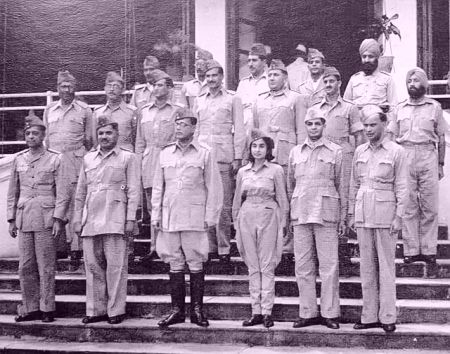
They attended a rally in Petrograd. Evelyn was reporting her views and experiences to her mother through letters and personal messages. She was all praise for the social conditions in the Soviet Union.

Thereafter, Evelyn accompanied Roy on his mission in Tashkent during 1920-21; and managed his affairs in setting up a Military School in Tashkent.

Evelyn was one among the seven signatories to the document establishing the Communist Party of India (CPI)  at Tashkent on 17 October 1920. Thus , Evelyn Trent was one of  the founder members of the Communist Party of Mexico as also among the founder member of the Communist Party of India at Tashkent.

While she was in Moscow, Evelyn Trent taught in the Communist University of the Toilers of the East and in International Political School.  She collaborated with M.N. Roy in the organizational and intellectual development of the international communist   movement in the Soviet Union, Mexico, Europe and in India.

Evelyn wrote series of articles on their newly started journal The Vanguard of Indian Independence   (later re-named as Masses of India) attacking the Gandhian approach to the British, predicting that Gandhi would eventually compromise with the British.

She published her writings under her assumed name Shanti-Devi. Her mature writings written with understanding and clear analysis influenced the course of events in Communism, in Indian national movements and on the Indian National Congress. Her articles on Gandhian politics and economics were regarded by many as ‘the best-argued critiques ever published in Communist literature’.

In 1923, she wrote for the Labour Monthly attacking the Indian Congress session at Gaya held in 1922. In the same year (1923) her article ‘Mahatma Gandhi: Revolutionary or Counter-revolutionary?’  was published in the Labour Monthly of September . Some of her articles were later reproduced in a book titled ‘One Year of Non-Cooperation from Ahmadabad to Gaya’.

Please Check Evelyn Trent-Roy Archive for writings of Evelyn Trent.

And, for writings of M N Roy, please click here.

After the not-so-happy Fifth Congress, Roy returned to France by August 1924 after about six months of stay in Switzerland. Evelyn stationed in France was editing and managing  the Journal The Vanguard. She was also guiding Comite’ Pro-Hindou a group headed by Henri Barbusse which did propaganda work in favour of Indian Independence.

And, in the following January (on 30 January 1925) Roy and Evelyn were arrested in Paris, due to the British pressure brought to bear upon the French Government. Evelyn was released and allowed to stay in France. Roy, however, was deported to Luxembourg.

In July 1925 the Roys attended a meeting of Indian and French Communist to plan for the Congress of the Oppressed Nationalities. Here, they had strong disagreements about the British Communist Party over its interference in the affairs of the Indian Party.

It was around this time in 1925 or early 1926 that Roy and Evelyn decided to end their relationship. They were separated for ever. The exact dates and reasons for separation are not clear.

 **

Evelyn’s latter dated 13 March 1927 addressed to their mutual friend Henk Sneevliet (Jack Horner) makes a most poignant reading. The separation was very painful to her; she was totally distraught. She desperately tried to contact Roy and longed to be with him again. But, here letters and pleadings did not evoke any response from Roy. She wrote:

I blame my husband for nothing. He could not help what happened, any more than I could. I only wish he might have been more frank and open so that together we could have discussed everything and decided on a course to follow, instead of sending me off in ignorance of his real feelings and desires.

*

Had he wanted me to come back, I would have come, if only to be true to him and the work. It was very hard for me to believe or to realize that he did not want me or need me. That he wanted me to stay away. I only fully knew these seven months after I left him, and it was then that I went to get my divorce.

*

I received a divorce six months ago, as it appeared to me absolutely necessary to do so, before I could take up my life again in any direction. I hesitated a long time before taking this step – waited over six months and wrote many letters to R. offering to return and resume our former relationship.

It was only after receiving his categorical reply to remain in this country or go to China, but not to return there, that I decided upon what course to follow.

 Life appeared to me very difficult – almost impossible to resume in the old channels I had left nine years before.

She longed to go back to her parents and to her earlier environment. But again she was lonely and not accepted

My mother & father were glad to see me, but did not welcome my ideas, and part of my family refused to have anything at all to do with me. Most of my old friends from school and college also turned away from me. I found myself almost alone, except for a very few who remained loyal to the past, without in any way understanding or sympathizing with my viewpoint.

*

These are my people. I understand them, and it is in this environment I can grow and develop normally, as a human being. Above all, I was so weary of being hunted from place to place, from country to country, of having to hide and always to be surrounded by a terrible fog of suspicion and fear, and to have others suspect and fear me. All this had become intolerable.

*

I found myself alone. I had not the heart, even if I had possessed the strength, energy and enthusiasm, to begin all over again in the movement here.

*

All my work had been for India. Many stories were circulated about me – from external and internal sources. Had I attempted to be active I would have been deported at once. There was no possible way to prevent it for I had no rights here at all.

At first I thought it would be impossible for me to abandon my former life and work and just to live like this – it is still difficult – but it has been forced on me by a good many circumstances. I could not remain in the Indian work, that was sure even before my divorce. My position had become very difficult.

If I had ever been in India, or could ever go there, it might have been different, but always it had been pure theoretical abstraction to me. The only living link was my husband. When this link was broken, only the abstraction remained, and I was so tired of abstract theories. I had to come face to face with realities and to learn something about every day, practical living.

The result is, I have held aloof from everything, seen no one and done nothing but attempt to regain my mental and physical strength and to solve the first problem of all – to earn my living somehow or other.

*

The life after return from Europe had become very difficult for her, especially during the first 18 months after her return

I was in a state of complete mental and physical collapse. The very thought of politics sickened me. I could not concentrate my mind long enough to read a newspaper or book. I was restless, unhappy and frightfully disorientated. I belonged neither to my old life or the new one I had left it for. Then there was the personal heartache.

Besides all this, I had to meet the slanderous gossip and malicious tongues of various nationalist factions in this country, who very effectually poisoned the minds of all those liberal and semi-radical people I have turned to for help and friendship. They heard such frightful things against me that one and all turned away from me.

I was accused of being a spy, a renegade, a defalcator of funds, of having abandoned my husband and the movement after having bled them dry, etc. etc.

*

My activities abroad had been such as to render it very difficult for me to obtain work for which I was adapted by education and training. I had lost my citizenship and this fact closed a good many avenues of employment as well as made my position extremely uncertain.

**

Their separation was so complete that never thereafter did they meet or correspond. And, there is not a single word or reference to Evelyn in Roy’s Memoirs.

Evelyn was  keenly following Roy’s  Memoirs published as  serial in Radical Humanist Weekly from India during 1953-54  was curious to know what  Roy said of her. But, to her utter disappointment, there was not a word about her.

The separation was very painful to both. Roy’s party work in Europe suffered a great deal, because till then Evelyn had been managing and editing Vanguard/ Indian Masses; writing articles in Inprecor.  She was his secretary assistant and co-worker.

And, from 1925 onward the name of Evelyn did not appear in any of the “documents of literature relating to Indian Communism” . Her  vanishing act was  complete as far as Indian leftist circles were concerned.

**

After her break from Roy, the British Intelligence lost track of Evelyn by 1927.

Evelyn moved back to  her parent’s home in Auburn , California in 1927. She was a columnist on International affairs  for San Francisco Chronicle specially on the events in  India, Afghanistan, China , Japan    and the Asian region. Later she moved to New York where she worked as a freelance journalist; she wrote on subjects related to Aviation for Herald Tribune flying all over America and Europe gathering material on commercial aviation.

She kept in touch with the minority Left groups in USA led by Jay Love-stone. In 1931 Evelyn wrote an article to their journal Revolutionary Age , touching on MN Roy’s arrest in India , giving details of his early history and describing  how  he had returned to India after along exile, daring to brave British imperialism face to face. She called upon “American liberal intellectuals, radicals and workers’ to protest Roy’s arrest.

In 1935 Evelyn moved back to California and wrote for Sacramento papers. In 1936 she married a writer Dewitt Jones. After his death in 1949 , she returned to live in her family house in Auburn California. In 1956 she worked for the Placer County Welfare Department. She retired in 1962. And Evelyn Leonora Trent-Jones died in 1970.

Evelyn possessed great love and empathy for human beings and spent her life writing about social injustices and the need for greater humanity and awareness. Her contributions and examples will live on forever in the work she has left behind, some of which are lodged in the Hoover Institute at Stanford University. 

***

Many researchers tried to talk to Evelyn to ascertain the reason for her separation from Roy; but, were not entirely successful.

Shibnarayan Ray, Roy’s biographer met Evelyn in 1957-58. She said that parting with Roy was friendly but  ‘sad on her part.. Quite sad’. She retained her admiration for Roy and interest in his work and writings. She cherished her life as revolutionary in Mexico, Moscow and Berlin. But, she preferred her communist past to be not made known’

On the question of Roy silence on her in his Memoirs , she defended Roy stating that the climate prevailing at that time (1950 early)  in USA was highly prejudiced against anything Left. And   ‘any mention of her communist past could have led to witch-hunting and caused her much harassment and trouble ‘.

 *

Later, in 1970, several research scholars on political science interviewed Evelyn through   Robert  C. North, the political science professor in Stanford  University ;   but were not successful.  Evelyn preferred to remain anonymous and silent..

Dr Innaiah Narisetti, a Journalist from India, interviewed the son of Evelyn Trent`s sister, Diven Meredith in Los Angeles, during 1990s. He also corresponded with Evelyn’s nieces who sent Dr Innaiah some rare photos and some material about Evelyn. Dr Innaiah gathered some rare material about Evelyn Trent   from the Hoover Institute in Stanford University; the National Archives, Washington DC; and, The Institute of Social Sciences at Amsterdam. Please check his research work: Evelyn Tremt Alias Shanti Devi

***

Evelyn Trent Jones was an extraordinary woman who lived an amazing life. A successful journalist, she traveled worldwide on behalf of the early communist movement with her husband M.N. Roy. She played an important role in shaping the life and thought of M. N. Roy in the early stages. She also played a great role in the International politics and also in developing the Indian Communist movement.

Evelyn was not only politically and intellectually an important figure in the early history of Indian Communism; but was also one of its founding members. She had a special concern for India. Her mature writings written with understanding and clear analysis influenced the course of events in Communism, in Indian national movements and on the Indian National Congress.

It is rather sad, she is not remembered with love and gratitude in India and by the Communist Party; and , none celebrated her centenary in 1992.

EvelynTrentaliasShanthiDevi600


 Continued

In

The Next Part

Sources and References

  Evelyn Tremt Alias Shanti Devi by  Dr Innaiah Narisetti

Who is Evelyn Trent? by  Dr Innaiah Narisetti

The White Woman’s Other Burden: Western Women and South Asia During British Rule by Kumari Jayawardena

Age of Entanglement by Kris Manjapra

Many pages of the Wikipedia

Socialism of Jawaharlal Nehru by Rabindra Chandra Dutt

India & the United States: Politics of the Sixties by Kalyani Shankar

How Stalin’s daughter defected in India-

http://www.bbc.com/news/world-asia-india-15936172

The Lives of Agnes Smedley by Ruth Price

http://www.sacu.org/smedley.html

The Pictures are from Internet


8 Comments

Posted by on January 18, 2016 in M N Roy


Tags: , , , , , , , , ,