RSS

Tag Archives: Ukta

Who Was Dhirgatamas – Part Three

Continued From Part Two

Asya Vamasya sukta forms section 164 in Book 1 of Rig Veda, and, it consists 52 hymns. It is dedicated to several deities; and is composed in different meters.

The author’s name is Dhirgatamas-Auchatya (दीर्घतमस् उचथ्य) *; so, says the text at the beginning of this section as codified by Sri Sayanacharya, who lived in the 15th century as a minister in the Vijayanagar kingdom. His compilation and interpretation are the definitive and authoritative text-sources for most of the later translations. Even the recent translation and commentary by Swami Amritananda is based upon Sri Sayana’s Bashya.  *[At times, he is also called Dhirgatamas-Mamateya-ढीर्गतमस् ममतेय ]

Dr. Kunhan Raja’s translation is based upon these two commentaries.
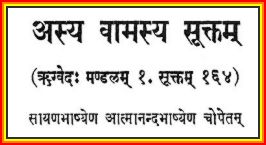
The Text is assigned its title using its commencing words

अस्यवामस्यपलितस्यहोतुस्तस्यभ्रातामध्यमोअस्त्यश्नःतृतीयोभ्राता घृतपृष्ठो अस्यात्रापश्यं विश्पतिं सप्तपुत्रम्  

asya vamasya palitasya hotus tasya bhrata madhyamo asty asnah trtiyo bhrata ghrtaprsAo asyatrapasyam vispatim saptaputram

Asya Yamasya Hymn: Dr C Kunhan Raja: Free Download, Borrow, and Streaming: Internet Archive

Dr. Kunhan Raja explains:

On the whole, Dhirgatamas and his real inspired vision had a very great role in shaping Indian philosophy. His commendable knowledge in spirituality, and his extreme talent in poetry; and his inspired gift of vision stand unparalleled even to this day. No doubt that is why he is confident that none other than a wise poet can even hope to interpret his poems. To date, none has been able to fully decode his poems; at least the Asya vaamasya poem (RV 1.164).

Even his Ashvamedha poem is one of a kind; – perhaps a pun (स्लेशSlesha), a satire of a ritual. His poems on Ribhus (ऋभु,) are another masterpiece. Even his metaphor poem on the horse-sun is much exquisite and unparalleled in its beauty.
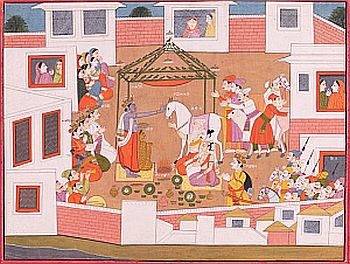
[ Ribhu (ऋभु) in Sanskrit, broadly means Skilful, clever, prudent (as an epithet of Indra, Agni, Aditya) ऋभुमृभुक्षणो रयिम् (bhum bhukao rayim) Rigveda 4.37. In early stages of the Vedic literature, it referred to Sun- deity.]

Now; let us commence with the famous hymns presented in the text Asya Vamasya Sukta. Please also refer to its translation and commentary by Dr. Kunhan Raja.

Verse 1

The poet starts with the mention of “a beloved invoker grown grey, with his two brothers, who is the Lord, and father of seven children” (verse 1).

अस्य । वामस्य । पृषतस्य । होतुः । तस्य॑ । भ्राता । मध्यमः । अस्ति । अशनः | ततीयः । श्रातं । धृतऽपुष्ठः । अस्य॒ । अत्रं । अपर्यम्‌ । विदपतिम्‌ । स्तऽपुत्रम्‌ ॥

Of this beloved invoker, grown grey — of him there is the middle brother, the all-pervading; his third brother is the one who bears ghee on his back. In them I saw the Lord of the People with seven sons.

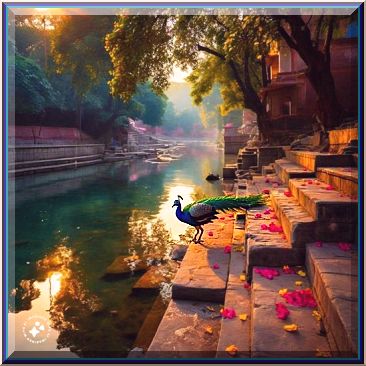
The poem concludes with a prayer to “the swift-moving divine bird, the majestic bird (Sun), producer of water, which gives life to the herbs; he who brings happiness with timely rains,” for protection, (verse 52).

दिव्यम्‌ । सुऽपर्णम्‌ । वाय॒सम्‌ । बृहन्तम्‌ । अपाम्‌ । ग्मम्‌ । ददतम्‌ । ओष॑धीनाम्‌ । अभीपतः । वृष्टिऽभिः । त॒पै्यन्तम्‌ । सरसन्तम्‌ । अवसे | जोहवीमि ॥ .१६४.५२

The divine bird, the great bird, the child of waters, of herbs, worthy to be seen, who brings satisfaction with rams in the rainy season, that Sarasvati I invoke again and again for protection.
Dr. Raja remarks:

The one supports the six regions; the one stands upright and supports three mothers and three fathers: those who have eyes can see this underlying truth.

I do not find in this philosophical hymn merely some anticipations of philosophy. These are not loose ends of broken threads.

One can trace a continuous stream of thoughts. I see a beginning and a conclusion in the poem, consistent with each other, and with a continuity in the current of thought. The poet has presented a full picture of things that are hidden from the understanding of the ordinary people.

**

The first Mantra pictures the symbolism of the three brothers, the three luminaries in the regions; the three forms of fire : Agni, Vayu (Air) and Aditya (Sun).

Yaskacharya explains that there is indeed only One Deity; and, that Deity manifests in the three worlds as Surya (Sun) in heaven (Dyu-Loka); Indra or Vayu (wind) in the middle region (Antariksha); and, fire on the earth (Bhu-Loka). They are the basic foundations of our existence.

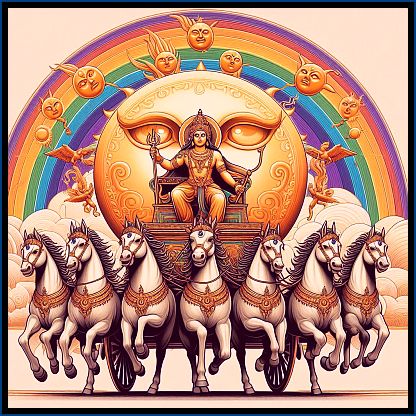
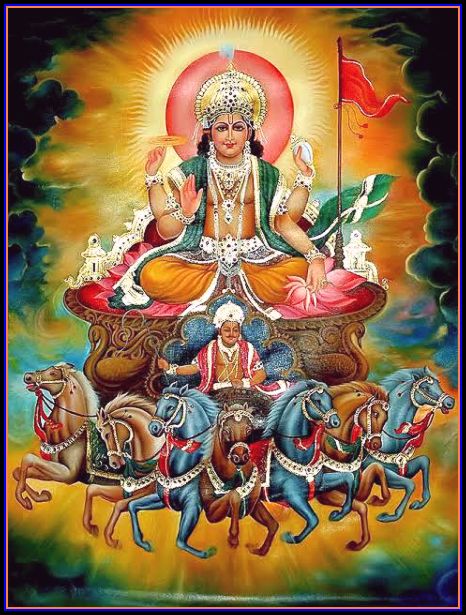
Of these three brothers; Aditya (Sun) shining in the sky, the protector (पलितस्य) of the Universe, who is worshipped by all (वामस्य), is the Supreme.  He is accompanied by seven sons (सप्तपुत्रम्), who are not different from himself (his seven rays of seven colours).

The three brothers or the three aspects of Agni (Agni-traya) form the Tripod of Life.  They exist and function together.; and, are the basic factors of our existence.
Verses 2 and 3

Immediately after referring  to the “beloved invoker grown grey” in verse 1, the imagery of a chariot has been presented; perhaps suggesting movement or the progression of the world emerging out of the first cause.

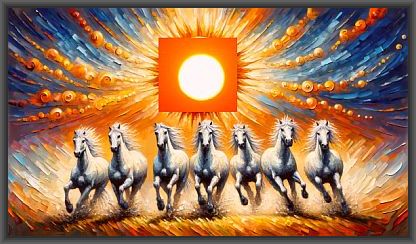
It brings in many terms having symbolic connotations: Chariot (Ratha); Chariot with single wheel (Eka-chakra) and having three naves (Tri-Nabhi); the seven who yoke it; and, a Horse with seven names.

These metaphoric imageries have been discussed by many scholars and interpreted in various ways; each according to the ideologies of the School of thought to which he is affiliated.

**

सप्त । युञ्जन्ति । रथम् । एकचक्रम् । एकः । अश्वः । वहति । सप्तनामा । त्रिनाभि । चक्रम् । अजरम् । अनर्वम् । यत्र । इमा । विश्वा । भुवना । अधि । तस्थुः॥ १.१६४.०२ II

sapta | yuñjanti | ratham | eka-cakram | eka | aśva | vahati | sapta-nāmā | tr i-nābhi | cakram | ajaram | anarvam | yatra | imā | viśvā | bhuvanā | adhi | tasthu  II 2 II

The seven yoke the one-wheeled chariot; one horse having seven names draws it. The wheel has three navels, never gets old, is never overcome, in which have been remaining all these beings

 इमम् । रथम् । अधि । ये । सप्त । तस्थुः । सप्तचक्रम् । सप्त । वहन्ति । अश्वाः। सप्त । स्वसारः । अभि । सम् । नवन्ते । यत्र । गवाम् । निहिता । सप्त । नाम ॥॥ १.१६४.०३ II

imam | ratham | adhi | ye | sapta | tasthu | sapta-cakram | sapta | vahanti | aśvā | sapta | svasāra | abhi | sam | navante | yatra | gavām | ni-hitā | sapta| nāma

Which seven have been remaining on this chariot with seven wheels, those seven horses draw it. The seven sisters utter forth songs together, where are concealed the seven names of the cows.

**

They yoke (युञ्जन्ति) seven horses to the one-wheeled chariot (रथमेकचक्रमेको); and, one horse having seven names (सप्तनामा) draws it along. The wheel has three naves, never gets old, is never overcome. And, in it all the beings and regions of the universe abide.

The chariot is said to represent the cosmos, wherein all the worlds reside; as also the human body, which is conceived as a moving chariot.

Again, it is also said; the chariot represents the universe and its creative process, symbolized by its movement. Its wheel is the symbol of its mobility (Gati). The one horse with seven names is the Time (Kaalo Ashvo vahathi sapta-rasmihi – AV.19.53.1). Its passage provides movement to the creative process.

The sun is compared to a chariot wheel; so is the sky. And, elsewhere the body is compared to a chariot, with the mind as the rein; the sense-organs as the horses; and, the Self as the charioteer.

The single-wheel of the chariot is said to symbolize the basic unity that is essential for propelling along the diverse creative processes of the universe.
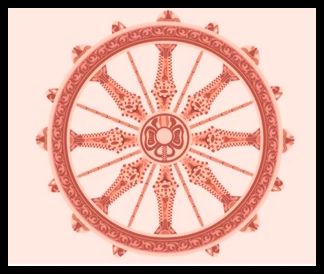
[Yaskacharya compares the wheel to the Year (Samvathsara), which rotates endlessly. It may have three distinct periods of Time; Past(भुत​)-Present(वर्तमान)-Future (भविस्यत्). Thus, the Time shines in a threefold manner-Trida Nabhati.]

Seven horses, having seven names, are yoked to the chariot. These seven horses are really the same, the difference being only in their names.

Seven sisters ride in it. These seven sisters could either be the seven solar rays , which move in unison like sisters; or the seven portions of a year: Ayana (solstice season), month, fortnight, day, night, hour; seven horses. It might even refer to seven types of speech.

Or, if the term Gavām (गवां) is used in the sense of water, it might mean the seven divine rivers (sapta-sinddhuva) of the Vedic region.
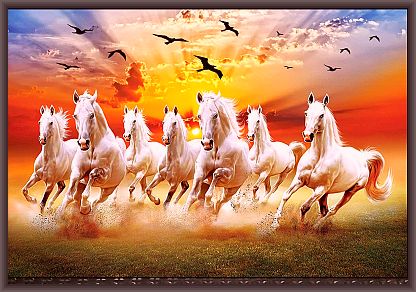
The seven horses could also be compared to the seven rays of the Sun. It may also mean Seven seasons in a year [as per Sri Sayana -six regular seasons and one extra month in the year (अधिक मासAdhika-masa)].

There is no beginning and there is no end; but there surely is a constant change or transformation that can be felt. Each season has distinctive patterns of weather changes; plant and animal activities; each period with its own special purpose.

The seven rays of the Sun are indeed its seven limbs. And, the seven seasons of the year are the imagined divisions of the invisible Time. The Sun and the seasons are in fact One.

The Sun regulates the time, in which all its movements are encased.
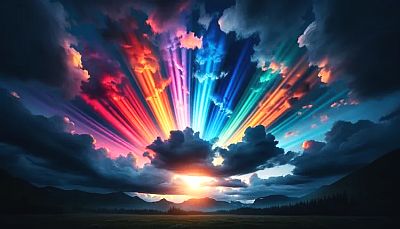
Dhirgatamas uses the extended metaphor of human life span in terms of wheel imagery. This illustration is repeated in the later texts.

The hymn is composed as a riddle (Brahmodya)* with the answer phrased in pun (Slesha-alankara). It describes the ageless cosmic wheel of order, Rta, revolving continuously across the firmament. It is also harmonized with time, involving three naves (three seasons- summer, rainy and winter- through which cycle –Samvatsara-Chakra– the years rotate) and twelve spokes (months).

[ * Brahmodya class of poetry is speculation clothed in riddles and allegories about the wonder of nature, human life, time, language and their interplay. Here, Brahman refers to the statement of truth concerning the symbolic (hidden) connection of things; and the homogeneous net-works established by Yajna.]

The speculative attribute of this wheel is that though it revolves ceaselessly since the times unknown, it is not destined to age, break up or decay (Ajara). Thus, it is faultless (Anarva), devoid of destruction and end.  Its aspect is that of subtle unmanifest principle, which is eternal (Sukshma-deham-ashtriyokam).

The world mounted on the cosmic wheel is also subject to rotations. But it is conditioned by aging and decay. Its relation to death and disease is expressed through its mortal aspect – mruthu-bandhu – bound to death- (Sthula-deham-ashritya).
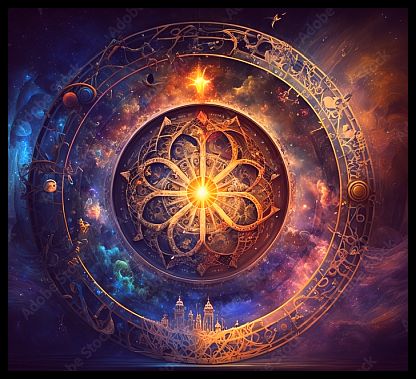
Prof. Wendy Doniger, in her book The Rig Veda An Anthology (Penguin Books) explains:

Working with the implicit and explicit patterns woven into the hymn, it might be possible to decode the hymn.

The sun is often identified with Agni, who is mentioned in the hymn at several points: he is explicitly identified with the One (46); he appears in three forms (1); and he has names that are like long hair (44).

Agni lurks behind other images: he is, like the sun, the first-born child of Order (11, 37, 47) or Truth (cf. 10.5.7) ; and is born of the waters (52).
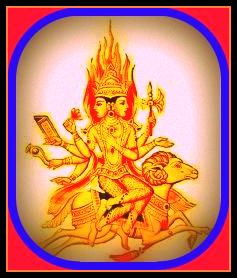
The interaction of the sun and the waters makes sense of a number of obscure references to a Vedic theory of the rain cycle: the rays of the sun (cows) drink up earthly waters with the lowest point of the ray (the foot) and then give back rain (milk) from their top (head) after they carry the moisture back up to the sun (7, 47, 51, 52). The sun is thus clothed in the waters (7, 31).

The relationship between the sun and the sacrifice (through the concept of the yearly solar renewal and yearly sacrifice) is present in the number symbolism linking the chariot (of the sun) with the sacrifice (as in the extended metaphor of 10.135, the opening verse of which is echoed in verse 22 of the present hymn).

The seven horses or sons or embryos are seven priests or offerings, the three or six or have naves or spokes are seasons (variously enumerated in different sacrificial reckonings), the twelve are the months, the 360 the days of the years (the 720 the days and nights in pairs), and so forth.
Verse 4

In the first three Riks (verses) the Sun and the Time-element are described as being responsible for the sustenance of all the worlds. The next verse goes back to the period before the creation. It poses a series of questions.

This verse is in the Brahmodaya format, posing questions; and, encouraging the student to introspect, to explore and to arrive at credible answers.

कः । ददर्श । प्रथमम् । जायमानम् । अस्थन्वन्तम् । यत् । अनस्था । बिभर्ति । भूम्याः । असुः । असृक् । आत्मा । क्व । स्वित् । कः । विद्वांसम् । उप । गात् । प्रष्टुम् । एतत् ॥ ॥ १.१६४.०४ II

ka | dadarśa | prathamam | jāyamānam | asthan-vantam | yat | anasthā | bibharti | bhūmyā | asu | ask | ātmā | kva | svit | ka | vidvāsam | upa | gāt | praṣṭum | etat II 4 II

Who has been seeing the first-born possessing bones, which what has no bones has been bearing? Where then is the life, the blood, the self of the Earth? Who went near the wise to ask this?Who has seen him at the time of his being born (को ददर्श प्रथमं)?

    • Who was there even before creation?
    • Who has seen the first formation of all that exists around us?
    • Where then is the life, the blood, the self of the Earth?
    • Who went near the wise to ask this?
    • Has any inquisitive person, desirous of knowing the origin of the world, approached a true -knower of the cause of all this existence?

*

The latter part of the verses concerns the three fundamental elements of living:  Blood (असृक् Ask); Life (असुः Asu); and Spirit (आत्माAtmā).

The verse also talks about that which is endowed with substance; that which having bones, having a form (body); and, about that which is bone-less, form-less (sprit) – asthanvantam yad anasthā bibharti.

The question is about the source of these subtle and gross bodies, which are related with the Earth Bhumi), a symbol of Motherhood, which supports us.

The breath and blood may be from the Earth. But, where does the soul come from?

Who seeks and answer to these questions?

Where is the teacher who knows; whom one may approach, ask him questions?

कः । विद्वांसम् । उप । गात् । प्रष्टुम् । एतत्

Verse 5

पाकः । पृच्छामि । मनसा । अविजानन् । देवानाम् । एना । निहिता । पदानि । वत्से । बष्कये । अधि । सप्त । तन्तून् । वि । तत्निरे । कवयः । ओतवै । ऊँ इति ॥ १.१६४.०५ II

pāka | pcchāmi | manasā | avi-jānan | devānām | enā | ni-hitā | padāni | vatse | bakaye | adhi | sapta | tantūn | vi | tatnire | kavaya | otavai | o iti

I the unripe, without knowing by my mind, ask about these positions of the gods that are concealed. Over this young calf the poets have spread the seven threads, aye to weave

**

Immature (पाकः) as I am, I ask (पृच्छामि) questions to one who knows the Truth (अत्र॑क॒वीन् पृ॒च्छा॒मि॒ वि॒द्मने॑) about things that are hidden even from the gods. what are the seven threads (सप्त तन्तू), which the sages have spread to envelop the sun, in whom all abide?”

  • Here, Surya is called a calf.
  • The sages spread seven threads woven upon the young calf.
  • Which is this calf?
  • What are the seven threads?

It is suggested that these threads might refer to seven forms of the soma sacrifice, or the seven metres  (chhandas) of the Vedas.

*

The Sun is said to be at the center of a well-arranged Cosmic System; and the whole world is a garment that envelops the center. This is conceived a as a cloth woven with Seven-threads.

The purpose of the poet is to bring together,  in a compact set of verses, a number of Vedic Doctrines concerning the Universe, Cosmology and the Time-principle.

The Universe and the individual are interrelated.
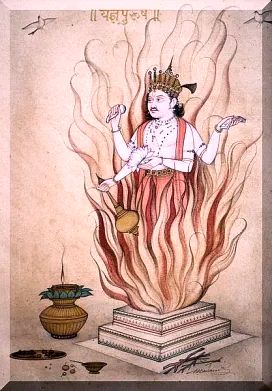
It is also said: As per the ancient practice, a cloth of seven threads is woven year after year. And, each year a new Calf is brought altar for worship. This practice may have roots in the mythical tales, where the sun is rejuvenated each year.

Why is Surya called a calf? Dr. Agrawala explains:   Surya is the son of Viraj, the universal Mother Cow; and , when the Cow comes to mortals , she always brings the Calf with her (RV.1.164.17).

But Sri Sayana says:  the cow may typify the solar rays collectively and the calf the worshipper.

*

Dhirgatamas cries out:  I earnestly desire to know the Truth (पृच्छामि विद्मने.) I seek a teacher who can unveil the Truth.
Verse 6

अचिकित्वान् । चिकितुषः । चित् । अत्र । कवीन् । पृच्छामि । विद्मने । न । विद्वान् । वि । यः । तस्तम्भ । षट् । इमा । रजांसि । अजस्य । रूपे । किम् । अपि । स्वित् । एकम् ॥ १.१६४.०६॥

acikitvān | cikitua | cit | atra | kavīn | pcchāmi | vidmane | na | vidvān | vi | ya | tastambha | a | imā | rajāsi | ajasya | rūpe | kim | api | svit | ekam II 6 II

Not having seen, I ask the poets who have seen, for the sake of knowing, not having known. Who has held apart firm these six regions, what then is that One, in the form of the unborn?

*

This is in continuation of the questions raised in verse 5, where the poet speaks about the beginnings of the formation of the six regions of the physical world from the unborn ultimate reality. He employed the imagery of seven threads that hold the young calf.

They all refer to the emergence and formation of the physical world from out of the unmanifest ultimate reality.
Not having seen, not having known; and, for the sake of knowing, I ask the sages (Kavis) who know the Truth and who have seen:  Who is this mysterious unborn one; the One that   has established and held firm these six regions.  What then is it?

[Sri Sayanacharya explains: The tradition counts seven regions (Lokas); the seventh being the Sathya-Loka, which is beyond the uninitiated, tied to the mundane world of rituals. The other six Lokas (shad-rajamsi) which are said to be created by the movement of the Rajo-Guna are: Bhu (Earth); Bhuvaha (Mide-region); Followed by Four types of Heavens: Suvaha (Heaven); Mahaha; Janaha; and Tapaha.]
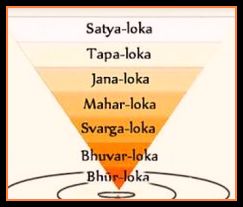
As regards the phrase अ॒जस्य॑ । रू॒पे । किम् । अपि॑ । स्वि॒त् । एक॑म्, Sri Sayana says term Ajasya (Aja- the unborn) refer to Aditya, the eternal one, who has created seasons according to the period of the year

*

This and the previous Mantras wonder about the formation of the existence from out of the unborn, non-existent, ultimate reality.
Verse 7

इह । ब्रवीतु । यः । ईम् । अङ्ग । वेद । अस्य । वामस्य । निहितम् । पदम् । वेरिति वेः । शीर्ष्णः । क्षीरम् । दुह्रते । गावः । अस्य । वव्रिम् । वसानाः । उदकम् । पदा । अपुः॥१.१६४.०७॥

iha | bravītu | ya | īm | aga | veda | asya | vāmasya | ni-hitam | padam | veri tive | śīrṣṇa | kīram | duhrate | gāva | asya | vavrim | vasānā | udakam | padā | apu II 7 II

Let him declare here who surely knows this—the con[1]cealed position- of this lovable bird. From his head the cows draw milk; they have been drinking the water with their foot, wearing the vesture

**

Let him, who surely knows the Truth, declare here (इह ब्रवीतु)— the concealed position of this lovable bird (वेदा॒स्यवामस्य). From his head the cows draw milk; they have been drinking the water with their foot, wearing the vesture.

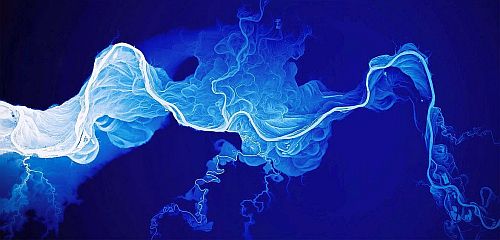
The Sun, Aditya, who is constantly moving has an attractive luminous form.   His rays emanating from his shining abode, concealed (निहितं) in the high skies (शी॒र्ष्णः), pour rains on to the earth. And, the same rays (गावः॑) absorb back those waters (उदकं) through the very path (पदा) they poured the rains.
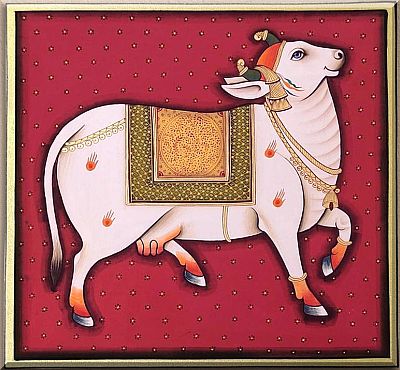
[ Dhirgatamas employs here the imagery of cow (गावो) and milk (क्षीरं) to suggest sun-rays and rains that sustain life on this planet.  The rays of the Sun (cows) absorb fluids from all sources, including vegetation; and, convert them into life-giving milky substance (rains) that generates and protects life.

Similarly, the ordinary cow too drinks water; and converts it into the precious life-nurturing milk.

The Earth too is also a sort of Mother Cow. It absorbs rains and gives life to vegetation, which sustains our lives.

Similar is the sun-rays, they shine, give light and heat; take away moisture from the Earth; and then send back life through rains.

This analogy is extended to the relation between the senses and human body. The physical body consumes food, which nourishes the mind (brain); which again controls the body mechanism

Thus, the metaphors of cow-water-milk seems to hold good in a number of cases.]

**

The Universal-Cow-principle (Gauh-tattva) was seen as a symbol of the Thousand-syllabled speech

Vag va idam Nidanena yat sahasri gauh; tasya-etat sahasram vachah prajatam –4.5.8.4.

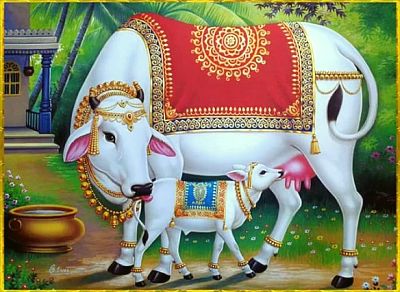
Vac (speech) is depicted as a milch-cow that provides nourishment; and one which is accompanied by her calf. She constantly cuddles her calf with great love, and lows with affection for her infant

In the traditional texts, Vac, which expresses the wonders and mysteries of the Universe, was compared to the wish-fulfilling divine cow

dhenur vagasman, upasustutaitu –RV. 8.100.11.

Thus, Gauh-Vac is symbolically portrayed as cow.  It is hailed in the Rig-Veda (8.101.15) as the mother principle, the source of nourishment (pusti) of all existence; and bestowing immortality (amrutatva).
[ Commenting upon verses 4-7, Dr. Kunhan Raja explains:

These four verses form a unit. Who has seen this mystery of the first formation of the universe? Who can go and ask about this? And where is the location of that mystery? This is the general idea in verse 4, after describing the chariot and the wheel and the various things concealed in the chariot or its wheel (in verses 2 and 3). The same question is repeated in the next verse.

The poet changes over to the first person. He asks about the concealed position of the gods. The poets have woven some mystery (verse 5). Poets know who gave form to the universe (verse 6). The milk drawn from the head, and the drinking of water with the foot are also puzzles in verse 7.

 Here there is a mention of the concealed position of “this lovable” bird. The same words, used as in verse 1, show that there is some relation between that of which there are the brothers (verse 1) and the bird whose position is concealed (verse 7).

The close relation of ideas must also be noted as: where all these beings stood (verse 2), the incorporeal bears the corporeal (verse 4), and who has held firm the six regions in the form of the unborn (verse 6).

 Then there are the parallels like: one horse with seven names draws the chariot (verse 2), where the seven names of the cows are concealed (verse 3), and these concealed names of the gods (verse 6).

There is also the antithesis of the poet who is the author and who does not know and the poets who know, mentioned in verse 5 and verse 6. Certainly, the poet had been thinking of some mystery of the universe, its origin and the distinction between the formed and the formless. The cows draw milk from its head (verse 7), the secret names of the cows (verse 3); in the young calf (verse 5). Here also there are indications of some common idea about cows.]

Verse 8

माता । पितरम् । ऋते । आ । बभाज । धीती । अग्रे । मनसा । सम् । हि । जग्मे । सा । बीभत्सुः । गर्भरसा । निविद्धा । नमस्वन्तः । इत् । उपवाकम् । ईयुः॥ .१६४.०८

mātā | pitaram | te | ā | babhāja | dhītī | agre | manasā | sam | hi | jagme | sā |bībhatsu | garbha-rasā | ni-viddhā | namasvanta |it| upa-vākam | īyu II 8 II

The mother has been giving the father the share in the Rta indeed, she has been coming together with thought and with mind, in the beginning. She is timid, having the juice within, being hit into. There they came bearing adorations, to address nearby.

*

The mother, (माता -earth), worships (बभाज) the father, (पितरम् -Sun), with holy rites (Yajnas), for the sake of water; but he, in his mind, has anticipated (her wants); whereupon desirous of progeny, she is penetrated by the dews of impregnation (गर्भरसा), and, (all) expectant of abundance, exchange words (of congratulation).”

The earth is usually the mother; and the heaven is the father. The term Dhiti (धीती) is Dhyana– intense contemplation. Manas (मनसा) is thought. The mother went close to the father. She was shy (बीभत्सुः) and full of joy.

The earth is drenched (उपवाकम्) by the rain-waters, enabling it to produce crops and also to generate and sustain life.

[Sri Sayana opines that in this verse, a conjugal relation between the Earth and the Sun is imagined. Mother Earth desires water for production; approaches the Sun, who satisfies her with heat, light and rains. These elements unite the Earth  (उपवाक)with the Sun.]
Verse 9

युक्ता । माता । आसीत् । धुरि । दक्षिणायाः । अतिष्ठत् । गर्भः । वृजनीषु । अन्तरिति । अमीमेत् । वत्सः । अनु । गाम् । अपश्यत् । विश्वरूप्यम् । त्रिषु । योजनेषु .१६४.०९

yuktā | mātā | āsīt | dhuri | dakiāyā | atiṣṭhat | garbha | vjanīu | antariti |amīmet | vatsa | anu | gām | apaśyat | viśva-rūpyam | triu | yojaneu II 9 II

The mother was tied on to the yoke of the right side; the womb has been remaining within the water-cloud. The calf lowed, looked towards the cow having all forms, in the three expanses of space.
The Dyu-Loka, the mother of all creations, (sky), was engaged in her duty of sustaining and protecting the earth, which fulfils all her desires (युक्तामाताआसीत्). The embryo (water) rested within the womb of the clouds. And, as soon as it was delivered, the calf (water) bellowed (made sounds while raining), and beheld the cow (earth) with its forms (अनुअपश्यत्), in its three combinations (त्रिषु योजनेषु) of the clouds, the   wind and the Sun-rays.
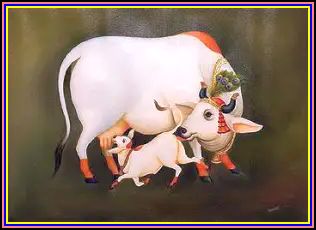
Dr. Raja writes: The idea of a union of the mother (माता) and the formation of a Garbha (गर्भः – womb or pregnancy), is clear in the first half. In the second half, there is mention of the calf (वत्सः) that bellowed (अमीमेत्) and looked (अपश्यत्) at the Great Mother Cow (दक्षिणाया), which had countless manifestations (विश्वरूप्यम्). There upon the clouds thundered.

It may perhaps mean: the rains (calf) met the Mother- Earth in its various forms, textures and colors; producing countless varieties of crops and vegetations, with the help of the clouds, the wind, and the rays of the sun.

[Sri Sayana comments: The calf bellowed; the cloud thundered; the all-protecting cow: viśvarūpyam gām triu yojaneu = the earth diversified by various crops in consequence of the co-operation of the cloud, the wind, and the rays of the sun.

in the early texts, the cow is compared to Earth as an exemplary symbol of Motherhood. She is the life-giving, nourishing Mother par excellence, who cares for all beings and nature with selfless love and boundless patience.
Further, the nourishing and life-supporting rivers too are compared to cows (e.g. RV. 7.95.2; 8.21.18). For instance; the Vipasa and the Sutudri the two gentle flowing rivers are said to be  like two loving mothers , who slowly lick their young-lings with care and love (RV . 3,033.01

– gāveva śubhre mātarā rihāe vipā chutudrī payasā javete ]

*

[ The symbolisms associated with Father and Mother; Cow and the calf; keep changing.

The terms are context-sensitive. And, it is not easy to decode. To say the least; it is often confusing too.

 For instance, in the previous verse: Father (पितरम्) stood for the sky; while the Earth meant the mother (माता). And, in the verse 9, the Sky (Dyu-Loka) is referred to as the mother of all creations.

Here, the clouds are the mother; and, water is its calf. It says, the calf, which was in the womb (गर्भः), as soon as it was delivered, bellowed; looked at (अपश्यत्) and met the Great Mother Cow (Earth), in her varied forms. All were happy.]
Verse 10

तिस्रः । मातॄः । त्रीन् । पितॄन् । बिभ्रत् । एकः । ऊर्ध्वः । तस्थौ । न । ईम् । अव । ग्लपयन्ति । मन्त्रयन्ते । दिवः । अमुष्य । पृष्ठे । विश्वविदम् । वाचम् । अविश्वमिन्वाम् .१६४.१०

tisra | mātṝḥ | trīn | pitn | bibhrat | eka | ūrdhva | tasthau | na | īm | ava | glapayanti | mantrayante | diva | amuya | pṛṣṭhe | viśva-vidam | vācam | aviśva-minvām II 10 II

Bearing the three mothers, the three fathers. One has been standing upright; they do not fatigue him down. Behind of that heaven they utter in a low voice the word that com[1]prehends all, that does not move all –aviśva-minvām

**

The three verses (8 to 10) form a group. They speak about the father and the mother; and of the womb and the calf. It is explained that the Three mothers( तिस्रः मातॄः ) and three fathers  (त्रीन् पितॄन् ) refer to the three worlds, Earth, Sky, Heaven; and to the three deities presiding over them (ऊर्ध्वः तस्थौ ) :  Agni, Vayu, Surya, who are the protectors of the three worlds.

The gods (दिवः) chant (ग्लपयन्ति मन्त्रयन्ते) the glories of Aditya (Sun), Aja, the one who stands above all (ऊर्ध्वः-तस्थौ), in a language that can be understood by all (viśvavidam vācam aviśvaminvām); and also, in a language that many may not even know (a-sarvavyāpinīm).

*

It is explained: Aditya, on the summit of the sky, alludes here to the Time-element, which is eternal and indivisible. Everything is born and dies in Time.

Aditya, the Time, is perpetual and inseparable. It is absolute. The year (Samvathsara) is a unit of Time. The events such as: birth, growth and death are measured in the sub-elements of the year, such as: the months, weeks, days, Mahurtha, Kshna (seconds) , and Lava ( sub-units of a second).

Perhaps the main idea is continued in the following verses also.
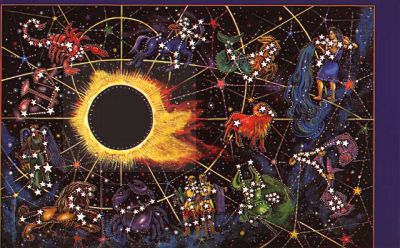
The first ten verses are said to deal with zodiac- astrophysical – questions and the related speculations.

Many scholars have surmised that, in a way, these verses have cosmological implications. And the numbers – 3,5,7 and 12- mentioned there in; as also the references to horses, chariots, wheels and yokes are symbolic references to planetary positions and movements. 

They also serve as code-symbols of metaphysical principles at several levels of this universe.

The meaning or the intent underlying these are elastic, amenable to be interpreted in any number of ways.
The celebrated scholar David Frawley, in his article on the Vedic origins of the zodiac hymns of Dhirgatamas explains: (the following are a few extracts)

The hymns of Dhirgatamas speak clearly of a zodiac of 360 degrees, divided in various ways, including by three, six and twelve, as well as related numbers of five and seven.

In regard to the planetary rulership of the twelve signs, Dhirgatamas shows the mathematical basis of such harmonic divisions of a zodiac of 360 degrees.

If we examine the verse, we see that a heavenly circle of 360 degrees and 12 signs is known, along with 7 planets. It also has a threefold division of the signs which can be identified with that of fire, wind and Sun (Aries, Sagittarius and Leo)  ; and a sixfold division that can be identified with planets each ruling two signs of the Zodiac. This provides the basis for the Zodiac and the signs we have known historically. We have all the main factors for the traditional signs of the Zodiac, except for the names and symbols of each individual sign.
The number 3 (in verse 1) is said to refer to the Triad of three brothers – Agni on Earth; the wind (Vayu) in the mid region; and Sun (Surya), the symbol of Supreme Light, in the heavens. 

The heavenly space has 7 astronomical bodies: the sun, moon and five planets.

The twelve signs of Zodiac are also divided in a similar manner. Aries or Mars ruled by the principle of Fire; then Sun or Leo; and Sagittarius the atmospheric wind ruled by Jupiter the god of rains.

The Vedic horse (Ashva) is the symbol of energy or propulsive force.

*

There is a mention to The Father with five feet and twelve forms. He dwells in the higher half of heaven full of waters.

It is surmised that it refers to Sun (father) and the five planets or the five elements. And, his twelve forms are the twelve Zodiac signs.

The Sun in the higher half of heaven is with the other five planets – being his five feet, each ruling two signs.

In Vedic thought, the Sun is the abode of the waters, which we can see in the zodiac by the proximity of the signs Cancer and Leo.

*

There is another reference to number 5. The poem says: Revolving on the five-spoked wheel all beings stand. Though it carries a heavy load, its axle does not over heat or break.

 The five-spoked wheel is again the zodiac ruled by five planets and five elements and their various internal and external correspondences.

*

There are many places where the number seven occurs, alone and in combination.

The poem say that the seven yokes of the chariot have a single wheel (Eka-chakra). One horse that has seven names caries it. The wheel has three naves. It is un-decaying and never overcome, where all these beings are placed.

The Zodiac is the single wheeled chariot or circle yoked by seven planets which are all forms of sun or sunlight. It is the wheel of time on.

*

The sevenfold wheel is the zodiac moved by the seven planets. The six spokes are the six double signs through which the planets travel.

According to Dhirgatamas, the sun has ‘seven heroes’ for sons, and he rides ‘seven yoked chariot, one wheeled’,
The verse 14 says: The un-decaying wheel (circle) together with its felly (circumference), ten yoked to the upward extension carry it. The eye of the Sun moves encompassing the region. In it are placed all beings.

This may again refer to the ten signs ruled by the five planets, with each planet ruling two signs. The eye of the Sun may be the sign Leo through which the solar influence pervades the zodiac or just the Sun itself. The upward extension may be the polar region.

*

Verse 48 mentions a wheel having three naves. They are held together by 360 spokes, moving and non-moving

This perhaps refers to the zodiac of twelve signs and three hundred and sixty degrees.

 The circle of the zodiac has twelve signs. It has 720 half degrees or twins, making 360 total.

The 360 spokes are the 360 degrees which revolve in the sky but remain in the same place in the zodiac. This may mean the 360 subdivisions within the 720:360 octave matrix.

The wheel is the year; the twelve spokes are the twelve months; the seven hundred and twenty children of Agni are 360 days and 360 nights of solar year.

The twelve spokes are twelve tones of an octave tonal-zodiac. The three naves may the three prime numbers ,2,3, and 5, each rotating in the sense of its own speed, correlated with the terminating number which includes all three along its factors.
In the subsequent instalments of this series,

let us briefly go through the remaining Verses of

Asya-Vamiya-Sukta 

CONTINUED

IN THE

NEXT PART

References


Leave a comment

Posted by on July 6, 2024 in Dhirgatamas, Rigveda


Tags: , , , , , , , , , , , , , , , , , , , , , , , , , , , , , , , , , ,

Who Was Dhirgatamas – Part Two

Continued From PART ONE

Rishi Dhirgatamas (दीर्घतमस्) was an ancient sage, well known for his philosophical verses Suktas (hymns) 140 to 164 in the First Mandala (section) of the Rigveda.

He was said to be the son of Ucathya (उचथ्य) and Mamata (ममता)Dhirgatamas Aucathya Mamateya. He is often called by the name of his mother as – Mamateya (दीर्घतमाः मामतेयः)

Dhirgatamas was one of the Angirasa Rishis, the oldest of the Rishi families; and, was said to be the brother of Rishi Bharadwaja, who is the seer of the Sixth Mandala of the Rig Veda.

The Angirasa Rishis – Brihaspati, Dhirgatamas and Bharadwaja- were said to be the central figures during the period of the Pururava Kings Dushyanta and Bharatha,

It is believed that Dhirgatamas was the purohit or the Chief-priest of King Bharata, one among the earliest kings of the land.

The Athreya Brahmana says that Dhirgatamas consecrated Bharata, the son of the famous Paurava king Dusyanta, with the Maha-abhiseka. After this great anointing, King Bharata went round the earth, conquering on every direction; and, thereafter performed Ashva-Medha-Yagna.

Etena ha vā aindrea mahābhiekea Dīrghatamā-Māmateyo Bharata-Dauḥṣantim abhiieca.   tasmād u Bharato-Dauḥṣanti samanta sarvata pr̥thivī   jayan parīyāyāśvair u ca medhyair īje – (Aitareya Brahmana VIII.23),

Dhirgatamas was also the foremost predecessor of the Gautama family of Rishis that included such scholarly Rishis as Kak-Shivan, Gautam Maharishi, and Vamadeva (seer of the Fourth Mandala of the Rigveda) – who along with Dhirgatamas account for almost 150 of the 1000 hymns of the Rigveda.

Rishi Kak-Shivan is said to be one of the sons of Dhirgatamas. And, this Kak-Shivan is the author of many poems found in the First Mandala (116 to 126). Dhirgatamas and his son Kak-Shivan were  among the reputed  poets who lived during the times of Dushyanta and Bharata

The language of Dhirgatamas

Dhirgatamas, the great poet of the Vedic period, is celebrated as one of the most impressive personalities among the Rishis of the Rigveda.

The poet theorizes the origin of the world; it’s tacit secrets; and , of the nature of language, through in his poetic vision.

Karl Friedrich Geldner, the distinguished German Scholar, in the notes to his translation of the Rigveda, lauds the hymn of Dhirgatamas as containing the wonders of Nature and of Man’s life; speculations about time and about human existence; especially his poetic language. They are all clothed in varied allegories and riddles; and their solution is rather difficult.

Geldner regards the hymn as belonging to the class of Brahmodaya Suktas, depicting the Mystic poet’s inspired response to the wonders of Nature and of  Human Life; speculations about Cosmos beyond. In the process, he has brought together a number of Vedic Doctrines about the Universe, its creation and its progression.

The enigmatic language, symbolisms, mystic-representations etc. that he has employed are all relevant in the context of his effort to project a consistent thought-provoking  illustration  of the world around us.

It brings together three great themes, which are Agni [Fire], the Sun, and the Sacrifice (Yajna), all closely related.  The treatment of them is augmented by statements about Vac [Speech] as the Absolute.

Though the poem might look like a series of riddles, one can see in it a certain coherence, bringing forth the doctrine of unity in all this existence.

Truly there is only One. They may call Him by any names.  They call him, as Indra, Mitra, Varuṇa, Agni; and he is the celestial, winged-bird (Sun). The learned priests call the One and the only one by many names

इन्द्रम् मित्रम् वरुणम् अग्निम् आहुः अथो इति दिव्यः सः सुपर्णः गरुत्मान् एकम् सत् विप्राः बहुधा वदन्ति अग्निम् यमम् मातरिश्वानम् आहुः Rig Veda 1.164.46

*

The language of the poem may not be exact; its tenets might be vague. And yet, one has to accept that the Rishi enlightens ; sheds light on the dark depths of human thought. There is much to be learnt from the philosopher ’s speculations of the Truth.

*

While commenting on the first verse of Asya-Vamasya-Sukta, Sri Sayaņacharya recognized and appreciated the spiritual (Adhyatmika) content of some of its Mantras. He said: It is all in praise of wisdom, liberation and God – Jnāna-mokşa-āksāra-prašamsāज्नानमोक्षा अक्षर​प्र्शंसा

एवमुत्तरत्रापि अध्यात्मपरतया योजयित शक्यम्‌। तथापि स्वरसस्वामा वात्‌ मरन्थविस्तरभयाच न ख्यते । यत्र !द्रा सुपर्णा › इत्याद स्फुटम्‌ आध्यात्मिको र ह्यर्थः > प्रतीयते तत्र तत्र प्रतिपादयामः । अयं मन्त्रो यास्केन व्याख्यातः I

Evam-uttratrapi adhyatmaparatayā yojayitum śakyam. Tathāpi svar- astvā bhāvāt granthavistarabhayat ca na vikhyate. Yatra ‘dvāsuparna ityādau sphutam adhyatmikah ayam pratiyate tatra tatra pratipādaya- mah, Ayam mantro Yasken vyakhyātah

*

Unlike in the other Vedic texts, there are not many prayers addressed  to gods in Asya Vamasya Sukta. It is mainly concerned with raising of doubts, questions; suggesting answers; and glorification of knowledge and the Ultimate. Truth.

Dhirgatamas contributed much to the hypothesis concerning creation and sustenance of the universe. He put forth his concepts about a single absolute and self-subsistent principle, which is an infinite, inexhaustible source of power.

In his opinion, all finite things are products of the self-evolution of interrelated factors, enveloped within a single universal system; and, all of this existence, therefore, is a monogamous unit. 

But the major problem with his writing is his most elusive enigmatic, puzzling and at times inscrutable language, terms and symbols that he employed to enunciate his metaphysical concepts.

His verses can be interpreted in varied, diverse manners; each conflicting with the other.

Dr. Kunhan Raja observes:

Dhirgatamas just as the other Vedic poets – Yama , Manu , Brihaspati and others – is unique in his own manner; individual creative genius that contributes to the continuity of Indian though that keeps re-inventing all the while.

The Vedic thinkers seemed to believe that no single perspective is conclusive or over rides all other views. It is a liberal attitude which, essentially, was based on a principle that encouraged acceptance of multiple or plural views (Anekanta-vada), on a given issue as being manifold dimensions of one and the same object. Today , some might call it  ‘radical skepticism’.

When we read the poems of Dhirgatamas , we find ourselves in the presence of a great poet.

His Visual symbols are essentially the language of metaphysics; just as the words are of philosophy. But, shorn of their veneer, they are eloquent expressions, the meaning of which is familiar to all mankind.

When we enter the very mysterious region visualized in this poem, we find that the poet has presented a recognizable representation of things that are hidden from the understanding of the ordinary people.

With the symbolisms lost to us; and with the background obliterated, we are not able to see the significance of the whole picture

The meaning of many of the words used here, like the names of the meters etc., are unknown to us. We do not know what they exactly mean. And, there is the complex combination of songs set in meters of varied structures.

The contents of the poem turn out to be a riddle to us because we have lost the clue to the correct interpretation of the poem. We do not know many of the symbols and many of the conventions current in those days. Various notions and symbols current in those days are now lost to us, and so we do not have the necessary apparatus to work up the full and precise meaning of the lines in this poem.

The problem has been studied with the aid of grammar, language and vocabulary; the structure of the meter; and the general content of the hymns etc.

There are many terms and expressions, many modes of presentation  that we cannot understand. We do not know to what the various numbers like three and seven refer to; the simile of the cow with the calf ; the imagery of the father and mother ; and other figures are also obscure.

Thus, we find ourselves having to handle a puzzle; we are faced with a mystery.

It is not possible for me to give a clear analysis of the whole poem. I am myself able only to find some general directions and not at all the positions of the various details. To give a complete analysis of the poem and an attempt at a fuller discussion of the problem is not within the scope of such an Introduction. That has to be taken up as an independent study.

**

Yet, we need not lose all hope of deciphering something out of the poem. There are some pointers which might help us to interpret, unravel the mystery.

But, one thing is certain; this is not a haphazard jumble of many verses crammed into a single hymn. There is a unity and there is a continuity of thought also, within the whole poem. Not only this, the entire collection of the fifty-two  hymns composed by Dhirgatamas has a plan; and , it   must have been set in this order as per the traditions of his time.

The seemingly paradoxical language of Dhirgatamas is clustered with symbolisms (समाधि भाषा Samadhi-bhasha). And, it is not easy to follow. In his rendering, each created object, both natural and human, or an activity, or a thought, or a number, becomes a typical symbol pregnant with meaning. It is said; the language of Dhirgatamas, verily, is that of the Nature itself, in the form of the created objects, each of which conceals the Great Mystery at the core of its being.

Some have tried to explain why the Vedic thinkers selected the style of symbolism, which does seem rather ambiguous, today.

It is said; it was a deliberate ploy employed in order to explain the elements surrounding the creation of the Cosmos and of the primeval entities, of which it is constituted, viz. Mind, Life and Matter. It is said; words are mere symbols of the ideas; just as the manifest is the outer expression of the dormant unmanifest.

The language of the symbols is elastic; amenable to interpretation in varied manners. This is an advantage over the ordinary language.

The Rishis adopted the phenomena of physical Nature as figurative reflections of the   functioning of Man’s inner life. They might have otherwise found it difficult to give expression to subtle ideas in the commonplace language of everyday life.

Here, the Vedic thinkers seized upon the working of the Cosmos itself, as displayed in several categories and objects in Nature – Such as: The Ocean, Sky, Earth, Air, Water, Sun, Moon, Mountains, Rivers, Forests, Trees, Animals, Rains, Clouds. And, each one of these objects stand out as an eloquent epithet in the language of Nature.

For instance; the Chariot of the Sun, Ratha, is used to symbolize the physical Universe. And, his horses are the powers or the dynamic energies, which by their sheer drive propel and provide progression to the events in the Cosmos.

As said: the wise ones were in awe of nature. They marveled at the systematic and dependable rising and setting of the sun, cycles of season – particularly the rainy one – so essential for agriculture; appearance and disappearance of the moon; the starry sky and the milky way. They wondered how all of these came about.

Dhirgatamas was a thinker of the Vedic age; and, naturally his outbursts are cast in the thought-moulds of his time. He was a mystic and a poet.  And.as said earlier; he is famous for his paradoxical apothegms that are enigmatic.

 Prof. Wendy Doniger, a noted Sanskrit Scholar, in her book The Rig Veda An Anthology (Penguin Books) comments:

This long and complex hymn has inspired many elaborate, detailed glosses and still remains largely obscure. The language, however, is not particularly difficult; and certain major themes emerge with sufficient clarity to encourage the translator to present the hymn in a relatively raw state of exegesis, rather than burden the reader with a critical apparatus out of proportion to the poem itself.

One reason for the great scholarly attention paid to this hymn is that it is traditionally regarded as a riddle – a tradition of Vedic exegetes. And there are solid grounds for this tradition, for many questions are asked outright in the hymn; and others are hidden in a symbolism that seems deliberately labyrinthine. Yet it seems that the poet thought he knew the answers to some of his questions and posed others merely rhetorically, as questions no one would dream of trying to answer. The reader is thus encouraged to solve those that can be solved and to leave the others unanswered.

The hymn demonstrates a unity on two distinct but intersecting levels, explicit and implicit. That is, certain tropes emerge repeatedly to express different ideas, and certain ideas emerge repeatedly to be expressed by different tropes.

The scholars who have analyzed the work of Dhirgatamas credit the sage-philosopher-poet with a distinctive style of his own.

The Suktha employs many of the traditional   Vedic imagery to weave a maze of explicit and implicit riddles.  In a series of simple but obscure verses complex meanings are piled up to create an elaborate vision.

For example, the hymn mentions cows and birds in several verses; the cow may stand for the Dawn (who is not explicitly named) or the goddess of Speech (who is), and the birds for the sun or the mortal (both explicitly named), while the Dawn may also be represented in verses ostensibly about a woman, and the sun in verses about a horse.

On one level, it is clear that the hymn is about the things it is talking about – about riddles and numbers and wisdom and immortality and birds and chariots and horses and cows and speech and the sacrifice, all of which are described in vividly naturalistic detail.

But they are also described in terms that make no sense on a naturalistic level (what chariot could have a single wheel, or have spokes at the same time as seven spokes?), and it appears that these distortions arise through the identification of several of the images with abstract ideas, particularly the chariot and birds identified with the sun or year or yearly sacrifice or immortal soul, and the cow or the mother identified with Dawn or Speech.

Many particular obscurities remain, of course, and many verses mean several things at once, but when viewed in this overarching framework the hymn reveals a number of consistent questions and answers expressed through a careful network of highly charged symbols.

Dhirgatamas- His theory of creation

The. single, absolute, self-subsistent principle, according to Dhirgatamas is Fire  (Agni – the sun in the upper regions – parastat).  He recognizes three forms of Fire:  The Sun, the Lightning and the Fire

अस्य । वामस्य । पलितस्य । होतुस्तस्य । भ्राता । मध्यमो । अस्त्यश्नः। तृतीयो । भ्राता । घृतपृष्ठो । अस्यात्रापश्यं । विश्पतिं सप्तपुत्रम् ॥१॥ .१६४.०१

And, he is of opinion that the Sun, blazing with dazzling radiance and warmth, is the oldest of the three; and is the first cause. This Sun, held up and propelled by its inherent force (स्वध Svadha), clad in its own splendor , travels in all the worlds , without stoppage.

अनत् । शये । तुरगातु । जीवम् । एजत् । ध्रुवम् । मध्ये । आ । पस्त्यानाम् । जीवः। मृतस्य। चरति । स्वधाभिः । अमर्त्यः । मर्त्येन । सयोनिः.१६४.३०

 [ In the hymns of the Rigveda, Sun (Surya) is celebrated as the Soul (Atman) of all that moves or is immoveable; enlivening the heaven, the earth, and all the surrounding space –

अप्राः । द्यावापृथिवी इति । अन्तरिक्षम् । सूर्यः । आत्मा । जगतःतस्थुषः । च ॥ Rig Veda 1.115.1 .

He is the Divine power in the heavens; the Lightening in the atmosphere; and the Fire on Earth. These are the three main manifestations of light in our visible world.

Sun moves in its orbit, which itself is moving. Earth and other bodies move around sun due to the force of attraction (आकर्षण) .

All beings abide in this five-spoked revolving wheel; the heavily-loaded axle is never heated; its eternal compact nave is never worn away.

पञ्चअरे । चक्रे । परिवर्तमाने । तस्मिन् । आ । तस्थुः । भुवनानि । विश्वा । तस्य । न । अक्षः । तप्यते । भूरिभारः । सनात् । एव । न । शीर्यते । सनाभिः Rig Veda 1.164.13

Surya is Vipra, the radiant one. He is the Master of Truth. He enlightens and enlivens. It is he who liberates the human mind from the restrictive confines of the physical world.]

Dhirgatamas maintained that all living beings rest and depend ultimately on the Sun. And, Sun is the eternal source of Life in all this existence. Sun is the protector of the world – पलितस्य; as without him there would be no life on this planet.

He compared the Sun to a chariot, fitted with one wheel, which revolves with its axle that is heavy-laden, but not heated; and with its nave unbroken from time immemorial. The wheel, as he says, has twelve spokes, representing the twelve months. A year with twelve months consists of seven- hundred and twenty days and nights together, and the additional days and nights go to form the intercalary month. The year is divided into a certain number of seasons.

सप्त युञ्जन्ति रथम् एकचक्रम् एकः अश्वः वहति सप्तनामा त्रिनाभि चक्रम् अजरम् अनर्वम् यत्र इमा विश्वा भुवना अधि तस्थुः Rigveda 1.164.2

द्वादश प्रधयः चक्रम् एकम् त्रीणि नभ्यानि कः ऊँ इति तत् चिकेत तस्मिन् साकम् त्रिशताः शङ्कवः अर्पिताः षष्टिः चलाचलासः Rigveda 1.164.48

He said: the Sun delights men with rains in the season. The tempest clouds (Parjanya) infuse Life into the Earth in the form of rain and various other kinds of energies. The clouds are formed by the water raising up in a uniform manner; and, falling back in due course. And, it is from this water the life derives its sustenance.

Dhirgatamas suggested that Sun is the un-born, un-changing cause of the ever-fleeting splendor of created things. The world as a whole is guided on towards a path of progress by two principles — active and passive, compared to two birds roosting on the same world-tree. One of them eats fruits, while the other does not eat, but silently reflects only.

द्वा सुपर्णा सयुजा सखाया समानं वृक्षं परिषस्वजाते तयोरन्यः  पिप्पलं स्वाद्वत्त्यनश्नन्नन्यो अभिचाकशीति // Mundu.Up  //

It is thus; the whole of nature is moving along the road towards an end. Its governing principles are however emanations from its own inherent, energizing force. These are inseparable companions.

As Dr. Beni-madhab Barua puts it:  

All physical phenomena, states and processes can be accounted for by the principles of mechanics and physics, while the final question of their origin and interaction remains ever insoluble.

There is nevertheless to be felt behind all these, the presence of an unseen hand at work; the play of a deep mystery that ever eludes man’s grasp.

The nature of ultimate reality, according to Dhirgatamas, is however unknown, and probably unknowable. The world of experience is conceived as a systematic unity, the whole of nature being a sort of Divine machine evolving and working itself to an end by some fixed and uniform laws of motion, interaction, and so forth.

The trend of his thought is towards the idea of a single absolute and self-subsistent principle, which is infinite – in the sense of being an inexhaustible power; and, towards the view that all finite things are products of the self-evolution of correlated factors of one universal system and plan; and that the world therefore is a unity. (Dr. Henry Stephen)

Thus, the attitude of Dhirgatamas towards the deepest problem of philosophy seems to border on agnosticism. But; he persistently tends to derive the many from the one single, ordaining, sustaining, coordinating self-existent principle, of which all known forces, laws and movements are its varied manifestations.

Although the mysterious is always the mysterious, Dhirgatamas advanced far enough to suggest that it is the un-born, un-changing cause of the ever-fleeting show of created things, and that whatever its real nature is, it seems to partake more of the material and less of the spiritual.

The world, as a whole, surges along a path of progress, guided by two principles — active and passive – compared to two birds roosting on the same world-tree. One of them eats fruits, while the other does not eat, but only reflects, silently.

द्वा सुपर्णा सयुजा सखाया समनम् वृक्षम् परि सस्वजाते इति तयोः अन्यः पिप्पलम् स्वादु अत्ति अनश्नन् अन्यः अभि चाकशीति [Rigveda 1.164.20]

It is how the whole of nature is moving along the road, towards an end. Its guiding principles are however emanations from the same unborn, energizing force. These are inseparable companions.

Asya Vamasya Suktam

Dhirgatamas is the author of twenty-five poems in the First Mandala of the Rigveda (140 to 164). The set of hymns under Sukta 164, titled by its opening lines: Asya Va­masya (Rigveda 1.164) , gained great fame.

This is one of the sage’s most famous poems. The hymns of Dhirgatamas are indeed ancient. His grammar, vocabulary etc., as also his presentation of gods, nature are clustered with symbolisms that are not easy to understand or decode.

*

In the words of the erudite scholar Dr. Kunhan Raja

His paradoxical apothegms; to date, none has been able to fully decode. His poetry is known for its exceedingly complex symbolism.

And, he writes in his First Mandala, 140th Sukta, 12th mantra, that our whole life is not a journey in a single boat, we go in one boat, we finish the task, then take another boat, and do another task, then third boat, and so on. These are the voyages of the spirit.

रथाय नावम् उत नः गृहाय नित्यअरित्राम् पत्वतीम् रासि अग्ने अस्माकम् वीरान् उत नः मघोनः जनान् या पारयात् शर्म या 1.140.12. II

*

He who knows the father below by what is above, and he who knows the father who is above by what is below is called the poet (कवियमानः)

अवः परेण पितरम् यः अस्य अनुवेद परः एना अवरेण कवियमानः कः इह प्र वोचत् देवम् मनः कुतः अधि प्रजातम् 1.164.18

*

If a person knows who he is; then he attains the true goal of life – (Bhuteshu-Bhuteshu Vichitya dhirah -KU.2.5)

इह चेदवेदीदथ सत्यमस्ति चेदिहावेदीन्महती विनष्टिःभूतेषु भूतेषु विचित्य धीराः प्रेत्यास्माल्लोकादमृता भवन्ति KU.2.5 II

Dhirgatamas and his truly inspired vision had a great role in shaping Indian Philosophy. His commendable knowledge in spirituality; his versatile talent in poetry; and, his inspired gift of vision stands unparalleled even this day.

This is one of the most interesting and important hymns in the whole range of the Vedic literature. It is without a parallel in the Vedas. It is highly philosophical. It is full of mysticism. It is obscure. It is mainly in the form of a riddle; it was originally meant as a riddle and it has become a more insoluble riddle for us than for the people of those ancient days.

He envelops the past in the present . And, encloses the future in what has happened at the bottom of the sea.

Dhirgatamas asks questions not because he does not know the answers. He dramatizes his doubt through questions. He constructs the riddles to heighten the dramatic effect of what he believes to be the truth. He plays the drama of doubts in dialectical language.

Dhirgatamas was confident that no one else other than a wise poet can even hope to truly understand his poems. Even to this day, none has been able to fully decode his poems; at least the Asya Vaamasya Sukta (RV 1.164).

Structure of the Texts assigned to Dhirgatamas

The poet had composed 25 poems about various gods; and this group is followed by a long poem of 52 verses  about the realization of poetic vision. The poem seems to have been recited at a Sacrifice where learned people had assembled. The poet describes the world and its origin and of the nature of language and the secrets of the language, as deduced by him through his poetic vision.

***

As regards Dhirgatamas, Dr. Beni-madhab Barua, in his A History Of Pre-Buddhistic Indian Philosophy has dealt with the subject on the following lines :

  • his conception of the Sun,
  • the cause of the motion of the Sun,
  • the contrast between the phases of the Sun and the Moon,
  • the component element of the Sun:
  • Sun’s relation to fire and lightning
  • the primitive substance or whatever it may be is one,
  • the Sun’s part in the life process of the world
  • the fire roots of things
  • his agnosticism

As mentioned earlier; Dhirgatamas is the author of twenty-five poems in the First Mandala of the Rigveda (140 to 163).

 Of the 25 verses – the first 41 verses form a unit dedicated to-various gods, in general; and, the remaining 11 verses are assigned certain specific deities. Yet, there is a unity and a continuity of thought, binding the whole poem.

The first two (140 , 141 and 143 ) are addressed to Agni; the next (142) is an Apri Sukta hymn  (the invocation hymns recited just prior to offering the oblations into Agni);  with the last verse  (163) addressed to Indra.

वेदिसदे । प्रियधामाय । सुद्युते । धासिम्इव । प्र । भर । योनिम् । अग्नये । वस्त्रेणइव । वासय । मन्मना । शुचिम् । ज्योतिःरथम् । शुक्रवर्णम् । तमःहनम् ॥ १.१४०.०१ ॥

अभि । द्विजन्मा । त्रिवृत् । अन्नम् । ऋज्यते । सव्ँम्वत्सरे । ववृधे । जग्धम् । ईम् इति । पुनरिति । अन्यस्य । आसा । जिह्वया । जेन्यः । वृषा । नि । अन्येन । वनिनः । मृष्ट । वारणः ॥ १.१४०.०२ ॥

कृष्णप्रुतौ । वेविजे इति । अस्य । सक्षितौ । उभा । तरेते इति । अभि । मातरा । शिशुम् । प्राचाजिह्वम् । ध्वसयन्तम् । तृषुच्युतम् । आ । साच्यम् । कुपयम् । वर्धनम् । पितुः ॥ १.१४०.०३ ॥

Again, there are seven hymns devoted to Agni (144 to 150).

This is followed by a set of three hymns addressed to Mitra-Varuna. (151 to 153). Of these, the first is addressed to Mitra singly.

There are three hymns addressed to Vishnu (154 to 156). with the first three verses in the second of these hymns addressed jointly to Vishnu and Indra.

 Then there are two hymns addressed to the Ashvins. (159 and 160).

the next is addressed to the Ribhus (161); and the next two are in praise of the Horse (162 and 163).

That section is followed by a unit of 52 verses – (Sukta 164) –  celebrated as Asya Vamasya Suktam

 The scholar Hermann Grassmann divided the hymn into several sections:

  • The first section of 10 verses he calls Cosmological questions and fancies;
  • Verses 11 to 15 give a mystic description of the Year and the seasons;
  • In the following 7 verses (16 to 22) he speaks of as very obscure and impossible to understand;
  • The three verses (23 to 25) deal with the common meters, and
  • The four verses following (26 to 29) deal with the cow which is the cloud that gives rain;
  • The four verses (30 to 33) are again obscure
  • Verses 34 to 42 and 45 are a glorification of the Sacred Speech;
  • In the remaining section, omitting verse 48, we find many gods in the Sacrifices and he prefers to bring the verse 48 in the group of verses 11 to 15.

In  the subsequent instalments of this series ,

let us briefly  go through the Verses of

 Asya-Vamiya-Sukta 

CONTINUED

IN THE

NEXT PART

REFERENCES

  1. History of Pre-Buddhist Indian Philosophy by Dr. Beni-madhab Barua -Motilal Banarsidas-1921
  2. Tagore Law Lectures 1930 – The History Of Hindu Law by Prof Radha Binod Pal; University of Calcutta – 1958
  3. Vision in long darkness by Prof. Vasudeva Agrawala
  4. https://who.rocq.inria.fr/Ramakrishna.Upadrasta/Veda/Asya_Vamiya/AVMS/AVMS_1-100.pdf
  5. https://www.youtube.com/watch?v=r86l_TF9XWc
  6. https://archive.org/details/in.ernet.dli.2015.226346
  7. https://istore.chennaimath.org/products/rig-vedic-suktas-asya-vamiya-suktam/1309294000102324374
  8. pdf (archive.org)
  9. https://religion.fandom.com/wiki/Dirghatamas
  10. ऋग्वेदः सूक्तं .१६४ – विकिस्रोतः (org)
  11. org/mirrors/rigveda/sanskrit03/RV0310noaccent.html
  12. ALL IMAGES ARE FROM INTERNET
 
Leave a comment

Posted by on June 28, 2024 in Dhirgatamas, Rigveda


Tags: , , , , , , , , , , , , , , , , , , , , , , , , , , , , , , , , , ,

Who was Dhirgatamas …? – Part One

Some of the main concerns of the early Rishis, the Kavis, of the Rigveda, were the speculations on the elusive questions, such as:

How does the world originate? In what manner are men created? By what manner are they united with the existence?  Who creates; and, who ordains? From what does this world spring up; and, to what does it ultimately return?

The immediate background to the Indian Philosophy is to be found in the Ukthas (hymns) and Udgithas (recitations) ascribed, in this regard, to the ancient sages (Kavis) of the Rigveda.

The initial philosophic reflections received impetus from the daily experience of things; such as: one changing into another; and, reappearing at the appropriate seasons.

Such constant mutation of things of one’s experience must have roused a sense of wonder and amazement in persons who were lively; and were keen observers of life; and, who were at home with the nature around them.

Prof. Beni-madhab Barua remarks that in ancient India, there was indeed no specific term for what we now call as “philosophy” other than Ukthas or Udgitha; (though its Kavis were erudite theoreticians and truth-seekers).

Thus, the hymns of the Rig Veda (Uktha) and its recitation (Udgitha) itself came to be known as philosophizing. That was perhaps because they did not regard ‘knowing’ (vid) as separate from other aspects of’ ‘being’.

And, it continued to be so until such epithets as Darshana, Brahma-vidya etc. came up in the later periods. By the time of the Upanishads, ‘philosophy’ was a well-recognized branch of study. Most of philosophers and thinkers of the Upanishads were scholars in the traditional mold. Many of them were teachers of great repute.

In contrast; a Kavi in Rig Veda was an inspired Rishi who could see the un-seen. He is the sublime poet who envisioned the mantras (mantra drastaraha); and who conceived the self-evident knowledge (Svatah Pramana) by intuition. A Kavi is also ‘the hearer of the Truth’ (kavayah Satya-srurtah). That is the reason the Vedas are regarded as Surtis, revealed scriptures; and thus A-paurusheya, not authored by any physical agency.

Philosophy in the Vedic ages was generally understood as the search carried on by the Kavis, the Rishis, within their heart , for discovering the relation between the existence (Vyakta) and the distant primordial cause (Avyakta) – Sato bamdham asati  (सतो बन्धुमसति RV.10.129.4).

Some even considered what we might call philosophy as Samprasnam; the honest and earnest enquiry; the questioning; or the true doubt – as distinguished from that of a sceptic or the suspicion of an agnostic.

The search for the Ultimate Reality; and the essence that underlies all existence was the explicit quest of the Kavis of the Rigveda.

It is generally accepted; if the object of philosophy is to present a regular system with regard to the essential conditions of knowledge and of the existence of things, then these Vedic Rishis were the foremost philosophical thinkers of our age.

*

Another philosopher Mahidasa pointed out that the task of philosophy is to explain one’s experience. And, all philosophical investigations should be kept within the bounds of experience.  By ‘experience’ he perhaps meant a person’s relation and interaction with the rest of the world and with himself. The maxim that Mahidasa laid down for himself was:

“I know the universe and myself as far as I know the gods; and I know the gods as far as I know the universe and myself” (Aitareya Aranyaka-2.1 .7. 3-7;  2.1.8.2).  

The term ‘gods’ in his statements is taken to mean the hymns (uktha) or the elements (Bhutani).

*

The redoubtable philosopher Dhirgatamas, in his unique manner, preferred to call philosophy as sheer ‘ignorance seeking knowledge’. The knowledge, according to him, consisted in ascertaining the true nature of one, single original cause, from which the plurality of all this existence emanated.

अअचिकित्वान् । चिकितुषः । चित् । अत्र । कवीन् । पृच्छामि । विद्मने । न । विद्वान् । वि । यः । तस्तम्भ । षट् । इमा । रजांसि । अजस्य । रूपे । किम् । अपि । स्वित् । एकम् ॥॥ १.१६४.०६ ॥

For one who does not know the true meaning of the Vedas, of what use are they for him ?

ऋचः । अक्षरे । परमे । विओमन् । यस्मिन् । देवाः । अधि । विश्वे । निसेदुः । यः । तत् । न । वेद । किम् । ऋचा । करिष्यति । ये । इत् । तत् । विदुः । ते । इमे । सम् । आसते ॥ 1.164.39

**

His question to all the great and wise thinkers was :

What is that one original abiding element which, manifested in the form of the unborn sun; and has established and upholds this world-system?

That Great Question (Samprasnam) has continued to engage generations after generations of philosophers in varied forms and in all the regions of the earth.

As mentioned earlier; some of the main concerns of the early Rishis, the Kavis, of the Rigveda were the speculations on the elusive questions, such as:

  • How does the world originate?
  • In what manner are men created?
  • By what manner are they united with the existence? 
  • Who creates; and, who ordains?
  • From what does this world spring up; and, to what does it return?

Thus, the desire to determine the first cause of the universe was indeed very keen among the Vedic sages; and, it grew keener when sages like Aghamarsana, Prajapathi, Dhirgatamas, attempted to trace this first cause to some primal material substance; and went on to press the enquiry further; at the same time, doubting at each stage, whether pursuing further with such enquiry would indeed lead to any credible result or reliable conclusion.

The First period of the Rigveda could perhaps be called as its creative or reflective phase.

The wise ones were in awe of nature. They marveled at the steady rising and setting of the sun, cycles of season – particularly the rainy one – so essential for agriculture, appearance and disappearance of the moon, the starry sky and the milky way. They wondered how all of this came about.

They seemed to believe that it is difficult to understand the real nature of anything unless we know when and how it was born. The true nature of things really lies in their genesis.

He who knows the father below by what is above, and he who knows the father who is above by what is below is called the poet / sage (कवियमानः).”

अवः परेण पितरम् यः अस्य अनुवेद परः एना अवरेण कवियमानः कः इह प्र वोचत् देवम् मनः कुतः अधि प्रजातम् 1.164.18

**

Dhirgatamas stands at the apex of all, wondering and asking questions to all the great and wise thinkers; such as:

“What is that one original abiding element which, manifested in the form of the unborn Sun; and has established and upholds this world-system?”

अचिकित्वान् । चिकितुषः । चित् । अत्र । कवीन् । पृच्छामि । विद्मने । न । विद्वान् । वि । यः । तस्तम्भ । षट् । इमा । रजांसि । अजस्य । रूपे । किम् । अपि । स्वित् । एकम् ॥ || ||

Who saw the universe when it first came into existence? Who can tell? what is the source of creation?

कः । अद्धा । वेद । कः । इह । प्र । वोचत् । कुतः । आजाता । कुतः । इयम् । विसृष्टिः । अर्वाक् । देवाः । अस्य । विसर्जनेन । अथ । कः । वेद । यतः । आबभूव ॥॥१०.१२९.०६  ॥

”Where is the Teacher, knowing the solution? Where is the pupil, coming to the Teacher seeking revelation of the mystery? Who has seen the First Cause, from which emanated the creation? How have the elements (Bhutas) come into existence?

कः । ददर्श । प्रथमम् । जायमानम् । अस्थन्वन्तम् । यत् । अनस्था । बिभर्ति । भूम्याः । असुः । असृक् । आत्मा । क्व । स्वित् । कः । विद्वांसम् । उप । गात् । प्रष्टुम् । एतत् ॥ 1.164.04

पृच्छामि । त्वा । परम् । अन्तम् । पृथिव्याः । पृच्छामि । यत्र । भुवनस्य । नाभिः । पृच्छामि । त्वा । वृष्णः । अश्वस्य । रेतः । पृच्छामि । वाचः । परमम् । विओम ॥ 1.164.34॥

The Cauldron is boiling, so I say, whether we know the mystery of its Heat or not. If there be one who claims to know, let him declare it here and now. The one who can expound this secret I will accept him as the teacher.

अचिकित्वान् । चिकितुषः । चित् । अत्र । कवीन् । पृच्छामि । विद्मने । न । विद्वान् । वि । यः । तस्तम्भ । षट् । इमा । रजांसि । अजस्य । रूपे । किम् । अपि । स्वित् । एकम् ॥Rig Veda 1.164.6

 इह । ब्रवीतु । यः । ईम् । अङ्ग । वेद । अस्य । वामस्य । निहितम् । पदम् । वेरिति वेः । शीर्ष्णः । क्षीरम् । दुह्रते । गावः । अस्य । वव्रिम् । वसानाः । उदकम् । पदा । अपुः ॥ 1.164.7 ॥

Which is the tree (wood) – किम् स्वित् वनम् – out of which the visible universe was fashioned?

किम् । स्वित् । वनम् । कः । ऊँ इति । सः । वृक्षः । आस । यतः । द्यावापृथिवी इति । निःततक्षुः । मनीषिणः । मनसा । पृच्छत । इत् । ऊँ इति । तत् । यत् । अधिअतिष्ठत् । भुवनानि । धारयन् ॥Rig Veda 10.81.4 ॥

*

And , Dhirgatamas writes in his First Mandala, 140th Sukta, 12th mantra, that our whole life is not a journey in a single boat, we go in one boat, we finish the task, then take another boat, and do another task, then third boat, and so on. These are the voyages of the spirit, searching for Truth.

रथाय । नावम् । उत । नः । गृहाय । नित्यअरित्राम् । पत्वतीम् । रासि । अग्ने । अस्माकम् । वीरान् । उत । नः । मघोनः । जनान् । च । या । पारयात् । शर्म । या । च ॥ १.१४०.१२

He seems to lay much store by self-knowledge which, according to him, is the primary basis of all cognition. The sage indeed discards the evidence gathered by senses, because they are not always true witnesses; and are not infallible. The senses have a tendency to move ceaselessly in opposite directions. Men mark the one and fail to mark the other.

सतः । बन्धुम् । असति । निः । अविन्दन् । हृदि । प्रतीष्या । कवयः । मनीषा ॥अपाङ् । प्राङ् । एति । स्वधया । गृभीतः । अमर्त्यः । मर्त्येन । सयोनिः । ता । शश्वन्ता । विषूचीना । वियन्ता । नि । अन्यम् । चिक्युः । न । नि । चिक्युः । अन्यम् ॥१.१६४.३८

What things I am, I truly know not clearly. Mysterious, fettered in my mind, I wander aimlessly.

न । वि । जानामि । यत्इव । इदम् । अस्मि । निण्यः । सम्नद्धः । मनसा । चरामि । यदा । मा । आ । अगन् । प्रथमजाः । ऋतस्य । आत् । इत् । वाचः । अश्नुवे । भागम् । अस्याः ॥१.१६४.३७


The desire to determine the first cause of the universe was indeed very keen among the Vedic sages; and, it grew keener when sages like Aghamarsana, Prajapathi-Paramestin, Dhirgatamas, Brihaspathi attempted to trace this first cause to some primal material substance. Such enquiries bordering on skepticism were soon thereafter followed by mysticism

Prof. Beni-madhab Barua, in his monumental work: A History of Pre-Buddhistic Indian Philosophy (Motilal-Banarsidass-Delhi-1998) discusses the views, theories and speculations attributed to some Vedic seers; such as: Aghamarsana; Prajapati Paramesthin; Brahmanaspati; and, Dhirgatamas. Among these Kavis, the last mentioned – Dhirgatamas – is regarded as the most eminent thinker.

And, each of those thinkers came up with his own theory or speculation about the creation, evolution and development of the universe.

For instance:

  • Aghamarsana declared the Year (Samvatsara – the time-principle, the natural seasons) as the origin of all existence. 
  • Prajapathi Paramesthin suggested Water (Salila) as elementary matter or the abiding ground of all things.
  • Another philosopher, Brahmanaspati called Air (Anila), the friend of water- as the first born, endowed with the generating principle.
  • Dhirgatamas maintained that all living beings rest and depend, ultimately, on the Sun.

 As Prof. Radha Binod Pal observes:  The one common feature in the Philosophy of these Rishis is that each one of them traces the evolution of this universe to some primal substance; to a substance that is active, self-causal; and that which is not determined by anything but by itself. This substance is the Natura Naturans (self-causing activity) ; and, this Universe is Natura Naturata (acted upon).

***

And, just to summarize Dr. Beni-madhab Barua’s elaborate discussions spread over many chapters:

Aghamaraa (अघमर्षण)

Aghamaraa (अघमर्षण) was the son of Madhucchandas, who was the son of Rishi Vishwamitra. He was renowned as a great hermit of austerity; as one who had observed the duties pertaining to Vanaprastha (the third of the four stages of life—forest hermit). (Mahabharata, Shanti Parva, Chapter 244, Stanza 16)

Aghamaraa is the seer of the Rig Veda hymn 10.190, which is famed as Bhava -Brita Sukta. It is said to endow purity and prosperity. It projects the Universe and Time as recurring cycles. He recognizes a reality, which is beyond Time and change.  It is the Truth (Rita), which existed before Time.

ऋतं सत्यं चाभीद्धात्तपसोऽध्यजायत ततो रात्र्यजायत ततः समुद्रो अर्णवः समुद्रादर्णवादधि संवत्सरो अजायत अहोरात्राणि विदधद्विश्वस्य मिषतो वशी I सूर्याचन्द्रमसौ धाता यथापूर्वमकल्पयत् दिवं पृथिवीं चैवान्तरिक्षमथो स्वः

According to Aghamarsana, fervor (enthusiasm or dedication- तपसः) is the first creative principle from which the eternal order, harmony and truth were born (ऋतम्सत्यम् Rita and Sathya).

ऋतम् सत्यम् अभीद्धात् तपसः अधि अजायत ततः रात्री अजायत ततः समुद्रः अर्णवः Rig.10.190.1

And, Ṛta (ऋतं), the well-structured principle of the Universe, existed, in the opinion of Aghamarsana, even prior to diversity; just as the whole exists prior to its divisions. It is eternal; beyond time and change. The universe is a succession of events dotted along the time-less Rita.

It is said; the appearance of sun and moon; of day and night, is regulated; and this harmony, this ordering of everything in the universe is what the ancients named as Ṛta (ऋतं), the universal ordering principle.

It is also the principle of natural order that regulates and coordinates the operation of the universe on the natural, moral and sacrificial levels.

From Ṛta (ऋतं) and Sathya originated the night, which in its turn produced water; and from water originated Samvatasara or the Time principle.

Rishi Aghamarsana laid down a theory of creation, involving what is now known as the Doctrine of Time.

He speaks of the Year (Time-principle) as being the Lord, the Great Creator, Preserver and Destroyer of all things. He tells us that warmth (तपसः Tapas) is the first creative principle from which the Eternal Law and Truth (ऋतं च सत्यं) were born. From these was produced the Night (Tamas).

The Night produced water; and, from water originated the Year (Samvatsara) or the Time-principle. The Year formed, in due order, the sun and the moon; the heaven and the earth; the firmament and light; and ordained the days and nights. The year is the Lord of life and of death’.

समुद्रात् अर्णवात् अधि सव्वँत्सरः अजायत अहोरात्राणि विदधत् विश्वस्य मिषतः वशी Rig.10.190.2

Time is the highest, the Lord of all. Time is the eternal substance out of which all things are formed; and in which everything lives, moves and has its being. Time is indeed supreme.

**

Bhartrhari (11th century) in his celebrated work Vakyapadiya talks about the power of Time, the Kaala-Shakthi, the creative power (karaka-Shakthi) of the One unchanging Absolute (Shabda-Brahman) manifesting itself as the dynamic diversity that is experienced as the created world (Jagat).

He considers Shabda-tattva or Shabda Brahman as the foundation of the Universe; and, it is eternal.

The essence of Bhartrhari’s viewpoint is that Time (Kaala) is not different from Shabda Brahman which is identical with Para Brahman. The power of Time is an independent power (svtantra shakthi) of Shabda Brahman which allows sequences to come into being. Through Time, durations are perceived; the things come to be and pass away. Yet, Time has no divisions. Time is the efficient cause by which Brahman controls the cycles of the Universe.

When that Time sequence appears as differentiated objects, then Time as a power seems to be different from Brahman; but, really it is not so (Vakyapadiya 1.2).

एकमेव यदाम्नातं भिन्नशक्तिव्यपाश्रयात् अपृथक्त्वेऽपि शक्तिभ्यः पृथक्त्वेनेव वर्तते

ekam-eva-yad-āmnāta-bhinnaśaktivyapāśrayāt/apthaktve+api-śaktibhya-pthaktveneva-vartate

Prof. Radha Binod Pal writes:

The Aghamarshana Sukta, by giving us the genesis of the universe, imparted an idea of a supreme governing order of Truth and Truthfulness (ऋतम् सत्यम्), reigning all over; and, encouraged man to follow the right and true path of virtue.

ऋतम् सत्यम् अभीद्धात् तपसः अधि अजायत ततः रात्री अजायत ततः समुद्रः अर्णवः ॥ (RV.10.190.1)

But; his is an exceedingly short thesis from which nothing, by way of a clear statement, can be elicited. It is difficult to clearly ascertain his own philosophical position. Nor do we know either what led him to speak of the Year as being the Lord, Great creator, Preserver and Destroyer of all things.

It is said; for this purpose, we need to look through some of the older Cosmogonic Hymns. which may have constituted the immediate background for Indian philosophy; and, as well as through some of the latter Brahmana-texts.

*

But; Aghamarsana plainly tells us that warmth (Tapas) – Creative Fervour – the first creative impulse (which in the later came to be named as Kama, the intense motive force changing universe), — is the first creative principle from which the eternal law and truth (Rita) were born. From these was produced the Night (Tamas), which in its turn produced water; and, from water originated Samvatasara or the Time principle.

This Samvatsara produced in due order: the Sun, the Moon, the heaven, the earth, the firmament and light. And then originated, what we call, the days and nights. This Samvatsara is the Lord of Life and Death.

[Prof. Radha Binod Pal remarks :  Though Rishi Aghamarṣaṇa declared Samvatsara, the Time-principle, as the eternal substance out of which all things are formed; he did recognize a reality beyond time and change. And, this reality is Rta – the order, harmony and truth that governs the Universe. ऋतम् – Rta existed before ‘Time’.

The appearance of sun and moon, of day and night, is regulated; and this harmony, ordering of everything in the Universe is by  ऋतम् .

The Rishi seems to be running round in circles.]

[ In the hymns of the Atharva Veda, the Year (Samvathsara) was replaced by the general term Kala, the Time. But, the basic doctrine of Time was retained. Further it was glorified by saying: Time is the endless cycle of existence. It is the eternal substance out of which all things are formed, and in which everything lives, moves and has its being. Time is indeed God supreme.

Time is described as a thousand-eyed and ageless; an eternal observer, unbound by the constraints of impermanence; and ceaselessly growing across manifold universes.

A profound infinite expansiveness, generating multiple realities.  How can anyone and decipher its enigmatic nature ?

*

Time is compared to a horse:

कालो अश्वो वहति प्तरश्मिः सहस्राक्षो जरो भूरिरेताः तमा रोहन्ति वयो विपश्चितस्तस्य क्रा भुवनानि विश्वा AV. 19.53.1

Kaala, or Time is a horse that carries seven rays, a thousand-eyed, ageless entity brimming with abundant Vigor. The wise continually seek to ascend it. Its wheels are the entire cosmos, containing all the worlds.

Time again is compared to a chariot having seven wheels:

प्त क्रान्वहति का प्तास्य नाभीमृतं न्वक्षः॑। मा विश्वा भुवनान्यञ्जत्कालः यते प्रथमो नु देवः AV. 19.53.2

Time, carrying the seven wheels, has seven naves and an immortal axle. It generated all these different worlds. Time, the first among deities, moves forward.

Time’s ever flowing dynamic nature is depicted through the analogy of full pot (Purna-kumbha) that never empties.  It is a lively, ever-shifting entity, much like a pot filled with swirling water.

पूर्णः कुम्भोऽधि का आहिस्तं वै पश्यामो बहुधा नु सन्तः॑। मा विश्वा भुवनानि प्रत्यङ्कालं तमाहुः मे Yaमन्  AV. 19.53.3

Time is placed in the full pot (cosmos). We observe it from various perspectives. It has produced all these different worlds. Time, they say, is situated in the highest heaven.

Time is seen as the ultimate power, unrivalled by any other force, emphasizing its crucial role in the structure, function, and very existence of the universe. It invites us to envision Time as a metaphysical concept that surpasses conventional human understanding of past, present, and future.

सं भुवनान्याभत्स सं भुवनानि पर्यैत् पिता सन्नभवत्पुत्र षां तस्माद्वै नान्यत्परमस्ति तेजः AV. 19.53.4

Time alone upheld all the worlds, and it alone encircles them. It became the father, yet is the child of these worlds. Therefore, indeed, there is no energy greater than it.

Time governs everything; and envelops within it everything it administers .

काले मनः काले प्राणः काले नाम माहितम् कालेन सर्वा नन्दन्त्यागतेन प्रजा माः AV. 19.53.7

Within Time is the mind; within Time is the breath; within Time is all names gathered. By Time, all these beings rejoice as they arrive.

Time directs all existence, growth, and enlightenment. Time was there even before gods, wisdom or seers.

कालः प्रजा सृजत कालो अग्रे प्रजापतिम् स्वयंभूः श्यपः कालात्तपः कालादजायत AV. 19.53.4

Time created life. Time was there before the gods. Knowledge and austerity were born from Time.]

Prajapati Paramesthin (परमेष्ठिन्)

Another ancient philosopher Prajapati Paramesthin (परमेष्ठिन्) – a much respected spiritual master and teacher – according to Dr. Beni-Madhab Barua (A History of Pre-Buddhist Indian Philosophy- pages 12 to 16 – Motilal Banarsidas-1921), theorized that in the beginning ,  Being came out of Non-Being (Asatah sad ajyata). He said; That original matter or primitive substance comes neither under the definition of Being nor under that of Non-Being

Further, he asserted that Water (Salila) is the fundamental Principle. It is from Water, all things are formed; and, Water is the original substance of all that exists.  It was the unfathomable depth of water (gahanam gambhiram). And, there was nothing but water. Water is the elementary matter or abiding original ground of things. Water is the original substance of all that exists.

***

[Paramesthin started his inquiry with water; but, did not extend it beyond water.  He insisted that it was From Water all things are formed; Water is the original substance of all that exists. He took a rigid stand; and did not push his investigation beyond water.]

He asserted that whether one knows it, or does not know it (Veda-yadi va na-Veda), when there was neither Non-existence nor Existence; when there was neither death nor immortality; and, when there was no visible sign to distinguish between days and nights, (that is to say, between light and darkness) — Nasid rajo no vyoma na tarhi na ratrya ahna asith praketah – then there was Water, the unfathomable depth of water (Gahanam Gambhiram); and, there was nothing but water.

न । असत् । आसीत् । नो इति । सत् । आसीत् । तदानीम् । न । आसीत् । रजः । नो इति । विओम । परः । यत् । किम् । आ । अवरीवरिति । कुह । कस्य । शर्मन् । अम्भः । किम् । आसीत् । गहनम् । गभीरम् ॥ १०.१२९.०१

“Water was that one thing, breathless; breathed by its own nature (Anidavatam svadhaya tad ekam, tasmad-dhyanan na parah kimcan nasa ).  There was darkness (Tamas); and, concealed at first in this darkness was Water in its indiscriminate or unmanifested form (apraketam). Water was all that existed (sarvama idam).”

तमः । आसीत् । तमसा । गूळ्हम् । अग्रे । अप्रकेतम् । सलिलम् । सर्वम् । आः । इदम् । तुच्छ्येन । आभु । अपिहितम् । यत् । आसीत् । तपसः । तत् । महिना । अजायत । एकम् ॥१०.१२९.०३

[ Mahidasa says: The material cause of the world is water. All this was water indeed. It was the root; and, world was the shoot. He is the father, the earth, fire, &c. are the sons. Whatever there is belonging to the son, belongs to the father; whatever there is belonging to the father, belongs to the son. AA.2.8.2)

Prajapathi causes the world; the world causes water; the water causes life; life begets herbs and living creatures; the manas is the heart of thinking creature; it causes thinking mind; the thinking mind expresses through thoughtful speech; the thoughtful speech leads to thoughtful action; and the thoughtful action is in reality the man (Purusha), the abode of Brahman” (AA 1.3.4.9)]

*

Water, according to Prajapati Paramesthin, transformed itself into particular things by some inherent principle to which he gave the name Kama, the Cosmic Desire (or, the will to create or the will to be).

Kama, the Cosmic-urge, according to him, was the motivator of the movement or development that is inherent in matter itself; and, it is integrated into the endless progressions and processes of nature.

While everything was void and shapeless; by the power of Warmth , was born that longing called Kama. And; Kama was the motive force of the changing universe — the first germ of Mind (manaso retah), and this Mind was no other than the Sun “whose eye controls this world in highest heaven,”

Accordingly, for him, the principle of movement or development is inherent in matter itself; and involved in this is the vast processes of nature.

Water then transformed itself into particular things by the inherent principle – Kama, the Cosmic Desire. The sages having meditated in their hearts, discovered, by their wisdom, the relation of the existent with the non-existent. And, they said, this Mind of the Supreme Being was no other than the Sun “whose eye controls this world in highest heaven. ”

कामः । तत् । अग्रे । सम् । अवर्तत । अधि । मनसः । रेतः । प्रथमम् । यत् । आसीत् । सतः । बन्धुम् । असति । निः । अविन्दन् । हृदि । प्रतीष्या । कवयः । मनीषा ॥१०.१२९.०४

Prajapati Paramesthin gives his theory of creation; thus:

There was nothing in the beginning; neither Sat nor A-Sat; neither the existent nor the non-existent, neither the being nor non-being; nothing beyond the great One, the pure abstract immovable being having no beginning nor end, but always indivisible and perfect.

असत् आसीत् नो इति सत् आसीत् तदानीम् आसीत् रजः नो इति विओम परः यत् किम् अवरीवरिति कुह कस्य शर्मन् अम्भः किम् आसीत् गहनम् गभीरम् Rig.10.129.1

Death was not then; nor was there immortality: no sign was there of the days and nights; That One Thing, breathless, breathed by its own nature: apart from it was nothing whatsoever.

मृत्युः आसीत् अमृतम् तर्हि रात्र्याः अह्नः आसीत् प्रकेतः आनीत् अवातम् स्वधया तत् एकम् तस्मात् अन्यत् परः किम् चन आस Rig.10.129.2

There was darkness covered by darkness in the beginning, all this (world) was undistinguishable water; that empty united (world) which was covered by a mere nothing, was produced through the power of austerity

तमः आसीत् तमसा गूळ्हम् अग्रे अप्रकेतम् सलिलम् सर्वम् आः इदम् तुच्छ्येन आभु अपिहितम् यत् आसीत् तपसः तत् महिना अजायत एकम् Rig.10.129.3

Thereafter arose the intense desire (कामः – Kama), the first seed of the mind  {manaso retah), the germ of the spirit or the first creative impulse. The sages who searched within their hearts discovered, by their wisdom, the relation that binds the existent with the Non-existent.

कामः तत् अग्रे सम् अवर्तत अधि मनसः रेतः प्रथमम् यत् आसीत् सतः बन्धुम् असति निः अविन्दन् हृदि प्रतीष्या कवयः मनीषा Rig.10.129.4

Who truly knows; and who can here declare it, when this creation came into being. it was born and whence comes this creation? The gods, that we know, are later than this world’s creation. When such is the case, who then knows, with certainty, when all of this first came into being; from what material cause, and from what creative cause, did it arise?

कः अद्धा वेद कः इह प्र वोचत् कुतः आजाता कुतः इयम् विसृष्टिः अर्वाक् देवाः अस्य विसर्जनेन अथ कः वेद यतः आबभूव Rig.10.129.6

He, from whom we believe this creation arose, whether he formed it all or did not form it? No one knows. Whether he knows or perhaps even he may not know at all. If he knows not no one else does.

इयम् विसृष्टिः यतः आबभूव यदि वा दधे यदि वा यः अस्य अधिअक्षः परमे विओमन् सः अङ्ग वेद यदि वा वेद Rig.10.129.7

Prof. Radha Binod Pal explains:

The Sage Paramesthin not only differs from Aghamarṣaṇa but even goes a step further. He does not rest content with describing merely the process of creation, but sings of the force impelling towards the same. He said; It was Kama the impulse behind everything that followed.

The difference between the two sages is indeed fundamental. They disagreed as to where to seek for the root principles of the things and of knowledge: Aghamarṣaṇa sought for it in the object, something extraneous; while Paramesthin found it in the mind, in the world of thought.

Paramesthin declared : there was nothing in the beginning; neither Sat nor A-sat; neither the existent nor the non-existent; there was nothing beyond the great the pure abstract immovable being having no beginning nor end, but always indivisible and perfect.

The sage seems at times to be given to skepticism; and yet we find him already conscious of the need of faith and as such tending to mysticism. The position assumed by him is indeed that of a naturalist, and his conception of nature was entirely dynamic. To him the principle of movement for development is inherent in matter itself.

The world evolves from this immanent energy of nature – स्वधया, and the movement as a whole is self-determined.

Yet; the problem must remain unsolved: the origin must remain unknown.

But is it knowable at all?  ! !

यो अस्याध्यक्षः परमे व्योमन्त्सो अङ्ग वेद यदि वा वेद

In the philosophy of this Rishi, again, we can trace the Vedic conception of evolution. Progress in the universal evolution of entities is the divergence from the simple to the complex, from formless homogeneity to varied heterogeneity, accompanied by the greatest similarity and profoundest correlation of parts.

The philosopher expresses this by saying that from the one, the complete whole, before the existence of any sub-divisions of the great unit, there came a division and separation of parts, which tend to develop into distinct and concrete units or wholes developed to their fulness. The philosophy of this Rishi indeed evinces that noble illumination of human soul which brought into religion a perception of the unity of God and of the consequent brotherhood of mankind.

Brahmaaspati (ब्रह्मणस्पति)

Brihaspati is mentioned in the Vedas as ‘Lord of prayer or the Vedas’; a Vedic deity. Subsequently he became one of the nine planetary deities (Navagraha) representing the planet Jupiter (Guru). He is also known by other names, such as:  Jiva, Dhishanaand, Animisha-acharya, Brahmanaspati, Purohit, Angirasa, etc. He is also said to control the clouds and rain; and thus help the world by bringing to life and protecting vegetation. Some to believe that Brahmaaspati is another name for Brhaspati, the preceptor of the gods (Deva-Guru).

Dr. Barua states : Brahmaaspati , the author of Riks in Rigveda .10.72 , stated his views about the origin of the world. However, the hymn must be considered as one of the most unintelligible; and it would be vain to attempt to bring out anything very definite from it.

It is indeed difficult to understand Brahmaaspati’s theory of the birth of Sat (Being) from A-sat (Non-Being).

Yet; it could be said that he set himself the task to inquire into the nature of the world; and its condition prior to the generation of heavenly beings and all the elemental forces.

Generally, he tells that Being was born out of Non-Being. But he does not clearly explain what he meant by Being or Non-Being. We may, however, surmise that Brahmaaspati meant to mean Non-Being as the fundamental principle (Rita) that governs the universe.

As per the philosopher Brahmanaspati; The universe was at first non-existent. There was neither the heaven nor the earth, nor the mid-air. What we call as the Existence originally sprang from the Non-existent; and, evolves further on its own accord. That was his fundamental proposition.

देवानाम् पूर्व्ये युगे असतः सत् अजायत तत् आशाः अनु अजायन्त तत् उत्तानपदः परि Rig.10.72.3

He argued that the principle of movement or development is inherent in matter itself; and, it is part of the vast processes of nature.

In other words, the world evolves from its inherent energy (स्वधयाSvadhaya); the movement as a whole is self-determined and self-regulated.

Brahmaaspati begins with the promise that he would give us the particulars of the origin of gods, who are much praised in hymns of the Vedas.

देवानाम् नु वयम् जाना प्र वोचाम विपन्यया उक्थेषु शस्यमानेषु यः पश्यात् उत्तरे युगे Rig.10.72.1

Before the gods were born, the existent emerged out of the non-existent

देवानाम् पूर्व्ये युगे असतः सत् अजायत  Rig. 10.72.2

The earth sprang out of the productive power moving upwards. The regions (quarters) came to be recognized with reference to the earth

भूः जज्ञे उत्तानपदः भुवः आशाः अजायन्तRig.10.72.4

There is much discussion about Aditi. The scholars surmise that the term Aditi, in a way, stands to symbolize the Infinite – the source of all that came into being – the endless expanse beyond the earth, beyond the clouds, beyond the sky.

Prof. Radha Binod Pal explains:

Aditi is an ambiguous term of which we have not a precise explanation from Brihaspati. It is not possible to say with certainty what really was Brihaspati’s Aditi. There is a great deal of controversy over the real meaning of this term and it must be confessed, it is difficult to ascertain the import which he wanted to assign to it. Aditi could perhaps be the earliest name invented to express the visible Infinite, beyond our reach.

Then comes the concept of Anila (Air, Vayu).

Rishi Brahmanaspati, said : In the beginning, there was darkness covered by darkness. All this world was then was void and formless. And, by the great power of warmth was born the world.

He called Air (Anila) as the monarch or ruling force of the universe (Bhuvanasya-raja). He called Air the friend of water; अपाम्सखाप्रथमजाः— the first born, endowed with the generating principle.

He said; that the Anila travels, without rest or sleep, on the paths of the firmament. Air is the soul or vital spirit of the gods; in air lies the origin of the Universe; Air wanders ever as it lives.’

आत्मा । देवानाम् । भुवनस्य । गर्भः । यथावशम् । चरति । देवः । एषः । घोषाः । इत् । अस्य । शृण्विरे । न । रूपम् । तस्मै । वाताय । हविषा । विधेम ॥ Rig.10.168.4

Air has no visible form ( रूपं तस्मै वाताय हविषा विधेम). But it has a voice that whispers and gently breezes. it roars as thunder. Its voice is heard; and, by its touch, its existence is made known to us.

अन्तरिक्षे पथिभिः ईयमानः नि विशते कतमत् चन अहरिति अपाम् सखा प्रथमजाः ऋतवा क्व स्वित् जातः कुतः बभूव Rig.10.168.3

 [Mahidasa says:  A whispered voice is just breath; but when it is aloud it acquires a distinct form or a body (sarira). The whispered speech is the latent or the underdeveloped form of clear speech. Going further backward, the whispered speech is loud breath which in turn is an expression of formless breath. When spoken aloud, the formless breath transforms into clear perceptible speech.

Speech in this case is a kind of form. Breath is the root of speech. Similarly, going backward, breath is a form of air. Thus, going backward in successive steps we may arrive at the first or pure matter which may be entirely be devoid of form, indeterminate or in- cognizable by itself.

It is said; the Vedas describe more than 45 kinds of winds.]

Brahmanaspati said that the Vital breath (Vata or Prana) is the controlling power of all that we perceive. It is the Lord of all; and, in it resides everything. On the vital breath everything rests. Pranoha sai vasyeavaro yaera praniti yacca na.

The vital breath, clothes all the creatures, as a father his dear son.

Pranaya namo yasya sarvain idam vaso, yo bhuta sarvasyesvaro yasmin sarvah prathistitam.” Athavva-veda, XI. 6. 1.

In the context of the Universe, it could be called as Air (Vata) or wind (Matarisvan, Air in motion).

It is in obedience to the thundering voice of the Vital breath that the plants are fertilized, that they conceive and multiply. When the season arrives, the vital breath causes the rejoicing of whatever is upon the earth.  It is when the vital breath waters the earth with rain that the plants and all kinds of herbs spring forth. The vital breath clothes the creatures, as a father his dear son. The vital breath, indeed, is the Lord of all, — of all that is animate or inanimate.

It is the guiding power (Virat destri), it is the sun and moon, and the Lord of beings (Prajapati).

But, as to a human, it denotes in-breathing (Prana); the opposite of which is called down-breathing (Apana).

[ Mahidasa recognizes that spirit or the agent which continually causes changes, as prana, or the living principle of the universe, the pure vital energy and activity. He regards that vital principle (prana) by which virtue of which we keep changing and function as living organisms, as the soul (atman). The organisms are kept alive by the vital air.

Therefore, the central or the fundamental function of an organism is breathing or respiration. For, even during sleep when all sensations and mental activities cease, the process of life, its vital air (prana) goes on all the while.]

Without doubt, Air is the substance that a man breathes in (inhales) and also breathes out (exhales) even while in the womb, and it is when the vital breath quickens the embryo that it is delivered forth.

While a man sleeps, the function of breathing is carried on ceaselessly. It is therefore said that a man sleeps while the breath keeps guard over his vitality without sleep or rest. All that is (Bhuta) and all that will be (Bhavishya), truly, are supported upon the vital breath. But; the vital breath is also death; it is fever (takman).

Death occurs when the vital breath (prana) departs from the body. Indeed, it is the vital breath that is the Lord of all, — of all that is animate or inanimate.

*

[ But, from where does this “Anila ” come forth? What is its source? However, Brahmanaspati did not attempt-to offer a solution to this main problem. He merely said -the Air by itself came into being.]

[For more on these and other issues, please do read Dr. Beni-madhab Barua’s great work (A History of Pre-Buddhist Indian Philosophy- pages 8 to 30 -Motilal Banarsidas-1921)

And

Tagore Law Lectures 1930 – The History Of Hindu Law by Prof Radha Binod Pal; University of Calcutta – 1958]

***

 In the subsequent instalments of this series , let us talk a little more about Dhirgatamas  and his  Asya-Vamiya-Sukta , which is one the most philosophical , but  rather enigmatic Suktas (hymns) of Rig Veda ,deserving greater attention.

CONTINUED

IN THE

NEXT PART

REFERENCES

  1. History of Pre-Buddhist Indian Philosophy by Dr. Beni-madhab Barua -Motilal Banarsidas-1921
  2. Tagore Law Lectures 1930 – The History Of Hindu Law by Prof Radha Binod Pal; University of Calcutta – 1958
  3. Vision in long darkness by Prof. Vasudeva Agrawala
  4. https://who.rocq.inria.fr/Ramakrishna.Upadrasta/Veda/Asya_Vamiya/AVMS/AVMS_1-100.pdf
  5. https://www.youtube.com/watch?v=r86l_TF9XWc
  6. https://archive.org/details/in.ernet.dli.2015.226346
  7. https://istore.chennaimath.org/products/rig-vedic-suktas-asya-vamiya-suktam/1309294000102324374
  8. pdf (archive.org)
  9. https://religion.fandom.com/wiki/Dirghatamas
  10. ऋग्वेदः सूक्तं .१६४विकिस्रोतः (org)
  11. org/mirrors/rigveda/sanskrit03/RV0310noaccent.html
  12. ALL IMAGES ARE FROM INTERNET


Tags: , , , , , , , , , , , , , , , , , , , , , , , , , , , , , , , ,