RSS

Category Archives: General Interest

Aside

What is quality of life?

Ancient Indian texts ask us to make a choice between survival and extinction. Survival or extinction by itself, they say, is meaningless. Survival has to be purposeful and enlightened. Survival can only be in terms of quality of life. What then is the quality of life?

Bhagavad-Gita tells us it is not enough merely to live; one must live well. What is to live well is a matter of understanding, aspiration and fulfilment. Towards this end, Bhagavad-Gita suggests a framework of values integrating   man’s work, emotions and knowledge in order to give his life a meaning. The main plank on which the quality of life rests, it points out, is the Spirit of Man.

The Spirit of Man has to survive amidst challenges and changes in a complicated structure of needs, enjoyments and power. It has also to transcend the constraints of time and narrow confines of circumstances. At such times, it reaches excellence, evidences creativity and pushes the wheels of progress. (E.g. lives of Buddha, Ashoka, Gandhi)

History enriches itself by highlighting such transcendence of Man and by not merely chronicling conflicts and events.

What is quality of life?

 
Leave a comment

Posted by on August 31, 2012 in General Interest, Speculation


Tags:

Education system – Indian Universities

This is a response to Melody Queen’s article Education and Character Building , a re- look at our education system; of what education should truly be

I invite view and debate on issues of education systems in India and state of affairs in Indian Universities

***

That was a thoughtful and well articulated. Your concern for education system and its products comes through. There is a disconnect between education and demands of life, as you mentioned. Many are ill equipped to face life and its realities.

Paradigm of education has changed drastically. Even that paradigm is bursting at its seams. It struggles to provide a framework for explanations and understandings of life and learning. Our universities are no longer idyllic havens of learning; and guiding enquiry of knowledge is no longer their primary objective. This is because our universities represent our priorities and reflect the anxieties and aspirations; ills and wells; strengths and weakness; and of the values of the society we live in.

Many challenges and motivations that entered into the campus are beyond the ken of its administrators. Further, campuses are open to influences of the interests that poach on the gullibility of student community.

We live in a violent world. That is understood; but occasionally we get very shocking reminders of this fact. I recoil from the shock and horror occurring on the campus of JNU and in Madhya Pradesh where a Professor succumbed to student attack. They reflect the hate and violence in the heart of the society.

The manifestations of violence are varied. The source is always the same; our society and its value systems. These events drive me to silence. When it erupts, it crosses the boundaries of civilized behavior, and then barbarism just takes over. Those who indulge in it justify by their own frame of reference. When it breaches the frame of reference of civilized behavior, it backfires on the society. That is the reason civilization is circumscribed by what we forbid ourselves to do than what we are permitted. I wonder how universities can ever keep their campuses safe while respecting the rights of individual students and the dignity of its teachers.

A case in point is the Jawaharlal Nehru University of New Delhi (JNU).It is a hotbed of politics. Every political party has its group in the student unions. “The complexities of JNU politics leaves me longing for the simplicity of Iraq ” remarked one Indian diplomat.

On campus, NSUI represents the Congress – which runs the UPA Government; ABVP is the representative of BJP family; SFI-AISF stand for the CPI (M) and CPI; and in addition, there is AISA -led JNUSU. There are also separate Dalit groups, OBC groups and other interested groups. Each political party highlights its agenda by organizing demonstrations, rallies etc. through its control group in JNU.And, parties opposing that organize counter demonstrations. All these are carried out in routine and a matter of fact fashion.

Any political or social moment in the country has its ripples in JNU; be it Narmada Andolan or agitation against SEZ or the land grab in Nandigram, OBC reservation issue, reservation for SC/ST/OBC in Multi nationals , you name it ,will be showcased in JNU.

There is intolerance of pluralistic view; total disregard for individual rights and debate. Opinions are thrust by violence rather by debate. It is fueled by its own justifications. JNU is virtually an on going chaos.

JNU and other varsities serve as recruiting grounds for political parties.Smart politicians and leaders poach on students to further their (leaders) ends. The campus rage business is both a means and an end. This is a special contribution of the subcontinent to public life.

You mentioned about teachers; teaching, in India today, is the last resort of the average achiever. He resorts to teaching when all better avenues are closed. Even here, recommendations and quotas play a greater role than merit. The quality of teaching staff is therefore indifferent. The teachers in turn get involved in-group affiliations by design or accident. The ugly incidents you cited might be a fall out of this unfortunate phenomenon.

Various quotas, recommendations and donations (buying admissions) and merit to an extent regulate the admission of students to professional colleges. Its students range from angles to virtual devils with a large section being clueless sleepwalkers.

Educational assessment in India is largely based on exams whose score alone is given maximum weightage.There is no appreciation for individuality or enterprise. That may be one of the reasons you do not see many Indians in decision-making positions. There is a gaping wide between college output and industry requirement. An IIM alumnus remarked, “We are dealing with the best-educated generation in our history. But they’ve got a brain dressed up with nowhere to go”.

Our boys and girls are lauded and appreciated, all over the world, for their hard work, commitment and ingenuity. That is not because of the system but it is despite the system we have.

Our universities are not merely a microcosm of our society but are the prototype of its future. Its quality depends on the values we nurture and respect at home, on streets, in communities and in political life. Our education systems will be as good as we allow them to be. It is a reflection of the way we live. Unless there is a marked improvement in these areas there is no way the campus culture would improve.

 
Leave a comment

Posted by on August 31, 2012 in General Interest


Tags:

The concept of rna

The concept of rna

(Inspired by Giridhar Gopal’s blog My wishes on Friendship Day and his responses)


You know that living this life to the fullest, is its own secret.
You be assured that if you do so, your life would be worth living.
You do so, without doubts, without fears and without regretting.

–      Giridhar Gopal –

The concept of rna, the human indebtedness or the primary obligation that every being carries with him or her, is rather unique to Indian tradition. They are the debt one owes – to his ancestors (pitr); to the sages/teachers (rishi); and to the Gods (deva).  The Shathapatha Brahmana adds one more; the debt one owes to his fellow beings.
 
The Shathapatha Brahmana further says that the fulfillment of these obligations, which add value to ones life, should be the preliminary aim of a human being.
 
The Atharva remarks, pursuit of the four purusharthas would be meaningful only when one fulfils one’s primary obligations or is in the process of doing so.
 
Chandogya Upanishad (2.23) describes the duties in three stages of life- student, householder and retired – as “off shoots or branches of Dharma” (trayo dharma_skandha). Rna is at the core of this trayo dharma.
 
Rna is, thus, the sense of commitment to your family, your teachers, your fellow beings and your environment. The concept emphasizes that whatever be your goals and priorities in your life, you cannot overlook your basic commitments.
 
Sri Shankara, though a sanyasin, came back to be with his mother in her last days/moments. It was an expression of natural love and affection; and also fulfillment of his basic commitment (pitr rna), whatever might have been the other calls in his life.


The Rishis of the ancient times were householders who enjoyed and celebrated life amidst their family and disciples. The rigors of asceticism came at a much later age. The Buddha too did not find merit in such heartless living.
 
The Vaikhanasa which claims to be the more orthodox of the two Agamas hails the life of the householder as the best among the four stages of life. Because, it is the householder that supports, sustains and carries forward the life and existence of the society. It does not pay much prominence to a Yati or a Sanyasi. It deprecates a person seeking salvation for himself without discharging his duties, responsibilities and debts to his family, to his guru and to his society.
 
The Emperor Asoka (272 to 132 BC) in his edicts highlights a person’s indebtedness (rna) to parents and elders and calls upon the people to live in accordance with the dharma and not interfere with the natural order (rta).
The rna , the sense of commitment , was emphasized in the larger interests of the society. Without such commitments a society would cease to be a healthily place.
.
 

There is, therefore, a certain glorification of what we call the ordinary life, in the ancient texts.

For some reason, it seems easier to brave the elements or starve for weeks or force the body to endure pain. It might be possible; but, it is pointless.
 
It is far more difficult to pay attention to your spouse and kids; to be generous with one’s friends; be patient with a child when you least feel like it; and go about your daily chores, with equanimity, even while placed in dire circumstances. The ability to work silently, without malice, for years, for a lifetime; with no demands or expectations for reward or recognition, is truly heroic.
 
It is said, the real heroism is not under the limelight, but is where the less noticeable tasks had to be done. It is in the corners, in the shadows the true results of your efforts appear. One’s true test is in one’s daily life; and in one’s reliability and integrity as a human being.
 
God does not dwell in some day-glow heaven realm of seeker’s fantasy; but, right here, right now, in the day-to-day challenges and tasks of our everyday life.
 
Therefore , any sort of experience, no matter how ecstatic, if it does not transform you in to someone who knows how to be with children, how to be with your family, how to be with your mates in a loving, deeply caring way and how to be with all of life – is not worth hankering after. 
 
The divine is not meant to be discovered in heaven; if it were to be so, we would all be there and not here. The natural and honest living is the crucible of life. That is what all the texts try to say.
***
What seems to grow fairer to me as life goes by is the love and the grace and tenderness of it; not its wit and cleverness and grandeur of knowledge – grand as knowledge is – but just the laughter of children, and the friendship of friends, and sight of flowers, and the sound of music

–Anon


Tags: , ,

HUMAN EXPRESSIONS WORDS, SOUNDS And SILENCE

HUMAN EXPRESSIONS — WORDS, SOUNDS and SILENCE


The varieties of human expressions are almost infinite. There are the bodily expressions through face, eyes, limbs, fingers etc. There are also the expressions through voice such as talking, shouting, crying, singing etc. There is another whole range of expressions through dancing ,  writing, drawing, painting, sculpting, etching, weaving, building, crafting; and through various types of instruments and also through light and shades etc. In addition, there is the complex and exaggerated forms of expressions that combine a variety of these art forms, in an ingenious manner, to produce a sensitive or a stunningly spectacular , mammoth art or a commercial expression, whichever way you choose to look at it.
 
I am talking about theater or opera productions and films.
*
Each of these carries its sub-forms. It is virtually impossible to enumerate all the modes of human expressions. Most of these expressions have flowered into valid art forms. What I do not know of each of those can fill several Universities
 
As one who had to produce words to make a living, I strived at writing a passably good prose in order to make myself understood. I am aware my prose does not measure up to “industry” standards. Poetry interested me a great deal, though I was incapable of writing any sort of poetry. Poetry appealed to the other side of my mind that longed to be lost amidst the flights of fantasy or loved to scale the peaks of idealism or to caress the tender graces of love. Listening to music was of course an experience of wandering in the land of delight. It is an art and an entertainment; closer to my heart.
 
As the years progressed, I realized there was another form of sublime expression that I had not meaningfully cultivated ; and , it was ideally suited to exploring the Self. I am talking about silence. It is the silence of a kind I had not known before.
 
 
I realize Prose is the language of the mind, while poetry is the heart speaking through the medium of mind. The music, on the other hand, is the language of the heart. It emanates from heart and reaches the heart of the listener. These forms of expressions relate to the instruments of mind and heart. There is the human mind; the earth bound mind; ever  judging and doubting the reality in others. But, we have also the loving and the aspiring heart; free from insecurity, eager to establish oneness with the rest of the world. Both of these – head and the heart – explore the known and the unknown, in their own way.
  
Silence of course is the most sublime and the ultimate form of expression. It transcends the limitations of the mind, thought, voice and the heart. It encompasses in itself all other forms of expressions. It is the language of the Soul.
 
Let us briefly talk about forms of expressions in prose, poetry, music and silence.
 
Here is the essence of mankind’s creative genius:
 Mandala777
 
PROSE
 
Prose is the lifeblood of the day to day living. It has the ability to produce concise descriptive expressions, to make life possible among our fellow beings. With the use of language and prose we grope toward understanding; and to  , some degree , intelligently respond to what meets us in the lived world. But since we live more deeply than we can think, we are always short of appropriate expressions. That forces us to improvise,to  innovate and to coin, each day, a new term to keep pace with the world streaking past us at breakneck speed. Keeping pace with the times is surely a true sign of a living and a dynamic language.
 
The growth of the language , however , is always regulated and governed by its grammar. The rigidity of grammar, the orderly structure and its disciplines are essential to preserve the identity and the purity of a language and its form.
 
A good prose aims at full expression within the limitations set by the grammar. Within that approved format a sentence is born of two elements: a thought and then a structure chosen out of an infinite number of possibilities which express the thought. It tries to present the ideas with lucidity and with slight ornamentation; to say it clearly and to make it beautiful, no matter what.
 
The test of a good prose is its ease and its readability; leading you on from each sentence, paragraph and page to the next; not letting your interest wane. It not merely expresses a thought or a feeling that captivates you; but, it also succeeds in evoking a cascade of thoughts and emotions.
*
For that reason, a good prose is comparable to music. A good book is worth reading not merely for the thought it contains but also for the thought which it inspires; just as the charm of music dwells not in the tones but in the echoes of our hearts. Inspire (from the Latin inspirare) means to breathe life into another. As Gass once said, “Language serves not only to express thought but also to make possible thoughts which could not exist without it.”
 
Once you have learned to trust your own voice and allowed that creative force inside you to come out, you can direct it to write short stories, novels, and essays and so on.
 
A good prose is essentially giving a lucid expression to a well composed mind. Prose is the language of the mind.
 
Mandala777
POETRY
 
Poetry is a more liberated form of expression, as compared to prose. One cannot easily define poetry. As Dr. Johnson exclaimed “Sir, what is poetry? Why, Sir, it is much easier to say what it is not. We all know what light is; but it is not easy to tell what it is.”
 
Poetry discards the rigidity, the disciplines and the correctness of the structure prescribed by the grammar. Poetry enjoys the voluptuous malleability and freedom with words and sounds; it bends and twists them in any number of ways. Its concern is not so much with the correctness of form than with the sensitivity, refinement and brevity in expression of a range of thoughts, feelings as also  human emotions of joy, sorrow, grief, hope, despair, anger and fulfillment.
 
Poetry  has the soft power to compress lengthy passages of prose into a few lines of wit and wisdom. That is the reason why some call poetry, life distilled.
 
Poetry can be subtle and suggestive. The imagery that poetry evokes can hardly be captured in words. What is unsaid in poetry is more evocative than the explicit. “Poetry is the opening and closing of a door leaving those who look through to guess about what is seen during a moment” as Carl Sandburg said.
 

[ Poetry, in the Indian traditions, is often called ‘vyakaranasya puccham’ – the tail piece or the appendix of Grammar. The Grammar determines the correctness of the words and their arrangement within a sentence. The poetry is however more concerned with the appropriateness and mutual relations among the words.  The poetry, as far as possible, follows Grammar. But , when it finds that the rules of Grammar are too constrained or suffocating , it switches over to other means of expressions that are more appropriate or conducive to its natural flow; or , it invents its own means. At times, when those inventive expressions of poetic suggestions are so charming and become so popular, they walk into Grammar per se.  Scholars like Nagesha Bhatta say that Grammarians must necessarily accept (svikara avashyakah) the power of suggestion (Dhvani) that poetry alone can display – vyakarananamapi etat svikara avashyakah).

It is, therefore, often said that the poets enjoy a rare privilege; and a certain liberty that others cannot claim. They seem to have the license to wield the language in any manner they choose, appropriate to their work. In a way of speaking; a poet can typically write ‘against the natural language’; breaking conventions, transgressing grammatical rules, and saying what could not have been said ordinarily.]

Poetry , thus, has the power to set us free from the limited confines of our regimen, existence and personality. It is the language in which man explores his own amazement. Poetry represents the world as a man chooses to sees it, while science represents the world as he looks at it. It is the difference between seeing with the heart, and looking at the world unfeelingly. Poetry is Truth, but not necessarily reality.
 
Poetry is a search for syllables to express an unknown. It is direct and universal. It appeals to the heart. It finds its echo in another heart. Poetry is the heart talking through the mind.
 
Mandala777
MUSIC
 
Music is surely the most basic of human expressions and predates the written word. The melodic and rhythmic patterns are natural to humans and are tied to the unique expression of their various cultures. Music and man have influenced each other in a variety of ways, over the ages. Music and sound have infiltrated society on many levels, from sinister use in propaganda to simple listening pleasure. Our actions and emotional responses are greatly influenced by what we hear.
*
Music does not need a specific language ; and, its sounds need not carry meanings to be enjoyed as such. Music is the language of languages; and, is the universal language of mankind. Music is the vernacular of the heart.
 
It can be internal and personal, or uniting and widespread. Everyone can and does participate in music; whether it is creating, listening, or simply singing or humming a tune. From an entire orchestra to a single whisper, memories, new ideas and a whole spectrum of feelings can be roused. Music may produce expressions of various emotions – peaceful, relaxing, exciting, festive, boring, unsettling, unstimulating, invigorating … and so on. We can close our eyes to escape from the visual world; even in silence we can hear breathing and the heartbeat, keeping the sense of rhythm that marks the progression of time.
 
Music is an extremely versatile medium of human expression. It is capable of exploring all the features that are used in verbal communication; and can go beyond. Its sounds carry no meaning; yet, give expression to sorrow, joy, peace and prayer in a manner the words are incapable of achieving.
 
Music can express itself directly and does not need the aid of explanations to reach the listener. For instance, when one writes the most often repeated set of words ”I love you”, it carries with it an infinite shades of meanings. The author has to, each time, prop this term with additional words to provide explanations to clarify which one of those meanings, his set of three famous words meant to say. The mere words “I love you” when written could mean: I like you, I desire you, I want you sexually, or even to mean I hate you. It could be a barely audible murmur full of surrender; a wish for emotional gratification; a heartfelt admiration; a hope for love relationship; a request for intimacy; a submissiveness, a begging to be accepted; a longing for comfort and tenderness; a conquest; a dry meaningless repetition; a mockery or charade; a whiplash of cruelty; or it could a deceit or anything else.
 
Music can expresses all these and more, spontaneously, without external aid. When words fail to express the sentiments and finer emotions of the human heart, music takes the place of the sublimated language. Moreover, it does so in an explicit and structured way, which makes it an interesting window into human understanding, in general. There is none that more powerfully moves and touches consciousness, than music.
 
Music is so ideally suited to express the worlds beyond petty human concerns. It can say that which cannot be said and that on which it is impossible to be silent.. It emanates from the heart and the success of it is ultimately in the heart of the listener. Music is such an experience. It is the language of the heart.
 
After silence that which comes nearest to expressing the inexpressible is music.
 
Mandala777
SILENCE
 
Silence is sublime; and is the ultimate form of human expression. It envelops within itself all other forms of expressions. Every thought and every word is born out of silence, dies back into silence; and, during its life span is surrounded by silence. Silence lends the voice a space for it to reverberate. In silence resounds a voice;and , in voice silence finds its existence. Silence endows identity to thought and sound. Poetry consists in turning the invisible silence into perception and voice.
 
One cannot understand the value of silence unless one respects the validity of language, for the reality that waits to be expressed in language resides in silence. It would be impossible to think of a voice without thinking of silence; the two are inseparable. Voice and silence coexist in ones heart. If noise is the inner chaos , silence is the inner peace. That peace cannot be attained by letting one fight against the other. Peace and silence has to be attained gradually through continuous self discipline. The purpose of silence is to be able to see and hear clearly.
 
The silence we are talking about is not just the absence of sound; but it is the very space of our being and is with us every moment of our life. It transcends speech and thought. Silence also means silence from thoughts. There is something beyond mind that abides in silence. Silence is a quality; it is an experience. A silent mind, freed from slashing waves of thought and thought patterns is a more potent medium of understanding than words.
 
All religious traditions therefore stress the importance of being quiet and still in mind .They tell us that when mind is still , the Truth gets a chance to be heard in the purity of silence. They ask us to let-go all attachments, rather than fight noise. We are asked to let go of our thoughts, emotions and everything; and see what is left. We are asked to watch for that imperceptible interval of infinitesimal duration between thoughts; and seize that silence, hold on to that minute fraction in space and time and let the mind stay open. If we could do that, we are told, we are awake, at last.
 
Silence stabilized is fulfillment. That inner silence brings us in contact with the reality. It is that state of silence, stability and openness which transcends speech and thought, which we call meditation. Zen Masters tell us that the essence of living dwells in visiting that infinitesimal zone of stillness and silence again and again; and enlarging it. “Silence is the essential condition of happiness” said a Zen Master.
 
At the core of Sri Ramana’s teachings is silence. He said the inner silence is ever speaking, it is the everlasting eloquence punctured by thoughts and words; and it is the best language (Para Vac). What exists in truth is Self which resides where there is no “I” ; and that is silence, he said.
 
Our sages’ right from Sri Dakshinamurthi to Sri Ramana Maharsi; and, from the Buddha to the Zen Masters imparted knowledge through silence. Their silence underlined the limitations of rational knowledge, futilities of the blind alleys of metaphysical queries and the frailty hollowness of words. Where silence reigns supreme, words are rendered redundant. The language of their silence helped dispel the doubts, the confusion and uncertainties in the minds of those around them sitting in silence. Silence flows from the transcendent Self and speaks best for the enlightened.
 
Silence is the language of the soul
 
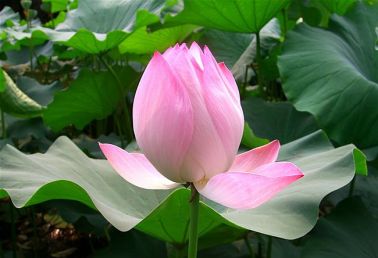
Lotus-flower_15
 

Tags: , , ,

Violence in Nursery Rhymes – Should we tell our kids?

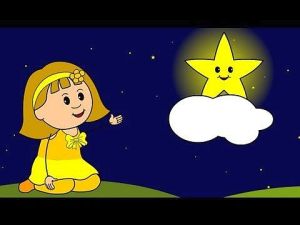
twinkle

When asked to recall childhood memories, most of us might sing the wonderful English nursery rhymes we were able to recite long before we could read or write. Those tales and rhymes have stayed with us for years. We inherited them from our schools; from our parents; and, we pass them on to the future generations. Our parents,  in turn, learnt when they were kids; as a part of their upbringing under the British Education System.

The history of those nursery rhyme dates back to centuries; to a time when written language was scarce or was limited to the highly educated gentry. It was due to the lack of written material; and more importantly, due to the lack of education for the working class.  The rhymes, which we now refer to as nursery rhymes , were passed on by word of mouth.

Whether this originated from another poem or from a song is unknown; but , the concept is clear—that nursery rhymes “…are fragments of ballads or of folk songs, remnants of ancient custom and ritual and may hold the last echoes of long-forgotten evil”

*

When people think of nursery rhymes, they think of “Twinkle, Twinkle Little Star”, cute, innocent and harmless. They think of them as the ideal entertainment for children. Of the Nursery Rhymes taught in our schools, most do rhyme well; and, are easy to sing. Most of them are innocent enough like the ones that are supposed to help children learn numbers, letters etc.

However,   you soon realize that many of the rhymes do not fit into this ideal image that people usually associate with the joyful songs that kids love to sing.  Some of those rhymes may have  a morbid tale tale running beneath it ;  some might be blatant, though,  sometimes subtle.

Few of us are aware of their dubious history of certain rhymes. A very large number of interesting collections of nursery rhymes have been published; but, curiously enough, there are hardly any books devoted expressly to disclose  their origin and history.

Many of the Rhymes have soothing words; but, a lot of others carry words denoting violence. Another reason for discomfort is that we know neither the meaning of certain words used in the rhymes ; nor do we know of  the context of its words or of the rhyme itself.

**

Regardless, the nursery rhymes that were popular years ago  continue to be popular today; and , would be so even thereafter .

The nursery rhymes , in general, are placed in three broad categories.

First,  the lullabies, the songs and melodies, sung to put the little one to sleep. And, there are the  amusing and  soothing ones , Then, there are also those that instead of soothing, appear to intimidate the child; and/or used as an outlet for the emotions of the nurse.

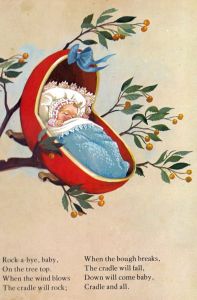
For instance, look at the words in Rock-a-Bye Baby:
rock-a-baby

Rock-a-bye Baby, in the tree top,
When the wind blows, the cradle will rock.
When the bough breaks, the cradle will fall,
And down will come baby, cradle and all.

*

Then , there’s one about Bonaparte coming by and eating the child, which obviously goes back to Napoleon Bonaparte being the bogey figure in British society:

Hush you baby, hush you squalling thing, I say, or Bonaparte will pass this way.

And there is even a later version with Hitler mentioned in it.

In contrast, the  traditional Indian lullabies, in all its languages and dialects, are far sweeter, soulful and soothing.

*

A second category of nursery rhymes is those sung as infant amusement.

Many of the counting rhymes, and alphabet rhymes fit into this category. Some are good;  and others, not so good.

One, two, three, four, five,
Once I caught a fish alive,
Six, seven, eight, nine, ten,
Then I let him go again.
Why did you let him go?
Because he bit my finger so
Which finger did he bite?
This little finger on the right.

Finger games, or what some refer to as tickle games, are for the amusement of infants and toddlers. Perhaps the best known are:

Pat-a-cake, pat-a-cake, baker’s man,
Bake me a cake as fast as you can;
Pat it and prick it, and mark it with B,
And put it in the oven for baby and me

This little piggy went to market,
This little piggy stayed home,
This little piggy had roast beef,
This little piggy had none,
And this little piggy cried,
Wee, wee, wee
All the way home.

Peek-a-boo is probably the oldest of all infant amusement with the earliest documented variation mentioned as early as 1364 . Unfortunately, many of the actions to the rhymes have been lost over time, leaving only the songs.

*

The final portion of the trilogy belongs to the group of rhymes that have made their way into the nursery from adult riddles. The answers to these adult riddles became obsolete, so too did the riddle. However, many have survived as songs; and , have found their way into schoolbooks.

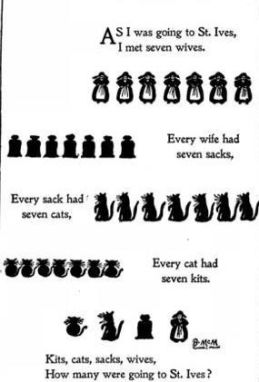
An example of such a riddle is one that relates to prostitutes:
st-ives

As I went to St. Ives, I met nine wives.
And every Wife had nine Sacs,
And every sac had nine Cats,
And every cat had nine kittens.
How many Wives, Sacs, Cats and Kittens
Went to St. Ives?
(
The answer appears to be  that only one person was going to St Ives)

*

In connection with the adult entertainment, popular theory claims that many of the nursery rhymes of today were not written for children. They were rooted in the political and social undertones of the past. Many started out as folk songs, as adult rhymes, to camouflage an unpleasant message or a distasteful event in their local history. Yet, it is possible to read into the various rhymes, connotations about Kings and Queens and social injustices. Rhymes were a sort of euphemism.
ring-ringa

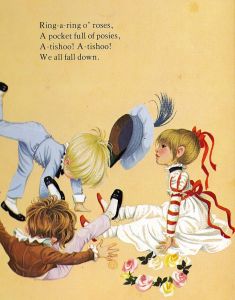
For instance, the circle game Ring-around-the-rosie, refers to Great Plague of London and of Edinburgh, Scotland . The lines “Ashes! Ashes! We all fall down” or “Hush! Hush! Hush! Hush! We’ve all tumbled down” is referring to the death of the people. It just does not sound like a good game to be playing and a good song for children to be hearing and singing.
london bridge.jpg

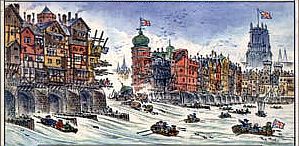
The rhyme “ London Bridge is falling down” and the game, which often accompanies it, preserves a gruesome tale of human sacrifice. The builders of London Bridge were faced with many obstacles. The bridge could not be made to stand by ordinary means, so a watchman was required. That watchman , apparently, could not  protect the bridge against the forces of nature. Legend has it that during the building of the bridge of Rospordenin Brittany, all attempts were unsuccessful until a four-year–old boy was immured / sacrificed at the foot of it. Supposedly, the boy was buried with a candle in one hand and a piece of bread in the other.

http://nemendur.khi.is/berghall/nurseryrhymes.htm

*

The Oxford Dictionary of Nursery Rhymes is a very useful guide. It gives the background of many rhymes. Along with that, the Oxford English Dictionary is also incredibly useful for looking up and verifying certain words of the rhymes and to check  when they came in and/ or out of use and when their meaning  changed. Interestingly the versions and meaning of some rhymes’ changed several times.(E.g. Humpty Dumpty, Old King Cole

Several studies have been carried out on the issue of violent content of the rhymes. The researchers have pointed out that   the amount of violence depicted in children’s nursery rhymes is ten times greater than what is broadcast on TV. Little Miss Muffet; Jack and Jill, and the Incy Wincy Spider need a rating system especially when it comes to categories for violence.

http://www.news-medical.net/?id=6348 http://adc.bmj.com/cgi/content/abstract/89/12/1103

*

The researchers assessed the words of 25 popular nursery rhymes. Forty-one percent of the nursery rhymes contained some kind of violence . Violent episodes were classified according to whether they were accidental, aggressive or intentional and included implied or threatened violence.

Dropping a Pussy in a Well is a good example: Ding, dong bell / Pussy in the well / Who put him in?.

However, rhymes such as “Simple Simon” who pricked his own digit on a thistle; “Six in a Bed” with its cumulative series of traumas suffered by people apparently too poor to enjoy individual sleeping arrangements; and “Jack and Jill” who suffered appalling injuries after taking a nasty tumble while water-gathering ;were worse and scored particularly highly.

*

As regards the “other” meanings of the rhymes, the word ‘goose’ in ‘Goosie Goosie Gander‘ came from a particular moment in British history when the word ‘goose’ was a euphemism for a prostitute.

See Saw, Marjorie Daw, Johnny shall have a new master’. The word ‘Daw’ is an old English word for ‘slut’. Therefore, what you have in ‘See Saw Marjorie Daw‘ is basically up and down goes Marjorie, the slut.
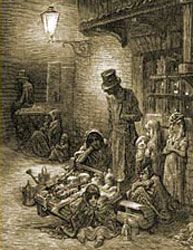
children-begging.jpg

[ It also appears to refer the use of child labor in work houses where those with nowhere else to live would be forced to work for a pittance (a penny a day) on piece work . The poignant misery of homeless kids was touchingly sketched by Charles Dickens ]

Baa Baa Black Sheep‘ is a nursery rhyme about taxation. It is actually two bags for the taxman , of which   one bag goes to the church and the other bag goes to the king. The poor farmer is left with one bag; it is a two-thirds taxation system.

Here we go Round the Mulberry Bush“, relates to a practice in old Britain of making the prisoners grow mulberry while serving their term, to help them earn some wages. The term ‘to go round the mulberry bush’, means to do time in prison. If someone asked you, “Have you been round the mulberry bush then?” and you answered ‘Yes’; it was a euphemism for being in prison.
humpty

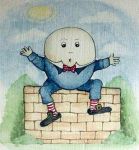
Similarly, in the 16th century Europe, Humpty Dumpty meant a brandy and egg based drink. It also described a clumsy person falling over all the time. But, in England during the English Civil War of 1640, Humpty Dumpty took on a new meaning.  It became the nickname of a cannon on the wall of the City of Colchester, probably because the cannon was ungainly and slightly odd-looking, and the rhyme after that date, started to be associated with that cannon, which was on the walls of the city and was knocked off and fell to pieces, and all the King’s horses, and all the King’s men couldn’t put Humpty together again.

Take the rhyme ‘Jack be nimble, Jack be quick‘. It was about pagan superstition; if you could jump over the candlestick and not put it out it deemed good luck. It is harking back to pagan fire rituals and finding good luck.

*

yankee

It is not just the word meaning that matters when it comes to nursery rhymes; it is also the tune. Singing in itself might be a lesson in voice’s vocation. Sung rhymes have energy; For example, ‘Yankee Doodle‘ is a good example of an imitation melody that is simple, elemental and curious.

Yankee Doodle came to town
Riding on a pony.
Stuck a feather in his cap,
And called it Macaroni.

The tune goes back to about 1760. Putting a feather in a cap, it is a traditional showing-off.   If you killed somebody in battle, you put a feather in your cap. That is what the rhyme is actually about. It is about the British soldiers mocking the Americans during the War of Independence, for their lack of style, for lack of elegance, and just being a bunch of colonial hayseeds. ( the expression , adding a feather to his cap – is still in use; and, is meant to suggest ones “achievement“)

The key to it is a final line, ‘Put a feather in his cap and called it Macaroni‘. The Macaronis were a British youth movement that reached its peak in about 1772, and were a bunch of incredibly dandified young men. The Macaronis would parade around London in beautifully tailored jackets, incredibly outlandish wigs and cummerbunds as well. What the song is referring to is that it is not enough for the American colonials to put a feather in their cap and think that made them Macaroni; there was more to being a Macaroni than that.

 *

The original Old King Cole is – A merry old soul. Old King Cole was one of the legendary English Kings; nobody quite knows where he ruled or what he ruled. However, this rhyme now relates to one of Aboriginal cricketers who toured England in the 1860s. They were actually the first Australian cricket team to tour England. The British were unable to pronounce foreign names; and, this was what happened to an Aboriginal cricketer whose real name was something like The Rippinsteen. He died while on tour in Britain ; and, was buried in Bethnal Green in east London. The local people who liked the old cricketer planted a eucalyptus tree on his grave. Every touring Australian cricket team visits old King Cole, as he came to be known.  It is perhaps another example, a charming one , for a change, of a nursery rhyme picking up a different meaning hundreds of years after the original.
nursery rhymes

Although today’s society is filled with new amusements, the children of today still play games with exactly the same ritual and phrases. The same goes for the rhymes and stories. As long as there are children, there will be nursery rhymes.

Nursery rhymes play a significant role in language development of the child. Obviously, children learn them by rote before understanding their meaning. This points to a shifting relationship between sound and meaning, right from the very beginning. How children learn speech has something to do with how they learn nursery rhymes.

Words in a Rhyme are a game. They are part of a subversive language model. And, that is the strength of nursery rhymes; they’re almost so nonsensical that they can apply to anything. That is one of their enduring features.

Given the history of the Rhymes and context of the society that gave birth to them , I feel that in Indian conditions, If our children love singing the Rhymes it is preferable we let them sing for the sheer enjoyment of the tune , rhythm and the fun of it. Treat it as just fun and nothing else. Do not try to read any meaning into the Rhymes.

In their earlier stages, they could perhaps be spared of the agony of understanding the meaning and context of the Rhymes. It would otherwise add a further dimension to the confusion and stress they already endure.

*

Are  nursery rhymes too violent? Do they give children nightmares, and should they be modified? Should we encourage more Rhymes about friendship, unity, love, commitment to study , nation etc.?

Should we popularize Rhymes and games that talk of things closer to us in our day-to-day life? Should we teach our children to sing about things they love, in our way of life? Should we encourage our children to sing rhymes in their own language than in English?

I think we should. Each generation should take a re-look at the old rhymes and its language in order to ensure they reflect changes in our aspirations , the  changes in our attitude to childhood and life.
nursery-rhymes-for-kids-02

Sources:

http://nemendur.khi.is/berghall/nurseryrhymes.htm

http://www.english.uwaterloo.ca/courses/engl208c/esharris.htm

http://www.english.uwaterloo.ca/courses/engl208c/esharris.htm 

Pictures are from Internet

 
8 Comments

Posted by on August 31, 2012 in General Interest


Tags: ,

What Love is…


love
 
I read on Sulekha a number of writings on love and related stuff. I had not consciously thought of it so far. It did not occur to me to look at it and examine it, in order to understand it. The exercise meant like looking into one’s own eye. I do not pretend I understand what this is all about, despite the years.
 

I hesitate to articulate on this. I cannot talk unreservedly and with comfort. It is not because of an inhibition. There are voices within vying;each one  yelling it is the true one. There is also a taciturn skeptic, in a state of suspended judgment watching and laughing in half mock. I am not sure which one to give expression. Nothing appears to make much sense. Yet, I am reluctant to let this pass. I may not have much time left.

There are those who poke fun at love as a naïve and romantic construct of our culture milieu, dismiss it as an affliction, and will tell you it is impossible to love and be wise. Others wax poetic and sing “love is all; love is the bird call and the glint in a young girl’s eyes on a summer night.” Some will be dogmatic and pronounce emphatically “God is Love.” And, some, out of their experience, teach, “Love is a strong emotional attachment to another…”etc. There are those that never thought of questioning love, much less defining it; and object vehemently even to the suggestion that they at one time doubted the wisdom of it. To them love is not to be pondered, it is to be experienced.

 
Similarly, the single whom we mistakenly take to be lonely and suspect that their status might be due to their lack of knowledge  or experience of love, will tell you they too have a concept of their love.
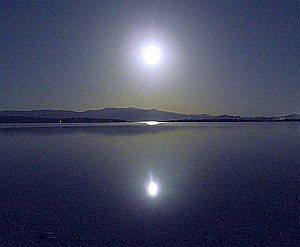
Matterhorn, Switzerlandmoon reflection
Some of them will tell you it is like a tranquil pond reflecting, as if dreaming, a distant mountain peak; as like the moon reflected in the still waters. The moon does not get wet and the water is not broken, yet both enjoy a tacit relation.
 
In addition, there are those in vast numbers that sleepwalk through life unmindful of what surrounds them.
 
Surely, there are yet more views and attitudes I am not aware. All of those may be true to some degree, but to assume that any one is best or comprehends all there is to love, is rather simplistic. Each one of us lives and experiences love in his/ her limited sphere, supremely unconcerned with the seeming confusion surrounding its definition. Each has an understanding, an experience of her/his own life and love, and goes by that. Definitions and opinions matter little.
 
J .Krishnamurthy in a way summed it up, when he said:
 
Put away the book, the description, the tradition, the
authority, and take the journey of self-discovery.
Love, and don’t be caught in opinions and ideas about what love
is or should be. When you love, everything will come right.
Love has its own action. Love, and you will know the
blessings of it. Keep away from the authority who tells you
what love is and what it is not. No authority knows and he
who knows cannot tell. Love, and there is understanding
.”
 
In the Celtic tradition, there is a beautiful and an idealized understanding of love and friendship- Anam Cara “Soul Friend.” It is soul love, connecting and bonding souls. The loved ones’ recognize the inner light and beauty in each other. People, it believes, are like stained glass windows; they sparkle and shine when the sun’s out, but when the darkness sets in, it is then their true beauty glisten brightly in vivid glory – only if there is light within.
 
This concept is beautiful but is elusive like a moonbeam you try to clasp in your palm. When you find an Anam Cara, you are blessed. Does it ever happen? ; Rarely or  perhaps never.  Is it Attainable? I am not sure.
 

I am incapable of grasping a mystical or idealized love as Hafiz or Mirdad or even Tagore as in his later years did. It is a yearning for the distant one; often one-sided. One of the paradoxes in romantic love is that it never produces human relationship as long as it stays. People never seem to settle into relationship with each other as human beings and as friends, until they are out of the romantic love saga and until they love each other instead of being in love.

I find the Indian view warm and human. It enjoins to cherish each other in happiness and sorrow, share the burdens and pleasures; make mistakes and yet be friends caring for each other. It teaches to care about everything; the good things, the bad things, the terrible things, the mundane things… all of it, all of the time, every day. You are saying ‘Let us walk these steps together .I watch with love every step we take. I am witness to your life as you will be mine. I stand beside you as partner and friend. You are the cause of my life. Let us cherish each other in sorrow and happiness.”

Most of us lead quiet, unheralded, uneventful lives as we pass through this world. This does not mean we should reject the idea of ideal love. We cannot and we should not .Yet, we should progress from romantic love of songs and legends to sharing, loving and living.

It is not always possible to love the best person, even if such a one does exist. You love a person for the best you see in him/her (or you think so).If you could find someone to love you for what you are, that would be ideal. That rarely happens. Consider yourself blessed if it could bring out the best in both.

It is not about perfection either. The perfect ones in the world as snowflakes or stars are either dull or too distant. We come to love not by finding the perfect person, but by learning to see an imperfect person perfectly. We learn to accept the other as truly as the other is. We are not here to make things perfect, but to live a life as well as we can despite angst, broken hearts, shattered dreams and loving wrong persons. It has also a lot to do with forgiveness and gratefulness.

What is to live well is a matter of understanding, aspiration and fulfillment. It is woven around your work, knowledge, emotions and your values, in order to give life a meaning. None of it makes sense if love, actual care for persons, is not present. Your life, your love needs expression with those who share it.

There were times when I was scared , unable to let in someone’s love. I even  tried pushing it away, finding it difficult to open to love or let it all the way in. Looking back over the years, I now realize I could have been gentler and understanding.


It is now no longer important whether anyone loved me or not; more important now for me is to love all; that brings greater happiness. Pablo Picasso wrote, “In life, you throw a ball. You hope it will reach a wall and bounce back so you can throw it again. You hope your friends and loved ones will provide that wall.”

As we grow older, we learn from the ebb and flow of life. As Anne Lindbergh said, when you love someone, you do not love him or her constantly, all the time, in exactly the identical way, from instant to instant. Each moment is not identical with its next one. It is just as a river, each ripple, each drop, resembles its predecessor and its successor but it is never the same ripple or drop. It is impossible; it is hard even to pretend to replicate chosen moments of life. Yet, this is exactly what most demand; not realizing life has a rhythm and vitality. We seldom recognize continuity is possible in life, as in love, only when there is growth, fluidity and freedom. It offers you at each moment, opportunity to make new choices, to live afresh and grow, instead of trapping you in an endless loop.

“We spend nearly a lifetime attempting to define who we are and then spend what ever time we have left trying to undo the mess. We do not get to start over but we do get another opportunity to make new choices about new directions every moment of our lives. That will never change but we can.” as Wei Wu Wei said.

Very often, the sense of possession, fear grip and strangle the relationship. We leap at the flow and fear at its ebb. We desperately hang on to an experience and try in vain to relive it .We are afraid it will never return. If you realize that all things change, you will try not to hold on to the past but live in the present and accept it as it is now, within their limits; for each moment has something to offer. That is what keeps life alive.

Appreciation of each other is important. Appreciation is the understanding, quiet amazement and gratitude. The basis of love is that appreciation, respect and trust which provide space for affection and friendship to flourish. As the poet says, Seasons turn, feelings churn, passions burn, spirits learn, seeds take hold and turn to gold.

When I said providing space, I meant being responsive to other’s feelings and letting the other feel whatever he/she needs to feel without fear how it might be perceived within the relation, and express it. She may need to express her anger, grief, silence, protest, pain, and seek a little solitude or even ask for comfort, to hold hands. It requires humility, care, understanding and the ability to step out of the way with grace; and honesty to appreciate that whatever that is causing hurt is certainly not above our relationship and us; and it can be put away. Two solitudes protect, touch and greet each other. You serve as a container for the overwhelming feelings; that is a gift of love.

What seems to grow fairer to me as life goes by is the love and the grace and tenderness of it; not its wit and cleverness and grandeur of knowledge – grand as knowledge is – but just the laughter of children, and the friendship of friends, and sight of flowers, and the sound of music.

Lao Tzu (c.640-540 BC) said it with remarkable clarity and simplicity what love meant in day to day living: “Why not simply honor your parents, love your children, help your brothers and sisters, be faithful to your friends, care for your mate with devotion, complete your work cooperatively and joyfully, assume responsibility for problems, practice virtue without first demanding it of others, understand the highest truths yet retain an ordinary manner? That would be true love, true clarity, true simplicity, and true mastery.”

Lewis Carroll says the same but differently; “Oh, tis love, tis love, that makes the world go round!” Somebody said. Alice whispered, “that its’s done by everybody minding their own business.”

Love, happiness and well-being are spoken in one breath as if they are inseparable. Many times, I think, they are not even related. A lot of that does not necessarily feel good. It is a bouquet of feelings of various hues and shades. Had I thought that love was about only feeling good, I would have missed many things in life.

Anne Lindbergh wrote,” Don’t wish me happiness. I don’t expect to be happy all the time…It’s gotten beyond that somehow. Wish me courage, strength, and a sense of humor. I will need them all.”

At the other end of the spectrum, we have the poems, legends and the sagas that idealize pain and suffering as if it is all that is to love. To them, sorrows are seeds of loving , to love is to die like a thorn bird that searches for the perfect thorn to impales itself singing the most beautiful song ever heard , as it dies. I am not sure of that either. You live that you may learn to love. You love that you may live to learn, as Mirdad said. I think love is an attitude; it is about life. Love is about living.

 
Giving birth and nourishing,
having without possessing,
acting with no expectations,
leading and not trying to control:
this is the supreme love.
: Lao Tzu said
 
 
A longtime friend whom I had not met in years wrote this. It in a way sums up what I was trying to say.

Love is not all a bed of roses.
Some times it’s washing dirty sox,
 Sometimes it’s getting no sleep with a colicky baby,
Sometimes it’s putting your needs last,

Sometimes love is keeping your mouth shut,
Sometimes love is fighting and making up
Sometimes it’s dealing up with in-laws or extended family,
Sometimes it’s moving away from everyone you’ve ever loved except your mate,
Sometimes it is insisting that your needs come first this time,
Sometimes it’s holding your beloved’s hand as they breathe their last


Watching her beloved die in her arms, her shriek in pain was a natural and an intense expression of love gushing forth like a geyser from the depth of her being. No matter how much it hurts—and it may be the greatest pain in life—grief can be a pure expression of love.

As years pass, the companions who loved , cried, fought, shared , laughed, witnessed wretchedness, drowned in ignominy, sang verses over the autumn moon behind the shifting clouds , are going or gone . Only their mute images remain. And, we survive among the dead and dying. The old grief passes gradually into quiet, tender longing love.

 
I love without knowing how, or when, or from where.
I love straightforwardly, without complexities or pride;

-Pablo Neruda
lotus red


8 Comments

Posted by on August 31, 2012 in General Interest, Speculation


Tags: ,