RSS

Author Archives: sreenivasaraos

The Question of Hindu, Hinduism et cetera – Part One

supreme-court-of-india

The Newspapers have been reporting that a Seven-judge  Bench of the  Supreme Court Of India headed by the Chief Justice T S Thakur  has since 18 October 2016 taken up a review of a judgement handed down by a Three-judge Bench  of the Supreme Court in 1995.

The uncomfortable issues questioning the legitimacy of the statements made by political parties canvassing for votes in the name of religion had since been coming up before the Apex Court. The present Review, it is said, had become necessary for arriving at ‘an authoritative pronouncement on electoral law categorising misuse of religion for electoral gains as corrupt practice”.

***

The first reference to ‘Hindutva’ was recorded by the Supreme Court in its judgment [1994 (6) SCC 360] in the case ‘Ismail Faruqi’, who had challenged the validity of the 1993 central law acquiring the disputed area in Ayodhya and large tracts of land around it. Justice S P Bharucha, who was part of the three judge bench which upheld the acquisition, said, “Ordinarily, Hindutva is understood as a way of life or a state of mind and it is not to be equated with, or understood as religious Hindu fundamentalism.”

The nascent interpretation of ‘Hindutva’ as ‘a way of life’ by Justice Bharucha in Ismail Faruqi, engaged deeper scrutiny analysis at the hands of a three-judge bench headed by renowned Justice J S Verma in Ramesh Yeshwant Prabhoo vs Shri Prabhakar Kashinath Kunte [1996 SCC (1) 130]. The case witnessed a see-saw battle between two heavyweights— Ram Jethmalani for Shiv Sena and Ashok Desai for the opposite side, both quoting scriptures and historians liberally.

Justice Verma relied on numerous past constitution bench judgments and said those decisions “indicate that no precise meaning can be ascribed to the terms ‘Hindu’, ‘Hindutva’ and ‘Hinduism’; and no meaning in the abstract can confine it to the narrow limits of religion alone, excluding the content of Indian culture and heritage. It is also indicated that the term ‘Hindutva’ is related more to the way of life of the people in the sub- continent. It is difficult to appreciate how in the face of these decisions the term ‘Hindutva’ or ‘Hinduism’ per se, in the abstract, can be assumed to mean and be equated with narrow fundamentalist Hindu religious bigotry…”.

The SC ruled that mere use of the word ‘Hindutva’ or ‘Hinduism’ or mention of any other religion in an election speech does not bring it within the net of sub-section (3) and/or sub-section (3A) of Section 123, (to constitute corrupt practices which could disqualify the candidate) unless the further elements indicated are also present in that speech.

The SC also dispelled the notion, being given currency by politicians of different creeds, that terms’ Hinduism’ or ‘Hindutva’ per se cannot be construed to depict hostility, enmity or intolerance towards other religious faiths or professing communalism. Such an apprehension, the SC said, proceeded from an improper appreciation and perception of the true meaning of these expressions emerging from the detailed discussion in earlier authorities of this Court.

 However, the court had warned against possible politically beneficial misuse of the terms and advised strong measures to curb such tendencies. “Misuse of these expressions to promote communalism cannot alter the true meaning of these terms. The mischief resulting from the misuse of the terms by anyone in his speech has to be checked and not its permissible use. It is indeed very unfortunate, if in spite of the liberal and tolerant features of ‘Hinduism’ recognized in judicial decisions, these terms are misused by anyone during the elections to gain any unfair political advantage. Fundamentalism of any colour or kind must be curbed with a heavy hand to preserve and promote the secular creed of the nation. Any misuse of these terms must, therefore, be dealt with strictly.

****

The 1995-Judgment that the Newspapers have been talking about refers to the famous case of Manohar Joshi vs. Nitin Bhaurao Patil & Anr (citations: 1996 AIR 796, 1996 SCC (1) 169) delivered on 11 December, 1995 by the then chief justice of India, J S Verma . Please click here for a copy of the judgement.

The judgement handed down by a bench of three  judges  of the Supreme Court led by the then chief justice of India, J S Verma was examining the question regarding the scope of corrupt practices mentioned in sub-section (3) of Section 123 of the 1951  Representation of People Act  and its interpretations. The Court in its ruling found that that statement by Manohar Joshi that “First Hindu State will be established in Maharashtra did not amount to appeal on ground of religion”.

The court had held that seeking votes in the name of Hinduism is not a “corrupt practice” under Section 123 of the Representation of the People Act; and , it would not result in setting aside the election of winning candidates.

This ruling delivered in 1995 which earned the nickname ‘Hindutva judgement ‘ held that ‘Hindutva/Hinduism is a way of life of the people in the sub-continent; it represents the culture of India, and of all people of India, whether Hindus, Muslims, Sikhs, Christians, etc.;  and ‘is a state of mind’.  

And, the Judgement concluded that ‘Hinduism’ was “indicative more of a way of life of the Indian people and is not confined merely to describe persons practicing the Hindu religion as a faith”.


In effect, the 1995-Verdict was taken to interpret that seeking vote in the name of ‘Hindutva/Hinduism’ did not prejudicially affect any candidate

However, the issues regarding the interpretations of the sub-section (3) of Section 123 had been coming up before the Apex Court quite regularly. Three election petitions are pending on the subject in the Apex court. The questions raised were: whether a politician can legitimately seek votes in the name of ‘Hinduism’; whether will it amount to corrupt practices under the Representation of People’s Act; and, whether will it subsequently attract disqualification.

The issue for interpretation of the sub-section (3) once again arose on January 30, 2014, before a five-judge which referred it for examination before a larger bench of seven judges. The apex court in February 2014 had decided to refer the matter to a seven judge’s bench.

Now about two decades after that 1995-Judgment, a Seven Bench Judges of the Supreme Court of India has taken up  this contentious ruling, commencing from 18 October 2016.

On October 19, 2016 the Supreme Court asked the Counsels if non-contesting spiritual leaders or clerics could be held accountable for corrupt practices under electoral law for asking voters to vote for a particular party or candidate; and how such appeals seeking votes would fall foul of the RP Act.

The proceedings are on .

Let’s wait and watch the final outcome.

[ Update

On October 25, 2016 , a Seven-judge Constitution Bench headed by Chief Justice T S Thakur said that for now it will not touch on its 1995 definition of “Hindutva is a way of life and not a religion” and also not ban its use during elections.

At this stage, we will confine ourselves to the issue raised before us in the reference. In the reference, there is no mention of the word ‘Hindutva’. We will not go into Hindutva at this stage.

The SC said that it would not examine the larger issue of whether Hindutva means Hindu religion, and whether the use of Hindutva in elections is permissible.

“It is difficult to define religion. There will be no end to this ”

The 7-judge bench, however, said it is looking into the nexus between religious leaders and candidates and its legality under Section 123 (3) of the Representation of People Act; and, whether seeking of votes in the name of religion will amount to a corrupt practice under the Representation of the People Act warranting disqualification.

But , asserted that asking for votes in the name of religion was ‘evil’ and ‘not permissible’ ]

***

[ Further Update:

A seven-judge-bench of the Supreme Court of India in its judgement delivered on 02 January 2017, by a 4 to 3 majority view, enlarged the scope of Section 123(3) of the Representation of People Act 1951. The Section 123(3) defines as ‘corrupt practice’ appeals made by a candidate or his agents to vote or refrain from voting for any person on the ground of ‘his’ religion, race, caste, community or language. The court  has  now interpreted Section 123(3) of the Representation of People Act to mean that this provision was brought in with intent ‘to clearly proscribe appeals based on sectarian, linguistic or caste considerations”.

The reference to the seven-judge bench had become necessary in view of the conflicting rulings in the previous judgements. In that context, the present Constitution bench explained the meaning of the term ‘his’ since that was relevant as to whose religion it has to be when an appeal is made.

 In substance, it ruled that an election could be annulled if candidates seek votes in the name of their religion or that of their voters. Till now, soliciting votes on the basis of religion and other such considerations was restricted to that of the candidates alone. 

The latest ruling is significant in the sense that any attempt to canvass for votes on the ground of religion or other such parochial identities – either of the candidates’s or on behalf of his agents or groups or his opponents – would invite the provisions of the Representation of People Act.

*

In their majority view, Chief Justice T S Thakur, Justices Madan B Lokur, S A Bobde and L Nageswara Rao ruled in favour of a ‘purposive interpretation’, stating that the term ‘his’ would mean the religion of the candidate, his agents, voters as well as any other person who, with the candidate’s consent, brings up religion or such subjects in an election

“An appeal in the name of religion, race, caste, community or language is impermissible under the Representation of the People Act, 1951, and would constitute a corrupt practice sufficient to annul the election in which such an appeal was made regardless of whether the appeal was in the name of the candidate’s religion or the religion of the election agent or that of the opponent or that of the voters,” the majority view held.”

The Chief Justice said in his separate verdict:

 “The state being secular in character will not identify itself with any one of the religions or religious denominations…The elections to the state legislature or to Parliament or for that matter any other body in the state is a secular exercise just as the functions of the elected representatives must be secular in both outlook and practice,”

**

Dissent

Justices Adarsh K Goel, Uday U Lalit and D Y Chandrachud, however, dissented with the majority’s view, holding that the expression ‘his’ used in conjunction with religion, race, caste, community or language is in reference to the candidate, in whose favour the appeal to cast a vote is made, or that of a rival candidate when an appeal is made to refrain from voting for another. 

His’ in Section 123(3) of the RP Act cannot validly refer to the religion, race, caste, community or language of the voter.

To hold that a person who seeks to contest an election is prohibited from speaking of the legitimate concerns of citizens that the injustices faced by them on the basis of traits having an origin in religion, race, caste, community or language would be remedied is to reduce democracy to an abstraction,” the minority judgement held”. ]

logo_header_lg

In this context , while on the question of ‘Hindu ‘and ‘Hinduism’ I would like to draw attention to another important judgement of the Supreme Court , also of 1995, which somehow seems to have been forgotten. I am referring to the case  ‘Bramchari Sidheswar Shai and others Versus State of West Bengal’ in the matter of the Ramakrishna Mission’s petition to be declared a non-Hindu, minority religion under the Indian constitution. Please click here for the full text of the judgement that was delivered on July 2, 1995 ; delivered by Justice N. Venkatachala.

The judgement, interalia, discussed the intent and connotation of the term Hindu; and also identified Seven Defining Characteristics of Hinduism. The petition filed by Ramakrishna Mission was denied.


The following are the observations of the Supreme Court of India while dealing with the term Hindu:

 (27). Who are Hindus and what are the broad features of Hindu religion, that must be the first part of our inquiry in dealing with the present controversy between the parties. The historical and etymological genesis of `the word `Hindu’ has given rise to a controversy amongst indologists; but the view generally accepted by scholars appears to be that the word “Hindu” is derived from the river Sindhu otherwise known as Indus which flows from the Punjab. `That part of the great Aryan race”, says Monier Williams, which immigrated from Central Asia, through the mountain passes into India , settled first in the districts near the river Sindhu (now called the Indus ). The Persian pronounced this word Hindu and named their Aryan brother Hindus. The Greeks, who probably gained their first ideas of India Persians, dropped the hard aspirate, and called the Hindus `Indoi’.

 (28). The Encyclopaedia of Religion and Ethics, Vol. VI, has described `Hinduism’ as the title applied to that form of religion which prevails among the vast majority of the present population of the Indian Empire (p.686). As Dr. Radhakrishan has observed: `The Hindu civilization is so called, since it original founders or earliest followers occupied the territory drained by the Sindhu (the Indus ) river system corresponding to the North-West Frontier Province and the Punjab . This is recorded in the Rig Veda, the oldest of the Vedas, the Hindu scriptures which give their name to this period of the Indian history. The people on the Indian side of the Sindhu were called Hindu by the Persian and the later western invaders [The Hindu View of Life by Dr. Radhakrishnan, p.12]. That is the genesis of the word `Hindu’.


On the question of Hinduism, the Supreme Court of India discussed in detail the nature of Hinduism, citing several references and authorities.

While laying down the characteristics of Hinduism, the Hon. Court observed:

Features of Hindu religion recognized by this Court in Shastri Yaganapurushdasji (supra) as coming within its broad sweep are these:

(i) Acceptance of the Vedas with reverence as the highest authority in religious and philosophic matters and acceptance with reverence of Vedas by Hindu thinkers and philosophers as the sole foundation of Hindu philosophy.

(ii) Spirit of tolerance and willingness to understand and appreciate the opponent’s point of view based on the realization that truth was many-sided.

(iii) Acceptance of great world rhythm, vast period of creation, maintenance and dissolution follow each other in endless succession, by all six systems of Hindu philosophy.

(iv) Acceptance by all systems of Hindu philosophy the belief in rebirth and pre-existence.

(v) Recognition of the fact that the means or ways to salvation are many.

(vi)  Realization of the truth that Gods to be worshipped may be large, yet there being Hindus who do not believe in the worshipping of idols.

(vii) Unlike other religions or religious creeds Hindu religion not being tied-down to any definite set of philosophic concepts, as such.

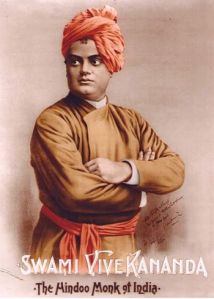
While drawing up the criteria for indentifying Hinduism, the Court relied heavily on the views of Swami Vivekananda and Dr. Radhakrishnan that stressed tolerance, universality and a search for a fundamental unity as the virtues of Hinduism. It also relied on B.G. Tilak’s view: “Acceptance of the Vedas with reverence; recognition of the fact that the means to salvation are diverse; and realization of the truth that the number of gods to be worshipped is large, that indeed is the distinguishing feature of Hindu religion.”Even in the earlier case (Yagnapurushdasji) the “acceptance of the Vedas” was a key element in the court’s decision.

The criteria drawn up in the Brahmachari Siddheshwar Shai v. State of West Bengal case is taken as a working rule evolved for a limited purpose. It is not construed as the definition of Hinduism; because, Hinduism is described on various occasions depending on the context. Each time a ‘context- sensitive’ interpretation has been put forth.

It was therefore said: All definitions of Hinduism are indeed  ‘context –sensitive’; and there is no absolute and precise definition.

For instance:

: – In the Indian Constitution, Explanation II appended to Article 25 says that the “reference to Hindus shall be construed as including a reference to persons professing the Sikh, Jain or Buddhist religion”

: – The Hindu Code Bill (which comprises four different Acts), too, takes an undifferentiated view of Hinduism: it includes anyone who is not a Muslim, Christian, Parsi or Jew under ‘Hindu’ as a legal category.

: – Any reform movements, including Buddhism, Jainism and Sikhism, were seen as merely different sects within Hinduism.

: – There are legal pronouncements that Hindus are Indian citizens belonging to a religion born in India. This means Buddhists, Sikhs or Parsis, even those who did not recognize themselves as Hindus, are to be considered Hindus.

The Supreme Court of India dealt with the meaning of the word ‘Hindutva’ or ‘Hinduism’ when used in election propaganda. The court came to the conclusion that the words ‘Hinduism’ or ‘Hindutva’ are not necessarily to be understood and construed narrowly, confined only to the strict Hindu religious practices unrelated to the culture and ethos of the People of India depicting the way of life of the Indian people. Unless the context of a speech indicates a contrary meaning or use, in the abstract, these terms are indicative more of a way of life of the Indian people. Unless the context of a speech indicates a contrary meaning or use, in the abstract, these terms are indicative more of a way of life of the Indian people and are not confined merely to describe persons practicing the Hindu religion as a faith. This clearly means that, by itself, the word ‘Hinduism’ or ‘Hindutva’ indicates the culture of the people of India as a whole, irrespective of whether they are Hindus, Muslims, Christians, and Jews etc.”

***

Incidentally the Seventh in the list of criteria drawn up by the Supreme Court in Brahmachari Siddheshwar Shai v. State of West Bengal case leaves me a little perplexed. It reads ”Unlike other religions or religious creeds Hindu religion not being tied-down to any definite set of philosophic concepts, as such”. This in a way sums up the position; but, at the same time, it appears to knock down the earlier six criteria.

Perhaps it is because of this view ( of not being tied down to any definite set of concepts)  that many say “The term ‘ism’ refers to an ideology that is to be propagated and by any method imposed on others for e.g. Marxism, socialism, communism, imperialism and capitalism but the Hindus have no such ‘ism’. Hindus follow the continuum process of evolution; for the Hindus do not have any unidirectional ideology, therefore, in Hindu Dharma there is no place for any ‘ism’”

**

That leads us to the question: how did a ‘way–of-life’ that was not tied down to an ‘ism’ came to be known as Hinduism, a religion?

Tracing such process that led to tagging or assigning a name to a ‘way of life’ is, no doubt, an elusive exercise.

It is explained that the name Hinduism was coined by the foreigners as an operative term; points at a much larger entity; but, does not exactly stand for it.

I sometimes wonder whether even in the distant past it ever had a specific name or did it needed one, perhaps because of the absence of a rival. It is also plausible there was none.

For instance:

: –  The ancient Indian texts such as Vedas and Upanishads do not talk in terms of a ‘Religion’.  

 : – The Buddha also does not name, refer to or attack the religion of the day though he criticizes the Brahman attitude, the rituals; and discourages its ungainly speculations. He sometimes referred to his disciples by their sect as Brahmins or Kshatrias. He addresses some of them by their Gotra like Vaccha (Vatsa), Kassapa (Kaashyapa), and Mudgala (Maudgalya) etc. Some of the disciples address the Buddha by his Gotra- Gautama.

Buddhism did not start as a religion. The Buddha intended to offer true interpretations of the Dharma. (That perhaps was how his sect was named.) It started as a free-thinkers-moment that attracted the seekers and the lay intellectuals; in much the same way as the Ramakrishna moment did at a much later time. During the Buddha’s time it was not a religion yet; the rituals related to births, deaths and weddings were presided over by the Brahmin priests. The Buddhist rituals and practices (vinaya) were collated from the teachings and the incidents in the Buddha’s life at a much later time, after his death.

What set apart the Buddhism and other school of thought was is emphasis on compassion towards all and ethics in all walks and modes of life.

:- Megasthenes (Ca. 350 BCE – 290 BCE )- the Greek explorer who became an Seleucus I Nicator to the Court of Chandragupta Maurya in Pataliputra –  in his  the work Indika , though mentions Brahmins and Sramanas does not  talk about the name of any religion.

 : – The Arthashastra of kautilya makes frequent references to classes of people within its society; but does not refer to a Religion in particular.


Perhaps it was this factor of the absence of a Religion per se in ancient India that largely guided the Supreme Court of India in listing some criteria for Hinduism while handing down the ruling in Brahmachari Siddheshwar Shai v. State of West Bengal.


**

Here, in these references by the Apex Court,  the term Hindu had somehow travelled a full circle and came back to the original view of territorial and not creedal significance. It implied residence in a well-defined geographical area.

But now, generally, one is understood to be a Hindu by being born into a Hindu family and practicing the faith, or by declaring oneself a Hindu. It has been used as a geographical, cultural, or religious identifier for people indigenous to South Asia. In any case, Hinduism is now a nomenclature for the religious tradition of India and the suffix ism is hardly noticed. Not many have qualms in accepting “Hinduism.

**

How did this transformation of ‘Hindu’ which originally referred to an inhabitant of the subcontinent into one of   religious identity take place? It is t important to learn the changing meaning of ‘Hindu’ whereby an original geographic , ethnic and cultural meaning was much later superseded by a religious meaning.

It is a long story. Let’s read that in the next part.

 flower design.jpg

Continued in Part Two


References and Sources

  1. Manohar Joshi vs Nitin Bhaurao Patil & Anr on 11 December, 1995(Equivalent citations: 1996 AIR 796, 1996 SCC (1) 169) Author: J S Verma

https://indiankanoon.org/doc/1215497/

  1. Bramchari Sidheswar Shai and others Versus State of West Bengal (in the supreme court of India ; civil appellate jurisdiction;  civil appeal nos. 4434a-34d of 1986 with civil appeal nos. 4937/85, 5676-78/85; with I.A.No. 1 in C.A. Nos. 5676-78/85 and CMP  No. 23111/86 in C.A. No. 4937/85  https://www.hinduismtoday.com/modules/smartsection/item.php?itemid=5047
  1. Newspaper reports
 

Tags: , , , , , ,

Bhagavad-Gita Multiple interpretations- Part Four

Continued from Part Three

bhagvat_geeta

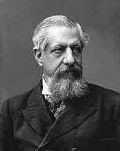
Among the translations of the Bhagavad-Gita that appeared during the closing decades of the nineteenth century, the one rendered in verse by Sir Edwin Arnold (The Song Celestial) – was widely read and well accepted by all the sections of readers. Apart from gaining great fame as a wisdom-text, it also exerted influence on Theosophists, thinkers and ardent seekers of the Truth, the most notable among who was MK Gandhi. Edwin Arnold’s translation gained greater significance as it brought its influence on Gandhi; and, through Gandhi and his non-violent protests on India’s struggle for freedom.

edwinarnold

[Sir Edwin Arnold (1832-1904) was an English poet, teacher and journalist. After leaving the University of Oxford, Arnold worked as a schoolteacher in Birmingham before becoming the Principal of the British Government Sanskrit College at Pune India, in 1856. He returned to England in 1861 to join the staff of the Daily Telegraph, where he was  its Chief Editor from 1873 to 1889.

The years that Arnold stayed in India proved to be a highly significant part of his life. Here, he was drawn to the Eastern traditions. He learnt Sanskrit and gained familiarity with ancient texts. After returning to England, he wrote a series of books in prose as also in verse  on   the great personalities and the well known texts and songs of the East.

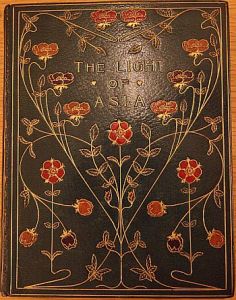
He also published several volumes of shorter poems as well as collected essays Japonica (1892). His other works included : The Light of Asia (1879 an epic poem in blank verse describing the life and teachings of the Buddha; Pearls of the Faith (1883), on Islam; The Light of the World (1891) on life of Jesus; The Song Celestial (1885) translation of the Bhagavad-Gita; adaptation of the Japanese play Adzuma or The Japanese Wife (1893);  The Tenth Muse (1895) – adaptations of Japanese poetry;  With Sadi in the Garden (1888); Potiphar’s Wife (1892);  and Indian Poetry (1904).

His fame as a poet rests mainly on: The Light of Asia subtitled The Great Renunciation ( Donohue, Henneberry & Co , London July 1879) – a narrative poem; a free adaptation of the Lalitavistara a Mahayana Buddhist  Sanskrit text compiled, in both prose and verses,  around the beginning of the Common Era  describing the life of Gautama Siddhartha who attained enlightenment and became the Buddha, the Awakened One; and on The Song Celestial   or Bhagavad-Gita   (From the Mahabharata)  Being a Discourse Between Arjuna,   Prince of India, and the Supreme Being  Under the Form of Krishna (Trubner & Company London,1885 )]

[For more about Sir Edwin Arnold ; please read the article written by Sri K S Ramaswami Sastry , included in the book The eminent Orientalists : Indian, European and American (pages from 218 to 256) ]

Light of Asia, published by Trübner & Co, London, 1889. British Library, C.188.a.211

The Song Celestial 

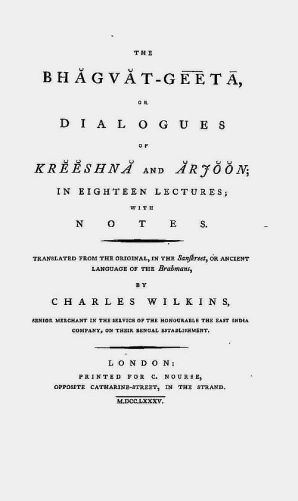
In 1885, exactly one hundred years after Sir Wilkins’ English translation of the Bhagavad Gita was published, Sir Edwin Arnold’s blank verse rendering of the Sanskrit text appeared as The Song Celestial.  He dedicated the Book to India and to England:

 So have I read this wonderful and spirit-thrilling speech;  By Krishna and Prince Arjun held, discoursing each with each; So have I writ its wisdom here,—its hidden mystery; For England; O our India! as dear to me as She!’

Sir Arnold also published an edition dedicated to the American people ‘with all gratitude and attachment ‘(Boston; Roberts Brothers; 1885). It enjoyed wide circulation and many scholars of the Gita acknowledged its influence on readers.

By the time The Song Celestial appeared in 1885, Edwin Arnold was already a highly regarded Victorian poet, well known for his oriental verse The Light of Asia.

In the preface  to The Song Celestial , Arnold  recalled the translations of the Gita made earlier in European languages  – by Burnouf (French); Schlegel (German);  Lassen (Latin); Stanislav Gatti (Italian); Galanos (Greek) ; as also the English translations of Thomson, Davies ( in prose) and that by Kasinath Telang. He acknowledged with gratitude the help derived from their works; and, added that ‘English literature would certainly be incomplete without possessing in popular form a poetical and philosophical work so dear to India’.

The two factors that distinguished Arnold’s translation of the Gita from the earlier ones were: he chose the poetic form and within it he adopted the blank-verse form; and, the other was that rather than reproducing the literal Gita,  he brought out the substance and intent of the original verse in an easy-to-read narration.

Thus, Arnold succeeded, in some measure, not only in maintaining the fidelity of the oriental text, but also in bringing the original closer to the reader.  His rendering of the Gita was described as ‘smooth, eloquent, and reliable’.

song celestial3

Autographed by the Author (as Edwin) on 9 June 1885

In the preface to his work, Arnold explained:

 “The Sanskrit original is written in the Anushtubh metre (Chhandas), which cannot be successfully reproduced for Western ears. I have therefore cast it into our flexible blank verse, changing into lyrical measures where the text itself similarly breaks.  For the most part, I believe the sense to be faithfully preserved in the following pages.”

The blank verses in late Victorian English lent the Gita a new look; and made it easy for the English-knowing persons worldwide to read and to recite the Gita. That helped to enhance the appeal and acceptance of the Gita among the general readers both in the West and in the East.

The Gita was no longer a religious text; but had become a sort of romantic universal, non-denominational viewpoint of the world and of life at large. Arnold’s poem allowed the Gita to be received by a new public audience. The Song Celestial gathered appreciation across England and Ireland, while at the same time acknowledging Arnold’s contribution in making Eastern texts accessible to a broader spectrum of readers.

Within a month of its appearance in print, it had become the most sought after book in the Leeds Public Library. A large part of the general readers of the nineteenth and early twentieth century was composed of borrowers of books and journals from local libraries. It was this readership that gauged the popularity or otherwise of a Book.

Many of his verse are often quoted; For instance:

: – It is better to live your own destiny imperfectly than to live an imitation of somebody else’s life with perfection. 

: – A gift is pure when it is given from the heart to the right person at the right time and at the right place, and when we expect nothing in return

: – It is true that the mind is restless and difficult to control. But it can be conquered, through regular practice and detachment. Those who lack self-control will find it difficult to progress in meditation; but those who are self-controlled, striving earnestly through the right means, will attain the goal.

:- If one ponders on objects of the sense, there springs Attraction: from attraction grows desire; Desire flames to fierce passion; passion breeds Recklessness; then the memory—all betrayed— Lets noble purpose go, and saps the mind, Till purpose, mind, and man are all undone

:- In all things, in all natures, in the stars; Of azure heaven, the unenduring clouds, In flower and tree, in every pebbly stone ;That paves the brooks, the stationary rocks; The moving waters, and the invisible air, and utter in humble adoration, We, who from the breast ; Of the frail earth, permitted to behold ; The faint reflections only of Thy face Are yet exalted, and in soul adore..!


Symbolism and Allegories

The early commentators of the Gita belonged to certain specific Schools of philosophy or traditions; and, their view of the Gita and their interpretations depended upon their concept of the Supreme reality, the individual and the world; and the nature of relationship between these entities.

Edwin Arnold stayed clear of such medieval interpretations of the Gita; but at the same time, he brought into his rendering the symbolisms and allegorical representations that he saw in the Gita. In a way of speaking, it could be said that Edwin Arnold revived; breathing a fresh life into the tradition of the allegorical interpretations of the Bhagavad-Gita that somehow was fading away. Where Arnold succeeded was in communicating those symbolisms and allegories and their universal nature, in a lucid, eloquent form that could be enjoyed by the general-reader.

Since the early periods, the allegorical interpretations of the Bhagavad-Gita have been in vogue, by looking upon Kurukshetra as not a mere geographical region or a historic battle. For instance; Abhinavagupta, in his Gitartha-sangraha, a commentary on Bhagavad-Gita, refers to a tradition of interpreting Kurushetra as zone of war that takes place between the righteous and un-righteous tendencies within the human body-mind complex.  According to him, Kurushetra is something more than a geographical venue where a battle took place among the cousins and their supporters.

Similar allegorical interpretations of the Gita became quite a regular feature by the turn of the nineteenth century; and , it has been carried forward ever since.

Edwin Arnold referred to Kurukshetra as human body, the field where Life disports.

Yea! Son of Kunti! for this flesh ye see
Is Kshetra, is the field where Life disports;
And that which views and knows it is the Soul,
Kshetrajna. In all “fields,” thou Indian prince!
I am Kshetrajna. I am what surveys!

For Sri Aurobindo, ‘the physical fact of war is only an outward manifestation of a general principle of life. The war symbolizes all aspects of struggle that takes place all the time, both in our inner and outer living.. Life is a battle and a field of death; this is Kurukshetra’.

For Bal Gangadhar Tilak, Kurushetra signified Dharmakshetra, a just war against oppressive foreign rule.

The theosophists and through them Gandhi followed Arnold’s interpretation that Kurukshetra is where an eternal struggle is taking place within us. Such an interpretation gained greater acceptance starting from the end of the nineteenth century and into the twentieth century and later.

Gandhi gained acquaintance with the Bhagavad-Gita through Edwin Arnold’s The song Celestial; and, he accepted and adopted the allegorical interpretation of the Gita as rendered by Arnold. And , that  left an everlasting influence on his outlook, his ways of thinking and devising his struggles, and on his very life. 

Gandhi esteemed the Song Celestial as the best translation of the Gita. And, it became a source of inspiration; and to his lifelong study of Gita in his search for Truth.

In his autobiography, The Story of My Experiments with Truth (Part I, Chapter XX – Acquaintance with Religions) Gandhi wrote about the Song Celestial with glowing admiration of the book:

The book struck me as one of priceless worth. The impression has ever since been growing on me with the result that I regard it today as the book par excellence for the knowledge of Truth. It has afforded me invaluable help in moments of gloom. I have read almost all the English translations of it (the Bhagavad-Gita), and I regard Sir Edwin Arnold’s as the best. He has been faithful to the test, and yet it does not read like a translation.

pto5pe6ac

How Gita came into Gandhi’s life

Gandhi came upon Bhagavad-Gita through the Theosophists and The Song Celestial of Sir Edwin Arnold, while he was a student in London during 1899.  In his Autobiography, Gandhi talks, in fair detail, about how he was introduced to the Gita ; and , the influence it cast on his outlook and on his life in total.

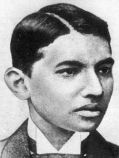
The young Mohandas Gandhi, not yet twenty, arrived in London in 1888   to study Law in order to become a Barrister. He was venturing out of home and out of India for the first time; and, was terribly ill-adjusted to the alien world. In particular, he sorely missed the home-cooked Gujarati vegetarian meal.

gandhi_student

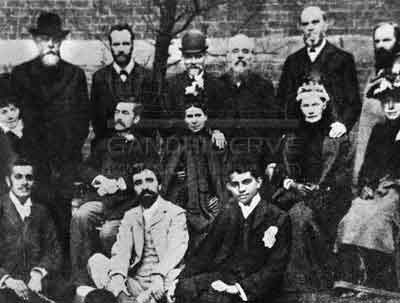
Lonely and starving, the young Gandhi was happy to find a safe haven in the London Vegetarian Society (LVS). Here, he befriended many vegetarian reformers and writers of the day like Henry Salt, Anna Kingsford, Dr. Allison, Joshua Oldfield and Edward Maitland.

gandhi-1890

Through his association with the members of the LVS, Gandhi came to know the prominent Theosophists of the day, such as Madam Helena Petrovna Blavatsky, the Olcott brothers, and Annie Besant, who would later become an important leader in the Indian independence movement.

Annie Besant clipped (1847-1933)[In his autobiography, Gandhi mentions that the Theosophists friends who introduced him to Arnold’s poem also introduced him to Madame Blavatsky and Mrs. Besant. He ‘politely declined’ his friends’ invitation to join the Theosophical Society, though he read, at their instance, Madame Blavatsky’s Key to Theosophy.]

*

Gandhi’s theosophist friends in the LVS —the two Olcott brothers— who were studying the original Sanskrit text of the Gita alongside its rendering in English by Edwin Arnold (The Song Celestial) approached Gandhi for help in reading text and in understanding the meaning of certain Sanskrit words in the text, perhaps because Gandhi was from India and he might know Sanskrit. But, Gandhi had neither read the Gita nor did he know Sanskrit. Gandhi was embarrassed; and, as he confessed in his Autobiography;

 ‘I felt ashamed, as I had read the divine poem neither in Sanskrit nor in Gujarati… I was constrained to tell them that I had not read the Gita, but that I would gladly read it with them, and that though my knowledge of Sanskrit was meager, still I hoped to be able to understand the original to the extent of telling where the translation failed to bring out the meaning. I began reading the Gita with them’.

Determined to prove himself, Gandhi succeeded in turning that sense of ‘shame’ into a strong motive to take up the study of the Gita.

‘My first acquaintance with the Gita began in 1888-89 with the verse translation by Sir Edwin Arnold known as the Song Celestial. On reading it, I felt a keen desire to read a Gujarati translation. And I read as many translations as I could lay hold of ‘.

Talking about his encounter with the Song Celestial, the book that “stimulated in . . . the desire to read books on Hinduism, Gandhi wrote an article in his nationalist weekly journal Young India (1925)

“My first acquaintance with the Gita was in 1889, when I was almost twenty. I had not then much of an inkling of the principle of Ahimsa . . . Now whilst in England my contact with two English friends made me read the Gita . . .My knowledge of Sanskrit was not enough to enable me to understand all the verses of the Gita unaided. . .They placed before me Sir Edwin Arnold’s magnificent rendering of the Gita. I devoured the contents from cover to cover and was entranced by it. The last nineteen verses of the second chapter have since been inscribed on the tablet of my heart. They contain for me all knowledge . . .I have since read many translations and many commentaries, have argued and reasoned to my heart’s content but the impression that first reading gave me has never been effaced” .

Gandhi read the Gita as one would do a literary work, rather than as a religious text. Further, he pictured the Gita as an elaborate allegory.

And who are Dhritarashtra and Yudhishtira and Arjuna? Who is Krishna? Were they all historical characters? . . . I regard Duryodhana and his party as the baser impulses in man and Arjuna and his party as the higher impulses. The field of battle is our body. An eternal l battle is going on between the two camps and the Poet seer has vividly described it. Krishna is the Dweller within, ever whispering in a pure heart.

A-himsa – Nonviolence

clipboard01

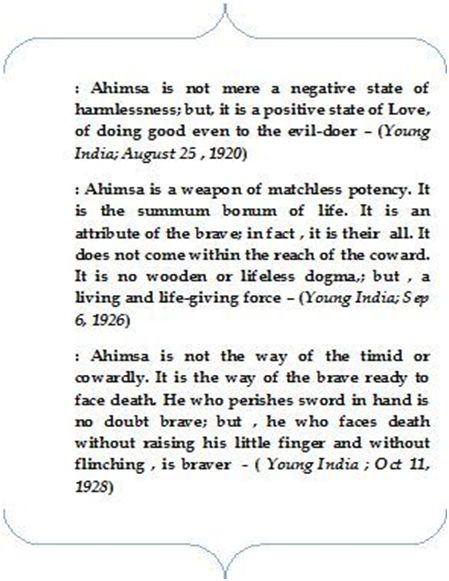
Among all leaders of the Indian independence movement, none was more devoted to the Bhagavad Gita than Gandhi. He called it his ‘dictionary of daily reference’; his ‘spiritual reference book’; and, his ‘Mother.’ He spoke and wrote widely on it throughout his life. Gandhi, in contrast to other major nationalist leaders, held no commitment more important than his principle of non-violence.

But, he ran into a serious interpretive problem, because in the course of the Gita Krishna persuades the reluctant warrior Arjuna to take part in an internecine disastrous battle.

The question whether the true teaching of the Gita favors violence or non-violence became vitally important to Gandhi. He needed a clear , firm and an honest answer to anchor his faith in his struggle for India’s freedom ; to provide a principled public resistance; and, above all to ensure the authenticity of his inner spiritual life.

Gandhi believed that the message of the Mahabharata itself was the virtues of non-violence; and , the Gita which was but a small segment of it carried a similar message. He wrote:

 The author of the Mahabharata has not established the necessity of physical warfare; on the contrary he has proved its futility. He made the victors shed tears of sorrow and repentance; and has left them nothing but legacy of misery. At the end of the Mahabharata, nearly everyone on both sides is killed.

According to Gandhi, Gita which is embedded in Mahabharata also demonstrates the futility of violence. The true message of the Bhagavad-Gita, Gandhi asserted, is non-violence and peace.

Gandhi chose to view the Kurukshetra battle as an allegorical- ethical struggle between Dharma and A-dharma.  He wrote in his Autobiography:

‘Even in 1888-89, when I first became acquainted with the Gita, I felt that it was not a historical work; but that, under the guise of physical warfare, it described the duel that perpetually went on in the hearts mankind, and that physical warfare was brought in merely to make the description of the internal duel more alluring. This preliminary intuition became more confirmed on a closer study of religion and the Gita.’

Gandhi admits that verse 2.37 and those around it seem to approve violence

हतोवाप्राप्स्यसिस्वर्गंजित्वावाभोक्ष्यसेमहीम् | तस्मादुत्तिष्ठकौन्तेययुद्धायकृतनिश्चय: || 37||

Hato vā prāpsyasi swargaṁ jitvā vā bhokṣhyase mahīm / Tasmād uttiṣhṭha kaunteya yuddhāya kṛita-niśhchayaḥ

 सुखदु:खेसमेकृत्वालाभालाभौजयाजयौ | ततोयुद्धाययुज्यस्वनैवंपापमवाप्स्यसि || 38||

 Sukha-duḥkhe same kṛitvā lābhālābhau jayājayau / Tato yuddhāya yujyasva naivaṁ pāpam avāpsyasi

 BG 2.37: If you fight, you will either be slain on the battlefield and go to the celestial abodes, or you will gain victory and enjoy the kingdom on earth. Therefore arise with determination, O son of Kunti, and be prepared to fight

 G 2.38: Fight for the sake of duty, treating alike happiness and distress, loss and gain, victory and defeat. Fulfilling your responsibility in this way, you will never incur sin.

But he argues that the later verses that speak eloquently about equanimity and self-control cancel the violent aspects of these verses.

Gandhi came to believe that without total observance of Ahimsa (non-violence) in every form it would not be possible to gain freedom from attachment.

And, that led Gandhi to offer a particularly distinct interpretation of the Bhagavad-Gita, where Krishna instead of asking Arjuna to fight the war, instructs him to ‘fight the battle within the self; to battle passion and selfishness’.

The Bhagavad-Gita, he explained, repeatedly, is not about the battle that is waged on the field of dirt soaked in blood; but, the Kurukshetra – Gandhi argued, must be taken as an interior one, where the forces of good and evil are locked in never-ending struggle.  He said: When Krishna tells Arjuna to fight, he is telling him to overcome any self-interested inclinations; and, to carry out his own righteous duty. Gandhi based his authority as an interpreter of the Gita on his personal endeavor ‘to enforce the meaning in my own conduct for an unbroken period of forty years.’ Gandhi also claimed that the Gita was not a Hindu work, but rather one of “pure ethics,” which a person of any faith might read’

[ Richard H. Davis the author of “The Bhagavad Gita: A Biography “: also published as a series of very well researched and candidly written articles , writes under the Section titled  : Krishna , the Gita , and the Indian Nation (in Erenow) :

In 1929 Gandhi composed an introduction to the translation, “Anasaktiyoga” (the discipline of non-attached action), which is his most succinct interpretive statement on the Gita. The introduction and translation were released on March 12, 1930, the day that Gandhi began his salt Satyagraha. Again in prison from 1930 to 1932, Gandhi wrote a series of letters to the ashram, giving a simplified chapter-by-chapter summary of Krishna’s teachings for those who found his earlier commentary difficult to comprehend. His last recorded discussion of the Gita took place with the American writer Vincent Sheean in January 1948, three days before his assassination.

In writing on the Bhagavad Gita, Gandhi does not claim any scholarly credentials for himself. His authority lies rather in his attempt to govern his life according to its precepts. “At the back of my reading,” he writes in his “Anasaktiyoga,” “there is the claim of an endeavor to enforce the meaning in my own conduct for an unbroken period of forty years.”21 Beyond this personal dimension, Gandhi’s interpretation of the Gita is a deeply political act. Writing in the 1920s, Gandhi faces several challenges. Like other activists, he views karma yoga as the most relevant teaching of the Gita. But in light of his own commitment to nonviolence (ahimsa) and his desire to make this a fundamental principle of the Indian independence movement, he needs to counter those like Tilak as well as the revolutionaries who employ Krishna’s teachings to justify the use of violence in a righteous cause. At the same time, he seeks to separate the Gita from the more Hinduist claims on the text, like those of the Hindu Sangathan or the RSS.

Gandhi’s disinterest in historical veracity lays the groundwork for an allegorical reading of the epic and the Gita. Kurukshetra, in Gandhi’s internalist reading, is within each of us. The epic battle is a struggle between dharma and its opposite, between the forces of good and evil. “Pandavas and Kauravas, that is, divine and demoniacal impulses, were fighting in this body, and God was watching the fight from a distance,” Gandhi explains. “Please do not believe that this is the history of a battle which took place on a little field near Hastinapur. The war is still going on. As a non-historical moral allegory, the Mahabharata and its Bhagavad Gita have permanent value.

Gandhi engages Tilak’s interpretation more directly over one particular passage. In Gandhi’s translation it goes: “In whatever way men resort to Me, even so do I render to them. In every way, O Partha, the path men follow is mine” (4.11). Tilak cited this verse to prove that the Gita upholds the principle of “tit for tat,” or retributive violence. We should act toward others as they do to us. The aggressive violence of British occupation, Tilak had argued, may legitimately be met with violent resistance by freedom fighters.

Gandhi counters that the verse cannot be interpreted in this way. We cannot justify retributive violence. The verse lays down God’s law, Gandhi observes, and not a directive for human interaction. Krishna will “worship a person as the latter worships Him.” As Gandhi sees it, the message of the verse is “we reap as we sow.”25

Krishna does not explicitly endorse the principle of nonviolence in the Gita, Gandhi admits. Nevertheless, nonviolence is a corollary of Krishna’s primary teaching—namely, non-attachment to the fruits of action. Any action that cannot be performed without attachment is taboo, and this means that murder, lying, dissoluteness, and the like are disallowed. Although the Gita was not written to justify nonviolence, Krishna takes it for granted. To reinforce this point, Gandhi cites his own experience. Perfect renunciation such as Krishna advocates is not possible without perfect observance of nonviolence.

The principle of non-attachment applies even to the righteous work of the freedom struggle. The danger with nationalist thinking, according to Gandhi, is that it may lead to the adoption of “bad means,” which Gandhi terms duragraha. “If we are attached to our goal of winning liberty, we shall not hesitate to adopt bad means.” Gandhi refers here to all those nationalists who justify acts of vilification or violence by citing noble goals, such as victory, prosperity, and good fortune. By contrast, Krishna recommends that we should not be attached even to a good cause. “Only then will our means remain pure and our actions, too.”26

Gandhi ends his disquisition on the Bhagavad Gita by stressing the value of Krishna’s teachings for the hard work of discipline that he urges on himself, members of his ashram, and all who read his words. He reiterates his conviction that the Gita is a work of universal ethics, not the possession of a particular national or religious community. “This is a work which persons belonging to all faiths can read. It does not favor any sectarian point of view. It teaches nothing but pure ethics.”27 The Gita may be, as Gandhi puts it, a “deity of the mind,” but it is not an exclusive “Hindu Bible.”

Gandhi’s nonviolent and nonsectarian reading of the Bhagavad Gita would prove enormously influential in India, disseminated through his newspapers, publications, and translations into all the vernacular languages. At the time, many Indians fit Gandhi himself into the theological framework of the Gita. Just as Krishna says that he incarnates himself in age after age, whenever dharma is threatened, perhaps Gandhi was the avatar of this age.28

Not all Indians shared Gandhi’s approach to the text, of course, or judged him with such reverence. Ironically, Gandhi’s assassin also saw himself as a Gita-style karma yogin. In January 1948, after Indian independence and the catastrophic communal violence surrounding the partition of the subcontinent, Gandhi began to hold daily public prayer sessions in Birla House, Delhi, reciting passages from the Gita and Quran along with religious works from other traditions. On the evening of January 30, Nathuram Godse interrupted Gandhi at the prayer grounds with two bullets fired at point-blank range.]


**

The following is an extract from Gandhi’s interpretation of the Gita’s position on violence:

I do not believe that the Gita teaches violence for doing well. It is pre-eminently a description of the duel that goes on in our own hearts. The divine author has used an historical incident for including the lesson of doing one’s own duty even at the peril of one’s life. It inculcates performance of duty irrespective of the consequences; for, we mortals, limited by our physical frames, are incapable of controlling actions save our own. I do not agree that the Gita advocates and teaches violence in any part of it. See the concluding discourse at the end of Chapter Two. Although that chapter lends itself to a violent interpretation, the concluding verses seem to me to preclude any such interpretation. The fact is that a literal interpretation of the Gita lands one in a sea of contradictions. “The letter killeth, the spirit giveth life.”

[It appears that Gandhi was not the first to reject war and violence amidst which the Gita was born. And, even during the medieval times there was a certain uneasiness in accepting the necessity of war in solving disputes

There is an interesting passage in the Bhagavata Purana (dated perhaps around sixth century) which explains how that Purana came to be composed by Vyasa.  In the Fifth Chapter of the First Canto of the Bhagavata Purana ( 1.05.08 – 40), Sage Narada admonishes Vyasa for justifying violence and glorifying terrible acts of war fought in the name of the Dharma, causing death and destruction of countless lives. You described the war in a mighty manner . Narada points out the danger that some misguided readers of Mahabharata might come to believe that it is not wrong to indulge in violence if it could serve the interest of what they deem to be Dharma, honor etc. Narada advises Vyasa to try to undo the damage he had caused by composing a work that preaches the virtues of devotion, love and peace; and, above all , the glory and splendor of the Lord Vasudeva. That was now, it is said, Bhagavata Purana came to be composed.

yathā dharmādayaś cārthā munivaryānukīrtitāḥ, na tathā vāsudevasya mahimā
anuvarṇitah (S.B. 1.5.9)

Though both Narada and Gandhi abhorred violence, their view on Mahabharata differed.  Narada was unhappy with violence and destruction being shown as the way to resolve disputes. But Gandhi argued that that the true message of Mahabharata was indeed the futility and the condemnation of violence.

Perhaps no one else before Gandhi had explicitly said that the message of the Mahabharata and the Bhagavad-Gita, truly, is non-violence.]

Gandhi pointed out that Gita in fact holds out a method by which truth-force (Satyagraha) could be achieved.  Gandhi was now determined that if one has to fight, one should fight non-violently.  Thus, Violence and denial of violence became major issues for debate and action.

Gandhi’s faith in Ahimsa as the core of the Gita gave rise to Satyagraha as an effective means to express one’s protest; and, to offer resistance without indulging in violence.

According to him, a Satyagrahi should be willing to die like a soldier (Kshatriya) for the cause of India’s independence. Satyagraha was Gandhi’s unique contribution to fight against oppression and injustice.

It has been my endeavor, as also that of some companions, to reduce to practice the teaching of the Gita as I have understood it. The Gita has become for us a spiritual reference book. I am aware that we ever fail to act in perfect accord with the teaching. The failure is not due to want of effort, but is in spite of it. Even through the failures we seem to see rays of hope.

This was in sharp contrast to the interpretation offered by the leaders of India’s nationalist movement such as Sri Aurobindo and others to fight a just war for liberating the Motherland. Sri Aurobindo viewed Nazis as agents of ’negative spiritual forces’ in the world working against the evolution of humanity towards freedom and dignity. He called upon Indian people to support the war efforts of the British in their fight against the fascist Nazi Germany.

I am not sure which of these two positions – of Gandhi or of Sri Aurobindo- is nearer to the true teaching of the Bhagavad-Gita..!

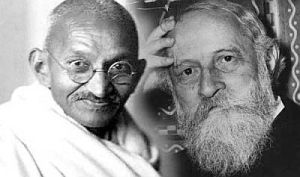
gandhi and martin buber

[But, the justification that Gandhi gave for not supporting the British in the war against the Nazis; and some of the things he said in that context is really hard to digest. Among other things, he cited his principle of non-violence as the reason for not agreeing to go for a War. Further, in a highly controversial letter addressed to Martin Buber during the gruesome period of the holocaust of the Jews, he advised that it would be better in the long term if the Jews practiced non-violence in response to their exterminators.

“The Jews of Germany can offer Satyagraha under infinitely better auspices than the Indians of South Africa.” “The calculated violence of Hitler may even result in a general massacre of Jews (but) to the God-fearing, death has no terrorNo person who has faith in a living God need feel helpless or forlorn. ” (1938)’.

In his reply, Buber made it clear that it was simply wrong of Gandhi to assume his struggles in South Africa for justice and India for independence were comparable to what the Jews were facing in Germany.

Buber was quick to expose the limitations of Gandhianism before a state ideology as brutal as Nazism: “Do you think perhaps,” he asked, “that a Jew in Germany could pronounce in public one single sentence of a speech such as yours without being knocked down?”

Buber also raised the age-less question of non-violence and the Bhagavad-Gita, and the Mahabharata; and, questioned Gandhi’s statement about India being “by nature non-violent”.

Please click here for Martin Buber’s spirited and eloquent reply to Gandhi.

Please also read Avner Falk’s article : Buber and Gandhi

Gandhi, of course, did not reply to Buber, thereby bypassing  a potentially interesting conversation about ways to resolve  complex moral and political dilemma.

However, in May 1947, Gandhi addressed his last words on the subject to Jewish militants who had resorted to terrorism against their former British patrons as well as Arabs: “It has become a problem which is almost insoluble. If I were a Jew, I would tell them: ‘don’t be so silly as to resort to terrorism, because you simply damage your own case which otherwise would be a proper case.’

But having said that, one has also to acknowledge that even after seven decades of partitioning the adjacent lands into India-Pakistan; Israel- Palestine, violence has not helped in resolving their disputes.  The peaceful coexistence of the warring neighbors is still a distant dream. ]

pto5pe6ac

Sthitaprajna

Gandhi regarded the eighteen verses (from 55 to 72) of the Second Chapter of the Bhagavad-Gita which describe the nature and characteristics of a sthitaprajna (sthita: steady or established, and prajna: wisdom), the one who has achieved control over his inner self, as the essence of the Gita. For Gandhi, the rest of the Gita was a commentary on this passage, which in his view was ‘the essence of dharma’.

In support of his argument, Gandhi often quotes the last twenty verses of the Second Chapter of the Gita which describe a person who has attained equanimity and control over his inner self; and, does not cling to anything.

He in particular admired the verse at 2.64::  ‘One not joined by passion and hatred, always moving in the sphere of the senses by the senses, the one who thus restrains the Self , and who governs the Self attains peace.’ This verse is explicitly about self-control and could an argument for the Gita really being about non-violence, about negating violence, as Gandhi thought.

रागद्वेषवियुक्तैस्तुविषयानिन्द्रियैश्चरन् | आत्मवश्यैर्विधेयात्माप्रसादमधिगच्छति || 64||

Rāga-dveha-viyuktais tu vihayān indriyaiśh charan / Ātma-vaśhyair-vidheyātmā prasādam adhigachchhati

BG 2.64: But one who controls the mind, and is free from attachment and aversion, even while using the objects of the senses, attains the Grace of God.

This section of the Gita speaks about the qualities, values and attitudes that a wise person should strive to develop in all aspects of her/his life.

The key qualities of a sthitaprajna include: abandonment of all worldly desires and attachments to sense-objects and pleasures, to attractions as well as repulsions: to lust, anger, greed, envy, fear and such other things that destroy reason. The often quoted verses 62 and 63 of chapter two contain the psychological truth and wisdom that guide the wise both in the everyday life as also in spiritual quest:

ध्यायतो विषयान्पुंस: सङ्गस्तेषूपजायते | सङ्गात्सञ्जायते काम: कामात्क्रोधोऽभिजायते || 62||

dhyāyato vihayān pusa sagas tehūpajāyate / sagāt sañjāyate kāma kāmāt krodho ’bhijāyate

While contemplating on the objects of the senses, one develops attachment to them. Attachment leads to desire, and from desire arises anger.

क्रोधाद्भवति सम्मोह: सम्मोहात्स्मृतिविभ्रम: | स्मृतिभ्रंशाद् बुद्धिनाशो बुद्धिनाशात्प्रणश्यति || 63||

krodhād bhavati sammoha sammohāt smiti-vibhramaḥ / smiti-bhranśhād buddhi-nāśho buddhi-nāśhāt praaśhyati

Anger leads to clouding of judgment, which results in bewilderment of the memory. When the memory is bewildered, the intellect gets destroyed; and when the intellect is destroyed, one is ruined.

“Man, musing on the objects of senses, conceives attachment to these; from attachment arises desire, and from (frustrated) desire arises anger (v. 62); anger leads to confusion and confusion to the lapse of memory; from the loss of memory one’s reason is destroyed, and once reason is destroyed, one perishes (v. 63). Besides cultivating non-attachment to sense-objects and desireless-ness for them, a person must also be equipoise in pleasure and pain, happiness and misery (v. 55 – vita-        raga- bhaya-krodhah); such a person remains unaffected by honor or dishonor, praise or blame, success or failure (v. 38: sukhe dukhe same krutva labha labhau jayajayou). A sthitaprajna must be in control of his mind and senses; should be free from ego, treat everyone equally, and not differentiate between a piece of gold and one of iron’.

Gandhi asserted that a person embarking on Satyagraha, rooted in the principle of non-violence must inculcate the virtues and attitudes of a Sthita-prajna. According to him, one who has achieved such self-control is the true Jnani.

[The Lord said:  A man is called one whose insight is firm when he forsakes all the desirable objects that come to his mind, Partha, and is sufficient unto himself. Not distressed in adversities, without craving for pleasures, innocent of passion, fear and anger, he is called a sage whose insight is firm. Firm stands the insight of him who has no preference for anything, whether he meets good or evil, and neither welcomes nor hates either one. When he entirely withdraws his senses from their objects as a tortoise withdraws its limbs, his insight stands firm. For an embodied man who does not eat, the sense objects fade away, except his taste for them; his taste, too, fades when he has seen the highest.

— Translation by J.A.B. van Buitenen]

pto5pe6ac

Anasakti

Gandhi regarded Anasakti or non-attachment to the fruits of one’s actions is the principal message of the Gita. Gandhi believed such Disinterestedness is a state of mind; and, it can never be attained and cultivated without exercising self-control and developing a sense of renunciation. He said: ‘One whose left hand does not know what his right hand does, such a one knows what is to be equal-minded. Our yardstick is the ability to see others as ourselves. We should think whether we should be happy if others are did to us what we did to them’.

Anasakti yoga that Gandhi developed and advocated is essentially an attitude of non-attachment to objects as also to the results of one’s actions. It is about letting-go (as in Zen) and internal renunciation.

 Gandhi believed that the Gita does not favor renunciation or total withdrawal from the world resulting in inactivity, nivritti. Instead the Gita teaches the Jnana that endorses renunciation of desires, of fruits of action. It promotes activity pravritti the opposite of renunciation of action.

The Anasakti that Gandhi advocated is not Sanyasa, the renunciation of the world; but, a sort of detached attitude that is not glued to its objects and to the outcome of one’s action (Karma-phala) while being actively engaged in the world and participating in its ongoing process.

While explaining the principle of Anasakti, Gandhi clarifies: “In no way it means indifference to the results of one’s action. The renunciation (Karma-phala-tyaga) denotes absence of hankering after fruit;  because, attachment, worry, haste affect our nervous system and upset the balance of our mind” (Anasaktiyoga, 7). It is not unnatural to feel happy about the good outcome of one’s hard work, but it is wasteful, both spiritually and psychologically, to invest all one’s emotions and energy in fretting over the results instead of focusing on perfecting the work’.

The Anasakti, Gandhi said, is the way of the Karma Yogi a man of action. While remaining active in the world, he performs his  duties  in the spirit of ‘nish –    Kama- karma’, that is, without desire for the fruits of action, as in the spirit of   ‘sthitha-prajna’– a person well-established in wisdom—who is equipoise, detached, desireless, and dedicated to God.

This principle of renunciation of the desire for the fruits of action recurs like a refrain throughout the Gita; it is particularly emphasized in Sankhya Yoga (Ch. 2, v. 47): ‘karmanye vadhikaraste ma phaleshu kadachana ‘: your business is with the action only, never with its fruits; in Karma Yoga (Ch. 3, v. 19): ‘tasmat asaktaha satatam karyam karma samachar’: therefore, perform action constantly without attachment; in the Jnana-vibhaga Yoga (Ch. 4, v. 20): ‘tyaktva karmaphalasangam’: abandon attachment to the fruit of action; and in the Bhakti Yoga (Ch. 12, v. 11): ‘sarvakarmaphala-tyagam tatah kuru yatatmavan’: renounce therefore all fruit of action with self control.

Gandhi’s appreciation of the Gita

gandhi_gita_book_quote-1

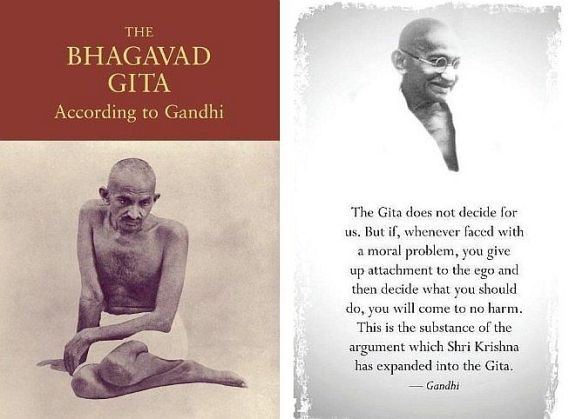
Gandhi, over the several articles he published in The Young India, mentions of the unique features of the Bhagavad-Gita that led him to revere it. To put those virtues in a summary form, the following, according to Gandhi are the admirable merits of the Gita:

Universal – Perennial Philosophy beyond geographical, racial or religious limitations;

Eternal- true for all times;

Free from dogma – it is non-sectarian, and is also not a collection of ‘dos and don’ts’;

Appeals to the head and the heart – knowledge, technique and devotion;

Multi-dimensional – it offers multiple choices for the ardent seeker to choose according to disposition (Prakrti) from the path of knowledge (Jnana) or discrimination between the Real and the seemingly real; the path of action (Karma) or selfless action for the good of all; the path of Devotion (Bhakthi) surrender in absolute faith and immense love to the will of God; the path of Yogic discipline (Raja-yoga)

Practical text – (Sadhana Tantra) – practical-ethical guide for a worthy life – it does not ask you to run away from the world- it does not approve escaping from the world (nivrtti) and from your  responsibilities in your  spheres of associations, but asks you to perform your  duties diligently (pravrtti)

Selfless action – Nish-Kama-karma -to perform ones duties and actions in a selfless manner (Anasakti) and in equipoise (Sthita-prajna) not attached to the fruits of action;

Reference Book- one can always turn to Gita in dark moments, crises of faith and through all the trials and tribulations of life ;

The Mother- just as the mother it protects, nurtures and supports ones faith in life and in its true values ; provides comfort when in distress; and leads from darkness to light;

Bhagavadgita

big-dark-pink-lotus-flower-photo1

References and sources

  1. Interpretations of the Bhagavad-Gita and Images of the Hindu Tradition: by Catherine A. Robinson
  2. The Bhagavad Gita and the West: The Esoteric Significance of the Bhagavad-Gita by Rudolf Steiner
  3. Exploring the Bhagavad Gitā: Philosophy, Structure, and Meaning by Ithamar Theodor
  4. The Bhagavad Gita: A Text and Commentary for Students by Jeaneane D. Fowler
  5. Fighting Words: Religion, Violence, and the Interpretation of Sacred Texts by John Renard
  6. The Failure of Allegory: Notes on Textual Violence and the Bhagavad Gita by Laurie L. Patton
  7. A Comparative Study of the Commentaries on The Bhagavadgītā by T. G. Mainkar
  8. Bhagavad-Gita in Mahabharata Translated and Edited by J. A. B. van Buitenen
  9. My Gitaby Devdutt Pattanaik
  10. The Bhagavad-Gita and modern thought introduction by Shruti Kapila and Faisal Devji
  11. The quest for objective truth – Modern Indian Interpreters of the Bhagavad Gita Edited by Robert Neil Minor
  12. Who Wrote Bhagavad-Gita by Meghnad Desai
  13. Da’ud ibn Tamam ibn Ibrahim al-Shawn – The Bhagavad Gita interpreted – Edited by Daud Shawni
  14. A History of Indian Philosophy, Volume 2 by Dr. Surendranath Dasgupta
  15. A Companion to Translation Studies edited by Sandra Bermann, Catherine Porter
  16. The “Bhagavad Gita”: A Biography by Richard H. Davis
  17. Bhagavad Gita; the song celestial by Sir Edwin Arnold

https://archive.org/details/songcelestialor00arnogoog

http://wn.elib.com/Library/Religious/BG/BhaGit_preface.html

  1. The Gita according to Gandhi by Mahadev Desai (First Published: August 1946)

http://www.mkgandhi.org/ebks/gita-according-to-gandhi.pdf

     19.Mahatma Gandhi and the Bhagavad Gita by Dr. by Uma Majmudar

http://americanvedantist.org/2014/articles/mahatma-gandhi-and-the-bhagavad-gita/

  1. Interpretations of the Bhagavad-Gītā and Images of the Hindu Tradition By Catherine A. Robinson
  2. ALL PICTURES ARE FROM INTERNET
 
1 Comment

Posted by on October 17, 2016 in Bhagavad-Gita, General Interest


Tags: , , , , , , , , , , , , , , ,

Bhagavad-Gita Multiple interpretations- Part Three

Continued from Part Two

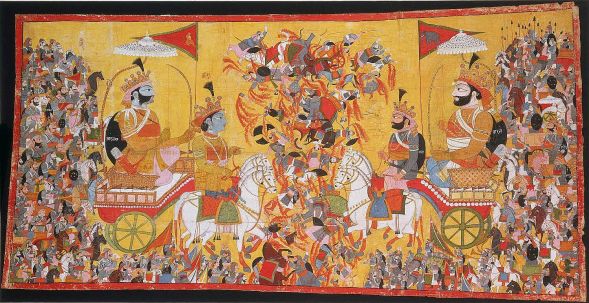
 arjuna_and_his_charioteer_krishna_confront_karna

Bhagavad-Gita in translations

As mentioned in the earlier part, the influence of the Bhagavad-Gita began to spread far and beyond Asia following its translations into English and other European languages during the latter part of 18th century, The Bhagavad-Gita captured the attention of the western scholars, intellectuals as also that of the general-readers. That, not merely widened the extent of its readership but also lent it the scope for deriving varied interpretations

In 1785, the Gita became the first Sanskrit work to be translated into English; and, it provoked widespread excitement among English Orientalists, German Romantics, and American Transcendentalists. By about 1890, the Gita was accessible to average European and American; and, it came to be regarded as India’s national or spiritual symbol

In its extended life, the Bhagavad-Gita was enriched with new meanings and new relevance in new settings. Different aspects of the work came to the fore.   The new hearers and new readers found in it  the ways to answers  their varied concerns.

The translations of the Bhagavad-Gita have a very interesting history. Ms. Mishka Sinha in her A History of the Gita’s Transnational Reception, 1785-1945 has very ably chronicled the saga of Gita’s translations  and interpretations during and after the eighteenth century. She writes in the introduction to her paper: ‘the Gita as a received and translated text was significantly altered (during this period) in certain specific ways which continue to influence its present understanding both in the West and in India’. Much of this installment of the article is based on Ms. Sinha’s paper.

[Please check here for varieties of translations and commentaries on the Bhagavad-Gita.]

whitelotusmandala

Code of the Gentoos Law

With the rapid spread of the British colonial environment and the rise of the East India Company, the British courts in India had to adjudicate on increasing number of legal disputes among the locals. The Court of Directors of the East India  Company decided  to take over the administration of civil justice ; and, felt that it would help its business interests if it could involve in what they termed as ‘Hindu learning’ to decide on civil matters.

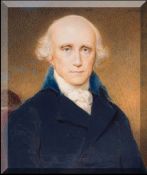
warren hastings

Accordingly, Warren Hastings who was appointed as Governor General of Bengal in April, 1772 was asked to execute the Company’s decision; and, interalia come up with a ‘Judicial Plan’.

His immediate object thereafter  was to  devise an arrangement  to dispense law/justice  to the Indian litigants  in ways that are as close  as possible to their own customs, in matters of person and property; and, particularly, on matters considered as religious.

*

But, the dispensation of justice had to be according to the British norms and by British Judges; and it was made   explicitly clear that employing the Indian scholars or pundits as judges was totally out of question.

 [The criminal cases were to be decided according to British laws.]

By August 1972, Warren Hastings submitted his ‘Judicial Plan of 1772’. It  declared that ‘in all suits regarding inheritance, marriage, caste, and other religious usages, or institutions, the laws…of the Shaster with respect to Gentoos* shall be invariably adhered to’.

[* A brief explanation about the term ‘Gentoo’ appears necessary here.

It is said; ‘Gentoo’ is a corruption of the Portuguese word Gentio, meaning a gentile, a heathen, or native.

The Portuguese (who perhaps were the earliest to colonize India) after they landed on the west coast found that the native inhabitants of India also included Jews and the Moors (Muslims). They did not quite know what those other indigenous pagan religious groups were called. But, the Portuguese named them as Gentoos – the native heathens.

Thus, as early as in the sixteenth century, Gentoo was a term commonly employed, basically, to distinguish local religious groups in India from the Indian Jews and Muslims. The Oxford English Dictionary defines Gentoo as ‘a pagan inhabitant of Hindustan, a heathen, as distinguished from Mohammedan’.

It is explained; that such concept of ‘heathen’ is derived from the Christian-world view. According to medieval Christian belief, the entire population of the world was classified into four major religious groups: ‘lexchristiana, lexiudaica, lexmahometana and lexgentilium’; that is, Christians, Jews, Muslims and the rest ‘Heathens’. The ‘idolaters’- of any sort -, who were said to form roughly nearly two-thirds of the world’s population, were also grouped under ‘heathens’ (gentilium).

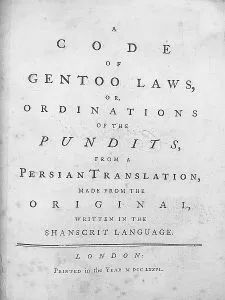
Till about the eighteenth century, the native population of India (other than Jews and Muslims) were labelled by the Europeans as Gentoos. That is the reason why the first digest of the Indian legislation drafted by the British in 1776 for the purpose of administering justice and to adjudicate over civil disputes among the people of India belonging to local religious groups was titled as A Code of Gentoo Law.

code of Gentoos

In the introduction to the Code of the Gentoo Laws, (pages xxi-xxii) it was explained that the terms ‘Hindustan’ and ‘Hindoo’ are not the terms by which the inhabitants originally called themselves or their religion. In fact, in very distant past when their books were created, the religious distinctions as we know did not yet exist. And,  their land was originally called as Bharatha-khanda or Jamboodweepa, in Sanskrit. Hindustan is a Persian word unknown to the original inhabitants of the land.   It was only since the era of Tartars (Muslims) the name Hindoos came into use to distinguish them from the Mussalman conquerors. Thus, the term ‘Hindoo’ was employed mainly to demarcate some class of natives from some other class of natives. The translators, therefore, decided to reject the term Hindoo; but to retain Gentoos which term was then in common use among the Europeans.

It was only later when the British realized that the Indian Gentoos had numerous religious groups and sub-groups among them, the term ‘Hindoo’ came to be used in place of the Gentoo. Accordingly, in the British official records, ‘the religion of the Hindoos’ gradually displaced ‘the religion of the Gentoos’. The word Gentoo later became archaic and obsolete,

Until then, what is now called as Hinduism was officially referred to  by the Europeans as the religion of the Gentoos. In the early years after that change, which is till end of    early nineteenth century, the word ‘Hinduism’ was in common currency ; and , it largely meant  ‘the primal and ancient religion of the subcontinent’.  But in the later years, the scope of the term Hindu as a religion was restricted to cover non-Muslims and non-Christians.

Thereafter, the word Hindu (though not originally Indian) which till then commonly referred to a geographical region (Hindu-stan), a cultural association, or language (Hindu-stani) or to a common religion of the land etc came to acquire specific religious connotations and characteristics. Consequently, the concept of the ‘Hindu religion’, that is ‘an Indian religion with a coherent system of beliefs and practices that could be compared with other religious systems’ got established.]

*

That Declaration led to taking up the huge task of building a body of jurisprudence to serve as the source of indigenous case-laws. Hastings, for that purpose, ordered Nathaniel Halhed (1751-1830), an orientalist as also a philologist, to supervise the task. Halhed, who was well versed in Persian and Bengali started with compiling Hindu legal code from a Persian version of the original Sanskrit.

Thereafter, a panel of ten pundits was commissioned to compile a digest of ‘Hindu’ legal literature based, mainly, on the body Dharma-shastras from the original Sanskrit texts. The digest compiled from various sources was named Vivada –arnava- setu or the sea of litigation.

The process had to be hastened with the establishment of Supreme Court in 1774, as an Appellant Authority

And, for the benefit of the English Judges ignorant of Sanskrit, it became necessary to prepare a translated version of the compilation made by the Pundits (Vivada –arnava- setu) in addition to that of the  selected ancient Sutras relating to civil matters of person and property (Vyvahara).  Such translated compilation/ compendium were made in two versions; one in English and the other in Persian. The task of translation and its publication was entrusted to Nathaniel Halhed.

The English version of the digest was titled A Code of Gentoo Laws or Ordinations of the Pundits; and, was published in 1776 to serve as a source for ’legal accomplishment of a new system of government in Bengal, where, it was said :  ‘the British laws might , in some degree, be softened and tempered by a moderate attention to the peculiar and national prejudices of the Hindoo ; some of whose Institutes, however fanciful and injudicious, may perhaps be preferable to any which could be substituted in their room’.

That gave birth to the concept of a Hindu Personal Law.

[Attempts were also made to codify the Shastras and to establish the chronological sequence of the texts in order to trace the authority to a single original source. Such attempts were not successful; and, an agreed sequence of authoritative chronological order of the ancient Dharma-Sutra texts could not be established.

However, by 1864, the long years of these exercises yielded a peculiar kind of case law in the form of a chain of interpretations by the English judges based on what they thought were the authoritative portions of the Hindu texts. That completely transformed the “Hindu Law” into a form of case law, as the British Judges of the Colonial India saw it fit.

What we have today is a forest of citations referring to previous judges’ decisions – as in Anglo Saxon – derived legal systems; and, it is left to the skill and wisdom of the judges and lawyers to search for an apt precedent; and,  to apply it to make the point of law. Those precedents were  again those that were set up by the English judges.

What started as a search for the “ancient Indian Constitution” ended up with English law for India and Indians made by the British – just what Indians would have wished to avoid.]

Such projects could not have been carried out successfully without the cooperation of the unacknowledged “native pundit” who provided the all-important linguistic expertise as well as cultural and historical context surrounding the texts in translation. But, sad to say they did not seem to have been treated fairly. Unacknowledged on title pages of translated texts, these scholar-translators were often portrayed as crafty Brahmins deliberately misleading; offering “obscure” textual interpretations; and possibly jeopardizing translation projects.

Bhagvat-geeta or Dialogues of Kreeshna and Arjoon

Following his involvement in the compilation of a digest of ‘Hindu’ legal literature based mainly on translations from Sanskrit texts, Warren Hastings asked Charles Wilkins , a merchant in the service of the East India Company to attempt translate Bhagavad-Gita , the most well known Hindu Book , into English. 

NPG D7848; Sir Charles Wilkins by John Sartain, published by  Moon, Boys & Graves, after  James Godsell Middleton

[ Charles Wilkins (1749 –1836), who was trained as a type-setter and printer, came to India during 1770, while he was about twenty years of age; and, joined the service of East India Company as a writer, or junior clerk. He learnt Persian and Bengali; and, was soon appointed as Company’s official translator of Persian and Bengali. He was also the first to attempt to design the typeset of the Bengali script, which task he completed in 1778 with the assistance of a gem-engraver and the expert blacksmith, Panchanana Karmakara.

*

[Please read the paper produced by Ms. Komal Pande, the Assistant Curator for Numismatics and Epigraphy at the National Museum in New Delhi, describing how Charles   Wilkins manufactured a set of metal printing founts or typefaces, that could be used to mechanical print the Bengali language.]

sanskrit type set

Charles Wilkins assisted William Jones (1746 –1794) a scholar and Judge in the Supreme Court in Bengal, to establish the Asiatic Society of Bengal in 1784. Wilkins moved to Varanasi to learn Sanskrit from Kasinatha Bhattacharya recognized as Sarva-shastra-guru – Master of all Shastras.  During this period, he attempted translating portions of Mahabharata into English under the guidance of his teacher (though he did not credit or acknowledge Kasinatha in his published translation). Wilkins’ translation of Mahabharata remained incomplete. He, however, could complete the translation of Bhagavad-Gita, a segment of the Mahabharata

For more: please check:

Sir Charles Wilkins’ life and works by Shamboo Chander Dey ; under the series  Eminent Orientalists :Indian, European and American (pages 27 to 45)

Wilkins, Kasinatha, Hastings, and the First English Bhagavad Gita by Richard H. Davis]

Warren Hastings had a great fascination for the Gita; and, was thrilled by Wilkins’ translation. He persuaded the Court of Directors of the East India Company to publish the work at the company’s expense. Charles Wilkins’ English translation of the Bhagavad-Gita was first brought out under the auspices of the Asiatic Society, Calcutta in November 1784. And, it was only later that it was published from London in 1785.

In his preface, Warren Hastings, praising the literary merits of Wilkins’ work, described it as: “a performance of great originality, of a sublimity of conception, reasoning and diction almost unequaled, and single exception among all the known religions of mankind of a theology accurately corresponding with that of the Christian dispensation and most powerfully illustrating its fundamental doctrines.”

Hastings asserted that the study and true practice of the Gita’s teachings would lead humanity to peace and bliss. In his Introduction , Hastings while quoting  few translated verses said :

‘Among many Precepts of fine Morality I am particularly delighted with the following, because it has been the invariable Rule of my latter Life, and often applied to the earlier State of it, before I had myself reduced it to the Form of a Maxim in writing. It is thus:

: – Let the Motive be in the Deed, and not in the Event;

: – Be not one whose motive for Action is the Hope of Reward. Let not thy Life be spent in Inaction. Depend on Application;

:- perform thy Duty, abandon all Thought of the Consequence, and make the Event equal, whether it terminate in Good or Evil; for such an Equality is called Application;

William Hastings was confident that Gita ‘will survive when the British domination in India shall have long ceased to exist’.

bhagavad_gita_translation_english

The Bhagavad-Gita rendered into English by Charles Wilkins Charles was formally published in 1785 under the elaborate title: Bhagvat-geeta or Dialogues of Kreeshna and Arjoon; in eighteen lectures; with notes; translated from the original, in Sanskreet, or the ancient language of the Brahmans; (London: C. Nourse, 1785). It earned the reputation of being the first widely known text to have been directly translated from Sanskrit into a European language. And, that brought Gita to the attention of Europe and other regions.

[Later, Wilkins’ translation went into several improved and revised editions in 1809; 1849.1885; 1959; and 1970]

In his preface, Wilkins mentioned that his objective in translating the Gita into English was:’ to encourage a form of monotheist “Unitarianism” and to draw Hinduism away from the polytheism ascribed to the Vedas’.

However, both Charles Wilkins and Warren Hastings had anticipated that the British interest in Gita would most likely be generated from ‘curiosity towards a strange cultural object’. They surmised, unerringly, that this aspect would ultimately prove the most significant attraction for their readers in England.

Accordingly, in England, Gita initially gained publicity mainly as a curious cultural object retrieved from the unknown past of the distant East or as a glimpses of the ‘ immature and primitive stage of human civilization..  The majority of general readership in Britain was primarily interested in traveler’s tales, however wild and fanciful.

As an early review put it; ‘Ultimately, the Gita’s importance lay not in any intrinsic quality it may have possessed, but in its value as “a curious specimen of mythology and an authentic standard of the faith and religious opinions of the Hindoos’.

In the eighteenth and early nineteenth century the Bhagavad-Gita was treated as either poetry, song or as literature of philosophical nature rather than scripture.

Apart from the general readers, Wilkins’ work attracted the attention of Christian Missionary who sought to use it to counter Hindu arguments; and to down-size Krishna as an Indian copy of Jesus. Gradually, the Gita spread to the writers and authors looking for the exotic. William Blake the celebrated Romantic poet in his picture The Bramins (1809) depicted Wilkins and Brahmin scholars working on the translation. Blake’s drawing suggested that the importance of the Gita lay ‘in its significance as an object of secret knowledge recovered through intellectual labor and imperial triumph from its hitherto unknowable form within a previously hidden tradition’.(Sadly, Blake’s drawing of The Bramins is said to be lost) 

Despite a fairly favorable initial reception, Wilkins’s translation did not achieve much significance in its early decades. Gradually, the  curiosity gave place to serious study by the scholars. William Jones advised all those who wished to “form a correct idea of Indian religion and literature” to forget “all that has been written on the subject, by ancients and moderns, before the publication of the Gítà” (Jones 1799: 363).

Other translations

Within a decade after its publication, Charles Wilkins’s translation gained wide publicity; and, it was further translated into French (Le Bhaguat –Geeta ou Dialogues de Kreeshna et d’Arjoon ..) by Abbé Parraud (1787); followed by translation into Russian by Nikolay Ivanovich Novikov (1787) – which is said to have inspired Count Leo Tolstoy; and into German (Der Bhaguat-Geeta, oder Gesprache zwischen Kreeshna und Arjoon)   by Friedrich Von Majer (1802).

Bhaguat gita

(Said to be world’s first French translation of the Bhagavad Gita by Parraud. Please click here to download the Book in PDF format)

There were also other translations.

**

The scholars Vishwa Adluri and Joydeep Bagchee, in their much acclaimed work The Nay Science: A History of German Indology, (Oxford University Press, 2014)  write:

The earliest translations of the Gita (into German) emerged in the context of the Romantic fascination with the Orient.

Johann Gottfried Herder; Friedrich Majer; Friedrich Wilhelm Schlegel; August Wilhelm Schlegel, as well as the Philosopher-Statesman Wilhelm Von Humboldt had produced Gita editions or Gita translations and commentaries…

In his Zerstreute Blatter of 1792, J G herder had included three collections of verses from the Bhagavad-Gita under the heading ‘Gedanken einiger Brahmanen’ (thoughts of some Brahmans) . The collection included a total of eleven verses chosen from Chapters Two and Three of the Gita; and, were individually titled ‘Die Verstorbenen’ (The Dead Verses : 2,11,13,14 and 15); ‘Dreifacher Zustand’ (Three-fold Condition:  Verse 2,27); and, ‘Religion’ (Religion : Verses 3, 10, 11, 12, 13,14 and 16)….

Herder’s poetic rendering was followed in 1802 by the first complete translation of the Gita into German (albeit from the English edition of Charles Wilkins , rather than from Sanskrit) by his student Friederich Majer. Majer’s translation included an introduction, in which he pointed out the affinities between the Gita’s doctrine and Platonic and Spinozistic philosophy.

This tradition of philosophical appreciation was continued by Friedrich Wilhelm Schlegel, who appended an excerpted translation of the Gita to his 1808 study , Die Sprache und Weisheit der Indier .

*

Friedrich Schlegel Friedrich Schlegel (formally: Karl Wilhelm Friedrich; 1772-1829) a German poet, philosopher and Indologist in his monumental work, Über die Sprache und Weisheit der Indier : Ein Beitrag zur Begrûndung der Alterthumskunde (On the Language and Wisdom of India) – a lengthy comparative study of Indian language and philosophy – Heidelberg, 1808, observed the similarities in the grammatical structures of Sanskrit, Greek, Latin, Persian and German . As an appendix to his book, he included direct translations from Sanskrit into German of extracts from the Bhagavad Gita  (about one-fifth of the Gita in metrical German ) and other important classical Indian texts. The  work of Schlegel marks a significant moment of transition in the European study of the Bhagavad Gita and other classical Sanskrit works. While  explaining his choice of the Bhagavad Gita as his first Indic publication, Schlegel described the work as “a famous philosophical poem, praised in the whole of India, whose wisdom and sanctity can hardly be surpassed by any other.”

Schlegel argued that a people originating from India were the founders of the first European civilizations. He came to the conclusion that Sanskrit was the earliest form or the source of all the other classical languages.

Friedrich Schlegel’s study of the India and Indian languages inspired his elder brother August Wilhelm von Schlegel to move to Paris in order to study Sanskrit.  In 1818, Wilhelm became the first academic professor of Sanskrit in Germany, at the University of Bonn. 

The Schlegel-brothers, particularly Friedrich, came to be regarded as the founder of the Romantic school, which profoundly influenced the development of German literature since the beginning of the 19th century.

August Wilhelm Von Schlegel (1767-1845), who was the Professor of Indology and Sanskrit in the University of Bonn, published the Latin version of the Gita with original Sanskrit text (1823). This was the first direct translation of the Gita into a European language.

Between 1820 and 1830, August Schlegel published Indische Bibliothek, a collection of Indian texts. He is considered the founder of Sanskrit philology in Germany. His praise for the Bhagavad Gita was: If the study of Sanskrit had brought nothing more than the satisfaction of being able to read this superb poem in the original, I would have been amply compensated for all my labors. It is a sublime reunion of poetic and philosophical genius.

As a result of the early German philosophical engagement with the Bhagavad-Gita, the text not only continued to be translated by European,  British and Indian scholars but was also accorded a Bible-like status..


*

A few years later, a French translation of the Gita was made directly from Sanskrit by Jean-Denis Lanjuinais (1832); and published Posthumously. He had remarked that it was a great surprise to find among these fragments of an extremely ancient epic poem from India . . . a completely spiritual pantheism . . . and . . . the vision of all-in-God’.

Another direct translation into French was made by Émile-Louis Burnouf in 1861- (La Bhagavad-Gîtâ, ou le Chant du Bienheureux, poème indien).

And, a Greek translation by Demetrios Galanos was published posthumously by in 1848.

[Another translation of the Bhagavad-Gita into German by Dr. Franz Hartmann, a German medical doctor, theosophist and occultist , gained much attention , perhaps for wrong reasons. [ Bhagavad Gita, Die [nach diesem Titel suchen, White Lotus, Leipzig, 1924 ]

Heinrich Himmler was a Nazi , often described as the architect of the Holocaust. He was a very complex person indeed.  According to Felix Kersten (his personal massage therapist), from 1941 until his death four years later,  Himmler carried a copy of the Bhagavad-Gita in his pocket; and,  read passages from it regularly every night. The book was a translation of the Gita  by Dr. Franz Hartmann.] 

whitelotusmandala

Other English translations

In 1882, John Davies, Member of the Royal Asiatic society, of the Cambridge philological Society, came up with a prose translation of the Bhagavad-Gita published by the English and Foreign Philological Library; London Kegan Paul , Trench, Trubner  & Co, 1882 with an elaborate title : Hindu Philosophy The Bhagavad Gita or the sacred Lay, a Sanskrit Philosophical poem. Edwin Arnold in the preface to his translation the Gita (The song Celestial) lauds the prose transcript of Devies as being ‘truly beyond praise for its fidelity and clearness.’

The Davies’ translation was preceded , in 1855, by that of   J. Cockburn Thomson—a former student of H. H. Wilson, the first Boden Professor of Sanskrit at Oxford produced an improved translation of the Gita from the original Sanskrit text as The Gita or a Discourse between Krishna and Arjuna on Divine matters (a Sanskrit philosophical poem translated with copious notes, an introduction to Sanskrit philosophy and other matters); published by Stephen Austin, Hertford- 1835. According to Thomson, Wilkins translation was “far from giving a clear idea of the work … and still less of its philosophy.”

Charles Johnston, a retired English civil servant in Bengal and a Sanskrit scholar, brought forth a translation in 1908 in Flushing, New York of the Bhagavad Gita: “The Songs of the Master.” Johnston, in his lengthy Introduction paid rich tribute to the ancient text: ‘The Bhagavad Gita is one of the noblest scriptures of India, one of the deepest scriptures of the world. . . . a symbolic scripture, with many meanings, containing many truths. . . . [That] forms the living heart of the Eastern wisdom’.

A feature of these early English translations was to present the Gita as an expression of higher, abstract philosophical ideas within Hinduism, as distinct from its lower, popular, superstitious forms.

And, One hundred years after the publication of Wilkins’ translation Sir Edwin Arnold translated the Gita into blank verse – The Song Celestial (1885).  It achieved great fame as the most important and most widely-read version of the Gita. It also inspired Gandhi into the life-long study of the Gita. (Let’s talk more of these in the next Part)

[ For SELECT ENGLISH TRANSLATIONS OF THE BHAGAVAD GITA- CHRONOLOGICAL LIST]

whitelotusmandala

Spread of Gita’s influence

Wilkins’s translation made its way throughout Europe, and across the Atlantic, where it became a key scripture for American Transcendentalists. Carlyle presented Ralf Waldo Emerson with a copy of Wilkins’ translation of the Gita which proved to be his greatest source of inspiration. That also influenced the Concord (Transcendental). All other similar movements in America, in one way or the other, are indebted to Concord. Henry David Thoreau, living at Walden Pond in 1846, wrote of ‘bathing his intellect in the stupendous and cosmogonal philosophy of the Bhagvat-Geeta.’

From about 1880 the number of translations of the Gita began to raise steeply, both in English and in other European languages, while translation into Indian vernaculars also increased at the same time. At this juncture the text began to occupy a new cultural space within a broader context, and ignited intellectual debates in the West. Such translations and commentaries mainly focused on the allegorical or symbolic aspects of Gita and on the universal relevance of the text.

Swami Vivekananda color

[poster by an unknown artist, published by Goes Lithographic, Chicago , 1893 ; believed  to have been sponsored by Henry Slayton, Organizer of Vivekananda’s lecture tour.]

The participation of Swami Vivekananda at the World Parliament of Religions in 1893 and his subsequent series of talks in various cities of America also introduced the Bhagavad-Gita in particular and Vedanta studies in general to the western world. He declared. “We believe not only in universal tolerance, but we accept all religions as true.” This Parliament, he went on, could be seen as a fulfillment of Krishna’s statement in the Bhagavad Gita: “Whosoever comes to Me, through whatever form, I reach him; all men are struggling through paths which in the end lead to Me”. 

The Swami asserted that the foundation of Hinduism is the revelation found in the ancient Vedas; and , the Bhagavad Gita is the most authoritative commentary on the Vedas.

One of the Gita’s main achievements, according to Swami Vivekananda, is its reconciliation of different paths in classical India. Krishna’s original insight, he observes, was that all these various spiritual disciplines could be seen as valid means to a common end. The same reconciliation could be applied, at the end of the nineteenth century, on a worldwide basis. Among the topics of debate before parliament delegates was the possibility of a future “universal religion.” Swami Vivekananda closed his lecture by endorsing the concept of a universal religion; but suggested  it may already exist in the form of ancient Hinduism.

While in USA , the Swami quoting  the Gita,  stressed two main themes he believed that most people in the United States needed. First is Krishna’s tolerance of multiple paths toward spiritual attainment to counter the doctrinal rigidity he perceived in American Christianity of the time. Second was Krishna’s principle of non-attachment to the fruits of action in order to temper the acquisitive materialistic ethos of the American gilded age. 

[During Vivekananda’s cross-cultural career as a public speaker, the Gita conveyed differing messages to different audiences; depending on the Swami’s sense of the needs of his American or Indian listeners.

While in India, Swami stressed  on the Gita’s message  of socially engaged action or the path of karma yoga. “First of all, our young men must be strong. Religion will come afterwards,” he taught, “You will understand the Gita better with your biceps, your muscles a little stronger. You will understand the mighty genius and the mighty strength of Krishna better with a little of strong blood in you.”.. Swami Vivekananda approvingly quotes Krishna’s admonition to Arjuna, as a directive to young India : “Yield not to un-manliness, Oh Partha”]

By then, the Gita was beginning to gain   considerable significance in India’s struggle for freedom, where some groups interpreted as a call for armed protest against British Rule in India. At the same time, there were also others like Gandhi, preaching the values of a self-disciplined, non-violent struggle against oppression.

whitelotusmandala

Approach of the translators

Since then, the Gita has been translated into more than seventy-five languages. There have been hundreds of commentaries in Eastern and Western languages. Outside of India, the Gita is regarded as the first and the foremost work opening the way to understand Hinduism. The Gita has continued to live through the responses and interpretations of generations of readers.

As Richard H. Davis writes in the introduction to his The “Bhagavad Gita”: A Biography:

 ‘The work has lived a vivid and contentious existence over the centuries since, through readings and recitations; translations and commentaries that have transcribed this classic into many currents and disputes.

Thus , the medieval  Hindu Gurus, British colonial scholars, German romantics, Globe-trotting spiritual speakers, Indian anti-colonial freedom fighters, western students and spiritual seekers all have engaged in dialogue with the Gita, each in his/her own manner’

But, again, there was a basic difference between the attitudes and the approach of the western scholars and the Indian translators/ commentators.

**

Each translation results from a series of choices. These choices reflect the translator’s own premises, aims, and conception of what that work most essentially is. In a valuable study of Gita translations in English, Gerald Larson speaks of the “strategic decisions” every translator must make. He analyzes these along four axes: the stylistic pedagogical, interpretive, and motivational continua. Does the translator seek to maintain primarily the stylistic character of the Sanskrit original or to produce a literary rendering in appropriate English? What kind of audience does the translator envision for the work? Does the translator consider the task as rendering the meaning of the work in its time of composition or as it might take on new significance in contemporary times? What personal motivations or subjective reasons does the translator bring to the task of translating the Gita? Along with the skill that any translator brings to the task of navigating between Sanskrit and English, these strategic decisions together will help determine the shape of the Gita’s new English clothes.

There are also choices involved in the textual accompaniments that surround a translation in the body of a publication, or the “para-text” in Gerard Genette’s productive phrase. Does the book also contain interspersed commentary? Or parallel Sanskrit text? Does it have footnotes, and what issues do these notes address? Does it have an introduction? What topics are addressed there? How do these materials relate the Bhagavad Gita intertextually to other religious and literary works? As Genette reminds us, these “threshold” materials extend the work itself, mediating between the primary text and its public audience, guiding readers toward and within the translation.(Source : Erenow)

**

For most of the Western academics and researchers, ‘the translated Bhagavad-Gita was a proof of an ancient and glorious civilization; and, they  believed that the work was culturally important.  Almost all such translations of the Bhagavad-Gita during the nineteenth and the early twentieth century, treated it as a literary work, a song or as a philosophical poem; but , not as scripture.  For example;  Bhagavad-gita; or, The Sacred Lay, a Colloquy between Krishna and Arjuna on Divine Matters (J Cockburn Thompson 1855); The Bhagavad Gita or the sacred Lay, a Sanskrit Philosophical poem (John Davies,1882)  ; and, The Song Celestial or Bhagavad-Gita (Edwin Arnold,   1900 ).  Edwin Arnold, in the preface to his translation, refers to Bhagavad-Gita as ‘famous marvelous Sanskrit poem in which in plain and noble language it unfolds a philosophical system ‘. He observes that when translated it would enhance English literature’.

And, for the Christian Missionary translators it was a philosophical text that needs to be countered; but, surely, not a ‘sacred scripture’. They consistently made a distinction between the abstract philosophy of the Bhagavad-Gita and the superstitions of the Hindu mired in mythology of gods ‘stained by cruelty and lust’ (John Davis 1882). Thus while the high philosophy of Bhagavad-Gita might approximate somewhere near to Christian principles, it would not be adequate to redeem the lost souls of the Hindu.

The primary purpose of missionary writings on Hinduism  and the Gita was to understand the beliefs of the peoples they were seeking to convert, so that future missionaries could come well-prepared to defend Christianity The noted examples of such early works were: De Open-Duere tot het Verborgen Heydendom [1651- The Open Door to Hitherto Concealed Heathenism] by Abraham Roger (d. 1649)  ; and, ‘Genealogy of the Malabarian Gods from Native Writings and Letters’ by Bartholomaus Ziegenbalg(1682–1719). Such missionary interest in “heathen” Hinduism continued in the following century with William Jones’s essay, “On the Gods of Greece, Italy and India” (1788) and William Ward’s A View of the History, Literature, and the Mythology of the Hindoos (1815-18).

[ Hephzibah Israel, a Lecturer in Translation Studies, University of Edinburgh, in her well researched paper Translating the Sacred: Colonial Constructions and Postcolonial Perspectives writes :

Thus, apart from Christian missionaries and Orientalist scholars, a whole range of Europeans – travelers, traders, colonial administrators – translated sacred texts of various kinds and for a variety of purposes. These translations were “speech acts” from different perspectives, sometimes working at cross purposes, sometimes colluding to produce convenient stereotypes of native cultures. Translation became a key mode of interpretation for these diverse interests. Common evaluative tools of textual interpretations and exegeses were employed across textual genres for the purpose of translation. The result was a shared archive of translated knowledge of what came to be termed the “Hindu mind” in colonial parlance

Although missionary and imperial interests did not always coincide, such translation activity helped to build a corpus of knowledge regarding key aspects of Indian “culture” that both could draw on and use for their respective purposes: shared methods of interpretation, shared attitudes toward languages and their interrelations, and shared translation techniques contributed to a shared understanding of their non-European “Others.”]

*

But, for the Indian translators, the Bhagavad-Gita was a sacred scripture, a Holy Book and one of the three fundamental texts (Prasthana-traya) of the ancient Dharma. They write in a tone that respects the Gita’s resilience and acknowledges the reverence it commands from its adherents. They have the faith that the Gita is still vibrantly alive, and “will continue to reincarnate itself in new ways’. Translating the Gita, and explaining the ‘inner-meaning (Anthara-artha) was an act of fulfillment, of educating fellow Indians; and as a duty to spread the truth. It was also an attempt to present Gita as a Universal message; and Hinduism as an open-ended outlook of life in contrast to other rigid religious faiths.

A significant number of Indians engaged in translation, offered the Bhagavad-Gita as an example of the highest Hindu philosophical thought. For instance ; Tiruvalum Subba Row’s Discourses on the Bhagavat Gita (1888) and  R. Sivasankara Pandiyaji’s  translation, Bhagavad Gita Sara Bodhini or The Essential Teaching of The Bhagavad Gita (1897)  sought  “to help students in studying its philosophy” and to “lead them back to a purer faith”.

Even among the Indians, particularly of colonial India of early 20th century, the nationalists promoted the Gita as a central work of an emerging Indian national ethos.  According to them, the new battlefield was the British Raj, calling for concerted social and political action. The form of such action was , however, a matter of debate – violence Vs non-violence.  

[The Gita Press at Gorakhpur did remarkable work, in the early twentieth century, in spreading the message of the Gita among the common people. It widely distributed copies of Gita translated into Hindi and other languages. And, during the turbulent period of resistance to colonial rule, Gita , somehow,  came to be seen as a symbol of’ ‘nationalism’. And, during that period, anyone possessing more than a single copy of the Gita was suspected by the British as a ‘trouble-maker’. In a move to resist or even overwhelm the British, the Gita Press during 1927 distributed , freely or at a nominal price  , copies of ‘Gita Diaries’ , which also featured selected  verses from  the Gita spread  over the whole year; along with  verses for  daily meditation .]

***

Kashinath Trimbak Telang

kashinath-trimbak-telang

The first Indian to translate the Gita into English was Kashinath Trimbak Telang (1850-1893) a Sanskrit scholar of merit, an Indologist and a Judge at the Bombay High Court.  He first published the translation of the Gita in verse form during 1875. Later in 1882, his prose-translation was brought out as Vol. 8 of the ‘Sacred Books of the East ‘series edited by Max Muller with the title The Bhagavadgita with the Sanatsugatiya and the Anugita (Oxford, The Clarendon Press, 1882).The volume of Telang’s translation of the Gita included his translations of the Anugita* and Sanatsugatiya**.  

Kashinath Trimbak Telang was one of the only two Indian scholars invited by Max Muller to contribute to the ‘Sacred Books of the East ‘series; the other being Sir RG Bhandarkar. Telang’s Gita, scholarly and methodical, turned out to be amongst the more popular books in India, selling over two hundred copies (the practice of the readers of those times was to borrow books from the library than to buy). But sadly, Telang’s translation did not receive serious reviews in England. Edwin Arnold, in the introduction to his translation of the Gita wrote:’ Mr. Telang has also published at Bombay a version in colloquial rhythm, eminently learned and intelligent, but not conveying the dignity or grace of the original’.

 [* Anugita (that which follows the Gita), appears in the Ashvamedha Parva of the Mahabharata, as a sequel to the Bhagavad-Gita. It again is a conversation between Krishna and Arjuna. It takes place at the Pandava’s palace in Indraprastha, as Krishna was on his way back to Dwaraka after helping to restore the kingdom of Hasthinapur to the Pandavas following their victory in the war at Kurukshetra.   

**The Sānatsujātiya     appears in the Udyoga Parva   of Mahabharata as teaching imparted by the sages   Sanat-sujāta    to the blind king   Dhṛtarāṣṭra. It is a philosophical classic   , composed in five chapters (Adyāya 41-46).]

For more on the life and work of Kashinath Trimbak Telang – please read the article  by Vasant. N Naik, included under The Eminent Orientalists: Indian,European and American (pages from 79 to 91)

***

The Theosophists

The Theosophists came upon the Gita by about 1890s. Apart from providing explanations in theosophical terms, they highlighted the allegorical representations of the Gita. Shri T. Subba Row, an early Indian initiate into Theosophy, explained that Krishna in the Gita represented Logos the objective expression of the Absolute; while Arjuna represented the monad, Nara, the individual soul Jiva   in conjunction with Buddhi and Manas.

Mohini Mohun Chatterji (1858-1936), a member of the Bengal Theosophical Society (from 1882) and a significant member of the Theosophical Movement, in her translation of the Gita – The Bhagavad Gita or  The Lord’s Lay (1887), aimed to  create a distinctive identity for modern Hindu spirituality in the Western intellectual world of the late nineteenth and early twentieth century.

Bhagavadgita Mohini Chatterjee

William Quan Judge, in his Essays on the Gita (1890) presented an entirely allegorical interpretation of the Mahabharata. Annie Besant extended the allegory to India’s struggle for freedom. According to Besant’s interpretation, the struggle by Arjuna was “to destroy a usurper who was oppressing the land; and, it was his duty as prince, as warrior, to fight for the deliverance of his nation and restore order and peace’.  The parallel she constructed between Mahabharata war and the Indian freedom struggle came to be widely accepted; and, influenced the political stance of many leaders including Tilak. Besides, Annie Besant pointed out to the universal nature of the Gita, saying: ‘To speak of the Gita is to speak of the history of the world’.

whitelotusmandala

The Gita in the twentieth century

There have also been valued translations by western scholars such as Franklin Edgerton, Robert Charles Zachner, Kees W Bolle, JAB van Buitenen and W Douglass P Hill.

However, two translations that appeared in 1935 and 1944 which brought together Indian and prominent western scholars are regarded very significant in asserting to the spiritual authenticity of the East and upholding the Universal relevance of the Bhagavad-Gita. Both translations were rich in allegorical interpretations and symbolic possibilities of the text.

These two translations, Ms. Mishka Sinha writes:

‘these two translations of the Gita reveal the influence of the inherited ideas and interpretations from the nineteenth century. Each is the product of collaborations between Indian and Western translators, and the authors of each unquestioningly accept the assumption of universal relevance that the Gita began to acquire in the period between 1880 and 1910.

Both translations were concerned with the symbolic possibilities of the text; however, the  interpretation  accompanying the second translation represents the culmination of the process begun by the literary an d allegorical interpretations of Arnold, Gandhi and the Theosophists, by turning the ordinary, surface meaning of the Gita on its head

Each could lay claim simultaneously to the spiritual authenticity of the East, and the cultural authority of the West, by bringing together Indian translators—Hindu swamis visiting the West—and prominent Western authors.’

The Geetatrans. by Shri Purohit Swami (London: Faber & Faber, 1935)

Shri Purohit Swami (1882-1946) a Hindu monk came to Britain 1931, at the instance of his Guru Shri Bhagwan Hamsa. He began with delivering a series of lectures on Indian philosophy and on Bhagavad-Gita. He became involved with British ‘spiritualists’ who helped him set up an Ashram in London. The Swami came in contact with the noted Irish poet, dramatist and winner of the Nobel Prize for Literature (1923), William Butler Yeats (1865-1939), who had a deep interest in spiritualism. He had been introduced to Hindu philosophy in 1886 through the Theosophical Society.

purohit_swami yeats

WB Yeats wrote introductions to Purohit Swami’s two books: An Indian Monk, with introduction by W. B. Yeats (London, Macmillan, 1932); and, Bhagwan Shri Hamsa, The Holy Mountain, trans. by Shri Purohit Swami, with introduction by W. B. Yeats (London: Faber & Faber, 1934)

At the instance of WB Yeats, Purohit Swami wrote a commentary on Bhagavad-Gita in a manner that could be understood by the British general reader. He avoided overuse of ancient Indian concepts and Sanskrit terms that might be unfamiliar to English-speakers. Yet, he managed to translate every word of the text into English.  Yeats took upon himself the task of helping the Swami publish his work. For that purpose, Yeats approached the well known publishing house the Faber & Faber, where the poet-scholar T. S. Eliot was the Editor. He was hoping that Eliot would also write an introduction which would enhance the prestige and acceptability of the Book. But, Eliot was reluctant to oblige Yeats and the Swami. Despite Eliot’s reservations, Faber took on the publication of four books by Purohit Swami, with the rider that they be either introduced by or in some way associated with the name of W.B. Yeats. However, the Book was published without an introduction by Yeats.

In 1935, the Swami’s translation of Bhagavad-Gita was published by Faber & Faber under the title The Geeta; The Gospel of the Lord Shri Krishna (1935). The Swami dedicated the Book ‘To my friend William Butler Yeats’, on his seventieth birthday.  Thereafter, the association between Purohit Swami and WB Yeats flourished. Yeats devoted much of his last years to the publication and promotion of Purohit Swami’s works. The two worked together to produce many books of great merit. In 1935, the Swami published a translation of the Mandukya Upanishad, for which Yeats provided an introduction. Later in 1938, they brought out the translations of Patanjali’s Aphorisms of Yoga (Faber & Faber, 1938); as also the translations of The Ten Principal Upanishads (Faber & Faber, 1938). Yeats wrote introductions for both the Books. And, Yeats included the Swami’s translations in the Oxford Book of Modern Verse 1892–1935.

The Song of God: Bhagavad-Gita, trans. by Swami Prabhavananda and Christopher Isherwood, with an Introduction by Aldous Huxley (Hollywood: M. Rodd Co., 1944)

In 1944 the Gita appeared in a translation by Swami Prabhavananda and Christopher Isherwood

swami-prabhavananda christopher-isherwood

Swami Prabhavananda (1893-1976) a monk of the Sri Ramakrishna Order arrived in the USA during 1923. Initially he was attached to the Vedanta Society of San Francisco. After two years, he established the Vedanta Society of Portland. In December 1929, he moved to Los Angeles where he founded the Vedanta Society of Southern California in 1930, which grew into a very influential organization.

The Swami was a learned scholar who wrote number of commentaries on Vedanta and other Indian philosophies.  He attracted the attention of several scholars like Aldous Huxley, Gerald Heard, Frederick Manchester and Christopher Isherwood.

[ Christopher Isherwood (1904-1986) was an English novelist, playwright, and screen-writer. After leaving Cambridge University in 1925, Isherwood in company of his school-friend WH Auden ( 1907-1973),  who was also a poet, travelled over Europe and then on to China (1938). Isherwood, Upward, and Auden formed the early core of the Leftist literary thirties generation in England. In January 1939, Auden and Isherwood (homosexual mates)  set sail for the United States. While living in Hollywood, California, as a screen-writer, Isherwood befriended Aldous Huxley with whom he sometimes collaborated. It was through Huxley that Isherwood came into contact with Swami Prabhavananda, head of the Vedanta Society of Southern California; and, became his disciple. With Swami Prabhavananda, Isherwood made a new English translation of the Bhagavad Gita, published in 1944. 

Though Isherwood did not become a monk, he remained a Hindu for the rest of his life, serving, praying, and lecturing in the temple every week and performing many literary chores for the order, including writing a biography, Ramakrishna and His Disciples (1965). His last book, My Guru and His Disciple (1980), records his conversion to Hinduism and his devotion to Swami Prabhavananda. ]

Of the many books authored by Swami Prabhavananda, his translation of the Bhagavad-Gita in collaboration with Christopher Isherwood (The Song of God: Bhagavad-Gita,) published by M. Rodd Co, Hollywood, in 1944 is most well known. It carried an introduction with by Aldous Huxley. The Time Magazine (1945) in its review lauded the translation as’ a distinguished literary work” that was “simpler and freer than other English translations (three of which have been published in the past year)’.

Huxley’s introduction to The Song of God: Bhagavad-Gita, which explained the allegorical interpretations of the Gita in various layers, became as famous as the Book itself. In it, he expounded the Universal ‘perennial philosophy, of the Gita. He said: :“The Bhagavad-Gita is perhaps the most systematic scriptural statement of the Perennial Philosophy [for] a world at war it stands pointing, clearly and unmistakably, to the only road of escape from the self-imposed necessity of self-destruction.”

As the Swami’s translation appeared in 1944, which was just after the end of World war II, the questions of war, violence gained special significance. Writing in the midst of a war of destruction and violence on an unprecedented scale, Huxley reread and re-imagined the Gita in a mode which rejected the utter need to kill. He, like Gandhi, emphasized that the true message of the Gita is not violence; but, on the contrary, the futility and uselessness of violence, self-destruction; and, the harm it can bring upon whole generations. 

The other noted translations

A Philosopher’s Gita

“Every scripture has two sides,” writes Dr. Sarvepalli Radhakrishnan, “one temporary and perishable, belonging to the ideas of the people of the period and the country in which it is produced, and the other eternal and imperishable, and applicable to all ages and countries.”

Dr. Radhakrishnan recognizes the twin aspects of the Bhagavad Gita, a scripture that is both historical and abiding. While he acknowledges and respects the historical conditions of its composition, this modern Vedanta philosopher takes as his primary task in translating the Gita to offer “a restatement of the truths of eternity in the accents of our time.” Writing in the years immediately after World War II and the partition of British India into Pakistan and India, Radhakrishnan believes that the world’s pressing need is for the “reconciliation of mankind.” The Gita, he holds, is particularly well suited to this purpose.

**

The Bhagavadgita in the Mahabharata- A Bilingual Edition – Translated by J. A. B. van Buitenen, edited by James L. Fitzgerald. The University of Chicago Press,  Chicago, 1981

A. B. van Buitenen (1928-1979), a traditional scholar-translator, was an Indologist and Professor of Sanskrit in the Department of South Asian Languages and Civilizations at the University of Chicago. Towards the end of his rather short life he focused primarily on the study of Mahabharata.

“As an Indologist, Van Buitenen is committed to a contextual and historical reading of the Gita. He argues persuasively in his introduction that the Gita was “a creation of the Mahabharata itself,” rather than an independent work that somehow “wandered into” the epic at some later date. To make his case, he summarizes the plot to highlight Arjuna’s dilemma, which he sees as a tension fundamental to the Mahabharata as a whole. He also includes eight chapters preceding the usual eighteen of the Bhagavad Gita proper as well as the chapter after it to demonstrate the “subtle narrative weaving” that binds the Gita into the Mahabharata.”

In his introduction, Van Buitenen also locates the Gita as part of the social and religious discourse of classical India. In its own historical time of composition, he argues, the Gita addressed vital contemporary ethical, theological, and metaphysical issues. The work adapted concepts from other Indic schools of thought such as Mimamsa, Vedanta, Samkhya, Yoga, and Buddhism, and it put forward innovative new ideas carefully disguised as old ones. Van Buitenen uses his introduction to sketch the historical background necessary for the reader to view the Gita in its classical milieu. While he is certainly aware that the Gita has led a rich continuing life since that time, Van Buitenen’s emphasis is decidedly on the Gita in the time of its Indian composition.

“In his historian’s approach, Van Buitenen continues a venerable lineage in Western Indological scholarship devoted to the Bhagavad Gita. Appearing first with Wilkins and other British Orientalists of late eighteenth-century Calcutta, and taking institutional form in nineteenth-century Germany with philologists and scholars like the brothers Schlegel, the Gita has been maintained in many university settings in India, Europe, and North America by professors of Sanskrit like Van Buitenen. Their central task is to reconstruct the history and culture of ancient and classical India, especially as it was transmitted in Sanskrit texts. From Wilkins’s time on, the Gita has provided a particularly valuable and challenging window into that historical world, resulting in a steady stream of erudite translations and scholarly studies. Other noteworthy translations in the Indological lineage prior to Van Buitenen include those of Telang (1882) and Edgerton (1944). For a persistent reader, Van Buitenen’s translation and introduction offers the closest available approximation of the Bhagavad Gita in its original context.” (Source: Erenow)

His translation of the Bhagavad-Gita edited by James L. Fitzgerald and published posthumously (1981), is rated very highly by the scholars and ardent students of the Gita. His translation, based on the critical text and   studded with an in-depth scholarly introduction and many useful footnotes, is praised for its authentic presentation and illuminating clarity. It’s acclaimed for its accurate rendering and retaining the directness of the original text.

 The Bhagavad Gita (Classics of Indian Spirituality) by Eknath Easwaran; The Blue Mountain centre of meditation; 1985

Eknath Easwaran (1910-1999) was a scholar and a spiritual teacher, who wrote several books on meditation. He is also known for his translations of the Bhagavad-Gita, the Upanishads and the Dhammapada. It is said; Easwaran developed interest in the Gita under the influence of Gandhi whom he met in his young age.

Eknath Easwaran’s translation of the Bhagavad-Gita is rendered in clear, beautiful English; and is easy to read. Easwaran also wrote a three volume commentary, The Bhagavad Gita for Daily Living, as well as a simpler commentary called Essence of the Bhagavad Gita In his Essence of the Bhagavad Gita, Easwaran explains the  teachings of the Gita in a modern context and comments on the Gita’s view of the nature of reality, the illusion of separateness, the search for identity, the meaning of yoga, and how to heal the unconscious. The book views the key message of the Gita as how to resolve our conflicts and live in harmony with the deep unity of life, through the practice of meditation and spiritual disciplines.

**

Stephen Mitchell’s Bhagavad Gita: A New Translation (2000). “The Gita is usually thought of as a great philosophical poem,” he writes in his introduction

The main problem, he says, lies in finding a suitable verse form in English to render the Sanskrit shloka. He seeks a form that has the “dignity of formal verse,” yet is also “free and supple enough to sound like natural speech.” His choice is a loose trimeter quatrain. Each shloka is treated as a separate unit of four lines, three stressed syllables per line. By isolating individual shlokas (as most translators do) each verse can stand on its own, like pearls in a necklace, as a potential starting point for reflection and meditation. Respecting the integrity of the poem, Mitchell does not impose any of his own commentary, nor does he include annotations to the translation.

Mitchell’s translation is not the first poetic Gita in English. The legacy of literary translations began with Arnold’s charming 1885 blank-verse rendering, which made such an impact a few years later on the young Gandhi. Another distinguished literary rendering is the translation coauthored by California-based Vedanta Society teacher Swami Prabhavananda and British novelist Christopher Isherwood, published in 1944. Seeking to avoid the pitfalls of Indological translations with their “obscurity and archaic un-English locutions,” Isherwood tried to match the different types of discourse he found in the Gita with a mixture of English styles, both prose and verse, instead of sticking with a single verse form. Others have attempted to combine a scholarly attention to the Sanskrit original with a poetic rendering in English, including the recent versions by Barbara S. Miller (1986) and Laurie Patton (2006).– (Source :Erenow)

**

The Bhagavad-Gita by Georg Feuerstein, Brenda Feuerstein; Shambhala Publications; 2011

A more scholarly translation of the Gita comes from Georg Feuerstein. His translation with detailed notes is good for academic study. The left-hand page contains the Sanskrit in both Devanagari and transliteration, while the right-hand page contains a very literal translation, usually with several footnotes. A section in the back contains a word-by-word literal translation.

[There is also a first-ever translation of the Bhagavad-Gita into Maltese  by Dr Michael Zammit, Professor of Philosophy at the University of Malta; published by PIN Publications, Herbert Ganado Street, Pieta, PTA 1450, Malta. The audio version,  Bhagawad Gita ta’ Wjasa, Dr Zammit’s translation is being webcast on the University of Malta’s website. Please also read Dr .Zammit’s interview with Ms. Venetia Ansel the noted scholar , writer and publisher.]

whitelotusmandala

Mishka Sinha mentions that of all the translations and the commentaries on the Bhagavad-Gita published between 1880 and 1910, Telang’s translation; Edwin Arnold’s The Song Celestial; Translations by the Theosophists; and Gandhi’s Gita are notable for the influence they exerted as also for the explanations of the universal relevance, the allegorical and symbolic significance of the text.

[ For a detailed and very learned writing on Modern Gita :Translations , please check here.]

**

As Erenow writes :

What is the best English-language translation of the Bhagavad Gita? That will of course depend on the reader. In the Gita, Krishna commends all those who share his teachings with others. Yet we see how this sharing of the Gita can take myriad forms. Just as different translators bring different backgrounds and agendas to their task of rendering Krishna’s message, so readers will themselves bring their own differing aims to the work. Among the great plurality of translations, embodying diverse approaches to the Gita, the reader also is called on to select a path. If Krishna is correct, all those various translational paths will indeed lead the reader to him and his words.

***

Let’s talk about Edwin Arnold’s translation and about Gandhi on Gita in the next part.

lotus-bud

Continued in Part Four

References and sources

  1. Interpretations of the Bhagavad-Gita and Images of the Hindu Tradition: by Catherine A. Robinson
  2. The Bhagavad Gita and the West: The Esoteric Significance of the Bhagavad-Gita by Rudolf Steiner
  3. Exploring the Bhagavad Gitā: Philosophy, Structure, and Meaning by Ithamar Theodor
  4. The Bhagavad Gita: A Text and Commentary for Students by Jeaneane D. Fowler
  5. Fighting Words: Religion, Violence, and the Interpretation of Sacred Texts by John Renard
  6. The Failure of Allegory: Notes on Textual Violence and the Bhagavad Gita by Laurie L. Patton
  7. A Comparative Study of the Commentaries on The Bhagavadgītā by T. G. Mainkar
  8. Bhagavad-Gita in Mahabharata Translated and Edited by J. A. B. van Buitenen
  9. My Gitaby Devdutt Pattanaik
  10. The Bhagavad-Gita and modern thought introduction by Shruti Kapila and Faisal Devji
  11. The quest for objective truth – Modern Indian Interpreters of the Bhagavad Gita Edited by Robert Neil Minor
  12. Who Wrote Bhagavad-Gita by Meghnad Desai
  13. Da’ud ibn Tamam ibn Ibrahim al-Shawn – The Bhagavad Gita interpreted – Edited by Daud Shawni
  14. A History of Indian Philosophy, Volume 2 by Dr. Surendranath Dasgupta
  15. A Companion to Translation Studies edited by Sandra Bermann, Catherine Porter
  16. The “Bhagavad Gita”: A Biography By Richard H. Davis 
  17. ALL PICTURES ARE TAKEN FROM INTERNET 


1 Comment

Posted by on October 17, 2016 in Bhagavad-Gita, General Interest


Tags: , , , , , , , , , , , , , , , , , ,

Bhagavad-Gita Multiple interpretations- Part Two

Continued From Part One

an00483707_001_l

As mentioned in the prior part of this article, the Bhagavad-Gita is a many splendored marvel. It could be read and understood in any number of ways. And yet; according to TG Mainkar: ‘no single commentator has been absolutely faithful to the Gita’. The scholarly opinion is that each commentator seemed to have been keen on championing his preferred view of the text. And, in that process he subordinated certain verses of the text to the verses of his choice.

It is said in the ancient days; Bodhayana, the Vrittikara (the commentator – around the early centuries of the Common Era) had accepted the plurality of the text of the Bhagavad-Gita; and, did not uphold a single view above all the other plausible meanings/interpretations. He is said to have preached the doctrine of ‘Jñāna-Karma-Samuccaya’ – the doctrine that synthesizes Jnana and Karma.

The Brahma Sutras the highly condensed summary of the Upanishads   are open to multiple interpretations; and, each interpretation is valid in its own context. And, in a similar manner, the Bhagavad-Gita which also is considered to teach the essence of the Upanishads is amenable to varied interpretations. The pluralism of the interpretive approaches to Gita is truly interesting.

*

The renowned scholar and one of the the most versatile and brilliant of the Judges of the Bombay High Court, Justice Kashinath Triambak Telang (1850-1892), in his introduction to Bhagavad-Gita  (Oxford, New  Clarendon Press, 1875/ 1882) , writes :

My view is that the Gita and the Upanishads – the philosophical part, has not been consistently and fully worked out. We have there, the results of free thought, exercised on different subjects of great moment, unfettered by the exigencies of any foregone conclusions; or any fully developed theory.

It is only afterwards; it is at a later stage of philosophical progress that systems of various kinds arise. In that stage some thinkers interpret the whole works in the light of some particular doctrine or expressions.

And, the result is the development of a whole multitude of philosophical sects, following the lead of those thinkers; and, all professing to draw their doctrine from the Gita or the Upanishads; yet each differing remarkably from the other.

The Acharyas

The early commentators of the Gita belonged to certain specific Schools of philosophy or traditions.  And, their view of the Gita and its interpretations depended upon the concept of the Supreme reality, the individual and the world; and the nature of relationship between these entities espoused by his School.

In the classical commentaries (Bhashya) produced by the Revered Acharyas, the interpretations and the related discussions were mainly in terms of the triad themes of: Jnana, Karma and Bhakthi. The paths (Yoga) associated with each of these    held the complete attention of the commentator.

 Each of the Acharyas insisted on providing a particular, single-pointed interpretation (Bhashya) to the text, championing the  principal philosophical precept of his School of thought; sidelining the other plausible interpretations ; and, subordinating the rest of the text to his chosen verses .

 Sri Sankara

dws-s006-f33

For instance; Sri Sankara (Ca.8th century) in his commentary on the Bhagavad-Gita argued that the prime or sole point of dialogue between Krishna and Arjuna was jnana marga (the path of knowledge) and giving up the path of action (karma marga).

He focused particularly on the verse 4.33: Son of Pritha all action is fully contained in knowledge; the Yajna of knowledge is better than Yajna of action, scorcher of enemy.

श्रेयान्द्रव्यमयाद्यज्ञाज्ज्ञानयज्ञ: परन्तप | सर्वंकर्माखिलंपार्थज्ञानेपरिसमाप्यते || 33||

Śhreyān dravya-mayād yajñāj jñāna-yajña parantapa/ Sarva karmākhila pārtha jñāne parisamāpyate  /BG 4.33: /

 O subduer of enemies, sacrifice performed in knowledge is superior to any mechanical material sacrifice. After all, O Partha, all sacrifices of work culminate in knowledge.

 Sri Sankara saw the true object of knowledge as Brahman

 For Sri Sankara, the attributes of Krishna, so wonderfully discussed in Chapters 10 and 11 represent the relative aspects; and, not the all-encompassing Absolute reality, the Brahman.

In Sri Sankara’s view, any verse of the Gita that did not engage in pursuit of Jnana was secondary to other verses that did. Such verses are, at best, incidental (prasangika) discussing worldly matters (laukika nyaya); but, not directly engaged in pursuit of Jnana, the knowledge of self, which is the main intent of the Gita.

The other commentators, of course, disagreed with Sri Sankara’s view of the God and the Universe. They staunchly believed that the personified Brahman (Isvara) was real; and , could be attained and experienced in that form.

Sri Ramanuja

ramanuja

Sri Ramanuja, in his Gita Bhashya,  argued that the intent and the message of Gita was not what Sri Sankara had supposed. He advocated the path of devotion (Bhakthi marga), which was rather more important than the path of knowledge. For him, the Bhakthi Yoga, the path of devotion, as detailed in chapters 12 and 18 that sing the glory of the God in his all encompassing magnificent splendor are indeed the true force and intent behind the teachings of the Gita.

Krishna’s display of his most wonderful Universal form (Vishwa rupa) represented the true manifestation and the transformative reality of the God. Sri Ramanuja saw particularly the later chapters as being crucial to its central meaning of the Gita : Son of Bharatha go with your whole being , to that One alone ; and from that Grace you will reach the eternal dwelling place (BG : 18.32).

 अधर्मंधर्ममितियामन्यतेतमसावृता | सर्वार्थान्विपरीतांश्चबुद्धि: सापार्थतामसी || 32||

 Adharma dharmam iti yā manyate tamasāvitā / Sarvārthān viparītānśh cha buddhi sā pārtha tāmasī  / BG 18.32:

That intellect which is shrouded in darkness, imagining irreligion to be religion, and perceiving untruth to be the truth, is of the nature of ignorance.

According to Sri Ramanuja, Krishna’s exhortation to Arjuna in verses 2.37-38 ( highlighted by Sri Sankara ) , is not a way of dispelling fear as Sri Sankara claimed ; but,  it is  merely a way of arguing that Atman is real.

Sri Madhva

dws-s134-f29

Sri Madhva  (late twelfth century) , in his Bhashya and Tatparya Nirnaya on Bhagavad-gita,   argued that one should maintain strict dualism between God and the world; and, held the view that both the path of devotion and the path of knowledge were central to the teaching of the Gita; and that one should not put one above the other.

According to him, the relation between the Lord and the created world is not one of absolute realty and mere illusion. It was rather more like relation between a man who does not need a stick to walk, but still uses it rather playfully. Following that , one of the central verses in the Gita , for his school , was the verse 9.8 : Born up by my own material nature (prakrti ) , again and again , I send out by the power of material (prakrti) , this whole collection of beings which is , in itself , powerless.

 सर्वभूतानिकौन्तेयप्रकृतिंयान्तिमामिकाम् | कल्पक्षयेपुनस्तानिकल्पादौविसृजाम्यहम् || 7||

प्रकृतिंस्वामवष्टभ्यविसृजामिपुन: पुन: | भूतग्राममिमंकृत्स्नमवशंप्रकृतेर्वशात् || 8||

 Sarva-bhūtāni kaunteya prakiti yānti māmikām / Kalpa-khaye punas tāni kalpādau visijāmyaham

Prakiti svām avahabhya visijāmi puna punaḥ / Bhūta-grāmam ima kitsnam avaśha prakiter vaśhāt

BG 9.7–9.8: At the end of one kalpa, all living beings merge into my primordial material energy. At the beginning of the next creation, O son of Kunti, I manifest them again. Presiding over my material energy, I generate these myriad forms again and again, in accordance with the force of their natures.

According to this school himsa or violence necessary for Arjuna is a part of the reality of the world, the stick that one must use to walk.

Abhinavagupta

abhinavagupta

Abhinavagupta (Ca. 11th century), the great light of Kashmiri Shaivism, developed a mystical allegorical approach to Gita. He said that he intended to bring to light the hidden or esoteric meaning of the Gita. According to his commentary (Gitartha-samgraha – the summary of the true meaning of the Bhagavad-Gita), knowledge and action, essentially, are not different. The framework of his approach is – jnana-karma-samucchaya – the reconciliation of the paths of knowledge and action. Abhinavagupta advises that while knowledge is important, action should not be sidelined. The two are equally important; as both emanate from consciousness (ज्ञानक्रियामयत्वात् संवित्तत्वस्य).  It is essential that involvement in action does not bind one to the mundane (कर्मणां ज्ञाननिष्ठतया क्रियमाणानामपि    बन्धकत्वम्).

 The jnana, bhakthi (devotion) and karma also called vijnana. Actions are modified and transformed by knowledge, so that they are no longer necessary.

According to Kashmiri Shaivism, the highest reality is the light (Prakasha) of pure consciousness; and it is manifested through Vimarsha. In the process of expansion of consciousness (creation), Vimarsha gives rise to powers of Iccha (will), Jana (knowledge) and Kriya (action). It maintains that the activity (Kriya) of Shiva is his very nature; and, is the result of his absolute freedom (Svatantra-shakthi).   It asserted that Universe is real and is not an illusion.

As Abhinavagupta puts it:    actions flee before knowledge of Brahman like gazelles in the forest when the lion roars.

He found the verse 6.31 of the Gita very apt for liking: the follower of the Yoga who resorts to Me as One who abides in all beings, abiding in oneness existing in all ways, that one dwells in Me.

 सर्वभूतस्थितंयोमांभजत्येकत्वमास्थित: | सर्वथावर्तमानोऽपिसयोगीमयिवर्तते || 31||

 Sarva-bhūta-sthita yo mā bhajatyekatvam āsthitaḥ / Sarvathā vartamāno ’pi sa yogī mayi vartate

G 6.31: the yogi who is established in union with me, and worships me as the Supreme Soul residing in all beings, dwells only in me, though engaged in all kinds of activities.

For Abhinavagupta, even as God the Supreme consciousness is non-dual, its opposite the illusion Maya, is not negative, as Sri Sankara implied, but is also the free play of consciousness.

Abhinavagupta visualizes the battle between Pandavas and the Kauravas as the conflict between knowledge and ignorance. And, through that he understands the related dualism of the body and spirit; passion and equanimity. Here, the Kauravas stand for ignorance and the Pandavas stand for knowledge. Arjuna’s battle has thus to be seen as the fight for knowledge, resulting in the free play of consciousness. Thus, all the verses, including 2.37-38, are interpreted in the light of this extended metaphor. One must cultivate the patience, energy and courage in this larger spiritual process whereby ignorance is eliminated.

Santa Jnanesvar

Jnaneswar2.jpg

The Jnaneshwari (Bhavarth Deepika) is one among the most celebrated commentaries on the Bhagavad-Gita. It was composed by Santa Jnanesvar or Jnanadeva (1274-1297) the boy saint – poet – philosopher- Yogi of Maharashtra belonging to the Natha tradition of Siddhas.  He composed this magnificent work while he was a lad of thirteen years. Jnaneshwari is revered as crest jewel of Marathi literature.

Jnanadeva compared the Gita to Chintamani – the legendary multifaceted wish-granting-gem. He considered Bhagavad-Gita under three broad divisions. The first three chapters of the Gita, according to him, relate to karma-yoga; the next eight chapters (from four to eleven) are devoted to Bhakthi-marga combined with action (karma); and the third segment of the Gita (from chapters twelve to fifteen) describes the Jnana marga.

Jnanadeva considers that Bhagavad-Gita, proper, per se, ends at the fifteenth chapter.  The chapter sixteen, he says, merely points out the qualities that help or hinder the path of knowledge. The last two chapters (seventeen and eighteen) are incidental, clearing some doubts raised by Arjuna. Besides providing such clarifications, the last chapter serves also as the pinnacle of the Gita –text- structure (Kalasha-adhyaya).

*

The narrative presentation of the Jnaneshwari is quite dramatic. Here, Jnanadeva seated on the south bank of the Godavari River, with his Guru, Nivrittinatha, talks about the Bhagavad Gita. Jnanadeva addresses his immediate audience, and the audience listens attentively. And, a scribe named Sacchittananda writes down the whole conversation.

In his oral discourse, Jnanadeva assumes the voices of all the characters of the Gita: Sanjaya, Dhritarashtra, Arjuna, and most of all Krishna. And, it is with Krishna that Jnanadeva gets totally involved. He becomes one with Krishna and speaks in his voice.  The Krishna of the Jnaneshwari is an Eternal and Universal Being living in the past, present and future; ever active and communicating with the world. Here, in Jnaneshwari, Krishna comments and explains, employing delightful metaphors and analogies, on concepts, ideas and practices that were not mentioned in the Bhagavad-Gita. For instance; Jnanadeva speaks of the virtues of Nama-japa ceaselessly repeating (chanting) of the holy name of the Lord, with faith and devotion; and, he also brings in the yogic discipline of the Natha School of the Siddhas explaining the processes of awakening the Kundalini within the subtle body.

 And, Bhagavad-Gita for Jnanadeva is a living and a vibrant text that is relevant for all times, reinventing itself all the time.

*

Jnanadeva was basically an Advaita-vadin [though he sharply differed from Sri Sankara on his concepts of Ajnana (ignorance) and Maya]. Janadeva was in some ways, closer to Abhinavagupta. 

According to Jnanadeva, Reality is beyond relative knowledge and ignorance.   He adopts the theory of Chid- vilasa which maintains that the universe is the expression of the Absolute Reality. He asserts that though the Absolute Reality is beyond being (sat) and non-being (a-sat) it has its own glory.  It surely is not void. While addressing the Supreme Self, Jnanadeva employs such terms as omnipresent (vishwarupa), having the form of the universe (vishvakara), and soul of the universe (vishvatman), Lord of the universe (vishwesha), existing in all forms (vishuamurti) and the one who pervades of the universe (vishvavyapaka)

Vishwaroopa

Jnanadeva asserted that the true knowledge consists in realizing Supreme Self in the non-dual form; and, that devotion should culminate in Advaita Bhakti. He taught that the path of loving and guileless devotion (Akritrim Bhakthi) and self-less action as  the  way to attain that goal. He said that everyone should perform his duty lovingly as a Yajna and offer his or her actions as flowers at the feet of the Lord.

Infinite Love of God is the central reality (Chid-vilasa) of which His power and wisdom are but aspects. According to Jnanadeva; it is through such Bhakthi and Bhakthi alone that the Supreme Reality can be realized. In the ultimate, the devotee merges with his God; but, yet remains distinct.  He emphasizes Upasana (service) and Bhakthi (loving-devotion) not merging with the Absolute while not losing one’s identity.

The Jnaneshwari which advocates the path of Bhakthi provides the philosophical basis for the Bhakthi sect which flourished in Maharashtra. It is worshipped as one of the three sacred books (i.e.the Prasthanatrai of Bhagawata Dharma) along with Eknathi Bhagawata and  Tukaram Gaathaa.

navamallika

 Colonial period

In 1785, the Gita became the first Sanskrit work to be translated into English; and, it provoked widespread excitement among English Orientalists, German Romantics, and American Transcendentalists. By about 1890, the Gita was accessible to average European and American; and, it came to be regarded as India’s national or spiritual symbol.

Following its translations into European languages, during the 18th century, the Gita gained a sort of territorial transcendence, spreading its influence beyond Asia. The Bhagavad-Gita captured the attention of the western scholars, intellectuals as also that of the general-readers. That not merely widened the extent of its readership but also lent it the scope for providing varied interpretations.

Apart from its mythological, historical and linguistic interpretations, the Gita came to be regarded as a text of universal relevance having an allegorical construction, which uses symbols and metaphors to put across hidden truths of spiritual significance.

In its extended life, the Bhagavad-Gita was enriched with new meanings and new relevance in new settings. Different aspects of the work came to the fore.   The new hearers and new readers found in it ways the answers to their varied concerns.

Thereafter, the discussions about Bhagavad-Gita were no longer limited to the classical terms of Advaita – Dvaita. The commentaries based solely in such theological doctrines, somehow, became rather rare.

In the next phase of its unfolding, the Gita was discussed in terms of   Jnana-Karma-Bhakti Yoga. That was before it slid into the uncomfortable question of the relevance of violence in dealing with the problems of existence.

**

Yoga-s

The commentaries of the eighteenth and nineteenth century asserted that the Gita does not seem to favour renunciation or total withdrawal from the world resulting in inactivity, nivritti. Instead, it was said, the Gita teaches Jnana that endorses renunciation of desires, of fruits of action. It advocates activity pravritti the opposite of renunciation of action.

 The general drift of the explanations was:

The term Yoga used in the Gita is not confined to mean a discipline as developed by Patanjali. Yet, it includes some refined processes that pre-date Patanjali.  Yoga is used in Gita in a variety of senses. It might mean a deliberate process; the instrument chosen by a person committed to it; or, the prospect of one’s goal. The text calls itself Yoga-shastra – the science and knowledge of Yoga .The term Yoga is the path or marga; be it the path of knowledge (Jnana-yoga), devotion (Bhakthi-yoga) or the path of action (Karma-yoga). In all these paths the essential message of renouncing the fruits of action is stressed. The Gita does not explicitly support one Yoga over the other. It rather extols one Yoga then another or a combination of Yogas. It is understood as a many-sided system with various elements harmonized.

Just as the Bhakthi-marga, the Karma-marga too involves Jnana (wisdom, knowledge) in order to acquire the right perspective of what the action should be. Karma-yoga takes the view that it is impossible to totally avoid action in any manner, simply because we are a living organization.

Karma-yoga that Gita talks about , basically, has two dimensions: action without attachment; and, action without desire or attachment for results. Gita terms it as ‘inaction in action and action in inaction’ (4.18).

Karma-yoga of Gita is not opposed to Jnana, but does not approve of Jnana that breeds inaction.  It reconciles Jnana, action and complete inaction. It is essentially the desireless-action, nish-kama-karma (which term was not used in Gita, but coined in later times)

**

Moksha

Chapter 12 of the Gita is devoted to Bhakthi. It does not say that the path of Jnana is inferior; but, merely points out that it is more difficult (12.5). The Bhakthi here is supreme love, of surrender, trust and adoration. It is assisted by knowledge. But, there is a dual relation between the devotee and the object of his/her devotion, even after liberation (Moksha) is achieved.

Moksha, generally, is liberation from the coils of the world and the release from cycle of births. The Moksha is not something that can be reached or acquired, because the individual (Atman) is already free. It is merely the realization of one’s essential true nature and experiencing it.

The differences among the various Schools of Indian Philosophy all stem from ways or paths for attaining such realization: whether it is by Jnana, Bhakthi, Yoga or Karma. The Gita attempts to synthesize all such diverse paths; and says, the liberation need not be brought about by one single path; but, it could be arrived at by their harmonious combination or even independent of such ‘paths’. But, it is essential to give up frits of action; but, not actions per se.

The liberated one is characterized by ‘equanimity, balance and steadfastness of judgment; clarity of vision; seeing One in all; independence of external limitations; and utter joy in self’. The liberated self rises above sense of pain and pleasure and all such pairs of opposites with equanimity, and acts without motives of gain or reward. 

The principle of desireless-action was taken up by many social reformers, including Swami Vivekananda, in the nineteenth and twentieth century India. The message of the Gita came to be regarded as practical Vedanta or Vedanta in practice.

**

Comprehensive treatment of the Gita

Of all the translations and interpretations of the Gita that I have come across, I find Dr. D V Gundappa’s Srimad Bhagavad Geeta Tatparya or Jeevana Dharma Yoga; and Acharya Vinoba Bhave’ s Talks on Gita or (Gita-Pravachan) as among the best , taking a comprehensive view of the text and its relevance to day-to-day life .

:- Dr. D V Gundappa steers clear of sectarian interpretations; and, attempts to bring out the relevance of the Gita to the common man in his everyday life.  He talks about the values in life; and the Dharma which can guide, comfort, sustain and strengthen the individual. According to Dr. Gundappa, the Gita deals with the challenges that both the individual and the society have to contend with in their meaningful existence; and provides the way in the maze of actual life.

: – Vinoba Bhave’s Talks on Gita or (Gita-Pravachan) is a lucid and logical interpretation of the Gita.  Its narration is simple and direct. He asserts:  the Gita is a scripture intended for ordinary men, living their daily lives in the world. The Bhagavad Gita is for the whole world. Its Paramartha, the higher knowledge, teaches us how by keeping our lives pure, we can attain equilibrium and peace of mind. The Gita tells us how our lives can be kept pure. It comes to your help in whatever you are doing , and particularly during the conflicts in your life.

He interprets Gita as a gospel for self-less action (A-karma) In the introduction to the Book, Vinoba wrote:  ‘When I was studying the meaning of the Gita, it took me several years to absorb the fifth chapter. I consider that chapter to be the key to the whole book, and the key to that chapter is in the Eighteenth verse of the Fourth chapter: ‘inaction in action, and action in inaction’. The meaning of those words, as it revealed itself to me, casts its shadow over the whole of my Talks on the Gita’.

कर्मण्यकर्म : पश्येदकर्मणि कर्म : |  बुद्धिमान्मनुष्येषु युक्त: कृत्स्नकर्मकृत् || 18||

 karmayakarma ya paśhyed akarmai cha karma yaḥ / sa buddhimān manuhyehu sa yukta kitsna-karma-kit

Those who see action in inaction and inaction in action are truly wise amongst humans. Although performing all kinds of actions, they are yogis and masters of all their actions.

**

Father Thomas Merton

Father Thomas Merton (1915-1968) was a Roman Catholic monk and mystic of the Abbey of Gethsemane, Kentucky. He wrote avidly about peace and justice during the 1960s. Thomas Merton also wrote about the Gita. The introduction he wrote for the ISKON edition of the Bhagavad-Gita (1968) is worth quoting for his understanding, guided by his own mystical experiences. Here is a brief extract:

The Gita sees that the basic problem of man is his endemic refusal to live by a will other than his own. For surviving to live entirely by one’s own individual will, instead of becoming free, man is enslaved by forces even more exterior and more delusionary than his own transient fancies. He projects himself out of the present into the future. He tries to make for himself a future that accords with his own fantasy; and, thereby escape from a present reality which he does not fully accept.

And yet, when he moves into the future he wanted to create for himself, it becomes a present that is once again repugnant to him . And yet, this is what he had ‘made; for himself – it is his Karma.

It is in surrendering a false and illusory liberty on the superficial level that man unites himself with the inner ground of reality and freedom in himself which is the will of God, of Krishna , of Providence , of Tao .These concepts do not all coincide  exactly ; but they have much in common.

It is remaining open to an infinite number of unexpected possibilities which transcend has his own imagination and capacity to plan that man really fulfils his own need for freedom’

[Source: The Bhagavad Gita and the West: The Esoteric Significance of the Bhagavad-Gita by Rudolf Steiner]


***

In the next part of this article, let us talk about the translations of the Gita and their varied influences.

44115-bigthumbnail

Continued in Part Three

References and sources

  1. Interpretations of the Bhagavad-Gita and Images of the Hindu Tradition: by Catherine A. Robinson
  2. The Bhagavad Gita and the West: The Esoteric Significance of the Bhagavad-Gita by Rudolf Steiner
  3. Exploring the Bhagavad Gitā: Philosophy, Structure, and Meaning by Ithamar Theodor
  4. The Bhagavad Gita: A Text and Commentary for Students by Jeaneane D. Fowler
  5. Fighting Words: Religion, Violence, and the Interpretation of Sacred Texts by John Renard
  6. The Failure of Allegory: Notes on Textual Violence and the Bhagavad Gita by Laurie L. Patton
  7. A Comparative Study of the Commentaries on The Bhagavadgītā by T. G. Mainkar
  8. Bhagavad-Gita in Mahabharata Translated and Edited by J. A. B. van Buitenen
  9. My Gitaby Devdutt Pattanaik
  10. The Bhagavad-Gita and modern thought introduction by Shruti Kapila and Faisal Devji
  1. The quest for objective truth – Modern Indian Interpreters of the Bhagavad Gita Edited by Robert Neil Minor
  2. Who Wrote Bhagavad-Gita by Meghnad Desai
  3. Da’ud ibn Tamam ibn Ibrahim al-Shawn – The Bhagavad Gita interpreted – Edited by Daud Shawni
  4. A History of Indian Philosophy, Volume 2 by Dr. Surendranath Dasgupta

PICTURES ARE TAKEN FROM INTERNET


Tags: , , , , , , , , , ,

Bhagavad-Gita Multiple interpretations- Part One

bhagavad-gita-nishkama-karma

Bhagavad-Gita, by all accounts, is rather an unusual text.

Bhagavad-Gita, is revered as one among the exalted triad of the fundamental philosophical texts (Prasthana-traya) of the Sanatana Dharma; the other two being the principal Upanishads (Upadesha prasthana, Śruti-prasthāna) and the Brahma Sutra (Sutra-prasthana or Nyaya-prasthana) , which is the condensed essence of Upanishads . The Gita is accorded the position of Sadhana-Prasthana (practical text); and, is regarded as the starting point of remembered tradition the Smriti-Prasthāna.

[Sruti is the directly perceived truth, hence more authoritative. Smriti is the heard or meditated upon tradition that follows the Sruti.]

: – And yet; the Bhagavad-Gita is located within the Mahabharata, an Epic which is classified as Ithihasa, a narration of the past events. The Gita is conceived and developed as a solution to the climax of a Dharmic dilemma that emerges during the course of the Epic. As Van Buitenen said; it was not an independent text that somehow wandered into the epic.

Mahabharata as Ithihasa is classified as Smriti, while the Bhagavad-Gita embedded within it is assigned a superior and an exclusive position of a Sruti, though it deviates, in some respects, from the traditional Sruti format.

[However, the famous philosopher Dr. Surendranath Dasgupta in his monumental History of Indian philosophy makes an interesting observation. In the Rig Veda, he observes, Vishnu is called as Gopa, Sipivishta, Urukrama, etc., but not as Narayana. Then he goes on to say, similarly, Bhagavad Gita does not use the term Narayana; but, the Mahabharata identifies Narayana with Vishnu. This, according to him, could show that Bhagavad Gita was composed much before Mahabharata tale was reduced to writing. He opines, Bhagavad Gita was composed at a time  when Narayana was yet to be equated with Vishnu.

In contrast to that, Eknath Easwaran asserts that the Gita was composed much later under the realities of a new age. It ‘is not an integral part of the Mahabharata. It is essentially an Upanishad, and my conjecture is that it was set down by an inspired seer and inserted into the epic (later).’]

: Regarding the plausible ‘Date’ of the Bhagavad-Gita , Justice Kashinath Triambak Telang, in his introduction to Bhagavad-Gita  (Oxford, New  Clarendon Press, 1875/ 1882) , conducts a detailed discussion covering various aspects , such as ; the language; the philosophical outlook; its treatment of the Vedas ; and its proximity to the Upanishad-like-ideas etc.

The language of the Gita differs from that of the Sanskrit of the classical age. Its style is naturally simple, direct and uncomplicated;. It is neither too terse like the Sutras; nor is it heavily adorned with the tropes (Alamkaras); and yet, it is not devoid of aesthetic appeal and beauty.

Further, its attitude to the Vedas is very interesting. It does hold the Vedas in high esteem. But,  it says that one who has acquired certain level of devotion and exerts himself for further progress , rises above the Vedas (Gita-Ch.6-verse 44). The Upanishads also  put forth similar views rejecting the validity of the rituals.

पूर्वाभ्यासेन तेनैव ह्रियते ह्यवशोऽपि : जिज्ञासुरपि योगस्य शब्दब्रह्मातिवर्तते ४४

pūrvābhyāsena tenaiva/ hriyate hy avaśo ’pi saḥ/ jijñāsur api yogasya/ śabda-brahmātivartate

Most of the references to the Vedas in the Gita pertain to its connection with the rituals (Karma-kanda). This is similar to the approach adopted by the Upanishads towards the Vedas. Further, some stanzas in the Gita resemble some in the Upanishads.

Further, the Gita (Ch.9, verse 17) refers to only three of the Vedas (Trayi)- Rig, Saman and Yajus; but, not  to the Atharvana Veda.

पिताहमस्य जगतो माता धाता पितामह: वेद्यं पवित्रम् ॐकार ऋक् साम यजुरेव १७

 pitāham asya jagato /mātā dhātā pitāmahaḥ/vedya pavitram o-kāra/ k sāma yajur eva ca

Another interesting point is that which relates to the castes and their divisions. The Gita states that such divisions are based in the differences in the qualities (Guna) and duties (Karma); and, that the various duties are performed according to the difference in ones qualities. The Gita does not equate caste with ones birth or heredity. This is markedly distinct from the prescriptions of the later Dharma-shastras like that of the Apastamba.

The view of the Gita appears to represent the practice that was prevalent in an earlier age, before the time of the Sutras of Apastamba (prior to Third Century BCE).

The Gita does not anywhere proclaim the superiority of the Brahmans. (Ch.10). The holy Brahmans and the Royal Sages (Raja-Rishi) are bracketed together, as a class. And, the Kshatriyas, in particular, are said be to the links between the Deities and the mankind. They are declared as being the highest among men (Narottama).This is very close to the happenings in the Upanishads

All these again point out that Gita is definitely prior to the Age of the classical literature; and, might be nearer or contemporary to the Age of the Upanishads or of the Aranyakas.

Justice Telang concludes: the various and independent lines of investigation, which we have pursued, converge to the point,  that the Gita , on numerous and essential topics , ranges itself as a member of the Upanishad group, so to say, in Sanskrit literature. Its philosophy; its mode of treating its subject; its style; its language; its versification; and, its opinions on assorted subjects of the highest importance; all point towards that  one conclusion.

The latest date at which the Gita can have been composed must be earlier than the Third Century BCE; though how much earlier to that cannot be stated precisely.

*

: – Though Bhagavad-Gita appears as a part of the Mahabharata, it is studied and commented upon as an independent text, complete in itself. All the Acharyas who wrote Bhashya-s (commentary) on the Gita regarded it as a Sruti; and a source text of valid knowledge.  It was even considered as the fifth Veda (Panchama Veda); and, cited as a Pramana (a text of undisputed authority) on a range of questions.

: – The conversation (Samvada) that takes place in the Gita is not very lengthy, not exceeding 700 verses; and yet, it caused thousands of commentaries over the centuries.

[ The Bhishma Parva (the Sixth Parva in Mahabharata) is spread over 124 Adhyayas (chapters), in 4 sub (upa) Parvas (sections) ; and, having in all 5,381 shlokas (verses). Within that massive Parva, the Bhagavad-gita  is just about 700 shlokas, contained in 18 Adhyayas (starting from the 25th and ending after 42nd chapter of the Bhishma Parva), which appear under the third Sub-Prava (Bhagavat-Gita Parva). Thus, Bhagavad-gita forms a very small portion of the Bhishma Parva; but, its value and significance is immensely huge – ‘A little shrine within a vast temple’.]

:-  Gita regards the Absolute Reality  as Brahman to which nothing can be attributed ; as well as Saguna Brahman , a divinity with most adorable qualities; and, also as an ideal human being in the form of Krishna, the manifest Brahman. Gita refers to all the three forms without contradictions. They all are viewed as the different aspects of the One or THAT which is beyond –Tat Param

[Gita does not mention the term Avatar at all. Perhaps the concept of Avatar was then yet to be evolved. But, the seeds of an idea of a God who descends and takes forms on earth are present- sambhavami  yuge-yuge.]

: – As a philosophical text, Bhagavad-Gita is a part of the basic source-book of the Vedanta which speaks in terms of Brahman, the Absolute, infinite and eternal. But as a religious Book, it could even be reckoned as a Vaishnava text, since it regards Vishnu (Krishna) as the Supreme Lord of the Universe. And, it is closely associated with the Srimad-Bhagavata and related traditions of Vaishnava doctrine. Thus, Bhagavad-Gita is not only the revelation by Krishna, but also the revelation of Krishna as the Supreme Being.

[However , the scholars of the Kashmir Shaiva School, such as Rajanak Ramkanth (Sarvatobhadra – 850 AD); Bhatta Bhaskara (Bhagavad-Gita Tika – 900 AD); and, Abhinavgupta (Bhagavadgitarth Samgraha – 950 to 1050AD) interpreted Bhagavad-Gita from the Shaiva point of view and regard it as the one among the Shaiva-Agama class of texts.]

: – At another level, the Gita could even be seen as a personal god in conversation with a human being. The involvement of a divine being (as an inspiring leader) on an earthly battlefield and asking the warrior to carry on the fight is truly interesting. It, somehow, seems to mark the limits of the human; and , to point to the nature of war, prompted by god, as an avoidable necessity for restoration of moral order (Dharma) on the earth.

This view, needless to say, is highly debatable.

[The Samkhya concept of the Purusha and Parakrti; the passive and the active; the   inspirer and the doer, runs throughout the Indian texts in one form or the other.  The Nara-Narayana is the classic model of this concept. Here too, Krishna (Narayana) does not fight; but, motivates Arjuna (Nara) the warrior to carry on the fight. Krishna is the awakener (the Sun).]

:-  The  religion , which for whatever reasons is now  known as ‘Hinduism’ , does not have a Book  per se;   but , therein , the Gita has come to be recognized as a Holy Book upon which one swears to ’tell the truth , the whole truth and nothing but truth’.

: – Further, while the other ancient Indian texts are gradually fading out of the discussions among the common people, the Bhagavad-Gita and its ‘message’ is still being debated, with some fervor . And, no other Sanskrit work approaches the Bhagavad-Gita in the influence it has exerted in the West as the chief philosophical statement of Hinduism.

: – The narrative structure of the Gita is rather peculiar, as the scholar Devdutt Pattanaik points out in his My Gita:
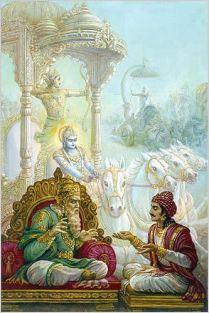
dritharastra-sanjayaWe never actually hear what Krishna told Arjuna. We simply overhear what Sanjaya transmitted faithfully to the blind king Dhritarashtra in the comforts of the palace, having witnessed all that occurred on the distant battlefield, thanks to his telepathic sight.

The Gita we overhear is essentially that which is narrated by a man with no authority but with a distant sight (Sanjaya) to a man with no sight but with full authority (Dhritarashtra). This peculiar structure of the narrative draws attention to the vast gap between what is told and what is heard.

Krishna and Sanjaya may speak exactly the same words, but while Krishna knows what he is talking about, Sanjaya does not. Krishna is the source, while Sanjaya is merely a transmitter.

Likewise, what Sanjaya hears is different from what Arjuna hears and what Dhritarashtra hears.

Sanjaya hears the words, but does not bother with the meaning. Arjuna is a seeker; and so , he de-codes what he hears in order to find a solution to his problem. Arjuna, during the ‘conversation’, asks many questions and clarifications’, to ensure that he properly understands the purport of the ‘discourse’.

In contrast, Dhritarashtra remains silent throughout. In fact, Dhritarashtra is not interested in what Krishna has to say; but, is rather fearful of what Krishna might do to his children, the Kauravas.

: – As regards the treatment of its subjects, the Bhagavad-Gita describes itself as the essence of all the Upanishads. The Upanishads by their very nature are philosophical speculations transcending the physical world. The Gita ,on the other hand , teaches about living a worthwhile, meaningful life in the world among fellow beings – Jivana- Dharma – Yoga.

:- Further, the Upanishads which aspire to understand the essential nature of all things in the Universe and in the individual, as also the relation between the two , emphasize the superiority of knowledge (Jnana) over action (karma).

In the Gita, Krishna , on the other hand, asks Arjuna to follow the path of action and to act decisively.

The confused Arjuna, helplessly, queries Krishna for a clear direction: ’Oh, Janardhana, if you consider Knowledge (Jnana) to be superior to action, why then do you instruct me to perform this terrible act?- janārdana tat  kiṃ karmaṇi ghore māṃ niyojayasi keśava’ –  (BG.  3. 1 – 2).

The Gita does not seem to favor renunciation or total withdrawal from the world resulting in inactivity, nivritti. Instead the Gita teaches the sort of Jnana that endorses renunciation of desires, of fruits of action. It advocates activity pravritti with the renunciation of the fruits of action. Gita terms it as ‘inaction in action and action in inaction’ akarmaṇi ca karma … karmaṇy akarma (4.18). That is, performing acts according to ones calling, with equanimity; and, relinquishing attachment to the fruits of one’s actions.

anaashrita karma phalam kaaryam karma karoti yah / sa sannyaasi ca yogi ca na niragnir na ca akriyaha

One who does not depend on the fruits of action but does the work which is his duty. He is a sanyaasi and also a yogi, not the one who has renounced fire (rituals) and not one who (merely) does nothing (Bg. 6.1)

yoga yukto vishuddhaatmaa vijitaatmaa jitenriyaha/ sarva bhutaatma bhutaatmaa kurvan api na lipyate

He who  by following Yoga, has purified the mind; has controlled the mind;  has controlled the senses; sees his own Self in all beings; and, does not get tainted even if he does work (Bg. 5.7)

[Krishna, of course, succeeds in reconciling the deep chasm between the two paths or approaches (Jnana and karma) by introducing the unique concept of internal renunciation, as opposed to external renunciation.

By reconciling otherwise two contradictory ideas, Krishna offers a realistic system which intertwines performance of one’s responsibilities in life without getting too attached to it. It cautions that an un-restrained desire for the fruits of one’s action, more often than not, leads to major blunders in decision making, both in personal and social life.

In this way, the Bhagavad-Gita adheres to both the ideals. It supports involvement in the performance of one’s social and moral responsibilities according to ones Dharma in life; and, at the same time it endorses the Upanishad ideal of self-realization which leads to liberation from confines of relative existence.  ]
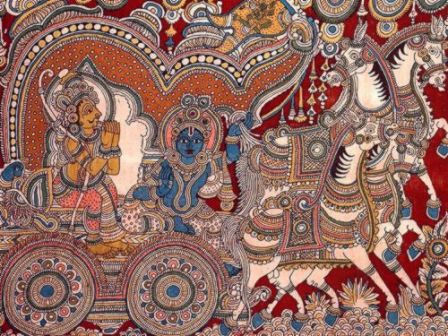
Bhagavadgita Kalamkari

Manifold paths

The Gita begins with a response to Arjuna entering a state of despondency just at the time when he was required to perform. This is the initial problem of the Gita. Krishna’s teaching will, in later stages, cover several other paths or approaches to life; but, the initial focus is on the problem of action, with Karma Yoga as the solution. It is self-less performance with equanimity; equal acceptance of pleasure and pain; and, renouncing fruits of one’s action.

*

The Gita suggests that though we all are one in spirit, each one is different in her/his intellectual and psychological makeup; and, each has a role to play in this world, in her/his own manner. Each should choose her/his path in the most essential mission of all – the discovery of one’s true Self.  The Gita, broadly, lays down these paths as four – Jnana, Bhakti, Karma and Yoga. These paths are neither mutually exclusive, nor do they contradict each other. They are meant to be guide posts that direct us along the paths that best suit our nature and attitudes.

Jnana Yoga is the  intellectual path demanding that one apply reason and rationale in order to realize her/his essential core; and,  understand her/his relation with the world and god. It is a lonely path of self- discovery.  It is the discipline of knowledge of Self. It also means knowing clearly; realizing one’s own divinity; and, also seeing the divine in human and the earthly.

Since we do have to  exist , act and participate in this world , in a meaningful manner, understanding the true connotation  of  the path of Karma is essential. Karma is the way we conduct our lives , performing activities , fulfilling our roles and responsibilities towards self , family and the society at large; following a path of righteousness directed towards improving ourselves. While one should act diligently, one should not be overly attached or obsessed with the fruits of one’s actions.  The detached attitude towards the results, might, initially, appear to be a counter-intuitive or contrary to common-sense ; but , on reflection , one would realize that  it is the most efficient and clear-headed way to stay focused on the task at hand. The ability to maintain equanimity at good and bad times , even otherwise, marks a balanced approach to life.

The first-half of the Gita essentially teaches a combination of Karma-yoga and Jnana-yoga- to act selflessly with true knowledge of the reality. Here, Equanimity serves as a foundation standing upon which one can look beyond and reach for a reality that is totally different, the Absolute.

Though the wise one fights battles, he does it with composure , devoid of enmity or hate , rancor or self-interest. The enemy, after all, is as much a manifestation of God as the warrior is.

The Bhakti-yoga is the path of love, immersing oneself  in the boundless Love of God and, submitting to Him in artless faith and absolute devotion . It aims to experience the splendor of the divine in all its manifestations (Lila), and immerse in its delight (Ananda).

The Dhyana–yoga or Raja-yoga, the Royal way, is the discipline of meditation, withdrawing the senses, calming the mind and clearing it of confusions and other delusions. The path of Yoga is a method for controlling the waves of thoughts, and the senses; refining the mental and the physical energy. It seems to be based in the eight-fold (Astanga) Yoga system of the Sage Patanjali, though there are no explicit references to  it; and, there are also no separate verses or chapters devoted to this discipline

*

Arjuna begins in bewilderment and depression; and at the end, stands up to fight his cousins with composure.

[One of the commentators observes: assuming that the Gita was an insertion into the Epic; and, given the fact that the great battle did eventually take place, the outcome of the Gita could not have been different. Arjuna had to fight, in any case.]

lotus-design

Synthesis

It appears that the Bhagavad-Gita was composed during a vibrant period when growing verities of options for attaining liberation (Moksha) from confines of human limitations were hotly debated and ardently explored.

Bhagavad-Gita frequently refers to the fundamental philosophical concepts of Samkhya and Yoga Darshana-s. It is also based in many Upanishads providing verities of solutions to human predicaments, as also suggesting pointers to the understanding of the Universe, the individual and the relation that  exists between the two. The Bhagavad-Gita, in that process, draws upon many sources.

In that progression, the Bhagavad-Gita elaborates on the varied disciplines and paths of Jnana (knowledge), Karma (action), and Bhakti (devotion) as also Yoga for attainment of the highest good. The text calls itself Yoga-shastra – the science and knowledge of Yoga.   

The term Yoga is used in Gita in a variety of senses. And, Yoga here also stands for Marga, the path; be it the path of knowledge (Jnana-yoga), devotion (Bhakthi-yoga) or the path of action (Karma-yoga). In all these paths, the essential message of renouncing the fruits of action is stressed.

The Gita does not explicitly support one Yoga over the other. It rather extols one Yoga then another or a combination of Yogas. It is to be understood as a many-sided system with various elements juxtaposed.

*

Justice Kashinath Triambak Telang, in his introduction to Bhagavad-Gita  (Oxford, New  Clarendon Press, 1875/ 1882) ,writes :

The Gita offers a set of practical disciplines, without, however, attempting, to arrange or classify them in a systematic order. In other words, what we have in the Gita is the germ of the ideas or of the systems; but not a ready-made system as such.

There are also certain passages in the Gita, which do not easily reconcile with one another. And, the Gita makes no attempt to harmonize them.

For instance; Krishna classifies the devotees into four classes; and, says that he considers the Jnanis (the persons of knowledge) as his own (Gita – Ch .7-verse 16). This might give an impression that he places the Jnanis at the top of hierarchy. But, again he remarks elsewhere that the devotee (Bhaktha) is superior not only to those who merely perform penance; but , also to the men of knowledge (Gita-Ch.6-verse 46). And, in another passage, it is said that concentration is preferred to knowledge (Gita-Ch.12-verse 12).

All these indicate the Gita, as do the Upanishads, is a remarkably free, open-ended un-systematized work.

Does not seem to favor a particular path

The discourse on those subjects, however, is not arranged in a systematic manner. The Gita gathers and combines different trains of ideas just as it finds them in traditionally accepted Schools, without much effort to harmonize them. The text does not seem to hold up a single discipline or path as its ‘true message’. And, such ambiguity in its ‘message’ or the adaptability of ‘its message’  to different Schools of Philosophy and to the circumstances in life  has led to plethora of interpretations, each claiming that it has certainly grasped the ‘true message ‘of the Bhagavad-Gita.

One can even say that the scope for deriving varied types of  interpretations becomes possible mainly because of the unique virtue of the Gita which allows each reader  to discover its essence, in his or her own manner, at his or her own pace and terms.

Deciphering its meaning and its ‘true’ philosophical intent is neither easy nor simple. Some of the greatest minds have grappled with the philosophical problems present in it.

lotus-design

The ways of reading the Gita

There are several ways of reading Bhagavad-Gita. It can be read as a literary work or poetry of merit with allegorical imagery; it can be read as a part of Oriental studies; and, it can also be read as a philosophical work.

As a work of literature, its literary or poetical aspects would be discussed and the allegories would be highlighted. As a work of Indology, its historical background and linguistic aspects would be examined. Such a scrutiny would focus on the date of its composition; on speculations about its plausible author or author/s; or on the question of its relation to the context of the Mahabharata-events. 

But, it is the study and explanations of Gita’s philosophical outlook, its conceptual structure and speculations about its ‘true message’ that has given rise to diverse stand points and multiple interpretations. Such interpretations over the centuries have been so diverse and   so complicated, that it makes one wonder whether they all were referring to one and the same text.

The Gita’s adaptability to different kinds of philosophical interpretation is partly caused by the effort of its composer/s to bind within it the tenets of several philosophical schools (Darshana-s) including Samkhya, Yoga and the devotional aspects of the then emerging Bhakthi traditions. That, to an extent, injected ambiguities and incompatibilities in reading and interpreting the text.

The phenomenon of multiple interpretations of the Gita has continued over the long centuries. At different times or phases in the history, fresh interpretations of the ‘true message ‘of the Gita sprang up, each in the context of its own times, environment and preferred attitudes. Each successive interpretation of the Gita was at variance with its previous one.  And yet, what is most amazing is that each of those varied interpretations is valid in its own context.

That is to say; each commentator has diligently gone about in putting forth his honest understanding of the ‘true message’ of the Gita. Each commentary of the Gita is thus a subjective view of the text. The ‘message of the Gita’ might indeed be all of those assorted interpretations; and, even be more.

The quest for objective truth or the real truth of the Gita is still very much on, even thousands of years after it was uttered on a distant battle field, amidst two huge armies raring to go at each other.

lotus-design

Quest for objective truth

The quest for objective truth – (what did Krishna say, exactly?) – is another cause for emergence of multiple interpretations and countless number of commentaries. In the zeal to uphold his own interpretation as the objective truth of the Bhagavad-Gita, each commentator, somehow, seemed to get intolerant of the ones that differed from his own. That, in a way, is rather uncharacteristic of the Indian tradition which accommodates within itself and harmonizes various seemingly contrary positions.

All the branches of Indian traditions, notably the Jain, have always tried to adopt the concept of Anekāntavāda which, essentially, is a principle that encourages acceptance of multiple or plural views on a given subject. The Buddha too said that merely judging the issue from individual (separate) stand points of view would lead to wrong conclusions; it would be prudent to approach each issue from more than one point of view (aneka-amsika).

[Devadatta Kali (David Nelson) in the introduction to his very well written work Svetasvataropanisad: the Knowledge That Liberates writes:

Although the Indian thinkers are not immune to disputation , by and large , their culture has valued the principle of accommodation and acceptance…Throughout the centuries of Indian philosophical traditions , the differing views have often been seen as just that – as differing views of a single reality that lies beyond human power of articulation. The tendency has often been to harmonize opposing views as distinct parts of a larger whole whose fullness lies well beyond the reach of mere perception or reason. It needs to be stressed that the primary purpose of sacred literature is to impart spiritual knowledge, not to fuel intellectual or sectarian debate – or to create confusion.]

The basic idea here, is that the reality could be perceived differently from diverse points of view; and, that no single point of view should be taken to be the complete truth, to the exclusion of all others. The varied views could either be taken together to comprise the complete truth or as different dimensions of a single reality.

Bhagavad-Gita is a multi-layered text with many avenues for exploration. I , therefore, reckon that an Anekāntavāda approach would be more appropriate in understanding its manifold message, rather than steam- pressing it into a particular mold.

[Please listen to Dr. Karan Singh speak about Bhagavad-Gita : Click here

You may then opt for the Mini-view ]

lotus-design

Is there a need to seek for the ‘objective-truth?’

That again begs the question: is there a need to seek for the ‘objective-truth’ of the Gita? Because, there is a danger that such monolithic one’s own ‘objective–truth’ might shut out the options of myriad other plausible meanings. Thus, a purely objective view, despite its merit, seems to limit itself to a particular slot.

There is, therefore, surely some merit in subjective approach to the study and understanding of the Gita. In fact, some have suggested that each could try to compose his own Gita according to her/his own understanding and inclination.

As Shri Devdutt Pattanaik observes: The quest for subjective truth (how does The Gita make sense to me?) allows each (after listening to the various Gita-s around him/her) to discover one’s own Gita at his or her own pace, on his or her own terms.

The Gita itself seems to advocate subjectivity. Bhagavad-Gita in its structure and narration adopts the idea of free-will.   At the conclusion of his discourse, Krishna counsels Arjuna to reflect on what has been said, and then do as he rightly feels.

For instance; Krishna says that his teaching can be perceived directly (Pratyaksha-avagamam) according to one’s understanding (BG.9.2)

राजविद्या राजगुह्यं पवित्रमिदमुत्तमम् । प्रत्यक्षावगमं धर्म्यं सुसुखं कर्तुमव्ययम् ॥ २ ॥

rājaguhyaṃ pavitram idam uttamam / pratyakṣā-avagamaṃ dharmyaṃ / susukhaṃ kartum avyayam 9.2

And again, in Chapter 12 of the Gita, Krishna counsels:

Fix your mind on me alone, and absorb your consciousness in me; thus you shall surely abide in me. If you cannot fix your consciousness steadily upon me, then aspire to reach me through repeated yoga practice. O Dhananjaya, if you are incapable of even that, embrace the path of action, for which I am the highest goal, since by acting for me you shall attain perfection. But if you are unable to follow even that path of refuge in me through acts devoted to me, then give up the fruits of all your actions, thus restraining yourself. Knowledge is superior to practice; meditation is superior to knowledge; and, relinquishing the fruits of action is higher than meditation, as tranquility soon follows such relinquishment.

What really is the true vision or Darshana of this ancient, sacred and marvelous treatise named Bhagavad-Gita, the song celestial?

lotus-design

Pluralism of the Gita

How does the text permit such a range of interpretations? What is common to them? How is it possible for so many to provide their own interpretations while still claiming to be reading “the Gita”? Why did this one text in particular exercise such fascination on so many generations of Indian and non-Indian thinkers? How could Bhagavad-Gita lend credibility or even moral authority to political movements in modernity? And , did they all use the text in their own  way, in  order to somehow secure Krishna’s divine authority ? ! 

Heinrich Von Stietencron  , addressing such an array of bewildering questions, writes:

The analytic thinking of Western interpreters who were schooled in historico-philological methods stands in contrast to the traditional Indian commentators, who not only harmonized and freely covered over all breaks in the text of the Bhagavad-Gita, , but, above all, sought to read their own philosophical-theological concepts out of individual textual passages, in order to secure Kṛṣṇa’s divine authority for them.

In this manner, several philosophical schools developed their own Gita -interpretation — a spectrum that has, since the beginning of India’s independence movement been further supplemented by politically motivated interpretations in modernity.

chakra

The multiple interpretations or pluralisms of approaches in understanding the Bhagavad-Gita have an extensive and illustrious history. During that long period, different aspects of the Gita came into the fore; new meanings were read into its passages; and attempts were made to adopt its ‘message’ to suit new or emerging situations.

The history of the interpretations of the Gita can broadly be considered under the following heads:

: – The Acharyas

The medieval period starting with Sri Sankara (8th century)  followed by  the  Bhashyas of Sri Ramanuja , Sri Madhwa and other Acharyas as also  that of Abhinavagupta analyzed and commented upon the Gita in terms of the traditional Vedanta concepts of Advaita, Visistadavaita and Davaita;   and assigned primacy either to Jnana (knowledge) or to  Bhakti (devotion) or to Karma (action) . Each scholar went  according to the  principal philosophical precept of his School of thought , while sidelining the other plausible interpretations .

Santa Jnanesvar or Jnanadeva (1274-1297) of Maharashtra in his celebrated rendition of the Bhagavad-Gita – Jnaneshwari (Bhavarth Deepika) – taught  the path of loving and guileless devotion (Akritrim Bhakthi) and self-less action as the true way. He said that everyone should perform his/her duty lovingly as a Yajna and offer his or her actions as flowers at the feet of the Lord. According to Jnanadeva; it is through such Bhakthi and Bhakthi alone that the Supreme Reality can be realized
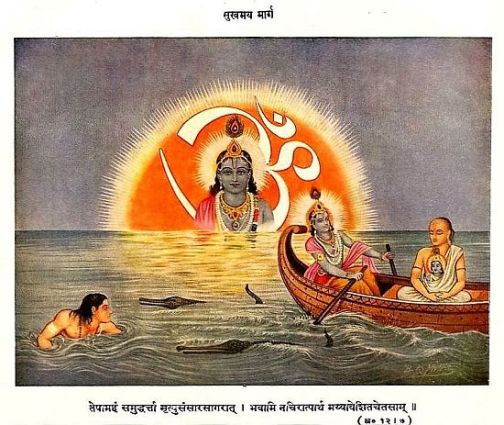
krishna-sukhmai-marg

: – The Colonial period

The period starting with the middle of the 18th Century when the English, German and French translations of the Bhagavad-Gita , captured the attention of the intellectuals as also that of the general-readers, widened the range of its readership as also the scope for its varied interpretations.

: – Initially, Bhagavad-Gita gained publicity mainly as a rare cultural object retrieved from the unknown past of the distant East; and , in particular , as ‘a curious specimen of mythology and an authentic standard of the faith and religious opinions of the Hindoos’.

: – That was followed by study of the Gita as a literary work. It proved to be a major influence on Romantic literature in Europe and Britain.

: – And, to the intellectuals and philosophers in the West, the Gita provided a perceptive view of the Hindu philosophy.  Among the scholars, the linguistic study of the Sanskrit text of the Gita; the historicity of the Mahabharata event; the questions of its authenticity and its date; the enquiry into its plausible author /authors and so on were widely discussed.

:-  The Gita evoked a different sort of reaction among the Christian Missionaries , They saw in it a possibility ’ to encourage a form of monotheist ‘Unitarianism’ ; to draw Hindus away from the polytheism of the Vedas’;  and,  to pave  way to spread Christianity in India.

:-  As the English and French translations of the Gita began to gather attention from among the educated class of the Colonial India of the 19th Century , it led to review and re-assessment of the principles of the Hindu philosophy and the practices of its faiths . The Western educated intellectuals and social reformers such as Raja Ram Mohun Roy regarded it as the essence of all Shastrus; and. interpreted Gita as a message for self-less action.

Though the Brahmo Samaj did not seem to have got the Gita translated , Debendranath Tagore tried interpreting Gita , in the Biblical mode,  as a sort of allegory depicting  the final battle (Armageddon) between the forces of ‘good’ and ‘evil’.

: – The Western scholars

Following its translations into European languages, the Gita gained a sort of territorial transcendence, spreading its influence beyond Asia. The Gita came to be regarded by the western scholars as a universally acclaimed text.

Among the Western scholars, the Bhagavad-Gita came to be looked upon as the authentic essence of Hinduism. And, and it became the most influential work on Indian thought. The German philosopher William Von Humboldt called Gita: the most beautiful, perhaps the only true philosophical song existing in any known language –the deepest and most elevated text the world has ever seen.  He was fascinated by its concept of Dharma delineated in various layers.

Similarly , TH Griffith saw Yoga taught in the Gita as the discipline of life, giving a deep insight into the ebb and flow of human desires and aspirations.

And, the German Indologist JW Huer described Gita as a ‘work of imperishable significance’ calling upon people to ‘master the riddle of life’.

Max Muller too believed ‘that textual authority of Gita should have pride of place in official knowledge about India’; but, he placed Gita next to Vedas in its authority and importance.
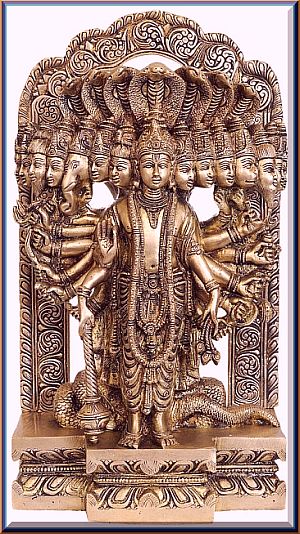
[Prof. Hephzibah Israel of the University of Edinburgh, in her paper  The Politics of the Gita in English Translation: Translating the Sacred, colonial constructions and postcolonial perspectives, writes

The Bhagavad-Gita was first translated into English by Charles Wilkins in 1785; and, into the German, either in part or in full , by Friedrich Majer, Johann Gottfried Herder (1792), and Friedrich  Schlegel (1808); and in full into Latin by August Wilhelm Schlegel (1823). And, it continued to be the object of translators’ attention throughout the nineteenth century.

German scholarly attention to the philological apprehension of Indian sources is linked to Indology, and to comparative linguistics and the study of religion. In fact, as a result of this early German philosophical engagement with the Bhagavad-Gita,

The text not only continued to be translated by both British and Indian scholars but was also accorded a Bible-like status; although Hindu Indians had not , hitherto, perceived it as such. The Orientalist desire for textual representations of the East can be “intimately connected to the desire among Hindu scholars to have scriptures, like Christianity and Islam” 

Significantly, the Bhagavad-Gita was ascribed high status in Britain and Germany by being treated as a self-contained philosophical text, rather than as an integral part of the much longer Mahabharata, one of the two Hindu epics that in popular Hindu formulations are considered foundational texts representing the “Indian nation” and its “culture.”

This is clear in the number of translations of the Bhagavad-Gita alone, singled out for attention with only brief reference to the larger text that it is embedded within. Unable to come to terms with a Hinduism that did not claim a single authoritative scriptural text, Orientalist scholarship reconfigured the existing sets of sacred texts through translation to bring forth a “central text” that could be identified as a higher foundational document. Examining para textual evidence such as titles, translator’s notes, prefaces, and introductions gives us a good indication of the purpose of a translation and how it was meant to function.. ]

**

 : – The Theosophists

The Theosophists recognized the Bhagavad-Gita as one of the major spiritual texts of the world.  Among the Theosophists, the allegorical approach with its esoteric and philosophical interpretations gained more importance. The historical and mythological context was kept in the background just to explain the context of the Gita.

According to them, Krishna in the Gita represented Logos the objective expression of the Absolute; while Arjuna represented the Monad, Nara, the whole of mankind rather than as a single person.

They explained life as an evolutionary process in which an individual evolves from lower to higher, from grosser physical forms to subtle spiritual forms of beings. The Gita, according to Theosophists  , is a framework for such a progression.

Theosophists interpreted the concept of one’s duty in terms of the Sva-dharma. They presented the world as a conditioned reality similar   to a huge game in which each piece must move in accordance with the rules governing its movements in order to keep the game going.

: – Swami Vivekananda
vivekananada

Swami Vivekananda , while in the West, compared Krishna’s teachings to that of Jesus. And, while at Home ,  he spoke about the inner battles in human heart and mind. And , he also described Krishna and Arjuna as men of action who could provide inspiration to reform and rejuvenate the Indian society that was fast degenerating into chaos and confusion. He  called for resistance against British oppression.

While laying more importance on the Gita’s larger allegorical meaning, Swami Vivekananda acknowledged the validity of historical research. But, he also said that mere discussion on   the historical aspects of the Gita cannot help one in acquisition of Dharma, or moral righteousness’.

The idea is: the Bhagavad-Gita is not merely a historically specific conversation; but, it is an ongoing teaching that has universal relevance. It is a process taking place all the times in each ones heart.

 He remarked:

 “One thing should be especially remembered here, that there is no connection between these historical researches and our real aim, which is the knowledge that leads to the acquirement of Dharma. Even if the historicity of the whole thing is proved to be absolutely false today, it will not in the least be any loss to us. Then what is the use of so much historical research, you may ask. It has its use, because we have to get at the truth; it will not do for us to remain bound by wrong ideas born of ignorance.”

:- Sister Nivedita
sister nivedita

Sister Nivedita (Margaret E. Noble , 1867-1911) considered not the withdrawal from the world; but, performing ones duty , while in it, diligently and selflessly, without attachment to consequences –  as the message of the Gita.  

In her very well written book ‘The Web of Indian Life’, under the Chapter: The Gospel of the Blessed one (page 217) , wrote:

*

The book is nowhere a call to leave the world; but, everywhere an interpretation of common life as the path to that which lies beyond…

That the man who throws away his weapons ; and, permits himself to be slain , un-resisting in the battle , is not the hero , but a sluggard and a coward; that the true seer is he who carries his vision into action , regardless of the consequences to himself. This is the doctrine of the Gita repeated again and again

‘Holding gain and loss as one, prepare for the battle’. That indifference to results is the condition of efficient action is the first point in its philosophy… It is the supreme imperative. Play thy whole part in the drama of time, devoting every energy, concentrating the whole force. “As the ignorant act from selfish motive, so should the wise act unselfishly.”

[Eminent Orientalists: Indian, European and American. pages 268-269]

: – The Nationalists in the Freedom movement

While the Theosophists tried to provide allegorical and esoteric interpretations of Gita as spiritual struggles, the Nationalists in the Colonial India of the 19th and early 20th century mainly from Bengal and Maharashtra saw it in quite another manner.

The freedom movement gave a great impetus to the study of Gita. Many saw it as a national symbol that held within its bosom answers to the burning questions of colonial India. The Key word from the Gita taken by the nationalists was Loka-sangraha – welfare or involvement in the world. That phrase occurs only two times in the Gita (3.20, 25).

कर्मणैव हि संसिद्धिमास्थिता जनकादयः । लोकसङ्ग्रहमेवापि सम्पश्यन्कर्तुमर्हसि ॥ २० ॥

सक्ताः कर्मण्यविद्वांसो यथा कुर्वन्ति भारत । कुर्याद्विद्वांस्तथासक्तश्चिकीर्षुर्लोकसङ्‍‍ग्रहम् ॥ २५ ॥

Then,  there also came into use an  expression that is not found in the Gita . It gained much currency in the 20th century – Nish-Kama-karma, self-less action.

Linking of these concepts with national movement for Independence and social reforms did much to bring forth Gita into popular debates. The nationalists promoted Gita as a central work of a rising Indian national ethos.

It is indeed remarkable that so many of India’s political and intellectual leaders of the last century and a half wrote detailed and extensive commentaries on the Gita. There were two broad categories of interpretations.

One; as a sort of romantic allegorical  visions of the battle against forces of lower tendencies such as greed, ego, selfishness etc; and, the other, as an authentic source of state craft that prompted to reconsider the nature of politics itself .

The latter, led to gathering support for reform efforts and for justifying a fight against the British rule for attaining independence.
bankim-chandra-chatterjee

Among the former category, Bamkim Chandra Chattopadyaya (1836-1894) provided great inspiration for the National movement, giving impetus to the concept of Motherland as the Goddess India, Mother India. He also depicted Krishna as the ideal person who exemplifies human virtues – a god-like person who was earthly wise and sublimely spiritual in his core. He projected Gita as an answer to West’s technological domination; and as India’s stand asserting  the merits of  ancient wisdom in the face of colonial oppression.

*
AurobindoSri Aurobindo, who followed Bamkim Chandra, regarded Gita as an absolutely splendid revelation holding forth a Universal message.  He advised that Gita should be approached by forgetting all the religious and academic arguments that highlight or decry one Yoga (paths) or the other. The integrated vision of the Gita, he said, transcends all such limited interpretations.  He envisioned  Gita as a divine action, where the battle field (Krukshetra) is in the heart and soul of every human being. Each one of us, potentially brave, fights in his or her own way with the confronting doubts, desperation, fears and frustrations. Krishna is the one, hidden behind the veils of our psyche and mind, who reveals the mysteries of life. Sri Aurobindo stressed that in the present age it was necessary to understand the Dharma, Karma and Yogas in contemporary sense.

*

The more militant among the Indian nationalists projected India as the Motherland and Krishna as Avatar who rescued the nation from jaws of A-dharma and to establish Dharma. They accepted the call of the Gita for righteous struggle for national independence, even if it might require violence.  The new battlefield, according to them, was the British Raj; and , they found in Gita a strong support for engaged social and political action, the karma yoga.
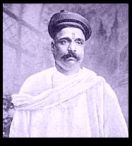
Tilak2

Lokamanya Bal Gangaadhar Tilak, who at that time was imprisoned in Burma, presented Gita as an allegory for fighting a just war (Dharma-yuddha) that historical circumstances had forced upon Indian nation and Indian people. In Tilak’s view, interpretation of a religious work like the Gita must be historically situated. He vehemently argued for an activist or “energist” reading of Krishna’s teachings, against the older “escapist” Vedanta interpretations. And, in the present age , he asserted, the Gita must be interpreted in accordance with its needs.  Like Aurobindo, Tilak accepts that this action might include violence, provided it is carried out without hatred and without any desire to reap the fruit of the violent deeds. He also admits : But herein lies a quandary of dharma.

It needs to be mentioned ; even  while calling for a just war (Dharma-yuddha), these commentaries  did maintain a sense of composure and detachment. Just as Arjuna did not regard his warring cousins as foes, the British were also  not targeted as the ‘enemy’; not because of fear, but in the interest of generating a broad theoretical principle for establishing a basis  for their political ideology and its strategy. Such an approach allowed Indian leaders to outline a political framework that would serve them well even beyond and after imperialism.

At the same time, at the ground level, there were also groups, organized or otherwise, that believed in disruptive violence as the effective means for overthrowing the alien imperialist power. 

In either case, the Gita provided a stable point of conceptual references, even while there was a range of multiple interpretations on the related issues.

[The practical question for Tilak and other activist leaders was how to mobilize larger masses on behalf of the struggle for an independent Indian nation. Throughout his career, Tilak experimented with ways to enlist the Indian population in this effort. In the 1890s, he transformed a local Maharashtrian festival for the god Ganesha into a large public celebration; and , he established a new festival to honor Shivaji.

Similar methods were adopted in Bengal by transforming  Durga-Puja into a national festival. And, in Punjab , Baishaki was turned into a celebration for all.]
ganesha18

[ Prof. Hephzibah Israel concludes:

Both European and Indian translators, by choosing to translate the Bhagavad-Gita, established it as the quintessential “Hindu” text and as a representative of a highly complex quasi-philosophical and quasi-mystical text which conferred on Hinduism status as a “world religion.”

While for Orientalist scholars, the translated Bhagavad-Gita was proof of an ancient and glorious “civilization,”.

For missionary translators, the Bhagavad-Gita was a philosophical text ; and not necessarily a sacred   “scripture.”

However, for the Indian translators, also mostly practicing Hindus, translating the Bhagavad-Gita was simultaneously an appropriate gesture and an opportunity to compete in the world hierarchy of “religions”: having for centuries preserved the Bhagavad-Gita in the exclusive Sanskrit. The Indian scholar-translators were embracing the opportunity to translate the text mostly into English rather than into other Indian languages.

While some translators, argue that they translate to educate fellow-Indians, to spread the “truths” of Hinduism to Indians, ,, their energies seem directed equally at non-Indian readers.

The appropriation of translation as a strategy to re-present Hinduism was a response to the Universal idea of religions that has often been played out through assumptions about their translatability. This deployment of translation has been an important factor in the formulation of resistant alternative colonial discourses.]

***

: – Gandhi

gandhi2

Though all the nationalist leaders agreed that purposeful action was needed to attain independence, the form that such action should take, however, remained a point of heated contention. This is where the faith and the views of Mohandas Gandhi become very significant.

Gandhi often referred to the Bhagavad-Gita as his “spiritual reference book” ; “dictionary of daily reference”; “book of home remedies”; “wish-granting cow”;  and, as “mother”. He returned to it over and over again throughout his life for clarification and nurture. He spoke and wrote widely on it throughout his career.

Gandhi, in contrast to other major nationalist leaders, held no commitment more important than to his principle of non-violence. But, he ran into a serious interpretive problem because in the course of the Gita Krishna persuades the reluctant warrior Arjuna to take part in an internecine disastrous battle.

Gandhi believed that the message of the Mahabharata itself was the virtues of non-violence; and, the Gita which was but a small segment of it carried a similar message. He wrote:

the author of the Mahabharata has not established the necessity of physical warfare; on the contrary he has proved its futility. He made the victors shed tears of sorrow and repentance; and has left them nothing but legacy of misery.

The question whether the true teaching of the Gita favors violence or non-violence became vitally important to Gandhi. He needed a clear , firm and an honest answer to anchor his faith in his struggle for India’s freedom ; to provide a principled public resistance; and, above all to ensure the authenticity of his inner spiritual life. The Gita, as he understood and practiced, was the foundation of his struggle without hatred, without passion (Nish-Kama-karma) with the attitude ‘mine is but to fight for my meaning, no matter whether I win or lose.’

And, that led Gandhi to offer a particularly distinct interpretation of the Bhagavad-Gita, where Krishna instead of asking Arjuna to fight the war, instructs him to ‘fight the battle within the self; to battle passion and selfishness’.

According to Gandhi, Gita demonstrates the futility of violence; and, its true message is non-violence and peace. At the end of the Mahabharata, nearly everyone on both sides is killed

Gandhi said, it was fought “not to show the necessity or inevitability of war, but to demonstrate the futility of war and violence.” This becomes evident in Shanti Parva, where “at the end, the victor is shown lamenting, and repenting, not only the outcome, but the very idea of causing so much pain, such horribly enormous  devastation and violence”.

Supporting  Gandhi’s view, ‘The Epic’, writes Amartya Sen, ‘ends largely as a tragedy, with a lamentation about death and carnage; and , there is anguish and grief … It is hard not to see in this, something of a vindication of Arjuna’s profound doubts.’

The battlefield, Gandhi argued, must be taken as an interior one, where the forces of good and evil are locked in never-ending struggle.  The Bhagavad-Gita, he said, is not about the battle that is waged on the field of dirt soaked in blood; but, it is about the ever going conflict within the human heart between the forces of good and evil.

Gandhi said; when Krishna asked Arjuna to fight, he meant fighting ones lower impulses; not to cling to its rewards; to overcome any self-interested inclinations; and,  to carry out his own righteous duty. One must be equally disposed to ones enemy as to oneself.

Gandhi based his own authority as an interpreter of the Gita on his personal endeavor “to enforce the meaning in my own conduct for an unbroken period of forty years.” Gandhi also claimed that the Gita was not a Hindu work, but rather one of “pure ethics,” which a person of any faith might read and follow.

Gandhi firmly believed that complete renunciation is not possible without total observance of Ahimsa (non-violence) in every form and shape.

Gandhi said that if one has to fight, one should fight non-violently.  Thus, Violence and denial of violence became major issues for debate and action.

Gandhi’s faith in Ahimsa as the core of the Gita gave rise to Satyagraha , as an effective means to express one’s protest and to offer resistance without indulging in violence. According to him, a Satyagrahi should be willing to die like a soldier (Kshatriya) for the cause of India’s independence. Satyagraha was Gandhi’s unique contribution to fight against oppression and injustice.

This was in sharp contrast to the interpretation offered by the leaders of India’s nationalist movement such as Sri Aurobindo and others to fight a just war for liberating the Motherland. In fact, during Second War Sri Aurobindo called on Indian people to support the British in its war efforts and fight along with the British against fascist Germany.

: – Aldous Huxley

Aldous Huxley

Similarly, in Aldous Huxley’s famous introduction to the translation of the Gita by Swami Prabhavananda and Christopher Isherwood (The Song of God: Bhagavad-Gita, Hollywood: M. Rodd Co., 1944) which was published just after the end of World War II, the questions of war, violence gained special significance. Writing in the midst of a war of destruction and violence on an unprecedented scale, Huxley re-read and re-imagined the Gita in a mode which rejected the utter need to kill. He, like Gandhi, emphasized that the true message of the Gita is not violence; but, on the contrary, the futility and uselessness of violence, self-destruction; and, the harm it can bring upon whole generations.

lotus-design

Robert OppenheimeOn July 16, 1945, at the dawning of the atomic age, J. Robert Oppenheimer watched the first human-controlled atomic explosion at Los Alamos, New Mexico, from a bunker twenty miles away. As director of the Manhattan Project, Oppenheimer was responsible for overseeing the creation of the bomb, which the project called “Trinity.” He was a brilliant professional physicist, and also a gifted amateur student of Sanskrit. As he observed the awesome detonation of Trinity, Oppenheimer later recalled that passages from the Bhagavad Gita sprang to his mind.

If the radiance of a thousand suns / Were to burst at once into the sky / That would be like the splendor / Of the Mighty One … / I am become Death / The shatterer of worlds

दिवि सूर्यसहस्रस्य भवेद्युगपदुत्थिता ।यदि भा: सदृशी सा स्याद्भ‍ासस्तस्य महात्मन: ॥ १२ ॥

Divi surya sahastrasya bhaved yugapad utthita / Yadi bhah sadrashi sa syat bhasastasya mahatmanah (BG.11.12)

कालोऽस्मि लोकक्षयकृत्प्रवृद्धो लोकान्समाहर्तुमिह प्रवृत्त: । ‍ऋतेऽपि त्वां न भविष्यन्ति सर्वे/येऽवस्थिता: प्रत्यनीकेषु योधा: ॥ ३२॥

’kālo ’smi loka-kṣaya-kṛt pravṛddho/ lokān samāhartum iha pravṛttaḥ / ṛte ’pi tvāṁ na bhaviṣyanti sarve/ye ’vasthitāḥ praty-anīkeṣu yodhāḥ ॥

lotus-design

: – Allegorical Interpretations

Since the early periods the allegorical interpretations of the Bhagavad-Gita have been in vogue, by looking upon Kurukshetra as not a mere geographical region or historic battle.

Abhinavagupta, in his Gitartha-sangraha, a commentary on Bhagavad-Gita, refers to a tradition of interpreting Kurushetra as zone of war that takes place between the righteous and un-righteous tendencies within the human body.  According to him, Kurushetra is something more than a geographical venue where a battle took place among the cousins and their supporters.

Similar allegorical interpretations of the Gita became quite a regular feature by the turn of the nineteenth century; and it has been carried forward ever since. Such interpretations fall in to two broad categories: One, to battle against forces of lower tendencies such as greed, ego, selfishness etc; and, the other, to gather support for reform efforts and for justifying a fight against the British rule for attaining independence.

For Sri Aurobindo, ‘the physical fact of war is only an outward manifestation of a general principle of life. The war symbolizes all aspects of struggle that takes place all the time, both in our inner and outer living.. Life is a battle and a field of death; this is Kurukshetra’.

For Bal Gangadhar Tilak, Kurushetra signified Dharmakshetra, a just war against oppressive foreign rule.

Edwin Arnold too referred to Kurukshetra as human body, the field where Life disports.

Gandhi followed Arnold’s interpretation that Kurukshetra is where an eternal struggle is taking place within us.

lotus-design

The present-day

In the present day, the discussions about Bhagavad-Gita in terms of Advaita – Dvaita; or Jnana-Karma-Bhakti have become very rare. The focus is now more on Gita’s stand on the question of violence; whether it advocates or shuns violence; the efficacy or the moral justification for resorting to violence as a vehicle for expressing one’s protest against the establishment.

There are a notable few who adopted the Gandhian method of Ahimsa to fight against oppression. The celebrated ones among such votaries of non-violence are: the HH the Dalai Lama the spiritual leader of the displaced Tibetans who firmly believes that the all-embracing ‘concept’ of Ahimsa is the proper solution for any human conflict; Dr. Martin Lather King who led the civil disobedience movement against racial discrimination; and, Aung San Suu Kyi the Burmese nationalist leader who influenced by the philosophy of non-violence of the Buddha and of Gandhi chose non-violence as an expedient political tool in her struggle for democracy and human rights.

In India, we have the dauntless lady, Irom Sharmila from Manipur who during August 2016 quit  her 16 long years of fast demanding repealing of the Armed Forces Special Powers Act.  We also have Anna Hazare who largely adopted non-violent protests and hunger strikes (a la Gandhi) in his struggles to promote rural development, to increase government transparency, and to investigate and punish corruption in public life etc.  And, there is Medha Patkar, the resolute social activist and social reformer, ever engaged in various protests.  These and such other well-meaning protesters, sadly, have not met with much success.

Apart from these and few others there is hardly any who has earnestly adopted Ahimhsa in her/his struggle against injustice. The Gandhian way seems to be losing its ground in India. This seems to reflect the state of our being; the times we live in; and, the values we cherish.

Let’s take, for instance, the Indian situation.

The India of the present-day is no longer under foreign rule. It is now governed by the political parties elected by the Indian citizens. The question is:  whether one is entitled or justified for expressing dissent in a violent manner. The question was answered by a resounding YES by the Naxalite and such other militant groups. They sought to find moral justification for taking up arms by quoting Bhagavad-Gita.

A similar justification is made out by the Jihadist terrorist groups who, strangely, also quote the Gita for carrying out their violent attacks.

Even the protests involving inter state river-water disputes, social injustice etc is marked by violence and vandalism destroying public property.

: – There are also those who denounce the ‘message of the Gita’ for various reasons.

For instance:

Mahatma Jotiba Phule (1827-1890) who was a pioneer in raising awareness of the rights of the Shudras and Ati-shudras (OBC and SC, as classified now) regarded Manu Smruti and the Gita as signs of slavery (Gulamgiri).

Dr. Bhimrao Ramji Ambedkar, in his writings on the Gita, insisted that it be seen as a historical work, composed at a certain time, and he criticized those who sought to give it a universal significance. He argued, the Bhagavad Gita was a counter revolutionary. In his essay, Krishna and His Gita, Dr. Ambedkar wrote, ‘The philosophic defense offered by the Bhagavad Gita of the Kshatriya’s duty to kill is, to say the least, puerile.’

The infamous Wendy Doniger has said: “The Bhagavad-Gita is not as nice a book as some Americans think. Throughout the Mahabharata, Krishna goads human beings into all sorts of murderous and self-destructive behaviors such as war. The Gita is a dishonest book.”

And, Meghnad Desai, economist and politician, in his Who wrote Bhagavad-Gita, declared the Gita as ‘unsuitable to modern India’ whose Constitution commits it to ‘a world of social equity and democratic freedoms. The Kurukshetra war was fought over land dispute and Krishna’s sermon to Arjuna to fulfill his caste obligation. The message of the Gita is casteist and misogynist and as such profoundly in opposition to the spirit of modern India.’

lotus-design

: – The other views

There have, therefore, been many intellectuals who condemn what is presumed to be ‘the message of the Gita’.

They question:  how can a spiritual being command one to wage a war knowing well the disaster that a war would bring upon the society at large and on the women and children in particular?

As regards the question of Nishkama karma (selfless action), as the scholar Easwaran writes:

the Gita’s focus is relentlessly on the doer’s attitude while he dispenses his Dharmic duty, not on what he actually does to others and its human impact. Krishna is thus able to ask Arjuna to perform ‘all actions for my sake, completely absorbed in the Self, and without expectations, fight!’

As VR Narla put it, ‘while action without seeking some personal gain can be noble, action without any care for its evil consequences to other men [is] reprehensible, even diabolical.

In The Idea of Justice, Amartya Sen too finds this problematic: ‘Krishna argues that Arjuna must do his duty, come what may, and in this case he has a duty to fight, no matter what results from it … Why should we want only to “fare forward” and not also “fare well”?

Many wonder, how could the essential teaching of the great scripture be as simple and blatant as to favor war and violence? These wise scholars sought to encourage the readers/listeners to look beyond the obvious; to delve deep; and , to un-fathom its metaphorical allegorical message.

Such bewilderment stems essentially from anxiety, dilemma and loss of direction; but not necessarily from fear or cowardice.

*

Apart from the questions of violence and war, the Gita is of much  significance to the present-day world – a reflective person cannot act confidently without a thorough knowledge of the rightness of the motive and effect. Action and knowledge are very efficacious when combined with love or devotion.       

 [Abhinavagupta in his Bhagavadgitarth Samgraha asserts that Jana and karma are not two things.]

lotus-design                                       

The Dynamic way

Whichever way you look at it, the Gita is admirably amenable to multiple interpretations.   Its ‘real meaning’ (whatever be it) need not be restricted to either Jnana or Karma or Bhakti or even to violence or non-violence. The Gita could very well be read without imposing upon it one’s own interpretations. One needs:  to be aware of; to recognize; and, to acknowledge its various other plausible interpretations.

Laurie L .Patton in her essay: The failure of the Allegory – Notes on Textual Violence in Bhagavad Gita ( see under section titled  Beyond Allegory: Toward a Dynamic Interpretation of the Exhortation to Fight) included in the book Fighting Words: Religion, Violence, and the Interpretation of Sacred Texts edited by John Renard , speaks about a ‘dynamic way of reading ’ where one would be constantly aware of the other plausible interpretations  as one chooses a particular interpretation. She concludes her very scholarly discussion on varied interpretations of the Gita with the words:

Read in this way, one can engage many possible meanings of the Gita within the clear boundaries of the verse. However, a reader would not be obsessed with the “real” meaning, nor would she be trapped by the literal meaning or the spiritual meaning, or any other possible meaning in between.

***

As Erenow questions :

What is the best way to read   the Bhagavad Gita? That will of course depend on the reader. In the Gita, Krishna commends all those who share his teachings with others. Yet we see how this sharing of the Gita can take myriad forms. Just as different translators bring different backgrounds and agendas to their task of rendering Krishna’s message, so readers will themselves bring their own differing aims to the work. Among the great plurality of translations and commentaries, embodying diverse approaches to the Gita, the reader also is called on to select a path. If Krishna is correct, all those various translational paths will indeed lead the reader to him and his words.

lotus-design

The Bhagavad-Gita is not an abstract theological  story, but is a valuable discourse through which are woven many insights, allegories and directions, which provide a broader and a meaningful vision of life. It is particularly relevant when one is placed in the very cauldron of life; facing conflicting situations; and, when one is confronted with multiple choices.

When a society enters chaos, it does not usually return to its earlier status; but, will re-invent itself; and, ushers in a new society with its own moral, cultural and social references.

In the next segment of this article, let us discus in fair detail each of the above streams of the interpretations of the Bhagavad-Gita.

Lotus blossoms

Continued in Part Two

References and sources

  1. Interpretations of the Bhagavad-Gita and Images of the Hindu Tradition: by Catherine A. Robinson
  2. The Bhagavad Gita and the West: The Esoteric Significance of the Bhagavad-Gita by Rudolf Steiner
  3. Exploring the Bhagavad Gitā: Philosophy, Structure, and Meaning by Ithamar Theodor
  4. The Bhagavad Gita: A Text and Commentary for Students by Jeaneane D. Fowler
  5. Fighting Words: Religion, Violence, and the Interpretation of Sacred Texts by John Renard
  6. The Failure of Allegory: Notes on Textual Violence and the Bhagavad Gita by Laurie L. Patton
  7. A Comparative Study of the Commentaries on The Bhagavadgītā by T. G. Mainkar
  8. Bhagavad-Gita in Mahabharata Translated and Edited by J. A. B. van Buitenen
  9. My Gitaby Devdutt Pattanaik
  10. The Bhagavad-Gita and modern thought introduction by Shruti Kapila and Faisal Devji
  11. The quest for objective truth – Modern Indian Interpreters of the Bhagavad Gita Edited by Robert Neil Minor
  12. Who Wrote Bhagavad-Gita by Meghnad Desai
  13. Da’ud ibn Tamam ibn Ibrahim al-Shawn – The Bhagavad Gita interpreted – Edited by Daud Shawni
  14. A History of Indian Philosophy, Volume 2 by Dr. Surendranath Dasgupta
  15. PICTURES ARE TAKEN FROM INTERNET
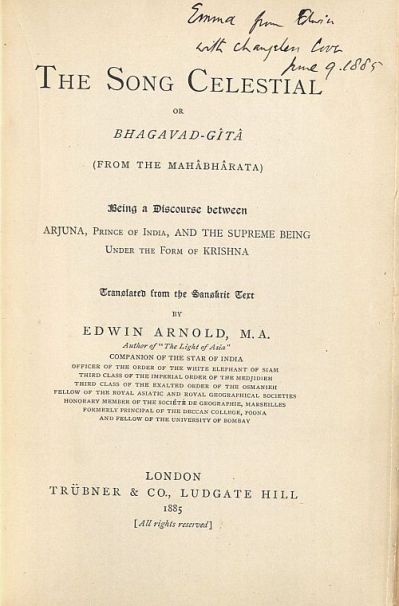
 
12 Comments

Posted by on October 14, 2016 in Bhagavad-Gita, General Interest


Tags: , , , , , , , , , , , , , , , , , , , , , , , , , , , ,

Discussions, Debates and Arguments: Ancient India – Part Two

 Continued from Part One

 Vaada, Jalpa and Vitanda

Vaada

Vaada is a debate between two persons of equal standing. The term Vaada by itself means a theory, doctrine or thesis. In the debate, the proponent who puts forward arguments in support of his doctrine (Vaada) is termed as Vadin. The opponent who refutes that theory through his counter-arguments is termed as Prati-vadin. Unlike in Samvada, there is no teacher-taught relationship here; nor is it a discourse. 

Ideally, both the parties to the Vaada should have mutual regard, respecting each other’s learning and status; and should participate with an open mind in order to explore various dimensions of the subject on hand; to examine it thoroughly by applying the accepted norms of logic and reasoning (Tarka), supported by passages from  texts of undisputed authority (Sabda Pramana). The principal aim of a wholesome Vaada is to resolve the conflict; and, to establish ‘what is true’. The proceedings of the Vaada should be characterized by politeness, courtesy and fair means of presenting the arguments. You might call it a healthy discussion. 

Vatsayana in his commentary Nyāya Bhāya, says that congenial debate (Anuloma Sambasha) takes place when the opponent is not wrathful or malicious; but, is learned , wise, eloquent and patient  ; is well versed in the art of persuasion ; and, is gifted with sweet speech. 

As regards the benefits (Sambasha prashamsa or prayojana)  of such peaceful and congenial debates  : If a learned person debates with another scholar, both versed in the same subject, it would increase the depth of their knowledge, clear misapprehensions, if any, and lead them to  find certain minor details which hitherto might have escaped their attention . It was said: Vade Vade jayate tattvabodhah – Truth emerges out of debates – Besides, it would heighten their zeal to study further; and bring happiness to both.   

But, in cases where two scholars hold contrary views, the Vadin and Prati-vadin will each try very hard to establish the doctrine which he believes is true; and to convince the other to accept its veracity through fair and effective presentation and arguments. At the same time, each is willing to understand and appreciate the arguments of the other; and accept any merit they might find in it. In case, one is in doubt or unable to respond  satisfactorily , one can take a break to re-group his position or to re-examine the issue to see whether he can refute the opponent’s argument more effectively or put up a sounder defense.

And, if one is convinced that the doctrine and the argument presented by the opponent is valid, he adopts it with grace.   And, at the end, one of the two might be proven wrong; or both could be right.  In any case, they accept the outcome of the debate, whatever be it; and, part their ways without rancor. 

***

The Buddhist text Milinda Panha (The Questions of King Milinda) dated between second and first century BCE is said to be a record of the conversations that took place between the Indo-Greek king Menander I Soter  (who is said to have ruled over the regions of Kabul and Punjab) and the Buddhist monk Nagasena. 

[Menander (Milinda), originally a general of Demetrius, is probably the most successful Indo-Greek king, and the conqueror of a vast territory. The finds of his coins are the most numerous and the most widespread of all the Indo-Greek kings. From at least the 1st century AD, the “Menander Mons“, or “Mountains of Menander”, came to designate the mountain chain at the extreme east of the Indian subcontinent, today’s Naga Hills and Arakan, as indicated in the Ptolemy world map of the 1st century.  

Minander had expanded his kingdom into Gangetic plains, where Buddhism was flourishing. He is reputed to have been a secular King , who protected the beliefs of his Greek and Buddhist subjects.

Menander is remembered in Buddhist literature (the Milinda Panha) for his conversations with the Buddhist elder Monk Nagasena. According to Milinda –panha, the King Milinda carefully listens to Nagasena’s teachings; and, at the end of each discourse exclaims ‘Very good, Bhante* Nagasena’.

[*Bhante (Sanskrit: Bhavanta) is a respectful title used to address elder Buddhist monks in the Theravada tradition. The term literally means “Venerable Sir’.]

Sagala , the city in which King Milinda met the Bhikku Nagasena is identified with Sialkot . The Jatakas  mention : There is , in the country of the Yonakas , a great center of trade , a city that is called Sagala, situated in a delightful country, abounding in parks , groves , lakes and tanks ; a paradise of rivers, woods and mountains.

Wise architects have laid out the Sâgala city; and its people know of no oppression, since all their enemies and adversaries have been put down. Brave is its defense, with many and various strong towers and ramparts, with superb gates and entrance archways; and with the royal citadel in its midst, white walled and deeply moated. Well laid out are its streets, squares, cross roads, and market places. Well displayed are the innumerable sorts of costly merchandise with which its shops are filled. It is richly adorned with hundreds of alms-halls of various kinds; and splendid with hundreds of thousands of magnificent mansions, which rise aloft like the mountain peaks of the Himalayas. Its streets are filled with elephants, horses, carriages, and foot-passengers, frequented by groups of handsome men and beautiful women, and crowded by men of all sorts and conditions, Brahmans, nobles, artificers, and servants. They resound with cries of welcome to the teachers of every creed, and the city is the resort of the leading men of each of the differing sects. So full is the city of money, and of gold and silver ware, of copper and stone ware, that it is a very mine of dazzling treasures. And there is laid up there much store of property and corn and things of value in warehouses-foods and drinks of every sort, syrups and sweetmeats of every kind. In wealth it rivals Uttara-kuru, and in glory it is as Âlakamandâ, the city of the gods. (The Questions of King Milinda, translated by T. W.Rhys Davids, 1890)

Source : Greeks and Buddhism: Historical Contacts in the Development of a Universal Religion by Demetrios Th. Vassiliades ]

Milinda panha

At the outset, Nagasena remarks that the debate they would be having would be one between two wise men; and it would not be a debate for the King.

Then, King Menander enquirers as to the distinction between the two. 

Monk Nagasena explains:   

When scholars debate, your Majesty, there is summing up and unraveling of a theory, convincing and conceding; there is also defeat, and yet the scholars do not get angry at all.   

When the Kings debate, your Majesty, they state their thesis, and if anyone differs from them, they order him punished, saying ‘Inflict punishment upon him’. 

Thus, in a good debate there could be defeat or censure or clincher (Nigraha-sthana) but no animosity.

[This debate is justly praised for the incisive questions asked by Menander; and, it is regarded by the Buddhists as equal in value to their canonical scriptures.

It is not certain whether Menander was  converted to Buddhism; but, he seemed to have taken a deep interest in it. Some of his coins show a wheel, similar to the Buddhist Chakra. Plutarch reports that after Menander’s death his ashes were distributed to all cities of his kingdom where monuments were then constructed to contain them—a kind of commemoration which was in tune with Buddhist practice.]

milinda nagasena

 [Dr. Sangeetha Menon, in her scholarly article, though she writes about Savāda, she is actually referring to Vada:

(Sa)vāda, is meant to lead to transforming experiences, in the process of which attempts are made jointly to (i) ascertain what is true knowledge, (ii) to understand new ideas, and,  (iii) to understand the nature of the inquirer herself/himself.

(Sa) vāda plays a central role in understanding Indian philosophy as well as Indian psychology. It has references not only to logical and epistemological methods but also to states of mind which are important in the discussion about the primal nature of self. Hence, the discussions on metaphysical and ontological issues are always interrelated to understanding ethical, axiological, aesthetic and spiritual issues. There is a constant attempt to reconcile and integrate different experiences, and the existence of contradictions so as to generate worldviews based on an understanding of life with answers for fundamental questions about self-identity, nature of world, creation, purpose of life, nature of knowledge, value systems etc.

Apart from the content of the dialogue, the process of dialogue plays an important role in contributing to the well-being of the partners involved. It gives total and one-time attention to how world views are formed, how mental and physical discipline are significant to conceive an idea, how way of living is connected with the self-identity of the inquirer.

Being and Wellbeing In Upanishadic Literature  by Dr. Sangeetha Menon ]


 *** 

Nyaya Sutra in its First Book enumerates the steps or the categories (padartha) of the methods (Vadopaya) for structuring the argument and for presentation of the subject under debate, while the rest of the four Books expand on these steps. The Vada-marga (the stages in the course of a debate) is classified under sixteen steps: 

  • 1) Pramana (the means of knowledge);
  • 2) Prameya (the object of right knowledge);
  • 3)  Samsaya (creating doubt or misjudgment );
  • 4) Prayojana (purpose);
  • 5) Drshtanta  (familiar example);
  • 6) Sidhanta (established  tenet or principle);
  • 7) Avayava (an element of syllogism);
  • 8) Tarka ( reasoned argument);
  • 9) Niranaya (deduction or determination of the question); 
  • 10) Vada (discussion to defend or to arrive at the truth);
  • 11) Jalpa (wrangling or dispute to secure a win );
  • 12) Vitanda (quibble or mere attack);
  • 13) Hetvabhasa (fallacy, erratic  contrary , ill-timed challenges);
  • 14) Chala (misleading or willfully misinterpreting the words);
  • 15) Jati (futile objections founded on similarities or otherwise) ;and
  • 16) Nigrahaslhana (disagreement in principle or  no purpose in arguing further or the point nearing  defeat). 

*

These sixteen steps are meant to ascertain and establish ‘what is true’ (yathartha).The first four steps deal, mainly, with logic; while the latter seven perform the function of preventing and eliminating the errors. Among the first fou; Pramana with its four reliable means of obtaining knowledge is of cardinal importance [Pratyaksha (perception), Anumana (inference), Upamana (comparison) and Sabda (reliable verbal testimony)].
As said earlier, these sixteen categories are discussed in detail in four sections of the Nyaya Sutra.  The Nyāya Sūtra (verse 1.1.2) declares that its goal is to study and describe the attainment of liberation from wrong knowledge, faults and sorrow, through the application of above sixteen categories of perfecting knowledge.

duḥkha-janma-pravṛttidoṣa-mithyājñānānām uttarottarāpāye tadanantarā pāyāt apavargaḥ (1.1.2: )

**

Nyaya Sutra (1.2.1) – (vāda-lakṣaṇam) states that Vaada, the good or honest debate, is constituted by the following characteristics:

 1. Establishment of the thesis and refutation of the counter thesis should be based upon adequate evidence or means of knowledge (pramana) as well as upon proper reasoning (tarka). Pramana, the valid knowledge, is defined as the cognition of the objects as they actually are, free from misapprehension (tatha bhuta rtha jnanam hi pramanam uchyate); and, anything other than that is invalid A-pramana or Bhrama – the cognition of objects as they are not (atha bhuta rtha jnanam hi apramanam). Pramana stands both for the valid -knowledge, and for the instrument or the means by which such valid knowledge is obtained.

2. The conclusion should not entail contradiction with analytical or ‘accepted doctrine’; 

3.  Each side should use the well-known five steps (syllogism) of the demonstration (Sthapana) explicitly.

4.  They should clearly recognize a thesis to be defended and a counter thesis to be refuted.

(pramāṇa-tarka-sādhanopālambhaḥ siddhāntāviruddhaḥ pañcāvayavopapannaḥ pakṣapratipakṣaparigrahaḥ vādaḥ 1.21 )

 *** 

Nyaya Sutra (1.1.32- avayava-uddeśasūtram; and 1.1.39- nigamana-lakṣaṇam) lays down a five-part syllogism for proper presentation of the elements of the arguments (Vaada).  It states that any valid argument must include the following five factors, as they help to establish the object of right knowledge. These five steps also combine in themselves the four means of cognition: viz., Pratyaksha (perception), Anumana (inference), Upamana (comparison) and Sabda (reliable verbal testimony):

1. Pratijna – the proposition or the enunciation of the object – that needs to be proved in the light of the approved texts (Sabda)

2. Hetu – the reason or evidence through the vehicle of inference (Anumana); it furnishes a means to prove the proposition;

3. Udaharana – the citation of examples (well recognized, universally acceptable and independently verifiable) that illustrates (Pratyaksha) the  common principle underlying the subject in question and the example  . It provides the supporting reason or evidence;

4. Upanaya – the application (validity of the example cited- Upamana) evidencing that present thesis is essentially similar to example cited.

And

5. Niranaya – the conclusion eliminates all plausible contrary conclusions against the proposition; and re-states the proposition or the thesis as proved and established beyond doubt – derived by bringing together all the four means of right knowledge (proposition, reason, example and application)

 ( pratijñā-hetū-udāharaṇa-upanaya-nigaman āni avayavāḥ -1.1.32)

 ( hetvapadeśāt pratijñāyāḥ punarvacanam nigamanam- 1.1.39)

Pratijna is enunciation of the thesis that is sought to be proved – (e.g. Purusha is eternal).

Sthapana is establishing the thesis through a process employing reason (hetu), example (drstantha) , application of the example( upanaya)  and conclusion (nigamana) — (e.g. the statement – Purusha is eternal- has to be supported by valid reasoning (hetu)- because he is uncreated; by examples (drstantha) – just as the sky (Akasha ) is uncreated and it is eternal ;  by showing similarity between the subject of the example and the subject of the thesis (Upanaya) – just as Akasha is uncreated a , so the Purusha is uncreated and eternal : finally establishing the thesis (Nigamana) – therefore Purusha is eternal.

Prativada is refuting the proposition or thesis put forth by the proponent. Thus when the proposition of the thesis Sthapana is Purusha is eternal, the   Prati-stapana, the counter proposition, would be Purusha is non-eternal; because it is perceivable by senses and the jug which is perceivable by senses is non-eternal; Purusha is like the jug; therefore Purusha is non-eternal

***

At the commencement of the Vaada, the Judge or the arbiter (Madhyastha) lays down rules of the Vaada. The disputants are required to honor those norms and regulations. They are also required to adhere to permissible devices; and not to breach certain agreed limits (Vada maryada).

For instance; in the case of debates where the Vadin and Prati-vadin both belong to Vedic tradition it was not permissible to question the validity of the Vedas or the existence of  God and the Soul. And, any position taken during the course of Vaada should not contradict the Vedic injunctions.

In the case of the Vada where one belongs to Vedic tradition and the other to Non-Vedic traditions (say, Jaina or Bauddha) they had to abide by the rules and discipline specifically laid down by the Madyastha.

As mentioned earlier, according to Nyaya Sutra (1.2.1) Vaada comprises defense and attack (Sadhana and Upalambha). One’s own thesis is defended by means of genuine criteria of knowledge (Pramana) and the antithesis (opponent’s theory) is refuted by negative dialectics of Tarka (logic). But, when defense or attack is employed excessively, merely for the sake of scoring a win, then there is the risk of the debate degenerating into Jalpa.

It is said; Vaada and Jalpa are contrasting counterparts. In Vaada, the thesis is established by Pramana-s; and the anti-thesis is disproved by Tarka or different set of Pramana-s. Whereas in Jalpa, the main function is negation; the Pramana-s do not have much use here.  Jalpa tries to win the argument by resorting to quibbling, such as Chala, Jati and Nigrahasthana. None of these can establish the thesis directly, because their function is negation. But, indirectly , they help to disprove anti-thesis. Thus, Jalpa in general is the dialectical aid for Vada (Nyaya Sutra: 4.2.50-51

[It is said; at times, the Madhyastha might allow or overlook ‘Jalpa-like’ tactics ‘for safeguarding the interests of truth, ‘just as a fence of thorny hedges is used to protect the farms’.]

It is at this stage in the Vaada that the Madyastha might  intervene  to ensure that the participants, especially the one who is at the verge of defeat (Nigraha-sthana) do not resort to tricks such as quibbling (Chala) , false rejoinder (Jati)  etc. 

The Madyastha may even call off the Vada; and award to the candidate who in his view performed better. 

The Vada could be also treated as inconclusive (savyabhicara) and  brought to an end if there is no possibility of reaching a fair decision; or the very subject to be discussed is disputed (Viruddha); or when arguments stray away from the subject that is slated for discussion (prakarana-atita) ; or when the debate prolongs beyond a reasonable (Kalatita).

In this context, it is said the debate could be treated as concluded and one side declared defeated: a) When a proponent misunderstands his own premises and their implications; b) when the opponent cannot understand the proponent’s argument; c) when either party is confused and becomes helpless; d) when either is guilty of faulty reasoning or pseudo-reasoning (hetva-bhasa); because, no one should be allowed to win using a pseudo-reason; or e) when one cannot reply within a reasonable time. 

When one party is silenced in the process, the thesis stays as proven.  Hence, in Vaada, there is no explicit ‘defeat’ as such. The sense of defeat (Nigraha-sthana) becomes apparent when there are contradictions in logical reasoning (hetvabhasa); and the debate falls silent.

And, at the end, one of the two might be proven wrong; or both could be right.  In any case, when one is convinced that the doctrine and the argument presented by the opponent are valid, he adopts it with grace. Ideally, whatever might be the outcome of a Vaada, it should be accepted; and, both – Vadin and Prati-vadin  should part their ways without rancor.

Shankara Mandana Misra 2

[The most celebrated Vaada is said to be the one that took place between the young monk Sri Sankara and the distinguished Mimamsa scholar, householder, Mandana Misra.  Considering the young age of the opponent, Mandana Misra generously offered Sri Sankara the option to select the Madyastha (Judge) for the ensuing debate. Sri Sankara, who had great respect for the righteousness of Mandana Misra, chose his wife Bharathi Devi, a wise and learned person.  

During the course of the lengthy debate when Mandana Misra seemed to be nearing Nigrahasthana (clincher) Bharathi Devi raised questions about marital obligations.  Sri Sankara being a monk had, of course, no knowledge in such matters. He requested for and obtained a ‘break’ to study and to understand the issue. It is said; he returned after some time equipped with the newly acquired knowledge, renewed the Vaada and won it. Thereafter, Mandana Misra and Bharathi Devi accepted Sri Sankara as their teacher, with grace and respect.] 

divider1

[Please click here for a writing about Vada-vidhi (method of argumentation), a treatise about the methods to mould flawless logic, ascribed to the celebrated Buddhist scholar Vasubandhu (4th to 5th century CE). Vāda-vidhi is the only work of Vasubandhu on logic which has survived. Vasubandhu contributed to Buddhist logic and is held to have been the origin of formal logic in the Indian tradition. His text paved the way for the later Buddhist scholars like Dignaga and Dharmakirti, in the field of logic.

Vasubandhu’s methods for distinguishing fallacious arguments from valid ones rely heavily on his theory of cognition.

He describes a number of logical fallacies, which he classifies into three types: reversed, incorrect or unreal, and contradictory. He then moves on from the trivial examples to complex ones. Vasubandhu’s formal system of argumentation is simple and practical, and especially well-suited for the quick back-and-forth of the verbal debates that were very much in vogue in Vasubandhu’s day. He had a reputation for being an experienced, ferocious debater, with a sharp mind.

His ideas on cognition are quite interesting. The underlying principle in Vasubandhu’s treatise on logic is an unstated premise seemed to be that the objects in the argument structure have no independent existence. Instead, they only come into existence provisionally, when cognized. He further breaks down our process of cognition into direct perception, such as perceptions of pleasure, pain, sound, or sight, and inferred perception, such as the perception of a mountain as fire-possessing when it is observed to be smoke-possessing.

According to him : Knowledge through inference can be specified as an observation coming when the means-of-evidence is directly observed, and the invariable concomitance between it and what can be inferred is remembered. One does not occur unless something else is directly known. Otherwise there is no inference.

Vasubandhu points out, we can never be absolutely certain about anything, because we can only make inferences based upon our perceptions, which can be misleading, and memory, which is unreliable. He goes on to give examples of problems with cognition, such as a false cognition-of-silver arising from looking at mother-of-pearl, and cognition of objects that do not exist, such as a luminous circle that is perceived when a torch is hurled in an arc.

This method makes the example and counter-example so vital to the argument. Any thesis can be disproved by showing that the proposed invariable concomitance is not, in fact, invariable.

 The last part of Vāda-vidhi is devoted to methods that can be used to distinguish logical fallacies from valid arguments.

For more , please read, ]

jupiterfig5

Jalpa

As per the classification made by Akshapada Gautama in his Nyaya Sutra (1.2.2- jalpa-lakṣaṇam), while Vaada is a ‘good’  or congenial debate (anuloma sambasha or Sandhya sambasha), Jalpa along with Vitanda is treated as ‘bad’ or hostile  argument (Vigrahya sambasha).

Jalpa is described as debate between two rivals who are desperate to win, by fair or foul means. It is characterized as clever or tricky disputation and a quarrelsome verbal fight that is often noisy.

Unlike Vaada which is an honest debate aiming to ascertain ‘what is true’, Jalpa is an argument where each strives to impose his thesis on the other. The question of ascertaining the ‘truth’ does not arise here. Each party to the Jalap is already convinced that his thesis is true and perfect; while that of the opponent is false and totally wrong. Each is not prepared to understand and appreciate the rival argument; but, is over anxious to ensure the opponent is ‘defeated’ and is made to accept his thesis. Even while it   becomes apparent  that one might be on the verge of defeat , he will not accept the position;  instead , he will  try to  devise a strategy or  will take a ‘break’  to gather  some material or to  concoct  a fallacious argument  to evade defeat and , if possible, to prove the other wrong.

Both the Vadin and the Prati-vadin work hard to establish their thesis through direct and indirect proofs. In Jalpa, the Pramana-s, the means of valid knowledge do not have much role to play. The arguments in Jalpa relay more on negation or negative tactics, such as: discrediting the rival argument, misleading the opponent or willfully misinterpreting rival’s explanations. The main thrust of the arguments in Jalpa is not so much as to establish the thesis directly, as to disprove or refute the rival’s thesis, through circumvention.

The reason why Jalpa is labeled as tricky is that apart from traditional means of proving one’s thesis and for refuting the opponent’s thesis, the debater can use elusive and distracting devices such as: quibbling or hair-splitting (Chala); inappropriate rejoinders (Jati), and any kind of ruse that tries to outwit and disqualify the opponent (nigrahasthana),    circumvention, false generalization and showing the unfitness of the opponent to argue; without, however, establishing his own thesis.

 (yathoktopapannaḥ chala-jāti-nigrahasthāna-sādhanopālambhaḥ jalpaḥ -1.2.2)

Nyaya Sutra gives a fairly detailed treatment to the negative tactics of Jalpa. Nyaya Sutra (1.2.11-14; 5.1.1- 39; and 5.2.1-25) enumerates three kinds of quibbling (Chala); twenty-four kinds of inappropriate rejoinders (Jati); and twenty-two kinds of clinchers or censure-situations (Nigrahasthana).

 (jāti-lakṣaṇam —  sādharmyavaidharmyābhyām pratyavasthānaṃ jātiḥ -1.2.18)

(nigrahasthāna-lakṣaṇamn – vipratipattiḥ apratipattiḥ ca nigrahasthānam-1.2.19)

 (nigrahasthānabahutva-sūtram — tadvikalpāt jātinigrahasthānabahutvam-1.2.20)

It is said; such measures or tricks to outwit the opponent are allowed in Jalpa arguments, since the aim of the debate is to score a victory. However, those maneuvers are like double-edged swords; they cut both ways. Over-indulgence with such tactics is, therefore, rather dangerous.    One runs the risk of being censured, decaled unfit and treated as defeated, if the opponent catches him at his own game.

**

Quibbling (Chala) is basically an attempt to misinterpret the meaning of an expression (Vak-chala); or, improperly generalize its meaning (samanya-chala); or by conflation of an ordinary use of a word with its metaphorical use (upacara-chala), with a view to derange the argument.

(chala-lakṣaṇam —  vacana-vighātaḥ artha-vikalpopapattyā chalam – 1.2.10)

(chala-bheda-uddeśa-sūtram – – tat trividham – vākchalam sāmānyacchalam upacāracchalam ca iti- 1.2.11)

For instance; when one says: the boy has a nava kambala (= new) blanket; the other would look horrified and exclaim:  why would a little boy need nava (=nine) blankets !

And, when one says: he is a hungry man (= purusha) , the other would generalize Man – Purusha as ‘ humans’ , and ask why are all the human beings hungry? and, all at the same time?

Similarly, term ‘mancha’ ordinarily means a cot; but, its metaphorical meaning could be platform or dais or the people sitting on it. The opponent would wonder ‘why on earth , would the couple choose to sleep on a public platform , while many persons are already seated on it ?’.

There are many other similar words, such as:  Mantapa which normally is understood as an open-hall; but, its etymological meaning could be ‘one who drinks scum of boiled rice (Ganji)’. And, the term Kushala is generally used to denote an expert or a highly skilled person (pravina); but, its etymology analysis would lead to one who is ‘good at cutting grass (kush). And, similarly, Ashva-gandha is literally ‘smell of the horse; but in common usage it refers to a medicinal herb.

A mischievous quibbler would deliberately twist the meaning of such words; take them out of the context; and, try to distract and confuse the his rival 

Improper rejoinder or futile rejoinder (Jati) is generally through falsifying the analogy given; and ridiculing it.

For instance; when one says: sound is impermanent because it is a product, such as a pot; the other would ignore the ‘impermanent’ property of the analogy (pot), but would pick up a totally un-related property of the analogy (say, the hollow space or emptiness in the pot) and say that a pot is filled with space (akasha) which is eternal, then how could you say that a pot is impermanent? And, further pot is not audible either.

Censures or the point at which the Jalpa could be force-closed (Nigrahasthana)  by pointing out that the opponent is arguing against his own thesis  ; or , that he is willfully abstracting the debate; or to his inappropriate ways. 

***

There are also some statements that defend the Jalpa-way of arguments.

One reason adduced for allowing in the debate the diverse interpretations of the terms is said to be the flexibility that the Sanskrit language has, where compound-words can be split in ways to suit one’s argument; where words carry multiple meanings; and, where varieties of contextual meanings can be read into with change in structure of phrases, sentences and context of topics.   

And, the other is that the ancient texts in Sutra format – terse, rigid and ambiguous – can be read and interpreted in any number of ways. Each interpretation can be supported by one or the other authoritative text. There is therefore, plenty of scope for legitimate disputation.

It is said; that Jalpa way of arguments is at times useful as a defensive measure to safeguard the real debate (Vada),just as the thorns and branches are used for the protection of the (tender) sprout of the seed’.

The other reason is that it would be in the interest of an aspiring debater to be familiar with divisive tactics; and, also the ways and means of deflecting them.

It is also said that Jalpa-tactics might come in handy to a novice or an inexperienced debater, as a ploy . If such a person, without adequate skills,   enters into a debate, he might not be able to come up with proper rejoinder at the right time to safeguard his thesis. In such a crisis, he may get away with such tricky debate. In any case, if the opponent is not quick witted, the (novice) debater may gain some time to think of the proper reason. Thus, he may even win the debate and the sprout of his knowledge would be protected.

However, this justification was not altogether acceptable.

**

The next question would be why would a debater resort to such tactics as quibbling and dishonest rejoinder?  Or why would anyone waste his time and effort in learning those tactics?

Bimal Krishna Matilal in his The Character of Logic in India explains:

‘ Uddyotakara, in the beginning of his commentary on chapter five of the Nyaya Sutra explains that it is always useful to learn about these bad tricks, for at least one should try to avoid them in one’s own debate and identify them in the opponent’s presentation in order to defeat him. Besides, when faced with sure defeat, one may use a trick, and if the opponent by chance is confused by the trick, the debater will at least have the satisfaction of creating a doubt instead of courting sure defeat.

This last point was, however, a very weak defense; and not convincing at all , as the Buddhist scholar Dharmakirti (c. 600-660) elaborately pointed out in his book on debate, Vada-nyaya.’

***

The crucial difference between Vada and Jalpa  appears to be that in the case of Vada the ‘truth’ is established by positive evidence; and, the invalid knowledge (A-pramana) masquerading as a good reason (that is, a hetvabhasa) is detected and eliminated. No one is really defeated and the truth is established.

In the case of Jalpa, it mainly depends on negation (which is non-committal) and on effective refutation of the proponent’s argument. There is no earnest effort to build positive irrefutable proof. And, the fear of defeat overhangs the whole proceedings.

 The scholarly opinion is that the rejection or refutation of a position may not always amount to the assertion of a counter-position. And, determination and establishment of truth depends upon positive evidence; and not merely on refutation.

   discussions


Vitanda

In Akshapada’s Nyaya-Sutra (1.2.3), Vitanda is classified as a ’bad’ or hostile argument (Vigrahya sambasha) or wrangling, which does not allow the opponent to establish his  argument . In terms of merit; it is the worst; it is rated inferior to Jalpa, which also employs such trickery as quibbling and illegitimate rejoinder. While Jalpa tries to argue for the success of its thesis by whatever means, Vitanda does not seriously attempt to put up any counter-thesis. That is because, its debater has no thesis of his own to put forward.

In other words, the debater here tries to ensure his victory simply by refuting or demolishing the thesis put forward by the other side, by browbeating or misleading or ridiculing the opponent. The whole purpose of its exercise seems to be to prove the opponent wrong and incompetent; and to confuse and humiliate him.  Vitanda is therefore termed as a destructive debate.

(vitaṇḍā-lakṣaṇam — saḥ pratipakṣa-sthāpanā-hīnaḥ vitaṇḍā- 1.2.3 )

Vitanda is a ruthless debate, the major part of which is spent in denying the opponent’s views, in discrediting him or in quarrelling. Vaitandika, the one who adopts Vitanda style of argument, might at times pick up the opponent’s thesis (though he himself might not believe in it) and argue in its favor just to demonstrate that the opponent is not doing a ‘good job’; and rebuke him saying that his thesis might not be after all so bad, but he made it look worse by making a terrible mess of it.

Vaitandika makes it a point to disagree with the other, no matter what the other says. It is a way of saying: you are wrong, not because your statement by itself is wrong; but, it is wrong because you said it. He tries to effectively undermine the credibility of the opponent; and demonstrate to him that he is neither competent nor qualified to discuss the subtleties of the logic. Then he would shout:” go back and study for one more year at the feet of your teacher; you have done enough for today”.

What the Vaitandika says might be irrational or illogical; but, he tries to effectively silence the opponent. In such type of debates either ‘valid knowledge’ or ‘truth’ has no place.

[ please also read about : How to Win Arguments with Stupid, Stubborn People]

**

Nilakanta Dikshita (16th-17th century), minister, poet and theologian of Nayaka-period, known for his incisive satirical wit , in his work, the Kala-vidambana (A Travesty of Time), avers:

If you want to triumph, do not be afraid; do not pay attention; do not listen to the opponent’s arguments— just immediately contradict him.  Unflappability; shamelessness; contempt for the adversary; derision, and, praise of the king – these are the five grounds of victory … If the opponent  is not learned, you win by shouting at him. If he is a taught one, then you have only to insinuate bias, such as: greed for money; thirst for fame; anxiety to be in the good-books of the King; or advance oneself in the society. You have to unsettle and insult the opponent. Such is the correct and effective syllogistic procedure.

**

In a Vitanda, where both the parties employ similar tactics, the debate would invariably get noisy and ugly. The Madhyastha or the Judge plays a crucial role in regulating a Vitanda. He has the hard and unenviable task of not merely controlling the two warring debaters and their noisy supporters, but also to rule on what is ‘Sadhu’ (permissible) or ‘A-sadhu’ (not permissible) and what is true (Sat) what is just a bluff (A-sat). And, when one debater repeatedly oversteps and breaches the accepted code of conduct, the Madyastha might have to disqualify him and award the debate to the other; or, he may even disqualify both the parties and scrap the event declaring it  null and void.

**

Vatsayana, the commentator of the Nyaya Sutra finds the Vitanda debate irrational and rather pointless. He observes that it is unfair that a debater is simply allowed to get away with irresponsible statements, particularly when he is neither putting forward a thesis nor is defending one. In fact, most of the times, he has no position of his own, but attacks rabidly whatever the other debater utters. This is a travesty and abuse of the platform.

According to Vatsayana, the format of Vitanda is totally wrong. Vatsayana insists, whatever might be the tactics adopted by Vaitandika, he must be forced to specify his stand. And, when the opponent states his thesis, the Vaitandika must be asked either to accept it or oppose it.  If he concedes, the debate is virtually over. And, if he argues against the thesis, he must argue logically, in which case he gives up his status of Vaitandika (refuter). And, if he does not choose either of the options then, his rationale should be questioned; or, the debate be brought to an end, if need be, by disqualifying him.

Vatsayana’s observations and recommendations are sound and healthy. But, sadly, they were hardly acted upon.

6a00d8341c73fe53ef00e550bc80098833-640wi

Sources and References:

A History of Indian Logic: Ancient, Mediaeval, and Modern Schools

By Mahamahopadyaya Satis Chandra Vidyabhusana

The Character of Logic in India Edited  by Bimal Krishna Matilal, Jonardon Ganeri, Heeraman Tiwari

The Nyâya Sûtras of Gotama by Nandalal Sinha

Hindu Philosophy  by Theos Bernard

Categories of Cognition and Proof – Shodhganga

A History of Indian Philosophy, Volume 1 By Surendranath Dasgupta

The Birth of Meaning in Hindu Thought  by  David B. Zilberman

History of Indian philosophy: The philosophy of the Veda and of …, Volume 1 By Erich Frauwallner


Tags: , , , , , , , , , , , , , , , , ,

Discussions, Debates and Arguments: Ancient India- Part One

Discussions, Debates    and Arguments:  Samvada – Vaada – Jalpa and Vitanda

 Part One

In the Indian traditions, including the Buddhist and Jain traditions, four formats of discussions, debates and arguments are described. These are named as:  Samvada, Vaada, Jalpa and Vitanda.

The merit and esteem of each of these types of discussions is graded in terms of the honesty of their purpose, the quality of debate, the decorum and the mutual regard of the participants.

Of these four forms of discussions, Samvada is regarded the noblest type of dialogue that takes place, in all earnestness, between an ardent seeker of truth and an enlightened teacher. Most of the ancient Indian texts are in this format.

While Samvada is a discourse or imparting of teaching, the other three – Vaada, Jalpa and Vitanda – are clever and structured (Tantrayukthi) debates and arguments between rivals.  

Let’s talk of  Nyaya (well-organized logical ways of ascertaining the true nature of the objects and subjects of human knowledge) and Samvada on one part; and, the debates/arguments on the other. 

***

Nyaya Sutra

As is well known, there was a long and a time-honored tradition in ancient India where philosophers and thinkers met to discuss metaphysical issues over which there were multiple views. There are detailed narrations of such discussions, debates and dialogues recorded in Chandogya-Upanishad, Brihadaranyaka Upanishad and Prashna-Upanishad.

The other early texts such as Aitareya Brahmana , Kathopanishad  and others  use terms  like : tarka (reasoning); Vada (debate); Yukti (sustained arguments), Prameya (object of knowledge); Pramana (proof); Nirnaya (ascertainment)  etc. which later became the principal terminologies of the Nyaya School. It is also said that the idioms of inquiry (Anveshiki) dealing with the theory of reasons (Hetu-vidya or Hetu-shastra) were mentioned in Manu-samhita and Panini’s Astadhyayi.

Although the intellectual debates were quite common during the Upanishad-times, and even later, there was perhaps no well laid out theory or an approved structure for conduct of various types of debates.   It is said; it was during the Sramana and the Buddhist period that debates became really very serious.

As Bimal Krishna Matilal observes (in The Character of Logic in India):

.. The intellectual climate in India was bristling with controversy and criticism. At the center of controversy were certain dominant religious and ethical issues. Nothing was too sacred for criticism. Such questions as: “Is there a soul different from body?”; “Is the world (loka) eternal?”; ”What is the meaning, goal, or purpose of life?”; and, “Is renunciation preferable to enjoyment?” etc. were of major concern. 

While teachers and thinkers argued about such matters, there arose a gradual awareness of the characteristics or patterns of correct, acceptable and sound reasoning. There were    also concerns to evolve the norms to distinguish sound reasoning from pseudo-reasoning (hetvabhasa) which is unacceptable. 

According to Dr. Benimadhab Barua, even among the Sramanas, the wandering monks, there were famed debaters who were “clever, subtle, and experienced in projecting controversies; hair-splitters who ruthlessly splintered into pieces the arguments of their adversaries”.

The debates tended to get more passionate, animated and even noisy.  Gradually, the notions of ‘good’ and acceptable debates took shape as distinct from wrong and ugly arguments. That gave rise to the development of a branch of study dealing with theories of reasoning and logic (Hetu-vidya or Hetu shastra). It was perhaps around the fifth century BCE that manuals came to be written for conduct of proper and successful debates (Tarka vidya or Vada vidya).

Such manuals included instructions and learning methods for the guidance of aspiring debaters. The earliest known text of that genre was Tantra-yukti (structured argument) compiled perhaps in the sixth-fifth century BCE to systematize debates conducted in learned councils (Parishad). 

Debates and arguments then came to be recognized both as art of logical reasoning (Tarka-vidya) and science of causes (Hetu-shastra) following the path of a well-disciplined method of inquiry (ânvikŝiki) testing scriptural knowledge by further scrutiny. 

The monks and priests belonging to various Schools and sects were imparted training in Tarka–vidya: the art and skills of conducting impressive successful debates and disputations (Sambasha or Vada vidhi) in learned assemblies (parishad).

Apart from  methods of presenting arguments as per a logically structured format, the training modules included ways to stoutly defend ones thesis  by means of genuine criteria of knowledge (Pramana) and to attack the opponent’s thesis by means of indirect arguments (Tarka); estimating the strengths and weaknesses of arguments of either side; establishing one’s own points while setting aside those of the opponent.

They were also trained for handling different types of challenges, such as: how to vanquish a person of blazing fame; how to behave with a senior opponent; how to handle an aggressive and troublesome opponent; and,  how to conduct oneself in prestigious Parishads, to influence the flow of debate and to impress the judges and the onlookers  etc.

These types of debates and arguments broadly came under the purview of Nyaya or Nyaya Shastra.

[The Charaka Samhita , a principal Ayurveda Text (dated around the second century), in its  third part, called Vimanasthana, along with other topics like training of a physician, ethics of medical practice, pathology, diet and nourishment, taste of medicines, etc.,  also  contains a discussion on the principles of debate

The related doctrines are treated in Caraka-samhita under three heads, namely:

    • 1) Karyabhinirvrtti, the aggregate of resources for the accomplishment of an action
    • (2) Pariksa, the standard of examination, and
    • (3) Sambhasha-vidhi, or vada-vidhi, the method of debate.

 This is followed by detailed discussions on these three topics. For example, there is a discussion on the various resources that are to be examined to accomplish an action.

These resources include Karana (the actor, or agent who accomplishes an action), Karya (the action), Karya-phala (the effect), Desha (the place of the action), Kala (the time of the action), Pravrtti (the activity or exertion put forth for achieving the action), etc. The second head, Pariksa, deals with the standard of examination.

These standards are: aptopadesa (reliable assertion); Pratyaksa (perception); anumana (inference); yukti (reasoning). The discussion under the third head is much more elaborate.[

The examination of vada-vidhi begins by dividing debates into two classes, namely, anuloma sambhasha (peaceful debate) and vigrihya sambhasha (hostile debate).

The respondents are then classified as superior, equal and inferior. Also, the assembly witnessing the debate is classified as learned and ignorant. Each of these is then further classified as friendly, indifferent or hostile. There are suggestions as to how to handle the debate depending on the nature of the respondents and of the assembly. The treatise then goes on to give a list of 44 items a thorough knowledge of which is essential for the successful conduct of a debate.]

Nyaya, as a system,  is one among the six Darshanas (systems of Indian philosophy). It deals with well-organized logical ways of ascertaining the true nature of the objects and subjects of human knowledge (Pramana-Sastra).  Nyaya is also called Tarka-vidya (logic) and Vada-vidya or Vada’rtha (reasoned argument); and, is included among the fourteen principal branches of learning. 

Nyaya is founded on the belief that knowledge is not self-revealing; man must make effort to gain correct knowledge ; and, to abandon incorrect knowledge, through a systematic process. It asserts that the analytical way of Nyaya is the greatest protection to a young person whose intellect is still in the process of growth and is yet to attain equanimity. And, it is only by thorough examination of the modes and sources of correct knowledge that a thinking person can gain a clearer perspective of life. It asks each one to think for himself; and, not to tacitly accept beliefs handed down by the older generation. And, therefore, it instructs, the teachings that have come down to us through traditions must be critically examined before accepting them.

Vatsayana in his Nyāya Bhāya , Commentary on Nyaya Sutra (1.1.1) , asserts that the analytical investigation and examination (Anveshiki) of issues which bring clarity into the intellectual aspects of man’s life help him to attain freedom (moksha) from delusions and confusions in life. Nyaya which enables us to discern the true from the false is therefore regarded as Moksha-Sadhana the way to absolute freedom or liberation.

nirdeśe yathāvacanaṃ vigrahaḥ|
cārthe dvandvaḥ samāsaḥ|
pramāṇādīnāṃ tatvamiti śaiṣikī ṣaṣṭhī|
tatvasya jñānaṃ niḥśreyasasyādhigama iti ca karmaṇi ṣaṣṭhyau|
ta etāvanto vidyamānārthāḥ|
eṣāmaviparītajñānārthamihopadeśaḥ|
so ‘yamanavayavena tantrārtha uddiṣṭo veditavyaḥ/ NyS_1,1.1 /

*

Nyaya, in particular, also denotes a method or a scheme of logic employed to prove or to disprove a proposition through proper evidence (pramana). The employment of a Nyaya would become necessary when the subject discussed was either vague or was disputed; and when the other methods of reasoning were ineffective.

The Nyaya School was essentially logistic in its orientation. It tried to examine the sources and contents of valid knowledge. It built a logical link between the subject, the knower (pramata); the means or method of obtaining knowledge (pramana) ; and the object , the knowable (prameya) . In addition, it put forth analogy (Upama) as the fourth method.

Analogy (Upama), it is said, comprehensively includes in itself the other three methods. However, the main purpose of Upama is to illustrate. This  models attempts to represent something that which cannot be perceived. However, this Nyaya is like the finger; and, it is not the moon. Therefore , Analogy, the Upama has its own limitations; it could be brittle at times; and , if pressed too hard it might even crumble .

In its working method; Upama employs something that is already familiar , in order to explain certain concepts that are at once abstract and real. But, an analogy cannot be perfect; as there cannot be complete identity between the  subject and the object.  Therefore, there  cannot be a perfect analogy; and, mere  argument is not evidence.

Which is to say; while the analogy or illustration is important, the more important than that is the validity of the argument, its  precision and its import. Therefore, there is always an element of inadequacy in the Upama . One has to strive to extract from the model what is called “a positive analogy”; or Samanya-guna a relevant factor that is common to both the subject and the object . The notion of transformation (Vivarta) is thus what one could call a logical construction.

Nonetheless, the value of these Nyayas consists in that they facilitate a passage from the observable to the actual ; and,  from the factual to the theoretical .

[ Prof. Surendranath Dasgupta explains in A History of Indian Philosophy, Volume 1 (p.406):

Pramana in Sanskrit signifies the means and movement by which valid knowledge is acquired;  Pramata means the subject or the knower who cognizes; Prama – the result of pramana i.e., right knowledge, knowledge of reality or valid cognition; prameya – the object of knowledge ; and pramanya – the validity of knowledge acquired. 

The verbal root ma of these terms derived with the prefix pra, means also to measure (apart from meaning to cognize) . Thus, what is to be measured is the prameya; and, that by which to measure is pramana.]

[In Sanskrit, the term Jnana stands for all kinds of knowledge – whether be it of truth or of falsehood. The term Prama, however, is used to designate only a true cognition (yatartha-jnana) as distinct from a false one (mithya-jnana). A Pramana is an active and a unique cause of Prama or knowledge. Pramā means ‘knowing an object as it is’: tadvati tat prakārā-anubhavaḥ  pramā.  The term  pramāṇis also  understood as the actual experience is pramā. 

pramāyāḥ karaṇam, pramāṇam. Alternatively, yathārthā-anubhavah pramā –

To see a rope as rope is pramā. If we see a snake instead of the rope, it is apramā-ayathārtha-anubhavaḥ apramā.

The Samkhya and Yoga Schools of Indian philosophy accept three means of cognition, Pramanas: 

Pratyaksha : direct perception generated through sense organs – indriyārtha – sannikarṣajanya . That is,   when there is a contact between the senses and the object – jñānamakam pratyakṣam. Gautama defines Pratyakṣa as meaning – ‘knowledge born of sensory perception, such as eyes is pratyakṣa

– akṣam akṣam pratityutpadyate iti pratyakṣam 

And. Pratyaksha is regarded as the basic (Mula) Pramana; because, the other pramānas such as Anumāna, Arthāpatti, Upamāna and śabda are dependent on it.

Anumana (inference) literally means knowledge gained  afterwards ; i.e. knowledge that ‘follows other knowledge’ –  jñāna-kāraka-jñānam.). In Anumāna, first the liṅga (minor primise) is seen, then by liṅga or hetu, the sādhya-sambandha-jñāna  or vyāpti-jñāna (invariable concomitant) takes place. This Sādhya (major primise) is known as anumiti. Thus, since this knowledge takes place after liṅga-darśana, this is known as Anumāna

And Sabda is verbal testimony , through scriptures. Bhartrhari asserts, the traditional knowledge (Agamawhich consists of the revealed (Sruti) or remembered (Smrti) scriptures cannot be set aside by inference, since they are more dependable than inference.

*

The Mimamsa School accepts six types of Pramanas: Pratyaksha, Anumana, Sabda, Upamana (analogy), Arthapatti (presumption) and Abhava (non-apprehension). 

The same set of six Pramanas is also stated by Vedanta. There are, of course, variations among these Schools regarding the specific understang of each of the Pramans.

*

Within Vyakarana, Bhartrhari in his Maha-bhashya-tika accepts three Pramanas: Pratyaksha (perception), Anumana (inference) and Agama or Sabda (scriptures). He argues that perception, at times, could be erroneous because of weakness or improper functioning of sensory organs. Some even think, he says, that inference is superior to perception. But he asserts that Agama or Sabda which consists of the revealed (Sruti) or remembered (Smrti) scriptures is a strong Pramana; and, it is more dependable than inference.

According to Bhartrhari, it is not justifiable to replace scriptures (Sabda) with inference particularly in non-empirical matters. He also says that philosophical views (Vada) cannot be independent of the scriptures. He argues that inference alone, without the steadying influence of the scriptures is an inadequate means of valid knowledge. In his Vakyapadiya (1.34), it is said: ‘whatever is inferred with great effort through clever reasoning can easily be put aside  by a much more clever reasoning or argument’.

yatnenānumito+apy arthaḥ kuśalair anumātṛbhiḥ / abhiyuktatarair anyair anyathaivopapādyate -VP.1.34

The words of the Rishis convey super-sensory knowledge that cannot be set aside by inference. Thus, Bhartrhari asserts that Dharma or right conduct cannot be determined by reasoning alone, without the guidance of the scriptural traditions. Even the knowledge which the sages possess has the scriptures for its reference (Vakyapadiya: 1.30). Thus, tor true knowledge, the support of the scriptures (Sabda) is essential.

na jāgamād ṛte dharmas tarkeṇa vyavatiṣṭhate /  ṛṣīṇām api yaj jñānaṃ tad apy āgamapūrvakam – VP.1.30

In this context, Bharthari says that the role of Vyakarana (Grammar) is very important,  as it helps  to safeguard the correct  transmission of the scriptural knowledge , and to assist the aspirant in realizing the the truth of the  revealed knowledge of  Sabda.]

**

The Sutra text attached to Nyaya School is the Nyaya Sutra ascribed to Akapāda Gautama (variously estimated between 6th-century BCE and 2nd-century CE). Nyaya Sutra treats mainly five subjects: Pramana (instruments or means of right knowledge); Prameya (the object of right knowledge); Vaada (debate or discussion); Avayava (the elements or steps of syllogism); and, Anya-matha-pariksha (review or examination of the doctrines of other Schools).

[Please click here for The Nyaya Sutras of Gotama; Translated by Mahamahopadhyaya Satish Chandra Vidyabhushan; Published by The Panini Office, Bhuvaneshvari Ashram, Bahadurganj, Allahabad – 1913 ]

**

While discussing Vaada, Nyaya Sutra talks about sixteen padarthas  (topics or categories ) involved in the development of the debate (Vada marga);  the four reliable means of obtaining valid knowledge (pramāa) viz.:

    • Pratyaksha (perception),
    • Anumana (inference),
    • Upamana (comparison) and
    • Sabda (reliable testimony);

the five-part syllogism (Nyaya):

    • the structure (vada vidhi);
    • the ways of developing sound evidence (pramana);
    • the logical reasoning (tarka) to support ones thesis which needs to be proved (Pratijna) and its object (nirnaya);
    • the disciplined (anusasana) mode of presentation (vadopaya); and
    • the exceptions (prthaka-prasthana), as also the limits or the ‘dos and don’ts’ (vada-maryada) of three formats of such debates.

(vāda-lakṣaṇam : pramāṇa-tarka-sādhanopālambhaḥ siddhāntā-viruddhaḥ pañcā-vayavopapannaḥ pakṣa-pratipakṣa-parigrahaḥ vādaḥNyS_1,2.1)

Gautama’s text was followed by commentaries; the first of which being Nyāya Bhāya by Vātsyāyana (c. 450–500 CE). The commentary by Vatsayana was followed the ones by the Nyāya-vārttika of Uddyotakāra (c. 6th–7th century); Tātparya-tīkā by Vācaspati Miśra (9th century); Tātparya-pariśuddhi by Udayana (10th century); Nyāya-mañjarī by Jayanta (10th century); Nyaya-sara by Bhasarvajna (10th century); and Tatva-chintamani by Gangesa (12th  century). These commentaries further developed the Nyaya Sutra expanding upon Gautama’s work.

As per these texts, the debates and arguments are grouped under a broad head titled ‘Katha’. In Sanskrit, the term ‘Katha’, in general, translates as ‘to inform’, ‘to narrate’, ‘to address or to refer to somebody’. In the context of Nyaya Shatra, which provides the knowledge (Vako-Vakya or Vada-vidya) about the methods for presenting arguments as also the rules governing the debates, the term ‘Katha’ implies formal conversation (Sambasha) as in a debate. The conversation here is not in the casual manner as in day-to-day life. But, it is articulate, precise and well thought out utterances.

The Katha is described as ‘polemical conversation’, meaning that it is passionate and strongly worded , but a well balanced  argument against or in favor of somebody or something. That is why; the discussions (Vaada) are never simple. A Katha, in essence, is a reasoned and a well-structured philosophical discussion.

Vatsayana at the beginning of his commentary on Nyaya Sutra (1.2.1) mentions that Katha is classified into two kinds of debates (Dvi-vidha sambasha):  Vaada (the good-Sandhya sambasha) on one hand; and Jalpa and Vitanda (the bad- Vigrahya sambasha) on the other.

Uddyotakara in his Nyāya Vārttika further explains that this threefold classification is according to the nature of the debate and  the status of the persons taking part in the debate.

(padārtha-uddeśa-sūtram:pramāṇa-prameya-saṃśaya-prayojana-dṛṣṭānta-siddhāntāvayava-tarka-nirṇaya-vāda-jalpa-vitaṇḍāhetvābhāsa-cchala-jāti-nigrahasthānānāmtattvajñānāt niḥśreyasādhigamaḥ- NyS_1,1.1 )

The first variety ,  Vaada is an honest , peaceful  and congenial (sandhaya) debate that takes place between two persons of equal merit or standing, trying to explore the various dimensions of a subject with a view to ascertain and establish ‘what is true’.  The Vaada, at its best, is a candid friendly discussion (anuloma sambasha or sandhya sambasha) or debate in the spirit of: ’let’s sit-down and talk’.

The other two are hostile arguments (vigrhya sambasha) between rivals who desperately want to win. Thus, by implication, while the goal of a Vaada is establishment of truth or an accepted doctrine; and that of the other two hostile debates (Jalpa and Vitanda) is seeking victory.

Of the two types of hostile debates, Jalpa is described (in Nyaya Sutra 1.2.2) as a disputation or wrangling or a ’tricky’ debate between two rivals , where each is thoroughly convinced that he is absolutely right and the other (termed as the opponent – Prativadin) is hopelessly wrong. The first party to the debate is dogmatically committed to his own thesis, while the other party takes a rigid contrary position (Prati-paksha) on a given subject; and, sometimes at the cost of truth. Each is prepared to employ various deceptive or sophistic devices, such as quibbling (Chala); unreasonable (A-hetu) responses; shifting the reason or the topics (Hetvantara or Arthantara); irrelevant rejoinders provoking the opponent to lose focus , to get perturbed and yet continue with the dispute (Jati) somehow; and , such other devices to outwit the opponent.

(jalpa-lakṣaṇam :  yathoktopapannaḥ chalajātinigrahasthānasādhanopālambhaḥ jalpaḥ-NyS_1,2.2)

Unlike in Vaada, the purpose of Jalpa is not so much as to ascertain the truth, as to establish one’s own position or thesis, and to prove the opponent wrong; and, make him accept defeat. What is at stake here is the ‘prestige and honor’ of one’s School (Matha). And, therefore, each will try to win the debate by fair or foul means.   And, when one senses that he might be losing the argument (nigrahasthāna), he will try to invent every sort of face-saving device or ruse to wriggle out of a bad situation that is quickly turning worse , like being trapped on quicksand sinking down each moment . Jalpa, predictably, could therefore be noisy , unpleasant and even be desperate.

And, Vitanda is the worst type of argument or squabbling descending to the level of quarrel and trickery. It is  described as a destructive type of argument; the sole aim of each party being not only to inflict defeat on the opponent but also to demolish and humiliate him .

The Vaitandika , the debater who employs Vitanda, is basically a refuter; he relentlessly goes on refuting whatever  the proponent says. He has no thesis of his  own – either to put forward or to defend.  Sometimes he might pick up a thesis  just for argument’s sake, even though he may have no faith in the truth of his own argument. The aggressive Vaitandika goes on picking holes in the rival’s arguments  and destabilizes his position , without any attempt to offer an alternate thesis.

Both the participants in a Vitanda are prepared to resort to mean tactics in order to mislead, browbeat the opponent by fallacies (hetv-abhasa); by attacking the opponents statement by willful misrepresentation (Chala) ; ill-timed rejoinders (Atita-kala) and, make the opponent ‘bite the dust’. It is virtually akin to a ‘no-holds-barred’ sort of street fight. The ethereal values such as: truth, honesty, mutual respect and such others are conspicuously absent here.

(vitaṇḍā-lakṣaṇam : saḥ pratipakṣa-sthāpanā-hīnaḥ vitaṇḍā –NyS_1,2.3)

It is said; in the case of Jalpa the contending parties have a position of their own, fight hard to defend it, and aim to make the rival accept it, by whatever means.  However, in the Vitanda, the disputant has neither a position of his own nor is he trying to defend any specific thesis.  He is merely trying to derange and humiliate the other party to the debate. Vatsayana in his Nyaya-sutra Bhashya calls one who resorts to Vitanda (Vaitandika) as self-destructive.

Even in the case of Jalpa and Vitanda, the disputants had to agree, beforehand, to certain rules, norms and devices, so that the defeat could be forced by the judge (Madyastha) on one or the other party.

A debate with the mere aim of win or humiliation of the other is looked down. Therefore, Jalpa and Vitanda are deemed contrary to the overall aim of the Nyaya Shastra which is oriented towards determination of the true nature of objects.

[The skills in waging debates and arguments (Vada-vidya) of the Jalpa and Vitanda might have been relevant during the medieval times when the inter–religious or intra-religious debates (Shastrartha) were held among the rival traditions (Sampradaya) or sects, each trying hard to prove the superiority of its Matha (thesis or sect) over the others. In the present context, such beliefs and arguments have become obsolete in India, though their techniques are very well preserved and practiced in Tibetan Buddhist debates.

Having said that , Prof. A L Basham remarks : ” Modern logicians might make short work of these rather pedantic systems of ontological and epistemological relativity, but they have a fundamental quality of breadth and realism, implying a full realization that the world is more complex and subtle than we think it, and that what is true of a thing in one of its aspects may at the same time be false in another.”

Further . the syllogism, logical structure and methods of presenting reasoned arguments as described in the ancient texts  are still of great interest. Its methodology based on a system of logic is the same for us today in our lecture halls and programming desks as it was for the medieval scholars.]

vada samvada

 Let’s look at each of these types of discussions and arguments in a little more detail. 

lotus design

 Samvada

Guru-Gita

Samvada is a dialogue that takes between the teacher and the taught in all earnestness.  The one who approaches the teacher could be a disciple; student; friend (as in Krishna-Arjuna or Krishna-Uddhava) ; son (as in Shiva-Skanda or Uddalaka-Swetaketu); or spouse (as in Shiva-Prvathi or Yajnavalkya-Maitreyi);  or parent (as Sage Kapila teaching his mother Devahuthi);  or anyone else seeking knowledge (as in Nachiketa -Yama or the six persons who approach Sage Pippalada in Prashna Upanishad).

What characterizes the Samvada in such cases is the sincerity and eagerness of the learner; the humility in his/her approach; and the absolute trust in the teacher.  The wise teacher , in turn , with full of grace , imparts instructions out of enormous love for the ardent seeker of truth.

kapila teaching his motherUhdava  Krishna.JPGUddalaka Swetaketu -samvadaSatyakama

(siddhānta-sūtra : jñāna-grahaṇā-abhyāsas tad-vidyaiśca saha saṃvādaḥ- 4.2.47vidhya-artha-vādā-anuvāda-vacanaviniyogāt;vidhiḥ-vidhāyakaḥ;stutiḥ-nindā-parakṛtiḥ-purākalpaḥ itiarthavādaḥ; na-anuvādapunaruktayoḥ-viśeṣaḥ,-śabdābhyāsopapatteḥ ; śīghra-tara-gamanopa-deśavat abhyāsāt na aviśeṣaḥ; mantrā-yurveda-prāmāṇyavat ca tatprāmāṇyam, āpta-prāmāṇyāt (2.1.63-69)

shiva skanda

Another remarkable text of this genre is The Vijñāna Bhairava Tantra (a component of Rudrayamala Tantra), a principal text of the Trika school of Pratyabhijna (KashmiraShaiva Siddantha). It is composed as a discourse (Samvada) between the Lord Bhairava and his consort Bhairavi.  Here, Bhairava imparts instructions to the Devi; teaching her as many as 112 Tantric meditation methods or centering techniques (Dharana or types of Yoga). The Vijñāna Bhairava utilizes all the traditional techniques of Yoga (such as Mudra, Pranaskthi, mantra-japa, awakening of Kundalini, bhakthi, jnana etc.). These include several variants of breathawareness, concentration on various centers in the body, non-dualawareness, mantrachanting, imagination and visualization and contemplation through each of the senses. These techniques are said to help / guide the aspirant along the path to realize her/his identity with the highest reality – recognized here as Bhairava, the Absolute.

The Devi listens to the Lord with rapt attention : Shrutam deva maya sarvam rudrayamala  sambhavam.

shiva-parvati-jpg

Similarly, the Svacchanda-bhairava-tantra, belonging to the Śāktāgama (or Śākta-tantra) division of the Āgama tradition, is rendered as a Devī-Deva-saṃvāda, where Lord Bhairava is drawn forward to teach the Goddess Bhairavi. The Devi implores ,  O Parameśvara, you taught the  Svacchanda Tantra  a profound Tantra  (mahā-tantraṃ) having  four parts (catuṣpīṭhaṃ ) and leading to the four types of attainments (catuṣṭaya-phalodayam)

mudita Bhairava dṛṣṭvā Devī vacanam abravīt || yat tvayā kathitaṃ mahyaṃ svacchandaṃ Parameśvara || śata-koṭi-pravistīrṇaṃ bhedā-anantyavisarpitam | catuṣpīṭhaṃ mahā-tantraṃ catuṣṭaya-phalodayam ||

Then the Devi requests : Teach me, O Maheśvara, how this Tantra will be successful now that the Kali Age is upon us (kalim āsādya siddhyanti tathā brūhi maheśvara). |

The Lord responds : That was really good, O blessed Goddess. Now I will teach what you have requested in order to bestow grace upon mortal beings.

sādhu sādhu Mahābhāge yat tvayā parichoditam || anugrahāya martyānāṃ sāmprataṃ kathayāmi te

Svacchanda Bhairava

Another well known text , in the form of a Samvada, is the  Siddha Kunjika Stotra , a Tanric stotra, which occurs in the Gauri Tantra (section) of Rudra-yamala Tantra. Here, Lord Shiva, the Adi Guru, imparts instructions to his consort Parvathi; and, extols the virtues of the Kunjika Stotra.

It is said; the  Kunjika is the Key ,which  unlocks the powers of the Chandi Paatha. And, its prefix ‘Siddha’ implies that the stotra leads to the attainment of the  ideal state. 

It is also said; Kunjika, here, is in form of the Devi Chamunda, the Supreme Goddess; and, there is nothing beyond Her (Anuttara).

While invoking the Devi Chamunda, the Kunjika Stotra  explains the meaning  of the syllables (Bija mantras) in the Navarna Mantra – Om̃ ai hrī klī cāmuṇḍāyai  viccey.

kunjika

A Samvada is thus a discourse or a dialogue that teaches, imparts instructions or passes on knowledge to a sincere seeker of Truth. 

The bulk of the Upanishad teachings have come down to us in the form of Samvada, which took place in varieties of contexts. Apart from intimate sessions where an illumined teacher imparts instructions to an aspirant , there are instances of varied kind, say, as when : a wife is curious  to learn from her husband  the secrets of immortality; a teenage boy approaches Death itself to learn the truth of life and death; a king seeks instruction from an recluse sage who speaks from his experience ; Brahmans advanced in age and wisdom sit at the feet of a Kshatriya prince seeking instructions as also inspiration ; and , when sometimes the sages are women who are approached by kings .There are other sorts of dialogues , say, when Jabala is taught by bulls and birds (Ch. Up 4.4-9) , Upakosala by the sacred fires (Ch. Up. 4.10-15), and Baka is by a dog (Ch. Up 1.12). 

Nothing in the Upanishads is more vital than the relationship between a student and his guide. The teacher talks, out his experience, about his ideas of the nature of the world, of truth etc. or about particular array of phenomena visualized through mental images that stay etched in memory. 

An Upanishad-teacher ignites in the heart of the boy a spark that sets ablaze his desire to learn and to know the central principles which make sense of the world we live in. The guide inflames the sense of challenge, the urge to reach beyond the boy’s grasp and to know the unknown. The Brihadaranyaka Upanishad calls upon :

‘You are what your deep, driving desire is; as your desire is, so is your will (sa yathā-kāmo bhavati tat-kratur-bhavati); as your will is, so is your deed (yat-kratur-bhavati tat-karma kurute) ; as your deed is, so is your destiny (yat-karma kurute tad-abhi-sapadyate”- (Brhu. Up. 4.4.5).

sa yathākāmo bhavati tat-kratur bhavati | yat-kratur bhavati tat karma kurute | yat karma kurute tad abhi-saṃpadyate || BrhUp_4,4.5 |

In the end, all achievement is fueled by burning desire. 

The Bhagavad-Gita suggests that an ardent seeker of truth should approach a learned teacher in humility and seek instructions from him; question him repeatedly: 

Tad viddhi pranipatena pariprasnena sevaya I Upadeksyanti te jnanam jnaninas tattva-darsinah II (B G.; Ch.4; verse 34) 

The student questions the teacher not because he doubts (samshaya) the wisdom or the understanding of the teacher; nor is he / she questioning the authenticity of the teaching . The questions are asked with open mind and guileless heart; and, are meant to clear doubts, and to gain a flawless understanding of the teaching.

The teacher is neither annoyed nor does he discourage the student from asking questions.  On the other hand, he encourages the learner to examine, enquire and test the teaching handed down to him.  A true teacher, in a Samvada does not prescribe or proscribe. He lets the student the freedom to think, to ponder over and to find out for himself the answers to his questions. A student needs humility, persistence, and honesty of purpose to go further and to arrive at his own understanding. 

lotus design

Yaska  tenders sage-like counsel. Yaska instructs (Nir.1.18): what is taken from teacher’s mouth, but not understood and, is merely repeated, never flares up. It is like dry firewood flung on something that is not fire.

  • Don’t memorize,
  • seek the meaning
  • What has been taken from the teacher’s mouth  but not understood,
  • Is uttered by mere memory  recitation,
  • It never flares up, like dry firewood without fire.
  • Many a one, although seeing, do not see Speech,
  • Many a one, although hearing, do not hear her,
  • And many a one, she spreads out Her body, like a wife desiring her husband.
  • The meaning of Speech is its fruit and flower.

yad ghītam avijñāta nigadena eva śabdyate/  anagnāv iva śuka edho na taj jvalatikarhicit/  sthāus tiṣṭhater artho arter araastho vā / Nir. 1.18 /

lotus design

Sakyamuni

The Buddha, the best of the teachers, also adopted a similar approach. He insisted that his followers should not try borrowing ideas or experiences from him; but they should arrive at their own.  In the first sermon he delivered (Dhammacakkappavattana Sutta) in the Deer-park (Miga-daya) at Isipatana (Saranath), soon after attaining enlightenment, he asked his listeners:

O monks and wise men, do not accept my Dharma merely out of respect for me, but analyze and test it the way a goldsmith examines a pieces of gold by  burning , cutting and rubbing it on a touchstone.(please  see the note below)

A teaching would not be true, valid or trustworthy merely because it was uttered by an eminent person of great renown. It would be so only in case it is thoroughly tested, clearly understood and truthfully brought into one’s own experience.  

The Buddha guides the aspirant on the path that leads to right-understanding. But he disclaims any personal authority; and asks the follower to work it out himself. The follower when he succeeds in attaining the enlightenment will not become a second Buddha or a replica of the Buddha. In the final analysis, both the Buddha and his follower free themselves from the bonds of samsara; yet, each retains his individuality.

Note

[This often quoted analogy of testing a piece of gold  appears in many texts ; such as :  Jnanasara-samuccaya (31) a Sanskrit text of a later period (perhaps a translation of the Tibetan text – sTug-po bkod-pa’i-mdo); in  Nyāya-bindu-pūrvapakṣa-saṃkṣipti, a commentary on Dharmakīrti’s,  Nyāyabindu  (1.18–1.21) and also  in Śāntarakṣita’s Tattva-saṁgraha (verse 3588) .

It reads in Sanskrit as :

Tāpāc chedāc ca nikasat svarnam iva panditaih / Parikshya blikshavo grāhyam madvaco na tu gauravāt

However, the kalama Sutta  (or Kesamutti Suta) – delivered to the Kālāmas of Kesamutti – appearing in Aṅguttara Nikaya (III.653), which is a part of Tipitaka, merely lays down the principle of taking an objective view after a thorough examination (charter of free inquiry); but, it does not specifically mention the instance of ” jewel-testing” :

“Come, O Kālāmas,

    • Do not accept anything thinking that thus have we heard it from a long time (anussava).
    • Do not accept anything thinking that it has thus been handed down through many generations (paramparā).
    • Do not accept anything on account of rumours (itikirā).
    • Do not accept anything just because it accords with your scriptures (piṭaka-sampadāna).
    • Do not accept anything by mere surmise (takka-hetu); nor upon an axiom (naya-hetu).
    • Do not accept anything by mere inference (ākāra-parivitakka).
    • Do not accept anything by merely upon a bias towards a notion that has been pondered over (diṭṭhi-nijjhān-akkh-antiyā). 
    • Do not accept anything by coming under another’s seems ability (bhabba-rūpatāya).
    • Do not accept anything merely because the monk-teacher says so (samaṇo no garū). 
    • Do not accept anything thinking that the ascetic is respected by us (and therefore it is right to accept his word.)

“Kalamas, when you know for yourselves —these things are immoral, these things are blameworthy, these things are censured by the wise, these things when performed and undertaken, conduce to ruin and sorrow – then indeed you do  reject them.

“But Kalamas, when you know for yourselves 

    • these things are good;
    • things are blameless,
    • these things are praised by the wise;
    • these things when undertaken and observed, lead to well-being and happiness

– enter upon and abide in them. ]

 2878588935_c832125782_m


Continued in Part Two

.. Vada, Jalpa and Vitanda

Sources and References:

A History of Indian Logic: Ancient, Mediaeval, and Modern Schools By Mahamahopadyaya  Satis Chandra Vidyabhusana

The Character of Logic in India Edited by Bimal Krishna Matilal, Jonardon Ganeri, Heeraman Tiwari

The Nyâya Sûtras of Gotama by Nandalal Sinha

Hindu Philosophy by Theos Bernard

Categories of Cognition and Proof – Shodhganga

A History of Indian Philosophy, Volume 1 By  Prof. Surendranath Dasgupta

The Birth of Meaning in Hindu Thought by David B. Zilberman

History of Indian philosophy: The philosophy of the Veda and of …, Volume 1 by Erich Frauwallner

All images are taken from Internet


Tags: , , , , , , , , , , , , , , , , , , , , , ,

MN Roy: brief outline of life-events and thoughts – Part 23

Continued from Part 22


Differences with Marxism

Roy embraced Marxism as a philosophy of life that would change the world for better. He studied it deeply and tried hard to imbibe its principles into his faith, his working principles and as a guide to his many theses.  During the later stages of his career in Comintern, after Stalin took control of the Communist Party and the USSSR, it dawned on him that Marxism in practice was altogether a different proposition from the Marxism in theory. The years of his incarceration in the Indian prisons allowed him time and opportunity to reflect upon various sorts of political philosophies that had been advocated and practiced over the centuries.

In the process, he also astutely examined the merits and de-merits of the Parliamentary system of Democracy and  the practices of the Communist regimes – the “discrepancy between the ideal and the reality of the socialist order”. Roy then came up with his own theory of governance or a political, economic and social philosophy which he named it as Radical Democracy that we discussed in the earlier parts of this series.

Roy had a great admiration for Marx as a scholar and a theoretician who was very capable in drawing up strategies by translating objective statistics into subjective human experiences. Roy considered Marx as a humanist and a lover of freedom. Yet; Roy did not quite concur with some of the theoretical principles adopted by Marx as also with some assumptions that Marx made.  Yet; Roy’s criticism is neither total rejection of Marxism; nor it ‘anti-Marxism’. Roy  criticized the dogmatic and superficial application of Marxism. He tried to modify or keep aside  some of its assumptions.  

Though Roy examined Marx’s views on philosophy, history, sociology and materialism, he did not go into the technical details or the mechanics of Marx’s economic theories.

**

Roy’s basic objection of Marxism was that it retards the growth of free man; and that its “economic interpretation of history is deduced from a wrong interpretation of materialism”.  The main elements here are human freedom and materialism.

Human freedom

As regards freedom, Roy held the view, as Ramendra Nath explains:  freedom does not necessarily follow from the capture of political power in the name of the oppressed and the exploited….. A political system and an economic experiment which subordinates the man of flesh and blood to an imaginary collective ego, be it the nation or class, cannot possibly be the suitable means for the attainment of the goal of freedom. And therefore, Roy rejects “Dictatorship of any form, however plausible may be the pretext for it”; and, excluded it from the Radical-Humanist perspective of social revolution.

In his Introduction to Scientific Politics, Roy wrote: Those who regard Marxism as a closed system of thought cannot pretend to subscribe to principles of radicalism which knows  no dogma and respects no authority”.

The central point of Roy’s critique of Marxism, as it was practiced, was that it ignored the dynamics of ideas; and disregarded the moral problems. According to Roy, there is a reciprocal interaction between the dynamism of ideas and the progres­sion of social process.

Roy argued that  the principle shortcoming of Marxism was its denial of individual liberty. The complete regimentation of Marxism left no room for individual freedom.

Marx had rejected the liberal concept of individualism after coming under the influence of Hegel’s theory of moral-positivism. And, that led to marginalization of the individual and his role. By rejecting or neglecting the concept of individual freedom Marx turned his back on the humanism of the earlier philosophers.

Roy, on the other hand, believed that Man was essentially a freedom loving being. He had always been struggling for freedom. And, his forming and joining the civil society and state was only on the hope and condition that his freedom would be protected. And if at any stage his freedom was threatened he rebelled against the oppressor in an attempt to guard his freedom.

[ Even in the judicial system , the harshest punishment that is usually handed down to a condemned criminal is to take away her/his freedom ; and, incarcerate her/him for life]

Materialism

According to Roy, Marx under the influence of Hegelian dialectics rejected the materialism of Feuerbach (which envisioned the coming dominance of politics and the natural sciences, displacing philosophy); and remarked ‘it was quite unfortunate of Marx’.

Roy believed that materialism pure, and simple, can stand on its own legs; and, therefore, he tried to de-link dialectics from materialism.

Roy considered the Hegelian heritage a weak spot of Marxism.  Roy could not agree with Marx theory of Dialectical materialism. Roy observed that the Dialectical process of Marx does not leave any room for the greatest of the revolutionary aims: to change the world for better. Marx’s theory of dialectical materialism is in direct conflict with revolutionary ideals.

Roy revised and restated materialism in the light of twentieth century scientific developments. He envisaged a very close relationship between philosophy and science in bringing about intellectual revolution.

According to Roy, philosophy begins when man’s spiritual needs are no longer satisfied by primitive natural religion. And, no philosophical advancement is possible unless we get rid of orthodox religious and theological dogmas.  The term ‘religion’ here also includes Marxism, Fascism, Nationalism and such other ’isms’.

The function of philosophy, as per Roy, is to know things as they are, and to find common origin of the diverse phenomena of nature, in nature itself. Thus, philosophy and science always go together. Thus, philosophy is the theory of life; a system of thought that endeavours to explain the world rationally and to serve as a reliable guide for life.  It is also a way of thinking, which ensures a logical coordination of all the branches of positive knowledge.

Roy was opposed to speculative philosophy, which ‘ends in denying the existence of the only reality and declaring it to be a figment of man’s imagination’.

 In sum, the task of philosophy, according to Roy,  is not merely “to know things as they are, and to find the common origin of the diverse phenomena of nature, and, nature itself; to understand Man and his Universe…To explain existence as a whole”; but, more importantly, it is its power or force to change the world we live in, for better.

History and its interpretations

Roy also did not agree with the historical interpretations put forth by Marx.  Roy strongly believed that Marx’s interpretation of history is defective, because it allowed no role  for the mental activity in the social process – “History can never be interpreted solely with reference to materialistic objectivism”.

Marx’s history did not also seek to explain and analyze the primitive history of human species, wherein Man found satisfaction without pursuing economic factors. Thus, according to Roy, the philosophical materialism and Marx’s economic interpretation of history were disjointed.

Roy was not convinced with the Marxism notion of “history of ail hitherto existing societies is history of class struggle”. Rather, he believed that conflict and cooperation is part of social life.

Roy was highly critical of Marx’s vision of the ‘dictatorship of the proletariat’.  On the contrary, we believed that the real “conflict was between totalitarianism and democracy, between all-devouring collective ego-nation or class and the individual struggling for freedom”.

Roy strongly put faith in education.  He believed that revolution through education was the most suitable method for changing the world for better.

Roy advocated a humanist interpretation of history in which the human will have importance as a determining factor in history. He argued that human will cannot be directly related to the laws of physical universe. Ideas, too, have an objective existence, and are governed by their own laws. The economic interpretation of history is deduced from a wrong interpretation of materialism.

Roy was also not happy with Marx’s economic interpretation of history. Roy held the view that biological development of Man in the early stages of his evolution was more dominant than his economic activities. The early activities and struggles of human beings, he said, revolved not around economics; but around finding means to subsistence.

Roy did not also agree with Marxism theory of surplus value. He, on the other hand, believed that surplus provided one of the bases for society’s progress.


Human nature

Marx had said that the Man in the process of his evolution and struggles with nature, changes his own nature; human nature, basically, is thus highly unstable.

Roy, on the other hand, argued that there is something in human nature that is enduring, and it is the basis of his obligations and rights. Roy tried to explain  human nature with reference to anthropology, biology, and psychology.  He accepted the possibilities of unlimited changes in human nature within the ambit of biological laws. According to Roy ‘to change is human nature’. The greatest significance of human being in nature is due to his rationality, the liberty of judgement.

Ethics

Roy pointed out to the woefully weak ethical foundation of Marxism. According to Roy, Marx neglected ethics.  Roy pointed out that Marxian materialism wrongly disowns the humanist tradition and thereby divorces materialism from ethics. The contention of Marx that “from the scientific point of view this appeal to morality and justice does not help us an inch farther” was based, according to Roy, upon a false notion of science.

Roy was against the stand taken by Marx which makes the survival of the fittest as the basis of ethics. According to Marx there is no ultimate standard of ethics, since ethics is relative to class.

Roy pointed out that the subordination of Man to the forces of production did neutralize his autonomy and creativity. But, morality and ethics was not a product of the economic forces. Roy, here, presented the humanist ethics which values the sovereignty of the individual and his urge for freedom and justice. Roy saw these as enduring virtues of human existence.

He advocated that social organization should strive for the moral development of each individual – ´ the good individuals may form a good society; rational individuals constitute a rational society; but,  free individuals alone can build a free society”.  The only purpose of the society and the state is to provide maximum liberty to the individual.

Roy forged a relation between the means and ends. He said “It is very doubtful if a moral object can ever be attained by immoral means”.


The predictions

The prediction made by Marx that the contemporary society would get divided into anti-sectors did not come true.

Marx was totally off the mark when he predicted disappearance of middle-class in the society.  Instead, the middle-class emerged as the powerful and forceful factor that holds the society together and influences the political, economical and social policies and programs of any sort of regime. The middle-class has grown stronger both in its numbers and in its influence.

divider1

Relevance of MN Roy

Roy’s political philosophies are often criticized for being utopian and unrealistic. And , yet,  even his critics concede that many of the political principles that Roy enunciates are relevant today.

His critics point out : Some of the ideas put forth by Roy are rather too idealistic or ethereal, even from the Humanist perspective. And some of the terms he employs are amorphous and imprecise. For instance; Roy talks of “spiritual needs” and “spiritual childhood” of human beings when he is arguing in favor of materialism. And, at the same time, as a materialist, he was opposed to the vain glorification of the so-called “spiritual” heritage of India.

His ideal of a party-less democracy also seems impractical. Further , the Freedom of association is one of cardinal  virtues a democracy. Citizens with similar political ideas and programs are very likely  to come together and cooperate with one another by forming political parties along with  other non-party organizations. Therefore, the ideal of “party-less democracy” seems to be self-contradictory, impractical and unrealizable.

**

MN Roy was perhaps among the earliest few to realize the dangers of Marxism on one side and the inadequacies of Parliamentary Democracy, on the other. He recognized the need for a new kind of political structure based in a socio-economic philosophy that guarantees freedom of the individual. The People’ s  Plan  for  Economic  Development  of  India and the Draft  Constitution  of  Free  India prepared by Roy and his associates during 1944 and 1945 hold out some solutions to India’s  current economic and political problems. His ideas in these regard are very relevant, today.

The cardinal principle of Roy’s scheme of things to come in Free India was the individual and his liberty. He envisaged a system of governance in which the individual citizen would exercise effective control over the people‘s representatives controlling the machinery of the state.

After rejecting both Communism and capitalism, Roy put forth a philosophy of decentralized Radical Democracy as an alternative to Parliamentary Democracy. He also rejected both the state ownership as well as unbridled capitalism as being destructive to democracy.

Roy,  as early as in 1947,  had foreseen the political degradation, corruption and the rot that would set in and erode democratic values of India.  In his lecture on January 30, 1947, at Calcutta, Roy had said: “When political power is concentrated in the hands of a small community, you may have a façade of parliamentary democracy, but for all political purposes it will be a dictatorship, even if it may be paternal and benevolent.”

In his another lecture to the University Institute in Calcutta on February 5, 1950, Roy warned that the Parliamentary form of Democracy in India would breed corruption.

“The future of Indian democracy is not very bright, and that is not due to the evil intentions on the part of politicians, but rather the system of party politics. Perhaps in another Ten years, demagogy will vitiate political practice. The scramble for power will continue, breeding corruption, casteism and inefficiency. People engaged in politics cannot take a long view. Laying foundations is a long process for them; they want a short-cut. The short-cut to power is always to make greater promises than others, to promise things without the competence or even the intention to implement them.”

At the same time , he was cautious and conceded that  it was too early for the Indian common men to understand the meaning and value of participatory democracy propagated by him  because they were  ’seeped in the feudal tradition of monarchic hierarchy as well as in the customs of a religious patriarchal society’

And, despite even after about sixty-seven years of democratic rule in India, Roy’s fears have not gone away. On the contrary, his prediction of doom has sadly turned out to be very true.

The system of Democracy that Roy advocated is more relevant today than ever. Although it is rather very late , his ideals of a working-democracy are worth consideration.

**

Roy had observed:

“the defects of a parliamentary democracy result from uncontrolled delegation of power. To make the democracy effective and functional , the real power must always vest in the people ; and there must be ways and means for the people to wield their power not once in a five years or periodically but on a day to basis” (New Humanism p.55)

He strongly believed that the greatest good of the greatest number can be attained only when members of the government are accountable in the first place to their respective constituencies He had built in safety measures like specifying their time-bound tasks in each constituency; fixing accountability on the elected representatives in fulfilling the tasks and promises ; and  giving the citizens  the power to re-call the erring elected members.

These issues are still debated today.

***

In the Draft Constitution that Roy proposed, the Indian State was to be organized on the basis of country-wide network of Peoples’ Committees having wide powers such as initiating legislations, expressing opinions on pending Bills, recalling representatives and referendum on important national issues.

Roy advanced the idea of a new social order based on direct participation of the people through People’s Committees and Gram Sabhas. Its culture would be based in minimum control and maximum scope for scientific and creative activities. The new society of India that Roy envisioned was a democratic, political, economic, as well as cultural, entity with the freedom of the individual as its core.

He believed that economic democracy would be suffocated if there is no political democracy. The truly democratic economic order , he believed, can be built around the principle of co-operation where there is also the participation of workers as co-owners

Roy, thus, envisaged formation of people’s local cooperative organizations as the nuclei of a new system of economy.

Jayaprakash Narayan did try to bring into practice some of the ideas of Roy regarding the de-centralized form of Democracy; and, ‘going back to the roots’. He of course got no opportunity. And, death was also premature. The Congress Government brought in half-hearted measures such as Panchayathi Raj; and, they lacked credibility and honesty of purpose. [Now, I believe, AAP is talking about of governance with Mohalla Samithi-s as basic units.]

Dr Rekha Saraswat, Editor of The Radical Humanist, (a magazine founded by Roy) writes eloquently:

We live in an age where production is sumptuous but distribution is partial; where science has conquered irrationality but religion is propagating myths and superstitions where technology has brought humanity closer but nationalism is instigating wars and terrorism. Philosophers and thinkers have contributed to the refinement of human knowledge; science and technology have given facilities of comfort and ease to human existence but frauds and deceptions have tried to spoil true human progress in all areas of the world’s living humanity.

In such a situation Roy’s principle of ethical-politics and rational-social morality appears to be the only solution for the salvation of human strife.

divider1

Writings of M N Roy

Roy was a prolific writer. He wrote many books edited, and contributed to several journals. He wrote books on a vast variety of subjects :  Communism; politics; political philosophy; philosophy; Humanism; Radical Democracy; Religion; history; Sociology; economies; science  besides Autobiographical notes. During his long career Roy edited numerous journals and regularly wrote articles on current and political affairs.

During the jail days, M.N. Roy produced extensively political, philosophical and social criticism.  His systematic study of ‘the philosophical consequences of modern science’, in a way, was a re-examination and re-formulation of Marxism to which he had been committed since 1919.

The reflections, which Roy wrote down in jail, grew over a period of five years into nine thick volumes (approximately over 3000 lined foolscap-size pages).  

Selected portions from the manuscript were published as separate books in the 1930s and the 1940s. The published books based on Roy’s Prison handwritten notebooks include Materialism(1934); Science and Superstition (1940); Heresies of the 20th century (1939); Fascism (1938);Historical Role of Islam (1939); Ideal of Indian womanhood (1941) ; Science and Philosophy(1947) and India’s Message (1950) . His monumental work tentatively entitled “The Philosophical consequences of Modern Science” is an outstanding contribution to the fields of philosophy and science. It is about his re-examination and re-formulation of Marxism to which he subscribed since 1919.

Four volumes of Selected Works of M. N. Roy, edited by Sibnarayan Ray, have been published by the Oxford University Press.  Many of the writings of M. N. Roy such as Revolution and Counter-Revolution in China ;  Beyond Communism; New Humanism – A Manifesto and Reason; Romanticism and Revolution.  his books Scientific Politics (1942) along with New Orientation (1946) and Beyond Communism (1947) constitute the history of the development of radical humanism. His final ideas are, of course, contained in New Humanism.

For a list of MN Roy’s published writings please click here – Index on M N Roy

Please also check: M. N. Roy Books List

  It is said; Roy’s ‘Prison Manuscripts’ have not so far been published in full; and are currently preserved in the Nehru Memorial Museum and Library Archives in New Delhi.

7tt1.tif

7tt1.tif

Sources and References

Manabendra Nath Roy (1887—1954) by Ramendra Nath

M.N Roy’s Disagreements with the Marxism By Puja Mondal

  1. N. Roy and Marxism by A.P.S. Chouhan and Dinesh Kumar Singh

Indian Political Thinkers: Modern Indian Political Thought b y N. Jayapalan

Relevance of MN Roy – Dr Rekha Saraswat

  1. N. Roy Books List

Index on M N Roy

 
2 Comments

Posted by on February 1, 2016 in M N Roy


Tags: , , ,

MN Roy: brief outline of life-events and thoughts – Part 22

Continued from Part 21

Radical Democracy and Radical Humanism

After the break with Congress , the League of Radical Congressmen (LRC) – which till then a group within the Congress Party –  was converted into the Radical Democratic Party (RDP) . The inaugural conference of RDP  was held at Bombay in Dec 1940. Roy’s intention was to build it up as People’s Party, which would give a new orientation to party politics in India. He tried to bring in ideas of rationalism, democracy and a scientific approach to politics.

The War was the greatest event of the early 1940s. The fate of the world depended on its outcome. It was imperative that Fascist Axis should not win the war . Roy therefore insisted on supporting British war efforts , while the Congress caught in the web of its internal politics  could not foresee the dangers that its stand might bring upon the world and on India.

At that time, the general feeling in the Congress was that the war was neither its making nor did it concern India. But, the initial reaction of Gandhi and Nehru was to lend support to England in her war against Nazi Germany. Later, after a series of discussions and much circumspection, the Congress revised its initial move. It resisted Viceroy’s efforts to involve India in the War against Fascism.

Roy reiterated that the fight against fascism must be the immediate objective of every person and fighter, for the sake of  freedom and democracy of the future generations . He , therefore, felt it was his duty, in the interests of the world and India, to caution Congress and criticize its stand on the War.  Roy advised the Congress to rise above national prejudices; and, to work for the success of the forces ranged against Fascism.

Roy’s  argument was  clearly different from that of the majority in the Congress.  Yes; it did make him very unpopular ; and , he became the target of many abusive and malicious attacks; but, he chose to ignore  such personal attacks.

Nehru, though he shared the anxieties of Roy over the future of democracy the world over and in India, could not break away from the majority in Congress. Had he done so, that would have split the Congress and weakened the nationalist movement.  Roy on the other hand was free to take his own decisions and strike his own path. His contention was that winning the war must temporarily take precedence over party-politics and even over winning India’s freedom; because,  India can win freedom only in a free world. And, if fascism wins, the world will descend into barbarism, and India would never be free.

By June 1941, Germany, as Roy had foreseen, attacked Russia. Early in 1942 , the War reached India, as Japan after taking over Singapore attacked Burma. The Hill- regions in Burma bordering India fell to Japanese on 7 March 1942; and, India’s position became alarmingly insecure. The Cripps Commission arrived in India seeking India’s participation and support to British war-efforts. The Mission failed; and, the Congress, thereafter , launched the Quit India movement in 1942.

Roy opposed the Congress‘s ill-timed Quit India Movement. Roy argued that the defense of the country was the duty and responsibility of its citizens.  He argued ” We as citizens of the country have to fight invader; and fight alongside with the British-Indian forces to safeguard our land and its people”. Roy remarked that the Congress’s callous stand smacked of criminal neglect of nation’s defense. Roy was abused for his ‘unpatriotic ‘stand.

**

[ Prof. Sugata Bose and Prof. Ayesha Jalal in their Modern South Asia – History, Culture, Political Economy (First published in 1998 by Rutledge) , write :

Viceroy Linlithgow’s declaration of India as a belligerent in the war against Germany, which he made without bothering to consult Congress or the provincial ministries, left Congress leaders deeply embarrassed.

Upon failing to extract a satisfactory definition of war aims from the British, Congress resigned office in the provinces. The Muslim League declared it a day of deliverance.

As Gandhi inched his way towards the face-saving device of an individual Satyagraha campaign, the more militant among Indian nationalists prepared to take full advantage of the international war crisis to strike for Indian independence

From the Indian nationalist point of view the world war was a conflict between old and new imperialist powers. That Britain was fighting for freedom and democracy was simply not credible to its colonial subjects unless they too were given a taste of these values

It was in the context of a deepening economic crisis that the major political confrontations between nationalists and the British colonial state occurred.

Radicals and socialists had always wanted to take advantage of the international war situation to advance the cause of Indian independence. It was in pursuit of this strategy that Subhas Bose had escaped from India in January 1941, having determined to subvert the loyalty of the Indian element within the British Indian army. The German invasion of the Soviet Union in June 1941 not only upset his plans of an armed invasion from the north-west, but led Indian communists to redefine what had been an ‘imperialist war’ to a ‘people’s war’ — in which they went to the extent of lending support to the British against the nationalists.

This decision of the Indian communists led to a serious rift between them and the socialists within the anti-colonial movement; the latter saw Britain’s difficulty as India’s opportunity.

Communists, as well as the followers of M.N. Roy, were subsequently to find it extremely difficult to live down what came to be widely viewed as their betrayal of the anti-colonial  nationalist   movement at a critical moment during World War II. 

Japan’s defeat of Britain in South East Asia in early 1942, especially the fall of Singapore in February that year, emboldened even the Gandhian Congress to make more strident demands. It was to prevent the Indian nationalists from allying with the enemies of Britain that Churchill reluctantly agreed to send an emissary to hold talks with Indian political leaders

It is now clear from British documents of this period that both Churchill and Linlithgow, acting under pressure from Labour Party constituents of the National Government and President Roosevelt of the United States, wanted to see the Cripps Mission fail. 

And it did fail because Stafford Cripps was unable to meet the minimum Congress demand for immediate control of the defense portfolio at the center. Gandhi reportedly dubbed the Cripps offer a post-dated cheque on a crashing bank.

The Cripps offer as it related to provinces and  communities, particularly Muslims, is also of great interest (it is discussed in the following chapter). Gandhi drafted a resolution in April 1942 calling upon the British to quit India. He indicated in interviews that he would be ‘prepared to take the risk of violence’ to end ‘the great calamity of slavery’.

The ‘ordered anarchy’ that he saw around him, he felt, was ‘worse than real anarchy’. Gandhi believed in his own ability to negotiate with the Japanese, who would have no reason to invade India if the British left.

In any event, he was prepared to tell the British to leave India to anarchy or to God. A somewhat watered-down version of Gandhi’s ‘quit India’ resolution was eventually moved by Jawaharlal Nehru and adopted by Congress on 8 August 1942.]

**

By end of 1942, it became almost clear that the Fascist would lose the war. Roy then stated that it is just a matter of time that India would become free through a peaceful process. He said: ‘Out of the melting pot of the War, a new world will emerge.  India will be a part of that free world. It will rise and shine in a free democratic world’.

When in 1942, he saw visions of India attaining freedom, Roy began to plan for the economic and political developments in post-Independent India. He wrote a series of articles, in his journal Independent India, outlining his ideas on economic planning in future India.

Following Roy’s ideas, three of his colleagues and followers – G D Parikh, V M Tarkunde and Benoyendra Nath Banerjea – prepared a Ten Year Plan for reconstruction of Indian economy with an outlay of about Rs. 15,000 Crores. The Plan which was completed in 1944 , came to be known as People’s Plan for Economic Development of India ; and, it was unveiled in Bombay.

The basic feature of the People’s Plan was the emphasis on agriculture and social services; and, its self-financing character.  As Tarkunde remarked: “ the People’s Plan  contained Roy’s original contributions to the solution of country’s economic and political problems”.

It is very sad that when the new Government of India in 1951, began drawing up plans for the country, it totally neglected the Peoples Plan prepared earlier by the Roy Group.

Again during 1945, Roy and his associates began preparing their Draft Constitution of Free India, which was meant to serve as a blueprint for the political, social and economic progress of Free India. It was coordinated with the Peoples Plan which was essentially an economic program. The Draft Constitution was based, mainly, on the eighteen principles that Roy’s Radical Democratic Party had accepted as most relevant. The Draft Constitution was released in 1945, inviting public debate and discussion.

The main features of the Draft Constitution were : a Democratic State based in certain social and political principles. It provided for ‘disappearance of the feudatory States and their incorporation with the neighboring provinces according to the principles of linguistic and cultural homogeneity’.

The Draft visualized – organized Democracy as the source of all Constitutional Authority – the instrument as exercise of popular sovereignty. The organized democracy, according to Roy, would eliminate difficulties of holding elections in a vast country. It sought to combine legislative and executive functions of the State possible in a coordinated manner.

The Roy Group strongly believed that the greatest good of the greatest number can be attained only when members of the government are accountable, in the first place, to their respective conscience; and to their constituencies.

According to the Draft Constitution, the Indian state was to be organized on the basis of countrywide network of People’s Committees having wide powers , such as  : initiating legislation; expressing opinion on pending bills; recalling of erring representatives;  and , holding referendum on important national issues. It provided for direct elections for the post of State Governors.\\

According to Sibnarayan Ray, another prominent associate of Roy, “the Plan and the Constitution anticipated several of the principles which were to be formulated and developed as Radical Humanism in 1949 and the subsequent years”. 

Roy advocated  and strongly urged  that  the  elections to the forthcoming, proposed  Constituent Assembly be held on non-party basis  , so that  it could  frame the constitution of Independent India , without allegiance to political parties and  keeping in view  Federal structure of the New Nation .  He had also built in safety measures like fixing accountability on the elected representatives; and, the power to re-call the erring elected members. But, his Draft Constitution for Free India was conveniently assigned to the dustbin.

**

008678-1

The talks for transfer of power began in June-July 1945 , with Simla Conference, which ended inconclusively. The talks resumed later ; and , ended with acceptance of partition of India into two dominions, along communal lines. Roy had little to do with these talks.

The transfer of power along with partition was accepted rather hurriedly, though reluctantly. The Congress was in no mood to wait any longer. As Jawaharlal Nehru recalled:’ the truth is that we were tired men and getting on in years too . Few of us could stand the prospect of going to prison again; and, if we had stood out for a United India, as we wished it, the prison obviously awaited us.’

By about the same time, serious talks were going on about the transfer of power. Roy was anxious that the power should be transferred to people and not to the political parties claiming to represent them. He did not succeed in persuading the British Government to see his point of view. He did not also succeed in building up the necessary organization of the people.

In the following spring of 1946, the Provincial Assemblies elected the Constituent Assembly. But , it was far different from what Roy had envisaged in his thesis of 1927 where Roy had envisioned that Congress as an United Front would transform itself into a Constituent Assembly , directly elected on the basis of universal franchise.

The Constituent Assembly in March 1946 was, actually, formed by indirect elections from among the legislators who drew their mandate from a limited franchise of only the thirteen percent of India’s adult population, on the basis of Hindu and Muslim electorates.

*

Roy was anxious to settle down in Dehra Dun and retire from politics; and devote himself completely to reading and writing. But, he could not leave politics, entirely. In March 1946, the Radical Democratic Party (RDP) contested elections to the Provincial Assemblies. And, Roy, as the leader of the Party, had to play a major role in organizing and guiding the election campaign.  In any case, all radical candidates were defeated in elections.

Roy’s political activity came to an end soon after the defeat of his party in 1946. (The Radical Democratic Party was later dissolved in 1948) . Towards the end of  1946 , Roy decaled his retirement from active politics , saying : ‘ I am not quite satisfied any longer with political activities . I can  now do other work  according to my inclinations’.

In September 1946, Roy founded the Indian Renaissance Institute at Dehra Dun. The Institute was meant to be “a cultural-educational organization founded with the object of re-educating the educators and young intellectuals of India in spirit and with the ideas of radical (or Integral) Humanism.”

In an India that was bitterly charged with communal hatred, Roy was almost entirely isolated from mainstream politics. Roy spent more time in writing two volumes of Reason, Romanticism and  Revolution.  The first volume was published in 1953 and the second in 1955, a year after Roy’s death. It holds the summary of Roy’s thoughts ; and, provides a theoretical basis for the philosophy of Radical Humanism.

While working on Reason, Romanticism and Revolution, Roy had established contacts with several humanist groups in Europe and America, which held views similar to his own. That gradually led these groups to come together ; and, to  form an international association with commonly shared aims and principles. It was named as the International Humanist and Ethical Union (IHEU) with  its headquarters at Amsterdam. The inaugural congress of the IHEU was planned to be organized in Amsterdam in 1952; and, Roys were expected to play an influential role in the congress and in the development of the IHEU.

***

As he predicted, in August 1947,  the British transferred power to the Indians in an orderly way. But, the transfer and India’s freedom did not come about in the manner that Roy had anticipated. India was trisected; and, the occasion which should have been a great joyous celebration turned into a virtual blood bath and mayhem with millions of families across the borders being turned into refugees and thousands slaughtered on the streets. That deeply pained and hurt Roy . He was , at this time , full of appreciation for Gandhi’s valiant efforts for  bringing calm and peace into Naukhali in remote Bengal. He respected Gandhi’s courage and honest intentions.

After the attainment of Independence in August 1947 , and the dissolution of the RDP in December 1948 , it was time for Roy to turn away from politics. But, even then he could not break away from politics completely. He had to state his position, from time to time, on several issues that came up for debate. He wrote extensively on national and international problems in his Journal re-named as Radical Humanism .His articles won high recognition in India and abroad.

There were two issues, in general, that he wrote with great intensity.

: – One was his insistence on a party-less politics. Roy pointed out that Political Parties cannot help but engage in a scramble for power; and that would turn into their total obsession. Capture of power will be the paramount objective of a political party; because, without political power they would lose their relevance. Therefore, a party would descend to any level; and,  resort to any means  just to attain its objective of gaining and retaining power. In the process, the entire system and the whole range of political process could be abused leading to corruption and moral degeneration. The power within the party would naturally get concentrated in the hands of a few with a coterie around them.

He said ‘as long as the purpose of politics remains the capture of power, we cannot seem to do without parties. But, if we do not want parties, we can try practicing politics without its party-ills. Along with the party, the concentration of power in a handful of self-centers  would , hopefully, disappear. The chances of having a more homogeneous political process and a more open society are higher. That would also ensure freedom of the individual who would then be not a mere pawn in the hands of the politicians. The welfare in the society could also be evenly spread out and distributed.

: – The other issue that Roy was writing about was: ‘the revolution by consent or by persuasion’. Revolution, he said, was necessary; but, it was not the resolution by insurgence. The revolution, he was talking about, was the process in which the people as a whole voluntarily get involved in building up from the base level of self-governing groups or communities that would have a say even in framing and guiding  the national policies.  He put his ideas in this regard in a book titled New Orientation.

**

The events that took place in India during the partition-years and later in the post-Independent India totally unsettled Roy and his convictions. It forced him to re-examine many of the beliefs he held earlier over the long years. For instance; he had accepted Communism as a philosophy that could change the world for better. But, to his dismay, he found that the success of the revolution in Russia had turned Communism, in practice, into a régime of tyranny and an instrument of subjecting the masses into slavery.

Roy then began to look into the roots of the ‘misdeeds’ of Stalin and his communist lackeys. He found in them an utter disregard and contempt for Man. The Human in their despotic working had been reduced to a helpless and insignificant  pawn that could be moved and discarded at will, to serve ones power-play and self-centered blind economic interests. A similar unfortunate phenomenon happened in Capitalism as well. And the two systems together had thrown the world and the human being into a deep abyss of insignificance and slavery.

Roy had seen from close quarters the working of Stalin’s rule in Russia ; and, he had also witnessed the parliamentary democracy  and its laissez-faire  in the West.

The remedies provided and the working of the Communist Dictatorship and the Parliamentary Democracies were both defective, in Roy’s view. Instead of liberating Man, they had succeeded in turning him into a slave of the State. Roy thereafter reflected that one has to , by necessity, go beyond the oppressive confines of communism and the indifferent self-serving mechanisms of Parliamentary Democracy, as it was practiced.  

After rejecting both Communism and Capitalism, Roy began to look for an institution that would guarantee Human Freedom and development of Man at large (not merely as a member of a class or nation). He then put forth a philosophy of decentralized Radical Democracy as an alternative to Parliamentary Democracy. He also rejected both the state ownership as well as unbridled capitalism as being destructive to democracy. He believed that economic democracy would be suffocated if there is no political democracy. The truly democratic economic order can be built , he believed , around the principle of co-operation where there is also the participation of workers as co-owners

He said: “the defects of a parliamentary democracy result from uncontrolled delegation of power. To make the democracy effective and functional , the real power must always vest in the People ; and, there must be ways and means for the People to wield their power, not once in a five years or periodically but on a day to basis” (New Humanism p.55)

Roy had said: “When political power is concentrated in the hands of a small community, you may have a façade of parliamentary democracy; but, for all political purposes it will be a dictatorship, even if it may be paternal and benevolent.”

“To make democracy effective , the power must always remain invested in the People — not periodically, but from day to day. Atomised individuals are powerless for all practical purposes”

At the same time , he was cautious and conceded that  it was too early for the Indian common men to understand the meaning and value of participatory democracy propagated by him , because they were  ’ seeped in the feudal tradition of monarchic hierarchy as well as in the customs of a religious patriarchal society’.

Roy advanced the idea of a new social order based on direct participation of the people through People’s Committees and Gram Sabhas. Its culture would be based in minimum control and maximum scope for scientific and creative activities. The new society of India that Roy envisioned was a democratic, political, economic, as well as cultural, entity with the freedom of the individual as its core. Roy, thus, envisaged formation of People’s local Cooperative Organizations as the nuclei of a new system of economy. He was convinced of the innate goodness and dignity of Man.

He attached greater importance to individual and his liberty. He envisaged a system of governance in which the individual citizen would exercise effective control over the people‘s representatives controlling the machinery of the state.

Roy surmised that such organized Democracy and Cooperative economy , which values individual freedom and participation, could be the philosophical foundation  for a new and better order of Society that would not be dragged towards war and destruction.

He named such philosophy as Radical Humanism; it is Radical because it rejected many of the traditional political and philosophical assumptions; and , its ‘Humanism’ is because of its focus entirely on the needs and situation of human beings.

**

The later years of his life brought about his transition from Marxism to Radical Democracy which he put forth as the guiding philosophy of decentralized ‘radical democracy’ that could serve as an alternative to parliamentary democracy, after rejecting both communism and capitalism . The Radical Democracy as conceived by Roy is a highly de-centralized system of democracy based on net-work of groups of people through which citizens wield an effective democratic control over the State. And then came his New Humanism or Radical Humanism.

The principles of Radical Humanism began evolving in Roy’s writings since 1944. And towards the end of 1946 , Roy wrote his Twenty-two Thesis which outlined, in the form of categorical statements, laying the foundations for philosophy of Radical Humanism.

The Radical Humanism or the ‘integral scientific humanism’ which is neither materialism, nor idealism, but a scientific philosophy, insisting upon the freedom of the individual brought in a new dimension to political philosophy.

The Radical Democratic Party discussed Roy’s Thesis at a conference held at Bombay during December 1946. And again at Calcutta , the  Draft Thesis was discussed , following which the last three paragraphs of the manifesto were modified / edited to delete all references to Radical Democratic Party. Thus, the revised versions of the 22 Theses and the manifesto were reduced, essentially, to Roy’s theories of New Humanism And, in 1947 the Thesis was published as a Manifesto titled New Humanism – A Manifesto.

Roy in the preface to New Humanism, acknowledges the help and valuable suggestions he  derived  from Philip Spratt, Sikander Choudhary and V. M. Tarkunde in improving his draft. The ideas expressed in the Manifesto were, according to Roy, “developed over a period of number of years by a group of critical Marxists and former Communists.”

The basic idea of the first three theses of Roy is individualism. According to Roy, the central idea of the Twenty-Two Theses is that political philosophy must start from the basic idea that the individual is prior to society; and, freedom can be enjoyed only by individuals.

In his humanist interpretation of history, presented in theses  numbered four, five and six, Roy gives an important position to human will as a determining factor; and, he emphasizes the role of ideas in the process of social evolution. Formation of ideas , according to Roy, is a physiological process; but , once formed, the ideas exist by themselves and are governed by their own laws. The dynamics of ideas runs parallel to the process of social evolution and both of them influence each other. Cultural patterns and ethical values are not mere super structures of established economic relations. They have a history and logic of their own .

The main theme of Roy’s Humanism is individual freedom, the supreme value through which all the other values in human life are derived and evaluated. Roy explained his concept of freedom as :

‘ The function of life is to live. The basic incentive of organic becoming is the struggle for life and survival. This struggle goes on throughout the long process of biological evolution, through every phase of human development, until, in Man, it becomes the conscious urge for freedom – the supreme human value. ..Man is finite; while his Universe is infinite. In the final analysis, the Universe is his environment. The innate urge for freedom in Man drives him to conquer his environment by knowing it , well and fully.’

Radical Humanism, as a philosophy of life, extends to the whole range of human interests and activities – stretched even over social, economic and political fields.

As Kanta Kataria explains in M N Roy’s conception of New Humanism:

Humanism is derived from the Latin word Humanus, meaning a system of thought concerned with human affairs in general. Humanism is an attitude which attaches primary importance to Man and his faculties, affairs and aspirations. Humanism had to pass through a process of development and change, but its main idea was that Man must remain the Supreme Being. Humanism means respect for man as Man and not only because of his individual achievements. The essence of Humanism is the importance placed on human being , the individual as the centre of all aspirations of  human activities .And, there should no dogmatic authority over life and thought.

Humanism must be an ethical philosophy. It must insist that Man alone is responsible for what he is. Human values in the last analysis must be human; and must keep pace with the growth of Man , his knowledge about nature and  himself .

The critics of Humanism maintain that it is a kind of Utopia. But, Roy insists it is not an abstract philosophy or theory;  but,  is a set of principles which are relevant to all aspects of human life including the social existence. It is not a closed system; but it grows and evolves with development of human knowledge and with Man’s experiences in life.

[There is a vast body of literature discussing Radical Humanism and related subjects. You may refer to the following for a comprehensive discussion:

  1. N. Roy’s conception of new humanism by Kanta Kataria; Manbendra Nath Roy (1887—1954) by Ramendra Nath 3; N. Roy From Wikipedia;4.The Political Thought of M N Roy by K S Bharathi
  2. In each case you my also check the sources and references]

***

Radical Humanism brought Roy nearer to Gandhi’s thoughts. There were similarities as also differences between the thoughts of the two. Both accepted the individual as the centre of all social movements. And, both advocated decentralization of political and economic process; and, both wished for a party-less politics. Roy was however a materialist while Gandhi was guided by spiritualism.

M.N. Roy was a strong supporter of materialist philosophy. In his book Materialism, Roy says: 

Strictly speaking, philosophy is materialism, and materialism is the only possible philosophy. For, it represents the knowledge of nature as it really exists; knowledge acquired through the contemplation; observation and investigation of the phenomena of nature itself. 

***

M.N. Roy with Tarkateerth Laxman Shastri Joshi (advisor to Roy on Indian Philosophy

Roy had very interesting ideas about Materialism; Philosophy; Philosophy and its relation to religion; Philosophy and Science; History and numerous other subjects.

The following few paragraphs are extracts from Manbendra Nath Roy (1887—1954) by Ramendra Nath. They are reproduced here. It presents Roy’s thoughts on these and many other subjects. I gratefully acknowledge his contributions.

According to Roy, materialism is not the monstrosity it is generally supposed to be. It is not the cult of “eat, drink and be merry”, as it has been depicted by its ignorant or malicious adversaries. It simply maintains that “the origin of everything that really exits is matter, that there does not exist anything but matter, all other appearances being transformation of matter, and these transformations are governed necessarily by laws inherent in nature.”

Thus, broadly speaking, Roy’s philosophy is in the tradition of materialism. However, there are some important differences between Roy’s materialism and traditional materialism.  In fact, Roy’s “materialism” is a restatement of traditional materialism in the light of then contemporary scientific knowledge.

As Roy says: 

The substratum of the Universe is not matter as traditionally conceived: but it is physical as against mental or spiritual. It is a measurable entity. Therefore, to obviate prejudiced criticism, the philosophy hitherto called materialism may be renamed Physical Realism.  

*

Roy has discussed the nature of Philosophy and its relationship with religion and science in his books Materialism and Science and Philosophy.

“Philosophy”, says Roy, quoting Pythagoras, in his book Materialism, is “contemplation, study and knowledge of the nature”. Its function is “to know things as they are, and to find the common origin of the diverse phenomena of nature, in nature itself”.

“Philosophy”, according to Roy, “begins when man’s spiritual needs are no longer satisfied by primitive natural religion which imagines and worships a variety of gods as personification of the diverse phenomena of nature. The grown-up man discredits the nursery-tales, with which he was impressed in his spiritual childhood … Intellectual growth impels and emboldens him to seek in nature itself the causes of all natural phenomena; to find in nature a unity behind its diversity.” 

In his book Science and Philosophy, Roy defines philosophy as “the theory of life”. The function of philosophy, in words of Roy, “is to solve the riddle of the Universe”.

Elaborating on his definition of philosophy, Roy says: 

Philosophy is the theory of life, because it was born of the efforts of man to explain nature and to understand his own being in relation to its surroundings; to solve the actual problems of life in the light of past experiences, so that the solution will give him an encouraging glimpse into the future.

 *

Roy is opposed not only to speculative philosophy but also to the identification of philosophy with theology and religion. As he says in Science and Philosophy

For the average educated man, the term philosophy has a very vague meaning, but sweeping application; it stands not only for speculative thought, but also for poetic fancy. In India, particularly, this vague, all-embracing sense is generally prevalent. Philosophy is not distinguished from religion and theology. Indeed, what is believed to be the distinctive feature of Indian philosophy is that it has not broken away from the medieval tradition, as modern western philosophy did in the seventeenth century. 

According to Roy, “Faith in the supernatural does not permit the search for the causes of natural phenomena in nature itself. Therefore, rejection of orthodox religious ideas and theological dogmas is the condition for philosophy.” (emphasis mine)

“With the assumption that the phenomena of nature are determined by the will of some supernatural being or beings,” says Roy, “philosophy must make room for faith.” What is supernatural, points out Roy, must be always beyond the understanding of man, who is himself a product of nature, and is, therefore, limited by the laws of nature. In this way, according to Roy, “as soon as the cause of the phenomenal world is thus placed beyond the realm of human knowledge, the world itself becomes incomprehensible.”

Roy is of the view that, “religion is bound to be liquidated by science, because scientific knowledge enables mankind to answer questions, confronted by which in its childhood, it was compelled to assume super-natural forces or agencies.”

Therefore, according to Roy, in order to perform its function, “philosophy must break away from religion” and start from the reality of the physical universe. 

*

On the one hand, Roy regards rejection of orthodox religious ideas and theological dogmas as the essential condition of philosophy, and on the other, he envisages a very intimate relationship between philosophy and science. In fact, according to Roy, the philosophical significance of modern scientific theory is to “render the old division of labor between science and philosophy untenable.” Science is,  says Roy, “stepping over the old boundary line. Digging deeper and deeper into the secrets of nature, science has come up against problems the solution of which was previously left to philosophy. Scientific inquiry has pushed into what is traditionally regarded as the ‘metaphysical’ realm.”

The problems of philosophy cosmological, ontological and epistemological can all be progressively solved, according to Roy, in the light of scientific knowledge. The function of philosophy is, points out Roy, to explain existence as a whole. An explanation of existence requires knowledge of existence, knowledge about the different phases of existence is gathered by the various branches of science. Therefore, in words of Roy:

The function of philosophy is to coordinate the entire body of scientific knowledge into a comprehensive theory of nature and life. 

Even in his Scientific Politics, which is more in the nature of a popular lecture than a philosophical treatise, Roy says, “having thus yielded position to science, philosophy can now exist only as the science of sciences a systematic coordination, a synthesis of all positive knowledge, continuously readjusting itself to progressive enlargement of the store of human knowledge.” Such a philosophy, according to Roy, has “nothing in common with what is traditionally known, particularly in this country, as philosophy. A mystic metaphysical conception of the world is no longer to be accorded the distinction of philosophy.”

In Reason, Romanticism and Revolution, too, Roy repeats his conception of philosophy as a logical coordination of all the branches of positive knowledge in a system of thought to explain the world rationally and to serve as a reliable guide for life.

Thus, Roy has given a secular and modern definition of philosophy. We have noted in the preface that in twentieth century the academic Indian philosophy, as taught and studied in Indian universities, has been dominated by Hindu religion, particularly advaita vedanta, in one way or another. This has been largely owing to the pervasive influence of S. Radhakrishnan. At least in twenty-first century, Indian “philosophy” must make a clean break from religion, and stop projecting “religion” as “philosophy”. Otherwise, the future of “Indian philosophy”  will remain bleak. Roy needs to be commended for making a clear distinction

*

Roy gives an important place to human will as a determining factor in history, and emphasizes the role of ideas in the process of social evolution. Formation of ideas is, according to Roy, a physiological process but once formed, ideas exist by themselves and are governed by their own laws.

*

Roy has given a very important place to ethics in his philosophy. According to Roy, “the greatest defect of classical materialism was that its cosmology did not seem to have any connection with ethics”. Roy strongly asserts that if it is not shown that materialist philosophy can accommodate ethics, then, human spirit, thirsting for freedom, will spurn materialism. In Roy’ view materialist ethics is not only possible but materialist morality is the noblest form of morality. Roy links morality with human being’s innate rationality. Man is moral, according to Roy, because he is rational. In Roy’s ethics freedom, which he links with the struggle of existence is the highest value. Search for truth is a corollary to the quest for freedom.

**

Roy was busily engaged in writing as also in guiding Radical Humanist movement. In June 1952, Roy along with Ellen went to Mussoorie for rest and recuperation. While returning from a long morning-walk along the hill track , Roy stumbled and fell down about fifty feet below. He sustained grave injuries and had to be confined to bed for several weeks. Ellen dutifully and lovingly nursed him back to health.

On 25 August, he suffered an attack of cerebral thrombosis resulting in a partial paralysis of the right side. The accident prevented the Roys from attending the inaugural congress of the IHEU, which was held in August 1952 at Amsterdam. The congress, however, elected M.N. Roy, in absentia, as one of its vice-presidents and made the Indian Radical Humanist Movement one of the founder-members of the IHEU.

Roy went back to Dehra Dun to resume his work on Radical Humanist. By May 1953, he was feeling much better; and began to plan a visit to the United States for medical treatment, along with a lecture tour.

But, on 15 August 1953, Roy suffered another attack of cerebral thrombosis. His condition deteriorated; and, the left side of his body was paralyzed.  Roy’s last article dictated to Ellen Roy for the Radical Humanist was about the nature and organization of the Radical Humanist Movement. This article was published in the Radical Humanist on 24 January 1954.

On 25 January 1954, Roy suffered another heart attack. And, M.N. Roy eventually passed away on the night of 25 January 1954, just before the annual Republic Day. He was nearly 67 at that time.

Jayaprakash Narayan wrote: Roy was perhaps never more needed than just when he died.

The Amrita Bazaar Patrika in its obituary described him as the ‘lonely lion who roamed about the wilderness called the world’

lonelyman

We shall round up the series, in the next part,  with slight discussions on Roy’s differences with Marxism; Roy’s relevance to the present-day world; the body of his works  and such others .

M. N. Roy Stamp

draft_lens19135557module156995806photo_1329348026aa-aa-a-


Continued

In

Next Part


Sources and References

1 M N. Roy by V B Karnik

  1. M N Roy – A political Biography by Samaren Roy
  2. M. N. Roy’s conception of new humanism by Kanta Kataria
  3. Manbendra Nath Roy (1887—1954) by Ramendra Nath
  4. M. N. Roy From Wikipedia
  5. The Political Thought of M N Roy by K S Bharathi

Pictures are from Internet

 
2 Comments

Posted by on January 25, 2016 in M N Roy


Tags: , , , , , , , , , , , , , , ,

MN Roy: brief outline of life-events and thoughts – Part 21

Continued from Part 20

Out of  Congress

 Nehru Faizpur session of Congress Dec 1936

The Fiftieth (50th) Session of the Indian National Congress was held on 27 and 28 December 1936 at Faizpur, a village on the outskirts of Yawal Taluka of Jalgaon District of Bombay Presidency (Maharashtra). It was, here, for the first time that Congress held its Annual Session in a backward rural setting. A large number of peasants participated in the session. The Faizpur Session was important for the Congress which had been raising demands for the welfare of the peasants and struggled for them.  The Faizpur Session was also important because it was presided over by Jawaharlal Nehru who was at his peak of influence in the Congress.

December 1936  Nehru, president of the Indian National Congres

Jawaharlal Nehru’s Presidential address delivered on December 26th, 1936 began with greetings to the Comrades in prison:To our comrades in prison or in detention we send greetings. Their travail continues and it grows, and only recently we have heard with horror of the suicide of three detenues who found life intolerable for them in the fair province of Bengal whose young men and women in such large numbers live in internment without end. We have an analogy elsewhere, in Nazi Germany, where concentration camps flourish and suicides are not uncommon.”

Then welcoming M N Roy into the Congress Party, greeted him as ‘Comrade Roy ‘as one of the bravest and ablest sons of the present generation’: … one who, though young, is an old and well-tried soldier in India’s fight for freedom. Comrade M.N. Roy has just come to us after a long and most distressing period in prison, but though shaken up in body, he comes with a fresh mind and heart, eager to take part in that old struggle that knows no end till it ends in success.

Roy in response called upon all sections and segments of the political  forces including Communists , trade unions, Kisan Sabhas and youth organizations to join Congress and build it up into a strong United Front against imperialism and for attaining India’s independence.  He also spoke about his idea of a Constituent Assembly of India , with a view to capture of power, ultimately.

***

A new period in Roy’s political life began with his joining the Indian National Congress in 1936. It was during this period that he directly tried to radicalize the Congress. He set aside his earlier idea of infiltration through proxy groups. He also was against the separatist tendencies of the CSP, the Kisan Sabhas, Labour Unions and Student Organizations. He wanted all those to come under the banner of Congress, sharing a common platform and presenting an United Front.

But, Roy wanted  the Congress not to be completely swayed away by the influence of Gandhi and of the bourgeois . The Congress, according to him, was a mass nationalist movement. It was not the party of any particular class.

He resisted attempts of the Left-forces to create an organization of the working class and revolutionary elements independent of the Congress. It would have weakened the Congress and gone against the ideology of an United Front.

Roy also opposed the formation of the Socialist Party within the Congress, because that would prevent the Socialist Party from accepting alternatives and would have to necessarily toe Gandhi’s rightist national policies. By remaining within the Congress he argued the Socialist would lose their independence; and also would cease to be effective. And, in case they attempt to oppose Gandhi rather too strongly, they would be thrown out of Congress. That would bring about a divide between the Congress and supporters Socialism, and eventually weaken Congress.

But, Roy’s attempts to unify and to radicalise the Congress did not succeed much because of the disunity among the radical elements. In addition, Gandhi wielded a very strong influence over the majority in congress; and Nehru despite his socialist leaning would always, eventually, abide by Gandhi. Roy could never achieve a break through. The right-wing followers of Gandhi did not relish Roy’s remarks about Gandhi’s leadership; and continued to distrust and looked at him with suspicion.

**

Nehru  Lu cknow session Congress April 1936

During the period of four years in Congress, Roy looked forward to Nehru for stepping up the process of radicalization in the Congress. Roy had to initiate and carry out his programs through Nehru. Roy and Nehru were perhaps two prominent political leaders who imbibed western values. And, Roy therefore was more comfortable in communicating with Nehru.

Nehru had certain advantages which Roy did not have. Nehru had charismatic personality and had a charming way of dealing with people. He was the top and up-coming leader of the Party. And, it was common knowledge that he was very close to Gandhi and enjoyed his confidence. And, Nehru was gifted with political sense, acumen and pragmatism.

Gandhi, Nehru and Jayaprakash Narayan and other leaders because of their popularity among the masses were able to capture the imagination of the people.

**

Unlike Nehru, Roy was not a thoroughbred politician. Roy usually went by logic and stated his conclusions to which the arguments led him, without mincing words. Philip Spratt said: Roy undoubtedly was a very astute political thinker; even his opponents recognized that merit of his. However, Spratt felt that Roy wrote for a limited circle which understood his style of thought and his background of ideas, and did not seem concerned about communicating more widely.

For instance; Roy looked at India and more particularly the Indian economy in the context of the world situation. The Right-wing Congress believed that anything Indian is unique ; and, that foreign and western ideas do not apply to India. Roy had been saying even as early as in 1924, after the effects of the First War became evident, when the British exports to India had fallen to zero level, that in due course a peaceful transfer of political power to Indian hands would take place—not through the magic of ‘soul force’, nor out of the democratic convictions of the British ruling class, but by virtue of a shift of economic power.

He saw a similar situation emerging before and during the Second World War when Churchill became Prime Minister. Roy therefore advised that it would be in India’s interest to adopt a ‘responsible attitude towards War’. Roy felt that the Congress opposition to the war was not principled opposition but was a sort of ‘hedging’, trying to be safe in the event of Nazi victory. Roy argued that fascism was most dangerous; and it would be in India’s interest to support British in its war-efforts.

Roy exhorted his colleagues to prepare for the economic and political reconstruction of independent India. He brought out two documents: ‘People’s plan for reconstruction of independent India’, and ‘A draft Constitution for free India’. Then he predicted that in spite of the pact between Hitler and Soviet Russia, the latter would be drawn into the war. And, it will have its consequences in India.

These and such other ideas of Roy were not palatable to majority in Congress, who looked at him with mistrust.

Dislike of Roy in Congress was also rooted in factors other than ideas.

There was a general belief that there was no future for him in the Congress since he disagreed with Gandhi on certain fundamental issues. And, the rumour that Gandhi had asked the right-wing members to ignore Roy politically was going round as a part of the Party gossip. The majority in Congress loved to believe that Gandhi could never make a mistake; and that Roy could never be correct in his criticism of Gandhi and Gandhism. Perhaps, the truth was  somewhere in between.

Further, Roy was alienated not only by the Congress leaders but also by the Left wing Socialist group of CSP and by the followers of Bose. As regards the communists, they were openly hostile to Roy. And, therefore, Roy in Congress was rather lonely.

During his later years, Roy’s isolation in Congress became more acute. Roy somehow always seemed to be championing unpopular and rather ‘heretic’ causes. He came to be branded as a dissenter from established ‘Congress principles’. Roy because of his views that ran counter to the current popular opinions had to face endless humiliation. Identified with British War efforts, Roy’s anti-Fascism was seen as a treachery by the national leaders and also by the middle –class educated who had strong anti-British feelings. Subhas Bose became a Hero when he led the Indian National Army (INA). But, Roy had to eventually leave Congress, in disillusionment.

Subash Bose INA

Even otherwise, Roy did not have much support from the Congress Organization as such. For Instance:

Anxious to resume political activities and to re-organize his followers, Roy decided to bring out a weekly journal called The Independent India,  which was to be an organ of the ‘radical democratic national thought’. In his eagerness to promote the cause of national freedom, Roy felt the urgency of ‘democratizing the Congress’ in order to broaden and deepen the social basis of the Congress as a national organization. The key note of his ideal was national freedom which could be attained ‘only through a democratic revolution’

This, of course, could not be a popular idea with the majority right-wing members of Congress.

To make it worse for right-wing, Roy added the idea that Cultural Revolution should precede a political revolution. Thus, his political program included an element which was designed to teach the people that essence of freedom was transformation of the Indian society which would quicken the ‘play of economic and cultural forces and thereby mark the renaissance of India’.

Roy wrote to several Congress leaders seeking financial help for his weekly journal. Gandhi, who obviously was against the ideal of Roy’s proposed journal, refused help. Instead, advised Roy not to take up such an activity for the present. He asked Roy to go around the country and to study it for some time; the reason being that Roy had still much to learn. Roy didn’t quite like the suggestion. But, Nehru too lent a similar advice asking Roy not to dig himself into any particular region, but to remain as an All-India figure. But Roy had decided to concentrate on United Provinces as his field of intensive work.

In April 1937, his weekly Independent India finally appeared and was welcomed by progressive leaders like Bose and Nehru. But, Gandhi, of course, didn’t like it at all.  And, the Indian Communists accused Roy of deviation.

**

Bose With Mr. & Mrs. M.N. Roy, 1938

Around this time, Ellen Gottschalk the devoted friend and lover of Roy joined Roy in India; and, soon thereafter they were married.  Roy and Ellen settled down in their house at No 13, Mohini Road, Dehra Dun. Ellen lived in that house even after the passing away of Roy (1954) till her last days in 1960. She also became a member of the Indian National Congress.

Roy and Ellen in Congress Party0004

With her arrival and with her support, Roy renewed his efforts to establish direct contact with the trade unions; and, to motivate the student groups to develop  a rational scientific outlook. Roy was one among the few, in those days, to stress upon the need for philosophical revolution. During this period, he published number of books , including his Fascism; Historical Role of Islam; Our Problems ; and, Letters to CSP.

***

Despite his disadvantaged position, Roy did try to put through his ideas, mainly through Nehru.

: – Nehru, under the influence of Roy, opposed collective affiliation of the workers and peasants organizations as proposed by the socialists. This was in line with Roy’s argument that there was no need for class organizations inside the Congress and the leftists should enter the Congress party only as individual members.

: – At the Faizpur Session of the Congress (1936) Roy suggested through Nehru, a large number of resolutions for the welfare of peasants. These included demands for: fifty-percent reduction in land revenue; deferment of recovery of agricultural loans; fixing of adequate minimum wages for agricultural labor; and no new taxes in agriculture.

:- Roy tried to introduce a new method of turning Congress into a Constituent Assembly, following the pattern of French Revolution , and ultimately developing the Congress as a state within a state in order to capture power. After the Faizapur Congress (1936) where Roy had elaborated the idea, it gradually percolated to the ranks of the Congress to a limited extent. The Congress launched the Election Campaign; and, in its manifesto the top item was “A demand for the Constituent Assembly“. It is believed that the idea gained ground during the August Movement when the Congress leaders were in Jail. But it lost all reality when the communal riots broke out.

Eventually, the demand for Constituent Assembly was accepted by the British in August 1940. On 8 August 1940, a statement was made by Viceroy Lord Linlithgow about the expansion of the Governor-General’s Executive Council and the establishment of a War Advisory Council. This offer, known as the August Offer, included provisions for giving full weight to minority opinions and for allowing Indians to draft their own constitution. 

[ In due course, the Constituent Assembly came into being in 1946. Its members,  who were elected by the provincial assemblies, took up the task of drafting India’s new Constitution. By then, Roy was out of active politics. Yet; he sent to the Indian Constituent Assembly his views favoring decentralization, a federal basis to state power, direct election of the state Governors and the recognition of the rights of the minority communities and the regions.]

******

The parting of ways came when the Second World War broke out.  The Working Committee of the Congress, in September 1939, stated its policy on the Second World War. The Congress declared a policy of opposing imperialism, Nazism and Fascism. It also declared that India would not take part in the war from the side of England. It emphasized that England had denied freedom to her Indian possession in contradiction to her claim that it was fighting for the freedom of the democratic nations. Therefore, the Congress announced that it would not fight for England

With the clouds of War hanging around heavily, Roy understood the great danger of fascism and warned India against it. He even warned the Comintern. However, the Communists in Russia failed to recognize this danger and made a temporary pact with Hitler in August 1939. Roy opposed it. Then he predicted that despite its pact with Hitler, the Soviet Russia would eventually be sucked into the war.

The dreaded War eventually broke out, with Great Britain declaring war against Germany on 03 September 1939. Initially, it was a war among the imperialist powers – Nazi Germany and Fascist Italy on one side, and the imperialist England and France on the other. The complexion of the War changed altogether with Germany attacking Russia in June 1941. With that, the Communists in India , who till then were crying hoarse for mounting pressure on England, now started rooting in support of England.

***

With the declaration of War – close to Sri Aurobindo’s position** – Roy, in his statement of 06 September 1939, condemned the rising totalitarian Germany and Italy; he supported England and France in their fight against fascism. At that time, Roy’s view was that the war against the Axis powers temporarily took priority over the independence struggle. According to Roy, a victory for Germany and the Axis powers would result in the end of democracy worldwide and India would never be independent. He predicted that after the war the Britishers would leave the country. In his view India could win her freedom only in a free world.

At that time, the general feeling in the Congress that the war was neither its making nor did it concern India. But, the initial reaction of Gandhi and Nehru was to lend support to England in her war against Nazi Germany. Later, after a series of discussions and much circumspection, the Congress revised its initial move. It resisted Viceroy’s action of involving India in the War without consulting the Central Legislative Assembly. Ignoring Roy’s plea, the Congress began withdrawing from the Provinces, allowing walk-over to Muslim League, which at that time was an insignificant force.  By the middle of November 1939, all the Congress ministers had resigned. The Muslim League lost no time to fill in the vacuum, just as the Government, pressed by the exigencies of the War, was looking for popular support.

[  ** Both Gandhi and Sri Aurobindo regarded the Bhagavad-Gita as a fundamental text; and, studied it diligently . But, on the question of lending support to the British in the war against the Nazis, their interpretations of the Gita differed vastly and led them to opposite positions.  Gandhi opposed the invitation from the British Government to the leaders of the Indian National Movement to fight for the Allies in exchange for Indian Independence after the War.  Among other things, he cited his principle of non-violence as the reason for not agreeing to go for a War. Further, in a highly controversial letter addressed to Martin Buber during the gruesome period of the holocaust of the Jews, he advised that it would be better in the long term if the Jews practiced non-violence in response to their exterminators.

In contrast, Sri Aurobindo viewed Nazis as agents of ’negative spiritual forces’ in the world working against the evolution of humanity towards freedom and dignity. He called upon Indian people to support the war efforts of the British in their just fight against the Nazis.

I am not sure which of these two positions – of Gandhi or of Sri Aurobindo- is nearer to the true teaching of the Bhagavad-Gita..! ]

Roy advised the Congress to rise above national prejudices and to work for the success of the forces ranged against Fascism. But his cry was in vain. When the Congress decided not to continue the ministerial offices  in protest against the British War policy , it was Roy who alone insisted on retaining the office on the plea of wielding the strategic position within the State machinery.

Roy’s line was clearly different from that of the mainstream of the national liberation movement; and, he became highly unpopular with the nationalists. In order to convince his critics, including his own associates, Roy prepared a thesis explaining how it was not a war among imperialists; but was a war to defeat Fascism – the most dangerous and destructive.

During May 1940, Roy organized a study–camp for  his group- League for Radical Congressmen-  at his residence in Dehra Dun , clarifying his views on the war  from various perspectives ; and outlining the approach to be taken by the League at the Congress sessions and meetings.

*

In the mean time, during March 1940, Roy contested for the post of the President of the Indian National Congress. He was aware his chances of winning the election were next to nothing. Yet, he did so in order to assert the right of the dissidents to contest for the highest post in the Party; and, to press for the change in the leadership. The campaign, he thought, would also provide him a platform to publicize his views on war and such other issues. The majority of the left-groups too didn’t support Roy. He managed to pool about ten-percent of the votes cast. But, by then he had drifted away from the main stream of Congress.

*

As the war entered into its second year, Roy was deeply distressed by the prospect of Europe descending into barbarism with the Nazi invasion. Roy during this period wrote poignant articles bemoaning the fate that had befallen Europe and France in particular. Those articles were later put together in his book Whither Europe?

Deeply distressed by attack on France, Roy suggested to Congress to observe 14 July, the French Revolution Day, to demonstrate India’s sympathy and solidarity with France under attack from the Nazis.  The suggestion was rejected as inappropriate. Thereafter, when AICC met in Poona, Roy submitted a resolution calling for active participation in the struggle against Fascism. And, that resolution was also turned down.

It was at this AICC session on 27-28 July 1940 ,  in Poona,  presided over by Maulana Azad that Congress made what came to be known as ‘Poona Offer’  , offering conditional support for the British war efforts, provided the British Government promised to give freedom to India after the War. The object of Congress was to put pressure on British and devise ways of negotiations with its Governments in India and in England. The principle of no-violence and its ethics did not figure much at Poona session.

The ‘Poona Offer’ of the Congress was countered by the ‘August Offer’ 8 August 1940 of the Viceroy Lord Linlithgow, which stated two conditions: the British obligations must be fulfilled; and the minority opinions must not be overrun. The Congress was unable to decide.

**

The League of Radical Congressmen – (which Roy had started in 1939 following expulsion of Bose from Congress) – decided to organize anti-fascist demonstration on 1 September 1940 as the anniversary of the declaration of war. The Congress prohibited the demonstration; and, ordered Roy and his followers to stop any further move in that direction.  Despite the UP Congress directive, the League of Radical Congressmen went ahead with its demonstration, as programmed. The UP Congress charged all demonstrators on grounds of   indiscipline   for violating party –order. Then, disciplinary action was instituted against the demonstrators by suspending them. The UP Congress Committee expelled their leader Roy. The expulsion was later withdrawn; and Roy was allowed to resign from the Congress.  Roy resigned from Congress in October 1940. That brought to an end the association of Roy and the Radical group with the Indian National Congress.

After coming  out of the Indian National Congress , Roy  converted   his group – the League of Radical Congressmen  into  his own new  party,  the Radical Democratic Party (RDP) , in December 1940.

**

By the end of 1941, the World War had extended to the East.  Japanese had reached up to the Eastern borders of India after conquering Singapore. Burma fell to Japanese on 7 March 1942. India’s position became alarmingly vulnerable.

Roy argued that the defense of the country was the duty and responsibility of its citizens. The foreign government might or might not fight the aggressor or it might abandon and just go away. But, the citizens and their leaders cannot be so callous. We have to fight invaders; and fight alongside with the British-Indian forces.

At this juncture, the President of USA, Franklin D. Roosevelt asked England to enlist the support of Indians in it’s the war efforts. With the threat of the Japanese looming large and with Roosevelt’s pressure, England tried to solicit the support of the Indians in her war efforts.  Thereafter, the British Wartime Prime Minister Winston Churchill, at the War Cabinet, on 11 March 1942, agreed to send Sir Stafford Cripps to India with a ‘reasonable and practical’ plan.

Sir Stafford Cripps (a senior left-wing politician and government minister in the War Cabinet of Prime Minister  Churchill)  arrived in India in late March 1942 with a promise to give dominion status after the war,  as well as elections to be held after the war, in exchange for Indian cooperation and support for British efforts in World War. He discussed his proposal with the majority Nationalist leaders as also with the minority Muslims led by M A Jinnah. Cripps’s proposal, it is said, was too radical for the British Government; and too conservative for the Indians. No middle was found. Both the parties in India rejected Cripps proposal. Gandhi had called Cripps’s proposal as “post dated cheque on a crumbling bank”.

After the failure of the Cripps’s Mission, Congress launched the Quit India Movement on 09 August 1942, refusing to cooperate in the war effort and demanding an end to British Rule of India. There was an anticipation that the failure of the Cripps mission coming coupled with  the Japanese intrusion would render the British vulnerable to pressure  of the Quit India  movement , and they might succumb to it.

The British responded by imprisoning practically the entire Congress leadership for the duration of the war. Jinnah was pleased to see that the right to opt out of a future Union was included in the negotiations. He exploited it later.  The British had the support of the Viceroy’s Council (which had a majority of Indians), of the All India Muslim League, the Communist Party, the princely states, the Indian Imperial Police, the British Indian Army and the Indian Civil Service. Many Indian businessmen profiting from heavy wartime spending did not support Quit India.

The only outside support came from the Americans, as President Franklin D. Roosevelt pressured Prime Minister Winston Churchill to give in to some of the Indian demands. The Quit India campaign was effectively crushed. The British refused to grant immediate independence, saying it could happen only after the war against the Axis powers had ended.

**

Roy, of course, approved neither the Congress stand nor the call for Quit India Movement.

Early in December 1942, Roy made a forecast the ‘end of the war is in sight’. As per his analysis, as a consequence of the war the imperialism as a system exploiting the backward countries would cease; and , political power would be transferred to Indians soon after the war was over.

Sensing India’s freedom to be a post-War reality following the defeat of the Axis powers and the weakening of British Imperialism, Roy wrote a series of articles in Independent India on the economic and political structures of new India. He drafted a concrete Ten-Year Plan, a People’s Plan of Economic Development (1943) in which primacy was given to employment generation through improvement in agriculture and developments of small-scale industry. He also presented a Draft Constitution of Free India (1944), a road-map for decentralized and participatory democracy.

**

India had always prominently figured in Roy’s programs, right from his early revolutionary years, and while he was in Comintern and even after he was out of it.  While he was in Comintern, Roy built, and monitored from distance the Communist Party of India ; set up and guided groups of Workers and Peasants. And, as regards the Congress, he was regularly sending his economic programs to the Annual Sessions of the Indian National Congress. Soon after was expelled from Comintern, Roy took the risk of coming to India, fully aware of the dangers it involved. His direct influence on Congress policies was visible in the Karachi session of 1931 which carried out the resolution on Fundamental Rights and Economic Policy, though his original draft-resolution was somewhat compromised

His efforts to organize Peoples Party in India failed; and he finally abandoned the plan when he saw several positive radical changes taking place within the Congress leadership from 1929 onwards. Thereafter, he sought to strengthen the hands of the radical elements in order to indirectly capture the leadership of the Congress. To him, the Congress, at that time, appeared to be platform of all classes, but dominated by upper middle class bourgeois. Hence, he tried to build an ‘alternative leadership’, by himself entering the Congress in 1936.

As a member of the Congress, Roy  did work very hard , despite the odds and hostilities he had to face, to radicalize Congress  programs and to develop the Congress into an United Front for all parties, segments and groups to come together to fight for Indian independence and to ensure economic freedom for its masses. Roy, sadly, did not succeed in any of those ventures. When he was eventually turned out of Congress, Roy was disillusioned with the whole political process. 

The period leading up to the end of war was one of disintegration, in Indian politics.

Within the Congress party there were several groups such as the right-wing Gandhi followers; the left oriented admirers of Jawaharlal Nehru; the followers of Subash Bose who tried to make a synthesis of Socialism, Fascism and Nationalism; the bemused Congress Socialist Party led by Jayaprakash Narayan; the Communists of various shades; the trade unions some owing allegiance to Congress and some to Communist party; and there was Roy’s own group called League of Radical Congressmen. By the end of the War, the majority right-wing followers of Gandhi systematically expelled all other groups professing various shades of other ideologies. Eventually, Congress turned into a right-wing bourgeois organization under the hegemony an all-powerful high command.

It was everything that Roy dreaded.

Outside of the Congress also, the Left wing parties could not unite. The Left–wing was in total disarray during the Second World War, and hopelessly failed to influence the Indian politics.  The Communists, the Left-wing parties and Socialists all further broke into splinter groups. The Socialists Parties created their own wilderness. And, the Communist Party suffered from excessive external controls and conflicting policy directions from Comintern. The question of nationalism was never really resolved. The Communist in India broke into sects each hating the other.

And, Roy who pioneered communist movement in India and who was intimately involved in building communist groups and guiding their policies and methods, was sidelined by communists, the socialists and the congress alike. Roy was not a successful person in the ordinary sense of the term, as Samaren Roy writes, by the time he died in January 1954, he was a forgotten man.

Roy is said to have remarked: I am not quite satisfied any longer with political activities. I can now do other work according to my inclinations…I feel my leaving the party will be good for me and to the party.

M N Roy the person who always looked ahead did not fail to foresee his own bleak future. He had admitted long before that he was practically doomed to fail, because he was ‘politically’ isolated in India. ’He had, however, the conviction that his isolation was indeed the isolation of pioneers, which might not be pleasant but ‘historically necessary’. Roy exhorted his followers to have ‘the courage of pioneering’. Like Sri Aurobindo who was an extremist in politics and later chose to be a philosopher; Roy too seemed to have lost interest in traditional politics; and with the dawn of Independence he emerged wholly as a political philosopher.

Let’s talk of Roy’s thoughts on political philosophy and other subjects such as Radical Humanism, in the next part.

M N Roy Bengal Provential congress 1938

Regarding Netaji Bose and the Indian National Army (INA),  Sugata Bose and Ayesha Jalal write in their Modern South Asia – History, Culture, Political Economy :

An organized armed struggle under the leadership of Netaji Subhas Chandra Bose was launched against the British from across India’s north-eastern frontiers. Bose had traveled by submarine from Europe to Asia in early 1943 to lead the Azad Hind Fauj (Indian National Army).

Some 40,000 of the 45,000 Indian soldiers of the British Indian Army who had surrendered at Singapore had volunteered to join an army of liberation. To the professional core of the ex-prisoners of war were added civilian recruits from among Indian plantation laborers in Malaya, retail-traders in Burma, and shopkeepers in Thailand. Punjabi Muslim, Sikh and Pathan professional soldiers mingled with Tamil and Malayalam workers in a national army led by a Bengali. An overwhelming majority of nearly two million Indian expatriates in South East Asia responded with great emotional fervor to Bose’s call for ‘total mobilization’, his battle-cry ‘Chalo  Delhi’ ,  and his national greeting  ‘Jai Hind’

INA

A few significant features of this movement of resistance deserve emphasis.

First, it attacked the kernel of British imperial power, namely the British Indian army, which was the ultimate instrument of colonial control, and sought to replace the loyalty of Indian soldiers to the crown with loyalty to the nationalist cause.

Second, unlike the Quit India Movement in which Muslim participation was minimal, the Azad Hind movement was not only characterized by harmony and unity among various religious and linguistic communities but had a very large, and indeed disproportionate, representation of Muslims and Sikhs within its leadership and ranks.

Third, this movement saw widespread participation by women and included a small but significant women’s regiment named after the Rani of Jhansi, the legendary leader of the 1857 rebellion.

The promised march to Delhi was halted at Impala in 1944. Although the Indian National Army was militarily defeated in the battles in North-Eastern India and Burma, it underwent a dramatic political resurrection in the winter of 1945–6. 

The Congress, Muslim League and other political groups lauded the heroism of the INA and its leader, who had said: ‘We shall not repent even if the advance of our revolutionary army to attain independence of our homeland is completely defeated . . . Even if the whole army becomes only spirit we will not stop advancing towards our homeland.’ ‘The roads to Delhi are many,’ he had told his followers, ‘and Delhi still remains our goal.’

When the British made the grave error of putting on public trial at the Red Fort of Old Delhi three officers of the INA-a Hindu, a Muslim, and a Sikh – for waging  war against the King-Emperor, the Congress put together a high-powered legal team for their defense, led by Bhulabhai Desai; and included Jawaharlal Nehru. 

Having shrewdly assessed the public mood, Congress made the release of INA prisoners the main issue in their election campaigns. Although the court martial sentenced the Red Fort three to deportation for life, the commander-in-chief, Claude Auchinleck, was compelled under tremendous pressure to release them forthwith.]

Netaji Lakshmi Sehgal

subash bose ina3

INA insignia

Jai Hind

secret telegram

provisonal govt

Azad Hind

News paper

what a leader

Continued

In

Next Part

Sources and References

M N Roy by V B Karnik

M.N. Roy: A Political Biography by Samaren Roy

Leftism in India Ch.9-11 by S M Ganguli

http://dspace.wbpublibnet.gov.in:8080/jspui/bitstream/10689/12677/10/Chapter9-11_209-288p.pdf

http://dspace.wbpublibnet.gov.in:8080/jspui/bitstream/10689/12677/10/Chapter9-11_209-288p.pdf

Socialism of Jawaharlal Nehru by Rabindra Chandra Dutt

Elites in south Asia Indian Political Thought: Themes and Thinkers  Edited by Mahendra Prasad Singh, Himanshu Roy

Sources of Indian Tradition: Modern India, Pakistan, and Bangladesh  by Rachel Fell McDermott

The Mahatma and the Ism  by E. M. S. Namboodiripad

Elections after Government of India Act 1935

http://www.gktoday.in/elections-after-government-of-india-act-1935/

https://www.marxists.org/history/international/comintern/sections/britain/periodicals/labour_monthly/1937/02/x01.htm

M.N. Roy – Marxism and Colonial Cosmopolitanism: by Kris Manjapra

 Pictures are from Internet

 
9 Comments

Posted by on January 20, 2016 in M N Roy


Tags: , , , , , , , , , ,