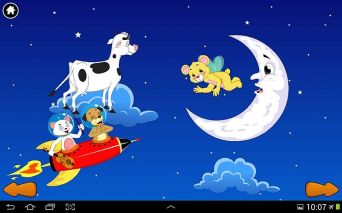
When asked to recall childhood memories, most of us might sing the wonderful English nursery rhymes we were able to recite long before we could read or write. Those tales and rhymes have stayed with us for years. We inherited them from our schools; from our parents; and, we pass them on to the future generations. Our parents, in turn, learnt when they were kids; as a part of their upbringing under the British Education System.
The history of those nursery rhyme dates back to centuries; to a time when written language was scarce or was limited to the highly educated gentry. It was due to the lack of written material; and more importantly, due to the lack of education for the working class. The rhymes, which we now refer to as nursery rhymes , were passed on by word of mouth.
Whether this originated from another poem or from a song is unknown; but , the concept is clear—that nursery rhymes “…are fragments of ballads or of folk songs, remnants of ancient custom and ritual and may hold the last echoes of long-forgotten evil”
*
When people think of nursery rhymes, they think of “Twinkle, Twinkle Little Star”, cute, innocent and harmless. They think of them as the ideal entertainment for children. Of the Nursery Rhymes taught in our schools, most do rhyme well; and, are easy to sing. Most of them are innocent enough like the ones that are supposed to help children learn numbers, letters etc.
However, you soon realize that many of the rhymes do not fit into this ideal image that people usually associate with the joyful songs that kids love to sing. Some of those rhymes may have a morbid tale tale running beneath it ; some might be blatant, though, sometimes subtle.
Few of us are aware of their dubious history of certain rhymes. A very large number of interesting collections of nursery rhymes have been published; but, curiously enough, there are hardly any books devoted expressly to disclose their origin and history.
Many of the Rhymes have soothing words; but, a lot of others carry words denoting violence. Another reason for discomfort is that we know neither the meaning of certain words used in the rhymes ; nor do we know of the context of its words or of the rhyme itself.
**
Regardless, the nursery rhymes that were popular years ago continue to be popular today; and , would be so even thereafter .
The nursery rhymes , in general, are placed in three broad categories.
First, the lullabies, the songs and melodies, sung to put the little one to sleep. And, there are the amusing and soothing ones , Then, there are also those that instead of soothing, appear to intimidate the child; and/or used as an outlet for the emotions of the nurse.
For instance, look at the words in Rock-a-Bye Baby:
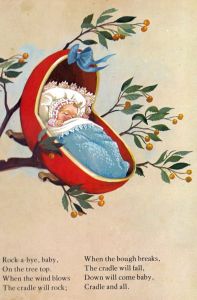
Rock-a-bye Baby, in the tree top,
When the wind blows, the cradle will rock.
When the bough breaks, the cradle will fall,
And down will come baby, cradle and all.
*
Then , there’s one about Bonaparte coming by and eating the child, which obviously goes back to Napoleon Bonaparte being the bogey figure in British society:
Hush you baby, hush you squalling thing, I say, or Bonaparte will pass this way.
And there is even a later version with Hitler mentioned in it.
In contrast, the traditional Indian lullabies, in all its languages and dialects, are far sweeter, soulful and soothing.
*
A second category of nursery rhymes is those sung as infant amusement.
Many of the counting rhymes, and alphabet rhymes fit into this category. Some are good; and others, not so good.
One, two, three, four, five,
Once I caught a fish alive,
Six, seven, eight, nine, ten,
Then I let him go again.
Why did you let him go?
Because he bit my finger so
Which finger did he bite?
This little finger on the right.
Finger games, or what some refer to as tickle games, are for the amusement of infants and toddlers. Perhaps the best known are:
Pat-a-cake, pat-a-cake, baker’s man,
Bake me a cake as fast as you can;
Pat it and prick it, and mark it with B,
And put it in the oven for baby and me
This little piggy went to market,
This little piggy stayed home,
This little piggy had roast beef,
This little piggy had none,
And this little piggy cried,
Wee, wee, wee
All the way home.
Peek-a-boo is probably the oldest of all infant amusement with the earliest documented variation mentioned as early as 1364 . Unfortunately, many of the actions to the rhymes have been lost over time, leaving only the songs.
*
The final portion of the trilogy belongs to the group of rhymes that have made their way into the nursery from adult riddles. The answers to these adult riddles became obsolete, so too did the riddle. However, many have survived as songs; and , have found their way into schoolbooks.
An example of such a riddle is one that relates to prostitutes:
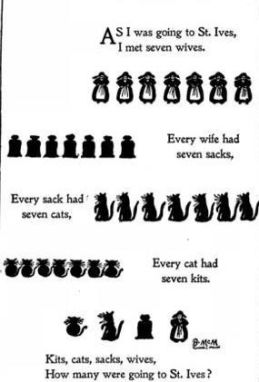
As I went to St. Ives, I met nine wives.
And every Wife had nine Sacs,
And every sac had nine Cats,
And every cat had nine kittens.
How many Wives, Sacs, Cats and Kittens
Went to St. Ives?
( The answer appears to be that only one person was going to St Ives)
*
In connection with the adult entertainment, popular theory claims that many of the nursery rhymes of today were not written for children. They were rooted in the political and social undertones of the past. Many started out as folk songs, as adult rhymes, to camouflage an unpleasant message or a distasteful event in their local history. Yet, it is possible to read into the various rhymes, connotations about Kings and Queens and social injustices. Rhymes were a sort of euphemism.
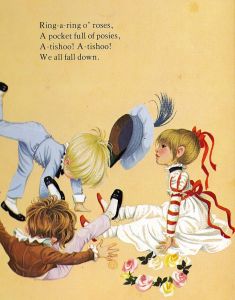
For instance, the circle game Ring-around-the-rosie, refers to Great Plague of London and of Edinburgh, Scotland . The lines “Ashes! Ashes! We all fall down” or “Hush! Hush! Hush! Hush! We’ve all tumbled down” is referring to the death of the people. It just does not sound like a good game to be playing and a good song for children to be hearing and singing.
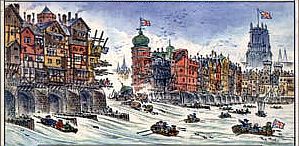
The rhyme “ London Bridge is falling down” and the game, which often accompanies it, preserves a gruesome tale of human sacrifice. The builders of London Bridge were faced with many obstacles. The bridge could not be made to stand by ordinary means, so a watchman was required. That watchman , apparently, could not protect the bridge against the forces of nature. Legend has it that during the building of the bridge of Rospordenin Brittany, all attempts were unsuccessful until a four-year–old boy was immured / sacrificed at the foot of it. Supposedly, the boy was buried with a candle in one hand and a piece of bread in the other.
http://nemendur.khi.is/berghall/nurseryrhymes.htm
*
The Oxford Dictionary of Nursery Rhymes is a very useful guide. It gives the background of many rhymes. Along with that, the Oxford English Dictionary is also incredibly useful for looking up and verifying certain words of the rhymes and to check when they came in and/ or out of use and when their meaning changed. Interestingly the versions and meaning of some rhymes’ changed several times.(E.g. Humpty Dumpty, Old King Cole
Several studies have been carried out on the issue of violent content of the rhymes. The researchers have pointed out that the amount of violence depicted in children’s nursery rhymes is ten times greater than what is broadcast on TV. Little Miss Muffet; Jack and Jill, and the Incy Wincy Spider need a rating system especially when it comes to categories for violence.
http://www.news-medical.net/?id=6348 http://adc.bmj.com/cgi/content/abstract/89/12/1103
*
The researchers assessed the words of 25 popular nursery rhymes. Forty-one percent of the nursery rhymes contained some kind of violence . Violent episodes were classified according to whether they were accidental, aggressive or intentional and included implied or threatened violence.
Dropping a Pussy in a Well is a good example: Ding, dong bell / Pussy in the well / Who put him in?.
However, rhymes such as “Simple Simon” who pricked his own digit on a thistle; “Six in a Bed” with its cumulative series of traumas suffered by people apparently too poor to enjoy individual sleeping arrangements; and “Jack and Jill” who suffered appalling injuries after taking a nasty tumble while water-gathering ;were worse and scored particularly highly.
*
As regards the “other” meanings of the rhymes, the word ‘goose’ in ‘Goosie Goosie Gander‘ came from a particular moment in British history when the word ‘goose’ was a euphemism for a prostitute.
‘See Saw, Marjorie Daw, Johnny shall have a new master’. The word ‘Daw’ is an old English word for ‘slut’. Therefore, what you have in ‘See Saw Marjorie Daw‘ is basically up and down goes Marjorie, the slut.
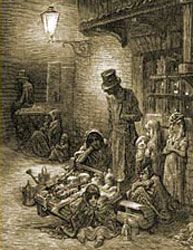
[ It also appears to refer the use of child labor in work houses where those with nowhere else to live would be forced to work for a pittance (a penny a day) on piece work . The poignant misery of homeless kids was touchingly sketched by Charles Dickens ]
‘Baa Baa Black Sheep‘ is a nursery rhyme about taxation. It is actually two bags for the taxman , of which one bag goes to the church and the other bag goes to the king. The poor farmer is left with one bag; it is a two-thirds taxation system.
“Here we go Round the Mulberry Bush“, relates to a practice in old Britain of making the prisoners grow mulberry while serving their term, to help them earn some wages. The term ‘to go round the mulberry bush’, means to do time in prison. If someone asked you, “Have you been round the mulberry bush then?” and you answered ‘Yes’; it was a euphemism for being in prison.
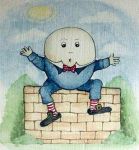
Similarly, in the 16th century Europe, Humpty Dumpty meant a brandy and egg based drink. It also described a clumsy person falling over all the time. But, in England during the English Civil War of 1640, Humpty Dumpty took on a new meaning. It became the nickname of a cannon on the wall of the City of Colchester, probably because the cannon was ungainly and slightly odd-looking, and the rhyme after that date, started to be associated with that cannon, which was on the walls of the city and was knocked off and fell to pieces, and all the King’s horses, and all the King’s men couldn’t put Humpty together again.
Take the rhyme ‘Jack be nimble, Jack be quick‘. It was about pagan superstition; if you could jump over the candlestick and not put it out it deemed good luck. It is harking back to pagan fire rituals and finding good luck.
*

It is not just the word meaning that matters when it comes to nursery rhymes; it is also the tune. Singing in itself might be a lesson in voice’s vocation. Sung rhymes have energy; For example, ‘Yankee Doodle‘ is a good example of an imitation melody that is simple, elemental and curious.
Yankee Doodle came to town
Riding on a pony.
Stuck a feather in his cap,
And called it Macaroni.
The tune goes back to about 1760. Putting a feather in a cap, it is a traditional showing-off. If you killed somebody in battle, you put a feather in your cap. That is what the rhyme is actually about. It is about the British soldiers mocking the Americans during the War of Independence, for their lack of style, for lack of elegance, and just being a bunch of colonial hayseeds. ( the expression , adding a feather to his cap – is still in use; and, is meant to suggest ones “achievement“)
The key to it is a final line, ‘Put a feather in his cap and called it Macaroni‘. The Macaronis were a British youth movement that reached its peak in about 1772, and were a bunch of incredibly dandified young men. The Macaronis would parade around London in beautifully tailored jackets, incredibly outlandish wigs and cummerbunds as well. What the song is referring to is that it is not enough for the American colonials to put a feather in their cap and think that made them Macaroni; there was more to being a Macaroni than that.
*
The original Old King Cole is – A merry old soul. Old King Cole was one of the legendary English Kings; nobody quite knows where he ruled or what he ruled. However, this rhyme now relates to one of Aboriginal cricketers who toured England in the 1860s. They were actually the first Australian cricket team to tour England. The British were unable to pronounce foreign names; and, this was what happened to an Aboriginal cricketer whose real name was something like The Rippinsteen. He died while on tour in Britain ; and, was buried in Bethnal Green in east London. The local people who liked the old cricketer planted a eucalyptus tree on his grave. Every touring Australian cricket team visits old King Cole, as he came to be known. It is perhaps another example, a charming one , for a change, of a nursery rhyme picking up a different meaning hundreds of years after the original.
Although today’s society is filled with new amusements, the children of today still play games with exactly the same ritual and phrases. The same goes for the rhymes and stories. As long as there are children, there will be nursery rhymes.
Nursery rhymes play a significant role in language development of the child. Obviously, children learn them by rote before understanding their meaning. This points to a shifting relationship between sound and meaning, right from the very beginning. How children learn speech has something to do with how they learn nursery rhymes.
Words in a Rhyme are a game. They are part of a subversive language model. And, that is the strength of nursery rhymes; they’re almost so nonsensical that they can apply to anything. That is one of their enduring features.
Given the history of the Rhymes and context of the society that gave birth to them , I feel that in Indian conditions, If our children love singing the Rhymes it is preferable we let them sing for the sheer enjoyment of the tune , rhythm and the fun of it. Treat it as just fun and nothing else. Do not try to read any meaning into the Rhymes.
In their earlier stages, they could perhaps be spared of the agony of understanding the meaning and context of the Rhymes. It would otherwise add a further dimension to the confusion and stress they already endure.
*
Are nursery rhymes too violent? Do they give children nightmares, and should they be modified? Should we encourage more Rhymes about friendship, unity, love, commitment to study , nation etc.?
Should we popularize Rhymes and games that talk of things closer to us in our day-to-day life? Should we teach our children to sing about things they love, in our way of life? Should we encourage our children to sing rhymes in their own language than in English?
I think we should. Each generation should take a re-look at the old rhymes and its language in order to ensure they reflect changes in our aspirations , the changes in our attitude to childhood and life.
Sources:
http://nemendur.khi.is/berghall/nurseryrhymes.htm
http://www.english.uwaterloo.ca/courses/engl208c/esharris.htm
http://www.english.uwaterloo.ca/courses/engl208c/esharris.htm
Pictures are from Internet








 sreenivasarao's blogs
Dorabjee- a response
Dorabjee- a response
Thank all of you.
I am overwhelmed by the response to Dorabjee. After I finished writing the story, I thought it made a rather sad reading. I had no heart to inflict it on the Sulekha readers. I sought advice from a friend, who read it ; and, asked me to post it, after taking care of spelling errors. I was assured that readers on Sulekha have a sturdy heart; and, surely would survive this teary onslaught.
Dorabjee relates to late 70s and early 80s, when, as I said earlier too, there was a village at the heart of Bombay; and, that village had a heart. The relations at work were generally cordial. Your mates greeted and wished you well;, not as a mere idiom of courtesy; they meant what they said.
I have never witnessed such spontaneous collective goodwill elsewhere as among the lower income immigrant groups of Bombay. Most were fleeing from the unbearable sizzling cauldron of poverty and humiliation tormenting them in their small towns and villages; and were thrown into the squalor, dirt and wretchedness of the big city, the like of which they had never seen .
They were ordinary people who lived dreary lives huddled in nondescript hellholes called Chawls and eked out living doing low paying odd jobs; yet shined as angles when neighbors were in trouble. They realized the needed of each other if they had to survive the encircling wretchedness that was climbing on them. They clung to each other for fear of loneliness, for help and comfort and for fear of big bad wolf. Whenever tragedy struck by way of accident, debilitating sickness or death; or at times of dire need during pregnancy or childbirth; like little ants, together they carried burdens much heavier than themselves.
They survived not by standing valiantly against the Goliath; but, by bending low like grass in a storm. Yet, even if they could not erase the scourge of poverty, they carried it about them with dignity, which was neither less nor different from the dignity of any other human being.
The greatest difficulty they faced was isolation; turning their homes into ghettos. Poverty, they realized, wasn’t only a lack of financial resources; it was isolation from the kind of people that could help them.
****
Dorabjee is based on the life and tragedy of a person I knew. I have written that into a story in my words. Nadira’s condition and Dorabjee’s care during the first year of her illness are based on what I learnt from the family. I lost contact with the family after the first year until about the end of the third year. I had half a mind to fill in the clinical details of disease condition in its later stages by consulting a doctor or by checking on the net. I did not pursue that idea since I thought it would mar the flow of the narration; and, it would not also add a value.
*
Some one questioned why Nadira had to be shifted to a Home since Alzheimer’s was not contagious.
No, it was not because of that. The reason was that Dorabjee’s health was failing. Yasmin was unable to take care of her parents, unresponsive and unmanageable. She was on the wrong side of thirty and her personal life was in tatters, as I mentioned. The Parsi Colony was itself slipping into a virtual old age home. Not many young persons were left in the colony.
[Those few young persons were not getting married. This is a serious problem in Parsi community, even today.]
Dorabjee would not let go Nadira and he was not in great shape, either. There was no other way to take care of both. They had to be shifted to a Home.
*
Some one remarked that Nadira benefited greatly by Doarabjee by her side. I am not sure of that. Nadira resided in a little bubble world of her own, (perhaps) watched life pass by, disinterestedly. She was beyond pain or pleasure. What Dorabjee did was out of love for his companion, without knowing why and without complexities of pride of giving. He did not know any other way.
Nadira held on to Dorabjee when it was easier to let go. She held on even when she had gone far away.
*
There were a few comments confusing suffering with love.
I think it is mainly because we have run into situations confusing symbols with reality; confusing money with wealth; menu with enjoyable dinner; and, greed with need.
It is not the whistle that runs the train ; but , it is the steam.
In my What Love is.. I wrote, “Love, happiness and well-being are spoken in one breath as if they are inseparable. Many times, I think, they are not even related. A lot of that does not necessarily feel good. Had I thought that love was about only feeling good, I would have missed many things in life.”
I was not suggesting that love always brings with it pain and suffering. No, pain is something that happens; suffering is what you bring on yourself. Love is something that can’t be destroyed by suffering, the only thing that rescues you from this cauldron of pain and insanity is love; hold on to that love defying the horrors of life. Love is an attitude. It is about life. It is about living. None of the things you do makes sense if love, actual care for persons, is not present.
(Anon)
Regards
riverine
Melody Queen
R-Sharma
Ehsaas
Bijaya Ghosh
Indu3
Shamoli Sarkar
Ratan Datta
swayamprava
Suresh Wadhwani
Aditi Ray
mrmulliner
One Percent
gisurgeon
drpriya005
kamalji
poetBittersweet
vijaya
swarajya
Mistress Desari
pradeep24s
animagi
charuavi
kvraghu
Posted by sreenivasaraos on August 31, 2012 in Story
Tags: Dorabjee, response to comments