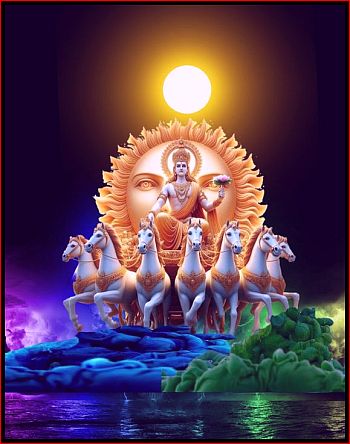
Of the 52 verses of the Asya Vamasya Sukta, we have so far covered 33 verses.
The initial ten verses speculated on the structure and the nature of the cosmos by relating it to the powers, splendours and virtues mainly of Aditya, the celestial winged-bird Suparna (Surya -Sun), who is said to be at the centre of a well-organized Cosmic System
And, the Sun is related to other ancient Vedic deities such as: Agni (Mātariśvan), Vayu, Varuna, Indra, Soma (Moon), Mitra and Vac (speech). And, yet, the verses here are not addressed to any particular god.
Unlike in the other Vedic texts, there are not many prayers addressed to gods in Asya Vamasya Sukta. It is mainly concerned with raising of doubts, questions; suggesting answers; apart from glorification of knowledge and the Ultimate. Truth (Sat).
Dhirgatamas adopted the phenomena of physical Nature as figurative reflections (symbolisms) of the functioning of Man’s inner life. He employed several categories and objects, which stand out as eloquent epithets in the expressions of Nature: -such as – the Ocean, Sky, Earth (Prithvi), Air, Water, Sun, Moon, Mountains, Rivers, Forests, Trees, Animals, Rains, Clouds, Cow, Calf, Milk etc.
He tries to build a harmonious relation between the objects and elements of Nature.
He also brings in many objects and terms having symbolic connotations: Chariot (Ratha); Chariot with single wheel (Eka-chakra) and having three naves (Tri-Nabhi); the seven who yoke it; Seven-horses, a Horse with seven names, Father, Mother, Child etc.
In the process of his inspired response to the wonders of Nature and of Human Life and of Cosmos beyond, the poet has brought together a number of Vedic Doctrines about the Universe, its creation and its progression.
*
This is followed by the mystic descriptions of the Time-principle (Kaala), which is eternal and indivisible. Everything is born and dies in Time. Aditya, on the summit of the sky, the Lord of all the three worlds, Master of the Time-element, which, is perpetual and inseparable. It is absolute. All the events in a person’s life such as: birth, growth and death are measured in the sub-elements of the year (Samvathsara).
What follows thereafter , verses (16 to 22) , is a series of very obscure concepts, rather not possible to understand easily. These could be interpreted in any number of ways.
Dhirgatamas poses the questions through dramatic doubts. He plays the drama of doubt through conflicting terms. He poses questions not because he does not know the answers. But, he does it just to dramatize his answers; by constructing riddles; spurring the reader to arrive at his own answers, which he might come to believe to be true.
Dhirgatamas did not present easy and ready answers to his riddle-like queries. He, instead, presented another enigma:
Even when Dhirgatamas supplies an answer to his questions, his answer could be interpreted in any number of ways.
Here a new topic starts. There is some glorification of wisdom, enabling one to see and to know. One is not sure who or what they are. Though they are women, they are declared to be men.
The verses bring up a very complicated and an interesting concept of Androgyny. It basically says, there exists in every individual the male as also the female characteristics. A person is truly an interplay of these two principles, which cohabit within everyone harmoniously.
The Supreme Divine too is neither female nor male; it encompasses and transcends all gender distinctions.
**
The dawning of wisdom concerning the mysteries of the universe, its creation and progression, is expressed through the allegories of Cow, Calf. Milk etc
While glorifying wisdom, the poet brings in (through a series of metaphors of tree, fruits, birds) a clear distinction between those who know the Truth and those who know only the outside, the external world, without enjoying the fruits of wisdom.
**
Following upon this, there is a glorification of poetry in three Verses -from 23 to 25. These verses specifically relate to the Sanskrit prosody or Chhandas (छन्दस्); the metre meant to maintain the rhythm of a well-constructed verse.
*
The four verses thereafter (26 to 29) employ the symbol of the cow which gives plenty of nourishing milk; and compares it with the clouds that shower life-giving rains.
Aditya, the one who with his bright rays creates the rain, is compared to the Milk-man
But, the following four verses – 30 to 33- are again obscure, suggesting the mystery of the embryo in mother’s womb, birth and the embodiment of the Self. The greatest mystery of Nature is the creation of the embryo and the Motherhood.
Verses 30 and 31 together put forward the ancient doctrine known as Amrita-Mritya-Vada, according to which, both the mortal body (मर्त्येन-Martya) and Amartya (अमर्त्यः) the Self or the Jiva, life principle (जीव) which is immortal, are united like brothers; and have a common origin.
*
Now, let’s come to Verses 34 and 35, which pose four questions in one and the corresponding answers in the next.
Verse 34
पृच्छाe 34मि । त्वा । परम् । अन्तम् । पृथिव्याः । पृच्छामि । यत्र । भुवनस्य । नाभिः । पृच्छामि । त्वा । वृष्णः । अश्वस्य । रेतः । पृच्छामि । वाचः । परमम् । विओम ॥ R.V.1.164.34 ॥
pṛcchāmi tvā param antam pṛthivyāḥ pṛcchāmi yatra bhuvanasya nābhiḥ | pṛcchāmi tvā vṛṣṇo aśvasya retaḥ pṛcchāmi vācaḥ paramaṃ vyoma ॥
I ask you about the farthest limit of the earth, I ask you where is the centre of the universe. I ask thee of the semen of the stallion, I ask of the ultimate abode of speech -Vak.
Verse 35
इयम्। वेदिः। परः अन्तः । पृथिव्याः। अयम्। यज्ञः। भुवनस्य। नाभिः। अयम्। सोमः।वृष्णः। अश्वस्य। रेतः। ब्रह्मा।अयम्।वाचः।परमम्।विओम ॥R.V.1.164.35॥
iyaṃ vediḥ paro antaḥ pṛthivyā ayaṃ yajño bhuvanasya nābhiḥ | ayaṃ somo vṛṣṇo aśvasya reto brahmāyaṃ vācaḥ paramaṃ vyoma ॥
The altar is the ultimate limit of the earth. This sacrifice is the navel of the world. This Soma is the semen of the strong horse. This Brahman is the ultimate abode of speech.
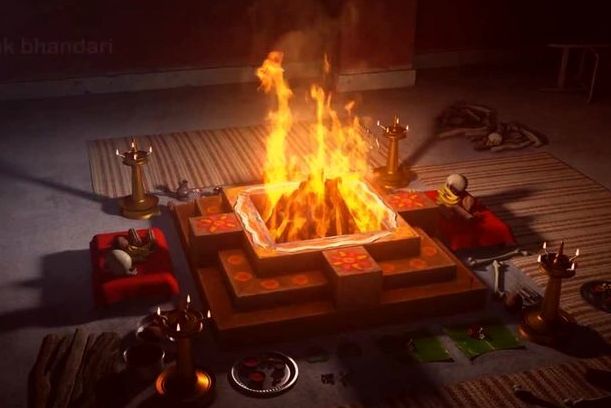
In these verses there is a sudden change of subject-matter.
In the poems 34 and 35, the intellectual side is indeed very strong. Yet here we see the prominence given to the ritual’s aspects of worship.
In these two verses there is a glorification of the Soma-Yaga. And, the speech (Vac) here is not the ordinary language that is heard in everyday life; it is rather the inaudible basic Truth, known only to the great poets or seers.
Yajnavalkya in the Brhadaranyaka Upanishad explaining the relation between Vac and consciousness says that Vac (speech) is a form of expression of consciousness.
Vac is the word principle that gives expression to the latent or un-manifest thoughts, feelings and impulses.
And, Vac is indeed both speech and consciousness (Chetana), as all actions and powers are grounded in Vac. It is the primordial energy out of which all existence originates and subsists. Vac is also the expression of truth.
Dhirgatamas goes far beyond; and, exclaims: Vac is at the peak of the Universe (Agre paramam); She is the Supreme Reality (Ekam Sat; Tad Ekam); She resides on the top of the yonder sky; She knows all; but, does not enter all”-
मन्त्रयन्ते । दिवः । अमुष्य । पृष्ठे । विश्वविदम् । वाचम् । अविश्वमिन्वाम् ( RV.1.164.10)
mantrayante|divaḥ|amuṣya|pṛṣṭhe|viśva-vidam|vācam|aviśva-minvām
**
The verses 34 and 35 are composed in the question-answer mode, concerning the nature of Brahman (ब्रह्मोद्यः–Brahmodya). It expounds the ideology of Yagna, which aims to bring about the unity of the universe; and of all creation.
These two verses are chanted, just as a discourse or dialogue, during an Ashva-Medha-Yaga.
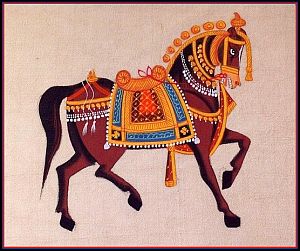
Four questions are posed and answers are sought (पृ॒च्छामि॑–त्वा॒) in verse 34; to which answers are provided in Verse 35.
- Which is the farthest end (परम्–अन्तम्) of the earth (पृथिव्याः)?
- Ans: The यज्ञ वेदि –Yajna-Vedi – the altar of the Yajna (इयम्– वेदिः–परः–अन्तः पृथिव्या)
- Which is the center – नाभि –Nabhi -of the Universe (यत्र – भुवनस्य—नाभिः)?
- Ans: The Yajna – the sacrificial ritual (अयम्–य्न: – भुवनस्य–नाभिः)
- What is the seed (रेतः)of the stallion (वृष्णः–अश्वस्य–रेतः)?
- Ans: The Soma is the seed (सोमः– वृष्णः– अश्वस्य– रेत॑ः)
- Which is the highest or sublime abode of speech -Vak (वाचः । परमम् । विओम)?
- Ans: Brahma is the source of Vedic –Vak (ब्रह्मा । अयम् । वाचः । परमम् । विओम).
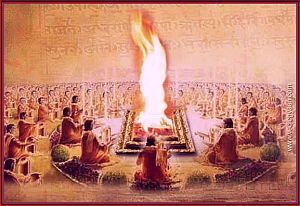
According to Sri Sayana Ṛgveda-bhāṣya:
एतावती वे प्रथिवी यावती वेदिः– etāvatī vai pṛthivī yāvātī vediḥ . This altar (वेदिः -Vedi) is indeed the earth – This altar is the essence of the whole of Prthvi, including Antariksha (Mid-region) and other Lokas (worlds). There is no Prithvi other than the Vedi — न हि बेधतिरिक्ता भूमिरस्ति.
अयम्–यज्ञो–भुवनस्य–नाभिः what is it that unites all creatures on the earth, in a bond of relationship? The navel of the world: नाभिः संनष्टनम् –Nābhi-sannahana is the binding together of man with the means of subsistence or the crops that spring from the rain, which falls as the consequence of sacrifice or of oblations- यज्ञो. Its Vedi is the centre of the Earth – (bhuvanasya Nabhi)

अयम्– सोमो– वृष्णो अश्वस्य–रेतः।Soma (सोमश्सः) is the seed of all creation – सोमोः रसासम्का:, Soma is at the centre of Aditya; and, Agni is at the centre of Soma. The Soma juice offered as oblation in the Yagna reaches Adiya; and returns to earth in the form of rains. सोमश्सः आदित्य प्राप्य वृस्त्यादिफलम् .
ब्रह्मायम् वाचम् परमम् व्योमः – the speech of the Vedic texts, of which Brahma, or the priest, is the author, he is the expounder.
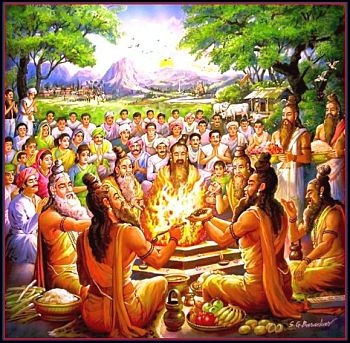
[This Hymn describes the Universe as a Deva-yajna. The Hotar is offering oblations into the Yajna.
The all-knowing priest who presides over, and directs the course and conduct of the Soma sacrifice is designated as Brahma; while the three other sets of priests who chant the mantras are named as Hotar, Adhvaryu, and Udgatru.
Here, Brahman the definitive voice (final-word), is taken to be Vac. Brahma (word) and Vac (speech) are said to be partners working closely towards the good (Shreya) and fulfilment of the aspirations (kamya) of all. And, Brahma, the one who presides and controls the course of the Yajna, is accorded a higher position over the chanters of the mantras. Vac (chanting) extends so far as the Brahma allows (yaávad brahma taávatii vaák– RV_10,114.08) – यावत् – ब्रह्म– विस्थितम्—तावती – वाक् .
It is also said; Vac in the form of Mantras resides Prajapathi (Brahman). He is the source as also the culmination of Vac— ब्रह्मा प्रजापतिरेव वाचः मन्त्रादिरुपाय: – ]
**
According to Dr. Raja:
The questions refer to the created world. There is a clear ritualistic bias in this context and it is a glorification of the ritual of Soma Sacrifice with its pavement which is spoken of as the farthest limit of the earth, the pivotal point of the world being the Sacrifice, the Soma being the seed for the procreation of humanity and Brahman being the scat of speech.
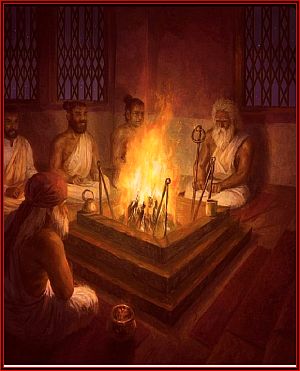
Verse 36
सप्त । अर्धगर्भाः । भुवनस्य । रेतः । विष्णोः । तिष्ठन्ति । प्रदिशा । विधर्मणि । ते । धीतिभिः । मनसा । ते । विपःचितः । परिभुवः । परि । भवन्ति । विश्वतः ॥R.V.1.164.36॥
sapta | ardha-garbhāḥ | bhuvanasya | retaḥ | viṣṇoḥ | tiṣṭhanti | pra-diśā | vi-dharmaṇi | te | dhīti-bhiḥ | manasā | te | vipaḥ-citaḥ | pari-bhuvaḥ | pari | bhavanti | viśvataḥ ॥
The seven (sustaining), the embryo (rain) for half a year, the fecundating (element) of the world, abide, by appointment, in the various functions of Visnu. By their intelligence they pervade in thought all around (them), for they are intelligent and diffusive.
*
Many commentators, in exasperation, have remarked that the Verse 36 here, is one of the most unintelligible verses in the Vedas. The main point here is rather obscure.
Dr. Raja comments:
In the following verse (36) there is mentioned a seven-fold seed for the creation of the world; and this may be compared to the seventh of those who were born together, stated in verse 15 above. These seeds are spoken of as wise and encompassing the world.
We do not know the exact significance of the seven-fold scheme in the origins of the world and in some of the hidden facts in this universe.
****
Swami Amritananda has translated the verse as:
The seven (सप्त) rays of the Sun, in the mid-region of the universe contain water, in the form of embryo (अर्धगर्भाः). They indeed are the essence of the world (भुवनस्य– रेतः). They abide in their respective positions (तिष्ठन्ति– प्रदिशा) to help the Sun (विष्णोः), who pervades the world, in his function of sustaining all the regions (विधर्मणि). Those rays (ते) are intelligent (धीतिभिः) and diffusive (सप्त). They, by their intelligence and a sense of duty (मनसा), pervade (परिभुवः) all around. (परि-भवन्ति-विश्वतः).
The rays of the Sun bear water in their womb during the rainy season (middle of the year) The seasons appear at their assigned periods; and follow the command of their master, the Sun, and, help in his task to sustain the world.
**
Sri Sayana explains:
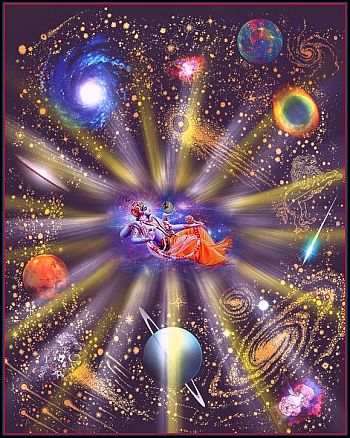
The seven: the solar rays, saptārdhagarbhāḥ; either retaining the rains for half a year, i.e. during the dry months, or abiding in a part or half of space, or in the mid-heaven or firmament.
The rays of the Sun are a form of rain -water, as they are responsible for shedding rain. They themselves could be called as rain.
Vishnu- the supreme Lord अधिदैवत– is the pervading sun; vyāpakasya Ādityasya, in whose various duties of cherishing the world, the solar rays are, by direction, pradiśā, especially employed.
Verse 37
न । वि । जानामि । यत्इव । इदम् । अस्मि । निण्यः । सम्नद्धः । मनसा । चरामि । यदा । मा । आ । अगन् । प्रथमजाः । ऋतस्य । आत् । इत् । वाचः । अश्नुवे । भागम् । अस्याः ॥ R.V.1.164.37॥
na | vi | jānāmi | yat-iva | idam | asmi | niṇyaḥ | sam-naddhaḥ | manasā | carāmi | yadā | mā | ā | agan | prathama-jāḥ | ṛtasya | āt | it | vācaḥ | aśnuve | bhāgam | asyāḥ ॥
I do not understand this, what am I. And, I roam about in hiding, enwrapped in thought, perplexed. When there came to me the first born off-springs of the Rta (insight of what is True), then, immediately after that I enjoyed a portion (the meaning) of that sacred word
*
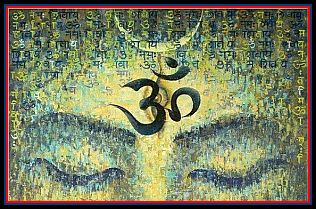
I have not inquired nor have I realized (न– वि – जानामि) what I am or all of this (यत्इव– इदम्– अस्मि). I am wrapped in ignorance (निण्यः); bound by sense-objects (सम्नद्धः); perplexed and wandering in mind (मनसा—चरामि). When I do realize(प्रथमजाः) the real Truth(ऋतस्य) behind all this existence, then I will truly understand the meaning of the Upanishad statements. (आत्– इत् – वाचः)
A similar experience of one having realized the Truth is described in the Mundaka Upanishad .
Having attained Him (not by any external means), free from faults of desire, etc., the seers gratified with their knowledge; having accomplished their purpose with full composure, realize the Truth that The Brahman itself, The One without a second, is their own Atman.
संप्राप्यैनमृषयो ज्ञानतृप्ताः कृतात्मानो वीतरागाः प्रशान्ताः । ते सर्वगं सर्वतः प्राप्यधीरा युक्तात्मानः सर्वमेवाविशन्ति ॥ III.2.5 ॥
saṃprāpyainamṛṣayo jñānatṛptāḥ kṛtātmāno vītarāgāḥ praśāntāḥ | te sarvagaṃ sarvataḥ prāpyadhīrā yuktātmānaḥ sarvamevāviśanti || 3.2. 5 ||
*
[The two verses (37 and 38) refer to the condition in which the poet finds himself in the world after he has attained the poetic vision. ]
Dr. Raja remarks
The poet is not able to see anything in the world of which he could feel — “I am like this”. This sort of a feeling of solitariness is quite natural to a poet. He is shrouded in his own thoughts and he moves about in loneliness. When there was the light of the mystery of the beginnings of this world of creation, he was in possession of the true significance of speech that has been mentioned in various places as concealed. Here also there is the contrast between one who has known and one who has not yet known the truth.
*
Commentary by Sayana: Ṛgveda-bhāṣya
The philosophical implication here is that the individual is seeking identity with the universal spirit.
The eagerness to secure knowledge; and to realize the Truth; and sadness caused when the efforts are not successful, are described in this Rik.
The verse is an expression of anguish, desperation and regret of a person who earnestly seeks knowledge in order to erase ignorance (अविद्या).
He moans: I am bound by ignorance, desire and attachments. I do not have the clarity of mind for introspection. I am an outward-bound; and I suffer.
I shall truly be liberated when I grasp true knowledge and experience the Truth.
All this is Brahman, is the True knowledge.
अविद्याकामकमेभिः सम्यग्बद्धो वेष्टितः अत एव भ्मनसा युक्तो मावनासहिष्णुना विमुखेन विक्षिप्तेन चेतसा युक्तः संचरामि संसारे – इन्द्रियपरवशः एव सन् संसारे दु:खमनुभवामि / । न सार्वासम्यं जानामीति परिदेवते
Verse 38
अपाङ् । प्राङ् । एति । स्वधया । गृभीतः । अमर्त्यः । मर्त्येन । सयोनिः । ता । शश्वन्ता । विषूचीना । वियन्ता । नि । अन्यम् । चिक्युः । न । नि । चिक्युः । अन्यम् ॥ R.V.1.164.38 ॥
apāṅ | prāṅ | eti | svadhayā | gṛbhītaḥ | amartyaḥ | martyena | sa-yoniḥ | tā | śaśvantā | viṣūcīnā | vi-yantā | ni | anyam | cikyuḥ | na | ni | cikyuḥ | anyam ॥
The immortal shares a common womb with the mortal. And, affected by desire for enjoyment, goes forward and backward. The two, moving around ceaselessly, go in different directions .. They see the one; and the other is unseen.
*
The immortal Atman (अमर्त्यः) is associated (सयोनिः)with the mortal body (मर्त्येन). He is entrapped (गृभीतः) blinded by the desire for enjoyment; and, goes (एति) downward (अपाङ्) and upward (प्राङ्). The two -body and Atman- always (शश्वन्ता) move together in this world (विषूचीना) and the other world(वियन्ता). Of these, the body is seen (निचिक्युः); and the other, the Atman, is not seen (न निचिक्युः).
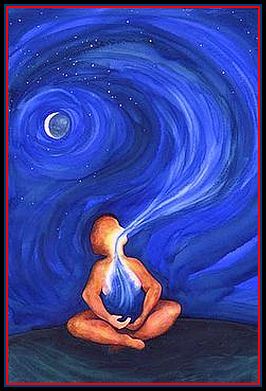
in this verse, three actions are mentioned about the two opposite entities- mortal and immortal.
- they move (वियन्ता –Viyanta) ;
- they move in opposite directions (विषूचीना –Vishuchina); and
- the movement is ceaseless (शश्वन्ता –Sasvanta)
There are four facts stated here:
- The immortal (अमर्त्यः) is associated with the mortal (मर्त्ये)
- अमर्त्यः undergoes the cycle of repeated births and rebirths
- One can be seen; while
- The other cannot be seen, though the two are together
This again brings to the fore the relationship that binds together the immortal and the mortal- the Atman and the physical body. Svadha is the mysterious inherent energy that infuses life into the matter. It is the inherent power Svadha that brings the immortal Prana into contact with the body (Sarira or Bhuta). These two, moving around, go in different directions. They see the one; they do not see the other.
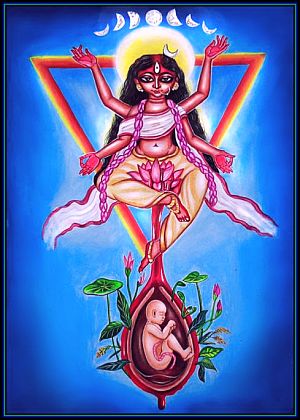
Jiva and Sarira have same origin; and, are bonded together for a time. Of these, the body can be seen, while the other is unseen. The body can look at the outside world; but cannot see the Jiva within it. While the body is perishable, the Jiva moves from body to body, up and down. As it moves from birth to birth, the Jiva carries with it the desires, fruits of action and burdens of its gross bodies across its journey. Its future path is influenced by the cumulative effects of its past desires and acts.

Dr. Raja remarks:
In this verse also, there is the contrast between the one who has seen the truth and who has not seen the truth. One who knows becomes really immortal, though he was one among the mortals till then. They go in different directions; one goes forwards for ever and the other goes round and round without proceeding. People understand only the common man; they cannot understand the one who has had the vision of truth.
Sri Sayana explains:
Affected by the desire for enjoyment by its body, the Jiva is born in various bodies depending upon the Karma-Phala it has gathered. Good and desirable actions lead one to higher worlds; while, bad and undesirable actions lead to lower world.
प्राडं ऐति–अप्राडं ऐति । प्राडं ऐति उर्ध्व स्वर्गदिलोकं प्र्रापनोति । अप्राडं ऐति अशुलक्लकर्म क्रुत्व अदोगच्छति
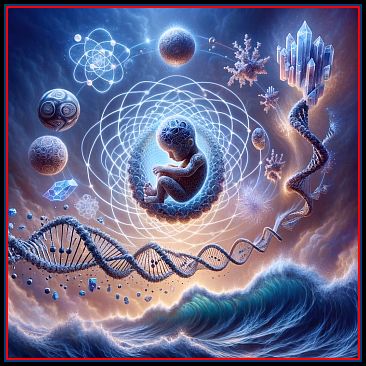
Verse 39
ऋचः । अक्षरे । परमे । विओमन् । यस्मिन् । देवाः । अधि । विश्वे । निसेदुः । यः । तत् । न । वेद । किम् । ऋचा। करिष्यति । ये । इत् । तत् । विदुः । ते । इमे । सम् । आसते ॥ R.V.1.164.39 ॥
ṛcaḥ | akṣare | parame | vi-oman | yasmin | devāḥ | adhi | viśve | ni-seduḥ | yaḥ | tat| na | veda | kim | ṛcā | kariṣyati | ye | it | tat | viduḥ | te | ime | sam | āsate ॥
All the gods have taken their seats upon this supreme heaven, the imperishable (text) of the Veda; what will he, who knows not this, do with the Veda? but they who do know it, they are perfect.
**
All the gods reside in Him (यस्मिन् विश्वे देवाः अधि निसेदुः) who is immortal (अक्षरे –परमे); and who is the Supreme protector (परमे –विओमन्). The purpose of study of all the Vedas (ऋचः) and other scriptures is only to know Him (तत्). For One who does not understand this (न वेद तत्), what use is any study? What can anyone gain by mere reading (किम् करिष्यति), without understanding?
And, whoever knows this Truth attains True knowledge (ये इयत् तत् विदुः ते इमे सम् आसते)
Dr. Raja explains:
Here also there is the contrast between those who know the truth and those who do not know the truth.
There are the syllables and their bare meanings; then there are the secret meanings of the syllables, the nature of the gods.
All the gods really have their abode in these syllables. But all the people do not know this. To those who can know, there is the real fruit in so far as they can sit along with the gods. They are in real communion with the gods.
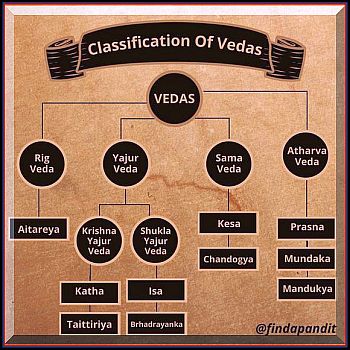
Much has been said by renowned scholars like Bhartrhari, Yaskacharya and others about the texts and their study. For instance:
The celebrated philosopher Bhartrhari (11th century) lauds the study of the traditional texts; and deems it essential for an earnest seeker of Truth.
He draws attention to the fact that perception, at times, could be erroneous because of weakness or improper functioning of sensory organs. As regards inference, he points out that inference, by itself, is an inadequate of source reliable of knowledge (Pramana). He argues that inference alone, without the steadying influence of the scriptures is an improper Pramana.
In his scholarly work Vakyapadiya (1.34), Bhartrhari remarks: ‘whatever is inferred with great effort through clever reasoning can easily be put aside by a much cleverer reasoning or argument (kuśalair anamorphic)’-यत्नेनानुमितोऽप्यथः कुशलैरनुमातृभिः ॥३४॥
And he then asserts, the traditional knowledge (Agama) which consists of the revealed (Sruti) or remembered (Smrti) scriptures cannot be set aside by inference, since they are more dependable than inference.
According to Bhartrhari, it is not justifiable to replace scriptures (Shabda) with inference, particularly in non- empirical matters. He also says that philosophical views (Vada) cannot be independent of the scriptures.
*
Yaskacharya , the renowned Etymologist (Niruktakara) of ancient times (Ca.5th century B C E), in work, the Nirukta, praised the study of the Vedas; and , at the same time he added a word of caution.
Yaskacharya believed that every Vedic word has an expressive power to denote a certain sense. And, as a signifier (vacaka), every word is eternal (vyaptimattvat tu sabdasya – Nir.I.2); and, it performs a critical function in helping to arrive at an unerring, definitive meaning of a statement
Yaska, therefore, remarks that it is essential that one should realize this truth. And, in the absence of such realization, a person, who merely recites the Vedas, without comprehending its meaning, would be like a pillar (sthaanu) or a mere load-bearer (bhara-haara).
And, it is only he, who fully grasps and appreciates the meaning of what he is reciting (arthajña), that will attain the good – both here and hereafter (sakalam bhadram-aśnute-nākam); having been purged of all impurities by the power of knowledge (jñāna vidhūta pāpmā
स्थात्णुर् अयम् भार-हारः किल अभूद् अधीत्य वेदम् न विजानाति यो अर्थम् । यो अर्थज्ञ इत् सकलम् भद्रम् अशनुते नाकम् एति ज्ञान विधूतपाप्मा Nir.1. 18)
sthāṇur ayam bhāra-hāraḥ kila abhūd adhītya vedam na vijānāti yo artham / yo arthajña it sakalam bhadram aśnute nākam eti jñāna vidhūta pāpmā (Nir.1. 18)
*
Sri Sayana shares the views of Yaskacharya; and cautions against mere routine reading of the Vedic texts.
Here Sri Syana offers four meanings to the term ऋक्: 1. The Vedas, starting with the Rigveda; 2.the Solar orb; 3. The Jiva; and, Pranava – ॐ.
As regards the study of the Vedas (ऋक् or अपराविद्या) Sri Sayana instructs that the only means to attain realization of Brahman, the Eternal One, is through the Vedas.
And, he also advises that mere study of these texts alone does not lead to the immortal principle (अक्षर– Brahman). It only leads to the means to understand the Truth.

The space –Akasha आकाशः– is unbound, formless and eternal; and is of the nature of Brahman. It envelops the whole of the universe.
ऋक् अक्षरे परमे व्योमणि इव्युत् लक्षणे ब्रह्मणि – Rik akṣare parame vyomani ithyuth lakshane Brahmani.
येनक्षरं पुरुषं वेद सत्यम् -yenākṣaram puruṣam veda satyam (Muṇḍaka Upaniṣad 1.2.13)
It is under the rule of this अक्षर that the Sun, Moon, Stars, Day, Night and all the phenomena are governed and regulated.
All the Jivas are established in Paramatman– the अक्षर. It is only when one realizes this highest Truth that one can attain liberation.
अक्षरे परमे व्योमन् यस्मिन् परमात्मणि सरवे देवा गमनवन्तो वा इन्द्रियसंज्नक विश्वे सर्वोपि अधिनिषैदु:
**
As regards Pranava – ॐ, Sri Sayana regards it as the symbol of Nirguna-Brahman; and no Mantra is greater than ॐ. All the Devas reside in ॐ.
In the present verse (39), Sri Sayana opines that the terms ऋक्: / अक्षर should be taken to mean Pranava – ॐ , as the path and also the goal .
CONTINUED
IN
THE NEXT PART
REFERENCES
- History of Pre-Buddhist Indian Philosophy by Dr. Beni-madhab Barua -Motilal Banarsidas-1921
- Tagore Law Lectures 1930 – The History Of Hindu Law by Prof Radha Binod Pal; University of Calcutta – 1958
- Vision in long darkness by Prof. Vasudeva Agrawala
- https://who.rocq.inria.fr/Ramakrishna.Upadrasta/Veda/Asya_Vamiya/AVMS/AVMS_1-100.pdf
- https://www.youtube.com/watch?v=r86l_TF9XWc
- https://archive.org/details/in.ernet.dli.2015.226346
- https://istore.chennaimath.org/products/rig-vedic-suktas-asya-vamiya-suktam/1309294000102324374
- pdf (archive.org)
- https://religion.fandom.com/wiki/Dirghatamas
- ऋग्वेदः सूक्तं १.१६४ – विकिस्रोतः (org)
- org/mirrors/rigveda/sanskrit03/RV0310noaccent.html
- ALL IMAGES ARE FROM INTERNET
 sreenivasarao's blogs