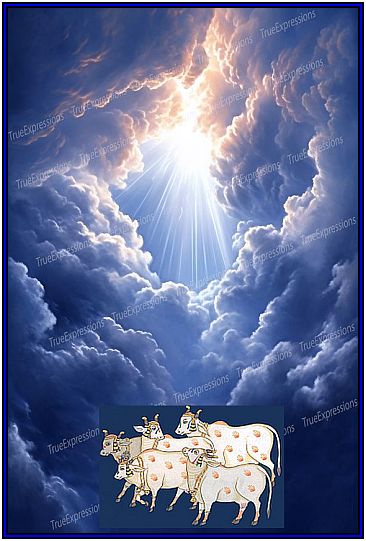
The following four verses (26 to 29) employ the symbol of the cow which gives plenty of nourishing milk ; and compares it with the clouds that shower life-giving rains.
Verse 26
उप । ह्वये । सुदुघाम् । धेनुम् । एताम् । सुहस्तः । गोधुक् । उत । दोहत् । एनाम् । श्रेष्ठम् । सवम् । सविता । साविषत् । नः । अभिइद्धः । घर्मः । तत् । ऊँ इति । सु । प्र । वोचम् 1.164.26॥
upa | hvaye | su-dughām | dhenum | etām | su-hastaḥ | go–dhuk | uta | dohat | enām | śreṣṭham | savam | savitā | sāviṣat | naḥ | abhi-iddhaḥ | gharmaḥ | tat | oṃ iti | su | pra | vocam
I invoke the cow that is easily milked, that the handy milker may milk her; may Savitr accept this our excellent libation, that his heat may (thereby) increase; it is for this, verily, that I earnestly invoke him.
*
Here, in these verses, the symbol of cow (धेनुम्) is projected in many ways; as:
- The Mother-nature, an icon of Motherhood.
- The cow yielding plenty of milk (सुदुघाम्– धेनुम्)
- The clouds that send down the rains on to the earth.
The symbolisms with regard to Milk-man here are:
- The Milk-man (गोधुक्) who milks (दोहत्) the cow
- The Adhvaryu, the officiating priest in a Soma-Yaga (श्रेष्ठम्–सवम्)
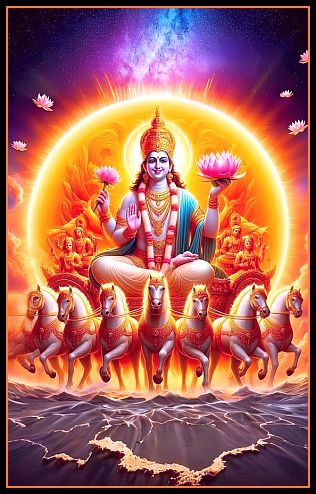
- Aditya, सविता the inspirer, the sun god, the one with bright rays (deft hands – सुहस्तः) who sends down the rains.
All the devotees are earnestly invoking (उप– ह्वये) the blessings of such a cow for securing the best in Life – both in Mind and Body.
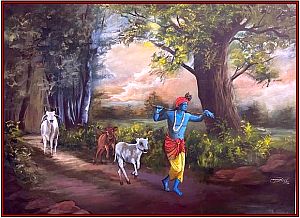
The symbolisms adopted here, and their mutual relations, in short, are:
As mentioned earlier, the term धेनुम् stands for Cow as also for the clouds.
The Cow, as Mother-Nature, shining with divine splendor, sustains with her milk, all of mankind. She is truly the Vishva-Matha.
The rains make the world happy just as the milch cow makes its master happy by giving plenty of milk.
Milk-man (गोधुक्) with deft hands (सुहस्तः) is the Adhvaryu, the officiating priest in a Soma Yaga (श्रेष्ठम् –सवम्), the one who lights up (अभिइद्धः) Pravarga, as a part of Soma Yaga.
This and the next verse employ the symbol of the cow for milking in a Yaga.
Milk-man is Aditya, the one who with his bright rays creates the rains.
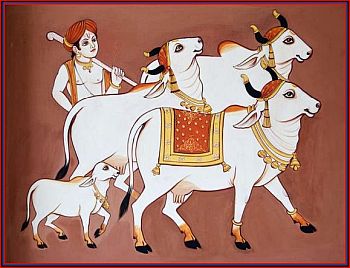
Each one on this earth who is benefitted by the cow, which equates to the rains and to the gods, earnestly prays (सु प्र वोचम्) for the blessings of such a cow; for securing the best of Manas (Mind), Prana (Life) and Vak or Prakrti (physical body) .
[I invoke this milch cow which gives plenty of milk when the milk-man milks her with his deft hands. I earnestly pray, May Savitar grant us this excellent milk for our Soma Yaga when Pravarga-Agni is lighted.]
Sri Sayanacharya explains:
The poet welcomes wisdom conceived as cow.
The oven is used for heating the milk; and. here it is for preparing the wisdom for one’s enlightenment.
*
Other explanations are:
The cow is the cloud, the milk is the rain. Vayu or wind, is the milker.
The metaphor is continued in the following three hymns, where the calf is the world or mankind anxious for the rain, as the cause of abundance.
Again, the milk of the cow is the food which produces the energy for living.
And, Savitri and Sarasvathi are one among the many names of the Universal Cow (Viraj).
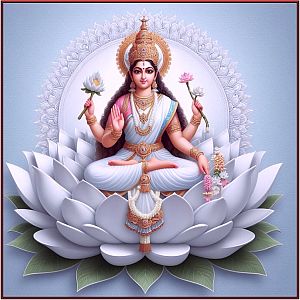
As regards Savitar; in the Samhitas, Savitr is variously identified with Agni, Soma, Prajapati, Visvedevas and Surya; or with their aspects.
Savitar is associated with the clouds, the rains, the earth and the mind; and, he holds afloat the sky (akashbhane) without visible support (aalambanam tad-rahite).
At another level, Savitr is identified with one’s mind, consciousness and with one’s own self (Antaryamian).
[Savitar, in Rigveda, is conceived as an aspect of Sun before daylight (udayat purvabhavi); and, after daybreak the Sun is called Surya (Surya-iti). Thus, Surya is the later form of Savitr.
Some say, Savitr is Surya when present below the horizon, but not quite visible. Savitr is also called Bhaga (Savita Bhagaha: RV 5.82.3) in a sense of the ‘early (proto)’ Surya.
Savitr, thus, comes after night (tamas) and before light (Jyothi): (tamasya kirna rashmir bhavathi). It is also said; the night comes at his command sending all beings to rest. Savitr is the bridge between night and light. Night is un-manifest; and light is manifest. Savitr in this sense is both un-manifest (A-vyakta) and manifest (Vyatka) ]
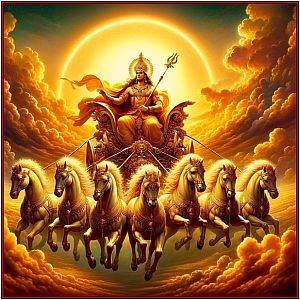
According to Yaska-charya, Savitr prompts (su-preraka), inspires and guides all to engage in good thoughts and right actions; and to tread on the right path
Savitr, here, is the inner-light that illumines, enlivens, prompts and inspires all our thoughts, speech and deeds.
With the sight of Savitr, the Sun-God, one begins to attain the wisdom referred to here.
Such wisdom is symbolized by Cow in this verse.

Verse 27
हिङ्कृण्वती । वसुपत्नी । वसूनाम् । वत्सम् । इच्छन्ती । मनसा । अभि । आ । अगात् । दुहाम् । अश्विभ्याम् । पयः । अघ्न्या । इयम् । सा । वर्धताम् । महते । सौभगाय ॥ 1.164.27 ॥
hiṅ-kṛṇvatī | vasu-patnī | vasūnām | vatsam | icchantī | manasā | abhi | ā | agāt |duhām |aśvi-bhyām | payaḥ | aghnyā | iyam | sā | vardhatām | mahate | saubhagāya
Making a bellowing sound she has come hither, the Mistress of wealth and plenty, yearning for her calf in heart; may this cow (what shall not be hurt) yield milk for the Ashvins, may she prosper for the sake of immense happiness.
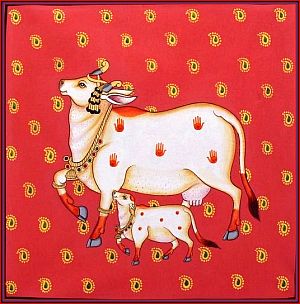
**
[ It is said; the nature speaks through its created objects. It is its own language; the language of symbols (Nidana-vidya). The language of symbols is elastic; suggesting multiple interpretations. We all strive to retrieve their meaning closeted at the core of such symbols, shrouded in mystery (Bhuteshu -Bhuteshu vichitya dhirah – KU.2.5).
Our ancients, recognized the infinite tolerance and the loving quality of the Motherhood in the Earth, which supports and sustains the whole of this existence. They again related the generative potency of the Mother Nature to the Cow, which feeds and nurtures all of us, with patience. The Cow, in turn, was seen as the symbol of the language, giving forth to limitless forms, sounds, words and meanings (Dhenur Vac asman upa sushtutaitu – RV. 8.100.11).
The Universal-Cow-principle (Gauh-tattva) was,thus, seen as a symbol of the Thousand-syllabled speech (Vag va idam Nidanena yat sahasri gauh; tasya-etat sahasram vachah prajatam – SB.4.5.8.4).
Similarly, the fleeting quality of the Gayatri Meter (Chhandas) was said to reflect the flaming glow of Agni, the fire-principle (Yo va atragnir Gayatri sa nidanena – SB.1.8.2.15).
And, even here, the words are mere symbols of the ideas; trying to manifest the un-manifest subtle thoughts and feelings. The words belong to the physical world; but they radiate from a much deeper transcendental, inspirational source that is ever innovative (Pratibha).
*
Following the concept of Nidana-vidya, in the early texts, the cow is compared to Earth as an exemplary symbol of Motherhood. She is the life-giving, nourishing Mother par excellence, who cares for all beings and nature with selfless love and boundless patience. The Mother goddesses such as Aditi, Prithvi, Prsni (mother of Maruts), Vac, Ushas and Ila all are represented by the cow-symbolism.
Further, the nourishing and life-supporting rivers too are compared to cows (e.g. RV. 7.95.2; 8.21.18). For instance; the Vipasa and the Sutudri the two gentle flowing rivers are said to be like two loving mothers who slowly lick their young-lings with care and love (RV . 3,033.01) – gāveva śubhre mātarā rihāṇe vipāṭ chutudrī payasā javete
The cow in her universal aspect is lauded in RV.1.164.17 and RV. 1.164.27-29. She manifests herself together with her calf; she is sacrosanct (aghanya), radiant, the guardian mother of Vasus. She created the whole of existence by her will.
Sri Aurobindo explains: in many of these hymns, milk (literally, that which nourishes) represents the pure white light of knowledge and clarified butter the resultant state of a clear mind or luminous perception, with bliss, symbolized by the honey (or Soma), as the essence of both. ]
**
She comes bellowing (हिङ्कृण्वती), abounding in wealth (वसूनाम्), loving her calf (वत्सम्) in her mind (इच्छन्ती –मनसा). May this cow (अघ्न्या) grant her milk (पयः/अगात्–दुहाम्) to the Aśvins. May she prosper (सौभगाय). May she grow (वर्धताम्) for the long wellbeing of all of us (महते–सौभगाय).
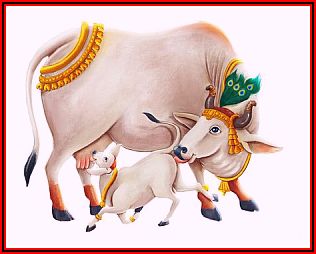
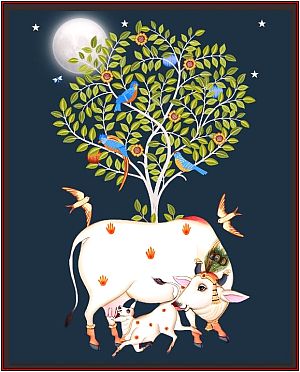
The picture of the mother cow and the calf is really beautiful here.
There is a poetic allusion to the cow and the calf.
- Cow is the protector or the mother of Vasus
- Her heart is full of love for her calf
- She produces milk for two Ashvins
- She enhances prosperity for all who come to her.
*
The milk-drawn for the sake of the Ashvins must be sweet in so far as the Ashvins are fond of Madhu (honey). Certainly, he himself is the calf in this context.
Swami Amritananda explains:
In this verse the term अघ्न्येयं can have two meanings – one as the Cow; and the other as the Clouds.
The cow bellows, loves and protects its child (वत्सम्); and, gives the nourishing milk to all.
While the cloud thunders during the rainy seasons; sends down the rain-water; protects and nourishes the crops, cows and humans (वसूनाम्[-वसुपत्नी) as if they were all her calves (वत्सम्).
**
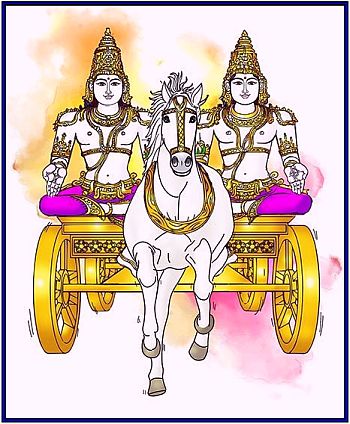
The other interpretation could be that of the Ashvin – twin deities (अश्विभ्याम्), one has the water; while the other has light. They together pervade the universe.
- aśvinau.yad.vyaśnuvāte.sarvam.rasena.anyas.jyotiṣā.anyah (Nirukta .12.1 )
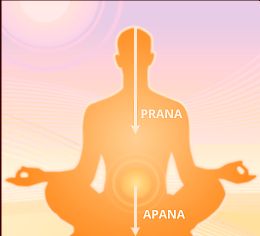
The Ashvin twins can also be understood as the pair of two vital breaths Prana and Apana, – in-breath and out-breath – which sustain the body functions, including assimilation of food, which provides energy to physical, mental and vital activities and their well-being.
Verse 28
गौः । अमीमेत् । अनु । वत्सम् । मिषन्तम् । मूर्धानम् । हिङ् । अकृणोत् । मातवै । ऊँ इति । सृक्वाणम् । घर्मम् । अभि । वावशाना । मिमाति । मायुम् । पयते । पयःभिः ॥ 1.164.28 ॥
gauḥ | amīmet | anu | vatsam | miṣantam | mūrdhānam | hiṅ | akṛṇot | mātavai | oṃ iti | sṛkvaaṇam | gharmam | abhi | vāvaśānā | mimāti | māyum | payate | payaḥ-bhiḥ
The cow bellows for her calf, (who stands) with winking eyes, and lows as (she proceeds to lick his forehead; she utters a cry, as, anxious, she sees the moisture in the corners of his mouth, and nourishes him with her milk
**
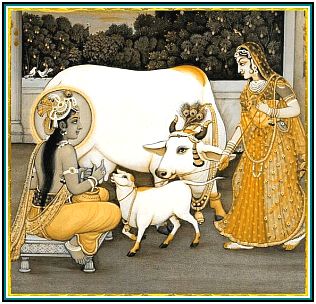
There is the beautiful imagery of the cow with the calf, making a bellowing sound, licking the calf; and yielding milk.
The cow (गौः) bellows (हिङ्कृण्वती) for her calf (वत्सम्), which stands close to her and looks at her mother with blinking eyes (मिषन्तम्). The mother cow, full of love for her child, moves forward (अनु – वत्सम्) to lick (मातवै) its forehead (मूर्धानम्) She yells out of affection (अमीमेत्),on seeing foam (घर्मम्) collected at the corners of the calf’s mouth (सृक्वाणम्). She then lovingly (वावशाना) nourishes the calf with her milk (पयते । पयःभिः).
Swami Amritananda says:
This Rik, verse, is chanted at the time of milking the cow during the Pravargya (also known as ‘Ashvina-pravaya’, an introductory or preliminary ceremony to the Soma Yajna.)
*
Here also, the term गौःcould be interpreted either as a Cow or as the Cloud.
In case it is taken to mean Clouds, then the term (मिषन्त–वत्सम् – seeing the calf) could imply that on seeing the parched earth (as if it were a starved calf), the clouds would thunder (cry out in anguish); fondle the earth; and send down the life-giving rains, to quench its thirst and hunger.
*
As regards blinking by the calf, it is symbolic of the rhythmic cycles in life-swinging both ways.
Verse 29
अयम् । सः । शिङ्क्ते । येन । गौः । अभिवृता । मिमाति । मायुम् । ध्वसनौ । अधि । श्रिता । सा । चित्तिभिः । नि । हि । चकार । मर्त्यम् । विद्युत् । भवन्ती । प्रति । वव्रिम् । औहत ॥1.164.29 ॥
ayam | saḥ | śiṅkte | yena | gauḥ | abhi-vṛṭā | mimāti | māyum | dhvasanau | adhi | śritā | sā | citti-bhiḥ | ni | hi | cakāra | martyam | vi-dyut | bhavantī | prati | vavrim | auhata
He, too, bellows, and the cow utters inarticulate sounds, as, comprehended by him, she repairs to her stall; (influenced) by her instrumental acts, she acts like a human being, and, radiant, manifests her nature.
**
The calf makes an inarticulate sound (शिङ्क्ते) on seeing its mother, indicating its joy. The cow (गौः) is covered by the calf. She goes back to her shed (ध्वसनौ); and, makes bellowing sound. The mother cow by expressing her natural love and affection towards her child. In comparison the human affection looks very small (चकार –मर्त्यम्).
Shining brilliantly (विद्युत्– भवन्ती), the mother cow revealed her true form (प्रति– वव्रिम्– औहत).
*
Dr. Raja explains:
The general idea is that though the calf waxed and overtook the mother cow, the mother stood on the heights; and she along with the calf made a bellowing sound. She remained above the mortals; and becoming the lightning, she threw back the garment of darkness.
*
This verse extols the natural motherly love of a cow towards its calf. It reveals the brighter side of a cow’s nature (वव्रिमौहत् – रुपं प्रकाशयत्).
*
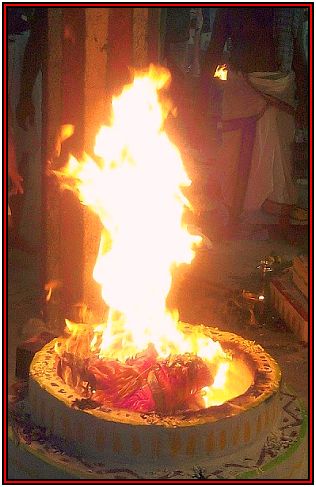
It is said; the three Riks 26,27and 28 of Asya Vaasa Sukta are chanted during the Pravargya (प्रवर्ग) – a ceremony preliminary to the Soma-Yaga, at which fresh milk is poured into a heated vessel called, mahā-varri or gharma.
But, this Pravargya is a preliminary or an introductory ritual or an application in Soma-Yaga; and, is not an independent one. Yet, it is given much importance in the कर्मकांड Sruti.
*
Dr. Venkata Chaganti, President, Vedas World Inc., Atlanta, USA, explains: Pravargya as a Thermodynamic process that boosts immunity and reduces pollution:
Pravargya is another Vedic and scientific process usually takes place along with the yajna. In Pravargya, a combination of fresh cow and goat milk is poured into the boiling cow ghee pot, the water part (about 87%) vaporizes instantly due to high heat quantity. The change from liquid to vapor expands water present in the milk to several hundred times and pushes the fire produced by the combustion of ghee in all directions that spontaneously produces the fireball. The fatty acids from the cow ghee, organic compounds and minerals present in cow and goat milk are responsible for high heat and emission spectra with different colors.
The process creates vapors of many particles that have great kinetic energies. These vapors are capable of rapidly increasing immunity in the human beings, reduce organic particulate pollution, air pollution and water pollution in and around the vicinity.
The verse 29 gives raise to many questions which have no clear answers. There is some difficulty in clearly understanding the intent of the poet. This has led to several endless arguments concerning issues such as:
- What is that which has encompassed the cow?
- Is it the light of wisdom? Does the idea relate to the Sun born of the Dawn?
- What is the significance of the shrilling cries or sneezing of the cow?
- Why should humans be considered inferior to a Cow? Which is such a cow?
- What is the meaning of throwing back the garments?
- What is the idea of the Cow transforming into lightening (Vidyut)?
- Does Vidyut merely mean ‘shining or brilliance’
*
Dr. Raja also remarks:
There is some difficulty in interpreting verse 29. What is this which has encompassed the cow. Is it the light of wisdom? Does the idea relate to the Sun born of the Dawn? The picture is not quite clear.
The inner meaning is the dawning of wisdom; but there is some difficulty in understanding how this encompasses the cow.

Verse 30
अनत् । शये । तुरगातु । जीवम् । एजत् । ध्रुवम् । मध्ये । आ । पस्त्यानाम् । जीवः । मृतस्य । चरति । स्वधाभिः । अमर्त्यः । मर्त्येन । सयोनिः ॥1.164.30 ॥
anat | śaye | tura-gātu | jīvam | ejat | dhruvam | madhye | ā | pastyānām | jīvaḥ | mṛtasya | carati | svadhābhiḥ | amartyaḥ | martyena | sa-yoniḥ
The life, breathing, moving fast, is at rest; rushing, it is firm in the middle of habitations. The immortal Self of the Dead, having the same birth-place with the mortal, wander? about at his own will.
**
Jiva (जीवम्) with Pranas, breathing (अनत्) going about briskly (तुरगातु) for carrying out his external functions remains still in the midst of residences in the form of bodies(पस्त्यानाम्). Jiva moves in the world associated with the mortal body (मृतस्य– चरति), born with mortal frame from the same source (मर्त्येन–सयोनिः). Himself (अमर्त्यः) being immortal and sustained by offerings made by his sons (स्वधाभिः) – Svadhābhiḥ Putra kṛtaiḥ (ष्व्अध्आभ्इः पुत्रा क्रुताह्).
[Dr. Raja surmises: The first half refers to the contrast between the condition of embodiment and the condition when the Self is separated from the body.
The second half also may refer to the same condition, enjoying free movement in heaven.]
**
The three signs of a living organism are said to be: Prana/Jiva (Life); Manas /Buddhi (Mind); Deha (Body).
The terms Prana (प्राण) and Jiva (जीव) are very proximate. They are at times used alternatively. For instance; in the ancient tests the term for indicating the soul or the living principle (Appa, Jiva) bears almost the same sense as Mahidasa’s term Prana or Uddalaka’s term Jivatma.
*
At the same time, there are other explanations as well.
Prana literally means “life-force.” It is a subtle, pervasive energy that powers various aspects of our being. Prana is essential for our vital activities like breathing, talking, moving, thinking, digesting, breathing, and so on. Hence, we call it vital life-force energy
Jiva -individual soul – coordinates the various powers and faculties of the mortal body (Sarira); and moves by its Pranic and paranormal powers.
*
Prana -Living principle, is what is really existent in the universe. The functions of the mind die out with the body. Mind is joined to life, and that sleep results from the absorption of the mind into Prana. Mind is linked to Prana which is its abode (ayatana) or resting place (upasraya), i.e., substratum. While a person sleeps, his mind subsides in and is tied to the Prana, just as a string-bound bird finding no other shelter, stays put at last knotted to the chain itself.
Jiva- Jjlvatma (Life) endowed with breath and eager to discharge its functions, stays within a body for a limited time. It then flies away. Jiva is with reference to an individual being.
The three verses – from 23 to 25 – dealt with Chhandas, the metrical structures of poetic verses. And, the next four verses – 26 to 29 – were in celebration of wisdom.
But, the following four verses – 30 to 33- are again obscure, suggesting the mystery of the embryo in mother’s womb, birth and the embodiment of the Self.
*
Verses 30 and 31 together put forward the ancient doctrine known as Amrita-Mritya-Vada, according to which the immortal and mortal exist together at every level.
Similarly, the Svadha (स्वधा) principle also links the immortal and mortal. The immortal and the mortal are kins from the same source. And, the immortal Jiva moves with the mortal body, by virtue of its intrinsic power (स्वधाभिहि –Svadhabhih). Life-principle is said to established firmly in mortal bodies, in which Agni has also a seat.
That is to say: both the mortal body (मर्त्येन-Martya) and Amartya (अमर्त्यः) the Self or the Jiva, life principle (जीव) which is immortal, are united like brothers; and have a common origin.
*
A living body is a organised mechanism; and, has the vital principle (Prana) to energize its capabilities in order to function methodically. A living body (शरीर–Sarira) must be clearly distinguished from a lifeless body or corpse (म्रुतदेह), which for all purposes is dead.
A body that is alive and functioning, is a self- working natural system; a physical entity, which is composed of several members skillfully joined together or united into a complete whole; and functioning as a living organism.
**
This Rik (30) states that the Jiva (Life-principle) has this body only in this life. Body is impermanent, while the Jiva is eternal.
Jiva though housed in a body, it is separate and has its own independent characteristics. Body is alive so long as the Jiva resides in it. The moment it leaves the body is dead.
Jiva moves about when it is residing and associated with the body. But, when it is not so associated with body elements, it stays motionless. It is said; Jiva by its very nature is still.
So long as the Jiva, in the form of Prana, is located in the body, the sense organs perform their respective functions.
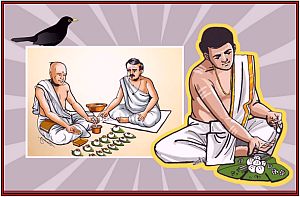
The Jiva, after it leaves the body, can travel either by the path of Pitris (ancestors) or that of gods
When it follows the path of the Pitris it is supported by Shraddhas – the offerings made by its decedents or sons- Svadhābhiḥ Putra kṛtaiḥ (ष्व्अध्आभ्इः पुत्रा क्रुताह्).
Verse 31
अपश्यम् । गोपाम् । अनिपद्यमानम् । आ । च । परा । च । पथिभिः । चरन्तम् । सः । सध्रीचीः । सः । विषूचीः । वसानः । आ । वरीवर्ति । भुवनेषु । अन्तरिति ॥ R.V. 1.164.31 ॥
apaśyam | gopām | ani-padyamānam | ā | ca | parā | ca | pathi-bhiḥ | carantam | saḥ | sadhrīcīḥ | saḥ | viṣūcīḥ | vasānaḥ | ā | varīvarti | bhuvaneṣu | antariti
I have seen the protector of the universe, who never falters in his steps nor get tired, who wanders hither and away; , travelling upwards and downwards by various paths; going all around; invested with brilliant and diffusive radiance revolves in the midst of the regions of the world.
*
In case the term गोपाम् is understood as the Sun:
I have seen (अपश्यम्) the protector of the universe (गोपाम् –Sun), who never falters in his steps nor gets tired (अनिपद्यमानम्); who travels (चरन्तम्) along various paths (पथिभिः) in the sky. Up to noon approaching the world (परा–च); then going away from it in the afternoon. He, the sun, with rays collected(सध्रीचीः) at the centre, and radiating (वसानः) towards worlds, enlivening them with light and life. He thus, rising and setting, revolves amidst all the regions of the world (भुवनेषु –अन्तरिति).

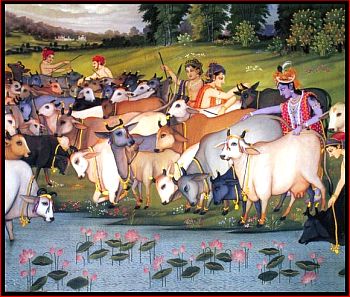
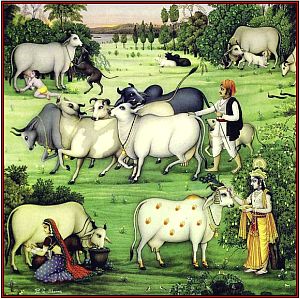
In case the term गोपाम् is taken to mean cowherd, then the verse will project a beautiful poetic imagery of a cow-herd. He is ever steady; never falters in his steps. He goes along this path and that path. He, with the herd of cows, goes around all the pastures.
The Cowherd moves out with his cows in the morning; returns home by evening (Godhuli-lagna); and, retires in the night.
There is another question. Who indeed is He (Isa Vai- ईषा वै), the Cowherd (protector- गोपा) Is he .. ?:
- Surya, the Gopa, who rules and protects all the worlds
- Isa Vai Gopa ya Suryatapati – ईषा वै गोपा या ईषा सूर्यस्तपति
- Agni, the master, indeed is the divine Cowherd
- Agni Vai Devanam Gopaha – अग्नि वै देवानम् गोपा
- Indra the ruler, indeed is the excellent protector of all the Devas
- Indra Vai Gopaha; इन्द्रा वै गोपह
- Prana truly is the eternal Life-principle the one who protects
- Prano Vai Gopaha– प्राणो वै गोपह
Verse 32
यः । ईम् । चकार । न । सः । अस्य । वेद । यः । ईम् । ददर्श । हिरुक् । इत् । नु । तस्मात् । सः । मातुः । योना । परिवीतः । अन्तः । बहुप्रजाः । निःऋतिम् । आ । विवेश ॥ R.V.1.164.32 ॥
yaḥ | īm | cakāra | na | saḥ | asya | veda | yaḥ | īm | dadarśa | hiruk | it | nu | tasmāt | saḥ | mātuḥ | yonā | pari-vītaḥ | antaḥ | bahu-prajāḥ | niḥ–ṛtim | ā | viveśa
He who created this, does not know this; from him who saw this, verily this is indeed hidden. He is shrouded within the womb of the mother; he who has many off-springs enters suffering.
**
The following verses focus on the rather elusive themes such as mysterious seed of life, the embryo in the womb, which has gone through many births (बहुप्रजाः– bahu-prajāḥ); Mother-principle; Father-principle etc. The poet employs a number of imageries, which again could be in number of ways.
The poet makes a rather brazen statement wherein he asserts that the Creator who brought into existence all the worlds may himself not know what he has created.
When such is the case, what to speak of mere mortals who just witnesses, as in a puppet-show. They suffer much because many things are hidden from them (हिरुक्); and they do not know what they are doing.

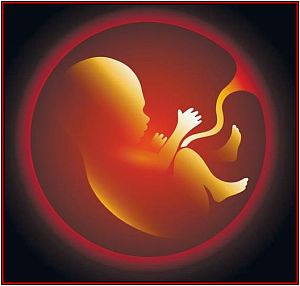
The greatest mystery is how in a mother’s womb a life is created by cells to form a living and active foetus (योना), which takes form and grows. The wonder is that the mother (मातुः) who creates (चकार), nurtures and brings forth her offspring, surely does not know (न सः अस्य वेद) from where the life growing within her entered (विवेश); and what is within her (अन्तः); not knowing (न ददर्श) what is surrounding her (परिवीतः).
And, embryo enveloped in mother’s womb also does not know how and where it came from. It may also be not aware that it has taken many births (बहुप्रजाः).
This is greatest mystery of Motherhood.
*
Similarly, the father who deposits his germ into a female, may not know how he carries within him the potency to create life.
The metaphors of Mother and Father principles as extended to Earth are dealt in the next verse.
**
Verse 33
द्यौः । मे । पिता । जनिता । नाभिः । अत्र । बन्धुः । मे । माता । पृथिवी । मही । इयम् । उत्तानयोः । चम्वोः । योनिः । अन्तः । अत्र । पिता । दुहितुः । गर्भम् । आ । अधात् ॥ R.V. 1.164.33 ॥
dyauḥ | me | pitā | janitā | nābhiḥ | atra | bandhuḥ | me | mātā | pṛthivī | mahī | iyam | uttānayoḥ | camvoḥ | yoniḥ | antaḥ | atra | pitā | duhituḥ | garbham | ā | adhāt
The heaven is my parent and progenitor; the navel (of the earth) is my kinsman; the spacious earth is my mother. The womb (of all beings) lies between the two uplifted ladles, and in it the parent has deposited the germ (of the fruitfulness) of the daughter.
The heaven (Sky) above is my father (द्यौः मे पिता), the ancestor(जनितृ). This vast earth (पृथिवी- मही) is my mother (माता). And, in between, the navel (नाभिः॑) of the earth is my relative (बन्धुः॑ मे॒), my friend. The womb (of all beings) lies between the two vessels held upside (उत्तानयोः). It is my place of birth. Here the father has deposited the germ of fruitfulness into the daughter of Indra (योनिः अन्तः अत्र पिता दुहितुः गर्भम् आ अधात्
**
Mata (मातुः),the mother in this verse, can also be taken to mean the Mother-Earth (Mahi-Mata-Prithvi).
The poet says:
To me the heaven is the protector. He is the one who creates the sap of the earth.
This vast earth is my mother. Between the father above and the mother below are the source of all life. Aditya, the Sun, sends down rains, light and energy to the earth and enables her to create, nourish and sustain various forms of life, including vegetation. Prithvi indeed is the mother of all that exists in this world.
Sri Sayanacharya explains:
Here, the term – नाभिः–अत्र –बन्धुः –nābhir atra bandhu– stands for ‘my-parent’.
And, Nabhi is related to me (पिता– जनिता– Pitā-Janita) i.e. the moisture of the earth, as derived from the rain sent down by the sun (Aditya). It is by the help of that sap, corns and various other food crops are grown abundantly. That food keeps a person alive, strong; and produces seminal fluid. It is from that fluid again another person is born. Thus, eventually, it is the Aditya who is the parent and progenitor of man.
The term बन्धुः (Bandhu/ Bandhikā) binding or supporting; this world is an epithet of पृथिवी (Prithivi) the earth. The two uplifted ladles – उत्तानयोः– चम्वोः– योनिः– अन्तः: – (uttānayos’ camvor yonir antar) are heaven and earth.
And, the womb of all beings between them is the space, the region of the rain, which the parent has deposited. The father, the heaven, may be regarded as identical with either Aditya or Indra. The daughter is the earth, whose fertility depends upon the rain deposited as a germ in the firmament.
CONTINUED
IN
THE NEXT PART
REFERENCES
- History of Pre-Buddhist Indian Philosophy by Dr. Beni-madhab Barua -Motilal Banarsidas-1921
- Tagore Law Lectures 1930 – The History Of Hindu Law by Prof Radha Binod Pal; University of Calcutta – 1958
- Vision in long darkness by Prof. Vasudeva Agrawala
- https://who.rocq.inria.fr/Ramakrishna.Upadrasta/Veda/Asya_Vamiya/AVMS/AVMS_1-100.pdf
- https://www.youtube.com/watch?v=r86l_TF9XWc
- https://archive.org/details/in.ernet.dli.2015.226346
- https://istore.chennaimath.org/products/rig-vedic-suktas-asya-vamiya-suktam/1309294000102324374
- pdf (archive.org)
- https://religion.fandom.com/wiki/Dirghatamas
- ऋग्वेदः सूक्तं १.१६४ – विकिस्रोतः (org)
- org/mirrors/rigveda/sanskrit03/RV0310noaccent.html
- ALL IMAGES ARE FROM INTERNET
 sreenivasarao's blogs