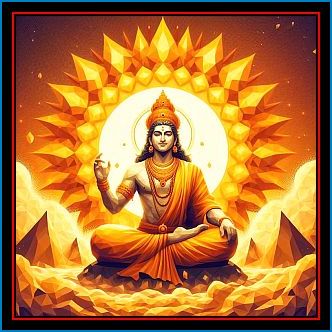
Verses 21 and 22, here-under, are in continuation of the rather complicated obscure concepts encased in riddles. There is also glorification of wisdom; lauding one who can clearly see and understand what lies beneath seemingly obvious elements in the nature surrounding us.
Verse 21
यत्र । सुपर्णा । अमृतस्य । भागम् । अनिमेषम् । विदथा । अभिस्वरन्ति । इनः । विश्वस्य । भुवनस्य । गोपाः । सः । मा । धीरः । पाकम् । अत्र । आ । विवेश ॥ 1.164.21 ॥
yatra | su-parṇā | amṛtasya | bhāgam | animeṣam | vidathā | abhi-svaranti | inaḥ | viśvasya | bhuvanasya | gopāḥ | saḥ | mā | dhīraḥ | pākam | atra | ā | viveśa
Where the birds ceaselessly sing forth about their virtue of immortality, before their learned assembly, there the lord of all, the protector of the world, allowed me to enter, though I am immature.
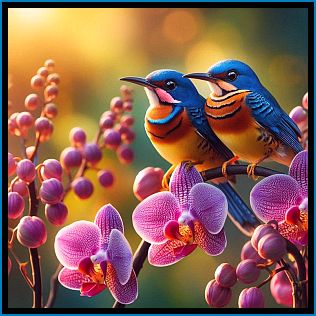
Here, two birds are depicted as resting on a tree, in evening as also in morning; and chirping away pleasantly. The tree, into which sun rays enter during daytime, is amidst waters; and, bears sweetest fruits (Svadu), sweeter than any other fruit.
The birds ceaselessly sing before the learned assembly about glory of immortality.
The birds are compared to learned men of wisdom, participating in an assembly of the scholars, eloquently expressing their views; and glorifying the virtues of that Immortal One.
In the assembly of the learned, where the wise people sing of that Immortality, there I had the vision of the magnificence of the Father
Those who doesn’t know the virtues and the glory of the Protector who confers immortality, will not realize their identity with Him.
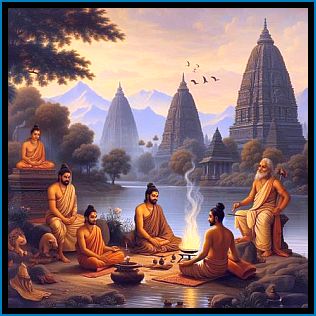
Sri Sayanacharya explains:
Here, the birds can also be understood as Suparna (the smooth gliding, beautiful and graceful rays of the Sun) , the Aditya – सुपतानह शोबना गमन रश्म्याह – supatanaḥ śobhana gamana raśmayaḥ.
They absorb water; and send it to the Sun. And, in turn, the Sun, the lord and steadfast protector of all beings, sends it back to the earth as rains. Ultimately, the sun and water are one.
*
The birds, here, are projected as metaphors for wise and realized-souls (विदथा– Vidatha), reciting hymns in chorus, in an assembly, praising the Great Lord Aditya, the protector of the Universe (विश्वस्य– भुवनस्य– गोपाः). They pray for immortality (अमृतस्य).
Those who don’t diligently study (उपासना); and fail to realize this Truth about the Protector of all, will not get the fruits of wisdom leading to the Eternal One.
Thus, there is a clear distinction between those who know the Truth and those who know only the outside, the external world, without enjoying the fruits of wisdom.

Sri Sayana offers another explanation, according to which, the Suparna, the birds, represent the human senses (इन्द्रिया). Each of them efficiently grasps its own sense object. They are like birds gliding smoothly in their territory. They aim to get their own feed; their nectar. Until they come out of their limited, restraining area they will not realize the beauty and grandeur of the wide-world.
**
Verse 22
यस्मिन् । वृक्षे । मधुअदः । सुपर्णाः । निविशन्ते । सुवते । च । अधि । विश्वे । तस्य । इत् । आहुः । पिप्पलम् । स्वादु । अग्रे । तत् । न । उत् । नशत् । यः । पितरम् । न । वेद ॥ 1.164.22 ॥
yasmin | vṛkṣe | madhu-adaḥ | su-parṇāḥ | ni-viśante | suvate | ca | adhi | viśve | tasya | it | āhuḥ | pippalam | svādu | agre | tat | na | ut | naśat | yaḥ | pitaram | na | veda
Upon which tree, honey-drinkers, the birds rest in peace, and all inspire (themselves) ; on the top of it, they say, is verily the sweet berry. One does not reach up to it, who does not know the father.
**
This verse carries forward the theme of glorifying wisdom.
In verse 20 above, it was said that there are two birds resting on the same tree (two classes of men in similar ambiance) .
The reference here is about that class of birds that suck the honey (मधुअदः) in the tree (sweet berries). And, it could be extended to persons also.
They find repose there; but it is not a rest of inaction; it is the calm of those who have reached.
The sweet-fruit is on the top of that tree, which the two classes of people desire. And, the wise people eat the sweet berry (पिप्पलम् – Pippalam).
However, all cannot get the sweet berry; only those who are wise can get that sweet berry.

Dr. Raja explains:
The tree is the Tree of Universe, bearing sweet berries of wisdom on its top. The wise people eat the sweet berries of wisdom; and they find tranquillity and also inspiration in this Universe. Only those who know the father (Aditya, protecter of the Universe) can get these sweet berries.
**
Swami Amritananda comments:
One should realize that Aditya (Father) is the protector of the Universe. The rays take refuge in him during night. And, at day-break, they emerge out of him; and spread his light over the whole world.
*
When one takes Aditya as Paramatma; and equates the sun-rays (honey-suckers) with the senses (इन्द्रिया), the verse could be interpreted in another manner.
Paramathma is the Tree. During the times when one is awake and alert, the senses (Suparna) go out and gather the knowledge of the surrounding objects.
But, during sleep they withdraw themselves from the objects; and, merge in Him. And, during waking state, they again get attached to the objects.
Realisation of the Paramathma is the sweetest fruit that one could aspire for.
But, for one who does not know Him, this fruit is not available.
**
There is also an alternate explanation, according to which:
If Aditya is taken as the Tree, those who take recourse to it, do get the fruits of the tree, which are the best of the fruits – very sweet, tasty. But, for enjoying such elevating experience, one has to necessarily appreciate and respect the Great protector, Aditya.
The others, who do not understand or realize the glory and greatness of the Father , will not get such fruits.
Verse 23
यत् । गायत्रे । अधि । गायत्रम् । आहितम् । त्रैस्तुभात् । वा । त्रैस्तुभम् । निःअतक्षत । यत् । वा । जगत् । जगति । आहितम् । पदम् । ये । इत् । तत् । विदुः । ते । अमृतत्वम् । आनशुः ॥1.164.23 ॥
yat | gāyatre | adhi | gāyatram | āhitam | traistubhāt | vā | traistubham | niḥ-atakṣata | yat | vā | jagat | jagati | āhitam | padam | ye | it | tat | viduḥ | te | amṛta-tvam | ānaśuḥ
They who know the place of Agni upon the earth; the place of Vayu that was created in the firmament; and that place of the Sun in heavens attain immortality.
*
The set of Seven Verses from 16 to 22 dealt with various shades of Wisdom. And, as usual, in the manner that is characteristic to Dhirgatamas, they were worded in rather obscure and flexible terms projecting varied imageries that could be interpreted in more than one way.
In the previous verses Dhirgatamas described two Suparnas (Dua-Suparna) – the beautiful-winged birds. Here, he switches over to Tri-Suparna doctrine, in which three form of Chhandas – Gayatri, Trishtup and Jagati – are picturized as three birds, whose flight leads to immortality.
Following upon this, there is a glorification of poetry in three Verses -from 23 to 25. These verses specifically relate to the Sanskrit prosody or Chandas (छन्दस्); the metre meant to maintain the rhythm of a well-constructed verse.
The exaltation and glorification of poetry are celebrated in three verses (23 to25).

Before we get into these three verses of Asya Vamasya Sukta, let us, for a short while, talk about Chandas.
There is a classic collection of six essential disciplines, which must be studied in order to properly understand the Vedic verses. These six disciplines together are known as Vedangas.
The Six branches of the Vedanga are:
Shiksha: Phonetics and phonology, which establish the rules of pronunciation and syllable sounds to fix the parameters of Vedic words
Chhanda: Metrics, which help appreciate the composition of Vedic hymns by studying their poetic structures
Vyakarana: Grammar
Nirukta: Exposition of words and etymology
Jyotisha: Astronomy, which helps determine auspicious times for rituals and ceremonies
Kalpa: Social thought, which focuses on the procedures and ceremonies associated with Vedic ritual practice
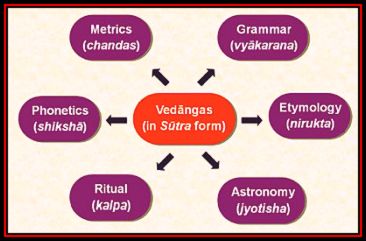
As regards Chandas (छन्दस्), which is one among the six branches of Vedanga, it is said; one cannot truly comprehend a Vedic mantra without a good understanding of its Chhandas, its metrical form. Chhandas is the very basis of the structure and of the import of Vedic hymns (Chandah paadau tu vedasya– Paniniya Shiksha – 41).
The knowledge of Chhandas is very necessary in order to compose or to study any of the metrical structures of other compositions, apart from the Vedas.
A proper understanding of Chhandas becomes essential , particularly when one attempts to construct a classic verse in Sanskrit.
It is said; Chhanda-Shastra, the science of meters, was refined and improved upon by Pingalacharya, a brilliant mathematician ; and the younger brother the Great Grammarian Panini (@ 750 BC)
**
The term Chanda (छन्द चैदः/चैदस्, चैदाआसि) – derived from the root (dhatu) चदि, giving rise to Ahlade (आह्लादे,) joy or delight – indicates that which is pleasing, alluring, graceful, lovely, delightful or charming; and, that which nourishes, pleases or celebrates the joy of poetry.
And, Chhandas (छन्दस्) is also the delight in organizing the syllables and words of the mantra (chhandayati ahlada-dayani chhandas – Amara Kosha 3.20).
It also sets the rhythm for chanting of the mantra. Chhandas ; enlivens and articulates the meaning of the mantra.
And, one has to unravel, untie the covering of Chhandas (chandaamsi chhadanaath – Nirukta – 8.3.11) in order to fathom the true intent of the mantra. (11,5: candraś. candateḥ. kānti. karmaṇah / candanam. ity .apy. asya. bhavati)
In studying the Rigveda, the ancients prescribed it as a preliminary necessity that one should know the Rishi who composed the mantra; the Devata (the deity to which it is submitted) ; and the Chandas (the metre).
*
Chhandas deals with the analysis of the types of meters used in the construction of various Vedic hymns. The unit of a mantra is called as ‘Pāda’ (one line; lit. foot). Each Pāda has a specific number of syllables. Sanskrit meters are based on a fixed number of syllables (akṣharas) per Pāda. The measurement is made in terms of the number of syllables used; or by a number of syllabic measures (mātrās)
*
According to Chando-Vidya; there are 26 types of Chandas, or poetic meters, in Sanskrit that are identified by the number of syllables in each line of a poem .
Of these, the fourteen types of Chhandas employed in Vedic texts are listed as:
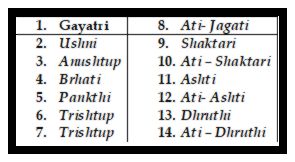
Among the above said fourteen types of Chhandas, the following are particularly prominent in constructing Vedic verses; and are known as classic meters.
1.गायत्री (Gayatri); 2. उष्णिक् (Ushni); 3. अनुष्टुभ्, (Anustup) ; 4. बृहती (Brhati); 5. पंक्ति (Pankthi); 6. त्रिष्टुभ् (Trishtup); and 7. जगति (Jagati)
These seven main Chandas, as developed and organized by the Vedic schools, are particularly prominent in Vedic uses, and are also known as classic meters. Each of these has its own rhythm, movements and aesthetics.
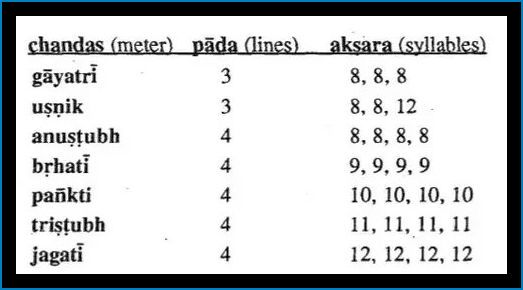
Of the seven types of Chhandas, mentioned above; according to the tradition in Vedic prosody, Gayatri (8-syllable), Tristubh (11-syllable) and Jagati (12 syllables) are the most commonly used meters in poetic compositions.
Dhirgatamas, in his poem, talks with reference to these three types of Chhandas in order to illustrate his concepts concerning the structure of the Universe.
The shortest and the most sacred of Vedic meters is the Gayatri Chhandas. It consists of three lines/feet-(pada), each with eight syllables (3×8), with a total of 24 syllables.
Trishtubh meter (four padas of eleven syllables each) with a total of 44 syllables, is the most prevalent meter of the Rigveda, accounting for roughly 40 percent of its verses.
Jagati meter consists of four padas, each of twelve syllables; with a total of 48 syllables.
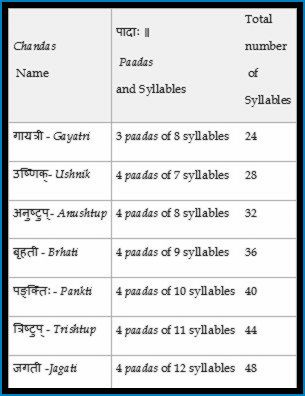
As can be seen, Gayatri Chhandas has twenty-four syllables; and, the six other Chhandas that follow thereafter has each four syllables more than it’s preceding one (e.g. Jagati the seventh Chhandas has 4×12 = 48 syllables)
*
The Gayatri Chhandas is referred to in Rig-Veda (1.12.11) as ‘Gayatra’ or ‘Gayatram’.
It is said; that out of 10,552 mantras in Rig-Veda Samhita as many as 2,456 are in Gayatri Chhandas.
But, the largest numbers of mantras (4,251) in Rig-Veda are in Trishtubh Chhandas. And, the rest (1,346) are in Jagati Chhandas.
Among the fourteen types of Chhandas used in the Vedic texts, Gayatri is the shortest (with twenty-four matras). It is regarded the first (head: atah shirah) and the basic metrical form. And, it is the best.
Taittiriya-Aranyaka (10.34) regards Gayatri as the Mother of all the Chhandas (gayatrimchhandasaam mata); born of Brahman (Brahma-yoini); and, as one that signifies Brahman in three letters (tri-akshare Brahma-vaadini).
Almost all the Samhitas (excepting Krishna Yajurveda) begin in Gayatri Chandas.
[Most of the notable scriptures follow some specific Chhandas. For instance, in the Bhagavad Gita, the majority of the verses are set in the Anuṣṭup-Chhandas, which is essentially a Chhandas of eight syllables in each quarter of the verse. The remaining verses are presented in the Triṣhṭup-Chhandas, which has eleven syllables in each line. These metrics make it a musical text and hence the name Gītā.]
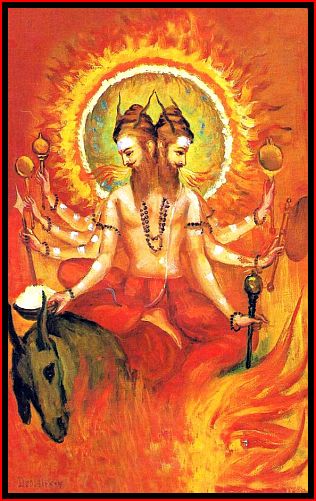
Gayatri- Agni
It is said; Gayatri is the prana; and, in prana reside all the Devata-s, the energies and activating faculties. And thus; all knowledge, action and the consequences thereof become united in Gayatri. Being prana, Gayatri is the very self of all existence (jagatah atman)
Gayatri is that which protects the one who recites it mindfully (gayantam trayate yasmad gayatri smarata budhaih) .
Gayatri Chhandas , adorned with eight letters, is associated with Agni (aṣṭākṣarā vai gayatri gāyatram agneś-chando – Sp.Br.5.2.1.5). Agni is the first and the foremost of the Vedic deities without whom no ritual is possible.
Rigveda commences with Agni Sukta, composed in Gayatri Chhandas. Because of that, Gayatri Chhandas is invested with great sanctity; and, all the other mantras in this Chhandas are of special significance.
The Satapatha Brahmana (6.1.3.19) declares the mantra in Gayatri Chhandas is Agni himself (Gayatri va Agnihi; and Agnir vai Gayatri). And, that Agni, indeed, is the face (mouth) of Gayatri (tasya Agni-reva mukham).
That is the reason, it is explained, the opening mantras of all the Yajna-s are in Gayatri Chhandas.
It is explained that the term Gayatri is derived from the root ‘traing’ (paalana) which means ‘to protect’. Expanding on that explanation, Chandogya Upanishad says: ‘This mantra called Gayatri in Gayatri-chhandas protects one who chants it. That is why it is called Gayatri’ (Gayatri trayate cha– Ch. Up.)
It is also said; the line of Gayatri Chhandas having eight letters in association with Pranava (Aum) as the ninth letter (navakshara vai), by itself forms the first half of the Yajna (purvardha vai yajnasya Gayatri-SB : 3.4.1.15)
– navākṣarā vai gāyatryaṣṭau tāni yānyanvāha praṇavo navamaḥ pūrvārdho vai yajñasya gayatri
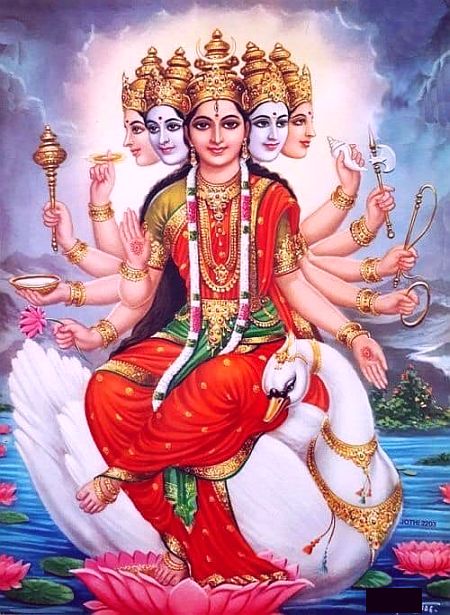
Trishtubh Chhandas is associated with Indra; and, Jagati Chhandas with Visvedevas.
Incidentally, the seven horses yoked to Sun-god’s chariot are named as:
- Gayatri, Brhati, Ushnik, Jagati, Trishtup, Anushtupand Pankthi (SB: 5.21.16.)
*
Verse 23 is translated by Dr. Raja as;
Those who know, say that the Gayatra is placed upon the Gayatra, or that one has constructed what is in Trishtup from what is in Trishtup, or that the Jagat quarter is placed in the Jagat. They verily who have known this, attain immortality.
*
There is mention of three metres named Gayatra (Gayatri), Trishtubh and Jagati. They are also the names of the lines (Padas) of which the verses are composed.
Here, a Gayatra {Gayatri) quarter is placed in a Gayatra {Gayatri) verse.
Trishtup verse (relating to Trishtup) is constructed from a Trishtup quarter (relating to Trishtup); a Jagat (Jagati) quarter is placed in a Jagat Jagati) verse.
The word Paada (quarter of a verse) must be taken to mean the first and second lines also, though it is found only in the third line. One who knows this becomes immortal.
[Dr. Raja observes:
From this verse, there is something said by the poet about poetry. To know that a Gayatri verse is made up of Gayatri quarters is a simple affair. There must be something more in this than what appears outside in the actual words.
These names do not seem to mean the metres in the Rigveda, known by the names in later times.
According to the tradition in Vedic prosody, the metres in the Veda can be classified under three headings, those with lines of 8, 11 and 12 syllables.
And it is these three types, according to latter day nomenclature, that are given here. That indicates some relation between the verse and the three metres with these names.]
*
Sri Sayana explains:
- On the immortal Gayatra is placed the mortal Gayatra.
- From the immortal Trishtup crafted the mortal Trishtup.
- The mortal Jagati is based upon the immortal Jagati.
- Those who know this truth enjoy immortal life.
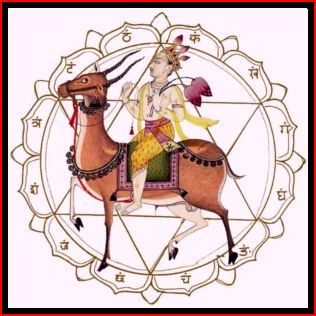
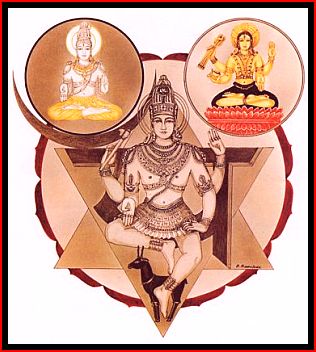
Here, Gayatra is derived from Gayatri, the base or the station of Agni – the Earth. Trishtup is to be taken to mean firmament, the place of Vayu. And, Jagat is identified with the sun, in the solar region (Taittirīya Samhita 2.2.9.5-6).
All beings are on Earth, which is the place of Agni. And, Gayatri and Agni are identical.
Vayu who roams in the space (Akasha) – above, below and sideways – is closely related with Akasha, the realm of Aditya.
And, Aditya is Jagat, as he keeps moving constantly. He is the source of heat, water and energy.

In this verse, the first Gayatra refers to the manifest world (matter); and the second Gayatra to the unmanifest Prana, that which brings manifest into existence.
Similarly, Trishtup, is the Vayu that enlivens the world (Trishtup-prana)
And, Jagati is entity that enlivens mind (Manas)
Verse 24
गायत्रेण । प्रति । मिमीते । अर्कम् । अर्केण । साम । त्रैस्तुभेन । वाकम् । वाकेन । वाकम् । द्विपदा । चतुःपदा । अक्षरेण । मिमते । सप्त । वाणीः ॥1.164.24॥
gāyatreṇa | prati | mimīte | arkam | arkeṇa | sāma | traistubhena | vākam | vākena | vākam | dvi-padā | catuḥ-padā | akṣareṇa | mimate | sapta | vāṇīḥ
He constructs the prayer with the Gayatri metre; with the prayer (he constructs) the Soma; and with the Trishtup metre the couplet (or triplet); with the couplet (or triplet) he constructs the hymn with (verses of) two or four lines of verse; and with the syllable they construct the seven metres.
With Gayatra he composes Arka; with Ark the Soma; and, with Trishtup he makes Vak.
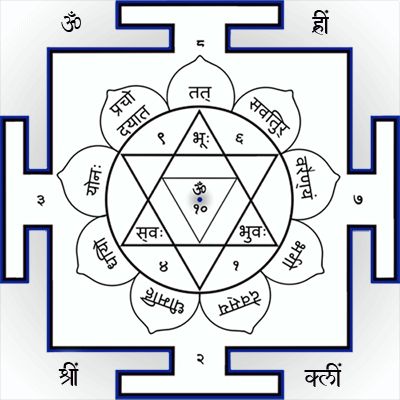
Mantra is explained as mananat trayate mantrah; the contemplation of which liberates. It is the harmonious and powerful union of mind (Manas) and word (Vac). It is the living sound, transcending beyond the mental plane.
Sri Sayanacharya explains:
They compose mantras for praise (अर्क–Arka), one-by-one, for worship (प्रति–मिमीते) with Gayatri Chhandas (गायत्रेण);
With prayers / mantras for worship they compose Sama (अर्केण–साम);
With the mantras in Trishtup Chhandas they compose Sukta portions having two (Dvi-pada) or four lines (Chatush-pada) of poetry;
With those lines they construct a hymn of two or four lines (वाकम् – वाकेन –वाकम्–द्विपदा–चतुःपदा); and,
With the power of Vak (Speech/words-अक्षरेण) they construct all the seven speeches / Chhandas – सप्त– वाणीः
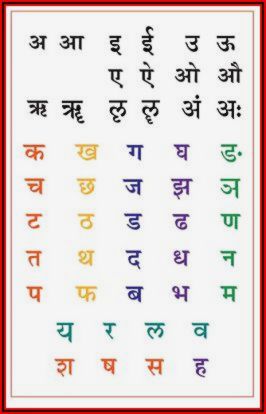
Thus, the letters (अक्षरेण) are at the base of sentences (वाकम्), as also of meters (छन्दस्); of Rks, Vargas, Suktas and Anuvaks.
This verse is in appreciation and celebration of syllables / letters (अक्षर– प्रशंसा)
Dr. Raja adds:
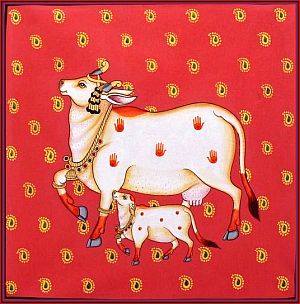
In verse 24, there is a reference to seven speeches (speech forms) and in verse 3, the seven names of the cow are concealed therein, in the chariot. One cannot miss some close relation among the position of the gods, the Gayatri and other song forms, the cow and the chariot. There is the beautiful imagery of the cow with the calf, making a bellowing sound, licking the calf, yielding milk and so on (verses 26 to 29, and40 and 41). Along with the mention of the concealed position of the bird, there is a reference to the cow and the calf (verse 7)
Verse 25
जगता । सिन्धुम् । दिवि । अस्तभायत् । रथम्तरे । सूर्यम् । परि । अपश्यत् । गायत्रस्य । सम्इधः । तिस्रः । आहुः । ततः । मह्रा । प्र । रिरिचे । महित्वा ॥1.164.25॥
jagatā | sindhum | divi | astabhāyat | ratham-tare | sūryam | pari | apaśyat | gāyatrasya | sam-idhaḥ | tisraḥ | āhuḥ | tataḥ | mahrā | pra | ririce | mahi-tvā
With the hymns in the Jagati metre, he fixed the rain in heaven, and surveyed the Sun in the Rathantara. They have declared three divisions of the Gayatri metre, whence it surpasses (all the rest) in force and majesty.
*
This is a very complex verse, the intent or the meaning of which cannot be clearly understood.
Dr. Raja candidly states:
The meaning of many of the words used there, like the names of metres and the kinds of poems, are unknown to us. We do not know what they exactly mean. There is the composition of particular kinds of songs with particular metres and there is also the reference to the “establishment of the river in the heaven and the vision of the sun.” (verse 25).
The river established in the heaven must be the Saptha-sindhu or the seven rivers, very familiar in the Rigveda. We do not know what the three kinds of fuel, of the Gayatra are. It is on account of them that it excels the others. What excels must be the Gayatra, and perhaps it is over the other kinds of metres mentioned here and in the previous verses.
**
The Jagat-Sama or Jagat is called Rk-Sama (stanzas in Jagati meter), which is related to rainy season.
*
It is said; according to Sama-Vidya; Surya is the Father-principle; while Prithvi (Earth) is the Mother.
Surya and Prithvi each have their own Saman-chant. The one of Surya is called Brihat (ब्रिहत्); while that of Prithvi is called Rathantara(रथन्तर्).
[Different methods of singing are followed. The Bruhathi Saman is sung with force, rather loudly; in contrast to Rathantara Saman.]
Brihat-Sama of Surya moves (अपश्यत्) towards the Earth (दि॒वि). And, the Rathnatara-Sama of Prithvi goes out to meet the solar radiation (सूर्य॑म्– परि॑).
That is to say that the two versions of Sama- Brihat and Rathnatara – are brought closer to each other.
And, there is an accord and unison between the two entities.
[The Samhita of Samaveda is an anthology taken from the Rigveda-Samhita. The difference is in the refinement and application of arts such as melody, meters of music, and literary composition.
Thus, the root hymn that later became the Rathantara (Excellent Chariot) mantra chant is found in both Rigveda and Samaveda-Samhitas.
The purpose of arranging the Sama verses in Gayatri and Jagati formats is to render the chanting more melodious ]
*
Aitereya Brahmana at several places speaks about Rathantara and Brihat-Samans; and extols the close relation between the two:
At the beginning, there were Brihat and Rathantara; through them there were Speech and Mind. Rathantara is Speech, Brihat is Mind.
In the form of the Rathantara Saman, this earth is wedded to heaven; and , in the form of the Brihat Saman, heaven is wedded to the earth. (A.B. 5,30)
The night belongs to the Rathantara, the day to the Brihat. Agni is the Rathantara; and, Aditya is the Brihat
*
The relation between Sun and Earth is extended through other symbolisms too.
The Sun in the sky is the protector, who gives light, warmth to the Earth. He also takes away moisture from the earth; and, later sends it back to earth as rains.
Thus, there is a mutual coordination between the Sun (Father) and Earth (Mother).

The ocean (सिन्धुम्) mentioned in the verse is said to represent the Un-manifest source of creation.
The Brihat-Sama of Surya is compared to waves of the ocean; and, Rathnatara -Sama of Earth (सिन्धुम् – दिवि), moving like a chariot, meets the Sun. They are ever in harmony.
[At the same time, it also said that Rathantara – Saman helps to visualize the glory of Surya. – रथन्तरे सूर्य पर्यपश्यत्. They are identical. ]
**
However, some commentators try to explain; and say: This verse describes the mutual relation that Gyatri and Jagati Chandas have.
Three divisions of Sama (सम्इधः– तिस्रः) are composed in Gayatri chhandas (गायत्रस्य). Other Chhandas used in Sama are derived from Gayatri.
Gayatri chhandas here has three forms: 8 lettered Gayatri; 11 lettered Trishtup; and, the 12 lettered Jagati.
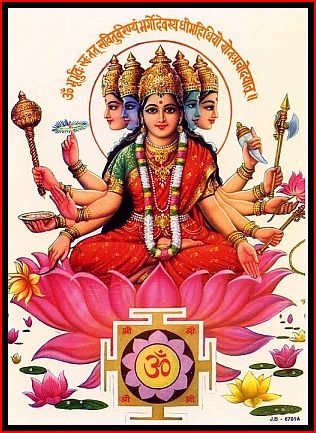
It is indeed Gayatri that excels in glory and power over all other forms.
CONTINUED
IN THE
NEXT PART
References
- A History Of Pre-Buddhistic Indian Philosophy: Benimadhab Barua : Free Download, Borrow, and Streaming : Internet Archive
- A History of Pre-Buddhistic Indian Philosophy: Benimadhab Barua : Free Download, Borrow, and Streaming : Internet Archive
- https://aseemamag.com/vedic-origins-of-the-zodiac-hymns-of-dirghatamas-in-the-rig-veda/
- https://www.researchgate.net/publication/359710805_Description_of_Twelve_Zodiac_Signs_in_Ancient_Indian_Texts
- ALL IMAGES ARE FROM INTERNET
 sreenivasarao's blogs